/

























































































Text
                    An Algebraic Introduction to .^-Theory
This book is an introduction to -fiT-theory and a text in algebra. These two roles are
entirely compatible. On the one hand, nothing more than the basic algebra of groups,
rings, and modules is needed to explain the classical algebraic if-theory. On the other
hand, if-theory is a natural organizing principle for the standard topics of a second
course in algebra, and these topics are presented carefully here, with plenty of
excercises at the end of each short section. The reader will not only learn algebraic
-fiT-theory, but also Dedekind domains, classic groups, semisimple rings, character
theory, quadratic forms, tensor products, localization, completion, tensor algebras,
symmetric algebras, central simple algebras, and Brauer groups.
The presentation is self-contained, with all the necessary background and proofs, and
is divided into short sections with exercises to reinforce the ideas and suggest further
lines of inquiry. The prerequisites are minimal: just a first semester of algebra
(including Galois theory and modules over a principal ideal domain). No experience
with homological algebra, analysis, geometry, number theory, or topology is assumed.
The author has successfully used this text to teach algebra to first-year graduate
students. Selected topics can be used to construct a variety of one-semester courses;
coverage of the entire text requires a full year.
Bruce A. Magurn is Professor of Mathematics at Miami University in Oxford, Ohio,
where he has taught for fifteen years. He edited the AMS volume Reviews in K-Theory,
1940-84. This book originated from courses taught by the author at Miami University,
the University of Oklahoma, and the University of Padua.

ENCYCI.0PED1A OF MATHEMATICS AND ITS APPLICATIONS
FOUNDING EDITOR G.-C. Rota
Editorial Board
R. Doran, P. Flajolet, M. Ismail, T.-Y Lam, E. Lutwak
Volume 87
An Algebraic Introduction to J?-Theory
27 N. H. Bingham, C. M. Goldie and J. L. Teugels Regular Variation
29 N. White (ed.) Combinatorial Geometries
30 M. Pohst and H. Zassenhaus Algorithmic Algebraic Number Theory
31 J. Aczel and J. Dhombres Functional Equations in Several Variables
32 M. Kuczma, B. Choczewski and R. Ger Iterative Functional Equations
33 R. V. Ambartzumian Factorization Calculus and Geometric Probability
34 G. Gripenberg, S.-O. Londen and O. Staffans Vollerra Integral and Functional Equations
35 G. Gasper and M. Rahman Basic Hypergeometric Series
36 E. Torgersen Comparison of Statistical Experiments
38 N. Komeichuk Exact Constants in Approximation Theory
39 R. Brualdi and H. Ryser Combinatorial Matrix Theory
40 N. White (_ed.) Matroid Applications
41 S. Sakai Operator Algebras in Dynamical Systems
42 W. Hodges Basic Model Theory
43 H. Stahl and V. Totik General Oithogonal Polynomials
45 G. Da Prato and J. Zabczyk Stochastic Equations in Infinite Dimensions
46 A. Bjomer et al. Oriented Matroids
47 G. Edgar and L. Sucheston Stopping Times and Directed Processes
48 C. Sims Computation with Finitely Presented Groups
49 T. Palmer Banach Algebras and the General Theory of ^Algebras I
50 F Borceux Handbook of Categoi-ical Algebra I
51 F. Borceux Handbook of Categorical Algebra IJ
52 F Borceux Handbook of Categoi-ical Algebra III
53 V. F Kolchin Random Graphs
54 A. KatokandB. Hasselblatt Introduction to the Modern Theory of Dynamical Systems
55 V. N. Sachkov Combinatorial Methods in Discrete Mathematics
56 V. N. Sachkov Probabilistic Methods in Discrete Mathematics
57 M. Cohn Skew Fields
58 R. Gardner Geometric Topography
59 G. A. Baker Jr. and P. Graves-Morris Fade Approximants, second edition
60 J. Krajicek Bounded Arithmetic Prepositional Logic and Complexity Theory
61 H. Groemer Geometric Applications of Fourier Series and Spherical Harmonics
62 H. O. Fattorini Infinite Dimensional Optimization and Control Theory
58 A. C. Thompson Minkowski Geometry
64 R. B. Bapat and T. E. S. Raghavan Nonnegative Matrices with Applications
65 K. Engel Spemer Theory
66 D. Cvetkovic, P. Rowlinson and S. Simic Eigenspaces of Graphs
67 F Bergeron, G. Labelle and P. Leroux Combinatorial Species and Tree-Like Structures
58 R. Goodman and N. Wallach Representations and Invariants of the Classical Givups
69 T. Beth, D. Jungnickel and H. Lenz Design Theory 1, second edition
70 A. Pietsch and J. Wenzel Orthonormal Systems for Banach Space Geometry
71 G. E. Andrews, R. Askey and R. Roy Special Functions
72 R. Ticciati Quantum Field Theory for Mathematicians
73 M. Stem Semimodular Lattices
74 I. Lasiecka and R. Triggiani Control Theory for Partial Differential Equations I
75 I. Lasiecka and R. Triggiani Control Theory for Partial Differential Equations II
76 A. A. lvanov Geometry ,o/ Sporadic Groups I
77 A. Schinzel Polynomials with Special Regard to Reducibilily
78 H. Lenz, T. Beth and D. Jungnickel Design Theory II, second edition
79 T Palmer Banach Algebras and the General Theory of ""-Algebras II
80 O. Stormark Lie's Structural Approach to PDE Systems
81 C. F Dunkl and Y. Xu Orthogonal Polynomials of Several Variables
82 J. P. Mayberry The Foundations of Mathematics in the Theory of Sets

ENCYCLOPEDLA OF MATHEMATICS AND ITS APPUCATIONS
An Algebraic Introduction to K-Theory
BRUCE A. MAGURN
Miami University, Ohio
HI) Me*V, iu* '-WHV--I r
Tosi.iir k, J, "v>JJ7 t^OlCO
Gins vhl Q&sp^ «»*---*.
6?A
«» CAMBRIDGE
UNIVERSITY PRESS

PUBLISHED BY THE PRESS SYNDICATE OP THE UNIVERSITY OF CAMBRIDGE
The Pitt Building, Trumpington Street, Cambridge, United Kingdom
CAMBRIDGE UNIVERSITY PRESS
The Edinburgh Building, Cambridge CB2 2RU, UK
40 West 20th Street, New York, NY 100114211, USA
477 Williamstown Road, Port Melbourne, VIC 3207, Australia
Ruiz de Alarcon 13, 28014 Madrid, Spain
Dock House, The Waterfront, Cape Town 8001, South Africa
http://www.cambridge.org
© Bruce A. Magurn 2002
This book is in copyright. Subject to statutory exception
and to the provisions of relevant collective licensing agreements,
no reproduction of any part may take place without
the written permission of Cambridge University Press.
First published 2002
Printed in the United Kingdom at the University Press, Cambridge
Typeface ITC Century 9/12 pt. System AMSTeX 2.1 [AU]
A catalog record for this book is available from the British Library.
Library of Congress Cataloging in Publication Data
Magurn, Bruce A.
An algebraic introduction to K-theory / Bruce A. Magurn.
p. cm - (Encyclopedia of mathematics and its applications; v. 87)
Includes bibliographical references and index.
ISBN 0-521-80078-1
1. K-theory. I. Title. II. Series.
QA612.33 .M34 2002
512'.55-dc21 2001043552
ISBN 0 521 80078 1 hardback

Contents
Preface xi
Chapter 0 Preliminaries 1
Part I Groups of Modules: K0 15
Chapter 1 Free Modules 17
1A Bases 17
IB Matrix Representations 26
1C Absence of Dimension 38
Chapter 2 Projective Modules 43
2A Direct Summands 43
2B Summands of Free Modules 51
Chapter 3 Grothendieck Groups 57
3A Semigroups of Isomorphism Classes 57
3B Semigroups to Groups 71
3C Grothendieck Groups 83
3D Resolutions 95
Chapter 4 Stability for Projective Modules 104
4A Adding Copies of R 104
4B Stably Free Modules 108
4C When Stably Free Modules Are Free 113
4D Stable Rank 120
4E Dimensions of a Ring 128
Chapter 5 Multiplying Modules 133
5A Semirings 133
5B Burnside Rings 135
5C Tensor Products of Modules 141
Chapter 6 Change of Rings 160
6A K0 of Related Rings 160
6B Go of Related Rings 169
6C Kn as a Functor 174
Vll

viii
Contents
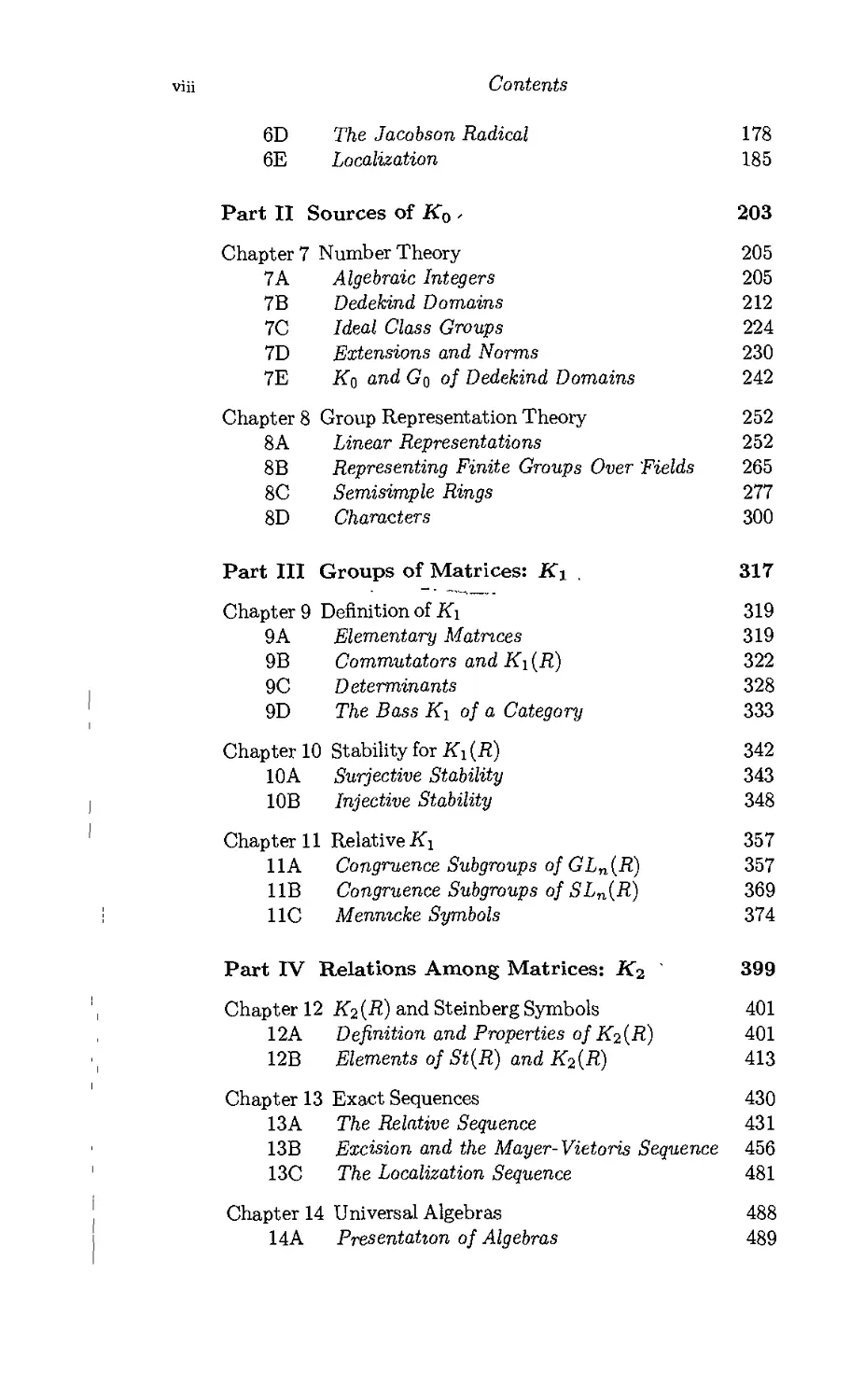
6D The Jacobson Radical 178
6E Localization 185
Part II Sources of K0 , 203
Chapter 7 Number Theory 205
7A Algebraic Integers 205
7B Dedekind Domains 212
7C Ideal Class Groups 224
7D Extensions and Norms 230
7E Kq and G0 of Dedekind Domains 242
Chapter 8 Group Representation Theory 252
8A Linear Representations 252
8B Representing Finite Groups Over 'Fields 265
8C Semisimple Rings 277
8D Characters 300
Part III Groups of Matrices: K\ . 317
Chapter 9 Definition of i^i 319
9A Elementary Matrices 319
9B Commutators and Ki(R) 322
9C D eterminants 328
9D The Bass Ki of a Category 333
Chapter 10 Stability for Ki {R) 342
10A Surjective Stability 343
10B Infective Stability 348
Chapter 11 Relative if i 357
11A Congruence Subgroups of GLn{R) 357
11B Congruence Subgroups of SLn{R) 369
11C Mennicke Symbols 374
Part IV Relations Among Matrices: K2 399
Chapter 12 K2 {R) and Steinberg Symbols 401
12A Definition and Properties of K2{R) 401
12B Elements of St{R) and K2{R) 413
Chapter 13 Exact Sequences 430
13A The Relative Sequence 431
13B Excision and the Mayer-Vietoris Sequence 456
13C The Localization Sequence 481
Chapter 14 Universal Algebras 488
14A Presentation of Algebras 489

Contents
14B Graded Rings 493
14C The Tensor Algebra 497
14D Symmetric and Exterior Algebras 505
14E The Milnor Ring 518
14F Tame Symbols 534
14G Norms on Milnor K-Theory 547
14H Matsumoto's Theorem 557
Part V Sources of K2 567
Chapter 15 Symbols in Arithmetic 569
15A Hilbert Symbols 569
15B Metric Completion of Fields 572
15C The p-Adic Numbers and
Quadratic Reciprocity 580
15D Local Fields and Norm Residue Symbols 595
Chapter 16 Brauer Groups 610
16A The Brauer Group of a Field 610
16B Splitting Fields 623
16C Twisted Group Rings 629
16D The K2 Connection 636
Appendix 645
A Sets, Classes, Functions 645
B Chain Conditions, Composition Series 647
Special Symbols 657
References 661
Index
671

Preface
This book is intended as an introduction to algebraic .K"-theory that can serve
as a second-semester course in algebra. A first algebra course develops the basic
structures of groups, rings, and modules. But a reader of research literature
in algebra soon encounters a second level of structures, such as class groups,
Burnside rings, representation rings, Witt rings, and Brauer groups. These are
groups, rings, or modules whose elements are themselves isomorphism classes of
groups, rings, or modules. Each of these second-level structures is a variation
of a universal construction developed by A. Grothendieck in 1958. Given a
category C of objects, Grothendieck found a natural way to construct an abelian
group K(Q) of the isomorphism classes of those objects. By Grothendieck's own
account, his letter K probably stood for Klasse, the German word for class.
This is the source of the K in iiT-theory.
Algebraic iiT-theory is the study of groups of classes of algebraic objects. It
focuses on a sequence of abelian groups Kn{R) associated to each ring R. The
first of these is Kq(R), Grothendieck's group K(Q)^ where C is a certain category
of H-modules. It is used to create a sort of dimension for H-modules that lack
a basis. The group Ki (R) consists of the row-equivalence classes of invertible
matrices over R and is used to study determinants, and K2{R) measures the
fine details of row-reduction of matrices over R.
Many deep problems in algebra have been solved through algebraic iiT-theory,
such as the normal integral basis problem in number fields, the zero-divisor
conjecture for integral group rings of solvable groups, the classification of normal
subgroups of linear groups, and the description of the Brauer group of a field
in terms of cyclic algebras. But, beyond this, iiT-theory has brought algebraic
techniques to bear in the solution of important problems in topology, geometry,
number theory, and functional analysis.
Unfortunately, the currently available introductions to algebraic iiT-theory
expect a great deal of the reader: Some background in algebraic topology,
algebraic geometry, homological algebra, or functional analysis is taken as a
prerequisite. This is due in part to the important role played by iiT-theory in
disciplines outside of algebra, and it is partly because the "higher" iiT-groups
Ks(R), K^R),... are defined and studied by using algebraic geometry and
topology.
But, at an introductory level, the groups Kn(R), for n < 2, and the higher

Xll
Preface
Milnor A"-groups Kjf(F) of a field F are accessible purely through algebra. To
A"-theorists, this algebraic part has come to be known as "classical" algebraic
A\theory. And, judging by a census of the research literature, much of the
power of A-theory for applications lies in this classical realm.
In this text, I have assumed no prerequisite beyond undergraduate
mathematics and a single semester of algebra, including Galois theory and the
structure of modules over a principal ideal domain, as might be taught from N.
Jacobson's Basic Algebra I, S. Lang's Algebra, S. MacLane and G. Birkhoff's
Algebra, or T. Hungerford's Algebra. I have included self-contained treatments
of standard first-year graduate algebra topics: tensor products, categories and
functors, Dedekind domains, the Jacobson radical, semisimple rings,
character theory of groups, Krull dimension, projective resolutions, quadratic forms,
central simple algebras, and symmetric and exterior algebras. The blend of
AT-theory with these topics motivates and enhances their exposition.
By including these algebra topics with the A"-theory, I also hope to reach
the mathematically sophisticated reader, who may have heard that A"-theoiy
is useful but inaccessible. Even if your algebra is rust}', you can read this book.
The necessary background is here, with proofs.
This book provides a broad coverage of classical algebraic A"-theory, with
complete proofs. The groups Kq(R), Ki(R), and A^f-R) are developed, along
with the computational techniques of devissage, resolution, localization, Morita
invariance, preservation of products, and the relative, Mayer-Vietoris, and
localization exact sequences. The Krull dimension of a ring is shown to lead,
through stable range conditions, to results on direct sum cancellation of
modules and the injective and surjective stability theorems for Ki(R). These, in
turn, lead to a proof of the Bass-Kubota presentation of relative SKi and an
outline of the solution of the congruence subgroup problem for the general linear
group over a ring of arithmetic type. The higher Milnor A"-theory is presented
in detail, accompanied by a sketch of its connection to the Witt ring. Then Ke-
une's proof of Matsumoto's presentation of A^t-R) is included. The final part
develops norm residue symbols and the relevance of AT2 to reciprocity laws and
the Brauer group.
Inevitably, this text reflects my own interests and experience in teaching
algebra and A"-theory over the last 20 years. It incorporates lecture notes
I have presented at the University of Oklahoma, Miami University, and the
University of Padua, Italy. The categories considered here are explicit categories
of modules, rather than subcategories of arbitrary abelian categories; this entails
some loss of generality but seems less intimidating to the student who is new
to A"-theory. Unlike a treatment aimed at the A"-theory of schemes, there is
more emphasis here on algebraic than on transcendental extensions of a field,
and extensive attention to examples over noncommutative rings R.
The text is organized broadly into five parts, and these are divided into
chapters (1, 2, ...) and sections (2A, 2B,...). The chapter numbers are consecutive
from the beginning of the book to the end. Numbered items, such as theorems,
definitions, or displayed equations, are labeled by the chapter in which they

Preface
Xlll
appear, a decimal point, and the number of the item within the chapter. For
example, (3.27) is the 27th numbered item in Chapter 3. At the end of each
section is a list of several exercises, designed to illustrate with examples or point
the way to further study.
The text has enough material for a year of study, but a variety of single-
semester courses can be created from selected chapters. I recommend that the
introductory Chapters 0 on categories, 1 on free modules, and 2 on projective
modules, be summarized in a total of three or four lectures. Material not
included in these lectures can be introduced, as needed, later in the course.
A short course on the interaction between rings and modules might include
Chapters 3-6, §§7A-B, 8A-C, and 14A-D. This would cover Grothendieck
groups, direct sum cancellation, Krull dimension, Dedekind domains, semisim-
ple rings, the Jacobson radical, tensor products, and the construction of algebras
from a module.
The connections of iiT-theory to number theory would be introduced by
following §§3A-C, 4A, 5C, and Chapters 6 and 7 by one of two variants: Chapters
9, 10, and 11 for Mennicke symbols and the congruence subgroup problem or
Chapter 12, §14H, and Chapter 15 for ^{R), norm residue and Hilbert
symbols, and reciprocity laws.
A course on linear representations of finite groups would follow Chapter
3, §4A, and Chapters 5, 6, 8, and 12 by a sketch of the results in Chapter
16. This would include matrix representations of a finite group over fields of
arbitrary characteristic; basic character theory; the structure of group algebras;
the representation ring and Burnside ring of a group; and the Brauer group of
a field.
I envision two possible short courses in algebraic iiT-theory itself: A module
approach, including Kq(R), Ki(R), K2{R), devissage, resolution, Morita in-
variance, stability and exact sequences, would be Chapter 3, §§4A-B, 5A, 5C,
and Chapters 6, 9, and 12-14. A linear group emphasis (mainly Ki and ^2)
would follow a brief treatment of Chapters 3 and 5 by Chapter 4, 6(mainly
§§6D, 6E), and Chapters 9-14. (A truly minimal coverage of K0) K\, and K2
and their connections would be §§3A-C, 4A, 5A, 5C, 6A-C, Chapter 9, §HA,
Chapters 12 and 13, and a sketch of §14H.)
This book would never have seen the light of day without the generous
assistance of several people. I am grateful to Keith Dennis, Reinhard Laubenbacher,
Stephen Mitchell, and Giovanni Zacher for many illuminating conversations,
helping me decide the level and general content of the book. My thanks also go
to the members of the Miami University algebra seminar: Dennis Davenport,
Tom Farmer, Chuck Holmes, Heather Hulett, and Mark deSaint-Rat, whose
patient attention to detail and constructive suggestions led to improvements
in a substantial portion of the text. I especially wish to acknowledge the help
of Reza Akhtar, David Leep, and Katherine Magurn, who read chapters and
gave valuable advice. My students in several graduate classes over the last few
years have been very helpful as they studied parts of the text. For artfully
translating my handwriting into TeX, I thank Jean Cavalieri. Her skill and

XIV
Preface
cheerful attitude made our working partnership enjoyable and efficient. Miami
office staff Bonita Porter and Cindie Johnson also did a nice job of typing a few
chapters. My colleague Dennis Burke assisted us with the TeX software; he was
unfailingly generous with his time and willing to answer my questions on the
spot. Paddy Dowling and Steve Wright also contributed some expert software
help. I appreciate the encouragement and material support of two successive
Chairs of the Miami Mathematics and Statistics Department, Dave Kullman
and Mark Smith. Most of all, I am grateful to Katherine, whose insight and
support have sustained me throughout.

0
Preliminaries
Algebraic K-theory can be understood as a natural outgrowth of the attempt
to generalize certain theorems in the linear algebra of vector spaces over a
field to the wider context of modules over a ring. We assume the reader has
been exposed to the fundamentals of module theory, including submodules,
quotient modules, and the basic isomorphism theorems. To establish notation
and terminology, we review some definitions in module theory. Then we present
an introduction to the language of categories and functors.
By an additive abelian group we mean an abelian group A with operation
denoted by "+," identity denoted by "Qa" and the inverse of an element x e A
by "—x." By a ring we mean an associative ring with identity — that is,
an additive abelian group R with a multiplication R x R —> R, (r,s) *-» rs,
satisfying
r(s + t) = rs + rt ,
(r +s)t = rt + st ,
(rs)t = r(st) ,
for all r, s, t e R and having an element 1 = 1r e R with
lr = r = rl
for all r e R.
Suppose R is a ring. A left H-module is an additive abelian group M
together with a function Rx M —> M, (r, m) i—> r?n, satisfying
r(m + n) = rm + rn
(r + s)m = rm + sm
(rs)m = r(sm)
Im = m
for all r,s e R and all m,n £ M. An H-linear map / : M —> N, between left
H-modules M and N, is a homomorphism of additive groups that also satisfies
f{rm) = rf{m)

2
Preliminaries
for each r e R and m £ M.
A right H-module is an additive abelian group M together with a function
M x R—> M, (m,r) *-» mr, satisfying
(m + ra)r = mr + nr
m(r + s) — mr + ms
m(sr) = (ms)r
ml = m
for all r,sER and m,n e M. An H-linear map / : M —> N', between right
H-modules M and JV, is a homomorphism of additive groups satisfying
f(mr) = f(m)r
for each / e R and m e M.
In either left or right modules we refer to elements of R as scalars, elements
of M as vectors, and the maps RxM—>MoiMxR—>Ma£ scalar
multiplication. The set of all H-linear maps from M to N is denoted by
KomR{M,N). An H-linear map / : M —> M, from a module M to itself, is
called an endomorphism of M, and '&omR{M,M) is denoted by Endi?(A/)-
Our preference will be to work with left H-modules — that is, to write scalars
on the left side of vectors. So when we refer to an H-module with no mention
of left or right, we mean a left H-module.
Sometimes a vector multiplication is defined from M x M to M. If R is
a commutative ring, an H-algebra A is an H-module that is also a ring and
satisfies r(ab) ~ (ra)b = a(rb), whenever r £ R and a, b e A. For example,
if R is a subring of a ring ,4, and ra = ar for all r £ R and a £ A, then
A is an H-algebra with scalar multiplication R x A ~* A restricting the ring
multiplication A x A —> A.
Whether we study groups, rings, modules, or any other type of
mathematical structure, it is often useful to consider the functions which preserve that
structure. For instance, the study of groups includes an examination of group
homomorphisms. For a comprehensive view of groups, one might consider the
class of all groups, together with all group homomorphisms. Imagine a vast
diagram of dots connected by arrows, with each group represented by a dot
and each group homomorphism by an arrow. What you are picturing is the
"category of groups."
(0.1) Definition. A category C consists of a class Obj C of objects, and
for each pair of objects A, B a set Hom(,4, B) of arrows from A to B, and for
each triple of objects A, B, C a function:
Hom{A,B) xHom(5,C) -> Hom(.4,C)
called the composite. The composite of a pair (/,<?) is denoted by g * /. For
C to be a category, the following three axioms must hold:

Preliminaries
3
(i) Hom(,4, B) n Hom(C, D) = 0 unless A = C and B = D.
(ii) For each object j4, there is an arrow i^ £ Hom(,4, A) for which
jha = j and i.4 ° & = k
whenever j £ Hom(A, B) and fc £ Hom(C, A) for objects 5, C.
(iii) If/£Hom(J4,5))p£Hom(5,C),and/i£Hom(C,I>),then
{h°g)°f = h°{g°f).
/
In a category C, an arrow / £ Hom(,4, B) is said to have domain A and
codomain B, and this is implied by the expressions:
/ :A — B or 4^5.
Axiom (i) just says the domain and codomain of / are uniquely determined by
/. The arrow i& in axiom (ii) is called the identity arrow on A; it is uniquely
determined by the composition in C, since if i and %' are two arrows from A to
A with the property described in (ii), then i = i ° i' = i'.
The set of arrows Kom(A> B) is sometimes denoted by Home(i, B) to
emphasize that they are arrows in the category C. We shall often write End(,4)
or Ende(^) to denote the set Home(^4, A) of arrows from A to itself.
(0.2) Examples. Here are the names, objects, and arrows of some of the
categories considered in this book:
Set: sets; functions.
Stoup: groups; group homomorphisms.
Ab: abelian groups; group homomorphisms between them.
Xing: rings (associative with 1); ring homomorphisms (preserving 1).
CDUng: commutative rings (associative with 1); ring homomorphisms
(preserving 1) between them.
Top: topological spaces; continuous maps.
Metric: metric spaces; isometries.
yotoex(S): subsets of the particular set S; inclusion maps (i : A —> B,
i(a) = a) between them.
For each ring R we have the categories:
R-MoV>: left H-modules; H-linear maps between them.
MoV>-R: right H-modules; H-linear maps between them.
For each commutative ring R we have the category:
R-AIq: H-algebras; H-linear ring homomorphisms between them.
For the, advantage of brevity, when C is a category, we shall sometimes write
A £ C instead of A £ Obj C to indicate that A is an object of C. For instance,

4
Preliminaries
A £ C$ing means A is a commutative ring, and A £ R-MoD means A is a left
H-module. This is really an abuse of notation, since the category C is not the
same as the class Obj C; and we will use this shortcut only where it does not
suggest any ambiguity.
Each of the preceding examples are concrete categories, meaning that the
objects are sets (possibly with additional structure), the arrows are (structure-
preserving) functions between those sets, the identity arrows are identity
functions (i(x) = x), and the composition is the composition of functions ((go f)(x) =
g(f(x))). But many useful categories do not fit this description. Here are some
non-concrete categories:
(0.3) Examples.
(i) The objects and arrows of a category need not represent anything. For
example, we can construct a category with two objects A and 5, and four
arrows i, j, /, and g:
O^O
Since the codomain of / equals the domain of g, there must be a composite
g ° / from the domain A of / to the codomain A of g. Since i is the only arrow
from A to j4, we must have g ° f = i. In this way, the scarcity of arrows forces
the composites to be defined by the table:
0
i
j
I
9
i j f 9
i 9
3 I
1 3
9 i
Each of the sets Hom(,4, A), Kom(A,B), Hom(B,A), and Kom(B,B) has only
one element. So the category axioms (ii) and (iii) hold automatically, since
both sides of each equation belong to the same set Hom(X, Y),
More generally, any diagram with the following properties has exactly one
law of composition making it into a category:
(a) For each object X there is an arrow from X to X.
(b) If there is an arrow from XtoY and an arrow from Y to Z, there is
an arrow from X to Z.
(c) For each pair of objects X and Y (possibly equal) there is at most
one arrow from X to Y.

Preliminaries
5
(ii) Suppose A is a set with a partial order •<. That is, A has a binary
relation •< that is reflexive (for all x £ A, x -< x), antisymmetric (x •< y and
y •< x imply £ = ?/), and transitive (a; •< y and 3/ -< z imply a; -< 2;). View the
elements of A as objects, and draw one arrow from x to y if x -< y, and no
arrow from x to y tf x -ft y. Then properties (a), (b), and (c) of the preceding
example hold; so this diagram is a category. We use the term poset to refer to
a partially ordered set, or to its associated category.
(iii) If M is a set with a binary operation « that is associative with an
identity element e £ M, then M is called a monoid. For each object A in any
category C, the set Ende(-4) is a monoid under composition of arrows. Every
monoid (M, °) can be obtained in this way: Just create a category with one
object, called A, and with the elements of M regarded as the arrows from A to
A; and define the composition of these arrows by using the operation « in M.
(iv) Suppose R is a ring. There is a category JAoX{R) whose objects are the
positive integers 1,2,3,..., and in which Hom(m, n) is the set of m x n matrices
A = {tiij) =
with entries a^ in R. The composition is matrix multiplication: B « A = AB.
Explicitly, if A = (a^) is an m x n matrix and B = (bij) is an n x p matrix,
their product AB = (cij) is the m x p matrix with ij-entry
~ an
0.21
■ O-rnl
0.12 •
0.22 •
Q-m.2 ■
■ ain
&2n
0'tnri
Cij = 2_^aik^k3 ■
fc-1
From this formula one can show that the multiplication of matrices is
associative, and there is an identity In = (8ij) £ Hom(rc, n) for each n, where:
Sij =
1 if i=j
0 if i£j.
For details, see (1.26) below.
(0.4) Definition. A category!) is called a subcategory of a category C if
every object of D is an object of C, and for each pair A, B £ Obj D , Kom^A, B)
C Horned, 5), and composites and identities in T> agree with those in C. In
case HomD^, B) = Horned, B), for each pair A, B £ Obj T> , the subcategory
D is called full.
Note that if C is a category, every subclass T> C Obj C is the class of objects
of a full subcategory T> of C. In particular, Ab is a full subcategory of Stoup,
and CDUng is a full subcategory of Xing. However, if a set S has at least two
elements, the subcategory yomet(S) of Set is not full.

6
Preliminaries
Is Xing a subcategory of Ab? After all, every ring (#,+, ■) is an additive
abelian group (R, +) if we forget its multiplication, and every ring homomor-
phism is a homomorphism between additive groups. The answer is no: Xing
is not a subcategory of Ab\ For the condition in the definition of subcategory,
"every object of £> is an object of C," is to be taken quite literally: A ring has
two operations and an abelian group has only one. So (H, +, ■) is not the same
as (#,+).
(0.5) Definition. In each category C an arrow / e Hom(,4, B) is called an
isomorphism if there is an arrow g e Hom(5, ,4) with
/ 0 g = iB and g « / = iA .
Such an arrow g is called an inverse to the arrow /. An isomorphism in End(,4)
is called an automorphism of j4, and the set of automorphisms of A is denoted
by Aut(.A) or Aute(-A).
In the categories Set, Stoup, Ab, Xing, eXing, R-MoU, MoQ-R, and Metric,
an arrow is an isomorphism if and only if it is bijective. In Top, an isomorphism
is the same as a homeomorphism; but not every bijective continuous map is
a homeomorphism. (Consider the identity function on X with two different
topologies, the first finer than the second.)
In JVtot(H), an isomorphism in Hom(n, n) is the same as an invertible n x n
matrix over R. There exist rings R for which Mat(R) includes an isomorphism
in Hom(m, n) even though vn^n. Such an isomorphism would be an m x n
matrix X over R for which there is an n x m matrix Y over R with
XY = im and YX = in ,
where im and in are identity matrices of different sizes. But such rings R are a
little hard to come by. For an example, see (1.37).
(0.6) Definition. An object X in a category C is called initial if, for each
object A e Obj C, there is one and only one arrow in Hom(X, A). An object
Y in C is called terminal if, for each object A e Obj C , there is one and only
one arrow in Hom(,4, Y).
(0.7) Proposition. // objects X and Y of a category C are both initial or
both terminal, then there is one and only one arrow f : X —* Y, and f is an
isomorphism in C.
Proof. The existence and uniqueness of / is immediate since X is initial or
Y is terminal. Likewise there is a unique arrow g : Y —* X, and the identity
arrows are the only arrows in End(^) and End(Y"). So, for lack of options,
go f =%x and f ° g = iy- ■

Preliminaries
7
(0.8) Examples.
(i) In Set the empty set 0 is initial: Hom(0, A) has one member / : 0 —> A
with empty graph. Each set {x} with only one member is terminal,
(ii) In Stoup, any trivial group {e} is both an initial and a terminal object,
(iii) In 3Ung, Z is an initial object, and the trivial ring {0} is a terminal
object. The same is true in CDUng.
(iv) For each scalar ring R, the trivial H-module {0} is both initial and
terminal in R-MoD.
(v) If R is a ring with at least two elements, Mat{R) has no initial object
and no terminal object, since each set Hom(m, n) has more than one
element.
Once categories are viewed as algebraic entities, it is natural to ask what
might be meant by a "homomorphism" from one category to another. A
function is an arrow in Set; its domain and codomain are sets. As a generalization,
define a metafunction from a class A to a class B to be a procedure that
assigns to each member a e A a unique member /(a) e B. Then a
homomorphism between categories should be a metafunction that takes objects to
objects, arrows to arrows, and respects domains, codomains, composites, and
identities.
(0.9) Definition. A covariant functor F : C —> D from a category C to a
category D is a metafunction that assigns to each object A of C an object F(A)
of D, and to each arrow / : A -» B in C an arrow F{f) : F{A) -* F{B) in D,
so that
(i) F{iA) = iF{A) , and
(ii) F(po/)=F(p)-F(/),
whenever A e Obj C and (/, g) are composable arrows in C.
There is also an arrow-reversing version:
(0.10) Definition. A contravariant functor F : C —* T) is a metafunction
that assigns to each object A in C an object F{A) in D, and to each arrow
/ : A -* B in C an arrow F(/) : F{B) -* F{A) in D, so that
(i) F{iA) = iF{A) , and
(ii) F(p0/)=F(/)oF(p),
whenever A £ Obj C and {f,g) are composable arrows in C.
For both covariant and contravariant functors F, the condition (ii) amounts
to saying that if F is applied to every object and arrow in a commutative

8
Preliminaries
triangle in C, one obtains a commutative triangle in T) (but with its arrows
reversed in the contravariant case).
(0.11) Examples.
(i) If C is a subcategory of T>, the inclusion functor F : C —* D is defined
by F(A) = A and F(f) = f for each object A and arrow / in C. The inclusion
functor F : C —>'C is called the identity functor iQ.
(ii) If C is a concrete category, such as Stoup or Xing, the forgetful functor
F : C —* Set is defined by taking F(A) to be the underlying set of elements
of A and F(f) to be / as a function. There are also functors involving a
partial loss of memory, such as the functor F : Xing —* Ab that forgets
multiplication: F(R) = R as an additive group and F(f) = f as an additive
group homomorphism.
(iii) If n is a positive integer, there is a functor
Mn : Xing —> Xing
where Mn(R) is the ring ofnxn matrices with entries in R; and if / : R ■—* S
is a ring homomorphism, Mn(f) : Mn(R) —> Mn(S) is the ring homomorphism
defined by
f{an) ... f{ain)'
/(ani) ■-. /(ann)_
(iv) If R is a ring, the elements of R with (two-sided) multiplicative inverses
in R are called units. The set R* of units in R is a group under multiplication.
There is a functor
U : Xing -> group
defined by U(R) = R* and U{f) = / restricted to units. This works because
every ring homomorphism / takes units to units.
(v) If F : C —* T) and G : T) —* £ are functors, there is a composite functor
G o F : e -> £ defined by
G>F{A) = G(F(A)), G*F{f) = G(F(f)) ,
for objects A and arrows / in C. If F and G are both covariant or both
contravariant, then G o F is covariant; if one of G, F is covariant and the other is
contravariant, then G ° F is contravariant.
(vi) The composite of Mn : Xing —* Xing, followed by U : Xing —> Stoup, is
the functor
GLn = U°Mn: Xing -> group ,
Mn(f)
an
.a-ni
am

Preliminaries
9
which takes each ring R to the group GLn(R) of n x n invertible matrices with
entries in R, and takes each ring homomorphism / to the group homomorphism
that applies / to each entry. The GL stands for "general linear" group.
(vii) In the functor definitions (0.9) and (0.10), axioms (i) and (ii) hold
automatically if T) is a poset category, for in a poset category an arrow is
uniquely determined by its domain and codomain. Also, the class of objects in
a poset category is a set. So a functor from a poset (.4, -<) to a poset {B, -<)
is just a function F : A —* B that preserves order:
x •< y =► F(x) -< F{y)
if F is covariant, or reverses order:
x •< V => F{y) •< F{x)
if F is contravariant.
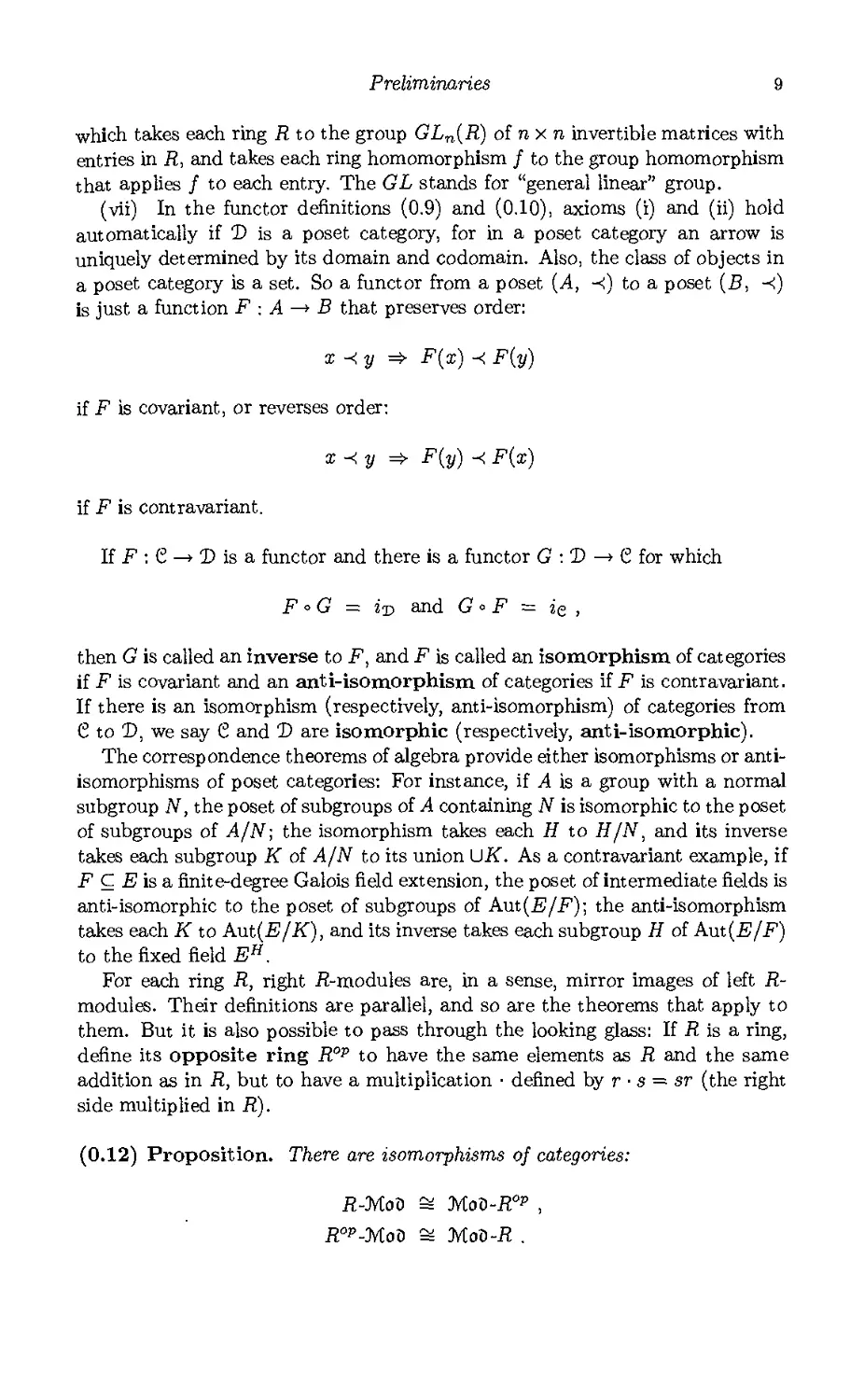
If F : C —> T> is a functor and there is a functor G : T> —> C for which
F °G = ix> and G ° F = {q ,
then G is called an inverse to Ft and F is called an isomorphism of categories
if F is covariant and an anti-isomorphism of categories if F is contravariant.
If there is an isomorphism (respectively, anti-isomorphism) of categories from
C to D, we say C and T> are isomorphic (respectively, anti-isomorphic).
The correspondence theorems of algebra provide either isomorphisms or anti-
isomorphisms of poset categories: For instance, if A is a group with a normal
subgroup N, the poset of subgroups of A containing N is isomorphic to the poset
of subgroups of A/N; the isomorphism takes each H to H/N, and its inverse
takes each subgroup K of A/N to its union UK. As a contravariant example, if
F C E is a finite-degree Galois field extension, the poset of intermediate fields is
anti-isomorphic to the poset of subgroups of Aut(E/F); the anti-isomorphism
takes each K to Aut(E/K), and its inverse takes each subgroup H of Au.t(E/F)
to the fixed field EH.
For each ring R, right H-modules are, in a sense, mirror images of left R-
modules. Their definitions are parallel, and so are the theorems that apply to
them. But it is also possible to pass through the looking glass: If R is a ring,
define its opposite ring Rop to have the same elements as R and the same
addition as in R, but to have a multiplication ■ defined by r ■ s = sr (the right
side multiplied in R).
(0.12) Proposition. There are isomorphisms of categories:
R-Moi) ^ Moi)-R0p ,
Rop-Moi) ^ MoQ-R .

10
Preliminaries
Proof. If M isaleft H-module with scalar multiplication RxM —> M, (r,m) >->
r*m< then the additive group of M can also be made into a right Hop-module via
a scalar multiplication M x R°p —> M, {m,r) *-* m#r, defined by m#r = r*m:
(m + n)#r = r *(m+ n) = (r * m) 4- (r * n) = (»n#r) 4- (n#r) ,
m#(r+s) = (r+s) *m = (r*m)+{s*m) = (m#r) + (m#s) ,
m#(s-r) == (rs)*m = r*(s*m) = (m#s)#r ,
m#l = 1 * m = m .
Each H-linear map f : M —> N between left H-modules is also an Hop-linear
map between right Hop-modules:
f{m#r) = f{r*m) = r*f{m) = f(m)#r .
So there is a functor F from tf-JVtot) to MoD-Rop with F((M, *)) = (M, #) and
F(/) = /■
Similarly, there is a functor G from Moi)-Rop to R-Moi) with G((M,#)) =
(M,*), where r*mis denned to be m#r, and G(/) = /. Since F and G are
inverses, F is an isomorphism. Since (R°p)op = R, the second isomorphism
follows from the first. ■
So, for the study of properties held in common by all module categories, it
suffices to consider only a category R-MoV> of left H-modules. Of course, if R
is commutative (R°p = R), then we can regard R-MoV> and MoTi-R as the same
category. Every additive abelian group is a Z-module in exactly one way, and
every homomorphism between abelian groups is Z-linear. So Z-JVtot) = JvtoO-
Z = Ab, and 2rAt$ = #ing.
Sometimes the values of two functors from C to D are closely related in T).
For instance, GLn and U are functors from C$ing to Stoup, and the
determinant connects them: For each commutative ring R, the determinant is a
group homomorphism det : GLn(R) —> U{R). And if / : R —> S is a ring
homomorphism, the square
GLn(R) -^ U(R)
GLn{f)
U(f)
commutes in S^oup; so det is compatible with a change of rings.
(0.13) Definition. If F and G are covariant functors from C to T>, a natural
transformation r : F —* G is a metafunction that assigns to each object X of
C an arrow
rx : F(X) -> G(X)

Preliminaries
11
in £>, so that for each arrow / : X —* Y in C the square
F{X) -^+ G{X)
F(f) G(/)
F(Y)-^G(Y)
commutes in T).
For each covariant functor F : C —* T) there is an "identity" natural
transformation i : F ~> F with ix = ip{x) for each X € C. If F, G, and 7/ are covariant
functors from C to D, and there are natural transformations t : F —> G and
t' : G —> H, there is a composite natural transformation r' ° r : F —> H, with
(t' o t)x = t'x ° tx. So for each pair of categories C,D, the covariant functors
e —* £> and the natural transformations between them behave like the objects
and arrows of a category. A natural isomorphism r : F —> G is any natural
transformation r : F —> G with an "inverse" natural transformation r1 : G —* F
so that r ° r' and t' ° r are identities on G and F, respectively.
Note: If t is a natural transformation and each rx is an isomorphism (in D),
then the inverse arrows tx1 constitute a natural transformation inverse to r.
So t is a natural isomorphism if and only if each rx is an isomorphism.
There is a strictly analogous theory of natural transformations between con-
travariant functors.
The importance of functors was first realized in connection with algebraic
topology. Two topological spaces X and Y are isomorphic in the category Top
if and only if they are homeomorphic, that is, if and only if there are continuous
maps / : X —* Y and g : Y —> X with f ° 9 = iy and g ° f = ix- If there is
such a homeomorphism / : X —* Y, then, from the topological point of view, X
and Y are the same space. In order to determine whether or not two spaces are
homeomorphic, functors are created from Top to Stoup: For each non-negative
integer n there is a singular homology functor Hn and a homotopy functor
7rn. These are created, roughly speaking, to detect holes of various dimensions in
each topological space. These functors send homeomorphic spaces to isomorphic
groups; so if one of these functors sends X and Y to non-isomorphic groups,
then X is not homeomorphic to Y. This is a general property of functors:
(0.14) Lemma. // F : 6 -* D is a functor, arid f is an isomorphism in Q,
then F(f) is an isomorphism in T>.
Proof. Suppose F is a covariant functor, and / : A-^> B has inverse g : B —> A
in C Then F(f) : F{A) -* F{B) has inverse F{g) : F{B) -* F{A) in D, since
Hf)"H9) = F{f°9) = F{*b) = iF(B), and

12 Preliminaries
F(9)>F(f) = F(g*f) = F(iA) = iF{A) .
The contravariant case is similar ■
Note that n on-isomorphic objects of C can be sent by a functor F : C —i D
to isomorphic objects of T>. For instance, Z and Z/3Z have isomorphic groups
of units. So it is sometimes necessary to apply a variety of different functors:
C —* D, in order to distinguish between nonisomorphic objects in C.
Algebraic iiT-theory is the study of a sequence of covariant functors
Kn : Xing -+ Ab (n6 Z)
that arise from linear algebra. If R is a ring, K0(R) is related to the dimension
of "vector spaces" over R, Ki(R) is similarly related to the determinant of
matrices over R, and K2{R) arises from the study of elementary row operations
on matrices over R. The "higher" .K-groups K$(R), K^R),... are more
mysterious. They are homotopy groups ^{Xr),^^^), ... of a certain topological
space Xr associated with the ring R, and are studied with the tools of
algebraic topology — in particular, homotopy theory. When R is a number field
(finite-degree field extension of Q), these higher groups Kn(R) contain deep
number-theoretic information related to zeta functions.
In this book, we confine our attention primarily to K0) K\, and K%, with brief
excursions involving Kn, n < 0, and an algebraically constructed sequence of
functors Kff, n > 3, which are related to the higher K-groups. In the literature,
Ko, KXl and K2 are often called "classical" K-groups, even though the whole
subject emerged in the second half of the 20th century, and even though, at its
outset, some of the creators of iiT-theory thought of Kn for n = 0, 1, 2 as part
of an infinite sequence {n £ Z) of K-groups that were not yet realized.
0. Exercises
1. Verify that the functor Mn defined in (0.11) (iii) is a functor. This includes
checking that if / : R —> S is a ring homomorphism, then Mn(f) : Mn(R) —>
Mn(S) is a ring homomorphism.
2. If C is a category with an object C, show there are
(i) a covariant functor F : & —> Set with .F^) = Home(C, ,4) for each
A € Obj e , and
(ii) a contravariant functor G : C —* Set with G{A) — HomePC) for
each A e Obj e .
3. Prove that there is no isomorphism of categories from Stoup to Xing.
Hint: Compare initial and terminal objects.

Preliminaries
13
4. A small category is a category C in which Obj C is a set. There is a
class of all small categories. Show that there is a category Cot whose objects
are the small categories and whose arrows are the functors between them.
5. Suppose G is a group with identity element denoted by e. A G-set is a
set X together with an operation G x X —> X,(g,x) t-^> g»x, satisfying the two
axioms:
(i) (gh) •£ = g»(h»x), and
(ii) e • x = x,
for all g, h £ G and all x e X. If X and Y are G-sets, a G-map / : X —> Y is
any function / from X to Y satisfying f(g • x) = g • f(x) for all g £ G, x £ X.
Prove that the G-sets and G-maps form a concrete category G-Set. Also prove
that an arrow in G-Set is an isomorphism if and only if it is bijective.
6. Verify that a category C is a poset if and only if Obj C is a set and, for
each pair x,y 0. Obj C ,
Kome{x,y) U Home(y,x)
has at most one element.
7. Prove that an arrow / in a category C can have at most one inverse arrow
inC.
8. Suppose, in a category C, that Hom(A, A) = {i^} andHom(5,5) ~ {ib}-
If Kom.(A, B) contains at least one arrow, prove Hom(5, ,4) contains at most
one arrow.
9. If C is a category and A is an object of C, prove the set Aut(j4), of
all automorphisms of A in C, is a group under ° . Also prove every group is
obtained in this way. (See (0.3) (iii)-)
10. Suppose F is a field, V is an F-vector space, and B is a finite basis
of V. Consider the category T> in which an object is a function / : B —> W
from B into (the underlying set of) an F-vector space W, and an arrow from
fi : B —* Wi to $2 '■ B —* W2 is the same as an F-linear transformation
h : W\ —> W2 with h 0 fi — J2- Prove that the inclusion map i : B —> V is an
initial object in T).

PART 1
Groups of Modules: KQ
Vector spaces over a field F are isomorphic if and only if they have equal
dimension. If c(V) denotes the isomorphism class of an F-vector space V, then
sending c(V) to dim(V) defines a one-to-one correspondence from the
collection 3 of isomorphism classes of finitely spanned F-vector spaces to the set N of
non-negative integers. Through this correspondence, the addition in N imposes
an addition on 3, with an identity element c({0}) and sharing the associative
and commutative properties of 4- in N.
There is also a way to add F-vector spaces V and W by forming their direct
sum V © W. Since dim(V © W) = dim(V) + dim(W), the addition in 3
described above is c(V) 4- c(W) = c{V ©W). Of course the abelian monoid N can
be completed to the abelian group Z of all integers by including the differences
m~n of non-negative integers. So 3 can be enlarged to an abelian group Kq(F),
isomorphic to Z, consisting of all differences c(V) — c(W).
When we replace the scalar field F by an arbitrary ring R, the H-modules
need not have bases — so dimension disappears. But if we restrict our attention
to an appropriate class of H-modules (called projective modules), the abelian
group Kq(R) remains intact as the ghost of departed dimensions. First
developed in 1957-58 by Grothendieck and Serre, K0(R) is now understood to be
one of a sequence Kn(R) (n € Z) of closely related abelian groups called the
algebraic i^-theory of R. If R is not a field, Kq(R) need not be isomorphic to
Z. Its structure reflects the various generalizations of the dimension of vector
spaces to "ranks" of H-modules.

1
Free Modules
1A. Bases
In this section we consider the description of an H-module in terms of
generators and defining relations, and we take a close look at those H-modules that
are free of defining relations.
(1.1) Definitions. Suppose R is a ring and S is a subset of an H-module M.
An iMinear combination of elements of S is any element nsi 4- h rnsn,
where n is a positive integer, ri,...,rn € R and Si,...,sn £ S. Denote by
(S) the set of all H-linear combinations of elements of S (together with Omj
which must be included separately if S = 0). One can also think of (S) as the
intersection of all submodules of M containing S. Say S generates (or spans)
M if (5) = M.
An iMinear relation on S is any true equation:
risi + ■■■+rnsn = Om
in M, where n is a positive integer, Si,...,sn are n different elements of S,
and ri,... ,rn are nonzero elements of R. The set S is called iMinearly
dependent if there exists an H-linear relation on S, or it is called iMinearly
independent if there is no H-linear relation on S. An H-basis of M is an R-
linearly independent set B C M that generates M. An H-module M is called
free if it has an H-basis.
When it does not cause confusion about the choice of scalars, we will
sometimes drop the prefix "R~" in the terms defined above.
(1.2) Examples of free modules.
(i) Over every ring R, the zero module {0} is free with the empty set 0 as
basis. We often denote the zero H-module by R°.
17

18
Free Modules
(ii) If R is a nontrivial ring, the polynomial ring R[x] is a free H-module
with infinite basis {1, x, x2,...}.
(iii) If R is a nontrivial ring and n is a positive integer, the rc-fold direct
sum
Rn = R®---®R
is a free H-module with basis {ei,..., en] where
et = (0,...,0, 1, 0,...,0)
has 1 in the i-coordinate and O's elsewhere: For ei,..., en span Rn because
{ri,--.,rn) = nei + ■ ■ ■ + rnen ;
and an H-linear relation among e\,..., en is impossible because
(n,...,rn) - (0,...,0)
implies r* ~ 0 for each i.
(iv) Suppose R is a nontrivial ring and S is a nonempty set. A function
/ : S —> R is said to have finite support if f(s) = Or for all but finitely many
s £ S. Let ©s-R denote the set of all functions / : S —> R with finite support.
Under pointwise sum and scalar multiplication, ®sR is an H-module. If s e S,
let s": S —* R denote the characteristic function of s, defined by
{Or if t f- S .
Then the set S = {s : s e S} is a basis of ©s^ : For if / e ©s^, then
and an H-linear combination
s€S
is the zero map ( = the zero element of ©s-R) if and only if every f(s) = Or.
Note that if S = {si,..., sn] has n elements, there is an isomorphism:
®SR = &n
I -> (/(*i},...,/(0)
under which the basis s"i,..., s"„ corresponds to the basis ei,..., en.
By the next theorem, every free H-module is isomorphic to one of the form
@SR-

1A. Bases
19
(1.3) Theorem. Suppose R is a ring and B is a nonempty subset of an R-
module M. The following are equivalent:
(i) B is an R-basis of M.
(ii) The R-linear map <fc ■ ®bR —* M, defined by
b€B
is an isomorphism.
(iii) Each me M has an expression
m = £/(&)&
for one and only one f £ $gi?.
Proof. Surjectivity of <fc amounts to B generating M, and to existence of the
expression in (iii). Injectivity of <fc amounts to uniqueness of the expression in
(iii), and to kei(4>) = the zero map, and hence to the linear independence of
the set B. ■
A basis of a free .R-module M is characterized by the role it plays in
constructing H-linear maps, defined on M:
(1.4) Proposition. Suppose M is an R-module and B is a nonempty subset
of M. The following are equivalent:
(i) B is a basis of M.
(ii) Each function <fi : B —> N, from B into an R-module N, has one and
only one extension to an R-linear map <f>: M —* N.
Proof. Suppose M and N are H-modules, B is a basis of M, and 4>: B —> N is
a function. If <p : M —* N is an .R-linear map extending <p, then
(i.5) ?(£/(&)&) = £/(W)
\b€B J b€B
for each / £ ®bR, proving there ,is at most one .R-linear extension <f> of <f>. .The
formula (1.5) defines an .R-linear map <fc '■ M —> N'. If b0 £ 5, using / = feo (the
characteristic function of bo) in (1.5) shows <£(fco) = 4'{bo); so <fc extends 4>.

20
Free Modules
Conversely, if (ii) holds, the function tp '• B —* ©b#, taking fe to fe for each
fc E 5, has an H-linear extension <^> : M —> @bR- Applying <£ to the equation .
£/(fe)fe = °M
6€B
yields / = 0 e ©g.R; so there is no H-linear relation on B. Both the zero map
and the canonical surjective map from M to M/(B) take each b £ B to 0+ (5).
If (ii) holds, these maps are equal; so Mf{B) = 0 and M = {B). Thus (ii)
implies B is a basis of M. ■
(1.6) Note. If M, N, Bt<j>t and $ are as in (1.4) (ii), then the H-linear extension
tp : M —> N is surjective if and only if <p{B) generates N, and is injective if and
only if tp is injective and 4>{B) is linearly independent.
(1.7) Corollary.
(i) If tp : M —> N is an isomorphism of H-modules and M is free with
basis B, then N is free with basis ip{B).
(ii) If M is an H-module and n is a positive integer, then M has an
rc-element basis if and only if M = Rn.
(iii) If M is an H-module and n is a positive integer, there is a bijection
from the set of isomorphisms Rn = M to the set of ordered rc-element
bases of M, given by
ip >-* (^(ei),...,^(en)) .
Proof. Assertion (i) follows from (1.6) if we regard ip as an R-linear extension
of its restriction to B.
Assertion (ii) is an immediate consequence of (iii). For (iii), recall that
ei,...,e„ is a basis of Rn. So by (1,6), if ip : Rn —> M is an isomorphism,
then {ip{ei),... ,ip(en)) is an ordered basis of M. If 9 : Rn —> M is also an
isomorphism with 0(e*) = ip{&i) for each i, then
\i=i J i=i t=i \i=i /
so 9 = ip. If (fei,..., bn) is an ordered rc-element basis of M, then by (1.5) and
(1.6) there is an isomorphism tp : Rn —> M with ^(e^) = bi for each i. ■
Part (ii) of (1.7) characterizes free modules with finite bases and makes it
easy to construct a module that is not free. For instance, Z" is infinite if n > 0;
so every nontrivial finite abelian group is a Z-module without a basis.

1A. Bases
21
(1.8) Proposition. If R is a nontrivial ring, every set S is a basis of a free
R-module FR{S).
Proof. If S is empty, we can take Fr(S) = {Or}. Suppose S is not empty. By
Example (1.2) (iv), ©s-R *s a free H-module with basis S. Since R is nontrivial,
lR ^ Or; so the function S —> S, taking s to 's for each s £ S, is bijective and
we can use it to replace S by S in ®sR ■ There is no overlap of S with ©s-#>
since the set-theoretic axiom of regularity implies no function can be a member
of its own domain (see Appendix A). So if T = @sR- S, then S f\T = 0, and
there is a bijection h : S UT —* ©s# defined by:
r x if zer,
h{x) = < _
w U if ieS.
Then S U T is an H-module under operations
x + y = h-l{h{x) + h{y)) ,
rx = h~1(rh(x)) ,
for x,y 6 5 U T and r e H, Take FR{S) to be S U T with this .R-module
structure. Then h is an H-linear isomorphism from Fr(S) to ©s#- So h~l is
also an H-linear isomorphism, and by (1.7) (i), Fr(S) is a free .R-module with
basis ft-1 (5) = 5. ■
(1.9) Definition. For any nontrivial ring R and any set S, the free .R-module
based on S is the .R-module Fr(S) constructed in the preceding proof.
(1.10) Corollary. Every R-module M is R-linearly isomorphic to a quotient
of a free R-module. For each positive integer n, every R-module generated by a
set of n elements is R-linearly isomorphic to a quotient of Rn.
Proof. If R is trivial, M = {0}, which is already free. If R is nontrivial, and
M = (S) for nonempty S, the inclusion S —> M extends to a surjective R-
linear map / : Fr{S) —> M with some kernel K, and this induces an .R-linear
isomorphism
J:FR(S)/K a? M.
If M = (vi, ■ ■ • ,vn), there is a surjective .R-linear map / : Rn —> M with
f{&i) = V{ for each i . If K = ker(f), there is an induced isomorphism
/ : Rn/K * M . ■

22
Free Modules
(1.11) Definition. An H-module M is said to have a presentation [S : D)
with generators S and defining relators D if there is an .R-linear
isomorphism F/K = M where F is a free R-module with basis S and K is an R-
submodule of F spanned by D.
Technically, the "generators" S in a presentation of M need not be a subset
of M, and the composite F —> F/K = M need not be injective on S. But
if we do have S C M and {S) = M, the proof of (1.10) shows that M has
a presentation (S : D). So presentations provide a means of describing every
.R-module.
On the other hand, if R is a nontrivial ring, S is any set, and D is any set of
H-linear combinations of elements of S, there is an H-module Fr(S)/(D) with
presentation (S : D). So presentations provide a tool for creating H-modules
that are "made to order." To work in M = Fr(S)/(D), choose an abbreviated
notation for cosets, such as x = x + (D). Then the set
S = {s:seS}
is a spanning set for M. An equation
(1.12) r1sl + --- + rnsn = 0
(r-j efi, S{ e S) is true in M if and only if
T\S\ + \-rnsn e {D) .
Those equations (1.12) with
riSj + \-rnsn e D
are called the defining relations for the presentation (S : D). Every true
equation (1,12) in M is an H-linear combination of the defining relations — so
it is a consequence of the defining relations.
(1.13) Definitions. An .R-module is cyclic if it is generated by one element.
If M is an .R-module and m £ M, the cyclic submodule generated by m,
({m}) = {rm : r e R} ,
is denoted by Rm. An .R-module M is a finitely generated (or f.g.) R-
module if it is generated by a finite set {mi,..., mn], or equivalently, if M is
the sum of finitely many cyclic submodules:
M = Rmi^ \-Rmn.
In a vector space over a field, any two bases have equal size. In a module
over a ring, the best we can do for now is

1A. Bases
23
(1.14) Proposition. If M is a free R-module that is not finitely generated,
any too bases of M have the same cardinality. If M is a f.g. free R-module,
every basis of M is finite.
Proof. Suppose B is an H-basis of M and M is generated by a set T. For each
t e T there is a finite subset B(t) of B with t G {B(t)). Since T generates M,
the union
V = U BW
also generates M. Any element of B - U would be in M = (£/); so it would be
a term in an H-linear relation on B. Therefore B = U.
If M is not finitely generated, T is infinite. Since each B(t) is contained in
a countable set, an exercise in cardinal arithmetic shows card (£/) < card (T).
So if B and T are both bases of M, card {B) = card (T).
If M is generated by a finite set T, then 5 = U is finite as well. ■
As with modules, rings can be presented by generators and relations; but
the relators are built from the generators by ring addition and multiplication.
Such presentations provide rings with made-to-order properties.
A monoid is a set iV with a binary operation ■ that is associative and has an
identity element In- As a first step toward "free rings," consider how one might
make a given monoid (N, •) into part of the multiplicative monoid of a ring R.
Such a ring R must include all finite length sums of elements from iV and their
negatives. The product of two such sums would be computed by the distributive
laws, the rules (-a)fe = o,(-b) = -(a&), and the operation in N. Collecting like
terms, each sum can be written as a Z-linear combination of elements of N. If
f,g:N—>Jj are functions with finite support, the multiplication would satisfy:
(i.i5) (E/(^)(E^H = e(e n°)9(T))v'
\v€N J \f€N / v&N \<r-r=v J
(1.16) Definition. Suppose (iV, •) is a monoid. The monoid ring Z[N] is the
free Z-module Fz(N) based on iV, with multiplication given by (1.15). More
generally, suppose R is a commutative ring. The monoid ring R[N] is the
free .R-module Fr(N) based on iV, with multiplication (1.15).
It is straightforward to verify (if somewhat notationally challenging) that R[N]
is an H-algebra whose multiplication restricts to the monoid operation in iV,
and whose multiplicative identity is the identity 1^ of the monoid N.
The monoid ring is a "free" construction in the sense that it has a universal
mapping property. If (M, ■) and (iV, •) are monoids, a monoid homomor-
phism from M to iV is any function tp : M —> N satisfying (f>{x • y) = 4>{x) • <fi(y)
for all x,y e M, and 4>{1m) = In-

24
Free Modules
(1.17) Proposition- Suppose (N, ■) is a monoid and R is a commutative ring.
The inclusion N —> R[N] is a monoid homomorphism into (R[N},-). Each
monoid homomorphism <p : N —> A, from N into the multiplicative monoid of an
R-algebra A, has one and only one extension to an R-linear ring homomorphism
$:R[N}^A.
Proof. Such an extension must satisfy
and this formula defines an H-linear ring homomorphism tp extending <p. ■
(1.18) Definition. Suppose S is a set. The free monoid based on S is
the set Mon(iS) of all strings S1S2 ... sm, where in > 0 and each si G S. Two
strings are multiplied by concatenation:
{si---sm){s[---s'n) = sl ■ • • sms[ ■ ■ ■ s'n .
The empty string (with m = 0) is denoted by 1, since it serves as the identity
element of Mon(iS).
This construction is also universal:
(1.19) Proposition. Each function tp : S —> N, from a setS into a monoidN,
has one and only one extension to a monoid homomorphism ip : Mon(S) —> N.
Proof Such an extension must satisfy
and this formula defines a monoid homomorphism ip extending ip. ■
(1.20) Definition. If S is any set, the free ring based on S is the monoid
ring Z[Mon(S)] of the free monoid based on S.
(1.21) Corollary. Each function 9 : S —> R, from a set S into a ring R, has
one and only one extension to a ring homomorphism 9 : Jj[Mon{S)} —> R.
Proof. By (1.17) and (1.19) it suffices to note that each ring homomorphism
from Z[Mon(S)] to R extending 9 extends a monoid homomorphism on Mon(S)
that extends 9. ■

I A. Bases
25
(1.22) Definition. A ring R is said to have a presentation (S : D) as a ring,
with generators S and defining relators D, if there is a ring isomorphism
Ffl ^ H, where F is the free ring based on S and I is an ideal of F generated
by£.
Suppose S is any set and D is any set of Z-linear combinations of strings
from Mon(5). If I denotes the ideal of F = Z[Mon(5)] generated by D, then
the quotient R = F/I is a ring with presentation (5 : D). For each x £ F,
denote x + I by x. Then R consists of the Z-linear combinations of products
5j ■••sm = 3i ■ * * 4 with st e 5, m > 0. If o\,..., an are strings from Mon(£),
an equation
naj + \-rnan = 0
is true in R if and only if
rjCTi + \-rnan e I
and is called a defining relation for (S : D) if
T\<Ji + h rnan e D .
Every true equation in R is a consequence of the defining relations, since D
generates / as an ideal.
1A. Exercises
1. Suppose M is an H-module and S CT C M. If T is linearly independent,
prove S is linearly independent. If S spans M, prove T spans M.
2. Prove the additive group (Q, +) of rational numbers is a Z-module without
a basis.
3. In the Z-module Z, find
(i) a maximal linearly independent subset that is not a basis;
(ii) a minimal generating set that is not a basis.
4. If I) is a division ring, and M is a I>-module, prove
(i) every maximal linearly independent subset of M is a basis of M; and
(ii) every minimal generating set of M is a basis of M.
5. Suppose R is a ring with q elements, and M is an H-module having a
basis with n elements (g, n positive integers). Prove, without using matrices,
that HomR(M,M) has {qn)n elements. Hint: Use (1.4).

26
Free Modules
6. Suppose an .R-module M has an infinite basis B. Prove there is an
injective H-linear map / : M —> M that is not surjective, and a surjective
H-linear map g : M —> M that is not injective.
7. Give a description by generators and defining relations of the ring Z[i] of
Gaussian integers.
8. Prove that the free ring based on a set S = {x} with one element is a
commutative integral domain with a non-principal ideal, but that the free ring
based on a set S = {x, y] with two elements is not even commutative.
9. Show that the field Q of rational numbers is not finitely generated as a
ring.
IB. Matrix Representations
Here we consider the matrix description of .R-linear maps between f.g. free
H-modules M and iV, and the connections between addition and composition
of linear maps on the one hand, and addition and multiplication of matrices on
the other. This extends the standard linear algebra over a field, and works over
an arbitrary ring of scalars.
For each ring H, the category H-Mot) has an additive structure:
(1.23) Proposition. In .R-Mot) each set Hom#(M,iV) is an additive abelian
group. Composition of arrows is distributive over this addition.
Proof. If /, p e Hom.R(M, iV), define their sum / + g : M —> N pointwise:
(f+9)(m) = f(m) + g(m)
for all m £ M. Then / + g is .R-linear. The zero map 0 : M —* iV is an identity
for this addition, and for each / e Hom^fM, iV) there is an additive inverse
-/ £ KomR{M,N) defined by
(-/)(m) = -(/(m))
for all m e M. If
/i
Q-^M >N—^P
h
is a diagram in .R-Mot), then the linearity of h and the definition of pointwise
sum imply the distributivity
h*{h + f2) = {h*h) + (W2), and
(/i + /2)°P .= (/i <>g) + {f2°g) ,
of composition over sum.
■

IB. Matrix Representations
27
(1.24) Corollary. In H-Mot) each Endi?(M) is a ring under pointwise sum
and composition. ■
These facts (1.23) and (1-24) remain true when H-Mot) is replaced by any of
its full subcategories. In particular, consider the full subcategories:
Olom{R) C ${R) C M{R) ,
where
Obj M{R) = all f.g. ^-modules,
Obj ${R) = all f.g. free ^-modules,
Obj $.om{R) = all Rn with n > 1.
Properties (1.23) and (1.24), restricted to $ora(.R), become the basic facts of
matrix arithmetic. Recall the terminology of matrices:
(1.25) Definitions. If R is a ring and m,n are positive integers, denote by
Rmxn the set of all m x n matrices
A = (ay) =
' 0.11
^21
■ 1ml
<ll2 '
<*22 "
Q-m2 •
■ a-\n
Q-2n
&mn
with £,j-entry a^ e R for 1 < i < m and 1 < j < n. On RmXn, matrix
addition is defined by
{aij) + {bij) = {aij + hj) .
If m, rc, and p are positive integers, matrix multiplication Rmxn x RnXp
— Rm*P is defined by
where
<kj — 2_^o,ikbkj .
k=i
The zero matrix 0mXn £ iJmXn has every entry equal to Or. The identity
matrix Im e #mxm is
(*«) =
1 0 •■■ 0
0 1 ■•• 0
.0 0 ■•■ 1.

28
Free Modules
where
$ij =
1 if i = j,
0 if i^j.
A scalar matrix is a matrix
rlm ~ (r<%) ,
where r e R. A matrix A = (a^) e #mX™ can be multiplied by a scalar r e R
by
rA = {rIm)A = {raij) ,
Ar = A{rln) = (ay-r) .
As in Example (0.11) (iii), we also denote RnXn by Mn(R). By a notational
change we can regard each element (rj,,.. ,rn) of Rn as a matrix [rj ■ • • rn] £
filx". Then the standard basis ej,..., en of Rn becomes the list of rows of In.
(1.26) Proposition. Suppose R is a ring and m,n,p,g are positive integers.
(i) Rmxn is an abelian group under matrix addition, with identity 0mXn-
(ii) IfAe Rmxn, ImA = A = AIn.
(iii) IfAe Rmxn, B g RnXp and C e R?x<*; then {AB)C = A{BC).
(iv) If A e RmXn, B andC e RnX? and D e RpX(i; then A{B + C) =
AB + AC and [B + C)D = BD + CD.
(v) Mn(R) is a ring.
(vi) There is a category Mot(H) in which the objects are the positive integers,
Hom(m,n) = RmXn, and for A e Rmxn and B e #"*?, 5 ° A = .45 .
(vii) When we identify Rm with Rl*m, each R-linear map f : Rm —> Jfc" is
right multiplication by one and only one matrix A e RmXn. The i-row
of A is f{ei) for i = 1,..., m. Taking f to A defines an isomorphism
of additive groups:
KomR{Rm,Rn) * Rmxn ,
an isomorphism of rings
EndR(Rn) 2 (AfnfJl))** ,
and an isomorphism of categories:
$,om{R) £ Uat{R) .

IB. Matrix Representations 29
Proof. Two matrices in Rmxn are equal if their i, j-entries agree for each i and
j. So the additive abelian group axioms for Rmxn follow from those for R,
proving (i). Comparing corresponding entries in (ii),
k k
Applying the same method in (iii),
s ^ t '
s,t
= Ylait(Ylbt*Cs
-s}
For (iv),
k k
k k
and similarly for the second equation. By (i)-(iv), Mn(R) is a ring under matrix
sum and product, proving (v). By (ii) and (iii), Mat(R) is a category, proving
(vi).
For / e HomR{Rm, Rn) and A e RmXn,
f\y2ri<k) = (ri,...,rm)4 ,
for all ri,..., rm e H, if and only if
/(e») = e^ = i-row of ,4 ,
for 1 < i < m. If these conditions are true, denote A by F(f) and / by G(j4).
Then F and G define mutually inverse bijections
KomR(Rm,Rn)-r^ Rrnxn ,
G
By (iv), G(,4+5) = G(A)+G(B); so G and Fare additive group isomorphisms.
If m = n, (iii) and (ii) imply G(4B) = G(B) ° G(4) and G(/m) = identity on
Rm; so G and F are ring isomorphisms. If A e #mXn and B e H"xp,
G(B)«G(4) = G(4B) = G(5°,4)

30
Free Modules
by (iii) and the definition of composition in Mot(H). If / = G(A) andg = G(B),
then
F(g»f) = F(G(BoA)) = B. A = F(g) • F(f) .
So F and G are inverse functors. ■
The functor F in the preceding proof is known as the matrix
representation of H-linear maps Rm —* Rn. Arrows in ^(R) can also be represented by
matrices with respect to chosen bases of their domain and codomain. Suppose
/ : M —> N is an H-linear map, where M has a basis v\,..., vm corresponding
to an isomorphism a : M S Hm, and N has a basis W\,..., wn corresponding
to an isomorphism (3 : N ^ Rn. For a matrix A e Rmxn^ tfie following two
conditions are equivalent:
(0 / (E, riVi) = Et siwi » where tri ■'' r™}A = [si • ■ ■ sn] ;
(ii) ,4 = (ay), where, for 1 < £ < m, /(*>*) = ajiWi H h ainwn .
When these conditions hold, we say A represents / over the bases ux,..., vn
of M and xo\,..., wn of N, and write
A = MatU) .
By condition (i), / is represented by A over the chosen bases if and only if the
square
M f > N
a p
Rm ~^ Rn
commutes, where -A denotes right multiplication by A. So
Mat%:KomR{M,N) — RmXn
is an additive group isomorphism, since it is the composite of isomorphisms
KomR{M,N) & HomR{Rm,Rn)
f -> ffofoa'1
and
KomR{Rm,Rn) * Rmxn
■A ^ A
from (1.26) (vii).

IB. Matrix Representations
31
If a : M -> Rm, 0 : N — Rn and 7 : P
left and right squares in
Rp are isomorphisms, and the
M
Rr
f
■+P
1
■ A
*■ Rn
+ W>
commute, then the perimeter rectangle commutes. So
Matl(gof) = Mati(f)Mat}(g) ;
and a°iM = {-Im)" a = a ; s0
Mat°{iM) = Im ■
Combined with the additivity proved above, these equations show
M<:End*(M) -> (Mm(fl))<*
is an isomorphism of rings.
(1.27) Note. In our discussion of modules there is little reason to favor left R-
modules over right H-modules, and the reader would be well advised to consider
the right H-module version of each definition and theorem encountered. Usually,
translating between them involves nothing more than writing scalars on the
other side. However, in the matrix representations of H-linear maps, some
additional adjustments are needed.
For right H-modules, it is best to regard n-tuples in R71 as column vectors
in Rnxl. Then each H-linear map R™ —> Rn is left multiplication by a unique
matrix F{f) e #nXm, and the j-column of F{f) is /(e^) for 1 < j < m. This
F is a bijection
Hom^/T, Rn) -» Rnxm
satisfying F(f + g) - F(f) + F(g), F(im) = Im, and for iUinear maps
Rr
-+ Rn
RP
P{9 ° /) = P{9)P{!)- In particular, F is a ring isomorphism:
(1.28) EndR{Rn) £ Mn{R) .
If M and N have ordered bases v\,..., vm and U)\,..., wn with associated R-
linear isomorphisms a : M —> Hm, ft : N —> H™, then each H-linear map
/ : M —* N is represented by the matrix Mat^(f) whose y column is the
tui,..., tun-coordinates of f{vj). Then left multiplication by Mat^(f) takes the

32
Free Modules
column of ui,..., vm-coordinates of v to the column of W\,..., ty„-coordinates
of f{v). And Mat% is a bijection
KomR{M,N) -> RnXm
satisfying Mat%{f + g) = Mat^U) + Mat^{g), Mat^{iM) = Jm, and for P-
linear maps
M -^-> N —^P
and an isomorphism 7 : P = PJ\ Mat^g a /) = Mat^{g)Mat^{f). In
particular, Mat^ is a ring isomorphism:
(1.29) End*(M) * Mm{R) .
The fact that the opposite ring is not needed in (1.28) and (1.29) makes right
P-modules preferable in some contexts. In case R is a commutative ring, the
transpose is a ring isomorphism
Mm(R) Si Mm(R)op
and is a bijection RmXn —> RnXm carrying Mat^(f) (left module version) to
Mat@(f) (right module version). For more details, see Exercise 4.
The proof of parts of (1.26) generalizes to other types of matrices:
(1.30) Example. Suppose R is a ring and m, n are positive integers. If M is
an additive abelian group, let MmXn denote the set ofmxn matrices (my)
with entries from M. By the proof of (1.26) (i), Mmxn is an additive abelian
group under entrywise addition. If M e P-Mot), then the proof of (1.26) (ii-iv)
shows that MmXn is a left Mm(P)-module by a scalar multiplication
(ry) ■ (77V;) = {m'ij) ,
where
m^ = ^rifcmfcj .
k
In the same way, if M G Mot)-P, then MmXn is a right M„(P)-module.
(1.31) Example. An P-linear map between finite direct sums of P-modules
can be written as left multiplication of columns by a matrix of maps. For
1 < i < t , 1 < j < s, suppose Mj and Ni are additive abelian groups, and
/y G Homz(Mj,^) .
The txs matrix (/y) denotes the Z-linear map
Mi 0 ■ • • 0 M, -» iVj © • • • © JVt

IB. Matrix Representations 33
denned by
/n(mj) +■■•+ fis{m8)'
/ti(mj) +■■•+ fu{ms)m
which is a kind of matrix multiplication. If the Mj and Ni are all in H-MoO (or
all in MoO-H), and the /y- are H-linear, then (/y-) is H-linear.
The sum of maps (fy) + (/y.) is the matrix sum (/y- + /y-). The composite
of matrix maps (/y-)° (p^) is the matrix product (fty), where
&y = 2-^ Afc ° 9kj ■
k
If 1 denotes an identity map and 0 denotes a zero map, and if AT denotes the
transpose of a matrix A, then
et : Mj 0 • • ■ e Ms -> Mi
is projection to the i-coordinate, and
< : M{ -* Mj 0 ■ ■ • 0 Ms
is insertion in the i-coordinate.
For each
/ e HomR(Mi9--eMs, Nx 0 ■ ■ • e Nt)
there is a unique matrix of maps (fij) with / = (fij): For if f(tn) = rc, where
m = (mi,... ,ms) and n = (%,... ,nt), then
ni = ei(f(m)) = e4(/I ^ej(m^) J)
Defining /^ to be e, ■> / <> ej, we have (/y-)mT = rcT, and / = (fij)- On the
other hand, if / = (fij), then the maps fij are uniquely determined by /:
fij = dUijVj = ei°f°erj.
(1.32) Example. Suppose the summands of M = Mi © • • ■ © Ms and iV =
iVj © ■ • • © Nt are right H-modules of column vectors:
(fij)
m,
LmJ
Mi = J*e«xi , ^ = Rb^xl ,

34
Free Modules
so that each H-linear map
ftj G Hom^Mj , N{)
is left multiplication by a matrix
As in (1.31), the H-linear map (/#) : M —> N is left multiplication of a column
of columns by at x s matrix A = {A^) whose entries A^ are matrices. If also
L = Li®---®Lr, where
L{ = Rd^xl ,
an<^ [9ij) '• L—> M is left multiplication by a matrix B = (5y), where
then (/tj) o (ptj) : L —> N is left multiplication by the product
where
C«j = / jAjkBkj
k
is a matrix sum of matrix products. This multiplication is called "block
multiplication of partitioned matrices."
In more detail, a matrix A = (A^)
Mil ■■■ An
} fe(l) rows
-At} ••• At$J } b(t) rows
c(l)col's c(s)col's
of matrices Ay e jj&(*)xc(j) is said to be a b x c matrix, where
b = (fe(l),...,fe(t)),
c = (c(l),...,c(s)).
The set of all b x c matrices over R is denoted by
Rbxc .
Block addition (Ay) + (4^) = (Ay + j4.< -) makes Hbxc into an additive
abelian group. If 6, c, and d are rows of positive integers, block multiplication
•bxc .. ncxd r/bxd

IB. Matrix Representations
35
is denned by
If A = {Aij) £ Rbxc and fe is the sum of the coordinates in b and c is
the sum of the coordinates in c, then erasing the matrix brackets in each A^
transforms A into a b x c matrix erase(A) with entries in R. Then erase:
Rbxc _» Rbxc turns out t0 preServe sums and products; so block addition and
block multiplication agree with ordinary matrix addition and multiplication
over R:
(1.33) Proposition. If R is a ring; 6, c, and d are rows of positive integers;
and A, A' e Rbxc and B e RcXd are partitioned matrices, then
erase(A + A') = erase{A) + erase(A') ,
and
erase{AB) = erase(A) erase(B) .
Proof. The first equation is immediate, since block addition A + A' is entrywise
addition (Ay) + [A'^) = (A{j + A'^) and Ay + A'^ is entrywise addition over
R. In the block product (Aij)(Bij) - {Cij), the i',/-entry of Cy is the sum
over k of the i', /-entries of each AikBkj\ so it is the sum over k of the i'-row of
Aik times the /-column of Bkj. This coincides with the i'-row of the i-row of
A times the /-column of the /column of B. So the m, n-entries of erase(,45)
and erase(,4) erase(U) agree, where
u<i
n = Y,d(v) + ?>
v<j
and these m, n cover all entries. ■
(1.34) Definition. Suppose R is a ring and / : Mi —> Ni , g : M2 —> N2 are
H-linear maps. Then / © g is the H-linear map
/ 0
0 9
: Mi 0 M2 -» Nl®N2 .
For m* e Mi,
C/ep)(mi,m2) = U{mi),g{m2)) .
Notice that the composite of two such diagonal maps is
(h®k)°(f@g) = (h°f)®(kog),

36
Free Modules
and the identity on Mi © M2 is il © i2, where ij is the identity map on Mj.
Therefore, if f and g are isomorphisms, then f © g is an isomorphism.
If Mi, Ni are right H-modules of column vectors, then /, g and the zero maps
are replaced by matrices:
(1.35) Definition. Suppose R is a ring, A e RsXt, and B e RuXv. The direct
sum of matrices A and B is the matrix:
A®B =
A 0
0 B
e R(s+u)x(t+v)
For matrices ,4, B, C, and D over R, matrix direct sum has the properties:
(i) {A®B)®C = A®{B®C) ,
(ii) {A® B)r = At@Br ,
(iii) (4 0B)(C0l>) = ^C©5D,
(iv) Im © In = Jm+n ,
where £T means the transpose of x and, in (iii), where the products AC and
BD are defined. From (iii) and (iv) we get:
(v) If A and B are invertible, so is A © 5, with (4 © B)~l ^ 4"1 © B~l.
IB. Exercises
1. Suppose R is a ring. If 1 < i < s and 1 < j < t are positive integers,
denote by e# the matrix in Rsxt with i, j-entry Ir and all other entries Or.
Prove:
(i) Rsxt is a free right and left H-module with basis {e^ : 1 < i < s,
i < i < *}.
(ii) For reiJ, 1 < i < s and 1 < j < t, rey = cyr.
(iii) If e^- e Hsx< and efc* 6 Rtxu, then
f 0SXU if j ^ k
leie if 3 = fc.
The matrices e^ are known as matrix units. Writing (a^) as ^ ,■ a^e^, one
can recover the formulas for matrix addition and multiplication from (i), (ii),
and (iii) above.

IB. Matrix Representations
37
2. Suppose R is a nontrivial ring, so that Or ^ 1r. Prove that, for n > 2,
the multiplication in Mn(R) is not commutative, and there exist matrices a, b £
Mn{R) with a 7^ Onxn, & 7^ 0nXn, and ab = 0nXn- Hint: Use exercise 1.
3. The field C of complex numbers is a vector space over the field M. of real
numbers, with basis 1, i. Let a : C —> R2 denote the R-linear isomorphism
a(a + bi) = (a,fe)
corresponding to this basis. Let / : C —* C denote complex conjugation and
g : C —* C denote multiplication by i. Regarding C as a left R-module, verify
that
Mat°(gof) = M<(/)M<(5)
± MatZ{g)Mataa{f) .
Now compute the corresponding matrices with C regarded as a right R-module
to verify
MatZ{g»f) = M<(5)M<(/)
in this context.
4. Suppose R is a commutative ring and let r : Rmxn —> ft™*™ denote the
transpose: r((aij)) = (&#)) where bij — dji for each pair i,j.
(i) Prove r is a bijection with r(a+b) = r(a)+r(b) and r(ab) = r(b)r(a).
(ii) If M is a left H-module with a basis uj,..., vm, define a scalar
multiplication M x R —> M, (m, r) i—* m * r, by m * r = rm. Show M
- is a right R-module via *, and v\,..., vm is a basis of M as a right
R- module.
(iii) If / : M —* N is an H-linear map between left H-modules M and
N, show / is also H-linear when M and N are regarded as right
H-modules using * as in part (ii).
(iv) If a : M —> Rm and ft : N —> Rn are R-linear isomorphisms, / : M —>
N is an H-linear map; A = Mat^(f) when M,JV are considered left
H-modules; and B = Mat^(f) when M,JV are considered right R-
modules, prove r(A) = B.
5. Suppose M e H-Mot) has two bases ui,..., um and tui,..., tum.
(i) In the terminology of Example (1.30), show there is one and only
one matrix A over R with
""1"
= A
-■wi ■

38
Free Modules
namely, A = Mat^(iM), where a and ft are the isomorphisms M ^
Rm associated to these bases. This matrix A is called the change of
basis matrix from ui,..., um-coordinates to W\,..., tum-coordinates,
(ii) If vi,..., vm is fixed and W\,..., wm varies through all m-element
bases of M, show A varies through all of GLm(R).
6. Suppose A and B are matrices over R. Prove that if A © 5 is invertible,
then A and 5- are invertible.
1C. Absence of Dimension
In the linear algebra of vector spaces over a field, every vector space has a basis,
and any two bases of the same vector space have the same number of elements.
So one can define the dimension of a vector space V to be the cardinality of
a basis of V.
For a module M over a ring H, the existence of a basis is not guaranteed,
and in some cases a free H-module can have bases of two different sizes. We
first discuss the rings R whose free modules have unique dimension; then we
characterize the rings R over which every module is free.
(1.36) Definitions. A ring R has invariant basis number (or IBN) if, in
each free H-module M, each pair of bases of M have equal cardinality. By
(1.14) and (1-7), R has IBN if and only if the following condition holds:
"If m,n are positive integers and Rm = Rn as H-modules,
then m = n."
If R has IBN, the free rank of a free H-module M is the number of elements
in a basis of M.
(1.37) Example of a ring without IBN. Suppose R is a nontrivial ring.
Let P denote the set of positive integers. Each function /:PxP^i? defines
a "P x P matrix" with infinitely many rows and columns:
a =
an an
0.21 0.22
where a^ = f{i,j). A P x P matrix over R is called column-finite if each of
its columns has only finitely many nonzero entries. Denote by A the set of all
column-finite P x P matrices over R.

1C. Absence of Dimension
39
Ordinary matrix addition and matrix multiplication make A into a ring, and
make the set of columns of members of A into an ,4-module. Let &j denote the
./-column of the identity:
U =
1 0
0 1
For each a E A, the j-column of a is aej. When A is regarded as an ,4-module,
the vector addition and scalar multiplication are computed columnwise:
(a + b)ej = aej + bej ,
[ab)ej = a{bej) .
For each a e A, define a', a" e A so that the columns of a' are the odd-numbered
columns of a and the columns of a" are the even-numbered columns of a. Then
the function / : A —> A © A, f(a) = (a', a"), is an ,4-linear isomorphism, with
an inverse map that shuffles a' and a" together to form a.
On the one hand, A has ,4-basis 1^. On the other hand, by (1.7) (i), A has
a two-element basis:
rl(u,oA) =
10 0 0
0 0 10
rl(oA,iA) =
0 10 0
0 0 0 1
One can as easily find an ,4-basis of A with any finite number n of basis elements.
(1.38) Note. Suppose M is a free right H-module with a countably infinite
basis {bi, 62, ■ ■ ■ }■ Just as in (1.29), there is a ring isomorphism from Endi?(M)
to the ring A of column-finite P x P matrices over R.
It may have struck the reader that the preceding example is somewhat
contrived. This is necessary, as "most" rings do have IBN:
(1.39) Theorem.
(i) // a ring R has IBN, then the opposite ring R°p has IBN.
(ii) // a ring R has IBN, then Mn(R) has IBN for each positive integer n.
(iii) If f \'R—> S is a ring homomorphism andS has IBN, then R has IBN
(iv) Every left noetherian ring has IBN.

40
Free Modules
Proof. By (1.26) (vii), the existence of an H-linear isomorphism Rm ^ Rn is
equivalent to the existence of matrices a G Rmxn and b G RnXm with ab = Im
and ba = In. So assertion (i) follows from the fact that the transpose of a
matrix product ab is the product over Rop of 6-transpose times a-transpose.
For assertion (ii) use block multiplication of matrices (see (1.32) and (1.33)):
If a G {Ms{R))mxn and b G {Ms{R))nxm, with ab = Ims and ba = Ina, then by
IBN for H, ms = ns ; so m = n.
For (iii), if we apply / to each entry of a and fe, we get matrices a' £ S™-*™
and b' G JS"lXm5 with a'b' = Im and fcV = In. So if 5 has IBN, then m = n.
To prove (iv), suppose R is left noetherian and there are positive integers
m < n and matrices a G Hmx™ and ft G KnXm with afe = Im and ba = In.
Adjoining zero rows below a and zero columns to the right of fc, we create nx n
matrices:
b' = [b 0]
with b'a' — ba = In. Right multiplication by a' defines an H-linear map g :
Rn —> Rn, which is surjective because v = vb'a' for each v G Rn. By (B.12) in
Appendix B, since R is left noetherian, g is also injective. But this can't be,
since the last row Cjj of In is not 0, but g{en) = ena' = 0. ■
From Theorem (1.39) we see that a ring R has IBN if there is a ring ho-
momorphism from R into a left or right noetherian ring. For instance, every
commutative ring has IBN, since it has a maximal ideal, and therefore has a
quotient ring that is a field. Then every subring of a matrix ring Mn(R)t over
a commutative ring R, has IBN. This includes rings such as
Z Q
0 Z
C M2(Q) ,
which are neither left nor right noetherian (see Appendix B, Example (B.l)).
Next, consider the existence of dimension, which is problematic over a wide
variety of rings. Even the ring Z of integers has modules with no basis:
(1.40) Examples. Suppose M is an H-module. An H-torsion element of
M is any m G M - {0} for which there is an r G R - {0} with rm = 0. The
H-module M is H-torsion free if M has no R-torsion elements. The R-torsion
elements of R (as an H-module) are the zero-divisors in R. A nontrivial ring
R is called a domain if R has no zero-divisors (i.e., if R is H-torsion free).
Now suppose R is a domain and M is a free H-module, with basis B. If
m G M-{0}, then m = Tjfej + ■ ■ -+rnfen for some heP, distinct fej,.. -, bn G 5,
and nonzero rj,... ,rn G R. If r G R and rm = 0, then by linear independence
of B, rri = •■■ = rrn = 0; so r = 0. Thus, if R is a domain, every free H-module
is H-torsion free.

1C. Absence of Dimension
41
If M is an abelian group, a Z-torsion element of M is the same as a nontrivial
element of finite order. So each abelian group with a nontrivial element of finite
order is a Z-module without a basis.
The next theorem illustrates one of the links between the internal structure
of a ring and the shared properties of its modules.
(1.41) Definition. An H-module M is called simple if M ^ {0} and the only
submodules of M are {0} and M.
(1.42) Theorem. Suppose R is a nontrivial ring. The following are equivalent:
(i) Every R-module is free.
(ii) Every f.g. R-module is free.
(iii) Every cyclic R-module is free.
(iv) Some simple R-module is free.
(v) R is a division ring.
Proof. The implications (i) ^ (ii) ^ (iii) are purely formal. Applying Zorn's
Lemma to the set of left ideals of R that do not contain 1 #, we find that R has
a maximal left ideal J. If iV is an H-submodule of RjJ, the union of the cosets
belonging to iV is a left ideal of R containing J. So R/J is a simple .R-module.
Since R/J = R{1 + J) is cyclic, (iii) implies (iv).
Assume (iv), and let M denote a free simple .R-module with basis B. Since
M 7^ 0, B has a nonzero element b. Since M is simple, Rb — M; so B = {b}.
Since {b} is linearly independent, the .R-linear map R —> Rb, r ■-> rfc, is an
isomorphism. So R is a simple .R-module.
If a e R and a ^ Or, then Ra = R (since R is simple). So for some
a' e R, a'a = 1r. Since Qua = Or ^ 1#, a' 7^ Or. By the same argument with
a' in place of a, for some a" £ .R, a"a! = 1r. Then a" = a"{a'a) — {a"a')a = a;
so a is a unit in .R, proving assertion (v).
Assume (v) and suppose M is an .R-module. If M = 0, M is free with basis
0. Suppose M^O, Each nonzero element m e M forms a linearly independent
set {m}, since rm = Or and r ^ Or implies m = r~lrm = t~10m = 0m-
Let H denote the set of all linearly independent subsets of M, partially
ordered by containment. If C is a totally ordered nonempty subset of L, the
union U of the members of C is a member of £>, since a linear relation on U
would have only finitely many terms, and so would be a linear relation on some
member of C. By Zorn's Lemma, £ has a maximal element L. If m £ L, then
of course m e (L). On the other hand, ifmeM and m ^ L, then Lu{m} is
linearly dependent. So there is a linear relation:
nAj + hrn_iA„_i + rnm = 0M

42
Free Modules
with r1}... , r„ 6iJ- {0} and Ai,..., A„_i e L. Since {m} is linearly
independent, n > 1. Then
m = (-r^1ri)A1 + --- + (-r^1rn_1)An_1
belongs to (L). Thus M = (L) and L is a basis of M, proving (i). ■
This theorem tells us that, if R is not {0} and is not a division ring, then some
f.g. .R-modules are just too small to be free. In the next chapter we investigate
fragments of free .R-modules called "projective" modules.
1C. Exercises
1. Suppose M is a free left or right H-module with an infinite (not necessarily
countable) basis B. Prove the ring A = Endi?(M) does not have IBN. Hint:
Show
A & Homfi(MeM,M) & A 0 A
as ,4-modules.
2. If h and k are positive integers, a ring R is said to be of type (/i, k) if
the following are equivalent:
(i) Rm * Rn as .R-modules;
(ii) either m = n, or else m,n > h and m = n (mod k).
Prove each nontrivial ring without IBN has type (h, k) for some positive integers
h, k. (For examples of rings of each type (/i, fc), see Cohn [66].)
3. Prove directly that commutative nontrivial rings have IBN by applying
the determinant in the proof of (1.39) (iv).
4. Suppose S is a ring with a left noetherian subring R, and S is finitely
generated as a left H-module (where the scalar multiplication R x S —* S is the
ring multiplication in S). Prove S has IBN.
5. Prove that if R is a nontrivial ring, then R is a domain if and only if
every principal left ideal of R is a free H-module.
6. If R = {0} is the trivial ring, prove every H-module is free, with bases of
two different sizes.

Projective Modules
2A. Direct Summands
In this section we review some basic facts about direct sums and exact
sequences. The notion of direct summand, in (2.9)-(2.11) below, is essential for
the understanding of projective modules, to be introduced in §2B as a
natural generalization of free modules. Assume R is a ring and L, M, and iV are
H-modules.
(2.1) Definitions.
(i) M is the (external) direct sum£©JV if M is the cartesian product
L x N ~ {(x,y) : x e L, y e N} with addition
(&i,3/i) + (£2,3/2) = (xi + x2tyi + y2)
and scalar multiplication
r{x,y) = {rx,ry) .
(ii) M is the internal direct sum L © N if L and N are submodules
ofM, L + N = M, andLHN = {0M}-
(iii) In any ring 5, an idempotent is an element e £ S with ee = e. So
an idempotent in Endi?(M) is any H-linear map e : M —> M with
e 0 e = e.
(2.2) Proposition. Suppose L and N are submodules of M. The following
are equivalent:
(i) M = L@N.
(ii) Each m E M has one and only one expression m = x + y with x e L
and y e N.
(iii) There is an idempotent e e Endi?(M) with image L and kernel N.'
43

44
Projective Modules
Proof. Assume (i). Since M = L + N, each m £ M has an expression m = x + y
with x £ L and y e N. If also m - x' + 3/ with x' e L and y' £ iV, then
x-x' = y'-yeLC\N = {0m}\ so x = x' and 3/ = 3/', proving (ii).
Assume (ii). Then there is an H-linear map e from M to M defined by
e(x + y) = x if x e L, y e N. Then (e » e)(x -\-y) - e(x) = e(x + 0) = x =
e(x + y)\ so e is idempotent, with image L and kernel iV.
Assume (iii). For each m e M, m = e(m) + m — e(m) with e(m) e L and
m - e(m) e ker(e) = iV. If a; 6 L n iV, then a; = e(y) for some y e M, and
Ojw = e(i) = e(e(j/)) = e{y) = x. So M = L@N. ■
External and internal direct sums are closely related:
(2.3) Proposition. Suppose L,M and N are R-modules. Then M = L®N if
and only if M = L'®N' for submodules Z/, N' of M with V & L and N! & N.
Proof. If / : L © iV -» M is an isomorphism, then L^LeO^ f{L © 0), N ^
0©iV^/(0©iV), and
M = /(L©0)©/(0©iV) .
Conversely, if a : L —> L', (3 : N —> N' are isomorphisms and M = L' © N\
then
f :L®N — M
(1,3/) ■-> a(i) + /3(j/)
is H-linear, and is bijective by (2.2) (ii). ■
(2.4) Definitions. A sequence of H-modules and H-linear maps
*L-^-^ M —^ iV ► ■■•
is exact at M if im(/) = ker(p). The whole sequence is exact if it is exact at
each module between two consecutive maps of the sequence. A short exact
sequence is an exact sequence
0 yL-^-^M —^ iV >Q
where 0 denotes the zero H-module {0}.
Note that a sequence of H-modules and H-linear maps
0 >L-^-^M —^ iV ►O

2A. Direct Summands
45
is exact if and only if / is injective, g is surjective, g » f is the zero map, and
g(rn) = 0 implies m = f(x) for some x G L.
In the ring Endjj(M), let %m denote the identity under composition (so
iM(m) = m).
(2.5) Proposition. Suppose R is a ring and L, M, and N are R-modules.
(i) If 0 ► L ——~> M —^—► A^ » 0 is an R-hnear short exact
sequence and h : N —> M is an R-hnear map with g ■> h = i^, then there is an
R-linear map k: M —> L with k » f = it and (/ ■> k) + (h » g) = Im-
(ii) If 0 ► L —?—> M —g-^ N ► 0 is an R-linear short exact
sequence and k : M —> L is an R-linear map with k ° f = it, then there is an
R-hnear map h : N —> M with g » h = i^ and (/ ° k) + (h ° g) = im-
(iii) If
/ ^ 9 ^
L~ * M~ * N
k h
are R-linear maps with k ■> / = ii, {f <> k) + [h ° g) = iM and g » h = i^, then
0 >L^-*M —?-^N >0 ,
0< L^-^M ^— N < 0,
are short exact sequences,
M = f{L)®h{N)
= ker(g) © ker(k) ,
and the maps
■ip ; M -> L®N ,
x .-> {k{x),g{x))
9:L@N -> M,
(x,y) -> f(x) + h(y)
are mutually inverse R-linear isomorphisms.
Proof. Under the hypotheses in (i), h <> g is an idempotent in Endfl(M), with
kernel ker(p) = f{L) and image h{g{M)) = h{N). By (2.2), M = f{L)@h{N).
So, by injectivity of / and h, each element of M has an expression f(x) + h(y)
for unique x G Land?/ G N. Define k : M —> L by k(f(x) + h(y)) = x. A direct

46 Projective Modules
check shows k is H-linear. For each x £ L, k(f(x)) — k(f(x) + h(0)) = x; so
k» f = iL. For each cc eL and y £ iV,
(/•*)(/(*) + %)) = /(*) and
(ft»P)(/(af) + My)) = MO + My)) - %).
So {f °k)+ {h«g) = iM.
Under the hypotheses in (ii), / * k is an idempotent in Endi?(M) with kernel
ker(fc) and image f(k{M)) = f{L) = ker(p). By (2.2), M = ker(p) eker(fc).
So the intersection of these kernels is {Om}, and g restricts to an isomorphism
ker(fc) —> N. Following the (i?-linear) inverse of this isomorphism by inclusion
ker(fc) —> M, defines an iWinear map h : N —> M with go h = %n- If x € ker(p)
and y € ker(fc), then x — f{z) for some z € L, and h(g(y)) = y; so
U°k)(x + y) = /((fc./)(z) + 0) = /(z) = x, and
So (/. fc) + {h°g) = iM-
Under the conditions in (iii), if m € ker(p), then
m-/(fc(m)) — {iM-f"k){m)
= (ft»p)(m)
= ft(0) = 0 ;
so m € /(£)• Also
9°/ = 9°h°g°/
= P°(«M-(/'fc))'/
= (9°/)-(9»/^«/)
= {9*f)-{9*f) = 0;
so ker(p) - im(/). Since fc • / = *l, ker(/) = 0. Since g ^ h — iN, im{g) = JV.
So the sequence
0 vL^-^M —8->N ►O
is exact. By a similar argument
0, l^—M^—N< 0
is exact.
Just as in the proofs of (i) and (ii),
M = f{L)@h{N) = ker(5)0ker(fc).

2A. Direct Summands
In the notation of Example (1.31),
47
f =
and 9 = [/ h] ,
which are -R-linear. By the exactness above and the hypotheses in (iii), matrix
multiplication gives
tP9 =
1 0
0 1
and Bip — X .
'2.6) Definition. An i?-linear short exact sequence
0 ►L-U M—^N
■+0
splits (or is split) if there is an i?-linear map h : N —> M with g ° h — ipj-
(2.7) Proposition. There is an R-linear isomorphism M ^ L®N if and only
if there is a split R-linear short exact sequence:
0 vL
f
M
N ► () .
Proof. The "if" is immediate from (2.5) (i) and (iii). For the "only if," suppose
/i:M—>L©iVisan isomorphism. There are i?-linear maps
n ii
defined by
ii{x) = (1,0), i2(y) = (0,y),
Ti(«»y) = x , 7r2(a:,y) = y .
These maps satisfy ^ ° ii = «£,, (ii»7ri) + («2 ° ^2) = «l©n and tt2 ° 22 = «jv-
Then the sequence
0 vL
is exact, and it splits because
h 1 ° *1. fl,f TT2 ° ^
M
iV .0
7T2 ° /i) o (h o %2) — %N •

48
Projective Modules
(2.8) Examples. There are Z-linear short exact sequences:
0 ► Z —^-> Z —£-> Z/2Z ► 0
0 >Z —^ZeZ/2Z —=->Z/2Z ►O ,
where /(x) = 2x, p(x) = x + 2Z, i(x) = (x,0), 7r((x,j/)) = y. The middle
terms Z and Z © Z/2Z are not isomorphic since Z has no elements of additive
order 2. So, by (2.7), the first sequence is not split. Since g is surjective, there
are functions h : Z/2Z —* Z with g » h = i%/2Zi but none of them are Z-linear.
However, by (2.7), any two split short exact sequences
0 ► L ► Afa ► JV ► 0
ii n
0 ► L ► M2 ► N ► 0
must have Ma ^ L e N = M2.
Consider again internal direct sums.
(2.9) Definition. If L is a submodule of M, a complement of L in M is any
submodule N of M with M = L © JV. Call L a direct summand of M if L
has a complement in M.
The complement of a direct summand need not be unique:
(2.10) Example. In the real vector space E2, a line V through the origin is a
direct summand of E2, and any other line through the origin is a complement
GfV.
By (2.2), L is a direct summand of M if and only if L = e(M) for an idempo-
tent e € EndnfM). Since M = im(e)©ker(e), and e acts as the identity map on
im(e) and the zero map on ker(e), esich idempotent_e is uniquely determined by
its image andJkernel. So for each direcT&uxamand L^>rJGT7there"S a bijecTnOn
between the set of idempotents e € Endn(M) with e(M) = L, and the set of
complements to L in M.
(2.11) Proposition.
(i) For R-module$ M and N, N is isomorphic to a direct summand of
M if and only if there are R-linear maps h: N —> M and g : M —> N
with g o h = ijv ■
(ii) If g : M —> N is a surjective R-linear map, there is a bijection
h i-* h{N) from the set of R-linear right inverses of g to the set of
complements to ker[g) in M.
(iii) If h : N —> M is an injecUve R-linear map, there is a bijection
g \-+ ker(g) from the set of R-linear left inverses of h to the set of
complements to h{N) in M.

2A. Direct Summands
49
Proof. If H- linear maps ft : JV —> M and g : M —> JV satisfy g ° ft = ijv, there
is a split short exact sequence
c 9
0 >- ker(5) —^ M ~ * JV >- 0 .
So, by (2.5), M = ker(s) e ft(JV), where JV & h(N).
Conversely, if M = L e JV', where JV £ JV', then M ^ L e JV by (2.3). So
by (2.7) there is a split short exact sequence /
0 *L—r-+M~^-*N >-0,
h
proving (i).
Suppose g is an H-linear surjection M —> N. If ft is an H-linear right inverse
to 5, ft(JV) is a complement to ker(<?) as in (i). Suppose ft' is also an H-linear
right inverse to g with ft(JV) = ft'(JV). For each n € JV,ft(n) — h'{n) belongs
to ker(s) n ft(JV) = {0}; so ft ~ h''. If JV' is any complement to ker(s) in M,
JV' = ft(JV), where ft is the composite:
JV £< M/ker(5) £ JV'CM,
proving (ii).
Suppose ft is an H-linear injection N —> M. If 5 is an H-linear left inverse to
ft, ker((?) is a complement to ft(JV) as in (i). Suppose g' is also an H-linear left
inverse to ft and ker(p') = ker(p). Ifm € M, m = a+fcwitha € ker(<?) = ter(p')
and b = ft(n) for some n € JV. Then p'(m) = n = p(m); so g' — g. If L is any
complement to ft(JV) in M, each m € M has a unique expression a + b with
a € L and 6 € ft(JV); the composite of M —> ft(JV), a + 6 1-* 6, followed by
ft(JV) ^ JV is an H-linear map 5, left inverse to ft, with ker((?) — L. ■
2A. Exercises
1. Suppose M is an H-module.
(i) If e € EndnfM) is idempotent, prove 1 — e is idempotent (where 1
denotes Im), im(e) = ker(l — e),ker(e) = im(l — e), and
M = e(M)0(l-e)(M) .
(ii) If M — L © JV, prove that there is one and only one idempotent
e € EndH(M) with e(M) = L and (1 - e)(M) = JV.

50
Projective Modules
2. Suppose L,M and JV are -R-modules and
0
-+L
M
■+JV
■+0
is a short exact sequence of -R-linear maps. Let K denote the kernel of g. Prove
this sequence is split if and only if there is a submodule JV' of M consisting of
one member of each coset of K in M. Then use this criterion to prove
0
is not split, but
0
2/22
2/22
■+ 2/42 ■
+ 2a, ~a
■+ 2/62 ■
■+ 3a, ~a
2/22
2/32
0
■+0
a '—► oo,, a '—► a
is split.
3. Suppose L, M, JV, I/, M', and JV' are H-modules;
0
-+L
f
■+M
0
+ U
r
w
■+JV
JV'
■+0
-►0
are short exact sequences of i?-linear maps; and there are isomorphisms u : L —>
U and v : JV —> JV'. If the two sequences split, prove there is an isomorphism
w : M —> M' making the diagram
0
-*-L
■t+M—^-JV
*0
0 >- V —f-+ M' -*-»- JV' *- 0
commute.
4. (Snake Lemma). Suppose
0
0
+ L
f
*-M
^JV
■*0
*^'-^^ —
JV'
■*-o
is a commutative diagram of -R-modules and -R-linear maps, and that the two
rows are exact. Prove there is an exact sequence of H-linear maps
0 —* ker(u) —> ker(w) —> ker(v) '
coker(u) —> coker(w) —► cokerfv) —> 0 .

2B. Summands of Free Modules
51
How much of this sequence remains exact if the first sequence is not exact at
L? Or if the second sequence is not exact at N'? {Hint: The map d is defined
by snaking through the diagram.)
5. Suppose L, M, and N are i?-modules and
0 vL-^^M-^N >0
is a short exact sequence of iMinear maps. Prove
(i) If L is finite with b elements and N is finite with c elements, then M
is finite with 6c elements. '
(ii) If r, s € R and rL - 0 and sN = 0, then rsM = 0.
(iii) If L^RS tmdN £i R\ thenM^Ha+t.
(iv) If L and N are finitely generated, then M is finitely generated.
For what rings R is the converse of (iv) true?
6. The distinction between equal and isomorphic submodules is important:
Prove that, in an H-module M, two complements of the same submodule L
must be isomorphic, but complements of isomorphic submodules need not be
isomorphic. (For examples of this second phenomenon, look in Chapter 4.)
2B. Summands of Free Modules
In algebraic if-theory, the most fundamental type of module is a "projective"
module. Here we define projective modules, and look them over from a variety
of perspectives.
(2.12) Definition. An H-module is called projective if it is a direct summand
of a free -R-module.
The term "projective" is appropriate here, since each rank 2 idempotent e €
Ends(E3) is a geometric projection, carrying all points of E3, in a direction
parallel to the line kernel(e), to a "screen," which is the plane e(E3).
(2.13) Examples.
(i) Each free H-module M is projective: M = M © {0m}-
(ii) If R = Z/6Z, not every projective H-module is free: Every f.g. free
H-module has 6n elements for some n > 0. But the free H-module R is the
internal direct sum {0,2,4} e{3,3}; so the summands {0,2,4} and {0,3} are
non-free projective i?-modules. '

52
Projective Modules
(2.14) Proposition. If R is a ring and M & P are isomorphic R-modules,
and if P is -projective, then M is projective.
Proof There is a free -R-module F with P as a direct summand. There is a set
S with M n S - 0 and with a bijection / \ S -» F-P. Let g : M -» P be an
isomorphism. Then h\ MuS —> F, defined by
h{x) = J /(*) if x € S »
\ g{x) if a; € M ,
is bijective. Under the operations:
x + y = h-1{h{x) + h{y)) ,
rx — h~1{rh[x)) ,
Mu5 becomes an -R-module with M as a submodule, and then h becomes an
H-linear isomorphism. By (1.7) (i), M U S is a free H-module. By (2.2), there
is an idempotent e € End#(F) with e(F) = P. Then e' = ft-1 ° e ■> h is an
idempotent in the ring HomnfM u5,Mu5) and e'(M U S) = M. So M is a
direct summand of M U 5, and hence is projective. ■
(2.15) Corollary. .An R-module P is projective if and only if there is a free
R-module F and there are R-linear maps
9
F^ZP
with g ^h — ip.
Proof By (2.11), the latter condition is equivalent to P being isomorphic to a
direct summand of F. ■
(2.16) Corollary. An R-module P is projective if and only if there is an
R-module Q for which P (&Q is free.
Proof. If P © Q is free, its direct summand P © {0} is projective; since P =
P © {0}, P is projective.
If P is projective, there is a free -R-module F and a submodule Q of F with
F = F©Q. By (2.3), F^F©Q. So by (1.7) (i), FeQisfree. ■
Certain useful mapping properties of free modules actually characterize the
wider class of projective modules:

2B. Summands of Free, Modules
53
(2.17) Proposition. For an R-module P, the following are equivalent:
(i) P is projective.
(ii) For each diagram of R-linear maps
P
3
M—j+N *0
/
with exact row, there is an R~linear map h : P —> M with g ° h~ j.
(iii) Every surjective R-linear map g : M —> P has an R~hnear right
inverse (i.e., R~linear h: P —> M with g °h= ip).
(iv) Every short exact sequence of R-linear maps:
0 > £ _L_> jtf _£__> p >0
splits.
Proof. We first prove (ii) for free modules. Suppose F is a free -R-module with
baas S, and
F
3
M—j+N *0
are H-linear maps with exact row (meaning g is surjective). For each b e B
choose b' € M with g{b') — j{b). The function B —> M, b *-*■ &', extends
to an H-linear map h : F —> M with g{h(b)) = j(b) for each b € B. Since
F=(B), g.h = j.
Now assume (i), and choose an i?-module Q for which P®Q is free. Suppose
M—-j-^N *0
are H-linear maps with g surjective, and where 7r((x,j/)) = x, i(x) ~ (a;,0).
Since P © Q is free, there is an H-linear map k : P © Q —> M with 5 * k — j » tt.
If h = fc ° i, then 5 ° ft = 5 « fc ° i = j ° 7r ° i = j, proving (ii).
Assertion^iii) follows from (ii) by taking N — P and j = ip, and (iv) is
immediate from (iii)

54
Projective Modules
Assume (iv). If F is a free i?-module based on a generating set S of P, the
inclusion S —> P extends to a surjective R-linear map g : F —> P. By (iv), the
exact sequence
0 * ker(5) —^— F —£-> P ► 0
splits. So P is projective by (2.15). ■
If F is a free H-module with basis B, each me F has a unique expression
m — J^ c(b,m)b ,
fe€B
where c(6,m) € -R and c(6,ro) — 0 for all but finitely many b € B. For each
b € B, projection to the ^-coordinate
6* : F -> fl
m i-* c(6,m)
is -R-linear. So we have a function
( y-.B - KomR(F,R)
(2.18) Definition. A projective basis of an H-module M is any function
( )• :S -> RomR{M,R)
where S C M, and where, for each m € M,
(i) a*(m) = 0 for all but finitely many a € S, and
(ii) m = yV(ro)g .
(2.19) Note. By (ii) in this definition, S generates M.
(2.20) Proposition. An R-module P is projective if and only if P has a
projective basis. If P is projective, every generating set S of P is the domain
of a projective basis.
Proof. Suppose P = (5). Let F — Fr(S) denote the free H-module based on
S. The inclusion S —> P extends to a surjective i?-linear map g : F -* P.

2B. Summands of Free Modules
55
If P has a projective basis
( Y-.S -> Ham*(P,JJ),
there is an F-linear map h : P —> F defined by
Mp) = 2>*(p)5,
and g "h — ip. So P is projective by (2.15).
Conversely, if P is projective, then by (2.15) there is an F-linear map h :
P —> F with g "h — ip. For each s € 5, projection to the s-coordinate is
an F-linear map s* : F —> R; so s* ° ft is an F-linear map P —> R. For each
p € P, $*{h{p)) = 0 for all but finitely many s € S. And
Mp) = £**(Mp)>
in F; so, applying g,
P = £(s*°/i)(p)s
in P. Thus 5 ■-* s* ° h defines a projective basis of P . ■
Finitely generated projective F-modules have a particularly simple and
elegant description:
(2.21) Proposition. Suppose P is an R-module and n is a positive integer.
The following are equivalent:
(i) P is projective and is generated by n elements.
(ii) P is isomorphic to a direct summand of Rn.
(iii) P is isomorphic to the R-module generated by the rows of an idem-
potent matrix in Mn{R)-
(iv) There is an R-module Q with PQQ^R"-.
Proof. Assume, as in (i), that P is projective and P — (pi,... ,pn)- Then the
F-linear map / : Rn —> P, with /(e*) = p* for each i, is surjective. By (2.17)
(iii), there is an F-linear map g : F —> R"- with f ° g — ip. So, by (2.11), (ii)
holds.
Suppose M is a direct summand of Rn. By (2.2) (iii), there is an idempotent
e € EndnfF*1) with e(Fn) = M. By '(1.26), e is right multiplication by an
idempotent matrix E € Mn{R); so RPE — M. But RPE is the F-submodule
of R"- generated by the rows of F, so (ii) implies (iii).
Assume, as in (iii), that E € Mn{R) is idempotent and F ^ FnF. Right
multiplication by E is an idempotent element e of HomnfF", F"), and e(Fn) =

56
Projective Modules
RT-E. By (2.2), JT = iT\E©ker(e). So by (2.3), JT ^ P©ker(e). This proves
assertion (iv).
Assume (iv). Then P is projective by (2.16). If it : P © Q —> P is the
projection to the first coordinate and / : Rn —> P © Q is an isomorphism,
then 7r o f : R"- —> P is a surjective iMinear map. So P is generated by
7r(/(ei)),..., 7r(/(en)), proving (i). ■
Because of their mapping properties (2.17), f.g. projective modules are
usually regarded as the natural generalization to -R-modules of finite-dimensional
vector spaces over a field. In Part II we see that they arise naturally in
connection with unique factorization in number theory, and with matrix
representations of finite groups.
2B. Exercises
1. If R is a ring with IBN, prove
is a projective but not a free M2(i?)-module. It is free if R ^ R2.
2. If R is a domain, prove every projective H-module is torsion free. If R is
a principal ideal (commutative) domain, prove every torsion free f.g. -R-module
is projective.
3. Prove Q is not a projective Z-module.
4. Suppose P is an -R-module. Prove P is projective if and only if, for every
short exact sequence in R-MoQ:
0 >L-L^M -?-^N >0,
the sequence
0 -> Hom^f-P, L) XlU+ HomnfP, M) -^X H.omR{P, N) -> 0
is exact as a sequence in Z-MoB.
5. Show that the f.g. projective H-modules form the smallest (under C)
class of H-modules that is closed under isomorphisms, direct sums, and direct
summands, and includes R.
R 0
R 0

3
Grothendieck Groups
/
In this chapter we carry out the generalization of dimension outlined in the
introduction to Part I. In §3A we develop abelian monoids of H-modules under
direct sum. For this section, the reader may benefit from a review of sets and
classes, as is provided in Appendix A. As examples, we include monoids of
similarity classes of matrices, and monoids of isometry classes of bilinear forms.
Then in §3B we give the universal construction of an abelian group from a
semigroup. Section 3C contains the construction by A. Grothendieck of the
algebraic if-group Kq{R) of f.g. projective H-modules, and the corresponding
group Gq(R) of f.g. H-modules, and §3D is devoted to the relation between
K0{R) and <?0(-R).
3A. Semigroups of Isomorphism Classes
Suppose R is a ring, and M, JV, and P are H-modules. Let 0 denote the zero R-
module. The direct sum of H-modules has some properties resembling familiar
algebraic axioms; there are iMinear isomorphisms:
(MeN)eP = Me(NeP),
((m,n),p) +-> (m,(n,p));
Meo &m £ oeM,
(m,0) «-► m «-► (0,ro) ;
M®N £* JVeM ,
(m,n) «-► (n,m) .
To replace these isomorphisms by equality, we can work with isomorphism
classes:
57

58
Grothendieck Groups
(3.1) Definitions. Objects A and B of a category Q are isomorphic (and we
write A& B) if there is an isomorphism / € Hom(.A,B). The isomorphism
class of A € Obj G is the class c\{A) of all objects B € Obj e with A & B.
Prom the definition of an isomorphism as an invertible arrow (0.5), it follows
that "£" is an equivalence relation on the class Obj Q :A&A,A&B implies
B Si A, and A S B = C implies A&C. So each object of Q belongs to one and
only one isomorphism class, A € c\(A), and c\{A) — cl(S) if and only if A £ B.
If / : M —> M' and g : JV —> N' are isomorphisms in H-MoB, so is / © g :
M © JV —> M' © JV'. So we can define the sum of two isomorphism classes by
cl(Af) + cl(iV) = cl(AfeiV) .
Now it appears that we can declare the collection of isomorphism classes of
H-modules to be an abelian monoid under this addition. However, a monoid,
like a group, is defined to be a set with a binary operation, while the collection
of isomorphism classes of all -R-modules is not a set — in fact, it is not even a
class!
There are two set-theoretic problems here. The first is that there are too
many isomorphism classes. Specifically, no set of -R-modules is big enough to
include a member of every isomorphism class of i?-modules (at least if R ^ {0}).
For details, see Exercise 1.
The second problem is that isomorphism classes of H-modules are too large.
Even the isomorphism class of the zero -R-module is too big to be a member of
any class. For details, see Exercise 2.
To avoid these problems we must work with a restricted subcategory Q of
R-MoD :
(3.2) Definitions. A category 6 is represented by a set 5 if 5 is a set,
S C Obj e , and S meets each isomorphism class in 6. A category Q is modest
if e is represented by a set. If Q is represented by the set 5, the restricted
isomorphism class of A € Obj Q is the set
c{A) = {B<=S:A&B} = Snc\{A),
which is an isomorphism class within the set S.
Note that A € c{A) if and only if .A € 5; but for A, B € Obj e,
c{A) = c(S) & A&B & cl(.A) = cl(S) .
So intersection with S defines a one-to-one correspondence from the collection
of isomorphism classes in Q to the set of restricted isomorphism classes in Q
( = the set of isomorphism classes within S).
Technically, the restricted isomorphism classes depend on the choice of set S
representing Q, but we shall avoid constructions that depend, in any important
way, on the choice of S (see Exercise 4). Also, we suppress the term "restricted";

SA. Semigroups of Isomorphism Classes
59
if 6 is a modest category, the set of isomorphism classes in 6 means the set
of restricted isomorphism classes with respect to some set S representing 6.
Having dealt with the requirements of set theory, we can now say that, if R
is a ring and 6 is a modest full subcategory of R-MoT) with Obj 6 closed under
©, the set 3(6) of isomorphism classes in 6 is an abelian semigroup under
c(M) + c(JV) = c(MeN) .
If the zero i?-module 0 is in Obj 6 as well, then 3(6) is an abelian monoid with
identity element c(0).
The same arguments provide a more general construction of a semigroup
from a modest category:
(3.3) Definitions. A binary operation on a category 6 is a procedure *
that constructs, for each pair of objects X and V, a unique object X * Y", so
that for allX,X', y,y'eObje, X &X' and Y &Y' implies X*Y*X'*Y'.
The operation * is associative if
{X*Y)*Z a* X*{Y*Z)
for all X,Y,Z € Obj Q; commutative if
X*Y a* Y*X
for all X,Y € Obj 6; and has identity object E if E € Obj 6 and
X*E si X £ £*X
for all X € Obj e .
(3.4) Proposition. If there is an associative binary operation * on a modest
category 6, then the set 3(6), of isomorphism classes in 6, is a semigroup under
c{x) + c{y) = c{x*y) .
This semigroup is abelian (i.e., commutative) if * is commutative, and is a
monoid with identity c{E) if*'has identity object E in 6. ■
(3.5) Examples: Monoids of boundedly generated modules. The full
subcategory M(R) of R-MoT), consisting of f.g. H-modules, is modest,
represented by the set of quotient modules RP-fL (n > 0), according to (1.10). If
M and JV € M{R) and M is generated by X, while JV is generated by V, then
M eN is generated by {X x {0}) u ({0} x Y). So Obj M{R) is closed under
©. Also, 0 is finitely generated. So 3(M(H)) is an abelian monoid under ©.
If T is any infinite set, let Tgen(H) denote the full subcategory of R-MoT)
whose objects are generated by sets S ^ 0 of cardinality less than or equal to
that of T. Each object of Tgen(H) is a homomorphic image of Fr(T) under

60
Grothendieck Groups
the H-linear extension of a surjection T —> S. So Xgen(i?) is modest,
represented by the quotients of Fr{T). Also, 0 € Xgen(i?); and since T is infinite,
Obj TQtn(R) is closed under ®. So there is an abelian monoid J(Xgen(i?))
under ©. For instance, if T is countable, Tgen(H) is the category of countably
generated -R-modules.
(3.6) Example: The monoid generated by R. The full subcategory &{&)
of R-MoT), consisting of all f.g. free H-modules, is modest, since it is represented
by the set of ^-modules Rn with n > 0. If M £ RT and N & Rn, then
M®N & iJ^"; so Obj 7{R) is closed under 0. Thus J(?(£)) is an abelian
monoid under ®. Its structure is considered in Exercise 3.
(3.7) Example: The monoid of f.g. projectives. The binary operation ©
on M{R) restricts to a binary operation on the category P(R) of f.g. projective
H-modules: For if P,Q € 7{R), there are P',Q' € R~MoT) and positive integers
m, n, with P e P' ^ Rm and Q © Q' & Rn. Then
(PeQ)e(P'eQ') s (PeP')e(QeQ')
so P © Q € y(iJ). Also, 0 € y(.R). Thus © is an associative, commutative
binary operation on 7{R) with identity object 0.
The category 7{R) is modest, represented by the set of row spaces R"-E of
idempotent matrices E € Mn{R), for n > 1. So J (?(£)) is an abelian monoid
under c(P) + c{Q) = c(P 0 Q).
Using the idempotent matrices over H, one can describe this monoid in more
concrete terms: If X,Y € MS{R),X is similar to Y if Y = CXC"1 for some
C € (?£«(£). Similarity is an equivalence relation on the square matrices over
R. More generally, if X € Mm{R) and Y € Mn(H), then X is stably similar
toy if
xeo3_m and yeo3_n
are similar in MS{R) for some s > max{m,n}. The word "stably" is used here
because
C(x©o,-m)C"1 = yeo3_n
implies
(Ce/t-,)(xeot_m)(Ce/t-ar1 = yeot_n
for all t > s. Stable similarity is also an equivalence relation on the square
matrices over R.

SA. Semigroups of Isomorphism Classes
61
(3.8) Lemma. Idempotents E € Mm{R) and F € Mn{R) have isomorphic
row spaces R^E & R^F if and only if they are stably similar.
Proof (Rosenberg [94, (1.2.1)]). If C € GLS{R) with C{E © O)*?"1 = F © 0,
then R*C — -Rs, and -C~l restricts to the second isomorphism in the sequence:
RmE a* Rs{E®0) * R'iEeO)^1
= R'CiEQOW-1 = fls(F©0) & RnF .
Conversely, suppose
a /
RmE ~^ RT-F
&
are mutually inverse H-linear isomorphisms. The composite of iWinear
isomorphisms
Rm+n g XT1® IT
= (HmF©Hm(l-F))©(iTF©Hn(l-F))
a* RmE & Rm{l - E) © RT-F © Rn{\ - F)
induces an isomorphism of endomorphism rings. The iMinear endomorphisms
of the right side include
X =
10 0 0
0 0 0 0
0 0 0 0
L0 0 0 0J
Y =
0 0 0 0
0 0 0 0
0 0 10
L0 0 0 0J
and Z =
0 0/30
0 10 0
a 0 0 0
L0 0 0 U
which satisfy Z2 = 1 and ZXZ = Y. In EndjR(iTl+n), X and Y correspond
to -{E © 0) and -(0 © F), and Z corresponds to -C for some matrix C. So
C2 = Im+n and C{E © O)*?"1 '= 0 © F. If
D =
0
In
0
then D(0 © F)D~1 - F © 0. So F is stably similar to F.
To summarize, if 5 is the set of stable similarity classes of idempotent matrices
over R, and ss{E) denotes the stable similarity class of F, then cfi^F) *-*■
ss{E) defines a bijection
3{9{R)) -» S .

62
Grothendieck Groups
This becomes a monoid isomorphism if we add in S by the rule
ss{E) + ss{F) = ss{E®F) ,
since RTE © R"-F & Rm+n{E © F) .
(3.9) Example: A monoid of endomorphisms. Suppose R[x] is the ring
of polynomials in one indeterminate x over a ring R, and Q is a modest full
subcategory of R-MoT) that is closed under © and includes the zero module 0.
(For instance, 6 could be M(#), 7{R), or 5(H).) Denote by end 6 the full
subcategory of i?[a;]-Mo3 whose objects become objects of 6 when scalars are
restricted to R. Each scalar multiplication R[x] x M —> M is determined by its
restriction to R x M —> M and the H-linear endomorphism x- ( ) : M —> M.
Each endomorphism / : M —> M in 6 determines an object (M, /) of end 6,
which is M, with scalar multiplication • : i?[a;] xM^M, extending its scalar
multiplication from R so that x • m — f{m). In this way the objects of end Q
are in bijective correspondence with the endomorphisms in 6.
An H[x]-lineax map a : (M, /) —> {N,g) in end e is the same as an H-linear
map a : M —> N in 6 for which ot{x -m) = x • ot(m) for all m € M — that is,
for which the square
M —f—> M
N ► N
9
commutes. Since end 6 is full in i?[a;]-MoB, an arrow a in end 6 is an
isomorphism in end Q if and only if it is bijective.
The external direct sum © is an associative, commutative binary operation
on R[x}~MoX}, and end Q is closed under ©:
(M,/)©(N,5) = (M©N,/©5).
So © restricts to an associative, commutative binary operation on end e, with
identity object (0,0).
If p : M —> N is an isomorphism in Q and / : M —> M is an endomorphism in
e, then p<> f op_1 : N —> N is an endomorphism in Q and p is an isomorphism
(M,f) & (NJof-p-1)
in end 6. So if 5 is a set of objects representing the isomorphism classes in e,
the set of endomorphisms of objects in S represents the isomorphism classes in
end 6. So end 6 is modest, and J(end 6) is an abelian monoid under ©.

3A. Semigroups of Isomorphism Classes
63
When e = ${R), this monoid has a concrete description in terms of matrices.
There is a natural set of objects in end ${R) that meets every isomorphism class:
If A € Mn{R)y then (iT, -A) is an object of end $(R). Suppose (M,/) is any
object of end ${R). There is an isomorphism a : (M, /) —> (R"-, -A) if and only
if there is an H-linear isomorphism a : M —> R"- for which the square
M
RJ1
f
M
Rn
commutes — that is, if and only if A represents / over some -R-basis of M {A —
Mai^if)). Every f.g. free -R-module M has a finite basis, so every endomor-
phism in ?(#) is represented by some matrix; even the zero map R° —> R° can
be regarded as right multiplication by the "empty matrix" 0. Thus end ${R)
is represented by the endomorphisms (iT1, -A).
Now assume R has IBN. If {Rm,-A) a* (iT,-S) for matrices A € Mm{R)
and B € Mn{R), then RP1 & RP-\ so m = n. Right multiplication by a matrix
C € GLn{R) is an isomorphism from (Rn, -B) to (i?n, -A) if and only if
JT
■B
C
RJ1
■+ RJ1
RJ1
commutes, which is to say, if and only if B = CAC~l. So (RT, -A) £ {Rn, -B)
if and only if m = n and .A and S are similar. Denote the similarity class of a
matrix A € Mn{R), with n > 1, by
s(.A) = {(MC^iCs <?£„(£)},
and take the similarity class of 0 € Mq{R) to be s(0) = {0}. Let slm(iJ) denote
the set of similarity classes of square matrices (including 0) over R. The next
proposition is now evident.
(3.10) Proposition. Suppose R is a ring with IBN.
(i) The matrices representing an endomorphism (M, /) in ${R) over
various bases of M form a similarity class.
(ii) Endomorphisms (M,/) and {N,g) are isomorphic in end$(R) if and
only if they are represented by the same similarity class of matrices.
(iii) Matrix representation defines a bijection
J(end ?(£)) -> sim(fl)
taking c(iT, -A) to s{A) for each A € Mn{R) , n > 0.

64
Grothendieck Groups
The direct sum on i?[a;]-Mo3 has a simple description when applied to the
objects {Rm,-A)\
(Rm,-A)®(Rn,-B) = (Rm+n,-(A®B)),
where
So sim(i?) becomes an abelian monoid, and the map in (3.10) (iii) becomes a
monoid isomorphism, when similarity classes are added by the rule:
s(A) + s{B) = s{A®B) .
Here, identity is s(0) = {0}, representing (H°,0), and we use the convention
that 0©.A = .A = .<4©0for each matrix A.
(3.11) Example: Monoids of bilinear forms. Suppose R is a commutative
ring. A bilinear form on an i?-module M is a function b : M x M —> R for
which the maps M —> R, given by v *-*■ b{v,w) and v i-> b(w,v), are H-linear
for each vj € M. A bilinear module over R is a pair (M,6), where M is
an -R-module and 6 is a bilinear form on M. The bilinear module (M, 6) and
the form b are called symmetric if b(v,w) — b{w,v) for all v,w € M. A
homomorphism of bilinear modules / : (M, 6) —> (M',6') over R is an
H-linear map / : M —> M' with
V(f(v)t fW) = Kvtw)
for all v, w € M.
Suppose e is a modest full subcategory of R-MoT), closed under ©, and
including the zero module 0. Denote by bil 6 the category of symmetric bilinear
modules (M, 6) with M € 6, and with arrows the homomorphisms of bilinear
modules (M, b) between them. An arrow in bil Q is an isomorphism if and only
if it is bijective, in which case it is called an isometry.
The orthogonal sum of bilinear modules (M, 6) and (M', b') over R is the
bilinear module
(M,6)1(M',6') = (Afe AT, &!&')>
where b ± b' is defined by
{bL\f){{v,v'),(\D,v)')) = 6(v,w) + b'{v\w').
Evidently b _L b' is symmetric if 6 and 6' are symmetric. The isomorphisms
showing that © is a well-defined associative commutative binary operation-on R-
MoB, with identity 0, become isometries showing _L is a well-defined associative,
commutative binary operation on bil 6 with identity object (0,0).

SA. Semigroups of Isomorphism Classes
65
If 0 : M —> M' is an isomorphism in Q and b : M x M —> Ris a symmetric
bilinear form on M, then b' — b ° (/3-1 © /3-1) is a symmetric bilinear form on
M', and 0 is an isometry from (M,6) to (M',6'). So if 5 is a set of objects
representing the isomorphism classes in Q, the set of symmetric bilinear modules
(M,6) with M € S represents the isomorphism classes in bil 6. So bil Q is
modest, and J(bil Q) is an abelian monoid under _L.
As in (3.9), when Q = ?(#), this monoid has a matrix description. There
is a natural set of objects in bil ^{R) that meets every isometry class: Denote
the transpose of a matrix X by XT. If A € Mn{R), there is a bilinear form
bA : Rn x K1 -> R given by /
bA{v,w) — vAvf y.
The form b& is symmetric if and only if A is symmetric (AT = A). Suppose
(M,6) is any object of bil ?(#), and v\,...,vn is a basis of M. For a matrix
A € Mn(R), the following are equivalent:
(i) A = (&(*,«,)) =
6(Vi,Vi) ■•• 6(Vl,Vn)
b{vn,vi) ■■• b{vn,vn)_
(ii) 6 $><vi , £s^i) = Em-^(^^j)5j
= [ri,---r„] 4
3l
L3nJ
for all scalars n,Si € R. When these conditions hold, the matrix A is said
to represent b over the basis v\,... ,vn. Since 6 is symmetric, each matrix
representing 6 is symmetric.
Condition (ii) says that, if A represents 6, then the coordinate mapping
Y^riVt ■-* hr--rn]
is an isometry from (M, 6) to (iT\ 6^). Conversely, if there is an isometry
f:(RnM) - (M,6)
for some symmetric A € Mn(H), then /(ei),..., /(e„) is a basis of M, and
b{f{ei)J{ej)) = 6A(Cf,ej) = e*.AeJ ;
so A — (6(/(-e^), /(ey))) represents 6 over this basis. Therefore, A represents b
if and only ii (M, 6) £ (JT\ 6A).

66
Grothendieck Groups
Every f.g. free i?-module M has a basis; so every (M, 6) in bil ${R) is
represented by a symmetric matrix. This is even true of (0,0) if we say it is
represented by the empty matrix 0 in Mq{R). So bil ?(#) is represented by
the spaces {Rn,bA)-
If (iT, bA) Si {Rm, 6B) for symmetric matrices A € Mn{R) and B € Mm{R),
then RP1 & Rn\ since R is commutative, and so has IBN, m = n. Right
multiplication by a matrix C € GLn{R) is an isometry from (Rn, 6b) to {Rn, 6a)
if and only if vCACTwT — vBwT for all v, w € Rn — that is, if and only if
CACT - B. Matrices A,B € Mn{R) are congruent if CACT = B for some
C € GLn{R). So {Rn, bA) and (i?™, 6b) are isometric if and only if m — n and
A is congruent to B.
Congruence is an equivalence relation on the set of square matrices over R;
and if A is symmetric, so is every matrix that is congruent to A. Denote the
congruence class of a matrix A € Mn{R), with n > 1, by
{A) = {CACT:C<=GLn{R)} ,
and take the congruence class of 0 € Mq{R) to be (0) = {0}. Let cong(H)
denote the set of congruence classes of symmetric matrices (including 0) over R
and refer to the objects of bil ?(i?) as symmetric bilinear spaces. We have
proved:
(3.12) Proposition. Suppose R is a commutative ring.
(i) The matrices representing a symmetric bilinear space (M, 6) over R
form a congruence class of symmetric matrices.
(ii) Symmetric bilinear spaces (M, 6) and (M',6') are isometric if and
only if they are represented by the same congruence class of matrices.
(iii) Matrix representation defines a bijection
a(bil?(H)) -> cong(fl)
taking c{Rn,bA) to (A), for each symmetric A € Mn{R), n>0. ■
The orthogonal sum on bil ^{R) has a simple description when applied to
the objects {R^^a):
(Hm,6A)l(iT,6B) = (Rm+nM®B).
So cong(H) becomes an abelian monoid, and the map in (3.12) (iii) becomes a
monoid isomorphism, when congruence classes are added by the rule
(A)_L(B) = (.AeS).
The identity is (0) = {0}, representing (#°,0).
When R is a field F in which 2^0, there is a simpler representation of
forms: A list of vectors v\,..., vn in a symmetric bilinear space (M, 6) over F
is orthogonal if b{vt, Vj) — 0 whenever i ^ j.

SA. Semigroups of Isomorphism Classes
67
<*1
0
0
0 •
a2 •
0 •
• 0
• 0
• an
(3.13) Theorem. Suppose F is afield with characteristic ^ 2. Every nonzero
symmetric bilinear space (M, b) over F has an orthogonal basis. Eguivalently,
every symmetric matrix A € Mn(F) [n > 1) is congruent to a diagonal matrix:
diag(ai,..., an) =
Proof. Work by induction on n = dim*?(M), the case n = 1 being trivial. If
5 = 0, every basis of M is orthogonal. Assume 6^0. Since
6(v,w) = l(b(v + w,v + w) — b(v,v) — b(w,w)) ,
there is a vector v e M with b(v,v) = d ^ 0. Then 6(v, —): M —> F is F-linear
and surjective; so its kernel v1 has dimension n—1. By the induction hypothesis,
v1 has an orthogonal basis v\,...,vn-i with respect to the restriction of b to
v1 x v1. Then vi,..., vn_i, v is an orthogonal basis of M. ■
If D = diagfai,..., On), it is usual to denote the congruence class of D by
(£>) = (ai,...,an) .
Then the orthogonal sum becomes
(ai,...,am) _L (am+1,...,am+n) = (ai, . ..,am+n) .
Suppose H is a commutative ring. The dual of an i?-module M is the H-
module *
M*= HomHfM,^)
under the scalar multiplication denned by (r • /)(m) = r(/(m)). The dual
of an H-linear map / : M —> N is the H-linear map f* : N* —> M* given by
/* = (—) • /• The dual defines a contravariant functor ()* from R-Moo to itself.
A bilinear module (M,6) over H, and the bilinear form 6, are nonsingular
if the H-linear map dj, : M —> JW*, m i-> 6(m, —), is an isomorphism. In other
words, b is nonsingular if b{m, m') = 0 for all m' € M implies m = 0, and every
/ € M* is b{m, -) for some ro € M
Suppose (M,6) and (N,c) are bilinear modules over R. An H-linear map
/ : M —> N is a homomorphism of bilinear modules if and only if the square
M
db
^M"
N
+ N*

68
Grothendieck Groups
commutes. If / is an isometry, then / and /* are isomorphisms; so (M, b) is
nonsingular if and only if (JV, c) is nonsingular.
For H-modules M and JV, there is an isomorphism
a:(M©JV)* - M*®N*
taking each / to (/ ° n, / ° 22), where i\ and 12 are insertions of M and JV
into the first and second coordinates in M © JV. (The inverse takes (/,<?) to
(/ ° 7ri) + (5 0 7T2) , where tti and 7r2 are the coordinate projections.) If (M,6)
and (JV, c) are bilinear modules over R, then
Of ° dfeic = rffe © dc .
So (M, 6) _L (JV, c) is nonsingular if both (M, 6) and (JV, c) are nonsingular.
With e defined as in (3.11), it follows that the orthogonal sum _L is an
associative commutative binary operation on the full subcategory bil* 6 of the
category bil e, whose objects are the noasingular symmetric bilinear modules
(M, 6) with M € C And Jfbil* 6) is a submonoid of 3(bil 6) under 1.
If e = ?(#), the matrix description of J (bil 6) restricts to a matrix
description of j(bil* 6): If (M,6) is a bilinear module over R with an i?-basis
mi,..., mn, the dual module M* has a dual i?-basis m*,..., m*n, where ro*
projects each vector to its mi-coefficient. The matrix A = {b{mi,mj))
representing (M, 6) is also the matrix representing db : M —> M* with respect to
these bases. So (M, 6) is nonsingular if and only if A is invertible. (This
applies even to the nonsingular module {R°,0), if we regard the empty matrix
0 € Mq(R) as invertible.) So the isomorphism of monoids
J(bil 5(H)) Si cong(fl)
c(JT\&a) -> (-A)
restricts to an isomorphism of monoids
J(bil* 5(H)) & cong*(H) ,
where cong*(i?) is the abelian submonoid of cong(i?) consisting of congruence
classes (A) of invertible symmetric matrices A over R.
When R = F is a field of characteristic ^ 2, the elements of cong*(F) are (0)
and the congruence classes (ai,..., an), where a\,..., an are nonzero elements
of F. As in cong(F), these are added by concatenation.
3A. Exercises
1. Suppose R is a nontrivial ring. Prove there is no set S of i?-modules that
includes a member of every isomorphism class of H-modules. Hint: If such a

SA. Semigroups of Isomorphism Classes
69
set S exists, then for each M € S, the power set P{M) is a set, and so is the
union
U = |J P(M) .
Prove that for every set X there is an injective map X —> U. This is a
contradiction, since there is no injective map P{U) —> U.
2. Suppose R is a ring and 0 is the zero i?-module. Prove cl(0) cannot be a
member of any class. Hint: Prom Appendix A, each member of a class is a set.
But if cl(0) is a set, then by the axiom of replacement (see Appendix A), there
is a set T of all sets having one member. Then the union uX is the set of all
sets, which does not exist. x
3. Determine the structure of the monoid 'JfflR)) in each of the cases:
(i) R has IBN,
(ii)H = {0},
(iii) R is of type (ft, k) as in §1C, Exercise 2.
4. Suppose 6 is a modest category, represented by sets S and T. For each
X € Obj e let
cs(X) = {Y£S:X*Y} ,
Ct(X) = {Y<=T:X^Y} .
Let Js(6) (resp. Jt(G)) denote the set of restricted isomorphism classes with
respect to S (resp. with respect to T). If * is an associative binary operation on
e, prove there is a semigroup isomorphism Js(G) —* 3t(G), defined by cs{X) ■->
Or{X). (A homomorphism of semigroups / : [A,*) —> (S,#) is a function
/ : A —> -B satisfying
f(a*a') = /(a)#/(a')
for all a,d € A .)
5. Prove that a full subcategory of a modest category is modest. For each
ring R, prove the modest category M{R) has a subcategory that is not modest.
6. This exercise illustrates the value of assuming F has characteristic ^ 2 in
(3.11). Suppose F is any field and V is a finite-dimensional F-vector space. A
quadratic form on V is a function q : V —> F for which
q{av) — a2q(v)
for all a € F and v € V, and for which the function
Bq:VxV -> F ,
given by ,;
Bq{v,w) = q{v + w) - q{v) - q{w) ,

70
Grothendieck Groups
is bilinear. Let S(V) denote the set of symmetric bilinear forms V x V —*■ F,
and let Q(V) denote the set of quadratic forms V —> F. If 6 € S(V), the length
function associated to 6 is the function | \b : V —* F defined by |v|(, = 6(v,v).
(i) Show S(V) and Q(V) are F-vector spaces (under pointwise
operations), and the map
A:S(V) -> Q(V)
* -> I I*
is F-linear.
(ii) If V = Fn, prove the image of A is the subspace of all polynomial
functions in n-variables x\,..., xn of the form
y Qii] Xi Xj ,
i<i
where ay € 2F for i < j.
(iii) Prove that the set Q of all polynomial functions Fn —> F of the
form
where o# € F, is a subspace of QfF"), and that
y Ot%j Xi Xj == y o%j x% Xj
i<j i<j
as functions Fn —* F if and only if a%3 = bij for each pair i < j.
(iv) If F has characteristic 2, prove the image of A : £(Fn) -» Q(Fn) is
a proper subset of Q.
(v) If F has characteristic other than 2, and V is a finite-dimensional
F-vector space, prove A : S(V) —> Q(V) is bijective, with inverse taking q to
(1/2)5,.
A primary motivation for studying symmetric bilinear forms over F is their
connection to homogeneous polynomials of degree 2 over F, and this connection
is most complete when 2 ^ 0 in F.
7. Suppose R is a commutative ring and R[x, x_1] is the Laurent polynomial
ring, which is the free H-module based on {..., x~2 , x~l , 1 , x , x2 ,...},
with polynomial-like multiplication:
£«,*•) (£fc*M = £ £«».

SB. Semigroups to Groups 71
Show the full subcategory aut S'(R) of R[x, a;-1]-Mo5, consisting of R[x, x-1]-
modules that are finitely generated and free as H-modules, is modest. Give a
concrete description of the monoid J (aut ?(#)) under © in terms of matrices
(as in Example (3.9)).
8. For R a ring, prove directly that
s{A) + s{B) = s{A®B)
defines a binary operation making sim(H) into an abelian monoid. If R is
commutative, prove directly that /
{A)A.{B) = {A®B)
defines a binary operation making cong(H) into an abelian monoid.
9. If R is a ring and -n is a member of the symmetric group Sn (n > 0), prove
the diagonal matrices
diag(ai,...,a„.) and
are both similar and congruent in Mn(R).
3B. Semigroups to Groups
The advantages gained by working with groups instead of semigroups are no
less than the advantages offered by the use of negative numbers. There is a
universal construction of an abelian group from a semigroup, which generalizes
the construction of Z from the semigroup IP of positive integers. The version
we present here generalizes a construction of A. Grothendieck (see (3.20) and
§3C), and so it is called the "Grothendieck group" of a semigroup by some
authors. We shall call it the "group completion" of a semigroup. An abelian
semigroup embeds in its group completion when it is cancellative. For examples,
we consider Krull-Schmidt cancellation and Witt cancellation.
Recall that a semigroup (5,*) is a nonempty set S with an associative
binary operation *. If (S,-*) and (T,#) are semigroups, a semigroup homo-
morphism / : (5, *) -» (X, #) is a function / : S -» T with
for all s,s' € 5.
(3.14) Definition. Suppose (5, *) is a semigroup. The group completion of
(5, *) is the-quotient
$ = FZ{S)/{D) ,

72
Grofti&ndieck Groups
where Fz{S) is the free Z-module based on S, and D is the set of elements in
Fz(S) of the form {x * y) — x — 3/, where x,y€S.
If a; € 5, let x denote the coset a; + (D). Then 5 is presented as a Z-module
by the generating set {x : x € S} and the defining relations x + y = x~*y for
x,y € S. The map
7:5 -» I
x i-> x
is called the group completion map on (5,*). It is the first semigroup
homomorphism from (5,*) into an abelian group:
(3.15) Proposition. If (5,*) is a semigroup, the group completion map 7 :
S —> 3 is a semigroup homomorphism. If g : S —> A is also a semigroup
homomorphism into an abelian group (.A, +), there is one and only one group
homomorphism g : S —> A with g ° 7 = g.
Proof The relation x~*y = x + y says 7 is a semigroup homomorphism. The
function g : S —> A extends to a S-linear map g : Fz{S) —> A. For x,y € S,
g{{x*y)~x~y) = g{x* y) -g{x) -g{y) = CU .
So g induces a group homomorphism g : § —> A with 5(7(0;)) = g{x) — g{x) —
g{x) for each x € S. Any group homomorphism h : S —> A with h * 7 = g
satisfies h{x) — h{^{x)) — g{x) — ~g{x) for each x € S. Since the elements x
generate B, h-~g. ■
If (5,*) and (X,#) are monoids (= semigroups with identity), a monoid
homomorphism / : (S, *) —> (T, #) is a semigroup homomorphism taking the
identity of 5 to the identity of T. If (5, *) is a monoid and [A, +) is a group,
every semigroup homomorphism / : (5,*) —*■ (.A, +) is also a monoid
homomorphism, since the only idempotent in (A, +) is the identity. So Proposition
(3.15) remains true when "semigroup" is replaced by "monoid" throughout.
(3.16) Proposition. Each element of the group completion 3 of a semigroup
(5, *) has the form x — y with x,y € S.
Proof Each element of 5 is a Z-linear combination of cosets:
Q-i%\ + ••• + <h&n
with a% € 2, xt € S. Each coefficient ai can be made 1 or —1 by separating
the term a^x* into a sum. Adding 0 = Wq — xq (xq € S) if necessary, we may

SB. Semigroups to Groups 73
assume both 1 and —1 occur as coefficients. By commutativity in A and the
defining relations in 5, this typical element can be written as
(Ui + • ■ ■ + Us) - (vi + ■ • • + Vt) = Ml *--'*Us - Vl * ■ ■ • * Vt
for Ui, vi € S. ■
(3.17) Proposition. Suppose 3 is the group completion of an abelian
semigroup (5,*). Forx,y,x',y' € S, y
(i) x~ = y in 3 if and only if x* z ~y* zyfor some z € S;
(ii) x~ — y>= x' — y' inS if and onlyifx*y'*z = x' *y*z for some z € S.
Proof If x * z = y * z, then in 5, x + z = y + z; so x = y. For the converse,
suppose x = y in 5. Then in Fz(5), a; — y € (D). That is,
n
x~y - Ylai^Xi*y^~Xx~yi^
where a* = 1 or — 1 and a;*, yt € 5. Bringing terms with negative coefficients
to the other side,
x + X) (Xi * y*) + S (x* + ^)
a,=—1 at=l
= y + Yl (x* * vO + Yl (xi + w) •
aj=l ai=—1
Since 5 is a basis of Fz(5), the terms on one side of the equation are a
permutation of those on the other side. Since (5, *) is abelian, it follows that, in
5,
x* JJ (xt * yi) * Y[ (a* * Vi)
a,=—1 aj=l
=y * n (x* * ^ * n (x* *y*) •
a,=l ai=—1
So a; * z = y * z, where
n
Z = fj (Xi * ft) .
i-1
To prove (ii), note that x — y = nf — y' if and only if x + y' =*Hf + y, and the
latter is equivalent to x * y' = x' * y. Now apply (i). ■

74
Grothendieck Groups
A semigroup (S, *) is cancellative if, for x, y, z € S, a; * z = y * z implies
(3.18) Corollary. The group completion map S —* 3 is infective if and only
if(S,*) is abelian and cancellative. ■
There is one situation in which an abelian monoid is guaranteed to be
cancellative and to have an easily described group completion. Suppose an abelian
monoid S is written additively (* = +, 15 = 0). A subset B C S is a monoid
basis of S if, for each x € S, there is one and only one function
fx:B -> N = {0,1,2,...}
with finite support, for which
x = £/.(*)*.
fe<=B
If S has a monoid basis S, then S is called a free abelian monoid.
(3.19) Proposition. If S is a free abelian monoid with monoid basis B, then
S is cancellative, the group completion map 7 : S —► S is infective, and S is a
free abelian group with basis 7(B).
Proof Suppose 5 is a free abelian monoid with monoid basis B. Suppose
x,y,z € S and x + z = y + z. For each b € S,
f*(b) + f*(b) = W&) = fy+z(b) = fy(b) + f*(b).
So fx = fy and x = y. By (3.18), 7 is injective. By (3.16), the additive abelian
group 3 is generated by the set 7(B) of all b for b € B. Suppose J2b>~B f(b)b - 6
for some function / : 7(B) —► Z with finite support. Let B~ denote the set of
b € B with f(b) < 0 and B+ = B - B~. Then
Since 7 is additive and injective,
E /(*)* = E -/(*)*
fe<=B+ fe€B-
in 5. Since B is a monoid basis of S and S+ n B~ is empty, each f(b) = 0. ■
Now we can apply these results to the semigroups constructed in §3A:

SB. Semigroups to Groups 75
(3.20) Definition. Suppose Q is a modest category with an associative binary
operation *. The group completion of the semigroup (3(e), *) is denoted by
K0(e,*)
and is called the Grothendieck group of Q with respect to *. It is the
quotient 2-module
Fz(3(6))/CD) ,
where D consists of the elements
(c(X)*c(y)) - c(X) - c(y) = c(Ii7) - c(X) - c{Y) ,
f0rx,ye0bje.
(3.21) Notation. In Ko{Q, *), for each X € Obj e let
[X] = c(X) + (D)
denote the coset of c(X). Then Ko(Q, *) is presented as a Z-module by the
generators [X], one for each isomorphism class c(X) € 3(e), and defining
relations
[X] + [Y] = [X*Y]
for allX,yeObj 6.
If X ^ y in e, then c{X) = c(Y>, so [X] = [y] in #0(6, *). Prom (3.16) and
(3.17), we have
(3.22) Corollary. Suppose Q is a modest category with a commutative
associative binary operation *. Then in Ko(G, *)
(i) each element has the form [X] - [Y] for X, Y € Obj 6;
(ii) [X] = [Y]if and only if X * Z *Y * Z for some Z € Obj 6,-
(iii) [X] - [Y] = [X'] - [r] if andonlyifX*Y'*Z*X'*Y*Z for some
Z € Obj 6; and
(iv) if 0 is an identity object for * on G, then [0] is the zero element of
Kb(e,*).
Proof. Part (i) is (3.16). Parts (ii) and (iii) are (3.17) because
c{X)*c{Z) = c{Y)*c{Z)
in (3(e),*) if and only if
c(x * z) = c(y * z).

76
Grothendieck Groups
For part (iv), [0] + [0] = [0 * 0] = [0]; now subtract [0]. ■
Suppose 6 and * are as in (3.20). The relation ~ on Obj 6, defined by
X~Y**[X] = [Y\ in K0{e,*)
-&X*Z^Y*Zfar some Z € e ,
is coarser than = in e, unless 3(e) is cancellative, which is to say, unless
X * Z S Y * Z =» X £* Y
holds in Q . The loss of information in passing from 0(Q) to the group Kb (6, *)
is measured by the failure of cancellation.
In the categories 6, end 6, bil 6, and bil* 6 (for 6 = M(#), 7{R) or 5(H)),
each endowed with its own version of direct sum in (3.5)—(3.11), cancellation
holds over some rings R, but not over others. Cancellation in some of these
categories is considered in Exercises 3-5 below. Cancellation in 7(R) is considered
at length in Chapter 4 but, for artinian rings R, there is a unique
decomposition of f.g. H-modules whose proof parallels that of the unique factorization of
positive integers into primes:
(3.23) Definitions. Over any ring H, a nonzero i?-module M is
indecomposable if M is not a direct sum of two nonzero submodules — or, equivalently,
if M = Mi ©M2 in R-MoT) implies Mi = 0 or M2 = 0. An H-module M has a
Krull-Schmidt decomposition if M has a unique expression as a direct sum
of indecomposable i?-modules — that is, if
M & Mi0---eMn (l<n<oo)
for indecomposable H-modules Mi, and if
Mie---eMn s iVie---eivr (i<r<oo),
for indecomposable i?-modules iV*, implies that r = n and there is a
permutation a of {1,..., n} with Ni = M^^ for each i.
(3.24) Theorem. If R is a left artinian ring, each nonzero M € M(R) has a
Krull-Schmidt decomposition.
Proof Since R is left artinian, by (B.9) and (B.21), each f.g. i?-module is both
noetherian and artinian. Suppose 0 ^ M € M(R). Let S denote the set of
nonzero submodules of M that are not isomorphic to a direct sum of finitely
many indecomposable H-modules. If iV € 5, N ^ 0 and iV is not
indecomposable. So iV = Ni 0iV2, where Ni,N2£ 0, and either iV2 € S or iV2 € S.

SB. Semigroups to Groups
77
So there is a choice function, sending each iV € S to one of its proper direct
summands f(N) € S. If M € S, there is a descending chain
M g f(M) g /2(M) g ... ,
contradicting the fact that M is artinian. So M = Mi © ■ • • © Mn for indecom-
posables Af<, where 1 < n< oo.
To prove uniqueness of this decomposition, we need:
(3.25) Fitting's Lemma. Suppose R is a ring and A is an artinian,
noetherian, indecomposable R-module. In the ring End^-A), every element is either a
unit or nilpotent; so the sum of nonunits is a nonunit.
Proof. Suppose / € EndR{A). The chains
A?f(A)l>f2(A)D--- ,
OCker(/)Cker(/2)C..- ,
have only finitely many steps that are proper containments. So for some integer
n > 0, f2n{A) = fn{A) and ker(/2n) = ker(/n). If a € A and /n(/n(a)) = 0,
then /n(a) = 0; so
. , fn{A) n ker(/n) = 0 .
If a € A, fn{a) = f2n{b) for some b € A; so a = fn{b) + (a - /n(6)), proving
fn(A) + ker(/n) = A .
So^ = /n(.A)©ker(/n).
Since .A is indecomposable, either ker(/n) = 0 and fn(A) = A, or fn(A) = 0.
Therefore, in the ring Endn(-<4), / is either a unit or nilpotent.
Suppose / and g are nonunits of Endnf-A), but / + g = u is a unit. Then
s = fu~l and i = gu~l are nonunits with s +1 = 1. So s ^ 0 (i ^ 1), and
for some n > 1, sn ^ 0 while sn+l = 0. Also, tm = 0 for some m > 1. So
5n = 5n+l + snt = ^ g^ $n _ ^ = gnt2 _ .. . = ^m = q^ ft contradiCtion.
■
For any ring R, an i?-module .A is called strongly indecomposable if the
nonunits of Endn(-<4) are closed under addition. Each strongly indecomposable
H-module is indecomposable, since im®n = (*m ©On) + (0m ©«n)-
If R is left artinian and M € M(H), each direct summand of M is also in
M(H), and so it is artinian and noetherian by (B.9) and (B.21). So by Fitting's
Lemma, each indecomposable direct summand of M is strongly indecomposable.
The proof o^(3.24) is completed by the next lemma.

78 Grothendieck Groups
(3.26) Lemma. Suppose R is a ring, M € M(R), and
Mi©---©Mn S M & JVi0'--eJVr
for indecomposable R-modules Mi and Ni. If each Mi is strongly
indecomposable, then r = n and there is a permutation a of {1,... , n} with Ni = Mff(i)
for each i.
Proof Let A~MX and B = M2 © • • ■ © Mn. Since M = A © B, there exist
.R-linear maps
. /a /b _
.A »-M-< B
9A 9B
withgAfa = iA, gBfB = «B,and/A5A + /B5B -iM. Since M fi( Nx& ■ -®Nr,
there exist H-linear maps
M^+Ni
fi
for 1 < i < r, with &/» = i^, and £4 /*& = tM. Then
*A
= 5a/a = 5A ^fi9i fA = Yl9Afi9ifA >
where each gAfigiJA € Endn(.A). Since u = 1 € Endnf-A), and .A is strongly
indecomposable, some 9Afj9jfA is a unit a € End^t-A). Then
0 = Si/A : A, -> JV,
has an H-linear left inverse
'T^oi~19Afj:Nj -> A.
So iV, = /3(A) ©ker(7), and 0(A) = A ^ 0. Since iVj is indecomposable,
ker(7) = 0 and p{A) = Nj. Thus
p:A=*Mi -> Nj
is an isomorphism.
Let C denote
Ni © • • • © A^-_! © Nj+x © ■ • • © Nr .
The isomorphism (3.26), followed by a reordering of summands, is an
isomorphism
.y z.
MX©S
■+ iV,©C

SB. Semigroups to Groups
79
in the matrix notation for maps between direct sums in (1.31). Composing this
with the isomorphism
1 0'
-yp-1 i.
produces an isomorphism
1 0
-yp~l i
0 x
y z
=
'P x'
0 z'
from Mi © B to Nj © C. The inverse
'/? x'
0 z'
-l
has y'/3 = 0; so y' = 0. Then z" is a two-sided inverse to z'. So z' : B -> C is
an isomorphism. That is,
M2©---©Mn fi< Ni®-'-®Nj-i®Nj+i®---®Nr .
Repeating the argument, we continue to cancel isomorphic terms from both
sides. Since the Mi and Nt are indecomposable, r = n. ■ ■
(3.27) Corollary. If R is a left artinian ring and Q = M(R) or 7{R), then
3(e) is a cancellative monoid under ©, and its group completion Ko(Q,&) is
free abelian, with one basis element [P] for each isomorphism class c(P) of
indecomposable R-modules P € Q. If R = Pi © ■ • • © Pn is a decomposition into
indecomposable R-modules, every indecomposable P € *P{R) is isomorphic to
one of the Pi. So if Pi,..., Pm are pairwise nonisomorphic, and each Pi with
i>m is isomorphic to one of them, then Ko{9{R),®) is free abelian with basis
[*],■■.,[*»].
Proof. Since Q is closed under direct summands, Theorem (3.24) implies 3(e)
is a free abelian monoid based on isomorphism classes of indecomposable R-
modules in 6. The rest of the first sentence follows from Proposition (3.19).
Suppose R = Pi © • • • © Pn is the Krull-Schmidt decomposition of the R-
module R into indecomposables, and suppose P is an indecomposable in 7(R).
For some Q € 7{R) and r > 1, -
P©Q S Rr S (Pl©-"©Pn)r.
Since Q has a Krull-Schmidt decomposition, uniqueness of the decomposition
for RT implies P £( Pi for some i. So, if Pi,..., Pm represent the different
isomorphism classes of Pi,..., Pn, they represent the isomorphism classes of all
indecomposable P € 7(R). ■
One of the oldest cancellation theorems appeared in a paper of Witt [37] in
1937. It takes place in the category bil ?(F), for F a field:

80
Grothendieck Groups
(3.28) Witt Cancellation Theorem. Suppose F is a field of characteristic
^ 2, and (L, 6j), (M, 62), and (iV, 63) are finite-dimensional symmetric bilinear
modules over F. If
(LM)±(N,h) a (M,62)l(iV,63),
i/ien(L,6i)^(M,62).
Proof. An isometry is a linear isomorphism, so dimp(L) = dimjr(M). Call this
common dimension n. If n = 0, the cancellation is immediate: (0,0) = (0,0).
Suppose n > 1.
Since F is a field of characteristic ^ 2, the desired cancellation can be restated
in terms of congruence ~ of diagonal matrices: Suppose D,D' are diagonal
matrices in Mn(F) and D" is any diagonal matrix over F. We must prove
D © D" ~ D' © D" =» D~D' .
Since diag(ai,..., <xm) = [ai] © • • • © [am], it suffices to prove this when D" = [d]
for d € F. Write X © [d] as X © d, and assume D e d ~ D' e d.
Case 1: Suppose d = 0. If D or D' = 0, then D = 0 = D' and we are
done. Permuting diagonal entries by applying P(—)PT for a permutation matrix
P, D ~ D\ ©0r and !>' ~ D[ ©05 for invertible matrices Di and Di- Switching
D and D' if necessary, we may assume r < s. Write Di © 0S = £2 © 0r. By
hypothesis:
C(D2©0r+i)CT = £>i©0r+i
for some C € GLn+i(F). If S € Mn_r(F) is the upper left corner of C,
block multiplication of partitioned matrices implies BD2BT = D\. Since D\ is
invertible, so is B. So D2 ~ £>i, and
D' ~ £>2 © 0r ~ Di © 0r ~ D .
Case 2: Suppose d ^ 0. On Fn+1 there are symmetric bilinear forms b = bo®d
and 1/ = bo'®,}- By hypothesis, there is an isometry
•C:(Fn+1,6) -> {Fn+\b') ,
where C€ GLn+i{F). So
6'(en+1C,en+iC) = 6(en+i,en+1)
= d = 6'(en+i,en+i) .
Assume there is an isometry
•C':{Fn+\b') - (Fn+1,6')

SB. Semigroups to Groups 81
with en+1CC = en+1. Then CO € GLn+i{F), and
CC'{D'®d){CC'Y = D®d.
Then
e;+1 = \{D®d)e^x
= ±CC'(D'ed)(CC')^;+1
= ±cc'(D'ed)e;+1
-n+1 •
Therefore CC = Co © 1- Block multiplication shows Co € GLn(F) and
Co-D'Q = D, as desired.
To show the last assumption was justified, we prove another theorem of Witt.
Suppose (M,6) is a symmetric bilinear module over a commutative ring R, By
analogy of b with the euclidean inner product, we call
S{d) = {v€M:b{v,v)=*d}
a sphere in (M, 6), and we call the group of self-isometries of (M, 6) the
orthogonal group 0(M,b).
(3.29) Theorem. If(M,b) is a finite-dimensional symmetric bilinear module
over a field F of characteristic ^ 2, and d is a nonzero element of F, then the
orthogonal group 0(M, b) acts transitively on the sphere S(d).
Proof (Lam [80]). For x € M and a € 0(M,6), b{a{x),a{x)) = b{x,x); so
0(M,b) does act on S{d). If y € M with b(y,y) ^ 0, the map ry : M -+ M
defined by
, , , a>(y,f)
T'W = * " Wv)y
is a member of 0(M, 6) called reflection in the hyperplane orthogonal to
y. (For a justification of this name, do Exercise 8.)
In the cartesian plane, the sum of squares of the diagonals of a parallelogram
is the sum of the squares of its sides. This is a simple identity, even valid in
(M,6) : For x,y € M,
' i
b{x + y,x + y) + b{x-y,x-y) = 2b{x,x) + 2b{y,y) .

82
Grothendieck Groups
Suppose x,y € 5(d), with d ^ 0; so b(x,x) = d = 6(y,y). It follows that
b{x + y,x + y) and b{x — y,x — y) cannot both be 0.
If b{x -y,x-y)^0
TX—y{X)
since
b{x
Or,tfb{x + y,x + y)^0,
Tx+y{x) - 7-*-(-y)(:c) = -y ;
so (-Ta;+y)(a;) = y, and -r^+j, € 0(M,6) as well. ■ ■
The Witt cancellation described above is by no means the most general
cancellation theorem on categories of forms. For generalizations, see Bak [69];
Magurn, van der Kallen, and Vaserstein [88]; and Stafford [90]. But much
attention is still given to the groups
iiT0(bU?(F),l),
ifo(bil*?(F),±),
for fields F of characteristic ^ 2. In both groups, [(M,6)] = [(M',6')] if and
only if (M,6) = (M',6'); so the group contains the classification of symmetric
bilinear spaces up to isometry. The group Ko(bir ?(F), 1) was introduced in
the paper by Witt [37] mentioned above and is known in the current literature
as the Witt-Grothendieck group, W(F), of the field F. It is one of the
earliest precursors of algebraic K-theory.
3B. Exercises
1. If (5,*) is a group, prove its group completion 3 is its abelianization
S/[S,S], where [S,S] is the commutator subgroup of S. Hint: Use (3.15), and
a similar universal property of S/[S, 5].
2. Suppose (.A, +) is an abelian group, and 5 is a nonempty subset of A,
closed under +. Show 5 is a semigroup under +, and S is isomorphic to the
subgroup of A generated by S.
= x —
2b(x-y,x)
b{x-y ,x-y)
{x-y) = y ,
-y,x-y)
= b(x-y,x) - b{x,y) + %,y)
= b{x-y,x) + b(x,x) - b(y,x)
= 2b(x-y,x) .

SC. Grothendieck Groups
83
3. Prove (?(#), ©) has cancellation if and only if R has IBN or R = {0}.
What does this say about 9(R) and M(R)?
4. For idempotent matrices F, F over R, prove their row spaces P, Q have
[P] = [Q] in JfoC^iZ), ©) if and only if F 0 In is stably similar to F 0 In for
some n > 0.
5. Suppose e is the full subcategory of Z-MoB consisting of all finite abelian
groups.
(i) Prove 3(6) is a free abelian monoid based on the isomorphism classes
c(Z/pe) where p is prime and e > 1. Hint: Use the Structure
Theorem for f.g. Z-modules.
(ii) For A, B € 6, prove [A] = [B] in Kb(6,0) if and only if A & B.
6. Recall,the definition of end Q from (3.9), and the connection between
end 5(H) and sira(-R) in (3.10). Suppose K is a field.
(i) Prove 3(end 7(K)) is a free abelian monoid based on the isomorphism
classes c(K[x]/p(x)e) where p(x) is a monic irreducible in K[x] and
e > 1. Hint: Use the Structure Theorem for f.g. K[x]-modules.
(ii) Then show sim(K") is a free abelian monoid based on the similarity
classes s(C) where C is the companion matrix of K[x]/p(x)e, where
p(x) is monic irreducible and e > 1. (This gives the "primary"
rational canonical form of matrices over K.) Hint: K[x)lp{x)t has
if-basis I,^,^2, ■ ■ • ,^-1, where d is the degree oip(x)*.
(iii) For A and B in Mn{K), prove [Kn, -A] = [Kn, -B] in i(To(end 9(K), e)
if and only if A and B are similar.
7. Suppose E is the field of real numbers and N is the monoid of nonnegative
integers under addition. Prove the map / : N x N —► ^(bir^E)), given by
/((a,6)) = o(l) 1 b{— 1), is a monoid isomorphism. Hint: Show / is surjective,
since every positive real number is a square, and injective, since —1 is not a
sum of squares in E. Prove the Witt-Grothendieck group W(E), of the field of
real numbers E, is a free abelian group based on {(1), (—1)}.
8. In the proof of (3.29), show ry(y) = —y, and tv(v) = v if and only
if b(y,v) = 0. (When F = E and b = 6j, this shows ry is reflection in the
hyperplane orthogonal to y.)
3C. Grothendieck Groups
In 1957 (see Borel and Serre [58]), Alexander Grothendieck founded the
subject of algebraic if-theory by constructing a group from the set of isomorphism
classes of 6ertain "sheaves over an algebraic variety," in order to generalize the
Riemann-Roch Theorem in algebraic geometry. Within a year or so, papers of

84
Grothendieck Groups
Serre [58], Rim [59], and Swan [59] developed analogous Grothendieck groups
for isomorphism classes of various types of modules over a ring. These
developments were also inspired by the construction of the ideal class group by
Dedekind [93] in 1893.
This Grothendieck group construction applies to any modest category with
short exact sequences; it uses these sequences instead of a binary operation
on the category. We present the construction here for modest subcategories of
R-MoT) and compute several examples. In (3.35) we arrive at the algebraic K-
group Ko{R) and Grothendieck group Gq{R) of a ring. For left artinian rings
R, we use techniques from the preceding section to compute Ko{R) and the
technique of "devissage" to compute Go(R). Devissage (3.42) is a major tool
in if-theory based on the connection between a module and its composition
factors.
(3.30) Definition. Suppose R is a ring and Q is a modest subcategory of
R-MoT). The Grothendieck group of Q is the quotient 2-module
Ko(6) = FZ(0(Q))/(E) ,
where E is the set of elements
c(M) - c{N) - c{L)
for which there is a short exact sequence in Q\
0 >L >M > JV >0.
(3.31) Notation. In Ko{fy, for each M € Obj e , let
[M] = c(M) + (£)
denote the coset of c(M). Then Ko{Q) is presented as a Z-module by generators
[M], one for each isomorphism class c(M) in e, and defining relations
[M] = [L] + [N]
for each short exact sequence
0 vL >M > JV >0
in C
Of course if 0 £ Obj e, there are no short exact sequences in e, and Ko{Q) =
Fz(3(6)). On the other hand, if 0 € Obj Q , then there is a short exact sequence
0 *0 *0 * 0 *0

SC. Grothendieck Groups 85
in Q; so [0] = 0 in Ko(Q). For the most part we shall consider modest full
subcategories of R~MoT> that include 0 as an object.
(3.32) Example. Suppose Q is the full subcategory of R-MoT) whose objects
are the simple H-modules and the trivial H-modules. If
0 >L >M >iV >0
is a short exact sequence in e, then L = 0 or iV = 0. So each relator in the
definition of Ko{Q) is /
c(M.) - c(L) - c{N) =' - c(0) .
If S C 3(e) is the set of isomorphism classes of simple H-modules, then the
function
S -> K0{e)
c(X) _> [X]
extends to a Z-linear map
FZ(S) -> K0(G) ,
which is surjective since 3(e) = Su {c(0)} and injective since c(0) £ S. So
Kq(Q) is a free Z-module with one generator [X] for each isomorphism class
c(X) of simple R-modules. Note that, in this example, [X] = [V] in Ko(Q) if
and only ifXZY.
In the preceding example, the number of terms required to express an element
of Kb(6) can be any positive integer up to the cardinality of 3(e). A simpler
expression of elements is available when Obj e is closed under direct sum:
(3.33) Proposition. Suppose Q is a modest full subcategory of R-MoX) for
which 0 € Obj e and Obj e is dosed under ©. Then there is a surjective
group homomorphism
K0(e,e) -> k0(G)
[M] .-> [M] .
So each element ofKo(Q) has an expression [M] — [N] for some M,N € Obj 6.
Proof For any L,N € Obj e, there is an exact sequence
0 vL >LeiV >iV >0
in C So the relators E in the definition of Kb(6) include the relators D in the
definition (3J9) of #0(6,©)- Now apply (3.22) (i). ■

86 Grothendieck Groups
The next example carries this simplification further. If Mi,M2,... are R-
modules, the countable cartesian product
00
Jl Mi = Mi x Mi x • ■ •
%=\
is an i?-module under coordinatewise addition and scalar multiplication, and
the countable direct sum
oo
0Mi = MieM2e---
«i
is the H-submodule consisting of those sequences (mi,rri2,...) with m» = 0 for
all but finitely many i.
(3.34) Example. (Swan [68]) Suppose Q is a modest full subcategory of R-MoX)
with 0 in Obj 6, and suppose Obj 6 is closed under direct sums and countable
direct sums (resp. countable cartesian products). If M € Obj 6 and iV denotes
00 / -°£_
0M resp. Y[M
i=l \ i=l
then M e N & N via
(m,(mi,m2,...)) <-* (m,mi,m2,...) •
So in ifo(S,©), hence also in Ko{Q) ,
[M] = [M] + [iV] - [iV]
= [M©JV] - [N] = 0 .
This works for every M € Obj e ; so #0(6, e) = K0{Q) = 0.
Example (3.34) includes the category of countably generated H-modules,
and, for any infinite set X, the category of H-modules generated by sets of
cardinality at most that of T.
Examples (3.32) and (3.34) represent opposite extremes. Between them are
full subcategories 6 of M(R) for which Obj 6 includes 0 and is closed under
direct sum, such as
3\R) C 9{R) C M{R) .
The Grothendieck groups of the last two categories are useful enough to have
special names:
(3.35) Definition. For each ring R, the Grothendieck group of the ring
Ris
G0{R) = K0(M(R)) ,
•

SC. Grothendieck Groups 87
and the zeroth algebraic if-group of R is
Ko(JJ) = K0{V{R)) •
Since every short exact sequence in 7(R) splits, Ko(R) = Ko{7(R),®),
because these two groups share the same generators and relations. However, there
are rings R with G0{R) £ #o(M(#),e) :
(3.36) Example. The exact sequence of f.g. Z-modules
0 * z * Z * Z/2Z -^—* 0
n>—* In /
shows that [Z/2Z] = 0 = [0] in <?0(Z). If <?o(Z) were K"0(>t(Z),e), then (3.22)
(ii) would imply the existence of a f.g. Z-module A with
Z/2Z ®A & 0 e A ,
which violates the Structure theorem for finitely generated abelian groups.
IfO—►£—»M—»iV—►Oisa short exact sequence in R-MoT) and Z> =
H0, N = Rb for nonnegative integers a and 6, then iV is projective, and so
M = L®N = HG+fe. For this reason, we expect any reasonable notion of the
rank of a module to be additive over short exact sequences:
(3.37) Definition. A generalized rank on a subcategory Q of R-Mo?) is a
metafunction
/:Obje -> (.A,*)
from the class Obj 6 to an abelian group (A, *), for which
f(M) = f(L)*f(N)
whenever there is a short exact sequence 0—>L—>M—*N—*0mQ.
By its construction, Ko(Q) is the codomain of the first generalized rank on
the category Q:
(3.38) Proposition. Suppose 6 is a modest full subcategory of R-MoX) with
0 € Obj C Then d : Obj e -► K0{Q), defined by d{M) = [M], is a generalized
rank on 6. If r : Obj 6 —► A is any generalized rank on 6, there is one and
only one group homomorphism r : Ko(Q) —► A with r = r ■> d.
Proof By the defining relations for Kb (6), d is a generalized rank. Suppose
r : Obj 6 —*■ .A is a generalized rank. Prom the exact sequence of 0's , r(0) = 0^-
So from exact sequences
0 ► 0 ► M ► iV ► 0 ,

88
Grothendieck Groups
r is constant on isomorphism classes in 6 and defines a function 3(6) —► .A,
whose Z-linear extension induces a group homomorphism:
f : #0(6) - A .
[M] .-> r{M)
Then (r • d){M) = r([M]) = r{M); so f • d = r. If also r' : tf0(e) -► 4 is a
group homomorphism and r' °d — r, then, for M € Obj e ,
r'{[M\) = r(Af) = r([Af]) .
Since the elements [M] generate Kb(6), r' = f. ■
This universal property is the natural means of constructing homomorphisms
on Ko(6), and can lead to its computation:
(3.39) Examples.
(i) If R is a ring with IBN, the free rank ( = size of a basis) is a generalized
rank from ^(R) to (Z, +). By (3.38) there is an induced group homomorphism
f:Ko(?(R)) - (Z,+)
with /([M]) = free rank (M). Since free rank (R) = 1, / is surjective. If
[M] - [N] € ker (/), then M and iV have the same free rank n > 0. So
M = iT ^ iV and [M] - [iV] = 0. Thus / is a group isomorphism.
(ii) Suppose Q is the full subcategory of Z-Mod consisting of the finite abelian
groups. If A € Obj e, let |-^4.| denote the order of A. If
0—>A-^B~?->C—>0
is a short exact sequence in e, then A & f(A) and C = B/f(A); so |S| = \A\\C\.
Thus the group order is a generalized rank from Q to (Q+,-)i the group of
positive rationals under multiplication. There are finite abelian groups of every
(positive integer) order; so the induced homomorphism
f'.KoiZ) -> (QV)
[A]-[B] -> \A\I\B\
is surjective.
Suppose [A] - [B] € ker (/). Then \A\ = |S|. If a prime p divides \A\, then,
by Cauchy's Theorem, A has an element of order p. So there is a short exact
sequence
0 * Z/pZ * A * A' ► 0 ,

SC. Grothendieck Groups 89
where \A\ = p\A'\. Then
[A] = [Z/pZ] + [i4']
ini4To(C). So by induction on the number of prime factors of the order, |.A| == |S|
implies [A] — [B] in Ko{Q). Then [A] — [B] = 0, and / is an isomorphism of
groups.
This last example can be approached another way: Every finite abelian group
A has a composition series ,
A = A0dAx D---DAn = {0A} ,
where each Ai/Ai+i = Z/piZ for some prime p*. The composition factors
Ai/Ai+x are thought of as the building blocks from which the group A is
constructed, just as |A| is the product of the prime orders l^/Ai+il. This analogy
is especially apt in Kb (6), since
[A] = [A}-[0]
= £([^]-[^+i])
i=0
by the exact sequences:
0 * Ai+1 * Ai * Ai/Ai+x * 0 .
The reduction to composition factors leads, below, to an alternate computation
of Ko(Q); the technique is quite general and is called devissage (from the
French, meaning "to unscrew"):
(3.40) Definition. If D is a subcategory of R-MoX) and M is an H-module, a
D-filtration of M is any descending chain of submodules
M = M03Mi3-OMn = {0M}
of finite length n, with Mi/Mi+i € Obj D for 0 < i < n - 1.
(3.41) Lemma. If 6 is a modest full subcategory of R~MoT> and M is an R-
module with a ^-filtration
M = Mo^Mi 3-..DMn = {Om}

90 Grothendieck Groups
in 6, then
n-l
[M] = £ [Mi/Mi+1}
i=0
in K0{Q).
Proof
[M]
=
=
=
[M]-[0]
£([M,]-[Mi+1])
t=0
n-l
£ [Mi/Mt+i]
i=0
by the exact sequences
0 * Mi+i * Mi * Mt/Mi+1 ► 0 . ■
(3.42) Theorem (Devissage). Suppose R is a ring and D c 6 are modest
full subcategories of R-MoD. Assume Obj D is closed under submodules and
homomorphic images in R-MoT). If each object of 6 has a D -filtration consisting
of objects of Q, there is a group isomorphism
4>: JToCD) -> K0(Q)
with <j>{[X}) = [X] for each X € Obj D.
Proo/. Suppose M € Obj e has D-filtration:
(3.43) M = M0 3 • • ■ D Mn = {0M} .
We claim the dement
n-l
X) [Mo/Mt+i] € K-o(l>)
i=0
depends only on M, and not on the choice of D-filtration:
If iV is an i?-module and M%DND Mi+\, there is an exact sequence
Mi Mi N '

SC. Grothendieck Groups
91
which lies in D by the closure properties assumed for Obj D. So the chain
M03---3MiDJV3 Mi+i 3 • • • 3 Af„
is also a D-filtration, yielding the same element of Ko(D). The claim now
follows from Schreier's Theorem (see (B.16) in Appendix B), which implies
that any two finite length chains M 3 • • • D {Om} have equivalent refinements.
Thus there is a metafunction i/j : Obj Q -*■ ifo(D), taking M with ID-
filtration (3.43) to
n-l
</>(M) = Y, \MilMi+l)
i=o y
in.Ko(D). Suppose x
0 >L >M '*N >0
is a short exact sequence in 6. By the Correspondence Theorem for submodules
(see (B.7) in Appendix B), a D-filtration of M can be constructed as the image
of a D-filtration of L, continued by the preimage of a D-filtration of N. Thus
ip(M) = ip(L) + ip(N), and ip is a generalized rank. So there is an induced group
homomorphism $ : Ko{£) -► Kq{D) with tf>([Af]) = tf>(Af) for each M € Obj e .
Since every short exact sequence in D is also a short exact sequence in e,
there is a generalized rank <p : Obj D —► Ko{Q) with <f>(X) = [X] for each
X € Obj D . So there is an induced group homomorphism <f>: Kq(D) —► Ko{Q)
with0([X]) = [X].
For each M € Obj e with D-filtration (3.43) in e,
n-l
[M] = J^lMi/Mi+i]
i=0
in ifo(e); so 4>{tp{[M})) = [M]. Each X € Obj D has D-filtration X D {0*} in
e; so ^(#([X])) — [X]- '^nus V1 &nd 0 are mutually inverse isomorphisms. ■
If we apply devissage to the example (3.39) (ii) of the category Q of finite
abelian groups, we obtain an isomorphism
<t> : iCo(D) -> #0(6) ,
[X] -> [X]
where D is the full subcategory of Z-MoB consisting of the cyclic groups of prime
order and the trivial groups. As in Example (3.32), KqCD) is free abelian, with
a basis consisting of one element [Z/pZ] for each prime p. So Ko(Q) has the
same description. Applying the isomorphism
JW) a (QV)
induced by the group order, we see that devissage is a generalization of the
theorem that (Q+, •) is a free abelian group with basis the set of primes — which
is equivalent to unique prime factorization in Z, the Fundamental Theorem of
Arithmetic! ^

92
Grothendieck Groups
(3.44) Corollary. If R is a left artinian ring, then:
(i) For simple R-modules X and Y, [X] = [Y] in Gq(R) if and only if
X*Y
(ii) Every simple R-module is isomorphic to a composition factor of the
R-module R. IfX\,..., Xn represent the different isomorphism classes
of composition factors of R, then Go(R) is a free abelian group with
basis [Xi],...,[Xn].
Proof Since R is left artinian, every f.g. i?-module M has a composition series
(see (B.20) and (B.21) in Appendix B). By devissage, if D is the full subcategory
in R-MoX) whose objects are simple or trivial, there is an isomorphism Ko(1)) =
Go{R) taking [X] to [X]. Now apply the corresponding facts for Ko{1)) proved
in Example (3.32) to show that, if 5 is a set of simple i?-modules, one from
each isomorphism class, then Go(R) is free abelian with basis {[X] : X € S}.
Suppose X € S and 0 ^ x € X. Since X is simple, r i-» rx is a map / in a
short exact sequence
0 >K >R^-^X >0
inM(H). So in G0{R),
s
[X] + [K] = [R] = £ [Mi/Mi+1] ,
i=i
where 0 = Ms C • • • C Mi = -R is a composition series for R. Each
composition factor Mi/Mi+i is simple, and so it is isomorphic to some Y € 5; so
[Mi/Mi+%] = [Y]. By uniqueness of the expression of [R] in terms of the basis
of Go(-R), [X] = [Mi/Mi+i] for some i; so X £* Mi/Mi+1.
Therefore, if X\,..., Xn represent the isomorphism classes of composition
factors of R, then {[X] : X € 5} has the n elements [Xx],..., [Xn]. ■
For any ring R, the homomorphism Ko{R) -> Go(-R), taking [P] to [P] for
each P € ?(#), is known as the Cartan map. From (3.27) and (3.44), if
R is left artinian, then Ko(R) is free abelian based on [-Pi],...,[-Pm]> where
A> • • • > -Pm represent the isomorphism classes of indecomposables in 7(R), and
Go(R) is free abelian based on [X\]}..., [Xn], where Xi,..., Xn represent the
isomorphism classes of simple -R-modules. By Lemma (3.41),
W] = X>;[-Xj]
3 = 1
in Go(R), where o^ is the number of composition factors of Pi isomorphic to
Xj. So the Cartan map is represented over these bases as right multiplication by

SC. Grothendieck Groups
93
the Cartan matrix (aij) € RmXn. Allowing for reorderings of the bases, the
Cartan matrix is determined up to a permutation of its rows and a permutation
of its columns.
3C. Exercises
1. Suppose R is a nontrivial ring and A is the ring of column-finite P x P
matrices over R, defined in (1.37). Prove Kq{A) = Q: Hint: Use an argument
similar to the proof of the countability of Q to construct an A-linear
isomorphism A°° & A, where A°° = A x A x ■ ■ •. Then, if P € 9(A), there exists
q € A-MoT> with P°° e Q°° & R°° & R. So P°° € 9{A).
2. Suppose F is a field, and R is a ring with F a subring of its center.
Suppose R is finite-dimensional as an F-vector space (under multiplication in
R). If M € M(R), then M is also a finite-dimensional F-vector space. Prove
the dimension over F defines a generalized rank
dimF : Obj M{R) -► (Z, +) .
Thus a generalized rank from M(R) to Z need not take R to 1.
3. Suppose e is the full subcategory of Z-MoB consisting of the finite cyclic
groups. Even though Obj Q is not closed under ©, prove every element of Kq(Q)
has the form [M] - [N] for some M,N <= Obj 6. Then prove K0{Q) = (Q+, ■)•
4. Suppose p is a prime number and 6 is the full subcategory of Z-Mo3
consisting of finite abelian p-groups. Prove Kq(Q) = (Z, +).
5. Suppose R is a commutative principal ideal domain. Prove Ko{R) =
(Z,+) via an isomorphism taking [R] to 1. Hint: Apply (3.39) (i).
6. If D is a division ring, prove Go(D) = Ko(D) = (Z, +) via an isomorphism
taking [D] to 1.
The canonical map Ko{Q, ©) —*■ Ko(Q) generally loses information when there
are short exact sequences in Q that do not split. For Q the category of finite
abelian groups, [A] = [B] in Ko{G} e) if and only ifA&B, by §3B Exercise 5.
But [A] = [S]'in Ko{G) if and only if A and B have the same order, by (3.39)
(ii). Similarly, when K is a field and Q = end 9(K) — end ^{K), two matrices
A, B € Mn{K) determine the same element [iT1, -A] = [iT\ -B] of Jf0(e, 0) if
and only if they are similar, by §3B Exercise 6 (iii). By the next two exercises,
[iT\ -A] = [Kn, -B] in Ko{Q) if and only if A and B have the same characteristic
polynomial:
7. (Basecl on Kelley and Spanier [68].) An R-module M is torsion if,
for each m € M} there is a nonzero r € R with rm = 0. Suppose R is a

94
Grothendieck Groups
commutative principal ideal domain, with field of fractions F. Let 7 denote the
full subcategory of R-MoX) consisting of the f.g. torsion i?-modules.
(i) Prove there is a function 6 : 3(7) -► F*/R* taking M to det(-A)iT
whenever M is isomorphic to the cokernel of right multiplication (-A) :
R"- —► Rn by a matrix A € Mn(R) with iJ-linearly independent rows.
Hint: To show 6 independent of the choice of A, use the Smith-Normal
form of A and the Structure Theorem for 7.
(ii) Prove 6 is a generalized rank on 7. Hint: For Q C P & Rn in R-MoT>
with P/Q = M, show there is an injective endomorphism a : P —> P
with image Q; and for any such a, 8{M) = determinant^).??*. Then
prove that if iV C M in T, 6{M/N)6{N) = $(Af).
(iii) Show the induced homomorphism 6 : Ko(?0 —► F* jR* is an
isomorphism. Fint1 Use relations arising from short exact sequences
R R R
0 * * * *0
aR abR bR
whenever a and b are nonzero elements of R, and use the fact that
6{R/aR)=*aR*.
8. (Also from Kelley and Spanier [68].) If K is a field, show there is an
isomorphism
intend 7(K)) & K{x)*/K* ,
where K(x) is the field of fractions of the polynomial ring K[x]. In particular,
show that, for A, B € Mn{K), [iT\ -A] = [iT\ -B] in intend 9{K)) if and only
if A and B have the same characteristic polynomial. (Note that Almkvist [73]
has proved the latter statement when K is replaced by an arbitrary
commutative ring!) Hint: Show end 7(K) is the category of f.g. torsion K[x]-modules,
and apply Exercise 7. For the second statement use the "characteristic exact
sequence"
0 ► K[x]n -^— K[x]n -?— (iT\ -A) > 0 ,
where / is right multiplication by xln — A, and g(et) = e* for 1 < * < n. For
exactness of this sequence, see Jacobson [85, p. 196].
9. If e is a modest full subcategory of R-MoT), including 0 and closed under
©, let aut e denote the full subcategory of end Q consisting of those (M, /)
with /:M-»Man H-linear automorphism. When K is a field, prove the
inclusion aut 9{K) into end 7{K) induces an injective homomorphism
K"o(aut 7{K)) -> intend 7{K)) ,
and determine the image of isTo(aut 7(K)) in K{x)*/K* under 6 from Exercises
7 and 8. Hint: Show 6 defines a generalized rank on aut 9{K), inducing an
injective homomorphism on Kb (aut 7(K)), factoring through K0(end 7(K)).

3D. Resolutions
95
10. If R is a left artinian ring, show each indecomposable P € 7(R) is
isomorphic to Re for some idempotent e e R, which is not expressible as a
sum of two nonzero idempotents. Hint: By (3.27), R = Pi © • ■ ■ © Pn for
indecomposables Pi € tP(jR), and P = P* for some i. Show R = Qi © ■ • • © <2n,
where the isomorphism takes Qi to 0 © ■ • ■ © Pi © ■ ■ • © 0, for each i. Then
1 = ei H h en, where e< € Qi for each i. Show each e* is idempotent and each
Qi = Ret. Then use the indecomposability of Qi. The indecomposables He are
known as the principal indecomposables in 7(R), since they are principal
left ideals of R.
11. If n is an integer greater than 1, find a Cartan matrix of the ring Z/nZ.
Hint: Consider the prime factorization of n.
12. If R is a commutative ring and G is an abelian group, the group ring
RG is the free i?-module based on G, made into a commutative ring by a
multiplication extending the multiplications in R and G as well as the scalar
multiplication. The identity element of G serves as the 1 in RG. Suppose F9
denotes a finite field with q elements, and Cp denotes a cyclic group (a) of order
p generated by a.
(a) If R is the group ring F2C2 = {0,1, <r, 1 + a}, find a Cartan matrix of
R. Hint: Determine a Krull-Schmidt decomposition of R and a
composition series of R. Show multiplication by 1 + a induces an isomorphism
between the composition factors.
(b) Do the same for F2C4 and F3C3. Hint: To determine the units and
nonunits, take the fourth power in F2C4 and the cube in F3C3.
(c) What can you prove about FG where F is a perfect field of prime
characteristic p, and G is an abelian group of order pr, r > 1? Hint:
If M is a simple i?-module and 0 ^ m € M, then R —* M, rn mi, is
■ surjective, with kernel J a maximal left ideal of R; so R/J = M.
(d) Find a Cartan matrix for F2C3.
3D. Resolutions
When we describe a module M in terms of generators, relations among those
generators, relations among those relations, etc., we obtain a "free resolution"
of M — a long exact sequence ending with M —* 0. This is the beginning of
a branch of algebra called "homological algebra." In a Grothendieck group of
modules, M is connected to an alternating sum of the terms in its resolution.
This connection leads to the Resolution Theorem (3.52) for the comparison of
Grothendieck groups.
First, consider Grothendieck groups of modules over a commutative principal
ideal domain D. Since D is commutative, it has IBN, and we can speak of the
free rank off.g. free D-modules. On the way to proving the Structure Theorem
for f.g. D-modules, one encounters the following lemma:

96
Grothendieck Groups
(3.45) Lemma. If D is a commutative principal ideal domain and M is a free
D-module of free rank m, then every submodule N of M is free, of free rank
n <m.
Proof Since free rank is preserved by isomorphisms, it is enough to prove the
assertion when M = Dm. If M = 1, iV is a principal ideal Dd; and since D
is an integral domain, d = 0 or d is linearly independent. So iV is free of free
rank 0 or 1.
Suppose m > 1. An exact sequence
0 , Dm_1 —*-> Dm —^ D > 0
restricts to an exact sequence
0 ► i~l{N) > N ► ir{N) > 0 .
By the case m = l,7r(JV) is free, and hence projective, and the latter sequence
splits. So
iV & Cl{N)®ir{N) ,
and the lemma follows by induction on m. ■
One consequence of this lemma is that every f.g. projective D-module is
free. So 9{D) = 5(D). As in Example (3.39) (i), the free rank induces an
isomorphism:
K0(D) = KoW)) S Z .
A second consequence is that, in a f.g. free D-module F, no spanning set can
have fewer elements than a basis: For, suppose
F = ($i,...,0P) = Dn.
There is a short exact sequence
0 > ker(f) -^Dp —!—> F ► 0
ei'—* 9i
that splits since F is projective. A splitting map g : F —► Dp embeds F as a
submodule g(F) of Dp. So n < p.
Now consider Go{D). Suppose M is a f.g. D-module. So there is a finite
set S = {si,..., sm} and a surjective D-linear map / : Fd{S) —> M. By the
lemma, K = ker(/) is free of free rank n < m. If A is a basis of K, M has
presentation (S : A) with m generators and n relators. Call such a presentation
efficiently related for /, since no smaller set of relators could generate if, by
the preceding paragraph.

3D. Resolutions
97
We claim that the number n is independent of the map / — that is, of the
choice of generators /(si),..., /(sm) of M. More generally, the difference m-n
depends only on M, and we call it the presentation rank of M. This claim
is a consequence of the exact sequence
0
->Dn
Dr
■+M
-0
and of Schanuel's Lemma (3.46), below.
Further, the presentation rank is additive over short exact sequences; this is
a consequence of the Horseshoe Lemma, (3.51), belo$v. So it induces an inverse
to the group homomorphism Z -> Go(D), 11-» [D], and
G0{D) £* Z & K0{D) .
[D] <-* 1 <-* [D]
This approach to Go{D) can be applied to Go(R) for a much wider class of
rings R:
(3.46) Schanuel's Lemma. Suppose R is a ring and
0
0
+ P
M
+ N
->0
■+0
are exact sequences in -R-Mo3, P and Q are projective, and M = N. Then
Proof. Since P is projective we claim the given sequences are the rows of a
commutative diagram
in R-MoT), where a is the isomorphism assumed to exist from M to iV: For,
the existence of b making the right square commute is a consequence of the
projectivity of P, the surjectivity of *, and (2.17). Then b restricts to (3 : f{K)
—*■ h(L) and,; h restricts to an isomorphism r\ : L —► h(L). So we can define c,
to make the left square commute, by c = r)~l ° 0 • /.

98
Grothendieck Groups
Since a is an isomorphism, the sequence
a
0 >K-?-^L®P-^—>Q >0,
with a(k) = (/(ft), c(fc)), and r(^,p) = 6(p) — ft(^), is exact: Injectivity of a
follows from that of /, and r ° a = 0 because the left square commutes. That
t is surjective and ker(r) C im(a) are proved by chasing elements around the
diagram.
Since Q is projective, the latter exact sequence splits, and
(3.47) Corollary. Suppose R is a ring and
0 -> K -> Pn -> Pn-i -> ► Po -> M -> 0
0 -> L -> Qn -> Qn-i -> ► Qo -> N -> 0
are exact sequences in R-MoX), the modules Pi and Qi are projective, and
M^N. Then
I Q0 if 2\n
I Po i 2|n
and if is projective if and only if L is projective.
Proof For n = 0, this is Schanuel's Lemma. Suppose n > 0 and the given maps
■Pn —*■ Pn-i and Qn —► Qn-i have images if' and I/, respectively. Define
C = Pn-l®Qn-2
D = Qn-iePn-2
Then there are exact sequences:
P0 if 2fn
Qo ^ 2|n ,
Qo if 2fn
Po if 2|n .
0 - K' - Pn-i - ► Po - M - 0 ,
0 -> V -> Qn-x -> ► Q0 -+ N -> 0 ,
O^K^PnQD^K'QD^O,

3D. Resolutions
99
If K' © D S* V © C, then, by Schanuel's Lemma, if e Qn © C1 S< L e Pn © D.
So the corollary follows by induction on n. ■
(3.48) Definitions. An exact sequence
► Pn - Pn_! ► P0 - M - 0
in H-MoB is called a resolution of M. This resolution is projective if each Pi
is, and finite if, for some integer n > 0, Pi = 0 for all i > n. A ring H is left
regular if R is left noetherian and every f.g. i?-modtile has a finite projective
resolution. /
As in Appendix B, (B.9), (B.10), if R is left noetherian, every submodule of
a finitely generated -R-module is finitely generated.
(3.49) Corollary. If R is a left regular ring, every fg. R-mOdule has a finite
resolution by fg. projective R-modules.
Proof. If M is a f.g. i?-module spanned by a finite set 5, inclusion S —► M
extends to an i?-linear map Fr(S) —► M, whose kernel Kq is spanned by a
finite set So- Inclusion S0 —► Fr(S) extends to an H-linear map Fr(So) —►
Fr{S), whose kernel K\ is spanned by a finite set Si. Continuing, we produce
a resolution of M by f.g. free i?-modules:
► Fm -> Fm_! -> ► Fo -> M -> 0 ,
where F* = Fb(5<). By Corollary (3.47), the existence of a projective resolution
0 -> Pn -> Pn_! -> • ■ .-> Po -> M -> 0
implies
0 - ifn - Fn_! - ► Fo - M - 0
is a resolution of M by f.g. projective H-modules. ■
(3.50) Proposition. Suppose R is a ring, and an R-module M has two finite
resolutions by f.g. projective R-modules:
0-Pn- ►Po-M-0,
0^Qm^ >Q0^M^O.
Then, in Ko{R),
n m
£(-imi = D-mi-
i=0 i=0

100 Grothendieck Groups
Proof. By using some O's as f.g. projectives, we can assume m = n. Then by
Corollary (3.47),
(©^) ® (©«*) = (©ft) ® (©«*).
i even 1 odd i odd i even
The desired equation in Kq(R) follows by bringing [Pi] s to one side and [Qi] s
to the other. ■
Over any1 ring R, let 9<<X)(R) denote the full subcategory of M(R) whose
objects have finite resolutions by f.g. projective H-modules. So
?{R) £ ?<0o{R) C M{R) ,
the last two being equal when R is left regular. If Q is a full subcategory of
^P<oo('R)> (3.50) implies there is a metafunction
x: obj e -> jr0(jj)
defined by
X(M) = £(-«* [Pi]
whenever
O-Pn- ► Po_>Af->0
is a resolution hy f.g. projective i?-modules Pt. Often x is called an Euler
characteristic. It generalizes the presentation rank for modules over a principal
ideal domain.
(3.51) Horseshoe Lemma. Suppose R is a ring and
0 >l_J_>m _£_►# >o
is an exact sequence of R-modules. If there are projective resolutions
0 —P;'— >p£l>N^0
in R-MoX), there is also a projective resolution
o^?;e^'^ * PieP£ -m-o.

SSJ^i^^'
3D. Resolutions 101
SoifL,N<=?<00{R)t thenM <=?<00{R) and x(M) = x{L) + xW-
Proof. There are R-linear maps h,k making the diagram
■i\ y\>
L—r+M—r+N
f a
/
commute: h = f •> a, and k exists because Pq is projective. Define
by 7(^1 y) = M31) + k{y)- Then there is a commutative diagram
0
ker(a)
0
ker(7)
Pi® PS
7
-*L
■*-Af
0
ker(/3)
■^0
*0
with all three columns and the last two rows exact. Since a and (3 are surjective,
the Snake Lemma (see Exercise 4 in §2A) shows 7 is surjective and the row of
kernels is exact. Replacing the bottom row by the row of kernels, we can repeat
this process to get the desired projective resolution of M. Then, if Pi, Pi' are
finitely generated,
D-i)n [*?©«']' = D-D"!*?] + D-Wi']
in K0{R). M
The inclusion of 7(R) into any larger subcategory Q of M(i?) preserves short
exact sequences; soPh [P] e Ko(Q) defines a generalized rank-on 9{R),
inducing a group homomorphism //'''"' ,'
c:K0(R) -> #0(6). '/'/ T "\ ■
IP] -> [A

102
Grothendieck Groups
(3.52) Resolution Theorem. For any ring R, suppose G is a full
subcategory of *P<co(R), containing 7(R), and including as objects the kernels of
all its arrows. The inclusion *P(R) —► 6 induces an isomorphism of groups
c:Ko{R)^K0{e).
Proof By (3.51), the Euler characteristic is a generalized rank on G, inducing
a group homomorphism "% : Ko{Q) -> Ko{R) with 3£([M]) = x(M). Since each
f.g. projective H-module P has a resolution
0 >P >P ,0,
^ ■> c = the identity on Kq(R). Suppose
0-»P„^ ► po_>Af->0
is a resolution in C, and Ki denotes the kernel of the map beginning at Pi for
0 < i < n. Prom the exact sequences
0 ► Ki ► Pi ► Ki-x * 0
f or 1 < i < n and
0 > K0 ► P0 > M * 0 ,
it follows that in Ko(Q),
E(-l)*[-P<] = [M] ± [Kn]
= [M];
so c • 52 = the identity on K0(Q). ■
(3.53) Corollary. //H is a left regular ring, the Carton map Ko(R) —► G0(R),
[P] \—* [P], is a group isomorphism. ■
3D. Exercises
1. Suppose R is a commutative principal ideal domain. The Structure
Theorem for 3VC(jR) says each f.g. H-module M is isomorphic to
Rn 0 {R/hR) e • • • 0 {R/dmR),

3D. Resolutions
103
where each di+i € diR. Call n the torsion free rank of M. Prove the torsion
free rank equals the presentation rank. Deduce from this that the torsion free
rank is well defined, constant on isomorphism classes, and additive over short
exact sequences in M(R).
2. Verify the exactness of the sequence
0 >K *L®P >Q *0
in the proof of SchanuePs Lemma.
3. Suppose R is a ring, and
0 > Pn ► * Po * 0
is an exact sequence in 7(R). Prove
E(-i)'[-Pi] = o
in Ko{R). So for any generalized rank p : Obj 7(R) -> {A,+), we have
S(-l)*p(Pi) = 0. Hint: Use (3.50).

4
Stability for Projective
Modules
Finitely generated projective H-modules are "stably isomorphic" if they
become equal in K0(R), and "stably equivalent" if they become congruent in
Ko(R) modulo f.g. free modules. A f.g. projective that is stably equivalent to
a free module is said to be "stably free." In §4A we describe these relations
among modules in terms of the addition of copies of R. Examples in §4B show
f.g. projectives need not be stably free, and stably free modules need not be
free. Section 4C discusses conditions on GLn(R) that force sufficiently large
stably free modules to be free; and in §4D these conditions are related to the
"stable rank" of a ring (which is also used to simplify higher if-groups Kn{R),
as we will see in Chapter 10 for K%(R)). The computation of the stable rank
is made easier by a discussion of its properties in §4D and by its connection to
Krull dimension in §4E.
4A. Adding Copies of R
Sometimes, dissimilar mathematical objects can become closely related when
given enough "elbow room" for the connection between them. The sine and
cosine functions are apparently unrelated to the exponential function in real
variable calculus, but they are all closely connected as functions of a complex
variable. And the dot and cross product of vectors in E3 become two aspects
of quaternion multiplication in E4.
So also for f.g. projective H-modules P and Q, it can happen that P % Q,
but that P © R" = Q © R?~ for some integer n > 0 (and hence for all larger
integers). One might be led to this connection by looking at Ko(R), where
[P 0 R"] = [Q e R"] implies [P] = [Q].
On the abelian monoid 3 = 0(7(R)) under ©, consider the function "add the
isomorphism class c(-R)":
c(P) ~ c(PeH) .
There is a descending chain
104

4A. Adding Copies of R
105
0 ^a{0)Da2{0)D ••• ,
and a restricts to a sequence of surjective maps
(4.1) 3 -xrp)-xr2(a) ->....
Fbr each integer m > 0, there is a function
sm : am{3) -> K-o(iJ) ,
c(?eHm) -> [p]
and the diagrams
commute. Each of the maps sm has the same image, which is the image of the
group completion map
so : 3 -► K0{R) ,
namely, the set
KUR) = {[-P] :-P € 0>0R)} •
This set if(j"(P) is a submonoid of isTo(#)> analogous to N in Z. In a sense
(made precise in Exercise 1) Kq(R) is a limit of the sequence (4.1).
Thissequence (4.1) becomes stable at n, meaning
ff«(:j)_x,n+i(:j)_>...
are bijections, if and only if R has n-cancellation:
uFvr P,Qe 9{R)> P0Rn+l & Q 0Pn+1 ironies P0Pn = Q0Pn."
In §§4D-E, we shall see that many rings have n-cancellation for some n > 0;
the least such n is a kind of "dimension" of the ring R. In this context, the
phrase "for sufficiently large n" is often replaced by "stably" or "in the stable
range."
(4.2) Definition. If R is a ring, f.g. projective modules P and Q are stably
isomorphic if, for some integer n > 0, P 0 P™ = Q 0 P™ (that is, if c(P)
and c{Q) become equal after n iterations of a). In the same vein, P and Q are
stably equivalent if, for some integers m, n > 0, P 0 Rm = Q 0 -R".

106
Stability for Projective Modules
On the class of f.g. projective P-modules, "stably isomorphic" and "stably
equivalent" define equivalence relations. Evidently, isomorphic P-modules are
stably isomorphic, and stably isomorphic P-modules are stably equivalent.
Within Ko{R), the f.g. free P-modules F = Rn (n > 0) become the elements
[iT] = n[R] (n > 0) inside the cyclic subgroup ([R]) generated by [R]. The
quotient
K0(R) = K0(R)/([R})
is known as the projective class group of R and can loosely be thought of as
"projectives mod frees." For P € 9{R), let [P] denote the coset [P] + {[R]) in
K0(R). The elements of K}(R) correspond to the stable isomorphism classes
in 7(R) and the elements of Ko(R) correspond to the stable equivalence classes
in 7{R):
(4.3) Proposition. Suppose R is a ring.
(i) Each element of K0{R) has the form [P] - [Rn] for some P € ?{R)
and integer n > 0. For P, Q € 9(R), [P] = [Q] in K0(R) if and only
if P and Q are stably isomorphic.
(ii) Each element of Kp{R) has the form [P\ for some P € 9{R). For
P,Q € *P{R), [P] = [Q] if and only if P and Q are stably equivalent.
Proof. By (3.22), each element of K0{R) = K0{9{R), ©) has the form [P] - [Q]
forP,Qe 9{R). HQ®Q'*Rn,
[P] - IQ) = [P) + m - IQ) - \Q'\
= \P®Q') - \Rn).
Also by (3.22), [P] = [Q] if and only if P © M 3* Q © M for some M € ?{R).
Adding a complement of M, this is equivalent to saying P © R" = Q © R? for
some integer n > 0.
_ForJii), each element of K0{R) is [P] - W\ = [p] for some P € 9{R). If
[P] = [Q], then
IP]-[Q] = n[R], n<=Z.
If n > 0, this implies [P] = [Q © RT] . If n < 0, it implies [P © R~n] = [Q] .
Either way, P is stably equivalent to Q by (i).
Conversely, if P © P™^ <2_©_Pn for integers m,n > 0, then [P] - [<2] =
(n - m)[P] in KoCR); so [P] = [Q]. ■
If the sequence (4.1) is stable at n, then it achieves its limit K£(R), since,
for m>n, each map
sm:am(3) -> i<:0+(P)

4A. Adding Copies ofR
is bijective, by (4.3) (i) and m-cancellation.
107
4A. Exercises
1. Suppose 6 is a category and
M-^Ax-^A*-**...
is a sequence of arrows in C. A cone (B, {<?»}) from/this sequence is a
commutative diagram in Q: y
where the arrows going up are & : Ai —► B. These cones are the objects of
a category D in which an arrow from (23, {&}) to (23', {5*}) is an arrow in
e, h : B —► 23', with h ■> g% = g\ for each i. An initial object in D is called
a direct limit diagram for the given sequence, and its apex B is called the
direct limit : B = \xmAn.
n
If e = Set, prove the sequence (4.1) has direct limit lim<rn(3) = K${R).
n
2. Suppose R is a ring. On 7(R), prove:
(a) "stably equivalent implies stably isomorphic" if and only if R"- =
R"-+l for some n > 0;
(b) "stably isomorphic implies isomorphic" if and only if R has 0-cancellat
3. Suppose D is a division ring, R = M2(D),
P =
D 0
D 0
and Q —
0 D
0 D
Prove:
(a) P and Q are isomorphic simple projective -R-modules, and are
maximal left ideals of R.
(b) If J" is a left ideal of R, then J = {0}, J = R, J = P,ov J®P = R.
(c) If M is a cyclic fl-module, M £* 0, P, or P2.
(d) If M is a f.g. H-module, M is a sum of finitely many copies of P. If
this' sum is minimal (no summand contains another summand), it is
direct.
(e) R has 0-cancellation (use part (d) and dimension over D). So [P{\ =
[jy in K0{R) implies Pi £* P2.
(f) if0(#) is infinite cyclic, generated by [P], and K0{R) = 2/22.

108
Stability for Projective Modules
4B. Stably Free Modules
The algebraic if-group Ko(R) cannot determine whether all f.g. projective R-
modules are free. But it comes close. In this section we see how close.
(4.4) Definition. An -R-module P is stably free if P e PC" = PC1 for some
integers m,n > 0.
Note that every stably free -R-module belongs to 7(R), and that P € tP(H)
is stably free if and only if P is stably equivalent to 0, that is, if and only if
[P] = 0 in Ko{R). So Ko{R) should really be thought of as "projectives mod
stably frees."
(4.5) Proposition. The additive group homomorphism
/:Z -> K0(R)
n i-t n[R]
is injective if and only if R has IBN, and is surjective if and only if every
f.g. projective R-module is stably free.
Proof. The map / fails to be injective if and only if [-R™] = [0] for some integer
n > 0; the latter happens if and only if Rp-+m ^ PC"- for some integers n > 0
and m > 0. The map / fails to be surjective if and only if [P] £ ([R]) for some
P € y{R), that is, if and only if some P € 7{R) is not stably free. ■
Suppose P is a stably free -R-module with P e Rm = Rn and P e R3 % R*.
Then in K0{R),
(n-m)[R) = [P] = (t-s)[R).
If R has IBN, then by (4.5), n-m = t-s.
(4.6) Definition. If R is a ring with IBN and P is an fl-module with PeiT1 Si
PC1 for integers m, n > 0, the stably free rank of P is the difference n — m.
On f.g. free H-modules, the stably free rank equals the free rank, since P £* PC1
implies P e R? = #".
Every f.g. free -R-module is stably free, and every stably free -R-module is
projective. But the reverse implications are not always true; they depend on
the particular ring -R :
(4.7) Examples of P € 9(R) that are not stably free.
(i) The ring R = 2/62 is {0,3} e {0,2,4}; but P = {5,3} is not a stably
free -R-module, since P © PC" has 2(6m) elements, while PC1 has 6n elements.
(ii) If F is a field, the ring R = M2{F) is
F 0
F 0
e
0 F"
0 F

4B. Stably Free Modules
109
But
P =
F 0
F 0
is not stably free, since each i?-linear isomorphism is F-linear, and we have
dimp(P © R"1) =s 2 + 4m, while diraj^iT1) = 4n. More generally, suppose i? is
any ring with IBN. By (1.39), A = M2{R) also has IBN. If
P =
R 0
# 0
, Q =
o h
0 R
then 4 = P © <2; so P, Q € ?(.A). Switching columns, P £ Q; so 4 = P © P.
If P were stably free, so that P©Am = .Anr we would have A © .A2m = A2n,
forcing 2m + 1 = 2n.
(4.8) Examples of nonfree stably free modules.
(i)' (Ojanguren and Sridharan [71]) Recall Hamilton's division ring of
quaternions Iffl, which is a vector space over its center E (the real numbers) with basis
{hhjitf} ^d has i2 = j2 = (ij)2 = -1, so that ji = -ij ^ ij. The
polynomial ring R = M[x, y] = (M.[x] )[y] has IBN, since there is a ring homomorphism
R—*M (taking x and y to 0) and HI is left noetherian.
Right multiplication by the matrix
x + j
is an .R-linear map / : R2 —► R. Since
f{y+i, x+j) = ij-ji = -%j € R* ,
the map / is surjective.
Let P denote the kernel of /:
P = {{atb) S & : a{x + j) = 6<y + i>}.
Since j/ + i is not a zero-divisor in the domain R, projection to the first
coordinate, R2 —► R, takes P isomorphically onto the left ideal
J = {a€R:a{x+j)€R{y+i)}
of R. Since R is a free H-module, the short exact sequence
0
P-^»tf
R
0
splits; so J © # = P © # Sf #2.

110
Stability for Projective Modules
Assume J is a free R-module. Since R has IBN, this means J has free rank
1; so J = Rz for some nonzero z € J. Since
{y + i){x-j){x + j) = (y + i)(x2 + l)
= {x2 + l){y + i) ,
the product (y + i)(x — j) belongs to J. So z has y-degree < 1. Every nonzero
element of J has y-degree > 1. So z = cy + d for c, d € H[a;]. Since
(if + lXx + j) = (s + jXlf + l)
= (s+j)(y-*)(y + 0,
we also have y2 + 1 € J. So
3/2 + 1 = r(cy + d)
for some r € H. Then r = dy + d' for c'jd' € H[x] and </c = 1. So d is a
nonzero quaternion, and d € R*. Then J = Rz = Rdz = R(y + dd). Therefore
{y + i){x-j) - s(y + c'd),
where s € R. So s has y-degree 0. Comparing y-coefficients, s = x — j. Then
comparing y-degree 0 terms,
i{z-j) = {x-j)dd.
So c/d has x-degree 0; and comparing x-coefRcients, dd = i. But then —if =
—^i, which is false in H. So J is a nonfree stably free left ideal of R.
Replacing H by Iffl[ii,..., in-2], the same argument constructs a nonfree
stably free left ideal in M[t\,. ..,tn] whenever n > 2. The authors of this example
actually constructed a nonfree stably free left ideal in D[ti, ...,tn} {n > 2) for
each noncommutative division ring D. For a generalization to twisted
polynomial rings, see McConnell and Robson [87, Chapter 11, §2]. At this point it
is worth mentioning that if F is a field, all f.g. projective F[ti,... ,in]-
modules are free. In 1958, Serre [58] asked if this were true; and for the next 18
years this question was one of the motivating problems for the development of
algebraic if-theory, and was known as the "Serre Conjecture." In 1976 it was
resolved independently by Quillen [76] and Suslin [76]. So a division ring D is
commutative if and only if all stably free D[t%, ^-modules are free.
(ii) (Kaplansky) Suppose E is the field of real numbers and
R = E[X, y, Z]/{X2 + Y2 + Z2 - 1) .
in R of X,Y,Z. Right multiplication by the
and (17 Z]
Let X, Y, Z denote the cosets
matrices
~X'
Y_
Z

4B. Stably Free Modules
111
defines P-linear maps g : P3 —► P and h : R —► P3, respectively, with 5° h = ir.
Let P denote ker(p). There is a split short exact sequence
0
P3
R
0 .
By (2.5) there is an isomorphism $ : P@R-> P3 defined by ${(jp,r)) = p + h{r).
So P is stably free.
Suppose P is a free P-module. Since R is commutative, it has IBN. So P
has free rank 2, and there is an isomorphism / : ft2 —► P. So there is an
isomorphism:
0.-P3
(rfa,0
PeP-
(/(r,«M) •
The composite isomorphism 0 • 0 : P3 -► P3 takes (0,0,1) to ft(l) = (X,y,Z);
so it is right multiplication by an invertible matrix:
A =
0,\ Q>2 &3
6^ 62 &3
x y 2
€ GL3(P).
Then the determinant of A is a unit u € P*. Multiplying the first row by u~l
creates a matrix
"Ci C2 C3
S = 61 62 63 € GL3(P)
X y 2
with determinant In-
Let S2 denote the unit sphere
{{x,y,z) <=R* : x2 +y2 + z2 = 1} .
Let C{S2) denote the E-algebra of continuous functions S2 —► E, added,
multiplied, and scalar multiplied pointwise. If 7T*: S2 —► E is the projection to the
^-coordinate (i = 1,2,3), there is a unique E-linear ring homomorphism
il>:K[X,YtZ] -> C{S2)
taking X i-> 7r1} Y i-> 7r2, and 2 i-> 7r3. The kernel of i/j includes X2 + Y2 +
Z2 — 1; so iff induces a ring homomorphism
i>: R - C{S2) .
Applying ip to each entry of B produces a matrix
C =
71 72 73
Pi (h fa
71"! 7T2 ^3
€ GL3(C(S2)>

112
Stability for Projective Modules
of determinant 1 € C(S2). Denoting the rows of C by 7,/?, and tt, the cross
product p x ■n is a continuous vector field on S2, perpendicular to the radial
vector field tt, and nowhere vanishing because
7 . (p x 7r) = determinant(C)
is the constant function to 1.
It is a famous theorem of topology (see Brouwer [12], Mihior [78]) that S2
has no continuous nonvanishing tangent vector field. So P is a nonfree stably
free module over the commutative ring R. For generalizations of this example
to other affine rings over arbitrary fields, see §11 of Suslin [79]. It is no accident
that we chose an example with stably free rank > 2 over a commutative ring —
if R is commutative, there are no nonfree stably free H-modules of stably free
rank 1 (see §14D, Exercise 6).
(iii) (Cohn [66]) Suppose R is the ring presented (as in (1.22)) by generators
£i) £2, yit Vi and defining relators x%y% — 1, xiyi — 1, x%y2, £23/1- Then R
is the free Z-module based on the set of all strings
31
Smti---tn {m,n >0) ,
where each 3, € {yi, 3/2} and each U € {x%, a^}- The empty string (m = n = 0)
is the multiplicative identity Ir. The multiplication in R is determined by the
partial multiplication table:
Xl
x2
y\
Ik
Oh
J/2
Oh
1h
Over this ring we have the matrix equation:
[y\ 3/2] =
x2
Right multiplication by
[yi yi] and
1h Oh
Oh 1h
x2
defines H-linear maps g : R —► R2 and h : R2 —*■ R, respectively, with g ■> h =
the identity map on R2. So there is a split short exact sequence
where P is the kernel of g. Thus P®R2 ^ R and P is stably free.

4C. When Stably Free Modules Are Free
113
By using the universal Hattori-Stallings trace function and methods of
universal algebra, Cohn proved the remarkable fact that R has IBN. Thus P cannot
be a free H-module because P has negative stably free rank! For generalizations
of this example, see Cohn [66], Bergman [74], and Lam [76].
(iv) Suppose A is the ring of column-finite P x P matrices over a nontrivial
ring R (see (1.37)). Let P denote the set of first columns of matrices in A.
Then P © A £= A as .A-modules, by the map bumping each column of a € A to
the right to make room for p € P. So P is stably free. But P has no .A-linearly
independent elements; so P is not a free A-module.
4B. Exercises
1. Suppose R is a ring and P € 7(R). Prove P is stably free if and only if
P has a finite free resolution (i.e., there is a finite length exact sequence
0 - Fn - Fn-X v F0 - P - 0
in R-MoT) in which each F< is f.g. free).
2. Suppose R is a ring without IBN and / : Z —► K0(R) is the homomorphism
in (4.5). If the first repetition in R1, R2, R?,... is the isomorphism Rh & Rh+k,
prove /(Z) = Z/fcZ, and a[R] = b[3R\ for integers a, 6 if and only if a = 6(modfc).
So one could define a modular stably free rank with values in Z/feZ.
3. ("Eilenberg Swindle"). Suppose R is a ring and P is a projective R-
module. Prove there is a free H-module F for which P©F is free. Why doesn't
this contradict (4.7)? Hint: For some i?-module Q, P®Q = F is free and not
finitely generated. Then F = F°° (= the infinite cartesian product F x F x • • •),
and P 0 F £* F.
4C. When Stably Free Modules Are Free
There are many rings -R over which all stably free -R-modules are free. Even if
R does not have IBN this can happen: Cohn [94] has shown that every nonzero
algebra over a field is a subring of a ring R for which every nonzero P € 7(R)
is isomorphic to R\ so R2 = R and stably free i?-modules are free.
In general, to determine which stably free modules are free, it is useful to
classify them by stably free rank; so we focus on rings with IBN. To avoid
modules with negative stably free rank, as in Example (4.8) (iii), consider a
condition that is slightly stronger than IBN:

114
Stability for Projective Modules
(4.9) Definition. A ring His weakly n-finite if P®R"- & RP implies P = 0;
and R is weakly finite if it is weakly n-finite for each integer n > 0.
(4.10) Proposition. A ring R ^ {0} is weakly finite if and only if R has IBN
and every R-module with stably free rank < 0 is free.
Proof. Suppose P^R^eRP ^ RP for ro,n > 0. If R is weakly finite, P®RT £*
0; so P & 0 and m = 0. Thus R has IBN and an fl-module P of stably free
rank < 0 must be 0, which is free.
Conversely, if R has IBN and every i?-module of stably free rank < 0 is free,
then P^RT-^R"- implies P is free, of free rank 0; so P & 0. ■
Weakly n-finite is a condition that arises naturally in basic linear algebra:
(4.11) Proposition. Suppose R is a ring and n is an integer > 1. The
following are equivalent:
(i) R is weakly n-finite.
(ii) If a, 6 € Mn{R) and ab = In> then ba = In.
(iii) Each surjective R-linear map f : RT~ —> R"- is also infective.
(iv) Each n-element spanning set of RP is a basis.
Proof. Suppose a, 6 € Mn{R) with ab = In. From the split short exact sequence
0 ^p_E^jjn—!^^ ^o,
P®RP £* RP. If R is weakly finite, P = 0. So -b is an isomorphism with inverse
•a, and ba = In, proving (i) implies (ii).
Since iT1 is projective, any short exact sequence
0 »* P *■ Rl —£+ RT- »* 0
splits. If / is right multiplication by 6 € Mn{R) and the splitting map is right
multiplication by a € Mn(R), then ab = In. If (ii) holds, ba = In and / is
injective. So (ii) implies (iii).
For equivalence of (iii) and (iv), use the R-linear map / taking Ci,...,cn to
the chosen spanning set of RP.
Finally, suppose a : RP -> P ® RP is on. isomorphism and 7r: P © RP -* RP
is the projection, to the second summand. The composite -k • a is surjective.
Assuming (iii), it is also injective. So -n is injective and P = 0. Thus (iii)
implies (i). ■

4C. When Stably Free Modules Are Free
115
Weakly finite rings form a very large class, including most types of rings with
IBN:By (4.11) (i) •& (ii), the class of weakly finite rings is closed under subrings,
Isomorphisms, full matrix rings (R weakly finite implies Mm(R) weakly finite
— use block multiplication as in (1.32)), and cartesian products of rings. All
commutative rings are weakly finite, by the cofactor formula for the inverse of
a matrix. Left noetherian rings satisfy (4.11) (iii) by (B.12), and so they are
weakly finite.
Next, consider modules of stably free rank r > 1. Our treatment follows that
of Swan [68, Chapter 12]. Suppose M is an H-module with M © Rs = Rs+m
for integers m, s > 0. It appears that we need 0-canceflation (see the discussion
preceding (4.2)) to remove all s copies of R and prove M = Rn. But since the
right side is free, we can get by with the condition:
P®R & Rn =» P & JT"1
for all n > m.
For any ring R, with or without IBN, consider how an isomorphism / :
P © R = R"- is reflected inside RJ1. The submodule Q = /(?e {0}) of K*
is isomorphic to P; so P & R"-'1 if and only if Q & iT"1. The element
v = /((0,1)) € R"~ is linearly independent and generates a direct summand:
Rn = Q © Rv .
When v is regarded as a row matrix in Rl Xn, its properties have a simple matrix
version:
(4.12) Definitions. A vector v = (ai,..., an) € R"- is right unimodular if
it forms a right invertible row v € R1Xn — so there is a column w € R"-X1 with
vw = 1. Equivalently, v is right unimodular if and only if ai&i H h anbn = 1
for some &i,..., bn € R — that is, if and only if
aiR+--- + anR = R .
A vector w = (6i,... ,6n) € R"- is left unimodular if it forms a left invertible
column w € iT1*1 — so a\b\ H h anbn — 1 for some ai,.. .,an € R, and
Rbi + • • • + Rbn = R .
(4.13) Lemma. Suppose n is a positive integer. Then v € iT1 is right
unimodular if and only ifv is (left) R-linearly independent and Rv is a direct summand
ofRJ1.
Proof. Suppose v = [ai ... an], w transpose = [&i • • • 6n], and vw = 1. The
-R-linear map / : R"~ —► Rv defined by
n
,:- (ri,...,rn) h^ ^ rtbiV

116 Stability for Projective Modules
restricts to the identity map on Rv. So if K is its kernel,
RT- = K®Rv .
If r € R and rv = 0, then r — r(vw) ~ (rv)w = 0w = 0 .
Conversely, suppose
RT- = Q e Rv ,
where v»(ai O- F01 1 ^ * ^ n> there exist q%£Q and 6* € R with
e* = ft + hv .
Then
v = Yl a*e* ~ $ + Yl ai(biv) >
i=l
t=l
where $ € Q n Hv = {0}. So
lv = I J^ aibi ] v .
,t=l
If v is linearly independent, then 1 = £ &$$ so v is right unimodular. ■
(4.14) Proposition. If R is any ring, n > 1, and v = (a!,..., an) is a h^/ii
unimodular element in RT~ with RJ1 = Q © ifo, ifte following are equivalent:
(i) Q £* JT"1 .
(ii) v is part of an n-element basis of R"~.
(iii) v is the first row of an invertible matrix in GLn(R) .
(iv) For some A € GLn(R), (ai,... ,an)A = (1,0,,... ,0) .
(v) For some A € GLn(R), and some a[,... ,0^-1 € i?, (ai,... ,an).A =
(ai,...X-i. 0).
Proo/. Suppose (i); so Q has a basis Vi,..., vn-i- Then
iJv + i&i + --- + Rvn-i = iJv + Q = iT .
And {v,vi,... ,vn-i} is linearly independent since v is, and since R? = -Rv©Q-
This proves (ii).
Assume as in (ii) that {v,Vi,...,vn-i} is a basis of R"-. Let B denote the
matrix
v
Vi
IVn-lJ
€ Mn(R).

4C. When Stably Free Modules Are Free
117
Since the rows of the identity matrix In are in the span of v, vi,..., vn-\, there
is a matrix C € Mn{R) with CB = In. Then BCB = B. Since the rows of B
are linearly independent, B can be canceled from the right. So BC = In and
B € GLn(R), proving (iii).
As in (iii), assume there is a matrix
D =
v
l_Wn-l J
€ GLn(R)
with inverse E. Inspecting the first row of DE = In,
{a1,...}an)E = (1,0,...,0) ,
proving (iv). That (iv) implies (v) is a formality.
Assume (v). Since A'1 has a left inverse and can be canceled from the right,
its rows form a basis of R"-. Call these rows e\,..., e'n. Then
v = {a[,...,a'n_1,0)A-1
= aiei + "- + <-i<s'n-i .
By hypothesis, vw = 1 for some w € i?1*1. So the row v' = (a'l,...,a!n_l) in
R"--1 is right unimodular:
1 = Vw = (ai,...,^.!,!])^-1^; .
So Rv' As a direct summand of R"-~l. The isomorphism
taking ei to ej for each i, takes v' to v. So Rv is a direct summand of Re'i+
h Re'n_Y, having some complement Q'. Then
Rn= {Q'®Rv)®Rs'n
= Rv e (<7 e He'n).
Thus
a Q'eH = Q'®Rv & R"-1
proving (i) .

118
Stability for Projective Modules
(4.15) Definition. A ring R has n-matrix completion if every right
unimodular vector in R"- is the first row of an invertible matrix A € GLn(R). A
ring has matrix completion if it has n-matrix completion for every n > 1.
The set of right unimodular vectors in R"- is denoted by Umr(n,R). If
v € Umr(n,R) and A € GLn(R), then vA € Umr{n,R), since vw = 1
implies vAA~Yw = 1. So right matrix multiplication defines a right group action
of GLn(R) on Umr{n,R). (Similarly there is a left group action of GLn(R) on
the set Umc(n, R) of left unimodular columns in R"-xl .)
For n > 1, Proposition (4.14) and the discussion preceding it show R has
n-matrix completion if and only if PeH = iT implies P^iT-1. So, if m > 1
and R has n-matrix completion for all n > m, then all i?-modules of stably
free rank m are free, as are those of stably free rank r > m. If R has IBN, the
converse follows easily:
(4.16) Corollary. Suppose R is a ring with IBN and m > 1. The following
are equivalent:
(i) Every R-module of stably free rank r >m is free.
(ii) For each n > m, each right unimodular vector v in R"- is part of a
basis of RP.
(iii) R has n-matrix completion for each n > m.
(iv) For each n > m, GLn(R) acts transitively by right multiplication on
Umr{n,R).
(v) For each n > m and each right unimodular v € R"~, there exists a
matrix A € GLn(R) and there exist a'1}..., a'n-1 € R with
vA = (ai,...,a;-i»0) . ■
(4.17) Corollary. If R is a ring with IBN, then every stably free R-module is
free if and only if R is weakly finite and has matrix completion. ■
(4.18) Note. Matrix completion means n-matrix completion for all n > 1. It
would be convenient if n-matrix completion implied (n + l)-matrix completion
— for infinitely many conditions could be replaced by one. But that is not the
case: Every commutative ring R has 2-matrix completion, since ax + by = 1 in
R implies
a
-y
6
X
-l
X
y
-6"
a
But in the commutative ring
R = R[X,Y,Z]/{X2 + Y2 + Z2 ~ 1)

4C. When Stably Free Modules Are Free
119
of Example (4.8) (ii), the unimodular vector {X, Y, Z) does not complete to a
matrix in GL^(R); so R does not have 3-matrix completion.
4C. Exercises
1. If R is a ring, say R has WF if R is weakly finite; say R has NNP (no
negative projectives) if P © RP1 = RP- implies m<n.
(a) For nonzero rings R, prove WF =► NNP =► IBN.
(b) Show R has NNP if and only if for A € RT-*n and B € RPXm,
AB = Jm implies m<n.
(c) P. M. Cohn's example (4.8) (iii) shows IBN =& NNP. Prove NNP =£>
WF. Hint: Suppose R, S are nonzero rings, R has WF, and S does
not. Consider Rx S.
(d) Prove Kf{R) = if0(#) if and only if R does not have NNP.
(e) Prove every stably free -R-module is stably isomorphic to a free R-
module if and only if R has NNP or does not have IBN.
2. Prove Theorem (1.39) with NNP in place of IBN.
3. Suppose R is a ring with IBN. Show that all stably free right H-modules
are free if and only if all stably free left -R-modules are free. Hint: To prove
R?p weakly finite implies R weakly finite, use the isomorphism
Mn{R)op & Mn{R?p)
given by the transpose. To prove matrix completion for R?p implies that for R,
note that, if v € R1Xn} w € RPX1, and ma = 1, then for some A € GLn(R), Aw
is the transpose of d; then vA~1Aw = 1 implies there exists B € GLn(R) with
4. Suppose R is a ring and n,m are positive integers with m < n. Prove
A € ft™*™ has a right inverse B € j^x™ ^ g^ or)jy $ ^ r0ws of A are
(left) H-linearly independent and span a direct summand of RP. Then show
the following are equivalent:
(i) P®Rm*RT- =» P^RP~m.
(ii) Every right invertible matrix A € RmXn is the first m rows of some
A' € GLn{R).
5. Suppose H is a commutative ring, and (/i,..., /n) is a unimodular row
in R[t], for which the leading coefficients form a unimodular row in R. It is a
theorem of Vaserstein (see Lam [78, III. 2] that, for some A € GLn(R[i\),
(/i,...,/„)i4 = (/i(0),...,/n(0)).

120
Stability for Projective Modules
Use this to prove that, if m > 1 and F is a field, all f.g. stably free F[ti,..., tm]-
modules are free. Compare this with Example (4.8) (i).
4D. Stable Rank
In the preceding section, (4.16) (v) showed that a key to matrix completion,
and hence to proving stably free H-modules are free, is the ability to shorten
unimodular rows. Specifically, if v is a right unimodular vector in RP-+1, one
needs a matrix A € GLn+i(R) for which vA has last entry 0.
Sometimes this can be done with a matrix A of a very simple type: For any
ri,..., rn € R, the matrix
(4.19)
E =
■ 1
0
0
.ri
0 •■
1 ••
0 ■
7*2 •
• 0
0
1
• rn
0
0
0
1
is in GLn+i(R), with inverse of the same form with — rt in place of r» for each
i. (Likewise, the transpose of E is in GLn+1{R).) If
v = (ax,...,an+i) € JT+1.
is right unimodular, so is
vE = (ai + On+in , ... , an + On+irn) an+i).
If **!,..., rn can be chosen so the first n coordinates of vE form a right
unimodular vector in iT\ then, for some s1}..., sn € R,
-On+i = (<2i +On+i7*i)Si H h {an + an+17*n)$n .
In that case,
where
vEE' = (ai + an+i7*! , ... , On + an+lrn , 0) ,
E' =
■1
0
0
.0
0 ••
1 .
0 •
0 •
• 0
• 0
• 1
■ 0
Si'
32
Sn
1.
So v has been shortened, in the sense of (4.16) (v).

4D. Stable Rank
121
(4.20) Definitions. A right unimodular vector (ax,..., an+1) in RP+1 can be
shortened if there exist n,..., rn € R for which
{ai + an+iri , ... , an + an+irn)
is right unimodular in RP-. The ring R has n-shorten if every right unimodular
row in RP+1 can be shortened. The stable rank of R (abbreviated sr(R)) is
the least positive integer n for which R has n-shorten; if no such n exists, say
sr{R) = co.
By the preceding discussion and (4.14), n-shorten implies (n + l)-matrix
completion. The condition n-shorten is often stronger than (n + l)-matrix
completion (see Exercise 1), and it has more convenient properties:
(4.21) Proposition. For each ring R, n-shorten implies (n + \)-shorten.
Proof. Suppose ai} 6* € R for 1 < i < n + 2, and
aih H +On+2&n+2 = 1-
Isolating the last two terms, b = an+i6n+1 + an+2&n+2, we have
ai&i H h anbn + b • 1 = 1.
Assuming n-shorten, there exist Ci,..., Cn € R with
(<*! + &Ci , ... , an + bcn)
right unimodular in JT\ So
V = (tt! + 6C1 , . . . , On+bCn , On+l)
is also right unimodular in Rn+1. If E is the matrix (4.19) with u = -bn+id
for each», then
VE = (tti + On+2(6n+2Ci) , ... , an + On+2{bn+2Cn),On+\ + O-n+lO)
is right unimodular in R"-+1. ■
(4.22) Corollary. If R is a nonzero ring without IBN, then sr(R) = co.
Proof. Suppose R has type {h, k), which means Rh = Rh+k is the first repetition
in the list Rl,R2, #3,... . If P = -R*"1, then for each integer m > 1,
Pen = i^"1"™*, but
P ^ ph+mfe -1
By (4.14), there is a unimodular row v € jjfc+m* that cannot be shortened.
By (4.21), n-shorten cannot hold if n < h + mk; and this is the case for every
m>l. ; v ■

122 Stability for Projective Modules
(4.23) Corollary. IfR is a nonzero ring with finite stable rank, each R-module
of stably free rank r > sr(R) is free.
Proof. By (4.22), R has IBN. Since (n - l)-shorten holds for all n > sr{R),
(4.16) (v) is true with m = sr(R). ■
To shorten extra-long unimodular rows, one need not alter more than sr(R)
coordinates:
(4.24) Skipping Lemma. Suppose R is a ring, sr(R) = n <m, and
(ai,...,flm+i) € Rm+1
is right unimodular. I7ien (ai+am+iri , ... , am + am+irm) is right
unimodular for some ri,...,rm € R withrn+i = ■•• = rm = 0.
Proof. Permute coordinates to place am+i just before an+i. After a sequence
of shortenings, obtain a right unimodular row
(ai + c*i , ... , an + an , am+i + am+1)
with each a* in the right ideal J = an+i R-\ h amR. Shorten again to obtain
a right unimodular row v + 0, where
v = (ai+am+1r!, ... , an + am+1rn)
and 0 € J71. Regard v as a row matrix in R1Xn and let w denote the row
matrix:
w = [on+i"-am] € jjix^-").
The partitioned matrix [v + /? w] € H1Xm is right unimodular, since v + 0
is. Expressing the coordinates of j3 in terms of On+\,..., am, there is a matrix
A € jj(m-n)x« with p = Wi4. Then
[v w] = [v + 0 w]
is also right unimodular.
In 0
-™ *m—n
One could also define tlje left stable rank of a ring R to be the least
positive integer n for which R has the condition left n-shorten: "For each left
unimodular vector (&i,..., &n+i) in RP-+l, there exist rl,..., rn € R for which
(h + r.b n+l j ... j &n + rnbn+i)
is left unimodular in iT1." The next proposition of Vaserstein [71] shows left
n-shorten is equivalent to n-shorten, and left stable rank equals stable rank:

4D. Stable Rank 123
(4.25) Proposition. For each ring R, sr(R) = sr(R?p).
Proof. Suppose sr(R) = m (^ oo) and (&i,...,&m+i) is right unimodular in
(R?p) 1 * (m+1>. So there exist ax,..., am+1 € _R°P with
Then, in R,
Let
biai-\ \-bm+ia>m+i = 1.
a\b\ H \-ambm + {am+ibm+i) • 1 = 1.
/
a = [oi •■• a™] € fl1Xm,
b =
L&nJ
Since R has m-shorten, there exists v € H1Xm for which
a' — a + am+i&m+iv
is right unimodular in W*. So, for some c € H™*1, a'c = -am+i. Define
u = -{Im-bv)c € JT*1 .
Working with block matrices
an ^2 ai3
fl2i <l22 &23
#31 a32 (^33
with aii,a3i,ai3,a33 € R1X1, a2i,a2s € iTl><1,ai2,a32 € R1Xm, and a22 €
HmXm, the following are matrices in GLm+2{R):
A =
B =
C =
1 —a — am+i
0 1 0
0 0 1
1 0 0
b 1 0
bm+i 0 1
1 0 0
0 1 0
0 bm+iv 1

124
Stability for Projective Modules
D =
E =
F =
G =
1 -v 0
0 1 0
0 0 1
"1
0
0
0
1
0
0"
c
1
"1
0
0
0
1
0
0"
u
1
1 0 0
0 1 0
-bm+1 0 1
Multiplying these in the order indicated by the parentheses
H = (F((((AB)C)D)E))G ,
we obtain the invertible matrix
H =
0 -a' 0
b + ubm+i \-bv 0
0 0 1
in GLm+2{R)- If the first row of if Ms (wo>..., Wm+i)> and if
u =
LUmJ
then
in R. So
Y^Wi{bi + Uibm+1) = 1
i=l
in #°p, proving (&i,... ,6m+i) can be shortened in JR?P. Thus
sr(R°P) < m = sr(#).
Since (i2°P)°P = R, it follows that ar(J?*) = sr(R).

4D. Stable Rank
125
The next two theorems show that stable rank leads to more general
cancellation results,
M®R & N®R =» M & N ,
than those already obtained in (4.23), where N was free.
(4.26) Theorem. Suppose R is a ring and X,Y are R-modules. For each
integer n > sr{R) , X © RP+1 £tY@R implies XQR^^Y .
Proof. Suppose a is an isomorphism from X © RP-y- to Y © R. The R- linear
maps
a = [0 iR]*<T:X®1T+1->Ry
0
^ ZT-l
p = a
IR
:R^X®IT+1 ,
have composite a» p = in. Suppose their matrix forms (as in (1.31)) are
a = [ao ••• On+i] ,
0o
P =
P
'n+l
Each / € E.om.R(R, R) is right multiplication by some r & R. Say ao • &q =
(—)r0, and for 1 < i < n + 1, a* = (—)o, and & = {—)h- Then
1 = (oo/3)(l) = r0 + b1a1 + --- + bn+1an+1 .
So (r0,ai,...,an+1) is left unimodular. By (4.25) and the Skipping Lemma
(4.24), there exist Ci,...,Cn € R with
(ro , ai + Cian+i , ... , an + Cndn+i)
left unimodular. That is, there exist do,..., dn € R with
(4.27)
1 = d0r0 + ^di(<2i + dan+i) .
i=l
Define -R-linear maps p,7,r in the diagram
it - 10 ift)
xeir-*

Stability for Projective Modules
p{x,ri,...,rn+l) = (x)ri,...)rn)rn+1 H-J^nci) >
i=l
7(&>ri».-.»»n) = (&,r1,...,rn,0) ,
-r{r) = 03o(rdo),rdi,...,rdn) •
Then p is an isomorphism and, by (4.27), a ° p«7 0 r = i^.
So there are split short exact sequences:
0 ^W-^+XtBRT-^+R ^0
and
So
H
y^Lybr— - >R—.
a PIT
(Xeir)eH
xeir a w®r & ,„, rn.
t(R)®{0}
x e R^+1 .. y e R
(7 0 t)(H) (a»p»7« r)(H)
Ci y
(4.28) Theorem. If R is a ring with sr(R) = 1, and X,Y are R-modules,
then X®R<^Y®R implies X*Y.
Proof First we prove R is weakly 1-finlte. In R, suppose ab = 1 and c = 1—6a.
Then 6a + cl = 1; so (6,c) is right unimodular. Since sr(R) = 1, there exist
d,e € R with (6 + cd)e= 1. Since ac = a —aba = 0, a(6 + cd) = 1. So
a = a(6 + cd)e = e
is a unit, as is 6 = a~1.
Now begin, as in the proof of (4.26), with n = 0. Then 1 = r0 + biai. So
(61, r0) is right unimodular, and for some 5 € R,
u = 61 + r0s € R* .
Let 0 : i? —► i? denote right multiplication by s, and ip : R —> R denote right
multiplication by u"1. Then there are split short exact sequences:
r 1 1
L-0aoJ _ ^[0ao 1]
0—»-x *xefl— > r—»-o

So
4D. Stable Rank 127
I1]
0 *Y-1+Y®R-JL±R ^0
A " 0(R) - (a>0)(R) ~ •
(4.29) Corollary. If R is a ring with sr(R) = 1, every stably free R-module
is free. /
/
Proof. For positive integers m and n, suppose P © R?71 = PC1 . By (4.28) we
may cancel R's. If m < n, it follows that P = ir»_m. If ro > n, PeHm_n £f 0;
so P = 0. Either way P is free. ■
4D. Exercises
1. Prove % has 2-matrix completion, but not 1-shorten.
2. If R is a commutative principal ideal domain, prove sr(R) < 2.
3. Use the Skipping Lemma (4.24) to prove that, if I is an ideal of a ring R,
then sr{R/I) < sr{R).
4. If R1 and R2 are rings, prove
sr(Ri x R2) = max{sr(Ri), sr(R2)} ■
Then generalize to n (< 00) direct factors.
5. If a ring R is local (meaning its nonunits form an ideal), prove sr(R) = 1.
6. If D is a division ring and n is a positive integer, prove sr(Mn(D)) = 1.
Hint: If A € Mn(D), its column space, as a right D-module, is AMn(D).
7. For the ring A of column-finite Px P matrices over anontrivial ring R (see
(1.37)), prove directly that sr(A) = 00. Hint: If A = An is the isomorphism
taking a to (a1}. ..,am), where the columns of a^ are the i,i + n,i + 2n,...
columns of a, prove that the image of the identity 1a is a right unimodular
vector in An that cannot be shortened.
8. The Jacobson radical rad R of a ring R is the intersection of the maximal
left ideals of R. By (6.30), rad R is also the intersection of the maximal right
ideals of R.' If I is an ideal of R contained in rad R, show the stable rank of
R/I equals the stable rank of R.

128
Stability for Projective Modules
4E. Dimensions of a Ring
The dimension of a f.g. vector space V over a field can be computed as the
number of steps r in a longest possible chain of subspaces
of V. There is a well-known analog for commutative rings:
(4.30) Definition. If R is a commutative ring, the Krull dimension Kdim(H)
of R is the number of steps r in a longest chain of prime ideals
A) S M S * * * S Ar
in R.
Recall that an ideal A of a commutative ring R is prime if its complement
R — A is nonempty and closed under multiplication — or equivalently, if R/A is
an integral domain. So if R is a field, its only prime ideal is {0}, and Kdim(i?) =
0. For each integer n > 1, Kdim(Z/nZ) = 0 since if n is composite, its prime
ideals are pZ/nZ for primes p\n.
If R is a principal ideal domain, each nonzero prime ideal of R is a maximal
ideal; so. unless R is a field, Kdim(i?) = 1. If F is a field, the polynomial ring
F[x\,..., xn), in n indeterminates, has a chain of prime ideals
WS (&i>§ (si,S2>S"-§ {xu...,xn) •
By a well-known theorem of commutative algebra (see Matsumura [89]), no
longer chain of primes can exist; so
Kdira (F[xi,...,a;n]) = n.
As we are about to show, the stable rank of a commutative ring is closely
related to the Krull dimension. Suppose R is any ring, commutative or not,
and SCR. Denote by J(5) the intersection of R and all maximal right ideals
M of R with S CM. Then J{R) = R, and S C J(S). A maximal right ideal
of R contains J(S) if and only if it contains 5; so J{J{S)) = J{S).
(4-.31) Definitions. A vector (aj,... ,an+1) € iT""1"1 can be shortened if
there exist r\,..., rn € R for which
J{ax + an+1ri,...,an + an+1rn) ~ J{ai,... ,an+i) .
Note that this equation is equivalent to
On+i € J(ai+On+in , ... , On+On+xrn) .

4E. Dimensions of a Ring
129
The ring R has absolute n-shorten if every element of R"-+1 can be shortened.
The absolute stable rank of R (abbreviated asr(R)) is the least positive
integer n for which R has absolute n-shorten.
A vector (ai,...,an+i) is right unimodular if and only if J(ali... ,an+i) =
R. So the phrase "can be shortened" has the same meaning here as it did in
Definition (4.20) — only now it can be applied to all vectors in R"-+1. If you can
shorten every vector in iT1"1"1, you can shorten those that are right unimodular;
so absolute n-shorten implies n-shorten, and sr(R) < asr(R).
In case R is a commutative ring, take 3 to be the set of all ideals of R that
are intersections of (a nonempty set of) maximal ideals of R. Then
/
3 = {A<R: J{A) = A} .
(4.32) Definition. If R is a commutative ring, the maximal spectrum
dimension Kdim^i?) of R is the number of steps r in a longest chain of
prime ideals of R in 3-
Comparing their definitions, (4.30) and (4.32), it is clear that
Kdim3(#) < Kdim(H) .
Recall that a commutative ring is noetherian if its set of ideals has ace (the
ascending chain condition) — see Appendix B for details. We shall call a
commutative ring ^-noetherian if 3 has ace.
(4.33) Lemma. If A is a proper ideal of a 3-noetherian commutative ring R,
then.J{A) is an intersection of finitely many prime ideals from 3-
Proof Denote by E the set of proper ideals in 3 that contain A, and by F the
set of intersections of finitely many prime ideals in E. Assume the lemma fails
for A. Then J{A) € E - F. So E - F is a nonempty subset of 3\ since 3 has
ace, E — F has a maximal element M (see (B.3)).
By the definition of F, M is not prime; so there exist x, y € R with x,y fi M
but xy € M. Define
Ml = J{Mu{x}), M2 = J{Mu{y}).
Then Mi, M2 € E. Since each maximal ideal containing M is prime, it contains
x or y; so
M = J{M) = M,nM2 .
Since x,y £ M, M ^ Mi and M ^ Mi. By the maximality of M in E — F,
Mi and'Mf belong to F, as does their intersection M, a contradiction. ■

130
Stability for Projective Modules
(4.34) Theorem. (Estes and Ohm [67], Stein [78]) IfR is ad-noetherian
commutative ring,
asr{R) < Kdimg{R) + 1 .
Proof. First we recall a basic feet about prime ideals. If a prime ideal P of a
commutative ring R contains an intersection of finitely many ideals Qi,...,Qn
of R, then P 3 Q% for some i\ for otherwise, there would exist xt € Qi - P for
each i, with x\ • • • ,xn € P. We use this twice below.
Suppose R is a #-noetherian commutative ring with Kdim^(-R) = d, and
suppose (ai,..., <2d+2) € R*+2 cannot be shortened. Then
o-d+2 £ JWj.-.jaJ^,)
for all vectors (oj,..., <^+1) in
(ai + ad+2R) x • • • x {ad+i + ad+2R) .
Note that, for 1 < i < d + 1, each list a\,..., a\ generates a proper ideal of
-R, so by Lemma (4.33),
J(ai,...,a{) = f)V
for a finite set !P of prime ideals from 3- We may assume the set 7 is mmimai,
in the sense that no member of 7 is contained in another member of 7. Set
a'0 = 0.
Claim. One can choose (a^,..., a'd+l) in
(ai + dd+2R) x • • • x (ad+1 + ad+2R)
and finite minimal sets 7o,..., *?& of prime ideals from 3, so that for 0 < i < d,
J{a'0ia,1,...,a'i) = f)^
and each member ofPi that does not contain a^+2 also does not contain a'i+1.
Proof of Claim. Transform ai+i to a't+1, one i at a time, in the order i =
0,1,..., d as follows: Suppose a'0 = 0, a',..., a[ have been chosen, and
J(flo.....a{) = f|^
for a finite minimal set % of prime ideals from 3- Let Q denote the set of all
Q € % with ai+i, ad+2 £ Q. If P € 9i with ai+i € P but ad+2 £ P, then P is
unequal to, and hence does not contain, each Q € Q. Since P is prime, P also
does not contain nQ. So there is some b € (nQ) - P. Then a*+i + a^2b is not
in P, and is not in any member of Q.

4E. Dimensions of a Ring 131
Repeating the process with Of+i + ad+2& in place of ai+i, and with P in the
new Q, we eventually reach a'i+1 € Of+i + ad+2#) which does not belong to any
P € 9i not containing ad+2- This proves the claim.
Suppose cl'q, ..., ad+1 and 7o,..., ?<* are chosen as in the claim. Since
is an intersection of prime ideals from 3 and does not contain ad+2, one of these
prime ideals Pd+i does not contain ad+2- Since
Pd+i 2 J(a'„...,ai) ^D3^
and Pd+i is prime, Pd+i 3 Pd for some Pd € ?d- Similarly, we have prime
ideals
■Pd+i^Pd^"-^ Po
with Pi € 7i for 0 < s < d. None of them contain ad+2; so by the choices made
in the claim, a'^ Pi- Pt_i for 1 < i < d + 1. Thus
is a chain of prime ideals from 3 of length d + 1. Since Kdimg(i2) = d, this
cannot happen; so R has absolute (d + l)-shorten, and asr(R) < d + 1. ■
To summarize, for a #-noetherian commutative ring R,
sr{R) < asr{R) < Kdim3(fl) + 1 < Kdim(fl) + 1 .
These inequalities have immediate consequences for cancellation and stably
free modules over commutative rings, via (4.26), (4.28), and (4.29) in the last
section.
The dimensions of a commutative ring can be generalized, and so can the
corresponding cancellation theorems. In the paper Bass [64A], which introduced
much of algebraic if-theory, he proved that
sr{A) < Kdim3(H) + l
if A is finitely generated as a module over a subring R of its center. And in
Magurn, van der Kallen, and Vaserstein [88], this inequality is improved to
asr{A) < Kdim3(H) + l .
For left (or right) noetherian rings, there is a generalization of Krull dimension
due to Rentschler and Gabriel [67], and using this definition, Stafford [90] proved

132
Stability for Projective Modules
a$r{R) < 1 + KdiraCR/J(0))
for every left (or right) noetherian ring R.
The cancellation theorems that follow from these inequalities can be
sharpened considerably for specific classes of rings R. For examples, see Bass [68],
Swan [74], and McConnell and Robson [87]. Such theorems are known as "pre-
stability" results for Ko, because they establish earlier stability than is implied
by the stable rank.
4E. Exercises
1. Prove absolute n-shorten implies absolute (n + l)-shorten.
2. If R is a ring and every right ideal of R is principal, prove asr(R) = sr(R).
3. If R is a commutative integral domain and R — R* is a non-zero ideal of
R, prove Kdim^fl) = 0 while Kdim(H) > 0. Show
R = {^ € Q: 6isodd,a€ l\
is such a ring.
4. If R is a commutative artinian ring, prove Kdim(H) = 0, so sr(R) =
1. Hint: If P is a prime ideal of R and 0 ^ x € R/P, use the descending
chain condition on R/P to prove x is invertible. (This result generalizes to
noncommutative rings: see Rowen [91, Examples 3.5.39-3.5.40].)

5
Multiplying Modules
/
Just as modules are added by the direct sum, so they can be multiplied by the
"tensor product." If R is a commutative ring, this arithmetic among
modules turns Kq(R) into a commutative ring. In the same way, some other
Grothendieck-type groups become rings under a suitable product. In §5A we
set forth the required properties of such a product, illustrated in §5B by the
Burnside ring. The main focus of this chapter is §5C, where the tensor product
is defined and its arithmetic properties are established. We include
applications to the Grothendieck rings of modules, linear endomorphisms, and bilinear
forms. The latter specializes to the Witt ring of a field, and we discuss its use
in classifying forms.
5A. Semirings
In §3B, we saw how to complete a semigroup (5, *) to an abelian group (§, +).
A prototype is the completion of the natural numbers (N, +) to the integers
(Z, +). But N also has a multiplication, which extends to a multiplication on
its completion Z.
(5.1) Definition. A semiring (5, *, •) is a set 5 with two binary operations, *
and • , for which (5, *) is an abelian monoid with identity O5, (5, •) is a monoid
with identity I5, and ■ distributes over *. The semiring (5, *, •) is commutative
if (5, •) is abelian.
(5.2) Proposition. The group completion of a semiring is a ring. The group
completion of a commutative semiring is a commutative ring.
Proof. The group completion of the semiring (5, *, •) is the quotient
S = FZ(S)/(D),
where D is the set of elements
133

134
Multiplying Modules
{x*y) - x - y € Fz{S)
for x,y€S. The free Z-module Fz{S) is a ring (the monoid ring Z[5] of (1.16))
under a multiplication extending the operation • in S. Since • distributes over
*, (D) is an ideal of Fz(S); so S is a ring under addition and multiplication
of cosets. A typical element of S can be written in the form x -y, where
x,y € 5, x = x + (D), and y = y + (D). So the multiplication in § takes the
form
(x - y){x' — y') = x • x' — x • y' - y • x' + y • j/ .
If • commutes, so does this multiplication. The additive and multiplicative
identities of the ring S are Os and T$. ■
If (5, *, •) and (T, *, •) are semirings, a semiring homomorphism / : S —► X
is a function from S to T satisfying
/(Os) = 0T , /(Is) = It ,
f{x*y) = /(a:)*/(y),
and f(x-y) = f(x)-f(y),
for each x,y € S. The group completion 7 : S —► S is a semiring
homomorphism. If g : S —► R is a semiring homomorphism into a ring (R, +,•)> the
unique additive group homomorphism p : S -► H with g <"y ~ g (see (3.15)) is
necessarily a ring homomorphism. So 7 is an initial semiring homomorphism
from S into a ring.
(5.3) Examples.
(i) The set of natural numbers 0,1,2,... is a semiring under ordinary sum
and product, with completion the ring of integers Z.
(ii) Suppose R is a ring and iO(R) is the set of all (two-sided) ideals of R.
If A and B are ideals of R, so are
A + B = {a + b:aeA, b € B}
and
AB = <Y^aibi:ai€A, bi € B, n > 0
U-i
Notice that A + B is contained in every ideal that contains Au B, and that
ABC AnB.
If A, B, C € xO{R), then A(B + C) contains both AB and AC, and so it also
contains AB + AC. On the other hand, each element of .A(B + C) is a sum of
terms a(6 + c) = afc + ac, for a € A, 6 € S, and c € C; so-A(B + C) = j4B + j4C.

5B. Burnside Rings
135
In a similar fashion one can verify that the ideal sum and product satisfy all
the properties needed to make \T>(R) a semiring.
The identity elements of this semiring are the zero ideal (for sum) and the
whole ring R (for product). Since A + R = R = B + R for all A, B € \Q{R), the
group completion of iD{R) is the trivial ring {0}.
In the next section we describe a classical example of a semiring with a very
nontrivial completion to a ring.
/
5A. Exercises
1. Suppose R is a commutative principal ideal domain, with group of units
R*. Prom each associate class R*v of irreducibles in R, choose one element.
Denote by S the set consisting of 0, the chosen irreducibles, and their (finite
length) products. Then the map / : S —*■ \Tt(R), f{x) = Rx, is bijective, by
unique factorization in R. Via this bijection, show that 5 is a semiring under
greatest common divisors in S and the multiplication in R. (Here we regard 0
as the greatest common divisor of 0 and 0.)
2. Verify, for all rings R, that &{R) is a semiring under ideal sum and
product.
3. If X is any set, show that the power set (= the set of all subsets) of X is
a commutative semiring with * = U, • = n and also with * = n, ■ = U. What
are the group completions of these two semirings?
4. Suppose (5, +, ■) is a semiring and (5, +) is a free abelian monoid with
basis B = {bi,..., bn}. Prove the multiplication in the ring S is determined by
n3 integers. (See (3.19).)
5B. Burnside Rings
The notion of "group" studied by Lagrange, Cauchy, Abel, and Galois in the
early 19th century was that of a closed (under composition) set of bijections on
a finite set X. A subgroup of the group Aut(X) of all bijections / : X —► X
under composition is called a permutation group. A permutation
representation of any group G is a group homomorphism p : G —► Aut(X). The
image p{G) can be considered a permutation group "representing" G.
An equivalent notion is that of a group "action." An action of a group G
on a set X is a map • : G x X —► X, (g, x) *-* g • x, satisfying
g • (h • x) = (gh) • x , and e • x = x ,

136
Multiplying Modules
for all 5, h € G and x € X, where e is the identity element of G. There is a
bijection, between the set of actions • of G on X and the set of permutation
representations p of G on X, determined by the equation p(g)(x) = g»x.
Suppose we fix a group G and consider its actions on finite sets. A G-set
is a finite set X together with an action of G on X. If X and Y are G-sets, a
function / : X -> Y is a G-map if
/(0*s) = 0*/(s)
for all 5 € G and a; € X. As in Chapter 0, Exercise 5, for each group G the
G-sets and G-maps form a concrete category G-Set, in which a G-map is an
isomorphism if and only if it is bijective. Each G-set X having n elements is
isomorphic to a G-set {1,2,..., n}; so G-Set is a modest category — it has a
set of isomorphism classes.
If X and Y are G-sets, so is their disjoint union
X&Y = (Xx{l})u(yx{2»
vi&g^x, 1) = ^x, 1) and g^y, 2) = ^y, 2). If XnY = 0, then XuY ^ XuY
in G-Set, where the action of G on X u Y combines the actions on X and Y.
Also, the cartesian product X x Y is a G-set viap*(x,y) = {g*x,g»y). For
G-sets X, V, and 2, there are isomorphisms:
Xu{YuZ)
XuY
0UX
Xx{YxZ)
XxY
{1}xX
xx(yuz)
£=!
ca
r^j
c=;
f^i
/-^
f^i
(X u Y) U Z
YuX
X
{XxY)xZ
YxX
X
(X x Y) u (X x 2)
where 0 and {1} are G-sets in the only way possible.
In G-Set, if X ^ X' and y ^ Y', then
x u y e* x' u y and x x y 2 x' x y .
So U and X are binary operations on the category G-Set. And if c(X)
denotes the isomorphism class of X, the set 3(G-Set) of isomorphism classes is a
commutative semiring under
c(X)+c(y) = c(Xuy) , and
c(X) • c(V) = c(X x Y) .

5B. Burnside Rings
137
In a less category-theoretic form, this semiring was partially described in the
1911 edition of the landmark group theory text, Burnside [55]. Consider some
basic facts about group actions. Suppose X is a G-set. There is an equivalence
relation on X given by saying x is related to y if there exists g € G with g*x — y.
The equivalence classes are called orbits; the orbit of x is
G»x = {g»x : g € G} .
A G-set is transitive if it has only one orbit. For instance, if x € X, the
orbit G • x is a transitive G-set. As another example, if H is a subgroup of
finite index in G, the set G/H of left cosets of H is a transitive G-set under
g.g'H = (gg')H.
Except for the order of terms, each element of 3(G-Set) has a unique
expression as a sum of isomorphism classes of transitive G-sets: If X has orbits
Xi,...,Xn) thenc(X) = c(X1) + --- + c(Xn). Suppose T1}... ,Tm,T{,.. .,Tn
are transitive G-sets and
c(T,) + ... + c(rm) = c(Tf) + --. + c(i;).
Define Si = Ti x {i}, with G-action on the first coordinate. Then T^ = Si for
each i, and Si,..., Sm are pairwise disjoint transitive G-sets. So they are the
orbits of their union 5, and c(S) =c{T1)-\—+c(Tm). Construct 5'in the same
way, with orbits S[,..., S'n isomorphic to Tlt..., Tn. Then c(5) = c{S')\ so
there is an isomorphism / : S —► S'. Since / is bijective with /((?•&) = (?*/(x),
it follows that n = m and for some permutation a of {1,..., m}, Si = SL^ and
hence c(Tj) = c(X^) for each i.
There is a standard form for each transitive G-set as well. If X is a G-set
and x € X, the stabilizer of x is the set
Ox = {g€G:g»x = x} .
For each x € X, Gx is a subgroup of G. For each g € G, the coset gGx coincides
with the set
{g' €.G:g'^x = g^x} \
so g • x !-»■ gGx defines a bijection G • x —► G/Gx, which is evidently an
isomorphism of G-sets:
G*x * G/Gx .
(This isomorphism underlies the standard counting principle of basic group
theory: "The size of the orbit equals the index of the stabilizer.") Thus every
transitive G-set is isomorphic to G/H for some subgroup H of G.
For each x € X and g € G, Gg.x = gGxg-1. Any isomorphism of G-sets
/ : X —► Y preserves stabilizers: Gx = (?/(»)• Combining these two facts, we
can prove that, if H and K are subgroups of finite index in G, then G/H = G/K
in G-Set if and only if H and K are conjugate in G: Under the action of G

138
Multiplying Modules
on G/H, the stabilizer of H = eH is GH = H. So if / : G/H -► G/K is an
isomorphism with f{H) = gK, then
H = GH = G/(H) = GflK = 5Gk5_1 = gKg-1 •
Conversely, if H = gKg-1, then, since G/K is the orbit of gK,
G/K & G/GgK = G/gGKg-1 = G/gKg-1 = G/H.
Assembling these facts, we have proved:
(5.4) Theorem. Suppose G is a group and % is a set of subgroups of G,
one chosen from each conjugacy class of subgroups of finite index in G. Each
element ofO(G-Bzi) has a unique expression
£ f(H)c(G/H) ,
Hew
where f : % —► {0,1,2,...} is a function with finite support. If c{X) has this
expression, then f{H) is the number of orbits in X that are isomorphic to G/H.
(5.5) Definition. The Burnside ring Cl{G), of a group G, is the group
completion of the semiring 3(G-Set).
For a G-set X, let [X] denote the coset of c(X) in Cl{G); so the group
completion 7 : 3{G-Stt) -► Q{G) takes c{X) to [X]. By (5.4), 3{G-$tl) is a free
abelian monoid based on the isomorphism classes c{G/H) for H € Oi. So by
(3.19), 7 is injective, and when we identify [X] with c(X) we obtain:
(5.6) Corollary. For each group G, £l{G) is, additively, the free Z-module
based on the isomorphism classes c{G/H) as H ranges through a set % of
representatives of the conjugacy classes of subgroups of G of finite index. ■
The multiplication in £l(G) is completely determined by the cartesian
products {G/K) x {G/L) for K,L^.'K: The coefficient of {G/H) in the expression
(5.4) of this product is the number of orbits isomorphic to G/H— that is,
the number of orbits in which the stabilizer of any (hence every) element is
conjugate to H.
For instance, suppose G is the dihedral group of order 6 with rotation r of
order 3, reflection / of order 2, and fr = r2f. Then Cl{G) is the free Z-module
with basis
1 = {G/G) = ({1})
a = (G/{e,r,r2})
b = {G/{e,f})
c = {G/{e})

5B. Burnside Rings
139
and multiplication determined by the table:
lab c
lab c
a 2a c 2c
b c 6 + c 3c
c 2c 3c 6c /
Computation of the Burnside ring £l(G) is streamlined by the use of ring
homomorphisms Cl(G) —► R. For example, suppose H is a subgroup of G. Each
G-set is also an #-set when we restrict scalars to H. Denote by XH the set of
fixed points in X under the action of H. Any isomorphism of G-sets X ^ Y
restricts to a bijection XH ^ YH. For G-sets X and Y,
(XuY)H = XHuYH , <fiH = <fi,
(XxY)H = XHxYH , {1}H = {I}.
So the number #(XH) of fixed points under H defines a semiring
homomorphism 0(G-set) —► Z, extending to a ring homomorphism 4>n '• £1{G) —► Z, with
<t>H([X)-[Y)) = #(XH)-#(YH).
Now suppose Oi = {Hi}iei is a set of subgroups of G, one from each conju-
gacy class of subgroups of finite index in G. By (5.6), 4>h is determined by its
effect on each [G/Hi]. If H and K are subgroups of G, write H <c K to mean
g~xHg. C K for some g € G. Also denote the index of H in G by (G : H). Note
that
(G/K)H = {gKigzG, HgK = gK}
= {gK:gzG, g^HgCK}.
So 4>h[G/H] = {NC{H) : #), where NG{H) is the normalizer of H in G. And
4>H[G/K] ^ 0 if and only if H <G K.
(5.7) Theorem. (Burnside) Suppose G is a finite group and % = {Hi,..., #<$}
is a full set of nonconjugate subgroups of the finite group G. For G-sets X and
Y,X*Y if and only if<t>H[X] = 4>h[Y] far all H £.%.
Proof The "only if is immediate. Suppose X £ Y, so [X] ^ [V]. By (5.6),
[X] = J^m.lG/Hi) , [Y] = £>[(?/#] ,
1
a
b
c

140 Multiplying Modules
for integers rm,ni. Choose a largest K = H0 € % with rrij ^ rij. Suppose
<t>K[X} = <t>K[Y). Then
J^mtfKlG/Hi] = J^mtKlG/Hi] .
Fbr those i with 4>x:[G/Hi] ^ 0 ,K <G Ht; so either i = j or Ht is larger than
if and m* = n<. So
mj(NG(K):K) = ns{NG{K):K)t
and m0 = rij. a contradiction. So 0k[X] ^ 0k[V] . ■
Under the hypotheses of (5.7), it follows that
<t>: Q{G) -> Zd ,
<t>(x) = (te^),...,^^))
is an infective ring homomorphism, where the operations in Zd are coordinate-
wise. So fi(G) is isomorphic to the image of 0, which is the Z-linear span of
4>[G/Hl]t...t<t>[G/Hi].
5B. Exercises
1. Use the map <f> to give a complete description of Cl(G) if G is cyclic of
prime order p. Determine the units and idempotents of Cl(G).
2. If G is a finite group, prove the image of <f> has finite index as an
additive subgroup of Zd, and the maps 4>h for H € {-Hi,...,#d} are Z-linearly
independent. Hint: The rank of f.g. Z-modules is additive over short exact
sequences, since it is the composite of isomorphisms Gq(Z) = Kq(Z) = Z (see
§3D, Exercise 1). Consider the sequence
0 *- &{G) —^ zd >■ Zd/<t>{tt{G)) >- 0
and any composite zero sequence
Cl{G) —^ Zd >. z ■
3. If H and K are subgroups of a group G, prove 4>h [G/H] divides 4>k [G/H].
Hint: Show (G/H)K is an NG{H)/H-set via gH»xH = xg^H, and that the
stabilizer of each element under this action is the trivial group {eH}. Conclude

5C. Tensor Products of Modules
141
that (G/H)K is a union of pairwise disjoint orbits, each of size (Nq{H) : H) =
4. Suppose G is a group of order pT (p prime, r > 1). Prove each proper
subgroup H of G is a proper subgroup of its normalizer Ng{H), and each
element of <f>{Cl{G)) has all its coordinates congruent modulo p. Hint: When
H acts on G/H by h • xH = hxH, the size of each orbit divides the order of
H, so it is 1 or a power of p. Since p also divides the sum (G : H) of the orbit
sizes, p divides the number of fixed points <j>h[G/H]. Now apply Exercise 3 to
the coordinates of each <f>[G/Hi], Hi € %.
5. For the groups G considered in Exercise 4, find all idempotents in Cl(G).
If p is also odd, find all units in Cl(G).
6. Fbr a finite group G with % = {Hi,...,Hd}, the Burnside ring Cl(G)
can be identified with the S-module Zd via the basis [G/H1],...,[G/Hd]. So
the map <f> becomes right multiplication by the matrix whose i-row is <f>[G/Hi],
for 1 < i < d. Determine this matrix when G is a cyclic group of order
pT (p prime, r > 1). Then describe its row-space 0(fi(G)), as a subring of Zd.
7. Suppose G is a finite group with % = {Hi,..., #<*}■ Suppose X is a G-set
and 1 < j <d. In Cl(G), prove
W-IG/Hj] = Yrn%[G/Hi]1
where n* = 0 unless Hi <g Hj, and where n$ = 4>h3 [X].
8. If G is a finite group, prove every ring homomorphism / : Q(G) —► R,
into an integral domain R, factors as a composite of ring homomorphisms
Cl{G)-^Z >R,
where H is the smallest member of % with f[G/H] ^ 0. Then show that Cl(G)
is an'integral domain if and only if Cl(G) = Z. Hint: Apply / to the equation
in Exercise 7 with H = Hj. For the second assertion, take / : fi(G) —► fi(G) to
be the identity map.
5C. Tensor Products of Modules
If F is a field and 3 is the set of isomorphism classes of finite-dimensional F-
vector spaces, then the dimension over F defines an isomorphism of monoids
(3,e) = (N,+),
where N is the set of natural numbers 0,1,2,... . But N is also a semiring under
+,• ; so 3 is a semiring via the dimension map. Thus, for finite-dimensional

142
Multiplying Modules
vector spaces V and W, there must exist a finite-dimensional vector space X
with c{V)c{W) = c(X) in 3, and dimFX = (dimFy)(dimFW)- Is there a
natural construction of X from V and W?
A similar question arises from ideals. As in Example (5.3) (ii), the set of
ideals \0(R) of a ring R is a semiring under ideal sum and product. For R-
modules, the analog of ideal sum is the direct sum. What is the analog of ideal
multiplication for -R-modules?
If A and B are ideals of a ring R, a typical element of AB is a sum of terms
ab where a € A and b € B. From the distributive and associative properties in
R,
(a + a')b = ab + a'b ,
a{b + b') = ab + ab' ,
(ar)b = a(rb) ,
whenever a, a' € A, b, b' € S, and r € R. To extend this ideal multiplication
to modules, we need a way to multiply elements of one module by elements of
another.
(5.8) Definitions. If R is a ring and M is a module over R, write M as rM
if it is a left i?-module, and as Mr if it is a right H-module. If R has modules
Mr and rN, and if A is an additive abelian group, a function / : M x N —► A
is -R-balanced if
/((m + m',n)) = /((m,n)) + /((m',n)) ,
/((m,n + nO) = /((m,n))+ /((m,n')) ,
/((mr,n)) = /((m,rn)) ,
for all m, m' € M, n, n' € N, and r € H.
There is a universal H-balanced map Mr x rN —*■ A, whose codomain .A is
the product of modules we are seeking:
(5.9) Definition. If R is a ring, the tensor product of modules Mr and rN
over R is the quotient group
M0RN = Fz{MxN)/{D) ,
where F%{M x N) is the free Z-module based on M x JV, and D is the set of
all its elements having any of the three forms:
(m + m',n) — (m,n) — {m',n) ,
(m,n + nr) — (m,n) — (m,n') ,
(mr,n) — (m,rn) ,

5C. Tensor Products of Modules 143
for m,m' € M, n,n' € JV, and r € R. If m € M and n € N, the coset
(m, n) + (D) of a pair (m, n) is denoted by m ® n, and called a little tensor.
By its construction, M ®r JV is the additive abelian group with generators
the little tensors m ® n and defining relations
(m + m') ® n = (m ® n) + (m; ® n) ,
m ® (n + n') = (m ® n) + (m ® n') ,
mr ® n = m ® rn ,
for m, m' € M, n, n' € JV, and r € R. So the natural map
i-.MxN -► M ®h JV
(m,n) i-* m®n
is H-balanced. In feet, it is the initial H-balanced map on M x JV:
(5.10) Proposition. If R is a ring with modules Mr and rN, then, for each
R-balanced function f : M x JV —► A, there is one and only one additive group
homomorphism
/ :M®RN ->A with J{m®n) = f{{m,n))
for all m € M and n € JV, that is, one and only one group homomorphism f
making the triangle
t
commute.
Proof. Uniqueness of / follows from the generation of M®rN by little tensors.
Since / is H-balanced, its Z-linear extension to Fz(M x JV) takes D to 0; so it
induces a Z-linear map f on M ®r JV with f{m ® n) = f{{m, n)). ■
By the defining relations for M®rN, for each m € M and n € JV, the maps
(-)®n: M -¥ M®rN, and
m®(-): M -*■ M®rN ,
are additive group homomorphisms. SoO®n = m®0 = 0, and -{m®n) =
(—m) ®n = m® (—n). Thus every element of M ®r JV can be written as a
sum of little tensors:
a

144
Multiplying Modules
The analog for modules of a two-sided ideal is a "bimodule:"
(5.11) Definition. Suppose R and 5 are rings. An additive abelian group
M is an R, 5-bimodule (written rMs) if M is a left H-module and a right
5-modulc, and r(ms) = {rm)s for all r € R, s € 5, and m € M.
(5.12) Examples of bimodules.
(i) If R is a commutative ring, any one-sided H-module rM or Mr is an R, R-
bimodule rMr when the same scalar multiplication is used on both sides: rm =
mr. (For noncommutative rings, this need not work — a scalar multiplication
on one side can fail to be a scalar multiplication on the other side because the
associative module axiom can fail.)
(ii) One-sided modules are bimodules, for rM = rMz and Ms = iMs in
exactly one way.
(iii) M f '. R -+ T and g : S —► U are ring homomorphisms, each T, U-
bimodule M is also an R, 5-bimodule via
r • m = f{r)m , m • s = mg(s) .
This is true, in particular, when / and g are inclusions of subrings RCT,
SCU.
(iv) Ring multiplication makes each ring R into an R, H-bimodule. By (iii),
if / : S —► R is a ring homomorphism, then R becomes an 5,5-bimodule via
s-r = f{s)r, r-s ~rf{s).
(v) If m and n are positive integers, R is a ring, M = H™*™, A = Mm{R),
and B = Mn{R), then matrix multiplication makes M a bimodule a^b- Since
R embeds as a subring of Mt{R) via
> 0 ••• 0"
Or--- 0
r i-* . . . . ,
.0 0 ••• r.
there are also bimodules rMb, aMr, and rMr.
(5.13) Proposition. For all rings R, 5, and T and bimodules rMs and $NT}
their tensor product over S is a bimodule r(M <g>$ N)t-
Proof. IfrtR, the function
U:MxN -> M®SN
{m, n) i-> {rm ® n)

5C. Tensor Products of Modules 145
is S-balanced. (Note: The proof of /r((mi,n)) = fT{{m,sn)) requires the
bimodule property (rm)s = r(ms).) So there is a Z-linear map
Jr -. M ®s N -► M®SN
with fr{m ® n) = (rm) ® n, for m € M and n € N. The function
# x (M ®5 N) -► M ®s N
(r,x) i-> r-x = /^(a;)
is a scalar multiplication making M ®$ N a left -R-module, since fr is Z-linear,
and
(r + r') • (m ® n) = (rm ® n) + (r'm ® n) ,
(rr') • (m ® n) = r • (r' ■ (m ® n)) ,
1- (m®n) = m®n .
Under this scalar multiplication,
a o
r ■ 5j(m* ® rif) = ^J(rmi) ® n* .
t=l z=l
Similarly, M ®s iV is a right X-module via
15^(m* ® «i)) • * = 53 m* ® ^^ •
To prove M ®s N is an H, X-bimodule, we need only note that
= (r-^(^®nO)-i. ■
(5.14) Definition. If i? and S are rings, with bimodules rMs and niVs, a
map / : M —► JV is left linear if it is H-linear and right linear if it is 5-linear.
Just as with ©, there are isomorphisms resembling the axioms of arithmetic
for ®:

146 Multiplying Modules
(5.15) Proposition. For rings R,S,T, andU and bimodules rMs, sNt, s-^t,
and tPu> there are (both left and right) linear isomorphisms:
(i) M <g>5 (N ®t-P) = {M®SN)®TP ,
m®(n®p) i-* {m®n)®p
(ii) R®RM S Af , Af®sS ^ Af ,
r®m i-* rm m ® 3 i-* ms
(iii) M®S(N®N') ^ (Af <8>s N) 0 (Af <8>s N') ,
m® {n,n') i-* (m®n, m®n')
(iv) {N®N')®tP S (JV ®t P) e (JV' ®T P) •
(n, n') ® p i-> (n ® p, n' ® p)
Proof. For each m € Af, there is a X-balanced map
fm:NxP -> {M®SN)®TP
(n,p) i-* (m®n)®p
inducing an additive homomorphism /m on JV ®t P- Then
Af X (JV ®T P) -► (Af ®5 JV) ®T?
{m, x) h-» /m (z)
is an S-balanced map, inducing an additive homomorphism on Af ®$ (JV ®rP),
taking m ® (n ® p) to (m ® n) ® p. The inverse homomorphism is constructed
in the same way. Both maps are left and right linear, proving (i).
By the module axioms, the scalar multiplications R x Af —► Af and Af x S
—► Af are P-balanced and S-balanced, respectively, so they induce additive
homomorphisms on R ®r M and Af ®$ S, with inverse maps m i-* 1 ® m and
njHm®l. These maps are left and right linear, proving (ii).
For (iii), each of the maps
f:Mx{N®N') -> (Af ®s N) 0 (Af ®s N')
(m,(n,n')) ■-> (m ® n, m ® n')
g:MxN -> M®S{N®N')
(m,n) i-* m®(n,0)
h:MxN' -> M®S{N®N')
(m,n') i-> m® (0,n')

5C. Tensor Products of Modules
147
is S-balanced, inducing additive homomorphisms /, g, and h on the tensor
products over S. Then / has inverse map taking {x,y) to g(x) + h{y). And / is left
and right linear, proving (iii). The proof of (iv) is similar. ■
To show ® is an operation well defined on isomorphism classes, we must
define the tensor product of linear maps. Here the parallel with © is striking:
If / ; M —► M and g : N —► N' are H-linear, so is the map
f®g:M®N -> M'®N' ,
defined by {f®g){m, n) = (/(m), p(n)). If also h rW - M" and k : N' - JV"
are -R-linear, then
(ftefc)o(/es) = (W)e(fc«s).
The direct sum of identity maps is an identity map:
So the direct sum of isomorphisms /, g is an isomorphism / © g with inverse
/-1 ©p-1. In §3A we used this to show © is a binary operation on R-MoX).
Now suppose
/ : rMs -> rM's , g : SNT -> s#t
are left and right linear maps between bimodules. The map
MxN -> M'®SN'
(m,n) i-* f(m)®g(n)
is S-balanced; so it induces an additive homomorphism
f<8>g:M®sN -> M'®SN'
taking m ® n to /(m) ® p(n). Since / is left linear and g is right linear, f ® g
is left and right linear. If also h : kM^ —► rM'J< and fc : 5MJ. ~* s^t are kft
and right linear, then
{h®k)>{f®g) = {hof)®(kog) .
And the tensor product of identity maps is the identity map:
So the tensor product of isomorphisms /, g is an isomorphism f®g with inverse

148
Multiplying Modules
(5.16) Proposition. Suppose R is a commutative ring. Then ®r is a
commutative, associative binary operation on the category R-Mo?>, with identity R. If
6 is a modest full subcategory of R-MoX) closed under © and ®r and including
the objects 0 and R, the set 3(e) of isomorphism classes in Q is a commutative
semiring under the operations:
c(Af)*c(iV) = c(MeJV) ,
c(M)-c(iV) = c{M®RN) .
So its group completion Ko{Q, ©) is a commutative ring Kq (6, ©, ®h) in which
[M]-[N] = [M®RN],
forallM,N<=e.
Proof Since R is commutative, each left H-module M is an R, i?-bimodule
with r • m = m • r for each r € R and m € M. By (5.13), each tensor product
M <8>r JV, of i?-modules M and JV, is also an R, H-bimodule. And H-linear
maps are both left and right linear. So M a< M' and JV a< JV' in fl-MoB,
implies M®RN ¥■ M'®RN'.
That ®r is associative with identity R follows from (5.15) (i) and (ii). If
M,N € R-MoT), the map
M x JV -> N®rM
(m, n) \-+ n®m
is -R-balanced and induces an additive homomorphism on M ®r JV that is R-
linear, with an inverse map defined in the same way. So ®r is commutative.
That (3(6),*,-) is a commutative semiring is now a consequence of the
isomorphisms in §3A and (5.15). That ifo(6,©) is a commutative ring with
[M] • [JV] = [M <8>r JV] is immediate from Proposition (5.2) on the completion
of semirings. ■
To apply this proposition to the categories M(R), 7(R), and ${R)t we first
note that tensor product multiplies dimensions, as envisioned at the beginning
of this section:
(5.17) Proposition. Suppose R is a ring and m,n are positive integers. If
there are left and right linear isomorphisms of R, R-bimodules M = R^ and
JV = RJ1, there is a left and right linear isomorphism: M®rN = Rmn.
Proof. The tensor product of isomorphisms M = Rm and JV ^ JT is the first
in the sequence of isomorphisms:
M®RN * Rm®RRn S* {Rm®RR)n

5C Tensor Products of Modules
149
The second and third come from the distributivity of ®r over © in (5.15), and
the fourth from the associativity of ©. ■
(5.18) Examples: Grothendieck rings of modules.
(i) If R is a commutative ring, then ^(R) is closed under ®r by (5.17). So
Ko{${R),®,<8>r) is a commutative ring.
(ii) If R is a commutative ring, m and n are positive integers, and there
are surjective H-linear maps Rm —► M and R"- —► N, their tensor product is a
surjective -fr-linear map
{Rmn £) Rm ®R Rn -► M®rN ;
so M{R) is closed under ®h- Thus Ko(M(R), ©, ®h) is a commutative ring.
(iii) If R is a commutative ring, m and n are positive integers, P® P' = R"1,
and Q e Q' = iT in fl-MoB, then
r 2 (PeP')®H(QeQ')
= (-P ®h <2) © (three terms)
by distributivity of ®r over ©. So 7(R) is closed under ®r, and isTo(#) =
iiTot^t-R)) ©> ®h) is a commutative ring.
(iv) If R is a commutative regular ring, Go{R) is a commutative ring via
the Cartan isomorphism
Ko(R) a Go(R) ,
in the Resolution Theorem (3.52). In this case, in Go(R), [P][Q] = [P ®r Q]
for P,Q € 0>(iJ). In fact, [Af][Q] = [M ®h Q] for M € M(fl) and Q € ?(£).
But it need not be true that [M][N] = [M®RN] for M,N € M(#)! For a
counterexample, see Example (7.55) below.
(5.19) Example: Grothendieck rings of endomorphisms. Suppose R is
a commutative ring and Q is a modest full subcategory of R-MoT>, closed under
both © and ®R, and including the objects 0 and R. For instance, Q could be
M{R), 9{R), or 5(H). The category end Q of endomorphisms of objects in Q is
defined in (3.9). There, 3(end Q) is shown to be an abelian monoid under ©. In
fact (with the closure under ®h and with R € 6) it is a commutative semiring
under
(M,/)e(N,5) = (MeJV./ep),
(M,f)®(N,g) = (M®RN,f®g),
on end G: Here M ®h iV is the i?[a;]-module with the usual action of R,
r • (m®n) = (rm ® n) ,

150
Multiplying Modules
and with diagonal action of x:
x-{m®n) = {xm)®{xn) = f{m)®g(n) .
The proof that ® is well defined on isomorphism classes in end 6, and that
(3(end 6), ©, ®) is a commutative semiring, is just the proof of (5.16) together
with the verification that each isomorphism commutes with the diagonal action
of x. The multiplicative identity is the isomorphism class of {R, /), where / is
the constant map to 1.
Denoting the coset of c(M, /) in the group completion by [M, /],
multiplication in the commutative ring intend 6, ©, ®) is determined by
[M./HN.s] = [M®RN, f®g}.
When e = ?(#), we can replace endomorphisms by the similarity classes of
their representing matrices. This transforms 3(end ?(#)) into a commutative
semiring sim(-R) of similarity classes of square matrices over R (as in (3.10)).
Addition in sim(-R) is
s{A) + s{B) = s{A®B) = s
A 0
0 B
for square matrices A and B over R. Multiplication in sim(iZ) also has a simple
description:
(5.20) Definition. If A = (ay) € Mm{R) and B = (fry) € Mn{R), their
Kronecker product is the matrix A®B € Mmn(R) that has a decomposition
into n x n blocks:
a\\B a,\2B ••■ a%mB
a-2\B a-iiB • • • Q>2m.B
A®B =
,B]
.am\B am2-B •■■
with i, j-block a%jB. For integers 1 < x < m and 1 < y < n, let
x *y = (x — 1) 7i + y .
Then the i", j"-entry of A®B is at3bi>j>, where i" = i*i' and j" = j *f.
Now suppose M and N are -R-modules with bases vi,..., vm and toi,...} wn,
respectively. If we take tw = Vi® w^, then u\,..., umn is the list
Vi ® Wl ,
V2®u;i ,
vi ®u;2
V2® ^2
V2 <8> Wn ,
of little tensors v» ® Wj in dictionary order. The isomorphism M ®r N = K"}n
in (5.17) takes u\,..., umn to the standard basis; so u\,..., umn is a basis of
M ®r N over R.

5C. Tensor Products of Modules
151
(5.21) Proposition. Assume that f € End(M) is represented over v\, ...,vm
by A = (dij) € Mm(R) and g € End(iV) is represented over wi,.. .,wn by
B = (bt3) € Mn(R). Then f ®g is represented over u\,..., umn by A ® B.
Proof. The coefficient of Uj*3> ~ v0- ® wy in
(/®s)0w) = f{vi)®g{wi>)
is Oijh'j', which is the i * i',j * j'-entry of A ® B. ■
So the multiplication in sim(-R) is
8(A) -s{B) = s{A®B)
for square matrices A, B over R. Prom this it follows that the Kronecker
product is a well-defined operation on similarity classes of square matrices over a
commutative ring R. This can be proved directly by matrix computations:
The following properties are evident consequences of the definition of A ® B
and block multiplication of matrices (see (1.32)).
(5.22) Proposition. If R is a commutative ring and A, C €. Mm(R) while
B,D<=Mn(R) ,
(i) {A®B){C®D) = {AC®BD) .
(ii) Im®In = Jmn .
(iii) If A and B are invertible, so is A®B, with (A®B)~1 = A'1 ®B~l.
m
Now A' = PAP-1 and B' = QBQ~X imply
A'®B' = {P®Q){A®B){P®Q)-1 .
The axioms for a commutative semiring can also be proved for sim(iZ) under
©,®, by matrix similarity identities (see Exercise 5).
In the commutative ring intend ?(£),©, <8>), each element has an expression
[A] - [B] for square matrices A and B, and [A] = [B] if and only if A © C is
similar to B © C for some square matrix C.
(5.23) Example: Grothendieck rings of forms. Suppose R and 6 are
chosen as in (5.19). The category bil Q of symmetric bilinear modules (M,6)
with M € e is defined in (3.11). Since Q is closed under ®r and R € Q, the set
3(bil 6) of isometry classes in bil 6 is a commutative semiring under operations
, (M,&)±(M',&') = {M®M\ b±b') ,
{Mtb)®{M'tb') = {M®RM', b®b') ,

152
Multiplying Modules
in bil e, defined by
(&'±&')((«V)>(*>V)) = b{v,w) + b'{v',w'),
{b®b'){v<8>v',w®w') = b{v,w)b'{v',w') :
In (3.11), b -L b' is shown to be a symmetric bilinear form on M © M'. To do
the same for b ® b', first define
/(v,v') :M®RM' -> R
as the additive map induced by the -R-balanced map on M x M' taking (to, to')
to b(v,w)b{v',w'). This f{v,v') is H-linear, belonging to
(Af®BAf')* = HomH(M®fiM',i?).
Then / is an i?-balanced map inducing an additive map
J:M®rM' -> {M®RM'Y ,
which is also -R-linear. Now define {b®b')(x,y) to be f{x)(y), whenever x,y €
M ®r M'. The bilinearity of b ® b' is just the linearity of / and f(x); its
symmetry is immediate from its formula on little tensors and the symmetry of
b and b'.
That these operations are well defined on isometry classes and make 3 (bil 6)
into a commutative semiring is proved by showing that, when the isomorphisms
in the proof of (5.16) are applied to bilinear modules, they are isometries. The
multiplicative identity is the isometry class of {R, t^j), which is the ring
multiplication Rx R—> R. Denoting the coset of cl(M, /) in the group completion
by [M,/], multiplication in the commutative ring Ko(bil 6,©,®) is determined
by
[M,b]-[M',b'} = [M®RM',b®b'}.
When e = ?(#), we can replace isometry classes by their congruence classes of
representing matrices. This transforms 3(bil ?(i2)) into a commutative semiring
cong(H) of all congruence classes of symmetric matrices over R (see (3.11),
(3.12)). Addition and multiplication in cong(H) are
(A)±(B) = (A®B),
{A)®{B) = {A®B) :
The first of these equations was shown in (3.11). For the second, suppose (M, 6)
and (N, c) are in bil ?(#), so M and N have bases vi,..., vm and wi,..., wn,
respectively. Using the notation of the preceding example, M <8>r N has basis

5C. Tensor Products of Modules
153
ui,...»«mn where *w ~ v% ® w^. If A = {b{vi,Vj)) and B = (&(«#, ay)),
then .A ® S has i *»', j * /-entry
b(vi,Vj) c{wi>,Wj>) = (b®c){vi®Wi',Vj ®wj>)
= {b®c){ui*i>,Uj*j>) .
So if A represents (M,6) and B represents (JV,c), then A® B represents the
pair {M®RN, 6®c).
This approach shows the Kronecker product to be a well-defined operation on
congruence classes of symmetric matrices over a commutative ring R. A direct
proof of this is easy: Suppose AT denotes the transpose of A. For matrices A, B
over a commutative ring, (AB)T = BTAT; so the transpose of an invertible
matrix is invertible. Also (P ® Q)T = PT ® QT. So the Kronecker product
of symmetric matrices is symmetric; and by (5.22), if A' = PAPT and B' =
QBQT, for invertible matrices P and Q, then
A'®B' = {P®Q){A®B){P®Q)T ,
with P ® Q invertible. That cong(i?) is a commutative semiring under _L and
® can also be proved by matrix congruence identities (see Exercise 6).
Every element of the commutative ring iiTotbil ?(i2), -L, ®) has an expression
[A] - [B], for symmetric matrices A and B over R; and [A] = [B] if and only if
A © C is congruent to B © C for some symmetric matrix C.
(5.24) Example: Witt-Grothendieck and Witt rings. Suppose R is a
commutative ring. Recall from §3A that bil* $(R) is the category of nonsingular
symmetric bilinear modules (M,6) with M € ?(#), and that (M,6) € bil 5(H)
is nonsingular if and only if its representing matrices are invertible. By (5.21),
the Kronecker product of invertible matrices is invertible; so the submonoid
3(bil* S'iR)) of 3(bil ?(#)) under _L is actually a subsemiring under _L and ®.
Passing to representing matrices, the set cong*(H) of congruence classes of
invertible symmetric matrices over R is a commutative semiring under
(A)±(B) = (A®B),
{A)®{B) = {A®B).
Every element in the commutative ring
W{R) = jr0(3(bil* ?(£),!, ®)
can be written as [A] - [B] for invertible symmetric matrices A and B over R, and
[A] = [B] if and only if A © C is congruent to B © C for an invertible symmetric
matrix C over R. The operations are determined by [A] + [B] = [A © B] and
[A}-[B] = [A®B).
For the rest of this example, take R to be a field F of characteristic ^ 2. Then
W(F) is known as the Witt-Grothendieck ring of F. By Witt-cancellation

154
Multiplying Modules
(3.28), [A] = [B] in W{F) if and only if (A) = (B); so each element can be
written as a difference of congruence classes (A) - (B), with cong*(F) regarded
as a subsemiring of W(F). Also, by (3.13) each invertible symmetric matrix A
is congruent to a diagonal matrix D = diag (oi,..., an) with all o,\ ^ 0. The
congruence class (A) = (D) is commonly written (ai,...,On), and represents
the isometry class of the form taking
{{Xi,...iXn) , {Vl>-••>&*)) tO ^OiXiyi .
In this notation, the operations in W{F) are determined by:
(ai,...,Om) -L (am+i)...,am+n) = (<*!,••• i«m+n) >
(ai,...,am)® (6i,...,6n) =
(ai6i,...,a16n,a26i,...,a26n)---,am6i,...,am6n) ,
the latter coming from the Kronecker product of diagonal matrices.
A vector v in a bilinear space (M, b) over F is called isotropic if v ^ 0
but 6(v, v) = 0. An isotropic space is a space (M, b) that has an isotropic
vector. In an F-vector space, every nonzero vector is part of a basis. So
(M, 6) € bil ?(F) is isotropic if and only if it is represented by a matrix with
a zero on the diagonal. Invertible symmetric matrices can have a zero on the
diagonal, so nonsingular bilinear spaces (M, 6) can be isotropic. The most
fundamental example is the hyperbolic plane, which is defined to be any
bilinear space represented by the matrix
«12 + «21 =
0 1
1 0
Note: In euclidean n-space En, with the standard inner product, b(v, v) is the
square of the length of v, and
b(v, w) = y/b(v}v)b(wtw) cos 9
is related to the angle 9 between v and w. Euclidean intuition does not hold up
well in a nonsingular isotropic space (M, 6), since an isotropic vector v will have
"length zero" {b{v,v) = 0) but have varying "angles" with some other vectors
(b(v, w) 7^ 0 for some w). In this light, the term isotropic vector sounds a little
misleading: The dictionary meaning of isotropic is "the same in all directions,"
but the meaning we use here (following a nearly universal convention) is more
like "length zero."
Consider the congruence class of matrices representing a hyperbolic plane:

5C. Tensor Products of Modules
155
(5.25) Lemma. If F is a field of characteristic ^ 2 and a, 6, c € F with a ^ 0
and b ^ 0, tfien tfie matrices
are congruent.
Proof. The product
P =
1
0
is invertible, and
0
b
0
ab~l
P
0
6
b
c
1
0
6
c
and
a 0"
0 -a
/
ab~1'
1
' 1
_-(ac + 62)(2a6)"1
PT =
"a 0
0 -a
0"
1
(5.26) Proposition. A space (M, 6) in bil* ?(F) is isotropic if and only if
there is a hyperbolic plane (#, &i) and a nonsingular space (N, 62) with (M, 6) =
(HM)-L(N,b2).
Proof. If (M, 6) = (#, 61) -L (iV, 62)} and v is an isotropic vector in H, then the
vector in M corresponding to {v, 0) € # © iV is isotropic.
Conversely, suppose mi is an isotropic vector in M. Since M is nonsingular,
there is a vector m,2 € M with 6(mi,m2) = r ,£ 0. Then m2 £ Fmi; so m^mj
is a basis of a subspace # of M. If 61 is the restriction of the form b to #, the
space (#,&i) is represented by the matrix
0 r
r s
s = 6(7712,7712) .
By Lemma (5.25), (#,&i) is also represented by
and
0 1
1 0
1 0
0 -1
so it is a hyperbolic plane and has a basis v\,V2 with b{vi,v\) = 1, 6(^2^2) =
-1 and b(vi, %) = 0. Consider the subspace of M,
H1 = {v € M : V w € tf , b{v,w) = 0} .
Since H is nonsingular, # n H1 = {0}. If m € M and
2; = b(vi,m)vi — 6(v2,m)v2 ,

156 Multiplying Modules
then x € H and y = m — x € H1, the latter because b(vi,y) = b(v2,y) = 0.
So m = x + y€H + H1, proving M = H h H1. Take b% to be the restriction
of the form b to H1. By (3.13), H1 has an orthogonal basis u3,..., vn with
respect to 62 • Then «i,..., vn is a basis of M, and (M, 6) is represented by
(1,-1, a3,...,On) = (1,-1) -L (a3,...,an) ,
asis(F, 61) 1(^,62). ■
(5.27) Corollary. Suppose (M, 6) is a space in bil* ?(F). X?ie following are
equivalent
(i) (M,6) is isotropic.
(ii) (M,6) is represented by (1,-1, a3,...,an).
(iii) (M, 6) is represented by (ai, a2,..., an) where a» + a^ = 0 for some
Proof The equivalence of (i) and (ii) is Proposition (5.26). The equivalence of
(ii) and (iii) comes from the commutativity of W(F), and from Lemma (5.25),
which implies (a, —a) = (1,-1) for all nonzero a € F. ■
Caution: It is possible that (61,..., bn) = (1,-1, a3, • • • > o-n) even if there is
no relation b* + bj = 0.
Suppose Iffl is the isometry class of hyperbolic planes over F. For nonzero
ai,...,an<=F,
(a],,...,an)®(l,-l)
= (ai,-ai, a2,-a2,...,an, -&n)
= (ai,-ai) !••• 1 {an,-an)
= "-(1,-1).
So the principal ideal W(F) ■ Iffl generated by Iffl is the additive subgroup Z • Iffl
generated by Iffl. The quotient ring:
W{F) = W{F)/Z-W * cong*(F)/Z-(l,-l)
is the Witt ring of the field F.
Since isotropic vectors in a nonsingular space belong to hyperbolic plane
summands of that space, reducing modulo hyperbolic planes should get rid
of isotropic vectors. That is the sense of the following theorem. A space

5C. Tensor Products of Modules
157
(M, 6) in bil* ?(F) is anisotropic if M has no isotropic vectors. If (M, b)
is anisotropic, so is every other space in its isometry class; so we may say the
isometry class c(M, b) is anisotropic. So we also say a congruence class in
cong*(F) is anisotropic if it represents anisotropic spaces or, equivalently, if
it contains no matrix with a zero on the diagonal.
(5.28) Theorem. If S is the set of isometry classes of anisotropic spaces
in bil* 5(F), the canonical map W(F) -> W(F) restricts to a bisection S -*■
W(F). /
Proof For injectivity, suppose x,y € cong*(F) are anisotropic and x — y =
n (1, -1), where n € 2. Either
x±r(l,-l) = y, or x = y±r{\,-\),
where r is the natural number \n\. Since x and y are anisotropic, r = 0 and
x = y.
For surjectivity, first note that for nonzero ai,..., an € F,
(ai,...,an> 1 (-ai,...,-an) = n(l,-l).
So, in W{F),
-(ai>---,an) = (-ai,...,-o„) .
Then every element a; of W(F) can be written as
(ai,..-,am> -(&!>■■ ■>&»*)
= (aij-.-jOm) + (-&i,...,-6n)
= (ai,...,am,-6i,...,-6n) ,
the coset of a single congruence class. By repeated use of (5.27),
x = (ci,...,Cp)-Lr(l,-l) = (ci,...,Cp),
where {cx,...,Cp) is anisotropic. ■
By the preceding theorem, for each isometry class c(M, b) in bil* ?(F), there
is a unique anisotropic isometry class c{N,b') and an integer r > 0 for which
c{M,b) = c{N,b')±rM.

158
Multiplying Modules
Call c(iV,6') the anisotropic part of c(M,6). The bijection in this theorem
then imposes a ring structure on 5; so the Witt ring W(F) can be described
as the set of isometry classes of anisotropic spaces (M,6) in bil* ?(F), with
operations:
c(Mi,6i) + c(M2,&2) = c(the anisotropic part of (Mi,61) 1 {M2M)) >
c(Mi,&i) -c(M2,&2) = c(the anisotropic part of (Mx,61)® (M2,62)) •
This is essentially the classical definition of W(F) used by Witt [37].
To aid in the classification of bilinear forms, there are certain invariants —
that is, quantities assigned to each form that are equal for isometric forms. For
instance, isometric spaces in bil ?(F) are isomorphic F-vector spaces, and so
they have equal dimension. In fact, the dimension over F defines a semiring
homomorphism 3(bil* 5(F)) —► N, extending to a ring homomorphism W(F) —►
Z, taking
(ai,...,am) - (&i,...,&n)
to m — n.
Since isometric spaces have isometric anisotropic parts, the number r of
hyperbolic planes in the decomposition c{M, b) = c(JV, b') _L rlffl, where {N, b')
is anisotropic, is an invariant
dim(M)-dim(JV)
r " 2
called the Witt index of (M,6).
For each n > 0, the determinant is a surjective group homomorphism
det:GLn(F)^F* ,
where F* is the group of units in F under multiplication. Since det(.A*) =
det(.A) for each square matrix A, and since the transpose of an invertible matrix
over F is invertible, the determinants of all matrices in a congruence class
(S) € cong*(F) form a coset x(F*)2 in the quotient group F*/(F*)2, where
(F*)2 = {y2:y€F*}
is the set of squares in F*. A coset x(F*)2 is called a square class in F. The
discriminant of a space (M, b) is the square class
d(M, b) = the determinants of all matrices representing (M, 6) .
If (M, 6) is represented by (ai,..., an), then d{M, b) is the square class
represented by the product a\ ■ ■ ■ an. So
d{{M,b) 1 (M',6')) = d{M,b) ■ d{M'tb') .

5C Tensor Products of Modules
159
Note: When F is a field of characteristic 2, quadratic and bilinear forms
are not in perfect correspondence (see §3A, Exercise 6). Over rings R in which
2 £ R*, there is, besides bil 7{R), a category quad ^(R) based on quadratic
forms, and there are related but different Witt-Grothendieck rings, W(R) and
Wq(R), constructed from these categories. For an exposition of this theory, see
Baeza [78].
5C. Exercises /
1. If / : R —► 5 is a surjective ring homomorphism and Ms, sN are S-
modules (on the indicated sides), they are also -R-modules, with scalars acting
via /. Prove M ®s N = M ®r N. Note that this is equality, not just an
isomorphism.
2. If A and B are finite abelian groups of relatively prime orders, prove
A <8>z B = 0.
3. If p is prime and r > s, prove {Z/prZ) ®z {Z/psZ) £* Z/paZ. Hint: Use
Exercise 1 and the fact that Z/psZ is a 2/prZ-module.
4. Use the preceding exercises and the structure theorem for f.g. abelian
groups to describe G®zH when G and H are f.g. abelian groups.
5. Suppose R is a commutative ring. In §3A, Exercise 8, slm(iZ) is shown to
be an abelian monoid under ©. Prove directly that sim(iZ) is also an abelian
monoid under <g> of matrices, and that ® distributes over ©; so sim(-R) is a
commutative semiring under ©,®. Hint: Show (A ® B) ® C = A® (B ®
C), A ® [1] = [1] <g> A = A, A ® B is similar to B ® A, and A ® {B e C) is
similar to (.A ® B) © (.A ® C), for square matrices A, B, and C over H.
6. Repeat Exercise 5 for cong(H). Hint: The conjugating matrices involved
in the commutative and distributive laws are permutation matrices; so they
have orthonormal columns, and hence transpose equal to inverse.

6
Change of Rings
The inventory of specific rings is enlarged by several constructions that build
new rings out of old ones. These constructions include cartesian products,
matrix rings, opposite rings, quotient rings, rings of fractions, and various monoid
and polynomial rings. If 5 is a ring constructed from H, we consider the
relation between Kq(S) and Ko(R)t and between Gq(S) and Go(R). The first three
constructions are considered for Ko in §6A, and the first four for Go in §6B.
Passing to a quotient R/I is a special case of a ring homomorphism; in §6C we
show K0 is a functor and derive some consequences for the ranks of modules.
In §6D, we discuss the Jacobson radical, and in §6E we consider localization:
the process of adjoining inverses to R. Group rings will be discussed in Chapter
8 and polynomial rings in §13C
6A. Ko of Related Rings
Suppose R and S are rings. Since Ko{R) is constructed from the category
*P{R), to find a homomorphism Ko{R) —► Ko{S) it is natural to look for a
functor F : 9{R) —► P(5). Since functors preserve isomorphisms, F would
determine a function
3(0>(JJ)) - W(S)) , c(P) -> c(F(P)).
There would be a Z-linear extension of this map to the free Z-module based on
these sets. If F should have the additional property of preserving short exact
sequences, there would be an induced homomorphism of groups
K0(R) -> Ko(S) , IP) -> [F(P)} .
(6.1) Definition. Suppose R and S are rings, 6 is a subcategory of R-MoT) or
MoB-H, and D is a subcategory of S-MoT) or MoD-5. A functor F : Q -> D is
exact if, for each short exact sequence
0 *L-^-+M-?-+N ^0
160

6A. Kq of Related Rings
161
in e, the sequence
0 *■ F{L) -^l F{M) -^ F{N) *■ 0
if F is covariant, or
0 ■* F(L) J^- F{M) J^- F{N) ■* 0
if F is contravariant, is also exact. /
A good source of exact functors y{R) —► 7{S) is those functors that preserve
sums of arrows: If Q is a full subcategory of R-MoT) or MoT}-R, and A, B € 6,
the set B.oto.r(A,B) is an additive abelian group under pointwise addition of
maps, (/ + g) (a) = /(a) + g(a). The identity of this group is the zero map
(/(a) =0 far all a €4).
(6.2) Definition. Suppose R and S are rings, 6 is a full subcategory of R-
MoB or MoD-R, and D is a full subcategory of S-MoT) or MoB-S. A functor
F : e -► D is additive if, for each A,B € e and each ftg € B.omR{A,B),
F(f + g) = F(f) + F(g).
Of course, an additive functor restricts to group homomorphisms on the hom-
sets H.omR{A,B); so it takes zero maps to zero maps. An additive functor
F : R-MoX) -► S-MoD
also preserves direct sums
F{A®B) S FU)eF(B);
for if
0 ^t-^M-^N *0
k h
is in R-MoX) with
fc ° / = ir, , 9°h = »n , and (/ • ft) + (ft • p) = tjif ,
then the same relations hold among F(/),F(p),F(ft), and F(fc). Put another
way, additive functors preserve split short exact sequences.

162
Change of Rings
(6.3) Proposition. Suppose F is an additive functor from R-MoT> to S-MoB
and F{R) € 7(5). Then F restricts to an exact functor 7(R) -> 7{S), inducing
a group homomorphism f : Ko{R) —► Kq(S) with f([P]) = [F(P)] for each
P € 7(R). If R and S are commutative rings, f is a ring homomorphism if
and only if [F{Rj\ = [5] and [F{P) ®s F{Q)} = [F{P ®r Q)} in K0{S), for all
P,Qz9(R).
Proof. The functor F takes ?{R) into 9{S) because, if P e Q = iT\ then
F(P)®F{Q) S£ F{R)n € 7{S).
All short exact sequences in 7{R) split, so the restriction of F to *P(R) —► *P{S)
is exact. If R and S are commutative, the last assertion follows from
1k0(H) = [&] > ljfo(S) = [S]
and the fact that Ko{R) is additively generated by the elements [P] with
P € ?(£>. ■
(6.4) Examples of additive functors.
(i) Suppose e is a central idempotent of a ring R (which means e €
Rt ee = e, and re = er for all r € H). The ideal Re = eR = eRe is a ring
with the same operations as R, but with multiplicative identity e. For each
H-module M, there is an i?e-module eM. If / : M —► JV is H-linear, it restricts
to an He-linear map eM —► eN. The functor
F : fl-MoB -► Re-MoT)
F{M) = eM
,F(/) = restriction of /
is additive, and F{R) = eR = Ret 9{R$). So there is a group homomorphism
K0{R) -► K0{Re) with [P] i-> [eP] for each P € ?(#). If # is a commutative
ring, this is a ring homomorphism Kq(R) —► Ko(Re), since eP <8>rc $Q is
isomorphic to e(P<8>R Q): For (ep,eg) i-> ep ® e$ defines an He-balanced map,
inducing an He-linear map
f:eP®ReeQ^P®RQ,
with image e(P®H Q). Since (p,q) >-* (ep®eg) is an -R-balanced map inducing
a left inverse to /, / is infective.
(ii) Suppose <f>: R —► 5 is a ring homomorphism. Each 5-module M is also
an H-module M$ via r • m = 0(r) • m, and each 5-linear map is also H-linear.
The functor
F : S-MoB -► fl-MoB
F(M) = M0
F(f) = f

6A. Ko of Related Rings
163
is additive and is called restriction of scalars. If S is fg. and projective as
an R-module under r-s = <f>{r)s, there is a group homomorphism <f>': Ko{S) —►
Ko{R) with 4>'{[P}) = [P<f,] for each P € ?{S). In case <f> is the inclusion of a
subfield R into a field S, and [S : R] = n < co, <f>'([S\) = [iT] = n[#]; so <f>'
becomes multiplication by n : Z —► TL. Thus, when R and 5 are commutative
rings, the restriction of scalars map <j>' : Kq(S) —► Ko(R) need not be a ring
homomorphism.
(iii) Suppose R and S are rings and M is an S, H-bimodule. By (5.13), for
each P € i?-MoB, there is a module M ®r P € S-MoB with S acting on the left
coordinate of each little tensor. For each arrow / : J^—► Q in i?-MoB,
iM®f:M®R P -> Af®B Q
is an arrow in S-MoB, and there is a functor"
F : R-MoT) -► S-MoB
F(P) = M®h P
F(/) = iM® f •
Sometimes we denote this functor Fby M®r(—). Since little tensors distribute
over sums, F is additive. And F{R) = M®h H = M in S-MoB; so if we assume
M is fg. and projective as a left S-module, .then there is a group homomorphism
K0{R) -> K0{S) with [P] .-> [M ®R P] for each P € ?(£).
(iv) Suppose M is an R, 5-bimodule. For each P € R-MoT), the additive
group HomntP, ^0 is a *eft ^^-module with
(*■/)(*>) «/&>>■*
for s € 5, / € Homnt-P, AQ ^d p € P. If a : Pi —► P2 is -R-linear, there is an
Sop-linear map
Hom^P^M) -> Hom«(Pi,M>
defined by / i-> / ° a. If also /? : P2 —► P3 is H-linear, then / ° (/? ° a) =
(/•/?>• a for each / € Horn^, M), and /• tP = / for each / € HomntP, M).
So there is a contravariant functor
F:R-MoT> -► Sop-MoB
F(P> = Hom,R(P,M)
F(o) = (-).o.
Since composition distributes over the pointwise sum, F is additive. And
F{R) = E.omR{R,M) ^ M as Sop-modules via the map / ■-* /(In); so if
we assume M is f.g. and projective as a right S-module (i.e., left Sop-module),
there is a group homomorphism Ko{R) -*■ Ko{Sop) taking [P] to [HomntP, ^01
for each Pe 9{R).
Next we apply these examples of additive functors to connect Ko groups of
related rings'.

164
Change of Rings
(6.5) Theorem. If R = S as rings, then restriction of scalars defines an
isomorphism Kq(S) = Ko(R) as groups, and also as rings if R and S are
commutative.
Proof Say <p : R —► S is a ring isomorphism. Then <f> is H-linear; so S$ €
7{R), and there is an induced group homomorphism <f>': Ko(S) -> K0{R) with
<f>'{[P]) = ft] for each P € ?{S). Likewise, (tfr1)' : K0{R) -> K0{S) takes [Q]
to [Qf-i] for Q € ?(#)• Since (P^-i = P^-i = P and (Q^-i)^ = <20-^ =
Q, 4>' and (0-1)' are inverse maps; so <f>' is a group isomorphism.
If R and S are commutative and P, Q £ 7{S), then there is an H-linear map
{P®sQ)<t> - P$®RQ<t>,
p®q i-> p®$
with inverse defined the same way using <j>~1. So 0' is a ring isomorphism. ■
The preceding theorem can hardly be a surprise, since a mere renaming of the
scalars cannot affect the structure of its category of f.g. projective modules.
As an application of the functors (6.4) (i) and (ii), we now prove that Kb
respects cartesian products. If S and T are rings, their cartesian product SxT
is a ring with coordinatewise sum and product. The elements e = (1,0) and
/ = (0,1) are central idempotents of S x T with e + f = \$xt = (1. !)■ On the
other hand, if R is a ring with a central idempotent e, then / = 1 — e is also a
central idempotent, and e + / = 1. Also, ef = e - ee = 0. So Re and Rf are
rings, and there is a ring isomorphism R = Rex Rf , rn (re, rf).
(6.6) Theorem. If S and T are rings, there is an isomorphism
K0{SxT) es Ko{S)xK0{T)
of groups, which is an isomorphism of rings when S and T are commutative.
Proof. Take R = S xT, e = (1,0), and / = (0,1). By (6.4) (i) there are group
homomorphisms
TTi : K0{R) -> K0{Re) , tt2 : K0{R) -> K0{Rf) .
IP] -> [e-P] IP] -> UP]
Since e + / = 1 and ef = 0, R = Re e #/ as ^-modules; so He, #/ € ?(#).
So, by (6.4) (ii) applied to the ring homomorphisms R —► He (r i-> re) and
H -» H/ (r i-> r/), there are group homomorphisms
ii :ifo(ik) - tfoCK) , i2:K0{Rf) - KbCiZ) ■

6A. Kq of Related Rings 165
Par the latter P and Q, eP = P and eQ = Q; so
Tl ° *1 = ^Ko(He) and ^2 ° »2 = *K0(Rf) •
Par M € fl-MoB, M = eM© fM. So
(»l°Tl) + (t2°T2) = iKo(R) ■
By (2.5), there is an isomorphism
/
K0{R) S if0(i?e)eKo(i?/)
X l-» (7Ti(x), 7T2(X))
of groups. Restriction of scalars, applied to ring isomorphisms S = Re and
T = Rf, defines isomorphisms of groups:
ii : ifo(#0 = #o(S) , A : K0{Rf) = K0(T) .
Then sending x to Q'i •7ri(x),j2 °7r2(a;)) defines an isomorphism
iiTo(5xT) ^ if0(5)xifo(T)
of additive groups, which is a ring isomorphism when S and T are commutative.
■
As an application of (6.4) (iii), we prove the matrix invariance of Kq:
(6.7) Theorem. Suppose R is a ring and m,n are positive integers. Then
[P] -> [Rn*m ®Mm{R) P] and [Q] -> [Rm*n ®Mn{R) Q)
define mutually inverse group isomorphisms:
ifo(MB(JR))q=iJK-o(Mn(iJ)) •
Proof. In Mn{R)-MoT), (iTxl)n Sf Mn{R) is free of rank 1; so iTxm ^
(iTxl)m € >(Mn(H)). Similarly, iTnxn € 9{Mm{R)). So the indicated ho-
momorphisms exist. That they are inverse to each other follows from:

166
Change of Rings
(6.8) Lemma. Matrix multiplication defines a left and right linear
isomorphism of Mm{R), Mm(R)-bimodules:
Rmxn ®Mn(R) IT™ = Mm(R).
Proof of Lemma. Matrix multiplication from iTnxn x iTxm to Mm{R) is
Mn(H)-balanced, by its associativity and distributivity; so it induces an
additive homomorphiism
f : Rmxn ®M«(R) fT™ -> Mm(R),
defined on little tensors by f(A <8> B) = AB. Again by associativity of matrix
multiplication, / is left and right Mm(i?)-linear. So its image is an ideal of
Mm(R). This ideal includes
where e^- is the matrix whose only nonzero entry is a 1 in the i, j'-position. So
/ is surjective.
Suppose J2Ai®Bi € W/), s0 that XMt-Bi = 0mxm. Then
i t o
= YlAiBitji^eij
= X^i50X^l®€W
i o
= 0 . ■ ■
In particular, taking m = 1, Ko{Mn{R)) ^ K0{R).
Next, we apply (6.4) (iv) to prove K0{R) = K0{Rop). Take M to be the
R, H-bimodule R. The additive contravariant functor
D : R-MoT) -► R?p-MoT>
D(P) = KomR(P,R)
D(f) = (-)•/
is called the dual functor, and D{P) is called the dual module to P. We shall
also use the notation P* for D{P) and /* for D{f).

6A. Ko of Related Rings 167
The double dual DD is an additive covariant functor from R-MoT) to itself:
P** = DD{P) = HomRop{}lomR{P,R), _R°P>
/*• = DD(f) = (-).((-)./).
Let # denote multiplication in i2°p. For each p € P, evaluation at p defines a
map
r{p) :P* -> R°\ f -> /(p) ,
which is JJ°p-linear: /
r(p)(r-/) = (r-/)(p) = /(p)r = r#/(p) = r#r(p)(/) .
Taking p to r(p) defines an -R-linear map r : P —*■ P**:
r(r ■?)(/) = /(r-p) = r/(p)
= /(P)#r = r(p)(/)#r = (r-r(p))(/),
for each / € P*. An H-module P is reflexive if r : P —► P** is an isomorphism.
(6.9) Lemma. The maps r : P —► P** dearie a natural transformation from
the identity functor on R-MoX) to the double dual functor.
Proof According to the definition (0.13) of natural transformation, we must
show that, for each -R-linear map a : P —* Q, the square
P** -*£*■ Q**
commutes. If / € Q* and p€ P,
«'>(p))(/) = (r(p).a')(/) = r(p)(f<>a) = (/.a)(p)
= /(«(P)) = r(o(p))(/) .
So r o a = a** ° r.
The next theorem shows that Ko{R) is the same group, whether defined by
using left H-modules or right H-modules:

168
Change of Rings
(6.10) Theorem. For each ring R, there is a group isomorphism Kq(R) =
K0(R*) with [P] .-> [P*] for each P € ?{R).
Proof. The bimodule rRr is a free rank 1 right H-module; so the dual functor
takes ?(R) to 9{R°P) and induces a homomorphism Ko{R) -► K0{Rop), [P] i->
[P*]. Likewise, the dual induces a homomorphism Kq{R?p) -► Ko{R). That
these are mutually inverse maps follows from the fact that:
(6.11) Lemma. Every fg. projective R-module is reflexive.
Proof. First we check that R is reflexive. Among the maps in R* = Hom^i?, R)
is the identity iR. If r{r) = 0 € #**, then r = iR{r) = r{r){iR) = 0 € R; so r
is infective. If 5 € JT*, then for each / € -R* , / = /(l) • i^ and
9(f) = f(l)-9(in) = 9(iR)f(l)
= /(0(fe>l) = /(<?(**)) = r(g(iR))(f) .
So g = r(g(iR)), proving r is surjective.
Next suppose P,Q € i?-Mo3 and 7Ti,7T2 are the projections from P®Q to
its first and second coordinates, respectively. The diagram
Pe<3 —^(PeQr
p**e<3**
commutes: If p € P and 5 € Q, then for each / € P* and 5 € Q*,
TiX(p,<r»)(/) = (t((p,<t» •*!>(/) = tKp^x/.tt!)
= (/•"!>((?,«)> = /(P> = r(p>(/>,
and similarly,
T2*M(P, *>»(*) = ^)(5)-
By (2.5), (71-**, 7T2*) is an isomorphism. Therefore P®Q is reflexive if and only
if both P and Q are reflexive.
So for each n > 0, iT1 is reflexive. If M = JV in R-Moo, there is a
commutative square (since r is natural):
M = N
M** = JV** .
So M is reflexive if and only if JV is reflexive. Thus, if P e Q = R"-, P is
reflexive. ■ ■

6B. Go of Related Rings
169
6A. Exercises
1. Suppose R is a commutative ring and Kq(R) is a cyclic group. Prove R
has no idempotents other than Oh and In-
2. Find a noncommutative ring R, with idempotents other than Oh and \R,
for which Ko{R) is infinite cyclic.
3. Compute KoiQG) where G is the cyclic group (a) of order 2 generated
by a, and QG = Q[G\ is the group ring (= monoid ring) of G over Q. Hint-
Look for idempotents. /
4. Suppose a ring R is torsion free as an J^module (ab = 0 for a, b € R
implies a = 0 or b = 0). If M is an R- module, show each torsion element
m € M {am = 0 for some nonzero a € R) belongs to the kernel of the standard
map M —► M**. So if M is not torsion free, it is not reflexive.
6B. Go of Related Rings
If R and S are rings, any exact functor F : M(R) —► M(S) induces an additive
group homomorphism Go(R) —► Go(S), taking [M] to [F(M)] for each M €
M(R). Some short exact sequences of -R-modules do not split, so additive
functors M(R) —► M(S) need not be exact. Fortunately, some of them are.
(6.12) Theorem.
(i) If e is a central idempotent of a ring R, there is a group
homomorphism G0{R) -► G0{Re) taking [M] to [eM] for each M € M{R).
(ii) If <j>: R—> S is a ring homomorphism and S$ € M(R), then
restriction of scalars defines a group homomorphism <p' : Go{S) —► Gq(R)
with 0'([M]) = [M<f,] for each M € M(5). If <f> is an isomorphism, so
is<f>'.
(iii) If S and T are rings, G0{S x T) = G0{S) e G0{T).
Proof Suppose e is a central idempotent of R. The functor F : R-MoT) —►
Re-Mo?) with
F{M) = eM
F(f) = restriction of /
is exact: Fbr, if
L—f-^M—9-^N
is exact in R-MoT), the composite of

170
Change of Rings
(6.13) eh —T-^ eM —9-^ eN
is the restriction of the zero map go /, and so it is zero. If m € Mand(?(em) =0,
there exists £ € L with f(i) = em. Scalar multiplying by e, f(ei) = em. So
(6.13) is exact.
If M € M{R) is generated by mi,...,mn, then eM is generated as an He-
module by emx,.. .,emn. So F is an exact functor M(R) —► M(Re), proving
(i). The scalar multiplications have no effect on the exactness of a sequence
of linear maps; so restriction of scalars is exact. Suppose <p : R —► S is a ring
homomorphism and S$ = E^i Rsiy where si,..., st € S. If M = 2£x Sms,
then M = £ Rsimj. So restriction of scalars is an exact functor M(5) —►
M{R), inducing the homomorphism 0' in (ii). Just as with K0 (see (6.5)), if
0 is an isomorphism, (0-1)' = {<t>')~1, proving (ii). The proof in (6.6) that
K0(S x T) es K0{S) e K"o(r) works as well for <?0. ■
Suppose e is a full subcategory of R-MoX) or MoO-H and D is a full
subcategory of S-MoB or Mo?)-S. An additive functor F : e -> D is left exact if it
takes each exact sequence
0 >L *M *N
in 6 to an exact sequence in D, or is right exact if it takes each exact sequence
L *M >N >0
in 6 to an exact sequence in D.
(6.14) Proposition. If P is an 5, R-bimodule and Q is an R, S-bimodule, the
functors
P ®r (-) : R-MoT) -► S-MoT) and
{-)<8>rQ:MoT>-R -► MoB-S
are right exact.
Proof. Suppose
L—f—>M—9-^N >0
is exact in R-JAob, and consider the sequence
P®RL^®L^P®RM^-^P®RN .0.

6B. Go of Related Rings m
Since g is surjective, i ® g is surjective. Since g ° f is zero, i ® (p» /) is zero. It
remains to prove
a - ^(^ ®g)
im(i ® /)
is trivial. But .A is the kernel of the map
P®rM
ira(» ® /)
induced by i®p. We prove 7 is infective by constructing a left inverse: If p € P
and g{m\) = 5(7712) = n, then mi - 77*2 € im(/); so
(p®mi) - (p®77i2) £ ira(»®/) .
Thus there is a well-defined function
P®rM
d:PxN
im{i®f) '
taking (p, n) to the coset of p ® m whenever 5(771) = n. Since g is -R-linear, d is
i?-balanced, inducing a map 6 on P ®r N with 8 * 7 the identity map.
The proof for (-) ®r Q is similar. ■
As an aside, we obtain a useful tensor identity:
(6.15) Corollary. Suppose Ris a ring with an ideal I and a left R-module M.
Denote by IM the set of finite length sums of products im with i € J, m € M.
Then IM is a submodule of M, and in R-MoT),
{R/I) ®RM es MjIM .
Proof Tensoring the right iWinear exact sequence
I ► R ► R/I ► 0
with M yields an exact sequence
I®rM ► R®RM ► {R/I) ®R M ► 0 .
The isomorphism R ®r M = M carries the image of J ®r M to IM. So there
is an isomorphism
M/IM -> {R/I) ®R M ,
m + IM i-> (1 + J) ® m ,
which is evidently left -R-linear. ■

172
Change of Rings
(6.16) Definition. A module PR (respectively rP) is fiat if P®r (-)
(respectively (-) <8>r P) is exact.
By (6.14), P is flat if and only if tensoring with P preserves injectivity of maps.
(6.17) Example.. Suppose / : Z —► Z is multiplication by 2. Then / is
infective and Z-linear; but
i <8> / : (Z/2Z) ®2 Z -► (Z/2Z) ®2 Z
is the zero map: (* ® /)(a ® 6) = a® 26 = a2®6 = U ® 6 = 0. Since
Z/2Z ®2 Z S£ Z/2Z ^ 0. t <8> / is not injective. So Z/2Z is not a flat Z-module.
(6.18) Proposition. Every f.g. projective left or right R-module is fiat.
Proof. We work with a right f.g. projective H-module P; the proof for left
modules is similar. If P = P' in Moo-R, the commutative square
P®rM * P'®RM
t®/ i®/
P®rN S P'®rN
shows P' is flat if P is flat. From the commutative square
{P®Q)®rM £ {P ®R M) 0 {Q ®r M)
%9f (t®/)®(i®/)
{P®Q)®rN = {P®rN)®{Q®rN)
P®Q is flat if and only if both P and Q are flat. Prom the commutative square
R®RM £ M
i®/
f
Rr is flat.

6B. Go of Related Rings
173
(6.19) Proposition. Suppose an S, R-bimodule P is finitely generated as a left
S-module and fiat as a right R-module. Then there is a group homomorphism
Go{R) -> Go{S), defined on generators by [M] i-» [P®rM] for all M € M{R).
Proof If M € M{R) and $Pr € M(S), there are positive integers m and n,
and surjective homomorphisms R"- —► M and Sm —► P in R-MoX) and S-3VtoB,
respectively. Then there are left S-linear surjections:
r -> pn s p ®r Rn -> p ®r m .
/
So P ®r M € M(S). Since Pr is flat, tensoring with P is exact, inducing the
required homomorphism Gq(R) —► Go{S). ■
Like Kq, Gq is matrix-invariant:
(6.20) Theorem. Suppose R is a ring and m,n are positive integers. Then
[M] -> [Rnxm®Mm(R)M}, and
[N] -> [Rmxn®Mn{R)N]
define mutually inverse isomorphisms
G0(Mm(R))^:Go(Mn(R}) .
Proof. The Mn{R), Mm(#)-bimodule iTxm is generated as an Mn(#)-module
by its finite set of matrix units ey and is a f.g. projective right Mm(i?)-module,
since it is isomorphic to {Rlxm)n. So tensoring with iTlxm defines a group
homomorphism from Go(Mm{R}) to Go{Mn(R)). Similarly, tensoring with
i?mxn defines a map going the other way, which is inverse to the first map by
Lemma (6.8). ■
6B. Exercises
1. For what rings R can you prove G0{R) = Go{Rop)? To the author's
knowledge it is an open question whether Go{R) = (?o(Hop) for all rings R.
2. If J and J are ideals of a ring R, prove {R/I) ®R {R/J) fif R/{I + J) as
-R-modules.

174 Change of Rings
6C. Kq as a Functor
If0 : R —► Sis a ring homomorphism, S is an S, P-bimodule via s'-s-r = s's<f>(r).
The resulting additive functor
S ®r (-) : R-MoT> -► S-MoT)
is known as extension of scalars. Employing Proposition (6.3), since S<8>rR =
S € y{S), this functor induces an additive group homomorphism
K0(<t>) : K0(R) -> K0{S)t
with ifo(0) ([■?]) = [S®r P] for each P € ?(P). In particular,
(6.21) ifoW(W) = [5] •
(6.22) Theorem. By earfension o/ scalars, Ko is a covariant functor from
iking to Ab and from e^ing to e^ing.
Proof. For P € ?(P), P ®R P S£ P; so KofoO = *jf0(B)- If 0 : P -► S and
•0 : S —► X are ring homomorphisms, making 5 and T into bimodules sSk and
TT$, and if X is also regarded as a bimodule jTr via the composite map i/> ° 0,
then the isomorphism
t® s i-* t ■ s = ti/>(s)
is both left X-linear and right P-linear. So, for each P € 7{R)>
T®s{S®rP) S (T^sS)®*.? = T®,rP,
and K0(tl> • 0) = #o(</0 ° #o(0) •
Now suppose R and 5 are commutative rings and <f> : R —► 5 is a ring
homomorphism. By (6.21), K0{<f>) takes 1 = [P] € if0(#) to 1 = [S] € Kb(5).
For all P,Q €?(£),
= (P®h5)®hQ
S (5®hP)®hQ
So
#oW(sy) = #o(0(aO tfo(0(y)

6C. Kq as a Functor
175
if x = [P] and y = [Q]. That the same equation holds when x = [P]- [P'] and
y = [Q] - [Q'\ is a consequence of the additivity of Ko(<f>). ■
Recall from (4.5) that the additive homomorphism / : Z -*■ Ko{R)t /(n) =
n[R], is injective if and only if R has IBN, and surjective if and only if every
P € 7(R) is stably free. Its cokernel is the projective class group K0(R) =
Ko(R)/([R})-
Once we know Kq is a functor, the map / arises in a canonical way: The
ring Z is the initial object in the category £tng. Tha^-is, for each ring R, there
is a unique ring homomorphism i : Z —► R. It^ kernel is generated by the
characteristic of R, and its image is the intersection of all subrings of R. So
one might expect Ko{i) : Ko{Z) -*■ Ko(R) to be simply related to the structure
of Ko{R), or even to that of the category 7{R). Since Z has IBN and each
P € 3>(Z) is free, the map
Z
K0(Z)
n[Z]
is an isomorphism. For each ring R, there is a commutative triangle
K0(R)
So / and Ko{i) have equal images ([R]) and isomorphic kernels. In particular,
Ko{i) is injective if and only if R has IBN, and surjective if and only if each
P € 9{R) is stably free.
The cokernel Ko{R) of both maps is also a functor Kq : £tng -> Ah. For if
0 : R —► S is a ring homomorphism, there is a commutative diagram with exact
rows:
(6.23)
where Kq(4>) restricts ,to a surjective map a by (6.21), and induces the map
Kq{4>). That Kq(—) preserves identities and composites follows from the
corresponding properties of Kq(—). Commutativity of the right-hand square says
the canonical maps Ko(R) —> Ko{R) define a natural transformation Ko —► Kq
in the sense of (0.13).

176
Change of Rings
It is common for a ring R to have IBN, but relatively less common for every
P € *P{R) to be stably free. An intermediate condition between injectivity and
bijectivity of
/:Z — K0{R)
n i-> n[R]
is that / have an additive left inverse g (so g • / = ijv). An additive map
g : Ko(R) —► Z is left inverse to / if and only if p([H]) = 1 (or, equivalently,
5([iT])=nforalln>0).
If g is an additive left inverse to /, there is a split exact sequence
/ ^
0 *■ Z ~ * K0{R) ►■ K0{R) ^ 0
9
and K0(R) = Z®Kq(R). Also, g assigns to each f.g. projective i?-module P
an integer r(P) = g{[P]). This r : Obj y{R) —► Z is a generalized rank (i.e.,
additive over short exact sequences), and r(Rn) = n for each n > 0.
Conversely, by (3.38), each Z-valued generalized rank r on 7(R) induces an
additive map g : Ko{R) —► Z; and if r(Rn) = n for all n > 0, then g is left
inverse to /.
(6.24) Definition. If Q is a subcategory of R-MoX) containing the category
$(R) of f.g. free i?-modules, an extended free rank on 6 is a generalized
rank r : Obj Q -> Z that extends the free rank on 5(H) (i.e., with r(Rn) = n
for alln>0).
We have proved:
(6.25) Proposition. The map f : Z —► i^o(^), n ■-* n[H]; ftas an additive left
inverse if and only if there is an extended free rank on 7(R). ■
(6.26) Note. Suppose R is a ring with IBN; so / is injective. The condition,
r(P) = g([P]) for all P € 7{R), defines a bijective correspondence between the
set of additive left inverses g of f and the collection of extended free ranks r
on 7(R). By (2.11), there is also a bijection g <-*■ ker(t?) between the additive
left inverses of / and the complements C to {[R]) = /(Z) in Ko{R). So the
extended free ranks r on 9(R) correspond to these complements C by
r 4— C = {[P] - [Q] : P, Q € 0>(iJ), r(P) = r(Q)} .
Of course, each of these complements is isomorphic to Kq(R).

6C. Kq as a Functor
177
Suppose there is a ring homomorphism j : R —► S. Then 5 is an 5, R-
bimodule via j. Any extended free rank r on 7{S) induces an extended free
rank r' on 9{R), with r'{P) = r{S ®r P): For if g : K0{S) -► Z is additive,
with p([5]) = 1, then the composite
#0(JU*^jr0(S)-Uz
is additive, taking [R] to p([5]) = 1 and [P] to g{[S ®r P]) for P € ?(£).
If D is a division ring, D has IBN and 7(D) = ?(£*); so the homomorphism
/ : Z —► i^o(-D), n ■-* n[D], has an inverse induced by the free rank dim.o(—).
So we have:
(6.27) Proposition. Ifj : R-* D is a ring homomorphism, making D into a
D,R-bimodule Dj, and D is a division ring, there is an extended free rank rj
on 7{R), defined by
r3{P) = dimD{D3®RP) ;
and K0{R) = {[R]) ®G, where {[R]) fif Z and where
C = {[P] -IQ):P,QZ W,rJ(P) = r3(Q)} £ K0(R) . ■
Prom (6-27) we see that the class of all rings R for which there is an extended
free rank on 7{R) is fairly broad. It includes all commutative rings (D =
R/M, M a maximal ideal), all division rings, and is closed under subrings,
cartesian products with other rings, and pre-images of ring homomorphisms.
But it is not closed under the formation of matrix rings:
(6.28) Proposition. If R is isomorphic to a matrix ring R' = Mn(S) for
some ring S, then [R] is a multiple of n in Ko(R). So if n > 1, there is no
extended free rank on 7(R), and
0 ► {[R]) —^— K0{R) ► K0{R) ► 0
does not split.
Proof The isomorphism K0{R') Qi K0{R), induced by R' Qi R, takes multiples
of n to multiples of n, and [Rf\ to [R]. So, without loss of generality, we may
assume R = R'.
If {eij : 1 < i,j < n} is the standard 5-basis of R, then in R-MoT),
R = Ren © Re22 © ■ ■ ■ © Renn ;

178
Change of Rings
and switching 1 and i columns defines an isomorphism P = Rcu = Ren. So
[R] = n[P] in Ko{R). If n > 1, then 1 is not a multiple of n in Z. ■
6C. Exercises
1. Suppose <p : R —► S is a ring homomorphism. Use diagram (6-23) and the
Snake Lemma to prove:
(i) Ko(<f>) is surjective if and only if Ko{<f>) is surjective.
(ii) If S has IBN, Ko{<f>) is injective if and only if Ko{<f>) is injective.
(iii) Every P € 9(S) is stably free if and only if, for each ring
homomorphism <p : R —► S, K0(<t>) is surjective.
(iv) If R has IBN, every P € 9{R) is stably free if and only if, for each
ring homomorphism <p : R —► S where S has IBN, Ko{<f>) is injective.
2. Use the fact that Kq is a functor to prove that, if <p : R —► S is a ring
homomorphism and S has IBN, then -R has IBN.
3. Suppose R is the ring Z x Z and J = 6Z x Z. If / : R -► H/7 is the
canonical ring homomorphism, prove Ko(f) is neither injective nor surjective.
Hint: It factors through Ko(Z).
6D. The Jacobson Radical
Recall from (1.41) that a left or right H-module M is simple if M ^ {Om} and
M has no submodules aside from M and {Om }• An element a of R annihilates
a left (resp. right) H-module M if aM = {Om} (resp. Ma = {Om})- Some
elements of a ring are fairly lethal as scalars:
(6.29) Definition. The Jacobson radical of a ring R is the set rad R of its
elements that annihilate every simple left i?-module.
It is evident from the definition that rad R is a two-sided ideal of R.
Although rad R is defined in terms of left H-modules, it has left-right
symmetry and can be defined without reference to modules:
(6.30) Proposition. Suppose R, is a ring and x € R. The followng are
equivalent:
(i) xM = {Om} for all simple left R-modules M;
(ii) Mx = {Om} for all simple right R-modules M;

6D. The Jacobson Radical
179
(iii) x belongs to every maximal left ideal of R;
(iv) x belongs to every maximal right ideal of R;
(v) For each y € R,\ + yx has a left inverse in R;
(vi) For each y € R,\ + xy has a right inverse in R;
(vii) 1 + RxRCR*.
Proof. Assume (i). If J" is a maximal left ideal of R, then R/J is a simple left
H-module (as in the proof of (1.42) (iii) =► (iv)). So x + J = x(l + J) = 0 + J,
and x € J, proving (iii). /
Assume (iii). If y € R and \ + yx does not have-a left inverse, then R(\ + yx)
is a proper left ideal of R. Applying Zorn's Lemma to the proper left ideals
containing R(l + yx), we find that they include a maximal left ideal J of R.
Then x € J; so 1 = (1 + yx) - yx € J, forcing J = R, a contradiction. This
proves (v).
We interrupt this proof for a necessary lemma:
(6.31) Lemma. If R is a ring andx,y € R with\ + xy € R*, then \+yx € R*
too.
Proof. If v = (1 + xy)-1, then
(1 -yvx)(\+yx) = {\ + yx) -yvx{l + yx)
= 1 +yx -yv{\ +xy)x
= l+yx — yx = 1, and
(1 + yx) (1 — yvx) = 1 + yx — (1 + yx)yvx
= l+yx—y{l + xy)vx
= 1+yx-yx = 1. ■
Now assume (v), and suppose r, s € R. There exist t,u € R with t(\ + srx) =
1 and ut = u(l — tsrx) = 1. Then u = ut{\ + srx) = (1 + srx), and hence
1 + srx € R*, with inverse t. By (6-31), 1 + rxs € iT as well, proving (vii).
If (i) fails, xM ^ {0} for some simple -R-module M. So there exists m € M
with xm 5^ 0. Then .ftcm is a nonzero submodule of M; so it equals M. In
particular, m € ifccm; so m = yxm for some y € R. Then (1 -ya;)m = 0. Since
m^0,l- yxl £ i?*, and (vii) fails.
Thus (i), (iii), (v), and (vii) are equivalent. Now \ + RxR C R* is equivalent
to 1 + R°pxR°p C (R°P)\ where Rop is the opposite ring. And (i), (iii), and (v)
for R°p are just (ii), (iv), and (vi) for R. ■
A ring element a € R is nilpotent if an = 0 for some n > 1.

180
Change of Rings
(6.32) Proposition. If R is a commutative ring, every nil-potent element of
R belongs to rati R.
Proof If a € R but a £ rad R, then aM ^ {0} for some simple i?-module M.
Since R commutes, aM is a submodule of M; so aM = M. Then anM = M ^
{0} for all n > 1, and a cannot be nilpotent. ■
(6.33) Definitions. An ideal or left ideal of R is radical if it is contained in
rad R. Of course {Oh} and rad R are radical ideals of R. If R is commutative,
the nilpotent elements of R form a radical ideal of R called the nilradical of
R, and denoted by V0, since it consists of the nth roots of Oh for all n > 1.
This is the source of the term "radical."
Over any ring R, commutative or not, if M is an -R-module and J a left ideal
of R, then
IM = \ Y^,Xiyt: Xi € I,y{ € M,n > 1 \
is also an i?-module. If J, J are two left ideals of R, I{JM) = {IJ)M. A left
ideal J of R is nilpotent if In = {Or} for some n > 1.
(6.34) Proposition. In any ring R, every nilpotent left ideal is a radical ideal.
In every left arUnian ring R, every radical left ideal is nilpotent.
Proof. If J is a left ideal of R with J £ rad R, there is a simple i?-module M
with IM ^ {0M}. Since IM is a submodule of M, IM = M. Then InM = M
for all n > 1. So J is not nilpotent.
Suppose R is a left artinian ring and J is a radical left ideal of R. The
descending chain J D J2 2 J"3 D ■ ■ ■ must be eventually constant; so for some
positive integer fc, Jk = Jk+l = •••. Set B equal to Jk. Assume B ^ 0.
Consider the set 3 of all left ideals L of R with L C B and BL ^ 0. Since
B2 = B ^ 0, S € 3; so 3 is not empty. Since R is left artinian, S has a
minimal member J. Since BI ^ 0, J has an element x with Bx ^ 0. Then
SxC J and Bx € 3; so Bx =■ I. Then 6a; = x for some 6 € S. That is,
(1 — b)x = 0. Since b € rad R, 1 - 6 € i?*; so x = 0, a contradiction. ■
For a radical ideal J of R, there are surjective ring homomorphisms
R * R/I * H/rad R .
As a general principle, there is much to gain and little to lose in passing from
R to i?/rad R. The gain is a simple description of H/rad R when it is artinian;
we discuss this in Part II, §8C That little is lost is the theme of the rest of this
section.

6D. The Jacobson Radical
181
(6.35) Nakayama's Lemma. Suppose R is a ring with a left ideal I. The
following are equivalent:
(i) IQradR.
(ii) If M is a f.g. R-module with IM = M, then M = {Om}-
(iii) // a f.g. R-module M has a submodule N with N + IM = M, then
N = M.
Proof. Assume (i). If M is a f.g. H-module, there is a smallest positive integer
t for which M is generated by t elements m1(... ,mt.l!/M = M, mx = Snm,
with rt € J. Since r: € rad R, 1 - r: € R*\ so if P> 1,
t
mi = (1 -r1)"1^riml ,
t=2
and M is generated by the t — 1 elements m2,. • •, mti a contradiction. Therefore
t = 1 and mx = (1 — ri)-10M =0m- So M = #7^ = {Om}, proving (ii).
If N is a submodule of M with iV + IM = M, then for each m € M there are
n€ N,a; € JMwithm =n + o;. So m + N = x + n + N = x + N€ I{M/N). If
M is finitely generated, the cosets of its generators generate M/N. Assuming
(ii), M/N = {0}; so M = N, proving (iii).
If J £ rad H, there is a simple i?-module M& {0}), finitely generated (by
any one nonzero element), with {0} + IM = M. So (iii) implies (i). ■
Suppose J is any ideal of a ring R. Via the formula r • m = (r + J) • m, an
additive abelian group M is an i?//-module if and only if it is an H-module with
IM = {0}. And an additive homomorphism M —► N between ^//-modules is
-R/7-linear if and only if it is -R-linear.
In particular, for each -R-module M, the quotient M/IM is an -R/7-module.
Each H-linear map / : M —► N carries IM into IN; so it induces an i?/J-linear
map
J: M/IM -> N/IN, m + IM .-> f{m)+IN.
In this way we obtain an additive functor
Fi : R-MoT) -► R/I-MoT)
M .-> M/IM
f _> /.
Since F/ is additive, it preserves split short exact sequences and direct sums:
M®N _ M_ J^
i{M eJV) ~ im e in '
By (6.3), since F/ {R) = R/I belongs to 9{R/I), F/ restricts to an exact functor:
9(R)->9{Rfl).

182
Change of Rings
So F induces a group homomorphism Kq(R) —► Ko(R/I), taking [P] to
[P/IP] for each f.g. projective i?-module P. This is no different from the usual
homomorphism, taking [P] to [R/I®r P], since, by (6.15), there is an H-linear
isomorphism
R/I ®RM ££ M/IM ,
r®m i-* ™
for each i?-module M. In fact, this isomorphism is a natural transformation
from R/I ® (-) to F/, in the sense of (0.13): For if / : M -> N is an H-linear
map, the square
R/I ®r M *■ R/I ®R N
M/IM *- N/IN
commutes (because rf(m) = /(rm) for each r € R,m € M).
(6.36) Theorem. 7/J is a radical ideal of a ring R and P, Q are f.g. projective
R-modules with P/IP = Q/IQ as R-modules (or equivalently, as R/I-modules),
then P^Q. So the map
3(?(R)) - 3(W)) ,
induced on isomorphism classes by F/, is injective.
Proof. Suppose P, Q € y{R) and <f> : P/IP —► Q/JQ is an H-linear
isomorphism. Since P is projective, there is an H-linear map / : P —► Q making the
diagram (with exact row)
P
y p/ip
/ *
Q—r+Q/IQ—*0
commute, where c denotes canonical maps.
If q € Q, q+IQ = 4>($+IP) = f(p) + IQ for somep € P. SoQ = f{P)+IQ.
Since Q is finitely generated, Nakayama's Lemma says Q = f{P); so / is
surjective. If K = ker /, we have a short exact sequence
0 >K—'-^P-^—tQ >0 ,

6D. The Jacobson Radical
183
which splits because Q is projective. Since Fj is additive,
0 * ► > * U
IK IP IQ
is exact. Since <p is injective, IK = K. Because the first sequence splits, K is a
homomorphjc image of P; so it is finitely generated. By Nakayama's Lemma,
K = 0 and / is injective. ■
(6.37) Corollary. If I is a radical ideal ofR, and c : R —► Rjl is the canonical
may, then Ko{c) : Kq{R) —► Ko{R/I) is injective. '
Proof. If [P] - [Q] is sent to [P/IP] - [Q/IQ] = 0, then P/IP and Q/IQ are
stably isomorphic over Rjl. So there are i?/J-linear (hence i?-linear)
isomorphisms
i(peir) ~ ip \ij ~ IQ \ij /(QeiT) "
By the theorem, PeiT^QeiTin 9{R). So [P] - [Q] = 0. ■
(6.38) Corollary. Suppose I is a radical ideal of a ring R.
(i) Ifallfg. projective R/I-modules are stably free, then allfg. projective
R-modules are stably free.
(ii) If all f.g. projective R/I-modules are free, then all f.g. projective R-
modules are free.
Proof. The functor Kq takes the commutative diagram
R >R/I
Z
in £ing to a commutative diagram
K0{R) - * Ko{R/I)
in Ab. Since / is injective, h surjective implies g is surjective. Now apply (4.5).
For (ii), if P € y{R) and there are Rf/-linear (hence H-linear) isomorphisms
P/IP fif {R/I)n S Rn/I-RT-,
then by the preceding theorem, P = RP-. ■

184
Change of Rings
Now f.g. projective D-modules are free whenever D is a division ring (see
(1.42)). A ring R is local if H/rad R is a division ring. Thus:
(6.39) Corollary. Over a local ring, every f.g. projective module is free. ■
6D. Exercises
1. For what rings R can you prove rad R = {0}? Determine rad (Z/nZ)
when n is a positive integer.
2. Prove every surjective ring homomorphism f : R-* S carries rad R into
rad 5.
3. If / is a radical ideal of a ring R, prove
(radii)// = rad {R/I) .
In particular, rad (H/rad R) = 0.
4. If / is a radical ideal of a ring R, prove r + / € {R/I)* $ ^d only if
r<=R*.
5. If / is a nilpotent ideal of a ring R, prove r + / is idempotent in R/I if and
only ifr + / = e + /for some idempotent e in R. Hint: If r + / is idempotent,
r — r2 = r(l - r) € /, and so is nilpotent. Say its nth power is 0. Use the
binomial theorem on
(r + (l-r))2n-x
to write 1 = e + /, where ef = fe = 0, so e2 = e, and where r2n~x = e mod /.
Then show r = e mod /.
6. If R is a nontrivial ring and {0} U R* is closed under addition, show rad
R = {0}.
7. For a ring R, show each of the following conditions is equivalent to R
being a local ring:
(i) R has only one maximal left ideal.
(ii) rad R is a maximal left ideal of R.
(iii) The nonunits of R form an ideal of R.
(iv) If a + b = 1 for a, b € R, either a € R* or b € #*.
8. For each of the following rings R, prove every f.g. projective i?-module is
free.
(i) R = Z[x]/xnZ[x] for n a positive integer.
(ii) R = F[xt y]/ynF[x, y] for n a positive integer and F a field.
(iii) R = F[x]/{x9 - i)F[x], where F is a field of prime characteristic p.

6B. Localization
185
9. (Prom Bass [68,'p. 90]) If J is a nilpotent ideal of a ring H, show Mn{I) is
a nilpotent ideal of Mn(R) for each n > 1. Use this to prove that the canonical
map R —► R/I induces
3{?{R)) & 3{?{R/I)) and K0{R) = K0{R/I) •
Hint: As shown in (2.21), 9{R) is represented by the row-spaces RP-e of idem-
potent matrices e € Mn{R) for n > 1. Now use Exercise 5.
10. If R is a commutative ring with exactly n(< oo) maximal ideals, prove
Ko{R) = Zm for some m < n. Hint: Use (6.37) and the Chinese Remainder
Theorem.
11. If R is a commutative ring with exactly n(< oo) maximal ideals, and if
rad R is nilpotent, prove R is isomorphic to a cartesian product of n local rings,
so that Ko{R) = Zn. Hint: If (rad R)m = 0, apply the Chinese Remainder
Theorem to R = #/(rad R)m. Note: The hypotheses of this problem hold for
each finite commutative ring. -
12. (Dennis and Geller [76]) Suppose A and B are rings and M is an A,B-
bimodule. The matrices
Q , , with a € A , 6 € B , m€ M ,
form a ring T under the standard matrix operations. Prove Ko{T) is
isomorphic to Ko{A) © Ko{B). Hint: Sending such a matrix to (a, 6) defines a ring
homomorphism T —> Ax B with nilpotent kernel. Use Exercise 9. Note: An
induction argument now proves Ko(Tn) = Kot-R)", where Tn is the ring of n x n
upper triangular matrices over a ring R.
6E. Localization
Linear algebra over a local ring is like linear algebra over a field — by (6.39),
every f.g. projective module is free. A commutative ring R is local if and only
if R has only one maximal ideal. Any ideal containing a unit must be the whole
ring; so if a commutative ring is' not local, one might try to enlarge it to a local
ring by adjoining inverses of some of its elements, thereby reducing the number
of maximal ideals.
For instance, Z has a maximal ideal pZ for each prime p. Adjoining the
inverses of odd integers, we obtain the local ring
R = || € Q: a,6 €2, 6 odd}
with maximal ideal 2R. In this example, the adjoined inverses 1/6 come from
a preexisting^ring Q containing Z. But Q itself is a local ring built from Z by
the adjunction of inverses.

186
Change of Rings
The localization of a ring A at a subset S, defined in (6.40) below, is the
simplest construction of a ring B from A in which the elements of S become
units. Even if A is commutative, the ring B may or may not be local; but it
is closer to being local than A (see (6.48) below). If A is a noncommutative
ring, a localization of A is easiest to construct when the elements to be inverted
belong to the center of A, which is the subring
Z{A) = {a<=A:Vb<=A, ab^ba}.
Note that Z{A) is a commutative subring of At but it need not be the largest
commutative subring; for instance, If H is Hamilton's ring of quaternions,
2(Iffl) = EgC§Iffl.
To motivate the details of the localization of A at 5, we recall from §3B the
adjunction of inverses to an abelian monoid (5, +) to form its group completion
S. The abelian group (5, +) is the Z-module quotient Fz{S)/{D)t where D is
the set of all (x * y) - x — y with x, y € S. For each x € 5, the coset x + {D)
is denoted by x. Every element of S has the form x - y for some xt y € 5, and
a~b = c-2tf and only ifa*d*e = 6*c*efor some e € S.
This suggests an alternate construction of the group completion: On S x S
define a relation ~ by
(a, b) ~ (c, d) •«> 3 e € S with a*d*e = 6*c*e.
This ~ is an equivalence relation. Let a- b denote the equivalence class of a
pair (a, b). Define addition in the set S of equivalence classes by
(a - b) + (c - d) = (a * c) — (6 * d) .
This + is well-defined, making S into an additive abelian group. The map
f : § _► 5 with /(a - 6) = a — & is an isomorphism of groups. If (5, *) happens
to be cancellative, the map S —► S, a; ■-* a; - 0, is injective, and 5 may be
regarded as a submonoid of S. In that case, x - y takes on the usual meaning
of subtraction: x + {—y).
, This construction of S is used to build Z from the additive monoid N of
natural numbers. Putting it in multiplicative notation (a/6, • in place of a-&, +),
a similar construction yields the field of fractions F of an integral domain R. In
this case the multiplicative monoid R - {0} is completed to the multiplicative
group F-{0}; but ~ is defined on Rx (#-{0}), and both + and • are extended
from R to F. Here is a general version of localization:
(6.40) Definition of S~1M , S~1A. For the rest of this section, A is a
ring, Ris a subring of Z{A), S is a submonoid of (R} •), and M is an A-module.
On M x S define a relation ~ by:
(roi,si)~ (m2) S2) *> 3 s3 € 5 with s3(s2mi) = s3(sim2) .

6E. Localization
187
In M, the last equation says s3(s2mi - #11712) = 0. The relation ~ is reflexive
(since s30 = 0) and symmetric (since s^(-m) = —{s^m}). Transitivity is
slightly tricky — here we use commutativity of S\ If
s(s2mi - S1TTI2) = s/(s3m2 - S2m3) = 0 ,
then ss's2(s3mi — sim3) = 0. Denote the equivalence class of a pair (m, s) by
m/s and the set of equivalence classes by S~1M. The reader is invited to verify
that the usual addition of fractions
Wll , ^2 _ S2TTI1 + Si TTI2
Si S2 S\S2
is a well-defined operation making S~lM an additive abelian group with zero
0/1. Since S lies in the center of A, the usual multiplication of fractions
a m am
Si S2 SiS2
makes S~XA into a ring with unit 1/1 and S~lM into an S_1.A-module.
Note that s/s = 1/1 for all s € 5; so cancellation
Sim m
SiS 8
works as one would expect for fractions. Therefore each finite list of elements in
S~lM can be expressed with a common denominator: mi/s, m2js,... ,mn/s.
In this form, addition is simplified:
mi m2 _ mi + m2
8 8 8
The ring S~lA is the simplest modification of A in which the elements of S
become units:
(6.41) Lemma. The map <p : A —► S~1Ai a i-> a/1, is a ring homomorphism
with <p(S) C (S^A)*. For eath ring homomorphism ip : A —► B with ^(5) C
B*, there is one and only one ring homomorphism fy : S~lA —*■ B for which
Proof That 0 is a ring homomorphism is routine. If s € 5, 0(s) has inverse
1/a in S_1A. If i/j exists, tp{a/s) = ^(a)^(«)-1. The latter equation defines a
function i/j : S~lA —► S, because s3(s2ai - Sia2) = 0 in A implies ip{s2)ip(ai) =
i>{s\)tl>{a2) in S, so that V,(ai)1/J(si)~1 - iK^M^)-1- Evidently ^ is a ring
homomorphism with ip ■> <j> = ip. ■

188
Change of Rings
(6.42) Examples.
(i) An ideal p of R is prime if and only if its complement R—p is a submonoid
of {R, •). If S = R — p, the ring S~1A is denoted by Ap and the module S~lM
is denoted by Mp.
(ii) If R is an integral domain, {0} is a prime ideal of H, and R{0y =
{R - {0})_1H is the field of fractions of R.
(iii) If s € Rt then S = {sn : n > 0} is a submonoid of (#,->• The ring
S_1Al is denoted by A[l/s]t since its elements can be expressed as .A-linear
combinations of 1, 1/s, 1/s2, But every element actually has the form
a/sn with a € A, n > 0.
Restricting scalars to the fractions a/1, 5_1M is an .A-module with a(s/m) —
(as)/m> and the localization map
<j>M : M —► S~lM, m i-» m/1 ,
is .A-linear. If T C H, we say X acts through injections (resp. bisections)
if, for each t € X, the .A-linear map i ■ (—) : M —► M, m i-» tm, is injective
(resp. bijective).
(6.43) Lemma. The localization map 4>m '• M —*■ S~1M is injective if and
only if S acts through injections on M, and bijective if and only if S acts
through bijections on M. The latter is true if S C A*.
Proof When m,m' € M, m/1 = m'/l if and only if sm = sm' for some s € S,
proving the claim about injectivity. Assuming <f>M and the s ■ (-) are injective,
rajs = m'/l if a^d only if sm' = m, proving the claim about surjectivity. ■
The condition that S acts through injections is analogous to the condition that
the monoid S is cancellative. For M = Al, S acts through injections if and only
if S includes neither zero nor any zero-divisor of A. When this is so, we can
regard Al as a subring of S~*A (just as Z is a subring of Q), and each fraction
a/s takes on the usual meaning of a quotient: as~l.
If / : M —► N is an AL-linear map, there is a function
s s
It is well-defined because if mi/*i = rn2/s2, there exists s3 € S with
s3(s2/(mi) - sif{m2)) = /(*3(*2mi-*im2» = /(0) = 0;
so /(mi)/«i = /(m2)/*2- From the AL-linearity of /, the 5_1AL-linearity of
S"1/follows.

6E. Localization 189
(6.44) Proposition. With S~lM and S~lf defined as above, S~l{-) is an
exact (additive) functor from A-MoX> to S~1A-Mox>.
Proof Prom S~lf(mfs) = f(m)/s, it is evident that
S'Hm = is-iM and S'^gof) = S^g'S^f.
If f,g<=KomR{M,N), then
5-(/ + 5)(^) = /W + gH
So 5_1 (-) is an additive functor, and it takes zero maps to zero maps and zero
modules to zero modules. Suppose
is exact in A-MoT>. ThenS"V S~lf = S-^O-raap) = 0-map. If S-lg{mjs) =
0/1, then for some s' € 5, g{s'm) — s'g(m) = 0. So s'm = f(x) for some x € L.
Then m/s = f{x)/s's = S~lf{xfaf8). ■
If JV is an .A-submodule of M, inclusion i: N —► M is injective. Since 5_l (-)
is exact, the 5~M-linear map
S-H-.S^N -> S^M, - ~ - ,
s s
is also injective. So we can identify S~XN with its image, the fractions in S~lM
that can be written with numerator in N.
(6.45) Examples.
(i) If p is a prime ideal of -R, then Rp is a local ring, with unique maximal
ideal
Pp = {R-P^P
= {- : rep, s€fl-p},
since Rp - pp consists of units. If M is an .A-module with a nonzero element
m, the annihilator of m in -R,
arm^ro) = {r € H : rm - 0} ,
is a proper ideal of H, so it lies in some maximal ideal p c£ R. If S = R - p,
there is no s € S with sm = 0; so m/1 7^ 0 in Mp. This proves that M = 0 if

190 Change of Rings
and only if Mp =0 for all maximal ideals p of R. Using exactness of S_1(-),
it follows that an A-linear map f : M —► JV is injective (resp. surjective) if and
only if
(R-p)-lf = fp:Mp -> JVP
is injective (resp. surjective) for all maximal ideals p of R.
(ii) If p is a nonzero prime ideal of an integral domain R with field of fractions
F, then Rp is the siibring of F:
#p = {- e F : r € #, s € # - p} .
s
More generally, for prime ideals pi £ p2 of -R, i?P3 is a subring of i^.
(iii) If i? is an integral domain with field of fractions F, then (R — {0})_1 Al
is an F-algebra, with F in its center.
For each .A-linear map / : M —► JV with kernel K and image J, there is a
correspondence (see (B.7) in the Appendix) matching the poset of submodules
of M that contain K with the poset of submodules of J. For the .A-linear
localization map <f>M '• M —► S~lM, there is yet another correspondence:
Denote by sub aM the poset of AL-submodules of M, and by sub $-ia^~1M
the poset of S'M-submodules of S~lM. Within sub ^Af, let Q denote the
subposet of those JV with S{M - JV) C M - N. If P is an S_1.A-submodule of
S~lM, then
num(P) = all numerators of fractions in P
Tn
= {m£M : — € P}
is an AL-submodule of M.
(6.46) Theorem. The localization functor S_1(-), from the poset sub aM
to the poset sub 5-i</jlS_1M, restricts to a poset isomorphism from 6 to the
poset sub s-i^S^M, with inverse num(-). If N' C N are in sub aM, tfie
localization map <f>N ' N —► S~lN, n i-* n/1, induces an A-linear map
- mN_ S~lN
<i>N '' JV' ~* S-W '
w/iicft is injective (resp. bijective) if and only if S acts through injections (resp.
bijections) on N/N'. In particular, $>N is injective if N' € 6.
Proof. To say an AL-submodule JV of M belongs to Q is to say that, if s € 5, me
M and sm € JV, then m £ N. Suppose P is a member of sub s-iAS~1M. If

6E. Localization
191
sm € nura(P), thai sm/1 € P; so m/1 € P and m € num(P). This shows
num(P) € C
Also, 5~1(num(P)) = {m/s : m/1 € P} = P. For JV € 6, we now show
num(5_1JV) = JV. It is immediate that nura(5_1JV> D JV. If m € num(5_1JV),
then m/1 € 5_1JV, and m/1 = n/s for some n & N and s & S. For some
i € 5, ism = in € JV. Since JV e 6, meN.
To prove the second assertion, apply 5_1 (—) to the exact sequence
0 ► JV' -£-» JV ► JV/JV' ► 0
/
to obtain an exact sequence /
0 ► S~lN' —^- 5_1JV -^ S^iN/N') ► 0 ,
where c(n/s) = n/s. So c induces an 5~M-linear isomorphism
5-w vW
with 0(n/s) = n/s. Following the localization map 0jv/n'> from N/N' to
S~l{N/N')> by 0_1, defines an ^-linear map
s JV 5~XJV
0N : JV' ~* 5-iJV'
with 0^r(n) = n/1. Since 9 is an isomorphism, <pN is injective (resp. bijective)
if and only if <p^/N' is. Now apply (6.43). For the last assertion, 5 acts through
injections on N/N' if and only if S{N - N') Q (JV - JV'). ■
(6.47) Corollary. If M is a noetherian (resp. artinian) A-module, then
S~lM is a noetherian (resp. artinian) 5_1 A-module. ■
The prime spectrum of a commutative ring R is the topological space
spec(P) whose points are the prime ideals of P, and whose closed sets are the
subsets having the form
V{X) = {Q£ spec(P):Q2X}
for some subset X of R. If (X) is the ideal of R generated by X, then V{X) =
V((X)). *

192
Change of Rings
(6.48) Corollary. For a commutative ring R, the map num(-), from the
poset sub 5-ijr5'-1-R to the poset sub rR, restricts to a homeomorphism from
spec(S_1P) onto the subspace Y of spec(R) consisting of those prime ideals
that do not meet S. The inverse homeomorphism takes each p€Y to S~lp.
If p is a maximal ideal of R that does not meet S, then for each positive
integer n the localization map <f>: R —*■ S~lR, r i-> r/1, induces an isomorphism
of residue rings
- R ^P_
Y pn {S~lp)n
Proof If Q is a prime ideal of P, then S(R — Q)CR-Qii and only if Q does
not meet S. So Y is the set of prime ideals in Q.
The correspondence in (6.46) matches prime ideals in S_1R with prime
ideals in R that do not meet S: If Q € Y and (a/s)(b/t) € S~lQ, then
ab € num(S~lQ) = Q; so a € Q or b € Q; then a/s € S~lQ or b/t € S~lQ.
Therefore S~lQ € spec(S_1P>.
In the other direction, if P € spec(S_1P) and ab € num(P), then ab(\ € P;
so a/1 € P or 6/1 € P; then a € num(P> or 6 € nura(P). Thus num(P> € Y\
Next we show that the bijections spec(S-1P) ~+? V, defined by num(-) and
5-1(-), take closed sets to closed sets. Suppose 7 is an ideal of S~1R. Since
num(-) preserves containments, num(V(7)) is part of Y n V(num(7)). If Q
belongs to the latter intersection, Q = num(5_1Q); since S_1(—) preserves
containments, S~lQ D S-1(num(7)) D 7. So Q € num(V(7)), proving
num(V(7)) = YDV{num{I)) ,
a closed set in Y.
On the other hand, suppose J is an ideal of R. Since 5_1(—) preserves
containments, ^{YCiV{J)) is part of V{S~lJ). If P € V(S_1 A then P =
S_1(num(P)). Now num(P) € Y; and since num(-) preserves containments,
num(P) DnumiS^J) D J. So P € S-1^ n V(J», proving
a closed set in spec(S_1P). Finally, if p € Y is maximal and s € 5, then
s = s + pn is not in the maximal ideal p/pn of the local ring R/pn; so s €
{Rjpn)*. The action of Pon R/pn induces an action by P/j>n, withr -x = r-x.
So 5 acts through bijections on Rjpn. By (6.46), localization induces an R-
linear isomorphism <j> from R/pn to S~1R/S"1(jpn)i with J(r) = r/1. Note that
S_1(pn) = (5_1j?)n ^ 5_1P, and 0 is a ring homomorphism. ■

6E. Localization
193
(6.49) Definition. An A-module M is 5-torsion if S~lM = 0. Of course,
m/t = 0/1 if and only if sm = 0 in M for some s € 5. So a f.g. .A-module M
is 5-torsion if and only if sM = 0 for some s € 5.
If M is the A-linear span of mi,...,mr, then 5_1M is the 5-1 A-linear span
of mi/l,...,mr/l; so 5-1(-) restricts to an exact functor M(A) —►M(5_1.A).
Modulo 5-torsion A-modules, 5_1("~) is essentially bijective on isomorphism
classes:
(6.50) Lemma. /
(i) For each f.g. S~l A-module P there is a f.g. A-module M with S~lM
isomorphic to P.
(ii) Suppose M is a f.g. A-module and K is the kernel of <pM : M —>
S~lM. Then S~lK = 0, S~lM £ S^iM/K), and S acts through
injections on M/K.
(iii) IfS acts through injections onfg. A-modules M andN, then S~lM =
S_1N as 5_1 A-modules if and only if there is an A-linear
isomorphism M ^ M' where M' is a submodule ofN and S"1 (N/Mr) = 0.
Proof Say Pis the 5_1 A-linear span of mi,... , mr, and M is the A-submodule
spanned by mi,..., mr. Regarding P as an A-module, for each a € A, s € 5
and p£ P,
/a \ s a a
..(-.,) = v-.p = -.p.
So in 5-^,
Li = Li = i £
1 s si'
Prom this it follows that the A-linear isomorphism <pp : P —► 5_1P is S~lA-
linear, and that
S~lM = 5-1A^- + --- + 5-1Ami: = ^P) = s-'P ,
proving S~lM £ P.
For (ii), if k € K and s € $, fc/s = (l/s)(fc/l) = 0 in 5-^; so S~lK = 0.
By exactness of 5_1(-),-S_1Af - S-l{MjK). If s € 5 and m € M, sm € tf
implies m € if. So s ■ (—) is injective on M/K".
For (iii), suppose a : 5_1M —► S~*N is an 5_1A-linear isomorphism and M
is the A-linear span of mi,..., mr. Then a<pM (M) is the A-linear span of
, .mi mr- .rii nri
for some n$ € JV, s € 5. Since s is a unit in S~1Ai s ■ (—) is an A-linear
isomorphism from a<f>M(M) onto the A-linear span of rii/1,... ,nr/l in <f>ti(N).

194
Change of Rings
Taking M' to be the .A-linear span of ni,..., nT in JV, M = W and S~lM' =
a{S~lM) = S~lN; so S-l{N/M') = 0.
For the converse, suppose 0 is the .A-linear composite M ££ M' C JV. By
exactness of S_1(->> since S~l{NjM') = 0, the map S~lp is an 5~M-lineax
isomorphism. ■
If the ring A is left noetherian, the functor S~l (-) from M{A) to M{S~lA)
is nearly surjective on arrows:
(6.51) Lemma. Suppose A is a left noetherian ring and M,N are f.g. A-
modules. For each S~lA-linear map f : S~lM —► S~lN, there is an A-linear
map g : M —* N and an element so € 5 for which the diagram
-S^N
commutes.
Proof Suppose M is the AL-linear span of mi,... ,m,- and
j mi mr 1 _ r ni nr 1
;l 1 ""'TJ " \T""'TJ
for m € JV and s € S. The AL-linear map v : Ar —> M, taking each e* to
m*, is surjective. Since A is left noetherian, the kernel of v is generated by m
elements, where m < 00. So there is an exact sequence of AL-linear maps
A*
Ar
M
0.
Denote by 7 : Ar —► JV the .A-linear map taking each e% to n*. In the set of
maps Hom5-iA(5_1ALT',5-1M),
i-S'S = f»S~lv,
8 *
since both maps take each e*/! to m/s. So
-■51(7°w) = /o5_1(voU) = 0-map ,
s
and 5_1(7 ° u){S~lAm) = 0. That means (7 ° u)(Am) is 5-torsion; so there
exists t € S with t{y « u){Am) = 0. Then u(Am) is contained in the kernel of
the map ty : An —► JV; so there is an induced AL-linear map
_ An
ty:
u{Am)
JV, w 1-* $7(10) .

6E. Localization
195
Likewise there is an induced isomorphism
An
u{Am) K '
So g = fry ° v~x : M —> N is .A-linear, and for each i,
So /• (st ■(-)) = S-V ■
Consider the application of Go to the ring homomorphism <p : A —► S~lA.
The exact functor 5_1 (-) : M(A) -> M(5~M) induces a group homomorphism
Go(0):GoCA> -> Go(S^-A)
taking [M] to [5_1M] for each M € M{A). By (6.50) (i), Go(0) is surjective.
(6.52) Theorem. (Swan [68]) Suppose A is a left noetherian ring and 7 is
the full subcategory of A-MoX) whose objects are the finitely generated S-torsion
A-module's. Inclusion 7 —► M(A) induces the first map in an exact sequence of
abelian groups:
Ko{T) -*- G0{A) Go(0) . G0(S-lA) ► 0 .
Proof Let T denote the image of i/1, which is the subgroup of Go {A) generated
by those [M] with M a f.g. S-torsion .A-module. Evidently T is contained in the
kernel of Go{<p). For the reverse containment, it suffices to prove the induced
homomorphism
has a left inverse, and so it is injective.
Suppose P € M{S~lA). By (6.50)(i), there exists M € M{A) with S~lM £
P. If also JV € M{A) and S~lN a P, there is an 5~M-linear isomorphism
/ : S~1M —► S~XN. By (6.51), since A is left noetherian, there is an .A-linear
map g : M —► JV and an S-1 .A-linear isomorphism h : S~1M —► S~lM with
/ o h = S~lg. Then S~1g is an isomorphism. Say g has kernel if and cokernel
L. Since Al is left noetherian, K,L € M(Al). Applying 5_1(~) to the exact
sequence
0 *K >M-^N »L >0,

196
Change of Rings
we see that S~lK = S~lL = 0. If Q = g{M), then Q € M{A), and from the
exact sequences
0 *K *M *Q >0
0 >Q >N * L >0
it follows that in G0{A), [Af] - [N] = [K] - [L] € T and [Af] + T = [N] + T.
So there is a metafunction
O-.Ob^MiS^A) - G0(A)/T
taking P to [Af] + T whenever S~lM e* P. Note that 0 is constant on
isomorphism classes. Suppose
0 ► P" ► P ► P' ► 0
is an exact sequence in M(5~M). There exist M,N € M{A) with S~lM = P
and S~lN 3* P'; so there is an exact sequence in M(5~M) that is the bottom
row of:
0 »* S~lM" *■ S~lM -^—^ S~lM' *- 0 ■
h \. S-H
0 ^ P" ^ 5-1 Af —^ S~lN ** 0
To construct the rest of this diagram, use (6.51) to obtain an isomorphism h
and an .A-linear map g : M —► N so the lower triangle commutes. Factor g as
a surjection j : M —► AT to its image Af', followed by inclusion i: M' —► N; so
the upper triangle commutes. Take M" to be the kernel of j and the top row
to be 5~J(—) of the .A-linear exact sequence:
0 , M" -£-* M -^— M' ► 0 ;
so the top row is exact. Since / is surjective, so is S~lg; applying 5_1(—) to
the exact sequence
M —9-^ N ► N/M' ► 0
shows S~1(N/M') = 0. So S~1i is an isomorphism.
Since the rows are exact and the vertical maps are isomorphisms, there is
an isomorphism S~lM" 9i P". So 9{P) = [M]+T = [Af"] + [Af'] + T =
0(P") + 0{P'), and 0 induces a homomorphism
e-.GoiS^A) - G0{A)/T.
And 6 • G^j{[M] +T) = e{[S-lM}) = [Af] + T; so $ is left inverse to G^).

6E. Localization 197
(6.53) Theorem. (Swan [68]) If A and R are left noetherian, restriction of
scalars defines the first map in an exact sequence of abelian groups:
0 Go{A/pA) > G0{A) GoW > Go(5"M) > 0 ,
where M is the set of prime ideals of R that meet S.
Proof Each f.g. A/pA-modu\$ is a f.g. 5-torsion .A-module, since it is
annihilated by p and p meets S. So the composite is zero at Go(A). For exactness at
Gq{A)} it suffices to prove:
(6.54) Claim. Every f.g. A-module M has a filtration M = Mn 3 • ■ • D Mo =
0 in M{A) in which the annihilator of each quotient M$/M$_i intersects R in
a prime ideal pi.
If this is true, and sM = 0 for some s € S, then
M = EWW
in Gq{A), and s belongs to each p*; so each p* meets 5, and each Mj/Mi_i is a
f.g. .A/pi .A-module.
Suppose the claim fails. Since R is noetherian, every nonempty set of ideals
of R has a maximal element. Choose M € M(A) for which the claim fails, so
that
q = annntM) = {r € R : rM = 0}
is maximal. The claim would be true for M = 0 or if ann,R(M) were prime;
so q is a proper nonprime ideal of R. So there exist a, 6 € R — q with ab € q.
Consider the exact sequence:
0 * aM * M * M/aM * 0 .
Since
annnfaM) D q U {6} and
ann,R(M/aM) 2 q U {a} ,
the claim holds for aM and M/aM. By the Correspondence Theorem (B.7), in
the Appendix, the claim must also be true for M, a contradiction. ■ ■
The functor 5_1(—) is really just an extension of scalars from A to S~lA:

198
Change of Rings
(6.55) Proposition. There is a natural isomorphism r from S lA®A (—) to
S~l(—), given for each A-module M by
tm:S~1A®aM £ S~lM .
- ® m >->
s
am
s
Proof. Resticting scalars to a/1 on the right, S_1A is an S~M, j4-biraodule.
The map S~*A x M —► S~lM, taking (a/s,m) to am/s, is ^-balanced,
inducing the left 5~1^4-linear map tm. There is a well-defined function g :
S~lM —y S~lA ®A M, taking m/s to (1/s) ® m, since s3S2rrii = s3Sirri2
implies
11 11
- ®mi — ®s3S2mi — ®s3siTTi2 — —®rri2
SI SiS2S3 SiS2S3
Since g is additive, it is inverse to tm -
For each ^-linear map / : M -* JV, the square
«2
TM
+ S~lM
s~lf
TW
+ S~lN
commutes; so r is a natural transformation, as defined in (0.13). ■
(6.56) Corollary. Each localization S~lA is a fiat right A-module.
Proof. If L —► M —► JV is exact in .A-MoB, the exactness of the bottom row of
the commutative diagram
S~lA®AL
-*-S~lA®AM
+ S~lA®AN
TL
TM
TN
S~lL
+ S~lM
-^S^N
implies that of the top.
Now consider Kq. If <p : A —► S 1Ais the localization map, then Ko{<f>) '■
K0(A) -> K0{S-lA) takes [P] to [S~lA ®A P] = [S-lP} for each P € 9{A).
So there is a commutative square
K0(A)
c
G0(A)
K*(4>)
Go(*)
Kb^M)
* Go(S-M)

6E. Localization
199
where the maps c are the Cartan homomorphisms.
If A is left regular, so is S~1A: For S_1(—) is additive and carries A to
S'M; so it restricts to a functor from 7(A) to 1P(S_1.A), and 5_1(-) is exact,
preserving projective resolutions. Finally every f.g. S_1.«4-module is S~lM for
a f.g. .A-module M.
So if A is left regular, the Cartan maps c are both isomorphisms, and we can
replace Go by Kq in all but the first term of the sequences (6.52) and (6.53).
Even when A is not left regular, there is a localization sequence for Ko:
(6-57) Notation. Let Ti denote the full subcategory of A-MoX) whose objects
are the f.g. 5-torsion ^-modules M for which there is an .A-linear exact sequence
0 ► Pi ► P0 ► M ► 0
withPi,P0€ ?{A).
(6-58) Theorem. (Bass [68, p. 494]) Suppose S contains neither zero nor any
zero-divisors of A. There is an exact sequence of group homomorphisms:
K0{7i) -*-> Ko{A) Ko{4>) > Ko{S~lA) .
Proof. By (3.50) and (3.51), the Euler characteristic is a generalized rank
X = Obj0*i -> K0{A)t
with x(M) = [Po] - [Pi] whenever M has a resolution (6.57). So x induces a
group homomorphism
5 : Kb(0*i> -> Ko(A)
taking [M] to [P0] - [Pi]. Then
{K0{4>)*6)m = [S-^o] -[S-1 Pi] = 0,
since S~lM = 0 implies S~lP0 & S_1Pi.
On the other hand, suppose P, Q € ?(.A) and
[S-lP}-[S-lQ] = Ko{4>)m-lQ]) = °-
Then 5_1P and 5_1Q are stably isomorphic: For some integer n > 0,
5-1(Pe^n) = 5-1Pe(5-1^)n^5-1Qe(5-1^)ns5~1(Qe^n).
Since S contains neither zero nor any zero-divisors, it acts through injections
on the f.g. projective ^-modules M = P © An and N = Q © .An. By Lemma

200 Change of Rings
(6.50) (iii), there is a submodule JV' of M with N S JV' and S~l{M(N') = 0.
Prom the resolution
0 ► JV' ► M * M/N' ► 0 ,
we see that
.6[M/N'} - [M]-[N] = [P}-[Q]. ■
(6.59) Note. . Within the category 7 of f.g. 5-torsion ^-modules, let 7<n
denote the full subcategory consisting of those M having !P(.A)-resolutions
0->Pi-> ► p0 _► M -► 0
of length i < n. So 7} = T<2- With essentially the same proof, Theorem (6-58)
remains true if Ti is replaced by any 7<n for n > 2, or by
When A is left regular, 7<oa = 7, and the form of sequence (6.58) using 7<oa
becomes the Go sequence (6.52).
6E. Exercises
Retain the notation of A for a ring, R for its center, and S for a submonoid of
the monoid (H, ■).
1. If S C T are submonoids of (H, •), prove T~1A is isomorphic to the
localization of S~lA at the set S~lT = 0(T).
2. If p is a prime ideal of R and P is a f.g. projective i?-module, then Pp is
a f.g. projective module over the local ring i?p; so Pp = {Rp)n for some n > 0.
The integer n is denoted by rkp{P) and called the local rank of P at p. The
metafunction rkp is just the composite
Obj 9{R) -> K0{R) -> K0{Rp) ££ Z ;
so it is additive over short exact sequences.
(i) If R is an integral domain, prove rfcp = rkq for each pair of prime
ideals p and q. Hint: If S = R- {0}, the localization map R —> S~*R
factors through both R$ and Rq.
(ii) If R = Q x Q, find prime ideals p and q of R with rfcp ^ rkq. Illustrate
with some P € ?(#) for which rfcp(P) = 2 and rfcq(P) = 3.

6E. Localization
201
3. If e € R with ee — e, and if S = {l>e}, show the localization sequence
(6.52) becomes a familiar split short exact sequence.
4. Suppose A = R is a principal ideal domain with field of fractions F. Use
(6.52) to prove directly that Go{<f>): Go{R) —► Go(F) is an isomorphism, so that
Go{R) & Z. (In case R = Z, this isomorphism is just the rank of f.g. abelian
groups.)
5. Suppose pi,...,pn are n(< oo) different maximal ideals of R. Prove
the complement S = R — Up* of their union is a submonoid of (R, •). Prove
that every ideal of R contained in Up* is contained in one of the maximal
ideals pi. Use this and (6.48) to prove S~lR has exactly n maximal ideals
5_1pi,. • ■, S~lpn- A commutative ring with only finitely many maximal ideals
is called semilocal.
6. Prove that a commutative ring R is semilocal if and only if R/tddR is
artinian. (A noncommutative ring A is defined to be semilocal if A/rodA is
left artinian, which in this case is equivalent to right artinian — see (8.29).)
7. If M and JV are ^modules, prove there is an S-1i?-linear isomorphism
S~1{M®rN) £ S-lM®s-iRS-lN ,
and that the latter equals S~lM ®r S~lN. Hint: Recall the proof that Ko
takes e£m0 to e^ing (see (6.22)).
8. If M and JV are i?-modules, show there is a homomorphism of S~lR-
modules
0:S-lH.omR{M,N) -> Hom5-ijR(5-1M,5-1iV) ,
where ${f/s)(m/t) = f{m)/st. Then show 0 is an isomorphism if
(i) M = R,
(ii) M € ?(fl) ,
(iii) M € 9{R) .
Hint: 5-1HomjR(-,iV) and Roms-iR(S~1(—)iS~1N) are additive contravari-
ant functors.
9. Show T<n C T<n+i C T<00 induce isomorphisms of Ko groups. Hint:
Show every object of 7<oa has a finite T<2-resolution and each 7<n is closed
under kernels of its arrows. Then use the Resolution Theorem.

PART 11 ^
Sources of KQ
Projective modules are of some interest as natural generalizations of free
modules, but generalizations become significant when they connect objects already
under study. In Chapter 7 we find that the integral domains R whose ideals are
f.g. projective H-modules are the rings of primary interest in algebraic number
theory. And in Chapter 8 the rings, all of whose modules are projective, turn
out to be the gateway to the matrix representations of finite groups.
In connection with these two types of ring are two abelian groups that are
precursors of Ko(R). Pinpointing the historical origin of Kq is like locating the
source of a great river; there are many tributaries along the way, and the identity
of the true source can be a subjective judgement. I propose that the source of Kq
is the ideal class group, described in quite modern terms by Dedekind in 1893.
We consider the class group in Chapter 7. The origin of Ko of noncommutative
rings is perhaps the ring of virtual characters of finite groups. This subject
has an equally long history, going back to Probenius in the 1890s (with earlier
roots due to Dirichlet, Dedekind, and Kronecker), but it recognizably enters
the stream of if-theory in the 1960 paper of Swan, "Induced Representations
and Projective Modules." We develop character theory in Chapter 8.

7
Number Theory
/
The theory of numbers is, at the same time, one of the simplest and one of
the deepest parts of mathematics. It is the search for simple patterns in the
addition and multiplication of integers; but the verification of these patterns
draws on techniques from algebra, geometry, analysis, and topology. We focus
here on algebraic number theory, beginning in §7A with a generalization of the
notion of integer to "algebraic integer." In §7B, the ring of algebraic integers in
a number field is shown to have unique factorization of its ideals into products
of maximal ideals and, equivalently, to have every1 ideal a projective module.
Integral domains with these properties are called Dedekind domains. Section 7C
introduces the ideal class group, which measures how far a Dedekind domain
is from having unique factorization of elements into primes, or equivalently,
from having every ideal a free module. The ideal class group is a 19th-century
ancestor of the Grothendieck group, but its calculation is still an active area
of research. Section 7D focuses on techniques for factoring ideals, including
exercises on the computation of class groups, and §7E relates class groups to
the Ko and Go of Dedekind domains.
7A. Algebraic Integers
At its core, number theory is the study of equations and congruences within the
ring of integers Z. An effective device for solving such problems is the unique
factorization of each nonzero integer as a product of primes:
(±l)2n(2)3n(3)5n(5)7n(7)...
where each exponent n(jp) is a nonnegative integer and nip) = 0 for all but
finitely many primes p.
205

206
Number Theory
(7.1) Examples.
(i) If \/2 = a/b for integers a and 6, then a2 = 262; but the number of 2's in
the factorization of the left side is even, while the number of 2's on the right is
odd. So \/2 is irrational.
(ii) Suppose a, 6 are nonzero integers and a2 is a factor of b2. Cutting the
exponents in their prime factorizations in half shows a is a factor of b.
(7.2) Definitions. Suppose R is a commutative integral domain. An element
of R is composite if it is a product of two nonzero nonunits of R. An element
of R is irreducible if it is not zero, not a unit, and not composite. We say R
is factorial with respect to T if T Q R— {0} and each r € R — {0} can be
uniquely written in the form
r = ufjpn(p) >
where u € R* and the exponents n(jp) are nonnegative integers that are zero
for all but finitely many p € X.
By the uniqueness requirement, no p € T is a unit of R. So r is a unit if and
only if J2n(p) = 0) r is composite if and only if J2 n(p) > 1, and r is irreducible
if and only if J^^ip) — *• *n particular, the irreducibles are the products up
with u € R" and p € T.
The set T is not uniquely determined by the factorial ring R : If F is the field
of fractions of R, then R* is a (normal) subgroup of F*. The set of irreducibles
in R is a union of some of the cosets of R*. The factorial ring R is factorial
with respect to T if and only if T consists of exactly one representative from
each coset of irreducibles from R.
To solve some problems in 2, somewhat larger factorial domains than 7L can
be useful:
(7.3) Example. Each prime number p € 2 can be written in at most one way
as a sum of two squares: For if p = x2 + y2 in 2, then p = (x + yi)(x — yi) in
Z[i] = {a + bi : a, 6 € 2}. It happens that 2[z] is a euclidean ring, and so it
is factorial; for T we can take those irreducibles x + yi with x > 0 and y > 0.
The complex norm | | : C —► R, defined by \a + bi\ = a2 + 62, restricts to a
multiplicative function N : Z[i] —► 2 that takes zero to zero, units to units, and
composites to composites. So
p = {x + yi){x-yi) = N(x + yi) = N{x-yi)
implies both x + yi and x — yi are irreducible in 2[z], Since Z[i]* — {±l,±i},
the irreducible factors of p in Z[i] are of the form (±x) + {±y)i or (±y) + (±x)i.
So x2 and y2 are uniquely determined.

7A. Algebraic Integers
207
The enlarged domain to use is not always the first one to come to mind:
(7.4) Example. Can each prime number be written in at most one way as a
square plus three times a square? If p = x2 + Zy2 in Z, then p = (x + yy/Zi)(x —
yVZi) in Z[V3t] = {a + by/Si : a, 6 € Z}. Again the complex norm restricts
to N : Z[V§i] —► Z, leading to the conclusion that x + yVZi and x — y\/Zi are
irreducible in Z[V3$]. Unfortunately, Z[V5<] is not factorial:
4 = (1 + V3i)(l-V3i) = (2)(2)
while Z[V§i]* = {±1}. So p may have irreducible factors not among
(±x) + (±y)y/Zi. To see that this does not happen, one can work in the larger
euclidean domain Z[w] where w = (1 + V§i)/2 and use unique factorization
there. (See Exercise 7.)
In the last example, Z[V3i] and Z[w] have the same field of fractions. Here
is another example in which enlarging an integral domain within its field of
fractions yields a factorial domain:
(7.5) Example. In a factorial domain H, if a3 = 62, then a is a square and
b is a cube: This holds because it is true for powers pn with p € X, since
n € 2Z n 3Z implies n € 6Z, and it is true in the group of units, since u3 ~ v2
implies (u~1v)2 = u and (u-1v)3 = v. In the domain
Z[V8] = {a + bV8 :a,6eZ}
= {a + 26\/2 : a, 6 € Z} ,
23 = (VI)2, but 2 is not a square, since ±>/2 ^ Z[V8]. Therefore Z[V8] is not
factorial. The field of fractions of Z[V8] is Q(V§) = Q(V2), and within it is
the larger domain Z[\/2], which is euclidean, and hence factorial.
In the last two examples, what enables Z[w] and Z[V5] to be well behaved
is that they consist of all roots, in their field of fractions, of monic polynomials
in Z[x]. To elaborate let's move to a more general setting.
Suppose A is a ring. An .A-module M is faithful if there is no nonzero
scalar a € A with aM = 0. Suppose R is a subring of the center of A. An
element a € A is integral over R if there is a monic polynomial p(x) € R[x]
with p(a) = 0, The ring .A'is integral over R if every element of A is integral
over R.
(7.6) Proposition. Suppose A is a ring, R is a subring of the center of A,
and at A. The following are equivalent.
(i) The element a is integral over R.
(ii) The ring R[a] is finitely generated as an R-module.
(iii) The r$ng R[a] has a faithful module M that is finitely generated as an
R-module.

208
Number Theory
If A is finitely generated as an R-module, A is integral over R.
Proof. Assume
an + rn-xan-1 + ... + na + r0 = 0 ,
with each n € R. Solving for an and repeatedly substituting in a typical
element of R[a] shows
R[a] = R + Ra + .-. + Ra"-1.
So (i) implies (ii). Since 1 € iJ[o],iJ[a] is a faithful i?[a]-module; therefore (ii)
implies (iii).
Assume (iii) and suppose mi,..., mn generate M as an i?-module. Now Mn
(as column vectors) is an Mn(-R[a])-module via matrix multiplication. There
exist rjj € R with
"a 0 .
0 a .
.0 0 .
. 0"
. 0
• a_
"TTli "
.mn.
rn
Lrni
rn
mi
.mn.
If 6ij is the i,j-entry of the multiplicative identity matrix and N is the matrix
with i} j-entry 6ya — r^, then
N
~mi'
.mn.
=
■0"
.0.
Left multiply both sides by the adjoint of N{= the transpose of the matrix of
cofactors of N) to get
"d 0 ... 0"
0 d ... 0
.0 0 ... d_
'mi'
.mn.
=.
o ... o
where d is the determinant of JV. So dM = 0. Since M is a faithful H[a]-module,
d = 0. But d = 33(a), where p(x) is the characteristic polynomial of the matrix
(r^), so it is a monic polynomial in R[x]. Therefore (iii) implies (i).
The last assertion follows from the fact that, for each a € A, A is a faithful
i?[a]-module, because 1 € A. ■
Suppose R is a subring of a commutative ring E. Say R is integrally closed
in E if every element of E that is integral over R belongs to R. The integral
closure of R in E is the set of all elements of E that are integral over R.

7A. Algebraic Integers
209
(7.7) Proposition. If E is a commutative ring with a subring R and A is the
integral closure of R in E, then A is a subring of E containing R, and A is
integrally closed in E.
Proof. Each r € R is a root of x — r; so R C A. Suppose a, a' € A. Then R[a]
is a f.g. R-module, and R[a,a'} = -R[a][a'] is a f.g. H[a]-module. Multiplying
generating sets yields a finite generating set of R[a, a'] as an H-module. By the
last assertion of (7.6), a + a', -a, and aa' belong to A; so A is a subring of E.
If b € E is integral over A, b is a root of a monic polynomial p(x) € A[x] with
some coefficients a0,..., On_! £ A. So 6 is integral over R[a0,..., o„_i]. We
have a chain of subrings R C i?[a0] C ... C -R[a0,..., an_i, 6], each f.g. as a
module over its predecessor. Multiplying generating sets, the last of these rings
is a f.g. H-module; so 6 is integral over R and belongs to A. ■
If R is a subring of a field F, we say F is a field of fractions of R if
every element of F is ab~l for some a, b € R, b ^ 0. Above, the field of
fractions of R was the field S'lR {S = R — {0}), with R embedded as a
subring. There is little difference here: If F is any field of fractions of R, the
inclusion R—*F extends to a ring homomorphism 5_1 R —► F, a/b i-> ab~l,
which is evidently surjective, and is infective because S~lR and F are fields.
Since this isomorphism fixes the elements of R-, it restricts to an isomorphism
between the integral closures of R in S~lR and F. An integral domain R is
integrally closed if it is integrally closed in any (hence every) field of fractions
of R
(7.8) Proposition. Every factorial domain is integrally closed.
Proof. Suppose R is a factorial domain with field of fractions F, and suppose
a, b € H, b 7^ 0, and a/b is integral over R. Then there exist r0,..., rn_i € R
with
an an'1 a
^ + ^-^ + ... + rll + r0 = 0.
So an = b(-rn-\an~l — ... — riabn~2 — r06n_1), and every irreducible factor
of b also divides a. Repeatedly canceling the irreducible factors of b from the
numerator and denominator of a/b, we eventually reach b € R*; so a/b € R. ■
The integral domains Z[y/Si] and Z[V§] in Examples (7.4) and (7.5) have
no chance of being factorial, since they are not integrally closed: The root
w ~ (1 + V§»)/2 of x2 - a; + 1 is in Q{V3i), but not in Z[V3i]; the root
\/2 = VI/2 of x2 - 2.is in Q(V§) but not in Z[V8]. The larger domains
Z[w] and Z[\/2] are the integral closures of Z[V3»] and Z[V8] in their fields of
fractions.
The examples (7.4) and (7.5) are just two small illustrations of the algebraic
approach to number theory, which focuses on the following types of rings: A

210
Number Theory
finite-degree field extension F of Q is called an algebraic number field (or
just number field, for short). An element of F that is integral over Z is an
algebraic integer. The integral closure of Z in a number field F is known as
the ring of algebraic integers in F, denoted briefly by
0F = alg. int. (J1) .
The ring of algebraic integers in a number field is integrally closed, but it may
or may not be factorial. For instance, if Cn is a complex number of multiplicative
order n, then alg.int-(Q(Cn)) = Z[Cn]- (For an elementary proof of this when
n is prime, see Theorem 3.5, p. 72, in Stewart and Tall [87]. For the general
case, see Theorem 2.6, p. 11, in Washington [97].) It could have been the
assumption that Z[£n] is factorial which led Fermat to believe he had a proof
that xn +yn = zn has no positive integer solutions for n > 2. But Z[£p] is
factorial for a prime p if and only if p < 19. (This was a conjecture of Kummer,
finally proved in the 1970s — see Uchida [71], and Masley and Montgomery
[76].)
This stumbling block was partly overcome in the last half of the 19th
century, when Kummer and his student, Kronecker, developed the notion of "ideal
prime numbers," based on the logarithmic functions associated with unique
factorization; Dedekind then defined ideals of a ring and proved every nonzero
ideal of a ring of algebraic integers Op has a unique factorization as a product
of maximal ideals (see Dedekind [93]). Factorization of ideals suffices for many
problems in number theory. We defer the proof of Dedekind's theorem until
the next section, where integral domains with unique ideal factorization are
characterized.
7A. Exercises
1. If F is a number field and a£ F, show there must be some nonzero r € Z
for which ra is an algebraic integer.
2. If F is a number field and a € F, prove a is an algebraic integer if and
only if its minimal polynomial over Q lies in Z[x]. Hint Use Gauss' Lemma.
3. If Q C F is a degree 2 field extension, prove F = Q(Vd) for some square-
free integer d. Then prove alg. int.(F) is either Z[V3] (if d ^ 1 mod 4) or
Z[(l + Vd)/2] (if d = 1 mod 4). Hint: For the first assertion, use Exercise 1 to
write F as Q(o) for an algebraic integer a, and Exercise 2 and the quadratic
formula to compute a. For the second assertion, if p € F — Q, its minimal
polynomial over Q is p(x) = (x - p){x - <j{P))> where a generates Aut{F/Q).
If p = (a + bVd)/c with a, 6,c € Z, find conditions on a, b and c for p(x) € Z[x].
4. Suppose Q C F is a Galois field extension of finite degree n, with Galois
group Aut(F/Q) = {^i,... ,an}- For x € F, define the norm of a; to be
NF/Q(x) = ai{x) ■ • • an{x) .

7A. Algebraic Integers
211
Prove Nf/q{x) € Q and JV>/q = N defines a multiplicative map {N{xy) —
N{x)N{y)) from F to Q. Show N{x) is ±1 times the constant coefficient of the
minimal polynomial of x over Q. Prove N restricts to a function N : Op —►
Z, and this restriction takes zero to zero, units to units, and composites to
composites. Hint: For the last assertion, note that N~l{0) = 0 and N_1 (±l)n
Of = 0F.
5. If F is a quadratic imaginary number field (i.e., F = Q(Vd) where
the square-free integer d is negative), prove Op is finite. Hint: In this case
N{x + yi) = x2 + y2 = \x + yi\2, and hence every element of Op lies on the unit
circle in the complex plane. Use Exercise 3 to describe the distribution of the
points in Op in the plane.
6. Suppose F is a quadratic imaginary number field (as in Exercise 5) and
the distance in the complex plane from each complex number to the nearest
number in Of is less than 1. Prove Of is euclidean, with the size of elements
measured by the norm N(x) = \x\2'. Hint: If a, 6 € Op with 6^0, the complex
number ab~l is within a distance of 1 of some q € Op. Show N{a — bq)< N{b).
7. Suppose p is a prime number and p = x2 + Zy2 for x,y € Z. Prove
the squares x2,y2 are uniquely determined by p. Hint: Kw = (l + y/Zi)/2,
then Z[w] =alg. int.Q(V3i) by Exercise 3 and is euclidean (hence factorial) by
Exercise 6. As in Exercise 5, Z[w]* is cyclic of order 6 generated by w. Using
the norm properties in Exercise 4, x +yVZi and x — yV$i are irreducible factors
of p in Z[to]. Since p is their product, the only irreducible factors of p in Z[to]
are vP(x + y^/Zi) and vP{x — yVZi) for j € Z. Among these, show the only
ones in Z[V3i] are ±x ± yVZi.
8. Suppose R is a subring of the center of a ring A.
(i) If C is a ring, A C B are subrings of the center of C, and the extensions
A C B C C are integral, prove A C C is integral.
(ii) If A is the integral closure of R in a commutative ring E, and if B,C
are subrings of E with RCB^A^CCE, prove B is not integrally
closed in E and C is not integral over R.
9. If Q C F C E are finite-degree field extensions, prove Ge is the integral
closure in E of Op.
10. If R is a subring of the center of a ring A and A is integral over -R, prove
A*r\R = R*.
11. If i is the imaginary unit (whose square is —1), prove the ring Z[i] is
euclidean by the method in Exercise 6. Then use the norm as in Exercise 4 to
determine the irreducibles in Z[»] by considering which primes in Z are sums of
two squares in Z.

212
Number Theory
7B. Dedekind Domains
In this section we see that the integral domains with unique ideal factorization
are the integral domains in which every ideal is a projective module.
Throughout, take R to be a commutative integral domain with field of fractions F.
Multiplication in F makes F an i?-module. Let sub RF denote the set of nonzero
-R-submodules of F, and sub rR the set of nonzero -R-submodules of R (= the
nonzero ideals of R). Under the multiplication
n
IJ = {Y^xiVi ' xi € I>Vi € J,n > 0} ,
1=1
sub rF is a commutative monoid, with sub rR as a submonoid. The
multiplicative identity is R.
In passing from factorization of elements to factorization of ideals, the
relation between R and F is replaced by the relation between sub rR and sub
rF. Although ideal factorization takes place within sub RR, it is useful to
consider it within the context of sub rF. To see why one might expect this,
consider the groups of units Z* and Q*. The group Z* = {±1} is too small
to contain much information, but unique factorization in Z amounts to the fact
that Q* is Z* times a free abelian group based on the prime numbers. The
group (sub rR)* of invertible elements in the monoid sub rR is trivial, by the
absorption property of ideals. But the group (sub rF)* of invertible elements
in the monoid sub rF contains information about ideal factorization.
(7.9) Lemma. If I € sub rF has an inverse in sub rF, that inverse is
{R:I) = {x<=F:xlCR} .
Proof. Whether J has an inverse or not, (R : J) is an H-submodule of F. If
7 has inverse J", then J C (R : I). So R = JI C (R : 7)7 C R, proving
JI={R: 7)7. Multiply by J to cancel 7. ■
The notation (R : 7) is meant to imitate R ~ I or 1/7 in sub rF. By the
lemma, 7 € sub rF is invertible if and only if the ideal (R : 7)7 is all of R, that
is, if and only if x\y\ +... + xnyn = 1 for some x< € (R : 7), y\ € 7, and n > 0.
If 7, J € sub rF, we say J divides 7, and write ^17, to mean that 7 = JK
for some ideal K of R. So "divides" means divides with quotient in sub rR.
For ideals of R> "divides" has the expected meaning in the monoid sub rR> but
invertible means invertible in sub rF.
The i?-linear maps between members of sub rF are just the restrictions of
F-linear maps from F to F:

IB. Dedekind Domains
213
(7.10) Lemma. Suppose I and J are R-submodules of F. Every R-linear map
f : I —* J is multiplication by some x € F.
Proof. If 7 = 0, any x will do. If 7 ^ 0, the element x = f{y)/y € F is
independent of the choice of nonzero y € 7 : For if a, b, s € R — {0}, then
Then f{y) = xy for all y € 7. / ■
Now consider a curious connection between the additive notion of projective
module and the multiplication in sub rF:
(7.11) Proposition. If I is a nonzero R-submodule of F, the following are
equivalent:
(i) 7 is projective,
(ii) 7 is fg. projective,
(iii) 7 is invertible,
(iv) 7 divides all its submodules.
Proof Suppose 7 is projective. By (2.20), 7 has a projective basis ( )* : S —►
HomjR(7, iJ), meaning S C I, and for each a; € 7, a*(x) = 0 for all but finitely
many s € S, and x = Y2 s*'{x)s. By Lemma (7.10), each s* is multiplication by
some as € {R: 7). Since 7 has a nonzero element x, as = 0 for all but finitely
many 5 € 5. Say T is the set of s € 5 with as 7^ 0. Each a; € 7 has the form
x = ^2a<*xs {asx € R) ;
so 7 is a f.g. projective i?-module, and (i) implies (ii). Taking x ^ 0 and
multiplying by a;-1,
1 = Y^a*s € {R'-l)l,
proving 7 is invertible. So (ii) implies (iii). Now assume 7 is invertible, and
choose Xi € (R : 7) and y% € I with x\V\ +... + xnyn = 1. Define F-linear
maps:
~y\
■[^-.in]) pn iVn.
+ F.
These restricts to H-linear maps 7 —► RP- —► 7, with composite if, so 7 is
projective, and (iii) implies (i).

214
Number Theory
For (iii) implies (iv), assume R = IK, where K € sub rF. If J is a submod-
ule of J, multiply both sides by J to get J = I{JK), where JK ClK = R; so
J divides J.
For the converse, choose a nonzero x £ I. Then xR is a submodule of /.
If (iv) holds, then xR = 13 for some nonzero ideal J of R. Then x~l J is an
inverse to J in sub rF. ■
To prove principal ideal domains are factorial, an intermediate step is to
show that, if p, a, b are elements and p is irreducible, then p\ab implies p\a or
p\b. The corresponding fact for ideals is true in every commutative ring: Recall
that an ideal P of R is prime if P ^ R and its complement R — P is closed
under multiplication.
(7.12) Lemma. If P,Ji,...,Jn are ideals of a commutative ring and P is
prime, then P D Ji • • ■ In implies P D J* for some i.
Proof. If not, choose Xi € Ii — P for each i. Then the product Xi---xn belongs
to Ji • ■ • In, but not to P, which is a contradiction. ■
(7.13) Proposition. If a nonzero ideal I of an integral domain R is projective,
it has at most one expression (neglecting the order of factors) as a product of
prime ideals of R.
Proof Suppose J = Pi • • • Pm = Q\---Qn for prime ideals P{ and Qi of R.
Renumbering if necessary, we may assume Pi is minimal among the P*. By
Lemma (7.12), Pi contains some Qj\ renumbering the Qi if necessary, Pi I? Q\.
Also, Q\ 3 P» for some i. Since Pi is minimal, P* = Pi; so Pi =Q\.
Since J is invertible, so is Pi. Multiplying the expressions for I by {R: Pi)
leaves P2---Pm = Q2"-Qn- The argument can be repeated, and n = m
because the ideals Pi, Qi and their products are proper subsets of R. ■
(7.14) Definition. A Dedekind domain is a commutative integral domain
R satisfying any of the equivalent conditions in the next theorem:
(7.15) Theorem. If R is a commutative integral domain, the following are
equivalent:
(i) Every ideal of R is projective.
(ii) If I and J are ideals of R, then I D J if and only if I\J.
(iii) Every nonzero ideal of R has unique factorization as a product of
maximal ideals.
(iv) The ring R is noetherian, integrally closed, and every nonzero prime
ideal of R is maximal.

IB. Dedekind Domains
215
Proof. The equivalence of (i) and (ii) is immediate from (7.11). Assume (ii),
and suppose J is a nonzero ideal of R. If J = -R, then J has only the empty
factorization - no maximal ideal factors. Suppose I ^ R. Then J C ?! for a
maximal ideal Pi of R. By (ii), J = Pih for some ideal Ji of R. If I} ^ R,
we similarly get h = P2I2 with P2 maximal. Continuing as long as Ii ^ R, we
produce an ascending chain of ideals
I = hQliQ--- (where Jt_i = PJi C /<).
Since I is invertible, so is each factor J4. If some Jt_i = Iif multiplying by
(R : /,) would leave Pi = R> which is false for a maximal ideal Pi. So the chain
is strictly ascending: /
The union u<7< is an ideal of R, so it is finitely generated by (7.11). Each
generator occurs in some Ix, so the ascending chain terminates after finitely
many steps. Then some In = R, and I has the factorization I = Pi • • • Pn>
which is unique by (7.13). This proves (iii).
Next we show (iii) implies (i). Assume (iii). Suppose P is a nonzero maximal
ideal of R, and choose a nonzero element x € P. By (iii), xR = P\--Pn for
some maximal ideals P{. Since xR is invertible (with inverse (l/x)R), each Pt is
invertible too. By Lemma (7.12), since P is prime and contains xR, P 2 Pi for
some i; since Pi is maximal, P = Pt. So P is invertible. A product of invertible
elements of a monoid is invertible; so (iii) now implies every nonzero ideal of R
is invertible, proving (i).
Now assume the equivalent conditions (i) and (iii). Suppose a € F and
a is integral over R. Then R[a] is a f.g. -R-module. If d is the product of
denominators in a set of generators, then I = dR[a] is a nonzero ideal of R with
al C I. By (i), I is invertible; so aR C R and a € R> proving R is integrally
closed. By (7.11), every ideal of R is finitely generated; so R is noetherian.
And if P is a nonzero prime ideal of R, Lemma (7.12) implies P contains one of
the maximal ideals in its factorization under hypothesis (iii); so P is maximal.
Thus (i) and (iii) imply (iv).
To complete the proof, we show (iv) implies (i). The hypothesis that a
commutative ring is noetherian implies the maximum condition: "Every
nonempty set of ideals has a maximal element." (See (B.3) in the Appendix.)
We use this twice. The first use yields a lemma of independent interest:
(7.16) Lemma. In a noetherian commutative ring R, every nonzero ideal
contains a product (with > 1 factors) of nonzero prime ideals.
Proof If not, the set of nonzero ideals that contain no such product has a
maximal element I. Then I is not prime; so xy € I for some x,y € R- I. But
I + xR and I + yR properly contain I, so each contains a product of nonzero
prime ideals. Then so does their product
i
{I + xR){I + yR) C I + xyR C J,

216
Number Theory
a contradiction. ■
Returning to the proof of the theorem, suppose (iv) holds but (i) fails. Then
the set of nonzero ideals of R that are not invertible has a maximal element
J. Note that J is not principal, since nonzero principal ideals are invertible:
rRr~lR = R. Choose a nonzero x £ I and a maximal ideal P with J C P.
Inside xR, choose a minimal length product Pi ■ • ■ PT of nonzero prime (hence
maximal) ideals P*. Here r > 1, since we cannot have Pi C xR g J C P. By
(7.12), P D PT for some i; so P = Pi. By minimality of r,
(Pi-..Pi_iPi+i---Pr) - xR
is nonempty; so it has an element a. Then
al C aP C Pi ■ • ■ Pr C xR ;
so (a/x)I is an ideal of R.
If F is the field of fractions of R, then a/x € F - R, since a £ xi2. Since R
is integrally closed, a/x is not integral over R. So (a/x)I £ J, for otherwise
J would be a faithful H(a/a;]-module that is finitely generated as an H-module.
Therefore
J = {a/x)I + I = {{a/x)R + R)I
is a nonzero ideal of R strictly containing J. By the choice of J, J is invertible.
But then so is its factor J in sub rF, which is a contradiction. Thus (iv) implies
(i). ■
(7.17) Example. Every commutative principal ideal domain R is Dedekind,
since each ideal xR is a free i?-module with basis {x} if x ^ 0, or 0 if x — 0.
The theorem of Dedekind, that Op has unique ideal factorization for every
number field F, is a special case of Theorem (7.19) below.
(7.18) Lemma. Suppose A is an integral domain with field of fractions F and
F is a subring of the center of a ring E. If b€ E is algebraic over F, then ab
is integral over A for some nonzero a € A.
Proof. Suppose p{b) = 0 for some p{x) € F[x] - {0}. Clear denominators to get
an6n + an_i6n_1 + ...+a0 = 0.
with all Oj € A and an ^ 0. Multiply by a£-1 to show anb is integral over AM

7B. Dedekind Domains
217
(7.19) Theorem. If A is a Dedekind domain with field of fractions F and
F C E is a finite-degree field extension, and if B is the integral closure of A in
E, then B is Dedekind, with field of fractions E. If F C E is also separable,
then B is finitely generated as an A-module.
Proof. The proof given here follows closely the proof in Jacobson [89, §10.3].
Since F C E has finite degree, each e € E is algebraic over F. By (7.18), ae is
integral over A for some nonzero a € A So ae € B and e = ae/a , proving
F is a field of fractions for B.
The argument that B is Dedekind resolves into twoxases, proved by different
methods. Suppose K is the set of all elements of E that are separable over F.
Then K is an intermediate field, and K C E js purely inseparable — meaning
no member of E - K is separable over K. Let C denote the integral closure of
A in K. An element of E is integral over C if and only if it is integral over A (as
in the proof of (7.7)). So B is the integral closure of C in E. If the theorem is
proved for the separable and purely inseparable cases, then A Dedekind implies
C is Dedekind, which implies B is Dedekind.
Case 1. Suppose F C E is separable of degree n. So there are exactly n
different field embeddings <y\,...,<7n, fixing F, from F into a Galois extension
L of F containing F. If a € Aut(I>/F), then a^i,..., aan is a permutation of
<j\,..., o"n; so for each e € F,
TrE/F{e) = ffi(e) + ... + an(c)
lies in the fixed field F. So the trace TrE/F '• E -* F is an F-linear map. By
linear independence of characters, <j\ + ... + an # 0; so the trace is surjective.
If b € S, p(6) = 0 for some monic p(x) € A[x\. Each ^ fixes the coefficients
of p{x); so each ^(6) is a root of p{x)t so is integral over A. Then Tr£?/p(6) is
an element of F integral over A, and so it lies in A. That is, the trace restricts
to an .A-linear map TrE/p : B —► A. By Lemma (7.18), F has an F-basis
consisting of elements bi,...,bn from B. Define an .A-linear map 9 : B -> An
by
0{x) = (rrdB/j?(6ia:>f...frrdB/JP(6Ba:».
If 0(a) = (0,..., 0), then TrEjF{yx) = 0 for all y € F. Since the trace is not
the zero map, that forces Ex i=- F; so x = 0. Therefore 0 is injective, and
S £ 6{B) C .An as ^-modules. Since A is noetherian, so is An, and S ^ 0(B)
is a f.g. -R-module, proving the final assertion of the theorem. Consequently, B
is noetherian as an A-module, and hence as a S-module. So B is a noetherian
ring.
Since B is the integral closure of A in F, B is integrally closed in F by (7.7).
To show the nonzero prime ideals of B are maximal, we prove a more general
feet:

218
Number Theory
(7.20) Lemma. Suppose RC D is an integral extension of commutative
integral domains, and J is an ideal of D, so that I = J C\R is an ideal of R.
(i) If J is prime, I is prime.
(ii) IfJ^O, then 7^0.
(iii) If I is maximal and J is prime, then J is maximal.
Proof. If J is prime, then R — I — R n {D - J) is closed under multiplication
and includes 1; so 7 is prime.
Suppose d is a nonzero element of J. Let p{x) denote a monic polynomial in
R[x] of least degree with p{d) = 0. Then p(x) = xq{x) + p(0), where p(0) € R
and q(x) is a monic polynomial in R[x] of lower degree than p(x). So q(d) ^ 0.
Then p(0) = -d q{d) is a nonzero member of 7.
Now choose c € D — J. There is a monic polynomial a{x) € R[x] with
a(c) = 0 € J. Let /(x) denote a monic polynomial in R[x] of least degree with
/(c) € J. Then /(&) = xp(x) + /(0), where /(0) € R and p(x) is a monic
polynomial in R[x] of smaller degree than f(x). So 5(c) $ J. Assuming J is
prime, cg{c) $ J. Since /(c) € J, /(0) = /(c) -cg{c) tR- J. If 7 is maximal
in R,
1 € /(0)fl + 7 C cD + J.
So J is maximal in D. ■
Case 2. Suppose FC Sis purely inseparable. It will suffice to prove every
nonzero ideal of B is invertible. If F = F, there is nothing to prove. Suppose
e € E - F. The minimal polynomial m(x) of e over F has a multiple root, so
it has a common factor in F[x] with its formal derivative m'{x). Since m{x)
is irreducible in F[ic], this forces m'{x) = 0; so F has nonzero characteristic p,
and m(x) = n(xp) for some nonzero polynomial n{x) € F[x] of smaller degree
than m(x). So [F(eP) : F] < [F(e) : F]. Inductively, this shows e«W € F for
some g(e) = pr,r > 0. If ei,..., en is an F-basis of E, let q denote
max {qifii) 1 1 < i < n} .
Since E has characteristic p, the <?th power map x 1-* x9 is a ring homomorphism
on F, so it takes F into F.
If F is an algebraic_closure of F, the qth power map 8 : E —► E is a ring
homomorphism, since F has characteristic p, is injective, since F is a field, and
is surjective, since E is algebraically closed. Denote by Fl!<* the subfield 8~l (F)
of F, and by Al/<1 the subring 8~1{A) of F1/?. Prom the preceding paragraph,
F C F1/?. The map 0 restricts to a ring isomorphism A1!* £* .A; so .A1/9 is
Dedekind. Since A is integrally closed, 8(B) QA\soBQ A1^.
Suppose 7 is a nonzero ideal of B. Then 7' = IA1^ is a nonzero ideal of
A1?*. Let J' denote its inverse, (A1** : /')'. and let J" denote J' n F. Since
S C .A1/9, J is a B-submodule of F. It only remains to show IJ = B.

IB. Dedekind Domains 219
On the one hand,
IJ C I'J'nE = Al^r\E ,
and this intersection is contained in B because Al/q is integral over A. On the
other hand,
Al/q = j'ji = XA1/«J' = IJ' .
So 1 = x\y[ + ... + xty't for some Xi € 7,y{ € J', and t > 0. Apply the qth
power map 6 to get 1 = x\y\ + ... + xtyu where /
Also, y% € 7«_1(J')fl S BF C F. So ^ € J"' n F = J. This shows 1 € IJ and
J J = B. ■
(7.21) Corollary. The ring of algebraic integers in a number field is Dedekind,
and the number field is its field of fractions. ■
Further examples of Dedekind domains arise from localization:
(7.22) Proposition. Suppose R is an integral domain with field of fractions
F, and S is a submonoid of {R - {0}, ■). Then S~lR can be identified with the
subring
{- € F : r£R, s $. S}
s
of F containing R. If R is Dedekind, then S~lR is Dedekind.
Proof. Since 5 C F*, there is by (6.41) a ring homomorphism S~lR —► F, r/s ■-*
r/s. If r/s = 0/1 in F, then r = 0; so r/s = 0/1 in S~lR. So S~lR is
isomorphic to its image in F, and S~lR is an integral domain. By (6.46), every ideal
of S~lR is S~lI for some ideal I of R. Since the functor 5_1(~) carries 9{R)
into ?{S-lR), it follows that S~lR is Dedekind if # is Dedekind. ■
For a partial converse, we have:
(7.23) Theorem. A noetherian commutative integral domain R is Dedekind
if Rp is Dedekind for each maximal ideal P of R.
Proof Suppose R is noetherian and Rp is Dedekind for each maximal ideal P
of R. Suppose I is a nonzero ideal of R. It will suffice to prove I is invertible,
and hence projective.

220
Number Theory
The field of fractions F of R is also a field of fractions for Rp. For each
M € sub rF, identify Mp with its image under Fp = F; so for m € M and
s € -R- P, m/s = ms~l.
Since R is noetherian, J is generated as an ideal by a finite set xi,... ,xn,
which also generates ip as an ideal of -Rp.
Claim. {R : I)P =. (-RP : IP).
For, if c € (jR : I)p, then for some s € R — P, scxi € -R for each i; so each
cXi € -Rp, and c € (Rp : /p). Conversely, if c#i € .Rp for each i, there exist
«i € R — P with 5iCa;t € -R for each ». If s =■ IIst, then scxi € -R for each i\ so
3C € (-R : I) and c € (R : 7)p, proving the claim.
Now, since 0 7^ J £ ip and -Rp is Dedekind, the ideal Ip is invertible:
1 € /p(JJP : Ip) = IP(R : I)P .
So
m
where yi € (-R : J), jc* € J, and 3, t € -R — P. Then £ ^iS/* = ^ does not belong
to P, so I{R :I)£P. This is true for every maximal ideal P of -R; so the ideal
I(R : I) equals -R, proving I is invertible. ■
Local Dedekind domains have a pleasantly simple description. A
commutative ring is semi local if it has only finitely many maximal ideals.
(7.24) Proposition. Every semilocal Dedekind domain is a principal ideal
domain.
Proof. Suppose the Dedekind domain -R has only n different maximal ideals
Pi,... ,Pn. Since Pf 7^ Pi, there exists a € Pi - Pf. Since no proper ideal
contains (=divides) any two of Pj, P2,..., Pn, the Chinese Remainder Theorem
supplies b € -R with b = a{ mod Pj) and b = 1( mod Pi) for 2 < % < n. Then
bR is divisible by Pi but not by Pf, nor by Pi for 2 < i < n. So bR - Pu
proving Pi is principal. In the same way, each P* is principal, as is every product
ofthePt- ■
(7.25) Definitions. A discrete valuation on a field F is a surjective function
v : F* —► Z satisfying
(i) v{xy) = v{x) + v{y), and
(ii) v{x + y) > mm{v{x),v{y)},

IB. Dedekind Domains
221
whenever x,y € F*. By property (i), v(l) = 2v(l) = 2v(-l); so v(-l) =
v{l) = 0 and v{-x) = v(x) for all x € F*. So the set
0V = {x<=F*:v{x)>0}u{0}
is a subring of F. We call 0V the discret e valuat ion ring (or DVR) associated
with v.
(7.26) Theorem. Suppose R is not afield. Then Ri$ a local Dedekind domain
if and only if R is a discrete valuation ring.
Proof Suppose R is a local Dedekind domain^with maximal ideal P. By (7.24),
P = Rk for some -n € P. For each nonzero r € R, there is a unique integer
v{r) > 0 with
Rr = Pv^ = RttvW .
Then there is a unique unit u € R* with
r = U7rv<r> .
So -R is factorial, based on one prime ■n. The map v : R - {0} —► 2,
defined by this exponent, evidently satisfies properties (7.25) (i) and (ii) since
Rxy = RxRy, and R(x + y) is contained in, and hence divisible by, Rx + Ry.
By (i), v is a semigroup homomorphism from R — {0} into the abelian group
(Z, +). Since (F*, •) is the group completion of (R-{0},-),v extends to a group
homomorphism v : F* —* Z, with v(r/s) = v(r) - v{s) for r, s € i? - {0}. This
extension also satisfies (i) and (ii), and is surjective since v(nn) =n. So v is a
discrete valuation on F. By the factorizations of r and s in terms of ■n, r/s € R
if and only if v(r) - v(s) > 0; so R is the discrete valuation ring Ov.
For the converse, supose R = Ov for a discrete valuation v : F* —*Z. Since
xy = 1 implies v(x) +v(y) = 0,
R* = {x<=F* :v(a:) = 0}.
The complement
R - R* = {x € F* : v{x) > 0} U {0}
is an ideal P of H, so it must be the only maximal ideal of R, proving R is
local. Since v{r) > v{s) if and only if r/s € R, each ideal of R is either 0 or
Rd where d is its nonzero element of least value v{d). So R is a principal ideal
domain, and hence it is Dedekind. ■
Next consider the quotients of a Dedekind domain.

222
Number Theory
(7.27) Proposition. Suppose R is (i) the ring of integers in a number field
E, (ii) the polynomial ring F[x] over a finite field F, or (Hi) a localization of
one of the rings (i) or (ii). For each nonzero ideal I of R, the residue ring R/I
is finite.
Proof In case (i), R is a f.g. Z-module by (7.19), and I(~\Z contains a nonzero
integer by (7.20) (ii). So R/I is a f.g. torsion (hence finite) Z-module.
In case (ii), J =^'p{x)F[x] for a polynomial p{x) of some degree n. By the
division algorithm in F[x], R/I has F-basisT,cc,... jX71-1, so it has qn elements,
where q is the size of F.
Suppose in either case (i) or (ii) that 5 is a submonoid of (R, •). By (6.48),
each nonzero prime ideal of S~lR is S~lP for a nonzero prime ideal P of R
not meeting S, and for each positive integer e, S~lR/{S~1P)e ^ R/Pa. By
the Chinese Remainder Theorem, S~1R/I is finite for nonzero ideals J. ■
(7.28) Proposition. If R is any Dedekind domain and I is a nonzero ideal of
R, every ideal of R/I is principal.
Proof If I - R, R/I is the zero ring whose only ideal is principal. Suppose
J # R. So
for distinct maximal ideals Pi,...,Pg and positive integers e\t... teg. By the
Chinese Remainder Theorem,
R/I S£ {R/P*1) x ••• x {R/P'*)
as a ring. Taking P = P\ and e = e*, the local Dedekind domain Rp is a
principal ideal domain. So every ideal of Rp/PtRp is principal. By(6.48),
R/Pa & Rp/PeRP. Finally, each ideal of U{R/Pfl) is principal, since it has
the form IUi, where J* is an ideal of R/P?\ for each i. ■
(7.29) Corollary. If R is a Dedekind domain, each ideal I of R requires at
most two generators.
Proof. Suppose J has a nonzero element x. The ideal I/Rx of R/Rx is principal,
generated by y + Rx for some y € J. For each z € J,
z + Rx = {s + Rx){y + Rx)
for some 5 € R. So z = rx + sy for some r € R, proving I = Rx + Ry. ■

7B. Dedekind Domains 223
(7.30) Corollary. If J and J are nonzero ideals of a Dedekind domain R,
there is an R-linear isomorphism: R/I = J/IJ.
Proof. Since IJ ^ 0, the ideal J/IJ of the ring R/IJ is principal, generated
by some coset j +1 J. So there is a surjective H-linear map
/ : R/I .-> J/IJ , r + I t-> rj + IJ .
Since j € J, Rj = KJ for some ideal K of R. Taking the union of cosets in
J/U, /
J = Rj + IJ = KJ + IJ =y{K + I)J.
Since J is invertible, R = K +1. Now if r +1 is in the kernel of /, then rj € I J;
so IJ divides RrRj = RrKJ. Canceling J again, J divides RrK. So J divides
Rrl + RrK = Rr{I + K) = Rr .
Then r € J and r + I = 0 + 1, proving / injective. ■
7B. Exercises
1. Give an example of a commutative domain R with nonzero ideals J and
J for which R/I p. J/IJ. Hint: In R = Sfv^, take J = J = R{1 + ^/^3) +
R{2). Show II = 27, R/I has only two elements U and 1, and I is Z-linearly
isomorphic to Z ©2, so that I/2I has four elements.
2. Prove the converse to Proposition (7.13) is false. Hint: In Exercise 1,
show I = (1 + i/^3,2) is a noninvertible maximal ideal that cannot be written
(in any other way than I) as a product of prime ideals of R = 2[\/^3].
3. (Jacobson [89]) Suppose R is a commutative domain and every proper
ideal of R is a product of prime ideals. Prove R is Dedekind. Hint' First show
every invertible prime ideal is paaximal: Suppose P is an invertible prime ideal
that is not maximal; so there exists a € R - P with aR + P and a2R + P
proper ideals containing P. Then aR + P = P} • • • Pm anda2P+ P = Q\---Qn
for prime ideals Pi, Qi containing P. In A/P, show a2R + P = {aR + P)2 is
invertible and P^ Qi are prime. Conclude that Q\,..., Qn is Pi,..., Pm listed
twice (in some order). So (aR + P)2 ~ a2R + P. Now show P C aP + P2 C P
and multiply by P~l to get aR + P = R, a contradiction. Now that you know
each invertible prime is maximal, prove each nonzero prime P is invertible.
Hint: For nonzero b € P consider the factorization of bR (C P) into primes.

224
Number Theory
4. Prove a ring R is a discrete valuation ring if and only if R is a commutative
principal ideal domain with exactly one nonzero prime ideal P.
5. If v is a discrete valuation on a field F, prove that for each x € F* either
x €6V or x'1 € 0V.
6. If v is a discrete valuation on a field F and a is a real number with
0 < a < 1, prove the function | \v from F to E, defined by |0|„ = 0 and
\x\v = av^ for x ^ 0, has the properties
(i) \x\v > 0 (and =0 only for x = 0),
(ii) \xy\v = M« \y\vi
(iii) |a; + y|u < max{|a:|v,|y|u} < |x|v + |y|u.
So p{x,y) = \x- y\v is a metric on F. Prove that different choices of a always
yield the same metric topology on F.
7. Suppose H is a Dedekind domain with field of fractions F. For each
maximal ideal P of R, and each r € H—{0}, let vp{r) denote the exponent of P
in the ideal factorization of rR. Show vp{rs) =vp(r) + vp(s) for r>s € H-{0}.
Since (F*, •) is a group completion of the monoid (R - {0}, •), vp extends to a
group homomorphism vP : F* —> Z, with vp(r/s) = vp(r) - vp{s). Prove vp
is a discrete valuation on F and Ov = Rp. (This vp is known as the P-adic
valuation on F.)
8. Suppose R is a commutative principal ideal domain with field of fractions
F. Prove the only discrete valuations v on F with R C Ov are the P-adic
valuations, for maximal F < H. i?mt* The set
Pv = {x € F : v{x) > 0} U {0}
is a maximal ideal of Ov. Prove Pv n -R » F is a maximal ideal of R with
Hp = 0„, so that v = vp.
9. Describe all the discrete valuations on Q and their discrete valuation
rings.
7C. Ideal Class Groups
Unique ideal factorization is not as sharp a tool as unique factorization of
elements. But the only factorial Dedekind domains are the principal ideal
domains:

7C. Ideal Class Groups
225
(7.31) Proposition. A Dedekind domain is factorial if and only if its ideals
are principal.
proof If is a standard fact that principal ideal domains are factorial. (See
Exercise 1.) Suppose R is a factorial Dedekind domain, with respect to a set T
of irreducibles. Of course the ideals 0 = OR and R = IR are principal. Suppose
j? is a nonzero maximal ideal of R, and 0 ^ x € P. Since P is prime and x is
not a unit, some p € T in its factorization belongs to P. The factorization of
a product ab {^ 0) is obtained from those of a and b by multiplying units and
adding exponents; so p\ab implies p\a or p\b. So p#is a nonzero prime (hence
maximal) ideal, contained in P, and P = pR is^principal. Then every product
of maximal ideals is principal. ■
(7.32) Example of a Nonfactorial Dedekind Domain. By §7A, Exercise
3, the ring of algebraic integers in Q(\/^5) is
Z[/^>) = {a + by/^E : a, 6 € 2};
so R = Z[^f^\ is Dedekind. In i?,
(7.33) (1 + V=Z) (1 - V=5> = 6 = (2) (3) .
Let x denote the complex conjugate of x. Then
(a + bV^Z) (a + bV=S) = a2 + 562 .
Suppose p is any of 1 + \/^5, 1 — \/-5, 2, or 3. If p = xy for nonzero nonunits
x and y, then
xxyy = xyxy = pp = 4, 6, or 9.
Since x and y are nonunits, xx and yy are integers greater than 1. So xx = 2
or 3. But a2 + 562 cannot be 2 or 3 if a, 6 € 2. So p is irreducible.
If x,y € R and xy = 1, Jhen xxyy = 1 ■ T = 1, forcing xx = 1. But
a? + 562 = 1 for a, b € 2 only if a = 1 or -1 and b = 0. So R* = {1, -1}. The
four irreducibles p belong to different cosets of {l, -1}. If R were factorial, it
would be factorial withrespect to a set T including 1 + V^5, 1 — \/^5, 2, and
3, and equation (7.33) would violate unique factorization.
Of course, unique ideal factorization holds in the Dedekind domain R. If
(u,v) denotes the ideal Ru + Rv, the following are maximal ideals of R:
ft = (l + V^5 , 2) , 7i = (1 - V=Z , 2) ,
J2 = (1 + V=Z , 3) , 72 = (1 - V=5 , 3) .

226
Number Theory
For instance, J\ is maximal because it is the kernel of the surjective ring ho-
momorphism f\ : R-* 2/22 denned by
fi{a + bV^b) = (a-6) + 22 .
If we replace the factors in (7.33) by the principal ideals they generate, both
sides factor further — the left as J1J2J1J2 and the right as JiJifofa- Since
the factors in (7.33) are irreducible, the ideals Ji, J2, Ji, J2 are not principal.
More directly, if J\ were principal, generated by d, then d g R*\ so dd > 1.
And dd is an integer factor of
(1 + y/-h) (l + >/^5) =6 and 2-5 = 4.
So dd_= 2, an impossibility for d € R. Similar direct arguments work for Jb) Ju
and J2.
The ideal class group Cl(R) of a Dedekind domain R is an abelian group
designed by Dedekind [93] in the late 1800s to measure the deviation of R from
being a principal ideal domain. In its original form, the elements of Cl{R) are
the equivalence classes of nonzero ideals of R under the equivalence relation
" ~" denned by saying J ~ J if and only if xl = yj for some nonzero x, y € R.
Let (7) denote the equivalence class of 7. If xl = yj and x'l' = y'J', then
xx'II' = yy'JJ'; so multiplication of ideals defines an operation (7)( J) = (7 J)
on Cl{R), which is associative, commutative, and has identity (R). Note that
{R) consists of the nonzero principal ideals of R.
This much works for any integral domain R. But since R is Dedekind, every
nonzero ideal contains, and hence divides, a nonzero principal ideal. So every
element of Cl{R) has an inverse, and Cl(R) is an abelian group. Of course
Cl(R) is trivial if and only if every ideal of R is principal.
If F is a number field (that is, a finite-degree extension of Q) with ring of
algebraic integers Of, the class number of F is the order of the group Cl{Op).
In §7D, Exercise 13, we see that the class number of a number field is always
finite. Along with (7.28) and (7.29), this shows that the rings Op are very
nearly principal ideal domains.
By Lemma (7.10), ideals 7 and J of a Dedekind domain R are H-linearly
isomorphic if and only if J = {x(y)I for some nonzero x, y € R. So Dedekind's
equivalence classes are just the isomorphism classes in sub rR. If F is the
field of fractions of R, we gain a new perspective on Cl{R) by considering
isomorphism classes in sub rF. A fractional ideal of R is a set {x/y)I C F,
where 7 is a nonzero ideal of R and x,y are nonzero elements of R. The
fractional ideals are just the H-submodules of F that are H-linearly isomorphic
to nonzero ideals of R. Note that J € sub rF is a fractional ideal of R if and
only if its elements have a common denominator — that is, if and only if there
is a nonzero d € R with dj C R-. For, in that case, dj is an ideal of R and
J = (l/d)dj. By contrast, an ordinary ideal 7 € sub rR is sometimes called
an integral ideal of R.

7C. Ideal Class Groups
ill
An H-submodule of F that is isomorphic to R itself is called a principal
fractional ideal of H, since it equals {x/y)R for some nonzero x,y € R.
(7.34) Proposition. Suppose R is a Dedekind domain with field of fractions
F, and I € sub rF. The following are equivalent:
(i) J is projective,
(ii) J is invertible,
(iii) J is finitely generated, /
(iv) I is a fractional ideal of R.
Also, the following are equivalent:
(v) I is a free R-module,
(vi) I is a principal fractional ideal of R.
Proof The equivalence of (i) and (ii) is part of (7.11), as is the assertion that (i)
implies (iii). If J is finitely generated, a common denominator for its generators
is a common denominator for J; so (iii) implies (iv). Each fractional ideal is
isomorphic to an integral ideal, which is projective; so (iv) implies (i).
Each principal fractional ideal is isomorphic to -R, so it is a free -R-module.
Since i?-linearly independent elements of F are F-linearly independent, any
nonzero free i?-submodule of F has free rank 1, and so it is a principal fractional
ideal (x/y)R. ■
Prom this proposition it follows that the set 1(R) of fractional ideals of a
Dedekind domain R is the multiplicative abelian group (sub rF)*. The set
PI(-R) of principal fractional ideals of R is a subgroup of I{R). Two elements
J, J of sub rF are isomorphic if and only if J = (x/y)I = (x/y)RI for nonzero
x^y € R. So the quotient group I(R)/PI(R) consists of the H-linear
isomorphism classes in sub rF that contain integral ideals of R. The map
Cl{R) .-> I{R)/PI{R) ,
enlarging each isomorphism class in sub rR to an isomorphism class in
sub rF, is evidently a group isomorphism. So we can regard Cl(R) as the
quotient "projectives modulo frees" in sub rF, and there is an exact sequence
of abelian groups:
1 ^ R* -£* F* * I(R) ^ Cl(R) ^ 0 •

228
Number Theory
(7.35) Corollary. If R is a Dedekind domain, I(R) = (sub rF)* is the free
abelian group based on the nonzero maximal ideals of R.
Proof If 7 is a fractional ideal of R, it has a common denominator d; so dRI =
dl € sub rR, and J = (dR)~ldI. Prom ideal factorizations of dR and dl, I is
in the (multiplicative) Z-linear span of the nonzero maximal ideals of R. If
P^---P^ = R
for distinct nonzero maximal ideals Pi,..., Pn and positive integers e*, then
n n- = n ?r >
and no Pi appears on both sides. By unique ideal factorization, ei = • •■ = sn =
0, so the nonzero maximal ideals of R are Z-linearly independent. ■
7C. Exercises
1. Suppose R is a commutative principal ideal domain. Prove R is factorial.
Hint: For the set T, choose one generator of each maximal ideal of R. Now use
unique factorization of ideals in the Dedekind domain R.
2. Suppose R is any commutative domain, with field of fractions F. Verify
that Dedekind's equivalence classes on sub rR form an abelian monoid M{R)
under ideal multiplication, with identity (R) consisting of the nonzero principal
ideals of R. Define Cl(R) to be the group M(R)* of invertible elements of
M(R). Suppose J is a nonzero ideal of R.
(i) Prove (7) € Cl(R) if and only if 7 is a f.g. projective i?-module. Hint:
Use (7.11) to show 7 is invertible if and only if it divides a nonzero
principal ideal.
(ii) Prove (7) = [R) if and only if 7 is a free H-module.
(iii) Prove (7) = (J) in M{R) if and only if 7 S J as ^-modules.
3. Suppose R, F are as in Exercise 2. If R is not Dedekind, it must have
an ideal that is not invertible. We can produce such an ideal under various
conditions:
(i) If R is not noetherian, it has a nonfinitely generated ideal J that is
not invertible by (7.11).
(ii) If a nonzero prime ideal P of R is not maximal, there is an ideal 7
with P § 7 ^ R. Prove either 7 or P fails to be invertible. Hint: If
7 is invertible, then 7|P by (7.11). Say P = IJ, where J< R. Then
J C P (since P is prime). Conclude P = IP, but R^I.

7C. Ideal Class Groups
229
(iii) If R is not integrally closed, there exist nonzero a, b € R with a/6 g i?
but
(S)"*'-*(!r+-+*(!)+*-
Show J and the integral ideal bnI are not invertible. Hint: Show
I2 = I but I ^ R.
4. In F = Q{s/^Tl) the ring of algebraic integers is 0F = Z[(l + \/^IT)/2]
by §7A, Exercise 3. Consider the subring R = Z[\/-ll].
(i) Prove the ideal J = R{1 + V-H) + -R(2) is not invertible - so it is a
f.g. torsionfree it-module that is not projective. Hint: Use Exercise
3 (Hi).
(ii) Prove the ideal J = R(l+y/—11)+R(Z) is invertible but not principal
- so it is a f.g. projective -R-module that is not free. Hint: In Of,
(1 + V—H)/2 is a greatest common divisor of 1 + V—11 and 3, while
0> = {1,-1}. Also, (1 - \/3TT>/3 € J~\ and 1 € J-1.
(iii) Calculate the order of (J) in Cl{R).
5. If -R is a Dedekind domain, prove I(R) = (sub kF)* is isomorphic to the
group completion of the monoid sub rR. Hint: Use (7.35) and (3.19).
Is (sub rF)* always a group completion of sub rR when R is a commutative
domain with field of fractions F?
6. Assume F is a number field, and so has finite class number h by §7D>
Exercise 13. Prove there is a field extension F C L with [L : F] < h for
which each ideal J of Of generates a principal ideal JQl = aOj: of 0j> Hint:
Decompose CI (Of) as a product of cyclic groups C\ x • • • x Cn and choose a
generator (Ji) of C\ for each i, where Ji < Of. If n< is the order of C%, there
exists at € Of with JJ1* = aiOf. Take L to be F with an rij-root of ai adjoined
for each i.
7. Under the hypothesis in Exercise 6, suppose n is the least positive integer
for which Jn is principal for every ideal J of Of. Prove there is an ideal J of
Of for which I,I2,.. .,In~l are not principal.
8. Suppose R is a Dedekind domain and J, J are nonzero ideals of R. Prove
there is an ideal K of R for which J + K = R and IK is principal. Hint: Write
J and J as products of the same maximal ideals Pi,..., Pn, so
/ = Ff1---^" .
Use the Chinese Remainder Theorem to produce a € R with
aR = P1ei---P^Q,
where Q is not divisible by any P{. Show aR + IJ = I. Since aR Q I,
aR = IK for some K<R. Now show K + J = R.
9. Suppose R is a Dedekind domain and x,y € CI (R). Prove there are ideals
J, K of R with J € x, K €.y, and J + iiT = H. #mt: Use Exercise 8.

230
Number Theory
7D. Extensions and Norms
As indicated by the examples in §7A, number-theoretic problems in Z can
sometimes be solved by working in a larger ring B of algebraic integers. In this
setting, it is helpful to know how primes in Z factor in B, or how pB factors into
maximal ideals in B, for each prime p € Z. In this section we adopt the general
version of this setting, used in Theorem (7.19): Assume A is a Dedekind
domain with field of fractions F, assume F C E is a finite-degree field extension,
and take B to be the integral closure of A in E. By (7.19), B is Dedekind, with
field of fractions E. Assume also that A is not a field, so A^ F.
Since A is integrally closed, there are elements of F not integral over A\
so B t^ E and B is not a field either. In this setting, we shall explore the
connections between ideals of A and ideals of B.
If J is an ideal of B, then J' = J n A is an ideal of A, and we say J lies
above J'. By Lemma (7.20), each maximal ideal of B lies above a maximal
ideal of A. If J is an ideal of A, the ideal of B generated by J is IB, the sum
of products ib with i € J and b € B. We say IB is extended from J.
If p is a maximal ideal of A, then p^O since A is not a field. So pB is a
nonzero ideal of B.
(7.36) Lemma. If p is a maximal ideal of A, then pB is a proper ideal of B.
Proof By (7.22), if we take S = A — p, we can identify Ap = S~lA and
Bp — S~lB as Dedekind subrings of E, and we have inclusions
Since B is integral over A, Bp is integral over Ap. Since Bp is integrally closed
in its field of fractions E, it follows that Bp is the integral closure of Ap in E.
So Ap and Bp are just like A and B.
By (7.20), if J is a maximal ideal of Sp, then J lies above a maximal ideal of
Ap. But Ap is local, with unique maximal ideal containing p. So J D p. Then
J 3 pB, proving pBj^B. ■
Now B is Dedekind; so there exist maximal ideals Pi,...,Pr of B and
positive integers ei,... ,er with
VB = P?---P^.
Assuming no two of Pi,..., Pr are equal, the exponent
e» = e(Pi/p)

7D. Extensions and Norms
231
is the ramification index of Pi over p.
If J is a proper ideal of B, then by maximality of p in A, the following are
equivalent:
(i) J 2?>,
(ii) J DA = p,
(iii) J D pB,
(iv) J|pB.
So the maximal ideals of B lying above p are the P^,..., Pr appearing in the
factorization of pB. For each maximal ideal P of S lying above 33, inclusion
A—*B carries p into P, and so it induces a ring^homomorphism A/p —► B/P.
Through this homomorphism, B/P is a vector space over A/p. Quotient rings
R/I have also been called residue rings and the cosets r + I residue classes.
So .A/p and B/P are known as residue fields, and the dimension
fi = f{Pi/p) = IB/Pi : A/p)
is called the residue degree of Pt over p.
(7.37) Theorem. In addition to the above conditions on A,B andp, if B is
finitely generated as an A-modute, then each residue degree fi is finite, and
r
J>/4 = IE:F\.
i=\
Proof By (7.24), the local Dedekind domain Ap is a principal ideal domain.
The .A-linear generators of B are also .Ap-linear generators of Bp; so Bp is a
f.g. torsion free -Ap-module. By the Structure Theorem for f.g. modules over a
principal ideal domain, there is an .Ap-linear isomorphism Bp = {Ap)n for some
n>0.
Let T denote the multiplicative monoid Ap — {0}. Identifying x/t with xt~l
in E as usual, T~lAp = F, and by (7.18), T~lBp = E. Since T~l{-) is an
additive functor, there is an F-linear isomorphism E = Fn. So n — [E : F].
Also
, Bp ^ Ap ^ Ap
pBp pA* KpAp'
as Ap/j?.Ap-modules. There is a commutative square of ring homomorphisms
B/pB —^ Bv/pBp
A/pA ^Ap/pAp

232
Number Theory
where the horizontal isomorphisms are induced by localization as in (6-48) and
the verticals are induced by inclusions. Through these maps, the rings on the
top row are vector spaces over the fields on the bottom row. Any Ap/pAp-basis
of Bp/pBp is also an A/pA-basis, and the top isomorphism is A/pA-limax- So
[B/pB : A/pA] = n .
By the Chinese Remainder Theorem,
B/pB 2 B/Pfl e ■•■ 0 BfP?
as .A/p-algebras. In the filtration
B/P<> 2 Pi/P? 2 Pf/Pt 2 ■•■ 20,
each quotient of successive terms has an .A/p-linear isomorphism to Pim/i^n+i
a* B/Pi by (7.30). So in Kq{A/p),
[B/pB] = J2[B/P?\ = J>[B/P«].
i=i i=i
Applying dimension over Afp : K0(A/p) —► Z,
r
To obtain natural homomorphisms between the groups 1(A) and 7(B) of
fractional ideals, we shall express them in terms of f .g "torsion" modules. Recall
some definitions: Suppose R is a commutative integral domain. Af.g. -R-module
M is torsion if its annihilator
annR(M) = {r € R : rM = 0}
is nonzero. The annihilator of any H-module M is an ideal of R. An i?-module
M is simple if M ^ 0 and its only submodules are 0 and M.
(7.38) Lemma. Suppose R is a commutative integral domain. There is a
bisection J i-> c(R(J)i annR(M) <— c(M), between the set of maximal ideals of
R and the set of isomorphism classes of simple R-modules.
Proof For each maximal ideal J of R, the quotient R/J is a simple H-module,
by the submodule correspondence theorem. If M is any simple H-module, it has
a nonzero element m and its submodule Rm must be M. So the -R-linear map
R -* M, r i-> rm, is surjective with kernel J — annR(M). Then R/J = M and

7D. Extensions and Norms
233
R/J is simple, forcing J to be a maximal ideal of R. Isomorphic H-modules
share the same annihilator, and ann^R/J) — 3. ■
The ideals of B containing a given ideal of A generate a subgroup of 7(B)
with a Grothendieck group description: Suppose R is a Dedekind domain and
X Q R- Denote by I(R, X) the subgroup of I{R) generated by the maximal
ideals of R that contain X. So I{RtX) is free abelian, based on the set of
maximal ideals dividing the ideal (X) generated by X. Let 7x{R) denote
the full subcategory of R-Mox> consisting of the f.g. torsion H-modules with
annihilators containing X. ^
(7.39) Proposition. If R is a Dedekind domain and J is an ideal of R, there
is a group isomorphism
I(R,J) & K0(7j(R))
taking J' to [R/J'} for each ideal J' of R containing J.
Proof In R-MoT), let D denote the full subcategory of simple or zero H-modules
with annihilator containing J. By (3.32) and (7.38), Koi'D) is a free abelian
group based on the set of [R/P], one for each maximal ideal P of R containing
J. Since I(R, J) is free abelian based on the maximal ideals of R containing J,
there is a group isomorphism
f:I{R,J) - Koi'D)
taking P to [R/P] for each maximal ideal P containing J.
If M € 7j{R), then A = ann&iM) is nonzero and M is a f.g. H/yUmodule.
The ring RjA has only finitely many ideals, corresponding to the ideals of R
dividing A. So RjA is a noetherian, artinian ring. By (B.20), in Appendix B,
M has a composition series in R/A-Mo?). This filtration also serves in 7j{R)>
with composition factors in D. By Devissage (Theorem (3.42)), there is an
isomorphism
g: Koi'D) - K0(7j(R)) , [R/P] -> [R/P].
Then g »/ is an isomorphism from 7(#, J) to K0{7j{R))) taking P to [R/P]
when P is a maximal ideal containing J.
If J\ and J2 are nonzero ideals of R with J1J2 containing J, there is an exact
sequence
R a R 13 R n
J1 J\ 32 J2
in7j{R), where j3{r-\-JxJ2) ~r-rJ2 and a is the isomorphism R(J\ Sf fa/Jxfo
of (7.30), followed by inclusion in R/J\fo- So
[R/Ji] + [R/J2] = [R/J1J2]

234 Number Theory
mKo(7j{R))- If Pi,. ..,Pn are maximal ideals, ei,. ..,en are positive integers,
and J QP{1 ■■■ ,/>«», then
n
5 • /or ■ ■ ■, w = £ *[*/*] = iR/pil ■ ■ ■ >w ■ ■
1=1
(7.40) Note. If "J is a nonzero ideal of R, then 7j{R) coincides with the
category M(R/J) of f.g. -R/J-modules and
I{R,J) » G0(iJ/J> = Sr ,
where r is the number of different maximal ideal factors of J. On the other
hand, for J — 0, 7o{R) — 7{R) is the category of f.g. torsion i?-modules and
I(R) 2 Ko(7(R)) .
(7.41) Note. By the exact sequence in the proof of (7.39),
[R/Ji®R/J2] = [R/J1J2]
in K0(7{R)) for any nonzero ideals J\ and J2 of R.
The extension and restriction of scalars 7{A) & T(B) induce homomor-
phisms between 7£T0-groups, and associated homomorphisms 1(A) ^ 7(B)
between groups of fractional ideals: First, the extension of scalars
B <8u (-) : M(.A) - M(B)
carries 7{A) into T(B), since anriB{B <8>a M) D anriA{M). Suppose J is
an ideal of A, generating the ideal JB of B. By (6.15), there are A linear
isomorphisms
B/JB £ (AfJ)®AB S B®A(^/J)
6 + JB i-> (1 + J)®6 .-> 6®(1 + J),
which are evidently B-linear as well. So the induced homomorphism from
K0(7{A)) to Ko{7{B)) takes [A/J] to [B/JB] for each nonzero ideal J of A
And there is an extension homomorphism
eB/A • I{A) -> 7(B) ,
taking J to JB if J « A

7D. Extensions and Norms
235
Now consider restriction of scalars p : B-MoB —► A-MoT). Assume B is
finitely generated as an A-module. Then p carries M(B) into M(A). For each
B-module M, annA{M) — .4 nanns(M). By (7.20), a nonzero ideal of B
must lie above a nonzero ideal of .A; so p carries 7{B) into 7{A). If P is a
maximal ideal of B>p = P C\A> and
/ - /GP/P> = [B/P : i4/p]
is the residue degree, then the induced homomorphism from Ko{7{B)) to
K0{7{A)) takes [B/P] to [B/P] = /-[.A/p] = [.A/p/]. There is a corrsponding
homomorphism from 7(B) to /(.A): y
(7.42) Definition. If B is finitely generated as an ^-module, the ideal norm
riB/A '■ 1(B) —► 1(A) is the group homomorphism with
nB/A(P) = Pf
whenever P is a maximal ideal of B lying above p in A> with residue degree /.
(7.43) Proposition. For each nonzero ideal J ofB, J divides eB/A » nBjA(J).
So only finitely many ideals of B have the same norm as J.
Proof. For 1 < i < r, suppose Pi is a maximal ideal of B, pi — P% n A, ft —
f (Pi/pi), and n* > 0. Then
nB/A(l[pn = IK,ni c 11^*
i i i
so J 2 nB/A(J)B = eBMonBM(J>. ■
(7.44) Proposition, i/ [£ : F] = n and B is a fg. A-module, then the
composite nB/A ° eB/A '■ 1(A) —*■ -T(Al) is tfie ntft power map.
Proof. It is enough to prove this on each maximal ideal p of A. By (7.37), if
pB = P?---P?
is the maximal ideal factorization of pB in B, and ft is the residue degree
f(Pi/ph then
nBM(pB> = pz+f* = pn . ■

236
Number Theory
(7.45) Proposition. Taking F = Q and A — Z, if J is a nonzero ideal of
B = alg. int. (E), then nB/z{J) = mZ, where m is the number of elements in
B/J.
Proof. After restriction of scalars, B/J € T(S) is isomorphic to
Z/diZ © ■ ■ ■ © Z/dnZ for positive integers dj with d% ■ ■ ■ dn — m. By (7.41),
[B/J] = [Z/mZ] mKo{7{Z)). ■
Recall that the norm NE/f '■ E* -* F* is defined so that NE/F(x) is the
determinant of the F-linear map E —► E, et-+xe. The ideal norm, applied to
principal fractional ideals, coincides with this field norm:
(7.46) Proposition. If x £ E*, then nB/A(o;S) = NE/F(x)A.
Proof. Suppose first that A is a principal ideal domain and x € B. Since B
is a f.g- torsion free .A-module, B has a finite .<4-basis> which then serves as an
F-basis of E. Say n — [E:F\. Multiplication by a; is an injective .A-linear map
from B to S, represented over this basis by a matrix M € Mn{A). Since A is a
principal ideal domain, there are invertible matrices Q,Q' € GLn(A) for which
QMQ' — N — diag{di,... ,<*»). So there is a commutative diagram in M(A)
with exact rows:
n *- B/xB *- 0
■Q'
t
n >- {AjdxA) © ■ ■ ■ © {A/dnA) >- 0
and
NE/F{x)A = det{M)A = det{N)A = di--dnA.
Since -Q~x and -Q' are isomorphisms,
B/xB s {A/diA)®---®{A/dnA) .
SomK0{7{A)),
[B/xB] = \Aldx--dnA],
&ndnB/AixB) — NE/F(x)A.
Now suppose A is Dedekind, but not necessarily a principal ideal domain, p
is a maximal ideal of A, and S — A—p. The localization functor 5-i(—) defines
group homomorphisms I {A) -> I(AP) and 7(B) -> 7(BP) byM^ 5_1M. The
first of these takes maximal ideals other than p (hence meeting S) to Ap, and
takes p to the unique maximal ideal pAp — S~lp of Ap. The second takes
maximal ideals of B not lying above p to Bp and, by (6-46) and (6-48), restricts
Ar
A
A
•Q-1
A

7D. Extensions and Norms
237
to a bijection from the set of maximal ideals lying above p to the set of maximal
ideals in Bp, all of which lie above pAp.
For each maximal ideal P of B lying above ?>, there is a commutative square
of ring homomorphisms
B/P—^BP/PBP
A/p
ApjpA%
induced by inclusions — the top and bottom are isomorphisms as in (6.48).
Through these maps, the top fields are vector spaces over the bottom fields.
Any Ap/pAp-basis of BP/PBP is also an .A/p-basis, and the top map is A/p-
linear. So
f(PBp/pAp) = f(P/p).
It follows that the square
I{B)^X}I{BP)
nB/A
nBp/Ap
1(A) S-^I(AP)
commutes, since both composites take a maximal ideal P of B to Ap if P does
not lie over ?>, or to p*Ap (/ = f(P/p)) if P lies over p.
Now Ap is a local Dedekind domain; so it is a principal ideal domain.
Therefore, for x € S,
S~xnBfA{xB) = nBp/Ap(S^(xB)) = nBp/Ap(xBp)
= NE/F(x)Ap = S^(NE/F(x)A) .
Sop has the same exponent in the factorizations of nB/A(xB) and NEjF(x)A.
This is true for each maximal ideal p of A\ so nB/A(xB) — NE/F(x)A.
Finally, if x — hc~x where 6, c € B — {0}, then
kb/a{%b) = nB/A{bB)nB/A{cB)~l
= NE/F(b)A Ns/Acy'A
= NE/F(x)A . ■
Next we use the torsion module description of I(R> J) when J ^ 0 to obtain a
well-known method of Kummer for the explicit factorization of extended ideals.
This method applies when (for A>B defined as above) B = A[9] for some
9 € B. Let p(x) denote the (monic) minimal polynomial of 9 over F. By
Gauss' Lemma, since 9 is integral over A, p(x) € A[x]. So if p(x) has* degree n,

238
Number Theory
then l,o;,... ,o;n-1 is an .A-basis of B\ in particular, B is f.g. as an .A-module.
The problem at hand is to factor pB when 33 is a maximal ideal of A.
Let k denote the field .A/33, and for a(x) € A[x] let G(x) denote the image of
a(x) under the ring homomorphism A[x] —► fe[o;], reducing coefficients mod p.
(7.47) Kummer's Theorem. Suppose B — A[9] and p(x) is the minimal
polynomial of 9 over F. There is an isomorphism of groups,
I{k[x]tp(x)) & I{BtpB) ,
carrying maximal ideals to maximal ideals, and taking S(o;)fe[o;] to a(9)B +pB
for each a(x) € A[x] with a(x) dividing p~(x). In particular, if
p{x) = px{xY*---p-;{xyr (et>0) ,
where Pi{x) € A[x) and P\{x)i ■.. ,3v(a;) are distinct monic irreducibles in k[x],
then
pB = P?---P?r
for distinct maximal ideals -Pi,...»-Pr of B, where
Pi = Pi{9)B+pB
for each i. Further, the residue degree /, = f{Pi/p) is the degree of the
polynomial pl{x).
Proof Suppose a(x) € A[x] and a(x) divides p{x) in k[x]. Reduction of
coefficients mod 33, followed by reduction mod 3(o;), defines a ring homomorphism
from A[x] onto fe[o;]/a(o;)fe[o;] with kernel generated by a(x) and 33, and
containing 33(0;). So there is a commutative square of ring homomorphisms:
p[x]A[x]
A[x] ^ fe[o;
a(x)j4[x]+pj4[x] a(x)fc[x] '
where the top isomorphism is induced by evaluation at 9 and the right map is
induced by the left. The left map is surjective, with kernel generated by a(x)
and p\ so the right map is surjective with kernel a(9)B +33S, inducing a ring
isomorphism
B „ k[x)
<}>■.
a{9)B+pB a{x)k[x] '
taking f($) to f{x) for f(x) € A[x].

7D. Extensions and Norms
239
Let 6 denote the full subcategory of .A[a;]-MoB consisting of those f.g. A[x]-
modules with annihilates containing p(x) and p. When given the usual module
action of a ring on its homomorphic images, the domain and codomain of <f>
are cyclic .A[a;]-modules in Q\ and <f> is .A[a;]-linear, so it is an isomorphism in 6.
Therefore,
' k[x]
_a(x)k[x]
in ifo(C>> if 3(&) divides p{x).
The categories of torsion modules:
e2 - tpB(b)^
are essentially the same as 6: Restriction of scalars to A[x] defines exact
isomorphisms of categories Q% —► 6 *— 62 inducing isomorphisms of i^o-groups
taking [M] —*■ [M] *— [M]. By (7.39) there is a composite isomorphism
I{k[x]tp{x)) 2 K0&1) = K0(e) ss K0(e2) a /(S,pS),
taking S(x)fc[x] to a(9)B +pB whenever a(x) € A[x] and s(x) divides p(x). In
particular, it takes f(x) to j>B. If s(x) is an irreducible factor pi{x) of fJ(x),
then the rings connected by <£ are fields and P* = a(0)£ + pB is a maximal
ideal of S. Since 0 is fc-linear, comparing dimensions over k — A/p yields
degree p;(x) = f{Pi/p) . ■
7D. Exercises
1. Suppose A is a Dedekind domain with field of fractions F, and F C E CK
are finite-degree field extensions, with B and C the integral closures of A in £
and if, respectively. Suppose Q is a maximal ideal of C lying above P in S
and p'mA. Prove
e(Q/p> - e(Q/P)e(P/p) ,
/(Q/P> - f(Q/P)f(P/p) , and
"C/A = "B/A ° nC/B ■
2. In Stewart and Tall [87, Theorem 3.5, p. 72] it is shown that, if 33 is a
positive prime in Z and Cp = e2w,/p, then alg. int. (Q(CP» - Z[CP]. Now CP is
a root of *
xp-l = (x-l)(o;p"1+xp~2 + ---+o; + l)
B
a(0)B + pS

240
Number Theory
other than 1, and the second factor is irreducible in <Q[x] (substitute x + 1
for x and apply Eisenstein's Criterion). So the second factor is the minimal
polynomial of Cp over Q- Use Kummer's Theorem to prove there is only one
maximal ideal P of Z[CP] lying above pZ, and f(P/pZ) — 1. Find generators of
the ideal P.
3. If E is a quadratic number field {[E : Q] = 2) and R — alg. int. (E)t
prove that, for each prime p € Z. the maximal ideal factorization of pR is one
of:
(i) pR (p is Inert),
(ii) P2 (p ramifies),
(iii) PXP2 with Pi £ P2 (p splits).
Then prove pR factors (i.e., p splits or ramifies) if and only if pZ is the norm
of an ideal of R. Hint: Use Theorem (7.37).
4. Suppose E is a quadratic imaginary number field Q(V—3), where 6 is a
square-free positive integer. By §7A, Exercise 3, R — alg. int. (E) is Z[\Z^3)
if 6 = 1 or 2 (mod 4) and Z[(l + \/^)/2] if 6 = 3 (mod 4). Prove that a
positive prime p € Z is not the norm Ne/q{x) of any element x € -R if 6 > 4p.
ffsnt: Here NE/q{%) is the square of the complex absolute value |x| and so is
the square of the distance from a; to 0 in the complex plane. Locate the points
of R in the complex plane.
5. Under the hypotheses in Exercise 4, show 2Z is the norm of an ideal of R>
but not the norm of a principal ideal of R, if and only if 6 — 5, 6 — 6, or 8 > 8
and 5^3 (mod 8). So, under these conditions on R> 2 belongs to a nonprincipal
ideal of R> and Cl{R) ^ 0. Hint: Use Kummer's Theorem, Proposition (7.46),
and Exercises 3 and 4.
6. As in Exercise 5, show either 2 or 3 belongs to a nonprincipal ideal of
R = alg. int. (Q(n/^)) if and only if 6 - 5,6,10 or 6 > 12 and 6 ^ 19 (mod
24).
7. If E is a quadratic number field and R — alg. int. {E), Exercise 3 of §7A
says E — Q{Vd) for a square-free integer d and R — Z[0], where 9 — Vd if
d ^ 1 (mod 4) or 9 — (1 + Vd)/2 if d = 1 (mod 4). Say the minimal polynomial
of 9 over Q is x2 + bx + c, with discriminant D — b2 — 4c. For each odd prime
P € Z, use Kummer's Theorem to prove
(i) p is inert if and only if D is not a square in Z/pZ;
(ii) p ramifies if and only if p\D;
(iii) p splits if and only if D is a nonzero square in Z/pZ.
What are the conditions on x2 + bx + c for 2 to be inert? Ramify? Split?
8. In a euclidean domain S, b\B + b2B — dS, where d is a greatest common
divisor of bt and b2, and d can be computed by Euclid's algorithm. Use this

7D. Extensions and Norms
241
and Kummer's Theorem to factor 78 as a unit times a product of irreducibles
inZ[t].
9. Suppose j? is a positive odd prime in Z. Since Z/pZ* is cyclic of order
p — 1, —lis a square inZ/pZ if and only if 4|(p — 1). Prove p ramifies or splits
inZ[t] if and only if 4](p — 1). Show p is a sum of two squares in Z if and only
if4|(p-l). Hint: For the last, show that p is a product of two nonunits in Z[i]
if and only if p — (a + bi)(a — hi) for some a, b € Z.
10. Use torsion modules to prove S-1 : 7(H) —► I(S~lR) is a group homo-
morphism when R is a Dedekind domain and S is a^ubmonoid of (R - {0}, ■).
11. If F is a number field, prove Op has a finite Z-basis, and every Z-basis
of Op is a Q-basis of F. Hint: Use (7.19), (345), and then (7.18).
12. Number-valued ideal norm. Suppose F is a number field and R —
Op. Show there is a group homomorphism
||||:/(H)^(Q+,-)
with the properties:
(i) If J is a nonzero ideal of R> then || J|| is the index of J as an additive
subgroup of R.
(ii) ifieF', \\xR\\=\Nm{x)\.
(iii) For each y € Q+, the set of all J" € I{R) with ||J|| — y is finite.
Hint: Follow nR/% by & group isomorphism from 7(Z) to Q+. Although
elementary-to construct, this isomorphism can be obtained as the composite
7(Z) = Kq(7(Z)) = Q+, the last step induced by the order of each finite
abelian group, as in (3.39) (ii).
13. Finiteness of the Ideal class group of a number field. Suppose
F is a number field and R = Op has Z-basis &i,..., bn as in Exercise 11. Let
<?i, - - -, <rn denote the field homomorphisms o* : F —► C, and
0 — max{\ai{bj)\ : 1 < i < n, 1 < j < n} .
Call the set
i n
{Y^&ibi ■ <H € Z, 0 < ai < -F£T}
a K-hox. Suppose 0^ J <R.
(i) Show that, if K > || Jll1/", then the TsT-box has more elements than
R/J> and so it has two elements r1}r2 with n —1*2 € J-
(ii) Show that if TsT < HJH1/", then for any two elements 7*1,7*2 in the
\NF/Q(n-r2)\ < (0n)n\\J\\.

242
Number Theory
Hint: Prom (14.61),
n
NF/Q{x) = IJa<(a:) ■
*=i
(iii) Show the ideal class of J~l has a member I<R with ||7|| < {0n)n.
Hint: Choose n,r2 in the II^H^-box with r — n - r2 € J. Then
r-R C J; so rR = 13 for some ideal 7 of H.
(iv) Show every ideal class in Cl(R) includes the inverse of an integral
ideal J < R.
(v) Use Exercise 12 (iii) to prove Cl{R) is a finite group.
14. Compute C7(Z[\/=5]). Hint: By Exercise 13 (iii), (iv), each ideal class
of Op includes an integral ideal 7 with ||7|| < (/3n)n. For F = QfV1^), R -
Op = Z[\/=5] has Z-basis 1, V^l". So n = 2 and p - y/E. Then C7(#) is
generated by the (P) where P lies above the pZ for j> prime and 0 < p < 20.
Use Kummer's Theorem to find these maximal ideals. If p remains prime in
R> the maximal ideal pR is principal. The maximal ideal above 5Z is V^5H,
which is also principal. If p splits, so that pR = PP\ then {Pf) — {P)~l. If
||7|| cannot be written as a2 + 562 = NF/q(a + 6\/^5) for a, 6 € Z, then 7 is
not principal; so (7) ^ 1. In this way, obtain three maximal ideals PxiP2iP$
whose classes generate Cl{R). If an integral ideal 7 is contained in a principal
ideal rR and ||7|| - \\rR\\ = NQ/F(r), then 7 = rR and (7) = 1. Use this to
show 7? S£ Pf fif Pf 2 PiP2 = -P1P3 ^ -R.
15. Suppose A is a Dedekind domain (but not a field) with field of fractions
F, assume F C E is a finite degree Galois field extension with Galois group G,
and take B to be the integral closure of A in E. Suppose 3? is a maximal ideal
of A. Prove:
(i) For all a € G, a(B) = S.
(ii) If P is a maximal ideal of B lying above 3?, so is a(P).
(iii) The action of G on the maximal ideals of B lying above p is transitive.
(iv) If P% and P2 are maximal ideals of B lying above 3?, then e{P\fp) =
e{P2/p)*aAf{Pi/p)~f{P2/p)-
Hint: For (iii), suppose P2 differs from each a{Pi)> and use the Chinese
Remainder Theorem to produce x € P2 with x s 1 mod a(-Pi) for all a € G.
Show NEfp{x) € fn?2 — p C Pi, even though none of the factors of
NE/F{x) = riagG^^) belongs to Pv
7E. TiTo and Go of Dedekind Domains
Suppose R is a commutative integral domain, S — R — {0}, and F = S~lR is
its field of fractions. The composite of group homomorphisms
r : G0{R) - G0{F) * Z

IE. Kq and Go of Dedekind Domains
243
defines a generalized rank of f.g. H-modules M by
rk{M) = r{[M}) = dimF{S-xM) .
This rank extends the free rank on ?(#), since
(i) rk{M®N) = rk{M) + rk{N) ,
(ii) rk{R) = 1, rfc(O) = 0 , and
(iii) rk{M) = rk{N) if M^N.
Since R is a domain, S acts through injections on each ideal J of -R; so the
localization map J —► 5-iJ' is injective. If J" ,4,0, then 5-1J" is a nonzero
F-submodule of F{— S~lR); so S~lJ — F. This proves
(iv) rfc(J) = l if 0^J<R.
By (iii), rfc(—) is an isomorphism invariant on M(R). When R is Dedekind,
another isomorphism invariant with values in the ideal class group Cl(R) was
discovered in 1911 by Steinitz ([11] and [12]). Steinitz used these two invariants
to classify all f.g. torsion free i?-modules. Here is his classification, recast in
modern language:
(7.48) Steinitz' Theorem. Suppose Ris a Dedekind domain and M € M(R).
The following are equivalent:
(i) M is torsion free,
(ii) M is projective,
(iii) M fiJ J\ © ■ ■ ■ e Jm for ideals J* of R,
(iv) M = Rn~l © J, where m>\ and J is an ideal of R.
For nonzero ideals J*, Jt- of R,
Jl © ' " w Jm — *t\ © ' " " © vn
if and only if m - n and Ji ■ ■ ■ Jm^ J[- ■ ■ J'n. So RT~l © J S£ Rn~l © J' for
nonzero ideals J, J' if and only ifm — n and J & J'. In particular, the monoid
3{9{R)) under © is cancellative.
Proof To show (i) implies (iii), work by induction on rk(M). Suppose
M € M(R) and M is torsion free. Then S acts through injections on M,
and the localization map M —► S~lM is injective. Regard it as an inclusion by
identifying m/1 with m.
If rk{M) = 0, then M C 5_1M = 0 and M = 0. Assume rk{M) = n > 0
and every torsion free f.g. H-module of rank n - 1 is isomorphic to a direct sum
of finitely many ideals of R. A generating set of M as an i?-module is also a
spanning set of the F-vector space S~lM; so it contains an F-basis 6i,...,6n-
Then t
J = {x €■ F : xbx € M}

244 Number Theory
is an i?-submodule of F, containing R; so I ^ 0. Multiplication by 61 is an
-R-linear isomorphism
I S£ Ibi = MnF6i C M.
Since M € M(R) and i? is noetherian, J € M(H). Clearing denominators,
I ¥■ J <R. So there is an -R-linear exact sequence
M
MnF&i
Evidently Mi = M/(M n F61) is torsion free. Since rfc is additive over short
exact sequences,
rfc(Mi) ^ rk{M)-rk{J) = n-1 .
So, by the induction hypothesis,
Mx S Jie---eJ»-i (=0ifn = l)
for nonzero ideals 3\ of R. Then Mi is projective; so
m s* M\®j = Ji e ■ ■ ■ © Jn-i © J ■
That (iii) implies (ii) is immediate since R is Dedekind, so its ideals are
projective. That (ii) implies (i) follows from the embedding of each projective
module into a free module and the fact that R is a domain.
The equivalence of (iii) and (iv) follows from:
(7.49) Lemma. If I and J are nonzero ideals of a Dedekind domain R, then
I © J = R © {IJ) as R-modules.
Proof. By (7.30) there is an A-linear isomorphism R/J S I/IJ. Now apply
Schanuel's Lemma (3.46) to the projective resolutions:
0 -* J -* R -* R/J -* 0
0 — Jj — J — J/JV — o. ■
Next we establish the isomorphism invariants. Suppose P — J\ © ■ ■ ■ © Jm
for nonzero ideals Ji of R. The composite
P^S~lP ss 5"Vi©---©5-Vm = Fm
is just the inclusion of P in Fm. If also Q — J[ © ■ ■ ■ © J'n for nonzero ideals
J[, any H-linear map / : P -► Q extends to S-1/ : 5_1F -► S-1^, and

IE. Kq and Go of Dedekind Domains
245
so to an F-linear map Fm —► Fn. So / is right multiplication by a matrix
A — (aij) € FmXn. Choosing nonzero n € J* for each it P contains the F-basis
nci,... ,rmem of Fm; so the matrix A is uniquely determined by /.
(7.50) Definition. For 7, J € sub RF, {J : I) - {x € F : Ix C J"}.
Since P.A C Q, each entry o# belongs to (J'j : ^).
Now specialize to the case F — F™"1 © J, Q — R""1 © J', where J and J'
are nonzero ideals of R. Assume / : P —► Q is an F-linear isomorphism. Then
m = rk{P) — rk(Q) = n. As above, / is right multiplication by an (m - 1,1)
by (m — 1,1) partitioned matrix
A =
B c
d e
€ Mm(F> ,
where the entries of B are in (R : F) = F, the entries of c are in (J' : F), the
entries of d are in (R : J"), and e € (J"' : J). Expanding the determinant of A
along the last row, the first m - 1 terms belong to
{J' : R)R{R : J) C (/ : J) ,
and the last term is in R{J' : J) C (J"' : J). So det(^)J" C J'.
Since / is an isomorphism, so is 5-1/; so A is an invertible matrix.
Multiplying by .A-1 restricts to /_1 : Q -*■ P. Just as for A, det(-A_1)J' C J". So
multiplication by det(.A) is an isomorphism J = J'.
More generally, if J\ © ■ ■ ■ © Jm is isomorphic to JJ © ■ ■ ■ © J'n for nonzero
ideals J*, *7t', then by Lemma (7.49)
jr^eCJi-'-Jm) = Rn-l®{J'x---J'n)\
so m = n and Ji ■ ■ ■ Jm — JJ ■ ■ ■ ^n-
For cancellation, suppose F, Q € P(-R) and R © F = R © Q. Taking ranks, if
F 2 0, then Q fiJ 0. On the other hand, if F, Q are nonzero, then F a F™"1 ©J"
and Q ^ F*1-1 © J' for nonzero ideals J, J'. Since F™ © J" fiJ F*1 © J"', we must
have m = n and J" = J'\ so F™-1 © J £* Fn_1 © J"'. This shows we can cancel
F. If instead F' © F a P' © Q, for F' .€ ?(F), add a complement to F' and
then cancel F's^one at a time. ■
The number and product of nonzero ideal direct summands also define
invariants on Kq of a Dedekind domain: For each commutative domain R with
field of fractions F, the embedding of R in F and the dimension over F induce
ring homomorphisms
K0{R) -> K0{F) s Z
by (6.22) and (5.17), and their composite
r:K0{R) -> Z

246 Number Theory
takes [P] - [Q] to rk{P) - rk{Q) for P, Q € 9{R). Not only is r surjective, but
there is a ring homomorphism
i :Z -► KbCR) > n ■-> n[#]
with r o i = jz. Since r is a ring homomorphism, the rank rfc(—) is multiplicative
on f.g. projective modules over a commutative domain R:
rk{P®RQ) =-rk{P)rk{Q).
When P and Q are projective ideals of R, their tensor product coincides with
their product as ideals:
(7.51) Lemma. If I and J are ideals of a commutative ring R with I
projective, then multiplication induces an R-linear isomorphism I ®r J = I J.
Proof. By (6-18), tensoring with the projective ideal J is an exact functor on
R-MoT). Since inclusion J —► R is injective, the composite
I®rJ -> I®rR = I
is injective, H-linear, and has image I J. ■
In particular, for ideals J and J of a Dedekind domain R, [I][J] — [IJ] in
K0(R).
For the second invariant, consider the projective class group Ko{R)/{[R}) =e
Ko(R)> and the description of its elements in (4.3). It is called the projective
class group because of the following connection to the ideal class group:
(7.52) Proposition. If R is a Dedekind domain, there is a group isomorphism
f-.Cl(R) -> K0(R),
taking the isomorphism class c(J) to the coset [J] — [J] + {[R]).
Proof By the first half of Steinitz' Theorem, each member of K0(R) is [J] for
some nonzero ideal J of R:
[Rm-l®j\ = TjI , M » M.
By the second half of that theorem, nonzero ideals are stably equivalent if and
only if they are isomorphic. So the map / is bijective. For nonzero ideals J and
J,
f(c(i)c(J)) = f(c(U)) = m = W&u] = ITeTJ * PI+ 131
= /(c(/» + /(c(J». ■

7E. K0 and Go of Dedekind Domains 247
The canonical map and f~l are group homomorphisms
K0{R) -> K0{R) S Cl{R) ,
and their composite
s:K0(R) -> Cl{R)
takes [Ji © • ■ ■ © Jm] to c(Ji ■ ■ • Jm) for nonzero ideals J%,..., Jm. Not only is
3 surjective, but there is a map
j:Cl{R) - K0{R) /
c(J) -> [J] - [R]
with s * j — ici(R)> and j is a group homomorphism:
j(c(I)c(J)) = j(c(IJ)) = [JJ]-[JJ] = [JJ©J./]-2[JJ] = [I®J]-2[R}
= (W " W> + (M - W> = j(c(I))+j(c(J)) .
From the standard short exact sequence (for R with IBN)
0 —» Z -^ tf0CR> —> ^o(-R) —* 0
we derive the split short exact sequence
0 ^ Z~^Kn(R\ —^ CUR) *0,
i
with r«t — 1, a • j — 1 and (t ° r) + (j1 o 3) — 1, where 1 denotes identity maps.
(7.53) Theorem. If R is a Dedekind domain, i embeds Z as the smallest
subring ([R]) of Ko(R), j embeds Cl(R) as an ideal
C = {{J]-[R}:0^J<R}
of square zero in Ko(R), and, additively, K0(R) — ([R]) © C. So the invariants
r and s define an isomorphism
{r,s):K0{R) S£ Z®Cl{R)
of rings when multiplication in Z © Cl{R) is defined by
(m,'c(/»-(n,c(J» = (mn, c(/Vm)) .
Proof The ring homomorphism i is infective because r ° i — 1. The image
of the ring homomorphism from Z into any ring A is the additive subgroup

248
Number Theory
generated by lA; so it is the smallest subring of A. The group homomorphism
j is injective since s ° j = 1. By the general properties of split exact sequences
(2.5), the sequence of splitting maps
(7.54) 0-* Z^-^-KoiR) -+i— Cl{R)* 0
is exact. So C — image (j) — ker (r). Since r is a ring homomorphism, C is an
ideal of K0{R). And C2 = 0 since, by (7.49) and (7.51),
([fl-WKW-W> = M-Ifl-W + W = [/JeiZ)-[JeJl = o.
Again by (2.5),
Ko{R) - image (j) © image (j)
and (r, s) defines a group isomorphism Ko(R) = Z © CJ(jR). The
multiplication given on Z © Cl(R) is obtained through (r, s) from the multiplication in
([R]) he. ■
Now consider Go{R) for a Dedekind domain R. Since H is a (left) noetherian
domain, submodules of f.g. torsion free -R-modules are f.g. torsion free. So by
Steinitz* Theorem, Obj *P{R) is closed under submodules. (A ring with this
property is called hereditary.) Therefore each f.g. i?-module M has a short
projective resolution
0 *P—^Rn *Af *0;
so R is regular, in the sense of (3.48). By the Resolution Theorem (3.53), the
Cart an map
c:K0{R) - Go{R) , [P] ~ [P]
and the Euler characteristic
X-Go(R) -> K0(R) , [M] ~ [Hn]-[P]
are mutually inverse group isomorphisms.
As remarked in (5.18) (iv), there is a ring multiplication on Go(R) matching
that in Kq (R), but not necessarily compatible with the tensor product on M (R):
(7.55) Example. Suppose R is a Dedekind domain with a nonprincipal ideal
J. Then R ¥ J\ so [R] ^ [J\ in K0(R). By injectivity of the Cartan map,
[R] £ [J\ in Go{R) too. By (7.29), J = aR + bR for some a, b € R. Then

7E. Ko and Go of Dedekind Domains 249
So in Go (H),
[(R/aR) ®R (R/bR)} = [R/J] - [R] - [J] *0.
But the exact sequences
0 -R-^.R *R/aR ^0,
0 ^R-^+R *R/bR —^o,
show [R/aR] [R/bR] = 0-0 = 0 in G0{R). /
Note: The exact sequence (7.54) can also be derived from the localization exact
sequence of Swan (6.52):
K0{7{R)) 1- Gq{R) - G0{F) »- 0 .
First replace Go{F) = Ko{F) with Z (via rank). Then use the isomorphism
(7-39) from I{R) to Ko{7{R)), taking each ideal J of R to [R/J]. If J is
principal, then R = J and in Go(R)
[R/J] = [R]-[J] = 0.
So there is an induced homomorphism k : Cl{R) —► Go{R) taking c(J) to [R/J]
and an exact sequence
d(R) —**. G0(H) —U-Z ► 0 .
Follow k by the Euler characteristic, and precede r by the Cartan map to get
the exact sequence
CI{R) -^ K0{R) —r-*~ Z *■ 0 .
Then -j : c{J) i-> [iJ] — [J] can be replaced by jt and both are injective by
cancellation in 7(R).
For a Dedekind domain R, the ideal class group embeds both as an additive
and as a multiplicative subgroup of the ring K0(R). The map j : Cl(R) —►
Kq(R), taking c(J) to [J] - [R], is additive. But there is a more natural
multiplicative homomorphism f : Cl{R) -► (Ko{R))*t taking c(J) to [J], since
[J1J2] = [^i®*^] = [JiW
by (7.51). And both j and j' are injective because the ideal class invariant 3 is
left inverse to both of them: s * j — s * j' = ici(R)-

250 Number Theory
(7.56) Proposition. If R is a Dedekind domain,
{K0{R))* = {±[J\: 0^J<R} S£ {±l}xCl{R).
Proof. Every element of K0(R) has the form [J] —n[R] for 0 ^ J<R and n € Z,
the rank of this element being 1 —n. The ring homomorphism r takes (Ko(R))*
to Z* = {±1}. So each unit in Kq{R) has the form [J] - 0[R] = [J] or
[J1-2[JJ] - [J]-[R®R}
for nonzero ideals J, J' of H. The required isomorphism takes x to (r(x), s(a;)).
Note; The invariant s has the peculiar property that for nonzero ideals
J and J",
'(M+ [./]> = «(M ■[•/]> = -(WWW)-
7E. Exercises
1. Show Lemma (7.51) becomes false if we delete the words "with J
projective." Hint: If / is a field and R — F[xty]t then F is an H-module through the
ring homomorphism R—> F taking x and y to 0. Suppose J = J — Rx + Ry.
Define / : J —► F to take each polynomial to its constant coefficient of x> and
g : J —► F to pick out the constant coefficient of y. Show / and g are H-linear,
and that f ® g \ I ®r J —► F ®r F — F ®f Ft followed by multiplication
F ®f F -* F> distinguishes x ® y from y ® x. So multiplication /®fi«/->W
cannot be infective.
2. Suppose i? is any ring, D is a division ring, and j : R —► D is a ring
homomorphism, making D a D,.R-bimodule Dj. Then, by (6-27), there is an
extended free rank r, : Obj 7{R) —> Z with
rj{P) = dimo^OaP).
If H is a commutative domain, prove r/(P) — rk(P) for every P € 7(R). Hint:
The image of j must be a domain; so the kernel is a prime ideal M of R. Then j
takes 5 = R—M into D*, and so factors as a composite of ring homomorphisms

IE. Kq and Go of Dedekind Domains
251
R -> S^R -*■ D. Similarly, the localization map i : R -*■ F {— {R - {O})"1^)
factors as R —► S~lR —*■ F. The induced diagram
K0{R) ^Ko(S^R) Z
commutes, since S lR~ Rm is local, so that 7(Rm) — ^(Rm)-
3. Find a commutative ring R and two homomorphisms of rings
R —> D\, R —► D2 from i? into division rings Di, D2, leading to two
different extended free ranks J1J2 : Obj 9{R) —► Z. Hint: Consider the ring
Z/6Z ^ (Z/2Z) x (Z/3Z), and the f.g. projective Z/6Z-module P - Z/2Z.
4. Suppose R is a Dedekind domain. Prove the kernel of the map
Ko(R) —► Z, taking [P] to rfc(P), is the Jacobson radical of the
commutative ring Ko(R). Use (6.38) to prove every f.g. projective isT0 (H)-module is free,
so the ring homomorphism Z —► Ko(K0(R)) is an isomorphism. Note: The
same conclusions are true for an arbitrary commutative domain R, since Kq(R)
is both the nilradical and the Jacobson radical of Ko(R), as shown by Swan
[68, Corollary 10.7]. In Chen [94] it is proved that, for a commutative ring R,
the following are equivalent:
(i) If xx — x for x € -R, then x — 0 or 1,
(ii) 9(K0(R)) = ?(Ko(R))>
(iii) K0{K0{R))*Z.

8
Group Representation Theory
For novices in algebra as well as experienced researchers, a reliance on concrete
examples serves as a valuable guide to the abstract theory. Groups of matrices
can serve this purpose for group theory. The representations of a group G as a
group of matrices over R are shown in §8A to correspond to modules M over
the group ring RG that have a finite H-basis. The Grothendieck ring of these
modules is called the "representation ring" of G over R. When G is finite and
R is a field F, §8B compares this representation ring to Ko{FG) and Go(FG),
which are free abelian groups of the same free rank, based on idecomposable
and simple modules, respectively. Maschke's Theorem (8.16) shows all three
rings are the same when the order of G is not 0 in F. Section 8C characterises
semisimple rings A as rings with M(^l) = 9(A), proves the Wedderburn-Artin
Structure Theorem (8.28) for such rings, and discusses "splitting fields" of a
group G, over which the order of G is the sum of the squares of the number of
rows in each simple matrix representation of G. In §8D the trace of a matrix
representation over a characteristic 0 field F defines a "character" of G, a
function from G into F. Operations in F make the differences of characters into
a "character ring" isomorphic to the representation ring Ko(FG). Examples
are provided to show how "orthogonality relations" among characters can lead
to the discovery of all F-characters of G.
8A. Linear Representations
In this section we discuss the ways to represent a group as a multiplicative
group of matrices. Assume throughout that R is a commutative ring and M
is an H-module. The group Aut^M), of ,R-linear automorphisms of M under
composition, can be thought of as a group of motions in the space M. When
R — R and M = Rn for n < 3, we can even visualize these motions. Although
Autn(M) generally has a wide variety of subgroups, they can be studied through
the techniques of -R-linear algebra.
252

8A. Linear Representations
253
(8.1) Definitions. An A-linear representation of a group G on M is a
group homomorphism p : G —► AutR(M). A matrix representation of G
of degree n over H is a group homomorphism fj, : G -*■ GLn(H)- If p or ji
is injective, it is called faithful, and we say it represents G faithfully as a
subgroup of Autn(M) or GLn{R), repectively.
For each positive integer n, there is a group isomorphism from GLn{R) to
Aut^i?*1*1), taking each matrix A to left multiplication by A. Composition
with this isomorphism defines a bijection from the set of matrix representations
fj, : G -*■ GLn{R) to the set of iWinear representations p : G —> AutR.{RnXl)\
the -R-linear representation corresponding to \i is,
M(->- : G -> Aut^JT*1),
taking g € G to left multiplication by fj,(g). For computations, we shall want
to apply the inverse bijection, replacing each H-linear representation p of G as
a group of motions in RnXl by the more concrete ji, representing G as a group
of matrices.
More generally, suppose M is an .R-module with a finite R- basis b%,..., bn
and associated "coordinate map"
a:M <* Rnxl
£rA
n
LrnJ
Then, as in (1.26)-(1.29), there is a group isomorphism
Mat£ : AutH(M) ^ GLn{R)
taking / to .A, where the square of -R-linear maps
/
M
■+M
R
nxl
R
nXl
commutes. If we identify Rn with the column matrices if**1, tracing ej around
this square shows that the j-column of A =Mat°(/) is
Aej = ao/.oT1^) = <*(/(&,■»,
the column of 6i,..., 6n-coordinates of f{bj). Then each H-linear
representation p : G —*■ Aut^M) and choice of basis b\,..., bn of M yields a matrix
representation
f = Mat«»p : G -> GLn{R) .

254
Group Representation Theory
The j'-column of pa{g) is the column of 61,..., 6n-coordinates of p{g){bj).
(8.2) Example. The dihedral group D4 of order 8 has generators a and 6,
defining relations a4 == 1> b2 — 1, 6a = a-16, and elements l,a,a2,a3,6,a6,a26,
a36. The standard R-linear representation p of D4 on R2, as symmetries of a
square, takes a to the counter-clockwise rotation p(a) by 7r/2 radians about the
origin, and takes b to the reflection p(6) through the x-axis.
If we use the standard R-basis e\, e2 of E2, with coordinate map a,
p(a)(ej) = e2 - Oej + \e2 , and
p{a){e2) = -ei - (-l)ei+Oe2; so
p» =
0 -1
1 0
Also,
p{b){ei) = e\ = lei+0e2, and
p{b){e2) ~ -e2 = Oei + (-l)e2 ; so
1 0"
0 -1
p°W =
Since pa is a group homomorphism, its value on all elements of D4 is now
determined:
p^icjtf) =
0 -1
1 0
1 0
0 -1
If we use a different basis of R2, say 61 — (1,1), b2 — (-2,2) with coordinate
map /?, then
p(a>(6!> = (-1,1) = O61+ (l/2)62,
P(a)(62) = (-2,-2) = (-2)61+062,
p(6)(6x) = (1,-1) - 06x+ (-1/2)62,
P(6)(62) = (-2,-2) = (-2)61+062; so
0
[1/2
/(a) =
and ^{aW) =
-2
0
, fib) =
0
[1/2
-2
0
0 -2
-1/2 0
3
0 -2
-1/2 0
If two -R-bases of M give rise to coordinate isomorphisms a and /?, there is
a matrix C € GLn(R) for which
M
-*M
JT
Xl
0
Rnxl

8A. Linear Representations
255
commutes. In §1B, the matrix C is called the change of basis matrix and is
denoted by Mat£(ijf). If p is an H-linear representation of G on M, then for
each g € G, the diagram
M
*M , , Pis)
*-M >-M
pnxl »» pnxl ». pnXl
0
.Rn*l
commutes; so pP(g) = Cpa(g)C'1 for all g £ G. That is, p8 and pa are
"similar" in the following sense:
(8.3) Definitions. If p, and p! are matrix representations of G over R> say
that p is similar to p' if they have the same degree n and there is a matrix
C<=GLn{R) for which
p'(g) = CMC'1
for all g € G. Similarity is an equivalence relation on the set of matrix
representations of G over R. A similarity class is an equivalence class under similarity.
If p is a matrix representation of G over R of degree n, and C € GLn{R)t then
ji followed by the inner automorphism C{—)C~l of GLn(R) is also a matrix
representation of G. So the similarity class of p is
s(p) = {Cp(-)C~l : CzGLn(R)}.
Denote the set of similarity classes of matrix representations of G over R by
s\mG(R).
Since every invertible matrix C € GLn(R) is the change of basis matrix
Mat^(ijVif) for some coordinate map (3, the matrix representations obtained
from an H-linear representation p of G on M € ${R)> by choosing various
bases, form an entire similarity class. We reach this conclusion in another way
in (8.8) below.
To begin a systematic enumeration of the i?-linear representations of G, we
look at them another way, as modules over the group ring RG : Recall that
RG is the free H-module,based on the elements of G, made into an H-algebra
by the multiplication
(£r«s)(X^s) = ^(^ rh8k)g
seG seG geG hk=g
(see (1.16)). This complicated looking multiplication is just that calculated by
the distributive law, the rule
(rfcft) (Sfcfc) = {rhSk) {hk) ,

256
Group Representation Theory
and the module axioms used to collect terms; so it is determined by the
multiplications rhSk in R and hk in G. When using the group ring RG> it is customary
to identity each r € R with r ■ 1g € RG\ the map R —► R ■ 1g> r ■-* r ■ 1g> is a
ring isomorphism (injective by linear independence of 1g)- This identification
poses no problems as long as R n G is empty to begin with. If it happens that
G meets R, one first makes them disjoint by renaming the elements of G. After
the identification, R and G share only the element Ir^ Ir-Ig = 1g> &nd i?
becomes a subring of RG with rg ■= gr for all r € -R and 5 € G. The scalar
multiplication i? x RG —► RG then simply coincides with the ring multiplication
in RG.
Now Autn(M) is just the group of units in Endn(M), which is an .R-algebra
with sum, product, and scalar multiplication defined by
(/i+/2)(m) = /i(m) + /2(m),
(/i«/2)(m) - /i(/2(m)),
(r/)(m) = r(/(m))
for /,/i,/2 € Endn(M), m € M, and r € H. By (1.17), each group homomor-
phism
p: G->AutH(M) = (End«(Af))*
extends uniquely to an i?-algebra homomorphism (i.e., H-linear ring homomor-
phism)
p : RG -► Endn(M) .
Then the -R-module M becomes an i?G-module under the scalar multiplication
x ■ m = ^(x) (m); the module axioms follow from the homomorphism properties
of p and p(x). Thus each .R-linear representation p of G on M makes M into
an HG-module under:
seG aeG seG
(8.4) Notation. We denote this HG-module by the pair (M, p) to indicate
that G acts on M through p.
In the other direction, from each abstract i?G-module iV, we can retrieve an
H-linear representation of G on JV; and if JV is free of finite free rank as an
H-module, we obtain a similarity class of concrete matrix representations of G.
In detail, suppose JV is an i?G-module. Fbr each x € RG, the map
x-(-) : N - JV
n 1—* x ■ n
is .R-linear:
£■(711+712) = (a;-Tii) + (x -712), and
x ■ (r ■ n) — {xr) ■ n = (rx) -n — r ■ (x -n) .

8A. Linear Representations
257
Sending x to x • (-) defines an i2-algebra homomorphism
fit : RG -> EndR{N) ,
since
foj{% + y) = (x + v)-(-) = a:-(-) + y(-) = An(x) + p£(y) ,
pN(sy) = a; •&•(-)) = a:-(-)«y(-) = p£ (a) • p£ (y) ,
Pn(h/) = toi{r)°to;{y) = r-pjj(y),
/
for £,y € HG and r € .R. Since G C HG*, pjj restricts to a group
homomorphism
Pn:G -> Aut«(iV) •
We refer to pn as the -R-linear representation afforded by the -RG-module
JV. If JV has a finite H-basis &i,...,&n with coordinate map a : N ^Rnxl, we
call p% a matrix representation afforded by JV. Fbr each j, the j-column of
p^r (g) is the column of &i,..., bn -coordinates of g ■ bj.
(8.5) Examples.
(i) The ring RG is a module over itself. The regular representation
Prg takes each g € G to the H-linear map g • (—) : RG —► RG, which is left
multiplication by g in the ring RG. If G is finite, using its elements g\,..., gn
as an i?-basis, the corresponding matrix representation p%3 takes each g € G to
the "permutation matrix" with 1 in the », j-entry if ggj = &, and 0 in all other
entries. This is the matrix obtained from In € GLn(R) by permuting its rows
in the same way that g • (—) permutes pi,... ,gn. Note that p^j is faithful.
(ii) Each H-module M is an HG-module under the scalar multiplication
(Hrg9) ' m = (Y2rg)' m in which each g € G acts like 1.' This .RG-module
affords the trivial representation
Pm • G -► AutB(Af) ,
which is the constant map to %m- Whatever H-basis 61>...,&* the i?-module
M may have, the associated matrix representation
p% : G - G^R)
is the constant map to Jn.
(iii) Let Cn denote the cyclic group of finite order n, generated by a.
Evaluation at a induces an -R-algebra isomorphism
R[x]
[xn - 1)
-> RCn , p{x) ■-* p{a) ;

258
Group Representation Theory
it is bijective since its domain is spanned over R by the cosets 1i2t...ixJn~1t
which are sent to the H-basis 1, a,..., an~x of RCn. Now suppose R ~ Q and
d is a positive integer factor of n, and Cd = e2w^d € C Then Cd is a root of
xn - 1; so its minimal polynomial $d(z) over Q divides xn - 1 in Q[x]. Then
there are Q-algebra homomorphisms
whose composite takes a to Q. So the field Q(&) is a QCn-module on which
each rational number acts through multiplication, and a acts as multiplication
by Cd- The Q-linear representation pQ(^) afforded by Q(Cd) is faithful if and
only if d = n, so that QCn —► Q{&) is injective on Cn.
Over the Q-basis l,C<i>-">C*^~\ where 0(d) = degree $d(^)> the
associated matrix representation takes a to the companion matrix
0 -r0
1 0 -n
1 '*. :
1 -^(d)-U
of the polynomial $t(x) — ^nx1. As shown in Lang [93, Chapter VI, §3],
$d{x) is the cyclotomic polynomial
II (*-CT);
0<m<d
ged(m,d)=l
so its degree 0(d) is Euler's totient function of d. Note that xn — 1 is the product
of the $d0*0 for d > 0 dividing n, and these factors are pairwise relatively prime.
So, by the Chinese Remainder Theorem, there is a Q-algebra isomorphism
QCn & l[Q(Q)-
d\n
The .RG-modules are in bijective correspondence with the H-linear
representations of G:
(8.6) Proposition. Each R-linear representation p : G —► Autn(M) is
afforded by one and only one RG-module, namely (M,p). Each RG-module
is (M, p) for a unique R-module M and R-linear representation p of G on M.
Proof The representation afforded by the HG-module (M, p) is p, since it takes
each (? to <?•(-) = p{g). If pis afforded by any HG-moduleJV, then JV = (M.>f>)>
since JV must be M as an -R-module, and on JV

8A. Linear Representations
259
If also N = (M', p/), then M' = M as H-modules, and p? = pN =. p. ■
The description of H-linear representations as -RG-modules (M, p) is closely
parallel to the description of single endomorphisms / : M —► M as i?[a;]-modules
(M,/) in Examples (3.9) and (5.19). We shall pursue this analogy.
Suppose 6 is a modest full subcategory of R-MoX) that is closed under © and
®R and includes the modules 0 and R. (For instance, Q could be M(H)> 9{R),
or 5(H).) An HG-lattice with respect to Q is an HG-module N with underlying
i?-module rN in 6. Denote by latG Q the full subcategory of RG-MoT) whose
objects are the HG-lattices with respect to 6. By Proposition (8.6), there is a
bijective correspondence (N —► px, pi—* (M,p)),between the objects of late Q
and the i?-linear representations of G on objects of 6.
An HG-linear map a : (M, p) —► (M', p/) in late Q is the same as an i?-linear
map a : M —► M' in Q for which a(g • m) = g • a(ro) for all g € G and m€ M,
that is, for which the square
M *-M
p(s)
commutes for each g € G. If /? : M —► M' is an isomorphism in e and
p: G —*■ Autn(M) is an i?-linear representation on M, then
W1 : G
9
Aut«(JW)
/? o p($) - /T1
is an i?-linear representation on M' and 0 is an isomorphism
(M,p) 3 (M\0p0-1)
in late e, since p is bijective and
p(s)
M
/?
Af'
■+-M
0° P(j9)°0
tm-
commutes for each g € G. Therefore, if 5 is a set of objects representing the
isomorphism .classes in Q, then the set of all (M, p) with M € S represents the
isomorphism classes in late Q; so late Q is a modest category.

260
Group Representation Theory
If p : G —► Autrt(M) and p1 : G —► Autjt(M') are H-linear representations,
there are H-linear representations
p®p' : G->AutH(MeM') and
p®p' : G-> Aut^M^M')
defined by (p©//)($) = p(s)©//(s) and {f>® f/)(g) - p(p) <8> p'(s). So we can
define the direct sum and tensor product of objects in late e by
' (M,p) © (AT,//) = (MeM', pep') , '
(M,p) ® (JWV) - (M®«M'f p®//) .
The direct sum defined here coincides with the direct sum in the surrounding
category RG-MoT>, since (M @ M', p® p1) is M © W as an H-module, with
G-action:
g-(m,m') - {p®p'){g){rn,m!) = {p{g){m), p'{g){m')) = (p-m, p-m').
However, the tensor product ® does not coincide with ®rg; rather,
(M ®,r M', P&P1) is the H-module M ®h M' with diagonal action of G:
g-{m®rri) = (p®//)(p)(m®m') = p{g){m) ® p'{g){m') - g-m®g-rri.
The operations © and ® are commutative, associative binary operations on
the category late Q (in the sense of (3.3)), with identity objects (0, trivial) for
© and (Rt trivial) for <8>, and with ® distributive over ©: The proofe that <8>
is well-defined on isomorphism classes, and that the arithmetic axioms hold,
are just the isomorphisms of R-modules in the proof of (5.16), together with
the verification that each isomorphism commutes with the diagonal action of
G. So the set of isomorphism classes in late 6 is a commutative semiring
a(iatG e,©,®).
The special case with Q — ^(R) is the context for matrix representations.
The category late $(R) is modest because each isomorphism class includes a
matrix representation (RnXliiJ,(—)•):
(8.7) Proposition. Suppose JV € late $(R). Then a matrix representation
fi : G -► GLn{R) is afforded by N if and only if N £* (HnXl,^(-)-). And for
matrix representations \i and p' of G over R,
(Rm*\ m(-)-) = (Rn*\ p'(-»
if and only ifm = n and \i is similar to fjf.
Proof Recall from (8.6) that JV = {rN, pjv). Suppose p, is a matrix
representation of G afforded by JV, which is to say a : JV ££ Rnxl is i?-linear and p — p%.
Then
a: (RNiPN) & (iT*\M(-)-)

8A. Linear Representations
261
is HG-linear because, for each g € G, p(g) — Mat£(pjv(0)); so the square
Pn(9)
rN
R
■N
RJ1
XI
V(9>
-*~R
nxl
commutes. On the other hand, if a is an i2G-linear isomorphism from N to some
{RnXl>&{-)•)> then the preceding square commutes,,&nd fi(g) — Mat2(pjv(p))
— Pn(9) ^or eac^ g € G; so ft — p% is afforded by,JV.
If {RTx\fi{-)-) * {ff1*1, &'{-)•) as HG-lattices, then RT1*1 2 RnXl as
i?-modules. Since the commutative ring R has IBN, m — n. And left
multiplication by C € GLn(R) is an isomorphism between these .RG-lattices if and
only if
Rn
c-
XI
VI
*Rn
——*Rn
XI
C-
XI
commutes for each g € G, which is to say, if and only if pj(g) — Gp{g)G~x for
each g € G. ■
(8.8) Corollary.
(i) The matrix representations p% afforded by N € lat^ $(R) form a
similarity class.
(ii) In latG 3r{R)t N = N' if and only if N and N' afford the same
similarity class of matrix representations.
(iii) There is a bisection
3(latG 5(H)) -► simG{R) ,
taking the isomorphism class of N to the similarity class of matrix
representations afforded by N, and taking
c(;t*\m(-)-) to s(fj,)
for each matrix representation \i: G —► GLn (R). ■
The bijection (8.8) (iii) becomes a semiring isomorphism if simo(i?) is made
a semiring by operations corresponding to those in 3(late ?(#)): If M €
latG 5(i?) affords the matrix representation fj, : G —► GLm(R) with respect
to the H-basis v\,..., vm of M, and N € late 5(H) affords v : G -*■ GLn (R)

262
Group Representation Theory
over the H-basis «n,..., wn of N, let \i © v denote the matrix representation of
degree m + n afforded by M ©N over the -R-basis
(vi, 0),..., (vm, 0), (0, wi),..., (0, wn) ,
and let }i®v denote the matrix representation of degree ran afforded by M®~rN
over the H-basis
{vi®Wj : 1 < i < m , 1 < j < n}
in lexicographic order. It is straightforward to check that if fj,(g) =■ A and
v(g) — B, then
(fi®v)(g) = A®B =
A 0
0 B
€ GLm+n(R) ,
and by (5.21),
(p®v){g) ~ A®B =
' oiiB ••• a\mB'
.amlB ■■• ammB.
€ GLmn(H) .
(Actually, (5.21) is stated for the representation of endomorphisms as right
multiplication by matrices on R1*171, but it works as well for left multiplication
on iT"*1, since {A®B)r - Ar ® Br, where (-)T denotes the transpose.)
So for each 5 € G, (^ © v)(s) = p(g) © v(s) and (^ ® i/)(p) = ^(5) ® i/(p).
And the operations making simc{R) a commutative semiring isomorphic to
3(latG 5(H)) are
s(m) + s{v) = s{/j,®v) ,
s(m) -s{v) - s{/j,®v) .
The identities are the similarity classes of the constant map G —► GLo(R) —
{0} for addition, and the constant map to Ik, G —► GLi(i?) » H* for
multiplication.
Because the "affording map" 3 (late 5(H)) S amoGR) is such a perfect
correspondence, the adjectives applying to a lattice M are also applied to the
representations afforded by M. So a linear representation p, or matrix
representation p, is called simple, indecomposable, or projective if it is afforded
by a lattice M that is a simple, indecomposable, or projective .RG-module,
respectively. Simple representations are more commonly known as irreducible
representations; they play a role in representation theory over a field of zero
characteristic that is analogous to the role of irreducibles in a factorial ring.
Over an arbitrary field, the relationships among irreducible, indecomposable,
and projective representations are spelled out in Proposition (8.14) below.

8A. Linear Representations 263
(8.9) Definition. The representation ring of G on Q is the Grothendieck
ring
K"o(latG 6,e,®) ,
which is the group completion of the semiring 3(late 6) with respect to ©. In
simpler terms, Ko(lato 6,©,®) is the quotient of the free Z-module based on
the set of isomorphism classes in lat^ 6, modulo the Z-submodule generated
by all
c(MeM') - c(M) - c(M')
for M, M' € late 6. Denoting the coset of an isomorphism class c(M) by
[M], a typical element of the representation ring has the form [M] - [JV] for
M,N € late 6. The ring operations are determined by
[M) + [N] = [MeiV] ,
[M] • [JV] = [M^rN] .
And [M] = [JV] if and only if there exists W € latG e with M®W & JVeAf'.
In the literature, the representation ring on *P(R)
is often studied and is variously denoted as
a{RG), o«(G) or *«((?) .
Sometimes it is called the Green ring, after the representation theorist J. A.
Green.
When e = 3r(R)t we can describe the representation ring as the group
completion of simc(i2) under ©; so its elements are differences [fj] — [v] for matrix
representations \i and v of G over R, the operations are determined by
In] + [v] = [p e v],
and [ji] = [i/] if and only if there exists a matrix representation [/ with p®p'
similar to v © p''.
8A. Exercises
1. Suppose Dn is the dihedral group of order 2n, generated by a and 6,
with defining*relations an = 1, 62 = 1, bab^1 = a"1. Show, for each positive
divisor d of n, there is a group homomorphism p: Dn —> Autjt(C), with p{a) =

264
Group Representation Theory
multiplication by Q = e27"/d, and p(b) = complex conjugation. Assuming d >
2, show 1, Q is an E-basis of C, and if a : C = E2xl is the associated coordinate
map, determine pa{a) and pa{b). Hint: For the existence of the homomorphism
p, just show p(a)n = »c» p{b)2 — »c, ^d p(6) * p(a) °p(6)~1 = p(a)"1 in
Autjt(C). For the matrix representation, note that C2^ = — 1 + (Cd + Cd~1)Cd &nd
Ci + Cd'eR.
2. How does the preceding representation, with n = 4 and d = 4, compare
to the representation in Example (8.2)?
3. Suppose Q C F is a Galois field extension of finite degree n and Op
is the ring of algebraic integers in F. By §7D, Exercise 11, Op has a Z-basis
with n elements. The Galois group G = Aut(F/Q) permutes the roots of each
polynomial in Z[x]i so each a € G restricts to an automorphism of Op. This
restriction defines a Z-linear representation p : G -*■ Autz(Op) of G. The ZG-
module (Op, p) is known as a Galois module. (It is known to be a projective
ZG-module if and only if no prime p € Z divides its own ramification indices in
Op.) Prove (Op, p) is a free ZG-module if and only if there exists $ € F whose
conjugates {a(0) : a € G} form a Z-basis of Op. (The determination of those
F for which these equivalent statements are true is the normal integral basis
problem — for further reading on this problem, see Frohlich [83] and Taylor
[81].) Hint: Compare free ranks of Z-modules to show (Op,p) is a free ZG-
module if and only if it has free rank 1 over ZG. Now examine the definition
of scalar multiplication on (Op,p).
4. Representation of a ring: Suppose 5 is a ring, R is a commutative ring,
and M is an 5, H-bimodule sMr. Prove the map p : S ~* EndntMn), taking
5 € 5 to (left) scalar multiplication by s, is an injective ring homomorphism. If
Mr has a finite basis &i,..., bn with (right) i?-linear coordinate map a : Mr =
RnXl, prove the composite
pa = MatS ° P '• S - Mn(R)
is an injective ring homomorphism, and so it restricts to a faithful matrix
representation of each subgroup G of the group 5* of units in S. Note: If 3 € 5,
the j'-column of p^is) is the list of coefficients when s • bj is written as a right
R-linear combination of &i,..., bn.
5. To illustrate Exercise 4, take S to be the ring Iffl of quaternions, which has
E as asubring; has rh = hr for all r € E, h € Iffl; has E-basis l,»,j, ij\ and has
i2 = j2 = (ij)2 = -l, so that ij = ~ji. Take R to be the subring C = E + Ei
of complex numbers in Iffl, and take $Mr to be nlfflc under ring multiplication.
Using the basis 1, j of He, calculate pa{x + yi) for x,y € E, and (PQ). For
each integer n > 2, the dicyclic group Qn is the subgroup of Iffl* generated by
£2n = e27r»/2n g^ j Xaking a = fan and b = j, show Qn has the 4n different
elements aubv (0 < u < In — 1, 0 < v < 1) and has group presentation with
generators a,6 and defining relations an = 62, 64 = 1, ba = a~16. Fbr the
faithful representation pa vlffl —*■ M2(C) above, calculate pa{a) and pa(6).

8B. Representing Finite Groups Over Fields
265
6. Repeat Exercise 5 with R = E instead of C, and with basis ltitjtij of
Hit, so that pa embeds M into Mi(E).
7. Suppose G is a finite group, H is a normal subgroup of order m, and R
is a commutative ring with m € iJ*. Denote by e the average of the elements
of#:
e = ±Yh
in RG. Prove ee = e, ex = xe for all a; € RG, and fte = e if ft € H. If H
has index r and the members of G/H are giH,... ,^-ff, prove (?ie,..-,gre is
an i?-basis of HGe and the matrix representation of G afforded by RGe with
respect to this basis is the' canonical group homomorphism G —* G/H, followed
by the regular representation of G/H with respect to the H-basis g\ #,..., gTH
of R[G/B\. Use this to find a matrix representation over Q of degree 6 for the
dihedral group Dq of order 12. In this case, what is the idempotent e?
8. In Exercise 7, show f — I — e satisfies ff — f and ef = fe — 0. Prove
RG = RGe® RGf. Show that if v\,..., vr is an H-basis of RGe and un,..., ws
is an H-basis of RGf, then the regular representation of G with respect to
vi,... ,vr,ioi,... ,w8 is Mi © M2) where mi is the representation afforded by
RGe with respect to v\,..., vr and fj,2 is the representation afforded by RGf
with respect to wi,...,w«. Find matrix representations mi>M2 of Dq of degree
6 over Q so the regular representation of Dq over an appropriate Q-basis of
QDq is mi ©M2-
8B. Representing Finite Groups Over Fields
Suppose, in this section, that G is a finite group and F is a field. An FG-module
is finitely generated over FG if and only if it is finitely generated over F. So
the FG-lattices with respect to 5(F) = 7(F) = M(F) are just the modules
in M(FG). If L\ is a proper submodule of L2 € M(FG), then dimp(Li) <
dimp(L2); so strictly descending chains in M(FG) must have finite length,
and FG is a left artinian ring. This leads to useful information about the
representation ring $.F{G) = -Kb(M(FG),©).
For the rest of this section, assume A is a left artinian ring. The inclusion
9(A) —► M(A) and the identity M(A) —► M(A) induce group homomorphisms
K0(?(A),®) —*-> K0(M(A),®) —^— K0{M{A))t
(8.10) „ „
K0(A) Go(A)
whose composite is the Cartan map. By the Krull-Schmidt theory (3.23)-(3.27),
each L € JA(A) has an expression
Li := Lr\ © * * * © Lrn

266
Group Representation Theory
as a direct sum of indecomposable modules Li € M(A); and any other such
expression for L differs only in the order of summands and the replacement
of each L{ by an isomorphic copy L'%. That is, the monoid 3(M(.A)) of
isomorphism classes, under ©, is free abelian based on the isomorphism classes of
indecomposables in M(.A).
Applying the "affording" isomorphism (8.8) of semirings
3(M(FG)) S simG(F) ,
we see that simG(F) is, additively, the free abelian monoid based on the
similarity classes of indecomposable matrix representations of G over F. So each
matrix representation fj,: G ~* Md(F) is similar to a direct sum Mi © ■ * * © Mn,
Mi (5)
M2(s)
Mn(s).
of indecomposables \i% € sim^F). And any other such decomposition of \i
differs only in the order of summands and the replacement of each \ii by a
similar $. So the determination of all matrix representations of G over F
depends only on the discovery of one member from each isomorphism class of
indecomposables in M(FG).
Since (3(M(^l)),©) is a free abelian monoid, it is cancellative; so the group
completion
3{M{A)) - K0{M(A),G>)
c(L) _> [L]
is injective. Hence [L] = [If] if and only if L £* L\ and we can view the cosets
[L] as isomorphism classes c(L) in M(A). By (3.19), Ko{M(A), ©) is the free Z-
module with the same basis as the monoid 3(M(A)) — namely, the isomorphism
classes [L] of indecomposables L € M(A).
If L = Lx © • • • © Ln in JA{A), then L is projective if and only if each
Li is projective. So (3(!P(.A)),©) is also a free abelian monoid, with basis
the isomorphism classes [P] of indecomposables P € *P{A), and the preceding
paragraph remains true if 9(A) replaces M(A). So the map 0 in (8.10) is just
the inclusion of Ko(A) as the Z-submodule of ifo(M (*£),©) spanned by the
f.g. projective indecomposables.
A first place to look for f.g. projective indecomposable yi-modules is among
the summands in a Krull-Schmidt decomposition of A itself. To better
understand these summands in terms internal to A, we extend the notion of internal
direct sum (see §2A) to more than two summands:

8B. Representing Finite Groups Over Fields 267
(8.11) Definitions. Suppose A is a ring and Mi,...,Mn are submodules of
an .A-module M. The (finite) sum
n
Y,MX = Mi + --- + Mn
i=l
is the set of all mi H h mn with rrn € Mi for each i. It equals the ^-linear
span of the union \J%=1 Mi. More generally, suppose 3 is any set and, for each
i € 3, Mi is a submodule of M. The sum
£m, '
is the A-linear span of the union \Jie0 M*. It equals the union of all finite sums
of the Mt.
A finite sum Mi H h Mn is direct (or is an internal direct sum) and
is written as
©i=1 Mi = Mi © • • • © Mn ,
if each of its elements has only one expression mi H h mn with m* € M* for
each i. The sum J2iZi M *s direct if and only if
Mi n (Mi + --- + Mi_i) = 0
for each i > 1. More generally, a sum J^€j -^ *s direct (or is an internal
direct sum), written
if for each finite subset d of 3 the finite sum £*e3 Mi is direct. The latter is
true if and only if
Mi n ( Y, Mj) =0
for alii € 3.
Note: Each internal direct sum Mi © • • • © Mn is isomorphic to the external
direct sum Mi © • • • © Mn of the same modules, by taking mi H + mn to
(mi,..., rrin). On the other hand, each external direct sum Pi © • ■ ■ © Pn of
H-modules Pi is an internal direct sum P[ © • • • © Pni where
Pi = JVie--eJV„ 3 Pi
with Ni — Pi, and N3 — 0 for j ^ i. Moreover, any isomorphism
a:Pi©---©Pn £* M

268 Group Representation Theory
defines an internal direct sum decomposition M = Mi © • • • © Mn with M« =
a{Pi) 2 Pt for each i.
In this way, any decomposition A = Pi®---®Pno£A into indecomposable
A-modules Pi imposes an internal decomposition
a = Ji®-e/„
into indecomposable left ideals U s* Pt. For a better grasp of these ideals /*,
we consider some basic facts about idempotents:
(8.12) Definitions. Recall that an element e of a ring A is idempotent if
ee — e. Idempotents e^ ... ,en € A (with n > 2) are mutually orthogonal if
eiej ~ 0 whenever i^j. An idempotent in A is primitive if it is nonzero, and
not a sum of two mutually orthogonal nonzero idempotents from A.
(8.13) Proposition. Suppose A is a ring.
(i) If A — I\ © • • • © In for n (> 2) left ideals U of A, and we write 1 =
eH hen with each e* € I%} thene\>... ,en are mutually orthogonal
idempotents, and U — Ae\ for each i.
(ii) If ei,...,em are mutually orthogonal idempotents of A, their sum
e = ei H h em is idempotent, and Ae = Ae\ © • • • © Aem. Further,
Ae— A if and only ife — l.
(iii) An idempotent e € A is primitive if and only if Ae is an
indecomposable left ideal of A.
(iv) If N is a nilpotent ideal of A and e is a primitive idempotent of A,
then e~ — e + N is a primitive idempotent of the ring A/N.
Proof For (i), if a; € Jt, then uniqueness of the expression of x » xe\-\ Yxen
in I\ © • • • © In implies x — xex and xej — 0 for j ^ i. In particular, each et =
aei , 6i6j — 0 for i ^ j and Aei C Ix ~ I%ei C Aei for each i.
For (ii), e is idempotent by the distributive law. Since e%e — e% for each i,
every Ae% is a submodule of Ae. If
x e Aei C\ {Aei + • • • + Ae^i) ,
then a; = ice* = (aiei H h a<_ie<_i)e< = 0; so the sum of the Ae%- is direct.
Finally, if Ae = A, then A{\ -e) = 0; so l-e = (1)(1-e) = 0, and e = 1.
To prove (iii), suppose Ae = I®J for nonzero left ideals J and J of A Since
e,l — e are mutually orthogonal idempotents adding up to 1, A — Ae®A{l~e).
So
.A = 7eJ©i4(l-e).

8B. Representing Finite Groups Over Fields
269
Also, e — e\ + e2 with ei € J and e2 € J; so 1 = e\ + e2 + (1 -e). By part (j),
ei and e2 are mutually orthogonal idempotents and J = Aei, J — Ae2\ so ei
and e2 are nonzero, and e is not primitive.
Conversely, suppose e — e\ +e2 for nonzero mutually orthogonal idempotents
ei and e2. By (ii), Ae — Ae\ © Ae2\ so Ae is not indecomposable.
Fbr (iv), suppose Nk — 0 where ft > 1. In the ring Z[x]t
i = [x+(i-x)]» -f^y*-^-*)*.
Define '
Then 1 = p(x) + $(&), where xk divides p{x) and (1 - x)k divides q(x). So
modulo xk{l-x)k, 1 =p(x)2 + q{x)2> and
p(x)2-p(a;) = $(a;)-$(a;)2 = p{x)q{x) = 0.
Suppose ? is not primitive; so e = /i + /2 for mutually orthogonal nonzero
idempotents /i and /2 in j4/JV. Choose a £ A with a — f\ and let s = eae.
Then 5 = e a e — /i and se — s — es. Let ei denote p(s), where p{x) is the
polynomial defined above. Since 5 - 52 = 0, s — s2 € N. So sfe(l — s)fe « 0.
Therefore e2 — e\ — 0 and ef = ei. Since p{x) — xr{x) — r(x)x for r(a;) €
Z[x]t e\e — r(s)se — r(s)s — ei and ee\ — esr(s) — sr(s) — e\. Further,
? = pjsj - pi's) - S2fe - /2fe = /i since s(l -s) € N. So ei ^ 0 and ei ^ e.
Take e2 = e - ei. Then e\ — e2 - ee\ — e\e — e\ — e — e\— e2. And e2 ^ 0.
Also, eie2 = e2ei = 0. So e is the sum ei + e2 of nonzero mutually orthogonal
idempotents, and so it is not primitive. ■
Applying this proposition to a left artinian ring A, one can envision a
procedure to generate every decomposition of A as a direct sum of
indecomposable left ideals: Choose any primitive idempotent ei € A. Then, in sequence,
choose primitive idempotents ei (i — 2,3,...) so that e%ej = 0 — e^e% for all
j < i. Eventually e\ H h en = 1, and no further choices are possible, since
A — Ae\ © • • ■ © Aen is a'Krull-Schmidt decomposition of A. Of course, this
method works only if we can get our hands on the primitive idempotents of A.
Now suppose we fix a choice of mutually orthogonal primitive idempotents
ei,...,en of A with ei + ••• + en = 1, numbered so that Ae\,...,Aem are
pairwise nonisomorphic, and each Aei for i > m is isomorphic to Aej for some
j < m. Being direct summands of A, these Aei are singly generated projective
A-modules. As noted in (3.27), every f.g. projective indecomposable A-module
P is isomorphic to a direct summand of some A9 mapping onto it, and by
Krull-Schmidt uniqueness to one of the Aei for 1 < % < m; so the distinct

270
Group Representation Theory
isomorphism classes of indecomposables in 7{A) are [Jtei],..., [^lem], a 2-basis
of K0{A).
Because they are isomorphic to principal left ideals Aei> the f.g. projective
indecomposable A-modules are also known as principal indecomposable A-
modules. They are closely related to the simple ^l-modules:
(8.14) Proposition. Suppose A is a left artinian ring and I is a left ideal of
A generated by a primitive idempotent.
(i) There is a simple left ideal of A contained in I. If I is not simple,
every simple left ideal inside I is nilpotent.
(ii) The left ideal rad(^l)7 of A is the unique maximal proper submodule
ofL
* *
(iii) If A — 7i © • • ■ © 7n for indecomposable left ideals h, there is also a
decomposition rad(^l) = rad(^l)7i © • • • © rad(^l)7n.
(iv) Taking P to P/vod{A)P defines a bijection F •. S -*■ T where S is
the set of isomorphism classes of principal indecomposable A-modules
and T is the set of isomorphism classes of simple A-modules. The
map F carries the f.g. projective simple modules to themselves, and
the f.g. projective indecomposables that are not simple to the simple
modules that are not projective.
Proof Since 7 is a f.g. A-module and A is left artinian, 7 is artinian — so it
satisfies the minimum condition on its submodules. The set of nonzero sub-
modules of 7 is nonempty (7 ^ 0); so it has a minimal element, which must be
simple.
Suppose M is a nonnilpotent simple left ideal of A contained in 7. Since M
is simple, M ^ 0 and its only submodules are M and 0. Since M2 ^ 0, M2
must be M. Then Mx ^ 0 for some x € M. So Mx — M, and ex — x for some
e € M. Then e2x — ex, and
e2 - e € annj\,{x) n M .
Since Mx ^ 0, this intersection is not M, so it must be 0. So e2 — e. Since
x rf 0, e ^ 0. Then
e = e2 € 7e C M
implies 7e = M. Since 7 is indecomposable, 7 = 7e © 7(1 - e) implies 7 = M,
which is simple. This proves (i).
For (ii), suppose J is a maximal proper submodule of 7. Then I/J is simple
and TQ.d(A){I/J) = 0; so rad(^l)7 C J. It only remains to show 7/rad(^l)7
is simple. Say I — Ae for a primitive idempotent e. Let A denote the

8B. Representing Finite Groups Over Fields
271
ring A/vdd(A) and e denote e + rad(A). Since rad(A) is a two-sided ideal
of A, rad(A) J C rad(A). The surjective A-linear map
J ^ I -j
rad(A)J ' rad(A) <
is an isomorphism, since each x € rad(A) n I = rad(A) n Ae has the form
x — xe € rad(A)J. Now
rad(A) rad(A) ^ '
/
Since A is left artinian, rad(A) is nilpotent by (6.34); so e is a primitive idempo-
tent of A. Now A is left artinian (see (B.8)) and rad(A) = 0 (see §6D, Exercise
3). By (6.34), every nilpotent left ideal of A lies in rad(.A); so it is 0. So by (i)
above, Ae is a simple A-module, and hence a simple A-module.
For (Hi),
md{A) = radGA)(/i+••• + /„)
C rad{A)Ii + --- + red{A)In C rad(A) ,
and the latter sum is direct, since each rad(A) J* C /*, and I\-\ h In is direct.
Finally, consider (iv). If P & I, then P/rad(A).P = J/rad(A)J, which is
simple by (ii). Since principal indecomposables are in 7(A), the map F : S -*T
is injective by (6.36). For surjectivity, suppose M is a simple A-module and
A = Ji © • ■ • © Jn for indecomposable left ideals J*. Since AM — M ^ 0, there
exists some I = J* with IM ^0. So Ix jL 0 for some x € M. Then Ix = M.
So the A-linear map I —► M, a y-> ax, is surjective, with kernel J", a maximal
proper submodule of J. By (ii), J — rad(A)J. So M = J/rad(A)J, proving F
is surjective.
If a principal indecomposable P is simple, rsd{A)P — 0; so P/rs,d{A)P —
P, which is projective. Conversely, if P is a principal indecomposable and
P/rad{A)P is projective, the sequence
0 ► rad(A)P ► P ► P/rsd{A)P ► 0
splits. Since P is indecomposable, P — P/rad(A)P, which is simple. ■
Let's summarize what we have proved about the sequence (8.10):
K0{A) -1+ K0{M{A)tQ) -*+ Go {A)
[P}^[P] , [M}^[M]
for a left artinian ring A. The middle group is the free Z-module based on the
isomorphism classes of indecomposables in M(A). For M € M(A), the [J]th

272
Group Representation Theory
coordinate of M is the number of summands isomorphic to J in a Krull-Schmidt
decomposition of M.
The map 9 embeds Ko(A) as the Z-submodule with basis the isomorphism
classes of indecomposables in *P(A). This basis is finite, represented by the
indecomposables in any Krull-Schmidt decomposition of A.
Now f.g. modules over left artinian rings have finite length composition series.
Using devissage, we saw in (3.44) that Go{A) is the free Z-module based on
the isomorphism classes [X] of simple A-modules X, and this basis is finite,
represented by the composition factors of A. By (3.41), the [X]-coordinate
of [M] for M € M{A) is the number of composition factors of M that are
isomorphic to X.
There is an additive functor F : 7(A) -*■ M(A) taking each object P to
P - P/rod{A)P and each arrow / : P -*■ Q to the induced map / : P -*■ ~Q.
Proposition (8.14) (iv) shows F restricts to a bijection S —► T from isomorphism
classes of indecomposables to isomorphism classes of simples; so the Z-linear
map Kq(A) —► GoWt [P] -► P]> is an isomorphism, carrying each principal
indecomposable yi-module to its unique top composition factor.
The composite ip • 0 : Ko(A) -*■ Go{A) is the Cartan map [P] *-*■ [P], and
by (3.41), in Go{A), [P] is the sum [Xi] + ••• + [Xn], where X1}..., Xn is the
list of composition factors of P. That is, the Cartan map sends each principal
indecomposable to the sum of all of its composition factors. If Pi,..., Pm
represent the isomorphism classes of principal indecomposables and Xi,...tXm
represent the isomorphism classes of simple modules, the Cartan map is
represented over the Z-bases [Pi],..., [Pm] of K0{A) and [Xi]t..., [Xm] of GoGA),
as right multiplication by the "Cartan matrix" (a^) over 2, where a„ is the
number of composition factors isomorphic to Xj in a composition series for P*.
We considered the Cartan matrix of a left artinian ring at the end of §3C, but
had not shown, at that point, that it is square.
The map 0 is injective, and the map ip is surjective (amounting only to
the imposition of extra defining relations). And the Z-modules Ko(A) and
Go{A) have equal free rank. But the middle group Ko(Jfi.(A)t@)t which is the
representation ring %f(G) when A — FG, can be larger. In fact it can have
infinite free rank!
(8.15) Example. (Curtis and Reiner [62, (64.3)]) Suppose F is a field of
prime characteristic p and G is a group isomorphic to (Z/pZ) © (Z/pZ); so G is
generated by a and b with defining relations ap — 1, W — 1, and ba — ab. Then
FG has an indecomposable module of every odd dimension over F:
Consider the (n + 1, n) by (n + 1, n) partitioned matrices
u(A) =
0 /„
€ GL2n+l{F) ,
where A € ,p(n+i)xn_ $-mc$ u(A)u(B) — u(A + S), these matrices commute;
and u{A) has order p if the entries of A are not all zero. So there is a faithful

8B. Representing Finite Groups Over Fields 273
matrix representation p-.G—* GL2n+i(F) taking
a~u([°„D ■ 6^u([Jo])
and afforded by the FG-module M — (F2n+1, **(—)•)• If we rename the
standard basis of F2n+1 so ei,..., en+i become xo,...,xn and en+2,..., e2n+i
become yif.tynttnen Q%i — to< = Xi for 0 < i < n, and
ay% — Xi + yi (so(a-l)yi =/x&
6j/i = &<_i + s& (so(6-l)» - x<_i),
for 1 < i<n. Take X = Fo;o + "- + Fa;n and y = Fy1 + --- + Fyn. AsF-vector
spaces, M — X®Y. Let 7r: M —► V denote projection along X (replacing each
Xi by 0). Scalar multiplication by a — 1 and by b — 1 each send Y injectively
into X, and send X to 0. And (a - l)7r(m) = (a - l)m for all m € M.
Suppose JV is a nonzero FG-submodule of M and r = dim.p7r(JV), which
equals
dimj?(a-l)7r(JV) = dimF(a - 1)JV .
We claim dimp(JV) > 2r + 1: If JV C X, 7r(JV) — 0 and the claim is immediate
since JV ^ 0. Suppose JV £ X. Then there is a v € JV with smallest i for which
the j/i-coordinate of v is nonzero. So w — (6 — l)v does not belong to (a — 1)JV.
Choose an F-basis w\t..., wr of (a — 1)JV, so each Wi — {a— l)v4 for some
v4 € JV. If aw\ H h arvr € X for some a* € F, multiplying by a - 1 shows
a\Wi H h arwr — 0; so each a* = 0. Therefore
{wi,...,u;r, w, vi,..., vr}
is an F-linearly independent subset of JV, since no member of this list is in the
span of its predecessors. This proves the claim.
If M — M\ © M2 for nonzero FG-modules M\ and M2, the claim implies
dirnp M — dimp M\ + dimp M2
> 2[dimF7r(M1) + dimF7r(M2)] + 2
> 2dimF7r(M) + 2 = 2n + 2 ,
a contradiction. So M is indecomposable.
Of course FG-modules with different dimensions over F cannot be
isomorphic as FG-modules, since an FG-linear isomorphism is also F-linear. So, for
F and G in the example, there are infinitely many isomorphism classes of inde-
composables in M(FG). This certainly complicates the representation theory
of {Z/pZ) x {Z/pZ) over a field of characteristic p.

274
Group Representation Theory
For any field F and finite group G, the projective representations of G over
F are easy to describe, since they are similar to unique direct sums of the
(finitely many) indecomposable summands in a decomposition of the regular
representation. Therefore, the general representation theory of G over F is
more manageable when all the representations are projective — that is, when
M(FG) = 7(FG). Fortunately, this happens quite often:
(8.16) Maschke's Theorem. Suppose F is a field and G is a finite group.
Then M(FG) — 7(FG) if and only if the order of G is not a multiple of the
characteristic of F.
Proof. Say G has order n and n • If ^ Op. Consider an exact sequence
0 *K —^—M >P >0
in M(FG). Since every F-module is projective, the sequence splits in M(T)\
so there is an F-linear map p : M —*■ K with p(k) — k for all k € K. Define
■k : M -> K by
7r(m) = (n • lj?)"1 J^ ap(p"xm) ,
geG
which is also an F-linear map, since g~l • (—) and g • (-) are F-linear. In fact
■n is FG-linear, since, for 50 € G,
■K(g07n) = (n-lj?)"l^5o(Sols)p(s~1flOm)
seG
- go{n-lF)~lYlhP(h~lrn} - 9on{™) •
heG
And, for each k € K>
ir(fc) = (n-ljprl52pp(5-lfc) = (n-lFrlY^99~lk
fl€G gSG
= (n-lj?)"l(n-lj?)fc = k .
So each exact sequence in M(FG) splits, proving each f.g. FG-module P is
projective.
Conversely, suppose n • lp — Op. If x — J29i=g 3 € •^(^> t^en x9 — 9X ~ x ^or
all g € G. So x2 — nx — 0, and x generates a nonzero nilpotent ideal JV of FG.
Since NFG = JV ^ 0, we must have NI ^ 0 for a principal indecomposable
left ideal J of FG. Being nilpotent, JV C rad(FG); so J is not simple, and has
a proper nonzero submodule J. Since J is indecomposable, the exact sequence
0 ► J —^— I ► If J » 0

8B. Representing Finite Groups Over Fields
275
cannot split; so IjJ is finitely generated but not projective. ■
(8.17) Note. If A is a left artinian ring with JA{A) = 7{A)t the groups
Ko{A)t jK"o(3Vt(»A),©), and Gq{A) are identical, and $,ip are identity maps. So
if the characteristic of F does not divide the order of G, Rf{G) — Ko{FG) —
Go{FG); and if ei,...,en are mutually orthogonal primitive idempotents of
FG, with ei + ••• + en — 1, then each left ideal FGei is simple, affording
an irreducible representation \ix. Numbering these so fnt... ,^m represent the
distinct similarity classes among the ^ each matrix representation fj, of G over
F is similar to a direct sum of these ^ (1 < i < m), each appearing with
multiplicity uniquely determined by p.
8B. Exercises
1. Suppose F is a field. In the left artinian ring A — M2{F), consider the
idempotents
e =
g -
1
0
1
0
0]
0
ll
0
/ =
h =
0 0
0 1_
[0 -ll
0 1
Show Ae, Af, Ag, and Ah are simple left ideals of A with Af — Ah but
Ae 7^ Ag and A — Ae © Af — Ag © Ah. So in an internal Krull-Schmidt
decomposition of A, the indecomposable left ideals are not unique, nor are the
idempotents generating each.
2. Suppose A is a left artinian ring and J is a simple left ideal of A. Prove
J is a direct summand of A if and only if J2 — J.
3. A projective simple left ideal of a left artinian ring A need not be a direct
summand of A: Suppose F is a field and A is the F-module with basis 1, e, x.
Show A is a left artinian F-algetra under multiplication with
1
e
X
1
1
e
X
e
e
e
0
X
X
X
0 .
(This amounts to showing this table gives an associative operation — that is,
a(bc) — (ab)c whenever a, 6, c € {1, e, x}.)
Now show *Ae ~ Fe and Ax — Fx\ so these are simple F-modules, and
hence simple ^l-modules. Then show right multiplication by a; is an ^l-linear

276
Group Representation Theory
isomorphism Ae = Ax, even though {Ae)2 = Ae, while {Ax)2 — 0. Thus
Ax is projective, but not a direct summand of A. This shows a principal
indecomposable left ideal of a left artinian ring A need not appear as a summand
in any internal Krull-Schmidt decomposition of A.
4. In a ring A, an element a is central if ax — xa for all x € A. Suppose F
is a field, G is a finite group, and H is a subgroup of G of order d not divisible
by the characteristic of F. Prove the average
(d-iFrlY^9
sen
of the elements in H is an idempotent of FG and is central if and only if H < G.
5. If e is an idempotent and / is a central idempotent of a ring A, prove ef
is an idempotent and ef is mutually orthogonal with an idempotent e' € A if
e' is mutually orthogonal with either e or /. Use this and the idempotents e in
Exercise 4 (as well as their complements 1 —e) to produce a list of four mutually
orthogonal idempotents e1} e^ e$, e± in the group ring A — QG, where G is the
nonabelian group (a,6 : a3,62,6a6a) of order 6. Hint: Consider H =* {l,a, a2}
and # = {1,6}.
Then use Q-bases of Ae\t Ae2> Ae$, and Ae^ to find the associated matrix
representations of G over Q; and prove each takes A to a full matrix ring over
Q, so each Ae% is simple.
6. Suppose A is a ring and x, y € A. Prove there is an .A-linear isomorphism
f : Ax —^ Ay if and only if Ay — Az for some z € A with annA{x) = annA(z).
In practice it is difficult to show z does or does not exist. But for a special class
of rings A, there isa simple algorithm to see if Ax = Ay — see §8C, Exercises
5 and 6.
7. If R is a commutative ring and G is a group, the augmentation map
e : RG —► R is the surjective i?-algebra homomorphism extending the trivial
group homomorphism G —> R*,g i-» 1r. Its kernel is the augmentation ideal,
generated by the elements g ~ 1 for g € G. When R is a field, R is a simple
-R-module, and hence a simple -RG-module through e\ so ker(sr) is a maximal
left ideal of RG. Now suppose F is a field of prime characteristic p and G is a
finite abelian p-group of order pn. Prove FG is a local ring with maximal ideal
rad(FG) — ker(gr). Hint: Show first that FG is an indecomposable FG-module
by taking the pn-power of any idempotent e € FG. Then use (8.14) (ii).
8. Suppose A is a left artinian ring with a primitive idempotent e and
M € M(A). Prove M has a composition factor isomorphic to ^le/radGA)e if
and only if eM ^0. If e and / are primitive idempotents of A, say Ae and
Af are linked if there is a finite sequence of primitive idempotents ej,..., en
of A with e = ei, f = en and for which Afy and Aei+i have a composition
factor in common (up to isomorphism) for i — 1,..., n — 1. Being linked is

8C. Semisimple Rings
ill
an equivalence relation on the indecomposable left ideals in an internal Krull-
Schmidt decomposition of A. The sum of the left ideals in a given equivalence
class is called a block of A. Prove the blocks Sl5..., Bm are two-sided ideals
of A with BiBj = 0 whenever i ^ j and A = Bi © • ■ ■ © Bm. Hint: If Ae and
Af are not linked, use the first part of this problem to show AeAf = 0. Then
show that, if i ^ j, Bt and Bj have no composition factor in common.
/
8C. Semisimple Rings
As noted at the end of §8B, the matrix representation theory of a finite group G
over a field F is simplest when JA(FG) = 7(FG); and by Maschke's Theorem
(8.16), this is often the case, and always true when F has characteristic zero.
From Proposition (8.14) (iv), M(A) = 7(A) for a left artinian ring A if and
only if every indecomposable in 7(A) is simple, in which case A is a direct sum
of simple left ideals.
(8.18) Definition. Suppose A is a ring. An .A-module M is semisimple if
M is a sum of simple submodules. (The zero module is considered
semisimple, being a sum of an empty set of simple submodules.) An .A-module M is
completely reducible if every submodule of M is a direct summand of M.
(8.19)' Lemma. In a completely reducible A-module M, every nonzero sub-
module contains a simple submodule.
Proof. First note that every submodule P of M is completely reducible: For if
P has a submodule N, then M = N © N' for a submodule N' of M, and then
p = jve(-PnJV').
Now suppose P is a submodule of M, and 0 ^ m € P. Let S denote the set
of submodules N of P with m£N. Then 0 € S, and S is closed under arbitrary
unions. By Zorn's Lemma^ S has a maximal member Q (under containment).
Then P = Q®Q' for an .A-module Q''. Since m £ Q, Q' ^ 0. If Q' is not simple,
• • •
it equals D © E for nonzero submodules D and E\ but then P = Q © D © E,
and by maximality of Q,
m € (Q © D) n (Q © E) = Q ,
a contradiction. ■

278 Group Representation Theory
(8.20) Proposition. Suppose A is a ring and M € M{A). The following are
equivalent:
(i) M is semisimple.
(ii) M is a finite direct sum of simple submodules.
(iii) M is completely reducible.
Proof. Suppose M is a sum of simple submodules Mi (i € 3) and X is a finite
generating set of M. Each element of X belongs to a finite sum of the M$; so
M is a sum of the Mi for i in a finite subset d of 3. Suppose JV is a submodule
of M. Relabel the Mi so that Mi,..., Mn is a shortest list of Mi with
M = JV + Mi + • ■ • + Mn .
For each i > 1, Mi is not contained in JV + M\ H + Afc-i; and since Mi is
simple,
Mi n (JV + Afi + -.. + Af<-0 = 0.
So
m = Jv©Mi©---©Mn = NefMi + .-' + Mn).
This proves that (i) implies (iii), and taking JV = 0, that (i) implies (ii). It is a
formality that (ii) implies (i), and it only remains to prove (iii) implies (i).
Assume M is completely reducible. Every submodule of M, being a direct
summand, is a homomorphic image of M; so it is finitely generated. Let JV
denote the sum of all simple submodules of M. Then JV contains every simple
submodule of M. Since M is completely reducible, M =-N (&P for a submodule
P. If P 5^ 0, then by Lemma (8.19) P contains a simple submodule Q with
JV n Q = 0, a contradiction. So M ■=■ JV, which is semisimple. ■
(8.21) Corollary. The collection of semisimple M € M(A) is closed under
the formation of finite direct sums, homomorphic images, and submodules.
Proof A finite external direct sum Mi © • • • © Mn is an internal sum of R-
modules M- = Mr, so it is semisimple if each Mi is. Suppose / : M —► JV is
an -R-linear map and M is a sum of simple -R-modules Mi. Then /(M) is the
sum of the /(Mt). Since ker(/) n Mi is either 0 or Mit either f{Mi) = 0 or /
restricts to an isomorphism Mi ^ f{Mi) and f{Mi) is simple. Finally, every
submodule of M is a direct summand, and hence a homomorphic image, of M.
(8.22) Definition. A ring A is a semisimple ring if A is the sum of its simple
left ideals (that is, if A is semisimple as an .A-module).

8C. Semisimple Rings
279
(8.23) Theorem. For a ring A, the following are equivalent
(i) A is a semisimple ring.
(ii) Every f.g. A-module is semisimple.
(iii) Every f.g. A-module is projective.
(iv) The ring A is left artinian and every f.g. indecomposable A-module
is projective.
(v) The ring A is left artinian and every f.g. indecomposable A-module
is simple.
(vi) The ring A is left artinian and rad(-A) = Oy
/
Proof. If A is semisimple as an .A-module, so is An = A®-- -®A for each n > 1,
and so is each hoinomorphic image of each An\ so (i) implies (ii).
If every An is semisimple, it is also completely reducible; so every short exact
sequence
0 ► K —^— An ► P ► 0
splits (the inclusion splits by the projection to K). Then every f.g. .A-module
P is projective, and (ii) implies (iii).
Assume each f.g. AL-module is projective; so each short exact sequence
0 ► N —^— M ► M/N ► 0
with M € M(Al) splits. Then each M € M(A) is completely reducible. In
particular, each left ideal of A is a homomorphic image of A, so it is finitely
generated; so A is left noetherian. If I g J are left ideals of A and A = J © J\
then J = I®K, where K ^ 0; so A = I®K®J\ and K®J' is a complement to
I properly containing the given complement J' of J. Suppose S is a nonempty
set of left ideals of A and 7 is the set of their complements in A. Since A is left
noetherian, 7 has a maximal element Jf complementary to a left ideal J € S.
Since 3' is maximal in T, J is minimal in S. So A is left artinian, and (iii)
implies (iv).
Assuming (iv), every simple AL-module is projective; so by (8.14) (iv), every
projective indecomposable .A-module is simple, and (iv) implies (v).
If A is left artinian and f.g. indecomposable AL-modules are simple, then
rad(AL) = 0 by (8.14) (ii) and (iii). Finally, if A is left artinian and rad^) = 0,
then every indecomposable left ideal in a Krull-Schmidt internal decomposition
of A is simple by (8.14) (ii), and A is a semisimple ring. ■
Note: This theorem completes an elegant analogy: Prom the proof of (1.42),
M(Al) = ?(Al> if and only if A is a simple AL-module. Now we see M(.A) = 9(A)
if and only If .A is a semisimple AL-module.

280
Group Representation Theory
Like semisimple modules, the class of semisimple rings is closed under finite
direct sums: Ti Ait...tAn are rings, the direct sum of their additive groups
Ai © ■ • • © An is a ring under coordinatewise multiplication
(ai,...,an) ■ (ai,...,a'J = (a^,... ,ana'J .
We call this ring the product
n
Y[Ai = A:x---xAn
t=i
of the rings Ait...tAn. If 7 is a simple left ideal of Aiy then the cartesian
product
0 x •■• xO x 7x 0 x ■•• x 0
(with 7 in the i-coordinate) is a simple left ideal of A\ x • • • x An. So a finite
length product of semisimple rings is a semisimple ring.
(8.24) Example. For 1 < i < r, suppose D* is a division ring and n% is a
positive integer. The product
B = Mni(D1)x..-xMnr(Dr)
is a semisimple ring: For 1 < i < r and 1 < j < niy let L^ denote the left ideal
of B consisting of the r-tuples of matrices (Ci,..., Cr) with Ck ■— 0 for k jL it
and
0
.
Cl
Cnt
'
0
.
having all but its j-column equal to zero. Evidently B is the direct sum of
the Lij\ so if In = J2ij eH wit;n e*i € Aj, then the elements cy are mutually
orthogonal idempotents of B and Ly =■ Be^ for each i and j. Here ey has
ith coordinate matrix d = e3jt whose only nonzero coordinate is a 1 in the
j, j-position.
Each Ltj is a simple left ideal because, if D is a division ring, each nonzero
vector in Dnxl is left unimodular; so it can be transformed, through left
multiplication by a matrix in Mn(D), to any other vector in Dnxl. So the
idempotents eij are primitive and B is a semisimple ring, as claimed.
For 1 < i < r, let c^ denote the map inserting Mni (Di) in the i-coordinate
of B. Let Bi denote the image
o ©•••© o e Mn%{Di) e o e--e o
of at. Each Bi is a (two-sided) ideal of B. These ideals are known as the blocks
ofS.

8C. Semisimple Rings
281
Note that L{j 2 L%>y as S-modules if and only if i = i': For if i = i',
an isomorphism is given by right multiplication with ai{Pj3>) where Pjj> is
the permutation matrix obtained from the identity by switching the j and /
columns. And if i ^ i\ scalar multiplication by at(Jni) fixes the elements of
Lij, but annihilates JVi'*, so L^ ¥ &i'j'- By (8.23), the semisimple ring B is left
artinian, and each simple S-module 5 is a f.g. projective indecomposable B-
module; hence it is isomorphic to one of the Ly. Therefore B has r isomorphism
classes of simple modules, represented by Ln,I^i,... >LT\.
Each ideal/of Sis a (direct) sum of some of the simple left ideals Ly = BetJi
since /
I = /£> C £/ey,£ J,
and Ieij is a B-submodule of L^ and so is 0 or L^. If L^ appears in this
sum, so does each Ai' = Lij&iiPjj') for 1 < f < n<. So every ideal of B is a
(direct) sum of some of the blocks Si,..., BT. In particular, the only ideals of
B contained in a block Bi are 0 and 5*.
Each block Bi is a ring under the operations in S, and is isomorphic as a
ring to Mnt(Di). But Bi is not a subring of B if r > 1, since it does not share
the same multiplicative identity. The ideals of Bi are the ideals of B that are
contained in Bn so the ring B* has no ideals aside from 0 and Bi.
We next set about proving that Example (8.24) is typical of semisimple
rings. This was the first general structure theorem for noncommutative rings.
In the 19th century, matrix rings and the division ring of quaternions had been
well studied, and the group ring of a finite group G over a field had been
introduced. In 1893, T. Molien proved CG is a product of matrix rings over
C In a sweeping generalization, in 1908, J. H. M. Wedderburn showed every
finite-dimensional algebra over a field, which has no nonzero nilpotent ideal, is
a product of matrix rings over division rings. And in 1927, E. Artin extended
Wedderburn's Theorem to rings with the descending chain condition on left (or
right) ideals — today known as left (or right) artinian rings. The Wedderburn-
Artin Theorem is (8.28), below.
The first step toward the description of all semisimple rings is a basic
observation about simple modules:
(8.25) Schur's Lemma. Suppose A is a ring and M, N are simple A-modules.
Each nonzero A-linear map f : M —> N is an isomorphism. So End^M is a
division ring.
Proof. If /(M) ^ 0, then /(M) must be JV. So ker(/) ^ M, and ker(/) must
be 0. The set End^M is a ring under pointwise addition and composition of
maps, and / € End^M is invertible under composition exactly when it is an
isomorphism. ■
Recall that for any .A-modules M and JV, the set Horn^M, JV) is an additive
abelian group under pointwise addition, and that composition distributes over
this addition.

282
Group Representation Theory
(8.26) Proposition. If A is a ring and Mi,... ,Ma are A-modules, then the
set
Horn A (Mi, Mi) • • ■ Horn A (Ms, Mi)'
H =
_HomA(Mi,Ma) • ■ • HomA(Ms, Ms) _
of all matrices {fij), with fij € HomjR(M^,M^) for 1 < i,j < m, is a ring,
isomorphic to
EncU(Mie---eMs) .
Proof The usual proofe for the axioms of matrix arithmetic (see (1.26)) show
H is a ring under addition
and multiplication
(fij) + (9ij) = (fij + 9ij)
(/ij)(Sij) = (X^ifc0Sfcj| •
Writing Mi © • • • © Ms as a set of columns
'm\
LmsJ
(mi e Mi) ,
there is an evaluation action, making M% © ■ • • © Ms into an #-module:
(fij)
mi
Lm.J
/u(mi) + ••• + fu(ms)
./siK) + ••• + /«(m»).
Again, the module axioms follow from the usual proofs of properties of matrix
operations.
By the discussion in Example (1.31), taking (/y) to this scalar multiplication
by (fij) defines an isomorphism of rings H = End^Mi © • • • © M9). ■
Combining this with Schur's Lemma, we get:
(8.27) Proposition. Suppose A is a ring, Si,..., ST are pairwise nonisomor-
phic simple A-modules, and n\,..., nr are positive integers. Let Di denote the
division ring End^Si. Then there is an isomorphism of rings
EndA(Sini©---©Srn') & Mni(Di)x-xMnr(Dr).

8C. Semisimple Rings
283
Proof By Schur's Lemma, for i ^ j, Horn* (Si, Sj) = 0. In Proposition (8.26),
if Mi,..., M5 are
Si,...,5i,52,...,52, ... ,5r,...,5r,
with each Si repeated n% times, then the matrix ring H takes the block diagonal
form
Mn2(D2)
Mn;(Dr)J
which is isomorphic to the product of the rings MUj (Di), by
de-'-eCr .-> (Ci,...,cr).
(8.28) Wedderburn-Artin Theorem. Every semisimple ring A is
isomorphic to a product of finitely many full matrix rings over division rings. If
A a Mni(Di)x..-xMnr(Dr),
for division rings Di and positive integers ni, then A has exactly r isomorphism
classes of simple A-modules; and if these classes are represented by Si,..., 5r
in an appropriate order, then for each i,
Di & (End^r
and n% is the number of summands isomorphic to S» in a KrvilrSchmidt
decomposition of a A- So the above decomposition of A is unique except for the order
of factors and the replacement of each division ring Di by an isomorphic copy.
Proof. As a left .A-module, A is free with basis Ik. So each / € End^-A is right
multiplication by /(1a)) ^d the map
4>:-EdAaA -> A, f ~ /(U)
is bijective. If Ia : A —► A is the identity map and /, g € End^-A, then
and
0(u) = u(U) = Ia ,
4>(f + 9) = /(1a)+s(1a) = 0(/) + 0($),
*(/•*) = f(9(U)) = g(U)f(U) = 4>{g)4>(f) •
So 0 is a ring isomorphism from the opposite ring of End,^ to A.

284 Group Representation Theory
Now suppose A is a semisimple ring, with
A & S?1 © • • • 0 S?r
for pairwise nonisomorphic simple .A-modules S\t..., Sr and positive integers
ni,...,nr. By Proposition (8.27) there are ring isomorphisms
A s (End^)op « (MBl(Al)x...xMBp(Ar))(*
for division rings A< = End^Si. Applying the transpose to each coordinate
defines a ring isomorphism
((AfBl(Ai)x...xAfnp(Ar)r a Af^Mx-xAf^Dr),
where Di = Ajp = (End^S*)0? for each *. Since Ai is a division ring, so is its
opposite ring Di.
For the uniqueness of n< and Dit assume
B = Mni(D0x...xMnr(Dr)
for division rings D* and positive integers nt, and refer to Example (8.24).
The isomorphism classes of simple B-modules are represented by Ln,..., LT\
and ni is the number of summands Lij isomorphic to Lti in the Krull-Schmidt
decomposition B = ©Lij.
Right multiplication of the matrix in the i-coordinate by d € Di is a left
B-linear endomorphism fd of Ln.
Since
the function
fd+d'
h
and fdd>
i>:Di
d
=
=
=
_^
i—*
fd + fd' ,
identity map,
fd' 6 fd ,
(EndBLi!)0P
fd
is a ring homomorphism. Since Ln ^ 0, fd is not the zero map unless d = 0.
So ip is injective.
Recall from Example (8.24) that Ln = Be for a primitive idempotent e =
«ii € La whose ith coordinate is the matrix unit en- Suppose / € EndgLii.
Since / is S-linear, for each x € Ln,
f{x) = f{xe) = xfie).

8C. Semisimple Rings
285
Now /(e) € Be; so
/(e) = /(e)e = /(ee)e = e/(e)e .
Therefore the i-coordinate of /(e) belongs to eiiMn((Pi)en> and so it has 1,1-
entry d € Di and all other entries zero. That is, / is right multiplication by
/(e), and so it is right multiplication by d in the i-coordinate- Then / = /d,
proving ty is surjective.
Altogether, ^ is a ring isomorphism
/
Di <* (EndBLii)op/-
If A = B as rings, the S-modules are the .A-modules through this Isomorphism,
the S-submodules are the .A-submodules, and the S-linear maps are the
bilinear maps. So Ln,. -., A-i represent the isomorphism classes of simple A-
modules. If Si,..., Sr also represent these classes, ordered so that 5t = Lt\ as
.A-modules, then conjugation by this isomorphism defines a ring isomorphism
EndA Si S< EndALii = EndBLii ,
which is necessarily also an isomorphism between the opposite rings. So
Di & (EndA5i)°P.
Also, A £* (&Lij is a Krull-Schmidt decomposition and n* is the number of
summands Lij isomorphic to Si. ■
(8.29) Note. In the proof of (8.28), we found that the opposite ring of a
product of matrix rings over division rings is isomorphic to a product of matrix
rings over division rings; so the opposite of a semisimple ring is semisimple.
This means a ring A is a sum of simple left ideals if and only if it is a sum of
simple right ideals. It also means that a ring A with rad(.A) = 0 is left artinian
if and only if it is right artinian.
(8.30) Definition. If R is a commutative ring, a division H-algebra is an
H-algebra that, as a ring, is a division ring.
(8.31) Note. Suppose R is a commutative ring and A is an H-algebra. If S
is an ^-module, the ring A = End^S is an H-algebra: For r € R and / € A,
rf : S —► S is / followed by scalar multiplication by rlA.
Now suppose, as in the proof of (8.28), there is an .A-linear isomorphism
\:A & s^e — es?*-

286
Group Representation Theory
for pairwise nonisomorphic simple .A-modules Si and positive integers rii, and
let Ai denote End^St- The opposite ring Dt = A°p is an H-algebra with the
same scalar multiplication as A$, and
B = Mni{D{)x---xMnT{Dr)
is an i?-algebra with scalars r € R multiplied into every entry of every
coordinate of b € B. Then the Wedderbum-Artin isomorphism B = A is an R-algebra
isomorphism since each step
Mni(D0 x ••• x Mn„(Dr) transpose> (Mni(Ai) x ••• x Mnr{Ar))op
diagonal
i*''"^'-) (EndA (5xni e • • • 0 S?r))op
A"l0(-)oA»(End^r ^^ *
is i?-linear. If i? is a field F and dimp-A is finite, it follows that each dimpDi
is finite and
r
dimp-A = J^rii dimpDi .
t=i
If there is an -R-algebra isomorphism
A a B = M„1(D1)x...xMnr(Dr)
for positive integers rii and division H-algebras Dt, and if 5i,...,5r
represent the isomorphism classes of simple .A-modules in the order with Si £* Lti,
then the ring isomorphism Di £f (End.aS'i)0*' obtained in the Wedderburn-Artin
Theorem is i?-linear. So if there is another i?-algebra isomorphism
A ~ Mmi(D[)x--xMm9(D's)
for positive integers m^ and division H-algebras DJ, then s = r and, after a
permutation of factors, mi = m and D[ = Dt as R-algebras for each i.
MBl(Ai)
Mnr(Ar)
The simplest semisimple rings are those with only one block:

8C. Semisimple Rings
287
(8.32) Definition, A ring A is a simple ring if A ^ 0 and the only (two-
sided) ideals of A are 0 and A.
(8.33) Theorem. For a ring A, the following are equivalent:
(i) A is simple and left artinian.
(ii) A ^ Mn (D) for a division ring D and positive integer n.
(iii) A is semisimple, with only one isomorphism class of simple modules.
(iv) M{A) = y{A) and K0{A)<*Z.
/
Proof If A is simple and left artinian, then the two-sided ideal rad(.A) is either
0 or .A, and is nilpotent; so rad(.A) = 0. Therefore A is semisimple and is
isomorphic to S = Si ©• ■ • ©Sr, where each ideal Bi is isomorphic to a matrix
ring over a division ring. Since A is simple, B has only one block Si and
A£*B\. Conversely, if A Sf Mn(D) for a division ring D, then A is semisimple,
is a simple ring by Example (8.24), and is left artinian by (8.23). So (i) and (ii)
are equivalent.
Example (8.24) shows (ii) implies (lii). If A is semisimple, the Wedderburn-
Artin Theorem shows A is isomorphic to a product of r matrix rings over
division rings, where r is the number of isomorphism classes of simple .A-modules.
So (iii) implies (ii).
By (8.23), A is semisimple if and only if M(A) = 7(A); and, in that case, A
is left artinian. So K0(A) = Go{A) Sf Sr, where r is the number of isomorphism
classes of simple .A-modules. That is, (iii) and (iv) are equivalent. ■
Note: A simple left artinian ring is just called a simple artinian ring, since
it is semisimple, and hence both left and right artinian.
The Wedderburn-Artin isomorphism matches the internal structure of any
semisimple ring A to that of the ring S in Example (8.24).
(8.34) Corollary. Suppose A is a semisimple ring. The ring A has only
finitely many minimal nonzero ideals Ai>..., ATi and A = A\ © • • • © AT while
AiAj = 0 for i ^ j. Each Ai is a simple artinian ring under the operations
in A and has a simple left ideal Li. Then Li,...,Lr represent the distinct
isomorphism classes of simple A-modules. The ideal Ai is the sum of all simple
left ideals of A that are isomorphic to Lv. Every ideal I of A is the direct sum
of those Ai contained in I, and it is a ring under the operations in A. Every
surjective ring homomorphism f : A —► A' is the projection onto an ideal I of
A followed by a ring isomorphism I = A''.
Proof. Take*.Ai to be the image of Bi and Li to be the image of Ln under
the Wedderburn-Artin isomorphism S = A. Through restriction of scalars

288
Group Representation Theory
Ln,... ,Lri are pairwise nonisomorphic simple .A-modules and Li ^ Ln as
.A-modules for each i. Each simple .A-module M is, by restriction of scalars, a
simple B-module, which is isomorphic to some Ln. So M = Li as .A-modules.
If L is a simple left ideal of A,
L = AL C AiL + --- + ArL C L ,
and this sum is direct since each AiL C Ai. Since L is simple, I> = AXL Q Ai
for exactly one i and AljZ< = 0 for j ^ i Then L is a simple left ideal of Ai\ so
L ^ Li by (8.33). If a left ideal V S* Li, it follows that V ¥ Lj and 1/ <£ A,-
for j 7^ iy and so 1/ C A- By Example (8.24), Ai is the sum of its simple left
ideals; so Ai is the sum of all left ideals of A in the isomorphism class of Li.
The description of ideals in A as direct sums of Ai comes from the
corresponding description of ideals in B. Since the ideals in B are rings with
multiplicative identity, the same holds for ideals in A. If / : A —► A' is a
surjective ring homomorphism, its kernel J is a sum of the Ai. And if I is the
sum of the remaining Ait then / is the projection to I followed by the ring
isomorphisms I = A/J ^ A'. ■
The simple rings Ai above are known as the simple components of A. Like
the Krull-Schmidt decomposition of a left artinian ring, the decomposition of a
semisimple ring into its simple components can be described with idempotents.
(8.35) Definitions. In a ring A an element a is central if ax = xa for all
x € A. The set of all central elements of A is called the center of A and it
is denoted Z(A). Evidently Z{A) is a commutative subring of A. A central
idempotent e of A is centrally primitive if e is not a sum of two nonzero,
mutually orthogonal, central idempotents of A.
(8.36) Corollary. Suppose a semisimple ring A has simple component decom-
position Ai © • • • © ATi and Ia =■ e± + • ■• + er for ei € Ai. Then et is the
multiplicative identity of Ai = Aei and el5..., er are nonzero, mutually
orthogonal central idempotents of A. Further, each ei is centrally primitive. Every
central idempotent in A is a sum of some of the ei,..., eT (each taken at most
once); so the only centrally primitive central idempotents of A are ei,..., er.
Every ideal of A is generated by a central idempotent. Every surjective ring
homomorphism A—> A' is multiplication by a central idempotent e, followed by
a ring isomorphism Ae = A'.
Proof. The first assertions about ei,..., er follow from a comparison with
Example (8.24), where the element ca{Ini) corresponds to e^ To see that ei is
centrally primitive, suppose e^ = e + f for nonzero, mutually orthogonal, central
idempotents e and / in A. Then Ai — Aei = Ae © Af> and Ae and Af are
nonzero ideals of Ay contradicting the minimality of Ai.

8C. Semisimple Rings
289
If e is any central idempotent of A, then so is 1 - e, and
A = Ae®A{l-e) ,
where Ae and A(l - e) are sums of complementary sets of simple components of
A. Expressing e and 1 - e in terms of their A\y...y ^-coordinates, we thereby
express their sum \A. So e is a sum of some of the elt..., er, each taken at
most once. And if e is centrally primitive, e — ei for some i.
Now suppose /i,..., /, are s different elements of {elt..., er}.
Multiplication by the central idempotent e = /H \- fs is the projection from A onto
Af\ © • • • © Afs. So every ideal of A is Ae for some central idempotent e, and
the final assertion follows from (8.34). x ■
The Wedderburn-Artin Theorem has direct applications to the matrix
representations of groups. For the rest of this section, suppose F is a field, G is a
finite group, and FG satisfies the condition of Maschke^s Theorem, and so it is
semisimple. In particular, suppose
Q:FG 2 B = M^Mx-xAf^W
is an F-algebra isomorphism, where the n* are positive integers and the Di are
division F-algebras.
For any nonzero F-algebra A the ring homomorphism F -*■ Z{A)t /■->/• 1^,
must be inactive, since its kernel is a proper ideal of F. So it defines a ring
isomorphism F = F • 1^. When it does not result in any ambiguity, we denote
/ • \a by /. Then F becomes a subfield of Z{A) with scalar multiplication
F x A —► A restricting the ring multiplication Ax. A—* A.
Suppose m is an irreducible matrix representation of G over F. Two f.g. FG-
modules are isomorphic if and only if they afford the same similarity class
of matrix representations. So the FG-modules that afford fj, constitute an
isomorphism class of simple modules. Since FG is semisimple, these simple
modules are f.g. projective indecomposables, and so they are isomorphic to left
ideals of FG. So the left ideals of FG that afford \i form an isomorphism class
and sum to a simple component of FG.
(8.37) Definition. If \i is an irreducible representation of G over F, the
simple component of FG associated with \i is that simple component 5M whose
simple left ideals afford fj,.
The affording map restricts to a bijection (8.8) (iii) from the set of
isomorphism classes of simple FG-modules to the set of similarity classes of irreducible
matrix representations of G over F. Its inverse, followed by the map adding
up the left ideals in each isomorphism class, defines a bisection $(jj) ■-* 5M from
the set of similarity classes of irreducible representations to the set of simple
components. This proves:

290
Group Representation Theory
(8.38) Corollary. The number of similarity classes of irreducible matrix
representations of G over F is the number of simple components in FG. ■
In the notation of Example (8.24), the simple components of FG are the
preimages ^"1(Bi),... t$~l(Br)t where
Bi = Ox--. xOxMni{Di) xOx ■■• xO ,
with Mni{Di) in the i-coordinate. If 5M is the ith simple component 9~1(Bi)t
then 0, followed by the projection ^ of B to its i-coordinate, restricts to an
F-algebra isomorphism 5M ^ Mni{Di). We can measure D% in terms of p.
(8.39) Lemma. Suppose \i is an irreducible matrix representation of G over F
of degree d, and there is an F-algebra isomorphism 5M ^ Mn{D) for a division
F-algebra D. Then
dimpD = - — .
dimp Sp
Proof. An F-basis of Mn(D) is given by multiplying the matrix units by an
F-basis of D\ so dimp 5M — n2 dimp D. The given isomorphism restricts to an
F-linear isomorphism L ^ Mn{D)en (= Dnxl) for a simple left ideal L of 5M
affording \i. So d = dimp L = n dimp D. ■
How can we read off the irreducible matrix representations of G over F
directly from the isomorphism 9? When one of the division F-algebras equals
F, the corresponding irreducible representation is easy to find: Assume Di = F
and 7i"i is the projection of B to its i-coordinate. Then Ki ° 9 : FG —► Mni(F) is
an F-algebra homomorphism, restricting to a matrix representation Mi *• G —►
GLnt{G) that is "full" in the following sense:
(8.40) Definition. A matrix representation fj,: G —► GLn{F) is full if its F-
linear extension £ : FG —► Mn{F) is surjective (which is to say, if the matrices
fi(g) for g € G span Mn{F) as an F-vector space).
Since conjugation by any P € GLn{F) is an F-linear automorphism of Mn(F),
any representation similar to a full representation is full. If \i and v are
representations of G over F of degrees > 1, evidently \i © v is not full. So full
representations are irreducible. In particular, when Di = F, the representation
fj-i restricting ^"9 is irreducible.

8C. Semisimple Rings
291
(8.41) Proposition. If D{ = F, the representation m restricting 7r< ° 9 is
afforded by the simple left ideal Ln of B over its standard basis. The ith simple
component 9~l{Bi) of FG is S^.
Proof By restriction of scalars through 9, the simple left ideal Ln of B becomes
a simple FG-module with standard F-basis v\t..., vnii where the i-coordinate
of vj is the matrix unit ey. Sending these to the standard basis vectors ej of
F711*1 defines an F-linear coordinate map
a:Ltl *£ Fn*xl
projecting each element to the first column of the i-coordinate. Taking L = Ln
and g € G, the j-column of fJ%{g) is y
a{g-vj) = a{9{g)vj)
= the first column of (7^ » 9)(g)ei3
= the j-column of (7^ ° 9){g) .
So m" = Mt- Now 9 restricts to an F-linear isomorphism from a simple left ideal
of 9~l{Bi) to Liu which affords m. So Sm = 9~l{Bi). ■
When Di = F, the representation restricting ni • 0 is irreducible because it
is full. But as we see in (8.45) below, being full is equivalent to a stronger kind
of irrreducibility:
(8.42) Definition. A matrix representation \i: G —► GLn(F) is absolutely
irreducible if, for each field extension F C F, the composite
G-iUGLn(F) C GLn(F)
is irreducible as a matrix representation over E.
(8.43) Lemma. If e is an idempotent of FG and F C E is a field
extension, then each F-basis of FGe is also an E-basis of EGe. So if a
matrix representation \i : G —► GLn{F) is afforded by FGe, then \i followed by
GLn{F) C GLn{E) is afforded by EGe.
Proof. Since EG is the F-linear span of FG, EGe is the F-linear span of FGe,
and hence of each F-basis of FGe. So each F-basis of FGe contains an F-basis
of EGe and
dim^ FGe < dimF FGe .
The same is true with 1 — e in place of e. If either inequality is strict, so is
their sum: dim^ EG < dimp FG. But both sides equal the order of G. ■
As a consequence, an irreducible representation afforded by FGe for an idem-
potent e is absolutely irreducible if and only if e remains primitive in EG for
each field extension F C F.

292
Group Representation Theory
(8.44) Lemma. Suppose F is an algebraically closed field. Then the only
finite-dimensional division F-algebra D is F itself.
Proof. Since F C Z{D)t if d € D, the subring F[d] of D, generated by F and
d, is commutative. Since D is a division ring, F[d\ has no zero-divisors. So the
kernel of evaluation at d : F[x] —► F[d\ is a prime ideal. Since dimpD is finite,
this kernel is nonzero. In the principal ideal domain F[x]> nonzero prime ideals
are maximal. So F[d\ is a finite-dimensional field extension of F. Since F is
algebraically closed, d € F. ■
(8.45) Proposition. For a matrix representation \i : G —► GLn(F) the
following are equivalent:
(i) m is irreducible and 5M £f Mn{F) as F-algebras.
(ii) \i is full
(iii) \i is absolutely irreducible.
Proof. Assume m is irreducible. For some », 5M = 9~l(Bi) Sf Mni(D^). If (i)
holds, Mni(Di) Sf Af„(F) as F-algebras; so rn = n, D* ^ F as F-algebras,
dimp Di = 1, and hence Di = F. By (8.41), 5M = 5W, where fa restricts 7r(° Q.
So m is similar to the full representation ^, and so it is full.
Next suppose fj, is full; so its F-linear extension £ : FG —► Mn{F) is
surjective. Its F-linear extension fi : EG —► Mn(F) is also F-linear; so
ft(FGf) = iu(FG), which contains the matrix units. So /i is surjective and fj,
followed by GLn{F) C GLn{E) is full, and hence is irreducible.
Finally, assume m is absolutely irreducible and take E to be an algebraic
closure of F. Let jjf : G-> GLn{E) denote \i followed by GLn{F) C GLn{E).
For some primitive idempotent e of FG, ji is afforded by FGe. By (8.43), ^
is afforded by the simple left ideal EGe. For some centrally primitive central
idempotent e of FG, 5M = FGe. Then e is central in FG; so S& is an ideal
of EG. By Maschke's Theorem EG is also semisimple. So EGe is a direct
sum of simple components of EG. Only one of these, S^y contains EGe; but
EGe C EGe because EGe contains E and FGe. So SM/ C EGe.
For some division F-algebra D, 5M = M<(D) as F-algebras. Since E is
algebraically closed, Sp? = Mm(E) as F-algebras. Both \i and fjf have degree
n. So, using (8.43),
= dimp FGe = dimp5M .
— ■=— = dimsE = 1 ,
dims Sp?
n, and 5M £# Afn(F) as F-algebras. ■
dims Sp' < dims E Ge
By (8.39),
,2
dimpD = -r; ■=- <
dimp Sp
and hence D = F, dimpSp = n2yl =

8C. Semisimple Rings
293
(8.46) Definition. The field F is a splitting field for the finite group G if
there is an F-algebra isomorphism
Q-.FG a Mni(F)x--.xMnr(F)
for positive integers n*. Equivalently, F is a splitting field for G if every
irreducible matrix representation of G over F is absolutely irreducible.
Over a splitting field, the irreducible representations of G can be read off
from 9 as the projections 7r« • 9 restricted to G. Iiyfact, the isomorphisms 9
correspond to the lists of dissimilar irreducible representations.
(8.47) Proposition. Suppose F is a splitting field for G. If v\,..., vr
represent the distinct similarity classes of irreducible matrix representations of G
over F, listed in an appropriate order, and n\,..., nr are their respective
degrees, then the map
[iV..Sv]:FG->B = Mni(F)x-..xMnr(F)
iw (Pi(a;),...,£•(&))
is an F-algebra isomorphism. Every F-algebra isomorphism 9 : FG = B is
obtained in this way.
Proof. The last statement follows from Proposition (8.41), since the simple
components of FG are Sw,..., S^r and
9 = [7Ti "9 • • • -Kr°9) = [Ml • • ■ %] .
On the other hand, given 9t if v\t..., vT are listed in the order for which i^ is
similar to fj,i> then [v\ ••• vr) is [pi • ■ • %] followed by conjugation with an
element of 5*; so it is an F-algebra isomorphism. ■
(8.48) Proposition. If FG is semisimple, the algebraic closure F of F is
a splitting field for G. If F is a splitting field for G and a : F —*■ E is a
ring homomorphism to a field E, then for each F-algebra isomorphism 9 :
FG = Mni{F) x • • • x Mnr(F) there is an E-algebra isomorphism ip : EG =
Mm {E) x • • • x Mnr{E) making the square of ring homomorphisms
FG-^Mni(F)x---xMnr(F)
c,
<r«
EG^+Mni(E)x---xMnr(E)
commute, where ac applies a to the coefficients and ae applies a to the matrix
entries. So E is also a splitting field for G, and the dissimilar irreducible matrix

294
Group Representation Theory
representations Mi, • • ■, IM- of G over F, followed by entrywise application of a,
become the dissimilar irreducible matrix representations fj,\,..., \i'r of G over E.
Proof. Since F and F share the same characteristic, FG is semisimple. The
division F-algebras in the Wedderburn-Artin decomposition of FG are finite
dimensional over F, and so they equal F by Lemma (8.44).
The restriction of 9 to G, followed by aei extends to an F-algebra homo-
morphism ^. Then' i/j ° ac agrees with ae • 9 on G, and both are F-linear when
F acts on F-modules through a. So the square commutes. Since the image
of <7e ° 9 contains the r-tuples of matrix units, ip is surjective. Since 9 is an
F-linear isomorphism, the order of G is Yl wj; so the domain and codomain of
•0 have equal dimension over F, forcing i/j to be injective as well. ■
(8.49) Definition. Suppose F C E is a field extension. A matrix
representation fj, : G —► GLn{E) is defined over F if ^ is similar to a representation v
with v{G) C GLn{F).
(8.50) Proposition. Suppose F C E is afield extension.
(i) If F is a splitting field for G, every matrix representation of G over
E is defined over F.
(ii) If E is a splitting field for G and every matrix representation of G
over E is defined over F, then F is a splitting field for G.
Proof. Prom the extension of 9 to ip in Proposition (8.48), a full list of
dissimilar irreducible representations of G over F is, when followed by inclusion in
invertible matrices over F, a full list of dissimilar irreducible representations of
G over E. Every matrix representation of G over E is similar to a direct sum
of these, proving (i).
For (ii), choose a full list v\,..., vT of dissimilar irreducible represent ations of
G over E whose values are matrices over F. By (8.47) they define an F-algebra
isomorphism
[Vx •••vr):EG a Mni(F)x--.xMnr(F),
carrying FG injectively into Mni{F) x ••• x Mnr{F). Comparing dimensions
over F, the order of G is Ylnl- Comparing dimensions over F, the image of
FG is all of Afni (F) x • • • x Mnr (F). So F is a splitting field for <?. ■
We conclude this section with an estimate of the number r of simple
components of FG (= the number of dissimilar irreducible matrix representations of G
over F). The idea is to use the Wedderburn-Artin isomorphism to compute the
F-dimension of the center of FG in two different ways. Recall from Definition
(8.35) that the center of a ring A is denoted by Z(A).

8C. Semisimple Rings
295
(8.51) Proposition.
(i) Every ring isomorphism f : A = B restricts to a ring isomorphism
Z{A)*Z{B).
(ii) If D is a division ring, Z(D) is afield.
(iii) If A is a ring and n>0, Z(Mn(A)) = Z(A) • In.
(iv) If A\,...,Ar are rings, Z{AX x • • • x Ar) - Z(A\) x • • • x Z(Ar).
(v) If R is a commutative ring and A is an R-algebra, Z(A) is an R-
subalgebra of A (that is, a subring and R-submodule of A).
(vi) If R is a commutative ring and G is a finite group, Z(RG) is free
as an R-module, based on the set of the sums of all elements in each
conjugacy class of G.
/
Proof. For (i), each ring homomorphism carries the center of its domain into
the center of its image. Apply this to / and f~l.
The center Z(D) of a division ring D is a commutative subring of D
containing 0& 7^ Id- If d € Z(D) and d ^ 0, then for all x € D, dx = xd; so
xd~l = d~1x and d"1 € Z{D)y proving (ii).
For (iii), let ey € Mn(A) denote the matrix unit that is 1 in the », j-position
and 0 elsewhere. Recall that e^^i = 0 if j ^ k and e# e^ = en. If a = (o^) e
Mn{A), then
k,l
Suppose a € Z{Mn{A)). Then it commutes with ey; so
I k
Comparing entries, an = ajj and %■; = 0 whenever I ^ j; so a = aln for some
a € A. Also, a commutes with bln for all b € A\ so a € £(.A). Conversely, if
a € Z(j4) and 0 € Mn(.A), (a/n)/? -aj3 = j3a- 0{aln)\ so a/n is central.
In (iv), for aiyh € Aiy (ai,...,ar) commutes with (6i,...,6r) under
multiplication if and only if a^ = foai for each i. So (ai,... ,ar) € Z{A\ x •• • x ,Ar)
if and only if each a% € Z(Ai).
For (v), scalar multiplication by r € i? is ring multiplication by the central
element r • 1A of A;so R- Z{A) C Z{A).
Finally, x = J2g rg9 k central in RG if and only if h~lxh = x for all ft e G.
But
/T^ft = J^/r^ft = ^rh9h-^9\
so x is central if and only if rhgh-i = rs for all 5, ft € G. So Z(RG) is the
H-linear span of the sums of elements in each conjugacy class of G. These sums
are -R-linearly independent since the elements of G are. ■

296 Group Representation Theory
(8.52) Proposition. Suppose F is afield, G is a finite group, and for each
i with 1 < i < r, ni is a positive integer, and Di is a division F-algebra with
center F». If
Q:FG s Mnx{Dx)x---xMnr{Dr)
is an F-algebra isomorphism, then the number of conjugacy classes in G is
r
m = ^ dimp Fi .
t=i
So r < m. And r = m if and only ifF — Fi for each i.
Proof. The isomorphism 9 restricts to an F-algebra isomorphism between
centers; so
r
d\mFZ{FG) = ^ dimF2(Mm(Di)) .
For each *, the injective F-algebra homomorphism Di —► Mnj(Dt), d ■-* dlnii
restricts to an F-algebra isomorphism between centers Fj = FJm. Comparing
dimensions, dim.pZ(Mnj(.Di)) = dimpF*. For the last assertion, dimpFi = 1
if and only if l^t = lFt spans Ft as an F-module. ■
(8.53) Corollary. Suppose G is a finite group of order n with exactly r
dissimilar irreducible matrix representations over a splitting field F. Suppose the
degrees of these representations are d\,..., dr. Then
FG a Mdl{F)x---xMdr{F)
as F-algebras. Comparing dimensions over F for these algebras and for their
centers,
» - i;<e
t=i
and r is the number of conjugacy classes in G. ■
(8.54) Example. The dihedral group D3 of order 6, with generators a, b and
defining relations a3 = 1, b2 =■ 1, bab~l = a"1, has three conjugacy classes:
{1}, {aya2}y and {6, o6,a26}.
Expressing 6 as a sum of three squares, 6 = 22 + l2 + l2. So over the complex
number field C, the group D3 has one degree 2 irreducible matrix representation
p : D3 —► M2(C) and two irreducible representations o-\y<72 : D3 —► C, up

8C. Semisimple Rings
297
to similarity. The standard E-linear representation of D3 as rotations and
reflections is p{-)-: D3 -► GI^(E) C GL2{C)i with
fi{a) =
-1/2 -V3/2
V3/2 -1/2
, M(6) =
1 0
0 -1
Then
M(a2) =
-1/2 -V3/2
-V3/2 -1/2
so j*(a), **(&)> m(g2) are C-linearly independent. Therefore p = m(-)* is full,
and therefore absolutely irreducible. The degree 1 representations are group
homomorphisms from D3 into an abelian group GL\(C) = C*; so they take
a = ba2b~la~2 to 1 and the order 2 element 6 to 1 or —1. One of them is
determined byawl, 6 1—*- 1, and the other byowl, 6 ■-* —1. Note that
0i, 0"2, and \i are defined over E, and even over Q[V3); so by (8.50) these are
splitting fields of the group D3.
8C. Exercises
1. Suppose F is a field, G is a finite group, D\t...tDr are division F-
algebras, ni,..., nr are positive integers, and
9:FG a MBlCD1)x...xMBpGDr)
is an F-algebra isomorphism. For each i with 1 < i < r, suppose &i is a
matrix representation of the ring Di over F obtained (as in §8A, Exercise 4)
from an F-basis of the Dt,F-bimodule Di. Define ^ to be 0, followed by the
projection to the i-coordinate, followed by the application of &i to each entry.
Prove jii,..., \Xr is a full set of dissimilar irreducible matrix representations of
G over F. Hint: In the notation of (8.24), show fa is afforded by Ln via a
particular basis constructed from the basis of Di used to obtain <ji.
2. Prove a nontrivial ring 4 is a division ring if and only if A is left artinian
and has no zero-divisors.
3. If A is a simple artinian ring with a simple left ideal L and A = End^A
prove Ko{A) = Kb (A) = Z;jund if A has zero-divisors, prove Ko{A) ¥ K0{A).
In the latter case compute Ko{A).
4. Suppose A is a.semisimple ring and M is a simple .A-module. Suppose
0 ^ m € M. The map A —► Am = M, a 1-* am, is .A-linear. Without using
KruU-Schmidt uniqueness, prove this map restricts to an .A-linear isomorphism
L £* M for some simple left ideal I> of A If also V is a simple left ideal of A,
prove V ^ M or L'M = 0, but not both.

298
Group Representation Theory
5. Suppose e\ and e2 are mutually orthogonal primitive idempotents of a
semisimple ring A. Prove Aex Sf Ae2 as ^-modules if and only if there exists
a € A with e\a = ae2 ^ 0. Hint: If a exists, show right multiplication by a
is an .A-linear nonzero map from Aei to Ae2. For the converse, show ei and e2
are the beginning of a list ei,..., er of mutually orthogonal primitive central
idempotents in A adding up to 1. Then there is a Wedderburn isomorphism
■ 9:A S AfBl(Di)x...xAf»r(i?r)
with 6(e\) = (en, 0,..., 0) and 0(e2) = (e22,0,..., 0), where e# is the matrix
unit with 1 in the i,j-entry and 0 elsewhere. Find a matrix P with en? =
Pe22^0)andtateatobe^"1(-P»0)...)0).
6. As Example (8.54) shows, there are only three isomorphism classes of
simple QlVniodules. So, in §8B, Exercise 5, two of the modules QD&i must
be isomorphic.
(i) Which two must they be?
(ii) Use Exercise 5 above to find an isomorphism between them.
(iii) Given the matrix representations fj-i and fij afforded by these
isomorphic modules, find an invertible matrix C over Q with C^(—)C~l =
w(-).
Hint: For (ii), write the unknown element a as
xi + x2a + x$a2 + x±b + x5ab + XQa2b ,
expand out eia and aej, and equate corresponding coefficients to get a system
of linear equations over Q. Test the vectors in a basis of the solution space
to find one with e\a ^ 0. Then right multiplication by a is an isomorphism
from QD^ei to QD^ej. (If all basis vectors yield a with e%a = 0, then QD^ei
is not isomorphic to QD^ej.) For (Hi), C can be the matrix representing the
isomorphism QD^e^ £f QD&j over the bases chosen to produce Mt &*id fij.
7. Prove the following generalization of Proposition (8.20):
(8.20)' Proposition. Suppose A is a ring and M € A-MoT). The following
are equivalent:
(i) M is semisimple.
(ii) M is a direct sum of simple submodules.
(iii) M is completely reducible.
Hint: Suppose N is a submodule of M and S is the set of all sets S of simple
submodules of M for which the sum
N + Yl M*

8C. Semisimple Rings
299
is direct. Use the definition of arbitrary internal direct sums (8.11) and Zorn's
Lemma to show S has a maximal member T. Then prove
M = N® Yl Mi-
Mi<~T
8. Prove the following analog of Theorem (1.42). Suppose A is a ring. The
following are equivalent:
(i) Every A-module is projective. /
(ii) Every f.g. A-module is projective. ,
(Hi) Every cyclic A-module is projective.
(iv) Every simple A-module is projective.
(v) A is a semisimple ring.
Hint: To prove (iv) implies (v), suppose the sum S of all simple left ideals
of A is proper. Then S is contained in a maximal left ideal M, and A/M is a
simple .A-module.
To prove (v) implies (i), suppose F is a free .A-module with M as a homo-
morphic image. Then F is a sum of the Ax = A, where x runs through a basis
of F; so F is a sum of simple AL-modules. By (8.20)' in the preceding exercise,
F is completely reducible.
9. Reversing arrows in the characterizations of projective modules, we obtain
"iujective" modules: An AL-module J is infective if, for each exact sequence
0 * N —^—> M in Al-MoB and each AL-linear map j: N —► J, there exists
an AL-linear map h : M —> I making the diagram
0 >N-?-+M
commute. Equivalently, J is iryective if and only if each short exact sequence
of AL-linear maps
0—^7 > Af ^ >0
splits. Prove a ring A is semisimple if and only if every .A-module is injective.
10. Suppose F is a field, G is a finite group, and the order of G is not
a multiple of the characteristic of F. If fM\ and \i<z are dissimilar irreducible
matrix representations of G over F, and F C E is a field extension, prove p\
and ^2 are also dissimilar as matrix representations over E. Hint: Show there
is a central idempotent e in FG for which £i(e) is a zero matrix and ^(e) is
an identity matrix.

300
Group Representation Theory
11. If A is a ring and S C A, the centralizer of S in A is the set
ZA{S) = {a € A : Vs € 5, as = sa}
of elements in A that commute with every element of S. For the duration
of this exercise, let S' denote ZA{S). If S C T C A, evidently V C S'.
Also, 5 C S". Putting these together, S"' = S'\ so iterating the centralizer
construction produces at most three different sets: S, S', S". Say S has the
double centralizer property in A if S" = S, or equivalently, if S" C S.
Now suppose A is a simple artinian ring, M is a simple ^.-module, and
p : A —► Endz(M) takes a £ A to scalar multiplication by a : m ■-* a • m.
Prove p is an injective ring homomorphism and p(,A) has the double centralizer
property in A = Endz(M). Hint: First take A = Mn(D) for a division ring
D, and M =■ Dnxl. By imitating the proof of uniqueness of the division rings
in the Wedderburn-Artin Theorem, prove that, for the A, D-bimodule M, the
.A-linear endomorphisms of M are the (right) scalar multiplications by elements
of D. Each (right) D-linear endomorphism of M = Dnxl is, as in (1.27), left
multiplication by some matrix (a^) € A = Mn(D). In the ring A = Endz(M),
p(A)' consists of the .A-linear endomorphisms of M, and p{A}" is the set of
D-linear endomorphisms of M. Finally, generalize to M ¥ Dnxl, and then to
A & Mn(D).
Note: The double centralizer property in this context implies A 9f Endc(M),
where D = End^(M) acts by evaluation. An alternate proof of the double
centralizer property for p(A) comes from the more general Jacobson Density
Theorem (see §16B, Exercise 6). This provides another proof that A = Mn{D)
for a division ring D. Also notice that the proof you found above, in case D is
a field F, amounts to the fact that Z(Mn(F)) = F • In.
8D. Characters
Throughout this section we assume F is a field of characteristic zero, and we
use the notational convention of writing m for m • lp whenever m € Z. So Q is
a subfield of F. This has the advantage that the number of rows of an identity
matrix over F equals its trace. Further fixing notation, G denotes a finite
group of order n, and e\,..., eT are the r different centrally primitive central
idempotents in the semisimple ring FG. Then FG has r simple components
FGei, each with multiplicative identity ei, and each vnth a simple left ideal Li
affording a matrix representation \ii of G over F, of degree a\ = dimply. So
(ti,-..,fjrr is a complete list of pairwise dissimilar irreducible representations.
By (8.8), f.g. FG-modules M and N are isomorphic if and only if they afford
similar matrix representations of G over F. How do we recognize when two
matrix representations of the same degree d are similar? From experience with

8D. Characters
301
linear algebra, we might imagine computing a complicated set of invariants
to decide if one list of matrices is obtained from another by a single inner
automorphism of GLd{F). But the image of a representation G —► GLd{F) is
far from an arbitrary list of matrices, and we find, in (8.62) below, that the
only required invariant is the trace.
(8.55) Definition. Suppose R is a commutative ring. The trace of a matrix
A = {aij) £Mn{R) is
n
tr{A) = Ylax ' /
i-i /
the sum of the entries on the main diagonal of A If 0 € M0(R) is the empty
matrix, we take ir(0) = Or.
(8.56) Properties. If R is a commutative ring, r € R, A and B € Mn(R),
andC € Mm{R), then
(i) tr{A + B) = tr{A) + tr{B) ,
(ii) tr{rA) = r ■ tr{A) ,
(iii) tr(AB) = tr{BA) ,
(iv) tr{A®C) = tr{A) + tr{C) ,
(v) tr{A®C) = tr{A)tr{C) , and
(vi) tr{In) = n\R.
Proof. All but (iii) and (v) are routine. For (iii),
tr(AB) = f^lf^aikhi]
For (v),
= EEJ* = HBA).
tr
a\iC ••• a\nC
.an\C ••• OnnC.
= £ tr(aiiC)
t=i
= £ aittr{Q = tr{A)tr{C).
t=i

302
Group Representation Theory
(8.57) Definitions. An F-character of G is the composite % '■ G —► F of a
matrix representation fj,: G —► GLd(F), followed by the trace. Since x(l<?) —
tr(Id) = d, the degree d of the representation \i is determined by x &&& is
called the degree of the character x- By property (iii) of the trace, similar
representations yield the same character; so each M € M(FG) affords a unique
F-character
XM = tr ° Pm »
which is the trace of all matrix representations afforded by M. Each F-linear
representation, and hence each F-character, is afforded by some M € M(FG).
We call xM irreducible if M is a simple FG-module. Taking
Xi = XLt = tr*m,
G hasr irreducible F-characters x±>••• iXr of degrees d1}... ,dr.
Each matrix representation \i : G —► GL&{F) extends uniquely to an F-
algebra homomorphism fl: FG —*■ Md{F). By properties (i) and (ii), the trace
is F-linear; so
X - tr °$-.FG->F
is the unique F-linear map extending X-
For any ring A, a class function <p : G —* A is any function that is constant
on each conjugacy class in G. Under pointwise operations
(0i + 02)(5) = M9) + <t>2{g),
{4>Mig) = <t>\{g)<t>2{g),
(a0)(5) = a(0(5)),
the set cf(G, A) of class functions from G to .A is a ring and an .A-module; since
F is commutative, cf(G,F) is a commutative F-algebra. By property (iii) of
the trace, each F-character is a class function:
tr{n{ghg-1)) = fr(/i(p)/*(hp-1))
= tr(jt(hg-l)ii(g)) = tr(^(h)) .
So each character is specified by its value on each conjugacy class in G.
(8.58) Examples.
(i) Since the trace of a 1 x 1 matrix is its entry, the degree 1 F-characters
of G are the degree 1 matrix representations \i : G —► F*. So if x has degree
1, x(pft) = X(s)xC0 f°r all 5, ft € G, a property not shared by characters
in general, since the trace is not multiplicative on GLd{F) for d > 1. Since
F* is commutative, the degree 1 characters of G are just the canonical map
G -> Gab = G/[G, G], followed by the degree 1 characters of the abelian group

8D. Characters 303
Gab- These are described in Exercise 1. Of course, degree 1 characters xM ^Q
irreducible, since dirnp(M) = 1.
(ii) The trace of the trivial representation of degree d (taking g to /<* for all
g € (?) is the trivial character of degree d (taking g to d for all g € G).
(iii) The dihedral group D3 of order 6, with generators a,b and defining
relations a3 = 1, b2 = 1, bab~l = a-1, has a matrix representation v over C
with
v{a) =
0 -1
1 -1
, 1/(6) =
1 -1
<r -1
To see this is a well-defined homomorphism, note v(df = J2, v{b)2 = h and
v(b)v(a)v{b)~l = v(a)~l. The C-character x = tr ° v has values:
conjugacy class:
X-
{1} {a,a2} {6,a6,a26}
-1
Compare the trace of the representation \i of D3 in Example (8.54).
(iv) In a group G, gh = h if and only if 5 = 1<?. So the trace of the regular
representation of G over F is the regular character
Xreg — XpQ '• 9
n if g = 1<?
0 otherwise ,
where n is the order of G.
(8.59) Definition. The character ring of G over F is the subring charp(G)
of cf(G,F) generated by the F-characters of G.
The elements of charp(G) have a simple form:
(8.60) Lemma. Suppose M,N € M{FG) and F is regarded as an FG-module
with trivial action of G.
(i) lfM*N,xM=XN-
(ii) The multiplicative identity in cf{G,F) is Xp •
(iii) Xm +%n = Xm®n •
O) XMXN =XAf^pN •
(v) Every element of charp(G) is a pointuise difference Xm ~ Xj$ °f
characters.
(vi) The ring charp( G) is the %-linear span of the irreducible F-characters
X\ )•"•) Xr *

304
Group Representation Theory
Proof. Isomorphic modules afford similar matrix representations, which have
equal trace, proving (i). As in Example (8.58) (ii), xF is the trivial character of
degree 1; so it is the constant map to 1, proving (ii). If M and N afford matrix
representations m and v, respectively, the discussion following (8.8) shows M®N
affords m® v and M®pN affords ft®v. So (iii) and (iv) follow from properties
(8.56) (iv) and (v) of the trace.
Now it follows that the set S of differences xM ~XN is closed under addition,
subtraction, and multiplication and includes each F-character xM in the form
XMeM - XM; so it includes xF- That is, 5 is a subring of c/(G,F) and is
generated by the F-characters of G; so S = charF(G).
Finally, each M € M(FG) has a Krull-Schmidt decomposition
M es is*® ••• ei£r
for nonnegative integers nr, so
XM = "iXl + * * * + "rXr »
proving (vi). ■
(8.61) Definitions. A virtual character of G over F is a difference xM ~XN
of F-characters of G. So the character ring charp(G) is sometimes called the
ring of virtual characters of G over F.
This ring of virtual characters is a simplification of the representation ring
£f(G), described in (8.9) as the differences \p] - [v] of similarity classes of
matrix representations. To be more precise, the fact that F is a field, G is a
finite group, and FG is semisimple implies
latp V(FG) = M(FG) = 7{FG) .
The isomorphism classes in this first category form a commutative semiring
under © and ®F, which is isomorphic by the affording map (8.8) (iii) to the
semiring (sim<?(F), ©, ®). The group completion of this semiring is the
representation ring
XF{G) = Go(FG) = K0{FG),
with typical element [M] — [N] for f.g. FG-modules M and N, and with
operations determined by
[M] + [N] = [MeN] and [M][N] = [Af®FiV] .
The multiplicative identity is [F].
By Lemma (8.60), sending the isomorphism class c(M) to xM defines a
semiring homomorphism from 3(IP(FG)) to the ring charF(G), inducing a surjective
ring homomorphism
a:K0{FG) -> charF(G)
m-w -> xm-xn-

8D. Characters
305
(8.62) Theorem.
(i) If A is a nonzero F-algebra, composing each member ofcf(G, F) with
the inclusion F C A embeds cf(G,F) as an F-submodule of the A-
module cf(G, A). There, the irreducible F-characters Xp • ■ • * Xr «"«
A-linearly independent.
(ii) The irreducible characters Xp---iXr are a %-basis of charp(G). If
X = "iXi H H "rXr for integers ni} then for each i, n» = xiet)/di.
(iii) Matrix representations of G over F are similar if and only if their
traces agree. That is, M = N in M(FG) it-and only ifxM = XN-
(iv) The map a : K0{FG) - charF(G), with a{[M] - [JV]) = XM ~ XN,
is a ring isomorphism.
Proof. Fbr each i,Li is a left ideal of the simple component FGei with
multiplicative identity ei. So multiplication by e* is the identity map on Li and the
zero map on L3- for j ^ i. Taking the trace,
Now suppose J2ajXj — 0 f°r ai,...,ar € A. Then YlajXj = 0* since it is
F-linear. Evaluating at ei, aidi = 0. Since di € F*, a^ = 0. This works for
each i; so Xj > • • • > Xr are -A-linearly independent.
Since ZCA, they are also Z-linearly independent. And they span charjp(G)
over Z by (8.60) (vi). For the second assertion in (ii), evaluate x = T2nj2j at
the idempotent e^
Fbr (iii), matrix representations \i and v afforded by M and JV are similar if
and only if M = JV; and their traces agree if and only if xM =XN- So the first
assertion follows from the second. Suppose M = L™1 © • • • © L?r for nonnegative
integers n<. Then xM = n^ + • • • + nrxr- So by (ii), each n* = df l%M{ti).
If ^M = ^ then xM = xN) and the integers rii are the same for M and JV,
forcing M £# JV.
If a([M] - [JV]) = 0, then xM = XN; so M <* JV and [M] - [JV] =0. ■
The table of values of the irreducible F-characters of G, also known as the
F-character table of G, is arranged in the form
Cl C2 ••• Cm
g\ gi ••• gm
Xi
(8.63) X2
Xi(Sj)

306
Group Representation Theory
with rows headed by the irreducible characters xt and columns headed by the
conjugacy classes in G, each denoted by a class member g3 with the class size
Cj written above it. By convention, X\ *s the trivial character of degree 1; so
the first row consists of l's. And the first column is headed by the class of 1<?;
so it lists the degrees Xi(l<?) = <k- Apart from this, there is no standard order
to the conjugacy classes or the irreducible characters; so the matrix of entries
is unique except for permutations of rows and of columns.
According to (8.52), the number r of rows is less than or equal to the number
m of columns, and r = m if F is a splitting field of G. To some extent, the
character table of G depends on the choice of field F; but if F is a splitting
field of G and a subfield of a field E, the tables are the same over F and E,
since irreducible matrix representations of G over F are absolutely irreducible,
and the table over F is already square.
(8.64) Examples.
(i) For G a cyclic group generated by a of order 3, the Q-character table
obtained from the representations (8.5) (iii) is
*i
x2
1
1
1
2
1
a
1
-1
1
dz
1
-1
while the C-character table is
x2
*3
where C, = e27rt/3. The sum of x2 and X3 in the second table is x2 m *ke first
table, because the Q-representation
1
1
1
1
1
1
a
1
c
c2
1
a2
1
c2
c
M2 : a
0 -1
1 -1
is similar over C to the direct sum of the degree 1 complex representations
M2 : o- *-* C and M3 : a l~^ C2-
(ii) Prom Example (8.54), the E-character table and the C-character table
of the dihedral group D3 are both
x,
x2
Xs
1
1
1
1
2
2
a
1
1
-1
3
b
1
-1
0 .

8D. Characters
307
Examination of an assortment of C-character tables reveals some recurrent
patterns:
(8.65) Theorem. Consider the matrix of entries in a C-character table of G.
(i) Suppose d is an exponent of G. All entries lie in Z[£d], where (& =
e27ri/d
(ii) The complex conjugate of each row is a row. The complex conjugate
of each column is a column.
(iii) Under the standard inner product over C /
Oi,...,^)»Oi,...,w,) = v{wi + ■ • • + vews ,
where z is the complex conjugate of z, the columns are pairwise or-
thogonal, and the inner product of the j-column with itself is the group
order n divided by the conjugacy class size Cj. If we list out the rows
with one column heading for each g € G, the rows become pairwise
orthogonal, and the inner product of each row with itself is n.
(iv) The degrees dv divide n.
Proof Suppose fj,: G —► GLt{C) is a representation of G, and g € G. Since a* =
1<?, vlsff = h and the minimal polynomial of fi(g) over C divides xd -1; hence
it is separable. So fj(g) is similar to a diagonal matrix 6 = diag{\\,. ■ ■, \)-
Then 6d = It, so each A* is a power of &. If x — ir ° M, it follows that
X(g) = Aj + .-. + A* € Z[&] ,
proving (i).
If A =■ (aij) € Mt(C), let A denote (aij). The entrywise complex conjugation
map a : GLt{C) —> GLt{C), A i-> A, is a group automorphism. It takes similar
matrices to similar matrices and direct sums to direct sums. If fj, is an irreducible
matrix representation, it follows that a ° \i is too. So the complex conjugate of
each irreducible character xt is also an irreducible character x* •
Prom the geometry of complex multiplication, Q = Ql. So
6-' = diag(\:\...,\;1) = 6.
Since f^g) is similar to 6, m(5_1) = m(5)-1 is similar to 6~l = <5. Taking traces,
(8.66) x(9-1) = X(5).
So the complex conjugate of the column headed by the class of g is the column
headed by the class of g~x, proving (ii).
The assertions in (iii) are known as the orthogonality relations for
complex characters. We prove these in a more general form in (8.69) and (8.70)
below, using (8.66).

308 Group Representation Theory
(8.67) Lemma. Suppose F is a splitting field for G, and the idempotent e* =
£g€G a99 for ag € F. Then
1^. , -k dt / —\\
a9 = -Xregidg ) = -^(p ) ■
So the centrally primitive central idempotents e\,..., er can be computed directly
from the irreducible characters Xi *•••> Xr •
Proof Since FG £f @Mdt{F) s* ®Lf% the regular representation has trace
Xreg = XFG = E^Xi- For each g € G,
Xreg(^9~l) = Xreg E a^9~l ) = E ahXrtg^9~l) = V ■
Vt(=<? / h<~G
But also
r
Xreg(ei5_i) = YldiXj(ei9~l) = diXii9~l) >
because eiLj = 0 for j ^ i, and eig~lx ~ g~lx for a; € Li. Now divide by n. ■
(8.68) Definition Let ( | ) denote the Z-bilinear map from the cartesian
product charp(G) x charp(G) to F, defined by
(8.69) Row Orthogonality. Suppose F is a splitting field for G. Witt respect
to the form ( \ ), the irreducible characters Xi *■• • > Xr are an orthonormal Z-
6as«s o/charpfd?). So tte values of{\) lie in Z.
- = ££x,(»-V,
Proof. By Lemma (8.67),
di
ft
SO
XjM = ^E^lx/j) = ^(XilXj) •
But
di if i = j
0 if i ^ j .
Dividing by d$, the x$ are orthonormal, and hence Z-linearly independent, since
x>) = {
(X>*Xik) = Hn*{xi\Xj) = %■•
\i=i / t=i
We know they span charp(G) by (8.60).

8D. Characters 309
(8.70) Column Orthogonality. Suppose F is a splitting field for G. Ifg, h €
G, then
i=l
isOifg is not conjugate to h, and is n/c ifg and h belong to the same conjugacy
class vrith c elements.
Proof Consider the character table (8.63). Since F is a splitting field, m = r.
Denote by A the matrix in Mr{F) whose i,j-entry is Xii^j9j)- The inverses of
conjugate elements are conjugate. Let gt> denote the representative chosen from
the conjugacy class inverse to that of gt. Suppose B is the matrix in Mr{F)
whose i,j-entry is xAgi')- By row orthogonality, AB = nlr, since
1 r
~Yl^Ck9k)xj{gk') = ixtlXj) •
So B = {^A)~l and BA = nlr. In terms of entries,
r r
Ylxk(9v)Xk(Wj) = cy^xfc(5t_i)Xfc(5i)
fe=i fc=i
is n if i = j and 0 otherwise. Now divide by Cj. ■
These last two results prove (8-65) (in). To complete the proof of (8-65), we
must show each n/di is an integer. By Lemma (8.67),
Multiply by {n/di)ei to get
T€i = Y^Xiig~l)9ei,
which lies in Z[Cd]Ge, by '(8.65) (i). Now Qei is a subring of CG, so it has
characteristic 0; and the map Q —► Qei, q ■-* qe±, is a ring isomorphism. So Ze*
is integrally closed in its field of fractions Qet. Since Z[£d]Ge^ is a subring of
CG that is finitely generated as a Zei-module, it follows from (7.6) that {n/d)ei
is integral over Se^; so it belongs to Zet. Then n/di belongs to Z. ■
The Z-bilinear form ( 1 ) on charp(G) is handy for retrieving information on
modules from* characters they afford:

310
Group Representation Theory
(8.71) Proposition. Suppose F is a splitting field for G, and
in M{FG)} for nonnegative integers nt.
(i) For each i, n{ = (XjJXi)-
(ii) The module M is simple if and only if{xM\XM) = 1-
Proof. Since Xm =Y^njXp assertion (i) follows from orthonormality of
Xi>---.Xn- For (ft),
r
(XM\XM) = YlniMXilXj) = 5Zn* >
which is 1 if and only if some n* = 1 and n,- - 0 for all j ^ i. ■
The property of C-character tables, that complex conjugation permutes the
rows, can be generalized. Suppose a : F —► F is a (necessarily infective) ring
homomorphism between fields. Then F has characteristic zero too. Suppose
X ~ tr o \i for a matrix representation \ioi G over F. If <re is entrywise
application of a, then ae • ji is a matrix representation of G over F, and
tr ° ae° fj, = a °tr ° fj, = <r <> x
is an F-character of G. So composition with a defines a ring homomorphism
a ° (-) : charp(G) —► charg((?) ,
which is injective because a is infective, and which carries characters to
characters.
(8.72) Proposition. The map a • (-) carries an F-character table of G to
an E-character table of G, if either F is a splitting field for G or a : F —► E is
an isomorphism.
Proof Suppose a is an isomorphism. Entrywise a~l carries direct sums of
matrices to direct sums, and similar matrices to similar matrices. So a •>{-)
takes irreducible characters to irreducible characters. By the same argument,
so does a"1 ° (—). So a ° (—) and a-1 ° (—) are mutually inverse bisections
between the irreducible F-characters and the irreducible F-characters of G.
On the other hand, if a is not necessarily an isomorphism but F is a
splitting field for G, then so is a(F) (according to (8.48)). And the isomorphism
F Sf a(F) carries an F-character table to a a(F)-character table, by the
preceding paragraph. The latter is also an F-character table of G, since irreducible
representations over <r(F) are absolutely irreducible, and the maximum number
of irreducible characters of G has already been reached over a(F). ■

8D. Characters
311
(8.73) Corollary. If a is an automorphism of the field F, then a • (-)
permutes the rows of any F-character table of G. ■
Next, we see that character theory over characteristic zero splitting fields is
the same as character theory over C:
(8.74) Corollary. Suppose d is an exponent for G, F is a splitting field for G,
and its algebraic closure F contains Q(Cd) <*£ & subfield. Then an F-character
table of G is a C-character table of G.
/
Proof Denote by K the algebraic closure of Q(Cd) within F. Then Q{Q) C K
is an algebraic field extension, and inclusion of Q(Cd) into C extends to a ring
homomorphism a : K_-+ C Both F and K are splitting fields for G; so an F-
character table is an F-character table, which is, in turn, a if-character table.
And a ° (-) carries a if-character table to a C-character table - having no effect
on the entries, which lie in Z[£d]. ■
Note; For each characteristic zero field F, its algebraic closure F has a unique
subfield isomorphic to Q{Q); so it can be made to contain Q(Cd) by a notational
change.
Back in (8.43) we found that if i : F —► E is inclusion of a subfield F in a
field E, and L is a left ideal of FG, with F-linear span EL in EG, then every
F-basis of L is an F-basis of EL. So
(8-75) Xbl = i°XL-
Replacing L by a f.g. FG-module M, the natural extension to an FG-module is
EG ®fg -W- Even more generally, suppose a : F —*■ E is a ring homomorphism
between characteristic zero fields. Then E is a right F-module under scalar
multiplication x-y = xa{y). Let ac : FG —> EG denote the ring homomorphism
applying a to coefficients. Then EG is a right FG-module by x • y = xac(y).
The map E x FG —> EG, taking {a,y) to aac{y), is F-balanced, and the
induced additive homomorphism on E ®f FG is an isomorphism of E, FG-
bimodules
E®FFG ^ EG
a®y i—* aac(y)
with inverse taking Y2 agg to Y2 ag ®9- Therefore there is a composite F-linear
isomorphism
E®FM ^ E®f(FG®fgM) ^ {E®fFG)®fGM
& EG®FGM

312
Group Representation Theory
taking a <g> m to a <g> m for a € F, m € M. If mi,..., md is an F-basis of M,
then 1 ® mi,..., 1 ® m^ spans F ®f JW over F and is an F-basis because
E®FM Sf £®ffd ^ (£®ff)d ^ Fd
as F-modules, so that dimj=;(Fi8>F-M') = d. Then 1 ®mi,... ,1 ®md is also an
F-basis of FG ®fg M.
Suppose g € G and pmy = J^ o^m*. Then
5(1 ® mj) = 1 ® ^TTij = 1 ® J^ aij-m^
t
= ^(l®a^mt) = y^a(atj) <8>mj
i t
So, if a matrix representation m of G over F is afforded by M, then <re • M is
afforded by EG ®f<? M, where <7e is entrywise application of <r. Taking traces,
When a is inclusion and M is a left ideal L of FG, this equation and (8.75)
imply
(8.76) EG ®fg L <¥ EL .
And for general a, it implies the square
K0{FG) —^ charF(G)
tfo(ffo)
<r»(-)
i^FG)—^charstG)
commutes, making i^o(^c) a ring homomorphism. So by (8.72), Kq(<?c) '•
K0(FG) —► Ko{EG) is a ring isomorphism if a is an isomorphism or F is a
splitting field for G.
If Utefoo is the category of characteristic zero fields and ring homomorphisms
between them, the above square shows the affording map is a natural
isomorphism between the functors Ko{{-)G) and char(_)(G) from !7teR>o to £ing. To
see how Ko(FG) is a functor in the variable G, read Bass [68, Chapter XI],
Serre [77], or Swan [60], [70] and Lam [68A], [68B]. This theory is important
for the computation of Kni'LG) for all n.

8D- Characters
313
8D. Exercises
1. Suppose G is an abelian group of finite order n and F has exactly m
roots of xn - 1. If G = C\ x • • • x Cs, where, for each i, d is a cyclic group
of order m generated by ait prove the number of degree 1 F-characters of G is
the product
Y[gcd{nitm) ,
i=\
where gcd stands for "greatest common divisor." Hirit: Show each group
homomorphism d —► F* is determined by the image of ai, which can be any of
the gcd(ni,m) elements of order dividing n» in F*. If fa: Ct—> F* is a group
homomorphism for each i, show
{fa---fa):Ci x-.-xC, - F*
(ci,...,c,) ■-* ^i(ci)-"^itf(c)
is a group homomorphism and every group homomorphism from C\ x • • • x Cs
to F* is ^i • • • fa for exactly one list fa,...,fa.
2. Suppose F is a characteristic zero splitting field for the finite group G
and Xl^^••iXr ^^ the irreducible F-characters of G with respective degrees
d^.-.jdr. If \g j^g € G, prove
r
5>*i(s) = o.
What version of this remains true when F is not a splitting field of G? Hint:
Consider the trace of the regular representation.
3. Prom the C-character table of D3 given in Example (8.64) (ii), determine
the centrally primitive central idempotents of CD3 using Lemma (8.67). Then
use Theorem (8.62) (ii) to express the character x with x(l) = H» x(a) —
5} x{b) = 1 as a sum of the irreducible characters in the table. Achieve the
same sum by using the orthogonality relations.
4. Demonstrate with an example that an F-character table can be square
even when F is not a splitting field for G. Hint: Consider the generalized
quaternion group Q2, generated by a and 6, with defining relations a4 = 1, b2 =
a2, and ba = a36. It has eight elements aW (0 < i < 3, 0 < j < 1). Show
Q2 has four degree 1 E-characters. Also show there is a surjective E-algebra
homomorphism EQ2 —► H, where Iffl is Hamilton's division ring of quaternions
(with E-basis l,ij,ij and i2 = j2 = {ij)2 = -1). Conclude EQ2 ^ Iffl x E x
E x E x E. Using Z{W) = E, apply Proposition (8.52).
5. Determine the C-character table of Qi- Begin with the four degree 1
characters referred to in Exercise 4, and use n = £d2 to get the degree of

314
Group Representation Theory
the fifth irreducible character (the table is square and Qi has five conjugacy
classes). Then use column orthogonality to fill out the table. (You can confirm
the values of this last character by representing Iffl through right multiplication
oncIfflH withC-basis 1, j.) Do the same thing to generate the C-character table
of the dihedral group D4 of order 8, with generators a and b, and defining
relations a4 = 1, b2 = 1, and ba = a36. How do these two tables compare?
6. The alternating group Ai of even permutations of {1,2,3,4} has
generators a = (1,2,3) and b = (1,2)(3,4) and defining relations a3 = 1,62 =
1, ba2b = aba and a2ba2 = bab. There are four conjugacy classes, represented
by 1,6, a, and a2. The commutator subgroup H is the unique subgroup of order
4, consisting of the identity and the three elements of order 2. The quotient
A4/H is {l,a,a2}.
(i) Find the degree 1 C-characters of Ai, and use column orthogonality
to complete the C-character table of A4.
(ii) Use it to find the centrally primitive central idempotents of CA4.
(iii) Use averages of subgroups (as in §8B, Exercise 4) to find an idem-
potent e of CA4 for which CA4e affords the irreducible character of
degree > 1 generated in part (i). Why would this method not work
to produce the irreducible C-character of degree > 1 for the group
Q2? Hint: All subgroups of Q2 are normal.
7. Prove a finite group G is simple if and only if, in the C-character table of
G, no nontrivial character has its degree as a value at a conjugacy class other
than {1<?}- Hint: If H < G but H j^G, show G/H has a nontrivial irreducible
C-character, leading to a full representation of G over C, taking elements of H
to the identity matrix. Fbr the converse, show that a root of xn - 1 in C other
than 1 has real part less than 1; so a matrix A of finite order in GLd{C) has
trace d if and only if A = /<*. Therefore the conjugacy classes that Xi takes to
d make up the kernel of \i\. If i 7^ 1, this kernel is a proper subgroup of G, by
linear independence of characters.
8. How many conjugacy classes are in the dihedral group Dn of order 2n?
(The cases n even and n odd are different.) Complete the character table of
D\2 using the four degree 1 characters Dl2 —► D$ = {T,a,6,a6} —*■ C*, the
traces of the irreducible representations over Q(Cd) found in §8A, Exercise 1,
and the characters obtained from these by applying a € Aut(Q(Cd)/Q) as in
(8.73). Does this method always complete the C-character table of Dnl
9. Suppose a : F —► E is a ring homomorphism between fields of
characteristic zero and x, x' ^e two different irreducible F-characters of G. Prove a * x
and a ° x' share no summands when they are expressed as sums of irreducible
F-characters of G; so
0 ° xW °x') = 0.
Hint: Say x and x' ^ afforded by the simple left ideals L and U of FG,
respectively. Since Lg L', the simple components of FG containing L, U are

8D. Characters
315
FGe, FGe', where e and e' are mutually orthogonal central idempotents. If F
is a subfield of E, and M\,..., Ms represent the isomorphism classes of simple
FG-modules, and if EL £* eMtai and EL' £* eiW?% then ai&i = 0 for all
i — otherwise some simple left ideal of EG contained in EGe is isomorphic
to a simple left ideal of EG contained in EGe'; so EGe n EGe' contains a
simple component of EG, which is impossible since x in this intersection implies
= 0. If a is not an inclusion, it is an isomorphism followed by
an inclusion.
10. If a : F —► E is a ring homomorphism between characteristic zero fields,
M and iV are nonisomorphic simple FG-modules, arid EG is regarded as a right
FG-module through a, prove no composition factor of EG®fqM is isomorphic
to a composition factor of EG®fqN. Hint: Use Exercise 9 and semisimplicity
oiEG.
11. Suppose F C £ is a field extension and F has characteristic zero. Show
a matrix representation afforded by N € M(EG) is defined over F if and only
if N^ EG ®fg M for some M € M(FG).
12. If F is a field (not necessarily of characteristic zero) and FG is semisim-
ple, and if ^ is a matrix representation of G over F afforded by M € M(FG),
prove ji is absolutely irreducible if and only if EG ®fg -W is simple for each
field extension E of F. (Fbr fields of characteristic p dividing the order of G,
simplicity of each EG®fgM is used as a definition of absolute irreducibility of
a representation over F afforded by M, and F is called a splitting field for G
if every irreducible matrix representation of G over F is absolutely irreducible.
Since FG is not semisimple, in this case, being a splitting field is not equivalent
to FG being a product of matrix rings over F.)

PART III
Groups of Matrices: Kx
Algebraic if-theory is the study of a sequence of abelian groups Kn{R)
associated to each ring R. The group K\(R) is to K0(R) as invertible linear
transformations are to vector spaces. The invertible matrices with entries in R
form a nonabelian group GL{R) under matrix multiplication. Reducing
modulo a normal subgroup E(R), associated to certain elementary row operations
used to solve systems of linear equations, we get the initial abelian quotient
K\{R) = GL(R)/E(R) of GL{R). Its elements are row-equivalence classes of
invertible matrices. Just as group homomorphisms Ko{R) —► G correspond
to generalized ranks of f.g. projective -R-modules, so group homomorphisms
K\(R) —► G correspond to generalized determinants on invertible matrices over
the ring R.
Chapter 9 introduces Ki(R), demonstrating links between commutativity
and determinants. In Chapter 10 the stable rank of R leads to a bound on the
dimensions of matrices needed to represent Ki(R). Chapter 11 is devoted to the
role of K\ in the solution of the congruence subgroup problem over Dedekind
rings of arithmetic type.

9
Definition of Kx
In §9A we review the invertible matrices associated with elementary row
operations in basic linear algebra. In §9B these are considered in the context of the
group GL{R) of invertible matrices of all sizes over R. Elementary matrices
of one type are shown to form the commutator subgroup of GL(R), and the
quotient is Ki{R). This K\ is shown to share some properties with Kq.
Determinants are surveyed in §9C, where the canonical map GLn{R) —*■ K\(R) is
shown to be the initial determinant map over R, and K\ of a commutative ring
is decomposed into R* and matrices of determinant 1. In §9D we develop the
Bass K\ of a category, which coincides with Ki(R) when applied to 3{R) or
7{R). This construction is similar to that of the Grothendieck group and proves
useful in connecting Ko with K\ in the exact sequences of Chapter 13. It also
defines the determinant of any automorphism of a f.g. projective -R-module.
9A. Elementary Matrices
Suppose R is a ring, and etJ is the matrix in RaXt with i, j-entry 1r and all other
entries Oh- As in §1B, Exercise 1, the "matrix units "ey form a basis of RsXt
as both a left and a right .R-module, they commute with scalars (rey = UjT for
reR), and they multiply according to the rule:
,Q1, JO if j * *,
(9.1) €ij€kl = < ...
I €%i if 3 = k .
Writing each matrix (a^) as J2aij€ij> rn^^y facts of matrix arithmetic can be
proved by using the preceding properties of matrix units.
In the ring Mn{R), the multiplicative identity is Jn = en + €22 + • • • + €nn.
The general linear group GLn{R) is the group Mn{R)* of invertible elements of
the ring Mn{R)- If R is a commutative ring, a matrix A € Mn(R) is invertible
319

320
Definition of K\
if and only if its determinant d belongs to R* — in that case, .A-1 = d"lA*t
where A* is the transpose of the matrix of cofactors of A. (Fbr details, see p.
518 of Lang [93], pp. 95-96 of Jacobson [85], or p. 303 of MacLane and Birkhoff
[88].) But when R is a noncommutative ring, it is harder to determine whether
a matrix over R is invertible.
Aside from Jn, the simplest invertible matrices in Mn(R) are the elementary
transvections
eti(r) = In + reij ,
where i ^ j, 1 < i < n, 1 < j < n, and r € R. The matrix e^(r) is obtained
from In by replacing the 0 in the £, j-position by r. Since
eij{r)eij{s) = (Jn + reij){In + se^)
= In + 0 + s)€i3- = ei3{r + s),
each elementary transvection has an inverse €i3{r)~l = ey-(-r) that is also an
elementary transvection. So the finite length products ti... tm, where each U is
an elementary transvection from GLn{R), form a subgroup En(R) of GLn{R),
called the group of elementary matrices of degree n over R.
If A = (a,ij) € Mn{R), the product
ei3{r)A= {In-Tr€ij)Y^aki€ki
k,i i
fe#t i i
is obtained from A by adding r times the j'-row to the i-row. This row
operation, also called an elementary row transvection, is one of three types of
row operations used in Gauss-Jordan elimination to simplify a system of
linear equations with coefficients in R. The other two row operations are also
accomplished by left multiplying A with an invertible matrix: If i ^ j, left
multiplication by
*W) = Jn — €« - €jj + €ij + €ji
switches the i-row with the j-row; so P^3) is its own inverse. If u € R*, left
multiplication by
di{u) ~ In + {u- l)e«
left multiplies the i-row by u; so di{u) has inverse di{u~l). The subgroup
Pn of GLn{R) generated by the matrices P^jj is the group of permutation
matrices

9A. Elementary Matrices
321
for o € Sn. The subgroup of GLn{R) generated by the dt(u), with 1 < i < n
and u € R*, is the group Dn(R) of invertible diagonal matrices
diag{u\,...,un) =
ui 0 ••■ 0
0 u2 ••• 0
.0 0 • • • Un.
where each u\ € R*.
When R is a commutative ring, the determinant/
det: GLn{R) -> R*
is a group homomorphism, with det(ei3-{r)) = 1, det{P^j}) = —1, and
det{di{u)) = u. If 1 7^ — 1 in R, then among these three types of row
operations, only elementary transvections preserve the determinant.
Whether R is commutative or not, say A, B € Mn{R) are i-row equivalent
if B is obtained from A by a finite sequence of elementary row transvections.
This is an equivalence relation, and the i-row equivalence class of A is the set
En{R)A. When A is invertible, so is its entire t-row equivalence class, which
forms a right coset of En{R) in GLn{R).
9A. Exercises
1. Describe the column operations on A € Mn{R) that result from right
multiplication by e#(r), P(<j), and <k{u) with u € R*. Define t-column
equivalence by analogy with i-row equivalence, and describe the i-column equivalence
class of a matrix A € GLn(R).
2. Show every finite group G is isomorphic to a group of permutation
matrices in GLn{R) with n = |G|, provided 1 ^ 0 in R.
3. Prove Pn normalizes both Dn(R) and En{R), and Dn(R) normalizes
En{R}- So the products
GEn{R) = Dn{R)En{R) ,
MLn{R) = Dn{R)Pn
are subgroups of GLn{R) with En{R) < GEn{R) and Dn{R) < MLn{R). The
elements of MLn{R) are known as monomial matrices over R.
4. If u € R*, calculate the products
Pij{u) = e<,-(u)eJi(-u"1)ey(u) , and
qij{u) = Pij{u)pij{-1) ,

322
Definition of K\
and determine the effect of left multiplication by the matrices py(l) and ?#(u).
Show MLn{R) C GEn{R), as defined in Exercise 3.
5. A ring R is generalized euclidean if GEn{R) = GLn(R) for all n > 1.
Use Exercise 4 to prove the following are equivalent:
(i) GEn(R) = GLn(R).
(ii) Each A € GLn(i?) can be reduced to Jn by row operations of the three
types: (a) add r times the j'-row to the i-row (r € R), (b) switch two
rows, and (c) left multiply a row by u € R*.
(iii) Each A € GLn{R) is i-row equivalent to a matrix di(u) = diag(u, 1,..
6. If R is generalized euclidean, prove i-row equivalence and i-column
equivalence are the same in GLn(R) for each n > 1.
7. Prove R is a generalized euclidean ring if R is commutative euclidean, R
is a division ring, or R is local.
9B. Commutators and K-l(R)
In this section we study noncommutativity in the abstract, and then show that
noncommutativity of matrix multiplication is the fault of elementary trans-
vections.
For elements x and y of a group G, xy = yx if and only if the commutator
[x,y] = xyx^y'1 equals the identity. Since
foy]-1 = [y,x] >
the finite length products of commutators [x, y] with x, y € G form a subgroup
of G; this subgroup is denoted by [G, G] and is called the commutator
subgroup of G. Since
z[x,y)z~l = [zxz'1, zyz'1} ,
[G, G] is a normal subgroup of G. The quotient
Gab = (?/[(?, G]
is known as the abelianization of G. Since
[*<?], y[G,G]] = [x,y][(?,G] = [G,G] ,
the group Ga(> is abelian. It is the first abelian quotient of G:

9B. Commutators and K\ (R)
323
(9.2) Proposition. Suppose G is a group. A subgroup H contains [G,G\ if
and only if H <G and G/H is abelian.
Proof If H<G and G/H is abelian, then for all x, y € G, [x, y]H - [xH, yH] =
H in G/H; so [<?, G]CH. Conversely, if [<?, G] C tf, then H/[G, G] is a normal
subgroup of the abelian group G/[G, G\; so H<G. And G/H is a homomorphic
image of G/[G, G\\ so it is abehan. ■
Every group homomorphism f : G —> H carries [GtG\ into [#,#]"> so it
induces a group homomorphism from Gab to Ha\,/ More generally, suppose
/ : G —► H is a group homomorphism or antihomomorphism {f{xy) =
f{y)f{x)). If c : H —► Hab is the canonical map, the composite c * / : G —► Hab
is a group homomorphism with kernel containing [G, G\. The abelianization
of / is the unique induced homomorphism fab making the square
G -^—» H
•1 f 1-
Ga(, —> Hab
commute, so that fab ° c = c * / and
fab(x[G,G}) = /(a) [#,#]■
(9.3) Proposition. Suppose Q is the category of groups and group homomor-
phisms and antihomomorphisms. There is an "abelianization" functor {—)ab '■
Proof If / : G -*■ H and /' : H -> K are arrows in 6, then c • /' • / =
/af>6C6/=/af>6/a(>6C;S0
(/' 6 /)ob = /afe ° fab ■
And C ° iG = iGab ° C, SO {io)ab = hab- ■
Next consider commutators, of matrices:
(9.4) Lemma. Suppose Ris a ring, r,s € R, and n > 1. /n i/te ^roup GLn(j?),
In if %^ h J # k,
Prwf. For the given transvections to be defined, i ^ j and k ^ I. If also i ^ I,
multiply out
{In + r€ij){In + S€kl){In ~ r€%3){In - 8€kl)
using the matrix unit identities (9-1). ■

324
Definition of Kx
(9.5) Corollary. J/n>3, \En{R), En{R)\ = En{R).
Proof. If i,j € {l,...,n} and r € H, there exists k € {l,---,n} different from
i and j. Then ey(r) = [e^r), ejy(l)]. ■
Allowing more elbow room, we can get hold of all commutators in GLn(R):
(9.6) Definitions. For each ring R, the infinite-dimensional general linear
group GL(R) is the multiplicative group of P x P matrices (entries indexed
by pairs of positive integers) that are obtained from the matrix
■1 0
-Too = (Sij) = ° 1
by replacing an upper left corner In by any invertible matrix A = (a^) €
GLn(R):
A © Jeo —
an
ani
0
am 0
dnn 0
0 1
The set GL(R) is a subset of the ring M{R) of "column-finite" P x P matrices
over R (discussed in (1-37)). If A,B € G£n(#)> then {A © Joo)(B ©/oo) =
.AB © Zoo- By identifying A with .A © 1^, GLn(R) can be identified with the
subgroup
{A,©Zoo : Ae GLn{R)}
of the group of units M{R)*. With these identifications,
R* = GL^R) Q GIviR) C GL3(H) C --- ,
00
and GL{R) = \J GLn{R) -
n=l
Therefore GL{R) is a subgroup of M(R)*, with identity /©o and with
\A © ioo) = A © ioo-
The group E(R) of elementary matrices is the subgroup of GL(R)
generated by the elementary transections
eij(0 = 7oo + r€ij (i ^j, r<=R) ,
obtained from /©o by replacing an off-diagonal 0 by r. Under the identifications
of A, € GLn{R) with A, © Zoo € GL(#), the ey(r) € GLn{R) become the
e„-(r) €GL(H);so
1 = WE) C £Sj(JJ) C E3(R) C --- ,
oo
and E{R) = |J En{R) .
n=l

9B. Commutators and Ki(R)
325
(9.7) Whitehead Lemma. For each ring R and integer n > 3,
En(R) Q [GLn(R), GLn(R)} C E^iR) ,
so that [GL{R), GL{R)} = E{R).
Proof- Recall from (1.33) that block addition and multiplication of matrices
agrees with ordinary matrix addition and multiplication. Also note that, if
A € Mn(R), the matrices
In A
0 In
and
In 0
A l
*K
belong to £2n(-R)> since . /
JJ (kn + &ij€ij) = hn + 2^ ai3€V >
l<i<n l£i£n
n<j<2n n<j^2n
and similarly for the second matrix.
Now, for each A € GLn{R),
0 A
-A-1 0
In A
0 In
In 0
"-A"1 In
In A
0 In
A 0
0 A-1
and for A} Be GLn(#),
ABA^B-1 0
0 Jn
0
-A-1
A 0
0 .A-1
0 -In
In 0
S 0
o s-1
{BA)-1 0
0 BA
So [GZ^(i?), GLn(i?)] C E2n{R)- The other containments are direct
consequences of (9.5) and the equations GL{R) = uGLn{R), E{R) = uEn{R). ■
(9.8) Definition. For each ring R, the Bass-White head group of R is the
algebraic K-group
Ki(JJ) = GL(R)ab = GL(R)/E(R) .
If <p : R —► 5 is a ring homomorphism, entrywise application of <p defines a
ring homomorphism M(R) —► M{S), (r%3) i-» (^(r^)), restricting to a group
homomorphism
GL{<j>) : GL(fl) -► GL(5) .
In this way, GL is a functor from £mg to Stoup, or if we like, into the category
6 2 Stoup considered in (9.3). Composing functors
King °L> e ilH ,/U,
we obtain:

326 Definition of K\
(9.9) Proposition. There is a functor K\ : £;ng —* Ab; for each ring homo-
morphism <f>: R-^> S, the group homomorphism
takes {ai3)E{R) to {(p{aij))E{S). ■
(9.10) Proposition. For each ring R, KX{R) Sf Ki{Rop).
Proof. The transpose defines mutually inverse antihomomorphisms between
GL{R) and GL(i?op)- Applying (-)a(>, we get mutually inverse homomorphisms
between Kx {R) and Ki {R^). ■
(9.11) Proposition. For each ring R and each n > l,Ki{Mn{R)) ^ Ki{R).
Proof. By (1-33), erasing internal matrix brackets defines a group isomorphism
GL(Mn{R)) — GL(R), inducing the desired isomorphism on K\. ■
(9.12) Proposition. IfR and S are rings andRxS is the ring with coordinate-
wise operations, then K\{R x S) £* K\{R) x Ki{S).
Proof. Taking ((ay, &„■)) to ((ay), (fry)) defines a group isomorphism
GL{R x S) * GL{R) x GL(S), taking E{R x S) onto E{R) x E{S) since
ey((r>*)) "-* (««(••)» M5)) >
and the latter pairs generate E(R) x E(S). So there are induced isomorphisms
with composite
(aijM^EiRxS) ~ {{aii)E{R)l (bzj)E(S)) . ■
Note that the last proposition could also be proved using abelianizations,
since {G x H)ab — Gab x Bab for groups G and H. Also note the parallel
between the last four propositions and the properties (6-6), (6.7), (6-10), (6.22)
of Kb-

9B. Commutators and Ki (R)
327
9B. Exercises
1. In GL(R), show that i-row equivalence is the same as i-column
equivalence.
2. Prove that a matrix A € Mn{R) is invertible if and only if its rows form
an H-basis of Rn- Just as Kq{R) is a natural setting in which to study the
question of existence of bases in each f.g. projective i?-module, so too K\{R)
can be seen as a measure of the uniqueness of bases in each f.g. free -R-module
RP-: Two n-element bases of RP- can be regarded as equivalent if they are the
rows of matrices A, B € GLn{R) that are i-row equivalent in GL(R) - that is,
which become equal in Ki(R). y
3- Prove [GLn{R), GLn{R)} C E^n(R) by computing the commutator
[A®In®A-\ BeB"1©^]
for A,B € GLn{R). This provides an alternate proof that [GL{R), GL{R)} =
E(R).
4. Find a noncommutative ring R, with 128 elements, for which Ki(R) = 1.
5- Prove E : £ing —► S^oup is a functor, where, for each ring homomorphism
/ : R —► 5, the group homomorphism E(f) : E(R) —► E(S) is entrywise
application of /. If / is surjective, prove E(f) is also surjective, but GL{f)
need not be surjective.
6. Show the inclusion and canonical maps E(R) —> GL{R) —> Ki(R) define
natural transformations E —> GL —> Ki, as defined in (0-13).
7. A group G is solvable if there is a finite length chain
1 = Gn < Gn-i < ■■■ < Go = G ,
in which each quotient Gi/Gl+i is abelian. For each group G, the commutator
subgroup [G, G] is often denoted by G' and called the derived subgroup of
G The chain <? 2 <?' 2 G" 2 ■ ■ ■ is called the derived series of G. Prove G
is solvable if and only if its derived series reaches 1 in finitely many steps.
8. If R is a ring other than {0}, prove that GLn{R) (for n > 3) and GL{R)
are not solvable.
9. Under the identifications of GLn{R) with GLn{R) ®IooQ GL{R), prove
MLn(R) C GLtiRjEniR), where MLn{R) is the group of monomial matrices
in GLn{R). Hint: See §9A, Exercise 4.

328
Definition of K\
9C. Determinants
Over a field F, there are three equivalent commonly used definitions of the
determinant det: Mn(F) -> F :
(9.13) Definitions.
(i) Regarding each matrix in Mn(F) as a row of columns in {FnXl)n, det
is multilinear (linear in each column), alternating (zero if two columns
are equal), and takes In to 1.
(ii) detUa^-)) = ^(-l)p(cr)aM1)---ancr(n),
where p{a) is the number of transpositions that compose to give the
permutation a.
(iii) Elementary transvections on rows reduce A € GLn(F) to the diagonal
form
[u 0
.0 0
take det(.A) = u. For noninvertible A € Mn(F), take det(.A) = 0.
Suppose A,B € Mn(F). Properties of det that follow from these definitions
include:
(9.14) Properties.
(iv) det(-AB) =det(.A) det(S).
(v) det(ey(r)) = 1 for each elementary transvection eiy(r).
(vi) For each m > 1, det(^l © Im) =det(^l).
(vii) The matrix A is invertible if and only if det(.A) is a unit-
If we replace F by an arbitrary commutative ring R, definitions (i) and (ii) are
still equivalent, the determinant they define can also be computed by cofactor
expansion, and properties (9.14) (iv)-(vii) remain true. If this commutative
ring R is euclidean (or even generalized euclidean, as defined in §9A, Exercise
5), definition (iii) produces the same determinant of an invertible matrix as do
(i) and (ii).
But if F a noTicommutative ring -R, there is no function det:M2(-R) —► R
satisfying the conditions in (i); for if det is multilinear, alternating and takes
CT
0
1

9C. Determinants
329
Jn to 1, then, for all x,y € R,
xy = xy det
= det
1
0
'x 0
0 y
= yx det
'1
0
0
1
= x det
= y det
0"
1
1
0
'x 0
0 1
= yx ■
0"
y.
And for a noncommutative ring R, the formula (ii) defines a function
det:Mn(#) -►#, but /
det
1 0
0 y
x 0
0 1
= xy , while det
'1 0
0 y
det
'x 0"
0 1
= yx ;
so the important property (iv) fails. If R is a noncommutative ring, any row-
reduction determinant (iii) is not single-valued: for by Whitehead's Lemma
(9.7),
xy
0
and
yx
0
are i-row equivalent. Apparently the definitions (9.13) (i), (ii), and (iii) are
unsuitable for determinants of matrices over arbitrary rings-
In 1943, J. Dieudonne [43] showed that, over a division ring D, the row-
reduction determinant can be made single-valued by taking its values to be
cosets in D^b = D*/[D*, D*]. He also proved the resulting determinant induces
a group isomorphism GLn(D)ai> = D*ab. The group GLniD)^ foreshadowed
the development of Ki(R).
Also in the 1940s, Whitehead published a series of papers (Whitehead [41],
[49], [50]) developing a classification of topological spaces X constructed from
cells (CW complexes), employing a determinant over the group ring ZG, where
G is the fundamental group ni{X) of the space X. The group G need not be
abelian, so ZG need not be a commutative ring. This "Whitehead determinant"
is the canonical map
GW -. WKG) = ^|g_ _
where ±G denotes those units of ZG having the form g or -g, with g € G. The
value group Wh(G) is known as the Whitehead group of G and is very near
to being Ki{ZG).
In an announcement (Bass and Schanuel [62]) and a subsequent detailed
exposition (Bass [64A]) Bass introduced the algebraic .K-group Ki(R) for an
arbitrary ring R and established its connections to Kq{R). The Dieudonne and
Whitehead determinants satisfy properties (9.14) (iv), (v), and (vi), but, for all

330
Definition of Ki
rings R, the group K\ (R) can be characterized as the value group of the initial
determinant-like maps
sn:GLn(R) -h. Ki{R)
A .-> {Amloo)E{R)
with those three properties:
(9.15) Definition; A White head-Bass determinant (or WB
determinant) over a ring R is a sequence of maps 6n : GLn(R) —► G into a group G
satisfying properties (9-14) (iv), (v), and (vi).
(9.16) Proposition. Suppose R is a ring and G is a group. For each group
homomorphism f : Ki(R) —► G, the maps f •> sn ■ GLn{R) —► G form a WB
determinant. Each WB determinant arises exactly once in this way: For each
WB determinant
{6n:GLn(R)^G}
there is a unique group homomorphism 6 : K\{R) —► G making each triangle
GLn(R)^^K1(R)
commute.
Proof. The maps / • *n have properties (iv), (v), and (vi) because / is a
homomorphism and the sn have these properties. If {6n} is a WB determinant and
6 makes the triangles commute, then ~6{AE(R)) = 6{sn(A)) = 6n{A) for each
A € GLn{R); so 6 is uniquely determined.
If {6n} is any WB determinant over R with values in G, the maps 6n extend
to a group homomorphism 6 : GL(R) —> G taking E(R) to 1. So there is an
induced homomorphism 6 : Ki{R) -► G with 6{sn{A)) = 6{AE{R)) = 6{A) =
6n{A) whenever A € GLn{R). ■
One approach to the calculation of Ki(R) is to begin with some WB
determinant {6n} over R and attempt to calculate the kernel and cokernel of the
induced group homomorphism 6 : Ki(R) —> G.
(9.17) Definitions. Suppose R is a commutative ring, and det : GLn{R) —*■
R* is the usual determinant (from definitions (9.13) (i) or (ii)). The group
homomorphisms
det: GLn{R) -> R*
det: GL{R) -> R*
tet'-K^R) -> R*

9C. Determinants
331
have kernels SLn{R)) SL(R), and SK1{R) = SL{R)/E{R), respectively.
Consider the group homomorphism si : R* —*■ Ki(R)t taking each unit
€ R* to the coset of
U©/oo =
u 0 0
0 1 0
0 0 1
(9.18) Proposition. If R is a commutative rirt$, there is a split short exact
sequence
C ''det
1 ^ SKi{R) -=-* Ki{R) ^Z! R* ^ 1
where det: GL(R) —► R* is the ordinary determinant. So
K^R) <* SK^RjxR* ,
and SKi (R) is trivial if and only if 8\ is surjective - that is, if and only if every
A € GL(R) is a t-row equivalent to some u © /©o vnth u € R*.
Proof. Since R is commutative, det : GLn{R) —► R* is a WB determinant,
inducing det. For each u € R*, (det »*i)(u) = det(u © /«>) = w. So det is
surjective, the indicated sequence is split exact, and si is Injective. Then the
following are equivalent:
(i) SK1(R) = \,
(ii) det: Ki(R) —► R* is an isomorphism,
(iii) 5i • det is the identity on K\ (R),
(iv) *i : R* —► Ki(R) is an isomorphism. ■
In light of this proposition, if R is a commutative ring, SK\ (R) can be viewed
as the obstruction to the existence of a row-reduction determinant (9.13) (iii)
over R that allows the use of all rows in GL(R).
9C. Exercises
1. If R is a commutative generalized euclidean ring (see §9A, Exercise 5),
prove SKi (R) = 1 and det : K\ (R) —► R* is an isomorphism. Conclude that
Ki(R) ^ R* if the commutative ring R is a field, is euclidean, or is local. (See
§9A, Exercise 7.)

332 Definition of K\
2. If R is a noncommutative generalized euclidean ring, prove that the map
*i : R* —► Ki{R) is surjective with kernel containing [i?*,i?*]. Assuming it is
well-defined, prove the Dieudonne' determinant defines an isomorphism
Ki{D) & D*/[D*,D*}
when D is a division ring.
3. If R is a commutative ring, show the determinant (9.13) (ii) is a natural
transformation from GL to GLi, and conclude that SK\ is a functor from
fitting to ,Ab.
4. Suppose A is an i?-algebra having a basis 6i,..., bn as an i?-module. For
each a € A, the map p(a) : A—> A, x ■-* xa, is A-linear. Prove
p:A -► %ndR{A)
is a ring homomorphism. By way of the basis b\,..., bn there is a ring homo-
morphism
p:End«(i4) S£ Mn(H)
representing each linear map by a matrix, as in (1.29). Show the composite
group homomorphism
KL{A) "^'^IdiMniR)) S K^R)
is independent of the choice of H-basis &i,---,bn of A This composite
t : Ki(A) —► ifi(jR) is called the transfer map on K\. How is r related
to the norm Na/r : A* -> R* when R C A are fields?
5. Suppose R is a ring, 4 € Ms(#), S € Hsxt, and D € Mt(H). Let
U =
A B
0 D
€ M,+t(JJ) .
Prove that if any two of the matrices A, D, and U are invertible, then so is the
third.
6. Under the hypotheses of Exercise 5, assume R is commutative as well. If
U is invertible, use the determinant (9.13) (i) or (ii) to prove both A and D are
invertible. Hint: Show det(J7) = det(.A) det(D).
7. If G is a group, the group homomorphism G —► Gab extends to a ring
homomorphism ZG —► ZGa(). Prove there are group homomorphisms
±Gab ■£ K^ZG) ± ±Gab
whose composite is the identity. (Here ±Ga(> denotes {±1} x Gab-) Conclude
that
Ki{ZG) S ±Gab x Wh{G) .

9D. The Bass Ki of a Category
333
8. Suppose R is a commutative ring and A e Mn{R). If AT denotes the
transpose of A, prove det(-A) = det(.AT), where det is defined by (9.13) (ii). For
which rings R can you be sure that sn{A) = sn(-<4T)> where sn : GLn{R) -►
Ki{R) is the canonical map A i-> AE{R)t (Over these rings R, invertible
matrices A, AT have the same value under every WB determinant.)
9. If R is a commutative ring and A € SL2{R), prove
A-lE{R) = ATE{R) .
Conclude that the WB determinant {sn : GLn(R) ^* Ki{R)} distinguishes A
from AT if A € SL^iR) represents an element of order > 2 in SK\(R). Hint:
The matrices
' 0 1
-1 0
and
0 -1"
1 0
belong to E{R), and E{R) < GL{R).
9D. The Bass Kx of a Category
Even in his early expositions of algebraic if-theory, in which K\{R) was first
defined, Bass generalized K\{R) to a modified Grothendieck group Ki(6) of a
category Q with exact sequences and proved
tfiCPGR)) s KtfiR)) Si K^R) .
The distinction between f.g. free and f.g. projective modules, so important for
Ko> becomes invisible to K\.
This Grothendieck-style definition enabled Bass to develop parallel theorems
for K0 and Kit such as the Devissage and Resolution Theorems, and to
construct exact sequences connecting Ki{R) and Kq{R). The presentation given
here for K"i(C) specializes the general treatment of Bass [74] to the case in which
6 is a subcategory of R-MoX>.
On the polynomial ring R[x], multiplication by each xl is infective. So, by
(6.43), R[x] embeds as a subring of the ring S-1(-R[ie])> where
S = {xi : i > 1} .
The elements x~n{rQ + rxx + ■■■ + rmxm) of the latter ring are known as
Laurent polynomials over R in one variable x, and S~1{R[x]) is more
commonly denoted by R[xtx~1].
Automorphisms a : M —► M in R-MoX) correspond to R[xt x_1]-modules M :
For each a € EndnfM), the H-module M becomes an i?[a;]-module via
(Y^rixn-m = J^rva^m) ■

334
Definition of K\
If a is an automorphism, the elements of S act through bisections a1 on M;
so by (6.43), localization M —► S~lM is an i?[a;]-linear isomorphism. Through
this isomorphism, M becomes an i?[a;, a;_1]-module, with scalar multiplication
extending that by R[x]; so x - m ~ a{m) and x~l ■ (m) = a~l{m). Denote this
i?[a;, a; ""^-module by (M,a). Every i?[a;, a;_1]-module M arises exactly once in
this way, as {rM>oi) where a is the iMinear automorphism m i-* x ■ m.
An R[xt a;_1]-linear map / from (M, a) to (AT, a') is the same as an iMinear
map / : M —► M' for which the square
M —?—> M'
•1 1"
Af —^—» W
commutes, so that f(x • m) = x ■ f{m). So H[a;,a;_1]-MoB can be thought
of as the category of automorphisms taken from R-MoX) and iMinear maps
commuting with them. Note that an i?[a;, a;_1]-linear map is an isomorphism
if and only if it is bijective; so it is an H-linear isomorphism. In particular,
(M, a) ^ (iT\ -A), for a matrix A € GLn(R), if and only if there is an H-linear
isomorphism / : M —> Rn for which the square
M -L-* Rn
•1 1-
M —?—> Rn
commutes, which is to say, if and only if A represents a over some .R-basis of
the module M.
(9.19) Definitions. Suppose Q is a subcategory of R-MoT). Then aut Q is
the subcategory of i?[a;,a;_1]-Mo5 consisting of those objects and arrows that
belong to Q when scalars are restricted to R. Just as in (3.9), aut Q is modest
if e is modest. In that case, the Bass K\ of Q is the Z-module quotient
K!(C) = syce),
where ? is the free Z-module based on the set of isomorphism classes in aut 6,
and E consists of the elements
■ {M,a>f$) - (M,o) - (M,/3),
and those
(M,«) - {M'.a') - (Af",a")
for which there is an exact sequence
(9.20) 0 ► {M'.a') ► {Mya) * {M">") ► 0

9D. The Bass Ki of a Category
335
in aut C So Ki(6) is the additive abelian group with generators, the cosets
[M,a] = c((M,a)) + (E) ,
and defining relations
(i) [M,a>!3} = [M,a] + [M,/3] , and
(ii) [M,a] = [AC, a') + [M", a"} for each short exact sequence (9.20) in
aut C /
/
Prom relation (i), [M,iM] = [M,4rl = 2[jW,iM]; so
(iii) \M,iM) = 0.
If Obj e includes 0 and is closed under ©, then for each pair {L,a), {N,/3) of
objects in aut 6, the standard insertion and projection maps i and n define an
exact sequence
0 *(£,«) —^ (L®N,a®p) -1* (JV,/3) ^0 ,
II
(L,a)©(N,/3)
so that
(iv) [Lta] + [JV.fl = [ieJV.oe/3].
If e is a full subcategory of ,R-MoB, then aut Q is a full subcategory of R[x, ar1]-
Mo3, and an arrow in aut 6 is an isomorphism in aut 6 if and only if it is an
isomorphism in ,R[a;,a;_1]-MoB, that is, if and only if it is bijective. As in
,R[a;,a;_1]-MoB, {M,a) 2 (-RV-A) for A € GLn{R) if and only if A represents
a over an -R-basis of M.
(9.21) Theorem. For ecfch ring R, the matrix representation of R-linear
automorphisms defines a group isomorphism Ki{5(RJ) ^ Ki(R).
Proof. Suppose a : M —► M is an -R-linear automorphism, represented by
A € GLm{R) over the -R-basis vi,...,% and by B € GLn(i?) over the -R-basis
w%,..., wn. Then on M © M the H-linear map a © «m is represented by A © Jn
over the H-basis
(Vl. 0), ■ ■ ■ , («m. 0), (0, Wi), ■ ■ ■ , (0, ton) ,

336 Definition of Ki
and by B © Im over the -R-basis
(wi, 0),..., {wn, 0), (0, vi),..., (0, %) .
Since-A® Jn and S©/m belong to GLm+n(i2) and represent the same H-linear
map, they are similar matrices. So if
X = XE{R) ,
then ~A = B in Ki(R)} and the matrices representing a determine a unique
element p{Mia) ofKi(R).
Suppose there is an exact sequence
0 *{M',a') —f—* [Mya) —^ [M"ya") »* 0
in aut ${R) and a' is represented by A = (ay) over a basis v\, ■ ■. tvm of M',
while a" is represented by B = (bij) over a basis Wi,... }wn of M". For each s
with 1 < i < n, choose t^ € M with g(ui) = to*. Then
f{vi),..-J{vm)>u1,...iun
is a basis of M. Now
«/(«*) = /«>») = f(^2<HjVj) = X)aij7(vy) + Y,0u3 ■
3 3 3
And, if
then
J 3
a"{wi) = a"g{ui) = ga{ui) = Ylc'i3w3 >
so cL = bij. Therefore a is represented by the matrix
D =
A 0
C B
A 0
0 B
Im 0
Now
'A 0
0 S
=
'A 0
0 /„
Im 0
0 S
=
'A 0
0 /„
0 Im
In 0
S 0
0 Im
0 /B
/m 0
SO
p{M,a) = D = A®B = A~E = f,{M'^)f,{M" .ot")
in K^R).

9D. The Bass Kx of a Category 337
This proves p is a generalized rank on aut ${R) and so is constant on
isomorphism classes in aut ^{R). If automorphisms a and 0 of M are represented
over the same basis by matrices A and B, then a * 0 is represented by BA\ so
p{M>a°(3) = ^A = BA = AB = piM^^M^) ,
and p induces a group homomorphism
p-.K^iR)) - Ki{R).
For each A € GL^R), there is an element <5(.A) = [It*,-A] of #i (?(#)). For
each m > 1, /
6Ue/m) = [ir+^-Ue/m)] = [HneHm,(.A)e(-y
= [JTV4 + [jr\**«] = 6(A);
so (5 is well-defined on GL(H). If At B € GLn(H),
«5(AB) = [JJVAB] = [jr\(-B).M)] = <5(B)+<5(.A);
so 6 is a group homomorphism. Since Ki{$(R)) is abelian, 6 induces a
homomorphism
S-.K^R) -> i^i (?(#)),
which is evidently inverse to p. ■
Through the isomorphism (9.21), each WB determinant over R defines a
determinant of automorphisms in S'iR), which is independent of a choice of
basis. Bass extended this to a determinant on automophisms of f.g. projective
H-modules:
(9.22) Theorem. For each ring R, there is a group isomorphism
KiiViKfiXId&iR))-
Proof. If (P, a) € aut 7{R)t there exists Q € 7{R) with PeQe ?(#). Define
ff(P,o) := [Pe(3,oeiQ] € tfiO'CR)).
This<7(P,a) is independent of the choice of complement Q\ ForifP©Q' € 5(H),
then in aut ?(#),
(CPeQ)e(.PeQ')>(a®*<?)®*
P®<2') — ((-P©^)®^®^* (a®?<2')®?-P©<?) »
so in ifi(?(£)),
[PeQ.oeig] = [PeQ'.oet'o'].

338 Definition of Ki
If there is an exact sequence
0 ^ (P',a') —U (P,o) —^ (F\a") ^ 0
in aut 7{R)t then P <* P' e P". So if P' e Q' € ?(H) and P" e <3" € ?(£),
then P®Q' ®Q" € ?(#) and there is an exact sequence
o -»(P'eQ'.o'eiQ') -^ (Pe<3W,a®*'<2w) -^ (p'W>"®k>'') -»
in aut ?(#), so that a(P, a) = a{P',a') + <r{P"t a"). If a and /? are
automorphisms of P € 9{R) and P e Q € 5(H), then
[PeQ,(a°/?)ei<5] = [PeQ,(oet'o)»G9et'o)]
= [P®Qta®iQ] + [P®Qtp®iQ]
inKi{${R)); soa{P,a°p) = a{P,a)+a{P,0). Therefore a induces a group
homomorphism
o:K!{9{R)) -> Kr&iR)) .
[P.a] h-* [P©Q,oeiQ]
Since ${R) is a subcategory of ?(#), the inclusion of aut ^{R) into aut tP(H)
induces a group homomorphism
Ki{?{R)) -> #i (0>GR))
[M, a] i-> [My a]
inverse to a. ■
As we saw in (9.9), K\ is a functor from £ing to .Ab : i^ of a ring
homomorphism / applies / to each entry of a matrix.
(9.23) Theorem. There is a functor Ki{7{—)) : £ing —► Ab; for each ring
homomorphism <f>: R —► S (making S an St R-bimodule),
tfiOW) = Ki(y(R)) - #i(3>(S))
tafces [P, a] to [5 ®h P, t s ® «]. Tfte same is irae witfi !P replaced by $, and
the isomorphisms of (9.21) and (9.22) de^ne natural transformations:
Ki(n-)) * #i (?(")) ^ #iB ■

9D. The Bass Ki of a Category 339
Proof- Each short exact sequence in aut 7{R) amounts to a commutative
diagram
0 »* P' ** P »* P" »* 0
a'
a
'
P' *P —
'
-+P
in 7{R) with split exact rows. Applying the additive functor S <8>R (—) yields a
similar diagram in 7{S); so
/
[S®RP,i$®a] = [S®RP',is®a'} j- [S®R P\is®a")
in Ki(y(5)). If a and p are .R-linear automorphisms of P € *P{R), then
[S®RP,is &(<**&)] = [S®RPt{is®<*)*(is®P)]
= [S®RPtis®ot] + [S®RPtis®0\-
So (P, a) i-> [S®RPiis<8>a] is a generalized rank on aut *P{R) and so is constant
on isomorphism classes, inducing the desired group homomorphism Ki{7{<p)).
If {Py a) € aut 7{R), scalar multiplication defines an isomorphism
{R®RP>iR®a)&(P,a)\ao
Ki(9(iR)) = %Kx(nR)) ■
If ip : S —► T is another ring homomorphism, making TaT, 5-bimodule via ip
and a X, P-bimodule via ^ ° <t>> there is an isomorphism
{T®s(S®RP)><T®(is®ot)) ^ (r^P.i^a)
given by t® (*®p) ■-> fr/j(s) ®p. So
jri(a>(t^)) = #i(3>W) •^iO'W).
and Ki{7{—)) is a functor. The same proof works for K\(?(—))■
To see that the isomorphism in (9.22) is natural, we must check that the
square
Ki{9{Kj) 2 K^{R))
Ki(7(S)) " Ki&iS))
commutes for each ring homomorphism <f> : R —► S. This follows from the
isomorphism
{S®R{P®Q),is®{a®iQ)) & {{S®RP)®{S®RQ)i{is®a)®{is®iQ))

340
Definition of K\
given by 5® (p,$) i-> {s®p>s® q).
To see the isomorphism given by matrix representation in (9.21) is natural,
we check that
^(5(5)) s ^(5)
commutes for each ring homomorphism <p : R —> S. Each automorphism
a : M —► M in ^(i?) is represented over an -R-basis of M by some matrix
A € GLn{R)\ so (Af,o) = (iT,-.A). Then it is enough to check the com-
mutativity of the square on [i?n,-.A]. Distributivity of ® over © defines an
isomorphism
(S®RIT,is®(-A)) s (Sn,-0(.A))
in aut 5(5); so, in the above square,
[IT,. A] *AE{R)
[Sn,-<t>(A)\ »4>{A)E{S)
where <f>{A) = 0((a^)) = (#(ay)). ■
The naturality of the isomorphisms (9.21), (9.22) is a beautiful illustration
that, in a less technical sense of the word, there is a "natural" connection
between KQ{R) and Ki{R).
9D. Exercises
1. Suppose R is a ring, P € 7{R)t and A = EndB(P). Example (1.31)
establishes, for each positive integer n, a ring isomorphism
6n:Mn(A) 2 EndH(Pn).
Show there is a group homomorphism from Ki{A) to Ki{7{R)) & Ki{R)t
taking the coset of each a € GLn(A) to [Pn, Sn{oi)]. Show by example that this
homomorphism need not be infective or surjective.
2. (Bass) Suppose Q is a modest full subcategory of R~Mox> and M € 6.
Suppose a is an i?-linear automorphism of M, and M has a C-filtration
M = Mo 2 Mi 2 ■■■ DMn = {0M}

9D. The Bass K\ of a Category 341
in 6 with a{Mi) = M$ for each i. Show
n-l
[M,a] = £[Mi/Mi+1,ai]
i=0
in -FsTi(C), where a* is the automorphism of Mi/Mi+i induced by a. Hint:
Apply Lemma (3.41) to aut 6, and note that Ki(6) is a quotient of Kq (aut 6).
3. (Bass) Suppose Q is a modest full subcategory of R-MoT) containing as
objects the kernels of all its arrows, and /
/
0 >{Mnian) ► ■■■ ——>(Af0)ao) >0
is an exact sequence in aut 6. Prove
f^i-lflMu*] = 0
j=0
in Ki{Q). Hint: Recall the proof of the Resolution Theorem (3-52).

10
Stability for KX(R)
For any nontrivial ring -R, the group GL(R) is vastly complex. Even its
subgroup of permutation matrices contains a copy of every finite group! For the
study of its abelianization Ki(R) = GL{R)/E(R) it would be reassuring and
useful if each coset were represented by a matrix A € GLn{R) of small
dimension n. It would be better still if the representative matrices have uniform
dimension, which is to say, if the canonical map GLn (R) —► Ki [R) were surjec-
tive for some small n. This amounts to the equation GL{R) ~ GLn(R)E{R).
In the very papers introducing Ki(R) for the first time, Bass proved this "sur-
jective stability" when n is at least as large as the stable rank of R (see §4D)
and proved that En+i{R)<GLn+i{R) under the same conditions. Subsequently,
Suslin proved En{R)<GLn(R) for all n > 3, when R is a commutative ring. We
present these proofs in §10A. An immediate application of surjective stability,
using the determinant as in (9.18), is that Ki(R) = R* (and SKxiR) = 1) for
any commutative ring R of stable rank 1.
Once n is large enough so that En{R) < GLn(-R), one may hope that the
canonical map GLn{R) —► Ki{R) induces an isomorphism
If this were true, then i-row equivalence in GL(R) would be the same as t-
row equivalence in GLn{R). The injectivity of the map (10-1) amounts to the
equation GLn{R) n E{R) = En{R). Conjectured for certain algebras R in Bass
[64B], this injective stability was proved by Vaserstein, for all rings R, when n
is greater than the stable rank of R. We present Vaserstein's proof in §10B.
It constructs the inverse, to the map (10.1) as a row-reduction determinant,
generalizing the determinant of Dieudonne' over division rings.
Although we shall not give the details here, the stability theorems in this
chapter have been generalized to stability theorems for each of the higher
algebraic if-groups Kn{R)- These are also abelian groups, functorially dependent
on the ring R, and each can be described as a limit, as m goes to infinity, of
groups formed from GLm{R). These groups become stable, as with K\> when
m reaches n plus the stable rank of R.
342

10A. Surjective Stability
343
10A. Surjective Stability
Recall from §4D that the stable rank sr(R) of a ring R is the least positive
integer n for which each right unimodular row a = (aXt... ,an+1) in jj1*(n+I)
can be shortened to a right unimodular row
(ai + an+i6i , ... , an + an+i6n)
for some 61,..., bn € R. By (4.21) all longer right unimodular rows over R can
be shortened in the same way. y
At the outset, we cannot assume En(R) is a normal subgroup of GLn{R).
Let GLn{R)/En{R) denote the set of all cosetsyAEn{R) where A € GLn{R).
We refer to the functions
£n,n+l "■
GLn(R) GLn+1(R)
En(R) "" En+1(R)
AEn{R) .-> AEn+1{R)
and Sn- ~ejw ~m - Kl{)
AEn{R) h-* AE{R)
as stabilization maps, expressing the expectation that they become bijective
for sufficiently large n. In the examination of *n,n+ij it will be convenient to
work with block multiplication of partitioned matrices:
(10.2) Lemma. Suppose n > 1, A € Mn{R), v € RnX1, and u € R
Consider the set of {n + 1) x (n + 1) matrices
lXn
5 =
1 0
v .A
i
1 u
0 4
i
A v
0 1
t
A 0
u 1
If any of the matrices in S belongs to GLn+1(R), then A € GLn(R). If A €
GLn(R), all the matrices in S are in GLn+i{R), with inverses
1 0
v A
A v
0 1
-1
-1
1 0
-A~lv A-1
'A-1 -A^v
0 1
1
)
'1 u
0 A
'A 0"
u 1
-1
-1
=
=
1 -uA-1'
0 A-1
' A-1 0
-uA-1 1

344
Stability for KX{R)
Proof. Suppose
B =
1 0
v A
and B'1 =
Xl X2
X$ Xi
as (l,n)x(l,n) partitioned matrices. From SB-1 = l®/n>£i = l,andiE2 =0.
Also, Axi =vx2 + Ax4l = In. FromS_1S = 1©7„, x^A = In\ so A has inverse
X4. A similar argument works for each of the other three matrices in S.
If A € GLn(R), block multiplication shows that the matrices in S have the
given inverses. ■
Note: If A = In, the matrices in S belong to £n+1(i?), since each can be
reduced to In+i by row or column transvections.
The following is a special case of Theorem (4.2) in Bass [64A].
(10.3) Theorem. Suppose sr(R) < n < 00. Then
(i) By right multiplication, En+i{R) acts transitively on the set of right
unimodular rows in Rlx(n+1\
(ii) GLn+i{R) = GLn(R)En+i{R) and the maps sn,n+i oind sn are sur-
jective.
(iii) En+i{R) < GLn+i{R) and the maps sn+i,n+2 and 5n+i are group
homomorphisms.
(iv) [GLn+i(R), GL^En+^QE^iR).
Proof Suppose u € Rlxn, un+\ € R, and the row [u un+i] in jR}*(n+V is
right unimodular. Since n + 1 > sr{R)> this row can be shortened; that is,
u' = u + un+ib is right unimodular for some b € R1Xn. Then we can choose
C € HnX1 With u'c = 1 - lin+i- SO
[U Un+l]
'In
b
0"
1
In
0
c
1
In
-u'
0'
1
= [0 1],
the last 0 being the zero row in Rlxn. So the only orbit under this action is
the orbit of [0 1], proving (i).
Suppose B € GLn+i{R)- Since B has a right inverse, its last row is right
unimodular. When B is partitioned as an (n, 1) x (n, 1) matrix, suppose
B =
In the notation of the first paragraph,
B
X y
U Un+l
'In
b
0"
1
In
0
c
1
In
-u'
0"
1
'A
0
V
1

10A. Surjective Stability
for some A € Mn{R) and v € iTxl. By (10.2), A € GLn{R). Then
345
.A v
0 1
0 1
A 0
0 1
So
B =
.A 0
0 1
In A-H
0 1
In 0
«' 1
In -C
0 1
In 0
-6 1
belongs to GLn{R)En+i{R), proving GLn+i(#) =/JGLn(H)£;n+1(H). Prom
this, sn,n+i is surjective. Each element of Ki{R) has the form
/
AE(R) = 8m{AEtn{R))
with A € GLm(H) for some finite m> n. Since
Sn = Sm * 5m_i,m o ■■■ o Sn,n+1 t
surjectivity of sn follows from surjectivity of each sn,n+i, proving (ii).
(10.4) Note. The above expression for B shows every matrix in GLn+i{R) is
a product of matrices whose last row or last column is that of In+i- We use
this in the proof of (10.15) below.
Assertion (iii) follows from (ii) once it is shown that GLn(R) normalizes
En+i{R). Suppose A € GLn{R). For u € R1>in and v € HnX1, the products
and
'A
0
0 1
\ln
0
U 1
\A 0]
0
1
A
-]
ol
0 1
In V
0
1
r^-1
0
ol
1
[ In
ol
uA-1 1
In Av'
0
1
belong to En+i{R}- It remains to prove Ae^i^A'1 € En+i{R) when
1 < i < n, 1 < j < n, i 7^ j, and r € R. Let a denote the i-column of A
and b the j'-row of A'1. Then 6^ = 0, the gentry of In. And
A 0
0 1
0 1
A-1 0
0 1
In + AreijA-1
In + arb 0
0
1
In 0
-rb{\ + arb)-1 1
In a
0 1
/n 0
rb 1
0 1
belongs to En+i{R)-
For (iv), supposes € H* =GLi(iJ). Then £q =u0Jn-i ©u"1 =
ein{u)eni{-u )eln(u)eln(-l)enl(l)eln(-l)

346
Stability for KX{R)
belongs to £n+1(P), and u e 7n = {In © u)Ev If B € GLn+1(P), then, by
(11), B = {A e 1)^2, where 4 € GLn(#) and £2 € En+i{R). So, for each
£€.En+i(P),
[B,(u®In)E\ = [(A01)S2) (/neu^S] S [Ael,Jn©«] = /n+1
modulo £n+i(P). ■
Note: The containment (iv) is equality for n > max{2,sr(P)}, since En+i(R) =
[En+i{R)> En+1{R)} for n > 2 by (9.5).
If P is a commutative ring, then £n(P) < GLn(P) for all n > 3. This
improvement of (10.3) (iii) is from Suslin [77], drawing together ideas of Bass
and Vaserstein. We now present Suslin's proof. First, we need a lemma from
Vaserstein [69]:
(10.5) Lemma. Suppose R is any ring, X € Psxt, Y € PtXs, and Is + XY €
GLS{R). Then It + YX<= GLt{R) and
IS+XY 0
0 {It+YX)-1
€ Es+t(R) .
Proof. As in (6.31), if V = (7, + XY)-1, then 7t + YX has inverse It - YVX.
Then
'IS+XY 0
0 It-YVX
Is X(It + YX)
0 It
h 0
YV 1
7, -X
0 h
Is 0
-Y h
and the factors on the right are in £s+t(P), since they are t-row equivalent to
/•+*■ ■
(10.6) Corollary. Suppose R is any ring, a € PnX1, b € Plxn, ba = 0, and
some coordinate ofb is 0. Tften 7n + a6 € £n(P).
Proof. First assume the last coordinate of b is 0. Then
a =
and b = [b' 0]
with a' € fl(«-i>*i and b' € P1**1*"1). Then b'a' = 0 and 1 + b'a' = 1
€ GLi(P). Let 7 denote 7n_i. By (10.5), 7 + do1 is invertible, and
Jn + ab =
I + a'b' 0
Onb1 1
7 + a'6' 0
0 1
7 0
anV 1
e £n(P).

10A. Surjective Stability
347
Now assume, instead, that the m-coordinate of b is 0, where 1 < m < n. If
a € Sn> the permutation matrix P = Y2€<r(i)i has inverse P'1 = Y2€i<r(i)i so
PtijP'1 = z<T{i)<x(j), and
Pei3{r)P~l = In + rPeijP'1 = eff{i)trU){r) .
So P normalizes En{R)- Now suppose o-(m) = n. Then bP-1Pa = 6a = 0, and
6P_1 has its last coordinate 0. So
In + ab = p-^In + PabP-1) € P^EniftP = En{R) - ■
(10.7) Lemma. Suppose R is a commutative ring, a € i?nX1, 6,c € R1Xn,
ca = 1, and 6a = 0. i/
^ai
a =
LOnJ
i/ien 6 = Si<j di3{a3e{ — aie3) /or some a\3 € -R.
Proof. Say 6 = [6i - ■ ■ 6n] and c = [ci - - - Cn]- For each «",
bi = bi-0a - bi~C^b3a3)a
3
= bi — biOiC,, — y]b3a3Ci
Let d{3 denote 6iCj - b3d. Note that d3\ — —dy. So
6 = Ylbiei = YlYl^^i
i<3 3<i
~ Z2di3^a3e^-~aie3) "

348 Stability for Kx (R)
(10.8) Theorem. IfR is a commutative ring and n>3, then En{R)<GLn(R).
Proof It is enough to show Aei3{r)A~x € En{R) for each generator ey(r) of
En{R) and each matrix A € GLn{R)- Take
a = i-column of A ,
b = j-row of A-1,
c = i-row of .A-1.
Then ca = 1 and ba ~ 0. Just as in the proof of (10-3) (iii), Aie^ir^A^1 =
In + arb. By (10.7),
b = Yl&j , where /% = d%3 (a^e* - ate3)
and a\j € R. Since n > 3, some coordinate of each pi3 is 0. And
/?ij-a = dij{ajai~ aiaj) = 0.
So {r0i3)a = 0 while ca = 1. By (10.6), each In + arj3i3- belongs to En{R), as
does their product:
Y[{In+or0ij) = In + Ylar&3 = In + ar^Pij = In + arb. ■
i<3 i<3 i<3
Note: Theorem (10-8) has been generalized to rings R that are almost
commutative — that is, finitely generated as modules over their center (see Tulenbaev
[81]).
10B. Infective Stability
Theorem (10.3) of Bass shows the maps
GLn{R) GLn+1{R) GLn{R) GL{R)
En{R) ~* En+i{R) ' En{R) ~* E{R) '
induced by inclusions, are surjective for n > sr{R) and are group homomor-
phisms between groups for n > sr(R). The theorem (10.15) of Vaserstein,
presented below, shows these are isomorphisms for n > sr(R). As with the
surjective stability theorem of Bass, we only present a special case of Vaserstein's
theorem here. The general form of both theorems involves the ifi-theory of a
ring R relative to an ideal J and will be discussed in Chapter 11.
Our presentation follows Vaserstein [69] closely. The first step is reminiscent
of Lemma (6-31), related to the Jacobson radical of a ring.

10B. Infective Stability
349
(10.9) Lemma. Assume sr(R) < n < oo. Suppose there are (l,n) by (l,n)
partitioned matrices
Y =
y 0
0 In
X =
X\ X2
X$ £4
over R with Jn+1 + XY € GLn+i(#). Then
(In+i+XY^dn+i + YX) € £,+1(JJ).
Proof. The first row of the right invertible matrix
In+1+XY =
l + xiy x2
x$y In + x4
is right unimodular with n + 1 > sr(R) entries. So there exists u € Rlxn with
x'2 - x2 + {l + xiy)u
right unimodular. Then there exists v € RnXl with x'2v = —Xi- So
(10.10) {In+l+XY)
'1 u'
0 Jn
' 1 0"
1 -4'
0 Jn
=
1 0"
w A
1 + yxi yx2
X3 In + X4, I "
with the last three factors on the left side belonging to En+i{R)- Now
In+l+YX =
Since yx'2 — yx2 + y{l + Xiy)u = yx2 + (1 + yxi)yu, we also have
(10.11) {In + YX)
1 yu
0 Jn
1 0
■U In
1 -3/4
0 Jn
=
' 1 0 "
with the last three factors on the left side in En+i{R}- By direct calculation in
(10.10) and (10.11), .A = .A'. So, for E,E' £ En+i{R),
(In+l+XYy^In+l+YX) - E
1 0
w A
i -1 r
1 0
w' A
E'
= E
= E
1 0
-A'1™ A'1 w'
E'
1 0
A-\w' -W) In
E' € En+i(R)

350
Stability for Ki (R)
(10.12) Proposition. If sr(R) < n < oo, every matrix in GLn+i{R) is a
product
"1 0
u A
ei,n+i(z)
where A,B € GLn{R)t x € R> and v has last coordinate 0.
B 0
v 1
Proof- Suppose C € GLn+i{R) has first row [c x] where c € Rlxn. Since
n > 5r(H), by the Skipping Lemma (4.24) there is some v € Rlxn, with last
coordinate 0, for which d — c-xvisrightunimodularini?1><n. Since n > sriR),
by (10.3) (i) there exists B € En{R) with eiB = c', where ei = [1 0 --- 0].
Then
[c x]
In 0
-V 1
So
s-1
0
In 0
-V 1
ei,n+i(-aO = [ei x]ei,n+i{~x) = [ei 0] .
s-1
0
XI
ei,n+i(-a:) =
1 0
u A
where A € Mn{R) and u € iTxl. Then
C =
'1
u
1
u
0"
A
0"
■A.
ei,n+i(a:)
'S 0
0 1
S 0
v 1
'/«
■u
0'
1
ei,n+i(a:)
Since C is invertible, so are .4 and S, by (10.2). ■
The factorization in (10.12) is not unique. But, in any two factorizations
of the same matrix from GLn+1(i?), the products AB are congruent modulo
En(R):
(10.13) Proposition. Suppose sr(R) < n < oo. Let X denote the coset
XEn{R) in the group GLn{R)/En{R)- Fori=0 or 1, let Ai.Bi denote
matrices in GLn{R). In GLn+i{R), if
1 0
Ml M
6l,n+l(a0
'Si 0
vx 1
' 1
U2
0 "
A2_
ei,n+i(y)
S2 0
V2 1
then A\BX = A2B2-
Proof. By (10.2),
' 1
U2
0
A2
-l
' 1
_Ui
0
Ai.
1 0
^^(ui ~u2) A^Ai

10B. InjecUve Stability
351
and
So
(10.14)
S2 0
v2 1
1 0
,-i
Si 0
vi 1
-i -i
-l
B2B\
(^-vijsr1 1
u A2 A\
ei,n+i(a:) = ei,n+i(tf)
B2B^ 0
V 1
where u € RnXl, v € R1Xn. Let 4 = .A^-Ai and S = B2B^1. Comparing
(l,n + l)-entries in (10.14), x = y. Comparing ,(ft + 1, 1 gentries, the same
iu € R is the last entry of u and the first entry of v. Say
u =
and v — [w v']
with v! € fl*1*"1)*1, v' € fl1*^"1). Partition .A and S so
4 =
A! b
c d
and S =
9 B>
with ^',S' € Mn-^H). Then
eijn+i{x) - ei,n+i(a;)
1 0 0
u' A' b
wed
e / 0
9 B' 0
w v' 1
implies, on consideration of the row and column transvections corresponding
p-\ _ . - (fr.~\. t.hfl.t.
to
ei,n+i(^)) that
A =
Define
ux
A' -
v' \—wx
where J = Jn-i- Then
-x 0
0 J
and S =
and Y =
1 — xw —xv'
u' A'
W V
u' A'-I
In + XY = In +
In+YX = In +
—xw —xv'
u' A'-I
—wx v
-u'x A'-I
= S, and
1 — wx v'
-u'x A'
- aAa \

352
where a =
Stability for Ki{R)
and <7_1 —
0 1
1 0
0 J
1 0
Since a is a permutation matrix, a € GLi{R)En(R). By (10-3) (iv), a lies in the
center of the group GLn{R)/En{R). By (10.9), {In+XY^iln+YX) € En{R).
So, in GLn{R)/En{R),
A = o-Ao-i = In + YX = In + XY = B .
That is, A^A.! = B2B^1-i so Ajii = A2B2 - ■
(10.15) Theorem. Ifsr{R) <n<oo, then GLn{R)r\E{R) = En{R) and the
inclusions of GLn{R) into GLm{R) (for m > n) and GL{R) induce
isomorphisms
GLn(R) GLm(R)
°n'm' En(R)
GLnjR)
Sn' En(R)
Em(R) '
and
GL(R) _ (
Proof. By (10-3), sn and sn,m = 8m-i,m ° ■ ■ ■ ° sn,n+i are surjective. The kernel
of sn is
GLn{R)r\E{R)
Since
En(R)
GLn{R)C\E{R) = |J {GLn{R)r\Em{R)) ,
m>n
the kernel of sn is the union of the kernels of all sn,m for n < m < oo. So it
will suffice to prove each sn,n+i is surjective. For this, we only need a map
GLn+1(R) GLn(R)
°' En+i(R) ~* En(R)
with 6 •> sn,n+i the identity map on GLn(R)/En{R)- To this end we prove the
map
GLn(R)
D:GLn+1(R)
defined by
D(
1 0
u A
ei.n+itz)
B 0
v 1
En(R) '
) = AB,
has the determinant-like properties:
(i) D is a group homomorphism,
(ii) D{eij{r)) = l for i ^ j and r € R,
(iii) D{A 0 1) = A for .A € <?!*(#)■
Prom these it follows that D induces a homomorphism 6 left inverse to snin+i,
as required. Assertions (ii) and (iii) are immediate consequences of:

10B. Infective Stability
353
(10.16) Lemma. Suppose sr{R) < n < co, A € G£n(#), u € iTxl, and
v€Hixn_ Then
D
A u
0 1
= D
A 0
v 1
= D
1 v
0 .A
= D
1 0
u A
= A. And if B € GLn(#) and C € GLn+i(^), then
D
1 0
u A
B 0
v 1
= AD{C)B .
Proof. Evidently,
A 0
v 1
1 0
0 J
ei,n+i(0)
1 0
u A
1 0
u A
A
V
'I
0
0
1
0
1
and
Say u =
ei,n+i(0)
and v = [y' y] with x,y € R. Then the matrices
and E' =
E =
/ x'
0 1
i y'
o /
belong to En{R), and with (1, n -1,1) by (1, n -1,1) partitioned matrices, one
can directly verify:
, and
A u
0 1
'1 v~
0 A
-
=
1 0"
0 E_
'1 0
0 A
ei,n+i{%)
ei,n+i{y)
'A 0"
0 1
'E' 0"
0 1
The final assertion of the lemma follows from the identities:
'1 0"
u A
'B' 0"
v1 1
1 0
u' A'
'B 0
_v 1
=
=
' 1 0
u" AA1
B'B 0"
v" 1
On the way to proving (i), we need a technical property of the map D:

354
Stability for Ki{R)
(10.17) Lemma. Suppose sr{R) < n < oo, Be GLn{R)> v € R1Xn with last
coordinate 0, and x,y € R. Then
D{enin+i{y)ei,n+i{x)
B 0
v 1
6n,n+l(y) ) = B .
Proof. Consider partitioned matrices
B =
b2 B' 63
6ni 64 bnn
€ GLn{R) , and
v = [di d 0] € Hlxn,
where B' € Mn_2(fl) and d € Hlx(n"2). Block multiplying (l,n-2,1,1) by
(1, n - 2,1,1) partitioned matrices,
en,n+i(y)ei,n+i(z) ,, i enin+1(j/)
\-l
'611 +xdi bi + xd bm x -hny
62 B' 63 — 63y
6ni + ydi 64 + yd y ~ bnnV
di d 0 1
Clearing the last column with row transvections yields a matrix with upper left
n x n corner
611 + hnydi &! + blnyd b\n
b2 + hydi B' + hyd 63
bni + bnnydi 64 + bnnyd
= BE,
where
So
en,n+l{y)Zl,n+l{x)
where
E =
B 0
v 1
1 0 0
0 In-2 0
mydi yd 1
€ En(R) .
en,n+l(y) 1 ==
1 0
0 £'
Apply D to get e'~BE - B
In-2 0 -hy
0 1 y - bnny
0 0 1
ei,n+i(^-&my)
B£ 0
v 1

10B. Infective Stability
355
(10.18) Corollary. Suppose sr{R) < n < oo. If C € GLn+1(H) and y € R,
then
D(enif^i(y)Cenin+1(y)-1) = D(C) .
Proo/. By (10.12),
C =
1 0
u A
ei,n+i(z)
B 0
v 1
where A, B € GLn(i?) and the last coordinate of v is 0. Now
en,n+i(y)C,en,n+i(y)-1 = XY,
where
1 0
u A
X - en,n+i(y)
with A' - ^n-ljn{y)Aen-i^n{y)~1, and
Y = en,n+i(y)eiin+1(a;)
en,n+l(y)
1 0
u' A1
B 0
v 1
en,n+i(y) -
By Lemmas (10.16) and (10.17), D{XY) = D{X)D{Y) = A B = AB =
D(C). ■
We complete the proof of Theorem (10.15) by proving that D is a homo-
morphism: Let H denote the set of all matrices M € GLn+i{R) for which
D{CM) = D{C)D{M) for all C € GLn+1 (H). If MUM2Z H, then
D{CMlM2) = Z?(CAf,)Z?(Af2)
= D{C)D{Ml)D{M2)
= DfCJDtMiMs) ;
so MXM2 € tf. And 7n+i € #, since D(C7) = D{C) = D(C)D(7). If M <= tf,
then
In = D(In+l) = ^(M-'M) = DfM-^DfM) ;
soDfM"1) = D{M)~K Then
D{CM~l)D{M) = D{CM~lM) = D{C) ; so
DfCM"1) = DfCJDtM)"1 = D{C)D{M~l) ,
and M_1 € #. Therefore # is a subgroup of GLn+i{R).

356 Stability for K\ {R)
By Lemma (10.16), H includes each matrix
B 0
v 1
€ GLn+1{R) .
Let e denote en,n+1(y). By (10.18), if M € H, then for each C € GLn+i(#),
D{CeMe~l) = Dtee^CeMe-1) = Dfe^CeM)
= D{eCe-l)D{M) = D{C)D{eMe~l) ;
so eMe-1 € #. Thus, for each y € R,
(J/)'1 C tf .
Since GLn{R) ©KJ?, for each x & R and 1 < j < n - 1, ff includes
[ejn(a:),en,n+i(l)] = ejin+1{x) ,
and then H includes
[en-i,n(l)en,n-i(-»)en-i,n(-l),en,n+i(l)]ei»-i,n+i(-a:) = enjn+i{x) ■
Therefore H includes all matrices of the form
'In
0
U
1
B 0
.0 1
B u
0 1
in GLn+i{R). By (10.4), the matrices
B 0
v 1
and
B u
0 1
generate GLn+1(R). So H = GLn+1(R) and D is a homomorphism. ■

11
Relative Kx
/
As Dedekind's work shows so well, an understanding of ideals is a powerful tool
for the solution of problems formulated in a ring. Although proper ideals do not
contain units, the structure of unit groups can be revealed by considering units
belonging to 1 + J for an ideal J. In this chapter we discuss the characterization
of normal subgroups in GLn{R) in terms of "congruence subgroups" consisting
of the units in Mn{R) belonging to In + Mn{J) for an ideal J of R. The work
of Kubota, and of Bass, Milnor, and Serre on this characterization, in the mid-
1960s, laid the foundation for a good deal of algebraic if-theory, culminating
in a substantial portion of the encyclopedic text Algebraic K-Theory by Bass
in 1968.
In §11A we extend the stability theory from Chapter 10 to the K\ group
relative to an ideal. Then §11B focuses on groups of determinant 1 matrices
relative to an ideal. In §11C we present the complete proof of the presentation of
the relative SK\ of a ring of "arithmetic type" in terms of "Mennicke symbols"
and discuss applications. Later, in Chapter 13, we present the exact sequence
for relative if-theory, in which a relative K\ acts as a bridge between K\ (R)
and K2{R).
11A. Congruence Subgroups of GLn(R)
The choice of a ring R greatly affects the assortment of subgroups in each general
linear group GLn{R). As we see in this section, there is a lovely interplay
between subgroups of GLn{R) and (two-sided) ideals of the ring R. We shall
make free use of the notation and properties of matrix units, commutators, and
elementary transvections, as discussed in §§9A and B. For finite n, we continue
to identify GLn(R) with a subgroup of GL{R), by setting each matrix A equal
to A © Zoo. In the definitions below, it is convenient to treat GLn{R) for all
finite n, and GL(R), at the same time. So we use the convention that the n
in GLn{R) is either a positive integer or the number oo, exceeding all integers,
and that GLoo{R) = GL(R). We use the same convention for the n in groups
357

358
Relative K\
GLn{R,J), En{R,J), and SLn{R,J), defined below.
Problem: What are the normal subgroups of GLn{R)?
For each ideal J of R, applying the canonical map R —► R/J to each entry
defines a group homomorphism
cj:GLn(R) -> GLn(R/J).
One of the normal subgroups of GLn{R) is the kernel of cj, which we denote
by GLn(.R, J). Since it consists of all matrices in GLn{R) whose entries are
congruent mod J to 1 on the diagonal and to 0 off the diagonal, GLn{R, J) is
known as a congruence subgroup of GLn(R),
For each ideal J of R, denote by En{J) the group of finite length products
of transvections ey(a) € GLn{R, J) — that is, n x n transvections ey (a) with
i ^ j and a € J. Denote by En(R, J) the normal subgroup of En{R)
generated by En{J); so En{R, J) consists of the finite length products of conjugates
Aeij(a)A~1} where A € En{R) and e^(a) is a transvection in GLn{R,J). Each
such conjugate lies in the kernel of cj\ so
En{J) C En{R}J) C GLn{R,J) .
Note in particular that GLn{R,R) = GLn{R) and En{R,R) = En{R)> Note
also that GL(R, J) = GL^R, J) is the union of the nested sequence
GL:{R}J) c GL2{R,J) c GL*{R,J) c ... ,
and E{R, J) = E&iR, J) is the union of
l=E1{R,J) C E2{R,J) C £;3(iJ,J) C ... .
The advantage of the stable case (n = oo) is evident in the proofs of the
following two results of Bass, which first appeared in one of the founding papers
of algebraic K-theory, Bass [64A]. To state them, we need a little terminology:
If G is a group with subgroups H and K} say K normalizes H if xHx-1 C H
for all x € K. The mixed commutator subgroup [H,K] is the subgroup
of G consisting of all finite length products of commutators [x,y] = xyx~ly~1
with x € H, y € K and their inverses \x,y\~l = [y,x]. So [K,H] = [H,K]- A
brief computation shows K normalizes H if and only if H contains [H, K).
(11.1) Relative Whitehead Lemma. For each ideal J of a ring R,
E{R,J) = [E{R),E{R,J)\ = [GL{R),GL{R,J)}>
Proof Suppose 3 < n < oo. If a € J, i ^ j and i, j € {1,..., n}, there exists
fee {l,... ,n} different from i and j, and
eij{a) = [ert(l),ejy(a)] € [En{R),En{R,J)} .

11A. Congruence Subgroups of GLn(R) 359
The latter group is normal in En(R), since z[x,y)z~l = [zxz~l ,zyz~l). So
En(R,J) c [En(R), En(R,J)}.
The reverse containment is true because En{R, J) is normalized by En{R).
If z € Mn(H) has entries in J} then in M2{Mn{R}) = M2n(i?), ei2(^) and
e2i{z) belong to i?2n(J). Suppose x € GLn(,R) and y € GLn(i2, J). The
product
e{x,y) =
belongs to i?2n(.R, J) because it equals
xy 0
0 1
x 0
0 y
i -i
0
1 x
1 -a;
1 x{y - l)y
-l
,(i-iO iJ L° l\ L(y-i)z-1 iJ L° iJ L°
as can be seen by performing these block multiplications in order from left to
right. In particular, E2n{R, J) contains
£{y,y~ ) =
-1 o
y
So it also includes
e{x, y)
x 0
0 y
-1 0
e{y,y )
xy 0
0 1
a;-1^"1 0
0 1
[x,y] 0
0 1
To summarize,
En(R,J) = [En(R),En(R,J)} C [GLn(R),GLn(R,J)} c £Jto(iJ,J) ,
for all finite n > 3. The equations in the stable case now follow from E{R, J) =
Un<00 En(R, J) and GL(H, J)'= Un<oo <?£«(*, J)- ■
(11.2) Corollary. For eacft nntj R and ideal J of R, E{R,J) is a normal
subgroup of GL{R).
Proof By the Whitehead Lemma,
E{R,J) = [GL{R),GL{R,J)] 2 [GL{R)}E{R,J)} . ■

360
Relative K\
(11.3) Stable Normal Structure Theorem. If H is a subgroup ofGL{R)}
the following three statements are equivalent:
(i) H is normal in GL{R),
(ii) H is normalized by E{R),
(in) For some ideal J of R, E{R, J) C H C GL{R, J).
Proof (adapted from Hahn and O'Meara [89, p. 43]). That (i) implies (ii)
is purely formal. Assume (ii) and let J denote the ideal of R generated by
the entries of every matrix A - /^ with A € H. Thus J is minimal with
HCGL(R,J).
Claim. Suppose k and I are two different positive integers, and a is an entry
of some A-Ioa with A € H. Then ejw(6) € H for each b in the ideal RaR
generated by a.
Indeed, choose n < oo large enough so that A € GLn{R) and k,£ < n + 1.
Say a appears in the i,j-entry of A - loo &*id u,v € H. Consider the scalar
multiples of matrix units B = v£ji and C = U£U. Since H is normalized by
E{R),HC\ GL2n{R) includes
/ {A-I)B
0 /
7 -S
0 /
'A 0
0 /
7 S
0 /
A-1 0
0 /
=
and H n GL3n(,R) includes
/ {A-I)B 0
0/0
0 0/
1 -1
'/ 0 0"
0/0
CO/
/ {A-I)B 0
0/0
0 0/
7 0 0"
0/0
CO/
T -1
/ 0 0
0/0
0 C{A-I)B I
= e2n+i,n+i{uav) .
Multiplying such transvections, for various u,v € A, shows e2n+i,n+i(&) is in
# for each b € HaH. Then H includes
and
proving the claim.
[efc,2n+i(l), e2n+iin+i(6)] = ek,n+i{b) ,
[ek,n+i{b), en+i,«(l)] = e^(6) ,
Now every element c of J belongs to a finite sum J2 RatR, where the elements
a% are entries of matrices A — /^ with A € H. Multiplying the ekt{bt) with

HA. Congruence Subgroups of GLn{R) 361
hi € Ra,iR shows H includes e/^(c) for each c € J. This works for all pairs k,£
with k ^ £; so £(J") C #. Since E{R) normalizes H, E{R, J) C #, completing
the proof of (iii).
Finally, suppose there is an ideal J of R with
E{R}J) c H c GL{R,J).
By (11.1), E{R} J) = [GL(R),H]. Since this is contained in H, H is normal in
GL(R)t proving (i). ■
Since E(R,J) is normal in GL{R), it is also nprraal in GL{R, J). It also
contains [GL{R, J),GL{R, J)]\ so the quotient,group GL{R}J)/E{R,J) is a
homomorphic image of the abelianization of GL{R,J).
(11.4) Definition. If R is a ring and J is an ideal of R, the K% group of R
relative to J is the abelian group
|//n n _ GL{R, J)
Under the canonical map from GL{R, J) to K\ {R, J), the poset of subgroups
H with
(11.5) E{R,J) C H C GL{R,J)
is isomorphic to the poset of subgroups of K\{R, J). Further, if
E{R}Ji) c H c GL{R}Ji)
for two ideals J\, J2 of R, then each e^(a) with a £ Jx belongs to GL{R, J2);
so J\ C J2. Similarly, J2 9 «ft; so the ideal J in (11.5) is uniquely determined
by H. Following the language used by Bass, J is called the level of H. Thus
each normal subgroup H of GL(R) determines, and is determined by, its level
J and a subgroup of K\ {R, J).
A useful connection between the three relative groups K\ {R, J), GLn{R, J),
En{R,J) and their "absolute" counterparts Ki{R), GLn{R), En{R) is the
construction of the "double" 6f a ring:
(11.6) Definition. If J is an ideal of a ring R} the double of R along J is the
subset D of R x R consisting of those (a, 6) € R x R with a — b € J. Evidently,
D is a subring of R x R. If X = (xy) and Y = {yi3-) belong to RnXn1 denote
by {X,Y) the matrix in (R x R)mXn with t, gentry (xy,yy) for all £,j. In this
notation, matrix multiplication is coordinatewise: If also X',Y' € RP-xp, then
(X,y)(X',r) = {XX1, YY'). Of course (X,y) € DmXn if and only if each

362
Relative K\
(11.7) Proposition. For each n>l, there is an exact sequence
1 ► GLn{R, J) —?— GLn{D) —^ GLn{R) ► 1 ,
with g{X) = (X,7n) and /((X,Y")) == Y. It restricts to an exact sequence
1 ► En(R, J) -*-> En(D) -*-> En(R) ► 1 .
Proof. If a € J, then (a, 0) € D and (1 + a, 1) € D; so for X € <?&»(£, J), p(X)
= (X,7n) € Mn(D). Since X"1 € GLn(R,J), (X^)"1 = (X~\In) € Mn(D)
as well; so g(X) € GI^(D). Plainly, / and g are group homomorphisms.
Each Y € GLnCR) is /((V, K)); so / is surjective. If (X, 7n) € GLn{D), then
X - 7n has entries in J; so X € GA»(iJ, J), proving the first sequence is exact.
The map / carries En{D) onto En{R) since /(e^(a,a)) = e#(a). If ey(a)
is any transvection in GLn{R), then (eij(a),eij{a)) = eij{a,a) € En(D)> So if
T € En{R) and ey (6) is a transvection in GLn{R, J), then
g{Teij{b)T-1) = (T, 7^(^(6), ^(r.r)-1
belongs to i3n(Z>). Therefore 5 carries £*(£, J) into £n(I>), and the second
sequence is defined. To prove its exactness, we need only check that, for each
(X, 7n) in En{D), the matrix X belongs to En{R, J).
Each transvection e^(a,6) € GLn(D) equals
(ey(6)ey(a-6),ey(6))
with a - b € J. If (X, 7„) € i3n(Z>), it is a product
m
Y[(S%Ttl St) ,
where, for each i, Si is a transvection in GLn{R) and I* is a transvection in
GLn{R, J). Then ]]& = 7n; so
m
X = YlSiTi = (51r15r1)(5152r252-15r1)---(51---5mrm5-1---51-1),
an element of En{R, J)- ■
We can combine the two sequences in (11.7) when n = 00 to get an alternate
description of K\{R,J). The device we will use is a common algebraic tool
that we will also need in later chapters. Its proof is a typical example of the
technique known as "a diagram chase":

11A. Congruence Subgroups of GLn{R)
363
(11.8) Snake Lemma for Groups. Suppose
Hl^^H2
fx
#3
<xi
<*2
<*3
is a commutative diagram of group homomorphisms with exact rows and assume
ai{H) < Gi for each i. There is an induced exact sequence of group
homomorphisms:
ker(ai) -
coker(ai)
91
h
93
ker(a2)
coker(a2)
ker(a3)
h
coker(a3) .
If gi in the diagram is infective, so is g\ in the sequence; if f2 in the diagram
is surjectwe, so is f2 in the sequence.
Proof That 51 carries ker(ai) into ker(a2) and fi carries ker(a2) into ker(a3)
follows from commutativity of the squares. Similarly, g2 carries cti{H\) into
c*2{H2) and /2 carries 0:2 (#2) into 03(^3). So 52 and/12 induce homomorphisms
772 and h2 between the cokernels.
The map d "snakes" through the diagram: If a; € ker(a3), choose y € #2
with fi{y) = x. Then f2a2{y) = a^{x) = 1; so 02(3/) = 02(2) for some z € G\.
Define d{x) to be z € Gi/ai{Hi). This does not depend on the choice of y with
fl (y) = x, since any other choice is g\ {w)y for some w € H\, and 0:2 (51 {w)y) =
g2{a\{w)z) with et\{w)z = ~z. This map d is a homomorphism: If f\{yi) = xj,
72(3/2) = x2} 52(^1) = a2(yi), and 52(^2) = "2(3/2), then fi{yiy2) = xxx2 and
02(^2) = 0:2(3/13/2); so5(o;ia;2) = ~zjzi = ~z\~z2 = d{xi)d{x2).
The composites of consecutive maps are easily seen to be the trivial map.
If 51 is injective on Hi, its restriction is injective on ker(ai). For exactness at
ker(a2), suppose fi{y) = 1, where a2{y) = 1. Then y = g\{w) for some w € #1
and g2ai{w) = a2{y) = 1; so ai{w) = 1 and w € kerta^. For exactness
at ker(a3), suppose d{x) = I, where 0:3(0;) = 1. Then there exist w € Hi
and y € H2 with g2ax{w) = a2{y) and fi{y) = x. So x = fi{gi{w)~ly) and
Si(w)_13/€ ker(a2).
For exactness at coker(ai), suppose z € Gi and g2{z) = I. Then g2{z) =
a2{y) for some y € H2. Then fi{y) € ker(a3) and dfi{y) = ~z. For exactness
at coker(a2), suppose u € G2 and f2{H) = I. Then f2{u) = a^{x) for some
x € #3. Choose y € #2 with /x(y) = x. Then f2a2{y) = a^{x) = f2{u)\ so
»2(j/)_1ti = 52(2;) for some z € Gj, and u = a2(y)_1ti = #2(2). Finally, if /2 is
surjective, so is the map f2 induced by the composite of f2 and the canonical
map G3 —► G$la${Hz). ■

364 Relative K\
(11.9 Corollary). If D is the double of R along J, there is an exact sequence
1 > k^J) -^ KiiD) —^ Ki{R) >1 .
That is, Ki{R->J) is isomorphic to the kernel of K\ of the projection D —* R
to the second coordinate.
Proof Apply the Snake Lemma to the diagram with vertical maps being
inclusions:
1 *■ E{R> J) —£-*■ E{D) —£-*■ E{R) *-1
GL{R, J) —9-+ GL{D) -^* GL{R)
For finite n, Proposition (11.7) enables us to extend to relative groups the
stability theorems of Chapter 10, following the exposition in Curtis and Reiner
[87, §44].
(11.10) Stability Theorem for Relative Klt Suppose sr{R) < n < oo and
J is an ideal of R.
(i) GLn+l(R,J) = GLn(R,J)En+l(R,J) .
(ii) GLn+1(R)r\E(R,J) = En+l(R,J).
(iii) En+i(R,J) 2 [GLn+l(R),GLn+1(R}J)} .
(iv) En+1{R,J) < GLn+l{R) .
(v) Inclusions induce a surjective group homomorphism
GLn(R,J)
GLn+i{R} J)
En+l{R,J)
and group isomorphisms
GLn+i{R,J) „ GLn+2{R,J)
En+i{R,J)
En+2{R,J)
= K!{RtJ) .
Proof. Suppose B € GLn+l{R,J) with last row [ui u] where u € Rlxn. Then
B'1 € GLn+i(R, J) with last column
v
where v € iT1*1, and
[UiVt U]
= [t*i u]
V
= 1

11A. Congruence Subgroups of GLn(R)
365
Since sr{R) < n, there exists b € Rlxn for which u' = u + U\Vib is right
unimodular. So we can choose c € RnX1 with u'c = 1. Note that tij.vi € J.
For each x € J, the last row of
Bi = B
1 vi&
1
0
.0 In\ [c{x-Ui) In
is [x u'}. The last entry of u' has the form 1 + a with a £ J. Choose x to be
a. Then [a; t*'] = [a a 1 + a] with a € J1*^-1). Since right multiplication by
etj{r) adds the i-column times r to the j-column, the-last row of
B2 = -Bie^n+i (-l)en+M {-a)ehn+i (1)
is [0 a 1], Then
S3 = S2
1 0
0 /n-1
0 -a
0'
0
1
—
'A
0
L
1
with A € AfnCR) and w € Hnxl. By Lemma (10.2), A € GI^(H). Then
S4 = S3
7n -^"^
0 1
A' 0
0 1
€ GLn(#, J) -
So we found E € £n+i {R, J) with B£ € GLn{R, J). So
S € GLn{R}J)E~l C GLB(JR,J)£;W+,(JR,J),
proving (i).
By the Injective Stability Theorem (10.15), GLn+i{R) C\E{R) = En+i{R).
We extend this to the relative case by using the double D of R along J. First,
we need:
(11.11) Lemma. If a matrix over D has a right (resp. left) inverse over
R x R, it has a right (resp. left) inverse over D. The stable rank of D equals
that of R.
Proof. We prove the first statement for right inverses, the left being
similar. Suppose X,Y € RmXn with (XtY) € DmXn, and 5,T € ITXm with
(X^&T) = (ImiIm). Then Mm(D) includes
and
(Wm) " (X,Y)(S,S) = (0,Im~YS),
(X,Y)[(S,S) + (T,T)(0,Im-YS)} = (ImJm).

366 Relative K\
Now suppose n > sr{R) and (d\,..., dn) € Dn is right unimodular over D.
If each di — {ai} bt) in R x R, then (ai,..., an) is right unimodular over R. So
for some C2,...,Cn € -R,
(t*2,.-,ttn) = (a2 + a1C2,...,an + a1cn)
is right unimodular over H. These are the first coordinates in elements
d't = di + di{a,Cz) = (tii,Vi)
for 2 < s < 7i. So there exist r2,..., rn € H with
n
(ii.i2) £<(n,n) = (M) e D.
i=2
But {di, <22 > - - - > O is also right unimodular over D; so there are e\,..., e„ € D
with
n
^ei+X)<et = (M) •
i=2
Subtracting this equation times (0,3 — 1) from equation (11.12) shows
(die,(0,«-l), da.-.-X)
is right unimodular over D. Its vector of first coordinates is (0,1*2,.. .,Un),
and its vector of second coordinates is right unimodular over R. So for some
h i • • • > fn € R, {d'2,..., <2JJ) is right unimodular over Rx R, where
< = dJ + die,(0,a-l)(/„/0
= ^ + ^[(ci,ci)+e1(0,3-l)(/i,/i)]
for 2 < j < 7i. By the first assertion, (<22', -. ■, dJi) is also right unimodular over
the double D. ■
, Now we can prove (11.10) (ii). Suppose X belongs to
GLn+1{R)r\E{R,J) = GLn+1{R}J)r\E{R}J).
By (11.7), g{X) - (X,Jn+i) belongs to GLn+l{D) r\E{D). By the Injective
Stability Theorem (10.15), this intersection is En+i{D). Again by (11.7), X
belongs to En+1{R, J). So GLn+l{R) n E{R,J) C En+1{R,J). The reverse
containment is immediate, proving part (ii).
For (iii),
[GJWJJ),GI*+,(JJ,J)] £ GLn+l{R)n[GL{R)lGL{RtJ)]
= GLn+l(R)r\E(RtJ) = En+l(R}J).

11A. Congruence Subgroups of GLn{R)
367
Part (iv) is also quick; Since E{R, J) < GL{R), intersecting both groups with
GLn+i {R) yields En+i {R, J) < GLn+i {R). The surjectivity in part (v) is just a
restatement of part (i); the injectivity follows from
GLn+i{R,J)r\En+2{R,J) c GLn+i{R)r\E{R,J) = En+i{R,J) . ■
Now that we know En{R, J) < GLn{R,J) for finite n beyond sr{R), we
can consider other normal subgroups H of GLn{R) to see if they lie between
En{R> J) and GLn{R, J) for some ideal J, as in the stable case. But even for
the simplest rings R we encounter a problem: /
(11.13) Example. Suppose n is a positive integer. In GLn{Z), let H denote
the subgroup consisting of those invertible matrices in In + 3Mn(S) or — In +
3Mn(S). This H is the kernel of the composite of entrywise reduction mod 3
followed by the canonical map
GLn{Z/ZZ) -> GLn{Z/ZZ)/{±In} -
So H < GLn{Z). If En{J) C H, then J = mZ, where m is a multiple of 3.
But — In € H, and entrywise reduction mod m takes — In to — In ^ In *n
GLn{Z/mZ); so H g GLn{Z,mZ).
We must adjust our expectations. In general the group GLn{R/J) has center
C consisting of the scalar matrices rln with r a unit in the center of the ring
R/J, since the elements of C must commute with the matrix units. Denote the
kernel of the group homomorphism
GLn{R) -> GLn{R/J)/C
by GLn{R, J). (In the group theory literature, if C is the center of GLn{A),
then GLn{A)/C is denoted by PGLn{A).)
Many rings R satisfy the following modified condition for large enough n:
(11.14) Sandwich Condition,. A subgroup H of GLn{R) is normalized by
En{R) if and only if
En(R;J) c H c GLn{RtJ)
for some ideal J of R.
Note: Exactly as in the stable case, the ideal J is uniquely determined by H
and is called the level of H.
The most general result we know along these lines is due to L. Vaserstein:

368
Relative K\
(11.15) Unstable Normal Structure Theorem. Suppose R %s a ring with
center R\t n > 3, and for each maximal ideal P of R\t the stable rank of
Rp = (R} — P)~*R is at most n — 1. Then the Sandwich Condition is true for
R and n.
Proof For the intricate matrix computations involved, we send the reader to
the original article of Vaserstein [81]. ■
Vaserstein's theorem (11.15) generalized earlier results of Wilson [72] and of
Borevich and Vavilov [85], which we can now present as a special case:
(11.16) Corollary. Every commutative ring R has the Sandwich Condition
for all n > 3.
Proof Since R = R\ is commutative, Rp is local. As in §4D, Exercise 5, the
stable rank of a local ring is 1. ■
11A. Exercises
1. Suppose R is a ring and A is a set of matrices in GL{R). If H is the
smallest normal subgroup of GL{R) containing A, prove the level of H is the
ideal J generated by the entries of all A — 1^ with A € A. Hint: Show J also
contains the entries of all .A — /©o with A € H; then use the proof of (11.3).
2. Although Ki{R,J) is a homomorphic image of the abelianization of
GL{R, J), prove it is not always equal to that abelianization. Hint; Prove *
[GL{Z, 22), GL{Z, 22)] C GL{Z, 42) ,
which does not contain £(2,22). So £(2,22) does not become trivial in the
abelianization of GL{Z, 22).
3. If J is an ideal of a ring R, and D is the double of R along J, there is a
commutative square in £ing:
"I r
R—^R/J
where ^ is projection to the i-coordinate and c is the canonical map r ■-* r + J.
Of course ker(7r2) = J x {0} and ker(c) = J; so tti is an isomorphism (of

11B. Congruence Subgroups of SLn{R)
369
rings without unit) from ker(7r2) to ker(c). If F : £ing —► Stoup is a functor,
then applying F to this square creates another commutative square. Show ker
F(tt2) a* ker F(c) when F is GLn, En, and Ki. Hint: Use (11.7) and (11.9).
4. If A is a ring and n a positive integer, prove the center C of GLn{A)
consists of the scalar matrices rln with r a unit in the center of A If Fq is a
finite field with q elements, what is the order of the group PGI&QFq)?
5. Suppose A and B are rings and -ka • A x B —► A, -kb '• A x B —► B are the
coordinate projections. A subring D of A x B is a subdirect sum of A x B if
7rA(D) = A and 7rB(D) = S. Identifying (4 x B)mX*>ith AmXn x SmXn, any
matrix in the former can be written as {X, Y) with X € -AmXn and V € SmXn.
Then matrix multiplication is coordinatewise:
{X,Y){X',Y') = {XX',YY').
And {X,Y) € Dmxn if and only (a^,^) € D for each pair {ij).
(i) Prove a matrix over D has a right (resp. left) inverse over A x B if
and only if it has a right (resp. left) inverse over D.
(ii) Prove sr{D) < max.{sr{A),sr{B)).
6. If Cp is a cyclic group of prime order p, prove the group ring ZCP is
isomorphic to a subdirect sum of Z x Z[CP] where Cp = e21™^*.
11B. Congruence Subgroups of SLn{R)
Throughout this section R is a commutative ring; so the determinant det :
GLn{R) —► H* is a group homomorphism with kernel SLn(R)} the matrices of
determinant 1. For each ideal J of R, entrywise reduction mod J restricts to a
group homomorphism
cjiSLpiR) -> SLn{R/J)
whose kernel
\
SLn(R,J) = SLn(R)r\(In + Mn(J))
is known as a congruence subgroup of SLn(R), since it consists of those
matrices in SLn{R) = SLn{R,R) whose entries are congruent mod J to 1 on
the diagonal and 0 off the diagonal. The map cj induces an embedding
SLn(R,J) "> SL«WJ)'

370
Relative K\
(11.17) Definition. A commutative ring R is just infinite if R is infinite
but R/J is finite for each nonzero ideal J of R. Note that a just infinite
commutative ring R is necessarily noetherian of Krull dimension at most 1:
For, if Jx g J2 S Ji S ... were a chain of ideals in R, the finite ring R/J2
would have infinitely many ideals; and if Ji Q J2 Q J$ were prime ideals of
R, then R/J2 would have a nonzero prime ideal J$/J2 — but R/J2 is a finite
commutative domain, and hence a field. By (4.34), R has stable rank < 2.
For just infinite commutative rings R and nonzero ideals J of R, SLn{R/J)
is finite for each positive integer n. So every subgroup H of SLn(R) containing
a congruence subgroup SLn{R, J) with J ^ 0 is necessarily of finite index in
SLn{R). The converse condition is not always true:
(11.18) Congruence Subgroup Property (CSP). Every subgroup H of
finite index in SLn{R) contains SLn{R} J) for some nonzero ideal J of R.
In fact the CSP fails rather spectacularly even in SL2 (2). The term
"congruence subgroup" was coined by Klein and Fricke [92] in 1890-92. The subgroups
of finite index in SLz (2) have long been of special interest because of their
actions on the upper half of the complex plane as linear fractional transformations
"a 6l az + b
i • Z =
c d\ cz + d
f
and the resulting automorphisms of hyperbolic 2-space. In this form,
congruence subgroups appear in the theory of modular functions in number theory.
Even Klein and Fricke knew of subgroups of finite index in Sl^iZ) that contain
no SL2{Z,mZ) with m ^ 0. The enumeration of such subgroups is still a work
in progress; see Jones [86] for a survey.
So it was a striking discovery by Mennicke [65], and independently by Bass,
Lazard, and Serre [64], that Z has the CSP for all n > 3. This is a
testament to the advantage of "elbow room" in matrix manipulations. Brenner [60]
discovered the surjective stability of the quotients
SLn{Z,mZ)
En{Z,mZ) '
conjectured these quotients to be trivial for n > 3, and verified this conjecture
for m < 6. Following the 1965 papers of Mennicke and Bass-Lazard-Serre,
referred to above, Bass, Milnor, and Serre [67] showed R has the CSP for n > 3
if R is the ring of algebraic integers in a number field F with a real embedding.
This was the first major application of the stability theorems for relative K\,
and many of the concepts of algebraic if-theory sprang from this collaboration
of Bass, Milnor, and Serre. In this and the next section, we trace the ideas in
their proof.

11B. Congruence Subgroups of SLn{R) 371
In the context of GL(R)}
l = SLi{R,J) c SL2{R,J) c SI*{R}J) c ... ,
and their union is SL{R,J) = S£ooCR,J). Since elementary transvections
ejj(r) have determinant 1, En{R,J) is a subgroup of SLn(R,J) for all n. In
particular, £(i?, J) < SL{R, J) and the quotient
is a subgroup of the abelian group K\ {R, J) = GL{R, J)/E{R, J).
Restricting to matrices of determinant 1, the Relative Stability Theorem
(11.10) implies
(11.19) Corollary. Suppose sr{R) < n < oo and J is an ideal of R.
(i) SLn+1(R,J) = SLn(R,J)En+1(R,J) .
(ii) SLn+i(R)r\E(R}J) = En+l(R,J).
(iii) En+l{R,J) 2 [SLn+liRlSLn+ifaJ)] .
(iv) En+1(R}J) < SLn+l(R) .
(v) Inclusions induce a surjective group homomorphism
SLn(R,J) - 5L»+»(JJ'J)
and group isomorphisms
SLn+i(R,J) „ SLn+2(R,J)
En+i {R, J)
S SK!(R}J)
En+i{R,J) En+2{R}J)
In the spirit of the Sandwich Condition of the preceding section, we have:
(11.20) Proposition. If R is an infinite commutative ring and n >Z} each
subgroup H of finite index in SLn{R) contains En{R, J) for some nonzero ideal
J ofR.
To reduce the proof to the case of normal subgroups, we recall a basic fact from
group theory:
(11.21) Lemma. If H is a subgroup of finite index in a group G} then H has
only finitely many conjugates in G, and their intersection is a normal subgroup
of finite index in G.
Proof This is an exercise in group actions (see §5B). Using the conjugation
action of G on its subgroups, the number of conjugates of H is the index in G
of the normalizer K of H. Since H C K, that index is finite.

372 Relative K\
It only remains to prove that if H\ and H2 are subgroups of finite index in
G, so is Hi n H2. But G acts on the finite set X = {G/Hi) x {G/H2) by
gm{xHu yH2) = {gxHi, gyH2) ,
and H\C\H2 contains the kernel of the permutation representation G —*■ Aut(X).
Since Aut(X) is finite, Hi n H2 has finite index in G. ■
Proof of the Proposition. Define
JV = f] gHg-K
9£SLn(R)
For distinct i, j € {1,,..., n}, define
Jij = {r€R;eij{r) € JV} . y
Since R is infinite and JV has finite index in SLn(R), there exist s,t € R with
s^i and
eij{s-t) = eij{s)eij{t)-1 € JV .
So 3 -1 € J^ and Jy ^ {0}.
Since JV is a subgroup of SLn{R), Ji$- is closed under addition. Suppose
1 < k < n and k £ {i,j'}. For r,s €R,
[eij(r), ejfc(s)] = eik{rs) .
Therefore, since JV is normal in SLn(R), it contains eik{rs) whenever it contains
either ey(r) or ejfc(s). So
JijR £ Jife and HJjfc C Jik
for all triples {i,j,k}. So all Jy equal the same nonzero ideal J of R, and
■E„(J) C JV. Since JV is normalized by En{R),
En{R,J) c jv c jy. ■
In light of (11.19) and (11.20), we see a connection to SKi {R, J):
(11.22) Proposition. Suppose R is a just infinite commutative ring. If the
group SKi {R, J) = 1 for all nonzero ideals J of R, then R has the CSP for all
n > 3. If, on the other hand, SKi {R, J) is finite but not 1 for some nonzero
ideal J of R, the CSP fails for R for alln>Z.
Proof By (11.19),
SLn{R,J) ,
En(R}J) ~ SK^J)

11B. Congruence Subgroups of SLn{R)
373
foralln>3. Sothe first assertion follows from (11.20). Now assume SK\ {R, J)
is finite and nontrivial, and n > 3. Then En{R,J) has finite index in SLn{R)
but does not contain SLn{R}J). Suppose J' is another nonzero ideal of R.
Denote R/J' by R and {J + J')/J' by J. Since finite integral domains are fields,
every prime ideal in the finite ring R is maximal; so R has Krull dimension 0.
By (4.34) and (11.19) (i),
SLn(Rj) = 5Ln_i(H,J)£:n(^,J)
= SLn^R^Enfaj)
= --- = SL^Rj^iRJ)
= En{R,J).
Entrywise reduction mod J' defines a group homomorphism
SLn{R,J + J') -> SLn{R,J)
with kernel SLn{R} J') and carrying En{R, J) onto En{R, 3) = SLn{R, J).
Therefore
SLn(R}J + J') = SLn(R}J')En(R}J) .
Since En{R} J) does not contain SLn{R, J), this equation shows it cannot
contain SLn{R, J') either. ■
11B. Exercises
1. Prove every just infinite commutative ring R is a domain. Hint: If a € R,
multiplication by a is an H-linear map R —> aR\ so its kernel is an ideal J of R.
2. Give an example of a commutative noetherian domain R of Krull
dimension at most 1 that is infinite but not just infinite.
3. If J is an ideal of a commutative ring R, prove
generalizing (9.18).
4. If R is a commutative ring, the linear groups GLn(R) and SLn{R) share
the same center Z{GLn{R)) = Z{SLn(R)) consisting of the scalar matrices rln
with r €JT. For a group G, define PG = G/Z{G). Following (11.13), we
Refined GLn{R, J) for each ideal J of R to be the kernel of the composite
GLn{R) -> GLn{R/J) -> PGLn{R/J) .

374 Relative K\
Now define SLn(R, J) to be the kernel of the composite
SLn{R) -> SLn{R/J) -> PSLn{R,J).
So SLn{R, J) consists of the n x n matrices of determinant 1 that reduce mod
J" to a scalar matrix over R/J.
(i) Using (H.16), prove that if n > 3, each normal subgroup H of
SLn{R) satisfies
En(R,J) c H c SLn(R,J)
for an ideal J of R.
(ii) For each % ^ j with i, j € {1,..., n}, prove
J = {r<=R;el3{r) € H} .
(iii) If A = {oij) € H, prove J" contains a„ and a« — a^- whenever i 5^ j.
Prove J is generated by these elements as A varies through H.
11C. Mennicke Symbols
Suppose throughout this section that R is a commutative ring of stable rank
sr{R) < 2, and J is an ideal of R. Our goal here is a presentation of the
abelian group SKi(R}J) by generators and defining relations. Inspired by
ideas of Mennicke [65] and Kubota [66], such a presentation was established
by Bass, Milnor, and Serre [67] for rings R of "arithmetic type," including
the ring of all algebraic integers in a number field. The generators come from
the first row of matrices in SL2{R, J), and the relations among them resemble
those among Legendre symbols and their generalizations in number theory.
Bass, Milnor, and Serre went on to compute SKi {R, J), and thereby determine
which rings R of arithmetic type have the Congruence Subgroup Property (see
(11.22)). To conclude this section, we state their theorem as (11.33) and provide
a sketch of the proof. A sketch is all that we can provide at this point, since the
proof depends on some deep number theory beyond the scope of the current
discussion.
(11.23) Definition. Suppose J is an ideal of R. Then Wj denotes the set of
all pairs (a, 6) with ael+J, b € J and aR + bR = R.

11C. Mennicke Symbols
375
(11.24) Lemma. If ei denotes the matrix [1 0], then Wj = eiGL2{R,J) =
eiSL2{R,J). That is, Wj consists of the first rows of the matrices inGL2{R,J),
and these coincide with the first rows of matrices in SlaiR^J).
Proof If
-i -l
a b
* *
in GL2{R, J), then a € 1 + J, b € J, and
x *
jy *_
ax + by = 1; so (a,6) € Wj.
Conversely, if a € 1 + J, b € J, and ax + 6y = 1 for some x, y € H, then
.A =
a 6
—fry2 a; + bxy
has determinant ax + by{ax + by) = 1, and -fry2 € J while a; + 6xj/ € 1+ J, the
latter because
a; + bxy+J = {a + J)~l = {1 + J)'1 = 1 + J
inR/J. So A zSIviR, J). ■
(11.25) Proposition. If two matrices in SL2{R,J) have the same first row,
they represent the same element of SKi{R,J). If (a,6) € Wj and
a b
c d
€ SL2(R}J),
let
[a,b]j =
a b
c d
a b
c d
E(R,J)
in SKi{R,J). If{a,b), {ai,b) and (a,6$) belong to Wj, then
(i) [a, b)j - [a,b + ra]j if r € J ,
(ii) [a,b]j = [a + rb,b]j if r£Rt
(iii) [ai,b]j[a2,b]j = [aia2,b]j , and
(iv) [a}bi]j[a}b2]j = [a,bib2]j .
Proof Suppose
and
a b
c d
a b
d d!
belong to SI^iR, J). Then
d = ei
a b
c <2
so
a b
d d!
a b
c d
a b
c d
-l
= ei
1 0
* 1
a b
d d'
a b
c d
-l
€ E(R}J),

376 Relative K\
proving the first assertion.
Note: If a: € SL{R, J) and y € SL{R), then
x-'yxy-1 € [SL(R, J), SL(R)} = E{Rt J) ;
so x and yxy'1 represent the same elements of SK\{R, J). We use this fact
more than once below.
For (i), in SKiiR, J),
a b
c d
a b
c d\
1 r
0 1
a b + ra
c *
For (ii), by the "Note" above.
a b
c d
1 0
a b
c d
1 0
r 1
1 0
-r 1
a + rb b
c + rd d
a + rb b
* *
Ci d\
Ao =
To prove (iii), suppose
Ai =
in SL2{R}J)} and suppose E is the matrix
(22 6
C2 d2
-10 0
0 0 1
0 1 0
Then modulo E(R, J), AiA2 is congruent to the matrix
A = e2z{-ai)Al{EA2E-1)e2z{a1) =
a\a2 b 0
* * 1 — a\d2
* * d2
where we used det(^i) = 1 to simplify the 2,3-entry. So it is also congruent
mod E{R,J) to
B = e32(l)(e23(ai - 1)-A)e32(-1) =
a\a2 b 0
* * 1 — d2
s t 1

11C. Mennicke Symbols
377
and to
C = (e23(d2-l)B)e32H)e3i(-a) =
Q.\Q.2 b 0
u v 0
0 0 1
So [aub}j[a2,b}j = [aia2,bj].
Finally, suppose
Bi =
a 6i
ci di
, S2 =
belong to SL2{R, J), and consider the matrices
U =
0 -1 0
0 0-1
1 0 0
V =
a 62
c2y d2
0 0 1
0 1 0
-10 0
in SL${R). Then B\B2 is congruent modulo E{R, J) to
a 0
A = eu(-c2)V(B1(UB2U-1))V-1 =
b2
* * — Ci«i2
0 -61 1
where the 3,3-entry was simplified by using det(I?2) = 1. So it is also congruent
mod E(R, J) to
B = {e2z{cid2)eiz{-b2)A)Qs2{bi) =
and [a,6i]j[a,62]j = [a,6162]j.
a 6162 0
* * 0
0 0 1
(11.26) Definition. A Mennicke symbol on Wj is any function / from Wj
to an abelian group {A}*) satisfying
MSI: /(a, 6) = f{a,b + ra) if r € J ,
/(a, 6) = /(a + r6>) if r € fl ,
MS2: /(o,,6)./(o2,6) = /(aia2,6) ,
./(a, 6,)-/(a, 62) = /(a, 6162),
whenever (a, 6), (a{,6), (a,6j) belong to W>.
Proposition (11.25) shows that the map
j*:W> -► SKi{R,J)
(a, 6) ■-* [a, 6]j

378
Relative K\
is a Mennicke symbol. Since the stable rank of R is assumed to be < 2, every
element of SKi{R, J) is represented by a matrix in SL2{R, J) by (11.19). Som
is surjective.
Let F{Wj) denote the multiplicative free abelian group with basis Wj, and
suppose M is the subgroup generated by the relators:
(a,6)(a,6 + ra)_1 for r € J , (a,6)(a + r&,6)_1 for r€R,
(ai,6)(a2,6)(aia2,6) and (a,&i)(a,62)(a,&i&2)
-l
Define Cj to be the quotient group F{Wj)/M. If (a, b) € Wj, denote its coset
by [a,6] = (a,6)M. By the construction of Cj, the map (a,6) i-» [a,6] is a
Mennicke symbol <f>: Wj —► Cj.
This Mennicke symbol <f> is initial among all Mennicke symbols on Wj: Each
Mennicke symbol / : Wj —► {A, •) extends to a homomorphism F{Wj) —► A,
inducing a homomorphism / :Cj —> A, and / is / * <f>. This defines a bijection
f *-* f between the set of Mennicke symbols Wj —► A and the set of group
homomorphisms Cj —*■ A.
Since the Mennicke symbol fj,: Wj —► SK\ {R, J) is surjective, so is the group
homomorphism/Z: Cj —► SKi{R,J), taking [a,b] to [a, 6]j\ The main theorem
(11.27) in this section says that /Z is an isomorphism when R is a commutative
noetherian domain of Krull dimension < 1. Following Kubota [66] and Bass
[68], we construct an inverse to /Z in a sequence of steps:
1. Define k : GL2{R, J)^Cj, taking
a b
c d
to [a, 6],
2. If H is the set of B e GL2{R, J) with k{AB) = k{A)k{B) for all A €
GL2{R,J), and JV is the set of T € GL2(fl) with fcCTAT-1) = k{A)
for all .A € GL2{R, J), show # and JV are subgroups of GL2{R) and JV
normalizes H.
3. Show JV contains E2{R) and each matrix
1 0
0 u
1 0
0 u
€ GL2{R). Show
€ GL2{R,J)> Show
# contains £2 (-R, J") and every matrix
k(E2(J))=l.
4. Show k is a homomorphism.
5. Show each element of GL^{R, J) has an expression as a product
"l 0 0'
* a b
_* c d
"l 0 x'
0 1 0
0 0 1
V
c'
*
V 0"
d' 0
* 1
with all three factors in GL${RtJ)>

11C. Mennicke Symbols
379
6. Show there is a single-valued function k : GL$(R, J)
product in step 5 to
7.
Cj, taking each
a b
c d
M
V
c'
V
d'
If H is the set of B € GL${R, J) with k{AB) = k{A)k{B) for alM €
GL3(H, J)} and JV is the set of T € G£3(#) with kiTAT-1) = k{A) for
all A € GI^-R, J), show that H and iV are subgroups of GL^{R) and
that N normalizes H. /
If
"0
1
0
1
0
0
0"
0
1
"1
e
0
0
a
c
0"
b
d
9.
10.
11.
12.
and S is the set of matrices A in GL^{R,J) with fc(rA7-_I) = k{A),
show 5 includes all matrices
613(a)
in GL3(i?, J)} where a; € J" and d ^ 0.
Show 5 includes all of GL3(#, J); so r € JV.
Show «E3(iJ) C JV.
Prove H — GL^{R,J); so fc is a homomorphism.
Show k{Ez(R, J)) = 1.
We will then have proved:
(11.27) Theorem. If R is a commutative noetherian domain of Krull
dimension < 1, and J is an ideal of R, there is a group homomorphism K\ {R, J) —►
Cj whose restriction to SKi{R}J) is an isomorphism inverse to 71. Therefore
SKi {R, J) has an abelian group presentation with one generator [a, b] for each
pair (a, 6) € Wj, and defining relations
MSI
MS2
[a, b] = [a, b + ra] if r € J ,
[a, 6] = [a + rb, b] if r <= R ,
[ai,6][a2,6] = [a\a2,b] , and
[a, 61] [a, 62] = [a, 6162] ■
Proof By (4.34), sr{R) < 2. If J is a nonzero ideal of R, then the (prime)
ideals of R/J correspond to the (prime) ideals of R that contain J; so R/J is
noetherian of Krull dimension 0. By (4.34) again, sr{R/J) = 1.

380 Relative K\
Step 1. By (11.24), the first rows of the matrices in GL2{R,J) constitute
Wj. So there is a function k : GIviR, J) —► Cj with
<[: s]) = m.
The relations MSI and MS2 do hold for these elements [a, 6] in Cj.
Step 2. Define
H = {B<=GL2{R}J):k{A)k{B)=k{AB) for all A^GL2{R1J))t
JV = {T<=GL2{R):k{TAT-1) = k{A) for all A^GLziR.J)}.
By MS2, [1,0] is its own square, so it is the identity in Cj. If B € H, then
[1,0] = fc(72) = k{B~lB) = k{B~l)k{B).
So kiB-1) = k{B)-K lfA€GL2{R,J), k{A) = k{AB~lB) = k{AB-l)k{By}
so k(AB~l) = k{A)k{B~l) and S"1 € F. If Bi,B2 € ff, k{ABiB2) =
fcUBi)fc(B2) = fcU)fc(S0fe(S2) = k{A)k{B1B2y} so B,B2 € H and ff is a
subgroup of GL2{R).
If ^ € GL2{R,J) and T € JV, fcCT^-AT) = kiTT^ATT-1) = k{A); so
T"1 € JV. If Ti,r2 € JV, then fcCT^-AT^Tf') = k{T2AT2-1) = k{A); so
TiT2 € JV and JV is a subgroup of GL2{R).
If T € JV, S e H, and 4 € GL2{R,J), the definitions of J? and JV
imply fcCArsr-1) = k{T{T~lATB) T~l) = k{T~lATB) = k{T-lAT)k{B) =
k{A)k{TBT-ly So TBT~l € J?, proving JV normalizes B.
(11.28) Lemma.
(i) If (a, 6) € W> and a<=R\ then [a, 6] = 1.
(ii) If (a, 6) e Wj and b + ra€ R* for some r€.R, then [a, 6] = 1.
a 6l € GL2{R,J), then [a,6] = [d,c] = [d,6]-' = [a,c]~K
(iii) //
c d
Proof If a € -R*, every element c € J" has the form ca *a; so J"a = J and
6 + Ja = J". By MSI, therefore, [a,6] = [a, 1 - a] = [1,1 - a]. By MS2, the
latter is its own square; so it equals 1.
If b + ra€R*} [a,6] = [a,6-a6] = [a, (1 - a)6] = [a,(l -a)6 + (l - a)ra) =
[a, (1 - a){b + ra)\ = [1, (1 - a)(6 + ra)] = 1.
For part (iii), ad -be = 1. So by (ii), [a, 6c] = 1 and [d,bc] = 1. And
[ad,6] = [ad - 6c,6] = [1,6] = 1 by (i). So, by MS2, [a,6] = [ad,b}[d,b}-1 =
[d,6]-> = [dMfob]-1 = [d,c]. And [a,6] = [o,6c][o,c]-1 = [a,c]-\ ■

Step 3. Suppose A =
(i) E2{R)CN.
(ii) IfueiJ*,
11C. Mennicke Symbols
€ GL2{R,J). We claim
381
a b
c d
1 0
0 u
€N.
(iii) k{AE) = fcU) = k{A)k{E) for all £ € £2U). So E2{J) C ff.
1 0
0 14
(iv) If D =
D<=H.
(v) E2(R,J)CH.
€ Gla{R,J), then ft (AD) =? ft (4) = fc(.A)fc(J3). So
Proo/ of Claim. Suppose r € R. Then
eJ2(r).Aei2(-r)
e2i(r)-Ae2J(-r)
a + rc *
c *
a — rb b
* *
So
fc(ei2(r)i4ei2(-r)) = [a + rc,c]_1 = [a,c]_1 = k{A) ,
fc(e2i(r)i4e2i(-r)) = [o-r*,6] = [a, 6] = fc(j4) ,
and hence e12(r), e2i(r) € JV. Since JV is a subgroup of GL2{R), E2{R) C JV.
1 € GL2(#). Then D~lAD has first row {a,ub).
Now suppose D =
0 u
So kiD'1 AD) = [a,ub =[a,ti(l-o)6] = [a,i*(l-a)][a,6] = [l,ti(l-a)][a,6] =
[a, b] = k{A). So D_1 € JV. Since JV is a subgroup of GLn{R), J? € JV, proving
assertion (ii).
Now suppose r € J. The matrix j4ei2(r) has first row (a, 6 + ra); so
fc(-Ae12(r)) = [a,6 + ra] = [a,6] = fcU) = JfcU)[l,r] = fc(^)fc(e12(r)). And
j4e2i (r) has first row (a + r&,6); so fc(.Ae2i(r)) = [a + rb,b] = [a, 6] = fc(.A) =
k{A)[l,0] = fc(i4)fc(e2J(r)). This proves E2{J) C J7 and fcCEfeU)) = 1, as
desired for (iii).
n € GL2{R, J), then .AJ!) has first row (a, ub). As in the proof
of (ii), fc(AD) = [a, tit] = HA) = fc(,4)[l,0] = k{A)k{D). So D <= H, proving
assertion (iv).
Finally, JV normalizes H, E2{R) C JV and £2(J) C J7-, so E2{R,J) CH. M
UD =

382 Relative K\
(11.29) Lemma. Suppose t € J,
A =
a b
c d
and A' =
a' b'
d d!
belong to GL2{R,J), d and a1 belong to 1 + tR, and a'R + dR = R. Then
k{A'A) = k{A')k{A).
Proof. Note that {d,t) and (a',i) belong to Wj, and [d}-t] = [d,t] = [a'}t] =
[1,2] = 1. Multiplying the expression for 1 in a'R + dR by its expression in
bR + dR, we see that (<2, a'b) € Wj. Similarly, (a', i/d) € Wj. And ad-bc =
u<=R*r\{i + J).
Now, considering the first row of A'A, k{A'A) = [a'a + Vc, a'b + b'd\,
= [{a'a + b'c)d, a'b + b'd\[d, a'b + b'd]-1
= [a'{ad-bc) + c{a'b + b'd), a'b + b'd\[d,a'b]-1
= [a'u,a'b + b'd\[d,a'b)-l[d,t)-1
= [a'u^'dli^a't]-1^}-1
= \u,b'<£\[a' ,b'<£\[d}a't)-lk{A)
= [a' ,b'<£\[a' }t)[d,a't)-lk{A)
= [a',V][a',dt][d}a't]-lk{A)
= fcU')[a'.<B][d.a'*]_I*U) •
For some x € R, d — a' =tx. Then
[a'}dt] = [a',dt - a't) = [a',t2x]
= [a',tx][a',t] = [a'}tx]
= [d,tx] = [d,tx][d,-t]
= [d,-t2x] = [d}t{a>'-d)]
= [d}a't] . ■
Step 4. We claim k is a group homomorphism (ie.f H = GI^iR, J)).
Proof Say A =
belong to GL2{R,J). If a' = 1,
a b] , A, a' b
, and A' = , ,,
c d\ [d d'
take t = d - 1 € J; then d and a' belong to 1 + tR and a'R + dR = R. By
Lemma (11.29), k{A'A) = k{A')k{Ay
Now suppose instead that a' ^ 1, and take 2 = a' -1. Then 2^0 and 2 € J.
If
1 0
0 {ad -be)-1
D =

11C. Mennicke Symbols
383
then AD eSZ^fl, J").
By the opening remarks of this proof, sr(R/tR) = 1. By (11.19) (i),
SIviR/tR, J/tR) = E2{R/tR, J/tR) .
Using the same argument as appeared at the end of the proof of (11.22), but
with J' = tR,
SLaiRJ) = SL2{R,tR)E2{R}J) .
So there exists B € E2{R, J) with ,
= ADB e SL2{R,tR) .
<2i 6l
ci di
Squaring the expression for 1 in ciR + diR, we find c\R + d\R = R. Since
a' ^ 0, sr{R/a'R) = 1. So, for some r € R} d2 = d\ + c2r represents a unit of
R/a'R.
1 C\T
C =
0 1
then ADBC has 2,2-entry d2. Now a'R + d2R = R and a', d2 € 1 + iH. So by
Lemma (11.29),
k{A'ADBC) = k{A')k{ADBC) .
But by Step 3 (iii) and (iv),
k{A'ADBC) = k{A'A) and k{ADBC) = k{A) ,
proving the claim. ■
(11.30) Lemma. If a € 1 + J, b € J, c € J, and (a, 6, c) is unimodular over
R, there exist rj,r2 € J with (a + cri, b + cr2) unimodular over R.
Proof. Say ax + by + cz = 1 with x, y, z € R. Multiplying by 1 - a and adding
a, ax1 + by' + cz' = 1 with a;'' = x{l - a) + 1 € 1 + J" and y1 = y{l - a), z' =
z{\ - a) £ J. Then {a,b,cz') is unimodular. Since sr(R) < 2, there exist
di,d2 € R with (a + cz'd\,6 + cz'^) unimodular, and z'd\,5t'd2 € J. ■
Step 5. We claim every element of GL^{R,J) has the "standard form"
el3(x)
1 0
u A
B 0
v 1
witfi^BeGU^CR,./), we*;2*1, andveJ1*2.

384
Relative K\
Proof. Suppose C € GL^{R, J) has first row [c x] where c € Rlx2. By the
preceding lemma, there exists v € Jlx2 with d = c - xv unimodular. By
(11.24), c' is the first row of a matrix B € SL2{R, J). So e^B = d} where
el =[1 Ojefl1*2. Then
So
[c x]
h 0
-v 1
h 0
-v 1
S"1 0
0 1
B-1 0
0 1
ei3(-a) = [100].
ei3(-a:) =
1 0
u A
€ GL*(R,J)}
where A € 72 + Af2(J) and u € J2xI. By (10.2), A € GlaiR.J). Now
C =
1 0
14 -A
ei3(&)
S 0
0 1
h 0
v 1
1 0
u A
e\z{x)
B 0
v 1
Step 6. We claim if
eis(x)
1 0
t*i -Ai
B, 0
1 0
U2 A2
ei3(y)
S2 0
V2 1
with all six matrices in GLs{R,J), then k(Ai)k{B\) = k{A2)k{B2).
Proof. By (10.2), these matrices are in GL^{R,J) if and only if x,y € J, m €
J2X1, Vi € J"1*2, and ^i,Si € GlaiR^J) for i = 1,2. Exactly as in the proof
of (10.13), x = y, and if 4 = ^"% and S = B2B,"1, then
a -ux
v' 1 — wx
A =
with x,v!}v',w € J. Then
and B =
\ — xw —xv'
k{B) = [\-xw,-xv']
= [1 - XW, -x] [1 - JEW, V1)
= [1,—x][l — xw,v']
= [l-xw,t/] = fc(4) ,
the last step by (11.28). Since k is a homomorphism on GL2{R,J), it follows
that k{A2)-1k{Ai) = k{B2)k{Bi)-1, as required. ■

11C Mennicke Symbols
Now define k : GL3{R, J) -> Cj by
385
k
1 0
u A
el3(x)
B 0
v 1
= fc(4)fc(£)
ifx€ J, u<=J2xl, v<=Jlx2xtmdA,B<= GL2{R,J). Taking x = 0, t^=0,v =
0, and A = J2, we find that k{B) = k{B) for all B € GL2(#, J)- So ft extends
ft.
Step 7. Define /'
tf = {B € GL3(H, J): k{A)k{B) = k{AB) for aU 4 € GL3(fl, J)} ,
N = {T<=GLs{R);k{TAT-l) = k{A)foTaM.A£GLs{R,J)} .
Then # and N are subgroups of GL^(R) and JV normalizes #. The proof is
the same as in Step 2, but with hats on.
Step 8. Suppose r =
0
1
0
1
0
0
0
0
1
and S is the set of matrices A in GL${R, J)
with k{rAr l) = k(A). We claim that S contains all matrices
M =
1
e
0
0 0
a b
c d
el3(x) =
1 0 x
e a b + ex
0 c d
in GL${R, J) with x € J and d^O.
Proof. This matrix M is in our standard form, with
€ SL2{R,J).
a b
c d
a b
c d
So k{N)=k
If J = 0, M = J3 and there is nothing to prove. Suppose J ^ 0. Since
<2 7^ 0, srjRjdR) = 1. The last column of M, (x,6 + ex,<Z), is unimodular; so
{x, b + ex) is unimodular over R/dR. So, for some r € R,
x + T{b + ex) € {R/dR)\
Say s = 1 - d € J". Since 3 = 1 in iJ/AR,
x + sTO + ex) € {R/dR}*.

386
Relative K\
Now R is an integral domain, d ^ 0, and J ^ 0. So for some t € J, dt ^ 0.
Then
x + (sr+ <&)(& +ex) € {R/dR)*.
If e 7^ 0, 1 + sre ^ 1 + (sr + dt)e. So whether or not e = 0, we can choose
m €. J with 1 + me ^ 0 and
x + m(b + ex) € {R/dR)\
Then (<2,x + m{b + ex)) is unimodular over R; so by (11.24) it is the first
row of a matrix
Hence the column
7 6
x + m{b + ex)
d
A =
6 P
7 a
e sl2Cr,J).
is the second column of the matrix
€ SL2{R,J).
We shall use A in a standard form for tM-
.-1
Say
.A"1 =
an ai2
&2\ 0-22
Then
ei3(-& - e%)
= ei3(—6-ex)
= ei3(—b — ex)
B 0
v 1
1 0
0 A-1
e2\ {m)rMT
-l
10 0
0 an ai2
0 a2i a22
a e 6 + ex
/ 5 0
h i 1
a e 6 + ex
ma 1 + me x + m(6 + ex)
c 0 d
* * 0
/ 9 0
ft i 1
where BeGI-2 (#,./). So
tMt"1 = e2i(-m)
1 0
0 A
ei${b + ex)
eisib + ex)
and k{rMr-1) = k{A)k{B) = fc^-1)-1*^)-
B 0
v 1
1 0
u A
B 0
v 1

11C. Mennicke Symbols
Now, in the multiplication carried out above,
387
<22i (222
1 +me x + m(b+ ex)
0 d
9 0
i 1
Taking determinants, g = d(l+ me). Comparing 1,1-entries, g = au(l + me).
By choice of m, 1 + me ^ 0. So an = <i Comparing 1,2-entries,
d{x + m(b+ex)) + a^d = 0.
Since d ^ 0, 012 = —x - m(6 + ex) = -m& — x(l + me). So
/ = auma + aj2C
= dma + (—mb - x(l + me))c
= m(ad — be) - x{l + me)c
= m — x(l + me)c .
So
and
S =
4"1 =
* *
/ 9
d -m6-x(l +me)
* *
m —x(l +me)c d{l + me)
Then, using
a b
c <2
€5X2(iJ,J),
and
k{A~l) = [d,-mb-x{l +me)]
= [d,—m&c —x(l + me)c][<2,c]_1
= [<2,m(l -ad) - x(l + me)c][<2,c]_1
= [d,m-x(l +me)c][<2,c]_1 ,
fc(B) = [d(l +me),m — x(l +me)c]
= [d,rri-x(l +me)c][l + me,m —x(l +me)c]
= [<2,m- x(l +me)c][l -\-me,m)
= [<2,m- x(l +me)c][l,m]
= [d,m —x(l +me)c] .
So k{rMr-l) = [d,c] = k
a b
c d
= fc(Af).

a =
1 0
u' A'
388 Relative Kx
(11.31) Lemma. IfM € GL${R,J) and
6eion5 to GLZ{R,J), then k{aM(3) = k{a)k{M)k{(3).
Proof Say M has the standard form
ei30)
S' 0
v' 1
1 0
u A
B 0
v 1
Then
1 0
u" A'A
ei3(z)
k{aMp) = fc
= k{A'A)k{BB')
= k{A'){k{A)k{B))k{B')
= k{a)k{M)k{0) .
Step 9. We claim S = GL${R,J); sot^N.
Proof Suppose M € GL^{R,J) has the standard form
euO)
BB' 0
v" 1
1 0
u A
B 0
v 1
Since .A is invertible, its last column has a nonzero entry; so for some y € J,
e*2{y)
"l 0
u A
■=.
"1 0 0"
e a b
J c d.
with d ^ 0. Then
M' = e31(-/)e32(y)
e13(a;)
1 0
u A
euO)
1 0 0
e a b
0 c d
belongs to 5, by Step 8. And
M = e32(-y)e3i(/)M'
1 0 0
0 1 0
/ -y i
\M'
jlvl
B
0
v 1
w
'hi
621
*
612 0
622 0
* 1

llC. Mennicke Symbols
389
By the preceding lemma,
k{M) = k
1 0
-v i
k{M')k
&11 &12
&21 &22
= [l,0]fc(M')[&22,&2l],
and conjugating each factor,
tMt~1 =
1 0 0
0 1 0
-v / i
tM't-1*-
&22
bu
*
&21
til
*
0
0
1
Again, by the lemma,
%{tMt-1) = k
1 0
/ 1
k{rM'r-l)k
&22 &21
bl2 hx
= [l,0]£(rMV-l)[622,62i].
Since M' € 5, we also have M € S.
Step 10. Claim E${R) C JV.
Proo/. If M € GI<3(iJ, J) has the standard form
and r € H, then
S 0
v 1
&(e2i(r)Me2i(-r)) = &
1 0
u1 A
ei${x)
Be21(-r) 0
v' 1
= k{A)k{Be2i{-r)) = k{A)k{B) = k{M).
So e2i(r) € JV. Since N is closed under multiplication, e12(r) = re21(r)r'1 €
N, as well.
If C € GLn{R), denote its transpose by C*. If
11
<7 =
€ GLn(H),
Ll

390
Relative K\
the skew transpose of C is
Note that
Cs = aC*a .
"en
.C21
C12
C22.
s
C22
.C21
C12"
C".
Cll
C21
C31
C12
C22
C32
C13'
C23
C33
s
=
C33 C23 C13
C32 C22 C12
C31 C21 C11
and the skew transpose is an antiautomorphism of GLn(R,J):
{CD)' = D*CS ; {Cs)s = C.
If C € GL2{RtJ)y then by (11.28), k{Cs) = fc(C)"1. So if M € GL^R, J),
with standard form
M =
1 0
u A
Cl3(»)
B 0
V 1
then
&(MS) = k
1 0
v* Bs
ei3(z)
.A3 0
u* 1
= k{B*)k{As) = k{B)-lk{A)-1 = k{M)-1 .
If C € N, then C* € N, for
fc(C*Af(C')_1) = A^MfC"1)3)
= k{{C-lM*C)s) = k{C-lM3C)-1
= k{M*)~l = S(Af) .
Since e2i(r), ei2(r) € iV, it follows that e32(r), e23(r) € iV, and then iV also
includes
e3i(r) = [e32(r),e2i(l)] , and
ei3(r) = [ei2(r),e23(l)] •
SoE*{R)CN.

11C. Mennicke Symbols 391
Step 11. By Lemma (11.31), H contains all matrices of the form
B 0
v 1
with B € GL2{R,J) and v € J2xl. In particular, H includes ei2(r),e2i(r),
e3i(r), and e32(r) for each r € J. Since ^(H) C jV, and N normalizes H, H
also includes the mixed commutators
ei3(0 = [ei2(r)>e23(l)] and e23(r) = [e^i(r),ei3(l)]
from [H,N]. So £3(J) C if. Again, since N normalizes H and contains
■EfeOR), ^(iJ, J) c 5. Also, GL2(fl, J) c H. So
GL3(^,J) = Gl2(i2,J)S3(i2,J) c 5
by Theorem (11.10)^
We have proved H = GI13CR, J); so fc is a homomorphism.
Step 12. By Step 3 (iii), fc(£2(J")) = l- So for r € J,
'1
re2
'l
rei
0
72.
0
J2.
*(C3l(r)) = *
*(C2l(0) = *
*(C32(»")) = *
*(Cl2(»")) = *
'1
0
'ei
0
e2i
i(r)
0
0
1
= k{Ia) = 1,
= k(I2) = 1,
= fc(eai(r)) = 1 ,
= Kel2(r)) = 1 ,
= fc(ei2(r)) = 1 ;
and because e23(l) € -W,
*(ci3(r)) = ¥ei2(r)e23(l)e12(-r)e23(-l))
= fc(ei2(r))fc(ea3(l)ei2(-0«23(-l))
= £(ei2(r))S(el2(-r)) = 1 .
So k{E*{J)) = 1. If x € £3(fl) C JV and y € ^(J), then
fcfctfc-1) = k{y) = 1 .
So k{E${R, J)) = U completing Step 12.

392
Relative Kx
Now we have an induced group homomorphism
taking
a b
c d
E{R,J) to [a,6]. On SKi(R,J), k restricts to the inverse map
to the map \i induced by the Mennicke symbol \i = [ , ]j. This completes the
proof of Theorem (11.27). ■
We are now in a position to compute with Mennicke symbols.
(11.32) Corollary. If R is a just infinite commutative domain, SKi(R,J) is
a torsion group for each ideal J of R.
Proof If (a,6) € W>, either a € R* or b ^ 0. If a € R\
[a, 6] = [a,6 + aa_1(l - a - 6)]
= [a, 1 - a]
= [1,1-a] = 1.
If, instead, b ^ 0, then R/bR is a finite ring, and aR + bR = R implies a €
{R/bR}*. If n is the order of {R/bR)*, then a" = 1, and for some c € #,
an + 6c= 1. Then
[af&P = [a*\6] = [1,6] = 1. ■
The most famous computation of SKi(R,J) is that of Bass, Milnor, and
Serre, for R a ring of "arithmetic type." We now present the theorem and a
sketch of its proof. For the complete details of proof, see the original paper of
Bass, Milnor, and Serre [67].
First, we define some number-theoretic terms. Suppose R is a Dedekind
domain. If P is a maximal ideal of R and Q is a nonzero fractional ideal (see
§7C), let vp(Q) denote the exponent of P in the maximal ideal factorization
of Q. If a € F*, vp(aR) will be shortened to vp(a). If p is a positive prime in
Z and q is a nonzero rational number, we use the special notation ordp(q) for
the exponent of p in the prime factorization of q. Now suppose F is a number
field, meaning a finite degree field extension of Q. Suppose R is the ring of
algebraic integers in F and M is a set of all, or all but finitely many, of the
maximal ideals of R. The set
A = {a£F: vP{a) > 0 VP € M} U {0}
is a subring of F, called a ring of "arithmetic type." There is a similar definition
of rings of "arithmetic type" in the field k{x) of rational functions in one variable

llC Mennicke Symbols
393
over a finite field k. For clarity in the present context, we shall use an equivalent
definition: A ring of arithmetic type is either the ring of algebraic integers
in a number field, or the ring k[x] of polynomials in one variable over a finite
field fc, or is the localization of one of these two types of rings by inversion of a
single nonzero element (and its powers). By (7.27), a ring of arithmetic type is
a just infinite Dedekind domain.
If F is a number field, then from Galois theory we know there are exactly
[F : Q] embeddings (i.e., ring homomorphisms) from F into the field C of
complex numbers. If none of these embeddings take F into the field E of real
numbers, F is totally imaginary. This is the case,/for instance, if F* has an
element of finite order n > 2. Note that the torsion subgroup of F* is a finite
cyclic group for each number field F.
(11.33) Bass-Milnor-Serre Theorem. Svppose F is a totally imaginary
number field and m is the number of elements of finite order in F*. For each
nonzero ideal J of the ring R of algebraic integers in F, SK\(RtJ) is a cyclic
group of finite order r. For each prime p, ordp(r) is the nearest integer in the
interval [0, ordp(m)] to
vp{J) _ 1 |
vP{pR) p-lJr
where [xj denotes the greatest integer < x. In particular, SKi(R,4R) is finite
and nontrwjal; so R does not have the Congruence Subgroup Property for any
n>3.
If R is any other ring of arithmetic type, SKx (R, J) = l for all ideals J of
R; so R has the Congruence Subgroup Property for all n > 3.
Before indicating the proof, we define "power residue symbols." Suppose F
is a number field and Q € F* has finite order d > 1. Since C$ - 1 = 0, Q is
integral over Z; so it belongs to R = alg. int.(F). If P is a maximal ideal of
R not containing d, we show in (15.40) below that (d has order d in (R/P*);
so the canonical map R —► R/P restricts to an isomorphism of cyclic groups
(Cd) -► (Cd)- Say the finite field R/P has q elements. Then (R/P)* is cyclic of
order q — 1 and has only one subgroup of order d. So every root of xd — 1 in
R/P lies in (Q). In particular, if b € R and b $ P, then l{q'1)/d € ((d), and
there is a unique element
(J), s («
congruent mod P to ftC*—D/<*. Note that (p)d = 1 if and only if b is a <2th power
in [R/P)\
If a € R with aR + dbR = R, then each maximal ideal P of R containing a
contains neither d nor 6. In that case, define the <2th power residue symbol
min
P\pR

394
Relative Kx
<* P\aR ^ 'd
- n
If aH is square-free (meaning each vp{aR) is 1 or 0), then
if and only if b is a <2th power in {R/aR)*.
Proof of the first paragraph of (11.33). If J" is a nonzero ideal of R and every
maximal ideal of R containing d also contains J, we have a map
k:Wj -> (GO C F*,
'6\
(a, 6)
.a.
d
provided we introduce the convention that
= 1 .
From the definition of (£)d, the map re is multiplicative in both a and 6, and
«(a, 6) = re(a, 6 + ra) for all r € J.
If we make the stronger assumption about J that, for each prime p dividing
d and each maximal ideal P dividing pR,
MJ) — > ord,(d),
vP{pR) p -1
and assume F is totally imaginary, then re(a, 6) = re(a + r&,6) for all r € H, and
re is a Mennicke symbol.
Given any nonzero ideal J of R, this inequality holds when d is the number r
in assertion (i). The resulting Mennicke symbol re is shown to be initial among
all Mennicke symbols on Wj\ so it induces an isomorphism SKi(R, J) = (£r),
proving part (i). ■
Note: We have used the letter re for this Mennicke symbol, since it was
discovered by Kubota [66].
In preparation for the proof of the second part, we review two theorems from
number theory. In these, we use the convention that a € Z is "prime" if aZ is
a maximal ideal of Z. So primes can be either positive or negative. Of course
aZ = 6Z if and only if a = ±b.

llC. Mennicke Symbols 395
Dirichlet's Theorem. If a and b are relatively prime integers, the sequence
a + bZ contains infinitely many positive primes and infinitely many negative
primes.
Proof See Serre [73, Chapter VI]. ■
Define the real symbol
( , )oo:R*xR* -h. {±1}
by (a, 6)oo = -1 if both a and b are negative, and (a, &)«> = +1 if one or both
are positive.
Quadratic Reciprocity. If a and b are odd primes with aZ ^ bZ, then
(a\ fb\ i i\\T~)\~^> /„ m _ ,
\hi ' L ) "t"1) -(i,6)oo = 1 •
W2 W2
Proof See (15.32) below. ■
We also need:
(11.34) Lemma. IfR is a noetherian commutative domain ofKrull dimension
at most 2, then for each nonzero element c of an ideal J ofR, and each (a, 6) €
Wj, there exists (a', ft7) € WcR with [a,b]j = [a',V]j.
Proof Since c ^ 0, R/cR is noetherian of Krull dimension 0; so sr(R/cR) = 1.
Over R/cR, (a,b) is unimodular; so for some t € R, a + tb € {R/cR)*. Say
a\=a + 26 and u € R with^u = 1. By MSI, [a,b]j = [ax,b]j.
Now u(l-ax — b) € J. Define b% = b + axu(l-ax~b). Then^ = l-a1; and
by MSI, [ax,b]j = [ai,bx]j. If a2 = a\ + bx, then a2 = 1 and a2 € 1 + cR. By
MSl, [ai^ijj = [a2,bx]j. Finally, if 62 = &i - M2, then 62 = 0 and 62 € &R.
ByMSl, [a2,&i]j = K62]j. ■
Proof of the last assertion of (11. SS). We only present the argument for R =
alg. int.(F) for a number field F with an embedding e:F-»R. The arguments
for other rings of arithmetic type differ only in a few technicalities.
(11.35) Lemma. With this R and any nonzero ideal J of R, each element of
SKi (R, J) is a square.
Proof. Suppose (a, 6) € Wj and 0 ^ c € 13. By the preceding lemma, [a, b]j =
[a', b1} j with a' € 1 + cR and b1 = re for some r € R. Then a'H + rR = R and
a'i? + P = R for each maximal ideal P of -R containing 2. So by an extension of
the Dirichiet Theorem to rings of arithmetic type (see Bass, Milnor, and Serre

396
Relative Kx
[67, Theorem A10]) there exists q € r + a'R with gi? a maximal ideal of R,
e{q) < 0, 6{q) > 0 for all other real embeddings 6 : F -> E, 2 £ $#, and $
a square in each "local field" Fp where P is a maximal ideal of R containing
2. (For an exposition of local fields, see §15D below.) By MSI, [a' ,b')j =
[a\rc]j = [a\qc]j.
Again, a'R + qcR = R; so by the extended Dirichiet Theorem, there exists
p € a' + qcR with pR a maximal ideal, 2 £ pR, and e(p) having the same sign
as the 2-power residue symbol (a) . By MSl, [a',qc]j = \p,qc]j.
With these choices of p and q, Hilbert's product formula (see (15.34) below),
extending quadratic reciprocity to R = alg. int.(F), shows that the reciprocal
2-power residue symbol (*) = 1. Since pR is square-free, this implies q is a
square in (P/pR)*. Say q = d for <2 € R. Then g + pa; = d2 for some a; € H,
and i?c-|-pa;c = <Pc with a;c € J". So by MSl, [p^cj^ = \p,<Pc]j.
Nowpe a' + cR = 1 + cr. So [p,c]j = 1, and
[P,^c]j = \p,d2c]j\p,c]j
= \p,(do)2]j = \pM2j
by MS2. Altogether, [a,b]j = \p,de}2. ■
(11.36) Lemma. For each a € 1 + J, there is a group homomorphism
4>:{R/aR)m->SKi{RtJ)
taking b to [a, 6(1 - a)]j.
Proof. If b € R and 6 € {R/aR)*, no maximal ideal of R contains both a and
6(1 - a); so (a, 6(1 - a)) € Wj. Let c = 1 - a; so c € J.
If 6 = 6' in {R/aR)*, for 6,6' € #, then V = 6 + at for some t € R. So by
MSl, [a,6c]j- = [a,6'c]j-. Thus <f> is well-defined. Since [a,c]j- = [a,l - a]j- =
[1,1-a]j = 1, far 61,62 € {R/aR)* we have
[a, 6162c] j- = [a,6i62c]j[a,c]j
= [a,61c]J[a,62c]j ,
by MS2. So 0 is a homomorphism. ■
Now if (a, 6) € Wj-, then [a,b]j = [a, 6— a6]j = [a. 6(1— a)]j is in ahomomor-
phic image of {R/aR)*. So the order of [a,b]j divides the order of {R/aR)*. lit
is 4 or an odd positive prime, Lemma (11.34) and the extended Dirichlet
Theorem can be used to find (a\ 6') € Wj with [a, 6] j- = [a', 6'] j and {R/a'R)* having
no element of order t. So the torsion group SK%{R,J) has no element of order
t. That is, each element has order 1 or 2. By Lemma (11.35), SK\(RtJ) = 1.

llC. Mennicke Symbols
397
(11.37) Corollary. For each ring R of arithmetic type, the group SKi(R) =
SKi{R,R) = l.
Proof. We need only consider the case R = alg.int.(F), where F is a number
field with a real embedding. When J = R, each vp{J) = 0. So SKx(R,R) is
cyclic of order r = 1. ■
llC. Exercises
1. (Lam) Over a commutative ring R with an ideal J, suppose [, ] : Wj —► A
is a function into a multiplicative abelian group A, and [, ] satisfies MSI and
is multiplicative in the first coordinate. Prove [, ] must also be multiplicative
in the second coordinate. Hints:
(i) If (a, 6) e Wj and t = 1 - a, prove [a, 6] = [a,btn] for all positive
integers n.
(ii) Show [1 + to,to2] = [1 + tt,-t] = 1.
(Hi) Use (ii) to show [a,bt2] = [a + bt,-at].
(iv) Use (i), with n = 2, and (iii) to prove [a,&i][a,&2] — [<*,&i&2].
2. (Kervaire) Over a commutative ring R with an ideal J, suppose [ , ] :
Wj —► A is a Mennicke symbol. Ifi€ J, a, 6 € 1+ tR, and ai? + bR = H,
prove [a,to] = [b,at]. Hint: Say 6 - a = si. Using [a,t] = [b,~t] = 1, show
[a, W] = [a, si2] = [6,-si2] = [6, at].
3. Suppose J is an ideal of a commutative ring R and sr(R) < 2.
(i) If SL2{R, J) = E2{J), prove SLn{R, J) = En{J) for all n > 2. tfini:
Extend Lemma (11.30) to rows of length n > 3. Then right multiply
any A € SLn(R, J) by a matrix in En(J) to transform its last row to
[0 • • • 0 1]. Using (10.2), right multiply by another matrix in En(J) to
reach a matrix in SLn-i(R,J). Repeat these steps, to finally reach
the matrix Jn.
(ii) Prove 51^(2,22) = £2(22). Hint: First establish a "weighted"
division algorithm. That is, show, for a, 6 € Z not both odd with
gcd{a,b) = 1, that there exists q € 22 for which \a - bq\ < \b\.
Now right multiply any matrix Y in SL2(Z,2Z) by a sequence of
transvections from E2{2Z) to reach 72, thereby performing a weighted
Euclid's algorithm on the first row.
(iii) If J is an ideal of a commutative ring R, SLn(R) =■ En(R), and
SLn{R,J) = En{J), prove SLn{D) = En{D), where D is the double
of R along J. Hint: For (XtY) € SLn{D), multiply by (2,2) €
£n(D) to reach (-Tn>*"); then multiply by (Jn, W) to reach (7n,/n)-

398
Relative K\
(iv) Show SLn{D) = En{D) if n > 2 and D is the double of Z along 2Z.
(This proves D is a "generalized euclidean ring," as defined in §9A,
Exercise 5.)
4. Prove the Dirichiet Theorem, as we have stated it, follows from the
Dirichiet Theorem for positive primes alone. Prove Quadratic Reciprocity, as
we have stated it, is equivalent to Quadratic Reciprocity for positive odd primes
a = p, b — q, together with the equation
5. If p 7^ q are positive odd primes, prove Quadratic Reciprocity for a = p
and b = q is equivalent to the assertion:
M _ j-C)2if^s3(mod4)'
W2 | fq\ , .
otherwise.
6. Using Dirichlet's Theorem and Quadratic Reciprocity, as we have stated
them, give the complete proof of Lemma (11.35) for the case R ~ Z. (In place
of the condition that q be "a square in each local field Fp where P is a maximal
ideal of R containing 2," use the condition uq = 1 (mod 8).")
7. Finish the proof that SKi(Z,mZ) = 1 by using the Dirichiet Theorem
as follows: By (11.34), [a,6]m2 = [a',i/]mZ, where a' € 1 + 4mZ and ft7 € 4mZ.
Choose a positive prime p with —p = a1 (mod &'). Then [a',&']mz = [-p,6']mz.
Show (Z/(—p)Z)* has no element of order 4. Next, choose a positive prime
q = a(mod 6); so [a^b]™!. — [9,&]m2- Show (Z/qZ)* has no element of odd
prime order £ not dividing q - 1. Finally, choose two different odd primes s,t
with 3 s -1 (mod b{q - 1)) and t = -g(mod b(q — 1)). So st = g (mod 6)
and [q,b]mz = [st,b]mz. Show (Z/stZ)* has no element of odd prime order I
dividing q — 1, by computing (s — l)(i — 1) modulo L
8. Suppose F is a totally imaginary number field with exactly m roots of
unity, R =alg. int.(F), and J is an ideal of R. Prove SKi(R,J) =■ 1, provided
J is not contained in AR and is not properly contained in pR for each positive
odd prime p dividing m. Hint: Use (11.33).
9. Suppose R is a ring of arithmetic type, but is not alg. int.(F) for a totally
imaginary number field F. For n > 3, prove every normal subgroup of SLn(R)
either is of finite index or lies in the center {rln : r € R,rn = 1}. Hint: Use
§11B, Exercise 4.

PART 1V
Relations Among Matrices: K2
We have associated to each ring R the abelian groups K0(R) and K1(R). The
elements of K0(R) are classes of modules, and the elements of K\ (R) are classes
of invertible matrices. Now we add a third abelian group K2{R), whose
elements are the "nonstandard" relations among the generators ey(r) of the group
E{R) - which is to say, among the different sequences of row operations on a
matrix. In spite of its arcane sounding definition, K2{R) shares many
properties with K0(R) and Ki(R)} and all three groups are directly connected in
exact sequences (see Chapter 13). But the real brilliance of K2CR) becomes
evident when R is a field F. Just as group homomorphisms K0(R) —► G and
jK"i(jR) —► G correspond to generalized ranks and generalized determinants, so
also do the group homomorphisms K2{F) —► G correspond to "symbol maps"
F* x F* —* G, which are multiplicative in each coordinate, and take (a, 6)
tolifa + 6=lj?. Examples of symbol maps include the Hilbert symbol and
norm residue symbol, historically used to formulate generalizations of quadratic
reciprocity in number theory, and the quaternion symbol, of importance in the
classification of division rings.
Chapter 12 introduces K2CR), establishes its basic properties, and develops
the method of computation by Steinberg symbols. Chapter 13 unites Ko, Kt,
and K2 in exact sequences. Using one of these sequences, Chapter 14 provides
Keune's proof of Matsumoto's Theorem relating K2{F) to symbol maps. Then
Part V will explore the rich mathematics of symbol maps in number theory and
noncommutative algebra.

12
K2(R) and Steinberg Symbols
12A. Definition and Properties of Ka(R) ^ —'
We begin with a couple of comments on group presentations. If a group G is
generated by a set X, a set of equations u< = v% between "words" l\ • • • £n, where
each "letter" lx is x or x~l for x € X, is called a set of defining relations
among these generators if every equation between words that is true in G is a
consequence of the equations ut = Vi and the basic fact xx~l = 1q = x~lx.
Under these circumstances we shall say G is generated by X subject only to the
relations ut = v$.
Given any set X, there is a free group S'(X) based on X, with generating
set X and an empty set of defining relations. Given any set of equations u< = v4
between words over X, there is a normal subgroup D of ^(X) generated by the
conjugates of the relators u^f1; and ^(X)/!) is a group with generators a?
for x € X and defining relations B* = v% obtained from u* = Vi by substituting
x for x in each letter x or a;-1 occurring in m or vt. So 2/iere exist groups with
any chosen generators and defining relations.
If G is a group with generating set X and defining relations ttj = «{, there
is an isomorphism $(X)fD = G taking xtox for each a; € X. Now ^(X) has
the following universal property: If H is any group, each function / : X -+ H
extends uniquely to a group homomorphism ?(X) —► H. So, to define a group
homomorphism f : G —► H, U suffices to choose a function f : X —► H for
which, whenx is replaced by f (x) andx~l by f{x)~l, the defining relations u% =
Vi for G become true equations in H: For then the homomorphism $(X) —*■ H
extending / takes D to 1^; so it induces a homomorphism from 3r{X)(i) to H
taking ar to f(x) for x € X. The composite
G ^ ?(X)/D - H
is a homomorphism taking each x € X to /(a;) € H.
For i? a ring, we seek a presentation of the group E(R) by generators and
defining relations. Recall some notation and facts from Chapter 9. A "matrix
401

402
K2{R) and Steinberg Symbols
unit" is a matrix «# € GL(R) with i,j-entry 1r and all other entries Oh- These
multiply according to:
0 if j*k,
I z%t »f 3 = k.
lii^j and r € R, the "elementary transvection" eij(r) = I + rei3- is obtained
from the identity matrix J by replacing the 0 in the ij-entry by r. Every
matrix B = (&„) € GL(i?) is J plus a finite sum
2j(6ii - 1)«« + 2j6ij€»j .
Using the matrix unit identity above, one can show that left multiplication of
a matrix B by ezj{r) adds r times the j-row of B to the i-row of S, and right
multiplication by ew (r) adds the i-column of B times r to the j-column of B.
Each elementary transvection ey(r) is invertible, with inverse e^(—r). So
for each positive integer n, the group En(R), generated by those elementary
transvections in GLn(R), consists of the finite length products of n x n
elementary transvections over R. Likewise E(R) is the finite length products of
elementary transvections over R.
Using matrix units, one can derive two handy relations among transvections:
ELI: ei3{r)ey{s) = ey(r + s), and
EL2 : the commutator
1 if itttjtk,
We consider these the standard relations among elementary transvections.
Another relation is
EL3: (ei2(l)e2i(-l)ei2(l))4 = 1, since
ei2(l)e2i(-l)ei2(l) =
0 1
-1 0
, Prom the recent historical perspective of if-theory, the following theorem is
"classical:"
(12.1) Theorem. For n > 3, En{%) is generated by the ey(r) with r € Z,
i ^ j, and 1 < i,j < n, subject only to the defining relations ELl, EL2, and
ELS.
Proof. This was proved for n = 3 by Nielsen [24] in 1924, and for n > 3 by
Magnus [35] in 1935. Actually Nielsen and Magnus did not need ELI and used
only r = s = 1 in EL2. For a modern version of their proof due to Silvester see
MUnor [71, §10]. ■

12A. Definition and Properties of K2{R)
403
(12.2) Corollary. The group E (Z) is generated by the e^ (r) with r € Z, i ^ j,
and 1 < Uj, subject only to the relations ELl, EL2, and ELS.
Proof. Any relation among the transvections in E{Z) involves only finitely many
transvections, all belonging to £n(Z) for some positive integer n. So it is a
consequence of EL1} EL2, and EL3 in En{Z) C E{Z). ■
As we shall see, relation EL3 may or may not be a consequence of relations
ELI and EL2 in E(R), depending on the ring R. And for many rings R, other
relations must supplement ELI and EL2 to present the group En(R).
(12.3) Definitions. To assess the power of the standard relations ELI and
EL2, Steinberg [62] defined a group, now known as the Steinberg group
Stn{R), generated by the expressions »y(r), with i ^ j, 1 < i < n, 1 < j < n,
and r € R, subject only to the defining relations:
ST1 : Xij(r)xij(s) — x^{r + s), and
ST2 : the commutator
1 if i^ t, 3: ^ k
■ 3 ' I xie{rs) if i^t, j = k.
Removing the restrictions i < n and j < n on the generators Xij(r), the same
presentation defines the Steinberg group St(R) = StociR). Because the
ey(r) generate En{R) and E(R), and obey the standard relations, substituting
e for x throughout each product of generators defines surjective group homo-
morphisms
<pn : Stn{R) -> En{R) and 0 : St{R) -> E{R) .
The kernels if2,n(-R) and K2{R) consist of 1 and the nonstandard relators in
a presentation of the groups En{R) and E(R), respectively.
Note: Steinberg's paper [62] assumed R is a field F but discussed these
concepts for several algebraic groups besides SLn(F) = En{F). Many of the
notations and computations below come from this paper. But it was Milnor
who extended these ideas and computations to arbitrary rings R and chose the
notation Stn{R), K2,n{R), St{R), and K2{R). In 1971, in his beautifully
written book Introduction to Algebraic K-Theory [71], Milnor amply justified the
choice of K2{R) to join Ko{R) and Ki(R) within a general algebraic if-theory.
Much of our presentation of this section closely follows his treatment.
Increasing the codomain of <f> from E{R) to GL{R), we obtain an exact
sequence
1 ► K2{R) —U St{R) —*-► GL{R) —S-4 Ki{R) ► 1 ,

404
jK~2(jR) and Steinberg Symbols
where i is inclusion and c is the abelianization map. This sequence has a
certain symmetry - both ends being related to the middle groups in terms of
commutativity:
(12.4) Theorem. For each ring R, K2{R) is the center of St{R).
Proof. Suppose c e Z{St(K)). Since 0 is surjective, 0(c) € Z{E{R)). So 0(c)
commutes with each ey(l), and hence 0(c) = rl^ for some r € R. But in
GL(R), diagonal entries are eventually 1; so r = 1, 0(c) = 1^, and c € K2{R).
Conversely, suppose d € K2{R) and m is an integer large enough so that d
is a product of generators %q{r) with i,j < m. Denote by Pm the subgroup of
St{R) generated by the elements x<m(r) with 1 < i < m-1 and r € H. By STl
and ST2, Pm is an abelian group, and Xim(r)_1 = x<m(-»")■ So every element
of Pm can be written in the form
X\m{T\)X2m{T2) ■ * •Em-l.mO'm-l)-
Since 0 of this element is
eim{ri)e2m{r2) • ■ ■ Cm-l.m^m-l) —
T2
1 rm_i
1
in Em(R),<f> is injective on Pm.
lii^j and {i,j,fc} C {l,.. .,m - 1}, and r,s € H, then
= Zfcm(s) or xim{rs)xkm{s) ,
both in Pm. So x„ (r)Pmxij(r)~1 C Pm. Since d is a product of such x^-(r),
d-Pmd-1 C Pm. If p e Pm, so that dpd~l € Pm too, then
4>{dpd~l) = 0(d)0(p)0(d)"1 = 0(p) .
Injectivity of 0 on Pm then implies <2p<2_1 = p. So d commutes with every
element of Pm.
By similar argument, d commutes with every element of the subgroup P-m
of St(R) generated by those xmi(r) with 1 < i < m - 1 and r € R. So if i ^ j
and »,j € {l,... ,m - 1}, and r € H, then <2 commutes with
xi3ir) = [limW.s^ll)] •
Increasing m by any amount, the same argument works. So d commutes with
every generator, and hence every element, of St{R). ■

12A. Definition and Properties of K2{R)
405
If / : R —► R' is a ring homomorphism, then replacing r by fir) and s by
f(s) in the defining relations STl and ST2 for St(R) yields equations that are
true in St(R'). So xy(r) i-> xy (/(r)) determines a group homomorphism
5*(/) : St{R) - St{R')
The square
(12.5)
St{R)
St(f)
St{R')
E(R)
E(R')
commutes; so St(f) restricts to a homomorphism between kernels of 0,
K2(f):K2(R)^K2(R!).
If / : R —► R is the identity map, 5i(/) is the identity on St{R), and its
restriction i^Cf) is the identity on K2{R). If / : R -*■ R' and g : R' -> R" are
ring homomorphisms, then
St(g*f)(xi3ir)) = xi3ig(f(r))) = Si(5) • S*(/)(x*(r)) .
So St{g <■ f) = St{g) ° St{f). Restricting to K2{R), we also have K2{g ° /) =
K2(g) <• K2{f). This and the commutativity of (12.5) prove:
(12.6) Proposition. Both St and K2 are functors from £ing to $ioup, and
<p defines a natural transformation from St to K2. In fact, if f : R —*■ R' is a
ring homomorphism, the diagram
1
K2(R)
St{R)
GL{R)
KxiR)
-»-l
K2(f)
1 *K2(R')
commutes.
St(f)
St{R')
GL(f)
+ GL{R')
Kiif)
Ki{ff)
Of course, since K2(R) is abelian, we can also think of K2 as a functor from
£ing to the category Ab of abelian groups (or to the category Z-MoB of Z
modules).
Like Kq and K\y K2 is symmetric with respect to R:

406 K2{R) and Steinberg Symbols
(12.7) Proposition. If R is a ring vrith opposite ring Rop, then K2(R) «
K2{Rop).
Proof. If G is a group, let Gop denote the opposite group, with operation x -y =
yx. If we replace each x${r) by Xji(r), relations STl and ST2 become true
equations in the group {St{R?p))op:
x3-%(r) • x3%(a) •=* x3t{8)x3-i{r)
= x3i{s + r) = x3i{r + s) ;
xjiir) ■ xekisyxjiir)'1 -xek{s)~l
= [a*fc(a)~\av«(r)_1] = [xek{-s),Xji{~r)}
1 if i^tj^k
&&((-*) * (-r)) = s«(ra) if i^£t j = ft .
So there is a group antihomomorphism / from 5i(H) to St(i?op), takbg xv-{r)
to Xji(r). Since (Hop)op = H, the map / is evidently its own inverse and
so is an antiisomorphism. If a, 6 € St{R) with ab = 6a, then f{a)f(b) =
/(6a) = /(a6) = /(6)/(a). So / restricts to an isomorphism between centers:
K2{R) = K2{Ro*). ■
Like Kq and Ki, #2 commutes with cartesian products:
(12.8) Proposition. For rings R and S, there is an isomorphism
St{RxS) * St{R)xSt{S)
taking eozh Xij{{r,s)) to {xij{r),Xi3{s)) and restricting to an isomorphism
K2{RxS) s K2{R)xK2{S) .
Proof. The projections of R x S to R and to 5 are ring homomorphisms,
inducing group homomorphisms
7T! : St{R x S) -► St{R) , 7T2 : St{R x S) -> St{S) .
3V(0\S)) >-* &y (r) Zy((r,s)) >-* &y (*)
So y i-> (7Ti(y),7T2(y)) defines a homomorphism
(7ri,7r2) : 5i(H x5)-» St(-R) x St{S) .
Replacing xtj(r) € St{R) by Zy(r,0), or xi3-{s) € 5i(5) by Zy(0,s), takes STl
and ST2 to true equations in St(R x S); so they determine homomorphisms
h : St{R) -> St{R x S) , i2 : St{S) -> St{R x 5) .
Xy (r) ■-* Xij((r,0)) x^-(a) ■-* a^-((0,s))

12A. Definition and Properties of K2{R) 407
The generators of image(ii) commute with the generators of image(12):
Xy((r,0))o;y((0,3)) = Xij{{r,s)) = xq((0,s))a;y((r,0)) ;
M(r>0))>^((0,s))] = lifi*^*fc;
[xy((r,0)),^((0,3))] = s«((0f0)) = lifi**;
MM)),a^((0,5))] = M(0f«))f^((rf0))]-1
= s«((0f0))-1 = 1 if i**;
and so a;#(0\0)) also commutes with
zji((0,s)) = [x^((0,a)),xw((0,l))] ,
where k £ {i,j}. So 2 1-* 11(2)12(2) defines a group homomorphism
(n • *2): St{R) x 5i(5) -► 5i(H x S) .
Now (*i-*2) * (i"i»T2) is the identity on St(Rx 5), since it takes each £y ((r,s))
to itself. And (tti,^) ° (»i * 12) is the identity on 5i(H) x St{S)t since it takes
(xy(r),o;y (0)) and (aty (0),x#(a)) to themselves, and these generate St{R) x
St(S). So (7Ti,7T2) is an isomorphism, as required.
The natural transformation <p provides the vertical maps in a commutative
square
St{Rx S)^£ St{R) x St{S)
E{R x S) *■ E{R) x E{S) ,
where the bottom is an isomorphism ((ay,6#)) *-*■ ((fly), (&*/))• So (7ri,7r2)
restricts to an isomorphism of kernels K2(R x5)-» K2(R) x K2(S). ■
The group K2{R) is determined by the map <p : St{R) -> E(R). But there is
a way to retrieve K2{R) from E{R) without reference to trans vections, as the
kernel of a "universal central extension" of E{R).
(12.9) Definition. A central extension of a group H is a surjective group
homomorphism Q:G^B with ker(0) C Z{G).
There is a category Qzn(H) whose objects are the central extensions $ of H,
and in which an arrow from Q\ : G\ —► H to Q2 : G2 —► H is just a group

408 K2{R) and Steinberg Symbols
homomorphism / : G\ —► G2 making the triangle
/
Gs
tf
«2
commute. Composite and identity arrows are defined as usual for functions /.
(12.10) Definition. A universal central extension of a group H is an
initial object in Qzn(H). That is, it is a central extension u : U —► H for
which, for each central extension 9 : G —► H, there is one and only one group
homomorphism / :U —► G with 9 ° / = u.
(12.11) Theorem. For each ring R, the map <f>: St(R) —» E(R) is a universal
central extension.
Proof. Given a central extension 9 : G —► £(#), we must show there is a unique
homomorphism / : St(R) —► G for which
St{R)
E(R)
commutes. Since / will be determined by its effect on the generators Xy{r),
we just need to prove there is exactly one way to choose y${r) from each set
9~1{eij{r)) satisfying the Steinberg relations
Mr)»?«(«)) =
1 if ijktt j*kt
Vit{r8) if i^i , j = k
First we prove uniqueness. If there are two such choices yy(r), i^-(r), then
0 sends both to ei3-(r).

12A. Definition and Properties of K2{R) 409
Note: If a, a', 6,6' € G and 0(a) = 0(a') while 9{b) = 0(6'), then u =
a_1o/, v = b~lb' belong to ker(0), and hence to Z{G). So [a',6'] = [au,bv] =
uu_1w_1[a,6] = [a,6]. This device is used frequently in the rest of the proof.
Now if k 7^ i and k ^ j,
VtfM = brt(r)f y*y(l)] - &4W, y4y(l)] = y^-(r) .
So if / exists, it is unique. To prove / exists, we shall employ a commutator
identity: y
(12.12) Jacobi Identity* Suppose G is a group/and a,6,c € G.
(i) [a,[6,c]][6,[c,a]][c,[a,6]] = 1.
(ii) J/ac = ca, then [a, [6,c]j = [[a,6],c].
(iii) If [a, 6] and [a,c] are in 2(G), tfien a commutes with [6,c],
Proo/. For (i), expand and simplify. In (ii), the middle term of (i) drops out,
and the identity [£,y]-1 = [y,x] yields the desired solution for the first term.
In (iii), the second and third terms of (i) drop out. ■
Now, to show / exists, we first make a blind choice of one element zi3(r) from
each set 0_1(e„(r)). One of the Steinberg relations does hold: If i ^ ty j ^k
and m £ {ij,k,£},
[zij{r),zke{s)} = [zij{r),[zkm{s),zme{l)}} ,
which is 1 by (12.12) (iii).
But the other Steinberg relations need not hold for the zi3(r). If there is a
choice of yi3{r) € 0~l{ei3(r)) satisfying the Steinberg relations, we would have
Mr) = [lfcm(r),ym,-(l)] = [zim{r),zm3{l)}
for each m not equal to i or j. So we define
Other choices of the z would have the same image under Q\ so they produce the
same commutator. And 9{y^{r)) = [eim{r),emj{l)} = ei3{r).
It only remains to prove y^(r) is independent of m and obeys the Steinberg
relations. Suppose i,j,rn, and n are four different positive integers, and r £ R.
Taking a = zin(r), b = znm(l), and c = zm3(l), we already know [a,c] = 1; so
(12.12) (ii) implies the middle equation in:
yJfM = [[zin(r)znm(l)]}zm3il)}
= [zin{r),[znm{l),zm3{l)}} = y£.(r).

410 K2{R) and Steinberg Symbols
Since y™{r) is independent of m, we rename it yij{r).
Now suppose ij,kj are positive integers with i^j^k^i, i^ty and j ^ k.
Replacing our original choice of zy(r) by yy(r), we have seen that
[Mr),ywW] * !•
By definition of yj?(r), we also know
[^m(r),ymj-(l)] = Mr)
whenever m ^ i and m ^ j. Suppose »,j,m, and n are four different positive
integers. Take a = j/in(r),6 = ynm{s), and c = j/mj-(l). Since [a,c] = 1, (12.12)
(ii) implies the second equality in:
[yin{r),ynj{s)} = [yin{r),[ynm{s),ymj{l)]\
= [[yin{r),ynm{s)},ymj{l)}
= [^m(r3),J/mj(l)]
= 3/ij(rs) .
For the remaining relation, if ij,m are three different positive integers,
yij{r + s) = Vij(a + r)
= [yim{s + r),ymj{l)\
= [yim(3)j/im(r),j/mi(l)] .
To continue, we apply another commutator identity:
(12.13) Lemma. If G is a group and a,6,c € G, then
[a6,c] = [a,[6,c]] [6,c] [a,c] .
Proof. Expand, and simplify the right side. ■
Taking a = yim{s), b = ytm{r), and c = ym^(l), we note that [a,[6,c]] =
[yim{s),yzj{r)] = l. So
[WmU^tmW* VmjO-)] = [^m(r)}J/mj(l)] [s/im(s), J/mj(l)]
= yijir)yij{s),
completing the proof that 0 is a universal central extension. ■

12A. Definition and Properties of K2{R)
411
(12.14) Lemma.
(i) If a : H —> H is a universal central extension, and ip : H —► K is an
isomorphism, then ip * a : H —*■ K is also a universal central extension.
(ii) If also t : K —► K is a universal central extension, there is a unique
isomorphism ip : H —► K making the square
H
K
H
K
commute. And if; restricts to an isomorphism from ker[<j) to kerir).
Proof. Since ip is infective, tf> ■> a is a central extension with the same kernel as
a. Suppose 9 : G —► K is also a central extension. Then i/r1 » 9 : G —► H is
a central extension, and since a is universal, there is a unique homomorphism
f : H-> G with ip~l °9° f = a. That is, there is a unique / with 9° f = ip°a;
so ty ■> a is universal.
For part (ii), ip ° a and r are both initial objects in Gen(K); so there is a
unique isomorphism ip : H —*■ K with r ■> tf> = tf> * a. So we have a commutative
diagram with exact rows
1
■ ker(a)
■ ker(r)
H
K
H
K
1
and vertical isomorphisms. Then ^ restricts to an infective homomorphism
from ker(a) to ker(r), which is surjective by a diagram chase. ■
(12.15) Proposition. For each ring R and positive integer n, there is an
isomorphism f : K2{Mn(R)) -+ faiR)-
Proof. By (1.33), erasing internal brackets is an isomorphism of linear groups
GL{Mn(R)) = GL(R), restricting to an isomorphism between commutator
subgroups E{Mn(R)) = E{R). By the preceding lemma, there is an isomorphism
St{Mn(R)) —► St{R) having the same effect on xy as bracket erasure has on
djy and restricting to an isomorphism / from K2{Mn(R)) to K2{R)- ■

412
K-2. (R) and Steinberg Symbols
12A. Exercises
1. Suppose <p : F —► H and i/j : G —► H are group homomorphisms and
•0 is surjective. If F is a free group based on a set X, prove there is a group
homomorphism / : F —► G with ip ■> / = 0.
2. A group G is perfect if [G, G] = G. If there is a universal central
extension <p ■. G —► #, prove # is perfect. i?mi; If H is not perfect, show G
cannot be perfect. If A = G/[G, G], show projection to the first coordinate is a
central extension n : H x A—* H> but there are two different homomorphisms,
/i and /2, from G to # x .A with ■n » /, =■ <p.
3. If H is a perfect group and <p : G —► # is a central extension, prove
[G, G] is perfect and <p restricts to a central extension [G, G] —► #. tfsnt; To
show [(?,(?] is contained in [[(?,(?], [G,G]], choose x\,X2 € G; since #(xt) is a
product of commutators in #, it equals #(x$) for some xj in [G, G]. So x< = c^
for an element c, in the center of G. Prove [xi,X2] = [xj»^i]-
4. If <f> : P —► H> ip : G —► # are central extensions and P is perfect, prove
there is at most one homomorphism / : P —► G with ^ ■> f = 0. ffini- Show
any two such homomorphisms must agree on commutators.
5. Prove every perfect group H has a universal central extension. Hint-
Show there is a free group F with a surjective homomorphism <p: F —► H. Let
R denote its kernel. Show [Rt F] is a normal subgroup of F contained in R; so
<p induces a homomorphism
0:F/[H,F] -> H.
Prove 0 is a central extension. Since H is perfect, use Exercise 2 to show
[F,F]/[R,F] is perfect, and <p restricts to a central extension
0-.[F,F]/[H,F] -> tf.
This one is universal; For each central extension ip : G —► H there is at most
one homomorphism / from [F,F]/[R,F] to G with i/16 / = <p by Exercise 4. To
construct such an /, use Exercise 1 to get a group homomorphism h : F —► G
with i/16 ft = 0> prove ft([i?,F]) = 1g, and restrict the induced homomorphism
on F/[R,F] to
/ = h:[F,F]/[R,F] -> G.
Note: The kerneVof this universal central extension <p is
fln[F,F]
[*,F] *
commonly called the Schur multiplier of H, in honor of J. Schur, who
introduced universal central extensions in 1904 (see Schur [04]). So K2{R) is the
Schur multiplier of the perfect group E(R).

12B. Elements of St{R) and K2{R)
413
12B. Elements of St(R) and K2{R)
Again, suppose R is a ring. If a,6,c,<2 € R and i ^ j are positive integers,
denote by
c d
the matrix obtained from the identity J € GL(R) by replacing the», i-coordinate
with a, the», j-coordinate with 6, the j, i-coordinate with c, and the ^-coordinate
with d. There is an invertible matrix Py depending only on i and j, with
a b
c d
i («J)
= P
a 6
c <2
7-1
(For the exact matrix P and verification of this equation, see Exercise 1 below.)
So these matrices multiply like ordinary 2 x 2 matrices: A^B^ = {AB)^h
Following Steinberg [62] and Milnor [71], we define some elements of St{R)
that <p sends to matrices in E{R) of this type.
For positive integers i j^j and units a, 6 € R*, define
Wij(a) = Xij{a)xji{-a~l)xij{a) , and
hij(a) = wy(a)wy(-l) .
Then
4>{xij{a)) =
1 a
0 1
1 (iJ)
SO
0(wy(a)) =
1 a
0 1
i (*J) r
1 0
-a"1 1
i(v) r
1 a
0 1
1 d,j)
0 a
-a"1 0
l («J)
, and
4>{hij{a)) =
0 a
-a"1 0
iW) r
-1
0
1 (M)
a 0
0 a"1
1 (*,3)
These matrices are the nearest E{R) has to the elementary matrices used in
Gauss-Jordan elimination to solve a system of equations: Left multiplication

414
K-2. (R) and Steinberg Symbols
by <p{xij{a)) = eij{a) adds a times the j-row to the i-row. Left multiplication
by <p{wij(l)) multiplies the i-row by -1 and then switches the i-row with the
j'-row. Left multiplication by <f>{hij{a)) multiplies the i-row by a and the j-row
by a~l. When R is commutative, these are the natural adjustments to the
Gauss-Jordan operations, to make them determinant-preserving.
(12.16) Lemma. wv{a)~l =w^(-a), and hence fty(l) = 1.
Proof.
(a;ij(a)a;:ji(-a~1)a;ii(a))_1 = ^(a)-1^-^1)"^^)-1
= xij{-a)xji{-{-a)-1)xz3{-a) . ■
(12.17) Definitions. Let W denote the subgroup of St{R) generated by the
Wij(a) for positive integers i ^ j and units a € R*. By the lemma, each element
of W is a finite length product of these generators. Let H denote the subgroup
of St{R) generated by the hij{a). By construction, H is a subgroup of W,
The subgroups W and H of St(R) are related by <p to some standard
subgroups of GL(R). For each positive integer n, there is a homomorphism P from
the symmetric group Sn to GL(R), taking a to the permutation matrix
n
i=l
since
P{a)P{r) = XX«*£€OW = Y1€*°tU)3 = P(°ot).
The image Pn{R) is a subgroup of GLn{R).
Also, there is a homomorphism A from the n-fold cartesian product of groups
R* x •■■ x R* to GLn{R)t taking {di,...,dn) to the diagonal matrix
n
A{di,...,dn) = y^dj€a .
i=i
The image Dn(R) is also a subgroup of GLn(R) and is abelian if R* is abelian.
As in §9A, Exercise 3, Pn{R) normalizes Dn(R):
A{di,...,dn)P{o-) = X^^X^'OW
= ?(ff)A(^(i),...,<lff(n)) .

12B. Elements of St{R) and K2{R)
415
So Pn{R)Dn{R) is a subgroup of GLn(R). Its members are the n x n monomial
matrices, namely, the n xn matrices in which each row and each column has
exactly one nonzero entry, and these nonzero entries come from R*.
In <?£(#), these subgroups are nested: Pn{R) C Pn+i{R), Dn{R) C Dn+i{R),
and their unions
00 OO
P(R) = \JPn(R) , D(R) = \jDn(R)
n=l n=l
are subgroups of GL(R). The members of P{R) are the matrices obtained from
Joo by permuting finitely many rows; the matrices in D(R) are the diagonal
matrices with diagonal entries from i?*, all but^ finitely many of which are 1.
Then P{R) normalizes !>(#), and
OO
P(R)D(R) = \J(Pn(R)Dn(R)),
n=l
which is the group of all monomial matrices over R.
Regard each a € Sn as a permutation of N = {1,2,3, •■ ■ }; so Si C S2Q ••• •
The union S<x> of these symmetric groups is the group of permutations of N
moving only finitely many elements of N. Since P{R) C\D{R) = {loo}, as we
see by comparing entries, each monomial matrix has exactly one expression
P(ff)A(dl,d2,"0
with a € Soo and di € R*, with di = 1 for all but finitely many L Refer to a as
the underlying permutation of this monomial matrix. If a\t...,am € Soo
and Ai,..., Am € D{R), then
(P(ffi)Ai) (P(a2)A2) ■•• (P(ffm)Am)
= P{ffl) • ■ ■ P(am)A' = P(ffi am) A'
for some A' € D(R). So there is a group homomorphism
u:P{R)D{R) -> Soo
taking each monomial matrix to its underlying permutation.
Fbr any positive integers i^j and any a € A*,
4>{mj{a)) =
0 1
1 0
i(W)r_fl-i 0ifo1
0 a
a monomial matrix. So <p{W) is a group of monomial matrices:
4>{W) c {P{R)D{R))r\E{R) .

416 K2{R) and Steinberg Symbols
(12.18) Definition. Let ip \W —> S<x> denote the homomorphism taking each
w to the underlying permutation of ip(w).
Since tp{wij{a)) is the transposition {ij), and transpositions generate Soo,
•0 is surjective. Since
4>{hij{a)) =
a 0
0 a"1
<p{H) is a group of diagonal matrices:
4>{H) C D{R)r\E{R) .
So H lies in the kernel of tp. We say more about this in (12.24) below.
The relations ST1 and ST2 tell us how to move the xy past each other. Fbr,
if we know [x>y] = z, then
xy =■ zyx and yx = z~lxy .
Using this, we can learn how to move Wke past Xif
(12.19) Lemma. Suppose a € R* and b € R. Assume i, j, k, and t are four
different positive integers. Then
(i) wkeitfxijifywkeiaT1 = 1 .
(ii) Wki{a)xi3{b)wki{a)~l = Xkj{ab) ,
(iii) Wkj{a)Xij{b)wkj{a)-1 = ^(fra-1) ,
(iv) Wie{a)xij{b)Wie{a)-1 = xej{-a-lb) ,
(v) wje{a)xij{b)w3e{a)-1 = xzt{-ba) ,
(vi) Wijia^ijifywijia)'1 = Xji{-a~lba-1) ,
(vii) Wji{a)Xi3(b)vjji{a)~l = Xji{—aba) .
Proof. Fbr (i) just notice that Xij(b) commutes with Xke{a) and xgk{—a-1).
Fbr (ii) we use xy = [x>y)yx:
Wki{a)xij{b) = Xki{a) £ifc(-a-1) Xki{a) Xij{b)
= Xki{a) x%k{-a~l) Xkj{ab) Xij{b) Xki{a)
= xki{a) Xijjf-b) Xkj{ab) Xiki-a'1) xj{b) Xki{a)
= Xki{a) Xkj{ab) Xik{-a~l) Xki{a)
= Xkj{ab) Wki{a) ,

1SB. Elements of St{R) and K2{R) 417
where, in the fourth equation, we canceled xy(—6) and Xij(b) because they
commute with the factors between them
For (iii) use yx = [xiy]~1xy\
Wk3{a) Xij{b) = Xkj{a) Xjk{-a~l) Xkj{a) Xij{b)
= Xkj{a) Xjk{-a~ ) Xij{b) Xkj{a)
= Xkj{a) XtkibaT1) xi3-(b) x3k{-a~l) Xk3{a)
= x%jjf~b) Xikiba'1) xkj{a) xjjb) xjk{a~l) xkj{a)
= Xik{ba~l) Wkj{a) .
Prom (ii) we get (iv):
xe3{-a-lb)wte{a) = {wu(-a)xej{a~lb))-1
= {xiji-fywiei-a))'1 = wie{a)xij{b) .
And using (iii), we get (v):
xu{-ba)wje(a) = {wje(-a)xu{ba))-1
To prove (vi) we employ (iii), (iv), and the identity z[x,y)z~l = [zxz~l,zyz~1]:
wij{a)xtj{b)wij(a)~1 = ^(a)^^),^!)]^^)-1
= [xjki-a^fytXkiia'1)} = Xji(-a~lba~l) .
Similarly for (vii), using (ii) and (v):
Wjiia^ijtywjiia)-1 = u;ii(a)[a;tfc(6),a;fcj(l)]u;J,(a)-1
= [xjkiafytXkii-a)] = Xji{-aba) ,
completing the proof. ■
Having done the work to prove these equations, we will not need to remember
them — they can be recovered from a simple pattern. If w € W, the lemma
does tell us that
wxijifyw*1 = xst{c)
for some positive integers s ^ t and some c € R. So
<t>{w)eij{b)<t>{w)-1 = est(c) ,

418 K2{R) and Steinberg Symbols
and we can recover s, tt and c by calculating the matrix product on the left side.
We know <p(w) is a monomial matrix P(a)A(di,... ,dn) in GLn(R) for some n.
And
A(di,... ,dn)e*j(6) = J^dfc€fcfc(7 + fey)
= Q^<Mu) +d«fe,j
= (7 + dffefj1^) J^dfc«fcfc
= eij{dibdJ1)A{du...tdn) .
(This, by the way, shows En(R) normalizes Dn{R)-) So
4>(w)eij(b)4>(w)-1 = P^eijidibd-^P-1
= I + dibd^PvtijPe-i
= I + dibdj e<,(i)<,y)
- e^)<7(j){dibdjl) .
This and two short calculations prove:
(12.20) Proposition. Suppose R is a ring, b € R, a € R*, and i ^ j are
positive integers. Forw € W, write <f>(w) as P(a)A(di,..., dn) in Pn{R)Dn(R)
for some integer n > max{i,j'}. Then
(i) wxijityw'1 = x^^idibdj1) ,
(ii) wwij{a)w-1 = w^^fj^diadj1) ,
(iii) whij{a)w-1 = K^^^adJ^h^^^ididJ1)-1. ■
The reader is invited to recover the equations in (12.19) by applying part (i) of
this proposition.
To identify elements of Tf-aCR), we consider how the fty move past each other.
For ft, ft' € #, the diagonal entries of <f>(h) commute with the corresponding
diagonal entries of <p(h') if and only if
0([ft,ft]) = W0,*M] = 1,
that is, if and only if [ft, ft'] is an element of K2 {R} ■ With the aid of Proposition
(12.20), we can compute such commutators:

12B. Elements of St{R) and K2{R) 419
(12.21) Propositbn. Suppose a,6 € R* and ab = ba. For any three different
positive integers i,j, and k,
[Ma).M*)l = ^M^W'^W'1-
Proof In (12.20) (iii), take w to be fttfc(a); so the underlying permutation of
0(w) is a = 1, and the diagonal entries di,^,- ■ ■ have d{ = a and <2j = 1. So
iiftWi»a(i)'>rtW'\(r1 = (wMty""1)*^-1
Using this computation and similar ones, it is short work to show that,
for any positive integers p ^ q and i ^ j with [hpq(a),hij(b)] € K2{R), this
commutator can be rewritten in the form 1 or [hik(a),hij(p)] for commuting
units a and p. For example,
= fty (aba)h{j (aa) ~l hij (b) ~l
= [hik (a2), ^(6)].
Proposition (12.21) shows the commutator [ftifc(a),/i^(6)] is independent of
k. Denote it by {a, 6}y. It is also independent of i and j:
(12.22) Proposition. If a,b € -R* with ab =■ ba, and i ^ j are any positive
integers, {a,b}ij = {a,6}i2.
Proof. Conjugating a diagonal matrix by
has the same effect as conjugating by the first factor; so it switches the s, s-
entry with the 2,2-entry. So, conjugating by an appropriate w € W permutes
the diagonal by any desired a in Soo- Choose such a w so that a(l) = *, a(2) = j
and <r(3) = k. Then
<f>(whi3(a)w~l) = <p{hik{a)) , and
<f>{whi2{a)w~l) = <p{K3{a)) .
\a,i.j ■
-1 0
0 1
v*.w

420 K2{R) and Steinberg Symbols
Elements of St{R) with the same image under <p differ only by a central
factor; so they have the same effect in commutators. So
{a,&}i,j = [Ma),M&)]
= [whi^a)™-1 twhwifyw-1]
= w[hiz{a),hi2{b)]w-1
= w{a,b}i2w~l = {a,6}i2 ,
since [a,6]12 £ K2{R) = Z{St{R)). ■
(12.23) Definition. Suppose R is a ring. A Steinberg symbol over R is an
element
{0">b}R = {a,6}i2
= hi2(ab)hi2(a)~lhi2(b)~1
of K2(R)i where a and b are commuting units of R. When the choice of ring
R is evident from the context, we write {a,6} for {a.b}^ By the preceding
propositions,
{a,6} = [hik{a),hij{b)}
= ^(aftj^ta)-1^^^-1
whenever i,j) and fc are three different positive integers.
Let SYM denote the subgroup of St{R) generated by Steinberg symbols. So
with arrows indicating containments, we have
H >W
Our next goal is to prove that, when R* is abelian,
Wr\K2{R) = Hr\K2{R) = SYM.
Then K2(R) will be generated by Steinberg symbols exactly when K2(R) C W.
We complete this section by proving this containment for all fields R.

12B. Elements of St{R) and K2{R)
421
(12.24) Proposition. The kernel ofip :W -> Soo is H. That is, H is the set
ofw € W for which <p{w) is diagonal.
Proof If w € W, then for positive integers i j^j and a unit a € R*, wh^ (a)w~1 €
H by (12.20) (iii). So wHw~l C H and H is normal in W.
OnW,let "=" denote congruence modulo #. Since ftij(a) = w^(a)u;ij(-l) =
Wij^Wijil)'1, it follows that
^(a) = wy(l).
Since ^(ljwijfljw^tl)-1 = Wji(-l) = w^(l)-1, we see that
Wj,(l) « ^ij(l)-1 = Wij{-1) = wy(l) .
So each w € W is congruent modulo H to a product of factors wy(l) with
t < J, and the square of each factor is = 1.
Now suppose w is congruent to such a product and ip(w) = 1.
Step 1. Suppose t is the largest subscript involved in this product. If a is the
transposition (i,£), then
wtf(l)wjfc(l)w«(l)_1 = w<,u)<,(k)0-) ; so
Wtf(l)Wjfc(l) = ^^-^(^(1^(1) .
Consider a factor involving t as a subscript to be "out of order" if it is to the
left of a factor not involving £. Using the preceding congruence and staying
within the same coset modulo #, we can move the right-most factor that is out
of order to the right, just until it is no longer out of order. Repeat this until
the product consists of a first segment not involving £, followed by a second
segment in which every factor involves t.
Step 2. If % ^ j and i>j <t,
wtt{l)2 = Wit{l)wit{-1) = 1 , and
w«(l)%«(l) = Wji{l)wie{l) .
Staying within the same coset modulo H, move the first factor w«(l) involving
t to the right past each Wjt (1) with j ^ £, leaving in its wake only factors Wji (1)
not involving £> until the factor being moved arrives next to a copy of itself,
and these two equal factors drop out. (This must occur; otherwise, we reach a
product in which only the last factor w^(l) involves t Since tp{H) = 1, ?/> of
the product = i/j(io) = 1, but ip of this product would take i to L) Repeat this
until no remaining factors involve t The modified product is now shorter than
the original one.
Now repeat Steps 1 and 2 (with a new largest subscript t each time) until
the entire product vanishes. So w = 1 modulo H and w € H. ■

422
K2{R) and Steinberg Symbols
(12.25) Corollary. The map \j>} taking w € W to the underlying permutation
of<p{w), induces an isomorphism of groups W/H = S<x>- ■
Note: If we restrict indices to be at most n, we obtain subgroups Hn C Wn c
Stn{R). For n > 3, the same arguments prove Wn/Hn = Sn. If R is a field,
then, in the language of algebraic groups, Wn/Hn is the Weyl group
associated to SLniR), named for Hermann Weyl. This accounts for the traditional
notation W, Wn, and w^(a).
(12.26) Corollary. For each ring R, K2{R) n W = K2{R) n H.
Proof. Of course H Q W. For the reverse containment, any w € W with
<p{w) = loo has ip{w) = 1; so w € H. ■
(12.27) Proposition. Suppose itj> and k are three different positive integers
and a£R*. Then
(i) hij{a) = hkjia^kzia)-1,
(ii) h{j{a) = hji{a)~l, and
(iii) H is generated by the elements hu(a) for 1 < i and a € R*.
Proof Prom (12.20) we have the two identities:
hk3 {a)wij(1)hkj{a)~l = wi3 (a), and
Wiji^hji^WijO-T1 = hkzia^kiil)'1 = hki{a) .
With these substitutions,
hij(a) = Wijia^iji-l)
= hkj{a)wi3{l)hkj{a)-1wij{l)-1
= ftfcj(a)/i^(a)_1,
proving (i). From this (ii) is immediate. For (iii), if % ^ 1,
j hl3ia)hu{a)-1 if j*l,
Mfl) = I Ma)"1 tfy-1,
by parts (i) and (ii). ■

12B. Elements of St{R) and K2{R) 423
(12.28) Theorem. If R* is abelian, thenWr\K2{R) = SYM. So K2{R) is
generated by Steinberg symbols if and only if K2(R) C W.
Proof Since SYM lies in the center of St (R), it is normal in H. By the preceding
proposition, H/SYM is generated by the cosets Hij{a) with Kj and a € R*.
If a, b € R*, then ab = ba and
{a,6} = [hik(a), /i^(6)]
So /iifc(a) commutes with /ii^(6), and for each j, fti^(—) is a homomorphism
from R* to H/SYM.
Therefore, every element of H/SYM can be written in the form
h\2{a2)h\${ai) ■ ■ ■ hin{on)
for a positive integer n and units a2i...ian € R*. Because SYM lies in the
kernel of <p, there is an induced homomorphism
with <p{h) = <f>(h). Since
?(Si2(02) ■ ■ ■ ftln(On)) = ^(^12(^2) " " " ^ln(an))
= A((a2---an),a2"1,...,a;1,l,l)...) ,
the map_0 is injective. Ifw £Wc\K2{R) = Hf\K2{R)> then0(3J) = <p(w) =/ooJ
soW=l and w € SYM. ■
Let T denote the subgroup of St{R) generated by all x^(a) with 1 < t < j
and a € -R.
(12.29) Lemma. Each element of T can be written as a product in
lexicographic order
an2(ai2)»i3(ai3) ■■■ &m(ain)
1 ^23(a23) "■■ ^2n(a2n)
■ £n_iin(an_iin)
with a^ € R, and also as a product in the reverse of this order. So <f> takes T
isomorphically onto the group of upper triangular matrices in GL(R) with \'s
on the diagonal.
Note: We need the reverse lex order for the second part of the lemma, but the
lex order is so much nicer to write down!

424
K2 {R) and Steinberg Symbols
Proof Fbr each i, let % denote the subgroup of St{R) generated by those xy (a)
with j > i and a € R. These generators commute; so X* is abelian. By STl,
each element of X* can be written in the form
and in the reverse of this order.
Suppose i < k < I and % < j. For a, b € R, ST2 implies
and
xke{a)Xij{b) =
Xij{b)xkg{a) =
%ie{-ba)xij{b)xke{a), if J = k
Xij{b)xkt{a), if J ¥>k ,
%ke{a)xit{ba)xij{b), if j = fc
Xfc<(a)x^(6),
ifj^fc.
So if i < k < £t then xke{a)Ti = TiXke{a). Therefore TkTi = T-Tk if * < k, and
hence for all pairs i, k.
Suppose t € T. Then i belongs to some product
Xt(i)Xj(2) ■ ■ ■ Ti(r) C TiT2 ■ ■ ■ Tn_i
= Tn_i---T2Ti
for sufficiently large n. So i has the desired expressions.
The final assertion follows from the application of <f> to the reverse lex
expression of t to get
1 <2i2 ai3
1 a23
&2n
1
(12.30) Theorem. If F is afield, K2{F) C W; so K2{F) is generated by
Steinberg symbols.
Proof By ST2, the group St{F) is generated by those x^(a) with j = i ± 1.
Since
it is also generated by the elements xijt+i(a) and w^+1(l).
Claim. St{F) = TWT.

12B. Elements of St{R) and K2{R)
425
To prove the claim, it is enough to show that TWT contains the elements
Wi,i+i(l)> for it certainly contains the elements Xi,i+\{a) € T. Since 1 € TWT,
it is enough to prove
TWTwi,i+i{l) C TWT.
Say j — i + 1, and suppose h,t2 € T and w € W, so that t\wt2 € TWT.
As in the proof of the preceding lemma, the element *2 of T can be written
Xij{a)t^, where t$ is a product of factors a;/^(&) with fc < t and (fc,^) ^ (i,j)-
So if a is the transposition (i, j), then in every case, a{k) < a{£); so
Now z
t\wt2Wij (1) = hwxij {a)t^W{3 (1)
= tiwxij{a)wij{l)t4, .
So it is enough to prove the middle wxij{a)wij{l) belongs to TWT. Say a =
Case 1. If a{i) < a{j), then wxij(a)wij(l) = av(,-)*(j)(a')wu;y(l) belongs to
TW C TWT.
Case 2. If <r(z) > a(j) and a € F*, then
^iiO2) = Wij(a)Xij(-a)xji(a~l) ,
and substituting this,
wxi:f {a)Wij (1) = {wwij {a)xij (-a)) (^(a- * )wi:j (1))
which belongs to TWT.
Case 3. If a £ F*, then a = 0 because F is a field. So
completing the proof of the claim.
Now suppose x € K2{F). By the claim, x = tiwt2 with t\tt2 € T and
w € W. So
is both monomial and upper triangular with a diagonal of l's; so it equals /«>■
Then w lies in the center of 52(F), and since <p is injective on X, t2 = tjl- Thus
x = tiwtj1 = w € W. M
Fbr each ring R, a generating set for K2 {R} is a set of relators supplementing
STl and ST2 in a presentation of the group E(R). But there are a lot of
Steinberg symbols, one for each ordered pair (a, b) of commuting units in R.
Are they all really necessary in an efficient presentation of E(R)7
The next theorem shows they are not. And it begins a list of defining relations
among Steinberg symbols in a presentation of the abelian group SYM C K2{R)-

426
K2(R) and Steinberg Symbols
(12.31) Theorem. Suppose a, b, and c are commuting units of a ring R. Then
in K2{R),
(i) {^b}-1 = {b,a},
(ii) {ab,c} = {a,c}{&,c},
(iii) {a, 6c} = {a, 6} {a, c}, and
(iv) {a, 6} = I if a + b = lR.
Proof Part (i) is a commutator identity:
{a>b}~1 = [hxsia), huib)]-1
= [hi2{b),hn{a)} = {b,a}.
Part (ii) also relies on a commutator identity;
[xy,z] = [x,[y,z]} [y,z] [x,z].
Since ab = ba,
<t>(hn(ab)) =
ab
0
1 (1-3)
[ 0 {ab)
-l
ab 0
0 a~lb~l
1(1.3)
= 0(>H3(a))0(M&)) = 4>{hw{a)hw{b)).
Because elements with the same image under <p differ by a central factor,
{a&,c} = [fti3 (at),/112(c)]
= [fti3(a)/ii3(6),/112(c)]
= [/113(a), {&, c}]{6>c}{a,c}
= {a,c}{6,c},
proving (ii). For multipUcativity in the second coordinate (iii), combine
relations (i) and (ii).
Now suppose a + b = 1r. Other equivalent versions of this equation
include ab{a~l + b~l) = 1 and ab = a - a2 — b — b2. If u € R*> computing
Wij{u)Wij{u)Wij{u)~l in two ways yields
(12.32)
So
Wij{u) = Wji{-U l) .
hi2{b)hi2{a)wi2{l) = Wi2(6)wi2(-l)wi2(a)
= wi2(6)w2i(l)wi2(a)
= Wi2(6)x2i(l)a:i2(-l)a:2i(l)«;i2(a) j

IBB. Elements of St{R) and K2{R) 427
and by (12.20) applied to the first two and last two factors, this equals
Xi2{-b2)wi2{b)xi2{-l-)wi2{a)xi2{-a2)
= Xi2{b-b2)x2i{-b~1)xi2{b~l + a)x2i{~a~1)xi2{a- a2)
= Xi2{ab)x2i{-b~1)xl2{0)x2i{-a~1)xl2{ab)
= xi2{ab)x2i{~{b~1 +a-1))a;i2(a&)
= Xi2{ab)x2i{-{ab)~1)xi2{ab)
= wi2{ab) = hi2{ab)wi2{l) ■ ,
Canceling u;i2(l), /
{a,6} = /ii2(a6)/ii2(a)-1/ii2(6)"1 = 1 . ■
(12.33) Corollary. If R is a finite field, K2{R) = 1.
Proof Say R = ¥q is a field with q elements. Then F* is a cyclic group of order
q - 1, generated by an element v. Then {vn,vm} - {v,vm}n = {v,v}mn; so
i^2(Fg) is cyclic, generated by {v,v}. Since {v, v}_1 = {v,v} by antisymmetry,
{v,v}2 = 1. It only remains to prove {v,v}n = 1 for an odd integer n.
If q is even, {v,v}9-1 = {v9-1,v} = {liv} = 1, the last equation because
{l,v}2 = {l2,v} = {l,v}. Suppose instead that q is odd. Exactly half of
the cyclic group F* consists of squares: 1, v2, v4,... ,v9-3. Deleting 1, the set
F* — {1} has more nonsquares than squares. The function
/:F;-{1}->F;-{1}, x^l-x
is its own inverse; so it is bijective. So for some nonsquare u, f{u) = 1 - u is
also a nonsquare. Then u = vr and 1 - u = v3 for odd integers r and s; so
1 = {u,l-u} = {v\vs} = {v,v}rs,
and rs is odd. ■
12B. Exercises
1. For positive integers i ^j> let P{i,j) denote the permutation matrix
I — €u — €jj + €%j + €ji
obtained from J by switching the s-row with the j-row. If j ^ 1, let Qij denote
P{2,j)P{l,i); but if 3 = 1, let Qi3 = Qn denote P{2,i)P{l,i). Prove that
Qx3 e« Qy1 = €11 , Qij €*j QTj1 = €12 ,
Qij *ji QTj — €21 , Qij €j3 Qij — €22 ,

428
K-2. (R) and Steinberg Symbols
and hence that
Q
ij
a b
c d
1 (M)
Q»l =
Hi
a b
c d
1(1.2)
2. As in the note following (12.25), let Wn denote the subgroup of Stn{R)
generated by the Wy(a) with i ^ j, 1 < i, j < n, and a € R*, and #n denote
the subgroup generated by the hij{a) under the same conditions on i,j, and a.
Suppose R is a commutative ring. Prove
(i) <pn{Hn) is a normal subgroup of Pn(R)Dn{R).
(ii) Modulo <f>n (#n)i elements of Pn{R) commute with elements of Dn {R).
(iii) If sgn(<r) = det P{a), prove the map Sn —► <pn{Wn)/<t>n{Hn), taking
a to the coset of P(a)A (sgn(<r), 1,..., 1), is a group isomorphism.
3. Suppose R is a ring and the kernel of the stabilization map R* —► Ki(R)
is the commutator subgroup [R*,R*]. Prove <f>{w) = {P(R}D{R))DE{R) and
<P{H) = D{R)C\E{R).
4. If i 7^ j and p ^ q are positive integers, and a, b are commuting units of
a ring R, prove there is a positive integer k distinct from * and j, and there are
commuting units a,/? in R with
[A„(a),M&)] = IM«). (**(«]■
5. Show the relator in St(-R) corresponding to the relation
EL3: (ei2(l)e2i(-l)e12(l))4 = 1 ,
mentioned at the beginning of §12A, is the Steinberg symbol {—1,-1}. Since
every ring R has -1 as a unit, this symbol is defined over every ring. And
{-1,-1}h = 1 if and only if EL3 is a consequence of ELI and EL2 over R.
Also prove {-1,-1}^ = 1; and if -1 is a square in R, prove {-1,-1}h = 1.
6- Use the theorem (12.2) of Nielsen and Magnus to prove K2(Z) is generated
by the Steinberg symbol {—1,-1} and so is cyclic of order 1 or 2.
7. If / : R —► R is a ring homomorphism and a, b are commuting units of
R, show K2{f) takes {a,b}R to {/(a),/(&)}*.
8. Suppose R is a ring and a € R*. In K2{R), prove {a, -a} = 1.
9. This exercise develops Herstein's simplified proof of Wedderburn's
Theorem, that every finite division ring is a field (see Herstein [75]).
(i) Suppose D is a finite division ring with center F. Show F is a field.
If F has q elements, show D has qn elements for some integer n > 1.
Hint D is an F-vector space.
(ii) Suppose a € D* but a £ F*. Let C(a) denote the set of elements
in D that commute with a under multiplication. Prove C(a) is a

12B. Elements of St{R) and K2{R)
429
division ring containing F in its center and so has qm^ elements for
an integer m(a) with n > m(a) > 1.
(iii) By Lagrange's Theorem applied to the unit groups, qm^ -1 divides
qn - 1. Prove m(a) divides n. Hint: Use the division algorithm
in Q[x] to divide xm^ - 1 into xn - 1, and show the quotient and
remainder lie in Z[x]. Now evaluate at x = q.
(iv) Show the Class Equation for D* has the form
qn-l = (q-1) + £
where the sum is over one a from each nontrivial conjugacy class,
and each m{a) is a proper divisor of n.
(v) The roots of xn-1 in the field C of complex numbers form a group of
order n under multiplication. The cyclotomic polynomial $n(a;)
is the product of all x - £, where C € C* has order n. Therefore
d\n
Prove, by induction on n, that $n(z) is a monic polynomial in Z[x].
(vi) Using (iv), show <tn{q) divides q-1, but that <tn(q) > q - 1 unless
n = 1. Hint: Each element £ € C* of order n lies on the unit circle
and q is an integer > 1.
(vii) Conclude that D = F, a field.
10. In view of Wedderburn's Theorem (in the preceding problem), prove
K2{R) = 1 if R is a finite semisimple ring. Then prove K2{{Z/nZ)G) = 1 if
G is a finite group and n is a square-free integer relatively prime to the order
of G. Hint: For the first part, use properties of K2 given in §12A and the
Wedderburn-Artin Structure Theorem for semisimple rings (8.28). For the
second part, extend the Chinese Remainder Theorem, and use Maschke's Theorem
(see (8.16) and (8.23)).

13
Exact Sequences
The functors Kq, K\, and K2 from rings to abelian groups are similar in
properties and related by their algebraic constructions, but they are really woven
together in a single tapestry of algebraic if-theory by three exact sequences: the
relative sequence, the Mayer-Vietoris sequence, and the localization sequence.
Each of these sequences offers considerable computational power — a group can
be determined in many cases by the groups and maps before and after it in the
sequence. This general principle was first formulated in homological algebra,
but it yields striking results in if-theory.
In §13A we develop the relative sequence (13.20), connecting the maps Kn(c)
where c : R —► R/J is reduction modulo an ideal J. The bridges between
these maps, for different n, are the relative if-groups Kn(R,J). We discussed
Ki(R,J) in (11.4), and define KQ{R,J) in (13.15) and K2{R,J) in (13.17).
On the way to the relative sequence we consider fiber squares of rings, which
are used to construct f.g. projective modules over certain subrings of direct
products of rings.
Section 13B is devoted to the Mayer-Vietoris sequence (13.33), which is
derived from relative sequences using their naturality, and an "excision," altering
a relative if-group by changing R without changing J. Applications to the
if-theory of the integral group ring of a finite cyclic group are given in (13.34)
and (13.35).
Finally, the localization sequence (13.38) in §13C connects the maps Kn(f)
where f : A—> S~lA is a localization map of a ring A> inverting a submonoid
S of central elements that are not zero-divisors in A. The classical Ki - KQ
sequence is given An (13.38), and its extension to higher if-groups is described
in (13.39). An application in (13.40) is known as the "Fundamental Theorem of
Algebraic if-Theory." For left regular rings R, it says that Kn of the Laurent
polynomial ring i2[i,i-1] is isomorphic to Kn(R) © Kn-i{R)- In the
discussion prior to (13.39) we also describe the negative algebraic if-groups K_n(j?)
defined by Bass.
430

ISA. The Relative Sequence
431
13A. The Relative Sequence
The most pervasive influence on the development of algebraic if-theory has
been the algebraic topology developed in the 1940s and 1950s. In 1952, the
text by Eilenberg and Steenrod [52] united several homology/cohomology
theories of topological spaces within one axiomatic framework. Such theories
assign to each pair (X,A) of spaces A C X & sequence of abelian groups
Hn{X>A) (or Hn{X,A) for cohomology), so that each Hn is a functor on the
category of pairs and continuous maps between them. If A = 0, Hn{X,A) is
just written Hn(X). Among the axioms is the existence of a natural long exact
sequence
/
► Hn(A) —► Hn(X) —► Hn{XtA) —► ffn_!U) —► ■ ■ ■
of group homomorphisms.
In the 1960s Adams, Atiyah, and Hirzebruch extended Grothendieck's KQ{X)
for X a scheme to a topological if-theory Kn(X}A) satisfying all but one of
the Eilenberg-Steenrod axioms; and Serre, Bass, Swan, and others translated
it into a parallel algebraic if-theory of rings, replacing X by the ring C{X) of
continuous functions X —► E or C, and later by an arbitrary ring R. Essential
to this parallel is the existence of long exact sequences like those in homology
theory. The algebraic if-theory version of the long exact sequence above is the
relative sequence
► Kn(R) -^^ Kn(R/J) — #«_!(£, J) — Kn.x(R) J**-*®*
where J is an ideal of the ring R and c is the canonical map R -*■ R/J.
We have already seen the relative group K\(RtJ) in connection with the
congruence subgroup problem (see (11.4)). We now develop the relative groups
K0(R,J) and K2(R,J) following the work of Swan, Stein, and Keune, and
construct the relative exact sequence for n = 2,1,0.
Our first relative K-group K\(R,J) was characterized in (11.9) in terms of
the subring
D = RxjR = {{x,y) eRxR-.x =yinR/J}
of R x R, as the kernel of the map Ki{D) -► Ki(R) induced by projection to
the second coordinate. A similar construction yields other relative groups.
The ring D is called the "double of R along J." If ^ {j = 1,2) denotes
projection to the j'-coordinate D —> R, and c : R —► R/J is the canonical map,
the square
""l C
R^R/J

432
Exact Sequences
commutes; so 7i"i carries ker(7r2) into ker(c). Since ker(7ri) n ker(7r2) = {Oc}, 7ri
isinjectiveonker(7r2). And since 7Ti((r,0)) = rforr € J = ker(c), 7Ti(ker(7r2)) =
ker(c). So 7^ restricts to an additive, multiplicative bijection from ker(7r2) to
J, and we can regard J" as an ideal of two rings, D and R.
Now suppose F is a functor from £ing to Stoup. Define F8{R, J), F'(#,J),
and 7r* by exactness of the rows and commutativity of the diagram:
1
FS(R,J)
F'(R,J)
F{D)J^F{R)
n*a
F(R)
F(c)
F(R/J)
Here 7r* is just the restriction of F{k{) to the kernels of F(7r2) and F(c), and
carries the first kernel into the second because the right square commutes.
Following 7Tj by the inclusion i into F(R) defines the first map in a sequence
FS(R,J)
1 F(R) -51 F(R/J)
with composite zero. This sequence is exact if and only if 7rJ is surjective. For
some functors F, n* will always be surjective; we will demonstrate this property
when F — KotKi, and Ki, and then define connecting homomorphisms
d : Kn+l(R/J) —► K%(R, J) (n = 0,1)
to create a nine-term exact sequence involving all three functors.
The maps Z7r* and F(c) define natural transformations: There is a category
3Beal with objects (R, J), where R is a ring and J is an ideal of R, and arrows
{R,J) —► {R',J') that are ring homomorphisms R —► R' carrying J into J'-
Such an arrow / induces a ring homomorphism / from D = R xj R to
D' = Rfxj>R! with/((n,r2)) = {f{n),f{r2)). Then / . tt2 = tt2 . /; so
applying F yields a commutative square
FCD)-^F(JJ)
F{/)
n/)
F(D')-^F(,R') ,
and we define Fs(f) to be the restriction of F(/) to kernels:
F5(/) : F5(H}t7)—>Fs(R,f) .
Since F preserves composites and identities, so does Fs. The functor Fs :
3Beal —► Stoup is known as the Stein relativization of F, after M. Stein, who
developed it in Stein [71].

ISA. The Relative Sequence
433
The_ arrow / : (jR, J) —► (#', J') also induces ahomomorphism of quotient
rings / : R/J —> R'/J'. Taking / to F(f) and F(f) also defines functors from
3Beal to $toup, and the diagram
(13.1)
FS(R>J)
fS(/)..
FS{R',J')
F{R) -1^ F{R/J)
nn
nf)
F{R>) -1^ F{R'(J')
commutes, since the left square restricts F of a commutative square
D-^R
U^+R
and the right square is F of the commutative square defining /. So in* and
F(c) are natural, as claimed.
In Chapter 11 we already considered the cases F = GL,E, and Ki. The
exact sequences (11.7) and (11.9) prove the inclusions and induced map
GL{R,J) C GL{R)
E{R,J) C E{R)
K1{RtJ)-^K1{R)
factor as isomorphisms
GL{R,J) 3 GLS{R,J), X -> (X,J) ,
E{R,J)^ES{R,J), X^{XJ) ,
KiiR^BKfiRtJ), XE(R,J)~(XJ)E(D) ,
followed by in* taking {X,I) to X in the first two cases and (X,I)E(D) to
XE{R) in the third.
(13.2) Lemma. There is a natural exact sequence
K1{RtJ)^Ki{R£)^K1{R/J)
with the first map induced by inclusion of GL(R, J) in GL{R) and the second
by entrywise reduction mod J.
Proof. The composite is zero even on the GL level. If A € GL(R) and AE(R)
goes to 1 in Ki(R/J), then ~A € E{R/J). Since E(R) -*■ E(R/J) is surjective,

434
Exact Sequences
A = £ for some £ € E{R). Then AE~l = AE = ImGL{R/J). So
AE~l € GL{R,J), and the first map takes its coset to AE-lE{R) = AE{R),
proving exactness.
If / : {R, J) —► {R', J') is an arrow in fteal, entrywise application of / induces
the left vertical map in a commutative diagram
Kx(R,J)
tfiGR)
K^R'J')
KxiR'/J') ,
proving naturality.
In this way, the relative K\ becomes a functor on fteal, and the isomorphism
to Kf defined above is natural. So commutativity of this diagram also follows
from that of (13.1).
Note: If we restrict ourselves to commutative rings, the preceding discussion
carries over verbatim when GL is replaced by SL and K\ by SK\, to prove
there is a natural exact sequence
SKi{RtJ) - SK^R) - SKxiR/J)
restricting that in (13.2). The reader who is only interested in the K\ - K2
parts of the if-theory exact sequences will still need to read (13.3) and (13.4)
(i)-(vii) below, but may then skip (13.6) to (13.16).
To prove 7r* carries K$(R, J) onto K'Q(R, J), we will use a description due
to Milnor [71] of the f.g. projective modules over rings like D, following a
refinement of Milnor's results in §42 of Curtis and Reiner [87]. This somewhat
more general approach paves the way for "Mayer-Vietoris sequences" in §13B
and provides a class of examples of nonfree projective modules (see Corollary
(13.14)).
(13.3) Definition. Suppose C is a subcategory of R-MoX) or £ing. A square
of arrows in Q
A-^R2
h
Rx
S2
Si
+ R?
is a fiber square if it commutes and, for each pair {rx,r2) € R\ x R2 with
0i(n) = 52(^2), there is exactly one a € A with both f\ (a) = ri and f2(a) - r2.

ISA. The Relative Sequence
435
Equivalently, the above square is a fiber square if the sequence of additive groups
Ri®R2
0
■+A
h
L/aJ
jgl -92) nt
is exact.
Since such a fiber square commutes, f\ carries ker(/2) into ker(pi). Since
only 0 € A goes to (0,0) € Rx e#2, ker(/i) nker(/2)/= {0} and fx is injective
on ker(/2). If n € Rx goes to 0 € R'', then it has the same image in R' as
0 € i?2- So there exists a € ker(/2) with fi(a) = tv Altogether, /1 restricts to
an additive, multiplicative byection from ker(/2) to ker(pi); so ker(pi) can be
regarded as an ideal of both Ri and A.
(13.4) Examples.
(i) If R is a ring with an ideal J, then
D^-+R
*"i
R
R/J
is a fiber square of rings.
(ii) If J and J are ideals of a ring R> the square of canonical maps
R/{lnj) *R/J
R/I
R/a+j)
is a fiber square in £injj: It certainly commutes. If a + I and b + J have the
same image a + I + J = b + I + J, then a- b=* x + y, where x € J and y € J.
Then c = a- x = b + y has a coset c + I(~\J with images c + / = a + I and
c+J = b+J. If <2+J also has these images, <2—c € IC\J; soc+JrV = d+IC\J.
(iii) If each corner of a fiber square is replaced by an isomorphic copy and the
maps are replaced by the induced composites, we obtain another fiber square.
Every fiber square of surjective ring homomorphisms is obtained in this way
from a square from Example (ii), as shown in Exercise 2.
(iv) Suppose Si and S2 are rings and A is a subring of Si x S2. Projections
to the first and second coordinates restrict to the top and left surjective maps

436
Exact Sequences
in a fiber square,
A
*2(A)
MA)
B!
since the kernels J, J of these two maps intersect in {0^} and A/{I n J) = A,
tt^A) ^ A/I, tt2{A) & A/J, and we can take B! = A/{I + J).
(v) Suppose G is a finite group with a normal subgroup H of order m. The
canonical map G —► G/H extends to a Q-algebra homomorphism from QG onto
Q[G/#], which is multiplication by the central idempotent
eH = — Y] h ,
h t H
followed by an isomorphism. So QG = Q[G/#] x (1 — e#)QG and there is a
fiber square of surjective ring homomorphisms
ZG
S-ff
(1 - eH)ZG
Z[G/H]
+ A'
The kernel of the top map is ZG n e#QG = menZG, and the left map takes
this to the kernel mZ[G/H] of the bottom map. So we can replace the bottom
map by reduction mod m and the top map by reduction mod meuZG to get
the fiber square
(13.5)
ZG
Z[G/H]
SG/(£h€H h)ZG
{Z/mZ)[G/H} .
For instance, when G = H is a cyclic group generated by a of prime order
p, QG = Q x Q(CP), where Cp = e2,ri/p (see Example (8.5) (iii)). In this case
QG -*■ Q(CP) , " >-* Cp> is reduction mod (1 + o H h ap~*) followed by an
isomorphism. Thus we obtain the Rim square
ZG
ncp
a\-
■>Cp
z
z/pz
lh
-n.

ISA. The Relative Sequence
437
named for Rim, who used it in one of the first papers (Rim [59]) on algebraic
if-theory. We recover Rim's calculation with this square in (13.34), in the next
section.
(vi) Suppose B is a ring, A is a subring of B, and J is an ideal of B contained
in A. Inclusions and canonical maps constitute a fiber square
A
■*S
A/J
B/J
in £ing, since b + J = a + J for a € A implies b € A. This is known as a
conductor square, since the most useful example for computations uses the
largest S-ideal in A} and that ideal
J = {a € A : aB C A)
is called the conductor from B to A. This is our first example involving some
nonsurjective maps.
*^R! + *-
R2 are arrows
(vii) Suppose Q is R-MoX) or £ing, and R\
in C The set
F = {x,y €RixR2: gi{x) = 52(3/)}
is a submodule (if Q = R-MoX)) or subring (if 6 = £ing) of Ri x R2. So F is an
object of C If pt: F —► Ri is projection to the i-coordinate, then
pi
Ri
P2
*-R2
92
Si
+ R
is a fiber square in 6. We call F the fiber product of 51 and 52-
Given any commutative square
B
h
Ri
h
*-#2
92
Si
+ R
in e sharing the same maps 51 and g2, there is a unique arrow h : B —►
F in e with pi o h = /1 and p2 ° h = f2. This h is necessarily given by
h(b) = {fi{b),f2{b)). The second square is a fiber product if and only if h is
an isomorphism in 6. So the first square is a terminal object in the category,

438
Exact Sequences
with objects the commutative squares in 6 sharing these 51 and 521 and with
an arrow between such squares being an arrow in 6 between their upper left
corners, commuting with the maps to Ri and R2. An object in this category is
terminal if and only if it is a fiber square. So the fiber squares over g\ and 52
are called pullbacks or coHmits of 51 and 52-
Consider a fiber square in £ing:
A-^+R2
h
Ri
Si
92
Milnor constructed the modules in 7(A) from pairs of modules Pi € 7{Ri) and
P2 € 9{R2), which become isomorphic under extension of scalars to R', thereby
showing the induced square
Kq{A)
K0(R2)
Ko(Ri) ^Ko(R')
is very nearly a fiber square of additive abelian groups.
(13.6) Definition. Via maps fit gi of the fiber square, regard i?'-modules as
Ri- and i?2-niodules} and Ri-, R2-, or H'-modules as ^-modules. Suppose
Pi € y{R\), P2 € y{R2), and there is an H'-linear isomorphism a from
Pi = Rf®Rl Pi to P^ = R!®r2P2.
For x € Pi} let x denote 1 ® x € Pt. Then cz : Pi —* Pi} x *-* x, are .A-linear
maps, as is a; and we define
{PuP2ia) = {(x,y) € Pi x P2 : a{x) = y}.
This is the fiber product F of a 0 ci and C2, in the fiber square of ^-modules
^ V2
Vl
Pi
^7i
I
P2j
as described in Example (vii) above. So F = (Pi, P2, a) is an ^-module via
a-(^.V) = {a&,ay)-

ISA. The Relative Sequence
439
(13.7) Lemma. Every P € 7(A) is isomorphic to (Pi, ft)a) lihere P\ =
Pi ®A ft ft = R2 ®a ft ond a : Pi = P2 is an R'-Unear isomorphism.
Proof. Apply the exact functor (—) ®A P to the square
/a®l
A-^R2
h
92
A®AP
h9l
*p2
*-***
to get
Pi
?
ri®l
32 ®1
*P/.
Then (-) ®a P of the exact sequence showing the-first square is a fiber square
induces (via (R\ © R2) ®AP=P\® ft) &n exact sequence showing the second
square is a fiber square. Each map & ® 1 factors as Ci: Pi —► Pi = R! ®rx Pi
followed by an isomorphism
ai:R!®RiRi®AP S R'®AP = ft-
So
/2®1
A®aP
■^P2
/i®i
Pi
Cl
*P1
•2"1
C2
^P2
is a fiber square and therefore P = A ®A P is isomorphic to the fiber product
CPi.ft.a^'Oi)- ■
By this lemma, every isomorphism class in 7{A) includes a fiber product
(Pi,P2,a). But it does not say every fiber product (Pi,P2,a) belongs to 7{A).
To approach this question, we need to see how such fiber products behave
with regard to isomorphisms, free modules, and direct sums. We begin with
isomorphisms.
Suppose we have fiber products (Pi,P2,a) , {Qi,Q2,P) and Pi-linear maps
Ui: P, —► Qi- Let ut: Pi —► Q{ denote the P'-linear map 1 ® u$. Now ui © «2
is an Ri © P2-linear, hence ^-linear, map from Pi © P2 to Q\ © Q2. The fiber
products are .A-submodules of these, so ui © u2 restricts to an .A-linear map
(«i,«2)': (ft,ft,a) -> [QuQ2,0)
if and only if it carries (Pi,P2,a) into {Qi,Q2,0), or equivalently, if and only
if the square
ft -^Si
(13.8) « &
Qi

440
Exact Sequences
commutes. If the ui are also i?i-linear isomorphisms, we call {ux, u2) a diagonal
isomorphism from (Px,P2,a) to {Qi,Q2,P)- A diagonal isomorphism (ui,u2)
is also an .A-linear isomorphism with inverse (u^uj*), since the square with
Ui replaced by the reverse arrows u~l = u~l also commutes.
Now suppose (Pi,P2,a) and {Qi,Q2,P) are fiber products as defined in
(13.6). Distributivity of ® over © defines an H'-linear isomorphism 6i : Pz®Qi =
~Pi®Q„ taking (x,y) = !®{x,y) to (l®x,l®y) = (&,]/). For brevity we write
(Pi©Qi,P2©Q2,a©/?) for (Pi©Qi,P2eQ2J<52"1*(a®/5)*<5i) ■
(13.9) Lemma. There is an A-linear isomorphism
{Pl,P2,<*)®{Qi,Q2,P) = {Pl®Ql,P2®Q2,Ct®P)
taking {{x>y),{sit)) to {{x>s)>{y,t)).
Proof. With x € Pi, y € P2, s € Qi, and t € Q2, a{x) = £ and p{s) = i if
and only if 6J1 ° (a ©/?) ° <5i takes (a;, a) to {y,t). So the map is defined, and
evidently invertible. A routine check proves it is A-linear. ■
If we denote the module (Pi ©Q1} P2 ©Q2, a©/?) by (Pi, P2, a) * (Qu Q2i j9),
each associativity isomorphism for © on .A-modules induces, through the
isomorphism of the lemma, a diagonal isomorphism giving the corresponding
associativity for *.
The distributivity and multiplication isomorphisms for ® compose to give
an H'-linear isomorphism
Ai-.H? = R'®RtJR? ^ (R'^iuRiy a R'n
taking x = (xi,...,xn) = 1 <8> (xi,...,xn) to (p<(xi),... ,ft(in)), which we
denote by &(&). There is a byection between the set of ^-linear isomorphisms
a : R% = R% and the set of matrices C € GLn{R') given by commutativity of
the square
~R% —^flf
A! A2
and we write (fl?,BJ,C) for (#?,#£,a).

ISA. The Relative Sequence
441
(13.10) Lemma.
(i) There is an A-linear isomorphism An = (RifI^,In) taking v to the
P<tir{fi{v),f2{v)).
(ii) There is a diagonal isomorphism {Pi, P2, a) = (-R?, R%,C) if and only
if there is an Ri-basis Vi,... ,vn of Pi and an R2-ba$is ioi,...,ion
of P2 so that C represents a over the Rf-bases vi,...,Vn of Pi and
Wu...}Wn of P2-
(iii) There is a diagonal isomorphism
(e,e):(R?,R2}C)*(f%,RZ,C) * {R^tR^+n,C ©C) ,
where e : R?1 © R% = R?l+n is the erasure of parentheses.
Proof. By definition of a fiber product (13.6), a pair (x,y) belongs to
if and only if A J1 <> Ai(3f) = y. The latter condition Ai(x) = A2G/) amounts to
gi(x) = 52(3/)- So (jRi, R2,1) is the fiber product F of rings in Example (13.4)
(vii), and there is an .A-linear ring isomorphism
A & {RitRztl) , a->(/i(a),/2(a)) ■
The desired isomorphism (i) is the composite
A" s (RuR2,l)n a (R%,m,In),
the last map taking
((»i,yi),"-»(»n»yi»)) to ((^i}...}o;n),(yi}...,yn)).
For (ii), a diagonal isomorphism from (Pi,p2,a) to {Ri,R2,C) is a pair of
coordinate maps m : P% - R% associated with bases u~l(ei)i...,u^1{^n) of Pi,
for which the diagram
Pi-^
i?? ^#n
C
Pi —=* R% —r*
fl'
commutes. Now A*(ej) = ej\ so A* ■> u% is a coordinate isomorphism associated
with the i^-basis u~l{ei),..., u~l{en) of P*. So the existence of this
commutative diagram amounts to the existence of bases {vj} of Pi and {wj} of P2 (for
1 < j < n)} so^that C represents a over the bases {%} of Pi and {Wj} oiJ?2-

442
Exact Sequences
For (iii), let e : JRT1 e iT = Hm+n denote erasure of parentheses. There is a
commutative diagram of i^-linear isomorphisms
A$A
R?®R% —-+ Rf 0 R? * R'm 0 R'n -E-^ R'm+n ■*iL- iC^
(•C)®(-C) -(C©C)
Rf ®r% —j* ~r% e M -^iA r e ■R/n ~r~** #m+n *x~ ^^
defining fj, and v, in which the rows, from left to right, compose to e. So (e,£)
is a diagonal isomorphism from
to
(JJTeJJr, a?ei$, m) = CRT, fla\C) * (jjy, j$,C)
{R?+n, K?+n) v) = (Hf+n, R?+n, CeC) .
(13.11) Lemma. PbrC,C" € GLn(#), Ml € GLn(Ha).. andM2 € GLn(H2);
i/iere is a diagonal isomorphism
(■M1}-M2) : (JJf, tf£, C) ^ W, i£,C)
if and or% ^fC" = 5i(Mj~1)C52(M2); w/iere & is applied entrymse.
Proof. The isomorphism A* : i^ -► H/n takes x to &(&). So
A^CM^A"1^) = A^fM^)
= Ai(eiMt) = 9i{eiMi) = e* s,(Af<),
and Ai • (-Mi) • A4 is right multiplication by pi(M<). Then
#n ^L_ #n _i^ J?? -^U ijm
R'n*
A2
ir^^r"
/n
commutes if and only if C" = 9i{M1 )C(?2(M2).

ISA. The Relative Sequence 443
(13.12) Proposition. Suppose g% or 52 is surjective. Then each fiber product
{Pi, p2,&) belongs to 7(A), and for i = \ and 2 there are Ri-linear
isomorphisms
0i:Ri®A{Pl,P2,a) = Pi,
taking 1 ® (0:1,0:2) to $i.
Proof. We prove the first assertion in the process of proving the second. The
function from Ri x {Pi,P2,a) to Pif taking (n, (0:1,0:2)) to nxi, is balanced
over A, inducing an i^-linear map '
0i:Ri®A{PuP2,ct)-+Pi
taking 1 ® (0:1,0:2) to xt. We need only prove B\ is bijective.
If there is a diagonal isomorphism (ui,U2) from {Pi t Pit a) to {Qi,Q2,P),
the square
Ri ®A (Pi,P2,a) :®{UI'U2) > Ri®A {QitQ2l0)
Pi >Qi
commutes. So 6i is bijective for (Pi, ft, a) if and only if it is bijective for
(Qi,Q2,/3)-
For fiber products X = (Pa, P2,a) and Y = (Q1>Q2>0)> the square
Ri ®A {X e Y) —»- Ri ®A {X * Y)
{Ri ®A X) e {Ri ®A Y) 9i99i» ft e Qi
commutes, where the left map is the distributivity isomorphism. So B\ bijects
for X * Y if and only if it bijects for both X and Y.
The square
Ri ®A An -^ Ri ®A W, R3, In)
R? *R?
also commutes, where the left map is the distributivity and multiplication
isomorphism, taking 1 ® (ai,..., an) to (/<(ai),..., /»(an))» and the top map is
1 ® / where / is the isomorphism v *-*■ (/i(v), /2(f)) of Lemma (13.10) (i). So
9i is bijective for {Rn, R%}Jn).

444 Exact Sequences
Now suppose we have a fiber product (Pi,P2,a), and we choose Q\ e 9{Ri)
with Pi ® Qi = R% (same n for * = 1 and 2). There are J^-linear isomorphisms
Ri a? R2 and Pi = P2; so there is a composite isomorphism
a P2e(Q2eQi) a Pi©(Q!©Q2)
a P£©Q2,
which we call /?. Fbr i = 1 and 2 there is an associativity P^-linear isomorphism
«i : Pi © {R? © <2*) = Rf1. And for some C € GL2n(#') there is a diagonal
isomorphism
(wiJW2):(Pi,P2Ja)*W©Q1,^©Q2j/3) a? (*?\P?\C).
There is, by (13.10) (iii), a diagonal isomorphism
{Rin,Pin,C)*{Rfl,PiniC~1) £ {R\n,R\n,C®C~x).
By the proof of Whitehead's Lemma (9.7), C © C~l € Etn(R'). Since some
gi : Ri —► R' is surjective, elementary transvections over H' lift to P»; so C©C~X
belongs to the image of
GL*n{R%) —*■ Gl-4n(i2) .
By Corollary (13.11), there is a diagonal isomorphism
{RttBtiCQC-1) S (i?fn,Pf,J).
Now for both i = 1 and i - 2, 0< is bijective for X = (i?}n, P^n, J), and hence
for y = {Rf1,Rf1, C), and finally for (Pi, P2,a). And (Pu P2,a) is isomorphic
to a direct summand of Y} which is isomorphic to a direct summand of X, a
f.g. free ^-module. So (Pi, P2,a) € 0>(.A). ■
(13.13) Corollary. Suppose g\ org2 is surjective. If fiber products (Pi, P2, a)
and (<2i,Q2,/3) are A-linearly isomorphic, there is a diagonal isomorphism
between them.
Proof. Say P = (Pi,P2,a) and Q = {Qi,Q2,(3) and h : P e Q is an ^-linear
isomorphism. Let 04: P»®aP - P<, 04 : P»®aQ = <2i denote the isomorphisms
from Proposition (13.12). There is a composite H'-linear isomorphism
R'®Ri{Ri®aP) = {R'®RiRi)®aP ^ R'®AP
= {R'®R2R2)®AP S # ®H2 (^2 ®A P)

ISA. The Relative Sequence
445
taking i?-linear generators 1 ® (1 ®p) to 1 ® (1 ®p). Call this composite u,
and let v denote the same composite with Q in place of P, taking 1 ® (1 <8> g)
to 1 ® (1 ® q). We claim the diagram
l®h
P^-HT®I7-^HT®I^^^3i
P2 "*3— H2 ®a P -=^ ^2 <8U <3 -="* <32
02 l®n 02
commutes. For, if p = (pi,P2) € P with ft(p) = ^1,42) € Q, then ofo) = p2
and /?fo) = g2; and
Pi
P2
l®(pl,P2)
l®(ffl,«2)
l®(pl,p2)
l®(ffl,«2)
ffl
92-
So (#i * (1 <8> ft) "911,92 ° (1 ® ft) * 02 J) is the desired diagonal isomorphism
from PtoQ. ■
(13.14) Corollary. Suppose gi or ^2 is surjective, and R% or -R2 has IBN.
Then (R^lR^lC) is a free A-module if and only if C = Si(Mi)s2(M2) for
some matrices M* £ GLn(Ri).
Proof We know (H?}P2}C) € ?(.A), so it is finitely generated. If it is
isomorphic to Am = {R^1 , H™, J), there is a diagonal isomorphism. Since R\ or R2 has
IBN, this forces m — n. So (R}t R%> C) is free if and only if it has a diagonal
isomorphism to (#?,#£,/)■ Now apply (13.11). ■
Now we are ready to produce the Kq piece of the relative sequence.
(13.15) Definition. Let K0{R,J) denote the Stein relativization K${R,J)
C&Kq.
(13.16) Proposition. The sequence
Ko(R,J)
is exact and natural.
^K0(R) Ko{c) >Ko(R/J)
Proof As shown for all functors from £ing to Stoup at the beginning of this
section, K0 of the fiber square of rings
T2
D
+ R
iri
R
R/J

446
Exact Sequences
commutes; and so Kq{ki) restricts to a homomorphism 7r* : K§(RtJ) —►
Kq(R>J) between kernels of the horizontal maps. Hence Kq{c) °wl is zero.
Also, naturality of this sequence is a special case of commutativity of the
diagram (13.1). It remains to prove n* is surjective.
Suppose P, Q € 9{R) and [P] - [Q] € K^R, J); that is,
Ko(c)([P}-[Q\) - [P]-[Q] - 0.
Then P and Q are stably isomorphic: There is a positive integer n and an R-
linear isomorphism from PeR* to "QqIC. Then Pi =r P®Rn and Qx = QeiT
belong to 7(R)} and there is a composite isomorphism
a:Pi S P®F S? QeF S* ^ .
By (13.12), {PltQlta)e9{D). Say
x - l{Pi,Qua)] - [(QuQxA)}.
By the isomorphisms in (13.12), Kq(tt2){x) ~ [Q\\-[Q\\ = 0 while Kq{tti){x) =
[A] - Wi] = [-P] - Wl- That is, s € JtffoS) and ^(x) = [P] - [Q). ■
Finally we turn to relative K2. Here it is useful to know that Quillen's higher
algebraic if-theory provides functors
K$ : Ring -► Z-MoB
#£ : JDeat — 2-MoB
for all positive integers n, with K$(R) =■ Kn(R) for n ~ 1 and 2, and provides
an exact sequence
... >K§(R)1$®*K$(R/J)
* K§(R, J) ► K2(R) -^> K2(R/J) ►...
in 2-MoB. But the Quillen construction of the algebraic if-groups is
complicated, passing from rings to categories, to topological spaces, and finally to their
homotopy groups. For the purposes of computation, one seeks an algebraic
definition of K2{R, J). As Swan [71] proved, the Stein relativization K§{R, J) is
not quite it. We briefly sketch Swan's argument, because it is the inspiration
for the correct algebraically defined K2(R, J).
Recall the square
Tl C
R—+R/J

ISA. The Relative Sequence
447
and the definition of K$(R, J) as the kernel of #2(^2). Suppose, for i ~ 1,2,
that x% is in the kernel of Stfa). By commutativity of
St(D) -^H- St(R)
GL(D)^GL(R),
each <p{xi) is in the kernel of GL(ni); so <f>{xi) — {I,Y) and 0(0:2) — {X,I) for
some X,Y € GL(R,J). These two matrices over D commute; so 4>{[xx,X2\) —
[4>{xi)y(p(x2)} — 1 in GL(D), putting [0:1,0:2] in K2{D). By the choice of Xi and
the fact that [l,y] = 1 = [z,l] in St(R), this commutator [0:1,0:2] belongs to
the kernels of both maps K2{^i) : K2{D) -* K2{R). So it lies in the kernel of
K§(R}J)->K2(R).
If there is to be an exact sequence
Ks(R) -^S. K^R/J) ► K$(R, J) > K2(R)
for a functor K3 : £ing —► Z-MoB and for each pair {R,J) € 3BeaI, these
elements [£1,0:2] € K2{D) must vanish whenever K^(c) is surjective. Swan
pointed out that if F is a field, R is the polynomial ring F[t], and J — tF[t],
then the identity on F factors as
F-^R-^R/J e* F;
so the identity on K^(F) factors as
K,(F) ,K,(R)^^K,(R/J) - K,(F)
and Ks(c) is surjective. However, he proved that [0:12(0, t), X2i{t, 0)] is nontrivial
in K2(D)} a contradiction. (We commend the proof of nontriviality in Swan [71,
§6] to the reader, as a very pretty application of Mennicke and norm residue
symbols.)
So we adopt the definition due to Keune [78]:
(13.17) Definition. If K(R, J) is the group of mixed commutators
[ker5i(7ri),ker 5i(7r2)] ,
then K(R, J) is a normal subgroup of St{D) contained in Ki(R, J). Define
K2{R,J) = Ki{R,J)/K{R,J).
Note: If / : {R,J) -► (#', J') is an arrow in fted, D = R xj R and
D' = R' xj, #', the ring homomorphism / : D -► D',{a,b) i-> (/(a),/(&)),

448
Exact Sequences
induces a homomorphism St{f) carrying Ki{R,J) into iff (#', J') as iff (/),
and carrying K(R, J) into K{R', J') because the squares
St{D)
sttf)
St{D')
Stfa)
Stfa)
St{R)
st(f)
St{R')
commute. So St{f) induces a homomorphism K2{R, J) -* K2{R'> J'), making
-ftT2( , ) a functor from 3BeaI to Z-MoB.
The following lemma shows St'{R,J) is the analog in St{R) to the group
E(R,J)mE{R).
(13.18) Lemma. If J is an ideal of a ring R, the kernel St'{R, J) of
St{c):St{R) - St{R/J)
is the normal subgroup N of St{R) generated by all Xy(a) with at J.
Proof Certainly N C St'{R>J), since xi3ia) = 3^(0) = 1 in St{R/J). In the
quotient St(R)/N, if a € Jy we have Xij{r + a) = Xi3{r) Xij{a) = Xy(r). So
it is not ambiguous to denote the coset of x%3 (r) by y%3 (r), where f = r + J.
These yij{f) obey the Steinberg relations STl and ST2; so there is an induced
homomorphism / : St{R/J) -*■ St{R)/N, taking Xij{f) to s/y(r), that is left
inverse to the homomorphism St{c) from St{R)/N to St{R/J). So St{c) is
injective, and N ~ St'{R, J). ■
Applying the Snake Lemma to the second and third rows, we obtain the first
row in each of the commutative diagrams with exact rows and columns:
1
1
1
1 ^ Ki(R, J) *- Sts(R, J) ^ ES(R, J)
rw
K2(D)
K2(R)
ni
-*- St{D)
->■ St{R)
+ E{D)
*2
-^1
E(R) ^1,

ISA. The Relative Sequence
449
K'2{RJ)
St'{RyJ)
E\RJ)
rw
K2(R)
rw
St{R)
rw
E(R)
-*-l
1
K2(R/J)
St{R/J)
E{R/J)
1.
where the maps labeled n2 and c are induced by tt2 : D —► R and c : R —► R/J.
Regard the two diagrams as layers in a commutative diagram where the maps
induced by 7r% connect the second rows and the maps induced by c connect the
third rows. The entire diagram commutes because K2,St, and E are functors,
and the K2 — St — E exact sequence is natural. So we have a commutative
diagram of kernels connecting the top rows:
1 ^ Ki(R, J) -^ Sts(R, J)
K'2{RJ)
St'{R,J)
ES{R,J)
E'(R,J)
Now Sts(R,J) is a normal subgroup of St(D) containing all Xij(a,0) with
a € J; so the surjective St(nx) carries it onto St'{R, J) by Lemma (13.17), and
the middle 7rJ is surjective. By (11.7), the right n* is an isomorphism to E(R, J)
followed by inclusion; so it is injective. A diagram chase now shows the left 7rJ
is surjective. With the naturality (13.1) inherent in the Stein relativization, we
now have a natural exact sequence
Ki(R,J)
K2(R) ^U K2(R/J) .
The first map kills K(R, J), so it induces a natural map
9:K2{RJ)
K2(R)
with the same image K^R^J). We have proved:
(13.19) Proposition. The sequence
K2(RyJ)-?->K2(R)
is exact and natural.
K2(c)
K2(R/J)
Stitching the Kq,K\, and K2 pieces together with connecting homomor-
phisms di, we obtain the relative sequence of algebraic if-theory.

450 Exact Sequences
(13.20) Theorem. If J is an ideal of a ring R, there is an exact sequence of
abelian groups
K2{R,J) ► K2{R) ► K2{R/J)
—^-> Ki {R, J) ► Ki {R) ► Ki {R/J)
_^ kq(R, J) ► KQ(R) ► KQ(R/J) .
Proof For C € GLn{R/J), define
d(C) = [(RniRn>C)}-[(Rn>RnJn)}
in i^o(-O)- By the isomorphisms in (13.12), both Ko(nx) and Kq{-k2) take this to
[RT-] - [RT-] = 0 in KQ{R); so d{C) lies in the kernel of the map wr J : KQ {R, J) ->
Kq{R) in the relative sequence. By (13.10) (iii), d(C©Jm) = d{C); so d is a well-
defined function on GL{R/J). For C, D € GLn{R/J), OD©Jn = (C©D)(.D©
D-^and DeD'1 € E{R/J), which lies in the image of GL(#) -► GL{R/J). So
by (13.11) and (13.10) (iii), d{CD) = d(OD©Jn) = d{C®D) = d{C)+d{D) and
d is a homomorphism. Since Kq(R} J) is abelian, d induces a homomorphism
da:Ki{R/J) - KbfoJ)
whose image is that of d, so it lies in the kernel of the next map in* in the
relative sequence.
To prove exactness at Kq(R,J) suppose P,Q € IP(D) and Kb (n't) takes
[P]- [Q] to zero for both i = 1 and 2. By (13.7) we may assume P = (-Pi, ft, a)
and Q = (Qi,Q2,/3); then, by (13.12), [ft] - [QJ = [ft] - [Q2] = 0 in KQ{R).
Choose n large enough so Pt © PC = Qx © Hn for t = 1,2. Replacing P and <2 by
P©Dn and Q®D\ we may assume ft a? Qi for i = 1,2. Then Q a (Pu P2,i)
for some 7 : P\ = P2, so we may assume
P = (ft,ft,a) , Q = (ft,ft,7).
As in the proof (13.12), there is a fiber product M € *P{D) and a diagonal
isomorphism Q * M a? (Hn,iT,/n). Then P * M 2 (Hn,Hn,C) for some
CeGLn{R/J),md
[P] - [Q] = [P*M}~ [Q*M] = d(C) = do(CE(R/J)).
The composite map at K%{R/J) is zero by (13.11). For exactness here, suppose
C € GLn{R/J) and d(C) = 0 in KoCD). Adding Dm-Dm for sufficiently large
m,
(Hn+m,Hn+m,C©/m) a? (Hn+m,iT+m,/m+n) ;
so by (13.11), C© Jm = c(S) for a matrix B € GLm+n(#). Then CE{R/J)
comes from ££(#) in K%{R).

ISA. The Relative Sequence
451
We get B\ and exactness of the rest of the sequence from the Snake Lemma
(11.8) applied to the commutative diagram with exact rows:
1
St'{R,J)
GL{R,J)
St{R)
St{R/J)
■^1
GL{R)
GL{R/J) .
Here the image of St'{R,J) in GL{R,J) is E{R,J/) by the description of
St'{R,J) in Lemma (13.18). The kernel of this left vertical map is also the
kernel K2{R, J) of the map K2(R) —* K2(R/J), by a diagram chase in:
K2(R)
K2(R/J)
rw
St'{R,J)
rw
St{R)
St{R/J)
GL{R, J) —^* GL{R) ^ GL{R/J) .
So the Snake Lemma yields an exact sequence
Oi
K'2{RJ)
>K2(R)
>K2(R/J)
Kx(R/J) .
By (13.19), K2{R, J) -* K2{R,J) is surjective; so we obtain the relative
sequence all the way back to K2(R, J). ■
(13.21) Proposition. In the relative sequence, the connecting homomorphisms
<5i : K2( I ) —► K\{ , ) and 6q : Ki( / ) —► Kq{ , ) are natural transformations
between functors from 3BeaI to $xoup. So the entire relative sequence is natural.
Proof. Suppose / : {R, J) —► (R'} J') is an arrow in JXttal. We first show the
induced map cq : K0(R,J) —> Kq(R',J') takes fiber products [{Po,Pi,a)] to
fiber products [{Po,P{,a')] in a simple way. For i = 1,2, suppose Pi € ^{R)i
so PI = R' ®r Pi € 9{R'). There exist R'/J'-lmeax isomorphisms
hi: R'/J' ®r> (R' ®r Pi) S R'jJ' ®RIJ (R/J ®R Pi) ,
taking T ® 1 ®p to 1 ® 1 ®p, obtained from the associativity and multiplication
tensor product identities. If
<*:{R/J)®rPi Z (R/J)®rP2

452 Exact Sequences
is an R/J-lmeax isomorphism, so that (Pi, ft,a) is a fiber product over the
square
D = RxjR >R
R *R/J ,
there is an R'/J'-lirieax isomorphism
a':(R'/J')®R,P{ * {R'!J')®R>P^
given by a' = h^1 • (1 ® o) ° hi, and an associated fiber product (P/, Pj, a')
over the square
D' = R'xj,R' *-R?
R *R'/J' .
Now / induces a ring homomorphism D -* D' taking (n,r2) to (/(n), /(r2));
so D' is a D, D-bimodule. The map from D' x (P1} P2,a) to (Pf, P^a'), taking
((?*', s'), {x, y)) to (r' <2>x, s' ® y), is defined and balanced over D, inducing a
D'-linear map
i> : D'®D (ft, ft, a) ► (P{,P2>')
taking 1 ® (x,y) to {\®x, 1 ® y). As in the proof of (13.12)} one can show ip
is an isomorphism for (Pi,P2,a) = (P^iT1,/) for any (<2i,<22,/3) diagonally
isomorphic to {Rn, R1,I), and for direct summands (using *) of (<2i> <22, /?)• So
•0 is always a D'-linear isomorphism, and the map K0(D) —* Kq(D') induced
by /takes [(ft,ft,a)] to [(P{,P^,a')].
Recall that the connecting homomorphism do : Ki(R/J) —* Kq(R, J) takes
the coset of a matrix C € GLn(R/J) to
[(;r,^c)]-[(^PV)].
For (Px, P2,a) = (iT,P*\ C), the isomorphism u:R'®RRn^ R'n, taking
1 ® (n,-" >^n) to (/(n),--- }/(rn)), determines a diagonal isomorphism
(u,u):(P',Q',af) S (P"\P"\/(C)),
where / is applied entrywise. So the map i^o(P> J) -* •^o(P/, J')> restricting
i^D)-i^D'), takes
[(P-,P-,C)] - [(Rn,RnJ)} to [(Pm,Pm,/(C)] - [(P"\ir,J)],

ISA. The Relative Sequence
453
and hence the square
Ki{R/J)—^K0(R,J)
Kl{R'U')^l^KQ{R',J')
commutes, proving 8q is natural.
The map / is taken, by the functors involved, to grpup homomorphisms from
the groups in
K2(R/J)
ni
St(R) *St{R/J)
GL{R, J) -^-*. GL{R)
Ki{R,J)
to the corresponding groups with R and J replaced by R' and J', respectively.
The squares created by these maps commute. If there exists z € St(R) going to
x € K2{R/J) and to y € GL{R,J), then the image of z in St{R') goes to the
image of a; in K2(R'/J') and to the image of y in GL{R', J'). Thus the square
K2(R/J)-^-^Kl(R>J)
K2{R>,J')-±+Kx{R',J')
commutes, proving d\ is natural. ■
(13.22) Example. As argued in Exercise 8, the relative sequence restricts to
an exact sequence
K2{R, J) ► K2{R) ► K2{R/J)
► SKxiR, J) > SKi{R) ► SKi{R/J)
when R is a commutative ring. If R is the ring of algebraic integers in a totally
imaginary number field (e.g., R = Z[i}), then SKiiR) = 1 but SKi(R}4R) ^ 1

454
Exact Sequences
by (11.33). Exactness of the above sequence shows K2{R/4R) ^ 1. This is our
first example where K2 is nontrivial.
13A. Exercises
1. For J an ideal of a ring R, prove E'(R, J) need not equal E(R, J). Hint:
If E'{R, J) = E{R> J), prove the standard map Ki{R, J) -> Kx{R) is injective.
Find a pair {R, J) for which this map is not injective.
2. Suppose
A
JJi
h
91
R2
92
R'
is a fiber square of surjective ring homomorphisms. Find ideals J and J of A
with J n J ~ 0, and isomorphisms from the corners of the square of canonical
maps
A
R/J
"
R/I
R/{I + J)
to the corresponding corners of the first square, making a cube with commuting
faces.
3. In Example (13.4) (iv), prove J + J is the conductor from 7ra(J4) x ^A)
into A — that is,
J + J = {a € A : afr^A) x tt2{A)) C A}.
In particular, J + J is an ideal of both A and iri(A) x k2(A).
4. For fiber squares (13.3), prove g: injective implies f2 injective, and 51
surjective implies f2 surjective.
5. If R%,R2 are subrings of R' and 51,52 are inclusions, prove there is a fiber
square in £ing (13.3) if and only if A = R% n R2. Hint: Show the square of
inclusions with A — Ri C\R2 is a fiber square, and apply the universal property
in (13.4) (vii).
6. Suppose D = S x^S, where n is a positive integer. If n $ {1,2,3,4,6},
prove D has a nonfree f.g. projective module (Z, Z, a), defined as a fiber product

ISA. The Relative Sequence
455
over the fiber square
D *Z
% *■ Z/nZ .
7. In a fiber square of ring homomorphisms (13.3), suppose g\{R\) = R',
gi(Rf) = Rf* for either i = 1 or 2} and R' is a finite ring. Prove each fiber
product (-R?,#2,0:) over this square is a free A^nodule of free rank n. Hint:
Use Theorem (10.3) (ii) and the fact that finite rings have stable rank 1.
8. Suppose R is a commutative ring with an ideal J. Prove the relative
sequence (13.20) restricts to an exact sequence
Ka{RtJ)->K3{R)->K2{R/J)
- SKiiR, J) - SKjiR) - SKx{R(J) .
Hint: The image of the connecting homomorphism d% is the kernel of K% (R, J) —*
K%{R), which is induced by an inclusion GL(R, J) —> GL(R).
9. For each integer n > 1, prove K2(Z/nZ) is cyclic of order 1 or 2, generated
by {—T}—T}. Hint: Use the sequence in Exercise 8, the Bass-Milnor-Serre
Theorem (11.33), and the generator of K2(Z) from §12B, Exercise 6.
10. If p is an odd prime and n > 1, the group (Z/pnZ)* is cyclic (see
Stewart and Tall [87, Proposition A.8]). Prove K2 (Z/pnZ) = 1. Then prove
K2{Z/mZ) = 1 if m € Z and m £ 4Z. Hint: Use the argument proving (12.33),
and for the second assertion use (12.8).
11. The group i^2(Z/4Z) is cyclic of order 2 (see Dennis and Stein [75] or
Silvester [81]). Prove iir2(Z/mZ) is cyclic of order 2 for each positive integer
m € 4Z.
12. Suppose J is an ideal of finite index in a ring R and R* —► {R/J)* is
surjective. Suppose D = Rxj R and P,Q € 7(D). Now R is a D-module
Ri via projection D —* R to the first coordinate, and is a D-module R2 under
projection D —> Rto the second coordinate. If R% <2>d P is stably isomorphic
to R% <2>d Q and R2 ®d P is stably isomorphic to R2 ®d Q, prove P is stably
isomorphic to Q. Hint: Use the relative sequence and the hint in Exercise 7.
13. Show the conclusion of Exercise 9 can fail if we delete the hypothesis
R* -> {R/J)* is surjective. Hint: Take R = Z and J = 5Z, and show there
exist (Zm, Z™, C) and (Zm,Zm, C") in 9{D) that are not stably isomorphic; for
this, begin with exactness of the relative sequence.

456
Exact Sequences
13B. Excision and the Mayer-Viet oris Sequence
Use of the relative sequence requires the often difficult computation of the
relative if-groups Kn{R,J). Following a parallel to algebraic topology, we can
use a simplification called "excision," replacing one relative if-group Kn(R, J)
by another Kn{R!,J'), resulting in a "Mayer-Vietoris" exact sequence (13.33)
skipping over the relative groups altogether.
(13.23) Definition. An arrow / : (R, J) —> (R', J') in 3Beal is an excision if
it restricts to a bijection J —> J'.
In the discussion following (13.3) we saw that any map of /i in a fiber square
of rings
h
R
Si
+ T
92
is an excision (A, J) -* (#,#), where J = ker(/2) and 3 = ker(5i). Conversely,
each excision / from (R. J) to {R', J') occurs in the fiber square of rings
R
R!
R/J
7
R'/J'.
The word "excision" comes from an earlier use in algebraic topology. To excise
is to remove by cutting away. If X is a topological space with a subset Y and
an open subset Z whose closure is contained in the interior of Y, the inclusion
of pairs
(X-Z,Y-Z) >{XtY)
is called an excision, the subset Z having been cut away from the second pair to
form the first. One of the axioms for a homology theory (Eilenberg and Steenrod
[52]) says this inclusion induces an isomorphism of nth homology groups for each
n. Now there is a contravariant functor C from the poset of subsets of X to
the category of commutative rings, taking each Y to the ring C{Y) of complex-
valued continuous functions on Y (with pointwise operations) and taking an
inclusion i : Z —► Y to the restriction homomorphism C(Y) —> C{Z), / i-» / »i.
Applying C to an excision between pairs of spaces yields an excision in 33eal
(C(X),J) >{C{X-Z)tf)t
where J and J' are kernels of the horizontal maps in the fiber square of rings
C(X)
C(Y)
C{X - Z)
C{Y-Z)t

1SB. Excision and the Mayer-Vietoris Sequence
explaining our use of the word.
457
Notation: To study an excision f\ : (A, J) —► {R> 3) we put it in a fiber square
of rings
A -^ A
(13.24)
R
91
92
R,
where A = A/J, R — R/J, f2 and g\ are canonical maps, and g2 = f\. Let
D = Ay. j .A and D' — Rxg R. The excision/i induces excision maps
eo-.KoiAtJ) - K0(R,3), [P] -> [D' ®D P] ,
ei'KiiAf) - #i(i*,a), (ay) -> (/i(<H,)),
£2- Ki(A} J) -> Ki{R,3) , restricting
St(D) - Si(D'), *«((<*,&)) -> a^CMa),/^)) .
By naturality of the relative sequence, /j induces the vertical maps in a
commutative diagram with exact rows:
K2(A,J) »K2{A)
S2
K2(R,3) *K3{R)
K2(A)
K2(R)
KM, J) >Ki{A)
«i
K^RJ) ^K:(R)
K,(A)
K:(R)
KQ(A, J) ^ KQ(A) - K0(A)
K0(R,3) - K0(R) ^ KQ(R) .

458
Exact Sequences
The squares in this diagram not involving relative terms are Kn (n = 0,1,2) of
the fiber square (13.24).
Prom the analogy with homology theories, we might expect the excision maps
en to be isomorphisms, showing the relative if-groups to be dependent on the
ideal, but somewhat independent of its ambient ring. When the excision maps
are well-behaved, we obtain an exact sequence skipping the relative terms:
(13.25) Lemma. Suppose there is a commutative diagram in 2-MoB with
exact rows
Fn
+1
An+l
0
cn
+1
Bn+1
7
Dn
+i
En
Sn
Fn
■An
0
■Cn
Bn
7
i
Dn
and en is an isomorphism. Defining A = 9 ° enl ° <f>, there is a sequence
A
n+l
.01
Bn+i © Cn+i ► Dn+i —* An
10.
Bn®Cn
that is exact at Dn+i and An, and has zero composite at Bn+i ©Cn+i. Ifen+i
is surjective, the sequence is also exact at Bn+i © Cn+i.
Proof. This is just a diagram chase. Since 7 * a = 6 ° p, the composite is zero at
Bn+\ ®Cn+\. Since en is an isomorphism, a = e~l "<i>• 7'■ SoA*7 = 0*ct = O
= 9 o e~l 0 (<p o 6) = A ° 6, and the composite is zero at Dn+i- And a * A
= (a °9) ° Cn1♦ 0 — 0, while /3«A = t«0 = O;so the composite is zero at An.
If (6, c) € Bn+i © Cn+i and 7(6) - 6{c) = 0, then en • a(b) = <f> <■ i{b) =
0 * 6(c) = 0; so a(b) = 0 and b = a(a) for some a € An+i. Now <5(c - p(a)) =
<5(c) - 7(6) = 0; so c - /3(a) = r(/) for some / € Fn+a. If en+i is surjective,
/ = en+i(e) with e € En+i- Then c - p(a) = r ° £n+i(e) = p ° 0(e), and
takes a + 9(e) to (6, c), and the sequence is exact
a <■ 9(e) = 0. Therefore
P
at Bn+i ©Cn+i-
Suppose d € Dn+i and X(d) = 0. Then e~l • 0(d) = <r(&) for some b € Sn+i-
Now <p(d — 7(6)) = <p(d) -en" a(b) = 0; so d - 7(6) = 6(c) for some c € Cn+i-
Then d= d-7(6) + 7(&) = <5(c) + 7(6) — [y — $\((b,-c)), proving exactness at
Dn+i-
Finally, suppose a € An and a € ker(a) n ker(/3). Then a = 0(e) for some
e € £n. Now r °£n(e) = p "9(e) = /3(a) = 0; so en(e) = <p(d) for some
d € Dn+i. Therefore X(d) = 9 »e~l ° <f>(d) = a, and the sequence is exact at
the module An. ■

1SB. Excision and the Mayer- Vietoris Sequence 459
Prom here to (13.31) we develop the proof that the excision map £0 is an
isomorphism. Excision for K\ and K'2 is discussed in (13.31) and (13.32), leading
to the Mayer-Vietoris sequence (13.33).
Consider the excision map cq, which restricts KQ(D) -► Kq{D'). Each
f.g. projective D-module P is isomorphic to a fiber product (Pi, ft*a) over
the square
D
-**A
A -A ,
and both f.g. projective ^-modules Pi are isomorphic to fiber products over the
square
A
R *R.
So P is isomorphic to a fiber product of fiber products.
Notation: For C € GLn(R), there is a fiber product (iT}T, C) € 7(A), and,
by (13.12), there are isomorphisms
0i :R®A{RnX,C) S Rn,
e2:A®A{RnX>C) a T,
with 0,(1 ®{xi,x2)) -x%. If B,Ce GLn(P) and H € GLn(34), there is a fiber
product
ff(B,c,H) = ((jj*,;r,B)> (jp.r.o, 02-j.(■#).02)
in 7(1?), defined over the square
D *-A
A
A.
Here a = 02 * (■#)° 02 is an ^-linear isomorphism making the square
02
i4<8U(irji4\B)—^A
a
A®A{Rr-X,c)
■H
H

460 Exact Sequences
commute; so H represents a over the coordinates provided by the maps 92-
Thus every fiber product
((jrMT.B), (jrMT.C),/?)
is 7r(jB, C} H) for a unique matrix H representing p.
These iterated fiber products 7r(B}C, #) need not represent every
isomorphism class in 9(D), but they will be useful in the proof that e0 is bijective.
Here are three lemmas listing their basic properties:
(13.26) Lemma. IfB>B',C,C € GLn(R)_and H,H' € GLn(A), then
matrices Mi,Nj € GLn(R) and M2iN2 € GLn(A) define a diagonal isomorphism
((■Mu-M2), i-Nu-Ni)) : ir(B,C,ff) ► 7r(B',C", #')
if and only if
(■Ma,-Ma) : (RnX,B) ►(iT/.B'),
(■NlrN2) : (Rn,T,C) >(RnX>C)
are diagonal isomorphisms of A-modules and HN2 ~ M2H'.
Note: The condition on (-Mi,-Ma) and {-Ni^Nz) amounts to a relation
between B' and B, and between C" and C, by (13.11).
Proof. The given map carries 7r(B} C, #) into 7r(B'} C", #') if and only if the
diagram
A" —^ A ®A (IT, T, B) i A ®A (Rn, T, B') —U J
■H -H'
commutes. Tracing e*, we find the top composite is -M2 and the bottom
composite is -N2. ■
(13.27) Lemma. If B,C € GLn(R),H € GXnffl.B'.C € GLm(H) and
H' € (?I*m(j4), iftere is a D-linear isomorphism
7r(B,C,£Q 0 Tr{B,)C)H') £* 7r(BeB,JCeC>-ffe-H")o.

1SB. Excision and the Mayer-Vietoris Sequence 461
Proof. For a_matrix M € GLr{R) denote (#r,X,M) by F{M). If we also have
M' € GLS{R), recall the isomorphisms
t:F{M) 0 F{M') S F{M)*F{M')
((3:1,3/1), (»2,lti)) •—■* ((2:1,3:2), (2/1,3/2))
from (13.9) and
e : F(Af)*F(Af') S F(AfeA{f')
((3:1,3:2), (3/1,3/2)) 1—> {x,y)
from (13.10) (iii), where x concatenates the coordinates of x\ with those of X2,
and y does the same for y\ and j/2. We have a commutative diagram of .A-linear
isomorphisms
A®AF{B®B')
l®e
A®A(F(B)*F(B'))
1®T
1®A{F{B)®F{B'))
6
A®AF(C®C)
0'
A®A(F(C)*F(C'))
L
1®T
A®A(F(C)®F(C'))
6
{A ®A F(S)) e {A ®A F{B')) -^^ {A ®A F(C)) e (3 ®a F(C'))
02® 02
TeT1
(-H)SX-H')
02 ©02
-*-A ©A
r+m
■(H©H')
-r+m
where a — Q2 l ° (■#) * #2, a' = #2 J ° (■#') * #2 are the isomorphisms in the
fiber products
7r(B}C}tf) = (F(B),F(C),a),
^,C,ff') = (F(S'),F(C'),a'),
and 0' is the isomorphism in the fiber product
w{BtCtH) * 7r(B'}C"}iT) = (F(S) eF(S'),F(C) eF(C"),/?') .

462
Exact Sequences
The map (3 at the top is defined to make the top square commute. This
top square shows (e °t,£ ° t) is a diagonal isomorphism from tt(B,C,H) *
■k{B',C, H') to a fiber product
{F{B®B')tF{CQC')t0)t
which will be tt(B e B', C e C, H ® H') if /? = 0J1 • (•(# ® #')) °#2.
Tracing an element 1 ® (x, y) of the upper left corner A <8>a F{B © B') down
the left side of the diagram,
'—> l®((a;i,yi), (a^Ste))
|—> (1® (»i»Vi)»l® (»2,lte))
1—> (2/1,3/2)1—> y .
The same thing happens down the right side, so both downward composites are
92- Commutativity of the diagram shows 0 = 9^1 • (•(# 0 #')) ° #2- ■
(13.28) Lemma. If B,C € GLn(#) and tf € GLnfA), iftere is a {R xg R =)
D'-linear isomorphism
D'®dk{B,C,H) &. (Rn,RniBg2(H)C~1) ,
wftere 52 : .A —* -R is applied entryvrise.
Proof. Say F(S) = (#n,X\B) and F(C) = (#n,T>C). There is a
commutative diagram of iWinear isomorphisms:
R
a2
R®j~£
t
1®02
■92{H)
w
1®(-H)
A2
1®02
i? <S>j (,4 <8u F(B)) -^ Jl ®j U ®a F{C))
/12
1 ®r (R ®a F(B)) -^ R ®R (R ®A F(Q)
R®RRn
Ai
w
■X
+ R®RRn
Ai
+ R-1

1SB. Excision and the Mayer-Vietoris Sequence 463
defining a,/3,7, and X € GLn(R) by its commutativity. As in the proof of
(13.21),
D'®D 7r(S,C}i?) = D'®D{F{B),F{C),a)
£* {R®AF{B)t tf®AF(C),/3).
Now {x,y) € F(B) =r (iJ*,T,B) if and only if g_i{x){B) = 52(3/), where
the 5i are applied coordinatewise. Since gi : R —* R is surjective and B is
invertible, for each y € A there is an a; € i?n with (x,y) € F{B). Tracing
giiy) € i? along the left side of the diagram from top to bottom,
92{y) ■-> l®y ■-> T®(T®(x,y))
i-> T®(l®(x,y)) i-> T®a; i-> pi(x) .
So this composite is -S"1 on each 52(3/)- In particular, it takes e\ = 52(^1) to
e^S"1 for each i\ so it is -B~l on all vectors.
Similarly, the right side from top to bottom composes to •C"1. Since the
perimeter of the diagram commutes, X ~ Bgz (H)C~l} and the bottom two
squares show (#i,#2) is an isomorphism
(r®af(b),r®af(C),p) & (jr\jr,x). ■
One more lemma paves the way for the proof that £0 is an isomorphism:
(13.29) Lemma. Suppose J is an ideal of a ring A and D =■ A x j A. Every
element of Kq(A,J) has the form
[(P,An}a)}-[(An,A«J)}
for some Pe 9(A).
Proof The group Kq{A, J) is the kernel of the map
KQ{*2) : Kb CD) >KQ(A)
induced by projection 1^2 '■ D —* A to the second coordinate. By (13.7), every
object of 7{D) is isomorphic to a fiber product (P,Q,/3) where P,Q € 7{A).
Suppose x € Kq{A, J). Like all other elements of Ko{D),
x = [{PtQM - [Dn]
for some P, Q € 7{A) and n > 0. Regarding A as a D-module via projection

464 Exact Sequences
to the second coordinate,
0 = Kq{*3){x) = [A®D(P,Q,p)}-[A®DDn} = [Q}-[An}>
So Q and An are stably isomorphic ^-modules. Adding
0 = [{Am,Amil)] - [Dm]
to a; for sufficiently large m permits us to assume Q Si An. Replacing (P, Q, 0)
and Dn by isomorphic copies (P,An,a) and {An,An,I) yields the desired
expression for x._ ■
(13.30) Theorem. Every excision f : (.A, J) —► {R,3) in 3Beal induces an
isomorphism
eQ:Ko(A,J) S K^JU) ■
Proo/. Suppose (P, i?n, 7) is a fiber product over the square
Pi
fl
Then there are H-linear isomorphisms
R.
and fiber products M =■ {P, ~A?\ a) and N = (Rn, A™, /?) over the square
„ /a _
A *A
h
92
r-^r .
The isomorphisms 6\ of (13.12) combine to give an ^-linear isomorphism
t:A®aM $* ~An £* A®AiV;
so there is a fiber product {M,N, r) defined over the square
D >A

13B. Excision and the Mayer-Vietoris Sequence 465
Claim: D'®d{M,N,t) $* {P,Rn,-y)-
Proof of Claim. Recall from the proof of (13.21) that D' ®D (M, N, r) is
isomorphic to
{R®AM, R®AN,a) ,
where a is the composite down the left side of the diagram
R®r {R®a M) ——»• R®RP
R®r{R®aN) im > R®RRn.
If {x,y) € M, then a{\®x) — !<8>y. The upper left triangle commutes because
the upper left corner is generated by elements T® (1 ® {x,y)), and these trace
around the triangle as
T® (1® (x,y)) *-l®x
l®(I®(x,y))
l®y .
The lower left triangle commutes for the same reason. So the perimeter
commutes, showing (#!, B\) is a diagonal isomorphism from (R <8>a -W, R ®a N, a)
to (P,Hn,7), as claimed. ■
Returning to the proof of the theorem, by Lemma (13.29) each element of
KQ{R,3) has the form
[CP,jr\7)] - i(Rn,RnJ)}, c

466 Exact Sequences
and both terms are in the image of £q according to the claim. So £q is surjective.
For the prove of injectivity, suppose x € ker(£0)- By (13.29),
x = [{P,A»ta)] - [Dn],
where P € 7(A). Applying £q,
0 - [jy ®D (P, An, a)} - [D'n] - [(R ®A P, R ®A An, /?)] - [D'n] ,
as in (13.21). Applying KQ of pi : £>' — #, 0 - [R®a P] - [Rn] in Kq{R). So
R <8>a P is stably isomorphic to Rn. Adding
0 = [{Am,Am,I)} - [Dm]
to x for sufficiently large m allows us to assume R ®a P = Rn- And a is an
isomorphism 1®AP = A®A An; so I®aP^T. By (13.7),
P & (JJSU-P, Z<8U-P, 7) S* (RnX,<t>) = {trXtC)
for i?-linear isomorphisms 7 and <p and a matrix B € GLn{R). So
x = WB,7,ff)] - [Dn]
for some # € G£nC<4).
Using (13.28) to apply £q yields
0 = [(R%Rn,Bg2(H))} - [D'n]
in -ftTo (£>'). So, for sufficiently large r,
By Lemma (13.14), there is a matrix L € GLn+r{R) with
9i(L) = Baa(-ff)e/r = S52(^)
and with £ = S e h and # = H e Jr. Using (13.27) to add
0 = [*(IrJrJr)} ~ W)
to x results in the expression
x = [*{SjM ~ \Dn+r),
where I = In+r. Since I = gi(L~1)Bg2{H), Lemma (13.11) says {-L,-H) is a
diagonal isomorphism
{ir+r, T+r, B) s* {Rn+r, T+r, i).

1SB. Excision and the Mayer-Vietoris Sequence 467
So, by Lemma (13.26), there is a diagonal isomorphism
((•LrH),(-I,-D):*(BJ,H) & *(/,/,/).
Since 7r(7,1,1) a* Dn+T} x = 0, proving e0 is infective. ■
Note: If 3 is an ideal of a ring R, there is a simplest ring with ideal 3- Define
3+ to be the additive group 3 © Z, endowed with multiplication
{x,m)-{y,n) - {xy + my + nx,mn),
where my,nx are defined as usual for x,y in an additive group. Then 3+ is a
ring, and J — 3 © 0 is an ideal of 3+- Further, the map {x, m) i-> x + tuIr is
an excision
(3+,J) - (R,3).
By Theorem (13.30), the associated excision map is an isomorphism
eo:KQ(3+,J) s- KQ(R,3) ,
showing Kq (R, 3) depends only on the ideal 3, and not on the choice of ambient
ring R with 3 as an ideal.
As the following example of Swan [71] shows, K\ is not as well-behaved as
Kq in regard to excision.
(13.31) Example. Suppose J is an ideal of a ring R, multiplication is
commutative on J, but there exist r € R, x € J with rx ^ xr. (For instance,
take
R =
a b
0 c
r ~
€M3{Z)}t J =
1 0
Q 0
0 b
0 0
0 1
0 0
€M2(Z)
■)
Let S denote the smallest subring J + Z\R of R containing J. Consider the
excision (5, J) —* {R, J) given by inclusion. The element
e2i{r)ei2{x)e2i{r)
-i _
\ — xr x
-rxr \ + rx
belongs to E{R,J) n GL(S,J), so it represents a coset in the kernel of the
excision map
enKi&J) - KX(R,J).

468 Exact Sequences
But 5 is a commutative ring, and the determinant of this matrix is
(1 - xr) (1 + rx) - {-rxr)x
- l + rx — xr — (xr) (rx) + r {xr)x
= \ + rx — xr — rxxr + rxxr ^ 1 ;
so this matrix does not belong to E{S,J) and represents a nontrivial element
of K:(S, J).
However, a couple of large classes of excisions do induce bijections on Ki (, )
and surjections on St'{ , ) and K'2{ , ), where
St'{RJ) = ker St{R) - St{R/J)
K'2{R,J) = ker K2{R)-> K2{R/J) .
Suppose a ring B is a direct (i.e., cartesian) product Sj x • • ■ x Bn of finitely
many rings Bi. A subdirect product of B is a subring A C B for which each
projection B —* Bi carries A onto B%.
(13.32) Theorem. An excision f : {A, J) —* (B,#) in 3Beal induces an
isomorphism
and surjective maps
St'{A, J) - St'{B,3)
K'2{AJ) -> K'2{B,3)
if f : A —* B is either surjective or the inclusion of a subdirect product.
Proof. Since GL(A, J) consists of the matrices with diagonal entries in 1 + J
and off-diagonal entries in J, with an inverse matrix of the same form, and
GL{B, 3) has the corresponding description in terms of 3, and since / restricts
to a bijection J —> 3, the map GL(f) restricts to an isomorphism GL(A, J) =
GL(B,3).
We will be done once we show / induces surjective maps on E{ , ) and
St'( , ), since / induces a commutative diagram with exact rows
1 ^ K'2 U, J) ^ St'{A, J) ^ E{A, J) ^ 1
1 >- K'2{B,3) >- St'(B, 3) >- E(B, 3) >- 1

1SB. Excision and the Mayer-Vietoris Sequence 469
by (13.18) and the paragraph following it. If the middle vertical is surjective
and the right vertical is an isomorphism, the left vertical must be surjective by
the Snake Lemma.
Suppose first that / is surjective. Then / induces surjective maps E{A) —►
E(B) and St{A) -► St{B)} since the generators ey(fc), xq{b) lift. Then the
generators ee^e-1 (c € 3,e € E{B)) of E{B,3) also lift to E{A,J), and the
generators xaty (c)x~l (c € 3, x € 5i(S)) of Si'(B,3), described in (13.18), also
lift to St'(4, J) under Si (/).
Suppose instead that B — B\ x • • • x Bn with subdirect product A, and the
excision / is inclusion of A in B. Then 3 — f{J) =■ J^= J\ x ■ • • x Jn for ideals
Ji < Si. Entry wise projections to coordinates combine to form isomorphisms
GL{B) <* GL{Bi) x
E{B) $* E{Bi) x--
■-xGL(Bn),
x E(Bn) ,
taking e^((&i,... ,6n)) to (e^&i),... ,e<y (&„)). By (12.8) we also have an
isomorphism
St{B) & 5i(Bi)x...x5i(B„)
carrying x„ ((&i,..., &„)) to (xy (&i),, ■ ■., xy (&„)).
The group £J(J) is generated by the transvections e%3 (c*) with Cfc of the form
(0 c,..., 0), c € Jit, 1 < k < n. So E{B,J) is generated by elements
eeij{ck)e~1 with e € -E(B). Each transvection over B has the same image in
E{Bk) as a transvection over A; so e has the same image in E(Bk) as some
d€E{A). rrheneeij{ck)e~1^det3{ck)d~1 €E{A,J). So E{A, J) = E{B, J).
The same argument with x's replacing e's shows the generators of St'{B, J)
come from St'{A, J). ■
The excision theorems (13.30) and (13.32) are enough to produce the
following exact Mayer-Vietoris sequence, paralleling an exact sequence by the
same name among homology groups of spaces.
(13.33) Theorem. Suppose we have a fiber square in £ing
A—^—R*
h
92
with gi surjective. If f* denotes Kn{f) with n determined by the context, there
is an exact sequence
KM)
./2*.
K1(R1)^K1(R2)
[92* -Si-
KdK)

470
Exact Sequences
Ao
K0(A)
'fu
J2*.
K0(R1)^Ko(R2)
[52. -Si.
Ko(R') .
If also g2 is surjective or /j is inclusion of a subdirect product, this exact
sequence extends to the left to include
K2(A)
fu
./2*J
K^RJ ® K2(R2)
[52. -Si.
K2(R')
Proof Since the square is a fiber square and 51 is surjective, f2 is also surjective.
Say J - ker(/2) and 3 = ker^). Then the square is the perimeter of a
commutative diagram
A
+ A/J £ R2
h
7i
Ri
92
Ri/3 = R',
in which the left square is also a fiber square. So we can derive our sequence
from the special case in which A/J = R2, R\f3 — R', /1 — g2, and f2, g\ are
canonical maps. We make these assumptions.
Then the excision /1 : {A, J) —* {R\,3) induces the vertical maps in a
commutative diagram connecting the relative sequences for (.A, J) and {R\,3)- By
(13.30) and the proof of (13.32), /j induces isomorphisms on K0(, ) and GL(, ),
and hence a surjective map on Ki( , ). By the diagram chase (13.25), Ao is
defined and our sequence is exact at Ki{Ri) © Ki{R2), Ki{R?), and Kq{A).
Since Kq of the square commutes, the composite is zero at K0{Ri) © Kq{R2).
If a; € Kq(Ri) and y € Kq{R2), we can write
* = [-P1-K1 , v = lQ}-m
for P € 9{Ri), Q € 9{R2), and somen > 0. Suppose {x,y) goestoO mK0{R').
Then
[R'®RlP} = [R'®r2Q]
in K0(R!). Adding 0 = [R™] - [jF^1] to x and y, we can assume there is an
i^-linear isomorphism
a:R'®RlP * R!®R2Q.
Then z ~ \{P,Q,a)] - [An] € Kq{A) maps to {x,y), proving exactness at
KQ(Ri)®KQ(R2).

1SB. Excision and the Mayer- Vietoris Sequence All
If g2 (hence also /1) is surjective, or /j is the inclusion of a subdirect product,
then /1 induces an isomorphism on K\ ( , ) and a surjective map on K'2 ( , ) =
image of iff ( , ). Applying the diagram chase (13.25) to
KM, J)
K2(A)
K^Ru3)^^K2(Ri)
K2(R2)
K2{R!)
KM, J)
KM)
Ki{RuZ) ^tfiGRi)
we get the map Ai and exactness at the remaining terms K2{R{) © K2(R2),
K2(R!),^dKM)-
Note: When using the Mayer-Vietoris sequence, remember that if 1 is generally
written as a multiplicative group; so [52* - 9u]{%,y) is really
g2*{x)\9u{y)r1 ■
The same comment applies to if2.
To illustrate the use of the Mayer-Vietoris sequence, we recover a theorem of
Rim dating back to the origins of algebraic if-theory. Projective modules made
their debut in Cartan and Eilenberg's foundational text on homological algebra
in 1956. In their treatment of the cohomology of a finite group G, these authors
raised the question of whether or not f.g. projective SG-modules are free. The
paper by Rim [59] contains the first appearance of the projective class group of
an arbitrary ring R (Kq(R) in our notation) and answers this question. Rim's
notation, definition, and theorem suggest that the projective class group was
originally seen as a generalization of the ideal class group of Dedekind, and not
as a modification of Grothendieck's ifo, which appeared in 1958 in a geometric
context.
Our proof of Rim's Theorem differs from his, which predates the appearance
of if 1 (R) in 1962. Suppose p is a prime and Cp - e2,"/p, an element of order p
inC*.
Recall, from Example (13.4) (v), the Rim square
2CB
h
h
%
3\
z[GJ
92
Z/pZ
a >C«
1
■+1
a fiber square of surjective ring homomorphisms.
Consider the Mayer-Vietoris sequence:
- tfi(Z) etfi(ZKJ) t52' 5l'! ■ K:(Z/pZ)

472 Exact Sequences
/i
K0(ZCP)
K0(Z) e K-0(Z[CJ) ^ 1J ■ #o(Z/pZ) .
Since Z[£p] is the full ring of algebraic integers in the number field Q(Cp)
(see Washington [97, Proposition 1.2]), the computation of Bass-Milnor-Serre
(11.33) says SKi{Z[C,p)) = 1. So Ki{Z[Q) is represented by the 1 x 1 matrices
in Z[Cp]"- For each integer a with 0 < a < p these units include
u(a) = \^- = l + Cp + '-' + C;-1
1 Sp
since ab = 1 (mod p) for some integer 6 > 0 and
1 - C# 1 - C|
= i+c + ---+c(f>-
Since Z/pZ is a field, Ki{Z/pZ) is also represented by units, and the induced
map g2 : #i(Z[Cp]) -► #i(Z/pZ) takes [u(a)] to [a] for each a € Z/pZ*. So $|
is surjective on A"i, and Ao must be the zero map.
Also, gl : Ko(Z) —► Ko(Z/pZ) is an isomorphism, since these are infinite
cyclic groups and g\ takes the generator [Z] to the generator [Z/pZ]. So the
last two maps in the Mayer-Vietoris sequence form a short exact sequence and
K0(ZCP) -JU K0(Z[<:P})
n
52
K0{Z) +K0{Z/pZ)
is a fiber square in Z-Mcrt>. Since g\ is an isomorphism, it follows that f2 is an
isomorphism. Of course f2 carries n[ZCp] to n[Z[CP]] for each integer n. So it
induces an isomorphism
K0(ZCP) S KoiZKp]).
As in (7.52), the latter group is isomorphic to the ideal class group C7(Z[CP]),
which has been known to be nontrivial for some primes p since the 19th century.
(For a proof when p = 23, see Washington [97, p. 7].)
(13.34) Rim's Theorem. For each prime p, there is an isomorphism of
abelian groups
K0(ZCP) £ C7(Z[CP]).
So for some primes p, there exist nonfree f.g. projective ZCP-modules. ■
As with the relative sequence, the Mayer-Vietoris sequence restricts to
K2{A) -> K2{Rl)^K2{R2) -> K2{B!)

1SB. Excision and the Mayer-Vietoris Sequence 473
when the rings A,Ri,R2,R' in a suitable fiber square are commutative rings
- see Exercise 2. Applying this to the Rim square, we see that K2(Z/pZ) —►
SKX{ZCP) is surjective. But K2{Z/pZ) vanishes by (12.33)! So SKi{ZCp) = 1
for all primes p. We do not highlight this result, since a better computation,
(13.35), follows shortly.
The following application of excision for K\ further illustrates a general
principle that if-theory computations for rings of algebraic integers lead to similar
computations for ZG with G a finite group. Farther .examples of this appear in
Exercises 3 and 6. /
(13.35) Theorem. IfCn is a cyclic group of finite order n, then SKi(ZCn) =
1. So every matrix in GL(ZCn) can be reduced by elementary row transvections
to a diagonal matrix diag{ui 1,1,...).
Proof. Suppose a generates Cn- Recall from (8.5) (iii) that the Chinese
Remainder Theorem leads to a Q-algebra isomorphism
d\n
d>0
taking a to Q = e2*l/d in the d-coordinate for each d. Let $d(x) denote the
cyclotomic polynomial Yl{x-Q) where r runs through the positive integers less
than d relatively prime to d. We assume here some elementary properties of
cyclotomic polynomials (proved, for instance, in §36 of van der Waerden [91]):
For each positive integer d, $&{x) is the minimal polynomial of Q over Q; so
[Q(Cd) : Qj = 0(d), where <p is Euler's totient function. The coefficients of
$d(%) are integers. For different positive integers d and e, $d{%) and $«(a;) are
nonassociate irreducibles in the factorial ring Z[x). The cyclotomic polynomials
can be computed by applying the following identities (in which p is a positive
prime):
CI: %{x) = xp~l+xp~2+--- + x+\;
C2 : $pn{x) =
$n(a;p) if p\n
C3: *n(x) = IJ(xd-l)^n/d),
d\n

474
Exact Sequences
where the Mobius function \i is defined so that \i{m) = 0 if m is divisible by the
square of a prime, mCPi •■■Pk) = (-l)fe for distinct positive primes ?i,-..,pfc,
and fi(l) = 1.
The elements of ZCn consist of all p(a) with p(x) € Z[x]. If D is a set of
positive divisors of n, following ^ by projection to the D-coordinates, we define
0(D) to be the image of ZCn in Ud^D Q(Cd)- Then 0(d) = 0({d}) is Z[&] and
0(D) is a subdirect product of fLec ^[Cd]-
The kernel of the surjective map ZCn -*■ 0(D) is
(P(«) : P(») € ZH n n *d(aOGM}
= {p(o):p(s)€ n *<*(*)ZW}
= JI $d(a)ZCn ,
a principal ideal of ZCn. So we define
*D(aO=II $d^'
d<~D
and this kernel is generated by *d(o). If F C D, the kernel of the projection
0(D) -► 0(F) is the image in 0(D) of the kernel of ZCn -► 0(F); so it is the
principal ideal generated by ^(au), where ao is the image of a in 0(D); <*d
has d-coordinate Q for each d € D.
If F,F are nonempty and nonoverlapping subsets of D with D = F U F,
then 0(D) is a subdirect product of 0(F) x 0(F). As in (13.4) (iv), there is a
fiber square of rings
0(D)
PB
0(F)
PF
Si
0(F)
52
+ R'
where Pe,Pf are projections. Soker(pi) =p£?(kerpp) is generated by ^(o^),
with e-coordinate
II **(C)
d<~F
for each e € F.
The following computation shows the effect of evaluating a cyclotomic
polynomial at the "wrong" root of unity.

13B. Excision and the Mayer- Vietoris Sequence 475
(13.36) Lemma. Suppose a,6,p, and v are positive integers, with a ^b and
p a prime.
(i) If a/b — pv, then $a(C&) is (associate to p in Z[C&].
(ii) Ifb/a = pv, then*a(C&)p is associate top mZ[C&], wherer = 4>(pu+v)/<t>(pu
and pu is the largest power of p dividing a.
(iii) Otherwise $a(C&) is a unit in Z[C&]-
Note: As shown, for instance, in Washington [97, Theorem 2.6], the ring Z[Q]
is the full ring of algebraic integers in the number fiekLQ(Cd); so it is a Dedekind
domain. So condition (ii) uniquely determines the ideal $a(C&)Z[C&]. Also, the
exponent r is pv unless u = 0.
Proof of Lemma. Prom cyclotomic identities CI and C2,
*.(d - {'iffn=pv ,
^ 1 %f n %s composite.
Let a' denote the product of distinct positive primes pi,... >pk dividing a. By
C2, *a(fc) = **(&), where fr = C?/a' iw* order
b' =
gcd{b,ala')
Suppose q is one of the primes pi,... ,pfc. The positive divisors of a' fall into
two sets, D = those not divisible by q, and gD. These sets are in bijective
correspondence d *-* qd, with fi>(a'/d) = -^(a'/qd). So, by C3, $a>(%) is a
product of the factors
for d € D.
Suppose first that a \ b and 6 \ a. Then a' f V and tf f a'. Order the prime
factors of a' so that q = pk \ V> The factors of $a' (Cf) a16
ess1) ""•■«>■
where (£, has order i/(gcd{dii/)i which is not 1 (since b1 \ a') and is relatively
prime to q. So each of these factors is a unit in Z[c$] C Z[C&], and $a(C&) =
*a'(Cf) is a unit.
Next assume b\a\ so V\a'. Since a 5^ 6, some prime divides a more than 6; so
that prime divides a' but not b'. Say tf = p\ • ■ ■ pj with j < k and a' =pi---pk-
Let a" denote a'/pi —P2---Pk- By C2, taking q = p\>
Mfr)-£fj,

476
Exact Sequences
where the denominator is a unit in Z[C&»] C Z[C&] by the preceding paragraph.
Then $fl(C&) is associate to $a"(C&") where 6" = V jp\ = P2 ■ --pj. In effect,
Pi was canceled. Proceeding inductively, $0(C(>) is associate to $d(l) where
d = pJ+i • • -pfc. Any prime dividing d divides a' but not Vt and so it divides
a/6; so if a/6 = pv, then d = p and $fl(C&) is associate to $p(l) = p. Any prime
dividing a/6 divides a' but not 6', and so it divides d; so if a/6 is composite, d
is composite and $a(C&) is associate to $d(l) = 1.
For the remaining, cases, suppose a|6. Consider the fiber square
pb
0({a,6})^-Z[a]
Pa
92
Z[CJ 01 > R' ■
Si
All maps here are surjective, by its construction in (13.4) (iv). Then there is a
composite isomorphism of rings
a. Z[Cd <* n/ - ZKJ
S* # =
' *6(C-)Z[CJ *«(&»] '
This offers a way to reverse the roles of a and 6. If 6/a is composite, we have
just shown $b{Ga) is a unit. So R' is trivial and $a(C&) is a unit.
It only remains to deal with the case 6/a = pv. If R is any Dedekind domain
and Mi,..., Mr are maximal ideals of R, and e(l),..., e(r) are positive integers,
the Chinese Remainder Theorem isomorphism
R _. R R
decomposes the quotient as a product of local rings. There are exactly r
maximal ideals_Hj of this_quotient, since they correspond to the maximal ideals
R x ■ ■ • x Mi x • ■ ■ x R in the product. And e(i) is the least positive integer
e with M? = M*+1. So r and the exponents e(i) are determined by the ring
structure of the quotient.
Reducing coefficients mod p,
in FP[x] for each m > 0. So, by Kummer's Theorem (7.47), p is totally ramified
in Z[Cp«]; that is, its ramification is the degree <f>(j)m) of Q(Cp«) over Q. It is also
well-known that p does not ramify in Z[Ct] if p does not divide t (see Washington
[97], Proposition 2.3). If Fi C F2 is a Galois exteasion of number fields with
rings of algebraic integers Ri C R2 and P is a maximal ideal of R\t then, for
each maximal ideal Q of R2 dividing PR2, the ramification index e(Q/P) = e

13B. Excision and the Mayer-Vietoris Sequence 477
and the residue degree f(Q/P) = / are the same (see §7D, Exercise 15); so
by (7.37), efg = [F2 ■ Fi], where g is the number of Q in the factorization of
PR2. And by §7D, Exercise 1, e, /, and g are multiplicative in towers of Galois
extensions.
So in Z[Ca] the ideal generated by p has maximal ideal factorization
where pu is the largest power of p dividing a. Prom the isomorphism 9, we know
the ideal of Z[C&] generated by $a(C&) has factorization^
for distinct maximal ideals Q{. Since p = 0 in i?', $a(C&)Z[C&] divides pZ[C&].
Since b/a = pv> the ideals -P<Z[C&] are not split in Z[C&j; so they are the Qr
(after a permutation) raised to some powers. Since pu+v is the largest power of
p dividing 6,
pZ[Q = {Qi-Q9)WV) = «Mar%],
where r = <p(j,u+v)/<p(j,u). ■
To prove the theorem, we first show SKi(ZCn) is a finite (abelian) group
whose order is a product of the prime factors of n. Then we show SKi (ZCn) = 1
by induction on n.
Let D denote the set of all positive divisors of n. If d € D, $D-{dy(a) is
an element of ZCn projecting to $D-{d}{(d) ^ 0 in the d-coordinate and to 0
in all other coordinates. So $d-{<i}{<xd) generates the same ideal in
a = nzi«
d<~D
and its subdirect product 0(D), namely, the elements whose d-coordinate
belongs to
cd =, $z>-{d}(Cd)Z[Cd] .
and whose other coordinates are 0. The ideal of 0(D) generated by the elements
$D-{d}(a.D) for all d € D is the ideal
c = Eh
d<~D
of both A and 0(D).
As in (13.32), there is an excision isomorphism
SKx{0{D\c) & SKxiAtC).

478
Exact Sequences
Entrywise projection to the d-coordinate defines the d-coordinate map in the
decomposition
SKx{Atc) Sf HSKyiZiQLcd) .
d<~D
The latter group is finite by (11.33).
Moreover, if a prime p does not divide n, no maximal ideal of Z[Q] (for d\n)
contains both p and. the generator
*d-W(ch) = n **(&)
d'$D
d'^d
of Cd, since each of these factors is a unit, or has a power associate to a prime
factor of n. So, by the Bass-Milnor-Serre formula (11.33), primes not dividing
n also do not divide the order of any SKi(Z[Q]iCd) for d € D\ so they do not
divide the order of SKi{0{D)tc).
The ring 0(D)/c is a finite commutative ring, since it is contained in
a/c & n
Zfo]
d€D Cd
and each Cd ^ 0. So it is noetherian of Krull dimension 0 and has stable rank
1 by (4.34). Thus Ki{0{D)/c) is represented by units, and SK1(0{D)/c) = 1.
Prom the relative sequence, it follows that
SK1(0(D)ic)^SK,(0(D))
is surjective. So SK\(ZCn) — SK\{Q(D)) is finite, with nop-torsion for primes
p not dividing n.
Now we proceed by induction on n. If n = 1, ZCn = Z. Using Euclid's
Algorithm, elementary row and column transvections reduce each matrix in
SL{Z) to the identity. So SL{Z) = E(Z) and SKX(Z) = 1. (For an alternate
proof, note that Z is a ring of arithmetic type, and apply (11.33).)
Suppose now that SKi(ZCd) = 1 for each d < n, and suppose p is a prime
factor of 7i. It will suffice to prove SK\(ZCn) has no element of order p. For
E the set of positive divisors of n/p, consider the fiber square of surjective ring
homomorphisms
ZCn & 0(D) ^—*0(D-E)
PB
92
ZCn/p ss 0(E) *ff.
By hypothesis, SKi(0(E)) = 1. So, by the relative sequence and K\ excision,
there is a surjective homomorphism

13B. Excision and the Mayer- Vietoris Sequence 479
SK1(Q(D-E),J)^SK1(Q(D))>
where J = pc-^ker pe)- The ideal
c' = Pd-e{cC\ kerps) = fj cd
d€C-S
is contained in J" and has finite index in the ring
^ = n *i ■ /
(13.37) Lemma. IfR is a commutative ring withideals J' C J of finite index,
then inclusion on SL induces a surjective homomorphism
SKiiR.J^^SKxiRJ) .
Proof. Inclusion and entrywise reduction mod J' induce homomorphisms
SKiiRJ') -> SKiiR.J) -> SK^R/J'.J/J')
whose composite is zero, since any M € SL(R, J') reduces mod J' to the
identity. If JV € SL{Rt J") goes to ]V € E(R/J', J/ J7), there exists N0 € E{RtJ)
with No = N- Then NNq1 = N Nq~ = I in SL{R/J'tJ/J')t and JVJVq-1
belongs to SL(R> J'). This proves the sequence is exact.
Now R/J' is a finite commutative ring, so it has stable rank 1; and by (11.19)
(i)iSK1(R/J',J/J') = l. M
Applying this lemma, there is a surjective homomorphism
SKi{0{D - £),<:') -> SKi{0{D - E)J) .
And since 0 (D - E) is a subdirect product of A' and c' is an ideal of A' as well,
there is an excision isomorphism
SKUA'S) * SKi{0{D-E),e).
The left side decomposes as
11 S*Ti(2[Cd],Cd),
d<~D-E
where a is generated by $D-{d}{Q)- Eadi factor SKi(Z[Cj],Cd) is a finite cyclic
group by (11.33), and the largest power of p dividing its order is pr, where
vpjcd) _ 1 1
vp(p) p - 1 J
r <

480
Exact Sequences
for each maximal ideal P of Z[Q] containing p.
Now
vp(cd) = vP( J! *tf(Cd)) = £ **(**(&))•
\d'<=.D-{<0 / d'<=.D-{<0
Say p' is the largest power of p dividing n. Since d€. D -Eyd does not divide
n/p. So d = p*6, where p \ b. If vp($d' (C*)) is n°t zero, then p € P implies the
ratio d/d' must be pv for some v > 1. So d' = p56 with 0 < 5 < t. Then
^p(^(Cd)0(pt)/0(pS)) = ^p(p)
and
«J>(p) #(?*)
The sum of these terms for 0 < s < t is l/(p - 1); so r < 0 and p does not
divide the order of SKi(Z[Q]iCd) nor, therefore, the order of SKi{ZCn). ■
13B. Exercises
1. Prove exactness of the Mayer-Vietoris sequence (13.33) at the term
Ki{Ri) © Ki(R2) without using the excision map £o. Hint Prove directly
that GL of the fiber square of rings is a "fiber square of groups."
2. For a fiber square of rings (13.3) with gi surjective and /i either surjec-
tive or the inclusion of a subdirect product, show the Mayer-Vietoris sequence
(13,33) restricts to
K2(A) -> K2(Ri) 0 K2(R2) -> K2(R')
- SKi {A) - SKi (Hi) 0 SKi {R2) - SKi {R')
when the rings AyR\yR2y and R! are commutative.
3. Suppose G s p$ = C2 x • • • x C2y where C2 is the cyclic group of order
2. Prove SKi{ZG) = 1. Hint: Since QG is a commutative semisimple ring, its
simple components are fields. Projection to a simple component takes elements
of G to 1 or -1; so each simple component is Q. Thus ZG is isomorphic to a
subdirect product of Z x • • • x Z (2n copies). Some positive integer multiple
of each central idempotent in QG lies in ZG. So the i-coordinates of those
elements in ZG having all other coordinates 0 form a nonzero ideal c, of Zy
and c = TLCi is a Z x ■ ■ ■ x Z-ideal in ZG. Show SKi (Z x • • • x Z, c) is zero

ISC The Localization Sequence
481
and maps onto SKi(ZG)t by using excision and the fact that ZG/c is a finite
commutative ring.
4. If R and S are rings, show there is a fiber square in £ing
RxS
pi
P2
R
■*-0
where pi is projection to the ^-coordinate. Use the Mayer-Vietoris sequence to
conclude
Pi
Vl
: Kn(RxS)^Kn(R)®Kn(S)
is an isomorphism for n = 0 and 1. In the context of the Mayer-Vietoris
sequence (13.33) for a fiber square of surjective ring homomorphisms
A
Ri
-^#5
R'
conclude that the image of An : Kn+i(R') —> Kn(A) equals the kernel of the
map Kn(A) —► Kn(Ri x R2) induced by the embedding of A in R\ x R2.
5. In the Mayer-Vietoris sequence for a fiber square of rings
A
R
R
with surjective horizontal maps, prove Ao : K\{K) —*■ Ko(A) takes the coset of
a unit u € ~R* to [(R,^A,u)} - [(#,34,1)]. Hint: Combine the beginning of the
proof of (13,19) with (13.27) and (13.12) to evaluate the three steps involved in
the map Aq.
13C. The Localization Sequence
Our third exact sequence connecting algebraic if-groups is based on the
localization (inversion of central elements) in a ring A. Like the relative sequence,

482
Exact Sequences
it is a long exact sequence involving the Quillen if-groups Kn(A) for all n > 0.
Unlike the relative sequence, Quillen if-theory is needed to describe the terms
and maps involving K2\ so we describe the maps in detail only for the Kx - Ko
part. Because we shall not use the localization sequence in further proofs, we
refer the reader to perfectly good expositions of the proof of exactness elsewhere.
But in §15D, we do give Milnor's descriptions of the maps in the K2 - K\ - K0
part of the sequence when A is a Dedekind domain.
We employ the notation and definitions from §6E. In particular, A is a ring, R
is a subring of the center of A, and 5 is a submonoid of the multiplicative monoid
(R, ■). We further assume S contains neither 0 nor any zero-divisors in A; so S
acts through injections on A, and the localization map / : A —► S~lA, a ■-* a/1,
is injective.
In (6-58) we already have the final piece of the sequence: If Ti is the full
subcategory of A-MoX) whose objects are the f.g. 5-torsion ^-modules M having
a short !P(.A)-resolution
0 ► Pi ► P0 ► M ► 0 ,
then there is an exact sequence of group homomorphisms
K0{7i) -U K0(A) Ko{f) . K0{S-lA)
where 6{[M]) = [P0}- [Pi].
Building the sequence to the left, we next define a map 6 from K\{S~lA) to
Ko(7i). Suppose a € GLn(S~1A) and 5 € 5 is a common denominator of the
entries of a; so sa € Mn(A). Define
dn(a) = [A/Ansa] - [An/Ans] .
This does not depend on the choice of 5 : If t € S and ta € Mn{A), there are
exact sequences
OAn An An
► — ► — * — * 0 .
Ant Antsa Ansa '
An An An
-tt ,s Si. Si. -
U * * * * U
Ant Ants Ans
in Ti. Iryectivity of the second maps in each sequence uses the hypothesis that
S acts through injections on A. So, in K0(7i),
[.An/.An5a] - [An/Ans] = [An/Antsa] - [An/Ants] .
Switching 5 and i, we get the same right side, and hence equal left sides, showing
dn is a well-defined function from GLn(S~lA) to K0(7i).
Actually, dn is a homomorphism: If a,/? € GLn(S~1A) with common
denominator 5 € 5, the exact sequences

ISC. The Localization Sequence
483
An .S0 An An
Ansa Anssap Ansp
An An An
/l .5 .ri. j*l
-0
0,
Ans Anss Ans
show
dn{ap) = [An/Anssa0] - [An/Anss]
= [An/Ansa] - [An/Ans] + [An/Ans(3] - [An/Ans]
= dn(a) + dn(p).
If m > 0, projections to the first n and last m coordinates determine
isomorphisms
An+m
An+ms{a®Im)
An+m
An+ms
An Am
CD
Ansa Ams '
An Am
CD
Ans Ams
in 7\. So dn+m(a © Jm) = dn(a), and these maps extend to a homomorphism
d : GL(S~1A) —► K0(7i). Since the latter group is abelian, d induces a
homomorphism
d:Kt{$-lA) - K0{7i) .
(13.38) Theorem. The sequence
Kl(A) -^H KiiS-'A) -2-> K0{7i) -^ K0(A) -Ml K0{S~lA)
is exact.
Proof. See Bass [74, §10] or Curtis and Reiner [87, §40B]. ■
Note: Suppose 7<<X) is the full subcategory of M(A) consisting of those f.g. A-
modules that have finite length 9{A)-resolutions. By Bass [74, Lemma (10.3)],
every M € T<00 has a finite length Ti-resolution. So, by the Resolution
Theorem (3.52), inclusion of categories induces a group isomorphism Ko(7i) =
•Ko(X<oo)> defined on generators by [M] ■-* [M]. So we can replace K0(7i) by
•^o(^<oo) in the localization sequence; the map to K0(A) is still given by the
Euler characteristic.
For an important application of the localization sequence, suppose R is a ring
and A = R[t] is the polynomial ring in the indeterminate t. For a submonoid

484
Exact Sequences
S of (Z{A)t-) take {tn : n > 0}. Then S~lA is the Laurent polynomial ring
R[t,t~1]. The sequence (13.38) becomes
Kl{R[t]) -^U KiiRlt.r1] -^ K0(7<oa)
-±> K0(R[t}) ^h K0(R[t,r1}) ,
where d(a 0 7oo) = [P] - [Q] with
whenever Fa € Afn(iJ[i]). By Exercise 2, P and Q are f.g. projective H-
modules. So d factors as a homomorphism d' to Ko(R) defined by the same
formula as 9, followed by the homomorphism to Kq(7<0q) induced by the
inclusion of categories *P{R) C 7<<X). By Exercise 3, there is a homomorphism
ip : Kq{R) -► Ki{R[t,t-1]) with ff ° </> = 1- So ifo(fl) is isomorphic to a direct
summand of Ki(R[t,t~1}).
Inclusion R —► i?[t,t-1] induces a group homomorphism i from Ki(R) into
Ki(R[t,t~l])i with a left inverse given by sending t to 1 in each entry. SoKi(R)
is also isomorphic to a direct summand of Ki(R[t,t~1]). By exactness of the
localization sequence, the images of Ko(R) and Ki(R) intersect only in 0. So
Ki(R) ®Ko(R) is isomorphic to a direct summand of Ki(R[t,t~1]).
For the moment, suppose R is left regular, meaning R is left noetherian, and
every M € M(R) has a finite length 7(R)-resolution. By the Hilbert Syzygy
Theorem (see Bass [68, XII, § 1 ], the rings R[t] and R[t, t~l] are also left regular.
So T<oo is the category 7 of all f.g. 5-torsion R[t]-modules. By a theorem of
Grothendieck (see Bass [68, XII, §3]), inclusions R C R[t] C HfM"1] induce
isomorphisms
K0(R) S K0(R[t}) S K0{R[ttr1]) .
The second map is Ko(f) for the localization map /; so, by exactness of the
localization sequence, d is surjective. Bass, Heller, and Swan [64] proved that
(for R left regular) inclusion R C R[t] induces an isomorphism
Kx{R) Si KxiRlt])
as well, and the localization sequence restricts to a split exact sequence
0 ► Ki{R) — KiiRlW1]) -?-*> K0{R) ► 0 ;
aoKl{R[ttr'l])*Kl{R)QKo{R).
Even if R is not left regular, Bass [68, XII, §7] proved there is an exact
sequence
tfi(JJM) etfi(JJ[r1]) -2U KiiRltJ-1]) ► K-0(iJ) * 0 ,

ISC. The Localization Sequence
485
where r is the sum of maps induced by inclusions of the subrings R[t] and
R[t~l] into R[t, t~l]. The sequence is natural in R, so it could be used to define
Ko{-) as a functor. More generally, Bass showed that if ? : £ing to Ab is any
covariant functor, and LF(R) is defined as the cokernel of the map
F{Rlt])<BF{Rlt-l])^F{Rlttrl))t
then LF is also a covariant functor from £ing to Ab. Iterating this construction
produces a sequence of functors LnF. Since LK\ is naturally isomorphic to Ko,
Bass defined the negative algebraic isT-groups of,& ring R as
K-n{R) = LnK0{R) \n>l) .
Note that these vanish when R is left regular, since then K-i(R) - 0 by
Grothendieck's Theorem (above). Bass [68, XII, §8] also showed the negative
if-groups are connected by a long exact extension to the right of the Mayer-
Vietoris sequence (13.33) associated to a fiber square of rings.
Quillen's higher algebraic if-theory of categories includes an extension of the
localization sequence (13.38) to the left:
(13.39) Theorem. There is a long exact sequence of group homomorphisms
► Kn+iCTi) ► Kn+1(A) ► Kn+^S-'A)
► Kn{7i) ► Kn(A) ► Kn(S~lA) > • ■ •
ending in the sequence (13.38)
Proof. See Grayson [76, p. 233]. ■
Note that Quillen's K2{R) agrees with Milnor's K2{R) as we have presented it
in Chapter 12.
The Quillen higher algebraic K"-groups are tied together in the same way as
Kfi{R) for n < 1; namely, LKn(R) = Kn-i(R) for all integers n (see Grayson
[76, p.236]). In more detail, for any functor F from £ing to Ab, Bass also
defined the functor NF with
NF(R) = ker(F(H[i]) -^ F{R)) ,
where e is induced by the map fixing R and taking t to 1. If j : F(R) —> F(R[t])
is induced by the inclusion R C R[t], then e * j = 1. So F{R[t}) Si F(R) e
NF{R). When R is left regular, NKn{R) = 0 for all n. For all rings R and all
integers n, the image of Kn{R[i\) © Kn(R[t~1}) in Kn{R[t, i-1]) is the image
of Kn(R) and two copies of NKn(R). So we have what has been called the
Fundamental Theorem of algebraic if-theory:

486 Exact Sequences
(13.40) Theorem. For all rings R and all integers n>\,
Kn(R[t,t-1}) 2 KniEiQNKniRiQNKniRiQK^iiR).
Proof. For the case n = 1, see Bass [68, XII, Theorem (7.4)]. For n > 1, see
Grayson [76, pp. 236-239]. ■
The groups NKniR), for all integers n, are related to the if-theory of pairs
(P, v) where P € y{R) and v is a nilpotent endomorphism of P (see Bass [68,
XII, §§6-7] and Grayson [76])- Because of this connection, these groups for
n < 1 serve as the targets for some useful topological invariants.
13C. Exercises
1. Verify the exactness of the localization sequence (13.38) when A — % and
s = z - {o}.
2. If p € GLn{R[tt t~1}) n Mn{R[t])t prove R[t}n/R[t]n0 is a f.g. projective
H-module. Hint: Show the sequence
is exact, and •/? has an H-linear left inverse given by
.p-l:R[t]n - R[t,rl]n
followed by sending each negative power of t to 0. Then show the quotient is
f.g. as an -R-module.
3. If P € 9(R)t let P[M_1] denote R[ttt-l]®RP. Writing tn <g> v as vtn
for v € P, we can think of elements in P[M-1] ^ Laurent polynomials with
coefficients in P. Show there is a homomorphism
4>:Ko{R) - #i (*[*,*"l]) , [P] -> [P[i,rJ],-i],
with d' "V = 1 on ifo('R). So ^ embeds Ko(R) as a direct summand of
Ki{R[ttt-1]). Hint: If PeQ ^ Hn via a basis {(pi,ft)}, show the matrix a
representing
over {1 ®Pi, 1 ® ft} has entries in H[i].
4. Show NKi(R) is the subgroup of K\(R) consisting of all of the elements
represented by matrices J + tNt where N is a nilpotent matrix over R. Hint:

ISC. The Localization Sequence
487
If a(t) € GL(H[t]), show there exists e € E(R[i\) and a nilpotent matrix N
over R with a(i) = e(J + iiV)a(O).
5. Use a theorem from the section to show that, if F is a field, all P €
7(F[ti,..., in]) are stably free. (In fact, all such P are free - see §4C, Exercise
5 and Example (4.8) (i).)
6. If R is a commutative ring and 5 is a submonoid of (R, •) meeting all
but finitely many maximal ideals of -R, prove the kernel of the homomorphism
K^R) -> iiri(5_1H), induced by the localization map R -> S~lRt is SKi{R).
Hint: It is enough to show SKi(S~ XR) = 1, and thisis true if the stabilization
map GLi(5_1H) -► Ki{S~lR) is surjective (see (9.18)). This, in turn, follows
if the stable rank of S~lR is 1, by (10.3) (ii). Now use §6D, Exercise 11, and
§4D, Exercises 4 and 5.
7. If G is a finite abelian group, prove the kernel of the homomorphism
KX(ZG) -> KiiQG), induced by inclusion of 1G in QG, is SKX{ZG). Hint:
As above, show SKi(QG) = 1, this time using the Wedderburn-Artin Theorem
on the structure of QG.
8. Let 5i : R* —► Ki(R) denote the stabilization map u i-» u©/oo- If R is
a left regular commutative integral domain, show i?[i,i-1]* = R* © (t), where
(t) is the cyclic group under multiplication generated by t and © is the internal
direct sum when the abelian group i2[i,i-1]* is written additively. Then show
the isomorphism from K0{R) ei^i(H) to Ki{R[ttt-1]) carries {[R]) esi(iT)
onto 5i(i2[i,i-1]*), so there is an isomorphism of quotients:
KoiRj^SK^R) * SK^R^r1]) .
So, for a Dedekind domain R of arithmetic type, SKi{R[t,t~1]) = Cl{R).

14
Universal Algebras
In Chapter 12 we saw that K2 of a field is generated by Steinberg symbols
{a, 6} with a, 6 € F*, which are bimuImplicative and vanish if a + b = 1. The
ultimate goal of this chapter is to provide a proof of Matsumoto's Theorem,
that every relation among Steinberg symbols on F arises from these properties.
This finally allows us to detect nontrivial elements of K2{F).
But, along the way to this proof, we encounter some very interesting scenery.
In §14A we review algebras and their presentations and in §14B introduce
graded algebras and their graded quotients. This prepares the way for an
excursion through tensor, symmetric, and exterior algebras. In §14C the tensor
algebra of an H-module M is a universal way to make M an additive part of
an i?-algebra T(M). That is, it provides the simplest way to multiply vectors.
Reducing modulo relations xy = yx or x2 = 0, we produce the symmetric and
exterior algebras in §14D. The exterior algebra is connected with determinants
over a commutative ring, and we revisit the ideal class group of a Dedekind
domain in the more general form of the Picard group of a commutative ring,
linked to K0 by an "exterior power" map deto for projective modules.
Reducing the tensor algebra of the Z-module F* (F a field) modulo a relation
making x ® y = \ if x + y = 1 in F, we come upon the Milnor ring of F in
§14E. The pieces of this graded Z-algebra constitute a higher if-theory K^ (F)
for all n > 0. We explore its relation with orderings in the field F, culminating
with a glimpse of Milnor's conjecture relating K^{F) to the Witt ring W(F).
In §14F we discuss tame symbols, which are symbol maps arising from discrete
valuations on F. We find all the tame symbols on Q coming together in Tate's
computation of is^t-Q), which leads to a proof of quadratic reciprocity in §15C.
A parallel conjunction of extended tame symbols over a field F(x) of rational
functions prepares the way for §14G, in which a norm is defined from K^(AP)
to K^f(F)t where Ap is a simple field extension of F generated by an element
with minimal polynomial p. In §14H we reach our destination, Keune's proof
of Matsumoto's Theorem (14.69), using norms on K^ to complete a triangle
of connections among K2(F)y K$*(F) and a relative SKi group.
488

14A. Presentation of Algebras
489
14A. Presentation of Algebras
Suppose R is a commutative ring. Recall from Chapter 0 that an H-algebra is
an -R-module A that is also a ring and satisfies r(ab) = (ra)b = a(rb) whenever
r € R and a, b € A. If A and B are -R-algebras, a function / : A —► B is an
i?-algebra homomorphism if / is an H-linear ring homomorphism, which is
to say,
/(ai + a2) = /(ai) + /(a2)
/(ai<22) = /(ai)/(a2K
/(U) = 1b '
f(ra) = r/(a)
for all r € i? and a, oi, a2 € -A. Since ra = r(l^a) = (rl^Ja, the fourth equation
can be replaced by /(rl^) = rig. i?-algebras and H-algebra homomorphisms
form a category R-AIq.
A subset A' of an i?-module A is an i?-subalgebra of A if .A' is both an
H-submodule and a subring of A. So A' C A is an H-subalgebra of A if and only
if it is closed under addition and multiplication and contains r\& for all r € R.
The image of an H-algebra homomorphism / : A —► B is an i?-subalgebra of B.
If J is an ideal of an H-algebra A, then J is also an H-submodule of A,
since r € R and a € J" implies ra = (rl^)a € J. So the quotient Al/J" is an
-R-algebra, being an -R-module and a ring with r((a + J)(b + J)) = r(ab) + J,
{r(a + J)){b + J) = (ra)b + J, and (a + J){r(b + J)) = a{rb) + J all equal.
If an ideal J of the domain A of an i?-algebra_ homomorphism / : A —► B is
contained in the kernel of /, the induced map / : A/J —*■ B, a + J i-* /(a), is
an -R-algebra homomorphism.
(14.1) Examples.
(i) Every ring A is a Z-algebra in one and only one way, since the unique
Z-module action
a-\ ha (n terms) if n > 0
na = I 0 if n = 0
(-a) H h (-a) (-n terms) if n < 0
satisfies the algebra property n(o6) = (na)b = a(n6) for all n € Z and a, b € .A.
Every ring homomorphism is a Z-algebra homomorphism; so Z-t/Ug coincides
with £ing.
(ii) If R is a subring of the center Z(A) of a ring A, then A is an -R-
algebra with ra being both scalar multiplication and ring multiplication, for
r € R, a € A. If R is a subring of A, but does not lie in Z(A), this will not
work; the condition ra = ar is required so that r(a6) = (ra)6 = a(r6). If R is

490
Universal Algebras
also a subring of the center Z(B) of a ring B, then an i?-algebra homomorphism
/ : A —► B is the same as a ring homomorphism with /(r) = r for all r € H.
(iii) If <p : i? —► .A is a ring homomorphism and <f>(R) C Z(A), then .A is
an H-algebra with ra = 0(r)a for all r € H, a € A (This generalizes (ii), in
which <p is inclusion.) Every i?-algebra A is obtained in this way, since we can
define <f> : R —► A by 0(r) = r\A to obtain the desired ring homomorphism,
and then ra = (rl^)a = 0(r)a. ^ -^ and S are H-algebras with associated ring
homomorphisms <p : R —► .A, $ : R —> B, then an i?-algebra homomorphism
/ : .A —► S is the same as a ring homomorphism making the triangle
i *B
A
R
commute.
(iv) Recall from (1.16) that, if JV is a monoid (written in multiplicative
notation), the monoid ring R[N] is the free H-module based on the set JV,
with multiplication
Then i2[JV] is an H-algebra with I^nj = In- The multiplication restricts on JV
to the monoid operation; that is, the inclusion JV —► R[N] is a monoid
homomorphism into (jR[JV], •)■ Recall from (1.17) that each monoid homomorphism
fj,-. JV —► A, from JV into the multiplicative monoid of an H-algebra A, extends
uniquely to an H-algebra homomorphism ft: R[N] —► A.
Now we generalize the construction (1.20) of the free ring. Recall from
(1.18) that the free monoid based on a set S is the set Mon(S) of all strings
5i52 ■ ■ ■ sm, where m > 0 and each Si € S. Two strings are multiplied by
concatenation:
(*i---am)(*i ■■■*«) = ai---*m*i"'*n-
The empty string (with m = 0) is the identity 1 of Mon(S). And by (1.19),
each function from u set S into a monoid JV has a unique extension to a monoid
homomorphism Mon(S) —► M.
(14.2) Definition. If S is any set and R is a commutative ring, the free R-
algebra based on S is the monoid ring iJ[Mon(S)] of the free monoid based
on 5.
\

14A. Presentation of Algebras
491
(14.3) Proposition. Each function 9 : S —► A from a set S into an R-algebra
A has a unique extension to an R-algebra homomorphism 9 : -R[Mon(S)] —► A.
Proof. By the universal mapping properties of Mon(S) and monoid rings R[N],
it suffices to note that each -R-algebra homomorphism from -R[Mon(S)] to A
extending 9 extends a monoid homomorphism on Mon(S) that extends 9. ■
(14.4) Definition. Suppose T is a subset of an -R-algebra A. Then T
generates A (as an -R-algebra) if the only -R-subalgebra of A containing T is A
itself. /
We can describe a typical element of an -R-algebra A in terms of a generating
set T C A: If S —► T is any surjection, the extension to an -R-algebra
homomorphism -R[Mon(S)] —► A is surjective, since its image is an -R-subalgebra of
A containing T. So each element of A is an -R-linear combination of products
ti ■ ■ ■ tn (n > 0, ti € T), with the empty product understood to be \a-
(14.5) Definitions. An -R-algebra A has i?-algebra presentation (S : D),
with generators S and defining relators D, if there is an -R-algebra
isomorphism F/J = A, where F is the free -R-algebra based on S and J is an ideal of
F generated by D.
The set S need not be in this algebra A; it is a kind of external generating set.
But the composite / : F —► F/J = A carries 5 to a generating set f(S) = T of
A in the sense of (14.4). An equation
I>iSl...5n/(5l).../(5n) = 0
is true in A if and only if the expression
X/*-si-s"(5i"i5n)
lies in the kernel J of /; it is called a defining relation for (S : D) if this
expression lies in D. Since D generates J" as an ideal, every true equation in A
is a consequence of the defining relations.
(14.6) Examples.
(i) The free -R-algebra based on S has presentation (5:0); so it is free of
relations.
(ii) The free -R-algebra based on a single element set S = {x} is the free
-R-module based on {1, x, x2,... }, with a multiplication that makes it the
polynomial ring R[x]. This is a commutative ring. But the free -R-algebra based on
a set S including at least two elements x and y is noncommutative (as long as
-R 7^ {0}) since the two strings xy and yx are -R-linearly independent.

492
Universal Algebras
(iii) If R = E is the field of real numbers, the division ring Iffl of Hamilton's
quaternions has an E-algebra presentation
(ij:i2 + l, j2 + l, (ij)2 + l).
Here S — {i,j} is inside (and generates) Iffl, and the isomorphism F/J = Iffl is
induced by / : F = E[Mon(S)] -► Iffl extending the inclusion of S in Iffl. Note
that there is a composite E-algebra homomorphism
c a »W . ™
{x2 + \)R[x]
that takes i i-* a; i-* ?'. Since C is a field, this map is injective and we can
identify C with a subfield E + Rs of Iffl. Since ijij = -1 in Iffl, ij ^ 0 and
ji = i2jij2 = i{-l)j = ~ij\ so j does not commute with i, and j £C So 1
and j are C-linearly independent, and {l,i,j,ij} is an E-basis of Iffl.
(iv) Suppose / : R[Moa(S)] —► A is a surjective H-algebra homomorphism
with kernel J generated by D. Suppose E C i?[Mon(5)] and f(E) generates an
ideal L of A. The composite
R[Moa(S)] —^ A -^ A/L
is a surjective H-algebra homomorphism, with kernel /-1(L). Since the ideal
K of i?[Mon(S)] generated by E maps onto I>, we have f~l{L) = J + K,
which is generated by DUE. So A/L has i?-algebra presentation (S \ DuE).
Therefore, reducing modulo an ideal {generated by f(E)) is the same as adding
more relators (E).
14A. Exercises
1. Suppose A is an i?-algebra for a commutative ring R. If a € A, prove left
multiplication by a is an H-linear map A —> A. Then show the map p : A —►
Endnt-A), taking a to left multiplication by a, is an i?-algebra homomorphism
and is injective. If A has a finite #-basis a\,..., an, prove there is an injective R-
algebra homomorphism fj,: A —► Afn(-R). So if F is a field, all finite-dimensional
F-algebras can be expressed as algebras of matrices over F.
2. Suppose .A is an F-vector space (F a field), with basis 6i,..., bn. Choose
scalars c^ € F and define
{6j,...,6n}x {&!,...,6n} -> A
by
(&i, fry) ■-* 6i6j = cljbi + • ■ ■ + Cijbn .

14B. Graded Rings 493
Suppose 61 acts as an identity under this multiplication and (6»6j-)6fc = 6»(6j6fc)
for all i, j, k if we take
hl^cebe) - ^ce(6t6e) .
Show A is an F-algebra under a multiplication extending this product on
{61,..., bn}- The scalars Cy are called structure constants for this algebra
and basis.
14B. Graded Rings
The free -R-algebra A(S) = i?[Mon(5)] based on a nonempty set S consists of
H-linear combinations of strings 5i ■ ■ ■ sm of elements Si € S. For each integer
n > 0, let A(S)n denote the H-linear span of the strings 5i • ■ ■ sn of length n in
Mon(5). Since the strings are -R-linearly independent,
A(S) = 0i4(5)n)
n>0
meaning each element of .A (5) has a unique expression as a sum ao+ai+a2-\—
with an € A(S)n for all n > 0, and an = 0 for all but finitely many n. For each
pair of nonnegative integers i and j,
A(S)iA(S)j c ^(S)^ .
The elements of A(S)n are called "homogeneous of degree n" because each term
of such an element has the same length n.
Similarly, the polynomial ring R[xi,..., xm] in m indeterminates over R can
be written as
R[xU...,Xm) = 0Pn,
n>0
where Pn is the -R-linear span of the monomials
x\l---x^ , ei + --- + em = n .
For nonnegative integers * and j, PiPj C Pi+j. The elements of Pn are called
"homogeneous of degree n," since they consist of i?-linear combinations of
monomials of the same total degree ei + Vem = n.

494
Universal Algebras
Let N denote the nonnegative integers. A graded ring of type N is a ring
A whose additive group is an internal direct sum
a = Aq e Ai e a2 e ■ ■ ■ = (^ An
n>0
of additive subgroups An, with A%A$ C Ai+j for each pair i, j e N. If ^4 is an
i?-algebra and RAn C j4n for each n € N, then .A is a graded H-algebra of
type N. The additive subgroups An of A are the graded components of A.
An element of An is homogeneous of degree n.
The set Un.An of all homogeneous elements in a graded ring A is closed under
products, but it is usually not closed under sums. On the other hand, each An
is closed under sums, but it is usually not closed under products. However, Aq
is closed under both operations. In fact, we have:
(14.7) Proposition. In a graded ring A of type N, A0 is a subring of A.
Proof Since .Ao is an additive subgroup of A, closed under multiplication, it
suffices to prove I a € Ao- Say
lA = e0 + ei + e2 + ■ ■ ■
with e-i € Ai for each i. Then for each n € N, eoen = en, since
en — eo6n = / jCj^n
i>l
belongs to An n ( 0 ^) = {0}. Then
e0 = e0l = X^e°en = YlCn = l- m
ji>0 n>0
An ideal J of a graded ring A is homogeneous if J is generated by
homogeneous elements of A.
(14.8) Theorem. Suppose A is a graded ring of type N, mth a homogeneous
ideal J, generated by a set T of homogeneous elements.
(i) For each n € N, J C\An is the set of finite length sums of elements
xty € An, where x and y are homogeneous and t € T.
(ii) J = ©n>o {J n An) 05 an additive group.
(iii) A/J is a graded ring of type N, with graded components
(A/J)n = Anf J S An/(Jr\An)
for all n € N, where the latter is an isomorphism of additive groups.

UB. Graded Rings
495
Proof. The ideal J generated by T consists of all finite length sums of terms
atb with a, b e A and t € T. By the distributive laws, J is all finite length sums
of terms xty, where x and y are homogeneous and i € T. Each term xty lies
in J n j4n for some n, proving (ii). Subtracting from any 2 € J n An its terms
zty € J"n.An leaves 0, since Anr\J^i^nAi = {0}, proving (i).
The external direct sum ©n>o An is the additive group of all eventually zero
sequences (a0, ai, 112, - - -) with an € An for all n, under coordinatewise addition.
There is an isomorphism of additive groups from ©n>0 An to ©n>o An given
by
ao + ai+a2-\ ■-* (ao,ai,<22^..) .
Applying the canonical map
An > An/{Jr\An)
in each coordinate defines a surjective composite homomorphism of additive
groups
A = 0^ - 0^n - 0(Jn^n)
n>0 n>0 n>0
with kernel J. The induced isomorphism
f:A/J £ ($An/(Jr\An)
n>0
do + a\ + • • ■ 1—* (5o, fli, • ■ ■)
restricts to isomorphisms
where the right side is identified with its insertion into the nth coordinate.
So A/J is the internal direct sum ©n>o {An/J)t and for each pair i,j € N,
multiplication in the ring A/J restricts to
(At/J) x {AilJ) -> iWJ. ■
Note: If ^1 is a graded R-algebra, the action of r € i? coincides with
multiplication by r\R e A. So an ideal J is an H-submodule of A, each J n.A n is an
i?-submodule of An, and the isomorphism
f:A/J Si Q)An/(Jr\An)
n>0
is H-linear. So A/J is a graded R-algebra.

496
Universal Algebras
14B. Exercises
1. If the set H = Un>o An of homogeneous elements in the graded ring A
of type N is closed under sums, prove An = 0 for all n > 0.
2. If a homogeneous component An of a graded ring A of type N is closed
under products and n > 0, prove An = {0}.
3. Suppose F is a field and m > 0. Describe the graded components of the
truncated polynomial ring F[x]/xmF[x]t induced by the grading on F[x]
given by the polynomial degree. If F has characteristic p (a prime), show
•He) g F[a] .
xpF[x] {xp - l)F[x] '
so reduction modulo an ideal J that is not homogeneous can also yield a graded
quotient ring.
4. Suppose A is a graded ring ©An of type N. A graded .A-module is an A-
module M with a direct sum decomposition ©n>o Mn into additive subgroups
Mn for which AiMj C Mi+j for all i, j € N. Elements of Mn are homogeneous
of degree n. If N is an .A-submodule of M, prove the following are equivalent:
(i) JV can be generated by homogeneous elements of M.
(ii) If x € JV, each homogeneous coordinate of x belongs to JV.
(iii) N = Y:n>0(Nr\Mn).
If these equivalent conditions are true, JV is called a homogeneous submod-
ule of M, and M/N is a graded .A-module with homogeneous components
Mn/N S Mn/Nn.
5. If R is a commutative ring with an ideal J, consider the graded ring A
consisting of those polynomials r0 + ryx + r2x2 + ■• • with rn € Jn for each
n. (Here J° = R.) The homogeneous component of degree n is Jnxn. So
.A^i?©^©^2©"- -viB.ro+rjx + r2X2H i-> (r,o,r1,r2,...), and this makes
the external direct sum a graded ring under the multiplication
(1-0,1"!,.. .)(50,5i,...) = (*0,*],••■) ,
where tn = J2i+j=n r*sj ^or n - 0* Then Al is an H-module (by multiplication in
Al) , and J A is both an -R-submodule and a homogeneous ideal of A (generated by
the homogeneous elements J C Ao). Describe A/J A as a graded ring by giving
a simple external direct sum isomorphic to it, and describe the multiplication
in that external direct sum. A/J A is known as the associated graded ring
to the ideal J of R.

UC. The Tensor Algebra
497
14C. The Tensor Algebra
In the presence of the associative law, we can drop the use of parentheses in
a product of several terms. But the associativity of tensor products is an
isomorphism rather than an equality; so dropping parentheses introduces some
ambiguity. We can resolve this difficulty by introducing a tensor product
constructed from several modules at once.
Throughout this section R is a commutative ring, and each i?-module M is
regarded as an R, i?-bimodule with rm = mr for m € M, re R.
/
(14.9) Definition. If Mi,... ,Mn are H-modules, define Mi &#• • • ®nMn
to be the quotient 3j% where F is the free ^module based on M\ x • • • x Mn
and £ is the Z-submodule generated by the set D of relators
(mi,...,m, + m|,...,ffln) - (mi)...)mi,...,mn) - (mi,... ,mj,. ..,mn)
and
(mi,..., rrm, mi+i,..., mn) - (mi,..., m*, rrrii+i,..., m„)
for 77^,77^ € Mi and 1 < i < n in the first relator, and rrn € Mi, r € R, and
1 < i < n in the second. Denote the coset of a single n-tuple (mi,..., mn) in
Mi x ■ • • x Mn by
mx ® • • • ®mn = (mi,...,T7v) + (D).
Then Mi ®r ■ • ■ ®r Mn is generated as a Z-module by the little tensors
mi ® • • ■ ® mn, subject to the defining relations:
mi ® ■ • ■ ® (m* + m'i) ® • • • ® mn =
(mi ® ■ • • ® mt ® ■ • • ® m„) + (mi ® ■ ■ • ® mj ® • • ■ ® mn)
and
mi ® • • • ® rm, ® m^+i ® • • • ® mn = mi ® • • ■ ® m^ ® rm^+i ® ■ • ■ ® m, .
This generalizes the tensor product Mi <8>r M2 defined in Chapter 6.
With essentially the same proof as in the case n = 2, the n-fold tensor
product Mi ®h ■ • • ®h Mn is also an i?-module, with
r(mi®"-mn) = (rmi ® ■ ■ • ®mn)
for each little tensor mi®- ■ -®mn and r € R. There is an alternate construction
that takes the H-module structure into account from the beginning:

498
Universal Algebras
(14.10) Definition. If Mi,... ,Mn are H-modules, define M1®'R---<S>'RMn
to be the quotient $'/%■', where ?' is the free H-module based on Mi x • • • x Mn
and $! is the i?-submodule generated by the set D' of relators
(mi,...,mt + m{,...,mn) - (mi,... ,m*,... ,mn) - (mi,...,m'i,...,mn)
and
r(mi,..., mn) - {mi,... ,rrm,.. .,mn)
for mi, m\ € M, r € i? and 1 < i < n.
Note: The first relators are the same in D and D'. The second relator in
D' does not exist in the free Z-module based on Mi x • • • x Mn, since it has
a coefficient r e R. This second construction has the usual action of R on a
quotient module.
Denote the coset of (mi,.. .,mn) by
mx <g>'... <g>' mn = (mi,...,mn) + (£>') .
(14.11) Proposition. There is an R-linear isomorphism
Ml ®R • • • ®R Mn = Ml ®'H ■ • ■ ®h Mn
taking mi®---®mn to mi®' •••®'mn for each (mi,... ,mn) € Mi x ■ ■ • xMn.
Proof. On the right side of the equation,
mi ®' • • ■ ®' rrrii ®' "^+1 ®' * ■ * ®' "V
= r(mi®'"-®/mn)
= mi®' •••®' mi ®' rmi+i ®' ■ ■ • ®' mn ;
so the Z-linear extension to Fz(Mi x ■ ■ • x Mn) of the map (mi,... ,mn) *-*■
mi ®' ■ • ■ ®' mn induces an additive homomorphism 9 from the left side to the
right side with the desired effect on little tensors. By the second relation in D',
9 is H-linear.
On the left side of the equation, iteration of the second type of relation from
D yields
r(mi ® ■ • • ® mn) - {rmi ® ■ • • ® mn) = (mi ® • ■ • ® run ® • • ■ ® mn)
for each i. So the #:linear extension to Fr(Mi x • ■ ■ x Mn) of the map taking
(mi,..., mn) to mi ® ■ ■ • ® mn induces an H-linear homomorphism ip inverse
to^. ■
In view of this isomorphism, we drop the special notation ®f and just write ®;
so both constructions yield the same multiple tensor product. Just as Mi®^M2
is an initial target for a multiplication of vectors, so too is Mi ®r • • • ®r Mn a
first stop for a parenthesis-free product of n vectors:

14C The Tensor Algebra
499
(14.12) Definition. Suppose Mi,..., Mn and N are -R-modules. A function
/ : Mi x • • • x Mn -> N
is ^-multilinear if, for each i and mi,... ,mi_i,mi+i, ...,mn with rrij € My,
the function
Mi —►#, m*-* f(mx,...,m,...,mn) ,
is H-linear. Put another way, / is ^-multilinear if /
/(mi,...,m, +m'i,...,mn)
= /(m1,...,mi,...,mn) + /(mi,... ,mj,... ,mn)
and
/(ml)...,rmi,...,mn) = r/(mi,...,m„)
whenever m*, m[ € M, r € i? and 1 < t < n.
(14.13) Proposition. Suppose Mi,.. . ,Mn, JV are R-modules. The map
c : Mi x • • • x Mn -»■ Mi ®h * ■ * ®h Mn
(mi,...,mn) >-> mi ® •••® mn
is R-multilinear. If f : Mi x • • • x Mn —*■ N is R-multilinear, there is one and
only one R-linear map h from Mi ®r • ■ • <2>r Mn to N with f = h ° c
Proof The first assertion is immediate from the relators D'. Fbr the second
assertion, h is induced by the i?-linear extension of /, which kills D' because /
is ^-multilinear. The map h is uniquely determined by its effect on the little
tensors:
h(mi ® •••®mn) = h» c((mi,...,m„))
= /((mi,...,mn)) . ■
Just as in the case n = 2, we use this proposition to construct -R-linear maps
with domain M% ®r • • • ®r Mn.
Every i?-algebra is an H-module if we forget multiplication. In the other
direction, every i?-module M is part of an -R-algebra A in which the vector
addition from M restricts the ring addition of A, and each of the little tensors
mi®-- -®rnn € M®r- • -®rM is a product m% • --mn in the ring A. We now
proceed to construct the simplest such A.

500
Universal Algebras
Suppose M is an i?-module. Duplicate M as a set M' = {(m) : m € M},
and let A(M) denote the free H-algebra i2[Mon(M')] based on this copy M'.
The elements of A(M) are the H-linear combinations of strings (mi) • • • (mn)
of finite lengths n > 0, where mi,... ,mn € M. The empty string (n = 0) is
denoted by 1 and serves as a multiplicative identity for A(M). Multiplication
in A(M) is determined by the H-algebra axioms and concatenation of strings.
The module M is represented in A(M) as the set M' of strings of length 1.
But these representatives are H-linearly independent; so M is not in A(M) as
a submodule.
(14.14) Definition. The tensor algebra of a module M over a commutative
ring R is the quotient ring T(M) = A(M)/J, where J is the ideal of A(M)
generated by the elements
(mi + 7712) - (mi) - (7712) and (rm) - r(m)
for m, mi,7712 € M and r € R, where the operations within parentheses are
those of the -R-module M.
Since A(M) is the free H-algebra based on M', T(M) has the H-algebra
presentation with generators
[m] = (m) + J (m€ M)
and defining relations
[mi + 7712] = [mi] + [m2]
[rm] = r[m]
for m,mi,7712 € M and r € R. A typical element of T(M) is an H-linear
combination of products [mi] ■ ■ • [rrin] of finite lengths n, where each 77^ € M.
The empty product (n = 0) is 1. So these products span T(M) as an -R-module.
In fact, by the second relation, these products together with the elements rl
(for r € R) span T(M) as a Z-module.
(14.15) Definition. Fbr n > 0, the nth tensor power of M is the R-
submodule Tn (M) spanned by the products [mi] • • • [mn] of length n.
(14.16) Proposition. For each module M over a commutative ring Rt the
tensor algebra T(M) is a graded R-algebra of type N:
T(M) = 0 T»(M) .
n>0

UC. The Tensor Algebra
501
The map R —► X°(M), r i-» rl, is a ring isomorphism. The map M —*
Tl{R), m *-* [m], is an R-linear isomorphism. For n > 1, there is an R-linear
isomorphism
M®R---®RM -► Tn{M)
(n factors of M in the domain) taking m% ® • • • ® m, to [mi] • • ■ [rrin].
Proof. The H-algebra A(M) is graded as
A(M) = 0i4»(M), /
n>0
where ^ln(M) is the free H-module with basis given by the length n
products (mi) • • ■ (mn) with each m* € M. In terms of this grading, the ideal
J (in the definition of T(M)) is homogeneous, generated by elements of
degree 1. By (14.8) (iii), T{M) is a graded H-algebra with nth graded
component An{M)/J = Tn{M). By (14.8) (i), JC\A°{M) = {0}; so A°{M) =
A°{M)/(J n A°(M)). Then we have H-linear isomorphisms
R * A°(M) S ^Q = T°(M)
r h-» rl i-» rl + J ~ r(\ + J) .
The composite is actually a ring isomorphism.
The map / : M —► ^(M), taking m to [m], is H-linear by the defining
relations for T(M). Erasing parentheses defines a bijection M' —> M extending
to an -R-linear map Al(M) —► M, which sends the generators of J to 0. So it
induces an H-linear map Tl(M) —► M inverse to /.
Now suppose n > 1. The i?-module J n An(M) is additively generated by
the elements xty € An(M), where x and y are homogeneous elements of A(M)
and i is a relator:
(m + m') - (m) - (m') or (m) - r(m) .
By the distributive law, J n An(M) is additively generated by such xty where
x = (mi) ■ • • (mi_i) and y = (wii+i) * * * ("*n) for some ». So T^fM) is the free
i?-module An(M), based on the. strings (mi) • • ■ (m„) of length n, modulo the
submodule generated by the elements
(mi) ■ • • (m*_i)(m + m'){mi+i) • ■ ■ {mn)
- (mi)-"(mI_i)(m)(mi+i)-"(mn)
- (mi)---(mi_i)(m/)(mi+i)---(mn) ,
and
(mi) • • • (mi_i)(rm)(m,+i) • • ■ (m„)
- r(mi) • ■ ■ (m*_i)(m)(mi+i) ■ ■ • (mn)

502
Universal Algebras
for mj)Tn,ml € M, r € -R, and 1 < i < n.
The map Mn —*■ An(M) taking (mi,..., win) to (mi) • • • (mn) extends to an
-R-linear map on the free -R-module Fr(Mu), carrying the relators for the group
M <8>r * * * ®r M to those for Tn{M). So it induces an isomorphism
M®r---®rM -> Tn{M)
taking m1®---®mnto [mi] • • • [mn]. ■
In view of these isomorphisms, we can use an alternate notation in T(M),
replacing rl by r, [m] by m, and using ® for the multiplication sign between
elements of degree > 1 and scalar multiplication for the multiplication of any
element by an r € R. In this notation,
T{M) = R®M®{M®RM)®--- .
We shall use either notation, as fits the purpose at hand.
The tensor algebra is the simplest -R-algebra constructed around an -R-
module M:
(14.17) Theorem. Let e : M —► T(M) denote the R-linear embedding m ■-*
[m]. For each R-linear map f : M —► A} from an R-module M to an R-algebra
A, there is one and only one R-algebra homomorphism f : T(M) —> A with
f o e = /. If we use e to identify M with e(M), so [m] is replaced by m, this
says each R-linear map f : M —*■ A into an R-algebra A extends uniquely to an
R-algebra homomorphism f : T(M) —► A.
Proof Since e(M) generates T(M) as an H-algebra, there can be at most one
H-algebra homomorphism / : T(M) —> A with / ° e = /. The function M' —>
A, (m) —► /(m), extends to an i?-algebra homomorphism <f> : A(M) —► A,
taking the generators
(m + m') - (m) - (m') , (rm) - r(m) ,
of J" to 0 because / is -R-linear. So <j> induces an -R-algebra homomorphism
f:T{M) -^ A with
/.e(m) = /(H) = f((m) + J)
= 4>(M) = /(m).
Identifying [m] with m, we see that / extends /. ■
Note: The / in this theorem takes mi ® • • • ® mn to /(mi) • • ■ f{mn) in A.

14C The Tensor Algebra
503
(14.18) Corollary. There are functors T : R-MoT) —► R-AIq and, for each
n > 1, Tn : i?-MoB —► iJ-MoB, defined on objects as the tensor algebra and nth
tensor power, and for each arrow f : M —*■ N in R-MoX), by
T{f){ml®---®mn) = Tn{f){ml®---®mn) = /W-/K)
whenever n > 1 and each rrii € M.
Proof If / : M —► N is i?-linear, there is a unique H-algebra homomorphism
T{f) : T{M) -► T(JV) making the square
M f—"N
c e
r(M) -^l r(jv)
commute. Then T(f)(mi <g> • • • <g> m„) = T(/)[mi] ® • • • ® r(/)[mn], and this is
/(mi) <8> • • • <8> /(mn). Evidently T(/) restricts to an H-linear map Tn{f) from
Tn(M) to Tn(N). Checking the following equations on generators, we see that
T{iM) = ir(M) and T{g ° /) = T{g) ° T{f), and the same is true for Tn. ■
Another consequence of the universal property (14.17) of T(M) is a
connection between -R-module and -R-algebra presentations:
(14.19) Corollary. If an R-module M has presentation (S : D), then T(M)
has R-algebra presentation (S : D).
Proof There is an H-linear surjection / : Fr(S) —► M with kernel (D). The
elements of D belong to i?[Mon(S)] as H-linear combinations of length 1 strings,
and to T(Fr(S)) as elements of Fr(S). There are unique H-algebra homomor-
phisms
T(FR(S)) (, H[Mon(5)]
with those on top fixing each s € S and those below extending / : S —► T(M).
Since S generates each of the two top H-algebras, the triangles commute, and
the top maps are mutually inverse isomorphisms fixing Rl and S, so fixing D.
So it will suffice to prove D generates the kernel K of T(f) as an ideal.
Suppose 3 is the ideal of T(Fr(S)) generated by D. Each element of 3 is a
sum of terms xdy with x,y € T{Fr(S)) and d € D. Since T(f) is an H-algebra

504
Universal Algebras
homomorphism extending /, and /(d) = 0, 3 Q K. Then T(f) induces an
i?-algebra homomorphism
g:EEf)l _ nM)
taking s + 3 to f{$) for each s € S.
Since D C 3, its .iMinear span (D) is contained in 3- So the inclusion of
Fr{S) into T{Fr{S)) induces an iMinear map
..FR{S) T(FR(S))
Let
J (D)
denote the iMinear isomorphism induced by /. The composite <f> ° / extends
to an i?-algebra homomorphism
T(FR(S))
with
h: T{M)
h(f(s)) = (<t>°rl)(f(s))
= <j>{s + {D)) = s + 3-
So h o g and g ° h are i?-algebra homomorphisms fixing the generators s + 3,
/($), respectively, and so are identity maps. In particular, g is injective and
the ideal 3 = K.
14C. Exercises
1. For each positive integer m, compute T(Z/mZ) for the Z-module Z/mZ.
2. If M is a cyclic H-module, prove T(M) is a commutative ring.
3. If / : M —► N is a surjective iMinear map, prove T(f) is surjective. If
g : 22/42 —► 2/42 is the inclusion of Z-modules, prove T(g) is not injective.
Hint: Look in degree 2.
4. Regarding T(M) just as an -R-module, T is a functor from R-Mcft to
R-MoT). If M is a free H-module, show T(M) is also a free H-module. If M is
projective, prove T{M) is projective. If M € 9{R), prove each T**(Af) € ?(#).

14D. Symmetric and Exterior Algebras
505
Note that T is generally not an additive functor from R-MoT> to R-MoT>.
5. Using the notation Tn(M) = M ®r • • • ®r M for n > 1, and using the
multiplication in T(M), prove I^fM) ®h I^fM) = T^+^Af) as fl-modules.
Iterating tensor products of these isomorphisms proves erasure of parentheses
is a general "associativity" isomorphism
M ®R (M ®R (• • • (M ®R M) ■ • •) £ M ®R • • • ®R M .
/
/
14D. Symmetric and Exterior Algebras
Suppose M is a module over a commutative Ting R, and T(M) is the tensor
algebra of M, defined in the last section.
(14.20) Definition. The symmetric algebra S(M) of the H-module M is
the quotient T(M)/J, where J is the ideal of T(M) generated by the elements
x <8> y - y <8> x for all x, y € M.
In terms of the type N grading,
T(M) = 0r"(M),
n>0
the ideal J is homogeneous, with all its generators in T2(M). By our theorem
(14.8) on graded rings, S(M) is a graded i?-algebra:
S(M) = 0S*(M),
n>0
where, for each n > 0,
Sn(M) = Tn{M)/J £? ^(MJ/^nl^fM))
as i?-modules. For each n, S^fM) is called the nth symmetric power of
M. By the graded ring theorem (14.8) (i), J n T°(M) = Jnr1(M) = 0; so
S°{M) = T°{M) = R as a ring, and Sl{M) = Tl{M) = M as an fl-module.
The scalar multiplication Rx M—*■ M restricts the ring multiplication in S(M).
Since M generates T(M) as an H-algebra, it also generates S(M) as an R-
algebra. So the elements of S(M) are sums of products m% • • • mn (m* € M).
But S(M) is commutative since m^m^ = m^rrii by the relators defining J. If
we choose a linear order "-<" on M, a typical element of S{M) can be written
as a sum of some r € R and the products
mfJm23 " 'mV
with t > 1, each m* € M, each e* > 0, and mi -! •••-! m*. Fbr each n > 0,
the nth symmetric power Sn(M) is the set of sums of such products having
e% H h et = n.

506
Universal Algebras
(14.21) Theorem. Let e : M —► S(M) denote the R-Unear inclusion of M
as Sl(M). For each R-linear map f : M —*■ A to a commutative R-algebra
A, there is one and only one R-algebra homomorphism f : S(M) —► A with
f o e = f (that is, extending f).
Proof. Since M generates S(M) as an i?-algebra, there is at most one such
/. The extension of / to an i?-algebra homomorphism T(M) —► A kills each
difference x ® y - y ® x because A is commutative; so it induces an i?-algebra
homomorphism / : S(M) —► A extending /. ■
(14.22) Example. Suppose M is a free H-module with basis S. By the
distributive laws in S(M), each element in S(M) is an H-linear combination of
products
ocloc3 .. . „«t
S\ 32 St
with t > 0, ex > 0, Si € S, and si -<•••-< st under the linear order chosen for
M. This much follows if S is any H-linear spanning set of M. As in (3.18), the
above expressions s*J • • • sp constitute the free abelian monoid A(S) based on
S, and the monoid ring A = R[A(S)] is a commutative H-algebra. Since S is
an H-basis of M, the inclusion S —► R[A(S)] extends to an H-linear map M —►
R[A{S)} and then to an H-algebra map S{M) -*■ R[A{S)}. Since the distinct
products 3*J • • • sCt are sent to themselves as H-linearly independent elements of
A{S), they are also ^-linearly independent in S{M), and S{M) £f R[A{S)). In
particular, if M has a finite -R-basis {s%,...,sn}, then S(M) is the polynomial
ring R[si,..., sn] in n indetsrminates.
Just as with the tensor algebra, an H-linear map f : M —> N determines an
i?-algebra homomorphism
S(f):S(M) -> S(N)
and -R-linear maps
Sn{f):Sn{M) - Sn{N)
for each n > 0 taking m*J • • • mf to /(mi)*1 • • • f{mt)et or, in the case n = 0,
taking each r = rl$(M) to r = rl$(N) since each ring homomorphism S(M) —►
S(N) takes ls(M) to ls(N)> Since T(-) and T^-) are functors,
S(-) : fl-MoB -► iJ-AIfl ,
Sn(-) : fl-M<*> -> R-MoT>
are also functors, although S can be taken as a functor to the full subcategory
of commutative -R-algebras.
By (14.21), if a commutative multiplication of vectors restricts the
multiplication in an H-algebra A with M as a submodule, then the subalgebra generated

14D. Symmetric and Exterior Algebras
507
by M is a quotient of S(M). As an example, the algebra of complex numbers
is the quotient of S(R2) = R[ei, e-i[ by the ideal generated by e% - 1 and e| +1.
This is the idea of the complex plane.
But, as Hamilton discovered, the cross product in E3 does not occur in any
commutative ring, for there is an anticommutative property v x w = -{w x
v), related to the identity v x v = 0. Unfortunately, the cross product is
also nonassociative; so it does not restrict the multiplication in any quotient
of T(R3). The determinant provides an example of such anticommutativity
that can be accommodated within an (associative) algebra. Recall that if the
determinant of a square matrix is regarded as a kind'bf product of its rows
det(.A) = f{eiA,...,enA) ,
then / : {Rn)n -> R is H-multilinear and "alternating," so that a switch of
two rows multiplies the determinant by -1; and if two rows are equal, the
determinant is 0.
(14.23) Definition. The exterior algebra A(M) of the H-module M is the
quotient T{M)/J, where J is the ideal of T{M) generated by the elements x<8>x
for all x € M.
Like the symmetric algebra construction, the ideal J is homogeneous,
generated by elements of T2(M). So A(M) is a graded H-algebra:
A(M) = 0 A»(M) ,
n>0
where, for each n > 0,
An(M) = Tn{M)/J & Tn{M)/{Jr\Tn{M))
as ^-modules, and A°(M) = T°(Af) = R as a ring while A*(M) = Tl{M) = M
as an H-module. Fbr each n, An(M) is the nth exterior power of M. Scalar
multiplication RxM —► M agrees with the ring multiplication of A°(M) times
Al{M) inA(M).
As an H-module, M has a presentation (M' : D), where D consists of all
{mi + 7712) - {mi) - (m2)'and all {rm) - r{m) for m,m% € M and r € R. By
(14.19), T{M) has presentation {W : D) as an H-algebra. Also, by Example
(14.6) (iv), A(M) has presentation (M': D U £), where E is the set of relators
(m) (m) with m € M. So A(M) is the H-linear span of strings (mi) • • • {mn) with
mi € M, n > 0, that are not linearly independent but satisfy {mi) + (77*2) =
{mi + 77*2), r{m) = {rm) and (7ni)(m2) = 0. A more conventional notation
erases the parentheses (m) i-» m and uses the multiplication sign "A". So a
typical element of A(M) is a sum of an r € R and terms mi A m2 A • • • A mn
with all rm € M and n > 0. And m Am = 0 while r Am = rm.

508 Universal Algebras
An antisymmetry applies here, since
(mi A 7712) + (m2 A mi) = (mi +m2) A (mi +77*2)
- (mi A mi) - (7712 A 7712) = 0 .
So if a € Sn = the permutation group of {1,..., n}, then
mCT(ij A • • • A mCT(n) = sgn(<r)mi A • • • A mn ,
where sgn(a) is 1 if a is even and —1 if a is odd. Suppose X = (x(l),..., x(a))
and y = (y(l))-.,y(&)) are disjoint subsequences of (l,...,n). Say
sgn(X,r) = (-1)",
where a is the number of ordered pairs in X x Y with first coordinate larger than
the second coordinate. If mi,... ,mn € M, then a is the number of switches
of adjacent numbers in the sequence (x(l),..., x{a),y{l),..., y(b)) needed to
reorder this concatenation of subsequences as a subsequence
XY = (a*(l),...,xy(a + &))
of (l,...,n); for a is the number of switches needed to move x{a), thenx(a-l),
etc., to the right into their correct positions. It follows that if mi,..., mn € M,
then
(m^i) A • • • A m^o)) A (m„(i) A • • • A my{b))
= sgn(X, Y)mxy(i) A • • • A mxy{a+b) .
Like the tensor and symmetric algebras, the exterior algebra has a universal
property:
(14.24) Theorem. Let e : M -*■ A(M) denote the inclusion of M as Al{M).
For each R-linear map f : M —> A to an R-algebra A with f{m)2 = 0 whenever
m € M, there is one and only one R-algebra homomorphism f : A(M) —► A
with f » e = f (that is, extending f).
Proof. Since A(M) is generated as an H-algebra by e(M) = AX(M), there is at
most one such /. The extension of / to an H-algebra homomorphism T{M) -► A
kills each m®m\ so it induces an H-algebra homoinorphism / : A(M) —*■ A
extending /. ■
Just as with the tensor and symmetric algebras, this theorem provides, for
each H-linear map / : M -* JV, an extension to an H-algebra homomorphism
A(/):A(M)-A(JV),

14D. Symmetric and Exterior Algebras
509
restricting to -R-linear maps
An(/) : An(M) -> An{N)
for each n > 0, and taking m% A--- Amn to f(m{) A ••• A f(mn), or in the case
n = 0, fixing the elements of R. Evidently
A(-) : R-MoT> -► R-Al% ,
An(-) : R-MdO -► R-MoT)
are functors.
If J is the ideal of T(M) generated by all m ® m with m € M, then by our
graded rings theorem (14.8), J n Tn(M) is (for n > 2) the set of finite length
sums of elements mi ® • ■ ■ <g> mn, where m^ = mt+i for some i with 1 < i < n.
(14.25) Definition. Suppose M and JV are i?-modules and n > 2. An R-
multilinear function / : Mn —► JV is alternating if
f{{mh...,mn)) = 0
whenever m4 = mi+i for some i with 1 < i < n.
(14.26) Proposition. Suppose M and JV are R-modules, and n > 2. iei
en : Mn —*■ An(M) denote the alternating function taking (m\,...,mn) to
m\ A • ■ ■ A mn. For each alternating function f : Mn —► JV, there is one and
only one R-linear map f : An(M) —► JV with f ° en = /•
Proof. Since An(M) is generated as an H-module by en(Mn), there is at most
one /. Since / is alternating, the induced H-linear map Tn(M) —► JV kills
JC\Tn(M), and so induces an H-linear map/ : An(M) —► JV taking mi A-• •/\mn
to/(mi,...,mn). ■
(14.27) Exterior Algebra of Rn. Suppose 5 is a finite set {si,... ,sm} of
m elements and G is the set of finite length strings s^i) • • • s^n) with *00 <
■ • • < i{n) and 0 < n < m. Denote the empty string by 1^. Let A denote the
free -R-module based on G. We create a multiplication on A as follows. If two
strings share a letter Si, say their product is CU- If X = (x(l),..., x(a)) and
Y = (y(l),...,y(6)) are disjoint subsequences of (1,... ,m), say
(fl»(l) * * * 5x(a)) (fl»(l) * * * fly(b)) = Sgn(X, Y)sxy(i) • • • Sxy(a+b) >
using the notation preceding (14.24). This defines a product G x G —► A. For
mutually disjoint subsequences X, Y, and Z of (1,..., m),
sgn(X,y)sgn(Xy,Z) = sgn(X,yZ)sgn(y,Z),

510
Universal Algebras
since both equal (-l)a where a is the number of ordered pairs in
{X x Y) U {X x Z) u {Y x Z)
with the first coordinate exceeding the second. So this product extends bilin-
early to an associative multiplication with identity Ia, making A an -R-algebra.
Now suppose M is a free R-module with basis {s %,..., sm }. Inclusion of this
basis into A extends to an H-linear map / : M —► A with
(m \2 /m \2 m
*=1 / \* = 1 / iml i<j
since SiSi = 0 and SjS* = —StS5- in A. So / extends to an H-algebra homomor-
phism/ : A(M) -*■ .A, taking the strings s^) A- -As^o) withx(l) < ••• < x(a)
to the H-linearly independent strings sX{i) • • • $X(a) in A. The former strings
span A(M) as an H-module. So they must be an i?-basis, and / is an
isomorphism of fl-algebras A(Af) = A.
The exterior power An(M) for n < m therefore has an i?-basis consisting of
the strings sX(i) A • ■ ■ A sX(n), where x(l) < • • • < x(n). There is one such string
for each subset of n elements in {1,..., m}. So An(M) is a free i?-module of
free rank given by the binomial coefficient
m\ ml
n) n\(m — n)\
For n > m, every product of n basis vectors Si has a repeated factor and so is
0. So
A(Af) = A°(M)e---eAm(M)
is a free i?-module of free rank
o) + - + C) - <l + l>" - 2™
In particular, Am(M) has free rank 1. If / : M —► M is an H-linear map,
then Am(/) : Am(M) -*■ Am(M) must be multiplication by a scalar r € R,
depending on /. In terms of the basis si,..., sm of M, / is represented by a
matrix B = (fry) € Mn{R) and
Am(/)(31A---A3m) = /(ai)A--A/(am)
= I Ylbl3S3 I A • • • A I ^brtfSj

I4D. Symmetric and Exterior Algebras
511
So Am(/) is multiplication by the determinant of B. Taking det(/) to be the
scalar r € R for which Am(/) is multiplication by r, we get a coordinate-free
definition of the determinant of a linear map / : M —► M.
Now we turn to exterior powers of f.g. projective modules. Although these
modules need not have bases, there is a rank defined at each prime ideal p of R:
Over the local ring Rp = {R — p)~lR, each f.g. projective is free with a unique
finite free rank. Since the free rank is additive over direct sums,
multiplicative over tensor products, and takes Rp to 1, it defines a ring homomorphism
Ko(Rp) —► Z. The standard localization map R —► f^, r i-> r/1, induces a ring
homomorphism Ko{R) -*■ Ko(Rp). The composite
rp:K0{R) - Z
is known as the local rank at p. Taking rp(P) = rp([P]) = free rank of Pp
over Rp, we obtain a generalized rank that can vary with the choice of prime p.
However, if p C q are prime ideals of R, there is a localization map R^ —► Rp
inducing an isomorphism Ko{Rq) = Ko{Rp) (= Z), and the local ranks at p
and q agree. In particular, if R is an integral domain, so {0} is a prime ideal,
then all the local ranks agree. If P € 9{R) and rp(P) = n for all prime ideals
p of R, we say P is a rank n projective over R.
Localization is respected by exterior powers:
(14.28) Lemma. Suppose S is a submonoid of(R,-) and M is an R-module.
There is an S~1R-Unear isomorphism
An{$~lM) * S~lAn{M)
for each n > 0.
Proof. For n — 0 or 1 this is evident. Suppose n > 2. The map (S'1]^)™ -►
S~l An (M), taking {mxjsx,... ,mn(sn) to (n»iA- Amn)/si---sn, is well
defined, since if rm/si = rn/U, with rn € M, it € S, there exists u € S with
utimi = uSiUi\ then
m% A • •• Ami A- •• Amn mi A • • ■ A % A • • • A mn
Sf-Si...Sn ' 6\'"t%'"&n
_ im\ A • • • A Umi A • • • A mn) ~ {m\ A • • • A SjUj A • • • A mn)
Sl ••• {Stti)---Sn
_ mi A • • • A u(tjmj ~ Sjnj) A • • • A mn _
USf-{Siti) ---Sn
This map is evidently S-1i?-multilinear. If m^jsi = mi+i/Si+i, we may put
both fractions over a common denominator and assume Si = Si+i = s. Then

512
Universal Algebras
tsvii = tsvii+i for some t € 5; multiplying by ts/ts = 1, we may assume
mi = ml+i too. Then (mi A • • • A mn)/si • • • sn = 0. So there is an induced
S-1i?-linear map
/ : An(5_1M) - S~l An (M) ,
mi ^ mi A ••• Amn
: A---A !-»■ .
S% Sn S\---Sn
The -R-linear map M —*■ S~lM induces an -R-linear map
7:An(M) - An{S~1M)
taking mi A ■ • • A mn to (mi/1) A • • • A {mnj\). Now An{S~lM) is an S~lR-
module; so S acts through bisections on it, and the embedding
An{S~lM) -> S-lAn{S~lM)
x i-* x/l
is an 5-1i?-linear isomorphism. The composite
S-1 An (M) S~1{ll . S-1 An (S^Af) ^ An(5_1M)
is an 5-1i2-linear map ^ taking (miA- ■ -Amn)/s to (l/s)((mi/l)A---A(mn/l))-
And 0 is a two-sided inverse to /. ■
(14.29) Proposition. Suppose R is an integral domain and r(P) denotes the
local rank of a f.g. projective R-module P.
(i) IfP<=. ?{R)} each An{P) € 7{R).
(ii) If P € 9{R) and n > r(P), then An{P) = 0.
(iii) IfP,Q<= 9{R), thenAr(pW{P®Q) £ Ar(-p\P) ®R ArW>(Q) .
Proof. For (i), there is a f.g. free H-module F with P as a direct summand; so
there are H-Knear maps i : P —► F and -n : F —► P with composite -k o % the
identity on P. Since An is a functor, there are H-linear maps An(i) : An(P) —►
An{F) and An(?r) : An(F) -► An{P) with composite An(?r) ■> An (») the identity
on An(P). So An(P) is isomorphic to a direct summand of the f.g. free R-
module An{F).
For (ii), suppose S = R - {0} and use the lemma: Since An(P) is projective
and R has no zero-divisors, S acts through injections on An(P). So An{P)
embeds in S~l An (P) £ An(S-1P), which is 0 for n > r(P).
To prove (iii), we construct the isomorphism and its inverse. Denote by
i% : P —► P © Q and i2 : Q —*■ P © Q the insertions in the first and second

14D. Symmetric and Exterior Algebras
513
coordinates. Suppose r, s > 0. Fbllowing Ar(u) © A*(*2) by multiplication in
A(P © Q) defines a map
Ar{P)xA*{Q) - Ar+S{P®Q)
that is balanced over R\ so it induces an i?-linear map
f:Ar(P)®RA*(Q) -> Ar+4(?eQ),
taking (pi A ■ • • A pr) ® ($1 A • * ■ A &) to
(pi)0)A-"A(pr)0)A(0,ffi)A"-A(0)ffs) .
Now suppose r = r(P), s = r(Q), and therefore r + s = r(P © Q). Define a
map
{P®Q)r+s -> Ar{P)®RA*{Q)
by sending ((pi,$1),..., (pr+8,&-+*)) to
^sgn^y)^!) A • • • Apx{r)) <g> ($v(1) A • • • A qy{s)) ,
X
where the sum is over all length r subsequences X = (x(l),...,x(r)) of the
sequence (l,...,r + s), with complementary subsequences Y = (y(l)>...,y(fi)).
This map is alternating, so it induces an i?-linear map
g:Ar+s{P®Q) -> Ar{P)®RA*{Q) .
Now Ar+s(P © Q) is additively generated by the elements
(Pl,0)A"-A(pm,0)A(0,ffi)A-..A(0,ff„) ,
where m + n = r + s. But this element is 0 if m > r or n > s, since its first part
is in the image of Am(P) and the second part in the image of An{Q). So the
additive generators can be restricted to elements with m = r and n = s, proving
/ is surjective. And g takes such elements to '(pi A • • • A pr) ® (qi A • • • A qs); so
g » f is the identity, and / is injective. ■
(14.30) Definition. Suppose R is an integral domain, P € 9{R), and r(P) is
the local rank of P. Then
deto(P) = Ar(p)(P).
For S = R-{0}, S-lAr& (P) £ Ar^{S-lP) £ 5"XP, since the latter is free
with free rank r(P). So deto(-P) is a rank 1 projective i?-module. In particular,
deto(-P) is the last nonzero homogeneous component of A(P), which accounts
for its name. Isomorphic modules in 7(R) have equal local rank, so deto takes
isomorphic modules to isomorphic modules. Now property (14.29) (hi) suggests
that deto is a generalized rank on 9(R), defining a group homomorphism from
Ko(R) to some group of isomorphism classes of rank 1 projectives under tensor
product. But is there such a group?

514
Universal Algebras
(14.31) Definition. For R a commutative ring, Pic(iJ) is the set of
isomorphism classes of rank 1 projectives in 7(R). This set is known as the Picard
group of R because of the following:
(14.32) Theorem. For each commutative ring R> Pic(-R) is an abelian group
under the operation c{P) • c{Q) = c(P <8>r Q)-
Proof. The argument proving Lemma (14.28), in the case n = 2, also proves
there is an S-1i?-linear isomorphism
ij;:S-1{M®rN) =" 5-1Af®s-»B5-1iV
m® n 1 tm n\
3 5 V 1 1 /
for each pair M,N of H-modules and submonoid S of (R, •). Since the free
rank is multiplicative over tensor products, so is each local rank at a prime
ideal p. So the operation on Pic(H) is defined. By standard tensor product
isomorphisms, this product is associative and commutative, with identity c(R).
Fbr inverses, we show that if P is a rank 1 projective, so is its dual P* =
B.omR{P, R), and P* ®r P = R. Recall that the dual functor (-)*, defined as
Hornet-, R), is an additive functor from R-MoT> to itself, taking R to R* £* R.
So P* € 7{R). As in §6E, Exercise 8, there is an S-1iMinear isomorphism
9:S-1B.omR{P,R) ¥ Hom5-JjR(5-1P,5-1H)
for each submonoid S of (R, •), where 9 extends the localization functor from
B.omR{P,R) toB.oms-ir{S-1P,S~1R), sothU 9{f/s){x/t) = f{x)/st. Taking
S = R-p for a prime ideal p of R, S~lP = S~lR; so the right side of 9 becomes
S~lR, and P* is a rank 1 projective.
Evaluation P* x P —► R, (a, 6) i-> a(6), is balanced over R, inducing an
H-linear map / : P* ®h P -► R. The image is an H-submodule of R — that is,
an ideal of R.
If R happens to be a local ring, P has a basis {v} and P* contains v* : P —► R
taking each x to its ^-coefficient. Then f{v*,v) = v*(v) = 1; so / is surjective.
Since R is a free i?-module, the exact sequence
0 ► ker(/) ► P* ®R P ► R ► 0
splits, and ker(/) € 9(R). So ker(/) is free of free rank equal to rank (P* ®rP)
— rank (R) = 1-1 = 0, proving / is also injective.

I4D. Symmetric and Exterior Algebras 515
If R is not local, for each prime ideal p the map fp factors as the isomorphism
(9®1)><P:(P*®rP)p - (Pp)*®rpPp
followed by the evaluation /' from {Pp)m ®Rp PP to Rp. Since Rp is local, the
evaluation /' is an isomorphism. So fp is an isomorphism for each prime ideal
p. By (6.45) (i), / is an isomorphism. ■
Suppose now that R is an integral domain. Then deto actually does define
a homomorphism of abelian groups
det0:Ko(#) -► Pic(H) .
The map
»:Pic(iJ) - K0{R) , c(P) ~ [P] ,
is a homomorphism into the group of units Ko(R}* of the ring Ko{R). Since
Al{P) ¥ P, deto * i is the identity on Pic(-R), showing i is injective. This proves
(14.33) Corollary., If R is an integral domain, Pic(-R) embeds as a subgroup
of Ko{R)*. If P and Q ore rank 1 projectives in 7{R), then for each n > 0,
P 0 RT- = Q 0 RT- implies P^Q. ■
Fbr a generalization to arbitrary commutative rings, see §8 of Swan [68] or
Chapter IX, §3 of Bass [68].
Note that deto([H]) = c{R) is the identity in Pic(H); so deto induces a
surjective homomorphism
d&0:K0{R) -> Pic(-R)
taking [P] to c(P) for each rank 1 projective P € 9(R). There are examples
(see Anderson [78, Example 7.1]) where deto is not injective. Its kernel is
denoted by SKo(R), by analogy with the kernel SKi(R) of the determinant
map Ki{R) -> R*.
The reverse map
Pic(fl) -> K0{R) ,
taking c(-P) to [P], is a homomorphism if and only if, for rank 1 projectives P
and Q, P®Q is stably equivalent to P®rQ- Considering the local ranks, this

516
Universal Algebras
amounts to P © Q being stably isomorphic to R © {P®r Q). When this holds,
there is even an embedding
i':PicCR> - K0{R)
c(P) -> [P]-[Si
of Pic(H) as an additive subgroup of Ko(R), with deto ° %' the identity on Pic(H).
After a reading of §7E, these conditions should look familiar. When R is a
Dedekind domain, Steinitz' Theorem (7.48) says the elements of K0(R) and of
Pic(H) are represented by the nonzero ideals of R; so SKo(R) = 0 and deto is
an isomorphism
Ko{R) £ Pic(-R) •
And, in the Dedekind case, nonzero ideals J and J satisfy J © J = R © IJ by
Exercise 3 below. So Pic(H) coincides with the ideal class group G\(R).
14D. Exercises
1. Suppose R is a nonzero commutative ring and n > 0. If M,N € M(R),
adapt the proof of (14.29) (iii) to prove
n
An(M©N) S 0(Ar(M)®HAn-r(iV)),
r=0
and consequently that
A(M©N) £* A(M)®,RA(iV)
as H-modules. Describe the multiplication of x ® y € AP(M) ®h A9(iV) times
x' ® y' € Ar(M) ®h A*(JV) that makes this an isomorphism of H-algebras.
2. Suppose R is an integral domain, S = R — {0}, and F is the field of
fractions S_1R. If M is an i?-module, the local rank of M is the F-dimension
of S~XM. Prove every nonzero H-submodule of F has local rank 1.
3. Suppose R is an integral domain with field of fractions F, and J, J are
projective -R-submodules of F. Prove the map J ®r J —► /J", taking Y2xi®V*
to ^Z^ij/i, is an -R-linear isomorphism. Then show every rank 1 projective
P € 9{R) is isomorphic to an invertible H-submodule of F. Conclude that
Pic(-R) is isomorphic to the quotient I(R)/PI{R), where I(R) is the group
of invertible i?-submodules of F and PI(R) is the subgroup consisting of the
modules Rx with x € F - {0}. Hint: Show J <8>R J = IJ locally by showing I
and J are locally in PI(R); then deduce the global case from (6-45) (i). Fbr the
rest, show P C P^y C R^0y and use (7.11) and the paragraph following (7.34).

14D. Symmetric and Exterior Algebras
517
4. Suppose R is an integral domain and Pi, P2,Q are rank 1 projectives in
7{R). If Pi e P2 = R 0 Q, prove Q = Pi®RP2-
5. For R an integral domain, prove the following are equivalent:
(i) deto : K0(R) —► Pic(-R) is a group isomorphism.
(ii) For each n > 1, every rank n projective in 9{R) is stably isomorphic
to iT"1 e Q for a rank 1 projective Q € 9{R).
It is a well-known theorem of Serre [58] that condition (ii) is true when R
is a noetherian commutative ring of Krull dimension^ 1, and more generally,
that every rank n projective P € *P{R) is isomorphic to Rn~m®Q for a rank m
projective Q € *P{R) with m < the maximal spectrum dimension of R (defined
in (4.32)).
6. Suppose R is a commutative ring. Prove every P € *P{R) with PQR"-"1 =
PC1 for some n > 1 is a free i?-module. Then show every stably free ideal of R
is free. Hint: For each prime ideal p of R, Pv = Rp\ so Ar(P)p = Ar{PP) = 0
for r > 1. Apply An and use Exercise 1. If J" is a nonzero stably free ideal of
R, J © PC"- = PC1 implies m = n - 1, since Jp ^ 0 for some prime ideal p.
7. If / : R —► $ is a homomorphism of commutative rings and P is a rank
n projective in *P{R), prove S ®h P is a rank n projective in 7(S). Then show
there is a group homomorphism
Pic(/): Pic(fl)
c(P)
Pic(5)
c{S®RP),
making Pic into a functor from e^ing to Ah. Hint If p is a prime ideal of S,
then /-1(p) is a prime ideal of R, and there is a commutative square of ring
homomorphisms:
R —*S
8. If there is a fiber square in e^ttng
h
A
-R*
h
9*
with g2 surjective, prove there is an exact Mayer-Vietoris sequence in Ab:
A*
-flj X ti2
Rf>
Pic(.A)
Pic(fli)ePicCR2) ,

518 Universal Algebras
where all the maps but h arise by combining maps obtained from the square by
the functors GLi and Pic.
14E. The Milnor Ring
In a ring R, addition is to multiplication as multiplication is to ... what? Can
multiplication in R be addition in another ring S? Addition in S makes S an
abelian group; so R would have to be a commutative ring, and zero-divisors in
R could not be included in 5. If R is a field, the effect of these restrictions is
minimal. Even if R is just commutative, we may hope for a ring S with R* as
an additive subgroup.
Assume R is a commutative ring. Its multiplicative group of units R* is
abelian, so it is a Z-module, although in module notation R* should be written
as an additive group. The universal way to make this Z-module R* into the
addition in a ring is to form the tensor algebra
n>0
where T°(H*) = Z, T^R*) = R*, and, for n > 1,
T^-iR*) = JT <8>z • • • <8>z #* (n factors).
To write R* additively, we can revert to our original notation for the tensor
algebra as a quotient A(R*)/I, where j4(jR*) is the free Z-algebra (= free ring)
based on the (r) with r € R*, and J is the ideal generated by the elements
(rxr2) - (rx) - (r2> ,
(rn) - n(r>
for r,rx,r2, € R* and n € Z. Then
[r] = (r> + / (rtR*)
generate T(B?) as ring, and these generators are subject only to the relations
(i) [rir2] = [rj + [r2] ,
(ii) [r»] = n[r]
for r,r1,r2 € R* and n € Z. Since the relations (ii) are consequences of the
relations (i), we need only use the relations (i) in a presentation of T(R*) as a
ring.
Recall from (14.16) that, for each module M, the map
M -► T(M) , m i-» H ,

14E. The Milnor Ring
519
is an injective linear map onto Tl(M). In the present case, the map
R*^T(R*), rnH,
is an injective homomorphism from the multiplicative abelian group R* onto
the additive subgroup T1^*) of T(R*)} rather like a logarithm. So the
multiplication in T(R*) provides an answer to the question posed at the beginning
of this section: + is to • as • is to ®.
This is a simplest answer to the question, since any logarithm-like
homomorphism / : R* -*■ (-A,+) for a ring A factors uniquely by (14.17) as our
embedding R* -► T{R*), followed by a ring homomorphism T{R*) -► A. But
there is a more interesting answer:
(14.34) Definitions. Suppose R is a commutative ring and J is the ideal of
T{R*) generated by all [r][s] = r®s with r, s€iT and r + s = lin.& The
quotient
KM{R) = lip.
is the Milnor ring of R. In terms of the grading T{R*) = eT^H*), the ideal
J is homogeneous with its generators in Is (Rm). So the Milnor ring of R is a
graded ring
n>0
where
KM(m _ T»{R>) ^ T»{K>)
J JC\Tn{R*)
is the nth Milnor K-group of R.
The Z-module J n T°{R*) = 0; so Z = T°(H*) * K^{R). The degree
0 component is a subring of the graded ring K^(R), so K^(R) is a ring of
characteristic zero. If r € R*, denote the coset of [r] in K^(R) by
The composite
t{r) = [r] + J.
R* ► T{R*) ► K?(R)
is a logarithm-like map £, which is injective because J n Tl(R*) = 0. So ^
embeds R* as the additive subgroup Kx*(R) of the Milnor ring.
Since T(R*) is presented as a ring by generators [r] with r € R* and denning
relations [rxr2] = [ri] + [r2], the quotient K^{R) is the ring with generators
£(r) with r € R* and denning relations

520 Universal Algebras
Mil : £(rs) = t{r) + e{s), and
Mi2: £{r)£(s) = 0 if r + s = 1 in R.
By our theorem (14.8) on quotients of graded rings, JC\Tn(R*) is generated
as a Z-module by the elements
M •"[»"„] = rx <g> ■ • • <g> rn
with ri,... ,rn € R* and r{ + ri+l = 1 for some i < n. Adding this to the
relations presenting the Z-module T^H*), we see that for n > 2, K?f(R) is
presented as a Z-module by generators £{r%) • • • £(rn) with r%,. ,.,rn € .R* and
defining relations
Mi3: e(ri)---e(riSi)---e(rn) = t{ri)--t{rt)--t{rn)
+ t{ri)---t{Si)---t{rn), for \<i<n,
Mi4 : £(ri) • • • £(rn) = 0 if U + ri+i = \ in R for some i <n .
Each homomorphism between commutative rings / : R —► S restricts to a
Z-linear map / : R* -► S*. Then
T(f):T(R*)^T(S*)> [r]-> [/(r>] ,
is a ring homomorphism. Since r + s = 1 in R implies f(r) + f(s) = 1 in S,
T(f) induces a ring homomorphism
K^{f):KiI(R)^K^(S).
t{r)~t{f{r))
For each n > 0, this restricts to Z-linear maps
t{ri)-t{rn)»t{f{ri))~-t{f{rn))
In this way we get functors
K**(-): e$XxiQ-> $in& and
K™ {-): e$inQ-> Z-MoD, for n > 0 .
Note: We could define a functor K$*{-) by restricting K^{-) to its 0th
homogeneous component Z. But Kq1 (/): Z —► Z would always be the identity

14E. The Milnor Ring
521
map, since that is the only ring homomorphism from Z to Z. And if we identify
Kf*{R) with R* via the map t, the functor K$*{-) becomes Gla(-).
Fbr a field F, the Milnor if-groups K^f{F) look like the algebraic if-groups
Kn{F) for n = 0,1, and 2: Every f.g. projective F-module V is free of invariant
free rank dim(y); so dim(—) induces a ring isomorphism Ko(F) = Z. If / is
a ring homomorphism between fields, Ko(f) thereby induces the identity map
on Z. Every matrix of determinant 1 in GL(F) can be reduced by elementary
row transvections to the identity matrix; so det(-) induces an isomorphism
Ki{F) = F*, which is a natural isomorphism K\{-)^ GL\{-) between
functors on fields. Finally, considering the defining relations Mil, Mi2 for K%*{F),
every function
F*xF* -►<?, (a,&)~a(a,&) ,
into an abelian group ((?, ■), satisfying
<r{aia2,b) = a(a%,b)a(a2,b) ,
e{a,hb2) = e{a,h)e{a,b2) >
and
<r(a,6) = 1g if a+ 6= If
defines a homomorphism from the additive group Kff (F) to the group G, taking
i{a)i{b) to <r(a,6) for each pair a,6 € F*. By Theorem (12.31), Steinberg
symbols a(a,b) = {a,6} have these properties in K2(F), and by (12.30) they
generate K2(F). So there is a surjective homomorphism s : K^(F) —► K2(F)
taking the additive generators t(a)t(b) of the first group to the multiplicative
generators {a, 6} of the second. If / is a ring homomorphism between fields,
K$f{f) takes t{a)t{b) tot{f{a))e{f{b)) and K2{f) takes {a,6} to {/(a),/(6)};
so s is natural. In §14H below, we give Keune's proof of Matsumoto's Theorem,
stating that s is an isomorphism for each field F. So, on fields F, the functors
K™(-) and Kn{-) coincide for n = 0,1, and 2.
Since the sequence continues as K^ (—), Kjf (-),..., we have our first
example of a higher algebraic if-theory. To put this into context, the reader should be
aware that there is a standard sequence of functors Kn : £ing —► Ah for n > 0,
coinciding with the Kq,K\, and K2 we have introduced in Chapters 3, 9, and
12. In the period 1968-72,'definitions for higher algebraic if-theories of rings
were given by Swan, Karoubi and Villamayor, Volodin, Wagoner, and Quillen.
All but the Karoubi-Villamayor definition are equivalent, and are most widely
known as Quillen if-theory. For left-regular rings, the Karoubi-Villamayor
theory also coincides with Quillen if-theory. Milnor's if-groups of fields appeared
in Milnor [70] in connection with quadratic forms. (We consider the connection
to forms in (14.48) below.) Suslin [82] proved there are homomorphisms
K^(F)^Kn(F)^K^(F)

522
Universal Algebras
of additive abelian groups, whose composite is multiplication by (n — 1)!; so
Milnor if-groups are closely connected to the Quillen if-groups.
Let's consider some elementary consequences of the defining relations in
K2*(F) for F a field. Of course, those relations we obtain in K$*{F) will
also hold for Steinberg symbols {a, 6} over F.
(14.35) Proposition. Suppose a, b € F*. InK^{F),
(i) £{a) £{-a) = 0 ,
(ii) t(b) i(a) = -i(a) t{b) ,
(iii) e{a)t{a) = £{a)£{-\) = £{-\) £{a) .
Proof. Since ^(1) = £(1-1) = £(1) + £{l)t we have ^(1) = 0. So, if a = 1, all
three assertions are true. Assumea^l. Then a-1 jL 1 and 1-a, 1-a-1 € F*.
Since (-a)(l-a-1) = 1 - a,
t{a)t{-a) = £{a)[£{\-a) - ^(1-a"1)]
= £(a)£{\-a) - £{a) £{\ - a-1)
= -^(a)^(l-a"1)
= ^a-^^l-a"1) = 0,
proving (i). Then
e{a)e{b)+t{b)t{a) = e{a)e{-a)+e{a)e{b) + e{b)e{a) + t{b)t{-b)
= e{a)i{-ab) + £{b)£{-ab)
= £{ab)£{-ab) = 0 ,
proving (ii). Finally,
t(a)t(a) = *(a>[*(-l> + *(-fl>] = £{a)£{-l)
= -£{-l)£{a) = t(-l-l)t(a)
= £{-l)£{a) . M
(14.36) Corollary. Suppose oi,... ,an € F*.
(i) If a is a composite ofr transpositions in Sn,
<(Mi))'"'(Vn)l = (-l)rt(ai)---e(an).

I4E. The Milnor Ring 523
(ii) Ifx € Kf*{F) andyt K^{F), then
yx = (-\)ljxy .
(iii) If ai + a,j = 0 or 1 for some i and j with 1 < i < j < n, then
Proof Apply the antisymmetry £{b)£{a) = -£{a)£{b). ■
/
(14.37) Proposition. If a,b and a + b belong to^F*,
£{a)£{b) = £{a + b)£{--) = £{-%)£{a + b).
a b
Proof The second equation is a consequence of antisymmetry. For the first,
use
a + -K = 1
a+b a+b
to get
0 = <(t£t><(t£t>
a + b a + 0
= [£{a)-£{a + b)][£{b)-£{a + b)}
= £{a) i{b) - i{a + b) £{b) - £{a) £{a + b) + £{a + bf
= £{a) £{b) - [£{a + b) i{b) -£{a + b) £{a) + £{a + b) £{-!)]
= £(a)£{b)-£{a + b) £(--). M
a
(14.38) Proposition. Suppose ai,... >On € F*.
(i) Ifax + --- + an£F% then £{ai)- ••£{an) € £{ai + ••• + an)Ki*{F).
(ii) Ifai + --- + On = 0 or 1, then £{ax)---^On) = 0.
Proof If n = 1, both assertions are immediate. If n > 1, they are also
immediate when ai + a2 = 0, since that forces £(a\) £(a2) = 0. If a\ + a2 ^ 0, the
preceding proposition implies
£{ai)--t{an) = £(--)£(ai + a2)£(a3)---£(an)
a2
= ±t{a1 + a3)t{ai)~-t{an)t{-^)\
a2

524
Universal Algebras
so both assertions are true by induction on n. ■
Combining the defining relations Mil and Mi2 with the consequent relations
in (14.35)-(14.38), we can begin to compute Milnor rings of fields.
(14.39) Theorem. If ¥q is a finite field with q elements, K*f(Fq) = 0 far all
n > 2. So there is a ring isomorphism:
z\x) ^ KM(¥ \
{q-l)xZ[x]+x2Z[x} * y i! •
Proof The proof of (12.33), that K2{Wq) = 1, used only the Steinberg symbol
identities that {a, 6} is antisymmetric, multiplicative in each coordinate, and
trivial when a + b = 1. The corresponding facts
£{b)£{a) = -t{a)t{b)t
£{ab) £{c) = £{a) £{c) + £{b) £{c) ,
£{a) £{bc) = £{a) i{b) + £{a) £{c) ,
£{a)£{b) = 0 if a + b=\ ,
are true in K^f of a field by (14.35) (ii), Mil, and Mi2. So that same proof
shows £{a) £{b) = 0 for all a, 6 € l&J, and hence that K*f (F,) = 0 when n > 2.
The group F* is cyclic, generated by a unit u of order q — 1. So X(F*) has
a Z-algebra presentation with one generator [u] and one relation (q — \)[u] =
0. The canonical map to the Milnor ring therefore induces a surjective ring
homomorphism
Z\x\ . jsM /w v
(«- i)«z[«] K' (F,>
taking x to £{u). Since £(u) £{u) = 0, this induces the surjective map
K?(Fq)
ZW . rsM,
(q - l)xZ[x] + x2Z[x]
taking a typical element a + bx with a, 6 € 2, 0 < 6 < c? — 1, to a + b£(u) =
a + £{ub). Since K$* {¥q) = Z and £ : F* =" iff (F,), this map is also injective.
■
For comparison, one of the first computations of the higher algebraic K-
groups of a ring was the determination of ifn(F,) by Quillen [72]:
(14.40) Theorem. (Quilleu) For n > 0,
KJ¥) * [zttQ{n+1)/2-1)Z $*™ odd, u
q \ 0 ifnis even.

14E. The Milnor Ring
525
Next, consider algebraically closed fields F. In such a field, every unit is an
mth power, for each positive integer m. Thinking of F* as a Z-module, every
vector is the scalar m times a vector.
(14.41) Definition. Suppose A is an abelian group, written as a Z-module.
Fbr each m € Z, let A —> A denote the Z-linear map that is multiplication
by the scalar m. If m > 0, say A is divisible by m if A -^» A is surjective,
and is uniquely divisible by m if A -^> A is bijective. Say A is divisible
(resp. uniquely divisible) if A is divisible (resp. uniquely divisible) by m for
all positive integers m. /
If 5 is a submonoid of (Z, •), note that A is uniquely divisible by all m € S
if and only if S acts through bijections on A, which is to say, if and only if
the standard localization map A —► S~lA is a Z-linear isomorphism. So A
is uniquely divisible by all m € S if and only if A is an S~1Z-module. In
particular, A is uniquely divisible if and only if A is a Q-vector space. Of
course, in a uniquely divisible abelian group, the identity is a power of only
itself, so there are no elements of finite order except the identity.
The following results and proofs (14.42)-(14.44) appeared in Bass and Tate
[73]:
(14.42) Lemma. If abelian groups A and B are divisible by m (> 0), then
A ®z B is uniquely divisible by m.
Proof. The "m-primary part" of B is the union Bm over all r > 1 of the kernels
of
B^B.
Since A is divisible by m, A ®z Bm = 0. Since A ®z (—) is right exact, it
follows that A ®z B = A ®z {B/Bm). Multiplication by m is an isomorphism
on B/Bm, and hence on A ®z {B/Bm). ■
(14.43) Theorem. Suppose F is a field, m is a positive integer, and each
polynomial xm - a € F[x] splits into linear factors in F[x] — so F* is divisible
by m. Then Kjf(F) is uniquely divisible by m for n > 2.
Proof Consider the commutative diagram with exact rows:
0 *• J *• T"(F*) ^ K*f{F) *- 0
0 »- J *Tn{F*) »- KJf{F) »- 0 .
Since F* is divisible by m and n > 2, the middle vertical map is an isomorphism.
By the Snake Lemma, it will suffice to prove the left vertical map is surjective.

526
Universal Algebras
For the latter it is enough to prove [a][l - a] € mj for each a € F other than
0 and 1. But
m
xm-a = Y[{x-b%),
i=l
where each bi € F and 6f = a. So
[a] [i-a) = wina-wi = Emii-m
(14.44) Corollary. If F is an algebraically closed field, then, for n > 2,
K*f(F) is uniquely divisible; so it is a Q-vector space. ■
In Exercise 1 below we discover that Kjf{F) = 0 for all n > 2 when F is an
algebraic extension of a finite field; even Corollary (14.44) allows the possibility
that Kff(F) = 0 in degree n > 2. We need some tools to detect nontrivial
elements of degree > 2 in the Milnor ring. The simplest such tool occurs over
the field E of real numbers. Recall from our statement of quadratic reciprocity,
just before (11.34), that the real symbol is the function
(--)w:rxR%{±l}
with (a, 6)oo = -1 if a < 0 and b < 0, and (a, 6)00 = 1 otherwise. That is, the
real symbol assigns a sign to each point in the cartesian plane (off the axes)
according to the rule:
+
-
y.
,
+
+
X
Checking cases according to the signs of a and 6, it is evident that (a, — ^ and
(-,6)00 are multiplicative homomorphisms E* —► {±1}. The graph of x+y = 1
does not meet the third quadrant; so (a, 6)00 = lifa + 6=l. Therefore the
real symbol induces a homomorphism

UE. The Milnor Ring
527
which is evidently surjective. In particular, £(-l)t(-l) ^ 0 in K$*(R). What
makes this possible is the ordering on E.
Milnor found a generalization of the real symbol that works in all degrees,
over fields with an ordering like that in E. A totally ordered abelian group
is an additive abelian group {A,+) with a subset P including 0, for which
P + PC P,Pn{-P) = {0}andPu(-P) = A. Here -P denotes {-a : a € P}.
We say a < b m A if b - a € P, and a < b if a < b but a ^ b. Then < is a linear
ordering on A, and P = {a € A : 0 < a}. Also, a < b and c < d in A implies
a + c < b + d.
A field F is ordered if (F, +) is a totally ordered abelian group with respect
to a set P with PP C P (i.e., with elements > O^losed under multiplication).
Of course E is ordered with the usual "<." Every subfield F of an ordered field
E is ordered, with PF = F n PE.
Note that in an ordered field, 1 ^ 0 and (-1)2 = l2 = 1; so 1 € P. Then
-1 £ P. For each nonzero a € F, (-a)2 = a2 € P; so -1 cannot be a sum of
squares in an ordered field.
In an arbitrary field F, denote the set of finite length nonzero sums of squares
by
The set S(F) is closed under addition, multiplication, and division (a € S(F)
implies a"1 = a{a~1)2 € S{F)). A field F is formally real if -1 £ S{F).
(14.45) Proposition. A field F is ordered if and only if it is formally real.
Proof We have already shown that ordered fields are formally real. Suppose F
is a formally real_field, with algebraic closure F. Denote by S the set of formally
real subfields of F containing F. If a nonempty subset of S is linearly ordered
by containment, its union is also in S, since an expression — 1 = a2 H h a^ in
the union also occurs in some field from the subset. By Zorn's Lemma, S has a
maximal element E.
Take PE = S{E) u {0}. Since E is formally real and S{E) is closed under
division, PeC\—Pb = {0}. And Pe + Pe>PePe are contained in PE. If we can
show PE U —Pe = F, then E will be an ordered field, and hence its subfield F
will be ordered.
Suppose a € E* and a £ S(E). Then x2 - a has a root ^/a € 7, but ^/a <£ E.
So E § E(y/a) and E(^/a) is not formally real. For some bit a € E with some
-1 = f^ibi + a^)2.
Since 1 and •Ja are F-linearly independent,
-1 = £ $+«?>•>

528
SO
Universal Algebras
a = —
i=l
. Ecf
/
€ -S(F).
(14.46) Theorem. (Milnor) Suppose F is afield. The following are
equivalent:
(i) -leS(F).
(Hi) £(-1) w nilpotent in K>?{F).
(iii) £kery element o/©n>o K}?{F) is nilpotent.
Proof. Suppose -1 £ 5(F); so F is an ordered field under some ordering " < ."
As a generalization of the real symbol, define
a:(F*)n = F*x-.-xF*-{±l}
by <r(ai,...,On) = -1 if all a* < 0, and = 1 if some a* > 0. Then a is
multiplicative in each coordinate. If 04 + a^+i = 1, where i < n, either 04 > 0
or Oi+i > 0; in either case, a{a\,...,an) = 1. Therefore a induces a group
homomorphism
k!?(f)^{±i}
£{a\)• • • £{an) ^ a{au... ,an)
taking ^(-l)n to -1. So ^(-l)n £ 0 for all n > 0 and £(-l) is not nilpotent,
proving (ii) implies (i).
Suppose-l = a?+---+aj forai,...,Or € F*. Then 1 = (-a?) + ..- + (-aJ>,
and by (14.38) (ii),
0 = t(-a*)...t{-ai)
= (t(-l) + 2t(ai))---(t(-l) + 2t(ar))
= £{-l)r + 2b,
where b € K^{F). Since 2*(-l> = ^((-l)2) = 0, multiplying by *(-l> leaves
0 = ^(-l)r+1.
By anticommutativity and the relation £(—l)£(a) = £(a)£(a), for each n > 0,
3 > 0, and additive generator 7 = £{ai)- • • £{on) of Kff (F),
7* = (e(al)---e(an))s = ±t(aly---t(any
= ±{t{-l)-1t{a1))-{t{-l)-1t{an))
= ±£{-l)«-»£{a1)-..£{an).

14E. The Milnor Ring
529
So7s = 0ifs> (r/n) + l.
If 71 € K^{F) and 72 € Kjf{F) are this sort of additive generator, then
7271 = ±7172. So if 7i,..., 7^ are fc of these additive generators of ©n>oi^^(F),
then (71 H + 7fc)a is a Z-linear combination of monomials
7J17?...7?
with h + »2 H h u = 3. So, for sufficiently large s, (71 H h 7^)* = 0,
proving (i) implies (iii). That (iii) implies (ii) is purely formal. ■
/
Note: If -1 € S(F) for a field F, the smallest number of nonzero squares in
F whose sum is -1 is the stufe of F, denoted s(F). ("Stufe" is the German
word for level.) Let i(F) denote the least positive integer n with ^(-l)n = 0.
The proof above shows i(F) < s(F) + 1.
(14.47) Corollary. ForE thefield of real numbers andn any positive integer,
Kff{R) = A®B, where A is the cyclic group of order 2 generated by ^(-l)n>
and B is the divisible group generated by those £{a\) • • • £(an) with every a\ > 0.
Proof Since -1 g 5(E), ^(-l)n ^ 0, but 2£{-\)n = ^(-l)""1 = 0. So
^(-l)n has additive order 2. If a is the extended real symbol used to prove
(14.46), there is a split short exact sequence of abelian groups
0 ^B-^i^(E)TZ!;{±l} *1 ,
T
where r(—1) = ^(-l)n. The kernel B of a is generated by elements ^(ai)- • •t{ar)
£(—ar+i)---£(—an), where ai,...,On are positive and 1 < r < n. Each
£(-a3) = £{-l)+£{aj); so this generator is a sum of terms ±£{ai) • • • £{ar)£{-l)s£
i{bn-r-e), where each b% is positive. And £{-l)'£{bi) = £{h)s+1. So B is
generated by the £(ai) • --£{0^) with each a% > 0. Finally, B is divisible, since
a\ > 0 has a positive mth root c € E*, for each positive integer m, and
£{cm)£{a2) ■ ■ • £{an) = ra£{c)£{a2)---£{an). ■
To close this section, we glimpse the connection of Milnor if-theory to
quadratic forms, conjectured and partly verified in Milnor [70], the paper where
Milnor introduced K^f (F). Because the complete verification has turned out to
be difficult, and the verified cases have proved useful in quadratic form theory
(see Elman and Lam [72]), Milnor's Conjecture has become somewhat famous.
Suppose F is a field of characteristic ^ 2, and recall from (3.11), (3.28),
and (5.24)-(5.28) that the Witt-Grothendieck ring W(F) can be described as
formal differences of congruence classes of invertible matrices over F, and each

530
Universal Algebras
congruence class is represented by a diagonal matrix. The class of the matrix
diag (ai,..., an) is denoted by (ai,..., an) and represents the form Ei a^j/i.
The addition and multiplication are induced by © and ® of matrices:
(a,,...,a„) X (61,...,bm) = (ai,...,On,61,...,6m) ,
(ai,..., On) (61,..., 6m) = (fll&i, • • •, ^l^m,
a26i,...,a26m,...,an6i,...,an6m) .
The Witt ring W{F) is the quotient W{F)/W{F) • (1, -1) = W{F)/Z • (1, -1).
In the Witt ring, (1) + (-1) = 0; so (-1) = -(1) = -1, and each element
(ai,..., an) - (61,..., bm) = (ai,..., On,-6i,...,-6m)
is represented by a single form.
The dimension of a form is the number of rows in a representative matrix;
so dim (ai,..., an) = n. Since dimension is additive over © and multiplicative
over ® of matrices, it induces a ring homomorphism W(F) —► Z. Following
this by reduction mod 2. we get a ring homomorphism W(F) -> ZflZ taking
(1, -1) to 0, so inducing a ring homomorphism
dim" :VT(F>-> 2/22.
The kernel of this mod 2 dimension on W(F) is the ideal J = 1(F) of even-
dimensional forms. In W(F),
(a, 6) = (a, 6) X (1,-1)
= (l,a) X (-l)(l,-6)
= (l,a) - (1,-6).
So J is the Z-linear span of forms (1, a) with a € F*. Then, for each n > 0, Jn
is the Z-linear span of forms
n
<oi,...,a„» = fj (l,Oi>,
which are known as n-fold Pfister forms.
Now consider the map
<7:(F*)n = F* x-.-xF* -^ In/In+l
(ai,...,On) i-» < -ai,...,-On > .
If a+ 6= 1 in F*,
"1 -1
6 a
"a 0
.0 6
" 1 6
-1 a
=
"1 0"
0 ab

UE. The Milnor Ring 531
so (a, 6) = (l,a&) and
(l,-a)(l,-6) = (l,-6,-a,a&>
= (l,a&> - (a,6> = 0.
So ■< — ai,..., —On >■ = 0 if a* + ai+1 = 1 for some i < n. Even if a and b
don't sum to 1,
(l,a&> X (a,6> = (l,a)(l,&> € Z2 ;
/
soinVT(F)/!2,
(l,-a&> = (1,-1,1,-aft)
= (1,1) - (l,a&> = (1,1) X (a, 6)
= (1,1) - (-a,-6)
= (1,1) X (-a,-6) - (l,l)(-a,-6)
= (1,-a) X (1,-6).
Therefore a is 2-multilinear, inducing a homomorphism of groups
Ka\)---KOn) "-* <-ai,...,-On>
which is evidently surjective, since Pfister forms generate In as a Z-module.
Since multiplication by 2 in W(F) is multiplication by (1,1), it is the zero map
in In/In+l. So there is an induced surjective homomorphism
sn:kn{F) = KJf{F)/2K!f{F) -> In/In+l
for each n > 1. Milnor discovered the maps sn and posed:
(14.48) MUnor's Conjecture.
(i) sn is an isomorphism for all n and all fields F of characteristic ^ 2.
(") ns.i *n = o.
He verified (i) forn = 1 and 2, and proved both parts in full when F is a global
field (number field or finite extension of ¥q(x) with ¥q a finite field of odd order
g), as well as when F is a union of global fields. In 1996, Voevodsky circulated
a preprint with a proof of Milnor's Conjecture using the homotopy theory of
algebraic varieties. For an overview, see Voevodsky [99].
In §14B, Exercise 5, there is a discussion of the "associated graded ring" of
an ideal I in a commutative ring A, having the form
(^//)e(///2)e(/2/-f3)e--- .

532
Universal Algebras
Milnor's conjecture would make K^f(F) isomorphic to the associated graded
ring of the ideal J of even dimensional forms in W(F).
14E. Exercises
1. Suppose F is a field with a finite subfield K, and F is an algebraic
extension of K. Prove K^{F) = 0 for all n > 2. Hint: Show every list of units
ai,..., On of F lies in a finite subfield of F.
2. For all n > 2, prove K*f{Z) is cyclic of order 2, generated by ^(-l)n.
Hint: Use what we know about KlfiJBL).
3. Suppose R is a commutative ring and R* is cyclic, generated by an element
C of finite order m. Prove the following:
(i) Fbr n > 1, Tn(R*) is the additive cyclic group of order m generated
byC®-®C = K]m.
(ii) The ring T{R*) * Z[x]/{mx)Z[x]. Hint: Use (14.19).
4. Suppose F is a degree 2 field extension of Q, within C but not contained in
E. Let R denote the ring of algebraic integers in F. Use Exercise 3 to compute
K*{R). Hints:
(i) There is a square-free positive integer d with F = Q(V-d). Then
R = {a + bV^d:a,b€Z}
if -d £ 1 (mod 4), and
R = {a + b(l + f~*y.a,b<=Z}
if -d = 1 (mod 4). So, in the complex plane, the points in R form an array
in which they are regularly spaced along horizontal lines, which are regularly
spaced vertically. Then R* = {x € R : \x\ = 1} is the intersection of R with
the unit circle. So R* is a finite subgroup of F*. Since F is a field, this means
R* is cyclic, generated by an element Cm of finite order m. Since -1 € R*, m
is even. Since Q C Q(Cm) C F and [F : Q] = 2, <j>(m) < 2. So m = 2,4, or
6. If m = 6, F = Q(Ce) = Q(\/=^) and R = Z[Ce]. If m = 4, F = Q(i) and
R = Z[i]. So if F £ {Q(V=3>, Q(i)}, then m = 2 and #* = {±1}.
(ii) If there exist a, 6 € -R* with a H- 6 = 1, then, since a and 6 lie on the
unit circle, a = C6±1 and R = Z[Ce]- Otherwise, K**(R) = T{R*), computed in
Exercise 3.
5. Use Exercise 4 to prove that, in i^(Z[«]>,

UE. The Milnor Ring
533
(i) t(i)t(i) * -*(*>*(*>,
(ii) *(*>*(*> * t{-l)t{%) = t{i)t{-l),
(iii) t{i)t{-i) = e{-i)t(i) * 0.
Use this to prove the map K^{Z[i}) -► K2{Z[i]), t{a)e{b) ■-* {a,6} is not
injective.
6. (Nesterenko and Suslin [90]) Prove Lemma (14.35) with the field F
replaced by a commutative local ring R with a residue field k having more than
three elements. Hint: First prove parts (i) and (ii) of^14.35) for a, 6 € R* with
a^I and 6 ^ I in k. Then show every a € H* can be expressed as b\(b2
with 6i, 62 € -R* and 61 ^T ^ \ in fc> and use this to prove the general case.
Note that, in Suslin and Yarosh [91], our Propositions (14.37) and (14.38) are
also proved over a commutative local ring with more than five elements in its
residue field.
7. A field F is real closed if each formally real algebraic extension field of
F equals F. If F is real closed, prove each sum of squares in F is actually a
square in F.
8. If F is a formally real field and a € F is not a sum of squares in F, prove
F is an ordered field with an ordering in which a < 0. Hint: Show F(y/^a) is
formally real; then use the ordering of (14.45).
9. Suppose A is a totally ordered abelian group. A valuation on a field F
is a surjective group homomorphism v : F* —► A for which
v(a + b) > min {v(a),v(b)}
whenever a, 6 € F*. (We considered discrete valuations in (7.25).) Prove
(i) If v{a) < v(6), v{a + b) = v{a).
(ii) If a + b= 1, then v(o) = 0, v(6) = 0, or v{a) = v{b) .
(iii) If A(A) is the exterior algebra of the Z-module A, there is a surjective
ring homomorphism K^(F) —► A(.A) taking ^(a) to v(a) for each
a£F*.
This was used by Springer [72] to get lower bounds on the size of Klf{F), by
constructing valuations with Q ®z A of large Q-dimension. The Kronecker
dimension 6{F) of F is the transcendence degree of F over its prime field
if F has positive characteristic, and 1 + this transcendence degree if F has
characteristic 0. Springer deduced that the local rank of the Z-module Klf(F)
is the cardinality of F if 1 < n < 6{F). A different proof of this appeared in
the paper of Bass and Tate [73]. So Kjf (F) is not a torsion group if n < 6{F).
It remains an important open question whether K$f(F) must be torsion for
n > 6{F). Bass and Tate verified this for algebraic extensions of Q or F,(x).

534
Universal Algebras
14F. Tame Symbols
By using the ordering on a formally real field F, the real symbol detects nonzero
elements of K^(F). Fields F without an ordering can still be mapped to an
ordered abelian group by a valuation, detecting nonzero elements of K^(F) if
the group of values has large enough rank (see §14E, Exercise 9). In this section
we see how discrete valuations v : F* —► Z can be used to construct a "tame
symbol" t : F* x F* -► ft*, detecting nonzero elements of K$*{F), and we
present Milnor's extended tame symbol on (F*)n, inducing a map on K*f(F).
In particular, we' focus on the field Q and tide field F(x) of rational functions
over a field F.
Recall some facts about discrete valuations from (7.25)-(7.26): A discrete
valuation on a field F is a surjection v : F* —► Z satisfying
(i) v{ab) = v{a) + v(b) , and
(ii) v{a + b) > min {v(a),v{b)} ,
for all a, b € F*. The set
0* = {a<=F* :v{a)>0}u{0F}
is a subring of F known as the discrete valuation ring associated to v. If
v{b) < 0, v{b~l) = -v{b) > 0. So F is the field of fractions of 0V. The units
of 0V are the a € F* with v{a) = 0. In particular, v(-l) = v(l) = 0 and
v(—a) = v(a). The set 0^ — 0* of nonunits is an ideal, which is necessarily the
unique maximal ideal
yv = {a <= F* : v{a) > 0} u {Of}
of 0V. The quotient kv = 0V/9V is the residue field associated with v.
The ideal 7V is principal, generated by each element 7r € F* with value
vfa) = 1. Each element of F* has a unique expression U7r* with u € 0* and
i € Z; so Ot, is a factorial ring with prime element -k. Then v{u^) = %. So v(a)
is the largest integer i with a € IP*, and v is uniquely determined by the discrete
valuation ring 0V.
Computations with a discrete valuation frequently use the fact:
(iii) v(a + b) = min {v(a),v(b)} if v(a)^v{b).
This follows from axioms (i) and (ii): If v{a) < v(6), then v{a) = v{a + b- b)>
min {v(a + 6),v(6)}, which cannot be v(b); and v(a + b) > min {v(o),v(6)} =
v{a).
(14.49) Definition. Suppose R is a commutative principal ideal domain with
field of fractions F, and T is a set of irreducible elements'of R, one generating
each maximal ideal of R. Each a € F* has a unique expression

14F. Tame Symbols
535
where u € H*, each vP{a) € Z, and vp(a) = 0 for all but finitely many p € T.
For each p € X,
vp : F* -> Z
is the p-adic valuation on F: Axiom (i) for vp is a law of exponents, and
axiom (ii) comes from the distributive law.
Every irreducible p € R generates a maximal ideal pR, so it belongs to some
such set T. For a, 6 € R, aR = bR if and only if aR* = bR*; so the p-adic
valuation vp is independent of the choice of T containing p, and vP = vq if
pR = qR. ,
(14.50) Proposition. Suppose R is a commutative principal ideal domain
with field of fractions F. The discrete valuations v : F* —> Z with R C 0V are
the p-adic valuations for irreducibles p in R. If v = vp> the inclusion R —* Qv
induces an isomorphism R/pR = 0V/9V = kv.
Proof. If v is a p-adic valuation of F, the exponent of p in a factorization of
a € R is nonnegative; so R C 0,,. Conversely, suppose v is a discrete valuation
on F with R C (V For some a, 6 € R - {0}>v(a/b) > 0; so v(a) > 0 and
a 6 R n 7V. So R n 7V is a nonzero prime ideal of R, generated by some
irreducible p £ R. Then Ot, consists of all lowest terms fractions a/b with
a>b € R and 6 £ pR. Thus 0.^ is the discrete valuation ring associated to the
p-adic valuation vPi forcing v = vp.
lfv = vPi and a, b € R with b £ pi?, then 6H + pi? = H. So a = br + ps for
some r, s € i?> and
Thus R —► Ot, —► 0v/tPv is surjective. The kernel contains pi?, and the
induced homomorphism from R/pR to QvfPv is also injective, since it is a ring
homomorphism between fields. ■
(14.51) Corollary. Each discrete valuation on Q is a p-adic valuation v = vp>
where p is a positive prime in Z. The inclusion Z —► Ot, induces an isomorphism
Z/pZ=*kv.
Proof Every subring 0V of Q contains Z. ■
(14-52) Corollary. If F is afield, each discrete valuation on the field F(x)
of rational functions with v(F) ~ {0} is either a p-adic valuation, where p is a
monic irreducible in F[x], or is the valuation v^ defined by
Vooi-r) = degr$e(b) - degreela)
b
for nonzero a,6 € F[x]. The inclusion F[x] —► 0V induces an isomorphism
F[$]/pF[x] = kv ifv is p-adic, and the inclusion F —► 0V induces an
isomorphism F = kv if v = Voo.

536
Universal Algebras
Proof. lfx€GVi then v(F) = {0} implies F[x] C 0„. So v is p-adic for a monic
irreducible p € F[x].
If x £ 0„,v(y) > 0, where y = 1/x. Then each polynomial in F[y] with
nonzero constant term ao has value v(oo) = 0, so it belongs to 0*. If a € F[x]
has degree n > 0,ayn = u € 0* and a = uy~n. Then Z = v(F(x)*) C v(y)Z.
Since v(y) > 0, this forces v(y) = 1, and v(a) = —n = -degree(a). If a, 6 €
F[x] - {0}, it follows that v(a/b) = degree(6)-degree(a).
Suppose v = Uoo isthis last valuation. If a, 6 € F[x] — {0} have equal degree,
then
a d
where c € F* and d/b € 9V. If a has smaller degree than 6, the same equation
holds with c = 0 and d = a. So the composite F C Ot, —► 0V/9V is surjective.
It is injective since it is a ring homomorphism between fields. ■
(14.53) Definition. Suppose v is a discrete valuation on a field F. The tame
symbol associated to v is the function rv : F* x F* —► fc* taking each pair
(a,6) to
r„(.,6> = (-1>«WW gj + ;p, .
Note that this formula defines an element of fc* because
t>(± ^y) = «(6)«(o> - «(o>«(6> = 0 .
By axiom (i) for a discrete valuation, rv is Z-bilinear. Suppose a, 6 € F* and
a + b = 1. If v(o) > 0, v(6) = v(l - a) = v(l) = 0, and ^(a.fr) = (1 - a)~v{a) =
1. The same thing happens if v(b) > 0. If v{a) < 0, v{b) = v{l - a) = v{a).
Then, modulo 9V,
= (a"1-!)-^) = (-i)-'OO
— (-1)^°) = (_i^(°M°) ;
so rv(a,b)=_L The same happens if v(b) < 0. Finally, if v(a) = v(6) = 0,
Tv(a, b) = a°/b° = I. So there is an induced tame symbol
tv : K?(F) -> ft; , *(fl>*(&> ~ TtJ(a,6) .
Note: The name "tame symbol" comes from the description of rv as a tamely
ramified case of the norm residue symbol (see §15D).

14F. Tame Symbols
537
(14.54) Example. Suppose p is a positive prime number and v = vP is the
p-adic valuation on Q. The map tv : K%* (Q) -* k* takes each t{x)t{j>), with x
a nonzero integer of absolute value \x\ < p, to
rv{x,p) = (-1>W« ^ + ?„ = i + n ,
the image of x+pZ under the isomorphism Z/pZ a fcp. So ^(l)^(p) , ^(2^(p),
... ,^(p - l)^(p) are p - 1 different elements of Kj* (Q), the first one equal to
0 because £(l) = 0. If q is a positive prime and q < p, the distinct elements
^(1>%>,^(2>%>,... ,% - l)t{q) are sent to I by ^, because v(n) = 0 for
1 < n < p. So aside from £(l)£(q) = 0 = £(J)^(p)> tnese latter elements
are distinct from those in the former list. Note that £(—l)£(—l) ^ 0 since
it maps to the same element in K^(R), where the real symbol sends it to
— 1. But £(—\)£(—\) remains undetected by all tame symbols on Q, since each
v(-l) = 0.
As an application of tame symbols, Tate completed the calculation of K^ (Q)
using steps inspired by the first proof of quadratic reciprocity by Gauss [86],
We follow the argument of Tate given in Milnor's book [71].
If p is a positive prime number, and v = vv is the p-adic valuation on Q,
(14.51) says there is an isomorphism of groups (Z/pZ)* = k*, n + pZ i-> n + 9V.
Following the tame symbol rv by the inverse of this isomorphism, we get a group
homomorphism
tp:K?(Q)^(Z/pZ)\
carrying £(n)£(p) ton = n+pZ for each integer n with 1 < n <p-l. Evidently
tp is surjective.
Define a homomorphism
r:K2M(Q)^^(Z/pZ)\
v
where p runs through the positive primes in order, by
r{a) = (T2(a>,T3(a>,7$(a>,...>.
For each prime p, let Mp denote the subgroup of the direct sum consisting of all
elements whose q-coordinate is I for all primes q > p. Fbr each positive integer
m, let Lm denote the subgroup of K$*(Q) generated by all £(a)£(b), where a
and b are nonzero integers with |aj, ]6| < m.
If q is a prime exceeding p, then for nonzero integers a, 6 with |a|, |6| < p,
vq{a) = vq{b) = 0; so rq{LP) = {I}. Therefore r{Lp) C Mp. Since (Z/2Z)*
is trivial, r{L2) = M2. Assume r(Lr) = Mr for the prime r preceding p. If
0 € MP has p-coordinate n for 1 < n < p - 1, then
« s M' = T(Lr> - ^ ■
So /? € r(Lp)> and r(Lp) = Mp for all positive primes p. Every element of the
direct sum belongs to some Mp; so r is surjective.

538
Universal Algebras
(14.55) Lemma. For each positive prime p, rp induces a group isomorphism
Proof. Note that if a, 6 € Q*, then t{a)t(b) € Lp, where p is the largest prime
factor of ab; this comes from bilinearity of t{-)t{-). So K^iQ) is the union
of the nested groups L\ C L2 C £3 Q • • • ■ And if q is the prime preceding p,
then Lq = Lq+\ = • • • = Lv-\.
Suppose x,y>z €-{l,... ,p - 1} and x y = ~z in (Z/pZ)*. Since zy < p2,
xy = z + rp with 0 < r < p. If r = 0, ^(z)^(p> = £{xy)£{p). If r > 0,
t{z)t(p)-t{xy)m = *(£«P>
xy
= *(—W—> " '(—>'(—>
xy' xy' ^xy xy
= 0 - *(—>*(—> € Lp_i .
So there is a group homomorphism
Lr
0p:(Z/pZ>*^-^
lp-i
taking a to £{x)£(j>) + Lv-\ if 1 < x < p - 1. And rp ° 0P is the identity on
(Z/pZ)*. It only remains to prove 0P is surjective.
Now Lp is generated by Lp_i and the elements £(±p)£(±p),£(±n)£(±p) and
£(±p)£(±n) for integers n with l<n<p-l. By antisymmetry, the last type
of generator is not needed. Of course, t(p)£(-p) = £{-p)£(p) = 0. Modulo
£p-i,
t(-p)t(-p) = {£{-!)+ tm* = £{-!)* +t(j>)2
= t(p)t(p) = t{-i)tte) •
So the first type of generator is not needed. Also, mod Lp-i,
£{±n)t(-p) = t{±n)t(p) .
Since
we also have
-n + s- = 1
p — n p — n
0 = i>{—^)Z{^—)
Kp-n' p-n'
= [t{-n)-£(p-n)]\mp)-t(p-n)]
= t{-n)t(p) - e(p-n)e(p)
mod LP-i, and l<p-n<p-l. So Lp/Lp_i is generated by the cosets
t(n)t($) + Xp_i = <h&)
for 1 < n < p - 1, proving 0P is surjective.

14F. Tame Symbols
539
(14.56) Theorem. (Tate) Each element of Kj* (Q) has a unique expression
a = rf(-l)*(-l> + £ t(np)t(p) ,
p
where e = 0 orl,p runs through the positive primes^ np € {1,... ,p — 1}, and
rip = 1 /or aM but finitely many primes p. There is a split short exact sequence
1 ^{±l}^if2M(Q>-^®p(^Z>* *1 ;
so y
K?(Q) £ {±i}e0(Z/pZ>*.
p
Proof That each element has such an expression comes from the fact that
L2 = L\ is cyclic of order 2 generated by £(—1)£(—1), and from the surjectivity
of each <pP in the proof of the lemma. Now e = 0 or 1, according to the value
of the real symbol of a. And if a has a different such expression
p
there will be a largest prime p with n'p ^ np. But then
TP(0> = rp(a-a) = rp(*(np>*(p>-*(n;>*(p>>
= rip/n'p ^ I
in (Z/pZ)*, a contradiction.
If a is expressed as such a sum and p is the largest prime with np ^ 1, then
rp(a) = Up 7^ I in (Z/pZ)*. So a is in the kernel of r if and only if every
rip = 1, in which case a = e £(—l)£(—l). Thus the kernel of r is the image of
the homomorphism {±1} -► i^OQ) taking -1 to £(-l)£(-l). This map has a
left inverse given by the real symbol ( , )«>, so the sequence is split exact. The
splitting maps combine in an isomorphism
K?{Q) * {±i}e0(Z/pZ>\ ■
p
Note: There is another splitting map K$* {Q) -► {±1} called the "2-adic
symbol," which is used in Tate's original description of K$*(Q) in Milnor [71].
Although the real symbol is simpler to define, the 2-adic symbol is more like
the tame symbols rp for p odd. -We consider the 2-adic symbol, Tate's version
of the above isomorphism, and Tate's use of it to prove quadratic reciprocity in
Chapter 15.

540 Universal Algebras
For each field E with discrete valuation v : E* —► Z, Milnor has defined an
extension of the tame symbol rv : K$*{E) -> k* = K^(kv) to a map
rv:K^{E)^K^{kv)
for each n > 1. We now present Milnor's r„, by means of a ring extension of
K™{kv) suggested by Serre (see Milnor [70, p. 323]).
For a field fc, there is a Z-linear map k* -> K^(k) taking a to -£{a). So it
extends to a ring homomorphism on the tensor algebra
r(fc')->#,"(*>, [a]~-t{a).
Ifa,&€ fc* anda + 6= 1, this map takes [a][b] to {-£{a)){-£{b)) = £{a)£{b) = 0;
so it induces a ring homomorphism
which is multiplication by (-l)n on K$f{k). Notice that, for all a € K**(k),
fi{a£{-l)) = H{a)t{-1) = orf(-l) ,
since-*(-l) = *((-l>-1> = *(-!>• Define
to be the free K**(k)-module with basis {l,£}. On this module, define a
multiplication by
= (oof) • 1 + (a/T + /?M(<*'> + /W>*(-1» ■ £ .
Using the properties of ji from the preceding paragraph, the reader can verify
directly that K*?(k)(£) is a ring under this multiplication and the module
addition, and that the map ana-1 + 0'5 embeds K*?(k) as a subring.
Fbr simpler notation, we write a for a • 1 + 0 ■ £; then the basis vector 1 is
identified with the 1 in both rings, and scalar multiplication coincides with ring
multiplication. With this identification, the multiplication in Kjf(k)(^) can be
carried out using only the ring axioms and the identities
e = t{-i)t,
&{a) = -£(a)$ ,
which hold in iff (*;>(£> for each a € k\
For E a field and v : E* —► Z a discrete valuation with residue field kv and
prime element -k € E (with v{n) =■ 1), define a map
un* ■-* £{u) + i£
for u € 0* and i € Z.

UF. Tame Symbols 541
(14.57) Proposition. If a,b € E*,
(i) B{ab) = 9{a) + 0(6),
(ii) 9{b)9{a) = - 9{a)9{b)>
(iii) 9{a)9{-a) = 0,
(iv) 9{a-l)9{\-a-1) = - 9{a)9{\ ~ a) if a £ 1,
(v) //a+ 6 = 1, 9{a)9{b) = 0.
Prqof. If a = U7T1 and 6 = u V for u, u' € 0*, and i, i' € 2, then
9{ab) = *(5tf> + (* + »')£/
= t{u) + iff) + i$ + i'£
= 9{a) + 9{b) ,
proving (i). And
9(b)9(a) = (effi + i'tidW + id)
= e(tf)t{u) + e&)i$ - i'e{u)$ + %'m{-\)$
proving (ii).
Now 9{u)9{-u) = £{u)£{-u) = 0, and 9{iti)9{-Ki) = i${t{-l) + »£> =
(i2 - t^(-l)C = 0, since i2 - i = i{i - 1) is even, and 2^(-l) = ^(1) = 0. So,
by antisymmetry,
0(wr»)0(-U7r»> = (0(u) + 0(7ri))(0(-l) + 0(u) + 0(7r*))
= 0(u>0(-u> + 0(7r»)0(-7r»> = 0 ,
proving (iii).
If a ^ 1, -a = (1 - o)(l - a"1)"1; so
0 = 9{a)9{-a) = 0(a)(0(l - a) - 0(1 - a"1))
= 0(a)0(l-a) + 0(a-1)0(l-a"1) ,
the last step using (i). So (iv) is true.
For (v), suppose first that v(a) > 0. Since a + b = 1, v(b) = 0 and 0(6) =
i(b) = £(!-■&) = i{T) - 0. Similarly, if v{b) > 0, then 9{a) = 0. Now
suppose v(a) < 0; so v(a~l) > 0. By the previous case, 0 = 0(a-1)0(l -
a"1) = -9(a)9{l - a) = -9{a)9{b). The same happens if v{b) < 0._Finally, if
v{a) = v{b) = 0, then 9{a)9{b) = t(&)t% = 0, since a + b = a + b=l. ■
By part (i) of the proposition, 9 is Z-linear. So it extends to a ring homo-
morphism
T(E*)^KM(kv)(S)

542 Universal Algebras
taking [a][b] to 9(a)9(b) = 0 whenever a, 6 € E* and a + b = 1. So this map
induces a ring homomorphism
On the additive generators of K^(E),
?(*(uiiril) • • • *(«***»» = (*(BT> + iiC) • ■ • (*(*£> + «„0
where /? is a sum of terms
m£(v^)---e(u^))t(-\)n-r-1
with m € Z and 0 < r < n.
(14.58) Definition. Fbllowing 9 by a + /?£ i-> a defines a Z-linear map
ff, :#?(£;>->#."(*„>
restricting to the identity map Z —► Z in degree 0, and to
a„:K^(E)^K^(kv)
£(u^)---£(un^)^£(w) •■•£«)
for each n > 0. Following 0 by a+/3£ i-* (3 defines the extended tame symbol
rv:K^(E)^K^(kv),
which is Z-linear, and restricts to the zero map on K^'(E) = Z, and to
rv:K^(E)^K^(kv)
*(ui>. ..Z(un-X)Z(a) ~ t(ui). .J(u^)v(a)
for each n > 0, where ui,... ,un-i € 0* and a € E*.
Since 0* —*■ k* is surjective, rv is also surjective. By multilinearity, anticom-
mutativity, and thev relation £(n)£(n) = £(-\)£(k), Kjf(E) is generated as a
Z-module by the elements £(ui) • • • ifa-i^a); so, unlike a„, rv is independent
of the choice of prime element -k € 0V.
The extended tame symbol really does coincide with the tame symbol on
K$*(E), since it takes £(u^)£(v^) to the ^-coefficient of
{W)+%){t{v)+j& = mm+(m-i)+3m-im)t
= tfr)t(V) + t((-l)ijtfirij/&*'*)£ .

14F. Tame Symbols
543
And the extended tame symbol coincides with the discrete valuation v from
K^{E) = E* to K,f (£^ = 2, since it takes ^(W) toi.
Tate obtained a description of K$*{F{x)) like that of K^{Q)t where F{x) is
the field of rational functions over a field F (see Milnor [71, p. 106]). We now
present Milnor's generalization (Milnor {70, Theorem 2.3]) of this to K*f {F(x))
using the extended tame symbols. If p is a monic irreducible polynomial in
F[x], we use the abbreviated notation
P~pF[x)- y
If v is the p-adic valuation on F[x], recall from (14.52) that inclusion F[x] C Ot,
induces an isomorphism of fields AP = kv taking f + pF[x] to f + 9V.
(14.59) Theorem. (Milnor, Tate) For each field F, the extended tame symbols
Tv> forp-adic valuations v = vp on F(x), combine to form a map r in a Z-linear
split exact sequence
0 ► K??(F) _L-> K?{F{x)) -^ QpK^Ap) ► 0 ,
where p runs through the monic irreducibles in F[x).
Proof Following the extended tame symbol rv : K??{F{x)) -► K^ikv) by
K?f-i of the inverse to the isomorphism Ap = kv, taking q(x) to q{x), we get a
Z-linear surjection
rp:K^{F{x))^K^{Ap)
carrying
t{ui)---£{un-i)i{a) to e{ui)---£{u^i)vp{a)
whenever ui,... ,Un_i are in F[x] but not in pF[x], and a € F(x)m. If / is the
set of monic irreducibles in F[x], define the S-linear map
TiKSfiFW^QK^iA,)
so the p-coordinate of r(a) is rp(a) for each p € J.
For each integer d > 0, let £<* denote the subgroup of Kff {F{x)) generated by
all l(ui)>* •£(?£„) for ui,... ,un € F[x] of degree at most d. By multilinearity, if
vi,-" ,vn € F(x)* and d is the highest degree irreducible polynomial appearing
in the unique factorization of v\ • • • vn, then t(v\) • • • £{vn) € £<*. So Kjf{F(x))
is the union of the nested subgroups LqC L\ C L2 Q
For each d > 0, let 1(d) denote the set of degree d monic irreducibles in F[x].

544
Universal Algebras
(14.60) Lemma. The composite of r and projection to the 1(d) coordinates
induces an isomorphism
which is the mop tj; induced by rp for eachp € 1(d).
Proof Suppose d > 0 and 17(d) denotes the set of polynomials in F[x] having
degree less than d. For p € 1(d), polynomials in 17(d) are not in pF[x]\ so
Tp(Ld-i) = {0}, and td is a well-defined homomorphism.
Suppose p e 7(d) and u,v)w)ui)...)«ll_2 € 17(d), with uv = w in A?. Since
uv has degree less than 2d, uv = w + rp> where r € F[x] is 0 or lies in 17(d). If
r = 0, e(w)i(p) = t(uv)t(p). If r ^ 0,
t{w)t(p) - e(uv)t(#) = -t{2L)i{l-)t
as in the proof of (14.55). Either way,
t{ui)...t{un-3)£{w)t(j>) - t(ux)..A(un-2)Z(uv)t(i>)
lies in Ld-i. So the function
Aix'"xAi "> Z^>
taking («T,... ,u^TT) to the coset of t{ui)... £{un-i)£(p) when each ^ € 17(d),
is linear in the (n - Incoordinate. By anticommutativity in K^(F(x))t it is
linear in every coordinate. If ui + u£j^ = 1 in APi then u* + u<+i = 1 in F(x).
So there is an induced homomorphism
M I A K Ld
<t>p:K™_x(Av)
Ld-i
taking £(u\) • • • £(un-i) to the coset of £(ux). ..£(«„_! )£(p) for ui,...,^-! in
tf (d). Define
to be the sum of the values of <pP on the p-coordinates. Then td • /d is the identity
map, since it is the identity on each element with p-coordinate £(ui).. .£(un-\)
and other coordinates 0.

I4F. Tame Symbols
545
It remains only to show /<* is surjective. Equivalently, we need only show Ld
is generated by Z-d-i and elements £{u\)... £(«n-i)£(p) for ui,... ,«n_i € U(d)
and p € 7(d). Suppose a, 6 € F[x] have degree d. Then a = bq + r for q € F*
and either r = 0 or r € tf(d). If r = 0,
*(a><(6> = £{bq)£{b) = *(-l>*(&> + £(q)£(b) .
Or, if r 5^ 0, (a/r) + {-bq/r) = 1 in F(x>; so
0 = ^>^> /
Either way, l(a)l(6) is a Z-linear combination of terms £(u)£(v) with u €
C/(d) and degree(v) < d. Applying this1 repeatedly, each element of L& can
be written as an element of Ld-i plus a Z-linear combination of elements
£{ui)... £{un_i)£(p) with ui,...,«„-i € 17(d) andp € F[x] of degree d. Using
multilinearity we can assume each p € 7(d). ■
Returning to the proof of the theorem, for each d > 0 let Md denote the
subgroup of the direct sum ©p K^_i(Ap), over all monic irreducibles p € F[x],
consisting of those elements with p-coordinate 0 for all p of degree exceeding
d. Every element 0 of the full direct sum belongs to Md for some d, since only
finitely many coordinates of an element are nonzero.
If the degree of p is greater than d, rp(Ld) = {0}; so r(Ld) C Afc. No
irreducible polynomial in F[x] has degree 0; so Mo = {0} and t(Lq) = Mq.
Suppose r(Ld-i) = Md-i and p € Md. By the lemma, there exists 7 € Ld
so that r(7) has the same /(d)-coordinates as /?. Then /? - r{y) € Md_i =
r{Ld-\) C r(Ld). So /? € -r(Ld), and r(Ld) = M^ for all d. This proves r is
surjective.
Suppose a € Ld and r(a) = 0. By the lemma, a € Z-d-i- This will hold for
all d > 0; so a € Lq. Since rp(Zo) = {0} for all monic irreducibles p € F[x], Lq
is the kernel of r. Of course Lq is the image of the homomorphism
j:K^(F)^K^(F(x)).
£{ul)...£{un)^£{ul)...£{un)
This has left inverse the composite
KH{F{x))^I^KM{kvJ a jfM(F>>
where ^(1/3) is the map a„ defined in (14.58) for the prime 7r= l/x associated
to the discrete valuation ^©0- ■

546
Universal Algebras
14F. Exercises
1. If v is a discrete valuation on a field F, prove the discrete valuation ring
Ot, is a euclidean ring.
2. Suppose R is a commutative principal ideal domain, and T is a set of
irreducible elements, one generating each maximal ideal of R. If a, 6 € R— {0},
prove a divides b in R if and only if vp(a) < vp(b) for all p € T. Use this to
prove that a2 divides b2 if and only a divides b. (The same argument works
with 2 replaced by any positive integer n.)
3. Suppose R is a Dedekind domain with field of fractions F. If P is a
maximal ideal of -R, define vp : F* —► 2 so that vp(a) is the exponent of P
in the maximal ideal factorization of aR. (This generalizes the principal ideal
domain p-adic valuations.) Show the image of K$*(R) —► K^{F) lies in the
kernel of all tame symbols rv : K$*(F) —► fc* for P-adic valuations v = vp.
4. If F is a field and F(x) is the field of rational functions over F, use Lemma
(14.60) to prove each element of K2i(F(x)) has a unique expression
a = & + £ i(np)t{p) ,
p
where /? comes from K2i(F)i p runs through the monic irreducibles in F[x],
and for each p, np is a nonzero polynomial in F[x] of smaller degree than p.
Hint: Consider the first part of the proof of Theorem (14.56).
5. Imitating the proof of (14.59), prove that, for each n > 0, there is a
Z-linear split exact sequence
0 ► K^(Z) _U K!?(®) -J-. ®pKH.1{Z/pZ) ► 0 ,
where p runs through the positive primes in 2, j is induced by inclusion of %
in Q, and r is the composite
Tp:KM{ty^KM_x{kv) * K^iZ/pZ)
in the p-coordinate, where v = vp.
6. Prom the sequence in Exercise 5, deduce that Kjf{Q) = S/2S (generated
by t(-l)n) for each n > 2.
7. For an arbitrary discrete valuation v on a field F, calculate Tv{£{a)£{b)t{c))
for a, 6, c € F* in a form that does not depend on the choice of prime -k in CV
8. Verify the ring axioms involving multiplication for the ring if^ (&)(£),
and verify the identities £2 = £{—!)£ and ££{a) — -£{a)£ for each a € k*.

I4G. Norms on Milnor K-Theory
547
14G. Norms on Milnor if-Theory
We begin this section with a general discussion of the norm map from a finite-
dimensional algebra to a field. Norms are used to route the values of various
tame symbols into one field, where they can be compared. This is done in
(14.62) to produce Weil's reciprocity law for function fields, and is done again
in §§15C and D for quadratic and higher reciprocity laws in number fields.
Using Milnor's decomposition of Kjfx {F{x)) in terms of tame symbols (from
§14F) Bass and Tate defined a norm between Kff groups. We present this
definition in (14.63) and describe its properties in the'rest of the section. Of
special importance for computations is the projection formula (14.67).
If F is a field and A is an F-algebra of finite dimension n = [A : F] as an
F-vector space, there are group homomorphisms
A* _*_> AutpCA) —*-► GLn{F) -&-> F\
where A(6) is left multiplication by 6, p is matrix representation over a selected
basis, and det is the determinant map. The composite is the algebra norm
NA/F:A*^F*.
Since similar matrices have equal determinants, the algebra norm is independent
of the choice of F-basis selected to define p.
If / : A -*■ B is an F-algebra isomorphism and vx,..., vn is an F-basis of A,
then /(vi),...,/(«n) is &a F-basis of B. If avj = 2* atjVi with ay € F, then
i
So multiplication by a on A and multiplication by b on B are represented by
the same matrices over F. Taking determinants, we see that the triangle
A* ^B*
F*
commutes. We refer to this property of norms as isomorphism invariance.
If A ^ 0, there is a standard embedding F -*■ A, u ■-* u • 1^, of F as a
subfield F • 1a of the center of A. The composite
F* _i_> A* Na/f 1 F*
is the nth power map, where n = [A : F], since for u € F*, Na/f{u • 1a) =
det{uln) = un.

548
Universal Algebras
If b € A has minimal polynomial p{x) = £* aiX1 of degree d over F, then
1,6,62,..., bd~l is an F-basis of the subalgebra F[6] C A. Over this basis, A(6)
is represented by the companion matrix
C =
■o
1
0
.0
0 ..
0 ..
1 ..
0 ..
0 -ao
0 -at
0 -a2
1 -ad-x.
of p{x), and
%1/p(6) = drt(C> = (-l)da0.
Suppose F C F is a finite-degree field extension. Then F is an F-algebra via
multiplication in F. In this case, Ne/f : E* -> F* is called the field norm. If
A is a finite-dimensional F-algebra, then
NA/f = Ne/f
Na/e-
(For a proof, see Jacobson [85, §7.4] or Bourbaki [74, Chapter III, §9.3]). This
is known as transitivity or functoriality of the norm.
If b € F* has minimal polynomial over F that factors as
(x - bx)... {x - bd) = Y^ ^
i=0
over an algebraic closure F of F, then
Nm/F{b) - (-l)da0 = bx...bd.
Recall from field theory that the separable degree [F :F\a of F over F is the
number of extensions of each ring homomorphism F —► F to a ring homomor-
phism E —> F, and the inseparable degree
[F : F]i =
IE:*]
[E:F]S
is an integer as well. Both separable and inseparable degrees are multiplicative
in a tower of field extensions. Suppose si,..., se are the F-algebra homomor-
phisms of F{b) into F, and a%,..., am are the F-algebra homomorphisms of F
into F; so £ = [F{b): F]s and m=[E : F]s. Each Si extends to exactly m/£ of
the a3. Then
Ne/f {b) = Nm/F {NE/F{b) (&»
= Nm/F (6[&F(6)1)

I4G. Norms on MUnor K-Theory
549
But each bj occurs, as a root of the minimal polynomial of b over F, with the
same multiplicity [F(b) : F]i, and si(6),..., se{b) are the distinct members of
the list &!,...,bd- So
{b^bd){B:Fib}] = ^,i(6>[F(6>:fli[E:F(6>]
= 11 *#> = 11 r3(b)
3 = 1 j" = 1
This proves
(14.61) N£/F(6) = n *iW ' •
In particular, if F C F is a finite-degree Galois field extension with Galois group
G =Aut (F/F), then for each b € F*,
^/f (6) = n ^6> •
<t6G
Field norms intervene in a connection among all tame symbols on a field
of rational functions F(x). Recall from (14.52) that for v = ^©0 (with prime
element 1/x), inclusion F C Ot, induces an isomorphism F = kv. Define
TV*,: F{x)m x F(x>* -► F*
to be the tame symbol rv followed by the inverse isomorphism k* = F*.
(14.62) Theorem. (Due to Weil- see Bass and Tate [73, Theorem (5.6)'])
Suppose F is a field, and for each p-adic valuation v = vp on F{x) associated
with a monic irreducible p € F[x], rv is the tame symbol from F{x)* x F(x)*
to fc*? and nv is the field norm from k* to F*. Then, for all f^g € F(x)m,
Tooif^g)'1 = II nv*Tv(f,g). f
p—adic v
Proof Let J denote the set of monic irreducibles in F[x]. Since these tame
symbols are well-defined on K$*(F(x)), they are multiplicative in both / and
5, and have the same effect on (/, /) as on (-1, /). So it is sufficient to verify
the equation in three cases:

550
Universal Algebras
Case 1: / € F* and s € F*.
Case 2: One of f,g is in J, the other in F*.
Case 3: / € J, g € J, and / ^ g .
In Case 1, both sides of the equation equal 1. Suppose we are in Case 2
or Case 3. Since / and g are relatively prime polynomials and rv(f,g) = 1
whenever v(f) = v(g) = 0, the right side of the equation is
n nv°Tv (/>s>
v(g)>0
.f(/)>0
By antisymmetry of tame symbols, if the first factor is denoted by (£), the
second equals (j) .
Suppose F is an algebraic closure of F and
/ = a{x - oti) • • • {x - otm) , g = b{x -/?!>••• (x - &n)
in F[x). If g € J and v = vg> then
(A = nvoTv(f,g) = Mf + Vv) = n„(/(a»,
where a = a; + IPV € kv- Since F[x] C 0„ induces an F-algebra isomorphism
from F[o;]/pF[a;] to ky, the minimal polynomial of a over F is g. If the F-algebra
homomorphisms from k = kv into F are denoted by <7j, then, by (14.61),
[fc:F]
[k : PI,
««(/(«»= n ^(/(«» = n /(^(«»
n n m
= n/w =an n n (&-«*>•
[fc:F|«
So
Likewise
' /7
,5
1 if 5€F*; so n = 0 .
6m n(«j-A> */€/
1 if/€F*; so m=0.

I4G. Norms on Milnor K-Theory
551
In both Cases 2 and 3, therefore,
gj \fj y l) *» *
On the other hand, if v = Uoo,
Tv{f,9) = (-l)^m^-n) ££ + ^
— ( 1 \mn ^a? ' _i_ T>
v ' {gx-n+?v)-m
-—n
So
rco(/,P>-1 = ("IP* £ •
Since E* * K^{E) and F* Q< K^{F), it is natural to ask if there is a
norm homomorphism from K^f(E) to Kff(F) for each n > 0 having properties
like those of the field norm Ne/f- If & € F is algebraic over F with minimal
polynomial p € F[x], evaluation at 6 induces an isomorphism of fields
Using the connection among extended tame symbols given by Milnor's exact
sequence
0 ► K??+l (F) -U KM+l {F{x)) -^ 0p K*f [Av) > 0 ,
described in the last section, Bass and Tate [73] defined norms Np mapping
K*f{Ap) to K*f(F). Here is their definition in detail:
Recall that j is induced by inclusion F C F{x) and r is the p-adic tame
symbol rp in each coordinate, where p ranges through the set J of monic ir-
reducibles in F[x]. The remaining tame symbol on Kff+l(F(x)) is rv where
v = Vqo is the discrete valuation on F(x) with v(a/b) = degree(fc)—degree(a)
for nonzero polynomials a, & € F[x]. Prom (14.52), the composite F C 0V —► kv
is an isomorphism of fields, taking u to u + 7V. As in the case n = 1, define
Too:Klf+i{F{x))^KJf{F)
to be tv followed by K*f of the inverse isomorphism kv = F.

552 Universal Algebras
Now Tcooj = 0 because elements u € F* have Voo(u) = 0. So if
p
is any function with r* i/j = 1, the composite
p
is independent of the choice of </>• Following r^ by inversion in K^f(F) (i.e.,
by scalar multiplication by -1), we obtain another homomorphism -r^ from
Kt?+l(F(x))toKM(F)^nd
p
is also independent of the choice of right inverse ip of r.
(14.63) Definition. For each n > 0 and each monic irreducible polynomial
p €F[a;], the norm
NP:K^{AP)^K^{F)
is the homomorphism given by insertion in the p-coordinate, followed by the
composite —Too o ip.
(14.64) Proposition. For each n > 0, the composite
K*f{F) ► K™{AP) -^ K?{F) ,
with first map induced by F C Av, is multiplication by the dimension [Ap : F].
Proof. Suppose ui,..., Un € F*. Then r sends £{u\)••• £{un)£(jp) to the
insertion of ^(uT) ■ • • £{u^) to the p-coordinate-, so
JVP(*(«T>... *(?£>> = -T^{t{u1)...t{un)t(p))
= -^cr)...A«?r)voo(p)
= £{ui)...£(i£> de^reefp) . ■
(14.65) Proposition. The norms Np are the unique homomorphisms from
Kn '(Ap) to K*f\F) for which
p

14G. Norms on MilnorK-Theory 553
where p ranges over the monic irreducibles in F[x].
Proof. Let ip denote insertion in the p-coordinate of ©p K*f(Ap). Since Mil-
nor's exact sequence is split, we can choose a Z-linear right inverse i/j of r. For
p € K??+l{F{x)), p - i>{r{p)) is in ker r C ker Too. So
-TooW) = -roo.^.rOS)
= -Too * $ o (£ ip o Tp (/?))
p
p
p
Suppose also that iV£ are homomorphisms with
p
Since r is surjective, we can choose p so rq(p) has any preset value in Kjf(Aq)
and Tp(p) = 0 for each p^g. Then
proving iV9 = JVJ for each monic irreducible q € F[x]. ■
Note: Taking Noq to be the identity map on Kff(F), this equation can be
rewritten as
X) N« • r« = °»
where q ranges through the set consisting of oo and the monic irreducibles
p € F[x].
(14.66) Corollary. (Bass, Tate [73]) For each monic irreducible p € F[x],
the map Np : A^—* F* coincides with the field norm A^ —► F*.
Proof. In multiplicative notation {A^F* in place of K$?{AP),K¥{F)), the
map Tp : K^ {F{x)) -*■ A* is the regular tame symbol tv for v = vp, followed by
the isomorphism ft : fc* —► j4J restricting the F-algebra isomorphism kv 9£ Ap
taking x to x. The norms Np are the unique homomorphisms A* —► F* for
which
roo(-)"1 = II^-^H-
P

554 Universal Algebras
By isomorphism invariance of algebra norms, the triangle
u* h i a*
>*
commutes, where nv and nv are the field norms. Then
n "p07? (-) = n npofto7-« (-)
= n nv*rv (-) = ^oo(-)"1
by Weil's Theorem (14.62); so np = Np for all p.
If we simultaneously apply Np in all degrees, we get a Z-linear map between
Milnor rings
Ap
Likewise, inclusions F C F{x) and F C Ap induce ring homomorphisms
NP:K^(AP)^K^(F).
j:KM(F)^KZ*(F(x)) , jp : K™(F) ^ K™(AP) .
Prom Bass and Tate [73, §5] we have the useful projection formula:
(14.67) Proposition. Ifp is a monic irreducible in F[x], a € K^{F) and
p£K^{Ap),then
Np(jp{a)p) = aNp(0) .
Proof. By means of the ring homomorphisms jp and j, the rings K^{AP) and
K£*{F{x)) are K™(F)-modules. For each monic irreducible p € F[x], the
extended tame symbol
rp:K^(F(x))^K^(Ap)
is #£* (F)-linear, since
= ^(nr)--^(^K)..^(<K(^)
= t(ul)-..t(ur)-Tp(e(u'1)...t(u's)e(a))
whenever ui,..., uT € F*, u'u ..., u's € 0* and a € F(x)*. Regarding the direct
sum ©p iiT^ (^lp) as a K™ (F)-module by coordinatewise scalar multiplication,

UG. Norms on MilnorK-Theory 555
it follows that r is K? (F)-linear. So the kernel j{K^{F)) of r is a K^{F)-
submodule of K^(F{x)), and the induced isomorphism
K?{F{x)) )(ViKM{A)
T-j{KM(F))^^K* {Ap}
is iff* (F)-linear. The calculation involving rp above works as well to show r^
is K? (F)-linear.
So NP is a composite of K*?(F)-linear maps
KM{Av)XQKM{Aq) <
i
T"1. ^* (■^(:C)) -Too. R-M/pV
and K**(F)-linearity of iVp implies
NP(jP(a)P) = Np(a-p) = a-Np(p) = aNp(0) . ■
(14.68) Note. Suppose F = F(7), where 7 € F has minimal polynomial
p over F. Then Ap = F as F-algebras. Choose any F-algebra isomorphism
0 : F —► ^4p» and define N& to make the triangle
KM {E) ^H ^ KM {Ap)
commute. Then Ng is a group homomorphism. If a\,..., an_ x € F* and 6 € F*,
then the projection formula implies
Ne(e(al)...e(an-l)e(b)) = *,(*(*>... ^.oww
= ^(a1)..^(an_1)Np(^(6)))
= t{ai)...t{an.1)t{NE/F{b)).
So, at least on the K^f (F)-linear span of K^(E), N& is independent of the
choice of 9. In Kersten [90, Theorem 20.14] the norm N& is shown to be
completely independent of 0, isomorphism invariant, and functorial, although we
shall make no use of these facts.

556
Universal Algebras
14G. Exercises
1. If F is a field, A is an F-algebra, and [A : F] = n < oo» the norm Na/f
can be defined as the composite of multiplicative monoid homomorphisms
A _*_> EndF(,4) —*-> M*(F> *' ■ F
with A,p, and dei as described at the beginning of the section. With this
definition, prove that a € A is a unit of A if and only if Na/f{<^) is nonzero.
2. Prove, directly from the definition (14.63) of the norm on Milnor if-theory,
that for each monic irreducible p € F[x] with p j^ x,
Z(NAp/F(x)) = Np{t{x)) .
Hint: Show 0 = t{x)t(j>{0)-lp) has rP{0) = t{x), rx{0) = £(I)tTq<j3) = 1(1) for
all monic irreducibles q other than x and p, and Too(/3) = -^((-l)np(0)).
3. Derive (14.64) directly from the projection formula (14.67). Essentially
what does (14.64) say whenp has degree 1?
4. (Alperin and Dennis [79]) For the field E of real numbers, show the
only nonzero elements of finite additive order in K^(TSt) are the elements
*(-l)...*(-l> of order 2. So in Corollary (14.47), K^{U) = A®B, where
A = {0,^(-l)n} and B is uniquely divisible. Hint: Use (14.64) to show the
kernel of K^{U) -► Kf?(C) consists of elements of order 1 or 2, and (14.44)
to show all elements of finite order in K*f(JBL) belong to this kernel. Given x
in this kernel, show either x or x + £{-l)n is twice an element y (here use the
decomposition in (14.47)). Then4y = 0; 2y = 0 and either x = 0ora; = £(-\)n.
5. (Kolster) If R is a commutative ring and -Ik is a square in R, prove
^(-1h)^(-1h) = 0 in K$*{R). Show the converse fails by proving -1 is not a
square in the field F = QU/^2), but £{-l)£{-l) = 0 in K$*{F) anyway. Hint:
If Cs = e2iri's = (1 + i)/\/2, then C| = » and Cs - Cs * = V^2- Let E denote
the field F(Cs) = Q(Cs). Show i £ F, so [E : F] > 1. Show
(x - Cs)(x + Cs"1) = z2 " V^x - 1 ;
so Aut(F/F) = {l,a}, where a{(s) = -Cs"1- Taking p = x2 - -J^x - 1, there
is an F-algebra isomorphism E = Av. If N is any of the norms N& : K£*{E) —►
KM{F) in (14.68), show
t{-m-l) = N(t(-l)t(<Zs)) = JV(0> = 0
in K$*(F).

14H. Matsumoto's Theorem
557
14H. Matsumoto's Theorem
Having norms on Milnor K-theory, we are at last in a position to prove
Matsumoto's Theorem, that Krf{F) = K2(F) when F is a field, thereby
providing a simple presentation of K2{F) by generators and relations. Matsumoto's
proof of this theorem in his 1969 thesis (Matsumoto [69]), also presented in
Milnor's book [71], was group-theoretic, constructing a central extension of
E{F) = SL{F) with kernel K^iF). Six years later, Keune [75] found an
alternate proof using a dimension shift from K2 to relative SKi and involving
the Bass-Kubota presentation of relative SK\ via tylennicke symbols (see our
(11.27)). It is Keune's proof we present below. A third proof due to Hutchinson
[90] relies on group homology; it is presented in Rosenberg's book [94] as his
Theorem (4.3.15).
The relations (12.31) among Steinberg symbols:
Ml: {ab,c} = {a,c}{6, c},
{a, 6c} = {a,6}{a,c},
M2 : {a, 6} = 1 if a + b = 1 ,
show there is, for each field F, a homomorphism of abelian groups
^:K2M(F)^K2(F)
t{a)t{b) h-* {a, 6} .
By (12.30), K2{F) is generated by Steinberg symbols-, so ip is surjective.
(14.69) Matsumoto's Theorem. For each field F, the map tp is a group
isomorphism. So K2(F) is an abelian group generated by Steinberg symbols
{a, 6} for a, 6 € F*? subject only to the relations Ml and M2.
Proof. We need only construct a left inverse to ip. This can be done in two
steps: First a homomorphism
d:K2(F)-^SKl(F[t},(t2-t)F[t})
is defined by using the connecting homomorphism in the relative sequence.
Second, the Mennicke symbol presentation of the relative SK\ and a property
of norms on K^f are used to define a homomorphism
p-.SK^Fit], (t2-t)F[t)) -, K?{F)
with p° d<> ip= 1.
Notation: In this proof we are using t rather than a; for an indeterminate to
avoid confusion with generators xy(—) of Steinberg groups. We also use the
abbreviated notation R = F[t] and J = (t2 - t)F[t].

558
Universal Algebras
The connecting homomorphism di from K2{R/J) to SKi{R,J) in the
relative sequence (13.20) and (13.22) comes from an application of the Snake
Lemma to the commutative diagram
K2(R/J)
St'{R,J)
St{R)
n>
St{R/J)
+ 1
(14.70)
GL{R,J)-^+GL{R)
#iOM>
GL{R/J)
with exact rows. The group K2{R, J) at the beginning of this "snake" is related
to K2{F) by a commutative diagram
K2{R/J) -^- K2{F x F) -^- K2{F) x K2{F)
(14.71)
ni
rii
ni
St(R/J) —^-»- St{F x F) —-^ St{F) x St{F)
in which the left isomorphisms are induced by the ring isomorphisms
R
J
R
R
2* FxF
tR {t - \)R
of the Chinese Remainder Theorem and evaluation at 0 and 1, and the right
isomorphisms come from (12.8). The bottom row takes
s«(p5>> -> S«((P(0>,P(1»> -> (s«(p(0»,i«(p(l»> .
Define
d:K2{F)^SKl{R,J)
to be insertion in the second coordinate K2(F) —► K2{F) x K2(F), followed by
the isomorphism K2{F) x K2{F) ^ K2{R/J) inverse to the top row of (14.71),
followed by the connecting homomorphism d\ : K2(R/J) -> SKi{R, J).
For a,6 € F*, Keune computed d{{a,b}) as follows. In St{R), he denned
elements:
a{t) = xi2{a)x2l{-a~l)xi2{{a- l)t)x2i{a~l)xl2{-a) ,
/?(*) = cc2i(-a"1)o;12(a)a;2i((l- a~l)t)xl2{-a)x2i{a-1) ,
7(i) = oCO^iCa-^^^WC-a-^xwCCa-l)*),
6(t) = h(t)M*(b)} •

14H. Matsvmoto's Theorem
559
The composite
St{R) - St{R/J) * St{F)xSt{F)
takes 6{t) to (6(0),6(1)). Using the standard facts Xij(r + s) = %ij{r)xij(s) for
r, s € F, and Wij(u)w*j(-u) = 1 for u € F*, yields a(0) = /3(0) = 1,
a(l) = wi2(a)a;i2(-l)a;2i(a"1)a;12(-a), and
/3(1) = W2i(-a"1)o;2i(l)a;12(-a)a;2i(a"1) ;
/
so7(0)= land7(1) = wi2(a)wi2(-l) = /112(a). Therefore6(0) = land6(1) =
[^i2(a),/ii3(6)] = {a,6}. So insertion in the second coordinate of K2 (F)x K% (F)
takes {a, 6} to (l,{a,6})= (6(0), 6(1)), ancl the isomorphism to K2{R/J) takes
this back to the image of 6{t) under St{R) —► St{R/J). Following the "snake"
d% through diagram (14.70) shows 0(6(2)) is a matrix representing d({a,6}).
Prom direct matrix multiplications,
and
where
<P(a(t)) =
4>W)) =
0(7(i» =
0
ar2{\-a)t lj '
1 a(l - a)t
0 1
r s
u v
r = (a-l)i + 1 ,
3 = (a-l)2(i2-i) , and
u = - (a"1-!)2^2-*).
Since 0(7(2)) € F(-R), it has determinant 1. So its inverse is
-3
r
and
0(6(i» =
W7(*>>,*(*u(W]
6 0 0
r 3
0 1 0
0 0 b~l
l + (l-6_1)3u (l-6)rs'
V
—u
-b)rs
*
— 3
r
"6"
0
0
y z
* *
1 0 0"
1 0
0 b
1

560 Universal Algebras
where
y = 1 — • a2 (*2 - i)2, and
z = (l-bKa-int + ^Kt'-t).
Then d({a,6}) is the Mennicke symbol [y,z]j. If
a2b a— 1
then [y,z]j= [y + wz,z]j
o a a — I
Since {a, 6} = {b, a}-1 = {6, a-1}, replacing a by 6 and 6 by a-1 provides a
third expression: d{{a,b}) =
(14.72) [1 + (a- l)^^(i2 -*> , ^{b- lf(t + ^)(t2-t))j .
Next we consider the construction of p from SKi(R, J) to K^{F).
(14.73) Lemma. (Keune [75]) Suppose F is afield, and (o,6) is a unimodular
pair in F[t] with a-I and b in (t2 - t)F[t]. Suppose g = b/{t2 -t)^0. Letp
represent monic irreducibles in F[i\. Then
£ vP(g)Np(t(a)e(t=\/i))
Pfa(*2-*)
= £ vp(a)Np(£(g)£(t^/i)) •
P*9(t2-t)
Proof. Let z denote t{g)t{\ - (l/t))£(a) in K$*{F{t)). We determine rv(z) for
each discrete valuation v on F(t) and apply the summation formula (14.65) for
norms of tame symbols. For each integer n,
t{l-l)t{{l-t)n) = nt^W-t)
= n[£{t-\)£{l-t)-£{t)£{\-t)] = 0.
So if the prime -k in Ot, is t, t — 1, or 1/i, then

14H. Matsumoto's Theorem 561
with v(g') = v(o') = 0. And then
rv(z)=-e(J')e(^)v(\--t).
lfv = v00 (so 7r = 1/i), then v{\ — (1/2)) = 0; so tv(z) = 0. If, instead, v = vt
or V(_i, the choice of a in l + (t2 — i)F[t] implies v(a) = 0; so we can take a' = a
and a' = a = I in fe*. So £{a') = 0 and again rv(z) = 0.
Suppose v = vPi where p \ (t2 - t). If p f ag, then Vp(p) = vp((i - \)jt) =
vp{a) = 0; sot„(z) = 0. On the other hand, )fp\a,th$nvP(g) = vP((t-\)/t) = 0;
so s
tv{z) = vp{a)e{g)e{\ --) ,
and
tp(z) = vP(a)t(g)t(t - \jt) .
Likewise, if p\g, then vp(a) = vp((i — l)/i) = 0 and
rP(z) = vp(SyFl/iy(a) = -tv(p>*(a>*(t-l/?>.
The desired equation now follows from
- Voo(2> = X! ^p07? (z>
p
and the Z-linearity of NP. ■
To define a homomorphism from SK%(R,J) to K^(F), one can use the
presentation (11.27) for SKi(R, J) by Mennicke symbols, which applies to a
class of rings including R = F[t]. Recall that SKi(R, J) has one generator
[a,b]j =
a b
c d
E(R)
for each pair (a, b) in the set
Wj = {(a, b)eRx R:aR + bR= R, a - 1, b € J},
and the defining relations among these generators are
MSI: [a,b]j = [a,b+ra]j if r € J ,
[a, 6] j = [a + r6,6]j if r € # ,
MS2 : [ai,6]j[a2,6]j = [a1a2,6]j >
[a,6i]j k&2]j = k &1&2] j •
Following the treatment by Bass [68, Chapter 6, §6] of "^-reciprocities," we
prove:

562
Universal Algebras
(14.74) Lemma. (Keune [75]) Suppose F is afield, R is F[t], J is the ideal
{t2-t)F[t], and p : Wj-> K^ {F) is defined by p((a,0» = 0 and
p((a,(t2-t)g) = £ vp(g)Np(e(^^T/i))
if 9^0. Then p induces a homomorphism
■piSKiiRi^^KFiF).
[Mj"->p((a,6»
Proof. We show p((a, 6)) obeys the defining relations MSI and MS2 given above
for [a,b]j. First suppose r € J. If b ^ 0 but a € i?*, then p((a,6)) is a sum
of zeros on the right side of equation (14.73). So if b = 0 or b + ra = 0, then
a€ R* andp((a,6)) = 0 = p((a,6 + ra)). On the other hand, if 6= {t2 -t)g^
0,r = {t2 - t)h, and b + ra = {t2 - t){g + ha) ^ 0, then, on the right side
of (14.73), g= g + ha'm AP whenever vP(a) ^ 0; so p{{a, b)) = p{{a, b + ra))
again.
Now suppose r is in R, but not necessarily in J. If b = 0, then p((a,6)) =
p{{a + rb,b)). Suppose 6^0. If p \ a{t2 — t) and vP{g) ^ 0, then p\b\ so
a = a + rb in ^p, and p((a, b)) = p((a + r&, 6)) again.
If b = 0,p((a1,6)) + p((a2>6)) = 0 + 0 = 0 = p((a1a2>6)). Suppose 6^0.
Using the right side of (14.73), p((<*i>&)) + p((a2,6)) = p((ai02,6)) because
Vp(a1) + vp(a2) = vp(ai02).
If 6i 7^ 0 and 62 # 0, say b\ = (i2 - t)g% and ^ = {t2 - t)g2; so &i&2 =
{t2 - t)g$ with 53 = (i2 - t)^^. So for p \ {t2 -1), vv{gx) + vP{g2) = vv{g$) and
p((a,61)) + p((a,62)) = p((a,6162)).
Of course, if 6i = b2 = 0, thenp((a,61))+p((a,62)) = 0+0 = 0 = p((o,&i&2)).
Suppose 6i t^ 0 and 62 = 0. Then a € i?*, and the right side of (14.73) is a sum
of zeros. So p((a,&i)) + p((a,0)) = 0 + 0 = 0 = p((a»&i0)). The case in which
b\ = 0 and 62 7^ 0 is the same. ■
To complete the proof of Matsumoto's Theorem, we need only check that
p»rf^= Ion K^iF). These maps are group homomorphisms, so it
suffices to check this equation 011 each generator £(a)£(b) with a, 6 € F*. Now
${t{a)t{b))={atb}. By (14.72),
d({a,6}> = [wt{t2-t)g]Jt
where
w = l + (a-l)(6~^ {t2-t)t and

14H. Matsumoto's Theorem 563
Write q for t + 1/(6-1). If p ? q,'vP{9) = 0- An<* vq{g) = 1. So
7>(d({a,6}» = Nq(e(w)t(t-\/i)).
By the Remainder Theorem, each element f(t) in Aq equals /(1/(1 - 6)), since
1/(1 - 6) is the root of q. So in .«49,
ty = i + (a-l)
(6-l>2/ 1
(1_6)2 x _ b
a-1 (g-l)(b-l)
+ 6 6
= 1 + (a— 1) = a , and
T^T/i = JL-l ' '
1-6 / 1-6
= l-(l-6) = 6.
Then?(d({a,6}» = JV,(£(a>£(5», and this equals i{a)e{b) because
K¥{F) > ^(Aq) -^ i*T2M(F>
is multiplication by degree(g) = 1.
(14.75) Note and Notation. For each ring homomorphism / : F
between fields, the left square
K$*(F)-^K2(F)
e{a)i{b)
{a, 6}
E
K?{E)-Z+K2{E) , e(f(a))£(f(b)) -{/(a),/(6)}
commutes, where the right square shows the effect of the left one on generators.
So the isomorphism $ is a natural isomorphism between functors Kff and K2
from fields to abelian groups. The distinction between K^(F) and K2(F)
becomes only one of notation. Extending this parallel, the groups K??{F) for
n > 1 are often written in the literature as multiplicative abelian groups, with
l(ai),...,l(on) denoted instead by {ai,...,On}, which is understood to equal
{ai} • • • {an}.

564 Universal Algebras
As a direct consequence of the presentation in Matsumoto's Theorem, we
obtain a universal property for K2 of a field:
(14.76) Definition. Suppose F is a field. A symbol map on F is any function
F* xF*->G, (a,6)i-*/(a,6),
from F* x F* into an abelian group G, satisfying
f(ab,c) = /(a,c)/(6,c),
/(a,6c> = /(a,&>/(a,c>,
and
/(a, 6) = 1G ifa + 6 = 1F .
(14.77) Corollary.. The Steinberg symbol map F* x F* -> K2{F),{a,b) ■-*
{a, 6}, is initial among all symbol maps on F. That is, for each symbol map
F* x F* —*■ G, (a, 6) 1-* /(a, 6), 2/iere is a unique homomorphism of abelian
groups f : K^F) —► G making the diagram
F* x F* S-lL k2(F)
1
G
commute. ■
In Chapters 15 and 16, we investigate symbol maps that are connected to deep
number theory and algebra.
14H. Exercises
1. If / : R —► F is any ring homomorphism into an ordered field F, prove
{—1,-1} is a nontrivial element (of order 2) in K2(R). Use this to prove
K2{ZG) ^ 1 for all groups G.
2. Using Exercise 1 and §12B, Exercise 6, prove K2(Z) is cyclic of order 2,
generated by {-1, -1}. Use this to rewrite the exact sequence in the description
(14.56) of K^iQ) to be an exact sequence relating K2{Z) and K2{Q).
3. In the proof of Matsumoto's Theorem, show the maps p and d are
isomorphisms.

14H. Matsumoto's Theorem
565
4. If v is a discrete valuation on a field F, show Matsumoto's relations Ml
and M2 are equivalent to the relations
{ab,c} = {a,c}{6,c},
{a, 6} = {6, a}"1,
{a,-a} = 1 , and
{a, 1 - a} = 1 if v{a) > 0 and v{\ - a) - 0 .
Note: li R= Ovis the associated discrete valuation ring, it is proved in Dennis
and Stein [75] that K2(R) is presented as an abelian group by the Steinberg
symbols {a, 6} with a, b € R*, subject only to the above relations together with
three more relations, two of which were later proved redundant in Kolster [85].
5. Suppose A is any ring, and a, b € A with \ + ab € A*. Define
Hl2{a,b) = x2i{-b{l + ab)~l)xi2{a)x2i{b)xi2{-a{l + ba)'1) .
If <f> : St{A) -► E(A) is the standard homomorphism taking x%3{a) to eij{a),
show 0(#12(a,&» = 4>{hi2{l + ab))= diag(l + a&, (1 + 6a)"1,1,1,...). In
particular, this shows
(a, 6) = #i2(a,&>Ml + ob)~l
belongs to K2{A). This element (a, b) is known as a Dennis-Stein symbol on
A. Note that, when A is the ring R = 0V in Exercise 4, K2(A) is presented as
an abelian group by the generators (a, 6) subject only to the relations
(a, 6) = (-6, -a)"1,
(a, 6) (a, c) = (a, b + c + a&c) ,
(a, 6c) = (a&, c)(ac,6) ,
as shown by Maazen and Stienstra [78].

PART V
Sources of K2
In §14H, K<z of a field F is identified as the initial target of all symbol maps
on F* x F*. So the historical origin of K2 can be traced to the origin of
symbol maps. The first of these is the quadratic norm residue symbol, defined by
Hilbert in 1897 in order to extend Gauss' law of quadratic reciprocity. We
develop norm residue symbols in Chapter 15, culminating with a concrete version
of the localization sequence in the if-theory of a Dedekind domain.
The Brauer group Br(F) of a field F is the set of isomorphism classes of
finite-dimensional division F-algebras, multiplied by the tensor product. In
Chapter 16 we develop the Brauer group of F and establish the symbol maps
assigning to each pair of units in F an analog to the division ring of quaternions.
Chapter 16 concludes with a summary of the Tate-Merkurjev-Suslin theorems,
which show the strength of this connection between K^F) and Br(F).

15
Symbols in Arithmetic
/
The real symbol is expressed in §15A in terms of norms from quadratic
extensions, and this is generalized to a "Hilbert symbol" on any field sufficiently
like E. The metric completion of Q to E is generalized in §15B. In §15C, each
prime number p provides a complete p-adic number field, which is an
alternative to E as a context for Q. Each QP is enough like E to have a Hilbert
symbol. On Q* x Q*, the product of the real and p-adic Hilbert symbols is
1, and this theorem (15.32) is Hilbert's generalization of the law of quadratic
reciprocity. Gauss called this law the "gem of higher arithmetic," provided its
first complete proof, and eventually published five more proofe. A lemma of
Gauss' is incorporated into the proof we provide, which is due to Tate. Hilbert
extended quadratic reciprocity to number fields and anticipated its extension
(as "Hilbert's ninth problem") to higher power reciprocity over global fields.
In §15D we present this extension, using local class field theory to define the
"nth power norm residue symbol" on local fields, with the Hilbert and tame
symbols as special cases. We conclude with if-theory exact sequences, (15.44)
and (15.45), which neatly summarize the higher reciprocity laws for number
fields.
15A. Hilbert Symbols
The first field norm ever used was probably the norm Nc/nt from the complex
numbers to the real numbers: Nc/%{& + bi)= {a + bi)(a -bi)= a2 + 62; it gives
the square of the length of a vector in the complex plane. Its values are all
nonnegative. The real symbol (a, 6)00 can be described in terms of this norm.
(15.1) Lemma. Fora,6eE*, (a, b)©o = 1 if and only if b is a norm from
E(Va).
Proof If a > 0, R(Va) = E and 6 = Nr/r(&). If a < 0, R{^/a) = C and b is a
norm from C if and only if b > 0. ■
This norm condition can be expressed in terms'of quadratic forms.
569

570
Symbols in Arithmetic
(15.2) Lemma. Suppose F is afield and a, 6 € F*. Then b is a norm from
F{^/a) if and only if ax2 + by2 = z2 has a solution {x,y,z) ^ (0,0,0) in F3.
Proof. Choose a root y/a of x2 — a in an algebraic closure of F, and let E
denote F{-Ja). If a = <? with c € F, then -Ja = ±c and E = F. In that case,
b=NE/F{b) and afc"1)2 + &02 = l2.
Suppose, rather, that a is not a square in F. If 6= NE/p(c+dy/a) = (?-ad2
for c, d € F, then ad2 + 612 = c2. For the converse, suppose ax2 + by2 = z2 for
x,y,z € F not all zero. Since a is not a square, y ^ 0. Then 6 can be expressed
as NE/F{{z/y) + {x(y)y/a). ■
Note: The quadratic form condition in this lemma makes no reference to >/a,
so the norm condition must be independent of the choice of
Vain 1897, Hilbert [98, §64] generalized the real symbol to other fields F
(ordered or not) by defining a map from F* x F* to the multiplicative group
Z* = {±1}, taking (a, 6) to
1 if &€NF(VS)/F(F(^>*>
-1 if not .
Taking x = y = z = lin (15.2), it is evident that (a,6)p = 1 whenever
a + b= lp. Also from (15.2), (a,6)F= (6,a)p; so (a,6)p is multiplicative in a
if and only if it is multiplicative in b. If JV = NF^yF(F(^/a)*) has index 1 or
2 in F*, then
(a,6162)p = (a,61)F(a,62)F
for all &i, &2 € F*, since 6162 € JV if and only if b\ and 62 are both in JV or both
outside JV. On the other hand, if JV has index exceeding 2, there exist cosets
b%N ^ JV and b2N ^ JV, b^lN, so that (a,6162)p = (a,6i)j? = (a,62)p = -1.
We have proved:
(15.3) Proposition. Suppose F is afield. The following are equivalent:
(i) For each field E = F{-Ja) with a € F, the subgroup JV = NE/p{E*)
has index 1 or 2 in F*,
(ii) The map (—, — )p : F* x F* —*■ {±1} is multiplicative in each
coordinate,
(iii) The map (-,-)f : F* x F* —> {±1} is a symbol map, inducing a
homomorphism K%{F) —► {±1} taking {a,6} to (a,b)p. ■
. Whenever (-, — )p is a symbol map, it is called the Hilbert symbol on F.
The fact that there is a Hilbert symbol (-, -)©o on E hinges on the fact that
■Nc/r(C*) is the group of positive real numbers, which has index 2 in E*. There
(a,b)F =

15A. Hilbert Symbols
571
is a Hilbert symbol on each algebraically closed field F, since F(y/a) = F and
Njp/f{F*) has index 1 in F*; but in this case (a,6)j? = 1 for all a, 6 and the
induced homomorphism on ^(F) is trivial.
(15.4) Example. There is no Hilbert symbol on Q, because the norm group
Nq(<j/q(Q(»)*) has infinite index in Q*: To see why, note that Kummer's
Theorem (7.47) shows the primes p € Z that remain irreducible in the factorial ring
Z[t] are those congruent to 3 (mod 4). For any such prime p and any integers
a and 6, vp{a + bi) = vp(a - bi); so
vp{a2 + b2) = Vp{NQ{i)/Q(a + bi))
must be even. If q is an integer not divisible by p, there can be no integers a, 6,
and c with
p a2 + b2 a b.
~ 32- = *Q(i)/Q(- + -*>,
since Vp(p<?) is odd and vp(q(a2 + b2)) is even. Thus no two different primes
in 3 + 4Z can be congruent modulo norms from Q(i)*. And there are infinitely
many primes in 3 + 4Z (for otherwise their product plus 2 or 4 would be in
3 + 4Z, and hence divisible by one of those primes, while relatively prime to
their product).
To find fields on which there is a nontrivial Hilbert symbol, perhaps one
should look for fields resembling the real numbers. We consider these in the
next two sections.
15A. Exercises
1. Suppose F is a field of characteristic other than 2. For a, 6 € F*, prove
ax2+by2 = z2 has a solution (x, y, z) ^ (0,0,0) in F3 if and only if aX2+bY2 =
1 has a solution (X, Y) in F2. Hint: If z = 0, try
X = n., , , and Y = —^— .
2b{y/x) 26
2. If there is a Hilbert symbol on a field F, prove {-1, -1} = 1 in Ki{F)
implies -1 is a sum of two squares in F.
3. Suppose F is a finite field with q elements. Show- there is a Hilbert symbol
on F if and only if, for each nonsquare a in F*, there are exactly q +1 solutions
(c, d) in F x F to the equation c2 - ad2 = 1.
4. Does every finite field have a Hilbert symbol?

572 Symbols in Arithmetic
15B. Metric Completion of Fields
Aside from Hilbert symbols, there are compelling reasons to study any field
resembling E, since the mathematics involving such a field may be as rich as
that involving E. A significant property of E is "completeness": Every Cauchy
sequence in E converges in E. In this section we discuss absolute values on a
field, use them to define Cauchy and convergent sequences, and describe how
to enlarge each field to a complete field, much as Q is enlarged to E.
(15.5) Definitions. Let E+ denote the set of positive real numbers. Suppose
F is a field. An absolute value on F is any function F —► E+ u {0}, x ■-* ||a;||,
satisfying, for all x,y € F,
(i) ||a:|| = 0' if and only if a; = 0,
(ii) MIHWIIIvll. ^
(iii) I|a + V||<MI + Ilvl|.
A valued field (F, || ||) is a field F together with an absolute value || || on F.
By (i) and (ii), || || : F* -*■ E+ is a homomorphism of multiplicative groups.
The image ||F*|| is the value group of || ||, a subgroup of (E+,-). Since
H - If = Hl|| = land H-IN E+, H- 1||= 1. So|| -x\\= || - 1|| ||z||-|MI
for all x € F. The axioms (i), (ii), (iii), and this last property imply F is a
metric space with metric
d{x,y) = ||a;-y||.
Axiom (iii) is called the triangle inequality, since it amounts to d(x, y) <
d{x,z) + d{z,y).
(15.6) Examples.
(i) The standard absolute value on C is \a + bi\ = \/a2 + b2 for a, b € E. It
extends the standard absolute value |r| = max {r, —r} on E. Given any ring
homomorphism a from a field F into C, there is an absolute value | \ff on F
defined by \x\^ = \<?{x)\. Since a{F) contains Q, the value group of | |<r contains
Q+, the set of positive rational numbers.
(ii) If v is a discrete valuation (see (7.25)) on a field F, and a € E with
0 < a < 1, there is an absolute value | |t,|0 on F defined by
_ J 0 if x = 0
Mv'a ~ \a*<*> if x 5*0.
Since v(x + y) > min{v{x),v{y)} for x,y € F* and the function ax is decreasing
on E, this absolute value satisfies a condition
\X+V\v,a < max {\x\Vja , \y\Vja}

15B. Metric Completion of Fields 573
stronger than the triangle inequality. The value group of | |t,|0 is the infinite
cyclic subgroup of (R+,-) generated by a.
(iii) On each field F there is a trivial absolute value, with ||0|| = 0 and
||x|| = 1 if x 7^ 0. Its value group is the trivial group {1}.
(15.7) Definitions. An absolute value || || on a field F is ultrametric if
\\x + y\\ < max {llxll, ||y||}
for all x, y € F, and is archimedean if it is not ultrametric.
Note that the absolute values | \a in (15.6) (i) are archimedean, since |1 + 1|<t = 2
exceeds max {|l|ff, |l|<r}. But the absolute values | |t,|0 and the trivial absolute
value are ultrametric. The ultrametric versus archimedean nature of an absolute
value is determined by its effect on the prime field:
(15.8) Proposition. An absolute value || || on afield F is ultrametric if and
only if ||nlj?|| < 1 for all positive integers n.
Proof If || j| is ultrametric, ||nlj?|| < ||lj?|| = 1 by induction on n. Conversely,
if IMfI! ^ 1 for all integers n > 0, then for each integer m > 0 and all x, y € F,
\\x+y\r < f; ii(™)mi iwriivir-p
< (m + l)max {\\x\l \\y\\}m .
Now take mth roots and let m —► oo. ■
(15.9) Lemma. If \\ \\ is an ultrametric absolute value on afield F, then the
ultrametric inequality \\x + y\\ < max {j|a;||, \\y\\} becomes equality if \\x\\ ^ \\y\\.
Proof Suppose ||x|| < |M|.' Then ||a: + y\\ < \\y\\. But \\y\\ = \\x + y - x\\ <
max {Us + y||, || - i||} and || - x|| = ||x|| < ||y||; so ||x + y|| > ||y||. ■
This provides a rather strange geometry on an ultrametric space (F, d): Every
triangle is isosceles, and every interior point of a circle is a center of the circle
(see Exercise 2).
Suppose (F, || ||) is a valued field. A sequence {xi} in F is Cauchy if, for
each real e > 0, ||a;< - Xj\\ < e for all but finitely many pairs ij. A sequence
{xi} in F converges to x in F (or a; is a limit of {xi}) if, for each real
e > 0, \\xi -x\\ < £ for all but finitely many i. By the triangle inequality, every
convergent sequence is Cauchy, and no sequence can converge to two different
limits. The latter justifies the notation 11mx< = x for the assertion that {xi}
converges to x.

574
Symbols in Arithmetic
(15.10) Lemma. If (F, || ||) is a valued field, then each pair x,y € F satisfy
the inequality \ \\x\\ - \\y\\ \ < \\x -y\\.
Proof By the triangle inequality
||s|| < ||x-y|| + ||y|| and
llvll < ||y-*|| + W.
Solve for ||s-y|| = ||y-a:||. ■
So the absolute value is a continuous map of metric spaces from (F, || ||) to
(E+u{0},| |), for it preserves limits: If lim x< = x in (F, || ||), then lira ||a*-a;|| =
0 in E; by (15.10), lira ||xi|| = ||x|| in E. Another consequence of (15.10) is that
if {xi} is a Cauchy sequence in (F, || ||), then {||xi||} is Cauchy in (E, | |). But
all Cauchy sequences in E converge. So we have:
(15.11) Lemma. If {xi} is a Cauchy sequence in a valued field (F, || ||), then
lira \\xi\\ = x for some x € E+ U {0}. ■
(15.12) Definition. A valued field (F, || ||) is complete if every Cauchy
sequence in F converges in F.
As we just remarked, the field E, with its standard absolute value, is
complete. Likewise, C, with its standard absolute value, is complete: If {an+bni} is
Cauchy in C, then {an} and {bn} are Cauchy in E; so lira On = a and lira bn = b
in E, and lira(on + bni) = a + bi in C. The field Q is not complete under the
standard absolute value from E, since every irrational number is the limit of its
decimal expansion. For instance, ■n is the limit of a sequence 3, 3.1, 3.14, 3.141,
and so on.
The relationship between Q and E is instructive. To make Q complete by
enlarging it within E, we must throw in every real number. So E is a
"completion" of Q. The field Q is a subfield of the complete field E, and the absolute
values on Q and E agree on Q.
(15.13) Definitions. An isometric embedding from a valued field (F, || \\f)
to a valued field (F, || \\e) is a ring horaoraorphisra a : F —► E with ||a(a;)||.E =
||a;||j? for all x € F. There is a category V^ with objects the valued fields and
arrows the isometric embeddings.
Isometric embeddings are continuous and preserve Cauchy sequences since
\\a{xi)-a(x)\\E = \\xi-x\\F, and
Waix^-aix^y = \\xi-Xj\\F.

15B. Metric Completion of Fields
575
An isomorphism (invertible arrow) in V3f is an isometric isomorphism. Each
surjective isometric embedding is an isometric isomorphism — for a is then an
isomorphism in £ing and ||^-1(j/)||p = ||ff(ff_1(v))IU = \\v\\e for all y in E.
Every isometric embedding a : F —► E corresponds to an isometric isomorphism
F = a{F), where <r{F) is a subfield of E and the absolute value on a{F) restricts
that on E.
(15.14) More Definitions. Suppose F and E are valued fields. If S C F, its
closure S in E is the set of limits in E of sequences in S. Then S is dense in
E if S = E. An isometric embedding a : F —* E is'a metric completion of
(F, || ||p) if (F, || \\e) is complete and a{F) is dense in F. If there is such a a,
we also say (E, \\ \\e) is a metric completion of (F, || ||p). A sequence {x{}
in F is null if lima;* = 0, or equivalently, if lira II^Hf = 0.
Next we establish the existence of a metric completion for each valued field.
(15.15) Theorem. In a valued field (F, || ||); the Cauchy sequences form a
commutative ring R under
{xi} + {yi} = {xi + yi} and {&<}{#} = {xtyi} .
The null sequences form an ideal J of R. The quotient F = R/J is a field,
complete with respect to the absolute value \\ \\"with
\\{xi} + JF = limNH.
The map taking x € F to the coset of the constant sequence {x} is an isometric
embedding of{F, \\ ||) into (F, || |P) with dense image. So (F, || |P) is a metric
completion of (F, || ||).
Proof. If {x^ and {yi} are Cauchy sequences in F, then {x% + y%} is Cauchy,
since for each e > 0 and all but finitely many itjt
\\{xi+yi)-{xj+yj)\\ < \\xi-Xj\\ + \\yi - y3\\ < | + | = e.
Also, {xiyi} is Cauchy, since
\\xm - %m II - \\X*V* - xiVi + x*Vj - xiVi II
< M ||y,-W|| + \\xi-Xj\\ \\yj\\,
and the outer two factors are eventually less than their limits plus 1, while the
inner two can be made as small as we please. For each a € F, the constant
sequence {a} is Cauchy. So if {xi} is Cauchy, then {-Xi} = {—l}{xi} is also

576
Symbols in Arithmetic
Cauchy. Thus the Cauchy sequences in F form a commutative ring R with
identity elements {0} and {1}.
Since every convergent sequence is Cauchy, the null sequences in F belong
to R. If {x^ and {y%} are null, then \\xi + ^|| < \\xi\\ + \\yi\\ implies their
sum is null. If {x{} is Cauchy with lim ||iEi|| = x € E and {yi} is null, then
lim \\xtyt\\ = x ■ 0 = 0, so {xi}{yi} is null. Since {0} is null, the set J of null
sequences in F is not empty. Thus J is an ideal of R.
The quotient ring F = R/J is a field: Since {1} is not null, {1} + J ^ {0}+J.
And if {xi} + J t& {0} + J, then {xt} is not null, lim \\xi\\ = x > 0, and x{^ 0
for all but finitely many i. So we can create a sequence {yi} in F with xty% = 1
for all but finitely many i. Past those s,
■"-*' = »£-£' ■ 1TO- '
and the denominator converges to x2 > 0 as i>j —► oo; so it is eventually
bounded away from 0. Since {xi} is Cauchy, this shows {yi} is Cauchy too.
Since {%iyi — 1} = {a^}{j/i} - {1} is null, {x^ + J has multiplicative inverse
{yi} + JinF.
Suppose {xi}, {yi} € H, so lim ||a* || = x and lim ||^ || = y in E. If {xi} + J —
{y%} + J, then {x\ — yi} is null and lim \\xi — y^l = 0. From (15.10) it follows
that liraQIxiH - \\yi\\) = 0; so x =■ y. Thus there is an unambiguous map
■ |||r:F^E+u{0}
defined by
Il{a*} + J|r = lim ||n||.
Since {xi} is null if and only if lira||a;<|| = 0, the map || |p has property (i)
of an absolute value. Since lim||a;^|| = lim||xi||lim||y<||, it also has property
(ii). And lim ||xi + yi\\ < lim \\xi\\^+ lim \\yi\\ shows property (iii) is also true,
and || |P is an absolute value on F.
For each x € F, let x denote the coset {x} + J of the constant sequence {x}.
Taking xtox defines a ring homomorphism a : F —► F, which is an isometric
embedding since p|| = lim ||x|| = ||x||.
Next we show a{F) is dense in F by showing each {x^} + J = lirax* in F :
If e > 0, then for some n, ||xi - Xj\\ < e/2 for all i,j > n. So for each j > nt
Wify + Jf - {{xi} + J)\r = WmWxj-XiW < e,
as required.
Finally we show (F, || |p) is complete. Suppose {<n} is a Cauchy sequence
in F. For each n choose xn € F with. ||ccn — an|P < 1/n. Suppose s > 0. For
all but finitely many i and j, ||£i-ai|P, ||a* - %|p and ||aj-c?j|p are less
than e/Z. By the triangle inequality, ||xi - a^|| = ||x< ■*■ Xj\\~ < e. So {xi} is

15B. Metric Completion of Fields
577
Cauchy in (F, || ||). By the choice of xu the sequence {oj - x{\ is null in F.
Since {xi} converges to {xi} + J, the sum {ai} = {ai—Xi} + {xi} also converges
to {xi} + J. M
Toward uniqueness of completions we have:
(15.16) Theorem. Suppose a : F —► E and r : F —► K are isometric em-
beddings of a valued field (F, || ||) into complete valued fields (F, || ||j=;) and
(Kt || \\k), and a{F) is dense in E. Then there is one and only one isometric
embedding p: E —*■ K with p •> a = t. /
Proof. The restrictions s : F —*■ a{F) and t: F -4 r{F) of a and r are isometric
isomorphisms. If {xi} and {yi} are sequences in F» applying the isometric
embedding t »s-1 shows lima{xi) = l\ma{yi) implies limr^) = limr(j/i).
Each element of E is lima{xi) for some sequence {xi} in F. So there is a
function p : E —> K taking u to v whenever there is a sequence {xi} in F with
lima(xi) = u and limr^i) = v.
Since limits preserve sums and products, and p takes lim <t(1f) to limrtlp), p
is a ring homomorphism. Suppose lima(o;i) — u and lim-r^i) = v. By (15,10),
liraKxiMlB = \\u\\B and lim||r(xi)||j(: = \\v\\K. Then
l|p(tt>l|jf = \Mk = limWtts-'to-ixJWK
= lim ||a(a;i)||£; = ||u||£; t
proving p is an isometric embedding. Since a{F) is dense in E and isometric
embeddings preserve limits, there is only one isometric embedding p\E—>K
with p<> a = r. ■
(15.17) Corollary. If a : F —► E and t : F —> K are metric completions of
a valued field (F, || ||); there is exactly one isometric isomorphism p : E —► K
with p° a = t. ■
(15.18) Corollary. If t \ F —* K is an isometric embedding of valued fields
and K is complete, then the closure r(F) ofr(F) in K is a metric completion
ofF.
Proof By (15.15) there is a metric completion a : F -> E of F. By (15.16)
there is an isometric embedding p: E —► K with p°a = r. So x i-» p{x) defines
an isometric isomorphism from E to p{E), and p{E) is a complete valued field
under the absolute value from K. Since a{F) is dense in E and p preserves
limits, p{a{F)) = t(F) is dense in p(E). ■
Let's apply these ideas to describe metric completions of the valued fields
F in Example (15.6). Suppose first that r : F —► C is a ring homomorphism.

578
Symbols in Arithmetic
Then r is an isometric embedding of (F, | |T) into C. Since C is complete, the
closure t(F) of r(F) in C is a metric completion of (F, | |T). Being a subfield
of C, t{F) contains Q; so t{F) contains E. Then the field r{F) is either E
or C. If t is a real embedding {t{F) C E), then t(F) = E. If instead r is an
imaginary embedding {t{F) £ R). then t{F) = C.
Now suppose v is a discrete valuation on F, 0 < a < 1, and 0 < b < 1. The
function a* takes E+ onto the interval (0,1); so ac = b for some c > 0. Then
I U& = 1 IS a- ^he tw0 absolute values | \VjG and | |U)b yield the same Cauchy,
convergent, and null sequences in F, and the same metric topology. So the field
F constructed in (15.15) is independent of the choice of exponential base a in
| \VjQi and we use the notation F„ for this field. The absolute values | |^a on Fv
constructed in (15.15) do depend on the choice of a, in the same way as their
restrictions : | |7,& = I |^,a • So Fv has the same Cauchy sequences, limits, and
metric topology under every choice of a.
(15.19) Proposition. The discrete valuation v on F extends to a discrete
valuation v on Fv, so that \ \^>a = \ \^a for each a with 0 < a < 1.
Proof. Fix a and write | \v for | |t,,a and | |£ for | \^a . Recall that the value
group
\F*\V = (a) = {am:m€S}.
Except for 0, every real number is the center of an open interval containing at
most one of the values am. So if {xi} is a Cauchy sequence in (F, | \v) that is
not null, the convergent sequence {|xi|t,} is eventually constant:
Mv - \xn+l\v = \%n+2\v = •'• = Gm
for some m and n. Then \{xi} + J\v = lim |a^|w = am, proving (F„, | |^) also
has value group (a).
Of course there is an isometric embedding from (F, | \v) to (F„, | |^). By
(.15.8), | |v ultrametric implies | |^ is ultrametric. So
v = loga | |;
is a discrete valuation on F extending v on F. In fact, v{{xt} + J) — v{xn)t the
eventually constant value of the sequence {v{xi)}. Applying ax to the equation
defining v yields | |^,a = | 1^. ■
15B. Exercises
1. If the value group of an absolute value || || on a field F is bounded on
the prime field of F, prove it is ultrametric. Use this to show a field with an
archimedean absolute value must have characteristic 0.

15B. Metric Completion of Fields
579
2. If H || is an ultrametric absolute value on a field F, prove that for all
x,y> z € F, at least two of ||x —y||, \\x - z||, \\y — z\\ must be equal. If r € E+
and C — {y € F : \\x - y\\ = r}, we can think of C as a circle with radius r. If z
is interior to this circle (meaning ||a; — z|| < r), show \\z - y\\ = r for all y € C.
So z is a "center" of the circle.
3. Suppose (F, || ||) is a valued field. Find a category in which the initial
objects are the metric completions of (F, || ||). Use this to give an alternate
proof of (15.17).
4. If || || j and || ||2 are nontrivial absolute values^on a field F, prove the
following are equivalent:
(i) F has the same metric topology under || Id and || H2.
(ii) F has the same open unit ball under || ||i and || ||2; that is, ||a;||i < 1
if and only if ||a;||2 < 1-
(iii) F has the same closed unit ball under || ||j and || H2; that is, ||a;||i < 1
if and only if ||a;||2 < 1.
(iv) There is a positive real number c with || H2 = || ||f.
Hint: For (i) implies (ii), ||a;|| < 1 is equivalent to lim ||a;||n = 0. For (ii)
implies (iii), if \\y\\i = 1 and ||a;||i < 1, show \\y\\2 < ||a;||2~1/n for all positive
integers n; now take n —► 00 to get ||y||2 < 1. For (iii) implies (iv), show
„ _ ln||a||a
talklli
is independent of x € F* by proving
ln||y||i = ln||y||a
Nklli NWI2
for x,y € F*; and this is shown by proving the same rational numbers exceed
both. To prove (iv) implies (i), just note that xc maps E+ onto E+.
5. Among the nontrivial absolute values on a field F, say || ||i ~ || H2 if
any (hence all) of the assertions (i)-(iv) in Exercise 4 are true. Show ~ is
an equivalence relation. If || ||j' is ultrametric, show every || H2 equivalent to
|| ||i is also ultrametric. An equivalence class of nontrivial absolute values on
F is sometimes called a place of F. Note that each discrete valuation v on
F determines a single ultrametric place {| |„ia : 0 < a < 1} of F and a single
ultrametric place {| |^a} : 0 < a < 1} of the completion Fv.
6. If || || is an ultrametric absolute value on a field F and the value group
||F*|| is discrete — meaning every member is the only member in some open
interval, prove ||F*|| is infinite cyclic and || || =■ | \v,a for some discrete valuation
v on F and real number a with 0 < a < 1; and show both v and a are uniquely
determined by the value group ||F*||.

580
Symbols in Arithmetic
7. If a valued field (F, \\ ||f) is already complete, prove any completion
{F, || \\f) —*■ (-E) II lb) is an isometric isomorphism.
8. Show the only absolute value on a finite field is the trivial one (||F*|| =
{1}). Is F complete with respect to this absolute value?
15C. The p-Adic Numbers and Quadratic Reciprocity
A common perception is that the field Q of rational numbers is just a part of the
field E of real numbers, but that is not the only place to put it. For each prime
number p there is a complete valued field Qp with Q as a dense subfield. The
p-adic discrete valuation on Q* extends to a discrete valuation on QJ. Using
this extension we get a tame symbol from Q* x Q* to (Z/pZ)*; following it by
the (p - l)/2 power map, we produce a Hilbert symbol on Qp if p is odd. On Q2
we construct a Hilbert symbol directly. On Q* x Q*, the product of the Hilbert
symbols over all primes p turns out to be the real symbol. This product formula
(15.32) is Hubert's extension of the law of quadratic reciprocity. Our proof of
it is due to Tate, combining the first proof by Gauss of quadratic reciprocity
with the computation of i^tQ) via tame symbols (14.56).
We continue the notation of the preceding section, and we use freely the
basic facts about discrete valuations v, discrete valuation rings 0V, and residue
fields kVi as laid out in (7.25)-(7.26) and the first two pages of §14F.
For each prime number p (> 0) there is a p-adic discrete valuation v = vv :
Q* -* Z, where v{a) is the exponent of p in the prime factorization of a. The
standard absolute value on Q associated with this v is | \p = \ \Vti/p defined by
_ J 0 if x = 0
Wp " \p-*(*) if i ,4 0.
The metric completion of (Q» | |p), constructed in (15.15), will be denoted by
(Qp, | \*p)\ here Qp = Q„ is the field of p-adic numbers. Recall from (15.15)
that Qp = R/J, where R is the commutative ring of Cauchy sequences in
(Q, | |p) and J is the ideal consisting of the null sequences. So each p-adic
number is a coset {x{} = {x^} + J of a sequence {xi} in Q that is Cauchy with
respect to | |p. The absolute value | |p from (15.15) is defined by
Ifajlp = lim Np,
and the sequence {|a;*|p} of real numbers is eventually constant if {xi} ^ 0.
We shall identify each x € Q with the coset {x} + J of the constant sequence
{x}, so that Q becomes a subfield of Qp. Then | |p extends | |p, and there is a
discrete valuation v : Q* —► Z extending v : Q* —► Z, with
v{y) = logi/pMp and \y\p = p~^y)

ISC. The p-Adic Numbers and Quadratic Reciprocity 581
for all y € QJ. If y = {xi} for a Cauchy sequence {x^}, it follows that v{y) is
the eventually constant value of v{x{).
For a useful description of p-adic numbers, recall that Qp is the field of
fractions of its discrete valuation ring 0$, which we denote by Zp. A member
of Sp is a p-adic integer; it is just a p-adic number y with y = 0 or v{y) > 0.
So Zp is the unit ball:
% = {y€<k:|y|;<l},
and Zp = v~l (0) is the unit sphere:
/
% = {y€<fc:|y|;=l}.
Like every discrete valuation ring, Zp is a local principal ideal domain. Since
v(p) = v(p) = 1, p is irreducible in Zp, and each a € Qp has a unique expression
a = upn with u € Zp and n € Z. Then v{a) = n. Notice that Q n Zp is the
discrete valuation ring 0Vi which is the localization Zp = (Z- pZ)~lZ of Z and
consists of the fractions a/b with a, 6 € Z and 6 £ pZ.
(15.20) Proposition.
(i) With respect to \ \p, Z is dense in Zp.
(ii) The p-adic integers are the cosets {x{} of Cauchy sequences {xi} in
Z under \ \p.
Proof. For (i) it suffices to prove that if x € Zp and e > 0, there is an integer
m with \x — m\p < e. Write x as a/6, where a, b € Z and 6 £ pZ. Choose
a positive integer n with p~n < e. Since b and pn are relatively prime, the
Chinese Remainder Theorem implies the cosets a + bZ and 0 + pnZ overlap.
Choose m € Z so a - bm lies in the intersection. Then
.a . .a-bm, f\\n
For (ii), if {xi} is a Cauchy sequence in Z with respect to | \pt either {x^ = 0
or v({xi}) is the eventually constant v(xt) > 0. So {xi} € Zp. Conversely,
suppose {xi} is a Cauchy sequence in (Q,| |p) and {x^ € Zp. If {x^ ^ {0},
then v{{xi}) = q > 0. So for all but finitely many positive integers i, v(xi) = q
and a;* € Zp. For these i, choose m% € Z with |mi - Xi|p < 1/i. For all other i,
take mi = 0. Then {m,} is the sum of the Cauchy sequence {x^ and the null
sequence {m* - x,}; so {mt} is Cauchy and {^i} = {mi}. ■
The description of p-adic integers as cosets of sequences is still a bit messy.
But there is a neater description. Suppose {x{} is a Cauchy sequence in Z

582
Symbols in Arithmetic
with respect to | |p. Then for each positive integer n, one and only one coset
On~ € Z/pnZ contains Xi for all but finitely many i. In this way {x^} determines
a sequence (81,02, ■•■) w^h <**» € Z and 0^ € Z/pnZ for each n. If m < n, since
Xi € 0^ for all but finitely many *, the coset in Z/pmZ containing 0^ = an+PnZ
must be a^l ~ Om + PmZ. So the canonical ring homomorphism
/ : Z/pnZ -► Z/pmZ , a + pnZ .-> a + pmZ »
takes oTT to <w
(15.21) Definitions. If m < n, x € Z/pnZ, y € Z/pmZ, and /(x) = y, say
x goes to y, or y comes from x. Denote by Seq(p) the commutative ring
whose elements are the sequences (ci,C2,...) with d € Z/pnZ for each n, and
whose addition and multiplication are calculated entrywise. Then
Urn Z/pnZ
is the subring of Seq(p) consisting of those sequences (ci,C2,...) in which Cn
goes to Cm, whenever m < n.
The ring limZ/pnZ is an "inverse limit." For a general definition of inverse
limits, see Exercise 1.
(15.22) Proposition. There is a ring isomorphism ZP ££ lim Z/pnZ taking
{x^ to (01,02,...) where, foreachn, 0^ € Z/pnZ contains x% for all but finitely
many i.
Proof The map R —► lim Z/pnZ taking {x%} to (01,02,...) is a ring
homomorphism, with kernel the ideal J of null sequences, and is surjective because it
takes {oi} to (07,02,...). ■
We shall tend to denote each p-adic integer by its associated sequence of
cosets (07,02V..). Each ordinary integer a € Z then becomes (0,0,...). Since
Zp is a local Dedekind domain with maximal ideal pZp, every ideal except Zp
itself has the form (pZp)m = pmZp for a positive integer m. And
Pm%> = {(01,02,...) €2^:0^ = 0 far n£ro},
since the latter is an ideal of Zp containing pm but not pm~l. Projection to the
nth coordinate Zp —► Z/pnZ is a surjective ring homomorphism extending the
canonical map Z —*■ Z/pnZ and may be thought of as reduction mod pn, since
its kernel is pnZp. So two p-adic integers are considered congruent modulo

15C. The p-Adic Numbers and Quadratic Reciprocity 583
pn if and only if they have the same nth coordinate (and hence the same first
n coordinates).
Projection to the first coordinate ZP —► Z/pZ induces an isomorphism of
rings
v ~ pTp ~ pz1
where fcs is the residue field associated to the discrete valuation v on Qp. So
the cosets comprising k$ are represented by the integers 0,1,... ,p - 1.
Now we turn to the task of showing there is a Hilbert symbol on each p-adic
field Qp. Recall from §15A that there is a Hilbert symbol (-, -)j? on a field F
if and only if the map (-}-)f : F* x F* ->Z, defined by
if ax2 + by2 = z2 has a solution
{xtytz) #(0,0,0) in F3
if not ,
is multiplicative in both a and b. Whether (-,-)f is bimultiplicative or not,
note that (a,6)p =■ (ac^&d2)^ whenever c,d € F*, since ax2 + by2 = z2 is
equivalent to ac2{x/c)2 + bd2{y/d)2 = z2.
(15.23) Definition and Notation. If A is a ring and G is a subgroup of
{A*, •), let G2 denote the set {g2 : g € G} of squares in G. Since G is abelian,
G2 is a normal subgroup of G; its cosets are the square classes in G.
So (-, - )f is determined by its values on representatives of the square classes
in F*. The same is true of every bimultiplicative function F* x F* -> Z*.
Recall from a first course in algebra that if F is a field, a finite subgroup of
(F*, •) is always cyclic. In particular, if p is prime, {Z/pZ)* is cyclic, generated
by some f = r + pZ with r € 2. Such an integer r is known as a "primitive root
mod p."
(15.24) Lemma. Suppose p is an odd prime and r is a primitive root mod p.
(i) For each positive integer n, (Z/pnZ)* has two square classes,
represented by 1 and r.
(ii) A p-adic integer (aT, 02,...) is a square in 2* if and only ifa~iisa
square in (Z/pZ)*.
(iii) There are exactly four square classes in Q*; represented by 1, r, p, and
rp.
Proof Since {Z/pnZ)* is abelian, the squaring map is a group endomorphism of
{Z/pnZ)* with kernel the set of 6 = b+pnZ with pn dividing b2-1 = (6-1)(6+1).
Since the latter factors differ by 2 < p}pn divides b - 1 or b + 1. So the kernel
(a,6)F =
-1

584 Symbols in Arithmetic
is {I, -1}. The image is the group of squares; so these squares occupy half of
(Z/pnZ)* and there are two square classes, represented by I and any nonsquare.
Since r € (Z/pZ)* has even order p- 1 and generates (Z/pZ)*, it is not a square
there. So f = r + pnZ is not a square in (Z/pnZ)*, proving (i).
For (ii), note first that ap-adic integer (aT,02,...) is in ZJ, if and only if it is
not in the maximal ideal pZp, that is, if and only if ai,02,..- are not divisible by
p. The first coordinate of a square in Z* is therefore a square in (Z/pZ)*. For
the converse, suppose (af,02,...) is a p-adic integer and ai = b\ in (Z/pZ)*.
We construct the coordinates of a square root (61,62,-) of (01,02,...) in ZJ
iteratively: Suppose 6n is an integer not divisible by p and b\ = an (mod pn).
Since an+i = an(mod pn) there are integers c and d with
an+i = an + cpn and b2n = an + dpn .
Since p does not divide 26n, the coset 26n = 26n + pZ is a unit in Z/pZ. Choose
an integer e with e = 26n (c - d) in Z/pZ. Let
6n+i = 6n + epn .
Then 6n+i £ pZ, 6n+i = 6n (mod pn), and modulo pn+1,
*»+i = (&n + epn)2 = b2n + 2bnepn
= b2n + {c-d)pn = an+I ■
So we can generate ap-adic integer (61,62,...) in Z* whose square is (07,02,...).
Every element of QJ has a unique expression upn with u € ZJ and n € Z. So
every square in Q* has the form u2p2n. Since £p(r) = vp(r) = 0 and r (written
as (f,f,...)) is not a square in ZJ, r and 1 are not in the same square class of
Q*; neither are p and rp. Comparing p-adic values, 1 and.r represent different
square classes than p and rp. So l,r,p, and rp represent four different square
classes in Q*.
It remains to show every element of Q* belongs to one of these classes.
Suppose u = (uT,U2, •■•) is in Z*. By (i), for each positive integer n} u^ is in the
square class of I or f in (Z/pnZ)*. Under each canonical map Z/pnZ -^Z/pmZ,
units go to units, squares go to squares, f goes to f, and 1 goes to 1. So for
some 6 € Seq(p)*} ub2 € {l,r}. So b2 € {u-\u~lr} c ZJ. By (ii), b2 is a
square in Z* c QJ. 'So u is in the square class of 1 or r in QJ. And for each
integer n, upn is in the square class of l,r,p, or rp. ■
Continue the assumption that p is an odd prime and r is a primitive root
mod p. Recall the Legendre symbol, defined for each integer 6 £ pZ:
6\ _ J 1 if 6 is a square in Z/pZ
PJi ~ I -1 if not .
0

15C. The p-Adic Numbers and Quadratic Reciprocity 585
The squares in (Z/pZ)* are the even powers of f, and f has order p - 1. So
In particular
= b<*-l)/2 (modp).
(;x) = (-D(p-i)/2,
since 1 ^ -l(mod p).
Now we evaluate the map
(—» ~)p — \i ~)®p
on square classes:
(15.25) Lemma. Suppose p is an odd prime, r is a primitive root mod p, and
°- (;') = (-i><p-i,/2 •
The values of (—, — )p on square class representatives are
1
r
V
rp
1
1
1
1
1
r
1
1
-1
-1
V
1
-1
a
—a
rp
1
-1
-a
a
Proof. If a = 1, ax2 + by2 = z2 has solution (1,0,1); so (a,6)p = (6, a)p = 1. In
S/pS there are (p +1)/2 squares and (p— l)/2 nonsquares. So for some integer
s, r - s2 is a square t in S/pS, with t € Z. Then rs2 + rt2 = r2 (mod p). So
rs2 + ri2 is a square in Z* and (r, r)p = 1.
If a,6 € Qp and ax2 + by2 = z2 has a solution {x,y,z) ^ (0,0,0) in Qp1,
clearing denominators and dividing out common factors of p yields a solution
in Zp1 with x,y, z not all in pZp. Call this a primitive solution.
If rx2 + py2 = z2 has a primitive solution, then x and z are .not in pZp.
Considering first coordinates, f would be a square in (Z/pZ)*; so {rip)p =
(p>r)p = -1. By the same reasoning, {r^rp)p = {rp,r)p = -1.
If px2 + py2 = z2 has a primitive solution {x,y, z)t then x and y are not in
pZp. Dividing the equation by p and taking first coordinates yields s2 +t = 0
for s,? € (Z/pZ)*. So -1 = (si~ )2 and a = 1. Conversely, if a = 1, then -I is
a square in (Z/pZ)*; so — 1 is a square c2 with c € Z*, and (c, 1,0) is a solution.
Thus (p,p)p = a. The same argument shows [rp,rp)v = a.
By the same reasoning, if px2 + rpy2 = z2 for primitive (x,y,z), then -r
is a square in (Z/pZ)*. Conversely, if —f is a square in (Z/pZ)*, -r = c2 for
c € Z*, and (c, 1,0) is a solution. Since —f is a square in (Z/pZ)* if and only
if-I is not, (p,rp)p = (rp,p)p =-a. ■

586
Symbols in Arithmetic
(15.26) Theorem. For each odd prime p, there is a Hilbert symbol (—, - )p on
Qp. Identifying {±1} in the residue field k$ = ZP/pZp = Z/pZ with {±1} = Z*',
(o,6)p = rsta,^-1^,
for all a, 6 € QJ, where
is the tame symbol derived from the p-adic discrete valuation v on Qp.
Proof From the tame symbol definition (14.53),
So on the square class representatives, 7$ has values
r
i->i
1
-1
f-1
V
•-■I
f
-1
—r
rp
•-■I
r
_~i
-1 .
Following 7$ by the (p— l)/2 power map and the isomorphism from {±1} in k~
to {±1} = Z* defines a bimultiplicative map Q* xQ* -»■ {±1}, which is therefore
constant on square classes. This composite agrees with (-,-)p on the square
class representatives, and hence everywhere. So (-, - )p is bimultiplicative, and
hence a Hilbert symbol. ■
To establish a Hilbert symbol on Q2 we must take a different route: The
tame symbol in this case takes its values in k~ = (2/22)* = {!}; but as we are
about to see, (a, 6)2 is not always 1.
(15.27) Lemma.
(i) For each integer n > 3, {Z/2nZ)* has four square classes, represented
by ±1 and ±t.
(ii) A 2-adic integer (01,02,...) is a square in Z\ if and only i/03 = 1 in
Zj%Z; that is, 0L*2)2 = 1 + 8Z2.
(iii) There are exactly eight square classes in Q^ represented by ±1, ±2, ±5
and ±10.
Proof The kernel of the squaring map on (S/2nS)* is the set of b € {Zj2nZ)*
with 2n dividing (6- 1)(6 +1). These factors differ by 2, so they cannot both be
divisible by 4. Since b is odd, they are both divisible by 2. So b is in the kernel
if and only if 2n_I divides 6-1 or 6 + 1. For n > 3, the kernel has four elements

15C. The p-Adic Numbers and Quadratic Reciprocity 587
{±1,2"" ±1}. The image is the group of squares. So the number of squares is
one-quarter of the order of (Z/2nZ)*, and there are exactly four square classes.
Since ±T,±E> represent different square classes in (Z/8Z)* (where all squares
equal 1), they represent different square classes in (Z/2nZ)* for all n > 3.
For (ii) we first establish a replacement for the iterative process computing
square roots in 2* when p is odd.
Claim. Suppose (si,S2,...) € %\ and n > 1. If a square root of sn in Z/2nZ
comes from a square root of sn+i in Z/2n+IZ, it also comes from a square root
of sn+2 in Z/2n+2Z. /
/
Proof of Claim. Say a; is a square root of sn in Z/2nZ, a € Z, a2 = sn+i
in Z/2n+1Z, and x comes from a € Z/2n+1Z. Since sn+i is a unit, a is odd.
Say a = 2m + 1. Now sn+2 = a2 or a2 + 2"+I in Z/2n+2Z. In the first
case, x comes from the square root a of $n+2- In the second case, x comes
from a + 2" € Z/2n+2Z; and in that ring, (a + 2")2 = a2 + 2"+1a = a2 +
2n+I(2^r+T) = a2 + 2n+I = Sn+2.
■
Any square (si,S2,...) inZ;! has third coordinate S3 asquarein(Z/8Z)*, and the
only square in that group is 1. For the converse, suppose (si,S2,...) € Zjl and
S3 =• 1; so S2 = 1 and si = 1 as well. We construct a square root (61,62,...) € %\
iteratively as follows. Take 6j = 62 = 1. Then 62 is a square root of S2 coming
from a square root T of s3. In general, suppose n > 2, 6n € 2, and 6n is a
square root of sn coming from a square root of sn+i. By the claim, it also
comes from a square root bn+i of sn+2; so sn+i = 6n+i in S/2n+IS. And 6n
also comes from 6n+i € Z/2n+lZ. Thus (61,62,...) is constructed in Z2 with
square (si,S2,...), proving (ii).
Every element of Q2 nas a unique expression u2n with u € Z% and ^ € Z. So
a = u2n € Q2 ^s a square in Q^ if and only if n = V2 {a) is even and u is a square
in %\. Taking third coordinates, ±1,±5 represent four different square classes;
so ±2, ±10 also represent four square classes, as we see when we multiply by
2. Comparing 2-adic values, ±1,±5,±2,±10 represent eight different square
classes. ^,
Suppose u = (uT,U2,...) € %\. By (i), for each positive integer n,u^ is in the
square class of 1,-1,5, or -5 in (S/2nS)*. For each odd integer a, the square
class of a in (S/2nS)* goes to the square class of a in (S/2mS)* whenever
m < n. So for some 6 € Seq (2)*, u62 € {±1,±5}. Then 62€ ZJ, with Z/8S
coordinate 1. By (ii), 62 is a square in Z2 C Q>2- So u is in the square class of
1,-1, 5, or-5. And for each integer n, u2n is in a square class represented by
one of ±1, ±5, ±2, ±10. ■
Since (-,-)2 is constant on each pair of square classes, we can compute it
by finding its values on the square class representatives.

588 Symbols in Arithmetic
(15.28) Lemma. The values of{—, — )2 on square class representatives are
2-2 5-5 10 -10
1
-1
2
-2
5
-5
10
-10
1
-1
-1
1
-1
1
1
-1
Proof. The table will be symmetric since (a,6)2 = (6,a)2. Note that by (15.27)
(ii), every integer in 1 + 82 is a square in Z2 ■ The 15s in the table are accounted
riution
a
1
a
-1
-1
-1
2
-2
-2
5
-5
10
s of ax2 + by2 = z2:
b
b
-a
2
5
10
2
-5
-10
5
-10
10
(x,y,z)
(1,0,1)
(1,1,0)
(1,1,1)
(1,1,2)
(1,1,3)
(1,1,2)
(1,1,V=7>
(3,1,2V=7>
(1,2,5)
(1,1,V-15>
(1,3,10)
For the -l's, notice that in a primitive solution {x,y,z) of ax2 + by2 = z2 for
a, b € Z, either x or y is not divisible by 2; so the fourth coordinates provide
a solution (u,v,W) over Z/16Z, with u,v,«; € Z and either uort) odd. The
squares in Z/16Z are 0,1,4, and §. By inspection, such solutions do not exist
for the (a, 6) with -1 in the table. ■
Organizing elements of Z2 according to their square class, every element
a € Q2 has a unique expression
a = 2^-1)^5,
where s € 1 + 8Z2 = (Z^)2, i € Z, and j,k € {0,1}. Suppose b € Q^ has the
corresponding expression
b = '2'(-l)J5Ki.

15C. The p-Adic Numbers and Quadratic Reciprocity 589
If (-, —)2 turns out to be bimultiplicative, the table in (15.28) would imply
(a, 6)2 = (-1^+^+W .
(15.29) Theorem. With the above notation, (-,-)2 is a Hilbert symbol on
Q2 and
(a, 6)2 = (-iyx+iJ+kx
for alia,b €Ql-
/
Proof. Define /(a, 6) = (- l)iK+3J+kI so / is a function Q^ x QJ -► Z*. Direct
inspection shows /(a,6) = (a,6)2 for all o,6'€ {±1,±2,±5,±10}; this
inspection is shortened a little by noting that f{a,b) = f{b,a) for all a,b € QJ. From
its definition it is evident that f(ac2,bd?) = f{a,b) whenever c,d € Qg. So
f{a,b) = {a,b)2 for all a,b € Q£.
Now / is bimultiplicative: Suppose
a = 2i{-l)j5ks and a' = 2*'(-l>j'5*V
for *,«' € Z, j,j',k,k' € {0,1}, and s,s' € (Z£)2. Say i",ft" are the remainders
upon division by 2 of j + f, k + k', respectively. Then
ad = 2i+i'(-lf5k"s"
with s" € {Z*2f. Taking 6 = 2/(-l)J5Ki with 7 € Z, J,7f € {0,1}, and
* € (Z^)2,
/(aa',6) = (_i)("0*+j'V+*''J
= f(a,b)f(a',b). m
By Example (15.4), there isnoHilbert symbol (—, —)q. But for each prime
p, the p-adic Hilbert symbol (-,-)p restricts to a function
(-,->, :<rx<r->z*.
which is bimultiplicative and satisfies (a, b)P = 1 if a + b = 1 in Q. So the p-adic
Hilbert symbols induce group homomorphisms
hv:K2(Q)^Z- , {a,&}~(a,6>p,
one for each prime p.

590
Symbols in Arithmetic
When p is odd, (-, —)p can be evaluated on Q* x Q*, without reference to
p-adic numbers, as
(a,6)p = r,(a,6)^-^2,
where v = vP is the p-adic discrete valuation on Q.
The 2-adic Hilbert symbol (-, - )2 can also be evaluated on Q* x Q* without
direct reference to 2-adic numbers: Each a € <Q* has the form 2i(u/v), where
u,v are odd integers. And, modulo 8, uv = (-l)-?5fe € {±1,±5}. If w denotes
(-l)J5fe, then w € 1 + 82; so uvwjv2w2 € (Z^)2 and
So these itj}k are the exponents referred to in (15.29).
The 2-adic Hilbert symbol is used in Tate's proof of quadratic reciprocity,
as described in Milnor's book [71, §11]. To prepare for our presentation of
this proof, we ask the reader to review the proof of (14.56) in §14F and the
subsequent note.
Let 9 denote the set of odd (positive) prime numbers. Tate's exact sequence
1 ► {±1} -^K2(Q) -^-> © (Z/pZ)* > 1
-1 —► {-1,-1}
is split by the left inverse to i induced by the real symbol (-,-)«>• But
(-1,-1)2 = -1 as well, and the 2-adic Hilbert symbol (-, —)2 also induces
a left inverse h2 to i. Tate's original description of K2{Q) in Milnor [71] uses
the resulting isomorphism
k2(Q) a {±i}e©(z/pzy\
(15.30) pe?
{a, 6} ■-* ((a, 6)2, r3(a, 6), r5(a, 6),...)
involving the 2-adic Hilbert symbol and the tame symbols at odd primes. Then,
how does the real symbol fit into this description?
For the moment, use additive notation for the abelian group K2(Q) and hence
for Homz(M,iir2(Q)) whenever M is an abelian group. Composing the
isomorphism (15.30) with projection and insertion maps, we get homomorphisms
K2(Q) -^ {±1} , K2(Q) -^U. (Z/pZ)*
with i2 o h2 + Y, ip • tp tne identity on K2{Q). If r : K2(Q) -> {±1} is induced
by the real symbol, then
r = r* [i2 0 h2 + ^J ip * tp\ = (r • i2) • h2 + Jj(r • ip) ° tp.

15C. The p-Adic Numbers and Quadratic Reciprocity 591
Now r(»2(-l» = r({-l,-l}) =• -1; so r m2 : {±1} -► {±1} is the identity
map. Each r»ip : {Z/pZ)* —► {±1} is a homomorphism from {Z/pZ)* to its
subgroup {±1}, followed by the isomorphism / : {±1} = {±1}- The former is
determined by its effect on a generator of (Z/pZ)*, so it must be the n(p) power
map x i-> xn(-p\ where n(p) = (p - l)/2 or p — 1. If we return to multiplicative
notation, it follows that for all a, 6 € Q*,
(a,6)oo = (a,&>2n/M**>n(p)>
(15.31) PGT
= (a)6>2n(*»6>?(p)»/
where m(p) = 1 or 2.
Hilbert introduced what we now call Hilbert symbols (—, — )j? in order to
generalize Gauss' law of quadratic reciprocity. If p is an odd prime and vp{a) =
vp{b) = 0, then rp(a,b) = 1 and (a,b)p = 1. If p and 3 are odd primes with
p= (-1)^5* € {±1,±5} and q = (-1)J5K € {±1,±5} (mod 8), then
^„\ - ( 1U' - / X if PO^ = l (mod4)
(P»ff>2 = (-1)J = 4 . ., _. f , ..
t -1 if p = $ = 3 (mod 4)
- (-i^Cp-mfl-i)/* _
If P ¥" & then Tp(qtp) = q € {Z/pZ)m, and
(P,ff>P = (ff,P>p = /fofr-"'2)-'*
So for pj^q in IP, (15.31) becomes
1 = (_i)Cp-i)(«-i)/*(9) fP\
(15.32) Quadratic Reciprocity. For all a, 6 € Q*}
(a, 6)00 = (a, 6)2 fj (a, 6)p ;
30 /or aW odd primes p ^q,
Proo/. (Tate) We need only show that, in (15.31), each m(p) = 1 rather than
2. So we evaluate (15.31) at special pairs (a, 6).

592 Symbols in Arithmetic
Suppose p € 7 and p s -1 or —5 (mod 8). Then (p,p)2 = -1; so when
a = b = p, (15.31) becomes 1 = (-l)(p,p)?(p\ and m(p) ^ 2.
Or, suppose p € 7 with p = 5 (mod 8). Then (2,p)2 — —1; and when a — 2
and 6 = p, (15.31) becomes 1 = (-l)(2,p)™(p). So again m(p) ^ 2.
Suppose the theorem fails, and p is the smallest odd prime with m(p) = 2.
As we have just seen, p must be in 1 + 82. So p is a square in Q2 and (a, 2)2 =" 1
for all a € Q\ For each odd prime q < p, m{q) = 1. So from (15.31),
1 = iq,v)\{q,v)l = fa,P>, = (*) ■
That is, p is a square modulo each smaller prime.
The needed contradiction is supplied by a modification by Tate of a theorem
due to Gauss [86, Theorem 129]:
(15.33) Lemma. Ifp is a prime in 1+ 82, there is a prime q < y/p for which
p is not a square modulo q.
Proof (Milnor [71, pp. 105-106]) Let m denote the largest odd integer less than
y/p, so m2 < p < (m + 2)2. For i - 1,3,5,..., m,
p -i2 (m + 2)2 - i2 m + 2 + i m + 2-i
0 < z. < i { _ .
4 4 2 2
Taking the product for all i, 0 < JV < {m + 1)! , where
Suppose the lemma fails, and p is a square modulo every prime t < -Jp. We
show this forces JV to be a multiple of \m + 1)!, a contradiction.
If ai,..., afc are positive integers and q is prime,
vq{ai...ak) = m(1) + m(2) + ---
where fj,{s) is the number of terms a% divisible by pa. Here p(s) = 0 for s >
max vq{a%).
To show (m + 1)! divides JV, it is enough to show vq((m + 1)!) < vq{N) for
each prime q dividing (m + 1)!. So it is enough to prove that, for each positive
integer s with q3 < m + 1, the number of multiples of qa among 1,2,..., m + 1
is no more than the number of terms (p - i2)/4 divisible by qa. These multiples
qa,2qs,Zq',...,rqs ,
where r = [{m + l)/qs) is the greatest integer < (m + l)/qs. So we need only
find at least r solutions i € {1,3,5,..., m} to the congruence
p = -i2 (mod 4q3) .

15C. The p-Adic Numbers and Quadratic Reciprocity 593
First we show there is a solution % € Z. (Since p is odd, such a solution i will
be odd.) By (15.27), p € 1+ 8Z implies p is a square modulo every power of 2;
so there is a solution if q = 2. Suppose instead that q is odd. Then qa ^ m + 1
and t? < m < ^/p. By hypothesis, p is a square mod q. By (15.24), p is a square
mod q3 as well. Under the isomorphism,
z _. z z
4$*Z 4Z qs% '
p goes to a square; so it is a square. /
If i € Z is a solution, then i £ g*Z. So i lies between, but not midway
between, two consecutive multiples of 2qs. So for some integer n,
»o = |»- V71! < 3* •
And »o is a solution in the interval {0,q8), while — »o is a solution in (—q",0).
Adding multiples of 2qs, we get a solution between each consecutive pair of
multiples
o.d'.V fj1
of qa that are < m + 1, and those solutions are r odd integers < m. ■ ■
15C. Exercises
1. Suppose e is a category and
f-^ A2 ^-^ A: ^^ AQ
is a sequence of arrows in 6. A cone (S, {<?»}) to this sequence is a commutative
diagram in Q:
where the arrows coming down are g% : B —► .A*. These cones are the objects
of a category D in which an arrow from (B,{(?*}) to (B't {(^}) is an arrow-in
e, ft : S —> S', with 5^« ft = 5i for each *. A terminal object in D is called an
inverse limit diagram for the given sequence, and its' apex B is called the
inverse limit: B = lim An. (Compare §4A, Exercise 1.) If Q is a concrete
category (as defined in §0), show there is an inverse limit lim An consisting of

594 Symbols in Arithmetic
the sequences (ao,ai,...) with a* € Ai for each i, and for which an goes to am
whenever m < n.
2. Suppose p is a prime number and ao,a,i,... are integers taken from the
set {0,1,...,p - 1}. Prove the series
00
7^ diV1 — &o + iiP + ^2P2 H
converges to a p-adic integer (under | |p). Then show each p-adic integer has
one and only one expression as such a series. Dividing by powers of p, each
p-adic number has an expression
oo
i=n
for some integer n. This is analogous to the decimal expansion of real numbers
— except that negative signs are not needed. Calculate -2 in series form in
the ring Z3.
3. How are the terms of a p-adic integer (oT,52,...) related to its series
expansion in Exercise 2? How is the p-adic value of a p-adic number determined
by its series expansion? Describe the ideals in Zp using series.
4. If p is an odd prime number, prove —1 is a sum of two squares in Qp.
Hint: Evaluate the p-adic tame symbol on (—1,-1). Can you show —1 is a sum
of two squares in ZP7
5. Show —1 is not a sum of two squares in <Qfe, but is a sum of four squares
in Z2, with all four squares belonging to Z.
6. Find the first six coordinates of y/2 in Z7. Find the first six coordinates
of V=7 in %.
7. Use Hilbert's product formula (15.32) to show that, for each odd prime
P> (2,p)2 = (2,p)p. The latter is the Legendre symbol
0
by (15.26). The former depends only on the square class of Q% in which p lies.
Show that (2,p)2 therefore only depends on the congruence class of p (mod 8).
Then use the table (15.28) to show
_ f 1 if p = ±l (mod 8)
"1-1: if ps±3(mod8)
= (_l)(P3-S)/2 ^
Q

15D. Local Fields and Norm Residue Symbols 595
8. Use the Legendre symbol identities (for odd primes p^g and integers
a.b^pZ):
'ab\ /a\ /6N
.P.
if a = b (mod p) ,
(iii) rj # f M ifandonlyifp = $ = 3(mod4),
(iv) I ) = 1 if and only if p = 1 (mod 4) , y
(v) ( 2>) = 1 if and only if p = ±1 (mod 8) ,
to calculate (97). Verify these identities.
9. Prove the product formula
\x\l[\x\p = 1
p
for all x € Q*, where p runs through all prime numbers, and the first absolute
value is the standard one on E. Of course, this holds only because \jp was
chosen for the exponential base in the definition of | |p.
10. (Silvester) In Stein [73, Theorems 2.5 and 2.13], it is proved that, if R
is a commutative local ring and J is a radical ideal of R, the kernel of K2 of
the canonical map R —► R/J is generated by the Steinberg symbols {u, l + q}
with u € R* and q € J. Use this and the 2-adic symbol to prove {-1,-1} ^ 1
in K2{Z/4Z). Hint: First note 2/42 ^ Z2/4Z2 as rings. Then show the_2-adic
symbol takes (—1,-1) to -1 but takes each (u, 1 + q) to 1 where u € Z2 and
$€4Z2.
15D. Local Fields and Norm Residue Symbols
Hubert's formulation of quadratic reciprocity as a product formula among
Hilbert symbols enabled him to extend reciprocity from Q to number fields.
We describe this extension in (15.34) below.
In the 19th century, cubic and quartic reciprocity laws were developed by
Gauss, Jacobi, and Eisenstein (see Lemmermeyer [00]). These take place in
QKC3) and Q(C4)> respectively, where C,n = e2iri/n has multiplicative order n. The
generalized Legendre symbol in these laws takes its values in the cyclic groups
generated by C3 and £4 (= i), respectively. In his famous problem list (Browder
[76]) partially given at the 1900 International Congress of Mathematicians in

596
Symbols in Arithmetic
Paris, Hilbert listed as his 9th problem a "Proof of the Most General Law of
Reciprocity in Any Number Field." The solution by Artin [27] uses the "class
field theory," which sprang from Hilbert's foundational work. Hasse expressed
Artin's reciprocity in terms of higher power "norm residue symbols," whose
existence and properties were anticipated by Hilbert.
Due to the depth of class field theory, we treat the existence of the reciprocity
map (15.35) as essentially an axiom needed to define norm residue symbols.
Space limitation forces us to rely on citations for several proofs in this section.
The works cited make very rewarding perusal, and we recommend them to the
reader.
At the end of this section we report the exact sequence of Moore establishing
uniqueness of the reciprocity laws, and a long exact sequence of Quillen, which
fits the relations among tame symbols into a if-theoretic context.
We freely use the basic facts and terminology about number fields found in
Chapter 7. Suppose F is a number field with ring of algebraic integers R. For
each maximal ideal P of R, there is a P-adic discrete valuation v = vp : F* —► Z,
where v{a) is the exponent of P in the maximal ideal factorization of aR. By
(7.27), R/P is a finite field; the size of this field is q = pf, where its characteristic
p is the unique prime number p € Z with p € P and / is a positive integer.
The standard absolute value on F associated with this v is | \p = | \Vjl/qt
defined by
The metric completion of (F, \ \p) constructed in (15.15) is denoted by {Fp, \ |J),
and there is a discrete valuation v : Fp—*Z extending v, with
0 if x = 0
$-*<*> if x £ 0 .
Now Fp is the field of fractions of its discrete valuation ring Op, which we
denote by Rp. Then F n Rp = 0Vi which by Exercise 1 is the localization
Rp = {R- P)~lR. Just js in §15C (where R was Z), R is dense in RP
with respect to | |p, and Rp consists of the cosets (mod null sequences) of
Cauchy sequences in R with respect to | \p. The ring Rp can be identified
with lim R/Pnt the set of sequences (aT, 02,...) where, for all n, On € R, a^ =
an + Pn € R/Pn, and ~a^+i goes to a^ under the canonical ring homomorphism
R/Pn+l —> R/Pn. This identification becomes a ring isomorphism
RP £* Lim R/Pn
when these sequences are added and multiplied coordinatewise.
If we choose -n € P with -k £ P2, then v{k) = v{k) = 1 and the nonzero
ideals of Rp are
nmRp = {x €FP: v{x) > m}
= {(aT. 02,...) € Rp : a^ = 0 for n < m} .
xp =

15D. Local Fields and Norm Residue Symbols 597
In particular, projection to the first coordinate Rp —► R/P is a surjective ring
homomorphism with kernel nRp, inducing an isomorphism of residue fields
v " *RP " P'
Recall that R/P is a finite field with q = pf elements and prime characteristic
p€ P.
Say P is odd if p is an odd prime, and P is even if p = 2. If P is odd and
a€ R but a £ P, we can define a Legendre symbol /
/
a\ _ j 1 if a is a square in R/P
Pj 1-1 if not.
Then in R/P,
(f) = ««-I,/2.
and this determines (£) because 1 ^ -1 in H/P. By (15.3), for each maximal
ideal P of -R, even or odd, the map
(-»-)p = (-»-)j>
is a (Hilbert) symbol map on Fp if and only if it is bimultiplicative. Recall the
real symbol (-,-)r is denoted by (-,-)«>■
(15.34) Theorem. (Hilbert)
(i) For each maximal ideal P of R, the map (—, —)p is bimultiplicative.
(ii) If P is an odd prime, a € R, and a£ P, then
(«.»>p - (p)
vP(b)
(iii) If 7 is the set of maximal ideals in R and % is the set of real em-
beddings a : F —► R (= ring homomorphisms from F to R)} then for
each pair a, &€ F*}
n (''(«>.'(*>>« = n(fl'6^-
c€R PG?
Proof Specialize (15.43) below to the case n — 2. ■
Part (ii) is just what one would expect if (-, -)p is the (q- l)/2 power of the
tame symbol r$ on F, where v = vp. That (-,-)p has the latter description

598
Symbols in Arithmetic
can be verified on square class representatives in Fp for odd P, just as was done
in §15C for QP. (See Exercises 2 and 3.)
Part (iii) has a more elegant expression. Say nontrivial absolute values on
F are equivalent if they yield the same topology on F. Each equivalence class
is called a place of F (or a prime or prime spot of F). Suppose S is the set
of places of F. Each place p € S determines an isomorphism class of fields Fp
that are metric completions of F with respect to an absolute value in p, and
each of these fields has a Hilbert symbol. Following the completion F —► Fp by
this Hilbert symbol defines a symbol map (-, - )p : F* x F* -*■ {±1}, which is
independent of the choice of absolute value in p and of the choice of completion
with respect to that absolute value (see (15.17) and §15B, Exercises 4 and 5).
The ultrametric places are represented by the standard P-adic absolute values
| |p, no two of which are equivalent (by §15B, Exercise 4 (ii)). The archimedean
places of F are represented by the absolute values | \a = \a{ )\c , where a is
a ring homomorphism, embedding F into C, and no two real embeddings a
yield equivalent absolute values | \a (see Exercise 4). For these absolute values,
a : F —► C is a metric completion when a is an imaginary embedding and
a : F —► E is a metric completion when a is a real embedding. The Hilbert
symbol (-,-)c is trivial, while (-,-)r is the real symbol (-,-)«>• So part
(iii) becomes
n <a>6>p =i
pes
for all a,b € F*.
To consider the extension of this to higher power reciprocity laws, we quote
a result from local class field theory. First we widen the scope of our discussion
to include positive characteristic analogs of number fields. Suppose k is a finite
field. The rings % and k[x] are both euclidean domains in which every nonzero
ideal has finite index. Their fields of fractions Q and k{x) have similar discrete
valuations (see (14.51) and (14.52)). A global field is a finite-degree field
extension of Q or k{x) for a finite field k. A local field is a field Fv that is
complete with respect to a discrete valuation v with finite residue field kv. The
ultrametric completions of global fields are local fields.
A field extension F C E is abelian if it is Galois (i.e., normal and separable)
with abelian Galois group Aut(F/F). If F is a local field with algebraic closure
F,_l_et A denote the set of subfields E of F with F C E abelian. The subfield
of F generated by all E € A is a field Fab € A, called the maximal abelian
extension of F.
The following is a major result of local class field theory.
(15.35) Theorem. Suppose F is a local field. There is a group homomorphism
eF:F -> Aut(Faf>/F) ,
so that for each E € A, QF followed by restriction of automorphisms to E

15D. Local Fields and Norm Residue Symbols 599
induces a group isomorphism
"""■■N^) ~ AUt(S/F)-
Proof. See either Serre [79, Chapter XIII, §4] or Cassels and Prohlich [86,
Chapter VI, §2]. ■
The maps Qp and we/f a*s known as reciprocity maps.
If E = F(y/a) for some a € F, an immediate consequence of the reciprocity
isomorphism we/f *s (-F* : NE/f{E*)) =■ [E : F] = i or 2; so every local field
of characteristic ^ 2 has a Hilbert symbol. If F* has an element of order n, the
extensions F C F( tfa) are also abelian:
(15.36) Proposition. Suppose F is any field and F* has an element C, of
finite order n.
(i) If a belongs to a field extension of F, an € F, and d is the least
positive integer with ad € F} then d divides n, the minimal polynomial
of a over F is xd - ad, and F C F(a) is Galois with cyclic Galois
group generated by an automorphism r with r (a) = £n/da.
(ii) Suppose F C E is a Galois field extension with cyclic Galois group
of order d dividing n. Then E =■ F(a), where an € F.
Proof This basic fact from Galois Theory can be found in Lang [93, Chapter
VI, §6] or in Jacobson [85, §§4.7 and 4.15]. ■
(15.37) Definition. Suppose F = Fv is a local field with algebraic closure F
and F* has an element C of finite order n. For each at F* choose at F with
an =■ a. Let E denote F(a) and
denote the reciprocity isomorphism. For each b € F*, wa(b) takes a to C*a for
some integer i. Define
a,b\ w wa(b){a)
. v Jn a
The map
(=ir) n-F"*F" - (o
is the nth power norm residue symbol on F.
The value of this symbol is independent of the choice of a = tfa in F, since
wa(b)(a) = C*a implies wa(&)(/?) = C0 for all nth roots 0 = C,3a of a.

600 Symbols in Arithmetic
(15.38) Proposition. If F = Fv is a local field and F* has an element C, of
finite order n, and if a, a', b, 6' € F*,
... , aa',b\ _ (a,b\ fa',b
a,bb'\ (a,b\ (a,b'
1 v /„ v v /„ v v
(iii) (*g\ =lifa+b = l}
(iv) I -2— \ =1 if and only if b is a norm from F (tfa) ,
(v) ( —) =\forallb€.F*ifandonlyifa = cnforsomec£F*!
(vi) Ifd divides n, \ — j = f —
Proof. If a,a' € F with an = a and a'n = a', then (oo')n = aa'. Since 0j?(6)
is a homomorphism,
aa',b\ __ 0Hfr)(««') = BF{b){a) BF{b){c/)
aa' a a'
a,b\ fa', 6'
v /_ \ v
proving (i). Since wa is a homomorphism, if
t). -< and (^> -«'■
a, HA ^(^(o) wa(6)(wa(6')("))
then
v Jn a a
wa(b)(^a) = Cjwa(b)(a)
a a
proving (ii).
Part (iv) amounts to the fact that wa(b) ~ 1 if and only if b = I in
F*/JVp(a)/j?(F(o)*). We use (iv) to prove (iii): Suppose a + b = 1. If

15D. Local Fields and Norm Residue Symbols 601
d = [F{a) : F], then Aut(F(a)/F) is generated by a with a{a) = Cn/d»-
So
n-l
b = 1 - a = fj (X - C*«)
t=0
(n/d)-l
= II ^(«)/F (1 - C>«)
i=o
is a norm from F(a), and (^)n = 1.
For (v), if wa(b) fixes a for all 6, then a lies in the fixed field F of Aut(F(a)/F)
so a is an nth power of c ~ a € F*. The converse comes from (i) and the
equation cn = i.
Finally, if we fix a € F* and denote by w^ the reciprocity isomorphism
w$/f with E ~ F( ^/a), then for each 6 € F* and each divisor d of n, W(d)(&)
is the restriction to F(tfa) of W(n){fy- So
o^N = w(<0(S)(^q) = ^(n)(&)((^r/d)
v Jd ^o ($/a)n/<*
Note: If F is a local field of characteristic ^ 2, then —1 has order 2 in F*, and
by part (iv) of the preceding proposition, {IZ^L)2 is the Hilbert symbol on F.
So norm residue symbols are a direct generalization of Hilbert symbols.
For each field K, the elements of finite order in (if*,-) form a subgroup
fj,{K). If fj,{K) is finite, it is cyclic and its order is denoted by m(K). As we
see below, fj,(F) is finite for each local field F. There will be an nth power
norm residue symbol on F exactly when F* has an element C of order n, that
is, exactly when n divides m(F). So what is the number m(F) of roots of unity
in a local field F?
To answer this question we employ a generally useful lemma, whose author
was the discoverer of p-adic numbers.
(15.39) Hensel's Lemma. Suppose F is afield that is complete with respect
to a discrete valuation v} and f € 0v[x] has a coefficient in 0*. Reducing
coefficients modulo 9V} suppose f = ap for relatively prime a,0 € kv[x]. Then
f = ab for some a, 6 € 0v[x] with a= a, b = 0, and deg(a) = deg(a).
Proof (Neukirch [99]) Suppose tt € F with v{tt) ~ 1, deg(/) - D, and
deg(a) = d. So deg(/3) = deg(/) - deg(a) < D - d. For some t and u in

602 Symbols in Arithmetic
Qv[x], ta + u0 = 1. So tao + ubo - 1 and / - ao&o lie in 7rOw[x]. If / = aobo,
we are done.
Suppose / 5^ ao&o- Among the coefficients of tao - ubo - 1 and / - ao&o,
choose one nonzero coefficient c with the least value v(c). Then v(c) > 1 and
/ = aobo (mod c).
We construct a and b as the limits of partial sums in convergent power series;
we produce the terms of the series recursively. For n > 1, suppose there exist
Ut si € 0v[x] with deg(ri) < d, deg(sj) < D - d, and for
On_i = ao + ncH hrn-ic""1,
bn-l ~ b0 + SiC + ■ ■ • + Sn-iC""1 ,
we have / = an- i&n-i (mod cn). Then
fn = C~n{f - an-lbn-l) € 0V[X],
and ufn = qao + rn for some q,rn € F[x] with deg(rn) < deg(ao) = d. Since
deg(ao) = deg(ao), ao has leading coefficient in 0*; so q,rn € 0v[x]. Choose
sn € 0v[x] to be what remains when the terms with coefficients in cOt, are
deleted from tfn + qbo.
Since tao + ub0 h 1 (mod c), we also have
fn = tfnO-0 + Ufnbo = tfn0-0 + $ao&0 + ?"n&0
= snao + rnb0 (mod c) .
Now deg(rn6o) < £> deg(ao) =" d, deg(/n) < D, and the (unit) leading
coefficient of ao times each nonzero coefficient of sn is not in c0v. So deg(in) < D- d.
Modulo c,
an-\sn + bn-\Tn = aoSn + born = fn-
So if we define
an = ao + nc H h rncn = an-1 + rncn ,
bn =■ bQ + sic H h sncn = bn-i + sncn ,
then modulo cn+1,
anbn = an-ibn-i + {an-iSn + bn-irn)cn
= On-l&n-l + /nCn = / .
Thus there are infinite series
ao + nc + r2c2 H
&0 + 3lC + 32(^ H

15D. Local Fields and Norm Residue Symbols 603
in Ov[x] with partial sums an of degrees d and bn of degree at most D-d, and
these partial sums converge coefficientwise to polynomials a,6 € F[x]. Since
the values v(-) of a non-null Cauchy sequence in F are eventually constant, 0V
(and 7r0v) are closed sets. So a, b e 0w[x]. In the sequence {an}, the coefficients
of xd are constant; so deg(a) = deg(ao) = d.
Suppose N is any positive integer. For all but finitely many n, an- a and
bn - b belong to 7rN0v; so
anbn - ab = On(bn - b) + (an - a)b € 7rN0v .
/
Thus {anbn} converges coefficientwise to ab. Since / = anbn (mod cn+1), the
sequence {anbn} also converges coefficientwise to /. So / = ab.
Each an ~ ao and bn - bo lies in 7r0,,[a;], and these converge coefficientwise
to a - ao, b - bo € TrO^a;], respectively. So a = ao ~ a and b ~ bo = 0. ■
(15.40) Proposition. Suppose F — Fv is a local field whose residue field kv
has characteristic p and order q = pr. Let a*'(F) denote the subgroup of F*
consisting of elements of finite order not divisible by p. Then the canonical map
0V —* kv restricts to a group isomorphism p'(F) = k*.
Proof By Hensel's Lemma, the polynomial xq - x splits into q distinct linear
factors in 0v[x]; and by Gauss' Lemma, these factors can be chosen monic. So
xq"1 - 1 has q— 1 distinct roots in 0^, all of which belong to p'{F). Since every
element of p'{F) is integral over QVt ^(F) C 0^; so fi'{F) C 0*. Then p'(F)
has no element in the zero coset U € kv. Thus it only remains to prove p'(F)
has at most one element in each of the q - 1 remaining cosets.
Suppose C, C' ^ fj,'{F) and C = C' (mod w), where v(ir) = 1. For each positive
integer n, there exist z,z' € p'{F) with
zpn = C and JF = C'-
_n __
In kv, z - z' =(,-(,' — 0. So the irreducible element ■n divides z - z'. Since
■n divides p, repeated use of the binomial theorem shows
7rn divides zPn - z'Pn = (,-(,'.
This is true for all n > 0, so C = C'- ■
Note: If a local field Fv has positive characteristic t, and kv has characteristic
p, then p%t are two primes that vanish in kv\ so p = t Then any root of
x*> - 1 = (x - l)p € F[x] equals 1 and p(F) has no element of order p. So
fi{F) = fi'{F) and m{F) = q - 1.
On the other hand, in any reference about local fields (such as Jacobson [89,
§9.12]), the reader can find a proof that a local field Fv of characteristic 0 is a

604
Symbols in Arithmetic
finite-degree field extension of a copy of the field Qp of p-adic numbers (same
p as characteristic {kv)). Then an element C of F* of order ps is a root of a
cyclotomic polynomial
*(x) = x^-1^*'1 + --- + xpS~l +1 ,
which is irreducible in Qp[x] because $(x + 1) is an Eisenstein polynomial. So
[Fv : Qp] is a multiple of deg($(x)), putting a ceiling on the exponent s. Thus
for local fields F of characteristic zero, m(F) = p3{q- 1) for some integer s > 0.
Since each global field F is embedded in its metric completions, m(F) is finite
for global fields too.
The norm residue symbols include not only the Hilbert symbols, but also the
tame symbols:
(15.41) Proposition. If Fv is a local field and q is the order of its residue
field kV} the tame symbol
is the (q — 1) power norm residue symbol
(=7:) ^xF; - »!{FV)
followed by the isomorphism [t'{Fv) = k* , z i-> z + Pv.
Proof See Serre [79, Chapter XIV, Proposition 8]. ■
By (15.38) (vi), each norm residue symbol on a local field Fv is a power of
the mv power norm residue symbol, where mv = m(Fv) is the number of roots
of unity in Fv. So the latter carries the most information. This information is
enough to distinguish between elements of finite order in K2{FV):
For each abelian group A% let t(A) denote the subgroup of all elements of A
with finite order. These elements are known as torsion elements and t(A) as
the torsion subgroup of A.
(15.42) Theorem. If Fv is a local field, the mv power norm residue symbol
defines a split surjective homomorphism
X:K2(FV) - ft{Fv)t {a,6} -> (^) .
\v Jmv
■The kernel of X is the group mvK2{Fv) of mv powers of elements in K2{FV).
This kernel is uniquely divisible; so A restricts to an isomorphism
t(K2(Fv)) £ fi{Fv) = *(F;).

15D. Local Fields and Norm Residue Symbols 605
Proof Moore [68] proved A is split surjective with divisible kernel mvK2{Fv).
Unique divisibility of this kernel was proved when Fv has positive characteristic
by Tate [77, Theorem 5.5], and when the characteristic is 0 by Merkurjev [85].
Note: Since F* = Ki(Fv) viau^ue/©o, this theorem implies t{K2{Fv)) =
t{Ki{Fv)) for all local fields Fv.
The computation of the full mv power norm residue map relies on knowing
the value of the reciprocity isomorphism we/f from (15.35), where F =■ Fv
and E = Fv(a1^mv). Much has been written about the computation of wE/f
— to find such papers and books in the literature, look for the term explicit
reciprocity.
The nth power reciprocity laws are generalized by the following product
formula, which comes from Artin's Reciprocity Theorem. Suppose F is a global
field and S is the set of places of F. Each ultrametric place arises from a discrete
valuation v on F, so v is also used to denote that place. Each archimedean place
is also denoted by v, with the understanding that if Fv ^ E and the completion
at v corresponds to the embedding a : F —► E, then
(v)2 = Wfl)'ff(6»«;
and if Fv = C, every
(V). - ■•
(15.43) Theorem. If F is a global field and F* has an element of finite order
n, then
n(^) -i
v<z$ \ u / n
for alla.bt F*.
Proof. See Neukirch [99, Chapter VI, Theorem 8.1]. ■
Note: If F* has an element C, of finite order n > 2, then F has no real em-
beddings; so this product may as well be calculated only over the ultrametric
places.
To multiply the values of norm residue symbols, those values must lie in one
group — typically in p(F)t which is a subgroup of each of the cyclic groups
fj,(Fv). If m = m(F) and mv = m(Fv), each homomorphism fi(Fv) —> [J>{F) is

606
Symbols in Arithmetic
a dv power map, where dv is a multiple of mv/m. The above product formula
can be written
n ^ - *.
vG5 x
where n divides m. So it is just the m/n power of the product formula
(15.44) Theorem. (Moore [68]) For eac/i global field F, the sequence
*2(F) -^-> ©m^) -=-> Mt-F1) > 1
is exact, where T is the set of ultrametric or real archimedean places of F, A
is the mv power norm residue symbol in the v-coordinate, and ■n is the product
for all v of the mv/m power of the v-coordinate. ■
The composite -n ° A is trivial by the reciprocity law (15.43) with n = m. The
exactness at ®ii{Fv) also says every product formula
is a power of the one with all n(v) = m\ so it must have n(v) constant. That
is, Theorem (15.43) describes all relations among norm residue symbols on a
global field F.
The kernel of A in (15.44) is known as the wild kernel of the global field
F. Its elements vanish under the application of every norm residue symbol.
Using his "continuous cochain cohomology," Tate found a way to detect some
elements of the wild kernel. For example, he showed {-1, -1} is a nonvanishing
element of the wild kernel of Q(V-35); for details, see the Appendix to Bass
and Tate [73].
In (14.56) we used tame symbols to detect all elements of K2{Q) except
{-1,-1}. The latter goes to 1 under all tame symbols on Q. As it turns out
(see §14H, Exercise 2), K2{Z) is cyclic of order 2, generated by {-1,-1}, and
the exact sequence (14.56) can be rewritten as
1 > k2{Z) K2if) i K2{Q) —r-* ep K^Z/pZ) > 1 ,
where / : Z —► Q is the localization map n i-> n/1 and, for each prime p, the
p-coordinate of r is the tame symbol associated with v — vp followed by the
isomorphisms
k*v = (zp/pzpy e* (z/pzy * #i(z/Pz),

15D. Local Fields and Norm Residue Symbols 607
the last by thinking of each unit as the matrix u © I^-
More generally, suppose F is the field of fractions of a Dedekind domain R
and 9 is the set of maximal ideals in R. If P € 9 and v = vp is the F-adic
discrete valuation on F, following the tame symbol defined by v by the standard
isomorphisms
k*v = (Rp/PRp)* & (R/PT S* Ki{R/P)t
and applying this composite in the F-coordinate for each F € IP, we define a
homomorphism
K2{F)-^@Kl{RiP)
P€3>
whose kernel consists of those elements of K2 (F) not detected by tame symbols.
For instance, if a,6 € F*, then r({a,6}) = 1, since vp(a) = vp(b) ~ 0 for all
F€ 9.
This tame symbol map r is the beginning of an exact sequence explicitly
described in Milnor [71, §13], which we present here without proof of its
exactness:
(15.45) Theorem. (Bass, Tate) If R is a Dedekind domain with field of
fractions F and 9 is the set of maximal ideals of R, there is an exact sequence
K2(F) -^ © Ki{R/P) -2-» K}(R) Kl{f) ■ Ki{F)
-^ © Ko(R/P) -£- KQ(R) Ko{f) ■ KQ(F) > 0
of groups, where f : R —*■ F is the localization map a i-* a/1 and r is the tame
symbol map described above.
Proof. The K$ part of this sequence is the Go exact sequence of Swan (6.53)
once we identify Kq(~) with Gq(—) for the regular rings R/P, R> and F,
through the isomorphism induced by inclusion 9(—) C M(—) in one direction
and given by the Euler characteristic in the other. The map V takes x£ F* =
Ki{F) tovp(x)[R/P] in the F-coordinate for each P £9. The homomorphism
a is the product of the maps K\{R(P) -* K\(R) taking x € (R/P)* to the
Mennicke symbol [a,6] € SK\(R)t where a,6 € F are chosen as follows: The
element a; is a coset r+P with r € F. As in §7C, Exercise 8, there is an ideal J
of F with P + J = R and F J" = aR for some a € R. By the Chinese Remainder
Theorem, there exists 6 € (r + F) n (1 + J). Then a(x) = [a,b]. Exactness is
proved in Milnor [71, §13]. ■

608
Symbols in Arithmetic
The long exact localization sequence (13.39) in Quillen if-theory specializes
(see Quillen [73]) to a long exact sequence
► © Kn+i{R/P) ► Kn+1(R) ► Kn+1(F)
P€?
► © Kn(R/P) ► Kn(R) ► Kn(F) ► ■ ■ ■
Pe?
when R is a Dedekind domain with field of fractions F. Grayson [79, Corollary
7.13] shows the map from K2{F) to ©p Kj{R/P) in Quillen's sequence is just
the tame symbol map r; so Quillen's sequence extends (15.45) to the left.
Now suppose R is the ring of algebraic integers in a number field F. Then
the residue fields R/P are finite, and each K2IR/P) = 1. Also, by the Bass-
Milnor-Serre Theorem (11.33), the kernel SK^R) of K:(f) vanishes. So the
localization sequence in this case restricts to a short exact sequence
1 > K2(R) * K2(F) -1- © K: (R/P) ► 1 .
P€3>
For this reason, when F is a number field and R ~ alg. int. (F), the group
K2CR) is known as the tame kernel of F. Of course this tame kernel contains
the wild kernel of F, since tame symbols are powers of mv power norm residue
symbols.
15D. Exercises
1. Suppose R is a Dedekind domain with field of fractions F, and P is a
maximal ideal of R. If v = vp is the p-adic discrete valuation on F, prove
0V = Rp> the ring of fractions a/b with a, b € R and b £ P. Hint: If x € 0V
and x £ -Rp, then, since Rp is a discrete valuation ring by (7.22) and (7.26),
x~l € Rp C 0V. Show x~* € Rp, and derive a contradiction.
2. Continuing the notation above, assume P is odd (2 £ F). Use the
identification of Hp with Lim R/Pn to show Fp has exactly four square classes,
and they are represented by l,r,7r, and nr, where r is any nonsquare in in Rp
and 7r is any element of P not in P2.
3. Verify that, for odd P, the Hilbert symbol on Fp is the (q — l)/2 power
of the tame symbol 7^ on Fp, where v = vp and 5 is the size of R/P. Hint:
Evaluate both on square class representatives.
4. If <j>t are real embeddings of a number field F and a ^ r, prove | \ff
and I |T yield different topologies on F. Hint: If \a\a < \a\Ti find b € F with
l&lcr < 1 < \b\r-

15D. Local Fields and Norm Residue Symbols 609
5. If F is a local field, prove {-1,-1} =- 1 in K2(F) if and only if -1 is a
sum of two squares in F. Hint: Say m is the order of t(F*). If -1 is not a
square in F, m/2 is odd. Since {-l,-l}2 = 1, {-1,-1} = {-l,-l}m/2. Now
use (15.42) and (15.38) (iv) and (vi).
6. The Hasse-Minkowski Theorem (see Lam [80, Chapter 6, (3.2)]) implies
—1 is a sum of two squares in a number field F if and only if —1 is a sum of
two squares in each metric completion of F. Use this and Exercise 5 to prove
{—1,-1} is in the wild kernel of a number field F if and only if —1 is a sum
of two squares in F. Note: By Lam [80, Chapter 11, (2.11)], in a number field
F, -1 is a sum of two squares if and only if F \ms no real embeddings and,
at each even prime P of alg. int. (F), the local degree [Fp : Q2] is even. For
instance, if d is a square-free positive integer, — 1 = x2 + y2 in Q(V—3) if and
only if d $ 7 + 82.

16
Brauer Groups
One can trace the historical origin of noncommutative ring theory to
generalizations in arbitrary finite dimensions, and later over arbitrary fields F, of
the multiplication of points in the complex plane. In a search for an
arithmetic of higher dimensional space, Hamilton was forced into four dimensions
and noncommutativity in order to produce a division ring. Among the "hyper-
complex" number systems discovered in the late 19th and early 20th centuries,
the finite-dimensional division algebras played a special role, partly because
division by nonzero elements was allowed, but ultimately because of their role in
the Wedderburn-Artin structure theory of semisimple rings. The isomorphism
classes of finite-dimensional division F-algebras, sharing a common center F,
form a group Br(F) developed by Brauer in the early 1930s. This Brauer group
has a construction analogous to that of the projective class group Ko(R)t but
with algebras in place of modules, tensor products in place of direct sums, and
matrix rings in place of free modules. We present this construction of the Brauer
group in §16A. In §16B we consider the Brauer group as a functor on posets
of subfields and discuss scalar extensions (to "splitting fields") in which
division algebras are embedded in matrix rings over fields. The generalizations of
quaternions to "cyclic algebras" are discussed briefly in §16C. Finally, in §16D,
we display the connection of K2{F) to Br{F), which is sufficiently strong so
that its proof in the 1980s by Merkurjev and Suslin also affirmed the classical
conjecture that, if F contains an nth root of unity, the n-torsion part of the
Brauer group is generated by cyclic algebras.
16A. The Brauer Group of a Field
Using algebras over a field F, multiplied by tensor product, in place of modules
over a ring R, added by direct sum, we describe the analog to f.g. projective
H-modules — namely, the finite-dimensional "central simple" F-algebras. Then
610

16A. The Brauer Group of a Field
611
we develop the "Brauer group" of F, in the same way we constructed the
projective class group of R in §4A.
The tensor product of algebras is again an algebra:
(16.1) Proposition. Suppose R is a commutative ring and A and B are R-
algebras. Then the R-module A ®R B is an R-algebra under a multiplication
defined on little tensors by (ai ® &i)(<22 <8> 62) = CL1CL2 ® &i&2-
Proof. Associativity and commutativity isomorphisms compose in an
isomorphism
t: (A ®r B) ®R {A ®R B) ^ (A ®R A) ®R (B ®R B)
taking (ai ® 61) <8> (a2 <8> 62) to (ai ® 122) ® (b\ ® 62). Multiplications in A and
B distribute over addition and satisfy (xr)y = (x(rl))y = x((rl)y) ~ x(ry) for
r € R; so they induce -R-linear maps
WA '• A ®r A —> A and m% : B <8>R B —► B .
Following the canonical map
{A®RB) x {A®RB) -> {A®RB)®R{A®RB)
by t, and then by mA®ms> defines a multiplication on A®RB that is balanced
over R, so it distributes over addition; and it has the desired effect on little
tensors. Evidently it is associative on little tensors, and by distributivity is
associative in general. The element \a ® 1b acts as an identity. The algebra
axiom r{xy) = (rx)y = x(ry) works for little tensors x and y since it works for
A\ and distributivity extends it to all x, y € A ®R B. ■
For a commutative ring R, suppose -A,B, and C are H-algebras and / :
A ®R B —► C is H-linear. By the distributive law in the algebra A <8>R B and
the additivity of /, the map /'is an -R-algebra homomorphism if and only if
(i) /((ai <8> &i)(a2 <8> h)) = /(ai <8> &i)/(a2 <8> 62) for all ai,a2 € A and
biMtB,
and
(ii) /(1a® 1b) = lc-
As an application, we compute Mn(R) ®R B:

612
Brauer Groups
(16.2) Proposition. Suppose B %s an R-algebra and n is a positive integer.
Then Mn(R) <8>r B = Mn(B) as R-algebras. If also m is a positive integer,
Mn(R) ®R Mm{R) = Mnm{R) as R-algebras.
Proof. The map Mn(R) x B —*■ Mn(S), taking ((r-tf),6) to (ry6), is balanced
over -R, inducing an -R-linear (and right S-linear) map a from Mn(R) <8>r B
to Mn(B). Matrix units e# form a right S-basis of Mn(B). Let p denote the
S-linear map from Mn(B) to Mn(R)®RB taking ey to e^Qls for 1 < itj < n.
Since a ° p is the identity on matrix units, p is injective. Since Mn(R) <8>r S is
spanned as a right S-module by the €y ® lg, /? is surjective. So p has a two-
sided inverse that must be a, and a is an -R-linear isomorphism. For matrices
M, M' € Mn(-R) and elements 6,6' € S,
a((M®6)(M'®6')) = a(MM'® 66') = MM'66'
= MbM'b' = o(Af ® 6)a(M' ® 6') .
And a(In ® 1b) = /»»• So a is an -R-algebra isomorphism.
In particular, if m is also a positive integer, we have -R-algebra isomorphisms
Mn(R)®RMm(R) * Mn(Mm(R)) S£ Mnm(-R) ,
the second isomorphism being the erasure of internal brackets (see (1.33)). ■
As a further application of criteria (i) and (ii) above, we show ®h is an
associative, commutative binary operation, with identity object -R, on any full
subcategory Q of R-AIq with Obj Q closed under <8>r and including R. First
suppose g : A —► A' and ft : B —► S' are -R-algebra homomorphisms. Then
5 ® ft : A®RB -*■ A' ®RB'
a® 6 h-» s(a)® ft(6)
is -R-linear, multiplicative on little tensors, and takes \a ® 1b to Ia1 ® Is'- So
g ® ft is an -R-algebra homomorphism. If g and ft are isomorphisms, g ® ft is
an isomorphism (with inverse g~l ® ft-1). So in e, .4 Si .A' and B¥. B' imply
The -R-linear isomorphisms from §5C,
A®H (S ®R C) ^ (4 ®R B)®RC ,
a ® (6 ® c) h-> (a ® 6) ® c
^®hS £ S®H^,
a®6 i-> 6®a
R®RA S£ ,4,
r ® a i—* ra

16A. The Brauer Group of a Field
613
are multiplicative on little tensors and take 1 to 1 when A, B, C € 6. So, if the
category Q is modest, its set 3(e) of isomorphism classes is an abelian monoid
under c{A) • c(B) =■ c{A ®r B).
Suppose F is a field and V is an F-vector space. The F-dimension of V is
the free rank of V, and will be denoted by [V : F]. A finite-dimensional (or
f.d.) F-algebra is an F-algebra A with finite F-dimension [A : F] as a vector
space.
If V is an F-vector space (finite- or infinite-dimensional), each subspace V
of V is a direct summand of V, since an F-basis of V is part of an F-basis of
V and the other part spans a complement V", so V'-w V" = V. The F-linear
inclusion %: V —► V and the projection 7r: V —► ^ along V" satisfy 7r ° i = iy.
If we also have an F-vector space W with a subspace W, then
v1 ®w' i—* v' ® if/
is an injective F-linear map, since (tt ® tt) «(£ ® £) is the identity map on
V ®F W. So we can safely identify V ®F W with the sums of little tensors
v®w'mV®F W with v € V and w € W, and we shall do so.
A subalgebra of an algebra A is just a submodule of A that is also a subring
of A (sharing the same 1). As above, the tensor product of subalgebras of A
and B is a subalgebra of A ®F B, and the tensor product of ideals in A and B
is an ideal of A ®F B.
For instance, A ®F B has subalgebras
A®FF\B ^ A®FF ^ A and
F\a®fB S F®fB * B .
These subalgebras (on the left) equal the sets
A®\ = {a<8> 1b : a € A} and
1®B =■ {1a®6:6€S},
respectively, and inverses of the' above isomorphisms embed A and B as
subalgebras of A ®F B:
A ^ A®1 , B £* 1®B.
a i—* a® lg 6 i-* \a ®b
The elements a ® 1b commute with the I a ® &, and the F-dimensions of A ® 1
and 1 ® S multiply up to the F-dimension of A ®F B.
For subalgebras A and B of an F-algebra C, let .AS denote the set of finite
length sums of products ab with a € A and 6 € S.

614 Brauer Groups
(16.3) Definition. Say a f.d. F-algebra C is the internal tensor product
■
A ®p B of subalgebras A and B if
(i) ab - ba for all a € A and b € B,
(ii) .AB = C, and
(iii) [^:F][S:F]-[C:F].
■
Above we saw that A ®f B is the internal tensor product (A ® 1) ® (1 ® S).
(16.4) Proposition. Suppose A\B'} and C are f.d. F-algebras. There is an
F-algebra isomorphism fj,: A1 ®f B' ¥.C if and only if C — A ®f B for some
subalgebras A^ A' andB^B'.
Proof. If there is such an isomorphism fj,, then A = n{A'® 1) and B = fj,(\<8>B')
are subalgebras of C, and properties (i), (ii), and (iii) for A and B follow from
the same properties of A1 ® 1 and 1 ® B'. So C - A ®f B.
m
Conversely, suppose C - A <8>F B for subalgebras A and B. Since
multiplication A x B —► C is balanced over F, there is an F-linear map
/j,:A<8>FB -*■ C , Y^a^®^ ~* Yl<*& •
Prom (i), fj, is multiplicative on little tensors; and ji(1 ® 1) = 1. So fj, is an
F-algebra homomorphism. And fj, is surjective by (ii), and therefore injective
by (iii). So A®FB*C. ■
An advantage of working over a field F is the canonical expression of elements
in V ®f W in terms of bases of V and W:
(16.5) Lemma. Suppose V and W are vector spaces over a field F, with F-
bases X and Y, respectively. For each c€V ®f W, there are unique functions
s-.Y-^V , f.X^W ,
and f : X x Y -> F ,
with finite support, for which
c = Yl s(y)®y = Yl x®t(x) = Yl f(x>y)(x®y) •
y€Y i6X x,y
Proof The existence of s,t, and / is immediate from the relations among little
tensors. For uniqueness of s, let ®YV denote the set of functions Y —► V with

ISA. The Brauer Group of a Field 615
finite support, made an F-module by pointwise addition and scalar
multiplication:
(01+02X1O = 9i{y)+92{y),
{rg){y) = r{g{y)) ,
for 0 15i)52 € ®y^t r € F, and y € Y. The function
y x {®YF) -+ ®YV ,
(■u,/i) !-»■ h{—)v/
where ft(-)v is the function taking each y to h(y)vt is balanced over F, inducing
an F-linear map from V ®f (®yf) to ®yV. The F-linear composite
V®FW ^ ^<8>F(®yF) -► ®y^
v®\\h{y)y \-+ v®h \-+ h(-)v
y
takes IZyey 5(y) ® 3/ to s. So 3 is uniquely determined in this expression. A
similar composite
v®Fw s* (e^F)®Fvr -► e^vr
shows t is unique.
The function
(e*F) x (®yF) -► ®x*yF ,
where g • h takes {x,y) to p(x)ft(y), is balanced over F. The resulting F-linear
composite
V®FW £ (e^F)®F(eyF) -► 0xxyF
takes 53X(V /(x, y) (x <8> y) to /, proving / is unique. ■
Note: The uniqueness of / amounts to the fact that the elements x ® y for
x£ Xy y € Y are distinct and form an F-basis of V ®f W".
The center £(.A) of an F-algebra .4 is the set of elements a € A with
a& = 6a for all 6 € A. It is a commutative subring of A containing Fl^, so it is
a commutative subalgebra of A.

616
Brauer Groups
(16.6) Proposition. If F is afield and A and B are F-algebras, then
Z{A®FB) - Z{A)®FZ{B).
Proof. The right side is contained in the left, since each little tensor on the right
commutes with a ® b for all a € A and b € B. Suppose X and Y are F-bases
of A and S, extending F-bases of Z{X) and Z(Y), respectively. Assume
c = Yl f(x>y)(x®y)
belongs to Z(A ®f B), where f{x,y) € F and is 0 for all but finitely many
(x,y) € X x Y. Then
y a;
x y
For all a € A and b € S, c commutes with a ® 1 and 1 ® b. The uniqueness of
s and t in the lemma shows f{x,y) = 0 whenever x £ Z(.A) or y £ 2(B). So
c€ 2(4) ®F 2(B). ■
(16.7) Definition. A central F-algebra is an F-algebra A whose center
Z{A) is F\A-
Now we can draw a parallel between f.g. projective modules over a ring and
certain f.d. F-algebras. The matrix rings Mi(F),M2(F),M3(F), ... can serve
as F-algebra analogs of f.g. free modules 0, R, R2,... . The f.g. projective
modules over a ring R are the direct summands of f.g. free H-modules. Analogous
to them are the F-algebras A that have a complementary F-algebra B, under
tensor product.
Assume A and B are F-algebras and A ®f B = Mn(F) in F-^llg for some
positive integer n. If A and B have finite-dimensional F-subspaces V and W,
then V ®f W" is isomorphic to a direct summand of A ®f B. So
[V ®F W : F] = [V : F] [W : F] < n2 .
X/ius .A and S must 6e /.d. F-algebras. If .A has a (two-sided) ideal J, then
J ®f B is an ideal of A ®f B. Since Mn(F) is a simple ring, J ®f B is either
0 or 4 ®f S. Since [A: F][B: F\= n2, [S : F] ^ 0. So [J": F] is either 0 or
[A : F], forcing J = 0or J = A. This proves A is a simple ring, as is S, since
B®FA^Mn{F) too. And (16.6) shows
[Z(.A):F] [2(B) :F] = [Z{A®FB):F] - [Z(Mn(F)) : F] .
By (8.51), Z,{Mn{F)) = F • 7n, so the latter dimension is 1. But then Z{A) -
F-lA and Z{B) = F-1B.
We have proved:

16A. The Brauer Group of a Field
617
(16.8) Theorem. If F is a field, A and B are F-algebras, and A®F B £
Mn(F) as F-algebras for some positive integer n, then A and B are nonzero
fd. central simple F-algebras. ■
Next we prove the converse by finding a complement under ®f to each
nonzero f.d. central simple F-algebra A. For this (and an application in the
next section) we need:
(16.9) Lemma. If A is a simple F-algebra and B is a fd. central simple F-
algebra, then A ®f B is simple.
/
Proof. Suppose J is a nonzero ideal of A ®f B. Choose an F-basis wi,..., wn
of B. From (16.5), each element of A ®p B h&s a unique expression J2i ai ® w%
with a* € A; say the length of this element is the number of i with a* ^ 0.
Choose a nonzero element a ~ J2i <M ® Wi m J °f smallest length. Renumber
the basis, if necessary, so a\ ^ 0.
Since A is simple, Aa\A ~ A\ so (A ® l)a(A ® 1) includes an element
a' = (1 ® wj) + (a2 <8> «fc) H + (on ® Wn) of no greater length than a. For
each a € .A, (a ® l)a' - a'(a ® 1) is an element of J of shorter length than a'\
so it equals 0. By uniqueness of the expression Yli s{wi) ® Wi in (16.5), each
aai - a*a = 0 for 2 < i < n. So a2,..., an € Z(.A) = Ft and
a' = 1 ® (wi + CL2W2 H 1- anwn) ■
Since wi + a2u;2H \-anwn ^ 0 in the simple ring S, (l®S)a'(l®S) = 1®S.
So i4 ®^ B = (i4 ® 1)(1 <8> S) is contained in J". ■
For each F-algebra A, the additive endomorphisms of A form an F-algebra
Endz(.A), where [<p + ip){a) = <p(a) + ^(o), (r#)(a) = r<j>{a) = 0(a)r, and
<fii> = 0 ° i/j, for all 0, i/j € Endz(-A), r € F, and a € A. Among the subalgebras
is Endj?(j4). Each choice of F-basis of A determines a matrix representation
EndF(.A) & Mn(F), n = [A:F],
which is an F-algebra isomorphism. The opposite ring Aop of A has the same
center, ideals, and F-dimension as A.
(16.10) Theorem. If F is a-field and A is a f.d. central simple F-algebra,
there is an F-algebra isomorphism
A®FAop £ EndF{A) , Y.a<®a'i ~ X)fl*Hfl5 *
So A ®F A°p S* Mn{F) as F-algebras, where n = [A\F).
Proof. If a,a' € A, there is an F-linear map a(-)a' : A—> A taking x to axa'.
The function
Ax A0? -> EndF(.A)
(a, a') i-* a(-)a'

618
Brauer Groups
is balanced over F, inducing an F-linear map
<t>:A®FAop -► Endp(-A)
taking each a ® a' to a(-)a'. Denoting the multiplication in A°p by #,
4>{{ai ®ai)(a2®a2)) = <f>{aia2 ® ^#4) = a^f-Ja^ai
= 0(ai ® a'x)» 0(a2 ® a'2) .
Since 0(1 ® 1) = m as well, 0 is a (nonzero) F-algebra homomorphism.
Therefore ker 0 ^ ^1 ®F Aop. By (16.9), A ®F Aop is simple; so ker <f> = 0 and <p is
injective. Since
[EndF(.A):F] = [Mn(F) : F] = n2
= [^1:F] [^op:F] = [A®FAop:F] ,
0 must also be surjective. ■
(16.11) Definition. If R is a nonzero commutative ring, an Azumaya R-
algebra is an H-algebra A whose center is R1a> wi^h anriR(A) =■ 0, and for
which the i?-algebra map
A®RAop -> End^-A),
taking each a® a' to a{—)a'> is an isomorphism.
As we see from (16.8) and (16.10), for F a field, the Azumaya F-algebras
are the nonzero f.d. central simple F-algebras, and are exactly the F-algebras
A for which A®FB ^ Mn(F) in F-AIq for some B € F-^llg arid some positive
integer n. Let
denote the full subcategory of F-AIq whose objects are the Azumaya F-algebras.
For each field F, the category A$(F) is modest: Each object A of A${F) is
F-linearly isomorphic to some Fn, and hence isomorphic in A&(F) to Fn with
some multiplication determined by choosing the n coordinates of each product
Cie). Of course F € Ai{F). And if AtB € *Aj(F), there exist positive integers
m and n with A ®F -Aop ^ Mm{F) and S ®F Sop ^ Afn(F). Then
(4 ®F B)®F{Aop ®F S°P)
* (4 ®F Aop) ®F (S ®F Bop)
« Mm(F)®FMn(F) S£ Mmn(F);
so .A ®F S € Ai(F). Therefore the set 3(A$(F)) of isomorphism classes is an
abelian monoid under the multiplication
c(A) • c(S) ^ c{A ®F B) .

16A. The Brauer Group of a Field 619
(16.12) Definition. For each field F, the Brauer-Grothendieck group of
F is the group completion
BrG{F) - KQ{Ai{F)i®F)
of (3(^-3(F)),®f), written in multiplicative notation. As in (3.20)-(3.22),
BrG{F) is generated by elements [.A] for A € Ai{F)y and [A][B] - [A ®F B].
A typical element is [.«4][B]-1, which can also be written
[A®fS°"][B®pB0T1 - [A'} [Mn(F)]"1 ,
where A' € Ai{F). And [.A] = [B] if and only if /
A®pC = B®FC
as F-algebras for some C € ^a(F). Tensoring with Cop, we find [4] = [B] if
and only if
Mn(A) S£ Mn(B)
as F-algebras, for some positive integer n. The identity element of BrG(F) is
the class [F],
Continuing the parallel between f.g. projective modules under © and Azu-
maya F-algebras under ®F, BrG{F) is like Kq of a ring. Analogous to the
projective class group K0 of a ring is the following useful quotient:
(16.13) Definition. For each field F, the Brauer group of F is the quotient
group
where ? is the subgroup generated by all [Mn(F)] for positive integers n. It is
an abelian group with typical element a coset [A] of [A]t for A € J\-i{F). The
operation is
[A] [B] - [A®FB\t
the identity is [F], and
pf1 = \A^\.
Since Mn(F) ®f Mm(F) g ^^(F), the elements of 3* each have the form
[Afn(F)] or [Afn(F)]-1. So [A] = pj in Sr(F) if and only if
[A] = [B] [Mn(F)} = [Mn(S)] , or
[B] = [i4][Afn(F)] = [Mn(i4)],
for some positive integer n. Combining this with the criterion for equality in
BrG{F), we find [4] = [B] in Br(F) if and only if
Mr{A) & MS{B)

620
Brauer Groups
as F-algebras, for some positive integers r and s. When the latter condition
holds, we say A is similar to S, or write A ~ B. Evidently similarity is an
equivalence relation among the objects c&Ai{F).
Notation: We will focus on Br{F) and make no further reference to BrG{F)\
so to simplify notation we will write [A] as just [A]t omitting the bar, to denote
the element of Br(F) associated with A € Ai(F). It is useful to think of
[A] € Br(F) as the similarity class (= equivalence class under similarity) of
A in Obj Ai{F).
Like ideals in Kq of a Dedekind domain, or anisotropic forms in the Witt
ring of a field, division rings act as special representatives of similarity classes
making up the Brauer group of a field F. Finite-dimensional F-algebras are
left artinian, since a descending chain of left ideals would have descending F-
dimensions. So each A € A%{F) is a simple left artinian F-algebra. By the
Wedderburn-Artin Theorems (8.28)-(8.33),
A Sf Mn{D) & D®FMn{F)
in A$(F) for a unique n > 1 and for a division ring D € A$(F)t uniquely
determined up to isomorphism in A%{F). We call D an underlying division
algebra of F. Put another way, if Div(F) is the set of isomorphism classes of
division rings in Ai{F)t there is a bijection
Div(F) -> Br{F) , c(D) .-> [D] .
SoA,B € A%{F) are similar if and only if they have the same underlying division
algebras. The group operation in Br(F) imposes, through this bijection, a
group structure on Div(F), with c(D\) • c(D2) = c(D3) whenever
Dl®FD2 * Mn(D3) 9£ D3®pMn(F)
as F-algebras. This is the description of the Brauer group in its first appearance
in Brauer [32]. Prom this point of view, calculation of Br(F) amounts to the
classification of all f.d. central division F-algebras up to F-algebra isomorphism.
(16.14) Examples.
(i) Suppose F is an algebraically closed field. Every f.d. division F-algebra
equals F, since each element is algebraic over F (see (8.44) for details). So
Br(F) is the trivial group {[F]}.
(ii) By a famous theorem of Probenius, for E the field of real numbers, every
f.d. division E-algebra is E, C, or Iffl (= the ring of Hamilton's quaternions).
For an elementary proof, see Herstein [75, §7.3]. Recall that Iffl has E-basis
hiijtijt where ji ~ -ij and i2 = j2 = (ij)2 - -1. Now C =■ El + Ei is

16A. The Brauer Group of a Field 62i
commutative, hence it is not a central E-algebra. But i does not commute with
any quaternion having nonzero j-coefficient; so C is a maximal commutative
subring of Iffl. Any quaternion commuting with both i and j has zero for its £-,
j-, and ij-coefficients. So Z(W) = E. Thus Br(E) is the cyclic group {[E], p]}
of order 2.
Since euMn(D)eu = Den & D, the underlying division algebra of any
A € A%{F) is isomorphic to eAe for some idempotent e € A. More generally
we have:
(16.15) Proposition. IfF is afield, A € Ai{Fyande is anonzero idempotent
in A, then eAe € A%(F) and A is similar to eAe.
Proof. By (8.20), (8.23), and (8.33), A has a simple left ideal L and the f.g. A-
modules Ae and A are isomorphic to Lm and Ln for some positive integers m
and n, respectively. The map x i-» (-) • x defines an F-algebra isomorphism
eAe £* [EndA(.Ae)]op, so that, when e = 1, A ^ [EndA{A)]op. As in the proof
of (8.27), if D is the division F-algebra End^I-), then
[EndA(Ae)}op S [EndA(Lm)]op s Mm(D)op 2 Mm(Dop) ,
[EndA{A)]op ^ [EndA(Ln)]op ^ Mn{D)op <* Mn{Dop) ,
where the last map in each sequence is the transpose. So eAe and A share the
same underlying division algebra Dop. ■
16A. Exercises
1. If R is a commutative ring and A is an i?-algebra, prove A[x] ^ A®rR[x]
as H-algebras.
2. If R is a subring of a commutative ring S and G is a group, prove there
is an isomorphism SG ^ S <8>r RG of S-algebras.
3. If A and S are -R-algebras and n is a positive integer, prove
Mn{A)®RB & Mn{A®RB) & A®RMn{B)
as H-algebras.
4. In Mi (C) consider the E-subalgebras
A =
z 0
0 z
: z
eCV,s=
: u,v € C

622
Brauer Groups
where w denotes the complex conjugate of w. Prove A&OC) Sf C ®h M as R-
algebras by showing C $* A, B. £f B, and M2(C) = .A ®R B. tfmi To show
.AB = Af2(C), note that A includes ih and B includes
'1 0
0 1
)
'i 0'
0 -i
t
0 1
-1 0
)
0 i
i 0
so it must include eat and ie3t for all s,i € {1)2}.
5. If F is a field, A is an F-algebra, and 5 is a subset of A, the centralizer
(or commutant) of S in A is
Za(S) = {a€ A:as = sa for all s € 5} .
Show Za{S) is a subalgebra of A. If .A,B are F-algebras with subalgebras
A\B\ prove
Za®fb{A'®fB') = 2a(A')®b2b(B').
6. If F is a field, A is an F-algebra, and B is a f.d. central simple F-algebra,
prove there is a containment preserving bisection from the set of ideals of A to
the set of ideals of A ®f B given by J \-+ J ®f B. Hint For the inverse, take
I<A®fB to
J* = {a€-A:a®l € 7} .
To show I = F®F B, first note
i^{i*®i){i®A) = i*®fa.
And if w\,..., wn is an F-basis of B and c = £ a* ® «;* € -T, use surjectivity of
B®FBop -+ EndF(B) to find £(-) = £&*(-)&; taking Wi to 1B if i = j, and
to 0B if i ^ j. Then a, ® 1 = (£ ® l)(c) belongs to J. This holds for all j, so
c € 7* ®f -B.
7. Suppose F is a field. In A$(F)t prove the cancellation law A<g>FMn(F) £f
S ®F Afn(F) implies ^ = S.
8. Prove M Sf Ifflop as E-algebras, by using the final conclusion in Example
(16.14) (ii). Can you find the isomorphism?
9. If F is a finite field, prove Br(F) is the trivial group {[F]}. Hint Review
§12B, Exercise 9.

16B. Splitting Fields
623
16B. Splitting Fields
If D is a division ring with center F, the noncommutativity in Mn(D) ~
Mn(F) ®p D can be thought of as having two sources — noncommutativity
of matrix multiplication, and the noncommutativity in the division ring D. If
■
DhasafiniteF-basisvi,...,vm, thisdistinctionis illusory: For D = ®Fv* with
an F-algebra multiplication determined by the vi-coefficients of each product
VjVk> if F C E is a field extension, D is contained in an F-algebra ED = ®Evi
with the same products VjVk- In this section we see that F ®f D = ED =
Mn(E) for some field extension F C F. So the noncommutativity in D is also
matrix-theoretic. y
(16.16) Proposition. There is a functor Br from the category of fields and
inclusions of subfields to the category of abelian groups, where Br(F) is the
Brauer group of a field F; and if %EfF : F —► F is an inclusion of a subfield,
then
Br{iE/F) : Br{F) -► Br{E)
takes [A] to [E ®f .A] for each Azumaya F-algebra A,
Proof Suppose A € A$(F) with [A : F] = n, and F C F is a field extension.
As F-vector spaces,
E®FA Sf E®FFn & (F <8>f F)n £* Fn .
By (16.6), Z(E ®F A) = F ®F FlA = E{\E ® U)- And, by (16.9), F ®A A is
a simple ring. So F ®f A € .43(F).
If D is a division ring in A&(F) and .A, B € ^j(F) have the same underlying
division ring D, then both of the algebras E®f A = E®f D ®f Mm(F) and
F ® j? B = E ®F D ®p Mn (F) have the same underlying division ring as E ®f D.
So F ®p (-) preserves similarity, and there is a function Br(iE/F) '• Br(F) —►
Br(E) taking [A] to [E<8>f A] for all A € A$(F). It is a group homomorphism,
since, for A,B € Ai{F),
E ®F (A <8>f B) Sf (F ®F A,) ®F B Si (A <8>f B) <8>f B
& {{A®fE)®eE)®fB
= (F ®F A) ®e {E ®f B)
as F-algebras. That Br preserves identity arrows and composites follows from
the isomorphisms
F ®f A = .A , L ®E (F ®f A,) = L ®F -A . ■

624
Brauer Groups
(16.17) Definitions. Suppose F C E is a field extension and A € A%{F). We
say E is a splitting field for A, or E splits .A, if
E®FA * Mn{E)
as F-algebras, for some positive integer n.
(16.18) Proposition. Suppose F C E is a field extension and A € A&(F).
(i) X/ie y?eid F splits A if and only if [A] is in the kernel of Br{iEfp).
(ii) IfE splits A, every extension field of E splits A.
(iii) The algebraic closure F of F splits A.
(iv) If A ^ Mn(D) for a division ring D in Ai(F), then A and D have
the same splitting fields-
Proof If A ^ Mn{D) is similar to D' for division rings D, D' € A%{F)t then D
is similar to, and hence isomorphic to, D'\ so A = Mn{D) = Mn(D')- That is,
the division rings similar to A are the underlying division rings of A. Applying
this to E ®f A in A$(E), the field E is an underlying division ring for E ®p A
if and only if E®pA is similar to F, proving (i). Properties (ii), (iii), and (iv)
are direct consequences of (i) and triviality of Br(F). ■
For e_ach field F and each A € Ai(F), F ®F A = Mn(F) as F-algebras,
where F is an algebraic closure of F jmd n is a positive integer. If A £* F™
as F-vector spaces, then F ®f -A_^ -F1 ®f Fm = ~Fm as F-vector spaces; so
[A : F] = [F®F 4 : F] = [Afn(F) : F] = n2. So the F-dimension of each
Azumaya F-algebra A is a square n2\ the integer n = y/[A : F] is known as the
degree of A The index of A £* Mn(D) is the degree of its underlying division
algebra D. So index (D) = degree (D) = ^/[Z? : ^-
(16.19) Theorem. Suppose F is afield, D is afd. central division F-algebra
of index d, and E is a maximal commutative subring ofD. Then E is a splitting
field for D, and [D : E) = [E : F] = d.
Proof Each commutative subring of D is an integral domain S, and its field
of fractions
{ab-1 : a,b <= B , 6^0}
in D is also a commutative subring of D. Since E is maximal, it is already a
field. Since EF is a commutative subring of D, F C E.
Now A - Endz(D) is an F-algebra, and there are F-algebra homomorphisms
X:E -► A , p:D ^ A
x !-»■ x- (-) a; !-»■ (-) • a;

16B. Splitting Fields
625
with images the subalgebras A(F) and p(D) of A. Thai \{E)p{D) is a sub-
algebra of A contained in End^^D). The F-linearity of these elements of
X(E)p(D) follows from the fact that elements of X(E) and p(D) commute with
each other; and this also tells us there is a surjective F-algebra homomorphism
p:E®FD -► \{E)p{D) .
x®y i-* x(—)y
Since E ®f D is simple and p ^ 0, p is also injective. So
E®FD ^ \{E)p(D) C EndsisD) .
To complete the proof, we need only show the latter containment is equality;
for then [E : F][D : F] = [D : E\2[E : F) = [D : E\[D : F], which implies
[D : E\ = [E : F] = y/[D : F] = d and F ®f D ^ Afd(.E).
Let -R denote X(E)p{D). It will suffice to prove that, for each list di,...,dt
of F-linearly independent elements in D, and each list d'j,...,^ in D, there
exists r€R with r(dt) = d£ for each i. (hi the literature this is what it means
to say R is a "dense ring of F-linear transformations on D.") We prove this by
induction on t.
For t - 1, an F-linearly independent element dx is necessarily nonzero; then
for each d[ € D,
and pid^d'i) € H. Now assume elements of R suffice to send each list of t - 1
F-linearly independent elements to every list of t - 1 elements in D.
Claim, i/dx,...,dt are E-lineariy independent elements of D, there exists
reR -with r{di) = 0 /or 1 < i < i - 1 and r(d*) ^ 0.
Proof of Claim. Suppose not. If r, s € R with r(d») = s(di) for 1 < i < t - 1,
then (r-s)(dt) = 0 and r(dt) = s{dt). So we can define a function / : D*""1 —► D
by
/(rCdi),....^-!)) = r(d,)
whenever r € H. Now D is an i?-module via evaluation, and hence D*""1 is an
H-moduIe as well. With these actions, / is iWinear:
/(r-(di,...,dt_i) + a.(di,...,di_i)) = /((r + s) ■ (di,... ,<k-i))
= (r + s) -dt = r-dt + S -dt
= /(r-(di,...,dt_i)) + /(s-(di,...,dt_i)) , and
/(5-(r-(d1,...,dt_1))) = /((aT).(di,...,dt_i))
= (a»r)-dt = a-(r-dt) = 3 • /(r • (di,... ,dt_i)) .

626
Brauer Groups
As in (1.31), / must be a matrix multiplication:
Xl
t-i
— 2J 4>i(xi) >
i=l
/(xi,...,xt_i) = [<t>i---<f>t-i]
LXt_iJ
where each <fo € Endnf-D). Now an H-linear map from D to D is right D-
linear, so it is left multiplication by some y € D. It is also left F-linear, so
ye — yelp — ey\o —'ey for all e € E. Then E[y] is a commutative subring of
D. Maximally of E forces y € E. So each & is # • (-) for some y* € F. Then
t-i
d* = /(dii • ■ ■ > <**-i) = Yl yidi>
violating the F-linear independence of di,..., dt. This proves the claim. ■
Now choose n,..., rt € R with
fz^O if > = »
By the case t = 1, there exist rj with rj(zf) = dj ; then
takes di to d^ for each i> as required. ■
We close this section with an explanation of the term "splitting field."
Suppose F is a field, A € ^3(F), [A : F] = n2, and A a Mm(D) for a division
ring D € *Aj(F). The matrix units times an F-basis of D form an F-basis of
Mm{D); so [D : F] = n2/m2 and m < n.
Since A is a simple artinian ring, it has only one isomorphism class c(F) of
simple modules, by (8.33). Since A is semisimple, every f.g. ^-module M is
semisimple, so it is isomorphic to Pr for some integer r determined by [M : F],
In particular, there are .A-linear isomorphisms
A a* Mm{D)en®---®Mm{D)emm 2 Fm ,
and A contains a list of m nonzero mutually orthogonal idempotents e*
(corresponding to €a). If A 2 M\ © ■ ■ ■ © Ms for nonzero ^-modules Miy each
Mj is a quotient of A\ so it is f.g. and isomorphic to Pu for some n > 1. So
n + • ■ ■ + rg = m and s < m. HA contains nonzero mutually orthogonal
idempotents ei,..., e* with sum e, then
• • •
A = .Aei ©••■ ®-Aet©.A(l-e) ,
and hence t < m. Thus m is the maximum number of nonzero .A-modules in a
direct sum decomposition of A. So we say A is split (or maximally split) if
m = n.

16B. Splitting Fields
627
(16.20) Lemma. If A € A%{F) and [A : F] = n2, the following are equivalent:
(i) A is split,
(ii) A=*Mn(F) inAi(F),
(iii) A is isomorphic to a direct sum of n nonzero A-modules,
(iv) A contains n nonzero mutually orthogonal idempotents,
(v) Either F is finite or some a € A has minimal polynomial over F that
splits into n distinct linear factors in F[x}.
Proof The equivalence of (i) through (iv) follows fronvthe preceding discussion.
If A £? Mn(F) and F is not finite, some a € A corresponds to a diagonal
matrix diag(ci,..., cn), where ci,..., cn are n different elements of F. Then
the minimal polynomial of a over F is IL,(x - Cj).
Conversely, if F is finite, the only division ring in Az(F) is F (according to
Wedderburn's Theorem, §12B, Exercise 9); so A ^ Mn{F). Or, if a € A has
minimal polynomial p{x) = IIi(a;-Ci), where ci,... ,cn are n different elements
of F, then A has a subalgebra
by the Chinese Remainder Theorem. So A contains n nonzero mutually
orthogonal idempotents. ■
Note: For a field extension F C Ey E is a splitting field of A € A%(F) if and
only if the Azumaya ^-algebra E ®f A is split.
16B. Exercises
1. Show there is a functor Br from the category SFleR) of fields and all ring
homomorphisms between them to Ab> defined for each arrow a : F —► E by
Br{a):'Br{F) -> Br{E) ,
[A] *-> [E®FA]
where F acts on E through a.
2. Show there is a "restriction of scalars" functor Br from the category
of fields and ring isomorphisms between them to Ab, defined for each arrow
a : F1 2 F by
Br{a) : Br{F) - Br{F') ,
[A] -> [A,]

628
Brauer Groups
where A? is A with action of F' through a.
3. If r : F —► E is a ring homomorphism between fields, each Azumaya
F-algebra is also an Azumaya r(F)-algebra, with scalars acting through the
inverse isomorphism t(F) = F. Say F splits A € A%{F) over r if £ is a
splitting field of A as a r(F)-algebra. Suppose F is a field, A is a f.d. simple F-
algebra with center K> F C F is a finite degree field extension, and a,r : K —► E
are two ring homomorphisms fixing F. Prove E splits .A over a if and only if
E splits .A over r.
4. Suppose F C F is a field extension and p(x) is an irreducible polynomial
in F[x}. Show there is an F-algebra isomorphism
E<% F[X] * SM
^F p(*)F[i] p(i)S[i] '
5. Suppose G is a finite group and F is a field of characteristic zero. So FG
is isomorphic as an F-algebra to
Mn(i)(Di)e---eMn(r)(Dr)
for f.d. division F-algebras D* with centers K^ If F C E is a field extension,
prove E is a splitting field for G (as defined in (8.46)) if and only if, for each i,
every embedding of Kx into E (an algebraic closure of E) takes Ki into F, and
F splits Di over each such embedding. Hint: Using Exercise 2 of §16A and
Exercise 4 above, show
EG a e^tpi"^)1
where Ki = F(a;) and ax has minimal polynomial p«(a;) over F. The action
of Ki on the left argument is via a{at) ■-* a(x) for a(x) € F[x]. Now use the
Chinese Remainder Theorem, remembering that Pi(x) must be separable since
F has characteristic zero. So
EG £ ©M^F^)®*,!)*),
where for each i there is one root oy € F chosen from the roots of each
irreducible factor of pt{x) in E[x], and the action of K% is through the embedding
a{ai) i-* a(ay) for each a(x) € F[x]. Comparing centers shows F is a splitting
field of G if and only if each o^ € F, and F ®k» Di is a matrix ring over B for
each embedding Ki —* E over F.
Note: This argument works equally well in positive characteristics if FG is a
separable F-algebra, meaning a semisimple ring with each field F% separable
over F.
6. If A is a ring, an .A-module M is faithful if aM = 0 for some a € A
implies a = 0. Prove the following theorem by using the approach in the proof
of (16.19).

16C. Twisted Group Rings
629
Jacobson Density Theorem. If A is a ring with a faithful simple module
M, the map
p: A -¥ Endz(M) , a ■-* a- (-) ,
is an injective ring homomorphism with image a dense ring ofD-linear
transformations on M, where the division ring D = EncU(M) acts onM by evaluation.
Note: If A is left artinian, M will be a finite-dimensional D-vector space, and
p(A) will equal End.o(M), the centralizer of the centralizer of p(A) in Endz(M).
So the Jacobson Density Theorem generalizes the double centralizer property
proved by another method in §8C, Exercise 11, for simple artinian rings A.
Often the Density Theorem is used as a cornerstone of the theory of algebras,
leading to the proofs of many results, includingthe Wedderburn-Artin Theorem
and (16.19).
7. Use (16.19) to prove every f.d. central division E-algebra A has index 1
or 2, and has a copy inside Af2(C). This is a first step toward proving A = E
orlffl.
8. If D is a division ring in A$(F) and n is a positive integer, show A =
Mn{D) has a maximal commutative F-subalgebra S, with [B : F]2 = [A : F\.
9. Prove:
Skolem-Noether Theorem. If F is afield, A € A-i{F)t and <f> : B -*■ B'
is an F-algebra isomorphism between subalgebras of A, then <p = u(—)u"""1 for
some utA*.
Hint: If M is a simple .A-module and D = End^(M), then M is a D ®f B-
module via {d®b)m = d(bm)> and is also a D®pS-module M' via (d®b)*m =
d(<p{b)m). Since D®fB is a simple artinian ring and [M : F] = [M1 : F], there
is a D ®f S-linear isomorphism $ : M —> M'. Then 9 is F-linear and
9{d{bm)) = {d®b)*9{m) = d{<p{b)9{m)) .
Take 6=1 and use the double centralizer property to show 9 = u ■ (—) for some
u € A*. Now take d = 1 and use,the fact that M is a faithful .A-module.
16C Twisted Group Rings
An ample source of f.d. simple F-algebras is the set of simple components of
semisimple group rings FG. When G has a normal subgroup H with coset
representatives pi,...,gm in G, the group ring FG is ®FHgti and the
multiplication depends on that in FH, the automorphisms 5i(-)5t-1 of F#, and
the representative of the coset containing each p^pj. Often a simple component

630 Brauer Groups
of FG arises by replacing FH by a homomorphic image that is a field (see
Exercises 1 and 2).
There is a general construction of such algebras. Suppose R is a commutative
ring, Aut(-R) is the group of ring automorphisms of R under composition, G is
a group, 9 : G —► Aut(-R) is a group homomorphism, and / : G x G —► R* is a
function. The free H-module A based on a set {ug : g € (?}, indexed by G, has
an H-bilinear multiplication determined by
{rug){suh) = [r-9(g)(s)-f(gih)]ugh
whenever r,s € R and gyh€.G. This multiplication is associative if and only if
(16.21) 0(g)(f(hM = &j&f<jgth)
for all g> hy and fc in G. In that case, .A is a ring with multiplicative identity
\A = f{ltirlui.
Then \a is H-linearly independent, and R —► Hl^, r *-*■ rl^, is an injective
ring homomorphism; so we can (and will) identify r with rl^, making R a
subring of A and making scalar multiplication the restriction to R x A of ring
multiplication in A. To multiply in A one only needs the ring axioms and the
relations
uguh = f{g>h)ugh and ugr = 9{g){r)ug
for gyh€.G and r € H. Assuming (16.21), A is called the twisted group ring
with twist 9 and factor set /.
(16.22) Examples.
(i) If the factor set is trivial (meaning f(g,h) = 1 for all f,g € (?), and
the twist is the trivial homomorphism (9(g) = in for all g € (?), and if U = G
(with uff - 5), then i? • JG is just the group ring RG.
(ii) If H is a field L, G is a finite subgroup of Aut(L), and 9 : G —► Aut(L)
is inclusion, then # ° /<? is the crossed product
(J/*1 i /) ,
where F is the fixed field Lc. By Artin's Theorem in Galois theory, G =
Aut(L/F).
(iii) Under the hypotheses of (ii), if G = (g) is cyclic of order n, c € F*t and
1 if % + j < n
c if i + j > n
fig'J) = {

16C. Twisted Group Rings
631
for ij € {0,1,...,n- 1}, then {LfF\ /) is the cyclic algebra
(X/F,ff,c).
If u ~ugy this algebra has £-basis l,u,... ,un_I, with un = c, and u^ = p(£)u
for each £ € L.
(iv) Suppose F is a field and the multiplicative group F* has an element C, of
order n. Choosing a € F*, let H denote the quotient ring F[x]/{xn - a)F[x\. If
p(x) € F[x]t let p(x) denote the coset of p{x) in H. By uniqueness of remainders
in the division algorithm for F[x]t R has F-basisl,z, x2i...ixn~1. The F-
algebra homomorphism F[x] —*■ F[x] taking x to Ca; fixes xn — a; so it induces
an F-algebra homomorphism a : R —*■ -R, p(a;)'i-* p(<r(o;)). Since <rn = in, 0" is
an automorphism of R. Since x, CF,..., Cn-1^ are distinct in R, a generates
a cyclic subgroup G = (a) of Aut(-R). Say 9 : (a) —► Aut(-R) is inclusion and
/ : (a) x (a) —► F* is defined by
„ i 4. f l if *+i<n
/(*^> = U if i + j>n
for some b € F* and alH, j € {1,. ..,n - 1}. Then i? • JG is the nth power
norm residue algebra
(<*»&»Of ■
As in cyclic algebras we write u for u</, so (a, 6, Of has -R-basis 1, u, u2,..., un~l
and un = 6, while ur = a(r)u for each r € R. And (a, 6, C)f is an F-algebra
(since a fixes F) with F-basis
{x*u>:0<»,j <n-l}
and multiplication determined by the relations
x* = a, un = b, and u# = (xu .
Note: The examples (ii), (iii), and (iv) generalize Hamilton's quaternions:
If a € Aut(C) is complex conjugation and / : (a) x (a) -► E* is defined by
/(l, 1) = /(!,*) = /(*, 1) = 1 and /(ff)ff) = -1, then
H = C.J(a) = (C/E;/) = (C/E,a,-1) = (-1,-1,-1),.
However, it is the 2nd power norm residue algebras that are usually called
quaternion algebras.

632
Brauer Groups
(16.23) Proposition. Each crossed product A = (L/F;/) is an Azumaya
F-algebra with L as a maximal commutative subring.
Proof. Since F = LG, the extension F C L is Galois and G = Aut(L/F). So
the order of G equals both [A : L] and [L : F], and hence [A : F] is the square
of the order of G, so it is finite.
Suppose z = J2 tgUg in A commutes with every element of L. If h € G and
h ^ iLi there exists £tL with h{t) ^ £ Then
0 = zt-lz = £ (*,*(*)-«,)u,
forces th = 0. So z = £itti = £i/(l, 1) € L. Thus L is a maximal commutative
subring of A. This forces Z(A) Q L. And £ belongs to Z{A) if and only if, for
all g € <?, &ts = V = s(^)us. So 2(4) = LG = F.
Suppose J is an ideal of A with a nonzero element y =-YJ^gug- Choose such
a y with the fewest nonzero coefficients. If there are two nonzero coefficients th
and 4 , where h ^ k in G, then ft(£) ^ fc(£) for some ^ € L*. Then J contains
where ^ = 0 whenever lg = 0, Hh = 0, and #k ^ 0. So w ^ 0, w € J", and w
has fewer nonzero coefficients than yy which is a contradiction. Therefore y has
only one term £gug. Taking 7 = g"1t J also contains
fi^gT'fihir'u^y = \A.
So J ~ A, proving A is simple. ■
(16.24) Proposition. Suppose F is afield and the group F* has an element
C of finite order n. For each pair a, 6 € F*, the nth power norm residue algebra
A = (a, 6, C)f w an Azumaya F-algebra with R = F[x]/{xn ~ a)F[x] as a
maximal commutative subring.
Proof. The proof is similar to that for crossed products. First, note that the
dimension [A : F] = [A : fi\[R : F] ~ n2 is finite. Suppose z = Ylriui
commutes with x. Comparing coefficients of u% in the equation zx =■ xz, we
find riC*x = xn. Since x71 = a € F*, x € R*. So nC = n. If 0 < i < n, this
means rt ~ 0. So z ~ r0l = ro € R. This proves -R is a maximal commutative
subring of A, and Z{A) C R.
Now suppose r € Z(A). Then ru = ur = <r(r)u; so r = <r(r). If r = ^ctfE*
with Ci € F, then <r(r) = J2 <%£*&• So C* = dC for each *. Since C has order
n, Ci =■ 0 for 0 < i < n, and r = co^0 = cq € F. Since .4 is an F-algebra,
FCZ{A). So Z(A)=F.
Suppose J is an ideal of A with a nonzero element y =■ Ylr%ui- Choose
such a y with the fewest nonzero coefficients r<. As in the proof of (16.23), but

16C. Twisted Group Rings
633
with x in place of £t it follows that y = ru% for some r € R and s € Z. Since
un = 6 € F*, u € .A*. Then J contains the nonzero element yu~l ~ r £ R.
Choose a nonzero r = Y2 cj^ in -R n J" with the fewest nonzero coefficients. If
cs and c* are nonzero with 0 < s < t < n, then R(~)J contains
n-l
j=0
which has fewer nonzero coefficients than r but is still nonzero since the
coefficient Ct(C* - C5) 5^ 0- This contradiction proves r =xdxJ for some c € F* and
j € Z. So r € .A*, J = .A, and A is simple. • ■
16C. Exercises
1. Suppose F C F is a finite-degree Galois field extension, G = Aut(F/F),
and 1 : G x G -► F* is the constant map to l^. Prove {E/F; 1) = Mn{F),
where n = [^ : F]. ffwrf: Show F is an {E/F\ l)-module with
So there is an F-algebra homomorphism
p:(F/F;l) -> EndF(F)
taking x to x • (-). Compare F-dimensions and recall that {E/F\ 1) is simple
to show p is an isomorphism.
2. If Dn is the dihedral group with generators a, b and relations an = 1, b2 ~
1, fcafc"""1 =■ a"""1, show for each factor d > 2 of n there is a surjective Q-algebra
homomorphism
taking atoQ — e2rr%^d and taking 6 to complex conjugation a on Q(&). Use
a Q(Cd + CJ1)-basis 1, Cd of Q(Cd), to obtain, as in Exercise 1, a representation
of Dn in M2(Q(Cd + CJ1))'- Show this is a full (hence absolutely irreducible)
representation over Q{Q + CJ1)) ^d hence over E. What happens if we try
this for d = 1 or 2?
3. Suppose G is a group, H is a commutative ring, and $ : G —► Aut(#) is
a group homomorphism. Denote 0(p)(r) by ffr. Let Gn denote G x • • • x G (n
factors) and [Gn, £*] the set of functions from Gn to #*.■ Then [Gn, R*} is an
abelian group under pointwise multiplication. Define group homomorphisms
[GtRT] -^ [G2,R*] -?*-> [G3,iT]

634
Brauer Groups
so that
By (16.21), the factor sets / for twisted group rings R ° JG with twist 9 comprise
the kernel of 62- Prove im(<5i) C ker(<52); and if /,/' belong to the same coset
in ker(<52)/im(<5i), then R * ^G = R * J,(? by an H-linear ring homomorphism.
Hint: If c € [G, R*], describe R ° JG in terms of the altered H-basis {vg : g € G}
with vg = c{g)ug.
4. If F C E is a finite-degree Galois field extension with G = Aut(E/F)t
and 6\, 62 are defined as in the preceding exercise, for the twist $ given by
the identity on G, then elements of ker 82 are 2-cocycles, elements of im
<5i are 2-coboundaries, and the quotient group ker 62/im 6\ is the Galois
cohomology group H2{G,E*). Prove / i-> \{E/F;f)) defines an injection
-y:H2{G,E*) - Br{F).
Hint: Similar Azumaya F-algebras of equal F-dimension are isomorphic. So,
by Exercise 3, it is enough to show an isomorphism <f> from (F/F; /) to {E/F; /')
implies ///' lies in im Si. By the Skolem-Noether Theorem (§16B, Exercise 9),
there is an automorphism ip of {E/F; /') carrying 0(e) to e for each e € E. Then
•0 •> <p is an F-linear ring isomorphism. For each g € G, take (ip ° 4>){ug) = wff.
Since E is a maximal commutative subring of {E/F\f') and wgu~l centralizes
F, it belongs to F*, defining c : G -► F*. Show / = <5i(c)/'.
5. Continuing the assumptions in Exercise 4, suppose / and g are two
elements of ker 62- Show
{E/F;f)®F{E/F;g) ~ {E/F;fg) ,
so 7 is a group homomorphism. Hints: Say F =■ F(a) and p(x) is the minimal
polynomial of a over F. In the expression
= n
a ® 1 - 1 ® p(o)
«0-{„ (° - "(°)) ® !
show the denominator is a unit in F ®f F, the numerator is nonzero, and
hence e is a nonzero element of the commutative subalgebra E ®p E. Under
the coefRcientwise ring homomorphism E[x] = (1 ® E)[x]> show p{x) goes to
a polynomial with o®lasa root, proving (a ® l)e = (1 ® a)e. Extend this
to (x ® l)e = (1 ® x)e for all x £ E. Conclude that e2 = e. Taking A to be
{E/F; /) ®F {E/F\g)t we know 4 ~ e.Ae by (16.15). Now
eAe = ^ e{E ® E)ee{u<r ® uT)e .

16C. Twisted Group Rings
635
Show e(F ® F)e = e(F ® l)e is a field E' isomorphic to E over F. Show
e(u<T®uT)e = 0 if a ^ r, and e(u<T®u<T)e = e^®^)* and call the latter element
v<r. Show v<re(x ® l)e = e(a(x) ® l)etv and ?vvT = e(f{a,r)g(a,r) ® l)et^r.
Now construct an isomorphism eAe = {E/F\ fg).
6. Suppose a crossed product A = {E/F; /) has index d. Prove [A]d = [F] in
Br(F). Hints: Since .A = Mr(D) for a division ring D € *Aj(F), we also have
.A £ EikW(V), where V = MT{D)eu. Since £Ci, V is also an F-vector
space. Then [V : F] = [V : F] [F : F] and [V : F] = [V : Dop] [D0? : F] =
rd2 = [E : F]d; so [V : E] = d. For each g € G = Aut(F/F), uffa; = s(x)u8 for
all a; € E. Suppose vi,..., v^ is an F-basis of V, and
UgVj
= ^ eijVi (ey € F)
i=i
Let M(g) denote the matrix (e^) € Mn(E). Prove the equation uffuh =
/(<?, /i)u9h yields the matrix equation
M(g)g(M(h)) = f{gth) M(gh) .
Now take determinants to get
/(5,/i)ddetM(5/i) = 5(detM(/i))detM(5) .
Show det M{g) ^ 0 for all g € G. Conclude that
where c(-) = det M(-): G —► F*. Now use Exercises 1, 4, and 5.
7. Prove each crossed product (E/F : /), with G = Aut(F/F) a finite cyclic
group, is a cyclic algebra. Hint: Say [E : F] — n and G is generated by g.
Show 1 = u°gy uj,..., u£-1 are multiples of the basis {u^ : a € G} by scalars in
F*. Take u = uff and show G consists of the conjugations u*(—)u~* restricted
to F. Show the unit un lies in the center of [E/F; /).
8. Suppose F C F is a Galois field extension of finite degree with cyclic
Galois group G = Aut(F/F) generated by g. Prove there is an injective group
homomorphism
taking the coset of a € F* to the similarity class [{E/F, g, a)]. Hint: If a € F*,
let fa denote the factor set
faijj) = {
1 if i + j < n
a if t + j > n

636
Brauer Groups
for itj € {0,...,n- 1}. Then (E/Ftg,a) = (F/F;/a). Since /a/b = fabi there
is a homomorphism from F* into Sr(F) taking a to [(F/F,(?,a)], by Exercise
5. Show fa € im <5i if and only if a € NE/F{E*) — the c in [G,F*] will be
defined by c(l) = 1 and
for 1 < i < n - 1, where b = c{g) € F* and NE/F{b) = a.
Note: Under the hypotheses in Exercise 8, the homomorphism 7' factors as
an isomorphism
tt ■-> /a
followed by 7; the surjectivity of this isomorphism comes from Exercise 7.
9. Prove the following theorem of Wedderburn: If the order of a in the
quotient F*/NE/f{E*) isn = [E : F], the cyclic algebra (F/F,5, a) is a division
ring. Hint' Use Exercises 6 and 8.
10. Use Exercise 9 to construct two division rings Di, D2 in ^3(Q) of index
3, with Di £ D2 as Q-algebras. tfrnt: Say C = e2™'7 and F = Q(C + C-1)-
Show Q C F is a degree 3 Galois field extension with cyclic Galois group G
generated by the automorphism taking C, + C"1 to C2 + C~2- By Washington
[97, Proposition 2.16], Z[C + C"1] *s ^e ring of algebraic integers in F. So by
Kummer's Theorem (7.47), 22[C + C-1] factors into maximal ideals the same
way the minimal polynomial a;3 + x2 — 2x - 1 of C, + C"""1 over Q factors in
(Z/2Z)[x]. Show it remains irreducible. Then use the 2-adic valuation on F to
prove 2 is not in NE/Q{E*).
16D. The K2 Connection
Suppose F is a field and F* has an element C, of (finite) order n. Closely
following Milnor [71, §15], we prove the similarity class in Br(F) of the nth
power norm residue algebra (a, 6, Of, defined above, is multiplicative in a and
by and (a, 6, C)f is split when a + 6=loraisan nth power in F. According
to Matsumoto's presentation (14.69) and (14.77) of i^2(F), this results in a
group homomorphism {a, 6} ■-* [(a, 6, C)f] from K2{F)/nK2{F) to the group
nBr(F) of elements in Sr(F) whose nth power is 1. We discuss, without
proofs, the Tate-Merkurjev-Suslin Theorem that this is an isomorphism, and
the consequences for Br(F) and faiF).

16D. The K2 Connection 637
(16.25) Theorem. If afield F has an element C, of finite multiplicative order
n, there is a group homomorphism
, K2(F)
^F-n~K^F) "> nBr{F)
taking the coset {a, b} to the class [(a, 6, Of] for each pair a, 6 € F*.
Proof Ifa = an for some a € F*, the minimal polyndmiaUn-a of x € (a,6,C)p
splits into n different linear factors
in F[t]. By (16.20), (an,6,C)p = Mn(F) as F-algebras.
Now suppose a, 6i,62 are any units in F. The Azumaya F-algebra
A = (a, 61, C)f <8>f (a, 62, C)f
has an F-basis consisting of all XlUlX^Ui for i,j,k,£ in {0,1,...,n - 1},
where
Xi = z ® 1 , *7i = u ® 1 ,
X2 =■ 1 ® z , C/2 = 1 ® u .
Multiplication in A satisfies
UiXi = c^i^i, ^2X2 = CX2U2,
Xf = X2n = a, U? = 61 , U? = 62 ,
and the elements X\, U\ commute with the elements X2, ^2- Now A can be
divided another way as an internal tensor product: Consider the subalgebras
B = F[Xi,UiU2] S* (a,6162,Of,
C = F[Xr1X2,U2] S* (1,62, Of-
The generators Xi,{7iC/2 of S commute with the generators Xf 1X2,!/2, the
subalgebra BC is all of A, and [S : F] [C : F] = n4 = [4 : F]. So, by (16.4),
■A = (a,6162,Of ®f (1,62,Of-
Now 1 is an nth power in F, so the second factor is isomorphic to Mn(F), and
A is similar to (a,6162,Of- Thus
[(a,61,Of] [(a,62,Of] = [(a,6162,Of]

638
Brauer Groups
in the Brauer group Br(F).
There is an F-algebra isomorphism from (a,6,C)p to (&,a,C~1)F switching
x and u. Applying this, we also have
[(ai,6,CM [(02,&,CM = [(oioa, 6, CW
for units Oi, 02, b of F.
To establish that (o, 6, C)f splits when o + b = 1, we use the nearly
commutative multiplication in (o, 6, C)f to get a noncommutative Binomial Theorem:
For r > 0, define polynomials pr(t) € F[t] by
W>(0 = 1
Pi{t) = t-1
P2(0 = (i-l)(i2"l)
Pm(0 = (i-l)(i2-l)...(im-l)
For 0 < i < r, define the noncommutative binomial coefficient 6£(t) € F(i)
by
<W " Pi(t)Pr-i(t) •
(16.26) Lemma. For0<i<r,
b$(t) = t%'\t) + brzl(t).
SoforO<i<r, %(t) € F[t].
Proof.
Pr(t)
W) =
Pi{t)Pn-i{t)
Pr-l(0
R_l(OPr-i-l(0 (*» - !)(*•-* - 1)
r-i
Pr-l(0
t*
+
K-l(*)Pr-i-l(0 L V**-1/ i7-1"!.
Since 65(t) = 6£(t) = 1 for all r > 1, the preceding formula proves 6£(t) is a
polynomial for 0 < i < r by induction on r. ■

16D. The K2 Connection 639
(16-27) Lemma. In the nth power norm residue algebra (a,b,QF,
(x+uy = X)6r(osi«r"i
for all r > 1. In particular, (x + u)n = a + b.
Proof When r = 1, the first equation holds because &J(t) = b\(t) = 1. Assume
r > 1 and the first equation is true with r - 1 in place.of r. Then
r-1
= X
r
= £*r(C)a*
7-—l
by the preceding lemma.
Now take r — n. Since C has order n, pn(0 = 0 but pi(C) ^ 0 for 0 < i < n.
So t - C is a factor of the numerator but not the denominator of
Pi(0Pn-i(*)
if 0 < i < n. So the polynomial bf{t) € F[t] has C as a root. Then
{x + u)n = bKQx" + b%(Qun
Returning to the proof of the theorem, no monic polynomial of degree r <n
in F[t] can have x + u as a root, since l,u, ...,un~1 are H-linearly independent
and the coefficient in (x+u)T of ur is 1. So tn-(a+b) is the minimal polynomial
over F of x + u. If a + 6 = 1, this minimal polynomial splits into n different
linear factors H(* - C) in F[t]\ so by (16.20), (a, 6, Of splits. That is,
[(a, 6, Of] = 1
in Br{F) if a + 6 = 1.

640
Brauer Groups
By Matsumoto's Theorem, there is a homomorphism of abelian groups
K2(R) -h. Br(F).
{a, 6} -> [(a, 6, Of]
Since [(a, 6, C)p]n = [(an, &,C)f] = 1, this map takes its values in nBr(F) and
its kernel contains nK2{F). So it induces the required homomorphism Rntp. ■
To understand the image of RnjF, consider the relationship between norm
residue and cyclic algebras, which one might expect from the similarity of their
definitions.
(16.28) Proposition. If F is afield and C, has order n (< oo) in F*, every
n2 -dimensional cyclic algebra C = (E/F,g,b) is an nth power norm residue
algebra (a,6,C)p; and every nth power norm residue algebra A = (a,6,C)j? w
similar to a d2-dimensional cyclic algebra {EjF,g>b), where d divides n and
E ~ F(a) for some a with an = a.
Proof By (15.36), the field E in the cyclic algebra C is a F(/3) for some 0 with
0n € F*, and the cyclic group (g) ~ Aut(F/F) is generated by an
automorphism h with h{/3) = 0. Then5 = he and ft = gm, where ^m = 1 (modn).
Taking a = pm, we also have an € F, E = F{a) and g{a) = 5(/3)m = (C*/?)m = C,a.
Say an = a. Since [C : F] = n2, [E : F] = n. So E has F-basis 1, a,..., a71-1.
Then C has an F-basis consisting of all a**** with *, j € {0,..., n - 1}, and the
multiplication in C obeys the relations an ~ a, un = b, and ua = C,au. So,
replacing x by a defines an F-algebra isomorphism from (a, 6, C)f to C.
For the second assertion, suppose a and b are any units of F and ,4 =
(a, 6, C)f- By (16-15), eAe is similar to A for each nonzero idempotent e € A.
We obtain such an idempotent from a Chinese Remainder Theorem
decomposition of R ~ F[x]/(xn - a)F[x] that is invariant under conjugation by a power
of ut and show e.Ae is a cyclic algebra of the required form.
In an algebraic closure of F, choose a root a of xn - a. Say d is the least
positive integer with ad € F and write ad = c, F(a) =■ E. By (15.36), n=*md
for some integer m, [E : F] = d, and xd - c is the minimal polynomial of a over
F. Further, (15.36) tells us F C E is Galois with cyclic Galois group generated
by an automorphism g with g(a) = C,ma. If we define
N(x) = -i = l + i + .-. + a;™-!,
then, in F[x],
= cm(o;d/c-l)iV(a;d/c)
= ^(a^-c^/c).

16D. The K2 Connection 641
Since xn — a has n roots (fa in F, it is a separable polynomial; so xd — c and
N(xd/c) are relatively prime in F[x\. Under the Chinese Remainder Theorem
isomorphism of F-algebras
Ffr] Ffr] Ffr]
(zn-a)F[a;] (x**-c)F[x] JV(x**/c)F[x] '
p(x) i-» (p(x) , p(x))
the element e =■ N(xd/c)/m goes to (T,0). So e is idempotent, and there is a
composite F-algebra isomorphism ip /
* S R^fR >< {5} ^
taking xe to a.
Let a denote the automorphism ut-)^"""1 of A, taking x to 0. Then
<7m{^lc) = CmcV/c = zd/c; so <rm(e) = e. Now
e.Ae = e{R + Ru + ■ ■ ■ + Run^)e
= Re + Rea{e)u + ■■■ + R^a"-1 (e)un-1 .
We compute each ea*(e). For brevity, write y = xd/c, so e = N(y)/m and
o{v) - CV Since ym = z"/an = a/a = 1, it follows that {y - l)N{y) = 0; so
yN{y) = N{y) and ye = e. Then
eff*(e) = c N(g>(y)) = c N(C*y) = N(C^)e
m m m
N{(dl) _ ( e if i € mS
m I 0 if » £ mS ,
the latter because N((dmj) = JV(1) = m, while if * £ mZ, Cdi is a root of xm -1
but not of a; — 1. Therefore
e.Ae = Re,+ Rqu171 + ■■■ + Reum(-d-l) .
So it has He-basis l,um,. .,.,um(d-1), with (um)d = un = 6, and
umze = am{xe)um = Cm^eum .
So the F-linear isomorphism
e^le S* (F/F,5,6),
taking (2e)*um^ to aV for i,j € {0,...,d - 1}, is an isomorphism of
F-algebras. ■

642
Brauer Groups
For an arbitrary field F, we now summarize some standard facts about Azu-
maya F-algebras, drawn from Reiner [75], Jacobson [89], and Kersten [90]. A
subfield K of B € Ai{F) is called self-centralizing if ZB{K)=K. liFCE
is a finite-degree field extension, then E splits A € A%{F) if and only if E is a
self-centralizing subfield of some B € A%{F) similar to A. If F QE happens to
be Galois, B is a crossed product (E/F\f). Every A € Ai{F) is split by E for
some finite-degree Galois field extension F C E\ so crossed products generate
Br{F). In light of §16C, Exercise 6, it follows that Br(F) is a torsion group-
every element has finite order.
If, as above, F C E is not only Galois but cyclic (meaning Aut(F/F) is
cyclic), then B is a cyclic algebra {E/F,gta). For F a local field, every A €
A$(F) is a cyclic algebra {E/F,g,a), where E is an unramified extension of F,
and the index of A equals the order of [A] in Br(F).
Now suppose F is a global field. The work of Albert, Brauer, Hasse, and
Noether, in the first half of the 20th century, showed A, B € Az(F) are similar
if and only if Fp ®f A, Fp ®f B are similar for each completion Fp of F. In
combination with the Grunwald-Wang Theorem in global class field theory, this
shows each A € Ai{F) is a cyclic algebra with index equal to the order of [A]
in Br{F).
So for local and global fields F containing an element C, of multiplicative
order n, the homomorphism
^'•dhjn ~* nBr{F)
{a,b} -> [(a, 6, Of]
is surjective by (16.28). In 1976, Tate [76] proved $ is injective for local and
global fields. The if-theory used in Tate's proof is limited to the projection
formula for the norm on #2-
In the early 1980s, Merkurjev and Suslin extended this remarkable
isomorphism to arbitrary fields:
(16.29) Merkurjev-Suslin Theorem. Suppose F is afield and F* has an
element C, of finite order n. The homomorphism Rn,F is an isomorphism. ■
The proof is well beyond the scope of this book, relying on the if-theory of
schemes, etale cohomology, and the localization sequence for Quillen if-theory.
For an exposition of this proof, see Section (8.2) in Srinivas [96]. For the
case n = 2, Merkurjev found a more elementary proof, given a beautiful and
informative exposition by Wadsworth in [86] • The algebraic consequences of the
Merkurjev-Suslin Theorem include a highly accessible description of Azumaya
F-algebras:

16D. The Ki Connection
643
(16.30) Corollary. If F is afield and F* has an dement of order n (< oo),
every A € A&(F) of index n is similar to a tensor product C\ ®f ■ • • ®f Cm of
cyclic algebras C% € A%{F) of F-dimension d%, where each d* divides n.
Proof By §16C, Exercise 6, [A]n = 1 in Br{F). So [A] € nBr{F) and
[A] = i?n,p({alA}---{am,6m})
= [(ai,6i,C)F]---[(am,6m,C)F] •
By (16.28), each (a*, 6„ C)f is similar to a cyclic algebra C< of F-dimension dj,
where d* divides n. So /
[A] = m-lCm] = [Cx®F"-®FCm]. ■
As we mentioned above, every Azumaya algebra over a global field is a cyclic
algebra - not just similar to a tensor product of cyclic algebras. Using Tate's
proof of the injectivity of Rntp for global fields, Lenstra [76] obtained a parallel
result for K?-
(16.31) Theorem. If F is a global fidd, each dement of K2{F) is a single
Steinberg symbol {a, b}. ■
16D. Exercises
1. Suppose F is a field and C has order n (< oo) in F*. Suppose a, 6 € F*.
Prove the following are equivalent:
(i) (a, 6, Of = Mn(F) in ^(F);
(ii) b €NE/F{E*), where E = F{tfa) \
(iii) a € NK/F{K*), where K = F( tfb) .
Hint: By (16.28), A = (a, 6, Of is similar to a cyclic algebra (F/F, g, 6), where
F = F(a) for a root a oi xn — a. Apply §16C, Exercise 8, to prove (i) is
equivalent to (ii). In K2{F), {a.b}"1 = {6,a} ; so {b,a,QF is similar to the
opposite ring of (a, 6, Of-
Note: This equivalence explains the name "norm residue algebra" for (a, 6, C)f-
The map jR^j? is also called the nth power norm residue homomorphism
for the same reason. When F is a local field, nBr(F) is cyclic of order n and
there is an isomorphism nBr(F) ^ (Q relating Rntp to the nth power norm
residue symbol (15.37). For details, see Milnor [71, §15.9].

644
Brauer Groups
2. Suppose F is a field of characteristic ^ 2, so that -1 has order 2 in F*.
If a, b € F*, prove the following are equivalent:
(i) {a,6}€2ii:2(F),
(ii) (a,6i-l)pSMa(F)in^(f),
(iii) ax2 + 6j/2 = 1 for some x,y€F.
Hint The Merkurjev-Suslin Theorem is not needed for this. Assertions (ii)
and (iii) are equivalent by the preceding exercise, (15.2), and §15A, Exercise 1.
Since R2yF is well-defined, (i) implies (ii). For the reverse implication, assume
6 is a norm from F(y/a). If a is a square in F, then {a, 6} € 2K2(F). If a is not
a square in F, b = u2 - av2 with u, v € F. If u or v is 0, show {a, 6} € 2K"2(F).
If u and v are nonzero, expand
i t y2 i y2^
to get {a, 6} €2^2 (F).
Note: For a generalization to {a, 6} € nK-aCF), see Milnor [71, Theorem 15.2].
3. Why doesn't the preceding exercise prove injectivity of R2 f when 1^-1
inF?
4. If F is a field and F* has an element of order n (< co), prove every
A € A%{F) with [A] € nBr{F) has a splitting field E with F C E Galois with
finite abelian Galois group.
5. If F is a field and F* has an element of order n (< co), give a presentation
of the abelian group nBr{F) by generators and relations, based on Matsumoto's
presentation of K2{F).
6. If F is a field of characteristic ^ 2 and the 2-primary part of the torsion
subgroup of K2{F) is cyclic, prove there is a Hilbert symbol on F. Hint: In
this case, K2{F)/2K2{F) £ {±1}. Use Exercise 2.

APPENDIX
A. Sets, Classes, Functions
The ambition of putting a structure on the collection of all groups, all rings,
etc., must be tempered by concerns in set theory brought about by certain
paradoxes. One of the most famous is the paradox discovered by Bertrand
Russell: If there is a set u of all sets, one should be able to form the subset
3 = {x € u : x £ x} consisting of all sets that are not members of themselves;
but then s € s if and only if s £ s.
To avoid such difficulties, one must be circumspect about the formation of
sets. Not every imaginable collection can be called a set. The widely accepted
foundation for modern mathematics is the list of Zermelo-Praenkel axioms for
the formation of sets, which we outline below. Along with these axioms we shall
assume there is a collection U called the universe, that U is the collection of
all sets, and that x € a€U implies x € U. This has the odd effect that every
element of a set is also a set.
When one first hears of sets, they are described as collections of objects, and
not all these objects are, themselves, collections. So restricting our attention
to sets of sets may seem unnatural. However, this approach is sufficient for
the foundations of mathematics; numbers of all kinds can be constructed as
sets. And, since collections of objects that are not sets do not play a role in
the foundations, we follow a version of Occam's razor: One should not make
unnecessary assumptions.
Within the context of our universe U, the Zermelo-Praenkel axioms can be
summarized as follows: Sets with the same members are equal. There is a set
0 with no members, called the empty set. If x and y are sets, there is a set
{x, y} whose members are' x and y. For each set a, there is a set IPoroet(a)
whose members are the subsets of a. If a is a set, there is a "union" set ua
whose members are the members of the members of a. (When a = {x, y}, ua
is written x u y.) The axiom of replacement says that if a{x, y) is a sentence
for which, for each x € a, <?{x,y) and a(x,z) imply y = z, then there is a set
b whose members are those y for which a(x,y) for some x € a. One important
consequence of this axiom is that a collection of sets a*, indexed by the members
i of a set J, is also a set {<n : i € /}. A second consequence is that, if a is a set
and p(x) is a sentence, there is a set {x € a : p{x)} whose members are those x
645

646
Appendix
in a for which p(x) is true. The latter assertion is used to define the intersection
of sets.
The axiom of regularity says every nonempty set a has a member b with
anb = 0. A consequence is that, among members of a set, there are no infinite
chains • • • € 03 € 02 € ai, since {a* : i > 1} would violate this condition. In
particular, no set can be a member of itself. If a is a set, so are {a,a} = {a}
and a+ = a U {a}. Call a+ the successor of a. A successor set is any set a
with 0 € a and with x+ € a whenever x € a. The axiom of Infinity says there
is a successor set. (Within any successor set, the intersection of all successor
subsets is a successor set {0,0+, 0++,... }, which can be used as a model for
the nonnegative integers {0,1,2,... }.)
If x and y are sets, define the ordered pair (x>y) to be {x, {x,y}}. Using
regularity, it is easy to show (xty) = (a/,j/) if and only if x = x' and y ~ y1.
If a and b are sets, there is a cartesian product set a x b whose members are
the ordered pairs (x, y) with x € a and y € 6. We define a function / : a —► b,
from a set a to a set 6, to be an ordered pair ((a, 6), (?/), where the graph Gf
of / is a subset of a x 6 for which
(i) Vj;Go, 3y€t with (x, y) € (?/, and
(ii) (x, y) € (?/ and (x, z) € (?/ implies y — z.
If x € a, we write /(x) to mean the y € 6 with (x, y) € (?/.
The axiom of choice says that, if / is a set, and for each i € J, <n is a
nonempty set, then there is a "choice" function
f:I-> U{ai: i € 7}
with f(i) € Oj for each i. More crudely, this axiom says that one can
simultaneously choose one element from each set (14. This concludes our axioms for set
theory.
Russell's paradox is avoided in this system of assumptions: The axiom of
replacement provides, for each set a, a set {x € a : x £ x}. But it does not
create a set {x € U : x £ x} because, if U were a set, we would have U € Ut
violating regularity. Subcollections of U are called classes. Every set is a class,
because x € a € U implies x € U. But some classes (such as U) are too large
to be sets. There are collections that are not even classes. For instance, {U} is
a collection with one member U; since U is not a set, {U} is not a class!
A group is a pair ((?,■), where • is a binary operation on G — that is, a
function / : G x G —► G. So ((?,■) is a set and we can form the class of all
groups. Similarly there is a class of all rings and, for each ring R, a class of
all H-modules. Such classes of objects are used in the categories discussed in
Chapter 0.
In the construction of a free H-module in (1.8) we use the assertion:

Appendix B. Cham Conditions, Composition Series
(A.l) Proposition. No function is a member of its own domain.
Proof. If / : a —► b is a function and / € a, then
o€(o)6)€((o,6))G/) = /€o)
which violates the axiom of regularity.
647
B. Chain Conditions, Composition Series
In a first course in linear algebra, we learn that a subspace of a finite-dimensional
vector space is also finite-dimensional.. Is every submodule of a f.g. -R-module
also a f.g. H-module? If so, every left ideal of R (being an H-submodule of R-1)
would be finitely generated, and this need not be true:
(B.l) Examples.
(i) In M2(Q) there is a subring
z Q
0 Z
R =
This ring R has a left ideal
J =
a b
0 c
a, c € Z, b € Q
0 Q
0 0
0 q
0 0
:qe Q
which is not finitely generated: For
a b
0 c
0 q
0 0
0 aq'
0 0
so if $!,••• ,qn€ Q ,
R
0 $1
0 0
+ --- + R
0 Zqi + ■ ■ ■ + Zqn
0 0
0
qn
0 0
*
0 Q"
0 0
because the elements of Zqi H h Zqn have a common denominator, while the
elements of Q do not.

648
Appendix
(ii) If F is a field, the ring R = F[xi,X2>—] of polynomials in the infinite
list of indeterminates xi,X2,... has an ideal J = {xiix2i..) that is not finitely
generated: For if p\, ■ • • , pn € J, there is a finite set T of positive integers with
<Pi,"-,Pn) C ({a*:»€ T}) .
Then there is a positive integer j £T , and
a* £ {fa : i € r» .
In each of these examples, the ring R contains an infinite chain of left ideals
Ji § h § """ iin (i)take
and in (ii) take
t/n = (£j,''' , %n) •
So we are led to consider conditions on chains in a poset:
Suppose 5 is a set with a partial order -< (so -< is reflexive, antisymmetric,
and transitive). If T C S , a maximal element of T is any element t € T for
which there is no strictly larger element if € T (i.e., no t' € T with t -< i7 and
t t^ i7). An ascending chain in S is any sequence
of elements a^ € 5 with a;* -< a^+i for each i. An ascending chain^}^ is
called strict if x\ ^ Xi+j for each i> or is called stationary if there is a positive
integer n for which x< = x<+j for all i > n.
(B.2) Definition. A poset S is said to have the ascending chain condition
(or ACC) if every ascending chain in S is stationary.
(B.3) Proposition. Supposes is a poset The following are equivalent:
(i) S has ACC
(ii) There is no strict ascending chain in S.
(iii) Every nonempty subset of S has a maximal element.
Proof A strict chain would not be stationary-, so (i) implies (ii). Suppose there
is a nonempty subset T of S with no maximal element. For each t € T there is
a nonempty set
Lt = {if € T : t -< if , t ^ tf}

Appendix B. Chain Conditions, Composition Series 649
of elements strictly larger than t. By the axiom of choice, there is a function
f :T->T with f(t) € Lt for each t € T. Then, beginning with any t € T ,
*, /(*), /(/«),"■
is a strict chain in S. So (ii) implies (iii). If we assume (iii), every ascending
chain {xi}^0 has a term xn that is maximal in the set {x* : i > 1}. Then
xn = a;n+i = ... . So (iii) implies (i). ■
For each partial order xona set S, there is a "dual" partial order -<j on 5,
defined so that x -<<* V if and only if y -< x. Each definition and assertion about
posets applies as well to -<<*, and so has a dual version in which -< is reversed.
Reversing -< in the preceding discussion, maximal elements become minimal
elements, ascending chains become descending chains, and ACC becomes
DCC, the descending chain condition. The terms "strict" and "stationary"
are unchanged. In this language, the (equally valid) dual of (B.3) becomes:
(B.4) Corollary. Suppose S is aposet The following are equivalent:
(i) S has DCC
(ii) There is no strict descending chain in S.
(iii) Every nonempty subset of S has a minimal element. ■
Of course, it is possible for an individual poset (5, -<) to have ACC but not
DCC or DCC but not ACC, for a partial order and its dual can have different
properties.
(B.5) Definitions. An i?-module M is called noetherian (resp. artinian) if
the set of H-submodules of M, partially ordered by C , has ACC (resp. DCC).
(B.6) Definitions. A ring R is called left noetherian (resp. left artinian)
if R is noetherian (resp. artinian) as a left H-module — or, equivalently, if R
has ACC (resp. DCC) on its set of left ideals.
(B.7) Correspondence Theorem. If an R-linear map f : M —> N has
kernel K and image f{M) = I> there is an isomorphism of categories F: e —► D
from the poset Q of R-submodules of M that contain K to the poset D of R-
submodules of I (both posets ordered by containment). If Lt Obj(C) ,
F(L) = f(L) = {f{x) :xtL}.
The inverse G:T> -> Q of F takes each object J € Obj(D) to
G{J) = f'\J) = {x<=M: f{x) € J} .

650
Appendix
If L\ C L2 are objects of 6 , there is an R-module isomorphism:
Li/la & fiMWM .
Proof It is straightforward to verify that f(L) is an i?-submodule of f{M) =
I, /(£i)£/(L2), /"H^) is an H-submodule of M that contains if, and, if
Ji C J2 are objects of D , then f~l{Ji) c f~l{J2). Thus the functors F and
G are denned. Since if C L, f-\f{L)) = L ; since JCJ, /(/-1 (J)) = J-t so
G is inverse to F. The composite of H-linear maps:
L2 -> /(X2) - f(L2)/f(Li)
x^f{x)^f{x) + f{L1)
is surjective with kernel f"~l(f(Li)) - L\\ so the induced H-linear map
L2/L1^f(L2)/f(L1)
^ + L1^f{x) + f{Li)
is an isomorphism. ■
(B.8) Proposition. For each exact sequence
0 >N ~±^M-^Q >0
in R-MoX), M is noetherian (resp. artinian) if and only if both JV and Q are
noetherian (resp. artinian).
Proof. By the Correspondence Theorem (B.7), any strict ascending or
descending chain in JV or Q would induce one in M, because / is injective and g is
surjective. To see that a strict ascending or descending chain in M would induce
such chains in JV or Q, we only need to check that, for i?-submodules Mj C M2
of M, if /-x(Afi) = f~x{M2) and g{Mx) = g{M2), then Mx = M2.
To verify this, we chase elements: If a; € M2, g(x) € g{M2) = g(M\)\
so g{x) = g{y) for some y € iWj . Then p(x — y) = 0. By exactness at
JW» z-3/ = /(*) for some z € JV, Since x-y€ M2, ^€ f~1{M2) = /~1(M1).
So x - y = f{z) € Mi. But y € Mx; so x = y + /(z) € Mx. Thus M2 = M\. ■
In particular, if JV is an H-submodule of Mt then M noetherian (resp.
artinian) implies the same for both JV and M/N> since the inclusion and canonical
map make an exact sequence:
0 ► JV —*—> M —^— M/N ► 0 .

Appendix B. Chain Conditions, Composition Series 651
(B.9) Corollary. If R is a left noetherian (resp. left artinian) ring, then every
f.g. left R-module M is noetherian (resp. artinian).
Proof. Induct on the number n of generators Si,--- , sn of M.
If n — 1, the result follows from the surjective R-linear map
R —► Rs\ = M, r i-* rs\. If n > 1, use the exact sequence
0 ► JV —£-» M ► Af/JV > 0 ,
/
where JV = i?3i H h Rsn-\ and
M = N + Rsn ' N
JV JV Nr\Rsn
by the Diamond Isomorphism Theorem. ■
Up to now we have treated "noetherian" and "artinian" in a symmetric way.
But it is the noetherian condition that addresses the opening question of this
section:
(B.10) Proposition. An R-module M is noetherian if and only if every R-
submodule of M is finitely generated.
Proof. Suppose the H-module M is noetherian. By (B.3) (i =► iii), the set of
finitely generated -R-submodules of M has a maximal member N. If M ^ N,
there is an element m € M-N. But then JV is properly contained in the f.g. R-
submodule JV + Rm of M, which is contrary to the choice of JV. So M = JV and
M is finitely generated. By (B.8), every H-submodule of M is also noetherian
and hence finitely generated.
Conversely, suppose every -R-submodule of M is finitely generated. Assume
{M}iSi is an ascending chain of H-submodules of M. Then U^jMi is also an
H-submodule of M, so it has a finite spanning set Si, ■ ■ • , sn. Each Si belongs
to some M3\ so some Mm contains {si, • ■ ■ , sn}. Then p > m implies
00
Mm C Mp C |J M% C Mm ;
so the chain is stationary. ■
(B.ll) Corollary. For a ring R} the following are equivalent:
(i) Every R-submodule of each finitely generated R-module is finitely
generated.
(ii) Every left ideal of R is finitely generated.
(iii) R is kft noetherian.

652
Appendix
Proof. Since R = R-1 is a f.g. H-module, (i) implies (ii). If (ii) holds, by (B.10)
R is a noetherian left H-module, and hence a left noetherian ring, proving (iii).
If (iii) holds, (B.9) says every f.g. H-module is noetherian; so (i) follows from
(B.10). ■
In elementary linear algebra, a linear transformation T : V —► V, from
a finite-dimensional vector space V to itself, is infective if and only if it is
surjective; for the rank of T plus the nullity of T is the dimension of V. For
modules over a left noetherian ring this remains partially true:
(B.12) Proposition. Suppose R is a left noetherian ring and M is a f.g. left
R-module. If an R-linear map f : M —► M is surjective, it is also infective.
Proof. Since /(Om) = Om, there is an ascending chain {ker{fn)} of R-
submodules of M. By (B.9), M is noetherian. So for some n, ker(fn+l) ~
ker(fn). IfigAf, then x = fn{y) for some y € M because / is surjective.
Then f{x) = Om implies y € ker{fn+l) = ker{fn); so x = fn{y) = 0. ■
The converse of (B.12) fails even in some simple cases:
(B.13) Example. Since every ideal of Z is principal, Z is a left noetherian
ring. But multiplication by 2 is a Z-linear map Z —► Z that is injective but not
surjective.
Note that the definitions and assertions of the preceding section have an
equally valid version in which "H-module" is replaced by "right H-module,"
R-MoX) is replaced by MoT>-R} and scalars are written on the right. However,
it is possible for a ring to be left noetherian, or left artinian, but not right
noetherian, or right artinian, respectively.
From a first course in group theory, the reader may recall the concept of a
composition series for a finite group and the Jordan-Holder Theorem, which
asserts the uniqueness of the simple composition factors. Here we present the
similar theory of composition series for modules, with simple groups replaced
by simple modules (i.e., modules M ^ 0, with no submodules except 0 and M).
(B.14) Definitions. Suppose 5 is a set with a partial order -<. A finite chain
in S is any list xo, ■ ■ ■ , xn of elements of 5, where n is a positive integer and
Xo >- X\ >-•••>- Xn ■
The number n of steps in this chain is called its length. If Q and D are finite
chains in 5, and every element listed in D is also listed in Q, then D is called a
sub chain of Q, and 6 is called a refinement of D.

Appendix B. Chain Conditions, Composition Series 653
For the rest of this section, suppose R is a ring, M is a left i?-module, and
S{M) is the set of all H-submodules of M, partially ordered by containment.
(B.15) Definition. Two finite chains in S(M)i
Mo 2 ■ ■ ■ 2 Mm and N0 2 • ■ ■ 2 Nn ,
are called equivalent if m = n and there is a permutation a of {0, ■ ■ ■ , m - 1}
for which there are H-linear isomorphisms
for each i = 0, ■ ■ ■ , m - 1.
(B.16) Theorem (O. Schreier). In S(M) any two finite chains
Mo 2 ■ ■ ■ 2 Mm and JV03-gJVni
witfi M0 = No and Mm = Nn, have equivalent refinements.
Proof- For 0 < i < m and 0 < j < n, let
Mij = Mi+i + (MniVj).
For 0 < i < m and 0 < j < n, define
JVy^JVj+i + WnJVj).
Then
Mi = Mzo 2 M^ 2 • ■ ■ 2 Min = Mi+i , and
JV, = N0i 2 JVy 2 ■■ ■ 2 JV«j = Ns+l .
So the first chain has a refinement consisting of the My with 0 < i < m and
0 < j < n , followed by Mm at the end; and the second chain has a refinement
consisting of the iVy with 0 < i < m and 0 < j < n, followed by Nn at the
end. It only remains to prove that, for 0 < i < m and 0 < j < n, there is an
i?-linear isomorphism:
But this follows from the Diamond Isomorphism Theorem, since
Mij+x + iMinNj) = M^ ,
Ni+Xtj + {MiC\Nj) = N^ , and
Mij+in{MiC\Nj) = {Mi+lr\Nj) + {Mir\Nj+x)
= Ni+Xijr\{Mir\Nj) ;

654
Appendix
so both quotients are H-linearly isomorphic to
(Mi+,n^) + (MinJVj+l)
As with ascending and descending chains, call a finite chain Mo 2 ■ ■ • 2 Mm
in S{M) strict if M% ^ Mi+1 for each i = 0, ■ ■ ■ >m- 1. By the Correspondence
Theorem (B.7)> if Mi+\ g M* are i?-submodules of M, there is no intermediate
H-submodule (i.e., no N € S{M) with Mi+i g iV g M*) if and only if the
quotient Mi/M^+i is simple.
(B.17) Definitions. A strict finite chain Mq^.---^. Mm in S{M) is called
a composition series for M if it has no other strict refinement - that is, if
Mo = M, Mm = 0, and each Mi/Mj+i is simple. In that case, the simple
quotients Mj/Mj+i (0 < i < m) are called the composition factors of the
composition series.
The composition factors are almost uniquely determined by M:
(B.18) Corollary. (Jordan-Holder) Any two composition series for M are
equivalent
Proof. By Schreier's Theorem the two composition series have equivalent
refinements. Deleting repetitions of modules, they also have equivalent strict
refinements. ■
(B.19) Corollary. An R-module M has a composition series if and only if M
is both noetherian and artinian.
Proof Suppose M has a composition series of length m. By Schreier's
Theorem (B.16)> and after deleting repetitions of submodules, every strict finite
chain Mo ^ ■ ■ ■ ^ Mr in S{M) has a strict refinement equivalent to the given
composition series-, so r < m. So M has no strict ascending or strict descending
chain of submodules.
Conversely, suppose S{M) has no strict ascending or descending chains. By
(B.3) (ii =s- iii), since M has at least one proper submodule 0, M has a maximal
proper submodule M\. If Mi ^ 0, we can repeat the argument (since S{M\) c
S{M)) to show Mi has a maximal proper submodule M2. Continuing, we create
a chain M J M\ J M2 g ■ ■ ■, which must be finite, since S{M) has no strict
descending chains. For this chain to stop, it must reach Mm = 0. By the choice
of each Mi, this chain has no other strict refinement, so it is a composition
series for M. ■
Combining this with (B.9) proves:

Appendix B. Chain Conditions, Composition Series 655
(B.20) Corollary. If R is a ring that is both left noetherian and left artinian,
every f.g. left R-module M has a composition series. ■
(B.21) Note. Left artinian rings are automatically left noetherian by the
Hopkins-Levitzki Theorem. For a clear exposition of this theorem, see Lam [91,
Theorem (4.15)]. But artinian modules need not be noetherian.
As with chain conditions, the definitions and assertions about composition
series remain valid if "left" is replaced by "right" and "H-module" is replaced
by "right fl-module." /

SPECIAL SYMBOLS
The page number locates the definition.
obje
Home (.A, B)
Ende(-A)
Set
Stoup
Ab
£ing
e^ing
Top
Metric
IPoroet(S)
R-MoX)
MoX)-R
R-AIq
Mat{R)
Aute(-A)
Mn{~)
R*
GLn{-)
Rop
®SR
Fr(S)
(S'.D)
R[N]
Mon(S)
%)m{R)
M{R)
?{R)
umxn
M<
% ^
©, ©
22,
24,
27
21
2
3
3
3
3
3
3
3
3
3
3
3
3
3
5
6
8
8
8-9
9
18
21
491
23
490
27
', 59
',60
27
30
36
43, 267-268
c(-), m
7{R)
ende
cong(H)
diag(ai,...,an)
M*
cong*(fl)
K0(e,*)
[X]
K0(e)
G0(R)
K0(R)
K£(R)
K0(R)
Um
—*
sr{R)
Kdim(fl)
asr{R)
Kdim3{R)
iT>(R)
g»x
d
U
a{G)
®R
rMs
f®9
K0{e,®,®R)
W{F)
(ai,...,an)
W{F)
K0(4>)
58-59
60
62
66
67
67, 166
68
75
75,84
84
86
87
105
106
107
121, 343
128
129
129
134
135-136
136
138
142, 497-498
144
147
148
153
154
156
174
657

658
Special Symbols
En(R,J), E{R,J)
Ki{R>J)
SLn{R,J\ SL(R,J)
SKX{R,J)
Wj
[a, 6] j
[a, 6]
ordp
(pJd' (aid
(<*,&) oo
ELI, EL2, EL3
ST1, ST2
St{R)
K2,n{R\ K2(R)
St(f), K2(f)
Wtf(a), ft,, (a)
W,tf
A(di,...,^)
P(R)> D(R)
{a,b}R, {a,6}
SYM
RxjR
FS(R,J)
F'(R,J)
(PSl,P2,0)
KbOM)
tf20M)
7r(B,C,tf)
*d(s)
#-«(£), iF(H)
NF{R)
T(M), Tn{M)
S{M), Sn{M)
A(Af), An(M)
deto(P)
Pic(iJ)
i^(tf), KfiR)
t{r)
Mil, Mi2, Mi3, Mi4
S(F)
<a1,...,an>
*>00
rv
Ap
NA/f
358
361
369
371
374
375
379
392
393-394
395, 526
402
403
403
403
405
413
414
414
414-415
420
420
431
432
432
438
445
447
459
474
485
485
500
505-506
507
513
514
519
519
520
527
530
535
536
543
547
rad
S~lM, S~XA
5-1/
Rp, Mp
sub aM
Go(4>)
T, T<m ^<oo
VP
U^j, *ii) Ky £>Li.,
Cl(JJ)
J(JJ), PI(R)
kb/a
Ne/f
sira.G{R)
RG
Pn
$d{x) 258
late? 6
®
**(<?)
&ij
Z{A)
s»
Za(S)
%M
(4>W
SieR>o
e»iW
^n(^)
<**(«)
Pn
-DnW
M. [G,G]
Ga(,i /a(>
GL{R), E{R)
K,(R)
GL{4>), K^)
Wh{G)
SLn(R), SL(R)
SKX{R)
Kx(e)
aut 6
Sni sn,n+l
GUGM), GL{R,J)
En(J)
178
186-187
188
188
190, 212
195
200
224, 535
, 224, 534
226
227
235
236, 547
255
255-256
257
, 473-474
259
260
263
280
288
289
300
302
308
312
320
320
320
320
321
322
322-323
324
325
325-326
329
330-331
330-331
334
334
343
358
358

Special Symbols
659
0
Np
Ml, M2
(a,6)F
Nil
F, ||x|r
\x\p
9?
zp, zp
lim
{a,b)p
(a, 6)2
©
(a, b)P
we/f
(*).
550
552
557
570
572
575
580
580
581
582, 593
585
585, 589
597
597
599
599
M'(F)
A®1, 1®S
®F
MF)
BrG{F)
Br{F)
Div(F)
R*efG
(JYF;/L
(L/F,gfc)
{o-XQf
H2{G,E*)
nBr(F)
Rn,F
m
K\
603
613
614
618
619
619
620
630
630
630-631
631
634
636
637
638
659
n

REFERENCES
Boldface page numbers in parentheses locate citations of each entry in this book.
Almkvist, G.
[73] Endomorphisms of finitely generated projective modules over a commutative
ring, Ark. Mat. 11 (1973), 263-301. (94)
Alperin, R. C. and Dennis, R. K.
[79] K2 of quaternion algebras, J. Algebra. 56 (1979), 262-273. (556)
Anderson, D. F.
[78] Projective modules over subrings of k [X, Y] generated by monomials, Pacific
J. Math. 79 (1978), 5-17. (515)
Artin, E.
[27] Beweis des allgemeinen Reziprozitatsgesetzes, Hamb. Abh. 5 (1927),
353-363. (596)
Baeza, R.
[78] Quadratic Forms over Semiiocai Rings, Lecture Notes in Math. 655,
Springer-Verlag, Berlin - New York 1978. (159)
Bak, A.
[69] On modules with quadratic forms, in Aigebraic A"-Theory and its Geometric
Applications, Lecture Notes in Math. 108, Springer-Verlag, Berlin 1969, 55-
66. (82)
Bass, H.
[64A] A"-theory and stable algebra, Inst. Hautes Etudes Sci. Pubi. Math. 22
(1964), 5-60. (131, 329, 344, 358)
[64B] The stable structure of quite general linear groups, Buii. Amer. Math.
Soc. 70 (1964), 429-433. (342)
[68] Aigebraic A"-Theory W.A. Benjamin, Inc., New York - Amsterdam 1968.
(132, 185, 199, 312, 378, 484, 485, 486, 515, 561)
[74] Introduction to some methods of algebraic i^-theory. Expository Lectures
from the CBMS Regional Conference held at Colorado State University, Ft.
Collins, Colo., August 24-28, 1973, C.B.M.S. Reg. Con/. Ser. No. 20, Amer.
Math. Soc, Providence, R.I. 1974. (333, 483)
Bass, H., Heller, A., and Swan, R, G.
[64] The Whitehead group of a polynomial extension, Inst. Hautes Etudes Sci.
Pubi. Math. 22 (1964), 61-79. (484)
Bass, H., Lazard, M. and Serre, J. - P.
[64] Sous-groupes d'indice fini dans SL(n,Z)> Bull. Amer. Math. Soc. 70
(1964), 385-392. (370)
661

662
References
Bass, H., Milnor, J. and Serre, J. - P.
[67] Solution of the congruence subgroup problem for SLn(n > 3) and Sp2n{n >
2), Inst. Hautes Etudes Sci. Pubi. Math. 33 (1967), 59-137. (370, 374,
392, 395-396)
Bass, H. and Schanuel, S.
[62] The homotopy theory of projective modules, Buii. Amer. Math. Soc. 68
(1962), 425-428. (329)
Bass, H. and Tate, J.
[73] The Milnor ring of a global field, in Algebraic A"-Theory, II: "Classical"
Algebraic K-Theory and Connections with Arithmetic (Proc. Conf., Seattie,
Wash., Batteiie Memorial Inst., 1972), Lecture Notes in Math. 342, Springer-
Verlag, Berlin 1973, 349-446. (525, 533, 549, 551, 553, 554, 606)
Bergman, G. M.
[74] Coproducts and some universal ring constructions, Trans. Amer. Math.
Soc. 200 (1974), 33-38. (113)
Borel, A. and Serre, J. - P.
[58] Le tto§oreme de Riemann-Roch, Buii. Soc. Math. France 86 (1958), 97-136.
(83)
Borevich, 2. I. and Vavilov, N. A.
[85] Location of subgroups in the general linear group over a commutative ring,
Proc. Steiciov Inst. Math. 165 (1985), 27-46; translation from Trudy Mat.
Inst. Stakiov 165 (1984), 24-42. (368)
Bourbaki, N.
[74] Eiements of Mathematics. Aigebra, Part I, Hermann, Paris; Addison-Wesley
Publ. Co., Reading, Mass. 1974, translation from Eiements de Mathema-
tique, Aigebre, Hermann, Paris 1971, Chapters 1-3. (548)
Brauer, R.
[32] Uber die algebraische Struktur von Schiefkorpern, J. Reine Angew. Math.
166 (1932), 241-252; also in Richard Brauer: Coiiected Papers, Volume 1
(Ed. by P Fong and W.J. Wong), M.I.T. Press, Cambridge, Mass. 1980,
103-114. (620)
Brenner, J. L.
[60] The linear homogeneous group III, Ann. of Math. 71 (1960), 210-223.
(370)
Brouwer, L. E. J.
[12] Uber Abbildungen vom Mannigfaltigkeiten, Math. Ann. 71 (1911/ 1912),
97-115. (112)
Browder, F. E. (Editor)
[76] Mathematical Deveiopments Arising from Hilbert Probiems, Proceedings
of Symposia in Pure Mathematics, Vol. XXVIII, Amer. Math. Soc,
Providence, R.I. 1976. (595)
Burnside, W.
[55] Theory of Groups of Finite Order, 2nd ed., Dover Publications, Inc., New
York 1955. (137)
Cartan, H. and Eilenberg, S.
[99] Homoiogicai Algebra., with an Appendix by David A. Buchsbaum, Reprint
of the 1956 original, Princeton Univ. Press, Princeton, N.J. 1999. (471)

References
663
Cassels, J. W. S. and Frohlich, A. (Editors)
[86] Aigebraic Number Theory, Proceedings of the instructional conference held
at the University of Sussex, Brighton, September 1-17, 1965, Reprint of the
1967 original, Academic Press, Inc. (Harcourt Brace Jovanovich, Publishers),
London 1986. (599)
Chen, H. Y.
[94] Ao-groups of connected rings, Nanjing Daxue Xuebao Shuxue Bannian .Kan
11 (1994), 106-108. (251)
Cohn, P. M.
[66] Some remarks on the invariant baas property, Ibpoiogy 5 (1966), 215-228.
(112, 113) y
[94] Rings with a single projective, AJgebra Coiioq. 1 (1994), 121-127. (113)
Curtis, C. W. and Reiner, I.
[62] Representation Theory of Finite Groups and Associative Aigebras, Pure
and Applied Mathematics, Vol. XI, John Wiley & Sons, New York - London
1962. (272)
[87] Methods of Representation Theory, Voi. II, With Applications to Finite
Groups and Orders, Pure and Applied Mathematics, John Wiley & Sons,
New York 1987. (364, 434, 483)
Dedekind, R.
[93] Eleventh supplement to: Dirichelt, P. G. Lejeune, in Voriesungen u'ber
Zahientheorie, Reprint of the 1893 4th edition, Chelsea Publishing Co., New
York 1968. (84, 210, 226)
Dennis, R. K. and Geller, S. C
[76] Ki of upper triangular matrix rings, Proc. Amer. Math. Soc. 56 (1976),
73-78. (185)
Dennis, R. K. and Stein, M. R.
[75] K-2. of discrete valuation rings. Advances in Math. 18 (1975), 182-238.
(455, 565)
Dieudonn<§, J.
[43] Les determinants sur un corps non commutatif, Buii. Soc. Math. France
71 (1943), 27-45. (329)
Eilenberg, S. and Steenrod, N.
[52] Foundations of Aigebraic Topoiogy, Princeton Univ. Press, Princeton, N.J.
1952. (431, 456)
Elman, R. and Lam, T. Y.
[72] Pfisterforms and tf-theory of fields, J. Aigebra23 (1972), 181-213. (529)
Estes, D. and Ohm, J.
[67] Stable range in commutative rings, J. Aigebra 7 (1967), 343-362. (130)
Frohlich, A.
[83] Gaiois Moduie Structure of Aigebraic Integers, Ergebnisse der Mathematik
und ihrer Grezgebiete (3), Springer-Verlag, Berlin 1983. (264)
Gauss, C. F.
[86] Disquisitiones Arithmeticae, translated and with a preface by Arthur A.
Clarke, Revised by William C. Waterhouse, Cornelius Greither and A. W.
Grootendorst and with a preface by Waterhouse, Springer-Verlag, New York
1986. (537, 592)

664
References
Grayson, D.
[76] Higher algebraic A"-theory. II (after Daniel Quillen), Algebraic A"-Theory
(Proc. Con/. Northwestern Univ., Evanston, III., 1976) > Lecture Notes in
Math. 551, Springer-Verlag, Berlin 1976, 217-240. (486)
[79] Localization for flat modules in algebraic A-theory, J. Algebra. 61 (1979),
463-496. (608)
Hahn, A. J. and O'Meara, O. T.
[89] The Classical Groups and A"-Theory, with a foreword by J. Dieudonne,
Grundlehren der Mathematischen Wissenschaften 291, Springer-Verlag, Berlin
1989. (360)
Herstein, I- N.
[75] Topics in Algebra 2nd ed., Xerox College Publishing, Lexington, Mass. -
Toronto, Ont. 1975. (428, 620)
Hilbert, D-
[98] The Theory of Algebraic Number Fields, translated from the German and
with a preface by Iain T. Adamson, with an introduction by Franz Lemmer-
meyer and Norbert Schappacher, Springer-Verlag, Berlin 1998. (570)
Hutchinson, K.
[90] A new approach to Matsumoto's theorem, A"-Theory 4 (1990), 181-200.
(557)
Jacobson, N.
[85] Basic Algebra.. I, 2nd ed., W.H. Freeman and Company, New York 1985.
(94, 320, 548, 599)
[89] Basic Algebra. II, 2nd ed., W.H. Freeman and Company, New York 1989.
(217, 223, 603, 642)
Jones, G. A.
[86] Congruence and noncongruence subgroups of the modular groups-, a survey,
Proceedings of Groups-St. Andrews 1985, London Math. Soc. Lecture Note
Ser. 121, Cambridge Univ. Press, Cambridge 1986, 223-234. (370)
Kelley, J. L. and Spanier, E. H.
[68] Euler characteristics, Pacific J. Math. 26 (1968), 317-339. (94)
Kersten, I.
[90] Brauergruppen von Ab'rpern Aspects of Mathematics, D6, Friedr. Vieweg
& Sohn, Braunschweig 1990. (555, 642)
Keune, F.
[75] (t2 — t)-reciprocities on the affine line and Matsumoto's theorem, Invent.
Math. 28 (1975), 185-192. (557, 560, 562)
[78] The relativization of K2, J. Algebra. 54 (1978), 159-177. (447)
Klein, F. and Fricke, R.
[92] Voriesungen iiber die Theorie der eiiiptischen ModuifunJctionen, Vol. 1,
Teubner, Leipzig 1890-92. (370)
Kolster, M.
[85] Ki of noncommutative local rings, J. Algebra. 95 (1985), 173-200. (565)
Kubota, T.
[66] Ein arithmetischer Satz iiber eine Matrizengruppe, J. Peine Angew. Math.
222 (1966), 55-57. (374, 378, 394)
Lam, T. - Y.
[68A] Artin exponent of finite groups, J. Algebra. 9 (1968), 94-119. (312)

References
665
[68B] Induction theorems for Grothendieck groups and Whitehead groups of
finite groups, Ann. Sci. Ecoie Norm. Sup. 1 (1968), 91-148. (312)
[76] Series summation of stably free modules, Quart. J. Math. Oxford Ser. (2)
27 (1976), 37-46. (113)
[78] Serre's Conjecture, Lecture Notes in Math. 635, Springer-Verlag, Berlin -
New York 1978. (119)
[80] The Algebraic Theory of Quadratic Forms, Revised second printing,
Mathematics Lecture Note Series, Benjamin/Cummings Publishing Co., Inc.,
Advanced Book Program, Reading, Mass. 1980. (81, 609)
[91] A First Course in Noncommutative Rings, Graduate Texts in Math. 131,
Springer-Verlag, New York 1991. (655) /
Lang, S.
[93] Algebra., 3rd ed., Addison-Wesley Publishing Co., Reading, Mass. 1993.
(258, 320, 599)
Lemmermeyer, F.
[00] Reciprocity Laws. From Euier to Eisenstein, Springer Monographs in
Mathematics, Springer-Verlag, Berlin 2000. (595)
Lenstra, H. W., Jr.
[76] Ki of a global field consists of symbols, Algebraic K-Theory (Proc Conf.,
Northwestern Univ., Evanston, I1L> 1976), Lecture Notes in Math. 551,
Springer-Verlag, Berlin 1976, 69-73. (643)
Maazen, H. and Stienstra, J.
[78] A presentation for K^ of split radical pairs, J. Pure Appl. Algebra. 10
(1977/78), 271-294. (565)
MacLane, S. and Birkhoff, G.
[88] Aigebra, 3rd ed., Chelsea Publishing Co., New York 1988. (320)
Magnus, W.
[35] Uber n-dimensionale Gittertransformationen, Acta Math. 64 (1935), 353-
367. (402)
Magurn, B. A., van der Kallen, W. and Vaserstein, L. N.
[88] Absolute stable rank and Witt cancellation for noncommutative rings,
Invent. Math. 91 (1988), 525-542. (82, 131)
Masley, J. M. and Montgomery, H. L.
[76] Cyclotomic fields with unique factorization, J. ReineAngew. Math. 286/287
(1976), 248-256. (210)
Matsumoto, H.
[69] Sur les sous-groupes arithmeXiques des groupes semi-simples d^ployes, Ann.
Sci. Ecoie Norm. Sup. 2 (1969), 1-62. (557)
Matsumura, H.
[89] Commutative Ring Theory, translated from the Japanese by M. Reid, 2nd
ed., Cambridge Studies in Advanced Mathematics 8, Cambridge Univ. Press,
Cambridge 1989. (128)
McConnell, J. C. and Robson, J. C.
[87] Noncommutative Noetherian Rings, with the cooperation of L. W. Small,
Pure and Applied Mathematics, John Wiley & Sons, Ltd., Chichester 1987.
(110, 132)
Mennicke, J. L.
[65] Finite factor groups of the unimodular group, Ann. of Math. 81 (1965),
31-37. (370, 374)

666
References
Merkurjev, A. S.
[85] The group K2 for a local field, Proc. SteJc/ov Inst. Math. 165 (1985),
125-129, translated from Trudy Mat. Inst. Steklov. 165 (1984), 115-118.
(605)
Milnor, J.
[70] Algebraic ^-theory and quadratic forms, Invent. Math. 9 (1969/1970),
318-344. (521, 529, 540, 543)
[71] Introduction to Aigebraic A"-Theory, Annals of Mathematical Studies, No.
72, Princeton Univ. Press, Princeton, N.J. 1971. (402, 403, 413, 537,
539, 543, 557, 590, 592, 607, 636, 643, 644 )
[78] Analytic proofs of the "hairy ball theorem" and the Brouwer fixed-point
theorem, Amer. Math. Monthiy 85 (1978), 521-524. (112)
Moore, C. C.
[68] Group extensions of p-adic and adelic linear groups, Inst. Hautes Eludes
Sci. Pubi. Math. 35 (1968), 157-222. (605, 606)
Nesterenko, Yu. P. and Suslin, A. A.
[90] Homology of the general linear group over a local ring, and Milnor's K-
theory, Math. USSR-hv. 34 (1990), 121-145, translated from Izv. Akad.
NauJc SSSR Ser. Mat. 53 (1989), 121-146. (533)
Neukirch, J.
[99] AJgebraic Number Theory, translated from the 1992 German original and
with a note by Norbert Schappacher, with a foreward by G. Harder, Grundlehre
der Mathematischen Wissenschaften 322, Springer-Verlag, Berlin 1999. (601
605)
Nielsen, J.
[24] Die Gruppe der dreidimensionalen Gittertransformationen, Det. Kgl. Danske
Videnskabernes Seiskab. Math-fysisJce Meddeieiser V, J2, Copenhagen (1924),
1-29. (402)
Ojanguren, M. and Sridharan, R.
[71] Cancellation of Azumaya algebras, J. Algebra. 18 (1971), 501-505. (109)
Quillen, D.
[72] On the cohomology and If-theory of the general linear groups over a finite
field, Ann. of Math. 96 (1972), 552-586. (524)
[73] Higher algebraic if-theory, I, in Aigebraic A"-Theory, I: Higher A"-Theories
(Proc. Con/. Batteiie Memorial Inst., Seattie, Wash. J972, Lecture Notes in
Math. 341, Springer-Verlag, Berlin 1973, 85-147. (608)
[76] Projective modules over polynomial rings, Invent. Math. 36 (1976), 167-
171. (110)
Reiner, I.
[75] Maximai Orders, London Mathematical Society Monographs, No. 5,
Academic Press (A subsidiary of Harcourt Brace Jovanovich, Publishers), London
- New York 1975. (642)
Rentschler, R. and Gabriel, P.
[67] Sur la dimension des anneaux et ensembles ordonn<§s, C. R. Acad. Sci.
Paris S6r. A-B 265 (1967), A712-A715. (131)
Rim, D. S.
[59] Modules over finite groups, Ann. of Math. 69 (1959), 700-712. (84,
437, 471)

References
667
Rosenberg, J.
[94] Algebraic K-Theory and its Applications, Graduate Texts in Math. 147,
Springer-Verlag, New York 1994. (61, 557)
Rowen, L. H.
[91] Ring Theory. Student edition, Academic Press, Inc., Boston, Mass. 1991.
(132)
Schur, J.
[04] Uber die Darstellung der endlichen Gruppen dutch gebrochene lineare Sub-
stitutionem, J. Heine Angew. Math. 127 (1904), 20-40. (412)
Serre, J. - P.
[58] Modules projectifs et espaces fibres a fibre .vectorielle, in Se'minaire P.
Dubreil, M. - L. Dubreil - Jacotin et C. Ptsot, 1957/58, Fasc. 2, Expose-
23, Secretariat mathematique, Paris. (84, 110, 517)
[73] A Course in Arithmetic, translated from the French, Graduate Texts in
Math. 7, Springer-Verlag, New York - Heidelberg 1973. (395)
[77] Linear Representations of Finite Groups, translated from the 2nd French
edition by Leonard L. Scott, Graduate Texts in Math. 42, Springer-Verlag,
New York - Heidelberg 1977. (312)
[79] Local Fields, translated from the French by Marvin Jay Greenberg,
Graduate Texts in Math. 67, Springer-Verlag, New York - Berlin 1979. (599,
604)
Silvester, J. R.
[81] Introduction to AJgebraic A"-Theory, Chapman & Hail, London - New York
1981. (455)
Springer, T. A.
[72] A remark on the Milnor ring, Nederl Akad. Wetensch. Proc. Ser. A 75
= Indag. Math. 34 (1972), 100-105. (533)
Srinivas, V.
[96] Aigebraic A"-Theory, 2nd ed., Progress in Math. 90, Birkhauser Boston,
Inc., Boston, Mass. 1996. (642)
Stafford, J. T.
[90] Absolute stable rank and quadratic forms over noncommutative rings, K-
Theory 4 (1990), 121-130. (82, 131)
Stein, M. R.
[71] Relativizing functors on rings and algebraic A"-theory, J. Algebra. 19 (1971),
140-152. (432)
[73] Surjective stability in dimension 0 for Ki and related functors, Trans. Amer.
Math. Soc. 178 (1973), 165-191. (595)
[78] Stability theorems for A"i, K2 and related functors modeled on Chevalley
groups, Japan J. Math. 4 (1978), 77-108. (130)
Steinberg, R.
[62] G<§nerateurs, relations et revetements de groupes aig<§briques. Coiioq.
Th4orie des Groupes Aige'briques (Bruxeiies, 1962), Libra.irie Universitaire
Louvain; Gauthier-Villars, Paris (1962), 113-127. (403, 413)
Steinitz, E.
[11] Rechteckige Systeme urid Moduln in algebraischen Zahlenkorpern I, Math.
Ann. 71 (1911), 328-354. (243)

668
References
[12] Rechtekige Systeme und Moduln in algebraischen Zahlenkorpern II, Math.
Ann. 72 (1912), 297-345. (243)
Stewart, I. and Tall, D.
[87] AJgebraic Number Theory, 2nd ed., Chapman & Hall, London 1987. (210,
239, 455)
Suslin, A. A.
[76] Projective modules over polynomial rings are free, Soviet Math. Dokl. 17
(1976), 1160-1164, translated from DoJd. Akad. Na.uk SSSR 229 (1976),
1063-1066. (110)
[77] On the structure of the special linear group over polynomial rings, Math.
USSR lzv: 11 (1977), 221-238, translated from Izv. Akad. NauJc SSSR Ser.
Mat. 41 (1977), 235-252. (346)
[79] The cancellation problem for projective modules and related topics, in Ring
Theory (Proc. Con/., Univ. Waterioo, Waterioo, 1978), Lecture Notes in
Math 734, Springer-Verlag, Berlin 1979, 323-338. (112)
[82] Mennicke symbols and their applications in the A"-theory of fields, in
Algebraic A"-Theory. Part I (Oberwolfach, 1980), Lecture Notes in Math. 966,
Springer-Verlag, Berlin - New York 1982, 334-356. (521)
Suslin, A. A. and Yarosh, V. A.
[91] Milnor's K$ of a discrete valuation ring, Algebraic A"-Theory, Adv. Soviet
Math. 4, Amer. Math. Soc, Providence, RI 1991, 155-170. (533)
Swan, R. G.
[59] Projective modules over finite groups, Buii. Amer. Math. Soc. 65 (1959),
365-367. (84)
[60] Induced representations and projective modules, Ann. of Math. 71 (1960),
552-578. (203, 312)
[68] AJgebraic A"-Theory, Lecture Notes in Math. 76, Springer-Verlag, Berlin -
New York 1968. (86, 115, 195, 197, 251, 515)
[70] A"-Theory of Finite Groups and Orders, Notes taken by E. Graham Evans,
Lecture Notes in Math. 149, Springer- Verlag, Berlin - New York 1970.
(312)
[71] Excision in algebraic A"-theory, J. Pure Appl. Algebra 1 (1971), 221-252.
(446, 447, 467)
[74] A Cancellation theorem for projective modules in the metastable range,
Invent. Math. 27 (1974), 23-43. (132)
Tate, J.
[76] Relations between K2 and Galois cohomology, Invent. Math. 36 (1976),
257-274. (642)
[77] On the torsion in K% of fields, in Algebraic Number Theory (Kyoto Internat.
Sympos. Res. Inst. Math. Sci., Univ. Ayoto, 1976, Japan Soc. Promotion
Sci., Tokyo 1977, 243-261. (605)
Taylor, M. J.
[81] On Frohlich's conjecture for rings of integers of tame extensions, Invent.
Math. 63 (1981), 41-79. (264)
Tulenbaev, M. S.
[81] The Schur multiplier of the group of elementary matrices of finite order,
J. Soviet Math. 17 (1981), 2062-2067, translated from Zap. Naucha. Sera.
Leningrad. Otdel. Mat. Inst. Steklov. (XOMI)86 (1979), 162-169. (348)

References
669
Uchida, K.
[71] Class numbers of imaginary abelian number fields. Ill, Tohaku Math. J.
23 (1971), 573-580. (210)
van der Waerden, B. L.
[91] Algebra, Vol. I, II, Based in part on lectures by E. Artin and E. Noether,
translated from the 7th German edition by Fred Blum and John R. Schulen-
berger, Springer-Verlag, New York 1991. (473)
Vaserstein, L. N.
[69] Aytheory and the congruence subgroup problem, Math. Notes 5 (1969),
141-148, translated from Mat. ZametJd 5 (1969), 233-244. (346, 348)
[71] The stable range of rings and the dimension df topological spaces, Funct.
Anai. Appl. 5 (1971), 102-110, translated irom Funk. Anal, i Priiozen. 5
(1971), 17-27. (122)
[81] On the normal subgroups of GLn over a ring, in Aigebraic A"-Theory,
Evanston 1980 (Proc. Conf., Northwestern Univ., Evanston, III, 1980),
Lecture Notes in Math. 854, Springer-Verlag, Berlin - New York 1981, 456-465.
(368)
Voevodsky, V.
[99] Voevodsky's Seattle lectures: A"-theory and motivic cohomology, in
Algebraic K-Theory (Seattle, WA, 1997), Proc. Sympos. Pure Math. 67, Amer.
Math. Soc, Providence, R,I. 1999, 283-303 (531)
Wadsworth, A. R.
[86] Merkurjev's elementary proof of Merkurjev's theorem, in Appiications of
Aigebraic A"-Theory to Algebraic Geometry and Number Theory, Parts I, II
(Boulder, Colo., 198Z), Contemp. Math. 55, Amer. Math. Soc, Providence,
R.I. 1986, 741-776. (642)
Washington, L. C.
[97] Introduction to Cyciotomic Fields, 2nd ed., Graduate Texts in Math. 83,
Springer-Verlag, New York 1997. (210, 472, 475, 476, 636)
Whitehead, J. H. C.
[41] On incidence matrices, nuclei and homotopoy types, Ann. of Math. 42
(1941), 1197-1239. (329)
[49] Combinatorial homotopy I, II, Buii. Amer. Math. Soc. 55 (1949), 213-245,
453-496. (329)
[50] Simple homotopy types, Amer. J. Math. 72 (1950), 1-57. (329)
Wilson, J. S.
[72] The normal and subnormal structure of general linear groups, Proc.
Cambridge Phiios. Soc. 71 (1972), 163-177. (368)
Witt, E.
[37] Theorie der quadratischen Formen in beliebigen Korpern, J. Reine Angew.
Math. 176 (1937), 31-44. (79, 82, 158)

INDEX
abelianization, 322, 323
absolute value, 572
archimedean, 573
trivial, 573
ultrametric, 573
action, 135
acts
_ through injections, 188
_ through bisections, 188
additive abelian group, 1
algebra, 2, 489
_ homomorphism, 3, 489
_ presentation, 491
Azumaya, 618
central, 616
cyclic, 630-631
division, 285
exterior, 507
finite-dimensional, 613
graded, 494
power norm residue, 631
separable, 628
sub-, 489, 613
symmetric, 505
tensor, 500
algebraic integer, 210
anisotropic
_ part, 158
_ space, 157
annihilator, 232
antihomomorphism, 323
anti-isomorphism of categories, 9
arrow, 2
identity, 3
inverse, 6
augmentation, 276
automorphism, 6
balanced, H-, 142
basis, 17, 74
Bass K\ of a category, 334
Bass-Milnor-Serre theorem, 393
Bass-Whitehead group, 325
bimodule, 144
binary operation
_ on a category, 59
associative, 59
_ commutative, 59
identity of, 59
block, 277, 280
_ addition, 34
_ multiplication, 34-35
boundedly generated, 59
Brauer
_ functor, 623
_ Grothendieck group, 619
_ group, 619
Burnside ring, 138
cancellation
n-, 105
Witt, 80
Cart an
_ map, 92
_ matrix, 93
category, 2
concrete, 4
modest, 58
small, 13
center, 186, 288, 615
central extension, 407
centralizer, 300, 622
character, 302
_ ring, 303
_ table, 305
_ afforded by a module, 302
irreducible, 302
regular, 303
trivial, 303
virtual, 304
class function, 302
class number, 226
codomain, 3
colimit, 438
column
_ equivalent 321
_ finite, 38
commutant, 622
commutator, 322
commutator subgroup, 322
mixed, 358
complement, 48

672
Index
completion
group, 71-72
metric, 575
composite
_ arrow, 2
_ element, 206
conductor, 437
_ square, 437
cone, 107, 593
congruence subgroup, 358, 369
_ property, 370
congruent matrices, 66
countable
_ cartesian product, 86
_ direct sum, 86
countably generated, 60
crossed product, 630
cyclotomic polynomial, 429, 473
Dedekind domain, 214
defining relations, 22, 25, 401, 491
degree
_ of a character, 302
_ of a representation, 253
_ of an Azumaya algebra, 624
derived
series, 327
subgroups, 327
determinant, 328, 513, 515
Whitehead-Bass, 330
devissage, 89-90
dicyclic group, 264
direct limit, 107
direct sum, 43, 267
_ of matrices, 36
external, 43
internal, 43, 267
direct summand, 48
Dirichlet's Theorem, 395
discrete subgroup, 579
discriminant, 158
disjoint union, 136
divisible, 525
uniquely, 525
domain, 3, 40
double centralizer property, 300
double of a ring, 361, 431
dual
_ basis, 68
_ functor, 166
_ linear map, 67
_ module, 166
efficiently related, 96
Eilenberg swindle, 113
endomorphism, 2
erase, 35
Euler characteristic, 100
even maximal ideal, 597
exact sequence, 44
short, 44
split, 47
excision, 456
_ map, 457
extended ideal, 230
extension
_ homomorphism, 234
_ of scalars, 174
exterior power, 507
factor set, 630
trivial, 630
fiber
_ product, 437
_ square, 434
field
_ of fractions, 209
formally real, 527
global, 598
local, 598
ordered, 527
p-adic, 580
real closed, 533
field extension
abelian, 598
cyclic, 599
maximal abelian, 598
filtration, 89
finite support, 18
Fitting's lemma, 77
form
alternating, 509
bilinear, 64
multilinear, 499
nonsingular, 67
Pfister, 538
quadratic, 69
symmetric, 64
fractional ideal, 226
principal, 227
free
_ abelian monoid, 74
_ algebra, 490
_ group, 401
_ module, 17, 21
_ monoid, 24, 490
_ ring, 24
full subcategory, 5
functor, 7
additive, 161
contravariant, 7
covariant, 7
exact, 160
forgetful, 8
homology, 11
homotopy, 11
identity, 8
inclusion, 8
inverse, 9
left exact, 170

Index
673
right exact, 170
fundamental theorem, 485
G-map, 136
G-set, 13, 136
transitive, 137
Galois cohomology, 634
general linear group, 324
graded components, 494
Green ring, 263
Grothendieck group
_ of a category, 84
_ of a ring, 86
_ with respect to *, 75
Grothendieck ring, 148-153
group ring, 95
twisted, 630
Hensel's Lemma, 601
homogeneous
_ element, 494, 496
_ ideal, 494
_ submodule, 496
horseshoe lemma, 100
hyperbolic plane, 154
ideal class group, 226
idempotent, 43, 268
central, 162, 276
centrally primitive, 288
primitive, 268
index of an Azumaya algebra, 624
inert, 240
initial object, 6
inseparable degree, 548
integral
_ closure, 208
_ element, 207
_ ideal, 226
_ ring extension, 207
integrally closed, 209
invariant basis number (IBN), 38
inverse limit, 582, 593
invertible ideal, 212
irreducible element, 206
isometric
_ embedding, 574
_ isomorphism, 575
isometry, 64
isomorphic, 9, 58
isomorphism, 6
_ of categories, 9
diagonal, 440
isomorphism class, 58
restricted, 58
isotropic
_ space, 154
_ vector, 154
Jacobi identity, 409
Jacobson density theorem, 629
Jacobson radical, 178
just infinite, 370
Kronecker dimension, 533
Kronecker product, 150
Krull dimension, 128
Krull-Schmidt decomposition, 76
Kummer's theorem, 238
lattice, RG-, 259
Laurent polynomial, 333
length function, 70
level /'
_piafield, 529
_ of a subgroup, 361
lies above, 230
linear
combination, 17
map, 1, 2, 145
relation, 17
linearly
dependent, 17
independent, 17
linked idempotents, 276
little tensor, 143, 497
localization, 186-187
_ map, 188
_ sequence, 481, 483, 608
Maschke's theorem, 274
matrix
_ completion, 118
_ units, 36, 319
change of basis, 38, 255
diagonal, 67, 321, 414
elementary, 320, 324
monomial, 321, 415
partitioned, 34
permutation, 320, 414
scalar, 28
Matsumoto's theorem, 557, 564
maximal spectrum dimension, 129
maximum condition, 215, 648
Mayer-Vietoris sequence, 469, 517-518
Merkurjev-Suslin theorem, 642
metafunction, 7
metric, 224, 572
Milnor
-ftf-group, 519
ring, 519
Milnor's conjecture, 531
module
artinian, 649
bilinear, 64
completely reducible, 277
cyclic, 22
faithful, 207, 628
finitely generated (f.g.), 22
flat, 172
Galois, 264

674
Index
graded, 496
indecomposable, 76
injective, 299
left, 1
noetherian, 649
nonsingular bilinear, 67
presentation of, 22
principal indecomposable, 95, 270
projective, 51
rank n projective, 511
reflexive, 167
right, 2
semisimple, 277
simple, 41, 178, 232
strongly indecomposable, 77
torsion, 93, 193, 232
monoid, 5, 23, 72
_ hoinomorphism, 23, 72
_ ring, 23, 490
cancellative, 74
Nakayama's lemma, 181
natural
_ isomorphism, 11
_ transformation, 10
negative .ftf-group, 485
nilpotent
_ element, 179
_ ideal, 180
nilradical, 180
norm
_ on Milnor K"-theory, 552
_ residue homomorphism, 643
algebra, 332, 547
field, 236, 548
functoriality of, 548, 555
ideal, 235, 241
isomorphism invariance of, 547, 555
transitivity of, 548
normal integral basis, 264
normalizes a subgroup, 358
null sequence, 575
number field, 210
totally imaginary, 393
object, 2
odd maximal ideal, 597
opposite ring, 9
orbit, 137
, orthogonal
_ group, 81
_ idempotents, 268
_ sum, 64
orthogonality relations, 308-310
p-adic
_ integer, 581
_ number, 580
_ valuation, 535, 580
P-adic valuation, 221, 224, 596
perfect group, 412
permutation group, 135
Picard group, 514
place, 579, 598
poset, 5
prestability, 132
prime
_ ideal, 128, 214
_ spot, 598
primitive solution, 585
product
_ formula, 591, 595, 598, 605-606
_ of rings, 280
projection, 54
_ formula, 559
projective
_ basis, 54
_ class group, 106
pullback, 438
quadratic reciprocity, 395, 591
quaternions, 264, 631
Quillen .ftf-theory, 446, 521, 524,
608, 642
radical ideal, 180
ramification index, 231
ramify, 240
rank
absolute stable, 129
extended free, 176
free, 38
generalized, 87
local, 200, 511, 516
presentation, 97
stable, 121, 122, 343
stably free, 108
torsion free, 103
reciprocity
_ law, 580, 591
_ map, 599
q-, 561
reflection, 81
relative
_ exact sequence, 431, 449-450
_ .ftf-group, 361, 445, 447
Whitehead lemma, 358
relators, 22, 25, 401
representation
_ defined over a field, 294
_ of a form, 65
_ of a group, 253
_ of a linear map, 30
_ of a ring, 264
_ ring, 263
absolutely irreducible, 291
afforded by a module, 257
faithful, 253
full, 290

Index
675
indecomposable, 262
irreducible, 262
linear, 253
matrix, 30, 65, 253
permutation, 135
projective, 262
regular, 257
simple, 262
trivial, 257
residue
classes, 231
degree, 231
field, 231, 534
ring, 231
resolution, 99
_ theorem, 102
finite, 99
projective, 99
restriction of scalars, 163
Rim square, 436
Rim's theorem, 472
ring, 1
_ of arithmetic type, 393
_ presentation, 25
artinian, 287, 649
associated graded, 496, 532
discrete valuation, 221, 534
division, 41
factorial, 206
generalized euclidean, 322
graded, 494
hereditary, 248
J-noetherian, 129
left regular, 99
local, 183
noetherian, 129, 649
semilocal, 201, 220
semisimple, 278
simple, 287
truncated polynomial, 496
row equivalent, t-, 321
sandwich condition, 367
Schanuel's Lemma, 97
Schur multiplier, 412
Schur's Lemma, 281
self-centralizing subfield, 642
semigroup, 71
_ homomorphism, 71
cancellative, 74
semiring, 133
_ homomorphism, 134
separable degree, 548
shorten
absolute n-, 129
n-, 121, 122
shortened, can be, 121, 128
similarity class
_ of Azumaya algebras, 620
_ of matrices, 60-63
_ of matrix representations, 255
stable, 60
simple component, 288
singular homology, 11
skipping lemma, 122
Skolem-Noether theorem, 629
snake lemma, 50
_ for groups, 363
solvable group, 327
spectrum
maximal, 129
prime, 191
sphere, 81
split
_ Azumaya algebra, 624, 626
_ prime, 240
maximally, 626
splitting field
_ of a group, 293, 315
_ of an Azumaya algebra, 624
square class, 158, 583
stability
_ for K0, 104-132
_ for ^,342-356
_ for relative Kx, 364
injective, 348-356
surjective, 343-348
stabilization map, 343
stabilizer, 137
stable normal structure theorem, 360
stable range, 105
stably
_ equivalent, 105
_ free, 108
_ isomorphic, 105
standard relations, 402
Steinberg group, 403
relative, 432, 448-449
Stein relativization, 432
Steinitz theorem, 243
structure constants, 493
stufe, 529
subdirect
_ product, 468
_ sum, 369
sum of submodules, 267
symbol
_ map, 564
2-adic, 586-589
Dennis-Stein, 565
extended tame, 542
Hilbert, 570, 583, 586
Legendre, 584
Mennicke, 377
power norm residue, 599
power residue, 393-394
real, 395, 526
Steinberg, 420
tame, 536

676
Index
symmetric power, 505
tame kernel, 608
tensor power, 500
tensor product
_ of algebras, 611
_ of bimodules, 144-146
_ of matrices, 150
_ of modules, 142, 497-498
internal, 614
terminal object, 6
torsion
_ element, 40, 604
_ free, 40
_ subgroup, 604
totally ordered abelian group, 527
trace, 217, 301
transfer map, 332
transpose, 37
skew, 390
transvection
elementary, 320
elementary row, 320
triangle inequality, 572
twist, 630
underlying
_ division algebra, 620
_ permutation, 415
unimodular
left, 115
right, 115
unit, 8
unstable normal structure theorem, 368
valuation, 533
discrete, 220-221, 534
p-adic, 535
P-adic, 224
value group, 572
valued field, 572
complete, 574
weakly finite, 113
weakly n-finite, 113
Wedderburn-Artin Theorem, 283
Wedderburn's Theorem, 428-429, 636
Weil reciprocity, 549
Weyl group, 422
Whitehead group, 329
Whitehead Lemma, 325
wild kernel, 606
Wi tt- Grothendieck
_ group, 82
_ ring, 153
Witt index, 158
Witt ring, 156
zero divisor, 40