/


Tags: magazine magazine the absolute sound
Year: 2022

Text
                    contents 1.22
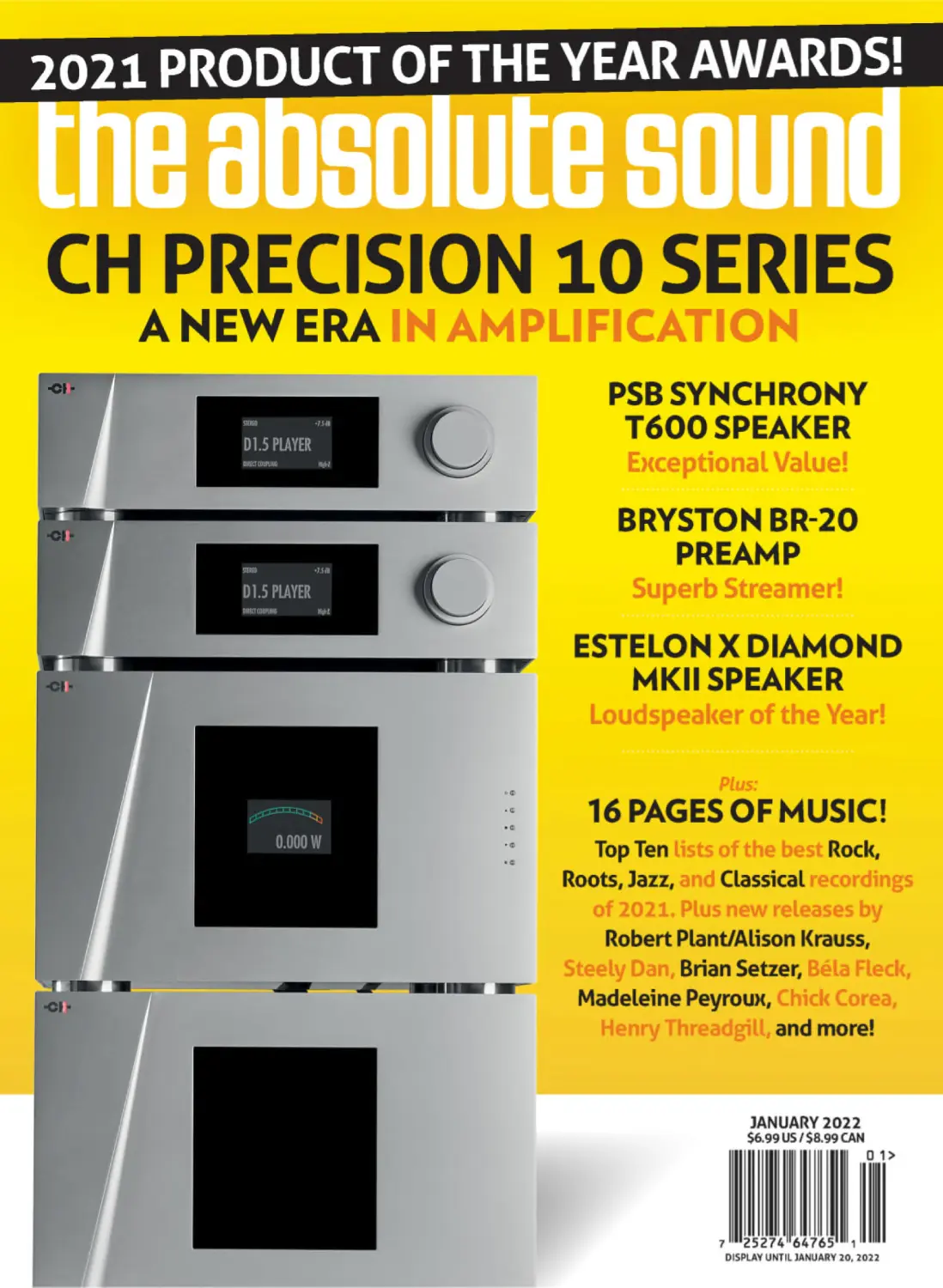
CH PRECISION L10 DUAL
MONAURAL LINESTAGE
PREAMPLIFIER AND M10
TWO-CHANNEL REFERENCE
POWER AMPLIFIER
These ultra-sophisticated
flagship electronics from
the CH Precision offer a host
of unprecedented features
and usher in a new era of
amplifier performance,
says Robert Harley.

17

THE ABSOLUTE SOUND’S 2021
PRODUCT OF THE YEAR AWARDS
This is the big one! We name
the most outstanding
products of 2021 in these,
our most prestigious awards.

2 January 2022 the absolute sound

contents 1.22

Departments
& Music

Editor-in-Chief
Robert Harley
Executive Editor
Jonathan Valin

10

Acquisitions Manager and Associate Editor
Neil Gader

Letters

Music Editor
Jeff Wilson

12

Proofreader
Diana Nagler

From the Editor

Robert Harley examines the
effect of very-low-level noise
on music reproduction.

Creative Director
Torquil Dewar

179

14

Future TAS

New products on the horizon.

162

Manufacturer Comments

Music
167

2021 Top Ten Lists

Top ten lists for the best
rock, roots, jazz, and classical
recordings of 2021.

178

Rock, Etc.

Robert Plant/Alison Krauss,
Steely Dan, Curtis Mayfield,
Sierra Ferrell, Brian Setzer,
Heartless Bastards, Lady
Blackbird, Sue Foley, Béla
Fleck, Big Red Machine, Kasim Sulton, and Deep Purple.

184

Art Director
Shelley Lai
theabsolutesound.com Webmaster
Garrett Whitten
Senior Writers
Anthony H. Cordesman, Wayne Garcia, Robert E. Greene,
Jim Hannon, Jacob Heilbrunn, Arthur Lintgen, Kirk Midtskog,
John Nork, Dick Olsher, Andrew Quint, Don Saltzman,
Paul Seydor, Steven Stone, Alan Taffel
Reviewers and Contributing Writers
Duck Baker, Soren Baker, Rives Bird, Greg Cahill, Matt Clott,
Randall Couch, Stephen Estep, Andre Jennings,
Greg Gaston, Drew Kalbach, Muse Kastanovich, Mark Lehman,
Sherri Lehman, Ted Libbey, Tom Martin, David McGee,
Mike Mettler, Mark Milano, Bill Milkowski,
Malgorzata Quinn, Derk Richardson, Stephen Scharf,
Pam Torno, Greg Turner

Jazz

Madeleine Peyroux, Chick
Corea, The Cookers, Henry
Threadgill, Donald Edwards,
Ivo Perelman, Roberto
Magris/Eric Hochberg, and
Gerry Gibbs.

188

President, Nextscreen Publishing Group
Lee Scoggins
Nextscreen Chairman and Executive Publisher
Tom Martin
Advertising Reps
Cheryl Smith
(512) 891-7775
Brian Masamoto
Lance Profyt
(310) 498-5245
(512) 850-9035

Classical

167

174

Thank You, COVID

-

Piano trios by Russian composers, piano concertos by
Brahms, symphonies by Mozart, three versions of Bruckner’s Fourth Symphony, early
works by Leo Sowerby, songs
by Joseph Canteloube, and
concert works from Bartók’s
final decade.

192 Q&A

Javier Guadalajara of Wadax.

4 January 2022 the absolute sound

Reprints: Brett Petillo, Wright’s
Media, (877) 652-5295, (281) 4195725, bpetillo@wrightsmedia.com.
Subscriptions, renewals, changes of
address: (888) 732-1625 and outside
the U.S. (760) 317-2327 or write The
Absolute Sound,
Subscription Services, P.O. Box
469042, Escondido, CA 92046.
Eleven issues: in the U.S., $29.90;
Canada $45.90 GST included); outside
North America, $64.90. Payments must
be by credit card (VISA, MasterCard,
American Express) or U.S. funds drawn
on a U.S. bank, with checks payable to
NextScreen, LLC.
Address letters to the editor: The
Absolute Sound, 2500 McHale Court,
Suite A, Austin, TX 78758. (866) 8463997; e-mail: rharley@nextscreen.com

Newsstand distribution and local
dealers: Ingram Periodicals,
18 Ingram Blvd, LaVergne, TN 370867000. (615) 213-5223.
Publishing matters: Contact Jim
Hannon at the address below or
e-mail jhannon@nextscreen.com.
Publications Mail Agreement
40600599.
Return Undeliverable Canadian
Addresses to: Station A, P.O. Box 54,
Windsor, ON N9A 6J5.
NextScreen, LLC, 2500 McHale Ct.
Suite A, Austin, TX 78758
(512) 892-8682
fax: (512) 891-0375,
tas@nextscreen.com,
info@theabsolutesound.com

©2022 NextScreen, LLC., Issue 323 January, 2022.
The Absolute Sound (ISSN #0097-1138) is published 11 times per year in
the months of Jan, Feb, Mar, Apr, May/Jun, Jul/Aug, Fall, Sept, Oct, Nov, Dec,
$29.90 per year for U.S. residents,
Nextscreen, LLC, 2500 McHale Ct. Suite A, Austin, TX 78758.
Periodical Postage paid at Austin, Texas, and additional mailing offices.
Canadian publication mail account #1551566
POSTMASTER: Send address changes to The Absolute Sound,
Subscription Services, P.O. Box 469042 Escondido, CA 92046.
Printed in the USA.

contents 1.22

Equipment Reports

77

EQUIPMENT REPORTS

72

PSB Synchrony T600 Loudspeaker

PSB has a long track record of delivering great sound at reasonable prices.
Jacob Heilbrunn weighs in on the allnew T600 flagship.

77

Bryston BR-20 Preamplifier and
Streaming DAC

With extensive streaming functions, a
great-sounding DAC, and a full-featured
preamplifier, Bryston’s new BR-20 is
the right product at the right time, says
Neil Gader.

82

104

Graham LS8/1 Loudspeaker

Robert E. Greene takes you through
the 53-year-long lineage of the new
Graham LS8/1, and assesses the sound
quality of this modern descendent of
the legendary Spendor BC1.

116

Legacy Audio Valor Loudspeaker and
Wavelet 2 DSP Processor

Legacy Audio significantly advances its
DSP-controlled loudspeaker technology with the new Valor and Wavelet
2 digital signal processor. Anthony H.
Cordesman on why the Valor is one of
the best speakers he’s heard—and on
two more affordable alternatives from
Legacy.

116

THE CUTTING EDGE

130

Estelon X Diamond Mk II Loudspeaker

The marble-enclosure Estelon X Diamond had the best bass and the best
“disappearing act” JV had heard from
a dynamic speaker when he reviewed
it a decade ago. Comes now a new and
improved Mk II version of the X Diamond, which supplies the very things
that the original was a bit deficient in,
without compromising any of its memorable strengths. JV reports on what is
one of the world’s greatest, moderately
sized, cones-in-a-box transducers.

Lampizator Baltic 3 DAC

This ultra-tweaky tubed DAC from
Poland has Stephen Scharf reaching for
the superlatives—and his checkbook.

90

Orchard Audio Starkrimson
Monoblock Power Amplifier

These tiny and affordable Class D amps
feature some novel technology. Dick
Olsher weighs in on a swell-sounding
bargain.

96

Siltech Classic Legend 380
Interconnect and Loudspeaker Cables

Neil Gader listens to this new iteration
of speaker cables, interconnects, and
power cords featuring a silver-gold alloy
that traces its roots back more than 20
years.
8 January 2022 the absolute sound

104
130

Letters

Email the Editor: rharley@nextscreen.com or: TAS, 2500 McHale Ct., Ste. A, Austin, Texas 78758

No Apologies Necessary

As a long-time reader of The Absolute Sound, I find it unfortunate that you have to
continue to address readers who perceive the concept of reviewing expensive gear as
detrimental to their reading experience. I hope you continue to review these products
and showcase their cutting-edge technology. Keep up the good work.
Edward Hartwell

Not a Buyer’s Guide Fan

As a subscriber of over 30 years, I am most concerned by current trends in your editorial choices. Your most recent issue, the second of the last four issues and the third
of the last eight to do so, consists of summaries of previous reviews assembled as a
“Buyer’s Guide.” I am willing to bet that most of your subscribers hold onto previous
issues, as I do, and can find any review we choose to re-read. Please no more of this.
Give us the insightful reviews and analyses for which we buy the magazine. Repeated
doses of rehashes of old reviews will only drive down your readership.
Keep the audiophile flag waving, not trodden upon.
Bruce Scotton, M.D.
RH replies: We have maintained the same annual editorial structure for the past 20 years, with our
Editors’ Choice issue with a March cover date and the Buyer’s Guide with a November cover date.
These issues provide an overview of the products we have reviewed and recommend. Our surveys
suggest that readers find these issues useful, but I would appreciate hearing from more readers on
this subject.

Credit Where Credit is Due

I want to highlight the wonderfully creative job that Matt Wright-Steel is doing for
your product photography. Speaking as a photographer myself, I know how hard it
is to get a clean, straightforward image that shows off the product without picking
up surface scratches or stray reflections. But in his spread on the BAT VK80i (Issue
319) he goes far beyond the basics to create mystery and excitement with plants and
ultraviolet lighting. I’ve never seen anything like this, and it does much to make metal
boxes look like crown jewels. Likewise in his spread on the YG Carmel 2 loudspeakers
(Issue 320), the idea of showing the shipping crate in which they were delivered was
a brilliant counterpoint to the exquisite ribbed finish of the speakers. The lighting
modulates from bright and upbeat on the top to very dark and moody at the bottom,
where the connectors are. This is rather daring for a magazine based on selling people
on the beauty and importance of every detail. But, as Wright-Steel’s photography
proves, you don’t have to highlight every blessed detail to stimulate the acquisitive
mode of the viewer. Please pass on my admiration.
Laszlo Bencze
RH replies: Thank you for recognizing the quality of our photography and graphic design. Much
of the credit for the photography and layout goes to Torquil Dewar, our Creative Director. Torquil
directs the photo shoot as well as creates the cover-story layout. He and Matt Wright-Steel have
produced some memorable covers and interior photography.

More Comparisons Wanted

I truly appreciated Robert Harley’s review of the Berkeley Alpha 3 DAC (Issue 320)
especially since it is at my “I-could-go-there-but-not-much-more” price point. The
comparisons with the Berkeley Reference DAC were useful, but I would really have
appreciated sonic impressions with other, similarly priced alternatives such as the Bricasti M1 SE, Total DAC, Aqua La Scala, or products like these. These comparisons of
sonic character translate across all product classes (not just DACs) and allow those of
us on the upgrade path to gain insights, when it is often not possible to find dealers
with the inventory or breadth of brands to allow our own comparisons. Thanks for
10 January 2022 the absolute sound

the review. Be well and keep up the great
work.
John Bratten

Erratum

Our November Buyer’s Guide issue included the wrong text for the D’Agostino
Relentless power amplifier. The correct
text is reproduced below. We apologize to
our readers and to D’Agostino.
D’Agostino Master Audio Systems
Relentless
$295,000/pr.
The Relentless is Dan D’Agostino’s statement amp, no two ways about it. Look
under the hood and you can see that no
expense has been spared. The Relentless
is also anti-globalist—no global feedback
is employed. The two sides of each amp
perfectly mirror each other for true balanced operation—no bridging of amps
here. These (1500W into 8-ohm, rising
to 6000W into 2 ohms) beasts are born
to run. Compared to the more stentorian
amps out there, the Relentless tends to
pad the initial transient slightly, so you’re
not going to get as hard a hit on trumpet
or piano as you might with other superb
solid-state amplifiers. And the Relentless
doesn’t have the holographic feel of a
top-drawer tube amplifier. At the same
time, other amps won’t provide you with
as luxurious and, in many ways, as realistic a sound as you get with the Relentless.
(301)

UPCOMING IN TAS 324
Bowers & Wilkins’ new 801 D4
speaker
Special Feature: Metaxas & Sins
Tourbillon tape deck & tape primer
Report from the Capital Audio
Fest
Affordable-Product Focus
• Paradigm 80F speaker
• Monitor Audio Silver 200 speaker
• Polk L600 speaker
• Schiit Audio Loki Mini equalizer
• Topping D90SE DAC
J. Sikora Standard Max turntable
Tube electronics from ConradJohnson

From
the
Editor

Noise, The Final Frontier

T

he more experience I gain with high-quality

audio systems, the more it becomes apparent that
the difference between a great-sounding system
and a truly magical one is a reduction in noise,
all other factors being equal. I’m not talking so
much about the conventional definition of noise—tape hiss or
tube rush, for examples—but rather extraneous signals that subtly and not so subtly degrade fidelity.
Although achieving a low level of conventional background
noise is important, other seemingly unlikely noise-sources wreak
havoc with certain aspects of the sound. You don’t hear these
sources as noise per se, and can’t identify them as such, but their
removal throws into sharp relief their detrimental effect on the
musical experience. Although the noise isn’t overtly audible, you
certainly hear its absence.
Every time I lower my system’s noise, I hear a host of benefits. First is the expanded sense of space. It’s as though the noise
obscures the micro-details that cue the brain to the spatial characteristics of the recording. Reducing the noise opens up the stage
and presents a more vivid and believable portrait of three-dimensional instruments existing in a three-dimensional space. In addition, very fine sounds are more clearly rendered—a gently struck
triangle at the back of the stage, the tail end of a cymbal’s decay
as it shimmers into blackness, the micro-structure of timbre in
woodwinds, for examples. When the noise gets below a certain
level, the sound seems to pass a threshold from engaging and
musical to breathtakingly captivating.
I’ll share with you some startling recent experiences that illustrate this idea. I’d been living with the Wilson Audio Chronosonic XVX loudspeaker for about 20 months, with my enthusiasm
for this great loudspeaker heightened by extended listening. But
Wilson recently introduced a high-tech spike, the Acoustic Diode, that replaces the XVX’s stock spikes. One would think that
the XVX’s massive, inert, and heroically well-damped enclosure
couldn’t be improved simply with footers. But that wasn’t the
case. The Acoustic Diodes tightened up the bass and increased
the sense of rhythmic drive. Transients had a little more impact
on attacks, along with faster decays. For example, on solo piano,
after the sharp attack of the hammers on strings, the spurious
energy died away more quickly to reveal the rich harmonic structure of the vibrating strings with greater clarity. What must be an
infinitesimally tiny difference in how the XVX’s cabinet vibrates
is perceived by our brains as a more believable impression of
hearing an actual piano rather than a recreation of it.
A second recent experience in noise reduction, but this time
in the electrical domain, is with the GroundArray from En-

12 January 2022 the absolute sound

gland’s Chord Company. The
GroundArray is a set of small
metal cylinders terminated on
one end with an RCA or XLR
plug, or a BNC, RJ-45, or
USB connector. You simply
plug the GroundArrays into
unused jacks on your components where they reputedly
drain stray electrical noise to
ground. Stirling Trayle introduced me to the GroundArrays when he was here to set
up the CH Precision 10 Series,
but took them with him when
he left. The Chord Company
later sent me a set, and after a few weeks of listening
without the GroundArray, I
heard the system again in its
full glory. The GroundArrays
render improvements that
I’ve now come to associate
with reducing noise: a more
vivid impression of instruments existing independently
of the loudspeakers, a larger
stage, more liquid and realistic
timbre, and greater resolution
of fine detail.
And then there’s the equipment rack and vibration-isolation devices. Many years ago I
went through the exercise of
comparing a system’s sound
with the components sitting
on the Billy Bags rack I’d been
using for years, and then on a
Stillpoints rack. It was a lot of
work to move and rewire the
gear several times, but that
was the only way of hearing first-hand the effect of
component vibration on the
sound. Again, the equipment
rack rendered a significant
improvement. I subsequently switched to the ultimate

in equipment and amplifier
stands, the Critical Mass Systems Olympus, which I use to
this day.
But the most dramatic example of how reducing noise
turns a great hi-fi into a magical one is the Shunyata Everest 8000 power conditioner
and Shunyata Omega power
cords. Upgrading to the Everest and Omega had the single
greatest effect on the musical
qualities that are affected by
noise. I was floored at my
first listen to the system with
the Everest conditioner and
Omega power cords, not just
by how much better the system sounded, but by the fact
that any power conditioner
and cord could render such
profound improvements.
Even more astounding is
that our hearing mechanism
detects such infinitesimally
small signal variations and
that our brains interpret them
as greater or lesser musical realism. The musical effect of
reducing noise exemplifies the
maxim that it’s not the objective magnitude of a difference
that matters most, but how
our exquisitely fine-tuned
senses interpret that difference. In contexts other than
music listening, the difference
in noise level that we’re talking
about is orders of magnitude
below perception. But we easily discriminate such differences when listening to music
for one simple reason—music
has meaning, and it’s the diminution or amplification of
meaning that we perceive.
Robert Harley

FUTURE TAS

Cambridge Evo Integrated
Amplifier and Streaming DAC
Evo by Cambridge Audio is a beautifully designed, all-in-one music
player that gives you instant access to all the music in the world. Evo
comprises two models: the Evo 150, rated at 150Wpc; and the Evo
75 at 75Wpc. The Hypex NCore Class D amplification module, which
powers the Evos, was specifically chosen by Cambridge engineers, as
it offers class-leading audio performance and produces advantages
in clarity, resolution, and musicality. Both Evos use powerful ESS
Sabre DACs to ensure all digital music is converted to analog sound
with every ounce of detail, precision, and dynamics intact. Whether
you use Roon to organize your digital library or stream highresolution MQA tracks using Tidal Connect, Evo can play it all, and
includes a wide array of digital and analog connections, including a
built-in moving-magnet phonostage for compatible turntables, an
asynchronous USB audio input, and balanced XLR inputs. Users can
also connect a wireless turntable and wireless headphones using
Evo’s built-in aptX HD Bluetooth. Price: Evo 150, $3000; Evo
75, $2250. cambridgeaudio.com

Piega Ace Series
Loudspeakers
Piega’s Ace Series speakers feature a slender
aluminium enclosure with subtle aesthetics, created
by Swiss designer Stephan Hürlemann. The two-way
Ace 30 compact (pictured) and three-way Ace 50
floorstander represent Piega at its most affordable.
Both feature Piega’s eye-catching oval enclosure.
The integrated front grille curves gently around
the loudspeaker, forming a harmonious cabinet
that blends discreetly into any living space. Piega’s
remarkable AMT-1 (Air Motion Transformer) remains
unchanged and continues to set standards in its price
range. This tweeter uses a feather-light, 24 x 36mm
folded membrane driven by a powerful magnetic
engine made of high-purity neodymium. It produces
an airy, detailed sound with excellent transient
response and the lowest levels of distortion. Further,
the MDS cone drivers, also developed by Piega, have
been re-engineered for improved reproduction in the
low and mid frequencies. Price: Ace 30, $995; Ace
50, $1995. mofidistribution.com

NAD C 399 Integrated
Amplifier and Streaming DAC
NAD’s C 399 is the new flagship integrated amplifier in NAD’s top-selling Classic Series. Fortified with a Hypex Digital NCore amplifier
(previously available only on Masters Series amplifiers), it delivers 180Wpc continuous power and 250Wpc instantaneous power for superb
headroom, allowing it to produce effortless musical transients. The C 399’s digital section is built around a 32-bit/384kHz ESS Sabre DAC,
the optional MDC2 BluOS-D module lets listeners
play music from their favorite streaming services
using the BluOS Controller app for Android,
iOS, macOS, and Windows, and to stream
music from local sources connected to
the C 399 to BluOS-enabled components
in other rooms. The C 399 includes an
ultra-low-noise mm phonostage with
infrasonic filtering circuitry, plus a dedicated
headphone amplifier. Price: $1999.
nadelectronics.com
14 January 2022 the absolute sound

The Absolute Sound’s 2021

PRODUCT
2021

AWARDS
Welcome to The Absolute Sound’s 2021 Product of the Year Awards,
the most exclusive and prestigious of our honors. Here we celebrate
the very best components we’ve heard in the previous year. In many
categories we’ve chosen more than one winner: one that represents
the greatest value for the dollar and another that represents the
best we’ve reviewed regardless of price. We’ve also selected Budget
Components of the Year to recognize the gear we believe offers the
biggest bang for the buck, as well as a Technology Breakthrough of
the Year. Finally, our Overall Product of the Year honors the products
that stand above all others as the most impressive achievements of
the past 12 months.
January 2022

2021

TABLETOP T+A elektroakustik Caruso Multi-Source System
$3990
SYSTEM OF
THE YEAR

What happens when a no-nonsense German manufacturer with 13 engineers on staff and a fondness
for discreet brushed-aluminum faceplates with cutting-edge digital circuitry behind them decides to
go into the “lifestyle” corner of the audio market? Well, Caruso is what happens. Under a foot in each
dimension, this almost-cube-like box sports seven drivers (including a down-facing 6.7" long-throw
woofer with an aluminum cone and a substantial magnet) powered by three switch-mode amplifiers.
Source-wise, the Caruso is game for pretty much anything. It supports Spotify as well as Apple AirPlay,
and it’s set to stream Tidal, Qobuz, and Deezer. The component is Roon-ready and delivers FM and
Internet radio; there’s also a disc drive and a USB port that’ll accept a thumb drive full of tunes that a
friend wants to share. You can connect to your music either wirelessly or with an Ethernet connection.
Though the stereo spread can’t compete with an audio system where the two channels are more than
a foot apart, the robustly constructed Caruso offers satisfying bass slam and dynamic coherence, even
if asked to play loud at a party. For bringing true high-end performance to the tabletop category, the
Caruso is our Tabletop System of the Year Award winner. (322)

January 2022

Ramar Record Brush
$349
Every vinyl-spinning audiophile knows the importance of clean
LP surfaces and probably owns at least one carbon-fiber record
brush. But Ramar, headquartered in Germany, has elevated the
prosaic brush into something, well, über-luxurious. The two-piece
case is made of solid wood, milled from a single wooden blank, then
impeccably oiled and finished in your choice of walnut, cherry, or ash.
The bristle cover is aluminum and coated with electroless nickel. Finally,
there’s the brush itself—a unique mixture of carbon fiber and goat hair,
with a large surface area so as not to miss a single atom of dust. Included is
a stylus-cleaning wand that magnetically attaches inside the case. Extravagant, okay, but for the well-dressed analog rig this is one splurge that is
more than worth it. A joy to use, it makes record cleaning a premium event
rather than a boring obligation. (Forthcoming)

ACCESSORIES OF
THE YEAR

2021

Degritter Ultrasonic LP Cleaner
$2990
The breadbox-sized Degritter brings all the benefits of ultrasonic
LP cleaning to an effective, easy-to-use, and relatively affordable
product. There’s much to like in the Degritter. In addition
to offering control over every conceivable cleaning
parameter, the Degritter monitors water temperature,
water level, sensor malfunction, and other operating conditions. You can adjust the Degritter’s many
cleaning parameters, or simply choose a standard
cleaning cycle for easy operation. Sonically, the
Degritter delivers, with fewer ticks and pops, less surface noise, a blacker background, and a heightened
impression of instruments in space. Easy to use, wellbuilt, with many sophisticated features, the Degritter
fulfills all the promises of ultrasonic LP cleaning. It’s
also priced about a thousand dollars below the competition, making it an easy choice for our Accessory
of the Year Award. (320)

January 2022

Stein Music Pi Carbon
Signature Record Mat
$650
Here is yet another component that lowers noise
and deepens silences, increasing the illusion of
realism. As JV said in his review, it may seem
ridiculous to spend $650 on a piece of paper
(albeit a thick, carbon-fiber-impregnated, proprietarily varnished piece of cloth-like Japanese
tapa paper), but if you value the illusion of
the real thing—and, in particular, the organic
continuousness of musicians making music in a
real space—then inserting this mat from Holger
Stein between platter and LP is worth every penny being asked, and also worthy of a TAS’ 2021
Accessory of the Year Award. (315)

2021

AC POWER CORD
OF THE YEAR
Audience forte F3
powerChord
$249/1.75m
Sheer excellence in the entry-level power-cord
bracket, the Audience F3 is a definitive winner. It
will lift the performance of any system as it lowers
the noise floor, improves transient attack, and permits a wider range of dynamic expression and greater purity of low-level detail. Hot tip: If you have a
little extra cash on hand, why not opt for Audience’s
forte V8 Power Strip with its eight hospital-grade
AC outlets—a forte F3 is included. (311)

22 January 2022 the absolute sound

CABLES OF THE YEAR
Siltech Legend 380
$1815/1.5m 380i interconnect;
$3174/2.5m 380L speaker;
$1125/1.5m 380P power cord
Classic Legend 380 represents the first rung in Siltech’s latest,
mid-priced, three-model cable collection. Tapping technologies from its flagship Crown Series, the Legend is sonically and
musically striking for its refined natural balance, and capable of
producing crisply defined images and soundstage boundaries. It’s
a detail-focused cable, not pushy and forward, but not wishywashy or laid-back, either. Low-frequency reproduction is superb,
attaining a sonic trifecta of pitch definition, grip, and extension.
Key to its excellence is its resolution of dynamic contrasts, transient attack, and textural detail. Low-level resolution is uniformly
excellent. The customary Siltech finish and tactile feel are the
personifications of quality from end-to-end. Classic Legend
delivers a marvelously unclouded and unrestricted musicality
that affords a view into the very heart of the music. It’s difficult to
know what more one can ask of a cable. (322)

2021

Synergistic Research SRX Interconnect,
Speaker Cable &Power Cord
$12,995/1m pr. RCA and XLR interconnect; $29,995/8' pr. speaker cable;
$12,000/m power cord
Here’s a quandary: Can the best wire you’ve ever heard (see next page) have competition? In this case, the answer is yes. Ted Denney
& Co.’s latest creations, the tuneable, actively shielded, multi-stranded, pure six-nines-silver SRX cables and interconnects, are the
most sophisticated products Synergistic Research has developed since SR’s original Galileo. They are also the best-sounding—by
quite a margin. Sonically, what they reminded JV of are CrystalConnect’s Art Series Da Vincis. At
first, JV thought the SRXes might not be quite as low in noise or as high in neutrality and “completeness” as the phenomenal Da Vincis, which literally set the gold standard in these regards,
but after installing a complete loom of SRX in his MBL system he’s no longer sure. Though
these two outstanding cables sound remarkably alike, there are still enough differences between them in tonal balance, dynamic nuance, and sheer convenience to
make your choice more a matter of system compatibility than absolute
sonic excellence. There is this, as well: The SRXes are less expensive
than the Da Vincis (if that makes a difference to folks buying at these
exalted prices). Denney has long claimed he designs wires that equal the
best money can buy for half the dough. In this case, his boast is verifiable.
One of JV’s references, and the 2021 co-winner of
TAS Cable of the Year Award.
(forthcoming)
24 January 2022 the absolute sound

2021

CrystalConnect Art Series Da Vinci Interconnect,
Speaker Cable & Power Cord
$23,900/1m interconnect, $40,000/2m speaker cable,
$12,777/m power cord
CrystalConnect and Siltech chief engineer Edwin Rijnveld’s latest top-of-the-line creations, the Art Series Da
Vinci wires, are the quietest components of their type that JV has ever heard. There are sound technical reasons
for this: Edwin’s Art Series Da Vinci wires have a newly constructed dual-layer shield—one layer a mesh of pure
G9 silver/gold-alloy strands, the other pure MonoX silver—which provides verifiably wider immunity against
EM and RF fields, lower ground impedance, lower inductance, much lower capacitance (three times lower than
JV’s reference Crystal Cable Ultimate Dreams), and lower current distortion. The improvement isn’t only a matter of measurements on paper; it is as immediately audible as the shockingly deep silences of optical-cartridge
playback are—and helps foster the exact same impression of neutrality, completeness, and higher fidelity. Da
Vinci is a genuine step forward in cable, interconnect, and power-cord design—not a different or more appetizing “flavor,” but a lowering of the characteristic noises (and susceptibility to noises) that give wires their flavor.
A genuine work of art and a near (but not quite—for which see the previous page) matchless component, Da
Vinci is the benchmark-setting co-winner of TAS’ 2021 Cable of the Year Award. (Forthcoming)

the absolute sound January 2022 25

2021

INTEGRATED AMPLIFIER OF THE YEAR
BAT VK-80i
$9995
BAT’s first all-tube integrated is a stunning piece of industrial art that delivers over 55Wpc of pure triode power. Its
foundation is the Russian 6C33C-B power triode, originally designed for avionics applications and famously used
in the MiG-25 fighter jet. The focus is on simplicity of operation and reliability. A key feature is automatic bias, with
each output tube having its own dedicated bias circuit. Folks, be prepared to buckle up and hang on tight, as this “BAT
mobile” sounds far more powerful than a comparable KT88 amp. It shifts gears without changing its sonic character
and fleshes out an orchestra’s power range with a big-tone presentation. The core of the midrange is expressive and
dynamically nuanced, felicitous of female voice and violin overtones. Transients are well defined over their entire
time scale from the point of attack to full decay. As a consequence, resolution of low-level detail is admirable without
being etched or analytical in nature. Textures are free from the usual tube-amplification colorations. Expect an overall
presentation that is rather neutral, sounding like the real thing with believable tonal color saturation and 3D soundstage dimensionality. It is above all else a superb demonstration of triode power, and our Integrated Amplifier of the
Year Award winner. (319)

January 2022

NAD C298
$1995
NAD’s C298 is built around a new Class D output stage called “Eigentakt” (“self-clocking”) that represents a significant technical advance in switching amplification. The C298 is rated at 185Wpc into
8 ohms and 340Wpc into 4, and is packed with features, including
balanced and single-ended inputs and line outputs for daisy-chaining multiple amplifiers, a bridging function for monaural operation,
and an auto-on feature when a signal is detected. The C298 sounds
like a powerhouse, with effortless dynamics, a tight and solid
bottom end, and a general sense of ease in complex passages. The
C298 goes very low in the bass, has a nice sense of midbass heft
and weight, and delivers outstanding dynamic punch. It also has
an unusually satisfying ability to convey music’s rhythmic flow and
forward propulsion. The midrange has nice presence, with a bit of
forwardness from the upper mids to the lower treble imparting a
lively quality. The C298 is a lot of amplifier for the money, and our
choice for Solid-State Power Amplifier of the Year. (313)

PS Audio Stellar M1200
$6000/pr.

These svelte monoblock amplifiers seem intent on disproving
the old adage that size matters. Outputting a whopping 1200
watts into a 4-ohm load, they compete in the bass region
with amps costing oodles more, and yet they weigh only
27 pounds each. A 12AU7 tube on the input stage helps to
ensure felicitous tonality, but it is a Class D output power
module that is at the heart of this ingenious beast. Its grip in
the bass region is tenacious and effortless, allowing it to form
the foundation of an expansive soundstage. Detail retrieval in
all frequency spectrums is exemplary. The low noise floor is
instantly apparent, as the Stellar excavates small nuances that
help create the sense of a live performance rather than an
electronic reproduction. The Stellar represents a considerable
advance for Class D amplifier performance (though it
cannot entirely efface a slight glare in the treble region
that has always marked digital amplification). The
2021
overwhelming power, sweep, and speed of the
Stellar ensure that it is a remarkable creation, one
whose sonic prowess should give more than a few
rival amplifier manufacturers the willies. (313)

SOLID-STATE AMPLIFIERS OF THE YEAR
Gryphon Audio Antileon EVO
$39,000
Although rated at 150Wpc into 8 ohms, the Antileon EVO stereo amplifier has the size, weight, and
construction that suggest an amp of five times that power output. This is because the Antileon EVO
delivers all of those 150 watts in Class A. And what sweet watts they are. The Gryphon’s triumph is
delivering the great virtues of Class A operation—seductive warmth, liquid textures, and a sense of
ease—with tremendous speed and dynamic authority, along with visceral excitement and energy.
The sound is warm and utterly liquid—almost voluptuous—without
sounding thick, colored, or closed-in. Its warm harmonic richness and absence of grain and glare reveal the beauty
of tone colors in a way that is nothing short
of seductive. The dual-mono design imbues
the Antileon EVO with unflappable authority.
It exerted an iron-fisted grip on the Wilson
Chronosonic XVX’s big woofers, delivering
“center-of-the-earth” solidity and impact.
Throw in spectacular build-quality and striking
industrial design, and you not only have one of
the great modern Class A amplifiers, but also
our 2021 Solid-State Power Amplifier of the
Year Award winner. (316)

January 2022

2021

TUBE PREAMPLIFIER
OF THE YEAR

2021

TUBE POWER AMPLIFIER
OF THE YEAR
Absolare Hybrid,
Signature Edition
$52,000

Icon Audio LA4 MkIII Signature
$3095
The LA4 has been refined over time, and in its MkIII incarnation it features lower gain and improved feedback implementation. The Signature version includes premium Mundorf silver/
gold coupling caps and premium tubes. It would seem that
designer David Shaw has cracked the code for preamp excellence. His classic recipe consists of a 6SN7 gain stage, a tube
buffer, a tube-rectified power supply, and point-to-point wiring.
This elemental combination, together with excellent engineering, makes the LA4 Signature into a formidable line preamp.
Tonal colors are reproduced with superb fidelity, vibrant and
engaging. Dynamic shadings are nicely drawn out from soft to
very loud, at times being nothing short of explosive. Although
the stock tube complement isn’t particularly romantic sounding, it is responsible for exceptional bass definition and iconic
3D rendering of the soundstage. The LA4’s most compelling
sonic attribute is tonal gravitas—an authoritative portrayal of
the lower midrange, delivered with realistic timbral density. In
all, the LA4 offers exceptional sound quality that does justice to
the sonic promise of the 6SN7. Add superb build-quality and a
bargain price, and you have our Tube Preamplifier of the Year
Award winner. (322)

30 January 2022 the absolute sound

The Hybrid Stereo power amplifier from Absolare isn’t a pure
tube amplifier, but it uses tubes in its input section, and those
tubes provide nearly all the amplifier’s voltage gain. More importantly, however, the Hybrid Stereo Signature Edition sounds
like a pure tube amplifier, and a great one at that. As its name
suggests, the Hybrid combines tubes in the front end with a
275Wpc (4 ohms) solid-state output stage. Yet there’s no hint
of transistors in the Hybrid’s sound; it has astonishing liquidity
of timbre, is utterly grain-free, and projects that elusive sense
of midrange presence that is the hallmark of the best SETs. The
Hybrid creates a directness of musical expression—of hearing
nothing between you and the music—that is unique among
solid-state amplifiers in RH’s experience. In fact, Absolare
has managed to capture much of the magic of the company’s
reference-class Passion Preamplifier and Passion SET power
amplifier in the Hybrid Stereo, a product that is compatible with
a wider range of speakers thanks to the solid-state output stage.
The circuit is ultra-minimalist in design, and executed with the
world’s finest component parts. Finally, the gorgeous leather-clad casework, available in a variety of colors and stitching,
exudes luxury. It all adds up to our Tube Power Amplifier of the
Year Award winner. (322)

DACs OF
THE YEAR
2021

iFi Zen DAC
$129
Will all the readers who have spent over $130 for a dinner for
two raise their hands? What if I told you that for that same
$130 you could have a USB DAC capable of not only playing
back high-resolution PCM files, but also DSD and MQA files,
in addition to offering single-ended and balanced headphone
outputs, and adjustable, balanced, line-level preamplifier output?
The iFi Zen DAC can do all that and more. It delivers an array
of features and excellent sound quality at an entry-level price.
When it is mated with other high-performance components, the
end result can be reference- or near-reference-level sonics, but it
does require careful system matching and quality cables, which
will likely cost far more than the Zen DAC itself. The ideal users
for the Zen DAC fall into two categories: younger, just-minted
audiophiles looking for good sound on a budget for nearfield
listening; and older ones seeking an inexpensive way to add
MQA capabilities along with a decent headphone amplifier to
their room-based reference systems. The former will use most
of the Zen DAC’s features, while a majority of the latter will set
it on fixed output and use it as a basic DAC. Both win. (313)

January 2022

Berkeley Audio Design Alpha
DAC Series 3
$10,999
Berkeley has offered two levels of DAC, the Alpha Series and
Reference Series, with the Reference delivering significantly
better performance. However, with the brand-new Alpha Series
3, the company has greatly narrowed the gap. In fact, you can
think of the Alpha Series 3 as a distillation of the Reference
in a less-expensive implementation. By keeping some of the
essential elements of the Reference (including the state-of-theart clocking circuitry) and forgoing the expensive chassis machined from a solid block of aluminum, this new Alpha brings
near-Reference sound quality to a much lower price. The Alpha
DAC has the characteristic Berkeley DNA—superb resolution of
low-level detail, three-dimensional soundstaging with an ability
to discern very fine timbral and spatial information at the back
of the hall, dense tone color, and outstanding clarity that allows
you to hear individual instruments within the whole. Although
the Alpha doesn’t have quite the world-class reference-level
performance of the Reference, it comes closer than you’d
expect for less than half the price. (321)

2021

DISC PLAYER OF THE YEAR
Luxman D-10X
$16,495
The D-10X digital player is the most expensive disc player Luxman has ever made, and while far from the most expensive out there, it’s still the company’s grab for the brass ring. Reviewer Paul Seydor found it a formidable contender
in the arena of no-holds-barred, top-tier digital players, while for functionality, versatility, and the ability to handle a
myriad of digital sources for the home, it is close to—and may be—without peer. It will play virtually any audio-only two-channel or hybrid disc on the planet, including MQA discs. At its heart is the company’s proprietary Lx DTM-I
transport and ROHM Semiconductor’s new BD34301EKV D/A converter (its maiden voyage in an audio component).
USB inputs will handle PCM from 44.1kHz to 786kHz and DSD from 2.8MHz to 22.4MHz. Though MQA discs are scarce
on the domestic market, the D-10X’s handling of Red Book and high-resolution PCM discs, streaming, and files, not to
mention SACD, is state of the art, while the onboard DAC, which can be used independently, is as good as, often better
than, most stand-alone DACs with which PS has had long experience. Styling is elegant in its simplicity, construction is
battleship. Best of all is the Luxman “sound”: supremely musical yet now with a degree of resolution, detail, and neutrality that will reveal without undue editorializing everything that is on any source you care to feed it. It may seem odd
to speak of a component priced like this one as “high value,” but once you factor in everything it can do, the extraordinarily high level at which it does it, and the quality of engineering and manufacturing with which it is realized—well,
look at it this way: You’re certainly not overpaying! (317)

January 2022

2021

MUSIC SERVERS OF THE YEAR

iFi Zen Stream
$399
As you might surmise from its name, the Zen Stream is a
streaming endpoint. As an endpoint with both USB 3.0
and SPDIF outputs, the Zen Stream can deliver Internet
and networked music sources to any DAC with either
USB or SPDIF inputs. If you have a great DAC without a
USB input that you would like to use with networked
sources, the Zen Stream makes that possible. The Zen
Stream supports many streaming sources via Wi-Fi or
Ethernet including Spotify, Tidal, Roon, AirPlay, Chromecast, DLNA, and NAA (Network Audio Adapter). You can
even plug in a hard drive or thumb drive to use as a
music source. Unlike many streaming components that
attempt to do many things, the iFi Zen DAC does only
one thing: Deliver music from virtually any streaming or
network-connected music file server to the DAC of your
choice. It has no file-size, file-type, or library-size limits.
Depending on how you configure the Zen Stream, it can
be fine-tuned for a particular streaming methodology,
platform, or playback app. It is also simple to set up,
user-friendly, and sonically transparent. For all but the
savviest computer-user, the Zen Stream may well be
the most hassle-free, flexible, and high-quality music
streamer currently available, making it an easy choice
for TAS’ Music Server of the Year Award. (322)

January 2022

Linn Klimax DSM/3
$39,000
music or home-theater sources, Linn’s Klimax DSM/3 sets a new
reference-level standard for flexibility, functionality, and audio quality
for music servers and streaming DACs. Using the Linn app or Roon,
the Klimax DSM can stream files from a music server and a class-leading range of streaming services, including Tidal and Qobuz. Linn’s
proprietary Space Optimisation software is a breakthrough innovation
that removes in-room interactions to provide flexibility in speaker
placement, while also maximizing the accuracy of the recording’s true
soundstage. Linn’s Organik D/A conversion engine is aptly named, as
the Klimax DSM has an exceptionally lifelike and organic quality. The
overall tonal palette is neutral with weight, heft, and body to the presentation, and beauty in the rendering and layering of fine inner details,
timbral qualities, and textures. Mitigating pesky noise components from
power supplies and digital interfaces and utilizing a world-class femtoclock, the DSM/3 has virtually none of the hardness, stridency, or glare
that can make digital music uninvolving and tiring. A real strength is the
DSM’s ability to manage a conflicting balancing act of authority and
dynamics within the larger scale, without masking the nuance, gesture,
and delicacy of smaller-scale musical elements. Its detail, transparency, immediacy, and resolution are world-class, as is its state-of-the-art
engineering and build-quality. Most importantly, the Linn Klimax
DSM takes you out of “audiophile analysis behavior” and into a more
compelling and immersive experience of the performance itself. (322)

2021

TURNTABLES OF THE YEAR
Rega P6
$1595; $1995 w/Exact mm; $2195 w/Ania mc;
$2495 with Ania Pro mc
Currently celebrating its 48th year, the UK’s Rega Research has long been
one of our top choices for high-value LP playback. Falling right in the center
of Rega’s current lineup, the P6 utilizes many technologies found in the
upper-end RP10: an ultra-lightweight, yet extremely rigid plinth composed
of a polyurethane foam core sandwiched between layers of high-pressure
laminate, and featuring Rega’s “double-brace” technology. Also significant is
the new sub-platter. Fabricated from a single piece of machined aluminum on
which the glass platter sits, this is a serious step up from the injection-molded plastic sub-platters found on earlier mid-level Rega models. As reviewed
by WG, and outfitted with Rega’s outboard Neo power supply and Ania cartridge, the sound of the P6 provides extra degrees of bass depth, weight, and
tonal richness previously only heard from Rega’s upper-end models, without
trading off any of Rega’s classic musical agility. While the P6 may not deliver
the ultimate punch, detail, or transporting emotional thrills of the very finest
turntables, these are hardly the design goals here. Like all the best audio gear,
the P6 compels us to play record after record, to revisit music we love, and
explore music we have yet to discover. (313)

Brinkmann Audio Taurus
$14,990 ($19,990 package includes 10.5
tonearm; $20,290 package includes 12.1
tonearm)

38 January 2022 the absolute sound

2021

PHONOSTAGES
OF THE YEAR

Hegel V10
$1500
Previously, Norwegian-based Hegel had shied away from making a phonostage,
but has come out of the blocks with a Product-of-the-Year-worthy unit that is
easy to use and easy on the budget. The initial design brief was to create a small,
inexpensive starter box for the budding, cost-conscious LP enthusiast. As chief
designer Bent Holter delved into the project, he realized that he could achieve
much better performance with some higher-level engineering and some parts
upgrades (Holter holds a Masters of Science degree in semiconductor physics
from Trondheim University), without increasing costs dramatically. The V10 uses
four, ultra-low-noise, discrete JFET transistors, connected in parallel to aid in reducing external noise, for the moving-magnet and moving-coil input sections. The
sound is detailed, open, and full-bodied. Plenty of mm and mc cartridge loading
and gain settings are offered (via piano switches—or in-chassis resistors for some
settings). The V10 is a highly musical and “audiophile competent” component,
to a degree that makes it an obvious POY selection and must-audition for anyone
seeking a phonostage close to the $1500–$2000 range—and possibly higher.
(320)

Coincident Speaker
Technology Statement
$6499
Israel Blume, the proprietor of the Canadian company Coincident Speaker Technology, likes to swing for the sonic fences.
With his nifty new phonostage, he’s hit a home run. With
point-to-point wiring and a hefty separate power supply capable
of powering a 100-watt amplifier, the Statement offers a healthy
66dB of gain. This robust output means that the Statement
packs a dynamic wallop that eclipses many of its immediate
competitors. It also means that the unit provides quiet backgrounds. The look is definitely Old School, with steel cladding
encasing the capacitors and wiring. But the payoff is big. Not
only can the Coincident deliver powerful drum hits and orchestral crescendos, it also possesses an excellent sense of drive.
Add a capacious soundstage, and you have a phonostage that
allows a variety of cartridges to display their strengths. Two separate volume control knobs on the front panel also ensure that
the Coincident can be deployed to bypass a preamplifier and
run directly into an amplifier. To exceed the performance of the
Coincident requires moving to much more elaborate phonostages that may never quite match its sheer zest and gusto. (322)
40 January 2022 the absolute sound

SOLID-STATE PREAMPLIFIERS
OF THE YEAR
2021

Bryston BR-20
$5995
The Bryston BR-20 is one of the most successful mergers of a solid-state analog preamp with a DAC and built-in streamer that we’ve seen or heard to date. A hub of the
highest order, it operates like a precision timepiece. Visually, its brushed-aluminum
faceplate and sharp display are models of preamp ergonomics. Operationally, it is
glitch free. An honest broker in tonal accuracy, it hues to the straight and narrow, and
reflects a “just the facts, ma’am” musical neutrality. The BR-20 is also superbly quiet,
with bass response that offers a combination of grip and authority that are hallmarks
of the best preamps of this type. And if that’s not enough, a superb headphone
output comes standard. Since the BR-20 unwaveringly reproduces what’s actually
on the recording, those who prefer a bit of sweet frosting on their music will find it
stubbornly neutral. Tempting options include an HDMI board and phonostage. The
BR-20 operates effectively via its web user interface, but a handy aluminum remote
control is thoughtfully included. (323)

January 2022

Pass Labs XP-22
Linestage Preamplifier
$9500
The new XP-22 from Pass Labs is a significant upgrade from the previous model. Based on new semiconductors and
a new volume control, the two-chassis
XP-22 vaults performance into another
league. The dual-mono power supplies
feature double-shielded toroid transformers for even lower noise. The output stage
is more robust, with the ability to drive
longer cable runs. Five line inputs are
provided, two balanced and one unbalanced. One of these is a theater passthrough for using the XP-22 as part of a
theater system. The XP-22 is so transparent that it improves upon the sound of
running a source component directly into
a power amplifier—not something every
linestage can claim. Musically meaningful
detail and resolution are excellent. The
XP-22 takes these parameters right up
to the limit of what’s believable without
crossing the line into sound that’s clinical
or over-etched. Trumpet, cornet, and
flugelhorn—three instruments of the
same brass sub-family—were readily
distinguished from each other. If the
recording possesses the information, the
rendering of space can be dramatic and
dynamics startling. On its own or paired
with Pass Labs’ XP-27 phonostage, the
XP-22 is terrific sounding, and recipient
of our 2021 Preamplifier of the Year
Award. (316)

2021

PHONO
CARTRIDGE
OF THE YEAR
Hana Umami Red
$3950
On the outside, the Hana Umami Red has a gorgeous-looking, glossy-red, Japanese Urushi-lacquer finish with
a front inlay of ebony wood. Inside, the Umami Red gets the premium treatment with a duralumin-alloy body,
nude-diamond microline stylus, boron cantilever, and high-purity copper coils. Furthermore, the front yoke,
rear yoke, pole piece, and 24-karat gold-plated terminal pins are all cryogenically treated. From a sound perspective, this cartridge has exceptional overall balance, such that it allows the musical timbre of instruments
and vocals to present themselves truthfully no matter what genre of music is being reproduced. Couple
these attributes with excellent micro/macro-dynamics, the ability to easily unravel harmonic complexities,
an ever-so-slight tilt towards overall warmth, and buttery smooth yet extended high frequencies, and you
have a superb combination. Consistently producing deliciously enjoyable class-leading
performance, the Hana Umami Red (designed by Excel Sound Corporation’s Masao
Okada-san) instantly moved towards the front of the pack when compared with
cartridges in the same price range. The Hana Umami Red is the best-sounding cartridge reviewer (and analog maven) Andre Jennings has experienced
from the Excel factory, and he’s heard a number of them, including some
posh OEM models. (319)

2021

INTEGRATED SYSTEM OF THE YEAR
Cabasse Pearl Akoya
$3800/pr. (stands, $800)

January 2022

2021

STAND-MOUNT LOUDSPEAKERS OF THE YEAR
Sonus faber Lumina 1
$899
The Lumina is a vented box, two-way bookshelf speaker
that measures a miniscule 5.8" x 8.4" x 11" and weighs
less than 10 pounds. It’s surprisingly small and lightweight, with a gorgeous fit and finish worthy of the
Sonus faber name. The enclosure is wrapped in a soft,
dark leather that feels great to touch and looks fantastic. Overall, reviewer DK thought the Lumina 1 was one
of the most visually appealing pieces of gear he’d ever
had in his listening room. Despite its compact size, the
Lumina 1 sounded massive, with a palpable low end that
delivered a satisfying foundation to the music. These are
dance-able speakers, with a strong sense of rhythm that
slips easily between genres, from classical to jazz to rock.
The Lumina also scaled with the music and thrived on
complexity as well as subtlety. The midrange was smooth
and lovely with a nice upper-octave sparkle. DK was more
than content to keep spinning record after record, so long
as the Lumina kept on singing. Small but mighty, the Lumina 1 is our Stand-Mount Loudspeaker of the Year. (315)

Audiovector R1 Arreté
$6250
The only stand-mounted model in Audiovector’s R range of
loudspeakers, the R1 Arreté utilizes the Danish company’s best
air motion transducer (AMT) driver for the treble and a 6.5"
cone mid/woof in a two-way, bass-reflex design with a published frequency response of 38Hz to 53kHz. Thirty percent
of the tweeter’s energy is directed backwards through a long
tube (so there’s no untoward interaction with the radiation to
the front), and this “Soundstage Enhancement Concept” helps
to produce a captivating spaciousness. The “Arreté” designation
refers to a grounding circuit that conducts mechanical energy
away from the mid/woofer basket assembly and out of the
speaker via an optional $850 cable, which conveys its load to
a wall outlet. As expected, treble performance is airy and extended; bass is punchy and propulsive. The loudspeaker mates
exceptionally well with a good subwoofer, allowing one to
configure a system that will out-perform many large, single-box
floorstanders that cost significantly more. Audiovector offers
dedicated stands that add $979 to the final cost—with a gunmetal gray finish, they nicely complement any of the standard
R-series speaker colors. (319)

46 January 2022 the absolute sound

2021

STAND-MOUNT
LOUDSPEAKERS
OF THE YEAR
MBL 126
$12,900 (stands, $1390)
Musicality, transparency, and astounding spatiality underscore the brilliant MBL 126 Radialstrahler. The sonics of this omnidirectional stand-mount were characterized by sweeping ambience retrieval and 3D-like immersion and orchestral layering. Top-to-bottom
response was seamless. As only an omni can, it approaches the complex relationship between imaging, soundstaging, and envelopment in ways direct-radiating transducers often only hint at but rarely attain. Symphonic music assumes a naturalism and spine-tingling immediacy akin to the real thing. Low-level resolution and sensitivity to dynamic gradients abound. As a four-driver three-way,
credit the superb carbon-fiber, radial mid and tweeter for spinning the sonic silk. Both are grainless, airy, and harmonious. Like all MBL
products, the 126 is crafted and finished with extreme precision and taste. Though small of footprint, the MBL 126 makes a truly grand
statement—grand enough to earn our 2021 Stand-Mount Loudspeaker of the Year Award. (320)

January 2022

2021

BUDGET LOUDSPEAKER OF THE YEAR
Polk R200
$699
Polk’s Reserve Series hit sonic pay dirt last year at an astounding blue-plate price. By borrowing the best transducers from Polk’s Legend Series and placing them in a minimalist cabinet,
this two-way compact cuts right to the heart of the music, with tonal balance and coherence
in equal measures, paired to a backbone of dynamism and immediacy. It doesn’t shrink into
the background, either, tonally or dynamically. Nor does it recess images via frequency dips
and droops in order to manufacture a fictitious sense of soundstage depth. In low-end response, the R200 takes care of business. Sure, some of the glitter and gloss has been minimized. But the utilitarian design is well executed. A sleeper in the best sense—not showy, not
expensive, but a musical, no-nonsense high-end player. (319)

2021

MID-PRICED LOUDSPEAKER
OF THE YEAR
Rosso Fiorentino Elba 2
$5000
The entry-level floorstander from Italian speaker specialist Rosso Fiorentino couldn’t
have been built anywhere but Italy. The Italian inspiration is apparent in the handsome matte-black cabinet flanked by beautiful walnut side panels, along with a
baffle covered in textured black leather—very Italian. The Elba 2 is two-and-a-halfway design employing dual 6.5" midrange/woofers mated to a 1" silk-dome tweeter.
Sonically, the Elba exudes refinement and classical elegance, eschewing a forward
and aggressive presentation in favor of musical expressiveness. This speaker beautifully portrayed music’s very fine timbral structure, revealing a warmth and richness
in instruments and voices that come closer to the real thing than any $5k speaker
has a right to. The Elba 2 may sound a little dark through the midrange compared to
similarly priced competitors, but this tonal balance is much closer to live music than
the threadbare timbres and bleached tone colors that so often passes for “clarity”
and “resolution.” As a result, the Elba 2 never assaults the senses, fostering instead a
sense of ease and musical involvement that even some far more expensive speakers
fail to offer. The Elba 2 isn’t a great loudspeaker for the price. It’s a great loudspeaker,
period. (314)

50 January 2022 the absolute sound

HIGH-END
LOUDSPEAKERS
OF THE YEAR
Wilson SabrinaX
$18,900

2021

Although significantly more affordable than the fantastical
behemoth Wilson Chronosonic XVX, the SabrinaX is, unquestionably of the same gene pool. Utilizing the Convergent Synergy Mk 5 tweeter seen in the WAMM Chronosonic, the 8" woofer in the Sasha DAW, the binding posts
of the XVX, and sharing Wilson’s new AudioCapX-WA
capacitor technology first implemented in the XVX, the
SabrinaX is a wolf in sheep’s clothing. The cabinet is
constructed entirely from Wilson’s proprietary X-Material
to reduce vibration and noise, dropping the noise floor and
increasing dynamics and overall scale. The result is a speaker crafted with the same attention
to detail as a Wilson’s $329k XVX, and one that conveys a sense of musical truth and beauty
remarkable at its price point. The Wilson magic is all there. As expected from a single woofer
and smaller cabinet, it lacks the massive low-end authority offered by Wilson’s more expensive
entries, but literally nothing else. The Wilson sound in general has become big and bold, yet
natural and refined, mind-numbingly dynamic but gentle and complex. The Xes are alive and
real without a hint of becoming overly analytical and resolving. The SabrinaX is a juggernaut
in its price class, and our choice for High-End Loudspeaker of the Year Award. (317)

YG Acoustics Carmel 2
$24,300
When YG decided to revamp its entry model, the
charming Carmel, it didn’t hold back. Much of the
technology from its higher-end offerings found a place
in this two-way, floorstander, along with standard YG
features like a solid-aluminum sealed enclosure, proprietary anti-resonance devices, and world-class fit and
finish. The result is a slender package with a surprisingly big, lively sound, and an ability to delve deeper
than you’d expect. The highs, meanwhile, extend
much farther (an airy 40kHz) than a typical soft-dome
tweeter, with the benefit of no metallic glare. Imaging,
tonality, detail, and dynamics are all at a bespoke level.
Musically, the speaker is an unending delight. Yet, all
this is only half the story of why the Carmel 2 merits
POTY honors. The YG fits perfectly into today’s smaller,
shared-purpose—and, often, shared-wall—listening
spaces. The speaker is stylish enough to complement
any décor, is perfectly happy tucked out of the way
near the wall behind it, doesn’t require humongous
amps, and sounds great even at low volumes. In sum,
those building a compact reference system will find
the Carmel 2 particularly well suited to the task. (320)

52 January 2022 the absolute sound

2021

HIGH-END
LOUDSPEAKERS
OF THE YEAR
Magico A5
$24,000
The A5, Magico’s new A Series flagship, is industrial art,
simple, compact, efficient, and elegant in a Washington
Monument kind of way. A three-way, five-driver system in a
6061-T6 aircraft-grade-aluminum sealed enclosure measuring 10.5" wide x 44.75" tall x 14.9" deep, the A5 is anodized
and finished brushed black. The speaker utilizes internal
bracing and cabinet materials previously implemented in
its top-tier Q-series speakers, which results in detail and
dynamics unexpected in a speaker at this price point. The
A5 houses three 9" woofers featuring Magico’s Graphene
Nano-Tech cone technology, Mundorf’s new M-Resist Ultra
foil-resistors, a 28mm pure beryllium-diaphragm tweeter,
and the new 5" honeycomb-matrix midrange cone design. Its
overall presentation is triumphantly cohesive. The scale of
dynamics and sense of mass are staggering considering the
overall size and price. Image accuracy and presence are meticulous, as expected, and set within a stage that rivals that
of the best loudspeakers. The spatial presentation is so impressive that it fosters the illusion of being able to walk onto
the stage and around the performers. Moreover, the A5 offers
a sense of “rightness” in overall presentation that belies its
price point. A great speaker, from a great company, and at a
relatively affordable price, the Magico A5 is an easy choice
for our High-End Loudspeaker of the Year Award. (320)

January 2022

ULTRA-HIGH-END
LOUDSPEAKER
OF THE YEAR
2021

Vandersteen Audio Kento Carbon
$39,475
The four-way, five-driver Kento Carbon loudspeaker can be summed up in two words: extraordinary cohesiveness. From its organic, reach-out-and-want-to-touch-it presentation to the solidity of its instrumental timbre, the
Kento combines Vandersteen’s core time-and-phase-accurate design philosophy with a high level of midrange/
treble purity and the ability to create highly realistic and truthful bass. A key advancement for the Kento is
the use of side-firing 9" woofers, combined with newly updated, built-in, low-frequency room-optimization/
compensation controls that deliver unprecedented, for Vandersteen, additional 100Hz-to-200Hz mid/woofer-to-woofer integration. These all-analog controls free the Kento Carbons to operate near optimally in multiple
spaces and locations (placement near walls or out into the listening room), without the same level of concern
about unruly bass performance experienced with some other designs. Kento Carbon produces some of the most
believable 200Hz-and-below bass that reviewer Andre Jennings has heard from any of the company’s products
as of this speaker’s introduction—and possibly from any stand-alone speaker encountered to date. (312)

January 2022

2021

SUBWOOFER OF THE YEAR
JL Audio Dominion d108 and
Dominion d110
$900 and $1100
Even though they are the least costly products in JL’s subwoofer lineup, the Dominion d108 and d110 share much of the
design technology and philosophy of JL Audio’s more upscale models. The subwoofer gurus at JL Audio developed some
innovative methods of delivering high-quality bass reproduction in a relatively affordable package. For example, the driver
basket incorporates the front baffle as part of its cast shape. By making it all one piece, JL achieved a more rigid structure than
the traditional bolt-the-driver-to-a-thick-piece-of-something method, while also simplifying assembly and lowering cost. The
d108 comes in at $900 in black ash and $1000 in gloss black, with the Dominion d110 adding $200 to those prices. Despite the
affordable prices, the Dominion subs deliver all the hallmarks of JL performance, including solid impact from kick drum along
with warmth and weight from bass guitar. JL knows that satisfying bass reproduction involves revealing texture, tone color,
dynamic agility, and finesse, which these products did just as well as pumping out low bass on bombastic material. Unlike many
boom-box subwoofers, the Dominion is capable of great finesse and resolution. The Dominion d108 and its big brother, the
d110 are so good that you may question whether you need more sub. (311)

2021

TECHNOLOGY BREAKTHROUGH
OF THE YEAR
DS Audio Grand Master Optical Cartridge and
EQ with Outboard Power Supply
$15,000, cartridge; $45,000, EQ units
The DS Audio Grand Master optical transducer comes closer to the sound of R2R tape than any
other phono cartridge on the market. Yes, it is expensive, though you don’t have to buy the dedicated Grand Master EQ units to get your sonic money’s worth. (Any DS Audio EQ device will work
with it—and there is a wide variety of them at a wide variety of price points, starting in the $1500
range.) What sets this cartridge apart is its deep background silence. Unlike every other phono
cartridge and phonostage on the market, the GM and its EQ units are dead quiet—without a trace
of the hum, RF, and self-noise that we’ve simply learned to live with with everything else. The
elimination of the usual background/foreground racket, coupled to an optical system’s inherently
deeper, fuller presentation of the bass and lower midrange and outstanding tone color, transient
speed, and resolution from top to bottom, makes for the most “complete” and (given a great LP)
most realistic reproduction of the music and musicians on vinyl JV has yet heard. A sonic and
technical masterpiece and a slam-dunk winner of TAS’ Technology Breakthrough Award. (316)

January 2022

2021

TAPE DECK
OF THE YEAR
United Home Audio
SuperDeck
$89,995
This completely refurbished, three-box,
15ips, Tascam reel-to-reel tape deck,
with bespoke enclosures, boards, parts,
damping, and wiring, is the best effort
yet from tape maven Greg Beron—and
one of the best (which is to say, the most
lifelike) source components JV has heard
in his home. Though the speed, color,
resolution, and, above all else, vanishingly low noise of the DS Audio Grand
Master optical cartridge and EQ units,
which receive their own POY Award,
have pushed vinyl playback considerably
closer to the sound of tape, they still
aren’t as naturally full in tone, continuous in duration and intensity, sonically
appealing, or magically lifelike in their
presentation as the UHA SuperDeck. Of
course, two-track open-reel tape has several built-in advantages—not the least of
which is the sheer amount of information
laid down in its wider tracks (and the
higher resolution with which those tracks
are scanned)—all of which you can hear,
par excellence, with Greg’s great machine.
Given the price of pre-recorded R2R
tapes, the SuperDeck may be a wealthy
man’s game, but if you have the dough
and a hankering for the sound of the real
thing, it will be tough to find a better
source component—or a more obvious
shoe-in for TAS’ 2021 Tape Deck of the
Year Award. (319)

60 January 2022 the absolute sound

2021

BUDGET PRODUCTS OF THE YEAR
Grado Opus3 Phono Cartridge
$275 (high- & low-output models)
Grado’s entry-level offering in the new Timbre Series is a little
like going home again to a pre-digital age. With its unvarnished
midrange musicality and warmer overall signature, this is classic
Grado. There are still notes of dark chocolate in its voicing—a
complex bittersweetness, which favors highly resonant wooden
instruments like cello and acoustic bass and winds like clarinet
and oboe and bassoon. The primary strengths of the Opus3,
however, are its reproduction of timbral distinctions, its verdant
naturalism, and its harmonic richness. Pure and simple, a celebration of LP playback. (313)

Pro-Ject Debut Carbon EVO Turntable
$499
Despite the entry-level price, the Pro-Ject Debut Carbon EVO exudes a premium, upscale feel. Its sleek,
glossy finish, gorgeous tonearm, and solid weight all made it seem like a step beyond the standard entry-level deck. The EVO is an upgrade to Pro-Ject’s popular Debut line, with an added electronic speed control,
improved motor suspension, and several other sound-quality tweaks that elevate the package to the next level.
Rhythm is driving and powerful, particularly when playing heavy-hitting drums. The midrange could bounce
between driving, bold, and beautifully silken at the twitch of its carbon-fiber tonearm. Upbeat numbers were
tight and exciting, and lush chords swept with a gorgeous decay. The EVO reproduced the kind of sound
that proved price and quality are not always inextricably linked. A great entry-level turntable and a stone-cold
bargain, the Pro-Ject Debut Carbon EVO is our choice for Budget Component of the Year Award. (316)
62 January 2022 the absolute sound

BUDGET PRODUCTS
OF THE YEAR
2021

Orchard Audio
Starkrimson Monoblock
Power Amplifier
$1500/pr.

Magnepan MG 1.7i Loudspeaker
$2400
In Issue 107, JV selected Magnepan’s tall, skinny, three-way,
full-range, quasi-ribbon, dipole MG 1.7 floorstander as one of his
favorite loudspeakers of the last 70 years. High in resolution, low
in distortion, with enough bass and treble (of superlatively high
quality) to satisfy anyone save a head-banger, and a midrange that
reproduces well-recorded voices and acoustic instruments with
jaw-dropping realism, it is one of those “sweet-spot” wonders that
pops up every decade or two. The 1.7 gave you a generous taste
of everything its bigger and more expensive Maggie brothers were
capable of for a tiny fraction of what you’d pay for the same wonderment in a top-line dynamic speaker. In his review of Maggie’s
latest version of this classic, the 1.7i, long-time TAS reviewer John
Nork (who purchased the review pair) was in complete agreement.
This is a genuine Hall of Famer, and an easy pick for TAS’ 2021
Budget Product of the Year. (313)

64 January 2022 the absolute sound

While virtually all Class D amplifiers use
off-the-shelf output modules, the diminutive Starkrimson is built from a proprietary
circuit topology of Orchard Audio’s own
design. The Starkrimson features gallium
nitride (GaN) transistors rather than silicon
devices, which allow the switching stage to
operate at a super-fast 800kHz, almost three
times faster than conventional switching
stages. This leads to fewer switching artifacts,
lower THD, and higher SNR. With 150W
into 8 ohms on tap, the Starkrimson yielded
a remarkably transparent soundstage and a
spacious presentation. The musical tapestry
was vibrant with transients unleashed to their
full dynamic potential. What also endeared
it to reviewer Dick Olsher was its ability
to scale dynamic peaks without changing
its tonal character. This was coupled with
stunning resolution of complex passages,
which left DO thinking that this should not
be happening with a $1500-per-stereo-pair
amplifier. The Starkrimson sounds like a
high-definition Class A amplifier, and surely
offers a glimpse into the future of Class D
amplification. An absolute must-audition, and
our Budget Product of the Year. (reviewed
this issue)

the absolute sound January 2022 65

2021

OVERALL PRODUCT
OF THE YEAR
Estelon X Diamond Mk II
Loudspeaker
$78,000
As JV says in this issue, this three-way, hour-glassshaped floorstander with a literally rock-solid enclosure from Alfred Vassilkov of Estonia is not just a great
direct-radiating loudspeaker; it is one of the greatest
direct-radiating loudspeakers. Building on the virtues
of the original X Diamond (which already had the best
disappearing act and low end JV had heard from a
direct-radiating ported loudspeaker), the X Diamond II
adds astonishingly realistic timbral warmth and body to
what was already a superbly phase-and-time coherent
package. With its new tweeter, crossover, and wiring, the
new X Diamond has no audible weaknesses—no matter
what kind of listener you are or what kind of music you
prefer. Always blessed with class-leading resolution, the
X Diamond Mk II now boasts superior dynamic range
and lifelike density of timbre, while that unique granite-and-acrylic enclosure (without parallel walls inside
or out) still gives you the same incredible disappearing
act that so wowed JV a decade ago. The new Estelon
competes with every other reasonably sized floorstander
JV has heard, and he’s heard just about all of them. Ideal
for moderate-to-largish rooms, its only real rivals may
be the much bigger, top-line Estelons, Magicos, Wilsons,
Kharmas, etc., which could better suit truly gigantic listening spaces. One of the best cones-in-a-box speaker of
its relatively modest proportions JV has ever heard or reviewed, he can’t praise or recommend it highly enough.
Thus, its well-deserved 2021 TAS Overall Product of the
Year Award. (reviewed this issue)

66 January 2022 the absolute sound

2021

OVERALL PRODUCT
OF THE YEAR

CH Precision L10 Dual Monaural Linestage Preamplifier and
M10 Two-Channel Reference Power Amplifier
$76,000 (two-chassis L10), $132,000 (four-chassis dual monaural L10);
$104,000 (stereo M10), $198,000 (per pair of M10 monoblocks)
These new flagship electronics from Swiss manufacturer CH Precision are simply unprecedented in set-up flexibility, control, and
adaptability to different systems. The M10 is a two-chassis (power supply and audio electronics) stereo amplifier that outputs 300Wpc,
but can be configured for monaural operation, passive bi-amping, active bi-amping, and bridged-mono mode for 1100W of output
power. The L10 linestage can be had as a two-chassis affair, with the linestage electronics in one chassis and the power supply in the
second. For the very well-heeled, the dual monaural version (as reviewed) consumes four chassis. The entire system can be set up and
controlled via CH’s outstanding app that runs on an Android device. The app includes, among many other features, the ability to finetune the amplifiers to your system by adjusting the ratio of global-to-local feedback, all from your listening seat.
All these features and flexibility wouldn’t mean a thing if the L10 and M10 didn’t deliver musically. On that count, the 10 Series offers extraordinary sonic performance and a level of musical engagement that must be experienced to be believed. Although the sound
has a pristine clarity and crystalline transparency, the 10 Series never sounds even remotely analytical. The sound has a startling presence and immediacy without being forward. Its stunning resolution is more of the musical variety rather than flashy sonic fireworks.
That resolution allows you to more clearly hear (and feel) the contribution and musical expression of every instrument. No matter
the source, the 10 Series delivers a heightened sense of the musicians’ commitment and intent. That’s a hard thing to describe or to
attribute to a specific sonic characteristic, but listening to music through the 10 Series is a revelatory experience. The 10 Series checks
all the audiophile boxes—realistic timbres, expansive sense of space and depth, great speed, wide dynamic contrasts—but these electronics have an extra dose of musical magic that defies audiophile descriptors. For their advanced capabilities, flawless build-quality,
and the transcendental musical experience they provide, the CH Precision L10 and M10 are awarded our highest honor, The Absolute
Sound’s Overall Product of the Year Award. (reviewed this issue)

January 2022

Equipment Report

PSB Synchrony T600
Loudspeaker
Nice & Easy
Jacob Heilbrunn

O

ne of the loudspeakers that I owned in my

audio infancy was the full-range PSB Stratus Goldi. Compared to my Snell E/IV, it offered a grand
sound, not to mention a very attractive gleaming piano-black finish. So, when TAS editor Robert Harley mentioned
the prospect of reviewing PSB’s new flagship loudspeaker, it
brought back nostalgic memories of the heady days of the late
1990s—an era when I was a stereo newbie, and America experienced what, in retrospect, seems like a golden age of peace

72 January 2022 the absolute sound

and prosperity. I was eager to
come sonically home again,
as it were, to audition PSB’s
Synchrony T600. How much
progress had PSB made in the
intervening decades?
PSB has the luxury of being
able to employ the Canadian
National Research Council’s
testing labs for accurate measurements. This is likely one
reason that PSB’s founder,
Paul Barton, has consistently
produced loudspeakers that
can offer a bigger-than-normal
bang for the buck. While the
Stratus Goldi sounded a little
bulky in the bass, my experience with the T600 suggested
that PSB has moved in a different direction. It sounds very
much like a loudspeaker that
has been carefully designed
for as linear a sound as possible, given the constraints of its
cabinet size. This means that
there don’t appear to be any
severe frequency anomalies,
bumps, or dips in the T600’s
reproduction of music. Instead, it offers a tuneful, if limited, bass range, a highly articulate midrange, and extended
highs. Before I commit hysteron-proteron, it’s worth looking at the construction of the
T600, which helps to explain
its soothing sonic qualities.
Start with the aesthetics:
It’s obvious the svelte T600 is
quite eye-catching. Constructed in China out of MDF, it
comes in either a walnut or
high-gloss black finish, with
outrigger stabilizers and IsoAcoustic GAIA II feet. It not
only features five drivers—a
1" titanium-dome tweeter,
a 5" carbon-fiber midrange
cone with 4" cast-basket, and
three 6½" carbon-fiber woofers—but also three rear-facing ports.
The T600 is relatively easy
to drive: Its sensitivity is rat-

ed at 91dB, and it presents
a 4-ohm load. A robust but
not extravagantly powerful
amplifier is needed to drive
this loudspeaker. The Dartzeel NBH-108 Model 2 stereo amplifier that I used in
tandem with the dCS Vivaldi
stack had no problem whatever driving the T600.
The loudspeaker can be
single-, bi-, or tri-wired. If
you run the loudspeaker with
a single wire, then you need
to use the factory-supplied
jumpers or rig up your own.
Whether these options are
strictly necessary is an open
question. My own take would
be that, absent the ability to
employ an active crossover to
bypass the internal crossover
and trim the frequencies and
slopes for each set of drivers
to your heart’s desire, the utility of multiple wiring setups
is pretty much nugatory. Indeed, they can be a recipe for
trouble if the user isn’t careful
about lining up the jumpers
and speaker cables properly. I
was fastidious about ensuring
that the speaker cables were
properly embedded inside
the loudspeaker terminals,
though it took a bit of work.
With all those drivers and
ports, you might expect that
the T600 would sound murky
or bloated. Au contraire! The
relatively small size of the
drivers in the T600 mirrors
the larger move of the audio
industry toward more precise and speedy transient response. Alacrity seems to be
the name of the game these
days. The T600 won’t slap you
around or bludgeon you with
deep bass. It’s more refined
than that.
To my ear, the T600 emulated many of the qualities
of a fine mini-monitor. This
quality was conspicuously

Equipment Report PSB Synchrony T600 Loudspeaker
Specs & Pricing
Design: Five-way, three-port, floorstanding loudspeaker
Drivers: One titanium 1" tweeter, one 5¼" carbon-fiber
midrange driver, three 6½" carbon-fiber woofers
Frequency response: 50Hz–33kHz (-3dB)
Nominal impedance: 4 ohms
Sensitivity: 91dB
Dimensions: 9" x 41¼" x 13½"
Weight: 77 lbs.
Price: $7999
PSB SPEAKERS
633 Granite Court
Pickering, Ontario
Canada L1W 3K1
(888) 772-0000
psbspeakers.com

apparent on a Murray Perahia recording of Handel and Scarlatti piano sonatas for Sony. In particular on a Scarlatti Sonata
in E major, the finesse of Perahia’s playing came through with
great clarity. The transient response was excellent, with each
note gently decaying—no, shimmering—into what seemed like
an endless sonic landscape. The same went for a marvelous jazz
recording by the British pianist Rob Barron on the album From
This Moment On on the ubuntu label. This album has a rich,
palpable sound, and the T600 nailed the transient response of
Barron’s piano, which was set clearly in relief against Jeremy
Brown’s bass and Josh Morrison’s drums. But most beguiling
is that the T600 conveyed a sense of the group playing in unison, rather than simply delivering three separate instruments in
space playing independently. Put otherwise, it delivered a sense
of drive and spontaneity that is the lifeblood of a jazz trio.
In the midband, the sonic character of the T600 can be described as creamy. On an LP that I recently picked up in Los
Angeles by the saxophonist Teddy Edwards called Sunset Eyes on
the Pacific Jazz label, the T600 did an excellent job of capturing
Edwards’ soulful sound, as well as the jaunty piano playing of
Joe Castro. I’d never heard of Edwards before, but his playing was quite captivating on this LP, imaginative and innovative
even as it was clearly rooted in the swing era, by which I mean
to say it was lyrical. No sheets of sound here, just music. The
transient accuracy of the T600 meant that even on this older recording—61 years old to be exact!—the piano chords were fully
audible rather than fractured. The bass playing of Ben Tucker
was also a pleasure to follow, with each pluck fully discernible—
probably more discernible than it would have been in real life,
to be honest. Something similar happened on a superb Pablo
pressing, Kansas City 3. Ray Brown’s bass simply sounded exemplary on the initial cut “Sandman,” every nuance, every pluck so
vividly rendered by the PSB. On the tune “On the Sunny Side
of the Street,” the T600 allowed Basie’s fleet piano playing to
shine, each note clearly enunciated. Louis Bellson’s drum solo
74 January 2022 the absolute sound

on this number was no less
impressive in its solidity and
rapidity. Above all, the T600
permitted the emotional excitement of this joyous playing to be communicated.
The mellifluity of the T600
came through on a variety of
music. On a recent recording
of Bach arias by the German
tenor Benjamin Appl, it was
impossible to discern a trace
of distortion. Instead, Appl’s voice sounded robust,
rich, and mellifluous. This
might come as a surprise to
those who believe that titanium-dome tweeters are
inherently harsh, but here
voice and oboes each sounded exceptionally smooth and
winning. Similarly, the T600
captured the roughness and
subtle inflections of Leonard
Cohen’s vocals on his final
album, Thanks for the Dance
[Sony]. The low noise floor
of the T600 allowed it to convey the short pauses in his
singing, as well as his lingering on some phrases. The microdetails that it reproduced
all combined to create what
seemed like a credible simulacrum of Cohen singing in my
listening room.
With its emphasis on the
midband and its numerous
smaller drivers, it shouldn’t
come as a surprise that the
T600 doesn’t deliver as lavish
a sonic picture as larger and
more expensive loudspeakers. On the song “All of Me”
on the album Handful of Keys,
Chris Crenshaw’s trombone

solo did not have the weight
that a bigger loudspeaker
would deliver. Same goes
for the dynamic crescendos
on this tune. On orchestral
works, it also isn’t quite as big
and opulent. Orchestral layering and image stability were
very good, but the T600 simply doesn’t dial it up the way
the big boys would, at least in
a large room. But really, this is
no knock. In the hotly contested arena of loudspeakers priced under $15k, the
T600 will more than carry its
weight.
After employing much
larger loudspeakers like the
Wilson WAMM or the Magnepan 20.1 over the years, it
was fascinating to listen to
a smaller loudspeaker that
provides a completely different sonic aperture. This
loudspeaker will fit best
into medium-sized rooms
where it will provide a realistic sense of scale, one that
is as captivating as it is convincing. There was absolutely
no sense of this loudspeaker
ever expanding a voice beyond its natural boundaries.
Coupled to that was a presentation that is anchored to
the floor rather than diffuse
or disembodied. Nimble and
silky, the T600 is enviably
easy to enjoy for hour after
hour. After a long interval in
listening to PSB loudspeakers, I’m pleased to report that
the company hasn’t simply
upped its game; it has delivered a winner.

the absolute sound January 2022 75

Equipment Report

Bryston BR-20 Preamplifier with
Streaming DAC
A Preamplifier for Our Times
Neil Gader

H

ow to describe being a preamplifier in to-

day’s market? Well, it’s complicated. The humble linestage preamp of yesteryear is, with few exceptions,
a thing of the past. With the advent of digital-audio-streaming media players and the resurgence of analog that
has brought tape and vinyl back from the dead, there are more
options for music listening than ever before, and hence the
need for greater integration. To be sure, the classic, pedigreed,
linestage preamp hasn’t quite gone the way of the Dodo, but
sightings are getting rarer. With the development of Bryston’s
BR-20, however, it is clear that this veteran Canadian company
has excellent instincts for what the future holds for the newest
generation of preamplifiers.
Perhaps the best way to describe the BR-20 is to consider
that it’s an analog preamp first and foremost. A point to remember is that digital audio, in whatever format it takes, must
ultimately revert back to analog. That said, BR-20’s new fully
discrete Class A analog circuitry was designed specifically for
this preamp. Its analog signal path is fully balanced, using (in
Bryston’s words) “an array of tightly matched components and
a compact circuit design for the lowest possible noise and superior common- mode rejection.” Further, there are independent power supplies for analog and digital circuits and lightning-quick relay switching on all inputs. Bryston proudly claims
distortion figures at or below 0.0006% THD+N, a number that
outperforms every one of its predecessors going back 40 years.
On the digital side, the BR-20 is fitted with digital-to-analog internals brought in from Bryston’s estimable BDA-3
DAC, along with the company’s own updated BDP streaming platform. High-resolution content is available from up to

seven external sources, plus
an onboard digital-music
player that offers Tidal and
Qobuz streaming. The internal DAC can decode PCM
up to 24-bit/384kHz and
DSD256. Given the prevalence of headphone use,
Bryston wisely included a
headphone amp that borrows from its own top drawer BHA-1 stand-alone headphone amp—the firm’s most
powerful internal headphone
amplifier to-date, which,
thanks to its lower output
impedance, is capable of
driving even difficult loads.
The BR-20 comes with the
aluminum BR-4 remote, a
back-panel RS232 for firmware updates, and network
connectivity for a wide range
of control options.
Speaking of options, there
are two currently available for
the BR-20. A moving-magnet phonostage can be added for $1000, although it will
replace one of the RCA line
inputs. Also, a four-input,
HDR-compliant, 4k HDMI

card, capable of decoding
DSD and A/V, is offered at
$1200. Fully optioned out,
BR-20 truly becomes one of
the more flexible preamps
available.
Visually, the BR-20 is
low profile and low key. Its
brushed aluminum faceplate actually looks like any
rack-mounted outboard device found in a top-flight
recording studio. A bright
LED screen to the right is
crisp and legible, designed
to be read from afar. Strings
of LEDs traverse the front
panel’s midsection, indicating digital and analog inputs,
sample rate, and channel-balance setting. A headphone
input is located directly beneath the display. To the far
right is a large rotary volume/multifunction
knob,
a much-appreciated retro-touch that in my opinion
should be standard on any
fine preamp.
The back panel is a veritable Grand Central Station
of I/Os, including inputs for
my own sources like Apple
TV (via TosLink), my SOTA
turntable, my Oppo Blu-ray
player via analog inputs for
listening to high-resolution
discs, and finally my dCS
Puccini from the SPDIF output. The back panel houses
USB computer-audio and accessory inputs, and a pair of
RCA and XLR inputs. There
are two pairs of XLR outputs
to drive power amplifiers.
(I owe a shout-out to Bryston for kindly lending me its
200Wpc 3B3 dual-mono amp
for that very purpose. Not
many amps grab my attention driving my prickly ATC
SCM20 compacts with their
83dB sensitivity, but the grip
and control of the Bryston
most certainly did.)
the absolute sound January 2022 77

Equipment Report Bryston BR-20 Preamplifier with Streaming DAC
Specs & Pricing
Inputs: Analog, RCA (2), XLR (2) digital, AES/EBU (2),
SPDIF (2), TosLink (2), USB, HDMI (4) optional
Outputs: Analog, XLR(2); digital, HDMI optional
Dimensions: 17" x 4.6" x 13"
Weight: 12 lbs.
Price: $5995
BRYSTON
677 Neal Drive
Peterborough, Ontario
Canada K9J 6X7
bryston.com

The BR-20 is highly configurable via a tiered menu system.
The menu is accessed through the software-controlled, multifunction volume wheel or the web interface. A word on that
volume/multi-control. It’s a beauty—responsive to the touch
and intuitive to use. Handily, it shifts to more finely graduated
½dB steps as it enters the -20dB range. To access the menu
simply press the knob once, rotate it to select the menu option,
then press it again to select from among settings that include
Input, Global, System Info, Volume, and Streamer Setup. It’s
a highly comprehensive list with a myriad of available adjustments, including default volume levels at startup, as well as
maximum volume, input naming of each input, settings, display
brightness, and front-panel LED intensity. The mute button
doubles as a back button. Very neatly done.
To control streaming sources and digital-audio-file playback,
Bryston has opted for a web user interface (WebUI), rather than
a more commonplace app. Log on via a web browser (Safari
in my case), and with a few keystrokes the specific BR-20 is
recognized, and you can begin creating playlists. Visually, it’s
fairly utilitarian, but it operates smoothly and, once I familiarized myself with it, was
easily navigable.
Operationally, the BR-20
was glitch free. I looked forward to using it each time I
fired the system up. The test
for me (and this goes beyond
sonics) is whether, after familiarization and extended
use, the component remains
approachable. Does it beckon to be used, or does it push
you away? Answer: I always
looked forward to operating
the BR-20. My only gripe was
the high sensitivity of the remote volume control—sin78 January 2022 the absolute sound

gle-decibel increments were
impossible. The quickest tap
would bump the volume up
at least 2dB. For finer volume
changes you’ll need to rely on
the excellent front-panel volume wheel.
The Sound

I listened to the BR-20 from
streaming services like Tidal
and Qobuz, and from physical media players like a Lumin
S1, a dCS Puccini, an Apple
TV, and the aforementioned
Oppo. My review sample was
unfortunately not equipped
with the optional phonostage, but I did listen to vinyl via the Parasound JC3+
phono preamp piped into
the BR-20’s balanced analog
inputs.
From the opening piano
vamp of Dave Brubeck’s
“Take Five” in DSD, the BR20 immediately impressed
me as a highly dynamic, ultra-low-noise, low-coloration
component. The musicians
from this fabled track simply
materialized on stage, firmly
grounded and eerily dimensional. As a result of the BR20’s lack of electronic noise
or grunge, the sheer breadth
of its dynamic envelope was

further underscored. It’s in
dynamic and amplitude shifts
that music reaches its most
heightened moments of
beauty, tension, and drama,
or its ability to surprise, as
in the Modern Jazz Quintet
cover of “Autumn Leaves.”
Initially, the band is vamping along relatively sedately,
a slow build, until wham, the
alarming high-pressure blasts
of Lew Soloff ’s trumpet solo
electrify the hall. If, at this
moment, you don’t jump at
least a couple inches out of
your seat, I’d be suspicious
of one or more components
in your system.
The overall sonics of
BR-20 struck me as fast,
very clean, and nicely resolved, with an abundance
of low-level detail, tightly
controlled bass, and good
transparency. In tonal balance, the BR-20 hued to the
straight and narrow. An honest broker, it reflected an “I
got this” confidence.
Listening to solo piano was
a joy. Keyboard performances
were harmonically crisp, bracing, and spotless, with a notable sense of air and buoyancy.
Piano bass had a combination
of grip and authority, nicely

Equipment Report Bryston BR-20 Preamplifier with Streaming DAC
James Tanner, Bryston
CEO, on the BR-20
This is the first preamp of its type for Bryston, correct?
There are several firsts here for Bryston with the BR20. This is the first fully balanced preamp we have made input-to-output. The analog circuitry for the BR-20 is brand new;
it is not derived from an older model. The BR-20 is also our first
preamplifier with onboard streaming and an onboard DSD-native DAC.
What were the key challenges with combining key elements
of the BDA-3 DAC and the BDP in such a compact chassis?
Our engineers are always focused on proximity when combining technologies in a single chassis. Particular attention has
been paid to circuit paths and power-supply shielding, which
have been two of our keys to success with the BR-20. The power supply is an advanced linear design that we are quite proud
of. We are also using very premium surface-mount devices to
achieve the miniaturization that enabled us to get the performance of the BR-20 into a relatively sleek chassis.
You selected the web browser UI rather than a downloadable
smart device app. Why?
We are currently developing an app, predominantly for users
who maintain a library of digital files that they want to manage.
But we are seeing customer feedback indicating that more and
more enthusiasts are using streaming service providers with
improved resolution, such as Qobuz, Tidal, Amazon HD, Apple
Music, and Spotify—and these consumers tend to use the web
browser to enter their service of choice. This behavior somewhat deemphasizes the need for an app, unless the user is managing a local library.
The integrated amp segment is pretty hot right now. Do you
think we might see an integrated-amp version of the BR-20,
along the lines of the B135 Cubed?
We are absolutely giving serious consideration to a BR-20based integrated solution—maybe using our 3B3 amplifier
chassis. So, it will have more power than the B-135 and obviously all of the streaming and DAC capabilities of the BR-20,
as well as the high-performance headphone circuit we engineered specifically for the BR-20.

80 January 2022 the absolute sound

attached to trailing soundboard resonances.
When it comes to transient
attack and micro-dynamics, I
tend to lean on percussion instruments, particularly snare
drums and cymbals tracks
like Steve Winwood’s “The
Finer Things” and Elton
John’s “Someone Saved My
Life Tonight.” The forceful
crack and rattle of the drums
and the shimmering intensity of the cymbals conveyed
an immediacy that was truly
akin to the live experience.
The Bryston unwaveringly
reproduced what was on the
recording; aside from that, it
was editorially mute. Thus,
the character of the BR-20
was, in all candor, hard to
peg. It seemed initially cooler
rather than warmer through
the midrange, with just a hint
of dryness on top, but after
a couple days of listening
the word that finally came to
mind was “unobtrusive.”
The BR-20 is a modern
solid-state component and
shouldn’t be confused with
“old time” solid-state sonics.
As was more often the case
in the early days of transistor
gear, grain or smearing often
crept into the treble octaves
adding an edge to the music.
There was zero evidence of
these uninvited guests in the
BR-20. Further, this was not
a preamp that leaned on enhancements and colorations
to give it added glamor. You’ll
probably need to look in the
direction of tube-based preamps if you prefer a blush of
tonal warmth in the mids or
fuller bloom in the top end.
The Bryston was all about
control and precision.
While there was not a single area where it failed to step
up to the plate, BR-20 really showed its best in overall
transparency. Put another

way, the BR-20’s lack of electronic barriers generated an
open window onto the live
event. This was one reason
that I blew through the copy
deadline in anticipation of
receiving the new remixes
and assorted outtakes and
jams of The Beatles’ Let It
Be six-disc, special-edition release. I’m glad I had a chance
to wade in and hear this treasure trove of cuts, many of
which I hadn’t heard before.
From the tiniest off-mic
murmurings of the group,
to John and Paul’s conversations with George Martin,
to a guitar being tuned in the
background, to the random
buzzing, frenetic activity, and
count-offs that precede the
next take, the raw vitality and
immediacy of these tracks
knocked me over in much
the same way that the Giles
Martin Abbey Road and White
Album remixes had. This was
the fly-on-the-wall stuff that
attracted many of us to this
hobby in the first place.
Then, of course, there’s
this age-old question to ponder. Aren’t separate components better than “do-everything” integrated units?
Doesn’t the musicality and
power of three boxes outclass a single box? Like every
answer in the high end that
depends on your circumstances, including the scope
and size of your system and
room. But separates, even
from Bryston, will easily
double the cost. Yes, purists
might bristle at all this bundling, but the reality I experienced is that the Bryston
BR-20 is a great performer,
a great value, and a superbly executed integrated that I
could be more than satisfied
shacking up with for the long
term. It really is that good.

Equipment Report
my Conrad-Johnson LP70S
tube amp powering my Harbeth 40th Anniversary 30.2 or
Dynaudio Contour 3.4 speakers (with upgraded Esotar2
tweeters).

Photography by Stephen Scharf.

Design and Appearance

Lampizator Baltic 3 DAC
Brilliant
Stephen Scharf

I

love tubes. There, I said it. While I’ve enjoyed

and heard some great solid-state audio componentry over
the years, the gear I’ve owned or heard that has proven to
be the most engaging has been tube powered. So, when
presented with the opportunity to review the Baltic 3 DAC, the
latest tube-powered brainchild from Lampizator’s Lukasz Fikus, I
jumped at the chance. The Lampizator Baltic 3 arrived for review
in November 2020, and to say I’ve been thoroughly enjoying it
since I first powered it up would be an understatement.
Circuit Topology

The Baltic 3 features Lampizator’s Digital Engine #5, and will
support PCM up to 24/384, as well as all DSD speeds up to
DSD512 (8x DSD). It uses a single digital engine to handle all
PCM and DSD frequencies. Technically, the Baltic 3 is Delta/Sigma-based, but the technical details are proprietary. This engine is
regarded as superior to all prior Lampizator digital engines, both
for PCM and DSD formats, and supports auto-switching between
formats. The Baltic 3 also utilizes a new tube circuit topology that
is claimed to redefine what is possible with tubes in a DAC. Both
single-ended and balanced topologies are supported, and there is
no need for the end-user to specifically configure the unit for balanced operation. The balanced circuit uses four channels, one for
each phase of stereo output. The power supply is all tube, with a
directly heated, dual-rectified, CLC-filtered anode power supply.
With a supported tube complement of two 5963 JAN (or

82 January 2022 the absolute sound

ECC802), two 6N8PA (or
CV181-T, 6H8C, 6SN7GT),
and one tube rectifier 5U4G
(or 274B, 5C3S, 5Y3 , GZ37,
or 5R4WGB), the Baltic 3 is
a tube-roller’s delight. I originally used the Baltic 3 with the
tubes supplied by Lampizator:
two NOS Sylvania 5693 JAN
and two Psvane 6SN7 for the
output stage. For the power
supply, I used the NOS Soviet-era 5C3S that was supplied,
as well as mesh-plate 5U4G
and 274B rectifiers by EML.
The Baltic 3 also makes
use of true copper capacitors,
which have proven to be one
of the most significant developments in capacitors for
use in audio components of
late. As the Baltic 3 has no
volume control, it was connected to my First Sound
Presence Deluxe tube preamp
with Shunyata Sigma V2 RCA
interconnects. All my evaluations were conducted using

The Lampizator Baltic 3 is an
understated-looking component. My unit is a dark gray
rectangular chassis with a
matching aluminum faceplate.
The top cover is also available
in silver, champagne, white,
and red. The sockets for the
tubes are on the top cover,
with the tubes installed and
mounted externally. There is
nothing fancy about its appearance; rather, it has the
purposeful and functional
look of laboratory or test
equipment. Lukasz Fikus of
Lampizator mentioned that
he specifically designed the
Baltic 3 with the tubes mounted externally so that tube-lovers could look at their favorite
tubes while listening.
With the exception of the
tubes, all the good stuff is on
the inside. The rear panel of
the Baltic 3 has a number of
inputs, including a USB Type
B, SPDIF, AES/EBU, and
TosLink jacks. A knob on
the back panel selects among
SPDIF, AES/EBU, and TosLink inputs. The USB input is
selected by pressing the button on the front panel. Outputs are a pair of balanced
XLR jacks and a pair of single-ended RCA connections.
A switch on the rear panel
selects either low gain of 2
volts or high gain of 6 volts.
Lampizator recommends using the high-gain position, if
it’s compatible with the user’s
system. Power is supplied via
an industry-standard 15 amp
IEC connector. The Baltic 3
also comes with what appear

Equipment Report Lampizator Baltic 3 DAC
Specs & Pricing
Formats: PCM up to 384kHz, DSD up to DSD512
Output impedance: 200 ohms per phase
Output level: 2V (low gain) or 6V (hi gain) at 0dBFS
Operating systems: USB input compatible with Windows, Linux, and Mac OS
(Mac OS plays max DSD x256)
Tube complement: 2x 5963 JAN (or ECC802), 2x 6N8PA
(or CV181-T, 6H8C, 6SN7GT), 1x rectifier DHD (5U4G,
274B, 5C3S, 5Y3, GZ37, or 5R4WGB)
Dimensions: 16¼" x 4¾" x 13"
Weight: 18 lbs. 4.5 oz.
Price: $5975
LAMPIZATOR NORTH AMERICA
Final Touch Audio
527 Townline Rd, Suite 202
Hauppage 11788, NY
(631) 813-8992
lampizatorna.com
fred.ainsley@gmail.com

to be bespoke footers designed by Stacore to provide isolation
and appropriate mechanical grounding. As such, I did not try any
other specialty footers under it.
Setup

My digital content is managed with Roon v1.8, a mix of FLAC
and DSD content on an external Thunderbolt drive connected
to a Mac Mini, which functions as the Roon Core. The Mac Mini
resides 40 feet away from the main system in a bedroom study.
I also stream from Qobuz via Roon, which provides seamless
integration of content, curation, and playback. Content from
the Roon Core music server is streamed from a Sonore opticalModule fiber-media converter via optical fiber “downstream” to
the optical SFP cage of an UpTone Audio EtherREGEN Ethernet switch, which is located in the main audio rack. The opticalModule and EtherREGEN re-clock the upstream data, which
mitigates the impact of phase noise from components upstream
(most notably the Mac Mini and my Pace router). A Shunyata
Research Omega Ethernet cable connects the EtherREGEN to
a SOtM SMS-200 UltraNeo network bridge, which is connected
to the Baltic 3 with a Shunyata Alpha USB cable.
Listening Impressions

MUSIC REFERENCE AND RAM TUBES
Anthony Chipelo
(805) 687-2236
musref.roger@gmail.com
Associated Equipment
Digital sources: Lampizator Baltic 3 DAC, SOtM SMS200 UltraNeo network bridge, Mac Mini Roon Core Server, Sonore opticalModule fiber media convertor, Uptone
Audio EtherREGEN Ethernet switch, Uptone Audio LPS1.2 power supplies
Analog source: Rega Planar 10, Rega Apheta 3 moving
coil cartridge, Bob’s Devices Cinemag step-up transformer, Uni-Pro protractor
Phonostage: E.A.R. 324
Preamplifier: First Sound Presence Deluxe 4.0 SE MkIII
active preamp with Paramount Special Edition Upgrade
Power amplifier: Conrad-Johnson LP70S
Loudspeakers: Harbeth 40th Anniversary 30.2, Dynaudio Contour S3.4 with Esotar 2 tweeters, REL R-305
subwoofer
Cables: Shunyata Research Sigma XC and NR V2 (Everest & power amp), Alpha NR V2 (preamp and phonostage), Shunyata Omega QR-s (DAC), V14D Digital (digital
components), Shunyata Sigma and Alpha V2 interconnects, Sigma Ethernet & Alpha USB digital cables, Alpha
V2 VTX-Ag speaker cables
A/C power: Shunyata Research Everest 8000 and SR-Z1
wall outlet

84 January 2022 the absolute sound

My reference DAC since 2017 has been the Schiit Gungnir Multibit (MB) DAC, which is quite comparable in design and specification to Schiit’s top-of-line Yggdrasil Multibit DAC that garnered
a rave review in TAS back in 2017. Mine has been upgraded to
the Gen 5 USB, but not the current UniSon USB implementation. While acknowledging that the Baltic 3 costs quite a bit more
than the Gungnir MB, any comparisons made to it will have to
suffice, because, quite simply, it’s only DAC I’ve owned and listened to for the last four years.
From my discussion with Lukasz Fikus, one of the key objectives for his latest DAC designs is to make them tonally neutral, so
that the natural colors and tonal range of voices and instruments
are accurately represented. This is one of the reasons he prefers
tubes, as he can obtain the necessary gain without coloration in
the output stage by using them in simple circuit topologies.
Once I had the tubes installed and had warmed up the
Lampizator, my very first impression was one of figuratively
picking myself up off the floor. After years of listening to my
Schiit Gungnir Multibit, the Baltic 3 was nothing short of a revelation; I was dumbfounded at how gorgeous-sounding it was.
Not gorgeous-sounding in the classic tube paradigm of being
warm, round, and romantic, but in the way that real music is beguiling and engaging. The two biggest issues I had initially were:
1) staying focused on mentally characterizing what I was hearing,
because I kept getting sucked into the music; and 2) staying in
my chair and not getting up to dance. The Baltic 3 has a rich, fulsome, dense, yet completely neutral presentation. By contrast, my
Schiit Gungnir MB, which I previously considered to be pretty
neutral, sounds somewhat lean, spare, and thin.
With respect to some general attributes, something that came
as somewhat of a pleasant surprise, particularly for a tube component, is how quiet the Baltic 3 is. The noise floor is really
low—remarkably so for a tube component. I’d attribute this to

Equipment Report Lampizator Baltic 3 DAC
the analog output stage and, in particular, the tube-rectified power supply. One of the reasons that Lukasz likes to use tubes is that
he can get away from using op-amps, and all the background and
“ocean of noise from negative feedback” intrinsic to op-amps.
By using simple circuit topologies with tubes, a talented designer
can obtain quiet, transparent presentations with very low noise
floors. The Baltic 3 is all that and, subjectively, strikes me as notably quieter than my solid-state Schiit Gungnir MB. I used this
description in my review for the Rega Planar 10 turntable, and it’s
just as accurately used here: The sound just emerges from a pitchblack background, fully defined spatially, with a deep, wide, and
tall stage, allowing you to hear deeply into the music and focus on
all of the details and subtleties of the presentation.
Produced by T Bone Burnett, Raising Sand [Rounder 116619075-2], a collaboration of Robert Plant and Alison Krauss, has
such a layered and complex mix that, on lesser DACs, the voices
and instruments can easily become sonically intertwined. By contrast, Baltic 3 is exemplary at resolving, layering, and articulating individual human and instrumental voices, while accurately
conveying the recording’s timbre, definition, and resolution. The
Baltic 3 propels Raising Sand forward propulsively with force and
weight and energy. Lukasz mentioned to me that, as there is no
capacitor between the last leg of the DAC section and the analog
section, the bass performance is excellent, and he’s right. The

power, definition, and articulation of the bass guitar and
bass drum were exemplary.
Raising Sand has such a kicky
and energetic drive that it’s
damn near impossible not to
get up and start dancing.
Yann Tiersen’s soundtrack
for Amelié [Virgin V2PC10790] captures the essence
of Parisian street music, with
complex layers of accordions,
toy piano, bells, vibraphone,
mandolins, melodica, harpsichord, organ, and piano. The
Baltic 3 makes easy work of
this complexity with exceptional resolution, tonal accuracy, and a deep, wide, and
tall soundstage replete with
exceptionally spacious, holographic imaging. “Les Jours
Triste” starts out simply with
just an accordion, carillon,

and mandolin. Additional layers of instruments build and
build, until, finally, strings and
the full orchestra create a big,
dense soundscape filled with
a tapestry of musical voices.
Each instrument in each layer remains perfectly resolved;
the imaging is so tangible it’s
as if you can reach out and
touch the individual instruments.
“Bluesville” on the Count
Basie Orchestra’s 88 Basie
Street [Pablo 2310-901] starts
as a duet between piano and
bass. A muted trumpet enters,
all brassy and warm, but with
virtually no bite, and things
fully get up to speed when the
full horn section comes in, the
orchestra ramps up, and the
band…swings. Basie’s piano
is so well-mic’d and mastered

Lampizator Baltic 3 DAC
that it’s just flat-out gorgeous
and true on the Baltic 3, full
of body and life-size within the soundstage, while the
pitch-perfect tone and timbral
articulation of Cleveland Eaton’s bass and Dennis Mackerel’s brushwork on the ride
cymbal provide the bass line
and backbeat. Just a stunner.
The Baltic 3’s combination
of transparency and tonal accuracy is also exemplary on
vocals, and this is never more
evident than Aaron Neville’s
Bring It On Home…The Soul
Classics [Burgundy 82876
85489 2], a tribute to the loss
and impact of Hurricane Katrina. Backed by drums, piano, and organ, Neville’s tenor
voice on “Ain’t No Sunshine”
is beautiful: rich, resonant,
and soulful. Yello’s “La Ha-

banera” [One Second, Mercury
830 956-1] is a fun 80s romp
with Latin big-band brass and
organ lines punctuated by
incredibly fast, clean percussion, where speed, transient
response, and dynamics are
the order of the day. Here the
Baltic 3 was outstanding, better than any DAC I’ve personally heard.
With its ability to finely resolve individual instruments
within a larger sonic tapestry,
the Baltic 3 really shines on
orchestral classical music. The
Beethoven Piano Concertos
Nos. 3, 4, and 5 [Linn Records
BKD336)] with Artur Pizarro
on piano and Charles Mackerras conducting the Scottish
Chamber Orchestra is a joy.
Pizarro may be the headliner,
but the real star of this record-

Equipment Report

ing are the accompanists in the Scottish Chamber Orchestra, providing rhythmic flow, sensitivity, and balance to Pizzaro’s virtuoso
piano solos. The Baltic 3’s very low noise floor allows the piano
solos to shine through, scaling effortlessly from pianissimo to fortissimo and back. Here, the orchestra plays a supportive role, but
is never subsumed into the background by the piano. Notable is
a beautiful cello solo in the Fourth’s rondo vivace, fully resonant and
reverberant yet clearly defined against the backdrop of the piano
and full orchestra. Sublime.
In addition to its resolution, articulation, and rendering of spatial information on complex music, the Baltic 3 is every bit as engaging on solo instrumental or vocal music. Pepé Romero’s solo
guitar on “Malaguena Fantasia” [Famous Guitar Recordings, Philips
9500 295] has exquisite timbre that decays off into the space of
the recording studio, and Julie London has never more sounded
more sultry singing “Cry Me a River,” that famous fade-out of
Julie Is Her Name,
Liberty TOCJ-9661].
Gain Settings and a Tube Roller’s Paradise

The Baltic 3 has a switch on the rear panel that toggles the output
from 2.2 volts on the low setting to 6.6 volts on the high setting.
As noted, depending on the other components in the user’s system, Lampizator recommends using the Baltic 3 in the high-gain

Lampizator Baltic 3 DAC
position, if possible. As good as the Baltic
3 sounds on the low-gain position, virtually
every audio attribute improves in the highgain position, the most notable being greater
transparency and definition. In my system, I
found that lower-level content (e.g., a string
quartet) sounded better in the high-gain gain
setting, but on very dynamic or loud content,
the higher gain setting could cause clipping
on my 70Wpc Conrad-Johnson tube amp.
End-users should experiment in their own
respective systems; I’d recommend using the
Baltic 3 in high-gain, if possible.
The Lampizator Atlantic was appended
with the letters “TRP” for tube roller’s paradise, and the Baltic 3 carries on that time-honored tradition. While I used the supplied Sylvania JAN 5693 and Psvane 6SN7 tubes, I had
fun playing with different rectifier tubes for
the power supply. A Soviet-era 5C3S was supplied, and gave me my first hints of the potential of the Baltic 3, with a tight, focused, and
solid foundation to the bottom end. Thanks
to Anthony Chipelo of Music Reference &
RAM Tubes, I was able to explore different
edges of the Baltic-3’s performance envelope.
First up was the EML 5U4G. This tube immediately brought what I could best describe
as more “sophistication” to the presentation.
While the Baltic 3’s overall accurate and neutral
character didn’t change, the presentation was
richer, denser, and more finely resolved. The
soundstage was wider and deeper, and imaging
of instruments, already exemplary, was better,
with improved spatial precision. The EML
274B built on this further. While the bass definition was not quite as crisp, it was fuller, and
the overall definition of instrument timbre became yet more refined; imaging acquired even
finer layers of articulation and separation. I’d
sum up these experiences as comparable to
sampling different single-malt scotches; each is
wonderful in its own right, but each one different one from the others.

Equipment Report

recordings with minimal instruments or
solo vocals. Reproduction across the frequency range is deep, wide, and full, from
string bass or bass drums in the lower octaves to the extension and shimmer of
cymbals and bells in the upper registers.
“Dynamic slam,” that ability to scale very
quickly and powerfully from pianissimo to
fortissimo, is lightning fast and clean. While
all these attributes are accurate in describing the Baltic 3, for a potential customer I think it’s more meaningful to say
that it creates such immersive, beguiling,

and engaging experiences that I found it
was challenging to remain objective as
an audio reviewer because I kept getting
sucked into the music.
I’ve been fully satisfied with my Schiit
Gungnir Multibit for a number of years,
blithely thinking I wasn’t missing out on
anything. Boy, was I wrong. By getting
the most out of simple circuits, the Baltic 3 is…simply brilliant. So much so
that I’ve purchased the review unit. The
Baltic 3 is simply the best-sounding and
most engaging DAC I’ve ever heard.

Summing Up

I’ve known of Lampizator for a number of
years, but this has been my first exposure the
brand, and it’s been quite an experience. The
Baltic 3’s reproduction of timbre is exemplary,
both with respect to accuracy and resolution of
subtle harmonics. While it’s particularly strong
at imaging and soundstaging and at resolving,
layering, and spatially defining complex musical presentations (e.g. symphonies, bands, or
complex recordings), it’s just as beguiling on
the absolute sound January 2022 89

Equipment Report

Orchard Audio Starkrimson
Monoblock Power Amplifier
Must-Audition
Dick Olsher

M

eet Leo Ayzenshtat, Orchard Audio’s found-

er and a designer at the vanguard of Class D amplification. Since Orchard’s inception in 2017, Leo has
been focused on getting the best possible objective
measurements, in the belief that they will translate into great subjective results. Although this is not always the case, it seems to
have worked well for the Starkrimson. In case you’re wondering,
Starkrimson is a type of pear, and according to Leo, all Orchard
Audio products are or will be named after things that grow in
orchards.

90 January 2022 the absolute sound

Leo is quick to point out
the “D” in Class D does not
mean digital; rather, it denotes switching amplification,
where the power transistors
only have two states of operation, “on” and “off. The
audio signal is typically embedded in a stream of square
waves whose width is proportional to the signal’s amplitude. The width of the square

wave determines the “on”
time for the power transistors.
The longer the “on” time, the
closer the signal is pulled to
the voltage rail of the amp.
The Starkrimson is a purely
analog amplifier, and unlike
other designs which use digital techniques, pulse-width
modulation is also performed
in the analog domain. It does
not use Hypex, NCore, or
Ice technology, nor any offthe-shelf modulators. The
proprietary circuit topology
features a DC-coupled, balanced modulator stage, and a
full-bridge differential power
stage (both speaker terminals
are “hot” when the amplifier
is on). Such a design provides
the advantages of reduced
even-order distortion products, as well as no bass phaseshift. DC offset at the amplifier’s output is said to be <5mV.
A critical design factor is the
use of two feedback loops,
one before and one after the
filter, which serve to make
the amp less sensitive to reactive speaker loads. Only XLR
balanced inputs are provided,
but the amps are shipped with
XLR-to-RCA adapters.
Although known for decades, Class D amplification
did not become practical for
audio applications until the
advent in the 1990s of fast
silicon power MOSFETs. In
the last several years, the stateof-the-art of fast-switching,
low-resistance power transistors has advanced considerably with the commercialization of gallium nitride (GaN)
transistors, and these devices
are responsible for a massive
leap in Class D amplifier performance. The Starkrimson
GaN operates at a carrier
frequency of 800kHz, almost
three times faster than traditional Class D amplifiers using

Equipment Report Orchard Audio
Specs & Pricing
Power output: 150Wrms (300W
peak) into 8 ohms or lower
Frequency response: 0Hz–80kHz
Sensitivity: 5V for 150W into 8
ohms; 3.5V for 150W into 4 ohms
Input impedance (balanced): 44k
ohms; 22k ohms (single-ended with
adapter)
Damping factor: >550 @ 1kHz
SNR: 121dB (A-weighted)
Residual noise: 32uV (A-weighted)
THD: @150W <0.015% into 4 and 8
ohms (20Hz–20kHz)
Dimensions: 5.5" x 1.9" x 4.8"
Weight: 2.1 lbs. (amp); 2.25 lbs.
(external power supply)
Price: $1500 per stereo pair
ORCHARD AUDIO
leo@orchardaudio.com
orchardaudio.com
Associated Equipment
Speakers: Fyne Audio F1-8, Fleetwood Sound Company DeVille;
Tannoy System 1000; Audiostatic
ES-240; Innersound Isis 3.5

silicon transistors. This super-fast switching frequency leads to fewer switching
artifacts in the output and hence lower
THD and higher signal-to-noise ratio.
Measurement results documented on
the Orchard Audio website support such
performance enhancements. In addition,
an elevated switching frequency allows
the analog signal to be extracted from
the output of the power transistors using
a simple, single-pole LC filter network
which attenuates the switching frequency
by 40dB and maintains virtually no phase
shift up to 30kHz. The filter network
uses an oversized oxygen-free copper
(OFC) inductor and a high-grade film
capacitor. All components are mounted
on an ultra-high-quality circuit board
with Electroless Nickel Immersion Gold
(ENIG) finish.
Each monoblock is spec’d at 150 watts
into loads of 8 ohms and less, and is
said to be stable down to 1 ohm. Each
is powered by an outboard off-the-shelf
92 January 2022 the absolute sound

Preamplifier: Manley Labs Jumbo
Shrimp, Wavebourn Audio Research
Labs Preamp+, Blue Velvet DIY
Phono front end: Bang & Olufsen
Beogram 8000 turntable w/MMC
20CL cartridge; Pentagon phonostage; Revox B795 turntable; TPAD
1000 phonostage; Sound Tradition
MC-10 step-up transformer
Digital front end: Audirvana 3.5
software; Qobuz streaming; audiolab
6000CDT transport; Audio Note 2.1
Signature, Denafrips Terminator;
Soekris dac1421 DACs; Matrix Audio X-SPDIF 2 USB bridge; Uptone
Audio ISO REGEN; Alldaq ADQ-USB
3.0 isolator
Cable & interconnects: Acrotec,
Mogami & Kimber KCAG interconnects; Acrotec 6N, Analysis Plus
Oval 12, & Take Five Audio Cryo
treated Mogami 3103 speaker cable
Accessories: Sound Application
CF-X & TT-7 power line conditioners

switching-mode power supply, which
provides the 56V power rail and constitutes over half of the overall weight.
The amp itself only weighs about two
pounds, which makes it feasible to position it right behind the speaker’s binding
posts with very short speaker cables—an
interesting possibility considering the
cost of most audiophile speaker cables.
That explains the motivation for the two
minor variations that are offered—the
small monoblock or the stereo unit in a
more conventional chassis.
There is no power switch, so I initially cycled the amps on/off via my line
conditioner. Leo told me that many of
his customers have reported that the
amps sounded much better after being
warmed up for 20 to 30 minutes. This
was also my finding, so I asked about
running the amps continuously. His
recommendation is, in fact, to leave the
amps on all the time, which is basically
how he intended them to operate absent

Equipment Report Orchard Audio Starkrimson Monoblock Power Amplifier
a power switch, and in view of power
consumption at idle being only around
4W. He admitted that he has tried but had
been unable to measure any difference
with his standard tests between a “cold”
and a “warmed-up” amp. Normally, you
would want to turn on the power amp last
to avoid startup transients from the preamp. This could therefore be a potential
problem in the case of a tube preamp that
does not mute its outputs during startup.
This was not my first rodeo with Class
D amplification, having lived with both the
Wyred 4 Sound 1000R monoblocks and
the Red Dragon Audio S500 for several
years. Both of these amplifiers proved easy
to listen to; in particular, I found the S500
to be quite competitive with the high-power, solid-state, Class AB amps in my collection. However, none of this prepared me
for my first audition of the Starkrimson.
It felt like an order-of-magnitude jump
in sound quality. To begin with, driving
an easy load such as the mighty fine Fyne

94 January 2022 the absolute sound

The Starkrimson performed
flawlessly with excellent
bass impact, transient
clarity, and purity of tone.
Audio F1-8 (review in Issue 320), yielded
a remarkably transparent soundstage and a
spacious presentation. And this was coupled with stunning resolution of complex
passages, which left me thinking that this
should not be happening with a $1500-perstereo-pair amplifier.
Perhaps it was a case of serendipitous
synergy, so I was determined to throw a
much tougher load at the Starkrimson.
The Innersound Isis 3.5, being a hybrid
electrostatic, presents a capacitive load
through the midrange and treble octaves. It proved to be the speaker load
from hell during a recent audition of the
AGD Productions Audion monoblock,
GaN-based, Class D amplifier. The Audion completely choked on this speaker,

becoming so bright and unlistenable that
I had to swiftly terminate the audition.
I wondered just how the Starkrimson
would manage in this setting. It turned out
that it fared amazingly well.
For many years I’ve been using excerpts
from Alberto Franchetti’s opera Cristoforo
Colombo [Koch Schwann CD 367392] in
my listening tests. Chorus, orchestra, and
soloists weave a complex and dynamic performance, which has proven to challenge
many an amplifier. Here the Starkrimson
performed flawlessly with excellent bass
impact, transient clarity, and purity of tone.
The Orchard was never boring or sterile
sounding—quite the opposite. The musical tapestry was vibrant, with transients
unleashed to their full dynamic potential.
What also endeared it to me was its ability
to scale dynamic peaks without changing
its tonal character. THD measurements do
show a steady increase in distortion products with power level, but even at 150 watts
THD is still less than 0.015%. Perceptually,
harmonic textures remained pure even as
the amp was driven hard. That was not the
case with my Krell KST-100, visually a case
of David vs. Goliath. In contrast with the
tiny Starkrimson, the massive Krell sounded coarse and confused through the upper
midrange and treble when pushed hard
into this load. Being a Class AB design, it
may well have been that the transition from
Class A to B became quite obvious. In its
defense, the Krell was superior in bass authority, but sadly lacked the Starkrimson’s
enticing purity of expression.
I should mention that I paired the
Starkrimson with several tube preamps
and discovered that it took on the sonic
character of each preamp. Its inherent
character was essentially neutral, allowing
each preamp’s flavor to shine through.
There were significant virtues to be had
with a tube preamp at the helm, such as
enhanced image focus and spatiality and,
more importantly, a sweeter upper midrange that did justice to violin overtones.
I know that Starkrimson is supposed to
be a pear, but to my mind it is a peach of
an amplifier, sweet and dynamic, at a delicious price point. To my ears, it sounds
like a high-definition Class A amplifier
and surely offers a glimpse into the future
of Class D amplification. An absolute
must-audition.

Equipment Report

Siltech Classic Legend 380 Series Cables
A Legend, Indeed
Neil Gader

C

lassic Legend, from the Netherlands-based

firm Siltech, represents a thorough reworking of the
venerable company’s Classic Anniversary Series, a midpriced cable line that debuted in 1997. Upgraded in
2005 and 2008, Classic Anniversary went on to become Siltech’s
best-selling product. Not resting on their laurels, founder Edwin
van der Kley-Rynveld and his team have further refined these
cables into today’s Classic Legend—a three-model series ranging
from the model 380 (reviewed here) to the 680 and 880. All three
Legends can be had as interconnects, speaker cables, and power
cords.
In this latest upgrade, Siltech focused primarily on its silver-gold alloy conductors, now referred to as G9 (ninth-generation). Specifically, G9 signifies the amount and diameter of
conductor material used in the finished cable—a configuration
known as twisted-twin coaxial. Roughly speaking, there is an increase in size and structure of 1.5–2x from one model to the next
over Classic Anniversary. The larger conductors help lower resistance and improve current-carrying capability. The conductor alloy itself has also been improved with a silver and gold alloy that
is much purer than previous generations. Industry veterans Jon
Baker and Rich Maez of Monarch Systems, Siltech’s U.S. distributor, explained the technology behind the development of G9,

96 January 2022 the absolute sound

noting that silver can form
micro-cracks where the crystal boundaries of the conductor are joined. By injecting
gold near and into the boundary to fill in the cracks or gaps,
distortion is significantly and
measurably reduced. Over
the years, successive generations of the silver-gold alloy
improved upon this process
with forms of thermal treatment and high-current pulse
conductivity. G9 has better
conductive qualities and improved cable run-in times,
meaning far less burn-in is
needed for the conductors
and insulators to achieve their
optimum performance. There
has also been an advancement
in the annealing process, and
the purity of the gold-injection method has been improved.

Classic Legend also taps
technologies originally developed for Siltech’s costly
reference Crown Series. It’s a
three-layer insulator approach
consisting of Teflon combined with PEEK (aka polyether ether ketone). Siltech
found that positioning and
layering specific insulation
materials can deliver significant reductions in distortion,
provide improved thermal
stability and shielding, and ultimately improve sound. This
technique has largely reduced
measured non-linearities in
current flow throughout the
entire Classic Legend range.
Baker and Maez reiterate that
“this can be measured, assuming you have the proper test
equipment and know what to
measure.” Monarch Systems
expects the new Classic Leg-

Equipment Report Siltech Classic Legend 380 Series Cables
Specs & Pricing
Price: Interconnect 380i, $1400/1m, $1815/1.5m;
speaker 380L, $3174/2.5m; power cord 380P,
$1125/1.5m
MONARCH SYSTEMS LTD.

(720) 399-0072
monarch-systems.com

end Series to continue to serve as the core of Siltech’s cable lineup, offering an important cable solution between Siltech’s more
affordable Explorer offerings and its flagship Royal Signature and
Triple Crown Series for well-to-do enthusiasts.
Over the course of this review, I hitched Classic Legend up
to a variety of in-house reference components—media players
like the dCS Bartók and Lumin S1, amplifiers like the Aesthetix
Mimas integrated, the Bryston’s BR-20 preamp (reviewed in this
issue), and the Bryston 3B Cubed dual-mono amp, my customary
ATC speakers, and the new Monitor Audio Silver 300 speaker
(review forthcoming).
Turning to sonic performance, Classic Legend is definitive
about what it does and what it doesn’t do. Tonally, it plays it
straight down the middle. There are no exaggerated excursions
in the sibilance range of the treble or any heavy-handedness in
the bass. It has a naturalistic balance and a near-frictionless delivery. My most familiar recordings, and many of the distinctive
cues and low-level details they contain, instantly rang true to my
ears. And as for the sound of my reference components, in every
instance Classic Legend allowed the musical signature of each
piece of gear to shine through without editorial comment—the
essence of transparency.
Classic Legend produces crisply defined images, an unblanketed sense of detail, and clear soundstage boundaries. Musicians
are colorfully present on a stage that conveys the brick-and-mortar reality of a physical foundation. In terms of a concert audience, Classic Legend suggests a slightly forward perspective—a
row or two closer to the orchestra, rather than a row farther back
in the hall. What the Legends don’t do is cast any shade over the
sonic picture. Their transparency and speed might suggest a cooler signature, but to me it is more pertinent that these wires don’t
darken or soften the view. If you have soft, ill-defined bass or a
gritty or rising treble, Classic Legend is not the cable to bail out
your system. Like high-contrast film, it exposes everything. And
you may not always like what you hear.
The treble region is where cable non-linearities in timing and
amplitude are most apparent to the careful listener. It’s in this
mostly harmonic range that a vocal image can become defocused
and smear, violin and brass sections can thin and congest, and hihats and cymbals can lose their shimmer and attack. Classic Legend’s high-frequency performance is, however, among the most
transparent and sweetest I’ve encountered. By sweet I mean the
Siltech’s expresses the fullest extent of harmonic ripeness and air.
Nothing is rolled off; rather, the sibilance and transient ranges are
98 January 2022 the absolute sound

on full, unattenuated display.
An alto sax still has its gritty
attack; violins don’t sound watered down. What is conveyed
is a distinct absence of coloration, a sense of harmonics
aligning in focus. Large choral
groups are uncongested with
singular individuation of solo
parts. For this set of ears, this
is where the rubber meets the
road with cables. At the other
extreme, low-frequency information (at least into the 35Hz
range of my system) is superb
in pitch stability, grip, and extension. Acoustic bass is ripe
with trailing resonances, while
kick drums and tympani deliver impact, drumhead air
movement, and decay.
These cables communicate
an almost subliminal, seat-ofthe-pants sense of pace and
tempo. Like a drummer playing just a tiny bit in front of
the beat to generate rhythmic
energy, or playing a bit behind
the beat during a ballad to add
a mood of sensuality, Classic
Legend conveys the lively and
propulsive signature of music
by seemingly anticipating the
beat, lending the performance
a distinctive forward momentum. Some of this is likely
due to its lightspeed transient

behavior—the manner in
which images seemed to leap
forward, as if from a springboard.
The key strength that I
noted with Classic Legend,
perhaps the asset that elevates its performance into
the top tier of my cable listening experiences (and this
include such luminaries as
Audience, Esprit, Kimber,
MIT, Synergistic, Wireworld),
is its resolution of textural/
timbral contrasts and complexities. For example, the
timbral distinctions between
the warmer intonation and
extended resonances of a
classical guitar and the more
percussive attack and clipped
decay of a flamenco guitar are
well known among players,
but hearing them reproduced
is not always a given. Classic
Legend made short work of
these distinctions, accurately framing these differences.
Or consider the carefully interwoven three-part harmonies of Peter, Paul and Mary
during “All My Trials.” This
song features a gradual emotional buildup of harmonies
with Paul, a baritone, and
Peter, a tenor, lifting Mary’s
plaintive lead vocal. Backed

Equipment Report Siltech Classic Legend 380 Series Cables
up by contrasting nylon-string and
steel-string guitars, and even with
the accompanying analog tape hiss,
each expressive vocal image was
so specifically fixed in space that it
seemed carved into the mix.
A word about the superior fit
and finish of Classic Legend. As
with an article of clothing, the cut,
the stitching, the touch of the material on your skin says something
about the wearer. Siltech pays strict
if not obsessive attention to the
entire experience of ownership,
and it shows. The finish, tactile
feel, and quality control are evident
end-to-end, as good as any cable
I’ve laid my hands on—from the
cable jacketing to the aluminum
housing encapsulating the robin’segg-blue positive and negative leads
to the deep, lustrous rhodium-plated spade connectors. And Classic
Legend is very pliable and easy to
handle, making it a breeze to guide
in out of an equipment rack and
around the room. Curmudgeons
will dismiss the design and physical feel of cables as irrelevant—for
them, it’s all about the musicality
and performance. I disagree. Highend audio is best experienced with
the eye as well as the ear.
Even in a hobby where the only
limits are one’s own impulses and
budget, could Classic Legend be a
legend in the making? Only time
will tell. What I will say is that
Siltech’s latest delivers a marvelously unclouded and unrestricted
musicality and affords a view that
extends to the very heart of the
music. In my experience, the sonic
margins between mere greatness
and hyper-greatness are agonizingly close. But Siltech has hit the
sweet spot with Classic Legend.
It’s a cable that will integrate superbly within a wide, w-i-d-e range
of system price points, even well
into the five-figures. In my world,
where I still regard value nearly as
much as I do performance, I don’t
know what more you can ask of a
cable. Recommended without reservation.
100 January 2022 the absolute sound

Rich Maez and Jon Baker,
Founders of Monarch Systems,
U. S. Siltech Distributor
How did Monarch Systems come
about?
We would have discussions about dealer
networks or leads, and eventually we saw
holes or issues in the import and distribution
system here in the U.S. There were distributors that sold around their dealers; guys
that would bring in quality lines and then
sit on them without establishing a dealer
network where people could audition them;
or folks who simply weren’t doing the work
necessary to establish brands on a national
level. It slowly dawned on us that we could
do at least as good a job as anyone else,
maybe better in some instances. Since we
both came from manufacturers and knew
their needs and expectations, we felt that we
could put together a more creative marketing approach and a more disciplined business plan. At some point everyone wants his
job to be fun for himself and for the people
he works with and to be in control of his own
work life. These were all things we felt we
could address. The first line we picked up
was Chario, and we’ve been moving forward
since.
Your experience has allowed you to see the
high-end industry from every side. What is
the unique role you play as distributors?
We’ve both worked in retail, so we understand the things a dealer wants from a distributor: complete and prompt support,
proper product training, the ability to answer questions, and being easy to work with.
We’ve also both worked for manufacturers,
so we know the things that a manufacturer
wants from his distributors: building a proper high-end audio-dealer network, effective
marketing, etc. Having worked in each of
these capacities gives us a clear sense of
what’s expected and what works on both
ends of the channel. Seeing both sides of
the fence and knowing what it is that makes
a successful relationship are immensely
helpful. Monarch Systems’ role is to meet

everyone’s expectations and exceed them
whenever possible.
Many see distribution as a bridge between
manufacturer and retailer. Could you
clarify?
We represent speakers from Italy, amplification from Denmark, racks and accessories
from Poland, and cables from the Netherlands. Each company is likely very familiar
with its own market, press, and customer
base, but not so familiar with others outside
of their circle of direct observation. Manufacturers need someone with boots on the
ground locally to navigate the market effectively. Everyone knows that China and the
U.S. are large markets for audio equipment
but they’re not interchangeable. Distributors
from one will likely not be successful in the
other because the ways of doing business
are so vastly different. That goes for nearly
all locations around the world, because there
are different “rules” and nuances for things
like engaging the press or working with dealers. We need to establish those relationships
and get to know their way of doing business
to make sure that it works for us and the
manufacturer, learn the rules of working
with different members of the press, build
relationships with show-organizers and others in a way that the manufacturers cannot.
We also need to make sure that all aspects
of the manufacturer’s wishes and message
are passed along accurately and effectively.
On top of all of this, we handle everything
associated with product importation and delivery.
At the same time, we receive quite a lot of
feedback from dealers and end users here in
North America and have to relay all of that
back to the factories we work with in order
to refine the products we receive. This helps
with future product definition, so when new
pieces become available they’re appropriate
for our market and have all of the features
that customers here require.

Siltech Cables

Equipment Report

Rich Maez and Jon Baker, Founders of
Monarch Systems, U. S. Siltech Distributor
continued...
What sort of challenges did Monarch
and the high-end world in general face
during the pandemic, and do those challenges remain post-pandemic?
The biggest problem in North America was during the retail shutdown that
forced stores to close their doors early in
the pandemic. That caused quite a drop
in sales and meant a lot of dealers had
to rethink their way of doing business if
they couldn’t allow people in the store.
Most dealers were able to overcome
these issues quickly, and since then business has normalized.
Overseas, factories were closed or
staffs were seriously limited due to illness or lockdown, and the time it took
to receive products grew exponentially.
Audio products simply weren’t available
within a reasonable amount of time, and
occasionally customers grew frustrated.
We’re still dealing with some manufacturing issues because parts of Europe
have a different level of “openness” than
the U.S.
Another thing we’re still dealing with
is transportation delays. Air-freight shipments that land in the U.S. within two
days can now take weeks to be delivered because of slow customs clearance.
Ocean freight is worse: Ships may not
be able to pull into a harbor because of
a lack of labor to unload them. We ship
only via air freight at this point to minimize delays and try to get things here as
promptly as possible.
How do you go about selecting brands
to represent? Is synergy amongst those
brands a contributing factor?
There are a lot of criteria that go into
brand selection, but there are a few that
are at the forefront. More than anything,
the company must be stable. We learned
this lesson the hard way with a turntable
manufacturer that’s no longer part of our
portfolio. Monarch Systems Distribution
should add to a company’s stability, not

provide it. We also feel that good partners must trust each other and genuinely like each other’s company for the
relationship to work and be prosperous.
Then we have a “no BS” policy for potential manufacturers. We don’t want to
promote magic or marketing hyperbole.
Lines need to have a good engineering
background with legitimate and verifiable stories. If a manufacturer claims
things that aren’t or can’t be true, then it’s
not for us. We have to be able to present
products that we believe in. Chario has
45 years of university-backed research
and engineering. Alluxity does all of its
manufacturing and design in-house, as
does Siltech. Franc and Ultra-Carbon are
designed and engineered by someone
with a master’s degree in mechanical
engineering. Every technology is verifiable. Reliability is also important, and I
guess we’re a bit picky when it comes to
aesthetics, too: The best-sounding amp
in the world can look like dreck and be
an abysmal failure. Regardless of what
people tell you, they initially shop with
their eyes.
We really haven’t chosen anything because of its synergy with other brands.
We select products with a neutral character, pieces that aren’t voiced to sound
a certain way or have a certain “flavor.”
That way everything works well together
naturally. There are no conflicts in their
personalities. When you start choosing
products that have colorations because
the designer had a preference for a certain type of sound, you end up with situations where they have to be put together with very specific other products or
they won’t work well together. Correcting one coloration with another is difficult at best, so we’re careful to choose
manufacturers that are focusing on the
neutral side of things, and the issue of
synergy never really comes up.

the absolute sound January 2022 103

Equipment Report

Graham Audio LS8/1
Loudspeaker
A Classic Reimagined
Robert E. Greene

T

he appearance of Spendor BC1 speaker in

1968 marked the beginning of a new epoch in loudspeaker design. For the first time, a box speaker with
dynamic drivers was able to compete in terms of low
coloration with electrostatics, which had previously set standards
that no box speaker could reach, in spite of the impressive accomplishments in the 1950s by Acoustic Research in particular.
But the BC1, designed by Spencer Hughes, set a new standard of
sonic accuracy for box speakers. Hughes was working with the
BBC research program, and the BC1 utilized the BBC-developed
idea of making a thin-walled plywood enclosure with damping
applied internally to the panels. And crucially, it used a bass/mid

104 January 2022 the absolute sound

driver developed by Hughes
with a membrane made of
a plastic known as Bextrene.
Hughes founded Spendor
(the name was a combination
of his first name and that of
his wife Dorothy) to produce
the BC1, and Spendor also offered the design to the BBC,
which eventually accepted it
without significant change as
its LS3/6 monitor design.
People were fascinated by
the Spendor BC1. The accuracy with which it reproduced
the sounds of musical instruments was uncanny, and this
was widely recognized immediately. Early reviews in TAS
expressed some reservations
about limited dynamic capacity, but recognized the startling midrange truthfulness.
And when I acquired my own
pair in 1978, I was completely
fascinated by the accuracy of
reproduction of the human
voice and of my own instrument, the violin. Indeed, it is
not too much to say that the
BC1s led to my whole involvement with audio from
then on. I realized for the first
time that audio could actually
work. I was already familiar
with the sound of electrostatics, KLH 9s and original
Quads, but fascinating though
these were, they had seemed
to me to sound like sound
from panels in a somewhat
distracting way—wonderful
but not utterly convincing
as real sound. But the BC1s
seemed to me a new world of
musical realism.
This has continued for me
ever since. And so it has been
for a great many other people,
as well, with the BC1s and
their descendants, the Spendor SP1 and SP1/2, the latter designed by Spencer and
Dorothy Hughes’ son, Derek
Hughes.

More recently, Stirling
Broadcast has offered the
L3/6, and now Graham
Audio the LS8/1—these
two also designed by Derek
Hughes, and both based on
the BBC LS3/6, which, as
noted, was itself a BBC version of the original Spendor
BC1. The essential design
concepts seem to have eternal validity: Both the Stirling
Broadcast LS3/6 (which is
BBC licensed) and the Graham Audio LS8 reviewed
here are, in effect, lineal descendants of the BC1s, and
very close they are. Not for
nothing did the BBC license
the Stirling Broadcast L3/6 as
an LS3/6.
There are substantial differences, however, between
all these post-BC1 speakers:
The bass/mid drivers have
cones of polypropylene, not
the BC1’s Bextrene. The newer speakers have also benefited from modern driver technology, in general, especially
in being able to play louder.
These are all Hughes family
speakers in the best sense—
evolution has happened over
the years, but the fundamental design concepts have remained the same.
The history is very interesting, and a book would be
well deserved and useful, I
think. But fortunately a great
deal of reliable information
is available online, including
the BBC’s own reports on
its loudspeaker research. On
a more personal note, Derek
Hughes has been so kind as to
contribute some recollections
on his part in the tradition
(see sidebar). History aside,
though, the new Graham
LS8/1 stands on its own in
the contemporary world: It is
an exceptionally good speaker
by today’s standards, in a dis-

Equipment Report Graham Audio LS8/1 Loudspeaker
tinctive way that both honors its historical background and at the
same time takes full advantage of the progress made in the 50
years (and a little) since the Spendor BC1.
The Basic Sound

Let us talk first about pianos. Of course, the piano is a very
recognizable instrument, recognizable on a one-speaker table radio or even a telephone. But getting a piano to sound not just
recognizable but actually right is difficult. The initial transient is
crucial: A piano recording played backwards sounds like an accordion having a bad day. The initial transient, the attack, is also
very abrupt, but somehow round, not “bang-y.” And the sustained sound after that is complex, with shifting balance among
the harmonics and shifting timbre as the sound decays. Most
speakers make rather a hash of all this. But the LS8/1 gets it
right in a striking way. The attacks are clean and precise, and the
fine structure of the sustained sound is there in all its complexity,
but without the “bad string” impression that many speakers can
generate, if they ring somewhere in the upper frequencies. I recall
playing, by contrast, some big line-source speakers for my piano
technician. She said they made the piano sound as if it had “bad
strings”—bad strings ring oddly with peculiar harmonic content
in the decaying sustained sound. There is none of that here in the
LS8/1. The sound is very compact, free of spurious ringing. The
fine structure of the actual ringing of the notes is all there, but
nothing is added—no false resonances are happening.
I am mentioning this first because it is a crucial feature of a
speaker that it is free of micro-resonances, of the colorations
induced not by broad-band response variations but by narrow-band resonant behavior. The absence of such is very gratifying on all material, even if one is not acutely conscious of it
as such. And pianos are especially revealing of this feature of
speaker performance. Also, I just like piano music a lot—and it
is a special pleasure to listen to it on the LS8/1s! Interestingly,
while exceptionally good piano recordings sound especially good,
indeed, ordinary, run-of-the-mill piano recordings also benefit.
This absence of micro-resonances improves everything.
The BBC-based designs were carefully optimized to sound natural on the human voice, and the LS8/1 is outstanding here, too.
Speech is unusually convincing. The narrations on test recordings
that one has always just listened to get an idea of what the track is
about suddenly sound like people speaking to you in an unwonted way. More importantly, spoken-word recordings with artistic
intent sound unusually natural and convincing. (The BBC Sherlock
Holmes Boscombe Valley Mystery is amazingly convincing).
Singing voices also sound superbly natural. To take some example outside my usual “classical music” realm, the solo singer
in “I’m Ready” on Dave Wilson’s classic recording of retro-rock
Cruising with the Desotos and the vocalist in Opus 3’s Blumlein-recorded “Tiden bar gaar” both sounded like real human voices,
almost moving outside the realm of sounding like reproduced
music, at all. Julie London’s voice—my favorite singer of the
1950s period—was even more deliciously natural than ever. If
you like vocal music, the LS8/1 is the ticket.
Word intelligibility is also at the highest level and not purchased
via high-frequency emphasis. So is resolution of individual voices
106 January 2022 the absolute sound

The BBC-based
designs were
carefully optimized
to sound natural on
the human voice,
and the LS8/1 is
outstanding here,
too.
in choral groups, on, say, the
“Gaelic Blessing” on Reference Recordings’ masterful
Rutter Requiem recording.
This kind of resolution of
complex activity in general
extends to non-vocal material, as well. When everyone
is playing together on Water
Lily’s A Meeting by the River,
the separate identity of every
strand remains clear. (This is
another Blumlein recording
where everything should stay
all laid out in position and texture.) And complex orchestral
music is similarly resolved.
My perennial favorite on Telarc, the Ravel-Borodin-Bizet
disc, in the Carmen Suite, in
particular, the full orchestral
passages are presented with
great clarity, and the reverberation effects—off-stage
versus on-stage trumpets,
for instance—are completely
convincing.
I have been mentioning
recordings that have been
around for a while because
these are things that I have listened to on many speakers, including on many of the BBC
school, and they give a useful baseline for comparisons
of the new LS8/1s. What
emerges in these comparisons
is that the LS8/1 occupies
high position both for low
coloration and for resolution,
especially in the midrange and
upper bass. A speaker of this
type—where all the sound up
to 3kHz is carried by a single

driver—makes great demands
on that driver and also on
the behavior of the cabinet.
The driver involved and the
thin-walled-cabinet approach,
familiar from BBC history, are
doing a superb job. Indeed,
one can begin to wonder if
the exotic, heavy, and expensive cabinets that have become popular in recent years
are really buying anything
in listening terms. Designer
Derek Hughes has called the
damped, thin-wall cabinet
an “engineering solution,” as
opposed to the brute-force,
heavy, ultra-rigid cabinet approach, which has the possibility of shoving resonances
up into the frequency range
of maximum human hearing
sensitivity. And it is an engineering solution that works in
audible terms. One can even
develop a sneaking suspicion
that those resonances forced
up into higher ranges are actually attracting the unwary
to the heavy, rigid-cabinet
speakers. Heresy, perhaps, but
still…one wonders.
The LS8/1 has greater bass
extension and dynamic capacity along with tighter bass
than the previous Hughes
family descendants of the
original Spendor BC1 design.
But it is still not a totally extended bass powerhouse. In a
really large room, one might
add a subwoofer system to
good effect (I recommend the
Audio Kinesis Swarm, as usual, for smooth extension that
differentiates against room
modal bad effects). But for
rooms of ordinary domestic
size and for most music, the
LS8/1 has satisfying bass on
its own. (My understanding
is that the better bass performance comes from a larger,
stronger voice-coil assembly
compared to the similar Stirling Broadcast LS3/6.)

Equipment Report Graham Audio LS8/1 Loudspeaker
Specs & Pricing
Type: Three-driver, stand-mounted, bass-reflex
box-speaker system
Driver complement: 200mm (SEAS) mid/bass, 25mm
(SB) tweeter, 19mm (SEAS) tweeter
Crossover: 3.5kHz, 13kHz
Frequency response: 45Hz–20kHz, ±3dB
Nominal impedance: 8 ohms
Sensitivity: 87dB/2.83V/1m
Maximum output level: 100dB/pair/2m
Cabinet: Thin-wall birch plywood, damped
Dimensions: 11.8" x 25" x 11.8"
Weight: 37.5 lbs.
Price: $9700/pr. (stands included)
GRAHAM AUDIO
Ringsdale House
Ringsdale Road
Newton Abbott, Devon, TQ126PT U.K.
grahamaudio.co.uk
ON A HIGHER NOTE (U.S. Distributor)
P.O. Box 698
San Juan Capistrano, CA 92693
(949) 544-1990

Dynamics and Coherence

It may come as a surprise to those who hold the hoary old traditional view of British speakers in general, and those of BBC
heritage in particular, as lacking punch and life that the LS8/1 is,
in fact, dynamically lively, indeed. They have what Keith Johnson
calls “jump factor” to a full extent. John Eargle’s recording for
Delos of Shchedrin’s Carmen ballet (Bizet’s music re-orchestrated
with lots of percussion) really startles. The big percussion hits
like a hammer, and the smaller percussion instruments are full of
snap and liveliness. It is a blast!
Actually, earlier Hughes family BC1-related speakers had this
property, too, for those who listened with an open mind. I recall
pianist/audio expert James Boyk commenting to me how remarkably well the Spendor SP1/2 handled the live mike feed of
his powerful piano playing. He added that a great many speakers
fell apart when asked to deal with such completely uncompressed
material, while the SP1/2 sailed through without demur.
The LS8/1 does the same. Not only will the LS8/1 play loudly,
it will track dynamics in listening terms impressively well. Again,
piano music tells the story. Freddy Kempf ’s Rachmaninoff recordings for BIS have their delicate moments, but there is also
a lot of powerhouse playing in true Rachmaninoff style. Many
speakers make one cringe a bit when these big power moments
arise. The LS8 sails through with power but no bangy-ness or
cringe-inducing compression effects. Very impressive from a relatively small speaker—or, indeed, from any speaker.
108 January 2022 the absolute sound

Part of this feeling of dynamic linearity in listening
terms comes I think from
the bulk of the music coming from a single driver with
no crossover in the middle
of its range. This also contributes to the naturalness of
instrumental and vocal sound
as a whole. It is a scientific
fact (although not always recognized as such) that phase
non-linearity in the region
from 100Hz up to, say, 800Hz
(or higher) is audible as shifts
in timbre [cf, S. Lipshitz, M.
Pocock, J. Vandekooy, JAES,
30, 2012]. Speakers with
high-order crossovers in this
midrange, broadly conceived,
do not in fact sound quite
right, no matter how flat
their response might be. And
there is no crossover like no
crossover, although three-way
speakers with a separate bass
driver offer some advantages
in principle in bass power and
extension as compensation.
The most troublesome range
for these phase effects, in
the lower midrange, is in the
LS8/1 far from any crossover.
(The crossover to the lower
tweeter is all the way up at
3.5kHz.) What you are hearing is just an acoustic replica
of what is coming in over
most of the range of music’s
fundamentals and lower harmonics.
Once you become accustomed to this, multiple-driver
speakers with crossovers of
anything but first-order in
the middle frequencies sound
a little odd and unnatural by
comparison. One comes really to appreciate the coherence
coming from no crossover at
all until quite high up. A true
single-driver speaker is somewhat impractical on account
of driver break-up effects and
beaminess issues, but in the
LS8/1 you get almost the full

benefit of having one driver
without any of the problems.
The Stereo Behavior

The LS8/1 is surely an excellent speaker as a mono source,
but its special magic, its almost unique aspects, comes
through when one listens to
its stereo performance. It illustrates to an extreme why
there is more to stereo than
just pairing up two monos.
Now, to appreciate the stereo
possibilities of the LS8/1s a
little care is needed. Sit exactly
in the center, equidistant from
the speakers. (This is a prerequisite for correct stereo from
any pair of speakers, but especially effective here.) Aim the
speakers straight at you, even
to the point of aiming them
precisely at your ears, left-toleft, right-to-right. You are
looking for perfection here—
care taken will bring large
rewards. And forget about
aiming the speakers along
the room axis, not toed in at
the listener. This never works
right with any speakers because too much sound comes
off the sidewalls, de-focusing the image, but again you
will be better rewarded with
the LS8/1s than with others,
which won’t work right no
matter what you do! And sit
reasonably close. With these
things done right, you will
hear stereo as stereo ought to
be, and a striking thing that is.
Focus is total. A mono
signal played through both
speakers sounds like a point
source in the exact center.
Reverse polarity of one channel and the sound becomes
truly nowhere. “Ralph” on
Stereophile’s Test CD1 barks
from the exact center in total
focus when in polarity and is
absolutely nowhere when out
of polarity. This effect always
happens a little with any setup

Equipment Report Graham Audio LS8/1 Loudspeaker
of any speakers, but here the difference is really compelling, positively startling.
How does this arise? It is related to the fact that the LS8/1
becomes quite directional at the top of the bass/mid driver’s operating range. This feature, which would be a disadvantage for
off-axis listeners, is a real virtue in stereo, because it minimizes
any sound off the sidewalls. It is a mantra in some quarters that
wide and uniform “dispersion,” uniform over frequency, makes
for better stereo imaging, but exactly the opposite is true. Sound
from the sides, from reflections off the sidewalls, creates a (fake)
sense of space but it de-focuses stereo and diminishes the real
spatial information recorded. And in practice the LS8/1 has
overwhelming and fascinating stereo focus. And the sense of
immersion in somewhere else, in the recording venue’s original
acoustic environment (with well-recorded material) is positively
uncanny and musically extremely gratifying.
Many years ago, Bob Stuart of Meridian described the experience of listening to one of the earliest DSP “room-correction”
systems, the Sigtech AEC1000, as disconcerting to him because
the sense of being somewhere else was so extreme that when
a non-recorded sound occurred in the listener room, one was
brought abruptly back to the listening room in a way he found
alarming—a sort of pulling out of the recorded acoustic back
into the real world around you. To my mind, this was because
the stereo was pushed by the Sigtech into working correctly, in
the way stereo is supposed to work. With the LS8s, properly set
up, you have this true stereo effect without DSP processing. This
is one of the major goals of stereo reproduction, and here it is.
For those who like stereo—apparently not everyone does, but if
you do—the LS8/1 presents stereo in a way that is both correct
and musically attractive, in a way vital to valid musical experience.
Real music in real space, as TAS co-founder Harry Pearson called
it. Here it is.
One can surely see how this quality arose, historically—the
BBC speakers were designed by comparison with live sound in
performance venues, recorded ideally. Part of arranging a match
with live versus played back was getting timbre and texture correct—low coloration of the sound. But part of it was getting the
sense of recorded acoustic correct. And so they did, and so the
LS8/1 does.
The Tonal Character

The original Spendor BC1 was remarkable by the standards of
the time (or even now) in its absence of resonant colorations
(above the bass) and its overall flatness of response (troelsgravesen.dk/vintageBC1.htm if you want numbers). But the frequency extremes deviated a bit, with some elevation in the treble
(I put a filter into my pair to remove this). In the later Spendor SP1 and especially the SP1/2, the upper frequencies were
smoothed out—the SP1/2 is unusually smooth and flat even by
today’s standards. But the rise in the lower frequencies became
an ongoing pattern, also in other BBC school speakers. In the
LS8/1, the bottom from around 400Hz on down is a few dB
elevated. The LS5/9 (also from Graham) begins its bottom-end
elevation about an octave lower.
This bottom end rise is in practice useful and justified. For one
110 January 2022 the absolute sound

thing, it offers a little leeway
for the tendency of floor interaction to create a hole between 100 and 200Hz—the
usual floor dip, in Martin Colloms’ phrase. Speakers that
anechoically go all the way
down flat often end up sounding anemic in listening rooms.
There is also the Fletcher-Munson
consideration
that, with domestic playback
volumes tending to be lower
than the levels at the location
of the microphones (which
are often very high), the
equal-loudness curves leads
to perceived lower-frequency
deficiency in the sound. One
reason why reproduced music
sounds wrong compared to
the live experience!
In a sense, the LS5/9
sounds more neutral in audio
terms than the LS8/1 in this
regard, the LS8/1 having a
little extra energy in the 200
to 400Hz octave. But, in practice, I personally found this
extra low-mid energy untroublesome and even attractive.
Pulling it out with EQ did
not seem an improvement in
musical terms. For whatever
it is worth, my understanding
is that this particular point is
awkward to control in passive
analog speaker design. But it
is easy enough to adjust at line
level or digitally, if one is so
inclined.
Further up, the LS8/1 is
superbly smooth and flat
overall, as speakers go but it
has a sight recession around
800–1000Hz and a return
above that around 2kHz. (The
Stirling Broadcast LS 3/6, is
flatter from 800–1000Hz but
is down a bit above that.) The
effect in the LS8/1 is that images are slightly pushed back
compared to what would
happen with absolutely flat
response across the region. In
the world of penalty-free EQ,

you can experiment for yourself with this effect, one way
or the other. The main point
is, of course, that the LS8/1
is so free of narrow-band
micro-resonances that such
matter of smooth response
are completely controllable—
there are no narrow-band effects needing alteration, and
only smooth balance questions might arise, and those
very minor ones.
The LS8/1 is a “freespace” speaker, intended to be
used far from sidewalls and/
or with sidewalls damped.
In particular, because of the
widening of the pattern when
the tweeter comes in above
the beaming behavior of the
bass/mid driver, it is desirable
to minimize (first) sidewall reflections around 4kHz, either
by damping the first reflection
points or by placing a panel to
redirect the reflection at that
frequency range away from
the listener, in a sort of do-ityourself RFZ (reflection-free
zone) setup. The damping is
easy to do—the wavelength
of sound at 4kHz is about
3.4 inches, so it is not hard to
absorb this. This is, in fact, a
much better approach than
wave-guiding the tweeter—a
popular sport nowadays, but
one which results in a colored
and somewhat lifeless sound
to my ears. In any case, far
from walls and damped walls
is the ideal situation for the
LS8/1. Again, some care here
will reap ample rewards.
Another feature of the radiation pattern around 3kHz
deserves a comment. The
original BC1 had a definite
on-axis dip at 3kHz. The
LS8/1 does not, but in listening terms there is a loss
of overall energy in the room
because of the beaminess of
the bass/mid driver. But it is
important to understand that

Equipment Report Graham Audio LS8/1 Loudspeaker
this is, in fact a good thing, at least in my view. Siegfried Linkwitz
pointed out that when one records diffuse field—which always
gets recorded to some extent—and then play it back in stereo, so
that the sound is now frontal, the nature of the ears’ response
results in a perceived peak at around 3kHz [theabsolutesound.
com/articles/in-memoriam-siegfried-linkwitz-19352018.] (Frontal response is stronger there than diffuse field response.) So, a
certain relaxation around 3kHz makes a speaker sound more like
live sound than it would otherwise. Linkwitz himself put a deliberate dip via a notch filter in his speakers for this reason. The
BBC seem to have come up with this empirically. In any case, it
works: The energy loss around 3kHz actually makes the LS8/1
(and the others of this family) sound better. (There are more
things in Heaven and Earth in the actual science of sound reproduction than are dreamed of in the oversimplified quasi-science
often passed off as “science” nowadays.)
Quick Comparison with the Stirling Broadcast LS3/6

Comparisons to the early descendants of the original BC1 are perhaps not very useful, since these speakers are hard to find in good
condition. (I have BC1s and Spendor SP1/2s on hand, but it is
hard to be sure that their condition is really representative, though
they still sound really good.) But the Stirling Broadcast LS3/6 is
very much alive, being still available. So a few words about the comparisons LS8/1 to LS3/6 (both designed by Derek Hughes) might
be of interest. In general terms, they are very similar and both very
good. The similarity is hardly surprising since both are based on the
original BBC LS3/6 design. But there are some differences. For a
start, the LS8/1 has more robust bass. The LS3/6 for some reason drops down a little at 100Hz before its final roll off an octave

112 January 2022 the absolute sound

or so lower. And it is slightly
recessed from 1kHz on up
compared to the flat response
in the octave below that. The
overall effect is that the LS8/1
sounds a bit midrange oriented. In both speakers, the treble
is natural and unexaggerated,
but there is a bit more of it in
the LS8/1, in the high treble
especially. (In the final production version, the LS8/1
will have a switch 0/+1/-1dB
for the tweeter, not present in
my early review sample.) The
LS8/1 has stronger and more
dynamically capable bass, and
also more bass extension, and
a slightly more forward sound
at around 2kHz, but a little
recession from 800–1000Hz.
All of this is in the context of
an overall neutral sound from
both. Small differences, that
are for many people not much
of a source of concern overall,
but then BBC-school people
will want to know! If you are
not going to use a subwoofer
system, the LS8/1 would be

the best choice, especially if
you like to listen to music with
serious bass content. If you
are inclined to or at least willing to use a sub system, then
the choice between the Graham LS8/1 and the Stirling
Broadcast LS3/6 becomes a
matter of musical judgment.
Ultimately, at this final level
of ultimate subtlety, you are
choosing a musical instrument,
and choice becomes personal.
The Final Word

The Graham LS8/1 combines
a tried-and-true tradition of
design principles developed
and refined by comparison
with actual music, the lifetime
experience of a gifted and
practiced designer, and the
resources of modern driver
technology into a distinctive
package with a distinct sonic
identity of its own. If you are
willing and able to provide it
with the right acoustic environment, and if you can and
will use it as it should be used,
it will provide a surprisingly convincing picture of live
musical events, if they are
well recorded, while being
able to extract the best from
the less well-recorded. It is
not inexpensive and to some
eyes—not mine!—may seem
not to offer enough technological glitz to justify its price.
But listening clarifies the situation: It will provide a deep
and enduring level of sonic
truth and musical satisfaction.
I am reminded of a passage
in John Marchese’s book The
Violin Maker. The author recounts a conversation with
a maker he encounters after
a day at a meeting of violin
makers. The luthier says, “All
we really do for a living is
make boxes.” (Pause.) “The
thing is, they are magical boxes.”

Equipment Report Graham Audio LS8/1 Loudspeaker
My Early Audio Years—Memories from Derek Hughes
ALTHOUGH MUCH OF MY working life was with Spendor,
my getting into speaker design really went back much
further than that. My father Spencer worked at the BBC Research
Department in the acoustics section, and I was 12 or 13 when I
first got introduced to high-quality loudspeakers. He used to take
me down to the BBC at Kingswood on weekends, where I could
listen to and play with some of the best audio equipment around
(not sure he was supposed to, but he did). So, right from age 13 I
was exposed to equipment like the original Quad ESL, BBC LS5/1
and, all their latest gizmos down there, which are great fun for a
teenager, obviously.
He also used to bring home all sorts of tape recorders, speakers, and goodness knows what else to play with at home. So, I was
familiar with that sort of high-grade audio. In those days what
they had at the BBC was pretty much
at the top of the tree, as regards audio quality. I also managed to rub
shoulders with all sorts of people like
Hardwood, Shorter, and all these sort
of really illustrious folks, right from
the word go.
When I was in sixth form at school,
age 17 and 18 over here, I did temporary work down at Kingswood in my
summer holidays, which was, again,
an immense education, because the
guys down there, clever as they were,
were very happy to talk about what
they did, give me pointers, and help
technically to make sure I didn’t blow
myself up when I was trying to build

Derek Hughes.

Spencer Hughes with the BC1.

114 January 2022 the absolute sound

things. With all that exposure to the world of professional audio it
was, right from early on, clear what I wanted to do.
From school, I went directly into the BBC, into television specifically. It was one of the guys at research, Bob Packer, who actually
said to me, “Go into television, because you’ll get the broadest
technical grounding in both sound TV and general electronics.”
At the time, and still, the BBC had its own training school down
in Worcestershire. We were sent down there for six months, coming home at weekends, for a very thorough basic training and all
things audio and in my case, audio and video. And so that was the
progression. I was at the BBC for about seven years, left for a bit,
and then joined Spendor.
Initially, I just joined as an interim measure—I wasn’t sure
exactly where I was going—but I got more and more involved
initially on the electronic side of
things because the early BC1s had
built-in amplifiers we supplied to
the BBC, and so I had responsibility
in that area, and then just gradually
got drawn more and more into the
company, working with my father
on designs and eventually running
the company with my mother Dorothy. I have been asked what it was
like working with family for all those
years, but we worked well together.
Spencer, apart from all his technical grounding from Research Department, was a wonderfully intuitive
designer, and it was great to become
gradually more and more involved
with his design work, initially with
the SA1 and original SP1 speakers
when we were branching out from
the base that the BC1 gave us as a
company. Even when I started my own designs, the SA3 was the
first, I valued him “looking over my shoulder” to give advice, while
letting me make my own mistakes as well.
I continued to run the company with my mother after Spencer’s
death, but we eventually sold and I tried to retire, but got involved
with Harbeth and then Stirling Broadcast, where I did my first
“solo” design after Spendor, the BBC-licensed LS3/6. This speaker
was Spencer’s version of the BC1, which the BBC asked him to design as the “official” version, and it was a challenge and a privilege
to be asked to re-create it for Stirling.
I’ve been working with Graham Audio for around seven years
now and had the chance to design another speaker with the same
fundamental design criteria, the LS8/1. I have tried to put in the
basics of loudspeaker design that were instilled into me all those
years ago, all the while being conscious that the foundations that
were laid at the BBC still hold true. Good fundamental engineering has a timeless quality, which needs to be celebrated.

Equipment Report

Legacy Valor
Loudspeaker
Advanced Technology
in the Service of Perfection
Anthony H. Cordesman

O

ne of the pleasures of being an audio review-

er is that you sometimes get to audition equipment
you cannot afford that sets a new reference standard.
The Legacy Valor is a case in point. It is a superb new
loudspeaker system that mixes a truly innovative speaker design
and dedicated electronics to achieve one of the best-sounding
systems I’ve ever heard. I’ve had several months in which to audition it, and if I could afford $86,000 to buy it, I would.
One of the problems in being an audio reviewer, however,

116 January 2022 the absolute sound

is that manufacturers have a
habit of asking for their review samples back. The result
is normally that reviewers end
up, like every other high-end
audiophile, being exposed to
equipment they love but can’t
afford to keep, and where
writing a review of such a
product—like reading one—
can become a remarkably
frustrating experience.
The Valor, however, is
something of any exception
and one where reading such a
review both helps flag a listening experience that is worth
having, even if you can’t afford the equipment involved.
The Valor may cost $86,000,
but its strengths are as much a
result of its electronics as the
actual speaker.
Legacy offers two far more
affordable options that include the same Wavelet II outboard electronics—the Legacy V System for $55,000 and
the Legacy Aeris for $27,500.
Moreover, the Wavelet II is
an entirely separate electronic
unit that is available for $7950
and can be used as a digital
processor and preamp with
virtually any speaker system
that has sufficient dynamic and frequency range, and
it does as much to solve the
speaker/listening-room interface problem as any mix of
passive and active devices I’ve
ever heard. It is scarcely inexpensive, but only moderately
priced by high-end standards
and offers very good sound
quality. I know; I use the Legacy Aeris (reviewed Issue 288)
as one of my references.
In short, if you can afford
the best, the Valor is a very
real option. If, like some 95%
of readers, you can’t, you can
still plunge into this review
without feeling compelled
to write Robert Harley yet

another letter complaining
about a review of unaffordable equipment. In fact, my
only warning is that if you feel
about anything digital the way
all too many potential users
feel about COVID vaccines,
you’ll have to risk entering the
21st Century. Probably not a
set of options for someone
who still keeps a horse and
carriage and powers his sound
system with steam.
The Valor Loudspeaker System

Let me begin by describing
the Valor speaker system.
The photo in this review is a
bit misleading, It is a superbly built speaker system that
is physically large, but not
room dominating—a virtue
in itself for those who like
to demonstrate and live with
their sound system. It measures 67" high by 16.25" wide
and 18" deep. A statement,
but not an in-room elephant.
That, however, is about all
that is “normal” about the
speaker enclosure.
Each box weighs 288
pounds, and houses an
eight-driver, four-way system,
plus a three-driver ambient
array. You really have to read
through the manufacturer’s
website and operating manual to get a full technical
understanding of its design.
However, it has dual 12"
subwoofers with aluminum
diaphragms and 480-ounce
magnetic motors, dual 12"
passive radiators with 2" of
travel, dual 14" carbon/pulp
bass speakers in a super-cardioid array, a similar 14" mid/
woofer, a 1.5" dual-coaxial,
titanium/polyester midrange
with a precision waveguide,
and dual 4" tweeters mounted
in a post-convergent array.
The complex placement
of drivers is partly clear from

Equipment Report Legacy Valor Loudspeaker
the photo of the front of the Valor. It is designed to establish a
proper balance of direct sound to diffuse sound via the directivity-controlled front-firing array of drivers and the top-rear and
side-firing ambience array. Even though treated listening rooms
vary greatly in their ability to support desirable late ambient reflections, the Wavelet II recovers ambience and provides master
control of the direct-to-ambient ratio.
Symmetric placement of the lower-midrange/midbass drivers
and the concentric titanium midrange avoids tonal shifts off-axis,
while the dual cross-fired AMT tweeters provide uniform treble
coverage, even at extreme side positions. This is accomplished by
trading off intensity. The outermost tweeters are directed inward,
and the innermost tweeters are directly outwards with output coinciding just in front of the speaker. With a gentle toe-in of the
Valor pair, the near speaker does not dominate as the listener
moves to one side, as is typical of other speakers. The listener still
experiences appropriate level from the far speaker, thus maintaining a stable soundstage.
The Valor also is an active speaker except for the higher frequencies, where a 60-watt or greater external amplifier is recommended. There is a separate one-kilowatt internal amplifier for
the subwoofer, a 750-watt amplifier for the bass, a 500-watt amplifier for the midrange, and another 500-watt amplifier for the
ambient array. You only need a speaker cable for the upper range.
There is one XLR input from the Wavelet 2 for the subwoofer,
another for the bass, a third XLR input for “stereo unfold.”
Legacy states that the stereo unfold signal to this input from
the Wavelet 2 separates the diffuse energy of each stereo channel
and restores it to the natural level and time relationship within
your particular listening room, while early reflections that cloud
spatial information are minimized. This is made possible by first
reducing the masking effect the listening room has on the actual
recording environment by applying Bohmer Room Correction,
which realigns acoustic arrivals to the listeners. The stereo unfold technology then examines the direct energy to be articulated
more clearly and the directional vectors to be analyzed by the
brain as matrixed in the left/right arrivals.
Legacy also states that the Bohmer Correction provided by the
Wavelet II goes far beyond frequency correction. It provides a
loudspeaker in-room energy/time alignment that optimizes the
loudspeaker/room acoustic transfer function in both the frequency and the time domains.
It is set up using a calibrated microphone and uses “revolutionary” new algorithms, along with a psychoacoustically based
measurement method. Alignment errors are then optimized individually, rather than via common, crude correction over the entire frequency spectrum. The algorithms use psychoacoustic reasoning for alignment and correction of the loudspeaker/room
transfer function. Alignment errors are then optimized individually. “The correction improves sound quality in the whole room,
provides improved transient response, clarity, and soundstaging,
and gives a relaxed sound without rough edges or any booming.”
If this sounds a bit much, let me note two things. I did say
to go to Legacy’s website for a full technical explanation and to
read the downloadable instruction manual, particularly from page
46 on. Second, Legacy has a long history of making profession
118 January 2022 the absolute sound

sound equipment for concert
halls and outdoor venues, and
Bohmer is one of the world’s
leading firms in developing
digital room correction. The
Bohmer website is also well
worth reading, especially the
section at bohmeraudio.nl/
bohmer-room-correction.
This description isn’t hype; it’s
based on solid acoustic science and engineering.
The Wavelet II

As for the other roles of the
Wavelet II, it is a lot more
than a DAC and preamp, and
is a major upgrade from the
original Wavelet. The Wavelet II hosts a powerful, 64-bit
digital-signal-processing engine, which affords 256 times
the dynamic resolution and at
a sampling rate of 192kHz,
twice the frequency of the
56-bit/96kHz Wavelet original. An internal Raspberry Pi4
computer handles the communications for the Wavelet
II and hosts the remote interface for your mobile device or
computer.
The Wavelet II provides
communications with the
Bohmer server in Sweden,
where a powerful math coprocessor performs thousands
of iterative calculations, using
least-squares regression to
optimize time-based corrections. Unlike other room-correction methods, the Bohmer
software samples the frequency continuum over a 50ms
decay window from 10Hz to
30kHz. This is accomplished
on the path to the listener at
a position 48" in front of the
speaker. Measurement-signal
files, the microphone-calibration file, and coefficients for
the correction algorithm are
all hosted in the Wavelet II’s
onboard computer.
The new Wavelet 2 processor supports up to

384kHz/24-bit files with the
standard plug-and-play default driver. A custom XMOS
driver is available for download from Legacy Audio to
enable 384kHz/32-bit playback. The Wavelet II can be
configured at the factory for
any of the Legacy speakers
using its custom Sycon software. This allows individual
driver correction, multichannel crossovers, and time alignment.
The Wavelet 2 features a
convenient, single-page dashboard control, which enables
the user to select the source,
adjust volume, contour the
tonal balance of a recording,
and enable the room correction, apodizing filters, and
other features. These features
can be toggled on/off individually or collectively with
the bypass button for comparison.
I should note that if you
buy the Valor, Legacy will
send instal-lers who will tweak
it to provide the best possible
performance in a given room,
as well as to your taste. At
the same time, the Wavelet 2
also has additional features
that give you an extraordinary
ability to tweak the sound on
your own, although I would
suggest that once the Legacy
installers who set up the Valor
have adjusted the speaker, you
begin with tiny adjustments
and save your adjustments in
the separate memories provide by the Wavelet II.
There is a switchable Omnio technology that improves
channel separation and restores the directional vector
relationship to depth and
position cues. In addition,
you can use a well-designed
web remote control that provides gain, balance, and input
switching, and an off/on setting for room control, auto-

Equipment Report Legacy Valor Loudspeaker
Specs & Pricing
Loudspeaker
System type: Eight-driver, four-way system with specialized three-driver ambient array
Drivers: Tweeter, dual 4" AMT bridge-mounted in post
convergent array; midrange, 1.5" coaxial, titanium/polyester diaphragm, precision waveguide; mid/woofer, 14"
carbon/pulp curvilinear cone, neo motor, dipolar; bass,
dual 14" carbon/pulp curvilinear cone, neo motor in
super cardioid array: subwoofer, dual 12" aluminum diaphragms, 480 oz. motors, cast frame, 3" dual four-layer
voice coils; passive radiator, dual 12" patented, symmetrically loaded, with 2" travel
Inputs: One pair binding posts for upper range, two XLR
balanced for subwoofer and midbass, one XLR for stereo
unfold’s ambient array
Internal amplification: Subs,1kW; bass, 750W; midrange, 500W; ambient array
Recommended amplification: One external channel of
60 watts or greater required for high frequencies
Frequency response: 12Hz–30kHz (±2dB)
Impedance: 4 ohms
Sensitivity: 100.5dB (2.83V@1m)
Crossover frequencies: 65Hz, 800Hz, 6kHz
Dimensions: 16.25" x 67" x 18" (cabinet); 20.75" x 1.5" x
20.75" (base)
Weight: 288 lbs. each
Price: $86,000/pr.
Wavelet II Preamplifier/DAC/Crossover/
Room Correction Processor
Analog inputs: Two pairs of stereo balanced inputs on
XLR connectors; two pairs of stereo unbalanced inputs
on RCA connectors; one XLR measurement-microphone
input
Digital inputs: Asynchronous USB audio (32-bit/44.1–
384kHz); AES/EBU and SPDIF (24-bit/192Hz); TosLink
(24-bit/96kHz)
Outputs: 8 balanced XLR; 8 unbalanced RCA connectors;
Communication: Ethernet; TP-Cable; WLAN
Dimensions: 17.52" x 3.74" x 11.85"
Weight: 13.5 lbs.
LEGACY AUDIO
3023 E. Sangamon Ave.
Springfield, IL 62702
(217) 544-3178
legacyaudio.com

120 January 2022 the absolute sound

mated setup, and fine-tuning
of frequency response via
minimum phase filters over
six frequency bands.
You can adjust the speaker’s tonal contour and save
different adjustments for different types of recordings using six different controls. The
top plateau of each such filter
is listed below along with its
impact. The turnover (hinge)
frequency for these adjustments is an octave below for
treble contours and an octave above for bass. Except
for the Punch contour, each
is a gentle, shelf-type, minimum-phase adjustment:
• Brilliance: controls the
“air” and definition of a
recording above 10kHz.
• Low-Treble: adjusts the
brightness or forwardness above 3kHz.
• Upper-Bass: adjusts the
fullness or bloom of
vocals, cello, etc. below
300Hz.
• Mid-Bass: determines the
apparent speed of decay
of bass frequencies. Reducing will tighten; slight
boosts will warm below
150Hz.
• Low-Bass: adjusts the
overall weight or heaviness below 75Hz.
• Punch: controls the drive
or impact felt from the
rhythm at 55Hz.
Legacy suggests that you
try a boost of +2.5dB in the
brilliance, a low treble setting
of –0.5dB, a low-bass setting
of +2dB with the punch slider set at +2.5dB. Now, adjust
midbass by ear until it seems
most natural without excessive thickness. It also suggests
that if you want a tube-like
warmth, manually increase
the output on channels 2 and
6 by 1.2dB, and then trim the
brilliance contour to –1.0dB.
Fine-tune the depth by adjust-

ing the low-treble contour. (I
know I shouldn’t put the second suggestion down in writing—not because there isn’t a
lot of superb tube equipment,
but because some tube audiophiles still insist they can’t
tolerate solid-state sound. As
far as I’m concerned, audio
extremists who insist all audiophiles must live in a musical vacuum deserve a little
teasing.)
As for more affordable
Legacy speakers, or using the
Wavelet II with a non-Legacy speaker, Legacy offers the
Wavelet II with a generic configuration for other brands of
speakers. Custom frequencies
may be specified by customer
at $200 programming cost.
The Sound

I would not bother with all
this technical detail if this was
not one of the best speaker
systems I’ve heard, and one
that, despite its high price,
outperforms some far more
expensive systems. I also
wouldn’t bother if I did not
hear so many of the Valor’s
improvements in sound quality when I listen to the much
cheaper combination of
Wavelet II and the Aeris.
This is a truly great speaker system. The Wavelet II is a
major advance over the first
Wavelet, and the resulting
combination of new technologies makes enough advancements that I would suggest
you audition the Valor simply
to help you redefine the state
of the art, and—if no dealer
is nearby with the Valor—audition the Legacy V or Aeris
to hear what the Wavelet II
can do in a less advanced Legacy speaker or in your own
speaker system.
To begin by focusing on
the Valor, it demonstrates all
too clearly the effect of re-

Equipment Report Legacy Valor Loudspeaker
moving the limitations in low-frequency response and dynamic
range of conventional speakers. Like the top-line Wilson and
Magico speakers, you hear a new level of dynamic detail and contrasts, regardless of whether the music is rock, organ, synthesizer,
bass guitar, or massive symphonic works like Saint Saëns’ Third
Symphony or Mahler’s Eighth.
I found it interesting that Bill Dudleston of Legacy, the designer who led the Valor project, actually suggested a wide range of
music to use in evaluating it. I’ve attached the list below, and it’s
something I wish more manufacturers would do. TAS has its own
list of great recordings and I have my own, but every suggestion
helps, and I have to admit the Legacy suggestion were good ones
and did help make Legacy’s points.
• Carmina Burana: “O Fortuna”/Seiji Ozawa, Boston Symphony Orchestra, New England Conservatory Chorus (1972)
• “Bill Bailey (Won’t You Please Come Home)”/Preservation
Hall Jazz Band, Songs of New Orleans (2005)
• “The Midnight Sun Will Never Set”/ The Eric Alexander
Quartet, Jazz Dictionary (2017)
• “Bring Me A Li’l Water Silvy”/Wailin’ Jennys, Live at The
ra House (2009)
• “I Got A Woman”/Ray Charles, Live At L’olympia (2010)
• “Every Breath You Take”/The Police, Synchronicity (1983)
• “One For My Baby”/Lou Reed and Rob Wasserman, Duets
(1988)
• Carnival Of the Animals, “Le Cygne”/Stockholm Chamber
Duo
• “Orus Seco”/Martha Galarraga And D. Rodriguez Morales,
De La Anteria A La Rumba (2004)
• “Quarter Chicken Dark”/Yo-Yo Ma, Stuart Duncan, Edgar
Meyer, Chris Thile, The Goat Rodeo Sessions (2012)
• “When I Fall In Love”/ Keith Jarrett, At The Blue Note
(1995)
I did, however, rely largely on my own reference recordings,
and they made it clear that this is a speaker system that ensures
truly terrific bass performance in virtually every decent-to-good
listening room. This is not simply a matter of being able to reproduce a powerful output at the lowest possible frequencies of
music, although listening to the Valor’s extension into the deep
bass reminded me of my first experience with the Infinity IRS
subwoofers at Harry Pearson’s home more years ago than I care
to remember. The fact that the Valor and Wavelet II can create
something approaching a flat bass response in an ordinary listening room has far more important musical effects.
If anything, there is less total bass energy because you are not
listening to key room resonances and room/speaker interactions.
Instead, the bass detail and dynamics are much better defined.
The Legacy installers spent a considerable amount of time placing the Valors for me in the best location for both soundstaging
and bass response, and the end result was that I heard far more
of what I would expect to hear in a large concert hall. I heard
even more after I went through my listening room yet again while
sweeping the low bass with a test disc at a high volume, and removing or altering any items and damping any surfaces that still
vibrated to the degree I could.
The inevitable trade-off between bass performance, sound122 January 2022 the absolute sound

The Valor
emerges as far
more coherent
and focused in
integrating the
deep bass and
the rest of the
music than most
of the top-priced
speakers I’ve
heard.
stage, and performance in
the rest of the frequency
spectrum were also smaller,
particularly as sound levels
rose. The transitions to the
upper bass and then the lower
midrange were smoother and
better articulated and this improved strings like the cello
and bass, bass guitar, percussion, and even some aspects
of the lower notes in larger
brass instruments. In at least
a few cases, it also seemed to
improve deeper male voices.
If you want to impress
your friends, you can do so
by demonstrating bass drum
strikes on the Reference Recordings version of Copland’s Fanfare for the Common
Man [Reference Recordings
RRT-93CD]. However, any
truly demanding recording
of bass guitar will do as well,
along with recordings of electronic music that push bass to
the limits. The Valor emerges
as far more coherent and focused in integrating the deep
bass and the rest of the music
than most of the top-priced
speakers I’ve heard that rely
on large, separate subwoofers.
As for organ-music buffs,
well, this really is a speaker you need to hear. I won’t
pick one recording of Bach
organ music over another,
but the Valor’s performance

is consistently as good as any
speaker I’ve ever heard and
typically better. The same is
true of its ability to cope with
complex mixes of organ and
orchestra like Saint Saëns’
Third Symphony in C Minor.
If anything, some high-energy organ recordings seem to
indicate they have been dialed
back at least a bit on deep
bass energy to work better
with most home systems.
Equally important, the Valor provided some of the most
natural overall dynamic contrasts at every listening level
that I’ve ever heard. It also did
so from the lowest and subtlest musical passage up to the
highest. It was clear from the
start that the combination of
the Valor, the Wavelet II frequency correction from the
deep bass to treble frequencies beyond audibility, and
the Bohmer processing did a
truly exceptional job of tying
the music together in a natural
and realistic way.
I can’t tell you how much of
this improvement came from
the Valor/Wavelet II’s frequency correction, and how
much came from the Bohmer
processing, but the timbre
and subtler musical details
were about as natural with
really good live and naturally
balanced musical recordings
as I’ve ever heard. The only
warning I’d give you is that
the problems in the excessive
upper-midrange energy of all
too many microphones used
over the years will be revealed
rather than corrected. If it is
on the recording, that’s the
sound the Valor/Wavelet II
will reproduce. You can partially correct the impact of
such microphones and close
miking with the wrong mic
by adjusting the filters on the
Wavelet II, but the fact remains that microphone limits

Equipment Report Legacy Valor Loudspeaker
Bill Dudleston on the Valor System
with Wavelet II Processor
THE DESIGN GOAL OF THE VALOR is to deliver a tonally
accurate reproduction of a stereo recording to a broad
range of listening positions without dynamic or frequency-spectrum restrictions. It must be adaptable and largely independent
of listening-room acoustical anomalies. It must accommodate all
music genres and not exhibit audible harmonic distortion. Though
such requirements demand technical complexity, it must be robust, reliable, and simple to use. Most importantly, it must extract
from the stereo recording the important time cues and present
them sequentially to develop a realistic multidimensional reproduction. The end goal of the playback experience is to transport
the listener to the venue, as opposed to portraying performers
within a living room.
The stereo format has served listeners for decades and continues to thrive even within multichannel home-theater environments. This success is largely owing to a seemingly magical ability
to suspend a phantom center image where no speaker exists. Yet,
there remains much more delicate information encoded in the
basic left and right channel relationships of intensity over time.
For each sampled stereo instant in time there exists a left/right
correlation in the trail of information. This decay trail captures the
characteristics of the venue, the position of the performers, and
the timbre of the instruments and its ordered harmonics.
Historically, there have been numerous acceptable methods of
encoding stereo, ranging from the microphone pairs of the coincident (XY), bipolar (Blumlein), splayed (ORTF) methods, the flexible
mid-side technique with adjustable ambient level to the Decca
Tree, which adds a center microphone. Soundstages are now often
fabricated on digital-audio workstations by recording close-mic’d
performers on mono tracks and later panning them to a desired
position and adding constructed reverb via plug-ins. Yet none of
these specific stereo-encoding methods are provided with a reciprocal playback method. Nor do they account for the acoustic
variables introduced by the loudspeaker and the listening room.
Unfortunately, many of the subtle time cues are shown to be
altered or masked by early reflections in the listening room and
buildup of low frequencies. This has resulted in a number of soft-

are often far more audible than any of the limits in frequency
and bit-rates in digital recordings or the technical limits in analog
recordings.
As for soundstaging, a properly set up Valor/Wavelet II system
can be almost embarrassingly good, especially when the recording has captured some degree of depth, as well as left-to-right
detail and energy levels. I should, however, begin with a caveat.
Once again, the Valor and the Wavelet 2 can only be as good as
the sound on the recording. If the mics weren’t properly placed,
you will hear that more clearly.
What will be much more common, however, will be prob124 January 2022 the absolute sound

ware-based “room correction” products. Some of these products
require the listener to gather data at one or more points around
the listener position. As would be expected, an aggressive correction for a single listener position will introduce colorations at
neighboring positions. Some products average multiple positions,
while others apply a subtractive analysis of the power response,
resulting in equalization which skews the time domain dramatically.
Compounding the problem, loudspeakers typically exhibit
varying dispersion patterns within a given design. Treble may
beam, midrange may be cardioid in pattern, while bass radiates
omnidirectionally. Stereo separation collapses at lower frequencies and room resonances linger. This results in a spectral inconsistency in the power response while fragile, vector-based stereo
is diluted, lacking the dimensional perspectives of a live performance. Additionally, the listener-position sweet-spot is often
confined and will not support a typical room seating arrangement
for multiple listeners. Imaging may breakdown or wander when
moving around the room or tonal shifts may occur when simply
standing up. Playback systems can favor one musical genre over
others and not be readily adaptable, even when a simple tonal
correction can rescue an otherwise solid recording.
The technology of the Valor system address each of these issues, while putting the user in control with a convenient user interface. A proper balance of direct sound to diffuse sound can be
established via the directivity-controlled front-firing array and the
top-rear and side-firing ambience array. As even treated listening
rooms vary greatly in the ability to support desirable late ambient
reflections, the Wavelet II recovers ambience and provides master
control of the direct-to-ambient ratio.

lems where someone layered
recordings to create a “wall
of sound,” or created or assembled an artificial performance out of bits and pieces,
or tweaked a poor master recording. Music for a sow’s ear
will still be music for a sow’s
ear, and not music for a silk
purse. Artificially exaggerated
applause and audience sounds

in live performances won’t be
any more natural, although
they won’t be worse. (Is there
really a group of listeners
with loud coughs that insist
on traveling from every live
performance to every other
live performance?)
In any case, what will count
for any audiophile is that really good, musically natural

Equipment Report Legacy Valor Loudspeaker
recordings will tell a very different story.
Here, the Bohmer process does live up
to its technical hype. You get more detail
and natural sound, and better ability to
locate given instruments and voices in
place, regardless of whether it is a solo
instrument, a large complex orchestral
performance, or mixes of instruments
and voice.
You get from this system more authentic musical sound with natural piano
and guitar recordings. Two very different
cello recordings illustrate its strengths—

try Zuill Bailey Bach Cello Suites [Octave
Records 0008], and Michael Kanka and
Ivan Klansky Brahms Two Cello Sonatas
[Praga 250/214]. The same is true of
virtually any solo voice or small vocal
group recording that is natural, rather
than tweaked. The same, incidentally, is
true of natural choral music. (For a really innovative choral performance, try the
Capella Romana recording of Hymns of
Kassini [Capella 442], which includes the
first music known to have been written
by a female composer. On pop, jazz, folk,

show, rock, country, blues, or classical, the
Valor/Wavelet 2 does a great job with voice.
You get more natural detail out of almost
any older recording from the days before it
became technically easy to overproduce and
modify a recording, and the same is true
of many more recent recordings. A good
example is the complex mix of jazz music
with deep bass on Bruce Dunlap’s About
Home [Chesky JD-59]. Other examples include the cleanest Modern Jazz Quartet and
DMP jazz recordings, and the exaggerated
musical detail and audience sounds in Jazz
at the Pawnshop.
At the same time, the Valor makes it well
worth seeking out the steadily expanding
range of SACD/DVD stereo recordings,
and their streaming versions, by smaller
firms that use a natural soundstage like AIX,
Bis, Channel Classics, Et’Cetera, Harmonia
Mundi, Octave, Pentatone, PS Audio, Reference Recordings, RCA, and 2L. (The PS
Audio disc versions of One in the Son-Mas
Mater Series that have SACD, DSD, and
PCM versions is a particularly interesting
set of different popular performances to
play with. For those TAS readers who are
truly adventurous, and are looking for esoteric, high-end, analog LPs to try, Take On
US: Pyongyang Gold Stars Play Great Popular
Hits, Volume I [WTS 082] is available at Amazon.com, and is as good an example of the
North Korean high end as any North Korean record I have ever auditioned.)
I’d also suggest re-listening to a favorite
opera recording, and to a complex musical
experience like the full-blown versions of
Mahler’s Symphony of a Thousand (Eighth
Symphony), or a really clean recording of
Beethoven’s Ninth. Like Saint Saëns’ Third
Symphony in C Minor they may have more
music than any normal listening room can
convincingly hold, but the Valor/Wavelet II
combination gets you as close to reality as
any speaker I’ve ever heard.
Summing Up

The Legacy Valor with the Wavelet II processor is one of the few pieces of high-end
equipment so good and so innovative that
you almost have to seek out an opportunity to hear it demonstrated. If the Valor is
beyond your budget, remember that you
can get many of its merits with the less expensive Legacy V and Aeris, or by using the
Wavelet II with your existing speaker.
126 January 2022 the absolute sound

The Cutting Edge

Estelon X Diamond
Mk II Loudspeaker
Absolutely Fabulous
Jonathan Valin

L
that has caught our ears. Estelon’s X Diamond loud
speaker is an exception.
My memory of hearing the original X remains as
fresh and vivid today as it was almost ten years ago,
when I first heard the speaker in my listening room
and began forming my impressions of its build- and
sound-quality. Part of the reason for the persistence
of this memory is because the X was so fundamentally different than (and sonically superior to) virtually every other direct-radiating dynamic floorstander that I’d reviewed up until that time.
To begin with, it was made (and still is) in Tallinn, Estonia. As I wrote in my February 2013 TAS
review, world-class loudspeakers were not the first things that
came to mind when I thought of Tallinn, Estonia. (In fact, prior
to the arrival of the Estelons, there was no first thing that came
to mind when I thought of Tallinn, Estonia.) However, as the
X Diamond taught me and as recent high-end-audio history has
continued to prove, brilliant and innovative audio engineering
isn’t confined to Great Britain, Europe, Scandinavia, the Pacific
Rim, or the good old U.S. of A. The folks in Russia, China, and
Eastern Europe are just as well trained, imaginative, and gifted
as the usual suspects—and have just as deep a devotion to the
sound of music.
Alfred Vassilkov, the guiding force behind Estelon, is living
proof. Highly educated (he graduated with honors in Electro
Acoustics from Saint Petersburg University), he was already a
multiple-award-winning engineer when I met him at the turn
of the 2010s. A soft-spoken, mannerly, sweet-natured man, he
was, nonetheless, dead serious about creating the highest-fidelity
products possible and, as it turned out, intellectually, experientially, and artistically equipped to do so. “Think of him,” I wrote
back in 2013, “as the Alon Wolf (also an émigré) of Estonia.”

130 January 2022 the absolute sound

Just as surprising as where it
came from and who designed
it was what the X Diamond
was made of. At that time,
I’d never before heard a loudspeaker with what amounted
to a stone (well, a slurry of
granite and acrylic) enclosure,
molded, both inside and out,
in a rounded, quasi-hourglass
shape (“quasi” because the
bottom of the hourglass is
larger in circumference than
the top), with no external
or internal parallel walls and
extensive, cast-in stiffening
spars to break up resonance
nodes and standing waves.
It is rather late in the day
to explain, once again, why
enclosures are so important
to the sound of loudspeakers.
To put it succinctly, cabinets

have a sound of their own,
which reinforces, exaggerates,
or outright degrades that of
the drivers and crossovers
they house, either by internal
resonance, ringing, or overdamping, or, just as importantly, by external reflection,
diffraction, frequency-dependent time-and-phase delays
(so-called “step response”
issues), or (particularly in the
case of speakers that use a
ported woofer) what might be
called room-induced megaphonics, i.e., bass boom.
(Woofers in sealed enclosures
have their own set of distortions, chief among which is
the leaning down of timbre
in the bass and lower mids,
which also reduces dynamic
impact.)
When you add these enclosure issues to the colorations

The Cutting Edge Estelon X Diamond Mk II Loudspeaker
inherent in any set of drivers, you come face-to-face with what,
IMO, is the key problem with loudspeaker designs (or, at least,
with direct-radiating-loudspeaker designs): They are, for the most
part, engineered on paper and tested by number to perform well
in anechoic or quasi-anechoic chambers; only they aren’t called
upon to perform on paper or in anechoic chambers. In life, they
have to make music in real-world listening rooms. The result is
that the factor which is most important to their sound—their
inevitable and often massive interactions with the reflective/absorptive spaces in which they reside—is almost always an engineering afterthought (or a design issue addressed via complex,
outboard, DSP Band-Aids).
Which brings me to what is, perhaps, the chief reason why
the Estelon X Diamond has remained so memorable. Alfred
Vassilkov spent five years developing a speaker that could, first
and foremost, live and work at its best in a real-world listening
room. His brilliant solution to the interaction quandary was, as
noted, a unique enclosure: that gorgeous, quasi-hour-glass-shaped
cabinet made of high-mass, highly damped, and immensely stiff
marble, molded to present the drivers mounted on it with no parallel internal or external surfaces. By supplying a narrow, rounded
baffle for the tweeter (located in the middle of the speaker, at the
“waist” of the hourglass) and progressively larger radiuses for the
midrange (located above the tweeter) and the woofer (located below), Vassilkov achieved the same ideal dispersion for each driver
and the same uniform phase response at the listening seat, much
(though, of course, not completely) like the phase response of an
(also rounded) MBL Radialstrahler.
Vassilkov’s unique enclosure/room solution came to me as a
sonic surprise and an intellectual shock. For one thing, up until then (and very seldom since), I hadn’t heard a large, ported
speaker that didn’t boom in the midbass (and take a nosedive in
the lowest octaves). But the X Diamond didn’t. Indeed, the X had
the clearest, flattest-sounding bass response I’d ever heard from
a speaker with a port (or, frankly, from a speaker without one).
What made this exceptional bass response doubly surprising
was the fact that Vassilkov was using Accuton ceramic woofers
(and Accuton midranges and tweeters) in the X. Though famously high in resolution and neutrality (at least when played at
low-to-moderate levels), early-gen ceramic drivers had tended, on
the basis of my experience, to thin out tone color, compress bass
dynamics, and ring unpleasantly in the treble, particularly at louder volumes. (Moreover, they could literally destroy themselves
if you played your music too loudly—or if you inadvertently
touched their diaphragms with a fingertip.)
Though he was perfectly aware of the “downsides” of ceramic
and diamond-coated-ceramic cones, Vassilkov believed that the
Accutons’ high linearity and low distortion outweighed their demerits. By using only the latest and best offerings in Accuton’s
line, painstakingly matching those drivers in pairs, mounting
them in an enclosure scientifically designed not to exacerbate
their problems by “singing along” or by introducing phase/dispersion/diffraction issues, ventilating their moving elements to
assure resonance-free response, and using elegant, electrically
simple second-order crossovers, he sought to eliminate the ceramic ringing/compression problem. And, mostly, he succeeded.
132 January 2022 the absolute sound

Indeed, back in 2012–2013,
the Estelon X Diamond was
the most perfectly phase-coherent all-cone loudspeaker
I’d heard in my home. Not
only did it defy expectations
by sounding like one seamless
thing from bottom bass (and
its bass went very deep into the
20–30Hz range—and did so
with superb definition, grip,
and clarity) to top treble (Accuton’s sometimes aggravatingly bright diamond tweeter
was absolutely no sore thumb
here); it was also the first multiway cone speaker I’d heard
that completely disappeared
as a sound source, replacing
its presence with the presence of the room or venue
in which the recording was
made. Like Maggies or MBLs,
the Estelon X Diamond simply carved out a different
ambient space within the ambience of my listening room
and vanished within it. That
space expanded as the miking
of the source dictated. But
whether the stage was narrow or wide, shallow or deep,
stunted or sky-high, the X Diamonds just didn’t seem to be
“projecting” it (or any parts
of it) from boxes or drivers.
Minus the MBLs’ incomparable three-dimensionality and
rich, lifelike density of tone
color, the Xes were, in their
room-filling
“disappearing
act,” the closest things to 101
X-tremes I’d heard from a
cone-speaker-in-a-box.
Of course, I’ve talked
about the sterling “disappearing act” of floorstanding
dynamic loudspeakers before
(most recently in re Børresen
05s). But the Estelon X Diamond was and remains different in this regard. To better
explain the difference, I’m
going to quote further from
my own, decade-old review:
“With large multiway cone

speakers—even great ones—
you occasionally get the sense
that a particular note or pitch
(particularly in the treble) is
‘coming from’ a driver or (especially in the bass) from a
box. Warren Gehl of Audio
Research calls this the ‘aperture effect.’ What it amounts
to is the downside of a quasipoint-source transducer in an
enclosure.
“In real life, instruments are
indeed point sources, but they
radiate their sound from that
‘point’ (at different intensities)
spherically throughout 360°.
With stereo systems, deep
bass frequencies are dispersed
more or less spherically, but
frequencies higher up are not.
In the midrange and the treble, cones do not behave like
‘pulsating spheres’; rather, the
sounds they produce expand
into the listening room in
hemispherical or quasi-hemispherical rays. Because they
are ‘ray-like’ there are times
when little irregularities in
frequency or phase response
or the effects of enclosure
diffraction, dispersion, reflection, or distortion let you
trace those rays back to their
source—to that ‘point’ in
space from which they originate (the driver or the box).
“Every time your ear traces
a note or a group of notes
back to the loudspeaker,
however briefly, the illusion
that the presentation is a
‘free-standing’ one, occurring
in a space that is qualitatively different than the space
of your listening room, is
spoiled. If it happens often
enough, you begin to lose
focus on the music (or I do).
Whether because of its highly
engineered, artfully sculpted,
exceptionally ‘invisible’ enclosure, its ultra-smooth blend
of highly neutral and linear
drivers, or a combination of

the absolute sound January 2022 133

The Cutting Edge Estelon X Diamond Mk II Loudspeaker
both, the X Diamond does not break the spell of listening to
music seemingly played in a different space and time than the
here and now of your room. It is an amazing feat of engineering
prowess that makes for wondrous stereo.”
So…the perfect loudspeaker, right?
Well, that depended on what kind of listener you were.
Though capable of astonishing feats of resolution, exceptional
neutrality, very quick and lifelike transient response, the best bass
I’d heard from a speaker with a ported enclosure, and that magical
disappearing act I’ve never forgotten, the X Diamond was not an
inherently warm transducer. It was, in fact, slightly lean in tonal
balance—closer in sound to the way a Chiaroscuro line drawing
looks than to the voluptuousness of an oil painting. If rich, dense
timbre and huge midbass slam were your things, if hearing music
played back ultra-loud was also a priority, if, in short, you were a
musicality-first listener, then the original X Diamond would have
checked some, but not all, of your boxes.
However…that was then.
Comes now the X Diamond Mk II. And it is really something.
To all of the original’s ground-breaking virtues—and this is
why I’ve spent so much time rehashing what I wrote a decade
ago—it adds the very things that the first X Diamond was missing (or, at least, deficient in). The result is a speaker that stands
shoulder-to-shoulder with the best floorstanding dynamics I’ve
heard (which would be the Magico M Pro, M6, and M3). Indeed,
in some ways the X Diamond Mk II may outdo those phenomenal Magicos. Which is saying a mouthful (maybe even a sacrilege).
What has changed?
Three things, mainly. First, the tweeter in the X Diamond
Mk II is new—Accuton’s latest 25mm diamond model, with a

134 January 2022 the absolute sound

bandwidth that now extends
to 60kHz. (The woofer in
this three-way design is an
11" ceramic-sandwich dome,
the mid/woofer a 7" ceramic-diaphragm cone.) Second,
the crossover has been newly redesigned, and is now
decked out with the latest
and greatest parts, like Mundorf Supreme resistors and
Mundorf SilverGold Oil film
capacitors. Third, all the internal wiring has been replaced
with Kubla-Sosna’s top-line
offering.
The result of these improvements is quite a bit more
audible than you (or I) might
have anticipated. Indeed,
when it comes to tonality, it is
absolutely “character-changing.” To be honest, I’m not
sure which of Alfred’s modifications is most responsible
for the transformation, but
what was a speaker that, for
all its considerable (and highly memorable) virtues, had a
slightly lean tonal balance has

been turned into a naturally
rich, vividly full-bodied, exceptionally beautiful-sounding transducer, without any
loss of speed or resolution (in
fact, with gains in both), without any change in the original’s standard-setting coherence and vanishing act, and
most importantly, without any
reduction (on the best sources) in absolute-sound-like realism, which has increased to
the point that (for cones-ina-box speakers) only the very
best Magicos compete with it
more or less equally.
Though they are so intimately interrelated, so holistically presented, that they are
hard to separate out in the
listening, I’m going to try to
discuss resolution, dynamics,
imaging, and timbre individually. Just be aware that, unless
you’re deliberately paying attention to one or the other of
them, you’re not going to hear
these things as if they were
independent entities. But, for
the sake of argument, let’s
pretend that they are independent, and let’s start with what
the Xes can tell you about
details that you didn’t hear in
recordings (or didn’t hear as
clearly) through other great
loudspeakers.
I’m going to begin with
a 15ips reel-to-reel tape of
Chet Baker Sings [Pacific/
Puget Sound Studios], played
back via Metaxas & Sins remarkable Tourbillon deck
(which will, in time, receive
a screaming rave of its own).
This superb mono album was
taped in two sessions, the first
at Capitol Studios in Hollywood and the second at the
Forum in L.A. The first session (comprising tracks 1–6)
was completed on February
15, 1954; the second (tracks
7–14) on July 30, 1956.

the absolute sound January 2022 135

The Cutting Edge Estelon X Diamond Mk II Loudspeaker
It stands to reason that two recordings made in different places at a sizeable distance in time from one another are not going
to sound exactly alike. Even if the artists haven’t changed, the
mic setups vis-à-vis the performers and the acoutics have, and
you’ll hear this difference as an alteration of timbre and imaging.
And so I did—through another very fine, very high-resolution,
direct-radiating loudspeaker. However, it took the Estelon X Diamond Mk II to tell me conclusively that the mics had not only
been set up a bit differently in a different venue; they’d also been
swapped out.
Strictly speaking, this discovery wasn’t solely a matter of higher
resolution of recording detail; it was also higher resolution of
tone color, staging, dynamics, and frequency response. In session
one, Chet’s voice and trumpet were up-close in perspective (he
typically sang, in a quasi-whisper, right on top of the mic), a bit
more chesty in the midband, leaner and more closed-in on top,
and simply beautiful-sounding overall. This is a sonic profile that
I associate with RCA’s great 44-BX ribbon microphone. (And it
is clear from the album-cover photograph that the recording engineer was, in fact, using a 44-BX suspended on a boom close by
Chet’s mouth at session number one.)
In the second session, not only does the perspective change
a bit (it’s not quite as up-close on the instrumentals, though still
very close on the vocals); the timbre of Chet’s voice, trumpet,

and rhythm section also
change. No longer as warm
and rich, Chet’s tenor is suddenly lighter in balance (not
at all dark or chesty), slightly
more sibilant, airer and more
extended on top, more detailed in the midrange, and
less romantically colored
overall. With a guy who was
famous for his cool, clear, dispassionate, near-vibrato-less
vocals (and trumpet playing),
the second session sounded
just a bit closer to what Baker
reputedly sounded like in life
(albeit less hi-fi lovely).
Though I was able to hear
some of these spatial and
timbral differences through
my other direct-radiating
reference speaker, it was the
Estelon X Diamond Mk II
that revealed them fully and

revealed the reasons for them.
Two years down the road,
the engineer had not only
switched to a different recording venue; he’d also switched
from the RCA ribbon to a
German condenser mic. Indeed, the kind of open, airy,
uncolored (save for a touch of
excess sibilance), fuller-range,
more detailed (particularly
harmonically) sound on session two is the signature of
a Neumann U-47. It was the
X Diamond Mk II that told
me this, where my other reference did not. (For those of
you who remain skeptical, I
managed to confirm what the
Estelons revealed by doing a
bit of research.)
This is resolution of a very
high order—resolution not
just allied to the clarification

Estelon X Diamond Mk II Loudspeaker
of transient-related details
(as is usually the case), but
to the higher-fidelity reproduction of timbre, dynamics,
and perspective. This is, to use
my lingo, a more “complete”
presentation (in all sonic regards). And this is what you
get with the Estelon X Diamond Mk II.
Let us turn now to dynamics and imaging. The British
label Chasing the Dragon is
famous for making directto-disc LPs, often using a
Decca-tree setup and vintage
microphones (sometimes the
same tube-powered U-47s,
M-48s, M-49s, and M-50s that
Decca itself used in its heyday). Of course, D2D LPs are
recorded directly to lacquer,
but as a backup CTD’s head
honcho Mike Valentine also

simultaneously records to analog tape at 30ips via an Ampex ATR 102 with half-inch
heads. These mastertapes are
subsequently duped at 15ips
for commercial release and
also converted to 24/192
digital. (Valentine prefers the
sound of digital copies that
start life as reel-to-reel analog
tapes.)
The Dragon recording I
want to discuss is the 15ips
tape version of English jazz
singer (and BBC celebrity)
Clare Teal’s A Tribute to Ella
Fitzgerald [Chasing the Dragon]. Accompanied by the
Syd Lawrence Orchestra (a
16-piece big band conducted by Chris Dean), Teal and
Co. were recorded at the late
George Martin’s Air Studios
in Hampstead, London, En-

Equipment Report

gland, in 2017. Though Teal was separated off from the band
by four acoustic screens (to minimize bleed-through on her mic),
both the vocals and the accompaniment were performed live in
real time and, as noted, recorded analog in two sessions on a
single day. I’m not sure what mix of microphones Valentine used
for the “orchestra”—from the studio photos it appears to be a
Decca-tree setup in front with additional mics to the sides of the
band and several helper mics scattered in their midst to cover the
trombones on the right and saxophones on the left and the other
instrumentalists in between. However, I do know what mic Teal
used. It was—guess what?—a vintage Neumann U-47. (Well, if
it was good enough for Frank, Chet, and Ella herself….) From
what I’ve read, aside from a bit of warm-sounding reverb supplied by an old-fashioned EMT plate unit and some real-time
gain-riding via a classic 56-channel/24-track Calrec mixing desk,
there was no doctoring of the sound.
Teal and her band’s performances on this recording of chestnuts (“I’ve Got You Under My Skin,” “Begin the Beguine,” “That
Old Black Magic,” “Anything Goes”) proved to be surprisingly
good. No, Teal isn’t Ella, but she is a lot better than competent,
with a clear, bell-like voice and a wry, thoughtful, engaging delivery.
Of course, the real reason to buy this tape or D2D LP isn’t just
the playlist or the performers; it’s the sound, which is phenome-

The Cutting Edge Estelon X Diamond Mk II Loudspeaker
nally good. So good, in fact, that I’ve played this tape back repeatedly, just to re-hear something that I rarely hear on a stereo system: a fair simulacrum of the size and sheer acoustical power of
a big band going full-tilt. On the ensemble instrumental breaks
from A Tribute to Ella Fitzgerald, it’s as if a solid wall of sonic energy suddenly materializes at the back of the stage. (If you’ve ever
heard a big band in a club, you’ll know what I’m talking about.)
And yet within this incredibly densely packed block of sound,
the color, articulation, and location of individual instruments are
preserved with magical distinctness and clarity.
The only other time I was this impressed by a big-band recording played back through a direct-radiating loudspeaker was
when I listened through the Raidho D-5s to Count Basie’s band
backing up the Chairman of the Board on Sinatra At The Sands
[Reprise/MoFi]. But even the Raidhos didn’t generate the you-

are-there perspective, realistic
timbre, and evenly distributed (top to bottom) dynamic
weight that the Estelon X Diamond IIs did on big orchestral choruses.
As was the case with my
discussion of resolution, creating the illusion of lifelike
dynamic range and impact is
not, strictly speaking, simply a
matter of nailing differences
in intensity. It is just as intimately tied to the realistic presentation of pitch and timbre

at varying volumes, to the way
the three-dimensional imaging of instruments changes
with changes in level, and to
the preservation of individual
parts within a massive, highly energized whole. In my
experience, some speakers
will prioritize the sound of
those parts, others the sound
and scope of the whole. The
Estelon X Diamond Mk II
delivers parts and wholes
equally, simultaneously, and
completely, as you experience

Specs & Pricing
Type: Three-way, passive, bass-reflex
loudspeaker
Drivers: Woofer: 280mm (11-inch)
Accuton ceramic-sandwich dome;
mid/woofer: 173mm (7-inch) Accuton
ceramic membrane; tweeter: 25mm
(1-inch) Accuton diamond inverted
dome
Internal wiring: Kubala-Sosna
Frequency response: 22Hz–60kHz
Power handling: 200W
Nominal impedance: 6 ohms (min.
3.5 ohms at 50Hz)
Sensitivity: 88dB/2.83V
Minimal amplifier power: 20W
Dimensions: 450mm (17.5") x
1370mm (54") x 640mm (25")
Weight: 86 kg (190 lbs.) per piece
Price: $83,000
ALFRED & PARTNERS OÜ
Kukermiidi 6 Tallinn 11216
Estonia
(+372) 661 0614
info@estelon.com
JV’s Reference System
Loudspeakers: MBL 101 X-treme,
Estelon X Diamond Mk II, Magico M3,
Børresen Acoustics 05, Voxativ 9.87,
Avantgarde Zero 1, MartinLogan CLX,
Magnepan 1.7 and 30.7
Subwoofers: JL Audio Gotham (pair),
Magico QSub 15 (pair)
Linestage preamps: Soulution 725,

138 January 2022 the absolute sound

Aavik C-380, MBL 6010 D, Constellation Audio Altair II, Siltech SAGA System C1, Air Tight ATE-2001 Reference
Phonostage preamps: Soulution 755,
Goldmund PH3.8 NEXTGEN, Walker
Proscenium V, Constellation Audio Perseus, DS Audio Grand Master, EMM
Labs DS-EQ1
Power amplifiers: Soulution 711, MBL
9008 A, Aavik M-380, Constellation
Audio Hercules II Stereo, Air Tight
3211, Air Tight ATM-2001, Zanden Audio Systems Model 9600, Siltech SAGA
System V1/P1, Odyssey Audio Stratos,
Voxativ Integrated 805
Analog sources: Clearaudio Master
Innovation, Acoustic Signature Invictus
Jr./T-9000, Walker Audio Proscenium Black Diamond Mk V, TW Acustic
Black Knight/TW Raven 10.5, AMG
Viella 12
Open-reel tape decks: United Home
Audio Ultimate 4 OPS, Metaxas & Sins
Tourbillon T-RX
Phono cartridges: DS Audio Grandmaster, DS Audio Master1, Clearaudio
Goldfinger Statement, Air Tight Opus
1, Ortofon MC Anna, Ortofon MC A90
Digital sources: MSB Reference DAC,
Soulution 760, Berkeley Alpha DAC 2
Cable and interconnects: CrystalConnect Art Series da Vinci, Crystal Cable
Ultimate Dream, Synergistic Research
Galileo SRX, Ansuz Acoustics Diamond
Power cords: CrystalConnect Art Se-

ries da Vinci, Crystal Cable Ultimate
Dream, Synergistic Research Galileo
SRX, Ansuz Acoustics Diamond
Power conditioner: AudioQuest Niagara 5000 (two), Synergistic Research
Galileo SRX, Ansuz Acoustics DTC,
Technical Brain
Support systems: Critical Mass Systems MAXXUM and QXK equipment
racks and amp stands
Room treatments: Stein Music
H2 Harmonizer system, Synergistic Research UEF Acoustic Panels/
Atmosphere XL4/UEF Acoustic Dot
system, Synergistic Research ART
system, Shakti Hallographs (6),
Zanden Acoustic panels, A/V Room
Services Metu acoustic panels and
traps, ASC Tube Traps
Accessories: CAD GC-1 and GC-3
Ground Control, DS Audio ION-001,
SteinMusic Pi Carbon Signature
record mat, Symposium Isis and Ultra
equipment platforms, Symposium
Rollerblocks and Fat Padz, Walker
Prologue Reference equipment and
amp stands, Walker Valid Points and
Resonance Control discs, Clearaudio
Double Matrix Professional Sonic
record cleaner, Synergistic Research
RED Quantum fuses, HiFi-Tuning
silver/gold fuses

The Cutting Edge Estelon X Diamond Mk II Loudspeaker
them in life. Outside of the MBL 101 X-tremes (and a visit to
a nightclub), it is not an effect that I’ve often heard on a stereo
system—and never more memorably through a direct-radiator
than here.
Let’s move on to timbre (even though sensationally natural
tone color has also been part and parcel of my discussion of the
X Diamond II’s resolution, dynamic range, and imaging). Just to
make the playing field more level, let’s dial down the volume and
the musical complexity, and consider the sound of Joan Baez’s
voice and guitar on a 15ips tape of her eponymous first album
Joan Baez [Vanguard/Puget Sound Studios].
I doubt whether many of you (certainly many of you from
my generation) haven’t heard this famous recording, which is one
of the pinnacles of the late Fifties/early Sixties folk revival. It
was recorded in Manhattan Towers Hotel ballroom—which Baez
has called a seedy dump of a place—on four days in the summer of 1960, when Baez was all of 19 years old. Vanguard used
three microphones to record her—the left and right for stereo,
the central mic for mono. (There was also a fourth mic for Fred
Hellerman’s guitar accompaniment on six songs.) I wish I could
tell you what kind of mics were used to pick up Baez’s vocals and
guitar, but in spite of repeated queries I’ve been unable to find
out. The best I can do is make an educated guess, which would be
either RCA 44-BXs (at least, on the first three cuts) or Neumann
U-47s or Shoeps M-221B/26s. Because of the difference in timbre and perspective starting with the fourth cut (“House of the
Rising Sun”), it is likely that the mics (whatever they were) were
re-situated at a greater distance (or height) from Joan at some
point during the four-day recording sessions. The sound doesn’t
change enough to make me think that there was also a change in
the type of microphone being used (as was the case in the Chet
Baker recording), but the presentation does become less warm,
full-bodied, and close-up.
Even with this slight change in perspective and tone color, this
is an extraordinarily beautiful-sounding album. The choice of
songs, beginning with what would become one of Baez’s hallmarks, “Silver Dagger,” is uniformly and unforgettably wonderful. Once heard, though in all likelihood it will be listened to a lot
more than once, it is the kind of album and the kind of music
that stay with you for the rest of your life.
It’s not just the playlist of Appalachian, English, and Scots ballads that is so indelibly memorable; it is also Baez’s voice and
delivery. The unspoken (and sometimes spoken) rule among the
folk-singing crowd of the Fifties was that singers should serve
the songs, rather than standing apart from (or above) them because of their own talent or arrangement. From the start, even
before the start, Baez was something of an exception to the rule,
which (with Dylan) gradually became the new rule. Even when
she was a barefoot kid singing at hootenannies on MacDougal
Street, she sang with such passion and power that she could and
often did drown out other singers (to their annoyance).
While there is nothing “showy” about the arrangements on
Joan Baez—which are meticulously spare and simple (Baez even
had some compunction about including Fred Hellerman on
the recording, for fear that, because of his reputation with The
Weavers and as an expert sideman, he would make the album
140 January 2022 the absolute sound

seem too “commercial”)—
Baez’s soprano remains a
uniquely pure, powerful, and
hauntingly expressive instrument. Though almost all of
these classic ballads had been
recorded many times before,
it is Joan Baez we think of
when we hear or think of
them again.
Though the 15ips dub of
the production master and
Kostas Metaxas’ sensationally
lifelike-sounding Tourbillon
tape deck are undoubtedly
playing their parts in the presentation, I have to say that
(the 101 X-tremes and certain Magicos aside) I’ve never
heard Baez’s youthful voice
sound better (more musical,
more authentic, more realistic, more completely “there”)
than it does through the Estelon X Diamond Mk IIs.
The slight harshness that can
sharpen her upper octaves to
an edge when she is singing
all-out (a harshness that is far
more marked on later pressings of Vanguard LPs than it
is on the mastertape I listened
to through several loudspeakers) is, if not tamed completely, certainly toned down to
the point where it is no longer close to piercing (and this
without any loss of her native
power). Hearing her through
the Estelons was like hearing
her as she was then, as I was
then—before Kennedy, before Vietnam, before King,
before Watergate, before Reaganomics, before the Twin
Towers, before Too Big To
Fail, before COVID, before
You Know Whom. This is
the magic of recorded music—which at its best obliterates the passage of time
and brings back what is gone,
and brings back the you that
is gone, too. Listening to her
sound so youthfully strong
and hopeful and gifted and

sincere reminded me of what
an effect she (and soon after,
Dylan and The Beatles) had
on my life. Her strength and
independence, her sincerity
and proud unconventionality, her humanity were among
the key threads that led to me
to hippiedom (and, alas, the
drugs and disappointment
that followed that ill-fated excursion). She is not just part
of my musical past; she is
part of my lived past and the
future that was spun, for better and worse, from it. These
things wouldn’t have come to
mind absent this recording—
and the Estelons.
I think my assessment of
the X Diamond Mk IIs is clear.
This is not just one of the
great floorstanding, direct-radiating loudspeakers; it is one
of the greatest floorstanding,
direct-radiating loudspeakers. Its relatively modest size
(four-and-a-half-feet tall, a
foot-and-a-half wide) and
beautiful (and beautifully
functional) shape make it ideal for modestly-sized-to-larger
rooms (though Estelon’s bigger—and just as beautiful and
innovative—transducers may
better suit truly large spaces).
Obviously, I recommend it.
Indeed, I can’t recommend it
highly enough. Which is why
Alfred Vassilkov’s Estelon X
Diamond Mk II is the 2021
winner of The Absolute Sound’s
foremost honor, the Overall
Product of the Year Award.

A NEW

ERA IN

CH Precision L10 Dual Monaural Linestage Preamplifier and
M10 Two-Channel Reference Power Amplifier
by robert Harley

A NEW ERA IN

AMPLIFICATION

the not-too-distant past, it was axiomatic that
the best-sounding audio components were the
simplest. Features, capabilities, and controls—
bells and whistles—at best diverted some of
the product’s precious parts budget away from
what mattered sonically, and at worst mucked
up the audio circuitry. The recipe for good sound
was an extremely simple signal path with as
few features as possible.

The new 10 Series of electronics from CH Precision has
upended that calculus. These are by far the most flexible and
capable audio products I’ve ever encountered, with a whole
host of sophisticated features that I never even thought of
possibly needing. Yet, they are also the most musically rewarding electronics I’ve heard, and in startling different ways from
the usual criteria for judging sound quality.
The 10 Series is a collection of the Swiss company’s new
flagship offerings, commemorating the company’s founding
ten years ago. As of this writing, the 10 Series comprises the
L10 Linestage Preamplifier and M10 Two-Channel Reference Power Amplifier. The L10 linestage is available in a stereo two-chassis version, with one chassis housing the audio
electronics and one the power supplies. The Dual Monaural
version reviewed here splits the audio electronics into left and
right chassis with two corresponding power supplies, making
for a four-box affair. CH Precision’s modular design approach
allows the stereo version to be converted to Dual Monoaural
after initial purchase. Similarly, the M10 Reference Two-Channel Power Amplifier can operate as a single stereo unit, in a
pair as monoblocks, and in passive or active bi-amplification
modes (more on this later). Each M10 is split into two chassis,
one housing the power supply and the other the amplification
circuitry. For those counting, that’s eight chassis for a linestage
and a pair of monoblock amplifiers weighing in collectively
at 765 pounds. These are clearly no-holds-barred electronics.
The 10 Series products are housed in the familiar grey
CH Precision cases, but with a straight, rather than a curved,
front-panel flare. The four chassis of the L10 linestage each
have a front-panel screen, but only the audio unit screens of
the preamplifier chassis illuminate; the power supplies stay
dark. This is also true of the M10 power amplifiers. This
arrangement provides visual symmetry between all the chassis. The metalwork is unlike any I’ve seen or felt on an audio
product. The metal is as smooth as glass, exuding a sense of
exquisite refinement and understated elegance rather than
superficial bling. After seeing, feeling, and operating the 10
Series, I have no doubts that these electronics are the pinnacle of build- and finish-quality, as they should be for their
lofty asking prices. The two-chassis stereo L10 comes in at
$76,000, with the four-chassis Dual Monaural L10 topping
out at a whopping $132,000. The price for the four-chassis
Dual Monaural version is less than double that of the stereo
model because CH Precision’s modular design allows one of
the input boards on the stereo L10 to be removed and fitted
in the additional chassis when upgrading from stereo to Dual
Monaural. The M10 power amplifier starts at $104,000 for a
stereo unit, with a pair costing $198,000. As with the L10, one
of the stereo M10’s input boards can be removed and fitted in
the second M10, realizing some cost savings. If you opt to run
the pair of M10s in active bi-amping mode, you’ll need two

the absolute sound January 2022 145

additional input cards at $10,000 for the pair. Again, for those
keeping count, the cost of the system as reviewed is an eye-popping $340,000, which makes the 10 Series the most expensive
electronics I’ve reviewed.
Starting with the L10, the two chassis that comprise one linestage channel can be stacked atop one another with four titanium/polymer spikes that provide mechanical grounding. These
spikes aren’t the usual cone-like devices, but long, stout rods that
thread through the entire chassis from the top. When stacking
chassis, the lower chassis is fitted with “stacking caps” that accept
the spikes from the upper chassis. Four magnetic discs are supplied with each chassis to cover the spike insertion points on the
chassis top for a clean look.
The front panel’s two-part concentric volume-control knob
and display allow you to set up and control the L10. In the Dual
Monaural version, the settings on one channel are automatically

ume limit, among many other features.

nect the tablet to the network.

146 January 2022 the absolute sound

The L10 is supplied with a small, simple, hand-held infrared
remote control with just five buttons: power/mute, volume up,
volume down, source up, and source down. Some may find the
remote easier to use on a daily basis than the app. The app, however, has a nifty graphic volume-control wheel that responds to
a finger swipe the way a mechanical volume wheel would. That
is, you can make fine adjustments by keeping your finger on the
virtual “wheel,” or “spin” the “wheel” with a swipe for larger
volume changes. If you have a line of sight from the listening seat
to the L10, the hand-held remote is easier to use for simply controlling the volume and selecting sources. But for setup, or if you
don’t have that line of sight, the app is essential. Note that the
hand-held remote and the app both lack a dedicated balance control; you can, however, adjust the left/right channel balance in the
app by changing the gain (in 0.5dB increments) on one channel
of the L10. This method of adjusting the balance isn’t ideal, but

A NEW ERA IN

AMPLIFICATION

The metal is
smooth as glass,
exuding a sense
of exquisite
refinement and
understated
elegance rather
than superficial
bling.

January 2022

A NEW ERA IN

AMPLIFICATION
forget it. But if you like to fine-tune the
balance from recording to recording, as I
do, a balance control in the app would be
preferable.
The control app also provides access to
the M10 power amplifier’s many configuration and set-up features. Among these
is the ability to tailor the amplifier’s operation for your particular system. The most
fundamental setting is whether the M10
will operate as a stereo amplifier, or in
one of two monaural configurations, or
in one of two bi-amplification modes. If
you buy one M10, there’s no decision; it
will operate as a stereo amplifier. When in
stereo mode, the two-channel M10 outputs 300Wpc into 8 ohms.
Those two independent amplifier
channels within each M10 can be configured for passive bi-amplification, with
one amplifier channel powering the main
speakers and the other channel driving a
subwoofer (or the woofer section of a

148 January 2022 the absolute sound

full-range speaker that has two pairs of
binding posts). In this mode, both the
M10’s channels are driven by a single output from your preamp. Alternately, the
M10 can operate in active bi-amplification
mode if you have an external active crossover. Here, the low-pass-filtered signal
from the external crossover feeds a separate input on the M10 that drives the M10’s
second amplifier channel. This configuration requires installation of an additional
input board in the M10 (a $10,000 option
for a pair of input boards). I operated the
M10 in active bi-amplification mode for
this review. One amplifier channel within
the M10 drove one Wilson Chronosonic
XVX, and the other channel within the
same M10 powered one Wilson Subsonic
subwoofer. A Wilson ActivXO external
crossover fed this low-pass-filtered subwoofer signal to one input of each M10.
The M10 can be operated as a monaural amplifier in one of two ways. In the

When stacking chassis, the lower
chassis is fitted with “stacking
caps” that accept the spikes from
the upper chassis.

first method, only one of the amplifier
channels within the M10 is used to power the loudspeaker, but the power supply,
which is designed to power both of the
amplifier’s channels, supplies a single-amplifier channel. In this mode, the power-output rating remains at 300W into 8
ohms. The additional power-supply capacity in monaural mode slightly increases the power-output rating into 4 ohms
and 2 ohms due to the power supply’s
increased current capacity when suppling
just one amplifier channel.
Alternately, the two amplifier channels within each M10 can be bridged
for mono operation. When bridged, the
M10 can deliver a whopping 1100W into
8 ohms. One of the amplifier channels
amplifies the positive half of the waveform, and the other channel amplifies the
negative half. The speaker is connected
between the two channels (forming the
“bridge”) rather than between one channel and ground.
Operating the M10 as a monaural amplifier (not bridging) is recommended for
low-impedance speakers that require a lot
of current drive. Bridging is best for higher-impedance loudspeakers. (See the sidebar on amplifier bridging for details.) No
matter what the operational mode, the
M10 requires two 20A AC power cords
per amplifier.
I’ve never encountered a power amplifier with the M10’s configuration flexibility. The gain and input impedance can be
adjusted to best match the preamplifier’s
output characteristics. The feedback can
be adjusted from 100% global and 0%

A NEW ERA IN

AMPLIFICATION

The 10 Series is chameleon-like in
its technical function, and also in
its sonic character.
local to 0% global and 100% local in
1% increments. Previous CH precision
amplifiers with this feature allowed you
to change the feedback ratio in 10% increments. With the M10 and the app,
you can sit in your listening seat, and in
real-time adjust the feedback ratio in 1%
steps. Feedback refers to the technique
of taking part of a circuit’s output signal
and feeding it back to the input. Feedback
makes the circuit more stable, widens the
bandwidth, lowers distortion, and reduces
output impedance. Global feedback takes
the signal from after the very last amplifier stage and sends it to the input. Local
feedback is a loop around a single amplifier stage. Each method has advantages
and disadvantages, along with a different
sound. Keep in mind that when using the
M10 in a passive or active bi-amp mode,
these parameters can be adjusted independently for each channel within one
M10. For example, you could set more
or less global feedback on the amplifier
driving the woofer section of a multi-way
speaker, or in my case the subwoofers.
Similarly, the independent gain adjustment for each channel allows you to finetune the balance between the subwoofer
and main speakers.
The M10’s front-panel display can be
configured to show the operating mode
(bi-amp, for example) or a multicolored
graphic power-output meter. When
showing the operating mode, the display
also shows the amplifier’s operating temperature, feedback settings, mute status,
absolute polarity, and if the low-pass filter
is engaged. This low-pass filter will restrict
the amplifier’s native 500kHz bandwidth
to 120kHz. Of course, you can adjust the

150 January 2022 the absolute sound

display color and brightness. When turning on the amplifier, the display shows a
graphic representation of the power supply charging, and after turning the amplifier off, the display shows the power supply discharging. When powering up and
down, the M10 is under software control
that monitors the amplifier’s conditions
to be sure that all the circuits are operating properly before the amplifier is ready
to play music.
Needless to say, the 10 Series offers
the purchaser unprecedented flexibility
in how the components can be configured. In addition to optimizing the performance in a given system, this flexibility
also allows your system to change and
evolve without requiring the purchase
of new electronics. For example, if you
operate an M10 in stereo mode and later
decide to add subwoofers, you can purchase a second M10 and convert it into
an active bi-amplified system. Or if you
change speakers, the ability to select between mono and bridged operation lets
you tailor the amplifier to that speaker.
Finally, a new digital front end or phono
cartridge may suggest a different setting
of the global-vs.-local feedback setting.

The 10 Series is chameleon-like in its
technical function, and also in its sonic
character. The sidebar “Under the Hood”
offers some technical details on the 10 Series’ design and build.

Listening
The 10 Series was installed in my system by CH Precision’s Ralph Sorrentino,
and set-up maven Stirling Trayle. Stirling
travels the world setting up and fine-tuning systems for individual customers, as
well as contracting with manufacturers
for setups at trade shows and in reviewer’s systems. For 32 years I’ve witnessed
a parade of the world’s most skilled setup people installing products in my system for review, but none equals Stirling’s
skill, knowledge, and unrelenting pursuit
of the last measure of performance. The
three-day installation required a complete
tear-down and rebuild of the Critical
Mass Systems Olympus equipment rack
to add a third section that would accommodate the four chassis of the L10 and
two chassis of the P1 phonostage. (Although I’m not reviewing the P1—you
can find Jacob Heilbrunn’s review of the
P1 in Issue 297—CH Precision wanted

A NEW ERA IN

AMPLIFICATION
me to hear an all-CH system.) The setup
was long and involved, but at the end all
three of us felt confident that Stirling had
extracted the system’s full performance
potential. Purchasers of the 10 Series can
expect the same level of service from
their dealer.
The M10 is the first power amplifier
I’ve had in my system that displays the
output stage’s operating temperature. It’s
well known that electronics sound better
as they warm up, but I’ve never before
been able to track a rise in temperature
and correlate it with the amplifier’s sound.
The M10 has so much thermal mass that
it takes several hours to reach an optimum temperature. When first turned on,
the amplifier may be at 15°C, rising to
40°C after about two hours. The sound
becomes smoother and more liquid as the
temperature rises, but above about 47°C,
an extra dose of magic kicks in, with the
sound opening up and becoming even
more natural. Many times I found myself
several hours into a listening session with
a plan to stop at a certain hour, but was
compelled to continue listening not just
because the 10 Series is so good, but also
because the M10s entered another realm
of performance as they heated up, making it virtually impossible to turn the sys-

152 January 2022 the absolute sound

tem off. The solution, I discovered, is to
get the system fully, rather than partially,
warmed up before a session.
The 10 Series electronics’ overall sound
was characterized by great precision, tremendous clarity, definition, and speed,
wide and powerful dynamic swings, and
a startling sense of presence. They have
a colorless character that establishes the
fundamental backdrop against which the
music is projected. This colorlessness
allows instrumental and vocal timbres
to be realized with startling realism and
life. The differences in timbre and texture
between instruments, performers, and recordings were vividly portrayed by the 10
Series. All electronics have a characteristic
signature that tends to overlay itself over
the music, particularly in timbre. Some
electronics are warmer sounding, some
cooler; some slightly thin down tone color, while others make it denser and richer than life in a sometimes pleasant but
not-quite-realistic way. (I’m reminded of
Jonathan Valin’s brilliant description of a
certain brand of tube electronics as making the music sound like “bronzed baby
shoes.”) The CH Precision 10 Series is,
in my experience, the most transparent
and uncolored window on the musical
performance I’ve heard. One way of recognizing this quality is the magnitude of
the difference in timbre from one recording to the next. Each recording differs in
tone-color density, clarity, and textural detail, resulting from different instruments,
musicians, microphones, venues, and
recording chains. The 10 Series reveals
these differences with astounding precision, in the same way that a photograph
printed on a perfectly white paper looks
more realistic and vivid than if printed on
paper with a slight color cast.
Despite its extremely high resolution
and lack of intrinsic color, the 10 Series
was anything but dry or analytical. Some
electronics that are “ruthlessly revealing”
and sound transparent at first listen fail
to engage musically, often because tone
colors are thinned and bleached, and
transient details emphasized. The 10 Series’ great triumph is combining a pristine
clarity with the warmth and richness of

The CH electronics also have
a natural ease and flow that
makes music sound organic
rather than mechanical.

real musical instruments, provided that
warmth and richness were captured in the
recording. The CH electronics also have
a natural ease and flow that makes music
sound organic rather than mechanical, a
quality that becomes more and more apparent as the M10 reaches its optimum
operating temperature. Listen, for example, to the gorgeous timbral purity of
the piano and violin on Mozart’s Violin
Sonata in G Major performed by Hillary
Hahn and Cory Smythe in a stunning
direct-to-disc recording on Deutsche
Grammophon. The violin’s sound is vibrant and lustrous, devoid of a metallic
sheen or edge. With its rich sonority, the
texture evokes a palpable impression of
strings and wood. So often, solid-state
electronics rob violins of the gossamer-like delicacy of the instrument’s upper registers, instead imposing a patina of
steely hardness. The CH electronics presented this quality without diminishing
the instrument’s brilliance. Similarly, the
piano on this recording has great clarity
and immediacy without sounding forward
or excessively bright. The L10 and M10
offer a remarkable combination of clarity and warmth, often mutually exclusive
qualities.
This 10 Series’ ability to project a sense
of presence—the impression of the instrument or voice existing in front of
you—was simply sensational. The immediacy wasn’t the result of a forward
midrange or a dry rendering, but rather
of the astonishing tangibility, stability, and
three-dimensionality of instrumental and
vocal images. Vocal entrances in a song

A NEW ERA IN

AMPLIFICATION

Specs & Pricing
L10 LINESTAGE
Inputs: Balanced on XLR jacks (x4), single-ended
on RCA jacks (x2), single-ended on BNC jacks
(x2)
Input impedance: 94k ohms or 600 ohms,
selectable (balanced); 47k ohms or 300 ohms
selectable (single-ended)
Outputs: Balanced on XLR jacks (x2), single-ended on RCA jacks (x1), single-ended on BNC jacks
(x1)
Volume control range: +18dB to –100dB in 0.5dB
steps
Bandwidth: DC–1MHz (–3dB)
THD+N: <0.0008% (22Hz–22kHz)
Output noise: –112dBu (balanced outputs);
–115dBu (single-ended outputs)
Signal-to-noise ratio: 141dB
Feedback: 100% global and 0% local or 100%
local and 0% global (user selectable)
Dimensions: 440mm x 133mm x 340mm (power
supply and preamplifier chassis stacked, Stereo);
two stacks for Dual Monaural operation
Weight: 23kg (power supply), 20kg (preamplifier)
Stereo, doubled for Dual Monaural operation
Price: $76,000 (Stereo, two-chassis); $132,000
(Dual Monaural, four-chassis)
M10 POWER AMPLIFIER
Output power: 300Wpc into 8 ohms, 550Wpc into
4 ohms, 900Wpc into 2 ohms (stereo or bi-amp
mode); 300W into 8 ohms, 600W into 4 ohms,
1000W into 2 ohms (monaural), 1600W into 1
ohm; 1100W into 8 ohms, 1700W into 4 ohms,
2500W into 2 ohms (bridged); all measured at
0.1% THD+N at 1kHz
Input impedance: 94k ohms or 600 ohms,
selectable (balanced); 47k ohms or 300 ohms,
selectable (single-ended)
Gain: 24dB (stereo, bi-amp, monaural); 30dB
(bridged)
Bandwidth: DC–500kHz (–3dB) with input lowpass filter off; DC–120kHz (–3dB) with input
low-pass filter on
THD+N: <0.01% with 100% local feedback;
<0.002% with 100% global feedback. Both with
8 ohm load, 50Wrms into load, 22Hz–80kHz
measurement window

154 January 2022 the absolute sound

IMD: <0.001% (SMPTE)
Output noise: <–95dBu (stereo, bi-amp, monaural); –92dBu (bridged)
Signal-to-noise ratio: >132dB (stereo, bi-amp,
monaural); >135dB (bridged)
Gain trim: 0dB to –6dB in 0.5dB steps
Feedback: From 0% global (100% local) to 100%
global (0% local) in 1% steps
Weight: 78kg (power supply), 53kg (amplifier)
Price: $104,000 ($198,000 per pair as monoblocks); $10,000 for two additional input boards
required for active bi-amplification
CH PRECISION SARL
ZI Le Tresi 6D
1028 Preverenges
Switzerland
info@ch-precision.com
ch-precision.com
Associated Equipment
Loudspeakers: Wilson Audio Chronosonic XVX
with two Wilson Audio Subsonic subwoofers,
Wilson ActivXO crossover
Analog source: Basis Audio A.J. Conti Transcendence turntable with SuperArm 12.5 tonearm; Air
Tight Opus cartridge; CH Precision P1 phonostage
with X1 external power supply; DS Audio ST-50
stylus cleaner, Levin record brush
Digital source: Wadax Reference Server and
Wadax Reference DAC (custom optical interface);
UpTone Audio EtherREGEN Ethernet switch
AC Power: Shunyata Everest 8000 conditioner,
Omega and Sigma NR V2 power cords; Shunyata
AC outlets, five dedicated 20A lines wired with
identical-length 10AWG
Support: Critical Mass Systems Olympus
equipment racks and Olympus amplifier stands;
CenterStage2 isolation, Ayra Audio RevOpods
isolation
Cables: AudioQuest WEL Signature interconnects
and AudioQuest Dragon Zero and Dragon Bass
loudspeaker cables
Accessories: Degritter ultrasonic LP cleaner;
Chord Company GroundArray noise-reduction
devices
Acoustics: Acoustic Geometry Pro Room Pack 12
Room: Purpose-built; Acoustic Sciences Corporation Iso-Wall System

were sometimes physically startling, even
on familiar music. Listen to the innovative interpretation of the classic Bruce
Springsteen song “Dancing in the Dark”
by Canadian songwriter and singer Ruth
Moody on her album These Wilder Things.
Through the 10 Series, her vocal entrance
creates the astonishing impression of a
person suddenly appearing between the
loudspeakers. Moreover, the 10 Series’
clarity and immediacy made lyrics sound
as though there were more clearly articulated. I heard nuances of expression in
even very familiar vocals, including Paul
Simon’s on the track “Graceland” from
his classic album, and Buddy Guy’s soulful lament on the raw acoustic guitar and
vocal track “Done Got Old” from Sweet
Tea.
These qualities imbued the music with
a level of realism that I’ve never experienced before from reproduced music.
Instruments and voices were seemingly
brought to life, beautifully vibrant and expressive. The outlines of each image were
precise and sharply defined, yet at the
same time revealing of the space around
them—that little halo of bloom that fosters the impression of an instrument in
an acoustic. The illusion of each instrument existing independently in space,
rather than being slightly congealed into a
continuous fabric, was the best I’ve heard
from any electronics.
This observation isn’t just some abstract intellectual exercise to be enjoyed
for its own sake. Rather, it had profound
musical consequences. The first is that
the combination of presence and lack
of congealing revealed more fully each
instrument’s musical contribution. There
was simply more music to hear, even in
intimately familiar recordings, when each
instrument was reproduced with such
clarity and immediacy. Shifting one’s attention between instruments is often a
zero-sum game; focusing on one instrument results in less awareness of the others’ contributions. But with the 10 Series,
each instrument or section remained fully
vivid in my awareness no matter where
my attention was focused. The musical
contribution of each member of the

the absolute sound January 2022 155

A NEW ERA IN

AMPLIFICATION

The L10 and M10 pair also
exhibited a majestic power and
authority on large-scale music.
group was vividly apparent all the time.
I heard this on recording after recording.
I could use one of dozens of examples,
but I’ll cite the album Like Minds because
each of the virtuoso musicians (Chick
Corea, Gary Burton, Pat Metheny, Dave
Holland, Roy Haynes) is virtually always
playing something interesting and wonderful—Chick’s comping during the
vibraphone and guitar solos, Holland’s
inventive bass playing, and drummer
Roy Haynes’ seemingly endless well of
rhythmic creativity. Listening to this familiar album through the 10 Series was a
different experience because each player’s
musicianship was simultaneously brought
to life with tremendous alacrity. There
was always this fundamental character
of hearing each instrument or section’s
musical line. The heightened awareness
of the individual musical lines also conveyed a more powerful sense of the ensemble interacting with each other—the
way Haynes punctuates a soloist’s phrases
on the snare, for example. The presentation was richer and denser, not just sonically but musically, in terms of conveying
more of each player’s expression. Large,
complex music also benefited, such as the
arrangements for the large wind band on
the spectacular John Williams at the Movies.
The impression of hearing more of
what the performers were doing is perhaps responsible for another of the 10
Series’ great attributes—the expression
of the musicians’ intent. No matter the
music, I felt a heightened sense of the
musicians’ commitment, particularly with
live albums. Take, for example, the opening track from Diana Krall’s Live in Paris.
From the first note, the band comes in

156 January 2022 the absolute sound

swinging with an exuberant energy. Yes,
you hear that energy through other electronics, but the 10 Series takes it a step
higher, creating a frisson of excitement
from sensing the band’s unmistakable announcement in those first few bars that
they came to play, and that you’re about
to go along for the ride. It’s simply sensational and thrilling. Or take the great double live recording, Keith Jarrett’s My Foolish Heart, recorded at the 2001 Montreux
Jazz Festival with Gary Peacock and Jack
DeJohnette. On the heartbreakingly beautiful title track, Jarrett’s every subtlety of
phrasing was rendered with tremendous

emotion, every note laden with meaning.
I’ve heard this album on many systems,
but have never felt such a deep connection to the performance as through the 10
Series. I also appreciated the connection
and empathetic communication between
Jarrett, Peacock, and DeJohnette, who
had been playing as a group for 25 years
at the time of this recording. Revealing
this essence of music, the communication between artist and listener, is highend audio’s raison d’être and a quality that
the L10 and M10 delivered with depth
and conviction.
The L10 and M10 pair also exhibited

Amplifier
Bridging
Excerpted and adapted from The Complete Guide to High-End Audio, sixth edition © 1994–
2021 by Robert Harley. Reprinted with permission. hifibooks.com
Some stereo power amplifiers can be “bridged” to function as monoblocks. Bridging
configures a stereo amplifier to function as a more powerful single-channel amplifier. The
amplifier will have a switch (usually on the rear panel) to convert it to bridged operation.
Note that two bridged amplifiers are needed for stereo. If you have a stereo amplifier that
can be bridged and you want more power, simply buy a second, identical amplifier and
bridge the two for more total power. In theory, bridging results in a fourfold increase in
output power. That’s because bridging doubles the amplifier’s maximum output voltage
and, according to Ohm’s law, quadruples the power. In practice, however, bridging roughly
doubles an amplifier’s power rating into a 4-ohm load, due to the amplifier’s current-output limitations.
Bridging changes the amplifier’s internal connections, so that one channel amplifies
the positive half of the waveform and the other channel amplifies the negative half. The
loudspeaker is connected as the “bridge” between the two amplifier channels, instead of
between one channel’s output and ground.
Bridging is most beneficial when the power amplifiers are asked to drive low-sensitivity, high-impedance (8-ohms nominal) loudspeakers. High-impedance speakers are driven
more by voltage than by current. Conversely, low-impedance speakers demand more current from the power amplifier. Bridging doubles the amplifier’s maximum output voltage,
but quadruples its maximum current output (because two amplifier channels are now
driving one loudspeaker). Moreover, connecting a 4-ohm speaker to a bridged power amplifier causes the amplifier to “see” a 2-ohm load, further stressing the amplifier’s current
capacity. The result can be amplifier overheating, which will either damage the amplifier,
or activate its protection circuit and shut down the amplifier while music is playing.

A NEW ERA IN

AMPLIFICATION

Under
the
Hood

The idea behind the 10 Series was to examine every aspect of CH
Precision’s existing circuits and design techniques, and then improve
them where possible. The 10 Series isn’t a blank-sheet, ground-up
project, but rather an attempt to improve upon existing circuits, and
to realize those circuits without any cost compromises.
The L10 is based on the L1 linestage, with fully discrete and complementary circuits from input to output. The direct-coupled circuit
has a bandwidth of a whopping 1MHz. The volume control is right
out of the L1, an R-2R resistor-ladder attenuator. Also out of the
L1 is a DC detection and cancellation circuit that prevents DC from
appearing at the output without the need for DC blocking
capacitors or DC servos, each of which introduces its
own problems. New for the L10 is a “diamond” input
buffer that incorporates a circuit that automatically
and continually compensates for drift and offset,
resulting in more stable performance and immunity from temperature changes. Many of the passive
components have been replaced with cost-no-object
parts. Signal paths were made shorter where possible,
and the circuit-board routing was reexamined. The L10
also benefits from a new power supply with better regulation and greater capacity. Finally, CH Precision added in the L10 the ability to select whether the feedback
is global or local. The L1 already had exceptional
measured performance, but the L10 has slightly
lower noise and distortion. Even the L10’s designers
were reportedly surprised upon the first listen by how
much better it sounded than the L1.

158 January 2022 the absolute sound

Similarly, the M10 builds on the company’s M1.1 power amplifier
with some new circuits and an all-out implementation. The M1.1 had
a balanced input stage, but the amplifier was not fully balanced. The
M10 is balanced from the input up to the output stage, and also benefits from a new input stage similar to that deployed in the L10. The
M10’s power supply is massively larger than that of the M1.1, with six
times the reservoir capacitance for a total of one Farad. I don’t think
that I’ve ever described a power amplifier’s reservoir capacitance
in Farads rather than in microfarads (µF). Looking inside the power
supply, I’ve never seen such massive filter caps. Forget “soda-can
sized”; these are enormous cylinders bolted together through hefty
bussbars. The M10 also allows adjustment between global and local
feedback in 1% increments rather than in the 10% increments of the
M1.1. This is a welcome feature because 1% differences below 10%
are audible, and most systems will employ less than 10% global
feedback.
As with all CH Precision amplifiers, the M10’s output stage features a unique circuit that realizes stable bias current through the
output transistors regardless of temperature or operating conditions.
The company’s ExactBias circuit automatically adjusts the bias to
compensate for ambient temperature changes (slow shift) as well as
short-term temperature changes caused by the demands of program
material. Two extra pins on each output transistors allow the circuit
to calculate the precise temperature inside the transistor and adjust
the bias current accordingly. This technique keeps the transistor operating in its most linear (lowest-distortion) range.

A NEW ERA IN

AMPLIFICATION
a majestic power and authority on largescale music. The sound had an effortless
grandeur and sweep on the previously
mentioned John Williams at the Movies, with
crescendos by the low-brass section seemingly swelling with limitless power. The
10 Series scaled the dynamic heights and
full-throated glory of Saint-Saëns Symphony No.3 (“Organ”) [Philadelphia Orchestra, Christoph Eschenbach, Ondine]
with apparent ease. This grandeur was
reinforced by the 10 Series’ spectacular
soundstaging. When the M10s reach full
temperature, the wall behind the speakers
completely disappears to reveal the full
scale of the recording venue. Moreover,
the 10 Series paints an extremely precise
and defined portrait of instruments within the recorded acoustic. The laser-like focus of individual instruments, the bloom
of air around those instrumental images,
and the vast halo surrounding them that
is the hall combined to create a totally immersive experience.

The bass struck a perfect balance
between articulation and weight.

The bass struck a perfect balance between articulation and weight. Electronics that tend toward the lean side often
sound more agile, with greater transient
fidelity and superior pitch definition, but
lack weight, color, and body. At the other extreme, some amplifiers provide that
weight and warmth, but at the expense
of articulation, control, and clarity. In my
room and with my loudspeakers, the 10
Series walked the fine line to reproduce
the visceral thrill of bass weight and body

with the musically satisfying rewards of
bass definition, speed, and articulation.
The bass could be big and full—Ray
Brown’s instrument on Soular Energy, for
example—yet was never thick or heavy. As
I mentioned previously, the pair of M10s
were configured for active bi-amping, with
one amplifier channel within each M10
driving the Wilson Chronosonic XVX
and the other channel driving the Wilson
Subsonic subwoofer. This configuration
of driving main speakers and a subwoofer with a single amplifier made a big improvement to the coherence of the bass
compared with using separate amplifiers.
The low bass was better integrated with
the midbass, with a more seamless sound.
For an amplifier priced in the top tier,
the M10’s 300Wpc output-power rating
is on the low side. In this price realm, a
thousand watts isn’t uncommon. In practice, however, the M10 seemed to have
no power limitations; I drove the Wilson
XVXs to very high levels without a hint

of strain, or any softening of the bass,
weakening of dynamic impact, hardening of timbre, or soundstage congealing.
At the very highest playback levels (and I
tend to listen loud), the M10’s front-panel meters indicated an output power of
160Wpc. Keep in mind that a single M10
drove the XVX as well as the Subsonic
subwoofer. As I’ve written before, a power amplifier’s output rating into 8 ohms is
only part of the story. How much current
the amplifier can deliver, indicated by its
ability to increase its power as the impedance drops, has a large effect on the amplifier’s perceived power. The M10 is rated at 900Wpc into 2 ohms in stereo mode
with both channels driven, and 1100W
into 2 ohms when used as a monoblock,
and 1100W into 8 ohms when bridged.

Conclusion
The new L10 Dual Monaural Linestage
Preamplifier and M10 Two-Channel
Reference Power Amplifier from CH

Precision are a tour de force in contemporary electronic design. They offer unprecedented configuration versatility,
extensive set-up features, the ability to
sonically fine-tune the electronics to the
system, and exemplary build-quality. The
inclusion of the app to set up the system
initially, and to control it on a day-to-day
basis, is a big plus in the user experience.
Although the 10 Series pushes all the
audiophile buttons, it exhibits some special qualities that go beyond the usual
criteria for judging reproduced sound.
These electronics create a stunning sense
of presence and immediacy, bringing to
vivid life instruments and voices. The
clarity with which they do this is equally
stunning. This quality creates an intimacy with the music that I found beguiling.
Less tangibly, but perhaps more important
musically, the 10 Series had an uncanny
ability to reveal the intent and expression
of the musicians. I know that’s a cliché,
and that all electronics manufacturers

claim that as their goal, but the 10 Series
delivers on this promise like no other amplification I’ve heard. The result was an
immediate and deep connection with the
music every time I listened. The 10 Series
encouraged me to revisit old favorites and
uncover newfound expression, as well as
to explore new music with a sense of discovery. Once in the listening seat, I found
it hard to turn the system off.
The 10 Series’ price puts these electronics out of reach for all but a few music
lovers. However, if you have the means,
the room, and commensurate associated
components, I suspect that you, too, will
be as captivated as I am.

Manufacturer Comments
UPCOMING IN TAS 324
Metaxas & Sins Tourbillon T-RX
tape deck
Bowers & Wilkins 801 D4 speaker
The Capital Audio Fest
Affordable-Product Focus
• Paradigm 80F speaker
• Monitor Audio Silver 200 speaker
• NSMT 15SE speaker
• Polk L600 speaker

• Schiit Audio Loki Mini
equalizer
• Topping D90SE DAC
J. Sikora Standard Max
turntable
Tube electronics from
Conrad-Johnson
Cables from Shunyata
AGD The Audion amplifier

Estelon X Diamond Mk II

We at Estelon are extremely grateful for
Mr. Valin’s positive appraisal of the X Diamond Mk II, and for being given TAS’
2022 Overall Product of the Year award.
JV’s detailed and insightful review perfectly matches our perception of the sound
and the purposeful engineering of the
loudspeaker.
Many of the things discussed in the
review, like the description of how the
differences in microphone setup are revealed through the recordings and the
overall sonic coherency, are our goals. We
always do our best to deliver an “all-atonce-soundscape,” as if you are listening
to a singular source, while at the same time
holding timbral continuity intact from the
lowest to the highest frequencies, and at all
playback levels.
This X Diamond Mk II review describes
the model’s sound quality better than we
could describe it ourselves. We are humbled, delighted, and grateful. Thank you to
Jonathan Valin and TAS for this accolade.
Alfred Vassilkov
Chief Designer/Co-Founder, Estelon
162 January 2022 the absolute sound

MUSIC

2021
Top Ten Lists
Jeff Wilson

G

rowing up, it seemed to me that many

music magazines (or, for that matter, music sections of stereo magazines) were too uniform in
their tastes. Wouldn’t it be more fun, I thought, if
you had a magazine where the writers vehemently
disagreed with each other?
That didn’t happen after I became the music editor of TAS,
but I haven’t sensed any groupthink in the magazine. I was reminded that we’re not all singing from the same hymnal after
the top ten lists were sent to me and only one album showed
up more than once—and just barely, as it ended up in the #10
slot on two lists (congratulations, Lindsey Buckingham). In the
classical top ten lists, Andrew Quint and Ted Libbey both chose
performances of Bruckner’s Fourth Symphony…but, as it turns
out, different ones.
It’s worth noting that while three jazz critics listed ten albums
each of new music, there wasn’t a single album that showed up
on more than one jazz list. Partly that’s because our jazz writers all have a different focus; there’s definitely overlap (two or
more writers often ask to review the same album), but there are

also differences. Derk Richardson tends to seek out artists who
push the envelope, and while Bill Milkowski’s #1 pick was a very
avant-garde album by Henry Threadgill, most of his list is more
“in the pocket.”
And our newest jazz critic, Greg Turner, has his own perspective. When it comes to new music, Greg gravitates toward
contemporary musicians who embrace the hard-swinging bebop
and hard-bop tradition that was such an exciting part of the jazz
world in the 50s and 60s and is still alive today, and he gives extra points to those artists who write memorable compositions.
The keepers of the flame aren’t always the most well-known musicians, but it would be a mistake to overlook the through line
between the era when modern jazz was at its peak and the new
cats keeping that tradition alive. I highly recommend checking
out Greg’s reviews—like Derk and Bill, he’s been in the trenches
a long time, and he knows of what he speaks.
The nice thing about the range of responses is that you end
up with more music to explore. Considering how small the scope
of music coverage is in mainstream media, that’s a good thing.

the absolute sound January 2022 167

MUSIC 2021 TOP TEN LISTS
Ten Best Rock Albums of 2021
Greg Cahill

Ten Best Rock Albums of 2021
Mike Mettler

Ten Best Rock Albums of 2021
Greg Gaston

It’s been a year of collaboration, surprises, and party albums. Who thought Neil
Young would release a never-bootlegged
gem from his bottomless archive? Or expected Lindsey Buckingham to bounce
back after getting bounced from Fleetwood Mac? Or had a disco-drenched
Bee Gees tribute from the Foo Fighters on their bingo card? Meanwhile, Sir
Paul’s fab McCartney III Imagined invited
St. Vincent, Beck, Damon Albarn, Blood
Orange, Phoebe Bridgers, and other
emerging pop artists to remix his 2020
lockdown-inspired, home-recorded McCartney III album. Big Red Machine powered through How Long Do You Think It’s
Gonna Last?, living up to its promise as an
indie-folk supergroup. Memphis-based
singer and songwriter Valerie June tapped
folkronica on The Moon and the Stars: Prescriptions for Dreamers. Nigerian singer,
rapper, and songwriter Wizkid teamed
up with H.E.R, Justin Bieber, Damian
“Jr. Gong” Marley, and others on Made in
Lagos. And Indiana neo-soul act Durand
Jones & the Indications brewed a heady
mix of soul, funk and disco on Private
Space, a relentlessly catchy, 70s-inspired
party album for the pandemic age. Not a
bad year, after all.

Veteran rockers, both cosmic and earthy
alike, made great use of our off-putting
pandemic times to create some of the best
work of their respective careers. Crack the
Sky traversed a non-partisan travelogue
with finesse and class. Robert Plant and
Alison Krauss again raised the stakes of
spirited sympatico collaborative energy.
Steven Wilson continued to project his
creative ambition into the stratosphere,
most notably in Dolby Atmos. Bostonian
guitar phenom Jon Butcher proved to be a
multi-genre architect of the highest order.
Canada’s favorite sons The Tragically Hip
unveiled a sextet of unplucked gems lost
in the vaults for 30 years. Shirley Manson
and Garbage brashly and unrepentantly gave no quarter to societal fealty. Kasim Sulton channeled a refreshing sonic
smorgasbord absorbed via decades spent
as a first-call sideman. Nancy Wilson’s
multi-talented heart opened a new window into her soul, while Lindsey Buckingham showed how open-heart surgery
couldn’t shut down his expressive confessional momentum. But 2021’s top-tier
aural craftmakers, harmony rock stalwarts
Styx, captured the zeitgeist with a timeless
and quite progressive-leaning palette that
could have just as easily served as a treatise for the 1600s as much as it’s wholly on
point for the 21st century. Long live the
forward-thinking classic rock kings.

In hearing some of the best records of
2021, it’s clear just how many artists found
creative solace in writing and recording
during lockdown. My favorites of the year
range from classic covers to garage grunge to roots-laden indie treasures. Chrissie Hynde of the Pretenders released
Standing in the Doorway, a stripped-down
Dylan deep dive recorded during hibernation. Ex-Men at Work member Colin Hay
dug into his love of classic 60s songcraft
on I Just Don’t Know What to Do with Myself. With their hearts stuck in Mississippi, the Black Keys offer up Delta Kream,
a raw, thumpin’ salute to their main blues
inspirations. The Keys’ frontman, Dan
Auerbach, had a prolific year as a producer as well, helming Yola’s excellent second
record, Stand for Myself; this emancipatory project of vintage-sounding roots,
pop, and soul capitalizes on Yola’s dynamo voice. Dinosaur Jr.’s power trio roar
is still intact all these years later on Swept
Up in Space, and J Mascis’ crunchy guitar still transcends the distorted wreckage. The second and best solo record
Gary Louris, the Jayhawks’ co-founder,
is chockful of his bittersweet pop confections. West Virginian John R. Miller’s
second release, Depreciated, may just be the
best of the lot; it’s a John Prine-influenced
touchstone of folk/country originals that
dramatically underscores Miller’s craggy
baritone and songwriting merit.

1. Paul McCartney: McCartney III Imagined. Capitol.
2. Big Red Machine: How Long Do You
Think It’s Gonna Last? Jagjaguwar.
3. Neil Young: Carnegie Hall, 1970.
Reprise/Warner.
4. Valerie June: The Moon and the Stars:
Prescriptions for Dreamers. June Tunes/
Fantasy.
5. Durand Jones & the Indications:
Private Space. Dead Oceans.
6. Various Artists: I’ll Be Your Mirror:
A Tribute to the Velvet Underground &
Nico. UMG.
7. Foo Fighters: Dee Gees/Hail Satin.
Roswell/RCA.
8. Marcus Mumford and Tom Howe:
Songs from Ted Lasso. Water Tower/
Warner.
9. Wizkid: Essence. Starboy/RCA.
10. Lindsey Buckingham: Lindsey Buckingham. EastWest.
168 January 2022 the absolute sound

1. Styx: Crash of the Crown. Alpha Dog
2T/UMe.
2. Crack the Sky: Tribes. Carry On
Music.
3. Robert Plant & Alison Krauss: Raise
the Roof. Rounder.
4. Steven Wilson: The Future Bites. Arts
& Crafts/TFB.
5. Jon Butcher: Special Day. Electric
Factory.
6. The Tragically Hip: Saskadelphia.
Universal Music Canada.
7. Garbage: No Gods No Masters. Stunvolume/BMG.
8. Kasim Sulton: Kasim 2021. Deko.
9. Nancy Wilson: You and Me. Carry On
Music.
10. Lindsey Buckingham: Lindsey Buckingham. BMG.

1. John R. Miller: Depreciated. Rounder.
2. Gary Louris: Jump for Joy. Sham/Thirty Tigers.
3. The Wallflowers: Exit Wounds. New
West.
4. The Black Keys: Delta Kream. Easy
Eye Sound.
5. James McMurtry: The Horses and the
Hounds. New West.
6. Lucy Dacus: Home Video. Matador.
7. Sierra Ferrell: Long Time Coming.
Rounder.
8. Yola: Stand for Myself. Easy Eye Sound.
9. Colin Hay: I Just Don’t Know What to
Do with Myself. Compass.
10. Chrissie Hynde: Standing in the Doorway: Hynde Sings Bob Dylan. BMG.

New mobile-friendly design
Browse thousands of equipment reviews
Discover new audiophile quality music
Get web exclusive content
including "first look" reviews

the absolute sound January 2022 169

2021 TOP TEN LISTS MUSIC
Ten Best Roots Albums of 2021
David McGee

Ten Best Jazz Albums of 2021
Derk Richardson

Ten Best Jazz Albums of 2021
Bill Milkowski

In roots music, a case can be made for 2021
being a year when mature artists singing of
things close to the marrow of life really carried the day. The return of one of country’s
greatest voices, Connie Smith, was cause
for celebration, given the heart, soul, and
soundscape comprising Cry of the Heart.
What Connie did for traditional country, the
Flatlanders did for southwestern-flavored
country in their long-awaited Treasure of
Love. Classic pop-jazz with some Latinalia
for good measure is the provocative formula for Melody Gardot’s captivating explorations of love as a many-splintered thing on
Sunset in Blue. Straight-ahead, guitar-driven,
merciless rock ’n’ roll? Brian Setzer has it
covered on his first solo album in seven
years, Gotta Have the Rumble. Deeply personal blues with feeling and fury? The redoubtable Mike Zito delivers in the diary-like
confessions of the aptly-titled Resurrection.
Gospel’s very good year was keyed by the
great CeCe Winans’s powerful testifying on
Believe For It. Topical country-rock from a
scorching Jason Ringenberg, jubilant Crescent City blues from Maria Muldaur, and
soulful Windy City blues from Bob Corritore showed all of these styles to be as vital
as the seasoned veterans embracing them.

Half of the ten recordings on this list
are either solo efforts (pianist Delbecq,
vibraphonist/marimba player Brennan)
or duets (tenor saxophonist Modirzadeh
with pianists Kris Davis, Craig Taborn,
and Tyshawn Sorey; the Futari duo of
pianist Satoko Fujii and vibraphonist
Taiko Saito; and soprano saxophonist
and drummer Allison Miller). They share
an inward-looking sensibility and a commitment to exploring intimate relationships with a single instrument or a single
collaborator. Their ostensible simplicity
grants us entry into transcendental spaces full of surprising musical forms. The
larger ensembles noted here—the trios of
saxophonist Lovano with pianist Marilyn
Crispell and drummer Carmen Castaldi, and trumpeter Smith with drummer
Graves and bassist Laswell; the quintets
led by clarinetist Goldberg and pedal steel
player Alcorn; and Braxton’s sprawling
11-hour collection of sextets, septets,
and a nonet—offer divergent pathways
to the sublime. The instrumental combinations are unconventional, none more
so than those that breathe life into Braxton’s thorny compositions—trumpets,
tuba, cello, accordion, aerophones, saxophones, and harps, with no piano, bass, or
drums—for the monumental set of the
year.

Two artists, both alto saxophonist-composer-bandleaders of distinction, head up
my Top Ten list. The younger of them,
61-year-old Kenny Garrett, was widely
regarded as the most potent alto saxophonist of the 90s and the first decade
of the new millennium. Garrett’s latest
outing, Sounds from the Ancestors, finds
him courting an African diaspora muse
on “For Art’s Sake,” “What Was That,”
“It’s Time to Come Home,” and the entrancing title track. The elder of these two
great artists, 77-year-old Henry Threadgill, has crafted another 5-star outing in the
avant-gardish Poof. Writing for the unique
instrumentation of his Zooid quintet
(guitar, cello, tuba, drums), Threadgill lets
his human-cry alto sax soar over intricate counterpoint numbers like the spiky,
harmolodic “Come and Go” and “Now
and Then” as well as more chamber-like
through-composed gems like “Beneath
the Bottom,” “Happenstance” and the
title track. As Ellington wrote specifically
for his big band, Threadgill meticulously writes with the members of Zooid in
mind (guitarist Liberty Ellman, cellist
Christopher Hoffman, tuba/trombonist
Jose Davila, drummer Elliot Humberto
Kavee). His composerly genius shines
through every track of Poof, an album that
straddles the through-composed/improvisation divide like few others.

1. Connie Smith: Cry of the Heart. Fat
Possum.
2. The Flatlanders: Treasure of Love.
Thirty Tigers.
3. Melody Gardot: Sunset in the Blue.
Decca.
4. Brian Setzer: Gotta Have the Rumble.
Surfdog.
5. Mike Zito: Resurrection. SoNo Recording Group.
6. CeCe Winans: Believe for It. Fair Trade
Services.
7. Maria Muldaur w/Tuba Skinny: Let’s
Get Happy Together. Stony Plain Music.
8. Steve Gulley and Tim Stafford:
Still Here. Mountain Home Music
Company.
9. Jason Ringenberg: Rhinestoned. Courageous Chicken Music.
10. Bob Corritore & Friends: Spider in
My Stew. Southwest Musical Arts
Foundation.

1. Anthony Braxton: 12 COMP (ZIM)
2017. Firehouse 12 Records.
2. Hafez Modirzadeh: Facets. Pi Recordings.
3. Ben Goldberg: Everything Happens to
Be. BAG Production Records.
4. Futari: Beyond. Libra.
5. Benoît Delbecq: The Weight of Light.
Pyroclastic.
6. Joe Lovano Trio Tapestry: Garden of
Expression. ECM.
7. Jane Ira Bloom and Allison Miller:
Tues Days. Outline.
8. Wadada Leo Smith with Milford
Graves and Bill Laswell: Sacred Ceremonies. TUM.
9. Susan Alcorn Quintet: Pedernal. Relative Pitch.
10. Patricia Brennan: Maquishti. Valley of
Search.

1. Henry Threadgill: Poof. Pi.
2. Kenny Garrett: Sounds from the Ancestors. Mack Avenue.
3. Charles Lloyd & the Marvels: Tone
Poem. Blue Note.
4. Terence Blanchard: Absence. Blue
Note.
5. Brian Lynch: Songbook, Vol. 1: Bus Stop
Serenade. Hollistic Music Works.
6. Alex Conde: Descarga for Bud. SedaJazz.
7. Eric Wyatt: A Song of Hope. Whaling
City Sound.
8. Dan Wilson: Vessels of Wood and
Earth. Mack Avenue.
9. Pasquale Grasso: Pasquale Plays Duke.
Sony Music Masterworks.
10. Dave Stryker: Baker’s Circle. Strikezone.
the absolute sound January 2022 171

MUSIC 2021 TOP TEN LISTS
Ten Best Jazz Albums of 2021
Greg Turner

Ten Best Classical Albums of 2021
Ted Libbey

Ten Best Classical Albums of 2021
Andrew Quint

Because of the continuing pandemic, this
has been another year of at-home listening, so I looked forward to more new releases. On March 1st I received word that
drummer/composer/bandleader Ralph
Peterson had died. I was sad because I
always dug his playing and writing, but I
was glad to know a CD he had been working on was completed. It was released in
May on what would have been his 59th
birthday. Later I found he drummed on
the second CD by 15-year-old pianist
Brandon Goldberg. This young man already shows a lot of skill in his playing
and writing, which makes me feel he’ll
be around for a long time. Speaking of
being around a long time, the Cookers,
with three members in their 80s (Eddie
Henderson, Billy Hart, and Cecil McBee)
and two members in their 70s (George
Cables, Billy Harper) showed the old guys
can still get it done. A couple releases I
expected to show up last year finally appeared—a new one by the Baylor Project, and the latest by drummer/composer
Donald Edwards. This year’s new discoveries were trumpeter/composer Marques
Carroll, a Chicago-based musician who
plays with a lot of musicians I know, and
vocalist Samara Joy, whose distinctive
voice belies the fact that she was 21 years
old at the time of the recording.

This year several important projects were either continued or completed. Sony continued its “legacy” reissue series of Columbia
recordings with a 120-CD box devoted to
the monaural efforts of Eugene Ormandy
and the Philadelphia Orchestra. The Tallis
Scholars completed their magnificent cycle,
33 years in the making, of Josquin’s 18 surviving mass settings. And violinist Jennifer
Koh wrapped up her traversal of Bach’s Sonatas and Partitas, BWV 1001–1006 on Cedille—a survey in which Bach’s essays are
juxtaposed with other well-chosen works
for unaccompanied violin. Sony gave us the
latest installment in what is shaping up to be
the best Bruckner cycle of modern times,
and DG delivered the next tranche in what
is likely to be the best Shostakovich cycle
ever, featuring the alpha and omega of that
composer’s extraordinary 45-year career as
a symphonist. DG was also on hand when
John Williams mounted the podium of the
Vienna Philharmonic to lead a triumphant
program of excerpts from his film scores,
with Anne-Sophie Mutter as soloist. Of the
numerous iterations, get the “live” version
on two CDs. From Birmingham came a disc
featuring music by Elgar, Britten, Walton,
and Vaughan Williams which, despite turgid conducting from Mirga Gražinytė-Tyla,
contains extracts from Walton’s Troilus and
Cressida that are well worth hearing. For the
rest, I’ve rounded up “the usual suspects.”

Yannick Nézet-Séguin leads Rachmaninoff performances that are lean and disciplined, yet still dramatically potent. Jakub
Hrůša makes listening to four CDs worth
of Bruckner’s Fourth musically satisfying;
two works for “jazz orchestra” by the
American composer Leo Sowerby share
a program with three early chamber pieces. Žibuoklė Martinaitytė excels with the
orchestral medium on four recent compositions. Two recordings from esteemed
American choral groups—one presenting music from the 11th century and one
from the 21st—demonstrate the enduring
power of unaccompanied voices. British
soprano Linda Richardson presents a
commanding recital of arias from works
of Bellini, Donizetti, Verdi, and Puccini.
2021 marked the centenary of Astor Piazzolla and quite a few artists honored the
occasion, none more capably than violinist Karen Gomyo. Pianist Bruce Levingston assembled an exceptionally coherent
program of selections by Bach, Brahms,
and the contemporary German composer Wolfgang Rihm. Finally, many classical
ensembles that play new music feel an
imperative to address issues of social relevance, as with the latest release from the
Imani Winds.

1. Donald Edwards: The Color of Us
Suite. Criss Cross Jazz.
2. Ralph Peterson: Raise Up Off Me.
Onyx.
3. Reggie Quinerly: New York Nowhere.
Redefinition.
4. Marques Carroll: The Ancestors’ Call.
JMarq.
5. The Baylor Project: Generations. Be
A Light.
6. The Cookers: Look Out! Gearbox.
7. Keith Loftis: Original State. Long
Tone Music.
8. Eric Wyatt: A Song of Hope. Whaling
City Sound.
9. Brandon Goldberg: In Good Time.
BSG Music.
10. Samara Joy: Samara Joy. Whirlwind.

172 January 2022 the absolute sound

1. The Columbia Legacy. Philadelphia/Ormandy. Sony.
2. Josquin: Hercules Dux Ferrarie, etc. The
Tallis Scholars. Gimmel.
3. Bach & Beyond Part 3. Koh. Cedille.
4. Bruckner: Symphony No. 4. VPO/
Thielemann. Sony.
5. Shostakovich: Symphonies Nos. 1, 14,
15, etc. BSO/Nelsons. DG.
6. John Williams in Vienna. Mutter. VPO/
Williams. DG.
7. The British Project. CBSO/Gražinytė-Tyla. DG.
8. Mozart: Gran Partita. Akademie für
Alte Musik Berlin. Harmonia Mundi.
9. Bernstein: Mass. Original Cast/Bernstein. Sony.
10. Casablanca: Classic Film Scores for Humphrey Bogart. NPO/Gerhardt. Vocalion.

1. Rachmaninoff: Symphony No. 1.
Symphonic Dances. Nézet-Séguin/
Philadelphia. DG.
2. Bruckner: Symphony No. 4—The
Three Versions. Hrůša/Hamburg. Accentus.
3. Sowerby: Paul Whiteman Commissions, etc. Andrew Baker O/Avalon
SQ. Cedille.
4. Martinaitytė: Saudade. Šlekytė/Lithuanian NSO. Ondine.
5. Hildegard von Bingen: Ordo Virtutum.
Quigley/Seraphic Fire. SFM.
6. Bryars: A Native Hill. Nally/The
Crossing. Navona.
7. Italian Opera Arias. Richardson/Wilson/Sinfonia of London. Chandos.
8. A Piazzolla Trilogy. Gomyo/Jones/O
National des Pays de la Loire. BIS.
9. Prelude to Dawn. Levingston. Sono Luminus.
10. Bruits. Imani Winds. Bright Shiny Things.

MUSIC

Thank You, COVID
Ten Pandemic-Inspired Albums
Alan Taffel

M

usicians, like the rest of us, were forced

by the coronavirus to hunker down, reassess, and
find ways to carry on. Indeed, this group faced more
burdens than most. Touring, a chief contributor to
their livelihoods, became untenable. So did recording in the close
confines of a studio. Even rehearsals were a dicey proposition in
the early days of uneven vaccine availability.
Yet despite—or perhaps because of—these limitations, the
pandemic sparked a creative surge. Some quarantined musicians
used the time to reexamine their own material, or that of their
idols. Others, homebound and forcibly-introspective, wrote new
songs that captured both the pain of separation and the nostalgic
joy of togetherness. They explored what it means to be alive, and
which aspects of life are most meaningful.
In a way, though, that was the easy part. After all, writing has
always been a predominantly solitary exercise requiring no accessories other than a pen. The pandemic didn’t change that. The
hard part would be bringing the material to fruition and conveying it to a waiting audience.
The most common solution was to record the new music at
home. In most cases, that meant a streamlined arrangement and
the artist taking on multiple instrumental duties. What emerged
from these sessions was music reduced to its essence.
Meanwhile, for quite a few musicians the same situation that

174 January 2022 the absolute sound

limited production options
proved creatively liberating.
Without producers, engineers
or even bandmates to say otherwise, these artists could do
whatever they wanted. They
responded by exploring new,
sometimes radically different
musical directions.
Below are ten standout albums inspired by and created
during the pandemic.
John Fogerty: Fogerty’s
Factory. This unpretentious
album is, like Tweedy’s Love
is the King, a family affair. But
rather than write new material, John Fogerty turned to his
own catalog, along with a few
personal favorites by others.
The Creedence songs sound
like CCR shorn of drums. No
matter; Fogerty’s rhythm guitar is a propulsive force. The
versions here have a laid-back
charm missing from the originals. The covers, such as Arlo
Guthrie’s “City of New Orleans,” are also highlights.
Richard Thompson: Bloody
Noses (EP). Of all the artists on this list, Richard

Without producers,
engineers or even
bandmates to say
otherwise, these
artists could do
whatever they
wanted.
Thompson was perhaps least
impacted by the coronavirus.
The man’s entire storied career was built on emotional
introspection and solo acoustic performances. The sixsong Bloody Noses, “recorded
at home during lockdown,” is
resplendent with Thompson’s
trademark wit, soulful singing,
and whiplash-fast guitar work.
Sound quality is excellent, too.
Sufjan Stevens: The Ascension. A home recording, yes.
But The Ascension isn’t acoustic. Instead, Stevens enlisted
a phalanx of synthesizers
to build a layered, dreamlike
sound. The lyrics are among
his most personal, as he unflinchingly faces doubts about
his own—and by extension

MUSIC
our own—behavior and spirituality. The
music isn’t always initially approachable;
but, given time, the album reels you in and
never lets go.
Taylor Swift: folklore. For Taylor Swift,
the pandemic was an opportunity to reveal a different side of herself. There’s no
pop diva on this record, nor are the songs
over-produced electronic ditties. Instead,
we find thoughtful, intimate, mature
music sung with unadorned vocals and
acoustic accompaniment. It’s a revelation,
and the sonics are superb.
Fiona Apple: Fetch the Bolt Cutters.
Apple has been increasingly experimental with each album, and here that trend
reaches its apex. Songs are oddly structured. Lyrics are often inexplicably repetitive. The rhythm section consists of
“found” instruments (like garbage cans).
Yet each track eventually divulges its internal logic and grows in power.

Jeff Tweedy: Love is the King. When
it came to recording a trove of pandemic-inspired material, Jeff Tweedy had it
easier than most. Though deprived of his
usual band, Wilco, his family “pod” included a drummer son and a harmonizing
daughter. Tweedy does the rest, and the
group really clicks. Recorded in Wilco’s
private studio, this masterful collection
features demo-caliber sound.

solo (Springsteen assembled the entire E
Street contingent) nor acoustic (see previous remark). Nonetheless, perhaps due to
having been recorded live in Springsteen’s
home studio, the album is strikingly immediate. Surprise: the pandemic yields an
essential Springsteen release.

Paul McCartney: McCartney III.
What better time than during a pandemic
for Paul McCartney to record the latest
self-titled album wherein he plays all the
instruments and handles all the arrangements? Unlike the sparer albums on this
list, McCartney III is a full-blown, thoroughly satisfying production of a terrific
collection of songs. It’s McCartney’s best
album in a long while.
Bruce Springsteen: Letter to You. Here
we have an outlier. Letter to You is neither

Emma Swift: Blonde on the Tracks.
Afflicted with depression and writer’s block, this sweet-voiced Nashville-via-Australia singer/songwriter decided to cure her blues by recording an
album of Dylan covers. The selections
wander through his entire catalog—not
just the oldies or hits. Each song is given
a supremely sensitive vocal interpretation
and a spot-on arrangement played by
some of Nashville’s best.
Nick Cave: Idiot Prayer. The most
pared-down album on this list, Idiot Prayer
features Cave alone at a piano on the
stage of London’s Alexandra Palace. The
album (and an accompanying film) were
recorded live in a single take, delivering
an intimacy that’s only enhanced by pure
sonics. Cave’s voice is deeply somber, and
the songs, taken from Nick Cave and the
Bad Seeds’ back catalog, are gut-wrenchingly emotional. The effect is entrancing,
beautiful, and strangely transporting.
176 January 2022 the absolute sound

the absolute sound January 2022 177

MUSIC ROCK ETC

MUSIC

SONICS

MUSIC

SONICS

MUSIC

SONICS

Robert Plant & Alison Krauss: Raise
the Roof. Rounder.

Steely Dan: Northeast Corridor:
Steely Dan Live! Universal (2 LPs).

Lady Blackbird: Black Acid Soul.
Foundation Music/BMG.

Sequels can be dangerous minefields to
hoe, especially when you’re seeking to
reconstitute the magic elixir that fueled
a seemingly once-in-a-lifetime collaboration. Robert Plant & Alison Krauss’s
surprising 2007 partnership Raising Sand
captured the Euro-Americana zeitgeist
and a half-dozen Grammys to boot, so
it’s a good thing Raise the Roof raises the
bar across the soundboard. Though T
Bone Burnett remains the pair’s connective knob-turning gluemeister, he also
expands the backing band’s palette to
explore renewed horizons, resulting in
12 tantalizing tracks that show Sand was
no fluke. The opening salvo, a twist on
Calexico’s “Quattro (World Drifts In),”
highlights a chilling vocal blend that
equally channels the individual character
of both singers abetted by empathic, unintrusive percussion and piano accents.
Krauss takes the lead on Allen Toussaint’s
haunting “Trouble with My Lover” (with
Plant doubling her only when the title
phrase repeats), while the Plant/Burnett
original “High and Lonesome” reaches
across the great divide where blues and
folklore entangle. Rather than mirror
past achievements, Raise the Roof plants
a framework for this high plains drifting
duo to continue pushing forward in their
quest to mine songwriters’ gold, both old
and anew. Mike Mettler

This packs a punch. The core members
of Steely Dan—singer and keyboardist
Donald Fagen and multi-instrumentalist
Walter Becker—were studio wizzes who
seldom toured. Their only previous live
album—the anemic Alive in America—
dropped 25 years ago. So, despite the absence of Becker, who died shortly before
this 2018 tour, Northeast Corridor arrived
amid anticipation. It’s a solid set coproduced by Fagen and Grammy winner Patrick Dillett. The concerts were recorded
in Boston, Philadelphia, and Uncasville,
Connecticut, and find Fagen in good
voice. He is joined by 14 ace session players, including drummer Keith Carlock
and bassist Freddie Washington, both
Steely Dan alumni—I’ve seldom heard a
tighter bass and drum sound on vinyl. The
12 tracks include such chestnuts as “Hey
Nineteen,” “Black Cow,” “Bodhisattva,”
“Any Major Dude,” and “Kid Charlemagne,” all faithfully reproduced. The band
doesn’t stretch out often, though exceptions include keyboardist Jim Beard’s solo
on “Glamour Profession,” Jim Pugh’s
trombone intro to “Things I Miss the
Most,” and a jazz-instrumental cover of
Big Joe Williams 1954 hit “A Man Ain’t
Supposed to Cry.” And then there are
those kick-ass drum solos on “Aja” and
“Reelin’ in the Years.” Who says you can’t
buy a thrill? Greg Cahill

In tandem with Grammy-nominated producer Chris Seefried, Lady Blackbird has
created a unique sound on Black Acid Soul.
The arrangements are stripped down,
with minimal accompaniment and sometimes glacial tempos, and at times this
bare-bones approach is mesmerizing. Recorded at Sunset Sound in L.A. and mastered by Bernie Grundman, the record
draws you in with its you-are-there sonics
combined with a realistic sense of depth
and space. Blackbird’s voice is close-mic’d
while the instruments in the background
(John Flougher’s arco bass on “Blackbird,” for example, or Deron Johnson’s
acoustic piano) dramatically underscore
the gravitas in her voice. Three of the
11 tracks share Blackbird’s co-write, and
the covers come from an interesting
mix of sources. Kicking things off with
Nina Simone’s “Blackbird” makes perfect
sense, as both artists share the ability to
cut straight to the bone. Somehow Tim
Buckley’s “It’ll Never Happen Again”
and the James Gang’s “Collage” translate
nicely into brooding ballads as readily as
Reuben Bell’s “It’s Not That Easy.” And
when, on “Fix It,” Blackbird adds lyrics
to Bill Evans’ “Piece Peace,” you hear a
through line between two artists who,
while using light brushstrokes and exercising restraint, can really level you. Jeff

Further Listening: Alison Krauss:
Windy City

Further Listening: Donald Fagen:
The Nightfly Live

Further Listening: Abbey Lincoln:
Abbey Is Blue

178 January 2022 the absolute sound

Wilson

ROCK ETC MUSIC

MUSIC

SONICS

MUSIC

SONICS

MUSIC

SONICS

Sierra Ferrell: Long Time Coming.
Rounder.

Brian Setzer: Gotta Have the
Rumble. Surfdog.

Heartless Bastards: A Beautiful
Life. Sweet Unknown.

With her presciently-titled debut, Long
Time Coming, Sierra Ferrell etches vivid
colors outside the lines of the Americana
palette with verve and charisma. The
West Virginia native rode the rails and
busked on the streets of New Orleans
before settling in Nashville, and her vagabond ways bestow her songwriting with
a genre-bending sensibility that at times
combines a raw mountain music vibe
with a jazz flavor. Recorded high in the
vibrant mix, Ferrell’s distinct voice recalls
Loretta Lynn’s hillbilly grit and Dolly
Parton’s unvarnished soprano. Though
uncredited, in-demand roots musicians
like Billy Strings, Jerry Douglas, and Tim
O’Brien assist Ferrell here in empathetic shades. Strings’ quicksilver flatpicking
drives the up-tempo lament “Bells of Every Chapel” with chiming tones. With its
piquant horns and rollicking rhythm, “At
the End of the Rainbow” has a Dixieland
flair. “West Virginia Waltz” and “Whispering Waltz” evoke nostalgic yearning. With its flamenco guitar and trumpet
flourishes, “Far Away Across the Sea”
sounds like a border ballad from Tennessee tinged with mariachi bravado. Hard
country nuggets such as “Jeremiah” and
“In Dreams” already resonate like beloved standards, but it’s Ferrell’s diversity of sound and wild spirit that sets her
apart from her peers. Greg Gaston

On his first solo album in seven years,
inveterate rocker Brian Setzer returns in
grand style, painting vivid lyrical portraits
of fast cars laying rubber on the open
road and even faster women hard on his
trail (or vice versa). The adrenaline rush
of racing informs and infuses “Checkered Flag,” a red-hot album opener built
on a razor-edged, feverishly noir-ish riff
fashioned on his Gretsch hollow body
guitar and buttressed by thundering percussion and rousing call-and-response
vocals; that same go-for-broke energy explodes on the following track, the self-explanatory “Smash Up on Highway One,”
with its speed-picked solos winking at
Dick Dale. The atmospheric stomp that
is “The Wrong Side of the Tracks” celebrates a temptress with the bearing of “an
old-time movie star” and a tattoo “above
her heart of gold” reading “Nothing to
Lose.” Never far from his Stray Cat roots,
he rolls out a sweat-inducing romp on
“Rockabilly Riot,” and closes out the festivities with a most delicious hybrid in the
celebratory “Rockabilly Banjo,” complete
with evocative pedal steel interjections
and, yes, a hard-driving banjo. In great
voice and abundant in great spirit, Setzer,
keeping the faith, has rarely been better.

With a simple strummed guitar part,
“Revolution” starts the album off quite
unassumingly. Erika Wennerstrom’s clear,
authoritative alto voice asks if we remember simpler and more truthful times. Her
voice rises in range as an ethereal distorted
guitar creates an unsettling intensity. “The
revolution is in your mind,” she begins to
repeat, setting the stage for the rest of the
album, which calls us to reconsider uncaring tendencies and runaway ambitions.
It’s a bit pedagogical in tone, but the apparent care in Wennerstrom’s voice keeps
it from being preachy. The lush, congenial
orchestrations evoke Petula Clark, Van
Dyke Parks, and mellow Beck. “You Never Know,” applies the themes of social
consciousness to the realm of romance
quite convincingly. The 60s-style self-realization and positivity upheld in “A Beautiful Life” and “Dust” might be passé, but
they are approached in terms of humility
and integrity, two characteristics we can
all aspire to. The one truly clichéd track,
“Doesn’t Matter Now,” is still above average. “The Thinker” wraps the album up
with references to “Revolution” and affirmations like “The only thing I want to
rule is myself ” and “All you need is love/
And plenty of love you got.” Anything
but heartless! Stephen Estep

Further Listening: Wanda
Jackson: Party Ain’t Over

David McGee

Further Listening: Eddie Cochran:
The Very Best of Eddie Cochran;
Reverend Horton Heat: Whole New
Life

Further Listening: She & Him:
Volume One

the absolute sound January 2022 179

MUSIC ROCK ETC

MUSIC

SONICS

MUSIC

SONICS

Curtis Mayfield: Curtis. Curtom/
Run Out Groove (2 LPs).

Sue Foley: Pinky’s Blues. Stony
Plain.

Curtis Mayfield was still with the Impressions when he released his first solo album in 1970, but clearly he was prepared
to pursue a solo career. The new path
offered more wiggle room—Mayfield’s
solo material was funkier, more psychedelic, and more expansive than the Impressions, with three of the eight tracks
topping the six-minute mark. The longest cuts had the strongest grooves, and
the heavily-layered funky tracks combine
the heat of the street with an epic sweep.
Run Out Groove’s new 2-LP edition of
Curtis combines the original album with a
second platter devoted to demos and alternate takes. The lacquers for the remastered original LP were cut at Sam Phillips
Recording Studio from the original stereo
master while the second disc was sourced
from files. Whatever you do, don’t overlook the second disk. Along with a monster groove, the stripped-down “Ghetto
Child” is chock full of delicious details,
including a clean recording with good
separation, a taut bass line, wild fuzz guitar, high-pitched percussion, and a very
live feel. You wouldn’t expect backing
tracks to generate excitement, but there’s
one here that seems tailor-made for a
soundtrack—which, come to think of it,
wasn’t too far off. JW

One of the COVID era’s feel-good music
stories involves Sue Foley, native of Canada, returning to Austin, the city to which
she emigrated years ago and which lured
her back with its siren sounds, emerging
with Pinky’s Blues following three concentrated days of recording with a few
trusted friends. Fittingly, the album is
steeped in the Texas blues that shaped
Foley’s own art, as is evident right off
the bat in her stinging six-string salvo on
the title track, practically an homage to
Stevie Ray Vaughan. The tight backing
combo includes Foley’s original bassist,
Jon Penner, returning for these sessions;
Double Trouble drummer Chris Layton;
producer Mike Flanigin on Hammond
B-3; and, making his howling presence
felt on a memorable set-to with Foley on
her own blues stomp, “Hurricane Girl,”
one Jimmie Vaughan. In addition to two
other originals and a pair of well-turned
Angela Strehli tunes, Foley credibly assays
older blues chestnuts along the lines of
Frankie Lee Sims’ rocking “Boogie Real
Low” (driven by her sizzling guitar solo)
and a lovely ballad performance of Lillie
Mae Donley’s “Think It Over.” Infectious
energy, high spirits, impassioned performances—Pinky’s Blues wears very well. DM

Further Listening: Curtis Mayfield:
Super Fly; Gil Scott-Heron: Pieces
of a Man; The Temptations:
Psychedelic Shack
180 January 2022 the absolute sound

Further Listening: Samantha
Fish: Faster; Joanne Shaw Taylor:
Diamonds in the Dirt

MUSIC

SONICS

Big Red Machine: How Long Do You
Think It’s Gonna Last? Jagjaguwar
Music.
The success of Taylor Swift’s 2020 Grammy-winning folklore and Evermore albums
can be attributed, in part, to producer
Aaron Dessner, a founding member of
the National and a creative force behind
the folkronica movement. For Big Red
Machine, he teamed with Justin Vernon
of Bon Iver and members of Fleet Foxes to create a modern indie-folk supergroup. Guest vocalists Taylor Swift, Anaïs
Mitchell, Sharon Van Etten, Lisa Hannigan, Shara Nova, and Robin Pecknold
of Fleet Foxes round out the lineup. The
tracks possess an idyllic quality that invites reflection, like the dark Gothic piano
ballad “Hutch,” a response to the suicide
of Scott Hutchison of Frightened Rabbit.
The album’s cathartic tone is captured by
the Dessner/Mitchell collaboration “Latter Days,” a hypnotic lament about sheltering together during a crisis—the track
still bears Dessner’s demoed whistled
melody, as well as crickets and frogs harmonizing outside the studio’s open door.
The song, like the rest of the LP, has a
sensitive, emotional maturity that comes
from brilliant collaboration and the fusion of gifted indie-folk acts. The electronica influence is heard on Ben Howard
and This Is the Kit’s pulsing “June’s a River” and the plaintive “8:22,” featuring La
Force. It’s a dream team. GC
Further Listening: Fleet Foxes:
Shore; Anaïs Mitchell: Hadestown

MUSIC ROCK ETC

MUSIC

SONICS

Béla Fleck: My Bluegrass Heart.
Renew (2 CDs).
Béla Flecks’ newest album contains 19
tunes that have roots in two different
musical genres. Like jazz during the time
when it was the preeminent pop genre,
each tune here is charted with solo spots,
ensemble sections, and far from “plain
vanilla” chord progressions. Also, like all
great jazz, it attempts to create new combinations of notes that haven’t been heard
a million times before. But the album is
called Bluegrass Heart because the musicians on this album hail from bluegrass
roots or currently play bluegrass music,
and they all just happen to be virtuosos
on their instruments. The credits read like
a Who’s Who of contemporary acoustic
music, with Billy Strings, Chris Thile, and
David Grisman among the artists who
appear on the record. Also, the arrangements are bluegrass-like in that they hand
off solos. Finally, there are the little musical bits that are decidedly bluegrass-ish.
The record was recorded “live-tomulti-track” giving it a liveliness and feeling of musical interaction that is far more
alluring than your standard studio recording. Finally, the musician’s reactions at the
end of some of the takes are priceless,
“You got a name for this M*****?” Yes,
it’s Béla Fleck being Béla. Steven Stone
Further Listening: David Grisman
Quintet: DGQ-20; Mr. Sun: The
People Need Light

182 January 2022 the absolute sound

MUSIC

SONICS

Kasim Sulton: Kasim 2021. Deko.
An MVP sideman, bassist/vocalist Kasim Sulton has backed up many an AM/
FM-friendly hitmaker of the rock era
including Meat Loaf, Hall & Oates, and
Joan Jett. His most notable song-anddance partner since the mid-1970s has
been Todd Rundgren, both in Utopia
and on a multitude of the newly inducted
Rock & Roll Hall of Famer’s solo endeavors. Rundgren has long admired Sulton’s
knack for laying down a most supple supportive groove as well as knowing how
to enhance prog-like musical themes and
create memorable, singalong melodies—a
litany of traits readily apparent all across
the sweetly multilayered canvas of Kasim
2021, the maestro bassman’s fourth solo
effort. Sulton’s strengths are on full display, whether it’s the proto-Beatlesque
luster of “Her Love Is Sunshine,” the
three-part guitar harmonics throughout
“In the Name of Love,” or the knowing
wink-nudge lyrical nod to Brother Todd
on the humble-brag barrelhouse shuffle
of “Unsung.” Pay special attention to the
spontaneous lightning-quick laughing jag
during the second verse of the resigned
but wary “God Kicked the Stone”—a
more than nearly human moment wisely
not edited away for a cleaner line reading.
A come-one, come-all sonic smorgasbord, Kasim 2021 swings mightily and
rightly, thanks to Sulton’s steady songsmith’s swat. MM
Further Listening: Kasim Sulton: 3;
Kasim; Utopia: Deface the Music

MUSIC

SONICS

Deep Purple: Turning to Crime.
earMUSIC.
In the late 60s, Deep Purple’s psychedelically shaded takes on Joe South’s “Hush”
and Neil Diamond’s “Kentucky Woman”
laid the groundwork for the British quintet to transform into one of the leading
progenitors of a galvanizing guitar/keyboard mesh that came to define a certain
wing of the rock pantheon. Fast-forward
to the present day, where Deep Purple
and favored producer Bob Ezrin collectively serve up 11 covers evenly crosscut
between the somewhat expected and the
refreshingly surprising. Vocalist Ian Gillan
adds a world-weary tone to the wider-eyed
innocence of the Yardbirds’ “Shapes of
Things” and spreads some fine downhome spice atop Little Feat’s “Dixie
Chicken,” while American-bred axe wizard Steve Morse shreds the curtains out
of Eric Clapton’s guitar-solo blueprint on
Cream’s seminal “White Room.” “Caught
in the Act,” the album-ending, five-song
medley, draws keyboardist Don Airey into
the spotlight, sprinkling his own flavoring amidst signature organ riffs from the
likes of Booker T. Jones, Gregg Allman,
and Steve Winwood. Deep Purple have
clearly done due diligence by listening like
thieves to a wide swath of music sources
to pour their own signature sonic sauces
into, resulting in proving the dictum that
Crime pays handsomely indeed. MM
Further Listening: Deep Purple:
Whoosh!; inFinite; NOW What?!

MUSIC JAZZ

MUSIC

SONICS

MUSIC

SONICS

MUSIC

SONICS

The Cookers: Look Out! Gearbox (2
LPs).

Chick Corea Akoustic Band: Live.
Concord Jazz (2 CDs).

Henry Threadgill Zooid: Poof. Pi
Recordings.

The cooperative group the Cookers was
formed in 2007 and quickly established
itself as a hard-hitting unit that delivers
hard bop/modal jazz as well as anyone
on the contemporary scene. They could
hardly do otherwise; tenor man Billy
Harper, trumpeter Eddie Henderson, and
rhythm section members George Cables,
Cecil McBee, and Billy Hart all established themselves during the mid-60s as
this style evolved, while the two younger members, David Weiss (trumpet) and
Donald Harrison (alto) have been around
since the 80s. The two-trumpet front line
gives the group a unique sound, but a
comparison to the classic Art Blakey sextets that featured trumpet, trombone, and
tenor would not be amiss. Look Out!, the
band’s first album in five years, shows that
the soloists are still hitting on all cylinders
and the rhythm section is pushing as hard
as ever. The original arranging and writing is also superb, and Cables’ contributions, especially “The Mystery of Monifa Brown,” merit special mention. The
Cookers deserve the label “supergroup”
not just because the roster is stacked
with all-stars but because they play together so well. Look Out! was recorded
at the legendary Rudy Van Gelder Studio
and Gearbox’s pressings are, as always,
superb. Duck Baker

Chick Corea was so in the moment that
every performance was its own unique
masterpiece. That is no more apparent
than on this live set recorded in 2018 with
his longtime trio partners, bassist John
Patitucci and drummer Dave Weckl. They
stretch on a version of “Morning Sprite”
from their 1989 Grammy-winning, self-titled debut and swing ferociously on two
wildly different versions of Corea’s
oft-covered burner, “Humpty Dumpty,”
both featuring show-stopping drum solos
from Weckl. Their take on the standards
“On Green Dolphin Street,” “That Old
Feeling,” and “You and the Night and
the Music” are cast in the Bill Evans Trio
mode of three individuals having a lively
conversation while swinging their asses
off. Corea’s solo impression of Ellington’s “In a Sentimental Mood” bears the
pianist’s streak of playfulness while showing reverence for the Duke. He sizzles on
the chops-laden “Rhumba Flamenco,”
then summons up a ruminative piano
solo intro to Thelonious Monk’s hauntingly beautiful ballad “Monk’s Mood.”
The 2-CD set closes with a breezy romp
through one of Corea’s most beloved
tunes, the Latin-flavored “You’re Everything,” featuring his wife Gayle Moran on
vocals. It’s a fitting swan song from the
late maestro. Bill Milkowski

A continuation of 2016’s Pulitzer
Prize-winning In for a Penny, In for a Pound,
Henry Threadgill’s new album Poof finds
the saxophonist-composer once again
creates a series of small concertos for his
wholly unique-sounding quintet. While
tubaist Jose Davila gives Zooid its distinctive connection to New Orleans brass
band tradition, it is guitarist Liberty Ellman’s Derek Bailey-esque abstractions
on the fretboard and Christopher Hoffman’s sinuous cello lines that provide the
avant-garde edge. Drummer Elliot Humberto Kavee holds all the multilayered
pieces together with an elastic, empathetic
approach to the kit as Threadgill’s alto sax
soars above it all. On the spiky opener,
“Come and Go,” Threadgill’s sax darts in
bursts of dissonance against the churning, polyrhythmic undercurrent while his
approach on the serene, chamber-like title
track is more solemn and lyrical. Ellman
delivers an outstanding unaccompanied
solo in the middle of “Poof,” then Davila
switches to trombone on “Beneath the
Bottom” as Threadgill underscores his
searching lines on bass flute. Hoffman’s
feature, “Happenstance,” evolves from
zen-like calm to knotty duet for cello
and flute. The closer, “Now and Then,”
grooves as it shrouds ‘the one’ in mystery.
It’s there and…Poof…it’s gone. BM

Further Listening: The Cookers:
Time and Time Again; George Cables: The George Cables Songbook

Further Listening: Chick Corea:
Now He Sings, Now He Sobs; Chick
Corea: Trilogy

Further Listening: Henry Threadgill’s Zooid: In for a Penny, In for a
Pound

184 January 2022 the absolute sound

MUSIC JAZZ

MUSIC

SONICS

Ivo Perelman: Brass and Ivory Tales.
Fundacja Słuchaj.
At first glance, issuing a nine-disc box set
of saxophone–piano duets would seem a
self-indulgent exercise, as well as a daunting test of stamina for any listener. But in
the case of tenor sax veteran Ivo Perelman’s Brass and Ivory Tales, what threatens
to be overkill turns out to be a tour de
force as compelling to the curious freejazz aficionado as Scheherazade’s 1,000
stories must have been to King Shahryar.
The ambitious set arrives during a period
when monumental releases from masters
of the avant-garde abound, from Allen
Lowe’s eight-disc Jews & Roots (An Avant
Garde of Our Own—Disconnected Works:
1980–2018) to Williams Parker’s 10-CD
Migration of Silence Into and Out of the Tone
World and Anthony Braxton’s 11-hour 12
COMP (ZIM) 2017. What distinguishes
Perelman’s project is that while it is immense in overall presentation, its music is
narrow in scope, a collection of collaborations that operate on the most intimate
micro level. Each CD is a “tale” told by
Perelman and a different pianist. Most of
the tales comprise a series of five to 11
musical short stories or vignettes, which
Perelman calls “chapters,” two are only a
couple of tracks, more liked linked novellas, and a few are hybrids, with condensed
pieces combined with 15-to-25-minute
epics.
Perelman conceived this release as a
celebration of his 60th birthday this year.
(Pianist Satoko Fujii celebrated her 60th
in 2018 by releasing a new album every
186 January 2022 the absolute sound

month.) Born on January 12, 1961, in
São Paulo, Brazil, he played guitar, cello,
clarinet, trombone, and piano before devoting himself to tenor sax. He moved to
the U.S. in his mid-twenties (living briefly in Boston and Los Angeles, and long
term in Brooklyn), returned to Brazil in
2020, and has amassed a discography that
includes work with Paul Bley, Andrew Cyrille, William Parker, Dominic Duval, Joe
Morris, Karl Berger, Nate Wooley, and
many others. His primary musical partner
over the past decade has been Matthew
Shipp (on nearly 40 albums), the pianist
you might most expect to appear here;
he doesn’t. Perelman opted to dive into
duets with pianists he’d never played with
before, the one exception being Marilyn
Crispell, with whom he recorded 25 years
ago.
In his in-depth liner notes, Neil Tesser says of Perelman in this setting, “The
piano is his harbor and his slingshot.”
Each of the nine pianists—Dave Burrell,
Crispell, Cuban-born Aruán Ortiz, Aaron Parks, Swiss-born Sylvie Courvoisier,
Agustí Fernández (from Spain), Craig
Taborn, Angelica Sanchez, Vijay Iyer (of
Indian Tamil heritage)—provides unique
camaraderie and accelerant for the saxophonist. From the eldest (Burrell, 80)
to the youngest and most mainstream
(Parks, 38), with two boomers and five
Gen X-ers in between, their postmodern-jazz histories and cultural perspectives vary greatly, as do their approaches
to lines, chords, tenderness, toughness,
architecture, order, chaos, and jazz and
classical forms. Jazz pianists have been
called map makers, but every journey here
is charted spontaneously from unplanned
starting points. On a trail that starts with
Coleman Hawkins and wends through
the territories of Stan Getz, John Coltrane, and Albert Ayler, Perelman’s robust
and brawny tone—in its myriad inside
and outside, romantic, contorted, colorist, breathy, and squealing and squawking
manifestations—melds magically and
exuberantly with the smart razzle-dazzle
of a sampling of our time’s most creative
pianists. Derk Richardson
Further Listening: Ingrid Laubrock
+ Kris Davis: Blood Moon

MUSIC

SONICS

Roberto Magris & Eric Hochberg:
Shuffling Ivories. JMood Records.
While Roberto Magris has recorded nearly three dozen albums, Shuffling Ivories is
the pianist’s first set of duets with a bassist. Magris and Chicago mainstay Eric
Hochberg first played together in 2018,
in the sextet that recorded the impressive
double-CD Suite! A prolific composer, the
62-year-old Magris tucks only three originals into this 11-track program, which
surveys a century of jazz through some
of the pianist’s favorite figures and tunes:
Clarence Williams (“I’ve Found a New
Baby”), Eubie Blake (“Memories of You”
and “The Chevy Chase”), spiritual-jazz
pianist Billy Gault (“The Time of This
World Is at Hand”), trumpeter-composer Cal Massey (“Quiet Dawn,” gleaned
from Archie Shepp’s Attica Blues), souljazz organist Trudy Pitts (“Anysha”—
Magris heard it on Rahsaan Roland Kirk’s
“Other Folks’ Music”), and Andrew Hill
(“La Verne,” a romantic ballad Magris
performs twice). Magris has fashioned
a singular voice from myriad influences,
including Oscar Peterson, Bobby Timmons, McCoy Tyner, and Randy Weston,
and he puts it in service to his exuberant
love of melody. Hochberg is an ideal
comrade in song, his resonant lines and
arco tones framing, complementing, and
cushioning Magris’ punchy chords, rapid
runs, and consistently bright edges. DR
Further Listening: Duke Ellington and Ray Brown: This One’s for
Blanton!

JAZZ MUSIC

MUSIC

SONICS

Donald Edwards: The Color of US
Suite. Criss Cross Jazz.
I got hip to drummer-composer Donald
Edwards in the mid-1990s while attending a concert by guitarist Mark Whitfield.
In the late 1990s I found his debut as a
leader, In the Vernacular, on a small defunct
label, and I really enjoyed his compositions. He’s rarely recorded as a leader, but
he’s stayed busy, drumming for such jazz
greats as Ellis Marsalis, Branford Marsalis, and Terence Blanchard, and he’s also
been the regular drummer for the Mingus Big Band. Here he collaborates with
tenor saxophonist Abraham Burton, guitarist David Gilmore, pianist Anthony
Wonsey, and bassist Ben Wolfe on ten
Edwards originals, seven of which form
the suite that bears the CD’s title. Using
a tenor sax/guitar front line, he creates a
distinctive sound that complements his
writing. Highlights of the suite include
the hard-swinging “Blue,” the danceable
“Black,” and the groove-oriented “Tan,”
whose sound is reminiscent of 1960s Eddie Harris. “Finding Beauty” lives up to its
title, and the closer, “Hurricane Sophia,”
brings things full circle, as the up-tempo
blues is dedicated to Edwards’ daughter,
who opens the CD with her recitation on
“Little Hopes.” An excellent recording
from a fine player who deserves notice as
a composer. Greg Turner
Further Listening: The Cookers:
Look Out; Eric Wyatt: A Song of
Hope

MUSIC

SONICS

MUSIC

SONICS

Gerry Gibbs Thrasher Dreams Trios: Songs from My Father. Whaling
City Sound.

Madeleine Peyroux: Careless Love.
Rounder/Craft Recordings (2 CDs
or 3 LPs).

In the ultimate salute to his father, bebop vibes pioneer Terry Gibbs, drummer
Gerry Gibbs tackles 17 of his pop’s songs
in this 2-CD set. With four Dream Trios,
one with bass legend Ron Carter and pianist Chick Corea in his last recorded performances, the younger Gibbs breathes
new life into his father’s compositions,
some dating back 60 years. Bassist Buster
Williams’ insistent walking sets the pace
on the up-tempo swinger “Kick Those
Feet” while pianist Kenny Barron digs in
and wails. On the funky “Smoke ‘Em Up,”
Patrice Rushen plays piano while organist
Larry Goldings lays down deep bass lines
and syncopated comping on the Hammond B-3. That versatile trio also tackles
an uptempo samba, (“Townhouse 3”)
an earthy groover (“Hippie Twist”), and
a brisk jazz waltz (“Pretty Blue Eyes”).
Corea channels his Bud Powell roots on
“Bopstacle Course” and is right at home
on the Latin-flavored “Sweet Young
Song of Love.” He also contributes the
original “Tango for Terry,” which recalls
his Spanish Heart Band. But for sheer
chops, nothing tops the frantic, stop-time
“Nutty Notes,” a runaway train powered
by Christian McBride’s bass and Geoff
Keezer’s fleet-fingered piano work. BM

Madeleine Peyroux’s second album, Careless Love, has been a TAS favorite since the
album was released in 2004, and Mobile
Fidelity’s 2006 remastered vinyl edition
of what quickly became a classic is one
of the no-brainers on our Super LP list.
The album didn’t just appeal to audiophiles, however. Released when Peyroux
was 30 years old, Careless Love eventually
went platinum. Along with a remastered
version of the LP that was cut from the
original master tapes, Craft Recordings’
new deluxe edition of Careless Love adds
a concert recorded during the world tour
that followed the studio album. On July
15, 2005, at the Festival de Jazz de Vitoria-Gasteiz in Spain, Peyroux performed
Careless Love in its entirety along with a
drowsy rendition of an iconic Patsy Cline
hit (“Walkin’ After Midnight”) and a peppy take of a Loesser and Lane standard
(“I Hear Music”). The material from Careless Love doesn’t stray far from the originals, but those performances have their
own charms, including readings of “No
More” and “I’ll Look Around” that remind us just how powerful ballads can be
when a great singer slows the songs way
down and pours her heart and soul into
every line. Jeff Wilson

Further Listening: Gerry Gibbs &
Thrasher People: Weather or Not;
Gerry Gibbs & Thrasher Dream Trio:
We’re Back

Further Listening: Madeleine
Peyroux: Anthem; Helen Merrill:
You’ve Got a Date with the Blues

the absolute sound January 2022 187

MUSIC CLASSICAL

MUSIC

SONICS

History of the Russian Piano Trio, 5
Volumes. Brahms Trio. Naxos.
The Brahms Trio—violinist Nikolai Sachenko, cellist Kirill Rodin, and pianist
Natalia Rubinstein—features incredibly
skilled communicators who have been
playing together for over 30 years now.
Engineer Mikhail Spassky delivers perfect clarity and balance and just the right
amount of the hall’s acoustics. The trio
isn’t in your living room: you’re right up
close in the Large Hall of the Moscow
Conservatory.
The trios by the best-known composers aren’t their greatest pieces. On the
large scale they lack the vivid, compelling
melodies of the great symphonies, tone
poems, and concertos, and on the small
scale there are missed opportunities for
rhythmic and harmonic creativity. Believe me though: nothing is badly written,
and I’ve enjoyed every moment of each
piece thanks to the elegant performances.
The real gems are the obscurities, like the
single surviving movement of the Trio
in E-Flat (1815) by Alexander Alyabiev
(1787–1851), a student of Irish composer John Field. It starts out with typical
late-classical gestures in the first minute
but then turns into a study in gorgeous
textures and delicious modulations. Alyabiev’s Trio in A Minor (1834), rather
dated in its own era, is not quite as winsome; the sparkling, Schubertian finale is
its strongest movement.
Glinka’s vivacious, lyrical Trio Pathetique
was originally scored for clarinet, bassoon,
and piano, but it shines perhaps brighter
188 January 2022 the absolute sound

in this arrangement. Anton Rubinstein’s
entry has some good themes, but boilerplate passages hog more light than they
warrant. Tchaikovsky and Paul (Pavel)
Pabst wrote their trios in memory of
Anton and his brother, Nikolai, respectively. Tchaikovsky’s is massive at over 50
minutes long; while it is plenty dramatic,
it avoids his more maudlin extremes, and
there are many serene and good-humored
variations in the second movement. Pabst,
a Prussian immigrant, favored dense textures, and the call-and-answer lilt of the
Intermezzo and the gentle ripples of the
Reverie are welcome reprieves after the
tangled first movement. The Finale alternates between high spirits and yearning
before ending in a funeral march.
The Rimsky-Korsakov and Borodin
trios are polite affairs, treading the most
water of anything in the series; this is the
only volume I would pass on. In Arensky’s First Trio, the impulsive, passionate
tension the players create is positively
sublime; this is the most mercurial and
full-on romantic piece in the series. Natalia Rubinstein handles the scintillating,
virtuosic piano part in the Scherzo with
ease. Taneyev infused his glowing work
with some unusual and satisfying harmonic twists beneath soaring lines and
intricate interplay; the Allegro Molto reveals where Rachmaninoff got some of
his rhythmic syncopation.
Ukrainian Vladimir Dyck studied
with Widor and took French citizenship
the year he wrote his trio. For all that, it
sounds quite Germanic and conservative,
but there are some breathtaking moments.
The Scherzo is notably genteel, and the
Andante conjures up a lonely, nostalgic
waltz. Constantin von Sternberg’s compact, jovial 14-minute trio is in a late classical-early romantic vein and filled with
contagious, wholesome happiness. Sergey
Youferov’s 1911 masterwork has more
striking individual moments than the other trios, as a divinely sentimental Adagio
and a four-part hymn for the two string
players in the Allegro illustrate. These recordings will call me back often, and this
volume the most of all. Stephen Estep
Further Listening: Akimenko: Violin
& Piano Music (Dedik et al./Toccata)

MUSIC

SONICS

Bartók: Concerto for Orchestra. Helsinki Philharmonic, Mälkki (SACD).
This disc offers the ideal coupling of
concert works from Bartók’s final decade—the Music for Strings, Percussion and
Celesta (1936) and Concerto for Orchestra
(1943). And it should come as no surprise
that the Helsinki crew deliver smashingly
good, big-league accounts of both scores.
After all, Finns don’t fool around. Much
of the credit belongs to Mälkki, the Philharmonic’s chief conductor since 2016
(and an outstanding string player to boot),
whose conducting preserves the momentum of both works. Tempo transitions
are masterfully managed, while Bartók’s
carefully marked dynamics are accorded
enormous respect. Mälkki gets the muted
Bartókian mystery of the opening pages
of the MSPC exactly right, and continues
getting things right all the way to the end
of the Concerto for Orchestra. The Philharmonic execute with virtuosity aplenty,
making child’s play of Bartók’s shifting
meters and tricky rhythms. BIS’s recording is in the demonstration category when
it comes to presence and imaging, with
scary realistic percussion and spectacular
placement of instruments and sections
on the stage. The presence of solo instruments in pp is astonishing; overall this is
spatially the best, most immediate rendering either work has received in the last 50
years. Ted Libbey
Further Listening: Bartók: Concerto
for Orchestra, MSPC (Chicago, Reiner/RCA Living Stereo)

CLASSICAL MUSIC

MUSIC

SONICS

Brahms: Piano Concertos. András
Schiff, Orchestra of the Age of
Enlightenment. ECM.
“Of course, this is not music to be played
by children.” Thus Sir András Schiff,
reflecting on his eagerness to learn the
concertos that had captivated him as a
ten-year-old hearing Rubinstein play in Budapest. Not until the advanced age of 17
would his teachers allow him to perform
them in public. Today he honors their wisdom.
Maturity and experience have changed
him in other ways. For much of his career Schiff dismissed period-instrument
performances. “I was wrong,” he says
simply. In recent years he has explored historical keyboards, notably in the music of
Schubert.
As Richard Taruskin insists, we’ll never know what music sounded like before
recordings. “Authenticity” is an illusion.
That doesn’t mean the effort to recreate
a historical sound-world can’t pay musical
dividends.
Schiff questions the assumption that
passion in Brahms entails raw volume.
The arms race between ever-larger orchestras and pianos has created anachronistic
“performances of the heavyweight class.”
On this album he plays a piano made by
Julius Blüthner in Leipzig in 1859, the year
Brahms premiered the D-Minor Concerto on a similar instrument. Unlike the
“omnipotent” modern Steinway, its bass
strings run parallel to, rather than crossing,
the other registers and its action is quicker
and lighter. At only 50 players, the OAE

is almost exactly the size of the ensembles
Brahms knew in Leipzig and Meiningen.
The OAE plays on gut strings. Apart
from the violin’s G string, whose gut core
had been wound in silver or copper wire
since the late eighteenth century, wire and
wire-wrapped strings were rarely used before World War I; they became dominant
soon after. Any audiophile who’s heard an
underdamped metal-dome tweeter knows
that metal rings. Metal gives a string brightness and projection. Gut is self-damping.
The tone speaks and stops quickly, aiding
articulation. Less homogenous than metal,
gut produces a more complex harmonic spectrum, creating rich textures. The
OAE’s period woodwinds and brass also
lend highly individuated color.
Like Brahms himself, Schiff is a student of his predecessors. Early recordings by pianists with nineteenth-century
training document the prevalence of
rubato—“The two hands are never together”—and orchestras building textures
from the bottom up.
So what do Schiff and his ensemble
do with such minutiae? Are their readings
mere curiosities or do they embody deeper musicianship? Emphatically the latter.
The Blüthner’s bass register clarifies pitch,
so Schiff ’s dialogue with orchestral tutti
emerges with less of the congestion that
mars many modern recordings. Lacking
no majesty in maestoso, tempi are “flowing” and flexible, mindful of metronome
markings in the manuscript. Exquisite
sonorities showcase the composer’s gift
for orchestration. Using sensitive rubato,
Schiff shapes phrases that make Brahms’s
constantly deferred resolutions feel organic and inevitable, sustaining tension in the
faintest pianissimos.
Tonmeister Stephan Schellmann and
engineer John Barrett in Abbey Road Studio 1 balance soloist and orchestra without
inflating the piano’s image.
Schiff ’s version of these masterworks
does more than join the first rank; it will
incite productive controversy. My choice
for record of the year. Randall Couch
Further Listening: Brahms: Piano
Concertos; Fantasia (Gilels, Jochum,
Berlin Philharmonic/DG)

MUSIC

SONICS

Mozart: Symphonies Nos. 39–41.
Kammerakademie Potsdam, Manacorda. Sony (2 CDs).
Mozart wrote his last three symphonies—his “Imperial” symphonies, composed in the summer of 1788 after his
appointment as “Chamber Composer”
to Emperor Joseph II—for the virtuoso
musicians, especially the wind players,
who were available to him in Vienna and
whose like could be found in only a few
other metropolitan centers of the day. As
Christoph Wolff has pointed out, these
works—in E flat, G minor, and C (the
famous “Jupiter”)—are the grandest, the
most intricately scored, and, in their harmony and expression, the most sophisticated symphonies of the 18th century.
Here they get readings that are captivating
from the start. The playing of the Kammerakademie Potsdam is a far cry from
the “historically informed” Mozart of
30–40 years ago—smooth and articulate,
rhythmically supple rather than nervous
and over-pronounced, it’s full of wonderful touches like the spontaneous ornamentation from the lead clarinet in the
third movement of No. 39 (answered at
the end by the flute). The strings use minimal vibrato but have no uncomfortable
edge, and tuttis are correctly weighted.
The recording, made at the Teldex Studio
in Berlin, captures a sense of space perfect for an ensemble this size. Ted Libbey
Further Listening: Schubert: The
Symphonies (KAP, Manacorda/
Sony)
the absolute sound January 2022 189

MUSIC CLASSICAL

MUSIC

SONICS

MUSIC

SONICS

MUSIC

SONICS

Bruckner 4—The 3 Versions. Bamberg Symphony, Hrůša. HDtracks.
com (24/96).

Sowerby: Paul Whiteman
Commissions & Other Early Works.
Andy Baker O, Avalon SQ. Cedille.

Canteloube: Songs of the Auvergne. Sampson. Tapiola Sinfonietta, Rophé. eClassical (24/96).

The musicologist Deryck Cooke called it
“The Bruckner Problem”—that the Austrian composer’s symphonic works exist
in multiple versions. Traditionally, the explanation given is that Bruckner was insecure and eager to please those around him
with the potential to advance his cause.
Others point out that the composer was
fully on board with any suggestions he incorporated; he just wanted to be the best
Bruckner he could be. Conductor Jakub
Hrůša is clearly consumed with such issues and, for Accentus, has recorded the
three official versions of Bruckner’s most
popular symphony. Apart from its broad
appeal, the Fourth is considered Bruckner’s first “mature” orchestral work. Listening to the three versions (1874, 1878,
and 1888) sequentially, one can hear the
maturation process unfold, as the composition accrues cohesion, character, and
majesty. Scholars actually maintain that
there may be as many as seven versions of
the “Romantic” Symphony and a fourth
disc—at $20.98, the high-resolution
download from HDtracks is a real bargain—presents another 16 variants. The
sound is ideal for Bruckner and for this
project, powerful and weighty, but also
transparent. Andrew Quint

The American bandleader Paul Whiteman
got the then-novel idea of writing out
individual parts for his “jazz orchestra”
and commissioned pieces from a number of well-regarded composers, most
famously Gershwin’s Rhapsody in Blue,
which premiered in November of 1924.
Whiteman got two works from Midwesterner Leo Sowerby, at the time the
most-performed U.S. composer. The
11:34 Synconata was first heard a month
after Gershwin’s masterpiece and Sowerby’s three-movement Symphony for Jazz
Orchestra was introduced the following
year. Both pieces honor the idea that jazz
was America’s “classical music.” Both
are skillfully constructed and engaging,
especially as performed by Andrew Baker’s Chicago-based ensemble. Gershwin’s
level of accomplishment with Rhapsody
and his Concerto in F isn’t approached,
but it should be remembered that GG
was a real jazz musician and Sowerby a
gifted enthusiast. The album is filled out
with three chamber works featuring the
Avalon String Quartet, Sowerby’s jazz-inflected Serenade and D Minor Quartet,
plus the Percy Grainger-esque Tramping
Tune, which adds piano and bass. The recording of Baker’s orchestra is bright and
immediate; the chamber material has an
in-your-room palpability. AQ

Joseph Canteloube (1879–1957) is remembered pretty much exclusively for
Chants d’Auvergne, his arrangements of
folksongs from his native locale in southwest France. The 30 selections were issued in five series over three decades.
They atmospherically represent aspects
of peasant life, supported by intimate yet
richly evocative orchestrations that feature florid woodwind solos, suggesting a
shepherd’s piping or country dance. Soprano Carolyn Sampson, performing 25
of the published songs, has an unassailable pedigree as an opera, oratorio, and
lieder singer but is careful not to overwhelm Canteloube’s evocations of rustic
experience that include lullabies, connections to nature, cruel humor, heart-rending pathos, and the sensual longing of
the collection’s most famous selection,
“Baïlèro.” Under the leadership of Pascal
Rophé, dance rhythms have an irresistible
impulse and the Finnish orchestra’s wind
playing is exquisite. Many audiophiles are
familiar with this music from an early
stereo recording by Netania Devrath for
Vanguard Classics. Davrath sounds earthier, more girlish, and, perhaps intentionally, less technically polished. BIS’ recorded
perspective is a third to halfway back in
the hall, but the sound is still gratifyingly
clear and detailed. AQ

Further Listening: Ellington: “Black
and Tan Fantasy”

Further Listening: Copland: Old
American Songs

Further Listening: Bruckner: Symphony No. 9, with reconstructed
Finale (Harnoncourt)

190 January 2022 the absolute sound

Ad Index
Acoustic Sounds ...................................... 164, 165
acousticsounds.com
Aesthetix ............................................................ 102
aesthetix.net
Analog Manufaktur Germany (AMG) ............ 131
sierrasound.net
Atma-Sphere Music Systems ......................... 135
atma-sphere.com
Audience ...............................................................15
audience-av.com
Audio Design and Marketing ......................... 169
stillpoints.us
Audiophile USA ...................................................94
audiophileusa.com
AudioQuest................................................ Cover IV
audioquest.com
AudioThesis ..........................................................89
audiothesis.com
Audiovector ....................................................... 153
audiovector.com
Aurender America, Inc. ......................................45
aurender.com
Axiss Audio ........................................................ 139
axissaudio.com
Basis Audio ........................................................ 111
basisaudio.com
Berkeley Audio Design, LLC ........................... 125
berkeleyaudiodesign.com
Bluesound.............................................................13
bluesound.com
Borresen Acoustics .............................................43
borresen-acoustics.com
Bowers & Wilkins ................................................41
bowerswilkins.com
Brinkmann Audio GmbH ................................. 133
brinkmann-usa.com
Cabasse .................................................33, 81, 127
cabasse.com
Cable Company ............................................ 86, 87
thecableco.com
CH Precision .........................................................53
ch-precision.com
Clarus .................................................................. 135
claruscable.com
Clearaudio ............................................................27
musicalsurroundings.com
Constellation .......................................................35
constellationaudio.com
Core Power Technologies AV ............................31
underwoodhifi.com
Crystal Cable ........................................................11
crystalcable.com
Dan D’Agostino Master Audio Systems .........57
dandagostino.com
David Lewis Audio ........................................... 183
davidlewisaudio.com
dCS ...................................................................... 113
dCSaudio.com
Definitive Technology ................................. 23, 99
definitivetechnology.com
DS Audio ...............................................................39
musicalsurroundings.com
Elite AV Distribution........................................ 177
eliteavdist.com
Elusive Disc ....................................... 76, 160, 161
elusivedisc.com
Esprit Cables ..................................................... 115
esprit-audio.fr
Estelon................................................................ 149
estelon.com
Fidelis A/V ............................................................65
fidelisav.com

Focal Naim America ..................................Cover III
focalnaimamerica.com
Furutech ............................................................. 170
furutech.com
GoldenEar Technology..............................Cover II
goldenear.com
Gryphon Audio Designs Aps.......................... 109
gryphon-audio.dk
Hana by Excel Sound ..........................................93
hanacartridges.com
Harbeth Audio Ltd. .............................................65
harbeth.co.uk
Harmonic Resolution Systems .........................61
avisolation.com
Harmonic Technology ..................................... 126
harmonictech.com
Kef America ................................................... 19, 69
kef.com
Kharma International .........................................95
kharma.com
Kimber Kable .......................................................83
kimber.com
Kuzma Ltd. ......................................................... 177
kuzma.si
Legacy Audio..................................................... 167
legacyaudio.com
Linn Incorporated ........................................ 70, 71
linn.co.uk/try-linn
Living Sounds Audio...........................................63
underwoodhifi.com
Lumin Music Systems.........................................49
luminmusic.com
Lyra ........................................................................... 1
lyraanalog.com
Magico, LLC ............................................................. 3
MagicoAudio.com
Magnepan .......................................................... 101
magnepan.com
MartinLogan ........................................................... 9
martinlogan.com
MBL North America, Inc. ....................................92
mblnorthamerica.com
MoFi Electronics ............................................... 107
mofielectronics.com
Monitor Audio ................................................... 159
monitoraudiousa.com
MSB Technology ..................................................51
msbtech.com
Music Direct ...................................... 97, 136, 137
musicdirect.com
Musical Surroundings .......................... 27, 39, 93
musicalsurroundings.com
NAD Electronics ............................................ 47, 59
NADelectronics.com
Neotech Marketing Group Inc ....................... 162
neotechcable.com
Nordost Corp. .................................................... 151
nordost.com
NuPrime Audio ....................................................22
nuprimeaudio.com
Pass Laboratories ................................................88
passlabs.com
Polk Audio.............................................................91
polkaudio.com
PrimaLuna USA ................................................. 105
primaluna-usa.com
PS Audio .................................................... 128, 129
psaudio.com
PSB Speakers........................................................37
psbspeakers.com
Red Leaf Audio ........................................ 123, 163
redleafaudio.com

Rockport Technologies ................................... 119
rockporttechnologies.com
Rogue Audio .................................................. 65, 75
rogueaudio.com
Rosso Fiorentino Audio srl ................................89
rossofiorentino.com
Scott Walker Audio .............................................85
scottwalkeraudio.com
Shunyata Research ........................................... 6, 7
shunyata.com
Sierra Sound ...................................................... 131
sierrasound.net
Siltech ....................................................................21
siltechcables.com
Snake River Audio ............................................ 155
snakeriveraudio.com
Sonner Audio .................................................... 163
sonneraudio.com
Sound Organisation............................................79
soundorg.com
Soundings HiFi.................................................. 177
soundingshifi.com
Source Systems, Ltd. ..........................................49
sourcesystemsltd.com
Stein Music Pro GmbH .................................... 103
steinmusic.de
Stenheim Suisse SA ......................................... 157
stenheim.com
T+A ...................................................................... 173
ta-hifi.com
TAS Subscription Information ....................... 185
theabsolutesound.com
Technics.................................................................73
technics.com
The Voice That Is .................................................75
thevoicethatis.com
TheAbsoluteSound.com ................................. 169
theabsolutesound.com
Ultra Systems .................................................... 176
ultrasystems.com
Underwood Hifi Inc...................................... 31, 63
underwoodhifi.com
United Home Audio ......................................... 177
unitedhomeaudio.com
Upscale Distribution .........................33, 81, 127
upscaledistribution.com
Upscale Audio .......................................... 175, 181
upscaleaudio.com
UsedCable.com................................................. 177
usedcable.com
Valve Amplification Co. (VAC) ..........................55
vac-amps.com
Voodoo Cable LLC ............................................ 133
voodoocable.net
Wadax SA ........................................................... 117
wadax.eu
WBT-Industrie GmbH ...................................... 155
wbt.de
Western Electric ............................................... 141
westernelectric.com
Wilson Audio........................................................16
wilsonaudio.com
Wireworld Cable Technology ........................ 121
wireworldcable.com
Wynn Audio ............................................................ 5
wynnaudio.com
YG Acoustics .........................................................29
yg-acoustics.com
Ypsilon Electronics .............................................67
ypsilonelectronics.com

the absolute sound January 2022 191

Our philosophy is to recreate the physical sensation
of connection that comes from listening to music.
How did you get interested in the high end?

My father (who was a high-end distributor in Spain) was my mentor and guide to
music and audio since I was teenager. My
natural attraction to live music, together with my early exposure to high-end
equipment, was the seed.
What was your first high-end system?

I started by mixing some of the products
my father then distributed with some of
our own designs. Our first core technologies were in speakers, and that’s where we
started our research program.
Describe the Wadax approach.

Our philosophy is to recreate through technical means the physical sensation of connection that comes from listening to music.
What fact about Wadax might surprise
audiophiles?

Wadax existed for many years before it
ever produced a product. The company
today is the end result of literally decades
of R&D that delved into every aspect of
audio, from source to listener. We started by questioning accepted wisdom and
“text-book” approaches, ultimately including the listener in the program, a step
that increased complexity by an order of
magnitude but that was fundamental to
the outcome: a significant revision in our
understanding of psychoacoustics that
stands in stark contrast to the generally accepted model(s) that still persist today. By
stepping beyond traditional amplitude and
frequency models of musical reproduction, we were able to fasten on the things
we felt were missing: the expressive and
emotional elements in the performance,
the way in which the brain activates key
responses and reacts to specific kinds of
signal degradation. For us, this started to
explain why critical factors had previous-

Is digital audio fully evolved,
or do you see a lot of untapped
potential?

Q&A
Javier Guadalajara
Wadax

Neil Gader

understanding at the heart of digital audio. Digital signals simply do not exist.
To transmit any digital data, you need
to express it in analog form. But once in
the analog domain, it becomes impossible to have instantaneous transitions
between values. The implication of this
is way more profound to high-end musical reconstruction than it may seem.
In fact, it impacts every aspect of digital
reproduction, conditioning the results of
transmission, storage, playback, and the
retention of emotional content in the
signal. Historically, it has been assumed
that digital communications for high-end
audio are fine as long as the data received
by the DAC has the same content as the
data sent from the source, and that data
was timed correctly down to femtosecond resolution. In any digital engineering
course, one will be taught about all the
different solutions that achieve this—and
that have been perfectly satisfactory for
generic, high-speed, data-transmission
applications. But our research demonstrated that this solution is inadequate for
high-end audio use.
Look at digital transmission and it soon
becomes apparent that it’s in the analog
domain that problems emerge. And because these are analog artifacts, they pass
undetected by all the classic digital-transmission recovery circuits, which are okay

-

192 January 2022

relate between the incoming information
and the patterns stored in your memory.
From our perspective, the end of the
digital road still lies far beyond the horizon. Just in pure engineering terms, in the
90s semiconductor manufacturers were
concerned about chip layer resolution
of 0.8 microns getting close to the limits
of physical possibility. The first generation of our ASIC was made in 2009 with
130nm technology—160 times smaller
than the state of the art in the 90s. Today,
major semiconductor manufacturers are
looking at resolution below 1nm—800
times smaller! And there is still margin for
improvements.
What are the greatest challenges facing
the high-end business?

We see them in the areas of production
and the delivery of performance. At
present, the most immediate challenge
lies in semiconductor supply-chain stability, compromised by the geopolitical
chessboard. The pandemic has significantly changed customer behavior worldwide. From shows to dealer visits, the
sales channel has changed out of all recognition. There is a renewed emphasis on
deliverable performance, and distributors
and dealers are facing increasing pressure
to add value in order to justify the impact
their presence in the chain has on price.
What is the greatest misunderstanding
people have about your company?

That Wadax is a company that only produces digital products. Given the deep analog knowledge involved in high-end digital-product design, I would classify our
engineering and technology as the analog
execution of digital products.
Outside of audio, what do you do for fun?

Living in Madrid, the choices are almost
limitless. I play sports daily, like padel. I
practice yoga and some cross-fit. As well
as music, I enjoy sci-fi movies, the theater,
the amazing art galleries we have here,
and reading (more technical material than
anything else). And I love exploring new
restaurants and new cuisine. I’m especially attracted by Japanese food, as well as
Spanish, of course!