/






































Text
                    S \
Collins
Collins
BESTSELLING BILINGUAL DICTIONARIES
easy learning
W OVE R
TWO
MILLION
COPIES SOLD
easy learning
IN COLOUR
Start using Collins online C D E E
www.collinslanguage.com Г Л E E

Collins
Collins
French
Grammar
HarperCollins Publishers
Westerhill Road
Bishopbriggs
Glasgow
C64 2QT
Great Britain
First Edition 2004
Reprint 15 14 13 12 11 10
о HarperCollins Publishers 2004
isbn 978-0-00-719644-9
Collins® and Bank of English® are
registered trademarks of
HarperCollins Publishers Limited
www.collinslanguage.com
A catalogue record for this book is available
from the British Library
Typeset by Davidson Pre-Press, Glasgow
Printed in Italy by Rotolito Lotnbarda SpA
Acknowledgements
We would like to thank those authors and
publishers who kindly gave permission for
copyright material to be used in the Collins
Word Web. We would also like to thank
Times Newspapers Ltd for providing
valuable data.
All rights reserved. No part of this
publication may be reproduced, stored
in a retrieval system or transmitted, in
any form or by any means, electronic,
mechanical, photocopying, recording or
otherwise, without the prior permission
of the publisher. This book is sold subject
to the conditions that it shall not, by way
of trade or otherwise, be lent, re-sold, hired
out or otherwise circulated without the
publisher's prior consent in any form of
binding or cover other than that in which
it is published and without a similar
condition including this condition being
imposed on the subsequent purchaser.
Entered words that we have reason to
believe constitute trademarks have been
designated as such. However, neither the
presence nor absence of such designation
should be regarded as affecting the legal
status of any trademark.
When you buy a Collins dictionary
or thesaurus and register on
www.collinslanguage.com for the free
online and digital services, you will not
be charged by HarperCollins for access to
Collins free Online Dictionary content or
Collins free Online Thesaurus content on
that website. However, your operator's
charges for using the internet on your
computer will apply. Costs vary from
operator to operator. HarperCollins is not
responsible for any charges levied by online
service providers for accessing Collins free
Online Dictionary or Collins free Online
Thesaurus on www.collinslanguage.com
using these services.
HarperCollins does not warrant
that the functions contained in
www.collinslanguage.com content
will be uninterrupted or error free,
that defects will be corrected, or that
www.collinslanguage.com or the server
that makes it available are free of viruses
or bugs. HarperCollins is not responsible
for any access difficulties that may be
experienced due to problems with network,
web, online or mobile phone connections.
PUBLISHING DIRECTOR
Loma Knight
EDITORIAL DIRECTOR
Michela Clari
MANAGING EDITOR
Maree Airlie
CONTRIBUTORS
Wendy Lee
Caelle Amiot-Cadey
Di Larkin
We would like to give special thanks to
Di Larkin, Foreign Languages Consultant,
and Irene Muir, Faculty Head, Belmont
House School, for all their advice on
teaching practice in today's classroom.
Their contributions have been invaluable
in the writing of this book.
( CONTENTS )
Foreword for language teachers	v
Introduction for students	vi
Glossary of grammar terms	viil
Nouns	1
Using nouns	1
Gender	2
Forming plurals	9
Articles	12
Different types of article	12
The definite article: le, la, I' and les	13
The indefinite article: un, une and des	19
The partitive article: du, de la, de Г and des	22
Adjectives	25
Using adjectives	25
Making adjectives agree	27
Word order with adjectives	32
Comparatives and superlatives of adjectives	34
Demonstrative adjectives: ce, cette, cet and ces	37
Possessive adjectives	39
Indefinite adjectives	41
Pronouns	42
Personal pronouns:	subject	43
Personal pronouns:	direct object	47
Personal pronouns:	indirect object	49
Emphatic pronouns	51
Possessive pronouns	54
en and у	56
Using different types of pronoun together	59
Indefinite pronouns	60
Relative pronouns	62
Demonstrative pronouns	65
Verbs	69
The three conjugations	69
The present tense	71
The present tense: regular -er (first conjugation) verbs	72
The present tense: regular -ir (second conjugation) verbs	74
The present tense: regular -re (third conjugation) verbs	76
The present tense: spelling changes in -er verbs	78
The present tense: irregular verbs	82
The imperative	85
Reflexive verbs	88
The imperfect tense	92
The future tense	98
The conditional	105
The perfect tense	111
The pluperfect tense	119
The passive	122
The present participle	125
Impersonal verbs	127
The subjunctive	129
Verbs followed by an infinitive	133
Other uses of the infinitive	137
Negatives	138
Questions	142
How to ask a question in French	142
Question words	146
Adverbs	152
How adverbs are used	152
How adverbs are formed	152
Comparatives and superlatives of adverbs	155
Some common adverbs	157
Word order with adverbs	160
Prepositions	162
How prepositions are used	162
a, de and en	163
Some other common prepositions	171
Prepositions consisting of more than one word	177
Prepositions after verbs	178
Prepositions after adjectives	183
Conjunctions	184
et, mais, ou, parce que and si	184
Some other common conjunctions	186
The conjunction que	187
Numbers	188
Time and date	190
Some common difficulties	193
The alphabet	198
Main index	199
Verb tables	1-94
Verb index	95-105
Note on trademarks
Entered words which we have reason to believe constitute trademarks have been
designated as such. However, neither the presence nor the absence of such designation
should be regarded as affecting the legal status of any trademark.
( FOREWORD FOR LANGUAGE TEACHERS )
The Easy Learning French Grammar is designed to be used with both young
and adult learners, as a group reference book to complement your course
book during classes, or as a recommended text for self-study and
homework/coursework.
The text specifically targets learners from ab initio to intermediate or GCSE
level, and therefore its structural content and vocabulary have been matched
to the relevant specifications up to and including Higher GCSE.
The approach aims to develop knowledge and understanding of grammar and
your learners' ability to apply it by:
•	defining parts of speech at the start of each major section with
examples in English to clarify concepts
•	minimizing the use of grammar terminology and providing clear
explanations of terms both within the text and in the Glossary
•	illustrating all points with examples (and their translations) based on
topics and contexts which are relevant to beginner and intermediate
course content
The text helps you develop positive attitudes to grammar learning in your
classes by:
•	giving clear, easy-to-follow explanations
•	prioritizing content according to relevant specifications for the levels
•	sequencing points to reflect course content, e.g. verb tenses
•	highlighting useful Tips to deal with common difficulties
•	summarizing Key points at the end of sections to consolidate
learning
In addition to fostering success and building a thorough foundation in French
grammar, the optional Grammar Extra sections will encourage and challenge
your learners to further their studies to higher and advanced levels.
v
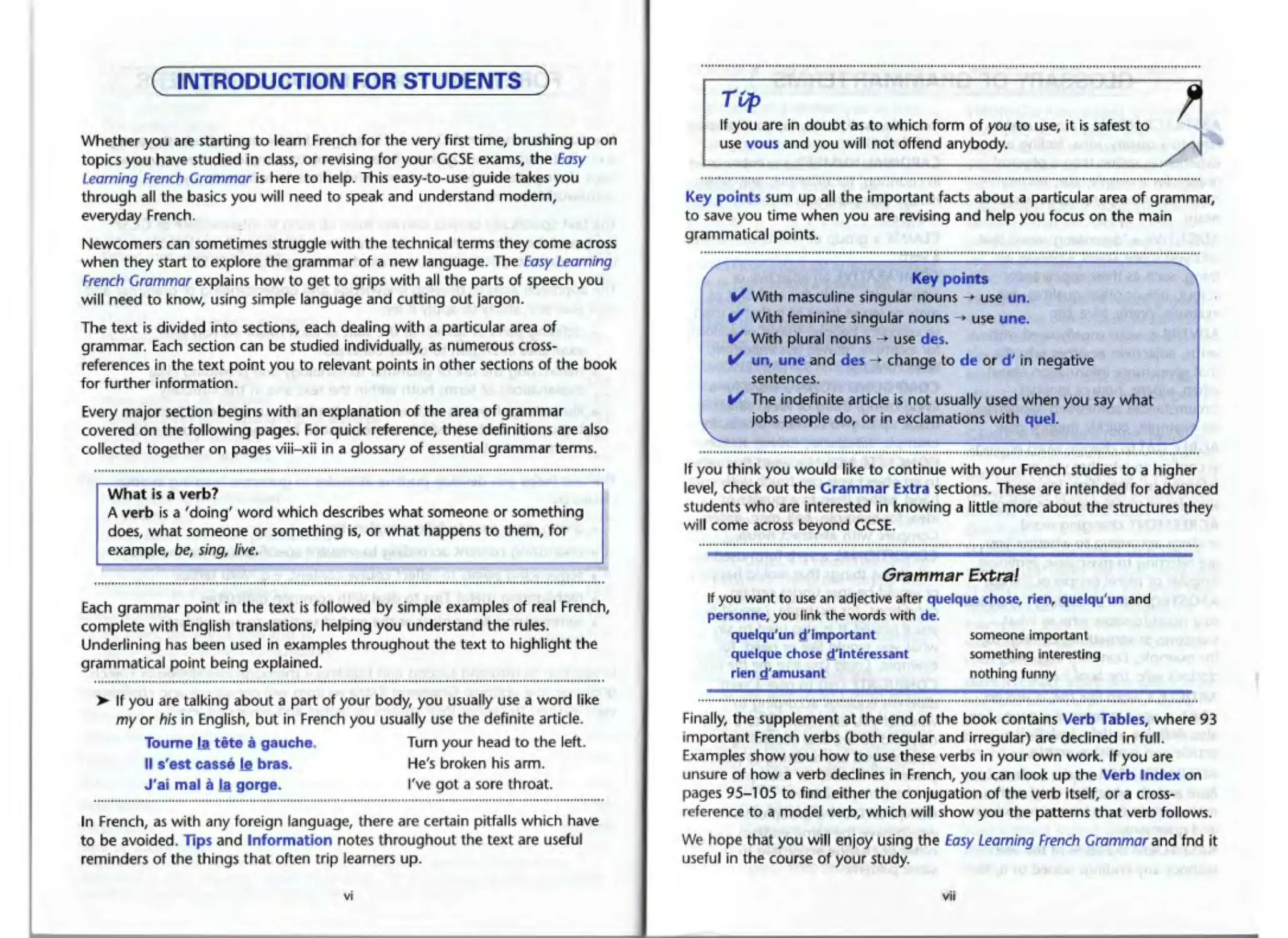
C INTRODUCTION FOR STUDENTS )
Whether you are starting to learn French for the very first time, brushing up on
topics you have studied in class, or revising for your GCSE exams, the Easy
Learning French Grammar is here to help. This easy-to-use guide takes you
through all the basics you will need to speak and understand modem,
everyday French.
Newcomers can sometimes struggle with the technical terms they come across
when they start to explore the grammar of a new language. The Easy Learning
French Grammar explains how to get to grips with all the parts of speech you
will need to know, using simple language and cutting out jargon.
The text is divided into sections, each dealing with a particular area of
grammar. Each section can be studied individually, as numerous cross-
references in the text point you to relevant points in other sections of the book
for further information.
Every major section begins with an explanation of the area of grammar
covered on the following pages. For quick reference, these definitions are also
collected together on pages viii-xii in a glossary of essential grammar terms.
What is a verb?
A verb is a 'doing' word which describes what someone or something
does, what someone or something is, or what happens to them, for
example, be, sing, live.
Each grammar point in the text is followed by simple examples of real French,
complete with English translations, helping you understand the rules.
Underlining has been used in examples throughout the text to highlight the
grammatical point being explained.
> If you are talking about a part of your body, you usually use a word like
my or his in English, but in French you usually use the definite article.
Toume la tete a gauche.	Tum your head to the left.
II s’est casse le bras.	He's broken his arm.
J'ai mal a la gorge.	I've got a sore throat.
In French, as with any foreign language, there are certain pitfalls which have
to be avoided. Tips and Information notes throughout the text are useful
reminders of the things that often trip learners up.
vi
If you are in doubt as to which form of you to use, it is safest to
use vous and you will not offend anybody.
Key points sum up all the important facts about a particular area of grammar,
to save you time when you are revising and help you focus on the main
grammatical points.
Key points
With masculine singular nouns -» use un.
*/ With feminine singular nouns -* use une.
l/ With plural nouns -* use des.
✓ un, une and des -» change to de or d' in negative
sentences.
The indefinite article is not usually used when you say what
jobs people do, or in exclamations with quel.
If you think you would like to continue with your French studies to a higher
level, check out the Grammar Extra sections. These are intended for advanced
students who are interested in knowing a little more about the structures they
will come across beyond GCSE.
Grammar Extra!
If you want to use an adjective after quelque chose, rien, quelquun and
personne, you link the words with de.
quelqu'un d'important	someone important
quelque chose d'lnteressant	something interesting
rien d'amusant	nothing funny
Finally, the supplement at the end of the book contains Verb Tables, where 93
important French verbs (both regular and irregular) are declined in full.
Examples show you how to use these verbs in your own work. If you are
unsure of how a verb declines in French, you can look up the Verb Index on
pages 95-105 to find either the conjugation of the verb itself, or a cross-
reference to a model verb, which will show you the patterns that verb follows.
We hope that you will enjoy using the Easy Learning French Grammar and fnd it
useful in the course of your study.
vii
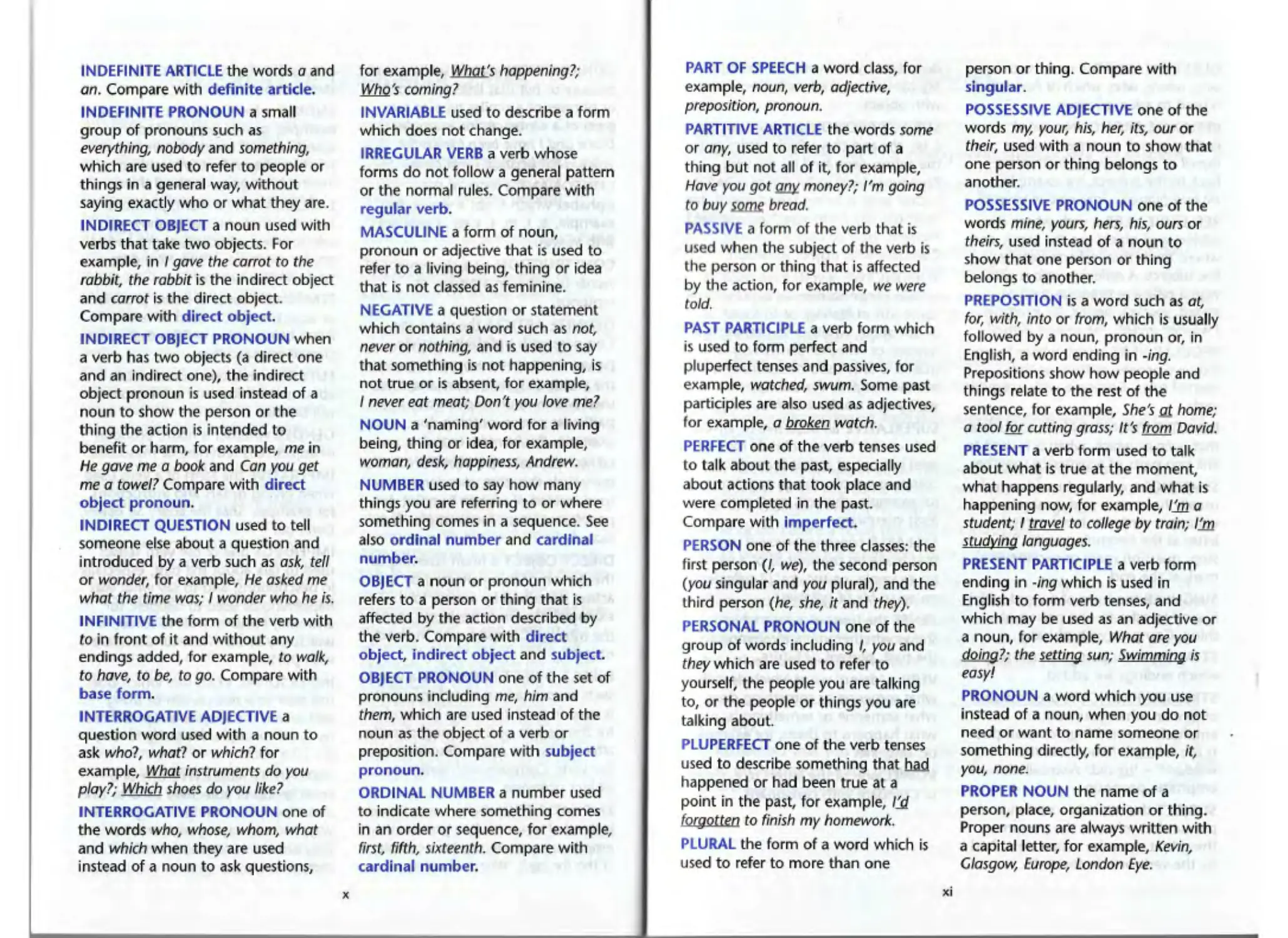
GLOSSARY OF GRAMMAR TERMS
ABSTRACT NOUN a word used to
refer to a quality, idea, feeling or
experience, rather than a physical
object, for example, size, reason,
happiness. Compare with concrete
noun.
ADJECTIVE a 'describing' word that
tells you more about a person or
thing, such as their appearance,
colour, size or other qualities, for
example, pretty, blue, big.
ADVERB a word usually used with
verbs, adjectives or other adverbs
that gives more information about
when, where, how or in what
circumstances something happens,
for example, quickly, happily, now.
AGREE (to) to change word endings
according to whether you are
referring to masculine, feminine,
singular or plural people or things.
AGREEMENT changing word
endings according to whether you
are referring to masculine, feminine,
singular or plural people or things.
APOSTROPHE s an ending ('s) added
to a noun to show who or what
someone or something belongs to,
for example, Danielle's dog, the
doctor's wife, the book's cover.
ARTICLE a word like the, a and an,
which is used in front of a noun. See
also definite article, indefinite
article and partitive article.
AUXILIARY VERB a verb such as be,
have and do when it is used with a
main verb to form tenses, negatives
and questions.
BASE FORM the form of the verb
without any endings added to it, for
example, walk, have, be, go. Compare
with infinitive.
CARDINAL NUMBER a number used
in counting, for example, one, seven,
ninety. Compare with ordinal
number.
CLAUSE a group of words containing
a verb.
COMPARATIVE an adjective or
adverb with -er on the end of it or
more or less in front of it that is used
to compare people, things or actions,
for example, slower, less important,
more carefully.
COMPOUND NOUN a word for a
living being, thing or idea, which is
made up of two or more words, for
example, tin-opener, railway station.
CONCRETE NOUN a word that refers
to an object you can touch with your
hand, rather than to a quality or
idea, for example, ball, map, apples.
Compare with abstract noun.
CONDITIONAL a verb form used to
talk about things that would happen
or would be true under certain
conditions, for example, / would help
you if I could. It is also used to say
what you would like or need, for
example, Could you give me the bill?
CONJUGATE (to) to give a verb
different endings according to
whether you are referring to I, you,
they and so on, and according to
whether you are referring to past,
present or future, for example, I have,
she had, they will have.
CONJUGATION a group of verbs
which have the same endings as each
other or change according to the
same pattern.
viii
CONJUNCTION a word such as and,
because or but that links two words
or phrases of a similar type or two
parts of a sentence, for example,
Diane and I have been friends tor
years.; I left because I was bored.
CONSONANT a letter of the
alphabet which is not a vowel, for
example, b, f, tn, s, v etc. Compare
with vowel.
CONSTRUCTION an arrangement of
words together in a phrase or
sentence.
DEFINITE ARTICLE the word the.
Compare with indefinite article.
DEMONSTRATIVE ADJECTIVE one of
the words this, that, these and those
used with a noun to point out a
particular person or thing, for
example, this woman, that dog.
DEMONSTRATIVE PRONOUN one of
the words this, that, these and those
used instead of a noun to point out
people or things, for example, That
looks fun.
DIRECT OBJECT a noun referring to
the person or thing affected by the
action described by a verb, for
example, She wrote her name.; I shut
the window. Compare with indirect
object.
DIRECT OBJECT PRONOUN a word
such as me, him, us and them which
is used instead of a noun to stand in
for the person or thing most directly
affected by the action described by
the verb. Compare with indirect
object pronoun.
EMPHATIC PRONOUN a word used
instead of a noun when you want to
emphasize something, for example.
Is this for me?; 'Who broke the
window?' - 'He did.' Also called
stressed pronoun.
ENDING a form added to a verb, for
example, go —> goes, and to
adjectives and nouns depending on
whether they refer to masculine,
feminine, singular or plural things.
EXCLAMATION a word, phrase or
sentence that you use to show you
are surprised, shocked, angry and so
on, for example, Wowl; How dare
you!; What a surprise!
FEMININE a form of noun, pronoun
or adjective that is used to refer to a
living being, thing or idea that is not
classed as masculine.
FUTURE a verb tense used to talk
about something that will happen or
will be true.
GENDER whether a noun, pronoun
or adjective is feminine or masculine.
IMPERATIVE the form of a verb used
when giving orders and instructions,
for example, Shut the door!; Sit down!;
Don't go!
IMPERFECT one of the verb tenses
used to talk about the past, especially
in descriptions, and to say what was
happening or used to happen, for
example, I used to walk to school; It
was sunny at the weekend. Compare
with perfect.
IMPERSONAL VERB one which does
not refer to a real person or thing
and where the subject is represented
by it, for example. It's going to rain;
It's 10 o'clock.
INDEFINITE ADJECTIVE one of a
small group of adjectives used to talk
about people or things in a general
way, without saying who or what
they are, for example, several, all,
every.
INDEFINITE ARTICLE the words a and
an. Compare with definite article.
INDEFINITE PRONOUN a small
group of pronouns such as
everything, nobody and something,
which are used to refer to people or
things in a general way, without
saying exactly who or what they are.
INDIRECT OBJECT a noun used with
verbs that take two objects. For
example, in / gave the carrot to the
rabbit, the rabbit is the indirect object
and carrot is the direct object.
Compare with direct object.
INDIRECT OBJECT PRONOUN when
a verb has two objects (a direct one
and an indirect one), the indirect
object pronoun is used instead of а
noun to show the person or the
thing the action is intended to
benefit or harm, for example, me in
He gave me a book and Can you get
me a towel? Compare with direct
object pronoun.
INDIRECT QUESTION used to tell
someone else about a question and
introduced by a verb such as ask, tell
or wonder, for example, He asked me
what the time was; I wonder who he is.
INFINITIVE the form of the verb with
to in front of it and without any
endings added, for example, to walk,
to have, to be, to go. Compare with
base form.
INTERROGATIVE ADJECTIVE a
question word used with a noun to
ask who?, what? or which? for
example, What instruments do you
play?; Which shoes do you like?
INTERROGATIVE PRONOUN one of
the words who, whose, whom, what
and which when they are used
instead of a noun to ask questions.
for example, What's happening?;
Who's coming?
INVARIABLE used to describe a form
which does not change.
IRREGULAR VERB a verb whose
forms do not follow a general pattern
or the normal rules. Compare with
regular verb.
MASCULINE a form of noun,
pronoun or adjective that is used to
refer to a living being, thing or idea
that is not classed as feminine.
NEGATIVE a question or statement
which contains a word such as not,
never or nothing, and is used to say
that something is not happening, is
not true or is absent, for example,
/ never eat meat; Don't you love me?
NOUN a 'naming' word for a living
being, thing or idea, for example,
woman, desk, happiness, Andrew.
NUMBER used to say how many
things you are referring to or where
something comes in a sequence. See
also ordinal number and cardinal
number.
OBJECT a noun or pronoun which
refers to a person or thing that is
affected by the action described by
the verb. Compare with direct
object, indirect object and subject.
OBJECT PRONOUN one of the set of
pronouns including me, him and
them, which are used instead of the
noun as the object of a verb or
preposition. Compare with subject
pronoun.
ORDINAL NUMBER a number used
to indicate where something comes
in an order or sequence, for example,
first, fifth, sixteenth. Compare with
cardinal number.
PART OF SPEECH a word class, for
example, noun, verb, adjective,
preposition, pronoun.
PARTITIVE ARTICLE the words some
or any, used to refer to part of a
thing but not all of it, for example.
Have you got any money?; I'm going
to buy some bread.
PASSIVE a form of the verb that is
used when the subject of the verb is
the person or thing that is affected
by the action, for example, we were
told.
PAST PARTICIPLE a verb form which
is used to form perfect and
pluperfect tenses and passives, for
example, watched, swum. Some past
participles are also used as adjectives,
for example, a broken watch.
PERFECT one of the verb tenses used
to talk about the past, especially
about actions that took place and
were completed in the past.
Compare with imperfect.
PERSON one of the three classes: the
first person (/, we), the second person
(you singular and you plural), and the
third person (he, she, it and they).
PERSONAL PRONOUN one of the
group of words including /, you and
they which are used to refer to
yourself, the people you are talking
to, or the people or things you are
talking about
PLUPERFECT one of the verb tenses
used to describe something that had
happened or had been true at a
point in the past, for example, I Id
forgotten to finish my homework.
PLURAL the form of a word which is
used to refer to more than one
person or thing. Compare with
singular.
POSSESSIVE ADJECTIVE one of the
words my, your, his, her, its, our or
their, used with a noun to show that
one person or thing belongs to
another.
POSSESSIVE PRONOUN one of the
words mine, yours, hers, his, ours or
theirs, used instead of a noun to
show that one person or thing
belongs to another.
PREPOSITION is a word such as at,
for, with, into or from, which is usually
followed by a noun, pronoun or, in
English, a word ending in -ing.
Prepositions show how people and
things relate to the rest of the
sentence, for example, She's at home;
a tool for cutting grass; It's from David.
PRESENT a verb form used to talk
about what is true at the moment,
what happens regularly, and what is
happening now, for example, I'm a
student; I travel to college by train; Ifm
studying languages.
PRESENT PARTICIPLE a verb form
ending in -ing which is used in
English to form verb tenses, and
which may be used as an adjective or
a noun, for example, What are you
doing?: the setting sun; Swimming is
easy!
PRONOUN a word which you use
instead of a noun, when you do not
need or want to name someone or
something directly, for example, it,
you, none.
PROPER NOUN the name of a
person, place, organization or thing.
Proper nouns are always written with
a capital letter, for example, Kevin,
Glasgow, Europe, London Eye.
xi
QUESTION WORD a word such as
why, where, who, which or how which
is used to ask a question.
REFLEXIVE PRONOUN a word
ending in -self or -selves, such as
myself or themselves, which refers
back to the subject, for example,
He hurt himself-; Take care of yourself.
REFLEXIVE VERB a verb where the
subject and object are the same, and
where the action 'reflects back' on
the subject. A reflexive verb is used
with a reflexive pronoun such as
myself, yourself, herself, for example,
/ washed myself.; He shaved himself.
REGULAR VERB a verb whose forms
follow a general pattern or the
normal rules. Compare with irregular
verb.
RELATIVE PRONOUN a word such as
that, who or which, when it is used to
link two parts of a sentence together.
SENTENCE a group of words which
usually has a verb and a subject. In
writing, a sentence has a capital
letter at the beginning and a full
stop, question mark or exclamation
mark at the end.
SINGULAR the form of a word which
is used to refer to one person or
thing. Compare with plural.
STEM the main part of a verb to
which endings are added.
STRESSED PRONOUN used instead
of a noun when you want to
emphasize something, for example.
Is this for me?; 'Who broke the
window?' - 'He did.' Also called
emphatic pronoun.
SUBJECT the noun in a sentence or
phrase that refers to the person or
thing that does the action described
by the verb or is in the state
described by the verb, for example.
My cat doesn't drink milk. Compare
with object.
SUBJECT PRONOUN a word such as
I, he, she and they which carries out
the action described by the verb.
Pronouns stand in for nouns when it
is dear who is being talked about, for
example, My brother isn't here at the
moment. He'll be back in an hour.
Compare with object pronoun.
SUBJUNCTIVE a verb form used in
certain circumstances to express
some sort of feeling, or to show
doubt about whether something will
happen or whether something is
true. It is only used occasionally in
modern English, for example, If I
were you, I wouldn't bother.; So be it.
SUPERLATIVE an adjective or adverb
with -est on the end of it or most or
least in front of it that is used to
compare people, things or actions,
for example, thinnest, most quickly,
least interesting.
SYLLABLE consonant+vowel units
that make up the sounds of a word,
for example, ca-the-dral (3 syllables),
im-po-ssi-ble (4 syllables).
TENSE the form of a verb which
shows whether you are referring to
the past, present or future.
VERB a 'doing' word which describes
what someone or something does,
what someone or something is, or
what happens to them, for example,
be, sing, live.
VOWEL one of the letters a, e, i, о or
u. Compare with consonant.
xii
NOUNS )
What is a noun?
A noun is a 'naming' word for a living being, thing or idea, for example,
woman, happiness, Andrew.
Using nouns
► In French, all nouns are either masculine or feminine. This is called their
gender. Even words for things have a gender.
> Whenever you are using a noun, you need to know whether it is masculine
or feminine as this affects the form of other words used with it, such as:
•	adjectives that describe it
•	articles (such as le or une) that go before it
•	pronouns (such as il or elle) that replace it
•' For more information on Adjectives, Articles or Pronouns, see pages 25, 12
and 42.
> You can find information about gender by looking the word up in a
dictionary. When you come across a new noun, always learn the word for
the or a that goes with it to help you remember its gender.
•	le or un before a noun tells you it is masculine
•	la or une before a noun tells you it is feminine
► We refer to something as singular when we are talking about just one of
them, and as plural when we are talking about more than one. The singular
is the form of the noun you will usually find when you look a noun up in the
dictionary. As in English, nouns in French change their form in the plural.
> Adjectives, articles and pronouns are also affected by whether a noun is
singular or plural.
T vp
Remember that you have to use the right word for the, a and
so on according to the gender of the French noun.
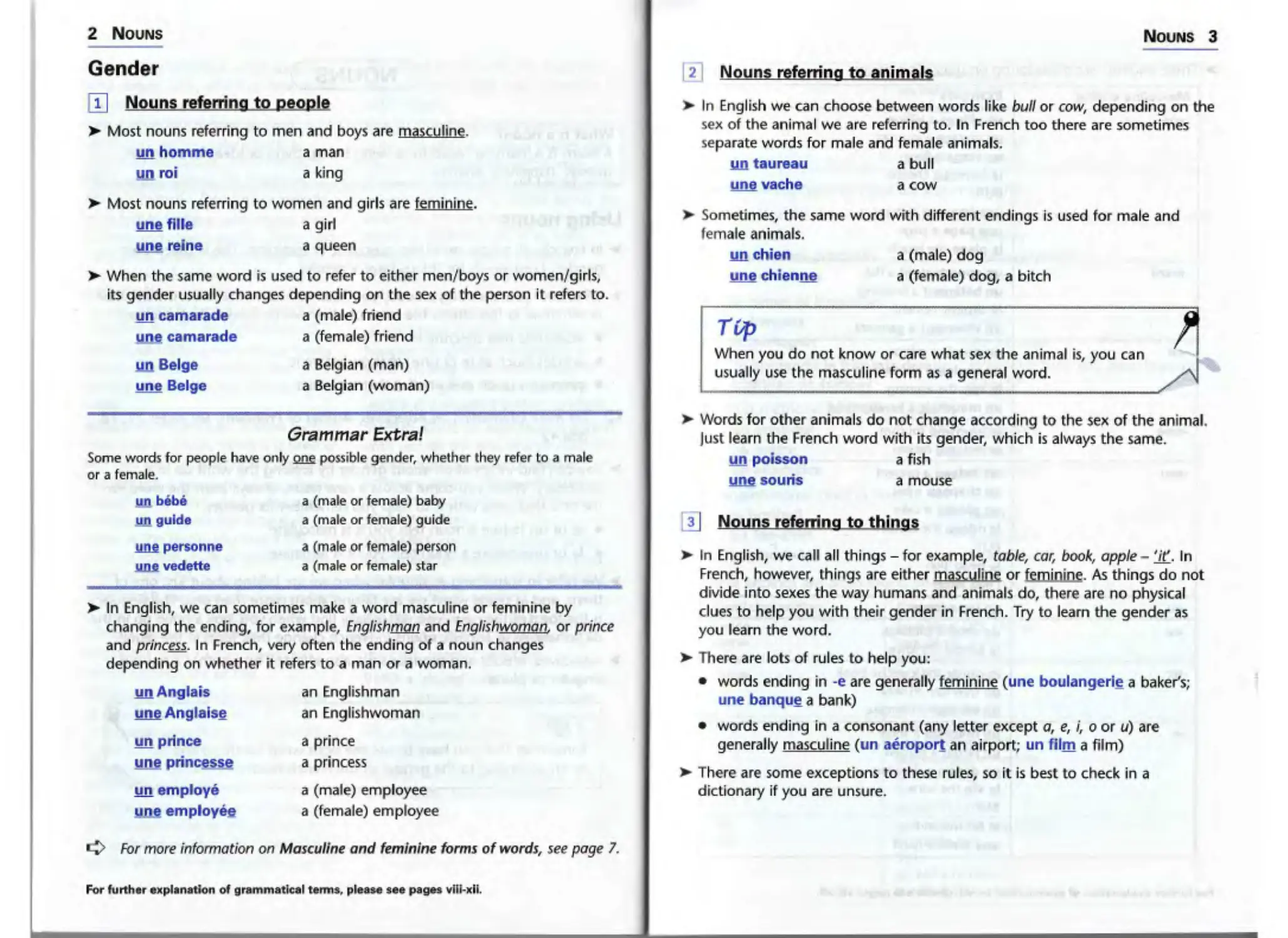
2 Nouns
Gender
T| Nouns referring to people
> Most nouns referring to men and boys are masculine.
un homme	a man
un roi	a king
> Most nouns referring to women and girls are feminine.
une fille	a girl
une reine	a queen
> When the same word is used to refer to either men/boys or women/girls,
its gender usually changes depending on the sex of the person it refers to.
un camarade
une camarade
un Beige
une Beige
a (male) friend
a (female) friend
a Belgian (man)
a Belgian (woman)
Grammar Extra!
Some words for people have only one possible gender, whether they refer to a male
or a female.
un bebe
un guide
une personne
une vedette
a (male or female) baby
a (male or female) guide
a (male or female) person
a (male or female) star
> In English, we can sometimes make a word masculine or feminine by
changing the ending, for example, Englishman and Englishwoman, or prince
and princess. In French, very often the ending of a noun changes
depending on whether it refers to a man or a woman.
un Anglais
une Anqlaise
un prince
une princesse
un employe
une employee
an Englishman
an Englishwoman
a prince
a princess
a (male) employee
a (female) employee
For more information on Masculine and feminine forms of words, see page 7.
For further explanation of grammatical terms, please see pages viil-xli.
Nouns 3
I 2 Nouns referring to animals
In English we can choose between words like bull or cow, depending on the
sex of the animal we are referring to. In French too there are sometimes
separate words for male and female animals.
un taureau une vache	a bull a cow
> Sometimes, the same word with different endings is used for male and
female animals.
un chien	a (male) dog
une chienne	a (female) dog, a bitch
TOp
When you do not know or care what sex the animal is, you can
usually use the masculine form as a general word.
► Words for other animals do not change according to the sex of the animal.
Just learn the French word with its gender, which is always the same.
un poisson	a fish
une souris	a mouse
11 Nouns referring to things
► In English, we call all things - for example, table, car, book, apple - 'Jf. In
French, however, things are either masculine or feminine. As things do not
divide into sexes the way humans and animals do, there are no physical
clues to help you with their gender in French. Try to learn the gender as
you learn the word.
► There are lots of rules to help you:
•	words ending in -e are generally feminine (une boulangerie a baker's;
une banque a bank)
•	words ending in a consonant (any letter except a, e, I, о or u) are
generally masculine (un aeroport an airport; un film a film)
► There are some exceptions to these rules, so it is best to check in a
dictionary if you are unsure.
4 Nouns
> These endings are often found on masculine nouns.
Masculine ending	Examples
-age	un village a village un voyage a journey un Stage a floor le fromage cheese BUT: une Image a picture une page a page la plage the beach
-ment	un appartement a flat un batiment a building le ciment cement un vdtement a garment
-oir	un miroir a mirror un couloir a corridor le soir the evening un mouchpir a handkerchief
•sme	le tourisms tourism le racism e racism
-eau	un cadeau a present un chapeau a hat un gateau a cake le rideau the curtain BUT: la peau skin I'eau water
-eu	un jeu a game
-ou	un chou a cabbage le genou the knee
-ier	le cahter the exercise book un quartier an area un escaller a staircase
-In	un magasin a shop un jardin a garden un dessin a drawing la vin the wine BUT: la fin the end une main a hand
For further explanation of grammatical termi, please see pages vlil-xil.
Nouns 5
-on	un champignon a mushroom un ballon a ball le citron the lemon BUT: une maison a house la saison the season
The following types of word are also masculine:
•	names of the days of the week, and the months and seasons of the year
	le lundi	Monday
	septembre prochain	next September
	le printemps	Spring
•	the names of languages
	le frangais	French
	le portugais	Portuguese
	Tu apprends le fran^ais depuis	How long have you been learning
	combien de temps?	French?
•	most metric weights and measures
	un gramme	a gramme
	un metre	a metre
	un kilometre	a kilometre
•	English nouns used in French
	ie football	football
	un tee-shirt	a tee-shirt
	un sandwich	a sandwich
These endings are often found on feminine nouns.
Feminine ending	Examples
-ance -anse -ence -ense	la chance luck, chance une danse a dance la patience patience la defense defence BUT: le silence silence
-ion	une region a region une addition a bill une reunion a meeting la circulation traffic BUT: un avion a plane
-t* -tii	une speciality a speciality la moitie half BUT: un ete a summer le pate р5(ё
6 Nouns
Grammar Extra!
A few words have different meanings depending on whether they are masculine or
feminine. These are the most common:
Masculine	Meaning	Example	Feminine	Meaning	Example
un livre	a book	un livre de poche a paperback	une livre	a pound	une livre sterling a pound sterling
un mode	a method	le mode d'emploi the directions for use	la mode	fashion	a la mode in fashion
un poste	a set (TV/radio); a post (/ob); an extension (phone)	un poste de professeur a teaching |ob	la poste	post the post office	mettre quelque chose a la poste to post something
un tour	a turn; a walk	fair® un tour to go for a walk	un® tour	tower	la tour Eiffel the Eiffel Tower
Key points
Most nouns referring to men, boys and male animals are
masculine; most nouns referring to women, girls and female
animals are feminine. The ending of a French noun often changes
depending on whether it refers to a male or a female.
✓ Generally, words ending in e are feminine and words ending in a
consonant are masculine, though there are many exceptions to
this rule.
✓ These endings are often found on masculine nouns:
-age, -ment, -oir, -$me, -eau, -eu, -ou, -ier, -in and -on.
✓ These endings are often found on feminine nouns:
-ance, -anse, -ence, -ense, -ion, -te, -tie.
✓ Days of the week, months and seasons of the year are masculine.
So are languages, most metric weights and measures, and English
nouns used in French.
For further explanation of grammatical terms, please see pages vIH-xll.
Nouns 7
4 ' Masculine and feminine forms of words
► In French there are sometimes very different words for men and women,
and for male and female animals, just as in English.
un homme une femme	a man a woman
un taureau une vache	a bull a cow
un neveu une niece	a nephew a niece
► Many masculine French nouns can be made feminine simply by changing
the ending. This is usually done by adding an -e to the masculine noun to
form the feminine. un ami une amie	a (male) friend a (female) friend
un employe une employee un Francais une Francaise	a (male) employee a (female) employee a Frenchman a Frenchwoman
► If the masculine singular form already ends in -e, no further e is added.
un eldve une eleve	a (male) pupil a (female) pupil
un camarade une camarade	a (male) friend a (female) friend
un collegue une collegue	a (male) colleague a (female) colleague
If a masculine noun ends in a vowel, its pronunciation does not r
change when an -e is added to form the feminine. For example,
ami and amie (meaning friend) are both pronounced the same.
If a masculine noun ends with a consonant that is not pronounced,
for example, -d, -s, -r or -t, you DO pronounce that consonant when
an -e is added in the feminine. For example, in etudiant (meaning
student), you cannot hear the t; in etudiante, you can hear the t. ✓
8 Nouns
Some masculine nouns, such as voisin (meaning neighbour), end '
in what is called a nasal vowel and an n. With these words, you pronounce
the vowel 'through your nose' but DO NOT say the n. When an -e is
added in the feminine - for example, voisine - the vowel becomes a
normal one instead of a nasal vowel and you DO pronounce the n.
151 Some other patterns
> Some changes to endings from masculine to feminine are a little more
complicated but still fall into a regular pattern.
Masculine ending	Feminine ending	Example	Meaning
f	-ve	un veuf/une veuve	a widower/a widow
-X	-se	un epoux/une epouse	a husband/a wife
-eur	-euse	un danseur/ une danseuse	a (male) dancer/ a (female) dancer
-teur	-teuse -trice	un chanteur/ une chanteuse un acteur/une actrice	a (male) singer/ a (female) singer an actor/an actress
-an	-anne	un paysan/ une paysanne	a (male) farmer/ a (female) farmer
-ien	-ienne	un Parisien/ une Parisienng	a (male) Parisian/ a (female) Parisian
-on	-onne	un lion/une lionne	a lion/a lioness
-er	-ere	un stranger/ une etrangere	a (male) foreigner/ a (female) foreigner
-et	-ette	le cadet/la cadette	the youngest (male) child the youngest (female) child
-el	-elle	un professionnel/ une orofessionnelle	a (male) professional/ a (female) professional
Key points
Many masculine French nouns can be made to refer to females
by adding an -e. If the masculine singular form already ends in
-e, no further e is added,
✓ The pronunciation of feminine nouns is sometimes different from
that of the corresponding masculine nouns.
✓ Other patterns include:
-	f -»-ve	-teur • -teuse or -trice
-	x -* -se	-an, -en and -on ► -anne
-	eur - -euse -enne and -onne
-er • -ere
-et »-ette
-el ♦ -elle
For further explanation of grammatical terms, please see pages vm-xii.
Nouns 9
Forming plurals
i Plurals ending in -s
► In English we usually make nouns plural by adding an -s to the end
(garden -» gardens; house - ► houses), although we do have some nouns
which are irregular and do not follow this pattern (mouse -» mice;
child -* children).
Remember that you have to use les with plural nouns in French.
Any adjective that goes with the noun has to agree with it, as does
any pronoun that replaces it.
Ф For more information on Ad/ectives, Articles and Pronouns, see
pages 25, 12 and 42.
► Most French nouns also form their plural by adding an -s to their singular
form.
un jardin	a garden
des jardins	gardens
une voiture	a car
des voitures	cars
un hotel	a hotel
des hotels	hotels
► If the singular noun ends in -s, -x or -z, no further -$ is added in the plural.
un fils	a son
des fils	sons
une voix	a voice
des voix	voices
un nez	a nose
des nez	noses
2] Plurals ending in -x
► The following nouns add an	-x instead of an -s in the plural:
• nouns ending in -eau
un chapeau	a hat
des chapeaux	hats
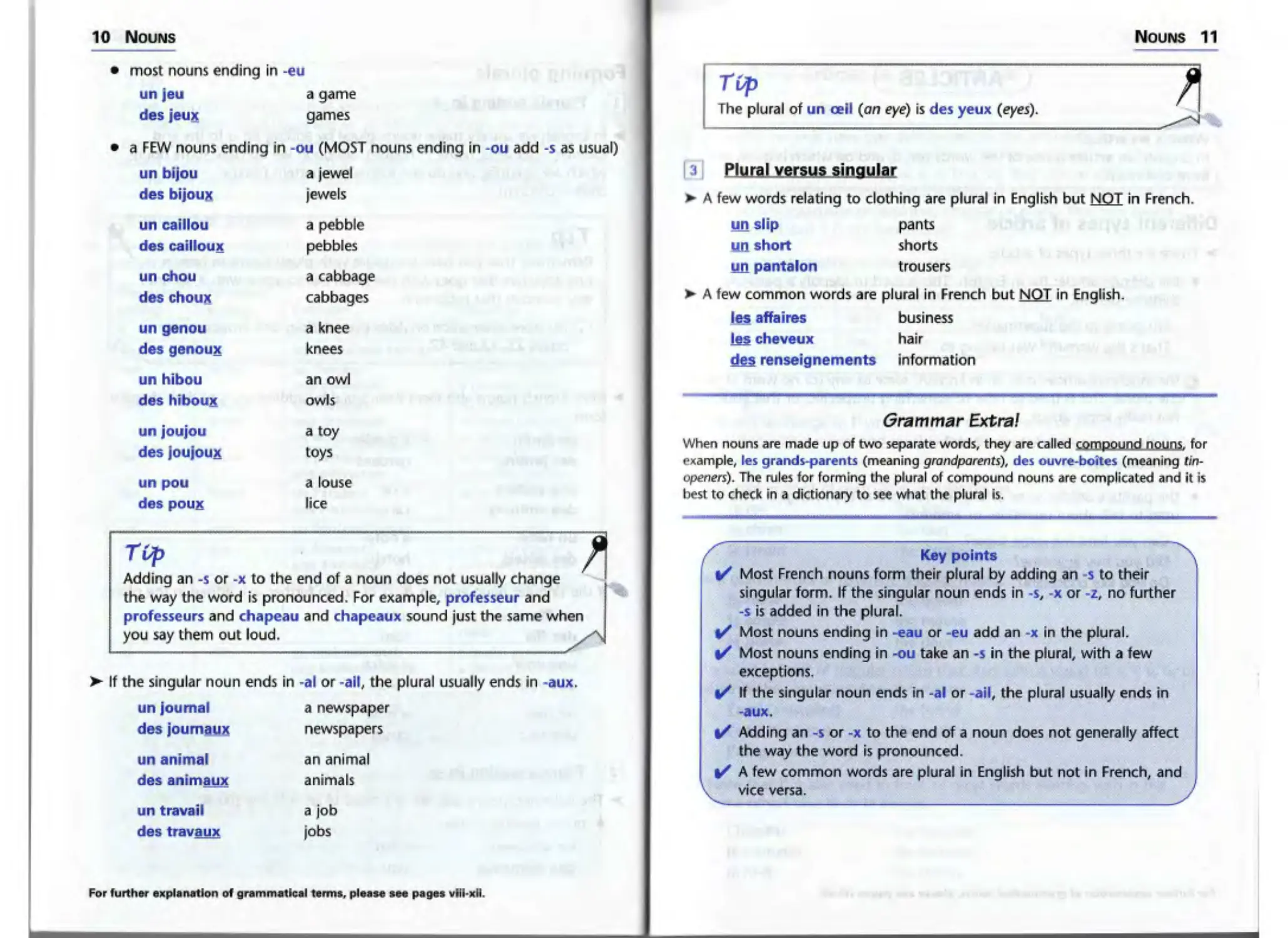
10 Nouns
• most nouns ending in -eu
un jeu	a game
des jeux	games
• a FEW nouns ending in	-ou (MOST nouns ending in -ou add -s as usual)
un bijou	a jewel
des bijoux	jewels
un caillou	a pebble
des cailloux	pebbles
un chou	a cabbage
des choux	cabbages
un genou	a knee
des genoux	knees
un hibou	an owl
des hiboux	owls
un joujou	a toy
des joujoux	toys
un pou	a louse
des poux	lice
Adding an -s or -x to the end of a noun does not usually change
the way the word is pronounced. For example, professeur and
professeurs and chapeau and chapeaux sound just the same when
you say them out loud.	.
> If the singular noun ends in -al or -all, the plural usually ends in -aux.
un journal des joumaux	a newspaper newspapers
un animat des animaux	an animal animals
un travail des travaux	a job jobs
For further explanation of grammatical terma, please see pages vHI-хЫ.
Nouns 11
The plural of un ceil (an eye) is des yeux (eyes).
з Plural versus singular
► A few words relating to clothing are plural in English but NOT in French.
un slip	pants
un short	shorts
un pantalon	trousers
► A few common words are plural in French but NOT in English,
les affaires	business
les cheveux	hair
des renseignements information
Grammar Extra!
When nouns are made up of two separate words, they are called compound nouns, for
example, les grands-parents (meaning grandparents), des ouvre-boites (meaning tin-
openers). The rules for forming the plural of compound nouns are complicated and it is
best to check in a dictionary to see what the plural is.
Key points
✓	Most French nouns form their plural by adding an -s to their
singular form. If the singular noun ends in -s, -x or -z, no further
-s is added in the plural.
✓	Most nouns ending in -eau or -eu add an -x in the plural.
✓	Most nouns ending in -ou take an -s in the plural, with a few
exceptions.
✓	If the singular noun ends in -al or ail, the plural usually ends in
-aux.
✓	Adding an -s or -x to the end of a noun does not generally affect
the way the word is pronounced.
✓	A few common words are plural in English but not in French, and
vice versa.
ARTICLES
What is an article?
In English, an article is one of the words the, a, and an which is given in
front of a noun.
Different types of article
> There are three types of article:
•	the definite article: the in English. This is used to identify a particular
thing or person.
I'm going to the supermarket.
That's the woman I was talking to.
•	the indefinite article: a or on in English, some or any (or no word at all) in
the plural. This is used to refer to something unspecific, or that you do
not really know about.
Is there a supermarket near here?
I need a day off.
•	the partitive article: some or any (or no word at all) in English. This is
used to talk about quantities or amounts.
Can you lend me some sugar?
Did you buy any wine?
Do you like chocolate?
For further explanation of grammatical terms, please see pages viii-xii.
Articles 13
The definite article: le, la, Г and les
i The basic rules
► In English we only have one definite article: the. In French, there is more
than one definite article to choose from. All French nouns are either
masculine or feminine and, just as in English, they can be either singular or
plural. The word you choose for the depends on whether the noun it is
used with is masculine or feminine, singular or plural. This may sound
complicated, but it is not too difficult.
' ? for more information on Nouns, see page 1.
	with masculine noun	with feminine noun
Singular	le (П	la (1'1
Plural	les	les
T ip
le and la change to Г when they are used in front of a word
starting with a vowel and most words starting with h.
► le is used in front of masculine singular nouns.
le roi	the king
le chien	the dog
le jardin	the	garden
► la i$ used in front of feminine singular nouns,
la reine	the queen
la souris	the	mouse
la porte	the door
► I' is used in front of singular nouns that start with a vowel (о, e, I, o, or u),
whether they are masculine or feminine.
Tami (masculine)	the friend
Eeau (feminine)	the water
I'etage (masculine)	the floor
(7] Note that I' is also used in front of most words starting with h but
some others take le or la instead.
I'hopital
le hamster
la hi-fi
the hospital
the hamster
the stereo
14 Articles
It is a good idea to learn the article or the gender with the noun
when you come across a word for the first time, so that you know
whether it is masculine or feminine. A good dictionary will also give
you this information.
► les is used in front of plural nouns, whether they are masculine or feminine
and whatever letter they start with.
les chiens
les portes
les amis
les hotels
the dogs
the doors
the friends
the hotels
(2 Note that you have to make the noun plural too, just as you would
in English. In French, as in English, you usually add an
О For more information on Forming plurals, see page 9.
When les is used in front of a word that starts with a consonant,
you DO NOT say the s on the end of les: les chiens the dogs.
When les is used in front of a word that starts with a vowel, most
words starting with h, and the French word y, you DO pronounce
the s on the end of les. It sounds like the z in the English word zip:
les amis the friends, les hotels the hotels.
Г2] Using a with le, la, I* and les
> The French word a is translated into English in several different ways,
including at or to. There are special rules when you use it together with le
and les.
О For more information on the preposition a, see page 163.
> When a is followed by le, the two words become au.
au cinema	to/at the cinema
aux professeurs	to the teachers
For further explanation of grammatical terms, please see pages viii-xii.
Articles 15
► When a is followed by les, the two words become aux.
aux maisons	to the houses
aux etudiants	to the students
► When a is followed by la or Г, the words do not change.
a la biblioth£que	to/at the library
aj'hdtel	to/at the hotel
le and la change to Г when they are used in front of a word
starting with a vowel and most words starting with h.
3 Using de with leja, Г and les
► The French word de is translated into English in several different ways,
including of and from. There are special rules when you use it together with
le and les.
• For more information on the preposition de, see page ? 66.
>	When de is followed by le, the two words become du.
du cinema	from/of the cinema
des professeurs	from/of the teachers
►	When de is followed by les, the two words become des.
des maisons	from/of the houses
des etudiants	from/of the	students
>	When de is followed by la or Г, the words do not change.
de la bibliotheque	from/of the library
de (’hotel	from/of the hotel
le and la change to Г when they are used in front of a word
starting with a vowel and most words starting with h.
16 Articles
Key points
»/ With masculine singular nouns -* use le.
✓	With feminine singular nouns -» use la.
✓	With nouns starting with a vowel, most nouns beginning with h
and the French word у -» use I'.
✓	With plural nouns -» use les.
<i + les = aux
de + le = du
de + les = des
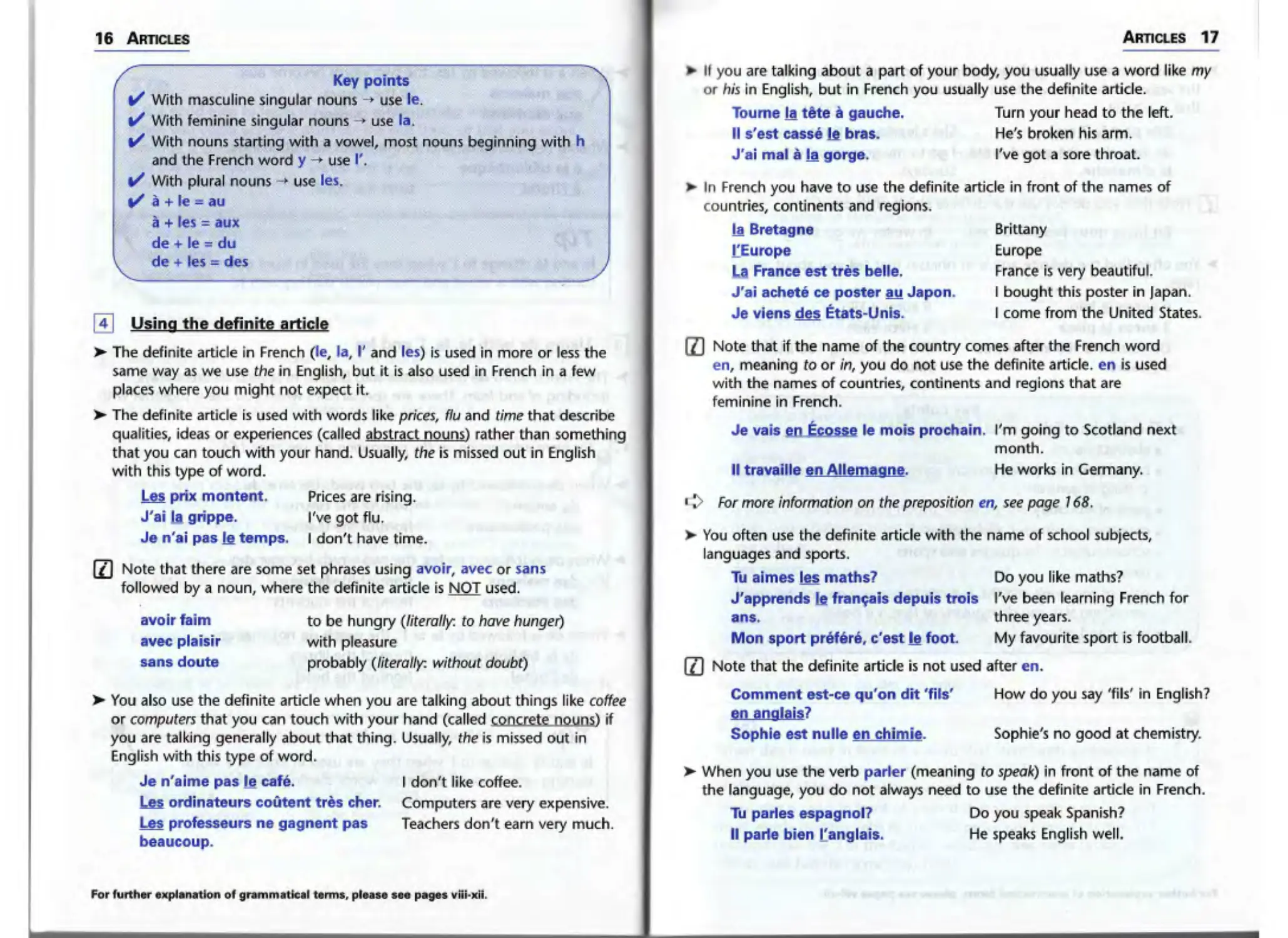
|4| Using the definite article
> The definite article in French (le, la, Г and les) is used in more or less the
same way as we use the in English, but it is also used in French in a few
places where you might not expect it.
► The definite article is used with words like prices, flu and time that describe
qualities, ideas or experiences (called abstract nouns) rather than something
that you can touch with your hand. Usually, the is missed out in English
with this type of word.
Les prix montent.
J'ai la grippe.
Je n'ai pas le temps.
Prices are rising.
I've got flu,
I don't have time.
[71 Note that there are some set phrases using avoir, avec or sans
followed by a noun, where the definite article is NOT used.
avoir faim
avec plaisir
sans doute
to be hungry {literally, to have hunger)
with pleasure
probably (literally, without doubt)
> You also use the definite article when you are talking about things like coffee
or computers that you can touch with your hand (called concrete nouns) if
you are talking generally about that thing. Usually, the is missed out in
English with this type of word.
Je n'aime pas le cafe.	I don't like coffee.
Les ordinateurs coutent tres cher. Computers are very expensive.
Les professeurs ne gagnent pas Teachers don't earn very much,
beaucoup.
For further explanation of grammatical terms, please see pages viiixii.
Articles 17
► If you are talking about a part of your body, you usually use a word like my
or his in English, but in French you usually use the definite article.
Toume la tete a gauche.	Turn your head to the left.
II s'est casse le bras.	He's broken his arm.
J'ai mal a la gorge.	I've got a sore throat.
► In French you have to use the definite article in front of the names of
countries, continents and regions.
la Bretagne
EEurope
La France est tres belle.
J'ai achete ce poster au Japon.
Je viens des Etats-Unis.
Brittany
Europe
France is very beautiful.
I bought this poster in japan.
I come from the United States.
И Note that if the name of the country comes after the French word
en, meaning to or in, you do not use the definite article, en is used
with the names of countries, continents and regions that are
feminine in French.
Je vais en Ecosse le mois prochain. I'm going to Scotland next
month.
II travaille en Allemaqne.	He works in Germany.
• For more information on the preposition en, see page 168.
► You often use the definite article with the name of school subjects,
languages and sports.
Tu aimes les maths?	Do you like maths?
J'apprends le fran^ais depuis trois I've been learning French for
ans.	three years.
Mon sport prefers, c'est |e foot. My favourite sport is football.
(71 Note that the definite article is not used after en.
Comment est-ce qu'on dit 'fils'
en anglais?
Sophie est nulls en chimie.
How do you say 'fils' in English?
Sophie's no good at chemistry.
> When you use the verb parler (meaning to speak) in front of the name of
the language, you do not always need to use the definite article in French.
Tu paries espagnol?	Do you speak Spanish?
II parte bien I'anglais.	He speaks English well.
18 Articles
> You use le with dates, and also with the names of the days of the week and
the seasons when you are talking about something that you do regularly or
that is a habit.
Elie part le 7 mai.	She's leaving on the seventh of May.
Je vais chez ma grand-mere I go to my grandmother's on
le dimanche.	Sundays.
171 Note that you do not use the definite article after en.
En hiver nous faisons du ski. In winter we go skiing.
► You often find the definite article in phrases that tell you about prices and
rates.
6 euros le kilo	6 euros a kilo
3 euros la piece	3 euros each
On roulait a 100 kilometres We were doing 100 kilometres an
a fheure.	hour.
Key points
The definite article is used in French with:
•	abstract nouns
•	concrete nouns (when you are saying something that is true about
a thing in general)
•	parts of the body
•	countries, continents and regions
•	school subjects, languages and sports
•	dates
•	days of the week and the seasons (when you are talking about
something that you do regularly or that is a habit)
•	prices and rates
For further explanation of grammatical terms, please see pages viii-xii.
Articles 19
The indefinite article: un, une and des
1 The basic rules
► In English we have the indefinite article a, which changes to an in front of a
word that starts with a vowel. In the plural we say either some, any or
nothing at all.
► In French, you choose from un, une and des, depending on whether the
noun is masculine or feminine, and singular or plural.
	with masculine noun	with feminine noun
Singular	un	une
Plural	des	des
►	un is used in front of masculine singular nouns.
un roi	a king
un chien	a dog
un jardin	a garden
►	une is used in front of feminine singular nouns.
une reine	a queen
une souris	a	mouse
une porte	a door
►	des is used in front of plural nouns, whether they are masculine or
feminine, and whatever letter they start with.
des chiens	(some/any)	dogs
des souris	(some/any)	mice
des amis	(some/any)	friends
[7] Note that des is also a combination of de + les and has other
meanings, such as saying who something belongs to or where
something is from.
Ф For more information on des, see page 166.
Tty
When des is used in front of a word that starts with a consonant
(any letter except a, e, i, о or u), you DO NOT say the s on the end
of des: des chiens (some/any) dogs.
When des is used in front of a word that starts with a vowel, and
most words starting with h, you DO pronounce the s on the end.
It sounds like the z in the English word zip: des amis (some/any)
friends, des hotels (some/any) hotels.
20 Articles
T] The indefinite article in negative sentences
> In English we use words like not and never to indicate that something is not
happening or is not true. The sentences that these words are used in are
called negative sentences.
I don't know him.
I never do my homework on time.
> In French, you use word pairs like ne ... pas (meaning not) and ne ...
jamais (meaning never) to say that something is not happening or not true.
When un, une or des is used after this type of expression, it has to be
changed to de.
Je n'ai pas de velo.	I don't have a bike.
Nous n'avons pas de cousins. We don't have any cousins.
•Ф For more information on Negatives, see page 138.
T ip
de changes to d' in front of a word starting with a vowel and
most words starting with h.
Je n'ai pas (fordinateur.
I don't have a computer.
II n'y a pas d'horloge dans la salle.There isn't a clock in the room.
Grammar Extra!
There are some very common adjectives, like beau, bon and petit, that can come
BEFORE the noun instead of after it. When an adjective comes before a plural noun,
des changes to de.
J'ai re?u de beaux cadeaux.	I got some lovely presents.
Cette region a de tres jolis	This area has some very pretty
villages.	villages.
Ф For more information on Word order with ad/ectives, see page 32.
131 The meaning of des
> des can mean different things in English, depending on the sentence. Some
is often the best word to use.
J’ai un chien, deux chats et
des souris.
Tu veux des chips?
I've got a dog, two cats and
some mice.
Would you like some crisps?
For further explanation of grammatical terms, please see pages vssi-xii.
Articles 21
► In questions and negative sentences des means any, or is not translated at
all.
Tu as des freres?	Have you got any brothers?
II n'y a pas dloeufs.	There aren't any eggs.
Avez-vous des timbres?	Do you have stamps?
As an English speaker, you will know what sounds right in
your own language. The important thing to remember is that des
can NEVER be missed out in French, even if there is no word in
English.
4 Using the indefinite article
► The indefinite article is used in French in much the same way as we use a,
some and any in English, but there are two places where the indefinite
article is NOT used:
•	with the adjective quel (meaning what a), in sentences like
Quel dommage!	What a shame!
Quelle surprise!	What a surprise!
Quelle bonne idee!	What a good idea!
О For more information on quel, see page 148.
•	when you say what jobs people do
II est professeur.	He's a teacher.
Ma mere est infirmi&re.	My mother's a nurse.
When you use c'est (to mean he/she is), you DO use un or une.
When you use ce sont (to mean they are), you DO use des.
C'est un medecin.	He's/$he's a doctor.
Ce sont des acteurs.	They're actors.
Ф For more information on c'est and ce sont, see page 65.
Key points
✓ With masculine singular nouns use un.
✓ With feminine singular nouns -♦ use une.
»/ With plural nouns ► use des,
✓ un, une and des -» change to de or d' in negative sentences.
✓ The indefinite article is not usually used when you say what jobs
people do, or in exclamations with quel.
22 Articles
The partitive article: du, de la, de Г and des
1]
The basic rules
> du, de la, de I' and des can all be used to give information about the
amount or quantity of a particular thing. They are often translated into
English as some or any.
> In French, you choose between du, de la, de I’ and des, depending on
whether the noun is masculine or feminine, singular or plural.
	with masculine noun	with feminine noun
Singular	du (de Г)	de la (de Г)
Plural	des	des
de + le and de la change to de I' when they are used in front of a
word starting with a vowel, most words starting with h, and the
French word y.
> du is used in front of masculine singular nouns.
du beurre	(some/any) butter
du jus d'orange	(some/any) orange juice
|7] Note that du is also a combination of de + le and has other
meanings, such as saying who something belongs to or where
something is from.
О For more information on du, see page 166.
► de la is used in front of feminine singular nouns.
de la viande	(some/any) meat
de la margarine	(some/any) margarine
> de I' is used in front of singular nouns that start with a vowel and most
nouns starting with h, whether they are masculine or feminine.
de I'arqent (masculine) (some/any) money
de l'eau (feminine) (some/any) water
de I'herbe (feminine) (some/any) grass
For further explanation of grammatical term», please see pages vui-xii
Articles 23
► des is used in front of plural nouns, whether they are masculine or feminine
and whatever letter they start with.
des gateaux	(some/any)	cakes
des lettres	(some/any)	letters
des hStels	(some/any)	hotels
[71 Note that des is also a combination of de + les and has other
meanings, such as saying who something belongs to or where
something is from.
Ф For more information on des, see page 166.
2^ The partitive article in negative sentences
► In French, you use word pairs like ne ... pas (meaning not) and ne ...
jamais (meaning never) to say that something is not happening or not true.
In this type of expression, du, de la, de I' and des all change to de.
Nous n’avons pas de beurre. We don't have any butter.
Je ne mange jamajs de viande. I never eat meat.
II rfy a pas de timbres.	There aren't any stamps.
• t> For more information on Negatives, see page 138.
de changes to d' in front of a word starting with a vowel and
most nouns starting with h.
II n'a pas d'argent.	He doesn't have any money.
II n'y a pas d^horloge dans la salle. There isn't a clock in the room.
Grammar Extra!
there are some very common adjectives, like beau, bon and petit, that can come
BEFORE the noun instead of after it. When an adjective comes before a plural noun, des
< hanges to de.
J'ai repu de beaux cadeaux.	I got some lovely presents,
Cette region a de tres jolis villages. This area has some very pretty villages.
11 For more information on Word order with adjectives, see page 32.
24 Articles
He owes me (some) money.
I'm going to buy (some) flour and
butter to make a cake.
Are there any letters for me?
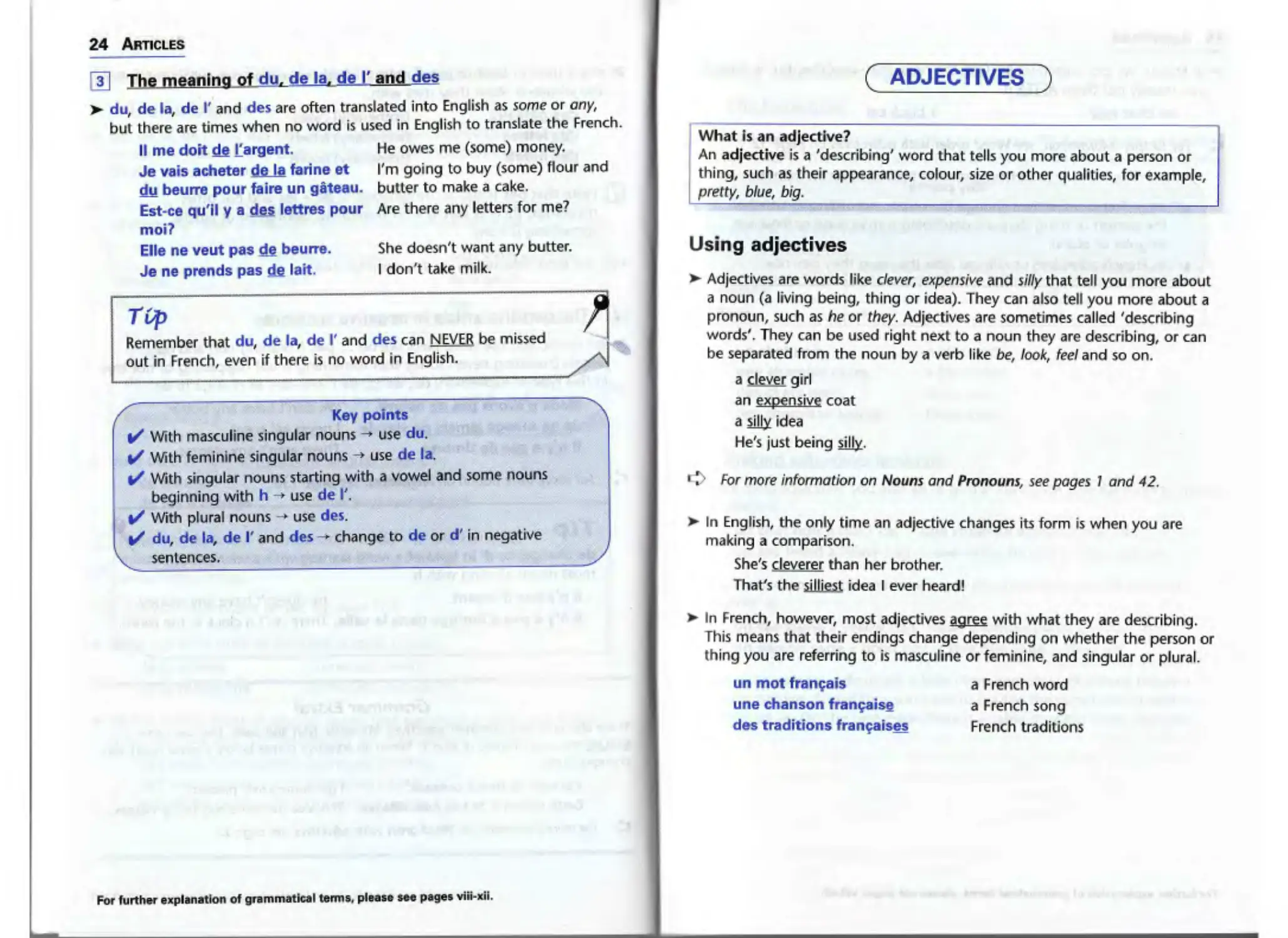
Ц The meaning of du, de la, de I' and des
> du, de la, de Г and des are often translated into English as some or any,
but there are times when no word is used in English to translate the French.
II me doit de Largent.
Je vais acheter de la farine et
du beurre pour faire un gateau.
Est-ce qu'il у a des lettres pour
moi?
Elie ne veut pas de beurre.
Je ne prends pas de lart.
She doesn't want any butter.
I don't take milk.
Remember that du, de la, de Г and des can NEVER be missed
out in French, even if there is no word in English.
Key points
✓ With masculine singular nouns -» use du.
✓ With feminine singular nouns -» use de la.
✓ With singular nouns starting with a vowel and some nouns
beginning with h -» use de Г.
With plural nouns -» use des.
du, de la, de Г and des -» change to de or d' in negative
sentences.
For further explanation of grammatical terms, please see pages viii-xii.
( ADJECTIVES
What is an adjective?
An adjective is a 'describing' word that tells you more about a person or
thing, such as their appearance, colour, size or other qualities, for example,
pretty, blue, big.
Using adjectives
► Adjectives are words like clever, expensive and silly that tell you more about
a noun (a living being, thing or idea). They can also tell you more about a
pronoun, such as he or they. Adjectives are sometimes called 'describing
words'. They can be used right next to a noun they are describing, or can
be separated from the noun by a verb like be, look, feel and so on.
a clever girl
an expensive coat
a silly idea
He's just being silly.
* For more information on Nouns and Pronouns, see pages 1 and 42.
► In English, the only time an adjective changes its form is when you are
making a comparison.
She's cleverer than her brother.
That's the silliest idea I ever heard!
> In French, however, most adjectives agree with what they are describing.
This means that their endings change depending on whether the person or
thing you are referring to is masculine or feminine, and singular or plural.
un mot fran^ais
une chanson frangaise
des traditions fran^aises
a French word
a French song
French traditions
26 Adjectives
> In English we put adjectives BEFORE the noun they describe, but in French
you usually put them AFTER it.
un chat noir	a black cat
Ф For further information, see Word order with adjectives on page 32.
Key points
✓	Most French adjectives change their form, according to whether
the person or thing they are describing is masculine or feminine,
singular or plural.
✓	In French adjectives usually go after the noun they describe.
For further explanation of grammatical terms, please see pages viii-xii.
Adjectives 27
Making adjectives agree
1] The basic rules
► In dictionaries, regular French adjectives are usually shown in the masculine
singular form. You need to know how to change them to make them agree
with the noun or pronoun that they are describing.
► To make an adjective agree with the noun or pronoun it describes, you
simply add the following endings in most cases:
	with masculine noun	with feminine noun
Singular	-	-e
Plural	-s	-es
un chat noir
une chemise noire
des chats noirs
des chemises noires
a black cat
a black shirt
black cats
black shirts
2 j Maki ng adjectives feminine
►	With most adjectives you add an -e to the masculine singular form to make
it feminine.
un chat noir a black cat -* une chemise noire a black shirt
un sac lourd a heavy bag -» une valise lourde a heavy suitcase
►	If the adjective already ends in an -e in the masculine, you do not add
another -e.
un sac jaune a yellow bag -» une chemise jaune a yellow shirt
un gar^on sage a good boy -* une fille sage a good girl
►	Some changes to endings are a little more complicated but still follow a
regular pattern. Sometimes you have to double the consonant as well as
adding an -e. On the next page there is a table showing these changes.
28 Adjectives
Masculine ending	Feminine ending	Example	Meaning
-f	-ve	neuf/neuve	new
-X	-se	heureux/heu reuse	happy
-er	-ere	cher/chere	dear, expensive
-an -en -on	-anna -enne -onne	paysan/paysanne europeen/europeenne bon/bonne	farming, country European good, right
el	-elle	cruel/cruelle	cruel
-eil	-eille	pareil/pareille	similar
-et	-ette -Ate	net/nette complet/complete	dear complete, full
un bon repas a good meal -* de bonne humeur in a good mood
un homme cruel a cruel man - une remarque cruelle a cruel remark
Tip	1
If a masculine adjective ends in a vowel (a, e, i, о or u), its	'
pronunciation does not change when an -e is added to form the
feminine. For example, joli and jolie are both pronounced the same.
If a masculine adjective ends with a consonant that is not
pronounced, such as -d, -s or -t, you DO pronounce that consonant
when an -e is added in the feminine. For example, in chaud
(meaning hot, warm), you cannot hear the d when it is said out loud;
in the feminine form chaude, you can hear the d sound.
This is also true when you have to double the consonant before the
-e is added, for example, gros (meaning big, fat), where you cannot
hear the s, and the feminine form grosse, where you can hear the $
sound.
Some masculine adjectives, such as bon (meaning good) or italien
(meaning Italian), end in what is called a nasal vowel and an -n. With
these words, you pronounce the vowel 'through your nose' but do
not say the n. When the consonant is doubled and an -e is added in
the feminine - bonne, italienne - the vowel becomes a normal one
instead of a nasal vowel and you do pronounce the n.	x
For further explanation of grammatical terms, please see pages viil-xli.
Adjectives 29
► Some very common adjectives have irregular feminine forms.
Masculine form	Feminine form	Meaning
blanc	blanche	white, blank
doux	douce	soft, sweet, mild, gentle
faux	fausse	untrue
favori	favorite	favourite
fra is	fraiche	fresh, chilly, cool
gentil	gentille	nice, kind
grec	grecque	Creek
gros	grosse	big, fat
long	longue	long
nul	nulls	useless
roux	rousse	red, red-haired
sec	seche	dry, dried
turc	turque	Turkish
mon sport favori my favourite sport -» ma chanson favorite my
favourite song
un ami я rec a Greek (male) friend + une amie grecque a Greek
(female) friend
► A very small group of French adjectives have an extra masculine singular
form that is used in front of words that begin with a vowel (a, e, i, о or u)
and most words beginning with h. These adjectives also have an irregular
feminine form.
Masculine form in front of a word beginning with a consonant	Masculine form in front of a word beginning with a vowel or most words beginning with h	Feminine form	Meaning
beau	bel	belle	lovely, beautiful, good-looking, handsome
fou	fol	folle	mad
nouveau	nouvel	nouvelle	new
vieux	vieil	vieille	old
un bel appartement a beautiful flat
le Nouvel An	New Year
un vieil arbre	an old tree
30 Adjectives
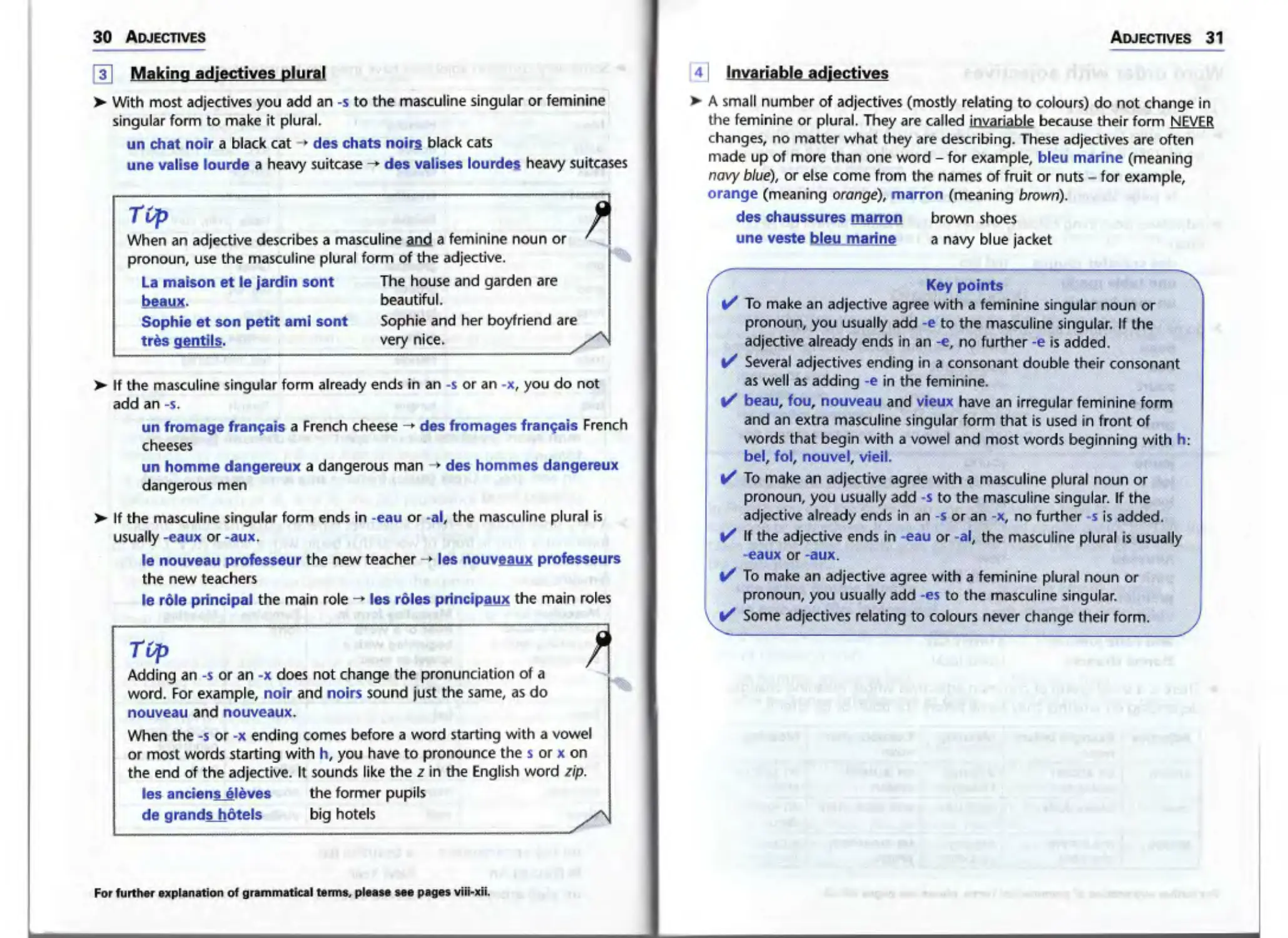
T] Making adjectives plural
>	With most adjectives you add an -s to the masculine singular or feminine
singular form to make it plural.
un chat noir a black cat -» des chats noirs black cats
une valise lourde a heavy suitcase -» des valises lourdes heavy suitcases
When an adjective describes a masculine and a feminine noun or
pronoun, use the masculine plural form of the adjective.
La maison et le jardin sont
beaux.
Sophie et son petit ami sont
tr6s qentils.
The house and garden are
beautiful.
Sophie and her boyfriend are
very nice.
►	If the masculine singular form already ends in an -s or an -x, you do not
add an -s.
un fromage fran^ais a French cheese -► des fromages fran^ais French
cheeses
un homme dangereux a dangerous man * des hommes dangereux
dangerous men
>	If the masculine singular form ends in -eau or -al, the masculine plural is
usually -eaux or -aux.
le nouveau professeur the new teacher -»les nouveaux professeurs
the new teachers
le role principal the main role -► les roles principaux the main roles
Adding an -s or an -x does not change the pronunciation of a
word. For example, noir and noirs sound just the same, as do
nouveau and nouveaux.
When the -s or -x ending comes before a word starting with a vowel
or most words starting with h, you have to pronounce the s or x on
the end of the adjective. It sounds like the г in the English word zip.
les anciens_eleves	the former pupils
de grands hotels	big hotels	>
For further explanation of grammatical terms, please see pages viii-xii.
Adjectives 31
4 Invariable adjectives
► A small number of adjectives (mostly relating to colours) do not change in
the feminine or plural. They are called invariable because their form NEVER
changes, no matter what they are describing. These adjectives are often
made up of more than one word - for example, bleu marine (meaning
navy blue), or else come from the names of fruit or nuts - for example,
orange (meaning orange), marron (meaning brown).
des chaussures man-on brown shoes
une veste bleu marine a navy blue jacket
Key points
✓	To make an adjective agree with a feminine singular noun or
pronoun, you usually add -e to the masculine singular. If the
adjective already ends in an -e, no further -e is added.
*	/ Several adjectives ending in a consonant double their consonant
as well as adding -e in the feminine.
✓	beau, fou, nouveau and vieux have an irregular feminine form
and an extra masculine singular form that is used in front of
words that begin with a vowel and most words beginning with h:
bel, fol, nouvel, vieil.
✓	To make an adjective agree with a masculine plural noun or
pronoun, you usually add -s to the masculine singular. If the
adjective already ends in an -$ or an -x, no further -s is added.
✓	If the adjective ends in -eau or al, the masculine plural is usually
-eaux or -aux.
i/ To make an adjective agree with a feminine plural noun or
pronoun, you usually add -es to the masculine singular.
✓	Some adjectives relating to colours never change their form.
32 Adjectives
Word order with adjectives
[T| The basic rules
► When adjectives are used right beside the noun they are describing, they
go BEFORE it in English. French adjectives usually go AFTER the noun.
I'heure exacte	the right time
la page sulvante	the following page
> Adjectives describing colours, shapes or nationalities always go AFTER the
noun.
des cravates rouges	red ties
une table ronde	a round table
un mot franca is a French word
> Some very common adjectives usually come BEFORE the noun.
beau	lovely, beautiful, good-looking, handsome
bon	good, right
court	short
grand	tall, big, long, great
gros	big, fat
haut	high
jeune	young
joli	pretty
long	long
mauvais	bad, poor
meilleur	better
nouveau	new
petit	small, little
premier	first
vieux	old
une belle joumee	a lovely day
Bonne chance!	Good luck!
> There is a small group of common adjectives whose meaning changes
depending on whether they come before the noun or go after it.
Adjective	Example before noun	Meaning	Example after noun	Meaning
ancien	un ancien collogue	a former colleague	un fauteuil ancien	an antique chair
cher	Chore Julie	Dear Julie	une robe chore	an expensive dress
propre	ma propre chambre	my own bedroom	un mouchoir propre	a clean handkerchief
For further explanation of grammatical terms, please see pages vHI-xll.
Adjectives 33
dernier (meaning last) and prochain (meaning next) go AFTER
nouns relating to time, for example, semaine (meaning week) and
mois (meaning month). Otherwise they go BEFORE the noun.
la semaine demiere
la demlfrre fois que je t'ai vu
la semaine prochaine
la prochaine fois que j'y vais
last week
the last time I saw you
next week
the next time I go there
Grammar Extra!
When certain adjectives are used with certain nouns, they take on a meaning you
cannot always guess. You may need to check these in your dictionary and learn them.
Here are a few:
mon petit ami
les petrts pois
les grandes vacances
une grande personne
my boyfriend
peas
the summer holidays
an adult, a grown-up
2]	Using more than one adjective
► In French you can use more than one adjective at a time to describe
someone or something. If one of the adjectives usually comes BEFORE the
noun and the other usually goes AFTER the noun, the word order follows
the usual pattern.
une ieune femme blonde	a young blonde woman
un nouveau film interessant an interesting new film
► If both adjectives usually come AFTER the noun, they are joined together
with et (meaning and).
un homme mince et laid	a thin, ugly man
une personne intelligente et drole an intelligent, funny person
Key points
✓ Most French adjectives go after the noun they describe.
✓ Some very common adjectives usually come before the noun:
bon/mauvais, court/long, grand/petit, jeune/nouveau/vieux,
gros, haut, beau, joli, premier, meilleur.
✓ The meaning of some adjectives such as ancien, cher and propre
varies according to the position in the sentence.
34 Adjectives
Comparatives and superlatives of adjectives
11 Making comparisons using comparative adjectives
What is a comparative adjective?
A comparative adjective in English is one with -er on the end of it or
more or less in front of it, that is used to compare people or things, for
example, slower, less important, more beautiful.
> In French, to say that something is easier, more expensive and so on, you use
plus (meaning more) before the adjective.
Cette question est plus facile. This question is easier.
Cette veste est plus chere. This jacket is more expensive.
> To say something is less expensive, less complicated and so on, you use
moins (meaning less) before the adjective.
Cette veste est moins chere. This jacket is less expensive.
un projet moins complique a less complicated plan
> To introduce the person or thing you are making the comparison with, use
que (meaning than).
Elie est plus petite que moi.	She's smaller than me.
Cette question est plus facile	This question is easier than the
que la premiere.	first one.
> To say that something or someone is as ... as something or someone else,
use aussi... que.
II est aussi inquiet que moi.	He's as worried as me.
Cette ville n'est pas aussi	This town isn't as big as Bordeaux,
grande que Bordeaux.
|2 । Making comparisons using superlative adjectives
What is a superlative adjective?
A superlative adjective in English is one with -est on the end of it or
most or least in front of it, that is used to compare people or things, for
example, thinnest, most beautiful, least interesting.
> In French, to say that something or someone is easiest, prettiest, most
expensive and so on, you use:
• le plus with masculine singular adjectives
For further explanation of grammatical terms, please see pages viii-xll.
Adjectives 35
•	la plus with feminine singular adjectives
•	les plus with plural adjectives (for both masculine and feminine)
le guide le plus utile
la question la plus facile
les plus grands hotels
les plus petites voitures
the most useful guidebook
the easiest question
the biggest hotels
the smallest cars
► To say that something or someone is the least easy, the least pretty, the least
expensive and so on, you use:
•	le moins with masculine singular adjectives
•	la moins with feminine singular adjectives
les moins with plural adjectives (for both masculine and feminine).
le guide le moins utile
Cette question est la moins
facile.
les mois les moins agreables
les moins belles photos
the least useful guidebook
This question is the least easy (or
the hardest).
the least pleasant months
the least attractive photos
When the adjective comes AFTER the noun, you repeat the '
definite article (le, la or les).
les mois les moins agreables the least pleasant months
When the adjective comes BEFORE the noun, you do not repeat the
definite article.
les moins belles photos
the least attractive photos
Ф For more information on Word order with adjectives, see page 32.
► In phrases like the biggest hotel in London and the oldest person in the village,
you use de to translate in.
le plus grand hotel de Londres the biggest hotel in London
la personne la plus agee du village the oldest person in the village
Ф For more information on de and du, see page 166.
з Irregular comparative and superlative adjectives
► Just as English has some irregular comparative and superlative forms - better
instead of 'more good', and worst instead of 'most bad' - French also has a
few irregular forms.
36 Adjectives
Adjective	Meaning	Comparative	Meaning	Superlative	Meaning
bon	good	meilleur	better	le meilleur	the best
mauvais	bad	pire plus mauvais	worse	le pire le plus mauvais	the worst
petit	small	moindre plus petit	smaller, lesser	le moindre le plus petit	the smallest, the least, the slightest
J'ai une meilleure idee.	I've got a better idea.
II ne fait pas le moindre effort. He doesn't make the slightest effort.
Tip
Choose the right form of the adjective to match the noun or
pronoun, depending on whether it is masculine or feminine, singular
or plural. Don't forget to change le to la or les too in
Grammar Extra!
bien and its comparative and superlative forms mleux and le mieux can be both
adjectives and adverbs.
II est bien. ce restaurant. (=od/ecbve) This restaurant is good.
Elie va mieux aujourd'hui. (•adverb) She's better today.
О for more information on Adverbs, see page 152.
Key points
✓ To compare people or things in French you use plus + adjective,
moins + adjective or aussi ... que.
✓	than in comparatives corresponds to que.
✓	French superlatives are formed with le/la/les plus + adjective and
le/la/les moins + adjective.
✓	in after superlatives corresponds to de.
»/ bon, mauvais and petit have irregular comparatives and
superlatives: bon/meilleur/le meilleur, mauvais/plre/le plre,
petit/moindre/le moindre.
For further explanation of grammatical terms, please see pages viii-xii.
Adjectives 37
Demonstrative adjectives ce, cette, cet and ces
What is a demonstrative adjective?
A demonstrative adjective is one of the words this, that, these and those
used with a noun in English to point out a particular thing or person, for
example, this woman, that dog.
► In French you use ce to point out a particular thing or person. Like all
adjectives in French, ce changes its form depending on whether you are
referring to a noun that is masculine or feminine, singular or plural.
	Masculine	Feminine	Meaning
Singular	ce (cet)	cette	this that
Plural	ces	ces	these those
cet is used in front of masculine singular nouns which begin with
a vowel and most words beginning with h.
cet oiseau
cet hopital
this/that bird
this/that hospital
► ce comes BEFORE the noun it refers to.
Combien co Cite ce manteau?
Comment s’appeile cette
entreprise?
Ces livres sont trds
interessants.
Ces couleurs sont jolies.
How much is this/that coat?
What's this/that company called?
These/Those books are very
interesting.
These/Those colours are pretty.
► If you want to emphasize the difference between something that is close to
you and something that is further away, you can add:
• -ci on the end of the noun for things that are closer
Prends cette valise-ci.	Take this case.
38 Adjectives
• -la on the end of the noun for things that are further away
Est-ce que tu reconnais cette Do you recognize that person?
personnels?
Key points
✓ The adjective ce corresponds to this and that in the singular, and
these and those in the plural.
✓ The forms are ce and cette in the singular, and ces in the plural,
cet is used with masculine singular nouns beginning with a vowel
and most words beginning with h.
✓ You can add -ci on the end of the noun for things that are closer,
or -la for things that are further away, to emphasize the difference
between them.
For further explanation of grammatical terms, please see pages vili-xli.
Adjectives 39
Possessive adjectives
What is a possessive adjective?
In English a possessive adjective is one of the words my, your, his, her, its,
>ur or their used with a noun to show that one person or thing belongs to
another.
► Here are the French possessive adjectives. Like all French adjectives, these
agree with the noun they refer to.
with masculine singular noun	with feminine singular noun	with plural noun (masculine or feminine)	Meaning
mon	ma (mon)	mes	my
ton	ta (ton)	tes	your
son	sa (son)	ses	his her its one's
notre	notre	nos	our
votre	votre	vos	your
leur	leur	leurs	their
You use mon, ton and son with feminine singular nouns in front '
of words that begin with a vowel and most words beginning with h.
This makes them easier to say.
mon assiette
ton histoire
son erreur
mon autre scaur
my plate
your story
his/her mistake
my other sister
► Possessive adjectives come BEFORE the noun they describe.
Voila mon man.
Mon frere et ma sceur habitent
£ Glasgow.
Est-ce que tes voisins vendent
leur maison?
Rangez vos affaires.
There's my husband.
My brother and sister live in
Glasgow.
Are your neighbours selling their
house?
Put your things away.
40 Adjectives
Possessive adjectives agree with what they describe, NOT with the
person who owns that thing. For example, sa can mean his, her, Its
and one's, but can only ever be used with a feminine singular noun.
Paul cherche sa montre.
Paul cherche ses lunettes.
Catherine a appele son frere.
Catherine a appele sa soeur.
Paul's looking for his watch.
Paul's looking for his glasses.
Catherine called her brother.
Catherine called her sister.
> The equivalent of your in French is ton/ta/tes for someone you call tu, or
votre/vos for someone you call vous.
Ф For more information on the difference between tu and vous, see page 43.
(71 Note that possessive adjectives are not normally used with parts of
the body. Use le, la, I' or les instead.
J'ai mal a la main.
My hand hurts.
О For more information on Articles, see page 12.
Key points
The French possessive adjectives are:
•	mon/ton/son/notre/votre/leur in the masculine singular
•	ma/ta/sa/notre/votre/leur in the feminine singular
•	mes/tes/ses/nos/vos/leurs in the plural
Possessive adjectives come before the noun they refer to. They
agree with what they describe, rather than with the person who
owns that thing.
You use mon, ton and son with feminine singular nouns when
the following word begins with a vowel. You also use them with
most words beginning with h.
Possessive adjectives are not normally used with parts of the body.
Use le, la, Г or les instead.
For further explanation of grammatical terms, please see pages via-xii.
Adjectives 41
Indefinite adjectives
What is an indefinite adjective?
An indefinite adjective is one of a small group of adjectives that are used
to talk about people or things in a general way without saying exactly
who or what they are, for example, several, all, every.
► In French, this type of adjective comes BEFORE the noun it refers to. Here
are the most common French indefinite adjectives:
Masculine singular	Feminine singular	Masculine plural	Feminine plural	Meaning
autre	autre	autres	autres	other
chaque	chaque	-	-	every, each
тёте	тёте	m»mes	memes	same
-	-	quelques	quelques	some, a tew
tout	toute	tous	toutes	all, every
J'ai d'autres projets.
J'y vais chaque annee.
J'ai le meme manteau.
II a quelques amis a Paris.
II reste quelques bouteilles.
II travaille tout le temps.
I've got other plans.
I go every year.
I have the same coat.
He has some friends in Paris.
There are a few bottles left.
He works all the time.
You can also use tout to talk about how often something happens.
tous les jours	every day
tous les deux jours	every other day
[71 Note that these words can also be used as pronouns, standing in place
of a noun instead of being used with one. chaque and quelques have
a slightly different form when they are used in this way.
Ф for more Information on Pronouns, see page 42.
Key points
✓ The most common French indefinite adjectives are autre, chaque,
тёте, quelques and tout.
\ They come before the noun when they are used in this way.
( PRONOUNS )
What is a pronoun?
A pronoun is a word you use instead of a noun, when you do not need
or want to name someone or something directly, for example, it, you,
none.
► There are several different types of pronoun:
•	Personal pronouns such as I, you, he, her and they, which are used to
refer to yourself, the person you are talking to, or other people and
things. They can be either subject pronouns (/, you, he and so on) or
object pronouns (him, her, them and so on),
•	Possessive pronouns like mine and yours, which show who someone or
something belongs to.
•	Indefinite pronouns like someone or nothing, which refer to people or
things in a general way without saying exactly who or what they are.
•	Relative pronouns like who, which or that, which link two parts of a
sentence together.
•	Demonstrative pronouns like this or those, which point things or people
out.
•	Reflexive pronouns, a type of object pronoun that forms part of French
reflexive verbs like se laver (meaning to wash) or s'appeler (meaning to
be called).
Ф For more information on Reflexive verbs, see page 88.
•	The two French pronouns, en and y, which are used in certain
constructions.
•	The pronouns qui? (meaning who?, whom?), que? (meaning what?),
quoi? (meaning what?) and lequel? (meaning which one?), which are
used in asking questions.
lO For more information on Questions, see page 142.
> Pronouns often stand in for a noun to save repeating it.
I finished my homework and gave it to my teacher.
Do you remember Jack? I saw him at the weekend.
> Word order with personal pronouns is usually different in French and
English.
For further explanation of grammatical terms, please see pages viii*xii.
Pronouns 43
Personal pronouns: subject
What is a subject pronoun?
A subject pronoun is a word such as /, he, she and they, which performs
the action expressed by the verb. Pronouns stand in for nouns when it is
clear who is being talked about, for example, My brother isn't here at the
moment, tie'll be back in an hour.
i ] Using subject pronouns
► Here are the French subject pronouns:
Singular	Meaning	Plural	Meaning
je (D	1	nous	we
tu	you	vous	you
il	he it	ils	they (masculine)
elle	she it	elles	they (feminine)
on	one (we/you/they)
Je pars en vacances domain.
Nous habitons a Nice.
I'm going on holiday tomorrow.
We live in Nice.
je changes to j' in front of words beginning with a vowel, most
words beginning with h, and the French word y.
J'arrive!	I'm just coming!
Bon, j'y vais.	Right, I'm off.
2j tu or vous?
► In English we have only one way of saying you. In French, there are two
words; tu and vous. The word you use depends on;
•	whether you are talking to one person or more than one person
•	whether you are talking to a friend or family member, or someone else
► If you are talking to one person you know well, such as a friend, a young
person or a relative, use tu.
Tu me pretes ce CD? Will you lend me this CD?
44 Pronouns
► If you are talking to one person you do not know so well, such as your
teacher, your boss or a stranger, use vous.
Vous pouvez entrer. You may come in.
If you are in doubt as to which form of you to use, it is safest to
use vous and you will not offend anybody.
> If you are talking to more than one person, you have to use vous, no
matter how well you know them.
Vous comprenez, les enfants? Do you understand, children?
[71 Note that the adjectives you use with tu and vous have to agree in
the feminine and plural forms.
Vous etes certain. Monsieur Are you sure, Mr Leclerc?
Leclerc? (masculine singular)
Vous etes certains, les enfants? Are you sure, children?
(masculine plural)
Grammar Extra!
Any past participles (the form of the verb ending in -e, -I or -u in French) used with etre
in tenses such as the perfect also have to agree in the feminine and plural forms.
Vous etes partie quand, Estelle?
(feminine singular)
Estelle et Sophie - vous etes
parties quand? (feminine plural)
When did you leave, Estelle?
Estelle and Sophie - when did you
leave?
O For more information on the Past participle, see page 111.
il/elle and ils/elles
> In English we generally refer to things (such as table, book, car) only as it. In
French, il (meaning he, it) and elle (meaning she, it) are used to talk about
a thing, as well as about a person or an animal. You use il for masculine
nouns and elle for feminine nouns.
II est deja parti.
Elle est actrice.
II mord, ton chien?
Prends cette chaise. Elle est
plus confortable.
He's already left.
She's an actress.
Does your dog bite?
Take this chair. It's more
comfortable.
For further explanation of grammatical terms, please see pages viii-xii.
Pronouns 45
► il is also used to talk about the weather, the time and in certain other set
phrases, often in the same way as some phrases with it in English.
IJ pleut.	It's raining.
II est deux heures.	It's two o'clock.
IJ faut partir.	We/You have to go.
ils (meaning they) and elles (meaning they) are used in the plural to talk
about things, as well as about people or animals. Use ils for masculine
nouns and elles for feminine nouns.
Ils vont appeler ce soir.
'Ou sont Anne et Rachel?' -
'Elles sont a la piscine.'
Est-се qu'il reste des billets?'
- 'Non, ils sont tous vendus.'
Tu aimes ces chaussures?' -
'Non, elles sont affreusesl'
They're going to call tonight.
"Where are Anne and Rachel?' -
'They're at the swimming pool.'
'Are there are any tickets left?' -
'No, they're all sold.'
'Do you like those shoes?' 'No,
they're horrible!'
► If you are talking about a masculine and a feminine noun, use ils.
What do your father and mother do
when they go on holiday?
"Where are the pepper and the
mustard?' - 'They're already on the
table.'
Que font ton рёге et ta mere
quand ils partent en vacances?
'Ou sont le poivre et la
moutarde?' - 'Us sont deja sur
la table.'
4] ОП
► on is frequently used in informal, everyday French to mean we.
On va a la plage demain. We're going to the beach tomorrow.
On у va?	Shall we go?
► on can also have the sense of someone or they.
On m'a vole mon porte-monnaie. Someone has stolen my purse.
On vous demande au telephone; There's a phone call for you.
Tty
on is often used to avoid a passive construction in French.
On m'a dit que tu dtais malade. I was told you were ill.
Ф For more information on the Passive, see page 122.
46 Pronouns
► You can also use on as we use you in English when we mean people in
general.
On peut visiter le chateau en You can visit the castle in the
ete.	summer.
D'ici on peut voir les cotes From here you can see the French
frangaises.	coast.
The form of the verb you use with on is the same as the il/elle
form.
О For more information on Verbs, see pages 69-137.
Key points
✓	The French subject pronouns are: je (j')» tu, il, elle, on in the
singular, and nous, vous, ils, elles in the plural.
✓	To say you in French, use tu if you are talking to one person you
know well or to a young person. Use vous if you are talking to
one person you do not know so well or to more than one person.
✓	il/ils (masculine singular/plural) and elle/elles (feminine
singular/plural) are used to refer to things, as well as to people or
animals, il is also used in certain set phrases.
✓	If there is a mixture of masculine and feminine nouns, use ils.
✓	on can mean we, someone, you, they, or people in general.
It is often used instead of a passive construction.
For further explanation of grammatical terms, please see pages viii-xu.
Pronouns 47
Personal pronouns: direct object
What is a direct object pronoun?
A direct object pronoun is a word such as me, him, us and them, which is
used instead of the noun to stand in for the person or thing most directly
affected by the action expressed by the verb.
1 Using direct object pronouns
> Direct object pronouns stand in for nouns when it is dear who or what is
being talked about, and save having to repeat the noun.
I've lost my glasses. Have you seen them?
'Have you met jo?' - Tes, I really like herl'
> Here are the French direct object pronouns:
Singular	Meaning	Plural	Meaning
me (m‘)	me	nous	us
te (t'|	you	vous	you
le (П	him it	les	them (masculine and feminine)
la (П	her it
Ils vont nous aider.
Je la vois.
Tu aimes les carottes?' -
'Non, je les diteste! ’
They're going to help us.
I can see her/it.
'Do you like carrots?' - 'No, I hate
them!'
171 Note that you cannot use direct object pronouns after a preposition
like a or de, or when you want to emphasize something.
• I> For more information on Emphatic pronouns, see page SI.
Tip
me changes to m', te to t', and le/la to I' in front of words
beginning with a vowel, most words beginning with h, and the
French word y.
Je taime.	I love you.
Tu mlentends?	Can you hear me?
48 Pronouns
► In orders and instructions telling someone to do something, moi is used
instead of me, and toi is used instead of te.
Aidez-moi!	Help me!
Assieds-toi.	Sit down.
> le is sometimes used to refer back to an idea or information that has already
been given. The word it is often missed out in English.
Ta chemise est tres sale.' - 'Your shirt's very dirty.' -
'Je le sais.'	'I know.'
[ 2 | Word order with direct object pronouns
► The direct object pronoun usually comes BEFORE the verb.
Je taime.	I love you.
Les voyez-vous?	Can you see them?
Elle ne nous connait pas. She doesn't know us.
Г71 Note that in orders and instructions telling someone to do something,
the direct object pronoun comes AFTER the verb.
Asseyez-vous.	Sit down.
> In tenses like the perfect that are formed with avoir or £tre and the past
participle (the part of the verb that ends in -e, -i or -u in French), the direct
object pronoun comes BEFORE the part of the verb that comes from avoir
or etre.
II m'a vu.
He saw me.
> When a verb like vouloir (meaning to want) or pouvoir (meaning to be able
to, can) is followed by another verb in the infinitive (the 'to'form of the
verb), the direct object pronoun comes BEFORE the infinitive.
II voudrait la revoir.	He'd like to see her again.
Puis-je vous aider?	Can I help you?
Key points
The French direct object pronouns are: me (m'), te (t'), le/la (I')
in the singular, and nous, vous, les in the plural.
Except in orders and instructions telling someone to do
something, the direct object pronoun comes before the verb.
For further explanation of grammatical terms, please see pages vilFxii.
Pronouns 49
Personal pronouns: indirect object
What is an indirect object pronoun?
When a verb has two objects (a direct one and an indirect one), the
indirect object pronoun is used instead of a noun to show the person or
thing the action is intended to benefit or harm, for example, me in He
gave me a book; Can you get me о towel?
1 ] Using indirect object pronouns
► It is important to understand the difference between direct and indirect
object pronouns in English, as they can have different forms in French:
•	an indirect object answers the question who to/for? or to/for
what?
He gave me a book. -» Who did he give the book to? -* me (^indirect
object pronoun)
Can you get me a towel? -» Who can you get a towel for? -* me
(^indirect object pronoun)
•	if something answers the question what or who, then it is the direct
object and NOT the indirect object
He gave me a book. -♦ What did he give me? -» a book (-direct
object)
Can you get me a towel? -* What can you get me? -» a towel (^direct
object)
► Here are the French indirect object pronouns:
Singular	Meaning	Plural	Meaning
me (m‘)	me, to me, for me	nous	us, to us, for us
te (t')	you, to you, for you	vous	you, to you, for you
lui	him, to him, for him it, to it, for it	leur	them, to them, for them (такиНпе and feminine)
lui	her, to her, for her it, to it, for it
II nous ecrit tous les jours.
Ils te cachent quelque chose.
He writes to us every day.
They're hiding something from you.
50 Pronouns
me changes to m' and te to t' in front of words beginning with a
vowel, most words beginning with h, and the French word y.
II m'a donn£ un livre.	He gave me a book.
Tu m'apportes une serviette? Can you get me a towel?
► The pronouns shown in the table are used instead of the preposition a with
a noun.
I'ecris a Suzanne. I'm writing to Suzanne. * Je lui ecris. I'm writing to her.
Donne du lait au chat Give the cat some milk. -* Donne-lui du lait. Give
it some milk.
> Some French verbs like demander i (meaning to ask) and t£l£phoner a
(meaning to phone) take an indirect object even though English uses a
direct object.
II leur telephone tous les soirs. He phones them every evening.
> On the other hand, some French verbs like attendre (meaning to wait for),
chercher (meaning to look for) and regarder (meaning to look at) take a
direct object even though English uses an indirect object.
Je les attends devant la gare. I'll wait for them outside the station.
T] Word order with indirect object pronouns
> The indirect object pronoun usually comes BEFORE the verb.
Dominique vous ecrit une lettre. Dominique's writing you a letter.
II ne nous parte pas.	He doesn't speak to us.
II ne veut pas me repondre.	He won't answer me.
И Note that in orders and instructions telling someone to do
something, the indirect object pronoun comes AFTER the verb.
Donne-mci cal	Give me that!
Key points
✓ The French indirect object pronouns are: me (m'), te (t'), lui in
the singular, and nous, vous, leur in the plural.
✓ Except in orders and instructions telling someone to do
something, the direct object pronoun comes before the verb.
For further explenation of grammatical terms, please see pages vlil-xii.
Pronouns 51
Emphatic pronouns
What is an emphatic pronoun?
An emphatic pronoun is used instead of a noun when you want to
emphasize something, for example Is this for me?
11 Using emphatic pronouns
► In French, there is another set of pronouns which you use after
prepositions, when you want to emphasize something and in certain other
cases. These are called emphatic pronouns or stressed pronouns.
Singular	Meaning	Plural	Meaning
moi	1 me	nous	we us
toi	you	vous	you
lui	he him	eux	they (.masculine) them
elle	she her	elles	they (feminine) them
soi	oneself (yourself, ourselves)
Je pense souvent a toi.
C'est pour mpi?
Venez avec moi.
II a besoin de nous.
I often think about you.
Is this for me?
Come with me.
He needs us.
► soi (meaning oneself) is used with the subject pronoun on and with words
like tout le monde (meaning everyone) or chacun (meaning each one).
II faut avoir confiance en sei. You have to have confidence in
yourself.
Tout le monde est rentrd chez Everyone went home.
soi.
2 When to use emphatic pronouns
► Emphatic pronouns are used in the following circumstances:
• after a preposition
C'est pour moi?	Is this for me?
52 Pronouns
for emphasis, especially where a contrast is involved
Toi, tu ressembles a ton pare,
mais elle non.
II m'6nerve, |ui!
•	on their own without a verb
'Qui a casse la fenetre?’ - 'Lui.'
'Je suis fatiguee.' - 'Moi aussi.'
•	after c'est and ce sont (meaning il
C'est toi, Simon?
Ce sont eux.
You look like your father, she
doesn't.
He's getting on my nerves!
"Who broke the window?' - 'He did.'
'I'm tired.' - 'Me too.'
Й)
Is that you, Simon?
It's them.
< For more information on c'est and ce sont, see page 65.
•	in comparisons
Tu es plus jeune que moi. You're younger than me.
II est moins grand que toi. He's smaller than you (are).
•	when the subject of the sentence is made up of two pronouns, or of a
pronoun and a noun
Mon oere et elle ne	My father and she don't get on.
s'entendent pas.
Grammar Extra!
You can add -meme or -memes to the emphatic pronouns when you particularly want
to emphasize something. These forms correspond to English myself, ourselves and so on.
Form with -meme	Meaning
moimeme	myself
toi-meme	yourself
lul-тёте	himself, itself
elle-meme	herself. Itself
soi-meme	oneself (yourself, ourselves)
nous-memes	ourselves
vous meme vous-m£mes	yourself yourselves
eux-m£mes	themselves (masculine)
elles-memes	themselves (feminine)
Je I'ai fait mol-meme.	I did it myself.
Elle i'a choisi elle-mfeme.	She chose it herself.
For further ««planation of grammatical terms, please see pages viii-xii
Pronouns 53
Key points
The French emphatic pronouns are: moi, toi, lui, elle, soi in the
singular, and nous, vous, eux, elles in the plural.
✓ They are used:
•	after a preposition
•	for emphasis
•	on their own without a verb
•	after c'est and ce sont
•	in comparisons
•	when the subject of the sentence is made up of two pronouns,
or of a pronoun and a noun
✓ You can add -meme or -memes to the emphatic pronouns when
you particularly want to emphasize something.
54 Pronouns
Possessive pronouns
What is a possessive pronoun?
A possessive pronoun is one of the words mine, yours, hers, his, ours or
theirs, which are used instead of a noun to show that one person or thing
belongs to another, for example, Ask Carole if this pen is hers.
> Here are the French possessive pronouns:
Masculine singular	Feminine singular	Masculine plural	Feminine plural	Meaning
le mien	la mienne	les miens	les miennes	mine
le tien	la tienne	les tie ns	les Hennes	yours
le sien	la sienne	les siens	les siennes	his hers
le notre	la notre	les n&tres	les ndtres	ours
le vdtre	la vdtre	les votres	les votres	yours
le leur	la leur	les leurs	les leurs	theirs
Ces CD-la, ce sont les miens.
Heureusement que tu as tes
des. J'ai oublie les miennes.
Those CDs are mine.
It's lucky you've got your keys.
I forgot mine.
Tip	/
In French, possessive pronouns agree with what they describe,
NOT with the person who owns that thing. For example, le sien
can mean his or hers, but can only be used to replace a masculine
singular noun.
'C'est le velo de Paul?' -
'Oui, c'est le sien.*
'C'est le velo d'Isabelle?' -
'Oui, c'est le sien.'
'Is that Paul's bike?' -
"Yes, it's his.'
'Is that Isabelle's bike?' -
'Yes, it's hers.'
For further explanation of grammatical tarm». please see pages vlii-xii.
Pronouns 55
Grammar Extra!
Remember that a with the definite article le becomes au, and a with les becomes aux,
so:
i + le mien -» au mien
i + les miens -» aux miens
a + les miennes ► aux miennes
Tu preferes ce manteau au mien? Do you prefer this coat to mine?
Remember that de with the definite article le becomes du, and de with les becomes
des, so:
de + le mien » du mien
de + les miens  des miens
de + les miennes des miennes
J'ai oublie mes cles. J'ai besoin I've forgotten my keys. I need
des tiennes.	yours.
• For more information on Articles, see роде 12.
Key points
✓ The French possessive pronouns are le mien, le tien, le sien for
singular subject pronouns, and le notre, le vdtre and le leur for
plural subject pronouns. Their forms change in the feminine and
the plural.
✓ In French, the pronoun you choose has to agree with the noun it
replaces, and not with the person who owns that thing.
56 Pronouns
en and у
> en and у do not usually refer to people. How we translate them into English
depends on where en and у are found in French.
en
en is used with verbs and phrases normally followed by de to avoid
repeating the same word.
Si tu as un ргоЫёте, tu рейх
m'en pari er.
Est-ce que tu рейх me prefer
ce livre? J'en ai besoin.
II a un beau jardin et il en est
tres fier.
If you've got a problem, you can
talk to me about it. (en replaces de
in parler de quelque chose)
Can you lend me that book? I need
it. (en replaces de in avoir besoin de
quelque chose)
He's got a beautiful garden and is
very proud of it. (en replaces de in
etre fier de quelque chose)
> en can also replace the partitive article (du, de la, de Г, des).
Je n'ai pas d'argent.Tu en as? I haven't got any money. Have you
got any?
Tu рейх me prater des timbres?' 'Can you lend me some stamps?' -
- 'Non, je dots en acheter.' 'No, I have to buy some.'
r[> For more information on the Partitive article, see page 22.
> en is also used:
•	as a preposition
•	with the present participle of verbs
Ф For more information on Prepositions and the Present participle, see pages
162 and 125.
> When en is used with avoir, with II у a or with numbers, it is often not
translated in English but can NEVER be missed out in French.
'Est-ce que tu as un
dictionnaire?' - 'Oui, j'en ai un.'
'Combien d'eleves у a-t-il dans
ta classe?' - 'II у en a trente.'
J'en veux deux.
'Have you got a dictionary?' - 'Yes,
I've got one.'
'How many pupils are there in your
class?' - There are thirty.'
I want two (of them).
For further explanation of grammatical terms, please see pages vHI-xli.
Pronouns 57
Hl Y
► у is used with verbs and phrases normally followed by a to avoid repeating
the same word.
'Je pensais a I'examen.' - 'Mais 'I was thinking about the exam.' -
arrete d'y penserl'	'Well, stop thinking about it!' (y
replaces a in penser a quelque chose)
'Je ne m'attendais pas a $a.' - 'I wasn't expecting that.' - 'Well, I
'Moi, je m'y attendais.'	was expecting it.' (y replaces a in
s'attendre a quelque chose)
► у can also mean there. It can be used to replace phrases that would use
prepositions such as dans (meaning in) and sur (meaning on).
Elle у passe tout I'ete.	She spends the whole summer
there.
Regarde dans le tiroir. Je pense Look in the drawer. I think the keys
que les cles у sont.	are in there.
► en and у usually come BEFORE the verb.
J'en veux.	I want some.
Elle en a parte avec moi. She talked to me about it.
En etes-vous content?	Are you pleased with it/them?
Comment fait-on pour у aller? How do you get there?
N'y pense plus.	Don't think about it any more.
► In orders and instructions telling someone to do something, en or у come
AFTER the verb and are attached to it with a hyphen (-).
Prenez-en	Take some.
Restez-y.	Stay there.
The final -$ of -er verbs is usually dropped in the tu form used for '
orders and instructions. When an -er verb in the tu form is used
before en or y, however, the -s is not dropped, to make it easier to
say.
Donne des bonbons a ton frere. Give some sweets to your brother.
Donnes-en a ton frere.	Give some to your brother.
Va dans ta chambre!	Go to your room!
Vas-y!	Go on!
• t> For more information on the Imperative, see page 85.
58 Pronouns
> en and у come AFTER other direct or indirect object pronouns.
Donnez-leur-en.	Give them some.
II m'en a parte.	He spoke to me about it.
Ф For more information on Direct object pronouns and Indirect object
pronouns, see pages 47 and 49.
Key points	\
✓	en is used with verbs and expressions normally followed by de to
avoid repeating the same word.
✓	en can also replace the partitive article.
к/ When en is used with avoir and il у a or with numbers, it is often
not translated in English but can never be missed out in French.
✓	у is used with verbs and expressions normally followed by a to
avoid repeating the same word.
g/ у can also mean there and may replace expressions that would be
used with dans and sur or some other preposition indicating
a place.
✓	en and у usually come before the verb, except in orders and
instructions telling someone to do something, when en or у
follows the verb and is attached to it with a hyphen.
✓	en and у come after other direct or indirect object pronouns.
For further explanation of grammatical terms, please see pages viii-xii.
Pronouns 59
Using different types of pronoun together
► Sometimes you find a direct object pronoun and an indirect object pronoun
in the same sentence.
He gave me (indirect object) them (direct object).
He gave them (direct object) to me (indirect object).
> When this happens in French, you have to put the indirect and direct object
pronouns in a certain order.
Dominique vous I'envole
demain.
II 1® les a montres?
Je les lui ai lus.
Ne la leur donne pas.
Elle ne m'en a pas parte.
Dominique's sending it to you
tomorrow.
Has he shown them to you?
I read them to him/her.
Don't give it to them.
She didn't speak to me about it.
Key points
✓ If a direct and an indirect object pronoun are used in the same
sentence, you usually put the indirect object pronoun before the
direct object pronoun.
✓ With lui and leur, this order is reversed and you put the direct
object pronoun before the indirect object pronoun.
60 Pronouns
Indefinite pronouns
What is an indefinite pronoun?
An indefinite pronoun is one of a small group of pronouns such as
everything, nobody and something which are used lo refer to people or
things in a general way without saying exactly who or what they are.
> Here are the most common French indefinite pronouns:
•	chacun (.masculine singulaf)/chacune (feminine singular) each, everyone
Nous avons chacun donn$ We each gave ten euros,
dix euros.
Chacun fait ce qu’il veut. Everyone does what they like.
Toutes les villas ont chacune Each villa has its own swimming
leur piscine.	pool.
•	personne nobody/no one, anybody/anyone
II n’y a personne a la maison.	There’s no one at home.
Elle ne veut voir personne.	She doesn't want to see anybody.
Ф For more information on Negatives, see page 138.
You can use personne on its own to answer a question.
Qui sait la reponse? Personne. Who knows the answer? No one.
If the sentence contains a verb you have to use ne with it.
Personne (Vest venu.	Nobody came.
•	quelque chose something, anything
J'ai ouelque chose pour toi.	I've got something for you.
Avez-vous quelque chose a	Do you have anything to declare?
d£darer?
•	quelqu'un somebody/someone, anybody/anyone
II у a quelqu'un a la porte. There's someone at the door.
Quelqu'un a vu mon parapluie? Has anybody seen my umbrella?
•	rien nothing, anything
Elle n’a rien drt.	She didn't say anything.
Rien n'a change.	Nothing's changed.
• For more information on Negatives, see page 138.
For further explanation of grammatical terms, please see pages vlll-xli.
Pronouns 61
Тир
You can use rien on its own to answer a question.
'Qu'est-ce tu as achete?' -	'What did you buy?'	-
'Rien.'	'Nothing.'
If the sentence contains a verb you have to use ne with it.
II n> rien тапдё.	He's eaten nothing.
•	tout everything
II organise tout.	He's organizing everything.
Tout va bien?	Is everything OK?
•	tous (masculine plural)ftoutes (feminine pluraf) all
Je les connais tous.	I know them all.
Elies sont toutes arrivees? Are they all here?
► You can use quelque chose de/rien de and quelqu'un de/personne de
with adjectives if you want to say nothing interesting, something new and
so on.
rien d'interessant	nothing interesting
Key points
✓ rien and personne can be used on their own to answer
questions, but need to be used with ne when there is a verb in
the sentence.
quelque chose/rien and quelqu'un/personne can be followed
62 Pronouns
Relative pronouns: qui, que, lequel, auquel, duquel
What is a relative pronoun?
In English a relative pronoun is one of the words who, which and that
(and the more formal whom) which can be used to introduce information
that makes it clear which person or thing is being talked about, for
example. The man who has just come in is Ann's boyfriend; The vase that
you broke was quite valuable.
Relative pronouns can also introduce further information about someone
or something, for example, Peter, who is a brilliant painter, wants to study
art, jane's house, which was built in 1890, needs a lot of repairs.
> In French, the relative pronouns are qui que; lequel auquel, and duquel.
Pronouns 63
► qui is also used after a preposition such as a, de or pour to talk about
people.
la personne a qui il parte the person he is speaking to
les enfants pour qui j'ai achete the children I bought sweets for
des bonbons
In English we often miss out the object pronouns who, which '
and that. For example, we can say both the friends that I see most, or
the friends I see most, and the house which we want to buy, or the
house we want to buy. In French you can ~NEVER miss out que or qui
in this way.	>
[1 qui and que
> qui and que can both refer to people or things.
	Relative pronoun	Meaning
Subject	qui	who which that
Direct object	que	who, whom which that
2] lequel. laquelle. lesquels. lesquelles
► lequel (meaning which) is used after a preposition such as a, de or pour to
talk about things. It has to agree with the noun it replaces.
	Masculine	Feminine	Meaning
Singular	lequel	laquelle	which
Plural	lesquels	lesquelles	which
Mon frere, qui a vingt ans, est
a I'universrte.
Est-ce qu'il у a un bus qui va
au centre-ville?
Les amis que je vois le plus
sont Lea et Mehdi.
Voila la maison que nous
voulons acheter.
My brother, who's twenty, is at
university.
Is there a bus that goes to the town
centre?
The friends (that) I see most are Lea
and Mehdi.
That's the house (which) we want
to buy.
le livre pour lequel elle est
connue
la table sur laquelle j'ai mis
mon sac
the book she is famous for
the table I put my bag on
► Remember that a and de combine with the definite article le to become au
and du, and with les to become aux and des. lequel/lesquels/lesquelles
combine with a and de as shown in the table, laquelle doesn't change.
que changes to qu' in front of a word beginning with a vowel
and most words beginning with h.
	♦ lequel	♦ laquelle	♦ lesquels	+ lesquelles	Meaning
a	auquel	a laquelle	auxquels	auxquelles	to which
de	duquel	de laquelle	desquels	desquelles	of which
• I For more information on a and de, see pages 14 and 15.
For further explanation of grammatical terms, please see pages viii-xii.
64 Pronouns
Grammar Extra!
dont means whose, of whom, of which, about which and so on. It can refer to people or
things, but its form NEVER changes.
la femme dont la voiture est
en panne
les films dont tu paries
the woman whose car has broken
down
the films you're talking about
Key points
✓ qui and que can both refer to people or things: qui is the subject
of the part of the sentence it is found in; que is the object.
✓ In English we often miss out the object pronouns who, which and
that, but in French you can never miss out que or qui.
✓ After a preposition you use qui if you are referring to people, and
Icquel if you are referring to things - lequel agrees with the noun
it replaces.
✓	a + lequel auquel
a + lesquels -♦ auxquels
a + lesquelles -♦ auxquelles
✓	de + lequel -» duquel
de + lesquels » desquels
de + lesquelles > desquelles
For further explanation of grammatical term», please see pages viii-xii.
Pronouns 65
Demonstrative pronouns: ce, cela/?a, ceci, celui
What is a demonstrative pronoun?
In English a demonstrative pronoun is one of the words this, that, these,
and those used instead of a noun to point people or things out, for
example, That looks fun.
1J ce
► ce is usually used with the verb etre (meaning to be) in the expressions
c'est (meaning it's, that's), c'etait (meaning it was, that was), ce sont
(meaning it's, that's) and so on.
Ost moi.	It's me.
Otalt mon frere.	That was my	brother.
Ce sont eux.	It's them.
TCp
ce becomes c' when it is followed by a part of the verb that starts
with e or e.
ce becomes {' when it is followed by a part of the verb that starts
with a.
Q'a ete difficile.	It was difficult.
Note that after c'est and ce sont and so on you have to use the
emphatic form of the pronoun, for example, moi instead of je, eux
instead of ils and so on.
C'est moi.	It's me.
Ф For more information on Emphatic pronouns, see page 51.
► ce is used:
• with a noun or a question word to identify a person or thing
Qui est-ce?
Ce sont des professeurs.
Qu'est-ce que c'est?
C'est un ouvre-boite.
Who is it?. Who's this/that?
They're teachers.
What's this/that?
It's a tin-opener.
66 Pronouns
• with an adjective to refer to a statement, idea and so on that cannot be
classed as either masculine or feminine
C'est tres interessant.
C'est dangereux.
Ce n'est pas grave.
for emphasis
dest moi qui ai telephone.
Ce sont les enfants qui ont fait
le gateau.
That's/lt's very interesting.
That's/lt's dangerous.
It doesn't matter.
ft was me who phoned.
It was the children who made the
cake.
[2]	cel a, ya and ceci
cela and ya mean it, this or that. Both refer to a statement, an idea or an
object, ya is used instead of cela in everyday, informal French.
Ca ne fait rien. Ecoute-moi ya! Cela depend. Je n'aime pas cela. Donne-moi ya!	It doesn't matter. Listen to this! That/lt depends. 1 don't like that. Give me that!
ya and cela are used in a more general way than il and elle,
which are usually linked to a noun that has already been mentioned.
Qa te plait d’aller a I'etranger? Do you like going abroad?
Elle te plait, ma nouvelle Do you like my new car?
voiture?
> ced means this and is not as common as cela and ya. It is used to talk
about something that has not yet been mentioned.
Lisez ceci.	Read this.
► ceci is also used to hand or show someone something.
Prends ceci.Tu en auras besoin. Take this. You'll need it.
[з]	celui, celle, ceux. celles
> celui and celle mean the one; ceux and celles mean the ones. The form you
choose depends on whether the noun it is replacing is masculine or
feminine, and singular or plural.
For further explanation of grammatical terms, please see pages viii-xii.
Pronouns 67
	Masculine	Feminine	Meaning
Singular	celui	celle	the one
Plural	ceux	celles	the ones
► celui and its other forms are used before:
qui, que or dont
'Quelle robe preferez-vous?'
- 'Celle qui est en vitrine.'
Prends ceux que tu prefaces.
celui dont je t'ai parte
'Which dress do you like best?'
- The one in the window.'
Take the ones you like best,
the one I told you about
•	prepositions like dans and so on.
celui proche de la fontaine the one near the fountain
► celui and its other forms can be used with de to show who something
belongs to. In English, we would use's.
Je n'ai pas d'appareil photo
mais je рейх emprunter celui
de ma soeur.
Comparez vos reponses a
celles de votre voisin.
► You can add the endings -ci and -la to celui and its other forms to
emphasize the difference between something that is close to you and
something that is further away.
•	use -ci for something that is closer to you
•	use -la for something that is further away
I haven't got a camera but I can
borrow my sistefs.
Compare your answers with your
neighbours.
	Masculine	Feminine	Meaning
Singular	celui-ci celui-la	celle-ci cellela	this, this one that, that one
Plural	ceux-d ceux-la	celles-cl celles-la	these, these ones those, those ones
On prend quel fromage?
Celui-ci ou celui-la?
Ces chemises ont deux poches
mais celles-la n'en ont pas.
Which cheese shall we get? This
one or that one?
These shirts have two pockets but
those have none.
68 Pronouns
Key points
✓ ce is often found in the expressions c'est, ce sont and so on.
✓ ce is also used:
•	to identify a person or thing
•	to refer to a statement, idea and so on that cannot be classed
as either masculine or feminine
•	for emphasis
✓ cela and ?a mean it, this or that; ceci means this, but is not as
common.
fc/ celui and celle mean the one-, ceux and celles mean the ones.
They are often found with the endings -ci and -la and are used
to distinguish between things which are close and things which
are further away.
For further explanation of grammatical terms, please see pages vSi-xii.
( VERBS )
What is a verb?
A verb is a 'doing' word which describes what someone or something
does, what someone or something is, or what happens to them, for
example, be, sing, live.
The three conjugations
► Verbs are usually used with a noun, with a pronoun such as /, you or she, or
with somebody's name. They can relate to the present, the past and the
future; this is called their tense.
• t> For more information on Nouns and Pronouns, see pages 1 and 42.
► Verbs are either:
•	regular: their forms follow the normal rules
•	irregular; their forms do not follow the normal rules
► Regular English verbs have a base form (the form of the verb without any
endings added to it, for example, walk). The base form can have to in front
of it, for example, to walk. This is called the infinitive. You will find one of
these forms when you look a verb up in your dictionary.
► French verbs also have an infinitive, which ends in -er, -ir or -re, for
example, donner (meaning to give), finir (meaning to finish), attendre
(meaning to wait). Regular French verbs belong to one of these three verb
groups, which are called conjugations. We will look at each of these three
conjugations in turn on the next few pages.
► English verbs have other forms apart from the base form and infinitive: a
form ending in -s (walks), a form ending in -ing (walking), and a form
ending in -ed (walked).
► French verbs have many more forms than this, which are made up of
endings added to a stem. The stem of a verb can usually be worked out
from the infinitive.
► French verb endings change, depending on who you are talking about: je
(/), tu (you), il/elle/on (he/she/one) in the singular, or nous (we), vous (you)
and ils/elles (they) in the plural. French verbs also have different forms
depending on whether you are referring to the present, future or past.
70 Verbs
> Some verbs in French do not follow the normal rules, and are called
irregular verbs. These include some very common and important verbs like
avoir (meaning to have), etre (meaning to be), fake (meaning to do, to
make) and aller (meaning to go). There is information on many of these
irregular verbs in the following sections.
•£> For Verb tables, see supplement.
Key points
✓	French verbs have different forms depending on what noun or
pronoun they are used with, and on their tense.
✓	They are made up of a stem and an ending. The stem is usually
based on the infinitive.
✓	Regular verbs fit into one of three patterns or conjugations:
-er, -ir, or re verbs.
✓ Irregular verbs do not follow the normal rules.
For further explanation of grammatical terma, please see pages vili-xil
Verbs 71
The present tense
What is the present tense?
The present tense is used to talk about what is true at the moment, what
happens regularly and what is happening now, for example, I'm a student,
I travel to college by train, I'm studying languages.
► You use a verb in the present tense to talk about:
•	things that are happening now
Its raining.
The phoned ringing.
•	things that happen all the time or at certain intervals, or things that you
do as a habit
It always snows in January.
I play football on Saturdays.
•	things that are true at the present time:
She's not very well.
Its a beautiful house.
►	There is more than one way to express the present tense in English. For
example, you can say either I give, I am giving, or occasionally / do give. In
French you use the same form (je donne) for all of these!
►	In English you can also use the present tense to talk about something that is
going to happen in the near future. You can do the same in French.
Je vais en France le mois I'm going to France next month,
prochain.
Nous prenons le train de dix We're getting the ten o'clock train,
heures.
Although English sometimes uses parts of the verb to be to form the
present tense of other verbs (for example, I am listening, she's
talking), French NEVER uses the verb etre in this way.
72 Verbs
The present tense: regular -er (first conjugation) verbs
> If an infinitive in French ends in -er, it means the verb belongs to the first
conjugation, for example, donner, aimer, parler.
► To know which form of the verb to use in French, you need to work out
what the stem of the verb is and then add the correct ending. The stem of
-er verbs in the present tense is formed by taking the infinitive and
chopping off -er.
Infinitive	Stem (without -er)
donner (to give}	donn-
aimer (to like, to love)	aim-
parler (to speak, to talk)	pari-
> Now you know how to find the stem of a verb, you can add the correct
ending. Which one you choose will depend on whether you are referring to
je, tu, il, elle, on, nous, vous, ils or elles.
Ф For more information on Pronouns, see page 42.
> Here are the present tense endings for -er verbs:
Pronoun	Ending	Add to stem, e.g. donn-	Meanings
Iе G)	-e	je donne	1 give 1 am giving
tu	-es	tu donnes	you give you are giving
il elle on	-e	il donne elle donne on donne	he/sbe/it/one gives he/she/it/one is giving
nous	-ons	nous don nons	we give we are giving
vous	-ez	vous donnez	you give you are giving
ils elles	-ent	ils donnent elles donnent	they give they are giving
Marie reqarde la tele.
Le train arrive a deux heures.
Marie is watching TV.
The train arrives at 2 o'clock.
For further explanation of grammatical terms, please see pages viii-xii.
Verbs 73
je changes to j' in front of a word starting with a vowel (a, e, i,
о or u), most words starting with h, and the French word y.
[Д Note that there are a few regular -er verbs that are spelled slightly
differently from the way you might expect.
Ф For more information on Spelling changes in -er verbs, see page 78.
Key points
✓	Verbs ending in -er belong to the first conjugation and form their
present tense stem by losing the er from the infinitive.
✓	The present tense endings for -er verbs are:
-e, -es, -e, -ons, -ez, -ent.
Verbs 75
74 Verbs
The present tense: regular -ir (second conjugation)
verbs
> If an infinitive ends in -ir, it means the verb belongs to the second
conjugation, for example, finir, choisir, remplir.
Tip
je changes to j’ in front of a word starting with a vowel, most
words starting with h, and the French word y.
► The stem of ir verbs in the present tense is formed by taking the infinitive
and chopping off -ir.
Infinitive	Stem (without -ir)
finir (to finish)	fin-
choisir (to choose)	chois-
remplir (to fill, to fill in)	rempl-
> Now add the correct ending, depending on whether you are referring to je,
tu, il, elle, on, nous, vous, ils or elles.
Ф For more information on Pronouns, see page 42.
► The nous and vous forms of -ir verbs have an extra syllable,
tu fi|nis	(two syllables)
vous fijnijssez	(three syllables)
Key points
Verbs ending in -ir belong to the second conjugation and form
their present tense stem by losing the -ir from the infinitive.
g/ The present tense endings for -ir verbs are:
-Is, -is, -it, -issons, -issez, -issent.
✓ Remember the extra syllable in the nous and vous forms.
> Here are the present tense endings for -ir verbs:
Pronoun	Ending	Add to stem, e.g. fin-	Meanings
H O')	-is	je finis	1 finish 1 am finishing
tu	-is	tu finis	you finish you are finishing
II elle on	-it	il finit elle finit on finit	he/she/it/one finishes he/she/it/one is finishing
nous	-issons	nous finissons	we finish we are finishing
vous	-issez	vous finissez	you finish you are finishing
ils elles	-issent	Ils finlssent elles finfssent	they finish they are finishing
Le cours finit a onze heures. The lesson finishes at eleven o'clock.
Je finis mes devoirs.	I'm finishing my homework.
For further explanation of grammatical terms, please see pages vill-xll.
76 Verbs
The present tense: regular -re (third conjugation) verbs
► If an infinitive ends in -re, it means the verb belongs to the third
conjugation, for example, attendre, vendre, entendre.
> The stem of -re verbs in the present tense is formed by taking the infinitive
and chopping off -re.
Infinitive	Stem (without -re)
attendre (to wait)	attend-
vendre (to seif)	vend-
entendre (to hear)	entend-
> Now add the correct ending, depending on whether you are referring to
je, tu, il, elle, on, nous, vous, ils or elles.
Ф For more information on Pronouns, see page 42.
> Here are the present tense endings for -re verbs:
Pronoun	Ending	Add to stem, e.g. attend-	Meanings
Iе O')	-s	{'attends	1 wait 1 am waiting
tu	-$	tu attends	you wait you are waiting
il elle on		il attend elle attend on attend	he/she/it/one waits he/she/it/one is waiting
nous	-on 5	nous attendons	we wait we are waiting
vous	ez	vous attendee	you wait you are waiting
ils elles	-ent	ils attendent elles attendent	they wait they are waiting
□'attends ma sceur.	I'm waiting for my sister.
Chaque matin nous attendons Every morning we wait for the train
le train ensemble.	together.
For further explanation of grammatical terms, please see pages vlii-xii.
Verbs 77
je changes to j' in front of a word starting with a vowel, most
words starting with h, and the French word y.
Key points
✓ Verbs ending in -re belong to the third conjugation and form
their present tense stem by losing the re from the infinitive.
*/ The present tense endings for -re verbs are:
-s, -s, -ons, -ez, -ent.
Verbs 79
78 Verbs
The present tense: spelling changes in -er verbs
>	Learning the patterns shown on pages 72-73 means you can now work out
the forms of most -er verbs. A few verbs, though, involve a small spelling
change. This is usually to do with how a word is pronounced. In the tables
below the form(s) with the irregular spelling is/аге underlined.
[Ц Verbs ending in -cer
>	With verbs such as lancer (meaning to throw), which end in -cer, c
becomes { before an a or an o. This is so the letter c is still pronounced as
in the English word ice.
Pronoun	Example verb: lancer
je	lance
tu	lances
II elle on	lance
nous	lancons
vous	lancez
ils elles	lancent
[2~ Verbs ending in -ger
►	With verbs such as manger (meaning to eat), which end in -ger, g
becomes ge before an a or an o. This is so the letter g is still pronounced
like the s in the English word leisure.
Pronoun	Example verb: manger
Iе	mange
tu	manges
II elle on	mange
nous	mangeons
vous	mangez
Ils elles	mangent
Verbs endingJneler
►	With verbs such as appeler (meaning to call), which end in -eler, the I
doubles before -e, -es and -ent The double consonant (II) affects the
pronunciation of the word. In appeler, the first e sounds like the vowel
sound at the end of the English word teacher, but in appelle the first e
sounds like the one in the English word pet.
Pronoun	Example verb: appeler
r	appelle
tu	appellee
il elle on	appelle
nous	appelons
vous	appelez
il* elles	appellant
>	 The exceptions to this rule are geler (meaning to freeze) and peler
(meaning to peel), which change in the same way as lever (see page 81).
►	Verbs like this are sometimes called '1- 2. 3, 6 verbs' because they change
in the first person singular (je), second person singular (tu), and third
person singular and plural (ll/elle/on and ils/elles).
4 Verbs ending in -eter
► With verbs such as jeter (meaning to throw), which end in -eter, the t
doubles before -e, -es and -ent. The double consonant (tt) affects the
pronunciation of the word. In jeter, the first e sounds like the vowel sound
at the end of the English word teacher, but in jette the first e sounds like
the one in the English word pet.
Pronoun	Example verb: jeter
je	jette
tu	jettes
II elle on	jette
nous	jetons
vous	jetez
ils elles	jettent
For further explanation of grammatical terms, please see pages viii-xB.
80 Verbs
> The exceptions to this rule include acheter (meaning to buy), which
changes in the same way as lever (see page 81).
► Verbs like this are sometimes called '1, 2. 3. 6 verbs'.
Гб Verbs ending in -yer
> With verbs such as nettoyer (meaning to dean), which end in -yer, the у
changes to i before -e, -es and -ent.
Pronoun	Example verb: nettoyer
	nettoie
tu	nettoles
il elle on	nettoie
nous	nettoyons
vous	nettoyez
ils elles	nettoient
> Verbs ending in -ayer, such as payer (meaning to pay) and essayer
(meaning to try), can be spelled with either a у or an i. So je paie and
je paye, for example, are both correct.
> Verbs like this are sometimes called '1, 2, 3, 6 verbs'.
16 Changes involving accents
► With verbs such as lever (meaning to raise), peser (meaning to weigh) and
acheter (meaning to buy), e changes to ё before the consonant + -e, -es
and -ent. The accent changes the pronunciation too. In lever the first e
sounds like the vowel sound at the end of the English word teacher, but in
teve and so on the first e sounds like the one in the English word pet.
Pronoun	Example verb: lever
H	leve
tu	leva?
il elle on	leve
nous	levons
vous	levez
ils elles	levent
For further explanation of grammatical terms, please see pages viii-xii.
Verbs 81
► With verbs such as esperer (meaning to hope), r£gler (meaning to adjust)
and preferer (meaning to prefer), e changes to e before the consonant +
-e, -es and -ent.
Pronoun	Example verb: esperer
1'	espere
tu	espetes
il elle on	espere
nous	esperons
vous	esperez
ils elles	esperent
► Verbs like this are sometimes called '1, 2, 3, 6 verbs'.
Key points
In verbs ending in -cer and -ger:
c ? and g -► ge in the nous form.
✓ In verbs ending in -eler and -eter:
I -»II and t -► tt in all but the nous and vous forms.
In verbs ending in -yer:
у «i in all but the nous and vous forms (optional in -ayer verbs).
82 Verbs
The present tense: irregular verbs
> Some verbs in French do not follow the normal rules. These verbs include
some very common and important verbs like avoir (meaning to have), etre
(meaning to be), faire (meaning to do, to make) and alter (meaning to go).
The present tense of these four verbs is given in full below.
О For Verb tables, see supplement.
Г1' The present tense of avoir
Pronoun	avoir	Meaning: to have
r	ai	1 have
tu	as	you have
II elle on	a	he/she/it/one has
nous	a vo ns	we have
vous	avez	you have
ils elles	ont	they have
J'ai deux sceurs.
II a les yeux bleus.
Elle a trois ans.
Qu'est-ce qu'il у a?
I have two sisters.
He has blue eyes.
She's three.
What's the matter?
12 The present tense of etre
Pronoun	•tre	Meaning: to be
i®	suis	1 am
tu	es	you are
il elle on	est	he/she/it/one is
ROUS	somme s	we are
VOUS	ites	you are
ils elles	sont	they are
Je suis heureux.
Mon pere est instttuteur.
II est deux heures.
I'm happy.
My father's a primary school
teacher.
It's two o'clock.
For furthar explanation of grammatical terms, please see pages viikxii.
Verbs 83
j The present tense of fa ire
Pronoun	faire	Meaning: to do, to make
je	fais	1 do/make 1 am doing/making
tu	fais	you do/make you are doing/making
il elle on	fait	he/she/it/one does/makes he/she/it/one is doing/making
nous	faisons	we do/make we are doing/making
vous	faites	you do/make you are doing/making
ils elles	font	they do/make they are doing/making
	Je fais un gateau.	I'm making a cake. Qu'est-ce que tu fais?	What are you doing? II fait chaud.	It's hot Ca ne fait rien.	It doesn't matter. The present tense of aller
	Pronoun	aller	Meaning: to go
		vais	1 go 1 am going
	tu	vas	you go you are going
	il elle on	va	he/she/it/one goes he/she/it/one is going
	nous	aliens	we go we are going
	vous	allez	you go you are going
	ils elles	vont	they go they are going
	Je vais a Londres.	I'm going to London. 'Comment allez-vous?' - 'Je	'How are you?' - 'I'm fine.' vais bien.' 'Comment <?a va?' - 'Qa va bien.* 'How are you?' - 'I'm fine.'
84 Verbs
51 Irregular -ir verbs
► Many irregular verbs that end in -ir, such as partir (meaning to go) and
tenir (meaning to hold), have a common pattern in the singular. The je and
tu forms often end in -s, and the il/elle/on form often ends in -t
Pronoun	partir	tenir
le	pars	tlens
tu	pars	tiens
il/elle/on	part	tient
Je pars demain.
Elle tient le ЬёЬё.
I'm leaving tomorrow.
She is holding the baby.
Ф For Verb tables, see supplement.
Key points
✓ Some very important French verbs are irregular, including avoir,
etre, faire and aller. They are worth learning in full.
✓ The -$, -t pattern occurs frequently in irregular -ir verbs.
For further explanation of grammatical terms, please see pages vHI-xli.
Verbs 85
The imperative
What is the imperative?
An imperative is a form of the verb used when giving orders and
instructions, for example, Shut the door!; Sit down!; Don't go!
Using the imperative
► In French, there are two forms of the imperative that are used to give
instructions or orders to someone. These correspond to tu and vous.
11 For more information on the difference between tu and vous, see page 43.
► There is also a form of the imperative that corresponds to nous. This means
the same as let's in English. It is not used as often as the tu and vous forms.
21 Forming the present tense imperative
► For regular verbs, the imperative is the same as the tu, nous and vous
forms of the present tense, except that you do not say the pronouns tu,
nous and vous. Also, in the tu form of -er verbs like donner, the final -s
is dropped.
Pronoun	-er verbs: donner	Meaning	•Ir verbs: finir	Meaning	-re verbs: attendre	Meaning
tu	donne	give	finis	finish	attends	wait
nous	donnons	let's give	finissons	let's finish	attendons	let's wait
vous	donnez	give	flnissez	finish	attendez	wait
Ponne-moi ?al	Give	me that!
Finissez vos devoirs et allez Finish your homework and go to
vous coucher.	bed.
Attendons le bus.	Let's	wait for the	bus.
When a tu imperative comes before en or y, the final -s is kept to '
make the words easier to pronounce. The s is pronounced like the z
in the English word zip:
Vaa^l
Donnes-en a ton frere.
Go on!
Give some to your brother.
86 Verbs
|з Where to put the object pronoun
> An object pronoun is a word like la (meaning her/it), me/moi (meaning
me) or leur (meaning to them) that is used instead of a noun as the object
of a sentence. In orders and instructions, the position of these object
pronouns in the sentence changes depending on whether you are telling
someone TO DO something or NOT TO DO something.
Ф For more information on Object pronouns, see page 47.
Don't disturb me.
Let's not speak to them.
Don't look at him/it.
► If you are telling someone NOT TO DO something, you put the object
pronouns BEFORE the verb.
Ne me derange pas.
Ne leur parions pas.
Ne le regardez pas.
> If you are telling someone TO DO something, you put the object pronouns
AFTER the verb and join the two words with a hyphen. The word order is
the same as in English.
Excusez-moi.	Excuse me.
Aide-nous.	Help us.
Attendonsda	Let's wait for her/it.
> Orders and instructions telling someone to do something may contain
direct object and indirect object pronouns. When this happens, the
pronouns go in this order.
DIRECT	INDIRECT
le	moi
la	BEFORE	toi
les	lui
	nous
	vous
	leur
Prete-les moil
Donnez-la-nous!
Lend them to me! or Lend me them!
Give it to us! or Give us it!
•Ф For imperatives using Reflexive verbs, see page 90.
For further explanation of grammatical term*. please toe pages viii-xii.
Verbs 87
Imperative fonns of irregular verbs
► avoir (meaning to have), etre (meaning to be), savoir (meaning to know)
and vouloir (meaning to want) have irregular imperative forms.
Pronoun	avoir	etre	savoir	vouloir
tu	aie	sols	sache	veuille
nous	ay o ns	soyons	sachons	veuillons
vous	ayez	soyez	sachez	veuillez
Soi; sage.	Be good.
Veuillez fermer la porte.	Please shut the door.
Key points
✓	The imperative has three forms: tu, nous and vous.
✓	The forms are the same as the tu, nous and vous forms of the
present tense, except that the final -s is dropped in the tu form of
-er verbs.
✓	Object pronouns go before the verb when you are telling
someone not to do something, but after the verb with a hyphen
when you are telling someone to do something.
✓	avoir, etre, savoir and vouloir have irregular imperative forms.
88 Verbs
Reflexive verbs
What is a reflexive verb?
A reflexive verb is one where the subject and object are the same, and
where the action 'reflects back' on the subject. It is used with a reflexive
pronoun such as myself, yourself and herself in English, for example, /
washed myself; He shaved himself.
|11 Using reflexive verbs
► In French, reflexive verbs are much more common than in English, and
many are used in everyday French. They are shown in dictionaries as $e plus
the infinitive (se means himself, herself, itself, themselves or oneself), se is
called a reflexive pronoun.
se changes to s' in front of a word starting with a vowel, most
words starting with h, and the French word y.
► Reflexive verbs are often used to describe things you do (to yourself) every
day or that involve a change of some sort (going to bed, sitting down,
getting angry, going to sleep). Some of the most common French reflexive
verbs are listed here:
s'amuser
s'appeler
s'arreter
s’asseoir
se baigner
se coucher
se depecher
s'habiller
s'intdresser a quelque chose
se laver
se lever
se passer
se promener
se rappeler
se reveiller
se trouver
to play, to enjoy oneself
to be called
to stop
to sit down
to go swimming
to go to bed
to hurry
to get dressed
to be interested in something
to wash, to have a wash
to get up, to rise, to stand up
to take place, to happen, to go
to go for a walk
to remember
to wake up
to be (situated)
For further explanation of grammatical terms, please see pages viii-xii
Verbs 89
Qu'est-ce qui se passe?	What's happening?
Le soletl se leve a cinq heures. The sun rises at five o'clock.
Assevez-vousl	Sit down!
[ £) Note that se and s' are very rarely translated as himself and so on in
English.
► Some French verbs can be used with a reflexive pronoun or without a
reflexive pronoun, for example, the verbs appeler and s'appeler, and
arreter and s'arreter. Sometimes, however, their meaning may change.
Appalle le chien.	Call the dog.
Je m'appelle Jacques.	I'm called Jacques.
II arrete le moteur.	He switches off the engine.
Elle s'arrdte devant une vitrine. She stops in front of a shop window.
2 Forming the present tense of reflexiye.yerbs
► To use a reflexive verb in French, you need to decide which reflexive
pronoun to use. The forms shown in brackets in the table are used before
a word starting with a vowel, most words starting with h, or the French
word y.
Subject pronoun	Reflexive pronoun	Meaning
j«	me (m')	myself
tu	te (t')	yourself
il elle on	se (s')	himself herself itself oneself
nous	nous	ourselves
vous	vous	yourself (singular) yourselves (plural)
Ils elles	se (s')	themselves
Je me leve t6t	I get up early.
Elle s'habille.	She's getting dressed.
Ils s'int6ressent beaucoup aux They're very interested in animals,
animaux.
90 Verbs
> The present tense forms of a reflexive verb work in just the same way as an
ordinary verb, except that the reflexive pronoun is used as well.
Reflexive forms	Meaning
je me lave	1 wash (myself)
tu te laves	you wash (yourself)
il se lave elle se lave on se lave	he washes (himself) she washes (herself) it washes (itself) one washes (oneself)
nous nous lavons	we wash (ourselves)
vous vous lavez	you wash (yourself) (singular) you wash (yourselves) (plural)
ils se lavent elles se lavent	they wash (themselves)
► Some reflexive verbs, such as s'asseoir (meaning to sit down), are irregular.
Some of these irregular verbs are shown in the Verb tables.
•Ф For Verb tables, see supplement.
I з | Where to put the reflexive pronoun
> In the present tense, the reflexive pronoun almost always comes BEFORE
the verb.
Je me couche tdt
Comment t‘appelles-tu?
I go to bed early.
What's your name?
> When telling someone NOT TO DO something, you put the reflexive
pronoun BEFORE the verb as usual.
Ne te leve pas.	Don't get up.
Ne vous habillez pas.	Don't get dressed.
> When telling someone TO DO something, you put the reflexive pronoun
AFTER the verb and join the two words with a hyphen.
Leve-tol!	Get up!
Depechez-vous!	Hurry up!
Habillons-nous.	Let's get dressed.
For further explanation of grammatical terms, please see pages viii-xii.
Verbs 91
T ip
When you are telling someone TO DO something, te or t'
changes to toi.
Assieds-toi.	Sit down.
When you are telling someone NOT TO DO something, te or t' is
used, not toi.
Ne te leve pas.
Don't get up.
11 For more information on the Imperative, see page 85.
4] Each other and one another
► We use each other in English when we are talking about two people, and
one another when we are talking about three or more people. The French
reflexive pronouns nous, vous and se can all mean two or more people.
Nous nous parions tous les
jours.
On se voit demain?
Les trois pays se ressemblent
beaucoup.
We speak to each other every day.
Shall we see each other tomorrow?
The three countries are really like
one another.
Key points
✓ A reflexive verb is made up of a reflexive pronoun and a verb.
✓ The reflexive pronouns are: me, te, se, nous, vous, se (m', t', s',
nous, vous, s' before a vowel, most words beginning with h and
the French word y).
The reflexive pronoun comes before the verb, except when you
are telling someone to do something.
92 Verbs
The imperfect tense
What is the imperfect tense?
The imperfect tense is one of the verb tenses used to talk about the past,
especially in descriptions, and to say what used to happen, for example,
I used to walk to school; It was sunny at the weekend.
Ш Using the imperfect tense
> The imperfect tense is used:
•	to describe what things were like and how people felt in the past
I was very sad when she left.
It was pouring with rain.
•	to say what used to happen or what you used to do regularly in the past
We used to get up very early in those days.
I never used to like milk.
•	to indicate things that were happening or something that was true when
something else took place
I was watching TV when the phone rang.
As we were looking out of the window, we saw someone walk across
the lawn.
171 Note that if you want to talk about an event or action that took place
and was completed in the past, you use the perfect tense.
Ф For more information on the Perfect tense, see page 111.
> You can often recognize an imperfect tense in English because it uses a
form like were looking or was raining. The words used to also show an
imperfect tense.
Remember that you NEVER use the verb etre to translate was or '
were in forms like was raining or were looking and so on. You change
the French verb ending instead.	z
For further explanation of grammatical terms, ptease see pages vili-xii.
Verbs 93
2 Forming the imperfect tense of -er verbs
► To form the imperfect tense of -er verbs, you use the same stem of the verb
as for the present tense. Then you add the correct ending, depending on
whether you are referring to je, tu, il, elle, on, nous, vous, ils or elles.
Pronoun	Ending	Add to stem, e.g.donn-	Meanings
)е(П	-ais	je donnais	1 gave 1 was giving 1 used to give
tu	-als	tu donnaii	you gave you were giving you used to give
il die on	-ait	il donnait die donnait on donnait	he/she/it/one gave he/she/it/one was giving he/she/it/one used to give
nous	-ions	nous donnions	we gave we were giving we used to give
vous	•iez	vous donniez	you gave you were giving you used to give
ils elles	aient	ils donnaient elles donnaient	they gave they were giving they used to give
II portait toujours un grand
chapeau noir.
Nous habitions  Paris a cette
epoque.
Pour gagner un peu d'argent, je
donnais des cours de fran^ais.
He always wore a big black hat.
We were living in Paris at that time.
To earn a little money I used to
give French lessons.
je changes to j' in front of a word starting with a vowel, most
words starting with h, and the French word y.
94 Verbs
Verbs 95
J] Forming the imperfect tense of -ir verbs
> To form the imperfect tense of -ir verbs, you use the same stem of the verb
as for the present tense. Then you add the correct ending, depending on
whether you are referring to je, tn il, elle, or\ nou^ vous, ils or elles.
Pronoun	Ending	Add to stem, e.g. fin-	Meanings
H (D	-issais	je finissais	1 finished 1 was finishing 1 used to finish
tu	-issais	tu finissais	you finished you were finishing you used to finish
il elle on	-issait	il finissalt elle finissait on finissait	he/she/it/one finished he/she/it/one was finishing he/she/it/one used to finish
nous	-Issions	nous finissions	we finished we were finishing we used to finish
vous	-issiez	vous finissiez	you finished you were finishing you used to finish
ils elles	•issaient	ils finjssaient elles flnissaient	they finished they were finishing they used to finish
II finissait souvent ses devoirs
avant le diner.
Cet apres-midi-la ils
choisissaient une bague de
fiancailles.
He often finished his homework
before dinner.
That afternoon they were choosing
an engagement ring.
Г*1 Forming the imperfect tense of -re verbs
► To form the imperfect tense of -re verbs, you use the same stem of the verb
as for the present tense. Then you add the correct ending, depending on
whether you are referring to je, tu, il, elle, on, nous, vous, ils or elles.
These endings are the same as for -er verbs.
Pronoun	Ending	Add to stem, e.g. attend-	Meanings
I'd')	-ais	j'attendail	1 waited 1 was waiting 1 used to wait
tu	-ais	tu attendais	you waited you were waiting you used to wait
il elle on	-ait	il attendant elle attendaii on attendaii	he/she/it/one waited he/she/it/one was waiting he/she/it/one used to wait
nous	-ions	nous attendions	we waited we were waiting we used to wait
vous	-iez	vous attendiez	you waited you were waiting you used to wait
ils elles	-alent	ils attendaient elles attendaient	they waited they were waiting they used to wait
Christine m'attendajt tous les Christine used to wait for me every
soirs a la sortie.	evening at the exit.
Je vivais seule apres mon I was living alone after my divorce,
divorce.
5j Spelling changes in -er verbs
► As with the present tense, a few -er verbs change their spellings slightly
when they are used in the imperfect tense. The forms with spelling changes
have been underlined in the tables.
► With verbs such as lancer (meaning to throw), which end in -cer, c
becomes £ before an a or an o. This is so that the letter c is still pronounced
as in the English word ice.
Pronoun	Example verb: lancer
ie	lantais
tu	lancals
II elle on	lan^ait
nous	lancions
vous	lanciez
ils elles	lantaient
For further explanation of grammatical terms, please see pages viii xll.
96 Verbs
> With verbs such as manger (meaning to eat), which end in -ger, g
becomes ge before an a or an о. This is so the letter g is still pronounced
like the s in the English word leisure.
Pronoun	Example verb: manger
je	mangeajs
tu	mangeajs
II elle on	mange alt
nous	mangions
vous	mangier
ils elles	mangeaient
► These verbs follow the 1.2.3.6 pattern. That is, they change in the first,
second and third person singular, and in the third person plural.
e| Reflexive verbs in the imperfect tense
> The imperfect tense of reflexive verbs is formed just as for ordinary verbs,
except that you add the reflexive pronoun (me, te, se, nous, vous, se).
Subject pronoun	Reflexive pronoun	Example with laver	Meaning
i*	me (m')	lavais	1 washed 1 was washing 1 used to wash
tu	te (Г)	lavais	you washed you were washing you used to wash
II elle on	se (s')	lavait	he/she/it/one washed he/$he/it/one was washing he/she/it/one used to wash
nous	nous	lavions	we washed we were washing we used to wash
vous	vous	laviez	you washed you were washing you used to wash
ils elles	se(sl	lavaient	they washed they were washing they used to wash
For further explanation of grammatical terms, please see pages vIH-xii.
Verbs 97
me changes to m', te to t' and se to s' before a vowel, most
words starting with h and the French word y.
7 Irregular verbs in the imperfect tense
► The only verb that is irregular in the imperfect tense is etre.
Pronoun	etre	Meaning
I'	«tais	1 was
tu	etais	you were
il elle on	etait	he/she/it/one was
nous	etions	we were
vous	etiez	you were
ils elles	etaient	they were
J'etais heureux.
Mon pere etait instituteur.
I was happy.
My father was a primary school
teacher.
Key points
The imperfect tense endings for -er and -re verbs are:
-ais, -ais, -ait, -ions, -iez, -aient.
✓	The imperfect tense endings for -ir verbs are:
-issais, -issais, -issait, issions, -Issiez, -issaient
✓	In verbs ending in -cer and -ger:
c ► and g * ge in all but the nous and vous forms.
✓ etre is irregular in the imperfect tense.
98 Verbs
The future tense
What is the future tense?
The future tense is a verb tense used to talk about something that will
happen or will be true.
T| Using the future tense
> In English the future tense is often shown by will or its shortened form 'll.
What will you do?
The weather will be warm and dry tomorrow.
Hell be here soon.
I'll give you a call.
> |ust as in English, you can use the present tense in French to refer to
something that is going to happen in the future.
Je prends le train de dix heures. I'm taking the ten o'clock train.
Nous allons a Paris la semaine We're going to Paris next week,
prochaine.
•
> In English we often use going to followed by an infinitive to talk about
something that will happen in the immediate future. You can use the
French verb aller (meaning to go) followed by an infinitive in the same way.
Tu vas tomber si tu continues. You're going to fall if you carry on.
II va manquer le train.	He's going to miss the train.
Remember that French has no direct equivalent of the word will in
verb forms like will rain or will look and so on. You change the French
verb ending instead to form the future tense.	x
[2] Forming the future tense
> To form the future tense in French, you use:
•	the infinitive of -er and -ir verbs, for example, donner, finir
•	the infinitive without the final e of -re verbs: for example, attendr-
► Then add the correct ending to the stem, depending on whether you are
talking about je, tu, il elle, on, nous, vous, ils or elles. The endings are
the same for -er, -ir and -re verbs.
For further explanation of grammatical terma, please see pages viii-xii.
Verbs 99
(2 Note that apart from the nous and vous forms, the endings are the
same as the present tense of avoir.
'! For the present tense of avoir, see page 82.
Pronoun	Ending	Add to stem, e.g. donner-, finir-, attendr-	Meanings
H <!')	-ai	je donnera! je finirgi j'attendrai	1 will give 1 will finish 1 will wait
tu	-as	tu donneras tu finiras tu attendras	you will give you will finish you will wait
il elle on	-a	il/elle/on donnera il/elle/on finira il/elle/on attendra	he/she/it/one will give he/she/it/one will finish he/she/it/one will wait
nous	ons	nous donnerons nous finlrons nous attendrom	we will give we will finish we will wait
vous	-ez	vous donnerez vous finirez vous attendee/	you will give you will finish you will wait
ils elles	-ont	ils/elles donneront ils/elles flniront ils/elles attendront	they will give they will finish they will wait
Elle te donnera mon adresse.
Le cours finite a onze heures.
Nous t’attendrpns deva nt
le cinema.
She'll give you my address.
The lesson will finish at eleven
o'clock.
We'll wait for you in front of the
cinema.
je changes to j' in front of a word starting with a vowel, most words
starting with h, and the French word y.	>
| з] Spelling changes in -er verbs
► As with the present and imperfect tenses, a few -er verbs change their
spellings slightly in the future tense. The forms with spelling changes have
been underlined in the tables.
100 Verbs
► With verbs such as appeler (meaning to call), which end in -eler, the
I doubles throughout the future tense. The double consonant (II) affects
the pronunciation of the word. In appeler, the first e sounds like the vowel
sound at the end of the English word teacher, but in appellerai the first
e sounds like the one in the English word pet.
Pronoun	Example verb: appeler
r	appellerai
tu	appelleras
II elle on	appellera
nous	appellerons
vous	appellerez
ils elles	appelleront
>	The exceptions to this rule are geler (meaning to freeze) and peler
(meaning to peel), which change in the same way as lever (see page 101).
>	With verbs such as jeter (meaning to throw), that end in -eter, the t
doubles throughout the future tense. The double consonant (tt) affects the
pronunciation of the word. In jeter, the first e sounds like the vowel sound
at the end of the English word teacher, but in jetterai the first e sounds like
the one in the English word pet.
Pronoun	Example verb: jeter
	jetterai
tu	jetteras
II elle on	jettera
nous	jetterons
vous	jfittersi
ils elles	jetteront
> The exceptions to this rule include acheter (meaning to buy), which
changes in the same way as lever (see page 101).
For further explanation of grammatical terms, please see pages viii-xii.
Verbs 101
• With verbs such as nettoyer (meaning to dean), that end in -yer, the у
changes to i throughout the future tense.
Pronoun	Example verb: nettoyer
Iе	nettoierai
tu	netfoleras
II elle on	nettoiera
nous	nettoierons
vous	nettplerez
Ils elles	nettoieront
► Verbs ending in -ayer, such as payer (meaning to pay) and essayer
(meaning to try), can be spelled with either a у or an I. So je paierai and
je payerai, for example, are both correct.
► With verbs such as lever (meaning to raise), peser (meaning to weigh) and
acheter (meaning to buy), e changes to ё throughout the future tense. In
lever the first e sounds like the vowel sound at the end of the English
word teacher, but in leverai and so on the first e sounds like the one in
the English word pet.
Pronoun	Example verb: lever
|e	leverai
tu	leveras
il elle on	tevera
nous	leverons
vous	leve re г
ils elles	leveront
102 Verbs
И Reflexive verbs in the future tense
> The future tense of reflexive verbs is formed in just the same way as for
ordinary verbs, except that you have to remember to give the reflexive
pronoun (me, se, nous, vous, se).
Subject pronoun	Reflexive pronoun	Example with laver	Meaning
|e	me (m')	laverai	1 will wash
tu	te(t')	laveras	you will wash
il die on	se(s')	lavera	he/she/it/one will wash
nous	nous	laverons	we will wash
vous	vous	laverez	you will wash
ils elles	se(s')	laveront	they will wash
me changes to m', te to t' and se to s' before a vowel, most words
starting with h and the French word y.
15; Irregular verbs in the future tense
> There are some verbs that do not use their infinitives as the stem for the
future tense, including avoir, etre, faire and aller, which are shown in full
on pages 103-104.
► Other irregular verbs include:
Verb	Meaning	je	tu	il/elle/on	nous	VOUS	lls/elles
devoir	to have to, must	devrai	devras	devra	devrons	devrez	devront
pouvoir	to be able to, can	pourrai	pourras	pourra	pourrons	pourrez	pourront
savoir	to know	saurai	sauras	saura	saurons	saurcz	sauront
tenir	to hold	tiendrai	tiendras	tiendra	tiendrons	tiendrez	tiendront
venir	to come	viendrai	viendras	vlendra	viendrons	viendrez	viendront
voir	to see	verrai	verras	verra	verrons	verrez	verront
vouloir	to want	voudrai	voudras	voudra	voudrons	voudrez	voudront
For further explanation of grammatical terms, please see pages vili-xH.
Verbs 103
* il faut becomes il faudra (meaning it will be necessary to).
► il pleut becomes il pleuvra (meaning it will rain).
► This is the future tense of avoir:
Pronoun	avoir	Meaning: to have
r	aurai	I will have
tu	auras	you will have
il elle on	aura	he/she/it/one will have
nous	aurons	we will have
vous	aurez	you will have
ils elles	auront	they will have
► This is the future tense of etre:
Pronoun	etre	Meaning: to be
Je	serai	I will be
tu	seras	you will be
il elle on	sera	he/she/it/one will be
nous	serons	we will be
vous	serez	you will be
ils elles	seront	they will be
► This is the future tense of faire:
Pronoun	faire	Meaning: to do. to make
Je	feral	I will do/make
tu	feras	you will do/make
il elle on	fera	he/she/it/one will do/make
nous	ferons	we will do/make
vous	ferez	you will do/make
ils elles	feront	they will do/make
104 Verbs
Verbs 105
> This is the future tense of aller:
Pronoun	aller	Meaning: to go
r	irai	1 will go
tu	iras	you will go
il elle on	ira	he/she/it/one will go
nous	Irons	we will go
vous	irez	you will go
ils elles	iront	they will go
For Verb tables, see supplement.
Key points
✓ You can use a present tense in French to talk about something
that will happen or be true in the future, just as in English.
✓ You can use aller with an infinitive to refer to things that will
happen in the immediate future.
•/ The stem is the same as the infinitive for -er, -ir and -re verbs,
except that the final -e of -re verbs is lost.
»/ The future tense endings are the same for -er, -ir and -re verbs:
-ai, -as, -a, -ons, -ez, -ont.
In verbs ending in -eler and -eter:
I ► II and t -* tt throughout the future tense.
✓ In verbs ending in -yer:
у »i throughout the future tense (optional in -ayer verbs).
✓ Some verbs are irregular in the future tense. It is worth learning
these in full.
The conditional
What is the conditional?
The conditional is a verb form used to talk about things that would
happen or that would be true under certain conditions, for example, I
would help you if I could.
It is also used to say what you would like or need, for example, Could you
give me the bill?
1 Using the conditional
► You can often recognize a conditional in English by the word would or its
shortened form'd.
I would be sad if you left.
If you asked him, he'.d help you.
► You use the conditional for:
•	asking for something formally and politely, especially in shops
I'd like a kilo of pears, please.
•	saying what you would like
I'd like to go to the United States.
•	making a suggestion
I could come and pick you up.
•	giving advice
You should say you're sorry.
Tip
There is no direct French translation of would in verb forms like
would be, would like, would help and so on. You change the French
verb ending instead.
2 Forming the conditional
► To form the conditional in French, you have to use:
•	the infinitive of -er and -ir verbs, for example, donner-, finir-
•	the infinitive without the final e of -re verbs, for example, attendr-
► Then add the correct ending to the stem, depending on whether you are
talking about je, tu, il, elle, on, nous, vous, ils or elles. The endings are
the same lor all verbs. In fact, they are the same as the -er and -re endings
for the IMPERFECT TENSE, but the stem is the same as the FUTURE TENSE
•	For more information on the Imperfect tense and the Future tense, see pages
92 and 98.
For further explanation of grammatical terms, please see pages viii-xii.
106 Verbs
Pronoun	Ending	Add to stem, e.g. donner-, finir-, attendr-	Meanings
je(D	-ais	je donnerais je finirais j'attendrah	I would give I would finish I would wait
tu	-ais	tu donnerais tu finirais tu attendrais	you would give you would finish you would wait
il elle on	ait	il/elle/on donnerait il/elle/on flnirait il/elle/on attendrait	he/she/it/one would give he/she/it/one would finish he/she/it/one would wait
nous	-ions	nous donnerions nous flnlrions nous attendrions	we would give we would finish we would wait
vous	-lez	vous donnerisz vous finiriez vous attendrjgz	you would give you would finish you would wait
Ils elles	-aient	ils/elles donneraient ils/elles finiraient ils/elles attendraient	they would give they would finish they would wait
J'aimerais aller aux Etats Unis. I'd like to go to the United States.
je changes to j' in front of a word starting with a vowel, most
words starting with h, and the French word y.
|7l Note that you have to be careful not to mix up the future tense and
the conditional. They look very similar.
FUTURE	CONDITIONAL
je donnerai	je donnerais
je finirai	je finirais
j'attendrai	j'attendrais
j'aimerai	j'aimerais
je voudrai	je voudrais
je viendrai	je viendrais
je serai	je serais
For further explanation of grammatical terms, please see pages viU-xll.
Verbs 107
3 Spelling changes in -er verbs
►	As with the future tense, a few -er verbs change their spellings slightly in
the conditional. The forms with spelling changes have been underlined in
the tables below.
►	With verbs such as appeler (meaning to call), which end in -eler, the I
doubles throughout the conditional. The double consonant (II) affects the
pronunciation of the word. In appeler, the first e sounds like the vowel
sound at the end of the English word teacher, but in appellerais the first
e sounds like the one in the English word pet.
Pronoun	Example verb: appeler
r	appellerais
tu	appellerais
II elle on	appelterait
nous	appellerlons
vous	appelleriez
ils elles	appelleraient
►	The exceptions to this rule are geler (meaning to freeze) and peler
(meaning to peel), which change in the same way as lever (see page 108).
► With verbs such as jeter (meaning to throw), which end in -eter, the t
doubles throughout the conditional. The double consonant (tt) affects the
pronunciation of the word. In jeter, the first e sounds like the vowel sound
at the end of the English word teacher, but in jetterais the first e sounds
like the one in the English word pet.
Pronoun	Example verb: jeter
je	jetterais
tu	jetterais
II etle on	jetterait
nous	jetterions
vous	jetteriez
ils elles	jetteraienl
►	The exceptions to this rule include acheter (meaning to buy), which
changes in the same way as lever (see page 108).
108 Verbs
> With verbs such as nettoyer (meaning to dean), that end in -yer, the у
changes to i throughout the conditional.
Pronoun	Example verb: nettoyer
Iе	nettoierais
tu	nettoierais
II elle on	nettoierait
nous	nettolerlons
vous	nettoieriez
Us elles	nettoieralent
> Verbs ending in -ayer, such as payer (meaning to pay) and essayer
(meaning to try), can be spelled with either a у or an i. So je paierais and
je payerais, for example, are both correct.
Verbs 109
4] Reflexive verbs in the conditional
► The conditional of reflexive verbs is formed in just the same way as for
ordinary verbs, except that you have to remember to give the reflexive
pronoun (me, te, se, nous, vous, se).
Subject pronoun	Reflexive pronoun	Example with laver	Meaning
!•	me (m')	laverais	1 would wash
tu	te (t)	laverais	you would wash
II elle on	se (s')	laverait	he/she/it would wash
nous	nous	laverions	we would wash
vous	vous	laveriez	you would wash
Ils elles	se(s')	laveraient	they would wash
>• With verbs such as lever (meaning to raise), peser (meaning to weigh) and
acheter (meaning to buy), e changes to ё throughout the conditional. In
lever the first e sounds like the vowel sound at the end of the English word
teacher, but in leverais and so on the first e sounds like the one in the
English word pet.
me changes to m', te to t' and se to s' before a vowel, most words
starting with h and the French word y.
Pronoun	Example verb: lever
Iе	leverais
tu	leverais
il elle on	leverait
nous	feygrions
vous	leveriez
ils elles	Itveralent
5j Irregular verbs in the conditional
► The same verbs that are irregular in the future tense are irregular in the
conditional, including: avoir, 6tre, faire, aller, devoir, pouvoir, savoir,
tenir, venir, voir, vouloir.
1Г For more information on Irregular verbs in the future tense, see page 102.
► To form the conditional of an irregular verb, use the same stem as for the
future tense, for example:
avoir -♦ aur-
£tre -» ser-
For further explanation of grammatical terms, please see pages viii-xii.
110 Verbs
► Then add the usual endings for the conditional.
Infinitive	Future stem	Conditional endings	Conditional form
avoir	aur-	-ais, -ais, -ait, -ions, -iez, -aient	I'aurab, tu aurais, il/elle/on aurait. nous aurions. vous aurlez, ils/elles auralent
etre	$er-	-ais, -ais, -ait, -Ions, -iez, -aient	je serais, tu serais, il/elle/on serait. nous serions, vous seriez, ils/elles seraient
faire	fer-	-ais, -ais, -ait, -Ions, -iez, -aient	je ferais, tu ferais. il/elle/on feraii nous ferions, vous feriez. ils/elles feralent
aller	ir-	-ais, -ais, -ait, -ions, -iez, -aient	j'irais, tu Irais, il/elle/on iraii, nous Irions. vous iriez, ils/elles iraient
J'irais si j'avais le temps.	I would go if I had time.
Je voudrais un kilo de poires.	I'd like a kilo of pears, please.
sll vous plait.
Tu devrais t'excuser.	You should say you're sorry.
Key points
✓ The conditional endings are the same for -er, -ir and -re verbs:
-ais, -ais, -ait, -ions, -iez, -aient.
✓	The conditional endings are the same as the endings for the
imperfect tense of -er and -re verbs, but the stem is the same as
the stem of the future tense.
✓	In verbs ending in -eler and -eter:
I »II and t -»tt throughout the conditional.
✓	In verbs ending in -yer:
у -> i throughout the conditional (optional in -ayer verbs).
✓	The same verbs that are irregular in the future are irregular in the
conditional. It is worth learning these in full.
For further explanation of grammatical tern», please see pages viH-xH.
Verbs 111
The perfect tense
What is the perfect tense?
The perfect is one of the verb tenses used to talk about the past,
especially about actions that took place and were completed in the past.
1	Usjng the perfect tense
►	You can often recognize a perfect tense in English by a form like I gave,
I have finished.
I gave her my phone number.
I have finished my soup.
The perfect tense is the tense you will need most to talk about thi
that have happened or were true in the past. It is used to talk about
actions that took place and WERE COMPLETED in the past.
Use the imperfect tense for regular events and in most descriptions.
Ф For more information on the Imperfect tense, see page 92.
►	The imperfect, future and conditional tenses in French are made up of just
one word, for example, je donne, tu finissais or il attendra. The perfect
tense has TWO parts to it
•	the present tense of the verb avoir (meaning to have) or etre (meaning
to be)
•	a part of the main verb called the past participle, like given, finished and
done in English
►	In other words, the perfect tense in French is like the form I have done in
English.
' ’ For more information on forming the present tense of avoir and etre, see
page 82.
з | Forming the past participle
►	Го form the past participle of regular verbs, you use the infinitive of the
verb:
112 Verbs
Verbs 113
• For -er verbs, you replace the -er at the end of the infinitive with e.
Infinitive	Take off -er	Add ё
donner (to give)	donn-	donne
tomber (to fall)		tomb-	tombe
je changes to j' in front of a word starting with a vowel, most
words starting with h, and the French word y.
• For -ir verbs, you replace the -ir at the end of the infinitive with -I.
Infinitive	Take off -ir	Add -i
finir (to finish)	fin-	fini
partir (to leave, to go)	part-	parti
► The perfect tense of -ir verbs like finir is formed in the same way, except for
the past participle: j'ai fini, tu as fini and so on.
► The perfect tense of -re verbs like attendre is formed in the same way,
except for the past participle: j'ai attendu, tu as attendu and so on.
• For -re verbs, you replace the -re at the end of the infinitive with -u.
Infinitive	Take off -re	Add -u
attendre (to wait)	attend-	attendu
descendre (to go down, to come down, to get off)	descend-	descendu
|~4 Verbs that form their perfect tense with avoir
> Most verbs form their perfect tense with avoir, for example donner:
Pronoun	avoir	Past participle	Meaning
r	ai	donne	1 gave 1 have given
tu	as	donne	you gave you have given
II elle on	a	donne	he/she/it/one gave he/she/it/one has given
nous	avons	donne	we gave we have given
vous	avez	donne	you gave you have given
ils elles	ont	donne	they gave they have given
Elle a donne son numero de She gave Claude her phone number,
telephone a Claude.
II a achetd un ordinateur. He's bought a computer.
Je n’ai pas regarde la tele hier. I didn't watch TV yesterday.
5	] avoir or etre?
► MOST verbs form their perfect tense with avoir; these include donner as
shown on page 112.
► There are two main groups of verbs which form their perfect tense with
etre instead of avoir
• all reflexive verbs
• I For more information on Reflexive verbs, see page 88.
• a group of verbs that are mainly used to talk about movement or a
change of some kind, including these ones:
aller	to go
venir	to come
arriver
partir
descendre
monter
entrer
sortir
mourir
naitre
devenir
rester
tomber
to arrive, to happen
to leave, to go
to go down, to come down, to get off
to go up, to come up
to go in, to come in
to go out, to come out
to die
to be born
to become
to stay
to fall
Je suis alle au match de
football hier.
II est sorti acheter un journal.
Vous etes descendu a quelle
station?
I went to the football match
yesterday.
He's gone out to buy a newspaper.
Which station did you get off at?
For further explanation of grammatical terms, please see pages viii-xii.
114 Verbs
Grammar Extra!
Some of the verbs on the previous page take avoir when they are used with a direct
object, for example:
descendre quelque chose	to get something down, to bring something down, to take something down
monter quelque chose	to go up something, to come up something
sortir quelque chose	to take something out
Est-ce que tu as descendu les bagages? Elle a monU les escaliers. Elle a sorti son porte-monnaie de son SBC.	Did you bring the bags down? She went up the stairs. She took her purse out of her handbag.
Ф For more information on Direct objects, see page 47.
® Verbs thatlorm their perfect tense with etre
> When a verb takes dtre, the past participle ALWAYS agrees with the subject
of the verb; that is, the endings change in the feminine and plural forms.
	Masculine endings	Examples	Feminine endings	Examples
Singular	-	tombe parti descendu	-e	tombe? partie descendue
Plural	-s	tombes partis descendu}	-es	tomb^es parties descendugs
Est-ce ton frfcre est alle a
I'etranger?
Elle est venue avec nous.
Ils sont partis a six heures.
Mes cousines sont arrivdes
hier.
Did your brother go abroad?
She came with us.
They left at six o'clock.
My cousins arrived yesterday.
(The cousins are female.")
For further explanation of grammatical terms, please see pages viii-xii.
Verbs 115
► Here are the perfect tense forms of tomber in full:
Pronoun	avoir	Past participle	Meaning
le	suis	tombe (masculine) tombee (feminine)	I fell/l have fallen
tu	es	tombe (masculine) tombee (feminine)	you fell/you have fallen
II	est	tombe	he/it fell, he/it has fallen
elle	est	tombee	she/it fell, she/it has fallen
on	est	tombe (singular) tombes (masculine plural) tombees (feminine plural)	one fell/one has fallen, we feM/we have fallen
nous	sommes	tombes (masculine) tombees (feminine)	we fell/we have fallen
vous	fctes	tombe (masculine singular) tomb^e (feminine singular) tombes (masculine plural) tombees (feminine plural)	you fell/you have fallen
ils	sont	tombes	they fell/they have fallen
elles	sont	tombees	they fell/they have fallen
Grammar Extra!
When on means we, the past participle can agree with the subject of the
sentence, but it is optional.
On est arrives en retard.	We arrived late, (masculine)
On est rentr6es toutes les deux We both came in at the same time.
a la meme heure.	(feminine)
►	The perfect tense of -ir verbs like partir is formed in the same way, except
for the past participle: je suis parti(e), tu es parti(e) and so on.
►	The perfect tense of -re verbs like descendre is formed in the same way,
except for the past participle: je suis descendu(e), tu es descendu(e) and
so on.
116 Verbs
Verbs 117
Grammar Extra!
When a verb takes avoir, the past participle usually stays in the masculine singular form,
as shown in the table for donner, and does not change for the feminine or plural forms.
II a fini sa dissertation.	He's finished his essay.
Elles ont fini leur dissertation. They've finished their essay.
In one particular case, however, the past participle of verbs with avoir does change in
the feminine and plural forms. In the sentences above, dissertation is the direct object
of the verb finir. When the direct object comes AFTER the verb, as it does in the
examples above, then the past participle doesn't change. If the direct object comes
BEFORE the verb, however, the past participle has to change to agree with that direct
object.
la dissertation qu’il a finie hier the essay that he finished yesterday
la dissertation qu’elles ont finis hier the essay that they finished yesterday
Since object pronouns usually come BEFORE the verb, the past participle changes to
agree with the pronoun.
II a bu son the? - Oui, il Га bu- Did he drink his tea? - Yes, he's drunk it.
II a bu sa limonade? - Oui, il Га bue. Did he drink his lemonade? - Yes, he's
drunk it.
Remember that with verbs taking fctre, it is the subject of the verb that '
tells you what ending to add to the past participle. Compare this with the rule
for verbs taking avoir that have a direct object; in their case, it is the direct
object coming before the verb that tells you what ending to add to
the past participle.	S'
7 The perfect tense of reflexive verbs
► Here is the perfect tense of the reflexive verb se laver (meaning to wash
(oneself), to have a wash, to get washed) in full. Remember that all reflexive
verbs take etre, and so the past participle of reflexive verbs usually agrees
with the subject of the sentence.
•%
Subject pronoun	Reflexive pronoun	Present tense of etre	Past participle	Meaning
Iе	me	suis	Iav4 (masculine) lavee (feminine)	I washed myself
tu	t	es	lave (masculine) lavee (feminine)	you washed yourself
il	s'	est	lave	he washed himself one washed oneself
elle	r	est	lavee	she washed herself
on	s'	est	lave (singular) laves (masculine plural) lavees (feminine plural)	one washed oneself we washed ourselves
nous	nous	sommes	laves (masculine) lavees (feminine)	we washed ourselves
vous	vous	etes	lave (masculine singular) lavee (feminine singular) laves (masculine plural) lavees (feminine plural)	you washed yourself (singular) you washed yourselves (plural)
ils	se	sont	lav£s	they washed themselves
elles	se	sont	lavees	they washed themselves
When on means we, the past participle can agree with the subject
of the sentence, but it is optional.
On s'est lavees I'une a pres
I'autre.
We washed ourselves one after
the other, (feminine)
For further explanation of grammatical terms, please see pages viil-xii.
118 Verbs
Verbs 119
Grammar Extra!
The past participle of reflexive verbs DOES NOT change if the direct object (la jambe in
the example below) FQLLQWS the verb.
Elle s'est casse la jambe.	She's broken her leg.
[81 Irregular verbs in the perfect tense
> Some past participles are irregular. There aren't too many, so try to learn
them.
avoir (meaning to have)	-* eu
devoir (meaning to have to, must) dQ
dire (meaning to soy, to tell) -» dit
etre (meaning to be)	-* ete
faire (meaning to do, to make) -» fait
mettre (meaning to put)	-* mis
pouvoir (meaning to be able to, can) -* pu
prendre (meaning to take)	-* pris
savoir (meaning to know)	• su
tenir (meaning to hold)	-»tenu
venir (meaning to come)	-* venu
voir (meaning to see)	-» vu
vouloir (meaning to want)	-» voulu
Grammar Extra!
The pluperfect tense
What is the pluperfect tense?
The pluperfect is a verb tense which descnbes something that had happened or had
been true at a point in the past, for example, I'd forgotten to finish my homework.
1J Using the pluperfect tense
► You can often recognize a pluperfect tense in English by a form like I hod orrived,
you'd fallen.
Elle evert essays des douzaines
de pulls.
Nous avions deja comment i
manger quand il est arrive.
J’etais arrivee la premiere.
Mes parents s'etaient couches tot.
She had tried on dozens of jumpers.
W<d already started eating when
he arrived.
I had arrived first.
My parents had gone to bed early.
2] Forming the pluperfect tense
> Like the perfect tense, the pluperfect tense in French has two parts to it:
• the imperfect tense of the verb avoir (meaning to have) or etre (meaning to be)
• the past participle
► If a verb takes avoir in the perfect tense, then it will take avoir in the pluperfect too.
If a verb takes etre in the perfect, then it will take etre in the pluperfect too.
> il pleut becomes II a plu (it rained).
► il faut becomes il a fallu (it was necessary).
• 0 for more information on the Imperfect tense and the Perfect tense, see pages 92 and
111
Key points
✓ The perfect tense describes things that happened and were
completed in the past. It is not used for things that happened
regularly or in descriptions.
✓ The perfect tense is formed with the present tense of avoir or
£tre and a past participle.
✓ Most verbs take avoir in the perfect tense. All reflexive verbs and
a small group of verbs referring to movement or change take
etre.
✓ The past participle ends in -ё for -er verbs, in -I for -ir verbs, and
in -u for -re verbs.
✓ With verbs that take avoir, the past participle does not usually
change. With verbs that take etre, including reflexive verbs, the
past participle changes in the feminine and plural.
13] Verbs taking avoir
► Here are the pluperfect tense forms of donner (meaning to give) in full.
Pronoun	•voir	Past participle	Meaning
I'	avais	donne	1 had given
tu	avais	donne	you had given
II elle on	avait	donne	he/she/it/one had given
nous	avions	donne	we had given
vous	evict	donne	you had given
ils elles	avaient	donne	they had given
► The pluperfect tense of -Ir verbs like finir (meaning to finish) is formed in the same
way, except for the past participle: j'avais fini, tu avais fini and so on.
► The pluperfect tense of -re verbs like attendre (meaning to wait) is formed in the
same way, except for the past participle: j'avais attendu, tu avais attendu and so on.
For further explanation of grammatical terms, please see pages vlii-xll.
Verbs 121
120 Verbs
| < | Verbs taking etre
► Here are the pluperfect tense forms of tomber (meaning to fait) in full. When a verb
takes etre in the pluperfect tense, the past participle always agrees with the subject
of the verb; that is, the endings change in the feminine and plural forms.
Pronoun	etre	Past participle	Meaning
r	etais	tombe (masculine) tombee (feminine)	1 had fallen
tu	etais	tombe (masculine) tombee (feminine)	you had fallen
II	etait	tombe	he/it had fallen
elle	etait	tombee	she/it had fallen
on	etait	tombe (singular) tombes (masculine plural) tombees (feminine plural)	one had fallen we had fallen
nous	etions	tombes (masculine) tombles (feminine)	we had fallen
VOUS	1	etlez	tombe (masculine singular) tombee (feminine singular) tomb6s (masculine plural) tombees (feminine plural)	you had fallen
Ils j l	etalent	tombes	they had fallen
elles	etaient	tombees	they had fallen
б Irregular verbs in the pluperfect tense
► Irregular past participles are the same as for the perfect tense (see page 118).
Key points
✓ The pluperfect tense describes things that had happened or were true at a
point in the past before something else happened.
It is formed with the imperfect tense of avoir or fctre and the past
participle.
The rules for agreement of the past participle are the same as for the
perfect tense.
> The pluperfect tense of -ir verbs like partir (meaning to leave, to go) is formed in the
same way, except for the past participle: j'etais parti(e), tu etais parti(e) and so on.
> The pluperfect tense of -re verbs like descendre (meaning to come down, to go dawn,
to get off) is formed in the same way, except for the past participle: j'etais
descendu(e), tu etais descendu(e) and so on.
TLp
When on means we, the past participle can agree with the subject of the
sentence, but it is optional.
On etait tombees.	We had fallen, (feminine)
151 Reflexive verbs in the pluperfect tense
► Reflexive verbs in the pluperfect tense are formed in the same way as in the perfect
tense, but with the imperfect tense of the verb etre (see page 97).
For more information on the Perfect tense of reflexive verbs, see page 117.
For further explanation of grammatical terms, please see pages viii-xii.
122 Verbs
The passive
What is the passive?
The passive is a form of the verb that is used when the subject of the verb
is the person or thing that is affected by the action, for example, I was
given, we were told, it had been made.
Щ Using the passive
►In a normal, or active sentence, the 'subject' of the verb is the person or
thing that carries out the action described by the verb. The 'object' of the
verb is the person or thing that the verb 'happens' to.
Ryan (subject) hit (active verb) me (object).
► In English, as in French, you can turn an active sentence round to make a
passive sentence.
I (subject) was hit (passive verb) by Ryan (agent).
► Very often, however, you cannot identify who is carrying out the action
indicated by the verb.
I was hit in the face.
The trees will be chopped down.
I've been chosen to represent the school.
There is a very important difference between French and English
in sentences containing an indirect object. In English we can quite
easily turn a normal (active) sentence with an indirect object into a
passive sentence.
Active
Someone (subject) gave (active verb) me (indirect object) a book
(direct object).
Passive
I (subject) was given (passive verb) a book (direct object).
In French, an indirect object can NEVER become the subject of a
passive verb.
Ф For more information on Direct and Indirect objects, see pages
47 and 49.
For further explanation of grammatical terma, please see pages viH-xii.
Verbs 123
Forming the passive
► In English we use the verb to be with the past participle (was hit, was given)
to form the passive. In French the passive is formed in exactly the same
way, using etre and the past participle. The past participle agrees with the
subject of the passive verb; that is, the endings change in the feminine and
plural forms.
Elle est encourages par ses
parents.
Vous etes tous bien payss.
She is encouraged by her parents.
Les portes ont ete fermees
You are all well paid, ('you' refers to
more than one person here)
The doors have been closed.
• I For more information on the Past participle, see page 111.
► Here is the present tense of the -er verb aimer (meaning to like, to love) in
its passive form.
Pronoun	Present tense of etre	Past participle	Meaning
	suis	aime (masculine) aimee (feminine)	1 am loved
tu	es	aime (masculine) aimee (feminine)	you are loved —
il	est	aime	he/it is Ibved I
elle	est	aimee	she/it is loved
on	est	aime (singular) aimes (masculine plural) aimees (feminine pluraf)	one is lovqd we are loved
nous	sommes	aimes (masculine) aimees (feminine)	we are loved
vous	etes	aime (masculine singular) aimee (feminine singular) aimes (masculine pluraf) aimees (feminine pluraf)	you are loved f
ils	sont	aimes	they are loved
elles	sont	aimees	they are loved
►	The passive of -ir verbs is formed in the same way, except that the past
participle is different. For example, elle est remplie (meaning it is full).
►	The passive of -re verbs is formed in the same way, except that the past
participle is different. For example, il est defendu (meaning it is forbidden).
124 Verbs
Verbs 125
Grammar Extra!
When on means we, the past participle can agree with the subject of the sentence, but
it is optional.
On est aim6s de tout le monde. We're loved by everyone, (masculine)
► You can form other tenses of the passive by changing the tense of the verb
etre.
Imperfect: j'etais aime(e) I was loved
Future: tu seras aime(e) you will be loved
Perfect: il a ete aime he has been loved
Ф For more information on the Imperfect, future and perfect tenses, see pages
92, 98 and 111.
> Irregular past participles are the same as for the perfect tense (see page 118).
[з]	Avoiding the passive
> Passives are not as common in French as in English. There are two main
ways that French speakers express the same idea.
•	by using the pronoun on (meaning someone or they) with a normal,
active verb
On leur a envoys une lettre. They were sent a letter, (literally.
Someone sent them a letter.)
On m'a dit que tu ne venais I was told that you weren't coming.
pas.	(literally. They told me you weren't
coming.)
For more information on Pronouns, see page 42.
•	by using a reflexive verb
Les melons se yendent 2 euros Melons are sold for 2 euros each,
la pidce.
•Ф For more information on Reflexive verbs, see page 88.
Key points
✓ The present tense of the passive is formed by using the present
tense of etre with the past participle.
✓ The past participle always agrees with the subject of the passive
verb.
✓ You can sometimes avoid a passive construction by using a
reflexive verb or the pronoun on.	7
Grammar Extra!
The present participle
What is a present participle?
The present participle is a verb form ending in -ing which is used in English to
form verb tenses, and which may be used as an adjective and a noun, for example,
What are you doing?: the setting sun; Swimming is easy!
fj Using the present participle
► Present participles are not as common in French as in English, because they are not
used to form tenses. The main uses of the present participle in French are:
•	as a verb, on its own, corresponding to the English -ing form. It DOES NOT agree
with the subject of the verb when it is used in this way.
Habitant pres de Paris, je vais Living close to Paris, I go into town
assez souvent en vide.	quite often.
Ils m'ont suivi, criant mon nom. They followed me, shouting my
name.
as a verb, after the preposition en. The present participle DOES NOT agree with
the subject of the verb when it is used in this way. The subject of the two parts of
the sentence is always the same, en can be translated in a number of different
ways.
En attendant sa scaur, Richard
s'ast endormi.
Appelle-nous en arriyant
chez toi.
En appuvant sur ce bouton, on
pout imprimer ses documents.
II s'est blesse en essavant de
sauver un chat.
While waiting for his sister, Richard fell
asleep.
Call us when you get home.
By pressing this button, you can
print your documents.
He hurt himself trying to rescue a cat.
10 For more information on the preposition en, see page 168.
•	as an adjective, like in English. As with all adjectives in French, the ending DOES
change in the feminine and plural forms.
le soleil couchant	the setting sun
I'annee suivante	the following year
Ces enfants sont enervants.	Those children are annoying.
des chaises pliantes	folding chairs
For further explanation of grammatical terms, please see pages viii-xii.
126 Verbs
Tip
The French present participle is NEVER used to translate English verb forms
like / was walking, we are leaving.
О For more information on the Imperfect tense and the Present tense, see
pages 92 and 111.
► English verbs describing movement that are followed by an adverb such as out or
down, or a preposition such as across or up are often translated by a verb + en +
present participle.
II est sorti en courant.
J'ai traverse la rue en boitant.
He ran out. (literally. He came out
running.)
I limped across the street, (literally.
I crossed the street limping.)
|~2~| Forming the present participle
> To form the present participle of regular -er, -ir and -re verbs, you use the nous form
of the present tense and replace the -ons ending with -ant.
nous form of present tense	Take off -ons	Add -ant
donnons	donn-	donnant
la neons	lane	lan^ant
mangeons	mange	mangeant
finissons	finiss-	finissant
partons	part-	partant
attendees	attend-	attendant
dr и endons	descend-	descendant
Irregular verbs
> Three verbs have an irregular present participle:
avoir (meaning to have) -► ayant
etre (meaning to be) — etant
savoir (meaning fo know) — sachant
Key points
✓ Present participles are never used to form tenses in French, but they can
be used as verbs, either on their own or after en.
They can also be used as adjectives, in which case they agree with the
noun they descnbe.
*/ They are formed by taking the nous form of the present tense and
replacing the -ons ending with -ant. The exceptions are avoir, etre and
savoir.
For further explanation ol grammatical terms, please see pages viii-xii.
Verbs 127
Impersonal verbs
What is an impersonal verb?
An impersonal verb is one that does not refer to a real person or thing
and where the subject is represented by it, for example, It’s going to rain;
It's ten o'clock.
► Impersonal verbs are only used with il (meaning if) and in the infinitive.
They are called impersonal verbs because II does not really refer to a real
person, animal or thing, just like it and there in English in the examples
below.
II pleut.	It's raining.
II va pleuvoir.	It's going to rain.
II у a un probleme.	There's a problem.
II pourrait у avoir un ргоЫёте. There could be a problem..
► There are also some very common verbs that can be used in this way in
addition to their normal meanings, for example, avoir, etre and faire.
Infinitive	Expression	Meaning
avoir + noun	ilya	there is (singular') there are (plural) ,
etre + time	il est	it is
faire + noun	il fait jour il fait nuit	it's daylight ‘it's dark
falloir ♦ noun	il faut	we/you etc. need it takes
falloir + infinitive	il faut	we/you etc. have to
manquer	il manque	there is ... missing (singular) there are ... missing (plural)
paraitre	il parail que	it appears that it seems that
rester + noun	il reste	there is ... left (singular) there are ... left (plural)
sembler	il semble que	it appears that it seems that
valoir mieux + infinitive	il vaut mieux	it would be better to
II V a quelqu'un a la porte.
II est deux heures.
II faut partir.
II manque cent euros.
II reste du pain.
II vaut mieux ne rien dire.
There's somebody at the door.
It's two o'clock.
I've/We've etc. got to go.
100 euros are missing.
There's some bread left.
It would be better to say nothing.
128 Verbs
► Several impersonal verbs relate to the weather.
Infinitive	Expression	Meaning
faire - adjective	II fait beau II fait mauvais	the weather's lovely the weather's bad
faire + noun	il fait du vent II fait du soleil	it's windy it's sunny
geler	II gele	it's freezing
neiger	II neige	it's snowing
pleuvoir	il pleut	it's raining
Grammar Extra!
There is another group of useful expressions that start with an impersonal il. These are
followed by a form of the verb called the subjunctive.
II faut que
II faut que je parte	I've got to go.
il est necessaire que II est necessaire qu'on le fasse.	We have to do It.
il est possible que II est possible qu'il vienne	He might come.
II est dommage que
II est dommage que tu ne	It's a shame you didn't see him.
I'aies pas vu.
For more information on the Subjunctive, see page 129.
Key points
✓	Impersonal verbs can only be used in the infinitive and the il
form.
✓	il faut, il у a, il est and II fait with expressions relating to the
weather are very common.
For further explanation of grammatical terms, please see pages viii-xii.
Verbs 129
Grammar Extra!
The subjunctive
What is the subjunctive?
The subjunctive is a verb form that is used in certain circumstances to express
some sort of feeling, or to show there is doubt about whether something will
happen oc whether something is true. It is only used occasionally in modern
English, for example, ff / were you, I wouldn't bother.; So fee it.
[TJ Using the subjunctive
► In French the subjunctive is used after certain verbs and conjunctions when two parts
of a sentence have different subjects.
I'm afraid he won't come back.
(The subject of the first part of the sentence is 'I'; the subject of the second part of the
sentence is 'he'.)
> Sometimes, in a sentence like We want her to be happy, you use the infinitive of the
verb in English (to be). This is NOT possible in French when there is a different
subject in the two parts of the sentence (we and her). You have to use a subjunctive
for the second verb.
Nous voulons 6tre heureux. We want to be happy.
(No change of subject, so you can just use an infinitive - itre - in French.)
Nous voulons qu’elle soit heureuse. We want her to be happy.
(Subject changes from nous to eile, so you have to use a subjunctive - soit - in French.)
►	You can only use the infinitive instead of the subjunctive in French with impersonal
verbs.
II faut que tu viennes a I'heure.
(using subjunctive)
You have to come on time.
II vaut mieux que tu restes chez toi.
(using subiunctive)
It's better that you stay at home.
-► II faut venir a I'heure.
(using infinitive)
• II vaut mieux raster chez toi.
(using infinitive)
[ 2 j Coming across the subjunctive
►	The subjunctive has several tenses but you are only likely to come across the present
subjunctive occasionally in your reading.
►	You may see a subjunctive after certain verbs that you use when you are:
•	wishing something: vouloir que and desirer que (meaning to wish that, to want),
aimer que (meaning to like that), aimer mieux que and preferer que (meaning
to prefer that)
•	fearing something: avoir peur que (meaning to be afraid that)
•	giving your opinion: croire que (meaning to think that)
130 Verbs
Verbs 131
•	saying how you feel: regretter que (meaning to be sorry that), etre content que
(meaning to be pleased that), etre surpris que (meaning fo be surprised that) and
so on
Je suis content que vous les I'm pleased you like them,
aimiez
J'ai peur qu’il ne revienne pas. I'm afraid he won't come back.
> You may see a subjunctive after certain verbal expressions starting with il, such as il
faut que (meaning it is necessary that) and II vaut mieux que (meaning it is better
that).
II faut que je vous parle.	I need to speak to you.
For a list of some expressions requiring the subjunctive, see page 128.
A Forming the present subjunctive of -er verbs
>	To form the stem of the present subjunctive you take the infinitive and chop off -er,
just as for the present tense. Then you add the correct ending, depending on
whether you are referring to je, tu, il, elle, on, nous, vous, Ils or elles.
>	For -er verbs the endings are the same as for the ordinary present tense, apart from
the nous and vous forms, which have an extra I, as in the imperfect tense.
► To form the stem of the present subjunctive you take the infinitive and chop off -Ir,
just as for the present tense. Then you add the correct ending, depending on
whether you are referring to to je, tu, II, elle, on, nous, vous, ils or elles.
Pronoun	Ending	Add to stem, e.g. Tin-	Meanings
H(D	isse	je finisse	1 finish
tu	-isses	tu finisses	you finish
II elle on	-isse	II finisse elle finisse on finisse	he/she/it/one finishes
nous	issions	nous finissions	we finish
vous	-issiez	vous finisslez	you finish
Ils elles	-issent	ils flnlssent elles finbsent	they finish
je changes to |' in front of a word starting with a vowel, most words
starting with h, and the French word y.
Pronoun	Ending	Add to stem, e.g. donn-	Meanings
HO')	•e	je donne	1 give
tu	es	tu donne}	you give
II elle on	-e	II donne elle donne on donne	he/she/it/one gives
nous	-Ions	nous donnions	we give
vous	iez	vous donniez	you give
ils elles	-ent	ils donnent elles donnent	they give

rip	/ je changes to j' in front of a word starting with a vowel, most words starting with h, and the French word y.				’4
5 Forming the present subjunctive of -re verbs
► To form the stem of the present subjunctive you take the infinitive and chop off -re,
just as for the present tense. Then you add the correct ending, depending on
whether you are referring to je, tu, il, elle, on, nous, vous, Ils or elles.
Pronoun	Ending	Add to item, e.g. attend-	Meanings
HOT		fattende	1 wait
tu	-es	tu attend^}	you wait
il elle on	-♦	il attende elle attende on attende	he/she/it/one waits
nous	-ions	nous attendions	we wait
vous	-lei	vous attendiez	you wait
ils dies	-ent	ils attendant elles attendent	they wait
Tip
je changes to j' in front of a word starting with a vowel, most words
starting with h, and the French word y.
For further explanation of grammatical terms, please see pages viii-xii.
132 Verbs
Verbs 133
[e] Irregular verbs in the subjunctive
> Some important verbs have irregular subjunctive forms.
Verb	Meaning	)•(!'»	tu	il/elle/on	nous	vous	Ils/elles
aller	to go	aille	allies	aille	allions	all Iez	alllent
avoir	to have	aie	aies	ait	ayons	ayez	aient
devoir	to have to, must	doive	doives	doive	devions	deviez	doivent
dire	to tayf to tell	dlse	dises	dise	disions	dlslez	disent
etre	to be	sois	sois	sort	soyons	soyez	soient
faire	to do, to make	fasse	fasses	fasse	fassions	fassiez	fassent
pouvoir	to be able to, can	puisse	puisses	puisse	pulsslons	puissiez	puissent
prendre	to take	prenne	prennes	prenne	prenions	preniez	prennent
(apprendre and comprendre also behave like this - j’apprenne, tu apprennes and so on)
savoir	to know	vache	sadses	sache	sachlons	sachiez	sachent
venir	to come	vienne	vlenrses	vienne	venions	veniez	viennent
vouloir	to want to	veullle	veuilles	veullle	voulions	vouliez	veulNent
Key points
After certain verbs you have to use a subjunctive in French when there is a
different subject in the two clauses. These verbs mostly relate to wishing,
fearing, and saying what you think, what you feel and that you are
uncertain. A subjunctive is also found after certain verbal expressions that
start with il.
l/ The stem of the present tense subjunctive is the same as the stem used for
the ordinary present tense.
✓ The present tense subjunctive endings for -er and -re verbs are:
-e, -es, -e, -ions, -iez and -ent.
4/ The present tense subjunctive endings for -ir verbs are:
-isse, -isses, -isse, -Issions, -Issiez and -issent.	.
Verbs followed by an infinitive
1	j Linking two verbs together
► Many verbs in French can be followed by another verb in the infinitive. The
infinitive is the form of the verb that is found in the dictionary, such as
donner (meaning to give), finir (meaning to finish) and attendre (meaning
to wait).
► There are three main ways that verbs can be linked together:
• with no linking word
Vous voulez attendre?	Would you like to wait?
• with the preposition a J'apprends a nager.	I'm learning to swim.
• with the preposition de Essayez de venir.	Try to come.
1! For more information on Prepositions after adjectives, and on Prepositions
after verbs, seepages 183 and 178.
You must be tired.
She has to leave.
The new shopping centre is due to
open in May.
2	Verbs followed by an infinitive with no preposition
► A number of verbs and groups of verbs can be followed by an infinitive
with no preposition. The following important group of verbs are all very
irregular, but they crop up so frequently that they are worth learning in full:
• devoir (to have to, must, to be due to)
Tu dois etre fatiguee.
Elle doit partir.
Le nouveau centre commercial
doit ouvrir en mai.
• pouvoir (can, may)
Je рейх t'aider, si tu veux.
Puis-je venir vous voir samedi?
I can help you, if you like.
May I come and see you on
Saturday?
savoir (to know how to, can)
Tu sais conduire?
Je sais faire les omelettes.
vouloir (to want)
£lise veut raster un jour de plus.
Ma voiture ne veut pas
demarrer.
Voulez-vous bo ire quelque chose? Would you like something to drink?
Je vpudrais acheter un	I'd like to buy a computer,
ordinateur.
Can you drive?
I know how to make omelettes.
Elise wants to stay one more day.
My car won't start.
For further explanation of grammatical terms, please see pages viiFxii.
134 Verbs
► falloir (meaning to be necessary) and valoir mieux (meaning to be better)
are only used in the infinitive and with il.
II faut prendre une decision. We/you etc. have to make a decision
II vaut mieux t6l6phpner avant. It's better to ring first.
Ф Formore information on Impersonal verbs, see page 127.
► The following common verbs can also be followed by an infinitive without •
preposition:
adorer	to love
aimer to like, to love
aimer mieux to prefer
d£sirer	to want
detester	to hate
envoyer	to send
esperer	to hope
faire	to make, to have something done (that is, faire faire
quelque chose)
laisser	to let
preferer	to prefer
sembler	to seem	1
J'espere te voir la semaine
prochaine.
Ne me fais pas rirel
J'ai fait reparer mes chaussures.
Je peelers manger a la cantine.
> Some of these verbs combine with
special meaning.
aller chercher quelque chose
laisser tomber quelque chose
vouloir dire quelque chose
Va chercher ton papa!
Paul a laisse tomber le vase.
Qu'est-ce que <;a veut dire?
I hope to see you next week.
Don't make me laugh!
I've had my shoes mended.
I prefer to eat in the canteen.
infinitives to make set phrases with a
to go and get something
to drop something
to mean something
Go and get your dad!
Paul dropped the vase.
What does that mean?
> Verbs that relate to seeing or hearing, such as voir (meaning to see),
regarder (meaning to watch, to look at), ecouter (meaning to listen to) and
entendre (meaning to hear) can be followed by an infinitive.
II nous a vus arrivar.	He saw us arrive.
On entend chanter les oiseaux. You can hear the birds singing.
For further explanation of grammatical terms, please see pages vtii-xii
Verbs 135
► Verbs that relate to movement of some kind and do not have a direct
object, such as aller (meaning to go) and venlr (meaning to come), can be
followed by an infinitive.
Je vais voir Nicolas ce soir.	I'm going to see Nicolas tonight.
Viens voirl	Come and see!
3] Verbs followed by a + infinitive
► There are some common verbs that
s'amuser a faire quelque chose
apprendre a faire quelque chose
commencer a faire quelque chose
continuer a faire quelque chose
s'habituer a faire quelque chose
J'apprends a skier.
II a commence a pleuvoir.
can be followed by a and an infinitive,
to have fun doing something
to learn to do something
to begin to do something
to go on doing something
to get used to doing something
I'm learning to ski.
It began to rain.
► Some verbs can be followed by a person's name or by a noun relating to a
person, and then by a and an infinitive. Sometimes you need to put a in
front of the person too.
aider quelqu'un a faire quelque
chose
to help someone do something
apprendre a quelqu'un a faire
quelque chose
inviter quelqu'un a faire quelque
chose
to teach someone to do
something
to invite someone to do
something
4J Verbs followed by de + infinitive
► There are some common verbs that can be followed by de and an infinitive.
arreter de faire quelque chose,
s'arreter de faire quelque chose
commencer de faire quelque chose
continuer de faire quelque chose
decider de faire quelque chose
se depecher de faire quelque chose
essayer de faire quelque chose
s'excuser devoir fait quelque chose
finir de faire quelque chose
oublier de faire quelque chose
proposer de faire quelque chose
refuser de faire quelque chose
suggerer de faire quelque chose
to stop doing something
to start doing something
to go on doing something
to decide to do something
to hurry to do something
to try to do something
to apologize for doing something
to finish doing something
to forget to do something
to suggest doing something
to refuse to do something
to suggest doing something
136 Verbs
J'ai d6cide de lui ecrire.
Je leur ai suqqerd de partir de
bonne heure.
I decided to write to her.
I suggested that they set off early.
> The following verbs meaning asking or telling are also followed by de and
an infinitive. Sometimes you need to put a in front of the person you are
asking or telling.
commander a quelqu'un de faire
quelque chose
demander a quelqu'un de faire
quelque chose
dire a quelqu'un de faire quelque
chose
to order someone to do
something
to ask someone to do something
to tell someone to do something
empecher quelqu'un de faire
quelque chose
remercier quelqu'un de faire
quelque chose
to prevent someone from doing
something
to thank someone for doing
something
Grammar Extra!
If it is important to emphasize that something is going on at a particular time, you can
use the phrase etre en train de faire quelque chose.
II est en train de travailler. Est-ce que vous He's working. Can you call back later?
pouvez rappeler plus tard?
If you want to say you have just done something, you can use the phrase venir de faire
quelque chose. In English you use the PAST tense, but in French you use the PRESENT
tense.
Elisabeth vient de partir. Elisabeth has just left.
Key points
✓ Many French verbs can be followed by another verb in the
infinitive.
The two verbs may be linked by nothing at all, or by the
preposition a or de.
✓ The construction in French does not always match the English
exactly. It's best to learn these constructions when you learn a
new verb.
For further explanation of grammatical terms, please see pages vili-xii.
Verbs 137
Other uses of the infinitive
► The infinitive can be used in many other ways:
•	after certain adjectives
content de happy to
pret a ready to
II est toujours oret a rendre He's always ready to help,
service.
•	after certain prepositions
Pour alter a la gare?	How do you get to the station?
II est parti sans dire au revoir. He left without saying goodbye.
•	after certain set phrases involving a verb plus a noun
avoir envie de faire quelque chose to feel like doing something
avoir besoin de faire quelque chose to need to do something
avoir peur de faire quelque chose to be frightened of doing
something
J'ai besoin de changer de I'argent. I need to change some money.
•	in instructions that are aimed at the general public - for example, on
signs or in cookery books
Ajouter le sel et le poivre, et Add the salt and pepper, and mix
bien melanger.	well.
Conserver au frais.	Keep refrigerated.
•	as the subject or object of a sentence, when the infinitive corresponds to
the -ing form in English used as a noun
Fumer n'est pas bon pour la Smoking isn't good for your health.
sant£.
J'adore lire.	I love reading.
Top
You can use the verb faire with an infinitive to refer to something
you are having done by someone else.
Je dois faire reparer ma
voiture.
I have to get my car
repaired.
Key points
✓ Infinitives are found after certain adjectives, prepositions and set
phrases, and in instructions to the general public.
✓ They can also function like nouns, as the subject or object of
another verb.
( NEGATIVES }
What is a negative?
A negative question or statement is one which contains a word such as
not, never or nothing and is used to say that something is not happening,
is not true or is absent.
[i] Using negatives
► In English we use words like not, no, nothing and never to show a negative.
I'm not very pleased.
Dan never rang me.
Nothing ever happens here!
There's no milk left.
► Not is often combined with certain English verbs - for example, can't,
won't, didn't, hasn't.
He isn't joking.
She didn't say.
> In French, if you want to make something negative, you generally use a pair
of words, for example, ne ... pas (meaning not). The verb goes in the
middle.
ne ... pas	not
ne ... rien	nothing, not... anything
ne ... personne nobody, no one, not ... anybody, not... anyone
ne ... jamais never, not... ever
ne ... plus no longer, no more, not... any longer, not... any more
Je ne fume pas.	I don't smoke.
Ne change? rien.	Don't change anything.
Je ne vois personne.	I can't see anybody.
Elle rfarrive jamais a I'heure. She never arrives on time.
II ne travaille plus ici.	He's no longer working here.
ne changes to n' in front of a word that starts with a vowel, most
words beginning with h and the French word y.
For further explanation of grammatical terms, please see pages viii-xii.
Negatives 139
► In English, did is often used to make a statement negative.
I went to his party. -»I didn't go to his party.
We saw David at the weekend. -» We didn't see David at the weekend.
Щ Note that the French verb faire is NEVER used in this way.
► non plus is the equivalent of English neither in phrases like me neither,
neither do I and so on.
'Je n'aime pas les	'I don't like hamburgers.' - 'Me
hamburgers.' - 'Moi non plus.' neither.'
II n'y va pas et moi non plus. He isn't going and neither am I.
► The French word ne is missed out when negatives are used without a verb
to answer a question.
'Qui a telephone?' - 'Personne-' 'Who rang?' - 'Nobody.'
'Qu'est-ce que tu fais cet 'What are you doing this
apres-midi?' - 'Rien.*	afternoon?' - 'Nothing.'
In everyday conversation French native speakers often miss out the
word ne. Be careful about doing this yourself in formal situations.
Je рейх pas venir ce soir.	I can't come tonight.
II me Га pas dit.	He didn't tell me.
Grammar Extra!
Sometimes you will find two of these negative expressions combined.
Ils ne font jamais rien d'interessant. They never do anything interesting.
Je ne connais plus personne I don't know anyone in Nice any
a Nice.	more.
T| Word order with negatives
> Negative expressions in French 'sandwich' the verb in the present tense and
in other tenses that consist of just one word, ne goes before the verb and
the other half of the expression comes after the verb.
II ne bort jamais d'alcool.	He never drinks alcohol.
II ne pleuvait pas.	It wasn't raining.
140 Negatives
> In the perfect tense and other tenses that consist of two or more words
such as the pluperfect, there are two possibilities:
•	ne ... pas, ne ... rien, ne ... plus and ne ... jamais follow the pattern:
ne (n') + avoir or etre + pas + past participle
Elle n'a pas fait ses devoirs. She hasn't done her homework.
Je rfai rien dit.	I didn't say anything.
Pierre n'est pas encore arrive. Pierre isn't here yet.
•	ne ... personne follows the pattern:
ne (n*) + avoir or dtre + past participle + personne
Je n'ai vu personne.	I didn't see anybody.
Ф For more information on the Perfect tense, see page 111.
> A negative sentence may also contain a pronoun such as te, le, lui and so
on that is the direct or indirect object of the verb, or a reflexive pronoun. If
so, ne comes before the pronoun.
Je ne t'entends pas.
Ne lui parle pas!
Tu ne te rappelles pas de lui?
II ne se leve jamais avant midi.
I can't hear you.
Don't speak to him/her!
Don't you remember him?
He never gets up before midday.
Ф For more information on Direct and Indirect object pronouns and on
Reflexive pronouns, see pages 47, 49 and 89.
> When a verb is in the infinitive, ne ... pas, ne ... rien, ne ... plus and ne ...
jamais come together before the infinitive.
II essayait de ne pas rire. He was trying not to laugh.
J'ai peur de ne pas reussir. I'm afraid of not succeeding.
Tip
After these negative expressions, un, une and des (the indefinite
article) and du, de la, de Г and des (the partitive article) change to
de.
•Ф For more information on the Indefinite article and the Partitive
article, see pages 19 and 22.
For further explanetion of grammatical terms, please see pages vai-xii.
Negatives 141
з поп and pas
► non (meaning no) is the usual negative answer to a question. It can also
correspond to not in English.
'TU veux nous accompagner?' - 'Do you want to come with us?' -
Non, merci.'	'No thanks.'
Tu viens ou non?	Are you coming or not?
J'espdre que non.	I hope not.
► pas is generally used when a distinction is being made, or for emphasis.
It, too, often corresponds to not in English.
'Qui veut m'aider?' - 'Pas moil' 'Who wants to help me?' - 'Not
me!'
'Est-il de retour?' - 'Pas encore.' 'Is he back?' - 'Not yet.'
Tu as froid?' - 'Pas du tout.' 'Are you cold?' - 'Not at all.'
Pas question!	Noway!
Key points
✓ Negatives indicate when something is not happening or is not
true. French uses set expressions or word pairs to indicate this.
✓ The two parts of these negative expressions 'sandwich' the verb in
tenses consisting of only one word.
✓ ne comes before any object pronouns or reflexive pronouns.
✓" Before infinitives, ne ... pas, ne ... rien, ne ... plus and ne ...
jamais come together.
✓ The articles un, une, des, du, de la and de Г change to de after
negatives.
QUESTIONS
What is a question?
A question is a sentence which is used to ask someone about something
and which normally has the verb in front of the subject. A question word
such as why, where, who, which or how is used to ask a question.
How to ask a question in French
s
The basic rules
> There are four ways of asking questions in French:
•	by making your voice go up at the end of the sentence
•	by using the phrase est-ce que
•	by changing round the order of words in a sentence
•	by using a question word
T| Asking a question by making your voice go up
> If you are expecting the answer yes or no, there is a very straightforward
way of asking a question. You can keep word order just as it would be in a
normal sentence (subject then verb), but turn it into a question by making
your voice go up at the end of the sentence. So to turn the sentence Vous
aimez la France (meaning You like France) into a question, all you need to
do is to add a question mark and make your voice go up at the end.
Vous (subject) aimez (verb) la Do you like France?
France?
On part tout de suite.
On part tout de suite?
C'est vrai.
C'est vrai?
Tes parents sont en vacances.
Tes parents sont en vacances?
We're leaving right away.
Are we leaving right away?
that's that true.
Is that true?
Your parents on holiday.
Are your parents on holiday?
Tty
French speakers use this way of asking a question in ordinary,
everyday conversations.
For further explanation of grammatical terms, please see pages vili-xil.
Questions 143
[з Asking a question by using est-ce que
> The phrase est-ce que is used to ask a question. Word order stays just the
same as it would In an ordinary sentence. Est-ce que comes before the
subject, and the verb comes after the subject. So to turn the sentence Tu
connais Marie (meaning You know Marie) into a question, all you need to
do is to add est-ce que.
Est-ce que tu (subject) connais Do you know Marie?
(verb) Marie?
Est-ce que vous allez en ville? Are you going into town?
Est-ce que ta soeur est vraiment Is your sister really happy?
heureuse?
4 j Asking a question by changing word order
► In ordinary sentences, the verb comes AFTER its subject. In this type of
question, the verb is put BEFORE the subject. This change to normal word
order is called inversion. You can do this when the subject is a pronoun
such as vous or il. When you change the word order (or invert) in this way,
you add a hyphen (-) between the verb and the pronoun.
Vous (subject) aimez (verb) la France.	You like France.
Aimez (verb/vous (subject) la France?	Do you like France?
II ecrit bien.	He writes well.
Ecrit-il bien?	Does he write well?
On part tout de suite.	We're leaving right away.
Part-on tout de suite?	Are we leaving right away?
Ф For more information on Pronouns, see page 42.
This is quite a formal way of asking a question.
> In the perfect tense and other tenses that consist of two or more words
such as the pluperfect, the part of the verb that comes from avoir or etre is
the one that goes before the pronoun.
As-tu vu mon sac?	Have you seen my bag?
Est-elle restee longtemps? Did she stay long?
Ф For more information on the Perfect tense, see page 111.
144 Questions
> When the verb ends in a vowel in the il/elle form, -t- is inserted before the
pronoun to make the words easier to say.
Aime4jl les chiens?	Does he like dogs?
Adelle assez d'argent?	Does she have enough money?
Ti/p
Unlike English there are two ways in French of answering yes to a
question or statement, oui is the word you use to reply to an
ordinary question.
'Tu I'as fait?' - 'Oul.'	'Have you done it?' - 'Yes.'
'Elle est belle, n'est-ce pas?' - 'She's beautiful, isn't she?'
'Oui.'	- 'Yes.'
si is the word you use to reply to a question or statement that
contains a negative expression like ne ... pas.
'Tu ne I'as pas fait?' - *Si.' 'Haven't you done it?' - 'Yes
(I have).'
'Elle n'est pas tris belle.' - 'She isn't very beautiful.' -
'Mais sil'	'Yes, she is!'
Grammar Extral
You can also form a question in this way wilh a noun or a person's name. If you do this,
the noun or name comes first, then you add an extra pronoun after the verb and link
them with a hyphen.
Jean-Pierre (subject) est(verb)-ll Is Jean-Pierre there?
(pronoun) la?
La piece dure-t-elle longtemps? Does the play last long?
In less formal French, the pronoun may come before the verb, and the noun or name
may come at the end of the sentence.
II est la, Jean-Pierre?	Is Jean-Pierre there?
Elle dure longtemps, la piece? Does the play last long?
[ 5 Asking a question by using a question word
> A question word is a word like when or how that is used to ask for
information. The most common French question words are listed on pages
146-150.
> You can use a question word with one of the methods described above:
• you can make your voice go up at the end of the sentence. If you do
this, the question word goes at the END of the sentence.
For further explanation of grammatical term*, please see pages viii-xii.
Questions 145
•	you can use est-ce que. If you do this, the question word goes at the
START of the sentence.
•	you can change word order so that the verb comes before the subject.
If you do this, the question word goes at the START of the sentence.
Vous arrivez quand?
Quand est-ce que vous arrivez? When do you arrive?
Quand arrivez-vous?
Tu prends quel train?
Quel train est-ce que tu prends? What train are you getting?
Quel train prends-tu?
Ils vont ou?
Ou est-ce qu'ils vont?	Where are they going?
Oil vont-ils?
<' For more information on Negatives, see page 138.
Key points
✓ You ask a question in French by making your voice go up at the
end of the sentence, by using est-ce que, by changing normal
word order, or by using a question word.
✓ When you put the verb in front of the subject, you join the two
words with a hyphen. A -t- is used in the il/elle form if the verb
ends in a vowel.
You use oui to answer yes to an ordinary question, but si if there
is a negative in the question or statement.
146 Questions
Question words
Al Common question words
> Listed below are some very common question words, que, quel, qui, quoi
and lequel, are explained on pages 147-150.
•	combien + verb? how much?, how many?
combien de + noun? how much?, how many?
Combien coute cet ordinateur?
C'est combien, ce pantalon?
Tu en veux combien? Deux?
Combien de personnes vas-tu
inviter?
•	comment?
Comment va-t-elle?
Comment tu t'appelles?
How much does this computer cost7
How much are these trousers?
How many do you want? Two?
How many people are you going to
invite?
how?
How is she?
What's your name?
pardon is also used to ask someone to repeat something, and is the
same as Pardon? in English, comment and quol can mean the same
thing, but are informal, and are the same as What? in English. /Л
• ou?
Oil allez-vous?
D’oii viens-tu?
where?
Where are you going?
Where are you from?
Be careful not to mix up oil, which means where, and ou (without
an accent), which means or.
•	pourquoi?
Pourquol est-ce qu'il ne vient
pas avec nous?
•	quand?
Qua nd est-ce que tu pars en
vacances?
Depuis quand est-ce que vous
le connaissez?
why?
Why isn't he coming with us?
when?
When are you going on holiday?
How long have you known him?
For further explanation of grammatical terms, please see peges viii-xii.
Questions 147
2 qui?. que? and quoi?
► In questions, qui, que and quoi are all pronouns. Which of them you
choose depends on:
•	whether you are referring to people or to things
•	whether you are referring to the subject or object of the verb (the
subject is the person or thing that is carrying out the action described
by the verb; the object is the person or thing that 'receives' the action)
•	whether the word you use will come after a preposition such as de
or en
1 ’ For more information on Pronouns and Prepositions, see pages 42 and 62.
► qui? and que? have longer forms, as shown in the table below. There is a
difference in word order between the longer and shorter forms.
► qui? is used for talking about people, and means who? or whom? in English.
You can use whom? in formal English to refer to the object of verb, though
most people use who?). qui? can be used after a preposition.
Who? Whom?	Referring to people	Meaning	Examples	Meaning
Subject	qui? qui est-ce qui?	who?	Qui vient? Qui est-ce qui vient?	Who's coming?
Object	qui? qui est-ce que?	who? whom?	Qui vois-tu? Qui est-ce que tu vois?	Who/Whom can you see?
After prepositions	qui? qui est-ce que?	who? whom?	De qui est-ce qu'il parle? Pour qui est ce livre? A qui avez-vous ecrit?	Who's he talking about? Who's this book for? Who did you write to?, To whom did you write?
Tip
que changes to qu' before a vowel, most words beginning with
h, and the French word y.
t> For more information on que and qui, see page 62.
148 Questions
> a qui is the usual way of saying whose in questions.
A qui est ce sac?	Whose is this bag?
Ф For more information on using a to show possession, see page 165.
> que? and quoi? are used for talking about things, and mean what? in
English, que? cannot be used after a preposition; you have to use quoi?
instead.
What?	Referring to things	Meaning	Examples	Meaning
Subject	qu'est-ce qui?	what?	Qu'est-ce qui se passe? Qu'est-ce qui t'inquiete?	What's happening? What's worrying you?
Object	qu'est-ce que?	what?	Qu'est-ce que vous faltes? Que fartes-vous?	What are you doing?
After prepositions	quoi?	what?	A quo! penses- tu? De quoi parlez- vous?	What are you thinking about? What are you talking about?
It is possible to finish an English sentence with a preposition such
as about or of, even though some people think this is not good
grammar.
Who did you write to?
What are you talking about?
It is NEVER possible to end a French sentence with a preposition.
7] quel?^guellfi?, quels? and quelles?
> quel? (meaning who?, which? or what?) can be used with a noun (as an
adjective) or can replace a noun (as a pronoun). Compare this with que?
(and its longer forms) and quoi?, which also mean what?, but are NEVER
used with nouns.
Ф For more information on Adjectives and Pronouns, see pages 25 and 42.
For further explanation of grammatical terms, please see pages viii-xii
Questions 149
► quel, quelle, quels and quelles are all forms of the same word. The form
that you choose depends on whether you are referring to something that
is masculine or feminine, singular or plural.
	Masculine	Feminine	Meaning
Singular	quel?	quelle?	who? what? which?
Plural	quels?	quelles?	who? what? which?
Quel est ton chanteur ргОДгё? Who's your favourite singer? Quel vin recommandez-vous? Which wine do you recommend? Quelle est ta couleur preferee? What's your favourite colour? Quelle heure est-il?	What time is it? Quels sont tes chanteurs	Who are your favourite singers? preferes? Vous jouez de quels	What instruments do you play? instruments? Quelles sont tes couleurs	What are your favourite colours? preferees? Quelles chaussures te plaisent Which shoes do you like best? le plus?
। Г> For more information on how quel in used in exclamations, see page 21.
4 lequel?. laquelle?, lesquels? and lesquelles?
> In questions lequel, laquelle, lesquels and lesquelles (meaning which
one/ones?) are all forms of the same pronoun, and are used to replace
nouns. The form that you choose depends on whether you are referring to
something that is masculine or feminine, singular or plural.
	Masculine	Feminine	Meaning
Singular	lequel?	laquelle?	which? which one?
Plural	lesquels?	lesquelles?	which? which ones?
‘J'ai choisi un livre.' - 'Lequel?' 'I've chosen a book.' - 'Which one?'
Laquelle de ces valises est a Which of these cases is Bruno's?
Bruno?
150 Questions
'Tu te souviens de mes amis?'
- 'Lesquels?'
Lesquelles de vos soeurs sont
mariees?
'Do you remember my friends?' -
"Which ones?'
Which of your sisters are married?
c£> For more information on lequel, see page 63.
T| n'est-cg pas? and non?
> English-speakers often use an expression like isn't it?, don’t they?, weren't
we? or will you? tagged on to the end of a sentence to turn it into a
question. French uses n'est-ce pas? instead. This useful little phrase never
changes, so is very easy to use. You use it in questions when you expect the
person you are talking to to agree with you.
II fait chaud, n'est-ce pas?
Tu partes franoais, n'est-ce pas?
Vous n'oublierez pas, n'est-ce
pas?
It's warm, isn't it?
You speak French, don't you?
You won't forget, will you?
> It is very common to use non (meaning no) in the same way in spoken
French, hein? means the same as eh? in English, and is only used in very
informal conversations.
II fait chaud, non?
II fait chaud, hein?
It's warm, isn't it?
It's warm, eh?
Key points
✓ In questions qui? means who?; que? and quoi? mean what?
qui est-ce qui? (subject) and qui est-ce que? (object) are longer
forms of qui? Both mean who? The word order is different from
qui.
✓ qu'est-ce qui? (subject) and qu'est-ce que? (object) are longer
forms of que? Both mean what? The word order is different from
que.
*/ qui? (for people) and quoi? (for things) are used after
prepositions.
✓ quel? is both an adjective and a pronoun. It means who?, what?
or which? in questions, and is used with a noun or replaces a
noun.
✓ lequel? is a pronoun; it means which?, which one? or which ones?
in questions.
✓ n'est-ce pas? or non? can be tagged on to the end of sentences
to turn them into questions.
For further explanation of grammatical terms, please see pages vii-xii.
Questions 151
Grammar Extra!
Ml the questions in the previous section are the actual words that someone uses when
>hcy are asking a question, and so they all end with a question mark. These are called
direct questions. When you are telling someone else about a question that is being
inked, you use an indirect question. Indirect questions never end with a question mark,
д'»d they are always introduced by a verb such as to ask, to tell, to wonder, to know and
ю on.
He asked me what the time was. (His actual question was What is the time?)
Tell me which way to go. (Your actual question was Which way do I go?)
Word order in indirect questions is generally the same as in English:
/uestion word + subject verb. Dites-moi quel (question word) autobus (subject) va (verb) a la gare. II m'a demand^ combien d'argent j'avais. Je me demande s'il vlendra ou pas.	Tell me which bus goes to the station. He asked me how much money 1 had. 1 wonder if he'll come or not.
When the subject of the question is a noun and NOT a pronoun like je or il, the subject
and verb that come after the question word are often swapped round.
Je me demande oil (question I wonder where my keys are.
word) sont (verb) mes cles (subject).
Demande-lui qui est venu.	Ask him who came.
ADVERBS
What is an adverb?
An adverb is a word usually used with verbs, adjectives or other adverbs
that gives more information about when, how, where, or in what
circumstances something happens, for example, quickly, happily, now.
How adverbs are used
► In general, adverbs are used together with:
•	verbs (act quickly, speak strangely, smile cheerfully)
•	adjectives (rather HI, a lot better, deeply sorry)
•	other adverbs (really fast, too quickly, very well)
► Adverbs can also relate to the whole sentence; they often tell you what the
speaker is thinking or feeling.
Fortunately, Jan had already left.
Actually, I don't think I'll come.
How adverbs are formed
Ш The basic rules
II est tres beau.
Elles sont tres belles.
J'y vais souvent.
Nous у allons souvent.
► Adverbs in French NEVER change their form, no matter what they refer to.
He's very handsome.
They're very beautiful.
I often go there.
We often go there.
[71 Note that there is one exception to this rule. The word tout changes
in certain phrases, for example, tout seul (meaning all alone).
II est arrive tout seul.
Elle est souvent toute seule.
He arrived on his own.
She's often on her own.
> Many English adverbs end in -ly, which is added to the end of the adjective
(quick -» quickly, sad • sadly, frequent -» frequently). In French, many
adverbs end in -ment. This is usually added to the end of the feminine
singular form of the adjective.
For further explanation of grammatical terms, please see pages viil-xii.
Adverbs 153
Masculine adjective	Feminine adjective	Adverb	Meaning
heureux	heureuse	heureusement	fortunately
doux	douce	doucement	gently, slowly
seul	seule	seulement	only
► The adverb ending -ment is added to the masculine not the feminine form
of the adjective if the masculine ends in -e, -i or-u.
Masculine adjective	Feminine adjective	Adverb	Meaning
disespere	desesperee	desesperement	desperately
vrai	vraie	vraiment	truly
absolu	absolue	absolument	absolutely
> If the adjective ends in -ant, the adverb ends in -amment. If the adjective
ends in -ent, the adverb ends in -emment. The first vowel in the -emment
and -amment endings is pronounced in the same way in both - like the a
in the English word cat.
courant couramment (fluently)
recent • recemment (recently)
[71 Note that an exception to this rule is the adverb lentement
(meaning slowly), which comes from the adjective lent (meaning
slow).
2J Irregular adverbs
► There are a number of common irregular adverbs.
Adjective	Meaning	Adverb	Meaning
bon	good	bien	well
gentil	nice, kind	gentiment	nicely, kindly
mauvais	bad	mal	badly
meilleur	better, best	mieux	better
petit	small	peu	little
plre	worse	pls	worse
Elle travaille bien.	She works well.
C'est un emploi tris mal paye. It's a very badly paid job.
3j Adjectives used as adverbs
► Certain adjectives are used as adverbs, mostly in set phrases:
• bon good
sentir bon to smell nice
154 Adverbs
•	cher expensive
couter cher to be expensive
payer cher to pay a lot
•	droit straight
alter tout droit to go straight on
•	dur hard
travailler dur to work hard
•	fort loud
parler plus fort to speak up
•	mauvais bad
sentir mauvais to smell
[T Adverbs made up of more than one word
> Adverbs can be made up of several words instead of just one. Here are
some common ones:
of course
that is
first
usually
usually
late
straight away
bien sur
c'est-a-dire
d'abord
d'habitude
de temps en temps from time to time
en general
en retard
tout de suite
Key points
✓	With the exception of tout, French adverbs do not change their
form.
✓	The ending -ment is usually added to the feminine singular form
of the corresponding adjective.
✓	If the masculine singular adjective ends in -e, -i or -u, the -ment
ending is added to that.
✓	If the adjective ends in -ant or -ent, the adverb ends in -amment
or -emment (apart from lentement).
For further explanation of grammatical terms, please see pages vlli-xll.
Adverbs 155
Comparatives and superlatives of adverbs
1 Comparative adverbs
What is a comparative adverb?
A comparative adverb is one which, in English, has er on the end of it or
more or /ess in front of it, for example, earlier, later, sooner, more/less
frequently.__________________________________________________
Adverbs can be used to make comparisons in French, just as they can in
English. The comparative (more often, faster) of adverbs is formed using the
same phrases as for adjectives.
• plus ... (que) more ... (than)
Tu marches plus vite que moi.
Elle chante plus fort que les
a utres.
•	moins ... (que) less... (than)
Parle moins vite!
Nous nous voyons moins
souvent qu'avant.
•	aussi ... que as ... as
Je parle fran^ais aussi bien que
toil
Viens aussi vite que possible.
You walk faster than me.
She's singing louder than the others.
Don't speak so fast! (literally. Speak
less fast!)
We see each other less often than
before.
I can speak French as well as you!
Come as quickly as possible.
Ф For more information on Comparative adjectives, see page 34.
[£] Superlative adverbs
What is a superlative adverb?
A superlative adverb is one which, in English, has -est on the end of it or
most or least in front of it, for example, soonest, fastest, most/least
frequently.
► The superlative of adverbs (the most, the fastest) is formed using the same
phrases as for adjectives, except that le NEVER changes to la or les in the
feminine and plural with adverbs as it does with adjectives.
•	le plus ... (que) the most... (that)
Marianne parie le plus vite.	Marianne speaks fastest.
•	le moins ... (que) the least... (that)
C'est Gordon qui a mange le moins. Gordon ate the least.
• For more information on Superlative adjectives, see page 34.
156 Adverbs
Lil Adverbs with irregular comparatives and superlatives
> Some of the most common adverbs have irregular comparative and
superlative forms.
Adverb	Meaning	Comparative	Meaning	Superlative	Meaning
beaucoup	a lot	plus	more	le plus	(the) most
bien	well	mieux	better	le mieux	(the) best
mal	badly	pis plus mal	worse	le pis le plus mal	(the) worst
peu	little	moins	less	le moins	(the) least
C'est lui qui danse le mieux. He dances best.
Key points
✓ Comparatives of adverbs are formed in the same way as
comparatives of adjectives, using plus ... (que), moins ... (que)
and aussl ... que.
»/ Superlatives of adverbs are formed in the same way as superlatives
of adjectives, using le plus ... (que) and le moins... (que).
le never changes in the feminine and plural.
t/ Unlike adjectives, adverbs do not change their form to agree with
the verb, adjective or other adverb they relate to.
For further explanation of grammatical terms, please see pages viibxli.
Adverbs 157
Some common adverbs
Here are some common adverbs that do not end in -ment:
alors apres apres-demain aujourd'hui assez aussi avant-hier beaucoup bientot cependant dedans dehors deji demain depuis derriere devant	then, so, at that time afterwards the day after tomorrow today enough, quite also, too, as the day before yesterday a lot, much soon however inside outside already, before tomorrow since behind in front
encore enfin ensemble ensuite environ hier id jamais	still, even, again at last together then about yesterday here never, ever
jamais can sometimes be used without ne to mean never or ever.
'Est-ce que tu vas souvent au
cinema?' - 'Non, jamais.'
As-tu jamais revu ton pere?
'Do you go to the cinema a
lot?' - 'No, never.'
Did you ever see your father
again?
Ф for more information on Negatives, see page 138.
la
la-bas
loin
there, here
over there
far, far off, a long time ago
158 Adverbs
longtemps
maintenant
тёте
moins
ou
parfois
partout
peu
a long time
now, nowadays
even
less
where
sometimes
everywhere
not much, not very
Be careful not to confuse peu, which means not much or not very,
with un peu, which means a little or a bit.
II voyage peu.
Elle est un peu timide.
He doesnl travel much.
She's a bit shy.
peut-etre	perhaps
plus	more
presque	nearly
puis	then
quelquefois	sometimes
si	so
soudain	suddenly
souvent	often
surtout	especially, above all
tard	late
tot	early
toujours	always, still
tout	all, very
tris	very
trop	too much, too
vite	quick, fast, soon
vite and rapide can both mean fast or quick. Remember, though,
that vite is an adverb and rapide is an adjective.
une voiture rapide	a fast car
II route trop vite.	He drives too fast.
For further explanation of grammatical terms, please see pages viii-xii.
Adverbs 159
► Some of the adverbs listed on pages 157 and 158 can be followed by de
and used in front of a noun to talk about quantities or numbers of things or
people:
•	assez de enough
Nous n'avons pas assez de We don't have enough time,
temps.
•	beaucoup de a lot of
Elle fait beaucoup de fautes. She makes a lot of mistakes.
•	combien de how much, how many
Combien de personnes as-tu How many people have you invited?
invitees?
•	trop de too much, too many
J'ai mange trop de fromage. I've eaten too much cheese.
► Several of the adverbs listed on pages 157 and 158 can also be used as
prepositions: apres, avant, devant, derriere and depuis.
•4> For more information on Prepositions, see page 162.
► The question words combien (meaning how much, how many), comment
(meaning how), pourquoi (meaning why) and quand (meaning when) are
described on page 146.
> pas, plus and jamais are used in negative word pairs.
•4> For more information on Negatives, see page 138.
Key points
✓ Many very common adverbs do not end in -ment. They are
worth learning.
✓ Several adverbs can be followed by de + noun and used to talk
about quantities and numbers.
160 Adverbs
Word order with adverbs
Щ Adverbs with verbs
>	In English, adverbs can come in different places in a sentence.
I'm never coming back.
See you soon!
Suddenly the phone rang.
I'd really like to come.
>	In French, the rules are more fixed. When an adverb goes with a verb that
consists of just one word, such as a verb in the present tense or the
imperfect tense, it generally goes AFTER that verb.
II neige toujours en janvier. It always snows in January.
Je pensais souvent a toi. I often used to think about you.
> When an adverb goes with a verb that consists of more than one word,
such as a verb in the perfect tense, it generally comes BETWEEN the part of
the verb that comes from avoir or etre and the past participle.
II a trop mange.	He's eaten too much.
Ils sont deja partis.	They've already gone.
Ф For more information on the Perfect tense, see page 111.
► The rule above covers most adverbs that tell you about quantity or time
(apart from a few listed later), and some very common ones telling you
how something is done.
beaucoup	a lot, much
bien	well
bientot	soon
deja	already, before
encore	still, even, again
enfin	at last
mal	badly
mieux	better
peu	not much, not very
rarement	rarely
souvent	often
toujours	always, still
trop	too much, too
vraiment	really
For further explanation of grammatical terms, please see pages viii-xii.
Adverbs 161
► Some adverbs FOLLOW the past participle of verbs that consist of more
than one word. This rule covers most adverbs that tell you how or where
something is done, and a few adverbs that tell you about time.
aujourd'hul	today
demain	tomorrow
hier	yesterday
loin	far, far off, a long time ago
longtemps	a long time
partout	everywhere
quelquefois	sometimes
tot	early
tard	late
vite	quick, fast, soon
On les a vus partout.
Elle est revenue hier.
We saw them everywhere.
She came back yesterday.
2] Adverbs with adjectives and other adverbs
►	When an adverb goes with an adjective, it generally comes just BEFORE that
adjective.
Ils ont une trfes belle maison. They have a very nice house.
une femme bien habillee a well-dressed woman
►	When an adverb goes with another adverb, it generally comes just BEFORE
that adverb.
C'est trop tard.	It's too late.
Fatima travaille beaucoup Fatima works much faster.
plus vite.
Key points
✓	Adverbs follow verbs that consist of just one word.
✓	They generally go before the past participle of verbs that consist
of two words when they relate to quantity or time.
✓	They generally go after the past participle of verbs that consist of
two words when they relate to how or where something is done.
✓	When used with an adjective or another adverb, they generally
come just before it.
c PREPOSITIONS J
What is a preposition?
A preposition is a word such as at, for, with, into or from, which is
usually followed by a noun, pronoun or, in English, a word ending in -ing.
Prepositions show how people and things relate to the rest of the
sentence, for example, She's at home.; a tool for cutting grass; it's from
David.
Using prepositions
> Prepositions are used in front of nouns and pronouns (such as me, him, the
man and so on), and show the relationship between the noun or pronoun
and the rest of the sentence. Some prepositions can be used before verb
forms ending in -ing in English.
I showed my ticket to the inspector.
Come with me.
This brush is really good for cleaning shoes.
Ф For more information on Nouns and Pronouns, see pages 1 and 42.
> Prepositions are also used after certain adjectives and verbs and link them
to the rest of the sentence.
Je suis tres contents de te voir. I'm very happy to see you.
Tu aimes jouer au tennis? Do you like playing tennis?
> In English it is possible to finish a sentence with a preposition such as for,
about or on, even though some people think this is not good grammar.
You can NEVER end a French sentence with a preposition.
Le cafe au lait, c'est pour qui? Who's the white coffee for?
De quoi parlez-vous?	What are you talking about?
The French preposition is not always the direct equivalent of the '
preposition that is used in English. It is often difficult to give just one
English equivalent for French prepositions, as the way they are used
varies so much between the two languages.	/
For further explanation of grammatical terms, please see pages vlil-xll.
Prepositions 163
a, de and en
И a
► Be careful not to confuse the preposition a with the il/elle/on form of the
verb avoir: il a (meaning he has) and so on.
When a is followed by le, the two words become au. Similarly,
when a is followed by les, the two words become aux.
О For more information on Articles, see page 12.
► a can mean at.
Les melons se vendent a 2 Melons are selling at 2 euros each,
euros piece.
Nous roulions a 100 km a We were driving at 100 km an hour
I'heure.
J'ai lance une pierre a Chantal. I threw a stone at Chantal.
Je suis i la maison.	I'm at home.
Note that a la maison can also mean to the house.
Je rentre a la maison.	I'm going back to the house or back home.
► a can mean in. Nous habitons £ la campagne. Mon pere est a Londres. Restez au lit. Jean est entre, un livre a la main.	We live in the country. My father is io London. Stay in bed. lean came in with a book in his hand.
Tip
a is used to mean in with the names of towns and cities, and au
(singular) or aux (plural) with the names of countries that are
masculine in French.
J'habite au Mexique.
Elle est aux 6tats-Unis.
I live in Mexico.
She's in the States.
> a can mean to.
Je vais au cinema ce soir.
Donne le ballon a ton frdre.
I'm going to the cinema tonight
Give the ball to your brother.
164 Prepositions
Ti/p
a is used to mean to with the names of towns and cities, and au
(singular) or aux (plural) with the names of countries that are
masculine in French.
Je vais assez souvent й Paris.
II va aux 6tats-Unis la semaine
prochaine.
I go to Paris quite often.
He's going to the States
next week.
> a is also used with de to mean from ...
le trajet de Londres a Paris
La banque est ouverte de 9
heures a midi.
Je suis en vacances du 21 juin
au 5 juillet.
> a can mean on.
II у a deux beaux tableaux au
mur.
Le bureau se trouve au premier
etage.
Qu'est-ce qu'il у a a la tele ce
soir?
to...
the journey from London to Paris
The bank is open from 9 to 12.
I'm on holiday from 21 June to
5 luly.
There are two beautiful paintings
0Л the wall.
The office is on the first floor.
What's on TV tonight?
17] Note that a and sur can both mean on in English, sur usually means
on the top of something, sur la tele means on top of the TV set, but
a la tele means broadcast on TV. Both can be translated as on the TV
in English, sur le mur means on top of the wall, but au mur means
hanging on the wall.
> a is often used to describe:
• what someone looks like or is wearing
la femme au chapeau vert un garQon aux yeux bleus	the woman with the green hat a boy with blue eyes
•	how something is done fait a la main laver a la machine •	what a type of food is made of	hand-made to machine-wash
une tarte aux poires un sandwich au jambon	a pear tart a ham sandwich
For further explanation of grammatical terms, please see pages vIU-xll.
Prepositions 165
• how you travel
On у va a pied?
II est venu a v6lo.
Shall we walk?
He came on his bike.
T ip
Apart from a velo and a cheval (meaning on horseback), the
prepositions en and par are used with most other means of
transport.
► a can also show what something is used for.
une boite aux lettres	a letter box
une machine a laver	a washing machine
une tasse a cafe	a coffee cup
|71 Note that une tasse a cafe means a coffee cup, but une tasse de cafe
means a cup of coffee. In the same way, un verre a vin means a wine
glass but un verre de vin means a glass of wine.
► a is used with times, centuries and the names of festivals.
a trois heures	at three o'clock
au vingtieme siecle	in the twentieth century
a Noel	at Christmas
aPdques	at Easter
► a is used to talk about distances and rates.
La maison est a 6 kilometres The house is 6 kilometres from here,
d'ici.
C'est a deux minutes de chez It's two minutes from my place,
moi.
Je suis paye a I'heure.	I'm paid by the hour.
► a shows who owns something, or whose turr» it is.
Ce cahier est a Paul.	phis notebook is Patil's.
C'est a toi?	1 Is this yours?
C'est a qui de nettoyer la salle Whose turn is it to clean the
de bains?	bathroom?
► If you want to say where something hurts, you use к
J'ai mal a la tete.	I've got a headache.
J'ai mal aux jambes.	My legs ache.
J'ai mal a la gorge.	I've got a sore throat
166 Prepositions
> a is used with certain adjectives.
Son Venture est difficile a lire. His/Her writing is difficult to read.
Je suis pret a tout.	I'm ready for anything.
•Ф For more information about Prepositions after adjectives, see page 183.
> a is used with certain verbs.
s'interesser a quelque chose to be interested in something
penser a quelque chose	to think about something
Ф For more information about Prepositions after verbs, see page 178.
> Finally, some common ways of saying goodbye contain a.
See you soon!
See you tomorrow!
See you Saturday!
See you later!
A bientdt!
A domain!
A samedi!
A tout a I'heurel
® de
> de is used as part of the partitive article, which is usually the equivalent of
some or any in English.
Ф For more information on the Partitive article, see page 22.
► de is also used with a to mean from ...
le trajet de Londres a Paris
La banque est ouverte de 9
heures a midi.
Je suis en vacances du 21 juin
au 5 juillet.
Prepositions 167
to...
the journey from London to Paris
The bank is open from 9 to 12.
I'm on holiday from 21 June to
5 July.
> de often shows who or what something belongs to.
un ami de la famille	a friend of the family
les fenetres de la maison the windows of the house
la voiture de Marie-Pierre Marie-Pierre's car
a box of matches
two bottles of wine
a cup ef coffee
► de can indicate what something contains, when it usually corresponds to
of in English.
une borte d'allumettes
deux bouteilles de vin
une tasse de cafe
171 Note that une tasse de cafe means a cup of coffee but une tasse a
cafe means a coffee cup. In the same way, un verre a vin means a
wine glass but un verre de vin means a glass of wine.
> de can describe what material something is made of.
une robe de coton	a cotton dress
une porte de bois	a wooden door
Tip
When de is followed by le, the two words become du. Similarly,
when de is followed by les, the two words become des.
Ф For more information on Articles, see page 12.
> de can mean from.
Je viens dTdimbourg.	I'm from Edinburgh,
une lettre de Rachid	a letter from Rachid
Je la vois de temps en temps. I see her from time to time.
Tip
de changes to d' in front of a word starting with a vowel,
most words starting with h, and the French word y.
en can also be used to say what something is made of, and is
used when it is important to stress the material.
un bracelet en or	a gold bracelet
► You can use de to say what something is used for.
un sac de couchage	a sleeping bag
un terrain de foot	a football pitch
un arret de bus	a bus stop
► de is found after superlatives (the most..., the biggest, the least... and so on/
la plus belle ville du monde	the most beautiful city in the world
le film le moins interessant	the least interesting film in the
du festival	festival
• For more information on Superlative adjectives, see page 34.
For further explanation of grammatical terms, please see pages viii-xii.
168 Prepositions
de is used in phrases to talk about quantities.
Elle fait beaucoup de fautes. Combien de personnes as-tu invitees?	She makes a lot of mistakes. How many people have you invited?
> de is used with certain adjectives. Je suis tres surpris de te voir. II est triste de partir.	I'm very surprised to see you. He's sad to be leaving.
•"? For more information on Prepositions after adjectives, see page 183.
Grammar Extra!
If you want to use an adjective after quelque chose, rien, quelqu’un and personne,
you link the words with de.
quelqu’un d'lmportant
quelque chose d'lnteressant
rien d'amusant
someone important
something interesting
nothing funny
> de is found after certain verbs.
dependre de quelque chose
parier de quelque chose
to depend on something
to talk about something
Ф For more information on Prepositions after verbs, see page 178.
Э en
171 Note that en is never followed by an article such as le, du or des.
> en is used to talk about a place. It can be the equivalent of the English to
or in.
Je vais en ville.
II a un appartement en ville.
Nous allons en France cet ete.
Nous habitons en France.
I'm going to town.
He has a flat in town.
We're going to France this summer.
We live in France.
Tip
en is used with the names of countries that are feminine in French.
Use a with the names of towns and cities, and au or aux with
masculine countries.
For further explanation of grammatical terms, please see pages vwi-xii.
Prepositions 169
► en is used to talk about years and months, and to say how long something
will take, when it is the equivalent of in/within:
en 1923	in 1923
en janvier	in January
Je le ferai en trois jours.	I'll do it in three days.
Grammar Extra!
en and dans can both be used in French to talk about a length of time, but the
meaning is very different.
Je le ferai dans trois jours.	I'll do it in three days.
Je le ferai en trois jours.	I'll do it in three days.
Though both can be translated In the same way, the first sentence means that you'll do
it in three days' time; the second means that it will take three days for you to do it.
► en is used with the names of the seasons, except for spring.
en ete
en automne
en hiver
BUT: au printemps
in summer
in autumn
in winter
in spring
> en is used for most means of transport.
Je suis venu en voiture.
C'est plus rapide en train.
II est alle en Italie en avion.
I came by car.
It's quicker by train.
He flew to Italy.
The prepositions a and par are also used with means of transport.
> Use en to say what language something is in.
une lettre ecrite en espagnol a letter written in Spanish
Dis-le en anglais.	Say it in English.
en can be used to say what something is made of when you particularly
want to stress the material, un bracelet en or	a bracelet made of gold, a gold bracelet
un manteau en cuir	a coat made of leather, a leather coat
170 Prepositions
de can also be used to say what something is made of.
une porte de bois	a wooden door
>	en often describes the situation or state that something or someone is in.
Je suis en vacances.	I'm on holiday.
La voiture est en panne.	The car's broken down.
Tu es toujours en retard!	You're always late!
>	en is found before present participles, the form of the verb that ends in
-ing in English and -ant in French.
Je fais mes devoirs en	I do my homework while watching
regardant la tile.	TV.
II m'a vu en passant devant la He saw me as he came past the
porte.	door.
Ф For more information on the Present participle, see page 125.
Key points
✓ a, de and en are very frequent prepositions which you will use
all the time.
✓ Each of them has several possible meanings, which depend on
the context they are used in.
For further explanation of grammatical terms, pleese see pages viil-xll
PREPOSmONS 171
Some other common prepositions
(£) Note that some of these words are also adverbs, for example, avant,
depuis.
' I For more information on the Adverbs, see page 152.
The following prepositions are also frequently used in French:
• apres after
aprds le dejeuner
apres son depart
la troisteme maison aprfrs la
mairie
Apres vous!
after lunch
after he had left
the third house after the town hall
After you!
(2 Note that where English uses a verb in the perfect tense following
after, French uses the infinitive avoir or 6tre and a past participle.
Nous viendrons apres avoir fatt We'll come after we\e Jone the
la vaisselle.	dishes.
• avant before
II est arrive avant toi.	He arrived before you.
Toumez a gauche avant la Turn left before the post office,
poste.
(2 Note that where English uses a verb ending in -ing after before,
French uses de followed by the infinitive.
Je prefere finir mes devoirs I prefer to finish my homework
avant de manger.	before eating.
•	avec with
avec mon pere
une chambre avec salle de bain
Ouvre-la avec un couteau.
•	chez
Elle est chez Pierre.
Elle va chez Pierre.
Je reste chez moi ce weekend.
Je vais rentier chez moi.
Ils habitent pres de chez moi.
with my father
a room with its own bathroom
Open it with a knife.
She's at Pierre's house.
She's going to Pierre's house
I'm staying at home this weekend
I'm going home.
They live near my house
172 Prepositions
chez is also used with the name of jobs or professions to indicate
a shop or place of business.
Je vais chez le medecin.
I'm going lo the doctor's.
•	centre against
Ne mets pas ton veto contre
le mur.
•	dans in, into
II est dans sa chambre.
Nous passons une semaine
dans les Alpes.
dans deux mois
II est entre dans mon bureau.
Don't put your bike against the wall.
He's in his bedroom.
We're spending a week in the Alps.
in two months' time
He came into my office.
Grammar Extra!
dans and en can both be used in French to talk about a length of time, but the
meaning is very different
Je le ferai dans trois jours.	I'll do it in three days.
Je le ferai en trois jours.	I'll do it in three days.
Though both can be translated in the same way, the first sentence means that you'll do
it in three days' time; the second means that it will take three days for you to do it.
• depuis since, for
Elle habite Paris depuis 1998.
Elle habite Paris depuis cinq
ans.
She's been living in Paris since 1998
She's been living in Paris for five
years.
[71 Note that French uses the present tense with depuis to talk about
actions that started in the past and are still going on.
II est en France depuis le mois He's been in France since
de septembre.	September, (and he is still there)
If you are saying how long something has NOT happened for, you use
the perfect tense with depuis.
Nous ne I'ayons pas vu depuis We haven't seen him for
un mois.	a month.
Ф For more information on the Present tense and the Perfect tense, see
pages 71 and 111.
For further explanation of grammatical terms, please see pages viii-xii.
Prepositions 173
•	derriere behind
derriere la porte
•	devant in front of
II est assis devant moi.
•	entre ... et between ... and
II est assis entre son pare et
son oncle.
Le bureau est ferme entre 13
et 14 heures.
•	jusque as far as, until
Je te raccompagne jusque
chez toi.
Jusqu'ou vas-tu?
Jusqu'ici nous n'avons pas eu
de problemes.
Je reste iusou'a la fin du mois.
behind the door
He's sitting in front of me.
He's sitting between his father and
his uncle.
The office is closed between 1 and
2 p.m.
I'll go with you as far as your house.
How far are you going?
Up to now we've had no problems.
I'm staying until the end of the
month.
jusque changes to jusqu' before a word beginning with a vowel,
most words starting with h, and the French word y.
• par by, with, per
deux par deux
par le train
par la poste
par email
Son nom commence par un H.
Prenez trois cachets par jour.
Le voyage coute quatre cents
euros par personne.
Nous nous voyons une fois par
mois.
II est tombe par terra.
II у a beaucoup de touristes
par ici.
two by two
by train
by post
by email
His name begins with H.
Take three tablets per day.
The trip costs four hundred euros
per person.
We see each other once a month.
He fell down.
There are a lot of tourists around
here.
174 Prepositions
The prepositions a and en are also used with means of transport.
•	pendant during, for
Qa s’est passe pendant I’ete. It happened during the summer.
II n'a pas pu travail ler pendant He couldn't work for several
plusieurs mois.	months.
rep
French uses the perfect tense with pendant to talk about actions
in the past that are completed.
Nous avons habrte pendant dix
ans en Ecosse.
You can also miss out pendant.
Nous avons habite dix ans en
Ecosse.
We lived in Scotland for ten
years, (but don't any more)
We lived in Scotland for ten
years.
pendant is also used to talk about something that will happen in the
future.
Je serai a New York pendant I'll be in New York for a month,
un mois.
О for more information on the Perfect tense, see page 111.
•	pour for (who or what something is for, and where something or someone is
going)
C'est un cadeau pour toi. It's a present for you.
Nous voudrions une chambre We'd like a room for two nights.
pour deux nuits.
le train pour Bordeaux	the train for Bordeaux
(7] Note that pour can also be used with infinitives, when it has the
meaning of in order to.
Elle telephone pour savoir a She's ringing to find out what time
quelle heure on arrivera. we'll get there.
Pour aller a Nice, s'il vous plait? Which way is it to Nice, please?
For further explanation of grammatical terms, please see pages vfii-xii.
Prepositions 175
• sans without
Elle est venue sans son frfcre. She came without her brother.
un cafe sans sucre	a coffee without sugar
un pull sans manches	a sleeveless sweater
Щ Note that sans can also be used before infinitives in French. In English a
verb form ending in -ing is used after without.
Elle est partie sans dire au revoir. She left without saying goodbye.
•	sauf except
Tout le monde vient sauf lui.
•	sous under
sous la table
sous terre
•	sur on
Pose-le sur le bureau.
Ton sac est sur la table.
Vous verrez I'hopital sur votre
gauche.
un livre sur la politique
Everyone's coming except him.
under the table
underground
Put it down on the desk.
Your bag is on the table.
You'll see the hospital on your left.
a book on politics
(2 Note that a and sur can both mean on in English, sur usually means
on the top of something. $ur la 1ё1ё means on top of the TV set, but
a la tele means broadcast on TV. Both can be translated as on the TV
in English, sur le mur means on top of the wall, but au mur means
hanging on the wall.
With numbers and measurements $ur can also mean in, out of
and by.
une personne sur six
J'ai eu quatorze sur vingt en
maths.
La piece fait quatre metres sur
deux.
one person in ten
I got 14 out of 20 in maths.
The room measures four metres
by two.
• vers towards (o place), at about
II allait vers la gare.
Je rentre chez moi vers cinq
heures.
He was going towards the station.
I go home at about 5 o'clock.
176 Prepositions
> void (meaning this is, here is) and voila (meaning there is, that is) are two
very useful prepositions that French speakers often use to point things out
Void mon frdre et voila ma This is my brother and that's my
sceur.	sister.
Void ton sac.	Here's your bag.
Le void!	Here he/it is!
Tiensl VoilA Paul.	Lookl There's	Paul.
Tu as perdu ton stylo? En voite Have you lost your pen? Here's
un autre.	another one.
Les voila!	There they are!
For further explanation of grammatical terms, please see pages viii-xii.
Prepositions 177
Prepositions consisting of more than one word
► Prepositions can also be made up of several words instead of just one.
at the edge of, at the side of
after
because of
below
above
at the bottom of, at the end of
in the middle of
au bord de
au bout de
a cause de
au-dessous de
au-dessus de
au fond de
au milieu de
Au bout d’un moment, il s'est
endormi.
Nous ne pouvons pas sortir
& cause du mauvais temps.
J’ai gate la voiture au bord de
la route.
Mon porte-monnaie est au fond
de mon sac.
Place le vase au milieu de la
table.
After a while, he fell asleep.
We can't go out because of the bad
weather.
I parked the car by the side of the
road.
My purse is at the bottom of my
bag.
Put the vase in the middle of the
table.
178 Prepositions
Prepositions after verbs
► Some French verbs can be followed by an infinitive (the to form of the verb)
and linked to it by either de or a, or no preposition at all. This is also true of
verbs and their objects: the person or thing that the verb 'happens' to.
r^> For more information on Verbs followed by an infinitive, see page 133.
The preposition that is used in French is not always the same as the
one that is used in English. Whenever you leam a new verb, try to
learn which preposition can be used after it too.
>• The lists in this section concentrate on those French verbs that involve a
different construction from the one that is used in English.
[T Verbs that are followed by a + object
> a is often the equivalent of the English word to when it is used with an
indirect object after verbs like send, give and say.
dire quelque chose a quelqu'un
donner quelque chose a quelqu'un
ecrire quelque chose a quelqu'un
to say something to someone
to give something to someone
to write something to someone
envoyer quelque chose a quelqu'un to send something to someone
montrer quelque chose a quelqu'un to show something to someone
Ф For more information on Indirect objects, see page 49.
There is an important difference between French and English '
with this type of verb. In English, you can say either to give something
to someone or to give someone something; to show something to
someone or to show someone something.
You can NEVER miss out a in French in the way that you can
sometimes miss out to in English.	/
For further explanation of grammatical terms, please see pages viii-xii.
Prepositions 179
Here are some verbs taking a in French that have a different construction in
English.
croire a quelque chose
s'interesser a quelqu'un/quelque
chose
|ouer a quelque chose
obeir a quelqu'un
penser a quelqu'un/quelque chose
repondre a quelqu'un
Ulephoner a quelqu'un
to believe in something
to be interested in someone/
something
to play something (sports, games)
to obey someone
to think about someone/something
to answer someone
to phone someone
When you are using jouer to talk about sports and games, you
use a. When you are using jouer to talk about musical instruments,
you use de.
jouer au tennis
jouer aux echecs
jouer de la guitare
jouer du piano
to play tennis
to play chess
to play the guitar
to play the piano
►	plaire followed by a is a common way of saying you like something,
plaire a quelqu'un	to please someone (literally)
Ton cadeau me plait beaucoup. I like your present a lot.
Ce film plait beaucoup aux This film is very popular with young
jeunes.	people.
Grammar Extra!
manquer a works quite differently from its English equivalent, to miss. The English object
н the French subject, and the English subject is the French object.
manquer a quelqu'un	to be missed by someone (literally)
Tu (subject) me (object) manques.	I (subject) miss you (object).
Mon pays (subject) me (object)	I (subject) miss my country (object) very
manque beaucoup.	much.
►	There are also some verbs where you can put a direct object before a. The
verb demander is the most common.
demander quelque chose a quelqu'un to ask someone something, to ask
someone for something
• I For more information on Direct objects, see page 47.
180 Prepositions
(2 Note that demander in French does NOT mean to demand. It means
to ask something or to ask for something. If you want to say demand
in French, use exiger.
Nous avons demand^ notre We asked a taxi driver the way.
chemin a un chauffeur de taxi.
J’exige des excuses!	I demand an apology!
[2] Verbs that are followed by de + object
► Here are some verbs taking de in French that have a different construction
in English.
changer de quelque chose to change something (one's shoes and so on)
dependre de quelqu’un/ to depend on someone/something
quelque chose
s'excuser de quelque chose to
jouer de quelque chose to
parler de quelque chose to
se servir de quelque chose to
se souvenir de quelqu’un/ to
quelque chose
apologize for something
play something
talk about something
use something
remember someone/something
When you are using jouer to talk about sports and games, you
use a- When you are using jouer to talk about musical instruments,
you use de.
jouer au tennis
jouer aux echecs
jouer de la guitare
jouer du piano
to play tennis
to play chess
to play the guitar
to play the piano
> Some common phrases using avoir also contain de.
avoir besoin de quelque chose
avoir envie de quelque chose
avoir peur de quelque chose
to need something
to want something
to be afraid of something
> There are also some verbs where you can put a direct object before de-
remercier is the most common.
remerder quelqu’un de quelque chose to thank someone for something
Ф For more information on Direct objects, see page 47.
For further explanation of grammatical terms, please see pages viil-xH.
Prepositions 181
Grammar Extra!
tbt verb se tromper de quelque chose is often the equivalent of fo get the wrong ...
Je me suis trompe de num£ro.	I got the wrong number.
Je me suis trompe de maison.	I got the wrong house.
i Yerbs taking a direct object in French but not in English
► In English there are a few verbs that are followed by for, on, in, to or at
which, in French, are not followed by a preposition such as a or de. Here
are the most common:
attendre quelqu'un/quelque chose to wait for sb/sth
chercher quelqu'un/quelque chose to look for sb/sth
demander quelqu'un/quelque chose to ask for sb/sth
£couter quelqu'un/quelque chose to listen to sb/sth
esperer quelque chose	to hope for sth
payer quelque chose	to pay for sth
regarder quelqu'un/quelque chose to look at sb/sth
(2 Note that attendre does NOT mean to attend in English. It means to
wait for. If you want to say that you attend something, use assister
a quelque chose.
Je t'attends devant la gare.	I'll wait for you in front of the
station.
Vous allez assister au concert? Are you going to attend the
concert?
► habiter can be used with or without a preposition:
•	habiter is mostly used without a preposition when you are talking about
living in a house, a flat and so on
Nous habitons un petit	We live in a small flat in town,
appartement en ville.
•	use habiter with d when you are talking about a town or city, and au
(singular) or aux (plural) with the names of countries that are masculine
in French
Nous habitons a Liverpool. We live in Liverpool.
Nous habitons aux Ftats-Unis. We live in the United States.
•	use habiter with en when you are talking about feminine countries
Nous habitons en Espagne. We live in Spain.
182 Prepositions
Key points
✓	French prepositions after verbs are often not the ones that are
used in English. French verbs often have a different construction
from English verbs.
✓	French verbs are usually linked to their objects by de, a or
nothing at all.
✓	You can never miss out a in French in the way that you can miss
out to in English constructions like to give someone something.
For further explanation of grammatical terms. please see pages viH-xii.
PREPOSmONS 183
certain
happy
sorry
delighted
happy
important
unhappy
necessary
sure
sad
Prepositions after adjectives
► |ust like verbs, some French adjectives can be linked to what follows by
either a or de-
► An adjective followed by de or a can be followed by a noun, a pronoun or
an infinitive.
► Some adjectives that can be followed by de are used to say how you feel,
that you are certain about something, or that it is necessary or important
to do something. These are the most common:
certain
content
desole
enchante
heureux
important
malheureux
n£cessaire
sur
triste
Tu es sur de pouvoir venir?
Enchante de faire votre
connaissance.
II est necessaire de reserver.
Are you sure you can come?
Delighted to meet you.
You have to book.
Grammar Extra!
► Some adjectives, such as facile (meaning rosy), interessant (meaning interesting) or
Impossible (meaning impossible), can be followed by either a or de. de tends to be
used when you are saying something that is generally true, a tends to be used when
you are saying something about someone or something in particular.
II est difficile de prendre une
decision.
II est difficile a connaitre.
Son accent est difficile i
comprendre.
It's difficult to make a decision.
He’s difficult to get to know.
His accent is difficult to understand.
CONJUNCTIONS )
What is a conjunction?
A conjunction is a word such as and, but, or, so, if and because, that links
two words or phrases of a similar type, or two parts of a sentence, for
example, Diane and I have been friends for years; I left because I was bored.
et, mais, ou, parce que and si
> et, mais, оц parce que and si are the most common conjunctions that you
need to know in French.
you and me
It's raining and it's very cold.
• etand
toi et moi
II pleut et il fait trds froid.
• mais but
C'est cher mais de trds bonne It's expensive, but very good quality,
qualite.
(2 Note that mais is also commonly found in front of oui and si.
'Are you coming tonight?' -
'Definitely!'
'Hasn't he finished yet?' - 'He
certainly has!'
'Tu viens ce soir?' - 'Mais oui!
'II n'a pas encore fini?' -
Mais si!'
ou or
Tu prefdres le vert ou le bleu?
Donne-moi ?a ou je me fache!
Do you like the green one or the
blue one?
Give me that or I'll get cross!
Be careful not to confuse ou (meaning or) with oil (meaning
where).
•	parce que because
Je ne рейх pas sortir parce que I can't go out because I've still got
j'ai encore du travail a faire. work to do.
For further explanetion of grammatical terms, pleaae see pages vUI-xii.
Conjunctions 185
parce que changes to parce qu' before a word beginning with a
vowel, most words starting with h, and the French word y.
II ne vient pas parce qu'il n'a He isn't coming because he
pas de vorture.	doesn't have a car.
•	si if
Je me demande si elle ment. I wonder if she's lying.
SI j'etais a ta place, je ne If I were you, I wouldn't invite him.
I'inviterais pas.
si changes to s' before II or ils.
S il ne pleut pas, on mangera
dehors.
If it doesn't rain, we'll eat
outside.
186 Conjunctions
Some other common conjunctions
> Here are some other common French conjunctions:
• car because
II faut prendre un bus pour у	You need to take a bus to get there
acc6der car il est interdit d'y	because cars are prohibited,
monter en voiture.
(2 Note that car is used in formal language or in writing. The normal
way of saying because is parce que.
•	comme as
Comma il pleut, je prends la
voiture.
•	done so
J'ai rate le train, done je serai
en retard.
•	lorsque when
J'allais composer ton numero
lorsque tu as appele.
•	quand when
Je ne sors pas quand il pleut.
As it's raining, I'm taking the car.
I missed the train, so I'll be late.
I was about to dial your number
when you called.
I don't go out when it rains.
I7l Note that when quand and lorsque are used to talk about something
that will happen in the future, the French verb has to be in the future
tense even though English uses a verb in the present tense.
Quand je serai riche, j'acheterai When I'm rich, I'll buy a nice house,
une belle maison.
Ф For more information on the Present tense and the Future tense, see pages
71 and 98.
► French, like English, also has conjunctions which have more than one part.
Here are the most common:
•	ne ... ni ... ni neither... nor
Je if aime ni les lentilles nj I like neither lentils nor spinach.
les epinards.
[71 Note that the ne part of this expression goes just before the verb.
•	ou ... ou, ou bien ... ou bien either... or
Ou il est malade ou il ment.	Either he's sick or he's lying.
Qu bien il m'evite ou bien il	Either he's avoiding me qi else he
ne me reconnait pas.	doesn't recognize me.
For further explanation of grammatical term*, please see pages vlll-xH.
Conjunctions 187
The conjunction que
► When que is used to join two parts of a sentence, it means that.
II drt gu'il m'aime.	He says that he loves me.
Elle sart que vous etes Id. She knows that you're here.
In English you could say both He says he loves me and He says that
he loves me, or She knows you're here and She knows that you're here.
You can NEVER leave out que in French in the same way.	x
► que is also used when you are comparing two things or two people. In this
case, it means as or than.
Ils n'y vont pas aussi souvent They don't go as often as us.
que nous.
Les melons sont plus chers que Melons are more expensive than
les bananes.	bananas.
• t> For more information on Comparative adjectives, see page 34.
► Some words which give you information about when something happens,
can also be conjunctions if you put que after them, pendant que (meaning
while) is the most common of these.
Christian a telephone pendant Christian phoned while Chantal was
que Chantal prenait son bain. in the bath.
Щ Note that when pendant que (meaning while), quand (meaning when)
and lorsque (meaning when) are used to talk about something that
will happen in the future, the French verb has to be in the future tense
even though English uses a verb in the present tense.
Pendant que je serai en France, I'N go and visit them while I'm in
j'irai les voir.	France.
• I For more information on the Present tense and the Future tense, see pages
71 and 98.
Grammar Extra!
que can replace another conjunction to avoid having to repeat IL
When you're older and you have
a house of your own, ...
As it's raining and I don't have an
umbrella, ...
Quand tu seras plus grand et
que tu auras une maison a toi,
Comma il pleut et que je n'ai
pas de parapluie,...
	NUMBERS
1 2 3 4 5 6 7 8 9 10 11 12 13 14 15 16 17 18 19 20 21 22 30 40 50 60 70 71 72 80 81 90 91 100 101 300 301 1000 2000 1,000,000	un (une) deux trois quatre cinq six sept huit neuf dix onze douze treize quatorze quinze seize dix-sept dix-huit dix-neuf vingt vingt et un (une) vingt-deux trente quarante cinquante soixante soixante-dix soixante et onze soixante-douze quatre-vingts quatre vingt-un (-une) quatre-vingt-dix quatre-vingt-onze cent cent un (une) trois cents trois cent un (une) mille deux mille un million
Numbers 189
1st
2nd
3rd
4th
5th
6th
7th
8th
9th
10th
11th
12th
13th
14th
15th
16th
17th
18th
19th
20th
21st
22nd
30th
100th
101st
1000th
premier (1er), premiere (1re)
deuxieme (2е or 2eme) or second(e) (2nt^(e))
troisieme (3е or 3^rne)
quatrieme (4е or 4^me)
cinquieme (5е or seme)
sixieme (6е or 6eme)
septieme (7е or 7eme)
huitieme (8е or 8eme)
neuvieme (9е or 9eme)
dixieme (10е or 10ёте)
onzleme (IIе or 11eme)
douzieme (12е or 12eme)
treizieme (13е or 13eme)
quatorzi£me (14е or 14eme)
quinzieme (15е or 15eme)
seizieme (16е or 16eme)
dix-septi£me (17е or 17eme)
dix-huitieme (18е or 18eme)
dix-neuvi£me (19е or 19eme)
vingtieme (20е or 20ёте)
vingt et unieme (21е or 21ёте)
vingt-deuxieme (22е or 22eme)
trentieme (30е or 30eme)
centieme (100е or 100ёте)
cent unidme (101е or 101eme)
milli£me (1000е or 1000eme)
1/2	un	demi
1/3	un	tiers
2/3	deux tiers
1/4	un	quart
1/5	un	cinquieme
0.5	гёго virgule dnq (0,5)
3.4	trois	virgule quatre	(3,4)
10%	dix	pour cent
100%	cent pour cent
EXEMPLES
II habite au dix.
a la page dix-neuf
au chapitre sept
II habite au cinquifeme (etage).
II est arrive troisieme.
echelle au vingt-cinq millieme
EXAMPLES
He lives at number ten.
on page nineteen
in chapter seven
He lives on the fifth floor.
He came in third.
scale one to twenty-five thousand
190 Time and Date
L'HEURE	THE TIME
Quelle heure est-il? II est... une heure une heure dix une heure et quart une heure et demie deux heures moins vingt deux heures moins le quart A quelle heure? a minuit a midi	What time is it? It's... one o'clock ten past one quarter past one half past one twenty to two quarter to two At what time? at midnight at midday, at noon
a une heure (de I'apres-midi) at one o'clock (in the afternoon)
a huit heures (du soir) aIlhlS or onze heures quinze a20h45 or vingt heures quarante-cinq	at eight o'clock (in the evening) at 11.15 or eleven fifteen at 20.45 or twenty forty-five
LA DATE LES JOURS DE LA SEMAINE lundi mardi mercredi jeudi vendredi samedi dimanche	THE DATE DAYS OF THE WEEK Monday Tuesday Wednesday Thursday Friday Saturday Sunday
Quand? lundi le lundi tous les lundis mardi dernier vendredi prochain samedi en huit samedi en quinze	When? on Monday on Mondays every Monday last Tuesday next Friday a week on Saturday two weeks on Saturday
[71 Note that days of the week are NOT written with a capital letter in
French.
Time and Date 191
LES MOIS janvier fevrier mars avril mai juin juillet aoOt septembre octobre novembre d£cembre	MONTHS OF THE YEAR January February March April May June July August September October November December
Quand? en fevrier le 1er decembre le premier decembre en 1998 en mille neuf cent quatre- vingt-dix-huit Quel jour sommes-nous? Nous sommes le...	When? in February on December 1 st on December first in 1998 in nineteen ninety-eight What day is it? It's...
lundi 26 fevrier or lundi vingt-six fevrier	Monday 26 February or Monday twenty-sixth of February
dimanche 1er octobre or dimanche premier octobre	Sunday 1 st October or Sunday the first of October
Note that months of the year are NOT written with a capital letter in
French.
192 Time and Date
VOCABULAIRE	USEFUL VOCABULARY
Quand? aujourd'hui ce matin cet apres-midi ce soir	When? today this morning this afternoon this evening
Souvent? tous les jours tous les deux jours une fois par semaine deux fois par semaine une fois par mois £a s'est passe quand? le matin le soir hier hier soir avant-hier il у a une semaine il у a quinze jours	How often? every day every other day once a week twice a week once a month When did it happen? in the morning in the evening yesterday yesterday evening the day before yesterday a week ago two weeks ago
Гап dernier or Гаппёе derniere last year
(a va se passer quand? demain demain matin apres-demain dans deux jours dans une semaine dans quinze jours le mois prochain Гап prochain or Гаппёе prochaine	When is it going to happen? tomorrow tomorrow morning the day after tomorrow in two days in a week in two weeks next month next year
( SOME COMMON DIFFICULTIES )
Unneral problems
• v<>u can't always translate French into English and English into French word
tor word. While occasionally it is possible to do this, often it is not. For
example:
•	English phrasal verbs (verbs followed by a preposition or adverb),
for example, to run away, to fall down, are often translated by
ONE word in French.
continuer	to go on
tomber	to fall down
rendre	to give back
К For more information on Verbi, see pages 69-137.
•	Sentences which contain a verb and preposition in English, might
NOT contain a preposition in French.
payer quelque chose	to pay for something
regarder quelqu'un/quelque to look at somebody/something
chose
ecouter quelqu'un/quelque to listen to somebody/something
chose
•	Similarly, sentences which contain a verb and preposition in
French, might NOT contain a preposition in English.
obeir a quelqu'un/quelque
chose
changer de quelque chose
manquer de quelque chose
to obey somebody/something
to change something
to lack something
•	The same French preposition may be translated into English in
different ways.
parier de quelque chose	to talk about something
sur de quelque chose	sure of something
voter quelque chose a quelqu'un to steal something from someone
croire a quelque chose	to believe jn something
• For more information on Prepositions, see page 162.
194 Tips
•	A word which is singular in English may not be in French.
les bagages	luggage
ses cheveux	his/her hair
•	Similarly, a word which is singular in French may not be in
English.
un short	shorts
mon pantalon	my trousers
О For more information on Nouns, see page 1.
•	In English, you can use's to show who or what something
belongs to; in French, you have to use de.
la voiture de mon frdre	my brothers car
la chambre des enfants	the children^ bedroom
Ф For more information on the preposition de, see page 166.
Specific problems
Tl Jns
► The -ing ending in English is translated in a number of different ways in
French:
• to be ...-ing is translated by a verb consisting of one word.
II part demain.	He's leaving tomorrow.
Je lisais un roman.	I was reading a book.
Ф For more information on Verbs, see pages 69-137.
171 Note that when you are talking about somebody's or something's
physical position, you use a past participle,
Elle est assise la-bas	She’s sitting over there.
II etait couche par terre. He was lying on the ground.
Ф For more information on the Past participle, see page 111.
> -ing can also be translated by:
• an infinitive
J'aime aller au cinema
Arretez de vous disputed
Avant de partir...
I like going to the cinema.
Stop arguing!
Before leaving...
Ф For more information on Infinitives, see page 133.
For further explanation of grammatical terms. please we pages viii-xii.
Tips 195
•	a present participle
feta nt plus timide que moi. Being shyer than me, she...
elle...
': For more information on the Present participle, see page 125.
•	a noun
Le ski me maintient en forme. Skiing keeps me fit.
• ? For more information on Nouns, see page 1.
to be
► The verb to be is generally translated by etre.
II est tard.	Itls late.
Ce n'e$t pas possible!	It4 not possible!
► When you are talking about the physical position of something, se trouver
may be used.
Oil se trouve la gare?	Whereas the station?
► In certain set phrases which describe how you are feeling or a state you are
in, the verb avoir is used.
avoir chaud
avoir froid
avoir faim
avoir soif
avoir peur
avoir tort
avoir raison
► When you are describing what the weather is like, use the verb faire.
WhatS the weather like?
ItS lovely.
ItS miserable.
It's windy.
to be warm
to be cold
to be hungry
to be thirsty
to be afraid
to be wrong
to be right
Quel temps fait-il?
II fait beau.
II fait mauvais.
II fait du vent.
► When you are talking about someone's age, use the verb avoir.
Quel age as-tu?	How old are you?
J'ai quinze ans.	I'm fifteen.
► When talking about your health, use the verb aller.
How are you?
I'm very well.
Comment allez-vous?
Je vais tree bien.
196 Tips
s
it is, it's
> it is and it's are usually translated by il est or elle est when referring to a
noun.
'Ou est mon parapluie?' - Where's my umbrella? It's there, in
'll est la, dans le coin.'	the corner.
Descends la valise si elle n'est Bring the case down if it isn't too
pas trop lourde.	heavy.
► When you are talking about the time, use II est
'Quelle heure est-il?' - 'll est What time is it? - It's half past
sept heures et demie.'	seven.
> When you are describing what the weather is like, use the verb faire,
II fait	beau.	Its	lovely.
II fait	mauvais.	Its	miserable.
II fait	du vent.	It's	windy.
► If you want to say, for example, it is difficult to do something or it is easy to
do something, use il est.
II est difficile de repondre a It is difficult to answer this question,
cette question.
> In ALL other phrases and constructions, use c'est.
C’est moi qui ne I'aime pas.
C'est Charles qui Га dit.
C'est ici que je les ai achetes.
C'est parce que la poste est
fermee que...
It's me who doesn't like him.
It's Charles who said so.
It's here that I bought them.
It's because the post office is closed
that...
4
there is, there are
> Both there is and there are are translated by il у a.
II у a quelqu'un a la porte.	There is someone at the door.
II V a cinq livres sur la table.	There are five books on the table.
E
can, to be able
> If you want to talk about someone's physical ability to do something, use
pouvoir.
Pouvez-vous faire dix	Can you walk ten kilometres?
kilometres a pied?
For further explanation of grammatical terms, please see pages viii xii
Tips 197
► If you want to say that you know how to do something, use savoir.
Elle ne sait pas nager.	She can't swim.
► When can is used with verbs to do with what you can see or hear, you do
NOT use pouvoir in French.
Je ne vois rien,	I can't see anything.
II les entendait.	He could hear them.
в tQ
> The preposition to is generally translated by a.
Donne le livre a Patrick.	Give the book to Patrick.
• I For more information on the preposition a, see page / 63.
►	When you are talking about the time, use moins.
dix heures moins cinq	five to ten
a sept heures moins le quart at a quarter to seven
►	If you want to say (in order) to, use pour.
Je I'ai fait pour vous aider. I did it to help you.
II va en ville pour acheter un He's going into town to buy a
cadeau.	present.
( THE ALPHABET )
► The French alphabet is pronounced differently from the way it is pronounced
in English. Use the list below to help you sound out the letters.
A, a	[a]	(ah)	like 'a' in 'la'
B, b	[be]	(bay)
С, c	[se]	(say)
D, d	[de]	(day)
E, e	[a]	(uh)	like 'e' in 'le'
F, f	[cf]	(eft)
c, g	[зе]	Gay)
H, h	[аЛ	(ash)
1,1	[i]	(ее)
IJ	[3i]	(jee)
К, к	[ka]	(ka)
L 1	[el]	(ell)
M, m	[cm]	(emm)
N, n	[en]	(enn)
О, о	[o]	(oh)
Я P	[pe]	(pay)
0,4	Iky]	(ku)	like 'u' in 'une'
R, r	[er]	(air)
S, s	[es]	(ess)
T, t	[te]	(tay)
U, и	ly]	(u)	like 'u' in 'une'
V, V	[ve]	(vay)
W, w	[dublove]	(doobla-vay)
X, x	[iks]	(eex)
Xy	[igrck]	(ee-grek)
Z, z	[zed]	(zed)
For further explanation of grammatical term*, please see pages viii-xii.
( MAIN INDEX )
I l. I, 6 verbs 79, 80, 96
82, 163
12. 19
14, SO, 57. 133, 13S,
163, 167, 175, 178, 183
«  a	164
« л 16 le, la, Г and les 14, SS,
63, 163
•tract nouns	16
80, 101, 108
verbs	122
adjectives	20, 23, 25
«••lives
£ lament 25, 27. 39, 44, 125
fives: endings	27
lives:
»mlnine 27, 29. 34, 3S
actives Io8ovrcd by a/de 183
Mac trees
aux 14,55,63, 163,164
auxquelles	63
auxquels	63
avant	159
avec	16, 171
avoir 16,48,56,70,87,111,
113, 137, 160, 163, 171, 180
avoir: conditional	110
avoir: future tense	103
avoir: imperative	87
avoir: impersonal verbs	127
avoir: past participle	118
avoir: present tense	82
avoir: pluperfect tense	119
avoir:
perfecttense	111,113,118
avoir: present participle	126
avoir, subjunctive	132
be	123
compound nouns 11, 33
concrete nouns	16
conditional	105
conditional: irregular verbs	109
conditional reflexive verbs	109
conjugations	69
conjugations: first	72
conjugations: second	74
conjugations: third	76
conjunctions	129, 184
contre	172
countries 17, 163, 164, 169
court	32
d	105
dans	57,169, 172
dates	18, 191
tallowed by infinitive 137
••fives: participles used as 125
«iactrves: plural	30, 35
bedew-s
position 23,25,32,161
adverbs	126, 152
adverbs, word order 160
•tvice	105
beau	20, 23, 29, 32
beaucoup (de) 156, 159
bel	29
belle	29
bien	36, 153, 156
body: parts of 17, 40, 165
bon	20, 23, 32, 153
e	seece
days of the week 5, 18, 190
de 15,20,35, 56, 133, 135,
140, 159, 164, 166, 171,
180, 183
de: with le, la, Г and les 15, 22,
55, 56, 63
definite article 12,13,16,35
agreement:
of adjectives 25, 27, 39, 44,-125
agirement: of articles 13, 19
ument: of past
participle 44,114,116,117
agreement:
•4 present participle 125
agreement:
at possessive adjectives	39
••peement
of possessive pronouns	54
agreement
of verbs 72, 74, 76,93, 98, 105
•met	123, 134
41,61
viler 70,82,98,104.110,113,
132, 135
amounts	22
12, 19
morn	32
am	12,19,21,22.24
anybody	60.	138
anyivre	60.	138
anything	60,	138
appeler	79, 100, 107
фгес	159,	171
l«ar	113
•tides	12
187
al os	34
•ding for something	105
•wr de	159
163
attendee 76,85,95,99,106,
112, 113, 119, 126, 131, 181
14, 55, 63, 163, 164
•tl	63
aussi... que	34, 155
41
car
ce
ceci
cela
celle
cetle-ci
ceilela
celles
celles-ci
celles-la
celui
celui-ci
celui U
ces
ce sont
c'est
cet
c'6talt
cette
ceux
ceux-ci
ceux-ta
chacun
chaque
cher
chez
-ci
clothing
colours: adjectives
combien (de)
comme
comment
seece
66
186
37, 65
66
66
66
67
67
66
67
67
66
67
67
37
21, 52, 65
21, 52, 65
37
65
37
66
67
67
51,60
41
32, 153
171
37,67
11, 164
31. 32
146, 159
186
146
comparative adjectives	34
comparative adverbs	155
comparisons	34,52
comparisons:
pronouns used In	52
demander	179
demonstrative adjectives	37
demonstrative pronouns	65
depuls	159, 172
dernier	33
derriere	159,173
des 15,19,20.22, 56,166
descender 113,114,115,
120, 126
describing words see adjectives
desquelles	63
desquels	63
devAnt	159,173
devenlr	113
devoir 102,118,132, 133
dire	118,132
direct object 114,116,118,
135, 181
duect object pronouns 47, 58,59
direct questions	151
doing words	see verbs
dommage:
II est dommage que	128
done	186
donner	72,85,93,99,106,
112, 119, 126, 130
dont	64,67
droit	153
du	15,22,56,166
duquel	63
dur	154
eoch	41. 60
eoch other	91
ecouter	135
either . or	186
elle	43, 44, 51, 66, 69
ellemhme	52
elles	43,45,51,69
elles-memes	52
emphasis	52,66
emphatic pronouns	51
en 17,18,56,59,85,125,
126. 168, 172
200 Main Index
en train de	136
endings, adjectives	27
endings nouns 2, 3, 7, 8, 9
endings verbs 69, 72. 74. 76,
93, 94, 98, 105, 114
entendre	135
entre	173
entrer	113
hrmett	52
hrs	39,54
how	146
how much/many	146
I	43, 51
II	43,44,66,69,127
II est	55,128
il fait	128
irregular verbs:
present tense	82, Ш
irregular verbs: subjunctive I i;
if	43,44,47,66.127
er	34,155
-er verbs 72,85,93,105, 112,
119, 123, 126, 130
-er verbs: spelling changes 78,
79, 80, 81, 95, 99, 107
espcrer	81, 134
essayer	80, 101, 108
est	34,155
est-ce que	143,144
et	33,184
etre 48, 65, 70, 71, 87, 92,
111, 160, 171
etre conditional	110
ftre future tense	103
fire imperfect tense	97
4tre Impersonal verbs	127
etre passive	123
etre past participle	118
etre present tense	82
etre: pluperfect tense	119
etre perfect tense 111, 113,
117, 118, 119
etre present participle	126
4tre subjunctive	132
eux	51
eux-memes	52
every	41
everyone	60,127
everything	61
faire 70,82,103,110,118,
127, 128, 132, 134, 137, 138
tallolr	103, 127, 134
feminine adjectives 27, 29, 34,
35
feminine nouns 1, 13,17.19,
22, 44, 45
few: a tew	41
II faut (que)	102,118,128,
129,	130
II manque	128
il parait que	128
ilpleut	45, 103, 118
II reste	128
II semble que	128
II vaut mieux (qua)	129
Ilya	И 121
Ils	43. 45. 69
imperative	48, 85
imperative: aregular verbs	87
imperative: word order	86
imperfect tense 92,	119,	160
imperfect tense:
irregular verbs	97
imperfect tense:
reflexive verbs	96
Impersonal verbs	127
in	35, 163, 168, 169
ing 125,137, 162,171, 175
Indefinite adjectives 41
Indefinite articles 12,19
indefinite article:
in negative sentences 20
indefinite article: use ol 21
Indefinite pronouns 60
indirect object 122, 178
indirect object pronouns 58. 59
indirect questions	151
Infinitives 48, 65, 72, 74, 76.
88, 105, 111, 129, 130,
131, 137, 140
infinitives after adjectives 137
infinitives:
its
itself
r
jamais
l«
jeter
jeune
jouer
jusque
I'
la
-la
la leur
la miersne
1*
43, 6«
79, 100, 10.'
32
21
32
179, 180
17)
see le. la
13, 47
38, 67
54
flnir 74, 85,94,99,106,113,
119, 126, 131
29
29
154
29
fol
folle
fort
fou
from	166
from... to	164,167
future tense 71, 98, 174, 186
future tense: irregular verbs 102
future tense: reflexive verbs 102
geler
gender
gentil
gentiment
grand
gros
habiter
haut
he
hein
her
hen
herself
him
79, 100, 107,128
1, 2, 3
153
153
32
32
182
32
43, 51, 69
150
39. 47. 51
54
52
47.51
after another verb
infinitives:
98, 133
after prepositions 171, 174, 175
in order to	175
instructions	137
invariable adjectives 31
inversion	143
invert	143
-Ir verbs 74,84,85,94,105,
112, 115, 119, 120. 123, 126
irregular comparative and
superlative adjectives	35
irregular comparative and
superlative adverbs	156
Irregular feminine adjectives 29
Irregular verbs conditional 109
irregular verbs future tense 102
irregular verbs, imperative 87
irregular verbs.
Imperfect tense	97
Irregular verbs passive 124
irregular verbs perfect tense 118
Irregular verbs
pluperfect tense	121
irregular verbs:
present participles	126
la moins
la n6tre
la plus
la slenne
la tienrie
la votre
lancer
languages
laquelle
le
le leur
le meilleur
le mien
le mieux
le molndre
le moins
le mitre
leplre
lepls
le plus
le plus mal
le sien
le tien
le votre
least
lent
lentement
lequel
les
les leurs
les miennes
les miens
les moins
les ndtres
les plus
les slennes
les siens
les tiennes
les tiens
les votres
lesquelles
lesquels
less
let's
leur
leurs
lever
-II
long
lorsque
54
3)
54
34
54
54
54
78. 95, 126
5. 17, 16»
63, 14»
13, 47, 48
54
36
54
36, 156
36
35,156
54
36
156
34, 156
156
54
54
54
35, 155
153
153
63, 14»
13,47
54
54
54
35
54
34
54
54
54
54
54
63, 149
63, 149
34
85
39, 49
39
80, 101,108
98
32
186
Main Index 201
49, 51
Mptmr
see me
m	39
man	184
1 S3, 156
‘*anger 78, 96, 126, 127
manquer	128,179
mauulme adjectives 25, 27, 28,
29, 30
masculine and feminine forms
of words
masculine nouns
mauvaii
me
me
measurements
mWlleur
meme
mas
Mett re
mieux
mine
mol
mol mhne
momdre
mulns
mon
monter
months
more
most
mourlr
my
mprtf
naltre
naming words
nasal vowels
1, 13, 19,22,
44, 45
32, 153, 154
47. 49, 89
47, 51
175
32, 36, 153
41, 52
39
118
36, 153
54
48, 51
52
16
34,155
39
5, 169
34
34, 1 53
113
39
52
113
see noons
8
nationalities: adjectives 32
139
no . . jamais 20, 23, 138
ne ... ni... nl	186
he pas 20,23, 138,144
nr . personne 60, 138
ne . plus	138
ne ... rien	61,138
ntcessaire: II est
nicessalre que	128
negatives	21, 23, 138
negatives: de after	20
negatives: word order	139
I..Mr	128
neither... nor	186
n est ce pas	150
oettoyer	80, 101, 108
never	138
no longer	138
no more	138
no one	60,	138
nobody	60,	138
non	140,	150
non plus	139
nos	39
not	138
nothing	60, 138
noire	39
nouns	1,13
nouns: abstract	16
nouns: compounds 11, 33
nouns: concrete	16
nouns: endings 2, 3, 7, 8, 9
nouns: English, used in French 5
nouns: feminine 1, 2, 3, 5, 13,
17, 19. 22, 44, 45
nouns. masculine 1, 2, 3, 5, 13,
19, 22. 44, 45
nouns: plural 1,9,14,19,23
nouns: singular	1
nous 43,47,
nous mimes
nouveau
nouvel
nouveBe
numbers
object
object pronouns
object pronouns: '
oell
I, 51,69, 85,
89, 91
52
29, 32
29
29
75, 190
122, 147
47. 58, 59
wd order 86
11
of	167.175
on	43,45,51.69,124
on	164
one	43,69
one another	91
one's	39
onesci?	51,52
orders and instructions 48, 50. 85
orders and instructions:
irregular verbs	87
orders and instructions
word order 50, 57, 86, 90
other	41
ou	184
ou	146, 184
ou ... ou	186
ou bien ... ou bien 186
oui	144. 184
our	39
ours	54
ourselves	51,52
par	173
paralire	127
parce que	184
parler	17
participles: past 44,48,111,
114, 119, 120, 123, 171
participles: present 55, 125, 170
partir 84.113,115,120,126
partitive article 12, 22. 56
parts of the body 17, 40, 165
pas	141
passive	45, 122
passrve: irregular verbs 124
past participles 44,48,111,
114, 119, 120, 123,171
past participles:
irregular verbs	118
payer	80, 101, 108
peier	79, 100,	107
pendant (que) 174,187
perfect tense	111, 139, 143,
160, 174
perfect tense irregular verbs 1 18
perfect tense: reflexive verbs 117
personal pronouns	42
personne	60, 168
personne de	61
peser	80,101
petit	20, 23, 32, 153
peu	153, 156,158
pire	36. 153
pis	153
plaire	179
pleuvoir	103,	128
pluperfect tense	119,139
pluperfect lense:
irregular verbs	120
pluperfect tense:
reflexive verbs	120
plural	9,11
plus	34. 155
possession	67,167
possessive adjectives	39
possessive pronouns	54
possible: II est possible que	128
pour	174
pourquoi	146
pouvolr 48, 102, 118, 132,	133
peeferer	81,134
premier	32
prendre	118, 132
prepositions 47, 51, 67, 126,
147, 162
prepositions, after adjectives 183
prepositions: after verbs 178
prepositions:
followed by infinitive 137
present participles 55, 125, 170
present participles:
irregular verbs	126
present tense 71,72. 74, 76,
98. 160, 186
present tense irregular verbs 82
present tense: reflexive verbs 89
present tense:
spelling changes	78
prices and rates	IB, 165
prochain	33
professions	21,	172
pronouns	42. 140
pronouns:
reflexive 89,96,102,109
pronouns: word order 50, 86
pronunciation 7, 10, 14, 19, 28.
30, 39, 57, 78, 79, 80, 85,
100, 107, 144
propre	32
qu'	see	que
quand	146,	186
quantities	22,	168
que	34,62,67,147,187
quel	21. 148, 149
quelle	148,	149
quelles	148,	149
quelque chose	60.	168
quelque chose de	61
quelqu'un	60.	168
quelqu'un de	61
quels	148,149
qu'est-ce que	148
qu'est-ce qui	148
question words 65,144,146
questions	21, 142
questions: indirect	151
qui	62, 67, 147
qui est-ce que/qui	148
quoi	146, 147
rapide	159
202 Main Index
-г» verbs 76, 85, IOS, 112, 115.
119,120, 123, 126, 131
reflexive pronouns 89. 96. 102.
109
reflexive pronouns: word order
90
reflexive verbs 88, 124
reflexive verbs: present tense 89
reflexive verbs: conditional 109
reflexive verbs: future tense 102
reflexive verbs:
imperfect tense	96
reflexive verbs:
orders and instructions	90
reflexive verbs: perfect tense 117
reflexive verbs:
pluperfect tense	120
regarder	135
regular verbs	69
г	81
relative pronouns	62
raster	113, 128
rien	60, 168
rien de	61
-4	67
s'	seese, si
sa	39
some	41
sans	16, 175
s’asseoU	90
sauf	175
savoir 87, 102, 118, 126,	132,
100
school subjects	17
se	88, 89, 91
seasons	5,18, 169
se lever 90,102,109,117
sembier	128
setromper de	181
ses	39
she	43, 51, 69
si	144, 184
singular adjectives 25, 27, 30
singular nouns	1
soi	51
voi-meme	52
some 12,19,20,22,24,41
tomebody	60
someone	45,60
something	60
son	39
sortir	113,114
sous	175
spelling changes in er verbs 78,
79, 80, 81, 95, 99, 107
sports	17
stems 69, 72, 74, 76, 93, 94,
98, 105
stressed pronouns
see emphatic pronouns
Mad	122,147
subject pronouns	43
subjunctive	129
subjunctive: irregular verbs 132
suggestions	105
superlative adjectives 34,167
superlative adverbs 155
sur	57,175
t	seete
ta	39
te	47, 49, 89
tenir	84,102,118
tense	69
tenses: future	71, 98
tenses: imperfect	92
tenses: perfect	111
tenses: pluperfect	119
tenses: present 71, 72, 74, 76, 98
tes	39
than	34, 187
that	37, 62, 66, 67
that om/those ones	67
the	12
the one	66
the*	39
theirs	54
them	47,51
themselves	52
there	57,127
these	37,67
they	43, 45. 51. 69
this	37, 66, 67
this one/these ones	67
(hose	37,67
time	45,169.172
to	163,168
toi	51
toi-mime	52
tomber	113,115,120
ton	39
loos	61, 152
tout	41, 61, 152
toute	152
toutes	61,152
tout le monde	51
towns and cities 163, 164,	169
transport	165, 169
trop (de)	159
tu	40, 43, 69, 85
un	19
une	19
un peu	158
US	47, 51
valolr mieux	128,134
venir 102,113,118,132,135
venir de	136
verbs	69
verbs: 1, 2, 3, 6 type 79, 80. 96
verbs: active	122
verbs: conditional	105
verbs: endings 69, 72, 74, 76,
93. 94. 98. 105, 114
verbs: followed by a 135
verbs:
followed by an infinitive 133
verbs: followed by de 135
verbs: infinitives 48, 65, 72, 74,
76, 88, 105, 111, 129, 130,
131, 137. 140
verbs: plural	69
verbs: prepositions after 135,137
verbs: regular	69
verbs: singular	69
verbs: stems 69, 72, 74, 76, 93,
94, 98.	105
vieil	29
vieille	29
vleux	29,32
vile	159
voice: in questions 142, 144
voici	176
voiU	176
voir	102,118,135
vos	39
votre	39
vouloir 48,87,102,	118,132.
131
vous 40, 43, 47,49, 51, 69,85
89,91
vous-m6me	52
vousm6mes	52
we	43, 45, 51, 69
weather	45
weights and measures	5
what	146, 148
what (a) ...I	21
when	146
where	146
which	62, 63, 149
which ortefs)	149
who	62, 147
whom	62,147
whose	64, 148
why	146
with	171
within	169
will	98
word order with adverbs 160
word order:
In Indirect questions 151
word order in negatives 139
word order
in orders and instructions 8ft
word order
in questions	143,144
word order with adjectives 32
word order: with en and у 57, 59
word order:
with object pronouns 48,50,59
word order
with reflexive pronouns	90
would	108
у	57, 59, 85
years	169
yes	144
yeux	11
you	43,46,47,51,69
your	39
yours	54
yourselt	51,52
yourselves	52
VERBTABLES
Introduction
I he Verb Tables in the following section contain 93 tables of French verbs
(some regular and some irregular) in alphabetical order. Each table shows you
ihe following forms: Present, Perfect, Future, Subjunctive, Imperfect,
Conditional, Imperative and the Present and Past Participles. For more
information on these tenses, how they are formed, when they are used and so
on, you should look at the section on Verbs in the main text on pages 69-137.
In order to help you use the verbs shown in Verb Tables correctly, there are also
t number of example phrases at the bottom of each page to show the verb as
it is used in context.
In French there are both regular verbs (their forms follow the normal rules) and
Irregular verbs (their forms do not follow the normal rules). The regular verbs
in these tables are:
donner (regular -er verb, Verb Table 29)
finir (regular-ir verb. Verb Table 39)
attendre (regular re verb. Verb Table 8)
I he irregular verbs are shown in full.
The Verb Index at the end of this section contains over 2000 verbs, each of
which is cross-referred to one of the verbs given in the Verb Tables. The table
ihows the patterns that the verb listed in the index follows.
о Verb Tables
> acheter (to buy)
PRESENT SUBJUNCTIVE
PRESENT
r	ach£te	r	achfcte
tu	achetes	tu	achetes
il/elle/on	achete	il/elle/on	achete
nous	achetons	nous	achetions
vous	achetez	vous	achetiez
ils/elles	achetent	ils/elles	ach£tent
PERFECT		IMPERFECT
r	ai achete	i'	achetais
tu	as achete	tu	achetais
il/elle/on	a achete	il/elle/on	achetait
nous	avons achet£	nous	achetions
vous	avez achete	vous	achetiez
ils/elles	ont achete	ils/elles	achetaient
FUTURE		CONDITIONAL
)'	acheterai	i'	acheterais
tu	acheteras	tu	acheterais
il/elle/on	achetera	il/elle/on	ach£terait
nous	acheterons	nous	acheterions
vous	achfeterez	vous	acheteriez
ils/elles	acheteront	ils/elles	acheteraient
IMPERATIVE
PAST PARTICIPLE
achete / achetons / achetez
achete
PRESENT PARTICIPLE
achetant
EXAMPLE PHRASES
I'ai achete des gateaux d la pdtisserie. I bought some cakes at the cake shop.
Qu'est-ce que tu lui as achete pour son anniversaire? What did you buy him for his
birthday?
le n'achete jamais de chips. I never buy crisps.
je/j = I tu = you II a he/il ell* » she/it on = we/one nous a we vou*  you ils/elles = they
Verb Tables _o
>- acquerir (to acquire)
PRESENT SUBJUNCTIVE
PRESENT
r	acquiers	r	acquiere
tu	acquiers	tu	acquires
il/elle/on	acquiert	il/elle/on	acquiere
nous	acquerons	nous	acqu£rions
vous	acquerez	vous	acqueriez
ils/elles	acquierent	ils/elles	acquierent
PERFECT		IMPERFECT
r	ai acquis	r	acquerais
tu	as acquis	tu	acquerais
il/elle/on	a acquis	il/elle/on	acquerait
nous	avons acquis	nous	acquerions
vous	avez acquis	vous	acqueriez
ils/elles	ont acquis	ils/elles	acqueraient
FUTURE		CONDITIONAL
r	acquerrai	r	acquerrais
tu	acquerras	tu	acquerrais
il/elle/on	acquerra	il/elle/on	acquerrait
nous	acquerrons	nous	acquerrions
vous	acquerrez	vous	acquerriez
ils/elles	acquerront	ils/elles	acquerraient
IMPERATIVE
PAST PARTICIPLE
acquiers / acqu£rons / acquerez
acquis
PRESENT PARTICIPLE
acquerant
EXAMPLE PHRASES
tile a acquis la natmalite franqaise en 2003. She acquired French nationality in 2003.
Je/j = I tu = you il = he/it elle = she/it on = we/one пои» - we voul • you lls/elle* • they
№ Verb Tables
► alter (to go)
PRESENT
PRESENT SUBJUNCTIVE
|e	vais	г	aide
tu	vas	tu	aides
il/elle/on	va	il/elle/on	aide
nous	allons	nous	allions
vous	allez	vous	alliez
ils/elles	vont	ils/elles	aillent
PERFECT		IMPERFECT
i<?	suis alle(e)	Г	allais
tu	es а11ё(е)	tu	allais
il/elle/on	est alle(e)	il/elle/on	adait
nous	sommes alle(e)s	nous	adions
vous	etes alle(e)(s)	vous	alliez
ils/elles	sont alle(e)s	ils/elles	allaient
FUTURE		CONDITIONAL
r	irai	1'	irais
tu	iras	tu	irais
il/elle/on	ira	il/elle/on	irait
nous	irons	nous	irions
vous	irez	vous	iriez
ils/elles	iront	ils/elles	iraient
IMPERATIVE
va / allons I allez
PRESENT PARTICIPLE
allant
PAST PARTICIPLE
alle
EXAMPLE PHRASES
Vous allez au cinema? Are you going to the cinema?
je suis alle a Londres. I went to London.
Est-ce que tu es deja alle en Allemagne? Have you ever been to Germany?
jo/j ’ • I tu  you il « befit alle * she/it on = we/one nous = we voua « you ili/elle*  they
Verb Tables
► appeler (to call)
PRESENT
f appelle
tu appelles
il/elle/on appelle
nous appelons
vous appelez
ils/elles appellent
PERFECT
j' ai appele
tu as appele
il/elle/on a appele
nous avons appele
vous avez appele
ils/elles ont appele
FUTURE
j' appellerai
tu appelleras
il/elle/on appellera
nous appellerons
vous appellerez
Ils/elles appelleront
IMPERATIVE
appelle I appelons / appelez
PRESENT PARTICIPLE
appelant
PRESENT SUBJUNCTIVE
j' appelle
tu appelles
il/elle/on appelle
nous appelions
vous appeliez
ils/elles appellent
IMPERFECT
j' appelais
tu appelais
il/elle/on appelait
nous appelions
vous appeliez
ils/elles appelaient
CONDITIONAL
j’ appellerais
tu appellerais
il/elle/on appellerait
nous appellerions
vous appelleriez
ils/elles appelleraient
PAST PARTICIPLE
арре1ё
EXAMPLE PHRASES
Elle a appele le medecin. She called the doctor.
I'ai appele Richard a Londres. I called Richard in London.
Comment tu t'appefles? What's your name?
ф See pages 88-91 for information on how to form the reflexive verb s ’appeler.
ja/j • I tu = you II • he/it all* - she/it on = we/one noui = we tout = you ils/ellea «they
о Verb Tables
> arriver (to arrive)
PRESENT SUBJUNCTIVE
PRESENT
1'	arrive	i'	arrive
tu	arrives	tu	arrives
il/elle/on	arrive	il/elle/on	arrive
nous	arrivons	nous	arrivions
vous	arrivez	vous	arriviez
ils/elles	arrrvent	ils/elles	arrivent
PERFECT		IMPERFECT
|e	suis arrive(e)	i'	arrivals
tu	es arrive(e)	tu	arrivals
il/elle/on	est arrive(e)	il/elle/on	arrivait
nous	sommes arrive(e)s	nous	arrivions
vous	@tes arriv6(e)(s)	vous	arriviez
ils/elles	sont arrive(e)s	ils/elles	arrivaient
FUTURE		CONDITIONAL
r	arriverai	r	arriverais
tu	arriveras	tu	arriverais
il/elle/on	arrivera	il/elle/on	arriverait
nous	arriverons	nous	arriverions
vous	arriverez	vous	arriveriez
Ils/elles	arriveront	ils/elles	arriveraient
IMPERATIVE
arrive / arrivons / arrivez
PRESENT PARTICIPLE
arrivant
PAST PARTICIPLE
arrive
EXAMPLE PHRASES
/'arrive a I'ecole a huit heures. I arrive at school at 8 o'clock.
Le prof n'est pas encore arrive The teacher hasn't arrived yet.
Qu'est-ce qui est arrive a Aurelie? What happened to Aurelie?
je/j’ = 1 tu« you II • he/it olio = she.’it on = we/one nous we »oui = you ils/elles  they
Verb Tables
> s'asseoir (to sit down)
PRESENT
PRESENT SUBJUNCTIVE
ie	m'assieds/m'assois	je	m'asseye
tu	t'assieds/t'assois	tu	t'asseyes
il/elle/on	s'assied/s'assoit	Il/elle/on	s'asseye
nous	nous asseyons/nous assoyons	nous	nous asseyions
vous	vous asseyez/vous assoyez	vous	vous asseyiez
ils/elles	s'asseyent/s'assoient	ils/elles	s'asseyent
PERFECT		IMPERFECT
je	me suis assis(e)	|e	m'asseyais
tu	t'es assis(e)	tu	t'asseyais
il/elle/on	s'est assis(e)	il/elle/on	s'asseyait
nous	nous sommes assis(es)	nous	nous asseyions
vous	vous etes assis(e(s))	vous	vous asseyiez
ils/elles	se sont assis(es)	ils/elles	s'asseyaient
FUTURE		CONDITIONAL
le	m’assierai	je	m'assi£rais
tu	t'assi6ras	tu	t'assierais
il/elle/on	s'assiera	il/elle/on	s'assierait
nous	nous assierons	nous	nous assierions
vous	vous assierez	vous	vous assidriez
ils/elles	s'assi£ront	ils/elles	s'assieraient
IMPERATIVE
PAST PARTICIPLE
assieds-toi / asseyons-nous / asseyez-vous
assis
PRESENT PARTICIPLE
s'asseyant
EXAMPLE PHRASES
Assieds-toi, Nicole. Sit down Nicole.
Asseyez-vous, les enfants. Sit down children.
le рейх m'assoir? May I sit down?
/e me suis assise sur un chewing-gum! I've sat on some chewing gum!
ja/j = I tu = you II  he/it elle = she/it on • we/one nous = we vous you ila/elles = they
Verb Tables
>- attendre (to wait)
PRESENT SUBJUNCTIVE
PRESENT
1'	attends	i'	attende
tu	attends	tu	attendes
il/elle/on	attend	il/elle/on	attende
nous	attendons	nous	attendions
vous	attendez	vous	attendiez
ils/elles	attendent	ils/elles	attendent
PERFECT		IMPERFECT
r	ai attendu	j'	attendais
tu	as attendu	tu	attendais
il/elle/on	a attendu	il/elle/on	attendait
nous	avons attendu	nous	attendions
vous	avez attendu	vous	attendiez
ils/elles	ont attendu	ils/elles	attendaient
FUTURE		CONDITIONAL
r	attend rai	r	attendrais
tu	attendras	tu	attendrais
il/elle/on	attendra	il/elle/on	attendrait
nous	attendrons	nous	attendrions
vous	attendrez	vous	attendriez
ils/elles	attendront	ils/elles	attendraient
IMPERATIVE
PAST PARTICIPLE
attends / attendons / attendez
attendu
PRESENT PARTICIPLE
attendant
EXAMPLE PHRASES
Attends-moi! Wait for me!
Tu attends depuis longtemps? Have you been waiting long?
le Tai attendu d la paste. I waited for him at the post office.
/e m'attends a ce qu'il soft en retard. I expect he'll be late.
c* See pages 88-91 for information on how to form the reflexive verb s'attendre.
je/j = I tu « you il = ha/it elle = she/it on = we/one nous = we vous = you ils/elles = they
Verb Tables
> avoir (to have)
PRESENT SUBJUNCTIVE
PRESENT
r	ai	r	aie
tu	as	tu	aies
il/elle/on	a	il/elle/on	ait
nous	avons	nous	ayons
vous	avez	vous	ayez
Ils/elles	ont	ils/elles	aient
PERFECT		IMPERFECT
i'	ai eu	r	avais
tu	as eu	tu	avais
il/elle/on	a eu	il/elle/on	avait
nous	avons eu	nous	avions
vous	avez eu	vous	aviez
ils/elles	ont eu	ils/elles	avaient
FUTURE		CONDITIONAL
r	aurai	j'	aurais
tu	auras	tu	aurais
il/elle/on	aura	il/elle/on	aurait
nous	aurons	nous	aurions
vous	aurez	vous	auriez
ils/elles	auront	ils/elles	auraient
IMPERATIVE
PAST PARTICIPLE
aie / ayons / ayez
eu
PRESENT PARTICIPLE
ayant
EXAMPLE PHRASES
II a lei yeux bleus. He's got blue eyes.
Quel dge as-tu? How old are you?
II a eu un accident. He's had an accident.
I avais faim. I was hungry.
Ilya beaucoup de monde. There are lots of people.
jWj' • I tu = you il » he/it elle = she?it on = we/one nous - we vous  you ils/elles - they
Tables
> battre (to beat)
PRESENT SUBJUNCTIVE
PRESENT
ie tu il/elle/on nous vous Ils/elles	bats bats bat battons battez battent	ie tu il/elle/on nous vous ils/elles	batte battes batte battions battiez battent
PERFECT		IMPERFECT
i'	ai battu	ie	battais
tu	as battu	tu	battais
il/elle/on	a battu	il/elle/on	battait
nous	avons battu	nous	battions
vous	avez battu	vous	battiez
ils/elles	ont battu	ils/elles	battaient
FUTURE		CONDITIONAL
ie	battrai	i«	battrais
tu	battras	tu	battrais
il/elle/on	battra	il/elle/on	battrait
nous	battrons	nous	battrions
vous	battrez	VOUS	battriez
ils/elles	battront	ils/elles	battraient
IMPERATIVE
bats / battons / battez
PAST PARTICIPLE
battu
PRESENT PARTICIPLE
battant
EXAMPLE PHRASES
On les a battus deux a un. We beat them 2-1.
J'ai le cceur qui bat! My heart's beating (fast)!
Arretez de vous battre! Stop fighting!
See pages 88-91 for information on how to form the reflexive verb se battre.
je/j = I tu = you II he/it elle = she/it on = wetone nous = we vous « you ils/elles =they
Verb Tables
> boire (to drink)
PRESENT
PRESENT SUBJUNCTIVE
i*	bois	je	boive
tu	bois	tu	boives
il/elle/on	boit	il/elle/on	boive
nous	buvons	nous	buvions
vous	buvez	vous	buviez
ils/elles	boivent	ils/elles	boivent
PERFECT
tu
il/elle/on
nous
vous
ils/elles
ai bu
as bu
a bu
avons bu
avez bu
ont bu
IMPERFECT
|e	buvais
tu	buvais
il/elle/on	buvait
nous	buvions
vous	buviez
ils/elles	buvaient
FUTURE
je boirai
tu boiras
il/elle/on boira
nous boirons
vous boirez
ils/elles boiront
CONDITIONAL
je boirais
tu boirais
il/elle/on boirait
nous boirions
vous boiriez
ils/elles boiraient
IMPERATIVE
bois I buvons I buvez
PRESENT PARTICIPLE
buvant
PAST PARTICIPLE
bu
EXAMPLE PHRASES
Qu'est-ce que tu veux boire? What would you like to drink?
// ne boit jamais d'akool He never drinks alcohol,
I'ai bu un litre d'eau. I drank a litre of water.
je/j = I tu = you II = he/it elle • she/it on = we/one nou» we vein = you ita/elles = they
Verb Tables
► bouillir (to boil)
PRESENT	PRESENT SUBJUNCTIVE
je bous tu bous il/elle/on bout nous bouillons vous bouillez ils/elles bouillent	je bouille tu bouilles il/elle/on bouille nous bouillions vous bouilliez ils/elles bouillent
PERFECT	IMPERFECT
j' ai bouilli tu as bouilli il/elle/on a bouilli nous avons bouilli vous avez bouilli ils/elles ont bouilli	je bouillais tu bouillais il/elle/on bouillait nous bouillions vous bouilliez ils/elles bouillaient
FUTURE	CONDITIONAL
je bouillirai tu bouilliras il/elle/on bouillira nous bouillirons vous bouillirez ils/elles bouilliront	je bouillirais tu bouillirais il/elle/on bouillirait nous bouillirions vous bouilliriez ils/elles bouilliraient
IMPERATIVE	PAST PARTICIPLE
bous / bouillons / bouillez	bouilli
PRESENT PARTICIPLE
bouillant
EXAMPLE PHRASES
L’eau bout. The water's boiling.
Tu рейх mettre de I'eau a bouillir? Can you boil some water?
)•/]’ • I tu  you II = he/it elle = she/it on = we/one nous = we vous = you ils/ellos » they
Verb Tables
b commencer (to begin)
PRESENT
je commence
tu commences
il/elle/on commence
nous commen^ons
vous commencez
Ils/elles commencent
PERFECT
j' ai commence
tu as commence
Il/elle/on а соттепсё
nous avons commence
vous avez commence
ils/elles ont commence
FUTURE
je commencerai
tu commenceras
il/elle/on commencera
nous commencerons
vous commencerez
ils/elles commenceront
PRESENT SUBJUNCTIVE
je commence
tu commences
il/elle/on commence
nous commencions
vous commenciez
ils/elles commencent
IMPERFECT
je commensals
tu commensals
il/elle/on commensait
nous commencions
vous commenciez
ils/elles commensaient
CONDITIONAL
je commencerais
tu commencerais
il/elle/on commencerait
nous commencerions
vous commenceriez
ils/elles commenceraient
IMPERATIVE
PAST PARTICIPLE
commence / commensons / commencez
соттепсё
PRESENT PARTICIPLE
commensant
EXAMPLE PHRASES
II a commence a pleuvoir. It started to rain.
tes cours commencent a neuf heures. Lessons start at 9 o'clock
Tu as dejo commence de reviser pour les examens? Have you started revising for the
exams?
i«/j i I tu» you il = he/it elle = she/it on = we/one nous = we vous = you ils/elles = they
(flj Verb Tables
COnclure (to conclude)
Verb Tables
PRESENT SUBJUNCTIVE
PRESENT
je	conclus	it	conclue
tu	condus	tu	conclues
il/elle/on	condut	il/elle/on	conclue
nous	concluons	nous	concluions
vous	conduez	vous	concluiez
ils/elles	conduent	ils/elles	concluent
PERFECT		IMPERFECT
i'	ai conclu	je	concluais
tu	as conclu	tu	concluais
il/elle/on	a conclu	il/elle/on	concluait
nous	avons conclu	nous	concluions
vous	avez condu	vous	concluiez
ils/elles	ont conclu	ils/elles	conduaient
FUTURE		CONDITIONAL
je	conclurai	i*	conclurais
tu	conduras	tu	conclurais
il/elle/on	conclura	il/elle/on	conclurait
nous	condurons	nous	conclurions
vous	condurez	vous	concluriez
ils/elles	conduront	ils/elles	concluraient
IMPERATIVE
condus / concluons / conduez
PRESENT PARTICIPLE
conduant
PAST PARTICIPLE
conclu
EXAMPLE PHRASES
Ils ont condu un morche. They concluded a deal.
I'en al condu qu'H etait parti. I concluded that he had gone.
le concluraipar ces mots... I will condude with these words...
M' = I tu = you il = he/it elle = she/it on - we/one noue = we vous = you ils/elles = they
► connaitre (to know)
PRESENT
i*
tu
il/elle/on
nous
vous
ils/elles
PERFECT
connais
connais
connait
connaissons
connaissez
connaissent
PRESENT SUBJUNCTIVE
je connaisse
tu connaisses
il/elle/on connaisse
nous connaissions
vous connaissiez
ils/elles connaissent
IMPERFECT
Г tu il/elle/on nous vous ils/elles	ai connu as connu a connu avons connu avez connu ont connu	ie tu il/elle/on nous vous ils/elles	connaissais connaissais connaissait connaissions connaissiez connaissaient
FUTURE		CONDITIONAL
je	connaitrai	)e	connaitrais
tu	connaitras	tu	connaitrais
il/elle/on	connaitra	il/elle/on	connaitrait
nous	connaitrons	nous	connaitrions
vous	connaitrez	vous	connaitriez
ils/elles	connaitront	ils/elles	connaitraient
IMPERATIVE
connais / connaissons / connaissez
PRESENT PARTICIPLE
connaissant
PAST PARTICIPLE
connu
EXAMPLE PHRASES
le ne connais pas du tout cette region. I don't know the area at all.
Vbus connaissez M Amiot? Do you know Mr Amiot?
II n'a pas connu son grand-pere. He never knew his granddad.
Ils se sont connus a Rouen. They first met in Rouen.
t; See pages 88-91 for information on how to form the reflexive verb se connaitre.
je/J = I tu = you II = he/it elle = she/it on = we/one nous  we vous = you Ils/elles = they
<0L Verb Tables
> COUdre (to sew)
PRESENT	PRESENT SUBJUNCTIVE
je couds tu couds il/elle/on coud nous cousons vous cousez ils/elles cousent	|e couse tu couses il/elle/on couse nous cousions vous cousiez ils/elles cousent
PERFECT	IMPERFECT
j' ai cousu tu as cousu il/elle/on a cousu nous avons cousu vous avez cousu ils/elles ont cousu	je cousais tu cousais il/elle/on cousait nous cousions vous cousiez ils/elles cousaient
FUTURE	CONDITIONAL
je coudrai tu coudras il/elle/on coudra nous coudrons vous coudrez ils/elles coudront	je coudrais tu coudrais il/elle/on coudrait nous coudrions vous coudriez ils/elles coudraient
IMPERATIVE	PAST PARTICIPLE
couds / cousons / cousez	cousu
PRESENT PARTICIPLE
cousant
EXAMPLE PHRASES
Tu sals coudre? Can you sew?
Elle a cousu elle-тёте son costume. She made her costume herself.
je/j = I tu = you il ж he/it elle ж she/it on - wetonu nous - we vous * you ils/elles ж they
Verb Tables
> courir (to run)
PRESENT	PRESENT SUBJUNCTIVE
je cours tu cours il/elle/on court nous courons vous courez ils/elles courent	je coure tu coures il/elle/on coure nous courions vous couriez ils/elles courent
PERFECT	IMPERFECT
j' ai couru tu as couru il/elle/on a couru nous avons couru vous avez couru ils/elles ont couru	je courais tu courais il/elle/on courait nous courions vous couriez ils/elles couraient
FUTURE	CONDITIONAL
je courrai tu courras il/elle/on courra nous courrons vous courrez ils/elles courront	je courrais tu courrais il/elle/on courrait nous courrions vous courriez ils/elles courraient
IMPERATIVE	PAST PARTICIPLE
cours / courons / courez	couru
PRESENT PARTICIPLE
courant
EXAMPLE PHRASES
le ne cours pas Ires vite. I can't run very fast.
[lie est sortie en courant. She ran out.
Ne courez pas dans le couloir. Don't run in the corridor.
I'ai couru jusqu'a I'ecole. I ran all the way to school.
|e/j = I tu = you il • he/tt die = she/it on  we/one nous = we vous a you ils/elles = they
Verb Tables
»> craindre (to fear)
PRESENT	PRESENT SUBJUNCTIVE
je crains tu crains il/elle/on craint nous craignons vous craignez ils/elles craignent	ie craigne tu craignes il/elle/on craigne nous craignions vous craigniez Ils/elles craignent
PERFECT	IMPERFECT
j' ai craint tu as craint il/elle/on a craint nous avons craint vous avez craint ils/elles ont craint	ie craignais tu craignais il/elle/on craignait nous craignions vous craigniez ils/elles craignaient
FUTURE	CONDITIONAL
je craindrai tu craindras il/elle/on craindra nous craindrons vous craindrez ils/elles craindront	je craindrais tu craindrais il/elle/on craindrait nous craindrions vous craindriez ils/elles craindraient
IMPERATIVE	PAST PARTICIPLE
crains / craignons / craignez	craint
PRESENT PARTICIPLE
craignant
	- . . -
EXAMPLE PHRASES
Tu n'as rien a craindre. You've got nothing to fear.
le crains le pire. I fear the worst.
je/j  I tu = you il = he/lt elle = she/it on » we/one nous = wo vous = you ils/elles » they
Verb Tables
b creer (to create)
PRESENT	PRESENT SUBJUNCTIVE
je cree tu crees »i/flle/on cree nous creons vous creez ils/elles creent	je cree tu crees il/elle/on сгёе nous creions vous creiez ils/elles creent
PERFECT	IMPERFECT
j' ai cree tu as сгёё ll/elle/оп a cree nous avons сгёё vous avez сгёё Ils/elles ont сгёё	je creais tu creais il/elle/on creait nous creions vous creiez ils/elles creaient
KlTURE	CONDITIONAL
je creerai tu сгёега$ il/elle/on creera nous creerons vous creerez ils/elles сгёегоШ	je creerais tu creerais il/elle/on creerait nous creerions vous сгёепег ils/elles сгёега1епГ
IMPERATIVE	PAST PARTICIPLE
сгёе / сгёоп5 / сгёег	cree
PRESENT PARTICIPLE
creant
1 EXAMPLE PHRASES
II a crU une nouvelle invention. He's created a new invention.
Ce virus cree des difficultes dans le monde entier. This virus is creating difficulties all
over the world.
Le gouvemement creera deux mille emplois supplementaires. The government will
create an extra 2000 jobs.
je/j • I tu = you il = he/it elle > she/it on
we/one nous = we vous « you ils/elles - they
Verb Tables
> crier (to shout)
PRESENT SUBJUNCTIVE
PRESENT
je	crie	je	crie
tu	cries	tu	cries
il/elle/on	crie	il/elle/on	crie
nous	crions	nous	criions
vous	criez	vous	criiez
ils/elles	crient	ils/elles	crient
PERFECT		IMPERFECT
r	ai crie	ie	criais
tu	as crie	tu	crisis
il/elle/on	a crie	il/elle/on	criait
nous	avons crid	nous	criions
vous	avez crie	vous	criiez
ils/elles	ont crid	ils/elles	criaient
FUTURE		CONDITIONAL
ie	crierai	ie	crierais
tu	crieras	tu	crierais
il/elle/on	criera	il/elle/on	crierait
nous	crierons	nous	crierions
vous	crierez	vous	crieriez
ils/elles	crieront	ils/elles	crieraient
IMPERATIVE
crie I crions / criez
PRESENT PARTICIPLE
criant
PAST PARTICIPLE
crid
EXAMPLE PHRASES
Ne crie pas comme fa! Don't shout!
Elle a crie au secours. She cried for help.
"Attention!", cria-t-il. "Watch out!" he shouted.
je/j = I tu = you il = he/it elle • sbe/lt on  we/one поив = we voui = you ils/elles - they
Verb Tables
>> croire (to believe)
PRESENT SUBJUNCTIVE
PRESENT
je	crois		croie
tu	crois	tu	croies
il/elle/on	croit	il/elle/on	croie
nous	croyons	nous	croyions
vous	croyez	vous	croyiez
ils/elles	croient	ils/elles	croient
PERFECT		IMPERFECT
i'	ai cru	je	croyais
tu	as cru	tu	croyais
il/elle/on	a cru	il/elle/on	croyait
nous	avons cru	nous	croyions
vous	avez cru	vous	croyiez
Ils/elles	ont cru	ils/elles	croyaient
fUTURE		CONDITIONAL
je	croirai	i«	croirais
tu	croiras	tu	croirais
Il/elle/on	croira	il/elle/on	croirait
nous	croirons	nous	croirions
vous	croirez	vous	croiriez
ils/elles	croiront	ils/elles	croiraient
IMPERATIVE	PAST PARTICIPLE
crois / croyons / croyez	cru
PRESENT PARTICIPLE
croyant
EXAMPLE PHRASES
le ne te crois pas. I don't believe you.
I'ai cru que tu n'allais pas venir. I thought you weren't going to come.
tile croyait encore au pere Noel. She still believed in Santa.
|e/j = I tu о you il = Wit elle = she/it on = we/one noue = we vous - you Ils/elles «they
Verb Tables
> croitre (to grow)
PRESENT	PRESENT SUBJUNCTIVE
je crois tu crois il/elle/on croit nous croissons vous croissez ils/elles croissent	je croisse tu croisses il/elle/on croisse nous emissions vous croissiez ils/elles croissent
PERFECT	IMPERFECT
j' ai cru tu as cru il/elle/on a enj nous avons erti vous avez сгй ils/elles ont cru	je croissais tu croissais il/elle/on croissait nous emissions vous croissiez ils/elles croissaient
FUTURE	CONDITIONAL
je croitrai tu croitras il/elle/on croilra nous croitrons vous croitrez ils/elles croitront	je croitrais tu croitrais il/elle/on croitrait nous croitrions vous croitriez ils/elles croitraient
IMPERATIVE	PAST PARTICIPLE
crois / croissons / croissez	cru (Л/B: crue, crus, crues)
PRESENT PARTICIPLE
croissant
EXAMPLE PHRASES
Les ventes croissent de 696 par an. Sales are growing by 6% per year.
C'est une plante qui emit dans les pays chauds This plant grows in hot countries.
je/j  I tu  you il = he/it • she/it on = we/one nous « we vous = you ils/elles = they
Verb Tables
> cueillir (to pick)
PRESENT
PRESENT SUBJUNCTIVE
je
tu
Il/elle/on
nous
vous
ils/elles
PERFECT
I
il/elle/on
nous
vous
ils/elles
cueille
cueilles
cueille
cueillons
cueillez
cueillent
ai cueilli
as cueilli
a cueilli
avons cueilli
avez cueilli
ont cueilli
I FUTURE
je cueillerai
tu cueilleras
il/elle/on cueillera
nous cueillerons
vous cueillerez
ils/elles cueilleront
IMPERATIVE
je cueille
tu cueilles
il/elle/on cueille
nous cueillions
vous cueilliez
ils/elles cueillent
IMPERFECT
je cueilia is
tu cueillais
il/elle/on cueillait
nous cueillions
vous cueilliez
ils/elles cueillaient
CONDITIONAL
je cueillerais
tu cueillerais
il/elle/on cueillerait
nous cueillerions
vous cueilleriez
ils/elles cueilleraient
PAST PARTICIPLE
cueille I cueillons / cueillez	cueilli
I PRESENT PARTICIPLE
cueillant
EXAMPLE PHRASES
j'ai cueilli queiques Iraises dans le jardin. I've picked a few strawberries in the garden.
II est interdit de cueillir des fleurs sauvages dans la montagne. It's forbidden to pick
wild flowers in the mountains.
je/| = I tu = you II = halt slle = she/it on  we/one nous « we vous  you ils/ellas - they
Verb Tables
> CUire (to cook)
PRESENT	PRESENT SUBJUNCTIVE
je cuis tu cuis il/elle/on cuit nous cuisons vous cuisez ils/elles cuisent	je cuise tu cuises il/elle/on cuise nous cuisions vous cuisiez ils/elles cuisent
PERFECT	IMPERFECT
j' ai cuit tu as cuit il/elle/on a cuit nous avons cuit vous avez cuit ils/elles ont cuit	je cuisais tu cuisais il/elle/on cuisait nous cuisions vous cuisiez ils/elles cuisaient
FUTURE	CONDITIONAL
je cuirai tu cuiras il/elle/on cuira nous cuirons vous cuirez ils/elles cuiront	je cuirais tu cuirais il/elle/on cuirait nous cuirions vous cuiriez ils/elles cuiraient
IMPERATIVE	PAST PARTICIPLE
cuis / cuisons / cuisez	cuit
PRESENT PARTICIPLE
cuisant
EXAMPLE PHRASES
le les ai cuits au beurre. I cooked them in butter.
En general, je cuts les legumes a la vapeur. I usually steam vegetables.
Ce gateau prend environ une heure a cuire. This cake takes about an hour to bake
je/j = I tu = you II = he/it elle = she.1t on = we/one noua a we voua = you lla/ollea • they
Verb Tables
> descendre (to go down)
PRESENT	PRESENT SUBJUNCTIVE
je descends tu descends il/elle/on descend nous descendons vous descendez ils/elles descendent	je descende tu descendes il/elle/on descende nous descendions vous descendiez ils/elles descendent
PERFECT	IMPERFECT
je suis descendu(e) tu es descendu(e) il/elle/on est descendu(e) nous sommes descendu(e)s vous etes descendu(e)<s) ils/elles sont descendu(e)s	je descendais tu descendais il/elle/on descendait nous descendions vous descendiez ils/elles descendaient
FUTURE	CONDITIONAL
je descendrai tu descendras il/elle/on descendra nous descendrons vous descendrez ils/elles descendront	je descendrais tu descendrais il/elle/on descendrait nous descendrions vous descendriez ils/elles descendraient
IMPERATIVE	PAST PARTICIPLE
descends / descendons / descendez	descendu
PRESENT PARTICIPLE
descendant
EXAMPLE PHRASES
Descendez la rue jusqu'au rond-point. Go down the street to the roundabout.
Reste en bas: je descends! Stay downstairs - I'm coming down!
Nous sommes descendus a kj station Trocodero We got off at the Trocadero station.
Vous pouvez descendre ma valise, sril vous plait? Can you get my suitcase down,
please?
(2 Note that descendre takes avoir in the perfect tense when it is used with a
direct object; see page 114.
j«/j = I tu = you il  he/it elle = she/it on = we/one nous = we vous » you Ils/elles = they
Verb Tables
► devenir (to become)
PRESENT SUBJUNCTIVE
PRESENT
ie	deviens	je	devienne
tu	deviens	tu	deviennes
il/elle/on	devient	Il/elle/on	devienne
nous	devenons	nous	de ven ions
vous	devenez	vous	deveniez
ils/elles	deviennent	ils/elles	deviennent
PERFECT		IMPERFECT
je	suis devenu(e)	je	devenais
tu	es devenu(e)	tu	devenais
il/elle/on	est devenu(e)	il/elle/on	devenait
nous	sommes devenu(e)s	nous	deven ions
vous	etes devenu(e)(s)	vous	deveniez
ils/elles	sont devenu(e)s	ils/elles	devenaient
FUTURE		CONDITIONAL
je	deviendrai	je	deviendrais
tu	deviendras	tu	deviendrais
il/elle/on	deviendra	il/elle/on	deviendrait
nous	deviendrons	nous	deviendrions
vous	deviendrez	vous	deviendriez
ils/elles	deviendront	ils/elles	deviendraient
IMPERATIVE
PAST PARTICIPLE
deviens / devenons / devenez
devenu
PRESENT PARTICIPLE
devenant
EXAMPLE PHRASES
II est devenu medecin. He became a doctor.
devient de plus en plus difficile. It's becoming more and more difficult.
Qu'est-ce qu'elle est devenue? What has become of her?
j«/j « I tu • you II = he/it elle - she/it on « we/one nous = we vous a you ils/elles = they
Verb Tables
> devoir (to have to; to owe)
PRESENT	PRESENT SUBJUNCTIVE
je dois tu dois il/elle/on doit nous devons vous devez ils/elles doivent	je doive tu doives il/elle/on doive nous devions vous deviez ils/elles doivent
PERFECT	IMPERFECT
j' ai dO tu as du il/elle/on a du nous avons dO vous avez du ils/elles ont dO	je devais tu devais il/elle/on deva it nous devions vous deviez ils/elles devaient
FUTURE	CONDITIONAL
je devrai tu devras il/elle/on devra nous devrons vous devrez ils/elles devront	je devrais tu devrais il/elle/on devrait nous devrions vous devriez ils/elles devraient
IMPERATIVE	PAST PARTICIPLE
dois / devons / devez	dO (NB: due, dus, dues)
PRESENT PARTICIPLE
devant
EXAMPLE PHRASES
le dois aller faire les courses ce matin. I have to do the shopping this morning.
A quelle heure est-ce que tu dois partir? What time do you have to leave?
II a dit faire ses devoirs hier soir. He had to do his homework last night.
II devalt prendre le train pour aller travailler. He had to go to work by train.
H/j .1 tu = you il = he/it elle  she/it on = we/one nous * we vous = you ils/elles • they
Verb Tables
> dire (to say)
PRESENT SUBJUNCTIVE
PRESENT
К	dis	Iе	dise
tu	dis	tu	dises
il/elle/on	dit	il/elle/on	dise
nous	disons	nous	disions
vous	dites	vous	disiez
ils/elles	disent	ils/elles	disent
PERFECT		IMPERFECT
i'	ai dit	je	disais
tu	as dit	tu	disais
Il/elle/on	a dit	il/elle/on	disait
nous	avons dit	nous	disions
vous	avez dit	vous	disiez
ils/elles	ont dit	ils/elles	disaient
FUTURE		CONDITIONAL
Iе	dirai		dirais
tu	diras	tu	dirais
il/elle/on	dira	il/elle/on	dirait
nous	dirons	nous	dirions
vous	direz	vous	diriez
ils/elles	diront	ils/elles	diraient
IMPERATIVE
PAST PARTICIPLE
dis / disons / dites
dit
PRESENT PARTICIPLE
disant
EXAMPLE PHRASES
Qu'est-ce qu'elle dit? What is she saying?
"Bonjourt", a-t-H dit. "Hello!" he said.
Ils m'ont dit que le film Halt nul. They told me that the film was rubbish.
Comment (a se dit en anglais? How do you say that in English?
ф See pages 88-91 for information on how to form the reflexive verb se dire.
je/] « I tu = you II  he/it elle = she/it on  we/one nous - we vous » you ils/elles < they
Verb Tables
> donner (to give)
PRESENT
je donne
tu donnes
il/elle/ол donne
nous donnons
vous don nez
ils/elles donnent
PERFECT
j' ai donn£
tu as donne
il/elle/on a donne
nous avons donne
vous avez donne
ils/elles ont donne
FUTURE
je donnerai
tu donneras
il/elle/on donnera
nous donnerons
vous donnerez
ils/elles donneront
IMPERATIVE
donne / donnons / donnez
PRESENT PARTICIPLE
PRESENT SUBJUNCTIVE
je donne
tu donnes
il/elle/on donne
nous donnions
vous donniez
ils/elles donnent
IMPERFECT
je donnais
tu donnais
il/elle/on donnait
nous donnions
vous donniez
ils/elles donnaient
CONDITIONAL
je donnerais
tu donnerais
il/elle/on donnerait
nous donnerions
vous donneriez
ils/elles donneraient
PAST PARTICIPLE
donn£
donnant
EXAMPLE PHRASES
Donne-moi la main. Give me your hand.
Bt-ce que je t'al donne mon adresse? Did I give you my address?
t’appartement donne sur la place. The flat overlooks the square.
le/j' = I tu • you il = he/it elle = she'll on = we/one noui = we vous = you Ils/elles = they
Verb Tables
к dormir (to sleep)
PRESENT SUBJUNCTIVE
PRESENT
je	dors	je	dorme
tu	dors	tu	dormes
il/elle/on	dort	Il/elle/on	dorme
nous	dormons	nous	dormions
vous	dormez	vous	dormiez
ils/elles	dorment	ils/elles	donnent
PERFECT		IMPERFECT
r	ai dormi	j«	dormais
tu	as dormi	tu	dormais
il/elle/on	a dormi	il/elle/on	dormait
nous	avons dormi	nous	dormions
vous	avez dormi	vous	dormiez
ils/elles	ont dormi	Ils/elles	dormaient
FUTURE		CONDITIONAL
je	dormirai	je	dormirais
tu	dormiras	tu	dormirais
il/elle/on	dormira	il/elle/on	dormirait
nous	dormirons	nous	dormirions
vous	dormirez	vous	dormiriez
ils/elles	dormiront	ils/elles	dormiraient
PAST PARTICIPLE
IMPERATIVE
dors / dormons / dormez
PRESENT PARTICIPLE
dormant
dormi
EXAMPLE PHRASES
Tu as bien dormi? Did you sleep well?
Nous dormons dans la тёте chambre. We sleep in the same bedroom.
A 9 heures, il dormait deja. He was already asleep by nine.
je/j' • I tu • you II » he/it elle = she/it on « we/one nous - we vous = you ils/elles = they
Verb Tables
> ecrire (to write)
PRESENT SUBJUNCTIVE
PRESENT
I'	ecris	r	ecrive
tu	ecris	tu	ec rives
il/elle/on	ecrit	il/elle/on	derive
nous	6crivons	nous	6crivions
vous	Ecrivez	vous	ecriviez
ils/elles	ecrivent	ils/elles	ecrivent
PERFECT		IMPERFECT
r	ai ecrit	r	£crivais
tu	as ecrit	tu	ecrivais
il/elle/on	a ecrit	il/elle/on	ecrivait
nous	avons ecrit	nous	ecrivions
vous	avez £crit	vous	ecriviez
ils/elles	ont ecrit	ils/elles	ecrivaient
FUTURE		CONDITIONAL
r	^crirai	j*	ecrirais
tu	ecriras	tu	ecrirais
il/elle/on	ecrira	il/elle/on	ecrirait
nous	ecrirons	nous	ecririons
vous	ecrirez	vous	6cririez
ils/elles	ecriront	ils/elles	ecriraient
IMPERATIVE
PAST PARTICIPLE
ecris / £crivons / ecrivez
6crit
PRESENT PARTICIPLE
icrivant
EXAMPLE PHRASES
Tu as ecrit a ta correspondante rfcemment? Have you written to your penfriend lately?
[lie ecrit des romans. She writes novels.
Comment co s'ecrit, "brouillard"? How do you spell "brouillard"?
ф See pages 88-91 for information on how to form the reflexive verb s'ecrire.
)/]’ • I tu = you II « he/it elle = she/it on = we/one nous « we voue = you ils/elles = they
Verb Tables
► emouvoir (to move)
PRESENT SUBJUNCTIVE
PRESENT
j'	emeus	i'	emeuve
tu	emeus	tu	£meuves
il/elle/on	emeut	il/elle/on	emeuve
nous	emouvons	nous	emouvions
vous	emouvez	vous	emouviez
ils/elles	emeuvent	ils/elles	emeuvent
PERFECT		IMPERFECT
r	ai emu	r	emouvais
tu	as emu	tu	emouvais
il/elle/on	a emu	il/elle/on	emouvait
nous	avons emu	nous	£mouvion$
vous	avez dmu	vous	£mouviez
ils/elles	ont emu	ils/elles	emouvaient
FUTURE		CONDmONAL
i'	emouvrai	i'	emouvrais
tu	£mouvras	tu	£mouvrais
il/elle/on	emouvra	il/elle/on	emouvrait
nous	emouvrons	nous	emouvrions
vous	emouvrez	vous	emouvriez
ils/elles	emouvront	ils/elles	emouvraient
IMPERATIVE
PAST PARTICIPLE
emeus / emouvons / emouvez
emu
PRESENT PARTICIPLE
emouvant
EXAMPLE PHRASES
Ce film nous a emu. This film moved us.
Cette histare m'emeut toujours beaucoup. This story always moves me to tears.
je/j' = I tu « you II  he/it elle « she/it on = we/one nous » we voue  you ils/elles - they
Verb Tables
> entrer (to enter)
PRESENT
PRESENT SUBJUNCTIVE
1' tu	entre entres	r tu	entre entres
Il/elle/on	entre	il/elle/on	entre
nous	entrons	nous	entrions
vous	entrez	VOUS	entriez
ils/elles	entrent	ils/elles	entrent
PERFECT	IMPERFECT
je suis entre(e)	j' entrais
tu es entre(e)	tu entrais
Il/elle/on est entre(e)	il/elle/on entrait
nous sommes entre(e)s	nous entrions
vous etes entre(e)(s)	vous entriez
ils/elles sont entre(e)s	Ils/elles entraient
FUTURE	CONDITIONAL
j' entrerai	j' entrerais
tu entreras	tu entrerais
ii/elle/on entrera	il/elle/on entrerait
nous entrerons	nous entrerions
vous entrerez	vous entreriez
ils/elles entreront	ils/elles entreraient
IMPERATIVE
entre I entrons I entrez
PRESENT PARTICIPLE
entrant
PAST PARTICIPLE
entre
EXAMPLE PHRASES
)c рейх entrer? Can I come in?
hsuie-toi tes pteds en entrant. Wipe your feet as you come in.
Its sont tous entres dans la maison. They all went into the house.
|«/| = I tu • you il = he/it elle - she/it on = we/one nous = we vous • you Ils/elles = they
Verb Tables
> envoyer (to send)
PRESENT SUBJUNCTIVE
PRESENT
i'	envoie	1'	envoie
tu	envoies	tu	envoies
il/elle/on	envoie	il/elle/on	envoie
nous	envoyons	nous	envoyions
vous	envoyez	vous	envoyiez
ils/elles	envoient	ils/elles	envoient
PERFECT		IMPERFECT
r	ai envoye	j'	envoyais
tu	as envoye	tu	envoyais
il/elle/on	a envoye	Il/elle/on	envoyait
nous	avons envoye	nous	envoyions
vous	avez envoye	vous	envoyiez
ils/elles	ont envoye	ils/elles	envoyaient
FUTURE		CONDITIONAL
I'	enverrai	r	enverrais
tu	enverras	tu	enverrais
il/elle/on	enverra	il/elle/on	enverrait
nous	enverrons	nous	enverrions
vous	enverrez	vous	enverriez
ils/elles	enverront	ils/elles	enverraient
IMPERATIVE
PAST PARTICIPLE
envoie / envoyons / envoyez
envoye
PRESENT PARTICIPLE
envoyant
EXAMPLE PHRASES
I'ai envoye une carte postale a ma tante. I sent my aunt a postcard.
Envoie-moi un e-mail. Send me an email.
le t'enverral ton cadeau par la poste. I'll send you your present by post.
je/j = I tu  you il  he/it elle = she/it on = we/one nou*  we voue - you ila/ellea = they
Verb Tables
> esperer (to hope)
PRESENT SUBJUNCTIVE
PRESENT
f	espere	r	espere
tu	esperes	tu	esperes
Il/elle/on	espdre	il/elle/on	espere
nous	espdrons	nous	esp£rions
vous	esperez	vous	esp£riez
ils/elles	esperent	ils/elles	esperent
PERFECT		IMPERFECT
Г	ai espere	r	esperais
tu	as esper6	tu	esperais
il/elle/on	a espere	il/elle/on	esperait
nous	avons espere	nous	esperions
vous	avez espere	vous	esp£riez
ils/elles	ont espere	ils/elles	esperaient
FUTURE		CONDITIONAL
Г	espererai	i'	espererais
tu	esp£reras	tu	espererais
il/elle/on	esp£rera	il/elle/on	esp£rerait
nous	espererons	nous	espererions
vous	espererez	vous	espereriez
ils/elles	espereront	ils/elles	espereraient
IMPERATIVE
espere / esperons / esp^rez
PAST PARTICIPLE
espere
PRESENT PARTICIPLE
esperant
EXAMPLE PHRASES
I espere que tu vos bien. I hope you're well.
II esperait pouvoir venir. He was hoping he'd be able to come.
Ju penses reussir tes examens? - J'espere bien! Do you think you'll pass your exams?
-1 hope so!
!•/) = I tu = you il = he/it elle • she/it on = we/one noue = we voue  you lls/olle* - they
Verb Tables
► etre (to be)
PRESENT SUBJUNCTIVE
PRESENT
	suis	je	sois
tu	es	tu	sois
il/elle/on	est	il/elle/on	soit
nous	sommes	nous	soyons
vous	Stes	vous	soyez
ils/elles	sont	Ils/elles	soient
PERFECT		IMPERFECT
j'	ai ete	r	etais
tu	as ё1ё	tu	etais
il/elle/on	a ete	il/elle/on	etait
nous	avons ё1ё	nous	etions
vous	avez ete	vous	etiez
ils/elles	ont ete	ils/elles	dtaient
FUTURE		CONDITIONAL
je	serai	i«	serais
tu	seras	tu	serais
il/elle/on	sera	il/elle/on	serait
nous	serons	nous	serions
vous	serez	vous	seriez
Ils/elles	seront	ils/elles	seraient
IMPERATIVE
PAST PARTICIPLE
sois / soyons / soyez
ete
PRESENT PARTICIPLE
£tant
EXAMPLE PHRASES
Mon pere est professeur. My father's a teacher.
Quelle heure est-il? - II est dix heures. What time is it? - It's 1 0 o'dock.
Ils ne sont pas encore arrives. They haven't arrived yet
je/j = I tu • you II = he/it elle = she/it on « we/one noua = we voua • you ila/ellea = they
Verb Tables
► faire (to do; to make)
PRESENT	PRESENT SUBJUNCTIVE
je fais	je fasse
tu fais	tu fasses
il/elle/on fait	il/elle/on fasse
nous faisons	nous fassions
vous faites	vous fasslez
ils/elles font	ils/elles fassent
PERFECT	IMPERFECT
j' ai fait	je faisais
tu as fait	tu faisais
il/elle/on a fait	il/elle/on faisait
nous avons fait	nous faisions
vous avez fait	vous faisiez
ils/elles ont fait	ils/efles faisaient
FUTURE	CONDITIONAL
je ferai	je ferais
tu feras	tu ferais
il/elle/on fera	il/elle/on ferait
nous ferons	nous ferions
vous ferez	vous feriez
ils/elles feront	ils/elles feraient
IMPERATIVE
fais / faisons I faites
PRESENT PARTICIPLE
faisant
L_----------------
EXAMPLE PHRASES
PAST PARTICIPLE
fait
Qu'est-ce que tu fais? What are you doing?
Qu'est-ce quit a fait? What has he done? or What did he do?
I'ai fait un gateau. I've made a cake or I made a cake.
II s'est fait couper les cheveux. He's had his hair cut.
i * See pages 88-91 for information on how to form the reflexive verb se faire.
|«/j = l tu « you il = bei’it elle = she/it on = we'one nous = we vous  you ils/elles = they
Verb Tables
> falloir (to be necessary)
PRESENT
I faut
PRESENT SUBJUNCTIVE
il faille
PERFECT
il a fallu
IMPERFECT
il fallait
FUTURE
il faudra
CONDITIONAL
il faudrait
IMPERATIVE
not used
PRESENT PARTICIPLE
not used
PAST PARTICIPLE
fallu
EXAMPLE PHRASES
II faut se depecher! We have to hurry upl
II me fallait de I'argent. I needed money.
II faudra que tu sois Ida 8 heures. You'll have to be there at 8.
je/]’ - I tu = you il = he/it elle  she/it on • we/one nous = we vous = you ils/elles  they
Verb Tables
> finir (to finish)
PRESENT
PRESENT SUBJUNCTIVE
je tu il/elle/on nous vous ils/elles	finis finis finit finissons finissez finissent	Iе tu il/elle/on nous vous ils/elles	finisse finisses finisse finissions finissiez finissent
PERFECT		IMPERFECT
r	ai fini	ie	finissais
tu	as fini	tu	finissais
il/elle/on	a fini	il/elle/on	finissait
nous	avons fini	nous	finissions
vous	avez fini	vous	finissiez
ils/elles	ont fini	ils/elles	finissaient
FUTURE		CONDITIONAL
ie	finirai	je	finirais
tu	finiras	tu	finirais
il/elle/on	finira	il/elle/on	finirait
nous	finirons	nous	finirions
vous	finirez	vous	finiriez
ils/elles	finiront	ils/elles	finiraient
IMPERATIVE
finis I finissons / finissez
PRESENT PARTICIPLE
finissant
PAST PARTICIPLE
fini
EXAMPLE PHRASES
Finis ta soupe! Finish your soup!
I'ai fini! I've finished!
]e finirai mes devoirs demain. I'll finish my homework tomorrow.
je/j = I tu • you il = he/it elle = she/it on « we/one nous - we vous - you ila/ello* - they
4 Verb Tables
>- fuir	(to flee)
PRESENT je	fuis	PRESENT SUBJUNCTIVE je fuie
tu	fuis	tu fuies
il/elle/on	fuit	il/elle/on fuie
nous	fuyons	nous fuyions
VOUS	fuyez	vous fuyiez
ils/elles	fuient	ils/elles fuient
PERFECT r	ai fui	IMPERFECT je fuyais
tu	as fui	tu fuyais
il/elle/on	a fui	il/elle/on fuyait
nous	avons fui	nous fuyions
vous	avez fui	vous fuyiez
Ils/elles	ont fui	ils/elles fuyaient
FUTURE ie	fuirai	CONDITIONAL je fuirais
tu	fuiras	tu fuirais
il/elle/on	fuira	il/elle/on fuirait
nous	fuirons	nous fuirions
vous	fuirez	vous fuiriez
ils/elles	fuiront	ils/elles fuiraient
IMPERATIVE		PAST PARTICIPLE
fuis / fuyons / fuyez		fui
PRESENT PARTICIPLE
fuyant
EXAMPLE PHRASES
Ils ont fui leur pays. They fled their country.
Le robinel fuit. The tap is dripping.
je/j  I tu - you il > he/it all* • she/it on • we/one nous . we voue • you ils/ellai »they
Verb Tables Q
> hair (to hate)
PRESENT	PRESENT SUBJUNCTIVE
je hais	je haisse
tu hais	tu haisses
il/elle/on hait	il/elle/on haisse
nous haissons	nous haissions
vous haissez	vous haissiez
Hs/elles haissent	ils/elles haissent
PERFECT	IMPERFECT
j' ai hai	je haissais
tu as hai	tu haissais
il/elle/on a hai	il/elle/on haissait
nous avons hat	nous haissions
vous avez hai	vous haissiez
ils/elles ont hai	ils/elles haissaient
FUTURE	CONDITIONAL
je hairai	je hairais
tu hairas	tu hairais
il/elle/on hai'ra	il/elle/on hairait
nous hairons	nous hairions
vous hairez	vous hairiez
Ils/elles hairont	ils/elles hairaient
IMPERATIVE	PAST PARTICIPLE
hais / haissons / haissez	hai
PRESENT PARTICIPLE
haissant
EXAMPLE PHRASES
le te hais! I hate you!
Elle haissalt tout le monde. She hated everyone.
//5 se haissent. They hate each other.
ф See pager, 88-91 for information on how to form the reflexive verb se hair.
je/j  I tu » you il = he/it elle = she/it on = we/one nous « we vou» « you lla/elles = they
Verb Tables
► jete Г (to throw)
PRESENT SUBJUNCTIVE
PRESENT
ie	jette	ie	jette
tu	jettes	tu	jettes
il/elle/on	jette	il/elle/on	jette
nous	jetons	nous	jetions
VOUS	jetez	vous	jetiez
ils/elles	jettent	ils/elles	jettent
PERFECT		IMPERFECT
r	ai jete	je	jetais
tu	as jete	tu	jetais
il/elle/on	a jete	il/elle/on	jetait
nous	avons jete	nous	jetions
vous	avez jete	vous	jetiez
ils/elles	ont jete	ils/elles	jetaient
FUTURE		CONDITIONAL
ie	jetterai	je	jetterais
tu	jetteras	tu	jettera is
il/elle/on	jettera	il/elle/on	jettera it
nous	jetterons	nous	jetterions
vous	jetterez	vous	jetteriez
ils/elles	jetteront	ils/elles	jetteraient
IMPERATIVE
PAST PARTICIPLE
jette / jetons / jetez
jete
PRESENT PARTICIPLE
jetant
EXAMPLE PHRASES
Ne jette pas tes vetements par terre. Don't throw your clothes on the floor.
Elle a jete son chewing-gum par la fenetre. She threw her chewing gum out of the
window.
Ils ne jettent jamais rien. They never throw anything away.
jo/j - I tu - you il = he/it elle = she/it on  we/one nous = we vous » you ils/elles = they
Verb Tables
► joindre (to join)
PRESENT SUBJUNCTIVE
PRESENT
к tu il/elle/on nous vous ils/elles	joins joins joint joignons joignez joignent	ie tu il/elle/on nous vous ils/elles	joigne joignes joigne joignions joigniez joignent
PERFECT		IMPERFECT
r	ai joint	|e	joignais
tu	as joint	tu	joignais
il/elle/on	a joint	il/elle/on	joignait
nous	avons joint	nous	joignions
vous	avez joint	vous	joigniez
ils/elles	ont joint	ils/elles	joignaient
FUTURE		CONDITIONAL
ie	joindrai	je	joindrais
tu	joindras	tu	joindrais
il/elle/on	joindra	il/elle/on	joindrait
nous	joindrons	nous	joindrions
vous	joindrez	vous	joindriez
ils/elles	joindront	ils/elles	joindraient
IPERATIVE
PAST PARTICIPLE
loins / joignons / joignez
joint
PRESENT PARTICIPLE
joignant
EXAMPLE PHRASES
Ou est-ce qu'on petit te joindre ce week-end? Where can we contact you this weekend?
On a joint les deux tables. We put the two tables together.
|e/j = I tu = you il» he/it elle = she/it on - we/one rwus - we vous - you ils/elles - they
Verb Tables
> lever (to lift)
PRESENT SUBJUNCTIVE
PRESENT
ie	leve	ie	leve
tu	Idves	tu	I6ves
il/elle/on	leve	il/elle/on	leve
nous	levons	nous	levions
vous	levez	vous	leviez
ils/elles	levent	ils/elles	levent
PERFECT		IMPERFECT
r	ai leve	ie	levais
tu	as lev£	tu	1 evais
il/elle/on	a leve	il/elle/on	levait
nous	avons lev£	nous	levions
vous	avez leve	vous	leviez
ils/elles	ont leve	ils/elles	levaient
FUTURE		CONDITIONAL
Iе	leverai	ie	levera is
tu	teveras	tu	leverais
il/elle/on	levera	il/elle/on	levera it
nous	leverons	nous	leverions
vous	leverez	vous	leveriez
ils/elles	leveront	ils/elles	levera ient
IMPERATIVE
PAST PARTICIPLE
leve / levons / levez
leve
PRESENT PARTICIPLE
levant
EXAMPLE PHRASES
Leve la tete. Lift your head up.
Levez la main! Put your hand up!
/e me leve tous les jours 0 sept heures. I get up at 7 every day.
ф See pages 88-91 for information on how to form the reflexive verb se lever.
]•/]’ • I tu = you il = he/it elle = she/tt on = we/one nou* = we voue = you ila/ellea = they
Verb Tables
> lire (to read)
PRESENT SUBJUNCTIVE
PRESENT
je	lis	je	lise
tu	lis	tu	lises
il/elle/on	lit	il/elle/on	lise
nous	lisons	nous	lisions
vous	lisez	vous	lisiez
ils/elles	lisent	ils/elles	lisent
PERFECT		IMPERFECT
r	ai lu	i«	lisais
tu	as lu	tu	lisais
il/elle/on	a lu	il/elle/on	lisait
nous	avons lu	nous	lisions
vous	avez lu	vous	lisiez
ils/elles	ont lu	ils/elles	lisaient
FUTURE		CONDITIONAL
je	lirai	ie	lirais
tu	liras	tu	lirais
il/elle/on	lira	il/elle/on	lirait
nous	lirons	nous	lirions
vous	lirez	vous	liriez
ils/elles	liront	ils/elles	liraient
IMPERATIVE
lis / lisons I lisez
PRESENT PARTICIPLE
lisant
PAST PARTICIPLE
lu
EXAMPLE PHRASES
Vous avez lu “Madame Bovary”? Have you read "Madame Bovary"?
le te lirai dans Г avion. I'll read it on the plane.
Elle kit lisait une histoire. She was reading him a story.
|a/j > I tu « you il = he/it = she/it on = we?one nous = we vous = you ils/elles - they
Verb Tables
> manger (to eat)
PRESENT
je mange
tu manges
il/elle/on mange
nous mangeons
vous mangez
ils/elles mangent
PERFECT
j' ai тапдё
tu as mange
il/elle/on a mange
nous avons mange
vous avez mange
ils/elles ont mange
FUTURE
je mangerai
tu mangeras
il/elle/on mangera
nous mangerons
vous mangerez
ils/elles mangeront
PRESENT SUBJUNCTIVE
je mange
tu manges
il/elle/on mange
nous mangions
vous mangiez
ils/elles mangent
IMPERFECT
je mangeais
tu mangeais
il/elle/on mangeait
nous mangions
vous mangiez
ils/elles mangeaient
CONDITIONAL
je mangerais
tu mangerais
il/elle/on mangerait
nous mangerions
vous mangeriez
ils/elles mangeraient
IMPERATIVE
mange / mangeons / mangez
PAST PARTICIPLE
mange
PRESENT PARTICIPLE
mangeant
EXAMPLE PHRASES
Nous ne mangeons pas souvenl ensemble. We don't often eat together.
Tu as assez mange? Have you had enough to eat?
le mangerai plus tard. I'll eat later on.
je/j' = I tu « you it = he/it elle = she/it on  we/one nous • we voue = you ils/elles = they
Verb Tables
> maudire (to curse)
PRESENT SUBJUNCTIVE
PRESENT
je	maudis	ie	maudisse
tu	maudis	tu	maudisses
il/elle/on	maudit	il/elle/on	maudisse
nous	maudissons	nous	maudissions
vous	maudissez	vous	maudissiez
ils/elles	maudissent	ils/elles	maudissent
PERFECT		IMPERFECT
r	ai maudit	ie	maudissais
tu	as maudit	tu	maudissais
il/elle/on	a maudit	il/elle/on	maudissait
nous	avons maudit	nous	maudissions
vous	avez maudit	vous	maudissiez
ils/elles	ont maudit	ils/elles	maudissaient
FUTURE		CONDITIONAL
Iе	maudirai	)e	maudirais
tu	maudiras	tu	maudirais
il/elle/on	maudira	il/elle/on	maudirait
nous	maudirons	nous	maudirions
vous	maudirez	vous	maudiriez
ils/elles	maudiront	ils/elles	maudiraient
IMPERATIVE
PAST PARTICIPLE
maudis / maudissons / maudissez
maudil
PRESENT PARTICIPLE
maudissant
EXAMPLE PHRASES
Ils maudissent leurs ennemis. They curse their enemies.
Ce maudit stylo ne morche pas! This blasted pen doesn't work!
je/j’ = I tu = you il • he/it elle = she/it on = we/one noue - we vous = you ile/elle* - they
Verb Tables
> mettre (to put)
PRESENT SUBJUNCTIVE
PRESENT
je	mets		mette
tu	mets	tu	mettes
il/elle/on	met	il/elle/on	mette
nous	mettons	nous	mettions
vous	mettez	vous	mettiez
ils/elles	mettent	ils/elles	mettent
PERFECT		IMPERFECT
г	ai mis	Iе	mettais
tu	as mis	tu	mettais
il/elle/on	a mis	il/elle/on	mettait
nous	avons mis	nous	mettions
vous	avez mis	vous	mettiez
ils/elles	ont mis	ils/elles	mettaient
FUTURE		CONDITIONAL
je	mettrai	je	mettrais
tu	mettras	tu	mettrais
il/elle/on	mettra	il/elle/on	mettrait
nous	mettrons	nous	metthons
vous	mettrez	vous	mettriez
ils/elles	mettront	ils/elles	mettraient
IMPERATIVE
mets / mettons / mettez
PAST PARTICIPLE
mis
PRESENT PARTICIPLE
mettant
EXAMPLE PHRASES
Mets ton manteau! Put your coat on!
Ой est-ce que tu as mis les etes? Where have you put the keys?
I'ai mis le livre sur la table. I put the book on the table.
Elle s'est mise a pleurer. She started crying.
r[ See pages 88-91 for information on how to form the reflexive verb se mettre.
je/j' = I tu = you il • he/it elle = she/it on = we/one nous « we voui = you ils/elles = they
Verb Tables
> monter (to go up)
PRESENT SUBJUNCTIVE
PRESENT
ie	monte	je	monte
tu	montes	tu	montes
il/elle/on	monte	il/elle/on	monte
nous	montons	nous	montions
vous	montez	vous	montiez
ils/elles	montent	ils/elles	montent
PERFECT		IMPERFECT
ie	suis montee)	je	montais
tu	es mont£(e)	tu	montais
il/elle/on	est monte(e)	il/elle/on	montait
nous	sommes monte(e)s	nous	montions
vous	etes monte(e)(s)	vous	montiez
ils/elles	sont monte(e)$	ils/elles	montaient
FUTURE	CONDITIONAL
je tu	monterai monteras	Iе tu	monterais monterais
il/elle/on	montera	il/elle/on	monterait
nous	monterons	nous	monterions
vous	monterez	vous	monteriez
ils/elles	monteront	ils/elles	monteraient
IMPERATIVE
monte / montons / montez
PRESENT PARTICIPLE
montant
PAST PARTICIPLE
monte
EXAMPLE PHRASES
le suis montee tout en haut de la tour. I went all the way up the tower.
Monte dans la voiture, je t'emmene. Get into the car. I'll take you there.
II s'est tordu la cheville en montant a une echelle. He twisted his ankle going up
a ladder.
(2 Note that monter takes avoir in the perfect tense when it is used with a direct
object; see page 114.
)•/]>! tu = you II = he/it elle = she/it on • we/one nou»  we vous я you ils/elles • they
Verb Tables
> mordre (to bite)
PRESENT SUBJUNCTIVE
PRESENT
ie	mords	ie	morde
tu	mords	tu	mordes
il/elle/on	mord	il/elle/on	morde
nous	mordons	nous	mordions
vous	mordez	vous	mordiez
ils/elles	mordent	ils/elles	mordent
PERFECT		IMPERFECT
j*	ai mordu	|e	mordais
tu	as mordu	tu	mordais
il/elle/on	a mordu	il/elle/on	mordait
nous	avons mordu	nous	mordions
vous	avez mordu	vous	mordiez
ils/elles	ont mordu	ils/elles	mordaient
FUTURE		CONDITIONAL
ie	mordrai	je	mordrais
tu	mordras	tu	mordrais
il/elle/on	mordra	Il/elle/on	mordrait
nous	mordrons	nous	mordrions
vous	mordrez	vous	mordriez
ils/elles	mordront	ils/elles	mordraient
PAST PARTICIPLE
IMPERATIVE
mords I mordons / mordez
PRESENT PARTICIPLE
mordant
mordu
EXAMPLE PHRASES
Le chien m'a mordue. The dog bit me.
II ne vo pas te mordre1 He won't bite!
j®/j = I tu • you il = he/it elle » she/it on = we/one nous - we vous « you ils/elles = they
Verb Tables
> moudre (to grind)
PRESENT
Iе	mouds
tu	mouds
Il/elle/on	moud
nous	moulons
vous	moulez
ils/elles	moulent
PERFECT
i'	ai moulu
tu	as moulu
il/elle/on	a moulu
nous	avons moulu
vous	avez moulu
ils/elles	ont moulu
FUTURE
l«	moudrai
tu	moudras
il/elle/on	moudra
nous	moudrons
vous	moudrez
ils/elles	moudront
PRESENT SUBJUNCTIVE
je moule
tu moules
il/elle/on moule
nous moulions
vous mouliez
ils/elles moulent
IMPERFECT
je moulais
tu moulais
il/elle/on moulait
nous moulions
vous mouliez
ils/elles moulaient
CONDITIONAL
je moudrais
tu moudrais
il/elle/on moudrait
nous moudrions
vous moudriez
ils/elles moudraient
IMPERATIVE
mouds / moulons / moulez
PRESENT PARTICIPLE
moulant
PAST PARTICIPLE
moulu
EXAMPLE PHRASES
I'ai moulu du cafe pour demain matin. I've ground some coffee for tomorrow
morning.
je/j . I tu - you il - he/it ella = she/it on = we/one nou» = we voue = you ile/elles - they
Verb Tables
> mourir (to die)
PRESENT
PRESENT SUBJUNCTIVE
i*	meurs	ie	meure
tu	meurs	tu	meures
il/elle/on	meurt	il/elle/on	meure
nous	mourons	nous	mourions
vous	mourez	vous	mouriez
ils/elles	meurent	Ils/elles	meurent
IMPERFECT
PERFECT
Iе tu il/elle/on nous vous ils/elles	suis mort(e) es mort(e) est mort(e) sommes mort(e)s etes mort(e)(s) sont mort(e)s	Iе tu il/elle/on nous vous ils/elles	mourais mourais mourait mourions mouriez mouraient
FUTURE		CONDITIONAL
fe	mourrai	i*	mourrais
tu	mourras	tu	mourrais
Il/elle/on	mourra	il/elle/on	mourrait
nous	mourrons	nous	mourrions
vous	mourrez	vous	mourriez
ils/elles	mourront	ils/elles	mourraient
IMPERATIVE
PAST PARTICIPLE
meurs / mourons / mourez
mort
PRESENT PARTICIPLE
mourant
EXAMPLE PHRASES
Elle est morte en 1998. She died in 1998.
Ils sont moits. They're dead.
On meurt de froid id! We're freezing to death in here!
je/j' = I tu = you il = he/it elle = she/it on = we/one nous = we vous - you ils/elles  they
Verb Tables P
> naitre (to be born)
PRESENT	PRESENT SUBJUNCTIVE
je nais	je naisse
tu nais	tu naisses
il/elle/on naJt	il/elle/on naisse
nous naissons	nous naissions
vous naissez	vous naissiez
ils/elles naissent	ils/elles naissent
PERFECT je suis ne(e)	IMPERFECT je naissais
tu es ne(e)	tu naissais
il/elle/on est ne(e)	il/elle/on naissait
nous sommes ne(e)s	nous naissions
vous etes n£(e)(s)	vous naissiez
ils/elles sont n£(e)s	ils/elles naissaient
FUTURE je naitrai	CONDITIONAL je naitrais
tu naitras	tu naitrais
il/elle/on naitra	il/elle/on naitrait
nous naitrons	nous naitrions
vous naitrez	vous naitriez
ils/elles naitront	ils/elles naitraient
IMPERATIVE
nais I naissons / naissez
PRESENT PARTICIPLE
naissant
PAST PARTICIPLE
ne
EXAMPLE PHRASES
le suis nee le 12 fevrier. I was born on 12 February.
Le bebe de Delphine naitra en man. Delphine is going to have a baby in March.
Quand est-ce que tu es ne? When were you bom?
je/j' = I tu = you И • halt elle = she/it on = we/one nous » we vous . you ils/elle* - they
Verb Tables
> nettoyer (to clean)
PRESENT SUBJUNCTIVE
PRESENT
Iе	nettoie	je	nettoie
tu	nettoies	tu	nettoies
il/elle/on	nettoie	il/elle/on	nettoie
nous	nettoyons	nous	nettoyions
vous	nettoyez	vous	nettoyiez
ils/elles	nettoient	ils/elles	nettoient
PERFECT		IMPERFECT
i'	ai nettoye	je	nettoyais
tu	as nettoye	tu	nettoyais
il/elle/on	a nettoy£	il/elle/on	nettoyait
nous	avons nettoye	nous	nettoyions
vous	avez nettoye	vous	nettoyiez
ils/elles	ont nettoye	ils/elles	nettoyaient
FUTURE		CONDITIONAL
ie	nettoierai	ie	nettoierais
tu	nettoieras	tu	nettoierais
il/elle/on	nettoiera	il/elle/on	nettoierait
nous	nettoierons	nous	nettoierions
vous	nettoie rez	vous	nettoieriez
ils/elles	nettoieront	ils/elles	nettoieraient
IMPERATIVE
PAST PARTICIPLE
nettoie / nettoyons / nettoyez
nettoye
PRESENT PARTICIPLE
nettoyant
EXAMPLE PHRASES
Richard a nettoye tout I'appartement. Richard has cleaned the whole flat.
Elle nettoyait le sol en ecoutant la radio. She was cleaning the floor while listening
to the radio.
le ne nettoie pas souvent mes lunettes. I don't clean my glasses very often.
je/| = I tu - you II = he/it elle я she/it on - we/one nous - we vous = you ils/elles - they
	Verb Tables
Offrir (to offer)
PRESENT	PRESENT SUBJUNCTIVE
Г offre tu offres il/eile/on offre nous offrons vous offrez ils/elles offrent	j' offre tu offres il/elle/on offre nous offrions vous offriez ils/elles offrent
PERFECT	IMPERFECT
j' ai offert tu as offert il/eile/on a offert nous avons offert vous avez offert ils/elles ont offert	j' offrais tu offrais il/elle/on offrait nous offrions vous offriez ils/elles offraient
FUTURE	CONDITIONAL
j' offrirai tu offriras il/elle/on offrira nous offrirons vous offrirez ils/elles offriront	j' offrirais tu offrirais il/elle/on offrirait nous offririons vous offririez ils/elles offriraient
IMPERATIVE	PAST PARTICIPLE
offre / offrons / offrez	offert
PRESENT PARTICIPLE
offrant
EXAMPLE PHRASES
On lui a offert un poste de secretaire. They offered her a secreterial post.
Offre-lui des fleurs. Give her some flowers.
Viens, je t'offre a tore. Come on, I'll buy you a drink
je me suis offert un nouveau stylo. I treated myself to a new pen.
i * See pages 88—91 for information on how to form the reflexive verb s'offrir.
(•/j = I tu = you il = he/it eile = she/lt on = we/one noue = we »out • you ils/elles - they
Verb Tables
► OUVrir (to open)
PRESENT SUBJUNCTIVE
PRESENT
1	ouvre	r	ouvre
tu	ouvres	tu	ouvres
il/elle/on	ouvre	il/elle/on	ouvre
nous	ouvrons	nous	ouvrions
vous	ouvrez	vous	ouvriez
ils/elles	ouvrent	ils/elles	ouvrent
PERFECT		IMPERFECT
i'	ai ouvert	i'	ouvrais
tu	as ouvert	tu	ouvrais
il/elle/on	a ouvert	il/elle/on	ouvrait
nous	avons ouvert	nous	ouvrions
vous	avez ouvert	vous	ouvriez
ils/elles	ont ouvert	ils/elles	ouvraient
FUTURE		CONDITIONAL
j'	ouvrirai	i'	ouvrirais
tu	ouvriras	tu	ouvrirais
il/elle/on	ouvrira	il/elle/on	ouvrirait
nous	ouvrirons	nous	ouvririons
vous	ouvrirez	vous	ouvririez
ils/elles	ouvriront	ils/elles	ouvriraient
IMPERATIVE	PAST PARTICIPLE
ouvre / ouvrons / ouvrez	ouvert
PRESENT PARTICIPLE
ouvrant
EXAMPLE PHRASES
Elle a ouvert la porte. She opened the door.
Est-ce que tu pourrais ouvrir la fenetre? Could you open the window?
le me suis coupe en ouvrant une boite de conserve. I cut myself opening a tin.
La porte s'est ouverte. The door opened.
ф See pages 88-91 tor information on how to form the reflexive verb s'ouvrir.
je/j'  I tu - you il = he/it elle = she/it on  we/one nous = we vous a you ils/elles - they
Verb Tables
> paraitre (to appear)
PRESENT SUBJUNCTIVE
PRESENT
ie	parais		paraisse
tu	parais	tu	paraisses
il/elle/on	parait	il/elle/on	paraisse
nous	paraissons	nous	paraissions
vous	paraissez	vous	paraissiez
ils/elles	paraissent	ils/elles	paraissent
PERFECT		IMPERFECT
J'	ai paru	je	paraissais
tu	as paru	tu	paraissais
il/elle/on	a paru	il/elle/on	paraissait
nous	avons paru	nous	paraissions
vous	avez paru	vous	paraissiez
ils/elles	ont paru	ils/elles	paraissaient
FUTURE		CONDITIONAL
H	parailrai	ie	paraTtrais
tu	paraitras	tu	paraitrais
il/elle/on	paraitra	il/elle/on	paraitrait
nous	paraitrons	nous	paraitrions
vous	paraitrez	vous	paraltriez
ils/elles	paraitront	ils/elles	paraitraient
IMPERATIVE
PAST PARTICIPLE
parais / paraissons / paraissez
paru
PRESENT PARTICIPLE
paraissant
EXAMPLE PHRASES
Elle paraissait fatiguee. She seemed tired.
Gisele parait plus jeune que son dge. Cisele doesn't look her age.
II parait qu'il fait chaud toute I’annee la-bas. Apparently it's hot all year round over
there.
je/j > I tu = you il = he/it elle - she/it on = we/om? nous - we voua = you ils/elles = they
^^_Verb Tables
> partir (to go; to leave)
PRESENT SUBJUNCTIVE
PRESENT
Iе	pars	je	parte
tu	pars	tu	partes
il/elle/on	part	il/elle/on	parte
nous	partons	nous	partions
vous	partez	vous	partiez
ils/elles	partent	ils/elles	partent
PERFECT		IMPERFECT
i*	suis parti(e)	i«	partais
tu	es parti(e)	tu	partais
il/elle/on	est parti(e)	il/elle/on	partait
nous	sommes parti(e)s	nous	partions
vous	eles parti(e)(s)	vous	partiez
ils/elles	sont parti(e)s	ils/elles	partaient
FUTURE		CONDITIONAL
ie	partirai	je	partirais
tu	partiras	tu	partirais
il/elle/on	partira	il/elle/on	partirait
nous	partirons	nous	partitions
vous	partirez	vous	partiriez
ils/elles	partiront	ils/elles	partiraient
IMPERATIVE
pars ! partons / partez
PAST PARTICIPLE
parti
PRESENT PARTICIPLE
partant
EXAMPLE PHRASES
On part en vacances le 15 aotit. We're going on holiday on 15 August.
Ne partez pas sans moi! Don't leave without me!
Elle est partie tot ce matin. She left early this morning.
W -i tu “ you II = he/it elle = she/it on  we'one noue = we vous = you ils/elles = they
Verb Tables
>- passer (to pass)
PRESENT SUBJUNCTIVE
PRESENT
je	passe	Iе	passe
tu	passes	tu	passes
il/elle/on	passe	il/elle/on	passe
nous	passons	nous	passions
vous	passez	vous	passiez
ils/elles	passent	ils/elles	passent
PERFECT		IMPERFECT
i'	ai pass£	je	passais
tu	as passe	tu	passais
il/elle/on	a passe	il/elle/on	passait
nous	avons pass£	nous	passions
vous	avez passe	vous	passiez
ils/elles	ont passe	ils/elles	passaient
FUTURE		CONDITIONAL
Iе	passerai	ie	passerais
tu	passeras	tu	passerais
il/elle/on	passera	il/elle/on	passerait
nous	passerons	nous	passerions
vous	passerez	VOUS	passeriez
ils/elles	passeront	ils/elles	passeraient
IMPERATIVE
PAST PARTICIPLE
passe / passons / passez
passe
PRESENT PARTICIPLE
passant
EXAMPLE PHRASES
Les mois ont passe. Months passed.
II a passe son examen en juin. He took his exam in |une.
/e vais passer les vacances chez mes grands-parents. I'm going to spend the holidays
at my grandparents' house.
Elle est passee me dire bonjour. She came by to say hello.
L'histoire se passe au Mexique. The story takes place in Mexico.
(2 Note that passer can also take £tre in the perfect tense; see page 114.
Ц See pages 88-91 for information on how to form the reflexive verb se passer.
je/j = I tu  you il = he/it elle = she/it on - we/one nou* = we vous • you ils/elles • they
Verb Tables
> payer (to pay)
PRESENT	PRESENT SUBJUNCTIVE
je paye	je paye
tu payes	tu payes
il/elle/on paye	il/elle/on paye
nous payons	nous payions
vous payez	vous payiez
ils/elles payent	ils/elles payent
PERFECT	IMPERFECT
j' a I paye	je payais
tu as рауё	tu payais
Il/elle/on a paye	il/elle/on payait
nous avons рауё	nous payions
vous avez paye	vous payiez
ils/elles ont рауё	ils/elles payaient
FUTURE	CONDITIONAL
je payerai	je payerais
tu payeras	tu payerais
il/elle/on payera	il/elle/on payerait
nous payerons	nous payerions
vous payerez	vous payeriez
ils/elles payeront	ils/elles payeraient
IMPERATIVE
paye / payons / payez
PAST PARTICIPLE
paye
PRESENT PARTICIPLE
payant
EXAMPLE PHRASES
Tu Tas paye combien? How much did you pay for it?
Ma patronne me paiera demain. My boss will pay me tomorrow.
Les etudiants payent moitie prix. Students pay half price.
i*/i -1 tu = you II he/it elle = she/lt on » we/one nous  we vous = you Ils/elles = they
Verb Tables
> peindre (to paint)
PRESENT SUBJUNCTIVE
PRESENT
je	peins	ie	peigne
tu	peins	tu	peignes
il/elle/on	peint	il/elle/on	peigne
nous	peignons	nous	peignions
vous	peignez	vous	peigniez
ils/elles	peignent	ils/elles	peignent
PERFECT		IMPERFECT
r	ai peint	je	peignais
tu	as peint	tu	peignais
il/elle/on	a peint	il/elle/on	peignait
nous	avons peint	nous	peignions
vous	avez peint	vous	peigniez
ils/elles	ont peint	ils/elles	peignaient
FUTURE		CONDITIONAL
je	peindrai	je	pemdrais
tu	peindras	tu	peindrais
il/elle/on	peindra	il/elle/on	peindrait
nous	peindrons	nous	peindrions
vous	peindrez	vous	peindriez
ils/elles	peindront	Ils/elles	peindraient
IMPERATIVE
PAST PARTICIPLE
peins / peignons / peignez
peint
PRESENT PARTICIPLE
peignant
EXAMPLE PHRASES
On a peint I'entrte en bleu date We painted the hall light blue.
Ce tableau a ete peint en 1913. This picture was painted in 1913.
je/j' a I tu = you il » he/it elle = she/it on - we/one noui = we «out ж you ils/elles • they
Verb Tables
к perdre (to lose)
PRESENT SUBJUNCTIVE
PRESENT
je tu il/elle/on nous vous ils/elles	perds perds perd perdons perdez perdent	Je tu il/elle/on nous vous ils/elles	perde perdes perde perdions perdiez perdent
PERFECT		IMPERFECT
j'	ai perdu	ie	perdais
tu	as perdu	tu	perdais
il/elle/on	a perdu	il/elle/on	perdait
nous	avons perdu	nous	perdions
vous	avez perdu	vous	perdiez
ils/elles	ont perdu	ils/elles	perdaient
FUTURE		CONDITIONAL
je	perdrai	ie	perdrais
tu	perdras	tu	perdrais
il/elle/on	perdra	il/elle/on	perdrait
nous	perdrons	nous	perdrions
vous	perdrez	vous	perdriez
ils/elles	perdront	ils/elles	perdraient
IMPERATIVE		PAST PARTICIPLE
perds / perdons / perdez	perdu
PRESENT PARTICIPLE
perdant
EXAMPLE PHRASES
J'aiperdu mon porte-monnaie dans le metro. I lost my purse on the underground.
L'ltalie a perdu un d zero Italy lost one-nil.
Si tu te perds, appelle-moi. Call me if you get lost.
See pages 88-91 for information on how to form the reflexive verb se perdre.
je/j’ = I tu = you il » he/it elle ж she/it on  we/one nous  we vous « you ils/elles « they
Verb Tables
► plaire (to please)
PRESENT
je plais
tu plais
il/elle/on plait
nous plaisons
vous plaisez
ils/elles plaisent
PERFECT
j' ai plu
tu as plu
il/elle/on a plu
nous avons plu
vous avez plu
ils/elles ont plu
FUTURE
je plairai
tu plairas
Il/elle/on plaira
nous plairons
vous plairez
ils/elles plairont
IMPERATIVE
plais / plaisons / plaisez
PRESENT PARTICIPLE
plaisant
PRESENT SUBJUNCTIVE
je plaise
tu plaises
il/elle/on plaise
nous plaisions
vous plaisiez
ils/elles plaisent
IMPERFECT
je plaisais
tu plaisais
il/elle/on plaisait
nous plaisions
vous plaisiez
Ils/elles plaisaient
CONDITIONAL
je plairais
tu plairais
il/elle/on plairait
nous plairions
vous plairiez
ils/elles plairaient
PAST PARTICIPLE
plu
EXAMPLE PHRASES
Le menu ne me plait pas. I don't like the menu.
Qa te plairait d'aller a la mer? Would you like to go to the seaside?
fa t'a plu, le film? Did you like the film?
s'il te plait please
s'il vous plait please
je/j' = I tu « you il = he/it elle = she/it on = we/one nous = we voue = you Ils/elles = they
Verb Tables
> pleUVOir (to rain)
PRESENT
PRESENT SUBJUNCTIVE
il pleut
il pleuve
PERFECT
il a plu
IMPERFECT
il pleuvait
FUTURE
H pleuvra
CONDITIONAL
il pleuvrait
IMPERATIVE
PAST PARTICIPLE
not used
plu
PRESENT PARTICIPLE
pleuvant
I
EXAMPLE PHRASES
II a plu toute la (оитёе It rained all day long.
II pleut beaucoup a Glasgow. It rains a lot in Glasgow.
I’espere qu'il ne pleuvra pas demain. I hope it won't be raining tomorrow.
je/j = I tu = you il = he/it elle  she/it on « we/one nous = we vous = you Ils/elles  they
Verb TablesJ®
> pOUVOir (to be able)
PRESENT SUBJUNCTIVE
PRESENT
je	рейх	|e	puisse
tu	рейх	tu	puisses
il/elle/on	peut	il/elle/on	puisse
nous	pouvons	nous	puissions
vous	pouvez	vous	puissiez
ils/elles	peuvent	ils/elles	puissent
PERFECT		IMPERFECT
i'	ai pu	je	pouvais
tu	as pu	tu	pouvais
il/elle/on	a pu	il/elle/on	pouvait
nous	avons pu	nous	pouvions
vous	avez pu	vous	pouviez
ils/elles	ont pu	ils/elles	pouvaient
FUTURE		CONDITIONAL
je	pourrai	к	pourrais
tu	pourras	tu	pourrais
il/elle/on	pourra	il/elle/on	pourrait
nous	pourrons	nous	pourrions
vous	pourrez	vous	pourriez
ils/elles	pourront	ils/elles	pourraient
IMPERATIVE
not used
PRESENT PARTICIPLE
pouvant
PAST PARTICIPLE
pu
EXAMPLE PHRASES
le рейх t'aider, si tu veux. I can help you if you like.
j'ai fait tout ce que j'ai pu. I did all I could.
le ne pourrai pas venir samedi. I won't be able to come on Saturday.
ja/j - I tu = you il  he/it elle = she/it on  we/one noue « we voue = you ils/elles  they
Verb Tables
prendre (to take)
PRESENT SUBJUNCTIVE
PRESENT
je	prends	i®	prenne
tu	prends	tu	prennes
il/elle/on	prend	il/elle/on	prenne
nous	prenons	nous	prenions
vous	prenez	vous	preniez
ils/elles	prennent	ils/elles	prennent
PERFECT		IMPERFECT
I'	ai pris	Iе	prenais
tu	as pris	tu	prenais
il/elle/on	a pris	il/elle/on	prenait
nous	avons pris	nous	prenions
vous	avez pris	vous	preniez
ils/elles	ont pris	ils/elles	prenaient
FUTURE		CONDITIONAL
	prendrai	i«	prendrais
tu	prendras	tu	prendrais
il/elle/on	prendra	il/elle/on	prendrait
nous	prendrons	nous	prendrions
vous	prendrez	vous	prendriez
ils/elles	prendront	ils/elles	prendraient
IMPERATIVE
PAST PARTICIPLE
prends / prenons / prenez
pris
PRESENT PARTICIPLE
prenant
EXAMPLE PHRASES
j'ai pris plein de photos. I took lots of pictures.
N'oublie pas de prendre ton passeport. Don't forget to take your passport.
II prendra le train de 8h20. He'll take the 8.20 train.
Pour qui est-ce qu'il se prend? Who does he think he is?
cj> See pages 88-91 for information on how to form the reflexive verb se prendre.
tu = you il = he/it elle = she/it on = we/one nous = we vous - you ils/elles they
Verb Tables
► proteger (to protect)
PRESENT	PRESENT SUBJUNCTIVE
je protege tu proteges il/elle/on protege nous protegeons vous protdgez Ils/elles protegent	je protege tu proteges il/elle/on protege nous protegions vous prot£giez ils/elles protegent
PERFECT	IMPERFECT
j' ai protege tu as protege il/elle/on a protege nous avons protege vous avez protege ils/elles ont protege	je protegeais tu protegeais il/elle/on protegeait nous protegions vous protegiez ils/elles protegeaient
FUTURE	CONDITIONAL
je protegerai tu protegeras il/elle/on protegera nous protegerons vous protegerez ils/elles protegeront	je protegerais tu protegerais il/elle/on protegerait nous protegerions vous prot£geriez ils/elles protegeraient
IMPERATIVE	PAST PARTICIPLE
protege / protegeons / protegez	protege
PRESENT PARTICIPLE
protegeant
EXAMPLE PHRASES
II protege sa petite soeur а Г ecole. He protects his little sister at school.
Protege ton livre de la pluie. Protect your book from the rain.
Le champ est protege du vent par la colline. The field is sheltered from the wind
by the hill.
|a/j = I tu » you II > he/it elle = she/it on = we/one nous = we vous • you ils/elles = they
Verb Tables
к recevoir (to receive)
PRESENT SUBJUNCTIVE
PRESENT
je	re^ois	je	resolve
tu	re^ois	tu	resolves
il/elle/on	re^oit	Il/elle/on	re^oive
nous	recevons	nous	recevions
vous	recevez	vous	receviez
ils/elles	resolvent	ils/elles	re^oivent
PERFECT		IMPERFECT
1'	ai re^u	Iе	recevais
tu	as re<;u	tu	rec evais
il/elle/on	a re$u	il/elle/on	recevait
nous	avons re^u	nous	recevions
vous	avez re^u	vous	receviez
ils/elles	ont re$u	ils/elles	recevaient
FUTURE		CONDITIONAL
je	recevrai	je	recevra is
tu	recevras	tu	recevrais
il/elle/on	recevra	il/elle/on	recevrait
nous	recevrons	nous	recevrions
vous	recevrez	vous	recevriez
ils/elles	recevront	iis/elles	recevraient
IMPERATIVE
re^ois I recevons I recevez
PRESENT PARTICIPLE
PAST PARTICIPLE
retju
recevant
EXAMPLE PHRASES
Elle a re^u une lettre de Charlotte. She received a letter from Charlotte.
le ne repots jamais de courtier. I never get any mail.
Elle recevra une reponse to semaine prochaine. She'll get an answer next week.
M '.I tu = you il = he/it elle = she/it on = we/one nous = we vous = you ils/elles = they
Verb Tables
> rentrer (to go back; to go in)
PRESENT SUBJUNCTIVE
PRESENT
ie	rentre	je	rentre
tu	rentres	tu	rentres
il/elle/on	rentre	il/elle/on	rentre
nous	rentrons	nous	rentrions
vous	rentrez	vous	rentriez
ils/elles	rentrent	ils/elles	rentrent
PERFECT		IMPERFECT
к	suis rentre(e)	je	rentrais
tu	es rentre(e)	tu	rentrais
Il/elle/on	est rentre(e)	il/elle/on	rentrait
nous	sommes rentre(e)s	nous	rentrions
VOUS	etes rentr£(e)(s)	vous	rentriez
ils/elles	sont rentr£(e)s	ils/elles	rentraient
FUTURE		CONDITIONAL
ie	rentrerai	je	rentrerais
tu	rentreras	tu	rentrerais
il/elle/on	rentrera	il/elle/on	rentrerait
nous	rentrerons	nous	rentrerions
vous	rentrerez	vous	rentreriez
ils/elles	rentreront	ils/elles	rentreraient
IMPERATIVE
rentre I rentrons / rentrez
PRESENT PARTICIPLE
rentrant
PAST PARTICIPLE
rentr£
EXAMPLE PHRASES
Ne rentre pas trop tard. Don't come home too late.
Ils sont rentres dans le magasin. They went into the shop.
A quelle heure est-ce qu'eile est rentree? What time did she get in?
le rentre dejeuner a midi. I go home for lunch.
II a deja rentre la voiture dans le garage. He's already brought the car into the garage.
(71 Note that rentrer takes avoir in the perfect tense when it is used with a direct
object; see page 114.
je/j = I tu = you il = he/lt elle = she/it on = we/one nous = we tout  you Ils/elles = they
Verb Tables
> repondre (to answer)
PRESENT	PRESENT SUBJUNCTIVE
je	reponds	je	reponde
tu	reponds	tu	repondes
il/elle/on	r£pond	il/elle/on	reponde
nous	repondons	nous	repondions
vous	repondez	vous	repondiez
ils/elles	repond ent	ils/elles	repondent
PERFECT		IMPERFECT
r	ai r£pondu	je	repondais
tu	as repondu	tu	repondais
il/elle/on	a repondu	il/elle/on	repondait
nous	avons repondu	nous	repondions
vous	avez repondu	vous	r£pondiez
ils/elles	ont repondu	ils/elles	rdpondaient
FUTURE		CONDITIONAL
je	repondrai	je	repondrais
tu	repondras	tu	repondrais
il/elle/on	r£pondra	il/elle/on	repondrait
nous	repondrons	nous	repondrions
vous	repondrez	VOUS	repondriez
ils/elles	repondront	ils/elles	rdpondraient
IMPERATIVE
reponds/r£pondons/repondez
PAST PARTICIPLE
repondu
PRESENT PARTICIPLE
repondant
EXAMPLE PHRASES
Lisez le texte et repondez aux questions. Read the text and answer the questions.
C'est elle qui a repondu au telephone. She answered the phone.
Qa ne repond pas. There's no reply.
jWj . I tu • you il = he/it elle = she/it on = we/one nous = we vous = you ils/elles = they
Verb Tables
> resoudre (to solve)
PRESENT	PRESENT SUBJUNCTIVE
je resous tu resous ll/elle/on resout nous resolvons vous r£solvez ils/elles resolvent	je resolve tu resolves il/elle/on resolve nous resolvions vous resolviez Ils/elles resolvent
PERFECT	IMPERFECT
j' ai resolu tu as resolu il/elle/on a resolu nous avons resolu vous avez resolu ils/elles ont resolu	je resolvais tu resolvais il/elle/on r£sotvait nous resolvions vous resolviez ils/elles resolvaient
FUTURE	CONDITIONAL
je resoudrai tu resoudras il/elle/on resoudra nous resoudrons vous resoudrez ils/elles resoudront	je resoudrais tu resoudrais il/elle/on resoudrait nous resoudrions vous r£soudriez ils/elles resoudraient
IMPERATIVE	PAST PARTICIPLE
resous / resolvons / resolvez	resolu
PRESENT PARTICIPLE
resolvant
♦ _________________________________ -
EXAMPLE PHRASES
I'ai resolu le probleme I've solved the problem.
la violence ne resout rien. Violence doesn't solve anything.
je/j = I tu • you II = he/it elle • $he/it on = we/one nous = we vous = you Ils/elles = they
Verb Tables
> Tester (to remain)
PRESENT SUBJUNCTIVE
PRESENT
je	reste	)«	reste
tu	restes	tu	restes
il/elle/on	reste	il/elle/on	reste
nous	restons	nous	restions
vous	restez	vous	restiez
ils/elles	restent	ils/elles	restent
PERFECT		IMPERFECT
i«	suis rest£(e)	je	restais
tu	es reste(e)	tu	restais
Il/elle/on	est reste(e)	il/elle/on	restait
nous	sommes reste(e)s	nous	restions
vous	etes reste(e)(s)	vous	restiez
ils/elles	sont reste(e)s	ils/elles	restaient
FUTURE		CONDITIONAL
ie	resterai		restera is
tu	resteras	tu	restera is
il/elle/on	restera	il/elle/on	restera it
nous	resterons	nous	resterions
vous	resterez	vous	resteriez
ils/elles	resteront	ils/elles	resteraient
IMPERATIVE
reste / restons / restez
PAST PARTICIPLE
reste
PRESENT PARTICIPLE
restant
EXAMPLE PHRASES
Cet ete, je reste en tcosse. I'm staying in Scotland this summer.
Ils ne sont pas restes tres longtemps. They didn't stay very long.
II leur restart encore un peu d'argent. They still had some money left
je/j = I tu « you il » he/it «lie  she/it ол • we/one nous = we vous = you ile/ellee = they
Verb Tables
> retoumer (to return)
PRESENT	PRESENT SUBJUNCTIVE
je retourne	je retoume
tu retournes	tu retournes
il/elle/on retourne	il/elle/on retourne
nous retoumons	nous retoumions
vous retourne/	vous retourniez
ils/elles retoument	ils/elles retournent
PERFECT	IMPERFECT
je suis retourne(e)	je retournais
tu es retoume(e)	tu retournais
il/elle/on est retourn£<e)	il/elle/on retournait
nous sommes retoume(e)s	nous retournions
vous etes retourne(e)(s)	vous retourniez
ils/elles sont retourne(e)s	ils/elles retournaient
FUTURE	CONDITIONAL
je retournerai	je retournerais
tu retourneras	tu retournerais
il/elle/on retournera	il/elle/on retournerait
nous retournerons	nous retournerions
vous retournerez	vous retoumeriez
ils/elles retourneront	ils/elles retoumeraient
IMPERATIVE	PAST PARTICIPLE
retourne / retoumons / retoumez	retourne
PRESENT PARTICIPLE
retournant
EXAMPLE PHRASES
Est-ce que tu es retournee a Londres? Have you been back to London?
I'aimerais bien retoumer en Italie un jour. I'd like to go back to Italy one day.
Elle a retoume la carte pour verifier. She turned the card over to check.
Zoe, retournetoil Turn around Zoe!
(71 Note that retoumer takes avoir in the perfect tense when it is used with
a direct object; see page 114.
ф See pages 88-91 for information on how to form the reflexive verb se retoumer.
je/j  I tu = you il ж he/it elle = she/it on = we/one nous = we vous = you ils/elles - they
®L Verb Tables
► revenir (to come back)
PRESENT SUBJUNCTIVE
PRESENT
je	reviens	je	revienne
tu	reviens	tu	reviennes
il/elle/on	revient	il/elle/on	revienne
nous	revenons	nous	revenions
vous	revenez	vous	reveniez
ils/elles	reviennent	ils/elles	reviennent
PERFECT		IMPERFECT
je	suis revenu(e)	je	revenais
tu	es revenu(e)	tu	revenais
il/elle/on	est revenu(e)	il/elle/on	revenait
nous	sommes revenu(e)s	nous	revenions
vous	etes revenu(e)(s)	vous	reveniez
ils/elles	sont revenu(e)s	ils/elles	revenaient
FUTURE		CONDITIONAL
|e	reviendrai	j*	reviendrais
tu	reviendras	tu	reviendrais
il/elle/on	reviendra	il/elle/on	reviendrait
nous	reviendrons	nous	reviendrions
vous	reviendrez	vous	reviendriez
ils/elles	reviendront	ils/elles	reviendraient
IMPERATIVE
reviens I revenons / revenez
PRESENT PARTICIPLE
revenant
PAST PARTICIPLE
revenu
EXAMPLE PHRASES
Mon chat n est toujours pas revenu. My cat still hasn't come back.
le reviens dans cinq minutes! I'll be back in five minutes!
Qa me revient! It's coming back to me now!
je/j' = I tu = you il = befit elle = she/it on = we/опв nous we voue = you ile/ellea = they
Verb Tables
> rire (to laugh)
PRESENT SUBJUNCTIVE
PRESENT
je	ris	je	rie
tu	ris	tu	ries
il/elle/on	rit	il/elle/on	rie
nous	rions	nous	riions
vous	riez	vous	riiez
ils/elles	rient	ils/elles	rient
PERFECT		IMPERFECT
r	ai ri	je	riais
tu	as ri	tu	riais
Il/elle/on	a ri	il/elle/on	riait
nous	avons ri	nous	riions
VOUS	avez ri	vous	riiez
ils/elles	ont ri	ils/elles	riaient
FUTURE		CONDITIONAL
ie	rirai	je	rirais
tu	riras	tu	rirais
il/elle/on	rira	il/elle/on	rirait
nous	rirons	nous	ririons
vous	rirez	vous	ririez
ils/elles	riront	ils/elles	riraient
IMPERATIVE
PAST PARTICIPLE
ris / rions / riez
ri
PRESENT PARTICIPLE
riant
EXAMPLE PHRASES
On a bien ri. We had a good laugh.
Ne ris pas, ce n'est pas drolel Don't laugh, it's not funny!
C'etait juste pour rire. It was only for a laugh.
iW) . I tu = you il  he/it elle » she/it on « we/one nous = we vous = you Ils/elles = they
Verb Tables
► ГОГПрге (to break)
PRESENT SUBJUNCTIVE
PRESENT
Iе	romps	ie	rompe
tu	romps	tu	rompes
il/elle/on	rompt	il/elle/on	rompe
nous	rompons	nous	rompions
vous	rompez	vous	rompiez
ils/elles	rompent	ils/elles	rompent
PERFECT		IMPERFECT
r	ai rompu	je	rompais
tu	as rompu	tu	rompais
il/elle/on	a rompu	il/eMe/on	rompait
nous	avons rompu	nous	rompions
vous	avez rompu	vous	rompiez
ils/elles	ont rompu	ils/elles	rompaient
FUTURE		CONDITIONAL
i*	romprai	Iе	romprais
tu	rompras	tu	romprais
il/elle/on	rompra	il/elle/on	romprait
nous	romprons	nous	romprions
vous	romprez	vous	rompriez
ils/elles	rompront	ils/elles	rompraient
IMPERATIVE
PAST PARTICIPLE
romps / rompons / rompez
rompu
PRESENT PARTICIPLE
rompant
EXAMPLE PHRASES
Elle a rompu le silence. She broke the silence.
Paul et /о ont rompu Paul and )o have split up.
je/j' = I tu = you il - ho.'it elle • she/it on  we/оле nous = we voue = you ile/elles = they
Verb Tables
>> savoir (to know)
PRESENT SUBJUNCTIVE
PRESENT
je	sais	i«	sache
tu	sais	tu	saches
il/elle/on	sait	il/elle/on	sache
nous	savons	nous	sachions
vous	savez	VOUS	sachiez
ils/elles	savent	ils/elles	sachent
PERFECT		IMPERFECT
j'	ai su	je	savais
tu	as su	tu	savais
il/elle/on	a su	il/elle/on	savait
nous	avons su	nous	savions
vous	avez su	vous	saviez
ils/elles	ont su	ils/elles	savaient
FUTURE		CONDITIONAL
Iе	saurai	je	saurais
tu	sauras	tu	saurais
il/elle/on	saura	il/elle/on	saurait
nous	saurons	nous	saurions
vous	saurez	vous	sauriez
ils/elles	sauront	ils/elles	sauraient
IMPERATIVE
sache / sachons / sachez
PAST PARTICIPLE
su
PRESENT PARTICIPLE
sachant
EXAMPLE PHRASES
Tu sols ce que tu vas faire Гаппёе prochaine? Do you know what you're doing
next year?
/e ne sals pas. I don't know.
Elle ne salt pas nager. She can't swim.
Tu savais que son pere etait pakistanais? Did you know her father was Pakistani?
je/]' = I tu = you il • be/rt elle = she/it on we/one nous = wo vous = you ils/elles в they
Verb Tables
► sentir (to smell; to feel)
PRESENT SUBJUNCTIVE
PRESENT
ie	sens	je	sente
tu	sens	tu	sentes
il/elle/on	sent	il/elle/on	sente
nous	sentons	nous	sentions
vous	sentez	vous	sentiez
ils/elles	sentent	ils/elles	sentent
PERFECT		IMPERFECT
i'	ai senti	ie	sentais
tu	as senti	tu	sentais
il/elle/on	a senti	il/elle/on	sentait
nous	avons senti	nous	sentions
vous	avez senti	vous	sentiez
ils/elles	ont senti	ils/elles	sentaient
FUTURE		CONDITIONAL
je	sentirai	je	sentirais
tu	sentiras	tu	sentirais
il/elle/on	sentira	il/elle/on	sentirait
nous	sentirons	nous	senti rions
VOUS	sentirez	vous	sentiriez
ils/elles	sentiront	Ils/elles	senti raient
IMPERATIVE
sens I sentons / sentez
PRESENT PARTICIPLE
sentant
PAST PARTICIPLE
senti
EXAMPLE PHRASES
Qa sentait rnauvais. It smelt bad.
le n'ai rien senti. I didn't feel a thing.
Elle ne se sent pas bien. She's not feeling well.
r£> See pages 88-91 for information on how to form the reflexive verb se sentir.
jo/j 11 tu « you II he/it elle « she/lt on = we/one nous = we vous = you ils/elles * they
Verb Tables
► servir (to serve)
PRESENT SUBJUNCTIVE
PRESENT
i«	sers	je	serve
tu	sers	tu	serves
il/elle/on	sert	il/elle/on	serve
nous	servons	nous	servions
vous	servez	vous	serviez
Ils/elles	servent	ils/elles	servent
PERFECT		IMPERFECT
j'	ai servi	ie	servais
tu	as servi	tu	servais
il/elle/on	a servi	il/elle/on	servait
nous	avons servi	nous	servions
vous	avez servi	vous	serviez
ils/elles	ont servi	ils/elles	servaient
FUTURE		CONDITIONAL
i₽	servi rai	je	servirais
tu	servi ras	tu	servirais
il/elle/on	servi ra	il/elle/on	servirait
nous	servi rons	nous	servi rions
vous	servi rez	vous	servi riez
ils/elles	servi ront	ils/elles	servi raient
IMPERATIVE
PAST PARTICIPLE
sers / servons / servez
servi
PRESENT PARTICIPLE
servant
EXAMPLE PHRASES
On vous serf? Are you being served?
fa sert a quoi ce bouton? What is this button for?
Servez-vous en viande. Help yourself to meat.
See pages 88-91 for information on how to form the reflexive verb se servir.
j«/j • I tu » you il = he/it elle = she/lt on = we/one twin = we voue > you ile/ellee = they
Q Verb Tables
► sortir (to go out)
PRESENT SUBJUNCTIVE
PRESENT
	sors	je	sorte
tu	sors	tu	sortes
Il/elle/on	sort	il/elle/on	sorte
nous	sortons	nous	sortions
vous	sortez	vous	sortiez
ils/elles	sortent	ils/elles	sortent
PERFECT		IMPERFECT
	suis sorti(e)	je	sortais
tu	es sorti(e)	tu	sortais
il/elle/on	est sorti(e)	il/elle/on	sortait
nous	sommes sorti(e)s	nous	sortions
vous	etes sorti(e)(s)	vous	sortiez
ils/elles	sont sorti(e)s	ils/elles	sortaient
FUTURE		CONDITIONAL
je	sorti rai	je	sortirais
tu	sortiras	tu	sortirais
il/elle/on	sorti ra	il/elle/on	sortirait
nous	sorti rons	nous	sortitions
vous	sorti rez	vous	sortiriez
ils/elles	sortiront	ils/elles	sortiraient
IMPERATIVE
sors / sortons I sortez
PRESENT PARTICIPLE
sortant
PAST PARTICIPLE
SOrti
EXAMPLE PHRASES
le ne suis pas sortie ce week-end. I didn't go out this weekend.
Aurelie sort avec Bruno. Aurelie is going out with Bruno.
Elle est sortie de I'hdpital hier. She came out of hospital yesterday.
Je n'ai pas sorti le chien parce quit pleuvait. I didn't take the dog out for a walk
because it was raining.
17] Note that sortir takes avoir in the perfect tense when it is used with a direct
object; see page 114.
je/j = I tu « you II  he/it elle = she/it on = we/one noue = we vous = you ils/elles < they
Verb Tables О
Sllffire (to be enough)
PRESENT SUBJUNCTIVE
PRESENT
je	suffis	je	suffise
tu	suffis	tu	suffises
il/elle/on	suffit	il/elle/on	suffise
nous	suffisons	nous	suffisions
vous	suffisez	vous	suffisiez
ils/elles	suffisent	ils/elles	suffisent
PERFECT		IMPERFECT
j'	ai suffi	ie	suffisais
tu	as suffi	tu	suffisais
il/elle/on	a suffi	il/elle/on	suffisait
nous	avons suffi	nous	suffisions
vous	avez suffi	vous	suffisiez
ils/elles	ont suffi	ils/elles	suffisaient
FUTURE		CONDITIONAL
je	suffi rai	je	suffirais
tu	suffiras	tu	suffirais
il/elle/on	suffira	il/elle/on	suffirait
nous	suffi tons	nous	suffirions
vous	suffi rez	vous	suffiriez
ils/elles	suffiront	ils/elles	sufficient
IMPERATIVE
suffis I suffisons I suffisez
PRESENT PARTICIPLE
suffisant
PAST PARTICIPLE
suffi
EXAMPLE PHRASES
fa te suffira, 10 euros? Will 10 euros be enough?
fa suffit! That's enough!
II suffisait de me le demander. You only had to ask.
je/j = I tu = you II = he/it elle = she/it on = we/one noue  we voui = you ils/elles = they
Verb Tables
► SUIVre (to follow)
PRESENT SUBJUNCTIVE
PRESENT
Iе	suis	ie	suive
tu	suis	tu	suives
il/elle/on	suit	il/elle/on	suive
nous	suivons	nous	suivions
vous	suivez	vous	suiviez
ils/elles	suivent	ils/elles	suivent
PERFECT		IMPERFECT
i'	ai suivi	ie	suivais
tu	as suivi	tu	suivais
il/elle/on	a suivi	il/elle/on	suivait
nous	avons suivi	nous	suivions
vous	avez suivi	vous	suiviez
ils/elles	ont suivi	ils/elles	suivaient
FUTURE		CONDITIONAL
je	suivrai	ie	suivrais
tu	suivras	tu	suivrais
il/elle/on	suivra	il/elle/on	suivrait
nous	suivrons	nous	suivrions
vous	suivrez	vous	suivriez
ils/elles	suivront	ils/elles	suivraient
IMPERATIVE
suis I suivons / suivez
PRESENT PARTICIPLE
suivant
PAST PARTICIPLE
suivi
EXAMPLE PHRASES
Mon chat me suit partout dans la maison. My cat follows me everywhere around
the house.
II a suivi un cours d'allemand pendant six mois. He did a German course for 6 months.
Elles n’arrivent pas a suivre en maths. They can't keep up in maths.
je/j  I tu = you il = harrt elle = she/it on  we/one noui = we voui = you ils/elles > they
Verb Tables
> Se taire (to stop talking)
PRESENT SUBJUNCTIVE
PRESENT
je	me tais	ie	me taise
tu	te tais	tu	te taises
il/elle/on	se tait	il/elle/on	se taise
nous	nous taisons	nous	nous taisions
vous	vous taisez	vous	vous taisiez
ils/elles	se taisent	ils/elles	se taisent
PERFECT		IMPERFECT
je	me suis tu(e)	je	me taisais
tu	t'es tu(e)	tu	te taisais
il/elle/on	s'est tu(e)	il/elle/on	se taisait
nous	nous sommes tu(e)s	nous	nous taisions
vous	vous etes tu(e)(s)	vous	vous taisiez
ils/elles	se sont tu(e)s	ils/elles	se taisaient
FUTURE		CONDITIONAL
Iе	me tairai	je	me tairais
tu	te tairas	tu	te tairais
il/elle/on	se taira	il/elle/on	se tairait
nous	nous tairons	nous	nous tairions
vous	vous tairez	vous	vous tairiez
ils/elles	se tairont	ils/elles	se tairaient
IMPERATIVE
PAST PARTICIPLE
tais-toi / taisons-nous / taisez-vous
tu
PRESENT PARTICIPLE
se taisant
EXAMPLE PHRASES
lls'est tu. He stopped talking.
Taisez-vous! Be quiet!
Sophie, tais-toi! Be quiet Sophie!
je/j «I tu = you il = he/rt elle = shartt on  we/one noua  we voue = you ils/elles = they
Verb Tables
► tenir (to hold)
PRESENT SUBJUNCTIVE
PRESENT
je	tiens	je	tienne
tu	tiens	tu	tiennes
il/elle/on	tient	Il/elle/on	tienne
nous	tenons	nous	tenions
vous	tenez	vous	teniez
ils/elles	tiennent	ils/elles	tiennent
PERFECT		IMPERFECT
r	ai tenu	je	tenais
tu	as tenu	tu	tenais
il/elle/on	a tenu	il/elle/on	tenait
nous	avons tenu	nous	tenions
vous	avez tenu	vous	teniez
ils/elles	ont tenu	ils/elles	tenaient
FUTURE		CONDITIONAL
je	tiendrai	ie	tiendrais
tu	tiendras	tu	tiendrais
il/elle/on	tiendra	il/elle/on	tiendrait
nous	tiendrons	nous	tiendrions
vous	tiendrez	vous	tiendriez
ils/elles	tiendront	ils/elles	tiendraient
IMPERATIVE	PAST PARTICIPLE
tiens I tenons / tenez	tenu
PRESENT PARTICIPLE
tenant
EXAMPLE PHRASES
Tiens-moi la main. Hold my hand.
Elle tenait beaucoup a son chat. She was really attached to her cat.
Tiens, prends mon stylo. Here, have my pen.
Tiens-toi droit! Sit up straight]
Ф See pages 88-91 for information on how to form the reflexive verb se tenir.
je/j = I tu » you il в he/it elle » she/lt on - we/one nous - we vous в you ils/ellea = they
Verb Tables
► tomber (to fail)
PRESENT SUBJUNCTIVE
PRESENT
je	tombe	je	tombe
tu	tombes	tu	tombes
il/elle/on	tombe	il/elle/on	tombe
nous	tombons	nous	tombions
vous	tombez	vous	tombiez
ils/elles	tombent	ils/elles	tombent
PERFECT		IMPERFECT
|e	suis tombe(e)	je	tombais
tu	es tombe(e)	tu	tombais
il/elle/on	est tombe(e)	il/elle/on	tombait
nous	sommes tombe(e)s	nous	tombions
vous	etes tombe(eXs)	vous	tombiez
ils/elles	sont tombe(e)s	ils/elles	tombaienl
FUTURE		CONDITIONAL
je	tomberai	je	tomberais
tu	tomberas	tu	tomberais
il/elle/on	tombera	il/elle/on	tomberait
nous	tomberons	nous	tomberions
vous	tomberez	vous	tomberiez
ils/elles	tomberont	ils/elles	tomberaient
IMPERATIVE
tombe I tombons I tombez
PRESENT PARTICIPLE
tombant
PAST PARTICIPLE
tombe
EXAMPLE PHRASES
Attention, tu vas tomber! Be careful, you'll fall!
Nicole est tombee de cheval. Nicole fell off her horse.
Elle s'esl fait mal en tombant dans I'escalier. She hurt herself falling down the stairs.
ja/j' = I tu • you il = he/it alia  she/it on = we/one nous = we vous = you ila/alla* = they
Verb Tables
> traire (to milk)
PRESENT SUBJUNCTIVE
PRESENT
je	trais	ie	traie
tu	trais	tu	traies
il/elle/on	trait	il/elle/on	traie
nous	trayons	nous	trayions
vous	trayez	vous	trayiez
ils/elles	traient	ils/elles	traient
PERFECT		IMPERFECT
)'	ai trait	ie	trayais
tu	as trait	tu	tray a is
il/elle/on	a trait	il/elle/on	trayait
nous	avons trait	nous	trayions
vous	avez trait	vous	trayiez
ils/elles	ont trait	ils/elles	trayaient
FUTURE		CONDITIONAL
je	trairai	je	trairais
tu	trairas	tu	trairais
il/elle/on	traira	il/elle/on	trairait
nous	trairons	nous	trairions
vous	trairez	vous	trairiez
ils/elles	trairont	ils/elles	trairaient
IMPERATIVE	PAST PARTICIPLE
trais / trayons / trayez	trait
PRESENT PARTICIPLE
trayant
EXAMPLE PHRASES
A la ferme, on a appris a traire lei vaches. We learnt to milk cows on the farm.
Elle trait les vaches a six heures du matin. She milks the cows at 6 am.
M'-l tu = you И = he/it elle = she/it on = we/one nous = we vous - you Ils/elles = they
Verb Tables
vain ere (to defeat)
PRESENT SUBJUNCTIVE
PRESENT
je	vaincs	je	vainque
tu	vaincs	tu	vainques
il/elle/on	vainc	il/elle/on	vainque
nous	vainquons	nous	vainquions
vous	vainquez	vous	vainquiez
ils/elles	vainquent	ils/elles	vainquent
PERFECT		IMPERFECT
i'	ai vaincu	je	vainquais
tu	as vaincu	tu	vainquais
il/elle/on	a vaincu	il/elle/on	vainquait
nous	avons vaincu	nous	vainquions
vous	avez vaincu	vous	vainquiez
ils/elles	ont vaincu	ils/elles	vainquaient
FUTURE		CONDITIONAL
je	vaincrai	je	vaincrais
tu	vaincras	tu	vaincrais
il/elle/on	vaincra	il/elle/on	vaincrait
nous	vaincrons	nous	vaincrions
vous	vaincrez	vous	vaincriez
ils/elles	vaincront	ils/elles	vaincraient
IMPERATIVE
PAST PARTICIPLE
vaincs / vainquons / vainquez
vaincu
PRESENT PARTICIPLE
vainquant
EXAMPLE PHRASES
L'armee a ete vaincue The army was defeated.
La France a vaincu la Согёе trois buts a deux. France beat Korea 3 goals to 2.
je/j = I tu  you U  he/it elle = she/it on - we/one nous a we voue = you ils/elles • they
Verb Tables
> valoir (to be worth)
PRESENT SUBJUNCTIVE
PRESENT
je	vaux	Iе	vaille
tu	vaux	tu	vailles
il/elle/on	vaut	il/elle/on	vaille
nous	valons	nous	valions
vous	valez	vous	valiez
ils/elles	valent	ils/elles	vaillent
PERFECT		IMPERFECT
i'	ai valu	je	valais
tu	as valu	tu	valais
il/elle/on	a valu	il/elle/on	valait
nous	avons valu	nous	valions
vous	avez valu	vous	valiez
ils/elles	ont valu	ils/elles	valaient
FUTURE		CONDITIONAL
	vaudrai	je	vaudrais
tu	vaudras	tu	vaudrais
il/elle/on	vaudra	il/elle/on	vaudrait
nous	vaudrons	nous	vaudrions
vous	vaudrez	vous	vaudriez
ils/elles	vaudront	ils/elles	vaudraient
IMPERATIVE
vaux / valons / valez
PAST PARTICIPLE
valu
PRESENT PARTICIPLE
valant
EXAMPLE PHRASES
fa vaut combien? How much is it worth?
fa vaudrait la peine d'essayer. It would be worth a try.
// vaut mieux ne pas у penser. It's best not to think about it
tu  you il = he/it ells => sha.’it on • we/one noue = we vou* « you il(/elle*  they
Verb Tables
> vendre (to sell)
PRESENT
PRESENT SUBJUNCTIVE
je vends
tu vends
il/elle/on vend
nous vendons
vous vendez
ils/elles vendent
PERFECT
j' ai vendu
tu as vendu
il/elle/on a vendu
nous avons vendu
vous avez vendu
ils/elles ont vendu
FUTURE
je vendrai
tu vendras
il/elle/on vendra
nous vendrons
vous vendrez
ils/elles vendront
je vende
tu vendes
il/elle/on vende
nous vendions
vous vendiez
ils/elles vendent
IMPERFECT
je vendais
tu vendais
il/elle/on vendait
nous vendions
vous vendiez
ils/elles vendaient
CONDITIONAL
je vendrais
tu vendrais
il/elle/on vendrait
nous vendrions
vous vendriez
ils/elles vendra ient
IMPERATIVE
PAST PARTICIPLE
vends / vendons / vendez
vendu
PRESENT PARTICIPLE
vendant
EXAMPLE PHRASES
II m'a vendu son velo pour SO euros. He sold me his bike for 50 euros.
Est-ce que vous vendez des piles? Do you sell batteries?
Elle voudralt vendre sa voiture. She would like to sell her car.
je/j = I tu » you il = he/it elle - she/it on = we/one nous = we vous • you ils/elles « they
Л Verb Tables
► venir (to come)
PRESENT SUBJUNCTIVE
PRESENT
je	viens	je	vienne
tu	viens	tu	viennes
il/elle/on	vient	il/elle/on	vienne
nous	venons	nous	venions
vous	venez	vous	veniez
ils/elles	viennent	ils/elles	viennent
PERFECT		IMPERFECT
ie	suis venu(e)		venais
tu	es venu(e)	tu	venais
il/elle/on	est venu(e)	il/elle/on	venait
nous	sommes venu(e)s	nous	venions
vous	etes venu(e)(s)	vous	veniez
ils/elles	sont venu(e)s	ils/elles	venaient
FUTURE		CONDITIONAL
je	viendrai	je	viendrais
tu	viendras	tu	viendrais
il/elle/on	viendra	il/elle/on	viendrait
nous	viendrons	nous	viendrions
vous	viendrez	vous	viendriez
ils/elles	viendront	ils/elles	viendraient
IMPERATIVE
viens / venons / venez
PAST PARTICIPLE
venu
PRESENT PARTICIPLE
venant
EXAMPLE PHRASES
Elle ne viendra pas cette аппёе. She won't be coming this year.
Fatou et Malik viennent du Senegal. Fatou and Malik come from Senegal.
le viens de manger. I've just eaten.
je/j = 1 tu = you II - he/it elle = she/it on  we/one nous = we vous • you Ils/elles = they
Verb Tables
>- vetir (to dress)
PRESENT SUBJUNCTIVE
PRESENT
je tu il/elle/on nous vous ils/elles	vets vdts vet vetons vetez vetent	tu il/elle/on nous vous ils/elles	v£te v£tes vete vStions vetiez vetent
PERFECT		IMPERFECT
r	ai vetu	I*	vetais
tu	as v£tu	tu	vetais
il/elle/on	a vetu	il/elle/on	vetait
nous	avons vetu	nous	vetions
vous	avez vetu	vous	vetiez
ils/elles	ont vetu	ils/elles	vetaient
FUTURE		CONDITIONAL
je	vetirai	je	vetirais
tu	vetiras	tu	vetirais
il/elle/on	v@tira	il/elle/on	vetirait
nous	vetirons	nous	vetirions
vous	vdtirez	vous	vetiriez
ils/elles	vetiront	ils/elles	vetiraient
IMPERATIVE
PAST PARTICIPLE
vets / vetons / vetez
vetu
PRESENT PARTICIPLE
vetant
EXAMPLE PHRASES
II etait vetu d'un pantalon et d'un pull. He was wearing trousers and a jumper.
// faut se lever, se laver et se vetir en 10 minutes. You have to get up, get washed
and get dressed in 10 minutes.
cj> See pages 88-91 for information on how to form the reflexive verb se vetir.
iu/j‘ - I tu = you il  he/it elle = she/lt on = we/one nous = we vous = you ils/elles = they
0 Verb Tables
Vivre (to live)
PRESENT SUBJUNCTIVE
PRESENT
Iе tu il/elle/on nous vous ils/elles	VIS vis vit vivons vivez vivent	Iе tu il/elle/on nous vous ils/elles	vive vives vive vivions viviez vivent
PERFECT		IMPERFECT
i'	ai vecu	je	vivais
tu	as vecu	tu	vivais
il/elle/on	a vecu	il/elle/on	vivait
nous	avons vecu	nous	vivions
vous	avez vecu	vous	viviez
ils/elles	ont vecu	ils/elles	vivaient
FUTURE		CONDITIONAL
je	vivrai	Iе	vivra is
tu	vivras	tu	vivra is
il/elle/on	vivra	il/elle/on	vivrait
nous	vivrons	nous	vivrions
VOUS	vivrez	vous	vivriez
ils/elles	vivront	ils/elles	vivraient
IMPERATIVE
vis I vivons / vivez
PRESENT PARTICIPLE
vivant
PAST PARTICIPLE
v6cu
EXAMPLE PHRASES
Ma saeur vit en Espagne. My sister lives in Spain.
II a vecu dix ans a Lyon. He lived in Lyons for 10 years.
Les gorilles vivent surtout dans la foret. Gorillas mostly live in the forest.
je/j a I tu a you 11 a he/it elle = she/it on = we/опо nous л we vous • you ils/elles = they
Verb Tables
>- VOir (to see)
PRESENT SUBJUNCTIVE
PRESENT
je	vois	je	voie
tu	vois	tu	voies
il/elle/on	voit	il/elle/on	voie
nous	voyons	nous	voyions
vous	voyez	vous	voyiez
ils/elles	voient	ils/elles	voient
PERFECT		IMPERFECT
r	ai vu	je	voyais
tu	as vu	tu	voyais
il/elle/on	a vu	il/elle/on	voyait
nous	avons vu	nous	voyions
vous	avez vu	vous	voyiez
ils/elles	ont vu	ils/elles	voyaient
FUTURE		CONDITIONAL
к	verra i	ie	verrais
tu	verras	tu	verrais
Il/elle/on	verra	il/elle/on	verrait
nous	verrons	nous	verrions
vous	verrez	vous	verriez
ils/elles	verront	ils/elles	verraient
IMPERATIVE
vois I voyons / voyez
PRESENT PARTICIPLE
voyant
PAST PARTICIPLE
vu
EXAMPLE PHRASES
Venez me voir quand vous serez a Paris. Come and see me when you're in Paris.
le ne vois rien sans mes lunettes. I can't see anything without my glasses.
Est-ce que tu I'as vu? Did you see him? or Have you seen him?
Est-ce que cette tache se voit? Does that stain show?
ф See pages 88-9) for information on how to form the reflexive verb se voir.
je/j = I tu • you il = he/it olio she/it on = we/one nous = we voui-you ils/elles = they
Verb Tables
► VOUloir (to want)
PRESENT SUBJUNCTIVE
PRESENT
je	veux	je	veuille
tu	veux	tu	veuilles
il/elle/on	veut	il/elle/on	veuille
nous	voulons	nous	voulions
vous	voulez	vous	vouliez
ils/elles	veulent	ils/elles	veuillent
PERFECT		IMPERFECT
r	ai voulu	Je	voulais
tu	as voulu	tu	voulais
il/elle/on	a voulu	il/elle/on	voulait
nous	avons voulu	nous	voulions
vous	avez voulu	vous	vouliez
ils/elles	ont voulu	ils/elles	voulaient
FUTURE		CONDITIONAL
i<?	voudrai	ie	voudrais
tu	voudras	tu	voudrais
il/elle/on	voudra	H/elle/on	voudrait
nous	voudrons	nous	voudrions
vous	voudrez	VOUS	voudriez
ils/elles	voudront	ils/elles	voudraient
IMPERATIVE
PAST PARTICIPLE
veuille / veuillons / veuillez
voulu
PRESENT PARTICIPLE
voulant
EXAMPLE PHRASES
Elle veut un veto pour Noel She wants a bike for Christmas.
Hi voulaient aller au cinema. They wanted to go to the cinema.
Tu voudrais une tasse de the? Would you like a cup of tea?
je/j = I tu = you il • he/it elle = she/it on  we/one nous = we vous • you Ils/elles = they
Verb Index
How to use the Verb Index
The verbs in bold are the model verbs which you will find in the verb tables.
All the other verbs follow one of these patterns, so the number next to each verb
indicates which pattern fits this particular verb. For example, aider (to help)
follows the same pattern as donner (number 29 in the verb tables).
All the verbs are in alphabetical order. For reflexive verbs like s'asseoir (to sit
down) or se take (to stop talking), look under asseoir or taire, not under s' or se.
Superior numbers (1, 2 etc) refer you to notes on page 107. These notes explain
any differences between the verbs and their model.
With the exception of reflexive verbs which always take etre, all verbs have the
same auxiliary (etre or avoir) as their model verb. There are a few exceptions
which are indicated by a superior number1 or 2.
An asterisk (*) means that the verb takes avoir when it is used with a direct
object, and etre when it isn't.
cj? For more information on verbs that take either avoir or etre, see page 114.
abaisser	36	accomplir	39	adorer	29	aiguiser	29
abandonner	29	accorder	29	adosser	29	aimanter	29
abaltre	10	accoter	29	adoucir	39	aimer	29
abetir	39	accoucher	29	adresser	29	ajouter	29
abimer	29	accouder (s')	29	advenrr’	90	ajuster	29
aboHr	39	accourir5	17	аёгег	35	alarmer	29
abonder	29	accoutumer	29	affaiblir	39	alerter	29
abonner	29	accrocher	29	affairer (s')	29	alimenter	29
aborder	29	accroitre6	22	affaisser (s')	29	allecher	35
aboutir	39	accroupir (s')	39	affamer	29	alleger	67
aboyer	54	accueillir	23	atteimir	39	all^guer	35
аЬгёдег	67	accumuler	29	afficher	29	aller	4
abreuver	29	accuser	29	affirmer	29	allier	20
abriter	29	acharner (s')	29	affliger	46	allumer	29
abrutir	39	acheminer	29	affoler	29	акёгег	35
absentee (s')	29	acheter	2	affranchir	39	altemer	29
absorber	29	achever	44	affreter	35	alunir	39
absoudre4	71	acquerir	3	affronter	29	amaigrir	39
abstenir (s')	84	actionner	29	agacer	13	ambitionner	29
abstraire	86	active*	29	agenouiller (s')	29	amfliorer	29
abuser	29	adapter	29	agir	39	amenager	46
accabler	29	additionoer	29	agiter	29	amener	44
accaparer	29	adherer	35	agrandir	39	ametiter	29
acceder	35	adjotndre	43	адгёег	19	amincir	39
accelerer	35	admettre	48	ahurir	39	amorndrir	39
accepter	29	admirer	29	aider	29	amollir	39
accompagner	29	adopter	29	aigrir	39	amonceler	5
Д Verb Index
amorcer	В	assembler	29	balader (se)	29	bouffir	39
amplifier	20	assener	44	balafrer	29	bo идет	46
amputer	29	asseoir (s')	7	balancer	13	bouillir	12
amuser	29	asservir	39	ba layer	60	bouleverser	29
analyser	29	assl6ger	67	balbutier	20	boulonrwr	29
aneantir	39	assigner	29	baliser	29	bourdonner	29
angoisser	29	assimiler	29	bannir	39	bourrer	29
animer	29	assister	29	baptiser	29	boursoufler	29
annexer	29	associer	20	baratiner	29	bousculer	29
annoncer	U	assombrir	39	barbouiller	29	bousiller	29
annoter	29	assomrner	29	barioler	29	boutonner	29
annuler	29	assortlr	39	barret	29	braconner	29
anobllr	39	assoupir	39	barncader	29	brailler	29
antidper	29	assouplir	39	basculer	29	braire7	86
apaiser	29	assourdir	39	baser	29	brandier	29
apercevolr	68	assujettir	39	batailler	29	brandir	39
apitoyer	54	assumer	29	batifoler	29	branler	29
aplabr	39	assurer	29	batir	39	braquer	29
apparaitre2	57	astiquer	29	battre	10	braver	29
appareiller	29	astrelndre	61	bavarder	29	bredouiller	29
apparenter	29	atermoyer	54	baver	29	breveter	5
appaner	20	attabler (s')	29	becher	29	bricoler	29
appartenir	84	attacher	29	becqueter	42	brider	29
appauvrir	39	attaquer	29	Ьёдауег	60	briguer	29
appeler	S	atteindre	61	beler	29	briller	29
applaudir	39	atteler	5	beneficier	20	brimer	29
appliquer	29	attendre	8	benlr	39	briser	29
apporter	29	attendrir	39	bercer	13	broder	29
apprecter	20	atterrir	39	berner	29	broncher	29
apprendre	66	attirer	29	beugler	29	brosser	29
appreter	29	attraper	29	beurrer	29	brouiller	29
apprivoiser	29	attribuer	29	blaiser	29	broyer	54
approcber	29	augmenter	29	bicbonner	29	briiler	29
approfondir	39	autoriser	29	bitter	29	brunir	39
approprier	20	avachir (s')	39	blaguer	29	buter	29
approuver	29	avaler	29	blimer	29	cabrer (se)	29
appuyer	54	avancer	13	blanchir	39	eacher	29
arc-bouter	29	avantager	46	Maser	29	cadrer	29
argenter	29	aventurer	29	M6mir	39	cajoler	29
arguer	29	avertir	39	blesser	29	calculer	29
armer	29	aveugler	29	bloquer	29	caler	29
arpenter	29	avilir	39	blottir (se)	39	coiner	29
arracher	29	aviser	29	boire	11	calmer	29
arranger	46	aviver	29	borter	29	calomnier	20
arrdter	29	avoir	9	bombarder	29	calquer	29
arriver	6	avouer	29	bondir	39	camper	29
arrondir	39	bacler	29	bonifter	20	capituler	29
arroser	29	bafouer	29	border	29	capter	29
asphyxier	20	bagarrer (se)	29	borner	29	captiver	29
aspirer	29	balgner	29	boucher	29	capturer	29
assagir	39	bailler	29	boucler	29	caracteriser	29
assainir	39	baiter	29	boudcr	29	caresser	29
assassiner	29	baisser	29	bouffer	29	caricaturer	29
Verb Index
caser	29	coincer	в	conseiller	29	crepir	39
casser	29	coincider	29	consentir	78	creuser	29
cataloguer	29	collaborer	29	considerer	35	c rever	44
catapulter	29	collection ner	29	consister	29	cribler	29
causer	29	coIler	29	consoler	29	crier	20
ctder	35	coloniser	29	consolider	29	critiquer	29
ceindre	61	colorer	29	consommer	29	crocheter	2
c^lebrer	35	colorier	20	conspirer	29	croire	21
celer	2	combattre	10	constater	29	croiser	29
censurer	29	combler	29	constemer	29	croitre	22
cercler	29	commander	29	constituer	29	crouler	29
certifier	20	commemorer	29	constmire	24	croupir	39
cesser	29	commencer	13	consulter	29	crucifier	20
chagriner	29	eommettre	48	contacter	29	cueillir	23
chahuter	29	communier	20	contammer	29	cuire	24
chamailler	29	communiquer	29	contempler	29	culbuter	29
chanceler	5	comparaitre	57	contenir	84	cultiver	29
changer	46	comparer	29	con tenter	29	cumuler	29
chanter	29	compenser	29	conter	29	curer	29
chantonner	29	complaire	63	contester	29	daigner	29
charger	46	completer	35	continuer	29	damner	29
charmer	29	complimenter	29	contraindre	18	denser	29
charner	20	compliquer	29	contraner	20	dater	29
Chasser	29	comport er	29	contraster	29	debarquer	29
charier	20	composer	29	contredire	28	debarrasser	29
chatouiller	29	composter	29	contrefaire	37	debattre	10
chauffer	29	comprendre	66	contrevenir1	90	debauchee	29
chausser	29	compromettre	48	contribuer	29	d6biliter	29
chercher	29	compter	29	controler	29	debiter	29
cherir	39	conc^der	35	convaincre	87	deblaUrer	35
chiffrer	29	concentrer	29	convenir’	90	debloquer	29
choisir	39	concerner	29	convertir	39	d6boiter	29
chomer	29	concevoir	68	convter	20	deborder	29
choquer	29	concilier	20	convoquer	29	deboucher	29
choyer	54	conduce	14	соорёгег	35	debourser	29
chuchoter	29	concounr	17	copier	20	deboutonner	29
circoncire8	81	coocurrencer	13	correspondre	70	debrailler (se)	29
circonscrire	31	condamner	29	corriger	46	debrancher	29
circonvenir'	90	condenser	29	corrompre	76	debrayer	60
circuler	29	condescendre’	25	corroyer	54	debrouiller	29
cirer	29	conduire	24	cdtoyer	54	debut er	29
ciseler	2	conferer	35	coucher	29	decaler	29
citer	29	confier	20	coudre	16	dicanter	29
clarifier	20	confire’	81	cooler	29	decaper	29
dasser	29	confirmer	29	cooper	29	decapoter	29
classifier	20	confisquer	29	courber	29	deceder2	35
cligner	29	confondre	70	courlr	17	deceler	2
dignoter	29	conforter	29	couter	29	d£c£lerer	35
douer	29	congedier	20	couvrlr	56	d6centraliser	29
coder	29	congeler	2	era cher	29	decerner	29
codifier	20	connaitre	15	cralndre	18	decevoir	68
coqner	29	conquenr	3	craquer	29	dechainer	29
coiffer	29	consacrer	29	creer	19	decharger	46
Verb Index
ctechrffrer	29	degeler	2	depemdre	61	ddsorienter	29
ctechiqueter	42	degenerer	35	dependre	89	dessaisir	39
<16chirer	29	degonfler	29	depenser	29	dessecher	35
deader	29	d6gourdir	39	(teperir	39	desserrer	29
decimer	29	degouter	29	(tepister	29	dessiner	29
declamer	29	degrader	29	deplacer	13	destiner	29
declarer	29	degringoler	29	deplaire	63	desbtuer	29
d6classer	29	<teg riser	29	deplier	20	desunir	39
d£clencher	29	(teguerpir	39	deployer	54	detacher	29
decliner	29	deguiser	29	depolir	39	detainer	29
decoder	29	deguster	29	deposer	29	detecter	29
decolerer	35	dejeter	42	depouiller	29	detemdre	61
ctecoller	29	dejeuner	29	depoussierer	35	cteteler	5
decommander	29	dejouer	29	dipricier	20	ddtendre	89
deconcerter	29	deiaisser	29	cteprendre	66	detenir	84
deconseiller	29	delayer	60	deprimer	29	detdriorer	29
d£c on trader	29	deleguer	35	deraciner	29	determiner	29
decorer	29	deliberer	35	deranger	46	detester	29
decoudre	16	cteher	20	cteraper	29	detordre	50
dec outer	29	detirer	29	deregler	35	detourner	29
di-couper	29	delivrer	29	deroger	46	detraquer	29
decourager	46	(teloger	46	derouier	29	detromper	29
decouvrir	56	demander	29	derouter	29	detruire	24
decreter	35	demanteler	2	desaccoutumer	29	ddvaler	29
decrier	20	demarquer	29	desagreger	67	devarvcer	13
ctecrlre	31	dtmarrer	29	desalt6rer	35	ddvelopper	29
decrocher	29	demeler	29	desamorcer	13	devenir	26
decrottre10	22	demenagcr	46	desapp rendre	66	deverser	29
dedaigner	29	demener (se)	44	(tesapprouver	29	devetir	91
dedicacer	13	d^mentir	78	d^sassortir	39	devier	20
d6dler	20	ctemettre	48	desavantager	46	deviner	29
dedire	28	demeurer”	29	d6savouer	29	ddvisser	29
dedommager	46	demissionner	29	descendre*	25	devoiler	29
dedouaner	29	(temolir	39	desemparer	29	devoir	27
ctedoubler	29	d^monter	29	d£sennuyer	54	(tevorer	29
(teduire	24	demontrer	29	desensibiliser	29	devouer	29
(tefaire	37	demultiplier	20	(tesentraver	29	dieter	29
defalquer	29	demunir	39	(tesequilibrer	29	differer	35
defavo riser	29	denature!	29	deserter	29	diffuser	29
defendre	89	denier	20	desesperer	35	digerer	35
deterer	35	ctenigrer	29	deshabiller	29	diluer	29
deficeler	5	denrveler	5	deshabituer	29	diminuer	29
defier	20	(tenombrer	29	desheriter	29	diner	29
defigurer	29	d£noncer	13	designer	29	dire	28
defiler	29	denouer	29	desinfecter	29	dlriger	46
(tefinir	39	depanner	29	desintegrer	35	discon venir	90
(tef oncer	13	depaqueter	42	desin t6resser	29	discount	17
deformer	29	depart ager	46	desintoxiquer	29	discriminer	29
defraichir	39	d^partir (se)	58	desirer	29	discuter	29
degager	46	depasser	59	desister (se)	29	disjoindre	43
degainer	29	depayser	29	desobdir	39	dispa raitre	57
degauchir	39	(tepecer	44	desoier	29	dispenser	29
degazonner	29	depecher	29	desorganiser	29	disperser	29
Verb Index
disposer	29	effaroucher	29	endormir (s')	30	envoler (s')	29
disputer	29	effectuer	29	enduire	24	envoyer	34
dissoder	20	effeuiller	29	endureir	39	Epandre	89
dissoudre1'’	71	effondrer	29	enerver	29	Epanouir	39
distendre	89	efforcer (s')	13	enfanter	29	epargner	29
distinguer	29	ef fray er	60	enfermer	29	Eparpiller	29
distordre	50	Egaler	29	enfrler	29	epater	29
distraire	86	egarer	29	en Hammer	29	epeler	5
distnbuer	29	egayer	60	enfler	29	eplucher	29
diversifier	20	egorger	46	entoncer	13	eponger	46
diviser	29	Elaborer	29	enfouir	39	Epouser	29
divorcer	13	Elancer (s')	13	enfrelndre	61	Epouvanter	29
donner	29	Elargir	39	enfuir (s')	40	epreindre	61
dormir	30	Electrifier	20	engager	46	eprendte (s')	66
doubter	29	Elever	44	engloutir	39	Eprouver	29
douter	29	eliminer	29	engourdir	39	epuiser	29
dresser	29	Elire	45	engraisser	29	equilibrer	29
durcir	39	Eloigner	29	engueuler	29	Equlper	29
durer	29	Eluder	29	enivrer	29	equivalent	88
ebahir (s')	39	Emandper	29	en joliver	29	esdaffer (s’)	29
ebattre (s')	10	emaner	29	enlacer	13	escort er	29
Ebaucher	29	embarrasser	29	en lever	44	espErer	35
eblouir	39	embaucher	29	enneiger	46	esquisser	29
ebranler	29	embellir	39	ennuyer	54	esqurver	29
Ecart eter	2	em boit er	29	enoncer	13	essayer	60
Ecartcr	29	embourgeorser (s') 29		enquerir (s')	3	essorer	29
Echanger	46	embrasser	29	enquEter	29	essouffler	29
Echapper	29	emerger	46	enraciner	29	esstryer	54
Echauder	29	emettre	48	enrager	46	estimer	29
Echauffer	29	emigrer	29	enregistrer	29	estropier	20
echelonner	29	emmenager	46	enrichir	39	Etablir	39
echouer	29	emmener	44	en router	29	etaler	29
edabousser	29	emouvoir	32	enseigner	29	Etayer	60
Eclaircir	39	emparer (s')	29	ensevelir	39	eteindre	61
edairer	29	empEcber	29	ensuivre (s')3	82	etendre	89
ecfater	29	empieter	35	entamer	29	Eternuer	29
eclipser	29	empirer	29	entasser	29	etiqueter	42
Ecoeurer	29	emplir	39	entendre	89	Etirer	29
Econduire	24	employer	54	enterrer	29	Etoffer	29
Economiser	29	empoisonner	29	enthousiasmer	29	eton net	29
Ecorcher	29	emporter	29	entourer	29	Etouffer	29
Ec outer	29	emprisonner	29	entrainer	29	etourdir	39
Ec outer	29	emprunter	29	enlraver	29	Etrangler	29
Ecraser	29	encadrer	29	entrelacer	13	Etre	36
ecremer	35	encaisser	29	entremettre (s')	48	Etreindre	61
eerier (s')	20	enchainer	29	entreprendre	66	etudier	20
ecrire	31	enchanter	29	entrer’	33	Evader (s')	29
Ecrouler (s')	29	encombrer	29	entretenir	84	Evaluer	29
Edifier	20	encourager	46	entrevoir	93	Evanouir (s')	39
editer	29	encourir	17	Enumerer	35	Evaporer	29
eduquer	29	endetter	29	envahir	39	eveiller	29
effacer	13	endoctriner	29	envelopper	29	Eventer	29
effarer	29	endommager	46	envisager	46	Evertuer (s')	29
11 Verb Index
6viter	29	feindre	61	fremir	39	grimper	29
6voluer	29	feinter	29	frequenter	29	grincer	13
evoquer	29	feler	29	frire15	81	griser	29
exage rer	35	feliciter	29	fnser	29	grogner	29
exalter	29	fendre	89	frissonner	29	grommeler	5
examiner	29	ferler	29	froisser	29	grander	29
exasperer	35	fermenter	29	frdler	29	grossir	39
exceder	35	fermer	29	froncer	13	grouiller	29
excepter	29	feter	29	frotter	29	grouper	29
exciter	29	feuilleter	42	frustrer	29	guerir	39
exdamer (s')	29	fiancer	13	fuir	40	guerroyer	54
exdure	14	ficeler	5	turner	29	guetter	29
excommunier	20	ficber	29	fusilier	29	guider	29
excuser	29	tier	20	gather	29	gumder	29
execrer	35	figer	46	gagner	29	habiller	29
ex^cuter	29	filer	29	galoper	29	habiter	29
exempter	29	fileter	2	garantir	39	habituer	29
exhiber	29	financer	13	garder	29	hacher	29
exhort er	29	finir	39	garer	29	hair	41
exiger	46	fixer	29	garnir	39	haleter	2
extier	29	flatter	29	gaspiller	29	handicaper	29
exister	29	flamber	29	giter	29	hanter	29
exonerer	35	flaner	29	gauchir	39	harceler	2
expedier	20	flanquer	29	gaufrer	29	harmoniser	29
experimenter	29	flatter	29	gausser (se)	29	hasarder	29
expirer	29	flechir	39	geindre	61	hater	29
expliquer	29	fletrir	39	geler	44	hausser	29
exploiter	29	fleurir14	39	g£mir	39	heberger	46
exploser	29	Hotter	29	gSner	29	habiter	35
exporter	29	foisonner	29	genera hser	29	hennlr	39
exposer	29	fomenter	29	gerer	35	herisser	29
exprimer	29	foncer	13	giboyer	54	heriter	29
expulscr	29	fonctionner	29	gifler	29	hesiter	29
extenniner	29	fonder	29	givrer	29	heurter	29
extraire	86	fondre	70	glacer	13	hoc her	29
exult er	29	forcer	13	glisser	29	honorer	29
fabriquer	29	forger	46	glorifier	20	horrifier	20
father	29	formaliser (se)	29	gommer	29	huer	29
fadliter	29	former	29	gonfler	29	hurnanlser	29
fafonner	29	formuler	29	gouter	29	humidifier	20
factorer	29	fortifier	20	gouvemer	29	humilier	20
failllr'1	page	107	foudroyer	54	gracier	20	hurler	29
faire	37	fouetter	29	grandir	39	hypnotiser	29
falloir	38	fouiller	29	gratifier	20	idialiser	29
falsifier	20	fourmiller	29	gratter	29	identifier	20
famillariser	29	foumir	39	graver	29	ignorer	29
farctr	39	fourrer	29	gravtr	39	illuminer	29
fasciner	29	fourvoyer	54	greffer	29	illustrer	29
fatiguer	29	fracasser	29	greler	29	Imaginer	29
faucher	29	franchir	39	i griffonner	29	imiter	29
faufiler	29	frapper	29	grignoter	29	immigrer	29
fausser	29	frayer	60	griller	29	immiscer (s')	13
favoriser	29	freiner	29	gritnacer	13	! immobiliser	29
Verb Index
immoler	29	inti tuler	29	lubrifier	20	meurtnr	39
impatienter	29	intriguer	29	1 utter	29	rmauler	29
impliquer	29	introduire	24	macher	29	mijoter	29
implorer	29	inventer	29	machiner	29	mimer	29
importer	29	invertir	39	magnifier	20	miner	29
impressionner	29	investi r	39	maigrir	39	minimiser	29
imprimer	29	invitee	29	maintenir	84	mobilise!	29
improviser	29	invoquer	29	maitriser	29	modeler	2
inaugurer	29	irriter	29	majorer	29	moderer	35
inciter	29	isoler	29	malfaire	37	moderniser	29
incliner	29	jaillir	39	malmener	44	modifier	20
inclure'6	14	jaser	29	maltraiter	29	moisir	39
incommoder	29	jaunir	39	manger	46	moissonner	29
incorporer	29	jeter	42	manier	20	mollir	39
incrimlner	29	jeOner	29	manifester	29	monnayer	60
inculper	29	joindre	43	manigancer	13	monopoliser	29
indiquer	29	jouer	29	mampuler	29	monter*	49
induire	24	jouir	39	manoeuvre!	29	montrer	29
infecter	29	juger	46	manquer	29	moquer (se)	29
infeaster	29	jumeler	5	manufacturer	29	mordre	50
infirmer	29	jurer	29	manutenbonner	29	morfondre (se)	70
infbger	46	lustifier	20	marcher	29	modifier	20
influencer	13	labourer	29	marier	20	motiver	29
informer	29	lacer	13	marquer	29	moucher	29
ingenier (s')	20	IScher	29	marteler	2	moudre	51
inhaler	29	laisser	29	masquer	29	mouiller	29
initier	20	lamenter (se)	29	massacrer	29	mourir	52
injurier	20	lancer	13	masser	29	mouvoir'z	32
Innover	29	languir	39	materialise!	29	muer	29
inoculer	29	laimoyer	54	maudire	47	multiplier	20
inonder	29	laver	29	maugreer	19	munir	39
inquieter	35	lecher	35	m<caniser	29	mijrir	39
inscrire	31	legalise!	29	meconnaitre	15	murmurer	29
insensibiliser	29	legiferer	35	mecontenter	29	museler	5
insurer	35	l&iner	29	medire	28	muter	29
insinuer	29	lever	44	mediter	29	mutiler	29
insister	29	liberer	35	mefaire	37	mystifier	20
inspecter	29	licencier	20	metier (se)	20	nager	46
inspirer	29	Her	20	melanger	46	naitre	S3
installer	29	ligoter	29	meler	29	nantir	39
instituer	29	limer	29	menacer	13	narrer	29
instruire	24	limiter	29	menager	46	naviguer	29
insuiter	29	liquefier	20	mendier	20	navrer	29
insurger (s')	46	liquider	29	mener	44	necessiter	29
integrer	35	lire	45	mentionner	29	negliger	46
intensifier	20	livrer	29	mentir	78	rs^gocier	20
intercede!	35	loger	46	meprendre (se)	66	neiger	46
interdire	28	lorgner	29	mepriser	29	nettoyer	54
interesser	29	lotir	39	me liter	29	nier	20
intertoquer	29	toucher	29	me surer	29	niveler	5
interroger	46	louer	29	mettre	48	noircir	39
interrompre	76	louper	29	meubler	29	nornmer	29
interven ir	90	I louvoyer	54	meugler	29	normaliser	29
3 Verb Index
noter	29	partir	58	pom per	29	protester	29
nouer	29	parvenir	90	ponctuer	29	prouver	29
nourrir	39	passer*	59	pondre	70	provenir	90
noyer	54	passionner	29	porter	29	publier	20
nuire1B	24	patienter	29	poser	29	punir	39
numeroter	29	p^tir	39	posseder	35	purifier	20
obesr	39	pauser	29	poster	29	qualifier	20
obfecter	29	paver	29	poudroyer	54	quereller	29
obliges	46	pavoiser	29	pourfendre	89	questi on ner	29
obliterer	35	payer	60	pourrir	39	qu^ter	29
obscurcir	39	pec her	29	poursuivre	82	quitter	29
obseder	35	pecher	35	pousser	29	rabattre	10
observer	29	peigner	29	pouvolr19	65	raccommoder	29
obstiner (s')	29	peindre	61	pratiques	29	raccompaqner	29
obtenir	84	peler	44	precedes	35	raccorder	29
occuper	29	pencher	29	precher	29	raccourcir	39
octroyer	54	pendre	89	precises	29	raccrocher	29
offenser	29	penetrer	35	predire	28	racheter	2
off sir	55	penser	29	preferer	35	racier	29
omettre	48	percer	13	prejuger	46	racoler	29
operer	35	percevoir	68	prelever	44	raconter	29
opposer	29	perdre	62	premediter	29	raffermir	39
opprimer	29	perfectionner	29	prendre	66	raffiner	29
ordonner	29	perforer	29	preparer	29	rafter	29
organiser	29	perir	39	prescrire	31	rafraichir	39
order	29	permettre	48	presenter	29	ragaillardir	39
orthographies	20	persecutes	29	preserver	29	raidir	39
osciller	29	perseveres	35	presides	29	railler	29
oser	29	persister	29	pressentir	78	ratsonner	29
dter	29	persuader	29	prosumer	29	rajeunir	39
oublier	20	pervertir	39	prHendre	89	rajouter	29
outrages	46	peser	44	psetes	29	rajuster	29
ouvrir	56	petrifies	20	prevaloir20	88	ralentir	39
oxyder	29	petnr	39	psevenir1	90	rallies	20
pacifier	20	peoples	29	prevotr21	93	rallonger	46
pAlir	39	photographies	20	pries	20	rallumer	29
palper	29	picoter	29	prives	29	ramasser	29
palpiter	29	pieger	67	privilegies	20	ramener	44
panser	29	pietines	29	precedes	35	ramollir	39
par achever	44	pincer	13	prodamcr	29	ranimer	29
parachuter	29	placer	13	procreer	19	rappeler	5
paraitre	57	plaider	29	produire	24	rapporter	29
paralyser	29	plaindre	18	profiler	29	rapprocher	29
parcourir	17	plaire	63	progresses	29	raser	29
pardon net	29	plaisanter	29	projeter	42	rassembler	29
parer	29	planifier	20	prolonges	46	rasserener	35
parfondre	70	plaques	29	prornener	44	rassurer	29
parfumer	29	pleurer	29	promettre	48	rater	29
parier	20	pleuvoir	64	promouvoir22	32	rationaliser	29
parler	29	plier	20	prononcer	13	rattraper	29
parquer	29	plonger	46	proposer	29	ravir	39
partager	46	polir	39	proscrire	31	ravitailler	29
participer	29	potlues	29	proteges	67	reagir	39
Verb Index lL
realise»	29	rtfuter	29	renifler	29	retoumer*	73
rebattre	10	regagner	29	renommer	29	retrancher	29
rebondi»	39	regaillardir	39	renoncer	13	retransmettre	48
rebuter	29	rcgarder	29	renouer	29	retrecir	39
receler	2	гёдёпёгег	35	renouveler	5	retrousser	29
recenser	29	regir	39	renover	29	retrouver	29
recevoir	68	regler	35	renseigner	29	reunir	39
rectsapper	29	regner	35	rentrer*	69	reussir	39
r^chauffer	29	regretter	29	renverser	29	revaloir	88
recherche»	29	regroupet	29	renvoyer	34	r6veiller	29
reciter	29	rehabiliter	29	reorganiser	29	reveler	35
reclamer	29	rehabituer	29	repandre	89	revendiquer	29
r6colter	29	rehausser	29	reparaitre	57	revendre	89
recommander	29	reimpnmer	29	reparer	29	revenir	74
recommence»	13	reintegrer	35	repartir	58	r6ver	29
recompense»	29	rejaillir	39	r^partir	39	revere»	35
гёсопсШег	20	rejeter	42	repeindre	61	revetir	91
reconduife	24	rejoindre		rependre	89	reviser	29
reconforter	29	rejouir	39	repentir (se)	78	revivre	92
recon naitre	15	relacher	29	reperdre	62	re voir	93
recooquerir	3	relancer	13	repeter	35	revolter	29
recons truire	24	releguer	35	repo nd re	70	rhablller	29
reconverts	39	relever	44	repousser	29	ridicullser	29
recopier	20	relier	20	reprendre	66	rigoler	29
recoudre	16	relire	45	representer	29	rire	75
recounr	17	reluire23	24	reproduire	24	nsquer	29
recouvrir	56	remanier	20	repudier	20	rivaliser	29
гёсгёег	19	remarier	20	requerir	3	rogner	29
recrier (se)	20	rernarque»	29	reserve»	29	rompre	76
recrire	31	rem bourse»	29	reside»	29	ronfler	29
rectifier	20	re»nedier	20	resigner	29	ronger	46
recueillir	23	remercier	20	rtsilier	20	rdtir	39
recuire	24	remettre	48	resister	29	rougir	39
recule»	29	remmener	44	r&onner	29	rouler	29
recuperer	35	remonter*	49	resoudre	71	rouspeter	35
recycler	29	remontrer	29	respirer	29	rouvrir	56
redescendre	25	remordre	50	resplendir	39	ruiner	29
rediger	46	remorquer	29	ressaisir	39	saccager	46
redire	28	remoudre	51	ressembler	29	saisir	39
redouble»	29	remplacer	13	ressemeler	5	salir	39
redouter	29	remplir	39	ressentir	78	saluer	29
redresser	29	remployer	54	ressortir	80	sanctifier	20
reduire	24	remporter	29	rester	72	sangloter	29
refaire	37	remuer	29	restreindre	61	satistaire	37
referer	35	renaitre24	53	resulter	29	sauter	29
refermer	29	rencherir	39	r6sumer	29	sauvegarder	29
reflector	39	rencontrer	29	resurgir	39	sauver	29
refleter	35	rendormir	30	retablir	39	savoir	77
refondre	70	rendre	8	retaper	29	scier	20
reformer	29	renfermer	29	retarde»	29	sander	29
refroidir	39	rentier	29	retenir	84	scintiller	29
refugier (se)	20	renforcer	13	retirer	29	secher	35
refuser	29	renier	20	retomber	85	secouer	29
2J Verb Index
secourir	17	suer	29	tournoyer	54	vendre	89
sgduire	24	suffire	81	tousser	29	venger	46
sew bier	29	suggerer	35	tracasser	29	venir	90
seiner	44	suivre	82	tracer	13	verdir	39
sentir	78	supplier	20	traduire	24	verdoyer	54
s^parer	29	supposer	29	trahir	39	verifier	20
serrer	29	surcharger	46	trainer	29	vernir	39
sertir	39	surencherir	39	traire	86	verrouiller	29
servir	79	surfaire	37	trailer	29	verser	29
sevir	39	surgeler	2	transcrire	31	vetlr	91
sevrer	44	surgir	39	transferer	35	vexer	29
sieger	67	surmonter’	49	transformer	29	vibrer	29
siffler	29	surpasser	59	transmettre	48	vider	29
signaler	29	surprendre	66	transparaltre	57	vieillir	39
signer	29	surveiller	29	transpirer	29	violer	29
signifier	20	survenir	90	transplanter	29	virer	29
simplifier	20	survivre	92	transporter	29	viser	29
simuler	29	susciter	29	traquer	29	visiter	29
soigner	29	suspendre	89	travailler	29	visser	29
sombrer	29	tacher	29	traverser	29	vitnfier	20
sommetfler	29	tacher	29	trebuchet	29	vitup^rer	35
songer	46	tailler	29	trembler	29	vivifier	20
sonnet	29	take (se)	83	tremper	29	vivre	92
sortir*	80	taper	29	tricher	29	vocif6rer	35
soutfrir	55	tater	29	tncoter	29	voiler	29
souhaiter	29	taxer	29	trier	20	voir	93
souiller	29	teindre	61	triompher	29	voler	29
soulager	46	teinter	29	tripoter	29	vomit	39
soulever	44	telephone!	29	tromper	29	voter	29
souligner	29	televiser	29	troquer	29	vouer	29
soumettre	48	t£moigner	29	trotter	29	voulolr	94
souptonner	29	tendre	89	troubler	29	vouvoyer	54
soupeser	44	tenir	84	trouer	29	voyager	46
sourire	75	tenter	29	trouver	29	vrombir	39
souscnre	31	terminer	29	truffer	29	vulgariser	29
sous-entendre	89	ternir	39	tnjquer	29	rebrer	35
soustraire	86	terrasser	29	tuer	29	zezayer	60
soutenir	84	terrifier	20	tutoyer	54	zigzaguer	29
souvenir (se)	84	teter	35	икёгег	35
specialiser	29	tiedir	39	unifier	20
specifier	20	timbrer	29	unir	39
standardiser	29	tirer	29	urbaniser	29
stationner	29	toierer	35	user	29
steriliser	29	tomber	85	usiner	29
stimuler	29	tondre	70	utiliser	29
stup^fier	20	tonner	29	vacaner	29
subir	39	tordre	50	vaincre	87
submerger	46	torpiller	29	valoir	88
subsister	29	tortiller	29	vanter	29
substituer	29	torturer	29	vaner	20
subvenir1	90	toucher	29	vegeter	35
succeder	35	tou rmenter	29	veiller	29
sucer	13	tourner	29	vendanger	46
Verb Index
Notes
’) Auxiliary = avoir.
2) Auxiliary = etre.
3) Only infinitive and 3rd persons of each tense used.
«) Past participle: absous, absoute.
5)	Conjugated with either avoir or £tre.
6)	No circumflex on: j'accrois, tu accrois, and accru.
7)	Hardly used except in the infinitive and the 3rd persons of the present,
future and conditional.
«) Past participle: circoncis.
’) Past participle: confit.
,0) No circumflex on: je d£crois, tu decrois, and decru.
”) When demeurer means to live, the auxiliary is avoir; when it means
to remain, the auxiliary is etre.
’2) Past participle: dissous, dissoute.
”) Present participle: faillant; past participle: faiili; future: je faillirai, etc,
conditional: je faillirais, etc. NB: J'ai faiili tomber = I nearly fell.
’*) When fleurir means to prosper, the present participle is florissant,
and the imperfect is florissait.
15)	Past participle: frit; used mainly in the present tense singular and in
compound tenses.
16)	Past participle: inclus.
17)	Past participle: mu, mue, mus, mues.
’*) Past participle: nui.
”) In questions, je рейх can be replaced by je puis:
Puis-je vous aider? May I help you?
л) Subjunctive: je prevale, etc.
21)	Future: je prevoirai, etc; conditional: je prevoirais, etc.
22)	Used only in the infinitive, present and past participles, and compound
tenses.
23)	Past participle: relui.
24)	No past participle, no compound tenses.
The easiest way to start learning French
Easy Learning French Grammar is part of the
bestselling and acclaimed Easy Learning range,
and is ideal for school and home study
Easy to use -—----
all you need to know
about French grammar
and verbs
rhe passiv.
What is the pa:
The passive is г
is the person о
given, we wer J
Easy to read -------—
clear layout with colour
des Se ]
des amis 1
[71 Note that des
meanings, sue
something is ’
L.4 For more J
Easy to understand —
thousands of examples
show you the right way
to use French grammar
de changes to о
most words star
Je n'ai pas d_'-
L. а «J
book and start-using Collins
A\ct\onanes .nd study packs online for fret
 for’ermsand conditions