/
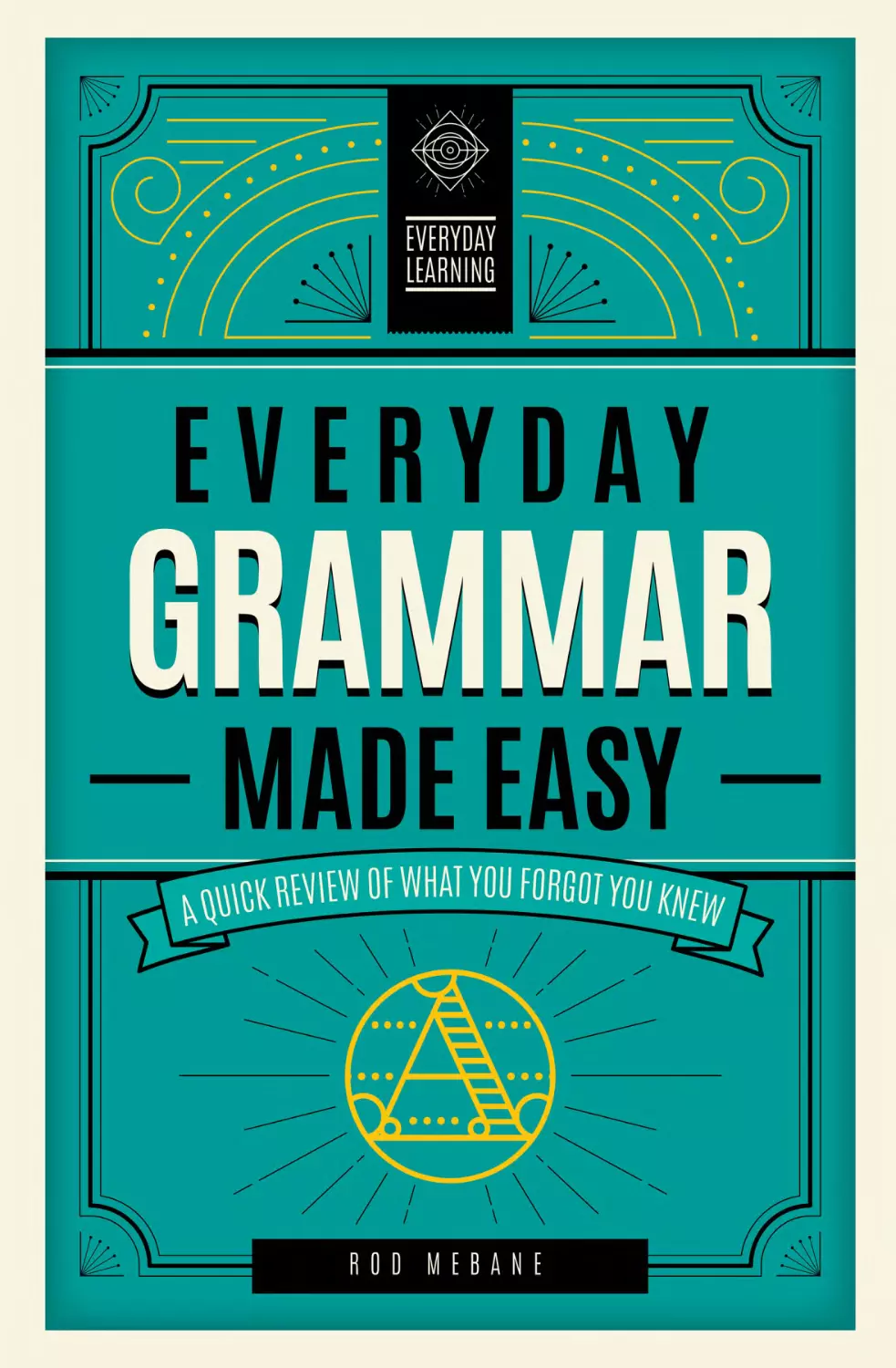


Author: Mebane R.
Tags: english grammar english grammar english language
ISBN: 978-1-57715-227-9
Year: 2021


Text
GRAMMAR
ROD MEBANE
© 2021 by Rod Mebane
First published in 2021 by Wellfleet Press,
an imprint of The Quarto Group
142 West 36th Street, 4th Floor
New York, NY 10018, USA
T (212) 779-4972 F (212) 779-6058
www.QuartoKnows.com
DEDICATION:
To Donna, my travel partner, who has taught me the vocabulary of love along the way.
All rights reserved. No part of this book may be reproduced in any form without written
permission of the copyright owners. All images in this book have been reproduced with the
knowledge and prior consent of the artists concerned, and no responsibility is accepted by
producer, publisher, or printer for any infringement of copyright or otherwise, arising from
the contents of this publication. Every effort has been made to ensure that credits accurately
comply with information supplied. We apologize for any inaccuracies that may have occurred
and will resolve inaccurate or missing information in a subsequent reprinting of the book.
Wellfleet Press titles are also available at discount for retail, wholesale, promotional,
and bulk purchase. For details, contact the Special Sales Manager by email at
specialsales@quarto.com or by mail at The Quarto Group, Attn: Special Sales Manager,
100 Cummings Center Suite 265D, Beverly, MA 01915 USA.
10 9 8 7 6 5 4 3 2 1
ISBN: 978-1-57715-227-9
Library of Congress Control Number: 2021933256
Publisher: Rage Kindelsperger
Creative Director: Laura Drew
Managing Editor: Cara Donaldson
Senior Editor: John Foster
Cover and Interior Design: Amelia LeBarron
Printed in China
INTRODUCTION ...................................................................................... 4
PART I: FUNDAMENTALS ......................................................... 7
CHAPTER 1: GRAMMAR BASICS ............................................................. 8
CHAPTER 2: THE BUILDING BLOCKS OF LANGUAGE ................................ 1 3
PART II: IN-DEPTH FOCUS ..................................................... 27
CHAPTER 3: FOCUS ON NOUNS ............................................................. 2 8
CHAPTER 4: FOCUS ON ADJECTIVES .................................................... 3 1
CHAPTER 5: FOCUS ON PRONOUNS AND CASE ....................................... 3 5
CHAPTER 6: FOCUS ON VERBS ............................................................. 5 3
CHAPTER 7: FOCUS ON ADVERBS .......................................................... 7 8
CHAPTER 8: F OCUS ON CONJUNCTIONS,
PREPOSITIONS, AND INTERJECTIONS ................................. 8 4
CHAPTER 9: FOCUS ON PUNCTUATION AND FORMATTING ....................... 9 1
PART III: COMMON PITFALLS ................................................ 111
CHAPTER 10: MISUSE OF SAME-SOUNDING WORDS .............................. 1 1 2
CHAPTER 11: MISAPPLICATION OF GRAMMAR PRINCIPLES ................... 1 2 2
APPENDIX A: GLOSSARY OF GRAMMAR TERMS ............................................... 1 3 7
APPENDIX B: VERB GUIDES ..................................................................... 1 5 4
APPENDIX C: USEFUL GRAMMAR RESOURCES ................................................ 1 7 0
ACKNOWLEDGMENTS............................................................................. 1 7 1
ABOUT THE AUTHOR............................................................................... 1 7 1
INDEX
...................................................................................... 1 7 2
INTRODUCTION
I
once asked a handyman friend of mine what his favorite tool was, and he
answered without hesitation, “the oscillating saw.” I was a little surprised
that he answered so quickly, and that he could be so sure, but I was a lot
surprised that he named a tool I had never heard of. Since I fancy myself as a
pretty passable handyman knockoff, I promptly looked into the tool, bought a
decent model, and now my best buddy, the O-saw, is the darling of my workshop
too. I can do things with the O-saw that I never thought possible. And that’s the
point—one that’s been driven home again and again over my tool-using years:
You cannot even know what is possible until you know what the tools available to
you can do. And that’s how I think about grammar and language.
Words are construction tools—we manipulate them like building blocks to
express thoughts for sharing with others—and you can do amazing things with
words, but, as my tool story illustrates, only if you know what they can do.
There are two key tools for how our language works. The first is vocabulary—
the words themselves (also referred to as the lexicon). The second is
grammar—the principles that guide how words work together. These two tools
are available to you, essentially free of charge. In the vocabulary arena, there are
over 200,000 or so words in the English language. Any good dictionary will get
you well down that road. In the grammar area, there are tons of reliable sources,
many just a click or two away, that will give way more information than you
could ever want to know.
Yet, even with an abundant supply of language resources, most people are
not super-confident in their English-language skills, and that is where Everyday
Grammar aims to find a happy home. If you count yourself among those who could
benefit with a bit of everyday grammar improvement, the main focus of this book
is on you and your capabilities. It is structured to reinforce your foundational
understanding of grammar, spark your curiosity, and solidify your confidence.
People come to English grammar in a number of different ways. Naturalborn English speakers first learn language rules by mimicking older family
members. Individuals learning English as a second or third language rely on the
structure of their native language as a frame of reference. In schools, students
4
receive vastly different grammar experiences, ranging from cursory treatment
of the underlying grammar fundamentals to the precise old-school rigors of
diagramming sentences.
In light of these different starting points, the Everyday Grammar approach is to
create a new beginning for everyone. We take it from the top to present a common
big-picture overview and then move to establish a foundation for organizing and
understanding the minute details that make up the world of grammar.
At the outset, it should be noted that this book is not meant to be a “onestop shop.” There is way too much information related to grammar to fit in
this handy little volume. Instead, the practical goal is to create a framework for
mastering basic grammar principles. In Part I, Fundamentals, you will find a quick
presentation of basic grammar concepts. Then, in Part II, In-Depth Focus, there
is a deeper dive into the various parts of speech and the underlying principles
that guide how the different grammar parts work together. Finally, in Part III,
Common Pitfalls, many of the most common grammar and spelling errors
that people make are detailed, complete with right and wrong examples. To
supplement the core, the following appendices are also included at the back of
the book:
•
Appendix A contains an extensive Glossary of Grammar Terms
that is vital to grasping the many key concepts of grammar and the
interrelationships of all the parts.
•
Appendix B presents Verb Guides containing highly useful data in a quick
look-up format such as complete profiles (aka conjugations) of key verbs
and an extensive lists of regular and irregular verbs.
•
Appendix C points the way to Useful Grammar Resources with numerous
additional sources of information and knowledge on English grammar.
If you are new to learning aspects of grammar in a serious way, Everyday
Grammar is presented in a natural flow that you can follow to build your knowledge
in a systematic way. If you are experienced with grammar but just need a refresher,
this book works as an excellent reference resource.
The many specifics associated with grammar are not a secret. Just search
Google and you will venture into a language land of plenty in which there is no
shortage of answers to be found. But, for the inexperienced grammar traveler,
5
a big first challenge is to know what to look for and what questions to ask. This
book is written to provide the foundation for asking good grammar-related
questions. As you prepare to learn or review the basics of grammar, here are
some important perspectives to keep in mind:
•
Language is alive and constantly evolving—both in vocabulary (lexicon)
and accepted usage (grammar).
•
The evolutionary tendency in grammar has been to ease restrictions and
to loosen the definition of what is acceptable.
•
Lots of effective communication occurs without polished grammar.
•
Your grammar does not have to be perfect. (Psst: No one’s is.)
•
You know more about grammar than you think.
•
An important aspect of acquiring better grammar skills is unlearning
past behaviors.
•
If you improve your command of grammar, you are the primary
beneficiary . . . every day!
As much as I hope you can leverage Everyday Grammar to pick up new skills,
I hope even more that you can bulk up confidence in your language-creation
abilities and develop a passion for learning more.
6
PART
I
FUNDAMENTALS
CHAPTER 1
GRAMMAR BASICS
G
rammar is nothing more than a set of rules that specifies how we use
words to communicate. This seems harmless enough, but for many
people the word grammar comes with a bad reputation. It is probably best left
to psychologists to give good reasons for its bad rep, but suffice it to say that
the mere mention of grammar can prompt winces and groans and quickly thin a
crowd. Yet, here you are, not only holding but also reading this book, suggesting
there is something about the topic that interests you enough to get this far . . .
Welcome! The main point of Everyday Grammar is to make it easier for you to
become more familiar with grammar in general and better at using grammar in
everyday situations. If you share this goal, then together we can demystify some
of the confusing aspects of grammar and make it start working better for you.
—
GRAMMAR AND YOU
—
An important observation at the outset is that regardless of how much you care
about grammar, it is totally indifferent to you. Grammar does not “give a hoot”
about how well you understand the underlying language rules or how well you
use them. Grammar is just the set of rules. It is up to you (and every individual)
to determine your relationship with the rules and the extent to which you will
pay attention to them. If you are looking for good reasons to strengthen your
grammar skills, look no further. As you reflect on this commitment to grammar
principles, here are a few things to take into consideration:
8
•
Grammar is essential to you (and to all of us).
•
Grammar is a critical contributor to your personal brand.
•
Grammar directly influences your clarity of thought and power of expression.
—
NECESSITY OF GRAMMAR
—
For someone who is not a big fan of grammar, there may be a desire just to
wish it away, but that simply is not possible for any of us—as long as we want
to communicate with one another. Our ability to communicate is a hallmark
of being human, and our communication relies on a meaningful exchange of
thoughts. In order to make that exchange and get a thought out of our brain
and meaningfully into someone else’s, we need to use some kind of intervening
code—an identified set of sounds and/or symbols that are commonly recognized
and understood by the parties involved.
In our communication, we rely on many different codes (Morse code,
American Sign Language, emoticons, body language) to exchange meaning
among ourselves, but by far the most dominant code in our everyday lives is our
local everyday language.
In this context, grammar is the accepted set of everyday language rules
that enable the common understanding among us that is needed to foster
communication and the exchange of meaning. Without grammar, there is no
common understanding. Without understanding, there is no communication.
Quite plainly, we need to communicate, and we need the rules of grammar.
Of course, how rigorously the rules are enforced varies depending on the
situation. For example, there are some frequent everyday contexts in which
people are not expected to follow grammar rules too strictly, such as:
•
In regular conversation with friends and family members, people speak
informally and without the same rigor or structure that you might see in
writing or in more formal social settings.
•
In the world of social networking—texting, tweeting, and the like—it is
practically the Wild West of “anything goes” for grammar, spelling, and
language conventions in general.
•
When traveling abroad, it is remarkable to see how much good
communication can happen with a combination of sounds, hand gestures,
and picture drawing . . . and not much grammar.
9
However, in many everyday contexts—such as correspondence, public
remarks, business interactions (meetings, memos, emails, presentations),
funding proposals, marketing materials, and numerous social situations—
grammar rules do apply more formally, and those conditions tend to favor those
who demonstrate a good command of grammar, both in speaking and in writing.
In other aspects of life—such as various professions and trades, the arts, the
sports world, and so forth—we often have choices as to what fields of endeavor
we will commit to and how well we will learn the vocabulary and rules associated
with those fields. That is not the case with language, which is a field in which
we have no choice. If we want to communicate with others, we have to know
some grammar basics. In short, regardless of the formality or informality of the
communication setting, some working knowledge of grammar is essential.
—
VISIBILITY OF GRAMMAR
—
Rules of accepted behavior abound in virtually every field of human endeavor.
A scientist who adheres to the discipline of the scientific method, a baseball
manager who knows to argue a ground-rule double, a concert violinist who leads
from her chair, a STEM or STEAM teacher who discovers a new experiential way
for children to learn—these are people who are experts in their fields partly
because they know, understand, and follow the relevant “rules of the game.”
Unlike in other fields of endeavor—as in science or sports or music or
education—when it comes to language, you cannot hide or keep your expertise
(or lack thereof) to yourself. Your grammar skills accompany you wherever you
go, and they are revealed in every conversation you have, every talk you give,
every observation you post, and every item you write.
Not surprisingly, given its visibility and prominence, your communication
behavior will affect how others perceive you. Like other attributes—your
tone of voice, gestures, and manner of dress—how you communicate will be
an important influence on the impression that you create on others. If you
regularly expose grammatical errors in your speaking and writing, those errors
will be noticed. They will make an impression, and the judgments that others
make about you may not be favorable. For example, those who recognize basic
grammar errors in your communication may conclude that you are not attentive
to details (regardless of what the truth may be).
10
The flip side of this situation, of course, is also true. To the extent that you
demonstrate capability in your command of vocabulary and grammar, it will
be noticed. The perception of this proficiency is likely to boost your credibility
by conveying the sense that “you know what you’re talking about.” How other
people feel about you may or may not be important to you, but it is important at
least to recognize that your language behavior affects the impressions people
form about you.
—
CLARITY OF THOUGHT
—
As mentioned, language is our everyday tool for sharing thoughts with others,
and grammar is the aspect of language that guides how the parts of language
(especially words) work together. Effective communication depends on more
than good word selection and correct application of grammar principles.
In general, the more you command the underlying grammar resources and
tools, the more you can be deliberate in your crafting of messages and in your
communication with others.
This knowledge principle is wonderfully illustrated by a young child learning
language for the first time. It is easy to take language skills for granted as an
older person, but observing a toddler learning the words mama or book, or later
learning how owls hoot and horses run, brings the challenge (and delight) of
language learning into full focus.
Of special relevance in this context is the interrelationship between a child’s
ability to think clearly of a horse and the child’s ability to know and say the word
horse. From a developmental standpoint, those two abilities go hand in hand.
And, as the child grows and learns, language sophistication grows along with
the child’s ability to conceptualize and understand—as the child learns about
different kinds of horses, for example, or about aspects of how they live.
11
In short, your underlying knowledge of language—vocabulary and
grammar—is an important determiner of what you think about, how you think,
and how you choose to communicate with others. Consequently, there is a
definite upside to enhancing grammar knowledge and skill, with such benefits as:
•
It reduces errors that other people notice and find annoying and distracting.
•
It creates an impression that you are organized in your thinking and
committed to quality.
•
It conveys a sense of someone who is well educated and prepared, which
bolsters your credibility.
•
It allows for communication enriched in thought, precision, and quality
of expression—in both your speaking and your writing.
•
It creates a more polished and persuasive appearance in your written
pieces, from job-seeking letters to business proposals to advocacy
statements.
•
Lastly, in terms of your interactions with others, stronger grammar
knowledge and skills often lead to generally higher levels of selfconfidence and interpersonal effectiveness.
12
CHAPTER 2
THE BUILDING BLOCKS
OF LANGUAGE
A
s noted in the introduction, words can be thought of as construction tools
that we manipulate like building blocks to express thoughts to share
with others. The words themselves make up our vocabulary, or lexicon. The
principles that govern the structuring of words in order to create meaning make
up our grammar. Vocabulary and grammar are the two key ingredients necessary
for good communication. One without the other is of little use. Consider the
following vocabulary words, in alphabetical order:
and
love
sings
woman
beautifully
quietly
the
young
in
she
touching
Each of these words has definitions unto itself, but the group of words as a
whole does not convey any specific meaning. However, if the words are sorted in a
manner consistent with principles of grammar, they might shake out as follows:
The young woman in love—she sings quietly and beautifully. Touching!
Now this group of words is meaningful!
—
CREATING A COMPLETE THOUGHT
—
In terms of the building blocks of language, words are numerous. Within the
category of words, there are eight parts of speech, each of which has governing
principles that we will look at a bit later in this chapter. These parts of speech,
and the many words within each, come together in countless ways to create
13
The Gr ammar Hier archy
The grammar hierarchy of significance is expressed as follows: (1) combinations of letters form
words; (2) combinations of words form phrases and clauses; and (3) all of the basic language
elements—letters, words, phrases, and clauses—are the building blocks that come together
in a sentence to create meaning. In communicating with others, it is meaning that we seek to
convey, and it is meaning that we seek in return. In order to create a meaningful exchange, we
need to understand these basic building blocks.
BUILDING BLOCK
EXAMPLE
Letters: the Roman Latin alphabet of twenty-six letters
(in both upper- and lowercase)
XYZ, abc
Word: a combination of letters that form one of the eight
parts of speech
dog
Phrase: a group of related words without a clear subject and
associated verb
the barking dog
Clause: a group of related words with a clear subject and
associated verb
the dog barks
Sentence: a clause that is sensible as a stand-alone group of
words, with appropriate punctuation
The dog barks.
larger units of meaning that themselves are mixed to create a final sentence.
(See The Building Blocks of Grammar on page 16 to get a sense of all of the
underlying parts.) Within this abundance of information, it is useful to focus on
the most fundamental principle of grammar: In order to create meaning, you
must organize your words to present a complete thought. The test for whether a
group of words presents a complete thought is straightforward. At a minimum, a
complete thought: (1) requires a subject and a predicate, and (2) must be sensible
standing on its own. Let’s look at these components more closely.
The subject is the entity that is doing something or being something in the
thought. The subject always is or contains a noun (more on nouns in chapter 3).
14
The predicate is the experience that is happening to the subject. The predicate
always is or contains a verb (more on verbs in chapter 6).
SUBJECT
+
PREDICATE
=
COMPLETE THOUGHT
raindrops
+
fall
=
Raindrops fall.
the athlete
+
runs fast
=
The athlete runs fast.
Note that, in terms of order and sequence, the subject generally (but not
always) comes before the predicate (which is or contains a verb). The following
sections of this chapter amplify aspects of these important building blocks to
strengthen your familiarity with key concepts and to build your skills in applying
everyday grammar principles in speaking and writing.
q u i c k t e s t: H o w t o D e t e r m i n e
t h e S u b j e c t a n d P r e d i c at e
To determine the subject of a sentence, ask and answer the question: What is this sentence
about? To determine the predicate of a sentence, ask and answer these questions: What is the
subject? What is/was the subject doing? What is/was happening to the subject?
The cow jumped over the moon.
Subject Question: What is the sentence about?
Answer: the cow
Predicate Question: What was happening to the subject?
Answer: It jumped over
the moon.
15
—
THE BUILDING BLOCKS OF GRAMMAR
—
Below is a quick guide of the fundamental building blocks of grammar that we
will cover in the remaining part of this chapter:
Parts of Speech: noun; adjective; pronoun; verb; adverb; conjunction;
preposition; interjection
Phrases: noun phrase; verb phrase; infinitive phrase; gerund
phrase; participle phrase; prepositional phrase; absolute
phrase; appositive phrase
Clauses: independent clause; dependent clause; adverb clause;
adjective clause; noun clause
Objects:
direct object; indirect object
Sentences: simple; compound; complex; compound-complex;
statement; question; command; exclamation
—
PARTS OF SPEECH
—
Like shapes of puzzle pieces or colors of blocks, there are different types of
words. In English grammar, there are eight types of words available to mix in
different ways to create meaning. We refer to the eight types as parts of speech
and introduce them to you briefly here. You will have the opportunity to learn
more about them and how they interact in later chapters. Since grammar
principles of association are organized around the parts of speech, understanding
the parts of speech is at the heart of understanding grammar. Let’s recast our
first example on page 13 in different colors so that we can color-code the eight
parts of speech in English:
The young woman in love—she sings quietly and beautifully. Touching!
(1) NOUNS: Nouns are always the stars of the show, because nouns are
the words we use to name things—like horse, ball, ocean, house. In the
16
English language, hundreds of thousands of nouns are available to name
people and places, animals and activities, ideas, and emotions—all sorts
of things. (See more on nouns in chapter 3.)
(2) ADJECTIVES: Adjectives can be thought of as modifiers for
nouns because they always accompany nouns and provide additional
description—like color (blue sky) or age (young calf) or mood (sad boy). A
simple change in adjective can make a world of difference in meaning, as
in thriving planet versus dying planet. (See more on adjectives in chapter 4.)
(3) PRONOUNS: After being introduced, a noun can take a break while a
pronoun is used instead to refer to the noun involved. A pronoun is a word
that can step in to take the place of a noun when appropriate, such as The
woman joined the choir. She sings alto. (See more on pronouns in chapter 5.)
(4) VERBS: Verbs are where the action is. Literally, nothing happens
without verbs, whether the happening is an action, an event, a condition,
or simply a state of being. Through variations in tense (i.e., if the action
happens in the past, present, or future), verbs also indicate the general
time frame in which a happening occurs, such as John is walking now
(PRESENT); John walked yesterday (PAST); and John will walk tomorrow
(FUTURE). There are over 25,000 different verbs available in English.
(See more on verbs in chapter 6.)
(5) ADVERBS: Verbs frequently have companions called adverbs. These
words can often be quite dramatic in labeling a variety of circumstances
associated with a verb’s action, such as Her heart beat wildly. Adverbs
often answer the questions of How? When? Where? How much? How often?
How long? (See more on adverbs in chapter 7.)
(6) CONJUNCTIONS: To make connections we use conjunctions, which
exist exactly for that purpose—to connect words, phrases, clauses, and/
or sentences. There are only a handful of words that serve as the primary
coordinating conjunctions—and, but, or, nor, for, so, and yet—but there
are other conjunctions that serve in specific situations. (See more on
conjunctions in chapter 8.)
17
(7) PREPOSITIONS: A preposition is a word that comes before a noun or
pronoun to form a prepositional phrase that is itself used to modify a
noun, adverb, or adjective. Which woman? The woman in love. There are
more than 150 words that serve as prepositions, although a fifth of those
(around 30) are used most frequently, including through, to, on, over,
around, under, by, behind, below, in, and along, to name a few. (See more
on prepositions in chapter 8.)
(8) INTERJECTIONS: To express strong emotion, such as joy, surprise,
anger, or enthusiasm, an interjection is a word (or phrase) that is usually
used in isolation in an exclamatory way, such as Whoops! Aha! Yikes!
(See more on interjections in chapter 8.)
W h at I s a M o d i f i e r ?
A modifier is a word, phrase, or clause that serves to add information to another word in
order to clarify, explain, emphasize, limit, or enhance the meaning. Some modifiers serve as
adjectives in modifying nouns:
Sarah, a new mom, longs for a full night’s sleep.
Other modifiers serve as adverbs in modifying verbs, adjectives, and other adverbs:
John enjoyed working out intensely at the beach.
Her recovery story was remarkably moving.
The doctor inserted the tube very carefully.
18
—
PHRASES
—
A phrase is a combination of words that works as a single grammatical unit but
does not contain a subject and a predicate with an associated verb. There are
eight types of phrases, and among the most common are noun phrases and
verb phrases:
(1) A noun phrase is a combination of words that includes a noun and all
of its modifiers. In the example The athlete runs fast, the athlete is a noun
phrase, and the entire phrase serves as the subject of the complete thought.
q u i c k t e s t: H o w t o D e t e r m i n e
a noun phrase
To test whether a combination of words is a noun phrase, replace the phrase with a pronoun
and determine if the sentence still makes sense. The following sentence contains two noun
phrases—one serving as a subject, the other serving as a direct object:
The five gamers completed
SUBJECT
VERB
the intensive first round.
DIRECT OBJECT
They completed it.
SUBJECT
VERB DIRECT
OBJECT
(2) A verb phrase is a combination of words that includes a verb and all of
its modifiers. In the example The athlete runs fast, runs fast is a verb phrase,
and the entire phrase serves as the predicate of the complete thought.
19
(3) An infinitive phrase is a combination of words that starts with the
infinitive of a verb and serves as a noun.
To walk the talk can be difficult to do.
(4) A gerund phrase is a combination of words that starts with the gerund
of a verb and serves as a noun.
Singing in the rain is more fun than it sounds.
(5) A participle phrase is a combination of words that starts with the
present participle or past participle of a verb and always serves as an
adjective.
The carpenter working on the cabinets decided to take a short break.
(6) A prepositional phrase is a combination of words that include
a preposition, an object of the preposition, and any modifiers.
If a prepositional phrase modifies a noun, it is called an adjective
prepositional phrase.
The house at the end was the first to be built.
If a prepositional phrase modifies a verb, it is called an adverb
prepositional phrase.
The little girl tried not to sneeze in her kindergarten class.
(7) An absolute phrase is a combination of words that modifies an
independent clause in its entirety.
God willing, the family will survive their difficult circumstances.
(8) An appositive phrase is a combination of words that renames or
restates an adjacent word or phrase to provide additional information.
Willie, the lazy dog, does not like the game of fetch.
20
W h at I s a c o m p l e m e n t ?
In grammar, complement is a general term used to refer to a word, phrase, or clause that
completes the meaning of an expression. A subject complement (aka predicate nominative)
is a noun or pronoun that follows linking verbs (TO APPEAR, TO BE, TO FEEL, TO LOOK, etc.) and
provides additional information about the subject.
The doctor is an epidemiology expert.
An object complement provides additional information about a direct object.
The doctor inserted the syringe filled with saline solution.
—
CLAUSES
—
Unlike a phrase, a clause includes a subject and a predicate with an associated
verb, and there are two main types of clauses:
(1) An independent (or main) clause is a clause containing a subject
and a verb that conveys a complete thought and can stand by itself. No
additional information is needed to create a complete thought.
Nik and Valerie waited in line.
(2) A dependent (or subordinate) clause is a clause containing a subject
and a verb that does not convey a complete thought and thus cannot stand
by itself.
While Nik and Valerie waited in line. . .
With a dependent clause, additional information is required to create a
complete thought.
While Nik and Valerie waited in line, the venue sold out of tickets.
21
I n d e p e n d e n t C l aus es
v e rs us S e n t e n c es
By definition, an independent clause by itself is a sentence. It meets the minimum
requirements of what it takes to be a sentence—it has a subject and a predicate and is
sensible standing alone.
The Declaration of Independence is one of the most important documents in history.
SUBJECT
PREDICATE
On the other hand, a sentence can contain much more than a single independent clause.
Sentences can be simple (as in the example above) or designated as compound, complex, and
compound-complex (see pages 25-26).
We hold these truths to be self-evident, that all men are created equal,
INDEPENDENT CLAUSE
DEPENDENT CLAUSE 1
that they are endowed by their Creator with certain unalienable Rights,
DEPENDENT CLAUSE 2
that among these are Life, Liberty and the pursuit of Happiness.
DEPENDENT CLAUSE 3
Within the category of dependent clauses, there are three different subtypes:
(1) An adverb clause is a dependent clause that functions as an adverb.
After the concert ended, Jason trekked to his vintage VW camper.
(2) An adjective clause is a dependent clause that functions as an adjective.
Aiko, who is a “dry mouth” St. Bernard, drooled when Jason returned.
22
(3) A noun clause is a dependent clause that functions as a noun.
Whoever planned the concert tour did a first-class job.
—
OBJECTS
—
The predicate of the sentence, which includes the verb, may also include
objects—nouns or pronouns that receive the action of the verb either directly
(direct objects) or indirectly (indirect objects). Consider the following sentence:
Benjamin gave Alexandra a ring.
SUBJECT
VERB
INDIRECT
OBJECT
DIRECT
OBJECT
The subject of the sentence is Benjamin.
The verb of the sentence is gave.
The direct object of the verb is ring.
(Ring directly receives the action of the verb GAVE—a ring is what
Benjamin gave.)
The indirect object of the verb is Alexandra.
(Alexandra is affected by the action of the verb, but is not the primary,
direct object, which is the ring.)
Note that as an indirect object Alexandra can be removed from the sentence,
and the sentence still expresses a complete thought (though a different one), as
in Benjamin gave a ring. This is not the case if the direct object is removed from
the sentence, as in Benjamin gave Alexandra, which is not a complete, sensible
thought. In summary, the subject of the sentence is Benjamin, and the predicate
of the sentence is gave Alexandra a ring, which includes a direct object (ring) and
an indirect object (Alexandra).
23
—
SENTENCES
—
A complete thought is expressed in a unit called a sentence. Minimally, a
sentence requires a subject and a predicate, and it must make sense standing on
its own. As we saw earlier, an independent clause meets these requirements, and
an independent clause just by itself is called a simple sentence.
Dogs bark.
INDEPENDENT CLAUSE
In terms of internal structure, an independent clause (aka simple sentence)
generally falls into one of seven different patterns:
1
2
3
4
5
6
7
SUBJECT
VERB
Lisa
raked
SUBJECT
VERB
SUBJECT COMPLEMENT
Lisa
is
a gardener
SUBJECT
VERB
DIRECT OBJECT
Lisa
raked
the garden
SUBJECT
VERB
DIRECT OBJECT
OBJECT COMPLEMENT
Lisa
raked
the garden
covered by weeds
SUBJECT
VERB
ADVERBIAL †
Lisa
raked
feverishly
SUBJECT
VERB
DIRECT OBJECT
ADVERBIAL †
Lisa
raked
the garden
feverishly
SUBJECT
VERB
INDIRECT OBJECT
DIRECT OBJECT
Lisa
gave
Daniel
the rake
_______________________
† Adverbial is a general term used to refer to an adverb, adverb phrase, or adverb
clause that completes the meaning of an expression. An adverbial provides additional
information about the verb.
24
Structurally, there are four kinds of sentences:
(1) A simple sentence consists of just one independent clause, which
makes sense as a complete thought on its own.
The dog barked.
INDEPENDENT CLAUSE
(2) A compound sentence consists of two or more independent clauses,
usually joined by a coordinating conjunction.
The dog barked,
and
baby Jackson cried.
INDEPENDENT COORDINATING
CLAUSE 1
CONJUNCTION
INDEPENDENT
CLAUSE 2
(3) A complex sentence consists of at least one independent clause
and at least one dependent clause that does not make sense on its own
(dependent clauses many times begin with subordinating conjunctions,
shown with while in the example below).
Baby Jackson cried while the dog barked.
INDEPENDENT CLAUSE
DEPENDENT CLAUSE
P u n c t u at i o n T I P
In writing, a sentence is typically denoted by an initial capital letter and a concluding
punctuation mark—a period (.), question mark (?), or exclamation point (!):
Raindrops fall.
Does the athlete run fast?
Give Calvin his toy now!
25
S u b o r d i n at i n g C o n j u n c t i o n s
In a complex sentence, a subordinating conjunction always introduces the dependent clause
and identifies the type of relationship. (See more on conjunctions in chapter 8.) Some common
subordinating conjunctions include:
although
if
than
until
as
since
that
while
because
so that
unless
(4) A compound-complex sentence is a compound sentence consisting
of two or more independent clauses, at least one of which includes a
dependent clause
While the dog barked, baby Jackson cried, and the sitter wondered what to do.
DEPENDENT
CLAUSE
INDEPENDENT COORDINATING
CLAUSE 1
CONJUNCTION
INDEPENDENT
CLAUSE 2
Substantively, a sentence can have one of four purposes and thus can be one
of four types, as detailed in this table:
PURPOSE
SENTENCE TYPE
FORMAT NOTES
EXAMPLE
(1) Makes a STATEMENT
Declarative
Always ends with a
period (.)
That is Calvin’s toy.
(2) Asks a QUESTION
Interrogative
Always ends with a
question mark (?)
Is that Calvin’s toy?
(3) Issues a COMMAND
Imperative
Can end with a period (.) or
an exclamation mark (!)
Give Calvin his toy!
Exclamatory
Typically ends with an
exclamation mark (!)
Now!
(4) Expresses an
EXCLAMATION
26
PART
II
IN-DEPTH
FOCUS
CHAPTER 3
FOCUS ON NOUNS
N
ouns are always the stars of the show, because nouns are the words we
use to name things. Hundreds of thousands of nouns are available to
name people and places, animals and activities, ideas, and emotions—all sorts
of things. Nouns are extremely versatile. There are a number of different types of
nouns. Attesting to their versatility, nouns often serve in a subject role, but they
also serve as objects (direct and indirect) and can even work as adjectives.
At the highest level, there are two major categories of nouns: (1) a proper noun
names a particular person, place, or thing (Santa Claus, Vietnam, Chicago Bulls)
while (2) a common noun does not name a particular person, place, or thing
(holiday, country, team). Note that a proper noun is always capitalized regardless
of where it falls in a sentence. A common noun is typically only capitalized when
it appears at the start of a sentence. Within the much larger category of common
nouns, there are some subtypes that grammarians regularly identify, including:
(1) Collective nouns identify a group (a swarm of bees, an army of ants).
(2) Compound nouns are nouns made up of a combination of at least
two words: sailboat (sail + boat), earthquake (earth + quake), honeydew
(honey + dew).
p u n c t u at i o n t i p
Some word combinations that function as nouns call for a hyphen, as in roller-skating,
sister-in-law. Others show a space between the words, as in swimming pool, attorney general.
The rules for when to combine the words and when to use spaces or hyphens are inconsistent.
When in doubt, look it up in a dictionary or online!
28
(3) A concrete noun is a noun that can be experienced by one of our five
senses of sight, sound, touch, smell, or taste (pizza). An abstract noun, on
the other hand, names something that is an idea, a quality, or a state that
you cannot sense directly (truth).
(4) A countable noun refers to items that can be counted (eggs), while
an uncountable noun refers to a more general concept that cannot be
counted (happiness). Uncountable nouns generally cannot be made plural
(knowledges is incorrect).
m a k i n g n o u n s p lu r a l
To make a noun plural, add an -s at the end of the word (book + s = books) unless the single
noun ends in: -s, -ss, -sh, -ch, -es, -x, or -z. In such a case, you should add -es to the end of the
word (church + es = churches).
—
VERBAL FORMS —
THAT FUNCTION AS NOUNS
The infinitive phrase and the gerund phrase are two verbal forms that serve
as nouns. An infinitive is the base form of the verb with the preposition to, as
in TO PAINT. An infinitive phrase can be used as a noun to refer to the act of
painting as seen in this example.
To paint is to renew.
(USED AS A NOUN)
29
A gerund phrase is the present participle form of a verb (the -ing form)
that is used as a noun. Consider the verb TO RUN. The present participle used to
express the act in progress is running. If you take the same word and treat the
act of running as a type of action (as opposed to an action in progress), then it
becomes a noun that can be used as a subject, object, or subject complement (aka
predicate nominative).
Running is an efficient form of exercise.
(USED AS THE SUBJECT)
An efficient form of exercise is running.
(USED AS THE SUBJECT COMPLEMENT)
making nouns possessive
To make a noun possessive, add an apostrophe + s (’s) at the end of a singular noun.
library library’s
cactus cactus’s
If the noun is plural and ends in s, add just an apostrophe (’) at the end.
animals animals’
Add an apostrophe + s (’s) if the plural noun ends in any other letter.
children children’s
30
CHAPTER 4
FOCUS ON ADJECTIVES
A
djectives can be thought of as modifiers because they always accompany
nouns and typically provide additional description—like color (green
pastures) or age (teen leader) or mood (angry birds). A simple change of adjective
can make a world of difference in meaning, as in an adoring crowd versus an
aggressive crowd. Adjectives modify nouns and give us information about nouns.
They answer such questions like: How many? What kind? What color? Which
one? The options are voluminous, with over five thousand different adjectives
available to give additional information on nouns.
q u i c k t e s t: H o w t o i d e n t i f y
an adjective in a sentence
Use this quick test to easily identify an adjective in any sentence.
STEP 1. Determine the word or phrase that is described/modified/informed (the target).
The black stallion in Lane 3 raced quickly down the stretch.
STEP 2. Ask: Is the target a noun?
IF NO
=
MODIFIER IS NOT AN ADJECTIVE.
IF YES
=
MODIFIER IS PROBABLY AN ADJECTIVE, proceed.
STEP 3. Ask: Does the word in question answer any of the questions: What kind? How
many? Which one?
IF NO
=
MODIFIER IS NOT AN ADJECTIVE.
IF YES
=
MODIFIER IS AN ADJECTIVE.
What kind of stallion? A black stallion.
31
Most adjectives are thought of as descriptive adjectives. As suggested in
the name, these adjectives describe the noun and expand its meaning—they
elaborate on characteristics of the noun. For example, let’s consider the noun
apple. How might we describe and expand the meaning of an apple? Color is
important (The apple is red). And shape (The red apple is round). And size (The red,
round apple is big). And condition (The big, red, round apple is fresh). All of these
are examples of descriptive adjectives.
There is also a significant group of adjectives called limiting adjectives. These
are words that tell us something that helps define the specificity or identity
of a noun, as opposed to describing characteristics of the noun (Is it a church
or the church? Is it this cupcake or that cupcake?) Within the category of limiting
adjectives, there are nine different types:
(1) Definite and Indefinite Articles
the, a, an
An article is a word used before a noun to indicate its state of definiteness
(or specificity). The article the is a definite article (the store). The articles
a and an are indefinite articles (a book, an apple).
(2) Demonstrative Adjectives
this, that, these, those
A demonstrative adjective is a word used before a noun to indicate a state
of greater specificity than what an article would provide.
Do you want this cookie? No, I want that one.
Have you visited these countries? Yes, I have visited those countries and lots more.
(3) Interrogative Adjectives
who, whose, what, which, whom
An interrogative adjective is a word that modifies a noun at the beginning
of a question (aka interrogative sentence).
What game should Andrew play first? Which candidate should Vicki support?
Whose paintings are the most expressive?
(4) Relative Adjectives
what, which, whose, whatever, whichever, whosever
A relative adjective is a word that modifies a noun when introducing a
clause that involves a choice or alternative.
Tim couldn’t decide which path to take.
The Book Club will read whatever book the host selects.
32
(5) Numerical Adjectives
cardinals (one, two, three, etc.)
ordinals (first, second, third, etc.)
A numerical adjective is either a cardinal number used with a noun to
indicate a specific quantity or amount, or an ordinal number used with a
noun to indicate position, degree, or rank in a sequence.
Alexis has lived in at least three states.
Stella was the second St. Bernard to join the family.
(6) Quantifiers
all, any, enough, few, less, least, a little, a lot of, many, more, most,
much, no, none, not any, plenty of, several, some (and many more)
A quantifier is a word or phrase used before a noun to indicate quantity or
amount in general. The most common are above.
There were just enough cookies to go around.
(7) Possessive Adjectives
my, your, their (noun’s, nouns’)
A possessive adjective is an adjective form of a noun used to show
possession—a “belonging” relationship with another noun. It is created
by adding an apostrophe + s at the end of the word or, if the noun ends in
s, by just adding an apostrophe.
Alice’s restaurant, worker’s uniform
pilots’ union, states’ rights
(8) Comparative Adjectives
adjective-er (than), adjective-ier (than),
more adjective (than)
A comparative adjective is used in the comparison of two nouns to indicate
a quantity or quality difference between them. The conjunction than is
often used in the comparison.
Tom was older than Barbara by about a year.
Susan is more aware of raccoon movements than most.
(9) Superlative Adjectives
adjective-est, adjective-iest, most adjective (of)
A superlative adjective is used in a comparison of nouns to identify a
maximum or extreme level.
33
F o r m i n g C o m pa r at i v e
a n d S u p e r l at i v e A d j e c t i v e s
The following tables provide guidelines for forming comparative and superlative adjectives.
REGULAR ADJECTIVES
ADJECTIVE
COMPARATIVE
SUPERLATIVE
One syllable
Jackson is
young.
add -er
Davis is
younger.
add -est
Felix is the
youngest.
Two
syllables
ending in -y
The pansy is
pretty.
drop -y,
add -ier
The daffodil
is prettier.
drop -y,
add -iest
The rose is
the prettiest.
Three
or more
syllables
The biscuit
was
delicious.
more +
adjective
The cookie
was more
delicious.
most +
adjective
The eclair
was most
delicious.
COMMON IRREGULAR ADJECTIVES
ADJECTIVE
34
COMPARATIVE
SUPERLATIVE
best
Brussels
sprouts are
best of all!
better
The patient
was better
this morning.
best
The patient
is presenting
her best
health.
The flu was
bad.
worse
Strep throat
was worse.
worst
This year’s
flu strain is
the worst.
little
A dollar is a
little money.
less
A quarter is
less money.
least
A penny is
the least
amount.
far
A far throw.
farther
Throw a
farther toss.
the farthest
That was
the farthest
pass.
far
Far-reaching
concept.
further
Without
further
adieu.
the furthest
She is the
furthest
ahead in the
process.
good
Peas are
good.
better
Tomatoes
are better.
well
The well
patient
headed home.
bad
CHAPTER 5
FOCUS ON
PRONOUNS AND CASE
P
ronouns are words that step in to take the place of a noun when appropriate.
After being introduced, a noun can take a break while a pronoun is used,
instead, to refer to the noun. There are several different forms of pronouns. The
most commonly used are personal pronouns—which stand in for people and
things. In addition to personal pronouns, other pronoun forms that we will look at
closely in this chapter include:
Personal Pronouns:
Katy is now a college graduate. She majored
in biology.
Reflexive Pronouns:
The injured man drove himself to the hospital.
Reciprocal Pronouns:
The children helped each other with
distance learning.
Indefinite Pronouns:
There is nobody home.
Relative Pronouns:
The movie that you loved is streaming
on Netflix.
Demonstrative Pronouns: This is an award-winning dog.
Interrogative Pronouns:
What did the store owners decide to do?
After we learn about the different types of pronouns, we will then look at
case and its importance regarding which form of pronouns we use in different
circumstances. Finally, we will then look at some guidelines on how to correctly
use pronouns in their cases.
35
—
PERSONAL PRONOUNS
—
Personal pronouns stand in for people (aka persons) and sometimes things. There
are three person types, and each has a singular and plural form (number). The
person types are referred to with the ordinals first person, second person, and
third person as follows:
First person refers to the speaker(s) in the sentence
I, we
Second person refers to the person(s) spoken to
you
Third person refers to the person(s) spoken about
he, she, it, they
Antecedents
The noun to which a pronoun refers is called the antecedent. The term stems from the Latin root
word ante that means “going before.”
Suzanne left her briefcase at the office.
ANTECEDENT PRONOUN
36
S i n g u l a r a n d P lu r a l f o r m s o f ( Yo u )
Unlike many other languages, English does not use different forms for the second person
pronoun (you) when it refers to one person (singular) as in:
I love you, my darling one.
Or when it refers to more than one person (plural) as in:
I love you, my crazy teammates.
However, in everyday language, some people do use informal terms to refer to the plural you,
such as y’all, youse, and you guys as in:
How are y’all doing?
Given the slang status of these terms, they are generally best avoided in more formal
communication contexts.
—
CASE
—
In addition to person and number, personal pronouns vary by a condition called
case. Case is an important factor for how a pronoun serves in a sentence. There
are three cases in English—subject case, object case, and possessive case—and
each case has a set of pronoun forms. To follow common grammar principles, it
is important to first recognize what case is and how it determines the appropriate
pronoun form to use. For example, if a pronoun is in the subject case, then it is
called a subject pronoun, and it takes a subject pronoun form. In the example I
bought John a coffee, I is the subject of the sentence.
If a pronoun is in the object case, an object pronoun is required. In the
example, I bought him a coffee, since the speaker is using him to refer to John, an
object pronoun is required because it is functioning as the direct object.
37
Finally, if the pronoun is in the possessive case, a possessive pronoun is
required to show ownership. In the example, That coffee on the table is his, the
speaker is indicating that the coffee on the table belongs to John. Let’s look at the
three cases a bit closer and their respective pronouns.
(1) Subject Case: When a pronoun is functioning as the subject or the subject
complement (also called a predicate nominative), a subject pronoun is used
for the appropriate person and number from the table below.
SUBJECT PRONOUNS
PERSON
NUMBER
First Person
SINGULAR
PLURAL
I
we
Second Person
you
you
Third Person
he, she, it
they
We will never get tired of bacon.
(WE = SUBJECT)
It was he who started the fight.
(HE = PREDICATE NOMINATIVE)
P r e d i c at e N o m i n at i v e s
v e r s u s P r e d i c at e A d j e c t i v e s
A predicate nominative is a noun or pronoun that follows a linking verb (see page 54) and
functions as a subject complement.
Robert is my friend.
A predicate adjective is also a subject complement that is an adjective and follows a linking verb.
Robert is nice.
38
Subjec t Pronouns after Linking Verbs
If a sentence calls for a pronoun to be used as a subject complement (aka predicate nominative)
after a linking verb, the subject case of the pronoun should be used.
Nannie said, “Believe it or not, the cute little girl in that photo is I.”
However, it is much more common to hear:
Nannie said, “Believe it or not, the cute little girl in that photo is me.”
Some people feel the pure grammar construction in the first example sounds awkward and
pretentious and prefer the second example. In spoken language, the second example is much
more common.
(2) Object Case: When a pronoun is functioning as an object, either a direct
object, indirect object, or object of the preposition, it takes an object pronoun,
selected for the appropriate person and number from the table below.
OBJECT PRONOUNS
PERSON
NUMBER
First Person
SINGULAR
PLURAL
me
us
Second Person
you
you
Third Person
him, her, it
them
[You] give us a call when you get there.
(US = DIRECT OBJECT)
I gave her the letter.
(HER = INDIRECT OBJECT)
It won’t happen if we depend on them.
(THEM = OBJECT OF THE PREPOSITION)
39
(3) Possessive Case: When a pronoun indicates possession or ownership,
it takes a possessive pronoun, selected for the appropriate person and
number from the table below.
POSSESSIVE PRONOUNS
PERSON
NUMBER
First Person
SINGULAR
PLURAL
mine
ours
Second Person
yours
yours
Third Person
his, hers, its*
theirs
* We only use the possessive pronoun its when own is also used (That car
has a life of its own).
The bike was mine until I gave it away.
(MINE = I OWN THE BIKE)
In terms of houses, theirs was the most expensive.
(THEIRS = THEY OWN THE HOUSES)
p u n c t u at i o n T I P
Note that possessive pronouns never take an apostrophe, as in it’s, our’s, or your’s.
These are incorrect.
40
—
PRONOUNS IN ACTION
—
Let’s look at some examples of how pronouns vary in relation to person, number,
and case depending on how they function in different sentences.
PERSON + NUMBER
First Person— Singular
I, me, mine
First Person — Plural
we, us, ours
Second Person — Singular
you, you, yours
Second Person — Plural
you, you, yours
Third Person — Singular
he/she/it, him/her/it,
his/hers/its
Third Person — Plural
they, them, theirs
CASE
EXAMPLE
Subject
Finally, I am the champion!
Object
My coach gave good advice to me. 1
Possessive
That sparkling new trophy is now mine.
Subject
We will never get there in time.
Object
Maybe the hosts will give us a break. 3
Possessive
If not, disappointment will be ours.
Subject
You are my sunshine.
Object
I love you more than the moon is high. 2
Possessive
My tan is fading, but yours is still golden.
Subject
You are all welcome here.
Object
The principal will talk to you next. 1
Possessive
Yours is the best.
Subject
She left and never looked back.
Object
The woman had given him the best years. 3
Possessive
In terms of confidence, his was shattered.
Subject
They got tired of sheltering in place.
Object
The nursing home bus took them for tests. 2
Possessive
Once the vaccine arrived,
all of the residents got theirs.
_______________________
1 Objects of the Preposition = Object Pronoun
2 Direct Objects = Object Pronoun
3 Indirect Objects = Object Pronoun
41
POSSESSIVE PRONOUN ADJECTIVES
Similar to possessive pronouns are possessive pronoun adjectives, which are used
when a pronoun is functioning as an adjective to express possession in a sentence.
They are selected for appropriate person and number from the table below.
POSSESSIVE PRONOUN ADJECTIVES
PERSON
NUMBER
SINGULAR
PLURAL
First Person
my
our
Second Person
your
your
Third Person
his, her, its
their
My bike has gotten pretty small for me.
(MY = POSSESSIVE PRONOUN ADJECTIVE TO DESCRIBE BIKE )
Their house will be put up for sale after it is painted.
(THEIR = POSSESSIVE PRONOUN ADJECTIVE TO DESCRIBE HOUSE )
o b j e c t p ro n o u n s us e d
with COMMON PREPOSITIONS
The proposition between and some others cause a lot of confusion. Because between is a
proposition, pronouns that follow it are objects of the preposition and should therefore be in
the object case.
Sally divided the money between Bill and me.
42
Q u i c k T e s t: P r o n o u n s i n
Co m p o u n d Co n s t ru c t i o n s
Compound constructions are instances when there is either (1) more than one subject, such
as Bill and I went to the museum, and the pronouns need to be in the subject case, or (2) when
there is more than one object, direct object, indirect object, or object of the preposition, such
as John gave the museum tickets to Bill and me, and the pronouns need to be in the object case.
Here is a simple test you can do to check to see which pronoun case is needed for a
compound construction in the subject case. In our example, the compound construction is
acting as the subject:
EXAMPLE:
Bill and (I, me) went to the museum.
STEP 1.
Remove “Bill and”
STEP 2. Ask yourself which pronoun reads better: “Me went to the museum” or
“I went to the museum”?
STEP 3. The correct answer is “I went to the museum," because Bill and I are both
subjects and require the pronoun I to be in the subject case.
The same test can be applied for compound constructions in the object case. In our example,
the compound construction is acting as a preposition phrase with two objects of the preposition:
EXAMPLE:
John gave the museum ticket to Bill and (I, me).
STEP 1.
Remove “to Bill and”
STEP 2. Ask yourself which pronoun reads better: “John gave the museum ticket to I” or
“John gave the museum ticket to me”?
STEP 3. The correct answer is “John gave the museum ticket to Bill and me,” because
Bill and me are both objects of the preposition and require the pronoun me to
be in the object case.
43
second -person pronouns in writing
When writing, the second-person pronouns—you, your, yours, yourself, yourselves—should only
be used when directly addressing readers.
Now we will introduce you to some new trends in fashion.
It is not appropriate to use you when the reference is indefinite.
People have said that eating before swimming can make you sick.
(INCORRECT)
—
REFLEXIVE PRONOUNS
—
When the subject and the object of the verb are the same and refer to one another,
a reflexive pronoun that "reflects" back to the subject is used in the object
position, selected for appropriate person and number from the table below:
REFLEXIVE PRONOUNS
PERSON
NUMBER
SINGULAR
PLURAL
First Person
myself
ourselves
Second Person
yourself
yourselves
Third Person
himself, herself,
itself, oneself
themselves
You will never forgive yourselves for failing to close the gate.
(YOURSELVES RELATES BACK TO YOU)
The oven is timed to turn off by itself.
(ITSELF RELATES BACK TO OVEN)
44
—
—
RECIPROCAL PRONOUNS
A reciprocal pronoun is one that is used to indicate that a person(s) or thing(s)
are involved in a mutual action or cross-relationship or when something is given
or done in return. Reciprocal pronouns refer to individual items or a plural whole.
There are only two reciprocal pronouns:
each other (used when there are two parties involved)
one another (used when there are more than two parties involved)
Meg and Gary supported each other during the transition.
The winning team members gave one another elbow bumps in celebration.
—
—
INDEFINITE PRONOUNS
An indefinite pronoun is a word that takes the place of a noun but does not refer to
a specific person, time, or situation but to nonspecific people and items. Some of
the words used most frequently in this “indefinite” way include:
SINGULAR
another, anybody, anyone, anything, each, either, everybody,
everyone, everything, little, much, neither, no one, nobody,
nothing, one, other, somebody, someone, something
PLURAL
both, few, many, others, several
SINGULAR/PLURAL
all, any, more, most, none, some
Few of the principals in town favor a full school reopening.
Medical professionals will test everyone in the community eventually.
—
RELATIVE PRONOUNS
—
In sentences that have a dependent (or subordinate) clause (see pages 21-23),
a relative pronoun may be used to introduce, or “relate,” noun and adjective
clauses to the rest of the sentence. The antecedent of the pronoun is usually
45
identified. There are seven different words that commonly serve as relative
pronouns:
that which who whom whose whoever whomever
The book that she loved is no longer in print.
My son whose dog is sick headed to the vet’s office.
She knew the student who won the prize.
The relative pronouns that and which are used when referring to objects as
seen in the first example above. (Also see discussion of “WHO | THAT | WHICH”
on page 135.)
The other five relative pronouns who, whom, whose, whoever, and whomever
are used when referring to a person or persons as seen in the second and third
examples above. Because of this, they are subject to case considerations and fall
into these classifications:
SUBJECT CASE
who, whoever
OBJECT CASE
whom, whomever
POSSESSIVE CASE
whose
The key to determining which of these relative pronouns to use in a sentence
is to assess whether the pronoun acts as the subject or object of the dependent
clause. Consider this simple sentence.
Judy registered at the county fair.
Now, if you want to tell more about Judy in this sentence using new
dependent clauses, you could do so in these ways:
1. With a subject case pronoun:
Judy, who entered the quilt competition, registered at the county fair.
2. With an object case pronoun:
Judy, whom all of the judges just loved, registered at the county fair.
46
3. With a possessive case pronoun:
Judy, whose quilt entry had a good chance of winning, registered at the county fair.
Q u i c k T e s t:
C o r r e c t R e l at i v e P r o n o u n U s e
Recall that the relative pronouns who and whoever are subject pronouns—they perform the
action of the verb—and the relative pronouns whom and whomever are object pronouns—they
perform as either direct or indirect objects or objects of the preoposition. To test to see which
relative pronoun to use in a dependent clause, substitute a third-person singular pronoun
(he/him or she/her) for the relative pronoun, and then assess which sounds correct.
EXAMPLE: I will always award the prize to (whoever, whomever) comes in first.
STEP 1. If a clause, determine how the pronoun functions in the clause, not how the
clause serves in the sentence. In this example:
(SUBJECT) comes in first.
STEP 2. Substitute a third person singular pronoun:
(he/him) comes in first.
OR
(she/her) comes in first.
STEP 3. Determine which sounds correct. In both cases, the subject pronouns sound correct:
he (not him) comes in first.
OR
she (not her) comes in first.
STEP 4. Select the corresponding relative pronoun. The correct answer is I will always
award the prize to whoever comes in first, because whoever is functioning as the
subject of the clause and requires a relative pronoun in the subject case.
47
—
DEMONSTRATIVE PRONOUNS
—
A demonstrative pronoun is one that replaces a noun identified elsewhere
in the sentence. There are four different words that commonly serve as
demonstrative pronouns:
this
these
that
(with singular antecedents)
those
(with plural antecedents)
Hand me the papers—those on the floor.
That was a terrible disaster, in my opinion.
—
INTERROGATIVE PRONOUNS
—
An interrogative pronoun is one used to introduce a question (or interrogative
sentence). The interrogative pronouns include:
More common:
Less common:
who
whoever
whom
whose
whomever
what
whatever
Who is laughing now?
Whomever would you ask to do that job?
48
which
whichever
Q u i c k T e s t: c o r r e c t i n t e r r o g at i v e
P ro n o u n Us e i n Q u es t i o n s
Use who if a question is about the subject and whom when the question is about the object.
To know whether the case is a subject or an object, simply recast the question into a statement
and temporarily substitute the interrogative pronoun with a subject or object pronoun.
Then apply the corresponding subject or object interrogative pronoun.
EXAMPLE: Who bought the museum tickets?
STEP 1.
Recast the question into a statement:
I bought the museum tickets.
STEP 2.
I is the subject pronoun, so we apply who.
EXAMPLE: Whom does John love?
STEP 1.
Recast the question into a statement:
John loves her.
STEP 2.
Her is the direct object pronoun so we apply whom.
49
—
GUIDELINES FOR PRONOUN USE
—
As all of the different types of pronouns identified suggest, some thought often
needs to be given to which pronouns are used and how. In addition to principles
and practices in the various examples we saw in this chapter, here are some key
factors to keep in mind when working with pronouns.
•
A pronoun must match the person and number of the noun that it replaces
(the pronoun’s antecedent). For example, a singular noun calls for a
singular pronoun.
Owen plays baseball. He is the starting pitcher.
•
A plural noun calls for a plural pronoun.
They needed to start their hike.
•
If relevant, a pronoun agrees in gender.
The woman returned to her work.
Note: It is acceptable and becoming more common to use third-person plural
pronouns they/them/their (among others) to refer to both singular and plural
antecedents so as not to specify gender (see page 52).
Notice in these examples that in order to avoid any confusion or ambiguity:
(1) a pronoun needs to refer clearly to one specific antecedent that occurs before
the pronoun and (2) a pronoun should be placed relatively close to its antecedent.
•
Care should be taken to ensure that the correct pronoun case is used—
subject case, object case, or possessive case.
Me and Bobby McGee went to the fair.
(INCORRECT BECAUSE THE PRONOUN SHOULD BE IN THE SUBJECT CASE, SINCE IT IS THE SUBJECT)
Bobby McGee and I went the fair.
(CORRECT)
The salesperson gave Mary and I some free samples.
(INCORRECT BECAUSE THE PRONOUN SHOULD BE IN THE OBJECT CASE, SINCE IT IS THE INDIRECT OBJECT)
The salesperson gave Mary and me some free samples.
(CORRECT)
50
•
Be attentive when using pronouns with present participles and gerunds.
The present participle and the gerund look alike—both are verb forms
with the -ing ending—but the present participle functions as a verb, and
the gerund functions as a noun and requires a possessive pronoun.
I appreciate you making the cake.
(INCORRECT BECAUSE MAKING THE CAKE IS A GERUND PHRASE AND SHOULD BE MODIFIED BY THE
POSSESSIVE PRONOUN YOUR )
I appreciate your making the cake.
(CORRECT)
Than I? or Than Me?
The words than and as are conjunctions used in comparison situations, such as:
CORRECT: Both of my sons are taller than I.
INCORRECT: Both of my sons are taller than me.
CORRECT: My folks are at least as disappointed as I.
INCORRECT: My folks are at least as disappointed as me.
These examples both indicate that use of the subject pronoun I is preferred to the object
pronoun me. Although it is not immediately evident, the reason is because there is a part in
each sentence that is assumed and not stated. Using these examples, the fully expressed
sentences would be:
Both of my sons are taller than I am tall.
My folks are at least as disappointed as I am disappointed.
In these elaborated examples, it should be clear that the pronouns are subjects of the
clauses joined by the conjunctions than and as and therefore require subject pronouns.
51
He /She or They ? or His /Her or Their?
Modern conventions today favor using the third-person plural pronouns they/them/their
(among others) to refer to both singular and plural antecedents so as not to specify gender:
I handed the dropped item to the person in line. They have it now.
In situations where the gender of a person is indicated, it is clear which pronoun to use:
Davis is the new boy in class. He was a little nervous at first. His confidence soon returned.
Sarah is my daughter. She lives in California. Her house is on the beach.
But what about when the noun antecedent does not indicate gender, as in:
The student who wants to speak …
It used to be that not knowing the gender and not wanting to show a gender bias, you would
finish the sentence using his or her:
… needs to raise his or her hand.
That is still correct, but it can often sound awkward, especially if there are multiple
occurrences in close context. Today, it is acceptable to use the third person plural form their :
The student who wants to speak needs to raise their hand.
Another approach in this example would be to pluralize it, as in:
Students who want to speak need to raise their hands.
52
CHAPTER 6
FOCUS ON VERBS
V
erbs are where the action is. Literally, nothing happens without verbs,
whether the happening is an action, an event, a condition, or simply a
state of being. Through variations in tense (present, past, future, etc.) verbs also
indicate the general time frame in which a happening occurs. In general terms,
while the subject of a sentence (that is or contains a noun) identifies who or
what is acting or being acted upon, it is the verb of a sentence that identifies the
nature of the action that occurs. Given this role, the verb is pivotal in expressing
meaningful, complete thoughts.
In construction, the verb is also the most complex part of speech, because the
form of the verb depends on (1) whether the subject is or is not the speaker of the
sentence (person), (2) whether the subject is singular or plural (number), and
(3) when the action of the sentence occurs (tense). In addition, verbs express
what kinds of attitude are conveyed about the action (mood) and if the subject
is acting or being acted upon (voice). There are numerous verb qualities that are
quite useful to know that we will review in this chapter.
—
GENERAL TYPES OF VERBS
—
Before getting into the complexities of verb construction, it is useful to understand
that at the highest level verbs fall into one of three categories: action verbs, linking
verbs, or helping verbs.
ACTION VERBS
An action verb is a word that expresses some form of activity that the subject of
the sentence takes. Of the ten thousand or so verbs available for use altogether in
the English language, the most by far are action verbs. One important distinction
with action verbs is that some take a direct object—as in Tim threw the football.
Others do not—as in Lauren quietly meditated.
53
LINKING VERBS
A linking verb does not show any action but rather renames the subject. It “links”
or connects the subject and subject complement (a predicate nominative or
predicate adjective) that renames the subject—as in John is a student. The most
common linking verb is the verb TO BE and its forms (am, are, is, was, were, etc.).
Linking verbs also convey senses such as TO FEEL, TO LOOK, TO SMELL, TO
SOUND, and TO TASTE. In addition, linking verbs also convey states of being,
such as TO APPEAR, TO BECOME, TO GET, TO GROW, TO PROVE, TO REMAIN, TO
SEEM, TO STAY, and TO TURN.
Whitney is an excellent STEM teacher.
The old rope bridge seems really unstable.
Adam became an emergency room physician.
Linking Verbs and Subjec t Pronouns
As we saw in chapter 5, linking verbs require subject pronouns to be used:
The man in the blue coat was I.
It was he who bought the museum tickets.
HELPING VERBS (AK A AUXILIARY VERBS)
There are a number of helping verbs in English that assist in forming the tenses
of other verbs, which we will see later in this chapter, such as the present and
past perfect, future, and conditional. A helping verb accompanies a form of the
main verb to create a verb phrase. The three primary helping verbs are TO BE,
TO HAVE, and TO DO. When the verb TO BE works as a linking verb, it becomes
the main/action verb and not a helping verb. The helping verbs TO HAVE and
TO DO can also serve as action verbs.
54
John was promoted to Lieutenant Commander.
(PAST PREFECT VERB PHRASE WITH HELPING VERB TO BE)
Nathan has cycled all over Europe.
(PRESENT PERFECT VERB PHRASE WITH HELPING VERB TO HAVE)
Modal Verbs
In addition to the three helping verbs TO BE, TO HAVE, and TO DO, there is a special set of verbs
called modal verbs that help express things that are possible, likely, or allowed. See a more
complete description of modal verbs on page 73.
They might get concert tickets.
—
VERB FORMS IN RELATION
TO PERSON AND NUMBER
—
In order to step into the complexity of verbs, let’s start out by focusing in on just
one verb—an action verb that expresses an action we all engage in every day—
eating! First of all, we generally refer to a verb in its infinitive form—TO EAT.
Note that the infinitive form combines the preposition to with the base of the
verb eat to create the infinitive TO EAT. Secondly, it is important to know that
a verb will take on different verb forms that add an ending to its base (walking,
walks, walked) and sometimes with different spellings (eating, eats, ate) that
depend on a number of factors.
A grammatically correct verb form will depend on person, number, and tense.
Like pronouns in chapter 5, there are three person types, and each has a singular
and plural form, or number. The person types are referred to with the ordinal
numbers—first, second, and third, as follows:
55
First Person: refers to the speaker(s) in the sentence
I (SINGULAR), we (PLURAL)
Second Person: refers to the person(s) spoken to
you (SINGULAR, PLURAL)
Third Person: refers to the person(s) spoken about
he, she, it (SINGULAR), they (PLURAL)
SUBJECT PRONOUNS
PERSON
NUMBER
SINGULAR
PLURAL
First Person
I
we
Second Person
you
you
Third Person
he, she, it
they
The good news is that English verbs, in comparison to other languages, are
pretty straightforward. As you can see in our example below, the only time English
verbs change form is in the third-person singular present tense, in which we add
an “s” to the verb (eats). We will look at why this happens more closely later in the
chapter when we look at verb conjugations .
TO EAT (PRESENT TENSE)
56
PERSON
SINGULAR
PLURAL
First Person
I eat
we eat
Second Person
you eat
you eat
Third Person
he, she, it eats
they eat
—
SUBJECT/VERB AGREEMENT
—
The verb of a sentence must agree in number (singular or plural) and person
(first, second, or third) with the subject. The subject can be singular (pear) or
plural (pears). It can be first person (I, we), second person (you), or third person
(he, she, it, they). Let’s look quickly at the irregular verb TO BE to illustrate how
number and person work together in terms of verb use. Here are the forms of
TO BE that we use to describe things in the present tense.
TO BE (PRESENT TENSE)
PERSON
SINGULAR
PLURAL
First Person
I am
we are
Second Person
you are
you are
Third Person
he, she, it is
they are
If you were writing on the subject of a single woman, you would use—
She is a good chess player. Similarly, if you were writing about a group that
includes yourself, you would use—We are so happy to be here. Be aware that
these shifts in verb form depend on number and person. Failure to make the
right match—as in You is a good chess player—would stand out to others as
an obvious grammar error. If the concept of subject/verb agreement does not
come easily to you, spend more time on understanding verb conjugations (see
page 64-68), where the various forms of number/person verb agreement are
illustrated in detail.
57
T r a n s i t i v e v e rs us I n t r a n s i t i v e V e r b s
An action verb can be transitive or intransitive. A transitive verb requires a direct object in
order to complete the thought as intended.
Emily carried an umbrella.
In this sentence, carried is a transitive verb and umbrella is the direct object. Clearly, the
fragment Emily carried, without the direct object umbrella, does not make sense.
An intransitive verb is also an action verb but without a direct object:
Emily coughed.
Some verbs can be transitive and intransitive, depending on the other words involved in the
sentence. Compare these similar sentences:
Pete sings a birthday song.
(TRANSITIVE)
Pete sings.
(INTRANSITIVE)
One of the key reasons why it is useful to understand whether a verb requires a direct object or
not is that it helps avoid situations of misuse. Consider the verbs TO LAY and TO LIE, for example.
TO LIE, as in to recline, is intransitive, as in:
She planned to lie on the bed.
TO LAY is transitive because it requires a direct object, as in:
Hens lay eggs.
Knowing this will help avoid the situation of saying: I’m going to lay down, which suggests
something quite different from saying: I’m going to lie down.
Similar verb pairs with transitive and intransitive differences include TO SIT / TO SET
(see page 133).
58
—
VERB TENSES
—
For effective communication, the format of a verb must correctly describe the
time period in which the action of the sentence is occurring. It is the tense of the
verb that makes this happen. Every verb has a total of twelve tenses representing
three time periods (present, past, and future) and each period contains four tense
groups (simple, progressive, perfect, and perfect progressive) that add more
nuisance and description to when a verb’s event occurs within the present, past,
or future time periods. Let’s first take a look at a snapshot of all the twelve tenses
before we delve into each one individually. Using the third-person singular
subject (she) and the verb TO WALK, the general framework of the verb tenses is
depicted as follows.
TIME PERIOD
SIMPLE TENSES
COMPOUND TENSES
PROGRESSIVE
PERFECT
PERFECT
PROGRESSIVE
PRESENT
She walks
She is walking
She has walked
She has been
walking
PAST
She walked
She was walking
She had walked
She had been
walking
FUTURE
She will walk
She will be
walking
She will have
walked
She will have
been walking
—
VERB CONJUGATIONS
—
As noted, and for the sake of simplicity, the above table only shows the forms
for the third-person singular subject (she) and the main verb tenses. However,
if we want to see every form of the verb TO WALK that is possible in the English
language, all three persons in the singular and plural would need to be added. Such
a complete compilation of all these various forms is called a verb conjugation.
When we add verb participles like -ed, -en, or -ing to the base of a verb or add
helping verbs such as TO BE or TO HAVE before a verb, we are conjugating the
verb so that it conveys the time frame of when the action is happening.
59
For example, the sentences below all use the verb TO WALK, but the different verb
conjugations place the action of “walking” within different time frames (tenses).
John will walk to the store tomorrow.
(SIMPLE FUTURE TENSE)
John had walked to the store before he walked the dog.
(PAST PERFECT TENSE + SIMPLE PAST TENSE)
John is walking now.
(PRESENT PROGRESSIVE TENSE)
To learn how to correctly conjugate verbs, there are a couple of items we first
need to master, such as the role of helping verbs in compound tenses, the key
parts of a verb, the difference between regular and irregular verbs, and how to
find the base of a verb.
HELPING VERBS
It is especially important to develop a command of the helping verbs TO BE and
TO HAVE given their role is creating compound tenses. On the next page are the
present, past, and future conjugations of the helping verbs TO BE and TO HAVE.
60
TO BE
PRESENT
PAST
FUTURE
PERSON
SINGULAR
PLURAL
First
I am
we are
Second
you are
you are
Third
he, she, it is
they are
First
I was
we were
Second
you were
you were
Third
he, she, it was
they were
First
I
will be
we
will be
Second
you
will be
you
will be
Third
he, she, it
will be
they
will be
TO HAVE
PRESENT
PAST
FUTURE
PERSON
SINGULAR
PLURAL
First
I have
we have
Second
you have
you have
Third
he, she, it has
they have
First
I had
we had
Second
you had
you had
Third
he, she, it had
they had
First
I
will have
we
will have
Second
you
will have
you
will have
Third
he, she, it
will have
they
will have
61
P h r a s a l V e r b s w i t h Pa rt i c l e s
Some verbs are linked with a particle to create a verb phrase, such as give up, break away, or
flip out. These are examples of particles (bolded in the examples) which are words that add no
distinct meaning in and of themselves, but combine with a verb to create a new verb expressed
in a phrasal form.
VERB FORMS AND PARTICIPLES
In addition to helping verbs, we need to know the key verb forms and participles
of a main verb to create a verb’s complete conjugation. They include the:
(1) infinitive; (2) verb base (or simple form); (3) present tense; (4) third-person
singular present tense (or -s form); (5) past tense; (6) present participle
(or -ing form); and (7) past participle. Let’s look at the regular verb TO WALK
to see how they are formed.
PRINCIPLE VERB FORMS AND PARTICIPLES FOR "TO WALK"
The infinitive
62
to walk
Dropping the to from the infinitive gives the verb base
(or simple form).
walk
The verb’s present tense is the verb base.
walk
The third-person singular present tense (or -s form) is
formed by adding the endings -s or -es to the verb base.
walks
The past tense is formed by adding the endings -d
or -ed to the verb base for regular verbs. Irregular verbs
have a different past tense form.
walked
The present participle is formed by adding the ending -ing
to the verb base. The present participle (or -ing form)
is always accompanied with a helping verb.
walking
The past participle for regular verbs is the same form as
their past tense (adding an -d or -ed to the verb base).
For irregular verbs, it is formed by either adding an -en , -n,
to the verb base or a complete spelling change. The past
participle is always accompanied with a helping verb.
walked
REGULAR AND IRREGULAR VERBS
In conjugating verbs, there is a distinction between regular and irregular verbs.
Regular verbs follow a standard conjugation pattern. Irregular verbs do not.
This means that extra work is required to learn the irregular verbs because their
conjugations have unusual elements. Unfortunately, there are many irregular
verbs in everyday use. Let’s look first at regular verbs which do not change forms.
REGULAR VERBS
There is no magic rule to remembering what are regular verbs. As we just learned,
the past tense and past participle of regular verbs are the same; we add either
-d or -ed to the verb base. Some examples include:
VERB BASE
PAST TENSE
PAST PARTICIPLE
ask
asked
asked
call
called
called
look
looked
looked
walk
walked
walked
Like so many things, this skill is developed over time with repeated use. As
a helpful resource, however, appendix B includes a list of over seven hundred
regular verbs presented in alphabetical order to facilitate easy reference.
63
SPELLING CHANGES FOR SOME REGULAR VERB FORMS
There may be some adjustments that need to be made to some regular verbs
depending on their spelling. For example:
If the verb ends in a consonant + e
chase
Add -d to form the past tense and past participle
chased
Drop the -e and add -ing to form the present participle
chasing
If the verb ends in a consonant + y
hurry
Drop the -y and add -ies to form the
third-person singular present tense
he/she/it hurries
Drop the -y and add -ied to form
the past tense and past participle
hurried
If the verb ends in an -s or an -s sound
buzz
Add -es to form the third-person
singular present tense (instead of just -s)
he/she/it buzzes
If the verb ends in a short vowel + consonant
wrap
Double the final consonant and add -ed to form
the past tense and past participle
wrapped
Double the final consonant and
add -ing to form the present participle
wrapping
CONJUGATION TEMPLATE FOR REGULAR VERBS
Let’s look at our verb example TO WALK again to see how the endings are applied
to the verb’s base walk. The chart serves as a complete conjugation template for
regular verbs and shows all of the verb forms of the various tenses including the
subject’s number and person.
64
VERB BASE
walk
INFINITIVE
PAST TENSE
walk + ed
TO WALK
PRESENT PARTICIPLE
walk + ing
PAST PARTICIPLE
walk + ed
PRESENT
PERSON
SINGULAR
PLURAL
First
I walk
we walk
Second
you walk
you walk
Third
he, she, it walk + s
they walk
PAST
All
I, we, you, he, she, it, they walk + ed
FUTURE
All
I, we, you, he, she, it, they will walk
PRESENT PROGRESSIVE
(PRESENT TENSE OF BE
+ PRESENT PARTICIPLE)
PAST PROGRESSIVE
(PAST TENSE OF BE +
PRESENT PARTICIPLE)
First
I am walk + ing
we are walk + ing
Second
you are walk + ing
you are walk + ing
Third
he, she, it is walk + ing
they are walk + ing
First
I was walk + ing
we were walk + ing
Second
you were walk + ing
you were walk + ing
Third
he, she, it
was walk + ing
they were walk + ing
FUTURE PROGRESSIVE
(FUTURE TENSE OF BE +
PRESENT PARTICIPLE)
PRESENT PERFECT
(PRESENT TENSE OF
HAVE + PAST PARTICIPLE)
All
I, we, you, he, she, it, they will be walk + ing
First
I have walk + ed
we have walk + ed
Second
you have walk + ed
you have walk + ed
Third
he, she, it has walk + ed
they have walk + ed
PAST PERFECT
(PAST TENSE OF HAVE +
PAST PARTICIPLE)
All
I, we, you, he, she, it, they had walk + ed
All
I, we, you, he, she, it, they will have walk + ed
FUTURE PERFECT
(FUTURE TENSE
OF HAVE + PAST
PARTICIPLE)
65
PRESENT PERFECT
PROGRESSIVE
(PRESENT PERFECT
TENSE OF BE + PRESENT
PARTICIPLE)
First
I
have been walk + ing
we
have been walk + ing
Second
you
have been walk + ing
you
have been walk + ing
Third
he, she, it
has been walk + ing
they
have been walk + ing
PAST PERFECT
PROGRESSIVE
(PAST PERFECT TENSE
OF BE + PRESENT
PARTICIPLE)
All
I, we, you, he, she, it, they had been walk + ing
All
I, we, you, he, she, it, they will have been walk + ing
FUTURE PERFECT
PROGRESSIVE
(FUTURE PERFECT
TENSE OF BE + PRESENT
PARTICIPLE)
IRREGULAR VERBS
Unfortunately, the shortcuts to create regular verb forms are not available
for irregular verbs, which contain spelling changes in the past tense and past
participle that regular verbs do not. Some examples include:
66
VERB BASE
PAST TENSE
PAST PARTICIPLE
become
became
become
begin
began
begun
bring
brought
brought
draw
drew
drawn
go
went
gone
give
gave
given
grow
grew
grown
see
saw
seen
speak
spoke
spoken
take
took
taken
Again, proficiency will come with time and use. In appendix B there are a
few aids for irregular verbs available, including full conjugations for the three
primary helping verbs (TO BE, TO HAVE, and TO DO) and the key verb forms for
more than 150 irregular verbs, with some of the most common irregular verbs
shown separately.
CONJUGATION TEMPLATE FOR IRREGULAR VERBS
Let’s look at the complete conjugation table for the irregular verb TO EAT. Notice
the past tense is irregular (ate) and the past participle is also irregular (eaten).
VERB BASE
eat
VERB INFINITIVE
PAST TENSE
ate
TO EAT
PRESENT PARTICIPLE
eating
PAST PARTICIPLE
eaten
PRESENT
PERSON
SINGULAR
PLURAL
First
I eat
we eat
Second
you eat
you eat
Third
he, she, it eats
they eat
PAST
All
I, we, you, he, she, it, they ate
FUTURE
All
I, we, you, he, she, it, they will eat
PRESENT PROGRESSIVE
(PRESENT TENSE OF BE
+ PRESENT PARTICIPLE)
PAST PROGRESSIVE
(PAST TENSE OF BE +
PRESENT PARTICIPLE)
First
I am eating
we are eating
Second
you are eating
you are eating
Third
he, she, it is eating
they are eating
First
I was eating
we were eating
Second
you were eating
you were eating
Third
he, she, it was eating
they were eating
FUTURE PROGRESSIVE
(FUTURE TENSE OF BE +
PRESENT PARTICIPLE)
All
I, we, you, he, she, it, they will be eating
67
PRESENT PERFECT
First
I have eaten
we have eaten
(PRESENT TENSE
OF HAVE + PAST
PARTICIPLE)
Second
you have eaten
you have eaten
Third
he, she, it has eaten
they have eaten
PAST PERFECT
All
I, we, you, he, she, it, they had eaten
(FUTURE TENSE
OF HAVE + PAST
PARTICIPLE)
All
I, we, you, he, she, it, they will have eaten
PRESENT PERFECT
PROGRESSIVE
First
I have been eating
we have been eating
Second
you have been eating
you have been eating
Third
he, she, it
has been eating
they have been eating
(PAST TENSE OF HAVE +
PAST PARTICIPLE)
FUTURE PERFECT
(PRESENT PERFECT
TENSE OF BE + PRESENT
PARTICIPLE)
PAST PERFECT
PROGRESSIVE
(PAST PERFECT TENSE
OF BE + PRESENT
PARTICIPLE)
All
I, we, you, he, she, it, they had been eating
All
I, we, you, he, she, it, they will have been eating
FUTURE PERFECT
PROGRESSIVE
(FUTURE PERFECT
TENSE OF BE + PRESENT
PARTICIPLE)
68
—
A CLOSER LOOK AT VERB TENSES
—
Now that we have looked at how to conjugate verbs, let’s take a closer look at the
different tenses the conjugations convey and how they are formed. First, we must
look at the differences among simple, perfect, and progressive tenses.
Simple tenses place the action of the verb into the present, past (aka preterit), and
future. The present conveys what is ocurring now. The past describes an event that
already occurred. The future is an event that has not yet happened.
Ben speaks highly of his supervisor.
(SIMPLE PRESENT)
Sally ate the apple.
(SIMPLE PAST)
George will go to the movie theater tomorrow night.
(SIMPLE FUTURE, ALSO A COMPOUND TENSE)
Compound tenses consist of two or more words (I have spoken). In addition to the
simple future tense above, the following tenses are all compound tenses.
Perfect tenses are compound verb tenses consisting of (1) a form of the helping
verb TO HAVE and (2) the main verb’s past participle (have walked, had traveled,
will have eaten). The perfect tenses add a bit more detail about the verb’s action
than the simple past tense and usually describe events that have been finished,
or will be finished, before a more recent event.
John has been to Italy before.
(PRESENT PERFECT = THE ACTION STARTED AND FINISHED IN THE PAST
BUT IS STILL FELT IN THE PRESENT)
Sally had eaten before she arrived to the party.
(PAST PERFECT = THE ACTION FINISHED BEFORE ANOTHER ACTION TOOK PLACE)
The team will have practiced a lot before the competition.
(FUTURE PERFECT = THE ACTION WILL FINISH BEFORE A SPECIFIC TIME)
69
Progressive tenses are compound verb tenses formed with two or more words
that contain (1) one form of the helping verb TO BE and (2) the present participle
(-ing form) of the action verb (has been reading, had been listening, will have been
working). The progressive tenses show that the action of the verb is continuous and
does not have a specific end.
George is practicing the piano.
(PRESENT PROGRESSIVE = THE EVENT IS TAKING PLACE NOW)
The concession stand was selling tons of ice cream cones.
(PAST PROGRESSIVE = INDICATES AN ONGOING NATURE OF A PAST ACTION)
Because Erin is traveling tomorrow, she needs to start packing quickly.
(FUTURE PROGRESSIVE = THE ACTION WILL CONTINUE TO OCCUR FOR A WHILE)
Perfect Progressive tenses are compound verb tenses formed with
(1) one form of the helping verb TO BE and (2) the present participle (-ing form)
of the action verb (has been listening, had been walking, will have been jogging).
The perfect progressive tenses show a continuous action in the past that will
continue.
The group has been waiting for over thirty minutes.
(PRESENT PERFECT PROGRESSIVE = DESCRIBES AN OCCURRING EVENT
IN THE PAST THAT WILL CONTINUE)
We had been rehearsing the scene before Jill entered the stage.
(PAST PERFECT PROGRESSIVE = DESCRIBES AN OCCURRING ACTION IN THE PAST
THAT ENDED BEFORE A SECOND ACTION)
We will have been working on the report for three days by the time they present it.
(FUTURE PERFECT PROGRESSIVE = AN ACTION THAT WILL CONTINUE)
70
—
QUICK VERB TENSE REVIEW
—
To recap all of the verb tenses in convenient charts, here are the present, past,
and future tenses using the irregular verb TO EAT in all tenses with short
descriptions of each.
PRESENT TE N S E S
SIMPLE PRESENT
PRESENT
PROGRESSIVE
PRESENT
PERFECT
PRESENT PERFECT
PROGRESSIVE
A girl eats the pie.
A girl is eating the pie.
A girl has eaten the pie.
A girl has been eating
the pie.
Present Tense of
TO BE
(am, are, is)
plus
Present Participle
Present Tense of
TO HAVE
(have, has)
plus
Past Participle
Present Perfect Tense of
TO BE
(have been, has been)
plus
Present Participle
A compound tense used
to express a continuous
action or event at the
present time.
A compound tense
used to express a past
action or event without
reference to a specific
time.
A compound tense used
to express a continuous
action either completed
or initiated in the past.
A simple tense used
to express an action or
event occurring in the
present time.
71
PAST T E N S E S
SIMPLE PAST
PAST
PROGRESSIVE
PAST
PERFECT
PAST PERFECT
PROGRESSIVE
A girl ate the pie.
A girl was eating
the pie.
A girl had eaten the pie.
A girl had been eating
the pie.
Past Tense of
TO BE
(was, were)
plus
Present Participle
Past Tense of
TO HAVE
(had)
plus
Past Participle
Past Perfect Tense of
TO BE
(had been)
plus
Present Participle
A simple tense used to
express a past action
or event.
A compound tense used A compound tense used
A compound tense used
to express a past action to express a continuous
to express a continuous
action or event
or event completed
action or event at a
completed at some
before another past
time in the past.
point in the past.
action or event.
F UTURE TE N S E S
SIMPLE FUTURE
FUTURE
PROGRESSIVE
FUTURE
PERFECT
FUTURE PERFECT
PROGRESSIVE
A girl will eat the pie.
A girl will be eating
the pie.
A girl will have eaten
the pie.
A girl will have been
eating the pie.
Future Tense of
TO BE
(will be)
plus
Present Participle
Future Tense of
TO HAVE
(will have)
plus
Past Participle
Future Perfect Tense of
TO BE
(will have been)
plus
Present Participle
A compound tense used
to express a continuous
action or event at a
time in the future.
A compound tense
used to express a
future action or event
completed before
another future action
or event.
A compound tense used
to express a continuous
action or event that will
be completed at some
point in the future.
A simple tense used
to express an action or
event that will occur at
a time in the future.
72
—
OTHER IMPORTANT VERB ATTRIBUTES
—
In addition to tenses, which specify the time period in which the action of the
verb is occurring, verbs are critical in establishing three other important verb
qualities—modality, voice, and mood.
MODALITY
There is a set of verbs whose role is to define the extent to which the action being
expressed is possible, probable, likely, or permitted. They are called the modal
verbs, and there are ten of them:
can could will would shall should
may might must ought (to)
•
We use modal verbs as a form of helping verbs with the base form of
another verb to address such situations as:
Possibility:
She might go to her friend’s house.
Certainty:
They will take the tent down in the morning.
Necessity:
We must finish this project tonight!
•
Modal verbs are not used on their own. When converting a modal
statement to a modal question, simply move the subject between the
two verbs.
Must we finish this project tonight?
•
Modal verbs do not have tenses, but a past modal construction can
be created by using MODAL VERB + HAVE + PAST PARTICIPLE of the
main verb.
I should have done it yesterday.
73
VOICE
The main verb in a sentence should be constructed to “speak” in a desired voice,
which is either an active voice or a passive voice. The word voice in grammar
tells us about the subject of the sentence. It answers the question, Does the
subject perform or receive the action of the verb? When the subject is performing
the action, it is called the active voice and is the most common construction,
typically following the format SUBJECT + VERB + OBJECT.
The manager printed the confidential report.
When the subject is receiving the action, it is called the passive voice and is
created by an appropriate form of the verb TO BE + PAST PARTICIPLE of the main
verb. The sentence above recast in the passive voice would be:
The confidential report was printed by the manager.
In many situations, the passive voice is seen as a weaker, more indirect
way to present information, and the active voice is often favored when writing.
However, there are times where the passive voice makes more sense, such as
when the performer of the action is not important as in:
The estate sale sign will be posted on Wednesday.
A c t i v e V O I C E v e r s us Pa s s i v e V o i c e
Even though grammar instructors encourage the use of the active voice, the passive voice
is preferred in situations where you want to emphasize the receiver of the action as opposed
to the performer of the action. In this example, what passed is more important than who did
the passing.
The Civil Rights Act was passed in 1964.
74
MOOD
The format of a verb also conveys the proper mood of the sentence, which in
effect makes clear what kind of sentence is being stated: Is it a statement, a
command, a hypothetical situation, a question, or a conditional situation? In
grammar, the word mood does not mean the same as when we refer to someone’s
current mood. Instead, it is more similar in context to the word situation. So,
when we say that there are five moods that verbs can express, we are suggesting
that the moods describe the five different situations that verbs can create, such
as a conditional situation, a command situation, etc. The five moods that verbs
can express include:
(1) Indicative mood is used in statements of fact formed with the standard
conjugated verb forms.
He will arrive tomorrow.
The dog chased its tail.
(2) Imperative mood is used in commands and instructions, formed by
the verb base positioned usually at the beginning of the sentence.
Listen to me.
A negative imperative is formed using do not before the verb base.
Do not listen to me.
75
The Subjunctive Mood
The subjunctive mood is not as significant in modern-day English. Learning to use it is not
intuitive, and usage of the subjunctive mood often sounds awkward and stilted. One common
workaround strategy is to replace a verb in the subjunctive mood—as in It is best that she
leave her current employer—with the infinitive form—as in It is best for her to leave her
current employer.
(3) Subjunctive mood is used in hypothetical situations (with such words
as if, unless, wish) and formed using were (the third-person past tense of
TO BE).
If I were rich, I would buy a mansion.
I wish this activity were over.
(4) Interrogative mood is used in questions and is formed using a helping
verb and a form of the main verb, usually in this sequence.
Did she leave a key?
Are you going to the movies?
(5) Conditional mood is used in requests and situations involving a
dependency on something else, and is formed by integrating the helping
verbs would or should.
I would like a sandwich if it's easy to make.
I would ride to your house if it doesn’t get too late.
I would have gone to the party if I felt better.
I should have gone to the meeting.
76
—
VERB PHRASES
—
There are several common types of verb phrases that are created with verb forms
but serve as other parts of speech that include the following:
(1) An infinitive phrase is a combination of words that starts with the
infinitive of a verb and functions as a noun.
To learn is one of the greatest human capabilities.
(2) A gerund phrase is a combination of words that starts with a gerund,
which is the -ing form of a verb, and functions as a noun.
Wiping the slate clean is important to do from time to time.
(3) A participle phrase is a combination of words that starts with the
present participle or past participle of a verb and always functions as
an adjective.
The bee seeking nectar found a “gold mine” in the flower garden.
77
CHAPTER 7
FOCUS ON ADVERBS
A
dverbs are the companions of verbs. These words can often be quite
dramatic in describing a variety of circumstances associated with a
verb’s action—as in Her heart beat wildly. Adverbs work with verbs, adjectives,
and other adverbs to elaborate on the concept being expressed. For example,
consider this sentence:
A cheetah runs fast.
The word fast is an adverb and, without it, the complete thought is that
A cheetah runs. The addition of the adverb fast enhances meaning with more
information on how the cheetah runs. As seen, single words can function as
adverbs as well as word phrases. Typically, adverbs (and adverb phrases) answer
the following questions:
How?
She ran quickly.
When?
We will finish our report tomorrow.
Where?
The neighborhood kids usually played there.
Why?
The pianist played for extra money.
How often?
He got the newspaper daily.
How long?
The young lovers embraced briefly.
How much?
She ate her peas completely.
To what extent?
The teen studied enough to pass.
The above examples all show adverbs modifying verbs, but adverbs can also
modify an adjective, another adverb, a preposition, or a clause, as illustrated on
the next page.
78
Adverb modifying an adjective:
(How objectionable? Highly objectionable.)
The baby cried very loudly.
Adverb modifying an adverb:
(How loudly? Very loudly)
Adverb modifying a preposition:
Adverb modifying a clause:
The poster was highly objectionable.
The plane is just below the horizon.
(How much below? Just below.)
Unfortunately, the program was cancelled.
(Expresses a feeling about the sentence in general.)
There is no one form of an adverb, and there is no master list. Generally,
adverbs are identified within the context of the sentence by assessing what
question is being answered (see previous page). There are, however, some tips
that help in mastering the identification and use of adverbs:
•
Many adverbs end in -ly and, in many of those cases, the adverb is formed
by adding -ly to the adjective counterpart, as in:
bad → badly
colorful → colorfully.
ADJECTIVE ADVERB
ADJECTIVE
ADVERB
• Adverbs that are commonly used with other adverbs include:
almost
•
somewhat
quite
often
only
very
too
Adverbs that are commonly used with clauses/sentences include:
accordingly
fortunately/unfortunately
hopefully
generally
interestingly
happily/unhappily
quickly
79
Q U I C K T E S T: H o w t o I d e n t i f y
AN ADVERB in a Sentence
Use this quick test to easily identify an adverb in a sentence.
STEP 1. Determine the word or phrase that is described/modified/informed (target).
The black stallion in Lane 3 raced quickly down the stretch.
STEP 2.
Ask: Is the target a verb, an adjective, or another adverb?
IF NO
=
MODIFIER IS NOT AN ADVERB.
IF YES
=
MODIFIER IS PROBABLY AN ADVERB, proceed.
STEP 3. Ask: Does the word in question answer any of the questions: How? When? Where?
Why? How often? How long? How much? To what extent?
IF NO
=
MODIFIER IS NOT AN ADVERB
IF YES
=
MODIFIER IS PROBABLY AN ADVERB.
Raced how? Quickly.
—
CLAUSE-BASED ADVERBS
—
In addition to single words and short phrases serving as adverbs (as illustrated in
the previous examples), there are some situations where an entire clause serves
in an adverbial capacity.
ADVERB CLAUSES
An adverb clause is a dependent clause in which the entire clause serves as
an adverb in modifying a verb, an adjective, or another adverb. An adverb clause
has a subject and predicate (sometimes one or both might be implied), begins
with a subordinating conjunction (see page 86 for a full list), and can appear
at the beginning of a sentence, in the middle, or at the end as illustrated in
these examples:
80
If you hurry, you will win one of the best door prizes.
Caramel popcorn, although (it is) delicious, is sticky on the fingers.
We’ll get started on the trip after I get the car all packed.
CONJUNCTIVE ADVERBS
There is a group of adverbs called conjunctive adverbs that connect two
independent clauses. A conjunctive adverb introduces one of the independent
clauses and makes it dependent and thus modifies the main independent clause.
As it does so, the conjunctive adverb identifies the type of the relationship
between the clauses. The table below shows the conjunctive adverbs organized by
relationship type, along with examples.
RELATIONSHIP
CONJUNCTIVE ADVERB
EXAMPLES
TIME
before, lately, meanwhile,
now, since
Bobbie had to leave before dinner was
over.
CAUSE/EFFECT
accordingly, consequently, hence,
then, therefore, thus
Bill retired; therefore, he worked on the
textbook from his home office.
ADDITION
additionally, also, finally, first,
furthermore, in addition, moreover,
next, still, besides
Matt is a firearm aficionado;
furthermore, he collects hunting knives.
COMPARISON
as, like, likewise, similarly
Ronan lives in Ireland; likewise, his
sister, Lile, does too.
CONTRAST
but, still, despite, conversely,
otherwise, however, in contrast,
in spite of, instead,
nevertheless, nonetheless,
on the other hand, rather
Logan seemed very tired; nevertheless,
he hung in there through dinner.
EMPHASIS
certainly, definitely, in fact, indeed,
of course, undoubtedly
Doug has a great farm; in fact, it is one
of the finest in Burlington County.
briefly, finally, thus, in conclusion,
in summary, merely, quickly,
therefore, thus, consequently, then
Rebecca advanced several arguments
in support of social reform; finally, she
said, “Let’s get started.”
for example, for instance, namely,
representatively, typically
Judy wins quilting competitions
regularly; for example, she took a top
prize last month.
SUMMARY OR
RESULT
ILLUSTRATION
81
Note that conjunctive adverbs are used in the connection of two independent
clauses. In a situation when there is one independent clause and one dependent
clause, there is a set of subordinating conjunctions that serve as the connectors,
which is treated in more detail in chapter 8.
p u n c t u at i o n T I P
Use a semicolon when a conjunctive adverb falls in the middle of two independent clauses and
a comma when they fall elsewhere.
Sally does not speak Spanish; however, she speaks French.
However, Sally does not speak Spanish, but she speaks French.
Sally does not speak Spanish but she speaks French, however.
—
DETERMINING AN ADVERB AND ADJECTIVE
—
Because adjectives and adverbs modify things, they can sometimes appear to
be very similar, and it can be difficult to tell which is which. However, their
functions are very different. Adjectives only modify nouns and pronouns (she,
we, they, it, etc.). Adverbs only modify verbs, adjectives, and other adverbs.
That was a selfish attempt to attract attention.
(SELFISH MODIFIES THE NOUN ATTEMPT = ADJECTIVE)
She was acting selfishly.
(SELFISHLY MODIFIES THE VERB PHRASE WAS ACTING = ADVERB)
Our waiter was selfishly arrogant.
(SELFISHLY MODIFIES THE ADJECTIVE ARROGANT = ADVERB)
82
d o u b l e n e g at i v e s
Be careful to not use double negatives, which are two negatives in a sentence, such as barely,
hardly, never, no, none, not, nothing, and scarcely, especially when used with contractions.
Sally never has any extra time for fun. (CORRECT)
Sally never has no extra time for fun. (INCORRECT)
I didn’t understand anything the speaker said. (CORRECT)
I didn’t understand nothing the speaker said. (INCORRECT)
BAD VS BADLY
Bad is an adjective and badly is an adverb. Usually seen with the linking verbs
TO GROW, TO FEEL, and TO TASTE, the adjective bad should be used when the
verb is a linking verb.
My coworker felt bad.
(FELT IS A LINKING VERB = BAD, ADJECTIVE)
My friend dances badly.
(DANCES IS AN ACTION VERB = BADLY, ADVERB)
WELL VS GOOD
Good is always an adjective, no matter what. Well, on the other hand, is both an
adjective and adverb. When used as an adjective, well only refers to health; when
it’s used to refer to anything else it functions as an adverb.
Jane is a good student.
(GOOD = ADJECTIVE)
Robert looks well.
(WELL = ADJECTIVE, DESCRIBING HEALTH)
That idea doesn’t suit him well.
(WELL = ADVERB)
83
CHAPTER 8
FOCUS ON
CONJUNCTIONS,
PREPOSITIONS, AND
INTERJECTIONS
U
p to this point, we have covered the most substantive parts of speech—
nouns, adjectives, pronouns, verbs, and adverbs. There remains a category
that includes conjunctions, prepositions, and interjections. While these parts of
speech do not bring a great deal of meaning, they are tools that are integral to
connecting and combining words in many meaningful ways.
—
CONJUNCTIONS
—
Conjunctions are used to make connections—to connect words, phrases, clauses,
and/or sentences. Although there are only a handful of words that serve as the
primary conjunctions, there are plenty of others. The three types of conjunctions are:
(1) A coordinating conjunction joins elements that are of roughly equal value in a
sentence. Coordinating conjunctions are the most frequently used conjunctions,
and there are seven words that primarily serve in this way:
and
84
but
or
nor
for
so
yet
The dog and the cat hid under the sofa together.
(AND CONNECTS THE NOUNS DOG AND CAT)
Neither Meghan nor Lucy has visited the new library yet.
(NEITHER … NOR CONNECT THE NOUNS MEGHAN AND LUCY)
The little girl wanted to go on the ride, yet she still had hesitations.
(YET CONNECTS THE TWO INDEPENDENT SENTENCES)
p u n c t u at i o n T I P
Always use a comma before a coordinating conjunction when it is used to connect two
independent clauses.
My dog is such a good listener, but your dog never listens.
Tina did not feel like going to the movies, and Jeff didn’t want to go either.
(2) A correlative conjunction is a word pair that works together to create equal
connections. The most common are:
either/or
both/and
neither/nor
not/but
not only/but also
Either Nemo will eat the cookie, or Summer will grab it.
Neither his car nor his motorcycle was in good working order.
(3) A subordinating conjunction is a word or phrase that always introduces
a dependent (or subordinate) adverb clause to an independent clause
and identifies the type of the relationship. The following table shows the
subordinating conjunctions organized by relationship type, along with examples.
85
RELATIONSHIP
SUBORDINATING
CONJUNCTION
EXAMPLES
TIME
after, as soon as, as long
as, before, by the time, now
that, once, since, till, until,
when, whenever, while
By the time Jeff got home, it was
too late for dinner.
CAUSE/EFFECT
as, because, since, so that,
in order (that), that
Patti arranged for a knee
replacement because the pain
became too much to bear.
COMPARISON
as much as, rather than,
than, whereas, whether
As much as Rob wanted to travel,
the restrictions kept him at
home.
CONCESSION
although, even though,
though
William and CJ both want to go,
although William is running
a slight temperature.
CONDITION
assuming that, even if, if,
in case (that), lest, only if,
provided that, unless
Rebecca will be an excellent
researcher, assuming that
she heads in that direction.
LOCATION
where, wherever
Wherever Christian goes, the
other kids want to play with him.
MANNER
as if, as though, how
Emma marched into the
cafeteria as if she were in
charge.
In addition to the above chart, relative adjectives and relative pronouns can
also serve as subordinating conjunctions, as shown here:
86
RELATIVE
ADJECTIVES
whatever, which, whichever
She would sing either song,
whichever the group preferred.
RELATIVE
PRONOUNS
who, whoever, whom,
whomever, whose
Lauren promised to help the
winner, whoever that turned
out to be.
p u n c t u at i o n T I P
When a sentence begins with a dependent (subordinate) adverb clause, add a comma.
Since we arrived so late to the restaurant, we lost our reservation.
Even though we worked nonstop, we did not make our due date.
—
PREPOSITIONS
—
Prepositions are words that come before a noun or pronoun to form a
prepositional phrase that is itself used to modify a noun, an adverb, or an
adjective. Which woman? The woman in love. A preposition accompanies (and
usually precedes) a noun or a pronoun to relate it to some other word in the
sentence—a verb, an adjective, or another noun. For example, in the following
sentence, the preposition to precedes the noun store in order to identify where
Nannie took the toy:
Nannie returned the broken toy to the store.
The preposition with the accompanying noun (and other included words)
creates what is called a prepositional phrase. In our example above, to the store
is the prepositional phrase. Store is the object of the preposition. Note that this
example creates a relationship of direction. There are other relationships that
prepositions help create which include:
Direction:
Nannie returned the broken toy to the store.
Time:
The mail usually arrives before 11:30.
Location:
The principal stood at the podium.
Manner:
She made her paisley backpack by hand.
Cause/Effect:
He caught a cold from the cold.
Amount:
The teacher’s starting salary is over $30,000.
87
Pronoun Case
with Prepositional Phr ases
Because prepositional phrases always have an object, be sure to use object pronouns
(see page 39) with prepositions. It is most commonly seen with the prepositions after, between,
for, from, to, and with.
Our team captain agreed with Erin and me that we needed a deadline extension.
Tina handed the ice cream cone to Jeff and me.
Many prepositions are single words that are referred to as simple
prepositions, and the most frequently used simple prepositions are:
about
before
into
to
after
between
like
under
against
by
of
with
among
during
on
without
around
for
out
as
from
over
at
in
through
Other prepositions include:
88
aboard
amid
bar
besides
above
amidst
behind
beyond
across
amongst
below
but
along
astride
beneath
come
alongside
atop
beside
concerning
considering
less
regarding
underneath
counting
minus
respecting
unlike
despite
near
round
until
down
next
save
unto
effective
notwithstanding
saving
up
except
off
short
upon
excepting
onto
since
via
excluding
opposite
than
vice
failing
outside
throughout
within
following
past
till
including
per
toward
inside
plus
towards
Word phrases of two or more words can also function as prepositions. They
are called compound prepositions, and the following are among those that are
most frequently used:
according to
back to
in place of
outside of
across from
based on
in spite of
owing to
adjacent to
because of
inside of
prior to
ahead of
by means of
instead of
pursuant to
along with
close to
left of
rather than
apart from
counter to
near to
regardless of
as far as
down on
next to
right of
as for
due to
on account of
subsequent to
as of
except for
on behalf of
such as
as opposed to
far from
on top of
thanks to
as per
in accordance with
opposite of
up to
as regards
in addition to
opposite to
with regard to
as soon as
in case of
other than
as well as
in front of
out from
aside from
in lieu of
out of
89
—
INTERJECTIONS
—
Interjections express strong emotion, such as joy, surprise, anger, or enthusiasm.
A word (or phrase) is usually used in isolation in an exclamatory way.
Interjections are usually one word or a short phrase.
Bravo! You are the new champion.
An interjection is considered a type of sentence (exclamatory) even though it will
rarely have a subject or predicate. Many different words or short phrases are used
as interjections, and they integrate varying parts of speech. Here is a sampling of
the breadth of interjections:
alas
excellent
hello
oh
amen
fabulous
hmm
ouch
baloney
fantastic
indeed
please
bingo
finally
marvelous
welcome
bravo
good grief
my
well
brilliant
ha
no problem
wow
cheers
hallelujah
no way
duh
heavens
nuts
p u n c t u at i o n T I P
Although most interjections use an exclamation point, if they appear within a sentence, use a
comma after it.
Oh, I cannot believe she said that!
90
CHAPTER 9
FOCUS ON
PUNCTUATION
AND FORMATTING
W
hen you are speaking (as opposed to writing), there is not much
opportunity to use punctuation, although “air quotes” are sometimes
used via hand gestures. Similarly, with capitalization and format tools (italics,
underlining, etc.), you cannot use the appearance of words to make or reinforce
a point, since there are no words visible. In writing, however, these pieces are
integral partners to the words on the page to create and communicate meaning.
A set of marks is available to influence the visual appearance of the words
that are used to create meaning, and the marks themselves become important
elements of our message. An often-cited example is the statement: Let’s eat,
Grandpa. Without the comma, the statement becomes: Let’s eat Grandpa, and a
new meaning is created. The punctuation marks used most frequently are the
following sixteen signs, or sign combinations, which are followed by some key
points to keep in mind when using them.
.
period
;
semicolon
,
comma
-
hyphen
?
question mark
–
en dash
!
exclamation point
—
em dash
’
apostrophe
()
parentheses
“”
quotation marks
[]
brackets
‛’
single quotation marks
...
ellipsis
:
colon
(/ ) (\) forward and backward slash
91
PERIOD
A period is used:
•
at the end of a sentence (unless the sentence is ended by a question mark,
an exclamation point, or an ellipsis)
Angela led the session on building resilience.
• at the end of an abbreviation
February = Feb.
Doctor = Dr.
United States = U.S.
Illinois = IL.
(Note: It’s also common to see state abbreviations without periods, which is
also correct.)
•
as a decimal in numerical expressions
Drew lives exactly 6.9 miles from campus.
•
outside a parenthetical aside that comes at the end of a sentence
Linda loves Ted (the puppy).
•
inside a parenthetical aside that is a stand-alone sentence
Linda loves Ted. (But Robert gets night duty.)
•
inside ending quotation marks (single or double)
Julie wrote, “Montclair really is the Brooklyn of New Jersey.”
92
COMMA
A comma is used:
•
before coordinating conjunctions when connecting two independent clauses
They moved to California, and they never left the state again.
•
after introductory words, phrases, and clauses
In an emergency, the EMTs will report to work when called.
•
to separate two or more adjectives describing the same noun
The long-distance runner took a long, steady drink from his water bottle.
•
to set off words, phrases, and clauses in the middle of a sentence that are
nonessential to the meaning of the sentence
A German Shorthair Pointer, my personal favorite, won best of show.
John, who is a farmer, works a lot.
The green car, which is my favorite, is very expensive.
•
to separate three or more items in a list
The customer asked for sliced ham, a pound of cheese, and two pickles.
(Note: See the “Oxford Comma” box on page 94.)
•
Do not use a comma with essential phrases and clauses
The car that is green is my favorite.
(ESSENTIAL PHRASE = SPECIFIES A PARTICULAR CAR)
The new computers working with the latest updates are fast.
(ESSENTIAL PHRASE = SPECIFIES WHICH COMPUTERS)
93
•
in transitions between main text and quoted text
“Noise pollution can be a problem,” Julie wrote.
•
to identify quotes
He said, “I do not want to go ice skating.”
•
to set off certain items in a sentence, including:
· Dates: He was born on October 27, 2019, at 11:55 p.m.
· Titles: The speech by C. Everett Koop, M.D., was controversial.
· Addresses: The show emanated from:
30 Rockefeller Center, Eighth Floor
New York, New York.
· Geographic Jurisdications: They traveled from Swarthmore, Pennsylvania,
to San Francisco, California.
· Informal Correspondence: Dear Sally,
The “ Oxford Comma” ( ak a “Serial Comma”)
There is a difference of opinion in the grammar world regarding the serial comma that is
used to separate a list of three or more items. The traditional practice, established by Oxford
University Press, is to include a comma before the conjunction in a series:
the red, white, and blue flag
A common practice is to omit that last comma:
the red, white and blue flag
Given the options, whichever method is chosen should be used consistently.
94
QUESTION MARK
A question mark is used:
•
at the end of a question (an interrogative sentence)
Is that all there is?
Never use a question mark with periods, commas, or exclamation points:
He yelled out, “Is that all there is?”
(CORRECT)
He yelled out, “Is that all there is?!”
(INCORRECT)
EXCLAMATION POINT
An exclamation point, also referred to as an exclamation mark, is used:
•
at the end of an exclamation or interjection to indicate emphasis, volume,
or high emotion
I really mean it!
Never use a exclamation point with periods, commas, or question marks:
“I really mean it!” he shouted.
(CORRECT)
“I really mean it!,” he shouted.
(INCORRECT)
APOSTROPHE
An apostrophe is used:
•
to show possession for singular and plural nouns
That is Susan’’s car.
(SINGULAR NOUN)
The girls’’ party.
(PLURAL NOUN)
95
•
to show the omission of letters with contractions and other terms
He wouldn’t share his blocks.
She was dreamin’ of love.
•
to create plurals with single numbers and letters
He just entered the terrible 2’s.
You should capitalize all of the T’s.
Apostrophes + Possession
It is common to see words that end in s not have the extra ’s.
Johann Strauss’’s music is beautiful.
CORRECT
Johann Strauss’ music is beautiful.
CORRECT
In compound words, add an ’s to the last word.
My brother-in-law’s house is beautiful.
Do not use an apostrophe:
•
with any of the possessive pronouns
his, hers, its, ours, yours, theirs
•
with numerical plurals that are not possessive
the 1990s
96
Apostrophes + Common Contr ac tions
A word form called a contraction uses an apostrophe to shorten certain word phrases, as in
could not = couldn’t. Common contractions include:
• With forms of the verb TO BE
I’m, we’re, you’re, he’s, she’s, it’s, they’re, where’s,
what’s, when’s, why’s, how’s
• With forms of the verb TO HAVE
I’ve, we’ve, you’ve, they’ve, could’ve, would’ve, should’ve
• With the future expression WILL
I’ll, we’ll, you’ll, he’ll, she’ll, it’ll, they’ll
•
With the verb DID
why’d, where’d
• To express negation with NOT
aren’t, isn’t, don’t, doesn’t, didn’t, hasn’t, haven’t, wasn’t, weren’t,
can’t, couldn’t, won’t, wouldn’t, shouldn’t, mightn’t, mustn’t, needn’t
• Others
let’s (let us), ’tis (it is), ’twas (it was)
97
QUOTATION MARKS
Quotation marks are used (in pairs):
•
to enclose direct quotes
George said, “Good night, Gracie.”
•
to identify titles of books, movies, and other published works
Emma loved “The Lion King.”
(Note: It is standard practice in publishing to italicize published works.)
•
to identify technical, unusual terms, and nonstandard expressions
During the pandemic, the college friends formed a “quaranteam.”
c lo s i n g q u otat i o n m a r k s
Be sure to always include commas and periods inside closing quotation marks. Question marks
and exclamation points are placed inside closing quotation marks when they are part of the
quoted material; colons and semicolons are placed outside.
“I would like a cup of coffee,” she told the waiter.
He replied, “I agree completely.”
She asked her friend, “What did you say to the clerk?”
“Oh my!” he yelled.
Jeff asked for “time off”; his boss did not grant it.
98
SINGLE QUOTATION MARKS
Single quotation marks are used (in pairs):
•
to enclose quotes inside a direct quote
The student wrote, “At summer camp, the motto was ‘carpe diem’—‘seize the day.’”
•
to enclose a quote inside a headline
Mayoral Candidate Claims ‘Victory’
COLON
A colon is used:
•
to separate two independent clauses when the second clause illustrates or
explains the first clause
The table was made out of walnut: walnut is one of the
most durable hardwoods.
•
to introduce an item or list of items following a sentence or an
independent clause
The family had many pets: five cats, four dogs, three birds, and two fish.
•
to introduce a list of bulleted items or numbered items
Follow these steps:
· Get tissue.
· Blow nose.
· Throw tissue away.
•
to introduce a long quote or quotation
The preamble starts as follows:
We the People of the United States, in Order to form a more perfect Union,
establish Justice, insure domestic Tranquility, provide for the common
defense, promote the general Welfare, and secure the Blessings of Liberty
to ourselves and our Posterity, do ordain and establish this Constitution for
the United States of America.
99
•
at the end of the greeting in formal correspondence
Dear Madam Speaker:
•
•
in numerical expressions
· Time expressions:
12:01
· Mathematical ratios:
4:1
· Certain references:
Luke 10:27
between a book’s title and subtitle
Everyday Grammar Made Easy: A Quick Review of Everything You Forgot You Knew
A colon should not be used:
•
between a preposition and a series of objects
The box was full of: toys, balls, and books.
(INCORRECT)
•
after a phrase that is not an independent clause
She has several favorite colors, including: crimson red, forest green, and canary yellow.
(INCORRECT)
SEMICOLON
A semicolon introduces a pause that is slightly longer than a comma and is used:
•
to join two independent clauses that are roughly balanced and related
in thought
The house was quiet; all the children were asleep.
100
av o i d c o m m a s p l i c e s
A comma splice is when a comma is used to separate two independent clauses. To fix a
comma splice, use either (1) a semicolon or colon, (2) create two separate sentences from the
independent clauses, or (3) add a coordinating conjunction (see page 84) and a comma.
The fall months are mild, October is no exception.
(INCORRECT)
(1) The fall months are mild; October is no exception.
(CORRECT)
(2) The fall months are mild. October is no exception.
(CORRECT)
(3) The fall months are mild, and October is no exception.
(CORRECT)
• before a conjunctive adverb (see page 81) that connects two
independent clauses.
They meant to clean the house; however, they ran out of time.
• before a coordinating conjunction (see page 84) that joins independent
clauses when at least one of the clauses contains commas
The kids went to the special Disney theater; and they saw
“Pinocchio,” “Bambi,” and “Frozen.”
• to separate a series of phrases or clauses when they contain commas
They planned to visit ballparks in Houston, Texas; Atlanta, Georgia;
and Philadelphia, Pennsylvania.
101
A semicolon should not be used:
• when a dependent clause precedes an independent clause
While it snowed; the hikers took shelter.
(INCORRECT)
HYPHEN
A hyphen is used:
• to connect a compound (two-word) adjective when it occurs before the
noun modified
He was exhausted from his five-mile run.
• in prefixes involving proper nouns
See you in mid-October!
• with a variety of prefixes, usually to show clarity
semi-soft cheese, mini-series
Note: Nowadays, it’s common to not use hyphens with some prefixes
semisoft cheese, miniseries
• to indicate the age of someone when used as an adjective
four-year-old boy
• with certain family relationships
great-uncle, great-great-grandmother
102
• to indicate a fraction when written in words (not numbers)
one-fourth, three-sixteenths
• to connect the parts of all numbers from 21 to 99 when written in words
twenty-three, fifty-seven
• to mark a break between syllables and compound words that occur at the
end of a line of text
They went flyfishing but did not catch a thing.
(Note: Hyphens should not be used as dashes. Also, spaces should not be inserted to
precede or follow a hyphen.)
EN DASH AND EM DASH
The en dash is longer than a hyphen because it is set to equal the width of the
letter N. The em dash is longer than an en dash and is it set to equal the width of
the letter M.
An en dash is used:
• to indicate a number range
Read pages 3–
–13, then write a short summary.
She usually runs 5–
–7 miles.
• to connect already hyphenated terms
low-sugar–
–high-fiber foods
103
An em dash is used:
• to replace commas in an offset word, phrase, or clause to improve
readability
They wanted to buy the house, but—just minutes before they got their offer in—a
competing offer was made.
•
in place of parentheses to create more informality
He sold his truck—his one true love—because he needed cash badly.
•
in place of a colon to bring emphasis
The student finally heard from the University—admitted!
•
to add an aside or to add a contrast
He was very tired—even though he slept all day—and decided to go to the party.
• to indicate omitted content (usually with two or three em dashes
in succession)
She used words in her rant against the authorities, including ——.
PARENTHESES ( )
Parentheses are used (in pairs):
• to enclose information intended as an aside, which is related to but not
essential to the main idea being expressed
The couple bought a new Aspen (a VW).
•
to indicate an optional ending
book(s)
•
to group factors in numerical expressions
6 x (11 - 4) = 42
104
A P e r i o d B e f o r e o r A f t e r pa r e n t h e s e s ?
If the enclosed expression occurs at the end of a sentence, the period goes outside the
parenthesis. If the parenthetical information is a complete sentence, the terminal period
should be placed inside the parenthesis.
The professor did not agree (even though it was a good idea)..
The professor did not agree. (Even though she thought is was a good idea..)
BRACKETS [ ]
Brackets are used (in pairs):
• to insert supplementary information without changing the meaning of the
surrounding text
Chris moved to the next topic [Slide 6].
• in a quotation to show divergence from spelling or punctuation used in the
source material
She said, “[T]his heritage was reflected in its form.”
ELLIPSIS (. . .)
An ellipsis is used:
• to indicate omitted word(s) from a quoted passage
“I pledge allegiance . . . to the United States of America.”
• to suggest hesitation or a shift in expression
I’d like to go . . . No, I better not.
• at the end of a sentence to indicate a complete thought that trails off
The living conditions left a lot to be desired . . .
105
SLASH (/)
A slash is used:
• to show connected concepts
town/gown, den/study, work/life
• to stand in for the word or with alternatives
yes/no, his/her, if/when
• to stand in for the word per in ratios
miles/hour, P/E, teaspoons/gallon
• to facilitate certain informal abbreviations (without the use of periods)
w/o (without), c/o (care of), m/s (manuscript)
• to serve as a delimiter or an operator with certain numbers
fractions (3/4), dates (01/01/21, 1998/9)
• to show poetic line breaks when written in prose
Jack and Jill / went up a hill / to fetch a pail of water.
106
(Note: In spelling, a space is used before and after the slash only in the last
circumstance—when used to indicate line breaks. In general, spaces should not be
inserted, unless needed to enhance readability.)
FORWARD (/) AND BACKWARD (\) SLASHES
The traditional slash used as a character is referred to as a forward slash (//) in
technical coding and writing (and web addresses—http://). The backward slash (\\)
is also periodically used in such contexts; however, the back slash is not generally
used as a punctuation mark.
—
FORMATTING TOOLS
—
In addition to use of punctuation marks, the other way that we can affect
meaning with visual tools is by manipulating the appearance of letters and words
themselves through the use of capital letters and altering the “face” of the fonts
used with italics, bolding, and underlining.
CAPITALIZATION
The rules for capitalizing the initial letters of words are straightforward. Use
initial capitals:
•
with the first word of every sentence, which is called sentence case
In the beginning was the Word.
•
with the first word of a quoted sentence
Piglet asked, “How do you spell love?”
•
with all personal names
Michael Jordan, Dave
•
with all proper nouns
Tuesday, Thanksgiving, Chicago Bears
107
•
with the first-person, singular pronoun I
I think, therefore I am.
•
when the first-person, singular pronoun I is used in a contraction form
I’m, I’ll
•
with a person’s title when used before a name
Dr. Seuss
•
In direct address
Greetings, Doctor.
• with the first word of titles of publications and creative works—except
for articles, prepositions, and conjunctions—which is called headline
(aka title) case
The World According to Garp
Note: There is a current trend in formatting publication titles to move away
from headline case and toward sentence case, which only capitalizes the first
word of the title and proper nouns.
The Cat in the Hat The cat in the hat
(HEADLINE CASE)
(SENTENCE CASE)
• with acronyms (usually without periods)
NATO, UNICEF
Do not capitalize:
• the four seasons
spring, summer, fall winter
108
• the first word of a list after a colon in the middle of a sentence
They had emergency supplies: flares, water, a candle, matches, and ponchos.
ALL CAPS
You should generally avoid using ALL CAPITAL letters in your writing, unless you do so intentionally.
ALL CAPS often convey a sense of shouting and can be taken as rude or offensive. Be especially
sensitive to this in texts, emails, and other electronic messaging, where there is often not much
context around the communication. When communicating electronically or in printed media,
there are a number of ways that the actual appearance of the type can be modified to affect
interpretation and meaning.
Italicized type is used:
•
with titles (in lieu of quotation marks)
The Giving Tree
•
with foreign words and phrases
laissez faire, Bon apétit!
•
to identify a word as a word
The writer’s favorite word is word.
•
with words meant to mimic sounds
The cow goes mooooo, and the bee goes buzzzz.
109
Bolded type is used:
• as one option used in distinguishing document titles, subtitles, and headers
Chapter 1, Section 3, Appendix.
•
to highlight words visually
“There is a reason for it all.”
Underlined type (also called underscored type) works essentially the same as
bolded type to highlight words
Editor’s Note
You need to sign all five pages.
110
PART
III
COMMON
PITFALLS
CHAPTER 10
MISUSE OF
SAME-SOUNDING
WORDS
O
ne of the challenges with grammar is that if you are not familiar with
or confident of underlying grammar details, it is difficult to recognize
your own errors and opportunities for improvement. In this chapter, you will
find numerous examples of common mistakes that people make regularly and
frequently, focusing specifically on errors resulting from the confusion of samesound or similar-sounding words, such as their and there. In each example, the
incorrect usage is on the left and in red and the correct usage is on the right and
in bold type. Pay special attention to those items where the example in red seems
correct to you.
Homophones + Homo gr aphs
Homophones are words that sound the same but have different meanings—fare and fair.
Homographs are words that have the same spelling but have different meanings—lead
(not follow ) and lead (in the pencil ). Combining both of these groups, homonyms are words that
either sound or are spelled the same but have different meanings such as the noun bat versus
the verb bat.
112
ACCEPT | EXCEPT
She agreed to except the job offer.
|
She agreed to accept the job offer.
Accept is a verb that means to take or to receive, so that is the correct verb in this
example. Except is generally used as a preposition or conjunction. When used as a
verb, except means to exclude.
The gym teacher excepted the student from the day’s workout requirements.
ADVICE | ADVISE
The teacher gave good advise.
|
The teacher gave good advice.
Advice is a noun; advise is a verb.
People who advise sometimes give good advice.
AFFECT | EFFECT
She had a positive affect on the kids. | She had a positive effect on the kids.
Effect is usually a noun, which is called for in this example. When used as a verb,
effect means to accomplish or to make happen. Affect, on the other hand, is
usually a verb that means to change or to influence.
The ruling affected the outcome.
If you want to have a positive effect, you need to affect things in a positive way!
NOUN
VERB
Note: When used as a noun, often in psychology, affect suggests feeling or emotion.
113
ALLUSION | ILLUSION
The magician’s trick
was an optical allusion.
magician’s trick
| The
was an optical illusion.
These are both nouns, but use of allusion is pretty rare, as it means a casual or
reference to something.
The poet used the word “trick” as an allusion to magic.
ALOT | A LOT | ALLOT
They made alot of money
that summer.
made a lot of money
| They
that summer.
Alot is a common misspelling. The phrase a lot, used to refer to many or to a great
extent, should be spelled in two words. There is also the verb allot (meaning to
apportion), which occasionally is misused for a lot.
ALREADY | ALL READY
The team was already to depart. | The team was all ready to depart.
All ready is a phrase used as an adjective to mean prepared. Already, as one word,
serves as an adverb that is used to describe something that happened previously.
I had already departed by the time the team left.
ALTAR | ALTER
Nothing will altar my plans. | Nothing will alter my plans.
Alter is a verb signifying to bring change, while altar is a noun that refers to a
special place in which religious rites are performed.
The bride and groom met at the altar.
114
AS SOON | ASSUME
I would just assume leave the party. | I would just as soon leave the party.
Just as soon itself is a little cryptic, but it is suggesting that I would sooner
leave the party or prefer to leave the party. Use of assume—a verb that is not
meaningful in this placement—no doubt results from someone mishearing the
phrase as soon.
I assume you want to leave the party.
CAPITAL | CAPITOL
White House should
begin with capitol letters.
House should
| White
begin with capital letters.
The word capitol, ending in -ol, has a very narrow meaning that refers to a
building used for legislative purposes either at the state or federal level.
The state legislature meets in the capitol.
COMPLEMENT | COMPLIMENT
He gave the sculptor
a wonderful complement.
gave the sculptor
| He
a wonderful compliment.
The word complement refers to a part that makes something complete.
A compliment is a word of praise or admiration.
The wine was a perfect complement to the beef fondue.
COMPLEMENTARY | COMPLIMENTARY
The price of admission
was complementary.
price of admission
| The
was complimentary.
Complimentary can mean free. It can also mean praising, as in:
The teacher was very complimentary of the student’s performance.
In contrast, complementary suggests a good fit, as in:
Their work styles were complementary.
115
CONFIDENT | CONFIDANT
The coach was confidant in her players. | The coach was confident in her players.
This sentence calls for an adjective, and confident is an adjective that means
having assurance. Confidant, on the other hand, is a noun identifying a person in
whom others can confide.
The coach served as a confidant to the injured player.
CONSCIOUS | CONSCIENCE
She has a guilty conscious from not
studying enough.
has a guilty conscience from not
| She
studying enough.
One’s conscience, a noun, is characterized as an inner voice or feeling that serves
as a moral guide. In contrast, conscious is an adjective that affirms an awake or
alert state.
The patient is now conscious of her surroundings.
DESERT | DESSERT
I want to skip dinner and
go straight to desert.
to skip dinner and
| Igowant
straight to dessert.
These are both nouns. Desert (with one S) is a vast, sandy expanse.
Dessert is a tasty end-of-meal treat.
After dessert, let’s take a desert ride in the four-wheeler.
EVERYDAY | EVERY DAY
I speak correctly everyday. | I speak correctly every day.
When the words of the adverb phrase every day are combined in one, it becomes
an adjective (everyday).
I try to be accurate in my everyday speaking.
116
INTO | IN TO
They moved in to a new place. | They moved into a new place.
The preposition into should be spelled as one word. In and to as separate words
are not meaningful in a phrase. Spelling into in two words (in to) is a misspelling.
ITS | IT’S
Its my belief. | It’s my belief.
It’s is a contraction—a shortened form of it + is—and is the correct form for this
sentence. Its is the possessive form of the inanimate pronoun it.
The bird tweeted its tune.
Its /It ’s and Lets /Let ’s
Errors made in using these terms are fairly common and noticeable, so it is worthwhile to look
at these. The key to both is to recognize and remember that it’s is a contraction of it + is and
let’s is a contraction of let + us.
LETS | LET’S
Lets get out of here. | Let’s get out of here.
Let’s is a contraction—a shortened form of let and us—and is the correct form for
this sentence. Lets is simply the third-person singular form of the verb TO LET.
The babysitter lets the child sleep late on Fridays.
117
LOSE | LOOSE
The toddler’s shoes
were too lose, and he tripped.
The toddler’s shoes
| were
too loose, and he tripped.
Though appearing similar, these words do not share any common meaning. Loose is
an adjective describing something that is not tight fitting (like toddler’s shoes). Lose
is a verb used in the context of misplacing something or not winning something.
I’m all in. If I lose, I will lose it all.
MORAL | MORALE
Weak leadership led to low moral
among the troops.
leadership led to low morale
| Weak
among the troops.
Morale is a noun referring to attitudes within a person or group, while the word
moral is an adjective meaning ethical.
The teen was faced with a moral dilemma.
PEEK | PEAK | PIQUE
The peek of the mountain
seemed so far away.
peak of the mountain
| The
seemed so far away.
Peak is a noun representing the high point or pinnacle of something—a
mountain, contagion, human performance, and the like. Peek is a verb that
describes a quick look. The word pique, with the same sound as peek and peak,
refers to a feeling of irritation.
The new dad peeked in the nursery to see if the baby was still asleep.
PERSONAL | PERSONNEL
Her experience was too personnel to
share with others.
experience was too personal to
| Her
share with others.
Personnel—a collective noun referring to the people who work in an
organization—is confused in this example with personal—an adjective describing
something private to an individual.
The office personnel were out in force.
118
PRINCIPAL | PRINCIPLE
Holding firm on this
is a matter of principal.
firm on this
| Holding
is a matter of principle.
Principle is correct in this context, as it is a noun and refers to a legal or an ethical
standard. Principal, in contrast, can be an adjective that means main and a noun
that names a position of high authority.
The principal argument was not found to be persuasive.
PROPHECY | PROPHESY
The recluse came to prophecy an
imminent end of the world.
The recluse came to prophesy an
| imminent
end of the world.
Prophesy is a verb—to predict or to foretell and is the correct word in this
example. Prophecy is a noun that means the prediction or foretelling that comes
from the prophesying.
The prophecy for the future was gloomy.
THEIR | THERE | THEY’RE
They all have there own views. | They all have their own views.
Their is a possessive pronoun adjective and is the correct word for this usage.
There is an adverb meaning “in a place.” They’re is a contraction of they + are, and
they is a third-person plural subject pronoun. If you have some uncertainty in
using these terms, it might help to spend more time studying pronoun use.
Their favorite movie is on TV tonight.
POSSESSIVE PRONOUN ADJECTIVE
The line for the movie is over there.
ADVERB
They’re waiting in the lobby.
CONTRACTION OF THEY + ARE
119
THEN | THAN
We are better then this. | We are better than this.
The word than, a conjunction, is used in comparisons.
Olaf is a better ball player than Al.
The word then, an adverb, is used in time sequence statements.
Al started to play first, then Olaf followed a year later.
TO | TOO | TWO
I love you to much for my own good. | I love you too much for my own good.
The word too, with two Os, is an adverb that can mean also, very, and to an
excessive degree (as in the example above). The word two, including a W, is a
number. If usage calls for a preposition and not an adverb or a number, the word
to should be used.
Take it to the bank.
PREPOSITION
I love you, too.
ADVERB
I would like two bagels.
NUMBER
WHO’S | WHOSE
Who’s book is that? | Whose book is that?
This question is about ownership (or belongingness), asking in effect—To whom
does this book belong?—so it calls for the possessive form whose. Who’s is a
contraction of who + is.
Who’s coming to dinner?
120
Who ’s / Whose
Like we saw with it’s and let’s in this chapter, it is helpful here to recognize that who’s is a
contraction of who + is. The possessive form of who is whose and is the right word to use to
denote possession, as in Whose car is that?
YOUR | YOU’RE
Your never going to believe it. | You’re never going to believe it.
You’re is a contraction—a shortened form of you + are—and is the correct form for
this sentence. Your is the possessive form of the pronoun you.
Your accomplishments are so impressive.
121
CHAPTER 11
MISAPPLICATION OF
GRAMMAR PRINCIPLES
A
s noted in chapter 10, one of the challenges with grammar is that it can be
difficult to recognize your own errors and opportunities for improvement.
In this chapter, you will find numerous examples of mistakes that people make
regularly and frequently, focusing specifically on errors directly related to usage
issues, such as the misuse of between or among. In each example, the incorrect
usage is on the left and in red and the correct usage is on the right and in bold
type. Pay special attention to those items where the example in red seems correct
to you.
AIN’T | ISN’T
There ain’t no way. | There isn’t any way.
Ain’t is a term that is used colloquially to express am not, is not, are not, has not,
and have not, but it is considered a nonstandard contraction and a word that
should only be used in informal settings.
AND or BUT (TO BEGIN A SENTENCE)
The question posed in this example: Is it okay to start a sentence with a conjunction?
The “rule of thumb” advice historically has been no—to avoid starting a sentence
in this way. However, common practice today is to support such use as a natural
way to communicate. The use is still generally discouraged in more formal writing.
But she will never understand. And that made me extremely angry.
122
AT or WITH or FOR (TO END A SENTENCE)
The question posed in this example: Is it okay to end a sentence with a preposition?
The “rule of thumb” advice historically has been no—to avoid ending a sentence in
this way. However, common practice today is to support such use as a natural way
to communicate. The use is still generally discouraged in more formal writing.
Whom are you going out with?
BETWEEN | AMONG
The kids had a choice
between three different flavors.
kids had a choice
| The
among three different flavors.
Both of these prepositions are used to refer to a selection within a set of multiple
items. A common misconception is that you use between if there are two items
in the set and among if there are three or more items in the set, but the actual
convention is more involved. Between is the word of choice when distinctly
naming two or more individual items.
Discussions between the superintendent, the school board,
and the PTA officers are continuing.
Among is the word of choice when referring to a group of three or more
unnamed elements.
Discussions among all key school constituencies are continuing.
BRING | TAKE
Don’t forget to
bring your lunchbox to school.
forget to
| Don’t
take your lunchbox to school.
These two verbs involve moving something from one place to another. Use bring
when the movement is toward your location (as speaker).
Can you bring me the camera?
Use take when the movement is away from your location (as speaker) to a
different place.
Can you take the camera in for repair?
123
CAN | MAY
Can I use your bathroom? | May I use your bathroom?
May is a word that is used to ask for permission, so it is the better word to use
in this context. Can is asking is it possible? On the other hand, can is used very
frequently in permission-asking situations, and it is considered acceptable in
informal conversation.
Can I lift that barbell?
COMMA SPLICES
The day was beautiful,
the sun was shining.
day was beautiful.
| The
The sun was shining.
A comma splice occurs when two independent clauses are connected by
a comma, which is incorrect. This can come across as a careless error in
punctuation. Instead of using a comma, the thoughts can be expressed in
independent sentences, as above.
Alternatively, a colon could be used since the second clause is an illustration of
the first.
The day was beautiful: the sun was shining.
Or a semicolon could be used since the independent clauses are balanced in
construction.
The day was beautiful; the sun was shining.
Or a comma and coordinating conjunction can be added.
The day was beautiful, and the sun was shining.
124
DANGLING MODIFIERS
Breaking through the pasture fence,
the man had to fix the slats.
Breaking through the pasture fence,
horse caused the man to have to fix
| the
the slats.
A modifier is a word, phrase, or clause that serves to add information to another
word in order to enhance the overall meaning, and it should always be clear which
word is being modified. If there is a modifier in place without the target word
present in the sentence, that results in a dangling modifier and should be avoided.
DO’S AND DON’TS
How should I spell
“dos and don’ts” in a sentence?
should I spell
| How
“do’s and don’ts” in a sentence?
Typically, an apostrophe is not involved in making a singular noun plural, but
sometimes an apostrophe is introduced to minimize confusion, such as with
single letters—A’s and B’s. In the example cited above, do should probably get
an apostrophe (do’s) because dos may be confusing. But don’t already has an
apostrophe, and adding another one—don’t’s—to be consistent with do’s would
be awkward. Given the exception that this situation represents, the Chicago
Manual of Style recommends dos and don’ts, and the Associated Press recommends
do’s and don’ts.
DOUBLE NEGATIVES
You don’t have to do
nothing before the guests arrive.
don’t have to do
| You
anything before the guests arrive.
The problem occurs when two negative words are used in the same sentence. In
effect, the two negatives cancel each other out and create a positive statement,
but often the result is confusing. In general, use of double negatives is
discouraged.
125
EACH | EVERY | ALL
The words each and every both refer to a singular item or person. The key
difference is that each refers to an individual item or person.
I would like to taste each flavor.
Every refers to a group of items or people treated as one.
I would like to taste every flavor.
The word all is used with plural nouns.
I would like to taste all flavors.
EITHER | NEITHER | BOTH
These words come into play when you are dealing with two items or choices.
Either is used in selections of one or the other—either this or that. Both is used in
selections of one and the other—both this and that. Neither is used in rejections of
both—neither this nor that. In terms of subject/verb agreement:
If both of the choices are singular, the verb should be singular.
Either the dog or the cat has fleas.
If one or both of the choices are plural, the verb should be plural.
Neither the dog nor the cats have fleas.
FARTHER | FURTHER
He needs to think
farther about the offer.
needs to think further
| He
about the offer.
Both of these words relate to the concept of more distant. The key distinction is
that farther refers exclusively to physical distance, while further refers to more
figurative distance, as in the example above.
The boy hit the ball farther than he ever had before.
126
FEWER | LESS
I got less Snickers
for Halloween this year.
fewer Snickers
| IforgotHalloween
this year.
If the noun that you are describing is countable, then use fewer.
There are fewer boats in the regatta this spring.
If the noun that you are describing is general and not countable, then use less.
I would like less milk in my cereal, please.
GOOD | WELL
The job was done good. | The job was done well.
Even though these words are often used in place of each other, they have distinct
usage rules. Good is an adjective. Thus, it modifies a noun to make something
good—a good meal, a good day’s work. Meanwhile, well is an adverb. Thus, it
modifies a verb to indicate something done well—the assignment was completed
well, the meal was well prepared. There is a bit of an overlap between the two
words when considering well in the context of health. Good wishes and well wishes
are both acceptable when expressing hope for someone’s recovery.
G O O D v e rs us W E L L
The key to correct usage of these two frequently used words is to remember that good is an
adjective that modifies nouns and well is an adverb that modifies verbs. So, if you want to tell
someone that your day was favorable, you would think, day is a noun, so I need to use the adjective
good: I had a good day. On the other hand, if you want to tell someone that how things went were
favorable, you would think, went is a verb, so I need to use the adverb well: Things went well.
127
HANGED | HUNG
I hanged the picture on the wall
| I hung the picture on the wall.
Hung is the past tense form of the verb TO HANG when the hanging is anything
other than the suspension of a person by a rope.
The Old West outlaw was hanged in the noonday sun.
HYPHEN | DASH | EN DASH | EM DASH
The hyphen (-) is a punctuation mark that is used to join words (twenty-one) or
parts of words (like a hyphen break in a word at the end of a line). The dash comes
in two lengths that are both longer than a hyphen. An en dash (–) is the width of
the letter N. The em dash (—) is the width of the letter M.
While they are often used interchangeably, the en dash is most often used to
indicate a range instead of a hyphen.
The temperature will reach 75–
–80 degrees by afternoon.
The em dash is most often used to indicate a pause in the sentence.
The climber reached a precipice—
—now what?
I.E. | E.G.
These are two Latin abbreviations that are used in writing frequently, and often
they are used incorrectly. Many writers use them interchangeably, thinking they
mean the same thing. In Latin, i.e. stands for id est, which means that is. So, you
would use i.e. to suggest namely or in other words.
He was ready to go, i.e., he missed his family.
In contrast, e.g. stands for exempli gratia, which means for example.
He had many good times, e.g., his 30th birthday party at the beach.
Note: These abbreviations are often italicized and usually offset by commas.
128
IF I WAS | IF I WERE
If I was rich, I’d buy a big house. | If I were rich, I’d buy a big house.
The use of was in an “if” statement is correct if it is something that could have
actually happened now or in the past (indicative mood). The use of were in an “if”
statement is correct if it is something that is hypothetical or desirable.
INFER | IMPLY
In her remarks, she inferred
that I needed to leave.
remarks, she implied
| InthatherI needed
to leave.
A speaker implies; a listener infers.
He can infer from her inaction that she’s not interested.
INSURE | ENSURE
The mom wants to insure that her
daughter makes the team.
The mom wants to ensure that her
| daughter
makes the team.
Ensure means to make sure that something happens, as this sentence suggests.
Insure, on the other hand, is to get protective coverage for something.
The mom will insure her daughter now that she has passed her driving test.
IT IS I, IT WAS I | IT IS ME, IT WAS ME
Traditionally, the grammar rules suggest that It is I or It was I is the correct way
to express this type of thought. Is, as a form of the verb TO BE, would typically
call for a subject pronoun (see page 38). Because it sounds somewhat stilted,
however, both forms are accepted—one as a more formal way (It is I, It is she), the
other as a more casual way (it’s me, it is her).
129
LAY | LIE
I need to lay down. | I need to lie down.
As verbs, TO LAY is transitive and requires a direct object, while TO LIE is
intransitive and does not. So, you can lay a carpet, but you lie on deck chair.
LY I N G v e r s u s L AY I N G
While we know that one lies on a bed and that a hen lays eggs, it's common to become
confused when these verbs change forms. The past tense of TO LIE is lay :
“Today I lie down. Yesterday I lay down.”
Below are participles for both verbs.
TO LIE
TO LAY
PRESENT
PAST
PRESENT PARTICIPLE
PAST PARTICIPLE
lie
lay
lying
lain
PRESENT
PAST
PRESENT PARTICIPLE
PAST PARTICIPLE
lay
laid
laying
laid
ME | I (ALONG WITH OTHERS)
Me and her are planning to go. | She and I are planning to go.
Him and me are planning to go. | He and I are planning to go.
When pronouns are used as a subject, subject pronouns should be used. When
pronouns are used as objects, object pronouns should be used (see pages 38-39
for the various pronoun forms).
130
MISPLACED MODIFIERS
The man drove the silver car
wearing his hat.
man, wearing his hat,
| The
drove the silver car.
Generally, with adjective modifiers, single-word adjectives should immediately
precede the noun (the silver car), and an adjective phrase should immediately
follow the noun (the car, painted in silver . . .). If a modifier is not close to the
noun, a reader may be confused regarding the intended meaning. For example, in
the incorrect example above, is the car wearing the man’s hat?
NOT I | NOT ME
Similar to the It is I entry earlier, traditional grammar would establish “not I”
as a correct negative response to the question, Who did it? The phrase “not I” is
a shortcut to “It was not I.” But “not me” is so common that it is considered an
acceptable informal response.
NUMBER | AMOUNT
The piggy bank has a
large amount of pennies.
piggy bank has a
| The
large number of pennies.
Both number and amount refer to a quantity of something, and the nature of the
something determines which term to use. If the noun associated with the terms
is a countable noun—pencils, plums, pennies—then the term number would be
appropriate. If the noun associated with the term is an uncountable noun—fear,
food, freedom—then the term amount would be appropriate.
A NUMBER | THE NUMBER
A number of missing soldiers is a
concern.
number of missing soldiers is a
| The
concern.
The subject A number takes a plural verb. The subject The number takes a singular
verb, as in this example.
A number of cupcakes are in need of more icing.
131
OF | HAVE
I would of come earlier if I had known. | I would have come earlier if I had known.
The past tense of these modal verbs are could have, should have, and would have
and are combined with a past participle.
could have—refers to something possible for you to do that you did not do
should have—refers to something good for you to do that you did not do
would have—refers to something you wanted to do but did not do
When the contracted forms of these verb phrases—could’ve, should’ve,
would’ve—are spoken, they sound like could of, should of, would of. This explains
why some people incorrectly use of instead of have in writing.
PREPOSITION (TO END A SENTENCE)
See entry AT or WITH or FOR
REAL | REALLY
She was real happy with her new job. | She was really happy with her new job.
The word real is an adjective that means genuine, authentic, not imagined. The
word really is an adverb that means actually, very, thoroughly. They are not
interchangeable, but people do accept real in place of really in informal American
English conversation.
REGARDLESS | IRREGARDLESS
I went to the party irregardless of my
physical condition.
went to the party regardless of my
| Iphysical
condition.
Irregardless is considered a “nonstandard” spelling of regardless, which means
that it is not a word recognized by many grammarians. Since irregardless is
intended to mean the same thing as regardless—“without regard to”—you
would do well to stick with regardless.
132
RUN-ON SENTENCES
The dog ate my homework there
wasn’t time to do it over.
|
The dog ate my homework, and there
wasn’t time to do it over. OR The dog
ate my homework. There wasn’t time
to do it over.
Run-on sentences occur when two (or more) independent clauses are attached
but are incorrectly connected or punctuated. To correct a run-on sentence, a
coordinating conjunction (see page 84) can be added, as above, or the clauses
can be detached and presented as separate sentences.
SENTENCE FRAGMENTS
The problems were bad. Such as
people not wearing masks and not
maintaining social distance.
|
The problems were bad from
people not wearing masks and not
maintaining social distance.
A sentence fragment is an incomplete sentence. It can be identified with the
complete thought test—Does the sentence have a subject and predicate, and is it
sensible on its own? Some fragments result from a missing subject, others result
from a missing verb, and others have superfluous words present.
SET | SIT
Come set for a while and rest your feet. | Come sit for a while and rest your feet.
Set is a transitive verb that requires an object. In other words, when you use the
verb TO SET, you need to set something, such as set a goal or set a date or set an
item down. In the example above, you could set a coffee down, but you cannot set.
You sit, because sit is an intransitive verb and does not require an object.
133
THAN I | THAN ME (IN COMPARISON)
You have a much nicer car than me. | You have a much nicer car than I.
If you complete the thought in your mind, you realize that a word is assumed and
not stated—the word do.
You have a much nicer care than I do.
With this, the correct version is more evident. Like other grammar situations,
however, people commonly use me in constructions like this, and such usage is
accepted in informal communication.
THIS/THESE | THAT/THOSE
This and these are pronouns and adjectives that identify things that are close to
the speaker in space or time.
This new mystery is one of the best I have read.
That and those are pronouns and adjectives that identify things that are more
distant from the speaker in space or time.
Those mountains are beautiful in the sunset.
USE TO | USED TO
I use to live in that town. | I used to live in that town.
The past tense form of TO USE, used, is appropriate in describing something that
happened in the past, as in this example. Similarly, it can help describe something
that is familiar.
He is used to this situation.
So, generally, the past tense phrase, used to, is most common, although use to can
be linked with did to create the same sense.
It didn’t use to work this way.
Did you use to have this job?
134
WHO | THAT | WHICH
These words are pronouns that introduce clauses.
Who always refers to people—to a person or a group of people.
Many of the seniors who graduated will go to accomplish big things.
That and which are used to refer to things and groups (although that is sometimes
used with people).
Those glasses, which are all broken, need to be replaced.
That introduces an essential clause—one that is necessary to the meaning of the
sentence and is not set off by commas.
The house that sits on the corner is on fire.
Which introduces a nonessential clause—one that adds supplemental
information to the sentence in a clause that is often set off by commas.
The house, which was built in 1985, is on fire.
The inappropriate use of that and which will not particularly stand out in your
speaking or writing, but using them correctly will attest to attentive grammar use.
W h e n t o U s e T h at a n d W h i c h ?
One of the most frequent challenges that people encounter with that and which is determining the
right one to use in a dependent clause describing the subject of a sentence. Let’s use a movie as an
example. Should I say, “The movie that I liked” or “The movie which I liked”? It depends on whether
the clause is essential or nonessential. If it’s essential, use that. If it’s nonessential, use which.
The movie, which I liked, had great special effects.
(NONESSENTIAL, NEEDS COMMAS)
The movie that I liked had more special effects than a movie I did not like.
(ESSENTIAL, NO COMMAS)
135
WHO | WHOM
Who do you believe? | Whom do you believe?
If you convert this question to a statement, it becomes: You do believe who/whom,
and this makes it clear that the pronoun is a direct object. The objective case
(whom) is used for direct objects, indirect objects, and objects of the preposition.
The subjective case (who) is used for subjects and predicate nominatives.
Who is the believer?
PREDICATE NOMINATIVE = SUBJECT CASE
Give it to Jack, for whom it was meant.
OBJECT OF THE PREPOSITION = OBJECT CASE
WILL | SHALL
I shall go to the store later today. | I will go to the store later today.
It used to be expected that shall be used as the first person (I, we) form of the verb
TO BE. This is not common in American English anymore, and will is typically
preferred for all persons. Shall is still preferred with an offer or suggestion in the
first person.
Shall I take your plate?
Shall we go to the dance?
Shall is also used in the second and third person to provide a sense of emphasis or
command.
You shall go to school.
She shall do her homework.
136
—
APPENDIX A:
—
GLOSSARY OF GRAMMAR TERMS
This glossary compiles brief definitions of 150+ terms that are important to
understanding the various facets of grammar. Most of these are also covered in
more detail elsewhere in the previous chapters. Where appropriate, examples
are provided to illustrate use of the terms. Use this glossary to refresh your
understanding of significant grammar concepts and terms.
Active Voice: A construction in which the subject is the performer of the action
expressed by the verb.
The cat watched the bird in the garden.
Adjective: A word used to modify a noun for description or clarification. There are
two basic types of adjectives: descriptive and limiting.
I saw a spotted frog.
Adjective Phrase: A combination of words making up a phrase that as a whole
serves as an adjective.
The car, ten years old today, still runs smoothly.
Adjective Series: A string of two or more adjectives, working together to modify
a noun.
The old, abandoned, broken-down vehicle needs to be removed.
Adverb: A word used to modify a verb, an adjective, or another adverb. An adverb
is invariable—it has neither gender nor number. It can indicate time, place,
quality, intensity, and manner, and it generally answers the question When?,
Where?, or How?
She sang softly to her infant.
Adverb Series: A string of two or more adverbs, working together to modify a
verb, an adjective, or another adverb.
She walked quickly and quietly.
137
Affirmative Sentence: A sentence that states a fact or situation that is true,
without negation.
He rides the jet ski expertly.
Affix: A word or part of a word added to another to augment its meaning. See
Prefix and Suffix.
Agreement: A condition whereby different words in the same sentence must
correspond in form to agree in gender, number, and/or person. In English, the
most common forms of agreement are between subject and verb and between
pronoun and antecedent. See also Gender.
Jack and Jill are siblings.
The wild horses are beautiful, and they love to roam.
Agreement (Pronoun and Noun): A condition calling for the agreement of a
pronoun and its antecedent in gender, number, and person. See also Gender.
The man arrived at work, and he saw his client waiting.
Agreement (Subject and Verb): A condition calling for the agreement of a subject
and its verb in number.
The stormy weather is frightening.
Antecedent: The noun or noun phrase referred to by a pronoun.
The little girl is sleeping. She needs to get up soon.
Articles: a, an, or the that precedes a noun to indicate its state of definiteness,
whether it refers to a general person or thing (a or an) or to a particular person or
thing (the).
I played with the puppy.
Augmentative: A word or an affix that is used to indicate a large size.
The opera house has a grand entrance.
Auxiliary Verb: See Helping Verb.
Case: See Pronoun Case.
138
Clause: A group of words that includes at least a subject and a verb and forms a
sentence or part of a sentence.
The museum, which is well known, burned in the fire.
Collective Noun: A singular noun that signifies a group of persons or things.
The crowd surrounds the stage.
Common Noun: A noun signifying a thing in general.
The apple looked delicious.
Comparative: A form using adjectives or adverbs in the comparison of two things.
Your phone is newer than mine.
Comparative Adjective: An adjective involved in a comparative.
Larry is shorter than most men.
Comparative Adverb: An adverb involved in a comparative.
She works harder than most regulars.
Compound Noun: A noun made up of two or more words.
I need to set up the meeting room.
Compound Tense (or Compound Verb): Any verb tense that is made up of two or
more words. See Perfect Tense.
The blind dog is running on the beach.
Conditional Mood: The mood of a verb used to express an action or event that
would occur (or would have occurred).
If the babysitter had time, she would play the game again.
Conditional Perfect Tense: A perfect tense used to express a contrary-to-fact
action or event that would have occurred if something else did not happen. It is
made by a form of the helping verb TO HAVE in the conditional tense plus the
past participle.
The train would have stopped if the engineer had seen the warning.
139
Conjugated Verb: A specific verb form used to express a verb in a particular tense
and mood.
She saw the painting.
Conjugation: The structure of various verb forms required to express a verb in
all of its tenses and moods and for all persons and number combinations. See
appendix B for examples.
Conjunction: A word that connects clauses, phrases, words, and/or sentences.
The girl and her skateboard were at the park.
Consonant: Any letter of the alphabet whose pronunciation involves a closing, or
constriction, of the vocal channel. Any letter that is not a, e, i, o, u, or y.
Contraction: A word formed of a shortening and combining of two other words.
She cannot = She can’t.
Declarative Sentence (aka Statement): A sentence that declares something and
makes an affirmative or negative statement.
My son sings in the shower.
Definite Article: The article (the) that indicates a particular, definite noun.
The tourists stood at the entrance.
Demonstrative: A word generally serving as an adjective, an adverb, or a pronoun
that points to a particular, definite noun.
I will have this piece.
Demonstrative Adjective: An adjective that serves as a demonstrative.
I miss seeing those friends.
Demonstrative Adverb: An adverb that serves as a demonstrative.
Leave her car there.
Demonstrative Pronoun: A pronoun that replaces a noun previously identified.
Hand me the papers—those on the floor.
140
Dependent (aka Subordinate) Clause: A clause that, by itself, is not a complete
sentence and thus does not convey complete meaning and usually begins with a
subordinating conjunction or relative pronoun.
While they were watching, the bird flew away.
Descriptive Adjective: An adjective that describes the noun and adds to the
meaning of the noun. Color, size, and shape are examples of descriptive attributes.
A blue taxi, A large footprint
Determiners: A special group of adjectives including articles, demonstratives,
quantifiers, and possessives that help define the specificity or identity of the
noun. Examples include: the definite article the (the horse), the number twelve
(twelve drummers), and a possessive pronoun (her career).
Diphthong: Two adjacent vowels that are pronounced as one syllable.
Come here on the double.
Direct Command: The most common command, where an order is given formally
and explicitly.
Eat your lima beans!
Direct Object: A noun or pronoun that receives the action of the verb directly. A
direct object generally answers the question What? or When?
She ate the candy.
Exclamation (Sentence): A sentence indicating strong feelings or expressed with
great emphasis. Exclamation points are used in punctuation.
I have had it!
Feminine Gender: One of two gender categories—the other is masculine. In
English, this distinction is primarily relevant with pronouns, which agree in
person with their antecedents. See also Gender.
Rebecca is working on her medical degree.
First Person: The form of pronoun and verb referring to and agreeing with the
person(s) speaking (I, we).
I was a space geek when I was young.
141
Future Perfect Tense: A perfect tense used to express a future action or event
completed before another future action or event. It is made by a form of the
helping verb TO HAVE in the future tense plus the past participle.
After this operation, the old man will have survived three primary cancers.
Future Progressive Tense: A compound tense made by a future tense form of the
verb TO BE and the present participle (the -ing form) to express actions or events
in progress at a future time.
The show will be ending before 10:00.
Future Tense: A simple tense used to express an action or event that will occur in
the future.
The party will provide good community introductions.
Gender: A label for the differentiation of nouns (and the pronouns that refer to
them) into masculine and feminine categories. This concept is meaningful in
English only with pronouns that refer to nouns. Nowadays, traditional gender
pronoun usage is changing to be more inclusive.
The boy brought his soccer ball.
Gender Agreement: A condition in which the form of a pronoun agrees in gender
with the noun to which it refers. See also Gender.
Sarah walked the stage to receive her diploma. Ben received his diploma in the mail.
Gerund: A present participle (the -ing form of the verb) used as a noun.
Aging has its pluses and minuses.
Helping Verb (aka Auxiliary Verb): A verb that is used in forming the tenses,
moods, and voices of other verbs. A helping verb is used with a conjugated form
of another verb to convey the full tense of the verb phrase.
They have plowed that field for the last twenty years.
Idiom: An expression whose meaning cannot be derived from the literal
interpretation of the words. As such, an idiom is not easily translated into
another language.
That job was a piece of cake.
142
Imperative Mood: The mood of a verb used to denote a command.
Do it now.
Imperative Sentence (aka Command): A command is an imperative sentence. It
is used to give an order or mandate, affirmatively or negatively, that something
be done.
Give me a minute.
Indefinite Article: The articles a and an that indicate an unspecified person
or object.
I heard a bell.
Indefinite Pronoun: A pronoun that does not refer to a specific person, to a
specific time, or to a clearly defined condition such as any, something, no one.
Independent (aka Main) Clause: A clause that conveys complete meaning (and
can stand by itself).
The children completed their homework before dinner.
Indicative Mood: The mood of a verb used to indicate a statement of fact. It is the
most common of the moods.
The legislature passed the bill before leaving town.
Indirect Command: A gentle form of command, usually in the context of telling
someone else what a third person should do.
Have your mom call me when you have a chance.
Indirect Object: A noun or pronoun that receives the action of the verb indirectly,
through an implied preposition to or for. An indirect object generally answers the
question For Whom? or To Whom?
The girl gave (to) the dog a bone.
Infinitive: The general form of a verb, indicating no subject or number. In
English, the infinitive always starts with the word to.
to arrive, to see, to conquer
143
Interjection: An exclamation, usually a word (or short phrase), that ends with an
exclamation point.
Outrageous!
Interrogative Adjective: An adjective used to introduce a question.
What am I going to say?
Interrogative Adverb: An adverb used to introduce a question.
Where are you hiding?
Interrogative Mood: The mood of a verb used to indicate a question.
Did your guest leave yet?
Interrogative Pronoun: A pronoun used to introduce a question.
Who is laughing now?
Interrogative Sentence (aka Question): A sentence that inquires about
something or asks a question.
Where is your friend?
Intransitive Verb: A verb that does not convey action done to something else
(and does not require a direct object nor is a linking verb). The action stops with
the verb.
The governor spoke.
Irregular Verb: A verb that does not follow a standard and fully predictable form
in its conjugation. See appendix B for examples.
Let’s Command: A gentle form of command that is presented as a suggestion.
Let’s go get a pizza.
Letter: A symbol used in writing with other letters to create a word. English relies
on the twenty-six-letter Roman Latin alphabet. a, b, c . . .
Lexicon: A word used to refer to the vocabulary of a language (or some field of
endeavor).
The lexicon of the English language is extensive.
144
Limiting Adjective: An adjective that defines a noun (as opposed to describing a
noun), such as one that addresses the size or quantity of a noun.
There are several routes to the destination.
Linking Verb: A verb that shows a connection between a subject and a subject
complement (word, phrase, clause, predicate adjective, or predicate nominative).
It does not convey action and deals with the senses and states of being. The most
common linking verb is the verb TO BE. Others include TO SEEM and TO BECOME.
Love is blind.
Main Clause: See Independent Clause.
Masculine Gender: One of two gender categories; the other is feminine. In
English, this distinction is primarily relevant with pronouns, which agree in
person with their antecedents. See also Gender.
Richard proposed, hoping that his long-term girlfriend would become his wife.
Modify: An effect of an adjective or adverb in clarifying or explaining the word it
refers to or accompanies.
The place mats were red, white, and blue to match the patriotic theme.
Mood: The attitude of the speaker to what is being stated, expressed in the form
of the verb. There are five different moods in English: indicative, subjunctive,
imperative, interrogative, and conditional.
Near Future Condition: A construction using a verb phrase that indicates
something that is about to happen.
The coworkers are going out to celebrate.
Negative Sentence: A sentence that states, with some form of negation, a
condition or situation that is not true.
He does not know how to say supercalifragilisticexpialidocious.
Neuter Demonstrative Pronoun: A pronoun that is used to point to something
that is indefinite or unidentified.
Who said that?
145
Nominalized Adjective: An adjective that is used as a noun. In English, the word
one or ones is usually stated or implied.
I don’t want the red one.
Noun: A word that signifies a person, animal, place, thing, event, idea, or quality.
The painting depicted an ark on the high seas loaded with animals.
Noun Series: A string of two or more nouns occurring in a sentence.
Give the baby his spinner, pacifier, and blanket.
Number: The characteristic indicating quantity—the singularity or plurality—of
a noun or pronoun (and in the agreeing forms of associated articles, adjectives, or
verbs).
The four dogs love [not loves] their old chew toys best of all.
Number Adjective (Ordinal): The form of a number indicating the place being
occupied in a sequence.
Judy was the first child.
Number Agreement: A condition requiring that the form of a noun agree in
number with a verb and/or that the form of an article, adjective, or pronoun
agree in number with the noun it refers to or modifies.
The tears stream down.
Object: A noun or pronoun (or phrase that serves as either) that is the receiver
of the verb’s action (direct object), or follows a preposition (object of the
preposition), or mentions for whom the action is intended (indirect object).
He ate his lunch.
Object Case: Case is a grammar term used to describe different contexts for
pronouns in a sentence. A pronoun in the object case is called for when the pronoun
is a direct object, an indirect object, or an object of a preposition. See also Gender.
Jennifer gave him (INDIRECT OBJECT) a lesson.
Object Pronoun: A personal pronoun in the object case that receives the action of
the verb or is the object of a preposition.
The performer gave the guitar to her.
146
Particle: The general term for a word that does not in itself have meaning
but combines with another word to create a phrasal part of speech with new
meaning. For example, when the particle up is added to the verb look, it creates a
new verb look up.
Daniela barely had time to look up the words before her spelling test began.
Participle: A form of a verb used in compound tenses. Participles can also
function as adjectives or adverbs. There are two types of participles in English
verbs: the present participle and the past participle.
PRESENT PARTICIPLE
TO SEE
seeing
PAST PARTICIPLE
PRESENT PARTICIPLE
TO WALK
walking
seen
PAST PARTICIPLE
walked
Parts of Speech: There are eight major parts of speech: nouns, adjectives,
pronouns, verbs, adverbs, conjunctions, prepositions, and interjections.
(Note: Some authorities separately identify articles and/or determiners as parts
of speech. This book treats both of these groups as subsets of adjectives.)
Passive Voice: A construction in which the subject receives the action of the verb.
The playlist was enjoyed by the critic.
Past Participle: A past tense form of the verb suggesting completion and is
usually used with a helping verb or as an adjective. In English, the past participle
usually ends with -ed or -en.
The clock has started.
Past Perfect Tense: A perfect tense used to express a past action or event
completed before another past action or event. It is made by a form of the helping
verb TO HAVE in the simple past plus the past participle.
His parents had signaled their support of his relocation.
Past Progressive Tense: A compound tense made by a past tense form of the
verb TO BE and the present participle to express actions or events in progress at a
specific time in the past.
The winter was coming.
147
Past Tense (aka Preterit and Simple Past): A simple verb tense used to express an
action or event that occurred in a past time.
Yesterday, we went our separate ways.
Perfect Tense: A tense formed of two or more words, one of which is a form of
the helping verb TO HAVE.
I have visited this town once before.
Person: The form of the pronoun and verb showing who is referred to. There are
three possible persons in English:
First: the person(s) speaking (I, we)
Second: the person(s) spoken to (you)
Third: the person(s) or thing(s) spoken about (he, she, it, they)
Personal Pronoun: A pronoun that takes the place of a noun. They are called
personal because they stand in for people (aka persons). See also Gender.
David is getting a new band together. He hopes to be ready to perform in the fall.
Phrase: A group of two or more related words that, unlike a clause, do not contain
both a subject and a verb and cannot be used as a sentence element.
They went for a walk.
Plural: A condition of a noun (and other words affected by the noun) indicating
more than one person or thing.
There are five topics I would like to talk about.
Possessive Adjective: An adjective that is used to indicate ownership or possession.
I broke my friend’s phone.
Possessive (Adjective) Pronoun: A personal pronoun in the possessive case used
to indicate ownership or possession.
The secret was hers to reveal.
Possessive Case: Case is a grammar term used to describe different contexts for
pronouns in a sentence. A pronoun in the possessive case is called for when the
pronoun is meant to indicate possession.
Rustie announced that the Harley offered in the raffle was now his.
148
Possessive Phrase: A phrase indicating ownership or possession.
That wife of mine is wonderful.
Predicate: The part of a sentence that has the verb or verb phrase and expresses
the action of the sentence or what is said of the subject.
The football game ended with no score.
Predicate Adjective: An adjective that serves in the predicate after a linking verb
and modifies the subject.
The babysitter is tired.
Predicate Nominative (aka Subject Complement): A noun that serves in the
predicate after a linking verb and effectively renames the subject.
That babysitter is my daughter.
Prefix: A word part that is added to the beginning of a word to create a
derivative word.
disinherit
Preposition: A word that conveys the relationship of a noun or pronoun to
another word in the sentence.
They met at the garden shop.
Prepositional Phrase: The group of words comprised of a preposition, its object,
and any related modifiers.
She wrote in her diary.
Present Participle (aka -ing Form): An invariable verb form, having neither
gender nor number (unless used as an adjective). It ends in -ing and can be
used as a verb (with a helping verb), an adjective, or a noun. It expresses an
ongoing action.
My pets are getting old.
Present Perfect Tense: A perfect tense used to express an action or event in the
past without reference to a specific time. It is made by a form of the helping verb
TO HAVE in the present tense plus the past participle.
The CEO has traveled to fifteen countries this year.
149
Present Progressive Tense: A compound tense made by a present tense form of
the verb TO BE and the present participle to express actions or events in progress
at a specific time in the present.
The day is dawning.
Present Tense: A simple verb tense used to express an action or event occurring
in the present time.
You now are one of us.
Progressive Tense: A compound tense made by a form of the verb TO BE and the
present participle to express actions or events in progress at a specific time in the
present, past, or future. See Present Progressive Tense and Past Progressive Tense.
Pronoun: A word used to take the place of a noun or noun-equivalent.
They showed her to her seat.
Pronoun Case: Case is a grammar term used to describe different contexts for
pronouns in a sentence. A pronoun in the object case is called for when the
pronoun is a direct object, an indirect object, or an object of a preposition.
See also Gender.
Jennifer gave him (INDIRECT OBJECT) a lesson.
A pronoun in the subject case is called for when the pronoun is a subject or
predicate nominative.
She (SUBJECT) and Jennifer gave a lesson on conjugations in Latin.
This is she (PREDICATE NOMINATIVE).
A pronoun in the possessive case indicates ownership or possession.
That book is mine.
Proper Noun: A noun that signifies a very specific thing and is always capitalized
in English.
The Chicago Bulls are on the way back.
Recent Past Condition: A construction using a verb phrase that indicates
something that has just happened.
The clock has just struck midnight.
150
Reciprocal Pronoun: A pronoun used to indicate the person(s) involved in a
mutual action or in a cross-relationship of some sort.
They supported each other in the work.
Referent: The person, thing, or other noun to which a pronoun refers and takes
the place of. See also Antecedent.
The skier, who broke a leg, is in the hospital.
Reflexive Pronoun: A pronoun with -self used with a reflexive verb to reflect back
or refer back to the subject.
She gave herself a manicure.
Reflexive Verb: A verb that works with a reflexive pronoun to reflect the action of
the verb back to the subject.
She prepped herself for the trip.
Regular Verb: A verb that follows a standard and fully predictable form in its
conjugation. See appendix B for examples.
Relative Pronoun: A pronoun that introduces dependent noun and
adjective clauses.
She knew the student who won the prize.
Second Person: The form of pronoun and verb referring to and agreeing with the
person(s) being spoken to (you).
You are a natural helper.
Sentence: A group of words, with at least one independent clause, that expresses
a complete thought. There are four types of sentences: declarative, interrogative,
imperative, and exclamation. Sentences can also be affirmative or negative.
Simple Tense: Any verb tense made up of a single word.
The cat meowed loudly.
151
Singular: A condition of a noun (and other words affected by the noun) indicating
oneness, when the word refers to one person or thing.
That one old penny is worth a bundle.
Soft Command: A gentle form of command, usually in the context of what
someone wishes or wants someone else to do.
I wish that you would do the dishes.
Stress: The vocal emphasis given to a syllable or a word to indicate relative
prominence in pronunciation. In written communication, stress is not generally
indicated, but in reference sources stress is often marked by using capital letters
or by using an accent above the stressed word or syllable. The following example,
using the verb TO PRESENT, shows the important difference in meaning if the
first syllable is stressed when spoken versus the second.
PRES – ent: She got her dad a PRES-ent for Father’s Day.
pre-SENT: She decided to pre-SENT the gift a day early.
Subject: The noun or pronoun (or phrase that serves as either) that is spoken of
in a sentence. In the active voice, the subject is the performer of the action.
The new employee signed all the papers.
In the passive voice, the subject is the receiver of the action.
All the papers were signed by the new employee.
Subject Case: Case is a grammar term used to describe different contexts for
pronouns in a sentence. A pronoun in the subject case is called for when the
pronoun is the subject or predicate nominative of a sentence. See also Gender.
They (SUBJECT) all arrived at Carol’s beach house.
It was I (PREDICATE NOMINATIVE) who called for reservations.
Subject Pronoun: A personal pronoun that serves as the subject of a sentence.
I need to sleep.
Subjunctive Mood: The mood of a verb used to express subjectivity and uncertainty.
I wish there were five meals a day.
Subordinate Clause: See Dependent Clause.
Suffix: A word part that is added to the end of a word to create a derivative word.
152
suspenseful
Superlative: A form of adjectives and adverbs used to establish the highest and
lowest of a quality.
She is the best sprinter in the county.
Superlative Adjective: An adjective involved in a superlative.
That is the most beautiful vista.
Superlative Adverb: An adverb involved in a superlative.
He was regarded most respectfully.
Syllable: A unit of spoken language. A word is made up of one or more syllables.
Tense: The form of the verb that indicates the time in which the action of the
verb takes place: past, present, or future.
Third Person: The form of pronoun and verb referring to and agreeing with the
person(s) or thing(s) being spoken about (he, she, it, they).
She never went to Paris.
Transitive Verb: A verb that conveys action done to something else (and requires
a direct object).
Sally placed her coffee on the table.
Verb: A word that expresses an action, an event, a condition, or a state of being.
Snow fell from the sky.
Verb Phrase: A phrase that works as a verb to convey tense.
She has been crying for an hour.
Vocabulary: The total collection of words in a language.
Voice: A distinction applied to a sentence to indicate the relationship between the
subject and its verb. See Active Voice and Passive Voice.
Vowel: Any letter of the alphabet whose pronunciation is open—that is, does not
involve a closing, or constriction, of the vocal channel. The following letters are
vowels in English: a, e, i, o, u, and y.
153
—
APPENDIX B:
—
VERB GUIDES
Of the major parts of speech, verbs are the most difficult to master. There
are thousands of them and their forms change in relation to person, number,
tense, mood, and voice. Many verbs are not “regular”—meaning they do not
follow a regular pattern. So there is a great deal to understand and remember.
Important information on verbs is provided in chapter 6. To supplement, this
appendix gives some key details in quick-access format as an aid to memory
and includes:
• Conjugations of the Primary Helping Verbs TO BE, TO HAVE, and TO DO
•
700+ Regular Verbs
• Key Verb Forms of Common Irregular Verbs
154
—
CONJUGATIONS OF THE PRIMARY —
HELPING VERBS TO BE, TO HAVE, AND TO DO
VERB BASE
be
VERB INFINITIVE
PAST TENSE
was, were
TO BE
PRESENT PARTICIPLE
being
PAST PARTICIPLE
been
PRESENT
PAST
FUTURE
PERSON
SINGULAR
PLURAL
First
I am
we are
Second
you are
you are
Third
he/she/it is
they are
First
I was
we were
Second
you were
you were
Third
he/she/it was
they were
All
I/we/you/he/she/it/they will be
First
I am being
we are being
Second
you are being
you are being
Third
he/she/it is being
they are being
First
I was being
we were being
(PAST TENSE OF BE +
PRESENT PARTICIPLE)
Second
you were being
you were being
Third
he, she, it was being
they were being
FUTURE PROGRESSIVE
All
PRESENT PERFECT
First
I have been
we have been
(PRESENT TENSE
OF HAVE + PAST
PARTICIPLE)
Second
you have been
you have been
Third
he, she, it has been
they have been
PRESENT PROGRESSIVE
(PRESENT TENSE OF BE
+ PRESENT PARTICIPLE)
PAST PROGRESSIVE
There is no future progressive form of the verb
TO BE
155
PAST PERFECT
(PAST TENSE OF HAVE +
PAST PARTICIPLE)
All
I, we, you, he, she, it, they had been
All
I, we, you, he, she, it, they will have been
FUTURE PERFECT
(FUTURE TENSE OF
HAVE +
PAST PARTICIPLE)
PRESENT PERFECT
PROGRESSIVE
PAST PERFECT
PROGRESSIVE
FUTURE PERFECT
PROGRESSIVE
156
There are no perfect progressive forms of the verb TO BE
VERB BASE
have
VERB INFINITIVE
PAST TENSE
had
TO HAVE
PRESENT PARTICIPLE
having
PAST PARTICIPLE
had
PRESENT
PERSON
SINGULAR
PLURAL
First
I have
we have
Second
you have
you have
Third
he/she/it has
they have
PAST
All
I/we/you/he/she/it/they had
FUTURE
All
I/we/you/he/she/it/they will have
PRESENT PROGRESSIVE
(PRESENT TENSE OF BE
+ PRESENT PARTICIPLE)
PAST PROGRESSIVE
(PAST TENSE OF BE +
PRESENT PARTICIPLE)
First
I am having
we are having
Second
you are having
you are having
Third
he/she/it is having
they are having
First
I was having
we were having
Second
you were having
you were having
Third
he, she, it was having
they were having
FUTURE PROGRESSIVE
I/we/you/he/she/it/they will be having
(FUTURE TENSE OF BE +
PRESENT PARTICIPLE)
All
PRESENT PERFECT
First
I have had
we have had
(PRESENT TENSE
OF HAVE + PAST
PARTICIPLE)
Second
you have had
you have had
Third
he, she, it has had
they have had
PAST PERFECT
(PAST TENSE OF HAVE +
PAST PARTICIPLE)
All
I, we, you, he, she, it, they had had
All
I, we, you, he, she, it, they will have had
FUTURE PERFECT
(FUTURE TENSE OF
HAVE +
PAST PARTICIPLE)
157
PRESENT PERFECT
PROGRESSIVE
(PRESENT PERFECT
TENSE OF BE + PRESENT
PARTICIPLE)
First
I have been having
we have been having
Second
you have been having
you have been having
Third
he, she, it
has been having
they have been having
PAST PERFECT
PROGRESSIVE
All
I, we, you, he, she, it, they had been having
All
I, we, you, he, she, it, they will have been having
VERB BASE
do
VERB INFINITIVE
PAST TENSE
did
TO DO
PRESENT PARTICIPLE
doing
PAST PARTICIPLE
done
(PAST PERFECT TENSE
OF BE + PRESENT
PARTICIPLE)
FUTURE PERFECT
PROGRESSIVE
(FUTURE PERFECT
TENSE OF BE + PRESENT
PARTICIPLE)
PRESENT
SINGULAR
PLURAL
First
I do
we do
Second
you do
you do
Third
he/she/it does
they do
PAST
All
I/we/you/he/she/it/they did
FUTURE
All
I/we/you/he/she/it/they will do
PRESENT PROGRESSIVE
(PRESENT TENSE OF BE
+ PRESENT PARTICIPLE)
PAST PROGRESSIVE
(PAST TENSE OF BE +
PRESENT PARTICIPLE)
158
PERSON
First
I am doing
we are doing
Second
you are doing
you are doing
Third
he/she/it is doing
they are doing
First
I was doing
we were doing
Second
you were doing
you were doing
Third
he, she, it was doing
they were doing
FUTURE PROGRESSIVE
(FUTURE TENSE OF BE +
PRESENT PARTICIPLE)
All
I/we/you/he/she/it/they will be doing
PRESENT PERFECT
First
I have done
we have done
(PRESENT TENSE
OF HAVE + PAST
PARTICIPLE)
Second
you have done
you have done
Third
he, she, it has done
they have done
PAST PERFECT
(PAST TENSE OF HAVE +
PAST PARTICIPLE)
All
I, we, you, he, she, it, they had done
All
I, we, you, he, she, it, they will have done
FUTURE PERFECT
(FUTURE TENSE OF
HAVE +
PAST PARTICIPLE)
PRESENT PERFECT
PROGRESSIVE
(PRESENT PERFECT
TENSE OF BE + PRESENT
PARTICIPLE)
First
I have been doing
we have been doing
Second
you have been doing
you have been doing
Third
he, she, it
has been doing
they have been doing
PAST PERFECT
PROGRESSIVE
(PAST PERFECT TENSE
OF BE + PRESENT
PARTICIPLE)
All
I, we, you, he, she, it, they had been doing
All
I, we, you, he, she, it, they will have been doing
FUTURE PERFECT
PROGRESSIVE
(FUTURE PERFECT
TENSE OF BE + PRESENT
PARTICIPLE)
159
—
700+ REGULAR VERBS —
(IN ALPHABETICAL ORDER)
Regular verbs are called regular because their conjugations follow a “regular”
(common) pattern. With any verb base form selected from the alphabetical listing
on the following pages, you can follow the rules for regular verbs to create the
conjugation for the verb. These rules, along with a conjugation template and
rules for handling spelling variations, are provided in chapter 6. Use this list to
identify common verbs that are regular in construction.
A abandon, accept, accompany, accustom, achieve, act, add, address,
admire, admit, adopt, advertise, advise, afford, agree, aid, alert, allow,
amuse, analyze, announce, annoy, answer, apologize, appeal, appear,
applaud, appreciate, approach, approve, argue, arrange, arrest, arrive,
ask, assist, attach, attack, attempt, attend, attract, avoid
B back, bake, balance, ban, bang, banish, bare, bark, base, bat, bathe,
battle, beam, beg, behave, believe, belong, bleach, bless, blind, blink,
blot, blush, board, boast, boil, bolt, bomb, book, boost, bore, borrow,
bounce, bow, box, brake, branch, breathe, bruise, brush, bubble, bump,
burn, bury, buzz
C calculate, call, camp, care, carry, carve, cause, challenge, change,
charge, chase, cheat, check, cheer, chew, choke, chop, claim, clap,
clean, clear, climb, clip, close, coach, coil, collect, color, comb,
command, communicate, compare, compete, complain, complete,
concentrate, concern, confess, confuse, connect, consider, consist,
construct, contain, continue, control, cook, cool, copy, correct, cough,
count, cover, crack, crash, craw, crawl, create, cross, crush, cry, cure,
curl, curve, cycle
D dam, damage, dance, dare, decay, deceive, decide, declare, decorate,
delay, delight, deliver, deny, depend, describe, desert, deserve,
destroy, detect, determine, develop, dial, die, dine, disagree, disappear,
disapprove, disarm, discover, dislike, disturb, divide, double, doubt,
drag, drain, dress, drip, drop, drown, drum, dry, dust
160
E earn, ease, educate, eliminate, embarrass, employ, empty, enclose,
encourage, end, engage, enjoy, enter, entertain, envy, erase, escape,
establish, estimate, examine, exchange, excite, exclaim, excuse,
exercise, exist, expand, expect, explain, explode, express, extend
F face, fade, fail, fancy, fasten, fax, fear, fence, fetch, file, fill, film, finish,
fire, fish, fit, fix, flap, flash, float, flood, flow, flower, focus, fold, follow,
fool, force, form, found, frame, freeze, frighten, frighten, fry
G gain, gather, gaze, glow, glue, grab, grate, grease, greet, grin, grip,
groan, guarantee, guard, guess, guide
H hammer, hand, handle, hang, happen, harass, harm, hate, haunt,
head, heal, heap, heat, help, hook, hop, hope, hover, hug, hum, hunt,
hurry
I identify, ignore, imagine, impress, improve, include, increase, indicate,
influence, inform, inject, injure, instruct, intend, interest, interfere,
interrupt, introduce, invent, invite, involve, iron, irritate, itch
J jail, jam, jog, join, joke, judge, juggle, jump
K kick, kill, kiss, kneel, knit, knock, knot
L label, land, last, laugh, launch, lay, leak, learn, level, license, lick, lie,
lighten, like, list, listen, live, load, lock, long, look, love
M man, manage, march, mark, marry, massage, match, mate, matter,
measure, meddle, melt, memorize, mend, mess up, milk, mine, miss,
mix, moan, moor, mourn, move, muddle, mug, multiply, murder
N nail, name, need, nest, nod, note, notice, number
O obey, object, observe, obtain, occur, offend, offer, open, order,
organize, overflow, owe, own
161
P pack, paddle, paint, park, part, pass, paste, pat, pause, peck, pedal, peel,
peep, perform, permit, persuade, phone, pick, pinch, pine, place, plan,
plant, play, please, plough, plug, point, poke, polish, pop, possess, post,
pour, practice, pray, preach, precede, prefer, prepare, present, preserve,
press, pretend, prevent, prick, print, produce, program, promise,
pronounce, protect, provide, pull, pump, punch, puncture, punish,
purchase, push
Q question, quiver, quote
R race, radiate, rain, raise, reach, realize, receive, recognize, record,
reduce, reflect, refuse, register, regret, reign, reject, rejoice, relax,
release, rely, remain, remember, remind, remove, repair, repeat,
replace, reply, report, represent, reproduce, request, require, rescue,
reserve, resolve, rest, retire, return, review, rhyme, rinse, risk, rob,
rock, roll, rot, row, rub, ruin, rule, rush
S sack, sail, satisfy, save, saw, scare, scatter, scold, scorch, scrape,
scratch, scream, screw, scribble, scrub, seal, search, seem, select,
separate, serve, settle, shade, share, shave, shelter, shiver, shock, shop,
shrug, sigh, sign, signal, sin, sip, ski, skip, slap, slip, slow, smash,
smell, smile, smoke, snatch, sneeze, sniff, snore, snow, soak, soothe,
sound, spare, spark, sparkle, spell, spill, spoil, spot, spray, sprout,
squash, squeak, squeal, squeeze, stage, stain, stamp, stare, start,
stay, steer, step, stir, stitch, stop, store, strap, strengthen, stretch,
strip, stroke, study, stuff, subtract, succeed, suck, suffer, suggest,
suit, supply, support, suppose, surprise, surround, suspect, suspend,
swallow, switch
T tackle, talk, tame, tap, taste, tease, telephone, tempt, terrify, test,
thank, thaw, tick, tickle, tie, time, tip, tire, touch, tour, tow, trace,
trade, train, transport, trap, travel, treat, tremble, trick, trip, trot,
trouble, trust, try, tug, tumble, turn, twist, type
U underline, undress, unfasten, unite, unlock, unpack, untidy, use
V vanish, visit
162
W wail, wait, walk, wander, want, warm, warn, wash, waste, watch,
water, wave, weigh, welcome, whine, whip, whirl, whisper, whistle,
wink, wipe, wish, wobble, wonder, work, worry, wrap, wreck, wrestle,
wriggle
X x-ray
Y yawn, yell
Z zip, zoom
—
KEY VERB FORMS —
OF COMMON IRREGULAR VERBS
Unlike regular verbs, irregular verbs do not follow a common conjugation pattern.
They deviate in one or more respects from regular verbs, and the deviations are often
in the key verb forms. In the following pages, the key verb forms are shown for:
•
Primary Helping Verbs
•
Frequently Used Irregular Verbs
• Other Common Irregular Verbs
Note that the five key verb forms are identified, from which full conjugations
can be developed: 1. Infinitive, 2. Base, 3. Simple Past, 4. Present Participle, and
5. Past Participle.
163
PRIMARY HELPING VERBS
INFINITIVE
BASE
SIMPLE PAST
PRESENT
PARTICIPLE
PAST
PARTICIPLE
TO BE
be
was, were
being
been
TO DO
do
did
doing
done
TO HAVE
have
had
having
had
FREQUENTLY USED IRREGULAR VERBS
164
INFINITIVE
BASE
SIMPLE PAST
PRESENT
PARTICIPLE
PAST
PARTICIPLE
TO BEGIN
begin
began
beginning
begun
TO BRING
bring
brought
bringing
brought
TO COME
come
came
coming
come
TO EAT
eat
ate
eating
eaten
TO FEEL
feel
felt
feeling
felt
TO FIND
find
found
finding
found
TO GET
get
got
getting
gotten
TO GIVE
give
gave
giving
given
TO GO
go
went
going
gone
TO KNOW
know
knew
knowing
known
TO LEAVE
leave
left
leaving
left
TO MAKE
make
made
making
made
TO PUT
put
put
putting
put
TO SAY
say
said
saying
said
TO SEE
see
saw
seeing
seen
TO SHOW
show
showed
showing
shown/showed
TO TAKE
take
took
taking
taken
TO TELL
tell
told
telling
told
TO THINK
think
thought
thinking
thought
TO WRITE
write
wrote
writing
written
OTHER COMMON IRREGULAR VERBS
INFINITIVE
BASE
SIMPLE PAST
PRESENT
PARTICIPLE
PAST
PARTICIPLE
TO ARISE
arise
arose
arising
arisen
TO AWAKE
awake
awoke, awaked
awaking
TO BEAR
bear
bore
bearing
born
TO BEAT
beat
beat
beating
beaten, beat
TO BECOME
become
became
becoming
become
TO BEND
bend
bent
bending
bent
TO BEREAVE
bereave
bereaving
bereaved,
bereft
TO BET
bet
bet, betted
betting
bet, betted
TO BID
bid
bade, bid
bidding
bidden, bid,
bade
TO BIND
bind
bound
binding
bound
TO BITE
bite
bit
biting
bitten
TO BLEED
bleed
bled
bleeding
bled
TO BLESS
bless
blessed, blest
blessing
blessed, blest
TO BLOW
blow
blew
blowing
blown
TO BREAK
break
broke
breaking
broken
TO BREED
breed
bred
breeding
bred
TO BUILD
build
built
building
built
TO BURN
burn
burned, burnt
burning
burned, burnt
TO BURST
burst
burst
bursting
burst
TO BUY
buy
bought
buying
bought
TO CATCH
catch
caught
catching
caught
TO CHOOSE
choose
chose
choosing
chosen
TO CLING
cling
clung
clinging
clung
TO CLOTHE
clothe
clothed, clad
clothing
clothed, clad
TO COST
cost
cost
costing
cost
TO CREEP
creep
crept
creeping
crept
bereaved,
bereft
awoken,
awaked
165
166
TO CUT
cut
cut
cutting
cut
TO DEAL
deal
dealt
dealing
dealt
TO DIG
dig
dug
digging
dug
TO DRAW
draw
drew
drawing
drawn
TO DREAM
dream
dreamed,
dreamt
dreaming
dreamed,
dreamt
TO DRINK
drink
drank
drinking
drunk
TO DRIVE
drive
drove
driving
driven
TO DWELL
dwell
dwelled, dwelt
dwelling
dwelled, dwelt
TO FALL
fall
fell
falling
fallen
TO FEED
feed
fed
feeding
fed
TO FIGHT
fight
fought
fighting
fought
TO FLEE
flee
fled
fleeing
fled
TO FLING
fling
flung
flinging
flung
TO FLY
fly
flew
flying
flown
TO FORBID
forbid
forbad, forbade
forbidding
forbid,
forbidden
TO FORECAST
forecast
forecast,
forecasted
forecasting
forecast,
forecasted
TO FORGET
forget
forgot
forgetting
forgotten
TO FREEZE
freeze
froze
freezing
frozen
TO GRIND
grind
ground
grinding
ground
TO GRIP
grip
gripped
gripping
gripped
TO GROW
grow
grew
growing
grown
TO HANG
hang
hung
hanging
hung
TO HEAR
hear
heard
hearing
heard
TO HEAVE
heave
heaved, hove
heaving
heaved, hove
TO HIDE
hide
hid
hiding
hidden, hid
TO HIT
hit
hit
hitting
hit
TO HOLD
hold
held
holding
held
TO HURT
hurt
hurt
hurting
hurt
TO KEEP
keep
kept
keeping
kept
TO KNEEL
kneel
kneeled, knelt
kneeling
kneeled, knelt
TO KNIT
knit
knitted, knit
knitting
knitted, knit
TO LAY
lay
laid
laying
laid
TO LEAD
lead
led
leading
led
TO LEAP
leap
leaped, leapt
leaping
leaped, leapt
TO LEARN
learn
learned
learning
learned
TO LEND
lend
lent
lending
lent
TO LET
let
let
letting
let
TO LIE
lie
lay
lying
lain
TO LIGHT
light
lit, lighted
lighting
lit, lighted
TO LOSE
lose
lost
losing
lost
TO MEAN
mean
meant
meaning
meant
TO MEET
meet
met
meeting
met
TO MELT
melt
melted
melting
molten, melted
TO MOW
mow
mowed
mowing
mown, mowed
TO PAY
pay
paid
paying
paid
TO PLEAD
plead
pled, pleaded
pleading
pled, pleaded
TO PROVE
prove
proved
proving
proven, proved
TO QUIT
quit
quit, quitted
quitting
quit, quitted
TO READ
read
read
reading
read
TO RID
rid
rid, ridded
ridding
rid, ridded
TO RIDE
ride
rode
riding
ridden
TO RING
ring
rang
ringing
rung
TO RISE
rise
rose
rising
risen
TO RUN
run
ran
running
run
TO SEEK
seek
sought
seeking
sought
TO SELL
sell
sold
selling
sold
TO SEND
send
sent
sending
sent
TO SET
set
set
setting
set
TO SEW
sew
sewed
sewing
sewn, sewed
TO SHAKE
shake
shook
shaking
shaken
TO SHEAR
shear
sheared
shearing
shorn, sheared
TO SHED
shed
shed
shedding
shed
TO SHINE
shine
shone/shined
shining
shone/shined
TO SHOE
shoe
shod, shoed
shoeing
shod, shoed
167
168
TO SHOOT
shoot
shot
shooting
shot
TO SHRED
shred
shred,
shredded
shredding
shred,
shredded
TO SHRINK
shrink
shrank, shrunk
shrinking
shrunk
TO SHUT
shut
shut
shutting
shut
TO SING
sing
sang
singing
sung
TO SINK
sink
sank
sinking
sunk
TO SIT
sit
sat
sitting
sat
TO SLEEP
sleep
slept
sleeping
slept
TO SLIDE
slide
slid
sliding
slid
TO SLING
sling
slung
slinging
slung
TO SLINK
slink
slunk
slinking
slunk
TO SLIT
slit
slit
slitting
slit
TO SOW
sow
sowed
sowing
sown, sowed
TO SPEAK
speak
spoke
speaking
spoken
TO SPEED
speed
sped, speeded
speeding
sped, speeded
TO SPEND
spend
spent
spending
spent
TO SPIN
spin
spun
spinning
spun
TO SPIT
spit
spat
spitting
spat
TO SPLIT
split
split
splitting
split
TO SPREAD
spread
spread
spreading
spread
TO SPRING
spring
sprang, sprung
springing
sprung
TO STAND
stand
stood
standing
stood
TO STEAL
steal
stole
stealing
stolen
TO STICK
stick
stuck
sticking
stuck
TO STING
sting
stung
stinging
stung
TO STINK
stink
stank, stunk
stinking
stunk
TO STRIDE
stride
strode
striding
stridden
TO STRIKE
strike
struck
striking
struck
TO SWEAR
swear
swore
swearing
sworn
TO SWEAT
sweat
sweat, sweated
sweating
sweat, sweated
TO SWEEP
sweep
swept
sweeping
swept
TO SWELL
swell
swelled
swelling
swollen,
swelled
TO SWIM
swim
swam
swimming
swum
TO SWING
swing
swung
swinging
swung
TO TEACH
teach
taught
teaching
taught
TO TEAR
tear
tore
tearing
torn
TO THINK
think
thought
thinking
thought
TO THROW
throw
threw
throwing
thrown
TO THRUST
thrust
thrust
thrusting
thrust
TO TREAD
tread
trod
treading
trodden
TO WAKE
wake
woke, waked
waking
woken, waked
TO WEAR
wear
wore
wearing
worn
TO WEAVE
weave
wove
weaving
woven
TO WED
wed
wed, wedded
wedding
wed, wedded
TO WEEP
weep
wept
weeping
wept
TO WET
wet
wet, wetted
wetting
wet, wetted
TO WIN
win
won
winning
won
TO WIND
wind
wound
winding
wound
TO WRING
wring
wrung
wringing
wrung
169
—
APPENDIX C:
—
USEFUL GRAMMAR RESOURCES
There are many sources available on the many different aspects of grammar. The
following publications are especially insightful.
The Associated Press. The Associated Press Stylebook, 2019. Associated Press, 2019.
Barrett, Grant. Perfect English Grammar: Indispensable Guide. Zephyros Press, 2016.
Casagrande, June. Joy of Syntax. Ten Speed Press, 2018.
Collins, Tim. Correct Your English Errors, 2nd Edition. McGraw-Hill, 2018.
Dreyer, Benjamin. Dreyer's English: An Utterly Correct Guide to Clarity & Style.
Random House, 2019.
Farlex International. Complete English Grammar Rules. Farlex International, 2017.
Seely, John. Everyday Grammar. Oxford University Press, 2004.
Shertzer, Margaret D. Elements of Grammar. Macmillan, 1986.
Strauss, Jane, and Lester Kaufman, et al. The Blue Book of Grammar and
Punctuation, 11th Edition. Wiley, 2014.
Strunk Jr., William, and Richard De A’Morelli. Elements of Style: Classic Edition.
Spectrum Ink Publishing, 2018.
Swan, Michael. Swan's Practical English Usage, 4th Edition. Oxford University
Press, 2017.
Thurman, Susan. The Only Grammar Book You'll Ever Need. Adams Media, 2003.
Troyka, Lynn Quitman, and Doug Hesse. Simon & Schuster Handbook for Writers,
11th Edition. Simon & Schuster, 2016.
The University of Chicago Press Editorial Staff. The Chicago Manual of Style, 17th
Edition. The University of Chicago, 2017.
Vitto, Cindy L. Grammar by Diagram. Broadview Press Ltd., 2003.
Watson, Cecelia. Semicolon: Past, Present & Future. HarperCollins, 2019.
Woods, Geraldine. English Grammar for Dummies, 3rd Edition. John Wiley & Sons,
2017.
170
— ACKNOWLEDGMENTS
—
Many thanks to my colleagues at Quarto Publishing–Publisher Rage Kindelsperger,
Creative Director Laura Drew, Managing Editor Cara Donaldson, Designer
Amelia LeBarron, and Senior Editor John Foster. Everyday Grammar Made Easy
is their brainchild, and I was fortunate to be selected to carry the project forward.
Rage provided steady leadership along the way and John, as editor, served as
mentor, coach, as well as collaborator. I am especially grateful for his counsel and
project management that steered the work to a successful conclusion.
— ABOUT THE AUTHOR
—
Rod Mebane is known for his ability to simplify complex things and to present
them in compelling ways. In the early 1990s, while living in Dallas, Rod decided to
study Spanish at a local community college and (for *fun*) published Más Fácil, a
Prentice Hall textbook containing the rules of Spanish grammar in less than one
hundred pages of text. In 2021, Rod’s professional grammar focus broadened to
include English with this publication of Everyday Grammar Made Easy.
Exceptional analytical and presentation skills have served Rod well in his
career—one that is anchored by a number of significant positions, including
University Treasurer (Southern Methodist University), Foundation Director
(MacArthur Foundation), Chief Learning Officer (BDO USA), and Consulting
Partner. He also earned degrees from Swarthmore College and University of
Pennsylvania’s Annenberg School for Communication. Along this trek, Rod
honed his communication knowledge and skills and now offers a variety of
communication support services under the banner of Wordsmith Associates.
In the wordsmith capacity, Rod has published a variety of works, spanning
the fields of education, investment and finance, and professional development.
He has also helped numerous individuals realize their authoring dreams,
enabling them to publish their stories—usually in the form of reflective, laterin-life documents (including letters, memoirs, and tributes).
Rod lives with his wife, Donna, and blind dog, Willie, in Geneva, Illinois, a
western suburb of Chicago. When pursuing avocational interests, Rod can be
found carving wood, championing honeybees, and nurturing his family tree.
171
— INDEX
—
function of, 17, 78–79
A
identifying, 80, 82–83
adjectives
modifiers as, 18
adjective clauses, 22
prepositions and, 79
adverbs compared to, 82–83
punctuation, 82
adverbs with, 78, 79
comparative adjectives, 33, 34
definite articles, 32
B
demonstrative adjectives, 32
basics
descriptive adjectives, 32
clarity of thought, 11–12
function of, 17, 31
commitment to grammar, 8
identifying, 31, 82–83
necessity of grammar, 9–10
indefinite articles, 32
interrogative adjectives, 32
limiting adjectives, 32
absolute phrases, 20
modifiers as, 18
adjective clauses, 22
nouns and, 31, 131
adjectives, 17
numerical adjectives, 33
adverb clauses, 22
participle phrases as, 20, 77
adverbs, 17
possessive adjectives, 33
appositive phrases, 20
possessive pronoun adjectives, 42,
clauses, 14, 21–23
119
complements, 21, 24
prepositional phrases as, 20
complete thoughts, 13–15
punctuation, 93, 102
complex sentences, 25
quantifiers, 33
compound-complex sentences, 26
relative adjectives, 32, 86
compound sentences, 25
subordinating conjunctions and, 86
conjunctions, 17
superlative adjectives, 33, 34
adverbs
dependent clauses, 21–22
direct objects, 23
adjectives compared to, 82–83
gerund phrases, 20
adverb clauses, 22, 79, 80–81, 85,
grammar hierarchy, 14
87
172
visibility of grammar, 10–11
building blocks of grammar
independent clauses, 21
adverbials, 24
indirect objects, 23
adverbs modifying adverbs, 79
infinitive phrases, 20
clauses and, 79
interjections, 18
conjunctive adverbs, 81–82
letters, 14
dependent adverb clauses, 85, 87
modifiers, 18
double negatives, 83
noun clauses, 23
noun phrases, 19
correlative conjunctions, 85
nouns, 16–17
objects, 23
function of, 17, 84
punctuation, 85
participle phrases, 20
subordinating conjunctions, 26, 80,
parts of speech, 16–18
85–86
phrases, 14, 19–21
predicate, 15
prepositional phrases, 20
F
prepositions, 18
format
pronouns, 17
all caps, 109
sentences, 14, 22, 24–26
bolded type, 110
subject, 14, 15
capitalization, 107–109
subordinating conjunctions, 26
italicized type, 109
verb phrases, 19
underlined type, 110
verbs, 17
vocabulary, 13
words, 14
I
interjections
function of, 18, 90
C
punctuation, 90, 95
clauses
adjective clauses, 22
adverb clauses, 22, 79, 80–81, 85,
87
M
misapplication of principles
comma splices, 101
ain’t | isn’t, 122
conjunctive adverbs and, 81–82
and or but (to begin a sentence), 122
dependent adverb clauses, 85, 87
a number | the number, 131
dependent clauses, 21–23, 45–46
at or with or for (to end a sentence),
grammar hierarchy and, 14
independent clauses, 14, 21, 22,
24–25
123
between | among, 123
bring | take, 123
modifiers as, 18
can | may, 124
noun clauses, 23
comma splices, 124
punctuation, 85, 87
dangling modifiers, 125
relative pronouns, 45–46
do’s and don’ts, 125
subordinating conjunctions and,
double negatives, 125
85–86
conjunctions
coordinating conjunctions, 82,
84–85, 133
each | every | all, 126
either | neither | both, 126
farther | further, 126
fewer | less, 127
173
good | well, 127
gerund phrases, 20, 29–30, 77
hanged | hung, 128
hyphens with, 28
hyphen | dash | en dash | em dash,
infinitive phrases, 20, 29, 77
128
noun clauses, 23
i.e. | e.g., 128
noun phrases, 19
if I was | if I were, 129
plural nouns, 29
infer | imply, 129
possessive nouns, 30
insure | ensure, 129
proper nouns, 28
it is I, it was I | it is me, it was me,
punctuation, 28
129
uncountable nouns, 29, 131
lay | lie, 130
me | I (along with others), 130
misplaced modifiers, 131
not I | not me, 131
P
phrases
number | amount, 131
absolute phrases, 20
of | have, 132
adverb prepositional phrases, 20
real | really, 132
appositive phrases, 20
regardless | irregardless, 132
gerund phrases, 20, 30, 77
run-on sentences, 133
grammar hierarchy, 14
sentence fragments, 133
infinitive phrases, 20, 29, 77
set | sit, 133
noun phrases, 19
than I | than me (in comparison),
participle phrases, 20, 77
134
this/these | that/those, 134
use to | used to, 134
prepositional phrases, 18, 20, 87, 88
verb phrases, 19, 54, 62, 77
prepositions
who | that | which, 135
adverbs and, 79
who | whom, 136
compound prepositions, 89
will | shall, 136
function of, 18, 87
object of, 87
object pronouns with, 88
N
prepositional phrases, 18, 20, 87, 88
nouns
adjectives and, 31–33
174
simple prepositions, 88–89
pronouns
antecedents, 36
antecedents, 36
collective nouns, 28
apostrophes and, 40
common nouns, 28
“between” preposition and, 42
compound nouns, 28
case, 37–40, 41
concrete nouns, 29
compound constructions, 43
countable nouns, 29, 131
conjunctions and, 51
function of, 16–17, 28
demonstrative pronouns, 48
function of, 17, 35
hyphen, 28, 102–103, 128
gender and, 52
interjections, 90
guidelines for use, 50–51
Oxford (serial) comma, 94
indefinite pronouns, 45
parentheses ( ), 104–105
interrogative pronouns, 48, 49
period, 92
linking verbs and, 39, 54
possessive apostrophes, 96
object case, 37, 39, 41, 43, 46
question mark, 95
object pronouns, 37, 39, 41, 47, 51,
quotation marks, 98–99
130
semicolon, 82, 100–102
personal pronouns, 36
sentence punctuation, 25
possessive case, 38, 40, 41, 47
slash, 106–107
possessive pronoun adjectives, 42,
119
possessive pronouns, 38, 40, 42
prepositions and, 87–88
S
same-sounding words
punctuation, 108
accept | except, 113
reciprocal pronouns, 45
advice | advise, 113
reflexive pronouns, 44
affect | effect, 113
relative pronouns, 45–47, 86
allusion | illusion, 114
second-person pronouns, 37, 44
alot | a lot | allot, 114
subject case, 37, 38, 41, 43, 46
already | all ready, 114
subject pronouns, 37, 38, 47, 51, 54,
altar | alter, 114
56, 119, 130
subordinating conjunctions and, 86
punctuation
apostrophe, 40, 95–97
back slash ( \ ), 107
as soon | assume, 115
capital | capitol, 115
complement | compliment, 115
complementary | complimentary,
115
brackets [ ], 105
confident | confidant, 116
colon, 99–100
conscious | conscience, 116
comma, 85, 87, 93–94
desert | dessert, 116
comma splices, 101, 124
everyday | every day, 116
contractions, 97
homographs, 112
dash, 128
homonyms, 112
dependent adverb clauses, 87
homophones, 112
ellipsis ( . . . ), 105
into | in to, 117
em dash, 104, 128
its | it’s, 117
en dash, 103, 128
lets | let’s, 117
exclamation point, 95
lose | loose, 118
forward slash ( / ), 107
moral | morale, 118
function of, 91
peek | peak | pique, 118
175
personal | personnel, 118
modality, 55, 73
principal | principle, 119
mood, 75–76
prophecy | prophesy, 119
participle phrase, 20, 77
their | there | they’re, 119
particles with, 62
then | than, 120
passive voice, 74
to | too | two, 120
past tenses, 72
who’s | whose, 120–121
perfect progressive tenses, 59, 66,
your | you’re, 121
sentences
68, 70, 71, 72
perfect tenses, 69–70, 71, 72
complex sentences, 25
person types and, 55–56
compound-complex sentences, 26
phrases, 19, 54, 62, 77
compound sentences, 25
present tenses, 56, 57, 71
independent clauses, 24
progressive tenses, 70, 71, 72
punctuation, 25
regular verbs, 63–66
simple sentences, 21, 22, 24–25
simple tense, 59, 69, 71, 72
subordinating conjunctions, 26
subject pronouns and, 54, 56
subject/verb agreement, 57
V
subjunctive mood, 76
tenses, 59, 69–72
verbs
transitive verbs, 58
action verbs, 53, 58
active voice, 74
auxiliary verbs, 54–55, 61
compound tense, 59, 61, 69, 71, 72
conditional mood, 76
conjugations, 59–60, 64–66,
66–67, 67–68
definition of, 17
forms, 29, 62
function of, 17, 53
future tenses, 72
gerund phrase, 20, 29–30, 77
helping verbs, 54–55, 61
imperative mood, 75
indicative mood, 67, 75
infinitive phrases, 20, 29, 77
interrogative mood, 76
intransitive verbs, 58
irregular verbs, 63, 66–68
linking verbs, 39, 54
176
voice, 74