/


Author: Roberson H.A.
Tags: electrical engineering sound reproduction audio equipment record player
Year: 1987


Text
4
.tg
~ I
~ I
*
le.
Ig'.
a
gi v
~ay» p
0 I ~
t
'g s
I
~O
Y
PI ~
s
f" r
I
g q j I~
Y
r ~ ~
) me~
p
"f
.Zp ' i-.
t
4
.C
P ~
AI
r
II' l
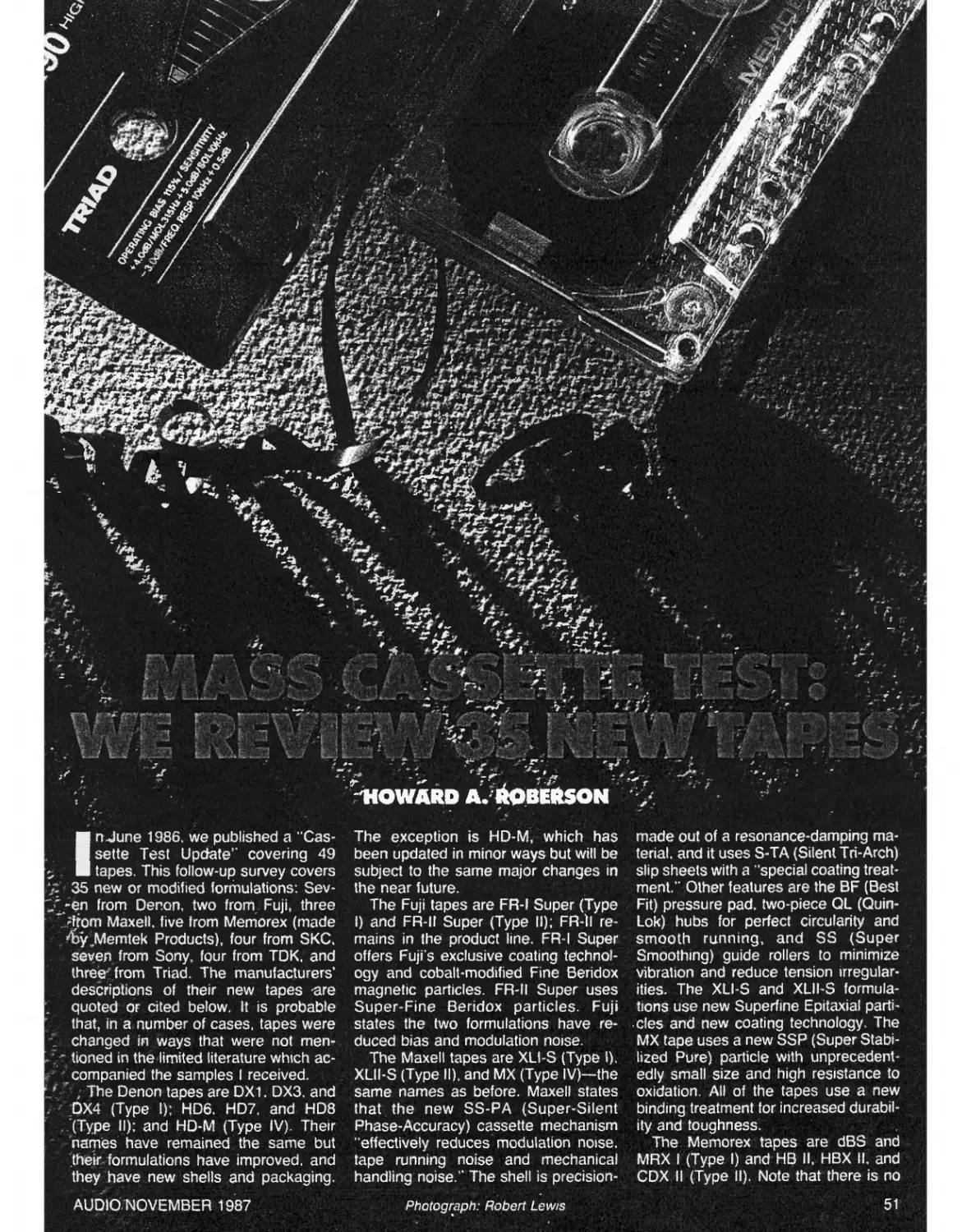
n June 3986, we published a "Cas-
sette Test Update' covering 49
tapes. This follow-Up survey covers
'"' 35 new Or modified formulations: Sev-
:en from Der.on, two from Fuji, three
.'from Maxeil. five from Memorex (made
4y.Memtek Products), four from SKC.
seven from Sony, four from TDK, and
three- from Triad. The manufacturers'
deseiiptions of their new tapes -are
quoted oF cited below. It is probable
that, in a number of cases, tapes were
changed in ways that were not men-
. - tioned in the limited literature which ac-
Gompatlied the samples I received.
, The Denon tapes are DXf, DX3, and
~ DX4 (Type I); HD6. HD7, and HD8
(Type Il); and HD-M {Type IV). Their
iames have remained the same but
their formulations have improved. and
they have new shells and packaging.
AUDIO. NOVEMBER t 98?
I
C gt e, r
r~
mowaio i Ayliasoat
The exception is HD-M, which has
been updated in minor ways but vritl be
subject to the same major changes in
the near future.
The Fuji tapes are FR-I Super (Type
I) and FR-II Super (Type II); FR-ll re-
mains in the product line. FR-l Super
offers Fuji's exclusive coating technol-
ogy and cobalt-modified Fine Beridox
magnetic particles. FR-ll Super uses
Super-Fine 8eridox particles. Fuji
states the two formulations have re-
duced bias and modulation noise.
The Maxell tapes are XLi-S (Type I).
XLII-S {Type II), and MX (Type IV) — the
same names as before. IVlaxell states
that the new SS-PA (Super-Silent
Phase-Accuracy) cassette mechanism
"effectively reduces modulation noise.
tape running noise and mechanical
handling noise." The shell is precision-
Photograph: Robert Levws
made out of a resonance-damping ma-
terial. and it uses S-TA (Silent Tri-Arch)
slip sheets with a "special coating treat-
ment." Other features are the BF {Best
Fit) pressure pad, two-piece QL (Quin-
Lok) hubs for perfect circularity and
smooth running, and SS (Super
Smoothing) guide rollers to minimize
vibration and reduce tension irregular-
ities. The XLI-S and XLII-S formula-
tians use new Superfine Epitaxial parti-
cles and new coating technology. The
MX tape uses a new SSP (Super Stabi-
lized Pure) particle with unprecedent-
edly small size and high resistance to
oxidation. All of the tapes use a new
binding treatment for increased durabil-
ity and toughness.
The Memorex tapes are dBS and
MRX I (Type I) and HB il, HBX ll, and
CDX II (Type li). Note that there is no
Many of the latest cassette shells incorporate
features designed to reduce resonance,
Ylbration, and modulation noise.
Memorex Type IV tape. The manufac-
turer's position is that many decks are
not really suited to such tapes, deliver-
ing high distortion with Type IV be-
cause of limited bias current and inad-
equate head designs. The dBS tape is
a new entry, said to offer performance
and value." Its clear plastic shell has a
"finely engineered mechantsrn" for
smooth running. MRX I and HB II also
have clear shells. The MRX I formula-
tion Uses ferric oxide, while HB II uses
crystal ferrite. HBX II has "superior
sensitivity to deliver greater 'sound
presence.' " CDX II is claimed to have
better-than-metal performance, but at
the Type II bias setting; it is said to
push MOL limits to new highs.
The tapes from SKC are GX and AX
(Type I), QX (Type II), and ZX (Type
IV). These are the first audio tapes
from this major South Korean manufac-
turer to carry their pwn brand. All of the
formulations come in the C-46 length,
and the GX is also available as a C-
120. GX uses a special ferric oxide for
high output and offers "full dynamic
range with excellent signal-to-noise ra-
tio." The AX and QX tapes have wide-
window, high-precision shells. The AX
has an "exclusive particle formulation
for superior fidelity," and the QX has a
"superior high-bias tape formulation
and ultra-high density tape finish" to
provide extended high-frequency re-
sponse. The SKC ZX metal tape has a
"precision cassette shell for superior
alignment and greater guidance accu-
racy." It is said to have specially treat-
ed pure iron particles for extended fre-
quency response.
The Sony tapes are HF and HF-S
(Type I); UX, UX-S, UX-ES, and UX-
PRO (Type II), and Metal-ES (Type IV).
In this case, the names for the Type I
and Type IV tapes remain unchanged,
but the Type II formulation names are
new, replacing UCX and UCX-S. In
their literature, Sony presents the new
Type I and IV formulations as having
higher sensitivity and greater high-fre-
quency output than the previous ver-
sions. The manufacturer describes the
particles for UX, UX-S, UX-ES, and UX-
PRO as Micro-Fine Uniaxial, Super-
Fine Super Uniaxial, Ultra-Fine Power
Uniaxial, and Ultra-Fine High-Power
Uniaxial, res pective)y.
Sony states that the rigidity and high
precision of its latest shell design help
52
reduce modulation noise and vibration
in HF-S and all of its new Type II cas-
settes. The UX-PRO shell has unique
ceramic tape guides for further im-
provernents in this area, to gain "unex-
celled sound purity." Metai-ES has a
newly designed three-plate, high-pre-
cision shell for added rigidity and low-
ered vibration. This tape has ultra-fine
Extralloy particles "in unique double-
coating magnetic layers for reduced
noise and expanded performance."
The four TDK tapes are AD-S (Type
I), SA-XG (Type il), and MA-X and MA-
XG (Type IV). AD-S has the same for-
mulation as AD but uses a high-tech,
see-through cassette design. The new
shell has high rigidity and is made from
a vibration-damping plastic to control
resonances. SA-XG is said to be engi-
neered to deliver the lowest bias noise
and the finest audio performance avail-
able from a Type II tape. The MA-X
metal-particle tape uses a newly devel-
oped two-layer plastic mechanism and
an improved Finavinx formulation. The
rnechanisrn is constructed with special
dual-layer shell halves for reduced res-
onance and superior tape-to-head
contact. The shell halves are ctesignect
specifically for best tape transportabili-
ty, and the plastic used increases the
shell's rigidity. The shells have new
slipsheets to ensure smooth tape travel
and accurate winding while reducing
flutter and transport noise. Other fea-
tures include mono-molded hubs for
improved surface smoothness and
precise circularity, a new dual-spring
pressure pad, and seamless guide
rollers.
The new SA-XG and MA-XG tapes
are the same magnetically as SA-X (in-
troduced earlier) and MA-X, respec-
tively. They use, however, the new
three-layer RS-II cassette-shell mecha-
nism with a die-cast metal-alloy frame.
The high-performance mech'anism
"virtually eliminates sympathetic vibra-
tion and provides optimum precision in
tape travel." The mechanism uses four
ultra-precise guide pins to suppress
the generation of modulation noise for
"the purest, clearest sound."
The Triad tapes are F-X (Type I), EM-
X (Type II), and MG-X (Type IV). All
three are housed in Triad's Delta trans-
port mechanism, which features a
unique slip pact with a hub-tensioning
device The manufacturer claims that
extended headroom, wide dynamic
range, and high signal-to-noise ratio
make all three formulations "ideal" for
the "digital medium." Triad gives credit
to the "unique cobalt saturation meth-
od" used for F-X, the technologically
advanced process making the metal
particles for the Type II EM-X, and the
"near perfect" uniformity of size and
composition of the MG-X particles.
The manufacturers supplied three
samples of each formulation evaluat-
ed. I examined the packaging and un-
wrapped the samples, noting any pull-
tag instructions. Every sample was
fast-wound once in each direction be-
fore any other tests.
t used a Nakamichf CR-7A deck for
the great majority of the recor.d,'play-
back tests; I also used a Nakamichi
582 recorder for some tests. Bias and
sensitivity figures were measured rela-
tive to the IEC Type I, II, and IV refer-
ence tapes. A meter, in its relative-dB
mode, measured bias at an internal
point in the 582 deck. The 582's cali-
bration tone was the source for mea-
suring sensitivity in dB.
For other tests, the automatic cali-
bration function of the CR-7A set the
bias and the alignment of the playback
head to the record head. I made
swept-sinusoid pjots at Dolby level
(200 nWb/m at 400 Hz). The — 3 d8
points at the high-frequency end were
measured at the same level. Let me
emphasize here that although there
are references to Dolby level, no tests
were run with any noise reduction.
Maximum output levels (MOLs) were
measured at 100 and 400 Hz ancf at 1,
2.5, 6, 10, and 15 kHz. I have changed
the test frequencies I' ve used in the
past. Chiefly, this was done to add 15
kHz, as recent examinatio~ of CD out-
put spectra has shown that they can
have significant energy up to about
this frequency. Some other frequen-
cies were then changed to provide
more even spacing up to 15 kHz.
All MQLs were measured with a dis-
tortion limit of 3'/o. For the three lowest
frequencies, the limit was 3'/ HOL3
(third-harmonic distortion) For the four
highest frequencies, the limit was 3/
TTIM (twin-tone IM) distortion, using
the two tones 400 Hz above and 400
Hz below the stated test frequency. In
AlJOIOiNOVEMBER 1987
TABLE I-NEASllRED DATA
Maximom OUtpot Level
(dB, re: 400 Hz Dotby Leveo
Response
At — 3 dB
S)N For 0-dB Mod.
Ratio Level Noise
(dBA) tkHz) (dB)
HDL = 3%
TTIM = 3%
Bias
(dB)
Seas.
(dB)
Tape
900 400
9k
2.5k
10k ask
57.3
59.6
59.1
60.1
59.4
55.8
57.5
55.5
56.8
54.2
58.6
59.9
60.3
+ 0.5 — 8.4 — 14.8
+ 2.4 — 7.2 — 14.0
+2 3 — 7.0 — 13.5
+1 9 — 6.5 — 13.4
-0.5 -9.8 — 15.4
— 0.1 — 8.6 — 15.4
+ 0.2 — 8.6 — 15.0
+ 0.2 — 8.0 — 14.9
+1.7 — 8.1 — 13.9
+ 0.7 — 8.3 — 15 1
+1.2 — 7.2 — 14.4
+1.4 -6 8 — 14.2
+ 1.7 — 7.1 — 14.0
61.8
62.1
61.8
61.5
61.7
594
59.7
58.9
56.5
59.6
59.5
62.0
62.5
62.9
58.5
+04
0.0
+'t.o
+2-3
+0.6
+ 0.3
+0.5
— O.2
+O.7
+O4
+ 4.6
+0.8
+O.B
— O1
— 43,8
— 52.3
-5$.8
— 53.5
— O'I.4
— 52.7
— 49.2
12.8
13.4
33.T
13-5
j$.7
I3.0
Oem' HD-M
~ Maxwell MX
— SKC ZX
+~ Sony Metal-ES
W TDK MA-X
+ I[3K MA-XC
Triad MG-X
622
637
62.3
68.0
644
64.5
6>
-6,8
-5.8
— 5.1
— 5.4
— 5.0
— 49
— 5.5
— 9.9
— >
— 97
— 9.5
— 99
99
-98
— 32
+ 0.2
+ l.$
+3.6
+ 1.2
+ 1-4
+O.9
+53
~7.2
+ 8.2
+ l1.9
+8.6
+8.5
+7.O
+4.3
+6.4
+ 7.6
+9,3
+82
w8.3
+6.2
+5.4
+6-6
+B.I
+lt.3
~8.1
+8.0
+ 6.9
passed to a meter. The meter was ref-
erenced to the playback level of the 1-
kHz test tone without the filtering and
cancellation.
the accompanying graphs Qf perfor-
mance versus frequency, the MOL
measurements were used to plot the
dashed curves.
Signal-to-noise ratio was measured
as the difference between the signal
level that caused 3% distortion at 400
Hz and tape noise measured with lEC
A-weig hting. A 3-kHz tone was record-
ed and played back to assess flutter.
Once again, I remind readers that the
results are just general indications: The
deck has a considerable effect on the
exact flutter measurement with any
tape. The same 3-kHz tone was used
to test for dropouts and to determine
the degree of level stability at this mod-
erately high frequency. l measured
modulation noise with a high-level 1-
kHz test tone which was phase-can-
celled ance filtered oUt in the playback
so that only noise would remain. This
noise was then band-Iimited to the
range from 500 to 1,500 Hz and
llSE TESTS
It was easy to remove the wrap on all
samples. As a group, the Sony sam-
ples were the easiest to unwrap, fol-
lowed closely by those from Fuji and
TDK, with the Maxell and Triad sam-
ples close behind them The Denon
Devon DXi
Devon DX3
Devon DX4
Fuji FR-I Super
Maxell XLI-S
~ Mernorex dBS
L Memorex MRX I
SKC GX
SKC AX
Sony HF
Sovy HF-S
TDK AD-S
Triad F-X
Devov HD6
Devov HD7
De~o~ HD8
FUji FR-II SUper
Maxell XLII-S
Memorex HB If
Me~orex HBX II
L Mernorex CDX II
& t; KC
So~ UX
Sory UX-S
Sovy UX-ES
Sovy UX-PRO
TDK SA-XG
Triad EM-X
AUDIO/NO'I/EMBER 1987
+4.4
+8.0
+8.7
+ 7.2
+6.6
+4.3
+ 5.9
+4.8
+6.1
+3.5
+6.i
+6.2
+7.4
+ 4.7
+ 5.1
+ 4.7
+ 5.5
+4.6
+ 3.0
+ 4.1
+4.2
+1.6
+4.0
+ 4.8
+ 6.3
+6.4
+4.5
+4.p
+43
+ 7.9
+ 7.9
+79
+63
+3.8
+ 5.5
+ 5.i
+ 5.8
+3.9
+ 6.4
+6.4
+ 7.3
+ 5.0
+5.4
+ 5.0
+ 5.0
+4.4
+ 3.2
+4.2
+4.9
+1.5
+ 4.Q
+ 5.0
+6.4
+6.7
+4.6
+4.0
+4.3
+6.8
+6.6
+7.4
+4.8
+3.1
+4.7
+4.9
+4.9
+4.7
+6.4
+6.2
+6.8
+ 4.2
+4.5
+ 4.4
+4.2
+2.5
+ 2.4
+3.6
+4.3
+0.9
+ 3.1
+4.1
+5.9
+6.1
+3.1
+3.0
-2.2
3
-2.2
— 1.7
— 5.0
— 2.7
-2.2
— 1.2
-39
-3.1
-2.4
— 1.1
— 10
— 44
— 1.7
-97
— 97
— 9.6
-8.8
— 11.5
-95
-95
— 8.4
— 10.4
— 10.0
— 9.5
— 8.6
— 8.2
— 113
— 6.7
— 14.6
— 14.6
— >
— 14.P
— 15.2
— 14.8
— 14.4
— 14.6
— 15.1
— 15.4
— 15.2
— 14.8
— 14.1
— t 4.4
— 10.2
9.7
10.3
i0.5
10.2
10.0
10.2
10.3
9.9
10.5
10-3
11.0
10.7
10.5
9.3
9.0
9.6
99
7.1
9.6
10.1
12.1
9.2
9.4
9.8
10.6
10.5
7.1
12.1
— 45. 4
— 45.7
-46.3
— 48.7
— 45.2
— 472
— 44.4
— 48.2
— 45.5
— 48.3
-48.2
— 45.p
— 48.6
— 50.9
— 50.7
— 50.3
— 50.8
— 49.4
— 427
— 47.6
— 45.2
— 51.0
— 48.6
— 51 ~ 7
-52.2
— 52.4
— 49.7
— 47.4
+0.3
+ Q.2
0.0
+0.9
+0.6
— 0.2
0.0
+ 0.2
+0.3
+0.2
+0.4
+ 0.6
+ 0.9
+0.7
+0.7
+0.7
+0.2
+1 ~ 1
+02
+0.3
+1.8
+ 0.3
+0.2
+0.8
+1.2
+14
+1.0
+1.6
— 1.1
+ 0.8
+1.0
+0.2
+09
-0.4
0.0
— 0.3
— 0.2
— 1.0
+0.5
+0.2
+0.3
+1.9
+2.0
+2.0
+1.6
+1.6
+0.8
+19
+3.5
+1.2
+15
+1.9
+1.6
+1.4
+2.6
+2.8
Reading the MOL curves for the tape you
prefer can help you judge the proper level
settings to use when recording.
54
pull tabs were a little hard to start but
worked very well after that. Some of the
Memorex tabs were easy to find and
pull; some were not. The SKC tabs
were not marked, and some were hard
to find and pull.
All of the samples were quiet during
fast winding, except for a couple of the
Memorex HB ll and SKC GX samples.
Maxell XLII-$ and TDK MA-X were the
quietest pf all, with the Fuji and Triad
samples not far behind.
Most of the cassettes offer tactile
clues for telling side A from side B.
This is very helpful for those with vision
problems or for situations in which vi-
sual inspection would be difficult, such
as while driving a car. Most of the
Oenon tapes have raisecl "A" and "B"
markings on the appropriate sides, but
these letters were not easy to pick out
by feel. The "A" and "B" on Denon's
HD8 shells, however, are incised rath-
er than raised, in an arty typeface that
was easy to feel.
I congratulate Fuji for including "A"
and "B" in 8raitle on their shell halves.
(The dot patterns can be decoded by
the sighted as well as the blind.) I hope
other manufacturers follow Fuji's lead.
The Maxell cassettes have a single
raised dot at the left for side A and a
double dot in the same place for side B.
The Memorex H8X ll anct CDX ll shells
have raised letters, but they were diffi-
cult to decipher. The other tapes in the
line have printed letters, impossible to
detect by feel. It was possible to pick
out the "A" (raised) or "B" (incised) on
the SKC GX cassette, but the other
tapes in the SKC line had no tactile
clues.
The Sony cassettes have a raised
"A" on the left, while the "8," in the
same relative position, is slightly in-
cised. This makes for easy selection by
touch. Little arrows point to the location
of the erase-prevention tabs for the
side in use.
TDK's AD-S and MA-X shells use
dots on the right side (one dot for "A"
and two for "B"). These tapes also
have raised letters, "A" and "B," which
I could sense correctly with a fingertip.
The TDK MA-XG shells offer no tactile
clues as to which side is being
touched. The snap-out erase-preven-
tion tabs on this tape can be snapped
back in again — a handy feature.
Triad tapes have no raised letters to
provide tactile clues as to which side is
which. However, the triangular view
windows. which point in different direc-
tions according to which side is up, do
make it easy to se(ect the side you
want by tooking.
All of the cassettes (Denon's DX1
excepted) are supplied with pressure-
sensitive labels, but there are some
differences. Most of the Oenon tapes
have fairly wide labels for the two
sides, plus narrow labels that can be
placed on the long edge of the shell.
This certainly is helpful when tapes are
stored with their spines showing. The
H08 side labels are fairly narrow, but
there are also tittle "No." labels that fit
into an indented square at the. right
end of each side of the shell. The Fuji
labels are reasonably wide, and stick-
on numbers are supplied for easy en-
coding if desired. The Maxell labels
are a good size but have many fine
lines which might be more confusing
than helpful to some users.
The Memorex labels are rather nar-
row, and their shiny surfaces would be
hard to write on except with a ball point
pen. Most of the SKC labels are slightly
narrow, but it was easy to write on
them. Most of the Sony labels are quite
narrow, although the labels for HF tape
are wide and easy to use.
The TDK labels are wide, which is
good, but I needed a ball point to mark
the shiny MA-XG labels. Because of
the triangular shape of the Triad view
windows, their shells do not take full-
width labels. The small labels supplied
don't feave much room for writing infor-
mation, and they are gray, which re-
duces legibility.
Most of my previous tape surveys
have presented data obtained only
with a Nakamichi 582 deck and sup-
porting instrumentation. In this survey,
as I' ve said, the majority of the data
was secured with a Nakarnichi CR-7A
deck, using its automatic calibration
feature. There was no doubt about the
convenience of its automation, but I did
wonder how the results obtained with
it. particularly the MOL figures, would
compare to those l had obtained with
the 582 in previous tests. In a detailed
comparison, I found that, on the aver-
age, 100-Hz MOL readings were 0.7
dB higher with the CR-7A than with the
582, 400-Hz MOL readings were 0.1
dB lower, and 1-kHz MOL readings
were 0.8 dB higher. There was, how-
ever, little difference between the high-
er-frequency MOL.s (re: 3! T'TlM) ob-
tained from the two decks, and relative
performance for all tapes was the
same regardless of the deck used.
However, I got more consistent results
in rechecks with the CR-TA, which was
therefore used as the source for all
MOL data. The 582 was used to check
puzzling results.
In my previous surveys, I have pre-
sented a table of data to summarize
results. Such tables show a lot of detail,
but they are difficult to use when rnak-
ing comparisons or absolute judg-
ments. After toying with various forms
of bar graphs and pie charts, I have
arrived at a combination which I hope
meets the goats of accuracy and visual
effectiveness: The table of Measured
Data, graphs of performance versus
frequency, and pie charts.
For the pie charts, I have selected
sjx parameters to be shown for each
tape: 0-dB response (the —.3 dB point
at Dolby level), low-frequency MOL (at
400 Hz), modulation noise, "consisten-
cy," high-frequency MOL (at 10 kHz),
and S(N ratio. All are self-explanatory
except for "consistency," a catch-all
term covering eight parameters. These
are: t 0-kHz skew consistency between
the tape's two directions of travel, con-
sistency of bias requirements and sen-
sitivity with the lEC Standards, consis-
tency of bias requirements and sensi-
tivity among samples, consistency of
playback level at 3 kHz throughout a
sample, maximum occasional dropout,
and flutter (speed consistency). All are
measured in dB, with the exception of
flutter; it is ranked as 0 for tow, 1 for
average, and 2 for high A perfect
"consistency" score would be zero,
and I arbitrarily set 20 as the worst
possible result.
I have some question whether offset
from IEC reference bias and sensitivity
should be considered a deviation from
perfection. I have therefore weighted
my scale so that each 1-dB offset from
IEC Standards would reduce a tape's
total performance rating by only 1'/o.
The angles of the pie segments were
selected to correspond to the impor-
tance of the parameter. I allotted 75'
each for 400-Hz MOL and 0-dB re-
AlJDIO/NOVEMBER 1987
sponse; 6Q' each for SiN ratio, 30-kHz
MOL, and consistency, and 30 for
modulation noise. In each segment,
the area filled in from the center shows
how that formulation's performance
compared to the worst (0%) and best
(100%) results that I have ever mea-
sured. The overall performance figure
is the sum of the six percentages,
weighted according to their respective
contributions and using the same
weighting as in the pie-chart diagrams.
The actuaI figures for each parame-
ter are indicated on the pie charts. The
figures for Iow-frequency and high-fre-
quency MOL and for modulation noise
are in dB. The figures for SiN are in
dEIA, and those for 0-dB response are
in kHz. Consistency, as mentioned be-
fore, is just a number ranking between
0 (perfect) and 20 (worst ever).
The MOL curves, shown on the 0-dB
swept-frequency plots, can be used to
derive MOL figures for the frequencies
not covered by the pie charts. There is
a good correlation between the 400-Hz
MOL and the other low-frequency
MQLs shown in Table I, and between
the 30-kHz MQL and the other high-
frequency MOLs. MOl varies only
slightly between tapes of the same
type, bUt greater variations exist be-
tween tape types. Note that distortion
at the 0-dB level is less than 3% wher-
ever the solid curve is below the
dashed curve and is more than 3/0
wherever the situation is reversed. The
MOL curve is of particular help, there-
fore, in judging the necessary limits in
recording levels relative to the high-
frequency energy in the music.
My comments on each of the tapes
are arranged atphabetically by manu-
facturer within each tape type. IVlost of
these tapes sho~ed good consisten-
cy, and so no details will be given for
this performance category LinIess
something about a given tape is partic-
UlarIy good — or bad.
Denon DXf (top) and DX3
IS MOL FOR 3% OISTORTIOM
Ik
FREOUKNCY — Hr
Denon DX4 (top) and Fuji FR-I Super Maxell XLi S(t-op) and Memorex d8S
--- IS MOL FOR 3% DISTORTION
— IS MOL FOR 3/~ DISTORTION
lpk
III
FREQUQNV' — Mz
IPk
Ik
FREQUKN~ — Hz
Memorex MRX l (top) ancl SKC GX SKC AX (top) and Sony HF
IS QOL FOR 3 k DISTORTION
— IS l40L FQR 3~4PISTORTIPN
FREOUENCY — Mz
FREOUENCY — Ht
Tripp' F-X
Sony HF S(top) a-nd TDK AD-S
— — IS ~L FOR 3/o DISTORTION
I' "Ol R)R 34 DISTORTION
IPk
FREOUQNVf — H2
PtEOUENW — Hz
00UjY
8
00'
LEVf.L
cC
00Lsr
~a.
8
) OOLOGY
AVEL
dl
DORY
usa.
LL
O
DOLHY
EEVKL
OOLBY
I L&am
O
~ ~ops
~VEL
K
OOLBY
CL
I
O
MVEL
4J
K
DOLIY
3
DOLSY
LEVKL
00Lw
O
4J
K
TYPE I TAPES
Type I tapes can have fairly high
MOLs across the band. However, they
have neither high MOLs at the highest
frequencies nor really extended re-
sponse at 0 dB, though they are usual-
ly better than Type Il tapes in these
AUDIQ/NQVEMEIER ] 987
respects. The best-performing Type I
tapes, with 400-Hz MOLs of +6 dB or
more, match the SiN ratios of many
Type II tapes. The Type I overall rat-
ings do not go much beyond 60% at
this time because their performance
(except for consistency) cannot match
that of Type IV tapes.
Oenon DX7: its overall performance rat-
ing (46'4) indicates that DXl would be
best used for noncritical purposes.
Denon OX3.. This formulation is a con-
siderable improvement over DX1. lt is
a weII-balanced tape, giving good re-
sults for all parameters. Its 60% perfor-
mance rating is one of the best for
Type I tapes. equal or superior to that
for most of the Type il tapes in this
survey.
Denon DX4: This tape's 6l% perfor-
Fuji FR I-Super
0-dB
Denon DX7
Denote OX3
Denon OX4
0-ae
0-d8
QtN-FRf Q.
MOL
N-FRED.
MOL
ow om.
MOL
$&g
Sll" &
S/N
M00.
NOISE
M00.
NOISE
HIGH-F
VOL
HlGH — FRfg.
MGI.
OVQRAI L PERFPRMANCE $6 &g ;e OVER LL PERFPRMAH E: gP /I OVER LL PERFORMAN E: $1 /e OVER LL PERFORMAN E: 62
Maxell XLI S-
Memorex MRX I
Memofex EBS
P-dS
6-08
0- 48
CW- FR@ g.
MOL
OW-~EQ.
MOL
OW-FREa
MOL
SIN
S/H
MOO.
NOISE
MOO.
NOISE
hlOO.
NOISE
MOD.
NCISf.
HlGH- FREQ
MGI.
HIGH- f
MOI
HIGH-f
MGL
NSIS
SISTKNCY
avERALL PERFoRMANcE; 50 ~. OvER4LL MRFaRMANcE: ~5 ~. avERALL PERFDRMANt E: 50 j. GVERnLg PERFaRMANcf; 4eoi.
SKC AX
Sony HF
Sony HF S-
TDK AO-S
0-48
>
0-dg
G-dB
6-dg
Rf.SP.
W-f%q.
MOL
w- ma.
MOL
SIN
S/4
S/N
MGO.
+OISK
MQQ.
NOISE
MOO.
NOISf
HIGH-FRY@.
Not.
CY
pv<R LL WRFoR> AN K: 51 ~- vmALL PERFaR ~N E: n6 I. a ERALL PERFOR ANCE 58~- ov Rn,gL PERFORM ,NcE:
Triad F-X
6- dg
LOW-FREQ
MOL
S/8
MOO.
Nalgf
HIG>-FR
MOL
CQNSISYKNCY
OVERALL PERFORMANCE: g] '/o
56
ALJDIQINOVEMBER 1987
ma~ce rating earns It a tie for second
place among the Type I formulations
a&l ;d p ts it j an ab ve he b st T pe
It is little dNerent from OX3, as shown
by its 1% performance advantage.
Fuji FR-I Super: Low molulatian naise,
a high S/N ratio, and a good 10-kHz
MQL cambine to give this formulatian
the highest rating of any Type l tape:
62%. This figure is better than that far
any of the Type Ils and close [o o~e of
the Type lV tapes.
Afaxejj XLI-S: This formulation was a bit
of a disappointment, with low MQLs
a~et high rnodulatian apoise. Consisten-
cy was poprer than for mast tapes be-
cause of high bias and sensitivity,
measurable skew, 3-kHz level wander-
ing. and drapauts. Overall: 50%.
Memorex dBS: Poor perfarmance in
most parameters gave this tape the
lowest Type 1 rating (45%) in this sur-
vey. It was, however, still superior tp a
number af Type lls.
Memorex MRX I: With the exception pf
modulatIon noise, this formu)ation is a
worthwhile improvement aver dBS. Its
50 k rating is not that impressive, but it
is better than a number of Type Ils.
SKC GX: This tape had Io~ modulatia~
Most Type II tapes have higher S/N ratios
than Type i formulations, but they also have
poorer 0-dB responses.
Denon H 6 (top) and HD7
— -- IS MOL fOR 3'Ye DISTORTION
8
OOLIY
LEVEL,
4J
I-
8
UJ
DQLIY
LEVEL
I-
IOO
IOO
IPk
Ik
FRf QUE NCY — Nz
FREQUENCY — Hz
IS MQL FOR &g ;% DISTORT
IS MOL FOR 3%a DISTORTION
~e.
I-
6
8
UJ
DOLbY
Lf VG
DOLIY
LEVQ.
d.
DOLBY
ILVCL
IL'
IOO
IPk
IOO
Ik
FREQUf Ngl' — Hz
IPk
Ik
FREOuf NCY — Hz
SKC GX (top) and Sony UX
Sony UX-S (top) and UX ES-
IS VOL FOR 3 &g ;o DISTORT
— IS MOL FOR 3' DISTORTION
dl
MLST
V'
8
)
LEVKL
©
DOl.IY
OOLBY
~WI„
tz:
IOO
FREQUENCY — H z
FREQUENCY — H z
Sony UX PRO (top-) and TDK SA-XG Triad EM X-
IS MOL FOR 3 4 PISTPRTION
— l$ MOL FOR 3% OISTORTION
azva.
IL
I-
8
OOLIIY
LjVQ.
l ~o.
I-
8
10k
IOO
IOO
FREOUENCf — &l
FREQUENCY — Hz
AUDIO/NOVEMI3ER 1987
noise, but its signal-to-noise ratio was
poor. Irregular sensitivity and high
skew contributed to poor consistency.
verall: 48%.
SKC AX: Except for its modulation
noise and 10-kHz MOL, AX is better
than GX. Overall: 51%.
Sony HF: This is actually one of the
lower scoring Type I tapes in the sur-
vey, mostly because of poor 400-Hz
MOL and a low signal-to-noise ratio.
The modulation noise is fairly low, but
the overall rating is just 46%.
Sony HF-S: A considerabIe improve-
ment over HF, it has a well-balanced
collection of performances in each pa-
rameter. This is one of the better Type I
tapes and is superior to most Type lls.
Overall: 58%.
TDK AO-S: This formulation has good
balance in performance among all of
the test parameters, except that its
modulation noise is on the high side.
Its overall rating of 58% makes it one of
the better Type I tapes and superior to
most Type Ils.
Triad F-X: Offering good, well-matched
results for all the parameters, it
achieved an overall rating of 61%. It
tied for second among Type I tapes
and is just above the best Type II in the
survey.
Most Type II tapes have low M Ls at
the higher frequencies, but they usual-
iy have higher S/N ratios than Type I
formulations. Most Type II tapes also
have poorer 0-dB responses than do
Type I tapes. The fundamental reasons
for all three characteristics are these:
The greater record equalization used
with Type II tapes increases the high-
frequency saturation, and the comple-
mentary equalization used in playback
results in greater reduction of tape
noise than with Type I tapes. The Type
II overall ratings go no higher than 60%
at this time, mostiy because of low
MOLs.
Denon HO5: This formulation is aver-
age, as Type Il tapes go. The moduia-
tion noise was low and the S/N ratio
high. Consistency was poor because
of high bias and s|.nsitivity offsets and
higher-than-average skew and drop-
outs. Overall: 49%.
Maxell XLII S(top-) and Memorex HB II
Denon HD8 (top) and Fuji FR II S-uper
— -- IS MOl FOR 3% DISTORTION
Memorex HBX II (top) and CDX II
Denon HD8
Denon HD6
Oenon H07
O-d8
0- d8
0-dB
&l
S/N
S/N
MOD.
NOI SE
MOO.
NOI SE
CY
NCY
NSISTENCY
HIG+-FRE J.
MOL
ISTENCY
OVERALL PERFORMANCE'' 49 /o OVERALL PERFORMANCE: 50'4 OVERAl L PERFORMANCE: 51% OVERALL PERFORMANCE e 54%
Memorex COX ij
Maxe/I XLII-S
Memorex HHX li
0- (jB
O-dB
0-4B
W-FREO
W- FREQ
MOL
S/N
Q/N
S/N
S/N
MOD.
NOISE
CY
CONS I ST ENCY
CONSISTENCY
HIGH — F
>
NSI ST EN CY
OVERALL PERFORMANCE: 40 / OVERALL PERE'ORMANCE: 42 /o OVERALL PERFORMANCE: 47 ~o OVERALL PERFORMANCE,: 5)'~
Sony UX-ES
Sony UX-S
0-de
5/N
$/N
S/N
MOD.
NOISE
MOD.
NOISE
MOD
NOISE
NSISTENGY
CY
H IGH — FREO.
MOL
CY
T NCY
HIGr — FREO.
MOL
HIGH — FREQ
MOL
OVE'RALL PERFOR>ANC ': 38 ~o OVE'R LL PERFORMAN E 2 46 >o O ERALL PERfaR A CE: 5 l'4 O ERALL PERFOR ANCE:
triad EM-X
TDK SA-XG
0-dB
S/N
$/N
S/N
CONSI STENCY
CONSISTENCY
N. IST NCY
HIGH -F<
MOL
OVERALL PERFORMANCES 6P/o OVERALL PERFORMANCE: 41 ~o OVERALL PERFORMANCE' 54/o
AUDIQi'NQVEMEIER 3 987
58
HIGH-F
MOL
SKC QX
0-&l
Sony UX-PRO
0-dB
HIGH -FREG.
MOL
w- FRY.
MOL
MOP.
NOISE
W- FREO.
MOt.
MOP.
NOISE
W- FRED.
MOL
MOO.
NOISE.
W- FREQ.
MOL
MOO.
NOISE
Memorex HB!i
0-48
HIGH — FRE
MQL
Sony LJX
o-(j B
HIGH - F
MOL
HIGH- FRFQ.
MOL
W- FREQ
MOL
MOO.
NOI SE
MQD.
NOISE
W-FREQ
MOL
W- FREO.
MPL
MOD.
NOI SE
HIGH — <
MOl
W- FREG
MOL
W- FREQ.
MOL
MOP.
NOISE
W- FREG.
MOL
W-FREQ
MQ
MOO.
NOISE
Fuji FR-II Super
0-d8
HIGh — F
MOL
HIGH-f REV
MOL
W- FREO.
MOI
W-FREO
IVIOL
The best overall performers were Type IV
tapes, with advantages that are especially
vsefvl when taping from CDs.
Oenon HD7: This tape's performance
is quite similar to that of HD6. In three
parameters it is slightly better, and 'in
two others it is a bit worse. Lip slightly
overalt from HD6, to 50'k.
Oenon HDS;. This formulation is very
much like the other two Denon Type il
tapes. It is a bit above the Type II
average, with an overall rating of 51%.
Fuji FR-II Super: Each parameter rnea-
sured higher than the Type Il average,
winning it one of the better ratings in
this survey, 54%.
MaxeII XLII-S: The results for this tape
were puzzling, in that it did not demon-
strate expected improvements over
earlier versions. Even after rechecking.
however, its low 400-Hz an& t i Q-
MOLs and its restricted 0-dB response
could not be denied. With an overall
rating of 40%, it is next to Iast in perfor-
mance among the Type II tapes.
Memorex HE3 I/: This formulation's poor
400-Hz MOL and its high modulation
noise were balanced out, to some ex-
tent, by 8 reasonable 0-dB response.
Overall: 42%.
Memorex HBX tt: Improvements over
HB II in four parameters were most
welcome. The poorer consistency of
HBX II was primarily due to greater
offsets from lEC bias and sensitivity.
Overall: 47%.
Memorex COX I!: A. further improve-
rnent in performance is achieved by
this Memorex formulation: There is a
worthwhile extension in 0-dB response
along with desirable increases in the
MOI s. On the negative side, its consis-
tency rating is the poorest among all
the tapes in this survey (primarify be-
cause of high bias and sensitivity), and
its modulation noise is among the high-
est. Overall: 51%.
SKC QX: This formulation had bottom-
limit 400-Hz lVlOL and a poor signal-to-
noise ratio. Relatively fow modulation
nOISe waSn t wOrth muCh in thiS CGSe.
Overall I't rated 38%, the lowest figure
in this survey.
Sony UX: As Sony s bottom-position
Type II tape, LJX is a bit weak in its 400-
Hz and 3 0-khz MOLs, but it is bal-
anced quite well otherwise. The con-
sistency was one of the best, with low
flutter, excellent 3-kHz output stabil! ty,
and very little in the way of dropouts.
Overall: 46%.
Sony UX-S; This formulation was not aII
that different from LIX. but the higher
AUDIO/NOVEMBER 1987
Denon HD M(top) an-d Maxell MX SK ZX(top) and Sony Metal S-
— — ~ l$ ~ FOR 34(o DM(N TION
--- tS MOi FOR 3a QSTOfG'CN
IG
0049&
ance
mvK~
OOUtf
5
80t.SY
f EVIL
FREOUENCV — Hz
<RE UE c&g ;
TDK MA-X (top) and MA-X
Triad
--- IS HOL FM 3<GISTORT
— IS MOt FOR 3'4 OIS<OFrr
CI
CKLHV
cava.
Ct
hJ
OOLIV
45<
hJ
Ct:
< 00
f RQNIE~ — &g
$'REOUE J4QY — Hz
MOLs of UX-S are of definite value,
and its more extended 0-dB response
and lower modulation noise don't hurt.
Consistency was poorer because of
increased bias and sensitivity. Overall,
it rated 5'1%.
Sony UX-ES: In moving up one more
position in this manufacturer's Type II
tapes, all parameters were improved
with the exception of consistency,
which was slightly poorer. Once again,
higher bias and sensitivity were the
culprits. The overall rating is 59%,
making this the second-best Type II
tape.
Sony UX-PRO. In general, this tape
was similar in performance to UX-ES,
but the PRO version had a slightly
greater $i'N ratio, and its MOLs were a
bit higher. UX-PRO also provided out-
standing 3-kHz stability, but the con-
sistency rating was poorer because of
the slightly higher bias and skew.
Overall: 60%, the best of the Type Ils.
TOK SA-XQ: The signal-to-noise ratio
of this tape is the best of the Type lls,
but this cannot compensate for the low
MOLs and the restricted 0-dB re-
sponse. Overall: 43%, one of the poor-
er Type II tapes.
7riad EM-X: The 400-Hz MOL and the
3N ratio of this formulation are disap-
pointing, but its 0-d8 response is tied
for best among Type Ils, and its 10-
kHz MOLis the best. Overall: 54%, one
of the better Type ll tapes.
The better rectal-particle Type IV
tapes stand as the best performers
overall, primarily because of their very
high MQLs and reduced high-frequen-
cy saturation (which yields greater re-
sponse extension at 0 dB). There has
also been a general and slow reduc-
tion in the tape noise of Type IV cas-
settes since they first appeared. With
the proliferation of CDs as sources,
both at home and via broadcast, the
performance at the high-frequency
end has become even more signifi-
ony Meta/-ES
0-de
KC ZX
Denary HU-
Maxed MX
0-46
W- FREQ.
MOL,
W-FR@.
MQ
Mt- FRED
MOL
GW- FF+Q.
MPI„
SJrN
hjOD
HGISf
Ijt100.
NQISK
%00.
NOIS&
~gSISTg~V HIGH-FRQQ CONSISTEHCY
-vQ 4IOL
OVERALL PERFORMANCE: 77 io OVERALL PERFORMANCE: 88'i.
Hlgg -Frigg.
MGL
CIVERALQ PERFORMANCE Q4 /a OVERALL PE;RFCRMANCE: 75 /a
TDK MA-X
Triad
TDK MA-X
0--de
0-dP
RQQP
QW-<
MOL
urA- FRI O.
hIOL
I'<
NOI SE
ROD.
HOIQE
hloO.
NOISE
CY
HIGH-FREO.
MOK.
High] - f
MOL
NIGH- FRIGO.
MO&
ON SI STE NCY
OVERALL PQRFCIRMANCE: 80% OVE'RALL PERF'CIRMANCE: Si Io OVERALL PERFORt4A> E' 7
tributing to its relatively poor consisten-
cy rating. This formulation. with an
overall rating-of 88%, stands as the
best-performing of any type evaluated
to date.
TDK MA-X: With high MOL.s, extended
0-dB response, high signal-to-noise ra-
tio, and good consistency, this is cer-
tainly a very good metal tape. Overall:
80%, third best of all tapes tested
TDK MA-XG: As this tape uses the
same actual formulation as MA-X, I
shoulcl have found the same perfor-
rnance — and I did, pretty much. The
XG version's slightly better 0-dB re-
sponse, S(N ratio, and modulation
noise outweighed its slightly pporer
400-Hz MOL. and consistency. The dis-
crepancies all fall well within meter-
reading error limits. Overall: 81%, mak-
ing it seconcl best of all these tapes.
Triavil MG-X: This is a very good per-
former, in general. However, its 40Q-Hz
MOL was low for a Type IV tape, and
its SiN ratio was the lowest for the
metal tapes in this survey. Consistency
was among the best, with zero skew
and low flutter both worthy of mention.
Overall: 71%.
AUDIO!NOVEMBER 1987
60
cant. Thus, metal-particle tapes have
become even more interesting to the
serious recordist. The Type IV tapes
approach 90% overall performance.
Denon HD-M: As the pie chart for this
tape illustrates so clearly, an increase
in the 400-Hz MOL and a reduction in
modulation noise would bring the
scores for these parameters closer to
this formulation's other very good
scores. Overall: 64%.
Maxe/t MX: This tape demonstrates
further that the Type IV formulations
are the source of the highest perfor-
mance ratings. The 400-Hz MOL is just
slightly low compared to a number of
other metal tapes. Overall: 75%.
SKC ZX: With its first metal tape, SKC
has hit the mark quite well. All of the
results are very good, with no weak
areas. The excellent 10-kHz MOL is
certainly worthy of note. Overall: 77%.
Sony Metal-ES. This tape had the high-
est 400-Hz MOL and the highest sig-
nal-to-noise ratio, both by sizable mar-
gins. It also had the lowest modulation
nOiSe, and the 0-dB reSpOnSe waS tied
for best. Bias and sensitivity offsets
were the most significant factors con-
When I selected the six parameters
and chose all of the various modifying
factors, I expected that the Type IV
tapes would show the highest ratings. I
did think that the Tape tl tapes might
edge out the Type I tapes, primarily
because of their higher signal-to-noise
ratios. The fact of the matter is that the
average overall performance figure
was 53% for Type I and 49% for Type
II. This is not a big difference, to be
sure, particularly when we think about
the 76% average for Type IV tapes.
The Type I tapes were superior to the
Type lis in 400-Hz MOL, 0-dB re-
sponse, 10-kHz MOL., and consisten-
cy. The Type (Is were superior to the
Type I tapes in signal-to-noise ratio
and modulation noise. As noted above,
many of these differences are due to
the clifferent equalization curves used
with the two types. The Type IVs were
superior to both in all parameters, with
the exception that Type I tapes were
very slightly more consistent. For the
next survey, perhaps I will have to
change the weighting of the various
I had expected Type II to edge out Type I
because of higher S/Ns. In fact, the average
Type I performance was a bit better.
61
parameters or add another parameter,
but 1 will have to learn more before
doing So.
l decided that a broad-band pink-
noise record/playback compression
test would have value in proving the
importance of some of the parameters.
The pink no~se was band-limited to the
range from 20 Hz to 20 kHz, and a
negative shelf of about 5 dB was put in
from 5 to 20 kHz to make it more mu-
sic-like. For a flat display on the '/3-
octave RTA, a complementary positive
shelf was put in after playback. I cail
this modified pink noise "PN/Music II I."
For my tests, I used a dual attenuator
whose second section had been wired
backwards so that attenuation would
decrease in one section while increas-
ing in the other. The noise was fed
through the first attenuator section into
the recorder, and playback was fed to
the RTA via the-second section. Be-
cause of the reverse connection, the
total attenuation of both sections re-
mained constant for all settings, so the
signai level to the RTA remained the
same at all times except for the effects
of any compression. Buffering amplifi-
ers were used to maintain required im-
pedance matches for exact and equal
steps of the two sections.
Figure 1 shows the results of the
compression test. The level of the
noise was adjusted for a 0-dB indica-
tion on an rms meter that had been
calibrated to 400-Hz Dolby-level play-
back. The atteriuator was operated in
1-dB steps over the range from — 15 to
+5 dB. Because of the differences be-
tween peak and rms indications, the
CR-7A's peak-responding meters indi-
cated close to "+10" at the noise level
which corresponded to 0 dB on the
rms meter, and the CR-7A's meters
went off-scale at the +5 dB maximum
level ~
Three formulations were tried, one of
each tape type. As is shown in the
figure, the Type l and ll tapes had
some roll-off at the highest frequen-
cies, even Bt — 15 dB. The vertical
spread of each trace shows the com-
pression in each 'l~-octave band.
There is normally some spread in the
towest bands because of the statistical
character of the random noise. It is
easy to see that the Type I tape has
less compression than the Type ll
across the entire band. and that they
AUDIO/NO'I/ElVl HER 1987
both show more compression at the
higher frequencies. The Type IV tape is
quite superior to the other two tapes
across the entire band, with relatively
little additional spreading at the high-
est frequencies.
One thing this exercise demon-
strates clearly is that maximum record-
ing or meter levels are different for one
tape than for another. The limits are
lower for Type Il tapes than they are for
Type l tapes, in general, but the ques-
tion of which tape to use for what mu-
sic is more complex than is suggested
Fig. 7 — ompression vs.!eve/ and
frequency for high-quality Type I
(top)Type ,II (middle), and Type IV
(bottom) cassettes, over the range
from — 15 to +5 dB ims re: Dolby
level. Thickness of traces in each
'h-octave band shows the degree
of compression (exceptin the bass,
where statistical noise incr eases the
spread); the trace for a perfect tape
would be a thin, straight line (see
text) Input signal .was PNIMusic III,
band-limited from 20 Hz to 20 kHz.
Vertical scale: 5 dB/div.
by this relatively simple test. In my next
survey, I will do more testing of how
tapes perform in the recording of rnu-
sic, The desirability of the IEC bias and
sensitivity references for the consisten-
cy rating wilt also be reviewed.
Since my previous survey, Sony Met-
al-ES has become even better. A cave-
at here, however, is that with the rela-
tively high bias and sensitivity (re: IEC)
of this formulation, it will not perform at
its best unless the recordist adjusts his
deck to match it.
This is also true of the other tapes
whose bias and sensitivity figures are
offset. from the IEC Standards, espe-
cially when this discrepancy is large
enough to adversely affect the consis-
tency rating. The rule applies to tapes
with extra-low or extra-high bias and/or
sensitivity ratings; however, high-per-
formance tapes are usually on the high
side of the IEC bias or sensitivity speci
fications.
This facet is particularly important, of
course, when the user employs Dolby
noise reduction. Dolby NR can track
accurately only when levels are
matched exactly to the Dolby encoder
and decoder. Level errors cause devi-
at'ions in playback frequency response
because the decoder makes the
wi'ong correction." Frequency re-
sponse errors caused by poor bias
matching generate level errors, which
usually cause further response devi-
ations. As a general rule, the recordist
should not use a tape having extra-
high bias andlor sensitivi'ty (re: IEC)
with Dolby NR Unless the deck can be
matched to it.
Digital audio tape is no longer a dis-
tant possibility. R-OAT decks have ap-
peared in Japan, and their pricing his-
tory is expected to follow that of CD
players. They have also been an-
nounced in Europe. Many factors, as
yet unpredictable, will affect what hap-
pens to OAT in the United States mar-
ket. Among them, of course, are the
questions as to whether R-DAT decks
will be required by law to include anti-
Copy chips and whether record corn-
panies will carve a notch from their
products' frequency response to trig-
ger such chips into action. My own
studies of many COs' spectra have
shown that there is as much music
energy in the area of the anti-copy
notch as in the equivalent areas
around it. Is this energy not, then, just
as important as the energy that the
notch wouldst not affect? Let us all hope
that no foolish decision is made to re-
raove some of the music that we have
been trying so hard to capture and
reproduce accurately.
ln the meantime, the recordist has
many formulations to choose from for
whatever purpose and for whatever
form of cassette recorder. l hope that
the pie charts presented here — as well
as the text discussions — will facilitate
making rapid comparisons when se-
lecting a tape.