/



Text
                    I I
IXTH DITI'
fc s
*J
« $
?*
$5
?*
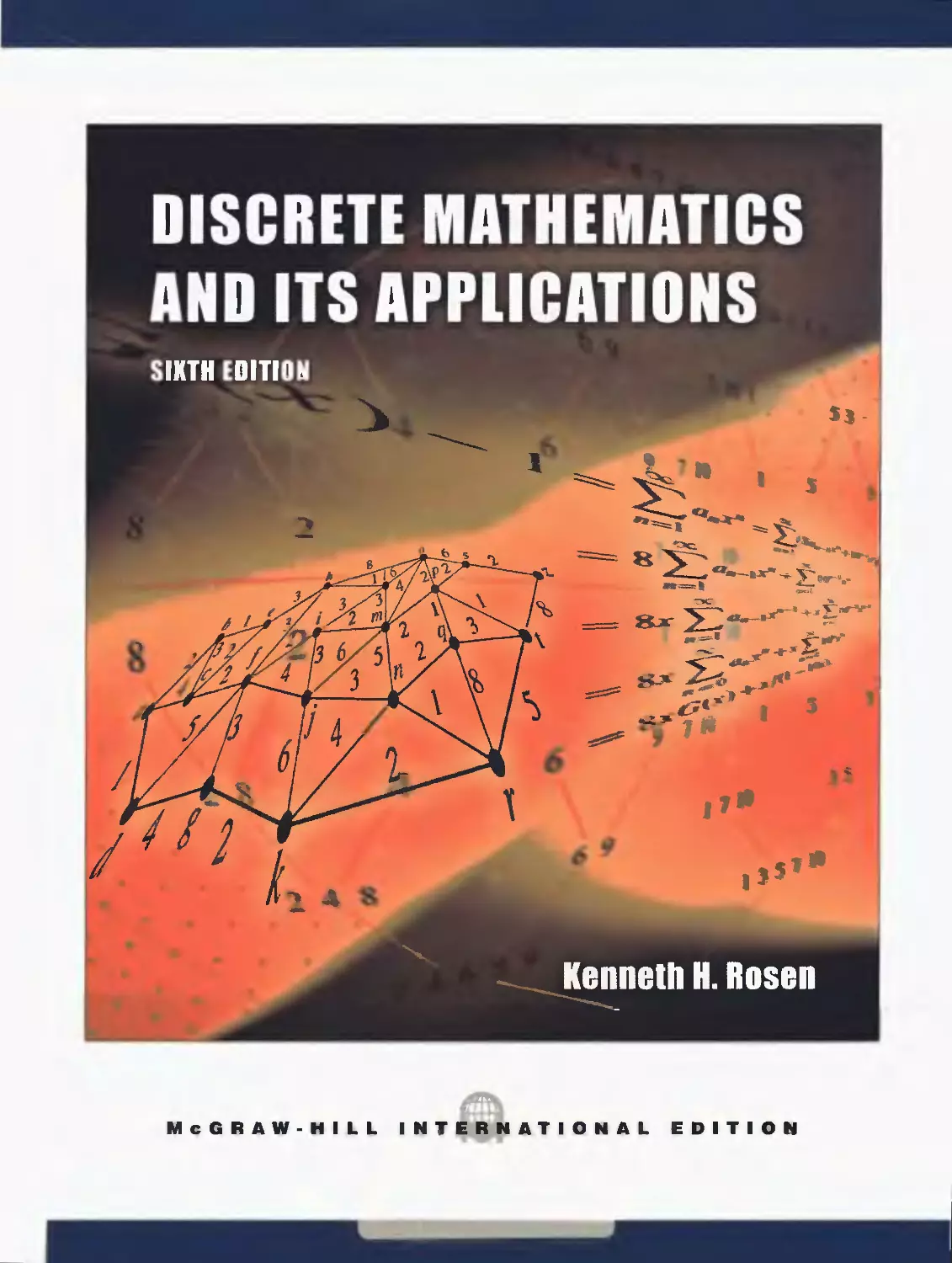
Kenneth H. Rosen
McGRAW-HILL INTERNATIONAL EDITION

LIST OF SYMBOLS
TOPIC
LOGIC
SYMBOL
^P
pAq
pvq
p®q
p-> q
p^q
p = q
T
F
P{X\,...,Xn)
VxP(x)
3xP(x)
3!xF(x)
p{S}q
MEANING
negation ofp
conjunction of p and q
disjunction of p and q
exclusive or of p and q
the implication p implies q
biconditional of p and q
equivalence of p and q
tautology
contradiction
propositional function
universal quantification of P(x)
existential quantification of P(x)
uniqueness quantification of P(x)
therefore
partial correctness of S
PAGE
3
4
4
5
6
9
22
24
24
32
34
36
37
63
323
SETS
x e S
x & S
{au...,a„}
{x | P(x)}
N
Z
z+
Q
R
S = T
0
s cr
scr
I5|
F(5)
(ai,...,a„)
(a, b)
Ax B
AUB
Af\B
A-B
A
l>
1 = 1
i=i
A®B
x is a member of 5
x is not a member of 5
list of elements of a set
set builder notation
set of natural numbers
set of integers
set of positive integers
set of rational numbers
set of real numbers
set equality
the empty (or null) set
S is a subset of T
S is a proper subset of T
cardinality of 5
the power set of 5
n -tuple
ordered pair
Cartesian product of A and B
union of A and B
intersection of A and B
the difference of A and B
complement of A
union of At, / = 1, 2,..., n
intersection of At, / = 1, 2,..., n
symmetric difference of A and B
112
112
112
112
112
112
113
113
113
113
114
114
115
116
116
117
117
118
121
121
123
123
127
128
131

TOPIC
FUNCTIONS
INTEGERS
MATRICES
SYMBOL
/(«)
f.A^B
fi+fi
flfl
f(S)
<-a(s)
f-\x)
f°g
L*J
M
an
n
aeS
n
.• i
f(x) is 0(g(x))
n\
fix) is Q(g(x))
f{x) is @(g(x))
/-^
min(x,y)
max(x, j;)
^
a \b
a J(b
a div b
a mod b
a = b (mod m)
a ^ b (mod m)
gc<\(a,b)
\cm(a,b)
(akak-i ■■■ aiao)b
iaij]
A + B
AB
In
A'
AvB
AaB
AOB
A[«]
MEANING
value of the function / at a
function from A to B
sum of the functions f\ and fz
product of the functions f\ and fz
image of the set S under /
identity function on A
inverse of /
composition of / and g
floor function of x
ceiling function of x
term of {a,} with subscript n
sum of a\, ci2, ■ ■. ,an
sum of aa over or e S
product of a\, ai,..., a„
f(x) is big-O of g(x)
n factorial
f(x) is big-Omega of g(x)
f(x) is big-Theta of g(x)
asymptotic
minimum of x and y
maximum of x and y
approximately equal to
a divides b
a does not divide b
quotient when a is divided by b
remainder when a is divided by b
a is congruent to b modulo m
a is not congruent to b modulo m
greatest common divisor of a and b
least common multiple of a and b
base b representation
matrix with entries atj
matrix sum of A and B
matrix product of A and B
identity matrix of order n
transpose of A
join of A and B
the meet of A and B
Boolean product of A and B
nth Boolean power of A
PAGE
133
133
135
135
136
138
139
140
143
143
150
153
156
162
180
185
189
189
192
216
217
395
201
201
202
202
203
203
215
217
219
247
247
248
251
251
252
252
253
254
(List of Symbols continued at back of book)

Discrete
Mathematics
and Its
Applications
Sixth Edition
Kenneth H. Rosen
AT&T Laboratories
Mc
Graw
Hill
Boston Burr Ridge, IL Dubuque, IA New York San Francisco St. Louis
Bangkok Bogota Caracas Kuala Lumpur Lisbon London Madrid Mexico City
Milan Montreal New Delhi Santiago Seoul Singapore Sydney Taipei Toronto

heMcGraw Hillct
Mc
Gravu
Hill
DISCRETE MATHEMATICS AND ITS APPLICATIONS, SIXTH EDITION
International Edition 2007
Exclusive rights by McGraw-Hill Education (Asia), for manufacture and export. This book cannot be
re-exported from the country to which it is sold by McGraw-Hill. The International Edition is not
available in North America.
Published by McGraw-Hill, a business unit of The McGraw-Hill Companies, Inc., 1221 Avenue of the
Americas, New York, NY 10020. Copyright © 2007 by Kenneth H. Rosen. All rights reserved. No
part of this publication may be reproduced or distributed in any form or by any means, or stored in a
database or retrieval system, without the prior written consent of The McGraw-Hill Companies, Inc.,
including, but not limited to, in any network or other electronic storage or transmission, or broadcast
for distance learning.
Some ancillaries, including electronic and print components, may not be available to customers outside
the United States.
10 09 08 07 06 05 04 03 02 01
20 09 08 07 06
CTF BJE
The credits section for this book begins on page C-l and is considered an extension of the copyright
page.
When ordering this title, use ISBN-13: 978-007-124474-9 or ISBN-10: 007-124474-3
Printed in Singapore
www.mhhe.com

Contents
Preface vii
The MathZone Companion Website xviii
To the Student xx
1 The Foundations: Logic and Proofs 1
1.1 Propositional Logic 1
1.2 Propositional Equivalences 21
1.3 Predicates and Quantifiers 30
1.4 Nested Quantifiers 50
1.5 Rules of Inference 63
1.6 Introduction to Proofs 75
1.7 Proof Methods and Strategy 86
End-of-Chapter Material 104
2 Basic Structures: Sets, Functions, Sequences, and Sums Ill
2.1 Sets Ill
2.2 Set Operations 121
2.3 Functions 133
2.4 Sequences and Summations 149
End-of-Chapter Material 163
3 The Fundamentals: Algorithms, the Integers, and Matrices 167
3.1 Algorithms 167
3.2 The Growth of Functions 180
3.3 Complexity of Algorithms 193
3.4 The Integers and Division 200
3.5 Primes and Greatest Common Divisors 210
3.6 Integers and Algorithms 219
3.7 Applications of Number Theory 231
3.8 Matrices 246
End-of-Chapter Material 257
4 Induction and Recursion 263
4.1 Mathematical Induction 263
4.2 Strong Induction and Well-Ordering 283
4.3 Recursive Definitions and Structural Induction 294
4.4 Recursive Algorithms 311
iii

4.5 Program Correctness 322
End-of-Chapter Material 328
5 Counting 335
5.1 The Basics of Counting 335
5.2 The Pigeonhole Principle 347
5.3 Permutations and Combinations 355
5.4 Binomial Coefficients 363
5.5 Generalized Permutations and Combinations 370
5.6 Generating Permutations and Combinations 382
End-of-Chapter Material 386
6 Discrete Probability 393
6.1 An Introduction to Discrete Probability 393
6.2 Probability Theory 400
6.3 Bayes' Theorem 417
6.4 Expected Value and Variance 426
End-of-Chapter Material 442
7 Advanced Counting Techniques 449
7.1 Recurrence Relations 449
7.2 Solving Linear Recurrence Relations 460
7.3 Divide-and-Conquer Algorithms and Recurrence Relations 474
7.4 Generating Functions 484
7.5 Inclusion-Exclusion 499
7.6 Applications of Inclusion-Exclusion 505
End-of-Chapter Material 513
8 Relations 519
8.1 Relations and Their Properties 519
8.2 n-ary Relations and Their Applications 530
8.3 Representing Relations 537
8.4 Closures of Relations 544
8.5 Equivalence Relations 555
8.6 Partial Orderings 566
End-of-Chapter Material 581
9 Graphs 589
9.1 Graphs and Graph Models 589
9.2 Graph Terminology and Special Types of Graphs 597
9.3 Representing Graphs and Graph Isomorphism 611
9.4 Connectivity 621

Contents v
9.5 Euler and Hamilton Paths 633
9.6 Shortest-Path Problems 647
9.7 Planar Graphs 657
9.8 Graph Coloring 666
End-of-Chapter Material 675
10 Trees 683
10.1 Introduction to Trees 683
10.2 Applications of Trees 695
10.3 Tree Traversal 710
10.4 Spanning Trees 724
10.5 Minimum Spanning Trees 737
End-of-Chapter Material 743
11 Boolean Algebra 749
11.1 Boolean Functions 749
11.2 Representing Boolean Functions 757
11.3 Logic Gates 760
11.4 Minimization of Circuits 766
End-of-Chapter Material 781
12 Modeling Computation 785
12.1 Languages and Grammars 785
12.2 Finite-State Machines with Output 796
12.3 Finite-State Machines with No Output 804
12.4 Language Recognition 817
12.5 Turing Machines 827
End-of-Chapter Material 838
Appendixes A-1
A-1 Axioms for the Real Numbers and the Positive Integers A-1
A-2 Exponential and Logarithmic Functions A-7
A-3 Pseudocode A-10
Suggested Readings B-l
Answers to Odd-Numbered Exercises S-1
Photo Credits C-l
Index of Biographies 1-1
Index 1-2

About the Author
Kenneth H. Rosen has had a long career as a Distinguished Member of the Technical Staff
at AT&T Laboratories in Monmouth County, New Jersey. He currently holds the position
of visiting research professor at Monmouth University where he is working on the security and
privacy aspects of the Rapid Response Database Project and where he is teaching a course on
cryptographic applications.
Dr. Rosen received his B.S. in Mathematics from the University of Michigan, Ann Arbor
(1972), and his Ph.D. in Mathematics from M.I.T. (1976), where he wrote his thesis in the area
of number theory under the direction of Harold Stark. Before joining Bell Laboratories in 1982,
he held positions at the University of Colorado, Boulder; The Ohio State University, Columbus;
and the University of Maine, Orono, where he was an associate professor of mathematics.
While working at AT&T Labs, he taught at Monmouth University, teaching courses in discrete
mathematics, coding theory, and data security.
Dr. Rosen has published numerous articles in professional journals in the areas of number
theory and mathematical modeling. He is the author of the textbooks Elementary Number Theory
and Its Applications, published by Addison-Wesley and currently in its fifth edition, and Discrete
Mathematics and Its Applications, published by McGraw-Hill and currently in its sixth edition.
Both of these textbooks have been used extensively at hundreds of universities throughout the
world. Discrete Mathematics and Its Applications has sold more than 300,000 copies in its
lifetime with translations into Spanish, French, Chinese, and Korean. He is also co-author of
UNIX: The Complete Reference', UNIX System V Release 4: An Introduction', and Best UNIX
Tips Ever, each published by Osborne McGraw-Hill. These books have sold more than 150,000
copies with translations into Chinese, German, Spanish, and Italian. Dr. Rosen is also the editor
of the Handbook of Discrete and Combinatorial Mathematics, published by CRC Press, and he
is the advisory editor of the CRC series of books in discrete mathematics, consisting of more
than 30 volumes on different aspects of discrete mathematics, most of which are introduced
in this book. He is also interested in integrating mathematical software into the educational
and professional environments, and has worked on projects with Waterloo Maple Inc.'s Maple
software in both these areas.
At Bell Laboratories and AT&T Laboratories, Dr. Rosen worked on a wide range of projects,
including operations research studies and product line planning for computers and data
communications equipment. He helped plan AT&T's products and services in the area of multimedia,
including video communications, speech recognition and synthesis, and image networking. He
evaluated new technology for use by AT&T and did standards work in the area of image
networking. He also invented many new services, and holds or has submitted more than 70 patents. One
of his more interesting projects involved helping evaluate technology for the AT&T attraction
at EPCOT Center.

Preface
In writing this book, I was guided by my long-standing experience and interest in teaching
discrete mathematics. For the student, my purpose was to present material in a precise,
readable manner, with the concepts and techniques of discrete mathematics clearly presented
and demonstrated. My goal was to show the relevance and practicality of discrete mathematics
to students, who are often skeptical. I wanted to give students studying computer science all of
the mathematical foundations they need for their future studies. I wanted to give mathematics
students an understanding of important mathematical concepts together with a sense of why
these concepts are important for applications. And most importantly, I wanted to accomplish
these goals without watering down the material.
For the instructor, my purpose was to design a flexible, comprehensive teaching tool using
proven pedagogical techniques in mathematics. I wanted to provide instructors with a package of
materials that they could use to teach discrete mathematics effectively and efficiently in the most
appropriate manner for their particular set of students. I hope that I have achieved these goals.
I have been extremely gratified by the tremendous success of this text. The many
improvements in the sixth edition have been made possible by the feedback and suggestions of a large
number of instructors and students at many of the more than 600 schools where this book has
been successfully used. There are many enhancements in this edition. The companion website
has been substantially enhanced and more closely integrated with the text, providing helpful
material to make it easier for students and instructors to achieve their goals.
This text is designed for a one- or two-term introductory discrete mathematics course
taken by students in a wide variety of majors, including mathematics, computer science, and
engineering. College algebra is the only explicit prerequisite, although a certain degree of
mathematical maturity is needed to study discrete mathematics in a meaningful way.
Goals of a Discrete Mathematics Course
A discrete mathematics course has more than one purpose. Students should learn a particular
set of mathematical facts and how to apply them; more importantly, such a course should teach
students how to think logically and mathematically. To achieve these goals, this text stresses
mathematical reasoning and the different ways problems are solved. Five important themes
are interwoven in this text: mathematical reasoning, combinatorial analysis, discrete structures,
algorithmic thinking, and applications and modeling. A successful discrete mathematics course
should carefully blend and balance all five themes.
1. Mathematical Reasoning: Students must understand mathematical reasoning in order to
read, comprehend, and construct mathematical arguments. This text starts with a discussion
of mathematical logic, which serves as the foundation for the subsequent discussions of
methods of proof. Both the science and the art of constructing proofs are addressed. The
technique of mathematical induction is stressed through many different types of examples
of such proofs and a careful explanation of why mathematical induction is a valid proof
technique.
2. Combinatorial Analysis: An important problem-solving skill is the ability to count or
enumerate objects. The discussion of enumeration in this book begins with the basic techniques
of counting. The stress is on performing combinatorial analysis to solve counting problems
and analyze algorithms, not on applying formulae.
vii

vlil Preface
3. Discrete Structures: A course in discrete mathematics should teach students how to work
with discrete structures, which are the abstract mathematical structures used to represent
discrete objects and relationships between these objects. These discrete structures include
sets, permutations, relations, graphs, trees, and finite-state machines.
4. Algorithmic Thinking: Certain classes of problems are solved by the specification of an
algorithm. After an algorithm has been described, a computer program can be constructed
implementing it. The mathematical portions of this activity, which include the specification of
the algorithm, the verification that it works properly, and the analysis of the computer memory
and time required to perform it, are all covered in this text. Algorithms are described using
both English and an easily understood form of pseudocode.
5. Applications and Modeling: Discrete mathematics has applications to almost every
conceivable area of study. There are many applications to computer science and data networking in
this text, as well as applications to such diverse areas as chemistry, botany, zoology,
linguistics, geography, business, and the Internet. These applications are natural and important uses
of discrete mathematics and are not contrived. Modeling with discrete mathematics is an
extremely important problem-solving skill, which students have the opportunity to develop
by constructing their own models in some of the exercises.
Changes in the Sixth Edition
The fifth edition of this book has been used successfully at over 600 schools in the United States,
dozens of Canadian universities, and at universities throughout Europe, Asia, and Oceania.
Although the fifth edition has been an extremely effective text, many instructors, including
longtime users, have requested changes designed to make this book more effective. I have
devoted a significant amount of time and energy to satisfy these requests and I have worked hard
to find my own ways to make the book better.
The result is a sixth edition that offers both instructors and students much more than the fifth
edition did. Most significantly, an improved organization of topics has been implemented in this
sixth edition, making the book a more effective teaching tool. Changes have been implemented
that make this book more effective for students who need as much help as possible, as well as for
those students who want to be challenged to the maximum degree. Substantial enhancements to
the material devoted to logic, method of proof, and proof strategies are designed to help students
master mathematical reasoning. Additional explanations and examples have been added to
clarify material where students often have difficulty. New exercises, both routine and challenging,
have been inserted into the exercise sets. Highly relevant applications, including many related
to the Internet and computer science, have been added. The MathZone companion website has
benefited from extensive development activity and now provides tools students can use to master
key concepts and explore the world of discrete mathematics.
Improved Organization
■ The first part of the book has been restructured to
present core topics in a more efficient, more effective,
and more flexible way.
■ Coverage of mathematical reasoning and proof is
concentrated in Chapter 1, flowing from propositional and
predicate logic, to rules of inference, to basic proof
techniques, to more advanced proof techniques and
proof strategies.
■ A separate chapter on discrete structures—Chapter 2
in this new edition—covers sets, functions, sequence,
and sums.
■ Material on basic number theory, covered in one
section in the fifth edition, is now covered in two sections,
the first on divisibility and congruences and the second
on primes.
■ The new Chapter 4 is entirely devoted to induction and
recursion.

Preface ix
Logic
■ Coverage of logic has been amplified with key
ideas explained in greater depth and with more
care.
■ Conditional statements and De Morgan's laws receive
expanded coverage.
■ The construction of truth tables is introduced earlier
and in more detail.
Writing and Understanding Proofs
■ Proof methods and proof strategies are now treated in
separate sections of Chapter 1.
■ An appendix listing basic axioms for real numbers
and for the integers, and how these axioms are used to
prove new results, has been added. The use of these
axioms and basic results that follow from them has
been made explicit in many proofs in the text.
■ The process of making conjectures, and then using
different proof methods and strategies to attack these
Algorithms and Applications
■ More coverage is devoted to the use of strong
induction to prove that recursive algorithms are correct.
■ How Bayes' Theorem can be used to construct spam
filters is now described.
Number Theory, Combinatorics, and Probability
■ Coverage of number theory is now more flexible, with
four sections covering different aspects of the subject
and with coverage of the last three of these sections
optional.
■ The introduction of basic counting techniques, and
permutations and combinations, has been enhanced.
Graphs and Theory of Computation
■ The introduction to graph theory has been streamlined
and improved.
■ A quicker introduction to terminology and
applications is provided, with the stress on making the correct
decisions when building a graph model rather than on
terminology.
■ Material on bipartite graphs and their applications has
been expanded.
■ More care is devoted to introducing predicates and
quantifiers, as well as to explaining how to use and
work with them.
■ The application of logic to system specifications—a
topic of interest to system, hardware, and software
engineers—has been expanded.
■ Material on valid arguments and rules of inference is
now presented in a separate section.
conjectures, is illustrated using the easily accessible
topic of tilings of checkerboards.
■ Separate and expanded sections on mathematical
induction and on strong induction begin the new Chapter
4. These sections include more motivation and a rich
collection of examples, providing many examples
different than those usually seen.
■ More proofs are displayed in a way that makes it
possible to explicitly list the reason for each step in the
proof.
■ Examples and exercises from computational geometry
have been added, including triangulations of polygons.
■ The application of bipartite graphs to matching
problems has been introduced.
■ Coverage of probability theory has been expanded
with the introduction of a new section on Bayes'
Theorem.
■ Examples illustrating the construction of finite-state
automata that recognize specified sets have been
added.
■ Minimization of finite-state machines is now
mentioned and developed in a series of exercises.
■ Coverage of Turing machines has been expanded with
a brief introduction to how Turing machines arise in
the study of computational complexity, decidability,
and computability.
Theory
■ Coverage of counting techniques has been expanded;
counting the ways in which objects can be distributed
in boxes is now covered.

x Preface
Exercises and Examples
■ Many new routine exercises and examples have been
added throughout, especially at spots where key
concepts are introduced.
■ Extra effort has been made to ensure that both odd-
numbered and even-numbered exercises are provided
for basic concepts and skills.
A better correspondence has been made between
examples introducing key concepts and routine
exercises.
Many new challenging exercises have been added.
Over 400 new exercises have been added, with more on
key concepts, as well as more introducing new topics.
Additional Biographies, Historical Notes, and New Discoveries
Biographies have been added for Archimedes,
Hopper, Stirling, and Bayes.
Many biographies found in the previous edition have
been enhanced, including the biography of Augusta
Ada.
The historical notes included in the main body of the
book and in the footnotes have been enhanced.
New discoveries made since the publication of the
previous edition have been noted.
The MathZone Companion Website (www.mhhe.com/rosen)
MathZone course management and online tutorial
system now provides homework and testing questions tied
directly to the text.
Expanded annotated links to hundreds of Internet
resources have been added to the Web Resources
Guide.
Additional Extra Examples are now hosted online,
covering all chapters of the book. These Extra
Examples have benefited from user review and
feedback.
Additional Self Assessments of key topics have been
added, with 14 core topics now addressed.
Existing Interactive Demonstration Applets
supporting key algorithms are improved. Additional applets
have also been developed and additional explanations
are given for integrating them with the text and in the
classroom.
An updated and expanded Exploring Discrete
Mathematics with Maple companion workbook is also hosted
online.
Special Features
ACCESSIBILITY This text has proved to be easily read and understood by beginning
students. There are no mathematical prerequisites beyond college algebra for almost all of this
text. Students needing extra help will find tools on the MathZone companion website for bringing
their mathematical maturity up to the level of the text. The few places in the book where calculus
is referred to are explicitly noted. Most students should easily understand the pseudocode used
in the text to express algorithms, regardless of whether they have formally studied programming
languages. There is no formal computer science prerequisite.
Each chapter begins at an easily understood and accessible level. Once basic mathematical
concepts have been carefully developed, more difficult material and applications to other areas
of study are presented.
FLEXIBILITY This text has been carefully designed for flexible use. The dependence of
chapters on previous material has been minimized. Each chapter is divided into sections of
approximately the same length, and each section is divided into subsections that form natural
blocks of material for teaching. Instructors can easily pace their lectures using these blocks.

Preface xi
WRITING STYLE The writing style in this book is direct and pragmatic. Precise
mathematical language is used without excessive formalism and abstraction. Care has been taken to
balance the mix of notation and words in mathematical statements.
MATHEMATICAL RIGOR AND PRECISION All definitions and theorems in this text
are stated extremely carefully so that students will appreciate the precision of language and
rigor needed in mathematics. Proofs are motivated and developed slowly; their steps are all
carefully justified. The axioms used in proofs and the basic properties that follow from them
are explicitly described in an appendix, giving students a clear idea of what they can assume in
a proof. Recursive definitions are explained and used extensively.
WORKED EXAMPLES Over 750 examples are used to illustrate concepts, relate different
topics, and introduce applications. In most examples, a question is first posed, then its solution
is presented with the appropriate amount of detail.
APPLICATIONS The applications included in this text demonstrate the utility of discrete
mathematics in the solution of real-world problems. This text includes applications to a wide
variety of areas, including computer science, data networking, psychology, chemistry, engineering,
linguistics, biology, business, and the Internet.
ALGORITHMS Results in discrete mathematics are often expressed in terms of
algorithms; hence, key algorithms are introduced in each chapter of the book. These algorithms
are expressed in words and in an easily understood form of structured pseudocode, which is
described and specified in Appendix A.3. The computational complexity of the algorithms in
the text is also analyzed at an elementary level.
HISTORICAL INFORMATION The background of many topics is succinctly described
in the text. Brief biographies of more than 65 mathematicians and computer scientists,
accompanied by photos or images, are included as footnotes. These biographies include information
about the lives, careers, and accomplishments of these important contributors to discrete
mathematics and images of these contributors are displayed. In addition, numerous historical footnotes
are included that supplement the historical information in the main body of the text. Efforts have
been made to keep the book up-to-date by reflecting the latest discoveries.
KEY TERMS AND RESULTS A list of key terms and results follows each chapter. The
key terms include only the most important that students should learn, not every term defined in
the chapter.
EXERCISES There are over 3800 exercises in the text, with many different types of
questions posed. There is an ample supply of straightforward exercises that develop basic skills, a
large number of intermediate exercises, and many challenging exercises. Exercises are stated
clearly and unambiguously, and all are carefully graded for level of difficulty. Exercise sets
contain special discussions that develop new concepts not covered in the text, enabling students
to discover new ideas through their own work.
Exercises that are somewhat more difficult than average are marked with a single star *;
those that are much more challenging are marked with two stars **. Exercises whose solutions
require calculus are explicitly noted. Exercises that develop results used in the text are clearly
identified with the symbol K*. Answers or outlined solutions to all odd-numbered exercises are
provided at the back of the text. The solutions include proofs in which most of the steps are
clearly spelled out.
REVIEW QUESTIONS A set of review questions is provided at the end of each chapter.
These questions are designed to help students focus their study on the most important concepts

xii Preface
and techniques of that chapter. To answer these questions students need to write long answers,
rather than just perform calculations or give short replies.
SUPPLEMENTARY EXERCISE SETS Each chapter is followed by a rich and varied
set of supplementary exercises. These exercises are generally more difficult than those in the
exercise sets following the sections. The supplementary exercises reinforce the concepts of the
chapter and integrate different topics more effectively.
COMPUTER PROJECTS Each chapter is followed by a set of computer projects. The
approximately 150 computer projects tie together what students may have learned in computing
and in discrete mathematics. Computer projects that are more difficult than average, from both
a mathematical and a programming point of view, are marked with a star, and those that are
extremely challenging are marked with two stars.
COMPUTATIONS AND EXPLORATIONS A set of computations and explorations is
included at the conclusion of each chapter. These exercises (approximately 100 in total) are
designed to be completed using existing software tools, such as programs that students or
instructors have written or mathematical computation packages such as Maple or Mathematica.
Many of these exercises give students the opportunity to uncover new facts and ideas through
computation. (Some of these exercises are discussed in the Exploring Discrete Mathematics
with Maple companion workbook available online.)
WRITING PROJECTS Each chapter is followed by a set of writing projects. To do these
projects students need to consult the mathematical literature. Some of these projects are historical
in nature and may involve looking up original sources. Others are designed to serve as gateways
to new topics and ideas. All are designed to expose students to ideas not covered in depth in
the text. These projects tie mathematical concepts together with the writing process and help
expose students to possible areas for future study. (Suggested references for these projects can
be found online or in the printed Students Solutions Guide.)
APPENDIXES There are three appendixes to the text. The first introduces axioms for
real numbers and the integers, and illustrates how facts are proved directly from these axioms.
The second covers exponential and logarithmic functions, reviewing some basic material used
heavily in the course. The third specifies the pseudocode used to describe algorithms in this text.
SUGGESTED READINGS A list of suggested readings for each chapter is provided in a
section at the end of the text. These suggested readings include books at or below the level of
this text, more difficult books, expository articles, and articles in which discoveries in discrete
mathematics were originally published. Some of these publications are classics, published many
years ago, while others have been published within the last few years.
How to Use This Book
This text has been carefully written and constructed to support discrete mathematics courses
at several levels and with differing foci. The following table identifies the core and optional
sections. An introductory one-term course in discrete mathematics at the sophomore level can
be based on the core sections of the text, with other sections covered at the discretion of the
instructor. A two-term introductory course can include all the optional mathematics sections in
addition to the core sections. A course with a strong computer science emphasis can be taught
by covering some or all of the optional computer science sections.

Preface xiii
Chapter
1
2
3
4
5
6
7
8
9
10
11
12
Core Sections
1.1-1.7 (as needed)
2.1-2.4 (as needed)
3.1-3.5, 3.8 (as needed)
4.1-4.3
5.1-5.3
6.1
7.1,7.5
8.1,8.3,8.5
9.1-9.5
10.1
Optional Computer
Science Sections
3.6
4.4, 4.5
5.6
6.4
7.3
8.2
10.2, 10.3
11.1-11.4
12.1-12.5
Optional Mathematics
Sections
3.7
5.4, 5.5
6.2, 6.3
7.2, 7.4, 7.6
8.4, 8.6
9.6-9.8
10.4, 10.5
Instructors using this book can adjust the level of difficulty of their course by choosing
either to cover or to omit the more challenging examples at the end of sections, as well as the
more challenging exercises. The dependence of chapters on earlier chapters is shown in the
following chart.
Chapter 1
I
Chapter 2
I
Chapter 3
I
Chapter 4
Chapter 5
Chapter 6 Chapter 7 Chapter 8 Chapter 9 Chapter 11
I
Chapter 10
Chapter 12
Ancillaries
STUDENT'S SOLUTIONS GUIDE This student manual, available separately, contains
full solutions to all odd-numbered problems in the exercise sets. These solutions explain why
a particular method is used and why it works. For some exercises, one or two other possible
approaches are described to show that a problem can be solved in several different ways.
Suggested references for the writing projects found at the end of each chapter are also included
in this volume. Also included are a guide to writing proofs and an extensive description of
common mistakes students make in discrete mathematics, plus sample tests and a sample crib
sheet for each chapter designed to help students prepare for exams.
(ISBN-10: 0-07-310779-4) (ISBN-13: 978-0-07-310779-0)
INSTRUCTOR'S RESOURCE GUIDE This manual, available by request for instructors,
contains full solutions to even-numbered exercises in the text. Suggestions on how to teach the
material in each chapter of the book are provided, including the points to stress in each section
and how to put the material into perspective. It also offers sample tests for each chapter and a test

xiv Preface
bank containing over 1300 exam questions to choose from. Answers to all sample tests and test
bank questions are included. Finally, several sample syllabi are presented for courses with
differing emphasis and student ability levels, and a complete section and exercise migration guide is
included to help users of the fifth edition update their course materials to match the sixth edition.
(ISBN-10: 0-07-310781-6) (ISBN-13: 978-0-07-310781-3)
INSTRUCTOR'S TESTING AND RESOURCE CD An extensive test bank of more
than 1300 questions using Brownstone Diploma testing software is available by request for use
on Windows or Macintosh systems. Instructors can use this software to create their own tests
by selecting questions of their choice or by random selection. They can also sort questions
by section, difficulty level, and type; edit existing questions or add their own; add their own
headings and instructions; print scrambled versions of the same test; export tests to word
processors or the Web; and create and manage course grade books. A printed version of this
test bank, including the questions and their answers, is included in the Instructors Resource
Guide.
(ISBN-10: 0-07-310782-4)
(ISBN-13: 978-0-07-310782-0)
Acknowledgments
I would like to thank the many instructors and students at a variety of schools who have used
this book and provided me with their valuable feedback and helpful suggestions. Their input
has made this a much better book than it would have been otherwise. I especially want to
thank Jerrold Grossman, John Michaels, and George Bergman for their technical reviews of the
sixth edition and their "eagle eyes," which have helped ensure the accuracy of this book. I also
appreciate the help provided by all those who have submitted comments via the website.
I thank the reviewers of this sixth and the five previous editions. These reviewers have
provided much helpful criticism and encouragement to me. I hope this edition lives up to their
high expectations.
Reviewers for the Sixth Edition
Charles Ashbacher,
Mount Mercy College
Ian Barland,
Rice University
George Bergman,
University of California, Berkeley
David Berman,
University of North Carolina,
Wilmington
Miklos Bona,
University of Florida
Prosenjit Bose,
Carleton University
Kirby Brown,
Polytechnic University
Michael Button,
The Master s College
Greg Cameron,
Brigham Young University
John Carter,
University of Toronto
Greg Chapman,
Cosumnes River College
Chao-Kun Cheng,
Virginia Commonwealth University
Thomas Cooper,
Georgia Perimeter College,
Lawrenceville
Barbara Cortzen,
DePaul University
Daniel Cunningham,
Buffalo State College
George Davis,
University of Georgia
Beverly Diamond,
College of Charleston
Thomas Dunion,
Atlantic Union College
Bruce Elenbogen,
University of Michigan, Dearborn
Herbert Enderton,
University of California,
Los Angeles
Anthony Evans,
Wright State University
Kim Factor,
Marquette University
William Farmer,
McMaster University
Li Feng,
Albany State University

Stephanie Fitchett,
Florida Atlantic University
Jerry Fluharty,
Eastern Shore Community College
Joel Fowler,
Southern Polytechnic State
University
William Gasarch,
University of Maryland
Sudpito Ghosh,
Colorado State University
Jerrold Grossman,
Oakland University
Ruth Haas,
Smith College
Patricia Hammer,
Hollins University
Keith Harrow,
Brooklyn College
Bert Hartnell,
St. Mary s University
Julia Hassett,
Oakton College
Kavita Hatwal,
Portland Community College
John Helm,
Radford University
Arthur Hobbs,
Texas A&M University
Fannie Howell,
Roanoke High School
Wei Hu,
Houghton College
Nan Jiang,
University of South Dakota
Margaret Johnson,
Stanford University
Martin Jones,
College of Charleston
Tim Kearns,
California Polytechnic State
University, San Luis Obispo
Reviewers of Previous Editions
Eric Allender,
Rutgers University
Stephen Andrilli,
La Salle University
Kendall Atkinson,
University of Iowa, Iowa City
Jonathan Knappenberger,
LaSalle University
Ed Korntved,
Northwest Nazarene University
Przemo Kranz,
University of Mississippi
Loredana Lanzani,
University of Arkansas
Yoonjin Lee,
Smith College
Miguel Lerma,
Northwestern University
Jason Levy,
University of Hawaii
Lauren Lilly,
Tabor College
Ekaterina Lioutikova,
Saint Joseph College
Vladimir Logvinenko,
De Anza College
Joan Lukas,
University of Massachusetts, Boston
Lester McCann,
University of Arizona
Jennifer McNulty,
University of Montana
John G. Michaels,
SUNY Brockport
Michael Oppedisano,
Morrisville State College
Michael O'Sullivan,
San Diego State University
Charles Parry,
Virginia Polytechnic Institute
Linda Powers,
Virginia Polytechnic Institute
Dan Pritikin,
Miami University
Anthony Quas,
University of Memphis
Eric Rawdon,
Duquesne University
Zhaojun Bai,
University of California, Davis
Jack R. Barone,
Baruch College
Klaus Bichteler,
University of Texas, Austin
Henry Ricardo,
Medgar Evers College
Oskars Rieksts,
Kutztown University
Stefan Robila,
Montclair State University
Chris Rodger,
Auburn University
Robert Rodman,
North Carolina State University
Shai Simonson,
Stonehill College
Barbara Smith,
Cochise College
Wasin So,
San Jose State University
Diana Staats,
Dutchess Community College
Lorna Stewart,
University of Alberta
Bogdan Suceava,
California State University,
Fullerton
Kathleen Sullivan,
Seattle University
Laszlo Szekely,
University of South Carolina
Daniel Tauritz,
University of Missouri, Rolla
Don VanderJagt,
Grand Valley State University
Fran Vasko,
Kutztown University
Susan Wallace,
University of North Florida
Zhenyuan Wang,
University of Nebraska, Omaha
Tom Wineinger,
University of Wisconsin,
Eau Claire
Charlotte Young,
South Plains College
Alfred E. Borm,
Southwest Texas State University
Ken W Bosworth,
University of Maryland
Lois Brady,
California Polytechnic State
University, San Luis Obispo

xvi Preface
Scott Buffett,
University of New Brunswick
Russell Campbell,
University of Northern Iowa
E. Rodney Canfield,
University of Georgia
Kevin Carolan,
Marist College
Tim Carroll,
Bloomsburg University
Kit C. Chan,
Bowling Green State University
Allan C. Cochran,
University of Arkansas
Peter Collinge,
Monroe Community College
Ron Davis,
Millersville University
Nachum Dershowitz,
University of Illinois,
Urbana-Champaign
Thomas Dowling,
The Ohio State University
Patrick C. Fischer,
Vanderbilt University
Jane Fritz,
University of New Brunswick
Ladnor Geissinger,
University of North Carolina
Jonathan Goldstine,
Pennsylvania State University
Paul Gormley,
Villanova University
Brian Gray,
Howard Community College
Jonathan Gross,
Columbia University
Laxmi N. Gupta,
Rochester Institute of Technology
Daniel Gusfield,
University of California, Davis
David F. Hayes,
San Jose State University
Xin He,
SUNY at Buffalo
Donald Hutchison,
Clackamas Community College
Kenneth Johnson,
North Dakota State University
David Jonah,
Wayne State University
Akihiro Kanamori,
Boston University
W. Thomas Kiley,
George Mason University
Takashi Kimura,
Boston University
Nancy Kinnersley,
University of Kansas
Gary Klatt,
University of Wisconsin
Nicholas Krier,
Colorado State University
Lawrence S. Kroll,
San Francisco State University
Shui F. Lam,
California State University,
Long Beach
Robert Lavelle,
Iona College
Harbir Lamba,
George Mason University
Sheau Dong Lang,
University of Central Florida
Cary Lee,
Grossmont Community College
Yi-Hsin Liu,
University of Nebraska, Omaha
Stephen C. Locke,
Florida Atlantic University
George Luger,
University of New Mexico
David S. McAllister,
North Carolina State University
Robert McGuigan,
Westfield State College
Michael Mailer,
Queens College
Ernie Manes,
University of Massachusetts
Francis Masat,
Glassboro State College
J. M. Metzger,
University of North Dakota
Thomas D. Morley,
Georgia Institute of Technology
D. R. Morrison,
University of New Mexico
Ho Kuen Ng,
San Jose State University
Timothy S. Norfolk, Sr.
University of Akron
True T Nguyen,
Bowling Green State University
George Novacky,
University of Pittsburgh
Jeffrey Nunemacher,
Ohio Wesleyan University
Jaroslav Opatrny,
Concordia University
Jonathan Pakianathan,
University of Rochester
Thomas W. Parsons,
Hofstra University
Mary K. Prisco,
University of Wisconsin, Green Bay
Halina Przymusinska,
California Polytechnic State
University, Pomona
Don Reichman,
Mercer County Community
College
Harold Reiter,
University of North Carolina
Adrian Riskin,
Northern Arizona State University
Amy L. Rocha,
San Jose State University
Janet Roll,
University ofFindlay
Matthew J. Saltzman,
Clemson University
Alyssa Sankey,
Slippery Rock University
Dinesh Sarvate,
College of Charleston
Michael J. Schlosser,
The Ohio State University
Steven R. Seidel,
Michigan Technological University
Douglas Shier,
Clemson University
Alistair Sinclair,
University of California, Berkeley
Carl H. Smith,
University of Maryland
Hunter S. Snevily,
University of Idaho

Preface xvii
Daniel Somerville,
University of Massachusetts, Boston
Patrick Tantalo,
University of California, Santa Cruz
Bharti Temkin,
Texas Tech University
Wallace Terwilligen,
Bowling Green State University
Philip D. Tiu,
Oglethorpe University
Lisa Townsley-Kulich,
Illinois Benedictine College
George Trapp,
West Virginia University
David S. Tucker,
Midwestern State University
Thomas Upson,
Rochester Institute of Technology
Roman Voronka,
New Jersey Institute of Technology
James Walker,
University of South Carolina
Anthony S. Wojcik,
Michigan State University
I would like to thank the staff of McGraw-Hill for their strong support of this project. In
particular, thanks go to Liz Haefele, Publisher, for her backing; to Liz Covello, Senior Sponsoring
Editor, for her advocacy and enthusiasm; and to Dan Seibert, Developmental Editor, for his
dedication and attention. I would also like to thank the original editor, Wayne Yuhasz, whose
insights and skills helped ensure the book's success, as well as all the other previous editors of
this book.
To the staff involved in the production of this sixth edition, I offer my thanks to Peggy
Selle, Lead Project Manager; Michelle Whitaker, Senior Designer; Jeff Huettman, Lead Media
Producer; Sandy Schnee, Senior Media Project Manager; Melissa Leick, Supplements
Coordinator; and Kelly Brown, Executive Marketing Manager. I am also grateful to Jerry Grossman,
who checked the entire manuscript for accuracy; Rose Kramer and Gayle Casel, the technical
proofreaders; Pat Steele, the manuscript copyeditor; and Georgia Mederer, who checked the
accuracy of the solutions in the Students Solutions Guide and Instructors Resource Guide.
Kenneth H. Rosen

The MathZone Companion Website
MathZonf/: ■■/
^ /
The extensive companion website accompanying this text has been substantially enhanced
for the sixth edition and is now integrated with MathZone, McGraw-Hill's customizable
Web-based course management system. Instructors teaching from the text can now use Math-
Zone to administer online homework, quizzing, testing, and student assessment through sets
of questions tied to the text which are automatically graded and accessible in an integrated,
exportable grade book. MathZone also provides a wide variety of interactive student tutorials,
including practice problems with step-by-step solutions; Interactive Demonstration applets; and
NetTutor, a live, personalized tutoring service.
This website is accessible at www.mathzone.com by choosing this text off the pull-down
menu, or by navigating to www.mhhe.coin/rosen. The homepage shows the Information Center,
and contains login links for the site's Student Edition and Instructor Edition. Key features of
each area are described below:
THE INFORMATION CENTER The Information Center contains basic information
about the book including the Table of Contents, Preface, descriptions of the Ancillaries, and a
sample chapter. Instructors can also learn more about MathZone's key features, and learn about
custom publishing options for the book.
MATHZONE STUDENT EDITION The Student Edition contains a wealth of resources
available for student use, including the following, tied into the text wherever the special icons
below are shown in the text:
□ Extra Examples You can find a large number of additional examples on the site, covering
all chapters of the book. These examples are concentrated in areas where students often
ask for additional material. Although most of these examples amplify the basic concepts,
more-challenging examples can also be found here.
D Interactive Demonstration Applets These applets enable you to interactively explore
how important algorithms work, and are tied directly to material in the text such as examples
and exercises. Additional resources are provided on how to use and apply these applets.
□ Self Assessments These interactive guides help you assess your understanding of 14 key
concepts, providing a question bank where each question includes a brief tutorial followed by
a multiple-choice question. If you select an incorrect answer, advice is provided to help you
understand your error. Using these Self Assessments, you should be able to diagnose your
problems and focus on available remedies.
□ Web Resources Guide This guide provides annotated links to hundreds of external
websites containing relevant material such as historical and biographical information,
puzzles and problems, discussions, applets, programs, and more. These links are keyed to
the text by page number.
Additional resources in the MathZone Student Edition include:
□ Exploring Discrete Mathematics with Maple This ancillary provides help for using the
Maple computer algebra system to do a wide range of computations in discrete mathematics.
Each chapter provides a description of relevant Maple functions and how they are used, Maple
programs to carry out computations in discrete mathematics, examples, and exercises that
can be worked using Maple.

The MathZone Companion Website xix
■ Applications of Discrete Mathematics This ancillary contains 24 chapters—each with
its own set of exercises—presenting a wide variety of interesting and important applications
covering three general areas in discrete mathematics: discrete structures, combinatorics, and
graph theory. These applications are ideal for supplementing the text or for independent study.
■ A Guide to Proof-Writing This guide provides additional help for writing proofs, a skill
that many students find difficult to master. By reading this guide at the beginning of the
course and periodically thereafter when proof writing is required, you will be rewarded as
your proof-writing ability grows. (Also available in the Student's Solutions Guide.)
■ Common Mistakes in Discrete Mathematics This guide includes a detailed list of
common misconceptions that students of discrete mathematics often have and the kinds of errors
they tend to make. You are encouraged to review this list from time to time to help avoid
these common traps. (Also available in the Students Solutions Guide.)
■ Advice on Writing Projects This guide offers helpful hints and suggestions for the
Writing Projects in the text, including an extensive bibliography of helpful books and articles for
research; discussion of various resources available in print and online; tips on doing library
research; and suggestions on how to write well. (Also available in the Student s Solutions Guide.)
■ NetTutor™ NetTutor is a live, Web-based service that provides online tutorial help.
Students can ask questions relating to this text and receive answers in real-time during
regular, scheduled hours or ask questions and later receive answers.
MATHZONE INSTRUCTOR EDITION This part of the website provides access to all of
the resources in the MathZone Student Edition, as well as the following resources for instructors:
■ Course Management Using MathZone's course management capabilities instructors can
create and share courses and assignments with colleagues; automatically assign and grade
homework, quiz, and test questions from a bank of questions tied directly to the text; create and
edit their own questions or import their own course content; manage course announcements
and due dates; and track student progress.
■ Instructor's Resource Library Collected here are a wide variety of additional instructor
teaching resources, created by our wide community of users. These resources include lecture
notes, classroom presentation materials such as transparency masters and PowerPoint slides,
and supplementary reading and assignments. We will periodically update and add to this
library, and encourage users to contact us with their materials and ideas for possible future
additions.
■ Suggested Syllabi Several detailed course outlines are shown, offering suggestions for
courses with different emphases and different student backgrounds and ability levels.
■ Migration Guide This guide provides instructors with a complete correlation of all sections
and exercises from the fifth edition to the sixth edition, and is very useful for instructors
migrating their syllabi to the sixth edition.
■ Teaching Suggestions This guide contains detailed teaching suggestions for instructors,
including chapter overviews for the entire text, detailed remarks on each section, and
comments on the exercise sets.
■ Printable Tests Printable tests are offered in Word and PDF format for every chapter, and
are ideal for in-class exams. These tests were created from the Brownstone Diploma electronic
test bank available separately by request on the Instructor's Testing and Resource CD.
■ Image Bank PowerPoints Downloadable PowerPoints files are offered containing images
of all Figures and Tables from the text. These image banks are ideal for preparing instructor
class materials customized to the text.

To the Student
hat is discrete mathematics? Discrete mathematics is the part of mathematics devoted to
the study of discrete objects. (Here discrete means consisting of distinct or unconnected
elements.) The kinds of problems solved using discrete mathematics include:
O How many ways are there to choose a valid password on a computer system?
D What is the probability of winning a lottery?
D Is there a link between two computers in a network?
D How can I identify spam e-mail messages?
O How can I encrypt a message so that no unintended recipient can read it?
D What is the shortest path between two cities using a transportation system?
D How can a list of integers be sorted so that the integers are in increasing order?
D How many steps are required to do such a sorting?
D How can it be proved that a sorting algorithm correctly sorts a list?
D How can a circuit that adds two integers be designed?
D How many valid Internet addresses are there?
You will learn the discrete structures and techniques needed to solve problems such as these.
More generally, discrete mathematics is used whenever objects are counted, when
relationships between finite (or countable) sets are studied, and when processes involving a finite number
of steps are analyzed. A key reason for the growth in the importance of discrete mathematics is
that information is stored and manipulated by computing machines in a discrete fashion.
WHY STUDY DISCRETE MATHEMATICS? There are several important reasons for
studying discrete mathematics. First, through this course you can develop your mathematical
maturity: that is, your ability to understand and create mathematical arguments. You will not
get very far in your studies in the mathematical sciences without these skills.
Second, discrete mathematics is the gateway to more advanced courses in all parts of
the mathematical sciences. Discrete mathematics provides the mathematical foundations for
many computer science courses including data structures, algorithms, database theory, automata
theory, formal languages, compiler theory, computer security, and operating systems. Students
find these courses much more difficult when they have not had the appropriate mathematical
foundations from discrete math. One student has sent me an e-mail message saying that she
used the contents of this book in every computer science course she took!
Math courses based on the material studied in discrete mathematics include logic, set theory,
number theory, linear algebra, abstract algebra, combinatorics, graph theory, and probability
theory (the discrete part of the subject).
Also, discrete mathematics contains the necessary mathematical background for solving
problems in operations research (including many discrete optimization techniques), chemistry,
engineering, biology, and so on. In the text, we will study applications to some of these areas.
Many students find their introductory discrete mathematics course to be significantly more
challenging than courses they have previously taken. One reason for this is that one of the
primary goals of this course is to teach mathematical reasoning and problem solving, rather
than a discrete set of skills. The exercises in this book are designed to reflect this goal. Although
there are plenty of exercises in this text similar to those addressed in the examples, a large
w

To the Student xxi
percentage of the exercises require original thought. This is intentional. The material discussed
in the text provides the tools needed to solve these exercises, but your job is to successfully
apply these tools using your own creativity. One of the primary goals of this course is to learn
how to attack problems that may be somewhat different from any you may have previously
seen. Unfortunately, learning how to solve only particular types of exercises is not sufficient for
success in developing the problem-solving skills needed in subsequent courses and professional
work. This text addresses many different topics, but discrete mathematics is an extremely diverse
and large area of study. One of my goals as an author is to help you develop the skills needed to
master the additional material you will need in your own future pursuits.
THE EXERCISES I would like to offer some advice about how you can best learn discrete
mathematics (and other subjects in the mathematical and computing sciences). You will learn the
most by actively working exercises. I suggest that you solve as many as you possibly can. After
working the exercises your instructor has assigned, I encourage you to solve additional exercises
such as those in the exercise sets following each section of the text and in the supplementary
exercises at the end of each chapter. (Note the key explaining the markings preceding exercises.)
Key to the Exercises
No marking A routine exercise
* A difficult exercise
** An extremely challenging exercise
^ An exercise containing a result used in the book (The Table below
shows where each of these exercises are used.)
{Requires calculus) An exercise whose solution requires the use of limits or concepts
from differential or integral calculus
Hand-Icon Exercises and Where They Are Used
Section
1.2
1.6
2.3
3.1
3.2
3.7
4.1
4.2
4.3
4.3
5.4
5.4
6.2
8.1
9.4
10.1
10.1
10.1
11.1
A.2
Exercise
42
81
75a
43
62
30
79
28
56
57
17
21
15
24
49
15
30
48
12
4
Section Where Used
11.2
1.6
2.4
3.1
10.2
6.2
4.1
4.2
4.3
4.3
6.2
6.4
6.2
8.4
10.1
10.1
10.1
10.2
11.3
7.3
Page Where Used
758
81
158
174
700
412
270
287 1
296 |
297 |
414 1
428 1
414 |
545
685 |
688 |
693 |
700 |
763 |
477 |

The best approach is to try exercises yourself before you consult the answer section at the
end of this book. Note that the odd-numbered exercise answers provided in the text are answers
only and not full solutions; in particular, the reasoning required to obtain answers is omitted in
these answers. The Student's Solutions Guide, available separately, provides complete, worked
solutions to all odd-numbered exercises in this text. When you hit an impasse trying to solve an
odd-numbered exercise, I suggest you consult the Student's Solutions Guide and look for some
guidance as to how to solve the problem. The more work you do yourself rather than passively
reading or copying solutions, the more you will learn. The answers and solutions to the even-
numbered exercises are intentionally not available from the publisher; ask your instructor if you
have trouble with these.
WEB RESOURCES You are strongly encouraged to take advantage of additional
resources available on the Web, especially those on the MathZone companion website for this
book found at www.mhhe.com/rosen. You will find many Extra Examples designed to
clarify key concepts; Self Assessments for gauging how well you understand core topics; Interactive
Demonstration Applets exploring key algorithms and other concepts; a Web Resources Guide
containing an extensive selection of links to external sites relevant to the world of discrete
mathematics; extra explanations and practice to help you master core concepts; added
instruction on writing proofs and on avoiding common mistakes in discrete mathematics; in-depth
discussions of important applications; and guidance on utilizing Maple software to explore the
computational aspects of discrete mathematics. Places in the text where these additional online
resources are available are identified in the margins by special icons. You will also find NetTutor,
an online tutorial service that you can use to receive help from tutors either via real-time chat or
via messages. For more details on these online resources, see the description of the MathZone
companion website immediately preceding this "To the Student" message.
THE VALUE OF THIS BOOK My intention is to make your investment in this text an
excellent value. The book, the associated ancillaries, and MathZone companion website have
taken many years of effort to develop and refine. I am confident that most of you will find that
the text and associated materials will help you master discrete mathematics. Even though it is
likely that you will not cover some chapters in your current course, you should find it helpful—
as many other students have—to read the relevant sections of the book as you take additional
courses. Most of you will return to this book as a useful tool throughout your future studies,
especially for those of you who continue in computer science, mathematics, and engineering. I
have designed this book to be a gateway for future studies and explorations, and I wish you luck
as you begin your journey.
Kenneth H. Rosen

CHAPTER
The Foundations:
Logic and Proofs
The rules of logic specify the meaning of mathematical statements. For instance, these rules
help us understand and reason with statements such as "There exists an integer that is not
the sum of two squares" and "For every positive integer n, the sum of the positive integers
not exceeding n is n(n + l)/2." Logic is the basis of all mathematical reasoning, and of all
automated reasoning. It has practical applications to the design of computing machines, to the
specification of systems, to artificial intelligence, to computer programming, to programming
languages, and to other areas of computer science, as well as to many other fields of study.
To understand mathematics, we must understand what makes up a correct mathematical
argument, that is, a proof. Once we prove a mathematical statement is true, we call it a theorem. A
collection of theorems on a topic organize what we know about this topic. To learn a mathematical
topic, a person needs to actively construct mathematical arguments on this topic, and not just
read exposition. Moreover, because knowing the proof of a theorem often makes it possible
to modify the result to fit new situations, proofs play an essential role in the development of
new ideas. Students of computer science often find it surprising how important proofs are in
computer science. In fact, proofs play essential roles when we verify that computer programs
produce the correct output for all possible input values, when we show that algorithms always
produce the correct result, when we establish the security of a system, and when we create
artificial intelligence. Automated reasoning systems have been constructed that allow computers
to construct their own proofs.
In this chapter, we will explain what makes up a correct mathematical argument and
introduce tools to construct these arguments. We will develop an arsenal of different proof methods
that will enable us to prove many different types of results. After introducing many different
methods of proof, we will introduce some strategy for constructing proofs. We will introduce
the notion of a conjecture and explain the process of developing mathematics by studying
conjectures.
1.1 Propositional Logic
Introduction
The rules of logic give precise meaning to mathematical statements. These rules are used to
distinguish between valid and invalid mathematical arguments. Because a major goal of this book
is to teach the reader how to understand and how to construct correct mathematical arguments,
we begin our study of discrete mathematics with an introduction to logic.
In addition to its importance in understanding mathematical reasoning, logic has numerous
applications in computer science. These rules are used in the design of computer circuits, the
construction of computer programs, the verification of the correctness of programs, and in
many other ways. Furthermore, software systems have been developed for constructing proofs
automatically. We will discuss these applications of logic in the upcoming chapters.
Propositions
Our discussion begins with an introduction to the basic building blocks of logic—propositions.
A proposition is a declarative sentence (that is, a sentence that declares a fact) that is either true
or false, but not both.
1.1 Propositional
Logic
1.2 Propositional
Equivalences
1.3 Predicates and
Quantifiers
1.4 Nested
Quantifiers
1.5 Rules of
Inference
1.6 Introduction to
Proofs
1.7 Proof Methods
and Strategy

1 / The Foundations: Logic and Proofs
1-2
EXAMPLE 1 All the following declarative sentences are propositions.
Extra
Examples
1. Washington, D.C., is the capital of the United States of America.
2. Toronto is the capital of Canada.
3. 1 + 1=2.
4. 2 + 2 = 3.
Propositions 1 and 3 are true, whereas 2 and 4 are false.
Some sentences that are not propositions are given in Example 2.
EXAMPLE 2 Consider the following sentences.
1. What time is it?
2. Read this carefully.
3. jc + 1 =2.
4. x +y = z.
Sentences 1 and 2 are not propositions because they are not declarative sentences. Sentences 3
and 4 are not propositions because they are neither true nor false. Note that each of sentences 3
and 4 can be turned into a proposition if we assign values to the variables. We will also discuss
other ways to turn sentences such as these into propositions in Section 1.3. *4
We use letters to denote propositional variables (or statement variables), that is, variables
that represent propositions, just as letters are used to denote numerical variables. The
conventional letters used for propositional variables are /?, q, r, s,... . The truth value of a proposition
is true, denoted by T, if it is a true proposition and false, denoted by F, if it is a false proposition.
The area of logic that deals with propositions is called the propositional calculus or
propositional logic. It was first developed systematically by the Greek philosopher Aristotle more
than 2300 years ago.
Links
-Hi. ARISTOTLE (384 b.c.e.-322 b.c.e.) Aristotle was born in Stagirus (Stagira) in northern Greece. His father
y was the personal physician of the King of Macedonia. Because his father died when Aristotle was young,
| [ Aristotle could not follow the custom of following his father's profession. Aristotle became an orphan at a
;i: young age when his mother also died. His guardian who raised him taught him poetry, rhetoric, and Greek.
!* At the age of 17, his guardian sent him to Athens to further his education. Aristotle joined Plato's Academy
' where for 20 years he attended Plato's lectures, later presenting his own lectures on rhetoric. When Plato died in
i 347 b.c.e., Aristotle was not chosen to succeed him because his views differed too much from those of Plato.
%% ;' Instead, Aristotle joined the court of King Hermeas where he remained for three years, and married the niece of
-m^mmmmmm^ the King y^^ the Persjans defeated Hermeas, Aristotle moved to Mytilene and, at the invitation of King Philip
of Macedonia, he tutored Alexander, Philip's son, who later became Alexander the Great. Aristotle tutored Alexander for five years
and after the death of King Philip, he returned to Athens and set up his own school, called the Lyceum.
Aristotle's followers were called the peripatetics, which means "to walk about," because Aristotle often walked around as he
discussed philosophical questions. Aristotle taught at the Lyceum for 13 years where he lectured to his advanced students in the
morning and gave popular lectures to a broad audience in the evening. When Alexander the Great died in 323 b.c.e., a backlash against
anything related to Alexander led to trumped-up charges of impiety against Aristotle. Aristotle fled to Chalcis to avoid prosecution.
He only lived one year in Chalcis, dying of a stomach ailment in 322 b.c.e.
Aristotle wrote three types of works: those written for a popular audience, compilations of scientific facts, and systematic
treatises. The systematic treatises included works on logic, philosophy, psychology, physics, and natural history. Aristotle's writings
were preserved by a student and were hidden in a vault where a wealthy book collector discovered them about 200 years later. They
were taken to Rome, where they were studied by scholars and issued in new editions, preserving them for posterity.

1-3
1.1 Propositional Logic 3
Links
We now turn our attention to methods for producing new propositions from those that
we already have. These methods were discussed by the English mathematician George Boole
in 1854 in his book The Laws of Thought. Many mathematical statements are constructed by
combining one or more propositions. New propositions, called compound propositions, are
formed from existing propositions using logical operators.
DEFINITION 1
Let p be a proposition. The negation ofp, denoted by -»/? (also denoted by /?), is the statement
"It is not the case that /?."
The proposition -»/? is read "not p." The truth value of the negation of p, -»/?, is the opposite
of the truth value of p.
Extra
Examples
EXAMPLE 3 Find the negation of the proposition
"Today is Friday."
and express this in simple English.
Solution: The negation is
"It is not the case that today is Friday."
This negation can be more simply expressed by
"Today is not Friday,"
or
"It is not Friday today." <
EXAMPLE 4 Find the negation of the proposition
"At least 10 inches of rain fell today in Miami."
and express this in simple English.
Solution: The negation is
"It is not the case that at least 10 inches of rain fell today in Miami."
This negation can be more simply expressed by
"Less than 10 inches of rain fell today in Miami." ^
Remark: Strictly speaking, sentences involving variable times such as those in Examples 3 and
4 are not propositions unless a fixed time is assumed. The same holds for variable places unless
a fixed place is assumed and for pronouns unless a particular person is assumed. We will always
assume fixed times, fixed places, and particular people in such sentences unless otherwise
noted.
Table 1 displays the truth table for the negation of a proposition p. This table has a row
for each of the two possible truth values of a proposition p. Each row shows the truth value of
-•/? corresponding to the truth value of p for this row.
TABLE 1 The
Truth Table for
the Negation of a
Proposition.
P
T
F
-•P
F
T

4 1 / The Foundations: Logic and Proofs
1-4
The negation of a proposition can also be considered the result of the operation of the
negation operator on a proposition. The negation operator constructs a new proposition from
a single existing proposition. We will now introduce the logical operators that are used to form
new propositions from two or more existing propositions. These logical operators are also called
connectives.
DEFINITION 2
Let p and q be propositions. The conjunction ofp and q, denoted by p A q, is the proposition
"p and qV The conjunction p /\q is true when both p and q are true and is false otherwise.
Table 2 displays the truth table of p A q. This table has a row for each of the four possible
combinations of truth values of p and q. The four rows correspond to the pairs of truth values
TT, TF, FT, and FF, where the first truth value in the pair is the truth value ofp and the second
truth value is the truth value of q.
Note that in logic the word "but" sometimes is used instead of "and" in a conjunction. For
example, the statement "The sun is shining, but it is raining" is another way of saying "The sun
is shining and it is raining." (In natural language, there is a subtle difference in meaning between
"and" and "but"; we will not be concerned with this nuance here.)
EXAMPLE 5 Find the conjunction of the propositions p and q where p is the proposition "Today is Friday"
and q is the proposition "It is raining today"
Solution: The conjunction of these propositions, p A q, is the proposition "Today is Friday and
it is raining today" This proposition is true on rainy Fridays and is false on any day that is not a
Friday and on Fridays when it does not rain. ^
DEFINITION 3
Let p and q be propositions. The disjunction ofp and q, denoted by p v q, is the proposition
"p orq" The disjunction pvqis false when both p and q are false and is true otherwise.
Table 3 displays the truth table for p v q.
The use of the connective or in a disjunction corresponds to one of the two ways the word
or is used in English, namely, in an inclusive way. A disjunction is true when at least one of the
two propositions is true. For instance, the inclusive or is being used in the statement
"Students who have taken calculus or computer science can take this class."
TABLE 2 The Truth Table for
the Conjunction of Two
Propositions.
p q
T T
T F
F T
F F
pAq
T
F
F
F
TABLE 3 The Truth Table for
the Disjunction of Two
Propositions.
p q
T T
T F
F T
F F
pVq
T
T
T
F

1-5
1.1 Propositional Logic 5
Here, we mean that students who have taken both calculus and computer science can take the
class, as well as the students who have taken only one of the two subjects. On the other hand,
we are using the exclusive or when we say
"Students who have taken calculus or computer science, but not both, can enroll in this
class."
Here, we mean that students who have taken both calculus and a computer science course
cannot take the class. Only those who have taken exactly one of the two courses can take the
class.
Similarly, when a menu at a restaurant states, "Soup or salad comes with an entree," the
restaurant almost always means that customers can have either soup or salad, but not both.
Hence, this is an exclusive, rather than an inclusive, or.
EXAMPLE 6 What is the disjunction of the propositions p and q where p and q are the same propositions as
in Example 5?
Extra 3^1 Solution: The disjunction ofp and q, p V q, is the proposition
Examples K§
"Today is Friday or it is raining today."
This proposition is true on any day that is either a Friday or a rainy day (including rainy Fridays).
It is only false on days that are not Fridays when it also does not rain. *4
As was previously remarked, the use of the connective or in a disjunction corresponds
to one of the two ways the word or is used in English, namely, in an inclusive way. Thus, a
disjunction is true when at least one of the two propositions in it is true. Sometimes, we use or
in an exclusive sense. When the exclusive or is used to connect the propositions p and q, the
proposition "/? or q (but not both)" is obtained. This proposition is true when p is true and q is
false, and when p is false and q is true. It is false when both p and q are false and when both are
true.
DEFINITION 4 Let p and q be propositions. The exclusive or ofp and q, denoted by p © q, is the proposition
that is true when exactly one ofp and q is true and is false otherwise.
The truth table for the exclusive or of two propositions is displayed in Table 4.
Links iJ
GEORGE BOOLE (1815-1864) George Boole, the son of a cobbler, was born in Lincoln, England, in
November 1815. Because of his family's difficult financial situation, Boole had to struggle to educate himself
while supporting his family. Nevertheless, he became one of the most important mathematicians of the 1800s.
Although he considered a career as a clergyman, he decided instead to go into teaching and soon afterward
opened a school of his own. In his preparation for teaching mathematics, Boole—unsatisfied with textbooks
of his day—decided to read the works of the great mathematicians. While reading papers of the great French
mathematician Lagrange, Boole made discoveries in the calculus of variations, the branch of analysis dealing
with finding curves and surfaces optimizing certain parameters.
In 1848 Boole published The Mathematical Analysis of Logic, the first of his contributions to symbolic logic.
In 1849 he was appointed professor of mathematics at Queen's College in Cork, Ireland. In 1854 he published The Laws of Thought,
his most famous work. In this book, Boole introduced what is now called Boolean algebra in his honor. Boole wrote textbooks
on differential equations and on difference equations that were used in Great Britain until the end of the nineteenth century. Boole
married in 1855; his wife was the niece of the professor of Greek at Queen's College. In 1864 Boole died from pneumonia, which
he contracted as a result of keeping a lecture engagement even though he was soaking wet from a rainstorm.

6 1 / The Foundations: Logic and Proofs
1-6
TABLE 4 The Truth Table for
the Exclusive Or of Two
Propositions.
p q
T T
T F
F T
F F
p@q
F
T
T
F
TABLE 5 The Truth Table for
the Conditional Statement
\ p-*q-
p q
T T
T F
F T
F F
p-^q
T
F
T
T
Conditional Statements
We will discuss several other important ways in which propositions can be combined.
DEFINITION 5
Let p and q be propositions. The conditional statement p -» q is the proposition "if/?, then
q." The conditional statement p -» q is false when p is true and q is false, and true otherwise.
In the conditional statement p -» q9 p is called the hypothesis (or antecedent or premise)
and q is called the conclusion (or consequence).
Assessment
The statement p —> # is called a conditional statement because /? -> q asserts that q is true
on the condition that p holds. A conditional statement is also called an implication.
The truth table for the conditional statement p -> q is shown in Table 5. Note that the
statement p -> q is true when both p and q are true and when p is false (no matter what truth
value q has).
Because conditional statements play such an essential role in mathematical reasoning, a
variety of terminology is used to express p -> q. You will encounter most if not all of the
following ways to express this conditional statement:
"if p, then q"
"if P,q"
,(,p is sufficient for q"
"q if p"
'q when /?"
'a necessary condition for p is q"
'q unless -•/?"
l7? implies q"
"p only if q"
'a sufficient condition for q is /?"
^ whenever p"
'q is necessary for p"
'q follows from p"
A useful way to understand the truth value of a conditional statement is to think of an
obligation or a contract. For example, the pledge many politicians make when running for office is
"If I am elected, then I will lower taxes."
If the politician is elected, voters would expect this politician to lower taxes. Furthermore, if the
politician is not elected, then voters will not have any expectation that this person will lower
taxes, although the person may have sufficient influence to cause those in power to lower taxes.
It is only when the politician is elected but does not lower taxes that voters can say that the
politician has broken the campaign pledge. This last scenario corresponds to the case when p
is true but q is false in p -> q.
Similarly, consider a statement that a professor might make:
"If you get 100% on the final, then you will get an A."

1.1 Propositional Logic 7
If you manage to get a 100% on the final, then you would expect to receive an A. If you do not
get 100% you may or may not receive an A depending on other factors. However, if you do get
100%, but the professor does not give you an A, you will feel cheated.
Many people find it confusing that"p only if q" expresses the same thing as "if p then qV
To remember this, note that"/? only if q" says that p cannot be true when q is not true. That is,
the statement is false if p is true, but q is false. When p is false, q may be either true or false,
because the statement says nothing about the truth value of q. A common error is for people to
think that "q only if p" is a way of expressing p -> q. However, these statements have different
truth values when p and q have different truth values.
The word "unless" is often used to express conditional statements. Observe that "q unless
-7?" means that if -7? is false, then q must be true. That is, the statement "# unless -7?" is false
when p is true and q is false, but it is true otherwise. Consequently, "# unless -7?" and p -> q
always have the same truth value.
We illustrate the translation between conditional statements and English statements in
Example 7.
Let p be the statement "Maria learns discrete mathematics" and q the statement "Maria will
find a good job." Express the statement p -> q as a statement in English.
Solution: From the definition of conditional statements, we see that when p is the statement
"Maria learns discrete mathematics" and q is the statement "Maria will find a good job," p -> q
represents the statement
"If Maria learns discrete mathematics, then she will find a good job."
There are many other ways to express this conditional statement in English. Among the most
natural of these are:
"Maria will find a good job when she learns discrete mathematics."
"For Maria to get a good job, it is sufficient for her to learn discrete mathematics."
and
"Maria will find a good job unless she does not learn discrete mathematics." ^
Note that the way we have defined conditional statements is more general than the meaning
attached to such statements in the English language. For instance, the conditional statement in
Example 7 and the statement
"If it is sunny today, then we will go to the beach."
are statements used in normal language where there is a relationship between the hypothesis
and the conclusion. Further, the first of these statements is true unless Maria learns discrete
mathematics, but she does not get a good job, and the second is true unless it is indeed sunny
today, but we do not go to the beach. On the other hand, the statement
"If today is Friday, then 2 + 3 = 5."
is true from the definition of a conditional statement, because its conclusion is true. (The truth
value of the hypothesis does not matter then.) The conditional statement
"If today is Friday, then 2 + 3 = 6."
is true every day except Friday, even though 2 + 3 = 6 is false.
We would not use these last two conditional statements in natural language (except perhaps
in sarcasm), because there is no relationship between the hypothesis and the conclusion in either

8 1 / The Foundations: Logic and Proofs
1-8
statement. In mathematical reasoning, we consider conditional statements of a more general sort
than we use in English. The mathematical concept of a conditional statement is independent of a
cause-and-effect relationship between hypothesis and conclusion. Our definition of a conditional
statement specifies its truth values; it is not based on English usage. Propositional language is
an artificial language; we only parallel English usage to make it easy to use and remember.
The if-then construction used in many programming languages is different from that used
in logic. Most programming languages contain statements such as if p then 5, where p is a
proposition and S is a program segment (one or more statements to be executed). When execution
of a program encounters such a statement, S is executed if p is true, but S is not executed if p
is false, as illustrated in Example 8.
EXAMPLE 8 What is the value of the variable x after the statement
if 2+ 2 = 4 then* := x + 1
if x = 0 before this statement is encountered? (The symbol := stands for assignment. The
statement x := x + 1 means the assignment of the value of x + 1 to jc.)
Solution: Because 2 + 2 = 4 is true, the assignment statement x := x + 1 is executed. Hence,
x has the value 0+1 = 1 after this statement is encountered. *4
CONVERSE, CONTRAPOSITIVE, AND INVERSE We can form some new conditional
statements starting with a conditional statement p -> q. In particular, there are three related
conditional statements that occur so often that they have special names. The proposition q -> p
is called the converse of p -> q. The contrapositive of p -> q is the proposition -*q -> -•/?.
The proposition -7? -> -*q is called the inverse of p -> q. We will see that of these three
conditional statements formed from p -> q, only the contrapositive always has the same truth
value as p -> q.
We first show that the contrapositive, -*q -> -7?, of a conditional statement p -> q always
has the same truth value as p -> q. To see this, note that the contrapositive is false only when
-*p is false and -*q is true, that is, only when p is true and q is false. We now show that neither
the converse, q -> p, nor the inverse, -•/? -> -*q, has the same truth value as p -> q for all
possible truth values of p and q. Note that when p is true and q is false, the original conditional
statement is false, but the converse and the inverse are both true.
When two compound propositions always have the same truth value we call them equivalent,
so that a conditional statement and its contrapositive are equivalent. The converse and the inverse
of a conditional statement are also equivalent, as the reader can verify, but neither is equivalent
to the original conditional statement. (We will study equivalent propositions in Section 1.2.)
Take note that one of the most common logical errors is to assume that the converse or the
inverse of a conditional statement is equivalent to this conditional statement.
We illustrate the use of conditional statements in Example 9.
EXAMPLE 9 What are the contrapositive, the converse, and the inverse of the conditional statement
"The home team wins whenever it is raining."?
Extra 3^1 Solution: Because "q whenever p" is one of the ways to express the conditional statement
Examples Hm p -> q, the original statement can be rewritten as
"If it is raining, then the home team wins."
Consequently, the contrapositive of this conditional statement is
"If the home team does not win, then it is not raining."

1-9
1.1 Prepositional Logic 9
The converse is
"If the home team wins, then it is raining."
The inverse is
"If it is not raining, then the home team does not win."
Only the contrapositive is equivalent to the original statement. *4
BICONDITIONALS We now introduce another way to combine propositions that expresses
that two propositions have the same truth value.
DEFINITION 6 Let p and q be propositions. The biconditional statement p <■► q is the proposition "/? if
and only if #." The biconditional statement p <■► q is true when/? and q have the same truth
values, and is false otherwise. Biconditional statements are also called bi-implications.
The truth table for p «» q is shown in Table 6. Note that the statement p «> q is true when both
the conditional statements p -> q and q -> p are true and is false otherwise. That is why we use
the words "if and only if to express this logical connective and why it is symbolically written
by combining the symbols -> and <-. There are some other common ways to express p *> q:
"p is necessary and sufficient for q"
"if p then q, and conversely"
"piffq."
The last way of expressing the biconditional statement p *+ q uses the abbreviation "iff" for
"if and only if." Note that p ** q has exactly the same truth value as (p —> q) A(q -> p).
EXAMPLE 10 Let p be the statement "You can take the flight" and let q be the statement "You buy a ticket."
Then p «» q is the statement
"You can take the flight if and only if you buy a ticket."
Extra 5^1 This statement is true if p and q are either both true or both false, that is, if you buy a ticket and
Examples mJ can take the flight or if you do not buy a ticket and you cannot take the flight. It is false when
p and q have opposite truth values, that is, when you do not buy a ticket, but you can take the
flight (such as when you get a free trip) and when you buy a ticket and cannot take the flight
(such as when the airline bumps you). A
TABLE 6 The Truth Table for the
Biconditional p <-+ q.
p q
T T
T F
F T
F F
p<r+q
T
F
F
T

10 1 / The Foundations: Logic and Proofs
1-10
IMPLICIT USE OF BICONDITIONALS You should be aware that biconditionals are not
always explicit in natural language. In particular, the "if and only if" construction used in
biconditionals is rarely used in common language. Instead, biconditionals are often expressed
using an "if, then" or an "only if" construction. The other part of the "if and only if" is implicit.
That is, the converse is implied, but not stated. For example, consider the statement in English
"If you finish your meal, then you can have dessert." What is really meant is "You can have
dessert if and only if you finish your meal." This last statement is logically equivalent to the two
statements "If you finish your meal, then you can have dessert" and "You can have dessert only
if you finish your meal." Because of this imprecision in natural language, we need to make an
assumption whether a conditional statement in natural language implicitly includes its converse.
Because precision is essential in mathematics and in logic, we will always distinguish between
the conditional statement p -> q and the biconditional statement p *+ q.
Truth Tables of Compound Propositions
We have now introduced four important logical connectives—conjunctions, disjunctions,
conditional statements, and biconditional statements—as well as negations. We can use these
connectives to build up complicated compound propositions involving any number of propositional
variables. We can use truth tables to determine the truth values of these compound propositions,
as Example 11 illustrates. We use a separate column to find the truth value of each compound
expression that occurs in the compound proposition as it is built up. The truth values of the
compound proposition for each combination of truth values of the propositional variables in it
is found in the final column of the table.
EXAMPLE 11 Construct the truth table of the compound proposition
(P V ^q) ->(^A q).
Solution: Because this truth table involves two propositional variables p and q, there are four
rows in this truth table, corresponding to the combinations of truth values TT, TF, FT, and
FF. The first two columns are used for the truth values of p and q, respectively In the third
column we find the truth value of -*q, needed to find the truth value of p V -*q, found in
the fourth column. The truth value of p A q is found in the fifth column. Finally, the truth
value of (p V -*q) -> (p A q) is found in the last column. The resulting truth table is shown in
Table 7. <
Precedence of Logical Operators
We can construct compound propositions using the negation operator and the logical operators
defined so far. We will generally use parentheses to specify the order in which logical operators
TABLE 7 The Truth Table of (p V -i q) -> (p A q).
p q
T T
T F
F T
F F
-^
F
T
F
T
pV-^q
T
T
F
T
pAq
T
F
F
F
0»Vif)-4(pAf) |
T 1
F
T
F
Demo

/-//
1.1 Propositional Logic 11
TABLE 8
Precedence of
Logical
Operators.
Operator
-
A
V
—>
Precedence
1
2
3
4
5
in a compound proposition are to be applied. For instance, (pv q) A (-r) is the conjunction
of p v q and -«r. However, to reduce the number of parentheses, we specify that the negation
operator is applied before all other logical operators. This means that -•/? A q is the
conjunction of -7? and q, namely, (-•/?) A q, not the negation of the conjunction ofp and q, namely
-(/? A q).
Another general rule of precedence is that the conjunction operator takes precedence over
the disjunction operator, so that p A q V r means (p Aq)v r rather than p A (q V r). Because
this rule may be difficult to remember, we will continue to use parentheses so that the order of
the disjunction and conjunction operators is clear.
Finally, it is an accepted rule that the conditional and biconditional operators -» and
behave lower precedence than the conjunction and disjunction operators, A and V. Consequently,
pv q -> r is the same as (p V q) -» r. We will use parentheses when the order of the conditional
operator and biconditional operator is at issue, although the conditional operator has precedence
over the biconditional operator. Table 8 displays the precedence levels of the logical operators,
-», A, v, ->, and <r>.
Translating English Sentences
There are many reasons to translate English sentences into expressions involving propositional
variables and logical connectives. In particular, English (and every other human language) is
often ambiguous. Translating sentences into compound statements (and other types of logical
expressions, which we will introduce later in this chapter) removes the ambiguity. Note that
this may involve making a set of reasonable assumptions based on the intended meaning of the
sentence. Moreover, once we have translated sentences from English into logical expressions
we can analyze these logical expressions to determine their truth values, we can manipulate
them, and we can use rules of inference (which are discussed in Section 1.5) to reason about
them.
To illustrate the process of translating an English sentence into a logical expression, consider
Examples 12 and 13.
EXAMPLE 12 How can this English sentence be translated into a logical expression?
"You can access the Internet from campus only if you are a computer science major or you
are not a freshman."
Extra
Examples
Solution: There are many ways to translate this sentence into a logical expression. Although it
is possible to represent the sentence by a single propositional variable, such as p, this would not
be useful when analyzing its meaning or reasoning with it. Instead, we will use propositional
variables to represent each sentence part and determine the appropriate logical connectives
between them. In particular, we let a, c, and / represent "You can access the Internet from
campus," "You are a computer science major," and "You are a freshman," respectively. Noting
that "only if" is one way a conditional statement can be expressed, this sentence can be
represented as
a^(cv -./).
EXAMPLE 13 How can this English sentence be translated into a logical expression?
"You cannot ride the roller coaster if you are under 4 feet tall unless you are older than
16 years old."

12 1 / The Foundations: Logic and Proofs
1-12
Solution: Let q, r, and s represent "You can ride the roller coaster," "You are under 4 feet tall,"
and "You are older than 16 years old," respectively. Then the sentence can be translated to
(r A -\s) -> -iq.
Of course, there are other ways to represent the original sentence as a logical expression,
but the one we have used should meet our needs. *4
System Specifications
Translating sentences in natural language (such as English) into logical expressions is an essential
part of specifying both hardware and software systems. System and software engineers take
requirements in natural language and produce precise and unambiguous specifications that can
be used as the basis for system development. Example 14 shows how compound propositions
can be used in this process.
EXAMPLE 14 Express the specification "The automated reply cannot be sent when the file system is full" using
logical connectives.
Solution: One way to translate this is to let p denote "The automated reply can be sent" and q
Extra S*l denote "The file system is full." Then -*p represents "It is not the case that the automated reply
Examples wJ can be sent," which can also be expressed as "The automated reply cannot be sent." Consequently,
our specification can be represented by the conditional statement q -> -•/?. <4
System specifications should be consistent, that is, they should not contain conflicting
requirements that could be used to derive a contradiction. When specifications are not consistent,
there would be no way to develop a system that satisfies all specifications.
EXAMPLE 15 Determine whether these system specifications are consistent:
"The diagnostic message is stored in the buffer or it is retransmitted."
"The diagnostic message is not stored in the buffer."
"If the diagnostic message is stored in the buffer, then it is retransmitted."
Solution: To determine whether these specifications are consistent, we first express them using
logical expressions. Let p denote "The diagnostic message is stored in the buffer" and let q
denote "The diagnostic message is retransmitted." The specifications can then be written as
P v #> ""T7* and P -> q- An assignment of truth values that makes all three specifications true
must have p false to make -•/? true. Because we want p v q to be true but p must be false, q must
be true. Because p -> q is true when p is false and q is true, we conclude that these specifications
are consistent because they are all true when p is false and q is true. We could come to the same
conclusion by use of a truth table to examine the four possible assignments of truth values to
pandq. <4
EXAMPLE 16 Do the system specifications in Example 15 remain consistent if the specification "The diagnostic
message is not retransmitted" is added?
Solution: By the reasoning in Example 15, the three specifications from that example are true
only in the case when p is false and q is true. However, this new specification is -*q, which is
false when q is true. Consequently, these four specifications are inconsistent. <4

1-13
1.1 Propositional Logic 13
Boolean Searches
Logical connectives are used extensively in searches of large collections of information, such
as indexes of Web pages. Because these searches employ techniques from propositional logic,
they are called Boolean searches.
In Boolean searches, the connective AND is used to match records that contain both of
two search terms, the connective OR is used to match one or both of two search terms, and the
connective NOT (sometimes written as AND NOT) is used to exclude a particular search term.
Careful planning of how logical connectives are used is often required when Boolean searches
are used to locate information of potential interest. Example 17 illustrates how Boolean searches
are carried out.
EXAMPLE 17 Web Page Searching Most Web search engines support Boolean searching techniques, which
usually can help find Web pages about particular subjects. For instance, using Boolean searching
to find Web pages about universities in New Mexico, we can look for pages matching NEW
AND MEXICO AND UNIVERSITIES. The results of this search will include those pages
that contain the three words NEW, MEXICO, and UNIVERSITIES. This will include all of
the pages of interest, together with others such as a page about new universities in Mexico.
Extra S9^| (Note that in Google, and many other search engines, the word "AND" is not needed, although
Examples fi^i it is understood, because all search terms are included by default.) Next, to find pages that
deal with universities in New Mexico or Arizona, we can search for pages matching (NEW
AND MEXICO OR ARIZONA) AND UNIVERSITIES. (Note: Here the AND operator takes
precedence over the OR operator. Also, in Google, the terms used for this search would be NEW
MEXICO OR ARIZONA.) The results of this search will include all pages that contain the word
UNIVERSITIES and either both the words NEW and MEXICO or the word ARIZONA. Again,
pages besides those of interest will be listed. Finally, to find Web pages that deal with universities
in Mexico (and not New Mexico), we might first look for pages matching MEXICO AND
UNIVERSITIES, but because the results of this search will include pages about universities in
New Mexico, as well as universities in Mexico, it might be better to search for pages matching
(MEXICO AND UNIVERSITIES) NOT NEW. The results of this search include pages that
contain both the words MEXICO and UNIVERSITIES but do not contain the word NEW. (In
Google, and many other search engines, the word "NOT" is replaced by a minus sign "—". In
Google, the terms used for this last search would be MEXICO UNIVERSITIES - NEW.) <
Logic Puzzles
Puzzles that can be solved using logical reasoning are known as logic puzzles. Solving logic
puzzles is an excellent way to practice working with the rules of logic. Also, computer
programs designed to carry out logical reasoning often use well-known logic puzzles to illustrate
their capabilities. Many people enjoy solving logic puzzles, which are published in books and
periodicals as a recreational activity.
We will discuss two logic puzzles here. We begin with a puzzle that was originally posed
by Raymond Smullyan, a master of logic puzzles, who has published more than a dozen books
containing challenging puzzles that involve logical reasoning.
EXAMPLE 18 In [Sm78] Smullyan posed many puzzles about an island that has two kinds of inhabitants,
Exlra *mm knights, who always tell the truth, and their opposites, knaves, who always lie. You encounter
Examples mJ two people A and B. What are A and B if A says "B is a knight" and B says "The two of us are
opposite types"?
Links
Links

14 1 / The Foundations: Logic and Proofs
1-14
Solution: Let p and q be the statements that A is a knight and B is a knight, respectively, so that
-•/? and -■# are the statements that A is a knave and that B is a knave, respectively
We first consider the possibility that A is a knight; this is the statement that p is true. If A is
a knight, then he is telling the truth when he says that B is a knight, so that q is true, and A and
B are the same type. However, if B is a knight, then fi's statement that A and B are of opposite
types, the statement (p A -»#) v (-7? A #), would have to be true, which it is not, because A
and B are both knights. Consequently, we can conclude that A is not a knight, that is, that p is
false.
If A is a knave, then because everything a knave says is false, A's statement that B is a knight,
that is, that q is true, is a lie, which means that q is false and B is also a knave. Furthermore,
if fi is a knave, then fi 's statement that A and B are opposite types is a lie, which is consistent
with both A and fi being knaves. We can conclude that both A and B are knaves. *4
We pose more of Smullyan's puzzles about knights and knaves in Exercises 55-59 at the
end of this section. Next, we pose a puzzle known as the muddy children puzzle for the case
of two children.
EXAMPLE 19
A father tells his two children, a boy and a girl, to play in their backyard without getting dirty.
However, while playing, both children get mud on their foreheads. When the children stop
playing, the father says "At least one of you has a muddy forehead," and then asks the children
to answer "Yes" or "No" to the question: "Do you know whether you have a muddy forehead?"
The father asks this question twice. What will the children answer each time this question is
asked, assuming that a child can see whether his or her sibling has a muddy forehead, but cannot
see his or her own forehead? Assume that both children are honest and that the children answer
each question simultaneously.
Solution: Let s be the statement that the son has a muddy forehead and let d be the statement that
the daughter has a muddy forehead. When the father says that at least one of the two children
has a muddy forehead, he is stating that the disjunction s V d is true. Both children will answer
"No" the first time the question is asked because each sees mud on the other child's forehead.
That is, the son knows that d is true, but does not know whether s is true, and the daughter
knows that s is true, but does not know whether d is true.
After the son has answered "No" to the first question, the daughter can determine that d
must be true. This follows because when the first question is asked, the son knows that s v d is
Links
RAYMOND SMULLYAN (BORN 1919) Raymond Smullyan dropped out of high school. He wanted to study
what he was really interested in and not standard high school material. After jumping from one university to
the next, he earned an undergraduate degree in mathematics at the University of Chicago in 1955. He paid
his college expenses by performing magic tricks at parties and clubs. He obtained a Ph.D. in logic in 1959 at
Princeton, studying under Alonzo Church. After graduating from Princeton, he taught mathematics and logic at
Dartmouth College, Princeton University, Yeshiva University, and the City University of New York. He joined
the philosophy department at Indiana University in 1981 where he is now an emeritus professor.
Smullyan has written many books on recreational logic and mathematics, including Satan, Cantor, and
Infinity; What Is the Name of This Book?; The Lady or the Tiger?; Alice in Puzzleland; To Mock a Mockingbird;
Forever Undecided; and The Riddle of Scheherazade: Amazing Logic Puzzles, Ancient and Modern. Because his logic puzzles are
challenging, entertaining, and thought-provoking, he is considered to be a modern-day Lewis Carroll. Smullyan has also written
several books about the application of deductive logic to chess, three collections of philosophical essays and aphorisms, and several
advanced books on mathematical logic and set theory. He is particularly interested in self-reference and has worked on extending
some of Godel's results that show that it is impossible to write a computer program that can solve all mathematical problems. He is
also particularly interested in explaining ideas from mathematical logic to the public.
Smullyan is a talented musician and often plays piano with his wife, who is a concert-level pianist. Making telescopes is one
of his hobbies. He is also interested in optics and stereo photography. He states "I've never had a conflict between teaching and
research as some people do because when I'm teaching, I'm doing research."

1-15 1.1 Propositional Logic 15
TABLE 9 Table for the Bit Operators OR,
1 AND, and XOR.
X
0
0
1
1
y
0
l
0
i
x\/y
0
1
1
1
x Ay
0
0
0
1
x®y
0
1
1
0
true, but cannot determine whether s is true. Using this information, the daughter can conclude
that d must be true, for if d were false, the son could have reasoned that because s v d is true,
then s must be true, and he would have answered "Yes" to the first question. The son can reason
in a similar way to determine that s must be true. It follows that both children answer "Yes" the
second time the question is asked. ^
Logic and Bit Operations
Computers represent information using bits. A bit is a symbol with two possible values, namely,
0 (zero) and 1 (one). This meaning of the word bit comes from binary digit, because zeros and
ones are the digits used in binary representations of numbers. The well-known statistician John
Tukey introduced this terminology in 1946. A bit can be used to represent a truth value, because
there are two truth values, namely, true and false. As is customarily done, we will use a 1 bit
to represent true and a 0 bit to represent false. That is, 1 represents T (true), 0 represents F
(false). A variable is called a Boolean variable if its value is either true or false. Consequently,
a Boolean variable can be represented using a bit.
Computer bit operations correspond to the logical connectives. By replacing true by a one
and false by a zero in the truth tables for the operators A, v, and ©, the tables shown in Table 9
for the corresponding bit operations are obtained. We will also use the notation OR, AND, and
XOR for the operators V, A, and ©, as is done in various programming languages.
Information is often represented using bit strings, which are lists of zeros and ones. When
this is done, operations on the bit strings can be used to manipulate this information.
DEFINITION 7 A bit string is a sequence of zero or more bits. The length of this string is the number of bits
in the string.
EXAMPLE 20 101010011 is a bit string of length nine. <
We can extend bit operations to bit strings. We define the bitwise OR, bitwise AND, and
bitwise XOR of two strings of the same length to be the strings that have as their bits the OR,
AND, and XOR of the corresponding bits in the two strings, respectively. We use the symbols
v, A, and © to represent the bitwise OR, bitwise AND, and bitwise XOR operations, respectively.
We illustrate bitwise operations on bit strings with Example 21.
EXAMPLE 21 Find the bitwise OR, bitwise AND, and bitwise XOR of the bit strings 01 1011 0110 and
11 0001 1101. (Here, and throughout this book, bit strings will be split into blocks of four
bits to make them easier to read.)
Truth Value
T
F
Bit
1
0
links Ha]

16 1 / The Foundations: Logic and Proofs
1-16
Exercises
Solution: The bitwise OR, bitwise AND, and bitwise XOR of these strings are obtained by taking
the OR, AND, and XOR of the corresponding bits, respectively. This gives us
01 1011 0110
11 0001 1101
11 1011 1111 bitwise OR
01 0001 0100 bitwise AND
10 1010 1011 bitwise XOR
1. Which of these sentences are propositions? What are the
truth values of those that are propositions?
a) Boston is the capital of Massachusetts.
b) Miami is the capital of Florida.
c) 2 + 3 = 5. d) 5 + 7= 10.
e) x + 2 = 11. f) Answer this question.
2. Which of these are propositions? What are the truth values
of those that are propositions?
a) Do not pass go.
b) What time is it?
c) There are no black flies in Maine.
d) 4 + x = 5.
e) The moon is made of green cheese.
f) 2n > 100.
3. What is the negation of each of these propositions?
a) Today is Thursday.
b) There is no pollution in New Jersey.
c) 2 + 1=3.
d) The summer in Maine is hot and sunny.
4. Let p and q be the propositions
p : I bought a lottery ticket this week.
q : I won the million dollar jackpot on Friday.
Express each of these propositions as an English sentence.
a) --/? b) p v q c) p-* q
d) p A q e) p**q f) -/? -» ->q
g) -/? A -.0 h) -/? v (p A q)
5. Let p and q be the propositions "Swimming at the New
Jersey shore is allowed" and "Sharks have been spotted
near the shore," respectively. Express each of these
compound propositions as an English sentence.
a) ->q b) p A q c) ->p v q
d) p-* ^q e) -*q -» p f) -■/?-» -*q
g) P «* -V h) -./? A (/? v -.#)
Links
JOHN WILDER TUKEY (1915-2000) Tukey, born in New Bedford, Massachusetts, was an only child. His
parents, both teachers, decided home schooling would best develop his potential. His formal education began
at Brown University, where he studied mathematics and chemistry. He received a master's degree in chemistry
from Brown and continued his studies at Princeton University, changing his field of study from chemistry to
mathematics. He received his Ph.D. from Princeton in 1939 for work in topology, when he was appointed an
instructor in mathematics at Princeton. With the start of World War II, he joined the Fire Control Research Office,
where he began working in statistics. Tukey found statistical research to his liking and impressed several leading
statisticians with his skills. In 1945, at the conclusion of the war, Tukey returned to the mathematics department
at Princeton as a professor of statistics, and he also took a position at AT&T Bell Laboratories. Tukey founded
the Statistics Department at Princeton in 1966 and was its first chairman. Tukey made significant contributions to many areas of
statistics, including the analysis of variance, the estimation of spectra of time series, inferences about the values of a set of parameters
from a single experiment, and the philosophy of statistics. However, he is best known for his invention, with J. W Cooley, of the fast
Fourier transform. In addition to his contributions to statistics, Tukey was noted as a skilled wordsmith; he is credited with coining
the terms bit and software.
Tukey contributed his insight and expertise by serving on the President's Science Advisory Committee. He chaired several
important committees dealing with the environment, education, and chemicals and health. He also served on committees working
on nuclear disarmament. Tukey received many awards, including the National Medal of Science.
HISTORICAL NOTE There were several other suggested words for a binary digit, including binit and bigit, that never were widely
accepted. The adoption of the word bit may be due to its meaning as a common English word. For an account of Tukey's coining of
the word bit, see the April 1984 issue ofAnnals of the History of Computing.

7
1.1 Propositional Logic 17
Let p and q be the propositions "The election is
decided" and "The votes have been counted," respectively.
Express each of these compound propositions as an
English sentence.
a) -/? b) p v q
c) -*pAq d) q -> p
e) -?->-/? f) ->p -> -"?
g) P «» tf h)^V (-/? A 0)
Let /? and q be the propositions
/? : It is below freezing.
q : It is snowing.
Write these propositions using p and q and logical
connectives.
a) It is below freezing and snowing.
b) It is below freezing but not snowing.
c) It is not below freezing and it is not snowing.
d) It is either snowing or below freezing (or both).
e) If it is below freezing, it is also snowing.
f) It is either below freezing or it is snowing, but it is not
snowing if it is below freezing.
g) That it is below freezing is necessary and sufficient
for it to be snowing.
Let/?, q, and r be the propositions
p : You have the flu.
q : You miss the final examination.
r : You pass the course.
Express each of these propositions as an English sentence.
a) P _> <1 b) ->q ** r
c) q -> ->r d) p V q V r
e) (/? -> -«r) v (q -> -r)
f) (pAq)v(rqAr)
Let p and q be the propositions
p : You drive over 65 miles per hour.
q : You get a speeding ticket.
Write these propositions using p and q and logical
connectives.
a) You do not drive over 65 miles per hour.
b) You drive over 65 miles per hour, but you do not get a
speeding ticket.
c) You will get a speeding ticket if you drive over
65 miles per hour.
d) If you do not drive over 65 miles per hour, then you
will not get a speeding ticket.
e) Driving over 65 miles per hour is sufficient for getting
a speeding ticket.
f) You get a speeding ticket, but you do not drive over 65
miles per hour.
g) Whenever you get a speeding ticket, you are driving
over 65 miles per hour.
Let/?, q, and r be the propositions
/? : You get an A on the final exam.
q : You do every exercise in this book.
r : You get an A in this class.
Write these propositions using /?, q, and r and logical
connectives.
a) You get an A in this class, but you do not do every
exercise in this book.
b) You get an A on the final, you do every exercise in this
book, and you get an A in this class.
c) To get an A in this class, it is necessary for you to get
an A on the final.
d) You get an A on the final, but you don't do every
exercise in this book; nevertheless, you get an A in this
class.
e) Getting an A on the final and doing every exercise in
this book is sufficient for getting an A in this class.
f) You will get an A in this class if and only if you either
do every exercise in this book or you get an A on the
final.
11. Let /?, q, and r be the propositions
/? : Grizzly bears have been seen in the area.
q : Hiking is safe on the trail.
r : Berries are ripe along the trail.
Write these propositions using /?, q, and r and logical
connectives.
a) Berries are ripe along the trail, but grizzly bears have
not been seen in the area.
b) Grizzly bears have not been seen in the area and hiking
on the trail is safe, but berries are ripe along the trail.
c) If berries are ripe along the trail, hiking is safe if and
only if grizzly bears have not been seen in the area.
d) It is not safe to hike on the trail, but grizzly bears have
not been seen in the area and the berries along the trail
are ripe.
e) For hiking on the trail to be safe, it is necessary but
not sufficient that berries not be ripe along the trail
and for grizzly bears not to have been seen in the
area.
f) Hiking is not safe on the trail whenever grizzly bears
have been seen in the area and berries are ripe along
the trail.
12. Determine whether these biconditionals are true or false.
a) 2 + 2 = 4 if and only if 1 + 1 = 2.
b) 1 + 1 = 2 if and only if 2 + 3 = 4.
c) 1 + 1=3 if and only if monkeys can fly.
d) 0> 1 if and only if 2 > 1.
13. Determine whether each of these conditional statements
is true or false.
a) If 1 + 1 =2,then2 + 2 = 5.
b) If 1 + 1 =3,then2 + 2 = 4.
c) If 1 + 1 = 3, then 2 + 2 = 5.
d) If monkeys can fly, then 1 + 1=3.
14. Determine whether each of these conditional statements
is true or false.
a) If 1 + 1 = 3, then unicorns exists.
b) If 1 + 1 = 3, then dogs can fly.
c) If 1 + 1 = 2, then dogs can fly.
d) If2 + 2 = 4,thenl+2 = 3.

18 1 / The Foundations: Logic and Proofs
1-18
15. For each of these sentences, determine whether an
inclusive or or an exclusive or is intended. Explain your answer.
a) Coffee or tea comes with dinner.
b) A password must have at least three digits or be at least
eight characters long.
c) The prerequisite for the course is a course in number
theory or a course in cryptography.
d) You can pay using U.S. dollars or euros.
16. For each of these sentences, determine whether an
inclusive or or an exclusive or is intended. Explain your answer.
a) Experience with C++ or Java is required.
b) Lunch includes soup or salad.
c) To enter the country you need a passport or a voter
registration card.
d) Publish or perish.
17. For each of these sentences, state what the sentence means
if the or is an inclusive or (that is, a disjunction) versus an
exclusive or. Which of these meanings of or do you think
is intended?
a) To take discrete mathematics, you must have taken
calculus or a course in computer science.
b) When you buy a new car from Acme Motor Company,
you get $2000 back in cash or a 2% car loan.
c) Dinner for two includes two items from column A or
three items from column B.
d) School is closed if more than 2 feet of snow falls or if
the wind chill is below —100.
18. Write each of these statements in the form "if/?, then q"
in English. [Hint: Refer to the list of common ways to
express conditional statements provided in this section.]
a) It is necessary to wash the boss's car to get promoted.
b) Winds from the south imply a spring thaw.
c) A sufficient condition for the warranty to be good is
that you bought the computer less than a year ago.
d) Willy gets caught whenever he cheats.
e) You can access the website only if you pay a
subscription fee.
f) Getting elected follows from knowing the right
people.
g) Carol gets seasick whenever she is on a boat.
19. Write each of these statements in the form "if/?, then q"
in English. [Hint: Refer to the list of common ways to
express conditional statements.]
a) It snows whenever the wind blows from the northeast.
b) The apple trees will bloom if it stays warm for a week.
c) That the Pistons win the championship implies that
they beat the Lakers.
d) It is necessary to walk 8 miles to get to the top of
Long's Peak.
e) To get tenure as a professor, it is sufficient to be
world-famous.
f) If you drive more than 400 miles, you will need to buy
gasoline.
g) Your guarantee is good only if you bought your CD
player less than 90 days ago.
h) Jan will go swimming unless the water is too cold.
20. Write each of these statements in the form "if/?, then #"
in English. [Hint: Refer to the list of common ways to
express conditional statements provided in this section.]
a) I will remember to send you the address only if you
send me an e-mail message.
b) To be a citizen of this country, it is sufficient that you
were born in the United States.
c) If you keep your textbook, it will be a useful reference
in your future courses.
d) The Red Wings will win the Stanley Cup if their goalie
plays well.
e) That you get the job implies that you had the best
credentials.
f) The beach erodes whenever there is a storm.
g) It is necessary to have a valid password to log on to
the server.
h) You will reach the summit unless you begin your climb
too late.
21. Write each of these propositions in the form "/? if and
only if q" in English.
a) If it is hot outside you buy an ice cream cone, and if
you buy an ice cream cone it is hot outside.
b) For you to win the contest it is necessary and sufficient
that you have the only winning ticket.
c) You get promoted only if you have connections, and
you have connections only if you get promoted.
d) If you watch television your mind will decay, and
conversely.
e) The trains run late on exactly those days when I
take it.
22. Write each of these propositions in the form "/? if and
only if q" in English.
a) For you to get an A in this course, it is necessary and
sufficient that you learn how to solve discrete
mathematics problems.
b) If you read the newspaper every day, you will be
informed, and conversely.
c) It rains if it is a weekend day, and it is a weekend day
if it rains.
d) You can see the wizard only if the wizard is not in,
and the wizard is not in only if you can see him.
23. State the converse, contrapositive, and inverse of each of
these conditional statements.
a) If it snows today, I will ski tomorrow.
b) I come to class whenever there is going to be a quiz.
c) A positive integer is a prime only if it has no divisors
other than 1 and itself.
24. State the converse, contrapositive, and inverse of each of
these conditional statements.
a) If it snows tonight, then I will stay at home.
b) I go to the beach whenever it is a sunny summer day.
c) When I stay up late, it is necessary that I sleep until
noon.
25. How many rows appear in a truth table for each of these
compound propositions?

1-19
1.1 Prepositional Logic 19
a) p->^p
b) (/? v -.r) a(^v --5)
c) q v pv ->s v ->r v ->t v u
d) (/? a r a t) +> (q a t)
26. How many rows appear in a truth table for each of these
compound propositions?
a) (q -> -/>) v (-«/> -> -^)
b) (p v -«r) a (p v -«j)
c) (/? -> r) v (-tf -> -./) v (-«« -> v)
d) (/? A r A 5) v (^ a 0 v (r a -«f)
27. Construct a truth table for each of these compound
propositions.
a) p a ->p b) /? v -1/7
c) (pv^q)->q d) (pVq)->(PAq)
e) (p-> q)*> (^q -> -/?)
28. Construct a truth table for each of these compound
propositions.
a) p -> -■/? b) /? «* -■/?
c) p®(pvq) d) (pAq)->(pv q)
e) (^ -> -•/>) «» (/? «» #)
f) (p^tf)e(p^-tf)
29. Construct a truth table for each of these compound
propositions.
a) (p v q) -> (p 0 #) b) (/? 0 0) -> (/? A q)
c) (j>vq)@(pA q) d) (p «> f) e (-.p «» 4)
e) (p «* tf) 0 ("■/? «* -r)
f) (/?e?)->(/?e-?)
30. Construct a truth table for each of these compound
propositions.
a) p®p b) p@^p
c) p®^q d) -«p0-^
e) (p0?)v(p0-^) f) (p0?)A(p0-.tf)
31. Construct a truth table for each of these compound
propositions.
a) p -> -»q b) -■/? <e- #
c) (p-+q)v {rp -> ?) d) (p-> q)A (-./> -> ?)
e) O «» tf) v (-./> «» #)
f) (_,p ++ _^) ^ (p ^ q)
32. Construct a truth table for each of these compound
propositions.
a) (pvq)vr b) (pVq)Ar
c) (pAq)vr d) (pAq)Ar
e) (pVq)A->r f) (pAq)v->r
33. Construct a truth table for each of these compound
propositions.
a) P -> (-■tf v r)
b) ^P~>(q -> r)
c) (/?-> ?) v (-/?-> r)
d) (p->q)A (-/? -> r)
e) (p «» tf) v (-? «» r)
34. Construct a truth table for ((/? -> #) -> r) -> 5.
35. Construct a truth table for (/? «* #) «* (r «* s).
36. What is the value of x after each of these statements is
encountered in a computer program, if x = 1 before the
statement is reached?
a) if 1 + 2 = 3 then x := x + 1
b) if (1 + 1 = 3) OR (2 + 2 = 3) then x := x + 1
c) if (2 + 3 = 5) AND (3 + 4 = 7) then x := x + 1
d) if(l + l =2).YO#(l+2 = 3)thenx := x + 1
e) if x < 2 then x := x + 1
37. Find the bitwise OR, bitwise ,4M), and bitwise XOR of
each of these pairs of bit strings.
a) 101 1110, 010 0001
b) 11110000, 1010 1010
c) 00 01110001, 10 0100 1000
d) 11 1111 1111, 00 0000 0000
38. Evaluate each of these expressions.
a) 1 1000 a (0 1011 v 1 1011)
b) (0 1111 a 10101)v0 1000
c) (0 1010© 1 1011)0 0 1000
d) (1 1011 v 0 1010) a (10001 v 1 1011)
Fuzzy logic is used in artificial intelligence. In fuzzy logic, a
proposition has a truth value that is a number between 0 and 1,
inclusive. A proposition with a truth value of 0 is false and one
with a truth value of 1 is true. Truth values that are between 0
and 1 indicate varying degrees of truth. For instance, the truth
value 0.8 can be assigned to the statement "Fred is happy,"
because Fred is happy most of the time, and the truth value
0.4 can be assigned to the statement "John is happy," because
John is happy slightly less than half the time.
39. The truth value of the negation of a proposition in fuzzy
logic is 1 minus the truth value of the proposition. What
are the truth values of the statements "Fred is not happy"
and "John is not happy"?
40. The truth value of the conjunction of two propositions in
fuzzy logic is the minimum of the truth values of the two
propositions. What are the truth values of the statements
"Fred and John are happy" and "Neither Fred nor John is
happy"?
41. The truth value of the disjunction of two propositions in
fuzzy logic is the maximum of the truth values of the two
propositions. What are the truth values of the statements
"Fred is happy, or John is happy" and "Fred is not happy,
or John is not happy"?
*42. Is the assertion "This statement is false" a proposition?
*43. The «th statement in a list of 100 statements is "Exactly
n of the statements in this list are false."
a) What conclusions can you draw from these
statements?
b) Answer part (a) if the «th statement is "At least n of
the statements in this list are false."
c) Answer part (b) assuming that the list contains
99 statements.
44. An ancient Sicilian legend says that the barber in a
remote town who can be reached only by traveling a
dangerous mountain road shaves those people, and only those

20 1 / The Foundations: Logic and Proofs
1-20
people, who do not shave themselves. Can there be such
a barber?
45. Each inhabitant of a remote village always tells the truth
or always lies. A villager will only give a "Yes" or a "No"
response to a question a tourist asks. Suppose you are a
tourist visiting this area and come to a fork in the road.
One branch leads to the ruins you want to visit; the other
branch leads deep into the jungle. A villager is standing
at the fork in the road. What one question can you ask the
villager to determine which branch to take?
46. An explorer is captured by a group of cannibals. There are
two types of cannibals—those who always tell the truth
and those who always lie. The cannibals will barbecue
the explorer unless he can determine whether a particular
cannibal always lies or always tells the truth. He is allowed
to ask the cannibal exactly one question.
a) Explain why the question "Are you a liar?" does not
work.
b) Find a question that the explorer can use to determine
whether the cannibal always lies or always tells the
truth.
47. Express these system specifications using the propositions
p "The message is scanned for viruses" and q "The
message was sent from an unknown system" together with
logical connectives.
a) "The message is scanned for viruses whenever the
message was sent from an unknown system."
b) "The message was sent from an unknown system but
it was not scanned for viruses."
c) "It is necessary to scan the message for viruses
whenever it was sent from an unknown system."
d) "When a message is not sent from an unknown system
it is not scanned for viruses."
48. Express these system specifications using the
propositions p "The user enters a valid password," q "Access is
granted," and r "The user has paid the subscription fee"
and logical connectives.
a) "The user has paid the subscription fee, but does not
enter a valid password."
b) "Access is granted whenever the user has paid the
subscription fee and enters a valid password."
c) "Access is denied if the user has not paid the
subscription fee."
d) "If the user has not entered a valid password but has
paid the subscription fee, then access is granted."
49. Are these system specifications consistent? "The system
is in multiuser state if and only if it is operating normally.
If the system is operating normally, the kernel is
functioning. The kernel is not functioning or the system is in
interrupt mode. If the system is not in multiuser state,
then it is in interrupt mode. The system is not in interrupt
mode."
50. Are these system specifications consistent? "Whenever
the system software is being upgraded, users cannot
access the file system. If users can access the file system,
then they can save new files. If users cannot save new files,
then the system software is not being upgraded."
51. Are these system specifications consistent? "The router
can send packets to the edge system only if it supports the
new address space. For the router to support the new
address space it is necessary that the latest software release
be installed. The router can send packets to the edge
system if the latest software release is installed, The router
does not support the new address space."
52. Are these system specifications consistent? "If the file
system is not locked, then new messages will be queued.
If the file system is not locked, then the system is
functioning normally, and conversely. If new messages are not
queued, then they will be sent to the message buffer. If the
file system is not locked, then new messages will be sent
to the message buffer. New messages will not be sent to
the message buffer."
53. What Boolean search would you use to look for Web pages
about beaches in New Jersey? What if you wanted to find
Web pages about beaches on the isle of Jersey (in the
English Channel)?
54. What Boolean search would you use to look for Web pages
about hiking in West Virginia? What if you wanted to
find Web pages about hiking in Virginia, but not in West
Virginia?
Exercises 55-59 relate to inhabitants of the island of knights
and knaves created by Smullyan, where knights always tell the
truth and knaves always lie. You encounter two people, A and
B. Determine, if possible, what A and B are if they address
you in the ways described. If you cannot determine what these
two people are, can you draw any conclusions?
55. A says "At least one of us is a knave" and B says nothing.
56. A says "The two of us are both knights" and B says "A is
a knave."
57. A says "I am a knave or B is a knight" and B says nothing.
58. Both A and B say "I am a knight."
59. A says "We are both knaves" and B says nothing.
Exercises 60-65 are puzzles that can be solved by translating
statements into logical expressions and reasoning from these
expressions using truth tables.
60. The police have three suspects for the murder of Mr.
Cooper: Mr. Smith, Mr. Jones, and Mr. Williams. Smith,
Jones, and Williams each declare that they did not kill
Cooper. Smith also states that Cooper was a friend
of Jones and that Williams disliked him. Jones also states
that he did not know Cooper and that he was out of town
the day Cooper was killed. Williams also states that he saw
both Smith and Jones with Cooper the day of the killing
and that either Smith or Jones must have killed him. Can
you determine who the murderer was if
a) one of the three men is guilty, the two innocent men
are telling the truth, but the statements of the guilty
man may or may not be true?
b) innocent men do not lie?

1-21
1.2 Propositional Equivalences 21
61. Steve would like to determine the relative salaries of three
coworkers using two facts. First, he knows that if Fred
is not the highest paid of the three, then Janice is.
Second, he knows that if Janice is not the lowest paid, then
Maggie is paid the most. Is it possible to determine the
relative salaries of Fred, Maggie, and Janice from what
Steve knows? If so, who is paid the most and who the
least? Explain your reasoning.
62. Five friends have access to a chat room. Is it possible to
determine who is chatting if the following information is
known? Either Kevin or Heather, or both, are chatting.
Either Randy or Vijay, but not both, are chatting. If Abby
is chatting, so is Randy. Vijay and Kevin are either both
chatting or neither is. If Heather is chatting, then so are
Abby and Kevin. Explain your reasoning.
63. A detective has interviewed four witnesses to a crime.
From the stories of the witnesses the detective has
concluded that if the butler is telling the truth then so is the
cook; the cook and the gardener cannot both be telling the
truth; the gardener and the handyman are not both lying;
and if the handyman is telling the truth then the cook is
lying. For each of the four witnesses, can the detective
determine whether that person is telling the truth or lying?
Explain your reasoning.
64. Four friends have been identified as suspects for an
unauthorized access into a computer system. They have made
statements to the investigating authorities. Alice said
"Carlos did it." John said "I did not do it." Carlos said
"Diana did it." Diana said "Carlos lied when he said that
I did it."
a) If the authorities also know that exactly one of the four
suspects is telling the truth, who did it? Explain your
reasoning.
b) If the authorities also know that exactly one is lying,
who did it? Explain your reasoning.
^5. Solve this famous logic puzzle, attributed to Albert
Einstein, and known as the zebra puzzle. Five men with
different nationalities and with different jobs live in con-
|?5 secutive houses on a street. These houses are painted
different colors. The men have different pets and have
different favorite drinks. Determine who owns a zebra and
whose favorite drink is mineral water (which is one of the
favorite drinks) given these clues: The Englishman lives
in the red house. The Spaniard owns a dog. The Japanese
man is a painter. The Italian drinks tea. The Norwegian
lives in the first house on the left. The green house is
immediately to the right of the white one. The
photographer breeds snails. The diplomat lives in the yellow house.
Milk is drunk in the middle house. The owner of the green
house drinks coffee. The Norwegian's house is next to the
blue one. The violinist drinks orange juice. The fox is in
a house next to that of the physician. The horse is in a
house next to that of the diplomat. [Hint: Make a table
where the rows represent the men and columns represent
the color of their houses, their jobs, their pets, and their
favorite drinks and use logical reasoning to determine the
correct entries in the table.]
1.2 Propositional Equivalences
Introduction
An important type of step used in a mathematical argument is the replacement of a statement
with another statement with the same truth value. Because of this, methods that produce
propositions with the same truth value as a given compound proposition are used extensively in the
construction of mathematical arguments. Note that we will use the term "compound
proposition" to refer to an expression formed from propositional variables using logical operators,
such as p Aq.
We begin our discussion with a classification of compound propositions according to their
possible truth values.
DEFINITION 1
A compound proposition that is always true, no matter what the truth values of the propositions
that occur in it, is called a tautology. A compound proposition that is always false is called
a contradiction. A compound proposition that is neither a tautology nor a contradiction is
called a contingency.
Tautologies and contradictions are often important in mathematical reasoning. Example 1
illustrates these types of compound propositions.

22 1 / The Foundations: Logic and Proofs
1-22
TABLE 1 Examples of a Tautology and a
Contradiction.
P
T
F
-■/>
F
T
pv-ip
T
T
pA-ip
F
F
TABLE 2 De Morgan's
Laws.
-(P Aq) = ^pV^q
-(/? Vq) = ^pA^q
EXAMPLE 1 We can construct examples of tautologies and contradictions using just one propositional
variable. Consider the truth tables of p v -•/? and p A -7?, shown in Table 1. Because p v -•/? is
always true, it is a tautology. Because p A -7? is always false, it is a contradiction. 4
Demo
Logical Equivalences
Compound propositions that have the same truth values in all possible cases are called logically
equivalent. We can also define this notion as follows.
DEFINITION 2
The compound propositions p and q are called logically equivalent if p «» q is a tautology.
The notation p = q denotes that p and q are logically equivalent.
Extra
Examples
Remark: The symbol = is not a logical connective and p = q is not a compound proposition
but rather is the statement that p <+ q is a tautology. The symbol 4^ is sometimes used instead
of = to denote logical equivalence.
One way to determine whether two compound propositions are equivalent is to use a truth
table. In particular, the compound propositions p and q are equivalent if and only if the columns
giving their truth values agree. Example 2 illustrates this method to establish an extremely
important and useful logical equivalence, namely, that -•(/? V q) of -7? A -*q. This logical
equivalence is one of the two De Morgan laws, shown in Table 2, named after the English
mathematician Augustus De Morgan, of the mid-nineteenth century.
EXAMPLE 2 Show that -•(/? v q) and -•/? A -*q are logically equivalent.
Solution: The truth tables for these compound propositions are displayed in Table 3. Because
the truth values of the compound propositions -•(/? v q) and -•/? A -*q agree for all possible
combinations of the truth values of p and q, it follows that -•(/? V q) <+ (-7? A -*q) is a tautology
and that these compound propositions are logically equivalent. 4
TABLE 3 Truth Tables for -.(/> V q) and -i/> A
/> tf
T T
T F
F T
F F
pWq
T
T
T
F
-^(pVq)
F
F
F
T
-■/>
F
F
T
T
-.tf.
-V
F
T
F
T
->p A -i0
F
F
F
T

/ ? ? 1.2 Propositional Equivalences 23
TABLE 4 Truth Tables for ->pVq and
/>-*?•
p q
T T
T F
F T
F F
-■/>
F
F
T
T
-ipVq
T
F
T
T
p-+q
T
F
T
T
EXAMPLE 3 Show that p -> q and -•/? v # are logically equivalent.
Solution: We construct the truth table for these compound propositions in Table 4. Because the
truth values of -•/? V # and p -> q agree, they are logically equivalent. *4
We will now establish a logical equivalence of two compound propositions involving three
different propositional variables p, q, and r. To use a truth table to establish such a logical
equivalence, we need eight rows, one for each possible combination of truth values of these
three variables. We symbolically represent these combinations by listing the truth values of p,
q, and r, respectively. These eight combinations of truth values are TTT, TTF, TFT, TFF, FTT,
FTF, FFT, and FFF; we use this order when we display the rows of the truth table. Note that we
need to double the number of rows in the truth tables we use to show that compound propositions
are equivalent for each additional propositional variable, so that 16 rows are needed to establish
the logical equivalence of two compound propositions involving four propositional variables,
and so on. In general, 2n rows are required if a compound proposition involves n propositional
variables.
EXAMPLE 4 Show that pv (q Ar) and (/? V #) A (/? V r) are logically equivalent. This is the distributive
law of disjunction over conjunction.
Solution: We construct the truth table for these compound propositions in Table 5. Because
the truth values of p V (q A r) and (pV^)A(pVr) agree, these compound propositions are
logically equivalent. *4
TABLE 5 A Demonstration That p V (q A r) and (p V q)
Equivalent.
\ p q r
TTT
TTF
T F T
T F F
F T T
F T F
F F T
F F F
q Ar
T
F
F
F
T
F
F
F
PV(qAr)
T
T
T
T
T
F
F
F
pVq
T
T
T
T
T
T
F
F
A {p V r) Are Logically
pVr
T
T
T
T
T
F
T
F
(pVq)A(pVr)
T
T
T
T
T
F
F
F

24 1 / The Foundations: Logic and Proofs 1-24
TABLE 6 Logical Equivalences.
Equivalence
PAT = p
pv¥ = p
p vT = T
p AF = F
pVp = p
1 P^P-P
-(-/>) = P
pVq =qV p
| p Aq =qAp
(pv q)vr = pV (q V r)
(p A q) A r = p A (q A r)
p v (q A r) = (p V q) A (p V r)
p A(qy r) = (p Aq)y (p Ar)
^(PAq) = ^pV^q
^(pVq) = ^pA^q
pV(pAq) = p
P A (p V q) = p
pv^p = T
p a --/? = F
Name
Identity laws
Domination laws
Idempotent laws
Double negation law
Commutative laws
Associative laws
Distributive laws
De Morgan's laws
Absorption laws
Negation laws
Table 6 contains some important equivalences.* In these equivalences, T denotes the
compound proposition that is always true and F denotes the compound proposition that is
always false. We also display some useful equivalences for compound propositions involving
conditional statements and biconditional statements in Tables 7 and 8, respectively. The reader
is asked to verify the equivalences in Tables 6-8 in the exercises at the end of the section.
The associative law for disjunction shows that the expression pv q v r is well defined,
in the sense that it does not matter whether we first take the disjunction of p with q and then
the disjunction of p V q with r, or if we first take the disjunction of q and r and then take the
disjunction of p with q V r. Similarly, the expression p A q A r is well defined. By extending this
reasoning, it follows that p\ v p2 v • • • v pn and p\ A p2 A • • • A pn are well defined whenever
p\, p2,..., pn are propositions. Furthermore, note that De Morgan's laws extend to
-</?! V p2V --V pn) = (-7?! A -7?2 A • • • A ^pn)
and
-</?! Ap2A-- Apn) = (-■/?! V -7?2 V • • • V -*pn).
(Methods for proving these identities will be given in Section 4.1.)
* Readers familiar with the concept of a Boolean algebra will notice that these identities are a special case of identities that
hold for any Boolean algebra. Compare them with set identities in Table 1 in Section 2.2 and with Boolean identities in Table
5 in Section 11.1.

1-25
1.2 Propositional Equivalences 25
TABLE 7 Logical Equivalences
Involving Conditional Statements.
p _* q = ^p v q
p^q = ^q -* -/>
pVq = ^p^q
pAq = ^(p^^q)
^(p^ q) = p^^q
(p^ q)A(p^ r) =
(p^r)A(q ^r) =
(p^q)v(p^r) =
(p^r)v(q -+r) =
ip^ {q A r)
0>v?)-*r
ip^ (qVr)
(pAq)^r
TABLE 8 Logical
Equivalences Involving
Biconditionals.
p^q =(p^ q)A(q ^ p)
p^q = ^p^^q
p+>q = (p A (?) V (-/? A -#)
EXAMPLE 5
Using De Morgan's Laws
The two logical equivalences known as De Morgan's laws are particularly important. They tell
us how to negate conjunctions and how to negate disjunctions. In particular, the equivalence
~~*(P V #) = -7? A -■# tells us that the negation of a disjunction is formed by taking the
conjunction of the negations of the component propositions. Similarly, the equivalence -•(/? A q) =
-*p V -*q tells us that the negation of a conjunction is formed by taking the disjunction of the
negations of the component propositions. Example 5 illustrates the use of De Morgan's laws.
Use De Morgan's laws to express the negations of "Miguel has a cellphone and he has a laptop
computer" and "Heather will go to the concert or Steve will go to the concert."
Solution: Let p be "Miguel has a cellphone" and q be "Miguel has a laptop computer." Then
"Miguel has a cellphone and he has a laptop computer" can be represented by p A q. By the
first of De Morgan's laws, -•(/? A q) is equivalent to -•/? V -*q. Consequently, we can express
"! AUGUSTUS DE MORGAN (1806-1871) Augustus De Morgan was born in India, where his father was a
I colonel in the Indian army. De Morgan's family moved to England when he was 7 months old. He attended
j private schools, where he developed a strong interest in mathematics in his early teens. De Morgan studied at
!' Trinity College, Cambridge, graduating in 1827. Although he considered entering medicine or law, he decided
¥ \i on a career in mathematics. He won a position at University College, London, in 1828, but resigned when the
I H college dismissed a fellow professor without giving reasons. However, he resumed this position in 1836 when
jlgg^j his successor died, staying there until 1866.
Jfg^;:l|f§| De Morgan was a noted teacher who stressed principles over techniques. His students included many famous
;^±:—;t-* mathematicians, including Augusta Ada, Countess of Lovelace, who was Charles Babbage's collaborator in his
work on computing machines (see page 27 for biographical notes on Augusta Ada). (De Morgan cautioned the countess against
studying too much mathematics, because it might interfere with her childbearing abilities!)
De Morgan was an extremely prolific writer. He wrote more than 1000 articles for more than 15 periodicals. De Morgan also
wrote textbooks on many subjects, including logic, probability, calculus, and algebra. In 1838 he presented what was perhaps the first
clear explanation of an important proof technique known as mathematical induction (discussed in Section 4.1 of this text), a term
he coined. In the 1840s De Morgan made fundamental contributions to the development of symbolic logic. He invented notations
that helped him prove propositional equivalences, such as the laws that are named after him. In 1842 De Morgan presented what
was perhaps the first precise definition of a limit and developed some tests for convergence of infinite series. De Morgan was also
interested in the history of mathematics and wrote biographies of Newton and Halley.
In 1837 De Morgan married Sophia Frend, who wrote his biography in 1882. De Morgan's research, writing, and teaching left
little time for his family or social life. Nevertheless, he was noted for his kindness, humor, and wide range of knowledge.

1 / The Foundations: Logic and Proofs
1-26
the negation of our original statement as "Miguel does not have a cellphone or he does not have
a laptop computer."
Let r be "Heather will go to the concert" and s be "Steve will go to the concert." Then
"Heather will go to the concert or Steve will go to the concert" can be represented by r v s.
By the second of De Morgan's laws, -*(r v s) is equivalent to -v A -*s. Consequently, we can
express the negation of our original statement as "Heather will not go to the concert and Steve
will not go to the concert." <4
Constructing New Logical Equivalences
The logical equivalences in Table 6, as well as any others that have been established (such as
those shown in Tables 7 and 8), can be used to construct additional logical equivalences. The
reason for this is that a proposition in a compound proposition can be replaced by a compound
proposition that is logically equivalent to it without changing the truth value of the original
compound proposition. This technique is illustrated in Examples 6-8, where we also use the
fact that if p and q are logically equivalent and q and r are logically equivalent, then p and r
are logically equivalent (see Exercise 56).
EXAMPLE 6 Show that -*{p -> q) and p A->q are logically equivalent.
Extra
Examples
Solution: We could use a truth table to show that these compound propositions are equivalent
(similar to what we did in Example 4). Indeed, it would not be hard to do so. However, we want
to illustrate how to use logical identities that we already know to establish new logical identities,
something that is of practical importance for establishing equivalences of compound propositions
with a large number of variables. So, we will establish this equivalence by developing a series of
logical equivalences, using one of the equivalences in Table 6 at a time, starting with -*(p -> q)
and ending with /? A ^. We have the following equivalences.
<P -*q) = -<-7? V q)
= -<-./>) A -.0
= pA-q
by Example 3
by the second De Morgan law
by the double negation law
EXAMPLE 7 Show that -*{p v (-*p a q)) and -*p A ->q are logically equivalent by developing a series of
logical equivalences.
Solution: We will use one of the equivalences in Table 6 at a time, starting with -*(p v (-*p Aq))
and ending with -*p A ->q. (Note: we could also easily establish this equivalence using a truth
table.) We have the following equivalences.
-(/? V (-./> A q)) = -/? A -<-./> A q)
= -/? A H-/>) V -?]
= -/? A (/? V ^q)
= (-«/> A /?) V (-«/> A -.0)
= F V (-/> A -.0)
= (rp a^)vF
= --/> A -.0
by the second De Morgan law
by the first De Morgan law
by the double negation law
by the second distributive law
because --/? a p == F
by the commutative law for disjunction
by the identity law for F
Consequently -*(p v (-7? Aq)) and -*p A -*q are logically equivalent.

/ 27
1.2 Propositional Equivalences 27
EXAMPLE 8 Show that (p A q) -> (p v #) is a tautology.
Solution: To show that this statement is a tautology, we will use logical equivalences to
demonstrate that it is logically equivalent to T. (Note: This could also be done using a truth table.)
Links
ip^q)
(pvq) = -.(/> Aq)v(pvq)
= (-./> v ^q) v(pvq)
= (-./> vrfv (-? v q)
= T vT
= T
by Example 3
by the first De Morgan law
by the associative and commutative
laws for disjunction
by Example 1 and the commutative
law for disjunction
by the domination law
A truth table can be used to determine whether a compound proposition is a tautology.
This can be done by hand for a compound proposition with a small number of variables, but
when the number of variables grows, this becomes impractical. For instance, there are 220 =
1,048,576 rows in the truth value table for a compound proposition with 20 variables. Clearly,
you need a computer to help you determine, in this way, whether a compound proposition in 20
variables is a tautology. But when there are 1000 variables, can even a computer determine in
a reasonable amount of time whether a compound proposition is a tautology? Checking every
one of the 21000 (a number with more than 300 decimal digits) possible combinations of truth
values simply cannot be done by a computer in even trillions of years. Furthermore, no other
procedures are known that a computer can follow to determine in a reasonable amount of time
whether a compound proposition in such a large number of variables is a tautology. We will
study questions such as this in Chapter 3, when we study the complexity of algorithms.
AUGUSTA ADA, COUNTESS OF LOVELACE (1815-1852) Augusta Ada was the only child from the
marriage of the famous poet Lord Byron and Lady Byron, Annabella Millbanke, who separated when Ada
was 1 month old, because of Lord Byron's scandalous affair with his half sister. The Lord Byron had quite a
reputation, being described by one of his lovers as "mad, bad, and dangerous to know." Lady Byron was noted for
her intellect and had a passion for mathematics; she was called by Lord Byron "The Princess of Parallelograms."
Augusta was raised by her mother, who encouraged her intellectual talents especially in music and mathematics,
to counter what Lady Byron considered dangerous poetic tendencies. At this time, women were not allowed to
attend universities and could not join learned societies. Nevertheless, Augusta pursued her mathematical studies
independently and with mathematicians, including William Frend. She was also encouraged by another female
mathematician, Mary Somerville, and in 1834 at a dinner party hosted by Mary Somerville, she learned about Charles Babbage's
ideas for a calculating machine, called the Analytic Engine. In 1838 Augusta Ada married Lord King, later elevated to Earl of
Lovelace. Together they had three children.
Augusta Ada continued her mathematical studies after her marriage. Charles Babbage had continued work on his Analytic
Engine and lectured on this in Europe. In 1842 Babbage asked Augusta Ada to translate an article in French describing Babbage's
invention. When Babbage saw her translation, he suggested she add her own notes, and the resulting work was three times the
length of the original. The most complete accounts of the Analytic Machine are found in Augusta Ada's notes. In her notes, she
compared the working of the Analytic Engine to that of the Jacquard loom, with Babbage's punch cards analogous to the cards used
to create patterns on the loom. Furthermore, she recognized the promises of the machine as a general purpose computer much better
than Babbage did. She stated that the "engine is the material expression of any indefinite function of any degree of generality and
complexity." Her notes on the Analytic Engine anticipate many future developments, including computer-generated music. Augusta
Ada published her writings under her initials A.A.L. concealing her identity as a women as did many women did at a time when
women were not considered to be the intellectual equals of men. After 1845 she and Babbage worked toward the development of a
system to predict horse races. Unfortunately, their system did not work well, leaving Augusta heavily in debt at the time of her death
at an unfortunately young age from uterine cancer.
In 1953 Augusta Ada's notes on the Analytic Engine were republished more than 100 years after they were written, and after
they had been long forgotten. In his work in the 1950s on the capacity of computers to think (and his famous Turing Test), Alan
Turing responded to Augusta Ada's statement that "The Analytic Engine has no pretensions whatever to originate anything. It can do
whatever we know how to order it to perform." This "dialogue" between Turing and Augusta Ada is still the subject of controversy.
Because of her fundamental contributions to computing, the programming language Augusta is named in honor of the Countess of
Lovelace.

28 1 / The Foundations: Logic and Proofs
1-28
Exercises
1. Use truth tables to verify these equivalences.
a) /? a T = /? b) pvF = p
c)/?aF = F d)/?vT = T
e) pvp = p f) pAp = p
2. Show that ->(->p) and p are logically equivalent.
3. Use truth tables to verify the commutative
laws
n)pvq = qvp b)pAq=qAp
4. Use truth tables to verify the associative laws
a) (pv q)Vr = pv (qVr)
b) (p A q) A r = p A (q A r)
5. Use a truth table to verify the distributive law
p A (q V r) = (p A q) V (p A r).
6. Use a truth table to verify the first De Morgan law
-*(pAq) = -*pv-'q.
7. Use De Morgan's laws to find the negation of each of the
following statements.
a) Jan is rich and happy.
b) Carlos will bicycle or run tomorrow.
c) Mei walks or takes the bus to class.
d) Ibrahim is smart and hard working.
8. Use De Morgan's laws to find the negation of each of the
following statements.
a) Kwame will take a job in industry or go to graduate
school.
b) Yoshiko knows Java and calculus.
c) James is young and strong.
d) Rita will move to Oregon or Washington.
b) p->(pvq)
d) (pAq)->(p-> q)
9. Show that each of these conditional statements is a
tautology by using truth tables.
a) (pAq)->p
c) ^P~>(p-> q)
e) ->(j> -> q)-> P
10. Show that each of these conditional statements is a
tautology by using truth tables.
a) [--/> a (p v q)] -> q
b) [{p -> tf) A (? -> r)] -> (/? -> r)
c) [p A (p -> q)] -> q
d) [(/? V q) A (p -> r) A (q -> r)] -> r
11. Show that each conditional statement in Exercise 9 is a
tautology without using truth tables.
12. Show that each conditional statement in Exercise 10 is a
tautology without using truth tables.
13. Use truth tables to verify the absorption laws.
a) P v (p a q) = p b) p a (p v q) = p
Determine whether (->p A (p -> q)) -> ->q is a
tautology.
Determine whether (-»q A (p -> q)) -> -»p is a
tautology.
Each of Exercises 16-28 asks you to show that two compound
propositions are logically equivalent. To do this, either show
that both sides are true, or that both sides are false, for exactly
the same combinations of truth values of the propositional
variables in these expressions (whichever is easier).
16. Show that p ++ q and (p A q) v (-•/? A-»q) are
equivalent.
17. Show that ->(p ++ q) and p +> ~>q are logically
equivalent.
14
15
HENRY MAURICE SHEFFER (1883-1964) Henry Maurice Sheffer, born to Jewish parents in the western
Ukraine, emigrated to the United States in 1892 with his parents and six siblings. He studied at the Boston Latin
School before entering Harvard, where he completed his undergraduate degree in 1905, his master's in 1907,
and his Ph.D. in philosophy in 1908. After holding a postdoctoral position at Harvard, Henry traveled to Europe
on a fellowship. Upon returning to the United States, he became an academic nomad, spending one year each
at the University of Washington, Cornell, the University of Minnesota, the University of Missouri, and City
College in New York. In 1916 he returned to Harvard as a faculty member in the philosophy department. He
remained at Harvard until his retirement in 1952.
Sheffer introduced what is now known as the Sheffer stroke in 1913; it became well known only after its use
in the 1925 edition of Whitehead and Russell's Principia Mathematica. In this same edition Russell wrote that Sheffer had invented
a powerful method that could be used to simplify the Principia. Because of this comment, Sheffer was something of a mystery man
to logicians, especially because Sheffer, who published little in his career, never published the details of this method, only describing
it in mimeographed notes and in a brief published abstract.
Sheffer was a dedicated teacher of mathematical logic. He liked his classes to be small and did not like auditors. When strangers
appeared in his classroom, Sheffer would order them to leave, even his colleagues or distinguished guests visiting Harvard. Sheffer
was barely five feet tall; he was noted for his wit and vigor, as well as for his nervousness and irritability. Although widely liked, he
was quite lonely. He is noted for a quip he spoke at his retirement: "Old professors never die, they just become emeriti." Sheffer is
also credited with coining the term "Boolean algebra" (the subject of Chapter 11 of this text). Sheffer was briefly married and lived
most of his later life in small rooms at a hotel packed with his logic books and vast files of slips of paper he used to jot down his
ideas. Unfortunately, Sheffer suffered from severe depression during the last two decades of his life.

1-29
1.2 Propositional Equivalences 29
18. Show that p -> q and —>q -> ->p are logically equivalent.
19. Show that ->p ++ q and p ++ -»q are logically equivalent.
20. Show that -•(/? © #) and /? «* q are logically equivalent.
21. Show that -•(/? «* #) and ->p ++ q are logically
equivalent.
22. Show that (/? -> q) A (p -> r) and /? -> {q Ar) are
logically equivalent.
23. Show that (p -> r) A(q -> r) and (/? V #) -> r are
logically equivalent.
24. Show that (/? -> #) v (/? -> r) and /?->(# V r) are
logically equivalent.
25. Show that (p -> r)v (q -> r) and (/? A q) -> r are
logically equivalent.
26. Show that ->p -> (# -> r) and # -> (/? v r) are logically
equivalent.
27. Show that p +> q and (p -> #) A (q -> /?) are logically
equivalent.
28. Show that /? +> q and -•/? «* ->q are logically equivalent.
29. Show that (p -> q) A(q -> r)-> (/? -> r) is a tautology.
30. Show that (/? v #) a (-•/? vr)->(#Vr)isa tautology.
31. Show that (/? -> q) -> r and p -> (q -> r) are not
equivalent.
32. Show that (p Aq) -> r and (/? -> r) A (# -> r) are not
equivalent.
33. Show that (/? -> #) -> (r -> s)and(/? -> r) -> (q -> 5)
are not logically equivalent.
The dual of a compound proposition that contains only the
logical operators v, A, and -• is the compound proposition
obtained by replacing each v by A, each A by v, each T by
F, and each F by T. The dual of s is denoted by s*.
34. Find the dual of each of these compound propositions.
3) pv->q b) p A {q V (r A T))
c) (pA^q)v(q aF)
35. Find the dual of each of these compound propositions.
a) p A ->q A -t b) (p A q a r) v s
c) (/7VF)a(<?vT)
36. When does s* = s, where s is a compound proposition?
37. Show that (s*)* = s when s is a compound proposition.
38. Show that the logical equivalences in Table 6, except for
the double negation law, come in pairs, where each pair
contains compound propositions that are duals of each
other.
**39. Why are the duals of two equivalent compound
propositions also equivalent, where these compound propositions
contain only the operators A, v, and -•?
40. Find a compound proposition involving the propositional
variables /?, q, and r that is true when p and q are true and
r is false, but is false otherwise. [Hint: Use a conjunction
of each propositional variable or its negation.]
41. Find a compound proposition involving the propositional
variables /?, q, and r that is true when exactly two of /?, q,
and r are true and is false otherwise. [Hint: Form a
disjunction of conjunctions. Include a conjunction for each
combination of values for which the propositional
variable is true. Each conjunction should include each of the
three propositional variables or their negations.]
£^42. Suppose that a truth table in n propositional variables is
specified. Show that a compound proposition with this
truth table can be formed by taking the disjunction of
conjunctions of the variables or their negations, with one
conjunction included for each combination of values for
which the compound proposition is true. The resulting
compound proposition is said to be in disjunctive normal
form.
A collection of logical operators is called functionally
complete if every compound proposition is logically
equivalent to a compound proposition involving only these logical
operators.
43. Show that ->, a, and v form a functionally complete
collection of logical operators. [Hint: Use the fact that every
compound proposition is logically equivalent to one in
disjunctive normal form, as shown in Exercise 42.]
*44. Show that -• and A form a functionally complete
collection of logical operators. [Hint: First use a De Morgan
law to show that p v q is equivalent to ->(->p A ->q).]
*45. Show that -• and v form a functionally complete
collection of logical operators.
The following exercises involve the logical operators NAND
and NOR. The proposition/? NAND q is true when either p or
q, or both, are false; and it is false when both p and q are true.
The proposition/? NOR q is true when both /? and q are false,
and it is false otherwise. The propositions /? NAND q and /?
NOR q are denoted by /? | q and p I q, respectively. (The
operators I and I are called the Sheffer stroke and the Peirce
arrow after H. M. Sheffer and C. S. Peirce, respectively.)
46. Construct a truth table for the logical operator NAND.
47. Show that /? | q is logically equivalent to -•(/? A q).
48. Construct a truth table for the logical operator NOR.
49. Show that /? 4, q is logically equivalent to -•(/? v q).
50. In this exercise we will show that {^} is a functionally
complete collection of logical operators.
a) Show that /? ^ /? is logically equivalent to -•/?.
b) Show that (/? 4, q) I (/? I q) is logically equivalent to
pvq.
c) Conclude from parts (a) and (b), and Exercise 49, that
{4,} is a functionally complete collection of logical
operators.
*51. Find a compound proposition logically equivalent to
p -> q using only the logical operator 4,.
52. Show that {|} is a functionally complete collection of
logical operators.
53. Show that /? | q and q \ p are equivalent.
54. Show that /? | (q \ r) and (/? | q) \ r are not equivalent, so
that the logical operator | is not associative.
*55. How many different truth tables of compound
propositions are there that involve the propositional variables /?
and#?

30 1 / The Foundations: Logic and Proofs
1-30
56. Show that if /?, q, and r are compound propositions
such that p and q are logically equivalent and q and r
are logically equivalent, then p and r are logically
equivalent.
57. The following sentence is taken from the specification of
a telephone system: "If the directory database is opened,
then the monitor is put in a closed state, if the system is
not in its initial state." This specification is hard to
understand because it involves two conditional statements. Find
an equivalent, easier-to-understand specification that
involves disjunctions and negations but not conditional
statements.
58. How many of the disjunctions pv ->q, ->p v q, q v r,
q v -»r, and -»q v ->r can be made simultaneously true
by an assignment of truth values to p, q, and r?
59. How many of the disjunctions p v ->q v s, ->p v ->r v s,
-•/? V->rV -tf, -•/? V q V ->s,q V r V -»s,q V -»r V ->s,
->p v -»q v -»s, p v r v s, and /? v r v-u can be made
1.3 Predicates and Quantifiers
Introduction
Propositional logic, studied in Sections 1.1 and 1.2, cannot adequately express the meaning of
statements in mathematics and in natural language. For example, suppose that we know that
"Every computer connected to the university network is functioning properly."
No rules of propositional logic allow us to conclude the truth of the statement
"MATH3 is functioning properly,"
where MATH3 is one of the computers connected to the university network. Likewise, we cannot
use the rules of propositional logic to conclude from the statement
"CS2 is under attack by an intruder,"
where CS2 is a computer on the university network, to conclude the truth of
"There is a computer on the university network that is under attack by an intruder."
In this section we will introduce a more powerful type of logic called predicate logic. We
will see how predicate logic can be used to express the meaning of a wide range of statements
in mathematics and computer science in ways that permit us to reason and explore relationships
between objects. To understand predicate logic, we first need to introduce the concept of a
predicate. Afterward, we will introduce the notion of quantifiers, which enable us reason with
statements that assert that a certain property holds for all objects of a certain type and with
statements that assert the existence of an object with a particular property.
simultaneously true by an assignment of truth values to
p,q,r, and 5?
A compound proposition is satisfiable if there is an
assignment of truth values to the variables in the compound
proposition that makes the statement form true.
60. Which of these compound propositions are satisfiable?
a) (pv q v -t) a (p v ->q v ->s) a (p v ->r v ->s) a
(->p v ->q v ->s) A (p v q v ->s)
b) (-•/? V ->qVr) A (-•/? V^v ->s) A(pv->qv ->s) A
(-•/? v -t v ->s) a (p v q v -«r) a (p v -t v ->s)
c) (p V q V r) A (p V ->q v ->s) A (q v ->r V s) A
(-•/? v r v s) a (-1/7 v^v ->s) a (p v ->q v -«r) a
(-•/? V^V5)A (-•/? V T V ->s)
61. Explain how an algorithm for determining whether a
compound proposition is satisfiable can be used to
determine whether a compound proposition is a tautology.
[Hint: Look at -»p, where p is the compound proposition
that is being examined.]

1-31
1.3 Predicates and Quantifiers 31
Predicates
Statements involving variables, such as
"jc > 3," "x = y + 3," "x + y = z,"
"computer x is under attack by an intruder,"
and
"computer x is functioning properly,"
are often found in mathematical assertions, in computer programs, and in system specifications.
These statements are neither true nor false when the values of the variables are not specified. In
this section, we will discuss the ways that propositions can be produced from such statements.
The statement "x is greater than 3" has two parts. The first part, the variable x, is the subject
of the statement. The second part—the predicate, "is greater than 3"—refers to a property that
the subject of the statement can have. We can denote the statement "x is greater than 3" by P(x),
where P denotes the predicate "is greater than 3" and x is the variable. The statement P{x) is
also said to be the value of the propositional function P at x. Once a value has been assigned
to the variable x, the statement P(x) becomes a proposition and has a truth value. Consider
Examples 1 and 2.
EXAMPLE 1 Let P(x) denote the statement "x > 3." What are the truth values of P(4) and F(2)?
Solution: We obtain the statement P{A) by setting x = 4 in the statement "x > 3." Hence, P(4),
which is the statement "4 > 3," is true. However, P(2), which is the statement "2 > 3," is
false. 4
EXAMPLE 2 Let A(x) denote the statement "Computer x is under attack by an intruder." Suppose that of the
computers on campus, only CS2 and MATH1 are currently under attack by intruders. What are
truth values of A(CS1), A(CS2), and A(MATHl)?
Solution: We obtain the statement i4(CSl) by setting x = CS1 in the statement "Computer x
is under attack by an intruder." Because CS1 is not on the list of computers currently under
attack, we conclude that i4(CSl) is false. Similarly, because CS2 and MATH1 are on the list of
computers under attack, we know that A(CS2) and A (MATH 1) are true. ^
We can also have statements that involve more than one variable. For instance, consider the
statement "x = y + 3." We can denote this statement by Q(x, y), where x and y are variables
and Q is the predicate. When values are assigned to the variables x and y, the statement Q(x, y)
has a truth value.
EXAMPLE 3
Extra
Examples
Let Q(x, y) denote the statement "x = y + 3." What are the truth values of the propositions
(2(1, 2) and 2(3,0)?
Solution: To obtain (2(1, 2), setx = 1 and;; = 2 in the statement Q{x,y). Hence, (2(1, 2) is the
statement "1 =2 + 3," which is false. The statement (2(3, 0) is the proposition "3 = 0 + 3,"
which is true. ^

1 / The Foundations: Logic and Proofs
1-32
EXAMPLE 4 Let A(c, n) denote the statement "Computer c is connected to network h," where c is a variable
representing a computer and n is a variable representing a network. Suppose that the computer
MATH1 is connected to network CAMPUS2, but not to network CAMPUS 1. What are the
values of A(MATH1, CAMPUS 1) and A(MATH1, CAMPUS2)?
Solution: Because MATH1 is not connected to the CAMPUS 1 network, we see that i4(MATHl,
CAMPUS 1) is false. However, because MATH1 is connected to the CAMPUS2 network, we
see that A (MATH 1, CAMPUS2) is true. <
Similarly, we can let R(x, y, z) denote the statement "x + y = z." When values are assigned
to the variables x, y, and z, this statement has a truth value.
EXAMPLE 5 What are the truth values of the propositions R(l, 2, 3) and R(0, 0, 1)?
Solution: The proposition /?(1, 2, 3) is obtained by setting x = 1, y = 2, and z = 3 in the
statement R(x, y, z). We see that /?(1, 2, 3) is the statement "1 + 2 = 3," which is true. Also
note that /?(0, 0, 1), which is the statement "0 + 0 = 1," is false. <
In general, a statement involving the n variables x\, X2,..., xn can be denoted by
P(X\,X2, . . . ,Xn).
A statement of the form P{x\, X2,..., xn) is the value of the propositional function P at the
H-tuple (x\, *2,..., xn), and P is also called a H-place predicate or a H-ary predicate.
Propositional functions occur in computer programs, as Example 6 demonstrates.
Links
CHARLES SANDERS PEIRCE (1839-1914) Many consider Charles Peirce the most original and versatile
intellect from the United States; he was born in Cambridge, Massachusetts. He made important contributions to
an amazing number of disciplines, including mathematics, astronomy, chemistry, geodesy, metrology,
engineering, psychology, philology, the history of science, and economics. He was also an inventor, a lifelong student of
medicine, a book reviewer, a dramatist and an actor, a short story writer, a phenomenologist, a logician, and a
metaphysician. He is noted as the preeminent system-building philosopher competent and productive in logic,
mathematics, and a wide range of sciences. His father, Benjamin Peirce, was a professor of mathematics and
natural philosophy at Harvard. Peirce attended Harvard (1855-1859) and received a Harvard master of arts
degree (1862) and an advanced degree in chemistry from the Lawrence Scientific School (1863). His father
encouraged him to pursue a career in science, but instead he chose to study logic and scientific methodology
In 1861, Peirce became an aide in the United States Coast Survey, with the goal of better understanding scientific methodology.
His service for the Survey exempted him from military service during the Civil War. While working for the Survey, Peirce carried out
astronomical and geodesic work. He made fundamental contributions to the design of pendulums and to map projections, applying
new mathematical developments in the theory of elliptic functions. He was the first person to use the wavelength of light as a unit of
measurement. Peirce rose to the position of Assistant for the Survey, a position he held until he was forced to resign in 1891 when
he disagreed with the direction taken by the Survey's new administration.
Although making his living from work in the physical sciences, Peirce developed a hierarchy of sciences, with mathematics at
the top rung, in which the methods of one science could be adapted for use by those sciences under it in the hierarchy He was also
the founder of the American philosophical theory of pragmatism.
The only academic position Peirce ever held was as a lecturer in logic at Johns Hopkins University in Baltimore from 1879
to 1884. His mathematical work during this time included contributions to logic, set theory, abstract algebra, and the philosophy
of mathematics. His work is still relevant today; some of his work on logic has been recently applied to artificial intelligence.
Peirce believed that the study of mathematics could develop the mind's powers of imagination, abstraction, and generalization. His
diverse activities after retiring from the Survey included writing for newspapers and journals, contributing to scholarly dictionaries,
translating scientific papers, guest lecturing, and textbook writing. Unfortunately, the income from these pursuits was insufficient to
protect him and his second wife from abject poverty. He was supported in his later years by a fund created by his many admirers and
administered by the philosopher William James, his lifelong friend. Although Peirce wrote and published voluminously in a vast
range of subjects, he left more than 100,000 pages of unpublished manuscripts. Because of the difficulty of studying his unpublished
writings, scholars have only recently started to understand some of his varied contributions. A group of people is devoted to making
his work available over the Internet to bring a better appreciation of Peirce's accomplishments to the world.

1-33
1.3 Predicates and Quantifiers 33
EXAMPLE 6 Consider the statement
if jc > 0 then jc := jc + 1.
When this statement is encountered in a program, the value of the variable jc at that point in the
execution of the program is inserted into P(x), which is "jc > 0." If P(x) is true for this value
of x, the assignment statement jc := jc + 1 is executed, so the value of jc is increased by 1. If
P(x) is false for this value of jc, the assignment statement is not executed, so the value of jc is
not changed. 4
Predicates are also used in the verification that computer programs always produce the
desired output when given valid input. The statements that describe valid input are known
as preconditions and the conditions that the ouput should satisfy when the program has run
are known as postconditions. As Example 7 illustrates, we use predicates to describe both
preconditions and postconditions. We will study this process in greater detail in Section 4.4.
EXAMPLE 7 Consider the following program, designed to interchange the values of two variables jc and y.
temp := x
x := y
y := temp
Find predicates that we can use as the precondition and the postcondition to verify the correctness
of this program. Then explain how to use them to verify that for all valid input the program does
what is intended.
Solution: For the precondition, we need to express that jc and y have particular values before
we run the program. So, for this precondition we can use the predicate P(x, y), where P(x, y)
is the statement "jc = a and y = b," where a and b are the values of jc and y before we run the
program. Because we want to verify that the program swaps the values of jc and y for all input
values, for the postcondition we can use Q(x, y), where Q(x, y) is the statement "jc = b and
y = aV
To verify that the program always does what it is supposed to do, suppose that the
precondition P{x,y) holds. That is, we suppose that the statement "jc = a and y = b" is true. This
means that x = a and y = b. The first step of the program, temp := jc, assigns the value of jc to
the variable temp, so after this step we know that x = a, temp = a, and y = b. After the second
step of the program, x := y, we know that x = b, temp = a, and y = b. Finally, after the third
step, we know that x = b, temp = a, and y = a. Consequently, after this program is run, the
postcondition Q(x, y) holds, that is, the statement "jc = b and y = a" is true. ^
Quantifiers
When the variables in a propositional function are assigned values, the resulting statement
becomes a proposition with a certain truth value. However, there is another important way, called
quantification, to create a proposition from a propositional function. Quantification expresses
the extent to which a predicate is true over a range of elements. In English, the words all, some,
fl^ many, none, and few are used in quantifications. We will focus on two types of quantification
Assessment iy here: universal quantification, which tells us that a predicate is true for every element under
consideration, and existential quantification, which tells us that there is one or more element
under consideration for which the predicate is true. The area of logic that deals with predicates
and quantifiers is called the predicate calculus.

34 1 / The Foundations: Logic and Proofs
1-34
Assessment
THE UNIVERSAL QUANTIFIER Many mathematical statements assert that a property is
true for all values of a variable in a particular domain, called the domain of discourse (or
the universe of discourse), often just referred to as the domain. Such a statement is expressed
using universal quantification. The universal quantification of P{x) for a particular domain is the
proposition that asserts that P{x) is true for all values of jc in this domain. Note that the domain
specifies the possible values of the variable jc. The meaning of the universal quantification
of P(x) changes when we change the domain. The domain must always be specified when
a universal quantifier is used; without it, the universal quantification of a statement in not
defined.
DEFINITION 1 The universal quantification of P(x) is the statement
"P(jc) for all values of jc in the domain."
The notation VxP(x) denotes the universal quantification of P(x). Here V is called the
universal quantifier. We read VjcF(jc) as "for all jcF(jc)" or "for every jcF(jc)." An element
for which P(jc) is false is called a counterexample of VjcF(jc).
The meaning of the universal quantifier is summarized in the first row of Table 1. We
illustrate the use of the universal quantifier in Examples 8-13.
EXAMPLE 8 Let P(x) be the statement "jc + 1 > jc." What is the truth value of the quantification VjcF(jc),
where the domain consists of all real numbers?
Extra
Examples
Solution: Because P(x) is true for all real numbers jc, the quantification
VjcF(jc)
is true.
Remark: Generally, an implicit assumption is made that all domains of discourse for quantifiers
are nonempty. Note that if the domain is empty, then VxP(x) is true for any propositional
function P(x) because there are no elements jc in the domain for which P(x) is false.
Besides "for all" and "for every," universal quantification can be expressed in many other
ways, including "all of," "for each," "given any," "for arbitrary," "for each," and "for any."
Remark: It is best to avoid using "for any jc" because it is often ambiguous as to whether "any"
means "every" or "some." In some cases, "any" is unambiguous, such as when it is used in
negatives, for example, "there is not any reason to avoid studying."
TABLE 1 Quantifiers.
Statement
WxP(x)
3xP(x)
When True?
P(x) is true for every x
There is an x for which P(x) is true.
When False?
There is an x for which P(x) is false.
P(x) is false for every x.

1-35
1.3 Predicates and Quantifiers 35
A statement VjcF(jc) is false, where P(x) is apropositional function, if and only if P(x) is not
always true when x is in the domain. One way to show that P (x) is not always true when x is in the
domain is to find a counterexample to the statement Vjc P(x). Note that a single counterexample is
all we need to establish that Vjc P(x) is false. Example 9 illustrates how counterexamples are used.
EXAMPLE 9 Let Q(x) be the statement "jc < 2." What is the truth value of the quantification Vjc Q(jc), where
the domain consists of all real numbers?
Solution: Q(x) is not true for every real number jc, because, for instance, Q(3) is false. That is,
x = 3 is a counterexample for the statement Vjc Q(x). Thus
VjcG(jc)
is false. *4
EXAMPLE 10 Suppose that P(x) is "jc2 > 0." To show that the statement VjcF(jc) is false where the
universe of discourse consists of all integers, we give a counterexample. We see that jc = 0 is a
counterexample because jc2 = 0 when jc = 0, so that jc2 is not greater than 0 when jc = 0. 4
Looking for counterexamples to universally quantified statements is an important activity
in the study of mathematics, as we will see in subsequent sections of this book.
When all the elements in the domain can be listed—say, jci , JC2,..., jc„—it follows that the
universal quantification VjcF(jc) is the same as the conjunction
P(xi)AP(x2)A---AP(xn),
because this conjunction is true if and only if P(x\), P(x2),..., P(xn) are all true.
EXAMPLE 11 What is the truth value of VjcF(jc), where P(x) is the statement "jc2 < 10" and the domain
consists of the positive integers not exceeding 4?
Solution: The statement VjcF(jc) is the same as the conjunction
P(\)aP(2)aP(3)aP(4),
because the domain consists of the integers 1,2, 3, and 4. Because P(4), which is the statement
"42 < 10," is false, it follows that VjcF(jc) is false. <
EXAMPLE 12 What does the statement VjcN(jc) mean if Af(jc) is "Computer jc is connected to the network"
and the domain consists of all computers on campus?
Solution: The statement Vjc Af (jc) means that for every computer jc on campus, that computer jc
is connected to the network. This statement can be expressed in English as "Every computer on
campus is connected to the network." *4
As we have pointed out, specifying the domain is mandatory when quantifiers are used. The
truth value of a quantified statement often depends on which elements are in this domain, as
Example 13 shows.

36 1 / The Foundations: Logic and Proofs
1-36
EXAMPLE 13
What is the truth value of Vjc(jc2 > jc) if the domain consists of all real numbers? What is the
truth value of this statement if the domain consists of all integers?
Solution: The universal quantification Vjc(jc2 > jc), where the domain consists of all real
numbers, is false. For example, (\)2 ^ j. Note that jc2 > jc if and only if jc2 — jc = jc(jc — 1) > 0.
Consequently, jc2 > jc if and only if jc < 0 or jc > 1. It follows that Vjc(jc2 > jc) is false if the
domain consists of all real numbers (because the inequality is false for all real numbers jc with
0 < jc < 1). However, if the domain consists of the integers, Vjc(jc2 > jc) is true, because there
are no integers jc with 0 < jc < 1. ^
THE EXISTENTIAL QUANTIFIER Many mathematical statements assert that there is an
element with a certain property. Such statements are expressed using existential quantification.
With existential quantification, we form a proposition that is true if and only if P(x) is true for
at least one value of jc in the domain.
DEFINITION 2
The existential quantification of P(jc) is the proposition
"There exists an element jc in the domain such that jP(jc)."
We use the notation 3xP(x) for the existential quantification of P(x). Here 3 is called the
existential quantifier.
A domain must always be specified when a statement 3jcP(jc) is used. Furthermore, the
meaning of 3jcP(jc) changes when the domain changes. Without specifying the domain, the
statement 3jcP(jc) has no meaning. The existential quantification 3jcF(jc) is read as
"There is an jc such that P(jc),"
"There is at least one jc such that P(jc),"
or
"For some jcF(jc)."
Besides the words "there exists," we can also express existential quantification in many
other ways, such as by using the words "for some," "for at least one," or "there is."
The meaning of the existential quantifier is summarized in the second row of Table 1. We
illustrate the use of the existential quantifier in Examples 14-16.
EXAMPLE 14
Let P{x) denote the statement "jc > 3." What is the truth value of the quantification 3jcF(jc),
where the domain consists of all real numbers?
Extra
Examples
Solution: Because "jc > 3" is sometimes true
tification of F(jc), which is 3jcF(jc), is true.
-for instance, when jc = A—the existential quan-
Observe that the statement 3jc P(x) is false if and only if there is no element jc in the domain
for which P(x) is true. That is, 3jcF(jc) is false if and only P(x) is false for every element of
the domain. We illustrate this observation in Example 15.
EXAMPLE 15
Let Q(x) denote the statement "jc = jc + 1." What is the truth value of the quantification
3jc Q(x), where the domain consists of all real numbers?

1-37
1.3 Predicates and Quantifiers 37
Solution: Because Q(x) is false for every real number jc, the existential quantification of Q(x),
which is 3jc Q(x), is false. <4
Remark: Generally, an implicit assumption is made that all domains of discourse for quantifiers
are nonempty. If the domain is empty, then 3xQ(x) is false whenever Q(x) is a propositional
function because when the domain is empty, there can be no element in the domain for which
Q(x) is true.
When all elements in the domain can be listed—say, x\, JC2,..., xn— the existential
quantification 3xP{x) is the same as the disjunction
P(xl)VP(x2)V'^VP(xnl
because this disjunction is true if and only if at least one of P(x\), Pfe),..., P(xn) is true.
EXAMPLE 16 What is the truth value of 3jcP(jc), where P(x) is the statement "jc2 > 10" and the universe of
discourse consists of the positive integers not exceeding 4?
Solution: Because the domain is {1,2,3,4}, the proposition 3xP(x) is the same as the
disjunction
P(\)v P(2)v />(3)v F(4).
Because F(4), which is the statement "42 > 10," is true, it follows that 3xP(x) is true. <4
It is sometimes helpful to think in terms of looping and searching when determining the
truth value of a quantification. Suppose that there are n objects in the domain for the variable
jc. To determine whether VjcF(jc) is true, we can loop through all n values of jc to see if P(x) is
always true. If we encounter a value jc for which P(x) is false, then we have shown that VjcF(jc)
is false. Otherwise, VxP(x) is true. To see whether 3jcP(jc) is true, we loop through the n values
of jc searching for a value for which P(x) is true. If we find one, then 3jcP(jc) is true. If we
never find such an x, then we have determined that 3jcP(jc) is false. (Note that this searching
procedure does not apply if there are infinitely many values in the domain. However, it is still a
useful way of thinking about the truth values of quantifications.)
Other Quantifiers
We have now introduced universal and existential quantifiers. These are the most important
quantifiers in mathematics and computer science. However, there is no limitation on the number
of different quantifiers we can define, such as "there are exactly two," "there are no more than
three," "there are at least 100," and so on. Of these other quantifiers, the one that is most often
seen is the uniqueness quantifier, denoted by 3! or 31. The notation 3! jc P (x ) [or 31 x P (jc )] states
"There exists a unique jc such that P(x) is true." Other phrases for uniqueness quantification
include "there is exactly one" and "there is one and only one." Observe that we can use quantifiers
and propositional logic to express uniqueness (see Exercise 52 in Section 1.4), so the uniqueness
quantifier can be avoided. Generally, it is best to stick with existential and universal quantifiers
so that rules of inference for these quantifiers can be used.

38 1 / The Foundations: Logic and Proofs
1-38
Quantifiers with Restricted Domains
An abbreviated notation is often used to restrict the domain of a quantifier. In this notation, a
condition a variable must satisfy is included after the quantifier. This is illustrated in Example
17. We will also describe other forms of this notation involving set membership in Section 2.1.
EXAMPLE 17 What do the statements Vjc < 0 (x2 > 0), Vy ^ 0 (y3 ^ 0), and 3z > 0 (z2 = 2) mean, where
the domain in each case consists of the real numbers?
Solution: The statement Vjc < 0 (jc2 > 0) states that for every real number jc with jc < 0,jc2 > 0.
That is, it states "The square of a negative real number is positive." This statement is the same
as Vjc(jc < 0 -> jc2 > 0).
The statement Vy ^ 0 (y3 ^ 0) states that for every real number y with y ^ 0 and, we have
y3 ^ 0. That is, it states "The cube of every nonzero real number is nonzero." Note that this
statement is equivalent to Vy(y ^ 0 -> y3 ^ 0).
Finally, the statement 3z > 0(z2 = 2) states that there exists a real number z with z > Osuch
that z2 = 2. That is, it states "There is a positive square root of 2." This statement is equivalent
to 3z(z > 0 A z2 = 2). <
Note that the restriction of a universal quantification is the same as the universal
quantification of a conditional statement. For instance, Vjc < 0 (jc2 > 0) is another way of expressing
Vx(x < 0 -> x2 > 0). On the other hand, the restriction of an existential quantification is the
same as the existential quantification of a conjunction. For instance, 3z > 0 (z2 = 2) is another
way of expressing 3z(z > 0 A z2 = 2).
Precedence of Quantifiers
The quantifiers V and 3 have higher precedence then all logical operators from propositional
calculus. For example, VjcF(jc) v Q(x) is the disjunction of VjcF(jc) and Q(x). In other words,
it means (VjcF(jc)) v Q(x) rather than Vjc(F(jc) v Q(x)).
Binding Variables
When a quantifier is used on the variable jc, we say that this occurrence of the variable is bound.
An occurrence of a variable that is not bound by a quantifier or set equal to a particular value
is said to be free. All the variables that occur in a propositional function must be bound or set
equal to a particular value to turn it into a proposition. This can be done using a combination of
universal quantifiers, existential quantifiers, and value assignments.
The part of a logical expression to which a quantifier is applied is called the scope of this
quantifier. Consequently, a variable is free if it is outside the scope of all quantifiers in the
formula that specifies this variable.
EXAMPLE 18 In the statement 3jc(jc + y = 1), the variable jc is bound by the existential quantification 3jc, but
the variable y is free because it is not bound by a quantifier and no value is assigned to this
variable. This illustrates that in the statement 3jc(jc + y = 1), jc is bound, but y is free.
In the statement 3jc(P(jc) a Q(x)) v Vjc/?(jc), all variables are bound. The scope of the first
quantifier, 3jc, is the expression P(x) A Q(x) because 3jc is applied only to P(x) A Q(x), and
not to the rest of the statement. Similarly, the scope of the second quantifier, Vjc, is the expression
R(x). That is, the existential quantifier binds the variable jc in P(x) A Q(x) and the universal
quantifier Vjc binds the variable jc in R(x). Observe that we could have written our statement

1-39
1.3 Predicates and Quantifiers 39
using two different variables x and y, as 3x(P(x) A Q(x)) v VyR(y), because the scopes of the
two quantifiers do not overlap. The reader should be aware that in common usage, the same
letter is often used to represent variables bound by different quantifiers with scopes that do not
overlap. *4
Logical Equivalences Involving Quantifiers
In Section 1.2 we introduced the notion of logical equivalences of compound propositions. We
can extend this notion to expressions involving predicates and quantifiers.
DEFINITION 3 Statements involving predicates and quantifiers are logically equivalent if and only if they
have the same truth value no matter which predicates are substituted into these statements
and which domain of discourse is used for the variables in these propositional functions.
We use the notation S = T to indicate that two statements S and T involving predicates and
quantifiers are logically equivalent.
Example 19 illustrates how to show that two statements involving predicates and quantifiers
are logically equivalent.
EXAMPLE 19 Show that Vjc(P(jc) a Q(x)) and VxP(x) A VjcQ(jc) are logically equivalent (where the same
domain is used throughout). This logical equivalence shows that we can distribute a universal
quantifier over a conjunction. Furthermore, we can also distribute an existential quantifier over
a disjunction. However, we cannot distribute a universal quantifier over a disjunction, nor can
we distribute an existential quantifier over a conjunction. (See Exercises 50 and 51.)
Solution: To show that these statements are logically equivalent, we must show that they always
take the same truth value, no matter what the predicates P and Q are, and no matter which
domain of discourse is used. Suppose we have particular predicates P and Q, with a common
domain. We can show that Vjc(P(jc) a Q(x)) and VxP(x) A Vjc Q(x) are logically equivalent by
doing two things. First, we show that if Vjc(P(jc) a Q(x)) is true, then VjcP(jc) a Vjc Q(x) is
true. Second, we show that if VjcP(jc) a VjcQ(x) is true, then Vjc(F(jc) a Q(x)) is true.
So, suppose that Vjc(F(jc) a Q{x)) is true. This means that if a is in the domain, then
P{a) A Q(a) is true. Hence, P{a) is true and Q{a) is true. Because P{a) is true and Q{a) is
true for every element in the domain, we can conclude that VxP(jc) and Vjc Q{x) are both true.
This means that VjcF(jc) a Vjc Q(x) is true.
Next, suppose that VjcF(jc) a Vjc Q(x) is true. It follows that VjcF(jc) is true and Vjc Q(x) is
true. Hence, if a is in the domain, then P{a) is true and Q{a) is true [because P{x) and Q(x)
are both true for all elements in the domain, there is no conflict using the same value of a here].
It follows that for all a, P(a) A Q(a) is true. It follows that Vjc(F(jc) a Q(x)) is true. We can
now conclude that
Vjc(F(jc) A Q(x)) = VjcF(jc) A VjcQ(jc). <
Negating Quantified Expressions
We will often want to consider the negation of a quantified expression. For instance, consider
the negation of the statement
"Every student in your class has taken a course in calculus."

: Logic and Proofs
1-40
This statement is a universal quantification, namely,
VjcP(jc),
where P{x) is the statement "jc has taken a course in calculus" and the domain consists of the
students in your class. The negation of this statement is "It is not the case that every student in
your class has taken a course in calculus." This is equivalent to "There is a student in your class
who has not taken a course in calculus." And this is simply the existential quantification of the
negation of the original propositional function, namely,
3jc -P(jc).
This example illustrates the following logical equivalence:
-iVxP(x)==3x-*P(x).
To show that -*VxP(x) and 3x (x) are logically equivalent no matter what the propositional
function P(x) is and what the domain is, first note that -iVjcF(jc) is true if and only if VjcP(jc) is
false. Next, note that VjcP(jc) is false if and only there is an element x in the domain for which
P(x) is false. This holds if and only if there is an element x in the domain for which -*P(x) is
true. Finally, note that there is an element x in the domain for which -*P(x) is true if and only
if 3x -*P(x) is true. Putting these steps together, we can conclude that -*VxP(x) is true if and
only if 3x -*P(x) is true. It follows that -*VxP(x) and 3x -*P(x) are logically equivalent.
Suppose we wish to negate an existential quantification. For instance, consider the
proposition "There is a student in this class who has taken a course in calculus." This is the existential
quantification
3*G(x),
where Q(x) is the statement "jc has taken a course in calculus." The negation of this statement
is the proposition "It is not the case that there is a student in this class who has taken a course in
calculus." This is equivalent to "Every student in this class has not taken calculus," which is just
the universal quantification of the negation of the original propositional function, or, phrased in
the language of quantifiers,
Vjc-G(jc).
This example illustrates the equivalence
^Q(ri~Vx^Q(x).
To show that -»3jc Q(x) = Vjc -*Q(x) are logically equivalent no matter what Q(x) is and what
the domain is, first note that -»3jc Q(x) is true if and only if 3jc Q(x) is false. This is true if and
only if no jc exists in the domain for which Q(x) is true. Next, note that no jc exists in the domain
for which Q(x) is true if and only if Q(x) is false for every jc in the domain. Finally, note that
Q(x) is false for every jc in the domain if and only if -ȣ?(*) is true for all jc in the domain,
which holds if and only if Vjc-^jc) is true. Putting these steps together, we see that -<3jc Q(x)
is true if and only if Vjc-^jc) is true. We conclude that -Gjc Q(x) and Vjc -*Q(x) are logically
equivalent.
The rules for negations for quantifiers are called De Morgan's laws for quantifiers. These
rules are summarized in Table 2.

1-41
1.3 Predicates and Quantifiers 41
TABLE 2 De Morgan's Laws for Quantifiers.
Negation
-^3xP(x)
-VxP(x)
Equivalent Statement
V*-.P(*)
3x^P(x)
When Is Negation True?
For every x, P(x) is false.
There is an x for which
P(x) is false.
When False?
There is an x for which
P(x) is true.
P (x) is true for every x.
EXAMPLE 20
Remark: When the domain of a predicate P(x) consists of n elements, where n is a positive
integer, the rules for negating quantified statements are exactly the same as De Morgan's laws
discussed in Section 1.2. This is why these rules are called De Morgan's laws for quantifiers.
When the domain has n elements jcj, jc2, ..., xn, it follows that -'VjcF(jc) is the same as
-<P(jci) A P(x2) A • • • A P(xn)), which is equivalent to -*P(x\) v -*P(x2) v • • • v -*P(xn)
by De Morgan's laws, and this is the same as 3x-*P(x). Similarly, -*3xP(x) is the
same as -*(P(x\) v P(x2) v • • • v P(xn)), which by De Morgan's laws is equivalent to
-*P(x\) A -*P(x2) A • • • A -*P(xn), and this is the same as Vjc-'F(jc).
We illustrate the negation of quantified statements in Examples 20 and 21.
What are the negations of the statements "There is an honest politician" and "All Americans eat
cheeseburgers"?
Solution: Let H(x) denote "jc is honest." Then the statement "There is an honest politician"
is represented by 3jc//(jc), where the domain consists of all politicians. The negation of this
statement is -»3jc//(jc), which is equivalent to Vx-*H(x). This negation can be expressed as
"Every politician is dishonest." (Note: In English, the statement "All politicians are not honest"
is ambiguous. In common usage, this statement often means "Not all politicians are honest."
Consequently, we do not use this statement to express this negation.)
Let C(x) denote "jc eats cheeseburgers." Then the statement "All Americans eat
cheeseburgers" is represented by VjcC(jc), where the domain consists of all Americans. The negation
of this statement is -*VxC(x), which is equivalent to 3x-*C(x). This negation can be expressed
in several different ways, including "Some American does not eat cheeseburgers" and "There
is an American who does not eat cheeseburgers." A
EXAMPLE 21 What are the negations of the statements Vjc(jc2 > jc) and 3jc(jc2 = 2)?
Solution: The negation of Vjc(jc2 > jc) is the statement -<Vjc(jc2 > jc), which is equivalent to
3jc-i(jc2 > x). This can be rewritten as 3jc(jc2 < jc). The negation of 3jc(jc2 = 2) is the statement
-■3jc(jc2 = 2), which is equivalent to Vjc-^jc2 = 2). This can be rewritten as Vx(x2 ^ 2). The
truth values of these statements depend on the domain. <4
We use De Morgan's laws for quantifiers in Example 22.
Extra
Examples
EXAMPLE 22 Show that -Vjc(F(jc) -> Q(x)) and 3jc(F(jc) a ^Q(x)) are logically equivalent.
Solution: By De Morgan's law for universal quantifiers, we know that -iix(P(x) -> Q(x))
and 3x(-*(P(x) -> Q(x))) are logically equivalent. By the fifth logical equivalence in Table 7
in Section 1.2, we know that -,(P(jc) -> Q(x)) and P(x) A -*Q(x) are logically equivalent
for every jc. Because we can substitute one logically equivalent expression for another in a
logical equivalence, it follows that -'Vjc(F(jc) -> (?(jc)) and 3jc(F(jc) a -*Q(x)) are logically
equivalent. *4

42 1 / The Foundations: Logic and Proofs
1-42
Translating from English into Logical Expressions
Translating sentences in English (or other natural languages) into logical expressions is a crucial
task in mathematics, logic programming, artificial intelligence, software engineering, and many
other disciplines. We began studying this topic in Section 1.1, where we used propositions to
express sentences in logical expressions. In that discussion, we purposely avoided sentences
whose translations required predicates and quantifiers. Translating from English to logical
expressions becomes even more complex when quantifiers are needed. Furthermore, there can
be many ways to translate a particular sentence. (As a consequence, there is no "cookbook"
approach that can be followed step by step.) We will use some examples to illustrate how to
translate sentences from English into logical expressions. The goal in this translation is to
produce simple and useful logical expressions. In this section, we restrict ourselves to sentences
that can be translated into logical expressions using a single quantifier; in the next section, we
will look at more complicated sentences that require multiple quantifiers.
EXAMPLE 23 Express the statement "Every student in this class has studied calculus" using predicates and
quantifiers.
Solution: First, we rewrite the statement so that we can clearly identify the appropriate quantifiers
to use. Doing so, we obtain:
"For every student in this class, that student has studied calculus."
Extra S^l Next, we introduce a variable x so that our statement becomes
Examples IfcJ
"For every student x in this class, x has studied calculus."
Continuing, we introduce C(jc), which is the statement "jc has studied calculus." Consequently,
if the domain for x consists of the students in the class, we can translate our statement as VxC{x).
However, there are other correct approaches; different domains of discourse and other
predicates can be used. The approach we select depends on the subsequent reasoning we want to
carry out. For example, we may be interested in a wider group of people than only those in this
class. If we change the domain to consist of all people, we will need to express our statement as
"For every person jc, if person jc is a student in this class then jc has studied calculus."
If S{x) represents the statement that person x is in this class, we see that our statement can
be expressed as Vjc(5(jc) -» C(jc)). [Caution! Our statement cannot be expressed as Vjc(5(jc) a
C{x)) because this statement says that all people are students in this class and have studied
calculus!]
Finally, when we are interested in the background of people in subjects besides calculus,
we may prefer to use the two-variable quantifier Q(x,y) for the statement "student jc has
studied subject yV Then we would replace C(jc) by Q(jc, calculus) in both approaches to obtain
VjcQ(jc, calculus) or Vjc(5(jc) -» Q(jc, calculus)). A
In Example 23 we displayed different approaches for expressing the same statement using
predicates and quantifiers. However, we should always adopt the simplest approach that is
adequate for use in subsequent reasoning.
EXAMPLE 24 Express the statements "Some student in this class has visited Mexico" and "Every student in
this class has visited either Canada or Mexico" using predicates and quantifiers.

1-43
1.3 Predicates and Quantifiers 43
Solution: The statement "Some student in this class has visited Mexico" means that
"There is a student in this class with the property that the student has visited Mexico."
We can introduce a variable x, so that our statement becomes
"There is a student x in this class having the property that x has visited Mexico."
We introduce M(jc), which is the statement "jc has visited Mexico." If the domain for x consists
of the students in this class, we can translate this first statement as 3jcM(jc).
However, if we are interested in people other than those in this class, we look at the statement
a little differently. Our statement can be expressed as
"There is a person x having the properties that jc is a student in this class and jc has visited
Mexico."
In this case, the domain for the variable jc consists of all people. We introduce S(x) to represent
"jc is a student in this class." Our solution becomes 3jc(S(jc) a M(jc)) because the statement is
that there is a person jc who is a student in this class and who has visited Mexico. [Caution! Our
statement cannot be expressed as 3x(S(x) -» M(jc)), which is true when there is someone not
in the class because, in that case, for such a person jc, S(x) -» M(jc) becomes either F -» T or
F -> F, both of which are true.]
Similarly, the second statement can be expressed as
"For every jc in this class, jc has the property that jc has visited Mexico or jc has visited
Canada."
(Note that we are assuming the inclusive, rather than the exclusive, or here.) We let C(jc) be "jc
has visited Canada." Following our earlier reasoning, we see that if the domain for jc consists of
the students in this class, this second statement can be expressed as Vjc(C(jc) v M(jc)). However,
if the domain for jc consists of all people, our statement can be expressed as
"For every person jc, if jc is a student in this class, then jc has visited Mexico or x has visited
Canada."
In this case, the statement can be expressed as Vjc(S(*) -> (C(x) v M(jc))).
Instead of using M(jc) and C(jc) to represent that jc has visited Mexico and jc has visited
Canada, respectively, we could use a two-place predicate V(x,y) to represent "jc has visited
country^ ."In this case, V(x, Mexico) and V"(jc, Canada) would have the same meaning as M(jc)
and C(jc) and could replace them in our answers. If we are working with many statements that
involve people visiting different countries, we might prefer to use this two-variable approach.
Otherwise, for simplicity, we would stick with the one-variable predicates M{x) and C(jc). <4
Using Quantifiers in System Specifications
In Section 1.1 we used propositions to represent system specifications. However, many system
specifications involve predicates and quantifications. This is illustrated in Example 25.
EXAMPLE 25 Use predicates and quantifiers to express the system specifications "Every mail message larger
than one megabyte will be compressed" and "If a user is active, at least one network link will
be available."
Extra 3*1 Solution: Let S(m, y) be "Mail message m is larger than y megabytes," where the variable jc has
Examples w the domain of all mail messages and the variable y is a positive real number, and let C (m) denote

44 1 / The Foundations: Logic and Proofs
1-44
EXAMPLE 26
"Mail message m will be compressed." Then the specification "Every mail message larger than
one megabyte will be compressed" can be represented as Vm(S(m, 1) -> C{m)).
Let A(u) represent "User u is active," where the variable u has the domain of all users,
let S(n, jc) denote "Network link n is in state jc," where n has the domain of all network links
and x has the domain of all possible states for a network link. Then the specification "If a
user is active, at least one network link will be available" can be represented by 3uA(u) ->
3n S(n, available). 4
Examples from Lewis Carroll
Lewis Carroll (really C. L. Dodgson writing under a pseudonym), the author of Alice in
Wonderland, is also the author of several works on symbolic logic. His books contain many examples
of reasoning using quantifiers. Examples 26 and 27 come from his book Symbolic Logic; other
examples from that book are given in the exercises at the end of this section. These examples
illustrate how quantifiers are used to express various types of statements.
Consider these statements. The first two are calledpremises and the third is called the conclusion.
The entire set is called an argument.
"All lions are fierce."
"Some lions do not drink coffee."
"Some fierce creatures do not drink coffee."
(In Section 1.5 we will discuss the issue of determining whether the conclusion is a valid
consequence of the premises. In this example, it is.) Let P(x), Q(x), and R(x) be the statements "jc is
a lion," "jc is fierce," and "jc drinks coffee," respectively. Assuming that the domain consists of
all creatures, express the statements in the argument using quantifiers and P(x), Q(x), and R(x).
Solution: We can express these statements as:
Vjc(F(jc) -> Q(x)).
3x(P(x) A -/?(jc)).
3jc(G(jc) a -/?(jc)).
Notice that the second statement cannot be written as 3jc(P(jc) -> -*R(x)). The reason is that
P(x) -> -i/?(jc) is true whenever jc is not a lion, so that 3jc(F(jc) -> -*R(x)) is true as long as
there is at least one creature that is not a lion, even if every lion drinks coffee. Similarly, the
third statement cannot be written as
Links
3jc(G(jc) -> -/?(jc)).
CHARLES LUTWIDGE DODGSON (1832-1898) We know Charles Dodgson as Lewis Carroll—the
Ipf^ pseudonym he used in his writings on logic. Dodgson, the son of a clergyman, was the third of 11
children, all of whom stuttered. He was uncomfortable in the company of adults and is said to have spoken without
stuttering only to young girls, many of whom he entertained, corresponded with, and photographed (sometimes
in poses that today would be considered inappropriate). Although attracted to young girls, he was extremely
puritanical and religious. His friendship with the three young daughters of Dean Liddell led to his writing Alice
in Wonderland, which brought him money and fame.
Dodgson graduated from Oxford in 1854 and obtained his master of arts degree in 1857. He was appointed
lecturer in mathematics at Christ Church College, Oxford, in 1855. He was ordained in the Church of England
in 1861 but never practiced his ministry. His writings include articles and books on geometry, determinants, and the mathematics of
tournaments and elections. (He also used the pseudonym Lewis Carroll for his many works on recreational logic.)

1-45
1.3 Predicates and Quantifiers 45
EXAMPLE 27 Consider these statements, of which the first three are premises and the fourth is a valid
conclusion.
"All hummingbirds are richly colored."
"No large birds live on honey."
% "Birds that do not live on honey are dull in color."
"Hummingbirds are small."
Let P(x), Q(x), R(x), and S(x) be the statements "jc is a hummingbird," "jc is large," "jc lives on
honey," and "jc is richly colored," respectively. Assuming that the domain consists of all birds,
express the statements in the argument using quantifiers and P(x), Q(x), R(x), and S(x).
Solution: We can express the statements in the argument as
Vjc(F(jc) -> S(x)).
-*3x(Q(x) A R(x)).
Vx(-iJ?(jc) -> -S(jc)).
Vjc(F(jc) -> -(?(*)).
(Note we have assumed that "small" is the same as "not large" and that "dull in color" is the
same as "not richly colored." To show that the fourth statement is a valid conclusion of the first
three, we need to use rules of inference that will be discussed in Section 1.5.) *4
Logic Programming
An important type of programming language is designed to reason using the rules of predicate
logic. Prolog (from Programming in Logic), developed in the 1970s by computer scientists
working in the area of artificial intelligence, is an example of such a language. Prolog programs
g^ include a set of declarations consisting of two types of statements, Prolog facts and Prolog
Links KifiJ rules. Prolog facts define predicates by specifying the elements that satisfy these predicates.
Prolog rules are used to define new predicates using those already defined by Prolog facts.
Example 28 illustrates these notions.
EXAMPLE 28 Consider a Prolog program given facts telling it the instructor of each class and in which classes
students are enrolled. The program uses these facts to answer queries concerning the professors
who teach particular students. Such a program could use the predicates instructor{p, c) and
enrolled(s, c) to represent that professor p is the instructor of course c and that student s
is enrolled in course c, respectively. For example, the Prolog facts in such a program might
include:
instructor(chan/math273)
instructor(patel,ee222)
instructor(grossman,cs301)
enrolled(kevin/math273)
enrolled(juana,ee222)
enrolled(juana,cs3 01)
enrolled(kiko,math273)
enrolled(kiko,cs301)
(Lowercase letters have been used for entries because Prolog considers names beginning with
an uppercase letter to be variables.)

46 1 / The Foundations: Logic and Proofs
1-46
A new predicate teaches(p, s), representing that professor p teaches student s, can be
defined using the Prolog rule
teaches(P,S) :- instructor(P,C), enrolled(S,C)
which means that teaches(p, s) is true if there exists a class c such that professor p is the
instructor of class c and student s is enrolled in class c. (Note that a comma is used to represent
a conjunction of predicates in Prolog. Similarly, a semicolon is used to represent a disjunction
of predicates.)
Prolog answers queries using the facts and rules it is given. For example, using the facts
and rules listed, the query
?enrolled(kevin/math273)
produces the response
yes
because the fact enrolled (kevin, math273) was provided as input. The query
?enrolled(X/math273)
produces the response
kevin
kiko
To produce this response, Prolog determines all possible values of X for which enrolled(X,
math273) has been included as a Prolog fact. Similarly, to find all the professors who are
instructors in classes being taken by Juana, we use the query
?teaches(X,juana)
This query returns
patel
grossman ^
Exercises
1. Let P(x) denote the statement "x < 4." What are the truth
values?
a) P(0) b) P(4) c) P(6)
2. Let P(x) be the statement "the word x contains the letter
a" What are the truth values?
a) P (orange) b) P (lemon)
c) /'(true) d) /'(false)
3. Let Q(x, y) denote the statement "x is the capital of yT
What are these truth values?
a) Q (Denver, Colorado)
b) ^(Detroit, Michigan)
c) Q (Massachusetts, Boston)
d) <2(New York, New York)
4. State the value of x after the statement if P(x) then x := 1
is executed, where P(x) is the statement "x > 1," if the
value of x when this statement is reached is
a) x = 0. b) x = 1.
c) x = 2.
5. Let P(x) be the statement "x spends more than five hours
every weekday in class," where the domain for x consists
of all students. Express each of these quantifications in
English.

1-47
1.3 Predicates and Quantifiers 47
a) 3xP(x) b) VxF(x)
c) 3x-F(x) d) Vx-F(x)
6. Let Af (x) be the statement "x has visited North Dakota,"
where the domain consists of the students in your school.
Express each of these quantifications in English.
a) 3xN(x) b) VxN(x) c) -3xN(x)
d) 3x^N(x) e) -VxN(x) f) Vx-N(x)
7. Translate these statements into English, where C(x) is "x
is a comedian" and F(x) is "x is funny" and the domain
consists of all people.
a) Vx(C(x) -> F(x)) b) Vx(C(x) a F(x))
c) 3x(C(x) -> F(x)) d) 3x(C(x) a F(x))
8. Translate these statements into English, where R(x) is "x
is a rabbit" and H(x) is "x hops" and the domain consists
of all animals.
a) Vx(#(x) -> H(x)) b) Vx(#(x) a H(x))
c) 3x(#(x) -> //(x)) d) 3x(R(x) a H(x))
9. Let F(x) be the statement "x can speak Russian" and let
Q(x) be the statement "x knows the computer language
C++." Express each of these sentences in terms of F(x),
Q(x), quantifiers, and logical connectives. The domain
for quantifiers consists of all students at your school.
a) There is a student at your school who can speak
Russian and who knows C++.
b) There is a student at your school who can speak
Russian but who doesn't know C++.
c) Every student at your school either can speak Russian
or knows C++.
d) No student at your school can speak Russian or knows
C++.
10. Let C(x) be the statement "x has a cat," let D(x) be the
statement "x has a dog," and let F(x) be the statement "x
has a ferret." Express each of these statements in terms
of C(x), D(x), F(x), quantifiers, and logical connectives.
Let the domain consist of all students in your class.
a) A student in your class has a cat, a dog, and a ferret.
b) All students in your class have a cat, a dog, or a ferret.
c) Some student in your class has a cat and a ferret, but
not a dog.
d) No student in your class has a cat, a dog, and a ferret.
e) For each of the three animals, cats, dogs, and ferrets,
there is a student in your class who has one of these
animals as a pet.
11. Let F(x) be the statement "x = x2." If the domain
consists of the integers, what are the truth values?
a) F(0) b) F(l) c) F(2)
d) F(-l) e) 3xP(x) f) VxF(x)
12. Let Q(x) be the statement "x + 1 > 2x." If the domain
consists of all integers, what are these truth values?
a) fi(0) b) G(-l) c) GO)
d) 3xQ(x) e) Vxg(x) f) 3x^Q(x)
g) Vx-G(x)
13. Determine the truth value of each of these statements if
the domain consists of all integers.
a) V«(« + 1 > n) b) 3n(2n = 3/i)
c) 3n(n = -n) d) V«(«2 > n)
14. Determine the truth value of each of these statements if
the domain consists of all real numbers.
a) 3x(x3 = -1) b) 3x(x4 < x2)
c) Vx((-x)2 = x2) d) Vx(2x > x)
15. Determine the truth value of each of these statements if
the domain for all variables consists of all integers.
a) V«(«2 > 0) b) 3n(n2 = 2)
c) V«(«2 > n) d) 3n(n2 < 0)
16. Determine the truth value of each of these statements if
the domain of each variable consists of all real numbers.
a) 3x(x2 = 2) b) 3x(x2 = -l)
c) Vx(x2 + 2 > 1) d) Vx(x2 # x)
17. Suppose that the domain of the propositional function
F(x) consists of the integers 0, 1,2, 3, and 4. Write out
each of these propositions using disjunctions,
conjunctions, and negations.
a) 3xF(x) b) VxF(x) c) 3x-F(x)
d) Vx-F(x) e) -3xF(x) f) -VxF(x)
18. Suppose that the domain of the propositional function
F(x) consists of the integers —2, —1,0, 1, and 2. Write
out each of these propositions using disjunctions,
conjunctions, and negations.
a) 3xF(x) b) VxF(x) c) 3x-F(x)
d) Vx-F(x) e) -3xF(x) f) -VxF(x)
19. Suppose that the domain of the propositional function
F(x) consists of the integers 1, 2, 3, 4, and 5. Express
these statements without using quantifiers, instead using
only negations, disjunctions, and conjunctions.
a) 3xF(x) b) VxF(x)
c) -3xF(x) d) -VxF(x)
e) Vx((x # 3) -> F(x)) v 3x-F(x)
20. Suppose that the domain of the propositional function
F(x) consists of—5, —3, —1, 1, 3, and 5. Express these
statements without using quantifiers, instead using only
negations, disjunctions, and conjunctions.
a) 3xF(x) b) VxF(x)
c) Vx((x # 1) -* F(x))
d) 3x((x > 0) a F(x))
e) 3x(-F(x)) a Vx((x < 0) -> F(x))
21. For each of these statements find a domain for which the
statement is true and a domain for which the statement is
false.
a) Everyone is studying discrete mathematics.
b) Everyone is older than 21 years.
c) Every two people have the same mother.
d) No two different people have the same grandmother.
22. For each of these statements find a domain for which the
statement is true and a domain for which the statement is
false.
a) Everyone speaks Hindi.
b) There is someone older than 21 years.

48 1 / The Foundations: Logic and Proofs
1-48
c) Every two people have the same first name.
d) Someone knows more than two other people.
23. Translate in two ways each of these statements into
logical expressions using predicates, quantifiers, and logical
connectives. First, let the domain consist of the students
in your class and second, let it consist of all people.
a) Someone in your class can speak Hindi.
b) Everyone in your class is friendly.
c) There is a person in your class who was not born in
California.
d) A student in your class has been in a movie.
e) No student in your class has taken a course in logic
programming.
24. Translate in two ways each of these statements into
logical expressions using predicates, quantifiers, and logical
connectives. First, let the domain consist of the students
in your class and second, let it consist of all people.
a) Everyone in your class has a cellular phone.
b) Somebody in your class has seen a foreign movie.
c) There is a person in your class who cannot swim.
d) All students in your class can solve quadratic
equations.
e) Some student in your class does not want to be rich.
25. Translate each of these statements into logical expressions
using predicates, quantifiers, and logical connectives.
a) No one is perfect.
b) Not everyone is perfect.
c) All your friends are perfect.
d) At least one of your friends is perfect.
e) Everyone is your friend and is perfect.
f) Not everybody is your friend or someone is not
perfect.
26. Translate each of these statements into logical expressions
in three different ways by varying the domain and by using
predicates with one and with two variables.
a) Someone in your school has visited Uzbekistan.
b) Everyone in your class has studied calculus and C++.
c) No one in your school owns both a bicycle and a
motorcycle.
d) There is a person in your school who is not happy.
e) Everyone in your school was born in the twentieth
century.
27. Translate each of these statements into logical expressions
in three different ways by varying the domain and by using
predicates with one and with two variables.
a) A student in your school has lived in Vietnam.
b) There is a student in your school who cannot speak
Hindi.
c) A student in your school knows Java, Prolog, and
C++.
d) Everyone in your class enjoys Thai food.
e) Someone in your class does not play hockey.
28. Translate each of these statements into logical expressions
using predicates, quantifiers, and logical connectives.
a) Something is not in the correct place.
b) All tools are in the correct place and are in excellent
condition.
c) Everything is in the correct place and in excellent
condition.
d) Nothing is in the correct place and is in excellent
condition.
e) One of your tools is not in the correct place, but it is
in excellent condition.
29. Express each of these statements using logical operators,
predicates, and quantifiers.
a) Some propositions are tautologies.
b) The negation of a contradiction is a tautology.
c) The disjunction of two contingencies can be a
tautology.
d) The conjunction of two tautologies is a tautology.
30. Suppose the domain of the propositional function P(x, y)
consists of pairs x and y, where x is 1, 2, or 3 and y is
1,2, or 3. Write out these propositions using disjunctions
and conjunctions.
a) 3xP(x,3) b) VyP(l,y)
c) 3y^P(2, y) d) Vx-./>(*, 2)
31. Suppose that the domain of Q(x, y, z) consists of triples
x,y, z, where x = 0, 1, or 2, y = 0 or 1, andz = 0 or 1.
Write out these propositions using disjunctions and
conjunctions.
a) VyQ(0,y,0) b) 3xQ(x,l,l)
c) 3z--<2(0,0,z) d) Bx-'GOcO, 1)
32. Express each of these statements using quantifiers. Then
form the negation of the statement so that no negation is
to the left of a quantifier. Next, express the negation in
simple English. (Do not simply use the words "It is not
the case that.")
a) All dogs have fleas.
b) There is a horse that can add.
c) Every koala can climb.
d) No monkey can speak French.
e) There exists a pig that can swim and catch fish.
33. Express each of these statements using quantifiers. Then
form the negation of the statement, so that no negation
is to the left of a quantifier. Next, express the negation in
simple English. (Do not simply use the words "It is not
the case that.")
a) Some old dogs can learn new tricks.
b) No rabbit knows calculus.
c) Every bird can fly.
d) There is no dog that can talk.
e) There is no one in this class who knows French and
Russian.
34. Express the negation of these propositions using
quantifiers, and then express the negation in English.
a) Some drivers do not obey the speed limit.
b) All Swedish movies are serious.
c) No one can keep a secret.
d) There is someone in this class who does not have a
good attitude.

1-49
1.3 Predicates and Quantifiers 49
35. Find a counterexample, if possible, to these universally
quantified statements, where the domain for all variables
consists of all integers.
a) Vx(x2 > x)
b) Vx(x > 0 v x < 0)
c) Vx(x = 1)
36. Find a counterexample, if possible, to these universally
quantified statements, where the domain for all variables
consists of all real numbers.
a) Vx(x2 # x) b) Vx(x2 # 2)
c) Vx(|x| > 0)
37. Express each of these statements using predicates and
quantifiers.
a) A passenger on an airline qualifies as an elite flyer if
the passenger flies more than 25,000 miles in a year
or takes more than 25 flights during that year.
b) A man qualifies for the marathon if his best previous
time is less than 3 hours and a woman qualifies for
the marathon if her best previous time is less than 3.5
hours.
c) A student must take at least 60 course hours, or at least
45 course hours and write a master's thesis, and receive
a grade no lower than a B in all required courses, to
receive a master's degree.
d) There is a student who has taken more than 21 credit
hours in a semester and received all A's.
Exercises 38-42 deal with the translation between system
specification and logical expressions involving quantifiers.
38. Translate these system specifications into English where
the predicate S{x, y) is "x is in state y" and where the
domain for x and y consists of all systems and all possible
states, respectively.
a) 3xS(x, open)
b) Vx(5'(x, malfunctioning) v S(x, diagnostic))
c) 3xS(x, open) v 3xS(x, diagnostic)
d) 3x~>S(x, available)
e) Vx-'Sfx, working)
39. Translate these specifications into English where F{p) is
"Printer p is out of service," B(p) is "Printer p is busy,"
L(J) is "Print job j is lost," and Q(J) is "Print job j is
queued."
a) 3p(F(p)AB(p))^3jL<j)
b) VpB(p)^3jQ(j)
c) 3j(Q(j)AL(j))^lpF(p)
d) (VpB(p)AVjQ(j))^3jL(j)
40. Express each of these system specifications using
predicates, quantifiers, and logical connectives.
a) When there is less than 30 megabytes free on the hard
disk, a warning message is sent to all users.
b) No directories in the file system can be opened and
no files can be closed when system errors have been
detected.
c) The file system cannot be backed up if there is a user
currently logged on.
d) Video on demand can be delivered when there are at
least 8 megabytes of memory available and the
connection speed is at least 56 kilobits per second.
41. Express each of these system specifications using
predicates, quantifiers, and logical connectives.
a) At least one mail message, among the nonempty set
of messages, can be saved if there is a disk with more
than 10 kilobytes of free space.
b) Whenever there is an active alert, all queued messages
are transmitted.
c) The diagnostic monitor tracks the status of all systems
except the main console.
d) Each participant on the conference call whom the host
of the call did not put on a special list was billed.
42. Express each of these system specifications using
predicates, quantifiers, and logical connectives.
a) Every user has access to an electronic mailbox.
b) The system mailbox can be accessed by everyone in
the group if the file system is locked.
c) The firewall is in a diagnostic state only if the proxy
server is in a diagnostic state.
d) At least one router is functioning normally if the
throughput is between 100 kbps and 500 kbps and
the proxy server is not in diagnostic mode.
43. Determine whether Vx(P(x) -> Q(x)) and VxP(x) ->
VxQ(jt) are logically equivalent. Justify your answer.
44. Determine whether Vx(P(x) +> Q(x)) and Vx P(x) +>
VxQ(x) are logically equivalent. Justify your answer.
45. Show that 3x(P(x) v Q(x)) and 3xP(x) v 3xQ(x) are
logically equivalent.
Exercises 46-49 establish rules for null quantification that
we can use when a quantified variable does not appear in part
of a statement.
46. Establish these logical equivalences, where x does not
occur as a free variable in A. Assume that the domain is
nonempty.
a) (Vx/>(*)) v A = Vx(P(x) v A)
b) (3xP(x)) v A = 3x(P(x) v A)
47. Establish these logical equivalences, where x does not
occur as a free variable in A. Assume that the domain is
nonempty.
a) (Vx/>(*)) a A = Vx(P(x) a A)
b) (3xP(x)) a A = 3x(P(x) a A)
48. Establish these logical equivalences, where x does not
occur as a free variable in A. Assume that the domain is
nonempty.
a) Vx(A -> P(x)) = A-> VxP(x)
b) 3x(A -> P(x)) = A-> 3xP(x)
49. Establish these logical equivalences, where x does not
occur as a free variable in A. Assume that the domain is
nonempty.
a) Vx(P(x) -> A) = 3xP(x) -> A
b) 3x(P(x) -> A) = VxP(x) -> A

50 1 / The Foundations: Logic and Proofs
1-50
50. Show that Vx/^x) v Vxg(x) and Vx(/>(x) v g(x)) are
not logically equivalent.
51. Show that 3xP(x) a 3xQ(x) and 3x(P(x) a Q(x)) are
not logically equivalent.
52. As mentioned in the text, the notation 3\xP(x) denotes
"There exists a unique x such that P(x) is true."
If the domain consists of all integers, what are the truth
values of these statements?
a) 3\x(x > 1) b) 3\x(x2 = 1)
c) 3\x(x + 3 = 2x) d) 3\x(x = x + 1)
53. What are the truth values of these statements?
a) 3\xP(x) -> 3xP(x)
b) VxP(x) -> 3\xP(x)
c) 3\x^P(x) -> -*VxP(x)
54. Write out 3\xP(x), where the domain consists of the
integers 1, 2, and 3, in terms of negations, conjunctions, and
disjunctions.
55. Given the Prolog facts in Example 28, what would Prolog
return given these queries?
a) ?instructor(chan/math273)
b) ?instructor(patel,cs301)
c) ?enrolled(X/cs301)
d) ?enrolled(kiko,Y)
e) ?teaches (grossman,Y)
56. Given the Prolog facts in Example 28, what would Prolog
return when given these queries?
a) ?enrolled(kevin/ee222)
b) ?enrolled(kiko/math273)
c) ?instructor(grossman,X)
d) ?instructor(X,cs301)
e) ?teaches (X, kevin)
57. Suppose that Prolog facts are used to define the predicates
mother(M, Y) and father(F, X), which represent that M
is the mother of Y and F is the father of X, respectively.
Give a Prolog rule to define the predicate sibling(X, Y),
which represents that X and Y are siblings (that is, have
the same mother and the same father).
58. Suppose that Prolog facts are used to define the
predicates mother{M, Y) and father{F, X), which
represent that M is the mother of Y and F is the father of
X, respectively. Give a Prolog rule to define the predicate
grandfather(X, Y), which represents that X is the
grandfather of Y. [Hint: You can write a disjunction in Prolog
1.4 Nested Quantifiers
Introduction
either by using a semicolon to separate predicates or by
putting these predicates on separate lines.]
Exercises 59-62 are based on questions found in the book
Symbolic Logic by Lewis Carroll.
59. Let P(x), Q(x), and R(x) be the statements "x is a
professor," "x is ignorant," and "x is vain," respectively Express
each of these statements using quantifiers; logical
connectives; and P(x), Q(x), and R(x), where the domain
consists of all people.
a) No professors are ignorant.
b) All ignorant people are vain.
c) No professors are vain.
d) Does (c) follow from (a) and (b)?
60. Let P(x), Q(x), and R(x) be the statements "x is a clear
explanation," "x is satisfactory," and "x is an excuse,"
respectively. Suppose that the domain for x consists of all
English text. Express each of these statements using
quantifiers, logical connectives, and ^(x), Q(x), and R(x).
a) All clear explanations are satisfactory.
b) Some excuses are unsatisfactory.
c) Some excuses are not clear explanations.
*d) Does (c) follow from (a) and (b)?
61. Let ^(x), (?(x), R(x), and S(x) be the statements "x is
a baby," "x is logical," "x is able to manage a crocodile,"
and "x is despised," respectively. Suppose that the domain
consists of all people. Express each of these statements
using quantifiers; logical connectives; and ^(x), (?(x),
R(x), and S(x).
a) Babies are illogical.
b) Nobody is despised who can manage a crocodile.
c) Illogical persons are despised.
d) Babies cannot manage crocodiles.
*e) Does (d) follow from (a), (b), and (c)? If not, is there
a correct conclusion?
62. Let ^(x), G(x), R(x), and S(x) be the statements "x
is a duck," "x is one of my poultry," "x is an officer,"
and "x is willing to waltz," respectively. Express each of
these statements using quantifiers; logical connectives;
and ^(x), G(x), R(x), and S(x).
a) No ducks are willing to waltz.
b) No officers ever decline to waltz.
c) All my poultry are ducks.
d) My poultry are not officers.
*e) Does (d) follow from (a), (b), and (c)? If not, is there
a correct conclusion?
In Section 1.3 we defined the existential and universal quantifiers and showed how they can be
used to represent mathematical statements. We also explained how they can be used to translate

1-51
1.4 Nested Quantifiers 51
English sentences into logical expressions. In this section we will study nested quantifiers. Two
quantifiers are nested if one is within the scope of the other, such as
V;c3j;(jc+.y = 0).
Note that everything within the scope of a quantifier can be thought of as a propositional function.
For example,
Vx3y(x+y = Q)
is the same thing as Vjc Q(x), where Q(x) is 3yP(x, y), where P(x, y) is x + y = 0. Nested
quantifiers commonly occur in mathematics and computer science. Although nested quantifiers
can sometimes be difficult to understand, the rules we have already studied in Section 1.3 can
help us use them.
To understand these statements involving many quantifiers, we need to unravel what the
quantifiers and predicates that appear mean. This is illustrated in Examples 1 and 2.
EXAMPLE 1 Assume that the domain for the variables x and y consists of all real numbers. The statement
VxVy{x +y = y + x)
Extra S^ says that x + y = y + x for all real numbers x and y. This is the commutative law for addition
Examples Imp of real numbers. Likewise, the statement
Wx3y(x+y = 0)
says that for every real number x there is a real number y such that x + y = 0. This states that
every real number has an additive inverse. Similarly, the statement
VxVyVz(x + (y + z) = (jc + y) + z)
is the associative law for addition of real numbers. ^
EXAMPLE 2 Translate into English the statement
VxVK(;t > 0) A (y < 0) -> (xy < 0)),
where the domain for both variables consists of all real numbers.
Solution: This statement says that for every real number x and for every real number y, if x > 0
and y < 0, then xy < 0. That is, this statement says that for real numbers x and y, if jc is positive
and y is negative, then xy is negative. This can be stated more succinctly as "The product of a
positive real number and a negative real number is always a negative real number." *4
THINKING OF QUANTIFICATION AS LOOPS In working with quantifications of more
than one variable, it is sometimes helpful to think in terms of nested loops. (Of course, if there
are infinitely many elements in the domain of some variable, we cannot actually loop through
all values. Nevertheless, this way of thinking is helpful in understanding nested quantifiers.) For
example, to see whether VjcVyP(jc, y) is true, we loop through the values for x, and for each x
we loop through the values for y. If we find that P(x, y) is true for all values for x and y, we
have determined that VjcVyP(jc, y) is true. If we ever hit a value x for which we hit a value y
for which P(x, y) is false, we have shown that VxVyP(x, y) is false.
Similarly, to determine whether Vx3yP(x, y) is true, we loop through the values for x.
For each x we loop through the values for y until we find a y for which P(x, y) is true. If for

52 1 / The Foundations: Logic and Proofs
1-52
every x we hit such a y, then Vx3yP(x, y) is true; if for some x we never hit such a y, then
Vx3yP(x, y) is false.
To see whether 3xVyP(x, y) is true, we loop through the values for x until we find an x for
which P(x, y) is always true when we loop through all values for y. Once we find such an x, we
know that 3xVyP(x, y) is true. If we never hit such an jc, then we know that 3xVyP(x, y) is false.
Finally, to see whether 3x3yP(x, y) is true, we loop through the values for jc, where for
each x we loop through the values for y until we hit an x for which we hit a y for which P(jc, y)
is true. The statement 3x3yP(x, y) is false only if we never hit an x for which we hit a y such
that P(x,y) is true.
EXAMPLE 3
Extra
Examples
The Order of Quantifiers
Many mathematical statements involve multiple quantifications of propositional functions
involving more than one variable. It is important to note that the order of the quantifiers is
important, unless all the quantifiers are universal quantifiers or all are existential quantifiers.
These remarks are illustrated by Examples 3-5.
Let P(x,y) be the statement "jc + y = y + jc." What are the truth values of the quantifications
VjcVyP(jc, y) and VyVjcP(jc, y) where the domain for all variables consists of all real numbers?
Solution: The quantification
VxVyP(x,y)
denotes the proposition
"For all real numbers jc, for all real numbers y, x + y = y + jc."
Because P(x,y) is true for all real numbers jc and y (it is the commutative law for addition,
which is an axiom for the real numbers—see Appendix 1), the proposition VjcVyP(jc,>>) is
true. Note that the statement VyVjcP(jc, y) says "For all real numbers y, for all real numbers jc,
x + y = y + jc." This has the same meaning as the statement as "For all real numbers jc, for all
real numbers y,x +y =y +x? That is, Vjc Vy P (jc , y) and Vy Vjc P(x,y) have the same meaning,
and both are true. This illustrates the principle that the order of nested universal quantifiers in
a statement without other quantifiers can be changed without changing the meaning of the
quantified statement. *4
EXAMPLE 4 Let (?(jc, y) denote "jc + y = 0." What are the truth values of the quantifications 3yVx Q(x, y)
and Vx3y Q(jc, y), where the domain for all variables consists of all real numbers?
Solution: The quantification
3yVxQ(x,y)
denotes the proposition
"There is a real number y such that for every real number jc, Q(x, y)"
No matter what value of y is chosen, there is only one value of jc for which jc + y = 0. Because
there is no real number y such that jc + y = 0 for all real numbers jc , the statement 3yVx Q(x,y)
is false.

1-53 1.4 Nested Quantifiers 53
TABLE 1 Quantifications of Two Variables.
Statement
VxVyP(x,y)
VyVxP(x,y)
Vx3yP(x,y)
3xVyP(x,y)
3x3yP(x,y)
3y3xP(x,y)
When True?
P(x,y) is true for every pair x, y.
For every x there is a y for
which P(x, y) is true.
There is an x for which P(x, y)
is true for every y.
There is a pair x, y for which
P(x,y) is true.
When False?
There is a pair x, y for
which P (x,;;) is false.
There is an x such that
P(x, y) is false for every y.
For every x there is a y for
which P(x, y) is false.
P(x, .y) is false for every
pairx,^.
The quantification
Vx3yQ(x,y)
denotes the proposition
"For every real number x there is a real number y such that (?(jc, y)"
Given a real number x, there is a real number y such that jc + y = 0; namely, j; = — x. Hence,
the statement Vx3y Q(x, y) is true. *4
Example 4 illustrates that the order in which quantifiers appear makes a difference. The
statements 3yVxP(x,y) and Vjc3y P(x, y) are not logically equivalent. The statement 3yVjcP(x,y) is
true if and only if there is ay that makes P(x,y) true for every jc . So, for this statement to be true,
there must be a particular value of y for which P (jc , y) is true regardless of the choice of jc . On the
other hand, Vx3yP(x, y) is true if and only if for every value of jc there is a value of y for which
P(x,y) is true. So, for this statement to be true, no matter which jc you choose, there must be a
value of y (possibly depending on the jc you choose) for which F(jc, y) is true. In other words,
in the second case, y can depend on jc, whereas in the first case, y is a constant independent of x.
From these observations, it follows that if 3yVxP(x, y) is true, then Vx3yP{x, y) must also
be true. However, if Vjc3j;F(jc, y) is true, it is not necessary for 3yVxP{x, y) to be true. (See
Supplementary Exercises 24 and 25 at the end of this chapter.)
Table 1 summarizes the meanings of the different possible quantifications involving two
variables.
Quantifications of more than two variables are also common, as Example 5 illustrates.
EXAMPLE 5 Let Q(x,y,z) be the statement "jc + y = z." What are the truth values of the statements
yixVy3zQ(x,y,z) and 3zVjcVy(2(jc,>>,z), where the domain of all variables consists of all
real numbers?
Solution: Suppose that jc and y are assigned values. Then, there exists a real number z such that
x + y = z. Consequently, the quantification
VjcVy3zG(jc,j;,z),

54 1 / The Foundations: Logic and Proofs
1-54
which is the statement
"For all real numbers x and for all real numbers y there is a real number z such that
x+y = z?
is true. The order of the quantification here is important, because the quantification
3zVxVyQ(x,y,z\
which is the statement
"There is a real number z such that for all real numbers x and for all real numbers y it is
true that x + y = z,"
is false, because there is no value of z that satisfies the equation x + y = z for all values of x
and y. ^
Translating Mathematical Statements into
Statements Involving Nested Quantifiers
Mathematical statements expressed in English can be translated into logical expressions, as
Examples 6-8 show.
EXAMPLE 6 Translate the statement "The sum of two positive integers is always positive" into a logical
expression.
Solution: To translate this statement into a logical expression, we first rewrite it so that the implied
quantifiers and a domain are shown: "For every two integers, if these integers are both positive,
then the sum of these integers is positive." Next, we introduce the variables x and y to obtain "For
all positive integers x and y, x + y is positive." Consequently, we can express this statement as
VjcVy((jc > 0) A (y > 0) -> (jc +y > 0)),
where the domain for both variables consists of all integers. Note that we could also translate
this using the positive integers as the domain. Then the statement "The sum of two positive
integers is always positive" becomes "For every two positive integers, the sum of these integers
is positive. We can express this as
VjcVy(jc+j;>0),
where the domain for both variables consists of all positive integers. ^
EXAMPLE 7 Translate the statement "Every real number except zero has a multiplicative inverse." (A
multiplicative inverse of a real number x is a real number y such that xy = 1.)
Solution: We first rewrite this as "For every real number x except zero, x has a multiplicative
inverse." We can rewrite this as "For every real number jc, if jc ^ 0, then there exists a real
number y such that xy = 1." This can be rewritten as
V*((* ^ 0) -> 3y(xy = 1)). <
One example that you may be familiar with is the concept of limit, which is important in
calculus.
Extra
Examples

1-55
1.4 Nested Quantifiers 55
EXAMPLE 8 (Requires Calculus) Express the definition of a limit using quantifiers.
Solution: Recall that the definition of the statement
lim f(x) = L
is: For every real number € > 0 there exists a real number 8 > 0 such that \f(x) — L\ < €
whenever 0 < \x — a\ < 8. This definition of a limit can be phrased in terms of quantifiers by
Ve3<5Vjc(0 < |jc - a\ < 8 -> \f(x) - L\ < e),
where the domain for the variables 8 and € consists of all positive real numbers and for x consists
of all real numbers.
This definition can also be expressed as
Ve>0 3<5>OVjc(0 < \x -a\ < 8 -> |/(jc)-L| < €)
when the domain for the variables € and 8 consists of all real numbers, rather than just the positive
real numbers. [Here, restricted quantifiers have been used. Recall that Vjc> 0 P(x) means that
for all x with x> 0, P(x) is true.] 4
Translating from Nested Quantifiers into English
Expressions with nested quantifiers expressing statements in English can be quite complicated.
The first step in translating such an expression is to write out what the quantifiers and predicates
in the expression mean. The next step is to express this meaning in a simpler sentence. This
process is illustrated in Examples 9 and 10.
EXAMPLE 9 Translate the statement
Vx(C(x)v3y(C(y)AF(x9y)))
into English, where C(x) is "jc has a computer," F(jc, y) is "jc andy are friends," and the domain
for both x and y consists of all students in your school.
Solution: The statement says that for every student x in your school, x has a computer or there
is a student y such that y has a computer and x and y are friends. In other words, every student
in your school has a computer or has a friend who has a computer. *4
EXAMPLE 10 Translate the statement
3jcVj;Vz((F(jc, y) A F(x, z)A(y^z))^ -<F(y,z))
into English, where F(a,b) means a and b are friends and the domain for x, y and z consists
of all students in your school.
Solution: We first examine the expression (F(jc, y) A F(jc, z) A (y ^ z)) -> -*F(y, z). This
expression says that if students x and y are friends, and students x and z are friends, and
furthermore, if y and z are not the same student, then y and z are not friends. It follows that the original
statement, which is triply quantified, says that there is a student x such that for all students y
and all students z other than y, if x and y are friends and x and z are friends, then y and z are
not friends. In other words, there is a student none of whose friends are also friends with each
other. 4

56 1 / The Foundations: Logic and Proofs
1-56
Translating English Sentences into Logical Expressions
In Section 1.3 we showed how quantifiers can be used to translate sentences into logical
expressions. However, we avoided sentences whose translation into logical expressions required the
use of nested quantifiers. We now address the translation of such sentences.
EXAMPLE 11 Express the statement "If a person is female and is a parent, then this person is someone's
mother" as a logical expression involving predicates, quantifiers with a domain consisting of all
people, and logical connectives.
Solution: The statement "If a person is female and is a parent, then this person is someone's
mother" can be expressed as "For every person jc, if person jc is female and person jc is a parent,
then there exists a person y such that person x is the mother of person y? We introduce the
propositional functions F(x) to represent "jc is female," P(x) to represent "jc is a parent," and
M(x,y) to represent "jc is the mother of y." The original statement can be represented as
Vjc((F(jc) a P(x)) -> 3yM(x,y)).
Using the null quantification rule in part (b) of Exercise 47 in Section 1.3, we can move 3y to
the left so that it appears just after Vjc, because y does not appear in F{x) A P{x). We obtain
the logically equivalent expression
Vx3y((F(x) A P(x)) -> M(x, y)). <
EXAMPLE 12 Express the statement "Everyone has exactly one best friend" as a logical expression involving
predicates, quantifiers with a domain consisting of all people, and logical connectives.
Solution: The statement "Everyone has exactly one best friend" can be expressed as "For every
person jc, person x has exactly one best friend." Introducing the universal quantifier, we see that
this statement is the same as "Vjc (person jc has exactly one best friend)," where the domain
consists of all people.
To say that jc has exactly one best friend means that there is a person y who is the best friend
of jc, and furthermore, that for every person z, if person z is not person y, then z is not the best
friend of jc. When we introduce the predicate B(x, y) to be the statement "y is the best friend
of x," the statement that jc has exactly one best friend can be represented as
3y(B(x9 y) A Vz((z ? y) -> ^B(x9 z))).
Consequently, our original statement can be expressed as
Vjc3j;(B(jc, y) A Vz((z # y) -> -fi(jc, z))).
[Note that we can write this statement as Vjc3!j;B(jc, y\ where 3! is the "uniqueness quantifier"
defined on page 37.] 4
EXAMPLE 13 Use quantifiers to express the statement "There is a woman who has taken a flight on every
airline in the world."

1-57
1.4 Nested Quantifiers 57
Solution: Let P(w, f) be "w has taken /" and Q(f, a) be "/ is a flight on a." We can express
the statement as
3wVa3f(P(w,f)AQ(fia))i
where the domains of discourse for w, /, and a consist of all the women in the world, all airplane
flights, and all airlines, respectively.
The statement could also be expressed as
3wVa3//?(w,/,fl),
where R(w, /, a) is "w has taken / on <z." Although this is more compact, it somewhat obscures
the relationships among the variables. Consequently, the first solution is usually preferable. <4
Negating Nested Quantifiers
Statements involving nested quantifiers can be negated by successively applying the rules for
Assessment HiiiJ negating statements involving a single quantifier. This is illustrated in Examples 14-16.
EXAMPLE 14 Express the negation of the statement Vx3y(xy = 1) so that no negation precedes a quantifier.
Solution: By successively applying De Morgan's laws for quantifiers in Table 2 of Section 1.3, we
Extra 3*1 can move the negation in -«Vjc 3y(xy = 1) inside all the quantifiers. We find that -«Vjc 3y(xy = 1)
Examples w is equivalent to 3x-*3y(xy = 1), which is equivalent to 3xVy-*(xy = 1). Because -*(xy = l)can
be expressed more simply as xy ^ 1, we conclude that our negated statement can be expressed
zs3xVy(xy^ 1). <
EXAMPLE 15 Use quantifiers to express the statement that "There does not exist a woman who has taken a
flight on every airline in the world."
Solution: This statement is the negation of the statement "There is a woman who has taken a
flight on every airline in the world" from Example 13. By Example 13, our statement can be
expressed as -^3wVa3f(P(w, f) A Q(/, a)), where P(w, f) is "w has taken /" and Q(f, a)
is "/ is a flight on a." By successively applying De Morgan's laws for quantifiers in Table 2
of Section 1.3 to move the negation inside successive quantifiers and by applying De Morgan's
law for negating a conjunction in the last step, we find that our statement is equivalent to each
of this sequence of statements:
Vw-*Va3f(P(w, f) A Q(f9 a)) = Vw3a-*3f(P(w, f) A Q(f9 a))
= Vw3aVf-^(P(w,f)AQ(f,a))
ss Vw3aVf(->P(w, f) V -nQ(/, a)).
This last statement states "For every woman there is an airline such that for all flights, this
woman has not taken that flight or that flight is not on this airline." *4
EXAMPLE 16 (Requires Calculus) Use quantifiers and predicates to express the fact that linwa f(x) does
not exist.
Solution: To say that lim*.^ f(x) does not exist means that for all real numbers L,
lim*-^ f(x) ^ L. By using Example 8, the statement lim*^ f(x) ^ L can be expressed as
-V<:>0 3<$>0Vjc(0< |jc-a| <<$-> |/(jc)-I| <€).

58 1 / The Foundations: Logic and Proofs
1-58
Successively applying the rules for negating quantified expressions, we construct this sequence
of equivalent statements
-.V6>0 3<5>0Vjc(0<|jc -a\<8 -> |/(jc)-L|<6)
= 3€>0-*38>0Vx(0<\x-a\<8-+ \f(x)-L\<e)
= 3e>0V8>0->Vx(0<\x -a\<8 -> \f(x)-L\<e)
= 3€>0V8>03x -(0<|jc -a\<8 -> |/(jc)-I|<0
= 3<E>0V8>03x(0<\x-a\<8A\f(x)-L\>€).
In the last step we used the equivalence -*(p -> q) = p A-*q, which follows from the fifth
equivalence in Table 7 of Section 1.2.
Because the statement "lim*-^ f(x) does not exist" means for all real numbers L,
lim*-^ f(x) ^ L, this can be expressed as
VL3e>0V<5>0 3jc(0< |x-a| <Sa|/(jc)-I| > e).
This last statement says that for every real number L there is a real number € > 0 such that
for every real number 8 > 0, there exists a real number x such that 0 < \x — a\ < 8 and
\f(x)-L\>€. <
Exercises
1. Translate these statements into English, where the domain
for each variable consists of all real numbers.
a) Vx3y(x < y)
b) VxVX((x > 0) A (y > 0)) -* (xy > 0))
c) VxVy3z(xy = z)
2. Translate these statements into English, where the domain
for each variable consists of all real numbers.
a) 3xVy(xy = y)
b) VxVy(((x > 0) A (y < 0)) -> (x - y > 0))
c) VxVy3z(x = y + z)
3. Let Q(x, y) be the statement "x has sent an e-mail
message to y" where the domain for both x and y consists of
all students in your class. Express each of these
quantifications in English.
a) 3x3yQ(x,y) b) 3xVyQ(x,y)
c) Vx3yQ(x,y) d) 3yVxQ{x,y)
e) Vy3xQ(x,y) f) VxVyQ(x,y)
4. Let P(x, y) be the statement "student x has taken class
y" where the domain for x consists of all students in your
class and for y consists of all computer science courses
at your school. Express each of these quantifications in
English.
a) 3x3yP{x,y) b) 3xVyP(x,y)
c) Vx3yP(x,y) d) 3y Vx P{x,y)
e) Vy3xP(x,y) f) VxVyP(x,y)
5. Let W(x, y) mean that student x has visited website y,
where the domain for x consists of all students in your
school and the domain for y consists of all websites.
Express each of these statements by a simple English
sentence.
a) W(Sarah Smith, www.att.com)
b) 3xW(x, www.imdb.org)
c) 3yW(Jose Orez, y)
d) 3y(W(Ashok Puri, y) a W(Cindy Yoon, y))
e) 3yVz(y # (David Belcher) a (W(David Belcher, z)
-* W(y,z)))
f) 3x3yVz((x ^y)A (W(x, z) «» W(y, z)))
6. Let C(x, y) mean that student x is enrolled in class y,
where the domain for x consists of all students in your
school and the domain for y consists of all classes being
given at your school. Express each of these statements by
a simple English sentence.
a) C(Randy Goldberg, CS 252)
b) 3xC(x, Math 695)
c) 3yC (Carol Sitea, y)
d) 3x(C(x,Math222)AC(x,CS252))
e) 3x3yVz((x # y) a (C(x, z) -► C(y, z)))
f) 3x3yVz((x ^y)A (C(x, z) *+ C(y, z)))
7. Let 7(x, ^) mean that student x likes cuisine y, where the
domain for x consists of all students at your school and
the domain for y consists of all cuisines. Express each of
these statements by a simple English sentence.
a) -«r(Abdallah Hussein, Japanese)
b) 3xT(x, Korean) a Vx7(x, Mexican)

1-59
1.4 Nested Quantifiers 59
c) 3y(T(Monique Arsenault, y) v
7(Jay Johnson, y))
d) VxVz3j>((* # *) -* -(7(x, y) a 7(z, >0))
e) 3x3zVy(T(x, y) «» T(z, y))
f) VxVz3y(T(x,y)*»T(z,y))
8. Let G(x,^) be the statement "student x has been a
contestant on quiz show y" Express each of these
sentences in terms of Q(x, y), quantifiers, and logical
connectives, where the domain for x consists of all students
at your school and for y consists of all quiz shows on
television.
a) There is a student at your school who has been a
contestant on a television quiz show
b) No student at your school has ever been a contestant
on a television quiz show
c) There is a student at your school who has been a
contestant on Jeopardy and on Wheel of Fortune.
d) Every television quiz show has had a student from
your school as a contestant.
e) At least two students from your school have been
contestants on Jeopardy.
9. Let L(x, y) be the statement "x loves y" where the
domain for both x and y consists of all people in the world.
Use quantifiers to express each of these statements.
a) Everybody loves Jerry.
b) Everybody loves somebody
c) There is somebody whom everybody loves.
d) Nobody loves everybody.
e) There is somebody whom Lydia does not love.
f) There is somebody whom no one loves.
g) There is exactly one person whom everybody loves.
h) There are exactly two people whom Lynn loves.
i) Everyone loves himself or herself.
j) There is someone who loves no one besides himself
or herself.
10. Let F(x, y) be the statement "x can fool y" where the
domain consists of all people in the world. Use quantifiers
to express each of these statements.
a) Everybody can fool Fred.
b) Evelyn can fool everybody.
c) Everybody can fool somebody.
d) There is no one who can fool everybody.
e) Everyone can be fooled by somebody.
f) No one can fool both Fred and Jerry.
g) Nancy can fool exactly two people.
h) There is exactly one person whom everybody can fool.
i) No one can fool himself or herself.
j) There is someone who can fool exactly one person
besides himself or herself.
11. Let S(x) be the predicate "x is a student," F(x) the
predicate "x is a faculty member," and A(x, y) the predicate
"x has asked y a question," where the domain consists of
all people associated with your school. Use quantifiers to
express each of these statements.
a) Lois has asked Professor Michaels a question.
b) Every student has asked Professor Gross a question.
c) Every faculty member has either asked Professor
Miller a question or been asked a question by
Professor Miller.
d) Some student has not asked any faculty member a
question.
e) There is a faculty member who has never been asked
a question by a student.
f) Some student has asked every faculty member a
question.
g) There is a faculty member who has asked every other
faculty member a question.
h) Some student has never been asked a question by a
faculty member.
12. Let /(x) be the statement "x has an Internet connection"
and C(x, y) be the statement "x and y have chatted over
the Internet," where the domain for the variables x and
y consists of all students in your class. Use quantifiers to
express each of these statements.
a) Jerry does not have an Internet connection.
b) Rachel has not chatted over the Internet with
Chelsea.
c) Jan and Sharon have never chatted over the Internet.
d) No one in the class has chatted with Bob.
e) Sanjay has chatted with everyone except Joseph.
f) Someone in your class does not have an Internet
connection.
g) Not everyone in your class has an Internet connection.
h) Exactly one student in your class has an Internet
connection.
i) Everyone except one student in your class has an
Internet connection.
j) Everyone in your class with an Internet connection
has chatted over the Internet with at least one other
student in your class.
k) Someone in your class has an Internet connection but
has not chatted with anyone else in your class.
1) There are two students in your class who have not
chatted with each other over the Internet.
m) There is a student in your class who has chatted with
everyone in your class over the Internet.
n) There are at least two students in your class who have
not chatted with the same person in your class.
o) There are two students in the class who between them
have chatted with everyone else in the class.
13. Let M(x,y) be "x has sent y an e-mail message" and
T(x,y) be "x has telephoned y" where the domain
consists of all students in your class. Use quantifiers to
express each of these statements. (Assume that all e-mail
messages that were sent are received, which is not the
way things often work.)
a) Chou has never sent an e-mail message to Koko.
b) Arlene has never sent an e-mail message to or
telephoned Sarah.
c) Jose has never received an e-mail message from
Deborah.
d) Every student in your class has sent an e-mail
message to Ken.

60 1 / The Foundations: Logic and Proofs
1-60
e) No one in your class has telephoned Nina.
f) Everyone in your class has either telephoned Avi or
sent him an e-mail message.
g) There is a student in your class who has sent everyone
else in your class an e-mail message.
h) There is someone in your class who has either sent an
e-mail message or telephoned everyone else in your
class.
i) There are two different students in your class who
have sent each other e-mail messages.
j) There is a student who has sent himself or herself an
e-mail message.
k) There is a student in your class who has not received
an e-mail message from anyone else in the class and
who has not been called by any other student in the
class.
1) Every student in the class has either received an
e-mail message or received a telephone call from
another student in the class.
m) There are at least two students in your class such that
one student has sent the other e-mail and the second
student has telephoned the first student.
n) There are two different students in your class who
between them have sent an e-mail message to or
telephoned everyone else in the class.
14. Use quantifiers and predicates with more than one variable
to express these statements.
a) There is a student in this class who can speak Hindi.
b) Every student in this class plays some sport.
c) Some student in this class has visited Alaska but has
not visited Hawaii.
d) All students in this class have learned at least one
programming language.
e) There is a student in this class who has taken
every course offered by one of the departments in this
school.
f) Some student in this class grew up in the same town
as exactly one other student in this class.
g) Every student in this class has chatted with at least
one other student in at least one chat group.
15. Use quantifiers and predicates with more than one variable
to express these statements.
a) Every computer science student needs a course in
discrete mathematics.
b) There is a student in this class who owns a personal
computer.
c) Every student in this class has taken at least one
computer science course.
d) There is a student in this class who has taken at least
one course in computer science.
e) Every student in this class has been in every building
on campus.
f) There is a student in this class who has been in every
room of at least one building on campus.
g) Every student in this class has been in at least one
room of every building on campus.
16. A discrete mathematics class contains 1 mathematics
major who is a freshman, 12 mathematics majors who
are sophomores, 15 computer science majors who are
sophomores, 2 mathematics majors who are juniors, 2
computer science majors who are juniors, and 1 computer
science major who is a senior. Express each of these
statements in terms of quantifiers and then determine its truth
value.
a) There is a student in the class who is a junior.
b) Every student in the class is a computer science major.
c) There is a student in the class who is neither a
mathematics major nor a junior.
d) Every student in the class is either a sophomore or a
computer science major.
e) There is a major such that there is a student in the
class in every year of study with that major.
17. Express each of these system specifications using
predicates, quantifiers, and logical connectives, if necessary.
a) Every user has access to exactly one mailbox.
b) There is a process that continues to run during all error
conditions only if the kernel is working correctly.
c) All users on the campus network can access all
websites whose url has a .edu extension.
*d) There are exactly two systems that monitor every
remote server.
18. Express each of these system specifications using
predicates, quantifiers, and logical connectives, if necessary.
a) At least one console must be accessible during every
fault condition.
b) The e-mail address of every user can be retrieved
whenever the archive contains at least one message
sent by every user on the system.
c) For every security breach there is at least one
mechanism that can detect that breach if and only if there is
a process that has not been compromised.
d) There are at least two paths connecting every two
distinct endpoints on the network.
e) No one knows the password of every user on the
system except for the system administrator, who knows
all passwords.
19. Express each of these statements using mathematical and
logical operators, predicates, and quantifiers, where the
domain consists of all integers.
a) The sum of two negative integers is negative.
b) The difference of two positive integers is not
necessarily positive.
c) The sum of the squares of two integers is greater than
or equal to the square of their sum.
d) The absolute value of the product of two integers is
the product of their absolute values.
20. Express each of these statements using predicates,
quantifiers, logical connectives, and mathematical operators
where the domain consists of all integers.
a) The product of two negative integers is positive.
b) The average of two positive integers is positive.

1-61
1.4 Nested Quantifiers 61
c) The difference of two negative integers is not
necessarily negative.
d) The absolute value of the sum of two integers does not
exceed the sum of the absolute values of these integers.
21. Use predicates, quantifiers, logical connectives, and
mathematical operators to express the statement that
every positive integer is the sum of the squares of four
integers.
22. Use predicates, quantifiers, logical connectives, and
mathematical operators to express the statement that there is a
positive integer that is not the sum of three squares.
23. Express each of these mathematical statements using
predicates, quantifiers, logical connectives, and
mathematical operators.
a) The product of two negative real numbers is positive.
b) The difference of a real number and itself is zero.
c) Every positive real number has exactly two square
roots.
d) A negative real number does not have a square root
that is a real number.
24. Translate each of these nested quantifications into an
English statement that expresses a mathematical fact. The
domain in each case consists of all real numbers.
a) 3xVy(x + y = y)
b) VxVy(((* > 0) A (y < 0)) -> (x - y > 0))
c) 3x3y(((x <0)A(y<0))A(x-y>0))
d) VxVy((x # 0) A (y # 0) *> (xy # 0))
25. Translate each of these nested quantifications into an
English statement that expresses a mathematical fact. The
domain in each case consists of all real numbers.
a) 3xVy(xy = y)
b) VxV^(((x < 0) A (y < 0)) -* (xy > 0))
c) 3x3y((x2 > y) A (x < y))
d) VxVy3z(x + y = z)
26. Let Q(x,y) be the statement "x +y = x - y." If the
domain for both variables consists of all integers, what
are the truth values?
a) Q(l, 1) b) G(2,0)
c) VyQihy) d) 3xQ(x,2)
e) 3x3yQ(x,y) f) Vx3yQ(x,y)
g) 3yVxQ(x,y) h) Vy3xQ(x,y)
i) VxV^G(x,^)
27. Determine the truth value of each of these statements if
the domain for all variables consists of all integers.
a) Vn3m(n2 < m) b) 3nVm(n < m2)
c) V«3m(« + m = 0) d) 3riim(nm = m)
e) 3n3m(n2 + m2 = 5) f) 3n3m(n2 + m2 = 6)
g) 3n3m(n +m = 4 An — m = I)
h) 3n3m(n + m = 4 An — m =2)
i) V«Vm3/?(/? = (m+«)/2)
28. Determine the truth value of each of these statements
if the domain of each variable consists of all real
numbers.
a) Vx3y(x2 = y) b) Vx3y(x = y2)
c) 3xVy(xy = 0)
d) 3x3y(x+y^y + x)
e) Vx(x # 0 -> 3y(xy = 1))
f) 3xVy(y # 0 -> xy = 1)
g) Vx3y(x+y=l)
h) 3x3y(x + 2y = 2 A 2x + 4y = 5)
i) Vx3y(x +y = 2 A 2x -y = 1)
j) VxVy3z(z = (x + y)/2)
29. Suppose the domain of the propositional function P(x, y)
consists of pairs x and y, where x is 1, 2, or 3 and y is
1, 2, or 3. Write out these propositions using disjunctions
and conjunctions.
a) VxVyP(x,y) b) 3x3yP(x,y)
c) 3xVyP(x,y) d) Vy3xP(x,y)
30. Rewrite each of these statements so that negations
appear only within predicates (that is, so that no negation
is outside a quantifier or an expression involving logical
connectives).
a) ^3y3xP(x, y) b) -Nx3yP(x, y)
c) ^3y(Q(y)AVx^R(x,y))
d) -i3y(3xR(x,y)WxS(x,y))
e) -*3y(Vx3zT(x,y,z)v3xVzU(x,y,z))
31. Express the negations of each of these statements so that
all negation symbols immediately precede predicates.
a) Vx3yVzT(x,y,z)
b) Vx3yP(x,y) Wx3yQ(x,y)
c) Vx3y(P(x,y)A3zR(x,y,z))
d) Vx3y(P(x,y)^ Q(x,y))
32. Express the negations of each of these statements so that
all negation symbols immediately precede predicates.
a) 3zVyVxT(x,y,z)
b) 3x3yP(x,y)AVxVyQ(x,y)
c) 3x3y(Q(x,y) *+ Q(y,x))
d) Vy3x3z(T(x,y,z)vQ(x,y))
33. Rewrite each of these statements so that negations
appear only within predicates (that is, so that no negation
is outside a quantifier or an expression involving logical
connectives).
a) -NxVyP(x,y) b) -?iy3xP(x,y)
c) -VjVx(P(x,;k)vG(*,jO)
d) ^(3x3y^P(x,y)AVxVyQ(x,y))
e) -Nx(3yVzP(x, y, z) A 3zVyP(x, y, z))
34. Find a common domain for the variables x, y, and z
for which the statement VxVy((x ^ y) -> Vz((z = x) v
(z = y))) is true and another domain for which it is false.
35. Find a common domain for the variables x,y, z, and
w for which the statement VxVyVz3w((w ^ x) A (w ^
j/)a(w/ z)) is true and another common domain for
these variables for which it is false.
36. Express each of these statements using quantifiers. Then
form the negation of the statement so that no negation is
to the left of a quantifier. Next, express the negation in

62 1 / The Foundations: Logic and Proofs
1-62
simple English. (Do not simply use the words "It is not
the case that.")
a) No one has lost more than one thousand dollars
playing the lottery.
b) There is a student in this class who has chatted with
exactly one other student.
c) No student in this class has sent e-mail to exactly two
other students in this class.
d) Some student has solved every exercise in this book.
e) No student has solved at least one exercise in every
section of this book.
37. Express each of these statements using quantifiers. Then
form the negation of the statement so that no negation is
to the left of a quantifier. Next, express the negation in
simple English. (Do not simply use the words "It is not
the case that.")
a) Every student in this class has taken exactly two
mathematics classes at this school.
b) Someone has visited every country in the world except
Libya.
c) No one has climbed every mountain in the Himalayas.
d) Every movie actor has either been in a movie with
Kevin Bacon or has been in a movie with someone
who has been in a movie with Kevin Bacon.
38. Express the negations of these propositions using
quantifiers, and in English.
a) Every student in this class likes mathematics.
b) There is a student in this class who has never seen a
computer.
c) There is a student in this class who has taken every
mathematics course offered at this school.
d) There is a student in this class who has been in at least
one room of every building on campus.
39. Find a counterexample, if possible, to these universally
quantified statements, where the domain for all variables
consists of all integers.
a) VxVy(x2 = y2 -> x = y)
b) Vx3y(y2 = x)
c) VxVy(xy > x)
40. Find a counterexample, if possible, to these universally
quantified statements, where the domain for all variables
consists of all integers.
a) Vx3y(x = \/y)
b) Vx3y(y2-x < 100)
c) VxVy(x2 # y3)
41. Use quantifiers to express the associative law for
multiplication of real numbers.
42. Use quantifiers to express the distributive laws of
multiplication over addition for real numbers.
43. Use quantifiers and logical connectives to express the
fact that every linear polynomial (that is, polynomial of
degree 1) with real coefficients and where the coefficient
of x is nonzero, has exactly one real root.
44. Use quantifiers and logical connectivesto express the fact
that a quadratic polynomial with real number coefficients
has at most two real roots.
45. Determine the truth value of the statement Vx3y(xy = 1)
if the domain for the variables consists of
a) the nonzero real numbers.
b) the nonzero integers.
c) the positive real numbers.
46. Determine the truth value of the statement 3xVy(x < y1)
if the domain for the variables consists of
a) the positive real numbers.
b) the integers.
c) the nonzero real numbers.
47. Show that the two statements ->3xVyP(x,y) and
Vx3y->P(x, y), where both quantifiers over the first
variable in P (x, y) have the same domain, and both quantifiers
over the second variable in P (x, y) have the same domain,
are logically equivalent.
*48. Show that VjcP(jc) v Vxg(x) and VxVy(P(x) v Q(y)\
where all quantifiers have the same nonempty domain,
are logically equivalent. (The new variable y is used to
combine the quantifications correctly.)
*49. a) Show that VxP(x) a 3xQ(x) is logically equivalent
to Vx3y (P(x) a Q(y)), where all quantifiers have the
same nonempty domain.
b) Show that VxP(x) v 3xQ(x) is equivalent to
Vx3y(P(x) v Q(y)), where all quantifiers have the
same nonempty domain.
A statement is in prenex normal form (PNF) if and only if
it is of the form
<2i*i Q2x2 • • • QkXkP(xux2, •.., xk),
where each Qt,i = 1, 2,..., k, is either the existential
quantifier or the universal quantifier, and P(x\,..., x*) is a predicate
involving no quantifiers. For example, 3xVy(P(x, y) A Q(y))
is in prenex normal form, whereas 3xP(x) v VxQ(x) is not
(because the quantifiers do not all occur first).
Every statement formed from propositional variables,
predicates, T, and F using logical connectives and quantifiers
is equivalent to a statement in prenex normal form. Exercise
51 asks for a proof of this fact.
*50. Put these statements in prenex normal form. [Hint: Use
logical equivalence from Tables 6 and 7 in Section 1.2,
Table 2 in Section 1.3, Example 19 in Section 1.3,
Exercises 45 and 46 in Section 1.3, and Exercises 48 and
49 in this section.]
a) 3xP(x) v 3xQ(x) v A, where A is a proposition not
involving any quantifiers.
b) -.(VjcP(jc) WxG(x))
c) 3xP(x)-> 3xQ(x)
*51. Show how to transform an arbitrary statement to a
statement in prenex normal form that is equivalent to the given
statement.
*52. Express the quantification 3\xP(x)9 introduced on page
38, using universal quantifications, existential
quantifications, and logical operators.

1-63
1.5 Rules of Inference 63
1.5 Rules of Inference
Introduction
Later in this chapter we will study proofs. Proofs in mathematics are valid arguments that
establish the truth of mathematical statements. By an argument, we mean a sequence of statements
that end with a conclusion. By valid, we mean that the conclusion, or final statement of the
argument, must follow from the truth of the preceding statements, or premises, of the argument.
That is, an argument is valid if and only if it is impossible for all the premises to be true and
the conclusion to be false. To deduce new statements from statements we already have, we use
rules of inference which are templates for constructing valid arguments. Rules of inference are
our basic tools for establishing the truth of statements.
Before we study mathematical proofs, we will look at arguments that involve only compound
propositions. We will define what it means for an argument involving compound propositions to
be valid. Then we will introduce a collection of rules of inference in propositional logic. These
rules of inference are among the most important ingredients in producing valid arguments. After
we illustrate how rules of inference are used to produce valid arguments, we will describe some
common forms of incorrect reasoning, called fallacies, which lead to invalid arguments.
After studying rules of inference in propositional logic, we will introduce rules of inference
for quantified statements. We will describe how these rules of inference can be used to produce
valid arguments. These rules of inference for statements involving existential and universal
quantifiers play an important role in proofs in computer science and mathematics, although they
are often used without being explicitly mentioned.
Finally, we will show how rules of inference for propositions and for quantified statements
can be combined. These combinations of rule of inference are often used together in complicated
arguments.
Valid Arguments in Propositional Logic
Consider the following argument involving propositions (which, by definition, is a sequence of
propositions):
"If you have a current password, then you can log onto the network."
"You have a current password."
Therefore,
"You can log onto the network."
We would like to determine whether this is a valid argument. That is, we would like to
determine whether the conclusion "You can log onto the network" must be true when the
premises "If you have a current password, then you can log onto the network" and "You have a
current password" are both true.
Before we discuss the validity of this particular argument, we will look at its form. Use p
to represent "You have a current password" and q to represent "You can log onto the network."
Then, the argument has the form
p-+q
P
where /.is the symbol that denotes "therefore."

64 1 / The Foundations: Logic and Proofs
1-64
We know that when p and q are propositional variables, the statement ((p -> q) A p) -> q
is a tautology (see Exercise 10(c) in Section 1.2). In particular, when both p -> q and p are
true, we know that q must also be true. We say this form of argument is valid because whenever
all its premises (all statements in the argument other than the final one, the conclusion) are true,
the conclusion must also be true. Now suppose that both "If you have a current password, then
you can log onto the network" and "You have a current password" are true statements. When
we replace p by "You have a current password" and q by "You can log onto the network," it
necessarily follows that the conclusion "You can log onto the network" is true. This argument
is valid because its form is valid. Note that whenever we replace p and q by propositions where
p -» q and p are both true, then q must also be true.
What happens when we replace p and q in this argument form by propositions where not
both p and p -» q are true? For example, suppose that p represents "You have access to the
network" and q represents "You can change your grade" and that p is true, but p -> q is false.
The argument we obtain by substituting these values of p and q into the argument form is
"If you have access to the network, then you can change your grade."
"You have access to the network."
.*. "You can change your grade."
The argument we obtained is a valid argument, but because one of the premises, namely the first
premise, is false, we cannot conclude that the conclusion is true. (Most likely, this conclusion
is false.)
In our discussion, to analyze an argument, we replaced propositions by propositional
variables. This changed an argument to an argument form. We saw that the validity of an argument
follows from the validity of the form of the argument. We summarize the terminology used to
discuss the validity of arguments with our definition of the key notions.
DEFINITION 1 An argument in propositional logic is a sequence of propositions. All but the final proposition
in the argument are called premises and the final proposition is called the conclusion. An
argument is valid if the truth of all its premises implies that the conclusion is true.
An argument form in propositional logic is a sequence of compound propositions
involving propositional variables. An argument form is valid if no matter which particular
propositions are substituted for the propositional variables in its premises, the conclusion is
true if the premises are all true.
From the definition of a valid argument form we see that the argument form with premises
Pi, P2> - — i Pn and conclusion q is valid, when (p\ A p2 a • • • A pn) -> q is a tautology.
The key to showing that an argument in propositional logic is valid is to show that its
argument form is valid. Consequently, we would like techniques to show that argument forms
are valid. We will now develop methods for accomplishing this task.
Rules of Inference for Propositional Logic
We can always use a truth table to show that an argument form is valid. We do this by showing
that whenever the premises are true, the conclusion must also be true. However, this can be
a tedious approach. For example, when an argument form involves 10 different propositional
variables, to use a truth table to show this argument form is valid requires 210 = 1024 different

1-65
1.5 Rules of Inference 65
rows. Fortunately, we do not have to resort to truth tables. Instead, we can first establish the
validity of some relatively simple argument forms, called rules of inference. These rules of
inference can be used as building blocks to construct more complicated valid argument forms.
We will now introduce the most important rules of inference in propositional logic.
The tautology (p A (p -> q)) -> q is the basis of the rule of inference called modus ponens,
or the law of detachment. (Modus ponens is Latin for mode that affirms.) This tautology leads
to the following valid argument form, which we have already seen in our initial discussion about
arguments (where, as before, the symbol .*. denotes "therefore."):
P
p-> q
:.q
Using this notation, the hypotheses are written in a column, followed by a horizontal bar, followed
by a line that begins with the therefore symbol and ends with the conclusion. In particular, modus
ponens tells us that if a conditional statement and the hypothesis of this conditional statement
are both true, then the conclusion must also be true. Example 1 illustrates the use of modus
ponens.
EXAMPLE 1 Suppose that the conditional statement "If it snows today, then we will go skiing" and its
hypothesis, "It is snowing today," are true. Then, by modus ponens, it follows that the conclusion
of the conditional statement, "We will go skiing," is true. ^
As we mentioned earlier, a valid argument can lead to an incorrect conclusion if one or
more of its premises is false. We illustrate this again in Example 2.
EXAMPLE 2 Determine whether the argument given here is valid and determine whether its conclusion must
be true because of the validity of the argument.
"If V2 > §, then (x/2)2 > (|)2. We know that Jl > §. Consequently,
(V2)2 = 2>(# = 1»
Solution: Let p be the proposition "\/2 > |" and q the proposition "2 > (|)2." The premises
of the argument are p -> q and p, and q is its conclusion. This argument is valid because it
is constructed by using modus ponens, a valid argument form. However, one of its premises,
y/l > |, is false. Consequently, we cannot conclude that the conclusion is true. Furthermore,
note that the conclusion of this argument is false, because 2 < |. *4
Table 1 lists the most important rules of inference for propositional logic. Exercises 9, 10,
15, and 30 in Section 1.2 ask for the verifications that these rules of inference are valid argument
forms. We now give examples of arguments that use these rules of inference. In each argument,
we first use propositional variables to express the propositions in the argument. We then show
that the resulting argument form is a rule of inference from Table 1.
EXAMPLE 3 State which rule of inference is the basis of the following argument: "It is below freezing now.
Therefore, it is either below freezing or raining now."

66 1 / The Foundations: Logic and Proofs
1-66
TABLE 1 Rules of Inference.
Rule of Inference
P
.*. q
P-><1
1 ''• "P
p->q
q ->r
1 .'- P~>r
pyq
^p
:. q
p
•'.pvq
pAq
.'• P
P
q
.'.pAq
pyq
->p Vr
.'. q Vr
Tautology
[pA(p-> q)] -> q
[-(? A (p -> #)] -> -/?
[(/> -> ?) A {q -> r)] -> (p -> r)
[(/> V q) A -/>] -> (?
p->(pyq)
(pAq)->p
KP) A (^)] ~>(pAq)
[<J> V ^) A (-/? V r)] -> (^ V r)
Name
Modus ponens
Modus tollens
Hypothetical syllogism
Disjunctive syllogism
Addition
Simplification
Conjunction
Resolution
Solution: Let p be the proposition "It is below freezing now" and q the proposition "It is raining
now." Then this argument is of the form
:.pvq
This is an argument that uses the addition rule. ^
EXAMPLE 4 State which rule of inference is the basis of the following argument: "It is below freezing and
raining now. Therefore, it is below freezing now."
Solution: Let p be the proposition "It is below freezing now," and let q be the proposition "It is
raining now." This argument is of the form
pAq
.'•P
This argument uses the simplification rule.

1-67
1.5 Rules of Inference 67
EXAMPLE 5 State which rule of inference is used in the argument:
If it rains today, then we will not have a barbecue today. If we do not have a barbecue today,
then we will have a barbecue tomorrow Therefore, if it rains today, then we will have a
barbecue tomorrow.
Solution: Let p be the proposition "It is raining today," let q be the proposition "We will not
have a barbecue today," and let r be the proposition "We will have a barbecue tomorrow." Then
this argument is of the form
p-> q
.'. p -> r
Hence, this argument is a hypothetical syllogism. 4
Using Rules of Inference to Build Arguments
When there are many premises, several rules of inference are often needed to show that an
argument is valid. This is illustrated by Examples 6 and 7, where the steps of arguments are
displayed on separate lines, with the reason for each step explicitly stated. These examples also
show how arguments in English can be analyzed using rules of inference.
EXAMPLE 6 Show that the hypotheses "It is not sunny this afternoon and it is colder than yesterday," "We
will go swimming only if it is sunny," "If we do not go swimming, then we will take a canoe
trip," and "If we take a canoe trip, then we will be home by sunset" lead to the conclusion "We
will be home by sunset."
Solution: Let p be the proposition "It is sunny this afternoon," q the proposition "It is colder
than yesterday," r the proposition "We will go swimming," s the proposition "We will take a
canoe trip," and t the proposition "We will be home by sunset." Then the hypotheses become
-»/? Aq,r -» /?, -r -> s, and s -> t. The conclusion is simply t. We need to give a valid
argument with hypotheses -»/? A q, r -» /?, -r -> s, and s -> t and conclusion /.
We construct an argument to show that our hypotheses lead to the desired conclusion as
follows.
Step
1. -7? A q
2. -7?
3. r -> p
4. -ir
5. -r -» s
6. s
7. s -> t
8. /
Reason
Hypothesis
Simplification using (1)
Hypothesis
Modus tollens using (2) and (3)
Hypothesis
Modus ponens using (4) and (5)
Hypothesis
Modus ponens using (6) and (7)
Note that we could have used a truth table to show that whenever each of the four hypotheses
is true, the conclusion is also true. However, because we are working with five propositional
variables, /?, q, r, s, and /, such a truth table would have 32 rows. ^
EXAMPLE 7 Show that the hypotheses "If you send me an e-mail message, then I will finish writing the
program," "If you do not send me an e-mail message, then I will go to sleep early," and "If I go
Extra

68 1 / The Foundations: Logic and Proofs
1-68
to sleep early, then I will wake up feeling refreshed" lead to the conclusion "If I do not finish
writing the program, then I will wake up feeling refreshed."
Solution: Let p be the proposition "You send me an e-mail message," q the proposition "I will
finish writing the program," r the proposition "I will go to sleep early," and s the proposition
"I will wake up feeling refreshed." Then the hypotheses are p -> q, -*p -> r, and r -» s. The
desired conclusion is -*q -> s. We need to give a valid argument with hypotheses p -» q,
-»/? -» r, and r -» s and conclusion -• q -» s.
This argument form shows that the hypotheses p lead to the desired conclusion.
Step
1. p-+ q
2. -*q -> -»/?
3. -7? -> r
4. -*q -» r
5. r -> s
6. -*q -» s
Reason
Hypothesis
Contrapositive of (1)
Hypothesis
Hypothetical syllogism using (2) and (3)
Hypothesis
Hypothetical syllogism using (4) and (5)
Resolution
Computer programs have been developed to automate the task of reasoning and proving
theorems. Many of these programs make use of a rule of inference known as resolution. This rule
Oof inference is based on the tautology
((pyq)A(->pyr))^(qyr).
(The verification that this is a tautology was addressed in Exercise 30 in Section 1.2.) The
final disjunction in the resolution rule, q V r, is called the resolvent. When we let q = r in
this tautology, we obtain (pv^)A (-■/? v q) -> q. Furthermore, when we let r = F, we obtain
(py q) A (-■/?) -> q (because q v F = q\ which is the tautology on which the rule of
disjunctive syllogism is based.
EXAMPLE 8 Use resolution to show that the hypotheses "Jasmine is skiing or it is not snowing" and "It is
snowing or Bart is playing hockey" imply that "Jasmine is skiing or Bart is playing hockey."
Solution: Let p be the proposition "It is snowing," q the proposition "Jasmine is skiing," and r
Extra 3*^ the proposition "Bart is playing hockey." We can represent the hypotheses as -7? v q and p v r,
Examples Hm respectively. Using resolution, the proposition q vr, "Jasmine is skiing or Bart is playing
hockey," follows. ^
Resolution plays an important role in programming languages based on the rules of logic,
such as Prolog (where resolution rules for quantified statements are applied). Furthermore, it
can be used to build automatic theorem proving systems. To construct proofs in propositional
logic using resolution as the only rule of inference, the hypotheses and the conclusion must be
expressed as clauses, where a clause is a disjunction of variables or negations of these variables.
We can replace a statement in propositional logic that is not a clause by one or more equivalent
statements that are clauses. For example, suppose we have a statement of the form p v (q A r).
Because p v (q a r) = (p v q) A (p v r), we can replace the single statement p v (q A r) by
two statements p v q and py r, each of which is a clause. We can replace a statement of

1-69
1.5 Rules of Inference 69
the form -•(/? v q) by the two statements -•/? and -■# because De Morgan's law tells us that
~*(P v #) = ""'P A -•#. We can also replace a conditional statement p -> q with the equivalent
disjunction -•/? v #.
EXAMPLE 9 Show that the hypotheses (p Aq)v r and r -> s imply the conclusion pvs.
Solution: We can rewrite the hypothesis (p A q) v r as two clauses, /? v r and # v r. We can
also replace r -> s by the equivalent clause -rv^. Using the two clauses pvr and -rv^,
we can use resolution to conclude /? v s. *4
Fallacies
Several common fallacies arise in incorrect arguments. These fallacies resemble rules of
inference but are based on contingencies rather than tautologies. These are discussed here to show
the distinction between correct and incorrect reasoning.
The proposition [(/? -> q) A q] -> p is not a tautology, because it is false when p is false
and q is true. However, there are many incorrect arguments that treat this as a tautology. In other
words, they treat the argument with premises p -> q and q and conclusion p as a valid argument
form, which it is not. This type of incorrect reasoning is called the fallacy of affirming the
conclusion.
EXAMPLE 10 Is the following argument valid?
If you do every problem in this book, then you will learn discrete mathematics. You learned
discrete mathematics.
Therefore, you did every problem in this book.
Solution: Let p be the proposition "You did every problem in this book." Let q be the proposition
"You learned discrete mathematics." Then this argument is of the form: if p -> q and q, then
p. This is an example of an incorrect argument using the fallacy of affirming the conclusion.
Indeed, it is possible for you to learn discrete mathematics in some way other than by doing
every problem in this book. (You may learn discrete mathematics by reading, listening to lectures,
doing some, but not all, the problems in this book, and so on.) *4
The proposition [{p -> q) A -*p] -> -*q is not a tautology, because it is false when p is
false and q is true. Many incorrect arguments use this incorrectly as a rule of inference. This
type of incorrect reasoning is called the fallacy of denying the hypothesis.
EXAMPLE 11 Let p and q be as in Example 10. If the conditional statement p -> q is true, and -•/? is true,
is it correct to conclude that -*q is true? In other words, is it correct to assume that you did not
learn discrete mathematics if you did not do every problem in the book, assuming that if you do
every problem in this book, then you will learn discrete mathematics?
Solution: It is possible that you learned discrete mathematics even if you did not do every
problem in this book. This incorrect argument is of the form p -> q and -•/? imply -■#, which
is an example of the fallacy of denying the hypothesis. ^
Links

70 1 / The Foundations: Logic and Proofs
1-70
Rules of Inference for Quantified Statements
We have discussed rules of inference for propositions. We will now describe some important rules
of inference for statements involving quantifiers. These rules of inference are used extensively
in mathematical arguments, often without being explicitly mentioned.
Universal instantiation is the rule of inference used to conclude that P(c) is true, where c
is a particular member of the domain, given the premise VjcF(jc). Universal instantiation is used
when we conclude from the statement "All women are wise" that "Lisa is wise," where Lisa is
a member of the domain of all women.
Universal generalization is the rule of inference that states that VjcF(jc) is true, given the
premise that P{c) is true for all elements c in the domain. Universal generalization is used when
we show that Vjc P(x) is true by taking an arbitrary element c from the domain and showing that
P{c) is true. The element c that we select must be an arbitrary, and not a specific, element of
the domain. That is, when we assert from VjcF(jc) the existence of an element c in the domain,
we have no control over c and cannot make any other assumptions about c other than it comes
from the domain. Universal generalization is used implicitly in many proofs in mathematics and
is seldom mentioned explicitly. However, the error of adding unwarranted assumptions about
the arbitrary element c when universal generalization is used is all too common in incorrect
reasoning.
Existential instantiation is the rule that allows us to conclude that there is an element c in
the domain for which P{c) is true if we know that 3xP{x) is true. We cannot select an arbitrary
value of c here, but rather it must be a c for which P(c) is true. Usually we have no knowledge
of what c is, only that it exists. Because it exists, we may give it a name (c) and continue our
argument.
Existential generalization is the rule of inference that is used to conclude that 3xP(x) is
true when a particular element c with P{c) true is known. That is, if we know one element c in
the domain for which P{c) is true, then we know that 3xP(x) is true.
We summarize these rules of inference in Table 2. We will illustrate how one of these rules
of inference for quantified statements is used in Example 12.
EXAMPLE 12
Show that the premises "Everyone in this discrete mathematics class has taken a course in
computer science" and "Maria is a student in this class" imply the conclusion "Maria has taken
a course in computer science."
TABLE 2 Rules of Inference for Quantified Statements.
Rule of Inference
WxP(x)
••• P(c)
P(c) for an arbitrary c
.'. VxP(x)
3xP(x)
.'. P(c) for some element c
P(c) for some element c
.'. 3xP(x)
Name
Universal instantiation
Universal generalization
Existential instantiation
Existential generalization

1-71
1.5 Rules of Inference 71
Solution: Let D(x) denote "jc is in this discrete mathematics class," and let C(jc) denote "jc has
taken a course in computer science." Then the premises are Vjc(D(jc) -> C(jc)) and D(Marla).
The conclusion is C(Maria).
Extra 3^ The following steps can be used to establish the conclusion from the premises.
Examples »J
Step Reason
1. Vjc(D(jc) -> C(jc)) Premise
2. D (Maria) -> C (Maria) Universal instantiation from (1)
3. D(Marla) Premise
4. C(Maria) Modus ponens from (2) and (3) 4
EXAMPLE 13 Show that the premises "A student in this class has not read the book," and "Everyone in this
class passed the first exam" imply the conclusion "Someone who passed the first exam has not
read the book."
Solution: Let C{x) be "jc is in this class," B{x) be "jc has read the book," and P(x) be "jc passed
the first exam." The premises are 3x(C(x) A -'B(jc)) and Vjc(C(jc) -> P(x)). The conclusion is
3jc(F(jc) a -'B(jc)). These steps can be used to establish the conclusion from the premises.
Step
1. 3jc(C(jc) A-S(jc))
2. C(a)A-*B(a)
3. C(a)
4. Vjc(C(jc) -> P(x))
5. C(a) -> P(a)
6. P(a)
7. -*B(a)
8. P(a)A^B(a)
9. 3jc(F(jc) A-S(jc))
Reason
Premise
Existential instantiation from (1)
Simplification from (2)
Premise
Universal instantiation from (4)
Modus ponens from (3) and (5)
Simplification from (2)
Conjunction from (6) and (7)
Existential generalization from (8)
Combining Rules of Inference for Propositions
and Quantified Statements
We have developed rules of inference both for propositions and for quantified statements. Note
that in our arguments in Examples 12 and 13 we used both universal instantiation, a rule of
inference for quantified statements, and modus ponens, a rule of inference for propositional logic.
We will often need to use this combination of rules of inference. Because universal instantiation
and modus ponens are used so often together, this combination of rules is sometimes called
universal modus ponens. This rule tells us that if Vjc(F(jc) -> Q(x)) is true, and if P(a) is true
for a particular element a in the domain of the universal quantifier, then Q(a) must also be true.
To see this, note that by universal instantiation, P(a) -> Q(a) is true. Then, by modus ponens,
Q{a) must also be true. We can describe universal modus ponens as follows:
Vjc(F(jc) -> G(jc))
P(a), where a is a particular element in the domain
.-. 2(a)
Universal modus ponens is commonly used in mathematical arguments. This is illustrated
in Example 14.
EXAMPLE 14 Assume that "For all positive integers w, if n is greater than 4, then n2 is less than 2W" is true.
Use universal modus ponens to show that 1002 < 2100.

72 1 / The Foundations: Logic and Proofs
1-72
Solution: Let P(n) denote "w > 4" and Q(n) denote "w2 < 2W." The statement "For all positive
integersw,ifw is greater than 4, then w2 is less than 2w"can be represented by Vn(P(n) -> Q(n))9
where the domain consists of all positive integers. We are assuming that Vw(F(w) -> Q{n)) is
true. Note that P(100) is true because 100 > 4. It follows by universal modus ponens that Q(n)
is true, namely that 1002 < 2100. <
Another useful combination of a rule of inference from propositional logic and a rule
of inference for quantified statements is universal modus toUens. Universal modus tollens
combines universal instantiation and modus tollens and can be expressed in the following way:
Vjc(F(jc) -> Q(x))
-*Q(a), where a is a particular element in the domain
We leave the verification of universal modus tollens to the reader (see Exercise 25). Exercise
26 develops additional combinations of rules of inference in propositional logic and quantified
statements.
Exercises
1. Find the argument form for the following argument and
determine whether it is valid. Can we conclude that the
conclusion is true if the premises are true?
If Socrates is human, then Socrates is mortal.
Socrates is human.
.'. Socrates is mortal.
2. Find the argument form for the following argument and
determine whether it is valid. Can we conclude that the
conclusion is true if the premises are true?
If George does not have eight legs, then he is not an
insect.
George is an insect.
,\ George has eight legs.
3. What rule of inference is used in each of these
arguments?
a) Alice is a mathematics major. Therefore, Alice is
either a mathematics major or a computer science major.
b) Jerry is a mathematics major and a computer science
major. Therefore, Jerry is a mathematics major.
c) If it is rainy, then the pool will be closed. It is rainy.
Therefore, the pool is closed.
d) If it snows today, the university will close. The
university is not closed today. Therefore, it did not snow
today.
e) If I go swimming, then I will stay in the sun too long.
If I stay in the sun too long, then I will sunburn.
Therefore, if I go swimming, then I will sunburn.
4. What rule of inference is used in each of these arguments?
a) Kangaroos live in Australia and are marsupials.
Therefore, kangaroos are marsupials.
b) It is either hotter than 100 degrees today or the
pollution is dangerous. It is less than 100 degrees outside
today. Therefore, the pollution is dangerous.
c) Linda is an excellent swimmer. If Linda is an excellent
swimmer, then she can work as a lifeguard. Therefore,
Linda can work as a lifeguard.
d) Steve will work at a computer company this summer.
Therefore, this summer Steve will work at a computer
company or he will be a beach bum.
e) If I work all night on this homework, then I can answer
all the exercises. If I answer all the exercises, I will
understand the material. Therefore, if I work all night on
this homework, then I will understand the material.
5. Use rules of inference to show that the hypotheses "Randy
works hard," "If Randy works hard, then he is a dull boy,"
and "If Randy is a dull boy, then he will not get the job"
imply the conclusion "Randy will not get the job."
6. Use rules of inference to show that the hypotheses "If it
does not rain or if it is not foggy, then the sailing race will
be held and the lifesaving demonstration will go on," "If
the sailing race is held, then the trophy will be awarded,"
and "The trophy was not awarded" imply the conclusion
"It rained."
7. What rules of inference are used in this famous
argument? "All men are mortal. Socrates is a man. Therefore,
Socrates is mortal."
8. What rules of inference are used in this argument? "No
man is an island. Manhattan is an island. Therefore,
Manhattan is not a man."

1-73
1.5 Rules of Inference 73
9. For each of these sets of premises, what relevant
conclusion or conclusions can be drawn? Explain the rules of
inference used to obtain each conclusion from the premises.
a) "If I take the day off, it either rains or snows." "I took
Tuesday off or I took Thursday off." "It was sunny on
Tuesday." "It did not snow on Thursday."
b) "If I eat spicy foods, then I have strange dreams." "I
have strange dreams if there is thunder while I sleep."
"I did not have strange dreams."
c) "I am either clever or lucky." "I am not lucky." "If I
am lucky, then I will win the lottery."
d) "Every computer science major has a personal
computer." "Ralph does not have a personal computer."
"Ann has a personal computer."
e) "What is good for corporations is good for the United
States." "What is good for the United States is good
for you." "What is good for corporations is for you to
buy lots of stuff."
f) "All rodents gnaw their food." "Mice are rodents."
"Rabbits do not gnaw their food." "Bats are not
rodents."
10. For each of these sets of premises, what relevant
conclusion or conclusions can be drawn? Explain the rules of
inference used to obtain each conclusion from the premises.
a) "If I play hockey, then I am sore the next day." "I use the
whirlpool if I am sore." "I did not use the whirlpool."
b) "If I work, it is either sunny or partly sunny." "I worked
last Monday or I worked last Friday." "It was not sunny
on Tuesday." "It was not partly sunny on Friday."
c) "All insects have six legs." "Dragonflies are insects."
"Spiders do not have six legs." "Spiders eat dragon-
flies."
d) "Every student has an Internet account." "Homer does
not have an Internet account." "Maggie has an Internet
account."
e) "All foods that are healthy to eat do not taste good."
"Tofu is healthy to eat." "You only eat what tastes
good." "You do not eat tofu." "Cheeseburgers are not
healthy to eat."
f) "I am either dreaming or hallucinating." "I am not
dreaming." "If I am hallucinating, I see elephants
running down the road."
11. Show that the argument form with premises p\,
Pi,...,pn and conclusion q -> r is valid if the argument
form with premises p\,pi,...,pn,<l, and conclusion r
is valid.
12. Show that the argument form with premises (/? a /) ->
(r v s), q -> (u A t), u -> p, and ->s and conclusion
q -> r is valid by first using Exercise 11 and then using
rules of inference from Table 1.
13. For each of these arguments, explain which rules of
inference are used for each step.
a) "Doug, a student in this class, knows how to write
programs in JAVA. Everyone who knows how to write
programs in JAVA can get a high-paying job.
Therefore, someone in this class can get a high-paying job."
b) "Somebody in this class enjoys whale watching. Every
person who enjoys whale watching cares about ocean
pollution. Therefore, there is a person in this class who
cares about ocean pollution."
c) "Each of the 93 students in this class owns a personal
computer. Everyone who owns a personal computer
can use a word processing program. Therefore, Zeke,
a student in this class, can use a word processing
program."
d) "Everyone in New Jersey lives within 50 miles of the
ocean. Someone in New Jersey has never seen the
ocean. Therefore, someone who lives within 50 miles
of the ocean has never seen the ocean."
14. For each of these arguments, explain which rules of
inference are used for each step.
a) "Linda, a student in this class, owns a red convertible.
Everyone who owns a red convertible has gotten at
least one speeding ticket. Therefore, someone in this
class has gotten a speeding ticket."
b) "Each of five roommates, Melissa, Aaron, Ralph, Ve-
neesha, and Keeshawn, has taken a course in discrete
mathematics. Every student who has taken a course in
discrete mathematics can take a course in algorithms.
Therefore, all five roommates can take a course in
algorithms next year."
c) "All movies produced by John Sayles are
wonderful. John Sayles produced a movie about coal
miners. Therefore, there is a wonderful movie about coal
miners."
d) "There is someone in this class who has been to
France. Everyone who goes to France visits the
Louvre. Therefore, someone in this class has visited the
Louvre."
15. For each of these arguments determine whether the
argument is correct or incorrect and explain why.
a) All students in this class understand logic. Xavier is
a student in this class. Therefore, Xavier understands
logic.
b) Every computer science major takes discrete
mathematics. Natasha is taking discrete mathematics.
Therefore, Natasha is a computer science major.
c) All parrots like fruit. My pet bird is not a parrot.
Therefore, my pet bird does not like fruit.
d) Everyone who eats granola every day is healthy. Linda
is not healthy. Therefore, Linda does not eat granola
every day.
16. For each of these arguments determine whether the
argument is correct or incorrect and explain why.
a) Everyone enrolled in the university has lived in a
dormitory. Mia has never lived in a dormitory. Therefore,
Mia is not enrolled in the university.
b) A convertible car is fun to drive. Isaac's car is not a
convertible. Therefore, Isaac's car is not fun to drive.
c) Quincy likes all action movies. Quincy likes the movie
Eight Men Out. Therefore, Eight Men Out is an action
movie.

74 1 / The Foundations: Logic and Proofs
1-74
d) All lobstermen set at least a dozen traps. Hamilton is a
lobsterman. Therefore, Hamilton sets at least a dozen
traps.
17. What is wrong with this argument? Let H(x) be "x is
happy." Given the premise 3xH(x), we conclude that
//(Lola). Therefore, Lola is happy.
18. What is wrong with this argument? Let S(x, y) be "x is
shorter than y." Given the premise 3sS(s, Max), it follows
that S(Max, Max). Then by existential generalization it
follows that 3xS(x,x), so that someone is shorter than
himself.
19. Determine whether each of these arguments is valid. If an
argument is correct, what rule of inference is being used?
If it is not, what logical error occurs?
a) If n is a real number such that n > 1, then n2 > 1.
Suppose that n2 > 1. Then n > 1.
b) If n is a real number with n > 3, then n2 > 9. Suppose
thatw2 < 9. Then n < 3.
c) If n is a real number with n > 2, then n2 > 4. Suppose
that n < 2. Then n2 < 4.
20. Determine whether these are valid arguments.
a) If x is a positive real number, then x2 is a positive real
number. Therefore, if a2 is positive, where a is a real
number, then a is a positive real number.
b) If x2 ^ 0, where x is a real number, then x/0. Let a
be a real number with a2 # 0; then a # 0.
21. Which rules of inference are used to establish the
conclusion of Lewis Carroll's argument described in
Example 26 of Section 1.3?
22. Which rules of inference are used to establish the
conclusion of Lewis Carroll's argument described in Example
27 of Section 1.3?
23. Identify the error or errors in this argument that
supposedly shows that if 3xP(x) a 3xQ(x) is true then
3x(P(x) A Q(x)) is true.
1. 3xP(x) A3xQ(x)
2. 3xP(x)
3. P(c)
4. 3xQ(x)
5. Q(c)
6. P(c) a Q(c)
7. 3x(P(x) A Q(x))
Premise
Simplification from (1)
Existential instantiation from (2)
Simplification from (1)
Existential instantiation from (4)
Conjunction from (3) and (5)
Existential generalization
24. Identify the error or errors in this argument that
supposedly shows that if Vx(P(x) v Q(x)) is true then
VxP(x) v VxQ(x) is true.
1. Vx(P(x) v Q(x)) Premise
2. P(c) v Q(c) Universal instantiation from (1)
3. P{c) Simplification from (2)
4. VxP(x) Universal generalization from (3)
5. Q(c) Simplification from (2)
6. VxQ(x) Universal generalization from (5)
7. Vx(P(x) v Vxg(x)) Conjunction from (4) and (6)
25. Justify the rule of universal modus tollens by showing that
the premises Vx(/>(*) -> Q(x)) and ->Q(a) for a
particular element a in the domain, imply -,/>(a).
26. Justify the rule of universal transitivity, which states
thatifVx(P(x) -> <2(x))andVx(G(x) -> R(x)) are true,
then Vx(P(x) -> /?(*)) is true, where the domains of all
quantifiers are the same.
27. Use rules of inference to show that if Vx (P (x) -> (Q(x) a
S(x))) and Vx(P(x) a R(x)) are true, then Vx(/?(x) a
S(x)) is true.
28. Use rules of inference to show that if Vx(P(x) v
g(x)) and Vx((--/>(x) A g(x)) -> R(x)) are true, then
Vx(--/?(x) -> P(x)) is also true, where the domains of
all quantifiers are the same.
29. Use rules of inference to show that if Vx(P(x) v <2(x)),
Vx(-G(x) v S(x)), Vx(/?(x) -> -S(x)), and 3x-P(x)
are true, then 3x-*R(x) is true.
30. Use resolution to show the hypotheses "Allen is a bad boy
or Hillary is a good girl" and "Allen is a good boy or David
is happy" imply the conclusion "Hillary is a good girl or
David is happy."
31. Use resolution to show that the hypotheses "It is not
raining or Yvette has her umbrella," "Yvette does not have
her umbrella or she does not get wet," and "It is raining
or Yvette does not get wet" imply that "Yvette does not
get wet."
32. Show that the equivalence p a ->p = F can be derived
using resolution together with the fact that a
conditional statement with a false hypothesis is true. [Hint: Let
q = r = F in resolution.]
33. Use resolution to show that the compound proposition
(pVq)A (->p v q) A (p v ->q) A (-•/? v ->q) is not sat-
isfiable.
*34. The Logic Problem, taken from WFF'N PROOF, The
Game of Logic, has these two assumptions:
/. "Logic is difficult or not many students like logic."
2. "If mathematics is easy, then logic is not difficult."
By translating these assumptions into statements
involving propositional variables and logical connectives,
determine whether each of the following are valid conclusions
of these assumptions:
a) That mathematics is not easy, if many students like
logic.
b) That not many students like logic, if mathematics is
not easy.
c) That mathematics is not easy or logic is difficult.
d) That logic is not difficult or mathematics is not easy.
e) That if not many students like logic, then either
mathematics is not easy or logic is not difficult.
*35. Determine whether this argument, taken from Kalish and
Montague [KaMo64], is valid.
If Superman were able and willing to prevent evil,
he would do so. If Superman were unable to prevent
evil, he would be impotent; if he were unwilling
to prevent evil, he would be malevolent. Superman
does not prevent evil. If Superman exists, he is
neither impotent nor malevolent. Therefore, Superman
does not exist.

1-75
1.6 Introduction to Proofs 75
1.6 Introduction to Proofs
Introduction
In this section we introduce the notion of a proof and describe methods for constructing proofs.
A proof is a valid argument that establishes the truth of a mathematical statement. A proof can
use the hypotheses of the theorem, if any, axioms assumed to be true, and previously proven
theorems. Using these ingredients and rules of inference, the final step of the proof establishes
the truth of the statement being proved.
In our discussion we move from formal proofs of theorems toward more informal proofs.
The arguments we introduced in Section 1.5 to show that statements involving propositions
and quantified statements are true were formal proofs, where all steps were supplied, and the
rules for each step in the argument were given. However, formal proofs of useful theorems can
be extremely long and hard to follow. In practice, the proofs of theorems designed for human
consumption are almost always informal proofs, where more than one rule of inference may
be used in each step, where steps may be skipped, where the axioms being assumed and the
rules of inference used are not explicitly stated. Informal proofs can often explain to humans
why theorems are true, while computers are perfectly happy producing formal proofs using
automated reasoning systems.
The methods of proof discussed in this chapter are important not only because they are used
to prove mathematical theorems, but also for their many applications to computer science. These
applications include verifying that computer programs are correct, establishing that operating
systems are secure, making inferences in artificial intelligence, showing that system
specifications are consistent, and so on. Consequently, understanding the techniques used in proofs is
essential both in mathematics and in computer science.
Some Terminology
Formally, a theorem is a statement that can be shown to be true. In mathematical writing, the
term theorem is usually reserved for a statement that is considered at least somewhat important.
Less important theorems sometimes are called propositions. (Theorems can also be referred to
as facts or results.) A theorem may be the universal quantification of a conditional statement
with one or more premises and a conclusion. However, it may be some other type of logical
statement, as the examples later in this chapter will show. We demonstrate that a theorem is true
with a proof. A proof is a valid argument that establishes the truth of a theorem. The statements
used in a proof can include axioms (or postulates), which are statements we assume to be true
(for example, see Appendix 1 for axioms for the real numbers), the premises, if any, of the
theorem, and previously proven theorems. Axioms may be stated using primitive terms that do
not require definition, but all other terms used in theorems and their proofs must be defined.
Rules of inference, together with definitions of terms, are used to draw conclusions from other
assertions, tying together the steps of a proof. In practice, the final step of a proof is usually
just the conclusion of the theorem. However, for clarity, we will often recap the statement of the
theorem as the final step of a proof.
A less important theorem that is helpful in the proof of other results is called a lemma
(plural lemmas or lemmata). Complicated proofs are usually easier to understand when they are
proved using a series of lemmas, where each lemma is proved individually. A corollary is a
theorem that can be established directly from a theorem that has been proved. A conjecture is
a statement that is being proposed to be a true statement, usually on the basis of some partial
evidence, a heuristic argument, or the intuition of an expert. When a proof of a conjecture is
found, the conjecture becomes a theorem. Many times conjectures are shown to be false, so they
are not theorems.
Links

76 1 / The Foundations: Logic and Proofs
1-76
Understanding How Theorems Are Stated
Extra 8^ Before we introduce methods for proving theorems, we need to understand how many math-
Examples mmi ematical theorems are stated. Many theorems assert that a property holds for all elements in
a domain, such as the integers or the real numbers. Although the precise statement of such
theorems needs to include a universal quantifier, the standard convention in mathematics is to
omit it. For example, the statement
"If x > y, where x and y are positive real numbers, then x2 > y2V
really means
"For all positive real numbers x and y, if x > y, then x2 > y2V
Furthermore, when theorems of this type are proved, the law of universal instantiation is often
used without explicit mention. The first step of the proof usually involves selecting a general
element of the domain. Subsequent steps show that this element has the property in question.
Finally, universal generalization implies that the theorem holds for all members of the domain.
Methods of Proving Theorems
We now turn our attention to proofs of mathematical theorems. Proving theorems can be difficult.
We need all the ammunition that is available to help us prove different results. We now introduce
a battery of different proof methods. These methods should become part of your repertoire for
proving theorems.
To prove a theorem of the form Vjc(F(x) -> Q(x)), our goal is to show that P(c) -> Q(c) is
true, where c is an arbitrary element of the domain, and then apply universal generalization. In
this proof, we need to show that a conditional statement is true. Because of this, we now focus
on methods that show that conditional statements are true. Recall that p -> q is true unless p is
true but q is false. Note that when the statement p -> q is proved, it need only be shown that q is
true if p is true. The following discussion will give the most common techniques for proving
conditional statements. Later we will discuss methods for proving other types of statements. In
this section, and in Section 1.7, we will develop an arsenal of many different proof techniques
that can be used to prove a wide variety of theorems.
When you read proofs, you will often find the words "obviously" or "clearly." These words
indicate that steps have been omitted that the author expects the reader to be able to fill in.
Unfortunately, this assumption is often not warranted and readers are not at all sure how to fill
in the gaps. We will assiduously try to avoid using these words and try not to omit too many
steps. However, if we included all steps in proofs, our proofs would often be excruciatingly
long.
Direct Proofs
A direct proof of a conditional statement p -> q is constructed when the first step is the
assumption that p is true; subsequent steps are constructed using rules of inference, with the
final step showing that q must also be true. A direct proof shows that a conditional statement
p -> q is true by showing that if p is true, then q must also be true, so that the combination
p true and q false never occurs. In a direct proof, we assume that p is true and use axioms,
definitions, and previously proven theorems, together with rules of inference, to show that q
must also be true. You will find that direct proofs of many results are quite straightforward, with
a fairly obvious sequence of steps leading from the hypothesis to the conclusion. However, direct
Assessment

1-77
1.6 Introduction to Proofs 77
proofs sometimes require particular insights and can be quite tricky. The first direct proofs we
present here are quite straightforward; later in the text you will see some that are less obvious.
We will provide examples of several different direct proofs. Before we give the first example,
we need a definition.
DEFINITION 1 The integer n is even if there exists an integer k such that n = 2k, and n is odd if there exists
an integer k such that n = 2k + 1. (Note that an integer is either even or odd, and no integer
is both even and odd.)
EXAMPLE 1 Give a direct proof of the theorem "If n is an odd integer, then n2 is odd."
Solution: Note that this theorem states VnP((n) -> Q(n)), where P(n) is "w is an odd integer"
and Q(n) is "w2 is odd." As we have said, we will follow the usual convention in mathematical
proofs by showing that P(n) implies Q(n), and not explicitly using universal instantiation. To
begin a direct proof of this theorem, we assume that the hypothesis of this conditional statement
is true, namely, we assume that n is odd. By the definition of an odd integer, it follows that
Extra S?^ n = 2k + 1, where k is some integer. We want to show that n2 is also odd. We can square
Examples w* both sides of the equation n = 2k + 1 to obtain a new equation that expresses n2. When we do
this, we find that n2 = (2k + l)2 = Ak2 + Ak + 1 = 2(2k2 + 2k) + 1. By the definition of an
odd integer, we can conclude that n2 is an odd integer (it is one more than twice an integer).
Consequently, we have proved that if n is an odd integer, then n2 is an odd integer. *4
EXAMPLE 2 Give a direct proof that if m and n are both perfect squares, then nm is also a perfect square.
(An integer a is a perfect square if there is an integer b such that a = b2.)
Solution: To produce a direct proof of this theorem, we assume that the hypothesis of this
conditional statement is true, namely, we assume that m and n are both perfect squares. By the
definition of a perfect square, it follows that there are integers s and t such that m = s2 and
n = t2. The goal of the proof is to show that mn must also be a perfect square when m and n are;
looking ahead we see how we can show this by multiplying the two equations m = s2 and n = t2
together. This shows that mn = s2t2, which implies that mn = (st)2 (using commutativity and
associativity of multiplication). By the definition of perfect square, it follows that mn is also a
perfect square, because it is the square of st, which is an integer. We have proved that if m and
n are both perfect squares, then mn is also a perfect square. ^
Proof by Contraposition
Direct proofs lead from the hypothesis of a theorem to the conclusion. They begin with the
premises, continue with a sequence of deductions, and end with the conclusion. However, we will
see that attempts at direct proofs often reach dead ends. We need other methods of proving
theorems of the form Vjc(F(jc) -> Q(x)). Proofs of theorems of this type that are not direct proofs, that
is, that do not start with the hypothesis and end with the conclusion, are called indirect proofs.
An extremely useful type of indirect proof is known as proof by contraposition. Proofs
by contraposition make use of the fact that the conditional statement p -> q is equivalent to its
contrapositive, -*q -> -*p. This means that the conditional statement p -> q can be proved by
showing that its contrapositive, -*q -> -•/?, is true. In a proof by contraposition of p -> q, we
take -*q as a hypothesis, and using axioms, definitions, and previously proven theorems, together
with rules of inference, we show that -*p must follow. We will illustrate proof by contraposition

78 1 / The Foundations: Logic and Proofs
1-78
with two examples. These examples show that proof by contraposition can succeed when we
cannot easily find a direct proof.
EXAMPLE 3 Prove that if n is an integer and 3w + 2 is odd, then n is odd.
Solution: We first attempt a direct proof. To construct a direct proof, we first assume that 3w + 2
is an odd integer. This means that 3w + 2 = 2k + 1 for some integer k. Can we use this fact
to show that n is odd? We see that 3w + 1 = 2k, but there does not seem to be any direct way
to conclude that n is odd. Because our attempt at a direct proof failed, we next try a proof by
contraposition.
The first step in a proof by contraposition is to assume that the conclusion of the conditional
statement "If 3w + 2 is odd, then n is odd" is false; namely, assume that n is even. Then, by
the definition of an even integer, n =2k for some integer k. Substituting 2k for n, we find that
3w + 2 = 3(2&) + 2 = 6k + 2 = 2(3A: + 1). This tells us that 3w + 2 is even (because it is a
multiple of 2), and therefore not odd. This is the negation of the hypothesis of the theorem.
Because the negation of the conclusion of the conditional statement implies that the hypothesis
is false, the original conditional statement is true. Our proof by contraposition succeeded; we
have proved the theorem "If 3w + 2 is odd, then n is odd." ^
EXAMPLE 4 Prove that if n = ab, where a and b are positive integers, then a < y/n or b < y/n.
Solution: Because there is no obvious way of showing that a < y/n or b < y/n directly
from the equation n = ab, where a and b are positive integers, we attempt a proof by
contraposition.
The first step in a proof by contraposition is to assume that the conclusion of the conditional
statement "If n = ab, where a and b are positive integers, then a < y/n or b < y/n" is false.
That is, we assume that the statement {a < y/n) v (b < y/n) is false. Using the meaning of
disjunction together with De Morgan's law, we see that this implies that both a < y/n and
b < y/n are false. This implies that a > y/n and b > y/n. We can multiply these inequalities
together (using the fact that if 0 < / and 0 < v, then su < tv) to obtain ab > y/n • y/n = n.
This shows that ab ^ n, which contradicts the statement n = ab.
Because the negation of the conclusion of the conditional statement implies that the
hypothesis is false, the original conditional statement is true. Our proof by contraposition
succeeded; we have proved that if n = ab, where a and b are positive integers, then a < y/n or
b< y/n~. <
VACUOUS AND TRIVIAL PROOFS We can quickly prove that a conditional statement
p -> q is true when we know that p is false, because p -> q must be true when p is false.
Consequently, if we can show that p is false, then we have a proof, called a vacuous proof, of
the conditional statement p -> q. Vacuous proofs are often used to establish special cases of
theorems that state that a conditional statement is true for all positive integers [i.e., a theorem
of the kind VwF(w), where P(n) is a propositional function]. Proof techniques for theorems of
this kind will be discussed in Section 4.1.
EXAMPLE 5 Show that the proposition P(0) is true, where P(n) is "If n > 1, then n2 > n" and the domain
consists of all integers.
Solution: Note that P(0) is "If 0 > 1, then 02 > 0." We can show P(0) using a vacuous proof,
because the hypothesis 0 > 1 is false. This tells us that P(0) is automatically true. ^
Extra 3^|
Examples Ha

1-79
1.6 Introduction to Proofs 79
Remark: The fact that the conclusion of this conditional statement, 02 > 0, is false is irrelevant
to the truth value of the conditional statement, because a conditional statement with a false
hypothesis is guaranteed to be true.
We can also quickly prove a conditional statement p -> q if we know that the conclusion
q is true. By showing that q is true, it follows that p -> q must also be true. A proof of p -> q
that uses the fact that q is true is called a trivial proof. Trivial proofs are often important when
special cases of theorems are proved (see the discussion of proof by cases in Section 1.7) and
in mathematical induction, which is a proof technique discussed in Section 4.1.
EXAMPLE 6 Let P(n) be "If a and b are positive integers with a > b, then an > bn," where the domain
consists of all integers. Show that P(0) is true.
Solution: The proposition P(0) is "If a > b, then a0 > b° ."Because a0 = b° = 1, the conclusion
of the conditional statement "If a > b, then a0 > 6°" is true. Hence, this conditional statement,
which is P(0), is true. This is an example of a trivial proof. Note that the hypothesis, which is
the statement "a > 6," was not needed in this proof. ^
A LITTLE PROOF STRATEGY We have described two important approaches for proving
theorems of the form Vjc(F(x) -> Q(x)): direct proof and proof by contraposition. We have also
given examples that show how each is used. However, when you are presented with a theorem
of the form Vx(P(jc) -> Q(x)\ which method should you use to attempt to prove it? We will
provide a few rules of thumb here; in Section 1.7 we will discuss proof strategy at greater
length. When you want to prove a statement of the form Vjc(F(jc) -> Q(x)), first evaluate
whether a direct proof looks promising. Begin by expanding the definitions in the hypotheses.
Start to reason using these hypotheses, together with axioms and available theorems. If a direct
proof does not seem to go anywhere, try the same thing with a proof by contraposition. Recall
that in a proof by contraposition you assume that the conclusion of the conditional statement is
false and use a direct proof to show this implies that the hypothesis must be false. We illustrate
this strategy in Examples 7 and 8. Before we present our next example, we need a definition.
DEFINITION 2
The real number r is rational if there exist integers p and q with q / 0 such that r = p/q.
A real number that is not rational is called irrational.
EXAMPLE 7
Extra
Examples
Prove that the sum of two rational numbers is rational. (Note that if we include the implicit
quantifiers here, the theorem we want to prove is "For every real number r and every real
number s, if r and s are rational numbers, then r + s is rational.)
Solution: We first attempt a direct proof. To begin, suppose that r and s are rational numbers. From
the definition of a rational number, it follows that there are integers p and q, with q ^ 0, such
that r = p/q, and integers / and u, with u ^ 0, such that s = t/u. Can we use this information
to show that r + s is rational? The obvious next step is to add r = p/q and s = t/u, to obtain
p t pu+qt
r+s = — + - = .
q u qu
Because q ^ 0 and u ^ 0, it follows that qu ^ 0. Consequently, we have expressed r + s as
the ratio of two integers, pu + qt and qu, where qu ^ 0. This means that r + s is rational. We
have proved that the sum of two rational numbers is rational; our attempt to find a direct proof
succeeded. ^

80 1 / The Foundations: Logic and Proofs
1-80
EXAMPLE 8 Prove that if n is an integer and n2 is odd, then n is odd.
Solution: We first attempt a direct proof. Suppose that n is an integer and n2 is odd. Then, there
exists an integer k such that n2 = 2k + 1. Can we use this information to show that n is odd?
There seems to be no obvious approach to show that n is odd because solving for n produces
the equation n = ±.^/2k + 1, which is not terribly useful.
Because this attempt to use a direct proof did not bear fruit, we next attempt a proof by
contraposition. We take as our hypothesis the statement that n is not odd. Because every integer
is odd or even, this means that n is even. This implies that there exists an integer k such that
n = 2k. To prove the theorem, we need to show that this hypothesis implies the conclusion
that n2 is not odd, that is, that n2 is even. Can we use the equation n = 2k to achieve this? By
squaring both sides of this equation, we obtain n2 = Ak2 = 2(2k2), which implies that n2 is also
even because n2 = 2t, where t = 2k2. We have proved that if n is an integer and n2 is odd, then
n is odd. Our attempt to find a proof by contraposition succeeded. ^
Proofs by Contradiction
Suppose we want to prove that a statement p is true. Furthermore, suppose that we can find
a contradiction q such that -*p -> q is true. Because q is false, but -*p -> q is true, we can
conclude that -*p is false, which means that p is true. How can we find a contradiction q that
might help us prove that p is true in this way?
Because the statement r A -«r is a contradiction whenever r is a proposition, we can prove
that p is true if we can show that -»/? -> (r A -«r) is true for some proposition r. Proofs of this
type are called proofs by contradiction. Because a proof by contradiction does not prove a result
directly, it is another type of indirect proof. We provide three examples of proof by contradiction.
The first is an example of an application of the pigeonhole principle, a combinatorial technique
that we will cover in depth in Section 5.2.
EXAMPLE 9 Show that at least four of any 22 days must fall on the same day of the week.
Solution: Let p be the proposition "At least four of 22 chosen days fall on the same day of the
week." Suppose that -*p is true. This means that at most three of the 22 days fall on the same day
of the week. Because there are seven days of the week, this implies that at most 21 days could
have been chosen because for each of the days of the week, at most three of the chosen days
could fall on that day. This contradicts the hypothesis that we have 22 days under consideration.
That is, if r is the statement that 22 days are chosen, then we have shown that ->p -> (r A ->r).
Consequently, we know that p is true. We have proved that at least four of 22 chosen days fall
on the same day of the week. 4
EXAMPLE 10 Prove that \[2 is irrational by giving a proof by contradiction.
Solution: Let p be the proposition "\/2 is irrational." To start a proof by contradiction, we suppose
that -»/? is true. Note that -»/? is the statement "It is not the case that y/2 is irrational," which
says that y/2 is rational. We will show that assuming that -»/? is true leads to a contradiction.
If y/2 is rational, there exist integers a and b with \/2 = a/b, where a and b have no
common factors (so that the fraction a/b is in lowest terms.) (Here, we are using the fact that
every rational number can be written in lowest terms.) Because \[2 = a/b, when both sides of
this equation are squared, it follows that
2 = a2jb2.
Extra 9^|
Examples IfcJ

1-81
1.6 Introduction to Proofs 81
Hence,
2b2 = a2.
By the definition of an even integer it follows that a2 is even. We next use the fact that if a2 is
even, a must also be even, which follows by Exercise 16. Furthermore, because a is even, by
the definition of an even integer, a =2c for some integer c. Thus,
2b2 = Ac2.
Dividing both sides of this equation by 2 gives
b2 = 2c2.
By the definition of even, this means that b2 is even. Again using the fact that if the square of
an integer is even, then the integer itself must be even, we conclude that b must be even as well.
We have now shown that the assumption of -•/? leads to the equation y/2 = a/b, where
a and b have no common factors, but both a and b are even, that is, 2 divides both a and b.
Note that the statement that \/2 = a/b, where a and b have no common factors, means, in
particular, that 2 does not divide both a and b. Because our assumption of -•/? leads to the
contradiction that 2 divides both a and b and 2 does not divide both a and b, -*p must be false.
That is, the statement p, "y/2 is irrational," is true. We have proved that y/l is irrational. 4
Proof by contradiction can be used to prove conditional statements. In such proofs, we first
assume the negation of the conclusion. We then use the premises of the theorem and the negation
of the conclusion to arrive at a contradiction. (The reason that such proofs are valid rests on the
logical equivalence of p -> q and (p A -*q) -> F. To see that these statements are equivalent,
simply note that each is false in exactly one case, namely when p is true and q is false.)
Note that we can rewrite a proof by contraposition of a conditional statement as a proof
by contradiction. In a proof of p -> q by contraposition, we assume that -*q is true. We then
show that ->p must also be true. To rewrite a proof by contraposition of p -> q as a proof by
contradiction, we suppose that both p and -*q are true. Then, we use the steps from the proof
of ->q -> -•/? to show that -•/? is true. This leads to the contradiction p A -•/?, completing the
proof. Example 11 illustrates how a proof by contraposition of a conditional statement can be
rewritten as a proof by contradiction.
EXAMPLE 11 Give a proof by contradiction of the theorem "If 3w + 2 is odd, then n is odd."
Solution: Let p be "3w + 2 is odd" and q be "w is odd." To construct a proof by contradiction,
assume that both p and -*q are true. That is, assume that 3w + 2 is odd and that n is not odd.
Because n is not odd, we know that it is even. Following the steps in the solution of Example 3
(a proof by contraposition), we can show that if n is even, then 3w + 2 is even. First, because n is
even, there is an integer k such that n = 2k. This implies that 3w + 2 = 3(2k) + 2 = 6k+ 2 =
2(3A: + 1). Because 3w + 2 is 2t, where t = 3k + 1, 3w + 2 is even. Note that the statement
"3w + 2 is even" -•/?, because an integer is even if and only if it is not odd. Because both p and
-•/? are true, we have a contradiction. This completes the proof by contradiction, proving that if
3w + 2 is odd, then n is odd. ^
Note that we can also prove by contradiction that p -> q is true by assuming that p and
-*q are true, and showing that q must be also be true. This implies that -*q and q are both
true, a contradiction. This observation tells us that we can turn a direct proof into a proof by
contradiction.

82 1 / The Foundations: Logic and Proofs
1-82
PROOFS OF EQUIVALENCE To prove a theorem that is a biconditional statement, that is,
a statement of the form p o^,we show that p -> q and q -> p are both true. The validity of
this approach is based on the tautology
(p*>q)*+ [(p -> q) A (q -> /?)].
EXAMPLE 12 Prove the theorem "If n is a positive integer, then n is odd if and only if n2 is odd."
Solution: This theorem has the form "p if and only if #," where /? is "w is odd" and q is "w2
is odd." (As usual, we do not explicitly deal with the universal quantification.) To prove this
theorem, we need to show that p -> q and q -> p are true.
Extra S^| We have already shown (in Example 1) that p -> q is true and (in Example 8) that q -> p
Examples IfcJ is true.
Because we have shown that both p -> q and q -> p are true, we have shown that the
theorem is true. *4
Sometimes a theorem states that several propositions are equivalent. Such a theorem states
that propositions p\, p2, P3,..., pn are equivalent. This can be written as
/?! ±> p2 ±> ••• «>/?„,
which states that all n propositions have the same truth values, and consequently, that for all i
and j with 1 < i < n and 1 < j <n,pt and pj are equivalent. One way to prove these mutually
equivalent is to use the tautology
[Pi ** P2 **'"** Pn] ** [(P\ -> Pi) A (p2 -> /?3> A • • • A (pn -> pi)].
This shows that if the conditional statements p\ -> p2, pi -> P3,..., pn -> Pi can be shown
to be true, then the propositions /?i, p2,..., /?„ are all equivalent.
This is much more efficient than proving that pt -> pj for all i ^ j with 1 < i < n and
1 < j < n.
When we prove that a group of statements are equivalent, we can establish any chain of
conditional statements we choose as long as it is possible to work through the chain to go from
any one of these statements to any other statement. For example, we can show that p\, p2, and
pi are equivalent by showing that p\ -> pi, pi -> P2, and p2 -> p\.
EXAMPLE 13 Show that these statements about the integer n are equivalent:
p\: n is even.
/?2- n — \ is odd.
py. n2 is even.
Solution: We will show that these three statements are equivalent by showing that the conditional
statements p\ -> p2, P2 -> P3, and p$ -> p\ are true.
We use a direct proof to show that p\ -> p2. Suppose that n is even. Then n = 2k for some
integer k. Consequently, n — 1 = 2k — 1 = 2(k — 1) + 1. This means that n — 1 is odd because
it is of the form 2m + 1, where m is the integer k — 1.
We also use a direct proof to show that p2 -> /?3. Now suppose w — 1 is odd. Then n -
1 = 2k + 1 for some integer &. Hence, w = 2k + 2 so that n2 = (2k + 2)2 = 4&2 + 8A: + 4 =
2(2&2 + 4k + 2). This means that n2 is twice the integer 2A:2 + 4k + 2, and hence is even.
To prove pi -> p\, we use a proof by contraposition. That is, we prove that if n is not even,
then n2 is not even. This is the same as proving that if n is odd, then n2 is odd, which we have
already done in Example 1. This completes the proof. <4

1-83
1.6 Introduction to Proofs 83
COUNTEREXAMPLES In Section 1.3 we stated that to show that a statement of the form
VjcF(jc) is false, we need only find a counterexample, that is, an example x for which P(x) is
false. When presented with a statement of the form VxP(jc), which we believe to be false or
which has resisted all proof attempts, we look for a counterexample. We illustrate the use of
counterexamples in Example 14.
EXAMPLE 14
Show that the statement "Every positive integer is the sum of the squares of two integers"
false.
is
Extra
Examples
Solution: To show that this statement is false, we look for a counterexample, which is a
particular integer that is not the sum of the squares of two integers. It does not take long to find
a counterexample, because 3 cannot be written as the sum of the squares of two integers. To
show this is the case, note that the only perfect squares not exceeding 3 are 02 = 0 and l2 = 1.
Furthermore, there is no way to get 3 as the sum of two terms each of which is 0 or 1.
Consequently, we have shown that "Every positive integer is the sum of the squares of two integers" is
false. ^
Mistakes in Proofs
Links
There are many common errors made in constructing mathematical proofs. We will briefly
describe some of these here. Among the most common errors are mistakes in arithmetic and
basic algebra. Even professional mathematicians make such errors, especially when working
with complicated formulae. Whenever you use such computations you should check them
as carefully as possible. (You should also review any troublesome aspects of basic algebra,
especially before you study Section 4.1.)
Each step of a mathematical proof needs to be correct and the conclusion needs to follow
logically from the steps that precede it. Many mistakes result from the introduction of steps that
do not logically follow from those that precede it. This is illustrated in Examples 15-17.
EXAMPLE 15 What is wrong with this famous supposed "proof" that 1 = 2?
"Vroof:" We use these steps, where a and b are two equal positive integers.
Reason
Given
Multiply both sides of (1) by a
Subtract b2 from both sides of (2)
Factor both sides of (3)
Divide both sides of (4) by a — b
Replace a by b in (5) because a = b
and simplify
Divide both sides of (6) by b
Step
1. a = b
2. a2 = ab
3. a2-b2 = ab- b2
4. (a - b)(a + b) = b(a -
5. a + b = b
6. 2b = b
-b)
7. 2= 1
Solution: Every step is valid except for one, step 5 where we divided both sides by a — b. The
error is that a — b equals zero; division of both sides of an equation by the same quantity is
valid as long as this quantity is not zero. ^
EXAMPLE 16 What is wrong with this "proof?
"Theorem:" If n2 is positive, then n is positive.

84 1 / The Foundations: Logic and Proofs
1-84
"Vroof:" Suppose that n2 is positive. Because the conditional statement "If n is positive, then
n2 is positive" is true, we can conclude that n is positive.
Solution: Let P(n) be "w is positive" and Q(n) be "w2 is positive." Then our hypothesis is Q(n).
The statement "If n is positive, then n2 is positive" is the statement Vw(P(w) -> Q(n)). From
the hypothesis Q(n) and the statement Vn(P(n) -> Q{n)) we cannot conclude P(n\ because
we are not using a valid rule of inference. Instead, this is an example of the fallacy of affirming
the conclusion. A counterexample is supplied by n = — 1 for which n2 = 1 is positive, but n is
negative. <4
EXAMPLE 17 What is wrong with this "proof?
"Theorem:" If n is not positive, then n2 is not positive. (This is the contrapositive of the
"theorem" in Example 16.)
"Vroof:" Suppose that n is not positive. Because the conditional statement "If n is positive, then
n2 is positive" is true, we can conclude that n2 is not positive.
Solution: Let P(n) and Q(n) be as in the solution of Example 16. Then our hypothesis is ~~*P(n)
and the statement "If n is positive, then n2 is positive" is the statement Vn(P(n) -> Q(n)). From
the hypothesis -*P(n) and the statement Vn(P(n) -> Q(n)) we cannot conclude ^Q{n\ because
we are not using a valid rule of inference. Instead, this is an example of the fallacy of denying
the hypothesis. A counterexample is supplied by n = — 1, as in Example 16. <4
Finally, we briefly discuss a particularly nasty type of error. Many incorrect arguments are
based on a fallacy called begging the question. This fallacy occurs when one or more steps of
a proof are based on the truth of the statement being proved. In other words, this fallacy arises
when a statement is proved using itself, or a statement equivalent to it. That is why this fallacy
is also called circular reasoning.
EXAMPLE 18 Is the following argument correct? It supposedly shows that n is an even integer whenever n2 is
an even integer.
Suppose that n2 is even. Then n2 = 2k for some integer k. Let n = 21 for some integer /.
This shows that n is even.
Solution: This argument is incorrect. The statement "let n =21 for some integer /" occurs in the
proof. No argument has been given to show that n can be written as 2/ for some integer /. This
is circular reasoning because this statement is equivalent to the statement being proved, namely,
"w is even." Of course, the result itself is correct; only the method of proof is wrong. 4
Making mistakes in proofs is part of the learning process. When you make a mistake that
someone else finds, you should carefully analyze where you went wrong and make sure that
you do not make the same mistake again. Even professional mathematicians make mistakes in
proofs. More than a few incorrect proofs of important results have fooled people for many years
before subtle errors in them were found.
Just a Beginning
We have now developed a basic arsenal of proof methods. In the next section we will introduce
other important proof methods. We will also introduce several important proof techniques in

1-85
1.6 Introduction to Proofs 85
Exercises
Chapter 4, including mathematical induction, which can be used to prove results that hold for
all positive integers. In Chapter 5 we will introduce the notion of combinatorial proofs.
In this section we introduced several methods for proving theorems of the form Vjc(P(jc) ->
Q(x)), including direct proofs and proofs by contraposition. There are many theorems of this type
whose proofs are easy to construct by directly working through the hypotheses and definitions
of the terms of the theorem. However, it is often difficult to prove a theorem without resorting
to a clever use of a proof by contraposition or a proof by contradiction, or some other proof
technique. In Section 1.7 we will address proof strategy. We will describe various approaches
that can be used to find proofs when straightforward approaches do not work. Constructing
proofs is an art that can be learned only through experience, including writing proofs, having
your proofs critiqued, and reading and analyzing other proofs.
1. Use a direct proof to show that the sum of two odd integers
is even.
2. Use a direct proof to show that the sum of two even
integers is even.
3. Show that the square of an even number is an even number
using a direct proof.
4. Show that the additive inverse, or negative, of an even
number is an even number using a direct proof.
5. Prove that if m + n and n + p are even integers, where
m, «, and p are integers, then m + p is even. What kind
of proof did you use?
6. Use a direct proof to show that the product of two odd
numbers is odd.
7. Use a direct proof to show that every odd integer is the
difference of two squares.
8. Prove that if n is a perfect square, then n + 2 is not a
perfect square.
9. Use a proof by contradiction to prove that the sum of an
irrational number and a rational number is irrational.
10. Use a direct proof to show that the product of two rational
numbers is rational.
11. Prove or disprove that the product of two irrational
numbers is irrational.
12. Prove or disprove that the product of a nonzero rational
number and an irrational number is irrational.
13. Prove that if x is irrational, then \/x is irrational.
14. Prove that if x is rational and x^O, then \/x is rational.
15. Use a proof by contraposition to show that if x + y > 2,
where x and y are real numbers, then x > 1 or y > 1.
^ 16. Prove that if m and n are integers and mn is even, then m
is even or n is even.
17. Show that if n is an integer and «3 + 5 is odd, then n is
even using
a) a proof by contraposition.
b) a proof by contradiction.
18. Prove that if n is an integer and 3« + 2 is even, then n is
even using
a) a proof by contraposition.
b) a proof by contradiction.
19. Prove the proposition P(0), where P(n) is the proposition
"If n is a positive integer greater than 1, then n2 > n."
What kind of proof did you use?
20. Prove the proposition P(\)9 where P(n) is the
proposition "If n is a positive integer, then n2 > «." What kind of
proof did you use?
21. Let P(n) be the proposition "If a and b are positive real
numbers, then {a + b)n > an + bnr Prove that P{\) is
true. What kind of proof did you use?
22. Show that if you pick three socks from a drawer
containing just blue socks and black socks, you must get either a
pair of blue socks or a pair of black socks.
23. Show that at least 10 of any 64 days chosen must fall on
the same day of the week.
24. Show that at least 3 of any 25 days chosen must fall in the
same month of the year.
25. Use a proof by contradiction to show that there is no
rational number r for which r3 + r + 1 =0. [Hint: Assume
that r = a/b is a root, where a and b are integers and a/b
is in lowest terms. Obtain an equation involving integers
by multiplying by b3. Then look at whether a and b are
each odd or even.]
26. Prove that if n is a positive integer, then n is even if and
only if In + 4 is even.
27. Prove that if n is a positive integer, then n is odd if and
only if 5« + 6 is odd.
28. Prove that m2 = n2 if and only if m = n or m = —n.
29. Prove or disprove that if m and n are integers such that
mn = 1, then either m = 1 and n = 1, or else m = — 1
and n = — 1.
30. Show that these three statements are equivalent, where
a and b are real numbers: (i) a is less than b, (//) the
average of a and b is greater than a, and (in) the average
of a and b is less than b.
31. Show that these statements about the integer x are
equivalent: (i) 3x + 2 is even, (») x + 5 is odd, (iii) x2 is even.

86 1 / The Foundations: Logic and Proofs
1-86
32. Show that these statements about the real number x are
equivalent: (i) x is rational, (if) x/2 is rational, and (Hi)
3x — 1 is rational.
33. Show that these statements about the real number x are
equivalent: (i) x is irrational, (») 3x + 2 is irrational, (Hi)
x/2 is irrational.
34. Is this reasoning for finding the solutions of the equation
s/2x2 - 1 = x correct? (1) */2x2 - 1 = x is given; (2)
2x2 — 1 = x2, obtained by squaring both sides of (1); (3)
x2 — 1 = 0, obtained by subtracting x2 from both sides of
(2);(4)(x - l)(x + 1) = 0, obtained by factoring the left-
hand side of x2 — 1; (5) x = 1 or x = — 1, which follows
because #6 = 0 implies that a = 0 or b = 0.
35. Are these steps for finding the solutions of «Jx + 3 =
3 — x correct? (7) y/x + 3 = 3 — x is given; (2) x +
3 = x2 — 6x + 9, obtained by squaring both sides of
(1); (3) 0 = x2 — 7x 4- 6, obtained by subtracting x +
3 from both sides of (2); (4) 0 = (x - l)(x - 6),
obtained by factoring the right-hand side of (3);
(5) x = 1 or x = 6, which follows from (4) because
ab = 0 implies that a = 0 or 6 = 0.
3 6. Show that the propositions p i, /?2, /?3, and /?4 can be shown
1.7 Proof Methods and Strategy
Introduction
gP*l In Section 1.6 we introduced a variety of different methods of proof and illustrated how each
Assessment K^J method is used. In this section we continue this effort. We will introduce several other important
proof methods, including proofs where we consider different cases separately and proofs where
we prove the existence of objects with desired properties.
In Section 1.6 we only briefly discussed the strategy behind constructing proofs. This
strategy includes selecting a proof method and then successfully constructing an argument step
by step, based on this method. In this section, after we have developed a wider arsenal of proof
methods, we will study some additional aspects of the art and science of proofs. We will provide
advice on how to find a proof of a theorem. We will describe some tricks of the trade, including
how proofs can be found by working backward and by adapting existing proofs.
When mathematicians work, they formulate conjectures and attempt to prove or disprove
them. We will briefly describe this process here by proving results about tiling checkerboards
with dominoes and other types of pieces. Looking at tilings of this kind, we will be able to
quickly formulate conjectures and prove theorems without first developing a theory.
We will conclude the section by discussing the role of open questions. In particular, we
will discuss some interesting problems either that have been solved after remaining open for
hundreds of years or that still remain open.
Exhaustive Proof and Proof by Cases
Sometimes we cannot prove a theorem using a single argument that holds for all possible cases.
We now introduce a method that can be used to prove a theorem, by considering different cases
to be equivalent by showing that p\ *> /?4, /?2 «* pz, and
P\ «* P3-
37. Show that the propositions p\,pi,pz, Pa, and ps can be
shown to be equivalent by proving that the conditional
statements p\ -> /?4, pz —> p\, P4 -> pi, pi -+ ps, and
Ps —► Pi are true.
38. Find a counterexample to the statement that every positive
integer can be written as the sum of the squares of three
integers.
39. Prove that at least one of the real numbers a\9 ai,..., an
is greater than or equal to the average of these numbers.
What kind of proof did you use?
40. Use Exercise 39 to show that if the first 10 positive
integers are placed around a circle, in any order, there exist
three integers in consecutive locations around the circle
that have a sum greater than or equal to 17.
41. Prove that if n is an integer, these four statements are
equivalent: (i) n is even, (if) n + 1 is odd, (Hi) 3« + 1 is
odd, (iv) 3« is even.
42. Prove that these four statements about the integer n are
equivalent: (i) n2 is odd, (if) 1 — n is even, (Hi) n3 is odd,
(iv) n2 4- 1 is even.

1-87
1.7 Proof Methods and Strategy 87
separately. This method is based on a rule of inference that we will now introduce. To prove a
conditional statement of the form
Oi V p2 V • • • V pn) -> q
the tautology
[Ol V/?2V.-V/?„)->^]o [(/?! -> q) A (p2 -> q) A • • • A (pn -> tf)]
can be used as a rule of inference. This shows that the original conditional statement with a
hypothesis made up of a disjunction of the propositions p\, p2i.. •, pn can be proved by proving
each of the n conditional statements pt■ -» q, i = 1, 2, ..., n, individually. Such an argument
is called a proof by cases. Sometimes to prove that a conditional statement p -> q is true,
it is convenient to use a disjunction p\Vp2v---vpn instead of p as the hypothesis of the
conditional statement, where p and p\ v p2 v • • • v pn are equivalent.
EXHAUSTIVE PROOF Some theorems can be proved by examining a relatively small
number of examples. Such proofs are called exhaustive proofs, because these proofs proceed by
exhausting all possibilities. An exhaustive proof is a special type of proof by cases where each
case involves checking a single example. We now provide some illustrations of exhaustive
proofs.
EXAMPLE 1 Prove that (n + l)2 > 3n if n is a positive integer with n < 4.
Solution: We use a proof by exhaustion. We only need verify the inequality (n + l)2 > 3n when
n = 1, 2, 3, and 4. For n = 1, we have (« + l)2 = 22 = 4 and 3n = 31 = 3; for h = 2, we have
(rc + l)2 = 32 = 9and3w = 32 = 9;for« = 3, wehave(« + l)3 = 43 = 64and3w = 33 = 27;
Extra 8^ and for n = 4, we have (n + 1 )3 = 53 = 125 and 3n = 34 = 81. In each of these four cases, we
Examples Ki see that (n + l)2 > 3n. We have used the method of exhaustion to prove that (n + l)2 > 3n ifn
is a positive integer with n < 4. ^
EXAMPLE 2 Prove that the only consecutive positive integers not exceeding 100 that are perfect powers are
8 and 9. (An integer is a perfect power if it equals na, where a is an integer greater than 1.)
Solution: We can prove this fact by showing that the only pair n, n + 1 of consecutive positive
integers that are both perfect powers with n < 100 arises when n = 8. We can prove this fact
by examining positive integers n not exceeding 100, first checking whether n is a perfect
power, and if it is, checking whether n + 1 is also a perfect power. A quicker way to do this
is simply to look at all perfect powers not exceeding 100 and checking whether the next
largest integer is also a perfect power. The squares of positive integers not exceeding 100 are
1, 4, 9, 16, 25, 36, 49, 64, 81, and 100. The cubes of positive integers not exceeding 100 are 1,
8, 27, and 64. The fourth powers of positive integers not exceeding 100 are 1,16, and 81. The
fifth powers of positive integers not exceeding 100 are 1 and 32. The sixth powers of positive
integers not exceeding 100 are 1 and 64. There are no powers of positive integers higher than the
sixth power not exceeding 100, other than 1. Looking at this list of perfect powers not exceeding
100, we see that n = 8 is the only perfect power n for which n + 1 is also a perfect power. That
is, 23 = 8 and 32 = 9 are the only two consecutive perfect powers not exceeding 100. 4
People can carry out exhaustive proofs when it is necessary to check only a relatively small
number of instances of a statement. Computers do not complain when they are asked to check
a much larger number of instances of a statement, but they still have limitations. Note that not
even a computer can check all instances when it is impossible to list all instances to check.

88 1 / The Foundations: Logic and Proofs
1-88
PROOF BY CASES A proof by cases must cover all possible cases that arise in a theorem.
We illustrate proof by cases with a couple of examples. In each example, you should check that
all possible cases are covered.
EXAMPLE 3 Prove that if n is an integer, then n2 >n.
Solution: We can prove that n2 > n for every integer by considering three cases, when n = 0,
when n > 1, and when n < — 1. We split the proof into three cases because it is straightforward
to prove the result by considering zero, positive integers, and negative integers separately.
Case (i). When n = 0, because 02 = 0, we see that 02 > 0. It follows that n2 > n is true in
this case.
Case (ii). When n > 1, when we multiply both sides of the inequality n > 1 by the positive
integer n, we obtain n - n > n - 1. This implies that n2 > n for n > 1.
Case (Hi). In this case n < — 1. However, n2 > 0. It follows that n2 > n.
Because the inequality n2 > n holds in all three cases, we can conclude that if n is an integer,
thenfl2 > n. ^
Extra
Examples
EXAMPLE 4 Use a proof by cases to show that \xy\ = |x||.y|, where x and y are real numbers. (Recall that
\a\, the absolute value ofa, equals a when a > 0 and equals —a when a < 0.)
Solution: In our proof of this theorem, we remove absolute values using the fact that \a\ = a
when a > 0 and \a\ = — a when a < 0. Because both |x| and \y\ occur in our formula, we will
need four cases: (i) x andy both nonnegative, (ii) x nonnegative andy is negative, (Hi) x negative
and y nonnegative, and (iv) x negative and y negative.
(Note that we can remove the absolute value signs by making the appropriate choice of
signs within each case.)
Case (i). We see that p\ -> q because xy > 0 when x > 0 and y > 0, so that \xy\ = xy =
\x\\y\.
Case (ii). To see that pi -> q, note that if x > 0 and y < 0, then xy < 0, so that \xy\ =
—xy = x(—y) = \x\\y\. (Here, because y < 0, we have \y\ = —y.)
Case (Hi). To see that p^ -> q, we follow the same reasoning as the previous case with the
roles of x andy reversed.
Case (iv). To see that p$ -> q, note that when x < 0 and y < 0, it follows that xy > 0.
Hence, \xy\ = xy = (-x)(-y) = \x\\y\.
Because we have completed all four cases and these cases exhaust all possibilities, we can
conclude that \xy\ = \x\\y\, whenever x andy are real numbers. ^
LEVERAGING PROOF BY CASES The examples we have presented illustrating proof by
cases provide some insight into when to use this method of proof. In particular, when it is not
possible to consider all cases of a proof at the same time, a proof by cases should be considered.
When should you use such a proof? Generally, look for a proof by cases when there is no obvious
way to begin a proof, but when extra information in each case helps move the proof forward.
Example 5 illustrates how the method of proof by cases can be used effectively.
EXAMPLE 5 Formulate a conjecture about the decimal digits that occur as the final digit of the square of an
integer and prove your result.
Solution: The smallest perfect squares are 1, 4, 9, 16, 25, 36, 49, 64, 81, 100, 121, 144, 169,
196, 225, and so on. We notice that the digits that occur as the final digit of a square are
0, 1, 4, 5, 6, and9, with2, 3, 7, and 8 never appearing as the final digit ofa square. We conjecture

1-89
1.7 Proof Methods and Strategy 89
this theorem: The final decimal digit of a perfect square is 0, 1, 4, 5, 6 or 9. How can we prove
this theorem?
We first note that we can express an integer n as \0a + b, where a and b are positive
integers and b is 0, 1, 2, 3,4, 5, 6, 7, 8, or 9. Here a is the integer obtained by subtracting the final
decimal digit of n fromw and dividing by 10. Next, note that (10a + b)2 = 100a2 + 20a b + b2 =
10(10<z2 + 2b) + b2, so thatthefinal decimal digit of«2 is the same as the final decimal digitoffe2.
Furthermore, note that the final decimal digit of b2 is the same as the final decimal digit of (10 —
b)2 = 100 — 206 + b2. Consequently, we can reduce our proof to the consideration of six cases.
Case (i). The final digit of n is 1 or 9. Then the final decimal digit of n2 is the final decimal
digit of l2 = 1 or 92 = 81, namely, 1.
Case (ii). The final digit of n is 2 or 8. Then the final decimal digit of n2 is the final decimal
digit of 22 = 4 or 82 = 64, namely, 4.
Case (Hi). The final digit of n is 3 or 7. Then the final decimal digit of n2 is the final decimal
digit of 32 = 9 or 72 = 49, namely, 9.
Case (iv). The final digit of n is 4 or 6. Then the final decimal digit of n2 is the final decimal
digit of 42 = 16 or 62 = 36, namely, 6.
Case (v). The final decimal digit of n is 5. Then the final decimal digit of n2 is the final
decimal digit of 52 = 25, namely 5.
Case (vi). The final decimal digit of n is 0. Then the final decimal digit of n2 is the final
decimal digit of 02 = 0, namely 0.
Because we have considered all six cases, we can conclude that the final decimal digit of n2,
where n is an integer is either 0, 1,2, 4, 5, 6, or 9. 4
Sometimes we can eliminate all but a few examples in a proof by cases, as Example 6
illustrates.
EXAMPLE 6 Show that there are no solutions in integers x and y of x2 + 3y2 = 8.
Solution: We can quickly reduce a proof to checking just a few simple cases because x2 > 8
when \x \ > 3 and 3y2 > 8 when \y\ > 2. This leaves the cases when x takes on one of the values
—2, — 1, 0, 1, or 2 and y takes on one of the values — 1, 0, or 1. We can finish using an exhaustive
proof. To dispense with the remaining cases, we note that possible values for x2 are 0, 1, and 4,
and possible values for 3y2 are 0 and 3, and the largest sum of possible values for x2 and 3y2 is
7. Consequently, it is impossible for x2 + 3y2 = 8 to hold when x and y are integers. ^
WITHOUT LOSS OF GENERALITY In the proof in Example 4, we dismissed case (///),
where x < 0 and y > 0, because it is the same as case (//), where x > 0 and y < 0, with the
roles of x and y reversed. To shorten the proof, we could have proved cases (//) and (Hi) together
by assuming, without loss of generality, that x > 0 and y < 0. Implicit in this statement is that
we can complete the case with x < 0 and y > 0 using the same argument as we used for the case
with x > 0 and y < 0, but with the obvious changes. In general, when the phrase "without loss of
generality" is used in a proof (often abbreviated as WLOG), we assert that by proving one case of
a theorem, no additional argument is required to prove other specified cases. That is, other cases
follow by making straightforward changes to the argument, or by filling in some straightforward
initial step. Of course, incorrect use of this principle can lead to unfortunate errors. Sometimes
assumptions are made that lead to a loss in generality. Such assumptions can be made that do
not take into account that one case may be substantially different from others. This can lead
to an incomplete, and possibly unsalvageable, proof. In fact, many incorrect proofs of famous
theorems turned out to rely on arguments that used the idea of "without loss of generality" to
establish cases that could not be quickly proved from simpler cases.
We now illustrate a proof where without loss of generality is used effectively.

90 1 / The Foundations: Logic and Proofs
1-90
EXAMPLE 7 Show that (x + y)r < xr + yr whenever x and y are positive real numbers and r is a real number
with 0 < r < 1.
Solution: Without loss of generality we can assume that x + y = 1. [To see this, suppose we
have proved the theorem with the assumption that x + y = 1. Suppose that x + y = t. Then
0/0 + 070 = 1, which implies that (O/0 + O/0X" < O/0r + O/0r- Multiplying both
sides of this last equation by f shows that O + y)r < *r + /"•]
Assuming that x + y = 1, because x and y are positive, we have 0 < x < 1 and 0 < y < 1.
Because 0 < r < 1, it follows that 0 < 1 — r < 1, so xx~r < 1 and yx~r < 1. This means that
x < xr and>> < yr. Consequently, xr + yr > x + y = 1. This means that O + y)r = V < xr +
yr. This proves the theorem for x + y = 1.
Because we could assume x + y = 1 without loss of generality, we know that O + y)r <
xr + yr whenever x and y are positive real numbers and r is a real number with 0 < r < 1. ^
COMMON ERRORS WITH EXHAUSTIVE PROOF AND PROOF BY CASES A common
error of reasoning is to draw incorrect conclusions from examples. No matter how many separate
examples are considered, a theorem is not proved by considering examples unless every possible
case is covered. The problem of proving a theorem is analogous to showing that a computer
program always produces the output desired. No matter how many input values are tested, unless
all input values are tested, we cannot conclude that the program always produces the correct
output.
EXAMPLE 8 Is it true that every positive integer is the sum of 18 fourth powers of integers?
Solution: To determine whether n can be written as the sum of 18 fourth powers of integers, we
might begin by examining whether n is the sum of 18 fourth powers of integers for the smallest
positive integers. Because the fourth powers of integers are 0, 1, 16, 81,..., if we can select
18 terms from these numbers that add up to n, then n is the sum of 18 fourth powers. We can
show that all positive integers up to 78 can be written as the sum of 18 fourth powers. (The
details are left to the reader.) However, if we decided this was enough checking, we would come
to the wrong conclusion. It is not true that every positive integer is the sum of 18 fourth powers
because 79 is not the sum of 18 fourth powers (as the reader can verify). ^
Another common error involves making unwarranted assumptions that lead to incorrect
proofs by cases where not all cases are considered. This is illustrated in Example 9.
EXAMPLE 9 What is wrong with this "proof?
"Theorem:" If x is a real number, then x2 is a positive real number.
"Vroof:" Let p\ be "x is positive," let pi be "x is negative," and let q be "x2 is positive." To
show that p\ -> q is true, note that when x is positive, x2 is positive because it is the product of
two positive numbers, x and x. To show that pi -> q, note that when x is negative, x2 is positive
because it is the product of two negative numbers, x and x. This completes the proof.
Solution: The problem with the proof we have given is that we missed the case x = 0. When
x = 0, x2 = 0 is not positive, so the supposed theorem is false. If p is "x is a real number,"
then we can prove results where p is the hypothesis with three cases, p\, pi, and pi, where
p\ is "x is positive," pi is "x is negative," and p?> is "x = 0" because of the equivalence
p *+ px v p2 v p3. <

1-91
1.7 Proof Methods and Strategy 91
Existence Proofs
Many theorems are assertions that objects of a particular type exist. A theorem of this type
is a proposition of the form 3xP(x), where P is a predicate. A proof of a proposition of the
form 3xP{x) is called an existence proof. There are several ways to prove a theorem of this
type. Sometimes an existence proof of 3xP(x) can be given by finding an element a such
that P(a) is true. Such an existence proof is called constructive. It is also possible to give an
existence proof that is nonconstructive; that is, we do not find an element a such that P(a) is
true, but rather prove that 3xP(x) is true in some other way. One common method of giving a
nonconstructive existence proof is to use proof by contradiction and show that the negation of the
existential quantification implies a contradiction. The concept of a constructive existence proof
is illustrated by Example 10 and the concept of a nonconstructive existence proof is illustrated
by Example 11.
EXAMPLE 10 A Constructive Existence Proof Show that there is a positive integer that can be written as
the sum of cubes of positive integers in two different ways.
Extra S^l Solution: After considerable computation (such as a computer search) we find that
Examples Hm
1729= 103 + 93 = 123 + 13.
Because we have displayed a positive integer that can be written as the sum of cubes in two
different ways, we are done. ^
EXAMPLE 11 A Nonconstructive Existence Proof Show that there exist irrational numbers x and y such
that xy is rational.
Solution: By Example 10 in Section 1.6 we know that \fl is irrational. Consider the number
\fl . If it is rational, we have two irrational numbers x and y with xy rational, namely, x = *Jl
and y = y/2. On the other hand if y/l is irrational, then we can let x = y/l and y — y/l
so that Xy = (VrV = y/f^'^ = V22 = 2.
This proof is an example of a nonconstructive existence proof because we have not found
irrational numbers x and y such that xy is rational. Rather, we have shown that either the pair
x = yfl, y = y/l or the pair x = yfl , y = y/2 have the desired property, but we do not know
which of these two pairs works! ^
Nonconstructive existence proofs often are quite subtle, as Example 12 illustrates.
Chomp is a game played by two players. In this game, cookies are laid out on a rectangular grid.
The cookie in the top left position is poisoned, as shown in Figure 1(a). The two players take
turns making moves; at each move, a player is required to eat a remaining cookie, together with
all cookies to the right and/or below it (see Figure 1(b), for example). The loser is the player
who has no choice but to eat the poisoned cookie. We ask whether one of the two players has a
winning strategy. That is, can one of the players always make moves that are guaranteed to lead
to a win?
Solution: We will give a nonconstructive existence proof of a winning strategy for the first
player. That is, we will show that the first player always has a winning strategy without explicitly
describing the moves this player must follow.
First, note that the game ends and cannot finish in a draw because with each move at least
one cookie is eaten, so after no more than m x n moves the game ends, where the initial grid is
EXAMPLE 12
Links

92 1 / The Foundations: Logic and Proofs
FIGURE 1 (a) Chomp, the Top Left Cookie is Poison (b) Three Possible Moves.
m x n. Now, suppose that the first player begins the game by eating just the cookie in the bottom
right corner. There are two possibilities, this is the first move of a winning strategy for the first
player, or the second player can make a move that is the first move of a winning strategy for the
second player. In this second case, instead of eating just the cookie in the bottom right corner,
the first player could have made the same move that the second player made as the first move of
a winning strategy (and then continued to follow that winning strategy). This would guarantee
a win for the first player.
Note that we showed that a winning strategy exists, but we did not specify an actual winning
strategy. Consequently, the proof is a nonconstructive existence proof. In fact, no one has been
able to describe a winning strategy for that Chomp that applies for all rectangular grids by
describing the moves that the first player should follow. However, winning strategies can be
described for certain special cases, such as when the grid is square and when the grid only has
two rows of cookies (see Exercises 15 and 16 in Section 4.2). ^
Uniqueness Proofs
Some theorems assert the existence of a unique element with a particular property. In other
words, these theorems assert that there is exactly one element with this property. To prove a
statement of this type we need to show that an element with this property exists and that no
other element has this property. The two parts of a uniqueness proof are:
Existence: We show that an element x with the desired property exists.
Uniqueness: We show that if y ^ x, then y does not have the desired property.
Equivalently, we can show that if x and y both have the desired property, then x = y.
Remark: Showing that there is a unique element x such that P(x) is the same as proving the
statement 3x(P(x) A Vy(y ^ x -> -<P(y))).
We illustrate the elements of a uniqueness proof in Example 13.

1-93 1.7 Proof Methods and Strategy 93
EXAMPLE 13 Show that if a and b are real numbers and a ^ 0, then there is a unique real number r such that
ar + b = 0.
Solution: First, note that the real number r = —b/a is a solution of ar + 6 = 0 because
a{—b/a) + b = —b + b = 0. Consequently, a real number r exists for which ar + b = 0. This
is the existence part of the proof.
Second, suppose that s is a real number such that as + b = 0. Then ar + b = as + b, where
r = — 6/<z. Subtracting 6 from both sides, we find that ar = as. Dividing both sides of this last
equation by a, which is nonzero, we see that r = s. This means that ifs ^ r, then as + b ^ 0.
This establishes the uniqueness part of the proof. *4
Proof Strategies
Finding proofs can be a challenging business. When you are confronted with a statement to
prove, you should first replace terms by their definitions and then carefully analyze what the
hypotheses and the conclusion mean. After doing so, you can attempt to prove the result using
one of the available methods of proof. Generally, if the statement is a conditional statement,
Links feJ
GODFREY HAROLD HARDY (1877-1947) Hardy, born in Cranleigh, Surrey, England, was the older of
two children of Isaac Hardy and Sophia Hall Hardy. His father was the geography and drawing master at the
Cranleigh School and also gave singing lessons and played soccer. His mother gave piano lessons and helped
run a boardinghouse for young students. Hardy's parents were devoted to their children's education. Hardy
demonstrated his numerical ability at the early age of two when he began writing down numbers into the
millions. He had a private mathematics tutor rather than attending regular classes at the Cranleigh School. He
moved to Winchester College, a private high school, when he was 13 and was awarded a scholarship. He excelled
in his studies and demonstrated a strong interest in mathematics. He entered Trinity College, Cambridge, in
1896 on a scholarship and won several prizes during his time there, graduating in 1899.
Hardy held the position of lecturer in mathematics at Trinity College at Cambridge University from 1906 to 1919, when he was
appointed to the Sullivan chair of geometry at Oxford. He had become unhappy with Cambridge over the dismissal of the famous
philosopher and mathematician Bertrand Russell from Trinity for antiwar activities and did not like a heavy load of administrative
duties. In 1931 he returned to Cambridge as the Sadleirian professor of pure mathematics, where he remained until his retirement
in 1942. He was a pure mathematician and held an elitist view of mathematics, hoping that his research could never be applied.
Ironically, he is perhaps best known as one of the developers of the Hardy-Weinberg law, which predicts patterns of inheritance.
His work in this area appeared as a letter to the journal Science in which he used simple algebraic ideas to demonstrate errors in
an article on genetics. Hardy worked primarily in number theory and function theory, exploring such topics as the Riemann zeta
function, Fourier series, and the distribution of primes. He made many important contributions to many important problems, such
as Waring's problem about representing positive integers as sums of Mi powers and the problem of representing odd integers as
sums of three primes. Hardy is also remembered for his collaborations with John E. Littlewood, a colleague at Cambridge, with
whom he wrote more than 100 papers, and the famous Indian mathematical prodigy Srinivasa Ramanujan. His collaboration with
Littlewood led to the joke that there were only three important English mathematicians at that time, Hardy, Littlewood, and Hardy-
Littlewood, although some people thought that Hardy had invented a fictitious person, Littlewood, because Littlewood was seldom
seen outside Cambridge. Hardy had the wisdom of recognizing Ramanujan's genius from uncoventional but extremely creative
writings Ramanujan sent him, while other mathematicians failed to see the genius. Hardy brought Ramanujan to Cambridge and
collaborated on important joint papers, establishing new results on the number of partitions of an integer. Hardy was interested
in mathematics education, and his book A Course of Pure Mathematics had a profound effect on undergraduate instruction in
mathematics in the first half of the twentieth century. Hardy also wrote A Mathematician s Apology, in which he gives his answer to
the question of whether it is worthwhile to devote one's life to the study of mathematics. It presents Hardy's view of what mathematics
is and what a mathematician does.
Hardy had a strong interest in sports. He was an avid cricket fan and followed scores closely. One peculiar trait he had was that
he did not like his picture taken (only five snapshots are known) and disliked mirrors, covering them with towels immediately upon
entering a hotel room.
HISTORICAL NOTE The English mathematician G. H. Hardy, when visiting the ailing Indian prodigy Ramanujan in the hospital,
remarked that 1729, the number of the cab he took, was rather dull. Ramanujan replied "No, it is a very interesting number; it is the
smallest number expressible as the sum of cubes in two different ways."
Extra
Examples

1 / The Foundations: Logic and Proofs
1-94
you should first try a direct proof; if this fails, you can try an indirect proof. If neither of these
approaches works, you might try a proof by contradiction.
FORWARD AND BACKWARD REASONING Whichever method you choose, you need
a starting point for your proof. To begin a direct proof of a conditional statement, you start
with the premises. Using these premises, together with axioms and known theorems, you can
construct a proof using a sequence of steps that leads to the conclusion. This type of reasoning,
calledforward reasoning, is the most common type of reasoning used to prove relatively simple
results. Similarly, with indirect reasoning you can start with the negation of the conclusion and,
using a sequence of steps, obtain the negation of the premises.
Unfortunately, forward reasoning is often difficult to use to prove more complicated results,
because the reasoning needed to reach the desired conclusion may be far from obvious. In such
cases it may be helpful to use backward reasoning. To reason backward to prove a statement q,
we find a statement p that we can prove with the property that p -> q. (Note that it is not helpful
to find a statement r that you can prove such that q -> r, because it is the fallacy of begging
the question to conclude from q -> r and r that q is true.) Backward reasoning is illustrated in
Examples Hand 15.
Links ■»
SRINIVASA RAMANUJAN (1887-1920) The famous mathematical prodigy Ramanujan was born and raised
in southern India near the city of Madras (now called Chennai). His father was a clerk in a cloth shop. His
mother contributed to the family income by singing at a local temple. Ramanujan studied at the local English
language school, displaying his talent and interest for mathematics. At the age of 13 he mastered a textbook used
by college students. When he was 15, a university student lent him a copy of Synopsis of Pure Mathematics.
, i», ^jmsmmm RamanuJan decided to work out the over 6000 results in this book, stated without proof or explanation, writing
iv 8^%^^^^^B on sheets later collected to form notebooks. He graduated from high school in 1904, winning a scholarship to the
l#!"^ r 0Sm University of Madras. Enrolling in a fine arts curriculum, he neglected his subjects other than mathematics and
.**_*_.__^.*^-w-,* jost ^ scj10iarsj1jp jje fajie(j t0 pass examinations at the university four times from 1904 to 1907, doing well
only in mathematics. During this time he filled his notebooks with original writings, sometimes rediscovering already published
work and at other times making new discoveries.
Without a university degree, it was difficult for Ramanujan to find a decent job. To survive, he had to depend on the goodwill of
his friends. He tutored students in mathematics, but his unconventional ways of thinking and failure to stick to the syllabus caused
problems. He was married in 1909 in an arranged marriage to a young woman nine years his junior. Needing to support himself and
his wife, he moved to Madras and sought a job. He showed his notebooks of mathematical writings to his potential employers, but
the books bewildered them. However, a professor at the Presidency College recognized his genius and supported him, and in 1912
he found work as an accounts clerk, earning a small salary.
Ramanujan continued his mathematical work during this time and published his first paper in 1910 in an Indian journal. He
realized that his work was beyond that of Indian mathematicians and decided to write to leading English mathematicians. The first
mathematicians he wrote to turned down his request for help. But in January 1913 he wrote to G. H. Hardy, who was inclined
to turn Ramanujan down, but the mathematical statements in the letter, although stated without proof, puzzled Hardy. He decided
to examine them closely with the help of his colleague and collaborator J. E. Littlewood. They decided, after careful study, that
Ramanujan was probably a genius, because his statements "could only be written down by a mathematician of the highest class;
they must be true, because if they were not true, no one would have the imagination to invent them."
Hardy arranged a scholarship for Ramanujan, bringing him to England in 1914. Hardy personally tutored him in mathematical
analysis, and they collaborated for five years, proving significant theorems about the number of partitions of integers. During this
time, Ramanujan made important contributions to number theory and also worked on continued fractions, infinite series, and elliptic
functions. Ramanujan had amazing insight involving certain types of functions and series, but his purported theorems on prime
numbers were often wrong, illustrating his vague idea of what constitutes a correct proof He was one of the youngest members ever
appointed a Fellow of the Royal Society. Unfortunately, in 1917 Ramanujan became extremely ill. At the time, it was thought that he
had trouble with the English climate and had contracted tuberculosis. It is now thought that he suffered from a vitamin deficiency,
brought on by Ramanujan's strict vegetarianism and shortages in wartime England. He returned to India in 1919, continuing to
do mathematics even when confined to his bed. He was religious and thought his mathematical talent came from his family deity,
Namagiri. He considered mathematics and religion to be linked. He said that "an equation for me has no meaning unless it expresses
a thought of God." His short life came to an end in April 1920, when he was 32 years old. Ramanujan left several notebooks of
unpublished results. The writings in these notebooks illustrate Ramanujan's insights but are quite sketchy. Several mathematicians
have devoted many years of study to explaining and justifying the results in these notebooks.

1-95
1.7 Proof Methods and Strategy 95
EXAMPLE 14 Given two positive real numbers x and y, their arithmetic mean is (x + y)/2 and their geometric
mean is yfxy. When we compare the arithmetic and geometric means of pairs of distinct positive
real numbers, we find that the arithmetic mean is always greater than the geometric mean. [For
example, when x = 4 and y = 6, we have 5 = (4 + 6)/2 > \/4 • 6 = V24.] Can we prove that
this inequality is always true?
Solution: To prove that (x + y)/2 > yfxy when x and y are distinct positive real numbers, we can
work backward. We construct a sequence of equivalent inequalities. The equivalent inequalities
are
(x+y)/2 > JZy,
(x + yf/4 > xy,
(x + y)2 > 4xy,
x2 + 2xy + y2 > 4xy,
x2 — 2xy + y2 > 0,
(x-y)2>0.
Because (x — y)2 > 0 when x ^ y, it follows that the final inequality is true. Because all these
inequalities are equivalent, it follows that (x + y)/2 > <Jxy when x ^ y. Once we have carried
out this backward reasoning, we can easily reverse the steps to construct a proof using forward
reasoning. We now give this proof.
Suppose that x and y are distinct real numbers. Then (x — y)2 > 0 because the square of
a nonzero real number is positive (see Appendix 1). Because (x — y)2 = x2 — 2xy + y2, this
implies that x2 — 2xy + y2 > 0. Adding 4xy to both sides, we obtain x2 + 2xy + y2 > 4xy.
Because x2 + 2xy + y2 = (x + y)2, this means that (x + y)2 > 4xy. Dividing both sides of this
equation by 4, we see that (x + y)2/4 > xy. Finally, taking square roots of both sides (which
preserves the inequality because both sides are positive) yields (x + y)/2 > Jxy. We conclude
that if x and y are distinct positive real numbers, then their arithmetic mean (x + y)/2 is greater
than their geometric mean y/xy. ^
EXAMPLE 15 Suppose that two people play a game taking turns removing one, two, or three stones at a time
from a pile that begins with 15 stones. The person who removes the last stone wins the game.
Show that the first player can win the game no matter what the second player does.
Solution: To prove that the first player can always win the game, we work backward. At the
last step, the first player can win if this player is left with a pile containing one, two, or three
stones. The second player will be forced to leave one, two, or three stones if this player has to
remove stones from a pile containing four stones. Consequently, one way for the first person to
win is to leave four stones for the second player on the next-to-last move. The first person can
leave four stones when there are five, six, or seven stones left at the beginning of this player's
move, which happens when the second player has to remove stones from a pile with eight stones.
Consequently, to force the second player to leave five, six, or seven stones, the first player should
leave eight stones for the second player at the second-to-last move for the first player. This means
that there are nine, ten, or eleven stones when the first player makes this move. Similarly, the
first player should leave twelve stones when this player makes the first move. We can reverse
this argument to show that the first player can always make moves so that this player wins the
game no matter what the second player does. These moves successively leave twelve, eight, and
four stones for the second player. 4
ExtraS^
Examples K»

96 1 / The Foundations: Logic and Proofs
1-96
ADAPTING EXISTING PROOFS An excellent way to look for possible approaches that can
be used to prove a statement is to take advantage of existing proofs. Often an existing proof
can be adapted to prove a new result. Even when this is not the case, some of the ideas used
in existing proofs may be helpful. Because existing proofs provide clues for new proofs, you
should read and understand the proofs you encounter in your studies. This process is illustrated
in Example 16.
EXAMPLE 16 In Example 10 of Section 1.6 we proved that y/l is irrational. We now conjecture that V3
is irrational. Can we adapt the proof in Example 10 in Section 1.6 to show that V3 is
irrational?
Extra H^l Solution: To adapt the proof in Example 10 in Section 1.6, we begin by mimicking the steps in
Examples Kit that proof, but with >/2 replaced with \/3. First, we suppose that \/3 = d/c where the fraction
c/d is in lowest terms. Squaring both sides tells us that 3 = c1 Id1, so that 3d2 = c2. Can we
use this equation to show that 3 must be a factor of both c and d, similar to how we used the
equation 2b2 = a2 in Example 10 in Section 1.6 to show that 2 must be a factor of both a and
bl (Recall that an integer s is a factor of the integer / if t/s is an integer. An integer n is even
if and only if 2 is a factor of n.) In turns out that we can, but we need some ammunition from
number theory, which we will develop in Chapter 3. We sketch out the remainder of the proof,
but leave the justification of these steps until Chapter 3. Because 3 is a factor of c2, it must also
be a factor of c. Furthermore, because 3 is a factor of c, 9 is a factor of c2, which means that
9 is a factor of 3d2. This implies that 3 is a factor oft/2, which means that 3 is a factor of that
d. This makes 3 a factor of both c and d, which is a contradiction. After we have filled in the
justification for these steps, we will have shown that y/3 is irrational by adapting the proof that
yfl is irrational. Note that this proof can be extended to show that yfn is irrational whenever n
is a positive integer that is not a perfect square. We leave the details of this to Chapter 3. <4
A good tip is to look for existing proofs that you might adapt when you are confronted
with proving a new theorem, particularly when the new theorem seems similar to one you have
already proved.
Looking for Counterexamples
In Section 1.5 we introduced the use of counterexamples to show that certain statements are
false. When confronted with a conjecture, you might first try to prove this conjecture, and if
your attempts are unsuccessful, you might try to find a counterexample. If you cannot find a
counterexample, you might again try to prove the statement. In any case, looking for
counterexamples is an extremely important pursuit, which often provides insights into problems. We will
illustrate the role of counterexamples with a few examples.
EXAMPLE 17 In Example 14 in Section 1.6 we showed that the statement "Every positive integer is the sum of
two squares of integers" is false by finding a counterexample. That is, there are positive integers
that cannot be written as the sum of the squares of two integers. Although we cannot write every
positive integer as the sum of the squares of two integers, maybe we can write every positive
integer as the sum of the squares of three integers. That is, is the statement "Every positive
integer is the sum of the squares of three integers" true or false?
Extra 8^1 Solution: Because we know that not every positive integer can be written as the sum of two
Examples Imp squares of integers, we might initially be skeptical that every positive integer can be written
as the sum of three squares of integers. So, we first look for a counterexample. That is, we
can show that the statement "Every positive integer is the sum of three squares of integers"

1.7 Proof Methods and Strategy 97
is false if we can find a particular integer that is not the sum of the squares of three integers.
To look for a counterexample, we try to write successive positive integers as a sum of three
squares. We find that 1 = 02 + 02 + 12,2 = 02 + l2 + 12,3 = l2 + l2 + 12,4 = 02 + 02 + 22,
5 = 02 + l2 + 22, 6 = l2 + l2 + 22, but we cannot find a way to write 7 as the sum of three
squares. To show that there are not three squares that add up to 7, we note that the only possible
squares we can use are those not exceeding 7, namely, 0,1, and 4. Because no three terms where
each term is 0, 1, or 4 add up to 7, it follows that 7 is a counterexample. We conclude that the
statement "Every positive integer is the sum of the squares of three integers" is false.
We have shown that not every positive integer is the sum of the squares of three integers.
The next question to ask is whether every positive integer is the sum of the squares of four
positive integers. Some experimentation provides evidence that the answer is yes. For example,
7 = l2 + l2 + l2 + 22, 25 = 42 + 22 + 22 + l2, and 87 = 92 + 22 + l2 + l2. It turns out the
conjecture "Every positive integer is the sum of the squares of four integers" is true. For a proof,
see [Ro05]. 4
Proof Strategy in Action
Mathematics is generally taught as if mathematical facts were carved in stone. Mathematics
texts (including the bulk of this book) formally present theorems and their proofs. Such
presentations do not convey the discovery process in mathematics. This process begins with exploring
concepts and examples, asking questions, formulating conjectures, and attempting to settle these
conjectures either by proof or by counterexample. These are the day-to-day activities of
mathematicians. Believe it or not, the material taught in textbooks was originally developed in this
way
People formulate conjectures on the basis of many types of possible evidence. The
examination of special cases can lead to a conjecture, as can the identification of possible patterns.
Altering the hypotheses and conclusions of known theorems also can lead to plausible
conjectures. At other times, conjectures are made based on intuition or a belief that a result holds. No
matter how a conjecture was made, once it has been formulated, the goal is to prove or disprove it.
When mathematicians believe that a conjecture may be true, they try to find a proof. If they
cannot find a proof, they may look for a counterexample. When they cannot find a counterexample,
they may switch gears and once again try to prove the conjecture. Although many conjectures
are quickly settled, a few conjectures resist attack for hundreds of years and lead to the
development of new parts of mathematics. We will mention a few famous conjectures later in this
section.
Tilings
We can illustrate aspects of proof strategy through a brief study of tilings of checkerboards.
Looking at tilings of checkerboards is a fruitful way to quickly discover and prove many different
results, with these proofs using a variety of proof methods. There are almost an endless number
of conjectures that can be made and studied in this area too. To begin, we need to define some
terms. A checkerboard is a rectangle divided into squares of the same size by horizontal and
vertical lines. The game of checkers is played on a board with 8 rows and 8 columns; this
board is called the standard checkerboard and is shown in Figure 2. In this section we use the
term board to refer to a checkerboard of any rectangular size as well as parts of checkerboards
obtained by removing one or more squares. A domino is a rectangular piece that is one square
by two squares, as shown in Figure 3. We say that a board is tiled by dominoes when all its
squares are covered with no overlapping dominoes and no dominoes overhanging the board. We
now develop some results about tiling boards using dominoes.

98 1 / The Foundations: Logic and Proofs
1-98
FIGURE 2 The Standard Checkerboard.
FIGURE 3
Two Dominoes.
EXAMPLE 18 Can we tile the standard checkerboard using dominoes?
Solution: We can find many ways to tile the standard checkerboard using dominoes. For example,
we can tile it by placing 32 dominoes horizontally, as shown in Figure 4. The existence of one
such tiling completes a constructive existence proof. Of course, there are a large number of
other ways to do this tiling. We can place 32 dominoes vertically on the board or we can place
some tiles vertically and some horizontally. But for a constructive existence proof we needed to
find just one such tiling. ^
EXAMPLE 19
Can we tile a board obtained by removing one of the four corner squares of a standard
checkerboard?
Solution: To answer this question, note that a standard checkerboard has 64 squares, so removing
a square produces a board with 63 squares. Now suppose that we could tile a board obtained
from the standard checkerboard by removing a corner square. The board has an even number of
squares because each domino covers two squares and no two dominoes overlap and no dominoes
overhang the board. Consequently, we can prove by contradiction that a standard checkerboard
with one square removed cannot be tiled using dominoes because such a board has an odd
number of squares. ^
We now consider a trickier situation.
EXAMPLE 20
Can we tile the board obtained by deleting the upper left and lower right corner squares of a
standard checkerboard, shown in Figure 5?
Solution: A board obtained by deleting two squares of a standard checkerboard contains 64 —
2 = 62 squares. Because 62 is even, we cannot quickly rule out the existence of a tiling of the
standard checkerboard with its upper left and lower right squares removed, unlike Example 19,
where we ruled out the existence of a tiling of the standard checkerboard with one corner square
removed. Trying to construct a tiling of this board by successively placing dominoes might be
a first approach, as the reader should attempt. However, no matter how much we try, we cannot
find such a tiling. Because our efforts do not produce a tiling, we are led to conjecture that no
tiling exists.

1-99
1.7 Proof Methods and Strategy 99
FIGURE 4 Tiling the Standard Checkerboard. FIGURE 5 The Standard Checkerboard
with the Upper Left and Lower Right
Corners Removed.
We might try to prove that no tiling exists by showing that we reach a dead end however
we successively place dominoes on the board. To construct such a proof, we would have to
consider all possible cases that arise as we run through all possible choices of successively
placing dominoes. For example, we have two choices for covering the square in the second
column of the first row, next to the removed top left corner. We could cover it with a horizontally
placed tile or a vertically placed tile. Each of these two choices leads to further choices, and so
on. It does not take long to see that this is not a fruitful plan of attack for a person, although a
computer could be used to complete such a proof by exhaustion. (Exercise 21 asks you to supply
such a proof to show that a 4 x 4 checkerboard with opposite corners removed cannot be tiled.)
We need another approach. Perhaps there is an easier way to prove there is no tiling of a
standard checkerboard with two opposite corners. As with many proofs, a key observation can
help. We color the squares of this checkerboard using alternating white and black squares, as in
Figure 2. Observe that a domino in a tiling of such a board covers one white square and one black
square. Next, note that this board has unequal numbers of white square and black squares. We
can use these observations to prove by contradiction that a standard checkerboard with opposite
corners removed cannot be tiled using dominoes. We now present such a proof.
Proof: Suppose we can use dominoes to tile a standard checkerboard with opposite corners
removed. Note that the standard checkerboard with opposite corners removed contains 64 — 2 =
62 squares. The tiling would use 62/2 = 31 dominoes. Note that each domino in this tiling covers
one white and one black square. Consequently, the tiling covers 31 white squares and 31 black
I I squares. However, when we remove two opposite corner squares, either 32 of the remaining
squares are white and 30 are black or else 30 are white and 32 are black. This contradicts the
I assumption that we can use dominoes to cover a standard checkerboard with opposite corners
I I | removed, completing the proof. 4
I I I I We can use other types of pieces besides dominoes in tilings. Instead of dominoes we can
III! study tilings that use identically shaped pieces constructed from congruent squares that are
connected along their edges. Such pieces are called polyominoes, a term coined in 1953 by the
FIGURE 6 A mathematician Solomon Golomb, the author of an entertaining book about them [Go94]. We
Right Triomino will consider two polyominoes with the same number of squares the same if we can rotate and/or
and a Straight flip one of the polyominoes to get the other one. For example, there are two types of triominoes
Triomino. (see Figure 6), which are polyominoes made up of three squares connected by their sides. One

100 1 / The Foundations: Logic and Proofs
1-100
type of triomino, the straight triomino, has three horizontally connected squares; the other
type, right triominoes, resembles the letter L in shape, flipped and/or rotated, if necessary. We
will study the tilings of a checkerboard by straight triominoes here; we will study tilings by right
triominoes in Section 4.1.
EXAMPLE 21 Can you use straight triominoes to tile a standard checkerboard?
Solution: The standard checkerboard contains 64 squares and each triomino covers three squares.
Consequently, if triominoes tile a board, the number of squares of the board must be a
multiple of 3. Because 64 is not a multiple of 3, triominoes cannot be used to cover an 8 x 8
checkerboard. ^
In Example 22, we consider the problem of using straight triominoes to tile a standard
checkerboard with one corner missing.
EXAMPLE 22 Can we use straight triominoes to tile a standard checkerboard with one of its four corners
removed? An 8 x 8 checkerboard with one corner removed contains 64 — 1 = 63 squares. Any
tiling by straight triominoes of one of these four boards uses 63/3 = 21 triominoes. However,
when we experiment, we cannot find a tiling of one of these boards using straight triominoes.
A proof by exhaustion does not appear promising. Can we adapt our proof from Example 20 to
prove that no such tiling exists?
Solution: We will color the squares of the checkerboard in an attempt to adapt the proof by
contradiction we gave in Example 20 of the impossibility of using dominoes to tile a standard
checkerboard with opposite corners removed. Because we are using straight triominoes rather
than dominoes, we color the squares using three colors rather than two colors, as shown in Figure
7. Note that there are 21 green squares, 21 black squares, and 22 white squares in this coloring.
Next, we make the crucial observation that when a straight triomino covers three squares of the
checkerboard, it covers one green square, one black square, and one white square. Next, note
that each of the three colors appears in a corner square. Thus without loss of generality, we may
assume that we have rotated the coloring so that the missing square is colored green. Therefore,
we assume that the remaining board contains 20 green squares, 21 black squares, and 22 white
squares.
If we could tile this board using straight triominoes, then we would use 63/3 = 21 straight
triominoes. These triominoes would cover 21 green squares, 21 black squares, and 21 white
squares. This contradicts the fact that this board contains 20 green squares, 21 black squares,
and 22 white squares. Therefore we cannot tile this board using straight triominoes. ^
The Role of Open Problems
Many advances in mathematics have been made by people trying to solve famous unsolved
problems. In the past 20 years, many unsolved problems have finally been resolved, such as the
proof of a conjecture in number theory made more than 300 years ago. This conjecture asserts
the truth of the statement known as Fermat's Last Theorem.
THEOREM 1 FERMAT'S LAST THEOREM The equation
xn + yn = zn
has no solutions in integers x, y, and z with xyz ^ 0 whenever n is an integer with n > 2.

1-101
1.7 Proof Methods and Strategy 101
FIGURE 7 Coloring the Squares of the Standard Checkerboard
with Opposite Corners Removed with Three Colors.
gP*l Remark: The equation x2 + y2 = z2 has infinitely many solutions in integers jc, y, and z; these
Links IkJ solutions are called Pythagorean triples and correspond to the lengths of the sides of right
triangles with integer lengths. See Exercise 30.
This problem has a fascinating history. In the seventeenth century, Fermat jotted in the
margin of his copy of the works of Diophantus that he had a "wondrous proof" that there are no
integer solutions of xn + yn = zn when n is an integer greater than 2 with xyz ^ 0. However,
he never published a proof (Fermat published almost nothing), and no proof could be found in
the papers he left when he died. Mathematicians looked for a proof for three centuries without
success, although many people were convinced that a relatively simple proof could be found.
(Proofs of special cases were found, such as the proof of the case when n = 3 by Euler and the
proof of the n = 4 case by Fermat himself.) Over the years, several established mathematicians
thought that they had proved this theorem. In the nineteenth century, one of these failed attempts
led to the development of the part of number theory called algebraic number theory. A correct
proof, requiring hundreds of pages of advanced mathematics, was not found until the 1990s,
when Andrew Wiles used recently developed ideas from a sophisticated area of number theory
called the theory of elliptic curves to prove Fermat's last theorem. Wiles's quest to find a proof
of Fermat's last theorem using this powerful theory, described in a program in the Nova series
on public television, took close to ten years! (The interested reader should consult [Ro05] for
more information about Fermat's Last Theorem and for additional references concerning this
problem and its resolution.)
We now state an open problem that is simple to describe, but that seems quite difficult to
resolve.
EXAMPLE 23 The 3jc + 1 Conjecture Let T be the transformation that sends an even integer x to jc/2 and
an odd integer x to 3jc + 1. A famous conjecture, sometimes known as the 3jc + 1 conjecture,
W"! states that for all positive integers jc, when we repeatedly apply the transformation T, we will
Links Imp eventually reach the integer 1. For example, starting with x = 13, we find T(13) = 313 +
1 = 40, T(40) = 40/2 = 20, T(20) = 20/2 = 10, T(10) = 10/2 = 5, T(5) = 3-5 + 1 = 16,
T(16) = 8, r(8) = 4, T(4) = 2, and T(2)=l. The 3jc + 1 conjecture has been verified for all
integers x up to 5.6 • 1013.

102 1 / The Foundations: Logic and Proofs
1-102
The 3jc + 1 conjecture has an interesting history and has attracted the attention of
mathematicians since the 1950s. The conjecture has been raised many times and goes by many
other names, including the Collatz problem, Hasse's algorithm, Ulam's problem, the Syracuse
problem, and Kakutani's problem. Many mathematicians have been diverted from their work
to spend time attacking this conjecture. This led to the joke that this problem was part of a
conspiracy to slow down American mathematical research. See the article by Jeffrey Lagarias
[La85] for a fascinating discussion of this problem and the results that have been found by
mathematicians attacking it. ^
In Chapter 3 we will describe additional open questions about prime numbers. Students
already familiar with the basic notions about primes might want to explore Section 3.4, where
these open questions are discussed. We will mention other important open questions throughout
the bopk.
Additional Proof Methods
In this chapter we introduced the basic methods used in proofs. We also described how to leverage
these methods to prove a variety of results. We will use these proof methods in Chapters 2 and
3 to prove results about sets, functions, algorithms, and number theory. Among the theorems
we will prove is the famous halting theorem which states that there is a problem that cannot be
solved using any procedure. However, there are many important proof methods besides those
we have covered. We will introduce some of these methods later in this book. In particular, in
Section 4.1 we will discuss mathematical induction, which is an extremely useful method for
proving statements of the form VwF(w), where the domain consists of all positive integers. In
Section 4.3 we will introduce structural induction, which can be used to prove results about
recursively defined sets. We will use the Cantor diagonalization method, which can be used to
prove results about the size of infinite sets, in Section 2.4. In Chapter 5 we will introduce the
notion of combinatorial proofs, which can be used to prove results by counting arguments. The
reader should note that entire books have been devoted to the activities discussed in this section,
including many excellent works by George Polya ([Po61], [Po71], [Po90]).
Finally, note that we have not given a procedure that can be used for proving theorems in
mathematics. It is a deep theorem of mathematical logic that there is no such procedure.
Exercises
1. Prove that n2 + 1 > 2n when n is a positive integer with
1 < n < 4.
2. Prove that there are no positive perfect cubes less 1000
that are the sum of the cubes of two positive integers.
3. Prove that if x and y are real numbers, then max(x, y) +
min(x, y) = x + y. [Hint: Use a proof by cases, with
the two cases corresponding to x > y and x < y,
respectively.]
4. Use a proof by cases to show that min(a, min(6, c)) =
min(min(a, b), c) whenever a, b, and c are real numbers.
5. Prove the triangle inequality, which states that if x and y
are real numbers, then |x| + \y\ > \x + y\ (where |x|
represents the absolute value of x, which equals x if x > 0
and equals — x if x < 0).
6. Prove that there is a positive integer that equals the sum
of the positive integers not exceeding it. Is your proof
constructive or nonconstructive?
7. Prove that there are 100 consecutive positive integers that
are not perfect squares. Is your proof constructive or non-
constructive?
8. Prove that either 2 • 10500 + 15 or 2 • 10500 + 16 is
not a perfect square. Is your proof constructive or
nonconstructive?
9. Prove that there exists a pair of consecutive integers such
that one of these integers is a perfect square and the other
is a perfect cube.
10. Show that the product of two of the numbers 651000 —
82001 +31779 791212 _ 92399 + 22001 ^ ^ ^4493 _ 58192 +

1-103
1.7 Proof Methods and Strategy 103
71777 is nonnegative. Is your proof constructive or noncon-
structive? [Hint: Do not try to evaluate these numbers!]
11. Prove or disprove that there is a rational number x and an
irrational number y such that xy is irrational.
12. Prove or disprove that if a and b are rational numbers,
then ab is also rational.
13. Show that each of these statements can be used to
express the fact that there is a unique element x such that
P(x) is true. [Note that we can also write this statement
as 3\xP(x).]
a) 3xVy(P(y) ++ x = y)
b) 3xP(x) A VxVKPOt) A P(y) -> x = y)
c) 3x(P(x)AVy(P(y)^x=y))
14. Show that if a, 6, and c are real numbers and a # 0, then
there is a unique solution of the equation ax + b = c.
15. Suppose that a and b are odd integers with a ^ b. Show
there is a unique integer c such that |a — c| = |6 — c\.
16. Show that if r is an irrational number, there is a unique
integer « such that the distance between r and n is less
than 1/2.
17. Show that if n is an odd integer, then there is a unique
integer k such that n is the sum of k — 2 and A: + 3.
18. Prove that given a real number x there exist unique
numbers n and € such that x = n + £, « is an integer, and
0<€ < 1.
19. Prove that given a real number x there exist unique
numbers n and € such that x = n — e, n is an integer, and
0<£ < 1.
20. Use forward reasoning to show that if x is a nonzero
real number, then x2 + l/x2 > 2. [Hint: Start with the
inequality (x — l/x)2 > 0 which holds for all nonzero
real numbers x.]
21. The harmonic mean of two real numbers x and y equals
2xy/(x + y). By computing the harmonic and geometric
means of different pairs of positive real numbers,
formulate a conjecture about their relative sizes and prove your
conjecture.
22. The quadratic mean of two real numbers x and y
equals y/(x2 + y2)/2. By computing the arithmetic and
quadratic means of different pairs of positive real
numbers, formulate a conjecture about their relative sizes and
prove your conjecture.
*23. Write the numbers 1, 2,..., In on a blackboard, where n
is an odd integer. Pick any two of the numbers, j and &,
write \j — k\ on the board and erase j and k. Continue
this process until only one integer is written on the board.
Prove that this integer must be odd.
*24. Suppose that five ones and four zeros are arranged around
a circle. Between any two equal bits you insert a 0 and
between any two unequal bits you insert a 1 to produce
nine new bits. Then you erase the nine original bits. Show
that when you iterate this procedure, you can never get
nine zeros. [Hint: Work backward, assuming that you did
end up with nine zeros.]
25. Formulate a conjecture about the decimal digits that
appear as the final decimal digit of the fourth power of an
integer. Prove your conjecture using a proof by cases.
26. Formulate a conjecture about the final two decimal digits
of the square of an integer. Prove your conjecture using a
proof by cases.
27. Prove that there is no positive integer n such that n2 +
n3 = 100.
28. Prove that there are no solutions in integers x and y to the
equation 2x2 4- 5y2 = 14.
29. Prove that there are no solutions in positive integers x and
y to the equation x4 + y4 = 625.
30. Prove that there are infinitely many solutions in
positive integers x, y, and z to the equation x2 + y2 = z2.
[Hint: Let x = m2 — «2, y = 2mn, and z = m2 + «2,
where m and n are integers.]
31. Adapt the proof in Example 4 in Section 1.6 to prove that
if n = abc, where a, 6, and c are positive integers, then
a < yfn, b < y/n, or c < J/n.
32. Prove that ifl is irrational.
33. Prove that between every two rational numbers there is an
irrational number.
34. Prove that between every rational number and every
irrational number there is an irrational number.
*35. Let S = x\y\ + X2yi H h xnyni where x\,X2,..., xn
and y\, y2,..., yn are orderings of two different
sequences of positive real numbers, each containing n
elements.
a) Show that S takes its maximum value over all
orderings of the two sequences when both sequences are
sorted (so that the elements in each sequence are in
nondecreasing order).
b) Show that S takes its minimum value over all
orderings of the two sequences when one sequence is sorted
into nondecreasing order and the other is sorted into
nonincreasing order.
36. Prove or disprove that if you have an 8-gallon jug of
water and two empty jugs with capacities of 5
gallons and 3 gallons, respectively, then you can measure
4 gallons by successively pouring some of or all of the
water in a jug into another jug.
37. Verify the 3x + 1 conjecture for these integers,
a) 6 b) 7 c) 17 d) 21
38. Verify the 3x + 1 conjecture for these integers.
a) 16 b) 11 c) 35 d) 113
39. Prove or disprove that you can use dominoes to tile the
standard checkerboard with two adj acent corners removed
(that is, corners that are not opposite).
40. Prove or disprove that you can use dominoes to tile a
standard checkerboard with all four corners removed.
41. Prove that you can use dominoes to tile a rectangular
checkerboard with an even number of squares.
42. Prove or disprove that you can use dominoes to tile a 5 x 5
checkerboard with three corners removed.

104 1 / The Foundations: Logic and Proofs
1-104
43. Use a proof by exhaustion to show that a tiling using
dominoes of a 4 x 4 checkerboard with opposite
corners removed does not exist. [Hint: First show that you
can assume that the squares in the upper left and lower
right corners are removed. Number the squares of the
original checkerboard from 1 to 16, starting in the first
row, moving right in this row, then starting in the
leftmost square in the second row and moving right, and
so on. Remove squares 1 and 16. To begin the proof,
note that square 2 is covered either by a domino laid
horizontally, which covers squares 2 and 3, or vertically,
which covers squares 2 and 6. Consider each of these
cases separately, and work through all the subcases that
arise.]
*44. Prove that when a white square and a black square
are removed from an 8 x 8 checkerboard (colored as
in the text) you can tile the remaining squares of the
checkerboard using dominoes. [Hint: Show that when
one black and one white square are removed, each part
of the partition of the remaining cells formed by
inserting the barriers shown in the figure can be covered by
dominoes.]
45. Show that by removing two white squares and two black
squares from an 8 x 8 checkerboard (colored as in the
text) you can make it impossible to tile the remaining
squares using dominoes.
*46. Find all squares, if they exist, on an 8 x 8 checkerboard so
that the board obtained by removing one of these square
can be tiled using straight triominoes. [Hint: First use
Figure for Exercise 44.
arguments based on coloring and rotations to eliminate
as many squares as possible from consideration.]
*47. a) Draw each of the five different tetrominoes, where a
tetromino is a polyomino consisting of four squares.
b) For each of the five different tetrominoes, prove or
disprove that you can tile a standard checkerboard
using these tetrominoes.
*48. Prove or disprove that you can tile a 10 x 10 checkerboard
using straight tetrominoes.
Key Terms and Results
TERMS
proposition: a statement that is true or false
propositional variable: a variable that represents a proposition
truth value: true or false
~~*P (negation ofp): the proposition with truth value opposite
to the truth value of p
logical operators: operators used to combine propositions
compound proposition: a proposition constructed by
combining propositions using logical operators
truth table: a table displaying the truth values of propositions
p V q (disjunction ofp and q): the proposition "p or q" which
is true if and only if at least one of p and q is true
p A q (conjunction of p and q): the proposition "/? and q"
which is true if and only if both p and q are true
p © q (exclusive or of p and q): the proposition "p XOR q"
which is true when exactly one of p and q is true
p —► q{p implies q): the proposition "if/?, then q" which is
false if and only if p is true and q is false
converse of p —► q: the conditional statement q -> p
contrapositive of p —► q: the conditional statement
^q -> -.p
inverse of p —► q: the conditional statement ->p -> ->q
p «-> q (biconditional): the proposition "/? if and only if q?
which is true if and only if p and q have the same truth
value
bit: either a 0 or a 1
Boolean variable: a variable that has a value of 0 or 1
bit operation: an operation on a bit or bits
bit string: a list of bits
bitwise operations: operations on bit strings that operate on
each bit in one string and the corresponding bit in the other
string
tautology: a compound proposition that is always true
contradiction: a compound proposition that is always
false
contingency: a compound proposition that is sometimes true
and sometimes false
consistent compound propositions: compound propositions
for which there is an assignment of truth values to the
variables that makes all these propositions true
logically equivalent compound propositions: compound
propositions that always have the same truth values

1-105
Review Questions 105
predicate: part of a sentence that attributes a property to the
subject
propositional function: a statement containing one or more
variables that becomes a proposition when each of its
variables is assigned a value or is bound by a quantifier
domain (or universe) of discourse: the values a variable in a
propositional function may take
3xP(x) (existential quantification of P(x)): the proposition
that is true if and only if there exists an x in the domain
such that P(x) is true
VxP(x) (universal quantification of P(x)): the proposition
that is true if and only if P(x) is true for every x in the
domain
logically equivalent expressions: expressions that have the
same truth value no matter which propositional functions
and domains are used
free variable: a variable not bound in a propositional function
bound variable: a variable that is quantified
scope of a quantifier: portion of a statement where the
quantifier binds its variable
argument: a sequence of statements
argument form: a sequence of compound propositions
involving propositional variables
premise: a statement, in an argument, or argument form, other
than the final one
conclusion: the final statement in an argument or argument
form
valid argument form: a sequence of compound propositions
involving propositional variables where the truth of all the
premises implies the truth of the conclusion
valid argument: an argument with a valid argument
form
rule of inference: a valid argument form that can be used in
the demonstration that arguments are valid
fallacy: an invalid argument form often used incorrectly as a
rule of inference (or sometimes, more generally, an
incorrect argument)
circular reasoning or begging the question: reasoning where
one or more steps are based on the truth of the statement
being proved
theorem: a mathematical assertion that can be shown to be
true
conjecture: a mathematical assertion proposed to be true, but
that has not been proved
proof: a demonstration that a theorem is true
axiom: a statement that is assumed to be true and that can be
used as a basis for proving theorems
lemma: a theorem used to prove other theorems
corollary: a proposition that can be proved as a consequence
of a theorem that has just been proved
vacuous proof: a proof that p -> q is true based on the fact
that p is false
trivial proof: a proof that p -> q is true based on the fact that
q is true
direct proof: a proof that p -> q is true that proceeds by
showing that q must be true when p is true
proof by contraposition: a proof that p -> q is true that
proceeds by showing that p must be false when q is false
proof by contradiction: a proof that p is true based on the
truth of the conditional statement ->p -> q, where q is a
contradiction
exhaustive proof: a proof that establishes a result by checking
a list of all cases
proof by cases: a proof broken into separate cases where these
cases cover all possibilities
without loss of generality: an assumption in a proof that makes
it possible to prove a theorem by reducing the number of
cases needed in the proof
counterexample: an element x such that P(x) is false
constructive existence proof: a proof that an element with a
specified property exists that explicitly finds such an
element
nonconstructive existence proof: a proof that an element with
a specified property exists that does not explicitly find such
an element
rational number: a number that can be expressed as the ratio
of two integers p and q such that # # 0
uniqueness proof: a proof that there is exactly one element
satisfying a specified property
RESULTS
The logical equivalences given in Tables 6, 7, and 8 in
Section 1.2.
De Morgan's laws for quantifiers.
Rules of inference for propositional calculus.
Rules of inference for quantified statements.
Review Questions
1. a) Define the negation of a proposition.
b) What is the negation of "This is a boring course"?
2. a) Define (using truth tables) the disjunction,
conjunction, exclusive or, conditional, and biconditional of
the propositions p and q.
b) What are the disjunction, conjunction, exclusive or,
conditional, and biconditional of the propositions "I'll
go to the movies tonight" and "I'll finish my discrete
mathematics homework"?
3. a) Describe at least five different ways to write the
conditional statement p -> q in English.
b) Define the converse and contrapositive of a conditional
statement.
c) State the converse and the contrapositive of the
conditional statement "If it is sunny tomorrow, then I will
go for a walk in the woods."
4. a) What does it mean for two propositions to be logically
equivalent?

106 1 / The Foundations: Logic and Proofs
1-106
b) Describe the different ways to show that two
compound propositions are logically equivalent.
c) Show in at least two different ways that the compound
propositions ->p v (r -> -»q) and -»p v -»q v -»r are
equivalent.
5. (Depends on the Exercise Set in Section 1.2)
a) Given a truth table, explain how to use disjunctive
normal form to construct a compound proposition with
this truth table.
b) Explain why part (a) shows that the operators A, v,
and -• are functionally complete.
c) Is there an operator such that the set containing just
this operator is functionally complete?
6. What are the universal and existential quantifications of
a predicate P(x)l What are their negations?
7. a) What is the difference between the quantification
3xVyP(x,y) and yiylxP{x,y), where P(x,y) is a
predicate?
b) Give an example of a predicate P(x,y) such that
3xVyP(x,y) and Vy3xP(x,y) have different truth
values.
8. Describe what is meant by a valid argument in proposi-
tional logic and show that the argument "If the earth is
flat, then you can sail off the edge of the earth," "You
cannot sail off the edge of the earth," therefore, "The earth is
not flat" is a valid argument.
9. Use rules of inference to show that if the premises "All
zebras have stripes" and "Mark is a zebra" are true, then
the conclusion "Mark has stripes" is true.
Supplementary Exercises
1. Let p be the proposition "I will do every exercise in this
book" and q be the proposition "I will get an "A" in this
course." Express each of these as a combination of p
and#.
a) I will get an "A" in this course only if I do every
exercise in this book.
b) I will get an "A" in this course and I will do every
exercise in this book.
c) Either I will not get an "A" in this course or I will not
do every exercise in this book.
d) For me to get an "A" in this course it is necessary and
sufficient that I do every exercise in this book.
2. Find the truth table of the compound proposition (p v
q)-> (pA ->r).
3. Show that these compound propositions are tautologies.
a) (-.0 A (p -> q)) -> -./>
b) ((pVq)A-ip)->q
4. Give the converse, the contrapositive, and the inverse of
these conditional statements.
a) If it rains today, then I will drive to work.
b) If |jc| =x,thenx > 0.
c) If n is greater than 3, then n2 is greater than 9.
10. a) Describe what is meant by a direct proof, a proof by
contraposition, and a proof by contradiction of a
conditional statement p -> q.
b) Give a direct proof, a proof by contraposition and a
proof by contradiction of the statement: "If n is even,
then n + 4 is even."
11. a) Describe a way to prove the biconditional p <+ q.
b) Prove the statement: "The integer 3« + 2 is odd if
and only if the integer 9n + 5 is even, where n is an
integer."
12. To prove that the statements p\9 pi, pi, and p* are
equivalent, is it sufficient to show that the conditional
statements p* -> pi, pi -> p\9 and p\ -> pi are valid?
If not, provide another set of conditional statements
that can be used to show that the four statements are
equivalent.
13. a) Suppose that a statement of the form VxP(x) is false.
How can this be proved?
b) Show that the statement "For every positive integer «,
n2 > In" is false.
14. What is the difference between a constructive and
nonconstructive existence proof? Give an example of
each.
15. What are the elements of a proof that there is a unique
element x such that P(x)9 where P(x) is a propositional
function?
16. Explain how a proof by cases can be used to prove a result
about absolute values, such as the fact that |jcj^| = |x||^|
for all real numbers x and y.
5. Given a conditional statement p -> q9 find the converse
of its inverse, the converse of its converse, and the
converse of its contrapositive.
6. Given a conditional statement p -> q9 find the inverse of
its inverse, the inverse of its converse, and the inverse of
its contrapositive.
7. Find a compound proposition involving the propositional
variables p9 q9 r, and s that is true when exactly three
of these propositional variables are true and is false
otherwise.
8. Show that these statements are inconsistent: "If Sergei
takes the job offer then he will get a signing bonus." "If
Sergei takes the job offer, then he will receive a higher
salary." "If Sergei gets a signing bonus, then he will not
receive a higher salary." "Sergei takes the job offer."
9. Show that these statements are inconsistent: "If Miranda
does not take a course in discrete mathematics, then she
will not graduate." "If Miranda does not graduate, then
she is not qualified for the job." "If Miranda reads this
book, then she is qualified for the job." "Miranda does
not take a course in discrete mathematics but she reads
this book."

1-107
Supplementary Exercises 107
10. Suppose that you meet three people, A, /?, and C, on the
island of knights and knaves described in Example 18 in
Section 1.1. What are A, B, and C if A says "I am a knave
and B is a knight" and B says "Exactly one of the three
of us is a knight"?
11. (Adapted from [Sm78]) Suppose that on an island there
are three types of people, knights, knaves, and normals.
Knights always tell the truth, knaves always lie, and
normals sometimes lie and sometimes tell the truth.
Detectives questioned three inhabitants of the island—Amy,
Brenda, and Claire—as part of the investigation of a
crime. The detectives knew that one of the three
committed the crime, but not which one. They also knew that the
criminal was a knight, and that the other two were not.
Additionally, the detectives recorded these statements: Amy:
"I am innocent." Brenda: "What Amy says is true." Claire:
"Brenda is not a normal." After analyzing their
information, the detectives positively identified the guilty party.
Who was it?
12. Show that if S is a proposition, where S is the
conditional statement "If S is true, then unicorns live," then
"Unicorns live" is true. Show that it follows that S
cannot be a proposition. (This paradox is known as Lob s
paradox.)
13. Show that the argument with premises "The tooth fairy is
a real person" and "The truth fairy is not a real person" and
conclusion "You can find gold at the end of the rainbow"
is a valid argument. Does this show that the conclusion is
true?
14. Let P(x) be the statement "student x knows calculus" and
let Q(y) be the statement "class y contains a student who
knows calculus." Express each of these as quantifications
ofP(x)mdQ(y).
a) Some students know calculus.
b) Not every student knows calculus.
c) Every class has a student in it who knows calculus.
d) Every student in every class knows calculus.
e) There is at least one class with no students who know
calculus.
15. Let P(m, n) be the statement "m divides «," where the
domain for both variables consists of all positive
integers. (By "m divides «" we mean that n = km for some
integer k.) Determine the truth values of each of these
statements.
a) />(4,5) b) />(2,4)
c) Vm V/i P(m, n) d) 3m V/i P(m, n)
e) 3nVmP(m,n) f) V«/>(1,«)
16. Find a domain for the quantifiers in 3x3y(x ^ y A
Vz((z /x)a(z^ y)) such that this statement is
true.
17. Find a domain for the quantifiers in 3x3y(x ^ y A
Vz((z = x) v (z = y))) such that this statement is
false.
18. Use existential and universal quantifiers to express the
statement "No one has more than three grandmothers"
using the propositional function G(x, y), which represents
"x is the grandmother ofy."
19. Use existential and universal quantifiers to express the
statement "Everyone has exactly two biological parents"
using the propositional function P(x,y), which
represents "x is the biological parent ofy."
20. The quantifier 3n denotes "there exists exactly n" so that
3nxP(x) means there exist exactly n values in the
domain such that P(x) is true. Determine the true value
of these statement where the domain consists of all real
numbers.
a) 30x(x2 = -l) b) 3ijc(|jc| = 0)
c) 32x(x2 = 2) d) 33x(x = \x\)
21. Express each of these statements using existential and
universal quantifiers and propositional logic where 3n is
defined in Exercise 20.
a) 30xP(x) b) 3xxP(x)
c) 32xP(x) d) 33xP(x)
22. Let P(x,y) be a propositional function. Show that
3x Vy P(x,y) -> Vy 3x P(x, y) is a tautology.
23. Let P(x) and Q(x) be propositional functions. Show that
3x (P(x) -> g(x))andVx P(x) -> 3x Q(x) always have
the same truth value.
24. If Vy3x P(x,y) is true, does it necessarily follow that
3xVyP(x,y) [struct
25. If Vx 3y P{x, y) is true, does it necessarily follow that
BxVy/>(*,;;) is true?
26. Find the negations of these statements.
a) If it snows today, then I will go skiing tomorrow.
b) Every person in this class understands mathematical
induction.
c) Some students in this class do not like discrete
mathematics.
d) In every mathematics class there is some student who
falls asleep during lectures.
27. Express this statement using quantifiers: "Every student
in this class has taken some course in every department
in the school of mathematical sciences."
28. Express this statement using quantifiers: "There is a
building on the campus of some college in the United States in
which every room is painted white."
29. Express the statement "There is exactly one student in this
class who has taken exactly one mathematics class at this
school" using the uniqueness quantifier. Then express this
statement using quantifiers, without using the uniqueness
quantifier.
30. Describe a rule of inference that can be used to prove that
there are exactly two elements x and y in a domain such
that P(x) and P(y) are true. Express this rule of inference
as a statement in English.
31. Use rules of inference to show that if the premises
Vx(P(x) -> Q(x)\ Vx(G(*) -> R(x)\ and ^R(a\
where a is in the domain, are true, then the conclusion
->P(a) is true.

108 1 / The Foundations: Logic and Proofs
1-108
32. Prove that if x3 is irrational, then x is irrational.
33. Prove that if x is irrational and x > 0, then y/x is
irrational.
34. Prove that given a nonnegative integer «, there is a unique
nonnegative integer m such that m2 < n < (m + l)2.
35. Prove that there exists an integer m such that m 2 > 10100°.
Is your proof constructive or nonconstructive?
36. Prove that there is a positive integer that can be written
as the sum of squares of positive integers in two
different ways. (Use a computer or calculator to speed up your
work.)
Computer Projects
1. Given the truth values of the propositions p and q, find the
truth values of the conjunction, disjunction, exclusive or,
conditional statement, and biconditional of these proposi- *
tions.
2. Given two bit strings of length «, find the bitwise AND, *
bitwise OR, and bitwise XOR of these strings.
3. Given the truth values of the propositions p and q in fuzzy
logic, find the truth value of the disjunction and the con-
Computations and Explorations
1. Look for positive integers that are not the sum of the cubes
of nine different positive integers.
*4
2. Look for positive integers greater than 79 that are not the
sum of the fourth powers of 18 positive integers.
*5
3. Find as many positive integers as you can that can be writ-
Writing Projects
1. Discuss logical paradoxes, including the paradox of Epi-
menides the Cretan, Jourdain's card paradox, and the
barber paradox, and how they are resolved.
2. Describe how fuzzy logic is being applied to practical
applications. Consult one or more of the recent books on
fuzzy logic written for general audiences.
3. Describe the basic rules of WFF'N PROOF, The Game
of Modern Logic, developed by Layman Allen. Give
examples of some of the games included in WFF'N
PROOF.
37. Disprove the statement that every positive integer is the
sum of the cubes of eight nonnegative integers.
38. Disprove the statement that every positive integer is the
sum of at most two squares and a cube of nonnegative
integers.
39. Disprove the statement that every positive integer is the
sum of 36 fifth powers of nonnegative integers.
40. Assuming the truth of the theorem that states that ^/n is
irrational whenever n is a positive integer that is not a
perfect square, prove that \/2 + y/3 is irrational.
junction of p and q (see Exercises 40 and 41 of Section
1.1).
*4. Given positive integers m and n, interactively play the game
of Chomp.
*5. Given a portion of a checkerboard, look for tilings of this
checkerboard with various types of polyominoes, including
dominoes, the two types of triominoes, and larger
polyominoes.
ten as the sum of cubes of positive integers, in two different
ways, sharing this property with 1729.
*4. Try to find winning strategies for the game of Chomp for
different initial configurations of cookies.
*5. Look for tilings of checkerboards and parts of
checkerboards with polynominoes.
4. Read some of the writings of Lewis Carroll on symbolic
logic. Describe in detail some of the models he used to
represent logical arguments and the rules of inference he
used in these arguments.
5. Extend the discussion of Prolog given in Section 1.3,
explaining in more depth how Prolog employs resolution.
6. Discuss some of the techniques used in computational
logic, including Skolem's rule.
7. "Automated theorem proving" is the task of using
computers to mechanically prove theorems. Discuss the goals
Write programs with the specified input and output.
Use a computational program or programs you have written to do these exercises.
Respond to these with essays using outside sources.

1-109
Writing Projects 109
and applications of automated theorem proving and the
progress made in developing automated theorem provers.
8. Describe how DNA computing has been used to solve
instances of the satisfiability problem.
9. Discuss what is known about winning strategies in the
game of Chomp.
10. Describe various aspects of proof strategy discussed by
George Polya in his writings on reasoning, including
[Po62],[Po71],and[Po90].
11. Describe a few problems and results about tilings with
polyominoes, as described in [Go94] and [Ma91], for
example.

CHAPTER
Basic Structures: Sets, Functions,
Sequences, and Sums
2.1 Sets
2.2 Set Operations
2.3 Functions
2.4 Sequences and
Summations
2.1 Sets
Much of discrete mathematics is devoted to the study of discrete structures, used to
represent discrete objects. Many important discrete structures are built using sets, which
are collections of objects. Among the discrete structures built from sets are combinations,
unordered collections of objects used extensively in counting; relations, sets of ordered pairs
that represent relationships between objects; graphs, sets of vertices and edges that connect
vertices; and finite state machines, used to model computing machines. These are some of the
topics we will study in later chapters.
The concept of a function is extremely important in discrete mathematics. A function assigns
to each element of a set exactly one element of a set. Functions play important roles throughout
discrete mathematics. They are used to represent the computational complexity of algorithms,
to study the size of sets, to count objects, and in a myriad of other ways. Useful structures such as
sequences and strings are special types of functions. In this chapter, we will introduce the notion
of a sequence, which represents ordered lists of elements. We will introduce some important
types of sequences, and we will address the problem of identifying a pattern for the terms of a
sequence from its first few terms. Using the notion of a sequence, we will define what it means
for a set to be countable, namely, that we can list all the elements of the set in a sequence.
In our study of discrete mathematics, we will often add consecutive terms of a sequence
of numbers. Because adding terms from a sequence, as well as other indexed sets of numbers,
is such a common occurrence, a special notation has been developed for adding such terms.
In this section, we will introduce the notation used to express summations. We will develop
formulae for certain types of summations. Such summations appear throughout the study of
discrete mathematics, as, for instance, when we analyze the number of steps a procedure uses
to sort a list of numbers into increasing order.
Introduction
In this section, we study the fundamental discrete structure on which all other discrete structures
are built, namely, the set. Sets are used to group objects together. Often, the objects in a set have
similar properties. For instance, all the students who are currently enrolled in your school make
up a set. Likewise, all the students currently taking a course in discrete mathematics at any
school make up a set. In addition, those students enrolled in your school who are taking a course
in discrete mathematics form a set that can be obtained by taking the elements common to the
first two collections. The language of sets is a means to study such collections in an organized
fashion. We now provide a definition of a set. This definition is an intuitive definition, which is
not part of a formal theory of sets.
DEFINITION 1 A set is an unordered collection of objects.
Misty
Note that the term object has been used without specifying what an object is. This description
of a set as a collection of objects, based on the intuitive notion of an object, was first stated
by the German mathematician Georg Cantor in 1895. The theory that results from this intuitive
2-1
111

112 2 / Basic Structures: Sets, Functions, Sequences, and Sums
2-2
Assessment
definition of a set, and the use of the intuitive notion that any property whatever there is a set
consisting of exactly the objects with this property, leads to paradoxes, or logical inconsistencies.
This was shown by the English philosopher Bertrand Russell in 1902 (see Exercise 38 for a
description of one of these paradoxes). These logical inconsistencies can be avoided by building
set theory beginning with axioms. We will use Cantor's original version of set theory, known
as naive set theory, without developing an axiomatic version of set theory, because all sets
considered in this book can be treated consistently using Cantor's original theory.
DEFINITION 2
The objects in a set are called the elements, or members, of the set. A set is said to contain
its elements.
We will now introduce notation used to describe membership in sets. We write a e A to
denote that a is an element of the set A. The notation a & A denotes that a is not an element of
the set A. Note that lowercase letters are usually used to denote elements of sets.
There are several ways to describe a set. One way is to list all the members of a set, when
this is possible. We use a notation where all members of the set are listed between braces. For
example, the notation {a, b, c, d] represents the set with the four elements a,b,c, and d.
EXAMPLE 1 The set V of all vowels in the English alphabet can be written as V = [a, e, i, o, u}. <4
EXAMPLE 2 The set O of odd positive integers less than 10 can be expressed by O p {1, 3, 5, 7, 9}. 4
EXAMPLE 3 Although sets are usually used to group together elements with common properties, there is
nothing that prevents a set from having seemingly unrelated elements. For instance, {a, 2, Fred,
New Jersey} is the set containing the four elements a, 2, Fred, and New Jersey. 4
Sometimes the brace notation is used to describe a set without listing all its members. Some
members of the set are listed, and then ellipses (...) are used when the general pattern of the
elements is obvious.
EXAMPLE 4 The set of positive integers less than 100 can be denoted by {1, 2, 3,..., 99}. <
Extra
Examples
Another way to describe a set is to use set builder notation. We characterize all those
elements in the set by stating the property or properties they must have to be members. For
instance, the set O of all odd positive integers less than 10 can be written as
O = {x | x is an odd positive integer less than 10},
or, specifying the universe as the set of positive integers, as
O = [x e Z+ | x is odd and x < 10}.
We often use this type of notation to describe sets when it is impossible to list all the elements
of the set. For instance, the set Q+ of all positive rational numbers can be written as
Q+ = {x e R | x = p/q, for some positive integers p and q.
These sets, each denoted using a boldface letter, play an important role in discrete
mathematics:
N = {0, 1, 2, 3,...}, the set of natural numbers
Z = {..., -2, -1, 0, 1, 2,...}, the set of integers

2-3
2.1 Sets 113
Z+ = {1, 2, 3,...}, the set of positive integers
Q = [p/q | p e Z, q e Z, and q ^ 0}, the set of rational numbers
R, the set of real numbers
(Note that some people do not consider 0 a natural number, so be careful to check how the term
natural numbers is used when you read other books.)
Sets can have other sets as members, as Example 5 illustrates.
EXAMPLE 5 The set {N, Z, Q, R} is a set containing four elements, each of which is a set. The four elements
of this set are N, the set of natural numbers; Z, the set of integers; Q, the set of rational numbers;
and R, the set of real numbers. *4
Remark: Note that the concept of a datatype, or type, in computer science is built upon the
concept of a set. In particular, a datatype or type is the name of a set, together with a set of
operations that can be performed on objects from that set. For example, boolean is the name of
the set {0, 1} together with operators on one or more elements of this set, such as AND, OR,
and NOT
Because many mathematical statements assert that two differently specified collections of
objects are really the same set, we need to understand what it means for two sets to be equal.
DEFINITION 3
Two sets are equal if and only if they have the same elements. That is, if A and B are sets,
then A and B are equal if and only if Vx(x e A <■> x e B). We write A = B if A and B are
equal sets.
EXAMPLE 6
Links
The sets {1, 3, 5} and {3, 5, 1} are equal, because they have the same elements. Note that the
order in which the elements of a set are listed does not matter. Note also that it does not matter
if an element of a set is listed more than once, so {1, 3, 3, 3, 5, 5, 5, 5} is the same as the set
{1,3,5} because they have the same elements. ^
Sets can be represented graphically using Venn diagrams, named after the English
mathematician John Venn, who introduced their use in 1881. In Venn diagrams the universal set U,
which contains all the objects under consideration, is represented by a rectangle. (Note that the
universal set varies depending on which objects are of interest.) Inside this rectangle, circles
or other geometrical figures are used to represent sets. Sometimes points are used to represent
the particular elements of the set. Venn diagrams are often used to indicate the relationships
between sets. We show how a Venn diagram can be used in Example 7.
GEORG CANTOR (1845-1918) Georg Cantor was born in St. Petersburg, Russia, where his father was a
successful merchant. Cantor developed his interest in mathematics in his teens. He began his university studies
in Zurich in 1862, but when his father died he left Zurich. He continued his university studies at the University
of Berlin in 1863, where he studied under the eminent mathematicians Weierstrass, Kummer, and Kronecker.
He received his doctor's degree in 1867, after having written a dissertation on number theory. Cantor assumed
a position at the University of Halle in 1869, where he continued working until his death.
Cantor is considered the founder of set theory. His contributions in this area include the discovery that the
set of real numbers is uncountable. He is also noted for his many important contributions to analysis. Cantor
also was interested in philosophy and wrote papers relating his theory of sets with metaphysics.
Cantor married in 1874 and had five children. His melancholy temperament was balanced by his wife's happy disposition.
Although he received a large inheritance from his father, he was poorly paid as a professor. To mitigate this, he tried to obtain a
better-paying position at the University of Berlin. His appointment there was blocked by Kronecker, who did not agree with Cantor's
views on set theory. Cantor suffered from mental illness throughout the later years of his life. He died in 1918 in a psychiatric clinic.

114 2 / Basic Structures: Sets, Functions, Sequences, and Sums
2-4
FIGURE 1 Venn Diagram for the Set of Vowels.
EXAMPLE 7 Draw a Venn diagram that represents V, the set of vowels in the English alphabet.
Solution: We draw a rectangle to indicate the universal set U, which is the set of the 26 letters
of the English alphabet. Inside this rectangle we draw a circle to represent V. Inside this circle
we indicate the elements of V with points (see Figure 1). ^
There is a special set that has no elements. This set is called the empty set, or null set, and
is denoted by 0. The empty set can also be denoted by { } (that is, we represent the empty set
with a pair of braces that encloses all the elements in this set). Often, a set of elements with
certain properties turns out to be the null set. For instance, the set of all positive integers that
are greater than their squares is the null set. A set with one element is called a singleton set.
A common error is to confuse the empty set 0 with the set {0}, which is a sftigleton set.
The single element of the set {0} is the empty set itself! A useful analogy for remembering this
difference is to think of folders in a computer file system. The empty set can be thought of as
an empty folder and the set consisting of just the empty set can be thought of as a folder with
exactly one folder inside, namely, the empty folder.
DEFINITION 4
The set A is said to be a subset of B if and only if every element of A is also an element of
B. We use the notation A C B to indicate that A is a subset of the set B.
Links
We see that A c. B if and only if the quantification
Vx(x e A -> x e B)
is true.
BERTRAND RUSSELL (1872-1970) Bertrand Russell was born into a prominent English family active in
the progressive movement and having a strong commitment to liberty. He became an orphan at an early age
and was placed in the care of his father's parents, who had him educated at home. He entered Trinity College,
Cambridge, in 1890, where he excelled in mathematics and in moral science. He won a fellowship on the basis
of his work on the foundations of geometry In 1910 Trinity College appointed him to a lectureship in logic and
: the philosophy of mathematics.
Russell fought for progressive causes throughout his life. He held strong pacifist views, and his protests
against World War I led to dismissal from his position at Trinity College. He was imprisoned for 6 months in
1918 because of an article he wrote that was branded as seditious. Russell fought for women's suffrage in Great
Britain. In 1961, at the age of 89, he was imprisoned for the second time for his protests advocating nuclear disarmament.
Russell's greatest work was in his development of principles that could be used as a foundation for all of mathematics. His most
famous work is Principia Mathematica, written with Alfred North Whitehead, which attempts to deduce all of mathematics using
a set of primitive axioms. He wrote many books on philosophy, physics, and his political ideas. Russell won the Nobel Prize for
literature in 1950.

2-5
2.1 Sets 115
FIGURE 2 Venn Diagram Showing that A Is a Subset of B.
EXAMPLE 8 The set of all odd positive integers less than 10 is a subset of the set of all positive integers
less than 10, the set of rational numbers is a subset of the set of real numbers, the set of all
computer science majors at your school is a subset of the set of all students at your school, and
the set of all people in China is a subset of the set of all people in China (that is, it is a subset of
itself). <
Theorem 1 shows that every nonempty set S is guaranteed to have at least two subsets, the
empty set and the set S itself, that is, 0 c S and S c S.
THEOREM 1
For every set S,
(7)0 CS and
(ii)S c S.
Proof: We will prove (/) and leave the proof of (n) as an exercise.
Let S be a set. To show that 0cS,we must show that Vjc(jc e 0 -> x e S) is true. Because
the empty set contains no elements, it follows that x e 0 is always false. It follows that the
conditional statement Jce0->jceSis always true, because its hypothesis is always false and
a conditional statement with a false hypothesis is true. That is, Vjc(jc e 0 -> x e S) is true. This
completes the proof of (/). Note that this is an example of a vacuous proof. <I
When we wish to emphasize that a set A is a subset of the set B but that A ^ B, we write
A c B and say that A is a proper subset of B. For A c B to be true, it must be the case that
A c. B and there must exist an element x of B that is not an element of A. That is, A is a proper
subset of B if
Links
Vjc(jc e A -> x e B) A 3jc(jc e B ax g A)
is true. Venn diagrams can be used to illustrate that a set A is a subset of a set B. We draw the
universal set U as a rectangle. Within this rectangle we draw a circle for B. Because A is a subset
of B, we draw the circle for A within the circle for B. This relationship is shown in Figure 2.
JOHN VENN (1834-1923) John Venn was born into a London suburban family noted for its philanthropy.
He attended London schools and got his mathematics degree from Caius College, Cambridge, in 1857. He was
elected a fellow of this college and held his fellowship there until his death. He took holy orders in 1859 and,
after a brief stint of religious work, returned to Cambridge, where he developed programs in the moral sciences.
Besides his mathematical work, Venn had an interest in history and wrote extensively about his college and
family.
Venn's book Symbolic Logic clarifies ideas originally presented by Boole. In this book, Venn presents a
systematic development of a method that uses geometric figures, known now as Venn diagrams. Today these
diagrams are primarily used to analyze logical arguments and to illustrate relationships between sets. In addition
to his work on symbolic logic, Venn made contributions to probability theory described in his widely used textbook on that subject.

116 2 / Basic Structures: Sets, Functions, Sequences, and Sums
2-6
One way to show that two sets have the same elements is to show that each set is a subset
of the other. In other words, we can show that if A and B are sets with A c. B and B c. A, then
A = B. This turns out to be a useful way to show that two sets are equal. That is, A = fi, where
A and B are sets, if and only if Vjc(jc e A -> x e B) and Vjc(jc g B -> x e A), or equivalently
if and only if Vjc(jc e A «> x e B).
Sets may have other sets as members. For instance, we have the sets
A = {0, {a}, {b}, [a, b}} and B = [x \ x is a subset of the set [a, b}}.
Note that these two sets are equal, that is, A = B. Also note that {a} e A, but a £ A.
Sets are used extensively in counting problems, and for such applications we need to discuss
the size of sets.
DEFINITION 5 Let S be a set. If there are exactly n distinct elements in S where n is a nonnegative integer, we
say that S is a finite set and that n is the cardinality of S. The cardinality of S is denoted by 151.
EXAMPLE 9 Let A be the set of odd positive integers less than 10. Then \A\ = 5. ^
EXAMPLE 10 Let S be the set of letters in the English alphabet. Then |S| = 26. <
EXAMPLE 11 Because the null set has no elements, it follows that |0| =0. ^
We will also be interested in sets that are not finite.
DEFINITION 6 A set is said to be infinite if it is not finite.
EXAMPLE 12 The set of positive integers is infinite. ^
Extra 3^ The cardinality of infinite sets will be discussed in Section 2.4.
Examples 1m
The Power Set
Many problems involve testing all combinations of elements of a set to see if they satisfy some
property. To consider all such combinations of elements of a set S, we build a new set that has
as its members all the subsets of S.
DEFINITION 7 Given a set S, the power set of S is the set of all subsets of the set S. The power set of S is
denoted by P(S).
EXAMPLE 13 What is the power set of the set {0, 1, 2}?
Solution: The power set P({0, 1, 2}) is the set of all subsets of {0, 1, 2}. Hence,
P({0, 1, 2}) = {0, {0}, {1}, {2}, {0, 1}, {0, 2}, {1, 2}, {0, 1, 2}}.
Note that the empty set and the set itself are members of this set of subsets.

2-7
2.1 Sets 117
EXAMPLE 14 What is the power set of the empty set? What is the power set of the set {0}?
Solution: The empty set has exactly one subset, namely, itself. Consequently,
P(&) = {0}.
The set {0} has exactly two subsets, namely, 0 and the set {0} itself. Therefore,
/>({0}> = {0, {0}}. ^
If a set has n elements, then its power set has 2n elements. We will demonstrate this fact in
several ways in subsequent sections of the text.
Cartesian Products
The order of elements in a collection is often important. Because sets are unordered, a different
structure is needed to represent ordered collections. This is provided by ordered n-tuples.
DEFINITION 8
The ordered n-tuple (a\, #2,
#2 as its second element,...
.., an) is the ordered collection that has a\ as its first element,
and an as its wth element.
We say that two ordered n -tuples are equal if and only if each corresponding pair of their
elements is equal. In other words, (a\, #2, • • •, an) = (b\, 62,..., bn) if and only if at = bi, for
1 = 1, 2,...,«. In particular, 2-tuples are called ordered pairs. The ordered pairs (<z, b) and
(c, d) are equal if and only if a = c and b = d. Note that (a, b) and (6, a) are not equal unless
a = b.
Many of the discrete structures we will study in later chapters are based on the notion of the
Cartesian product of sets (named after Rene Descartes). We first define the Cartesian product
of two sets.
Links
RENE DESCARTES (1596-1650) Rene Descartes was born into a noble family near Tours, France, about
200 miles southwest of Paris. He was the third child of his father's first wife; she died several days after his
birth. Because of Rene's poor health, his father, a provincial judge, let his son's formal lessons slide until, at
the age of 8, Rene entered the Jesuit college at La Fleche. The rector of the school took a liking to him and
permitted him to stay in bed until late in the morning because of his frail health. From then on, Descartes spent
his mornings in bed; he considered these times his most productive hours for thinking.
Descartes left school in 1612, moving to Paris, where he spent 2 years studying mathematics. He earned
a law degree in 1616 from the University of Poitiers. At 18 Descartes became disgusted with studying and
decided to see the world. He moved to Paris and became a successful gambler. However, he grew tired
of bawdy living and moved to the suburb of Saint-Germain, where he devoted himself to mathematical study When his gambling
friends found him, he decided to leave France and undertake a military career. However, he never did any fighting. One day, while
escaping the cold in an overheated room at a military encampment, he had several feverish dreams, which revealed his future career
as a mathematician and philosopher.
After ending his military career, he traveled throughout Europe. He then spent several years in Paris, where he studied
mathematics and philosophy and constructed optical instruments. Descartes decided to move to Holland, where he spent 20 years wandering
around the country, accomplishing his most important work. During this time he wrote several books, including the Discours, which
contains his contributions to analytic geometry, for which he is best known. He also made fundamental contributions to philosophy.
In 1649 Descartes was invited by Queen Christina to visit her court in Sweden to tutor her in philosophy. Although he was
reluctant to live in what he called "the land of bears amongst rocks and ice," he finally accepted the invitation and moved to Sweden.
Unfortunately, the winter of 1649-1650 was extremely bitter. Descartes caught pneumonia and died in mid-February.

118 2 / Basic Structures: Sets, Functions, Sequences, and Sums
2-8
DEFINITION 9
Let A and B be sets. The Cartesian product of A and B9 denoted by A x B, is the set of all
ordered pairs (a, b\ where a e A and b e B. Hence,
Ax B = {(a9b) | a e A /\b e B}.
EXAMPLE 15 Let A represent the set of all students at a university, and let B represent the set of all courses
offered at the university. What is the Cartesian product A x Bl
Extra
Examples
Solution: The Cartesian product A x B consists of all the ordered pairs of the form (a9 b)9 where
a is a student at the university and b is a course offered at the university. The set A x B can be
used to represent all possible enrollments of students in courses at the university. *4
EXAMPLE 16 What is the Cartesian product of A = {1, 2} and B = {a, b9 c}l
Solution: The Cartesian product A x B is
A x B = {(1, a\ (1,6), (1, c\ (2, a\ (2, b\ (2, c)}. <
A subset R of the Cartesian product A x B is called a relation from the set A to the set
B. The elements ofR are ordered pairs, where the first element belongs to A and the second to
B. For example, R = {(a, 0), (a, 1), (a9 3), (b9 1), (b9 2), (c, 0), (c, 3)} is a relation from the set
{a, b9 c} to the set {0, 1,2,3}. We will study relations at length in Chapter 8.
The Cartesian products Ax B and B x A are not equal, unless A = 0 or B =?= 0 (so that
AxB = 0) or A = B (see Exercises 26 and 30, at the end of this section). This is illustrated
in Example 17.
EXAMPLE 17 Show that the Cartesian product B x A is not equal to the Cartesian product A x B9 where A
and B are as in Example 16.
Solution: The Cartesian product B x A is
BxA = {(a, 1), (a, 2), (6, 1), (6, 2), (c, 1), (c, 2)}.
This is not equal to A x 6, which was found in Example 16. ^
The Cartesian product of more than two sets can also be defined.
DEFINITION 10
The Cartesian product of the sets A\9 A2i..., An, denoted by A\ x A2 x • • • x An,
is the set of ordered w-tuples (a\9a2, ...,an), where at belongs to At for 1 =
1, 2,..., n. In other words,
A\x A2x - x An = {(aua2i ...ian)\aie At for/ = 1,2, ...,/i},
EXAMPLE 18 What is the Cartesian product A x B x C, where A = {0, 1}, B = {1, 2}, and C = {0, 1, 2}?
Solution: The Cartesian product AxfixC consists of all ordered triples (a9b9c)9
where a e A9b e B9 and c e C. Hence,
AxBxC = {(0, 1,0), (0, 1, 1), (0, 1, 2), (0, 2, 0), (0, 2, 1), (0, 2, 2), (1, 1, 0), (1, 1, 1),
(1,1, 2), (1,2,0), (1,2,1), (1,2, 2)}. <

2-9
2.1 Sets 119
Using Set Notation with Quantifiers
Sometimes we restrict the domain of a quantified statement explicitly by making use of a
particular notation. For example, Vjcg S(P(x)) denotes the universal quantification of P(x) over
all elements in the set S. In other words, Vjcg5(F(jc)) is shorthand for Vjc(jc g S -> P(x)).
Similarly, 3xeS(P(x)) denotes the existential quantification of P(x) over all elements in S.
That is, 3xe S(P(x)) is shorthand for 3jc(jc e S a P(x)).
EXAMPLE 19 What do the statements Vjcg R (jc2 > 0) and 3jcg Z (jc2 = 1) mean?
Solution: The statement Vjcg R(jc2 > 0) states that for every real number jc, jc2 > 0. This
statement can be expressed as "The square of every real number is nonnegative." This is a true
statement.
The statement 3jcgZ(jc2 = 1) states that there exists an integer jc such that jc2 = 1. This
statement can be expressed as "There is an integer whose square is 1." This is also a true
statement because jc = 1 is such an integer (as is —1). ^
Truth Sets of Quantifiers
We will now tie together concepts from set theory and from predicate logic. Given a predicate
P, and a domain D, we define the truth set of P to be the set of elements jc in D for which
P(x) is true. The truth set of P(x) is denoted by {jc g D \ P(x)}.
EXAMPLE 20 What are the truth sets of the predicates P(x), Q(x), and R(x), where the domain is the set of
integers and P(x) is "|jc| = 1," Q(x) is "jc2 = 2," and R(x) is "|jc| = jc."
Solution: The truth set of P, {x G Z | |jc | = 1}, is the set of integers for which |jc | = 1. Because
|jc | = 1 when jc = 1 or jc = — 1, and for no other integers jc, we see that the truth set of P is the
set {-1,1}.
The truth set of Q, {jc g Z | jc2 = 2}, is the set of integers for which jc2 = 2. This is the
empty set because there are no integers jc for which jc2 = 2.
The truth set of R, {jc g Z | |jc| = jc}, is the set of integers for which |jc| = jc. Because
|jc | = jc if and only if jc > 0, it follows that the truth set of R is N, the set of nonnegative
integers. *4
Note that VjcP(jc) is true over the domain U if and only if the truth set of P is the set U.
Likewise, 3jcF(jc) is true over the domain U if and only if the truth set of P is nonempty.
Exercises
1. List the members of these sets.
a) {x | x is a real number such that x2 = 1}
b) {x | x is a positive integer less than 12}
c) [x | x is the square of an integer and x < 100}
d) {x | x is an integer such that x2 = 2}
2. Use set builder notation to give a description of each of
these sets.
a) {0, 3, 6, 9, 12}
b) {-3,-2,-1,0,1,2,3}
c) {w,«,o, p]
3. Determine whether each of these pairs of sets are equal.
a) {1,3, 3, 3, 5, 5, 5, 5, 5}, {5, 3,1}
b) {{1}},{1,{1}} c) 0,{0}
4. Suppose that A = {2,4, 6}, B = {2, 6}, C = {4, 6}, and
D = {4, 6, 8}. Determine which of these sets are subsets
of which other of these sets.
5. For each of the following sets, determine whether 2 is an
element of that set.
a) {x € R | x is an integer greater than 1}
b) {x € R | x is the square of an integer}
c) {2,{2}} d) {{2},{{2}}}
e) {{2},{2,{2}}} f) {{{2}}}

120 2 / Basic Structures: Sets, Functions, Sequences, and Sums
2-10
6. For each of the sets in Exercise 5, determine whether {2}
is an element of that set.
7. Determine whether each of these statements is true or
false.
a) 0 € 0 b) 0 € {0}
c) {0} C 0 d) 0 C {0}
e) {0} e {0} f) {0} c {0}
g) {0} c {0}
8. Determine whether these statements are true or false.
a) 0 g {0} b) 0 e {0, {0}}
c) {0} e {0} d) {0} e {{0}}
e) {0} C {0, {0}} f) {{0}} C {0, {0}}
g) {{0}} C {{0}, {0}}
9. Determine whether each of these statements is true or
false.
a) x € {x} b) {x} c [x] c) {x} <e {x}
d) {x} € {{x}} e)0c(x) f) 0 g {x}
10. Use a Venn diagram to illustrate the subset of odd
integers in the set of all positive integers not
exceeding 10.
11. Use a Venn diagram to illustrate the set of all months of
the year whose names do not contain the letter R in the
set of all months of the year.
12. Use a Venn diagram to illustrate the relationship A c. B
and£ c C.
13. Use a Venn diagram to illustrate the relationships A C B
and£ c C.
14. Use a Venn diagram to illustrate the relationships A c B
and A C C.
15. Suppose that A, B, and C are sets such that A c. B and
B CC. Show that A c C.
16. Find two sets A and B such that A € B and A c. B.
17. What is the cardinality of each of these sets?
a) {a} b) {{a}}
c) {a, {a}} d) {a,{a)AaAa}}}
18. What is the cardinality of each of these sets?
a) 0 b) {0}
c) {0, {0}} d) {0, {0}, {0, {0}}}
19. Find the power set of each of these sets, where a and b
are distinct elements.
a) [a] b) {a,b} c) {0, {0}}
20. Can you conclude that A = B if A and B are two sets
with the same power set?
21. How many elements does each of these sets have where
a and b are distinct elements?
a) P({a,b,{a,b}})
b) />({0, a, {a},{{*}}})
c) />(/>(0))
22. Determine whether each of these sets is the power set of
a set, where a and b are distinct elements.
a) 0 b) {id, {a}}
c) {0,{a},{0,a}} d) {0,{a},{Z>},{a,Z>}}
23. Let A = {a,b,c, d] and Z? = {y, z}. Find
a) A x B b) B x A
24. What is the Cartesian product A x B, where A is
the set of courses offered by the mathematics
department at a university and B is the set of mathematics
professors at this university?
25. What is the Cartesian product A x B x C, where A is the
set of all airlines and B and C are both the set of all cities
in the United States?
26. Suppose that A x B = 0, where A and B are sets. What
can you conclude?
27. Let A be a set. Show that 0xA = Ax0 = 0.
28. Let A = [a, b, c], B = [x, y], and C = {0, 1}. Find
a) A x £ x C b) C x £ x A
c) C x A x £ d) B x B x B
29. How many different elements does Ax B have if A has
m elements and B has n elements?
30. Show that A x B ^ B x A, when A and B are nonempty,
unless A = B.
31. Explain why A x B x C and (A x B) x C are not the
same.
32. Explain why (A x B) x (C x D) and A x (B x C) x D
are not the same.
33. Translate each of these quantifications into English and
determine its truth value.
a) Vx<eR(x2 # -1) b) 3x<eZ(x2 = 2)
c) Vxe Z (x2 > 0) d) 3xe R (x2 = x)
34. Translate each of these quantifications into English and
determine its truth value.
a) 3xeR(x3 = -l) b) 3xeZ(x + \ > x)
c) VxeZ (x - 1 € Z) d) VxeZ (x2 € Z)
35. Find the truth set of each of these predicates where the
domain is the set of integers.
a) P(x): "x2 < 3" b) Q(x): "x2 > x"
c) R(x): "2x + 1=0"
36. Find the truth set of each of these predicates where the
domain is the set of integers.
a) P(x): "x3 > 1"
b) G(x):"x2 = 2"
c) R(x): "x < x2"
*37. The defining property of an ordered pair is that two
ordered pairs are equal if and only if their first elements
are equal and their second elements are equal.
Surprisingly, instead of taking the ordered pair as a primitive
concept, we can construct ordered pairs using basic notions
from set theory. Show that if we define the ordered pair
(a, b) to be {{a}, {a, b}}, then (a, b) = (c, d) if and only

2-11
2.2 Set Operations 121
if a = c and b = d. [Hint: First show that {[a}, [a, b)} = b) Show the assumption that S is not a member of S leads
[{c}, [c, d}} if and only if a = c and b = d.] to a contradiction.
*38. This exercise presents Russell's paradox. Let S be the set By parts (a) and (b) it follows that the set S cannot be de-
that contains a set x if the set x does not belong to itself, fined as it was. This paradox can be avoided by restricting
so that S = [x | x $. x}. the types of elements that sets can have.
*J a) Show the assumption that S is a member of S leads to *39. Describe a procedure for listing all the subsets of a finite
a contradiction. set.
2.2 Set Operations
Introduction
Two sets can be combined in many different ways. For instance, starting with the set of
mathematics majors at your school and the set of computer science majors at your school, we can form
the set of students who are mathematics majors or computer science majors, the set of students
who are joint majors in mathematics and computer science, the set of all students not majoring
in mathematics, and so on.
Links
DEFINITION 1 Let A and B be sets. The union of the sets A and B9 denoted by A U B, is the set that contains
those elements that are either in A or in B, or in both.
An element x belongs to the union of the sets A and B if and only if x belongs to A or x belongs
to B. This tells us that
AUB = {x \x e Avx e B}.
The Venn diagram shown in Figure 1 represents the union of two sets A and B. The area
that represents AD B is the shaded area within either the circle representing A or the circle
representing B.
We will give some examples of the union of sets.
EXAMPLE 1 The union of the sets {1, 3, 5} and {1, 2, 3} is the set {1, 2, 3, 5}; that is, {1, 3, 5} U {1, 2, 3} =
{1,2,3,5}. <
EXAMPLE 2 The union of the set of all computer science majors at your school and the set of all mathematics
majors at your school is the set of students at your school who are majoring either in mathematics
or in computer science (or in both). *4
DEFINITION 2 Let A and B be sets. The intersection of the sets A and B9 denoted by A D B, is the set
containing those elements in both A and B.
An element x belongs to the intersection of the sets A and B if and only if x belongs to A and
x belongs to B. This tells us that
ADB = {x\xeAAxeB}.

122 2 / Basic Structures: Sets, Functions, Sequences, and Sums
2-12
A U B is shaded.
A fl B is shaded.
FIGURE 1 Venn Diagram Representing FIGURE 2 Venn Diagram Representing
the Union of A and B. the Intersection of A and B.
The Venn diagram shown in Figure 2 represents the intersection of two sets A and B. The shaded
area that is within both the circles representing the sets A and B is the area that represents the
intersection of A and B.
We give some examples of the intersection of sets.
EXAMPLE 3 The intersection of the sets {1, 3, 5} and {1, 2, 3} is the set {1, 3}; that is, {1, 3, 5} fl {1, 2, 3} =
{1,3}. <
EXAMPLE 4 The intersection of the set of all computer science majors at your school and the set of all
mathematics majors is the set of all students who are joint majors in mathematics and computer
science. *4
DEFINITION 3 Two sets are called disjoint if their intersection is the empty set.
EXAMPLE 5 Let A = {1, 3, 5, 7, 9} and B = {2, 4, 6, 8, 10}. Because A fl B = 0, A and B are disjoint.
We often are interested in finding the cardinality of a union of two finite sets A and B. Note
that | A| + \B | counts each element that is in A but not in B or in B but not in A exactly once,
and each element that is in both A and B exactly twice. Thus, if the number of elements that
are in both A and B is subtracted from | A| + \B\, elements in A fl B will be counted only once.
Hence,
|AUfl| = |A| + |fl|-|Aflfl|.
The generalization of this result to unions of an arbitrary number of sets is called the principle
of inclusion-exclusion. The principle of inclusion-exclusion is an important technique used in
enumeration. We will discuss this principle and other counting techniques in detail in Chapters 5
and 7.
There are other important ways to combine sets.

2-13
2.2 Set Operations 123
A-Bis shaded.
FIGURE 3 Venn Diagram for
the Difference of A and B.
A is shaded.
FIGURE 4 Venn Diagram for
the Complement of the Set A.
DEFINITION 4 Let A and B be sets. The difference of A and B, denoted by A — B, is the set containing those
elements that are in A but not in B. The difference of A and B is also called the complement
ofB with respect to A.
An element x belongs to the difference of A and B if and only if x e A and x £ B. This tells us
that
A-B = {x\xeAAx£B}.
The Venn diagram shown in Figure 3 represents the difference of the sets A and B. The shaded
area inside the circle that represents A and outside the circle that represents B is the area that
represents A — B.
We give some examples of differences of sets.
EXAMPLE 6 The difference of {1, 3, 5} and {1, 2, 3} is the set {5}; that is, {1, 3, 5} - {1, 2, 3} = {5}. This is
different from the difference of {1, 2, 3} and {1,3,5}, which is the set {2}. -4
EXAMPLE 7 The difference of the set of computer science majors at your school and the set of mathematics
majors at your school is the set of all computer science majors at your school who are not also
mathematics majors. M
Once the universal set U has been specified, the complement of a set can be defined.
DEFINITION 5 Let U be the universal set. The complement of the set A, denoted by A, is the complement
of A with respect to U. In other words, the complement of the set A is U — A.
An element belongs to A if and only if x £ A. This tells us that
A = {x | x £ A}.
In Figure 4 the shaded area outside the circle representing A is the area representing A.
We give some examples of the complement of a set.

124 2 / Basic Structures: Sets, Functions, Sequences, and Sums 2-14
1 TABLE 1 Set Identities.
Identity
1 AU0 = A
AHU = A
1 AUU = U
Afl0 = 0
1 AUA = A
AHA = A
1 (A)-A
AUB= BUA
AHB=BHA
AU(BUC) = (AUB)UC
An(Bnc) = (AnB)nc
A n (B u C) = (A n B) u (A n C)
A u (5 n C) = (A u B) n (A u C)
AUB=AHB
AHB = AUB
A U (AH B) = A
AH(AUB) = A
AUA = U
AHA = 0
Name
Identity laws
Domination laws
Idempotent laws
Complementation law
Commutative laws
Associative laws
Distributive laws
De Morgan's laws
Absorption laws
Complement laws
EXAMPLE 8 Let A = {a^e, i, o, u} (where the universal set is the set of letters of the English
alphabet). Then A = [b, c, d, /, g, A, j\ k, /, m, w, /?, q, r, s, t, v, w, jc, y9 z}. <4
EXAMPLE 9 Let A be the set_of positive integers greater than 10 (with universal set the set of all positive
integers). Then A = {1, 2, 3, 4, 5, 6, 7, 8, 9, 10}. <
Set Identities
Table 1 lists the most important set identities. We will prove several of these identities here,
using three different methods. These methods are presented to illustrate that there are often
many different approaches to the solution of a problem. The proofs of the remaining identities
will be left as exercises. The reader should note the similarity between these set identities and
the logical equivalences discussed in Section 1.2. In fact, the set identities given can be proved
directly from the corresponding logical equivalences. Furthermore, both are special cases of
identities that hold for Boolean algebra (discussed in Chapter 11).
One way to show that two sets are equal is to show that each is a subset of the other. Recall
that to show that one set is a subset of a second set, we can show that if an element belongs to
the first set, then it must also belong to the second set. We generally use a direct proof to do this.
We illustrate this type of proof by establishing the second of De Morgan's laws.

2-15
2.2 Set Operations 125
EXAMPLE 10 Prove that A n B = A U B.
Solution: To show that A n B = A U B, we will show that A n fi c A U fi and that AUBc
An5. _ _
ExtraE*! First, we will show that AD B c. AD B. So suppose that x e A H B. By the definition
Examples Kfep of complement, jc ^ A fl B. By the definition of intersection, -i((jc G A) A (jc G fi)) is true.
Applying De Morgan's law (from logic), we see that —(jc G A) or —(jc G B). Hence, by_the
definition of negation, x g A or x g B. By_the_definition of complement, jc_g A_or jc G £. It
follows by the definition of unionjhat x e A U 5. This shows that A H_B c A U B.
Next, we will show that A U fi c A D B. Now suppose that x G A U B. By the definition
of union, jc G A or x G 5. Using the definition of complement, we see that x g A or x g B.
Consequently, —(jc e A) v —(jc G fi) is true. By De Morgan's law (from logic), we conclude
that —((jc G A) A (jc g B)) is true. By the definition of intersection, it follows that —(jc G
A fl B) holds. We use the definition of complement to conclude that x e A D B. This shows
that AU B c. AD B. Because we have shown that each set is a subset of the other, the two sets
are equal, and the identity is proved. ^
We can more succinctly express the reasoning used in Example 10 using set builder notation,
as Example 11 illustrates.
EXAMPLE 11 Use set builder notation and logical equivalences to establish the second De Morgan law A D B =
AUB.
Solution: We can prove this identity with the following steps.
ADB = {x
= {x
= {x
= {x
= {x
= {x
= {x
= Al
x i ADB]
-(jc e(AD B))}
->(jc g A ajc g B)}
-(jc g A) v -(jc g B)}
x i A vjc i B]
x G Avx g5)
JC G JUS}
)~B
by definition of complement
by definition of does not belong symbol
by definition of intersection
by the first De Morgan law for logical equivalences
by definition of does not belong symbol
by definition of complement
by definition of union
by meaning of set builder notation
Note that besides the definitions of complement, union, set membership, and set builder
notation, this proof uses the first De Morgan law for logical equivalences. ^
Proving a set identity involving more than two sets by showing each side of the identity is
a subset of the other often requires that we keep track of different cases, as illustrated by the
proof in Example 12 of one of the distributive laws for sets.
EXAMPLE 12 Prove the first distributive law from Table 1, which states that A fl (B U C) = (A fl B) U (A fl C)
for all sets A, B, and C.
Solution: We will prove this identity by showing that each side is a subset of the other side.
Suppose that jc g A D (B U C). Then x e A and jc g B U C. By the definition of union,
it follows that x e A, and jc G B or jc G C (or both). Consequently, we know that x e A and
jc G B or that x e A and jc G C. By the definition of intersection, it follows that x e AH B
or jc G A fl C. Using the definition of union, we conclude that jc G (A fl B) U (A D C). We
conclude that A fl (B U C) c (A fl B) U (A D C).

126 2 / Basic Structures: Sets, Functions, Sequences, and Sums
2-16
TABLE 2
A B
1 1
1 1
1 0
1 0
0 1
0 1
0 0
0 0
A Membership Table for the Distributive Property.
C
1
0
1
0
1
0
1
0
BUC
1
1
1
0
1
1
1
0
AH (BUC)
1
1
1
0
0
0
0
0
AHB
1
1
0
0
0
0
0
0
Anc
l
0
1
0
0
0
0
0
(AnB)U(AHC)
1
1
1
0
0
0
0
0
Now suppose that x e (A n B) U (A n C). Then, by the definition of union, x e A n B or
x e A n C. By the definition of intersection, it follows that x e A and x e B or that x e A and
x e C. From this we see that x e A, and x e B or x e C. Consequently, by the definition of
union we see that x e A and* e B UC. Furthermore, by the definition of intersection, it follows
that* e AD (BUC). We conclude that (A n B) U (A n C) c A n (B U C). This completes the
proof of the identity. *4
Set identities can also be proved using membership tables. We consider each combination
of sets that an element can belong to and verify that elements in the same combinations of sets
belong to both the sets in the identity. To indicate that an element is in a set, a 1 is used; to
indicate that an element is not in a set, a 0 is used. (The reader should note the similarity between
membership tables and truth tables.)
EXAMPLE 13 Use a membership table to show that A n (B U C) = (A n B) U (A n C).
Solution: The membership table for these combinations of sets is shown in Table %. This table
has eight rows. Because the columns for A n (B U C) and (A n B) U (A n C) are the same, the
identity is valid. *4
Additional set identities can be established using those that we have already proved. Consider
Example 14.
EXAMPLE 14 Let A, B, and C be sets. Show that
AU(BDC) = (CUB)r)A.
Solution: We have
A U (B fl C) = A fl (B n C) by the first De Morgan law
= A n (5 U C) by the second De Morgan law
= (5 U C) fl A by the commutative law for intersections
= (C U B) fl A by the commutative law for unions.
Generalized Unions and Intersections
Because unions and intersections of sets satisfy associative laws, the sets A U B U C and A fl
B fl C are well defined; that is, the meaning of this notation is unambiguous when A, 5, and

2-17 2.2 Set Operations 127
(a) A U B U C is shaded. (b) A fl fl fl C is shaded.
FIGURE 5 The Union and Intersection of A, B9 and C.
C are sets. That is, we do not have to use parentheses to indicate which operation comes first
because A U (B U C) = (A U B) U C and A fl (B n C) = (A n B) n C. Note that A U 5 U C
contains those elements that are in at least one of the sets A, B, and C, and that A fl B n C
contains those elements that are in all of A, B, and C. These combinations of the three sets, A,
B, and C, are shown in Figure 5.
EXAMPLE 15 Let A = {0, 2, 4, 6, 8}, B = {0, 1, 2, 3, 4}, and C = {0, 3, 6, 9}. What are AUBUC and
A n b n c?
Solution: The set A U 5 U C contains those elements in at least one of A, B, and C Hence,
AUBUC = {0,1,2,3,4,6,8,9}.
The set A (1 B (1 C contains those elements in all three of A, £, and C. Thus,
ADBnC = {0}. *
We can also consider unions and intersections of an arbitrary number of sets. We use these
definitions.
DEFINITION 6 The union of a collection of sets is the set that contains those elements that are members of
at least one set in the collection.
We use the notation
n
A\ UA2U."UA„ = \jAt
i=\
to denote the union of the sets A\, A2,..., An.
DEFINITION 7 The intersection of a collection of sets is the set that contains those elements that are members
of all the sets in the collection.

128 2 / Basic Structures: Sets, Functions, Sequences, and Sums
2-18
We use the notation
n
t=\
to denote the intersection of the sets A\9 A2,..., An. We illustrate generalized unions and
intersections with Example 16.
EXAMPLE 16 Let At = {1,1 + 1,1 + 2,...}. Then,
n n
(J Ai = (J {/, 1 + 1,1 + 2,...} = {1, 2, 3,...},
«=i «=i , \
and
n n
p| At = p| {/, 1 + 1,1 + 2,...} = {«, it + 1, n + 2,...}. 4
1=1 /=i
We can extend the notation we have introduce for unions and intersections to other families of
sets. In particular, we can use the notation
A\ U A2 U • • • U An U • • • = Q At
i=\
to denote the union of the sets A\, A2,..., A„, Similarly, the intersection of these sets can
be denoted by
Ai n A2 n • • • n A„ n • • • = p| A/.
t=\
More generally, the notations f]ieI A,- and |J/e/ A/ are used to denote the intersection and
union of the sets A,- for i e /, respectively. Note that we have f]ieI A/ = {jc | Vi e I (x e A/)}
and U,.€/ Ai = {x \3i el(x e A,-)}.
EXAMPLE 17 Suppose that At = {1, 2, 3,...,/} for i = 1, 2, 3,.... Then,
00 00
U^^IJl1'2'3 0 = {U,3,...} = Z+
i=\ i=\
and
00 00
P|A,=p|{l,2,3,...,/} = {l}.
i=\ i=\
To see that the union of these sets is the set of positive integers, note that every positive
integer is in at least one of the sets, because the integer n belongs to An = {1, 2,..., n} and
every element of the sets in the union is a positive integer. To see that the intersection of these
sets, note that the only element that belongs to all the sets A\, A2,... is 1. To see this note that
Ax = {l}andl e A/fori = 1,2,.... <

2-19
2.2 Set Operations 129
Computer Representation of Sets
There are various ways to represent sets using a computer. One method is to store the elements
of the set in an unordered fashion. However, if this is done, the operations of computing the
union, intersection, or difference of two sets would be time-consuming, because each of these
operations would require a large amount of searching for elements. We will present a method for
storing elements using an arbitrary ordering of the elements of the universal set. This method
of representing sets makes computing combinations of sets easy.
Assume that the universal set U is finite (and of reasonable size so that the number of
elements off/ is not larger than the memory size of the computer being used). First, specify an
arbitrary ordering of the elements off/, for instance a\, #2, • • •» #«• Represent a subset A of U
with the bit string of length «, where the ith bit in this string is 1 if at belongs to A and is 0 if
at does not belong to A. Example 18 illustrates this technique.
EXAMPLE 18 Let U = {1, 2, 3, 4, 5, 6, 7, 8, 9, 10}, and the ordering of elements of U has the elements in
increasing order; that is, at = i. What bit strings represent the subset of all odd integers in f/,
the subset of all even integers in f/, and the subset of integers not exceeding 5 in f/?
Solution: The bit string that represents the set of odd integers in f/, namely, {1, 3, 5, 7, 9}, has
a one bit in the first, third, fifth, seventh, and ninth positions, and a zero elsewhere. It is
10 1010 1010.
(We have split this bit string of length ten into blocks of length four for easy reading because
long bit strings are difficult to read.) Similarly, we represent the subset of all even integers in
f/, namely, {2,4, 6, 8, 10}, by the string
0101010101.
The set of all integers in U that do not exceed 5, namely, {1, 2, 3, 4, 5}, is represented by the
string
11 11100000. <
Using bit strings to represent sets, it is easy to find complements of sets and unions,
intersections, and differences of sets. To find the bit string for the complement of a set from the bit
stringfor that set, we simply change each 1 to a 0 and each 0 to 1, because x e A if and only if
x £ A. Note that this operation corresponds to taking the negation of each bit when we associate
a bit with a truth value—with 1 representing true and 0 representing false.
EXAMPLE 19 We have seen that the bit string for the set {1,3,5,7,9} (with universal set {1,2,3,4,
5,6,7,8,9, 10}) is
10 1010 1010.
What is the bit string for the complement of this set?
Solution: The bit string for the complement of this set is obtained by replacing 0s with Is and
vice versa. This yields the string
0101010101,
which corresponds to the set {2, 4, 6, 8, 10}.
<

130 2 / Basic Structures: Sets, Functions, Sequences, and Sums
2-20
To obtain the bit string for the union and intersection of two sets we perform bitwise Boolean
operations on the bit strings representing the two sets. The bit in the / th position of the bit string
of the union is 1 if either of the bits in the / th position in the two strings is 1 (or both are 1), and
is 0 when both bits are 0. Hence, the bit string for the union is the bitwise OR of the bit strings
for the two sets. The bit in the i th position of the bit string of the intersection is 1 when the bits
in the corresponding position in the two strings are both 1, and is 0 when either of the two bits
is 0 (or both are). Hence, the bit string for the intersection is the bitwise AND of the bit strings
for the two sets.
EXAMPLE 20 The bit strings for the sets {1, 2, 3, 4, 5} and {1, 3, 5, 7, 9} are 11 1110 0000 and 10 1010 1010,
respectively. Use bit strings to find the union and intersection of these sets.
Solution: The bit string for the union of these sets is
111110 0000 v 10 1010 1010 =111110 1010,
which corresponds to the set {1, 2, 3, 4, 5, 7, 9}. The bit string for the intersection of these sets
is
11 1110 0000 A 10 1010 1010= 10 1010 0000,
which corresponds to the set {1, 3, 5}. ^
Exercises
1. Let A be the set of students who live within one mile of
school and let B be the set of students who walk to classes.
Describe the students in each of these sets.
a) A (IB b) AUB
c) A - B d) B - A
2. Suppose that A is the set of sophomores at your school
and B is the set of students in discrete mathematics at
your school. Express each of these sets in terms of A and
B.
a) the set of sophomores taking discrete mathematics in
your school
b) the set of sophomores at your school who are not
taking discrete mathematics
c) the set of students at your school who either are
sophomores or are taking discrete mathematics
d) the set of students at your school who either are not
sophomores or are not taking discrete mathematics
3. Let A = {1, 2, 3,4, 5} and B = {0, 3, 6}. Find
a) AUB. b) AHB.
c) A-B. d) B - A.
4. Let A = {a, Z?, c, d, e) and B = [a,b,c,d,e, f9
g,h}. Find
a) AUB. b) AHB.
c) A-B. d) B - A.
In Exercises 5-10 assume that A is a subset of some underlying
universal set U.
5. Prove the complementation law in Table 1 by showing that
A~ = A.
6. Prove the identity laws in Table 1 by showing that
a) A U 0 = A. b) A n U = A.
7. Prove the domination laws in Table 1 by showing that
a) AUU = U. b) A H0 = 0.
8. Prove the idempotent laws in Table 1 by showing that
a) A U A = A. b) A fl A = A.
9. Prove the complement laws in Table 1 by showing that
a) AUA = U. b) An A = id.
10. Show that
a) A - 0 = A. b) 0 - A = 0.
11. Let A and B be sets. Prove the commutative laws from
Table 1 by showing that
a) A U B = B U A.
b) A fl B = B fl A.
12. Prove the first absorption law from Table 1 by showing
that if A and B are sets, then A U (A fl B) = A.
13. Prove the second absorption law from Table 1 by showing
that if A and B are sets, then A fl (A U B) = A.
14. Find the sets A and B if A - B = {1, 5, 7, 8}, B - A =
{2, 10}, and A H£ = {3,6,9}.
15. Prove the first De Morgan law in Table 1 by showing that
if A and B are sets, then AU B = AH ~B

2-21
2.2 Set Operations 131
a) by showing each side is a subset of the other side.
b) using a membership table.
16. Let A and B be sets. Show that
a) (A n B) c A. b) A c (A U £).
c)A-KA. d) A fl (£ - A) = 0.
e) A U (£ - A) = A U B.
17. ShowJhaHf A, £, and C are sets, then A fl £ fl C =
AUBUC
a) by showing each side is a subset of the other side.
b) using a membership table.
18. Let A, £, and C be sets. Show that
a) (AUB)C(AUBUC).
b) (A n £ n c) c (A n £).
c) (A-B)-CCA-C.
d) (A - C) fl (C - £) = 0.
e) (£ - A) U (C - A) = (B U C) - A.
19. Show that if A and B are sets, then A - £ = A fl ~B.
20. Show_that if A and £ are sets, then (A OB) U
(AflB) = A.
21. Prove the first associative law from Table 1 by showing that
if A, £, and C are sets, then A U (B U C) = (A U B) U C.
22. Prove the second associative law from Table 1 by
showing that if A, £, and C are sets, then A fl (£ fl C) =
(AnB)nc.
23. Prove the second distributive law from Table 1 by
showing that if A, B9 and C are sets, then A U (B fl C) =
(A U £) fl (A U C).
24. Let A, £, and C be sets. Show that (A - B) - C =
(A-C)-(B-C).
25. Let A = {0, 2,4, 6, 8, 10}, £ = {0, 1, 2, 3,4, 5, 6}, and
C = {4, 5, 6, 7, 8,9,10}. Find
a) AflBflC. b) AUBUC.
c) (A U £) fl C. d) (A fl B) U C.
26. Draw the Venn diagrams for each of these combinations
of the sets A, B9 and C.
a) AH(BUC) b) A~n/?nC
c) (A-B)U(A-C)U(B- C)
27. Draw the Venn diagrams for each of these combinations
of the sets A, B9 and C.
a) A fl (B - C) _ b) (A fl B) U (A fl C)
c) (A n B) u (A n c)
28. Draw the Venn diagrams for each of these combinations
ofthesetsA, B, C,and D.
a) (A fl B) U (C fl D) b)AU5UCUD
c) A - (B n c n D)
29. What can you say about the sets A and B if we know that
a) A U £ = A? b) A fl £ = A?
c) A - 5 = A? d) A fl B = B fl A?
e) A - £ = B - A?
30. Can you conclude that A = B if A, £, and C are sets
such that
a) A U C = £ U C? b) ADC = BOC?
c) AUB = BUC and A HC = 5 HC?
31. Let A and Z? be subsets of a universal set U. Show that
A C £ if and only if £ C A?
The symmetric difference of A and B, denoted by A ® /?, is
the set containing those elements in either A or /?, but not in
both A and B.
32. Find the symmetric difference of {1, 3, 5} and {1, 2, 3}.
33. Find the symmetric difference of the set of computer
science majors at a school and the set of mathematics
majors at this school.
34. Draw a Venn diagram for the symmetric difference of the
sets A and B.
35. Show that A ® B = (A U B) - (A fl B).
36. Show that A ® B = (A - B) U (B - A).
37. Show that if A is a subset of a universal set U9 then
a) A® A = 0. b) A®0_= A.
c) A ® U = A. d) A ® A = £/.
38. Show that if A and B are sets, then
a) A ® £ = B ® A. b) (A ® £) ® £ = A.
39. What can you say about the sets A and B if A®Z? = A?
*40. Determine whether the symmetric difference is
associative; that is, if A, B, and C are sets, does it follow that
A®(B®C) = (A®B)®C7
*41. Suppose that A, B, and C are sets such that A®C =
B ® C. Must it be the case that A = £?
42. If A,B,C, and D are sets, does it follow that
(A e B) e (c e d) = (a ® c) ® (£ ® d>?
43. If A, /?, C, and D are sets, does it follow that
(A ® B) ® (C ® D) = (A ® D) ® (B ® C)?
*44. Show that if A, /?, and C are sets, then
\AUBUC\ = \A\ + \B\ + \C\-\ACiB\
-\Anc\-\Bnc\ + \AnBnc\.
(This is a special case of the inclusion-exclusion
principle, which will be studied in Chapter 7.)
*45. Let At = {1, 2, 3,..., i} for/ = 1, 2, 3,.... Find
n n
a) \jAh b) fl A/.
i=i i=i
*46. Let Aif = {..., -2, -1, 0, 1,..., /}. Find
n n
a) (JA,. b> f]Ai'
/=i 1=1
47. Let A, be the set of all nonempty bit strings (that is, bit
strings of length at least one) of length not exceeding i.
Find
n n
a) \JA,. b) p| A/.
/=i /=i
48. Find USi ^/ and H/=i ^« ^ f°r every positive integer i,
a) At = {i,i + 1,i+2,...}.
b) A/ = {0,i}.
c) A, = (0, i), that is, the set of real numbers x with
0 < x < i.
d) Ai = (i, oo), that is, the set of real numbers x with
x > i.

132 2 / Basic Structures: Sets, Functions, Sequences, and Sums
2-22
49. Find \JfiLx A, and 0°t\ ^/ if f°r every positive integer f,
a) At = {-i,-i + 1,...,-1,0, 1,...,/- 1,/}.
b) Ai = {-i,i}.
c) A, = [—i, i], that is, the set of real numbers x with
-i < x < i.
d) Ai = [i, oo], that is, the set of real numbers x with
x > i.
50. Suppose that the universal set is U = {1,2,3,4,
5, 6, 7, 8, 9, 10}. Express each of these sets with bit strings
where the i th bit in the string is 1 if i is in the set and 0
otherwise.
a) {3,4,5}
b) {1,3,6,10}
c) {2,3,4,7,8,9}
51. Using the same universal set as in the last problem, find
the set specified by each of these bit strings.
a) 11 1100 1111
b) 010111 1000
c) 10 0000 0001
52. What subsets of a finite universal set do these bit strings
represent?
a) the string with all zeros
b) the string with all ones
53. What is the bit string corresponding to the difference of
two sets?
54. What is the bit string corresponding to the symmetric
difference of two sets?
55. Show how bitwise operations on bit strings can be
used to find these combinations of A = [a, b, c, d, e}9
B = {b> c, d, g, /?, t, v}, C = {c, e, i, o, w, x, y9 z}, and
D = [d9 e9 h9 i9 n9 o, t9 w, x9 y}.
a) AUfi b) A OB
c) (AUD)D(BUC) d) AUBUCUD
56. How can the union and intersection of n sets that all are
subsets of the universal set U be found using bit strings?
The successor of the set A is the set A U {A}.
57. Find the successors of the following sets.
a) {1,2,3} b) 0
c) {0} d) {0, {0}}
58. How many elements does the successor of a set with n
elements have?
Sometimes the number of times that an element occurs
in an unordered collection matters. Multisets are
unordered collections of elements where an element can
occur as a member more than once. The notation [m\ • a\9
rri2 - 02, • • • ,Wr * #r} denotes the multiset with element a\
occurring m\ times, element «2 occurring rri2 times, and so on.
The numbers mi9i = 1, 2,..., r are called the multiplicities
of the elements a,, i = 1, 2,..., r.
Let P and Q be multisets. The union of the multisets P
and Q is the multiset where the multiplicity of an element is
the maximum of its multiplicities in P and Q. The
intersection of P and Q is the multiset where the multiplicity of an
element is the minimum of its multiplicities in P and Q. The
difference of P and Q is the multiset where the multiplicity of
an element is the multiplicity of the element in P less its
multiplicity in Q unless this difference is negative, in which case
the multiplicity is 0. The sum off* and Q is the multiset where
the multiplicity of an element is the sum of multiplicities in
P and Q. The union, intersection, and difference of P and
Q are denoted by P U Q, P fl Q, and P — Q, respectively
(where these operations should not be confused with the
analogous operations for sets). The sum of P and Q is denoted by
P + Q.
59. Let A and B be the multisets {3 • a, 2 • b> 1 • c] and
{2 • a, 3 • 6,4 • d], respectively. Find
a) AUB. b) AHB.
c) A-B. d) B-A.
e) A + B.
60. Suppose that A is the multiset that has as its elements the
types of computer equipment needed by one department
of a university where the multiplicities are the number
of pieces of each type needed, and B is the analogous
multiset for a second department of the university. For
instance, A could be the multiset {107 • personal
computers, 44 • routers, 6 • servers} and B could be the multiset
{14 • personal computers, 6 • routers, 2 • mainframes}.
a) What combination of A and B represents the
equipment the university should buy assuming both
departments use the same equipment?
b) What combination of A and B represents the
equipment that will be used by both departments if both
departments use the same equipment?
c) What combination of A and B represents the
equipment that the second department uses, but the first
department does not, if both departments use the
same equipment?
d) What combination of A and B represents the
equipment that the university should purchase if the
departments do not share equipment?
Fuzzy sets are used in artificial intelligence. Each element in
the universal set U has a degree of membership, which is a
real number between 0 and 1 (including 0 and 1), in a fuzzy
I set S. The fuzzy set S is denoted by listing the elements with
I their degrees of membership (elements with 0 4egree of
membership are not listed). For instance, we write {0.6 Alice, 0.9
Brian, 0.4 Fred, 0.1 Oscar, 0.5 Rita} for the set F (of famous
people) to indicate that Alice has a 0.6 degree of membership
in F, Brian has a 0.9 degree of membership in F, Fred has
a 0.4 degree of membership in F, Oscar has a 0.1 degree of
membership in F, and Rita has a 0.5 degree of membership
in F (so that Brian is the most famous and Oscar is the least
famous of these people). Also suppose that R is the set of rich
people with R = {0.4 Alice, 0.8 Brian, 0.2 Fred, 0.9 Oscar, 0.7
Rita}.
61. The complement of a fuzzy set S is the set 5, with the
degree of the membership of an element in S equal to
1 minus the degree of membership of this element in S.
Find F (the fuzzy set of people who are not famous) and
R (the fuzzy set of people who are not rich).

2-23
2.3 Functions 133
62. The union of two fuzzy sets S and T is the fuzzy set
SUT, where the degree of membership of an element in
S U T is the maximum of the degrees of membership of
this element in S and in T. Find the fuzzy set F U R of
rich or famous people.
63. The intersection of two fuzzy sets S and T is the fuzzy
set S fl T, where the degree of membership of an element
in S fl 7 is the minimum of the degrees of membership
of this element in S and in T. Find the fuzzy set F fl R
of rich and famous people.
2.3 Functions
Introduction
In many instances we assign to each element of a set a particular element of a second set (which
may be the same as the first). For example, suppose that each student in a discrete mathematics
class is assigned a letter grade from the set {A, B, C, D, F}. And suppose that the grades are A
for Adams, C for Chou, B for Goodfriend, A for Rodriguez, and F for Stevens. This assignment
of grades is illustrated in Figure 1.
This assignment is an example of a function. The concept of a function is extremely
important in mathematics and computer science. For example, in discrete mathematics functions are
used in the definition of such discrete structures as sequences and strings. Functions are also
used to represent how long it takes a computer to solve problems of a given size. Many computer
programs and subroutines are designed to calculate values of functions. Recursive functions,
which are functions defined in terms of themselves, are used throughout computer science; they
will be studied in Chapter 4. This section reviews the basic concepts involving functions needed
in discrete mathematics.
DEFINITION 1
Let A and B be nonempty sets. A function f"from A to B is an assignment of exactly one
element of B to each element of A. We write f(a) = b if b is the unique element of B
assigned by the function / to the element a of A. If / is a function from A to B, we write
f:A-+B.
Assessment
Remark: Functions are sometimes also called mappings or transformations.
Functions are specified in many different ways. Sometimes we explicitly state the
assignments, as in Figure 1. Often we give a formula, such as f(x) = x + 1, to define a function.
Other times we use a computer program to specify a function.
Rodriguez •
Stevens •
-►• F
FIGURE 1 Assignment of Grades in a Discrete Mathematics Class.

134 2 / Basic Structures: Sets, Functions, Sequences, and Sums
2-24
FIGURE 2 The Function/ Maps A to B.
A function / : A -> B can also be defined in terms of a relation from A to B. Recall from
Section 2.1 that a relation from A to B is just a subset of A x B. A relation from A to B that
contains one, and only one, ordered pair {a, b) for every element a e A, defines a function /
from A to B. This function is defined by the assignment f(a) — b, where (a, b) is the unique
ordered pair in the relation that has a as its first element.
DEFINITION 2 If / is a function from A to B, we say that A is the domain of / and B is the codomain of f.
If f(a) = b, we say that b is the image of a and a is apreimage ofb. The range of / is the
set of all images of elements of A. Also, if / is a function from A to fi, we say that f maps A
toB.
Figure 2 represents a function / from Ato B.
When we define a function we specify its domain, its codomain, and the mapping of elements
of the domain to elements in the codomain. Two functions are equal when they have the same
domain, have the same codomain, and map elements of their common domain to the same
elements in their common codomain. Note that if we change either the domain or the codomain
of a function, then we obtain a different function. If we change the mapping of elements, then
we also obtain a different function.
Examples 1-5 provide examples of functions. In each case, we describe the domain, the
codomain, the range, and the assignment of values to elements of the domain.
EXAMPLE 1 What are the domain, codomain, and range of the function that assigns grades to students
described in the first paragraph of the introduction of this section?
Solution: Let G be the function that assigns a grade to a student in our discrete mathematics class.
Note that G(Adams) = A, for instance. The domain of G is the set {Adams, Chou, Goodfriend,
Rodriguez, Stevens}, and the codomain is the set {A, B, C, D, F}. The range of G is the set {A,
B,C, F], because each grade except D is assigned to some student. ^
EXAMPLE 2 Let R be the relation consisting of ordered pairs (Abdul, 22), (Brenda, 24), (Carla, 21), (Desire,
22), (Eddie, 24), and (Felicia, 22), where each pair consists of a graduate student and the age of
this student. What is the function that this relation determines?
Solution: This relation defines the function /, where with /(Abdul) = 22, /(Brenda) = 24,
/(Carla) = 21, /(Desire) = 22, /(Eddie) = 24, and /(Felicia) = 22. Here the domain is the
set {Abdul, Brenda, Carla, Desire, Eddie, Felicia}. To define the function /, we need to specify
a codomain. Here, we can take the codomain to be the set of positive integers to make sure

2-25
2.3 Functions 135
that the codomain contains all possible ages of students. (Note that we could choose a smaller
codomain, but that would change the function.) Finally, the range is the set {21, 22, 24}. <4
EXAMPLE 3 Let / be the function that assigns the last two bits of a bit string of length 2 or greater to that
Extra 3*1 string. For example, f{\ 1010) = 10. Then, the domain of/ is the set of all bit strings of length
Examples w 2 or greater, and both the codomain and range are the set {00, 01, 10, 11}. 4
EXAMPLE 4 Let /: Z -> Z assign the square of an integer to this integer. Then, f{x) = x2, where the
domain of / is the set of all integers, we take the the codomain of / to be the set of all
integers, and the range off is the set of all integers that are perfect squares, namely, {0, 1, 4,
9,...}. «
EXAMPLE 5 The domain and codomain of functions are often specified in programming languages. For
instance, the Java statement
int floor (float real){...}
and the Pascal statement
function floor (x: real): integer
both state that the domain of the floor function is the set of real numbers and its codomain is
the set of integers. ^
Two real-valued functions with the same domain can be added and multiplied.
DEFINITION 3 Let f\ and fz be functions from A to R. Then f\ + fz and f\ fz are also functions from A to
R defined by
(fi+f2)(x) = Mx) + f2(x),
(Af2)(x) = fl(x)f2(x).
Note that the functions f\ + fz and f\ fz have been defined by specifying their values at x in
terms of the values of f and fz at x.
EXAMPLE 6 Let f and fz be functions from R to R such that f(x) = x2 and f2(x) = x — x2.
What are the functions f + fz and /1/2?
Solution: From the definition of the sum and product of functions, it follows that
(/l+/2)W = /lW + /2W=^ + (^-^) = ^
and
(Afz)(x) = x2(x-x2) = x3-x\ <
When / is a function from a set A to a set B, the image of a subset of A can also be defined.

136 2 / Basic Structures: Sets, Functions, Sequences, and Sums
2-26
DEFINITION 4 Let / be a function from the set A to the set B and let S be a subset of A. The image of S
under the function / is the subset of B that consists of the images of the elements of S. We
denote the image of S by f(S), so
f(S) = {t\3seS(t = f(s))}.
We also use the shorthand {f(s) \ s e S] to denote this set.
Remark: The notation f(S) for the image of the set S under the function / is potentially
ambiguous. Here, f(S) denotes a set, and not the value of the function / for the set S.
EXAMPLE 7 Let A = {a, b, c, d, e] and B = {1, 2, 3, 4} with f(a) = 2, f(b) = 1, f(c) = 4, f(d) = 1,
and f{e) = 1. The image of the subset S = [b, c, d] is the set f(S) = {1,4}. <
One-to-One and Onto Functions
Some functions never assign the same value to two different domain elements. These functions
are said to be one-to-one.
DEFINITION 5 A function / is said to be one-to-one, or injective, if and only if f(a) = f(b) implies
that a = b for all a and b in the domain of /. A function is said to be an injection if it
is one-to-one.
Note that a function / is one-to-one if and only if f(a) / f(b) whenever a / b. This way
of expressing that / is one-to-one is obtained by taking the contrapositive of the implication in
the definition.
Remark: We can express that /is one-to-one using quantifiers as VaVb(f(a) = f{b) -> a = b)
or equivalently VaVb(a ^ b -> f(a) ^ f{b)\ where the universe of discourse is the domain of
the function.
We illustrate this concept by giving examples of functions that are one-to-one and other
Assessment Km! functions that are not one-to-one.
EXAMPLE 8 Determine whether the function / from [a, b, c, d] to {1, 2, 3, 4, 5} with f(a) = 4, f(b) = 5,
f(c) = 1, and f{d) = 3 is one-to-one.
Extra 8^1 Solution: The function / is one-to-one because / takes on different values at the four elements
Examples IfcJ of its domain. This is illustrated in Figure 3. <
EXAMPLE 9 Determine whether the function f{x) = x2 from the set of integers to the set of integers is
one-to-one.
Solution: The function f(x) = x2 is not one-to-one because, for instance, f{\) =
/(-!)=!, but 1#-1.

2-27
2.3 Functions 137
FIGURE 3 A One-to-One Function.
Note that the function /(jc) = jc2 with its domain restricted to Z+ is one-to-one. (Technically,
when we restrict the domain of a function, we obtain a new function whose values agree with
those of the original function for the elements of the restricted domain. The restricted function
is not defined for elements of the original domain outside of the restricted domain.) ^
EXAMPLE 10 Determine whether the function f(x) = x + 1 from the set of real numbers to itself is one-to-one.
Solution: The function f{x) = x + 1 is a one-to-one function. To demonstrate this,
note that x + 1 / y + 1 when x ^ y. ^
We now give some conditions that guarantee that a function is one-to-one.
DEFINITION 6 A function / whose domain and codomain are subsets of the set of real numbers is called
increasing if f(x) < f(y)9 and strictly increasing if f(x) < f(y)9 whenever x < y and x
and y are in the domain of /. Similarly, / is called decreasing if f(x) > f(y), and strictly
decreasing if f(x) > f(y\ whenever x < y and x and y are in the domain of /. (The word
strictly in this definition indicates a strict inequality.)
Remark: A function / is increasing if V;cVy(jc < y -> f(x) < f(y)), strictly increasing if
VjcVy(jc < y -> f(x) < f(y)), decreasing if VjcVy(jc < y -> f(x) > f{y)\ and strictly
decreasing if V;cVy(jc < y -> f{x) > f(y)\ where the universe of discourse is the domain of/.
From these definitions, we see that a function that is either strictly increasing or strictly
decreasing must be one-to-one. However, a function that is increasing, but not strictly increasing,
or decreasing, but not strictly decreasing, is not necessarily one-to-one.
For some functions the range and the codomain are equal. That is, every member of the
codomain is the image of some element of the domain. Functions with this property are called
onto functions.
DEFINITION 7 A function / from A to B is called onto, or surjective, if and only if for every element b e B
there is an element a e A with f(a) = b. A function / is called a surjection if it is onto.
Remark: A function / is onto if Vy3x(f(x) = y), where the domain for x is the domain of the
function and the domain for y is the codomain of the function.
We now give examples of onto functions and functions that are not onto.

138 2 / Basic Structures: Sets, Functions, Sequences, and Sums
2-28
<.-^\~
d • ► «3
FIGURE 4 An Onto Function.
EXAMPLE 11 Let / be the function from {a, b, c, d] to {1, 2, 3} defined by f(a) = 3, f(b) = 2, /(c) = 1,
and f(d) = 3. Is / an onto function?
Extra E^l Solution: Because all three elements of the codomain are images of elements in the domain, we
Examples Km see that / is onto. This is illustrated in Figure 4. Note that if the codomain were {1, 2, 3, 4},
then / would not be onto. ^
EXAMPLE 12 Is the function f(x) = x2 from the set of integers to the set of integers onto?
Solution: The function / is not onto because there is no integer x with x2 = — 1, for instance. ^
EXAMPLE 13 Is the function f(x) = x + 1 from the set of integers to the set of integers onto?
Solution: This function is onto, because for every integer y there is an integer x such that
f(x) = y. To see this, note that f(x) = y if and only if x + 1 = y, which holds if and only if
x=y-\. <
DEFINITION 8 The function / is a one-to-one correspondence, or a bijection, if it is both one-to-one and
onto.
Examples 14 and 15 illustrate the concept of a bijection.
EXAMPLE 14 Let / be the function from [a, b, c, d] to {1, 2, 3, 4} with f(a) = 4, f(b) = 2, f(c) = 1, and
f(d) = 3. Is /abijection?
Solution: The function / is one-to-one and onto. It is one-to-one because no two values in
the domain are assigned the same function value. It is onto because all four elements of the
codomain are images of elements in the domain. Hence, / is a bijection. ^
Figure 5 displays four functions where the first is one-to-one but not onto, the second is onto
but not one-to-one, the third is both one-to-one and onto, and the fourth is neither one-to-one
nor onto. The fifth correspondence in Figure 5 is not a function, because it sends an element to
two different elements.
Suppose that / is a function from a set A to itself. If A is finite, then / is one-to-one if and
only if it is onto. (This follows from the result in Exercise 68 at the end of this section.) This is
not necessarily the case if A is infinite (as will be shown in Section 2.4).
EXAMPLE 15 Let A be a set. The identity function on A is the function i& : A -> A, where
tA(x) = x
for all x e A. In other words, the identity function tA is the function that assigns each element
to itself. The function i& is one-to-one and onto, so it is a bijection. (Note that t is the Greek
letter iota.) ^

2-29 2.3 Functions 139
(a) One-to-one, (b) Onto, (c) One-to-one, (d) Neither one-to-one (e) Not a function
not onto not one-to-one and onto nor onto
FIGURE 5 Examples of Different Types of Correspondences.
Inverse Functions and Compositions of Functions
Now consider a one-to-one correspondence / from the set A to the set B. Because / is an onto
function, every element of B is the image of some element in A. Furthermore, because / is also
a one-to-one function, every element of B is the image of a unique element of A. Consequently,
we can define a new function from B to A that reverses the correspondence given by /. This
leads to Definition 9.
DEFINITION 9 Let / be a one-to-one correspondence from the set A to the set B. The inverse function off
is the function that assigns to an element b belonging to B the unique element a in A such that
f(a) = b. The inverse function off is denoted by f~l. Hence, f~x{b) = a when f(a) = b.
Remark: Be sure not to confuse the function f~l with the function 1//, which is the function
that assigns to each x in the domain the value \/f(x). Notice that the latter makes sense only
when f(x) is a non-zero real number. They are not the same.
Figure 6 illustrates the concept of an inverse function.
If a function / is not a one-to-one correspondence, we cannot define an inverse function of
/. When / is not a one-to-one correspondence, either it is not one-to-one or it is not onto. If
/ is not one-to-one, some element b in the codomain is the image of more than one element in
the domain. If / is not onto, for some element b in the codomain, no element a in the domain
exists for which f(a) = b. Consequently, if f is not a one-to-cne correspondence, we cannot
assign to each element b in the codomain a unique element a in the domain such that f(a) = b
(because for some b there is either more than one such a or no such a).
f~\b)
FIGURE 6 The Function f~l Is the Inverse of Function /.

140 2 / Basic Structures: Sets, Functions, Sequences, and Sums
2-30
EXAMPLE 16
A one-to-one correspondence is called invertible because we can define an inverse of this
function. A function is not invertible if it is not a one-to-one correspondence, because the
inverse of such a function does not exist.
Let / be the function from {a, b, c} to {1, 2, 3} such that f(a) = 2, f(b) = 3, and f(c) = 1. Is
/ invertible, and if it is, what is its inverse?
Solution: The function / is invertible because it is a one-to-one correspondence. The
inverse function f~x reverses the correspondence given by /, so f~l(l) = c, f~l(2) = a, and
f- '(3) = b. <
EXAMPLE 17 Let / : Z -> Z be such that f(x) = x + 1. Is / invertible, and if it is, what is its inverse?
Solution: The function / has an inverse because it is a one-to-one correspondence, as we have
shown. To reverse the correspondence, suppose that y is the image of jc, so that y = x + 1. Then
x = y — 1. This means that y — 1 is the unique element of Z that is sent to y by /. Consequently,
f-l(y) = y-i- <
EXAMPLE 18 Let / be the function from R to R with f(x) = jc2. Is / invertible?
Solution: Because /(—2) = f(2) = 4, / is not one-to-one. If an inverse function were defined,
it would have to assign two elements to 4. Hence, / is not invertible. ^
Sometimes we can restrict the domain or the codomain of a function, or both, to obtain an
invertible function, as Example 19 illustrates.
EXAMPLE 19
Show that if we restrict the function f(x) = x2 in Example 18 to a function from the set of all
nonnegative real numbers to the set of all nonnegative real numbers, then / is invertible.
Solution: The function f(x) = x2 from the set of nonnegative real numbers to the set of non-
negative real numbers is one-to-one. To see this, note that if f(x) = f(y), then x2 = y2, so
x2 — y2 = (jc + y)(x — y) = 0. This means that jc + y = 0 or jc — y = 0, so jc = — y or jc = y.
Because both jc and y are nonnegative, we must have x = y. So, this function is one-to-one.
Furthermore, /(jc) = jc2 is onto when the codomain is the set of all nonnegative real numbers,
because each nonnegative real number has a square root. That is, if y is a nonnegative real
number, there exists a nonnegative real number jc such that jc = <Jy, which means that x2 = y.
Because the function f(x) = x2 from the set of nonnegative real numbers to the set of non-
negative real numbers is one-to-one and onto, it is invertible. Its inverse is given by the rule
f-l(y) = Jy. <
DEFINITION 10
Let g be a function from the set A to the set B and let / be a function from the set B to the
set C. The composition of the functions / and g, denoted by / o g, is defined by
(fog)(a) = f(g(a)).
In other words, / o g is the function that assigns to the element a of A the element assigned
by / to g(a). That is, to find (/ o g){a) we first apply the function g to a to obtain g(a) and
then we apply the function / to the result g(a) to obtain (/ o g)(a) = f(g(a)). Note that the

2-31
2.3 Functions 141
(f°8)(a)
f°8
FIGURE 7 The Composition of the Functions/ and g.
composition fog cannot be defined unless the range of g is a subset of the domain of/. In
Figure 7 the composition of functions is shown.
EXAMPLE 20 Let g be the function from the set {a, b, c} to itself such that g(a) = b, g{b) = c, and g(c) = a.
Let/be the function from the set {a, b, c] to the set {1, 2, 3} such that f(a) = 3, f(b) = 2, and
f(c) = 1. What is the composition of/ and g, and what is the composition of g and /?
Solution: The composition / o g is defined by (/ o g)(a) = f(g(a)) = f(b) = 2, (/ o g) (b) =
Ag(b)) = f(c) = 1, and (/ o g)(c) = f(g(c)) = f(a) = 3.
Note that g o f is not defined, because the range of/ is not a subset of the domain of g. <4
EXAMPLE 21 Let / and g be the functions from the set of integers to the set of integers defined by f(x) =
2x + 3 and g(x) = 3x + 2. What is the composition of/ and gl What is the composition of g
and/?
Solution: Both the compositions fog and g o f are defined. Moreover,
(/ o g)(x) = f(g(x)) = f(3x + 2) = 2(3* + 2) + 3 = 6x + 7
and
(g o f){x) = g{f{x)) = g(2x + 3) = 3(2* + 3) + 2 = 6x + 11. *
Remark: Note that even though fog and go/ are defined for the functions / and g in
Example 21, fog and g o f are not equal. In other words, the commutative law does not hold
for the composition of functions.
When the composition of a function and its inverse is formed, in either order, an identity
function is obtained. To see this, suppose that / is a one-to-one correspondence from the set A
to the set B. Then the inverse function f~x exists and is a one-to-one correspondence from B
to A. The inverse function reverses the correspondence of the original function, so f~l(b) = a
when f(a) = b, and f{a) = b when f~l(b) = a. Hence,
cr1 o /)(<o = r\f{a)) = r\b) = a,
and
(/ o f~X){b) = f{f~\b)) = f(a) = b.

142 2 / Basic Structures: Sets, Functions, Sequences, and Sums
2-32
o o (
O O (
°
o
o o 4 •
o o 6 o
o o 1 o
o • <
O O (
FIGURE 8
> o
f °
The
•
o
o
o
o
o
o
o o
o o
o o
o o
o o
o o
o o
Graph of
/(«) = 2/i + l from Z to Z.
o
o
o
o
o
o
o
K-3,9)
•(-2,4)
(-U)«
(3,9)1
(2,4)i
•(1,1)
(0,0)
FIGURE 9 The Graph of
/(jc) = x2 from Z to Z.
Consequently / l o f = tA and f o f x = lb, where la and iB are the identity functions on
the sets A and B, respectively That is, {f~x)~x = f.
The Graphs of Functions
We can associate a set of pairs in A x B to each function from A to B. This set of pairs is called
the graph of the function and is often displayed pictorially to aid in understanding the behavior
of the fUnction.
DEFINITION 11 Let / be a function from the set A to the set B. The graph of the function / is the set of
ordered pairs {(a, b) \ a e A and f{a) = b}.
From the definition, the graph of a function / from A to B is the subset of A x B containing the
ordered pairs with the second entry equal to the element of B assigned by / to the first entry.
EXAMPLE 22 Display the graph of the function f(n) = In + 1 from the set of integers to the set of integers.
Solution: The graph of/ is the set of ordered pairs of the form (n, In + 1), where n is an integer.
This graph is displayed in Figure 8. ^
EXAMPLE 23 Display the graph of the function fix) = x2 from the set of integers to the set of integers.
Solution: The graph off is the set of ordered pairs of the form (jc, f{x)) = (jc, jc2), where jc is
an integer. This graph is displayed in Figure 9. ^
Some Important Functions
Next, we introduce two important functions in discrete mathematics, namely, the floor and ceiling
functions. Let jc be a real number. The floor function rounds jc down to the closest integer less
than or equal to jc, and the ceiling function rounds jc up to the closest integer greater than or

2-33
2.3 Functions 143
-3
3 +
2
1 ■+■
-2 -1
-1
D-2
-3
(a) y=[x]
3
2 -h
1 4-
-3 -2 -1
-1
-2 +
-3 -|-
(b)y = W
FIGURE 10 Graphs of the (a) Floor and (b) Ceiling Functions.
equal to x. These functions are often used when objects are counted. They play an important
role in the analysis of the number of steps used by procedures to solve problems of a particular
size.
DEFINITION 12
The floorfunction assigns to the real number x the largest integer that is less than or equal to
x. The value of the floor function at x is denoted by |_*J • The ceiling function assigns to the
real number x the smallest integer that is greater than or equal to x. The value of the ceiling
function at x is denoted by [*1 •
Remark: The floor function is often also called the greatest integer function. It is often denoted
byM-
EXAMPLE 24 These are some values of the floor and ceiling functions:
l^j = o, nh = i, L-ii = -i, r-fi = o, l3.ij = 3, T3.ii = 4, L7j = 7, m = 7. <
We display the graphs of the floor and ceiling functions in Figure 10. In Figure 10(a) we display
the graph of the floor function [xj. Note that this function has the same value throughout the
interval [w, n + 1), namely w, and then it jumps up to n + 1 when x = n + 1. In Figure 10(b)
£?*• we display the graph of the ceiling function |~jc"|. Note that this function has the same value
Links wJ throughout the interval (w, n + 1], namely n + 1, and then jumps to n + 2 when x is a little
larger than n + 1.
The floor and ceiling functions are useful in a wide variety of applications, including those
involving data storage and data transmission. Consider Examples 25 and 26, typical of basic
calculations done when database and data communications problems are studied.
EXAMPLE 25
Data stored on a computer disk or transmitted over a data network are usually represented as a
string of bytes. Each byte is made up of 8 bits. How many bytes are required to encode 100 bits
of data?
Solution: To determine the number of bytes needed, we determine the smallest integer that is at
least as large as the quotient when 100 is divided by 8, the number of bits in a byte. Consequently,
f 100/81 = ["12.51 = 13 bytes are required. <

144 2 / Basic Structures: Sets, Functions, Sequences, and Sums 2-34
TABLE 1 Useful Properties of the Floor
and Ceiling Functions.
(n is an integer)
(la)
(lb)
(1c)
(Id)
(2)
(3a)
(3b)
(4a)
(4b)
1x1 =
W =
L*J =
x-\
l-x]
l-x]
: n if and only if n
■ n if and only ifn
■ n if and only ifx
: n if and only ifx
< L*J < x < [*1
= -M
"J = L*J + n
"1 = M+«
< x < n + 1
— \ < x < n
— 1 < n < x
< n < x + 1
<x + 1
EXAMPLE 26 In asynchronous transfer mode (ATM) (a communications protocol used on backbone networks),
data are organized into cells of 53 bytes. How many ATM cells can be transmitted in 1 minute
over a connection that transmits data at the rate of 500 kilobits per second?
Solution: In 1 minute, this connection can transmit 500,000 • 60 = 30,000,000 bits. Each ATM
cell is 53 bytes long, which means that it is 53 • 8 = 424 bits long. To determine the number
of cells that can be transmitted in 1 minute, we determine the largest integer not exceeding the
quotient when 30,000,000 is divided by 424. Consequently, |_30,000,000/424J = 70,754 ATM
cells can be transmitted in 1 minute over a 500 kilobit per second connection. ^
Table 1, with x denoting a real number, displays some simple but important properties of the
floor and ceiling functions. Because these functions appear so frequently in discrete mathematics,
it is useful to look over these identities. Each property in this table can be established using
the definitions of the floor and ceiling functions. Properties (la), (lb), (lc), and (Id) follow
directly from these definitions. For example, (la) states that [x\ =n if and only if the integer
n is less than or equal to x and n + 1 is larger than x. This is precisely what it means for
n to be the greatest integer not exceeding jc, which is the definition of |_*J = n. Properties
(lb), (lc), and (Id) can be established similarly. We will prove property (4a) using a direct
proof.
Proof: Suppose that |_* J = m, where m is a positive integer. By property (1 a), it follows that m <
x < m + 1. Adding n to both sides of this inequality shows that m+n<x+n<m+n + \.
Using property (la) again, we see that |_* + n\ = m + n = |_*J + n. This completes the proof.
Proofs of the other properties are left as exercises. <1
The floor and ceiling functions enjoy many other useful properties besides those displayed in
Table 1. There are also many statements about these functions that may appear to be correct, but
actually are not. We will consider statements about the floor and ceiling functions in Examples
27 and 28.
A useful approach for considering statements about the floor function is to let jc = n + e,
where n = \x\ is an integer, and e, the fractional part of jc, satisfies the inequality 0 < € < 1.
Similarly, when considering statements about the ceiling function, it is useful to write x =n — e,
where n = |~jc1 is an integer and 0 < € < 1.

2-35
2.3 Functions 145
EXAMPLE 27
Prove that if x is a real number, then |_2jc J = |_* J + I* + \ J •
Extra
Examples
Solution: To prove this statement we let x = n + e, where n is a positive integer and 0 < € < 1.
There are two cases to consider, depending on whether e is less than or greater than or equal
to i (The reason we choose these two cases will be made clear in the proof.)
We first consider the case when 0 < e < \. In this case, 2x = In + 2e and |_2jcJ = In
because 0 < 2e < 1. Similarly, x + \ = n + (^ + e), so |_* + \\ =n, because 0 < \ + € < 1.
Consequently, |_2xJ = In and |_*J + |_* + ^J = n + n = 2n.
Next, we consider the case when \ < e < 1. In this case, 2x = In + 2e = {In + 1) + (2e —
1). Because 0 < 2e — 1 < 1, it follows that |_2jcJ = 2n + 1. Because [x + ^J = \n + (\ +
€)J = L» + 1 + (e - \)\ and 0 < € -
2J — L" ' V2
^)J and 0 < € — \ < 1, it follows that [x + ^J = n + 1. Consequently,
|_2jcJ = 2w + 1 and |_*J + L^ + \\ = w + (w + 1) = 2w + 1. This concludes the proof. ^
EXAMPLE 28 Prove or disprove that |~jc + /l = M + \y^ for all real numbers x and y.
Solution: Although this statement may appear reasonable, it is false. A counterexample is
supplied by x = \ and y = \. With these values we find that |~jc + y\ = {{ +
but m + r/i = rii + rii = i +1 = 2.
i = rn = i,
There are certain types of functions that will be used throughout the text. These include
polynomial, logarithmic, and exponential functions. A brief review of the properties of these
functions needed in this text is given in Appendix 2. In this book the notation log x will be used
to denote the logarithm to the base 2 of jc, because 2 is the base that we will usually use for
logarithms. We will denote logarithms to the base b, where b is any real number greater than 1,
by \ogb jc, and the natural logarithm by Inx.
Another function we will use throughout this text is the factorial function / : N -> Z+,
denoted by f(n) = n\. The value of f(n) = n\ is the product of the first n positive integers, so
f(n) = 1 • 2 • • •(» - 1) • » [and/(0) = 0! = 1].
EXAMPLE 29
Links
We have f{\) = 1! = 1, f(2) = 2! = 1 • 2 = 2, /(6) = 6! = 1-2.3-4-5-6 = 720,
and /(20) = 1 • 2 • 3 • 4 • 5 • 6 • 7 • 8 • 9 • 10 • 11 • 12 • 13 • 14 • 15 • 16 • 17 • 18 • 19 • 20 =
2,432,902,008,176,640,000. <
JAMES STIRLING (1692-1770) was born near the town of Stirling, Scotland. His family strongly supported the Jacobite cause
of the Stuarts as an alternative to the British crown. The first information known about James is that he entered Balliol College,
Oxford, on a scholarship in 1711. However, he later lost his scholarship when he refused to pledge his allegiance to the British
crown. The first Jacobean rebellion took place in 1715, and Stirling was accused of communicating with rebels. He was charged
with cursing King George, but he was acquitted of these charges. Even though he could not graduate from Oxford because of his
politics, he remained there for several years. Stirling published his first work, which extended Newton's work on plane curves, in
1717. He traveled to Venice, where a chair of mathematics had been promised to him, an appointment that unfortunately fell through.
Nevertheless, Stirling stayed in Venice, continuing his mathematical work. He attended the University of Padua in 1721, and in 1722
he returned to Glasgow. Stirling apparently fled Italy after learning the secrets of the Italian glass industry, avoiding the efforts of
Italian glass makers to assassinate him to protect their secrets.
In late 1724 Stirling moved to London, staying there 10 years teaching mathematics and actively engaging in research. In 1730
he published Methodus Differentialis, his most important work, presenting results on infinite series, summations, interpolation, and
quadrature. It is in this book that his asymptotic formula for n\ appears. Stirling also worked on gravitation and the shape of the
earth; he stated, but did not prove, that the earth is an oblate spheroid. Stirling returned to Scotland in 1735, when he was appointed
manager of a Scottish mining company. He was very successful in this role and even published a paper on the ventilation of mine
shafts. He continued his mathematical research, but at a reduced pace, during his years in the mining industry. Stirling is also noted
for surveying the River Clyde with the goal of creating a series of locks to make it navigable. In 1752 the citizens of Glasgow
presented him with a silver teakettle as a reward for this work.

146 2 / Basic Structures: Sets, Functions, Sequences, and Sums
2-36
Exercises
Example 29 illustrates that the factorial function grows extremely rapidly as n grows.
The rapid growth of the factorial function is made clearer by Stirling's formula, a result
from higher mathematics that tell us that n\ ~ +J2nn(n/e)n. Here, we have used the notation
fin) ~ gin), which means that the ratio f{n)/g{n) approaches 1 as n grows without bound
(that is, lim^oo f{n)/g{n) = 1). The symbol ~ is read "is asymptotic to." Stirling's formula is
named after James Stirling, a Scottish mathematician of the eighteenth century.
1. Why is / not a function from R to R if
a) f(x) = 1/x?
b) f(x) = V^l
c) /(*) = ±,/0?TT)?
2. Determine whether / is a function from Z to R if
a) /(*) = ±n.
b) fin) = V^TT.
c) fin)=l/in2-4).
3. Determine whether / is a function from the set of all bit
strings to the set of integers if
a) fiS) is the position of a Obit in S.
b) fiS) is the number of 1 bits in S.
c) fiS) is the smallest integer i such that the ith bit of
S is 1 and fiS) = 0 when S is the empty string, the
string with no bits.
4. Find the domain and range of these functions. Note that
in each case, to find the domain, determine the set of
elements assigned values by the function.
a) the function that assigns to each nonnegative integer
its last digit
b) the function that assigns the next largest integer to a
positive integer
c) the function that assigns to a bit string the number of
one bits in the string
d) the function that assigns to a bit string the number of
bits in the string
5. Find the domain and range of these functions. Note that
in each case, to find the domain, determine the set of
elements assigned values by the function.
a) the function that assigns to each bit string the number
of ones minus the number of zeros
b) the function that assigns to each bit string twice the
number of zeros in that string
c) the function that assigns the number of bits left over
when a bit string is split into bytes (which are blocks
of 8 bits)
d) the function that assigns to each positive integer the
largest perfect square not exceeding this integer
6. Find the domain and range of these functions.
a) the function that assigns to each pair of positive
integers the first integer of the pair
b) the function that assigns to each positive integer its
largest decimal digit
c) the function that assigns to a bit string the number of
ones minus the number of zeros in the string
d) the function that assigns to each positive integer the
largest integer not exceeding the square root of the
integer
e) the function that assigns to a bit string the longest
string of ones in the string
7. Find the domain and range of these functions.
a) the function that assigns to each pair of positive
integers the maximum of these two integers
b) the function that assigns to each positive integer the
number of the digits 0, 1, 2, 3, 4, 5, 6, 7, 8, 9 that do
not appear as decimal digits of the integer
c) the function that assigns to a bit string the number of
times the block 11 appears
d) the function that assigns to a bit string the numerical
position of the first 1 in the string and that assigns the
value 0 to a bit string consisting of all 0s
8. Find these values.
a) Ll.U b) ri.ll
c) L-O.U d) r-0.11
e) T2.991 f) r-2.991
g) v\ + r£i J « r Ljj + Tji + ii
9. Find these values.
a) rli
c) r-fi
b) L|J
d) L-iJ
1) L-iJ
h) Li • LfJ J
e) m
g) Li + rfu
10. Determine whether each of these functions from
{a, b, c, d] to itself is one-to-one.
a) f(a) = b, f{b) = a, f(c) = c, fid) = d
b) f{a) = b, f(b) = b, f(c) = d, f(d) = c
c) f(a) = d, fib) = b, f(c) = c, f(d) = d
11. Which functions in Exercise 10 are onto?
12. Determine whether each of these functions from Z to Z
is one-to-one.
a) /(*) = it - 1 b) fin) = n2 + \
c) fin) = n* d) fin)=[n/2\
13. Which functions in Exercise 12 are onto?
14. Determine whether /: Z x Z -> Z is onto if
a) fim,n) = 2m—n.
b) /(m, n) = m2 — n2.

2-37
2.3 Functions 147
c) /(m, n) = m + n + 1.
d) /(mffi)=|m|-|ii|.
e) /(m, «) = m2 — 4.
15. Determine whether the function /: Z x Z -> Z is onto if
a) /(m> n) = m + n.
b) f(m,n) = m2 + n2.
c) f(rn,ri) = m.
d) /(«,«)=i„|.
e) /(m> n) = m — n.
16. Give an example of a function from N to N that is
a) one-to-one but not onto.
b) onto but not one-to-one.
c) both onto and one-to-one (but different from the
identity function).
d) neither one-to-one nor onto.
17. Give an explicit formula for a function from the set of
integers to the set of positive integers that is
a) one-to-one, but not onto.
b) onto, but not one-to-one.
c) one-to-one and onto.
d) neither one-to-one nor onto.
18. Determine whether each of these functions is a bijection
from R to R.
a) /(x) = -3x+4
b) fix) = -3x2 + 7
c) /(x) = (x + l)/(x + 2)
d) f(x) = x5 + 1
19. Determine whether each of these functions is a bijection
from R to R.
a) f{x) = 2x + 1
b) f(x) = x2 + 1
c) fix) = x3
d) /(x) = (x2 + l)/(x2 + 2)
20. Let /: R -> R and let fix) > 0 for all x € R. Show
that fix) is strictly increasing if and only if the function
gix) = l/fix) is strictly decreasing.
21. Let/: R -> Rand let/(x) > 0. Show that fix) is strictly
decreasing if and only if the function gix) = l/fix) is
strictly increasing.
22. Give an example of an increasing function with the set
of real numbers as its domain and codomain that is not
one-to-one.
23. Give an example of a decreasing function with the set
of real numbers as its domain and codomain that is not
one-to-one.
24. Show that the function fix) = ex from the set of real
number to the set of real numbers is not invertible, but
if the codomain is restricted to the set of positive real
numbers, the resulting function is invertible.
25. Show that the function fix) = \x\ from the set of real
numbers to the set of nonnegative real numbers is not
invertible, but if the domain is restricted to the set
of nonnegative real numbers, the resulting function is
invertible.
26. Let S = {-1, 0, 2, 4, 7}. Find /(5) if
a) fix)=L b) /(x) = 2x + l.
c) fix) = [x/51. d) fix) = Hx2 + 1)/3J.
27. Let fix) = U2/3J. Find /(5) if
a) S = {-2, -1,0, 1,2,3}.
b) S = {0,1,2,3,4,5}.
c) S = {1,5, 7, 11}.
d) S = {2, 6, 10, 14}.
28. Let fix) = 2x. What is
a) /(Z)? b) /(N)? c) /(R)?
29. Suppose that g is a function from A to B and / is a
function from B toC.
a) Show that if both / and g are one-to-one functions,
then / o g is also one-to-one.
b) Show that if both / and g are onto functions, then
/ o g is also onto.
*30. If / and fog are one-to-one, does it follow that g is
one-to-one? Justify your answer.
*31. If / and fog are onto, does it follow that g is onto?
Justify your answer.
32. Find fog and go/, where fix) = x2 + 1 and gix) =
x + 2, are functions from R to R.
33. Find / + g and fg for the functions / and g given in
Exercise 32.
34. Let/(x) = ax + band gix) = ex + d, where a, 6, c,and
J are constants. Determine for which constants a,b,c,
and J it is true that / o g = g o /.
35. Show that the function fix) = ax + b from R to R is
invertible, where a and b are constants, with a # 0, and
find the inverse of /.
36. Let / be a function from the set A to the set B. Let S and
T be subsets of A. Show that
a) fiSUT) = fiS)UfiT).
b) ASnT)QfiS)nfiT).
37. Give an example to show that the inclusion in part (b) in
Exercise 36 may be proper.
Let / be a function from the set A to the set B. Let S be a
subset of B. We define the inverse image of S to be the subset
of A whose elements are precisely all pre-images of all
elements of S. We denote the inverse image of S by /_1(5), so
f~liS) = {a e A | fia) e S}. iBeware: The notation f~x is
used in two different ways. Do not confuse the notation
introduced here with the notation /_1(y) for the value at y of the
inverse of the invertible function /. Notice also that /_1(5),
the inverse image of the set S, makes sense for all functions /,
not just invertible functions.)
38. Let / be the function from R to R defined by
fix) = x2. Find
a) /-'({l}). b) /-'({* I 0 < x < 1}).
c) f-l([x | x > 4}).
39. Letg(x)= UJ.Find
a) g-'({0}). b) g-'a-l.O.l}).
c) g"'({x | 0 < x < 1}).

148 2 / Basic Structures: Sets, Functions, Sequences, and Sums
2-38
40. Let / be a function from A to B. Let S and T be subsets
of B. Show that
a) f-\SUT) = f-\S)Uf-\T).
b) f-l(snT) = f-l(S)nf-\T).
41. Let / be a function from Ato B. Let S be a subset of 5.
Show that f~l(S) = f~l(S).
42. Show that [x + ^J is the closest integer to the number x,
except when x is midway between two integers, when it
is the larger of these two integers.
43. Show that [x — |l is the closest integer to the number x,
except when x is midway between two integers, when it
is the smaller of these two integers.
44. Show that if x is a real number, then [xl — [*J = 1
if x is not an integer and [xl — |_*J = 0 if x is an
integer.
45. Show that if x is a real number, then x — 1 < |_*J < x <
[xl < x + 1.
46. Show that if x is a real number and m is an integer, then
[x + m\ = [xl + m.
47. Show that if x is a real number and n is an integer, then
a) x < n if and only if [xj < n.
b) n < x if and only if n < [xl.
48. Show that if x is a real number and n is an integer, then
a) x < n if and only if [xl < n.
b) n < x if and only if n < |_x_|.
49. Prove that if n is an integer, then \n/2\ = n/2 if n is even
and (n — l)/2 if n is odd.
50. Prove that if x is a real number, then \_—x\ = — [xl and
r-xi = -Lxj.
51. The function INT is found on some calculators, where
INT(x) = |_*J when x is a nonnegative real number and
INT(x) = [xl when x is a negative real number. Show
that this INT function satisfies the identity INT(-x) =
-INT(x).
52. Let a and b be real numbers with a <b. Use the floor
and/or ceiling functions to express the number of integers
n that satisfy the inequality a < n < b.
53. Let a and b be real numbers with a < b. Use the floor
and/or ceiling functions to express the number of integers
n that satisfy the inequality a < n < b.
54. How many bytes are required to encode n bits of data
where n equals
a) 4? b) 10? c) 500? d) 3000?
55. How many bytes are required to encode n bits of data
where n equals
a) 7? b) 17? c) 1001? d) 28,800?
56. How many ATM cells (described in Example 26) can be
transmitted in 10 seconds over a link operating at the
following rates?
a) 128 kilobits per second (1 kilobit = 1000 bits)
b) 300 kilobits per second
c) 1 megabit per second (1 megabit = 1,000,000 bits)
57. Data are transmitted over a particular Ethernet network
in blocks of 1500 octets (blocks of 8 bits). How many
blocks are required to transmit the following amounts of
data over this Ethernet network? (Note that a byte is a
synonym for an octet, a kilobyte is 1000 bytes, and a megabyte
is 1,000,000 bytes.)
a) 150 kilobytes of data
b) 384 kilobytes of data
c) 1.544 megabytes of data
d) 45.3 megabytes of data
58. Draw the graph of the function f(n) = 1 - n2 from Z to
Z.
59. Draw the graph of the function fix) = |_2xJ from R to
R.
60. Draw the graph of the function f(x) = [x/2\ from R to
R.
61. Draw the graph of the function fix) = [x\ + \_x/2\ from
RtoR.
62. Draw the graph of the function f(x) = [xl + \x/2\ from
RtoR.
63. Draw graphs of each of these functions.
a) f(x) = lx + ij b) f(x) = L2x + 1J
c) fix) = Tx/31 d) fix) = n/xl
e) /(x)=[x-21 + l* + 2J
f) fix) = L2xJ Tx/21 g) fix) = fix - £j + £l
64. Draw graphs of each of these functions.
a) /(x)=T3x-21 b) /(x)-T0.2xl
c) fix) =1-1/x} d) /(x)=L*2J
e) fix) = Tx/21 Lx/2j f) fix) = L*/2j + Tx/2j
g) fix) = L2 Tx/21 + ij
65. Find the inverse function of fix) = x3 + 1.
66. Suppose that / is an invertible function from Y to Z and
g is an invertible function from X to Y. Show that the
inverse of the composition / o g is given by (/ o g)_1 =
g-'o/"1
67. Let S be a subset of a universal set U. The characteristic
function fs of S is the function from U to the set {0, 1}
such that fsix) = 1 if x belongs to S and fsix) = 0 if x
does not belong to S. Let A and B be sets. Show that for
allx,
a) fAnB(x) = fAix)-fBix)
b) fAuBix) = Mx) + fsix) - Mx) • fsix)
c) fjix) = 1 - Mx)
d) fA<BB(x) = fAix) + fBix)-2fAix)fBix)
68. Suppose that / is a function from Ato B, where A and B
are finite sets with |A| = \B\. Show that / is one-to-one
if and only if it is onto.
69. Prove or disprove each of these statements about the floor
and ceiling functions.
a) TUJ1 = UJ f°r all real numbers x.
b) |_2xJ = 2|_xJ whenever x is a real number.
c) T*l + [yl — lx + y~\ = 0 or 1 whenever x and y are
real numbers.

2-39
2.4 Sequences and Summations 149
d) \xy\ =
xl [yl for all real numbers x and j^.
x + 1 |
for all real numbers x.
70. Prove or disprove each of these statements about the floor
and ceiling functions.
a) L M J = M f°r aH real numbers x.
b) L* + .yJ = W + \y\ f°r all real numbers x and y.
c) T [x/21 /21 = [x/41 for all real numbers x.
d) |V M J = Lv^ J f°r aH positive real numbers x.
e) L*J + [yl + lx+y}< l_2*J + I2yj for all real
numbers x and y.
71. Prove that if x is a positive real number, then
a) VW J = L^J.
b> vm i = rv*~i.
72. Let x be a real number. Show that |_3*J = |_*J +
L* + jJ + L* + fj.
A program designed to evaluate a function may not produce
the correct value of the function for all elements in the domain
of this function. For example, a program may not produce a
correct value because evaluating the function may lead to an
infinite loop or an overflow. Similarly, in abstract
mathematics, we often want to discuss functions that are defined only for
a subset of the real numbers, such as 1/x, y/x, and arcsin (x).
Also, we may want to use such notions as the "youngest child"
function, which is undefined for a couple having no children,
or the "time of sunrise," which is undefined for some days
above the Arctic Circle.
To study such situations, we use the concept of a partial
function. A partial function / from a set A to a set B is an
assignment to each element a in a subset of A, called the
domain of definition off, of a unique element bin B. The sets
A and B are called the domain and codomain of /,
respectively. We say that / is undefined for elements in A that are
not in the domain of definition of /. We write / : A -> B to
denote that / is a partial function from A to B. (This is the
same notation as is used for functions. The context in which
the notation is used determines whether / is a partial function
or a total function.) When the domain of definition off equals
A, we say that / is a total function.
73. For each of these partial functions, determine its domain,
codomain, domain of definition, and the set of values for
which it is undefined. Also, determine whether it is a total
function.
a) /:Z->R,/(fi)=l/ii
b) f:Z^Z9f(n)=[n/l\
c) /: Z x Z -> Q, f(m, n) = m/n
d) /: Z x Z -> Z, f(m, n) = mn
e) /: Z x Z -> Z, f(m, n) = m — n if m > n
74. a) Show that a partial function from A to B can be viewed
as a function /* from A to B U {u}, where u is not an
element of B and
If {a) if a belongs to the domain
of definition of /
u if / is undefined at a.
b) Using the construction in (a), find the function /*
corresponding to each partial function in Exercise 73.
IS" 75. a) Show that if a set S has cardinality m, where m is a
positive integer, then there is a one-to-one
correspondence between S and the set {1, 2,..., m}.
b) Show that if S and T are two sets each with m
elements, where m is a positive integer, then there is a
one-to-one correspondence between S and T.
*76. Show that a set S is infinite if and only if there is a proper
subset A of S such that there is a one-to-one
correspondence between A and S.
*77. Show that the polynomial function / : Z+ x Z+ -> Z+
with f(m, n) = (m + n — 2)(m + n — l)/2 + m is one-
to-one and onto.
*78. Show that when you substitute (3« + l)2 for each
occurrence of n and (3m + l)2 for each occurrence of m in the
right-hand side of the formula for the function f(m, n)
in Exercise 77, you obtain a one-to-one polynomial
function Z x Z -> Z. It is an open question whether there is
a one-to-one polynomial function Q x Q -> Q.
2.4 Sequences and Summations
Introduction
Sequences are ordered lists of elements. Sequences are used in discrete mathematics in many
ways. They can be used to represent solutions to certain counting problems, as we will see in
Chapter 7. They are also an important data structure in computer science. This section contains
a review of the notation used to represent sequences and sums of terms of sequences.
When the elements of an infinite set can be listed, the set is called countable. We will
conclude this section with a discussion of both countable and uncountable sets. We will prove
that the set of rational numbers is countable, but the set of real numbers is not.

150 2 / Basic Structures: Sets, Functions, Sequences, and Sums
2-40
Sequences
A sequence is a discrete structure used to represent an ordered list. For example, 1, 2, 3, 5, 8 is
a sequence with five terms and 1, 3, 9, 27, 81,..., 30,... is an infinite sequence.
DEFINITION 1
A sequence is a function from a subset of the set of integers (usually either the set {0, 1, 2,...}
or the set {1, 2, 3,...}) to a set S. We use the notation an to denote the image of the integer
n. We call an a term of the sequence.
We use the notation {an} to describe the sequence. (Note that an represents an individual
term of the sequence {an}. Also note that the notation {an} for a sequence conflicts with the
notation for a set. However, the context in which we use this notation will always make it clear
when we are dealing with sets and when we are dealing with sequences. Note that although we
have used the letter a in the notation for a sequence, other letters or expressions may be used
depending on the sequence under consideration. That is, the choice of the letter a is arbitrary.)
We describe sequences by listing the terms of the sequence in order of increasing subscripts.
EXAMPLE 1 Consider the sequence {an}, where
1
an = -.
n
The list of the terms of this sequence, beginning with a\, namely,
01, 02, 03, 04, ... ,
starts with
1 1 1
1'2'3'4"<
DEFINITION 2 A geometric progression is a sequence of the form
0, ar, ar2, ... ,arn,...
where the initial term a and the common ratio r are real numbers.
Remark: A geometric progression is a discrete analogue of the exponential function f(x) = arx.
EXAMPLE 2 The sequences {bn} with bn = (-l)w, [cn] with cn = 2 • 5W, and {dn} with dn = 6 • (l/3)w are
geometric progressions with initial term and common ratio equal to 1 and —1; 2 and 5; and 6
and 1/3, respectively, if we start at n = 0. The list of terms Z?o, b\, 62, 63, 64,... begins with
1,-1,1,-1, 1,...

2-41
2.4 Sequences and Summations 151
the list of terms Co, c\, <?2, C3, c4,... begins with
2,10,50,250,1250,...;
and the list of terms do,d\, ^2, <^3, d4,... begins with
2 2 2
6,2,-,-,-,....
DEFINITION 3 An arithmetic progression is a sequence of the form
a,a +d,a + 2d,..., a + wt/,...
where the initial term a and the common difference d are real numbers.
Remark: An arithmetic progression is a discrete analogue of the linear function f{x) = dx +a.
EXAMPLE 3 The sequences {sn} with sn = — 1 + An and {/„} with tn = 7 — 3n are both arithmetic
progressions with initial terms and common differences equal to — 1 and 4, and 7 and —3, respectively,
if we start at n = 0. The list of terms so, S\, ^2, £3,... begins with
-1,3,7,11,...,
and the list of terms fy, t\, ti, ^3,... begins with
7,4,1,-2,.... <
Sequences of the form a\, (22,..., an are often used in computer science. These finite
sequences are also called strings. This string is also denoted by a\a2 .. .an. (Recall that bit
strings, which are finite sequences of bits, were introduced in Section 1.1.) The length of the
string S is the number of terms in this string. The empty string, denoted by X, is the string that
has no terms. The empty string has length zero.
EXAMPLE 4 The string abed is a string of length four. 4
Special Integer Sequences
A common problem in discrete mathematics is finding a formula or a general rule for constructing
the terms of a sequence. Sometimes only a few terms of a sequence solving a problem are
known; the goal is to identify the sequence. Even though the initial terms of a sequence do not
determine the entire sequence (after all, there are infinitely many different sequences that start
with any finite set of initial terms), knowing the first few terms may help you make an educated
conjecture about the identity of your sequence. Once you have made this conjecture, you can
try to verify that you have the correct sequence.
When trying to deduce a possible formula or rule for the terms of a sequence from the initial
terms, try to find a pattern in these terms. You might also see whether you can determine how
a term might have been produced from those preceding it. There are many questions you could
ask, but some of the more useful are:
■ Are there runs of the same value? That is, does the same value occur many times in a
row?
■ Are terms obtained from previous terms by adding the same amount or an amount that
depends on the position in the sequence?
■ Are terms obtained from previous terms by multiplying by a particular amount?

152 2 / Basic Structures: Sets, Functions, Sequences, and Sums
2-42
■ Are terms obtained by combining previous terms in a certain way?
■ Are there cycles among the terms?
EXAMPLE 5 Find formulae for the sequences with the following first five terms: (a) 1, 1/2, 1/4, 1/8, 1/16
(b) 1,3, 5, 7, 9 (c) 1,-1, 1,-1,1.
Solution: (a) We recognize that the denominators are powers of 2. The sequence with an = 1/2",
Extra S^l n = 0, 1, 2, ... is a possible match. This proposed sequence is a geometric progression with
Examples IfcJ a = 1 and r = 1/2.
(b) We note that each term is obtained by adding 2 to the previous term. The
sequence with an = In + 1, n = 0, 1, 2,... is a possible match. This proposed sequence is an
arithmetic progression with a = 1 and d = 2.
(c) The terms alternate between 1 and —1. The sequence with an = (— l)w, n = 0, 1,
2... is a possible match. This proposed sequence is a geometric progression with a = 1 and
r = -\. <
Examples 6 and 7 illustrate how we can analyze sequences to find how the terms are
constructed.
EXAMPLE 6 How can we produce the terms of a sequence if the first 10 terms are 1, 2, 2, 3, 3, 3, 4,
4,4,4?
Solution: Note that the integer 1 appears once, the integer 2 appears twice, the integer 3 appears
three times, and the integer 4 appears four times. A reasonable rule for generating this sequence
is that the integer n appears exactly n times, so the next five terms of the sequence would all
be 5, the following six terms would all be 6, and so on. The sequence generated this way is a
possible match. 4
EXAMPLE 7 How can we produce the terms of a sequence if the first 10 terms are 5, 11, 17, 23, 29, 35, 41,
47, 53, 59?
Solution: Note that each of the first 10 terms of this sequence after the first is obtained by adding
6 to the previous term. (We could see this by noticing that the difference between consecutive
terms is 6.) Consequently, the nth term could be produced by starting with 5 and adding 6 a
total of n — 1 times; that is, a reasonable guess is that the wth term is 5 + 6(w — 1) = 6w — 1.
(This is an arithmetic progression with a = 5 and d = 6.) *4
Another useful technique for finding a rule for generating the terms of a sequence is to
compare the terms of a sequence of interest with the terms of a well-known integer sequence,
such as terms of an arithmetic progression, terms of a geometric progression, perfect squares,
perfect cubes, and so on. The first 10 terms of some sequences you may want to keep in mind
are displayed in Table 1.
EXAMPLE 8 Conjecture a simple formula for an if the first 10 terms of the sequence {an} are 1, 7, 25, 79,
241, 727, 2185, 6559, 19681, 59047.
Solution: To attack this problem, we begin by looking at the difference of consecutive terms,
but we do not see a pattern. When we form the ratio of consecutive terms to see whether each
term is a multiple of the previous term, we find that this ratio, although not a constant, is close
to 3. So it is reasonable to suspect that the terms of this sequence are generated by a formula
involving 3n. Comparing these terms with the corresponding terms of the sequence {3W}, we
notice that the nth term is 2 less than the corresponding power of 3. We see that an = 3n — 2
for 1 < n < 10 and conjecture that this formula holds for all n. 4

2.4 Sequences and Summations 153
TABLE 1 Some Useful Sequences.
nth Term
n2
"3
n4
2"
3"
n\
First 10 Terms
1,4,9, 16,25,36,49,64,81, 100,...
1, 8, 27, 64, 125, 216, 343, 512, 729, 1000,...
1, 16, 81, 256, 625, 1296, 2401, 4096, 6561, 10000,...
2, 4, 8, 16, 32, 64, 128, 256, 512, 1024,...
3, 9, 27, 81, 243, 729, 2187, 6561, 19683, 59049,...
1,2,6, 24, 120, 720, 5040, 40320, 362880, 3628800,...
We will see throughout this text that integer sequences appear in a wide range of contexts
in discrete mathematics. Sequences we have or will encounter include the sequence of prime
numbers (Chapter 3), the number of ways to order n discrete objects (Chapter 5), the number
of moves required to solve the famous Tower of Hanoi puzzle with n disks (Chapter 7), and the
number of rabbits on an island after n months (Chapter 7).
Integer sequences appear in an amazingly wide range of subject areas besides discrete
mathematics, including biology, engineering, chemistry, and physics, as well as in puzzles.
An amazing database of over 100,000 different integer sequences can be found in the On-
Line Encyclopedia of Integer Sequences. This database was originated by Neil Sloane in the
1960s. The last printed version of this database was published in 1995 ([SIPI95]); the current
encyclopedia would occupy more than 150 volumes of the size of the 1995 book. New sequences
are added regularly to this database. There is also a program accessible via the Web that you
can use to find sequences from the encyclopedia that match initial terms you provide.
Summations
Next, we introduce summation notation. We begin by describing the notation used to express
the sum of the terms
from the sequence {an}. We use the notation
n
j=m
to represent
am +tfw+i H Yan.
Here, the variable j is called the index of summation, and the choice of the letter j as the
variable is arbitrary; that is, we could have used any other letter, such as i or k. Or, in notation,
n n n
j=m i=m k=m
Here, the index of summation runs through all integers starting with its lower limit m and
ending with its upper limit n. A large uppercase Greek letter sigma, J], is used to denote
summation.

154 2 / Basic Structures: Sets, Functions, Sequences, and Sums
2-44
The usual laws for arithmetic apply to summations. For example, when a and b are
real numbers, we have Y?j=\(axj + byj) = a Y^y=\ xj + * X^=i yh where *i, *2,..., xw and
J>i, J>2, • • •»yn are real numbers. (We do not present a formal proof of this identity here. Such a
proof can be constructed using mathematical induction, a proof method we introduce in
Chapter 4. The proof also uses the commutative and associative laws for addition and the distributive
law of multiplication over addition.)
We give some examples of summation notation.
EXAMPLE 9 Express the sum of the first 100 terms ofthe sequence^}, where an = 1/wforw = 1,2,3,
Extra
Examples
Solution: The lower limit for the index of summation is 1, and the upper limit is 100. We write
this sum as
100
j=\ J
EXAMPLE 10 What is the value of £*=1 j2?
Solution: We have
£/ = l2 + 22 + 32+42 + 52
7 = 1
= 1+4 + 9+16 + 25
= 55.
EXAMPLE 11 What is the value of £®=4(-l)*?
Solution: We have
Links
£(-l)^ = (-l)4 + (-l)5 + (-l)6 + (-l)7 + (-l)8
k = 4
= l+(-l)+l+(-l)+l
= 1.
NEIL SLOANE (BORN 1939) Neil Sloane studied mathematics and electrical engineering at the
University of Melbourne on a scholarship from the Australian state telephone company. He mastered many
telephone-related jobs, such as erecting telephone poles, in his summer work. After graduating, he
designed minimal-cost telephone networks in Australia. In 1962 he came to the United States and studied
electrical engineering at Cornell University. His Ph.D. thesis was on what are now called neural networks.
He took a job at Bell Labs in 1969, working in many areas, including network design, coding theory,
and sphere packing. He now works for AT&T Labs, moving there from Bell Labs when AT&T split up
in 1996. One of his favorite problems is the kissing problem (a name he coined), which asks how many
spheres can be arranged in n dimensions so that they all touch a central sphere of the same size. (In two
dimensions the answer is 6, because 6 pennies can be placed so that they touch a central penny. In three dimensions, 12 billiard
balls can be placed so that they touch a central billiard ball. Two billiard balls that just touch are said to "kiss," giving rise to the
terminology "kissing problem" and "kissing number.") Sloane, together with Andrew Odlyzko, showed that in 8 and 24 dimensions,
the optimal kissing numbers are, respectively, 240 and 196,560. The kissing number is known in dimensions 1, 2, 3, 8, and 24,
but not in any other dimensions. Sloane's books include Sphere Packings, Lattices and Groups, 3d ed., with John Conway; The
Theory of Error-Correcting Codes with Jessie Mac Williams; The Encyclopedia of Integer Sequences with Simon Plouffe; and The
Rock-Climbing Guide to New Jersey Crags with Paul Nick. The last book demonstrates his interest in rock climbing; it includes
more than 50 climbing sites in New Jersey.

2-45
2.4 Sequences and Summations 155
Sometimes it is useful to shift the index of summation in a sum. This is often done when
two sums need to be added but their indices of summation do not match. When shifting an index
of summation, it is important to make the appropriate changes in the corresponding summand.
This is illustrated by Example 12.
EXAMPLE 12 Suppose we have the sum
7=1
Extra
Examples
but want the index of summation to run between 0 and 4 rather than from 1 to 5. To do this,
we let k = j — 1. Then the new summation index runs from 0 to 4, and the term j2 becomes
(* +1)2. Hence,
£/ = X>+i)2.
7=1 k = 0
It is easily checked that both sums are 1 + 4 + 9 + 16 + 25 = 55. ^
Sums of terms of geometric progressions commonly arise (such sums are called geometric
series). Theorem 1 gives us a formula for the sum of terms of a geometric progression.
THEOREM 1 If a and r are real numbers and r ^ 0, then
ifr ^ 1
J2arJ =
7=0
arn+l - a
r- 1
(n + \)a if r = 1.
Proof: Let
7=0
To compute 5, first multiply both sides of the equality by r and then manipulate the resulting
sum as follows:
'* = '£
arJ
7=0
= J2ar
7 + 1
7=0
«+l
-E
ar
k=\
substituting summation formula for S
by the distributive property
shifting the index of summation, with k — j + 1
+ (arn+x —a) removing k = n + 1 term and adding k — 0 term
= S + (arn+l - a)
substituting S for summation formula

156 2 / Basic Structures: Sets, Functions, Sequences, and Sums
2-46
From these equalities, we see that
rS = S + {arn+x - a).
Solving for S shows that if r ^ 1, then
S =
arn+x - a
r- 1
If r = 1, then clearly the sum equals (n + \)a. <1
EXAMPLE 13 Double summations arise in many contexts (as in the analysis of nested loops in computer
programs). An example of a double summation is
4 3
1 = 1 j = \
To evaluate the double sum, first expand the inner summation and then continue by computing
. the outer summation:
££«y = £(!+2/+ 3/)
i = \ j=\ i = \
4
= 6+12 + 18 + 24 = 60.
We can also use summation notation to add all values of a function, or terms of an indexed
set, where the index of summation runs over all values in a set. That is, we write
£/(*)
seS
to represent the sum of the values f(s\ for all members s of S.
EXAMPLE 14 What is the value of J2S e {0,2,4} ^?
Solution: Because Yls € {0,2,4}s represents the sum of the values of s for all the members of the
set{0, 2,4}, it follows that'
J2 ^ = 0 + 2 + 4 = 6. 4
s €{0,2,4}
Certain sums arise repeatedly throughout discrete mathematics. Having a collection of
formulae for such sums can be useful; Table 2 provides a small table of formulae for commonly
occurring sums.
We derived the first formula in this table in Theorem 1. The next three formulae give us
the sum of the first n positive integers, the sum of their squares, and the sum of their cubes.
These three formulae can be derived in many different ways (for example, see Exercises 21 and
22 at the end of this section). Also note that each of these formulae, once known, can easily be
proved using mathematical induction, the subject of Section 4.1. The last two formulae in the
table involve infinite series and will be discussed shortly.
Example 15 illustrates how the formulae in Table 2 can be useful.

2-47
2.4 Sequences and Summations 157
TABLE 2 Some Useful Summation
Formulae.
Sum
k = 0
Z>
n
k=\
n
E*3
k=\
oo
k = 0
oo
^,kxk~l,\x\<\
k=l
Closed Form
^^,r^l
n{n + \)
2
/l(/l+l)(2/l+l)
6
«2(« + l)2
4
1
1 -x
1
(I-*)2
EXAMPLE 15 Find E^so*2-
Solution: First note that because Yll°=\k2 = X^ = i^2 + Ylk°=5ok2> we ^ave
100 100 49
£*2 = £*2-£*2-
Using the formula Y,"k=lk2 = n(n + \)(2n + l)/6 from Table 2, we see that
100
£ = 50
£*2 =
100-101 -201 49-50-99
= 338,350 - 40,425 = 297,925.
SOME INFINITE SERIES Although most of the summations in this book are finite sums,
infinite series are important in some parts of discrete mathematics. Infinite series are usually
studied in a course in calculus and even the definition of these series requires the use of calculus,
but sometimes they arise in discrete mathematics, because discrete mathematics deals with
infinite collections of discrete elements. In particular, in our future studies in discrete mathematics,
we will find the closed forms for the infinite series in Examples 16 and 17 to be quite useful.
EXAMPLE 16 (Requires calculus) Let x be a real number with \x | < 1. Find Y1T= o xn •
Solu
Examples KJ xk+l approaches 0 as A: approaches infinity. It follows that
M«i &^ Solution: By Theorem 1 with a = 1 and r — x we see that ]T*=0 xn = x jc_11. Because \x \ < 1,
VV = lim
^+1
- 1
1
1
n=0
ifc->oo X — 1
X — 1 1 — X
We can produce new summation formulae by differentiating or integrating existing
formulae.

158 2 / Basic Structures: Sets, Functions, Sequences, and Sums
2-48
EXAMPLE 17 {Requires calculus) Differentiating both sides of the equation
OO i
k = 0
from Example 16 we find that
1
(This differentiation is valid for |jc | < 1 by a theorem about infinite series.)
Cardinality
In Section 2.1 we defined the cardinality of a finite set to be the number of elements in the set.
That is, the cardinality of a finite set tells us when two finite sets are the same size, or when one
is bigger than the other. Can we extend this notion to an infinite set? Recall from Exercise 75 in
Section 2.3 that there is a one-to-one correspondence between any two finite sets with the same
number of elements. This observation lets us extend the concept of cardinality to all sets, both
finite and infinite, with Definition 4.
DEFINITION 4
The sets A and B have the same cardinality if and only if there is a one-to-one correspondence
from A to B.
We will now split infinite sets into two groups, those with the same cardinality as the set of
natural numbers and those with different cardinality.
DEFINITION 5
A set that is either finite or has the same cardinality as the set of positive integers is called
countable. A set that is not countable is called uncountable. When an infinite set 5 is countable,
we denote the cardinality of 5 by No (where N is aleph, the first letter of the Hebrew alphabet).
We write |5| = No and say that 5 has cardinality "aleph null."
We now give examples of countable and uncountable sets.
EXAMPLE 18 Show that the set of odd positive integers is a countable set.
Solution: To show that the set of odd positive integers is countable, we will exhibit a one-to-one
correspondence between this set and the set of positive integers. Consider the function
/(#!) = 2f! - 1
from Z+ to the set of odd positive integers. We show that / is a one-to-one correspondence by
showing that it is both one-to-one and onto. To see that it is one-to-one, suppose that f{n) =
f(m). Then In — 1 =2m — 1, so n = m. To see that it is onto, suppose that t is an odd positive

2-49
2.4 Sequences and Summations 159
Terms not circled
are not listed
because they
repeat previously
listed terms
1 2 3 4 5 6 7 8 9 10 11 12 ...
1 3 5 7 9 11 13 15 17 19 21 23 ...
FIGURE 1 A One-to-One Correspondence FIGURE 2 The Positive Rational Numbers Are
Between Z+ and the Set of Odd Positive Integers. Countable.
integer. Then t is 1 less than an even integer 2k, where A: is a natural number. Hence t = 2k — 1 =
f(k). We display this one-to-one correspondence in Figure 1. ^
An infinite set is countable if and only if it is possible to list the elements of the set in a
sequence (indexed by the positive integers). The reason for this is that a one-to-one
correspondence / from the set of positive integers to a set S can be expressed in terms of a sequence
a\, a2i ..., an, ..., where a\ = /(l), a2 = /(2), ..., an = f(n), For instance, the set of
odd integers can be listed in a sequence a\, a2i ..., an, ..., where an = 2n — 1.
We can show that the set of all integers is countable by listing its members.
EXAMPLE 19 Show that the set of all integers is countable.
Solution: We can list all integers in a sequence by starting with 0 and alternating between
positive and negative integers: 0, 1,-1,2, —2, Alternately, we could find a one-to-one
correspondence between the set of positive integers and the set of all integers. We leave it to the
reader to show that the function f{n) = n/2 when n is even and f(n) = — (n — l)/2 when n is
odd is such a function. Consequently, the set of all integers is countable. A
It is not surprising that the set of odd integers and the set of all integers are both countable
sets. Many people are amazed to learn that the set of rational numbers is countable, as Example
20 demonstrates.
EXAMPLE 20 Show that the set of positive rational numbers is countable.
Solution: It may seem surprising that the set of positive rational numbers is countable, but we
will show how we can list the positive rational numbers as a sequence r\, r2i ..., rn, First,
note that every positive rational number is the quotient p/q of two positive integers. We can
arrange the positive rational numbers by listing those with denominator q = 1 in the first row,
those with denominator q = 2 in the second row, and so on, as displayed in Figure 2.
The key to listing the rational numbers in a sequence is to first list the positive
rational numbers p/q with p + q = 2, followed by those with p + q = 3, followed by those with
p + q = 4, and so on, following the path shown in Figure 2. Whenever we encounter a
number p/q that is already listed, we do not list it again. For example, when we come to 2/2 = 1
we do not list it because we have already listed 1/1 = 1. The initial terms in the list of
positive rational numbers we have constructed are 1, 1/2, 2, 3, 1/3, 1/4, 2/3, 3/2, 4, 5, and so on.
These numbers are shown circled; the uncircled numbers in the list are those we leave out

160 2 / Basic Structures: Sets, Functions, Sequences, and Sums
2-50
Links
because they are already listed. Because all positive rational numbers are listed once, as the
reader can verify, we have shown that the set of positive rational numbers is countable. A
We have seen that the set of rational numbers is a countable set. Do we have a promising
candidate for an uncountable set? The first place we might look is the set of real numbers. In
Example 21 we use an important proof method, introduced in 1879 by Georg Cantor and known
as the Cantor diagonalization argument, to prove that the set of real numbers is not countable.
This proof method is used extensively in mathematical logic and in the theory of computation.
EXAMPLE 21 Show that the set of real numbers is an uncountable set.
Extra
Examples
Solution: To show that the set of real numbers is uncountable, we suppose that the set of real
numbers is countable and arrive at a contradiction. Then, the subset of all real numbers that
fall between 0 and 1 would also be countable (because any subset of a countable set is also
countable; see Exercise 36 at the end of the section). Under this assumption, the real numbers
between 0 and 1 can be listed in some order, say, r\,r2,r^, Let the decimal representation
of these real numbers be
r\ =0.dudi2d\3d\4 • ••
Y2 = O.t/21^22^23^24 • • •
r3 = O.t/31^32^33^34 •••
V4 = 0 .d4\d42d4^d44 . . .
where</,7 e {0, 1, 2, 3, 4, 5, 6, 7, 8, 9}. (For example, if n = 0.23794102 ..., wehaverfn = 2,
dn = 3, d\3 = 7, and so on.) Then, form a new real number with decimal expansion r =
0.d\d2did4 • • • > where the decimal digits are determined by the following rule:
dt =
ifdu^4
if d{i =4.
(As an example, suppose that r\ = 0.23794102 ..., r2 = 0.44590138..., r3 =
0.09118764..., r4 = 0.80553900..., and so on. Then we have r = 0.dld2d3d4... =
0.4544..., where d\ = 4 because d\\ ^ 4, d2 = 5 because d22 = 4, t/3 = 4 because t/33 ^ 4,
d4 = 4 because d44 ^ 4, and so on.)
Every real number has a unique decimal expansion (when the possibility that the expansion
has a tail end that consists entirely of the digit 9 is excluded). Then, the real number r is not
equal to any of r\, r2i... because the decimal expansion of r differs from the decimal expansion
of r/ in the ith place to the right of the decimal point, for each i.
Because there is a real number r between 0 and 1 that is not in the list, the assumption that all
the real numbers between 0 and 1 could be listed must be false. Therefore, all the real numbers
between 0 and 1 cannot be listed, so the set of real numbers between 0 and 1 is uncountable.
Any set with an uncountable subset is uncountable (see Exercise 37 at the end of this section).
Hence, the set of real numbers is uncountable. A
Exercises
1. Find these terms of the sequence {an}, where an = 2 •
(-3)" + 5".
a) ao fo)ai c)«4 d)fl5
2. What is the term as of the sequence [an] ifan equals
a) 2""1? b) 7?
c) 1+(-!)"? d) -(-2f?

■2-51
2.4 Sequences and Summations 161
3. What are the terms ao, «i, #2, and ai of the sequence [an},
where aw equals
a) 2n + 1? b) (« + l)w+1?
c) L«/2J? d) [n/2] + f/i/21?
4. What are the terms ao, «i, #2, and 03 of the sequence [an},
where aw equals
a) (-2)*? b) 3?
c) 7 + 4"? d) 2*+ (-2)*?
5. List the first 10 terms of each of these sequences.
a) the sequence that begins with 2 and in which
each successive term is 3 more than the preceding
term
b) the sequence that lists each positive integer three
times, in increasing order
c) the sequence that lists the odd positive integers in
increasing order, listing each odd integer twice
d) the sequence whose «th term is n\ — 2n
e) the sequence that begins with 3, where each
succeeding term is twice the preceding term
f) the sequence whose first two terms are 1 and each
succeeding term is the sum of the two preceding terms
(This is the famous Fibonacci sequence, which we will
study later in this text.)
g) the sequence whose «th term is the number of bits
in the binary expansion of the number n (defined in
Section 3.6)
h) the sequence where the «th term is the number of
letters in the English word for the index n
6. List the first 10 terms of each of these sequences.
a) the sequence obtained by starting with 10 and
obtaining each term by subtracting 3 from the previous term
b) the sequence whose «th term is the sum of the first n
positive integers
c) the sequence whose «th term is 3n — 2n
d) the sequence whose «th term is ly/n]
e) the sequence whose first two terms are 1 and 2 and
each succeeding term is the sum of the two previous
terms
f) the sequence whose «th term is the largest integer
whose binary expansion (defined in Section 3.6) has
n bits (Write your answer in decimal notation.)
g) the sequence whose terms are constructed sequentially
as follows: start with 1, then add 1, then multiply by
1, then add 2, then multiply by 2, and so on
h) the sequence whose «th term is the largest integer k
such that k\ < n
7. Find at least three different sequences beginning with the
terms 1, 2, 4 whose terms are generated by a simple
formula or rule.
8. Find at least three different sequences beginning with the
terms 3, 5, 7 whose terms are generated by a simple
formula or rule.
9. For each of these lists of integers, provide a simple formula
or rule that generates the terms of an integer sequence that
begins with the given list. Assuming that your formula
or rule is correct, determine the next three terms of the
sequence.
a) 1,0,1,1,0,0,1,1,1,0,0,0,1,...
b) 1,2,2,3,4,4,5,6,6,7,8,8,...
c) 1,0,2,0,4,0,8,0,16,0,...
d) 3,6,12,24,48,96,192,...
e) 15,8,1,-6,-13,-20,-27,...
f) 3,5,8,12,17,23,30,38,47,...
g) 2,16,54,128,250,432,686,...
h) 2, 3, 7, 25, 121, 721, 5041,40321,...
10. For each of these lists of integers, provide a simple formula
or rule that generates the terms of an integer sequence that
begins with the given list. Assuming that your formula
or rule is correct, determine the next three terms of the
sequence.
a) 3,6,11, 18,27,38,51,66,83, 102,...
b) 7, 11, 15, 19, 23, 27, 31, 35, 39,43,...
c) 1, 10, 11, 100, 101, 110, 111, 1000, 1001,
1010,1011,...
d) 1, 2, 2, 2, 3, 3, 3, 3, 3, 5, 5, 5, 5, 5, 5, 5,...
e) 0, 2, 8, 26, 80,242,728,2186,6560,19682,...
f) 1, 3, 15, 105, 945, 10395, 135135, 2027025,
34459425,...
g) 1,0,0,1,1,1,0,0,0,0,1,1,1,1,1,...
h) 2,4, 16, 256, 65536,4294967296,...
**11. Show that if an denotes the «th positive integer that is not
a perfect square, then an = n + {%/«}, where [x] denotes
the integer closest to the real number x.
*12. Let an be the «th term of the sequence 1, 2, 2, 3, 3, 3, 4,
4, 4, 4, 5, 5, 5, 5, 5, 6, 6, 6, 6, 6, 6,..., constructed by
including the integer k exactly k times. Show that an =
LV2^+iJ.
13. What are the values of these sums?
5 4
a) E(*+l)
10
c) £3
1 = 1
b) E(-2)y'
7=0
d) £(2/+i_2/)
14. What are the values of these sums, where S = {1,3,
5,7}?
a) E; b) £/
je 5 jeS
c) EO//') d) £ 1
jeS jeS
15. What is the value of each of these sums of terms of a
geometric progression?
8 8
a) E 3 • V b) E &
8 8
c) E(-3y d) £2-(-3y
16. Find the value of each of these sums.
8 8
a) E(l+(-iy') b) J2QJ-2J)
7=0 7=0

162 2 / Basic Structures: Sets, Functions, Sequences, and Sums
2-52
c) £(2.3>+3-2>) d) £ (2>+1 - 2-0
17. Compute each of these double sums.
a) E E0'+y) W E E(2i+3y)
i = iy = i i=oy=o
3 2 2 3
c) E E / d) E E U
i = ij=o /= o y = l
18. Compute each of these double sums.
a) E EO'-y) b) E E(3/ + 2y)
i = iy = i i=oy=o
c) E E 7 d) E E '273
/ = 1y = 0 i=oy=0
19. Show that Ey = i(ay ~~ fl./-i) = an — «o> where
ao, a\,... ,an is a sequence of real numbers. This type of
sum is called telescoping.
20. Use the identity l/(k(k + 1)) = l/k - l/(k + 1) and
Exercise 19 to compute E/Ui !/(*(* + !))•
21. Sum both sides of the identity k2 - (k - I)2 = 2k - I
from A: = 1 to k = n and use Exercise 19 to find
a) a formula for E/t = i(2£ — 1) (the sum of the first n
odd natural numbers).
b) a formula for E/U i ^-
*22. Use the technique given in Exercise 19, together with the
result of Exercise 21b, to derive the formula for E* = i ^2
given in Table 2. (Hint: Take a* = k3 in the telescoping
sum in Exercise 19.)
23. Find Efiioo*- (Use Table 20
24. Find Ef=99*3- (Use Table 20
*25. Find a formula for E*=oL^-l> wnen m is a positive
integer.
*26. Find a formula for E*=o L^_|> when m is a positive
integer.
There is also a special notation for products. The product of
am, am+\,..., an is represented by
27. What are the values of the following products?
a) n/Lo'
b) n,8=
d)n = ,2
Recall that the value of the factorial function at a
positive integer «, denoted by «!, is the product of the
positive integers from 1 to «, inclusive. Also, we specify that
0! = 1.
28. Express n! using product notation.
29.FindEj=0y!.
30. Find n ^o^
31. Determine whether each of these sets is countable or
uncountable. For those that are countable, exhibit a one-to-
one correspondence between the set of natural numbers
and that set.
a) the negative integers
b) the even integers
c) the real numbers between 0 and \
d) integers that are multiples of 7
32. Determine whether each of these sets is countable or
uncountable. For those that are countable, exhibit a one-to-
one correspondence between the set of natural numbers
and that set.
a) the integers greater than 10
b) the odd negative integers
c) the real numbers between 0 and 2
d) integers that are multiples of 10
33. Determine whether each of these sets is countable or
uncountable. For those that are countable, exhibit a one-to-
one correspondence between the set of natural numbers
and that set.
a) all bit strings not containing the bit 0
b) all positive rational numbers that cannot be written
with denominators less than 4
c) the real numbers not containing 0 in their decimal
representation
d) the real numbers containing only a finite number of 1 s
in their decimal representation
34. Determine whether each of these sets is countable or
uncountable. For those that are countable, exhibit a one-to-
one correspondence between the set of natural numbers
and that set.
a) integers not divisible by 3
b) integers divisible by 5 but not by 7
c) the real numbers with decimal representations
consisting of all 1 s
d) the real numbers with decimal representations of all
Is or 9s
35. If A is an uncountable set and B is a countable set, must
A — B be uncountable?
36. Show that a subset of a countable set is also countable.
37. Show that if A and B are sets, A is uncountable, and
A c. B, then B is uncountable.
38. Show that if A and B are sets with the same cardinality,
then the power set of A and the power set of B have the
same cardinality.
39. Show that if A and B are sets with the same
cardinality and C and D are sets with the same cardinality, then
A x C and B x D have the same cardinality.
40. Show that the union of two countable sets is countable.
**41. Show that the union of a countable number of countable
sets is countable.

2-53
Key Terms and Results 163
42. Show that the set Z+ x Z+ is countable.
*43. Show that the set of all finite bit strings is countable.
*44. Show that the set of real numbers that are solutions of
quadratic equations ax2 + bx + c = 0, where a, 6, and c
are integers, is countable.
*45. Show that the set of all computer programs in a
particular programming language is countable. [Hint: A
computer program written in a programming language can be
thought of as a string of symbols from a finite alphabet.]
*46. Show that the set of functions from the positive
integers to the set {0, 1, 2, 3,4, 5, 6, 7, 8, 9} is uncountable.
[Hint: First set up a one-to-one correspondence between
Key Terms and Results
TERMS
set: a collection of distinct objects
axiom: a basic assumption of a theory
paradox: a logical inconsistency
element, member of a set: an object in a set
0 (empty set, null set): the set with no members
universal set: the set containing all objects under consideration
Venn diagram: a graphical representation of a set or sets
S = T (set equality): S and T have the same elements
S C T (S is a subset of T): every element of S is also an
element of T
S C T (S is a proper subset of T): S is a subset of T and
finite set: a set with n elements, where n is a nonnegative
integer
infinite set: a set that is not finite
l^l (the cardinality of 5): the number of elements in S
P(S) (the power set of 5): the set of all subsets of S
A U B (the union of A and B): the set containing those
elements that are in at least one of A and B
AH B (the intersection of A and B): the set containing those
elements that are in both A and B.
A — B (the difference of A and B): the set containing those
_ elements that are in A but not in B
A (the complement of A): the set of elements in the universal
set that are not in A
A® B (the symmetric difference of A and B): the set
containing those elements in exactly one of A and B
membership table: a table displaying the membership of
elements in sets
function from A to B: an assignment of exactly one element
of B to each element of A
domain of/: the set A, where / is a function from A to B
codomain of/: the set B, where / is a function from A to B
b is the image of a under/: b = f(a)
a is a pre-image of b under/: f(a) = b
the set of real numbers between 0 and 1 and a subset of
these functions. Do this by associating to the real number
0.^1^2 • • • dn ... the function / with f(n) = dn.]
*47. We say that a function is computable if there is a
computer program that finds the values of this function. Use
Exercises 45 and 46 to show that there are functions that
are not computable.
*48. Show that if S is a set, then there does not exist an onto
function / from S to P(S), the power set of S. [Hint:
Suppose such a function / existed. Let T = {s e S | s &
f(s)} and show that no element s can exist for which
f(s) = T.]
range of/: the set of images of /
onto function, surjection: a function from A to B such that
every element of B is the image of some element in A
one-to-one function, injection: a function such that the
images of elements in its domain are all different
one-to-one correspondence, bijection: a function that is both
one-to-one and onto
inverse of/: the function that reverses the correspondence
given by / (when / is a bijection)
fog (composition of/and g): the function that assigns
f(g(x)) to x
\_x] (floor function): the largest integer not exceeding x
\x] (ceiling function): the smallest integer greater than or
equal to x
sequence: a function with domain that is a subset of the set of
integers
geometric progression: a sequence of the form a, ar, ar2,...,
where a and r are real numbers
arithmetic progression: a sequence of the form a, a + d,
a + 2d,..., where a and d are real numbers
string: a finite sequence
empty string: a string of length zero
YH=\ ai: tne sum a\ + a2 H 1- fl/i
n?=i ai: tne product
countable set: a set that either is finite or can be placed in
one-to-one correspondence with the set of positive integers
uncountable set: a set that is not countable
Cantor diagonalization argument: a proof technique that
can be used to show that the set of real numbers is
uncountable
RESULTS
The set identities given in Table 1 in Section 2.2
The summation formulae in Table 2 in Section 2.4
The set of rational numbers is countable.
The set of real numbers is uncountable.

164 2 / Basic Structures: Sets, Functions, Sequences, and Sums
2-54
Review Questions
1. Explain what it means for one set to be a subset of another
set. How do you prove that one set is a subset of another
set?
2. What is the empty set? Show that the empty set is a subset
of every set.
3. a) Define \S\, the cardinality of the set S.
b) Give a formula for | A U B\, where A and B are sets.
4. a) Define the power set of a set S.
b) When is the empty set in the power set of a set S?
c) How many elements does the power set of a set S with
n elements have?
5. a) Define the union, intersection, difference, and
symmetric difference of two sets.
b) What are the union, intersection, difference, and
symmetric difference of the set of positive integers and the
set of odd integers?
6. a) Explain what it means for two sets to be equal.
b) Describe as many of the ways as you can to show that
two sets are equal.
c) Show in at least two different ways that the sets
A-(BnC) and (A - £) U (A - C) are equal.
7. Explain the relationship between logical equivalences and
set identities.
8. a) Define the domain, codomain, and the range of a
function.
b) Let f(n) be the function from the set of integers to
the set of integers such that f(n) = n2 + 1. What are
the domain, codomain, and range of this function?
9. a) Define what it means for a function from the set of
positive integers to the set of positive integers to be
one-to-one.
b) Define what it means for a function from the set of
positive integers to the set of positive integers to be
onto.
c) Give an example of a function from the set of
positive integers to the set of positive integers that is both
one-to-one and onto.
d) Give an example of a function from the set of positive
integers to the set of positive integers that is one-to-one
but not onto.
e) Give an example of a function from the set of
positive integers to the set of positive integers that is not
one-to-one but is onto.
f) Give an example of a function from the set of positive
integers to the set of positive integers that is neither
one-to-one nor onto.
10. a) Define the inverse of a function.
b) When does a function have an inverse?
c) Does the function f(n) = 10 — n from the set of
integers to the set of integers have an inverse? If so, what
is it?
11. a) Define the floor and ceiling functions from the set of
real numbers to the set of integers.
b) For which real numbers x is it true that |_*J = M?
12. Conjecture a formula for the terms of the sequence that
begins 8, 14, 32, 86, 248 and find the next three terms of
your sequence.
13. What is the sum of the terms of the geometric progression
a +ar -\ h arn when r ^ 1?
14. Show that the set of odd integers is countable.
15. Give an example of an uncountable set.
Supplementary Exercises
1. Let A be the set of English words that contain the letter
x, and let B be the set of English words that contain the
letter q. Express each of these sets as a combination of A
and£.
a) The set of English words that do not contain the letter
x.
b) The set of English words that contain both an x and a
c) The set of English words that contain an x but not a q.
d) The set of English words that do not contain either an
x ora#.
e) The set of English words that contain an x or a q, but
not both.
2. Show that if A is a subset of B, then the power set of A is
a subset of the power set of B.
3. Suppose that A and B are sets such that the power set of
A is a subset of the power set of B. Does it follow that A
is a subset of Bl
4. Let E denote the set of even integers and O denote the
set of odd integers. As usual, let Z denote the set of all
integers. Determine each of these sets.
a)EUO b)EHO c)Z-E d)Z-0
5. Show that if A and B are sets, then A — (A — B) =
An b.
6. Let A and B be sets. Show that A c B if and only if
AHB = A.
7. Let A, B, and C be sets. Show that (A - B) - C is not
necessarily equal to A — (B — C).
8. Suppose that A, B, and C are sets. Prove or disprove that
(A - B) - C = (A - C) - B.
9. Suppose that A, B, C, and D are sets. Prove or disprove
that (A - B) - (C - D) = (A - C) - (B - D).
10. Show that if A and B are finite sets, then \ADB\ <
\AU B\. Determine when this relationship is an equality.

2-55
Computer Projects 165
11. Let A and B be sets in a finite universal set U. List the
following in order of increasing size.
a) |A|,|AU£|,|An£|,|tf|,|0|
b) |A-£|,|A0£|,|A| + |£|,|AU£|,|0|
12. Let A_and_Z? be subsets of the finite universal set U. Show
that |A~n B\ = \U\ - \A\ - \B\ + \A n B\.
13. Let / and g be functions from {1, 2, 3,4} to {a, b, c, d]
and from [a,b,c,d] to {1,2,3,4}, respectively, such
that /(l) = d, /(2) = c, /(3) = a, and /(4) = 6, and
g(a) = 2, g(b) = 1, g(c) = 3, and g(d) = 2.
a) Is / one-to-one? Is g one-to-one?
b) Is / onto? Is g onto?
c) Does either f or g have an inverse? If so, find this
inverse.
14. Let / be a one-to-one function from the set A to the set
B. Let S and T be subsets of A. Show that f(S DT) =
f(S)nf(T).
15. Give an example to show that the equality in Exercise 14
may not hold if / is not one-to-one.
Suppose that / is a function from A to B. We define the
function Sf from P(A) to P(B) by the rule Sf(X) = f(X) for
each subset X of A. Similarly, we define the function S/-\
from P(B) to P(A) by the rule Sf-\(Y) = f~l(Y) for each
subset Y of B. Here, we are using Definition 4, and the
definition of the inverse image of a set found in the preamble to
Exercise 38, both in Section 2.3.
*16. a) Prove that if / is a one-to-one function from A to B,
then Sf is a one-to-one function from P(A) to P(B).
b) Prove that if / is an onto function from A to B, then
Sf is an onto function from P(A) to P(B).
c) Prove that if / is an onto function from A to B, then
Sf-\ is a one-to-one function from P(B) to P(A).
d) Prove that if / is a one-to-one function from A to £,
then S/-i is an onto function from P(B) to PCA).
e) Use parts (a) through (d) to conclude that if / is a
one-to-one correspondence from A to B, then Sf is
a one-to-one correspondence from P(A) to /*(#) and
S/-i is a one-to-one correspondence from P(B) to
P(A).
17. Prove that if / and g are functions from A to B and
Sy = Sg (using the definition in the preamble to Exercise
16), then f(x) = g(x) for all x <e A.
18. Show that if n is an integer, then n = \n/l\ + \n/2\.
19. For which real numbers x and y is it true that
L*+j>J = L*J + LkJ?
20. For which real numbers x and j> is it true that
[x + /l = M + f>l?
21. For which real numbers x and y is it true that
22. Prove that |_«/2jr«/21 = |_«2/4J for all integers «.
23. Prove that if m is an integer, then |_*J + \m — x\ =
m — 1, unless x is an integer, in which case, it equals m.
24. Prove that if x is a real number, then |_\x/2\ /2J = \x/A\.
25. Prove that if n is an odd integer, then \n2/A'\ =
(n2 + 3)/4.
26. Prove that if m and « are positive integers and x is a real
number, then
\x\ +n
m
x + n
m
*27. Prove that if m is a positive integer and x is a real number,
then
\mx\ = Ixj +
1
x + —
m _
+
1 w- 1
x +
L m
2
m_
*28. We define the Ulam numbers by setting u\ = 1 and
«2 = 2. Furthermore, after determining whether the
integers less than n are Ulam numbers, we set n equal to
the next Ulam number if it can be written uniquely as the
sum of two different Ulam numbers. Note that ut> = 3,
«4 = 4, us = 6, and u^ = 8.
a) Find the first 20 Ulam numbers.
b) Prove that there are infinitely many Ulam numbers.
29. Determine the value of Y\l% nr • (The notation used here
for products is defined in the preamble to Exercise 27 in
Section 2.4.)
*30. Determine a rule for generating the terms of the sequence
that begins 1, 3,4, 8, 15, 27, 50, 92,..., and find the next
four terms of the sequence.
*31. Determine a rule for generating the terms of the
sequence that begins 2, 3, 3, 5, 10, 13, 39,43, 172, 177,
885,891,... , and find the next four terms of the
sequence.
*32. Prove that if A and B are countable sets, then A x B is
also a countable set.
Computer Projects
Write programs with the specified input and output.
1. Given subsets A and B_ of a set with n elements,
use bit strings to find A, A U B, A fl B, A — B, and
A0£.
2. Given multisets A and B from the same universal set, find
A U B, A fl B, A — B, and A + B (see preamble to
Exercise 59 of Section 2.2).

166 2 / Basic Structures: Sets, Functions, Sequences, and Sums
2-56
3. Given fuzzy sets A and B, find A, A U B, and A n i? (see
preamble to Exercise 61 of Section 2.2).
4. Given a function / from {1, 2,...,«} to the set of integers,
determine whether / is one-to-one.
Computations and Explorations
1. Given two finite sets, list all elements in the Cartesian
product of these two sets.
2. Given a finite set, list all elements of its power set. *
3. Calculate the number of one-to-one functions from a set S
to a set 7, where S and T are finite sets of various sizes. Can
you determine a formula for the number of such functions?
(We will find such a formula in Chapter 5.)
4. Calculate the number of onto functions from a set S to a
set T, where S and T are finite sets of various sizes. Can
Writing Projects
1. Discuss how an axiomatic set theory can be developed
to avoid Russell's paradox. (See Exercise 38 of
Section 2.1.)
2. Research where the concept of a function first arose, and
describe how this concept was first used.
3. Explain the different ways in which the Encyclopedia of
Integer Sequences has been found useful. Also, describe
a few of the more unusual sequences in this encyclopedia
and how they arise.
5. Given a function / from {1,2,...,«} to itself, determine
whether / is onto.
6. Given a bijection / from the set {1, 2,..., n] to itself,
find/"1.
you determine a formula for the number of such functions?
(We will find such a formula in Chapter 7.)
*5. Develop a collection of different rules for generating the
terms of a sequence and a program for randomly
selecting one of these rules and the particular sequence
generated using these rules. Make this part of an interactive
program that prompts for the next term of the sequence
and determine whether the response is the intended next
term.
4. Define the recently invented EKG sequence and describe
some of its properties and open questions about it.
5. Look up the definition of a transcendental number. Explain
how to show that such numbers exist and how such
numbers can be constructed. Which famous numbers can be
shown to be transcendental and for which famous numbers
is it still unknown whether they are transcendental?
6. Discuss infinite cardinal numbers and the continuum
hypothesis.
Use a computational program or programs you have written to do these exercises.
Respond to these with essays using outside sources.

CHAPTER
The Fundamentals: Algorithms,
the Integers, and Matrices
Many problems can be solved by considering them as special cases of general problems.
For instance, consider the problem of locating the largest integer in the sequence 101,
12, 144, 212, 98. This is a specific case of the problem of locating the largest integer in a
sequence of integers. To solve this general problem we must give an algorithm, which specifies
a sequence of steps used to solve this general problem. We will study algorithms for solving
many different types of problems in this book. For instance, algorithms will be developed for
finding the greatest common divisor of two integers, for generating all the orderings of a finite
set, for searching a list, for sorting the elements of a sequence, and for finding the shortest path
between nodes in a network.
One important consideration concerning an algorithm is its computational complexity. That
is, what are the computer resources needed to use this algorithm to solve a problem of a specified
size? To measure the complexity of algorithms we use big-0 and big-Theta notation, which we
develop in this chapter. We will illustrate the analysis of the complexity of algorithms in this
chapter. Furthermore, we will discuss what the complexity of an algorithm means in practical
and theoretical terms.
The set of integers plays a fundamental role in discrete mathematics. In particular, the
concept of division of integers is fundamental to computer arithmetic. We will briefly review
some of the important concepts of number theory, the study of integers and their properties. Some
important algorithms involving integers will be studied, including the Euclidean algorithm for
computing greatest common divisors, which was first described thousands of years ago. Integers
can be represented using any positive integer greater than 1 as a base. Binary expansions, which
are used throughout computer science, are representations with 2 as the base. In this chapter we
discuss base b representations of integers and give an algorithm for finding them. Algorithms
for integer arithmetic, which were the first procedures called algorithms, will also be discussed.
This chapter also introduces several important applications of number theory. For example, in
this chapter we will use number theory to make messages secret, to generate pseudorandom
numbers, and to assign memory locations to computer files. Number theory, once considered
the purest of subjects, has become an essential tool in providing computer and Internet security.
Matrices are used in discrete mathematics to represent a variety of discrete structures. We
review the basic material about matrices and matrix arithmetic needed to represent relations and
graphs. Matrix arithmetic will be used in numerous algorithms involving these structures.
3.1 Algorithms
Introduction
There are many general classes of problems that arise in discrete mathematics. For instance: given
a sequence of integers, find the largest one; given a set, list all its subsets; given a set of integers,
put them in increasing order; given a network, find the shortest path between two vertices.
When presented with such a problem, the first thing to do is to construct a model that translates
the problem into a mathematical context. Discrete structures used in such models include sets,
sequences, and functions—structures discussed in Chapter 2—as well as such other structures
as permutations, relations, graphs, trees, networks, and finite state machines—concepts that will
be discussed in later chapters.
3.1 Algorithms
3.2 The Growth of
Functions
3.3 Complexity of
Algorithms
3.4 The Integers
and Division
3.5 Primes and
Greatest
Common
Divisors
3.6 Integers and
Algorithms
3.7 Applications of
Number
Theory
3.8 Matrices
3-1
167

168 3 / The Fundamentals: Algorithms, the Integers, and Matrices
3-2
Setting up the appropriate mathematical model is only part of the solution. To complete the
solution, a method is needed that will solve the general problem using the model. Ideally, what
is required is a procedure that follows a sequence of steps that leads to the desired answer. Such
a sequence of steps is called an algorithm.
DEFINITION 1 An algorithm is a finite set of precise instructions for performing a computation or for solving
a problem.
The term algorithm is a corruption of the name al-Khowarizmi, a mathematician of the ninth
century, whose book on Hindu numerals is the basis of modern decimal notation. Originally,
the word algorism was used for the rules for performing arithmetic using decimal notation.
Algorism evolved into the word algorithm by the eighteenth century. With the growing interest
in computing machines, the concept of an algorithm was given a more general meaning, to
include all definite procedures for solving problems, not just the procedures for performing
arithmetic. (We will discuss algorithms for performing arithmetic with integers in Section 3.6.)
In this book, we will discuss algorithms that solve a wide variety of problems. In this
section we will use the problem of finding the largest integer in a finite sequence of integers to
illustrate the concept of an algorithm and the properties algorithms have. Also, we will describe
algorithms for locating a particular element in a finite set. In subsequent sections, procedures
for finding the greatest common divisor of two integers, for finding the shortest path between
two points in a network, for multiplying matrices, and so on, will be discussed.
EXAMPLE 1 Describe an algorithm for finding the maximum (largest) value in a finite sequence of integers.
Extra 3*1 Even though the problem of finding the maximum element in a sequence is relatively trivial,
Examples 1m» it provides a good illustration of the concept of an algorithm. Also, there are many instances
where the largest integer in a finite sequence of integers is required. For instance, a university
may need to find the highest score on a competitive exam taken by thousands of students. Or
a sports organization may want to identify the member with the highest rating each month.
We want to develop an algorithm that can be used whenever the problem of finding the largest
element in a finite sequence of integers arises.
We can specify a procedure for solving this problem in several ways. One method is simply to
use the English language to describe the sequence of steps used. We now provide such a solution.
Solution of Example 1: We perform the following steps.
1. Set the temporary maximum equal to the first integer in the sequence. (The temporary
maximum will be the largest integer examined at any stage of the procedure.)
2. Compare the next integer in the sequence to the temporary maximum, and if it is larger
than the temporary maximum, set the temporary maximum equal to this integer.
Links U
ABU JA'FAR MOHAMMED IBN MUSA AL-KHOWARIZMI (C. 780-C. 850) al-Khowarizmi, an
astronomer and mathematician, was a member of the House of Wisdom, an academy of scientists in Baghdad.
The name al-Khowarizmi means "from the town of Kowarzizm," which was then part of Persia, but is now
called Khiva and is part of Uzbekistan. al-Khowarizmi wrote books on mathematics, astronomy, and geography.
Western Europeans first learned about algebra from his works. The word algebra comes from al-jabr, part of
the title of his book Kitab al-jabr w 'al muquabala. This book was translated into Latin and was a widely used
textbook. His book on the use of Hindu numerals describes procedures for arithmetic operations using these
numerals. European authors used a Latin corruption of his name, which later evolved to the word algorithm, to
describe the subject of arithmetic with Hindu numerals.

3.1 Algorithms 169
3. Repeat the previous step if there are more integers in the sequence.
4. Stop when there are no integers left in the sequence. The temporary maximum at this
point is the largest integer in the sequence. -4
An algorithm can also be described using a computer language. However, when that is done,
only those instructions permitted in the language can be used. This often leads to a description
of the algorithm that is complicated and difficult to understand. Furthermore, because many
programming languages are in common use, it would be undesirable to choose one particular
language. So, instead of using a particular computer language to specify algorithms, a form of
pseudocode will be used in this book. (All algorithms will also be described using the English
language.) Pseudocode provides an intermediate step between an English language
description of an algorithm and an implementation of this algorithm in a programming language. The
steps of the algorithm are specified using instructions resembling those used in programming
languages. However, in pseudocode, the instructions used can include any well-defined
operations or statements. A computer program can be produced in any computer language using the
pseudocode description as a starting point.
The pseudocode used in this book is loosely based on the programming language Pascal.
However, the syntax of Pascal, or that of other programming languages, will not be followed.
Furthermore, any well-defined instruction can be used in this pseudocode. The details of the
pseudocode used in the text are given in Appendix 3. The reader should refer to this appendix
whenever the need arises.
A pseudocode description of the algorithm for finding the maximum element in a finite
sequence follows.
ALGORITHM 1 Finding the Maximum Element
procedure max(a\, #2, ...,#«:
max := a\
for i := 2 to n
Umax < at then max :=
[max is the largest element}
integers)
at
in a
Finite
Sequence.
This algorithm first assigns the initial term of the sequence, a\, to the variable max. The "for"
loop is used to successively examine terms of the sequence. If a term is greater than the current
value of max, it is assigned to be the new value of max.
There are several properties that algorithms generally share. They are useful to keep in mind
when algorithms are described. These properties are:
■ Input. An algorithm has input values from a specified set.
■ Output. From each set of input values an algorithm produces output values from a
specified set. The output values are the solution to the problem.
■ Definiteness. The steps of an algorithm must be defined precisely
■ Correctness. An algorithm should produce the correct output values for each set of input
values.
■ Finiteness. An algorithm should produce the desired output after a finite (but perhaps
large) number of steps for any input in the set.
■ Effectiveness. It must be possible to perform each step of an algorithm exactly and in a
finite amount of time.
■ Generality. The procedure should be applicable for all problems of the desired form, not
just for a particular set of input values.

170 3 / The Fundamentals: Algorithms, the Integers, and Matrices
3-4
EXAMPLE 2 Show that Algorithm 1 for finding the maximum element in a finite sequence of integers has all
the properties listed.
Solution: The input to Algorithm 1 is a sequence of integers. The output is the largest integer in
the sequence. Each step of the algorithm is precisely defined, because only assignments, a finite
loop, and conditional statements occur. To show that the algorithm is correct, we must show that
when the algorithm terminates, the value of the variable max equals the maximum of the terms
of the sequence. To see this, note that the initial value of max is the first term of the sequence;
as successive terms of the sequence are examined, max is updated to the value of a term if
the term exceeds the maximum of the terms previously examined. This (informal) argument
shows that when all the terms have been examined, max equals the value of the largest term.
(A rigorous proof of this requires techniques developed in Section 4.1.) The algorithm uses a
finite number of steps, because it terminates after all the integers in the sequence have been
examined. The algorithm can be carried out in a finite amount of time because each step is
either a comparison or an assignment. Finally, Algorithm 1 is general, because it can be used to
find the maximum of any finite sequence of integers. -4
Searching Algorithms
The problem of locating an element in an ordered list occurs in many contexts. For instance, a
program that checks the spelling of words searches for them in a dictionary, which is just an
ordered list of words. Problems of this kind are called searching problems. We will discuss
several algorithms for searching in this section. We will study the number of steps used by each
of these algorithms in Section 3.3.
The general searching problem can be described as follows: Locate an element x in a list of
distinct elements a\, ai,..., an, or determine that it is not in the list. The solution to this search
problem is the location of the term in the list that equals x (that is, / is the solution if x = at)
and is 0 if x is not in the list.
THE LINEAR SEARCH The first algorithm that we will present is called the linear search,
or sequential search, algorithm. The linear search algorithm begins by comparing x and a\.
When x — a\, the solution is the location of a\, namely, 1. When x / a\, compare x with #2- If
x = ^2, the solution is the location of #2, namely, 2. When x ^ #2, compare x with <z3. Continue
this process, comparing x successively with each term of the list until a match is found, where the
solution is the location of that term, unless no match occurs. If the entire list has been searched
without locating x, the solution is 0. The pseudocode for the linear search algorithm is displayed
as Algorithm 2.
ALGORITHM 2 The Linear Search Algorithm.
procedure linear search(x: integer, a\, #2, •••,««: distinct integers)
i := 1
while (i < n and x ^ at)
i := i + 1
if i < n then location := i
else location := 0
{location is the subscript of the term that equals x, or is 0 if x is not found}
Links

3.1 Algorithms 171
THE BINARY SEARCH We will now consider another searching algorithm. This algorithm
can be used when the list has terms occurring in order of increasing size (for instance: if the
terms are numbers, they are listed from smallest to largest; if they are words, they are listed
in lexicographic, or alphabetic, order). This second searching algorithm is called the binary
search algorithm. It proceeds by comparing the element to be located to the middle term of
the list. The list is then split into two smaller sublists of the same size, or where one of these
smaller lists has one fewer term than the other. The search continues by restricting the search
to the appropriate sublist based on the comparison of the element to be located and the middle
term. In Section 3.3, it will be shown that the binary search algorithm is much more efficient
than the linear search algorithm. Example 3 demonstrates how a binary search works.
To search for 19 in the list
1 235678 10 12 13 15 16 18 1920 22,
first split this list, which has 16 terms, into two smaller lists with eight terms each, namely,
123567810 12 13 15 16 18 192022.
Then, compare 19 and the largest term in the first list. Because 10 < 19, the search for 19 can
be restricted to the list containing the 9th through the 16th terms of the original list. Next, split
this list, which has eight terms, into the two smaller lists of four terms each, namely,
12 13 15 16 18 192022.
Because 16 < 19 (comparing 19 with the largest term of the first list) the search is restricted to
the second of these lists, which contains the 13th through the 16th terms of the original list. The
list 18 19 20 22 is split into two lists, namely,
18 19 20 22.
Because 19 is not greater than the largest term of the first of these two lists, which is also 19, the
search is restricted to the first list: 18 19, which contains the 13th and 14th terms of the original
list. Next, this list of two terms is split into two lists of one term each: 18 and 19. Because
18 < 19, the search is restricted to the second list: the list containing the 14th term of the list,
which is 19. Now that the search has been narrowed down to one term, a comparison is made,
and 19 is located as the 14th term in the original list. ^
We now specify the steps of the binary search algorithm. To search for the integer jc in the
list a\, a2,..., an, where a\ < a2 < • • • < an, begin by comparing jc with the middle term of
the sequence, am, where m = |_(w + 1)/2J. (Recall that |_JcJ is the greatest integer not exceeding
jc.) If x > am, the search for x can be restricted to the second half of the sequence, which is
0/h+i,0/«+2> • • • ->an> If jc is not greater than am, the search for x can be restricted to the first half
of the sequence, which is a\, a2,..., am.
The search has now been restricted to a list with no more than \n/2\ elements. (Recall that
[jtl is the smallest integer greater than or equal to jc.) Using the same procedure, compare x to
the middle term of the restricted list. Then restrict the search to the first or second half of the
list. Repeat this process until a list with one term is obtained. Then determine whether this term
is jc. Pseudocode for the binary search algorithm is displayed as Algorithm 3.

172 3 / The Fundamentals: Algorithms, the Integers, and Matrices 3-6
ALGORITHM 3 The Binary Search Algorithm.
procedure binary search (x: integer, a\,a2, .-.,a„:
i := 1 {/ is left endpoint of search interval}
j := n [j is right endpoint of search interval}
while / < j
begin
w:=L0'+y)/2J
if x > am then / := m + 1
else j := m
end
if x = at then location := i
else location := 0
increasing integers)
{location is the subscript of the term equal to x, or 0 if x is not found}
Algorithm 3 proceeds by successively narrowing down the part of the sequence being
searched. At any given stage only the terms beginning with at and ending with cij are under
consideration. In other words, / and j are the smallest and largest subscripts of the remaining
terms, respectively. Algorithm 3 continues narrowing the part of the sequence being searched
until only one term of the sequence remains. When this is done, a comparison is made to see
whether this term equals jc.
Sorting
Ordering the elements of a list is a problem that occurs in many contexts. For example, to produce
a telephone directory it is necessary to alphabetize the names of subscribers. Putting addresses
in order in an e-mail mailing list can determine whether there are duplicated addresses. Creating
a useful dictionary requires that words be put in alphabetical order. Similarly, generating a parts
list requires that we order them according to increasing part number.
Suppose that we have a list of elements of a set. Furthermore, suppose that we have a way to
order elements of the set. (The notion of ordering elements of sets will be discussed in detail in
Section 8.6.) Sorting is putting these elements into a list in which the elements are in increasing
order. For instance, sorting the list 7, 2, 1, 4, 5, 9 produces the list 1, 2, 4, 5, 7, 9. Sorting the
list d, h, c, a,f (using alphabetical order) produces the list a, c, d,f9 h.
An amazingly large percentage of computing resources is devoted to sorting one thing
or another. Hence, much effort has been devoted to the development of sorting algorithms. A
surprisingly large number of sorting algorithms have been devised using distinct strategies. In his
fundamental work, The Art of Computer Programming, Donald Knuth devotes close to 400 pages
to sorting, covering around 15 different sorting algorithms in depth! There are many reasons why
sorting algorithms interest computer scientists and mathematicians. Among these reasons are
that some algorithms are easier to implement, some algorithms are more efficient (either in
general, or when given input with certain characteristics, such as lists slightly out of order),
some algorithms take advantage of particular computer architectures, and some algorithms are
particularly clever. In this section we will introduce two sorting algorithms, the bubble sort and
the insertion sort. Two other sorting algorithms, the selection sort and the binary insertion sort,
are introduced in the exercises at the end of this section, and the shaker sort is introduced in the
Supplementary Exercises at the end of this chapter. In Section 4.4 we will discuss the merge sort
and introduce the quick sort in the exercises in that section; the tournament sort is introduced in
the exercise set in Section 10.2. We cover sorting algorithms both because sorting is an important
problem and because these algorithms can serve as examples of many important concepts.
Demo

3.1 Algorithms 173
2 2
c3 l
1 (3
4 M
(^ : an interchange
( : pair in correct order
numbers in color
guaranteed to be in correct order
THE BUBBLE SORT The bubble sort is one of the simplest sorting algorithms, but not one
of the most efficient. It puts a list into increasing order by successively comparing adjacent
elements, interchanging them if they are in the wrong order. To carry out the bubble sort, we
perform the basic operation, that is, interchanging a larger element with a smaller one following
it, starting at the beginning of the list, for a fiill pass. We iterate this procedure until the sort is
complete. Pseudocode for the bubble sort is given as Algorithm 4. We can imagine the elements
in the list placed in a column. In the bubble sort, the smaller elements "bubble" to the top as they
are interchanged with larger elements. The larger elements "sink" to the bottom. This is
illustrated in Example 4.
Use the bubble sort to put 3, 2, 4, 1,5 into increasing order.
Solution: The steps of this algorithm are illustrated in Figure 1. Begin by comparing the first two
elements, 3 and 2. Because 3 > 2, interchange 3 and 2, producing the list 2,3,4, 1,5. Because
3 < 4, continue by comparing 4 and 1. Because 4 > 1, interchange 1 and 4, producing the list
2,3, 1, 4, 5. Because 4 < 5, the first pass is complete. The first pass guarantees that the largest
element, 5, is in the correct position.
The second pass begins by comparing 2 and 3. Because these are in the correct order, 3 and 1
are compared. Because 3 > 1, these numbers are interchanged, producing 2, 1,3, 4, 5. Because
3 < 4, these numbers are in the correct order. It is not necessary to do any more comparisons
for this pass because 5 is already in the correct position. The second pass guarantees that the
two largest elements, 4 and 5, are in their correct positions.
The third pass begins by comparing 2 and 1. These are interchanged because 2 > 1,
producing 1, 2, 3, 4, 5. Because 2 < 3, these two elements are in the correct order. It is not necessary to
do any more comparisons for this pass because 4 and 5 are already in the correct positions. The
third pass guarantees that the three largest elements, 3, 4, and 5, are in their correct positions.
The fourth pass consists of one comparison, namely, the comparison of 1 and 2. Because
1 < 2, these elements are in the correct order. This completes the bubble sort. *4
ALGORITHM 4 The Bubble Sort.
procedure bubblesort{a\,
for / := 1 to n — 1
for j := 1 to n — i
if cij > aj+\ then
..., an : real numbers with n
interchange aj
{a\,..., an is in increasing order}
and cij+i
>2)
First pass ^3
V2
t
2
-3
4 v4
1 1
5 5
Third pass *
<\
3
4
5
(
1
-2
^3
4
5
2
3
c:
5
2
3
1
<;
Second pass
<2
^3
1
4
Fourth pass .
T]
4
_5J
FIGURE 1 The Steps of a Bubble Sort.

174 3 / The Fundamentals: Algorithms, the Integers, and Matrices
3-8
THE INSERTION SORT The insertion sort is a simple sorting algorithm, but it is usually
not the most efficient. To sort a list with n elements, the insertion sort begins with the second
element. The insertion sort compares this second element with the first element and inserts it
before the first element if it does not exceed the first element and after the first element if it
exceeds the first element. At this point, the first two elements are in the correct order. The third
element is then compared with the first element, and if it is larger than the first element, it is
compared with the second element; it is inserted into the correct position among the first three
elements.
In general, in the y'th step of the insertion sort, the yth element of the list is inserted into
the correct position in the list of the previously sorted j — 1 elements. To insert the j th element
in the list, a linear search technique is used (see Exercise 43); the yth element is successively
compared with the already sorted j — 1 elements at the start of the list until the first element that
is not less than this element is found or until it has been compared with all j — 1 elements; the j th
element is inserted in the correct position so that the first j elements are sorted. The algorithm
continues until the last element is placed in the correct position relative to the already sorted
list of the first n — 1 elements. The insertion sort is described in pseudocode in Algorithm 5.
EXAMPLE 5 Use the insertion sort to put the elements of the list 3,2,4, 1, 5 in increasing order.
Solution: The insertion sort first compares 2 and 3. Because 3 > 2, it places 2 in the first position,
producing the list 2, 3, 4, 1,5 (the sorted part of the list is shown in color). At this point, 2 and
3 are in the correct order. Next, it inserts the third element, 4, into the already sorted part of
the list by making the comparisons'4 > 2 and 4 > 3. Because 4 > 3, 4 is placed in the third
position. At this point, the list is 2, 3, 4, 1,5 and we know that the ordering of the first three
elements is correct. Next, we find the correct place for the fourth element, 1, among the already
sorted elements, 2, 3, 4. Because 1 < 2, we obtain the list 1, 2, 3, 4, 5. Finally, we insert 5 into
the correct position by successively comparing it to 1, 2, 3, and 4. Because 5 > 4, it goes at the
end of the list, producing the correct order for the entire list. ^
ALGORITHM 5 The Insertion Sort.
procedure insertion sort(a\ ,a2,... ,an:
forj :=2ton
begin
i '= 1
while a j > at
i := i + 1
m := aj
for k := 0 to j — i — 1
aj-k '•= aj-k-\
at := m
end {#1, #2, • • •, an are sorted}
real numbers with n > 2)
Greedy Algorithms
Many algorithms we will study in this book are designed to solve optimization problems.
The goal of such problems is to find a solution to the given problem that either minimizes or
maximizes the value of some parameter. Optimization problems studied later in this text include
finding a route between two cities with smallest total mileage, determining a way to encode
Links

3-9
3.1 Algorithms 175
messages using the fewest bits possible, and finding a set of fiber links between network nodes
using the least amount of fiber.
Surprisingly, one of the simplest approaches often leads to a solution of an optimization
problem. This approach selects the best choice at each step, instead of considering all sequences
S^ of steps that may lead to an optimal solution. Algorithms that make what seems to be the "best"
Links ImJ choice at each step are called greedy algorithms. Once we know that a greedy algorithm finds
a feasible solution, we need to determine whether it has found an optimal solution. To do this,
we either prove that the solution is optimal or we show that there is a counterexample where the
algorithm yields a nonoptimal solution. To make these concepts more concrete, we will consider
an algorithm that makes change using coins.
EXAMPLE 6 Consider the problem of making n cents change with quarters, dimes, nickels, and pennies, and
using the least total number of coins. We can devise a greedy algorithm for making change for
n cents by making a locally optimal choice at each step; that is, at each step we choose the coin
of the largest denomination possible to add to the pile of change without exceeding n cents. For
example, to make change for 67 cents, we first select a quarter (leaving 42 cents). We next select
a second quarter (leaving 17 cents), followed by a dime (leaving 7 cents), followed by a nickel
(leaving 2 cents), followed by a penny (leaving 1 cent), followed by a penny. ^
r^l We display a greedy change-making algorithm for n cents, using any set of denominations
Demo Imp of coins, as Algorithm 6.
ALGORITHM 6 Greedy Change-Making Algorithm.
procedure change(c\ ,C2,...,cr:
c\ > C2 > • • • > cr; n:
for i := 1 to r
while n > ct
begin
add a coin with value c
n := n — Ci
end
values of denominations of coins,
a positive integer)
to the change
where
We have described a greedy algorithm for making change using quarters, dimes, nickels,
and pennies. We will show that this algorithm leads to an optimal solution in the sense that it
uses the fewest coins possible. Before we embark on our proof, we show that there are sets of
coins for which the greedy algorithm (Algorithm 6) does not necessarily produce change using
the fewest coins possible. For example, if we have only quarters, dimes, and pennies (and no
nickels) to use, the greedy algorithm would make change for 30 cents using six coins—a quarter
and five pennies—whereas we could have used three coins, namely, three dimes.
LEMMA 1 If n is a positive integer, then n cents in change using quarters, dimes, nickels, and pennies
using the fewest coins possible has at most two dimes, at most one nickel, at most four
pennies, and cannot have two dimes and a nickel. The amount of change in dimes, nickels,
and pennies cannot exceed 24 cents.

176 3 / The Fundamentals: Algorithms, the Integers, and Matrices
3-10
Proof: We use a proof by contradiction. We will show that if we had more than the specified
number of coins of each type, we could replace them using fewer coins that have the same value.
We note that if we had three dimes we could replace them with a quarter and a nickel, if we
had two nickels we could replace them with a dime, if we had five pennies we could replace
them with a nickel, and if we had two dimes and a nickel we could replace them with a quarter.
Because we can have at most two dimes, one nickel, and four pennies, but we cannot have two
dimes and a nickel, it follows that 24 cents is the most money we can have in dimes, nickels,
and pennies when we make change using the fewest number of coins for n cents. <1
THEOREM 1 The greedy algorithm (Algorithm 6) produces change using the fewest coins possible.
Proof: We will use a proof by contradiction. Suppose that there is a positive integer n such that
there is a way to make change for n cents using quarters, dimes, nickels, and pennies that uses
fewer coins than the greedy algorithm finds. We first note that q\ the number of quarters used
in this optimal way to make change for n cents, must be the same as q, the number of quarters
used by the greedy algorithm. To show this, first note that the greedy algorithm uses the most
quarters possible, so q' < q. However, it is also the case that q' cannot be less than q. If it were,
we would need to make up at least 25 cents from dimes, nickels, and pennies in this optimal
way to make change. But this is impossible by Lemma 1.
Because there must be the same number of quarters in the two ways to make change, the
value of the dimes, nickels, and pennies in these two ways must be the same, and these coins
are worth no more than 24 cents. There must be the same number of dimes, because the greedy
algorithm used the most dimes possible and by Lemma 1, when change is made using the fewest
coins possible, at most one nickel and at most four pennies are used, so that the most dimes
possible are also used in the optimal way to make change. Similarly, we have the same number
of nickels and, finally, the same number of pennies. <3
The Halting Problem
We will now describe a proof of one of the most famous theorems in computer science. We will
Oshow that there is a problem that cannot be solved using any procedure. That is, we will show
there are unsolvable problems. The problem we will study is the halting problem. It asks whether
there is a procedure that does this: It takes as input a computer program and input to the program
and determines whether the program will eventually stop when run with this input. It would be
convenient to have such a procedure, if it existed. Certainly being able to test whether a program
entered into an infinite loop would be helpful when writing and debugging programs. However,
in 1936 Alan Turing showed that no such procedure exists (see his biography in Section 12.4).
Before we present a proof that the halting problem is unsolvable, first note that we cannot
simply run a program and observe what it does to determine whether it terminates when run
with the given input. If the program halts, we have our answer, but if it is still running after any
fixed length of time has elapsed, we do not know whether it will never halt or we just did not
wait long enough for it to terminate. After all, it is not hard to design a program that will stop
only after more than a billion years has elapsed.
We will describe Turing's proof that the halting problem is unsolvable; it is a proof by
contradiction. (The reader should note that our proof is not completely rigorous, because we
have not explicitly defined what a procedure is. To remedy this, the concept of a Turing machine
is needed. This concept is introduced in Section 12.5.)
Proof: Assume there is a solution to the halting problem, a procedure called H(P, I). The
procedure H(P,I) takes two inputs, one a program P and the other /, an input to the program
P. H(P,I) generates the string "halt" as output if H determines that P stops when given / as

3-11
3.1 Algorithms 177
Input
Program P
r as program
d oo ;„«„*
Program
H(PJ)
Output
H(P, P)
Program
K(P)
If H(P,P) = "halts,"
then loop forever
If H(P, P) = "loops forever,'
then halt
FIGURE 2 Showing that the Halting Problem is In solvable.
input. Otherwise, H(P, I) generates the string "loops forever" as output. We will now derive a
contradiction.
When a procedure is coded, it is expressed as a string of characters; this string can be
interpreted as a sequence of bits. This means that a program itself can be used as data. Therefore
a program can be thought of as input to another program, or even itself. Hence, H can take a
program P as both of its inputs, which are a program and input to this program. H should be
able to determine if P will halt when it is given a copy of itself as input.
To show that no procedure H exists that solves the halting problem, we construct a simple
procedure K(P), which works as follows, making use of the output H(P, P). If the output of
H{P, P) is "loops forever," which means that P loops forever when given a copy of itself as
input, then K(P) halts. If the output of H{P, P) is "halt," which means that P halts when given
a copy of itself as input, then K{P) loops forever. That is, K(P) does the opposite of what the
output of H{P, P) specifies. (See Figure 2.)
Now suppose we provide K as input to K. We note that if the output of H(K, K) is "loops
forever," then by the definition of K we see that K (K) halts. Otherwise, if the output of H (K, K)
is "halt," then by the definition of K we see that K(K) loops forever, in violation of what H
tells us. In both cases, we have a contradiction.
Thus, H cannot always give the correct answers. Consequently, there is no procedure that
solves the halting problem. <1
Exercises
1. List all the steps used by Algorithm 1 to find the maximum
of the list 1,8, 12,9, 11,2, 14,5, 10,4.
2. Determine which characteristics of an algorithm the
following procedures have and which they lack.
a) procedure double(n: positive integer)
while n > 0
n := 2n
b) procedure divide(n: positive integer)
while n > 0
begin
m := \/n
n := n — 1
end
c) procedure sum(n: positive integer)
sum := 0
while/ < 10
sum := sum + i
d) procedure choose(a,b: integers)
x := either a or b
3. Devise an algorithm that finds the sum of all the integers
in a list.
4. Describe an algorithm that takes as input a list of n integers
and produces as output the largest difference obtained by
subracting an integer in the list from the one following it.
5. Describe an algorithm that takes as input a list of n
integers in nondecreasing order and produces the list of all
values that occur more than once.
6. Describe an algorithm that takes as input a list of n
integers and finds the number of negative integers in the
list.
7. Describe an algorithm that takes as input a list of n
integers and finds the location of the last even integer in the
list or returns 0 if there are no even integers in the list.
8. Describe an algorithm that takes as input a list of n distinct
integers and finds the location of the largest even integer
in the list or returns 0 if there are no even integers in the
list.
9. A palindrome is a string that reads the same forward and
backward. Describe an algorithm for determining whether
a string of n characters is a palindrome.
10. Devise an algorithm to compute xn, where x is a real

178 3 / The Fundamentals: Algorithms, the Integers, and Matrices
3-12
number and n is an integer. [Hint: First give a procedure
for computing xn when n is nonnegative by successive
multiplication by x, starting with 1. Then extend this
procedure, and use the fact that x~n = \/xn to compute xn
when n is negative.]
11. Describe an algorithm that interchanges the values of the
variables x and y, using only assignments. What is the
minimum number of assignment statements needed to do
this?
12. Describe an algorithm that uses only assignment
statements that replaces the triple (x, y, z) with (y, z, x). What
is the minimum number of assignment statements needed?
13. List all the steps used to search for 9 in the sequence 1, 3,
4, 5, 6, 8, 9, 11 using
a) a linear search. b) a binary search.
14. List all the steps used to search for 7 in the sequence given
in Exercise 13.
15. Describe an algorithm that inserts an integer x in the
appropriate position into the list a\, ci2,..., an of integers
that are in increasing order.
16. Describe an algorithm for finding the smallest integer in
a finite sequence of natural numbers.
17. Describe an algorithm that locates the first occurrence of
the largest element in a finite list of integers, where the
integers in the list are not necessarily distinct.
18. Describe an algorithm that locates the last occurrence of
the smallest element in a finite list of integers, where the
integers in the list are not necessarily distinct.
19. Describe an algorithm that produces the maximum,
median, mean, and minimum of a set of three integers. (The
median of a set of integers is the middle element in the list
when these integers are listed in order of increasing size.
The mean of a set of integers is the sum of the integers
divided by the number of integers in the set.)
20. Describe an algorithm for finding both the largest and the
smallest integers in a finite sequence of integers.
21. Describe an algorithm that puts the first three terms of
a sequence of integers of arbitrary length in increasing
order.
22. Describe an algorithm to find the longest word in an
English sentence (where a sentence is a sequence of
symbols, either a letter or a blank, which can then be broken
into alternating words and blanks).
23. Describe an algorithm that determines whether a function
from a finite set of integers to another finite set of integers
is onto.
24. Describe an algorithm that determines whether a function
from a finite set to another finite set is one-to-one.
25. Describe an algorithm that will count the number of 1 s in a
bit string by examining each bit of the string to determine
whether it is a 1 bit.
26. Change Algorithm 3 so that the binary search procedure
compares x to am at each stage of the algorithm, with the
algorithm terminating if x = am. What advantage does
this version of the algorithm have?
27. The ternary search algorithm locates an element in a list
of increasing integers by successively splitting the list into
three sublists of equal (or as close to equal as possible)
size, and restricting the search to the appropriate piece.
Specify the steps of this algorithm.
28. Specify the steps of an algorithm that locates an element
in a list of increasing integers by successively splitting
the list into four sublists of equal (or as close to equal as
possible) size, and restricting the search to the appropriate
piece.
29. A mode of a list of integers is an element that occurs
at least as often as each of the other elements. Devise
an algorithm that finds a mode in a list of nondecreasing
integers.
30. Devise an algorithm that finds all modes (defined in
Exercise 29) in a list of nondecreasing integers.
31. Devise an algorithm that finds the first term of a sequence
of integers that equals some previous term in the sequence.
32. Devise an algorithm that finds all terms of a finite
sequence of integers that are greater than the sum of all
previous terms of the sequence.
33. Devise an algorithm that finds the first term of a sequence
of positive integers that is less than the immediately
preceding term of the sequence.
34. Use the bubble sort to sort 6, 2, 3, 1, 5, 4, showing the
lists obtained at each step.
35. Use the bubble sort to sort 3, 1,5, 7, 4, showing the lists
obtained at each step.
36. Use the bubble sort to sort d, f, k, m, a, b, showing
the lists obtained at each step.
*37. Adapt the bubble sort algorithm so that it stops when no
interchanges are required. Express this more efficient
version of the algorithm in pseudocode.
38. Use the insertion sort to sort the list in Exercise 34,
showing the lists obtained at each step.
39. Use the insertion sort to sort the list in Exercise 35,
showing the lists obtained at each step.
40. Use the insertion sort to sort the list in Exercise 36,
showing the lists obtained at each step.
The selection sort begins by finding the least element in the
list. This element is moved to the front. Then the least element
g"l among the remaining elements is found and put into the sec-
■"■ond position. This procedure is repeated until the entire list
has been sorted.
41. Sort these lists using the selection sort.
a) 3,5,4,1,2 b) 5,4,3,2,1
c) 1,2,3,4,5
42. Write the selection sort algorithm in pseudocode.
£^*43. Describe an algorithm based on the linear search for
determining the correct position in which to insert a new
element in an already sorted list.
44. Describe an algorithm based on the binary search for
determining the correct position in which to insert a new
element in an already sorted list.

3-13
3.1 Algorithms 179
45. How many comparisons does the insertion sort use to sort
the list 1,2,...,/!?
46. How many comparisons does the insertion sort use to sort
the list n,n - 1,..., 2, 1?
The binary insertion sort is a variation of the insertion sort
that uses a binary search technique (see Exercise 44) rather
than a linear search technique to insert the zth element in the
correct place among the previously sorted elements.
47. Show all the steps used by the binary insertion sort to sort
the list 3, 2, 4, 5, 1,6.
48. Compare the number of comparisons used by the
insertion sort and the binary insertion sort to sort the list 7, 4,
3,8, 1,5,4,2.
*49. Express the binary insertion sort in pseudocode.
50. a) Devise a variation of the insertion sort that uses a
linear search technique that inserts the j th element in the
correct place by first comparing it with the (J — l)st
element, then the (j — 2)th element if necessary, and
so on.
b) Use your algorithm to sort 3, 2, 4, 5, 1, 6.
c) Answer Exercise 45 using this algorithm.
d) Answer Exercise 46 using this algorithm.
51. When a list of elements is in close to the correct order,
would it be better to use an insertion sort or its variation
described in Exercise 50?
52. Use the greedy algorithm to make change using quarters,
dimes, nickels, and pennies for
a) 87 cents. b) 49 cents.
c) 99 cents. d) 33 cents.
53. Use the greedy algorithm to make change using quarters,
dimes, nickels, and pennies for
a) 51 cents. b) 69 cents.
c) 76 cents. d) 60 cents.
54. Use the greedy algorithm to make change using
quarters, dimes, and pennies (but no nickels) for each of the
amounts given in Exercise 52. For which of these amounts
does the greedy algorithm use the fewest coins of these
denominations possible?
55. Use the greedy algorithm to make change using
quarters, dimes, and pennies (but no nickels) for each of the
amounts given in Exercise 53. For which of these amounts
does the greedy algorithm use the fewest coins of these
denominations possible?
56. Show that if there were a coin worth 12 cents, the greedy
algorithm using quarters, 12-cent coins, dimes, nickels,
and pennies would not always produce change using the
fewest coins possible.
57. a) Describe a greedy algorithm that solves the problem
of scheduling a subset of a collection of proposed talks
in a lecture hall by selecting at each step the proposed
talk that has the earliest finish time among all those
that do not conflict with talks already scheduled. (In
Section 4.1 we will show that this greedy algorithm
always produces a schedule that includes the largest
number of talks possible.)
b) Use your algorithm from part (a) to schedule the
largest number of talks in a lecture hall from a
proposed set of talks, if the starting and finishing times of
the talks are 9:00 a.m. and 9:45 a.m.; 9:30 a.m. and
10:00 a.m.; 9:50 a.m. and 10:15 a.m.; 10:00 a.m. and
10:30 a.m.; 10:10 a.m. and 10:25 a.m.; 10:30 a.m.
and 10:55 a.m.; 10:15 a.m. and 10:45 a.m.; 10:30 a.m.
and 11:00 a.m.; 10:45 a.m. and 11:30 a.m.; 10:55 a.m.
and 11:25 a.m.; 11:00 a.m. and 11:15 a.m.
Suppose we have s men m\,mi,... ,ms and s women
w\, vt>2,..., ws. We wish to match each person with a mem-
I ber of the opposite gender. Furthermore, suppose that each
1 person ranks, in order of preference, with no ties, the people
of the opposite gender. We say that an assignment of people of
opposite genders to form couples is stable if we cannot find
a man m and a woman w who are not assigned to each other
such that m prefers w over his assigned partner and w prefers
m to her assigned partner.
58. Suppose we have three men m\, W2, and W3 and three
women w\, vt>2, and W3. Furthermore, suppose that the
preference rankings of the men for the three women, from
highest to lowest, are m\\ W3, w\, wy, my. wi, vt>2, W3;
/«3: vt>2, VV3, w 1; and the preference rankings of the women
for the three men, from highest to lowest, are w\: m \, W2,
my, W2'ni2, mi, my, wy. W3, W2, m\. For each of the
six possible assignments of men and women to form three
couples, determine whether this assignment is stable.
*59. The deferred acceptance algorithm can be used to
construct an assignment of men and women. In this algorithm,
members of one gender are the suitors and members of
the other gender the suitees. The algorithm uses a
series of rounds; in each round every suitor whose proposal
was rejected in the previous round proposes to his or her
highest ranking suitee who has not already rejected a
proposal from this suitor. The suitees reject all the proposals
except that from the suitor that this suitee ranks highest
among all the suitors who have proposed in this round
or previous rounds. The proposal of this highest ranking
suitor remains pending and is rejected in a later round if a
more appealing suitor proposes in that round. The series
of rounds ends when every suitor has exactly one pending
proposal. All pending proposals are then accepted.
a) Write the deferred acceptance algorithm in
pseudocode.
b) Show that the deferred acceptance algorithm
terminates.
c) Show that the deferred acceptance always terminates
with a stable assignment.
60. Show that the problem of determining whether a program
with a given input ever prints the digit 1 is unsolvable.
61. Show that the following problem is solvable. Given two
programs with their inputs and the knowledge that exactly
one of them halts, determine which halts.
62. Show that the problem of deciding whether a specific
program with a specific input halts is solvable.

180 3 / The Fundamentals: Algorithms, the Integers, and Matrices 3-14
3.2 The Growth of Functions
Introduction
In Section 3.1 we discussed the concept of an algorithm. We introduced algorithms that solve a
variety of problems, including searching for an element in a list and sorting a list. In Section 3.3
we will study the number of operations used by these algorithms. In particular, we will
estimate the number of comparisons used by the linear and binary search algorithms to find an
element in a sequence of n elements. We will also estimate the number of comparisons used
by the bubble sort and by the insertion sort to sort a list of n elements. The time required to
solve a problem depends on more than only the number of operations it uses. The time also
depends on the hardware and software used to run the program that implements the algorithm.
However, when we change the hardware and software used to implement an algorithm, we
can closely approximate the time required to solve a problem of size n by multiplying the
previous time required by a constant. For example, on a supercomputer we might be able to
solve a problem of size n a million times faster than we can on a PC. However, this factor
of one million will not depend on n (except perhaps in some minor ways). One of the
advantages of using big-0 notation, which we introduce in this section, is that we can estimate the
growth of a function without worrying about constant multipliers or smaller order terms. This
means that, using big-0 notation, we do not have to worry about the hardware and software
used to implement an algorithm. Furthermore, using big-0 notation, we can assume that the
different operations used in an algorithm take the same time, which simplifies the analysis
considerably.
Big-0 notation is used extensively to estimate the number of operations an algorithm uses
as its input grows. With the help of this notation, we can determine whether it is practical to
use a particular algorithm to solve a problem as the size of the input increases. Furthermore,
using big-0 notation, we can compare two algorithms to determine which is more efficient as
the size of the input grows. For instance, if we have two algorithms for solving a problem, one
using 100«2 + 17/7+4 operations and the other using n3 operations, big-0 notation can help
us see that the first algorithm uses far fewer operations when n is large, even though it uses more
operations for small values of «, such as n — 10.
This section introduces big-0 notation and the related big-Omega and big-Theta notations.
We will explain how big-O, big-Omega, and big-Theta estimates are constructed and establish
estimates for some important functions that are used in the analysis of algorithms.
Big-O Notation
The growth of functions is often described using a special notation. Definition 1 describes this
notation.
DEFINITION 1 Let'/ and g be functions from the set of integers or the set of real numbers to the set of real
numbers. We say that f(x) is 0(g(x)) if there are constants C and k such that
\f(*)\<C\g(x)\
whenever x > k. [This is read as "/(*) is big-oh of g{x)V\

3-15
3.2 The Growth of Functions 181
Links
The constants C and k in the definition of big-0 notation are called witnesses to the relationship
f(x) is 0(g(x)). To establish that f(x) is 0(g(x)) we need only one pair of witnesses to this
relationship. That is, to show that f(x) is 0(g(x)), we need find only one pair of constants C
and k, the witnesses, such that \f(x)\ < C\g(x)\ whenever jc > k.
Note that when there is one pair of witnesses to the relationship f(x) is 0(g(x)), there are
infinitely many pairs of witnesses. To see this, note that if C and k are one pair of witnesses,
then any pair C and k'9 where C <C and k < k'9 is also a pair of witnesses, because \f(x)\ <
C\g(x)\ < C'|g(jc)| whenever jc > k' > k.
A useful approach for finding a pair of witnesses is to first select a value of A: for which the
size of \f{x)\ can be readily estimated when jc > k and to see whether we can use this estimate
to find a value of C for which |/(jc)| < C|g(jc)| for jc > k. This approach is illustrated in
Example 1.
EXAMPLE 1 Show that f(x) = x2 + 2jc + 1 is 6>(jc2).
Extra
Examples
Solution: We observe that we can readily estimate the size of/(jc) when jc > 1 because jc < jc2
and 1 < jc2 when jc > 1. It follows that
0 < jc2 + 2jc + 1 < jc2 + 2jc2 + jc2 = 4jc2
whenever jc > 1, as shown in Figure 1. Consequently, we can take C = 4 and k = 1 as witnesses
to show that f(x) is 0(jc2). That is, /(jc) = jc2 + 2jc + 1 < 4jc2 whenever jc > 1. (Note that it
is not necessary to use absolute values here because all functions in these equalities are positive
when jc is positive.)
Alternatively, we can estimate the size of/(jc) when jc > 2. When jc > 2, we have 2jc < jc2
and 1 < x2. Consequently, if jc > 2, we have
0 < jc2 + 2jc + 1 < jc2 + jc2 + jc2 = 3jc2.
It follows that C = 3 and k = 2 are also witnesses to the relation /(jc) is 0(jc2).
The part of the graph of/(jc) = x2+2x+\
that satisfies/(jc) < 4jc2 is shown in color.
FIGURE 1 The Function x2 + 2x + 1 is 0(x2).

182 3 / The Fundamentals: Algorithms, the Integers, and Matrices
3-16
Observe that in the relationship "/(*) is 0(jc2)," jc2 can be replaced by any function with
larger values than jc2. For example, f(x) is 0(x3\ f(x) is 0(x2 + x + 7), and so on.
It is also true that x2 is 0(x2 + 2x + 1), because jc2 < jc2 + 2jc + 1 whenever jc > 1. This
means that C = 1 and A: = 1 are witnesses to the relationship x2 is 0(x2 + 2jc + 1). ^
Note that in Example 1 we have two functions, f(x) = x2 + 2jc + 1 and g(jc) = x2, such
that /(jc) is 0(g(x)) and g(jc) is 0(f(x))—the latter fact following from the inequality x2 <
x2 + 2x + 1, which holds for all nonnegative real numbers x. We say that two functions f(x)
and g(x) that satisfy both of these big-0 relationships are of the same order. We will return to
this notion later in this section.
Remark: The fact that /(jc) is 0(g(x)) is sometimes written /(jc) = 0(g(x)). However, the
equals sign in this notation does not represent a genuine equality. Rather, this notation tells
us that an inequality holds relating the values of the functions / and g for sufficiently large
numbers in the domains of these functions. However, it is acceptable to write f(x) e 0(g(x))
because 0(g(x)) represents the set of functions that are 0(g(x)).
Big-0 notation has been used in mathematics for more than a century. In computer science
it is widely used in the analysis of algorithms, as will be seen in Section 3.3. The German
mathematician Paul Bachmann first introduced big-0 notation in 1892 in an important book
on number theory. The big-0 symbol is sometimes called a Landau symbol after the German
mathematician Edmund Landau, who used this notation throughout his work. The use of big-0
notation in computer science was popularized by Donald Knuth, who also introduced the big-£2
and big-0 notations defined later in this section.
When /(jc) is 0(g(x)\ and h(x) is a function that has larger absolute values than g(x) does
for sufficiently large values of jc, it follows that f(x) is 0(h(x)). In other words, the function
g(x) in the relationship f(x) is 0(g(x)) can be replaced by a function with larger absolute
values. To see this, note that if
\f(x)\<C\g(x)\ ifx>k,
and if \h(x)\ > \g(x)\ for all x > k, then
\f(x)\ <C|A(jc)| if jc > Jfc.
Hence, f(x) is 0(h(x)).
When big-0 notation is used, the function g in the relationship f(x) is 0(g(x)) is chosen
to be as small as possible (sometimes from a set of reference functions, such as functions of the
form jcw, where n is a positive integer).
Links
fifes
W$$r- ft;
PAUL GUSTAV HEINRICH BACHMANN (1837-1920) Paul Bachmann, the son of a Lutheran pastor, shared
his father's pious lifestyle and love of music. His mathematical talent was discovered by one of his teachers, even
though he had difficulties with some of his early mathematical studies. After recuperating from tuberculosis
in Switzerland, Bachmann studied mathematics, first at the University of Berlin and later at Gottingen, where
he attended lectures presented by the famous number theorist Dirichlet. He received his doctorate under the
German number theorist Kummer in 1862; his thesis was on group theory. Bachmann was a professor at Breslau
and later at Miinster. After he retired from his professorship, he continued his mathematical writing, played the
piano, and served as a music critic for newspapers. Bachmann's mathematical writings include a five-volume
survey of results and methods in number theory, a two-volume work on elementary number theory, a book on
irrational numbers, and a book on the famous conjecture known as Fermat's Last Theorem. He introduced big-0 notation in his
1892 book Analytische Zahlentheorie.
Hfetl

3-17
3.2 The Growth of Functions 183
The part of the graph of/(jc) that satisfies
f(x) < Cg(x) is shown in color.
FIGURE 2 The Function f(x) is 0(g(x)).
In subsequent discussions, we will almost always deal with functions that take on only
positive values. All references to absolute values can be dropped when working with big-0
estimates for such functions. Figure 2 illustrates the relationship f(x) is 0(g(x)).
Example 2 illustrates how big-0 notation is used to estimate the growth of functions.
EXAMPLE 2 Show that 7jc2 is 0(x3).
Solution: Note that when jc > 7, we have 7jc2 < jc3 . (We can obtain this inequality by multiplying
both sides of jc > 7 by jc2.) Consequently, we can take C = 1 and k = 7 as witnesses to establish
the relationship lx2 is 0(x3). Alternatively, when jc > 1, we have 7jc2 < 7jc3, so that C —1 and
k = 1 are also witnesses to the relationship 7jc2 is 0(x3). ^
Example 3 illustrates how to show that a big-0 relationship does not hold.
EXAMPLE 3 Show that n2 is not 0(n).
Solution: To show that n2 is not 0(n)9 we must show that no pair of constants C and k exist such
that n2 <Cn whenever n > k. To see that there are no such constants, observe that when n > 0
we can divide both sides of the inequality n2 < Cn by n to obtain the equivalent inequality
n <C. We now see that no matter what C and k are, the inequality n <C cannot hold for all
n with n > k. In particular, once we set a value of k, we see that when n is larger than the
maximum of k and C, it is not true that n < C even though n > k. ^
EDMUND LANDAU (1877-1938) Edmund Landau, the son of a Berlin gynecologist, attended high school
« and university in Berlin. He received his doctorate in 1899, under the direction of Frobenius. Landau first
taught at the University of Berlin and then moved to Gottingen, where he was a full professor until the Nazis
i forced him to stop teaching. Landau's main contributions to mathematics were in the field of analytic number
: theory. In particular, he established several important results concerning the distribution of primes. He authored
; a three-volume exposition on number theory as well as other books on number theory and mathematical
/ analysis.

184 3 / The Fundamentals: Algorithms, the Integers, and Matrices
3-18
EXAMPLE 4 Example 2 shows that 7x2 is 0(x3). Is it also true that x5 is 0(lx2)l
Solution: To determine whether x3 is 0(1 x2\ we need to determine whether there are constants
C and k such that x3 < C(lx2) whenever x > k. The inequality x3 < C(lx2) is equivalent to
the inequality x < 7C, which follows by dividing the original inequality by the positive quantity
jc2. Note that no C exists for which x < 1C for all x > k no matter what k is, because x can
be made arbitrarily large. It follows that no witnesses C and k exist for this proposed big-0
relationship. Hence, x3 is not 0(lx2). ^
Some Important Big-O Results
Polynomials can often be used to estimate the growth of functions. Instead of analyzing the
growth of polynomials each time they occur, we would like a result that can always be used to
estimate the growth of a polynomial. Theorem 1 does this. It shows that the leading term
of a polynomial dominates its growth by asserting that a polynomial of degree n or less
is 0(xn).
THEOREM 1
Let/(jc) = anxn + an-\xn
Then/(jc)isO(jcw).
H h a\x + #o> where ao, a\,..., an-\, an are real numbers.
links
g DONALD E. KNUTH (BORN 1938) Knuth grew up in Milwaukee, where his father taught bookkeeping at
Ul a Lutheran high school and owned a small printing business. He was an excellent student, earning academic
1§: achievement awards. He applied his intelligence in unconventional ways, winning a contest when he was in the
||; eighth grade by finding over 4500 words that could be formed from the letters in "Ziegler's Giant Bar." This
f|J won a television set for his school and a candy bar for everyone in his class.
" §| Knuth had a difficult time choosing physics over music as his major at the Case Institute of Technology. He
t M then switched from physics to mathematics, and in 1960 he received his bachelor of science degree, simultane-
1 ously receiving a master of science degree by a special award of the faculty who considered his work outstanding.
At Case, he managed the basketball team and applied his talents by constructing a formula for the value of each
player. This novel approach was covered by Newsweek and by Walter Cronkite on the CBS television network. Knuth began graduate
work at the California Institute of Technology in 1960 and received his Ph.D. there in 1963. During this time he worked as a
consultant, writing compilers for different computers.
Knuth joined the staff of the California Institute of Technology in 1963, where he remained until 1968, when he took a job as a
full professor at Stanford University. He retired as Professor Emeritus in 1992 to concentrate on writing. He is especially interested
in updating and completing new volumes of his series The Art of Computer Programming, a work that has had a profound influence
on the development of computer science, which he began writing as a graduate student in 1962, focusing on compilers. In common
jargon, "Knuth," referring to The Art of Computer Programming, has come to mean the reference that answers all questions about
such topics as data structures and algorithms.
Knuth is the founder of the modern study of computational complexity. He has made fundamental contributions to the subject of
compilers. His dissatisfaction with mathematics typography sparked him to invent the now widely used TeX and Metafont systems.
TeX has become a standard language for computer typography. Two of the many awards Knuth has received are the 1974 Turing
Award and the 1979 National Medal of Technology, awarded to him by President Carter.
Knuth has written for a wide range of professional journals in computer science and in mathematics. However, his first
publication, in 1957, when he was a college freshman, was a parody of the metric system called "The Potrzebie Systems of Weights
and Measures," which appeared in MAD Magazine and has been in reprint several times. He is a church organist, as his father was.
He is also a composer of music for the organ. Knuth believes that writing computer programs can be an aesthetic experience, much
like writing poetry or composing music.
Knuth pays $2.56 for the first person to find each error in his books and $0.32 for significant suggestions. If you send him
a letter with an error (you will need to use regular mail, because he has given up reading e-mail), he will eventually inform you
whether you were the first person to tell him about this error. Be prepared for a long wait, because he receives an overwhelming
amount of mail. (The author received a letter years after sending an error report to Knuth, noting that this report arrived several
months after the first report of this error.)

3-19
3.2 The Growth of Functions 185
Proof: Using the triangle inequality (see Exercise 5 in Section 1.7), if x > 1 we have
\f(x)\ = \anxn + an-\xn~x H V axx + tfol
< \an\xn + |fl„_i \xn~x + • • • + \ax \x + |a0|
= *n {\an\ + 1^-ilA + ''' + \ax\/xn~x + |a0|/*w)
< X,,(|flII| + |flII_i| + --- + |fli| + |flol).
This shows that
\f(x)\ < Cx\
whereC — \an\-\- \an-\ \-\ h |«ol wheneverx > 1. Hence, the witnesses C — \an\-\- \an-\ \
H h |ao| and k = 1 show that /(jc) is 0(jcw). <
We now give some examples involving functions that have the set of positive integers as
their domains.
EXAMPLE 5 How can big-0 notation be used to estimate the sum of the first n positive integers?
Solution: Because each of the integers in the sum of the first n positive integers does not exceed
«, it follows that
From this inequality it follows that 1+2 + 3H h w is 0(n2), taking C = 1 and k = 1 as
witnesses. (In this example the domains of the functions in the big-0 relationship are the set of
positive integers.) A
In Example 6 big-0 estimates will be developed for the factorial function and its
logarithm. These estimates will be important in the analysis of the number of steps used in sorting
procedures.
EXAMPLE 6 Give big-0 estimates for the factorial function and the logarithm of the factorial function, where
the factorial function f(n) = n\ is defined by
n\ = 1 -2-3 n
whenever n is a positive integer, and 0! = 1. For example,
1! = 1, 2! = 1 2 = 2, 3! = 1 -2-3 = 6, 4! = 1 - 2 - 3 • 4 = 24.
Note that the function n! grows rapidly. For instance,
20! =2,432,902,008,176,640,000.
Solution: A big-0 estimate for n! can be obtained by noting that each term in the product does
not exceed n. Hence,
n\ = 1 -2-3 n
< n • n • n n

186 3 / The Fundamentals: Algorithms, the Integers, and Matrices
3-20
This inequality shows that n! is 0(nn\ taking C = 1 and k = 1 as witnesses. Taking logarithms
of both sides of the inequality established for «!, we obtain
logw! < lognn = nlogn.
This implies that log n! is 0(n log «), again taking C = 1 and A: = 1 as witnesses. ^
EXAMPLE 7 In Section 4.1, we will show that n < 2n whenever n is a positive integer. Show that this inequality
implies that n is 0(2n% and use this inequality to show that logn is 0{n).
Solution: Using the inequality n < 2", we quickly can conclude that n is 0(2n) by taking k =
C = 1 as witnesses. Note that because the logarithm function is increasing, taking logarithms
(base 2) of both sides of this inequality shows that
logn < n.
It follows that
log« is 0{n).
(Again we take C — k = 1 as witnesses.)
If we have logarithms to a base b, where b is different from 2, we still have log^, n is 0(n)
because
logw if
log 6 log b
whenever n is a positive integer. We take C = 1/ log 6 and A: = 1 as witnesses. (We have used
Theorem 3 in Appendix 2 to see that log^, n = log n / log 6.) ^
As mentioned before, big-0 notation is used to estimate the number of operations needed to
solve a problem using a specified procedure or algorithm. The functions used in these estimates
often include the following:
1, logw, n, nlogn, n2, 2n, n\
Using calculus it can be shown that each function in the list is smaller than the succeeding
function, in the sense that the ratio of a function and the succeeding function tends to zero
as n grows without bound. Figure 3 displays the graphs of these functions, using a scale for
the values of the functions that doubles for each successive marking on the graph. That is, the
vertical scale in this graph is logarithmic.
The Growth of Combinations of Functions
Many algorithms are made up of two or more separate subprocedures. The number of steps
used by a computer to solve a problem with input of a specified size using such an algorithm is
the sum of the number of steps used by these subprocedures. To give a big-0 estimate for the
number of steps needed, it is necessary to find big-0 estimates for the number of steps used by
each subprocedure and then combine these estimates.
Big-0 estimates of combinations of functions can be provided if care is taken when different
big-0 estimates are combined. In particular, it is often necessary to estimate the growth of the
sum and the product of two functions. What can be said if big- O estimates for each of two

3.2 The Growth of Functions 187
I i i i i i i
2 3 4 5 6 7 8
FIGURE 3 A Display of the Growth of Functions Commonly Used in Big-O Estimates.
functions are known? To see what sort of estimates hold for the sum and the product of two
functions, suppose that f\{x) is 0(g\(x)) and /2C*) is 0(g2(x)).
From the definition of big- O notation, there are constants C\9 C2, k\9 and £2 such that
l/i(*)l <Ci\gi(x)\
when x > k\, and
l/2(*)l < C2\g2(x)\
when x > k2. To estimate the sum of fi(x) and f2(x), note that
l(/l+/2X*)l = l/l(*) + /2(*)l
< |/i(x)| + 1/2(^)1 using the triangle inequality \a + b\ < |a| + \b\.
When jc is greater than both k\ and £2? it follows from the inequalities for |/i(x)| and I/2OOI
that
l/i(*)l + I/2OOI < Ci\gl(x)\+C2\g2(x)\
<Cx\g(x)\+C2\g(x)\
= (Ci+C2)\g(x)\
= C\g(x)\9
where C = Ci + C2 andg(jc) = max(|gi(jt)|, |g2(*)D- [Here max(<z, 6) denotes the maximum,
or larger, of a and 6.]
This inequality shows that \(fi + f2)(x)\ < C\g(x)\ whenever x > k, where k =
max(A:i, &2)- We state this useful result as Theorem 2.

188 3 / The Fundamentals: Algorithms, the Integers, and Matrices
3-22
THEOREM 2 Suppose that fx(x) is 0(gx(x)) and f2(x) is 0(g2(x)). Then (fx + fi){x) is 0(max(|gi(jc)|,
\gi(x)\)).
We often have big- O estimates for fx and f2 in terms of the same function g. In this situation,
Theorem 2 can be used to show that (fx + f2)(x) is also 0(g(x)), because max(g(jc), g(x)) =
g(jc). This result is stated in Corollary 1.
COROLLARY 1 Suppose that fx(x) and /2(x) are both 0(g(x)). Then (/i + /2)(jc) is 0(g(jc)).
In a similar way big-0 estimates can be derived for the product of the functions fx and f2.
When x is greater than max(A:i, k2) it follows that
l(/l/2)WI = |/l(x)||/2WI
<Cx\gx(x)\C2\g2(x)\
<CxC2\(gxg2)(x)\
<C\(gig2)(x)\,
where C = C1C2. From this inequality, it follows that f\(x)f2(x) is 0(gig2)> because there
are constants C and k, namely, C = CXC2 and k = max(kx,k2), such that |(/i./2)(*)l —
C \gx(x)g2(x)\ whenever x > k. This result is stated in Theorem 3.
THEOREM 3 Suppose that fx(x) is 0(gx(x)) and f2(x) is 0(g2(x)). Then (fif2)(x) is 0(gi(jc)g2(*)).
The goal in using big-0 notation to estimate functions is to choose a function g(x) that
grows relatively slowly so that f(x) is 0(g(x)). Examples 8 and 9 illustrate how to use Theorems
2 and 3 to do this. The type of analysis given in these examples is often used in the analysis of
the time used to solve problems using computer programs.
EXAMPLE 8 Give a big-0 estimate for f(n) — 3n log(n!) + (n2 + 3) log «, where n is a positive integer.
Solution: First, the product 3n log(n!) will be estimated. From Example 6 we know that log(«!)
is 0(n logn). Using this estimate and the fact that 3« is 0(n% Theorem 3 gives the estimate
that 3n log(«!) is 0(n2 logn).
Next, the product (n2 + 3) log n will be estimated. Because (n2 + 3) < In2 when n > 2, it
follows that n2 + 3 is 0(n2). Thus, from Theorem 3 it follows that (n2 + 3) log n is 0(n2 log n).
Using Theorem 2 to combine the two big-0 estimates for the products shows that f(n) =
3n log(n\) + (n2 + 3)log« is 0(n2 logn). <
EXAMPLE 9 Give a big-0 estimate for f(x) = (jc + 1) log(jc2 + 1) + 3jc2.
Solution: First, a big-0 estimate for (jc + 1) log(jc2 + 1) will be found. Note that (jc + 1) is
0(x). Furthermore, x2 + 1 < 2x2 when x > 1. Hence,
log(x2 + 1) < log(2x2) = log 2 + logx2 = log 2 + 2 logjc < 3 logjc,
if x > 2. This shows that log(jc2 + 1) is O(logjc).

3-23
3.2 The Growth of Functions 189
From Theorem 3 it follows that (jc + l)log(jc2 + 1) is 0(x logjc). Because 3jc2 is 0(x2%
Theorem 2 tells us that f(x) is 0(max(jc log jc, jc2)). Because jc log jc < jc2, for jc > 1, it follows
that/(jc)isO(jc2). <
Big-Omega and Big-Theta Notation
Big-0 notation is used extensively to describe the growth of functions, but it has limitations. In
particular, when /(jc) is 0(g(x)% we have an upper bound, in terms of g(x% for the size of /(jc)
for large values of jc . However, big- O notation does not provide a lower bound for the size of /(jc)
for large jc. For this, we use big-Omega (big-ft) notation. When we want to give both an upper
and a lower bound on the size of a function f(x\ relative to a reference function g(x% we use big-
Theta (big-0) notation. Both big-Omega and big-Theta notation were introduced by Donald
Knuth in the 1970s. His motivation for introducing these notations was the common misuse of
big-0 notation when both an upper and a lower bound on the size of a function are needed.
We now define big-Omega notation and illustrate its use. After doing so, we will do the
same for big-Theta notation.
There is a strong connection between big-0 and big-Omega notation. In particular, /(jc) is
Q(g(x)) if and only if g(x) is 0(f(x)). We leave the verification of this fact as a straightforward
exercise for the reader.
DEFINITION 2 Let / and g be functions from the set of integers or the set of real numbers to the set of real
numbers. We say that /(jc) is Q(g(x)) if there are positive constants C and k such that
\f(x)\>C\g(x)\
whenever jc > k. [This is read as "/(jc) is big-Omega of g(jc)."]
EXAMPLE 10 The function /(jc) = 8jc3 + 5jc2 + 7 is Q(g(x)% where g(x) is the function g(x) = jc3. This
is easy to see because f(x) = Sx3 + 5jc2 + 7 > 8jc3 for all positive real numbers jc. This is
equivalent to saying that g(x) = x3 is 0($x3 + 5x2 + 7), which can be established directly by
turning the inequality around. ^
Often, it is important to know the order of growth of a function in terms of some relatively
simple reference function such as jcw when n is a positive integer or cx9 where c > 1. Knowing
the order of growth requires that we have both an upper bound and a lower bound for the size of
the function. That is, given a function /(jc), we want a reference function g(x) such that /(jc)
is 0(g(x)) and /(jc) is £l(g(x)). Big-Theta notation, defined as follows, is used to express both
of these relationships, providing both an upper and a lower bound on the size of a function.
DEFINITION 3 Let / and g be functions from the set of integers or the set of real numbers to the set of real
numbers. We say that /(jc) is ®(g(x)) if/(jc) is 0(g(x)) and /(jc) is Q(g(x)). When f(x) is
0(g(jc)), we say that"/ is big-Theta of g(jc)" and we also say that f(x) is of order g{x).
When /(jc) is 0(g(jc)), it is also the case that g(x) is ®(f(x)). Also note that f(x) is ®(g(x))
if and only if /(jc) is 0(g(x)) and g(x) is 0(f(x)) (see Exercise 25).

190 3 / The Fundamentals: Algorithms, the Integers, and Matrices
3-24
Usually, when big-Theta notation is used, the function g(x) in ®(g(x)) is a relatively simple
reference function, such as jcw, c*, logjc, and so on, while f(x) can be relatively complicated.
EXAMPLE 11 We showed (in Example 5) that the sum of the first n positive integers is 0(n2). Is this sum of
orders2?
Solution: Let f(n) = 1 + 2 + 3 H \- n. Because we already know that f(n) is 0(n2% to
Extra S^l show that f(n) is of order n2 we need to find a positive constant C such that f(n) > Cn2 for
Examples Im sufficiently large integers n. To obtain a lower bound for this sum, we can ignore the first half
of the terms. Summing only the terms greater than [n/2'], we find that
1 + 2 + ... + /! > lw/21 + (\n/2\ + 1) + • • • + /i
> \n/l\ + \n/2\ + • • • + \n/l\
= („-r/i/21 + l)r/i/21
> (/I/2XH/2)
= n2/4.
This shows that f(n) is Q(n2). We conclude that f(n) is of order n2, or in symbols, f(n) is
®(n2). «
We can show that f(x) is ®(g(x)) if we can find positive real numbers C\ and C2 and a
positive real number k such that
Ci|g(x)|<|/(x)|<C2|g(x)|
whenever x > k. This shows that f(x) is 0(g(x)) and f(x) is ^(g(jc)).
EXAMPLE 12 Show that 3x2 + 8jc log* is 0(jc2).
Extra ^"l Solution: Because 0 < 8jc logjc < 8jc2, it follows that 3x2 + 8jc logjc < 1 Ijc2 forx > 1. Conse-
Examples I^J quently, 3x2 + 8jc logx is 0(x2). Clearly,x2 is 0(ix2 + 8jc logjc). Consequently, 3x2 + 8jc logjc
is 0(jc2). <
One useful fact is that the leading term of a polynomial determines its order. For example,
if f(x) = 3jc5 + jc4 + 17jc3 + 2, then f(x) is of order jc5. This is stated in Theorem 4, whose
proof is left as an exercise at the end of this section.
THEOREM 4 Let f(x) = anxn + an-\xn l -\ h ^ix + ao, where ao,ai,..., an are real numbers with
an 7^ 0. Then f(x) is of order xn.
EXAMPLE 13 The polynomials 3jc8 + IOjc7 + 221jc2 + 1444, jc19 - 18jc4 - 10,112,and-jc" + 40,001jc98 +
100,003jt are of orders jc8, jc19, and jc99, respectively. A
Unfortunately, as Knuth observed, big-0 notation is often used by careless writers and
speakers as if it had the same meaning as big-Theta notation. Keep this in mind when you see
big-(9 notation used. The recent trend has been to use big-Theta notation whenever both upper
and lower bounds on the size of a function are needed.

3-25
3.2 The Growth of Functions 191
Exercises
In Exercises 1-14, to establish a big-(9 relationship, find
witnesses C and k such that |/(x)| < C|g(x)| whenever x > k.
1. Determine whether each of these functions is 0(x).
a) /(x)=10 b) /(x) = 3x + 7
c) f(x) = x2 + x 4- 1 d) f(x) = 5 log*
e) f(x) = W f) f(x) = [*/21
2. Determine whether each of these functions is 0(x2).
a) f(x) = \7x + 11 b) /(x) = x2 + 1000
c) /(x) = x log* d) /(x) = x4/2
e) /(x) = 2^ f) /(x) = |*J • M
3. Use the definition of "/(*) is <9(g(x))" to show that
x4 + 9x3 + 4x + 7 is 0(x4).
4. Use the definition of "/(x) is 0(g(x))" to show that
2*+ 17 is 0(3*).
5. Show that (x2 + l)/(x + 1) is 0(x).
6. Show that (x3 + 2x)/(2x + 1) is 0(x2).
7. Find the least integer n such that f(x) is 0(x") for each
of these functions.
a) f(x) = 2x3 +x2logx
b) /(x) = 3x3 + (logx)4
c) /(x) = (x4+x2 + l)/(x3 + l)
d) f(x) = (x4 + 5 logx)/(x4 + 1)
8. Find the least integer n such that f(x) is 0(xn) for each
of these functions.
a) f(x) = 2x2+x3logx
b) /(x) = 3x5+(logx)4
c) /(X) = (x4+x2 + l)/(x4 + l)
d) /(x) = (x3 + 51ogx)/(x4 + l)
9. Show that x2 + 4x + 17 is <9(x3) but that x3 is not
<9(x2 + 4x+17).
10. Show that x3 is 0(x4) but that x4 is not <9(x3).
11. Show that 3x4 + 1 is 6>(x4/2) and x4/2 is <9(3x4 + 1).
12. Show that x logx is 0(x2) but that x2 is not 0(x logx).
13. Show that 2" is 0(3") but that 3" is not 0(2").
14. Is it true that x3 is 0(g(x)), if g is the given function? [For
example, if g(x) = x + 1, this question asks whether x3
is 0(x + 1).]
a) g(x) = x2 b) g(x) = x3
c) g(x) = x2 + x3 d) g(x) = x2 + x4
e) g(x) = 3* f) g(x)=x3/2
15. Explain what it means for a function to be 0(\).
16. Show that if f(x) is 0(x), then f(x) is <9(x2).
17. Suppose that f(x), g(x), and h(x) are functions such that
f(x) is 0(g(x)) and g(x) is 0(h(x)). Show that f(x) is
0(h(x)).
18. Let k be a positive integer. Show that 1* + 2k H h «*
is 0(nk+l).
19. Give as good a big-(9 estimate as possible for each of
these functions.
a) (n2 + 8)(« + 1) b) (n log« + «2)(«3 + 2)
c) (H!+2"X«3 + log(H2 + l))
20. Give a big-(9 estimate for each of these functions. For the
function g in your estimate f(x) is 0(g), use a simple
function g of smallest order.
a) («3+«2log«)(log« + l) + (171og« + 19)(«3+2)
b) (2" + «2)(«3 + 3")
c) («"+«2,J + 5,J)(«! + 5,J)
21. Give a big-0 estimate for each of these functions. For the
function g in your estimate that f(x) is 0(g(x)\ use a
simple function g of the smallest order.
a) n\og(n2 + l) + «2log«
b) (« log« + l)2 + (log« + \)(n2 + 1)
c) n2" + n"2
22. For each function in Exercise 1, determine whether that
function is £2(x) and whether it is 0(x).
23. For each function in Exercise 2, determine whether that
function is £2(x2) and whether it is 0(x2).
24. a) Show that 3x + 7 is 0(x).
b) Show that 2x2 + x - 7 is 0(x2).
c) Show that [x + 1/2J is 0(x).
d) Show that log(x2 + 1) is 0(log2 x).
e) Show that log10 x is 0(log2 x).
25. Show that f(x) is 0(g(x)) if and only if f(x) is 0(g(x))
and g(x) is 0(f(x)).
26. Show that if f(x) and g(x) are functions from the set
of real numbers to the set of real numbers, then f(x) is
0(g(x)) if and only if g(x) is ft(/(x)).
27. Show that if f(x) and g(x) are functions from the set
of real numbers to the set of real numbers, then f(x) is
0(g(x)) if and only if there are positive constants k,C\,
andC2suchthatCi|g(x)| < |/(x)| < C2|g(x)| whenever
x > k.
28. a) Show that 3x2 + x + 1 is 0(3x2) by directly finding
the constants k,C\, and C2 in Exercise 27.
b) Express the relationship in part (a) using a picture
showing the functions 3x2 4-x 4- 1, C\ • 3x2, and
C2 • 3x2, and the constant k on the x-axis, where
C\, C2, and k are the constants you found in part (a)
to show that 3x2 + x + 1 is 0(3x2).
29. Express the relationship f(x) is 0(g(x)) using a picture.
Show the graphs of the functions f(x), C\\g(x)\, and
C2|g(x)|, as well as the constant k on the x-axis.
30. Explain what it means for a function to be £2(1).
31. Explain what it means for a function to be 0(1).
32. Give a big-(9 estimate of the product of the first n odd
positive integers.
33. Show that if / and g are real-valued functions such that
f(x) is 0(g(x)), then for every positive integer k, fk(x)
is 0(gk(x)). [Note that fk(x) = f(x)k.]
34. Show that for all real numbers a and b with a > 1 and
b > 1, if f(x) is 0(\ogbx), then f(x) is 0(\oga x).

192 3 / The Fundamentals: Algorithms, the Integers, and Matrices
3-26
35. Suppose that f(x) is 0(g(x)) where / and g are
increasing and unbounded functions. Show that log |/(x)| is
6>(log|g(x)|).
36. Suppose that f(x) is 0(g(x)). Does it follow that 2f(x) is
0(2g(x))7
37. Let fi(x) and f2(x) be functions from the set of real
numbers to the set of positive real numbers. Show that if f\(x)
and f2(x) are both 0(g(x)), where g(x) is a function from
the set of real numbers to the set of positive real numbers,
then fi(x) + f2(x) is 0(g(x)). Is this still true if f\(x)
and f2(x) can take negative values?
38. Suppose that f(x), g(x), and h(x) are functions such that
f(x) is 0(g(x)) and g(x) is ®(h(x)). Show that f(x) is
®(h(x)).
39. If f\(x) and /2OO are functions from the set of
positive integers to the set of positive real numbers and f\(x)
and f2(x) are both 0(g(x)), is (fx - f2)(x) also 0(g(x))?
Either prove that it is or give a counterexample.
40. Show that if f\(x) and f2(x) are functions from the
set of positive integers to the set of real numbers and
fx(x) is 0(gi(x)) and f2(x) is S(g2(x)\ then (fif2)(x) is
®(glgl(x))-
41. Find functions / and g from the set of positive integers
to the set of real numbers such that f(n) is not 0(g(n))
and g(n) is not 0(f(n)) simultaneously.
42. Express the relationship f(x) is £2(g(x)) using a picture.
Show the graphs of the functions f(x) and Cg(x), as well
as the constant k on the real axis.
43. Show that if fx(x) is 0(gi(x)), f2(x) is 0(g2(*)), and
f2(x)^0 and g2(x) ^ 0 for all real numbers x > 0, then
(/i//2)(*)is0(fei/g2X*)).
44. Show that if f(x) = a„xw + an-\xn~x H h #ix + ^o,
where tfo, tfi,..., #„-i, and an are real numbers and
an ^Cthen/WisGCjc11).
Big-(9, big-Theta, and big-Omega notation can be extended
to functions in more than one variable. For example, the
statement /(x, y) is 0(g(x, y)) means that there exist constants C,
k\, and k2 such that |/(x, j>)| < C|g(x, y)\ whenever x > k\
and y > k2.
45. Define the statement f(x, y) is 0(g(x, 7)).
46. Define the statement /(x, y) is £2(g(x, 7)).
47. Show that (x2 + xy + x logy)3 is 0(x6y3).
48. Show that x5y3 + x4/ + x3j>5 is Q(x3y3).
49. Show that \xy\ is 0(xy).
50. Show that fjtyl is £2(xj>).
The following problems deal with another type of asymptotic
notation, called little-0 notation. Because little-o notation is
based on the concept of limits, a knowledge of calculus is
needed for these problems. We say that f(x) is o(g(x)) [read
f(x) is "little-oh" of g(x)], when
x^°° g(x)
51. (Requires calculus) Show that
a) x2 is o(x3). b) x logx is o(x2).
c) x2 is o(2*).
d) x2 + x + 1 is not o(x2).
52. (Requires calculus)
a) Show that if f(x) and g(x) are functions such that f(x)
is o(g(x)) and c is a constant, then c/(x) is o(g(x)),
where (c/)(x) = cf(x).
b) Show that if f\(x), f2(x), and g(x) are functions
such that f\(x) is o(g(x)) and /2(^) is ^(g(^)),
then (fx + /2)(x) is o(g(x)\ where (/! + /2)(x) =
/1W + /2W.
53. (Requires calculus) Represent pictorially that xlogx is
o(x2) by graphing xlogx, x2, and xlogx/x2. Explain
how this picture shows that x logx is o(x2).
54. (Requires calculus) Express the relationship f(x) is
o(g(x)) using a picture. Show the graphs of f(x), g(x),
and/(x)/g(x).
*55. (Requires calculus) Suppose that f(x) is o(g(x)). Does it
follow that 2^x> is o(2^)l
*56. (Requires calculus) Suppose that f(x) is o(g(x)). Does it
follow that log |/(x)| is o(log |g(x)|)?
57. (Requires calculus) The two parts of this exercise describe
the relationship between little-o and big-(9 notation.
a) Show that if f(x) and g(x) are functions such that
f(x) is o(g(x)\ then /(*) is 0(g(x)).
b) Show that if f(x) and g(x) are functions such that
f(x) is 0(g(x)\ then it does not necessarily follow
that f(x) is o(g(x)).
58. (Requires calculus) Show that if /(x) is a polynomial of
degree n and g(x) is a polynomial of degree m where
m > n, then /(x) is o(g(x)).
59. (Requires calculus) Show that if /i(x) is 0(g(x)) and
/2OO is o(g(x)), then ^(x) + /2(^) is 0(g(x)).
60. (Requires calculus) Let //„ be the «th harmonic number
Show that Hn is 0(\ogn). [Hint: First establish the
inequality
±i-<ri-d*
j^j j 1x
by showing that the sum of the areas of the rectangles of
height \/j with base from j — 1 to j, for y = 2, 3,..., n,
is less than the area under the curve y = \/x from 2 to «.]
*61. Show that n Xogn is 0(\ogn\).
^^"62. Determine whether logw! is 0(«log«). Justify your
answer.
*63. Show that log n\ is greater than (n\ogri)/4 for
n > 4. [Hint: Begin with the inequality n\ > n(n — 1)
(/i-2)...r*/21.]
Let /(x) and g(x) be functions from the set of real numbers to
the set of real numbers. We say that the functions / and g are
asymptotic and write f(x) ~ g(x) if lim*-^ f(x)/g(x) = 1.
64. (Requires calculus) For each of these pairs of functions,
determine whether / and g are asymptotic.

3-27
3.3 Complexity of Algorithms 193
a) f(x) = x2 + 3jc + 7, g(x) = x2 + 10
b) /(x) = x2logx,g(x) = x3
c) /(jc) = x4 + log(3x8 + 7),
g(x) = (x2 + 17x + 3)2
d) /(jc) = (jc3+jc2+jc + 1)4,
g(x) = (x4 + x3 + x2 + x + l)3.
65. (Requires calculus) For each of these pairs of functions,
determine whether / and g are asymptotic.
a) /(*) = log(x2 + 1), g(x) = log*
b) f(x) = 2x+\g(x) = 2x+1
c) /(x) = 22\g(x) = 2*2
d) f(x) = 2x2+x+\g(x) = 2x2+2x
3.3 Complexity of Algorithms
Introduction
When does an algorithm provide a satisfactory solution to a problem? First, it must always
produce the correct answer. How this can be demonstrated will be discussed in Chapter 4.
Second, it should be efficient. The efficiency of algorithms will be discussed in this section.
How can the efficiency of an algorithm be analyzed? One measure of efficiency is the time
used by a computer to solve a problem using the algorithm, when input values are of a specified
size. A second measure is the amount of computer memory required to implement the algorithm
when input values are of a specified size.
Questions such as these involve the computational complexity of the algorithm. An analysis
of the time required to solve a problem of a particular size involves the time complexity of
the algorithm. An analysis of the computer memory required involves the space complexity of
the algorithm. Considerations of the time and space complexity of an algorithm are essential
when algorithms are implemented. It is obviously important to know whether an algorithm will
produce an answer in a microsecond, a minute, or a billion years. Likewise, the required memory
must be available to solve a problem, so that space complexity must be taken into account.
Considerations of space complexity are tied in with the particular data structures used to
implement the algorithm. Because data structures are not dealt with in detail in this book, space
complexity will not be considered. We will restrict our attention to time complexity.
Time Complexity
The time complexity of an algorithm can be expressed in terms of the number of operations
used by the algorithm when the input has a particular size. The operations used to measure time
complexity can be the comparison of integers, the addition of integers, the multiplication of
integers, the division of integers, or any other basic operation.
Time complexity is described in terms of the number of operations required instead of actual
computer time because of the difference in time needed for different computers to perform
basic operations. Moreover, it is quite complicated to break all operations down to the basic bit
operations that a computer uses. Furthermore, the fastest computers in existence can perform
basic bit operations (for instance, adding, multiplying, comparing, or exchanging two bits) in
10~9 second (1 nanosecond), but personal computers may require 10~6 second (1 microsecond),
which is 1000 times as long, to do the same operations.
We illustrate how to analyze the time complexity of an algorithm by considering Algorithm
1 of Section 3.1, which finds the maximum of a finite set of integers.
EXAMPLE 1 Describe the time complexity of Algorithm 1 of Section 3.1 for finding the maximum element
in a set.
Extra r^ Solution: The number of comparisons will be used as the measure of the time complexity of the
algorithm, because comparisons are the basic operations used.

194 3 / The Fundamentals: Algorithms, the Integers, and Matrices
. 3-28
To find the maximum element of a set with n elements, listed in an arbitrary order, the
temporary maximum is first set equal to the initial term in the list. Then, after a comparison
has been done to determine that the end of the list has not yet been reached, the temporary
maximum and second term are compared, updating the temporary maximum to the value of
the second term if it is larger. This procedure is continued, using two additional comparisons
for each term of the list—one to determine that the end of the list has not been reached and
another to determine whether to update the temporary maximum. Because two comparisons are
used for each of the second through the «th elements and one more comparison is used to exit
the loop when / = n + 1, exactly 2(n — 1)+1=2« — 1 comparisons are used whenever this
algorithm is applied. Hence, the algorithm for finding the maximum of a set of n elements has
time complexity 0(«), measured in terms of the number of comparisons used. ^
Next, we will analyze the time complexity of searching algorithms.
EXAMPLE 2 Describe the time complexity of the linear search algorithm.
Solution: The number of comparisons used by the algorithm will be taken as the measure of the
time complexity. At each step of the loop in the algorithm, two comparisons are performed—
one to see whether the end of the list has been reached and one to compare the element x
with a term of the list. Finally, one more comparison is made outside the loop. Consequently,
if x = a,-, 2/ + 1 comparisons are used. The most comparisons, In + 2, are required when the
element is not in the list. In this case, 2n comparisons are used to determine that x is not at, for
/ = 1, 2,...,«, an additional comparison is used to exit the loop, and one comparison is made
outside the loop. So when x is not in the list, a total of In + 2 comparisons are used. Hence, a
linear search requires at most 0(n) comparisons. ^
WORST-CASE COMPLEXITY The type of complexity analysis done in Example 2 is a worst-
case analysis. By the worst-case performance of an algorithm, we mean the largest number of
operations needed to solve the given problem using this algorithm on input of specified size.
Worst-case analysis tells us how many operations an algorithm requires to guarantee that it will
produce a solution.
EXAMPLE 3 Describe the time complexity of the binary search algorithm in terms of the number of
comparisons used (and ignoring the time required to compute m = [(/ + j)/2] in each iteration of the
loop in the algorithm).
Solution: For simplicity, assume there are n = 2k elements in the list a\, a2,..., <zw, where A: is a
nonnegative integer. Note that k = log n. (If «, the number of elements in the list, is not a power
of 2, the list can be considered part of a larger list with 2k+l elements, where 2k < n < 2*+1.
Here 2k+x is the smallest power of 2 larger than n.)
At each stage of the algorithm, / and j9 the locations of the first term and the last term of
the restricted list at that stage, are compared to see whether the restricted list has more than one
term. If/ < j, a comparison is done to determine whether x is greater than the middle term of
the restricted list.
At the first stage the search is restricted to a list with 2k~l terms. So far, two comparisons
have been used. This procedure is continued, using two comparisons at each stage to restrict
the search to a list with half as many terms. In other words, two comparisons are used at the
first stage of the algorithm when the list has 2k elements, two more when the search has been
reduced to a list with 2k~l elements, two more when the search has been reduced to a list with
2k~2 elements, and so on, until two comparisons are used when the search has been reduced to a
list with 21 = 2 elements. Finally, when one term is left in the list, one comparison tells us that
there are no additional terms left, and one more comparison is used to determine if this term is x.

3-29
3.3 Complexity of Algorithms 195
Hence, at most 2k + 2 = 2 log n + 2 comparisons are required to perform a binary search
when the list being searched has 2h elements. (If n is not a power of 2, the original list is expanded
to a list with 2*+1 terms, where k = |_log«J, and the search requires at most 2 |"log«l + 2
comparisons.) Consequently, a binary search requires at most 0(log«) comparisons. From this
analysis it follows that the binary search algorithm is more efficient, in the worst case, than a
linear search. ^
AVERAGE-CASE COMPLEXITY Another important type of complexity analysis, besides
worst-case analysis, is called average-case analysis. The average number of operations used to
solve the problem over all inputs of a given size is found in this type of analysis. Average-case
time complexity analysis is usually much more complicated than worst-case analysis. However,
the average-case analysis for the linear search algorithm can be done without difficulty, as shown
in Example 4.
EXAMPLE 4 Describe the average-case performance of the linear search algorithm, assuming that the element
x is in the list.
Solution: There are n types of possible inputs when x is known to be in the list. If jc is the first
term of the list, three comparisons are needed, one to determine whether the end of the list has
been reached, one to compare x and the first term, and one outside the loop. If jc is the second
term of the list, two more comparisons are needed, so that a total of five comparisons are used.
In general, if jc is the z'th term of the list, two comparisons will be used at each of the / steps of
the loop, and one outside the loop, so that a total of 2/ + 1 comparisons are needed. Hence, the
average number of comparisons used equals
3 + 5 + 7 + --- + (2/i + l)_ 2(1+2 + 3 + --- +w) + /i
n n
In Section 4.1 we will show that
1+2 + 3 H \-n = .
Hence, the average number of comparisons used by the linear search algorithm (when jc is known
to be in the list) is
2K„ + 1)/2] + 1=)|+2
n
which is ®(n). ^
Remark: In the analysis in Example 4 it has been assumed that jc is in the list being searched
and it is equally likely that jc is in any position. It is also possible to do an average-case analysis
of this algorithm when jc may not be in the list (see Exercise 13 at the end of this section).
Remark: Although we have counted the comparisons needed to determine whether we have
reached the end of a loop, these comparisons are often not counted. From this point on we will
ignore such comparisons.
WORST-CASE COMPLEXITY OF TWO SORTING ALGORITHMS We analyze the
worst-case complexity of the bubble sort and the insertion sort in Examples 5 and 6.
EXAMPLE 5 What is the worst-case complexity of the bubble sort in terms of the number of comparisons
made?

196 3 / The Fundamentals: Algorithms, the Integers, and Matrices
3-30
Solution: The bubble sort (described in Example 4 in Section 3.1) sorts a list by performing
a sequence of passes through the list. During each pass the bubble sort successively compares
adjacent elements, interchanging them if necessary. When the /th pass begins, the / — 1 largest
elements are guaranteed to be in the correct positions. During this pass, n — i comparisons are
used. Consequently, the total number of comparisons used by the bubble sort to order a list of
n elements is
(/!-!) + (/!-2) + ... +2+1 =
(n - \)n
using a summation formula that we will prove in Section 4.1. Note that the bubble sort always
uses this many comparisons, because it continues even if the list becomes completely sorted at
some intermediate step. Consequently, the bubble sort uses (n — \)n/2 comparisons, so it has
®(n2) worst-case complexity in terms of the number of comparisons used. ^
EXAMPLE 6 What is the worst-case complexity of the insertion sort in terms of the number of comparisons
made?
Solution: The insertion sort (described in Section 3.1) inserts the jth element into the correct
position among the first j — 1 elements that have already been put into the correct order. It does
this by using a linear search technique, successively comparing the j th element with successive
terms until a term that is greater than or equal to it is found or it compares aj with itself and stops
because aj is not less than itself. Consequently, in the worst case, j comparisons are required
to insert the jth element into the correct position. Therefore, the total number of comparisons
used by the insertion sort to sort a list of n elements is
2 + 3 H \-n = 1,
using the summation formula for the sum of consecutive integers that we will prove in Section
4.1 and noting that the first term, 1, is missing in this sum. Note that the insertion sort may use
considerably fewer comparisons if the smaller elements started out at the end of the list. We
conclude that the insertion sort has worst-case complexity ®(n2). ^
Understanding the Complexity of Algorithms
Table 1 displays some common terminology used to describe the time complexity of algorithms.
For example, an algorithm that finds the largest of the first 100 terms of a list of n elements by
TABLE 1 Commonly Used Terminology
for the Complexity of Algorithms.
Complexity
0(1)
0(log ri)
0(»)
0(« log n)
Q(nb)
e(bn), where b > 1
0(«!)
Terminology
Constant complexity
Logarithmic complexity
Linear complexity
n log n complexity
Polynomial complexity
Exponential complexity
Factorial complexity

3.3 Complexity of Algorithms 197
applying Algorithm 1 to the sequence of the first 100 terms, where n is an integer with n > 100,
has constant complexity because it uses 99 comparisons no matter what n is (as the reader can
verify). The linear search algorithm has linear (worst-case or average-case) complexity and the
binary search algorithm has logarithmic (worst-case) complexity. Many important algorithms
have n log n complexity, such as the merge sort, which we will introduce in Chapter 4.
An algorithm has polynomial complexity if it has complexity ®(nb), where b is an integer
with b > 1. For example, the bubble sort algorithm is a polynomial-time algorithm because
it uses ®(n2) comparisons in the worst case. An algorithm has exponential complexity if it
has time complexity ®(bn\ where b > 1. The algorithm that determines whether a compound
proposition in n variables is satisfiable by checking all possible assignments of truth variables is
an algorithm with exponential complexity because it uses ®(2n) operations. Finally, an algorithm
has factorial complexity if it has ®(n\) time complexity. The algorithm that finds all orders
that a travelling salesman could use to visit n cities has factorial complexity; we will discuss
this algorithm in Chapter 9.
A problem that is solvable using an algorithm with polynomial worst-case complexity is
called tractable, because the expectation is that the algorithm will produce the solution to the
problem for reasonably sized input in a relatively short time. However, if the polynomial in
the big-0 estimate has high degree (such as degree 100) or if the coefficients are extremely
large, the algorithm may take an extremely long time to solve the problem. Consequently, that
a problem can be solved using an algorithm with polynomial worst-case time complexity is no
guarantee that the problem can be solved in a reasonable amount of time for even relatively
small input values. Fortunately, in practice, the degree and coefficients of polynomials in such
estimates are often small.
The situation is much worse for problems that cannot be solved using an algorithm with
worst-case polynomial time complexity. Such problems are called intractable. Usually, but not
always, an extremely large amount of time is required to solve the problem for the worst cases
of even small input values. In practice, however, there are situations where an algorithm with a
certain worst-case time complexity may be able to solve a problem much more quickly for most
cases than for its worst case. When we are willing to allow that some, perhaps small, number of
cases may not be solved in a reasonable amount of time, the average-case time complexity is a
better measure of how long an algorithm takes to solve a problem. Many problems important in
industry are thought to be intractable but can be practically solved for essentially all sets of input
that arise in daily life. Another way that intractable problems are handled when they arise in
practical applications is that instead of looking for exact solutions of a problem, approximate solutions
are sought. It may be the case that fast algorithms exist for finding such approximate solutions,
perhaps even with a guarantee that they do not differ by very much from an exact solution.
Some problems even exist for which it can be shown that no algorithm exists for solving
them. Such problems are called unsolvable (as opposed to solvable problems that can be solved
using an algorithm). The first proof that there are unsolvable problems was provided by the
great English mathematician and computer scientist Alan Turing when he showed that the
halting problem is unsolvable. Recall that we proved that the halting problem is unsolvable in
Section 3.1. (A biography of Alan Turing and a description of some of his other work can be
found in Chapter 12.)
The study of the complexity of algorithms goes far beyond what we can describe here.
Note, however, that many solvable problems are believed to have the property that no algorithm
with polynomial worst-case time complexity solves them, but that a solution, if known, can be
checked in polynomial time. Problems for which a solution can be checked in polynomial time
are said to belong to the class NP (tractable problems are said to belong to class P).* There is
also an important class of problems, called NP-complete problems, with the property that if any
of these problems can be solved by a polynomial worst-case time algorithm, then all problems
in the class NP can be solved by polynomial worst-case time algorithms.
*NP stands for nondeterministic polynomial time.

198 3 / The Fundamentals: Algorithms, the Integers, and Matrices
3-32
The satisfiability problem is an example of an NP-complete problem—we can quickly
verify that an assignment of truth values to the variables of a compound proposition makes it
true, but no polynomial time algorithm has been discovered for finding such an assignment of
truth values. [For example, an exhaustive search of all possible truth values requires 0(2W) bit
operations where n is the number of variables in the compound proposition.] Furthermore, if
a polynomial time algorithm for solving the satisfiability problem were known, there would be
polynomial time algorithms for all problems known to be in this class of problems (and there
are many important problems in this class).
Despite extensive research, no polynomial worst-case time algorithm has been found for any
problem in this class. It is generally accepted, although not proven, that no NP-complete problem
can be solved in polynomial time. For more information about the complexity of algorithms,
consult the references, including [CoLeRiStOl], for this section listed at the end of this book.
(Also, for a more formal discussion of computational complexity in terms of Turing machines,
see Section 12.5.)
Note that a big-0 estimate of the time complexity of an algorithm expresses how the time
required to solve the problem can change as the input grows in size. In practice, the best estimate
(that is, with the smallest reference function) that can be shown is used. However, big-0
estimates of time complexity cannot be directly translated into the actual amount of computer time
used. One reason is that a big-0 estimate f{n) is ®(g(n)), where f(n) is the time complexity
of an algorithm and g(n) is a reference function, means that C\g(n) < f(n) < C2g(n) when
n > k, where C\, C2, and k are constants. So without knowing the constants C\, C2, and k in the
inequality, this estimate cannot be used to determine a lower bound and an upper bound on the
number of operations used in the worst case. As remarked before, the time required for an
operation depends on the type of operation and the computer being used. Often, instead of a big-0
estimate on the worst-case time complexity of an algorithm, we have only a big-0 estimate. Note
that a big-0 estimate on the time complexity of an algorithm provides an upper, but not a lower,
bound on the worst-case time required for the algorithm as a function of the input size.
Nevertheless, for simplicity, we will often use big-0 estimates when describing the time complexity
of algorithms, with the understanding that big-0 estimates would provide more information.
However, the time required for an algorithm to solve a problem of a specified size can
be determined if all operations can be reduced to the bit operations used by the computer.
Table 2 displays the time needed to solve problems of various sizes with an algorithm using
the indicated number of bit operations. Times of more than 10100 years are indicated with an
asterisk. (In Section 3.6 the number of bit operations used to add and multiply two integers
will be discussed.) In the construction of this table, each bit operation is assumed to take 10~9
second, which is the time required for a bit operation using the fastest computers today. In the
future, these times will decrease as faster computers are developed.
It is important to know how long a computer will need to solve a problem. For instance, if
an algorithm requires 10 hours, it may be worthwhile to spend the computer time (and money)
TABLE 2 The Computer Time Used by Algorithms.
Problem Size
n
10
102
103
104
105
106
Bit Operations Used
log it n n log n
3 x 10"9 s 10"8 s 3 x 10"8 s
7 x 10"9 s 10"7 s 7 x 10"7 s
1.0 x 10~8s 10~6s 1 x 10~5s
1.3xl0"8s 10"5s lxl0"4s
1.7xl0"8s 10"4s 2xl0"3s
2 x 10"8 s 10"3 s 2 x 10"2 s
n2
10"7s
10"5s
10"3s
lO-'s
10 s
17 min
2"
10"6s
4 x 10¹³ yr
*
*
*
*
it!
3 x 10"
*
*
*
*
*
3S

3-33
3.3 Complexity of Algorithms 199
required to solve this problem. But, if an algorithm requires 10 billion years to solve a problem, it
would be unreasonable to use resources to implement this algorithm. One of the most interesting
phenomena of modern technology is the tremendous increase in the speed and memory space
of computers. Another important factor that decreases the time needed to solve problems on
computers is parallel processing, which is the technique of performing sequences of operations
simultaneously.
Efficient algorithms, including most algorithms with polynomial time complexity,
benefit most from significant technology improvements. However, these technology improvements
offer little help in overcoming the complexity of algorithms of exponential or factorial time
complexity. Because of the increased speed of computation, increases in computer memory,
and the use of algorithms that take advantage of parallel processing, many problems that were
considered impossible to solve five years ago are now routinely solved, and certainly five years
from now this statement will still be true.
Exercises
1. How many comparisons are used by the algorithm given
in Exercise 16 of Section 3.1 to find the smallest natural
number in a sequence of n natural numbers?
2. Write the algorithm that puts the first four terms of a list
of arbitrary length in increasing order. Show that this
algorithm has time complexity 0(1) in terms of the number
of comparisons used.
3. Suppose that an element is known to be among the first
four elements in a list of 32 elements. Would a linear
search or a binary search locate this element more rapidly?
4. Determine the number of multiplications used to find x2*
starting with x and successively squaring (to find x2, x4,
and so on). Is this a more efficient way to find x2 than by
multiplying x by itself the appropriate number of times?
5. Give a big- O estimate for the number of comparisons used
by the algorithm that determines the number of 1 s in a bit
string by examining each bit of the string to determine
whether it is a 1 bit (see Exercise 25 of Section 3.1).
*6. a) Show that this algorithm determines the number of
1 bits in the bit string S:
procedure bit count (S: bit string)
count := 0
while S # 0
begin
count := count 4- 1
S:=S A(S- 1)
end {count is the number of Is in S}
Here S — 1 is the bit string obtained by changing the
rightmost 1 bit of S to a 0 and all the 0 bits to the right
of this to Is. [Recall that S A (S - 1) is the bitwise
AND of SandS- 1.]
b) How many bitwise AND operations are needed to find
the number of 1 bits in a string 5?
7. The conventional algorithm for evaluating a polynomial
anxn 4- an-\xn~x -\ 4- a\x 4- a$ at x = c can be
expressed in pseudocode by
procedure polynomial^, ao,a\,... ,an: real
numbers)
power := 1
y:=a0
for / := 1 to n
begin
power '.—power * c
y := y 4-#/ * power
end {y = ancn 4- an-\cn~x H h axc 4- a0]
where the final value of y is the value of the polynomial
at x —c.
a) Evaluate 3x2 4- x 4- 1 at x — 2 by working through
each step of the algorithm showing the values assigned
at each assignment step.
b) Exactly how many multiplications and additions are
used to evaluate a polynomial of degree n at x = cl
(Do not count additions used to increment the loop
variable.)
8. There is a more efficient algorithm (in terms of the
number of multiplications and additions used) for evaluating
polynomials than the conventional algorithm described in
the previous exercise. It is called Horner's method. This
pseudocode shows how to use this method to find the value
of anxn 4- an-\xn~x H h a\x 4- #o at x — c.
procedure Horner(c, a§,a\,ai,..., an\ real
numbers)
y := an
for / := 1 to n
y :=y*c + an-i
{y = ancn 4- an-icn~l + - - + a\c + a0]
a) Evaluate 3x2 4- x 4- 1 at x — 2 by working through
each step of the algorithm showing the values assigned
at each assignment step.
b) Exactly how many multiplications and additions are
used by this algorithm to evaluate a polynomial of
degree n at x = cl (Do not count additions used to
increment the loop variable.)
9. What is the largest n for which one can solve in one

200 3 / The Fundamentals: Algorithms, the Integers, and Matrices
3-34
second a problem using an algorithm that requires f(n)
bit operations, where each bit operation is carried out in
10-9 second, with these values for f(n)l
a) log n b) n c) n log n
d) n2 e) 2n f) n\
10. How much time does an algorithm take to solve a problem
of size n if this algorithm uses In1 4- 2n bit operations,
each requiring 10-9 second, with these values of n?
a) 10 b) 20 c) 50 d) 100
11. How much time does an algorithm using 250 bit operations
need if each bit operation takes these amounts of time?
a) 10-6 second b) 10~9 second c) 10-12 second
12. Determine the least number of comparisons, or best-case
performance,
a) required to find the maximum of a sequence of n
integers, using Algorithm 1 of Section 3.1.
b) used to locate an element in a list of n terms with a
linear search.
c) used to locate an element in a list of n terms using a
binary search.
13. Analyze the average-case performance of the linear search
algorithm, if exactly half the time element x is not in the
list and if x is in the list it is equally likely to be in any
position.
14. An algorithm is called optimal for the solution of a
problem with respect to a specified operation if there is no
algorithm for solving this problem using fewer operations.
a) Show that Algorithm 1 in Section 3.1 is an optimal
algorithm with respect to the number of comparisons of
integers. {Note: Comparisons used for bookkeeping
in the loop are not of concern here.)
b) Is the linear search algorithm optimal with respect to
the number of comparisons of integers (not including
comparisons used for bookkeeping in the loop)?
15. Describe the worst-case time complexity, measured in
terms of comparisons, of the ternary search algorithm
described in Exercise 27 of Section 3.1.
16. Describe the worst-case time complexity, measured in
terms of comparisons, of the search algorithm described
in Exercise 28 of Section 3.1.
17. Analyze the worst-case time complexity of the algorithm
you devised in Exercise 29 of Section 3.1 for locating a
mode in a list of nondecreasing integers.
18. Analyze the worst-case time complexity of the algorithm
you devised in Exercise 30 of Section 3.1 for locating all
modes in a list of nondecreasing integers.
3.4 The Integers and Division
Introduction
19. Analyze the worst-case time complexity of the algorithm
you devised in Exercise 31 of Section 3.1 for finding the
first term of a sequence of integers equal to some previous
term.
20. Analyze the worst-case time complexity of the algorithm
you devised in Exercise 32 of Section 3.1 for finding all
terms of a sequence that are greater than the sum of all
previous terms.
21. Analyze the worst-case time complexity of the algorithm
you devised in Exercise 33 of Section 3.1 for finding the
first term of a sequence less than the immediately
preceding term.
22. Determine the worst-case complexity in terms of
comparisons of the algorithm from Exercise 5 in Section 3.1
for determining all values that occur more than once in a
sorted list of integers.
23. Determine the worst-case complexity in terms of
comparisons of the algorithm from Exercise 9 in Section 3.1 for
determining whether a string is a palindrome.
24. How many comparisons does the selection sort (see
preamble to Exercise 41 in Section 3.1) use to sort n items?
Use your answer to give a big-(9 estimate of the
complexity of the selection sort in terms of number of comparisons
for the selection sort.
25. Find a big-(9 estimate for the worst-case complexity in
terms of number of comparisons used and the number of
terms swapped by the binary insertion sort described in
the preamble to Exercise 47 in Section 3.1.
26. Show that the greedy algorithm for making change for n
cents using quarters, dimes, nickels, and pennies has 0(n)
complexity measured in terms of comparisons needed.
27. Describe how the number of comparisons used in the
worst case changes when these algorithms are used to
search for an element of a list when the size of the list
doubles from n to 2«, where n is a positive integer.
a) linear search
b) binary search
28. Describe how the number of comparisons used in the
worst case changes when the size of the list to be sorted
doubles from n to 2«, where n is a positive integer when
these sorting algorithms are used.
a) bubble sort b) insertion sort
c) selection sort (described in the preamble to Exercise
41 in Section 3.1)
d) binary insertion sort (described in the preamble to
Exercise 47 in Section 3.1)
The part of mathematics involving the integers and their properties belongs to the branch of
mathematics called number theory. This section is the beginning of a four-section introduction

3-35
3.4 The Integers and Division 201
to number theory. We will develop the basic concepts of number theory used throughout
computer science. In this section we will review some basic concepts of number theory, including
divisibility and modular arithmetic. In Section 3.5 we will cover prime numbers and begin our
discussion of greatest common divisors. In Section 3.6 we will describe several important
algorithms from number theory, tying together the material in Sections 3.1 and 3.3 on algorithms and
their complexity with the notions introduced in this section and in Section 3.5. For example, we
will introduce algorithms for finding the greatest common divisor of two positive integers and for
performing computer arithmetic using binary expansions. Finally, in Section 3.7, we will
continue our study of number theory by introducing some important results and their applications to
computer arithmetic and cryptology, the study of secret messages. We will rely on proof methods
we studied in Chapter 1 to develop basic theorems in number theory. This will give you an
opportunity to use what you have learned about proof methods and proof strategies in a new setting.
The ideas that we will develop in this section are based on the notion of divisibility.
Division of an integer by a positive integer produces a quotient and a remainder. Working with these
remainders leads to modular arithmetic, which is used throughout computer science. We will
discuss three applications of modular arithmetic in this section: generating pseudorandom
numbers, assigning computer memory locations to files, and encrypting and decrypting messages.
Division
When one integer is divided by a second, nonzero integer, the quotient may or may not be an
integer. For example, 12/3 = 4 is an integer, whereas 11 /4 = 2.75 is not. This leads to Definition 1.
DEFINITION 1 If a and b are integers with a ^ 0, we say that a divides b if there is an integer c such that
b = ac. When a divides b we say that a is a factor of b and that b is a multiple of a. The
notation a \ b denotes that a divides b. We write a J(b when a does not divide b.
Remark: We can express a \ b using quantifiers as 3c(ac = b), where the universe of discourse
is the set of integers.
In Figure 1 a number line indicates which integers are divisible by the positive integer d.
EXAMPLE 1 Determine whether 3 | 7 and whether 3 | 12.
Solution: It follows that 3 /7, because 7/3 is not an integer. On the other hand, 3 | 12 because
12/3 = 4. <
EXAMPLE 2 Let n and d be positive integers. How many positive integers not exceeding n are divisible by d?
Solution: The positive integers divisible by d are all the integers of the form dk, where k is
a positive integer. Hence, the number of positive integers divisible by d that do not exceed n
Extra 3^1 equals the number of integers k with 0 < dk < n, or with 0 < k < n/d. Therefore, there are
Examples Im [n/dj positive integers not exceeding n that are divisible by d. ^
Some of the basic properties of divisibility of integers are given in Theorem 1.
-H 1 1 1 1 1 I—
-3d -2d -d 0 d 2d 3d
FIGURE 1 Integers Divisible by the Positive Integer d.

202 3 / The Fundamentals: Algorithms, the Integers, and Matrices
3-36
THEOREM 1 Let a, b, and c be integers. Then
(i) if a | b and a | c, then a \(b + c);
(ii) if a | b9 then a | be for all integers c;
(iii) if a | b and b | c, then a | c.
Proof: We will give a direct proof of (i). Suppose that a \ b and a \ c. Then, from the definition
of divisibility, it follows that there are integers s and t with b = as and c — at. Hence,
b + c — as + at — a(s + 0-
Therefore, a divides 6 + c. This establishes part (i) of the theorem. The proofs of parts (ii) and
(iii) are left as exercises for the reader. ^
Theorem 1 has this useful consequence.
COROLLARY 1 If a, b9 and c are integers such that a | b and a | c, then a\mb + nc whenever m and « are
integers.
Proof: We will give a direct proof. By part (ii) of Theorem 1 it follows that a \ mb and a \ nc
whenever m and n are integers. By part (i) of Theorem 1 it follows that a \ mb + nc. ^
The Division Algorithm
When an integer is divided by a positive integer, there is a quotient and a remainder, as the
division algorithm shows.
THEOREM 2 THE DIVISION ALGORITHM Let a be an integer and d a positive integer. Then there
are unique integers q and r9 with 0 < r < d9 such that a = dq +r.
We defer the proof of the division algorithm to Example 5 and Exercise 37 in Section 4.2.
Remark: Theorem 2 is not really an algorithm. (Why not?) Nevertheless, we use its traditional
name.
DEFINITION 2 In the equality given in the division algorithm, d is called the divisor, a is called the dividend,
q is called the quotient, and r is called the remainder. This notation is used to express the
quotient and remainder:
q — a div d, r — a mod d.
Examples 3 and 4 illustrate the division algorithm.

3-37
3.4 The Integers and Division 203
EXAMPLE 3 What are the quotient and remainder when 101 is divided by 11?
Solution: We have
101 = 11 -9 + 2.
Hence, the quotient when 101 is divided by 11 is 9 = 101 div 11, and the remainder is 2 =
101 mod 11. 4
EXAMPLE 4 What are the quotient and remainder when — 11 is divided by 3?
Solution: We have
—11 = 3(—4)+ 1.
Extra gP^ Hence, the quotient when — 11 is divided by 3 is —4 = — 11 div 3, and the remainder is 1 = — 11
Examples IfeJ mod 3.
Note that the remainder cannot be negative. Consequently, the remainder is not —2, even
though
-11 =3(-3)-2,
because r — — 2 does not satisfy 0 < r < 3. 4
Note that the integer a is divisible by the integer d if and only if the remainder is zero when
a is divided by d.
Modular Arithmetic
In some situations we care only about the remainder of an integer when it is divided by some
specified positive integer. For instance, when we ask what time it will be (on a 24-hour clock)
50 hours from now, we care only about the remainder when 50 plus the current hour is divided
by 24. Because we are often interested only in remainders, we have special notations for them.
We have a notation to indicate that two integers have the same remainder when they are
divided by the positive integer m.
DEFINITION 3 If a and b are integers and m is a positive integer, then a is congruent to b modulo mifm
divides a — b. We use the notation a = b (mod m) to indicate that a is congruent to b modulo
m.Ifa and b are not congruent modulo m, we write a */k b (mod m).
The connection between the notations used when working with remainders is made clear in
Theorem 3.
THEOREM 3 Let a and b be integers, and let mbea positive integer. Then a = b (mod m) if and only
if a mod m —b mod m.
The proof of Theorem 3 is left as Exercises 11 and 12 at the end of this section.
EXAMPLE 5 Determine whether 17 is congruent to 5 modulo 6 and whether 24 and 14 are congruent modulo 6.

204 3 / The Fundamentals: Algorithms, the Integers, and Matrices
3-38
Solution: Because 6 divides 17 — 5 = 12, we see that 17 = 5 (mod 6). However, because 24 —
14 = 10 is not divisible by 6, we see that 24 ^ 14 (mod 6). ^
The great German mathematician Karl Friedrich Gauss developed the concept of
congruences at the end of the eighteenth century.
The notion of congruences has played an important role in the development of number
theory. Theorem 4 provides a useful way to work with congruences.
THEOREM 4 Let m be a positive integer. The integers a and b are congruent modulo m if and only if there
is an integer k such that a = b + km.
Proof: If a = b (mod w), then m \{a — b). This means that there is an integer k such that
a — b = km, so that a = b + km. Conversely, if there is an integer k such that a —b-\-km,
then km — a — b. Hence, m divides a — 6, so that a = b (mod w). ^
The set of all integers congruent to an integer a modulo m is called the congruence class
of a modulo m. In Chapter 8 we will show that there are m pairwise disjoint equivalence classes
modulo m and that the union of these equivalence classes is the set of integers.
Theorem 5 shows how congruences work with respect to addition and multiplication.
THEOREM 5 Let m be a positive integer. If a = b (mod m) and c = d (mod m)9 then
a + c = b + d (mod m) and ac = bd (mod w).
Proof: Because a = b (mod w) and c = d (mod w), there are integers s and f with b — a-\- sm
andd — c-\-tm. Hence,
6 + d = (a + sm) + (c + fw) = (a + c) + w(s + 0
and
bd — {a + 5/w)(c + Jaw) = ac + w(af + cs + stm).
Hence,
a + c = b + d (mod w) and ac = 6<i (mod m). ^
KARL FRIEDRICH GAUSS (1777-1855) Karl Friedrich Gauss, the son of a bricklayer, was a child prodigy.
He demonstrated his potential at the age of 10, when he quickly solved a problem assigned by a teacher to keep
I the class busy. The teacher asked the students to find the sum of the first 100 positive integers. Gauss realized
; that this sum could be found by forming 50 pairs, each with the sum 101: 1 + 100, 2 + 99,..., 50 + 51.
; This brilliance attracted the sponsorship of patrons, including Duke Ferdinand of Brunswick, who made it
possible for Gauss to attend Caroline College and the University of Gottingen. While a student, he invented
I the method of least squares, which is used to estimate the most likely value of a variable from experimental
f results. In 1796 Gauss made a fundamental discovery in geometry, advancing a subject that had not advanced
since ancient times. He showed that a 17-sided regular polygon could be drawn using just a ruler and compass.
In 1799 Gauss presented the first rigorous proof of the Fundamental Theorem of Algebra, which states that a polynomial of
degree n has exactly n roots (counting multiplicities). Gauss achieved worldwide fame when he successfully calculated the orbit of
the first asteroid discovered, Ceres, using scanty data.
Gauss was called the Prince of Mathematics by his contemporary mathematicians. Although Gauss is noted for his many
discoveries in geometry, algebra, analysis, astronomy, and physics, he had a special interest in number theory, which can be seen
from his statement "Mathematics is the queen of the sciences, and the theory of numbers is the queen of mathematics." Gauss laid
the foundations for modern number theory with the publication of his book Disquisitiones Arithmeticae in 1801.
Links

3-39
3.4 The Integers and Division 205
EXAMPLE 6 Because 7 = 2 (mod 5) and 11 = 1 (mod 5), it follows from Theorem 5 that
18 = 7+11 =2+1 =3(mod5)
and that
77 = 7-11 =21 =2(mod5). <
We will need the following corollary of Theorem 5 in Section 4.4.
COROLLARY 2 Let m be a positive integer and let a and b be integers. Then
{a + b) mod m = ((a mod w) + (6 mod m)) mod w
and
ab mod w = ((a mod m){b mod w)) mod m.
Proof: By the definitions modra and the definition of congruence modulo m, we know that
a = (a modw)(modw) and b = (6 mod m) (modw). Hence, Theorem 5 tell us that
a + b = (amodw) + (bmodm) (modw)
and
ab = (a mod m)(b mod m) (modw).
The equalities in this corollary follow from these last two congruences by Theorem 3. <1
We must be careful working with congruences. Some properties we may expect to be true
are not valid. For example, if ac = be (mod w), the congruence a = b (mod m) may be false.
Similarly, if a = b (mod m) and c = d (mod w), the congruence ac = bd (mod m) may be false.
(See Exercise 23.)
Applications of Congruences
Number theory has applications to a wide range of areas. We will introduce three applications in
this section: the use of congruences to assign memory locations to computer files, the generation
of pseudorandom numbers, and cryptosystems based on modular arithmetic.
Hashing Functions The central computer at an insurance company maintains records for
each of its customers. How can memory locations be assigned so that customer records can be
retrieved quickly? The solution to this problem is to use a suitably chosen hashing function.
Records are identified using a key, which uniquely identifies each customer's records. For
instance, customer records are often identified using the Social Security number of the customer
as the key. A hashing function h assigns memory location h (k) to the record that has k as its key.
In practice, many different hashing functions are used. One of the most common is the
function
h(k) = k mod m
EXAMPLE 7
Links I
where m is the number of available memory locations.

206 3 / The Fundamentals: Algorithms, the Integers, and Matrices
3-40
Hashing functions should be easily evaluated so that files can be quickly located. The
hashing function h(k) = k mod m meets this requirement; to find h(£), we need only compute
the remainder when k is divided by m. Furthermore, the hashing function should be onto, so that
all memory locations are possible. The function h(k) = k mod m also satisfies this property.
For example, when m = 111, the record of the customer with Social Security number
064212848 is assigned to memory location 14, because
/*(064212848) = 064212848 mod 111 = 14.
Similarly, because
/*(037149212) = 037149212 mod 111 = 65,
the record of the customer with Social Security number 037149212 is assigned to memory
location 65.
Because a hashing function is not one-to-one (because there are more possible keys than
memory locations), more than one file may be assigned to a memory location. When this happens,
we say that a collision occurs. One way to resolve a collision is to assign the first free location
following the occupied memory location assigned by the hashing function. For example, after
making the two earlier assignments, we assign location 15 to the record of the customer with the
Social Security number 107405723. To see this, first note that h(k) maps this Social Security
number to location 14, because
/*(107405723) = 107405723 mod 111 = 14,
but this location is already occupied (by the file of the customer with Social Security number
064212848). However, memory location 15, the first location following memory location 14, is
free.
There are many more sophisticated ways to resolve collisions that are more efficient than the
simple method we have described. These are discussed in the references on hashing functions
given at the end of the book. ^
Pseudorandom Numbers Randomly chosen numbers are often needed for computer
simulations. Different methods have been devised for generating numbers that have properties of
randomly chosen numbers. Because numbers generated by systematic methods are not truly
random, they are called pseudorandom numbers.
The most commonly used procedure for generating pseudorandom numbers is the linear
congruential method. We choose four integers: the modulus w, multiplier a, increment
c, and seed jco, with 2 < a < m, 0 < c < m, and 0 < jco < m. We generate a sequence of
pseudorandom numbers {xn}, with 0 < xn < m for all «, by successively using the congruence
xn+\ = (axn + c) mod m.
(This is an example of a recursive definition, discussed in Section 4.3. In that section we will
show that such sequences are well defined.)
Many computer experiments require the generation of pseudorandom numbers between 0
and 1. To generate such numbers, we divide numbers generated with a linear congruential
generator by the modulus: that is, we use the numbers xn/m.
EXAMPLE 8
Links

3-41
3.4 The Integers and Division 207
For instance, the sequence of pseudorandom numbers generated by choosing m = 9,
a = 7, c = 4, and jcq = 3, can be found as follows:
jci = 7jc0 + 4 mod 9 = 7
x2 = lx\ + 4 mod 9 = 7
jc3 = 7jc2 + 4 mod 9 = 7
jc4 = 7jc3 + 4 mod 9 = 7
xs = 7jc4 + 4 mod 9 = 7
x6 = Ixs + 4 mod 9 = 7
x7 = 7jc6 + 4 mod 9 = 7
x8 = 7*7 + 4 mod 9 = 7
x9 = 7jc8 + 4 mod 9 = 7
3 + 4 mod 9 = 25 mod 9 = 7
7 + 4 mod 9 = 53 mod 9 = 8
8 + 4 mod 9 = 60 mod 9 = 6
6 + 4 mod 9 = 46 mod 9 = 1
1 + 4 mod 9=11 mod 9 = 2
2+ 4 mod 9= 18mod9 = 0
0 + 4 mod 9= 4mod9 = 4
4 + 4 mod 9 = 32 mod 9 = 5
5 + 4 mod 9 = 39 mod 9 = 3
Because Xg = Xq and because each term depends only on the previous term, this sequence is
generated:
3, 7, 8, 6, 1, 2, 0,4, 5, 3, 7, 8, 6, 1, 2, 0, 4, 5, 3,....
This sequence contains nine different numbers before repeating.
Most computers do use linear congruential generators to generate pseudorandom numbers.
Often, a linear congruential generator with increment c = 0 is used. Such a generator is called
a pure multiplicative generator. For example, the pure multiplicative generator with modulus
231 — 1 and multiplier 75 = 16,807 is widely used. With these values, it can be shown that
231 — 2 numbers are generated before repetition begins. ^
Cryptology
Congruences have many applications to discrete mathematics and computer science. Discussions
of these applications can be found in the suggested readings given at the end of the book. One
of the most important applications of congruences involves cryptology, which is the study of
secret messages. One of the earliest known uses of cryptology was by Julius Caesar. He made
messages secret by shifting each letter three letters forward in the alphabet (sending the last
three letters of the alphabet to the first three). For instance, using this scheme the letter B is
sent to E and the letter X is sent to A. This is an example of encryption, that is, the process of
making a message secret.
To express Caesar's encryption process mathematically, first replace each letter by an integer
from 0 to 25, based on its position in the alphabet. For example, replace A by 0, K by 10, and
Z by 25. Caesar's encryption method can be represented by the function / that assigns to the
nonnegative integer p, p < 25, the integer f(p) in the set {0,1,2,..., 25} with
/(/>) = (/>+ 3) mod 26.
In the encrypted version of the message, the letter represented by p is replaced with the letter
represented by (p + 3) mod 26.
EXAMPLE 9 What is the secret message produced from the message "MEET YOU IN THE PARX" using
the Caesar cipher?
Solution: First replace the letters in the message with numbers. This produces
124419 241420 8 13 1974 1501710.

208 3 / The Fundamentals: Algorithms, the Integers, and Matrices
3-42
EXAMPLE 10
Links
Now replace each of these numbers p by f(p) = (p + 3) mod 26. This gives
15 7 7 22 117 23 1116 22 10 7 18 3 20 13.
Translating this back to letters produces the encrypted message "PHHW BRX LQ WKH
SDUN." <
To recover the original message from a secret message encrypted by the Caesar cipher, the
function f~l, the inverse of /, is used. Note that the function f~l sends an integer p from
{0, 1,2,..., 25} to f~l(p) = (p — 3) mod 26. In other words, to find the original message,
each letter is shifted back three letters in the alphabet, with the first three letters sent to the last
three letters of the alphabet. The process of determining the original message from the encrypted
message is called decryption.
There are various ways to generalize the Caesar cipher. For example, instead of shifting
each letter by 3, we can shift each letter by k, so that
f(p) = (p + k) mod 26.
Such a cipher is called a shift cipher. Note that decryption can be carried out using
f-\p) = (p-k) mod 26.
Obviously, Caesar's method and shift ciphers do not provide a high level of security. There
are various ways to enhance this method. One approach that slightly enhances the security is to
use a function of the form
f(p) = (ap + b) mod 26,
where a and b are integers, chosen such that / is a bijection. (Such a mapping is called an
affine transformation.) This provides a number of possible encryption systems. The use of one
of these systems is illustrated in Example 10.
What letter replaces the letter K when the function f(p) = (Ip + 3) mod 26 is used for
encryption?
Solution: First, note that 10 represents K. Then, using the encryption function specified, it
follows that /(10) = (7 • 10 + 3) mod 26 = 21. Because 21 represents V, K is replaced by V
in the encrypted message. A
Caesar's encryption method, and the generalization of this method, proceed by replacing
each letter of the alphabet by another letter in the alphabet. Encryption methods of this kind
are vulnerable to attacks based on the frequency of occurrence of letters in the message. More
sophisticated encryption methods are based on replacing blocks of letters with other blocks of
letters. There are a number of techniques based on modular arithmetic for encrypting blocks
of letters. A discussion of these can be found in the suggested readings listed at the end of
the book.
Exercises
1. Does 17 divide each of these numbers?
a) 68 b) 84 c) 357 d) 1001
2. Show that if a is an integer other than 0, then
a) 1 divides a. b) a divides 0.
3. Show that part (ii) of Theorem 1 is true.
4. Show that part (hi ) of Theorem 1 is true.
5. Show that if a \ b and b \ a, where a and b are integers,
then a = bora = —b.
6. Show that if a, b, c, and d are integers such that a \ c and
b | d, then ab \ cd.

3-43
3.4 The Integers and Division 209
7. Show that if a, b, and c are integers with c ^ 0, such that
ac | be, then a \ b.
8. Prove or disprove that if a \ be, where a, b, and c are
positive integers, then a\bora\c.
9. What are the quotient and remainder when
a) 19 is divided by 7?
b) -111 is divided by 11?
c) 789 is divided by 23?
d) 1001 is divided by 13?
e) 0 is divided by 19?
f) 3 is divided by 5?
g) -1 is divided by 3?
h) 4 is divided by 1?
10. What are the quotient and remainder when
a) 44 is divided by 8?
b) 777 is divided by 21?
c) -123 is divided by 19?
d) -1 is divided by 23?
e) -2002 is divided by 87?
f) 0 is divided by 17?
g) 1,234,567 is divided by 1001 ?
h) -100 is divided by 101?
11. Let m be a positive integer. Show that a = b (mod m) if
a modm = b modm.
12. Let m be a positive integer. Show that a mod m =
b mod m if a = b (mod m).
13. Show that if n and k are positive integers, then \n/k] =
L(/i-l)/*J + l.
14. Show that if a is an integer and d is a positive
integer greater than 1, then the quotient and
remainder obtained when a is divided by d are \a/d\ and
a — d\a/d\, respectively.
15. Find a formula for the integer with smallest absolute value
that is congruent to an integer a modulo m, where m is a
positive integer.
16. Evaluate these quantities.
a) -17 mod 2 b) 144 mod 7
c) -101 mod 13 d) 199 mod 19
17. Evaluate these quantities.
a) 13 mod 3 b) -97 mod 11
c) 155 mod 19 d) -221 mod 23
18. List five integers that are congruent to 4 modulo 12.
19. Decide whether each of these integers is congruent to
5 modulo 17.
a) 80 b) 103
c) -29 d) -122
20. Show that if a = b (mod m) and c = d (mod w), where
a, b, c, d, and m are integers with m > 2, then a — c =
b — d (mod m).
21. Show that if n \ m, where n and m are positive integers
greater than 1, and if a = b (mod m), where a and b are
integers, then a = b (mod n).
22. Show that if a, b, c, and m are integers such that m > 2,
c > 0, and a = b (mod w), then ac = be (mod mc).
23. Find counterexamples to each of these statements about
congruences.
a) If ac = be (mod w), where a, b, c, and m are integers
with m > 2, then a = b (mod m).
b) If a = b (mod m) and c = d (mod w), where a, b, c,
d, and m are integers with c and d positive and m > 2,
then ac = bd (mod m).
24. Prove that if n is an odd positive integer, then n2 =
l(mod8).
25. Show that if a, b, k, and m are integers such that
k > 1, m > 2, and a = b (mod w), then ak = M(mod w)
whenever & is a positive integer.
26. Which memory locations are assigned by the hashing
function h(k) = k mod 101 to the records of insurance
company customers with these Social Security numbers?
a) 104578690 b) 432222187
c) 372201919 d) 501338753
27. A parking lot has 31 visitor spaces, numbered from 0 to
30. Visitors are assigned parking spaces using the
hashing function h(k) = k mod 31, where k is the number
formed from the first three digits on a visitor's license
plate.
a) Which spaces are assigned by the hashing function to
cars that have these first three digits on their license
plates?
317,918,007, 100,111,310
b) Describe a procedure visitors should follow to find a
free parking space, when the space they are assigned
is occupied.
28. What sequence of pseudorandom numbers is
generated using the linear congruential generator xn+\ =
(4xn + 1) mod 7 with seed xo = 3?
29. What sequence of pseudorandom numbers is
generated using the pure multiplicative generator xn+\ =
3xn mod 11 with seed xo = 2?
30. Write an algorithm in pseudocode for generating a
sequence of pseudorandom numbers using a linear
congruential generator.
31. Encrypt the message "DO NOT PASS GO" by translating
the letters into numbers, applying the encryption
function given, and then translating the numbers back into
letters.
a) f(p) = (p + 3) mod 26 (the Caesar cipher)
b) f(p) = (p + 13) mod 26
c) f(p) = (3/? + 7) mod 26
32. Decrypt these messages encrypted using the Caesar
cipher.
a) EOXHMHDQV
b) WHVWWRGDB
c) HDWGLPVXP
All books are identified by an International Standard Book
Number (ISBN), a 10-digit code x\X2 .. .*io, assigned by
the publisher. (This system will change in 2007 when a new
13-digit code will be introduced.) These 10 digits consist of

210 3 / The Fundamentals: Algorithms, the Integers, and Matrices
3-44
blocks identifying the language, the publisher, the number
assigned to the book by its publishing company, and finally, a
1-digit check digit that is either a digit or the letter X (used to
represent 10). This check digit is selected so that J2l=\ ixt = 0
(mod 11) and is used to detect errors in individual digits and
transposition of digits.
33. The first nine digits of the ISBN of the European version
of the fifth edition of this book are 0-07-119881. What is
the check digit for that book?
34. The ISBN of the fifth edition of Elementary Number
Theory and Its Applications is 0-32-123 Q072, where Q is a
digit. Find the value of Q.
35. Determine whether the check digit of the ISBN for this
textbook was computed correctly by the publisher.
3.5 Primes and Greatest Common Divisors
Introduction
In Section 3.4 we studied the concept of divisibility of integers. One important concept based
on divisibility is that of a prime number. A prime is an integer greater than 1 that is divisible
only by 1 and by itself. The study of prime numbers goes back to ancient times. Thousands of
years ago it was known that there are infinitely many primes. Great mathematicians of the last
400 years have studied primes and have proved many important results about them. However,
many old conjectures about primes remain unsettled. Primes have become essential in modern
cryptographic systems.
An important theorem, the Fundamental Theorem of Arithmetic, asserts that every positive
integer can be written uniquely as the product of prime numbers. The length of time required to
factor large integers into their prime factors plays an important role in cryptography.
In this section we will also study the greatest common divisor of two integers, as well as the
least common multiple of two integers. We will develop an algorithm for computing greatest
common divisors in Section 3.6.
Primes
Every positive integer greater than 1 is divisible by at least two integers, because a positive
integer is divisible by 1 and by itself. Positive integers that have exactly two different positive
integer factors are called primes.
DEFINITION 1
A positive integer p greater than 1 is called prime if the only positive factors of p are 1 and
p. A positive integer that is greater than 1 and is not prime is called composite.
Remark: The integer n is composite if and only if there exists an integer a such that a \ n and
1 < a < n.
EXAMPLE 1 The integer 7 is prime because its only positive factors are 1 and 7, whereas the integer 9 is
composite because it is divisible by 3. ^
The primes less than 100 are 2, 3, 5, 7, 11, 13, 17, 19, 23, 29, 31, 37,41,43,47, 53, 59, 61,
67, 71, 73, 79, 83, 89, and 97. In Section 7.6 we introduce a procedure, known as the sieve of
Eratosthenes, that can be used to find all the primes not exceeding an integer n.
The primes are the building blocks of positive integers, as the Fundamental Theorem of
Arithmetic shows. The proof will be given in Section 4.2.

3-45
3.5 Primes and Greatest Common Divisors 211
THEOREM 1
THE FUNDAMENTAL THEOREM OF ARITHMETIC Every positive integer greater
than 1 can be written uniquely as a prime or as the product of two or more primes where the
prime factors are written in order of nondecreasing size.
Example 2 gives some prime factorizations of integers.
EXAMPLE 2 The prime factorizations of 100, 641, 999, and 1024 are given by
Extra
Examples
100 = 2-2-5-5 = 2252,
641 =641,
999 = 3 • 3 • 3 • 37 = 33 • 37,
1024 = 2-2-2-2-2-2-2-2-2-2 = 210. ^
It is often important to show that a given integer is prime. For instance, in cryptology, large
primes are used in some methods for making messages secret. One procedure for showing that
an integer is prime is based on the following observation.
THEOREM 2 If n is a composite integer, then n has a prime divisor less than or equal to y/n.
Proof: Ifn is composite, by the definition of a composite integer, we know that it has a factor a
with 1 < a < n. Hence, by the definition of a factor of a positive integer, we have n = ab, where
b is a positive integer greater than 1. We will show that a < y/n or b < y/n. If a > y/n and
b > y/n, then ab > y/n • y/n = n, which is a contradiction. Consequently, a < y/n or b < y/n.
Because both a and b are divisors of «, we see that n has a positive divisor not exceeding y/n.
This divisor is either prime or, by the Fundamental Theorem of Arithmetic, has a prime divisor
less than itself. In either case, n has a prime divisor less than or equal to y/n. ^
From Theorem 2, it follows that an integer is prime if it is not divisible by any prime less
than or equal to its square root. In the following example this observation is used to show that
101 is prime.
EXAMPLE 3 Show that 101 is prime.
Solution: The only primes not exceeding VlOl are 2, 3, 5, and 7. Because 101 is not divisible
by 2, 3, 5, or 7 (the quotient of 101 and each of these integers is not an integer), it follows that
101 is prime. ^
Because every integer has a prime factorization, it would be useful to have a procedure for
finding this prime factorization. Consider the problem of finding the prime factorization of n.
Begin by dividing n by successive primes, starting with the smallest prime, 2. If n has a prime
factor, then by Theorem 3 a prime factor p not exceeding y/n will be found. So, if no prime
factor not exceeding y/n is found, then n is prime. Otherwise, if a prime factor p is found,
continue by factoring n/p. Note that n/p has no prime factors less than p. Again, if n/p has
no prime factor greater than or equal to p and not exceeding its square root, then it is prime.
Otherwise, if it has a prime factor q, continue by factoring n/(pq). This procedure is continued
until the factorization has been reduced to a prime. This procedure is illustrated in Example 4.

212 3 / The Fundamentals: Algorithms, the Integers, and Matrices
3-46
EXAMPLE 4 Find the prime factorization of 7007.
Solution: To find the prime factorization of 7007, first perform divisions of 7007 by successive
primes, beginning with 2. None of the primes 2, 3, and 5 divides 7007. However, 7 divides
7007, with 7007/7 = 1001. Next, divide 1001 by successive primes, beginning with 7. It is
immediately seen that 7 also divides 1001, because 1001/7 = 143. Continue by dividing 143
by successive primes, beginning with 7. Although 7 does not divide 143, 11 does divide 143,
and 143/11 = 13. Because 13 is prime, the procedure is completed. It follows that the prime
factorization of 7007 is 7 • 7 • 11 • 13 = 72 • 11 • 13. <
Prime numbers were studied in ancient times for philosophical reasons. Today, there are
SP^ highly practical reasons for their study. In particular, large primes play a crucial role in cryp-
LinkS kiiJ tography, as we will see in Section 3.7.
THE INFINITUDE OF PRIMES It has long been known that there are infinitely many primes.
This means that whenever p\, p2,..., pn are the n smallest primes, we know there is a larger
prime not listed. We will prove this fact using a proof given by Euclid in his famous mathematics
text, The Elements.
THEOREM 3 There are infinitely many primes.
Proof: We will prove this theorem using a proof by contradiction. We assume that there are only
finitely many primes, p\, p2,..., pn- Let
Q = P\P2'"Pn + 1.
By the Fundamental Theorem of Arithmetic, Q is prime or else it can be written as the product
of two or more primes. However, none of the primes pj divides Q, for if Pj \ Q9 then pj
divides Q — p\p2 • • • pn = 1 • Hence, there is a prime not in the list p\, p2,..., pn. This prime
is either Q, if it is prime, or a prime factor of Q. This is a contradiction because we assumed
that we have listed all the primes. Consequently, there are infinitely many primes. (Note that
in this proof we do not state that Q is prime! Furthermore, in this proof, we have given a
nonconstructive existence proof that given any n primes, there is a prime not in this list. For this
proof to be constructive, we would have had to explicitly give a prime not in our original list of
n primes.) <3
Because there are infinitely many primes, given any positive integer there are primes greater
than this integer. There is an ongoing quest to discover larger and larger prime numbers; for
almost all the last 300 years, the largest prime known has been an integer of the special form
2P — 1, where p is also prime. Such primes are called Mersenne primes, after the French monk
Marin Mersenne, who studied them in the seventeenth century. The reason that the largest known
prime has usually been a Mersenne prime is that there is an extremely efficient test, known as the
Lucas-Lehmer test, for determining whether 2P — 1 is prime. Furthermore, it is not currently
possible to test numbers not of this or certain other special forms anywhere near as quickly to
determine whether they are prime.
EXAMPLE 5 The numbers 22 - 1 = 3, 23 - 1 = 7, and 25 - 1 = 31 are Mersenne primes, while 211 - 1 =
2047 is not a Mersenne prime because 2047 = 23 • 89. <4

3-47
3.5 Primes and Greatest Common Divisors 213
Progress in finding Mersenne primes has been steady since computers were invented. As of
early 2006, 43 Mersenne primes were known, with 12 found since 1990. The largest Mersenne
prime known (again as of early 2006) is 230'402457 — 1, a number with over nine million
digits, which was shown to be prime in December 2005. A communal effort, the Great Internet
Mersenne Prime Search (GIMPS), is devoted to the search for new Mersenne primes. By the
way, even the search for Mersenne primes has practical implications. One quality control test
for supercomputers has been to replicate the Lucas-Lehmer test that establishes the primality
of a large Mersenne prime.
THE DISTRIBUTION OF PRIMES Theorem 3 tells us that there are infinitely many primes.
However, how many primes are less than a positive number xl This question interested
mathematicians for many years; in the late eighteenth century, mathematicians produced large tables
of prime numbers to gather evidence concerning the distribution of primes. Using this evidence,
the great mathematicians of the day, including Gauss and Legendre, conjectured, but did not
prove, Theorem 4.
THEOREM 4 THE PRIME NUMBER THEOREM The ratio of the number of primes not exceeding
x and jc/ In jc approaches 1 as x grows without bound. (Here In x is the natural logarithm
of jc.)
The Prime Number Theorem was first proved in 1896 by the French mathematician Jacques
Links Kd Hadamard and the Belgian mathematician Charles-Jean-Gustave-Nicholas de la Vallee-Poussin
using the theory of complex variables. Although proofs not using complex variables have been
found, all known proofs of the Prime Number Theorem are quite complicated.
We can use the Prime Number Theorem to estimate the odds that a randomly chosen number
is prime. The Prime Number Theorem tells us that the number of primes not exceeding jc can
be approximated by jc/lnjc. Consequently, the odds that a randomly selected positive integer
less than n is prime are approximately (n/ In n)/n = 1 / In n. Sometimes we need to find a prime
with a particular number of digits. We would like an estimate of how many integers with a
particular number of digits we need to select before we encounter a prime. Using the Prime
Number Theorem and calculus, it can be shown that the probability that an integer n is prime
is also approximately 1/ln n. For example, the odds that an integer near 101000 is prime are
approximately 1/ln 101000, which is approximately 1/2300. (Of course, by choosing only odd
numbers, we double our chances of finding a prime.)
Links ttJ
MARIN MERSENNE (1588-1648) Mersenne was born in Maine, France, into a family of laborers and
f !}; attended the College of Mans and the Jesuit College at La Fleche. He continued his education at the Sor-
% bonne, studying theology from 1609 to 1611. He joined the religious order of the Minims in 1611, a group
%K--^- <i; ij whose name comes from the word minimi (the members of this group were extremely humble; they consid-
^U. | ered themselves the least of all religious orders). Besides prayer, the members of this group devoted their
S?^^^ft^ i i*i energy to scholarship and study. In 1612 he became a priest at the Place Royale in Paris; between 1614 and
|fe*^iS^ift'"■:% 1618 he taught philosophy at the Minim Convent at Nevers. He returned to Paris in 1619, where his cell
^: - ;r^^^gyf in the Minims de PAnnociade became a place for meetings of French scientists, philosophers, and mathe-
■"''•mmnimmmwmiiMiM4 maticians, including Fermat and Pascal. Mersenne corresponded extensively with scholars throughout Europe,
serving as a clearinghouse for mathematical and scientific knowledge, a function later served by mathematical journals (and today
also by the Internet). Mersenne wrote books covering mechanics, mathematical physics, mathematics, music, and acoustics. He
studied prime numbers and tried unsuccessfully to construct a formula representing all primes. In 1644 Mersenne claimed that
2P — 1 is prime for p = 2, 3, 5, 7, 13, 17, 19, 31, 67, 127, 257 but is composite for all other primes less than 257. It took over 300
years to determine that Mersenne's claim was wrong five times. Specifically, 2^ — 1 is not prime for p = 67 and p — 257 but is
prime for p — 61, p = 87, and p = 107. It is also noteworthy that Mersenne defended two of the most famous men of his time,
Descartes and Galileo, from religious critics. He also helped expose alchemists and astrologers as frauds.

214 3 / The Fundamentals: Algorithms, the Integers, and Matrices
3-48
Using trial division with Theorem 2 gives procedures for factoring and for primality testing.
However, these procedures are not efficient algorithms; many much more practical and efficient
algorithms for these tasks have been developed. Factoring and primality testing have become
important in the applications of number theory to cryptography. This has led to a great interest
in developing efficient algorithms for both tasks. Clever procedures have been devised in the
last 30 years for efficiently generating large primes. However, even though powerful new
factorization methods have been developed in the same time frame, factoring large numbers remains
extraordinarily more time consuming. Nevertheless, the challenge of factoring large numbers
interests many people. There is a communal effort on the Internet to factor large numbers,
especially those of the special form kn ± 1, where A: is a small positive integer and n is a large
positive integer (such numbers are called Cunningham numbers). At any given time, there is a
list of the "Ten Most Wanted" large numbers of this type awaiting factorization.
Conjectures and Open Problems About Primes
Number theory is noted as a subject for which it is easy to formulate conjectures, some of which
are difficult to prove and others that have remained open problems for many years. We will
describe some conjectures in number theory and discuss their status in Examples 6-9.
EXAMPLE 6 It would be useful to have a function f(n) such that f(n) is prime for all positive integers
n. If we had such a function, we could find large primes for use in cryptography and other
Extra 3^ applications. Looking for such a function, we might check out different polynomial functions,
Examples Im as some mathematicians did several hundred years ago. After a lot of computation we may
encounter the polynomial f(n) = n2 — n + 41. This polynomial has the interesting property
that f(n) is prime for all positive integers n not exceeding 40. [We have f{\) = 41, f(2) = 43,
f(3) = 47, f(4) = 53, and so on.] This can lead us to the conjecture that f(n) is prime for all
positive integers n. Can we settle this conjecture?
Solution: Perhaps not surprisingly, this conjecture turns out to be false; we do not have to look far
to find a positive integer n for which f(n) is composite, because /(41) = 412—41+41 =412.
Because f(n) = n2 — « + 41 is prime for all positive integers n with 1 < n < 40, we might be
tempted to find a different polynomial with the property that f(n) is prime for all positive
integers n. However, there is no such polynomial. It can be shown that for every polynomial
f(n) with integer coefficients, there is a positive integer y such that f{y) is composite. (See
Exercise 37 in the Supplementary Exercises at the end of the chapter.) -4
Many famous problems about primes still await ultimate resolution by clever people. We
describe a few of the most accessible and better known of these open problems in Examples 7-9.
Number theory is noted for its wealth of easy-to-understand conjectures that resist attack by all
but the most sophisticated techiques, or simply resist all attacks. We present these conjectures to
show that many questions that seem relatively simple remain unsettled even in the twenty-first
century.
Goldbach's Conjecture In 1742, Christian Goldbach, in a letter to Leonhard Euler,
conjectured that every odd integer n, n > 5, is the sum of three primes. Euler replied that this conjecture
is equivalent to the conjecture that every even integer «, n > 2, is the sum of two primes (see
Exercise 39 in the Supplementary Exercises at the end of the chapter). The conjecture that every
even integer n, n > 2, is the sum of two primes is now called Goldbach's conjecture. We can
check this conjecture for small even numbers. For example, 4 = 2 + 2, 6 = 3 + 3, 8 = 5 + 3,
10 = 7 + 3,12 = 7 + 5, and so on. Goldbach's conjecture was verified by hand calculations for
numbers up to the millions prior to the advent of computers. With computers it can be checked
for extremely large numbers. As of early 2006, the conjecture has been checked for all positive
even integers up to 2 • 1017.
EXAMPLE 7
Links

3-49
3.5 Primes and Greatest Common Divisors 215
Although no proof of Goldbach's conjecture has been found, most mathematicians believe
it is true. Several theorems have been proved, using complicated methods from analytic number
theory far beyond the scope of this book, establishing results weaker than Goldbach's conjecture.
Among these are the result that every even positive integer greater than 2 is the sum of at most
six primes (proved in 1995 by O. Ramare) and that every sufficiently large positive integer is
the sum of a prime and a number that is either prime or the product of two primes (proved
in 1966 by J. R. Chen). Perhaps Goldbach's conjecture will be settled in the not too distant
future. ^
EXAMPLE 8 There are many conjectures asserting that there are infinitely many primes of certain special
forms. A conjecture of this sort is the conjecture that there are infinitely many primes of the form
SP* w2 + 1, where n is a positive integer. For example, 5 = 22 + 1, 17 = 42 + 1, 37 = 62 + 1, and
Links IhJ so on. The best result currently known is that there are infinitely many positive integers n such
that n2 + 1 is prime or the product of at most two primes (proved by Henryk Iwaniec in 1973
using advanced techniques from analytic number theory, far beyond the scope of this book). ^
EXAMPLE 9 The Twin Prime Conjecture Twin primes are primes that differ by 2, such as 3 and 5, 5 and
7, 11 and 13, 17 and 19, and 4967 and 4969. The twin prime conjecture asserts that there are
infinitely many twin primes. The strongest result proved concerning twin primes is that there
Links *J
I are infinitely many pairs p and p + 29 where p is prime and p + 2 is prime or the product of
two primes (proved by J. R. Chen in 1966). The world's record for twin primes, as of early 2006,
consists of the numbers 16,869,987,339,975 • 2171%0 ± 1 numbers with 51,779 digits. <
Greatest Common Divisors and Least Common Multiples
The largest integer that divides both of two integers is called the greatest common divisor of
these integers.
DEFINITION 2 Let a and b be integers, not both zero. The largest integer d such that d \ a and d \ b is called
the greatest common divisor of a and b. The greatest common divisor of a and b is denoted
bygcd(a,6).
The greatest common divisor of two integers, not both zero, exists because the set of common
divisors of these integers is finite. One way to find the greatest common divisor of two integers
is to find all the positive common divisors of both integers and then take the largest divisor.
This is done in Examples 10 and 11. Later, a more efficient method of finding greatest common
divisors will be given.
EXAMPLE 10 What is the greatest common divisor of 24 and 36?
Solution: The positive common divisors of 24 and 36 are 1, 2, 3, 4, 6, and 12. Hence,
gcd(24,36)= 12. <
Links U
CHRISTIAN GOLDBACH (1690-1764) Christian Goldbach was born in Konigsberg, Prussia, the city noted for its famous bridge
problem (which will be studied in Section 9.5). He became professor of mathematics at the Academy in St. Petersburg in 1725. In
1728 Goldbach went to Moscow to tutor the son of the Tsar. He entered the world of politics when, in 1742, he became a staff member
in the Russian Ministry of Foreign Affairs. Goldbach is best known for his correspondence with eminent mathematicians, including
Euler and Bernoulli, for his famous conjectures in number theory, and for several contributions to analysis.

216 3 / The Fundamentals: Algorithms, the Integers, and Matrices
3-50
EXAMPLE 11 What is the greatest common divisor of 17 and 22?
Solution: The integers 17 and 22 have no positive common divisors other than 1, so that
gcd(17,22)= 1. <
Because it is often important to specify that two integers have no common positive divisor
other than 1, we have Definition 3.
DEFINITION 3 The integers a and b are relatively prime if their greatest common divisor is 1.
EXAMPLE 12 By Example 11 it follows that the integers 17 and 22 are relatively prime, because
gcd(17,22)=l. <
Because we often need to specify that no two integers in a set of integers have a common
positive divisor greater than 1, we make Definition 4.
DEFINITION 4 The integers a\,a2,... ,an are pairwise relatively prime if gcd(a,, a/) = 1 whenever
1 < i < j < n.
EXAMPLE 13 Determine whether the integers 10, 17, and 21 are pairwise relatively prime and whether the
integers 10, 19, and 24 are pairwise relatively prime.
Solution: Because gcd( 10, 17) = l,gcd(10, 21) = l,andgcd(17, 21) = 1, we conclude that 10,
17, and 21 are pairwise relatively prime.
Because gcd(10, 24) = 2 > 1, we see that 10, 19, and 24 are not pairwise relatively prime.
<
Another way to find the greatest common divisor of two integers is to use the prime
factorizations of these integers. Suppose that the prime factorizations of the integers a and 6, neither
equal to zero, are
a — rfx rf1 > > > rfn h — nb] nbl . . . nbn
a — P\ Pi Pn ' ° — P\ Pi Pn '
where each exponent is a nonnegative integer, and where all primes occurring in the prime
factorization of either a or b are included in both factorizations, with zero exponents if necessary.
Then gcd(a, b) is given by
gcd(a, b) = p^>*)p^°2,b2) . . . pmm(an,bn)^
where min(jc, y) represents the minimum of the two numbers x and y. To show that this formula
for gcd(a, b) is valid, we must show that the integer on the right-hand side divides both a and 6,
and that no larger integer also does. This integer does divide both a and 6, because the power of
each prime in the factorization does not exceed the power of this prime in either the factorization
of a or that of b. Further, no larger integer can divide both a and b, because the exponents of
the primes in this factorization cannot be increased, and no other primes can be included.
EXAMPLE 14 Because the prime factorizations of 120 and 500 are 120 = 23 • 3 • 5 and 500 = 22 • 53, the
greatest common divisor is
gcd(120, 500) = 2min(3' 2>3min(1' °)5min^' 3> = 223°51 = 20. <
Prime factorizations can also be used to find the least common multiple of two integers.

3-51
3.5 Primes and Greatest Common Divisors 217
DEFINITION 5
The least common multiple of the positive integers a and b is the smallest positive integer that
is divisible by both a and b. The least common multiple of a and b is denoted by lcm(a, b).
The least common multiple exists because the set of integers divisible by both a and b is
nonempty, and every nonempty set of positive integers has a least element (by the well-ordering
property, which will be discussed in Section 4.2). Suppose that the prime factorizations of a and
b are as before. Then the least common multiple of a and b is given by
\cm(a,b) = pT*aubl)P23X(ai'b2)-
ma\(an,bn)
where max(jc, y) denotes the maximum of the two numbers x and y. This formula is valid because
a common multiple of a and b has at least max(a/, bt) factors of pt in its prime factorization,
and the least common multiple has no other prime factors besides those in a and b.
EXAMPLE 15 What is the least common multiple of 233572 and 2433?
Solution: We have
lcm(233572, 2433) = 2max(3'4>3max(5' 3>7max(2'°) = 243572. <
Theorem 5 gives the relationship between the greatest common divisor and least common
multiple of two integers. It can be proved using the formulae we have derived for these quantities.
The proof of this theorem is left as an exercise for the reader.
THEOREM 5
Let a and b be positive integers. Then
ab = gcd(a, b) - lcm(a, b).
Exercises
1. Determine whether each of these integers is prime.
a) 21 b) 29
c) 71 d) 97
e) 111 f) 143
2. Determine whether each of these integers is prime.
a) 19 b) 27
c) 93 d) 101
e) 107 f) 113
3. Find the prime factorization of each of these integers.
a) 88 b) 126 c) 729
d) 1001 e) 1111 f) 909,090
4. Find the prime factorization of each of these integers.
a) 39 b) 81 c) 101
d) 143 e) 289 f) 899
5. Find the prime factorization of 10!.
*6. How many zeros are there at the end of 100!?
*7. Show that log2 3 is an irrational number. Recall that an
irrational number is a real number x that cannot be written
as the ratio of two integers.
8. Prove that for every positive integer n, there are n
consecutive composite integers. [Hint: Consider the n consecutive
integers starting with (n + 1)! + 2.]
*9. Prove or disprove that there are three consecutive odd
positive integers that are primes, that is, odd primes of the
form p, p + 2, and p + 4.
10. Which positive integers less than 12 are relatively prime
to 12?
11. Which positive integers less than 30 are relatively prime
to 30?
12. Determine whether the integers in each of these sets are
pairwise relatively prime.
a) 21,34,55 b) 14,17,85
c) 25,41,49,64 d) 17, 18,19,23

218 3 / The Fundamentals: Algorithms, the Integers, and Matrices
3-52
13. Determine whether the integers in each of these sets are
pairwise relatively prime.
a) 11,15,19 b) 14, 15,21
c) 12, 17,31,37 d) 7,8,9,11
14. We call a positive integer perfect if it equals the sum of
its positive divisors other than itself.
a) Show that 6 and 28 are perfect.
b) Show that 2/?_1(2/? — 1) is a perfect number when
2^ — 1 is prime.
15. Show that if 2n — 1 is prime, then n is prime. [Hint:
Use the identity 2ab - 1 = (2a - 1) • (2a(6"1) 4- 2a(6"2) +
••• + 2a + l).]
16. Determine whether each of these integers is prime,
verifying some of Mersenne's claims.
a) 27 - 1 b) 29 - 1
c) 211 - 1 d) 213 - 1
The value of the Euler 0-function at the positive integer n is
defined to be the number of positive integers less than or equal
to n that are relatively prime to n. {Note: 0 is the Greek letter
phi.)
17. Find
a) 0(4). b) 0(10). c) 0(13).
18. Show that n is prime if and only if 0(«) = n — 1.
19. What is the value of <p(pk) when p is prime and k is a
positive integer?
20. What are the greatest common divisors of these pairs of
integers?
a) 22 • 33 • 55, 25 • 33 • 52
b) 2 - 3 • 5 - 7 • 11 • 13, 211 • 39 • 11 • 1714
c) 17, 1717 d) 22-7, 53- 13
e) 0, 5 f) 2-3-5- 7, 2-3-5-7
21. What are the greatest common divisors of these pairs of
integers?
a) 37-53-73, 2n-35-59
b) 11 • 13- 17, 29-37-55-73
c) 2331, 2317
d) 41 -43-53, 41 -43-53
e) 313-517, 212-721
f) 1111, 0
22. What is the least common multiple of each pair in Exercise
20?
23. What is the least common multiple of each pair in Exercise
21?
24. Find gcd(1000, 625) and lcm(1000, 625) and verify that
gcd(1000, 625) - lcm(1000, 625) = 1000 - 625.
25. Find gcd(92928, 123552) and lcm(92928, 123552), and
verify that gcd(92928, 123552) - lcm(92928, 123552) =
92928 • 123552. [Hint: First find the prime factorizations
of 92928 and 123552.]
26. If the product of two integers is 2738527n and their
greatest common divisor is 23345, what is their least common
multiple?
27. Show that if a and b are positive integers, then ab =
gcd(a, b) • lcm(tf, b). [Hint: Use the prime factorizations
of a and b and the formulae for gcd(a, b) and lcm(a, b)
in terms of these factorizations.]
28. Find the smallest positive integer with exactly n different
factors when n is
a) 3. b) 4. c) 5.
d) 6. e) 10.
29. Can you find a formula or rule for the nth term of a
sequence related to the prime numbers or prime
factorizations so that the initial terms of the sequence have these
values?
a) 0,1,1,0,1,0,1,0,0,0,1,0,1,...
b) 1,2,3,2,5,2,7,2,3,2,11,2,13,2,...
c) 1,2,2,3,2,4,2,4,3,4,2,6,2,4,...
d) 1,1,1,0, 1,1,1,0,0,1,1,0,1,1,...
e) 1,2,3,3,5,5,7,7,7,7,11,11,13,13,...
f) 1,2, 6, 30, 210, 2310, 30030, 510510, 9699690,
223092870,...
30. Can you find a formula or rule for the nth term of a
sequence related to the prime numbers or prime
factorizations so that the initial terms of the sequence have these
values?
a) 2,2,3,5,5,7,7,11,11,11,11,13,13,...
b) 0,1,2,2,3,3,4,4,4,4,5,5,6,6,...
c) 1,0,0,1,0, 1,0,1,1,1,0,1,0,1,...
d) 1,-1,-1,0,-1,1,-1,0,0,1,-1,0,-1,1,1,...
e) 1,1,1,1,1,0,1,1,1,0,1,0,1,0,0,...
f) 4, 9, 25, 49, 121, 169, 289, 361, 529, 841, 961,
1369,...
31. Prove that the product of any three consecutive integers
is divisible by 6.
32. Show that if a, b, and m are integers such that m > 2 and
a = b (mod w), then gcd(a, m) = gcd(b, m).
*33. Prove or disprove that n2 — 79n 4- 1601 is prime
whenever n is a positive integer.
34. Prove or disprove that p\pi — - pn + 1 is prime for every
positive integer n, where p\, pi, ...,/?„ are the n smallest
prime numbers.
35. Adapt the proof in the text that there are infinitely many
primes to prove that there are infinitely many primes of
the form Ak 4- 3, where k is a nonnegative integer. [Hint:
Suppose that there are only finitely many such primes
qi, #2, • • • i ^„, and consider the number 4^ 1^2 • • -qn — 1-]
*36. Prove that the set of positive rational numbers is countable
by setting up a function that assigns to a rational number
p/q with gcd(/?, q) — 1 the base 11 number formed from
the decimal representation of p followed by the base 11
digit A, which corresponds to the decimal number 10,
followed by the decimal representation of q.
*37. Prove that the set of positive rational numbers is
countable by showing that the function K is a one-
to-one correspondence between the set of positive
rational numbers and the set of positive integers
if V(mlr,\ — n2fll n2fl2 2as 2b\-\ 2b2~\ n2b'~X
it K(m/n) — px p2 -"Ps qx q2 '-qt >
where gcd(w, n) = 1 and the prime-power factorizations
ofm andn arem — pax pa22 • • • pass andn = q\'q22 • • • qt'.

3-53
3.6 Integers and Algorithms 219
3.6 Integers and Algorithms
Introduction
As mentioned in Section 3.1, the term algorithm originally referred to procedures for performing
arithmetic operations using the decimal representations of integers. These algorithms, adapted
for use with binary representations, are the basis for computer arithmetic. They provide good
illustrations of the concept of an algorithm and the complexity of algorithms. For these reasons,
they will be discussed in this section.
There are many important algorithms involving integers besides those used in arithmetic,
including the Euclidean algorithm, which is one of the most useful algorithms, and perhaps
the oldest algorithm, in mathematics. We will also describe an algorithm for finding the base
b expansion of a positive integer for any base b and for modular exponentiation, an algorithm
important in cryptography.
Representations of Integers
In everyday life we use decimal notation to express integers. For example, 965 is used to denote
9 • 102 + 6 • 10 + 5. However, it is often convenient to use bases other than 10. In particular,
computers usually use binary notation (with 2 as the base) when carrying out arithmetic, and
octal (base 8) or hexadecimal (base 16) notation when expressing characters, such as letters
or digits. In fact, we can use any positive integer greater than 1 as the base when expressing
integers. This is stated in Theorem 1.
THEOREM 1 Let b be a positive integer greater than 1. Then if n is a positive integer, it can be expressed
uniquely in the form
n = akbk + ak-Xbk~x + • • • + axb + a0,
where A: is a nonnegative integer, ao,a\,.. .,ak are nonnegative integers less than b, and
A proof of this theorem can be constructed using mathematical induction, a proof method that
is discussed in Section 4.1. It can also be found in [Ro05]. The representation of n given in
Theorem 1 is called the base b expansion of n. The base b expansion of n is denoted by
{akak-\... a\ao)b- For instance, (245)g represents 2 • 82 + 4 • 8 + 5 = 165.
BINARY EXPANSIONS Choosing 2 as the base gives binary expansions of integers. In
binary notation each digit is either a 0 or a 1. In other words, the binary expansion of an
integer is just a bit string. Binary expansions (and related expansions that are variants of binary
expansions) are used by computers to represent and do arithmetic with integers.
EXAMPLE 1 What is the decimal expansion of the integer that has (1 0101 1111)2 as its binary expansion?
Solution: We have
(10101 1111)2 = 1 -28+ 0-27 + l -26+ 0-25 + l -24
+ 1 • 23 + 1 • 22 + 1 • 21 + 1 • 2° = 351. <
HEXADECIMAL EXPANSIONS Sixteen is another base used in computer science. The
base 16 expansion of an integer is called its hexadecimal expansion. Sixteen different digits are

220 3 / The Fundamentals: Algorithms, the Integers, and Matrices
3-54
required for such expansions. Usually, the hexadecimal digits used are 0, 1, 2, 3, 4, 5, 6, 7, 8,
9, A, B, C, D, E, and F, where the letters A through F represent the digits corresponding to the
numbers 10 through 15 (in decimal notation).
EXAMPLE 2 What is the decimal expansion of the hexadecimal expansion of (2AE0B)16?
Solution: We have
(2AE0B)16 = 2164 + 10- 163 + 14162+ 016+11 = (175627)io- <
Each hexadecimal digit can be represented using four bits. For instance, we see that
(1110 0101)2 = (E5)i6 because (1110)2 = (E)i6 and (0101)2 = (5)i6. Bytes, which are bit
strings of length eight, can be represented by two hexadecimal digits.
BASE CONVERSION We will now describe an algorithm for constructing the base b
expansion of an integer n. First, divide n by b to obtain a quotient and remainder, that is,
n = bqo + ao, 0 < #o < b.
The remainder, ao, is the rightmost digit in the base b expansion of n. Next, divide qo by b to
obtain
qo = bq\ +au 0 < a\ < b.
We see that a\ is the second digit from the right in the base b expansion of n. Continue this
process, successively dividing the quotients by b, obtaining additional base b digits as the
remainders. This process terminates when we obtain a quotient equal to zero.
EXAMPLE 3 Find the base 8, or octal, expansion of (12345)io.
Extra 8^1 Solution: First, divide 12345 by 8 to obtain
Examples wJ
12345 = 8- 1543 + 1.
Successively dividing quotients by 8 gives
1543 = 8- 192 + 7,
192 = 8-24 + 0,
24 = 8 • 3 + 0,
3 = 8-0 + 3.
Because the remainders are the digits of the base 8 expansion of 12345, it follows that
(12345)io = (30071)8. <
EXAMPLE 4 Find the hexadecimal expansion of (177130)io-
Solution: First divide 177130 by 16 to obtain
177130= 16- 11070+10.

3-55
3.6 Integers and Algorithms 221
Successively dividing quotients by 16 gives
11070= 16-691 + 14,
691 = 16-43 + 3,
43 = 16-2+11,
2= 16 0 + 2.
Because the remainders are the digits of the hexadecimal (base 16) expansion of (177130) io, it
follows that
(177130)io = (2B3EA)i6.
(Recall that the integers 10, 11, and 14 correspond to the hexadecimal digits A, B, and E,
respectively.) ^
EXAMPLE 5 Find the binary expansion of (241)i0.
Solution: First divide 241 by 2 to obtain
241 =2- 120+1.
Successively dividing quotients by 2 gives
zu = z
60 = 2
30 = 2
15 = 2
7 = 2
3 = 2
1 =2
ou -t- u,
30 + 0,
15 + 0,
7 + 1,
3 + 1,
1 + 1,
0+1.
Because the remainders are the digits of the binary (base 2) expansion of (241)i0, it follows that
(241)io = (11110001)2. <
The pseudocode given in Algorithm 1 finds the base b expansion (a^-i ... a\ao)b of the
integer n.
ALGORITHM 1 Constructing
procedure base b expansion(n:
q :=/i
k:=0
while q
begin
(*k
q '•-■
k:--
end {the
#0
= q mod b
= Yq/b\
= *+l
Base b
positive
j base b expansion of n is {cik-\.
Expansions.
integer)
..aia0)b}

222 3 / The Fundamentals: Algorithms, the Integers, and Matrices
3-56
TABLE 1 Hexadecimal, Octal, and Binary Representation of the Integers 0 through 15.
Decimal
Hexadecimal
Octal
Binary
0
0
0
0
1
1
1
1
2
2
2
10
3
3
3
11
4
4
4
100
5
5
5
101
6
6
6
110
7
7
7
111
8
8
10
1000
9
9
11
1001
10
A
12
1010
11
B
13
1011
12
C
14
1100
13
D
15
1101
14
E
16
1110
15
F
17
1111
In Algorithm 1, q represents the quotient obtained by successive divisions by b, starting with
q = n. The digits in the base b expansion are the remainders of these divisions and are given by
q mod b. The algorithm terminates when a quotient q = 0 is reached.
Remark: Note that Algorithm 1 can be thought of as a greedy algorithm.
Conversion between binary and hexadecimal expansions is extremely easy because each
hexadecimal digit corresponds to a block of four binary digits, with this correspondence shown
in Table 1 without initial 0s shown. (We leave it as Exercises 11 and 12 at the end of this section
to show that this is the case.) This conversion is illustrated in Example 6.
EXAMPLE 6 Find the hexadecimal expansion of (11 1110 1011 1100)2 and the binary expansion of (A8D)i6.
Solution: To convert (11 1110 1011 1100)2 into hexadecimal notation we group the binary
digits into blocks of four, adding initial zeros at the start of the leftmost block if necessary.
These blocks are 0011, 1110, 1011, and 1100, which correspond to the hexadecimal digits 3, E,
B, and C, respectively. Consequently, (111110 10111100)2 = (3EBC)i6.
To convert (A8D)i6 into binary notation, we replace each hexadecimal digit by a
block of four binary digits. These blocks are 1010, 1000, 1101. Consequently, (A8D)i6 =
(1010 1000 1101)2. <
Algorithms for Integer Operations
The algorithms for performing operations with integers using their binary expansions are
extremely important in computer arithmetic. We will describe algorithms for the addition and the
multiplication of two integers expressed in binary notation. We will also analyze the
computational complexity of these algorithms, in terms of the actual number of bit operations used.
Throughout this discussion, suppose that the binary expansions of a and b are
a = (an-\an-2 ... ^1^0)2. b = {bn-\bn-2 ... 6160)2,
so that a and b each have n bits (putting bits equal to 0 at the beginning of one of these expansions
if necessary).
We will measure the complexity of algorithms for integer arithmetic in terms of the number
of bits in these numbers.
Consider the problem of adding two integers in binary notation. A procedure to perform
addition can be based on the usual method for adding numbers with pencil and paper. This
method proceeds by adding pairs of binary digits together with carries, when they occur, to
compute the sum of two integers. This procedure will now be specified in detail.
To add a and b, first add their rightmost bits. This gives
ao + bo = Co - 2 + so,
where so is the rightmost bit in the binary expansion of a + b and Co is the carry, which is either
0 or 1. Then add the next pair of bits and the carry,
a\+b\+co = ci'2 + si,

3-57
3.6 Integers and Algorithms 223
where s\ is the next bit (from the right) in the binary expansion of a + b, and c\ is the carry.
Continue this process, adding the corresponding bits in the two binary expansions and the carry,
to determine the next bit from the right in the binary expansion of a + b. At the last stage, add
an-\, bn-\, and cw_2 to obtain cn-\ • 2 + sn-\. The leading bit of the sum is sn = cn-\. This
procedure produces the binary expansion of the sum, namely, a + b = (snsn-\sn-2 .. .^1^0)2-
EXAMPLE 7 Adda = (1110)2 and6 = (1011)2.
Solution: Following the procedure specified in the algorithm, first note that
a0 + b0 = 0+1 =0-2+1,
so that Co = 0 and so = 1. Then, because
ax + bx + co = 1 + 1 + 0 = 1 • 2 + 0,
it follows that c\ = 1 and s\ = 0. Continuing,
a2 + b2 + cx = 1 + 0 + 1 = 1 • 2 + 0,
so that C2 = 1 and $2 = 0. Finally, because
a3+63+c2 = 1 + 1 + 1 = 1-2+1,
it follows that C3 = 1 and S3 = 1. This means that 54 = C3 = 1. Therefore, s = a + b =
(1 1001)2. This addition is displayed in Figure 1. *4
The algorithm for addition can be described using pseudocode as follows.
/ /1
1110
1011
11001
FIGURE 1
Adding (1110)2
and (1011)2.
ALGORITHM 2 Addition of Integers.
procedure add(a, b: positive integers)
{the binary expansions of a and b are (an-\an-2 ... #1^0)2
and (bn-\bn-2 • • • ^1^0)2, respectively}
c:=0
forj := 0 ton — 1
begin
d:=l(aj+bj+c)/2]
sj := dj + bj + c — 2d
c:=d
end
Sn -=C
{the binary expansion of the sum is (snsn-\ ... $0)2}
Next, the number of additions of bits used by Algorithm 2 will be analyzed.
EXAMPLE 8 How many additions of bits are required to use Algorithm 2 to add two integers with n bits (or
less) in their binary representations?

224 3 / The Fundamentals: Algorithms, the Integers, and Matrices
3-58
Solution: Two integers are added by successively adding pairs of bits and, when it occurs, a
carry. Adding each pair of bits and the carry requires three or fewer additions of bits. Thus,
the total number of additions of bits used is less than three times the number of bits in the
expansion. Hence, the number of additions of bits used by Algorithm 2 to add two «-bit integers
is 0(n). <
Next, consider the multiplication of two «-bit integers a and b The conventional algorithm
(used when multiplying with pencil and paper) works as follows. Using the distributive law, we
see that
ab = a(b02° + bx2x + • • • + bn.x2n~x)
= a(b02°) + a(bx2x) + • • • + a{bn.x2n~x\
We can compute ab using this equation. We first note that abj = a if b}■ = 1 and abj = 0 if
bj = 0. Each time we multiply a term by 2, we shift its binary expansion one place to the
left and add a zero at the tail end of the expansion. Consequently, we can obtain (abj)2J by
shifting the binary expansion of abj j places to the left, adding j zero bits at the tail end of
this binary expansion. Finally, we obtain ab by adding the n integers abj2J, j = 0, 1, 2,...,
n - 1.
This procedure for multiplication can be described using the pseudocode shown as
Algorithm 3.
ALGORITHM 3 Multiplying Integers.
procedure multiplyia, b: positive integers)
{the binary expansions of a and b are (an-\an-2 •
and (bn-\bn-2 • • • bxbo)i, respectively}
for j := 0 to n — 1
begin
if bj = 1 then Cj := a shifted/ places
else Cj := 0
end
{co, c\,..., cn-\ are the partial products}
p:=0
forj := 0 ton - 1
p:=p + Cj
{p is the value of ab]
..a\a0)2
Example 9 illustrates the use of this algorithm.
EXAMPLE 9 Find the product of a = (110)2 and b = (101 )2.
Solution: First note that
ab0 ■ 2° = (110)2 • 1 • 2° = (110)2,
ab\ • 21 = (110)2 • 0 • 21 = (0000)2,

3-59
3.6 Integers and Algorithms 225
1 10
101
1 1 0
000
1 10
11110
FIGURE 2
Multiplying
(110)2and(101)2.
EXAMPLE 10
and
ab2 • 22 = (110)2 • 1 • 22 = (11000)2.
To find the product, add (110)2, (0000)2, and (11000)2. Carrying out these additions (using
Algorithm 2, including initial zero bits when necessary) shows that ab = (1 1110)2. This
multiplication is displayed in Figure 2. A
Next, we determine the number of additions of bits and shifts of bits used by Algorithm 3
to multiply two integers.
How many additions of bits and shifts of bits are used to multiply a and b using Algorithm 3?
Solution: Algorithm 3 computes the products of a and b by adding the partial products
co,c\,C2,..., andcw_i. When 6/ = 1, we compute the partial product Cj by shifting the binary
expansion ofaj bits. When bj = 0, no shifts are required because cj = 0. Hence, to find all n
of the integers abj2J, j = 0, 1,...,« — 1, requires at most
0+1+2 + -.-+/I-1
shifts. Hence, by Example 5 in Section 3.2 the number of shifts required is 0(n2).
To add the integers abj from j = 0 to j = n — 1 requires the addition of an «-bit integer,
an (n + l)-bit integer,..., and a (2«)-bit integer. We know from Example 8 that each of these
additions requires 0(n) additions of bits. Consequently, a total of 0(n2) additions of bits are
required for all n additions. A
ALGORITHM 4 Computing div and mod.
procedure division algorithm(a: integer, d: positive integer)
q:=0
r := \a\
while r > d
begin
r := r — d
q:=q + \
end
if a < 0 andr > 0 then
begin
r := d — r
q '■= Hq + 1)
end
{q = a div d is the quotient, r = a mod d is the remainder}
Surprisingly, there are more efficient algorithms than the conventional algorithm for
multiplying integers. One such algorithm, which uses 0(nl,585) bit operations to multiply «-bit
numbers, will be described in Section 7.3.
Given integers a and d, d > 0, we can find q = a div d and r = a mod d using Algorithm 4.
In this algorithm, when a is positive we subtract d from a as many times as necessary until what

226 3 / The Fundamentals: Algorithms, the Integers, and Matrices
3-60
is left is less than d. The number of times we perform this subtraction is the quotient and what is
left over after all these subtractions is the remainder. Algorithm 4 also covers the case where a
is negative. This algorithm finds the quotient q and remainder r when \a\ is divided by d. Then,
when a < 0 and r > 0, it uses these to find the quotient — (q + 1) and remainder d — r when a
is divided by d. We leave it to the reader (Exercise 57) to show that, assuming that a > d, this
algorithm uses 0(q log a) bit operations.
There are more efficient algorithms than Algorithm 4 for determining the quotient q = a
div d and the remainder r = a mod d when a positive integer a is divided by a positive integer
d (see [Kn98] for details). These algorithms require 0(loga • log d) bit operations. If both of
the binary expansions of a and d contain n or fewer bits, then we can replace log a • \ogd by
n2. This means that we need 0(n2) bit operations to find the quotient and remainder when a is
divided by d.
Modular Exponentiation
In cryptography it is important to be able to find bn mod m efficiently, where b, n, and m are
large integers. It is impractical to first compute bn and then find its remainder when divided by
m because bn will be a huge number. Instead, we can use an algorithm that employs the binary
expansion of the exponent«, say n = (ak-\... tfi#o)2-
Before we present this algorithm, we illustrate its basic idea. We will explain how to use
the binary expansion of n to compute bn. First, note that
bn = £fl*-i'2*-1+-+fli,2+flo _ f)ak-i-2k~l ^ar2 # ^a0
To compute bn, we find the values of b, b2, (b2)2 = b4, (b4)2 = bs,..., b2 . Next, we multiply
the terms bv in this list, where a}■ = 1. This gives us bn. For example, to compute 311 we first
note that 11 = (1011)2, so that 311 = 383231. By successively squaring, we find that 32 = 9,
34 = 92 = 81, and 38 = (81)2 = 6561. Consequently, 311 = 383231 = 6561 • 9 • 3 = 177,147.
The algorithm successively finds b mod m, b2 mod m, b4 mod m,..., 62*_Imod m and
multiplies together those terms b2J mod m where a}r = 1, finding the remainder of the product
when divided by m after each multiplication. Pseudocode for this algorithm is shown in
Algorithm 5. Note that in Algorithm 5 we use the most efficient algorithm available to compute
values of the mod function, not Algorithm 4.
ALGORITHM 5 Modular Exponentiation.
procedure modular exponentiation{b: integer, n
m: positive integers)
r — 1
power := b mod m
for/ :=0to£- 1
begin
if at = 1 then x := (x -power) mod m
power := (power -power) mod m
end
{x equals 6" modmj
= (ak-\ak-2 •
..a\ao)2,
We illustrate how Algorithm 5 works in Example 11.

3-61
3.6 Integers and Algorithms 227
EXAMPLE 11 Use Algorithm 5 to find 3644 mod 645.
Solution: Algorithm 5 initially sets x = 1 and power = 3 mod 645 = 3. In the computation
of 3644 mod 645, this algorithm determines 3V mod 645 for j = 1, 2,..., 9 by successively
squaring and reducing modulo 645. If a7 = 1 (where a7 is the bit in the jth position in the
binary expansion of 644), it multiplies the current value of jc by 32J mod 645 and reduces the
result modulo 645. Here are the steps used:
0, we have x = 1 and power = 32 mod 645 = 9 mod 645 = 9;
0, we have x = 1 andpower = 92 mod 645 = 81 mod 645 = 81;
1, we have x = 1 • 81 mod 645 = 81 andpower = 812 mod 645 = 6561 mod 645 =111;
0, we have jc = 81 andpower = 1112 mod 645 = 12,321 mod 645 = 66;
0, we have jc = 81 andpower = 662 mod 645 = 4356 mod 645 = 486;
0, we have jc = 81 andpower = 4862 mod 645 = 236,196 mod 645 = 126;
0, we have jc = 81 andpower = 1262 mod 645 = 15,876 mod 645 = 396;
1, we find that jc = (81 • 396) mod 645 = 471 andpower = 3962 mod 645 = 156,816
81;
0, we have jc = 471 andpower = 812 mod 645 = 6561 mod 645 = 111;
1, we find that jc = (471 111) mod 645 = 36.
This shows that following the steps of Algorithm 5 produces the result 3^4 mod
645 = 36. <
Algorithm 5 is quite efficient; it uses 0((log m)2 log n) bit operations to find bn mod m (see
Exercise 56).
The Euclidean Algorithm
The method described in Section 3.5 for computing the greatest common divisor of two integers,
S^ using the prime factorizations of these integers, is inefficient. The reason is that it is
timely consuming to find prime factorizations. We will give a more efficient method of finding the
greatest common divisor, called the Euclidean algorithm. This algorithm has been known
since ancient times. It is named after the ancient Greek mathematician Euclid, who included a
description of this algorithm in his book The Elements.
Before describing the Euclidean algorithm, we will show how it is used to find gcd(91, 287).
First, divide 287, the larger of the two integers, by 91, the smaller, to obtain
287 = 91 -3 + 14.
Any divisor of 91 and 287 must also be a divisor of 287 — 91 • 3 = 14. Also, any divisor of 91
and 14 must also be a divisor of 287 = 91-3 + 14. Hence, the greatest common divisor of 91
and 287 is the same as the greatest common divisor of 91 and 14. This means that the problem
of finding gcd(91, 287) has been reduced to the problem of finding gcd(91, 14).
Next, divide 91 by 14 to obtain
= 0:
= 1:
= 2:
= 3:
= 4:
= 5:
= 6:
= 7:
= 8:
= 9:
Because #o
Because a\
Because #2
Because #3
Because #4
Because as
Because a^
Because aj
mod 645
Because a%
Because a$
91 = 14-6 + 7.

228 3 / The Fundamentals: Algorithms, the Integers, and Matrices
3-62
Because any common divisor of 91 and 14 also divides 91 — 14-6 = 7 and any common divisor
of 14 and 7 divides 91, it follows that gcd(91, 14) = gcd(14, 7).
Continue by dividing 14 by 7, to obtain
14 = 7-2.
Because 7 divides 14, it follows that gcd(14, 7) = 7. Furthermore, because gcd(287, 91) =
gcd(91, 14) = gcd(14, 7) = 7, the original problem has been solved.
We now describe how the Euclidean algorithm works in generality. We will use successive
divisions to reduce the problem of finding the greatest common divisor of two positive integers
to the same problem with smaller integers, until one of the integers is zero.
The Euclidean algorithm is based on the following result about greatest common divisors
and the division algorithm.
LEMMA 1 Let a = bq +r9 where a,b,q, and r are integers. Then gcd(a, b) = gcd(6, r).
Proof: If we can show that the common divisors of a and b are the same as the common divisors
of b and r, we will have shown that gcd(a, b) = gcd(6, r), because both pairs must have the
same greatest common divisor.
So suppose that d divides both a and b. Then it follows that d also divides a — bq = r (from
Theorem 1 of Section 3.4). Hence, any common divisor of a and b is also a common divisor of
b and r.
Likewise, suppose that d divides both b and r. Then d also divides bq +r = a. Hence, any
common divisor of b and r is also a common divisor of a and b.
Consequently, gcd(a, b) = gcd(6, r). <
Suppose that a and b are positive integers with a > b. Let ro = a and r\ = b. When we
successively apply the division algorithm, we obtain
ro =r\qi+r2
r\ = r2q2 + r3
0 < r2 <r\,
0 < r3 < r2,
links
rn-2 = rn-\qn-\ +rn 0 < rn < r„_i,
rw_i =rnqn.
Eventually a remainder of zero occurs in this sequence of successive divisions, because the
sequence of remainders a = ro > r\ > r2 > • • • > 0 cannot contain more than a terms.
Furthermore, it follows from Lemma 1 that
gcd(a, b) = gcd(r0, rx) = gcd(rur2) = ■ • • = gcd(r„_2, r„_i)
= gcd(rw_i, rn) = gcd(rw, 0) = rn.
Hence, the greatest common divisor is the last nonzero remainder in the sequence of divisions.
EUCLID (C. 325-265 b.c.e.) Euclid was the author of the most successful mathematics book ever written, The
Elements, which appeared in over 1000 different editions from ancient to modern times. Little is known about
Euclid's life, other than that he taught at the famous academy at Alexandria in Egypt. Apparently, Euclid did
not stress applications. When a student asked what he would get by learning geometry, Euclid explained that
knowledge was worth acquiring for its own sake and told his servant to give the student a coin "because he must
make a profit from what he learns."

3-63 3.6 Integers and Algorithms 229
EXAMPLE 12 Find the greatest common divisor of 414 and 662 using the Euclidean algorithm.
Solution: Successive uses of the division algorithm give:
662 = 414-1+248
414 = 248 • 1 + 166
248 = 166-1 + 82
166 = 82-2 + 2
82 = 2-41.
Hence, gcd(414, 662) = 2, because 2 is the last nonzero remainder. ^
The Euclidean algorithm is expressed in pseudocode in Algorithm 6.
ALGORITHM 6 The Euclidean Algorithm.
procedure gcd(a, b: positive integers)
x := a
y:=b
while j> # 0
begin
r := x mod y
x :=y
y:=r
end {gcd(a, b)isx]
In Algorithm 6, the initial values of x and y are a and b, respectively. At each stage of the
procedure, x is replaced by y, and y is replaced by x mod y9 which is the remainder when x is
divided by y. This process is repeated as long as y =fi 0. The algorithm terminates when y = 0,
and the value of x at that point, the last nonzero remainder in the procedure, is the greatest
common divisor of a and b.
We will study the time complexity of the Euclidean algorithm in Section 4.3, where we
will show that the number of divisions required to find the greatest common divisor of a and b,
where a > b, is 0(log b).
Exercises
1. Convert these integers from decimal notation to binary
notation.
a) 231 b) 4532 c) 97644
2. Convert these integers from decimal notation to binary
notation.
a) 321 b) 1023 c) 100632
3. Convert these integers from binary notation to decimal
notation.
a) 1 1111 b) 10 0000 0001
c) 101010101 d) 110 100100010000
4. Convert these integers from binary notation to decimal
notation.
a) 1 1011 b) 10 10110101
c) 11 1011 1110 d) 111 1100 0001 1111
5. Convert these integers from hexadecimal notation to
binary notation.
a) 80E b) 135AB
c) ABBA d) DEFACED
6. Convert (BADFACED)i6 from its hexadecimal expansion
to its binary expansion.

230 3 / The Fundamentals: Algorithms, the Integers, and Matrices
3-64
7. Convert (ABCDEF)i6 from its hexadecimal expansion to
its binary expansion.
8. Convert each of these integers from binary notation to
hexadecimal notation.
a) 11110111
b) 1010 1010 1010
c) 111011101110111
9. Convert (1011 0111 1011)2 from its binary expansion to
its hexadecimal expansion.
10. Convert (1 1000 0110 0011)2 from its binary expansion
to its hexadecimal expansion.
11. Show that the hexadecimal expansion of a positive integer
can be obtained from its binary expansion by grouping
together blocks of four binary digits, adding initial digits if
necessary, and translating each block of four binary digits
into a single hexadecimal digit.
12. Show that the binary expansion of a positive integer can
be obtained from its hexadecimal expansion by
translating each hexadecimal digit into a block of four binary
digits.
13. Give a simple procedure for converting from the binary
expansion of an integer to its octal expansion.
14. Give a simple procedure for converting from the octal
expansion of an integer to its binary expansion.
15. Convert (734532 l)g to its binary expansion and (10 1011
1011)2 to its octal expansion.
16. Give a procedure for converting from the hexadecimal
expansion of an integer to its octal expansion using binary
notation as an intermediate step.
17. Give a procedure for converting from the octal expansion
of an integer to its hexadecimal expansion using binary
notation as an intermediate step.
18. Convert (12345670)g to its hexadecimal expansion and
(ABB093BABBA)i6 to its octal expansion.
19. Use Algorithm 5 to find 7644 mod 645.
20. Use Algorithm 5 to find 11644 mod 645.
21. Use Algorithm 5 to find 32003 mod 99.
22. Use Algorithm 5 to find 1231001 mod 101.
23. Use the Euclidean algorithm to find
a) gcd(12, 18). b) gcd(l 11, 201).
c) gcd( 1001, 1331). d) gcd( 12345, 54321).
e) gcd( 1000, 5040). f) gcd(9888, 6060).
24. Use the Euclidean algorithm to find
a) gcd(l,5). b) gcd(100, 101).
c) gcd(123, 277). d) gcd(l529, 14039).
e) gcd(1529, 14038). f) gcd(lllll, 111111).
25. How many divisions are required to find gcd(21, 34) using
the Euclidean algorithm?
26. How many divisions are required to find gcd(34, 55) using
the Euclidean algorithm?
27. Show that every positive integer can be represented
uniquely as the sum of distinct powers of 2. [Hint:
Consider binary expansions of integers.]
28. It can be shown that every integer can be uniquely
represented in the form
ek3k + e*-i3*_1 + • • • + ex3 + e0,
where e7 = — 1, 0, or 1 for j = 0, 1,2,...,/:. Expansions
of this type are called balanced ternary expansions. Find
the balanced ternary expansions of
a) 5. b) 13. c)37. d) 79.
29. Show that a positive integer is divisible by 3 if and only if
the sum of its decimal digits is divisible by 3.
30. Show that a positive integer is divisible by 11 if and only
if the difference of the sum of its decimal digits in even-
numbered positions and the sum of its decimal digits in
odd-numbered positions is divisible by 11.
31. Show that a positive integer is divisible by 3 if and only
if the difference of the sum of its binary digits in even-
numbered positions and the sum of its binary digits in
odd-numbered positions is divisible by 3.
One's complement representations of integers are used to
simplify computer arithmetic. To represent positive and
negative integers with absolute value less than 2n~l, a total of n bits
is used. The leftmost bit is used to represent the sign. A 0 bit
in this position is used for positive integers, and a 1 bit in this
position is used for negative integers. For positive integers,
the remaining bits are identical to the binary expansion of the
integer. For negative integers, the remaining bits are obtained
by first finding the binary expansion of the absolute value of
the integer, and then taking the complement of each of these
bits, where the complement of a 1 is a 0 and the complement
of a 0 is a 1.
32. Find the one's complement representations, using bit
strings of length six, of the following integers.
a) 22 b) 31 c) -7 d) -19
33. What integer does each of the following one's complement
representations of length five represent?
a) 11001 b) 01101
c) 10001 d) 11111
34. If m is a positive integer less than 2n~l, how is the one's
complement representation of—m obtained from the one's
complement of m, when bit strings of length n are used?
35. How is the one's complement representation of the sum
of two integers obtained from the one's complement
representations of these integers?
36. How is the one's complement representation of the
difference of two integers obtained from the one's complement
representations of these integers?
37. Show that the integer m with one's complement
representation (a„_i tf„_2 ... a\ao) can be found using the equation
m = -an-i(2n~l -1)4-an-22n~2 + • • • + a\ • 2 + a0.
Two's complement representations of integers are also used
to simplify computer arithmetic and are used more commonly
than one's complement representations. To represent an
integer x with — 2"~l <x <2"~l — 1 for a specified positive
integer n, a total of n bits is used. The leftmost bit is used to
represent the sign. A 0 bit in this position is used for positive

3-65
3.7 Applications of Number Theory 231
integers, and a 1 bit in this position is used for negative
integers, just as in one's complement expansions. For a positive
integer, the remaining bits are identical to the binary
expansion of the integer. For a negative integer, the remaining bits
are the bits of the binary expansion of 2n~l — \x\. Two's
complement expansions of integers are often used by computers
because addition and subtraction of integers can be performed
easily using these expansions, where these integers can be
either positive or negative.
38. Answer Exercise 32, but this time find the two's
complement expansion using bit strings of length six.
39. Answer Exercise 33 if each expansion is a two's
complement expansion of length five.
40. Answer Exercise 34 for two's complement expansions.
41. Answer Exercise 35 for two's complement expansions.
42. Answer Exercise 36 for two's complement expansions.
43. Show that the integer m with two's complement
representation (an-\an-2 ... a\ao) can be found using the equation
m = -an-i • 2n~l + an-22n~2 + • • • + ax • 2 + a0.
44. Give a simple algorithm for forming the two's
complement representation of an integer from its one's
complement representation.
45. Sometimes integers are encoded by using four-digit
binary expansions to represent each decimal digit. This
produces the binary coded decimal form of the
integer. For instance, 791 is encoded in this way by
011110010001. How many bits are required to represent a
number with n decimal digits using this type of encoding?
A Cantor expansion is a sum of the form
ann\ + an-i(n - 1)! + • • • + a22\ + ax 1!,
where a\ is an integer with 0 < a\ < i for / = 1, 2,..., n.
46. Find the Cantor expansions of
a) 2. b) 7.
c) 19. d) 87.
e) 1000. f) 1,000,000.
*47. Describe an algorithm that finds the Cantor expansion of
an integer.
*48. Describe an algorithm to add two integers from their
Cantor expansions.
49. Add (10111 )2 and (11010)2 by working through each step
of the algorithm for addition given in the text.
50. Multiply (1110)2 and (1010)2 by working through each
step of the algorithm for multiplication given in the
text.
51. Describe an algorithm for finding the difference of two
binary expansions.
52. Estimate the number of bit operations used to subtract two
binary expansions.
53. Devise an algorithm that, given the binary expansions of
the integers a and b, determines whether a > b, a = b,
or a < b.
54. How many bit operations does the comparison algorithm
from Exercise 53 use when the larger of a and b has n bits
in its binary expansion?
55. Estimate the complexity of Algorithm 1 for finding the
base b expansion of an integer n in terms of the number
of divisions used.
*56. Show that Algorithm 5 uses 0((log m)2 logn) bit
operations to find bn mod m.
57. Show that Algorithm 4 uses 0(q log a) bit operations,
assuming that a > d.
3.7 Applications of Number Theory
Introduction
Number theory has many applications, especially to computer science. In Section 3.4 we
described several of these applications, including hashing fiinctions, the generation of
pseudorandom numbers, and shift ciphers. This section continues our introduction to number theory,
developing some key results and presenting two important applications: a method for
performing arithmetic with large integers and a recently invented type of cryptosystem, called a public
key system. In such a cryptosystem, we do not have to keep encryption keys secret, because
knowledge of an encryption key does not help someone decrypt messages in a realistic amount
of time. Privately held decryption keys are used to decrypt messages.
Before developing these applications, we will introduce some key results that play a central
role in number theory and its applications. For example, we will show how to solve systems
of linear congruences modulo pairwise relatively prime integers using the Chinese Remainder
Theorem, and then show how to use this result as a basis for performing arithmetic with large
integers. We will introduce Fermat's Little Theorem and the concept of a pseudoprime and will
show how to use these concepts to develop a public key cryptosystem.

232 3 / The Fundamentals: Algorithms, the Integers, and Matrices
3-66
Some Useful Results
An important result we will use throughout this section is that the greatest common divisor of
two integers a and b can be expressed in the form
sa + tb,
where s and t are integers. In other words, gcd(a, b) can be expressed as a linear combination
with integer coefficients of a and b. For example, gcd(6, 14) = 2, and 2 = (—2) • 6 + 1 • 14. We
state this fact as Theorem 1.
THEOREM 1 If a and b are positive integers, then there exist integers s and t such that gcd(tf, b) =
sa + tb.
We will not give a formal proof of Theorem 1 here (see Exercise 36 in Section 4.2 and [Ro05]
for proofs), but we will provide an example of a method for finding a linear combination of two
integers equal to their greatest common divisor. (In this section, we will assume that a linear
combination has integer coefficients.) The method proceeds by working backward through
the divisions of the Euclidean algorithm. (We also describe an algorithm called the extended
Euclidean algorithm that can be used to express gcd(a, b) as a linear combination of a and b
in the preamble to Exercise 48.)
EXAMPLE 1 Express gcd(252, 198) = 18 as a linear combination of 252 and 198.
Solution: To show that gcd(252, 198) = 18, the Euclidean algorithm uses these divisions:
252 = 1 • 198 + 54
198 = 3-54 + 36
54 = 1-36+18
36 = 2- 18.
Using the next-to-last division (the third division), we can express gcd(252, 198) = 18 as a linear
combination of 54 and 36. We find that
18 = 54-1 -36.
The second division tells us that
36=198-3-54.
Substituting this expression for 36 into the previous equation, we can express 18 as a linear
combination of 54 and 198. We have
18 = 54 - 1 • 36 = 54 - 1 • (198 - 3 • 54) = 4 • 54 - 1 • 198.
The first division tells us that
54 = 252- 1 • 198.
Substituting this expression for 54 into the previous equation, we can express 18 as a linear
combination of 252 and 198. We conclude that
18 = 4- (252 - 1 • 198) - 1 • 198 = 4 • 252 - 5 • 198,
completing the solution. 4

3-67
3.7 Applications of Number Theory 233
We will use Theorem 1 to develop several useful results. One of our goals will be to
prove the part of the Fundamental Theorem of Arithmetic asserting that a positive integer has
at most one prime factorization. We will show that if a positive integer has a factorization
into primes, where the primes are written in nondecreasing order, then this factorization is
unique.
First, we need to develop some results about divisibility.
LEMMA 1 If a, b, and c are positive integers such that gcd(a, b) = 1 and a \ be, then a \ c.
Proof: Because gcd(a, b) = 1, by Theorem 1 there are integers s and t such that
sa + tb= 1.
Multiplying both sides of this equation by c, we obtain
sac + tbc = c.
Using Theorem 1 of Section 3.4, we can use this last equation to show that a \ c. By part (ii)
of that theorem, a \ tbc. Because a \ sac and a \ tbc, by part (/) of that theorem, we conclude
that a divides sac + tbc, and hence a \ c. This finishes the proof. <3
We will use the following generalization of Lemma 1 in the proof of uniqueness of prime
factorizations. (The proof of Lemma 2 is left as Exercise 60 in Section 4.1, because it can be
most easily carried out using the method of mathematical induction, which will be covered in
that section.)
LEMMA 2 If p is a prime and p \ a\a2 — - an, where each at is an integer, then p \ at for some i.
We can now show that a factorization of an integer into primes is unique. That is, we will
show that every integer can be written as the product of primes in nondecreasing order in at
most one way. This is part of the Fundamental Theorem of Arithmetic. We will prove the other
part, that every integer has a factorization into primes, in Section 4.2.
Proof (of the uniqueness of the prime factorization of a positive integer): We will use
a proof by contradiction. Suppose that the positive integer n can be written as the product of
primes in two different ways, say, n = p\Pi- - ps and n = q\qi- -qt, each pt and qj are primes
such that p\ < p2 < • - - < ps and q\ <qi<--<qt>
When we remove all common primes from the two factorizations, we have
PhPii "Piu =<lj\<lh'"(ljv>
where no prime occurs on both sides of this equation and u and v are positive integers. By
Lemma 1 it follows that pix divides qJk for some k. Because no prime divides another prime,
this is impossible. Consequently, there can be at most one factorization of n into primes in
nondecreasing order. ^

234 3 / The Fundamentals: Algorithms, the Integers, and Matrices
3-68
Lemma 1 can also be used to prove a result about dividing both sides of a congruence by
the same integer. We have shown (Theorem 5 in Section 3.4) that we can multiply both sides of
a congruence by the same integer. However, dividing both sides of a congruence by an integer
does not always produce a valid congruence, as Example 2 show&
EXAMPLE 2 The congruence 14 = 8 (mod 6) holds, but both sides of this congruence cannot be divided by
2 because 14/2 = 7 and 8/2 = 4, but 7 # 4 (mod 6). <
However, using Lemma 1, we can show that we can divide both sides of a congruence by
an integer relatively prime to the modulus. This is stated as Theorem 2.
THEOREM 2 Let m be a positive integer and let a, b9 and c be integers. If ac == be (mod m) and gcd(c, m) =
1, then a = b (mod m).
Proof: Because ac = be (mod m),m \ ac — be = c(a — b). By Lemma 1, because gcd(c, m) =
1, it follows that m \ a — b. We conclude that a = b (mod m). ^
Linear Congruences
A congruence of the form
ax = b (mod m),
where m is a positive integer, a and b are integers, and x is a variable, is called a linear
congruence. Such congruences arise throughout number theory and its applications.
How can we solve the linear congruence ax = b (mod m\ that is, find all integers x
that satisfy this congruence? One method that we will describe uses an integer a such that
aa = 1 (mod w),ifsuch an integer exists. Such an integer a is said to be an inverse of a modulo w.
Theorem 3 guarantees that an inverse of a modulo m exists whenever a and m are relatively prime.
THEOREM 3 If a and m are relatively prime integers and m > 1, then an inverse of a modulo m exists.
Furthermore, this inverse is unique modulo m. (That is, there is a unique positive integer
a less than m that is an inverse of a modulo m and every other inverse of a modulo m is
congruent to a modulo m.)
Proof: By Theorem 1, because gcd(a, m) = 1, there are integers s and t such that
sa + tm = l.
This implies that
sa + tm = 1 (mod m).
Because tm = 0 (mod w), it follows that
sa = 1 (mod m).
Consequently, s is an inverse of a modulo m. That this inverse is unique modulo m is left as
Exercise 9 at the end of this section. ^

3-69
3.7 Applications of Number Theory 235
The proof of Theorem 3 describes a method for finding the inverse of a modulo m when
a and m are relatively prime: find a linear combination of a and m that equals 1 (which can be
done by working backward through the steps of the Euclidean algorithm); the coefficient of a in
this linear combination is an inverse of a modulo m. We illustrate this procedure in Example 3.
EXAMPLE 3 Find an inverse of 3 modulo 7.
Solution: Because gcd(3, 7) = 1, Theorem 3 tells us that an inverse of 3 modulo 7 exists. The
Euclidean algorithm ends quickly when used to find the greatest common divisor of 3 and 7:
7 = 2-3+1.
From this equation we see that
-2-3+1-7=1.
This shows that —2 is an inverse of 3 modulo 7. (Note that every integer congruent to —2 modulo
7 is also an inverse of 3, such as 5, —9, 12, and so on.) ^
When we have an inverse a of a modulo m, we can easily solve the congruence ax =
b (mod m) by multiplying both sides of the linear congruence by a, as Example 4 illustrates.
EXAMPLE 4 What are the solutions of the linear congruence 3jc = 4 (mod 1)1
Solution: By Example 3 we know that —2 is an inverse of 3 modulo 7. Multiplying both sides
of the congruence by —2 shows that
-2 • 3jc = -2 • 4 (mod 7).
Because —6 = 1 (mod 7) and —8 = 6 (mod 7), it follows that if x is a solution, then x = — 8 =
6 (mod 7).
We need to determine whether every x with x = 6 (mod 7) is a solution. Assume that
x = 6 (mod 7). Then, by Theorem 5 of Section 3.4, it follows that
3jc = 3 • 6 = 18 = 4(mod7),
which shows that all such x satisfy the congruence. We conclude that the solutions to the
congruence are the integers x such that x = 6 (mod 7), namely, 6, 13, 20,... and —1, —8,
-15,.... <
The Chinese Remainder Theorem
Systems of linear congruences arise in many contexts. For example, as we will see later, they are
the basis for a method that can be used to perform arithmetic with large integers. Such systems
Ocan even be found as word puzzles in the writings of ancient Chinese and Hindu mathematicians,
such as that given in Example 5.
EXAMPLE 5 In the first century, the Chinese mathematician Sun-Tsu asked:
There are certain things whose number is unknown. When divided by 3, the remainder is
2; when divided by 5, the remainder is 3; and when divided by 7, the remainder is 2. What
will be the number of things?

236 3 / The Fundamentals: Algorithms, the Integers, and Matrices
3-70
This puzzle can be translated into the following question: What are the solutions of the
systems of congruences
x = 2 (mod 3),
x = 3 (mod 5),
x = 2 (mod 1)1
We will solve this system, and with it Sun-Tsu's puzzle, later in this section. A
The Chinese Remainder Theorem, named after the Chinese heritage of problems involving
systems of linear congruences, states that when the moduli of a system of linear congruences
are pairwise relatively prime, there is a unique solution of the system modulo the product of the
moduli.
THEOREM 4 THE CHINESE REMAINDER THEOREM Let m i, m2,..., mn be pairwise relatively
prime positive integers and a\, a2,..., an arbitrary integers. Then the system
x = a\ (modmi),
x = a2 (mod m2),
x = an (modmw)
has a unique solution modulo m = m\m2 — -mn. (That is, there is a solution x with 0 < x <
m, and all other solutions are congruent modulo m to this solution.)
Proof: To establish this theorem, we need to show that a solution exists and that it is unique
modulo m. We will show that a solution exists by describing a way to construct this solution;
showing that the solution is unique modulo m is Exercise 24 at the end of this section.
To construct a simultaneous solution, first let
Mk = m/mk
for k = 1, 2,..., n. That is, Mk is the product of the moduli except for m*. Because mt and mk
have no common factors greater than 1 when / ^ k, it follows that gcd(m£, Mk) = 1.
Consequently, by Theorem 3, we know that there is an integer yk, an inverse of Mk modulo m*, such
that
Mkyk = 1 (mod mk).
To construct a simultaneous solution, form the sum
x = a\Mxyx + a2M2yi H V anMnyn.
We will now show that x is a simultaneous solution. First, note that because Mj = 0 (mod mk)
whenever j ^ k, all terms except the k\h term in this sum are congruent to 0 modulo m k. Because
Mkyk = 1 (mod mk) we see that
x = akMkyk = ak (mod mk),
fork= 1, 2,..., n. We have shown that x is a simultaneous solution to the n congruences. ^

3-71
3.7 Applications of Number Theory 237
Example 6 illustrates how to use the construction given in the proof of Theorem 4 to solve
a system of congruences. We will solve the system given in Example 5, arising in Sun-Tsu's
puzzle.
EXAMPLE 6 To solve the system of congruences in Example 5, first let m = 3 • 5 • 7 = 105, Mi =m/3 = 35,
M.2 = m/5 = 21, and M3 = m/1 = 15. We see that 2 is an inverse of Mi = 35 modulo 3,
because 35 = 2 (mod 3); 1 is an inverse of M2 = 21 modulo 5, because 21 = 1 (mod 5); and 1 is an
inverse of M3 = 15 (mod 7), because 15=1 (mod 7). The solutions to this system are those x such
that
x = a\M\y\ + #2^2.^2 + 03^3^3 = 2 • 35 • 2 + 3 • 21 • 1 + 2 • 15 • 1
= 233 = 23 (mod 105).
It follows that 23 is the smallest positive integer that is a simultaneous solution. We conclude that
23 is the smallest positive integer that leaves a remainder of 2 when divided by 3, a remainder
of 3 when divided by 5, and a remainder of 2 when divided by 7. ^
Computer Arithmetic with Large Integers
Suppose that m\, rri2,..., mn are pairwise relatively prime integers greater than or equal to 2
and let m be their product. By the Chinese Remainder Theorem, we can show (see Exercise 22)
that an integer a with 0 < a < m can be uniquely represented by the n -tuple consisting of its
remainders upon division by ml■, i = 1, 2,..., n. That is, we can uniquely represent a by
{a mod mi, a mod W2,..., a mod mn).
EXAMPLE 7 What are the pairs used to represent the nonnegative integers less than 12 when they are
represented by the ordered pair where the first component is the remainder of the integer upon
division by 3 and the second component is the remainder of the integer upon division by 4?
Solution: We have the following representations, obtained by finding the remainder of each
integer when it is divided by 3 and by 4:
0 = (0,0) 4 = (1,0) 8 = (2,0)
1=(1,1) 5 = (2,1) 9 = (0,1)
2 = (2, 2) 6 = (0,2) 10 = (1,2)
3 = (0,3) 7 = (1,3) 11 =(2,3). <
To perform arithmetic with large integers, we select moduli mi,m2,...,mM, where each m t
is an integer greater than 2, gcd(/w,-, wy) = 1 whenever / ^ j, and m = m\m2 • • • mn is greater
than the result of the arithmetic operations we want to carry out.
Once we have selected our moduli, we carry out arithmetic operations with large integers
by performing componentwise operations on the n -tuples representing these integers using
their remainders upon division by wz, / = 1,2,..., n. Once we have computed the value of
each component in the result, we recover its value by solving a system of n congruences
modulo nti, i = 1,2,..., n. This method of performing arithmetic with large integers has several
valuable features. First, it can be used to perform arithmetic with integers larger than can
ordinarily be carried out on a computer. Second, computations with respect to the different
moduli can be done in parallel, speeding up the arithmetic.

238 3 / The Fundamentals: Algorithms, the Integers, and Matrices
3-72
EXAMPLE 8 Suppose that performing arithmetic with integers less than 100 on a certain processor is much
quicker than doing arithmetic with larger integers. We can restrict almost all our computations to
integers less than 100 if we represent integers using their remainders modulo pairwise relatively
prime integers less than 100. For example, we can use the moduli of 99, 98, 97, and 95. (These
integers are relatively prime pairwise, because no two have a common factor greater than 1.)
By the Chinese Remainder Theorem, every nonnegative integer less than 99 • 98 • 97 • 95 =
89,403,930 can be represented uniquely by its remainders when divided by these four moduli.
For example, we represent 123,684 as (33, 8, 9, 89), because 123,684 mod 99 = 33,123,684
mod 98 = 8; 123,684 mod 97 = 9; and 123,684 mod 95 = 89. Similarly, we represent 413,456
as (32, 92,42, 16).
To find the sum of 123,684 and 413,456, we work with these 4-tuples instead of these two
integers directly. We add the 4-tuples componentwise and reduce each component with respect
to the appropriate modulus. This yields
(33, 8, 9, 89)+ (32, 92,42, 16)
= (65 mod 99, 100 mod 98, 51 mod 97, 105 mod 95)
= (65,2,51,10).
To find the sum, that is, the integer represented by (65, 2, 51, 10), we need to solve the
system of congruences
x = 65 (mod 99)
x = 2 (mod 98)
jc = 51 (mod 97)
x = 10 (mod 95)
It can be shown (see Exercise 39) that 537,140 is the unique nonnegative solution of this
system less than 89,403,930. Consequently, 537,140 is the sum. Note that it is only when we
have to recover the integer represented by (65, 2, 51, 10) that we have to do arithmetic with
integers larger than 100. A
Particularly good choices for moduli for arithmetic with large integers are sets of integers of
the form 2* — 1, where A: is a positive integer, because it is easy to do binary arithmetic modulo
such integers, and because it is easy to find sets of such integers that are pairwise relatively
prime. [The second reason is a consequence of the fact that gcd(2a — 1, 2b — 1) = 2gcd(a'b) — 1,
as Exercise 41 shows.] Suppose, for instance, that we can do arithmetic with integers less than
235 easily on our computer, but that working with larger integers requires special procedures.
We can use pairwise relatively prime moduli less than 235 to perform arithmetic with integers
as large as their product. For example, as Exercise 42 shows, the integers 235 — 1,234 — 1,
233 — 1, 231 — 1, 229 — 1, and 223 — 1 are pairwise relatively prime. Because the product of
these six moduli exceeds 2184, we can perform arithmetic with integers as large as 2184 (as long
as the results do not exceed this number) by doing arithmetic modulo for each of these six
moduli, none of which exceeds 235.
Pseudoprimes
In Section 3.5 we showed that an integer n is prime when it is not divisible by any prime p with
p < yfn. Unfortunately, using this criterion to show that a given integer is prime is inefficient.
It requires that we find all primes not exceeding yfn and that we carry out trial division by each
such prime to see whether it divides n.

3-73
3.7 Applications of Number Theory 239
Are there more efficient ways to determine whether an integer is prime? According to some
sources, ancient Chinese mathematicians believed that n was prime if and only if
2n~l = l(mod/i).
If this were true, it would provide an efficient primality test. Why did they believe this congruence
could be used to determine whether an integer is prime? First, they observed that the congruence
holds whenever n is prime. For example, 5 is prime and
25"1 =24 = 16= l(mod5).
Second, they never found a composite integer n for which the congruence holds. The ancient
Chinese were only partially correct. They were correct in thinking that the congruence holds
whenever n is prime, but they were incorrect in concluding that n is necessarily prime if the
congruence holds.
The great French mathematician Fermat showed that the congruence holds when n is prime.
He proved the following, more general result.
THEOREM 5 FERMAT'S LITTLE THEOREM lip is prime and a is an integer not divisible by p9
then
ap~x = l(mod/7).
Furthermore, for every integer a we have
ap == a (mod p).
The proof of Theorem 5 is outlined in Exercise 17 at the end of this section.
Unfortunately, there are composite integers n such that 2n~l = 1 (mod n). Such integers
are called pseudoprimes to the base 2.
EXAMPLE 9 The integer 341 is a pseudoprime to the base 2 because it is composite (341 = 11 -31) and as
Exercise 27 shows
2340 = 1 (mod 341). <
We can use an integer other than 2 as the base when we study pseudoprimes.
Links
PIERRE DE FERMAT (1601-1665) Pierre de Fermat, one of the most important mathematicians of the
seventeenth century, was a lawyer by profession. He is the most famous amateur mathematician in history. Fermat
published little of his mathematical discoveries. It is through his correspondence with other mathematicians
that we know of his work. Fermat was one of the inventors of analytic geometry and developed some of
the fundamental ideas of calculus. Fermat, along with Pascal, gave probability theory a mathematical basis.
Fermat formulated what was the most famous unsolved problem in mathematics. He asserted that the equation
xn + yn = zn has no nontrivial positive integer solutions when n is an integer greater than 2. For more than 300
years, no proof (or counterexample) was found. In his copy of the works of the ancient Greek mathematician
Diophantus, Fermat wrote that he had a proof but that it would not fit in the margin. Because the first proof,
found by Andrew Wiles in 1994, relies on sophisticated, modern mathematics, most people think that Fermat thought he had a proof,
but that the proof was incorrect. However, he may have been tempting others to look for a proof, not being able to find one himself.

240 3 / The Fundamentals: Algorithms, the Integers, and Matrices
3-74
DEFINITION 1 Let b be a positive integer. If n is a composite positive integer, and bn x = 1 (mod n\ then
n is called apseudoprime to the base b.
Given a positive integer n, determining whether 2W_1 = 1 (mod n) is a useful test that provides
some evidence concerning whether n is prime. In particular, if n satisfies this congruence, then
it is either prime or a pseudoprime to the base 2; if n does not satisfy this congruence, it is
composite. We can perform similar tests using bases b other than 2 and obtain more evidence
as to whether n is prime. If n passes all such tests, it is either prime or a pseudoprime to all the
bases b we have chosen. Furthermore, among the positive integers not exceeding x, where x is
a positive real number, compared to primes there are relatively few pseudoprimes to the base b,
where b is a positive integer. For example, less than 1010 there are 455,052,512 primes, but only
14,884 pseudoprimes to the base 2. Unfortunately, we cannot distinguish between primes and
pseudoprimes just by choosing sufficiently many bases, because there are composite integers n
that pass all tests with bases with gcd(6, n) = 1. This leads to Definition 2.
DEFINITION 2 A composite integer n that satisfies the congruence bn~l = 1 (mod n) for all positive integers
b with gcd(6, n) = 1 is called a Carmichael number. (These numbers are named after Robert
Carmichael, who studied them in the early twentieth century.)
EXAMPLE 10 The integer 561 is a Carmichael number. To see this, first note that 561 is composite
because 561 =311- 17. Next, note that if gcd(6, 561) = 1, then gcd(6, 3) = gcd(6, 11) =
gcd(Z>,17)=l.
Using Fermat's Little Theorem we find that
b2 = 1 (mod 3), b10 = 1 (mod 11), and b16 = 1 (mod 17).
It follows that
b560 = (b2)2S0 = \(mod3),
b560 = (b10)56 = 1 (mod 11),
b560 = (Z>16)35 = 1 (mod 17).
By Exercise 23 at the end of this section, it follows that b560 = 1 (mod 561) for all positive
integers b with gcd(b, 561) = 1. Hence 561 is a Carmichael number. ^
Although there are infinitely many Carmichael numbers, more delicate tests, described in
the exercise set at the end of this section, can be devised that can be used as the basis for efficient
ROBERT DANIEL CARMICHAEL (1879-1967) Robert Daniel Carmichael was born in Alabama. He
received his undergraduate degree from Lineville College in 1898 and his Ph.D. in 1911 from Princeton.
Carmichael held positions at Indiana University from 1911 until 1915 and at the University of Illinois from
1915 until 1947. Carmichael was an active researcher in a wide variety of areas, including number theory, real
analysis, differential equations, mathematical physics, and group theory. His Ph.D. thesis, written under the
direction of G. D. Birkhoff, is considered the first significant American contribution to the subject of differential
equations.

3.7 Applications of Number Theory 241
probabilistic primality tests. Such tests can be used to quickly show that it is almost certainly the
case that a given integer is prime. More precisely, if an integer is not prime, then the probability
that it passes a series of tests is close to 0. We will describe such a test in Chapter 6 and discuss
the notions from probability theory that this test relies on. These probabilistic primality tests
can be used, and are used, to find large primes extremely rapidly on computers.
Public Key Cryptography
In Section 3.4 we introduced methods for encrypting messages based on congruences. When
these encryption methods are used, messages, which are strings of characters, are translated into
numbers. Then the number for each character is transformed into another number, either using a
shift or an affine transformation modulo 26. These methods are examples of private key cryp-
tosystems. Knowing the encryption key lets you quickly find the decryption key. For example,
when a shift cipher is used with encryption key £, a number p representing a letter is sent to
c = (p + k) mod 26.
Decryption is carried out by shifting by —k; that is,
p = {c — k) mod 26.
When a private key cryptosystem is used, a pair of people who wish to communicate in
secret must have a separate key. Because anyone knowing this key can both encrypt and decrypt
messages easily, these two people need to securely exchange the key.
In the mid-1970s, cryptologists introduced the concept of public key cryptosystems. When
such cryptosystems are used, knowing how to send someone a message does not help you decrypt
messages sent to this person. In such a system, every person can have a publicly known encryption
key. Only the decryption keys are kept secret, and only the intended recipient of a message can
decrypt it, because the encryption key does not let someone find the decryption key without an
extraordinary amount of work (such as more than 2 billion years of computer time).
The RSA Cryptosystem
In 1976, three researchers at M.I.T.—Ronald Rivest, Adi Shamir, and Leonard Adleman—
introduced to the world a public key cryptosystem, known as the RSA system, from the initials
of its inventors. (As is often the case with cryptographic discoveries, the RSA system had already
been discovered in secret government research. Clifford Cocks, working in secrecy at the United
Kingdom's Government Communications Headquarters, had discovered this cryptosystem in
1973, but his invention was unknown to the outside world until the late 1990s. An excellent
account of this earlier discovery, as well as the work of Rivest, Shamir, and Adleman, can be
found in [Si99].) The RSA cryptosystem is based on modular exponentiation modulo the product
of two large primes, which can be done rapidly using Algorithm 5 in Section 3.6. Each individual
has an encryption key consisting of a modulus n = pq, where p and q are large primes, say,
with 200 digits each, and an exponent e that is relatively prime to (p — \)(q — 1). To produce
a usable key, two large primes must be found. This can be done quickly on a computer using
probabilistic primality tests, referred to earlier in this section. However, the product of these
primes n = pq, with approximately 400 digits, cannot be factored in a reasonable length of
time. As we will see, this is an important reason why decryption cannot be done quickly without
a separate decryption key.

242 3 / The Fundamentals: Algorithms, the Integers, and Matrices
3-76
RSA Encryption
In the RSA encryption method, messages are translated into sequences of integers. This can be
done by translating each letter into an integer, as is done with the Caesar cipher. These integers
are grouped together to form larger integers, each representing a block of letters. The encryption
proceeds by transforming the integer M, representing the plaintext (the original message), to
an integer C, representing the ciphertext (the encrypted message), using the function
C = Me mod n.
(To perform the encryption, we use an algorithm for fast modular exponentiation, such as
Algorithm 5 in Section 3.6.) We leave the encrypted message as blocks of numbers and send
these to the intended recipient.
Example 11 illustrates how RSA encryption is performed. For practical reasons we use
small primes p and q in this example, rather than primes with 100 or more digits. Although the
cipher described in this example is not secure, it does illustrate the techniques used in the RSA
cipher.
EXAMPLE 11 Encrypt the message STOP using the RSA cryptosystem with p = 43 and q = 59, so that
n = 43 • 59 = 2537, and with e = 13. Note that
gcd(e, (p - \){q - 1)) = gcd(13, 4258)= 1.
Solution: We translate the letters in STOP into their numerical equivalents and then group the
numbers into blocks of four. We obtain
S1819 1415.
[! RONALD RIVEST (BORN 1948) Ronald Rivest received a B. A. from Yale in 1969 and his Ph.D. in computer
I science from Stanford in 1974. Rivest is a computer science professor at M.I.T. and was a cofounder of RSA
I Data Security, which held the patent on the RSA cryptosystem that he invented together with Adi Shamir
\ and Leonard Adleman. Areas that Rivest has worked in besides cryptography include machine learning, VLSI
I- design, and computer algorithms. He is a coauthor of a popular text on algorithms ([CoLeRiStOl]).
ADI SHAMIR (BORN 1952) Adi Shamir was born in Tel Aviv, Israel. His undergraduate degree is from
Tel Aviv University (1972) and his Ph.D. is from the Weizmann Institute of Science (1977). Shamir was a
research assistant at the University of Warwick and an assistant professor at M.I.T. He is currently a
professor in the Applied Mathematics Department at the Weizmann Institute and leads a group studying computer
security. Shamir's contributions to cryptography, besides the RSA cryptosystem, include cracking knapsack
cryptosystems, cryptanalysis of the Data Encryption Standard (DES), and the design of many cryptographic
protocols.
i LEONARD ADLEMAN (BORN 1945) Leonard Adleman was born in San Francisco, California. He received
| a B.S. in mathematics (1968) and his Ph.D. in computer science (1976) from the University of California,
| Berkeley. Adleman was a member of the mathematics faculty at M.I.T. from 1976 until 1980, where he was a
I coinventor of the RSA cryptosystem, and in 1980 he took a position in the computer science department at the
i University of Southern California (USC). He was appointed to a chaired position at USC in 1985. Adleman
[ has worked on computer security, computational complexity, immunology, and molecular biology. He invented
| the term "computer virus." Adleman's recent work on DNA computing has sparked great interest. He was a
technical adviser for the movie Sneakers, in which computer security played an important role.

3-77
3.7 Applications of Number Theory 243
We encrypt each block using the mapping
C = MU mod 2537.
Computations using fast modular multiplication show that 181913 mod 2537 = 2081 and
141513 mod 2537 = 2182. The encrypted message is 2081 2182. <
RSA Decryption
The plaintext message can be quickly recovered when the decryption key d, an inverse of e
modulo (p — \)(q — 1), is known. [Such an inverse exists because gcd(e, (p — \)(q — 1)) = 1.]
To see this, note that if de = 1 (mod (p — \)(q — 1)), there is an integer k such that de =
\+k(p- \)(q - 1). It follows that
Cd = (Me)d = Mde = Ml+k{p-l){«-l\mod n).
By Fermat's Little Theorem [assuming that gcd(M, p) = gcd(M, q) = 1, which holds except
in rare cases], it follows that Mp~l = 1 (mod p) and Mq~x = 1 (mod q). Consequently,
Cd = M • (Mp-l)*to-l) = M \=M (mod p)
and
Cd = M • (Mq-X)k{p~x) = M\=M (mod q).
Because gcd(/?, q) = 1, it follows by the Chinese Remainder Theorem that
Cd = M (mod pq).
Example 12 illustrates how to decrypt messages sent using the RSA cryptosystem.
EXAMPLE 12 We receive the encrypted message 0981 0461. What is the decrypted message if it was encrypted
using the RSA cipher from Example 11?
Solution: The message was encrypted using the RSA cryptosystem with n = 43 • 59 and
exponent 13. As Exercise 4 shows, d = 937 is an inverse of 13 modulo 42 • 58 = 2436. We use 937
as our decryption exponent. Consequently, to decrypt a block C, we compute
P = C937 mod 2537.
To decrypt the message, we use the fast modular exponentiation algorithm to compute
0981937 mod 2537 = 0704 and 0461937 mod 2537 =1115. Consequently, the numerical version
of the original message is 0704 1115. Translating this back to English letters, we see that the
message is HELP ^
RSA as a Public Key System
j5*l Why is the RSA cryptosystem suitable for public key cryptography? When we know the
Links Im factorization of the modulus n, that is, when we know p and q, we can use the Euclidean algorithm
to quickly find an exponent d inverse to e modulo (p — \)(q — 1). This lets us decrypt messages
sent using our key. However, no method is known to decrypt messages that is not based on

244 3 / The Fundamentals: Algorithms, the Integers, and Matrices
3-78
finding a factorization of n, or that does not also lead to the factorization of n. Factorization is
believed to be a difficult problem, as opposed to finding large primes p and q, which can be
done quickly. The most efficient factorization methods known (as of 2005) require billions of
years to factor 400-digit integers. Consequently, when p and q are 200-digit primes, messages
encrypted using n = pq as the modulus cannot be found in a reasonable time unless the primes
p and q are known.
Active research is under way to find new ways to efficiently factor integers. Integers that
were thought, as recently as several years ago, to be far too large to be factored in a reasonable
amount of time can now be factored routinely. Integers with more than 100 digits, as well as
some with more than 150 digits, have been factored using team efforts. When new factorization
techniques are found, it will be necessary to use larger primes to ensure secrecy of messages.
Unfortunately, messages that were considered secure earlier can be saved and subsequently
decrypted by unintended recipients when it becomes feasible to factor the n = pq in the key
used for RSA encryption.
The RSA method is now widely used. However, the most commonly used cryptosystems
are private key cryptosystems. The use of public key cryptography, via the RSA system, is
growing. However, there are applications that use both private key and public key systems. For
example, a public key cryptosystem, such as RSA, can be used to distribute private keys to pairs
of individuals when they wish to communicate. These people then use a private key system for
encryption and decryption of messages.
Exercises
1. Express the greatest common divisor of each of these pairs
of integers as a linear combination of these integers.
a) 10, 11 b) 21,44 c) 36,48
d) 34,55 e) 117,213 f) 0,223
g) 123, 2347 h) 3454, 4666 i) 9999, 11111
2. Express the greatest common divisor of each of these pairs
of integers as a linear combination of these integers.
a) 9, 11 b) 33, 44 c) 35, 78
d) 21,55 e) 101,203 f) 124,323
g) 2002,2339 h) 3457,4669 i) 10001,13422
3. Show that 15 is an inverse of 7 modulo 26.
4. Show that 937 is an inverse of 13 modulo 2436.
5. Find an inverse of 4 modulo 9.
6. Find an inverse of 2 modulo 17.
7. Find an inverse of 19 modulo 141.
8. Find an inverse of 144 modulo 233.
*9. Show that if a and m are relatively prime positive
integers, then the inverse of a modulo m is unique modulo
m. [Hint: Assume that there are two solutions b and c of
the congruence ax = 1 (mod m). Use Theorem 2 to show
that b = c(mod w).]
10. Show that an inverse of a modulo m does not exist if
gcd(a, m) > 1.
11. Solve the congruence Ax = 5 (mod 9).
12. Solve the congruence 2x = 1 (mod 17).
*13. Show that if m is a positive integer greater than 1 and
ac = be (mod w), then a = b mod m/gcd(c, m).
14. a) Show that the positive integers less than 11, except
1 and 10, can be split into pairs of integers such that
each pair consists of integers that are inverses of each
other modulo 11.
b) Use part (a) to show that 10! = -1 (mod 11).
15. Show that if p is prime, the only solutions of x2 =
1 (mod p) are integers x such that x = 1 (mod p) and
x = — 1 (mod p).
*16. a) Generalize the result in part (a) of Exercise 14; that
is, show that if p is a prime, the positive integers less
than/?, except 1 and p — 1, can be split into (p — 3)/2
pairs of integers such that each pair consists of integers
that are inverses of each other. [Hint: Use the result
of Exercise 15.]
b) From part (a) conclude that (p — 1)! = —1 (mod p)
whenever p is prime. This result is known as Wilson's
Theorem.
c) What can we conclude if n is a positive integer such
that (/i- 1)! #-1 (mod/i)?
*17. This exercise outlines a proof of Fermat's Little Theorem.
a) Suppose that a is not divisible by the prime p. Show
that no two of the integers 1 • a, 2 • a,..., (p — \)a
are congruent modulo p.
b) Conclude from part (a) that the product of
1,2,...,/? — 1 is congruent modulo p to the
product of a, 2a,...,(/?— X)a. Use this to show that
(p - 1)! = ap~\p - 1)! (mod p).

3-79
3.7 Applications of Number Theory 245
c) Use Theorem 2 to show from part (b) that ap~l =
1 (mod p) if p jf a. [Hint: Use Lemma 2 to show that
p does not divide (p — 1)! and then use Theorem 2.
Alternatively, use Wilson's Theorem.]
d) Use part (c) to show that ap = a (mod p) for all
integers a.
18. Find all solutions to the system of congruences.
x = 2 (mod 3)
x = 1 (mod 4)
x = 3 (mod 5)
19. Find all solutions to the system of congruences.
x = 1 (mod 2)
x = 2 (mod 3)
x = 3 (mod 5)
x = 4 (mod 11)
*20. Find all solutions, if any, to the system of congruences.
x = 5 (mod 6)
jc = 3 (mod 10)
x = 8 (mod 15)
*21. Find all solutions, if any, to the system of congruences.
x = 7 (mod 9)
jc =4 (mod 12)
jc = 16 (mod 21)
22. Use the Chinese Remainder Theorem to show that an
integer a, with 0 < a < m = mim2 • • • m„, where the
integers wi,«2»---i«» are pairwise relatively prime,
can be represented uniquely by the n -tuple (a mod m\,
a mod W2,..., a mod m„).
*23. Let mi,W2,...,Aw„be pairwise relatively prime integers
greater than or equal to 2. Show that if a = b (mod mi)
for i = 1, 2,..., n, then a = 6 (mod m), where m =
m\rri2 • • • mn. (This result will be used in Exercise 24 to
prove the Chinese remainder theorem. Consequently, do
not use the Chinese remainder theorem to prove it.)
*24. Complete the proof of the Chinese Remainder Theorem
by showing that the simultaneous solution of a system
of linear congruences modulo pairwise relatively prime
integers is unique modulo the product of these moduli.
[Hint: Assume that x and y are two simultaneous
solutions. Show that mi | x — y for all /. Using Exercise 23,
conclude that m = m\m2 • • • mn \ x — y.]
25. Which integers leave a remainder of 1 when divided by 2
and also leave a remainder of 1 when divided by 3?
26. Which integers are divisible by 5 but leave a remainder of
1 when divided by 3?
27. a) Show that 2340 = 1 (mod 11) by Fermat's Little
Theorem and noting that 2340 = (210)34.
b) Show that 2340 = 1 (mod 31) using the fact that
2340 = (25)68 = 3268^
c) Conclude from parts (a) and (b) that 2340 =
1 (mod 341).
28. a) Use Fermat's Little Theorem to compute 3302 mod 5,
3302mod7,and3302modll.
b) Use your results from part (a) and the Chinese
Remainder Theorem to find 3302 mod 385. (Note that
385 = 5-7-11.)
29. a) Use Fermat's Little Theorem to compute 52003 mod 7,
52003 mod 11, and 52003 mod 13.
b) Use your results from part (a) and the Chinese
Remainder Theorem to find 52003 mod 1001. (Note that
1001 =711- 13.)
£^*Let n be a positive integer and let n — 1 = 2s t, where s is a
nonnegative integer and t is an odd positive integer. We say
that n passes Miller's test for the base b if either bl = 1 (mod
n) or bVt = —1 (mod n) for some j with 0 < j < s — 1. It
can be shown (see [Ro05]) that a composite integer n passes
Miller's test for fewer than n/4 bases b with 1 < b < n.
*30. Show that if n is prime and b is a positive integer with
n ]f b, then n passes Miller's test to the base b.
31. Show that 2047 passes Miller's test to the base 2, but that
it is composite. A composite positive integer n that passes
Miller's test to the base b is called a strong pseudoprime
to the base b. It follows that 2047 is a strong pseudoprime
to the base 2.
32. Show that 1729 is a Carmichael number.
33. Show that 2821 is a Carmichael number.
*34. Show that if n = p\p2 • • • Pk, where p\, /?2,..., Pk
are distinct primes that satisfy pj — \\n — \ forj =
1, 2,..., k, then n is a Carmichael number.
35. a) Use Exercise 34 to show that every integer of the form
(6m + l)(12w 4- l)(18w + 1), where m is a positive
integer and 6m 4- 1, 12m 4- 1, and 18m 4- 1 are all
primes, is a Carmichael number.
b) Use part (a) to show that 172,947,529 is a
Carmichael number.
36. Find the nonnegative integer a less than 28 represented by
each of these pairs, where each pair represents (a mod 4,
a mod 7).
a) (0,0) b) (1,0) c) (1,1)
d) (2, 1) e) (2, 2) f) (0, 3)
g) (2,0) h) (3,5) i) (3,6)
37. Express each nonnegative integer a less than 15 using the
pair (a mod 3, a mod 5).
38. Explain how to use the pairs found in Exercise 37 to add
4 and 7.
39. Solve the system of congruences that arises in Example 8.
*40. Show that whenever a and b are both positive integers,
then (2a - 1) mod (2b - 1) = 2a mod b - 1.
**41. Use Exercise 40 to show that if a and b are
positive integers, then gcd(2a - 1, 2b - 1) = 2^cd^b^ - 1.
[Hint: Show that the remainders obtained when the
Euclidean algorithm is used to compute gcd(2a — 1, 2b — 1)
are of the form 2r — 1, where r is a remainder arising
when the Euclidean algorithm is used to find gcd(a, b).]
42. Use Exercise 41 to show that the integers 235 — 1,234 — 1,
233 - 1, 231 - 1, 229 - 1, and 223 - 1 are pairwise
relatively prime.
43. Show that if p is an odd prime, then every divisor of the

246 3 / The Fundamentals: Algorithms, the Integers, and Matrices
3-80
Mersenne number 2P — 1 is of the form 2kp + 1, where k
is a nonnegative integer. [Hint: Use Fermat's Little
Theorem and Exercise 41.]
44. Use Exercise 43 to determine whether Mb = 213 — 1 =
8191 and M23 = 223 - 1 = 8,388,607 are prime.
*45. Show that we can easily factor n when we know that n
is the product of two primes, p and q, and we know the
value of (p — \)(q — 1).
46. Encrypt the message ATTACK using the RS A system with
n = 43 • 59 and e = 13, translating each letter into
integers and grouping together pairs of integers, as done in
Example 11.
47. What is the original message encrypted using the RSA
system with n =43-59 and e = 13 if the encrypted
message is 0667 1947 0671? (Note: Some computational aid
is needed to do this in a realistic amount of time.)
The extended Euclidean algorithm can be used to express
gcd(a, b) as a linear combination with integer coefficients
of the integers a and b. We set sq = 1, ^i = 0, to = 0, and
t\ = 1 and letSj = Sj~2 — <7/-iS/-i and tj = tj-2 — qj-\tj-\
for j = 2, 3,..., n, where the qj are the quotients in the
divisions used when the Euclidean algorithm finds gcd(a, b) (see
page 228). It can be shown (see [Ro05]) that gcd(a, b) =
sna + tnb.
48. Use the extended Euclidean algorithm to express
gcd(252, 356) as a linear combination of 252 and 356.
49. Use the extended Euclidean algorithm to express
gcd(144, 89) as a linear combination of 144 and 89.
50. Use the extended Euclidean algorithm to express
gcd(1001, 100001) as a linear combination of 1001 and
100001.
51. Describe the extended Euclidean algorithm using
pseudocode.
If m is a positive integer, the integer a is a quadratic residue
of m if gcd(a, m) = 1 and the congruence x2 = a (mod m)
has a solution. In other words, a quadratic residue of m is an
integer relatively prime to m that is a perfect square modulo
m. For example, 2 is a quadratic residue of 7 because gcd(2,
7) = 1 and 32 = 2 (mod 7) and 3 is a quadratic nonresidue of
7 because gcd(3, 7) = 1 and x2 = 3 (mod 7) has no solution.
52. Which integers are quadratic residues of 11?
53. Show that if p is an odd prime and a is an integer not
divisible by /?, then the congruence x2 = a (mod/?) has
either no solutions or exactly two incongruent solutions
modulo p.
54. Show that if p is an odd prime, then there are exactly
(P ~ l)/2 quadratic residues of p among the integers
1,2,...,/?- 1.
If/? is an odd prime and a is an integer not divisible by /?, the
Legendre symbol I — 1 is defined to be 1 if a is a quadratic
residue of/? and —1 otherwise.
55. Show that if /? is an odd prime and a and b are integers
with a = b (mod /?), then
58,
60
*61
G)-®-
56. Prove that if/? is an odd prime and a is a positive integer
not divisible by /?, then
(^.\ ^a^-1^2 (modp).
57. Use Exercise 56 to show that if /? is an odd prime and a
and b are integers not divisible by /?, then
(j)-m\
Show that if /? is an odd prime, then — 1 is a quadratic
residue of/? if/? = 1 (mod 4), and —1 is not a quadratic
residue of /? if /? = 3 (mod 4). [Hint: Use Exercise 56.]
59. Find all solutions of the congruence x2 = 29 (mod 35).
[Hint: Find the solutions of this congruence modulo 5
and modulo 7, and then use the Chinese Remainder
Theorem.]
Find all solutions of the congruence x2 = 16 (mod 105).
[Hint: Find the solutions of this congruence modulo 3,
modulo 5, and modulo 7, and then use the Chinese
Remainder Theorem.]
Explain why it would not be suitable to use /?, where
/? is a large prime, as the modulus for encryption in
the RSA crypto system. That is, explain how someone
could, without excessive computation, find a private key
from the corresponding public key if the modulus were
a large prime, rather than the product of two large
primes.
3.8 Matrices
Introduction
Matrices are used throughout discrete mathematics to express relationships between elements
in sets. In subsequent chapters we will use matrices in a wide variety of models. For instance,
matrices will be used in models of communications networks and transportation systems. Many
algorithms will be developed that use these matrix models. This section reviews matrix arithmetic
that will be used in these algorithms.

3-81
3.8 Matrices 247
DEFINITION 1
A matrix is a rectangular array of numbers. A matrix with m rows and n columns is called
an m x n matrix. The plural of matrix is matrices. A matrix with the same number of rows
as columns is called square. Two matrices are equal if they have the same number of rows
and the same number of columns and the corresponding entries in every position are equal.
EXAMPLE 1 The matrix
rl
0
Li
n
2
3j
is a 3 x 2 matrix.
We now introduce some terminology about matrices. Boldface uppercase letters will be
used to represent matrices.
DEFINITION 2 Let
A =
an 0i2
#21 022
Lanl 0*2
<*ln
din
The /th row of A is the 1 x n matrix [an, an,
matrix
,, ain\. The jth column of A is the n x 1
aij
ay
L unj J
The (7, y)th element or entry of A is the element ay, that is, the number in the ith row and
jth column of A. A convenient shorthand notation for expressing the matrix A is to write
A = [ay], which indicates that A is the matrix with its (i, y)th element equal to ay.
Matrix Arithmetic
The basic operations of matrix arithmetic will now be discussed, beginning with a definition of
matrix addition.
DEFINITION 3
Let A = [ay] and B = [by] be m x n matrices. The sum of A and B, denoted by A + B, is
the m x n matrix that has ay + by as its (/, j)th element. In other words, A + B = [ay + by].

248 3 / The Fundamentals: Algorithms, the Integers, and Matrices
3-82
The sum of two matrices of the same size is obtained by adding elements in the corresponding
positions. Matrices of different sizes cannot be added, because the sum of two matrices is defined
only when both matrices have the same number of rows and the same number of columns.
EXAMPLE 2 We have
1 0
2 2
3 4
-1-
-3
0.
+
" 3
1
.-1
4
-3
1
-1"
0
2.
=
"4
3
.2
4
-1
5
-2
-3
2
DEFINITION 4
We now discuss matrix products. A product of two matrices is defined only when the number
of columns in the first matrix equals the number of rows of the second matrix.
Let A be an m x k matrix and B be a k x n matrix. The product of A and B, denoted by AB, is
the m x n matrix with its (/, y)th entry equal to the sum of the products of the corresponding
elements from the z'th row of A and the y'th column of B. In other words, if AB = [q7], then
Cy = anb\j + ai2by H h aikbkj.
In Figure 1 the colored row of A and the colored column of B are used to compute the element
ctj of AB. The product of two matrices is not defined when the number of columns in the first
matrix and the number of rows in the second matrix are not the same.
We now give some examples of matrix products.
EXAMPLE 3 Let
A =
1 0 4
2 1 1
3 1 0
0 2 2
and
B =
2 4
1 1
3 0.
Find AB if it is defined.
Extra
Solution: Because A is a 4 x 3 matrix and B is a 3 x 2 matrix, the product AB is defined and is
a 4 x 2 matrix. To find the elements of AB, the corresponding elements of the rows of A and the
columns of B are first multiplied and then these products are added. For instance, the element in
the (3, l)th position of AB is the sum of the products of the corresponding elements of the third
row of A and the first column of B; namely, 3-2+l-l+0-3 = 7. When all the elements of
a\\ a\2 ... a\k
a2\ a22 ... a2k
aiX ai2
<*ik
'bu bX2 ... b\j ... b\n
b2\ b22 ... b2J ... b2n
\J>k\ bk2 ... bkj ... bkn
Lam\ Clml ••• ClmkA
FIGURE 1 The Product of A = \ai}\ and B = [by].
C\\ C\2 ... C\n
C2\ C22 ... C2n
: ctj :
L^/wl £/w2 * * * Cmn.

3-83
3.8 Matrices 249
AB are computed, we see that
AB =
ri4
8
7
L 8
41
9
13
2j
Matrix multiplication is not commutative. That is, if A and B are two matrices, it is not
necessarily true that AB and BA are the same. In fact, it may be that only one of these two
products is defined. For instance, if A is 2 x 3 and B is 3 x 4, then AB is defined and is 2 x 4;
however, BA is not defined, because it is impossible to multiply a 3 x 4 matrix and a 2 x 3 matrix.
In general, suppose that A is an m x n matrix and B is an r x s matrix. Then AB is defined
only when n = r and BA is defined only when s = m. Moreover, even when AB and BA are
both defined, they will not be the same size unless m = n = r = s. Hence, if both AB and BA
are defined and are the same size, then both A and B must be square and of the same size.
Furthermore, even with A and B both n x n matrices, AB and BA are not necessarily equal, as
Example 4 demonstrates.
EXAMPLE 4 Let
-[i i] - »-[? :]■
Does AB = BA?
Solution: We find that
*»-[' i]
Hence, AB / BA.
and
BA
=[t n
Algorithms for Matrix Multiplication
The definition of the product of two matrices leads to an algorithm that computes the product
of two matrices. Suppose that C = [c,-y] is the m x n matrix that is the product of the m x k
matrix A = [a/y] and the k x n matrix B = [6/y]. The algorithm based on the definition of the
matrix product is expressed in pseudocode in Algorithm 1.
ALGORITHM 1 Matrix Multiplication.
procedure matrix multiplication^, B: matrices)
for i := 1 to m
for j := 1 ton
begin
ctj := 0
for# := 1 tok
Ctj .= Cjj ~r aiqUqj
end
{C = [Cij] is the product of A and B}

250 3 / The Fundamentals: Algorithms, the Integers, and Matrices
3-84
We can determine the complexity of this algorithm in terms of the number of additions and
multiplications used.
EXAMPLE 5 How many additions of integers and multiplications of integers are used by Algorithm 1 to
multiply two n x n matrices with integer entries?
Solution: There are n2 entries in the product of A and B. To find each entry requires a total of n
multiplications and n — 1 additions. Hence, a total of n3 multiplications and n2(n — 1) additions
are used. A
Surprisingly, there are more efficient algorithms for matrix multiplication than that given in
Algorithm 1. As Example 5 shows, multiplying two n x n matrices directly from the definition
requires 0(n3) multiplications and additions. Using other algorithms, two n x n matrices can
be multiplied using 0(n^) multiplications and additions. (Details of such algorithms can be
found in [CoLeRiStOl].)
MATRIX-CHAIN MULTIPLICATION There is another important problem involving the
complexity of the multiplication of matrices. How should the matrix-chain A1A2 • • • Aw be
SP^ computed using the fewest multiplications of integers, where Ai, A2, ..., A„ are aw 1 x/w2,
Links Km w2XW3,...,awwxww+i matrices, respectively, and each has integers as entries? (Because
matrix multiplication is associative, as shown in Exercise 13 at the end of this section, the order
of the multiplication used does not matter.) Before studying this problem, note that W1W2W3
multiplications of integers are performed to multiply an m \ x rri2 matrix and an rri2 x W3 matrix
using Algorithm 1 (see Exercise 23 at the end of this section). Example 6 illustrates this problem.
EXAMPLE 6 In which order should the matrices Ai, A2, and A3—where Ai is 30 x 20, A2 is 20 x 40, and
A3 is 40 x 10, all with integer entries—be multiplied to use the least number of multiplications
of integers?
Solution: There are two possible ways to compute Ai A2A3. These are Ai(A2A3) and (Ai A2)A3.
If A2 and A3 are first multiplied, a total of 20 • 40 • 10 = 8000 multiplications of integers are
used to obtain the 20 x 10 matrix A2A3. Then, to multiply Ai and A2A3 requires 30 • 20 • 10 =
6000 multiplications. Hence, a total of
8000 + 6000 = 14,000
multiplications are used. On the other hand, if Ai and A2 are first multiplied, then 30 • 20 • 40 =
24,000 multiplications are used to obtain the 30 x 40 matrix Ai A2. Then, to multiply Ai A2 and
A3 requires 30 x 40 x 10 = 12,000 multiplications. Hence, a total of
24,000 + 12,000 = 36,000
multiplications are used.
Clearly, the first method is more efficient. A
Algorithms for determining the most efficient way to carry out matrix-chain multiplication
are discussed in [CoLeRiStOl].

3-85
3.8 Matrices 251
Transposes and Powers of Matrices
We now introduce an important matrix with entries that are zeros and ones.
DEFINITION 5 The identity matrix of order n is the n x n matrix ln = [<$,y], where Sfj = 1 ifi=j and
8ij = 0 if / / j. Hence
h =
1 0
0 1
.. 0
.. 0
0 0 ... 1
Multiplying a matrix by an appropriately sized identity matrix does not change this matrix. In
other words, when A is an m x n matrix, we have
Powers of square matrices can be defined. When A is an n x n matrix, we have
A° = IW, Ar = AAA---A.
The operation of interchanging the rows and columns of a square matrix is used in many
algorithms.
DEFINITION 6 Let A = [atj] be an m x n matrix. The transpose of A, denoted by A', is the n x m matrix
obtained by interchanging the rows and columns of A, In other words, if A' = [by], then
btj = aji for i = 1, 2,..., n and j = 1, 2,..., m.
EXAMPLE 7 The transpose of the matrix
ix[i 5 l][
is the matrix
n 4
2 5
3 6
Matrices that do not change when their rows and columns are interchanged are often
important.
DEFINITION 7 A square matrix A is called symmetric if A = A'. Thus A = [atj] is symmetric if atj = ajt
for all / and j with I < i <n and 1 < j < n.

252 3 / The Fundamentals: Algorithms, the Integers, and Matrices
3-86
Note that a matrix is symmetric if and only if it is square and it is symmetric with respect to its
main diagonal (which consists of entries that are in the /th row and /th column for some /). This
symmetry is displayed in Figure 2.
EXAMPLE 8 The matrix
FIGURE 2 A
Symmetric Matrix.
1 1 0-
1 0 1
0 1 0
is symmetric.
Zero-One Matrices
A matrix with entries that are either 0 or 1 is called a zero-one matrix. Zero-one matrices
are often used to represent discrete structures, as we will see in Chapters 8 and 9. Algorithms
using these structures are based on Boolean arithmetic with zero-one matrices. This arithmetic
is based on the Boolean operations v and A, which operate on pairs of bits, defined by
b\ A Z>2
10 c
ifbx =b2 = l
otherwise,
b\Vb2 =
1 if b\ = 1 orZ>2 = 1
0 otherwise.
DEFINITION 8
Let A = [atj] and B = [%] be m x n zero-one matrices. Then the join of A and B is the
zero-one matrix with (/, j)th entry a/y- v btj. The join of A and B is denoted by A v B. The
meet of A and B is the zero-one matrix with (/, y)th entry a^ a 6,-y. The meet of A and B is
denoted by A A B.
EXAMPLE 9 Find the join and meet of the zero-one matrices
A_n o i] ro i o]
A~[o i oj' °~[i i oj
Solution: We find that the join of A and B is
AvB_rivO Ovl lv0~|_ri 1 1]
A D"[0vl lvl 0v0j~[l I Oj
The meet of A and B is
flAO OaI 1a0]_[0 0 0"|
AAB"[0a1 1a1 OaoJ~|_0 1 Oj
We now define the Boolean product of two matrices.

3-87
3.8 Matrices 253
DEFINITION 9
Let A = [ajj] be an m x k zero-one matrix and B = [Z?,y] be a k x n zero-one matrix. Then
the Boolean product of A and B, denoted by A O B, is the m x n matrix with (/, y)th entry
ctj where
Cfj = (an A b\j) v (a/2 a b2j) v • • • v (a,* a 6*y).
Note that the Boolean product of A and B is obtained in an analogous way to the ordinary product
of these matrices, but with addition replaced with the operation v and with multiplication
replaced with the operation A. We give an example of the Boolean products of matrices.
EXAMPLE 10 Find the Boolean product of A and B, where
-[J ! ?]•
A =
rl
0
Li
°1
l
oj
Solution: The Boolean product A O B is given by
AOB =
(1 a1)v(0a0)
(0 A 1) V (1 A 0)
(1 A 1) V (0 A 0)
(1 a1)v(0a1)
(0a1)v(1 Al)
(1 a1)v(0a1)
(1 a0)v(0a1)
(0 a 0) v (1 a 1)
(1 a0)v(0a1)
lvO lvO OvOH
OvO Ov1 Ov1
.1 vO 1 vO OvO
1 1 01
0 1 1
1 1 0
Algorithm 2 displays pseudocode for computing the Boolean product of two matrices.
ALGORITHM 2 The Boolean Product.
procedure Boolean product (A, B: zero-one matrices)
for i := 1 to m
{C--
forj := 1 ton
begin
ctj := 0
for q := 1 to k
ctj := cij v (aiq A bqj)
end
= [ctj] is the Boolean product of A and B}
We can also define the Boolean powers of a square zero-one matrix. These powers will
be used in our subsequent studies of paths in graphs, which are used to model such things as
communications paths in computer networks.

254 3 / The Fundamentals: Algorithms, the Integers, and Matrices
3-88
DEFINITION 10
Let A be a square zero-one matrix and let r be a positive integer. The rth Boolean power of
A is the Boolean product of r factors of A. The rth Boolean product of A is denoted by A^r\
Hence
A[r] = AOAOAO ••• OA.
(This is well defined because the Boolean product of matrices is associative.) We also define
A[0]tobel„.
0 0 1
1 0 0
1 1 0
EXAMPLE 11 Let A =
Solution: We find that
AI2]=AOA =
We also find that
Additional computation shows that
. Find A^ for all positive integers n.
1 1 0
0 0 1
.1 0 1.
1 0 1
1 1 0
1 1 1.
aw = api©a =
n i n
1 0 1
1 1 1
n i n
i i i
i i i
The reader can now see that A^ = A^ for all positive integers n with n > 5. ^
The number of bit operations used to find the Boolean product of two n x n matrices can
be easily determined.
EXAMPLE 12 How many bit operations are used to find AOB, where A and B are n x n zero-one matrices?
Solution: There are n2 entries in A O B. Using Algorithm 2, a total of n ORs and n ANDs are
used to find an entry of A O B. Hence, In bit operations are used to find each entry. Therefore,
2n3 bit operations are required to compute AOB using Algorithm 2. ^
Exercises
1. Let A
1113
2 0 4 6
113 7
d) What is the element of A in the (3, 2)th position?
e) What is A'?
a) What size is A?
b) What is the third column of A?
c) What is the second row of A?
2. Find A + B, where
1 0
a) A= '

3-89
3.8 Matrices 255
B =
-13 5
2 2-3
2-3 0
■»-[:: .1 I J]
r_3 9 _3 41
B-[ 0 -2 -1 2j
3. Find AB if
■»*-[! j].-n-
b) A =
[1
0
2
-l"
1
3j
-[! 1 1]
" 4
3
0
_-l
-3"
-1
-2
5_
, * 3 -1 \ u M 3 2 -2l
C) A= 0 -2 'B=|_ 0 -1 4 -3J
4. Find the product AB, where
a) A =
b) A =
c) A
1 0 1
0 -1 -1
-1 1 0
B =
-3 0
2 2
1 -1
B =
0 1 -1
1-1 0
-1 0 1
1-12 3
-1 0 3-1
-3-2 0 2
0 -1
7 2
-4 -3
■-[-
4-1230
2 0 3 4
?]
5. Find a matrix A such that
[? M °]
[///«*: Finding A requires that you solve systems of linear
equations.]
6. Find a matrix A such that
1 3 2
2 1 1
4 0 3
A =
7
1
-1
1
0
-3
3
3
7
7. Let A be an m x n matrix and let 0 be the m x n matrix
that has all entries equal to zero. Show that A = 0 + A =
A + 0.
8. Show that matrix addition is commutative; that is,
show that if A and B are both m x n matrices, then
A + B = B + A.
9. Show that matrix addition is associative; that is, show
that if A, B, and C are all m x n matrices, then
A + (B + C) = (A + B) + C.
10. Let A be a 3 x 4 matrix, B be a 4 x 5 matrix, and C be a
4x4 matrix. Determine which of the following products
are defined and find the size of those that are defined.
a) AB b) BA c) AC
d) CA e) BC f) CB
11. What do we know about the sizes of the matrices A and
B if both of the products AB and BA are defined?
12. In this exercise we show that matrix multiplication is
distributive over matrix addition.
a) Suppose that A and B are m x k matrices and that C
is a k x n matrix. Show that (A + B)C = AC + BC.
b) Suppose that C is an m x k matrix and that A and Bare
k x n matrices. Show that C(A + B) = CA + CB.
13. In this exercise we show that matrix multiplication is
associative. Suppose that A is an m x p matrix, B is
a p x k matrix, and C is a k x n matrix. Show that
A(BC) = (AB)C.
14. The n x n matrix A = [atj] is called a diagonal matrix if
djj = 0 when i ^ j. Show that the product of two n x n
diagonal matrices is again a diagonal matrix. Give a
simple rule for determining this product.
15. Let
-[l !]■
Find a formula for A", whenever n is a positive
integer.
16. Show that (A')' = A.
17. Let A and B be two n x n matrices. Show that
a) (A + B)' =A'+B'.
b) (AB)' = B'A'.
If A and B are n x n matrices with AB = BA = I„, then B
is called the inverse of A (this terminology is appropriate
because such a matrix B is unique) and A is said to be invertible.
The notation B = A-1 denotes that B is the inverse of A.
18. Show that
is the inverse of
7 -8
-4 5
1 -1
-1
1
3
19. Let A be the 2 x 2 matrix
A
-[: 9-

256 3 / The Fundamentals: Algorithms, the Integers, and Matrices
3-90
Show that if ad - be # 0, then
28. Let
r d
A"1 =
-b 1
ad — be ad — be
-c a
Lad — be ad —be.
20. Let
[-: 3-
21
a) Find A-1. [Hint: Use Exercise 19.]
b) Find A3.
c) Find (A-1)3.
d) Use your answers to (b) and (c) to show that (A-1 )3 is
the inverse of A3.
Let A be an invertible matrix. Show that (An)~l = (A"l )n
whenever n is a positive integer.
22. Let A be a matrix. Show that the matrix AA' is symmetric.
[Hint: Show that this matrix equals its transpose with the
help of Exercise 17b.]
23. Show that the conventional algorithm uses mxm^m^
multiplications to compute the product of the m \ x rm matrix
A and the W2 x w3 matrix B.
24. What is the most efficient way to multiply the matrices
Ai, A2, and A3 with sizes
a) 20 x 50, 50 x 10, 10 x 40?
b) 10 x 5, 5 x 50, 50 x 1?
25. What is the most efficient way to multiply the matrices
Ai, A2, A3, and A4 if the dimensions of these matrices
are 10 x 2, 2 x 5, 5 x 20, and 20 x 3, respectively?
26. a) Show that the system of simultaneous linear equations
011*1 + 012*2 H V aXnxn = b\
021*1 + 022*2 H 1" UlnXri = b2
0*1*1 + 0*2*2 + • • • + annxn = bn
in the variables xi, X2,..., xn can be expressed as AX
= B, where A = [0,7], X is an n x 1 matrix with X;
the entry in its 1 th row, and B is an n x 1 matrix with
bi the entry in its 1 th row.
b) Show that if the matrix A = [atj] is invertible (as
defined in the preamble to Exercise 18), then the solution
of the system in part (a) can be found using the
equation X = A"1 B.
27. Use Exercises 18 and 26 to solve the system
lx\ — 8x2 + 5x3 = 5
—Ax\ + 5x2 — 3x3 = —3
*1 — *2 + *3 =0
-[j:] - -p i]
Find
a) AvB.
29. Let
b) A A B.
c) AOB.
1 0 1
1 1 0
0 0 1
and
B
0 1 1
1 0 1
1 0 1
Find
a) AvB. b) AaB. c) AOB.
30. Find the Boolean product of A and B, where
A =
31. Let
A =
10 0 1
0 10 1
1111
1 0 0
1 0 1
0 1 0
and
B =
ri
0
1
|_i
on
1
1
oJ
Find
a) AP\ b) API.
c) AvA[2]vA[3].
32. Let A be a zero-one matrix. Show that
a) A v A = A. b) A A A = A.
33. In this exercise we show that the meet and join
operations are commutative. Let A and B be m x n zero-one
matrices. Show that
a)AvB = BvA. b)BAA = AAB.
34. In this exercise we show that the meet and join
operations are associative. Let A, B, and C be m x n zero-one
matrices. Show that
a) (AvB)vC = Av(BvC).
b) (A A B) A C = A A (B A C).
35. We will establish distributive laws of the meet over the
join operation in this exercise. Let A, B, and C be m x n
zero-one matrices. Show that
a) A v (B A C) = (A v B) A (A v C).
b) A A (B v C) = (A A B) v (A A C).
36. Let A be an n x n zero-one matrix. Let I be the n x n
identity matrix. Show that AOI = IOA = A.
37. In this exercise we will show that the Boolean
product of zero-one matrices is associative. Assume that A
is an m x p zero-one matrix, B is a p x k zero-one
matrix, and C is a k x n zero-one matrix. Show that
AO(BOC) = (AOB)OC.

3-91 Key Terms and Results 257
Key Terms and Results
TERMS
algorithm: a finite set of precise instructions for performing a
computation or solving a problem
searching algorithm: the problem of locating an element in a
list
linear search algorithm: a procedure for searching a list
element by element
binary search algorithm: a procedure for searching an
ordered list by successively splitting the list in half
sorting: the reordering of the elements of a list into nonde-
creasing order
greedy algorithm: an algorithm that makes the best choice at
each step
f(x) is 0(g(x)): the fact that |/(x)| < C\g(x)\ for all x > k
for some constants C and k
witness to the relationship/(x) is 0(g(x)): a pair C and k
such that |/(x)| < C\g(x)\ whenever x > k
f(x) is ft(g(x)): the fact that |/(jc)| > C\g(x)\ for all x > k
for some positive constants C and k
f(x) is ®(g(x)): the fact that f(x) is 0(g(x)) and f(x) is
time complexity: the amount of time required for an algorithm
to solve a problem
space complexity: the amount of storage space required for
an algorithm to solve a problem
worst-case time complexity: the greatest amount of time
required for an algorithm to solve a problem of a given size
average-case time complexity: the average amount of time
required for an algorithm to solve a problem of a given size
a | b (a divides b): there is an integer c such that b = ac
prime: a positive integer greater than 1 with exactly two
positive integer divisors
composite: a positive integer greater than 1 that is not prime
Mersenne prime: a prime of the form 2P — 1, where p is
prime
gcd(a, b) (greatest common divisor of a and b): the largest
integer that divides both a and b
relatively prime integers: integers a and b such that
gcd(a, b) = 1
pairwise relatively prime integers: a set of integers with
the property that every pair of these integers is relatively
prime
lcm(a, b) (least common multiple of a and b): the smallest
positive integer that is divisible by both a and b
a mod b: the remainder when the integer a is divided by the
positive integer b
a = b (mod m) (a is congruent to b modulo m): a — b is
divisible by m
encryption: the process of making a message secret
decryption: the process of returning a secret message to its
original form
n = (a/tdk-i... fliflo)*: the base b representation of n
binary representation: the base 2 representation of an integer
hexadecimal representation: the base 16 representation of an
integer
octal representation: the base 8 representation of an integer
linear combination of a and b with integer coefficients: a
number of the form sa 4- tb, where s and t are integers
inverse of a modulo m: an integer a such that ~aa = 1 (mod m)
linear congruence: a congruence of the form ax = b (mod m),
where x is a variable
pseudoprime to the base 2: a composite integer n such that
2n~l = 1 (mod n)
pseudoprime to the base b: a composite integer n such that
bn~l = 1 (mod ri)
Carmichael number: a composite integer n such that n is a
pseudoprime to the base b for all positive integers b with
gcd(6, n) = 1
private key encryption: encryption where both encryption
keys and decryption keys must be kept secret
public key encryption: encryption where encryption keys are
public knowledge, but decryption keys are kept secret
matrix: a rectangular array of numbers
matrix addition: see page 247
matrix multiplication: see page 248
/„ (identity matrix of order #i): the n x n matrix that has
entries equal to 1 on its diagonal and Os elsewhere
A' (transpose of A): the matrix obtained from A by
interchanging the rows and columns
symmetric: a matrix is symmetric if it equals its transpose
zero-one matrix: a matrix with each entry equal to either 0
orl
A V B (the join of A and B): see page 252
A A B (the meet of A and B): see page 252
A © B (the Boolean product of A and B): see page 253
RESULTS
linear and binary search algorithms: (given in Section 3.1)
bubble sort: a sorting that uses passes where successive items
are interchanged if they are out of order
insertion sort: a sorting that at the jth step inserts the jth
element into the correct position in the list of the sorted first
j — 1 elements
The linear search has 0(n) complexity.
The binary search has 0(\ogn) complexity.
The bubble and insertion sorts have 0(n2) complexity.
logw! is 0(n\ogn).
lffi(x) is 0(gl(x)) and f2(x) is 0(g2(x))9 then (/i + f2)(x)
is <9(max(g!(x), g2(x))) and (fif2)(x) is 0(gx(x) g2(x)).
If ao, a\,..., an are real numbers with an # 0, then anxn 4-
an-\xn~x H h axx + a0 is 0(xn) and 0(x").
Fundamental Theorem of Arithmetic: Every positive
integer can be written uniquely as the product of primes, where
the prime factors are written in order of increasing size.
division algorithm: Let a and d be integers with d positive.
Then there are unique integers q and r with 0 < r < d such
that a — dq + r.
If a and b are positive integers, thenar = gcd(a, b)- lcm(a, b).

258 3 / The Fundamentals: Algorithms, the Integers, and Matrices
3-92
Euclidean algorithm: for finding greatest common divisors
(see Algorithm 6 in Section 3.6)
Let b be a positive integer greater than 1. Then if n is a
positive integer, it can be expressed uniquely in the form
n = akbk + ak-\bk~x H h a\b + a0.
The algorithm for finding the base b expansion of an integer
(see Algorithm 1 in Section 3.6)
The conventional algorithms for addition and multiplication of
integers (given in Section 3.6)
The modular exponentiation algorithm (see Algorithm 5 in
Section 3.6)
Review Questions
1. a) Define the term algorithm.
b) What are the different ways to describe algorithms?
c) What is the difference between an algorithm for
solving a problem and a computer program that solves this
problem?
2. a) Describe, using English, an algorithm for finding the
largest integer in a list of n integers.
b) Express this algorithm in pseudocode.
c) How many comparisons does the algorithm use?
3. a) State the definition of the fact that f(n) is 0(g(n)),
where f(n) and g(n) are functions from the set of
positive integers to the set of real numbers.
b) Use the definition of the fact that f(n) is 0(g(n))
directly to prove or disprove that n2 4- 18« + 107 is
0(n3).
c) Use the definition of the fact that f(n) is 0(g(n))
directly to prove or disprove that n3 is 0(n2 + 18«
+ 107).
4. a) How can you produce a big-(9 estimate for a function
that is the sum of different terms where each term is
the product of several functions?
b) Give a big-(9 estimate for the function f(n) =
(n\ + 1X2" + 1) + (nn~2 + Snn~3)(n3 + 2"). For the
function g in your estimate f(x) is 0(g(x)) use a
simple function of smallest possible order.
5. a) Define what the worst-case time complexity, average-
case time complexity, and best-case time complexity
(in terms of comparisons) mean for an algorithm that
finds the smallest integer in a list of n integers.
b) What are the worst-case, average-case, and best-case
time complexities, in terms of comparisons, of the
algorithm that finds the smallest integer in a list of n
integers by comparing each of the integers with the
smallest integer found so far?
6. a) Describe the linear search and binary search algorithm
for finding an integer in a list of integers in increasing
order.
b) Compare the worst-case time complexities of these
two algorithms.
c) Is one of these algorithms always faster than the other
(measured in terms of comparisons)?
The greatest common divisor of two integers can be expressed
as a linear combination with integer coefficients of these
integers.
If m is a positive integer and gcd(a, m) = 1, then a has a unique
inverse modulo m.
Chinese Remainder Theorem: A system of linear
congruences modulo pairwise relatively prime integers has a
unique solution modulo the product of these moduli.
Fermat's Little Theorem: If p is prime and p /a, then
ap~l = 1 (mod/?).
7. a) Describe the bubble sort algorithm.
b) Use the bubble sort algorithm to sort the list 5, 2, 4,
1,3.
c) Give a big-(9 estimate for the number of comparisons
used by the bubble sort.
8. a) Describe the insertion sort algorithm.
b) Use the insertion sort algorithm to sort the list 2, 5,1,
4,3.
c) Give a big-(9 estimate for the number of comparisons
used by the insertion sort.
9. a) Explain the concept of a greedy algorithm.
b) Provide an example of a greedy algorithm that
produces an optimal solution and explain why it produces
an optimal solution.
c) Provide an example of a greedy algorithm that does
not always produce an optimal solution and explain
why it fails to do so.
10. State the Fundamental Theorem of Arithmetic.
11. a) Describe a procedure for finding the prime
factorization of an integer.
b) Use this procedure to find the prime factorization of
80,707.
12. a) Define the greatest common divisor of two integers.
b) Describe at least three different ways to find the
greatest common divisor of two integers. When does each
method work best?
c) Find the greatest common divisor of 1,234,567 and
7,654,321.
d) Find the greatest common divisor of 2335577911 and
2937557313.
13. a) Define what it means for a and b to be congruent
modulo 7.
b) Which pairs of the integers -11, -8, -7, -1, 0, 3,
and 17 are congruent modulo 7?
c) Show that if a and b are congruent modulo 7, then
\0a + 13 and —4b 4- 20 are also congruent modulo 7.
14. Describe a procedure for converting decimal (base 10)
expansions of integers into hexadecimal expansions.
15. a) How can you find a linear combination (with integer
coefficients) of two integers that equals their greatest
common divisor?

3-93
Supplementary Exercises 259
b) Express gcd(84, 119) as a linear combination of 84
and 119.
16. a) What does it mean for a to be an inverse of a modulo
ml
b) How can you find an inverse of a modulo m when m
is a positive integer and gcd(a, m) = 1?
c) Find an inverse of 7 modulo 19.
17. a) How can an inverse of a modulo m be used to solve the
congruence ax = b (mod m) when gcd(a, m) = 1?
b) Solve the linear congruence Ix = 13 (mod 19).
18. a) State the Chinese Remainder Theorem.
b) Find the solutions to the system x = 1 (mod 4),
x = 2 (mod 5), and x = 3 (mod 7).
19. Suppose that 2n~l = 1 (modw). Is n necessarily prime?
Supplementary Exercises
1. a) Describe an algorithm for locating the last occurrence
of the largest number in a list of integers.
b) Estimate the number of comparisons used.
2. a) Describe an algorithm for finding the first and second
largest elements in a list of integers.
b) Estimate the number of comparisons used.
3. a) Give an algorithm to determine whether a bit string
contains a pair of consecutive zeros.
b) How many comparisons does the algorithm use?
4. a) Suppose that a list contains integers that are in order
of largest to smallest and an integer can appear
repeatedly in this list. Devise an algorithm that locates all
occurrences of an integer x in the list.
b) Estimate the number of comparisons used.
5. a) Adapt Algorithm 1 in Section 3.1 to find the
maximum and the minimum of a sequence of n elements
by employing a temporary maximum and a temporary
minimum that is updated as each successive element
is examined.
b) Describe the algorithm from part (a) in pseudocode.
c) How many comparisons of elements in the sequence
are carried out by this algorithm? (Do not count
comparisons used to determine whether the end of the
sequence has been reached.)
6. a) Describe in detail the steps of an algorithm that finds
the maximum and minimum of a sequence of n
elements by examining pairs of successive elements,
keeping track of a temporary maximum and a
temporary minimum. If n is odd, both the temporary
maximum and temporary minimum should initially equal
the first term, and if n is even, the temporary minimum
and temporary maximum should be found by
comparing the initial two elements. The temporary maximum
and temporary minimum should be updated by com-
20. a) What is the difference between a public key and a
private key cryptosystem?
b) Explain why using shift ciphers is a private key
system.
c) Explain why the RSA cipher system is a public key
system.
21. Define the product of two matrices A and B. When is this
product defined?
22. a) How many different ways are there to evaluate the
product Ai A2A3A4 by successively multiplying pairs
of matrices, when this product is defined?
b) Suppose that Ai, A2, A3, and A4 are 10 x 20,20 x 5,
5x10, and 10x5 matrices, respectively. How should
A1A2A3A4 be computed to use the least number of
multiplications of entries?
paring them with the maximum and minimum of the
pair of elements being examined.
b) Express the algorithm described in part (a) in
pseudocode.
c) How many comparisons of elements of the sequence
are carried out by this algorithm? (Do not count com-
- parisons used to determine whether the end of the
sequence has been reached.) How does this compare to
the number of comparisons used by the algorithm in
Exercise 5?
*7. Show that the worst-case complexity in terms of
comparisons of an algorithm that finds the maximum and
minimum of n elements is at least f3/f/2"| — 2.
8. Devise an efficient algorithm for finding the second
largest element in a sequence of n elements and
determine the worst-case complexity of your algorithm.
The shaker sort (or bidirectional bubble sort) successively
compares adjacent pairs of elements, exchanging them if they
are out of order, and alternately passing through the list from
the beginning to the end and then from the end to the beginning
until no exchanges are needed.
9. Show the steps used by the shaker sort to sort the list 3,
5,1,4,6,2.
10. Express the shaker sort in pseudocode.
11. Show that the shaker sort has O (n 2) complexity measured
in terms of the number of comparisons it uses.
12. Explain why the shaker sort is efficient for sorting lists
that are already in close to the correct order.
13. Show that (n \ogn + n2f is 0(n6).
14. Show that 8x3 + \2x + 100 logx is 0(x3).
15. Give a big-0 estimate for (x2 + x(logx)3) • (2x + x3).
16. Find a big-0 estimate for £"=1 j(j + 1).
*17. Show that n\ is not 0(2").

260 3 / The Fundamentals: Algorithms, the Integers, and Matrices
3-94
K18. Show that nn is not 0(n\).
19. Find four numbers congruent to 5 modulo 17.
20. Show that if a and d are positive integers, then there are
integers q and r such that a = dq + r where — d/2 < r <
d/2.
K21. Show that if ac = be (mod m), then a = b (mod m/d),
where d = gcd(w, c).
|e22. How many zeros are at the end of the binary expansion
oflOOio!?
23. Use the Euclidean algorithm to find the greatest common
divisor of 10,223 and 33,341.
24. How many divisions are required to find gcd(144, 233)
using the Euclidean algorithm?
25. Find gcd(2« 4- 1, 3n 4- 2), where n is a positive integer.
[Hint: Use the Euclidean algorithm.]
26. a) Show that if a and b are positive integers with
a >b, then gcd(a, b) = a if a = b, gcd(a, b) = 2
gcd(a/2, b/2) if a and b are even, gcd(a, b) =
gcd(a/2, b) if a is even and b is odd, and gcd(a, b) =
gcd(a — b, b) if both a and b are odd.
b) Explain how to use (a) to construct an algorithm for
computing the greatest common divisor of two
positive integers that uses only comparisons, subtractions,
and shifts of binary expansions, without using any
divisions.
c) Find gcd(1202, 4848) using this algorithm.
27. Show that an integer is divisible by 9 if and only if the
sum of its decimal digits is divisible by 9.
28. Prove that if n is a positive integer such that the sum of
the divisors of n is n 4- 1, then n is prime.
29. Adapt the proof that there are infinitely many primes
(Theorem 3 in Section 3.5) to show that are infinitely many
primes of the form 6k 4- 5 where k is a positive integer.
30. a) Explain why n div 7 equals the number of weeks in
n days.
b) Explain why n div 24 equals the number of days in
n hours.
A set of integers is called mutually relatively prime if the
greatest common divisor of these integers is 1.
31. Determine whether these sets of integers are mutually
relatively prime.
a) 8,10, 12 b) 12,15,25
c) 15,21,28 d) 21,24,28,32
32. Find a set of four mutually relatively prime integers such
that no two of them are relatively prime.
33. a) Suppose that messages are encrypted using the
function f(p) = (ap + b) mod 26 such that gcd(a, 26) =
1. Determine a function that can be used to decrypt
messages.
b) The encrypted version of a message is LJMKG
MGMXF QEXMW. If it was encrypted using the
function f(p) = (7/7 4- 10) mod 26, what was the original
message?
34. Show that the system of congruences x = 2 (mod 6) and
x = 3 (mod 9) has no solutions.
35. Find all solutions of the system of congruences x =
4 (mod 6) and x = 13 (mod 15).
*36. a) Show that the system of congruences x = a\ (mod m \)
and x = #2 (mod m^) has a solution if and only if
gcd(wi,w2) | ax -a2.
b) Show that the solution in part (a) is unique modulo
lcm(wi,m2).
*37. Prove that if f(x) is a nonconstant polynomial with
integer coefficients, then there is an integer y such that f(y) is
composite. [Hint: Assume that f(xo) = pis prime. Show
that p divides f(xo 4- kp) for all integers k. Obtain a
contradiction of the fact that a polynomial of degree n, where
n > 1, takes on each value at most n times.]
**38. Show that if a and b are positive irrational numbers such
that 1/^4-1/6 = 1, then every positive integer can be
uniquely expressed as either [ka] or [kb] for some
positive integer k.
39. Show that Goldbach's conjecture, which states that every
even integer greater than 2 is the sum of two primes, is
equivalent to the statement that every integer greater than
5 is the sum of three primes.
40. Prove that there are no solutions in integers x and y to
the equation*2 — 5y2 = 2. [Hint: Consider this equation
modulo 5.]
41. Find A" if A is
[-: .1-
42. Show that if A = cl, where c is a real number and I is the
n x n identity matrix, then AB = BA whenever B is an
n x n matrix.
43. Show that if A is a 2 x 2 matrix such that AB = BA
whenever B is a 2 x 2 matrix, then A = cl, where c is a real
number and I is the 2 x 2 identity matrix.
Ann x n matrix is called upper triangular if ay = 0
whenever/ > j.
44. From the definition of the matrix product, devise an
algorithm for computing the product of two upper triangular
matrices that ignores those products in the computation
that are automatically equal to zero.
45. Give a pseudocode description of the algorithm in
Exercise 44 for multiplying two upper triangular matrices.
46. How many multiplications of entries are used by the
algorithm found in Exercise 44 for multiplying two n x n
upper triangular matrices?
47. Show that if A and B are invertible matrices and AB exists,
then(AB)-1 =6^ A"1.
48. What is the best order to form the product ABCD if
A, B, C, and D are matrices with dimensions 30 x 10,
10 x 40, 40 x 50, and 50 x 30, respectively? Assume
that the number of multiplications of entries used to
multiply a p x q matrix and aq x r matrix is pqr.
49. Let A be an n x n matrix and let 0 be the n x n matrix
all of whose entries are zero. Show that the following are
true.

3-95
Computer Projects 261
a) AO0 = 0OA = 0
b)Av0 = 0vA = A
c)Aa0 = 0aA = 0
50. Show that if the denominations of coins are c°, cl,..., ck,
where k is a positive integer and c is a positive integer,
c > 1, the greedy algorithm always produces change
using the fewest coins possible.
Computer Projects
Write programs with these inputs and outputs.
1. Given a list of n integers, find the largest integer in the
list.
2. Given a list of n integers, find the first and last occurrences
of the largest integer in the list.
3. Given a list of n distinct integers, determine the position
of an integer in the list using a linear search.
4. Given an ordered list of n distinct integers, determine the
position of an integer in the list using a binary search.
5. Given a list of n integers, sort them using a bubble sort.
6. Given a list of n integers, sort them using an insertion
sort.
7. Given an integer n, use the greedy algorithm to find the
change for n cents using quarters, dimes, nickels, and
pennies.
8. Given an ordered list of n integers and an integer x, find
the number of comparisons used to determine the position
of an integer in the list using a linear search and using a
binary search.
9. Given a list of integers, determine the number of
comparisons used by the bubble sort and by the insertion sort to
sort this list.
10. Given a positive integer, determine whether it is prime.
11. Given a message, encrypt this message using the Caesar
cipher; and given a message encrypted using the Caesar
cipher, decrypt this message.
12. Given two positive integers, find their greatest common
divisor using the Euclidean algorithm.
13. Given two positive integers, find their least common
multiple.
*14. Given a positive integer, find the prime factorization of
this integer.
Computations and Explorations
1. We know that nb is 0(dn) when b and d are positive
numbers with d > 2. Give values of the constants C and k such
that nb <Cdn whenever x > k for each of these sets of
values: b = 10, d = 2; b = 20, d = 3; b = 1000, d = l.
51. Devise an algorithm for guessing a number between 1
and 2n — 1 by successively guessing each bit in its binary
expansion.
52. Determine the complexity, in terms of the number of
guesses, needed to determine a number between 1 and
2" — 1 by successively guessing the bits in its binary
expansion.
15. Given a positive integer and a positive integer b greater
than 1, find the base b expansion of this integer.
16. Given the positive integers a, b, and m > 1, find ab
modw.
17. Given a positive integer, find the Cantor expansion of this
integer (see the preamble to Exercise 46 of Section 3.6).
18. Given a positive integer n, a modulus m, multiplier a,
increment c, and seed xo, with 0<a<m,0<c<m,
and 0 < xo < m, generate the sequence of n
pseudorandom numbers using the linear congruential generator
xn+i = (axn + c) mod m.
19. Given positive integers a and b, find integers s and t such
that sa + tb = gcd(a, b).
20. Given n linear congruences modulo pairwise relatively
prime moduli, find the simultaneous solution of these
congruences modulo the product of these moduli.
21. Given an m x k matrix A and a^x« matrix B, find
AB.
22. Given a square matrix A and a positive integer n, find A".
23. Given a square matrix, determine whether it is symmetric.
24. Given an n\ x «2 matrix A, an «2 x "3 matrix B, an
«3 x «4 matrix C, and an n4 x «5 matrix D, all with
integer entries, determine the most efficient order to multiply
these matrices (in terms of the number of multiplications
and additions of integers).
25. Given two m x n Boolean matrices, find their meet and
join.
26. Given an m x k Boolean matrix A and a k x n Boolean
matrix B, find the Boolean product of A and B.
27. Given a square Boolean matrix A and a positive integer
«,findAM.
2. Compute the change for different values of n with
coins of different denominations using the greedy
algorithm and determine whether the smallest number
of coins was used. Can you find conditions so that the
Use a computational program or programs you have written to do these exercises.

262 3 / The Fundamentals: Algorithms, the Integers, and Matrices
3-96
greedy algorithm is guaranteed to use the fewest coins
possible?
3. Using a generator of random orderings of the integers 8-
1, 2,..., ft, find the number of comparisons used by 9.
the bubble sort, insertion sort, binary insertion sort, and
selection sort to sort these integers.
4. Determine whether 2P — 1 is prime for each of the primes
not exceeding 100. 1°-
5. Test a range of large Mersenne numbers 2P — 1 to
determine whether they are prime. (You may want to use
software from the GIMPS project.)
6. Look for polynomials in one variables whose values at n
long runs of consecutive integers are all primes.
7. Find as many primes of the form n2 4- 1 where n is a
Writing Projects
1. Examine the history of the word algorithm and describe 11.
the use of this word in early writings.
2. Look up Bachmann's original introduction of big-0
notation. Explain how he and others have used this notation. 12.
3. Explain how sorting algorithms can be classified into a
taxonomy based on the underlying principle on which
they are based.
4. Describe the radix sort algorithm. 13.
5. Describe what is meant by a parallel algorithm. Explain
how the pseudocode used in this book can be extended to
handle parallel algorithms.
6. Explain how the complexity of parallel algorithms can be
measured. Give some examples to illustrate this concept,
showing how a parallel algorithm can work more quickly 14#
than one that does not operate in parallel.
7. Describe the Lucas-Lehmer test for determining whether
a Mersenne number is prime. Discuss the progress of the
GIMPS project in finding Mersenne primes using this test. ^.
8. Explain how probabilistic primality tests are used in
practice to produce extremely large numbers that are almost
certainly prime. Do such tests have any potential
drawbacks? 16-
9. The question of whether there are infinitely many
Carmichael numbers was solved recently after being open 1?•
for more than 75 years. Describe the ingredients that went
into the proof that there are infinitely many such numbers. 18.
10. Summarize the current status of factoring algorithms in
terms of their complexity and the size of numbers that can 19.
currently be factored. When do you think that it will be
feasible to factor 200-digit numbers?
positive integer as you can. It is not known whether there
are infinitely many such primes.
8. Find 10 different primes each with 100 digits.
9. How many primes are there less than 1,000,000, less than
10,000,000, and less than 100,000,000? Can you propose
an estimate for the number of primes less than x where x
is a positive integer?
10. Find a prime factor of each of 10 different 20-digit odd
integers, selected at random. Keep track of how long it takes
to find a factor of each of these integers. Do the same thing
for 10 different 30-digit odd integers, 10 different 40-digit
odd integers, and so on, continuing as long as possible.
11. Find all pseudoprimes to the base 2, that is, composite
integers n such that 2n~l = 1 (mod «), where n does not
exceed 10,000.
11. Describe the algorithms that are actually used in modern
computers to add, subtract, multiply, and divide positive
integers.
12. Describe the history of the Chinese Remainder Theorem.
Describe some of the relevant problems posed in
Chinese and Hindu writings and how the Chinese Remainder
Theorem applies to them.
13. When are the numbers of a sequence truly random
numbers, and not pseudorandom? What shortcomings have
been observed in simulations and experiments in which
pseudorandom numbers have been used? What are the
properties that pseudorandom numbers can have that
random numbers should not have?
14. Describe how public key cryptography is being applied.
Are the ways it is applied secure given the status of
factoring algorithms? Will information kept secure using
public key cryptography become insecure in the future?
15. Describe how public key cryptography can be used to
send signed secret messages so that the recipient is
relatively sure the message was sent by the person claiming
to have sent it.
16. Show how a congruence can be used to tell the day of the
week for any given date.
17. Describe some of the algorithms used to efficiently
multiply large integers.
18. Describe some of the algorithms used to efficiently
multiply large matrices.
19. Describe the Rabin public key cryptosystem, explaining
how to encrypt and how to decrypt messages and why it
is suitable for use as a public key cryptosystem.
Respond to these questions with essays using outside sources.

CHAPTER
Induction and Recursion
4.1 Mathematical
Induction
4.2 Strong
Induction and
Well-Ordering
4.3 Recursive
Definitions and
Structural
Induction
4.4 Recursive
Algorithms
4.5 Program
Correctness
Many mathematical statements assert that a property is true for all positive integers.
Examples of such statements are that for every positive integer n: n\ < nn, n3 — n is
divisible by 3; a set with n elements has 2n subsets; and the sum of the first n positive integers
is n(n + l)/2. A major goal of this chapter, and the book, is to give the student a thorough
understanding of mathematical induction, which is used to prove results of this kind.
Proofs using mathematical induction have two parts. First, they show that the statement
holds for the positive integer 1. Second, they show that if the statement holds for a positive
integer then it must also hold for the next larger integer. Mathematical induction is based on the
rule of inference that tells us that if P(l) and Vk(P(k) -> P(k + 1)) are true for the domain of
positive integers, then WP(n) is true. Mathematical induction can be used to prove a tremendous
variety of results. Understanding how to read and construct proofs by mathematical induction
is a key goal of learning discrete mathematics.
In Chapters 2 and 3 we explicitly defined sets and functions. That is, we described sets by
listing their elements or by giving some property that characterizes these elements. We gave
formulae for the values of functions. There is another important way to define such objects,
based on mathematical induction. To define functions, some initial terms are specified, and a
rule is given for finding subsequent values from values already known. Sets can be defined by
listing some of their elements and giving rules for constructing elements from those already
known to be in the set. Such definitions, called recursive definitions, are used throughout discrete
mathematics and computer science. Once we have defined a set recursively, we can use a proof
method called structural induction to prove results about this set.
When a procedure is specified for solving a problem, this procedure must always solve
the problem correctly. Just testing to see that the correct result is obtained for a set of input
values does not show that the procedure always works correctly The correctness of a procedure
can be guaranteed only by proving that it always yields the correct result. The final section of
this chapter contains an introduction to the techniques of program verification. This is a formal
technique to verify that procedures are correct. Program verification serves as the basis for
attempts under way to prove in a mechanical fashion that programs are correct.
4.1 Mathematical Induction
Introduction
Suppose that we have an infinite ladder, as shown in Figure 1, and we want to know whether we
can reach every step on this ladder. We know two things:
1. We can reach the first rung of the ladder.
2. If we can reach a particular rung of the ladder, then we can reach the next rung.
Can we conclude that we can reach every rung? By (1), we know that we can reach the first
rung of the ladder. Moreover, because we can reach the first rung, by (2), we can also reach the
second rung; it is the next rung after the first rung. Applying (2) again, because we can reach the
second rung, we can also reach the third rung. Continuing in this way, we can show that we can
reach the fourth rung, the fifth rung, and so on. For example, after 100 uses of (2), we know that
we can reach the 101st rung. But can we conclude that we are able to reach every rung of this
4-1
263

264 4 / Induction and Recursion
4-2
FIGURE 1 Climbing an Infinite Ladder.
infinite ladder? The answer is yes, something we can verify using an important proof technique
called mathematical induction. That is, we can show that P{n) is true for every positive integer
n, where P(n) is the statement that we can reach the nth rung of the ladder.
Mathematical induction is an extremely important proof technique that can be used to prove
assertions of this type. As we will see in this section and in subsequent sections of this chapter
and later chapters, mathematical induction is used extensively to prove results about a large
variety of discrete objects. For example, it is used to prove results about the complexity of
algorithms, the correctness of certain types of computer programs, theorems about graphs and
trees, as well as a wide range of identities and inequalities.
In this section, we will describe how mathematical induction can be used and why it is a
valid proof technique. It is extremely important to note that mathematical induction can be used
only to prove results obtained in some other way. It is not a tool for discovering formulae or
theorems.
Mathematical Induction
SPJJ In general, mathematical induction* can be used to prove statements that assert that P(n) is
Assessment I^J true for all positive integers «, where P(n) is a propositional function. A proof by
mathematical induction has two parts, a basis step, where we show that P(l) is true, and an
inductive step, where we show that for all positive integers k, if P(k) is true, then P(k + 1)
is true.
* Unfortunately, using the terminology "mathematical induction" clashes with the terminology used to describe different types
of reasoning. In logic, deductive reasoning uses rules of inference to draw conclusions from premises, whereas inductive
reasoning makes conclusions only supported, but not ensured, by evidence. Mathematical proofs, including arguments that
use mathematical induction, are deductive, not inductive.

4.1 Mathematical Induction 265
PRINCIPLE OF MATHEMATICAL INDUCTION To prove that P(n) is true for all
positive integers n, where P(n) is a propositional function, we complete two steps:
BASIS STEP: We verify that P(l) is true.
INDUCTIVE STEP: We show that the conditional statement P(k) -> P(k + 1) is true for
all positive integers k.
To complete the inductive step of a proof using the principle of mathematical induction, we
assume that P(k) is true for an arbitrary positive integer k and show that under this assumption,
P(k + 1) must also be true. The assumption that P(k) is true is called the inductive hypothesis.
Once we complete both steps in a proof by mathematical induction, we have shown that P(n) is
true for all positive integers, that is, we have shown that V« P(n) is true where the quantification
is over the set of positive integers. In the inductive step, we show that Wk(P(k) —> P(k + 1)) is
true, where again, the domain is the set of positive integers.
Expressed as a rule of inference, this proof technique can be stated as
[P(\)AVk(P(k) -> P(Jfc+l))] ->V«P(«),
when the domain is the set of positive integers. Because mathematical induction is such an
important technique, it is worthwhile to explain in detail the steps of a proof using this technique.
The first thing we do to prove that P(n) is true for all positive integers n is to show that P(l) is
true. This amounts to showing that the particular statement obtained when n is replaced by 1 in
P{n) is true. Then we must show that P(k) -> P(k + 1) is true for every positive integer k. To
prove that this conditional statement is true for every positive integer k, we need to show that
P(k + 1) cannot be false when P(k) is true. This can be accomplished by assuming that P(k)
is true and showing that under this hypothesis P(k + 1) must also be true.
Remark: In a proof by mathematical induction it is not assumed that P(k) is true for all positive
integers! It is only shown that if it is assumed that P(k) is true, then P(k + 1) is also true. Thus,
a proof by mathematical induction is not a case of begging the question, or circular reasoning.
When we use mathematical induction to prove a theorem, we first show that P(l) is true. Then
we know that P(2) is true, because P(l) implies P(2). Further, we know that P(3) is true,
because P(2) implies P(3). Continuing along these lines, we see that P(n) is true for every
positive integers.
WAYS TO REMEMBER HOW MATHEMATICAL INDUCTION WORKS Thinking of
the infinite ladder and the rules for reaching steps can help you remember how mathematical
induction works. Note that statements (1) and (2) for the infinite ladder are exactly the basis step
and inductive step, respectively, of the proof that P{n) is true for all positive integers «, where
P(n) is the statement that we can reach the nth rung of the ladder. Consequently, we can invoke
mathematical induction to conclude that we can reach every rung.
Besides the infinite ladder, several other useful illustrations of mathematical induction can
help you remember how this principle works. One of these involves a line of people: person one,
HISTORICAL NOTE The first known use of mathematical induction is in the work of the sixteenth-century
mathematician Francesco Maurolico (1494-1575). Maurolico wrote extensively on the works of classical
mathematics and made many contributions to geometry and optics. In his book Arithmeticorum Libri Duo,
Maurolico presented a variety of properties of the integers together with proofs of these properties. To prove
some of these properties he devised the method of mathematical induction. His first use of mathematical
induction in this book was to prove that the sum of the first n odd positive integers equals n2.

4 / Induction and Recursion
4-4
FIGURE 2 People Telling Secrets.
person two, and so on. A secret is told to person one, and each person tells the secret to the next
person in line, if the former person hears it. Let P(n) be the proposition that person n knows
the secret. Then P(\) is true, because the secret is told to person one; P(2) is true, because
person one tells person two the secret; P(3) is true, because person two tells person three the
secret; and so on. By the principle of mathematical induction, every person in line learns the
secret. This is illustrated in Figure 2. (Of course, it has been assumed that each person relays
the secret in an unchanged manner to the next person, which is usually not true in real life.)
Another way to illustrate the principle of mathematical induction is to consider an infinite
row of dominoes, labeled 1, 2, 3,...,«,..., where each domino is standing up. Let P(n) be
the proposition that domino n is knocked over. If the first domino is knocked over—i.e., if P(l)
is true—and if, whenever the £th domino is knocked over, it also knocks the (k + l)st domino
over—i.e., if P(k) -> P(k + 1) is true for all positive integers k—then all the dominoes are
knocked over. This is illustrated in Figure 3.
Examples of Proofs by Mathematical Induction
Many theorems state that P(n) is true for all positive integers «, where P(n) is a propositional
function, such as the statement that 1 + 2 H h n =n{n + l)/2 for all positive integers n
or the statement that n <2n for all positive integers n. Mathematical induction is a technique
FIGURE 3 Illustrating How Mathematical Induction Works Using Dominoes.

4-5
4.1 Mathematical Induction 267
for proving theorems of this kind. In other words, mathematical induction can be used to prove
statements of the form V« P(«), where the domain is the set of positive integers. Mathematical
induction can be used to prove an extremely wide variety of theorems, each of which is a
statement of this form.
We will use a variety of examples to illustrate how theorems are proved using mathematical
induction. The theorems we will prove include summation formulae, inequalities, identities for
Links KhI combinations of sets, divisibility results, theorems about algorithms, and some other creative
results. In later sections, we will employ mathematical induction to prove many other types of
results, including the correctness of computer programs and algorithms. Mathematical induction
can be used to prove a wide variety of theorems, not just summation formulae, inequalities, and
other types of examples we illustrate here. Note that there are many opportunities for error in
induction proofs. We will describe some incorrect proofs by mathematical induction at the end
of this section and in the exercises.
PROVING SUMMATION FORMULAE We begin by using mathematical induction to prove
several different summation formulae. As we will see, mathematical induction is particularly
well suited for proving that such formulae are valid. However, summation formulae can be
proven in other ways. This is not surprising because there are often different ways to prove a
theorem. The major disadvantage of this use of mathematical induction is that you cannot use it
to derive a summation formula. That is, you must already have the formula before you attempt
to prove it by mathematical induction. We begin by using mathematical induction to prove a
formula for the sum of the smallest n positive integers.
EXAMPLE 1 Show that if n is a positive integer, then
Solution: Let P(n) be the proposition that the sum of the first n positive integers is n(n + l)/2.
We must do two things to prove that P(n) is true for n = 1,2,3, Namely, we must show that
P(\) is true and that the conditional statement P(k) implies P{k + 1) is true for k = 1,2,3,
BASIS STEP: P(\) is true, because 1 = (1 + l\
INDUCTIVE STEP: For the inductive hypothesis we assume that P(k) holds for an arbitrary
positive integer k. That is, we assume that
, „ , k(k+l)
1+2 + --- + *= \
Under this assumption, it must be shown that P(k + 1) is true, namely, that
,+2+...+t+(t+1)=<i±i*tti)±ii = (i±M±^
is also true. When we add k + 1 to both sides of the equation in P(k), we obtain
k(k + 1)
l+2 + --- + * + (*+l)= V J +(k+l)
_ *(fr+l) + 2(*+l)
2
(*+!)(*+ 2)
2

268 4 / Induction and Recursion
4-6
This last equation shows that P(k + 1) is true under the assumption that P(k) is true. This
completes the inductive step.
We have completed the basis step and the inductive step, so by mathematical induction we
know that P(n) is true for all positive integers n. That is, we have proven that 1 + 2 H h n =
n(n + l)/2 for all positive integers n. A
As we noted, mathematical induction is not a tool for finding theorems about all positive
integers. Rather, it is a proof method for proving such results once they are conjectured. In
Example 2, using mathematical induction to prove a summation formula, we will both formulate
and then prove a conjecture.
EXAMPLE 2 Conjecture a formula for the sum of the first n positive odd integers. Then prove your conjecture
using mathematical induction.
Solution: The sums of the first n positive odd integers for n = 1, 2, 3, 4, 5 are
1 = 1, 1+3 = 4, 1+3 + 5 = 9,
1+3 + 5 + 7=16, 1 + 3 + 5 + 7 + 9 = 25.
From these values it is reasonable to conjecture that the sum of the first n positive odd integers
is n2, that is, 1 + 3 + 5 + h (2n — 1) = n2. We need a method to prove that this conjecture
is correct, if in fact it is.
Let P(n) denote the proposition that the sum of the first n odd positive integers is n2. Our
conjecture is that P(n) is true for all positive integers. To use mathematical induction to prove
this conjecture, we must first complete the basis step; that is, we must show that P(l) is true.
Then we must carry out the inductive step; that is, we must show that P(k + 1) is true when
P(k) is assumed to be true. We now attempt to complete these two steps.
BASIS STEP: P(\) states that the sum of the first one odd positive integer is l2. This is true
because the sum of the first odd positive integer is 1. The basis step is complete.
INDUCTIVE STEP: To complete the inductive step we must show that the proposition P(k) ->
P(k + 1) is true for every positive integer k. To do this, we first assume the inductive hypothesis.
The inductive hypothesis is the statement that P(k) is true, that is,
l+3 + 5 + --- + (2£- \) = k2.
[Note that the kth odd positive integer is (2k — 1), because this integer is obtained by adding 2 a
total of k - 1 times to 1.] To show that Vk(P(k) -> P(k + 1)) is true, we must show that if P(k)
is true (the inductive hypothesis), then P(k + 1) is true. Note that P(k + 1) is the statement that
1 + 3 + 5 + • • • + (2k - 1) + (2k + 1) = (k + l)2.
So, assuming that P(k) is true, it follows that
1 + 3 + 5 + • • • + (2k - 1) + (2k + 1) = [1 + 3 + • • • + (2k - 1)] + (2k + 1)
= jfc2 + (2)fc+l)
= k2 + 2k + 1
= (k+\)2.
This shows that P(k + 1) follows from P(k). Note that we used the inductive hypothesis P(k)
in the second equality to replace the sum of the first k odd positive integers by k2.

4-7
4.1 Mathematical Induction 269
We have now completed both the basis step and the inductive step. That is, we have shown
that P{\) is true and the conditional statement P(k) -> P(k + 1) is true for all positive integers
k. Consequently, by the principle of mathematical induction we can conclude that P(n) is true
for all positive integers n. That is, we know that 1 + 3 + 5 + • • • + (2n — 1) = n2 for all positive
integers n. ^
Sometimes we need to show that P(n) is true for n = 6, 6+1, b + 2,..., where b is an
integer other than 1. We can use mathematical induction to accomplish this as long as we change
the basis step. For instance, consider Example 3, which states that a summation formula is valid
for all nonnegative integers, so that we need to prove that P(n) is true for n = 0, 1, 2,
EXAMPLE 3 Use mathematical induction to show that
1 + 2 + 22 + • • • + 2n = 2n+x - 1
for all nonnegative integers n.
Solution: Let P(n) be the proposition that 1 + 2 + 22 H \- 2n = 2W+1 - 1 for the integer n.
BASIS STEP: P(0) is true because 2° = 1 = 21 — 1. This completes the basis step.
INDUCTIVE STEP: For the inductive hypothesis, we assume that P(k) is true. That is, we
assume that
l+2 + 22 + --- + 2* = 2*+1 - 1.
To carry out the inductive step using this assumption, we must show that when we assume
that P(k) is true, then P(k + 1) is also true. That is, we must show that
1 + 2 + 22 + • • • + 2* + 2*+1 = 2(*+1)+1 - 1 = 2*+2 - 1
assuming the inductive hypothesis P(k). Under the assumption of P(k), we see that
1 + 2 + 22 + • • • + 2* + 2k+x = (1 + 2 + 22 + • • • + 2k) + 2*+1
= {2k+x - l) + 2*+1
= 2 • 2k+x - 1
= 2*+2-l.
Note that we used the inductive hypothesis in the second equation in this string of equalities to
replace 1 + 2 + 22 H h 2k by 2k+x — 1. We have completed the inductive step.
Because we have completed the basis step and the inductive step, by mathematical induction
we know that P(n) is true for all nonnegative integers n. That is, 1 + 2 H + 2n = 2n+x — 1
for all nonnegative integers n. ^
In Example 3, in the basis step we showed that P(0) is true, because the theorem we
wanted to prove was of the form V«P(«), where the domain was the set of all nonnegative
integers. As this example demonstrates, to use mathematical induction to show that P(n) is
true for n = b, b + 1, b + 2,..., where b is an integer other than 1, we show that P(b) is
true (the basis step) and then show that the conditional statement P(k) -> P(k + 1) is true
for k = b, b + 1,6 + 2,... (the inductive step). Note that b can be negative, zero, or positive.
Following the domino analogy we used earlier, imagine that we begin by knocking down the 6th

270 4 / Induction and Recursion
4-8
domino (the basis step), and as each domino falls, it knocks down the next domino (the inductive
step). We leave it to the reader to show that this form of induction is valid (see Exercise 79).
The formula given in Example 3 is a special case of a general result for the sum of terms
of a geometric progression (Theorem 1 in Section 2.4). We will use mathematical induction to
provide an alternative proof of this formula.
EXAMPLE 4 Sums of Geometric Progressions Use mathematical induction to prove this formula for the
sum of a finite number of terms of a geometric progression:
^ , arn+x - a
> arJ = a+ ar + ar H h arn = when r^l,
*-^ r — 1
7=0
where n is a nonnegative integer.
Solution: To prove this formula using mathematical induction, let P(n) be the statement that the
sum of the first n + 1 terms of a geometric progression in this formula is correct.
BASIS STEP: P(0) is true, because
ar°+l _ a ar — a a(r — 1)
r — 1 r — 1 r — 1
= a.
INDUCTIVE STEP: The inductive hypothesis is the statement that P(k) is true, where A: is a
nonnegative integer. That is, P(k) is the statement that
a + ar + ar + • • • + ar =
arh+x — a
r- 1
To complete the inductive step we must show that if P(k) is true, then P(k + 1) is also true. To
show that this is the case, we first add ark+x to both sides of the equality asserted by P(k). We
find that
nr ' n
a+ar +ar2 -\ h ark + ark+x = h ark+x.
r — 1
Rewriting the right-hand side of this equation shows that
ark+x - a t.A ark+x — a ark+2 — ark+x
+ ark+x = +
r — 1 r — 1 r — 1
ark+1 — a
r -\
Combining these last two equations gives
ark+2
a+ar +ar2 -] hark + ark+x =
r - 1
This shows that if the inductive hypothesis P(k) is true, then P(k + 1) must also be true. This
completes the inductive argument.
We have completed the basis step and the inductive step, so by mathematical induction P(n)
is true for all nonnegative integers n. This shows that the formula for the sum of the terms of a
geometric series is correct. ^

4-9
4.1 Mathematical Induction 271
Extra
Examples
As previously mentioned, the formula in Example 3 is the case of the formula in Example
4 with a = 1 and r = 2. The reader should verify that putting these values for a and r into the
general formula gives the same formula as in Example 3.
PROVING INEQUALITIES Mathematical induction can be used to prove a variety of
inequalities that hold for all positive integers greater than a particular positive integer, as Examples
5-7 illustrate.
EXAMPLE 5 Use mathematical induction to prove the inequality
n <2n
for all positive integers n.
Solution: Let P(n) be the proposition that n <2n.
BASIS STEP: P(\) is true, because 1 < 21 = 2. This completes the basis step.
INDUCTIVE STEP: We first assume the inductive hypothesis that P(k) is true for the positive
integer k. That is, the inductive hypothesis P(k) is the statement that k < 2k. To complete the
inductive step, we need to show that if P(k) is true, then P(k + 1), which is the statement that
k + 1 < 2*+1, is true. That is, we need to show that if k < 2k, then k + 1 < 2k+x. To show that
this conditional statement is true for the positive integer k, we first add 1 to both sides of A: < 2k9
and then note that 1 < 2k. This tells us that
k + 1 < 2k + 1 < 2k + 2k = 2 • 2k = 2*+1.
This shows that P(k + 1) is true, namely, that k + 1 < 2k+x, based on the assumption that P(k)
is true. The induction step is complete.
Therefore, because we have completed both the basis step and the inductive step, by
the principle of mathematical induction we have shown that n < 2n is true for all positive
integers n. ^
EXAMPLE 6 Use mathematical induction to prove that 2n < n! for every positive integer n with n > 4. (Note
that this inequality is false for n = 1, 2, and 3.)
Solution: Let P(n) be the proposition that 2n < n\.
BASIS STEP: To prove the inequality for n > 4 requires that the basis step be P(4). Note that
P(4) is true, because 24 = 16 < 24 = 4!
INDUCTIVE STEP: For the inductive step, we assume that P(k) is true for the positive integer
k with k > 4. That is, we assume that 2k < k\ for the positive integer k with k > 4. We must
show that under this hypothesis, P(k + 1) is also true. That is, we must show that if 2k < k\ for
the positive integer k where k > 4, then 2k+x < (k + 1)!. We have
2*+i = 2 . 2* by definition of exponent
< 2 • k\ by the inductive hypothesis
< (k + \)k\ because 2 < k + 1
= (k + 1)! by definition of factorial function.
This shows that P(k + 1) is true when P(k) is true. This completes the inductive step of the
proof.

272 4 / Induction and Recursion
4-10
We have completed the basis step and the inductive step. Hence, by mathematical induction
P(n) is true for all integers n with n > 4. That is, we have proved that 2n < n\ is true for all
integers n with n > 4. ^
An important inequality for the sum of the reciprocals of a set of positive integers will be
proved in Example 7.
EXAMPLE 7 An Inequality for Harmonic Numbers The harmonic numbers Hj, j = 1, 2, 3,..., are
defined by
J 2 3 j
For instance,
ri t 1 1 1 25
#4 = l + - + - + 7 = — •
2 3 4 12
Use mathematical induction to show that
2 ~ 2
whenever « is a nonnegative integer.
Solution: To carry out the proof, let P(«) be the proposition that H2» > 1 + -.
BASIS STEP: P(0) is true, because H2o = Hx = 1 > 1 + ^.
INDUCTIVE STEP: The inductive hypothesis is the statement that P(A:) is true, that is,
k
H2k > 1 + -, where A: is a nonnegative integer. We must show that if P (k) is true, then P (k + 1),
*+ 1
which states that H2k+i > 1 H —, is also true. So, assuming the inductive hypothesis, it
follows that
/y^+i = l-| 1 h***H rH : h • • • H ;—r by the definition of harmonic
2 3 2* 2* + l 2*+i ynumber
= //2^t H t h * * * H 7TT by the definition of 2Ath harmonic
2* + l 2*+!
number
L k\ \ l
I 1 H— ] -\ ; h • • • H ;—r by the inductive hypothesis
V 2/ 2* + l 2*+>
On)
+ 2 • . because there are 2A terms
This establishes the inductive step of the proof.
each> 1/2A+1
canceling a common factor of
2A in second term

4-11
4.1 Mathematical Induction 273
We have completed the basis step and the inductive step. Thus, by mathematical induction
P(n) is true for all nonnegative integers. That is, the inequality H2" > 1 + \ for the harmonic
numbers is valid for all nonnegative integers n. A
Remark: The inequality established here shows that the harmonic series
2 3 n
is a divergent infinite series. This is an important example in the study of infinite series.
PROVING DIVISIBILITY RESULTS Mathematical induction can be used to prove
divisibility results about integers. Although such results are often easier to prove using basic results in
number theory, it is instructive to see how to prove such results using mathematical induction,
as Example 8 illustrates.
EXAMPLE 8 Use mathematical induction to prove that n3 — n is divisible by 3 whenever n is a positive integer.
Extra gl
Examples IfcJ
Solution: To construct the proof, let P{n) denote the proposition: "n3 — n is divisible by 3."
BASIS STEP: The statement P(l) is true because l3 — l = 0 is divisible by 3. This completes
the basis step.
INDUCTIVE STEP: For the inductive hypothesis we assume that P(k) is true; that is, we
assume that A:3 — A: is divisible by 3. To complete the inductive step, we must show that when we
assume the inductive hypothesis, it follows that P(k + l), the statement that (k + l)3 — (k + l)
is divisible by 3, is also true. That is, we must show that (k + l)3 — (k + l) is divisible by 3.
Note that
(k + l)3 - (k + l) = (k3 + 3k2 + 3k + l) - (Jfc + l)
= (k3 - k) + 3(k2 + Jfc).
Because both terms in this sum are divisible by 3 (the first by the inductive hypothesis, and the
second because it is 3 times an integer), it follows that (k + l)3 — (k + l) is also divisible by 3.
This completes the inductive step.
Because we have completed both the basis step and the inductive step, by the principle
of mathematical induction we know that n3 — n is divisible by 3 whenever n is a positive
integer. -4
PROVING RESULTS ABOUT SETS Mathematical induction can be used to prove many
results about sets. In particular, in Example 9 we prove a formula for the number of subsets of
a finite set and in Example 10 we establish a set identity.
EXAMPLE 9 The Number of Subsets of a Finite Set Use mathematical induction to show that if S is a
finite set with n elements where n is a nonnegative integer, then S has 2n subsets. (We will prove
this result directly in several ways in Chapter 5.)
Solution: Let P(n) be the proposition that a set with n elements has 2n subsets.
BASIS STEP: P(0) is true, because a set with zero elements, the empty set, has exactly 2° = l
subset, namely, itself.

274 4 / Induction and Recursion
4-12
FIGURE 4 Generating Subsets of a Set with k + 1 Elements. Here T = S U {a}.
INDUCTIVE STEP: For the inductive hypothesis we assume that P(k) is true for the nonnega-
tive integer k, that is, we assume that every set with k elements has 2k subsets. It must be shown
that under this assumption, P(k + 1), which is the statement that every set with k + 1 elements
has 2k+x subsets, must also be true. To show this, let T be a set with k + 1 elements. Then, it
is possible to write T = S U {a}, where a is one of the elements of T and S = T — {a} (and
hence \S\ = k). The subsets of T can be obtained in the following way. For each subset X of
S there are exactly two subsets of 7, namely, X and X U {a}. (This is illustrated in Figure 4.)
These constitute all the subsets of T and are all distinct. Because there are 2k subsets of S, there
are 2 • 2k = 2k+x subsets of T. This finishes the inductive argument.
Because we have completed the basis step and the inductive step, by mathematical induction
it follows that P{n) is true for all nonnegative integers n. That is, we have proved that a set with
n elements has 2n subsets whenever n is a nonnegative integer. ^
EXAMPLE 10 Use mathematical induction to prove the following generalization of one of De Morgan's laws:
7=1 7=1
whenever A\, A2,..., An are subsets of a universal set U and n > 2.
Solution: Let P(n) be the identity for n sets.
BASIS STEP: The statement P(2) asserts that A\ HA2 = ~A[ U ~A~2. This is one of De Morgan's
laws; it was proved in Section 2.2.
INDUCTIVE STEP: The inductive hypothesis is the statement that P(k) is true, where k is an
integer with k > 2; that is, it is the statement that
7=1 7=1
whenever A\, A2,..., A^ are subsets of the universal set U. To carry out the inductive step, we
need to show that this assumption implies that P(k + 1) is true. That is, we need to show that

4-13
4.1 Mathematical Induction 275
if this equality holds for every collection of A: subsets of £/, then it must also hold for every
collection of k + 1 subsets of U. Suppose that A\, A2,..., Ak, Ak+\ are subsets of U. When
the inductive hypothesis is assumed to hold, it follows that
[j Aj = J O £. I n Ak+\ by the definition of intersection
by De Morgan's law (where the two sets are p| =, Aj and Ak+\)
by the inductive hypothesis
by the definition of union.
This completes the inductive step.
Because we have completed both the basis step and the inductive step, by mathematical
induction we know that P(n) is true whenever n is a positive integer, n > 2. That is, we know
that
7=1 7=1
whenever A\, A2,..., An are subsets of a universal set £/ and n >2. ^
PROVING RESULTS ABOUT ALGORITHMS Next, we provide an example (somewhat
more difficult than previous examples) that illustrates one of many ways mathematical induction
is used in the study of algorithms. We will show how mathematical induction can be used to prove
that a greedy algorithm yields an optimal solution. (For an introduction to greedy algorithms,
see Section 3.1.)
EXAMPLE 11 Suppose we have a group of proposed talks with preset times. We would like to schedule as many
of these lectures as possible in the main lecture hall. How can we schedule the lectures? One
approach is to use a greedy algorithm to schedule a subset of the m proposed talks t\,t2, ...,tm
in the main lecture hall. Suppose that talk tj begins at time bj and ends at time ej. (No two lectures
can proceed at the same time, but a lecture can begin at the same time another one ends.) We
assume that the talks are listed in order ofnondecreasing ending time, so that e\ < e2 < • • - < em.
The greedy algorithm proceeds by selecting at each stage a talk with the earliest ending time
among all those talks that begin after all talks already scheduled end. Note that a lecture with
an earliest end time is always selected first by the algorithm. We will show that this greedy
algorithm is optimal in the sense that it always schedules the most talks possible in the main
lecture hall. To prove the optimality of this algorithm we use mathematical induction on the
variable «, the number of talks scheduled by the algorithm. We let P(n) be the proposition that
if the greedy algorithm schedules n talks, then it is not possible to schedule more than n talks.
BASIS STEP: Suppose that the greedy algorithm managed to schedule just one talk, t\9 in the
main lecture hall. This means that every other talk cannot start after e\, the ending time of t\.
Otherwise, the first such talk we come to as we go through the talks in order ofnondecreasing
= (f]iAjjUAk+l
t+i
7 = 1

276 4 / Induction and Recursion
4-14
end time could be added. Hence, at time e\ each of the remaining talks needs to use the lecture
hall because they all start at or before e\ and end after e\. It follows that no two talks can be
scheduled because both need to use the lecture hall at time e\. This shows that P(X) is true and
completes the basis step.
INDUCTIVE STEP: The inductive hypothesis is that P(k) is true, where A: is a positive integer,
that is, that the greedy algorithm always schedules the most possible talks when it selects k
talks, where A: is a positive integer, given any set of talks, no matter how large. We must show
that P(k + 1) follows from the assumption that P(k) is true, that is, we must show that under
the assumption of P(k), the greedy algorithm always schedules the most possible talks when it
selects k + 1 talks.
Now suppose that the algorithm has selected k + 1 talks. Our first step in completing the
inductive step is to show there is a schedule including the most talks possible that contains talk
t\, a talk with the earliest end time. This is easy to see because a schedule that begins with the
talk tt in the list, where / > 1, can be changed so that talk t\ replaces talk tt. To see this, note
that because e\ < et, all talks that were scheduled to follow talk tt can still be scheduled.
Once we included talk t\, scheduling the talks so that as many as possible are scheduled is
reduced to scheduling as many talks as possible that begin at or after time e\. So, if we have
scheduled as many talks as possible, the schedule of talks other than talk t\ is an optimal schedule
of the original talks that begin once talk t\ has ended. Because the greedy algorithm schedules
k talks when it creates this schedule, we can apply the inductive hypothesis to conclude that it
has scheduled the most possible talks. It follows that the greedy algorithm has scheduled the
most possible talks, k + 1, when it produced a schedule with k + 1 talks, so P (k + 1) is true.
This completes the inductive step.
We have completed the basis step and the inductive step. So, by mathematical induction we
know that P(n) is true for all positive integers n. This completes the proof of optimality. That is,
we have proved that when the greedy algorithm schedules n talks, when n is a positive integer,
then it is not possible to schedule more than n talks. ^
CREATIVE USES OF MATHEMATICAL INDUCTION Mathematical induction can often
be used in unexpected ways. We will illustrate two particularly clever uses of mathematical
induction here, the first relating to survivors in a pie fight and the second relating to tilings with
regular triominoes of checkerboards with one square missing.
EXAMPLE 12 Odd Pie Fights An odd number of people stand in a yard at mutually distinct distances.
Extra r?^ At t'le same time each Person throws a pie at their nearest neighbor, hitting this person. Use
Examples Km mathematical induction to show that there is at least one survivor, that is, at least one person
who is not hit by a pie. (This problem was introduced by Carmony [Ca79]. Note that this result
is false when there are an even number of people; see Exercise 71.)
Solution: Let P(n) be the statement that there is a survivor whenever In + 1 people stand in a
yard at distinct mutual distances and each person throws a pie at their nearest neighbor. To prove
this result, we will show that P(n) is true for all positive integers n. This follows because as
n runs through all positive integers, In + 1 runs through all odd integers greater than or equal
to 3. Note that one person cannot engage in a pie fight because there is no one else to throw
the pie at.
BASIS STEP: When n = 1, there are In + 1 = 3 people in the pie fight. Of the three people,
suppose that the closest pair are A and B, and C is the third person. Because distances between
pairs of people are different, the distance between A and C and the distance between B and C are
both different from, and greater than, the distance between A and B. It follows that A and B throw
pies at each other, while C throws a pie at either A or B, whichever is closer. Hence, C is not hit by
a pie. This shows that at least one of the three people is not hit by a pie, completing the basis step.

4-15
4.1 Mathematical Induction 277
INDUCTIVE STEP: For the inductive step, assume that P (k) is true. That is, assume that there is
at least one survivor whenever 2k + 1 people stand in a yard at distinct mutual distances and each
throws a pie at their nearest neighbor. We must show that if the inductive hypothesis P (k) is true,
then P(k + 1), the statement that there is at least one survivor whenever 2(k + 1) + 1 = 2k + 3
people stand in a yard at distinct mutual distances and each throws a pie at their nearest neighbor,
is also true.
So suppose that we have 2(k + 1) + 1 = 2k + 3 people in a yard with distinct distance
between pairs of people. Let A and B be the closest pair of people in this group of 2k + 3
people. When each person throws a pie at the nearest person, A and B throw pies at each other.
If someone else throws a pie at either A or B, then altogether at least three pies are thrown at
A and B, and at most (2k + 3) — 3 = 2k pies are thrown at the remaining 2k + 1 people. This
guarantees that at least one person is a survivor, for if each of these 2k + 1 people was hit by
at least one pie, a total of at least 2k + 1 pies would have to be thrown at them. (The reasoning
used in this last step is an example of the pigeonhole principle discussed further in Section 5.2.)
To complete the inductive step, suppose no one else throws a pie at either A or B. Besides
A and B, there are 2k + 1 people. Because the distances between pairs of these people are all
different, we can use the inductive hypothesis to conclude that there is at least one survivor S
when these 2k + 1 people each throw pies at their nearest neighbor. Furthermore, S is also not
hit by either the pie thrown by A or the pie thrown by B because A and B throw their pies at
each other, so S is a survivor because S is not hit by any of the pies thrown by these 2k + 3
people. This completes the inductive step and proves that P(n) is true for all positive integers n.
We have completed both the basis step and the inductive step. So by mathematical induction
it follows that P(n) is true for all positive integers n. We conclude that whenever an odd number
of people located in a yard at distinct mutual distances each throw a pie at their nearest neighbor,
there is at least one survivor. A
Links
In Section 1.7 we discussed the tiling of checkerboards by polyominoes. Example 13
illustrates how mathematical induction can be used to prove a result about covering checkerboards
with right triominoes, pieces shaped like the letter "L."
EXAMPLE 13
Let n be a positive integer. Show that every 2n x 2n checkerboard with one square removed can
be tiled using right triominoes, where these pieces cover three squares at a time, as shown in
Figure 5.
FIGURE 5 A
Right Triomino.
Solution: Let P(n) be the proposition that every 2n x 2n checkerboard with one square removed
can be tiled using right triominoes. We can use mathematical induction to prove that P{n) is
true for all positive integers n.
BASIS STEP: P(\) is true, because each of the four 2x2 checkerboards with one square
removed can be tiled using one right triomino, as shown in Figure 6.
INDUCTIVE STEP: The inductive hypothesis is the assumption that P(k) is true for the positive
integer k; that is, it is the assumption that every 2k x 2k checkerboard with one square removed
can be tiled using right triominoes. It must be shown that under the assumption of the inductive
FIGURE 6 Tiling 2x2 Checkerboards with One Square Removed.

278 4 / Induction and Recursion
-16
FIGURE 7 Dividing a
2*+i x 2*+i Checkerboard into
Four 2k x 2k Checkerboards.
FIGURE 8 Tiling the
2*+i x 2*+i Checkerboard
with One Square Removed.
hypothesis, P{k + 1) must also be true; that is, any 2k+x x 2k+x checkerboard with one square
removed can be tiled using right triominoes.
To see this, consider a 2k+x x 2k+x checkerboard with one square removed. Split this
checkerboard into four checkerboards of size 2* x 2*, by dividing it in half in both
directions. This is illustrated in Figure 7. No square has been removed from three of these four
checkerboards. The fourth 2k x 2k checkerboard has one square removed, so by the inductive
hypothesis, it can be covered by right triominoes. Now temporarily remove the square from each
of the other three 2k x 2k checkerboards that has the center of the original, larger checkerboard
as one of its corners, as shown in Figure 8. By the inductive hypothesis, each of these three
2k x 2k checkerboards with a square removed can be tiled by right triominoes. Furthermore, the
three squares that were temporarily removed can be covered by one right triomino. Hence, the
entire 2k+x x 2k+x checkerboard can be tiled with right triominoes.
We have completed the basis step and the inductive step. Therefore, by mathematical
induction P(n) is true for all positive integers n. This shows that we can tile every 2n x 2n
checkerboard, where n is a positive integer, with one square removed, using right triominoes. A
Why Mathematical Induction is Valid
Why is mathematical induction a valid proof technique? The reason comes from the well-
ordering property listed in Appendix 1 as an axiom for the set of positive integers. Suppose we
know that P(\) is true and that the proposition P(k) -> P(k + 1) is true for all positive integers
k. To show that P(n) must be true for all positive integers «, assume that there is at least one
positive integer for which P(n) is false. Then the set S of positive integers for which P(n) is
false is nonempty. Thus> by the well-ordering property, S has a least element, which will be
denoted by m. We know that m cannot be 1, because P(\) is true. Because m is positive and
greater than 1, m — 1 is a positive integer. Furthermore, because m — 1 is less than w, it is not
in S, so P(m — 1) must be true. Because the conditional statement P(m — 1) -> P(m) is also
true, it must be the case that P(m) is true. This contradicts the choice of m. Hence, P(n) must
be true for every positive integer n.
Errors in Proofs Using Mathematical Induction
As in every proof method, there are many opportunities for making errors. In every proof using
mathematical induction, we must complete a correct basis step and a correct inductive step.

4-17
4.1 Mathematical Induction 279
Note that it is sometimes difficult to locate the error in a faulty proof by mathematical induction,
as Example 14 illustrates.
EXAMPLE 14 Find the error in this "proof" of the clearly false claim that every set of lines in the plane, no
two of which are parallel, meet in a common point.
"Proof": Let P(n) be the statement that every set of n lines in the plane, no two of which are
parallel, meet in a common point. We will attempt to prove that P(n) is true for all positive
integers n > 2.
BASIS STEP: The statement P(2) is true because any two lines in the plane that are not parallel
meet in a common point (by the definition of parallel lines).
INDUCTIVE STEP: The inductive hypothesis is the statement that P(k) is true for the positive
integer A:, that is, it is the assumption that every set of A: lines in the plane, no two of which are
parallel, meet in a common point. To complete the inductive step, we must show that if P(k) is
true, then P(k + 1) must also be true. That is, we must show that if every set of A: lines in the
plane, no two of which are parallel, meet in a common point, then every set of k + 1 lines in the
plane, no two of which are parallel, meet in a common point. So, consider a set of A: + 1 distinct
lines in the plane. By the inductive hypothesis, the first k of these lines meet in a common point
p\. Moreover, by the inductive hypothesis, the last k of these lines meet in a common point p2.
We will show that p\ and p2 must be the same point. If p\ and p2 were different points, all
lines containing both of them must be the same line because two points determine a line. This
contradicts our assumption that all these lines are distinct. Thus, p\ and p2 are the same point.
We conclude that the point p\ = p2 lies on all k + 1 lines. We have shown that P(k + 1) is
true assuming that P(k) is true. That is, we have shown that if we assume that every A:, k > 2,
distinct lines meet in a common point, then every k + 1 distinct lines meet in a common point.
This completes the inductive step.
We have completed the basis step and the inductive step, and supposedly we have a correct
proof by mathematical induction.
Solution: Examining this supposed proof by mathematical induction it appears that everything
is in order. However, there is an error, as there must be. The error is rather subtle. Carefully
looking at the inductive step shows that this step requires that k > 3. We cannot show that P(2)
implies P(3). When k = 2, our goal is to show that every three distinct lines meet in a common
point. The first two lines must meet in a common point p\ and the last two lines must meet in
a common point p2. But in this case, p\ and p2 do not have to be the same, because only the
second line is common to both sets of lines. Here is where the inductive step fails. ^
Exercises
1. There are infinitely many stations on a train route.
Suppose that the train stops at the first station and suppose
that if the train stops at a station, then it stops at the next
station. Show that the train stops at all stations.
2. Suppose that you know that a golfer plays the first hole of
a golf course with an infinite number of holes and that if
this golfer plays one hole, then the golfer goes on to play
the next hole. Prove that this golfer plays every hole on
the course.
Use mathematical induction in Exercises 3-17 to prove
summation formulae.
3. Let P(n) be the statement that l2 + 22 + V n2 =
n(n + 1)(2« + l)/6 for the positive integer n.
a) What is the statement PCI)?
b) Show that P(\) is true, completing the basis step of
the proof.
c) What is the inductive hypothesis?
d) What do you need to prove in the inductive step?
e) Complete the inductive step.
f) Explain why these steps show that this formula is true
whenever n is a positive integer.
4. Let P(n) be the statement that l3 + 23 H \-n3 =
(n(n + l)/2)2 for the positive integer n.
a) What is the statement ^(1)?
b) Show that P{\) is true, completing the basis step of
the proof.

280 4 / Induction and Recursion
4-18
c) What is the inductive hypothesis?
d) What do you need to prove in the inductive step?
e) Complete the inductive step.
f) Explain why these steps show that this formula is true
whenever n is a positive integer.
5. Prove that l2 + 32 + 52 + • • • + (2/i + l)2 = (n + 1)
(2n + 1)(2« + 3)/3 whenever n is a nonnegative integer.
6. Prove that 1 • 1! + 2 • 2! + • • • + » • »! = (/i + 1)! - 1
whenever n is a positive integer.
7. Prove that 3 + 3-5 + 3-52+••• + 3- 5"=3(5'J+1- l)/4
whenever « is a nonnegative integer.
8. Prove that 2 - 2 • 7 + 2 • 72 + 2(-7)" = (1 -
(—7)w+1)/4 whenever n is a nonnegative integer.
9. a) Find a formula for the sum of the first n even positive
integers.
b) Prove the formula that you conjectured in part (a).
10. a) Find a formula for
1 1 1
1^2 + 2^3+'*' + «(« + l)
by examining the values of this expression for small
values of n.
b) Prove the formula you conjectured in part (a).
11. a) Find a formula for
111 1
2 4 8 2"
by examining the values of this expression for small
values of n.
b) Prove the formula you conjectured in part (a).
12. Prove that
IV 2n+l +(-!)"
m-
3-2"
whenever n is a nonnegative integer.
13. Prove that l2 - 22 + 32 + (-\f-ln2 = (-\)n~l
n(n + l)/2 whenever n is a positive integer.
14. Prove that for every positive integer n, Ylk=\^k =
(/i- l)2"+1+2.
15. Prove that for every positive integer «,
1 • 2 + 2 • 3 + •.. + n(n + 1) = n{n + \){n + 2)/3.
16. Prove that for every positive integer n,
1-2.3 + 2-3-4 + ..• + /!(/! + l)(/i + 2)
= /!(/! + IX* + 2)(/!+3)/4.
17. Prove that £" = j / = /i(/i + l)(2/i + 1)(3«2 + 3/i -1)/
30 whenever « is a positive integer.
Use mathematical induction to prove the inequalities in
Exercises 18-30.
18. Let P(n) be the statement that n\ < nn, where n is an
integer greater than 1.
a) What is the statement P(2)l
b) Show that P(2) is true, completing the basis step of
the proof.
c) What is the inductive hypothesis?
d) What do you need to prove in the inductive step?
e) Complete the inductive step.
f) Explain why these steps show that this inequality is
true whenever n is an integer greater than 1.
19. Let P{n) be the statement that
t 1 1
1 + 4 + 9+'
• + •
1
<2
1
n* n'
where n is an integer greater than 1.
a) What is the statement F(2)?
b) Show that P{2) is true, completing the basis step of
the proof.
c) What is the inductive hypothesis?
d) What do you need to prove in the inductive step?
e) Complete the inductive step.
f) Explain why these steps show that this inequality is
true whenever n is an integer greater than 1.
20. Prove that 3" < n! if n is an integer greater than 6.
21. Prove that 2n > n2 if n is an integer greater than 4.
22. For which nonnegative integers n is n2 < n\? Prove your
answer.
23. For which nonnegative integers n is 2n + 3 < 2"? Prove
your answer.
24. Prove that l/(2/i) < [1 • 3 • 5 (2/i - l)]/(2 -4
2n) whenever n is a positive integer.
*25. Prove that if h > -l,then 1 +nh < (1 + hf for all non-
negative integers n. This is called Bernoulli's inequality.
*26. Suppose that a and b are real numbers with 0 < b < a.
Prove that if n is a positive integer, then a" — bn <
nan-\a-b).
*27. Prove that for every positive integer «,
1 1 1
1 + -^ + -^ + '
V2 V3
+ — >2(v^TT-i).
28. Prove that n2 — In + 12 is nonnegative whenever n is an
integer with n > 3.
In Exercises 29 and 30, Hn denotes the «th harmonic number.
*29. Prove that H2n < 1 + n whenever n is a nonnegative
integer.
*30. Prove that
Hx + H2 + ... + //„=(„ + \)Hn - n.
Use mathematical induction in Exercises 31-37 to prove
divisibility facts.
31. Prove that 2 divides n2 + n whenever n is a positive
integer.
32. Prove that 3 divides «3 + 2n whenever n is a positive
integer.
33. Prove that 5 divides n5 — n whenever n is a nonnegative
integer.
34. Prove that 6 divides n3 — n whenever n is a nonnegative
integer.

4-19
4.1 Mathematical Induction 281
'35. Prove that n2 — 1 is divisible by 8 whenever n is an odd
positive integer.
'36. Prove that 21 divides 4n+l + 52n~l whenever n is a
positive integer.
*37. Prove that if n is a positive integer, then 133 divides
H'i+i + 122"-1.
Use mathematical induction in Exercises 38-46 to prove
results about sets.
38. Prove that if A\, A2,..., An and B\, B2,..., Bn are sets
such that Aj C Bj for j = 1, 2,..., n, then
U aj£ U *;•
39. Prove that if Ai, A2,..., An and B\,B2,... ,Bn are sets
such that A7 c Bj for y = 1, 2,..., «, then
y=l j=\
40. Prove that if A\, A2,..., An and 5 are sets, then
(Ai HA2n---nAw)UB
= (Ai u B) n (A2 u B) n • • • n (A„ u 5).
41. Prove that if A\, A2,..., A„ and 5 are sets, then
(Ai UA2U---UA„)n5
= (Ai n B) u (A2 n B) u • • • u (An n B).
42. Prove that if A\, A2,..., A„ and 5 are sets, then
(Ai - B) n (A2 - B) n • • • n (A„ - 5)
= (A,nA2n---nA„)-5.
43. Prove that if A\, A2,..., An are subsets of a universal set
£/, then
u ^=n ^-
£=1 k=\
44. Prove that if A\, A2,..., A„ and 5 are sets, then
{Ax - B) U (A2 - 5) U • • • U (An - B)
= (AiUA2U'-UAn)-B.
45. Prove that a set with n elements has n(n — l)/2 subsets
containing exactly two elements whenever n is an integer
greater than or equal to 2.
*46. Prove that a set with n elements has n(n — \)(n — 2)/6
subsets containing exactly three elements whenever n is
an integer greater than or equal to 3.
Exercises 47-49 present incorrect proofs using
mathematical induction. You will need to identify an error in reasoning
in each exercise.
47. What is wrong with this "proof that all horses are the
same color?
Let P(n) be the proposition that all the horses in a set of
n horses are the same color.
Basis Step: Clearly, P(\) is true.
Inductive Step: Assume that P(k) is true, so that all
the horses in any set of k horses are the same color.
Consider any k + 1 horses; number these as horses
1, 2, 3,..., k, k + 1. Now the first k of these horses all
must have the same color, and the last k of these must
also have the same color. Because the set of the first k
horses and the set of the last k horses overlap, all k + 1
must be the same color. This shows that P(k + 1) is true
and finishes the proof by induction.
48. What is wrong with this "proof?
"Theorem" For every positive integer «, YH=i* =
(n + \f/2.
Basis Step: The formula is true for n = 1.
Inductive Step: Suppose that 5Z"=i i = (n + |)2/2.
Then ££/ / = (£?=1 /) + (» + 1). By the inductive
hypothesis, £?=/ /=(/! + \f/2 + n + 1 = (n2 + n +
\)/2 + n + 1 = (n2 + 3/i + |)/2 = (n + |)2/2 =
[(« + 1) + |]2/2, completing the inductive step.
49. What is wrong with this "proof?
"Theorem" For every positive integer «, if x and y are
positive integers with max(x, y) = n, then x = y.
Basis Step: Suppose that n = 1. If max(x, y) = 1 and x
and y are positive integers, we have x = 1 and y = \.
Inductive Step: Let A: be a positive integer. Assume that
whenever max(x, y) = k and x and y are positive
integers, then x = y. Now let max(x, y) = k + 1, where x
and ^ are positive integers. Then max(x — 1, y — 1) = k,
so by the inductive hypothesis, x — 1 = y — 1. It follows
that x = y, completing the inductive step.
50. Use mathematical induction to show that given a set of
n + 1 positive integers, none exceeding 2«, there is at
least one integer in this set that divides another integer in
the set.
*51. A knight on a chessboard can move one space
horizontally (in either direction) and two spaces vertically (in
either direction) or two spaces horizontally (in either
direction) and one space vertically (in either direction).
Suppose that we have an infinite chessboard, made up
of all squares (w, n) where m and n are nonnegative
integers. Use mathematical induction to show that a knight
starting at (0, 0) can visit every square using a finite
sequence of moves. [Hint: Use induction on the variable
s = m + «.]
52. Suppose that
where a and b are real numbers. Show that
A L 0 bn J
for every positive integer n.

282 4 / Induction and Recursion
4-20
53. {Requires calculus) Use mathematical induction to prove
that the derivative of f(x) = xn equals nxn~l whenever
n is a positive integer. (For the inductive step, use the
product rule for derivatives.)
54. Suppose that A and B are square matrices with the
property AB = BA. Show that AB" = W A for every positive
integers.
55. Suppose that m is a positive integer. Use mathematical
induction to prove that if a and b are integers with a = b
(mod m), then ak = bk (mod m) whenever k is a nonneg-
ative integer.
56. Use mathematical induction to show that ->(/?i v p2 v
• • • v pn) is equivalent to -*p\ a -*p2 a • • • a -*pn
whenever p\, p2,..., pn are propositions.
*57. Show that
\(P\ ~* Pi) A (P2 "+ P3) A • • • A (/?„_! -+ pn)]
~+ i(P\ A /72 A • • • A pn_x) -+ /?„]
is a tautology whenever p\, /?2,...,/?« are propositions,
where « > 2.
*58. Show that « lines separate the plane into (n2 + n + 2)/2
regions if no two of these lines are parallel and no three
pass through a common point.
**59. Let a\, a2,..., an be positive real numbers. The
arithmetic mean of these numbers is defined by
A = (a\ +a2 + \-an)/n,
and the geometric mean of these numbers is defined by
G=(ala2-~aH)1"1.
Use mathematical induction to prove that A > G.
60. Use mathematical induction to prove Lemma 2 of Section
3.6, which states that if p is a prime and p | a\a2 • • an,
where at is an integer for / = 1, 2, 3,..., n, then p | at
for some integer /.
61. Show that if n is a positive integer, then
E —^=».
{ai,...,a*}c{l,2,...,/i} * z *
(Here the sum is over all nonempty subsets of the set of
the n smallest positive integers.)
*62. Use the well-ordering property to show that the following
form of mathematical induction is a valid method to prove
that P(ri) is true for all positive integers n.
Basis Step: P(\) and P{2) are true.
Inductive Step: For each positive integer k, if P(k) and
P(k + 1) are both true, then P(k + 2) is true.
63. Show that if A\, A2,..., An are sets where « > 2, and for
all pairs of integers / and j with 1 < i < j < n either At
is a subset of of Aj or Ay is a subset of Az, then there is
an integer i,l <i <n such that Az is a subset of Ay for
all integers j with 1 < j < n.
*64. A guest at a party is a celebrity if this person is known
by every other guest, but knows none of them. There is at
most one celebrity at a party, for if there were two, they
would know each other. A particular party may have no
celebrity. Your assignment is to find the celebrity, if one
exists, at a party, by asking only one type of question—
asking a guest whether they know a second guest.
Everyone must answer your questions truthfully. That is, if
Alice and Bob are two people at the party, you can ask
Alice whether she knows Bob; she must answer correctly.
Use mathematical induction to show that if there are n
people at the party, then you can find the celebrity, if there
is one, with 3(« — 1) questions. [Hint: First ask a
question to eliminate one person as a celebrity. Then use the
inductive hypothesis to identify a potential celebrity.
Finally, ask two more questions to determine whether that
person is actually a celebrity.]
Suppose there are n people in a group, each aware of a scandal
no one else in the group knows about. These people
communicate by telephone; when two people in the group talk, they
share information about all scandals each knows about. For
example, on the first call, two people share information, so
by the end of the call, each of these people knows about two
scandals. The gossip problem asks for G{n\ the minimum
number of telephone calls that are needed for all n people to
learn about all the scandals. Exercises 65-67 deal with the
gossip problem.
65. Find G(l), G(2), G(3), and G(4).
66. Use mathematical induction to prove that G{n) < In — 4
for n > 4. [Hint: In the inductive step, have a new person
call a particular person at the start and at the end.]
**67. Prove that G(n) = In - 4 for n > 4.
*68. Show that it is possible to arrange the numbers 1, 2,..., n
in a row so that the average of any two of these numbers
never appears between them. [Hint: Show that it suffices
to prove this fact when n is a power of 2. Then use
mathematical induction to prove the result when n is a power
of 2.]
*69. Show that if I\, I2, ...,/„ is a collection of open intervals
on the real number line, n > 2, and every pair of these
intervals has a nonempty intersection, that is, /z D l} ^ 0
whenever 1 < i < n and 1 < j < n, then the intersection
of all these sets is nonempty, that is, I\ D I2 n • • • n I„ #
0. (Recall that an open interval is the set of real numbers
x with a < x < b, where a and b are real numbers with
a <b.)
Sometimes we cannot use mathematical induction to prove
a result we believe to be true, but we can use mathematical
induction to prove a stronger result. Because the inductive
hypothesis of the stronger result provides more to work with, this
process is called inductive loading. We use inductive loading
in Exercise 70.
70. Suppose that we want to prove that
1 I 2n~ X _L
2 "A" In < 7f^
for all positive integers n.

4-21
4.2 Strong Induction and Well-Ordering 283
a) Show that if we try to prove this inequality using
mathematical induction, the basis step works, but the
inductive step fails.
b) Show that mathematical induction can be used to prove
the stronger inequality
I I
2*4'
2?i-l
2/i
1
V3« + l
for all integers greater than 1, which, together with a
verification for the case where n = 1, establishes the
weaker inequality we originally tried to prove using
mathematical induction.
71. Let n be an even positive integer. Show that when n
people stand in a yard at mutually distinct distances and each
person throws a pie at their nearest neighbor, it is possible
that everyone is hit by a pie.
72. Construct a tiling using right triominoes of the 4 x 4
checkerboard with the square in the upper left corner
removed.
73. Construct a tiling using right triominoes of the 8 x 8
checkerboard with the square in the upper left corner
removed.
74. Prove or disprove that all checkerboards of these shapes
can be completely covered using right triominoes
whenever n is a positive integer.
a)3x2" b) 6 x 2"
c) 3" x 3" d) 6" x 6"
*75. Show that a three-dimensional 2" x 2n x 2n
checkerboard with one lxlxl cube missing can be completely
covered by 2 x 2 x 2 cubes with one lxlxl cube
removed.
*76. Show that an n x n checkerboard with one square
removed can be completely covered using right triominoes
if n > 5, n is odd, and 3 / n.
11. Show that a 5 x 5 checkerboard with a corner square
removed can be tiled using right triominoes.
*78. Find a 5 x 5 checkerboard with a square removed that
cannot be tiled using right triominoes. Prove that such a
tiling does not exist for this board.
79. Use the principle of mathematical induction to show that
P(n) is true for n = 6, 6 4- 1, 6 4- 2,..., where b is an
integer, if P(b) is true and the conditional statement
P(k) —> P{k + 1) is true for all positive integers k with
k>b.
4.2 Strong Induction and Well-Ordering
Introduction
In Section 4.1 we introduced mathematical induction and we showed how to use it to prove a
variety of theorems. In this section we will introduce another form of mathematical induction,
called strong induction, which can often be used when we cannot easily prove a result using
mathematical induction. The basis step of a proof by strong induction is the same as a proof of
the same result using mathematical induction. That is, in a strong induction proof that P(n) is
true for all positive integers n, the basis step shows that P (1) is true. However, the inductive steps
in these two proof methods are different. In a proof by mathematical induction, the inductive
step shows that if the inductive hypothesis P(k) is true, then P(k + 1) is also true. In a proof
by strong induction, the inductive step shows that if P(j) is true for all positive integers not
exceeding k, then P(k + 1) is true. That is, for the inductive hypothesis we assume that P(j) is
true for j = 1, 2,..., k.
The validity of both mathematical induction and strong induction follow from the well-
ordering property in Appendix 1. In fact, mathematical induction, strong induction, and well-
ordering are all equivalent principles. That is, the validity of each can be proved from either of
the other two. This means that a proof using one of these two principles can be rewritten as a
proof using either of the other two principles. Just as it is sometimes the case that it is much
easier to see how to prove a result using strong induction rather than mathematical induction, it
is sometimes easier to use well-ordering than one of the two forms of mathematical induction.
In this section we will give some examples of how the well-ordering property can be used to
prove theorems.
Strong Induction
Before we illustrate how to use strong induction, we state this principle again.

284 4 / Induction and Recursion
4-22
STRONG INDUCTION To prove that P(n) is true for all positive integers «, where P(n)
is a propositional function, we complete two steps:
BASIS STEP: We verify that the proposition P(l) is true.
INDUCTIVE STEP: Weshowthatthe conditional statement [P(l) a P(2) a • • • a P(k)] -+
P(k + 1) is true for all positive integers k.
Note that when we use strong induction to prove that P(n) is true for all positive integers
«, our inductive hypothesis is the assumption that P(j) is true for j = 1, 2,..., k. That is, the
inductive hypothesis includes all k statements P(l), P(2),..., P(k). Because we can use all k
statements P(\), P(2),..., P(k) to prove P(k + 1), rather than just the statement P(k) as in a
proof by mathematical induction, strong induction is a more flexible proof technique. You may
be surprised that mathematical induction and strong induction are equivalent. That is, each can
be shown to be a valid proof technique assuming that the other is valid. In particular, any proof
using mathematical induction can also be considered to be a proof by strong induction because
the inductive hypothesis of a proof by mathematical induction is part of the inductive hypothesis
in a proof by strong induction. That is, if we can complete the inductive step of a proof using
mathematical induction by showing that P (k + 1) follows from P (k) for every positive integer k,
then it also follows that P(k + 1) follows from all the statements P(l), P(2),..., P(k\ because
we are assuming that not only P(k) is true, but also more, namely, that the k — 1 statements
P(l), P(2),..., P(k — 1) are true. However, it is much more awkward to convert a proof by
strong induction into a proof using the principle of mathematical induction. (See Exercise 42.)
Strong induction is sometimes called the second principle of mathematical induction
or complete induction. When the terminology "complete induction" is used, the principle of
mathematical induction is called incomplete induction, a technical term that is a somewhat
unfortunate choice because there is nothing incomplete about the principle of mathematical
induction; after all, it is a valid proof technique.
STRONG INDUCTION AND THE INFINITE LADDER To better understand strong
induction, consider the infinite ladder in Section 4.1. Strong induction tells us that we can reach
all rungs if
1. we can reach the first rung, and
2. for every integer k, if we can reach all the first k rungs, then we can reach the (k + l)st
rung.
That is, if P(n) is the statement that we can reach the nth rung of the ladder, by strong induction
we know that P(n) is true for all positive integers «, because (1) tells us P(l) is true, completing
the basis step and (2) tells us that P(l) A P(2) A • • • A P(k) implies P(k+l)9 completing the
inductive step.
Example 1 illustrates how strong induction can help us prove a result that cannot easily be
proved using the principle of mathematical induction.
EXAMPLE 1 Suppose we can reach the first and second rungs of an infinite ladder, and we know that if we
can reach a rung, then we can reach two rungs higher. Can we prove that we can reach every
rung using the principle of mathematical induction? Can we prove that we can reach every rung
using strong induction?
Solution: We first try to prove this result using the principle of mathematical induction.

4-23
4.2 Strong Induction and Well-Ordering 285
BASIS STEP: The basis step of such a proof holds; here it simply verifies that we can reach
the first rung.
ATTEMPTED INDUCTIVE STEP: The inductive hypothesis is the statement that we can
reach the Mi rung of the ladder. To complete the inductive step, we need to show that if we
assume the inductive hypothesis for the positive integer k, namely, if we assume that we can
reach the Mi rung of the ladder, then we can show that we can reach the (k + l)st rung of the
ladder. However, there is no obvious way to complete this inductive step because we do not
know from the given information that we can reach the (k + l)st rung from the Mi rung. After
all, we only know that if we can reach a rung we can reach the rung two higher.
Now consider a proof using strong induction.
BASIS STEP: The basis step is the same as before; it simply verifies that we can reach the first
rung.
INDUCTIVE STEP: The inductive hypothesis states that we can reach each of the first k rungs.
To complete the inductive step, we need to show that if we assume that the inductive hypothesis
is true, that is, if we can reach each of the first k rungs, then we can reach the (k + l)st rung. We
already know that we can reach the second rung. We can complete the inductive step by noting
that as long as k > 2, we can reach the (k + l)st rung from the (k — l)st rung because we know
we can climb two rungs from a rung we can already reach. This completes the inductive step
and finishes the proof by strong induction.
We have proved that if we can reach the first two rungs of an infinite ladder and for every
integer k if we can reach all the first k rungs then we can reach the (k + l)st rung, then we can
reach all rungs of the ladder. ^
Examples of Proofs Using Strong Induction
Now that we have both mathematical induction and strong induction, how do we decide which
method to apply in a particular situation? Although there is no cut-and-dried answer, we can
supply some useful pointers. In practice, you should use mathematical induction when it is
straightforward to prove that P(k) -> P(k + 1) is true for all positive integers k. This is the
case for all the proofs in the examples in Section 4.1. In general, you should restrict your use of
the principle of mathematical induction to such scenarios. Unless you can clearly see that the
inductive step of a proof by mathematical induction goes through, you should attempt a proof
by strong induction. That is, use strong induction and not mathematical induction when you see
how to prove that P(k + 1) is true from the assumption that P(J) is true for all positive integers
j not exceeding k, but you cannot see how to prove that P(k + 1) follows from just P(k). Keep
this in mind as you examine the proofs in this section. For each of these proofs, consider why
strong induction works better than mathematical induction.
We will illustrate how strong induction is employed in Examples 2-5. In these examples,
we will prove a diverse collection of results. Pay particular attention to the inductive step in
each of these examples, where we show that a result P(k + 1) follows under the assumption
that P(j) holds for all positive integers j not exceeding k, where P(n) is a propositional
function.
We begin with one of the most prominent uses of strong induction, the part of the
Fundamental Theorem of Arithmetic that tells us that every positive integer can be written as the
product of primes.
EXAMPLE 2 Show that if n is an integer greater than 1, then n can be written as the product of primes.
Extra 3*1
Examples Hm Solution: Let P{n) be the proposition that n can be written as the product of primes.

286 4 / Induction and Recursion
4-24
BASIS STEP: P(2) is true, because 2 can be written as the product of one prime, itself [Note
that P(2) is the first case we need to establish.]
INDUCTIVE STEP: The inductive hypothesis is the assumption that P(j) is true for all positive
integers j with j < k, that is, the assumption that j can be written as the product of primes
whenever j is a positive integer at least 2 and not exceeding k. To complete the inductive step, it must
be shown that P (k + 1) is true under this assumption, that is, that k + 1 is the product of primes.
There are two cases to consider, namely, when k + 1 is prime and when k + 1 is composite.
If k + 1 is prime, we immediately see that P(k + 1) is true. Otherwise, k + 1 is composite and
can be written as the product of two positive integers a and b with 2 < a < b < k + 1. By the
inductive hypothesis, both a and b can be written as the product of primes. Thus, if k + 1 is
composite, it can be written as the product of primes, namely, those primes in the factorization
of a and those in the factorization of b. ^
Remark: Because 1 can be thought of as the empty product of no primes, we could have started
the proof in Example 2 with P(X) as the basis step. We chose not to do this because many people
find this confusing.
Example 2 completes the proof of the Fundamental Theorem of Arithmetic, which asserts
that every nonnegative integer can be written uniquely as the product of primes in nondecreasing
order. We showed in Section 3.5 (see page 233) that an integer has at most one such factorization
into primes. Example 2 shows there is at least one such factorization.
Next, we show how strong induction can be used to prove that a player has a winning strategy
in a game.
EXAMPLE 3 Consider a game in which two players take turns removing any positive number of matches they
want from one of two piles of matches. The player who removes the last match wins the game.
Show that if the two piles contain the same number of matches initially, the second player can
always guarantee a win.
Solution: Let n be the number of matches in each pile. We will use strong induction to prove
P(n)9 the statement that the second player can win when there are initially n matches in each
pile.
BASIS STEP: When n = 1, the first player has only one choice, removing one match from one
of the piles, leaving a single pile with a single match, which the second player can remove to
win the game.
INDUCTIVE STEP: The inductive hypothesis is the statement that P(j) is true for all j with
1 < ; < t, that is, the assumption that the second player can always win whenever there are j
matches, where 1 < j < k in each of the two piles at the start of the game. We need to show that
P(k + 1) is true, that is, that the second player can win when there are initially k + 1 matches in
each pile, under the assumption that P(j) is true for j = 1,2,..., k. So suppose that there are
k + 1 matches in each of the two piles at the start of the game and suppose that the first player
removes r matches (1 < r < k) from one of the piles, leaving k + 1 — r matches in this pile.
By removing the same number of matches from the other pile, the second player creates the
situation where there are two piles each with k + 1 — r matches. Because 1 < k + 1 — r < k,
the second player can always win by the inductive hypothesis. We complete the proof by noting
that if the first player removes all k + 1 matches from one of the piles, the second player can
win by removing all the remaining matches. ^
Using the principle of mathematical induction, instead of strong induction, to prove the
results in Examples 2 and 3 is difficult. However, as Example 4 shows, some results can be
readily proved using either the principle of mathematical induction or strong induction.

4-25
4.2 Strong Induction and Well-Ordering 287
Before we present Example 4, note that we can slightly modify strong induction to handle
a wider variety of situations. In particular, we can adapt strong induction to handle cases where
the inductive step is valid only for integers greater than a particular integer. Let b be a fixed
integer and j a fixed positive integer. The form of strong induction we need tells us that P(n) is
true for all integers n with n > b if we can complete these two steps:
BASIS STEP: We verify that the propositions P(b), P(b + 1),..., P(b + j) are true.
INDUCTIVE STEP: We show that [P(b) A P(b + 1) A • • • A P(k)] -> P(k + 1) is true for
every positive integer k > b + j.
We will use this alternative form in the strong induction proof in Example 4. That this
alternative form is equivalent to strong induction is left as Exercise 28.
EXAMPLE 4 Prove that every amount of postage of 12 cents or more can be formed using just 4-cent and
5-cent stamps.
Solution: We will prove this result using the principle of mathematical induction. Then we will
present a proof using strong induction. Let P(n) be the statement that postage of n cents can be
formed using 4-cent and 5-cent stamps.
We begin by using the principle of mathematical induction.
BASIS STEP: Postage of 12 cents can be formed using three 4-cent stamps.
INDUCTIVE STEP: The inductive hypothesis is the statement that P(k) is true. That is, under
this hypothesis, postage of A: cents can be formed using 4-cent and 5-cent stamps. To complete
the inductive step, we need to show that when we assume P(k) is true, then P(k + 1) is also
true where k > 12. That is, we need to show that if we can form postage of k cents, then we
can form postage of k + 1 cents. To see this, suppose that at least one 4-cent stamp was used to
form postage of A: cents. Then we can replace this stamp with a 5-cent stamp to form postage of
k + 1 cents. But if no 4-cent stamps were used, we can form postage of A: cents using only 5-cent
stamps. Moreover, because k > 12, we needed at least three 5-cent stamps to form postage of
k cents. So, we can replace three 5-cent stamps with four 4-cent stamps to form postage of k + 1
cents. This completes the inductive step.
Because we have completed the basis step and the inductive step, we know that P(n) is
true for all n > 12. That is, we can form postage of n cents, where n > 12 using just 4-cent and
5-cent stamps.
Next, we will use strong induction to prove the same result. In this proof, in the basis step
we show that P(12), P(13), P(14), and P(15) are true, that is, that postage of 12, 13, 14, or 15
cents can be formed using just 4-cent and 5-cent stamps. In the inductive step we show how to
get postage of k + 1 cents for k > 15 from postage of k — 3 cents.
BASIS STEP: We can form postage of 12, 13, 14, and 15 cents using three 4-cent stamps, two
4-cent stamps and one 5-cent stamp, one 4-cent stamp and two 5-cent stamps, and three 5-cent
stamps, respectively. This shows that P(12), P(13), P(14), and P(15) are true. This completes
the basis step.
INDUCTIVE STEP: The inductive hypothesis is the statement that P(j) is true for 12 < j < k,
where k is an integer with k > 15. That is, we assume that we can form postage of j cents,
where 12 < j < k. To complete the inductive step we need to show that under this assumption,
P(k + 1) is true, that is, we can form postage of k + 1 cents. Using the inductive hypothesis,
we can assume that P(k — 3) is true because k — 3 > 12, that is, we can form postage of k — 3
cents using just 4-cent and 5-cent stamps. To form postage of k + 1 cents, we need only add
another 4-cent stamp to the stamps we used to form postage of k — 3 cents. That is, we have
shown that if the inductive hypothesis is true, then P(k + 1) is also true. This completes the
inductive step.

288 4 / Induction and Recursion
4-26
Because we have completed the basis step and the inductive step of a strong induction
proof, we know by strong induction that P(n) is true for all integers n with n > 12. That is, we
know that every postage of n cents, where n is at least 12, can be formed using 4-cent and 5-cent
stamps.
(There are other ways to approach this problem besides those described here. Can you find
a solution that does not use mathematical induction?) ^
Using Strong Induction in Computational Geometry
Our next example of strong induction will come from computational geometry, the part of
discrete mathematics that studies computational problems involving geometric objects.
Computational geometry is used extensively in computer graphics, computer games, robotics, scientific
calculations, and a vast array of other areas. Before we can present this result, we introduce some
terminology, possibly familiar from earlier studies in geometry.
A polygon is a closed geometric figure consisting of a sequence of line segments
s\, S2,..., sn, called sides. Each pair of consecutive sides, st and s,+i, / = 1, 2,...,« — 1,
as well as the last side sn and the first side s\9 of the polygon meet at a common endpoint,
called a vertex. A polygon is called simple if no two nonconsecutive sides intersect. Every
simple polygon divides the plane into two regions: its interior, consisting of the points inside
the curve, and its exterior, consisting of the points outside the curve. This last fact is suprisingly
complicated to prove. It is a special case of the famous Jordan Curve Theorem, which tells us
that every simple curve divides the plane into two regions; see [OrOO], for example.
A polygon is called convex if every line segment connecting two points in the interior of the
polygon lies entirely inside the polygon. (A polygon that is not convex is said to be nonconvex.)
Figure 1 displays some polygons; polygons (a) and (b) are convex, but polygons (c) and (d) are
not. A diagonal of a simple polygon is a line segment connecting two nonconsecutive vertices
of the polygon, and a diagonal is called an interior diagonal if it lies entirely inside the polygon,
except for its endpoints. For example, in polygon (d), the line segment connecting a and / is an
interior diagonal, but the line segment connecting a and d is a diagonal that is not an interior
diagonal.
One of the most basic operations of computational geometry involves dividing a simple
polygon into triangles by adding nonintersecting diagonals. This process is called triangulation.
Note that a simple polygon can have many different triangulations, as shown in Figure 2. Perhaps
the most basic fact in computational geometry is that it is possible to triangulate every simple
polygon, as we state in Theorem 1. Furthermore, this theorem tell us that every triangulation of
a simple polygon with n sides includes n — 2 triangles.
THEOREM 1 A simple polygon with n sides, where n is an integer with n > 3, can be triangulated into
n — 2 triangles.
af is an interior diagonal
c ad is not an interior diagonal
(b) (c) (d)
FIGURE 1 Convex and Nonconvex Polygons.

4-27
4.2 Strong Induction and Well-Ordering 289
Two different triangulations of a simple polygon with seven sides into five triangles,
shown with dotted lines and with dashed lines, respectively
FIGURE 2 Triangulations of a Polygon.
It seems obvious that we should be able to triangulate a simple polygon by successively
adding interior diagonals. Consequently, a proof by strong induction seems promising. However,
such a proof requires this crucial lemma.
LEMMA 1 Every simple polygon has an interior diagonal.
Although Lemma 1 seems particularly simple, it is surprisingly tricky to prove. In fact, as
recently as 30 years ago, a variety of incorrect proofs thought to be correct were commonly seen
in books and articles. We defer the proof of Lemma 1 until after we prove Theorem 1. It is not
uncommon to prove a theorem pending the later proof of an important lemma.
Proof (of Theorem 1): We will prove this result using strong induction. Let T(n) be the statement
that every simple polygon with n sides can be triangulated into n — 2 triangles.
BASIS STEP: 7(3) is true because a simple polygon with three sides is a triangle. We do not need
to add any diagonals to triangulate a triangle; it is already triangulated into one triangle, itself.
INDUCTIVE STEP: For the inductive hypothesis, we assume that T(j) is true for all integers
j with 3 < j < k. That is, we assume that we can triangulate a simple polygon with j sides into
j — 2 triangles whenever 3 < j < k. To complete the inductive step, we must show that when
we assume the inductive hypothesis, P(k + 1) is true, that is, that every simple polygon with
k + 1 sides can be triangulated into (k + 1) — 2 = k — 1 triangles.
So, suppose that we have a simple polygon P with k + 1 sides. By Lemma 1, P has an
interior diagonal ab. Now, ab splits P into two simple polygons Q, with s sides, and R, with
t sides. The sides of Q and R are the sides of P, together with the side ab, which is a side of
both Q and R. Note that 3 < s < k and 3 < t < k because both Q and R have at least one fewer
side than P does (after all, each of these is formed from P by deleting at least two sides and
replacing these sides by the diagonal ab). Furthermore, the number of sides of P is two less
than the sum of the numbers of sides of Q and the number of sides of R, because each side of
P is a side of either Q or of R, but not both, and the diagonal ab is a side of both Q and R, but
not P. That is, k + 1 = s + t - 2.
By the inductive hypothesis, because both 3 < s < k and 3 < t < k, we can triangulate Q
and R into s —2 and t — 2 triangles, respectively. Next, note that these triangulations together
produce a triangulation of P. (Each diagonal added to triangulate one of these smaller polygons
is also a diagonal of P.) Consequently, we can triangulate P into a total of (s — 2) + (t — 2) =
s + t — 4 = (k+1) — 2 triangles. This completes the proof by strong induction. That is, we
have shown that every simple polygon with n sides, where n > 3, can be triangulated into n — 2
triangles. ^

290 4 / Induction and Recursion
4-28
T is the triangle abc
A pis the vertex of P inside Tsuch that the Lbap is smallest
/ bp must be an interior diagonal of P
d
P
FIGURE 3 Constructing an Interior Diagonal of a Simple Polygon.
We now return to our proof of Lemma 1. We present a proof published by Chung-Wu Ho
[Ho75]. Note that although this proof may be omitted without loss of continuity, it does show
how it may be difficult to prove a result that seems to be quite obvious.
Proof: Suppose that P is a simple polygon drawn in the plane. Furthermore, suppose that b
is the point of P or the interior of P with the least ^-coordinate among the vertices with the
smallest x-coordinate. Then b must be a vertex of P9 for if it is an interior point, there would
have to be a vertex of P with a smaller jc-coordinate. Two other vertices each share an edge with
b, say a and c. It follows that the angle in the interior of P formed by ab and be must be less
than 180 degrees (otherwise, there would be points of P with smaller x-coordinates than b).
Now let T be the triangle Aabc. If there are no vertices of P on or inside T, we can connect
a and c to obtain an interior diagonal. On the other hand, if there are vertices of P inside T9 we
will find a vertex p of P on or inside T such that bp is an interior diagonal. (This is the tricky
part. Ho noted that in many published proofs of this lemma a vertex p was found such that bp
was not necessarily an interior diagonal of P. See Execise 21.) The key is to select a vertex
p such that the angle /.bap is smallest. To see this, note that the ray starting at a and passing
through p hits the line segment be at a point, say q. It then follows that the triangle Abaq cannot
contain any vertices of P in its interior. Hence, we can connect b and p to produce an interior
diagonal of P. Locating this vertex p is illustrated in Figure 3. ^
Proofs Using the Well-Ordering Property
The validity of both the principle of mathematical induction and strong induction follows from
a fundamental axiom of the set of integers, the well-ordering property (see Appendix 1). The
well-ordering property states that every nonempty set of nonnegative integers has a least element.
We will show how the well-ordering property can be used directly in proofs. Furthermore, it can
be shown that the well-ordering property, the principle of mathematical induction, and strong
induction are all equivalent. That is, given any one of these three proof techniques, its validity
can be shown from the validity of either of the other two techniques. In Section 4.1 we showed
that the principle of mathematical induction follows from the well-ordering property. The other
parts of this equivalence are left as Exercises 31,42, and 43 at the end of this section.
THE WELL-ORDERING PROPERTY Every nonempty set of nonnegative integers has a
least element.
The well-ordering property can often be used directly in proofs.
EXAMPLE 5 Use the well-ordering property to prove the division algorithm. Recall that the division algorithm
states that if a is an integer and d is a positive integer, then there are unique integers q and r
with 0 <r < d and a = dq +r.

4-29
4.2 Strong Induction and Well-Ordering 291
Solution: Let S be the set of nonnegative integers of the form a — dq, where q is an integer. This
set is nonempty because — dq can be made as large as desired (taking q to be a negative integer
with large absolute value). By the well-ordering property, S has a least element r = a — dq0.
The integer r is nonnegative. It is also the case that r < d. If it were not, then there would be
a smaller nonnegative element in S, namely, a — d(qo + 1). To see this, suppose that r > d.
Because a = dq0 + r, it follows that a — d(qo + 1) = (a — dq0) — d = r — d >0.
Consequently, there are integers q and r with 0 < r < d. The proof that q and r are unique is left as
an exercise for the reader. ^
EXAMPLE 6 In a round-robin tournament every player plays every other player exactly once and each match
has a winner and a loser. We say that the players pi, p2, ..., pm form a cycle if p\ beats p2, p2
beats p3,..., pm-\ beats pm, and pm beats p\. Use the well-ordering principle to show that if
there is a cycle of length m (m > 3) among the players in a round-robin tournament, there must
be a cycle of three of these players.
Solution: We assume that there is no cycle of three players. Because there is at least one cycle in
the round-robin tournament, the set of all positive integers n for which there is a cycle of length
n is nonempty. By the well-ordering property, this set of positive integers has a least element k,
which by assumption must be greater than three. Consequently, there exists a cycle of players
P\, Pi, P3, • • •, Pk and no shorter cycle exists.
Because there is no cycle of three players, we know that k > 3. Consider the first three
elements of this cycle, p\, p2, and p^. There are two possible outcomes of the match between
p\ and /?3. If ps beats p\, it follows that p\9 p2, p3 is a cycle of length three, contradicting
our assumption that there is no cycle of three players. Consequently, it must be the case that
p\ beats /?3. This means that we can omit p2 from the cycle p\, p2, P3,..., Pk to obtain the
cycle p\, ps, p4,..., pk of length k — 1, contradicting the assumption that the smallest cycle
has length k. We conclude that there must be a cycle of length three. ^
Exercises
1. Use strong induction to show that if you can run one mile
or two miles, and if you can always run two more miles
once you have run a specified number of miles, then you
can run any number of miles.
2. Use strong induction to show that all dominoes fall in
an infinite arrangement of dominoes if you know that the
first three dominoes fall, and that when a domino falls, the
domino three farther down in the arrangement also falls.
3. Let P(n) be the statement that a postage of n cents can be
formed using just 3-cent stamps and 5-cent stamps. The
parts of this exercise outline a strong induction proof that
P(n) is true for n > 8.
a) Show that the statements F(8), F(9), and P(\0) are
true, completing the basis step of the proof.
b) What is the inductive hypothesis of the proof?
c) What do you need to prove in the inductive step?
d) Complete the inductive step for k > 10.
e) Explain why these steps show that this statement is
true whenever n > 8.
4. Let P(n) be the statement that a postage of n cents can be
formed using just 4-cent stamps and 7-cent stamps. The
Extra gl
Examples feJ
parts of this exercise outline a strong induction proof that
/>(«) is true for « > 18.
a) Show statements F(18), F(19), P(20), and F(21) are
true, completing the basis step of the proof.
b) What is the inductive hypothesis of the proof?
c) What do you need to prove in the inductive step?
d) Complete the inductive step for k > 21.
e) Explain why these steps show that this statement is
true whenever n > 18.
5. a) Determine which amounts of postage can be formed
using just 4-cent and 11-cent stamps.
b) Prove your answer to (a) using the principle of
mathematical induction. Be sure to state explicitly your
inductive hypothesis in the inductive step.
c) Prove your answer to (a) using strong induction. How
does the inductive hypothesis in this proof differ from
that in the inductive hypothesis for a proof using
mathematical induction?
6. a) Determine which amounts of postage can be formed
using just 3-cent and 10-cent stamps.

292 4 / Induction and Recursion
4-30
b) Prove your answer to (a) using the principle of
mathematical induction. Be sure to state explicitly your
inductive hypothesis in the inductive step.
c) Prove your answer to (a) using strong induction. How
does the inductive hypothesis in this proof differ from
that in the inductive hypothesis for a proof using
mathematical induction?
7. Which amounts of money can be formed using just two-
dollar bills and five-dollar bills? Prove your answer using
strong induction.
8. Suppose that a store offers gift certificates in
denominations of 25 dollars and 40 dollars. Determine the possible
total amounts you can form using these gift certficates.
Prove your answer using strong induction.
*9. Use strong induction to prove that V2 is irrational. [Hint:
Let P(n) be the statement that a/2 ^ n/b for any positive
integer b.]
10. Assume that a chocolate bar consists of n squares arranged
in a rectangular pattern. The bar, a smaller rectangular
piece of the bar, can be broken along a vertical or a
horizontal line separating the squares. Assuming that only
one piece can be broken at a time, determine how many
breaks you must successively make to break the bar into
n separate squares. Use strong induction to prove your
answer.
11. Consider this variation of the game of Nim. The game
begins with n matches. Two players take turns removing
matches, one, two, or three at a time. The player removing
the last match loses. Use strong induction to show that if
each player plays the best strategy possible, the first player
wins if n = 4j, 4j + 2, or 4y + 3 for some nonnegative
integer j and the second player wins in the remaining case
when n = 4j + 1 for some nonnegative integer j.
12. Use strong induction to show that every positive integer n
can be written as a sum of distinct powers of two, that is,
as a sum of a subset of the integers 2° = 1,21 = 2,22 = 4,
and so on. [Hint: For the inductive step, separately
consider the case where k 4- 1 is even and where it is odd.
When it is even, note that (k + l)/2 is an integer.]
*13. A jigsaw puzzle is put together by successively joining
pieces that fit together into blocks. A move is made each
time a piece is added to a block, or when two blocks are
joined. Use strong induction to prove that no matter how
the moves are carried out, exactly n — 1 moves are
required to assemble a puzzle with n pieces.
14. Suppose you begin with a pile of n stones and split this
pile into n piles of one stone each by successively splitting
a pile of stones into two smaller piles. Each time you split
a pile you multiply the number of stones in each of the two
smaller piles you form, so that if these piles have r and s
stones in them, respectively, you compute rs. Show that
no matter how you split the piles, the sum of the products
computed at each step equals n(n — l)/2.
15. Prove that the first player has a winning strategy for the
game of Chomp, introduced in Example 12 in Section 1.7,
if the initial board is square. [Hint: Use strong induction
to show that this strategy works. For the first move, the
first player chomps all cookies except those in the left and
top edges. On subsequent moves, after the second player
has chomped cookies on either the top or left edge, the
first player chomps cookies in the same relative positions
in the left or top edge, respectively.]
*16. Prove that the first player has a winning strategy for the
game of Chomp, introduced in Example 12 in Section 1.7,
if the initial board is two squares wide, that is, a 2 x n
board. [Hint: Use strong induction. The first move of the
first player should be to chomp the cookie in the bottom
row at the far right.]
17. Use strong induction to show that if a simple polygon with
at least four sides is triangulated, then at least two of the
triangles in the triangulation have two sides that border
the exterior of the polygon.
*18. Use strong induction to show that when a convex
polygon P with consecutive vertices vi, v2, ..., v„ is
triangulated into n — 2 triangles, the n — 2 triangles can be
numbered 1, 2,...,« — 2 so that v,- is a vertex of triangle
/for/ = 1,2,...,/!- 2.
*19. Pick's theorem says that the area of a simple polygon
P in the plane with vertices that are all lattice points
(that is, points with integer coordinates) equals I(P) +
B(P)/2 - 1, where I(P) and B(P) are the number of
lattice points in the interior of P and on the boundary of P,
respectively. Use strong induction on the number of
vertices of P to prove Pick's theorem. [Hint: For the basis
step, first prove the theorem for rectangles, then for right
triangles, and finally for all triangles by noting that the
area of a triangle is the area of a larger rectangle
containing it with the areas of at most three triangles subtracted.
For the inductive step, take advantage of Lemma 1.]
**20. Suppose that P is a simple polygon with vertices
vi, V2,..., v„ listed so that consecutive vertices are
connected by an edge, and v i and v„ are connected by an edge.
A vertex v, is called an ear if the line segment connecting
the two vertices adjacent to v, is an interior diagonal of the
simple polygon. Two ears v,- and v, are called nonover-
lapping if the interiors of the triangles with vertices v,-
and its two adjacent vertices and v7 and its two adjacent
vertices do not intersect. Prove that every simple polygon
with at least four vertices has at least two nonoverlapping
ears.
21. In the proof of Lemma 1 we mentioned that many incorrect
methods for finding a vertex p such that the line segment
bp is an interior diagonal of P have been published. This
exercise presents some of the incorrect ways p has been
chosen in these proofs. Show, by considering one of the
polygons drawn here, that for each of these choices of/?,
the line segment bp is not necessarily an interior diagonal
of P.
a) p is the vertex of P such that the angle Zabp is
smallest.
b) p is the vertex of P with the least x -coordinate (other
than b).
c) p is the vertex of P that is closest to b.

4-31
4.2 Strong Induction and Well-Ordering 293
Exercises 22 and 23 present examples that show inductive
loading can be used to prove results in computational
geometry.
*22. Let P(n) be the statement that when nonintersecting
diagonals are drawn inside a convex polygon with n sides,
at least two vertices of the polygon are not endpoints of
any of these diagonals.
a) Show that when we attempt to prove P(n) for all
integers n with n > 3 using strong induction, the inductive
step does not go through.
b) Show that we can prove that P(n) is true for all
integers n with n > 3 by proving by strong induction the
stronger assertion Q(n), for n > 4, where Q(n) states
that whenever nonintersecting diagonals are drawn
inside a convex polygon with n sides, at least two non-
adjacent vertices are not endpoints of any of these
diagonals.
23. Let E(n) be the statement that in a triangulation of a
simple polygon with n sides, at least one of the triangles in
the triangulation has two sides bordering the exterior of
the polygon.
a) Explain where a proof using strong induction that E(n)
is true for all integers n > 4 runs into difficulties.
b) Show that we can prove that E(n) is true for all
integers n > 4 by proving by strong induction the stronger
statement T(n) for all integers n > 4, which states that
in every triangulation of a simple polygon, at least two
of the triangles in the triangulation have two sides
bordering the exterior of the polygon.
*24. A stable assignment, defined in the preamble to
Exercise 58 in Section 3.1, is called optimal for suitors if no
stable assignment exists in which a suitor is paired with
a suitee whom this suitor prefers to the person to whom
this suitor is paired in this stable assignment. Use strong
induction to show that the deferred acceptance algorithm
produces a stable assignment that is optimal for suitors.
25. Suppose that P(n) is a propositional function. Determine
for which positive integers n the statement P(n) must be
true, and justify your answer, if
a) P(\) is true; for all positive integers n, if P(n) is true,
then P(n + 2) is true.
b) P(\) and P(2) are true; for all positive integers n, if
P(n) and P(n 4- 1) are true, then P(n 4- 2) is true.
c) P(\) is true; for all positive integers n, if P(n) is true,
then P(2n) is true.
d) P(\) is true; for all positive integers n, if P(n) is true,
then P(n 4- 1) is true.
26. Suppose that P(n) is a propositional function. Determine
for which nonnegative integers n the statement P(n) must
be true if
a) P(0) is true; for all nonnegative integers n, if P(n) is
true, then P(n 4- 2) is true.
b) P(0) is true; for all nonnegative integers n, if P(n) is
true, then P(n 4- 3) is true.
c) P(0) and P( 1) are true; for all nonnegative integers n,
if P{n) and P(n + 1) are true, then P(n + 2) is true.
d) P(0) is true; for all nonnegative integers n, if P(n) is
true, then P(n 4- 2) and P(n + 3) are true.
27. Show that if the statement P(n) is true for infinitely
many positive integers n and P(n 4- 1) —> P(n) is true
for all positive integers n, then P(n) is true for all positive
integers n.
28. Let b be a fixed integer and j a fixed positive integer.
Show that if P(b), P(b 4- 1),..., P{b 4- j) are true and
[P(b) A P(b 4- 1) A.- • • A P(k)] -+ P(k 4- 1) is true for
every positive integer k >b 4- j, then P(n) is true for all
integers n with n > b.
29. What is wrong with this "proof" by strong induction?
"Theorem" For every nonnegative integer n,5n =0.
Basis Step: 5-0 = 0.
Inductive Step: Suppose that 5j = 0 for all nonnegative
integers j with 0 < j < k. Write k 4- 1 =i +j, where
/ and j are natural numbers less than k 4- 1. By the
inductive hypothesis, 5(k 4- 1) = 5(* 4- j) = 5/ 4- 5j =
0 4-0 = 0.
*30. Find the flaw with the following "proof" that an = 1 for
all nonnegative integers n, whenever a is a nonzero real
number.
Basis Step: a0 = 1 is true by the definition of a0.
Inductive Step: Assume that aJ = 1 for all nonnegative
integers j with j < k. Then note that
*31. Show that strong induction is a valid method of proof
by showing that it follows from the well-ordering
property.
32. Find the flaw with the following "proof" that every
postage of three cents or more can be formed using just
three-cent and four-cent stamps.
Basis Step: We can form postage of three cents with a
single three-cent stamp and we can form postage of four
cents using a single four-cent stamp.
Inductive Step: Assume that we can form postage of j
cents for all nonnegative integers j with j <k using just

294 4 / Induction and Recursion
4-32
three-cent and four-cent stamps. We can then form postage
of k + 1 cents by replacing one three-cent stamp with a
four-cent stamp or by replacing two four-cent stamps by
three three-cent stamps.
33. Show that we can prove that P(n,k) is true for all pairs
of positive integers n and k if we show
a) F(l, 1) is true and P(n, k) -+ [P(n + 1, k) A
P(n,k+\)] is true for all positive integers n
and k.
b) P(l,k) is true for all positive integers k, and
P(n + 1, k) is true for all positive integers
c)
P(\,k) is
P(n,k)-+
n and k.
P(n, 1) is
P(n,k)-+
n and k.
true for all positive integers n, and
P(n, k + 1) is true for all positive integers
E;=iX/ + 1)0' + 2)."(/ + *-l) =
• • (n + &)/(& 4-1) for all positive
n. [Hint: Use a technique from
34. Prove that
n(n + l)(/i+2)-
integers & and
Exercise 33.]
*35. Show that if a\ ,ai,..., <z„ are « distinct real numbers,
exactly n — 1 multiplications are used to compute the
product of these n numbers no matter how parentheses are
inserted into their product. [Hint: Use strong induction
arid consider the last multiplication.]
*36. The well-ordering property can be used to show that there
is a unique greatest common divisor of two positive
integers. Let a and b be positive integers, and let S be the set
of positive integers of the form as +bt, where s and t are
integers.
a) Show that S is nonempty.
b) Use the well-ordering property to show that S has a
smallest element c.
c) Show that if d is a common divisor of a and b, then d
is a divisor of c.
d) Show that c \ a and c \ b. [Hint: First, assume that
c / a. Then a = qc + r, where 0 < r < c. Show that
r e S, contradicting the choice of c]
e) Conclude from (c) and (d) that the greatest common
divisor of a and b exists. Finish the proof by showing
that this greatest common divisor is unique.
37. Let a be an integer and d be a positive integer. Show
that the integers q and r with a = dq +r and 0 <r < d,
which were shown to exist in Example 5, are unique.
38. Use mathematical induction to show that a
rectangular checkerboard with an even number of cells and two
squares missing, one white and one black, can be covered
by dominoes.
**39. Can you use the well-ordering property to prove the
statement: "Every positive integer can be described using no
more than fifteen English words"? Assume the words
come from a particular dictionary of English. [Hint:
Suppose that there are positive integers that cannot be
described using no more than fifteen English words. By well
ordering, the smallest positive integer that cannot be
described using no more than fifteen English words would
then exist.]
40. Use the well-ordering principle to show that if x and y
are real numbers with x < y, then there is a rational
number r with x < r < y. [Hint: Use the Archimedean
property, given in Appendix 1, to find a positive integer
A with A > \/(y — x). Then show that there is a
rational number r with denominator A between x and y by
looking at the numbers [*J 4- j/ A, where j is a positive
integer.]
*41. Show that the well-ordering property can be proved when
the principle of mathematical induction is taken as an
axiom.
*42. Show that the principle of mathematical induction and
strong induction are equivalent; that is, each can be shown
to be valid from the other.
*43. Show that we can prove the well-ordering property when
we take either the principle of mathematical induction or
strong induction as an axiom instead of taking the well-
ordering property as an axiom.
4.3 Recursive Definitions and Structural Induction
Introduction
Sometimes it is difficult to define an object explicitly. However, it may be easy to define this
object in terms of itself. This process is called recursion. For instance, the picture shown in
Figure 1 is produced recursively. First, an original picture is given. Then a process of
successively superimposing centered smaller pictures on top of the previous pictures is carried
out.
We can use recursion to define sequences, functions, and sets. In previous discussions,
we specified the terms of a sequence using an explicit formula. For instance, the sequence of
powers of 2 is given by an = 2n for n =0, 1,2, However, this sequence can also be defined
by giving the first term of the sequence, namely, #o = 1? and a rule for finding a term of the

4-33
4.3 Recursive Definitions and Structural Induction 295
FIGURE 1 A Recursively Defined Picture.
sequence from the previous one, namely, an+\ = 2an for n = 0, 1, 2, When we define a
sequence recursively by specifying how terms of the sequence are found from previous terms,
we can use induction to prove results about the sequence.
When we define a set recursively, we specify some initial elements in a basis step and
provide a rule for constructing new elements from those we already have in the
recursive step. To prove results about recursively defined sets we use a method called structural
induction.
Assessment
Recursively Defined Functions
We use two steps to define a function with the set of nonnegative integers as its domain:
BASIS STEP: Specify the value of the function at zero.
RECURSIVE STEP: Give a rule for finding its value at an integer from its values at smaller
integers.
Such a definition is called a recursive or inductive definition.
EXAMPLE 1 Suppose that / is defined recursively by
Extra
Examples
/(0) = 3,
/(h + 1) = 2/(h) + 3.
Find /(l),/(2),/(3), and /(4).

296 4 / Induction and Recursion
4-34
Solution: From the recursive definition it follows that
/(l) = 2/(0) + 3 = 2.3 + 3 = 9,
/(2) = 2/(1) + 3 = 2-9 + 3 = 21,
/(3) = 2/(2) + 3 = 2 • 21 + 3 = 45,
/(4) = 2/(3) + 3 = 2 • 45 + 3 = 93. <
Many functions can be studied using their recursive definitions. The factorial function is
one such example.
EXAMPLE 2 Give an inductive definition of the factorial function F(n) = n\.
Solution: We can define the factorial function by specifying the initial value of this function,
namely, F(0) = 1, and giving a rule for finding F(n + 1) from F(n). This is obtained by noting
that (n + 1)! is computed from n\ by multiplying by n + 1. Hence, the desired rule is
F(n + 1) = (n + l)F(n). ^
To determine a value of the factorial function, such as F(5) = 5!, from the recursive definition
found in Example 2, it is necessary to use the rule that shows how to express F(n + 1) in terms
of F(n) several times:
F(5) = 5F(4) = 5 • 4F(3) = 5 • 4 . 3F(2) = 5 • 4 • 3 • 2F(1)
= 5 • 4 • 3 • 2 • 1 • F(0) = 5-4.3-2.1.1 = 120.
Once F(0) is the only value of the function that occurs, no more reductions are necessary. The
only thing left to do is to insert the value of F(0) into the formula.
Recursively defined functions are well defined. That is, for every positive integer, the value
of the function at this integer is determined in an unambiguous way. This means that given any
positive integer, we can use the two parts of the definition to find the value of the function at
that integer, and that we obtain the same value no matter how we apply the two parts of the
definition. This is a consequence of the principle of mathematical induction. (See Exercise 56
at the end of this section.) Additional examples of recursive definitions are given in Examples
3 and 4.
EXAMPLE 3 Give a recursive definition of an, where a is a nonzero real number and n is a nonnegative
integer.
Solution: The recursive definition contains two parts. First a0 is specified, namely, a0 = 1. Then
the rule for finding an+x from an, namely, an+x = a • an, for n = 0, 1, 2, 3,..., is given. These
two equations uniquely define an for all nonnegative integers n. *4
EXAMPLE 4 Give a recursive definition of
k = 0

4-35
4.3 Recursive Definitions and Structural Induction 297
Solution: The first part of the recursive definition is
o
k = 0
The second part is
k = 0 \k = 0 ) 4
In some recursive definitions of functions, the values of the function at the first k positive
integers are specified, and a rule is given for determining the value of the function at larger
integers from its values at some or all of the preceding k integers. That recursive definitions
defined in this way produce well-defined functions follows from strong induction (see Exercise
57 at the end of this section).
The Fibonacci numbers, fo, f\, fa,..., are defined by the equations fo = 0, f\ = 1, and
fn = fn-\ + fn-2
forn = 2,3,4,....
EXAMPLE 5 Find the Fibonacci numbers fz, h, fa, fs, and f^.
Solution: Because the first part of the definition states that fo = 0 and f\ = 1, it follows from
the second part of the definition that
fl-
h--
u--
h--
u--
= fi+fo =
= fl+fl =
= h + fl =
= /4 + /3 =
= f5 + A =
= 1+0=1,
= 1 + 1=2,
= 2+1 =3,
= 3 + 2 = 5,
= 5 + 3 = 8.
We can use the recursive definition of the Fibonacci numbers to prove many properties of
these numbers. We give one such property in Example 6.
Show that whenever n > 3, fn > an~2, where a = (1 + \/5)/2.
Solution: We can use strong induction to prove this inequality. Let P(n) be the statement
fn > an~2. We want to show that P(n) is true whenever n is an integer greater than or equal to 3.
BASIS STEP: First, note that
a < 2 = f3, a2 = (3 + VS)/2 < 3 = /4,
so P(3) and P(4) are true.
DEFINITION 1
Links
EXAMPLE 6
Extra
Examples

4 / Induction and Recursion
4-36
INDUCTIVE STEP: Assume that P(j) is true, namely, that J) > aJ~2, for all integers j with
3 < j < k, where k > 4. We must show that P(k + 1) is true, that is, that fk+\ > ak~l. Because
a is a solution of x2 — x — 1 = 0 (as the quadratic formula shows), it follows that a2 = a + 1.
Therefore,
ak~l = a2 • ak~3 = (a + l)ar*"3 = a • ak~3 + 1 • ar*"3 = ak~2 + a*"3.
By the inductive hypothesis, if k > 4, it follows that
/*_i > </"3, /* > or*"2.
Therefore, we have
/*+1 =fk + fk-x > ak~2 + ak~3 = ak~\
It follows that P(k + 1) is true. This completes the proof. ^
Remark: The inductive step shows that whenever A: > 4, P(k + 1) follows from the assumption
that P(J) is true for 3 < j < k. Hence, the inductive step does not show that P(3) -> PC4).
Therefore, we had to show that P(4) is true separately.
We can now show that the Euclidean algorithm uses 0(logb) divisions to find the greatest
common divisor of the positive integers a and b, where a > b.
THEOREM 1 LAME'S THEOREM Let a and b be positive integers with a > b. Then the
number of divisions used by the Euclidean algorithm to find gcd(a, b) is less than or equal
to five times the number of decimal digits in b.
Proof: Recall that when the Euclidean algorithm is applied to find gcd(a, b) with a > b, this
sequence of equations (where a = ro and b = r\) is obtained.
ro =r\qx +r2 0 < r2 < r\
r\ = r2qi + r3 0 < r3 < r2
rn-2 = rn-\qn-\ +rn 0 < rn < rn-\
rn-\ =rnqn.
^^ Here n divisions have been used to find rn = gcd(a, b). Note that the quotients q\, q2,..., qn-\
UnkS IkJ are all at least 1. Moreover, qn > 2, because rn < rn-\. This implies that
FIBONACCI (1170-1250) Fibonacci (short for films Bonacci, or "son of Bonacci") was also known as
Leonardo of Pisa. He was born in the Italian commercial center of Pisa. Fibonacci was a merchant who traveled
extensively throughout the Mideast, where he came into contact with Arabian mathematics. In his book Liber
Abaci, Fibonacci introduced the European world to Arabic notation for numerals and algorithms for arithmetic.
It was in this book that his famous rabbit problem (described in Section 7.1) appeared. Fibonacci also wrote
books on geometry and trigonometry and on Diophantine equations, which involve finding integer solutions to
equations.

4-37
4.3 Recursive Definitions and Structural Induction 299
rn > 1 = /2,
rn-\ > 2rn > 2f2 = f3,
rn-2 > rn-\ +rn> f3 + f2 = fa,
r2>r3+r4> fn_x + fn-2 = fn,
b = rx>r2+r3> fn + fn_x = fn+x.
It follows that if n divisions are used by the Euclidean algorithm to find gcd(a, b) with a > b,
then b > fn+\. From Example 6 we know that fn+\ > an~l for n > 2, where a = (1 + \/5)/2.
Therefore, it follows that b > an~x. Furthermore, because log10 a ~ 0.208 > 1/5, we see that
log10Z> > (n - l)logi0a > (" - l)/5.
Hence, n — 1 < 5 • log106. Now suppose that b has k decimal digits. Then b < \0k and
log10 b < k. It follows that « — 1 < 5k, $nd because k is an integer, it follows that n < 5k.
This finishes the proof. ^
Because the number of decimal 4igits in b, which equals |_log10 b\ + 1, is less than or equal
to log10 6+1, Theorem 1 tells u$ that the number of divisions required to find gcd(a, b) with
a > b is less than or equal to 5(log106 + 1). Because 5(log106 + 1) is 0(log6), we see that
0(log6) divisions are used by the Euclidean algorithm to find gcd(a, b) whenever a > b.
Recursively Defined Sets and Structures
We have explored how functions can be defined recursively. We now turn our attention to how sets
can be defined recursively. Just as in the recursive definition of functions, recursive definitions
of sets have two parts, a b^sis step and a recursive step. In the basis step, an initial collection
of elements is specified. In the recursive step, rules for forming new elements in the set from
those already known to be in the set are provided. Recursive definitions may also include an
exclusion rule, which specifies that a recursively defined set contains nothing other than those
elements specified in the basis step or generated by applications of the recursive step. In our
discussions, we will always tacitly assume that the exclusion rule holds and no element belongs
to a recursively defined set unless it is in the initial collection specified in the basis step or can
Links i^J
GABRIEL LAME (1795-1870) Gabriel Lame entered the Ecole Polytechnique in 1813, graduating in 1817.
He continued his education at the Ecole des Mines, graduating in 1820.
In 1820 Lame went to Russia, where he was appointed director of the Schools of Highways and
Transportation in St. Petersburg. Not only did he teach, but he also planned roads and bridges while in Russia. He
returned to Paris in 1832, where he helped found an engineering firm. However, he soon left the firm, accepting
the chair of physics at the Ecole Polytechnique, which he held until 1844. While holding this position, he was
active outside academia as an engineering consultant, serving as chief engineer of mines and participating in
the building of railways.
Lame contributed original work to number theory, applied mathematics, and thermodynamics. His best-
known work involves the introduction of curvilinear coordinates. His work on number theory includes proving Fermat's Last Theorem
for n = 7, as well as providing the upper bound for the number of divisions used by the Euclidean algorithm given in this text.
In the opinion of Gauss, one of the most important mathematicians of all time, Lame was the foremost French mathematician of
his time. However, French mathematicians considered him too practical, whereas French scientists considered him too theoretical.
Assessment

300 4 / Induction and Recursion
4-38
be generated using the recursive step one or more times. Later we will see how we can use a
technique known as structural induction to prove results about recursively defined sets.
Examples 7, 8, 10, and 11 illustrate the recursive definition of sets. In each example, we
show those elements generated by the first few applications of the recursive step.
EXAMPLE 7 Consider the subset S of the set of integers defined by
BASIS STEP: 3 e S.
Extra
Examples
RECURSIVE STEP: If x e S and y e 5, then x + y e S.
The new elements found to be in S are 3 by the basis step, 3 + 3 = 6 at the first application of
the recursive step, 3 + 6 = 6 + 3 = 9 and 6 + 6 = 12 at the second application of the recursive
step, and so on. We will show later that S is the set of all positive multiples of 3. ^
Recursive definitions play an important role in the study of strings. (See Chapter 12 for an
introduction to the theory of formal languages, for example.) Recall from Section 2.4 that a
string over an alphabet E is a finite sequence of symbols from E. We can define E*, the set of
strings over E, recursively, as Definition 2 shows.
DEFINITION 2
The set E* of strings over the alphabet E can be defined recursively by
BASIS STEP: k € E* (where k is the empty string containing no symbols).
RECURSIVE STEP: Ifw e E* and* e E,then wx e E*.
The basis step of the recursive definition of strings says that the empty string belongs to E*.
The recursive step states that new strings are produced by adding a symbol from E to the end of
strings in E*. At each application of the recursive step, strings containing one additional symbol
are generated.
EXAMPLE 8 If E = {0, 1}, the strings found to be in E*, the set of all bit strings, are A, specified to be in E*
in the basis step, 0 and 1 formed during the first application of the recursive step, 00, 01, 10,
and 11 formed during the second application of the recursive step, and so on. ^
Recursive definitions can be used to define operations or functions on the elements of
recursively defined sets. This is illustrated in Definition 3 of the concatenation of two strings
and Example 9 concerning the length of a string.
DEFINITION 3
Two strings can be combined via the operation of concatenation. Let E be a set of symbols
and E* the set of strings formed from symbols in E. We can define the concatenation of two
strings, denoted by •, recursively as follows.
BASIS STEP: Ifw e E*, then w • k = w, where k is the empty string.
RECURSIVE STEP: lfwx € E* and w2 € E* and x € E, then wx • (w2x) = (wx • w2)x.
The concatenation of the strings w\ and w2 is often written as w\w2 rather than w\ -w2. By
repeated application of the recursive definition, it follows that the concatenation of two strings

4-39
4.3 Recursive Definitions and Structural Induction 301
w\ and u>2 consists of the symbols in w\ followed by the symbols in u>2. For instance, the
concatenation of w\ = abra and w>2 = cadabra is w\W2 = abracadabra.
EXAMPLE 9 Length of a String Give a recursive definition of /(w), the length of the string w.
Solution: The length of a string can be defined by
l(X) = 0;
l(wx) = l(w) + 1 if w e E* andx eS. <
Another important use of recursive definitions is to define well-formed formulae of various
types. This is illustrated in Examples 10 and 11.
EXAMPLE 10 Well-Formed Formulae for Compound Statement Forms We can define the set of well-
formed formulae for compound statement forms involving T, F, propositional variables, and
operators from the set {-*, a, v, —>, <+}.
BASIS STEP: T, F, and s, where s is a propositional variable, are well-formed formulae.
RECURSIVE STEP: If E and F are well-formed formulae, then (-£), (E A F), (E v F),
(E -» F), and (E <+ F) are well-formed formulae.
For example, by the basis step we know that T, F, p, and q are well-formed formulae, where
p and q are propositional variables. From an initial application of the recursive step, we know
that (p v q\ (p -» F), (F -» q\ and (q A F) are well-formed formulae. A second application
of the recursive step shows that ((/? v q) -» (q A F)), (q v (/? v ^)), and ((/? -> F) -> T) are
well-formed formulae. We leave it to the reader to show that p-* A q, pqA, and -> A pq are wctf
well-formed formulae, by showing that none can be obtained using the basis step and one or
more applications of the recursive step. A
EXAMPLE 11 Well-Formed Formulae of Operators and Operands We can define the set of well-formed
formulae consisting of variables, numerals, and operators from the set {+, —, *, /, f} (where *
denotes multiplication and t denotes exponentiation) recursively.
BASIS STEP: x is a well-formed formula if x is a numeral or variable.
RECURSIVE STEP: If F and G are well-formed formulae, then (F + G), (F - G), (F * G),
(F/G), and (F t G) are well-formed formulae.
For example, by the basis step we see that x9 y9 0, and 3 are well-formed formulae (as is
any variable or numeral). Well-formed formulae generated by applying the recursive step once
include (x + 3), (3 + y\ (x - y), (3 - 0), (x * 3), (3 * y\ (3/0), (x/y), (31 *), and (013).
Applying the recursive step twice shows that formulae such as ((jc + 3) + 3) and (x — (3 * j;))
are well-formed formulae. [Note that (3/0) is a well-formed formula because we are concerned
only with syntax matters here.] We leave it to the reader to show that each of the formulae
x3 +, y * + jc, and * x/y is not a well-formed formula by showing that none of them can be
obtained using the basis step and one or more applications of the recursive step. *4
We will study trees extensively in Chapter 10. A tree is a special type of a graph; a
graph is made up of vertices and edges connecting some pairs of vertices. We will study
graphs in Chapter 9. We will briefly introduce them here to illustrate how they can be defined
recursively.

302 4 / Induction and Recursion
4-40
DEFINITION 4 The set of rooted trees, where a rooted tree consists of a set of vertices containing a
distinguished vertex called the root, and edges connecting these vertices, can be defined recursively
by these steps:
BASIS STEP: A single vertex r is a rooted tree.
RECURSIVE STEP: Suppose that TuT2,...,Tn are disjoint rooted trees with roots
n» 7*2,..., r„, respectively. Then the graph formed by starting with a root r9 which is not
in any of the rooted trees T\, T2,..., Tn, and adding an edge from r to each of the vertices
r\, r2,..., rn, is also a rooted tree.
In Figure 2 we illustrate some of the rooted trees formed starting with the basis step and applying
the recursive step one time and two times. Note that infinitely many rooted trees are formed at
each application of the recursive definition.
Binary trees are a special type of rooted trees. We will provide recursive definitions of two
types of binary trees—full binary trees and extended binary trees. In the recursive step of the
definition of each type of binary tree, two binary trees are combined to form a new tree with one
of these trees designated the left subtree and the other the right subtree. In extended binary trees,
the left subtree or the right subtree can be empty, but in full binary trees this is not possible.
Binary trees are one of the most important types of structures in computer science. In Chapter
10 we will see how they can be used in searching and sorting algorithms, in algorithms for
compressing data, and in many other applications. We first define extended binary trees.
DEFINITION 5 The set of extended binary trees can be defined recursively by these steps:
BASIS STEP: The empty set is an extended binary tree.
RECURSIVE STEP: IfT\ and T2 are disjoint extended binary trees, there is an extended
binary tree, denoted by T\ • T2, consisting of a root r together with edges connecting the
root to each of the roots of the left subtree T\ and the right subtree T2 when these trees are
nonempty.
Basis step •
IAAA
\kkkrkkkkv
FIGURE 2 Building Up Rooted Trees.

4-41
4.3 Recursive Definitions and Structural Induction 303
Basis step <f>
Step 1
A/\
^^AA/O/)
/<>\/XAAA
AAAAO
FIGURE 3 Building Up Extended Binary Trees.
Figure 3 shows how extended binary trees are built up by applying the recursive step from one
to three times.
We now show how to define the set of full binary trees. Note that the difference between
this recursive definition and that of extended binary trees lies entirely in the basis step.
DEFINITION 6 The set of full binary trees can be defined recursively by these steps:
BASIS STEP: There is a full binary tree consisting only of a single vertex r.
RECURSIVE STEP: If T\ and T2 are disjoint full binary trees, there is a full binary tree,
denoted by T\ -72, consisting of a root r together with edges connecting the root to each of
the roots of the left subtree T\ and the right subtree 72.
Figure 4 shows how full binary trees are built up by applying the recursive step one and two
times.
Structural Induction
To prove results about recursively defined sets we generally use some form of mathematical
induction. Example 12 illustrates the connection between recursively defined sets and
mathematical induction.
EXAMPLE 12 Show that the set S defined in Example 7 by specifying that 3 € 5 and that if x e S and y € S,
then x + y € S, is the set of all positive integers that are multiples of 3.
Step 3

304 4 / Induction and Recursion 4-42
Basis step •
Step 1
Step 2
FIGURE 4 Building Up Full Binary Trees.
Solution: Let A be the set of all positive integers divisible by 3. To prove that A = S9 we must
show that A is a subset of S and that S is a subset of A. To prove that A is a subset of S, we
must show that every positive integer divisible by 3 is in S. We will use mathematical induction
to prove this.
Let P(n) be the statement that 3n belongs to S. The basis step holds because by the first
part of the recursive definition of S, 3 • 1 = 3 is in S. To establish the inductive step, assume
that P(k) is true, namely, that 3k is in S. Because 3k is in S and because 3 is in S, it follows
from the second part of the recursive definition of S that 3k + 3 = 3(k + 1) is also in S.
To prove that S is a subset of A, we use the recursive definition of S. First, the basis step
of the definition specifies that 3 is in S. Because 3 = 3 • 1, all elements specified to be in S in
this step are divisible by 3 and are therefore in A. To finish the proof, we must show that all
integers in S generated using the second part of the recursive definition are in A. This consists
of showing that x + y is in A whenever x and y are elements of S also assumed to be in A. Now
if x and y are both in A, it follows that 3 | x and 3 \ y. By part (i) of Theorem 1 of Section 3.4,
it follows that 3 | x + y9 completing the proof. ^
In Example 12 we used mathematical induction over the set of positive integers and a
recursive definition to prove a result about a recursively defined set. However, instead of using
mathematical induction directly to prove results about recursively defined sets, we can use a more
convenient form of induction known as structural induction. A proof by structural induction
consists of two parts. These parts are
BASIS STEP: Show that the result holds for all elements specified in the basis step of the
recursive definition to be in the set.
RECURSIVE STEP: Show that if the statement is true for each of the elements used to construct
new elements in the recursive step of the definition, the result holds for these new elements.
The validity of structural induction follows from the principle of mathematical induction
for the nonnegative integers. To see this, let P(n) state that the claim is true for all elements
of the set that are generated by n or fewer applications of the rules in the recursive step of
a recursive definition. We will have established that the principle of mathematical induction
implies the principle of structural induction if we can show that P{n) is true whenever n is a
positive integer. In the basis step of a proof by structural induction we show that P(0) is true.
That is, we show that the result is true of all elements specified to be in the set in the basis
step of the definition. A consequence of the inductive step is that if we assume P(k) is true,
it follows that P(k + 1) is true. When we have completed a proof using structural induction,
we have shown that P(0) is true and that P(k) implies P(k + 1). By mathematical induction it

4-43
4.3 Recursive Definitions and Structural Induction 305
follows that P(n) is true for all nonnegative integers n. This also shows that the result is true for
all elements generated by the recursive definition, and shows that structural induction is a valid
proof technique.
EXAMPLES OF PROOFS USING STRUCTURAL INDUCTION Structural induction can
be used to prove that all members of a set constructed recursively have a particular property. We
will illustrate this idea by using structural induction to prove results about well-formed formulae,
strings, and binary trees. For each proof, we have to carry out the appropriate basis step and
the appropriate recursive step. For example, to use structural induction to prove a result about
the set of well-formed formulae defined in Example 10, where we specify that T, F, and every
propositional variable s are well-formed formulae and where we specify that if E and F are
well-formed formulae, then (->£), (E A F), (E v F), (E -* F), and (E <+ F) are well-formed
formulae, we need to complete this basis step and this recursive step.
BASIS STEP: Show that the result is true for T, F, and s whenever s is a propositional variable.
RECURSIVE STEP: Show that if the result is true for the compound propositions p and q, it
is also true for (-■/?), (p v q\ (p A q), (p -> q), and (p <+ q).
Example 13 illustrates how we can prove results about well-formed formulae using structural
induction.
EXAMPLE 13 Show that every well-formed formulae for compound propositions, as defined in Example 10,
contains an equal number of left and right parentheses.
Solution:
BASIS STEP: Each of the formulae T, F, and s contains no parentheses, so clearly they contain
an equal number of left and right parentheses.
RECURSIVE STEP: Assume p and q are well-formed formulae each containing an equal
number of left and right parentheses. That is, if lp and lq are the number of left parentheses in p
and q, respectively, and rp and rq are the number of right parentheses in p and q, respectively, then
lp = rp and lq =rq. To complete the inductive step, we need to show that each of (->/?), (p v q),
(p A q), (p -» q), and (p <+ q) also contains an equal number of left and right parentheses.
The number of left parentheses in the first of these compound propositions equals lp + 1 and
in each of the other compound propositions equals lp + lq + \. Similarly, the number of right
parentheses in the first of these compound propositions equals rp + 1 and in each of the other
compound propositions equals rp + rq + 1. Because lp = rp and lq =rq, it follows that each
of these compound expressions contains the same number of left and right parentheses. This
completes the inductive proof. ^
Suppose that P(w) is a propositional function over the set of strings iv e S*. To use
structural induction to prove that P(w) holds for all strings w e E*, we need to complete
both a basis step and a recursive step. These steps are:
BASIS STEP: Show that P (X) is true.
RECURSIVE STEP: Assume that P(w) is true, where w e E*. Show that if x e E,thenP(wjc)
must also be true.
Example 14 illustrates how structural induction can be used in proofs about strings.
EXAMPLE 14 Use structural induction to prove that l(xy) = l(x) + l(y), where x and y belong to E*, the set
of strings over the alphabet E.

306 4 / Induction and Recursion
4-44
Solution: We will base our proof on the recursive definition of the set E* given in Definition
2 and the definition of the length of a string in Example 9, which specifies that l(X) = 0 and
l(wx) = l(w) + 1 when w e E* and x e E. Let P(y) be the statement that l(xy) = l(x) + l(y)
whenever x belongs to E*.
BASIS STEP: To complete the basis step, we must show that P(X) is true. That is, we must
show that l{xX) = l(x) + /(A.) for all x e E*. Because l(xk) = l(x) = l(x) + 0 = l(x) + /(A.)
for every string jc, it follows that P(A) is true.
RECURSIVE STEP: To complete the inductive step, we assume that P(y) is true and show
that this implies that P(ya) is true whenever a e E. What we need to show is that l(xya) =
l(x) + l{ya) for every a € E. To show this, note that by the recursive definition of l(w) (given
in Example 9), we have l{xya) = l(xy) + 1 and l(yd) = l(y) + 1. And, by the inductive
hypothesis, l(xy) = l{x) + l(y). We conclude that l(xya) = /(jc) + /(y) + 1 = l(x) + /(ya). ^
We can prove results about trees or special classes of trees using structural induction. For
example, to prove a result about full binary trees using structural induction we need to complete
this basis step and this recursive step.
BASIS STEP: Show that the result is true for the tree consisting of a single vertex.
RECURSIVE STEP: Show that if the result is true for the trees Tx and T2, then it is true for
tree T\ • T2 consisting of a root r, which has T\ as its left subtree and T2 as its right subtree.
Before we provide an example showing how structural induction can be used to prove a
result about full binary trees, we need some definitions. We will recursively define the height
h(T) and the number of vertices n(T) of a full binary tree T. We begin by defining the height
of a full binary tree.
DEFINITION 7 We define the height h(T) of a full binary tree T recursively.
BASIS STEP: The height of the full binary tree T consisting of only a root r is h(T) = 0.
RECURSIVE STEP: If Tx and T2 are full binary trees, then the full binary tree T = Tx • T2
has height h(T) = 1 + max(A(rO, h(T2)).
If we let n(T) denote the number of vertices in a full binary tree, we observe that n(T) satisfies
the following recursive formula:
BASIS STEP: The number of vertices n(T) of the full binary tree T consisting of only a root
r is n(T) = 1.
RECURSIVE STEP: If Tx and T2 are full binary trees, then the number of vertices of the full
binary tree T = Tx • T2 is n(T) = 1 + n(Tx) + n(T2).
We now show how structural induction can be used to prove a result about full binary trees.
THEOREM 2 If T is a full binary tree 7\ then n(T) < 2*<r>+1 - 1.
Proof: We prove this inequality using structural induction.
BASIS STEP: For the full binary tree consisting of just the root r the result is true because
n{T) = 1 and h(T) = 0, so that n(T) = 1 < 20+1 -1 = 1.

4-45
4.3 Recursive Definitions and Structural Induction 307
INDUCTIVE STEP: For the inductive hypothesis we assume that n(Tx) < 2h^)+^ _ i and
n(T2) < 2h^+l — 1 whenever T\ and T2 are full binary trees. By the recursive formulae for
n(T) and h(T) we have n(T) = 1 + n(Tx) + n(T2) and h(T) = 1 + max(/*(r0, h(T2)).
We find that
n(T)=\+n(Tx) + n{T2)
< l+(2^)+1 - l) + (2^)+i
<2.max(2^)+1,2^)+i)_i
_ 2 . 2max(M7,i),M7,2))+i _ J
= 2 • 2*<r> - 1
This completes the inductive step.
Generalized Induction
We can extend mathematical induction to prove results about other sets that have the well-
ordering property besides the set of integers. Although we will discuss this concept in detail in
Section 8.6, we provide an example here to illustrate the usefulness of such an approach.
As an example, note that we can define an ordering on N x N, the ordered pairs of non-
negative integers, by specifying that (x\, y\) is less than or equal to (x2, y2) if either x\ < x2,
or jci = x2 and y\ <y2\ this is called the lexicographic ordering* The set N x N with this
ordering has the property that every subset of N x N has a least element (see Supplementary
Exercise 53 in Section 8.6). This implies that we can recursively define the terms am,w, with
m e N and «gN, and prove results about them using a variant of mathematical induction, as
illustrated in Example 15.
EXAMPLE 15 Suppose that am,n is defined recursively for(m,«)eNxN by ao,o = 0 and
I^m-\,n + 1 if n = 0 and m > 0
am,n-i +n if n > 0.
Show that am,n = m + n(n + l)/2 for all (m, n) e N x N, that is, for all pairs of nonnegative
integers.
Solution: We can prove that am,n = m +n(n-\- l)/2 using a generalized version of mathematical
induction. The basis step requires that we show that this formula is valid when (m, n) = (0, 0).
The induction step requires that we show that if the formula holds for all pairs smaller than
(m, n) in the lexicographic ordering of N x N, then it also holds for (m, n).
BASIS STEP: Let (m,n) = (0, 0). Then by the basis case of the recursive definition of am,n
we have #o,o = 0. Furthermore, when m = n = 0, m + n{n + l)/2 = 0 + (0 • l)/2 = 0. This
completes the basis step.
INDUCTIVE STEP: Suppose that am>tn> = m'+ ri(n' + l)/2 whenever (m\ ri) is less than
(m, n) in the lexicographic ordering of N x N. By the recursive definition, if n — 0, then am,n =
dm-i,n + 1. Because (m — 1, n) is smaller than (m,«), the inductive hypothesis tells us that
am-i,n = m — 1 + n(n + l)/2, so that am,n = m — 1 + n(n + l)/2 + 1 = m + n(n + l)/2,
by the recursive formula for n(T)
1) by the inductive hypothesis
because the sum of two terms is at most 2
times the larger
because max(2*, 2y) = 2max(*-v)
by the recursive definition of h(T)

308 4 / Induction and Recursion
4-46
Exercises
giving us the desired equality. Now suppose that n > 0, so am,n = am,n-\ +n. Because
(m, n — 1) is smaller than (m, n\ the inductive hypothesis tells us that am,n-\ = m + (n — l)«/2,
so am,n = m + (n — \)n/2 + n = m + (n2 — n + 2n)/2 = m + n(n + l)/2. This finishes the
inductive step. ^
As mentioned, we will justify this proof technique in Section 8.6.
1. Find /(l), /(2), 7(3), and 7(4) if f(ri) is defined
recursively by 7(0) = 1 and for n = 0, 1,2,...
a) f(n + l) = /(«) + 2.
b) f(n + 1) = 3/(»).
c) f{n + 1) = 2'<">.
d) /(« + l) = /(«)2 + /(«)+l.
2. Find /(l), /(2), /(3), /(4), and /(5) if/(«) is denned
recursively by /(0) = 3 and for n = 0, 1,2,...
a) fin + 1) = -2/(«).
b) fin + I) = 3fin)+ 7.
c) /(« + 1) = fin)2 - 2fin) - 2.
d) fin + 1) = 3/<">/3.
3. Find /(2), /(3), /(4), and /(5) if/ is defined recursively
by fiO) = -1, /(l) = 2 and for » = 1, 2,...
a) f(n + l) = f(n) + 3f(n-l).
b) fin + 1) = /(«)V(« - D-
c) /(« + l) = 3/(«)2-4/(«-l)2.
d) fin + 1) = /(« - l)/fin).
4. Find /(2), /(3), /(4), and /(5) if/ is defined recursively
by /(0) = /(l) = 1 and for « = 1, 2,...
a) fin + 1) = /(«) - fin - 1).
b) /(« + 1) = /(«)/(« - 1).
c) /(«+l) = /(«)2 + /(«-l)3.
d) fin + 1) = /(«)//(« - 1).
5. Determine whether each of these proposed definitions is
a valid recursive definition of a function f from the set
of nonnegative integers to the set of integers. If 7 is well
defined, find a formula for f(n) when n is a nonnegative
integer and prove that your formula is valid.
a) 7(0) = 0, f(n) = 2f(n - 2) for n> 1
b) 7(0) = 1, f{n) = f(n - 1) - 1 for n > 1
c) 7(0) = 2,7(1) = 3, f{n) = f{n - 1) - 1 for n > 2
d) 7(0) = 1, 7(1) = 2, f(n) = 2f(n - 2) for n> 2
e) 7(0) = 1, jT(/i) = 3f(n -\)ifn is odd and n > 1 and
f(n) = 9f(n — 2) if n is even and n > 2
6. Determine whether each of these proposed definitions is
a valid recursive definition of a function f from the set
of nonnegative integers to the set of integers. If 7 is well
defined, find a formula for f(n) when n is a nonnegative
integer and prove that your formula is valid.
a) 7(0) = 1, f(n) = -f(n - 1) for n> 1
b) 7(0) = 1,7(1) = 0, 7(2) = 2, /(*) = 2f(n - 3) for
n >3
c) 7(0) = 0, 7(1) = 1, f(n) = 2fin + 1) for n > 2
d) 7(0) = 0, 7(1) = 1, fin) = 2fin - 1) for n> 1
e) 7(0) = 2, f{n) = fin-I) ifn is odd and n > 1 and
fin) = 2fin-2)ifn>2
7. Give a recursive definition of the sequence {an},
n = 1,2,3, ...if
a) #„ = 6«. b) an = 2n + 1.
c) tf„ = 10\ d) a„=5.
8. Give a recursive definition of the sequence {an},
n = 1,2,3, ...if
a) tf„=4«-2. b) tf„ = l+(-l)\
c) an = nin + 1). d) an = n2.
9. Let F be the function such that Fin) is the sum of the first
n positive integers. Give a recursive definition of Fin).
10. Give a recursive definition of Sm in), the sum of the integer
m and the nonnegative integer n.
11. Give a recursive definition of Pmin), the product of the
integer m and the nonnegative integer n.
In Exercises 12-19 fn is the «th Fibonacci number.
12. Prove that f2 + f2 + • • • + f2 = fnfn+l whenw isapos-
itive integer.
13. Prove that f + f -\ h 72«-i = 72« when n is a
positive integer.
*14. Show that 7j+i7j-i ~ fl = (—1)" when n is a positive
integer.
*15. Show that 7o7 + ff2 + • • • + T^-iT^ = f\n when "
is a positive integer.
*16. Show that f0-f+f2 fin-\ + fin = fin-\
— 1 when n is a positive integer.
17. Determine the number of divisions used by the Euclidean
algorithm to find the greatest common divisor of the
Fibonacci numbers fn and 7j+i> where n is a nonnegative
integer. Verify your answer using mathematical induction.
18. Let
Show that
hat
\n _ fn+\ fn
[ fn fn-l\
when n is a positive integer.

4-47
4.3 Recursive Definitions and Structural Induction 309
19. By taking determinants of both sides of the equation in
Exercise 18, prove the identity given in Exercise 14. (Recall
I L I
that the determinant of the matrix , is ad — be.)
\c d\ J
*20. Give a recursive definition of the functions max and min so
that max(tfi ,a2, ...,an) and min(tfi, a2,..., an) are the
maximum and minimum of the n numbers a\,a2,... ,an,
respectively.
*21. Let a\,a2,...,an, and b\,b2, ...,bn be real numbers.
Use the recursive definitions that you gave in Exercise 20
to prove these.
a) max(—a\, — a2,..., — an) = — mm(a\ ,a2,...
b) max(tf i + b\, a2 + b2,..., an + bn)
< max(^i, ^2,..., an) + max(b\, b2,.
c) min(ai + b\, a2 + b2,..., an + bn)
> min(ai, ^2,..., an) + min(6i, 62, •
22. Show that the set S defined by 1 € S and s + t e S
whenever s e S and t e S is the set of positive integers.
23. Give a recursive definition of the set of positive integers
that are multiples of 5.
24. Give a recursive definition of
a) the set of odd positive integers.
b) the set of positive integer powers of 3.
c) the set of polynomials with integer coefficients.
25. Give a recursive definition of
a) the set of even integers.
b) the set of positive integers congruent to 2 modulo 3.
c) the set of positive integers not divisible by 5.
26. Let S be the subset of the set of ordered pairs of integers
defined recursively by
Basis step: (0, 0) € S.
Recursive step: If (a, b) e S, then (a + 2,b + 3) e S and
(a + 3,H2)€5.
a) List the elements of S produced by the first five
applications of the recursive definition.
b) Use strong induction on the number of applications
of the recursive step of the definition to show that
5\a + bwhen(a,b) e S.
c) Use structural induction to show that 5 | a + b when
(a, b) e S.
27. Let S be the subset of the set of ordered pairs of integers
defined recursively by
Basis step: (0, 0) € S.
Recursive step: If (a,b) e S, then (a,b+ \) e S,
(a + 1, b + 1) G S, and (a + 2, b + 1) € S.
a) List the elements of S produced by the first four
applications of the recursive definition.
b) Use strong induction on the number of applications of
the recursive step of the definition to show that a <2b
whenever (a, b) e S.
c) Use structural induction to show that a <2b whenever
(a, b) € S.
28. Give a recursive definition of each of these sets of ordered
pairs of positive integers. [Hint: Plot the points in the set
in the plane and look for lines containing points in the
set.]
a) S = {(a, b)\aeZ+,be Z+, and a + b is odd}
b) S = {(a, b)\aeZ+,be Z+, and a \ b]
c) S = [(a, b)\aeZ+,be Z+, and3 |a + b]
29. Give a recursive definition of each of these sets of
ordered pairs of positive integers. Use structural induction
to prove that the recursive definition you found is correct.
[Hint: To find a recursive definition, plot the points in the
set in the plane and look for patterns.]
a) S = {(a, b) | a e Z+, b e Z+, and a + b is even}
b) S = {(a, b)\a eZ+,be Z+, and a or b is odd}
c) S = {(a, b) | a e Z+, b e Z+, a + b is odd, and 3 | b]
30. Prove that in a bit string, the string 01 occurs at most one
more time than the string 10.
31. Define well-formed formulae of sets, variables
representing sets, and operators from {_, U, fl, —}.
32. a) Give a recursive definition of the function ones(s),
which counts the number of ones in a bit string s.
b) Use structural induction to prove that ones(st) =
ones{s) + ones{t).
33. a) Give a recursive definition of the function m (s), which
equals the smallest digit in a nonempty string of
decimal digits.
b) Use structural induction to prove that m{st) =
min(m(s), m(t)).
The reversal of a string is the string consisting of the symbols
of the string in reverse order. The reversal of the string w is
denoted by wR.
34. Find the reversal of the following bit strings.
a) 0101 b) 11011 c) 100010010111
35. Give a recursive definition of the reversal of a string.
[Hint: First define the reversal of the empty string. Then
write a string w of length n + 1 as xy, where x is a string
of length n, and express the reversal of w in terms of xR
and y.]
*36. Use structural induction to prove that (vt>i W2)* =wRwR.
37. Give a recursive definition of wl, where w is a string and
/ is a nonnegative integer. (Here wl represents the
concatenation of i copies of the string w.)
*38. Give a recursive definition of the set of bit strings that are
palindromes.
39. When does a string belong to the set A of bit strings
defined recursively by
Xe A
0x1 g A if x e A,
where k is the empty string?
*40. Recursively define the set of bit strings that have more
zeros than ones.
41. Use Exercise 37 and mathematical induction to show that
l(wl) = i - l(w), where w is a string and / is a nonnegative
integer.

310 4 / Induction and Recursion
4-48
*42. Show that (wR)1 = (wl)R whenever w is a string and / is
a nonnegative integer; that is, show that the /th power of
the reversal of a string is the reversal of the /th power of
the string.
43. Use structural induction to show that n(T) > 2h(T) + 1,
where T is a full binary tree, n(T) equals the number of
vertices of T9 and h (T) is the height of T.
The set of leaves and the set of internal vertices of a full binary
tree can be defined recursively.
Basis step: The root r is a leaf of the full binary tree with
exactly one vertex r. This tree has no internal vertices.
Recursive step: The set of leaves of the tree T = T\ • T2 is the
union of the set of leaves of T\ and the set of leaves of 72. The
internal vertices of T are the root r of T and the union of
the set of internal vertices of T\ and the set of internal vertices
ofT2.
44. Use structural induction to show that l(T), the number of
leaves of a full binary tree T, is 1 more than i(T), the
number of internal vertices of T.
45. Use generalized induction as was done in Example 15 to
show that if am,n is defined recursively by tfo,o = 0 and
_ \am-\%n + 1 if n
am'H-\am,H-X + \ if/i
= 0 and m > 0
>0,
then am,n = m + n for all (w, n) e N x N.
46. Use generalized induction as was done in Example 15 to
show that if am,„ is defined recursively by a\,\ =5 and
&m.n —
am-\,n + 2 if n = 1 and m > 1
am%n-\ +2 if n > 1,
then am,n = 2(m + n) + 1 for all (w, «) e Z+ x Z+.
*47. A partition of a positive integer n is a way to write n as
a sum of positive integers where the order of terms in the
sum does not matter. For instance, 7 = 3 + 2+1 + 1 is
a partition of 7. Let Pm equal the number of different
partitions of m, and let Pmn be the number of different ways
to express m as the sum of positive integers not
exceeding n.
a) Show that Pm%m = Pm.
b) Show that the following recursive definition for Pmn
is correct:
*,m.n —
c) Find the number of partitions of 5 and of 6 using this
recursive definition.
Consider an inductive definition of a version of Ackermann's
function. This function was named after Wilhelm Ackermann,
^ a German mathematician who was a student of the great
mathematician David Hilbert. Ackermann's function plays an
important role in the theory of recursive functions and in the
1
1
p
r m,m
i + Pm
im,n — \
,m — \
+ *m—n,n
if m = 1
if n = 1
if m < n
\fm=n>\
if m > n > 1.
study of the complexity of certain algorithms involving set
unions. (There are several different variants of this function.
All are called Ackermann's function and have similar
properties even though their values do not always agree.)
In ifm=0
0 ifw > 1 andw = 0
A(w, n) = \ 2 if m > 1 and n — 1
A(m - 1, A(m,n- 1))
ifw > 1 and« > 2
Exercises 48-55 involve this version of Ackermann's function.
48. Find these values of Ackermann's function.
a) A(1,0) b) A(0, 1)
c) A(l,l) d) A(2,2)
49. Show that A(m, 2) = 4 whenever m > 1.
50. Show that A(l, n) = 2n whenever n > 1.
51. Find these values of Ackermann's function.
a)A(2,3) *b) A(3,3)
*52. Find A(3, 4).
**53. Prove that A(m, n + 1) > A(w, n) whenever m and n are
nonnegative integers.
*54. Prove that A(m + 1, n) > A(m, n) whenever m and n are
nonnegative integers.
55. Prove that A(i,j) > j whenever i and j are nonnegative
integers.
56. Use mathematical induction to prove that a function F
defined by specifying F(0) and a rule for obtaining F(n + 1)
from F(n) is well defined.
57. Use strong induction to prove that a function F defined
by specifying F(0) and a rule for obtaining F(n + 1)
from the values F(k) for k = 0, 1, 2,..., n is well
defined.
58. Show that each of these proposed recursive definitions of
a function on the set of positive integers does not produce
a well-defined function.
a) F(n)= l + F(L«/2J)for« > landF(l)= 1.
b) F(n) = 1 + F(n - 3) for n > 2, F(l) = 2, and
F(2) = 3.
c) F{n) = 1 + F(n/2) for n > 2, F(l) = 1, and
F(2) = 2.
d) F(n) = 1 + F(n/2) if n is even and n > 2,
F(n) =\-F(n-\) ifn is odd, and F(l) = 1.
e) F(n) = 1 + F(n/2) if n is even and n > 2, F(n) =
F(3n - 1) if n is odd and n > 3, and F(l) = 1.
59. Show that each of these proposed recursive definitions of
a function on the set of positive integers does not produce
a well-defined function.
a) F(n) = 1 + F([(n + 1)/2J) for n > 1 and F(l) = 1.
b) F(n) = 1 + F(n - 2) for n > 2 and F(l) = 0.
c) F(n) = 1 + F(n/3) for n > 3, F(l) = 1, F{2) = 2,
and F(3) = 3.
d) F(n) = 1 + F(n/2) if n is even and n > 2,
F(n) = 1 + F(n - 2) if n is odd, and F{\) = 1.
e) F{n) = 1 + F(F(n - 1)) if n > 2 and F(l) = 2.

4-49
4.4 Recursive Algorithms 311
Exercises 60-62 deal with iterations of the logarithm function.
Let log n denote the logarithm of n to the base 2, as usual. The
function log(^ n is defined recursively by
m „ =
n
logflog**-"
undefined
n)
if A: = 0
if log**"1**
and positive
otherwise.
is defined
logw«
The iterated logarithm is the function log* n whose value at
n is the smallest nonnegative integer k such that log^ n < 1.
60. Find each of these values:
a) log(2)16
b) log(3)256
c) log(3)265536
d) log<4>2265536
61. Find the value of log* n for each of these values of n:
a) 2 b)4 c)8 d) 16
e) 256 f) 65536 g) 22048
62. Find the largest integer n such that log* n = 5. Determine
the number of decimal digits in this number.
Exercises 63-65 deal with values of iterated functions.
Suppose that f{n) is a function from the set of real numbers, or
positive real numbers, or some other set of real numbers, to the
set of real numbers such that f(n) is monotonically increasing
[that is, f(n) < f(m) when n < m) and f(n) < n for all n in
the domain of/.] The function f^k\n) is defined recursively
by
f(k)(n)
In if A: = 0
1 f(f(k-l)(n)) ifk>0.
Furthermore, let c be a positive real number. The iterated
function /* is the number of iterations off required to reduce
its argument to c or less, so f*(n) is the smallest nonnegative
integer k such that fk(n) < c.
63. Let f(n) = n — a, where a is a positive integer. Find a
formula for f^k\n). What is the value of fl(n) when n is
a positive integer?
64. Let /(/!) = n/2. Find a formula for f(k)(n). What is the
value of/*(«) when n is a positive integer?
65. Let f(n) = yfn. Find a formula for f{k\n). What is the
value of /*(«) when n is a positive integer?
4.4 Recursive Algorithms
Introduction
Sometimes we can reduce the solution to a problem with a particular set of input to the solution
of the same problem with smaller input values. For instance, the problem of finding the greatest
common divisor of two positive integers a and b, where b > a, can be reduced to finding
the greatest common divisor of a pair of smaller integers, namely, b mod a and a, because
gcd(b mod a, a) = gcd(a, b). When such a reduction can be done, the solution to the original
problem can be found with a sequence of reductions, until the problem has been reduced to some
initial case for which the solution is known. For instance, for finding the greatest common divisor,
the reduction continues until the smaller of the two numbers is zero, because gcd(a, 0) = a
when a > 0.
We will see that algorithms that successively reduce a problem to the same problem with
smaller input are used to solve a wide variety of problems.
DEFINITION 1
An algorithm is called recursive if it solves a problem by reducing it to an instance of the
same problem with smaller input.
Links
We will describe a variety of different recursive algorithms in this section.
EXAMPLE 1 Give a recursive algorithm for computing «!, where n is a nonnegative integer.
Extra
Examples
Solution: We can build a recursive algorithm that finds «!, where n is a nonnegative integer,
based on the recursive definition of n!, which specifies that «!=«•(« — 1)! when n is a positive
integer, and that 0! = 1. To find n\ for a particular integer, we use the recursive step n times,
each time replacing a value of the factorial function with the value of the factorial function at

312 4 / Induction and Recursion
4-50
the next smaller integer. At this last step, we insert the value of 0!. The recursive algorithm we
obtain is displayed as Algorithm 1.
To help understand how this algorithm works, we trace the steps used by the algorithm to
compute 4!. First, we first use the recursive step to write 4! = 4 • 3!. We then use the recursive
step repeatedly to write 3! = 3 • 2!, 2! — 2 • 1!, and 1! = 1 • 0!. Inserting the value of 0! = 1,
and working back through the steps, we see that 1! = 1 • 1 = 1, 2! = 2 • 1! = 2, 3! = 3 • 2! =
3 • 2 = 6, and 4! = 4 • 3! = 4 • 6 = 24. <
ALGORITHM 1 A Recursive Algorithm for Computing n\.
procedurefactorial{n: nonnegative integer)
if n = 0 then factorial(n) := 1
elsefactorial(n) := n • factorial(n — 1)
Example 2 shows how a recursive algorithm can be constructed to evaluate a function from its
recursive definition.
EXAMPLE 2 Give a recursive algorithm for computing an, where a is a nonzero real number and n is a
nonnegative integer.
Solution: We can base a recursive algorithm on the recursive definition of an. This definition
states that an+x = a • an for n > 0 and the initial condition a0 = 1. To find an, successively
use the recursive step to reduce the exponent until it becomes zero. We give this procedure in
Algorithm 2. <
ALGORITHM 2 A Recursive Algorithm for Computing an.
procedurepower(a: nonzero real number, n: nonnegative integer)
if n = 0 then power(a, n) := 1
elsepower(a, n) := a -power(a, n — 1)
EXAMPLE 3 Devise a recursive algorithm for computing bn mod m, where b, n, and m are integers with
m > 2, n > 0, and 1 < b < m.
Solution: We can base a recursive algorithm on the fact that
bn mod m = (b -(bn~l mod m)) mod w,
which follows by Corollary 2 in Section 3.4, and the initial condition b° mod m = 1. We leave
this as Exercise 12 for the reader at the end of the section.
However, we can devise a much more efficient recursive algorithm based on the observation
that
bn mod m = (bn/2 mod rrif mod m
when n is even and
bn mod w = ((6Lw/2J mod rrif mod w • b mod w) mod w
when n is odd, which we describe in pseudocode as Algorithm 3.

4-51
4.4 Recursive Algorithms 313
We use a trace of Algorithm 3 with input b = 2, n = 5, and m = 3 to illustrate how it
works. First, because n = 5 is odd we use the "else" clause to see that mpower(2, 5, 3) =
(mpower(2, 2, 3)2 mod 3 • 2 mod 3) mod 3. We next use the "else if" clause to see
that mpower(2, 2, 3) = mpower(2, 1, 3)2 mod 3. Using the "else" clause again, we see that
mpower(2, 1,3) = (mpower(2, 0, 3)2 mod 3 • 2 mod 3) mod 3. Finally, using the "if" clause,
we see that mpower(2, 0, 3) = 1. Working backwards, it follows that mpower(2, 1, 3) =
(l2 mod 3 • 2 mod 3) mod 3 = 2, so mpower(2, 2, 3) = 22 mod 3=1, and finally
mpower(2, 5, 3) = (l2 mod 3 2 mod 3) mod 3 = 2. <
ALGORITHM 3 Recursive Modular Exponentiation.
procedure mpower(b,
ifn = 0 then
mpower(b, n,m)
else if n is even then
mpower(b, n,m)
else
mpower(b, n,m)
{mpower(b, n, m) = bn
n,m: integers with m > 2, n > 0)
= 1
= mpower(b, n/2, m)2 mod m
= (mpower(b, [n/2], rnf mod m •
modm}
b mod
m) mod m
Next we give a recursive algorithm for finding greatest common divisors.
EXAMPLE 4 Give a recursive algorithm for computing the greatest common divisor of two nonnegative
integers a and b with a < b.
Solution: We can base a recursive algorithm on the reduction gcd(a, b) = gcd(b mod a, a) and
the condition gcd(0, b) = b when b > 0. This produces the procedure in Algorithm 4, which is
a recursive version of the Euclidean algorithm.
We illustrate the workings of Algorithm 4 with a trace when the input is a = 5, b = 8.
With this input, the algorithm uses the "else" clause to find that gcd(5, 8) = gcd(8 mod 5,5) =
gcd(3, 5). It uses this clause again to find that gcd(3, 5) = gcd(5 mod 3,3) = gcd(2, 3), then
to get gcd(2, 3) = gcd(3 mod 2, 2) = gcd(l, 2), then to get gcd(l, 2) = gcd(2 mod 1,1) =
gcd(0, 1). Finally, to find gcd(0, 1) it uses the first step with a = 0 to find that gcd(0, 1) = l.
Consequently, the algorithm finds that gcd(5, 8) = 1. <4
ALGORITHM 4 A Recursive Algorithm for Computing gcd(a, b).
procedure gcd(a, b: nonnegative integers with a < b)
if a = 0 then gcd(a, b) := b
else gcd(a, b) := gcd(b mod a, a)
We will now give recursive versions of searching algorithms that were introduced in
Section 3.1.

314 4 / Induction and Recursion
4-52
EXAMPLE 5 Express the linear search algorithm as a recursive procedure.
Solution: To search for jc in the search sequence a\9 #2, • • •»an> at the /th step of the algorithm,
jc and at are compared. If jc equals az, then / is the location of jc. Otherwise, the search for x is
reduced to a search in a sequence with one fewer element, namely, the sequence at+\,..., an.
We can now give a recursive procedure, which is displayed as pseudocode in Algorithm 5.
Let search (/, j, x) be the procedure that searches for jc in the sequence at, ai+\,..., #/.
The input to the procedure consists of the triple (1, n, jc). The procedure terminates at a step if
the first term of the remaining sequence is jc or if there is only one term of the sequence and this
is not jc. If jc is not the first term and there are additional terms, the same procedure is carried out
but with a search sequence of one fewer term, obtained by deleting the first term of the search
sequence. ^
ALGORITHM 5 A Recursive Linear Search
procedure search(i, j,x:
if at = x then
location := i
else if / = j then
location := 0
else
search{i + l,j, x)
i,j,x integers, 1 <
Algorithm.
i <n,l <j <
n)
EXAMPLE 6 Construct a recursive version of a binary search algorithm.
Solution: Suppose we want to locate jc in the sequence a\9 #2, • • •»an, integers in increasing
order. To perform a binary search, we begin by comparing jc with the middle term, fl[x«+i)/2j-
Our algorithm will terminate if jc equals this term. Otherwise, we reduce the search to a smaller
search sequence, namely, the first half of the sequence if jc is smaller than the middle term of the
original sequence, and the second half otherwise. We have reduced the solution of the search
problem to the solution of the same problem with a sequence approximately half as long. We
express this recursive version of a binary search algorithm as Algorithm 6. ^
ALGORITHM 6 A Recursive Binary
procedure binary search(i, j, x: i, j, x
m:=l(i+j)/2\
if x = am then
location := m
else if (x < am and /
binary search(x
else if (jc > am and j
binary search(x
else location := 0
< m) then
/, m — 1)
> m) then
w + 1,7)
Search
integers
Algorithm.
1 < i < n, 1 < j < n)

4-53
4.4 Recursive Algorithms 315
Proving Recursive Algorithms Correct
Mathematical induction, and its variant strong induction, can be used to prove that a recursive
algorithm is correct, that is, that it produces the desired output for all possible input values.
Examples 7 and 8 illustrate how mathematical induction or strong induction can be used to
prove that recursive algorithms are correct. First, we will show that Algorithm 2 is correct.
EXAMPLE 7 Prove that Algorithm 2, which computes powers of real numbers, is correct.
Solution: We use mathematical induction on the exponent n.
BASIS STEP: If n = 0, the first step of the algorithm tells us that power (a, 0) = 1. This is
correct because a0 = 1 for every nonzero real number a. This completes the basis step.
INDUCTIVE STEP: The inductive hypothesis is the statement that power (a, k) = ak for
all a 7^ 0 for the nonnegative integer k. That is, the inductive hypothesis is the statement that
the algorithm correctly computes ak. To complete the inductive step, we show that if the inductive
hypothesis is true, then the algorithm correctly computes ak+l. Because k+ 1 is a positive
integer, when the algorithm computes ak+x, the algorithm sets power (a, k + 1) = a- power
(a, k). By the inductive hypothesis, we have power (a, k) = ak, so power (a, k+ 1) = a • power
(a, k) = a - ak = ak+x. This completes the inductive step.
We have completed the basis step and the inductive step, so we can conclude that Algorithm
2 always computes an correctly when a ^ 0 and n is a nonnegative integer. ^
Generally, we need to use strong induction to prove that recursive algorithms are correct,
rather than just mathematical induction. Example 8 illustrates this; it shows how strong induction
can be used to prove that Algorithm 3 is correct.
EXAMPLE 8 Prove that Algorithm 3, which computes modular powers, is correct.
Solution: We use strong induction on the exponent n.
BASIS STEP: Let b be an integer and m an integer with m > 2. When n = 0, the algorithm sets
mpower(b, n,m) equal to 1. This is correct because b° mod m = 1. The basis step is complete.
INDUCTIVE STEP: For the inductive hypothesis we assume that mpower(b, j, m) = bj mod m
for all integers 0 < j < k whenever b is a positive integer and m is an integer with m > 2.
To complete the inductive step, we show that if the inductive hypothesis is correct, then
mpower(b, k, m) = bk modm. Because the recursive algorithm handles odd and even values
of A: differently, we split the inductive step into two cases.
When k is even, we have
mpower(b, k,m) = mpower(b, k/2, mf mod m = (bk/2 mod m)2 mod m = bk mod w,
where we have used the inductive hypothesis to replace mpower(b, k/2, m) by bk/2 mod m.
When k is odd, we have
mpower(b, k, m) = ((mpower(b, [_k/2\, m))2 mod m • b mod m) mod m
— ((£I*/2J mo(J w)2 mo(j m £ mo(j m^ mo(j m
= b2[k/2j+l mod m = bk modm,
using Corollary 2 in Section 3.4, because 2|_&/2J + 1 = 2(k — l)/2 + 1 = k when k is odd.
Here we have used the inductive hypothesis to replace mpower(b, [k/2] ,m)by M*/2J mod m.
This completes the inductive step.
Extra
Examples

316 4 / Induction and Recursion
4-54
We have completed the basis step and the inductive step, so by strong induction we know
that Algorithm 3 is correct. <4
Recursion and Iteration
A recursive definition expresses the value of a function at a positive integer in terms of the
values of the function at smaller integers. This means that we can devise a recursive algorithm to
evaluate a recursively defined function at a positive integer. Instead of successively reducing the
computation to the evaluation of the function at smaller integers, we can start with the value of the
function at one or more integers, the base cases, and successively apply the recursive definition to
find the values of the function at successive larger integers. Such a procedure is called iterative.
Often an iterative approach for the evaluation of a recursively defined sequence requires much
less computation than a procedure using recursion (unless special-purpose recursive machines
are used). This is illustrated by the iterative and recursive procedures for finding the nth Fibonacci
number. The recursive procedure is given first.
ALGORITHM 7 A Recursive Algorithm for Fibonacci Numbers.
procedurefibonacci(n: nonnegative integer)
if n — 0 then fibonacci(0) := 0
else if n — 1 thenfibonacci(\) := 1
elsefibonacci(n) := fibonacci(n — 1) + fibonacci(n — 2)
When we use a recursive procedure to find fa, we first express fa as fa-\ + fa-2- Then we
replace both of these Fibonacci numbers by the sum of two previous Fibonacci numbers, and so
on. When fa or fa arises, it is replaced by its value.
Note that at each stage of the recursion, until fa or fa is obtained, the number of Fibonacci
numbers to be evaluated has doubled. For instance, when we find fa using this recursive
algorithm, we must carry out all the computations illustrated in the tree diagram in Figure 1. This
tree consists of a root labeled with fa, and branches from the root to vertices labeled with the
two Fibonacci numbers fa and fa that occur in the reduction of the computation of fa. Each
subsequent reduction produces two branches in the tree. This branching ends when fa and fa
are reached. The reader can verify that this algorithm requires fa+\ — 1 additions to find fa.
Now consider the amount of computation required to find fa using the iterative approach
in Algorithm 8.
FIGURE 1 Evaluating fa Recursively.

4-55 4.4 Recursive Algorithms 317
ALGORITHM 8 An Iterative Algorithm
procedure iterativefibonacci(n\
\in = 0 then ^ := 0
else
begin
x :=0
y:=\
for / := 1 to n — 1
begin
z := x + y
x :=y
y:=z
end
end
{y is the nth Fibonacci number}
for Computing
nonnegative integer)
Fibonacci Numbers.
This procedure initializes x as fo = 0 and y as f\ = 1. When the loop is traversed, the sum of x
and y is assigned to the auxiliary variable z. Then x is assigned the value of j; and y is assigned
the value of the auxiliary variable z. Therefore, after going through the loop the first time, it
follows that x equals f\ and y equals fo + f\ = fi- Furthermore, after going through the loop
n — 1 times, x equals fn-\ and y equals fn (the reader should verify this statement). Only n — 1
additions have been used to find fn with this iterative approach when n > 1. Consequently, this
algorithm requires far less computation than does the recursive algorithm.
We have shown that a recursive algorithm may require far more computation than an iterative
one when a recursively defined function is evaluated. It is sometimes preferable to use a recursive
procedure even if it is less efficient than the iterative procedure. In particular, this is true when
the recursive approach is easily implemented and the iterative approach is not. (Also, machines
designed to handle recursion may be available that eliminate the advantage of using iteration.)
The Merge Sort
JPl We now describe a recursive sorting algorithm called the merge sort algorithm. We will
Links Imp demonstrate how the merge sort algorithm works with an example before describing it in
generality.
EXAMPLE 9 Sort the list 8, 2, 4, 6, 9, 7, 10, 1, 5, 3 using the merge sort.
Solution: A merge sort begins by splitting the list into individual elements by successively
splitting lists in two. The progression of sublists for this example is represented with the balanced
binary tree of height 4 shown in the upper half of Figure 2.
Sorting is done by successively merging pairs of lists. At the first stage, pairs of individual
elements are merged into lists of length two in increasing order. Then successive merges of
pairs of lists are performed until the entire list is put into increasing order. The succession of
merged lists in increasing order is represented by the balanced binary tree of height 4 shown
in the lower half of Figure 2 (note that this tree is displayed "upside down"). ^
In general, a merge sort proceeds by iteratively splitting lists into two sublists of equal
length (or where one sublist has one more element than the other) until each sublist contains one

318 4 / Induction and Recursion
4-56
824697 10 153
8 2 4 6 9
8 2 4
7 10 1 5 3
7 10 1
10
5 3
82 4 6 97 10 1 5 3
10
28 4 6 97 10 1 5 3
2 4 8
6 9
2 4 6 8 9
3 5
1 3 5 7 10
123456789 10
FIGURE 2 The Merge Sort of 8, 2,4, 6, 9, 7,10,1, 5,3.
element. This succession of sublists can be represented by a balanced binary tree. The procedure
continues by successively merging pairs of lists, where both lists are in increasing order, into a
larger list with elements in increasing order, until the original list is put into increasing order.
The succession of merged lists can be represented by a balanced binary tree.
We can also describe the merge sort recursively. To do a merge sort, we split a list into
two sublists of equal, or approximately equal, size, sorting each sublist using the merge sort
algorithm, and then merging the two lists. The recursive version of the merge sort is given in
Algorithm 9. This algorithm uses the subroutine merge, which is described in Algorithm 10.
ALGORITHM 9 A Recursive Merge Sort.
procedure mergesort(L — a\,..
if n > 1 then
m
Lx
:= L"/2J
:= <zi,<Z2, ...,am
L := merge(mergesort(L\),
{L is now sorted into elements in
,an)
mergesort(L2))
nondecreasing order}

4-57 4.4 Recursive Algorithms 319
TABLE 1 Merging the Two Sorted Lists 2,3, 5, 6 and 1,4.
First List
2356
2356
356
56
56
Second List
14
4
4
4
Merged List
1
12
123
1234
123456
Comparison
1 <2
2<4
3<4
4<5
An efficient algorithm for merging two ordered lists into a larger ordered list is needed to
implement the merge sort. We will now describe such a procedure.
EXAMPLE 10 Merge the two lists 2, 3, 5, 6 and 1, 4.
Solution: Table 1 illustrates the steps we use. First, compare the smallest elements in the two
lists, 2 and 1, respectively. Because 1 is the smaller, put it at the beginning of the merged list
and remove it from the second list. At this stage, the first list is 2, 3, 5, 6, the second is 4, and
the combined list is 1.
Next, compare 2 and 4, the smallest elements of the two lists. Because 2 is the smaller, add
it to the combined list and remove it from the first list. At this stage the first list is 3, 5, 6, the
second is 4, and the combined list is 1,2.
Continue by comparing 3 and 4, the smallest elements of their respective lists. Because 3
is the smaller of these two elements, add it to the combined list and remove it from the first list.
At this stage the first list is 5, 6, and the second is 4. The combined list is 1,2, 3.
Then compare 5 and 4, the smallest elements in the two lists. Because 4 is the smaller of
these two elements, add it to the combined list and remove it from the second list. At this stage
the first list is 5, 6, the second list is empty, and the combined list is 1,2, 3,4.
Finally, because the second list is empty, all elements of the first list can be appended to the
end of the combined list in the order they occur in the first list. This produces the ordered list 1,
2, 3,4, 5, 6. <
We will now consider the general problem of merging two ordered lists L\ and L2 into an
ordered list L. We will describe an algorithm for solving this problem. Start with an empty
list L. Compare the smallest elements of the two lists. Put the smaller of these two
elements at the left end of L, and remove it from the list it was in. Next, if one of L\ and L2
is empty, append the other (nonempty) list to L, which completes the merging. If neither L\
nor L2 is empty, repeat this process. Algorithm 10 gives a pseudocode description of this
procedure.
We will need estimates for the number of comparisons used to merge two ordered lists in the
analysis of the merge sort. We can easily obtain such an estimate for Algorithm 10. Each time
a comparison of an element from L\ and an element from L2 is made, an additional element is
added to the merged list L. However, when either L\ or L2 is empty, no more comparisons are
needed. Hence, Algorithm 10 is least efficient when m + n — 2 comparisons are carried out,
where m and n are the number of elements in L\ and L2, respectively, leaving one element in
each of Li and L2. The next comparison will be the last one needed, because it will make one
of these lists empty. Hence, Algorithm 10 uses no more than m + n — 1 comparisons. Lemma 1
summarizes this estimate.

320 4 / Induction and Recursion 4-58
ALGORITHM 10 Merging Two Lists.
procedure merge(L \, L2: sorted lists)
L := empty list
while L\ and L2 are both nonempty
begin
remove smaller of first element of L\ and L2 from the list it is
in and put it at the right end of L
if removal of this element makes one list
all elements from the other list and
end {L is the merged list with elements in
empty then remove
append them to L
increasing order}
LEMMA 1 Two sorted lists with m elements and n elements can be merged into a sorted list using no
more than m +n — 1 comparisons.
Sometimes two sorted lists of length m and n can be merged using far fewer than m + n — \
comparisons. For instance, when m = 1, a binary search procedure can be applied to put the
one element in the first list into the second list. This requires only [log n~\ comparisons, which is
much smaller than m + n — 1 = «, for m = 1. On the other hand, for some values of m and «,
Lemma 1 gives the best possible bound. That is, there are lists with m and n elements that cannot
be merged using fewer than m +n — 1 comparisons. (See Exercise 47 at the end of this section.)
We can now analyze the complexity of the merge sort. Instead of studying the general
problem, we will assume that«, the number of elements in the list, is a power of 2, say 2m. This
will make the analysis less complicated, but when this is not the case, various modifications can
be applied that will yield the same estimate.
At the first stage of the splitting procedure, the list is split into two sublists, of 2m_1 elements
each, at level 1 of the tree generated by the splitting. This process continues, splitting the two
sublists with 2m~x elements into four sublists of 2m~2 elements each at level 2, and so on. In
general, there are 2k~x lists at level k — 1, each with 2m~k+x elements. These lists at level k — 1
are split into 2k lists at level k, each with 2m~k elements. At the end of this process, we have 2m
lists each with one element at level m.
We start merging by combining pairs of the 2m lists of one element into 2m~l lists, at level
m — 1, each with two elements. To do this, 2m~l pairs of lists with one element each are merged.
The merger of each pair requires exactly one comparison.
The procedure continues, so that at level k (k = m, m — 1, m — 2,..., 3, 2, 1), 2k lists
each with 2m~k elements are merged into 2k~x lists, each with 2m~k+x elements, at level k — 1.
To do this a total of 2k~x mergers of two lists, each with 2m~k elements, are needed. But,
by Lemma 1, each of these mergers can be carried out using at most 2m~k + 2m~k — 1 =
2m~k+x — 1 comparisons. Hence, going from level k to k — 1 can be accomplished using at
most 2k~x(2m~k+x — 1) comparisons.
Summing all these estimates shows that the number of comparisons required for the merge
sort is at most
m mm
J^ 2k-x(2m~M -l) = J22m~J2 2*_1 = mim ~ (2m ~ !) = " tog" -1 + 1.
k=\ k=\ k=\
because m = logn and n = 2m. (We evaluated YHk=\ 2m by noting that it is the sum of m
identical terms, each equal to 2m. We evaluated Ya= 1 2k~l using the formula for the sum of
the terms of a geometric progression from Theorem 1 of Section 2.4.)

4-59
4.4 Recursive Algorithms 321
This analysis shows that the merge sort achieves the best possible big-0 estimate for the
number of comparisons needed by sorting algorithms, as stated in the following theorem.
THEOREM 1 The number of comparisons needed to merge sort a list with n elements is 0(n log ri).
We describe another efficient algorithm, the quick sort, in the exercises.
Exercises
1. Trace Algorithm 1 when it is given n — 5 as input. That
is, show all steps used by Algorithm 1 to find 5!, as is
done in Example 1 to find 4!.
2. Trace Algorithm 1 when it is given n = 6 as input. That
is, show all steps used by Algorithm 1 to find 6!, as is
done in Example 1 to find 4!.
3. Trace Algorithm 3 when it is given m — 5, n — 11, and
b = 3 as input. That is, show all the steps Algorithm 3
uses to find 311 mod 5.
4. Trace Algorithm 3 when it is given m — 7, n — 10, and
b — 2 as input. That is, show all the steps Algorithm 3
usestofind210mod7.
5. Trace Algorithm 4 when it finds gcd(8, 13). That is, show
all the steps used by Algorithm 4 to find gcd(8, 13).
6. Trace Algorithm 4 when it finds gcd( 12, 17). That is, show
all the steps used by Algorithm 4 to find gcd(12, 17).
7. Give a recursive algorithm for computing nx whenever n
is a positive integer and x is an integer, using just addition.
8. Give a recursive algorithm for finding the sum of the first
n positive integers.
9. Give a recursive algorithm for finding the sum of the first
n odd positive integers.
10. Give a recursive algorithm for finding the maximum of a
finite set of integers, making use of the fact that the
maximum of n integers is the larger of the last integer in the
list and the maximum of the first n — 1 integers in the list.
11. Give a recursive algorithm for finding the minimum of a
finite set of integers, making use of the fact that the
minimum of n integers is the smaller of the last integer in the
list and the minimum of the the first n — 1 integers in the
list.
12. Devise a recursive algorithm for finding xn mod m
whenever n, x, and m are positive integers based on the fact
that xn mod m — (xn~x mod m • x mod m) mod m.
13. Give a recursive algorithm for finding n! mod m whenever
n and m are positive integers.
14. Give a recursive algorithm for finding a mode of a list of
integers. (A mode is an element in the list that occurs at
least as often as every other element.)
15. Devise a recursive algorithm for computing the greatest
common divisor of two nonnegative integers a and b with
a < b using the fact that gcd(a, b) — gcd(a, b — a).
16. Prove that the recursive algorithm for finding the sum of
the first n positive integers you found in Exercise 8 is
correct.
17. Describe a recursive algorithm for multiplying two non-
negative integers x and y based on the fact that xy —
2(x • (y/2)) when y is even and xy — 2(x • ly/2}) 4- x
when y is odd, together with the initial condition xy — 0
when y = 0.
18. Prove that Algorithm 1 for computing n! when n is a non-
negative integer is correct.
19. Prove that Algorithm 4 for computing gcd(a, b) when a
and b are positive integers with a < b is correct.
20. Prove that the algorithm you devised in Exercise 11 is
correct.
21. Prove that the recursive algorithm that you found in
Exercise 7 is correct.
22. Prove that the recursive algorithm that you found in
Exercise 10 is correct.
23. Devise a recursive algorithm for computing n2 where
n is a nonnegative integer using the fact that (n 4-
l)2 = n2 + 2n + 1. Then prove that this algorithm is
correct.
24. Devise a recursive algorithm to find a2", where a is a real
number and n is a positive integer. [Hint: Use the equality
a2"+'=(^)2.]
25. How does the number of multiplications used by the
algorithm in Exercise 24 compare to the number of
multiplications used by Algorithm 2 to evaluate a2" ?
*26. Use the algorithm in Exercise 24 to devise an algorithm for
evaluating an when n is a nonnegative integer. [Hint: Use
the binary expansion of n.]
*27. How does the number of multiplications used by the
algorithm in Exercise 26 compare to the number of
multiplications used by Algorithm 2 to evaluate an?
28. How many additions are used by the recursive and
iterative algorithms given in Algorithms 7 and 8, respectively,
to find the Fibonacci number fi?
29. Devise a recursive algorithm to find the nth term of the
sequence defined by a$ — \,a\ =2, and an — an-\ • an-2,
forn =2,3,4,....
30. Devise an iterative algorithm to find the nth term of the
sequence defined in Exercise 29.

322 4 / Induction and Recursion
4-60
31. Is the recursive or the iterative algorithm for finding the
sequence in Exercise 29 more efficient?
32. Devise a recursive algorithm to find the nth term of
the sequence defined by a$ — 1, a\ =2, ai — 3, and
an = an-\ + an-2 4- tf„-3, for «= 3, 4, 5,
33. Devise an iterative algorithm to find the nth term of the
sequence defined in Exercise 32.
34. Is the recursive or the iterative algorithm for finding the
sequence in Exercise 32 more efficient?
35. Give iterative and recursive algorithms for finding the nth
term of the sequence defined by a0 — \,a\ — 3, #2 = 5,
and an — an-\ • a2n_2 • a\_y Which is more efficient?
36. Give a recursive algorithm to find the number of partitions
of a positive integer based on the recursive definition given
in Exercise 47 in Section 4.3.
37. Give a recursive algorithm for finding the reversal of a bit
string. (See the definition of the reversal of a bit string in
the preamble of Exercise 34 in Section 4.3.)
38. Give a recursive algorithm for finding the string w', the
concatenation of/ copies of w, when w is a bit string.
39. Prove that the recursive algorithm for finding the reversal
of a bit string that you gave in Exercise 37 is correct.
40. Prove that the recursive algorithm for finding the
concatenation of/ copies of a bit string that you gave in Exercise
38 is correct.
*41. Give a recursive algorithm for tiling a 2n x 2"
checkerboard with one square missing using right triominoes.
42. Give a recursive algorithm for triangulating a simple
polygon with n sides, using Lemma 1 in Section 4.2.
43. Give a recursive algorithm for computing values of the
Ackermann function. [Hint: See the preamble to
Exercise 48 in Section 4.3.]
44. Use a merge sort to sort 4, 3, 2, 5, 1, 8, 7, 6. Show all the
steps used by the algorithm.
45. Use a merge sort to sort by dy ayfygy hy z, py oy k. Show all
the steps used by the algorithm.
46. How many comparisons are required to merge these pairs
of lists using Algorithm 10?
a) 1,3, 5, 7, 9; 2, 4, 6, 8, 10
b) 1,2, 3, 4, 5; 6, 7, 8, 9, 10
c) 1,5,6,7, 8; 2, 3, 4, 9, 10
47. Show that for all positive integers m and n there are lists
with m elements and n elements, respectively, such that
Algorithm 10 uses m 4- n — 1 comparisons to merge them
into one sorted list.
*48. What is the least number of comparisons needed to merge
any two lists in increasing order into one list in increasing
order when the number of elements in the two lists are
a) 1,4? b)2,4? c)3,4? d)4,4?
*49. Prove that the merge sort algorithm is correct.
The quick sort is an efficient algorithm. To sort a\, ai,..., an,
this algorithm begins by taking the first element a\ and form-
3 ing two sublists, the first containing those elements that are
less than a\, in the order they arise, and the second
containing those elements greater than a\, in the order they arise.
Then a\ is put at the end of the first sublist. This
procedure is repeated recursively for each sublist, until all sub-
lists contain one item. The ordered list of n items is
obtained by combining the sublists of one item in the order they
occur.
50. Sort 3, 5, 7, 8, 1, 9, 2, 4, 6 using the quick sort.
51. Let fli, 02, • • •» fl/i be a list of n distinct real numbers. How
many comparisons are needed to form two sublists from
this list, the first containing elements less than a\ and the
second containing elements greater than a\l
52. Describe the quick sort algorithm using pseudocode.
53. What is the largest number of comparisons needed to
order a list of four elements using the quick sort algorithm?
54. What is the least number of comparisons needed to order
a list of four elements using the quick sort algorithm?
55. Determine the worst-case complexity of the quick sort
algorithm in terms of the number of comparisons used.
4.5 Program Correctness
Introduction
Suppose that we have designed an algorithm to solve a problem and have written a program to
implement it. How can we be sure that the program always produces the correct answer? After
all the bugs have been removed so that the syntax is correct, we can test the program with sample
input. It is not correct if an incorrect result is produced for any sample input. But even if the
program gives the correct answer for all sample input, it may not always produce the correct
answer (unless all possible input has been tested). We need a proof to show that the program
always gives the correct output.
Program verification, the proof of correctness of programs, uses the rules of inference and
proof techniques described in this chapter, including mathematical induction. Because an
incorrect program can lead to disastrous results, a large amount of methodology has been constructed
for verifying programs. Efforts have been devoted to automating program verification so that it

4-61
4.5 Program Correctness 323
can be carried out using a computer. However, only limited progress has been made toward this
goal. Indeed, some mathematicians and theoretical computer scientists argue that it will never
be realistic to mechanize the proof of correctness of complex programs.
Some of the concepts and methods used to prove that programs are correct will be introduced
in this section. Many different methods have been devised for proving that programs are correct.
We will discuss a method for program verification introduced by Tony Hoare in this section; many
other methods have been devised. Furthermore, we will not develop a complete methodology
for program verification in this book. This section is meant to be a brief introduction to the area
of program verification, which ties together the rules of logic, proof techniques, and the concept
of an algorithm.
Program Verification
A program is said to be correct if it produces the correct output for every possible input. A
proof that a program is correct consists of two parts. The first part shows that the correct answer
is obtained if the program terminates. This part of the proof establishes the partial correctness
of the program. The second part of the proof shows that the program always terminates.
To specify what it means for a program to produce the correct output, two propositions
are used. The first is the initial assertion, which gives the properties that the input values must
have. The second is the final assertion, which gives the properties that the output of the program
should have, if the program did what was intended. The appropriate initial and final assertions
must be provided when a program is checked.
DEFINITION 1 A program, or program segment, S is said to be partially correct with respect to the initial
assertion p and the final assertion q if whenever p is true for the input values of S and
S terminates, then q is true for the output values of 5. The notation p{S}q indicates that the
program, or program segment, S is partially correct with respect to the initial assertion p and
the final assertion q.
Note: The notation p{S}q is known as a Hoare triple. Tony Hoare introduced the concept of
partial correctness.
Note that the notion of partial correctness has nothing to do with whether a program
terminates; it focuses only on whether the program does what it is expected to do if it terminates.
A simple example illustrates the concepts of initial and final assertions.
EXAMPLE 1 Show that the program segment
y:=2
z :=x +y
Extra 3*1
Examples Hm is correct with respect to the initial assertion p: x = 1 and the final assertion q: z = 3.
Solution: Suppose that p is true, so that x = 1 as the program begins. Then y is assigned the
value 2, and z is assigned the sum of the values of x and y, which is 3. Hence, S is correct with
respect to the initial assertion p and the final assertion q. Thus, p{S}q is true. ^
Rules of Inference
A useful rule of inference proves that a program is correct by splitting the program into a series
of subprograms and then showing that each subprogram is correct.
Links

324 4 / Induction and Recursion
4-62
Suppose that the program 5 is split into subprograms Si and 52- Write 5 = S\; 52 to indicate
that 5 is made up of Si followed by 52. Suppose that the correctness of Si with respect to the
initial assertion p and final assertion q, and the correctness of 52 with respect to the initial
assertion q and the final assertion r, have been established. It follows that if p is true and Si is
executed and terminates, then q is true; and if q is true, and 52 executes and terminates, then r
is true. Thus, if p is true and 5 = 5i; 52 is executed and terminates, then r is true. This rule of
inference, called the composition rule, can be stated as
p{S\}q
q{S2}r
.\p{Si;S2}r.
This rule of inference will be used later in this section.
Next, some rules of inference for program segments involving conditional statements and
loops will be given. Because programs can be split into segments for proofs of correctness, this
will let us verify many different programs.
Conditional Statements
First, rules of inference for conditional statements will be given. Suppose that a program
segment has the form
if condition then
5
where 5 is a block of statements. Then 5 is executed if condition is true, and it is not executed
when condition is false. To verify that this segment is correct with respect to the initial assertion
p and final assertion q, two things must be done. First, it must be shown that when p is true and
condition is also true, then q is true after 5 terminates. Second, it must be shown that when p
is true and condition is false, then q is true (because in this case 5 does not execute).
This leads to the following rule of inference:
(p A condition){S}q
(p A -^condition) -» q
.*. p{if condition then S}q.
Example 2 illustrates how this rule of inference is used.
Links ibJ
J C. ANTHONY R. HOARE (BORN 1934) Tony Hoare is currently Professor of Computer Science at Oxford
University, England, and is a Fellow of the Royal Society. Hoare has made many important contributions to
[ the theory of programming languages and to programming methodology. He was the first person to define a
programming language based on how programs could be proved to be correct with respect to their specifications.
I Hoare is also the creator of the quick sort, one of the most commonly used and studied sorting algorithms (see the
F preamble to Exercise 50 in Section 4.4). Hoare is a noted writer in the technical and social aspects of computer
science.

4-63
4.5 Program Correctness 325
EXAMPLE 2 Verify that the program segment
if x > y then
y:=x
is correct with respect to the initial assertion T and the final assertion y > x.
Solution: When the initial assertion is true and x > y9 the assignment y := x is carried out.
Hence, the final assertion, which asserts that y > x9 is true in this case. Moreover, when the
initial assertion is true and x > y is false, so that x < y9 the final assertion is again true. Hence,
using the rule of inference for program segments of this type, this program is correct with respect
to the given initial and final assertions. ^
Similarly, suppose that a program has a statement of the form
if condition then
s,
else
S2
If condition is true, then Si executes; if condition is false, then 52 executes. To verify that this
program segment is correct with respect to the initial assertion p and the final assertion q9 two
things must be done. First, it must be shown that when p is true and condition is true, then q
is true after Si terminates. Second, it must be shown that when p is true and condition is false,
then q is true after 52 terminates. This leads to the following rule of inference:
(p A condition){S\}q
(p A ^conditiori){S-i\q
.*./?{if condition then Si else S-i\q.
Example 3 illustrates how this rule of inference is used.
EXAMPLE 3 Verify that the program segment
if x < 0 then
abs := — x
else
abs := x
is correct with respect to the initial assertion T and the final assertion abs = \x\.
Solution: Two things must be demonstrated. First, it must be shown that if the initial assertion is
true and x < 0, then abs = \x\. This is correct, because when x < 0 the assignment statement
abs := — x sets abs = —x9 which is |jc| by definition when x < 0. Second, it must be shown
that if the initial assertion is true and x < 0 is false, so that x > 0, then abs = \x\. This is also
correct, because in this case the program uses the assignment statement abs := x9 and x is |jc|

326 4 / Induction and Recursion
4-64
by definition when x > 0, so abs := x. Hence, using the rule of inference for program segments
of this type, this segment is correct with respect to the given initial and final assertions. ^
Loop Invariants
ONext, proofs of correctness of while loops will be described. To develop a rule of inference for
program segments of the type
while condition
S
note that S is repeatedly executed until condition becomes false. An assertion that remains true
each time S is executed must be chosen. Such an assertion is called a loop invariant. In other
words, p is a loop invariant if (p A condition){S}p is true.
Suppose that p is a loop invariant. It follows that ifp is true before the program segment is
executed, p and -> condition are true after termination, if it occurs. This rule of inference is
(p A condition){S]p
;.p{while condition S}(-> condition A p).
The use of a loop invariant is illustrated in Example 4.
EXAMPLE 4 A loop invariant is needed to verify that the program segment
i := 1
factorial := 1
while / < n
begin
i := i + 1
factorial :=factorial • /
end
terminates with factorial = n! when n is a positive integer.
Let p be the assertion 'factorial = i! and / < nV We first prove that p is a loop invariant.
Suppose that, at the beginning of one execution of the while loop, p is true and the condition of
the while loop holds; in other words, assume that factorial = i! and that i < n. The new values
/new and factorialnew of/ and factorial are /new = / + 1 and factorialnew = factorial • (/ + 1) =
(/ + 1)! = /new!. Because i < n, we also have /new = / + 1 < n. Thus, p is true at the end of the
execution of the loop. This shows that p is a loop invariant.
Now we consider the program segment. Just before entering the loop, / = 1 < n and
factorial =1 = 1! = /! both hold, so p is true. Because p is a loop invariant, the rule of
inference just introduced implied that if the while loop terminates, it terminates with p true and
with / < n false. In this case, at the end, factorial = i! and / < n are true, but / < n is false; in
other words, / = n and factorial = /! = «!, as desired.
Extra
Examples

4-65
4.5 Program Correctness 327
Finally, we need to check that the while loop actually terminates. At the beginning of the
program / is assigned the value 1, so after n — 1 traversals of the loop, the new value of/ will
be «, and the loop terminates at that point. A
A final example will be given to show how the various rules of inference can be used to
verify the correctness of a longer program.
EXAMPLE 5 We will outline how to verify the correctness of the program S for computing the product of
two integers.
procedure multiplyim, n: integers)
~ |if n < 0 then a := —n
1 [else a := n
Sz \x := 0
[ while k < a
begin
x := x + m
k:=k+l
[end
« f if n < 0 then product := —x
4 [elseproduct := x
The goal is to prove that after 5 is executed, product has the value mn. The proof of correctness
can be carried out by splitting 5 into four segments, with S = Si; S2; S3; S4, as shown in the
listing of S. The rule of composition can be used to build the correctness proof. Here is how the
argument proceeds. The details will be left as an exercise for the reader.
Let p be the initial assertion "m and n are integers." Then, it can be shown that p{ S\ }q is true,
when q is the proposition p A (a = \n\). Next, let r be the proposition q A (k = 0) A (jc = 0).
It is easily verified that q{S2}r is true. It can be shown that "jc = mk and k < a" is an invariant
for the loop in S3. Furthermore, it is easy to see that the loop terminates after a iterations, with
k = a, so x = ma at this point. Because r implies that x = m • 0 and 0 < a, the loop invariant is
true before the loop is entered. Because the loop terminates with k = a, it follows that r{S3}s is
true where s is the proposition "jc = ma and a = \n\." Finally, it can be shown that S4 is correct
with respect to the initial assertion s and final assertion t, where t is the proposition "product =
mn"
Putting all this together, because p{S\}q, q{S2\r, r{S?,}s, and s[S^]t are all true, it follows
from the rule of composition that p{S}t is true. Furthermore, because all four segments terminate,
S does terminate. This verifies the correctness of the program. <4
Exercises
1. Prove that the program segment
y:=\
z :=x +y
is correct with respect to the initial assertion x = 0 and
the final assertion z = 1.
2. Verify that the program segment
ifx < Othenx := 0
is correct with respect to the initial assertion T and the
final assertion x > 0.

328 4 / Induction and Recursion
4-66
3. Verify that the program segment
x :=2
z := x + y
if y > 0 then
z :=z+ 1
else
z:=0
is correct with respect to the initial assertion y = 3 and
the final assertion z = 6.
4. Verify that the program segment
if x < y then
min := x
else
min := y
is correct with respect to the initial assertion T and the
final assertion (x < y A min = x)v (x > y A min = y).
*5. Devise a rule of inference for verification of partial
correctness of statements of the form
if condition 1 then
Si
else if condition 2 then
S2
else
Sn
where S\, S2,..., Sn are blocks.
6. Use the rule of inference developed in Exercise 5 to verify
that the program
if x < 0 then
y:=-2\x\/x
else if x > 0 then
y:=2\x\/x
else if x = 0 then
7:= 2
is correct with respect to the initial assertion T and the
final assertion y = 2.
7. Use a loop invariant to prove that the following program
segment for computing the nth power, where n is a positive
integer, of a real number x is correct.
power := 1
i := 1
while i < n
begin
power := power * x
i := i + 1
end
*8. Prove that the iterative program for finding /„ given in
Section 4.4 is correct.
9. Provide all the details in the proof of correctness given in
Example 5.
10. Suppose that both the conditional statement po -> p\ and
the program assertion p\ {S}q are true. Show that po{S}q
also must be true.
11. Suppose that both the program assertion p{S}qo and the
conditional statement^ —► #1 are true. Show that/?{£}#i
also must be true.
12. This program computes quotients and remainders.
r := a
q:=0
while r > d
begin
r := r — d
q:=q + \
end
Verify that it is partially correct with respect to the
initial assertion "a and d are positive integers" and the final
assertion "q and r are integers such that a = dq +r and
0 < r < dr
13. Use a loop invariant to verify that the Euclidean algorithm
(Algorithm 6 in Section 3.6) is partially correct with
respect to the initial assertion "a and b are positive integers"
and the final assertion "x = gcd(tf, by
Key Terms and Results
TERMS
sequence: a function with domain that is a subset of the set of
integers
geometric progression: a sequence of the forma, ar,ar2,
where a and r are real numbers
arithmetic progression: a sequence of the form a, a +d,
a + 2d,..., where a and d are real numbers
the principle of mathematical induction: The statement
V/i F(«)istrueif P(l) is true and ¥£[/>(£) -+ P(k + 1)] is
true.
basis step: the proof of P(\) in a proof by mathematical
induction of V«F(«)
inductive step: the proof of P(k) -+ P(k +1) for all
positive integers A: in a proof by mathematical induction of
V/iF(/i)
strong induction: The statement VnP(n) is true if P(\) is true
and V*[(P(1) A ... A P(k)) -+ P(k + 1)] is true.
well-ordering property: Every nonempty set of nonnegative
integers has a least element.
recursive definition of a function: a definition of a function
that specifies an initial set of values and a rule for obtaining
values of this function at integers from its values at smaller
integers

4-67
Supplementary Exercises 329
recursive definition of a set: a definition of a set that specifies
an initial set of elements in the set and a rule for obtaining
other elements from those in the set
structural induction: a technique for proving results about
recursively defined sets
recursive algorithm: an algorithm that proceeds by reducing
a problem to the same problem with smaller input
merge sort: a sorting algorithm that sorts a list by splitting it
in two, sorting each of the two resulting lists, and merging
the results into a sorted list
Review Questions
1. a) Can you use the principle of mathematical induction
to find a formula for the sum of the first n terms of a
sequence?
b) Can you use the principle of mathematical induction
to determine whether a given formula for the sum of
the first n terms of a sequence is correct?
c) Find a formula for the sum of the first n even
positive integers, and prove it using mathematical
induction.
2. a) For which positive integers n is 1 \n + 17 < 2n?
b) Prove the conjecture you made in part (a) using
mathematical induction.
3. a) Which amounts of postage can be formed using only
5-cent and 9-cent stamps?
b) Prove the conjecture you made using mathematical
induction.
c) Prove the conjecture you made using strong induction.
d) Find a proof of your conjecture different from the ones
you gave in (b) and (c).
4. Give two different examples of proofs that use strong
induction.
5. a) State the well-ordering property for the set of positive
integers.
b) Use this property to show that every positive integer
can be written as the product of primes.
6. a) Explain why a function is well-defined if it is defined
recursively by specifying f{\) and a rule for finding
f(n) from f(n-\).
b) Provide a recursive definition of the function f(n) =
(n + 1)!.
7. a) Give a recursive definition of the Fibonacci numbers.
b) Show that /„ > an~2 whenever n > 3, where f„ is
the nth term of the Fibonacci sequence and a =
(1 + V5)/2.
Supplementary Exercises
1. Use mathematical induction to show that § + § +
Yj H 1- |r = 1 — jz whenever « is a positive
integer.
iteration: a procedure based on the repeated use of operations
in a loop
program correctness: verification that a procedure always
produces the correct result
loop invariant: a property that remains true during every
traversal of a loop
initial assertion: the statement specifying the properties of the
input values of a program
final assertion: the statement specifying the properties the
output values should have if the program worked correctly
8. a) Explain why a sequence an is well defined if it is
defined recursively by specifying a \ and a-i and a rule for
finding an from a\, #2, • • •, an-\ for n = 3, 4, 5,
b) Find the value of an if a\ = 1, a-i = 2, and an =
an_i +an-2 + -- +au for n =3,4,5,....
9. Give two examples of how well-formed formulae are
defined recursively for different sets of elements and
operators.
10. a) Give a recursive definition of the length of a string.
b) Use the recursive definition from part (a) and
structural induction to prove that l(xy) = l(x) + l(y).
11. a) What is a recursive algorithm?
b) Describe a recursive algorithm for computing the sum
of n numbers in a sequence.
12. Describe a recursive algorithm for computing the greatest
common divisor of two positive integers.
13. a) Describe the merge sort algorithm.
b) Use the merge sort algorithm to put the list 4, 10, 1, 5,
3, 8, 7, 2, 6, 9 in increasing order.
c) Give a big-0 estimate for the number of comparisons
used by the merge sort.
14. a) Does testing a computer program to see whether it
produces the correct output for certain input values
verify that the program always produces the correct
output?
b) Does showing that a computer program is partially
correct with respect to an initial assertion and a final
assertion verify that the program always produces the
correct output? If not, what else is needed?
15. What techniques can you use to show that a long
computer program is partially correct with respect to an initial
assertion and a final assertion?
16. What is a loop invariant? How is a loop invariant used?
2. Use mathematical induction to show that l3 + 33 + 53 +
h (2n + l)3 = (n + 1)2(2«2 + An + 1) whenevern is
a positive integer.

330 4 / Induction and Recursion
4-68
3. Use mathematical induction to show that 1 • 2° + 2 • 21 +
3 • 22 H h /i • 2"_1 = (« - 1) • 2n + 1 whenever/* isa
positive integer.
4. Use mathematical induction to show that
1 1 1 _ n
T"3 + 375 + ' " + (2/i - l)(2/i + 1) ~ 2/1 + 1
whenever « is a positive integer.
5. Show that
1 1 1 _ n
T~4 + 4^7 + '" + (3/i - 2X3/1 + 1) ~ 3/1 + 1
whenever « is a positive integer.
6. Use mathematical induction to show that 2n > n2 + n
whenever n is an integer greater than 4.
7. Use mathematical induction to show that 2n > n3
whenever n is an integer greater than 9.
8. Find an integer N such that 2n > n4 whenever n is greater
than N. Prove that your result is correct using
mathematical induction.
9. Use mathematical induction to prove that a — bis a factor
of an — bn whenever n is a positive integer.
10. Use mathematical induction to prove that 9 divides n3 +
(n + l)3 + (n + 2)3 whenever n is a nonnegative integer.
11. Use mathematical induction to prove this formula for the
sum of the terms of an arithmetic progression.
a + {a + d) + '-- + {a + nd) =
(n + \)(2a + nd)/2
12. Suppose that aj = bj (mod m) for j = 1, 2,..., n. Use
mathematical induction to prove that
n n
a) E aj•= E bj (mod "0-
/j n
b) ]~[ <tyr = ]~[ bj (mod w).
13. Show that if n is a positive integer, then
£ + 4 /i(3/i + 7)
^k = l k(k + 1)(* + 2) 2(/i + l)(/i + 2)'
14. For which positive integers n is « + 6 < («2 — 8«)/16?
Prove your answer using mathematical induction.
15. (Requires calculus) Suppose that f(x) = ex and g(x) =
xe*. Use mathematical induction together with the
product rule and the fact that f\x) = e* to prove that
g(")(jc) = (x + n)ex whenever n is a positive integer.
16. (Requires calculus) Suppose that f(x) = e* and g(x) =
ecx, where c is a constant. Use mathematical induction
together with the chain rule and the fact that f'(x) =
ex to prove that g^ = cnecx whenever n is a positive
integer.
"17. Determine which Fibonacci numbers are even, and use a
form of mathematical induction to prove your conjecture.
*18. Determine which Fibonacci numbers are divisible by 3.
Use a form of mathematical induction to prove your
conjecture.
*19. Prove that fkfn + fk+ifn+i = fn+k+i for all nonnegative
integers n, where £ is a nonnegative integer and /• denotes
the zth Fibonacci number.
The sequence of Lucas numbers is defined by /o = 2, l\ = 1,
and /„ = ln-\ + /„_2 for n = 2, 3, 4,
20. Show that /„ + fn+2 = l„+\ whenever n is a positive
integer, where ft and // are the /th Fibonacci number and
/th Lucas number, respectively.
21. Show that /j> + /? H h l2n = Un+i + 2 whenever n
is a nonnegative integer and // is the /th Lucas
number.
*22. Use mathematical induction to show that the product of
any n consecutive positive integers is divisible by n\.
[Hint: Use the identity m(m + 1)• • • (m + n — \)/n\ =
(m - \)m(m + l)---(w +/i -2)//i! +w(w+ l)--(w
+ n-2)/(n-\)\.}
23. Use mathematical induction to show that (cosx +
/ sinx)" ='cos«x + / sin«jc whenever n is a positive
integer. (Here / is the square root of —1.) [Hint: Use
the identities cos(a + b) = cos a cos b — sin a sin 6 and
sin(a + b) = sin a cos b + cos a sin b.]
*24. Use mathematical induction to show that Ey=i cosy* =
cos[(« + l)x/2] sin(«jc/2)/ sin(x/2) whenever n is a
positive integer and sin(x/2) # 0.
25. Use mathematical induction to prove that Ey=i J2^ =
n22n+l - n2n+2 + 3 • 2n+l - 6 for every positive
integer n.
26. (Requires calculus) Suppose that the sequence
x\, X2,..., xn,... is recursively defined by x\ = 0 and
x„+\ = y/x„ + 6.
a) Use mathematical induction to show that x\ < x2 <
• • • < xn < • • •, that is, the sequence [xn] is monoton-
ically increasing.
b) Use mathematical induction to prove that x„ < 3 for
/i = 1,2,....
c) Show that lim„^ooX„ = 3.
27. Show if n is a positive integer with n > 2, then
^ 1 = (/i-l)(3/i+2)
^ y2 - 1 ~ 4/i(/i + 1).
28. Use mathematical induction to prove Theorem 1 in
Section 3.6, that is, show if b is a positive integer, b > 1, and
« is a positive integer, then n can be expressed uniquely
in the form n = akbh + ak-\bh~x H h tfi& + a$.
*29. A lattice point in the plane is a point (x, >>) where both x
and ^ are integers. Use mathematical induction to show
that at least n + 1 straight lines are needed to ensure
that every lattice point (x,y) with x > 0, y > 0, and
x + y < n lies on one of these lines.
30. (Requires calculus) Use mathematical induction and the
product rule to show that if n is a positive integer and

4-69
Supplementary Exercises 331
f\(x), fiix),..., fn(x), are all differentiable functions,
then
(/■W/2W-/.W)'
A(x)f2(x)---Mx)
fM + JM + .
■ +
m
A(x) fiix) Mx)
31. (Requires material in Section 3.7) Suppose that B =
MAM-1, where A and B are n x n matrices and M is
invertible. Show that B* = MA*M_1 for all positive
integers k.
32. Use mathematical induction to show that if you draw lines
in the plane you only need two colors to color the regions
formed so that no two regions that have an edge in
common have a common color.
33. Show that n! can be represented as the sum of n of its
distinct positive divisors whenever n > 3. [Hint: Use
inductive loading. First try to prove this result using
mathematical induction. By examining where your proof fails,
find a stronger statement that you can easily prove using
mathematical induction.]
*34. Use mathematical induction to prove that ifx\,X2, ...,xn
are positive real numbers with n > 2, then
( X! + — J ( X2 + — J ' ■ • ( Xn + — J >
V *i/\ x2J \ xnJ
(xi + — ) (x2 + — ) • • • (x„_i + — ) (xn + — )
V x2J\ x3J \ xnJ\ xx)
35. Use mathematical induction to prove that if n people stand
in a line, where n is a positive integer, and if the first
person in the line is a woman and the last person in line is a
man, then somewhere in the line there is a woman directly
in front of a man.
*36. Suppose that for every pair of cities in a country there is a
direct one-way road connecting them in one direction or
the other. Use mathematical induction to show that there
is a city that can be reached from every other city either
directly or via exactly one other city.
37. Use mathematical induction to show that when n circles
divide the plane into regions, these regions can be
colored with two different colors such that no regions with a
common boundary are colored the same.
*38. Suppose that among a group of cars on a circular track
there is enough fuel for one car to complete a lap. Use
mathematical induction to show that there is a car in the
group that can complete a lap by obtaining gas from other
cars as it travels around the track.
39. Show that if n is a positive integer, then
£(2y-l)(£l/*)=/i(/i + l)/2.
j = \ \k=j /
40. A unit or Egyptian fraction is a fraction of the form
\/n, where n is a positive integer. In this exercise, we
will use strong induction to show that a greedy algorithm
can be used to express every rational number p/q with
0 < p/q < 1 as the sum of distinct unit fractions. At each
step of the algorithm, we find the smallest positive integer
n such that \/n can be added to the sum without
exceeding p/q. For example, to express 5/7 we first start the
sum with 1/2. Because 5/7 - 1/2 = 3/14 we add 1/5 to
the sum because 5 is the smallest positive integer k such
that \/k < 3/14. Because 3/14 - 1/5 = 1/70, the
algorithm terminates, showing that 5/7 = 1/2 + 1/5 + 1/70.
Let T(p) be the statement that this algorithm terminates
for all rational numbers p/q with 0 < p/q < 1. We will
prove that the algorithm always terminates by showing
that T(p) holds for all positive integers p.
a) Show that the basis step 7(1) holds.
b) Suppose that T (k) holds for positive integers k with
k < p. That is, assume that the algorithm terminates
for all rational numbers k/r, where 1 < k < p. Show
that if we start with p/q and the fraction \/n is
selected in the first step of the algorithm, then p/q =
p'/q' + \/n, where p' = np — q and q' = nq. After
considering the case where p/q = \/n, use the
inductive hypothesis to show that the greedy algorithm
terminates when it begins with p'/q' and complete the
inductive step.
The McCarthy 91 function (defined by John McCarthy, one
of the founders of artificial intelligence) is defined using the
rule
M( - \n " 10 if n > 10°
MW ~ [M(M(n + 11)) if/i < 100
for all positive integers n.
41. By successively using the defining rule for M(n), find
a) M(102). b) M(101). c) M(99).
d) M(97). e) Af (87). f) M(76).
*s|42. Show that the function M(n) is a well-defined function
from the set of positive integers to the set of positive
integers. [Hint: Prove that M(n) = 91 for all positive integers
n withw < 101.]
43. Is this proof that
1 1 1 _ 3 1
1^2 + 2^3 +'"+ („_ i)„ " 2 ~ »'
whenever n is a positive integer, correct? Justify your
answer.
Basis step: The result is true when n = 1 because
1 _ 3 1
1^2 ~ 2 ~T*
Inductive step: Assume that the result is true for n. Then
1 _1_ 1 1
1^2 + 2^3 + "" + (n - l)/i + /!(/! + 1)
2 n \n n + \J
n + 1
Hence, the result is true for n + 1 if it is true for n. This
completes the proof.

332 4 / Induction and Recursion
4-70
44. Suppose that A\9 A2,..., An are a collection of sets.
Suppose that R2 = A\ 0 A2 and Rk = Rk-i 0 An for
k = 3, 4,..., «. Use mathematical induction to prove that
x e Rn if and only if x belongs to an odd number of the
sets A1, A2, ..., An. (Recall that 5 0 T is the symmetric
difference of the sets S and T defined in Section 2.2.)
*45. Show that n circles divide the plane into n2 — n 4- 2
regions if every two circles intersect in exactly two points
and no three circles contain a common point.
*46. Show that n planes divide three-dimensional space into
(n3 + 5n + 6)/6 regions if any three of these planes have
a point in common and no four contain a common point.
*47. Use the well-ordering property to show that \fl is
irrational. [Hint: Assume that \fl is rational. Show that the
set of positive integers of the form by/2 has a least
element a. Then show that a\fl — a is a smaller positive
integer of this form.]
48. A set is well ordered if every nonempty subset of this
set has a least element. Determine whether each of the
following sets is well ordered.
a) the set of integers
b) the set of integers greater than —100
c) the set of positive rationals
d) the set of positive rationals with denominator less than
100
49. a) Show that if a\, a2,..., an are positive integers, then
gcd(ai, a2, ..., an-u an) = gcd(au a2, ...,an-2,
gcd(an-U an)).
b) Use part (a), together with the Euclidean algorithm, to
develop a recursive algorithm for computing the
greatest common divisor of a set of n positive integers.
*50. Describe a recursive algorithm for writing the greatest
common divisor of n positive integers as a linear
combination of these integers.
51. Find an explicit formula for f{n) if f{\) = 1 and f(n) =
f(n — 1) + In — 1 for n > 2. Prove your result using
mathematical induction.
**52. Give a recursive definition of the set of bit strings that
contain twice as many 0s as 1 s.
53. Let S be the set of bit strings defined recursively by
X e S and Ox e S, x 1 e S if x e S, where X is the empty
string.
a) Find all strings in S of length not exceeding five.
b) Give an explicit description of the elements of S.
54. Let S be the set of strings defined recursively by abc e S,
bac e S, and acb e S, where a, b, and c are fixed letters;
and for all x e S, abcx e S; abxc e S, axbc e S, and
xabc e S, where x is a variable representing a string of
letters.
a) Find all elements of S of length eight or less.
b) Show that every element of S has a length divisible by
three.
The set B of all balanced strings of parentheses is defined
recursively by X e B, where X is the empty string; (x) e B,
xy e B ifx,y e B.
55. Show that (()()) is a balanced string of parentheses and
(())) is not a balanced string of parentheses.
56. Find all balanced strings of parentheses with exactly six
symbols.
57. Find all balanced strings of parentheses with four or fewer
symbols.
58. Use induction to show that if x is a balanced string of
parentheses, then the number of left parentheses equals
the number of right parentheses in x.
Define the function Af on the set of strings of parentheses by
7V(A) = 0,7V(()= 1,7V()) = -1,
N(uv) = N(u) 4- N(v),
where X is the empty string, and u and v are strings. It can be
shown that Af is well defined.
Links
JOHN MCCARTHY (BORN 1927) John McCarthy was born in Boston. He grew up in Boston and in Los
Angeles. He studied mathematics as both an undergraduate and a graduate student, receiving his B.S. in 1948
from the California Institute of Technology and his Ph.D. in 1951 from Princeton. After graduating from
Princeton, McCarthy held positions at Princeton, Stanford, Dartmouth, and M.I.T. He held a position at Stanford
from 1962 until 1994, and is now an emeritus professor there. At Stanford, he was the director of the Artificial
Intelligence Laboratory, held a named chair in the School of Engineering, and was a senior fellow in the Hoover
Institution.
McCarthy was a pioneer in the study of artificial intelligence, a term he coined in 1955. He worked
on problems related to the reasoning and information needs required for intelligent computer behavior.
McCarthy was among the first computer scientists to design time-sharing computer systems. He developed LISP,
a programming language for computing using symbolic expressions. He played an important role in using logic to verify the correctness
of computer programs. McCarthy has also worked on the social implications of computer technology. He is currently working on
the problem of how people and computers make conjectures through assumptions that complications are absent from situations.
McCarthy is an advocate of the sustainability of human progress and is an optimist about the future of humanity. He has also begun
writing science fiction stories. Some of his recent writing explores the possibility that the world is a computer program written by
some higher force.
Among the awards McCarthy has won are the Turing Award from the Association for Computing Machinery, the Research
Excellence Award of the International Conference on Artificial Intelligence, the Kyoto Prize, and the National Medal of Science.

4-71
Computer Projects 333
59. Find
a) N(0). b) N ()))())(().
c) N ((()(()). d) N (()((()))(())).
**60. Show that a string w of parentheses is balanced if and
only if N(w) = 0 and N(u) > 0 whenever u is a prefix of
w, that is, w = uv.
*61. Give a recursive algorithm for finding all
balanced strings of parentheses containing n or fewer
symbols.
62. Give a recursive algorithm for finding gcd(tf, b),
where a and b are nonnegative integers, based on
these facts: gcd(a, b) = gcd(6, a) if a > b, gcd(0, 6) =
b, gcd(a,b) = 2gcd(a/2,b/2) if a and 6 are even,
gcd(a, b) = gcd(a/2, b) if a is even and b is odd, and
gcd(tf, b) = gcd(a, 6 - a).
63. Verify the program segment
if x > y then
x :=y
with respect to the initial assertion T and the final
assertion x < y.
*64. Develop a rule of inference for verifying recursive
programs and use it to verify the recursive program for
computing factorials given in Section 4.4.
65. Devise a recursive algorithm that counts the number of
times the integer 0 occurs in a list of integers.
Exercises 66-73 deal with some unusual sequences,
informally called self-generating sequences, produced by simple
recurrence relations or rules. In particular, Exercises 66-71
deal with the sequence {a(n)} defined by a(n) = n — a(a(n —
1)) for n > 1 and a(0) = 0. (This sequence, as well as those
in Exercises 70 and 71, are defined in Douglas Hofstader's
fascinating book Godel, Escher, Bach ([Ho99]).
66. Find the first 10 terms of the sequence [a(n)} defined in
the preamble to this exercise.
Computer Projects
Write programs with these input and output.
**1. Given a 2n x 2n checkerboard with one square
missing, construct a tiling of this checkerboard using right
triominoes.
**2. Generate all well-formed formulae for expressions
involving the variables x, y, and z and the operators
{+,*,/,—} with n or fewer symbols.
**3. Generate all well-formed formulae for propositions with
n or fewer symbols where each symbol is T, F, one of
the propositional variables p and q, or an operator from
{-,V, A, -+,«*}.
4. Given a string, find its reversal.
5. Given a real number a and a nonnegative integer n, find
an using recursion.
*67. Prove that this sequence is well defined. That is,
show that a(n) is uniquely defined for all nonnegative
integers n.
**68. Prove that a(n) = |_(« + l)/xj where \x = (-1 + V5)/2.
[Hint: First show for all n > 0 that (/x« — Lm«J) +
(/x2« — Lm2«J) = 1- Then show for all real numbers a
with 0<a<landa#l-/x that |_(1 + m)(1 - a)J +
La + /xj = 1, considering the cases 0 < a < 1 — /x and
1 — /x < a < 1 separately.]
*69. Use the formula from Exercise 68 to show that a(n) =
a(n — 1) if fxn — L/x«J < 1 — /x and a(n) = a(n — 1) +
1 otherwise.
70. Find the first 10 terms of each of the following self-
generating sequences:
a) a(n) = n — a(a(a(n - 1))) for n > 1 with a(0) = 0
b) a(n) = n- a(a(a(a(n - 1)))) for n > 1 with a(0) =
0
c) a(n) = a(n — a(n — 1)) + a(n — a(n — 2)) for n > 3
witha(l) = 1 anda(2) = 1
71. Find the first 10 terms of both the sequences m(n)
and f(n) defined by the following pair of interwoven
recurrence relations: m(n) = n — f(m(n — 1)), f(n) =
n - m(f(n - 1)) for n> 1 with f(0) = 1 and m(0) = 0.
Golomb's self-generating sequence is the unique nonde-
creasing sequence of positive integers a\, a-i, #3, ..., which
has the property that it contains exactly a^ occurrences of k
for each positive integer k.
72. Find the first 20 terms of Golomb's self-generating
sequence.
*73. Show that if f(n) is the largest integer m such
that am = n, where am is the wth term of Golomb's
self-generating sequence, then f(n) = YH = \ak and
/(/00) = EZ=i*«*.
6. Given a real number a and a nonnegative integer n, find
a2" using recursion.
*7. Given a real number a and a nonnegative integer n, find an
using the binary expansion of n and a recursive algorithm
for computing a2 .
8. Given two integers not both zero, find their greatest
common divisor using recursion.
9. Given a list of integers and an element x, locate x in this
list using a recursive implementation of a linear search.
10. Given a list of integers and an element x, locate x in this
list using a recursive implementation of a binary search.
11. Given a nonnegative integer n, find the nth Fibonacci
number using iteration.

334 4 / Induction and Recursion
4-72
12. Given a nonnegative integer n, find the nth Fibonacci
number using recursion.
13. Given a positive integer, find the number of
partitions of this integer. (See Exercise 47 of Section
4.3.)
Computations and Explorations
1. What are the largest values of n for which n! has fewer
than 100 decimal digits and fewer than 1000 decimal
digits? *
2. Determine which Fibonacci numbers are divisible by 5,
which are divisible by 7, and which are divisible by 11. *
Prove that your conjectures are correct.
3. Construct tilings using right triominoes of various 16 x 16,
32 x 32, and 64 x 64 checkerboards with one square
missing.
4. Explore which m x n checkerboards can be completely
Writing Projects
1. Describe the origins of mathematical induction. Who were
the first people to use it and to which problems did they
apply it?
2. Explain how to prove the Jordan curve theorem for
simple polygons and describe an algorithm for determining
whether a point is in the interior or exterior of a simple
polygon.
3. Describe how the triangulation of simple polygons
is used in some key algorithms in computational
geometry.
14. Given positive integers m and n, find A(m, «), the value of
Ackermann's function at the pair (w, n). (See the
preamble to Exercise 48 of Section 4.3.)
15. Given a list of n integers, sort these integers using the
merge sort.
covered by right triominoes. Can you make a conjecture
that answers this question?
**5. Implement an algorithm for determining whether a point
is in the interior or exterior of the simple polygon.
* *6. Implement an algorithm for triangulating a simple polygon.
7. Which values of Ackermann's function are small enough
that you are able to compute them?
8. Compare either the number of operations or the time
needed to compute Fibonacci numbers recursively versus
that needed to compute them iteratively.
4. Describe a variety of different applications of the Fibonacci
numbers to the biological and the physical sciences.
5. Discuss the uses of Ackermann's function both in the theory
of recursive definitions and in the analysis of the
complexity of algorithms for set unions.
6. Discuss some of the various methodologies used to
establish the correctness of programs and compare them to
Hoare's methods described in Section 4.5.
7. Explain how the ideas and concepts of program correctness
can be extended to prove that operating systems are secure.
Use a computational program or programs you have written to do these exercises.
Respond to these with essays using outside sources.

Counting
5.1 The Basics of
Counting
5.2 The Pigeonhole
Principle
5.3 Permutations
and
Combinations
5.4 Binomial
Coefficients
5.5 Generalized
Permutations
and
Combinations
5.6 Generating
Permutations
and
Combinations
Combinatorics, the study of arrangements of objects, is an important part of discrete
mathematics. This subject was studied as long ago as the seventeenth century, when
combinatorial questions arose in the study of gambling games. Enumeration, the counting of objects
with certain properties, is an important part of combinatorics. We must count objects to solve
many different types of problems. For instance, counting is used to determine the complexity
of algorithms. Counting is also required to determine whether there are enough telephone
numbers or Internet protocol addresses to meet demand. Furthermore, counting techniques are used
extensively when probabilities of events are computed.
The basic rules of counting, which we will study in Section 5.1, can solve a tremendous
variety of problems. For instance, we can use these rules to enumerate the different telephone
numbers possible in the United States, the allowable passwords on a computer system, and the
different orders in which the runners in a race can finish. Another important combinatorial tool
is the pigeonhole principle, which we will study in Section 5.2. This states that when objects are
placed in boxes and there are more objects than boxes, then there is a box containing at least two
objects. For instance, we can use this principle to show that among a set of 15 or more students,
at least 3 were born on the same day of the week.
We can phrase many counting problems in terms of ordered or unordered arrangements of
the objects of a set. These arrangements, called permutations and combinations, are used in
many counting problems. For instance, suppose the 100 top finishers on a competitive exam
taken by 2000 students are invited to a banquet. We can count the possible sets of 100 students
that will be invited, as well as the ways in which the top 10 prizes can be awarded.
Another problem in combinatorics involves generating all the arrangements of a specified
kind. This is often important in computer simulations. We will devise algorithms to generate
arrangements of various types.
5.1 The Basics of Counting
Introduction
SiWgll
Suppose that a password on a computer system consists of six, seven, or eight characters. Each
of these characters must be a digit or a letter of the alphabet. Each password must contain at least
one digit. How many such passwords are there? The techniques needed to answer this question
and a wide variety of other counting problems will be introduced in this section.
Counting problems arise throughout mathematics and computer science. For example, we
must count the successful outcomes of experiments and all the possible outcomes of these
experiments to determine probabilities of discrete events. We need to count the number of
operations used by an algorithm to study its time complexity.
We will introduce the basic techniques of counting in this section. These methods serve as
the foundation for almost all counting techniques.
Basic Counting Principles
<?N ^e w^' Present two basic counting principles, the product rule and the sum rule. Then we will
^ show how they can be used to solve many different counting problems.
The product rule applies when a procedure is made up of separate tasks.
5-1
335

336 5 / Counting
5-2
Extra
Examples
EXAMPLE 1
EXAMPLE 2
THE PRODUCT RULE Suppose that a procedure can be broken down into a sequence of
two tasks. If there are n \ ways to do the first task and for each of these ways of doing the first
task, there are n2 ways to do the second task, then there are n\ri2 ways to do the procedure.
Examples 1-10 show how the product rule is used.
A new company with just two employees, Sanchez and Patel, rents a floor of a building with
12 offices. How many ways are there to assign different offices to these two employees?
Solution: The procedure of assigning offices to these two employees consists of assigning an
office to Sanchez, which can be done in 12 ways, then assigning an office to Patel different from
the office assigned to Sanchez, which can be done in 11 ways. By the product rule, there are
12 • 11 = 132 ways to assign offices to these two employees. A
The chairs of an auditorium are to be labeled with a letter and a positive integer not exceeding
100. What is the largest number of chairs that can be labeled differently?
Solution: The procedure of labeling a chair consists of two tasks, namely, assigning one of the
26 letters and then assigning one of the 100 possible integers to the seat. The product rule shows
that there are 26 • 100 = 2600 different ways that a chair can be labeled. Therefore, the largest
number of chairs that can be labeled differently is 2600. *4
There are 32 microcomputers in a computer center. Each microcomputer has 24 ports. How
many different ports to a microcomputer in the center are there?
Solution: The procedure of choosing a port consists of two tasks, first picking a microcomputer
and then picking a port on this microcomputer. Because there are 32 ways to choose the
microcomputer and 24 ways to choose the port no matter which microcomputer has been selected, the
product rule shows that there are 32 • 24 = 768 ports. *4
An extended version of the product rule is often useful. Suppose that a procedure is carried
out by performing the tasks T\, T2,..., Tm in sequence. If each task Ti9i = 1, 2,..., «, can be
done in «,- ways, regardless of how the previous tasks were done, then there are n \ • n2 nm
ways to carry out the procedure. This version of the product rule can be proved by mathematical
induction from the product rule for two tasks (see Exercise 60 at the end of the section).
EXAMPLE 4 How many different bit strings of length seven are there?
Solution: Each of the seven bits can be chosen in two ways, because each bit is either 0 or 1.
Therefore, the product rule shows there are a total of 27 = 128 different bit strings of length
seven. *4
EXAMPLE 3
EXAMPLE 5
26 choices
for each
letter
10 choices
for each
digit
How many different license plates are available if each plate contains a sequence of three letters
followed by three digits (and no sequences of letters are prohibited, even if they are obscene)?
Solution: There are 26 choices for each of the three letters and ten choices for each of the three
digits. Hence, by the product rule there are a total of 26 • 26 • 26 • 10 • 10 • 10 = 17,576,000
possible license plates. A
EXAMPLE 6 Counting Functions How many functions are there from a set with m elements to a set with
n elements?

5.1 The Basics of Counting 337
Solution: A function corresponds to a choice of one of the n elements in the codomain for
each of the m elements in the domain. Hence, by the product rule there axcn - n n = nm
functions from a set with m elements to one with n elements. For example, there are 53 different
functions from a set with three elements to a set with five elements. ^
Counting One-to-One Functions How many one-to-one functions are there from a set with
m elements to one with n elements?
Solution: First note when m > n there are no one-to-one functions from a set with m elements
to a set with n elements.
Now let m <n. Suppose the elements in the domain are a\, #2, • • •» o>m• There are n ways
to choose the value of the function at a\. Because the function is one-to-one, the value of the
function at a2 can be picked in n — 1 ways (because the value used for a\ cannot be used again).
In general, the value of the function at a* can be chosen in n — k + 1 ways. By the product rule,
there are n(n — \)(n — 2) • • • (n — m + 1) one-to-one functions from a set with m elements to
one with n elements.
For example, there are 5 • 4 • 3 = 60 one-to-one functions from a set with three elements to
a set with five elements. ^
The Telephone Numbering Plan The format of telephone numbers in North America is
specified by a numbering plan. A telephone number consists of 10 digits, which are split into a
three-digit area code, a three-digit office code, and a four-digit station code. Because of signaling
considerations, there are certain restrictions on some of these digits. To specify the allowable
format, let X denote a digit that can take any of the values 0 through 9, let N denote a digit that
can take any of the values 2 through 9, and let Y denote a digit that must be a 0 or a 1. Two
numbering plans, which will be called the old plan and the new plan, will be discussed. (The
old plan, in use in the 1960s, has been replaced by the new plan, but the recent rapid growth in
demand for new numbers for mobile phones and devices make even this new plan obsolete. In
this example, the letters used to represent digits follow the conventions of the North American
Numbering Plan.) As will be shown, the new plan allows the use of more numbers.
In the old plan, the formats of the area code, office code, and station code are NYX, NNX, and
XXXX, respectively, so that telephone numbers had the form NYX-NNX-XXXX. In the new plan,
the formats of these codes are NXX, NXX, mdXXXX, respectively, so that telephone numbers
have the form NXX-NXX-XXXX. How many different North American telephone numbers are
possible under the old plan and under the new plan?
Solution: By the product rule, there are 8-2- 10= 160 area codes with format NYX
and 8 • 10 • 10 = 800 area codes with format NXX. Similarly, by the product rule, there
are 8 • 8 • 10 = 640 office codes with format NNX. The product rule also shows that there are
10 • 10 • 10 • 10 = 10,000 station codes with format XXXX.
Consequently, applying the product rule again, it follows that under the old plan there are
160 • 640 • 10,000 = 1,024,000,000
different numbers available in North America. Under the new plan there are
800 • 800 • 10,000 = 6,400,000,000
different numbers available.
<

338 5 / Counting
5-4
EXAMPLE 9 What is the value of A: after the following code has been executed?
Jfc:-0
for/i :=
for i2
for
1 to n\
•=
lm
k
1 tO«2
:= 1 to nm
:=k+l
Solution: The initial value of k is zero. Each time the nested loop is traversed, 1 is added to
k. Let Ti be the task of traversing the z'th loop. Then the number of times the loop is traversed
is the number of ways to do the tasks T\9 T2,..., Tm. The number of ways to carry out the
task Tj9 j = 1, 2,..., m, is nj9 because the yth loop is traversed once for each integer ij with
1 < ij S nj> By the product rule, it follows that the nested loop is traversed n\ri2 — -nm times.
Hence, the final value of k\sn\n2- - -nm. ^
EXAMPLE 10 Counting Subsets of a Finite Set Use the product rule to show that the number of different
subsets of a finite set 5 is 2'5'.
Solution: Let 5 be a finite set. List the elements of 5 in arbitrary order. Recall from Section
2.2 that there is a one-to-one correspondence between subsets of 5 and bit strings of length
\S\. Namely, a subset of 5 is associated with the bit string with a 1 in the z'th position if the /th
element in the list is in the subset, and a 0 in this position otherwise. By the product rule, there
are 2|51 bit strings of length \S\. Hence, \P(S)\ = 2|51. <
The product rule is often phrased in terms of sets in this way: If A \, A2,..., Am are finite
sets, then the number of elements in the Cartesian product of these sets is the product of the
number of elements in each set. To relate this to the product rule, note that the task of choosing
an element in the Cartesian product A \ x A2 x • • • x Am is done by choosing an element in A \,
an element in A 2,..., and an element in A m. By the product rule it follows that
\AX x A2 x • • • x Am\ = \Ai\ • \A2\ \Am\.
We now introduce the sum rule.
THE SUM RULE If a task can be done either in one of n\ ways or in one of n2 ways, where
none of the set of n\ ways is the same as any of the set of n2 ways, then there are n\ +n2
ways to do the task.
Example 11 illustrates how the sum rule is used.
EXAMPLE 11 Suppose that either a member of the mathematics faculty or a student who is a mathematics major
is chosen as a representative to a university committee. How many different choices are there
for this representative if there are 37 members of the mathematics faculty and 83 mathematics
majors and no one is both a faculty member and a student?
Solution: There are 37 ways to choose a member of the mathematics faculty and there are 83
ways to choose a student who is a mathematics major. Choosing a member of the mathematics

5-5
5.1 The Basics of Counting 339
faculty is never the same as choosing a student who is a mathematics major because no one is
both a faculty member and a student. By the sum rule it follows that there are 37 + 83 = 120
possible ways to pick this representative. ^
We can extend the sum rule to more than two tasks. Suppose that a task can be done in one
of n\ ways, in one of «2 ways, ... , or in one of nm ways, where none of the set of «,• ways of
doing the task is the same as any of the set of rij ways, for all pairs / and j with 1 < i < j < m.
Then the number of ways to do the task is n\ + ri2 + - — + nm. This extended version of the
sum rule is often useful in counting problems, as Examples 12 and 13 show. This version of the
sum rule can be proved using mathematical induction from the sum rule for two sets. (This is
Exercise 59 at the end of the section.)
EXAMPLE 12 A student can choose a computer project from one of three lists. The three lists contain 23, 15,
and 19 possible projects, respectively. No project is on more than one list. How many possible
projects are there to choose from?
Solution: The student can choose a project by selecting a project from the first list, the second
list, or the third list. Because no project is on more than one list, by the sum rule there are
23 + 15 + 19 = 57 ways to choose a project. ^
EXAMPLE 13 What is the value of A: after the following code has been executed?
Jfc:=
for
for
for
= 0
i\ :
k:
h :
k:
lm
k:
= 1 to n i
= Jfc+l
= 1 tO «2
= Jfc+l
:= 1 to nm
= k+\
Solution: The initial value of k is zero. This block of code is made up of m different loops.
Each time a loop is traversed, 1 is added to k. To determine the value of k after this code has
been executed, we need to determine how many times we traverse a loop. Note that there are
«j ways to traverse the /th loop. Because we only traverse one loop at a time, the sum rule
shows that the final value of k, which is the number of ways to traverse one of the m loops is
n\ +n2 H Vnm. ^
The sum rule can be phrased in terms of sets as: If A \, A2,..., Am are disjoint finite sets,
then the number of elements in the union of these sets is the sum of the numbers of elements in
the sets. To relate this to our statement of the sum rule, note there are \At\ ways to choose an
element from At fori = 1, 2,..., m. Because the sets are disjoint, when we select an element
from one of the sets Ai9 we do not also select an element from a different set Aj. Consequently,
by the sum rule, because we cannot select an element from two of these sets at the same time,
the number of ways to choose an element from one of the sets, which is the number of elements
in the union, is
\Ai U A2 U • • • U Am\ = \A{\ + \A2\ + • • • + |AJ.

340 5 / Counting
5-6
This equality applies only when the sets in question are disjoint. The situation is much more
complicated when these sets have elements in common. That situation will be briefly discussed
later in this section and discussed in more depth in Chapter 7.
More Complex Counting Problems
Many counting problems cannot be solved using just the sum rule or just the product rule.
However, many complicated counting problems can be solved using both of these rules in
combination.
EXAMPLE 14 In a version of the computer language BASIC, the name of a variable is a string of one or
two alphanumeric characters, where uppercase and lowercase letters are not distinguished.
(An alphanumeric character is either one of the 26 English letters or one of the 10 digits.)
Extra S^l Moreover, a variable name must begin with a letter and must be different from the five strings
Examples Km of two characters that are reserved for programming use. How many different variable names
are there in this version of BASIC?
Solution: Let V equal the number of different variable names in this version of BASIC. Let V\
be the number of these that are one character long and V2 be the number of these that are two
characters long. Then by the sum rule, V = V\ + V2. Note that V\ = 26, because a one-character
variable name must be a letter. Furthermore, by the product rule there are 26-36 strings of length
two that begin with a letter and end with an alphanumeric character. However, five of these
are excluded, so V2 = 26 • 36 - 5 = 931. Hence, there are V = Vx + V2 = 26 + 931 = 957
different names for variables in this version of BASIC. ^
EXAMPLE 15 Each user on a computer system has a password, which is six to eight characters long, where
each character is an uppercase letter or a digit. Each password must contain at least one digit.
How many possible passwords are there?
Solution: Let P be the total number of possible passwords, and let Pe, Pi, and P% denote
the number of possible passwords of length 6, 7, and 8, respectively. By the sum rule, P =
P6 + P7 + P8. We will now find P6, P7, and P8. Finding P6 directly is difficult. To find P6 it is
easier to find the number of strings of uppercase letters and digits that are six characters long,
including those with no digits, and subtract from this the number of strings with no digits. By
the product rule, the number of strings of six characters is 366, and the number of strings with
no digits is 266. Hence,
P6 = 366 - 266 = 2,176,782,336 - 308,915,776 = 1,867,866,560.
Similarly, it can be shown that
P7 = 367 - 267 = 78,364,164,096 - 8,031,810,176 = 70,332,353,920
and
P8 = 368 - 268 = 2,821,109,907,456 - 208,827,064,576
= 2,612,282,842,880.
Consequently,
P = P6 + P7 + P% = 2,684,483,063,360. <

5.1 The Basics of Counting 341
Bit Number 0 12 3 4 8 16 24 31
Class A
Class B
Class C
Class D
Class E
0
1
1
1
1
netid
0
1
1
1
hostid
netid
0
1
1
hostid
netid
0
1
hostid
Multicast Address
0
Address
FIGURE 1 Internet Addresses (IPv4).
Counting Internet Addresses In the Internet, which is made up of interconnected physical
networks of computers, each computer (or more precisely, each network connection of a
computer) is assigned an Internet address. In Version 4 of the Internet Protocol (IPv4), now in use,
an address is a string of 32 bits. It begins with a network number {netid). The netid is followed
by a host number {hostid), which identifies a computer as a member of a particular network.
Three forms of addresses are used, with different numbers of bits used for netids and hostids.
Class A addresses, used for the largest networks, consist of 0, followed by a 7-bit netid and a
24-bit hostid. Class B addresses, used for medium-sized networks, consist of 10, followed by
a 14-bit netid and a 16-bit hostid. Class C addresses, used for the smallest networks, consist of
110, followed by a 21-bit netid and an 8-bit hostid. There are several restrictions on addresses
because of special uses: 1111111 is not available as the netid of a Class A network, and the
hostids consisting of all 0s and all Is are not available for use in any network. A computer on
the Internet has either a Class A, a Class B, or a Class C address. (Besides Class A, B, and
C addresses, there are also Class D addresses, reserved for use in multicasting when multiple
computers are addressed at a single time, consisting of 1110 followed by 28 bits, and Class E
addresses, reserved for future use, consisting of 11110 followed by 27 bits. Neither Class D
nor Class E addresses are assigned as the IP address of a computer on the Internet.) Figure 1
illustrates IPv4 addressing. (Limitations on the number of Class A and Class B netids have
made IPv4 addressing inadequate; IPv6, a new version of IP, uses 128-bit addresses to solve this
problem.)
How many different IPv4 addresses are available for computers on the Internet?
Solution: Let x be the number of available addresses for computers on the Internet, and let x&9
xb , and xq denote the number of Class A, Class B, and Class C addresses available, respectively.
By the sum rule, x = xa + xb + xq.
To find xA, note that there are 27 — 1 = 127 Class A netids, recalling that the netid
1111111 is unavailable. For each netid, there are 224 — 2=16,777,214 hostids, recalling that the
hostids consisting of all 0s and all Is are unavailable. Consequently, xa = 127 • 16,777,214 =
2,130,706,178.
To find xB and xc, note that there are 214 = 16,384 Class B netids and 221 = 2,097,152
Class C netids. For each Class B netid, there are 216 — 2 = 65,534 hostids, and for each Class
C netid, there are 28 — 2 = 254 hostids, recalling that in each network the hostids consisting of
all 0s and all Is are unavailable. Consequently, xb = 1,073,709,056 and xc = 532,676,608.
We conclude that the total number of IPv4 addresses available is x = xA + xb + xq =
2,130,706,178 + 1,073,709,056 + 532,676,608 = 3,737,091,842. <
The Inclusion-Exclusion Principle
Suppose that a task can be done in n\ or in n2 ways, but that some of the set of n\ ways to do
the task are the same as some of the «2 other ways to do the task. In this situation, we cannot
use the sum rule to count the number of ways to do the task. Adding the number of ways to do

342 5 / Counting
5-8
the tasks in these two ways leads to an overcount, because the ways to do the task in the ways
that are common are counted twice. To correctly count the number of ways to do the two tasks,
we add the number of ways to do it in one way and the number of ways to do it in the other
way, and then subtract the number of ways to do the task in a way that is both among the set of
n\ ways and the set of n2 ways. This technique is called the principle of inclusion-exclusion.
Sometimes, it is also called the subtraction principle for counting. Example 17 illustrates how
we can solve counting problems using this principle.
EXAMPLE 17 How many bit strings of length eight either start with a 1 bit or end with the two bits 00?
Solution: We can construct a bit string of length eight that either starts with a 1 bit or ends
with the two bits 00, by constructing a bit string of length eight beginning with a 1 bit or by
constructing a bit string of length eight that ends with the two bits 00. We can construct a bit
string of length eight that begins with a 1 in 27 = 128 ways. This follows by the product rule,
because the first bit can be chosen in only one way and each of the other seven bits can be chosen
in two ways. Similarly, we can construct a bit string of length eight ending with the two bits
00, in 26 = 64 ways. This follows by the product rule, because each of the first six bits can be
chosen in two ways and the last two bits can be chosen in only one way.
Some of the ways to construct a bit string of length eight starting with a 1 are the same
as the ways to construct a bit string of length eight that ends with the two bits 00. There are
25 = 32 ways to construct such a string. This follows by the product rule, because the first bit
can be chosen in only one way, each of the second through the sixth bits can be chosen in two
ways, and the last two bits can be chosen in one way. Consequently, the number of bit strings of
length eight that begin with a 1 or end with a 00, which equals the number of ways to construct
a bit string of length eight that begin with a 1 or that ends with 00, equals 128 + 64 — 32 =
160. <
We can phrase this counting principle in terms of sets. Let A\ and A2 be sets. There are | A\ \
ways to select an element from A\ and | A2\ ways to select an element from A2. The number of
ways to select an element from A\ or from A2, that is, the number of ways to select an element
from their union, is the sum of the number of ways to select an element from A \ and the number
of ways to select an element from A2, minus the number of ways to select an element that is in
both A\ and A2. Because there are \A\ U A2\ ways to select an element in either A\ or in A2,
and \A\ n A2\ ways to select an element common to both sets, we have
l^u^i^^i + i^i-i^in^i.
This is the formula given in Section 2.2 for the number of elements in the union of two sets.
We present an example that illustrates how the formulation of the principle of inclusion-
exclusion can be used to solve counting problems.
EXAMPLE 18 A computer company receives 350 applications from computer graduates for a job planning a
line of new Web servers. Suppose that 220 of these people majored in computer science, 147
majored in business, and 51 majored both in computer science and in business. How many of
these applicants majored neither in computer science nor in business?
Solution: To find the number of these applicants who majored neither in computer science nor
in business, we can subtract the number of students who majored either in computer science
or in business (or both) from the total number of applicants. Let A\ be the set of students who
majored in computer science and A2 the set of students who majored in business. Then A \ U A2
is the set of students who majored in computer science or business (or both), and A\ n A2 is
the set of students who majored both in computer science and in business. By the principle of
Extra
Examples
27= 128 ways
0__0
26 = 64 ways
J 0_^
25 = 32 ways

5-9
5.1 The Basics of Counting 343
inclusion-exclusion, the number of students who majored either in computer science or in
business (or both) equals
\AX U A2\ = \Ai\ + \A2\ - \AX H A2\ = 220 + 147 - 51 = 316.
We conclude that 350 — 316 = 34 of the applicants majored neither in computer science nor in
business. A
4th bit
0 10 10 0 10
— o o o o •
2225oS
FIGURE 2 Bit
Strings of Length
Four without
Consecutive Is.
The principle of inclusion-exclusion can be generalized to find the number of ways to do
one of n different tasks or, equivalently, to find the number of elements in the union of n sets,
whenever n is a positive integer. We will study the inclusion-exclusion principle and some of
its many applications in Chapter 7.
Tree Diagrams
Counting problems can be solved using tree diagrams. A tree consists of a root, a number
of branches leaving the root, and possible additional branches leaving the endpoints of other
branches. (We will study trees in detail in Chapter 10.) To use trees in counting, we use a branch
to represent each possible choice. We represent the possible outcomes by the leaves, which are
the endpoints of branches not having other branches starting at them.
Note that when a tree diagram is used to solve a counting problem, the number of choices
required to reach a leaf can vary (see Example 20, for example).
EXAMPLE 19 How many bit strings of length four do not have two consecutive 1 s?
Solution: The tree diagram in Figure 2 displays all bit strings of length four without two
consecutive Is. We see that there are eight bit strings of length four without two consecutive Is. ^
EXAMPLE 20
A playoff between two teams consists of at most five games. The first team that wins three games
wins the playoff. In how many different ways can the playoff occur?
Winning team
shown in color
Game 1
•— Game 2
Game 3
Game 4
Game 5
FIGURE 3 Best Three Games Out of Five Playoffs.

344 5 / Counting
5-10
■ white, R = red, G = green, B = black
EXAMPLE 21
XXL
WRGBWRGBWRGBRGBGB
FIGURE 4 Counting Varieties of T-Shirts.
Solution: The tree diagram in Figure 3 displays all the ways the playoff can proceed, with the
winner of each game shown. We see that there are 20 different ways for the playoff to occur. -4
Suppose that "I Love New Jersey" T-shirts come in five different sizes: S, M, L, XL, and XXL.
Further suppose that each size comes in four colors, white, red, green, and black, except for XL,
which comes only in red, green, and black, and XXL, which comes only in green and black. How
many different shirts does a souvenir shop have to stock to have at least one of each available
size and color of the T-shirt?
Solution: The tree diagram in Figure 4 displays all possible size and color pairs. It follows that
the souvenir shop owner needs to stock 17 different T-shirts. A
Exercises
1. There are 18 mathematics majors and 325 computer
science majors at a college.
a) How many ways are there to pick two representatives
so that one is a mathematics major and the other is a
computer science major?
b) How many ways are there to pick one representative
who is either a mathematics major or a computer
science major?
2. An office building contains 27 floors and has 37 offices
on each floor. How many offices are in the building?
3. A multiple-choice test contains 10 questions. There are
four possible answers for each question.
a) How many ways can a student answer the questions
on the test if the student answers every question?
b) How many ways can a student answer the questions
on the test if the student can leave answers blank?
4. A particular brand of shirt comes in 12 colors, has a male
version and a female version, and comes in three sizes
for each sex. How many different types of this shirt are
made?
5. Six different airlines fly from New York to Denver and
seven fly from Denver to San Francisco. How many
different pairs of airlines can you choose on which to book
a trip from New York to San Francisco via Denver, when
you pick an airline for the flight to Denver and an airline
for the continuation flight to San Francisco? How many
of these pairs involve more than one airline?
6. There are four major autoroutes from Boston to Detroit
and six from Detroit to Los Angeles. How many major
auto routes are there from Boston to Los Angeles via
Detroit?
7. How many different three-letter initials can people have?
8. How many different three-letter initials with none of the
letters repeated can people have?
9. How many different three-letter initials are there that
begin with an A?
10. How many bit strings are there of length eight?
11. How many bit strings of length ten both begin and end
with a 1?
12. How many bit strings are there of length six or less?
13. How many bit strings with length not exceeding n, where
n is a positive integer, consist entirely of Is?
14. How many bit strings of length n, where n is a positive
integer, start and end with 1 s?
15. How many strings are there of lowercase letters of length
four or less?
16. How many strings are there of four lowercase letters that
have the letter x in them?
17. How many strings of five ASCII characters contain the
character @ ("at" sign) at least once? (Note: There are
128 different ASCII characters.)
18. How many positive integers between 5 and 31
a) are divisible by 3? Which integers are these?
b) are divisible by 4? Which integers are these?
c) are divisible by 3 and by 4? Which integers are these?

5-U
5.1 The Basics of Counting 345
19. How many positive integers between 50 and 100
a) are divisible by 7? Which integers are these?
b) are divisible by 11? Which integers are these?
c) are divisible by both 7 and 11? Which integers are
these?
20. How many positive integers less than 1000
a) are divisible by 7?
b) are divisible by 7 but not by 11 ?
c) are divisible by both 7 and 11?
d) are divisible by either 7 or 11?
e) are divisible by exactly one of 7 and 11 ?
f) are divisible by neither 7 nor 11 ?
g) have distinct digits?
h) have distinct digits and are even?
21. How many positive integers between 100 and 999
inclusive
a) are divisible by 7?
b) are odd?
c) have the same three decimal digits?
d) are not divisible by 4?
e) are divisible by 3 or 4?
f) are not divisible by either 3 or 4?
g) are divisible by 3 but not by 4?
h) are divisible by 3 and 4?
22. How many positive integers between 1000 and 9999
inclusive
a) are divisible by 9?
b) are even?
c) have distinct digits?
d) are not divisible by 3?
e) are divisible by 5 or 7?
f) are not divisible by either 5 or 7?
g) are divisible by 5 but not by 7?
h) are divisible by 5 and 7?
23. How many strings of three decimal digits
a) do not contain the same digit three times?
b) begin with an odd digit?
c) have exactly two digits that are 4s?
24. How many strings of four decimal digits
a) do not contain the same digit twice?
b) end with an even digit?
c) have exactly three digits that are 9s?
25. A committee is formed consisting of one representative
from each of the 50 states in the United States, where the
representative from a state is either the governor or one
of the two senators from that state. How many ways are
there to form this committee?
26. How many license plates can be made using either three
digits followed by three letters or three letters followed by
three digits?
27. How many license plates can be made using either two
letters followed by four digits or two digits followed by
four letters?
28. How many license plates can be made using either three
letters followed by three digits or four letters followed by
two digits?
29. How many license plates can be made using either two or
three letters followed by either two or three digits?
30. How many strings of eight English letters are there
a) if letters can be repeated?
b) if no letter can be repeated?
c) that start with X, if letters can be repeated?
d) that start with X, if no letter can be repeated?
e) that start and end with X, if letters can be repeated?
f) that start with the letters BO (in that order), if letters
can be repeated?
g) that start and end with the letters BO (in that order),
if letters can be repeated?
h) that start or end with the letters BO (in that order), if
letters can be repeated?
31. How many strings of eight English letters are there
a) that contain no vowels, if letters can be repeated?
b) that contain no vowels, if letters cannot be repeated?
c) that start with a vowel, if letters can be repeated?
d) that start with a vowel, if letters cannot be repeated?
e) that contain at least one vowel, if letters can be
repeated?
f) that contain exactly one vowel, if letters can be
repeated?
g) that start with X and contain at least one vowel, if
letters can be repeated?
h) that start and end with X and contain at least one vowel,
if letters can be repeated?
32. How many different functions are there from a set with 10
elements to sets with the following numbers of elements?
a) 2 b) 3 c) 4 d) 5
33. How many one-to-one functions are there from a set
with five elements to sets with the following number of
elements?
a) 4 b) 5 c) 6 d) 7
34. How many functions are there from the set {1, 2,..., «},
where n is a positive integer, to the set {0, 1}?
35. How many functions are there from the set {1,2,
...,«}, where n is a positive integer, to the set {0, 1}
a) that are one-to-one?
b) that assign 0 to both 1 and nl
c) that assign 1 to exactly one of the positive integers less
than n?
36. How many partial functions (see the preamble to Exercise
73 in Section 2.3) are there from a set with five elements
to sets with each of these number of elements?
a) 1 b) 2 c) 5 d) 9
37. How many partial functions (see the preamble to Exercise
73 in Section 2.3) are there from a set with m elements to a
set with n elements, where m and n are positive integers?
38. How many subsets of a set with 100 elements have more
than one element?

346 5 / Counting
5-12
39. A palindrome is a string whose reversal is identical to the
string. How many bit strings of length n are palindromes?
40. In how many ways can a photographer at a wedding
arrange 6 people in a row from a group of 10 people, where
the bride and the groom are among these 10 people, if
a) the bride must be in the picture?
b) both the bride and groom must be in the picture?
c) exactly one of the bride and the groom is in the
picture?
41. In how many ways can a photographer at a wedding
arrange six people in a row, including the bride and groom,
if
a) the bride must be next to the groom?
b) the bride is not next to the groom?
c) the bride is positioned somewhere to the left of the
groom?
42. How many bit strings of length seven either begin with
two 0s or end with three 1 s?
43. How many bit strings of length 10 either begin with three
0s or end with two 0s?
*44. How many bit strings of length 10 contain either five
consecutive 0s or five consecutive 1 s?
**45. How many bit strings of length eight contain either three
consecutive 0s or four consecutive 1 s?
46. Every student in a discrete mathematics class is either
a computer science or a mathematics major or is a joint
major in these two subjects. How many students are in
the class if there are 38 computer science majors
(including joint majors), 23 mathematics majors (including joint
majors), and 7 joint majors?
47. How many positive integers not exceeding 100 are
divisible either by 4 or by 6?
48. How many different initials can someone have if a person
has at least two, but no more than five, different initials.
Assume that each initial is one of the 26 letters of the
English language.
49. Suppose that a password for a computer system must have
at least 8, but no more than 12, characters, where each
character in the password is a lowercase English letter, an
uppercase English letter, a digit, or one of the six special
characters*, >, <, !, -f, and =.
a) How many different passwords are available for this
computer system?
b) How many of these passwords contain at least one
occurrence of at least one of the six special characters?
c) If it takes one nanosecond for a hacker to check
whether each possible password is your password, how
long would it take this hacker to try every possible
password?
50. The name of a variable in the C programming language is
a string that can contain uppercase letters, lowercase
letters, digits, or underscores. Further, the first character in
the string must be a letter, either uppercase or lowercase,
or an underscore. If the name of a variable is determined
by its first eight characters, how many different variables
can be named in C? (Note that the name of a variable may
contain fewer than eight characters.)
51. Suppose that at some future time every telephone in
the world is assigned a number that contains a
country code 1 to 3 digits long, that is, of the form X,
XX, or XXX, followed by a 10-digit telephone
number of the form NXX-NXX-XXXX (as described in
Example 8). How many different telephone numbers
would be available worldwide under this numbering
plan?
52. Use a tree diagram to find the number of bit strings of
length four with no three consecutive 0s.
53. How many ways are there to arrange the letters a, b, c,
and d such that a is not followed immediately by bl
54. Use a tree diagram to find the number of ways that the
World Series can occur, where the first team that wins
four games out of seven wins the series.
55. Use a tree diagram to determine the number of subsets
of {3, 7, 9, 11, 24} with the property that the sum of the
elements in the subset is less than 28.
56. a) Suppose that a store sells six varieties of soft drinks:
cola, ginger ale, orange, root beer, lemonade, and
cream soda. Use a tree diagram to determine the
number of different types of bottles the store must stock to
have all varieties available in all size bottles if all
varieties are available in 12-ounce bottles, all but
lemonade are available in 20-ounce bottles, only cola and
ginger ale are available in 32-ounce bottles, and all but
lemonade and cream soda are available in 64-ounce
bottles?
b) Answer the question in part (a) using counting rules.
57. a) Suppose that a popular style of running shoe is
available for both men and women. The woman's shoe
comes in sizes 6,7,8, and 9, and the man's shoe comes
in sizes 8, 9, 10, 11, and 12. The man's shoe comes
in white and black, while the woman's shoe comes in
white, red, and black. Use a tree diagram to determine
the number of different shoes that a store has to stock
to have at least one pair of this type of running shoe for
all available sizes and colors for both men and women.
b) Answer the question in part (a) using counting rules.
*58. Use the product rule to show that there are 22" different
truth tables for propositions in n variables.
59. Use mathematical induction to prove the sum rule for m
tasks from the sum rule for two tasks.
60. Use mathematical induction to prove the product rule for
m tasks from the product rule for two tasks.
61. How many diagonals does a convex polygon with n sides
have? (Recall that a polygon is convex if every line
segment connecting two points in the interior or boundary of
the polygon lies entirely within this set and that a diagonal
of a polygon is a line segment connecting two vertices
that are not adjacent.)
62. Data are transmitted over the Internet in datagrams,
which are structured blocks of bits. Each datagram

5-13
5.2 The Pigeonhole Principle 347
contains header information organized into a maximum
of 14 different fields (specifying many things, including
the source and destination addresses) and a data area that
contains the actual data that are transmitted. One of the
14 header fields is the header length field (denoted by
HLEN), which is specified by the protocol to be 4 bits
long and that specifies the header length in terms of 32-bit
blocks of bits. For example, if HLEN = 0110, the header
is made up of six 32-bit blocks. Another of the 14 header
fields is the 16-bit-long total length field (denoted by
TOTAL LENGTH), which specifies the length in bits of
the entire datagram, including both the header fields and
the data area. The length of the data area is the total length
of the datagram minus the length of the header.
a) The largest possible value of TOTAL LENGTH
(which is 16 bits long) determines the maximum
total length in octets (blocks of 8 bits) of an Internet
datagram. What is this value?
b) The largest possible value of HLEN (which is 4 bits
long) determines the maximum total header length
in 32-bit blocks. What is this value? What is the
maximum total header length in octets?
c) The minimum (and most common) header length is
20 octets. What is the maximum total length in octets
of the data area of an Internet datagram?
d) How many different strings of octets in the data area
can be transmitted if the header length is 20 octets
and the total length is as long as possible?
5.2 The Pigeonhole Principle
Introduction
Links
Suppose that a flock of 20 pigeons flies into a set of 19 pigeonholes to roost. Because there are
20 pigeons but only 19 pigeonholes, a least one of these 19 pigeonholes must have at least two
pigeons in it. To see why this is true, note that if each pigeonhole had at most one pigeon in it,
at most 19 pigeons, one per hole, could be accommodated. This illustrates a general principle
called the pigeonhole principle, which states that if there are more pigeons than pigeonholes,
then there must be at least one pigeonhole with at least two pigeons in it (see Figure 1). Of
course, this principle applies to other objects besides pigeons and pigeonholes.
THEOREM 1
THE PIGEONHOLE PRINCIPLE If k is a positive integer and k + 1 or more objects
are placed into k boxes, then there is at least one box containing two or more of the objects.
Proof: We will prove the pigeonhole principle using a proof by contraposition. Suppose that
none of the k boxes contains more than one object. Then the total number of objects would be
at most k. This is a contradiction, because there are at least k + 1 objects. <3
(a) (b)
FIGURE 1 There Are More Pigeons Than Pigeonholes.
(c)

348 5 / Counting
5-14
The pigeonhole principle is also called the Dirichlet drawer principle, after the nineteenth-
century German mathematician Dirichlet, who often used this principle in his work.
The pigeonhole principle can be used to prove a useful corollary about functions.
COROLLARY 1 A function / from a set with k + 1 or more elements to a set with k elements is not one-to-one.
Proof: Suppose that for each element y in the codomain of / we have a box that contains all
elements x of the domain off such that f(x) = y. Because the domain contains k + 1 or more
elements and the codomain contains only k elements, the pigeonhole principle tells us that one
of these boxes contains two or more elements x of the domain. This means that / cannot be
one-to-one. <3
Examples 1-3 show how the pigeonhole principle is used.
EXAMPLE 1 Among any group of 367 people, there must be at least two with the same birthday, because
there are only 366 possible birthdays. A
EXAMPLE 2 In any group of 27 English words, there must be at least two that begin with the same letter,
because there are 26 letters in the English alphabet. A
EXAMPLE 3 How many students must be in a class to guarantee that at least two students receive the same
score on the final exam, if the exam is graded on a scale from 0 to 100 points?
Solution: There are 101 possible scores on the final. The pigeonhole principle shows that among
any 102 students there must be at least 2 students with the same score. A
The pigeonhole principle is a useful tool in many proofs, including proofs of surprising
results, such as that given in Example 4.
EXAMPLE 4
Extra!
Show that for every integer n there is a multiple of n that has only 0s and Is in its decimal
expansion.
Solution: Let n be a positive integer. Consider the n + 1 integers 1, 11, 111,..., 11 • • • 1 (where
the last integer in this list is the integer with n + 1 Is in its decimal expansion). Note that there
are n possible remainders when an integer is divided by n. Because there are n + 1 integers in
this list, by the pigeonhole principle there must be two with the same remainder when divided
by n. The larger of these integers less the smaller one is a multiple of n, which has a decimal
expansion consisting entirely of 0s and 1 s. A
G. LEJEUNE DIRICHLET (1805-1859) G. Lejeune Dirichlet was born into a French family living near
Cologne, Germany. He studied at the University of Paris and held positions at the University of Breslau and the
University of Berlin. In 1855 he was chosen to succeed Gauss at the University of Gottingen. Dirichlet is said
to be the first person to master Gauss's Disquisitiones Arithmeticae, which appeared 20 years earlier. He is said
to have kept a copy at his side even when he traveled. Dirichlet made many important discoveries in number
theory, including the theorem that there are infinitely many primes in arithmetical progressions an + b when
a and b are relatively prime. He proved the n = 5 case of Fermat's Last Theorem, that there are no nontrivial
solutions in integers to jc5 + y5 — z5. Dirichlet also made many contributions to analysis.

5-75
5.2 The Pigeonhole Principle 349
The Generalized Pigeonhole Principle
The pigeonhole principle states that there must be at least two objects in the same box when
there are more objects than boxes. However, even more can be said when the number of objects
exceeds a multiple of the number of boxes. For instance, among any set of 21 decimal digits
there must be 3 that are the same. This follows because when 21 objects are distributed into
10 boxes, one box must have more than 2 objects.
THEOREM 2
THE GENERALIZED PIGEONHOLE PRINCIPLE If N objects are placed into k
boxes, then there is at least one box containing at least [N/k~\ objects.
Proof: We will use a proof by contradiction. Suppose that none of the boxes contains more than
[N/k'] — 1 objects. Then, the total number of objects is at most
(ffl-'H((H-H
where the inequality \N/k~\ < (N/k) + 1 has been used. This is a contradiction because there
are a total of N objects. ^
A common type of problem asks for the minimum number of objects such that at least r
of these objects must be in one of A: boxes when these objects are distributed among the boxes.
When we have N objects, the generalized pigeonhole principle tells us there must be at least r
objects in one of the boxes as long as \N /k~\ > r. The smallest integer N with N/k > r — 1,
namely, N = k(r — 1) + 1, is the smallest integer satisfying the inequality \N /k~\ >r. Could
a smaller value of N suffice? The answer is no, because if we have k(r — 1) objects, we could
put r — 1 of them in each of the k boxes and no box would have at least r objects.
When thinking about problems of this type, it is useful to consider how you can avoid having
at least r objects in one of the boxes as you add successive objects. To avoid adding a rth object
to any box, you eventually end up with r — 1 objects in each box. There is no way to add the
next object without putting an rth object in that box.
Examples 5-8 illustrate how the generalized pigeonhole principle is applied.
EXAMPLE 5 Among 100 people there are at least [100/121 = 9 who were born in the same month. <4
EXAMPLE 6
Extra
Examples
What is the minimum number of students required in a discrete mathematics class to be sure
that at least six will receive the same grade, if there are five possible grades, A, B, C, D, and F?
Solution: The minimum number of students needed to ensure that at least six students receive
the same grade is the smallest integer N such that |W/51 = 6. The smallest such integer is
N = 5 • 5 + 1 = 26. If you have only 25 students, it is possible for there to be five who have
received each grade so that no six students have received the same grade. Thus, 26 is the minimum
number of students needed to ensure that at least six students will receive the same grade. ^
EXAMPLE 7 a) How many cards must be selected from a standard deck of 52 cards to guarantee that at least
three cards of the same suit are chosen?
b) How many must be selected to guarantee that at least three hearts are selected?

350 5 / Counting
5-16
Solution:
a) Suppose there are four boxes, one for each suit, and as cards are selected they are placed in
the box reserved for cards of that suit. Using the generalized pigeonhole principle, we see that if
N cards are selected, there is at least one box containing at least \N/4~\ cards. Consequently, we
know that at least three cards of one suit are selected if \N /4~\ > 3. The smallest integer N such
that |W/41 > 3 is N = 2 • 4 + 1 = 9, so nine cards suffice. Note that if eight cards are selected,
it is possible to have two cards of each suit, so more than eight cards are needed. Consequently,
nine cards must be selected to guarantee that at least three cards of one suit are chosen. One
good way to think about this is to note that after the eighth card is chosen, there is no way to
avoid having a third card of some suit.
b) We do not use the generalized pigeonhole principle to answer this question, because we want
to make sure that there are three hearts, not just three cards of one suit. Note that in the worst
case, we can select all the clubs, diamonds, and spades, 39 cards in all, before we select a single
heart. The next three cards will be all hearts, so we may need to select 42 cards to get three
hearts. ^
EXAMPLE 8 What is the least number of area codes needed to guarantee that the 25 million phones in a state
can be assigned distinct 10-digit telephone numbers? (Assume that telephone numbers are of
the form NXX-NXX-XXXX, where the first three digits form the area code, N represents a
digit from 2 to 9 inclusive, and X represents any digit.)
Solution: There are eight million different phone numbers of the form NXX-XXXX (as shown
in Example 8 of Section 5.1). Hence, by the generalized pigeonhole principle, among 25
million telephones, at least [25,000,000/8,000,000] of them must have identical phone numbers.
Hence, at least four area codes are required to ensure that all 10-digit numbers are different. 4
Example 9, although not an application of the generalized pigeonhole principle, makes use
of similar principles.
EXAMPLE 9 Suppose that a computer science laboratory has 15 workstations and 10 servers. A cable can be
used to directly connect a workstation to a server. For each server, only one direct connection
to that server can be active at any time. We want to guarantee that at any time any set of
10 or fewer workstations can simultaneously access different servers via direct connections.
Although we could do this by connecting every workstation directly to every server (using
150 connections), what is the minimum number of direct connections needed to achieve this
goal?
Solution: Suppose that we label the workstations W\, W2,..., W\s and the servers
Si, S2,..., Sio- Furthermore, suppose that we connect Wk to Sk for k = 1, 2,..., 10 and each
of W\\, W\2, W13, W14, and W\s to all 10 servers. We have a total of 60 direct connections.
Clearly any set of 10 or fewer workstations can simultaneously access different servers. We
see this by noting that if workstation Wj is included with 1 < j < 10, it can access server S7,
and for each workstation Wk with k > 11 included, there must be a corresponding
workstation Wj with 1 < j < 10 not included, so Wk can access server Sj. (This follows because there
are at least as many available servers Sj as there are workstations Wj with 1 < j < 10 not
included.)
Now suppose there are fewer than 60 direct connections between workstations and servers.
Then some server would be connected to at most [59/10J = 5 workstations. (If all servers were
connected to at least six workstations, there would be at least 6 • 10 = 60 direct connections.)
This means that the remaining nine servers are not enough to allow the other 10 workstations to

5-17 5.2 The Pigeonhole Principle 351
simultaneously access different servers. Consequently, at least 60 direct connections are needed.
It follows that 60 is the answer. A
Some Elegant Applications of the Pigeonhole Principle
In many interesting applications of the pigeonhole principle, the objects to be placed in boxes
must be chosen in a clever way. A few such applications will be described here.
EXAMPLE 10 During a month with 30 days, a baseball team plays at least one game a day, but no more than
45 games. Show that there must be a period of some number of consecutive days during which
the team must play exactly 14 games.
Solution: Let a, be the number of games played on or before the jth day of the month. Then
a\, #2, • • •, #30 is an increasing sequence of distinct positive integers, with 1 < Oj < 45.
Moreover, a\ + 14, #2 + 14,..., #30 + 14 is also an increasing sequence of distinct positive integers,
with 15 <aj + 14 < 59.
The 60 positive integers a\, #2, • • •»#30? #l + 14, «2 + 14,..., «3o + 14 are all less than or
equal to 59. Hence, by the pigeonhole principle two of these integers are equal. Because the
integers a}■, j = 1, 2,..., 30 are all distinct and the integers a}? + 14, j = 1, 2,..., 30 are all
distinct, there must be indices / and j with at = aj + 14. This means that exactly 14 games were
played from day j + 1 to day /. ^
EXAMPLE 11 Show that among any n + 1 positive integers not exceeding In there must be an integer that
divides one of the other integers.
Solution: Write each of the n + 1 integers a\, #2, • • •» #«+i as a power of 2 times an odd integer.
In other words, let Oj = 2kj q}for j = 1, 2,..., n + 1, where kj is a nonnegative integer and qj
is odd. The integers q\, #2, • • •, <7«+i are all odd positive integers less than In. Because there
are only n odd positive integers less than 2«, it follows from the pigeonhole principle that two
of the integers q\, q2,..., qn+\ must be equal. Therefore, there are integers / and j such that
qi = qj. Let q be the common value of qt and q}■. Then, at = 2klq and aj = 2kjq. It follows that
if ki < kj, then a, divides a,; while if £,- > kj, then a, divides a,. 4
A clever application of the pigeonhole principle shows the existence of an increasing or a
decreasing subsequence of a certain length in a sequence of distinct integers. Some definitions
will be reviewed before this application is presented. Suppose that a 1, #2, • • •, (*n is a sequence of
real numbers. A subsequence of this sequence is a sequence of the form aix, ai2,..., aim, where
1 < i\ < h < ''' < im < N. Hence, a subsequence is a sequence obtained from the original
sequence by including some of the terms of the original sequence in their original order, and
perhaps not including other terms. A sequence is called strictly increasing if each term is larger
than the one that precedes it, and it is called strictly decreasing if each term is smaller than the
one that precedes it.
THEOREM 3 Every sequence of n2 4-1 distinct real numbers contains a subsequence of length n + 1 that
is either strictly increasing or strictly decreasing.
We give an example before presenting the proof of Theorem 3.

352 5 / Counting
5-18
EXAMPLE 12 The sequence 8, 11, 9, 1,4, 6, 12, 10, 5, 7 contains 10 terms. Note that 10 = 32 + 1. There are
four increasing subsequences of length four, namely, 1,4, 6, 12; 1,4, 6, 7; 1,4, 6, 10; and 1,4,
5, 7. There is also a decreasing subsequence of length four, namely, 11, 9, 6, 5. ^
The proof of the theorem will now be given.
Proof: Let a\, #2, • • •, #«2+i be a sequence of n2 + 1 distinct real numbers. Associate an ordered
pair with each term of the sequence, namely, associate (/*, dk) to the term a*, where /* is the
length of the longest increasing subsequence starting at a^ and dk is the length of the longest
decreasing subsequence starting at a#.
Suppose that there are no increasing or decreasing subsequences of length n + 1. Then /*
and dk are both positive integers less than or equal to «, for k = 1, 2,..., n2 + 1. Hence, by the
product rule there are n2 possible ordered pairs for (/*, dk). By the pigeonhole principle, two of
these n2 + 1 ordered pairs are equal. In other words, there exist terms as and au with s < t such
that is = it and ds = dt. We will show that this is impossible. Because the terms of the sequence
are distinct, either as < at or as > at. If as < at, then, because is = /,, an increasing
subsequence of length it + 1 can be built starting at aS9 by taking as followed by an increasing
subsequence of length it beginning at at. This is a contradiction. Similarly, if as > a,, it can be
shown that ds must be greater than dt, which is a contradiction. <l
S*l The final example shows how the generalized pigeonhole principle can be applied to an
Links m important part of combinatorics called Ramsey theory, after the English mathematician F. P.
Ramsey. In general, Ramsey theory deals with the distribution of subsets of elements of sets.
EXAMPLE 13 Assume that in a group of six people, each pair of individuals consists of two friends or two
enemies. Show that there are either three mutual friends or three mutual enemies in the group.
Solution: Let A be one of the six people. Of the five other people in the group, there are either
three or more who are friends of A, or three or more who are enemies of A. This follows from
the generalized pigeonhole principle, because when five objects are divided into two sets, one
of the sets has at least [5/21 = 3 elements. In the former case, suppose that B, C, and D are
friends of A. If any two of these three individuals are friends, then these two and A form a group
of three mutual friends. Otherwise, /?, C, and D form a set of three mutual enemies. The proof
in the latter case, when there are three or more enemies of A, proceeds in a similar manner. ^
The Ramsey number R(m,n), where m and n are positive integers greater than or equal to
2, denotes the minimum number of people at a party such that there are either m mutual friends
or n mutual enemies, assuming that every pair of people at the party are friends or enemies.
Example 13 shows that R(3, 3) < 6. We conclude that R(i, 3) = 6 because in a group of five
people where every two people are friends or enemies, there may not be three mutual friends or
three mutual enemies (see Exercise 24).
Links wD
i: FRANK PLUMPTON RAMSEY (1903-1930) Frank Plumpton Ramsey, son of the president of Magdalene
| College, Cambridge, was educated at Winchester and Trinity Colleges. After graduating in 1923, he was elected
I a fellow of King's College, Cambridge, where he spent the remainder of his life. Ramsey made important
I contributions to mathematical logic. What we now call Ramsey theory began with his clever combinatorial
; arguments, published in the paper "On a Problem of Formal Logic." Ramsey also made contributions to the
\ mathematical theory of economics. He was noted as an excellent lecturer on the foundations of mathematics.
His death at the age of 26 deprived the mathematical community and Cambridge University of a brilliant young
scholar

5-19
5.2 The Pigeonhole Principle 353
It is possible to prove some useful properties about Ramsey numbers, but for the most
part it is difficult to find their exact values. Note that by symmetry it can be shown that
R(m,n) = R(n,m) (see Exercise 28). We also have R(2, n) = n for every positive integer n > 2
(see Exercise 27). The exact values of only nine Ramsey numbers R(m,n) with 3 < m < n are
known, including R(4,4) = 18. Only bounds are known for many other Ramsey numbers,
including R(5, 5), which is known to satisfy 43 < R(5, 5) < 49. The reader interested in learning
more about Ramsey numbers should consult [MiRo91] or [GrRoSp90].
Exercises
1. Show that in any set of six classes, each meeting regularly
once a week on a particular day of the week, there must be
two that meet on the same day, assuming that no classes
are held on weekends.
2. Show that if there are 30 students in a class, then at least
two have last names that begin with the same letter.
3. A drawer contains a dozen brown socks and a dozen black
socks, all unmatched. A man takes socks out at random
in the dark.
a) How many socks must he take out to be sure that he
has at least two socks of the same color?
b) How many socks must he take out to be sure that he
has at least two black socks?
4. A bowl contains 10 red balls and 10 blue balls. A woman
selects balls at random without looking at them.
a) How many balls must she select to be sure of having
at least three balls of the same color?
b) How many balls must she select to be sure of having
at least three blue balls?
5. Show that among any group of five (not
necessarily consecutive) integers, there are two with the same
remainder when divided by 4.
6. Let d be a positive integer. Show that among any group of
d + 1 (not necessarily consecutive) integers there are two
with exactly the same remainder when they are divided
byd.
7. Let n be a positive integer. Show that in any set of
n consecutive integers there is exactly one divisible
by n.
8. Show that if / is a function from S to T, where S and
T are finite sets with \S\ > \T\, then there are elements
si and S2 in S such that f(si) = ffo), or in other words,
/ is not one-to-one.
9. What is the minimum number of students, each of whom
comes from one of the 50 states, who must be enrolled in
a university to guarantee that there are at least 100 who
come from the same state?
*10. Let (xi ,yi\i = 1,2,3, 4, 5, be a set of five distinct points
with integer coordinates in the xy plane. Show that the
midpoint of the line joining at least one pair of these points
has integer coordinates.
*11. Let(jc/,j>/,z/),j' = 1,2, 3,4, 5, 6, 7, 8, 9, be a set of nine
distinct points with integer coordinates in xyz space. Show
that the midpoint of at least one pair of these points has
integer coordinates.
12. How many ordered pairs of integers (a, b) are needed to
guarantee that there are two ordered pairs (a\, b\) and
(#2, i>2) such that a\ mod 5 = a2 mod 5 and b\ mod
5 = b2 mod 5?
13. a) Show that if five integers are selected from the first
eight positive integers, there must be a pair of these
integers with a sum equal to 9.
b) Is the conclusion in part (a) true if four integers are
selected rather than five?
14. a) Show that if seven integers are selected from the first
10 positive integers, there must be at least two pairs
of these integers with the sum 11.
b) Is the conclusion in part (a) true if six integers are
selected rather than seven?
15. How many numbers must be selected from the set
{1, 2, 3, 4, 5, 6} to guarantee that at least one pair of these
numbers add up to 7?
16. How many numbers must be selected from the set
{1,3,5,7,9, 11, 13, 15} to guarantee that at least one pair
of these numbers add up to 16?
17. A company stores products in a warehouse. Storage bins
in this warehouse are specified by their aisle, location
in the aisle, and shelf. There are 50 aisles, 85 horizontal
locations in each aisle, and 5 shelves throughout the
warehouse. What is the least number of products the company
can have so that at least two products must be stored in
the same bin?
18. Suppose that there are nine students in a discrete
mathematics class at a small college.
a) Show that the class must have at least five male
students or at least five female students.
b) Show that the class must have at least three male
students or at least seven female students.
19. Suppose that every student in a discrete mathematics class
of 25 students is a freshman, a sophomore, or a junior.
a) Show that there are at least nine freshmen, at least nine
sophomores, or at least nine juniors in the class.

354 5 / Counting
5-20
b) Show that there are either at least three freshmen, at
least 19 sophomores, or at least five juniors in the class.
20. Find an increasing subsequence of maximal length and
a decreasing subsequence of maximal length in the
sequence 22, 5, 7, 2, 23, 10, 15, 21, 3, 17.
21. Construct a sequence of 16 positive integers that
has no increasing or decreasing subsequence of five
terms.
22. Show that if there are 101 people of different heights
standing in a line, it is possible to find 11 people in the
order they are standing in the line with heights that are
either increasing or decreasing.
*23. Describe an algorithm in pseudocode for producing the
largest increasing or decreasing subsequence of a
sequence of distinct integers.
24. Show that in a group of five people (where any two
people are either friends or enemies), there are not necessarily
three mutual friends or three mutual enemies.
25. Show that in a group of 10 people (where any two
people are either friends or enemies), there are
either three mutual friends or four mutual enemies, and
there are either three mutual enemies or four mutual
friends.
26. Use Exercise 25 to show that among any group of 20
people (where any two people are either friends or
enemies), there are either four mutual friends or four mutual
enemies.
27. Show that if n is a positive integer with n > 2, then the
Ramsey number R(2,n) equals n.
28. Show that if m and n are positive integers with m > 2 and
n > 2, then the Ramsey numbers R{m,n) and R{n,m)
are equal.
29. Show that there are at least six people in California
(population: 36 million) with the same three initials who were
born on the same day of the year (but not
necessarily in the same year). Assume that everyone has three
initials.
30. Show that if there are 100,000,000 wage earners in the
United States who earn less than 1,000,000 dollars, then
there are two who earned exactly the same amount of
money, to the penny, last year.
31. There are 38 different time periods during which classes
at a university can be scheduled. If there are 677
different classes, how many different rooms will be
needed?
32. A computer network consists of six computers. Each
computer is directly connected to at least one of the other
computers. Show that there are at least two computers in the
network that are directly connected to the same number
of other computers.
33. A computer network consists of six computers. Each
computer is directly connected to zero or more of the other
computers. Show that there are at least two computers in
the network that are directly connected to the same
number of other computers. [Hint: It is impossible to have
a computer linked to none of the others and a computer
linked to all the others.]
34. Find the least number of cables required to connect eight
computers to four printers to guarantee that four
computers can directly access four different printers. Justify your
answer.
35. Find the least number of cables required to connect 100
computers to 20 printers to guarantee that 20 computers
can directly access 20 different printers. (Here, the
assumptions about cables and computers are the same as in
Example 9.) Justify your answer.
*36. Prove that at a party where there are at least two people,
there are two people who know the same number of other
people there.
37. An arm wrestler is the champion for a period of 75 hours.
(Here, by an hour, we mean a period starting from an
exact hour, such as 1 p.m., until the next hour.) The arm
wrestler had at least one match an hour, but no more than
125 total matches. Show that there is a period of
consecutive hours during which the arm wrestler had exactly
24 matches.
*38. Is the statement in Exercise 37 true if 24 is replaced by
a) 2? b)23? c)25? d) 30?
39. Show that if / is a function from S to T, where S and T
are finite sets and m = [\S\/\T\'], then there are at least
m elements of S mapped to the same value of T. That is,
show that there are distinct elements si, $2, • • • > sm
ofS
such that f(sx) = f(s2) = • • • = f(sm).
40. There are 51 houses on a street. Each house has an
address between 1000 and 1099, inclusive. Show that
at least two houses have addresses that are consecutive
integers.
*41. Let x be an irrational number. Show that for some
positive integer j not exceeding n, the absolute value of the
difference between jx and the nearest integer to jx is less
than XI n.
42. Let Hi,«2,...,Hf be positive integers. Show that if
«i+«2 + •••+«/— f + 1 objects are placed into t
boxes, then for some /, / = 1, 2,..., t, the ith box
contains at least m objects.
*43. A proof of Theorem 3 based on the generalized
pigeonhole principle is outlined in this exercise. The notation
used is the same as that used in the proof in the text.
a) Assume that /* < n for k = 1, 2,..., n2 + 1. Use
the generalized pigeonhole principle to show
that there are n + 1 terms a^, ^2,..., #*„+,
with ikx =ik2 = ... = ikn+x, where 1 < k\ < k2
< < k„+\.
b) Show that a^ > #*,+, for j = 1, 2,..., n. [Hint:
Assume that cikj < <**■+,, and show that this implies that
hj > ikj+i» which is a contradiction.]
c) Use parts (a) and (b) to show that if there is
no increasing subsequence of length n + 1, then
there must be a decreasing subsequence of this
length.

5-21
5.3 Permutations and Combinations 355
5.3 Permutations and Combinations
Introduction
Many counting problems can be solved by finding the number of ways to arrange a specified
number of distinct elements of a set of a particular size, where the order of these elements
matters. Many other counting problems can be solved by finding the number of ways to select
a particular number of elements from a set of a particular size, where the order of the elements
selected does not matter. For example, in how many ways can we select three students from a
group of five students to stand in line for a picture? How many different committees of three
students can be formed from a group of four students? In this section we will develop methods
to answers questions such as these.
Permutations
We begin by solving the first question posed in the introduction to this section, as well as related
questions.
EXAMPLE 1 In how many ways can we select three students from a group of five students to stand in line for
a picture? In how many ways can we arrange all five of these students in a line for a picture?
Solution: First, note that the order in which we select the students matters. There are five ways
to select the first student to stand at the start of the line. Once this student has been selected,
there are four ways to select the second student in the line. After the first and second students
have been selected, there are three ways to select the third student in the line. By the product
rule, there are 5 • 4 • 3 = 60 ways to select three students from a group of five students to stand
in line for a picture.
To arrange all five students in a line for a picture, we select the first student in five ways,
the second in four ways, the third in three ways, the fourth in two ways, and the fifth in one
way. Consequently, there are 5 • 4 • 3 • 2 • 1 = 120 ways to arrange all five students in a line for
a picture. <4
Example 1 illustrates how ordered arrangements of distinct objects can be counted. This leads
to some terminology.
A permutation of a set of distinct objects is an ordered arrangement of these objects.
We also are interested in ordered arrangements of some of the elements of a set. An ordered
arrangement of r elements of a set is called an r-permutation.
EXAMPLE 2 Let S = {1, 2, 3}. The ordered arrangement 3, 1, 2 is a permutation of 5. The ordered
arrangement 3, 2 is a 2-permutation of 5. ^
The number of r-permutations of a set with n elements is denoted by P(n, r). We can find
P(n,r) using the product rule.
EXAMPLE 3 Let S = {a, b, c}. The 2-permutations of S are the ordered arrangements a, b; a, c; b, a; b, c;
c, a; and c, b. Consequently, there are six 2-permutations of this set with three elements. To see
that there are always six 2-permutations of a set with three elements, note that there are three
ways to choose the first element of the arrangement and two ways to choose the second element
of the arrangement because it must be different from the first element. By the product rule, it
follows that P(3, 2) = 3 • 2 = 6. 4
Extra
Examples
Links

356 5 / Counting
5-22
We now use the product rule to find a formula for P(n, r) whenever n and r are positive integers
with 1 < r < n.
THEOREM 1 If n is a positive integer and r is an integer with 1 < r < n9 then there are
P(n, r) = n(n - l)(n - 2) • • • (/i - r + 1)
r-permutations of a set with n distinct elements.
Proof: We will use the product rule to prove that this formula is correct. The first element of the
permutation can be chosen in n ways because there are n elements in the set. There are n — 1
ways to choose the second element of the permutation, because there are n — 1 elements left
in the set after using the element picked for the first position. Similarly, there are n — 2 ways
to choose the third element, and so on, until there are exactly n — (r — \) = n — r + 1 ways to
choose the rth element. Consequently, by the product rule, there are
n(n- l)(/i-2)...(/i-r + l)
r -permutations of the set. <l
Note that P (n, 0) = 1 whenever n is a nonnegative integer because there is exactly one way to
order zero elements. That is, there is exactly one list with no elements in it, namely the empty list.
We now state a useful corollary of Theorem 1.
COROLLARY 1 If n and r are integers with 0 < r < n, then P(n, r) =
n\
(n-r)\
Proof: When n and r are integers with 1 < r < n, by Theorem 1 we have
P(n, r) = n(n - \)(n - 2) •••(«- r + 1) =
n\
(n-r)!
Because '—— = — = 1 whenever n is a nonnegative integer, we see that the formula
(n — 0)! n\
P(*,r) =
n\
also holds when r = 0.
(»-/■)!
By Theorem 1 we know that if n is a positive integer, then P(n,n) = n\. We will illustrate
this result with some examples.
EXAMPLE 4 How many ways are there to select a first-prize winner, a second-prize winner, and a third-prize
winner from 100 different people who have entered a contest?
Solution: Because it matters which person wins which prize, the number of ways to pick the three
prize winners is the number of ordered selections of three elements from a set of 100 elements,
that is, the number of 3-permutations of a set of 100 elements. Consequently, the answer is
P(100, 3) = 100 • 99 • 98 = 970,200. <
EXAMPLE 5 Suppose that there are eight runners in a race. The winner receives a gold medal, the second-
place finisher receives a silver medal, and the third-place finisher receives a bronze medal. How

5-23
5.3 Permutations and Combinations 357
many different ways are there to award these medals, if all possible outcomes of the race can
occur and there are no ties?
Solution: The number of different ways to award the medals is the number of 3-permutations
of a set with eight elements. Hence, there are P(8, 3) = 8 • 7 • 6 = 336 possible ways to award
the medals. ^
EXAMPLE 6 Suppose that a saleswoman has to visit eight different cities. She must begin her trip in a specified
city, but she can visit the other seven cities in any order she wishes. How many possible orders
can the saleswoman use when visiting these cities?
Solution: The number of possible paths between the cities is the number of permutations of
seven elements, because the first city is determined, but the remaining seven can be ordered
arbitrarily. Consequently, there are7! = 7-6-5-4-3-21= 5040 ways for the saleswoman
to choose her tour. If, for instance, the saleswoman wishes to find the path between the cities
with minimum distance, and she computes the total distance for each possible path, she must
consider a total of 5040 paths! ^
EXAMPLE 7 How many permutations of the letters ABCDEFGH contain the string ABC ?
Solution: Because the letters ABC must occur as a block, we can find the answer by finding the
number of permutations of six objects, namely, the block ABC and the individual letters D, E,
F, G, and H. Because these six objects can occur in any order, there are 6! = 720 permutations
of the letters ABCDEFGH in which ABC occurs as a block. ^
Combinations
We now turn our attention to counting unordered selection of objects. We begin by solving a
question posed in the introduction to this section of the chapter.
EXAMPLE 8 How many different committees of three students can be formed from a group of four students?
Solution: To answer this question, we need only find the number of subsets with three elements
from the set containing the four students. We see that there are four such subsets, one for
each of the four students, because choosing four students is the same as choosing one of the
four students to leave out of the group. This means that there are four ways to choose the
three students for the committee, where the order in which these students are chosen does not
matter. ^
Links
Example 8 illustrates that many counting problems can be solved by finding the number of
subsets of a particular size of a set with n elements, where n is a positive integer.
An r-combination of elements of a set is an unordered selection of r elements from the set.
Thus, an r-combination is simply a subset of the set with r elements.
EXAMPLE 9 Let S be the set {1, 2, 3,4}. Then {1, 3,4} is a 3-combination from S. <
The number of r-combinations of a set with n distinct elements is denoted by C(n, r). Note
that C(n, r) is also denoted by (") and is called a binomial coefficient. We will learn where this
terminology arises in Section 5.4.
EXAMPLE 10
We see that C(4, 2) = 6, because the 2-combinations of [a, b, c, d] are the six subsets {a, b}9
{a, c}9 {a, d], {b, c], {b, d}9 and {c, d}. <

358 5 / Counting
5-24
We can determine the number of r -combinations of a set with n elements using the formula
for the number of r-permutations of a set. To do this, note that the r-permutations of a set can be
obtained by first forming r-combinations and then ordering the elements in these combinations.
The proof of Theorem 2, which gives the value of C(n, r), is based on this observation.
THEOREM 2
The number of r-combinations of a set with n elements, where n is a nonnegative integer and
r is an integer with 0 < r <n9 equals
C(n,r) =
n\
r\(n-r)\
Proof: The r-permutations of the set can be obtained by forming the C(n,r) r-combinations
of the set, and then ordering the elements in each r -combination, which can be done in P(r, r)
ways. Consequently,
P(n,r) = C(n,r).P(r,r).
This implies that
P(n,r) n\/(n-r)\
C(n,r) =
n\
P(r,r) r\/(r-r)\ r\(n-r)\
The formula in Theorem 2, although explicit, is not helpful when C(n,r) is computed for
large values of n and r. The reasons are that it is practical to compute exact values of factorials
exactly only for small integer values, and when floating point arithmetic is used, the formula in
Theorem 2 may produce a value that is not an integer. When computing C(n, r), first note that
when we cancel out (n — r)\ from the numerator and denominator of the expression for C(n,r)
in Theorem 2, we obtain
C(n,r) =
n\
r\(n — r)\
n(n - l)---(/i -r + 1)
Consequently, to compute C(n, r) you can cancel out all the terms in the larger factorial in the
denominator from the numerator and denominator, then multiply all the terms that do not cancel
in the numerator and finally divide by the smaller factorial in the denominator. [When doing this
calculation by hand, instead of by machine, it is worthwhile to factor out common factors in the
numerator n(n — 1) • • • (« — r + 1) and in the denominator r!.] Note that many calculators have
a built-in function for C(n,r) that can be used for relatively small values of n and r and many
computational programs can be used to find C(n, r). [Such functions may be called chose(n, k)
or binom(n, k)].
Example 11 illustrates how C(n, k) is computed when k is relatively small compared to n
and when k is close to n. It also illustrates a key identity enjoyed by the numbers C(n, k).
EXAMPLE 11 How many poker hands of five cards can be dealt from a standard deck of 52 cards? Also, how
many ways are there to select 47 cards from a standard cleck pf 52 cards?
Solution: Because the order in which the five cards are dealt from a deck of 52 cards does not
matter, there are
C(52, 5) =
52!
5!47!

5-25
5.3 Permutations and Combinations 359
different hands of five cards that can be dealt. To compute the value of C(52, 5), first divide the
numerator and denominator by 47! to obtain
52-Sl.S0.49.48
P,5) 5.4.3.2.1 •
This expression can be simplified by first dividing the factor 5 in the denominator into the factor
50 in the numerator to obtain a factor 10 in the numerator, then dividing the factor 4 in the
denominator into the factor 48 in the numerator to obtain a factor of 12 in the numerator, then
dividing the factor 3 in the denominator into the factor 51 in the numerator to obtain a factor of
17 in the numerator, and finally, dividing the factor 2 in the denominator into the factor 52 in
the numerator to obtain a factor of 26 in the numerator. We find that
C(52, 5) = 26 • 17 • 10 • 49 • 12 = 2,598,960.
Consequently, there are 2,598,960 different poker hands of five cards that can be dealt from a
standard deck of 52 cards.
Note that there are
52!
C(52,47) =
47!5!
different ways to select 47 cards from a standard deck of 52 cards. We do not need to compute
this value because C(52,47) = C(52, 5). (Only the order of the factors 5! and 47! is different in
the denominators in the formulae for these quantities.) It follows that there are also 2,598,960
different ways to select 47 cards from a standard deck of 52 cards. ^
In Example 11 we observed that C(52, 5) = C(52,47). This is a special case of the useful
identity for the number of r-combinations of a set given in Corollary 2.
COROLLARY 2 Let n and r be nonnegative integers with r <n. Then C(n, r) = C(n, n — r).
Proof: From Theorem 2 it follows that
C(n,r) =
r\(n-r)\
and
C(n,n — r) =
(n — r)\ [n — (n — r)]\ (n — r)\ r\
Hence, C(n, r) = C(n,n- r). <
We can also prove Corollary 2 using a proof that shows that both sides of the equation in
Corollary 2 count the same objects using different reasoning. We describe this important type
of proof in Definition 1.
DEFINITION 1 A combinatorial proof of an identity is a proof that uses counting arguments to prove that
both sides of the identity count the same objects but in different ways.

360 5 / Counting
5-26
Many identities involving binomial coefficients can be proved using combinatorial proofs. We
now provide a combinatorial proof of Corollary 2.
Proof: Suppose that 5 is a set with n elements.Jwery subset A of 5 with r elements corresponds
to a subset of 5 with n — r elements, namely A. Consequently, C(n, r) = C(n, n —r). <3
EXAMPLE 12 How many ways are there to select five players from a 10-member tennis team to make a trip to
a match at another school?
Extra
Solution: The answer is given by the number of 5-combinations of a set with 10 elements. By
Theorem 2, the number of such combinations is
C(10,5) = ^|=252. <
EXAMPLE 13 A group of 30 people have been trained as astronauts to go on the first mission to Mars. How
many ways are there to select a crew of six people to go on this mission (assuming that all crew
members have the same job)?
Solution: The number of ways to select a crew of six from the pool of 30 people is the number
of 6-combinations of a set with 30 elements, because the order in which these people are chosen
does not matter. By Theorem 2, the number of such combinations is
C(30, 6) =
30! _ 30 • 29 • 28 • 27 -26-25
6! 24! " 6-5.4.3.2.1
= 593,775.
EXAMPLE 14 How many bit strings of length n contain exactly r Is?
Solution: The positions of r Is in a bit string of length n form an r-combination of the set
{1, 2, 3,..., n}. Hence, there are C(n, r) bit strings of length n that contain exactly r Is. ^
EXAMPLE 15 Suppose that there are 9 faculty members in the mathematics department and 11 in the computer
science department. How many ways are there to select a committee to develop a discrete
mathematics course at a school if the committee is to consist of three faculty members from the
mathematics department and four from the computer science department?
Solution: By the product rule, the answer is the product of the number of 3-combinations of a set
with nine elements and the number of 4-combinations of a set with 11 elements. By Theorem 2,
the number of ways to select the committee is
C(9, 3) • C(l 1,4) = ^ • ^ = 84 • 330 = 27,720. ^
Exercises
1. List all the permutations of {a, b, c}.
2. How many different permutations are there of the set
{a,b,c,d,e,f,g]'l
3. How many permutations of {a, b, c, d, e, f, g] end with
a?
4. Let S = {1,2, 3, 4, 5}.
a) List all the 3-permutations of S.
b) List all the 3-combinations of S.
5. Find the value of each of these quantities.
a) P(6,3) b) P(6,5)

5-27
5.3 Permutations and Combinations 361
c) />(8, 1) d) F(8, 5)
e) F(8,8) f) F(10,9)
6. Find the value of each of these quantities.
a) C(5, 1) b) C(5, 3)
c) C(8,4) d) C(8, 8)
e) C(8,0) f) C(12,6)
7. Find the number of 5-permutations of a set with nine
elements.
8. In how many different orders can five runners finish a race
if no ties are allowed?
9. How many possibilities are there for the win, place,
and show (first, second, and third) positions in a
horse race with 12 horses if all orders of finish are
possible?
10. There are six different candidates for governor of a state.
In how many different orders can the names of the
candidates be printed on a ballot?
11. How many bit strings of length 10 contain
a) exactly four Is?
b) at most four 1 s?
c) at least four Is?
d) an equal number of 0s and 1 s?
12. How many bit strings of length 12 contain
a) exactly three Is?
b) at most three 1 s?
c) at least three Is?
d) an equal number of 0s and Is?
13. A group contains n men and n women. How many ways
are there to arrange these people in a row if the men and
women alternate?
14. In how many ways can a set of two positive integers less
than 100 be chosen?
15. In how many ways can a set of five letters be selected from
the English alphabet?
16. How many subsets with an odd number of elements does
a set with 10 elements have?
17. How many subsets with more than two elements does a
set with 100 elements have?
18. A coin is flipped eight times where each flip comes up
either heads or tails. How many possible outcomes
a) are there in total?
b) contain exactly three heads?
c) contain at least three heads?
d) contain the same number of heads and tails?
19. A coin is flipped 10 times where each flip comes up either
heads or tails. How many possible outcomes
a) are there in total?
b) contain exactly two heads?
c) contain at most three tails?
d) contain the same number of heads and tails?
20. How many bit strings of length 10 have
a) exactly three 0s?
b) more 0s than 1 s?
c) at least seven 1 s?
d) at least three Is?
21. How many permutations of the letters ABCDEFG
contain
a) the string BCD?
b) the string CFG A?
c) the strings B A and GF?
d) the strings ABC and DEI
e) the strings ABC and CDE?
f) the strings CBA and BED?
22. How many permutations of the letters ABCDEFGH
contain
a) the string ED?
b) the string CDE?
c) the strings BA and FGH?
d) the strings AB,DE, and GH?
e) the strings CAB and BED?
f) the strings BCA and ABF?
23. How many ways are there for eight men and five women
to stand in a line so that no two women stand next to each
other? [Hint: First position the men and then consider
possible positions for the women.]
24. How many ways are there for 10 women and six men
to stand in a line so that no two men stand next to each
other? [Hint: First position the women and then consider
possible positions for the men.]
25. One hundred tickets, numbered 1, 2, 3,..., 100, are sold
to 100 different people for a drawing. Four different prizes
are awarded, including a grand prize (a trip to Tahiti). How
many ways are there to award the prizes if
a) there are no restrictions?
b) the person holding ticket 47 wins the grand prize?
c) the person holding ticket 47 wins one of the
prizes?
d) the person holding ticket 47 does not win a prize?
e) the people holding tickets 19 and 47 both win
prizes?
f) the people holding tickets 19, 47, and 73 all win
prizes?
g) the people holding tickets 19, 47, 73, and 97 all win
prizes?
h) none of the people holding tickets 19, 47, 73, and 97
wins a prize?
i) the grand prize winner is a person holding ticket 19,
47, 73, or 97?
j) the people holding tickets 19 and 47 win prizes, but
the people holding tickets 73 and 97 do not win
prizes?
26. Thirteen people on a Softball team show up for a
game.
a) How many ways are there to choose 10 players to take
the field?
b) How many ways are there to assign the 10
positions by selecting players from the 13 people who
show up?

362 5 / Counting
5-28
c) Of the 13 people who show up, three are women.
How many ways are there to choose 10 players to
take the field if at least one of these players must be a
woman?
27. A club has 25 members.
a) How many ways are there to choose four members of
the club to serve on an executive committee?
b) How many ways are there to choose a president, vice
president, secretary, and treasurer of the club, where
no person can hold more than one office?
28. A professor writes 40 discrete mathematics true/false
questions. Of the statements in these questions, 17 are
true. If the questions can be positioned in any order, how
many different answer keys are possible?
*29. How many 4-permutations of the positive integers not
exceeding 100 contain three consecutive integers k,
k + 1, k + 2, in the correct order
a) where these consecutive integers can perhaps be
separated by other integers in the permutation?
b) where they are in consecutive positions in the
permutation?
30. Seven women and nine men are on the faculty in the
mathematics department at a school.
a) How many ways are there to select a committee of
five members of the department if at least one woman
must be on the committee?
b) How many ways are there to select a committee of five
members of the department if at least one woman and
at least one man must be on the committee?
31. The English alphabet contains 21 consonants and five
vowels. How many strings of six lowercase letters of the
English alphabet contain
a) exactly one vowel?
b) exactly two vowels?
c) at least one vowel?
d) at least two vowels?
32. How many strings of six lowercase letters from the
English alphabet contain
a) the letter a?
b) the letters a and b?
c) the letters a and b in consecutive positions with a
preceding b, with all the letters distinct?
d) the letters a and b, where a is somewhere to
the left of b in the string, with all the letters
distinct?
33. Suppose that a department contains 10 men and 15
women. How many ways are there to form a
committee with six members if it must have the same number of
men and women?
34. Suppose that a department contains 10 men and 15
women. How many ways are there to form a
committee with six members if it must have more women than
men?
35. How many bit strings contain exactly eight 0s and 10 1s
if every 0 must be immediately followed by a 1?
36. How many bit strings contain exactly five 0s and 14
Is if every 0 must be immediately followed by two
Is?
37. How many bit strings of length 10 contain at least three
Is and at least three 0s?
38. How many ways are there to select 12 countries in
the United Nations to serve on a council if 3 are
selected from a block of 45, 4 are selected from a block
of 57, and the others are selected from the remaining
69 countries?
39. How many license plates consisting of three letters
followed by three digits contain no letter or digit
twice?
40. How many ways are there to seat six people around a
circular table, where seatings are considered to be the same
if they can be obtained from each other by rotating the
table?
41. How many ways are there for a horse race with three
horses to finish if ties are possible? (Note: Two or three
horses may tie.)
*42. How many ways are there for a horse race with four horses
to finish if ties are possible? (Note: Any number of the
four horses may tie.)
*43. There are six runners in the 100-yard dash. How many
ways are there for three medals to be awarded if ties
are possible? (The runner or runners who finish with
the fastest time receive gold medals, the runner or
runners who finish with exactly one runner ahead
receive silver medals, and the runner or runners who
finish with exactly two runners ahead receive bronze
medals.)
*44. This procedure is used to break ties in games in the
championship round of the World Cup soccer
tournament. Each team selects five players in a prescribed
order. Each of these players takes a penalty kick, with a
player from the first team followed by a player from the
second team and so on, following the order of players
specified. If the score is still tied at the end of the 10
penalty kicks, this procedure is repeated. If the score is
still tied after 20 penalty kicks, a sudden-death shootout
occurs, with the first team scoring an unanswered goal
victorious.
a) How many different scoring scenarios are possible if
the game is settled in the first round of 10 penalty
kicks, where the round ends once it is impossible for a
team to equal the number of goals scored by the other
team?
b) How many different scoring scenarios for the first
and second groups of penalty kicks are possible if
the game is settled in the second round of 10 penalty
kicks?
c) How many scoring scenarios are possible for the full
set of penalty kicks if the game is settled with no more
than 10 total additional kicks after the two rounds of
five kicks for each team?

5-29
5.4 Binomial Coefficients 363
5.4 Binomial Coefficients
As we remarked in Section 5.3, the number of r-combinations from a set with n elements is
often denoted by ("). This number is also called a binomial coefficient because these numbers
occur as coefficients in the expansion of powers of binomial expressions such as {a + b)n. We
will discuss the Binomial Theorem, which gives a power of a binomial expression as a sum of
terms involving binomial coefficients. We will prove this theorem using a combinatorial proof.
We will also show how combinatorial proofs can be used to establish some of the many different
identities that express relationships among binomial coefficients.
The Binomial Theorem
OThe Binomial Theorem gives the coefficients of the expansion of powers of binomial
expressions. A binomial expression is simply the sum of two terms, such as x + y. (The terms can be
products of constants and variables, but that does not concern us here.) Example 1 illustrates
why this theorem holds.
EXAMPLE 1 The expansion of (jc + y)3 can be found using combinatorial reasoning instead of multiplying
the three terms out. When (jc + y)3 = (x + y)(x + y)(x + y) is expanded, all products of a term
in the first sum, a term in the second sum, and a term in the third sum are added. Terms of the
form jc3, jc2;;, jcy2, and y3 arise. To obtain a term of the form jc3, an jc must be chosen in each
of the sums, and this can be done in only one way. Thus, the jc3 term in the product has a
coefficient of 1. To obtain a term of the form x2y,mx must be chosen in two of the three sums
(and consequently a y in the other sum). Hence, the number of such terms is the number of
2-combinations of three objects, namely, (3). Similarly, the number of terms of the form jcy2
is the number of ways to pick one of the three sums to obtain an jc (and consequently take a y
from each of the other two sums). This can be done in (3) ways. Finally, the only way to obtain
a y3 term is to choose the y for each of the three sums in the product, and this can be done in
exactly one way. Consequently, it follows that
(x + y)3 = (x + y)(x + y)(x +y) = (xx + xy + yx + yy)(x + y)
= xxx + Jcjcy + jcj;jc + xyy + .yjcjc + yxy + yyx + yyy
= x3 + 3jc2j; + 3jcy2 + y3. ^
The Binomial Theorem will now be stated.
THEOREM 1 THE BINOMIAL THEOREM Let jc and y be variables, and let n be a nonnegative
integer. Then
=(;>"+(:>-v+g>"-v+-+(„:,>'"-+(iy.
Proof: A combinatorial proof of the theorem will be given. The terms in the product when it is
expanded are of the form xn~JyJ for j = 0, 1, 2,...,«. To count the number of terms of the
form xn~JyJ\ note that to obtain such a term it is necessary to choose n — j jcs from the n sums
(so that the other j terms in the product are j;s). Therefore, the coefficient of xn~JyJ is ( " ■),
which is equal to (".). This proves the theorem. ^

364 5 / Counting 5-30
The use of the Binomial Theorem is illustrated by Examples 2—4.
EXAMPLE 2 What is the expansion of (x + yfl
Extra 8^ Solution: From the Binomial Theorem it follows that
Examples ifeJ 4
(x+y)1'
=(:M:>w;w;y+(:y
= x4 + 4x3y + 6x2y2 + 4jcj;3 + y4.
EXAMPLE 3 What is the coefficient of jc12;;13 in the expansion of (jc + y)25cf
Solution: From the Binomial Theorem it follows that this coefficient is
/25\ 25!
( | = = 5,200,300.
\13/ 13112! ' '
EXAMPLE 4 What is the coefficient of jc12;;13 in the expansion of (2jc — 3j;)25?
Solution: First, note that this expression equals (2jc + (—3^))25. By the Binomial Theorem, we
have
(2x + (-3y))25 = f; (25)(2x)25->(-3;>y.
Consequently, the coefficient of jc12;;13 in the expansion is obtained when j = 13, namely,
Q212(-3)13 = -t^t212313
13! 12!
We can prove some useful identities using the Binomial Theorem, as Corollaries 1,2, and 3
demonstrate.
COROLLARY 1 Let n be a nonnegative integer. Then
Proof: Using the Binomial Theorem with x = 1 and y = 1, we see that
r-o + 'r-£G)^-E(;>
This is the desired result.
There is also a nice combinatorial proof of Corollary 1, which we now present.

5-31
5.4 Binomial Coefficients 365
Proof: A set with n elements has a total of 2n different subsets. Each subset has zero elements,
one element, two elements,..., or n elements in it. There are Q subsets with zero elements, (")
subsets with one element, (!|) subsets with two elements,..., and (^) subsets with n elements.
Therefore,
s©
counts the total number of subsets of a set with n elements. This shows that
£GH
COROLLARY 2 Let n be a positive integer. Then
§-<)-
Proof: When we use the Binomial Theorem with x = — 1 and y = 1, we see that
o = o" = ((-i) +1)" = £ (£)(-i)*i"-* = E (£)(-D*.
This proves the corollary.
Remark: Corollary 2 implies that
G)+CK)--GKK)
+
COROLLARY 3 Let n be a nonnegative integer. Then
£2fW.
*=o v*
Proof: We recognize that the left-hand side of this formula is the expansion of (1 + 2)n provided
by the Binomial Theorem. Therefore, by the Binomial Theorem, we see that
^-SQ'-^-SG)21-
Hence
£*©-'•

366 5 / Counting
5-32
Pascal's Identity and Triangle
The binomial coefficients satisfy many different identities. We introduce one of the most
important of these now.
THEOREM 2 PASCALS IDENTITY Let n and k be positive integers with n > k. Then
crK>G>
Proof: Suppose that T is a set containing n + 1 elements. Let a be an element in T, and let
S = T — {a}. Note that there are (n^1) subsets of T containing k elements. However, a subset of
T with k elements either contains a together with k — 1 elements of 5, or contains k elements
of 5 and does not contain a. Because there are (^"j) subsets of k — 1 elements of 5, there are
(*"i) subsets of A: elements of T that contain a. And there are (£) subsets of A: elements of T
that do not contain a, because there are (£) subsets of A: elements of 5. Consequently,
( k J = U-i/ + w <
Remark: A combinatorial proof of Pascal's Identity has been given. It is also possible to prove
this identity by algebraic manipulation from the formula for (") (see Exercise 19 at the end of
this section).
Remark: Pascal's Identity, together with the initial conditions (J) = Q = 1 for all integers n,
can be used to recursively define binomial coefficients. This recursive definition is useful in the
computation of binomial coefficients because only addition, and not multiplication, of integers
is needed to use this recursive definition.
Pascal's Identity is the basis for a geometric arrangement of the binomial coefficients in a
triangle, as shown in Figure 1.
The «th row in the triangle consists of the binomial coefficients
, k = 0, 1,...,«.
This triangle is known as Pascal's triangle. Pascal's Identity shows that when two adjacent
binomial coefficients in this triangle are added, the binomial coefficient in the next row between
these two coefficients is produced.
Links U
BLAISE PASCAL (1623-1662) Blaise Pascal exhibited his talents at an early age, although his father, who
had made discoveries in analytic geometry, kept mathematics books away from him to encourage other interests.
At 16 Pascal discovered an important result concerning conic sections. At 18 he designed a calculating machine,
which he built and sold. Pascal, along with Fermat, laid the foundations for the modern theory of probability. In
this work he made new discoveries concerning what is now called Pascal's triangle. In 1654, Pascal abandoned
his mathematical pursuits to devote himself to theology. After this, he returned to mathematics only once. One
night, distracted by a severe toothache, he sought comfort by studying the mathematical properties of the cycloid.
Miraculously, his pain subsided, which he took as a sign of divine approval of the study of mathematics.
G
izifi-^m

5-33
5.4 Binomial Coefficients 367
(?)
(;)(!) . .
(i) (?) (i) By Pascal's identity: l z l
(9(0(0(0 (0 + (0 = (0 13 3,
(0(0(0(0(0 14 6 4 1
(0 (0 (0 (0 (0 (?) 1 5 10 10 5 1
(0 (0 (0 (0 (0 (0 (0 » 6 ,5 20 15 6 1
(0 (0 (0 (0 (0 (Y) (0 (0 1 7 21 35 35 V 7 ,
(0 (0 (0 (0 (0 (0 (0 (0 (0 1 8 28 56 70 56 28 8 1
(a) (b)
FIGURE 1 Pascal's Triangle.
Some Other Identities of the Binomial Coefficients
We conclude this section with combinatorial proofs of two of the many identities enjoyed by the
binomial coefficients.
THEOREM 3 VANDERMONDE'S IDENTITY Let m, n, and r be nonnegative integers with r not
exceeding either m or n. Then
cr)-5C-X>
Remark: This identity was discovered by mathematician Alexandre-Theophile Vandermonde
in the eighteenth century.
Proof: Suppose that there are m items in one set and n items in a second set. Then the total
number of ways to pick r elements from the union of these sets is (m *w). Another way to pick
r elements from the union is to pick k elements from the first set and then r — k elements from
the second set, where k is an integer with 0 < k < r. This can be done in (^) (r " k) ways, using
the product rule. Hence, the total number of ways to pick r elements from the union also equals
(Th?oU)(I>
This proves Vandermonde's Identity.
Corollary 4 follows from Vandermonde's Identity.

368 5 / Counting
5-34
COROLLARY 4 If n is a nonnegative integer, then
2
cr)-s©
Proof: We use Vandermonde's Identity with m = r = n to obtain
The last equality was obtained using the identity (£) = ( " k). <3
We can prove combinatorial identities by counting bit strings with different properties, as
the proof of Theorem 4 will demonstrate.
THEOREM 4 Let n and r be nonnegative integers with r < n. Then
n-m-
Proof: We use a combinatorial proof. By Example 14 in Section 5.3, the left-hand side, (" + j),
counts the bit strings of length n + 1 containing r + 1 ones.
We show that the right-hand side counts the same objects by considering the cases
corresponding to the possible locations of the final 1 in a string with r + 1 ones. This final one must
occur at position r + 1, r + 2,..., or w + 1. Furthermore, if the last one is the &th bit there
must be r ones among the first k — 1 positions. Consequently, by Example 14 in Section 5.3,
there are (k~l) such bit strings. Summing over k with r + l<A:<« + l,we find that there are
ii + i
sC;')-tC0
=r+1 x ' J—r x 7
bit strings of length n containing exactly r + 1 ones. (Note that the last step follows from the
change of variables j = k — 1.) Because the left-hand side and the right-hand side count the
same objects, they are equal. This completes the proof. ^
links
ALEXANDRE-THEOPHILE VANDERMONDE (1735-1796) Because Alexandre-Theophile Vandermonde was a sickly child, his
physician father directed him to a career in music. However, he later developed an interest in mathematics. His complete mathematical
work consists of four papers published in 1771-1772. These papers include fundamental contributions on the roots of equations, on
the theory of determinants, and on the knight's tour problem (introduced in the exercises in Section 9.5). Vandermonde's interest
in mathematics lasted for only 2 years. Afterward, he published papers on harmony, experiments with cold, and the manufacture
of steel. He also became interested in politics, joining the cause of the French revolution and holding several different positions in
government.

5-35
5.4 Binomial Coefficients 369
Exercises
1. Find the expansion of (x 4- y)4
a) using combinatorial reasoning, as in Example 1.
b) using the Binomial Theorem.
2. Find the expansion of (x 4- y)5
a) using combinatorial reasoning, as in Example 1.
b) using the Binomial Theorem.
3. Find the expansion of (x 4- y)6.
4. Find the coefficient ofx5ys in (x 4- y)u.
5. How many terms are there in the expansion of
(x 4- j>)100 after like terms are collected?
6. What is the coefficient of x1 in (1 4- x)11?
7. What is the coefficient of x9 in (2 - x)19?
8. What is the coefficient of xsy9 in the expansion of
(3jc 4- 2y)xll
9. What is the coefficient of xmy" in the expansion of
(2x - 3y)200?
*10. Give a formula for the coefficient of xk in the expansion
of (x 4- 1/x)100, where k is an integer.
*11. Give a formula for the coefficient of xk in the expansion
of (x2 — 1/jc)100, where k is an integer.
12. The row of Pascal's triangle containing the binomial
coefficients (l]D, 0 < k < 10, is:
1 10 45 120 210 252 210 120 45 10 1
Use Pascal's Identity to produce the row immediately
following this row in Pascal's triangle.
13. What is the row of Pascal's triangle containing the
binomial coefficients (9), 0 < k < 9?
14. Show that if n is a positive integer, then 1 = (J) < (") <
-<(^)-(r^)>->(."i)>0 = »-
15. Show that (£) < 2n for all positive integers n and all
integers k with 0 < k <n.
16. a) Use Exercise 14 and Corollary 1 to show that if n is
an integer greater than 1, then Lnn/2l) >2n/n.
b) Conclude from part (a) that if n is a positive integer,
then (2;) > An/2n.
M7. Show that if n and k are integers with 1 < k < n, then
C)<«V2*-'.
18. Suppose that b is an integer with b > 7. Use the Binomial
Theorem and the appropriate row of Pascal's triangle to
find the base-6 expansion of (11 )4b [that is, the fourth power
of the number (11)& in base-6 notation].
19. Prove Pascal's Identity, using the formula for (").
20. Suppose that k and n are integers with 1 < k < n. Prove
the hexagon identity
U-lJU+lX k ) = { k J(*-iJ(*+lJ'
which relates terms in Pascal's triangle that form a
hexagon.
£^21. Prove that if n and k are integers with 1 < k <n, then
*© = »£!)
a) using a combinatorial proof. [Hint: Show that the two
sides of the identity count the number of ways to select
a subset with k elements from a set with n elements
and then an element of this subset.]
b) using an algebraic proof based on the formula for (")
given in Theorem 2 in Section 5.3.
22. Prove the identity (")([) = (£)("!J), whenever n, r, and
k are nonnegative integers with r < n and k < r,
a) using a combinatorial argument.
b) using an argument based on the formula for the
number of r-combinations of a set with n elements.
23. Show that if n and k are positive integers, then
+ r
k
e ;')-<->(*-,)/<•
24.
25.
*26.
*27.
Use this identity to construct an inductive definition of
the binomial coefficients.
Show that if p is a prime and k is an integer such that
1 < k < p - 1, then p divides (£).
Let n be a positive integer. Show that ( 2^) 4- (2,J) =
e++.2)A
Let n and k be integers with 1 < k <n. Show that
EL, GH*-,) = (2;++.2)/2-(2;)-
Prove that
sen-er')
28.
*29.
*30.
31,
*32.
33.
whenever n and r are positive integers,
a) using a combinatorial argument.
b) using Pascal's identity.
Show that if n is a positive integer, then (22") = 2Q) 4- n2
a) using a combinatorial argument.
b) by algebraic manipulation.
Give a combinatorial proof that ^21=1^(1) = n2n~x.
[Hint: Count in two ways the number of ways to select a
committee and to then select a leader of the committee.]
Give a combinatorial proof that Yll = \ M/D = "C^i1)*
[Hint: Count in two ways the number of ways to select a
committee, with n members from a group of n
mathematics professors and n computer science professors, such
that the chairperson of the committee is a mathematics
professor.]
Show that a nonempty set has the same number of subsets
with an odd number of elements as it does subsets with
an even number of elements.
Prove the Binomial Theorem using mathematical
induction.
In this exercise we will count the number of paths in the
xy plane between the origin (0, 0) and point (m, n) such

370 5 / Counting
5-36
that each path is made up of a series of steps, where each
step is a move one unit to the right or a move one unit
upward. (No moves to the left or downward are allowed.)
Two such paths from (0, 0) to (5, 3) are illustrated here.
(0,0)
(5,3)
(0,0)
(5,3)
a) Show that each path of the type described can be
represented by a bit string consisting of m 0s and n Is,
where a 0 represents a move one unit to the right and
a 1 represents a move one unit upward.
b) Conclude from part (a) that there are (m*n) paths of
the desired type.
34. Use Exercise 33 to prove that (£) = [nn_^ whenever k is
an integer with 0 < k < n. [Hint: Consider the number
of paths of the type described in Exercise 33 from (0, 0)
to (n - k, k) and from (0, 0) to (k, n - k).]
35. Use Exercise 33 to prove Theorem 4. [Hint: Count the
number of paths with n steps of the type described in
Exercise 33. Every such path must end at one of the points
(«-£,£) for £ = 0, 1,2,...,«.]
36. Use Exercise 33 to prove Pascal's Identity. [Hint: Show
that a path of the type described in Exercise 33 from (0, 0)
to (n + 1 — k, k) passes through either (n + 1 — k, k — 1)
or (n — k, k), but not through both.]
37. Prove the identity in Exercise 27 using Exercise 33.
[Hint: First, note that the number of paths from (0, 0)
to (n + l,r) equals (n + lr+r). Second, count the
number of paths by summing the number of these paths
that start by going k units upward for k — 0, 1,
2,...,r.]
38. Give a combinatorial proof that if n is a positive integer
thenELo^2C) = n(n + l)2"~2- [Hint: Showthatboth
sides count the ways to select a subset of a set of n
elements together with two not necessarily distinct elements
from this subset. Furthermore, express the right-hand side
as »(/!- l)2tt~2 + n2n~x.]
*39. Determine a formula involving binomial coefficients for
the nth term of a sequence if its initial terms are those
listed. [Hint: Looking at Pascal's triangle will be helpful.
Although infinitely many sequences start with a specified
set of terms, each of the following lists is the start of a
sequence of the type desired.]
a) 1, 3, 6, 10, 15, 21, 28, 36, 45, 55, 66,...
b) 1, 4, 10, 20, 35, 56, 84, 120, 165, 220,...
c) 1,2, 6, 20, 70, 252, 924, 3432, 12870,48620,...
d) 1,1,2,3,6,10,20,35,70, 126,...
e) 1,1,1,3,1,5,15,35,1,9,...
f) 1, 3, 15, 84, 495, 3003, 18564, 116280, 735471,
4686825,...
5.5 Generalized Permutations and Combinations
Introduction
links
In many counting problems, elements may be used repeatedly. For instance, a letter or digit may
be used more than once on a license plate. When a dozen donuts are selected, each variety can
be chosen repeatedly. This contrasts with the counting problems discussed earlier in the chapter
where we considered only permutations and combinations in which each item could be used at
most once. In this section we will show how to solve counting problems where elements may
be used more than once.
Also, some counting problems involve indistinguishable elements. For instance, to count the
number of ways the letters of the word SUCCESS can be rearranged, the placement of identical
letters must be considered. This contrasts with the counting problems discussed earlier where all
elements were considered distinguishable. In this section we will describe how to solve counting
problems in which some elements are indistinguishable.
Moreover, in this section we will explain how to solve another important class of counting
problems, problems involving counting the ways to place distinguishable elements in boxes. An
example of this type of problem is the number of different ways poker hands can be dealt to
four players.

5-37
5.5 Generalized Permutations and Combinations 371
Taken together, the methods described earlier in this chapter and the methods introduced
in this section form a useful toolbox for solving a wide range of counting problems. When the
additional methods discussed in Chapter 7 are added to this arsenal, you will be able to solve a
large percentage of the counting problems that arise in a wide range of areas of study.
Permutations with Repetition
Counting permutations when repetition of elements is allowed can easily be done using the
product rule, as Example 1 shows.
EXAMPLE 1 How many strings of length r can be formed from the English alphabet?
Solution: By the product rule, because there are 26 letters, and because each letter can be used
repeatedly, we see that there are 26r strings of length r. ^
The number of r-permutations of a set with n elements when repetition is allowed is given
in Theorem 1.
THEOREM 1 The number of r-permutations of a set of n objects with repetition allowed is nr.
Proof: There are n ways to select an element of the set for each of the r positions in the
r-permutation when repetition is allowed, because for each choice all n objects are available.
Hence, by the product rule there are nr r-permutations when repetition is allowed. ^
Combinations with Repetition
Consider these examples of combinations with repetition of elements allowed.
EXAMPLE 2 How many ways are there to select four pieces of fruit from a bowl containing apples, oranges,
and pears if the order in which the pieces are selected does not matter, only the type of fruit and
not the individual piece matters, and there are at least four pieces of each type of fruit in the
bowl?
Solution: To solve this problem we list all the ways possible to select the fruit. There are 15
ways:
4 apples 4 oranges 4 pears
3 apples, 1 orange 3 apples, 1 pear 3 oranges, 1 apple
3 oranges, 1 pear 3 pears, 1 apple 3 pears, 1 orange
2 apples, 2 oranges 2 apples, 2 pears 2 oranges, 2 pears
2 apples, 1 orange, 1 pear 2 oranges, 1 apple, 1 pear 2 pears, 1 apple, 1 orange
The solution is the number of 4-combinations with repetition allowed from a three-element set,
[apple, orange, pear}. ^
To solve more complex counting problems of this type, we need a general method for
counting the r -combinations of an n -element set. In Example 3 we will illustrate such a method.

372 5 / Counting
5-38
$100 $50 $20 $10 $5 $2 $1
FIGURE 1 Cash Box with Seven Types of Bills.
EXAMPLE 3 How many ways are there to select five bills from a cash box containing $1 bills, $2 bills, $5
bills, $10 bills, $20 bills, $50 bills, and $100 bills? Assume that the order in which the bills are
chosen does not matter, that the bills of each denomination are indistinguishable, and that there
are at least five bills of each type.
Solution: Because the order in which the bills are selected does not matter and seven
different types of bills can be selected as many as five times, this problem involves counting
5-combinations with repetition allowed from a set with seven elements. Listing all possibilities
would be tedious, because there are a large number of solutions. Instead, we will illustrate the
use of a technique for counting combinations with repetition allowed.
Suppose that a cash box has seven compartments, one to hold each type of bill, as illustrated
in Figure 1. These compartments are separated by six dividers, as shown in the picture. The
choice of five bills corresponds to placing five markers in the compartments holding different
types of bills. Figure 2 illustrates this correspondence for three different ways to select five bills,
where the six dividers are represented by bars and the five bills by stars.
The number of ways to select five bills corresponds to the number of ways to arrange six
bars and five stars. Consequently, the number of ways to select the five bills is the number of
ways to select the positions of the five stars, from 11 possible positions. This corresponds to
the number of unordered selections of 5 objects from a set of 11 objects, which can be done in
C(l 1, 5) ways. Consequently, there are
i I
**
* * *
mm 5
*
*
**
*
ss
*
**
*
*
FIGURE 2 Examples of Ways to Select Five Bills.

5-39
5.5 Generalized Permutations and Combinations 373
C(ll,5) =
11!
5!~6!
= 462
ways to choose five bills from the cash box with seven types of bills.
Theorem 2 generalizes this discussion.
THEOREM 2
There are C(w + r — \,r) = C(n +r — \,n — 1) r -combinations from a set with n elements
when repetition of elements is allowed.
Proof: Each r-combination of a set with n elements when repetition is allowed can be
represented by a list of n — 1 bars and r stars. The n — 1 bars are used to mark off n different
cells, with the ith cell containing a star for each time the ith element of the set occurs in the
combination. For instance, a 6-combination of a set with four elements is represented with three
bars and six stars. Here
** | * | | * * *
represents the combination containing exactly two of the first element, one of the second element,
none of the third element, and three of the fourth element of the set.
As we have seen, each different list containing n — 1 bars and r stars corresponds to an
r-combination of the set with n elements, when repetition is allowed. The number of such lists is
C(n — 1 + r, r\ because each list corresponds to a choice of the r positions to place the r stars
from the n — 1 + r positions that contain r stars and n — 1 bars. The number of such lists is also
equal to C(n — 1 + r, n — 1), because each list corresponds to a choice of the n — 1 positions
to place the n — 1 bars. <3
Examples 4-6 show how Theorem 2 is applied.
EXAMPLE 4 Suppose that a cookie shop has four different kinds of cookies. How many different ways can
Mra 8^1 s*x co°kies be chosen? Assume that only the type of cookie, and not the individual cookies or
Examples Bm the order in which they are chosen, matters.
Solution: The number of ways to choose six cookies is the number of 6-combinations of a set
with four elements. From Theorem 2 this equals C(4 + 6 — 1, 6) = C(9, 6). Because
9-8-7
C(9,6) = C(9,3)=T-^ = 84,
there are 84 different ways to choose the six cookies. ^
Theorem 2 can also be used to find the number of solutions of certain linear equations where
the variables are integers subject to constraints. This is illustrated by Example 5.
EXAMPLE 5 How many solutions does the equation
*1 + *2 + x3 — 11
have, where jci , JC2, and X3 are nonnegative integers?
Solution: To count the number of solutions, we note that a solution corresponds to a way of
selecting 11 items from a set with three elements so that jci items of type one, X2 items of type

374 5 / Counting
5-40
two, and X3 items of type three are chosen. Hence, the number of solutions is equal to the number
of 11-combinations with repetition allowed from a set with three elements. From Theorem 2 it
follows that there are
C(3 + 11 — 1,11) = C(13, 11) = C(13, 2) = ^-^ = 78
solutions.
The number of solutions of this equation can also be found when the variables are subject to
constraints. For instance, we can find the number of solutions where the variables are integers with
x\ > \,X2 >2, and x^ > 3. A solution to the equation subject to these constraints corresponds
to a selection of 11 items with x\ items of type one, X2 items of type two, and X3 items of type
three, where, in addition, there is at least one item of type one, two items of type two, and three
items of type three. So, choose one item of type one, two of type two, and three of type three.
Then select five additional items. By Theorem 2 this can be done in
C(3 + 5 - 1, 5) = C(7, 5) = C(7,2) = ^| = 21
ways. Thus, there are 21 solutions of the equation subject to the given constraints. ^
Example 6 shows how counting the number of combinations with repetition allowed arises
in determining the value of a variable that is incremented each time a certain type of nested loop
is traversed.
EXAMPLE 6 What is the value of A: after the following pseudocode has been executed?
k:=0
for i\ := 1 to n
for *2 := 1 to i\
for/m := 1 to im_i
k:=k+l
Solution: Note that the initial value of A: is 0 and that 1 is added to k each time the nested loop
is traversed with a sequence of integers i\, 12,..., /w such that
1 < im < im-\ <-- <i\ <n.
The number of such sequences of integers is the number of ways to choose m integers from
{1,2,...,«}, with repetition allowed. (To see this, note that once such a sequence has been
selected, if we order the integers in the sequence in nondecreasing order, this uniquely defines
an assignment of im, im-\,..., i\. Conversely, every such assignment corresponds to a unique
unordered set.) Hence, from Theorem 2, it follows that k = C(n + m — 1, m) after this code
has been executed. ^
The formulae for the numbers of ordered and unordered selections of r elements, chosen
with and without repetition allowed from a set with n elements, are shown in Table 1.

5-41
5.5 Generalized Permutations and Combinations 375
TABLE 1 Combinations and Permutations with
and without Repetition.
Type
r -permutations
r -combinations
r -permutations
r -combinations
Repetition Allowed?
No
No
Yes
Yes
Formula
n\
(n-r)\
r\(n-r)\
nr
(/i+r-1)!
r\ (n - 1)!
Permutations with Indistinguishable Objects
Some elements may be indistinguishable in counting problems. When this is the case, care must
be taken to avoid counting things more than once. Consider Example 7.
EXAMPLE 7 How many different strings can be made by reordering the letters of the word
Extra
Examples
SUCCESS?
Solution: Because some of the letters of SUCCESS are the same, the answer is not given by the
number of permutations of seven letters. This word contains three 5s, two Cs, one £/, and one E.
To determine the number of different strings that can be made by reordering the letters, first note
that the three 5s can be placed among the seven positions in C(7, 3) different ways, leaving four
positions free. Then the two Cs can be placed in C(4,2) ways, leaving two free positions. The U
can be placed in C(2, 1) ways, leaving just one position free. Hence E can be placed in C(l, 1)
way. Consequently, from the product rule, the number of different strings that can be made is
Ca3)C(4,2)C(2,imi)=3^~~~
7!
3!2!1!1!
420.
We can prove Theorem 3 using the same sort of reasoning as in Example 7.
THEOREM 3
The number of different permutations of n objects, where there are n \ indistinguishable
objects of type \,n2 indistinguishable objects of type 2,..., andn^ indistinguishable objects
of type k, is
n\
n\\n2\ •••«*!
Proof: To determine the number of permutations, first note that the n \ objects of type one can be
placed among the n positions in C(n, n\) ways, leaving n —n\ positions free. Then the objects
of type two can be placed in C(n — n \, n2) ways, leaving n — n \ — n2 positions free. Continue

376 5 / Counting
5-42
placing the objects of type three,..., type k — 1, until at the last stage, nk objects of type k
can be placed in C(n — n\ — «2 — * * • — «A:-i> nk) ways. Hence, by the product rule, the total
number of different permutations is
C(n, n\)C(n — n\, «2)* * -C(n — n\ — • •
n\ (n — n\)\
n\\(n — n\)\ «2- (n — n\ — ri2)\
n\
n\\ ri2\ - - -n/cl
-rik-\,nk)
(n-ni nk-\)\
nk\0\
Extra
Examples
Distributing Objects into Boxes
Many counting problems can be solved by enumerating the ways objects can be placed into boxes
(where the order these objects are placed into the boxes does not matter). The objects can be
either distinguishable, that is, different from each other, or indistinguishable, that is, considered
identical. Distinguishable objects are sometimes said to be labeled, whereas indistinguishable
objects are said to be unlabeled. Similarly, boxes can be distinguishable, that is, different,
or indinguishable, that is, identical. Distinguishable boxes are often said to be labeled, while
indistinguishable boxes are said to be unlabeled. When you solve a counting problem using
the model of distributing objects into boxes, you need to determine whether the objects are
distinguishable and whether the boxes are distinguishable. Although the context of the counting
problem makes these two decisions clear, counting problems are sometimes ambiguous and it
may be unclear which model applies. In such a case it is best to state whatever assumptions you
are making and explain why the particular model you choose conforms to your assumptions.
We will see that there are closed formulae for counting the ways to distribute objects,
distinguishable or indistinguishable, into distinguishable boxes. We are not so lucky when we
count the ways to distribute objects, distinguishable or indistinguishable, into indistinguishable
boxes; there are no closed formulae to use in these cases.
DISTINGUISHABLE OBJECTS AND DISTINGUISHABLE BOXES We first consider the
case when distinguishable objects are placed into distinguishable boxes. Consider Example 8 in
which the objects are cards and the boxes are hands of players.
EXAMPLE 8 How many ways are there to distribute hands of 5 cards to each of four players from the standard
deck of 52 cards?
Solution: We will use the product rule to solve this problem. To begin, note that the first player
can be dealt 5 cards in C(52, 5) ways. The second player can be dealt 5 cards in C(47, 5) ways,
because only 47 cards are left. The third player can be dealt 5 cards in C(42, 5) ways. Finally,
the fourth player can be dealt 5 cards in C(37, 5) ways. Hence, the total number of ways to deal
four players 5 cards each is
C(52, 5)C(47, 5)C(42, 5)C(37, 5) =
52!
47! 42!
37!
47! 5! 42! 5!
52!
5! 5! 5! 5! 32!'
37! 5! 32! 5!
Remark: The solution to Example 8 equals the number of permutations of 52 objects, with 5
indistinguishable objects of each of four different types, and 32 objects of a fifth type. This equality

5-43
5.5 Generalized Permutations and Combinations 377
can be seen by defining a one-to-one correspondence between permutations of this type and
distributions of cards to the players. To define this correspondence, first order the cards from 1 to 52.
Then cards dealt to the first player correspond to the cards in the positions assigned to objects of
the first type in the permutation. Similarly, cards dealt to the second, third, and fourth players,
respectively, correspond to cards in the positions assigned to objects of the second, third, and fourth
type, respectively. The cards not dealt to any player correspond to cards in the positions assigned
to objects of the fifth type. The reader should verify that this is a one-to-one correspondence.
Example 8 is a typical problem that involves distributing distinguishable objects into
distinguishable boxes. The distinguishable objects are the 52 cards, and the five distinguishable
boxes are the hands of the four players and the rest of the deck. Counting problems that involve
distributing distinguishable objects into boxes can be solved using Theorem 4.
THEOREM 4 The number of ways to distribute n distinguishable objects into k distinguishable boxes so
that rii objects are placed into box /, / = 1,2,..., k, equals
n\
/ii!/i2! •••/!*!'
Theorem 4 can be proved using the product rule. We leave the details as Exercise 47. It can also
be proved (see Exercise 48) by setting up a one-to-one correspondence between the permutations
counted by Theorem 3 and the ways to distribute objects counted by Theorem 4.
INDISTINGUISHABLE OBJECTS AND DISTINGUISHABLE BOXES Counting the
number of ways of placing n indistinguishable objects into k distinguishable boxes turns out to
be the same as counting the number of n -combinations for a set with k elements when repti-
tions are allowed. The reason behind this is that there is a one-to-one correspondence between
n -combinations from a set with k elements when repetition is allowed and the ways to place n
indistinguishable balls into k distinguishable boxes. To set up this correspondence, we put a ball
in the z'th bin each time the /th element of the set is included in the n -combination.
EXAMPLE 9 How many ways are there to place 10 indistinguishable balls into eight distinguishable bins?
Solution: The number of ways to place 10 indistinguishable balls into eight bins equals the
number of 10-combinations from a set with eight elements when repetition is allowed. Consequently,
there are
C(8+10-1,10) = C(17, 10) =
This means that there are C(n + r — 1, n
n distinguishable boxes.
DISTINGUISHABLE OBJECTS AND INDISTINGUISHABLE BOXES Counting the
ways to place n distinguishable objects into k indistinguishable boxes is more difficult than
counting the ways to place objects, distinguishable or indistinguishable objects, into
distinguishable boxes. We illustrate this with an example.
EXAMPLE 10 How many ways are there to put four different employees into three indistinguishable offices,
when each office can contain any number of employees?
: 19,448.
1) ways to place r indistinguishable objects into

378 5 / Counting
5-44
Solution: We will solve this problem by enumerating all the ways these employees can be placed
into the offices. We represent the four employees by A, B, C, and D. First, we note that we can
distribute employees so that all four are put into one office, three are put into one office and a
fourth is put into a second office, two employees are put into one office and two put into a second
office, and finally, two are put into one office, and one each put into the other two offices. Each
way to distribute these employees to these offices can be represented by a way to partition the
elements A, /?, C, and D into disjoint subsets.
We can put all four employees into one office in exactly one way, represented by
{{A,B,C,D}}. We can put three employees into one office and the fourth employee into
a different office in exactly four ways, represented by {{A, B,C}, {D}}, {{A, B, D}, {C}},
{{A, C, D}, {/?}}, and {{/?, C, D], {A}}. We can put two employees into one office and two
into a second office in exactly three ways, represented by {{A, /?}, {C, £>}}, {{A, C}, {/?, D}},
and {{A, £>},{/?, C}}. Finally, we can put two employees into one office, and one each into each
of the remaining two offices in six ways, represented by {{A, /?}, {C}, {£>}}, {{A,C}, {/?}, {£>}},
{{A, Dl {/?}, {C}}, {{/?, C}, {A}, {£>}}, {{/?, D}1 {A}, {C}}, and {{C, D}, {A}, {/?}}.
Counting all the possibilities, we find that there are 14 ways to put four different employees
into three indistinguishable offices. Another way to look at this problem is to look at the number
of offices into which we put employees. Note that there six ways to put four different employees
into three indistinguishable offices so that no office is empty, seven ways to put four different
employees into two indistinguishable offices so that no office is empty, and one way to put four
employees into one office so that it is not empty. ^
There is no simple closed formula for the number of ways to distribute n distinguishable
objects into j indistinguishable boxes. However, there is a rather complicated formula, which
we will now describe; readers can omit the discussion of this formula if desired. Let S(n,j)
denote the number of ways to distribute n distinguishable objects into j indistinguishable boxes
so that no box is empty. The numbers S(n,j) are called Stirling numbers of the second kind.
For instance, Example 10 shows that 5(4, 3) = 6, 5(4,2) = 7, and 5(4, 1) = 1. We see that the
number of ways to distribute n distinguishable objects into k indistinguishable boxes (where
the number of boxes that are nonempty equals k, k — 1,..., 2, or 1) equals Yl)=\ ^(w» j)-
For instance, following the reasoning in Example 10, the number of ways to distribute four
distinguishable objects into three indistinguishable boxes equals 5(4, 1) + 5(4, 2) + 5(4, 3) =
1+7 + 6=14. Using the inclusion-exclusion principle (see Section 7.6) it can be shown that
s(n,j) = ^J2(-iy(j.)u-ir.
J- i=o \'/
Consequently, the number of ways to distribute n distinguishable objects into k indistinguishable
boxes equals
7 = 1 y=l J' i=0 \'/
(For more information about Stirling numbers of the second kind, see combinatorics textbooks
such as [B607], [Br99], and [RoTe05], and Chapter 6 in [MiRo91].)
INDISTINGUISHABLE OBJECTS AND INDISTINGUISHABLE BOXES Some
counting problems can be solved by determining the number of ways to distribute indistinguishable
objects into indistinguishable boxes. We illustrate this principle with an example.

5-45
5.5 Generalized Permutations and Combinations 379
EXAMPLE 11 How many ways are there to pack six copies of the same book into four identical boxes, where
a box can contain as many as six books?
Solution: We will enumerate all ways to pack the books. For each way to pack the books, we will
list the number of books in the box with the largest number of books, followed by the numbers
of books in each box containing at least one book, in order of decreasing number of books in a
box. The ways we can pack the books are
6,
5,1
4,2
4,1,1
3,3
3,2,1
3,1,1,1
2,2,2
2,2,1,1.
For example, 4,1,1 indicates that one box contains four books, a second box contains a single
book, and a third box contains a single book (and the fourth box is empty). Because we have
enumerated all ways to pack six books into at most four boxes, we see that there are nine ways
to pack them in this way. ^
Observe that distributing n indistinguishable objects into k indistinguishable boxes is the
same as writing n as the sum of at most k positive integers in nonincreasing order. If a\ + #2 +
\- dj = n, where a\, #2, • • •» fy are positive integers with a\ > a2 > - - - > aj, we say that
ai, «2,..., a, is a partition of the positive integer n into j positive integers. We see that if pk(n)
is the number of partitions of n into at most k positive intetgers, then there are pk(n) ways to
distribute n indistinguishable objects into k indistinguishable boxes. No simple closed formula
exists for this number.
Exercises
1. In how many different ways can five elements be selected
in order from a set with three elements when repetition is
allowed?
2. In how many different ways can five elements be selected
in order from a set with five elements when repetition is
allowed?
3. How many strings of six letters are there?
4. Every day a student randomly chooses a sandwich for
lunch from a pile of wrapped sandwiches. If there are six
kinds of sandwiches, how many different ways are there
for the student to choose sandwiches for the seven days
of a week if the order in which the sandwiches are chosen
matters?
5. How many ways are there to assign three jobs to five
employees if each employee can be given more than one
job?
6. How many ways are there to select five unordered
elements from a set with three elements when repetition is
allowed?
7. How many ways are there to select three unordered
elements from a set with five elements when repetition is
allowed?
8. How many different ways are there to choose a dozen
donuts from the 21 varieties at a donut shop?
9. A bagel shop has onion bagels, poppy seed bagels, egg
bagels, salty bagels, pumpernickel bagels, sesame seed
bagels, raisin bagels, and plain bagels. How many ways
are there to choose
a) six bagels?
b) a dozen bagels?
c) two dozen bagels?
d) a dozen bagels with at least one of each kind?
e) a dozen bagels with at least three egg bagels and no
more than two salty bagels?
10. A croissant shop has plain croissants, cherry croissants,
chocolate croissants, almond croissants, apple croissants,
and broccoli croissants. How many ways are there to
choose
a) a dozen croissants?

380 5 / Counting
5-46
b) three dozen croissants?
c) two dozen croissants with at least two of each kind?
d) two dozen croissants with no more than two broccoli
croissants?
e) two dozen croissants with at least five chocolate
croissants and at least three almond croissants?
f) two dozen croissants with at least one plain croissant,
at least two cherry croissants, at least three
chocolate croissants, at least one almond croissant, at least
two apple croissants, and no more than three broccoli
croissants?
11. How many ways are there to choose eight coins from a
piggy bank containing 100 identical pennies and 80
identical nickels?
12. How many different combinations of pennies, nickels,
dimes, quarters, and half dollars can a piggy bank contain
if it has 20 coins in it?
13. A book publisher has 3000 copies of a discrete
mathematics book. How many ways are there to store these books
in their three warehouses if the copies of the book are
indistinguishable?
14. How many solutions are there to the equation
X\ + *2 + *3 + *4 = 17,
where x\,X2,xs9 andX4 are nonnegative integers?
15. How many solutions are there to the equation
X\ + *2 + *3 + *4 + *5 =21,
where xi9 i = 1, 2, 3, 4, 5, is a nonnegative integer such
that
a) xx > 1?
b) xt >2for* = 1,2,3,4,5?
c) 0 < xx < 10?
d) 0 < xx < 3, 1 < x2 < 4, and x3 > 15?
16. How many solutions are there to the equation
XX + X2 + *3 + *4 + *5 + *6 = 29,
where xi9i = 1, 2, 3, 4, 5, 6, is a nonnegative integer such
that
a) xt > lfori = 1,2,3,4,5,6?
b) xx > 1, X2 > 2, X3 > 3, X4 > 4, xs > 5, and x^ > 6?
c) xx < 5?
d) xx < 8 and x2 > 8?
17. How many strings of 10 ternary digits (0,1, or 2) are there
that contain exactly two 0s, three Is, and five 2s?
18. How many strings of 20-decimal digits are there that
contain two 0s, four Is, three 2s, one 3, two 4s, three 5s, two
7s, and three 9s?
19. Suppose that a large family has 14 children, including
two sets of identical triplets, three sets of identical twins,
and two individual children. How many ways are there
to seat these children in a row of chairs if the
identical triplets or twins cannot be distinguished from one
another?
20. How many solutions are there to the inequality
jci H- JC2 H- JC3 < 11,
where x\9 x2, and X3 are nonnegative integers? [Hint:
Introduce an auxiliary variable X4 such that xx + x2 + X3 +
*4 = HJ
21. How many ways are there to distribute six
indistinguishable balls into nine distinguishable bins?
22. How many ways are there to distribute 12
indistinguishable balls into six distinguishable bins?
23. How many ways are there to distribute 12 distinguishable
objects into six distinguishable boxes so that two objects
are placed in each box?
24. How many ways are there to distribute 15 distinguishable
objects into five distinguishable boxes so that the boxes
have one, two, three, four, and five objects in them,
respectively.
25. How many positive integers less than 1,000,000 have the
sum of their digits equal to 19?
26. How many positive integers less than 1,000,000 have
exactly one digit equal to 9 and have a sum of digits equal
to 13?
27. There are 10 questions on a discrete mathematics final
exam. How many ways are there to assign scores to the
problems if the sum of the scores is 100 and each question
is worth at least 5 points?
28. Show that there are C(n + r — qx — q2 qr —1,
n — qx — q2 — - - — qr) different unordered selections
of n objects of r different types that include at least qx
objects of type one, q2 objects of type two,..., and qr
objects of type r.
29. How many different bit strings can be transmitted if the
string must begin with a 1 bit, must include three
additional 1 bits (so that a total of four 1 bits is sent), must
include a total of 12 0 bits, and must have at least two 0
bits following each 1 bit?
30. How many different strings can be made from the letters
in MISSISSIPPI using all the letters?
31. How many different strings can be made from the letters
in ABRACADABRA, using all the letters?
32. How many different strings can be made from the letters
in AARDVARK, using all the letters, if all three As must
be consecutive?
33. How many different strings can be made from the letters
in ORONO, using some or all of the letters?
34. How many strings with five or more characters can be
formed from the letters in SEERESS1
35. How many strings with seven or more characters can be
formed from the letters in EVERGREEN!
36. How many different bit strings can be formed using six
Is and eight 0s?
37. A student has three mangos, two papayas, and two kiwi
fruits. If the student eats one piece of fruit each day, and
only the type of fruit matters, in how many different ways
can these fruits be consumed?
38. A professor packs her collection of 40 issues of a
mathematics journal in four boxes with 10 issues per

5-47
5.5 Generalized Permutations and Combinations 381
box. How many ways can she distribute the journals
if
a) each box is numbered, so that they are distinguishable?
b) the boxes are identical, so that they cannot be
distinguished?
39. How many ways are there to travel in xyz space from the
origin (0, 0, 0) to the point (4, 3, 5) by taking steps one
unit in the positive x direction, one unit in the positive y
direction, or one unit in the positive z direction? (Moving
in the negative x9 y9 or z direction is prohibited, so that no
backtracking is allowed.)
40. How many ways are there to travel in xyzw space from the
origin (0, 0, 0, 0) to the point (4, 3, 5, 4) by taking steps
one unit in the positive x9 positive y9 positive z, or positive
w direction?
41. How many ways are there to deal hands of seven cards to
each of five players from a standard deck of 52 cards?
42. In bridge, the 52 cards of a standard deck are dealt to four
players. How many different ways are there to deal bridge
hands to four players?
43. How many ways are there to deal hands of five cards to
each of six players from a deck containing 48 different
cards?
44. In how many ways can a dozen books be placed on four
distinguishable shelves
a) if the books are indistinguishable copies of the same
title?
b) if no two books are the same, and the positions of the
books on the shelves matter? [Hint: Break this into
12 tasks, placing each book separately. Start with the
sequence 1,2, 3,4 to represent the shelves. Represent
the books by bx?, i = 1, 2,..., 12. Place b\ to the right
of one of the terms in 1, 2, 3, 4. Then successively
place 62, &3, • • •, and b\2.]
45. How many ways can n books be placed on k
distinguishable shelves
a) if the books are indistinguishable copies of the same
title?
b) if no two books are the same, and the positions of the
books on the shelves matter?
46. A shelf holds 12 books in a row. How many ways are
there to choose five books so that no two adjacent books
are chosen? [Hint: Represent the books that are chosen
by bars and the books not chosen by stars. Count the
number of sequences of five bars and seven stars so that no
two bars are adjacent.]
*47. Use the product rule to prove Theorem 4, by first placing
objects in the first box, then placing objects in the second
box, and so on.
*48. Prove Theorem 4 by first setting up a one-to-one
correspondence between permutations of n objects with nt
indistinguishable objects of type i, i = 1, 2, 3,..., k, and
the distributions of n objects in k boxes such that«/ objects
are placed in box i, i = 1, 2, 3,..., k and then applying
Theorem 3.
*49. In this exercise we will prove Theorem 2 by
setting up a one-to-one correspondence between the set
of r -combinations with repetition allowed of S =
{1, 2, 3,..., n] and the set of r-combinations of the set
T = {l,2,3,...,n+r- 1}.
a) Arrange the elements in an r -combination, with
repetition allowed, of S into an increasing sequence
x\ <X2 < " - <xr. Show that the sequence formed
by adding k — 1 to the kth term is strictly increasing.
Conclude that this sequence is made up of r distinct
elements from T.
b) Show that the procedure described in (a) defines
a one-to-one correspondence between the set of r-
combinations, with repetition allowed, of S and the r-
combinations of T. [Hint: Show the correspondence
can be reversed by associating to the r-combination
{x\,X2,... ,xr}of7\with 1 < x\ < X2 < - - < xr <
n + r — 1, the r -combination with repetition allowed
from 5, formed by subtracting k — 1 from the kth
element.]
c) Conclude that there are C(n +r — 1, r) r-combin-
ations with repetition allowed from a set with n
elements.
50. How many ways are there to distribute five distinguishable
objects into three indistinguishable boxes?
51. How many ways are there to distribute six distinguishable
objects into four indistinguishable boxes so that each of
the boxes contains at least one object?
52. How many ways are there to put five temporary employees
into four identical offices?
53. How many ways are there to put six temporary
employees into four identical offices so that there is at
least one temporary employee in each of these four
offices?
54. How many ways are there to distribute five
indistinguishable objects into three indistinguishable boxes?
55. How many ways are there to distribute six
indistinguishable objects into four indistinguishable boxes so that each
of the boxes contains at least one object?
56. How many ways are there to pack eight identical DVDs
into five indistinguishable boxes so that each box contains
at least one DVD?
57. How many ways are there to pack nine identical
DVDs into three indistinguishable boxes so that each box
contains at least two DVDs?
58. How many ways are there to distribute five balls into seven
boxes if each box must have at most one ball in it if
a) both the balls and boxes are labeled?
b) the balls are labeled, but the boxes are unlabeled?
c) the balls are unlabeled, but the boxes are labeled?
d) both the balls and boxes are unlabeled?
59. How many ways are there to distribute five balls into three
boxes if each box must have at least one ball in it if
a) both the balls and boxes are labeled?
b) the balls are labeled, but the boxes are unlabeled?

382 5 / Counting
5-48
c) the balls are unlabeled, but the boxes are labeled?
d) both the balls and boxes are unlabeled?
60. Suppose that a basketball league has 32 teams, split into
two conferences of 16 teams each. Each conference is
split into three divisions. Suppose that the North Central
Division has five teams. Each of the teams in the North
Central Divsion plays four games against each of the other
teams in this division, three games against each of the 11
remaining teams in the conference, and two games against
each of the 16 teams in the other conference. In how many
different orders can the games of one of the teams in the
North Central Division be scheduled?
*61. Suppose that a weapons inspector must inspect each of
five different sites twice, visiting one site per day. The
inspector is free to select the order in which to visit these
sites, but cannot visit site X, the most suspicious site, on
two consecutive days. In how many different orders can
the inspector visit these sites?
62. How many different terms are there in the expansion of
(x\ + x2-\ h xm)n after all terms with identical sets
of exponents are added?
*63. Prove the Multinomial Theorem: If n is a positive
integer, then
(jci+jc2+ •••+**)"
= ^2 C(n;nun2,
n\ +«2-l \~nm =n
where
C(n;nun2, ...,nm) =
• nm)x\ x2
is a multinomial coefficient.
64. Find the expansion of (x + y + z)4.
65. Find the coefficient of x3y2z5 in (x + y + z)10.
66. How many terms are there in the expansion of (x +
y+z)m7
5.6 Generating Permutations and Combinations
Introduction
Methods for counting various types of permutations and combinations were described in the
previous sections of this chapter, but sometimes permutations or combinations need to be
generated, not just counted. Consider the following three problems. First, suppose that a salesman
must visit six different cities. In which order should these cities be visited to minimize total
travel time? One way to determine the best order is to determine the travel time for each of the
6! = 720 different orders in which the cities can be visited and choose the one with the smallest
travel time. Second, suppose we are given a set of six positive integers and wish to find a subset
of them that has 100 as their sum, if such a subset exists. One way to find these numbers is to
generate all 26 = 64 subsets and check the sum of their elements. Third, suppose a laboratory
has 95 employees. A group of 12 of these employees with a particular set of 25 skills is needed
for a project. (Each employee can have one or more of these skills.) One way to find such a
set of employees is to generate all sets of 12 of these employees and check whether they have
the desired skills. These examples show that it is often necessary to generate permutations and
combinations to solve problems.
Links
Generating Permutations
Any set with n elements can be placed in one-to-one correspondence with the set {1, 2, 3,...,«}.
We can list the permutations of any set of n elements by generating the permutations of the n
smallest positive integers and then replacing these integers with the corresponding elements.
Many different algorithms have been developed to generate the n\ permutations of this set. We
will describe one of these that is based on the lexicographic (or dictionary) ordering of the set
of permutations of {1, 2, 3,...,«}. In this ordering, the permutation a\a2- -an precedes the
permutation ofb\b2 • • • bn, if for some k, with 1 < k < n, a\ = b\, a2 = b2,..., tfjt-i = fejt-i,
and a/c < b^. In other words, a permutation of the set of the n smallest positive integers precedes
(in lexicographic order) a second permutation if the number in this permutation in the first
position where the two permutations disagree is smaller than the number in that position in the
second permutation.

5-49
5.6 Generating Permutations and Combinations 383
EXAMPLE 1 The permutation 23415 of the set {1,2, 3,4, 5} precedes the permutation 23514, because these
permutations agree in the first two positions, but the number in the third position in the first
permutation, 4, is smaller than the number in the third position in the second permutation, 5.
Similarly, the permutation 41532 precedes 52143. A
An algorithm for generating the permutations of {1, 2,..., n) can be based on a
procedure that constructs the next permutation in lexicographic order following a given permutation
a\ci2 — an. We will show how this can be done. First, suppose that an-\ < an. Interchange an-\
and an to obtain a larger permutation. No other permutation is both larger than the original
permutation and smaller than the permutation obtained by interchanging an-\ and an. For instance,
the next larger permutation after 234156 is 234165. On the other hand, if an-\ > an, then a
larger permutation cannot be obtained by interchanging these last two terms in the permutation.
Look at the last three integers in the permutation. lfan-2 < an-\, then the last three integers in
the permutation can be rearranged to obtain the next largest permutation. Put the smaller of the
two integers an-\ and an that is greater than an-2 in position n — 2. Then, place the remaining
integer and an-2 into the last two positions in increasing order. For instance, the next larger
permutation after 234165 is 234516.
On the other hand, if a„_2 > an-\ (and an-\ > an), then a larger permutation cannot be
obtained by permuting the last three terms in the permutation. Based on these observations, a
general method can be described for producing the next larger permutation in increasing order
following a given permutation a\a2 • • -an. First, find the integers Oj and aj+\ with aj < aj+\
and
aj+\ > aj+2 > ••• > an,
that is, the last pair of adjacent integers in the permutation where the first integer in the pair is
smaller than the second. Then, the next larger permutation in lexicographic order is obtained
by putting in the jth position the least integer among a,j+\, ^-+2>..., and an that is greater than
aj and listing in increasing order the rest of the integers dj,cij+\,... ,an in positions j' + 1 to
n. It is easy to see that there is no other permutation larger than the permutation # i#2 * * -<*n but
smaller than the new permutation produced. (The verification of this fact is left as an exercise
for the reader.)
EXAMPLE 2 What is the next permutation in lexicographic order after 362541?
Solution: The last pair of integers aj and cij+\ where aj < cij+\ is a?> = 2 and a* = 5. The
least integer to the right of 2 that is greater than 2 in the permutation is a5 = 4. Hence, 4 is
placed in the third position. Then the integers 2, 5, and 1 are placed in order in the last three
positions, giving 125 as the last three positions of the permutation. Hence, the next permutation is
364125. <
To produce the n! permutations of the integers 1,2,3,...,«, begin with the smallest
permutation in lexicographic order, namely, 123 • • • n, and successively apply the procedure described
for producing the next larger permutation of n\ — 1 times. This yields all the permutations of
the n smallest integers in lexicographic order.
EXAMPLE 3 Generate the permutations of the integers 1, 2, 3 in lexicographic order.
Solution: Begin with 123. The next permutation is obtained by interchanging 3 and 2 to obtain
132. Next, because 3 > 2 and 1 < 3, permute the three integers in 132. Put the smaller of 3 and
2 in the first position, and then put 1 and 3 in increasing order in positions 2 and 3 to obtain
213. This is followed by 231, obtained by interchanging 1 and 3, because 1 < 3. The next larger
Extra

384 5 / Counting
5-50
permutation has 3 in the first position, followed by 1 and 2 in increasing order, namely, 312.
Finally, interchange 1 and 2 to obtain the last permutation, 321. A
Algorithm 1 displays the procedure for finding the next permutation in lexicographic order
after a permutation that is not n n — 1 n — 2 • • • 2 1, which is the largest permutation.
ALGORITHM 1 Generating the Next Permutation in
Lexicographic Order.
procedure nextpermutation{a\ci2 • • • an
{1, 2,...,«} not equal ton n —
j:=n-l
while a, > aj+\
y:=y-i
[j is the largest subscript with aj < q+i
k:=n
while a,j > a/c
k:=k-\
{a/c is the smallest integer greater than a3
interchange aj and ak
v i^= n
s:=j + l
while r > s
begin
interchange ar and as
r := r — 1
s :=5 + 1
end
permutation of
1 ••• 2 1)
}
to the right ofay}
{this puts the tail end of the permutation after theyth position in increasing order}
Generating Combinations
How can we generate all the combinations of the elements of a finite set? Because a combination
O is just a subset, we can use the correspondence between subsets of{a\,a2,...,an] and bit strings
of lengths.
Recall that the bit string corresponding to a subset has a 1 in position k ifak is in the subset,
and has a 0 in this position if ak is not in the subset. If all the bit strings of length n can be
listed, then by the correspondence between subsets and bit strings, a list of all the subsets is
obtained.
Recall that a bit string of length n is also the binary expansion of an integer between 0 and
2n — 1. The 2n bit strings can be listed in order of their increasing size as integers in their binary
expansions. To produce all binary expansions of length n, start with the bit string 000... 00, with
n zeros. Then, successively find the next expansion until the bit string 111... 11 is obtained. At
each stage the next binary expansion is found by locating the first position from the right that is
not a 1, then changing all the Is to the right of this position to 0s and making this first 0 (from
the right) a 1.
EXAMPLE 4 Find the next bit string after 10 0010 0111.

5-57
5.6 Generating Permutations and Combinations 385
Solution: The first bit from the right that is not a 1 is the fourth bit from the right. Change
this bit to a 1 and change all the following bits to Os. This produces the next larger bit string,
10 0010 1000. <
The procedure for producing the next larger bit string after bn-\bn-2.. .b\bo is given as
Algorithm 2.
ALGORITHM 2 Generating the Next Larger Bit String.
procedure next bit string(bn-\ bn-2.. .b\ bo: bit string not equal to 11.
i := 0
while bt = \
begin
bt := 0
i := i + 1
end
bt := 1
.11)
Next, an algorithm for generating the r-combinations of the set {1, 2, 3,..., n] will be given.
An r -combination can be represented by a sequence containing the elements in the subset in
increasing order. The r -combinations can be listed using lexicographic order on these sequences.
The next combinations after a\a2- -ar can be obtained in the following way: First, locate the
last element at in the sequence such that at =^ n — r + i. Then, replace at with at + 1 and q with
at + j — i + 1, for j = i + 1, i + 2,..., r. It is left for the reader to show that this produces the
next larger combination in lexicographic order. This procedure is illustrated with Example 5.
EXAMPLE 5 Find the next larger 4-combination of the set {1, 2, 3,4, 5, 6} after {1,2,5,6}.
Solution: The last term among the terms at with a\ = 1, #2 = 2, #3 = 5, and #4 = 6 such that
at =^ 6 — 4 +1 is a2 = 2. To obtain the next larger 4-combination, increment a2 by 1 to obtain
#2 = 3. Then set a^ = 3 + 1 = 4 and #4 = 3 + 2 = 5. Hence the next larger 4-combination is
{1,3,4,5}. <
Algorithm 3 displays pseudocode for this procedure.
ALGORITHM 3
Lexicographic
Generating the Next
Order.
procedure next r-combination({a 1^2,.
{1, 2,...,«} not equal to {n — r
a\ < a2 < " - < ar)
i := r
while ai =n —
i :=i-\
r + i
at := at + 1
for j := i + 1 to r
aj := at +j-i
r-Combination in
..,0,.}:
+ 1,..
proper subset of
., n} with

386 5 / Counting
Exercises
5-52
1. Place these permutationsoffl, 2, 3, 4, 5} in lexicographic
order: 43521,15432,45321,23451,23514,14532,21345,
45213,31452,31542.
2. Place these permutations of {1,2,3,4,5,6} in
lexicographic order: 234561,231456, 165432,156423,543216,
541236, 231465, 314562, 432561, 654321, 654312,
435612.
3. Find the next larger permutation in lexicographic order
after each of these permutations.
a) 1432 b) 54123
c) 12453 d) 45231
e) 6714235 f) 31528764
4. Find the next larger permutation in lexicographic order
after each of these permutations.
a) 1342 b) 45321
c) 13245 d) 612345
e) 1623547 f) 23587416
5. Use Algorithm 1 to generate the 24 permutations
of the first four positive integers in lexicographic
order.
6. Use Algorithm 2 to list all the subsets of the set {1, 2, 3, 4}.
7. Use Algorithm 3 to list all the 3-combinations of
{1,2,3,4,5}.
8. Show that Algorithm 1 produces the next larger
permutation in lexicographic order.
9. Show that Algorithm 3 produces the next larger
r -combination in lexicographic order after a given
r -combination.
10. Develop an algorithm for generating the
r-permutations of a set of n elements.
11. List all 3-permutations of {1, 2, 3, 4, 5}.
The remaining exercises in this section develop another
algorithm for generating the permutations of {1, 2, 3,..., «}.
This algorithm is based on Cantor expansions of integers.
Every nonnegative integer less than n! has a unique Cantor
expansion
al\\+a22\ + - - + an-X(n- 1)!
where at is a nonnegative integer not exceeding /, for i =
1, 2,...,« — 1. The integers a\, a2l..., an-\ are called the
Cantor digits of this integer.
Given a permutation of {1,2,...,«}, let ak-\,k =
2, 3,...,«, be the number of integers less than k that follow k
in the permutation. For instance, in the permutation 43215, a\
is the number of integers less than 2 that follow 2, so a\ = 1.
Similarly, for this example a2 = 2, 03 = 3, and 04 = 0.
Consider the function from the set of permutations {1,2,3,...,«}
to the set of nonnegative integers less than n! that sends a
permutation to the integer that has a\, a2l..., 0,1-1, defined in
this way, as its Cantor digits.
12. Find the integers that correspond to these permutations.
a) 246531 b) 12345 c) 654321
*13. Show that the correspondence described here is a bijec-
tion between the set of permutations of {1,2,3,...,«}
and the nonnegative integers less than n!.
14. Find the permutations of {1, 2, 3, 4, 5} that correspond to
these integers with respect to the correspondence between
Cantor expansions and permutations as described in the
preamble to Exercise 12.
a) 3 b) 89 c) 111
15. Develop an algorithm for producing all permutations of a
set of n elements based on the correspondence described
in the preamble to Exercise 12.
Key Terms and Results
TERMS
combinatorics: the study of arrangements of objects
enumeration: the counting of arrangements of objects
tree diagram: a diagram made up of a root, branches leaving
the root, and other branches leaving some of the endpoints
of branches
permutation: an ordered arrangement of the elements of a set
r-permutation: an ordered arrangement of r elements of a
set
P{n, r): the number of r-permutations of a set with n elements
/--combination: an unordered selection of r elements of a
set
C(/i, r): the number of r -combinations of a set with n elements
0
(binomial coefficient): also the number of r-
combinations of a set with n elements
combinatorial proof of an identity: a proof that uses
counting arguments to prove that both sides of an identity count
the same objects but in different ways
Pascal's triangle: a representation of the binomial
coefficients where the ith row of the triangle contains ('.) for
7=0,1,2 1
RESULTS
the product rule: a basic counting technique, which states that
the number of ways to do a procedure that consists of two
subtasks is the product of the number of ways to do the first
task and the number of ways to do the second task after the
first task has been done
the sum rule: a basic counting technique, which states that the
number of ways to do a task in one of two ways is the sum

5-53
Review Questions 387
of the number of ways to do these tasks if they cannot be
done simultaneously
the pigeonhole principle: When more than k objects are
placed in k boxes, there must be a box containing more
than one object.
the generalized pigeonhole principle: When N objects are
placed in k boxes, there must be a box containing at least
\N/k~\ objects.
n\
P(n,r)=- -
(n - r)l
C^r)=\ =-77 T7
\r J r\(n — r)\
Review Questions
1. Explain how the sum and product rules can be used to
find the number of bit strings with a length not exceeding
10.
2. Explain how to find the number of bit strings of length
not exceeding 10 that have at least one 0 bit.
3. a) How can the product rule be used to find the number
of functions from a set with m elements to a set with
n elements?
b) How many functions are there from a set with five
elements to a set with 10 elements?
c) How can the product rule be used to find the number
of one-to-one functions from a set with m elements to
a set with n elements?
d) How many one-to-one functions are there from a set
with five elements to a set with 10 elements?
e) How many onto functions are there from a set with
five elements to a set with 10 elements?
4. How can you find the number of possible outcomes of a
playoff between two teams where the first team that wins
four games wins the playoff?
5. How can you find the number of bit strings of length ten
that either begin with 101 or end with 010?
6. a) State the pigeonhole principle.
b) Explain how the pigeonhole principle can be used to
show that among any 11 integers, at least two must
have the same last digit.
7. a) State the generalized pigeonhole principle.
b) Explain how the generalized pigeonhole principle can
be used to show that among any 91 integers, there are
at least ten that end with the same digit.
8. a) What is the difference between an r -combination and
an r-permutation of a set with n elements?
b) Derive an equation that relates the number of r-
combinations and the number of r -permutations of
a set with n elements.
Pascal's Identity: ("J1) = (*-i) + G)
the Binomial Theorem: (x + y)n = £J=0 (J)*"-V
There are nr r -permutations of a set with n elements
when repetition is allowed.
There are C(n + r — 1, r) r-combinations of a set with
n elements when repetition is allowed.
There are n\/(n\! «2! • • • «*!) permutations of n objects
where there are /i/ indistinguishable objects of type
i for i = 1, 2, 3,..., k.
The algorithm for generating the permutations of the
set {1,2,...,«}.
c) How many ways are there to select six students from
a class of 25 to serve on a committee?
d) How many ways are there to select six students from
a class of 25 to hold six different executive positions
on a committee?
9. a) What is Pascal's triangle?
b) How can a row of Pascal's triangle be produced from
the one above it?
10. What is meant by a combinatorial proof of an identity?
How is such a proof different from an algebraic one?
11. Explain how to prove Pascal's Identity using a
combinatorial argument.
12. a) State the Binomial Theorem.
b) Explain how to prove the Binomial Theorem using a
combinatorial argument.
c) Find the coefficient of xmym in the expansion of
(2x + 5y)m.
13. a) Explain how to find a formula for the number of ways
to select r objects from n objects when repetition is
allowed and order does not matter.
b) How many ways are there to select a dozen objects
from among objects of five different types if objects
of the same type are indistinguishable?
c) How many ways are there to select a dozen objects
from these five different types if there must be at least
three objects of the first type?
d) How many ways are there to select a dozen objects
from these five different types if there cannot be more
than four objects of the first type?
e) How many ways are there to select a dozen objects
from these five different types if there must be at least
two objects of the first type but no more than three
objects of the second type?
14. a) Let n and r be positive integers. Explain why the
number of solutions of the equation x\ +X2~\ h

388 5 / Counting 5-54
xn = r, where jt/ is a nonnegative integer for i =
1,2,3,... ,n9 equals the number of r-combinations
of a set with n elements.
b) How many solutions in nonnegative integers are there
to the equation jci + X2 + *3 + *4 = 17?
c) How many solutions in positive integers are there to
the equation in part (b)?
15. a) Derive a formula for the number of permutations of n
objects of A: different types, where there are n\
indistinguishable objects of type one, «2 indistinguishable
objects of type two,..., and rik indistinguishable
objects of type k.
Supplementary Exercises
1. How many ways are there to choose 6 items from 10
distinct items when
a) the items in the choices are ordered and repetition is
not allowed?
b) the items in the choices are ordered and repetition is
allowed?
c) the items in the choices are unordered and repetition
is not allowed?
d) the items in the choices are unordered and repetition
is allowed?
2. How many ways are there to choose 10 items from 6
distinct items when
a) the items in the choices are ordered and repetition is
not allowed?
b) the items in the choices are ordered and repetition is
allowed?
c) the items in the choices are unordered and repetition
is not allowed?
d) the items in the choices are unordered and repetition
is allowed?
3. A test contains 100 true/false questions. How many
different ways can a student answer the questions on the test,
if answers may be left blank?
4. How many bit strings of length 10 either start with 000 or
end with 1111?
5. How many bit strings of length 10 over the
alphabet {a, b, c] have either exactly three as or exactly
four 6s?
6. The internal telephone numbers in the phone system on a
campus consist of five digits, with the first digit not equal
to zero. How many different numbers can be assigned in
this system?
7. An ice cream parlor has 28 different flavors, 8 different
kinds of sauce, and 12 toppings.
a) In how many different ways can a dish of three scoops
of ice cream be made where each flavor can be used
more than once and the order of the scoops does not
matter?
b) How many ways are there to order the letters of the
word INDISCREETNESS?
16. Describe an algorithm for generating all the permutations
of the set of the n smallest positive integers.
17. a) How many ways are there to deal hands of five cards
to six players from a standard 52-card deck?
b) How many ways are there to distribute n
distinguishable objects into k distinguishable boxes so that «/
objects are placed in box i?
18. Describe an algorithm for generating all the combinations
of the set of the n smallest positive integers.
b) How many different kinds of small sundaes are there
if a small sundae contains one scoop of ice cream, a
sauce, and a topping?
c) How many different kinds of large sundaes are there
if a large sundae contains three scoops of ice cream,
where each flavor can be used more than once and
the order of the scoops does not matter; two kinds of
sauce, where each sauce can be used only once and
the order of the sauces does not matter; and three
toppings, where each topping can be used only once and
the order of the toppings does not matter?
8. How many positive integers less than 1000
a) have exactly three decimal digits?
b) have an odd number of decimal digits?
c) have at least one decimal digit equal to 9?
d) have no odd decimal digits?
e) have two consecutive decimal digits equal to 5?
f) are palindromes (that is, read the same forward and
backward)?
9. When the numbers from 1 to 1000 are written out in
decimal notation, how many of each of these digits are used?
a)0 b)l c)2 d)9
10. There are 12 signs of the zodiac. How many people are
needed to guarantee that at least six of these people have
the same sign?
11. A fortune cookie company makes 213 different fortunes.
A student eats at a restaurant that uses fortunes from this
company. What is the largest possible number of times
that the student can eat at the restaurant without getting
the same fortune four times?
12. How many people are needed to guarantee that at least
two were born on the same day of the week and in the
same month (perhaps in different years)?
13. Show that given any set of 10 positive integers not
exceeding 50 there exist at least two different five-element
subsets of this set that have the same sum.
14. A package of baseball cards contains 20 cards. How many
packages must be purchased to ensure that two cards in

5-55
Supplementary Exercises 389
these packages are identical if there are a total of 550
different cards?
15. a) How many cards must be chosen from a deck to
guarantee that at least two aces are chosen?
b) How many cards must be chosen from a deck to
guarantee that at least two aces and two kinds are chosen?
c) How many cards must be chosen from a deck to
guarantee that there are at least two cards of the same kind?
d) How many cards must be chosen from a deck to
guarantee that there are at least two cards of two different
kinds?
*16. Show that in any set of n + 1 positive integers not
exceeding In there must be two that are relatively prime.
*17. Show that in a sequence of m integers there exists one or
more consecutive terms with a sum divisible by m.
18. Show that if five points are picked in the interior of a
square with a side length of 2, then at least two of these
points are no farther than \fl apart.
19. Show that the decimal expansion of a rational number
must repeat itself from some point onward.
20. Once a computer worm infects a personal computer via
an infected e-mail message, it sends a copy of itself to 100
e-mail addresses it finds in the electronic message mailbox
on this personal computer. What is the maximum number
of different computers this one computer can infect in the
time it takes for the infected message to be forwarded five
times?
21. How many ways are there to choose a dozen donuts from
20 varieties
a) if there are no two donuts of the same variety?
b) if all donuts are of the same variety?
c) if there are no restrictions?
d) if there are at least two varieties?
e) if there must be at least six blueberry-filled donuts?
f) if there can be no more than six blueberry-filled
donuts?
22. Find n if
a) P(«, 2) = 110. b) P(«, n) = 5040.
c) P(n,4)= 12P(«,2).
23. Find n if
a) C(«, 2) = 45. b) C(«, 3) = P(«, 2).
c) C(n,5) = C(/!,2).
24. Show that if n and r are nonnegative integers and n > r9
then
P(n + 1, r) = Pin, r)(n + \)/{n + 1 - r).
*25. Suppose that S is a set with n elements. How many
ordered pairs (A, B) are there such that A and-J5 are subsets
of S with A c Bl [Hint: Show that each element of S
belongs to A9 B — A, or S — B.]
26. Give a combinatorial proof of Corollary 2 of Section 5.4
by setting up a correspondence between the subsets of a
set with an even number of elements and the subsets of
this set with an odd number of elements. [Hint: Take an
element a in the set. Set up the correspondence by putting
a in the subset if it is not already in it and taking it out if
it is in the subset.]
27. Let n and r be nonnegative integers with r < n. Show that
C(n,r- 1) = C(* + 2,r + l)
-2C(» + l,r + l) + C(i!,r+l).
28. Prove using mathematical induction that Y% = 2 C(j:> 2) =
C(n + 1,3) whenever n is an integer greater than 1.
29. Show that if n is an integer then
30. In this exercise we will derive a formula for the sum of the
squares of the n smallest positive integers. We will count
the number of triples (1, j, k) such that 1, j, and k are
integers such that 0 < i < k9 0 < j < k, and 1 < k < n in
two ways.
a) Show that there are k2 such triples with a fixed k.
Conclude that there are Yll= 1 k2 sucn triples.
b) Show that the number of such triples with 0 < i < j <
k and the number of such triples with 0 < j < i < k
both equal C(n + 1,3).
c) Show that the number of such triples with 0 < i =
j < k equals C(n + 1,2).
d) Combining part (a) with parts (b) and (c), conclude
that
n
J2 & = 2C(n + 1,3) + C(n + 1,2)
= „(,, + i)(2« + l)/6.
*31. How many bit strings of length n9 where n > 4, contain
exactly two occurrences of 01?
32. Let S be a set. We say that a collection of subsets
A\, A2,..., An each containing d elements, where d >
2, is 2-colorable if it is possible to assign to each
element of S one of two different colors such that
in every subset At there are elements that have been
assigned each color. Let m(d) be the largest integer such
that every collection of fewer than m(d) sets each
containing d elements is 2-colorable.
a) Show that the collection of all subsets with d elements
of a set S with 2d — 1 elements is not 2-colorable.
b) Show that m(2) = 3.
**c) Show that m(3) = 7. [Hint: Show that the
collection {1,3,5}, {1,2,6}, {1,4,7}, {2,3,4}, {2,5,7},
{3, 6, 7}, {4, 5,6} is not 2-colorable. Then show that
all collections of six sets with three elements each are
2-colorable.]
33. A professor writes 20 multiple-choice questions, each
with the possible answer a9b9c9 or d9 for a discrete
mathematics test. If the number of questions with a9b9c9 and
d as their answer is 8, 3,4, and 5, respectively, how many
different answer keys are possible, if the questions can be
placed in any order?

390 5 / Counting
5-56
34. How many different arrangements are there of eight
people seated at a round table, where two arrangements are
considered the same if one can be obtained from the other
by a rotation?
35. How many ways are there to assign 24 students to five
faculty advisors?
36. How many ways are there to choose a dozen apples from a
bushel containing 20 indistinguishable Delicious apples,
20 indistinguishable Macintosh apples, and 20
indistinguishable Granny Smith apples, if at least three of each
kind must be chosen?
37. How many solutions are there to the equation x\ + x2 +
x3 = 17, where x\9 X2, and x^ are nonnegative integers
with
a) x\ > 1,*2 > 2, and*3 > 3?
b) x\ < 6 and x^ > 5?
c) x\ < 4, X2 < 3, and x^ > 5?
38. a) How many different strings can be made from the word
PEPPERCORNwhen all the letters are used?
b) How many of these strings start and end with the letter
P?
c) In how many of these strings are the three letter Ps
consecutive?
39. How many subsets of a set with ten elements
a) have fewer than five elements?
b) have more than seven elements?
c) have an odd number of elements?
40. A witness to a hit-and-run accident tells the police that
the license plate of the car in the accident, which contains
three letters followed by three digits, starts with the let-
Computer Projects
Write programs with these input and output.
1. Given a positive integer n and a nonnegative integer not
exceeding n9 find the number of r -permutations and r-
combinations of a set with n elements.
2. Given positive integers n and r, find the number
of r -permutations when repetition is allowed and r-
combinations when repetition is allowed of a set with n
elements.
3. Given a sequence of positive integers, find the longest
increasing and the longest decreasing subsequence of the
sequence.
*4. Given an equation jci + x2 H h xn = C, where C is a
constant, and x\, xi,..., xn are nonnegative integers, list
all the solutions.
5. Given a positive integer «, list all the permutations of the
set {1, 2, 3,...,«} in lexicographic order.
ters AS and contains both the digits 1 and 2. How many
different license plates can fit this description?
41. How many ways are there to put n identical objects into
m distinct containers so that no container is empty?
42. How many ways are there to seat six boys and eight girls
in a row of chairs so that no two boys are seated next to
each other?
43. How many ways are there to distribute six objects to five
boxes if
a) both the objects and boxes are labeled?
b) the objects are labeled, but the boxes are unlabeled?
c) the objects are unlabeled, but the boxes are labeled?
d) both the objects and the boxes are unlabeled?
44. How many ways are there to distribute five objects into
six boxes if
a) both the objects and boxes are labeled?
b) the objects are labeled, but the boxes are unlabeled?
c) the objects are unlabeled, but the boxes are labeled?
d) both the objects and the boxes are unlabeled?
45. Devise an algorithm for generating all the r
-permutations of a finite set when repetition is allowed.
46. Devise an algorithm for generating all the r-combinations
of a finite set when repetition is allowed.
*47. Show that if m and n are integers with m > 3 and n > 3,
then Rim, n) < Rim, n - 1) + Rim - 1, n).
*48. Show that /?(3, 4) > 7 by showing that in a group of six
people, where any two people are friends or enemies, there
are not necessarily three mutual friends or four mutual
enemies.
6. Given a positive integer n and a nonnegative integer r
not exceeding n9 list all the r-combinations of the set
{1, 2, 3,...,«} in lexicographic order.
7. Given a positive integer n and a nonnegative integer r
not exceeding «, list all the r-permutations of the set
{1, 2, 3,...,«} in lexicographic order.
8. Given a positive integer n9 list all the combinations of the
set {1,2, 3,...,«}.
9. Given positive integers n and r, list all the
r-permutations, with repetition allowed, of the set
{1,2,3,...,/!}.
10. Given positive integers n andr, list all the r -combinations,
with repetition allowed, of the set {1, 2, 3,..., n}.

5-57
Writing Projects 391
Computations and Explorations
Use a computational program or programs you have written to do these exercises.
1. Find the number of possible outcomes in a two-team
playoff when the winner is the first team to win 5 out of 9, 6
out of 11, 7 out of 13, and 8 out of 15.
2. Which binomial coefficients are odd? Can you formulate
a conjecture based on numerical evidence?
3. Verify that C(2«, n) is divisible by the square of a prime,
when n ^ 1, 2, or 4, for as many positive integers n as you
can. [The theorem that tells that C(2«, n) is divisible by the
square of a prime with n ^ 1, 2, or 4 was proved in 1996
by Andrew Granville and Olivier Ramare. Their proof
settled a conjecture made in 1980 by by Paul Erdos and Ron
Graham.]
4. Find as many odd integers n less than 200 as you can for
which C(n, [n/2j) is not divisible by the square of a prime.
Formulate a conjecture based on your evidence.
*5. For each integer less than 100 determine whether C(2n,n)
is divisible by 3. Can you formulate a conjecture that tells
us for which integers n the binomial coefficient C(2«, n) is
divisible by 3 based on the digits in the base three expansion
of«?
6. Generate all the permutations of a set with eight elements.
7. Generate all the 6-permutations of a set with nine elements.
8. Generate all combinations of a set with eight elements.
9. Generate all 5-combinations with repetition allowed of a
set with seven elements.
Writing Projects
Respond to these with essays using outside sources.
1. Describe some of the earliest uses of the pigeonhole
principle by Dirichlet and other mathematicians.
2. Discuss ways in which the current telephone numbering
plan can be extended to accommodate the rapid demand
for more telephone numbers. (See if you can find some
of the proposals coming from the telecommunications
industry.) For each new numbering plan you discuss, show
how to find the number of different telephone numbers it
supports.
3. Many combinatorial identities are described in this
book. Find some sources of such identities and
describe important combinatorial identities besides those
already introduced in this book. Give some representative
proofs, including combinatorial ones, of some of these
identities.
4. Describe the different models used to model the
distribution of particles in statistical mechanics,
including Maxwell-Boltzmann, Bose-Einstein, and Fermi-Dirac
statistics. In each case, describe the counting techniques
used in the model.
Define the Stirling numbers of the first kind and describe
some of their properties and the identities they satisfy.
Define the Stirling numbers of the second kind and describe
some of their properties and the identities they satisfy.
Describe the latest discoveries of values and bounds for
Ramsey numbers.
Describe additional ways to generate all the permutations
of a set with n elements besides those found in Section 5.6.
Compare these algorithms and the algorithms described
in the text and exercises of Section 5.6 in terms of their
computational complexity.
Describe at least one way to generate all the partitions of a
positive integer n. (See Exercise 47 in Section 4.3.)

CHAPTER
Discrete Probability
Combinatorics and probability theory share common origins. The theory of probability was
first developed more than 300 years ago, when certain gambling games were analyzed.
Although probability theory was originally invented to study gambling, it now plays an essential
role in a wide variety of disciplines. For example, probability theory is extensively applied in
the study of genetics, where it can be used to help understand the inheritance of traits. Of course,
probability still remains an extremely popular part of mathematics because of its applicability
to gambling, which continues to be an extremely popular human endeavor.
In computer science, probability theory plays an important role in the study of the
complexity of algorithms. In particular, ideas and techniques from probability theory are used to
determine the average-case complexity of algorithms. Probabilistic algorithms can be used to
solve many problems that cannot be easily or practically solved by deterministic algorithms. In
a probabilistic algorithm, instead of always following the same steps when given the same input,
as a deterministic algorithm does, the algorithm makes one or more random choices, which
may lead to different output. In combinatorics, probability theory can even be used to show that
objects with certain properties exist. The probabilistic method, a technique in combinatorics
introduced by Paul Erdos and Alfred Renyi, shows that an object with a specified property
exists by showing that there is a positive probability that a randomly constructed object has
this property Probability theory can help us answer questions that involve uncertainty, such as
determining whether we should reject an incoming mail message as spam based on the words
that appear in the message.
6.1 An Introduction to Discrete Probability
Introduction
Probability theory dates back to the seventeenth century when the French mathematician Blaise
Pascal determined the odds of winning some popular bets based on the outcome when a pair
of dice is repeatedly rolled. In the eighteenth century, the French mathematician Laplace, who
also studied gambling, defined the probability of an event as the number of successful outcomes
divided by the number of possible outcomes. For instance, the probability that a die comes up
an odd number when it is rolled is the number of successful outcomes—namely, the number of
ways it can come up odd—divided by the number of possible outcomes—namely, the number
of different ways the die can come up. There are a total of six possible outcomes—namely,
1, 2, 3,4, 5, and 6—and exactly three of these are successful outcomes—namely, 1, 3, and 5.
Hence, the probability that the die comes up an odd number is 3/6 = 1/2. (Note that it has been
assumed that all possible outcomes are equally likely, or, in other words, that the die is fair.)
In this section we will restrict ourselves to experiments that have finitely many, equally likely,
outcomes. This permits us to use Laplace's definition of the probability of an event. We will
continue our study of probability in Section 6.2, where we will study experiments with finitely
many outcomes that are not necessarily equally likely. In Section 6.2 we will also introduce
some key concepts in probability theory, including conditional probability, independence of
events, and random variables. In Section 6.4 we will introduce the concepts of the expectation
and variance of a random variable.
6.1 An
Introduction to
Discrete
Probability
6.2 Probability
Theory
6.3 Bayes'
Theorem
6.4 Expected Value
and Variance
393

394 6 / Discrete Probability
6-2
Finite Probability
An experiment is a procedure that yields one of a given set of possible outcomes. The sample
space of the experiment is the set of possible outcomes. An event is a subset of the sample
space. Laplace's definition of the probability of an event with finitely many possible outcomes
will now be stated.
DEFINITION 1
If S is a finite sample space of equally likely outcomes, and E is an event, that is, a subset of
5, then the probability ofE is p(E) = —.
1^1
Examples 1-8 illustrate how the probability of an event is found.
EXAMPLE 1 An urn contains four blue balls and five red balls. What is the probability that a ball chosen from
the urn is blue?
Extra S?n3 Solution: To calculate the probability, note that there are nine possible outcomes, and four of
Examples lj^ these possible outcomes produce a blue ball. Hence, the probability that a blue ball is chosen
is 4/9. <
EXAMPLE 2 What is the probability that when two dice are rolled, the sum of the numbers on the two dice
is 7?
Solution: There are a total of 36 equally likely possible outcomes when two dice are rolled.
(The product rule can be used to see this; because each die has six possible outcomes, the total
number of outcomes when two dice are rolled is 62 = 36.) There are six successful outcomes,
namely, (1, 6), (2, 5), (3, 4), (4, 3), (5, 2), and (6, 1), where the values of the first and second
dice are represented by an ordered pair. Hence, the probability that a seven comes up when two
fair dice are rolled is 6/36 =1/6. A
Linfisl
Lotteries are extremely popular. We can easily compute the odds of winning different types
of lotteries.
EXAMPLE 3 In a lottery, players win a large prize when they pick four digits that match, in the correct order,
four digits selected by a random mechanical process. A smaller prize is won if only three digits
Linftsi
PIERRE-SIMON LAPLACE (1749-1827) Pierre-Simon Laplace came from humble origins in Normandy.
In his childhood he was educated in a school run by the Benedictines. At 16 he entered the University of Caen
intending to study theology. However, he soon realized his true interests were in mathematics. After completing
his studies, he was named a provisional professor at Caen, and in 1769 he became professor of mathematics at
the Paris Military School.
Laplace is best known for his contributions to celestial mechanics, the study of the motions of heavenly
bodies. His Traite du Mecanique Celeste is considered one of the greatest scientific works of the early nineteenth
century. Laplace was one of the founders of probability theory and made many contributions to mathematical
statistics. His work in this area is documented in his book Theorie Analytique des Probabilities, in which he defined
the probability of an event as the ratio of the number of favorable outcomes to the total number of outcomes of an experiment.
Laplace was famous for his political flexibility. He was loyal, in succession, to the French Republic, Napoleon, and King Louis
XVIII. This flexibility permitted him to be productive before, during, and after the French Revolution.

6-3
6.1 An Introduction to Discrete Probability 395
are matched. What is the probability that a player wins the large prize? What is the probability
that a player wins the small prize?
Solution: There is only one way to choose all four digits correctly. By the product rule, there
are 104 = 10,000 ways to choose four digits. Hence, the probability that a player wins the large
prize is 1/10,000 = 0.0001.
Players win the smaller prize when they correctly choose exactly three of the four digits.
Exactly one digit must be wrong to get three digits correct, but not all four correct. By the sum
rule, to find the number of ways to choose exactly three digits correctly we add the number of
ways to choose four digits matching the digits picked in all but the ith position, for i = 1,2,3,4.
To count the number of successes with the first digit incorrect, note that there are nine
possible choices for the first digit (all but the one correct digit), and one choice for each of the
other digits, namely, the correct digits for these slots. Hence, there are nine ways to choose four
digits where the first digit is incorrect, but the last three are correct. Similarly, there are nine
ways to choose four digits where the second digit is incorrect, nine with the third digit incorrect,
and nine with the fourth digit incorrect. Hence, there is a total of 36 ways to choose four digits
with exactly three of the four digits correct. Thus, the probability that a player wins the smaller
prize is 36/10,000 = 9/2500 = 0.0036. <
EXAMPLE 4 There are many lotteries now that award enormous prizes to people who correctly choose a set
of six numbers out of the first n positive integers, where n is usually between 30 and 60. What
is the probability that a person picks the correct six numbers out of 40?
Solution: There is only one winning combination. The total number of ways to choose six
numbers out of 40 is
C(40, 6) =-12L = 3,838,380.
34! o!
Consequently, the probability of picking a winning combination is 1/3,838,380 ^ 0.00000026.
(Here the symbol ^ means approximately equal to.) ^
Poker, and other card games, are growing in popularity. To win at these games it helps to
know the probability of different hands. We can find the probability of specific hands that arise
in card games using the techniques developed so far. A deck of cards contains 52 cards. There
are 13 different kinds of cards, with four cards of each kind. (Among the terms commonly used
instead of "kind" are "rank," "face value," "denomination," and "value.") These kinds are twos,
threes, fours, fives, sixes, sevens, eights, nines, tens, jacks, queens, kings, and aces. There are
also four suits: spades, clubs, hearts, and diamonds, each containing 13 cards, with one card of
each kind in a suit. In many poker games, a hand consists of five cards.
EXAMPLE 5 Find the probability that a hand of five cards in poker contains four cards of one kind.
Solution: By the product rule, the number of hands of five cards with four cards of one kind
is the product of the number of ways to pick one kind, the number of ways to pick the four of
this kind out of the four in the deck of this kind, and the number of ways to pick the fifth card.
This is
Links
C(13, 1)C(4,4)C(48, 1).

396 6 / Discrete Probability
6-4
By Example 11 in Section 5.3 there are C(52, 5) different hands of five cards. Hence, the
probability that a hand contains four cards of one kind is
C(13, 1)C(4,4)C(48, 1) 13-1-48
C(52, 5)
2,598,960
0.00024.
EXAMPLE 6 What is the probability that a poker hand contains a full house, that is, three of one kind and
two of another kind?
Solution: By the product rule, the number of hands containing a full house is the product of the
number of ways to pick two kinds in order, the number of ways to pick three out of four for
the first kind, and the number of ways to pick two out of four for the second kind. (Note that
the order of the two kinds matters, because, for instance, three queens and two aces is different
than three aces and two queens.) We see that the number of hands containing a full house is
P(13, 2)C(4, 3)C(4, 2) = 13 • 12 • 4 • 6 = 3744.
Because there are 2,598,960 poker hands, the probability of a full house is
3744
2,598,960
0.0014.
EXAMPLE 7 What is the probability that the numbers 11,4, 17,39, and 23 are drawn in that order from a bin
containing 50 balls labeled with the numbers 1, 2,..., 50 if (a) the ball selected is not returned
to the bin before the next ball is selected and (b) the ball selected is returned to the bin before
the next ball is selected?
Solution: (a) By the product rule, there are 50 • 49 • 48 • 47 • 46 = 254,251,200 ways to select
the balls because each time a ball is drawn there is one fewer ball to choose from. Consequently,
the probability that 11,4, 17, 39, and 23 are drawn in that order is 1/254,251,200. This is an
example of sampling without replacement.
(b) By the product rule, there are 505 = 312,500,000 ways to select the balls because there
are 50 possible balls to choose from each time a ball is drawn. Consequently, the probability that
11,4, 17, 39, and 23 are drawn in that order is 1/312,500,000. This is an example of sampling
with replacement. ^
The Probability of Combinations of Events
We can use counting techniques to find the probability of events derived from other events.
THEOREM 1 Let E be an event in a sample space 5. The probability of the event E, the complementary
event of E, is given by
p(E)=l-p(E).
Proof: To find the probability of the event E, note that |£| = |5| — |£|. Hence,
" \s\ \s\ ^ '

6-5
6.1 An Introduction to Discrete Probability 397
There is an alternative strategy for finding the probability of an event when a direct approach
does not work well. Instead of determining the probability of the event, the probability of its
complement can be found. This is often easier to do, as Example 8 shows.
EXAMPLE 8 A sequence of 10 bits is randomly generated. What is the probability that at least one of these
bits is 0?
Solution: Let E be the event that at least one of the 10 bits is 0. Then E is the event that all the
bits are Is. Because the sample space S is the set of all bit strings of length 10, it follows that
MZ?) = 1_^) = 1_I|I = 1__L
1 _ 1023
~ 1024 ~ 1024'
Hence, the probability that the bit string will contain at least one 0 bit is 1023/1024. It is quite
difficult to find this probability directly without using Theorem 1. ^
We can also find the probability of the union of two events.
THEOREM 2 Let E\ and E2 be events in the sample space S. Then
p(E1UE2) = p(El) + p(E2)-p(ElnE2).
Proof: Using the formula given in Section 2.2 for the number of elements in the union of two
sets, it follows that
\ElUE2\ = \El\ + \E2\-\ElDE2\.
Hence,
|£iU£2|
P(E,UE2)= |5|
= \El\ + \E2\-\ElnE2\
\s\
= |£!| \E2\ \E{HE2\
\s\ \s\ \s\
= p(El) + p(E2)-p(ElnE2). <
EXAMPLE 9 What is the probability that a positive integer selected at random from the set of positive integers
not exceeding 100 is divisible by either 2 or 5?
mragl
EXSBltDlGS Bhp
Solution: Let E\ be the event that the integer selected is divisible by 2, and let £2 be the event
that it is divisible by 5. Then E\ U £2 is the event that it is divisible by either 2 or 5. Also,

398 6 / Discrete Probability
6-6
E\ n E2 is the event that it is divisible by both 2 and 5, or equivalently, that it is divisible by 10.
Because |£i| = 50, \E2\ = 20, and \EX n E2\ = 10, it follows that
p{Ex U E2) = p{Ex) + p(E2) - p(Ex H E2)
50 20 10 _ 3
~Too + Too~Too~5* a
Probabilistic Reasoning
A common problem is determining which of two events is more likely. Analyzing the
probabilities of such events can be tricky. Example 10 describes a problem of this type. It discusses a
famous problem originating with the television game show Lets Make a Deal.
EXAMPLE 10 The Monty Hall Three-Door Puzzle Suppose you are a game show contestant. You have a
•mm chance to win a large prize. You are asked to select one of three doors to open; the large prize
Links 1m is behind one of the three doors and the other two doors are losers. Once you select a door, the
game show host, who knows what is behind each door, does the following. First, whether or not
you selected the winning door, he opens one of the other two doors that he knows is a losing
door (selecting at random if both are losing doors). Then he asks you whether you would like to
switch doors. Which strategy should you use? Should you change doors or keep your original
selection, or does it not matter?
Solution: The probability you select the correct door (before the host opens a door and asks you
whether you want to change) is 1/3, because the three doors are equally likely to be the correct
door. The probability this is the correct door does not change once the game show host opens
one of the other doors, because he will always open a door that the prize is not behind. v
The probability that you selected incorrectly is the probability the prize is behind one of the
two doors you did not select. Consequently, the probability that you selected incorrectly is 2/3.
If you selected incorrectly, when the game show host opens a door to show you that the prize is
not behind it, the prize is behind the other door. You will always win if your initial choice was
incorrect and you change doors. So, by changing doors, the probability you win is 2/3. In other
words, you should always change doors when given the chance to do so by the game show host.
This doubles the probability that you will win. (A more rigorous treatment of this puzzle can be
found in Exercise 15 of Section 6.3.) A
Exercises
1. What is the probability that a card selected from a deck is
an ace?
2. What is the probability that a die comes up six when it is
rolled?
3. What is the probability that a randomly selected integer
chosen from the first 100 positive integers is odd?
4. What is the probability that a randomly selected day of
the year (from the 366 possible days) is in April?
5. What is the probability that the sum of the numbers on
two dice is even when they are rolled?
6. What is the probability that a card selected from a deck is
an ace or a heart?
7. What is the probability that when a coin is flipped six
times in a row, it lands heads up every time?
8. What is the probability that a five-card poker hand
contains the ace of hearts?
9. What is the probability that a five-card poker hand does
not contain the queen of hearts?
10. What is the probability that a five-card poker hand
contains the two of diamonds and the three of spades?
11. What is the probability that a five-card poker hand
contains the two of diamonds, the three of spades,
the six of hearts, the ten of clubs, and the king of
hearts?

6-7
6.1 An Introduction to Discrete Probability 399
12. What is the probability that a five-card poker hand
contains exactly one ace?
13. What is the probability that a five-card poker hand
contains at least one ace?
14. What is the probability that a five-card poker hand
contains cards of five different kinds?
15. What is the probability that a five-card poker hand
contains two pairs (that is, two of each of two different kinds
and a fifth card of a third kind)?
16. What is the probability that a five-card poker hand
contains a flush, that is, five cards of the same suit?
17. What is the probability that a five-card poker hand
contains a straight, that is, five cards that have consecutive
kinds? (Note that an ace can be considered either the
lowest card of an A-2-3-4-5 straight or the highest card of a
10-J-Q-K-A straight.)
18. What is the probability that a five-card poker hand
contains a straight flush, that is, five cards of the same suit of
consecutive kinds?
*19. What is the probability that a five-card poker hand
contains cards of five different kinds and does not contain a
flush or a straight?
20. What is the probability that a five-card poker hand
contains a royal flush, that is, the 10, jack, queen, king, and
ace of one suit?
21. What is the probability that a die never comes up an even
number when it is rolled six times?
22. What is the probability that a positive integer not
exceeding 100 selected at random is divisible by 3?
23. What is the probability that a positive integer not
exceeding 100 selected at random is divisible by 5 or 7?
24. Find the probability of winning the lottery by selecting
the correct six integers, where the order in which these
integers are selected does not matter, from the positive
integers not exceeding
a) 30. b)36. c)42. d)48.
25. Find the probability of winning the lottery by selecting
the correct six integers, where the order in which these
integers are selected does not matter, from the positive
integers not exceeding
a) 50. b)52. c) 56. d)60.
26. Find the probability of selecting none of the correct six
integers, where the order in which these integers are
selected does not matter, from the positive integers not
exceeding
a) 40. b)48. c) 56. d) 64.
27. Find the probability of selecting exactly one of the correct
six integers, where the order in which these integers are
selected does not matter, from the positive integers not
exceeding
a) 40. b)48. c) 56. d) 64.
28. In a superlottery, a player selects 7 numbers out of the first
80 positive integers. What is the probability that a person
wins the grand prize by picking 7 numbers that are among
the 11 numbers selected at random by a computer.
29. In a superlottery, players win a fortune if they choose the
eight numbers selected by a computer from the positive
integers not exceeding 100. What is the probability that a
player wins this superlottery?
30. What is the probability that a player wins the prize offered
for correctly choosing five (but not six) numbers out of
six integers chosen at random from the integers between
1 and 40, inclusive?
31. Suppose that 100 people enter a contest and that different
winners are selected at random for first, second, and third
prizes. What is the probability that Michelle wins one of
these prizes if she is one of the contestants?
32. Suppose that 100 people enter a contest and that different
winners are selected at random for first, second, and third
prizes. What is the probability that Kumar, Janice, and
Pedro each win a prize if each has entered the contest?
33. What is the probability that Abby, Barry, and Sylvia win
the first, second, and third prizes, respectively, in a
drawing if 200 people enter a contest and
a) no one can win more than one prize.
b) winning more than one prize is allowed.
34. What is the probability that Bo, Colleen, Jeff, and Rohini
win the first, second, third, and fourth prizes, respectively,
in a drawing if 50 people enter a contest and
a) no one can win more than one prize.
b) winning more than one prize is allowed.
35. In roulette, a wheel with 38 numbers is spun. Of these, 18
are red, and 18 are black. The other two numbers, which
are neither black nor red, are 0 and 00. The probability that
when the wheel is spun it lands on any particular number
is 1/38.
a) What is the probability that the wheel lands on a red
number?
b) What is the probability that the wheel lands on a black
number twice in a row?
c) What is the probability that the wheel lands on 0 or
00?
d) What is the probability that in five spins the wheel
never lands on either 0 or 00?
e) What is the probability that the wheel lands on a
number between 1 and 6, inclusive, on one spin, but does
not land between them on the next spin?
36. Which is more likely: rolling a total of 8 when two dice
are rolled or rolling a total of 8 when three dice are rolled?
37. Which is more likely: rolling a total of 9 when two dice
are rolled or rolling a total of 9 when three dice are rolled?
38. Two events E\ and £2 are called independent if
p(E\ fl £2) = p(E\)p(E2). For each of the following
pairs of events, which are subsets of the set of all possible
outcomes when a coin is tossed three times, determine
whether or not they are independent.
a) E\: the first coin comes up tails; £2' the second coin
comes up heads.

400 6 / Discrete Probability 6-8
b) E\: the first coin comes up tails; £2 • two, and not three,
heads come up in a row.
c) E\\ the second coin comes up tails; £2- two, and not
three, heads come up in a row.
(We will study independence of events in more depth in
Section 6.2.)
39. Explain what is wrong with the statement that in the
Monty Hall Three-Door Puzzle the probability that the
prize is behind the first door you select and the
probability that the prize is behind the other of the two doors that
Monty does not open are both 1/2, because there are two
doors left.
40. Suppose that instead of three doors, there are four doors
in the Monty Hall puzzle. What is the probability that you
win by not changing once the host, who knows what is
behind each door, opens a losing door and gives you the
chance to change doors? What is the probability that you
win by changing the door you select to one of the two
remaining doors among the three that you did not select?
41. This problem was posed by the Chevalier de Mere and
was solved by Blaise Pascal and Pierre de Fermat.
a) Find the probability of rolling at least one six when a
die is rolled four times.
b) Find the probability that a double six comes up at least
once when a pair of dice is rolled 24 times. Answer
the query the Chevalier de Mere made to Pascal asking
whether this probability was greater than 1/2.
c) Is it more likely that a six comes up at least once when
a die is rolled four times or that a double six comes up
at least once when a pair of dice is rolled 24 times?
6.2 Probability Theory
Introduction
In Section 6.1 we introduced the notion of the probability of an event. (Recall that an event is a
Links feiJ subset of the possible outcomes of an experiment.) We defined the probability of an event E as
Laplace did, that is,
p(E) =
\s\9
the number of outcomes in E divided by the total number of outcomes. This definition assumfes
that all outcomes are equally likely. However, many experiments have outcomes that are not
equally likely. For instance, a coin may be biased so that it comes up heads twice as often as
tails. Similarly, the likelihood that the input of a linear search is a particular element in a list, or
is not in the list, depends on how the input is generated. How can we model the likelihood of
events in such situations? In this section we will show how to define probabilities of outcomes
to study probabilities of experiments where outcomes may not be equally likely.
Suppose that a fair coin is flipped four times, and the first time it comes up heads. Given
this information, what is the probability that heads comes up three times? To answer this and
similar questions, we will introduce the concept of conditional probability. Does knowing that
the first flip comes up heads change the probability that heads comes up three times? If not,
these two events are called independent, a concept studied later in this section.
Many questions address a particular numerical value associated with the outcome of an
experiment. For instance, when we flip a coin 100 times, what is the probability that exactly
40 heads appear? How many heads should we expect to appear? In this section we will
introduce random variables, which are functions that associate numerical values to the outcomes of
experiments.
Links
HISTORICAL NOTE The Chevalier de Mere was a French nobleman, a famous gambler, and a bon vivant.
He was successful at making bets with odds slightly greater than 1/2 (such as having at least one six come up in
four tosses of a die). His correspondence with Pascal asking about the probability of having at least one double
six come up when a pair of dice is rolled 24 times led to the development of probability theory. According to
one account, Pascal wrote to Fermat about the Chevalier saying something like "He's a good guy but, alas, he's
no mathematician."

6-9
6.2 Probability Theory 401
Assigning Probabilities
Let S be the sample space of an experiment with a finite or countable number of outcomes. We
assign a probability p(s) to each outcome s. We require that two conditions be met:
(0 0 < p(s) < 1 for each s e S
and
(») £>(*) = i.
S€S
Condition (i) states that the probability of each outcome is a nonnegative real number no greater
than 1. Condition (i'i) states that the sum of the probabilities of all possible outcomes should
be 1; that is, when we do the experiment, it is a certainty that one of these outcomes occurs.
(Note that when the sample space is infinite, J2ses P(s) *s a convergent infinite series.) This is a
generalization of Laplace's definition in which each of n outcomes is assigned a probability of
\/n. Indeed, conditions (/) and (i'i) are met when Laplace's definition of probabilities of equally
likely outcomes is used and S is finite. (See Exercise 4.)
Note that when there are n possible outcomes, x\, x2,..., xn, the two conditions to be met
are
(0 0 < p(xi) < 1 for / = 1, 2,..., n
and
n
The function p from the set of all outcomes of the sample space S is called a probability
distribution.
To model an experiment, the probability p(s) assigned to an outcome s should equal the limit
of the number of times s occurs divided by the number of times the experiment is performed,
as this number grows without bound. (We will assume that all experiments discussed have
outcomes that are predictable on the average, so that this limit exists. We also assume that the
outcomes of successive trials of an experiment do not depend on past results.)
Remark: We will not discuss probabilities of events when the set of outcomes is not finite or
countable, such as when the outcome of an experiment can be any real number. In such cases,
integral calculus is usually required for the study of the probabilities of events.
We can model experiments in which outcomes are either equally likely or not equally likely
by choosing the appropriate function p(s), as Example 1 illustrates.
EXAMPLE 1 What probabilities should we assign to the outcomes H (heads) and T (tails) when a fair coin
is flipped? What probabilities should be assigned to these outcomes when the coin is biased so
that heads comes up twice as often as tails?
Solution: For a fair coin, the probability that heads comes up when the coin is flipped equals the
probability that tails comes up, so the outcomes are equally likely. Consequently, we assign the
probability 1/2 to each of the two possible outcomes, that is, p(H) = p(T) = 1/2.

402 6 / Discrete Probability
6-10
For the biased coin we have
p(H) = 2p(T).
Because
p(H) + p(T)=l,
it follows that
2p(T) + p(T) = 3p(T)=l.
We conclude that p(T) = 1/3 and p(H) = 2/3.
DEFINITION 1 Suppose that S is a set with n elements. The uniform distribution assigns the probability \/n
to each element of S.
We now define the probability of an event as the sum of the probabilities of the outcomes
in this event.
DEFINITION 2 The probability of the event E is the sum of ^improbabilities of the outcomes in E. That is,
p{E) = £>(*).
seE
(Note that when E is an infinite set, YlseE P(s) *s a convergent infinite series.)
Note that when there are n outcomes in the event E, that is, if E = [a\, a2,..., an}9 then
P(E) = YH=\ P(ai)- Note also that the uniform distribution assigns the same probability to an
event that Laplace's original definition of probability assigns to this event. The experiment of
selecting an element from a sample space with a uniform distribution is called selecting an
element of S at random.
EXAMPLE 2 Suppose that a die is biased (or loaded) so that 3 appears twice as often as each other number
but that the other five outcomes are equally likely. What is the probability that an odd number
appears when we roll this die?
Solution: We want to find the probability of the event E = {1, 3, 5}. By Exercise 2 at the end of
this section, we have
p(\) = p(2) = p(4) = p(5) = p(6) = 1/7; p(3) = 2/7.
It follows that
p(E) = p(\) + p(3) + p(5) = 1/7 + 2/7 + 1/7 = 4/7. 4

6-11
6.2 Probability Theory 403
When events are equally likely and there are a finite number of possible outcomes, the
definition of the probability of an event given in this section (Definition 2) agrees with Laplace's
definition (Definition 1 of Section 6.1). To see this, suppose that there are n equally likely
outcomes; each possible outcome has probability l/«, because the sum of their probabilities
is 1. Suppose the event E contains m outcomes. According to Definition 2,
*—{ n n
Because \E\ = m and \S\ = w, it follows that
This is Laplace's definition of the probability of the event E.
Combinations of Events
The formulae for probabilities of combinations of events in Section 6.1 continue to hold when
we use Definition 2 to define the probability of an event. For example, Theorem 1 of Section
6.1 asserts that
p(E) = 1 - p(E),
where E is the complementary event of the event E. This equality also holds when Definition
2 is used. To see this, note that because the_sum of the probabilities of the n possible outcomes
is 1, and each outcome is either in E or in E, but not in both, we have
Y^P(S) = 1=P(E) + P(E).
S€S
Hence, p(E) = 1 - p(E).
Under Laplace's definition, by Theorem 2 in Section 6.1, we have
p(Ex U E2) = p(Ex) + p(E2) - p{Ex H E2)
whenever E\ and E2 are events in a sample space S. This also holds when we define the
probability of an event as we do in this section. To see this, note that p(E\ U E2) is the sum
of the probabilities of the outcomes in E\ U E2. When an outcome x is in one, but not both,
of E\ and E2, p(x) occurs in exactly one of the sums for /?(£i) and p(E2). When an outcome
x is in both Ex and E2, p(x) occurs in the sum for p(E\), in the sum for p(E2), and in the
sum for p(E\ n E2), so it occurs 1 + 1 — 1 = 1 time on the right-hand side. Consequently, the
left-hand side and right-hand side are equal.
The probability of the union of pairwise disjoint events can be found using Theorem 1.

404 6 / Discrete Probability
6-12
THEOREM 1 If Z?i, Zi2> • • • is a sequence of pairwise disjoint events in a sample space S, then
(U£<j = E^)
(Note that this theorem applies when the sequence E\, E2,... consists of a finite number or
a countably infinite number of pairwise disjoint events.)
We leave the proof of Theorem 1 to the reader (see Exercises 36 and 37).
Links
Conditional Probability
Suppose that we flip a coin three times, and all eight possibilities are equally likely. Moreover,
suppose we know that the event F, that the first flip comes up tails, occurs. Given this information,
what is the probability of the event E, that an odd number of tails appears? Because the first flip
comes up tails, there are only four possible outcomes: TTT, TTH, THT, and 77///, where //and
T represent heads and tails, respectively. An odd number of tails appears only for the outcomes
TTT and 77///. Because the eight outcomes have equal probability, each of the four possible
outcomes, given that F occurs, should also have an equal probability of 1/4. This suggests that
we should assign the probability of 2/4 = 1/2 to E, given that F occurs. This probability is
called the conditional probability of £ given F.
In general, to find the conditional probability of £ given F, we use F as the sample space.
For an outcome from E to occur, this outcome must also belong to E n F. With this motivation,
we make Definition 3.
DEFINITION 3
Let E and F be events with p(F) > 0. The conditional probability ofE given F, denoted
by p(E | F)9 is defined as
p(E | F) =
p(E n F)
P(F) '
EXAMPLE 3 A bit string of length four is generated at random so that each of the 16 bit strings of length four
Extra 8^ is equally likely. What is the probability that it contains at least two consecutive 0s, given that
Examples Ka its first bit is a 0? (We assume that 0 bits and 1 bits are equally likely.)
Solution: Let E be the event that a bit string of length four contains at least two consecutive 0s,
and let F be the event that the first bit of a bit string of length four is a 0. The probability that a
bit string of length four has at least two consecutive 0s, given that its first bit is a 0, equals
p(E | F) =
p(E fl F)
Pin
Because E n F = {0000, 0001, 0010, 0011, 0100}, we see that p(E n F) = 5/16. Because
there are eight bit strings of length four that start with a 0, we have p(F) = 8/16=1/2.

6-13
6.2 Probability Theory 405
Consequently,
p(E | F) =
5/16 _ 5
~Yjl " 8
EXAMPLE 4 What is the conditional probability that a family with two children has two boys, given they have
at least one boy? Assume that each of the possibilities BB, BG, GB, and GG is equally likely,
where B represents a boy and G represents a girl. (Note that BG represents a family with an
older boy and a younger girl while GB represents a family with an older girl and a younger boy)
Solution: Let E be the event that a family with two children has two boys, and let F be the
event that a family with two children has at least one boy. It follows that E = {BB}, F = {BB,
BG, GB], and E n F = {BB}. Because the four possibilities are equally likely, it follows that
p(F) = 3/4 and p(E n F) = 1/4. We conclude that
p(E | F) =
p(E fl F)
3/4
Links
Independence
Suppose a coin is flipped three times, as described in the introduction to our discussion of
conditional probability. Does knowing that the first flip comes up tails (event F) alter the
probability that tails comes up an odd number of times (event £)? In other words, is it the case
that p(E | F) = p{E)l This equality is valid for the events E and F, because p(E | F) = 1/2
and p(E) = 1/2. Because this equality holds, we say that E and F are independent events.
When two events are independent, the occurrence of one of the events gives no information
about the probability that the other event occurs.
Because p(E \ F) = p(E fl F)/p(F), asking whether p(E \ F) = p(E) is the same as
asking whether p(E fl F) = p(E)p(F). This leads to Definition 4.
DEFINITION 4 The events E and F are independent if and only if p(E fl F) = p(E)p(F).
EXAMPLE 5 Suppose E is the event that a randomly generated bit string of length four begins with a 1 and
F is the event that this bit string contains an even number of Is. Are E and F independent, if
Extra t?% foe 16 bit strings of length four are equally likely?
Solution: There are eight bit strings of length four that begin with a one: 1000, 1001, 1010,
1011, 1100, 1101, 1110, and 1111. There are also eight bit strings of length four that contain
an even number of ones: 0000, 0011, 0101, 0110, 1001, 1010, 1100, 1111. Because there are
16 bit strings of length four, it follows that
p(E) = p(F) = S/\6=\/2.
Because£HF = {1111, 1100, 1010, 1001}, we see that
p(EnF) = 4/\6= 1/4.

406 6 / Discrete Probability 6-14
Because
p(E n F) = 1/4 = (l/2)(l/2) = p(E)p(F),
we conclude that E and F are independent. A
Probability has many applications to genetics, as Examples 6 and 7 illustrate.
EXAMPLE 6 Assume, as in Example 4, that each of the four ways a family can have two children is equally
likely. Are the events E, that a family with two children has two boys, and F9 that a family with
two children has at least one boy, independent?
Solution: Because E = {BB}, we have p(E) = 1/4. In Example 4 we showed that p(F) = 3/4
and that p(E n F) = 1/4. But p(E)p(F) = \ • f = ^. Therefore p(E n F) # p(E)p(F), so
the events F and F are not independent. <4
EXAMPLE 7 Are the events F, that a family with three children has children of both sexes, and F, that this
family has at most one boy, independent? Assume that the eight ways a family can have three
children are equally likely.
Solution: By assumption, each of the eight ways a family can have three children,
BBB, BBG, BGB, BGG, GBB, GBG, GGB, and GGG, has a probability of 1/8. Because F =
{BBGf BGB, BGG, GBB, GBG, GGB}, F = [BGG, GBG, GGB, GGG}, and F n F = [BGG,
GBG, GGB], it follows that p(E) = 6/8 = 3/4, p(F) = 4/8 = 1/2, and p(E n F) = 3/8.
Because
it follows that p(E fl F) = p(E)p(F), so F and F are independent. (This conclusion may seem
surprising. Indeed, if we change the number of children, the conclusion may no longer hold. See
Exercise 27 at the end of this section.) A
Bernoulli Trials and the Binomial Distribution
Suppose that an experiment can have only two possible outcomes. For instance, when a bit is
generated at random, the possible outcomes are 0 and 1. When a coin is flipped, the possible
outcomes are heads and tails. Each performance of an experiment with two possible outcomes is
called a Bernoulli trial, after James Bernoulli, who made important contributions to probability
theory. In general, a possible outcome of a Bernoulli trial is called a success or a failure. If p
is the probability of a success and q is the probability of a failure, it follows that p + q = \.
Many problems can be solved by determining the probability of k successes when an
experiment consists of n mutually independent Bernoulli trials. (Bernoulli trials are mutually
independent if the conditional probability of success on any given trial is /?, given any
information whatsoever about the outcomes of the other trials.) Consider Example 8.
EXAMPLE 8 A coin is biased so that the probability of heads is 2/3. What is the probability that exactly four
heads come up when the coin is flipped seven times, assuming that the flips are independent?
Solution: There are 27 = 128 possible outcomes when a coin is flipped seven times. The number
of ways four of the seven flips can be heads is C(7, 4). Because the seven flips are independent,
Links

6-15
6.2 Probability Theory 407
the probability of each of these outcomes (four heads and three tails) is (2/3)4(l/3)3.
Consequently, the probability that exactly four heads appear is
C(7,4)(2/3)4(l/3)3 =
35- 16
~3T~
560
2187'
Following the same reasoning as was used in Example 8, we can find the probability of A:
successes in n independent Bernoulli trials.
THEOREM 2
The probability of exactly k successes in n independent Bernoulli trials, with probability of
success p and probability of failure q = 1 — /?, is
C(n,k)pkq
k„n-k
EXAMPLE 9
Ultra J
Proof: When n Bernoulli trials are carried out, the outcome is an n-tuple (t\, *2> • • •> tn\ where
h = S (for success) or tt = F (for failure) for i = 1, 2,..., n. Because the n trials are
independent, the probability of each outcome of n trials consisting of A: successes and n — k failures (in
any order) is pkqn~k. Because there are C(n, k) ^-tuples of S's and F's that contain k S% the
probability of A: successes is
C(n,k)pkq"-k. <
We denote by b(k; n, p) the probability of k successes in n independent Bernoulli trials with
probability of success p and probability of failure q = 1 — p. Considered as a function of A:, we
call this function the binomial distribution. Theorem 2 tells us that b(k; n, p) = C(n, k)pkqn~k.
Suppose that the probability that a 0 bit is generated is 0.9, that the probability that a 1 bit is
generated is 0.1, and that bits are generated independently. What is the probability that exactly
eight 0 bits are generated when 10 bits are generated?
Solution: By Theorem 2, the probability that exactly eight 0 bits are generated is
6(8; 10, 0.9) = C(10, 8)(0.9)8(0.1)2 = 0.1937102445.
Lillys I
!
JAMES BERNOULLI (1654-1705) James Bernoulli (also known as Jacob I), was born in Basel, Switzerland.
He is one of the eight prominent mathematicians in the Bernoulli family (see Section 10.1 for the Bernoulli
family tree of mathematicians). Following his father's wish, James studied theology and entered the ministry. But
contrary to the desires of his parents, he also studied mathematics and astronomy. He traveled throughout Europe
from 1676 to 1682, learning about the latest discoveries in mathematics and the sciences. Upon returning to Basel
in 1682, he founded a school for mathematics and the sciences. He was appointed professor of mathematics at
the University of Basel in 1687, remaining in this position for the rest of his life.
James Bernoulli is best known for the work Ars Conjectandi, published eight years after his death. In
this work, he described the known results in probability theory and in enumeration, often providing alternative
proofs of known results. This work also includes the application of probability theory to games of chance and his introduction of the
theorem known as the law of large numbers. This law states that if e > 0, as n becomes arbitrarily large the probability approaches
1 that the fraction of times an event E occurs during n trials is within e of p(E).

408 6 / Discrete Probability
6-16
Note that the sum of the probabilities that there are k successes when n independent Bernoulli
trials are carried out, for k = 0, 1, 2,..., n9 equals
k = 0
as should be the case. The first equality in this string of equalities is a consequence of the
Binomial Theorem (see Section 5.4). The second equality follows because q = 1 — p.
Random Variables
Many problems are concerned with a numerical value associated with the outcome of an
experiment. For instance, we may be interested in the total number of one bits in a randomly generated
string of 10 bits; or in the number of times tails come up when a coin is flipped 20 times. To
study problems of this type we introduce the concept of a random variable.
DEFINITION 5
A random variable is a function from the sample space of an experiment to the set of real
numbers. That is, a random variable assigns a real number to each possible outcome.
Remark: Note that a random variable is a function. It is not a variable, and it is not random!
EXAMPLE 10 Suppose that a coin is flipped three times. Let X(t) be the random variable that equals the number
of heads that appear when t is the outcome. Then X(t) takes on the following values:
X{HHH) = 3,
X{HHT) = X{HTH) = X(THH) = 2,
X(TTH) = X(THT) = X(HTT) = 1,
X(TTT) = 0. *
DEFINITION 6
The distribution of a random variable X on a sample space S is the set of pairs (r, p(X = r))
for all r e X(S), where p(X = r) is the probability that X takes the value r. A distribution
is usually described by specifying p(X = r) for each r e X(S).
EXAMPLE 11
Because each of the eight possible outcomes when three coins are flipped has probability
1/8, the distribution of the random variable X(t) in Example 10 is given by P(X = 3) = 1/8,
P(X = 2) = 3/8, P(X = \) = 3/8, P(X = 0)= 1/8. <
EXAMPLE 12
Let X be the sum of the numbers that appear when a pair of dice is rolled. What are the
values of this random variable for the 36 possible outcomes (i, y), where i and j are the
numbers that appear on the first die and the second die, respectively, when these two dice are
rolled?

6-17
6.2 Probability Theory 409
Solution: The random variable X takes on the following values:
x((U)
X((h2)
x((i,3);
*(0,4);
x((i,5);
x((i,6);
X((2, 6)
X((3,6)
X((4,6)
X((5, 6)
X((6,6)
= 2,
= X((2, 1)) = 3,
= X((2,2)) = X((3fl)) = 4,
= X((2f3)) = X((3f2)) = X((4fl)) = 5f
= X((2, 4)) = X((3, 3)) = X((4, 2)) = X((5, 1)) = 6,
= X((2, 5)) = X((3, 4)) = X((4, 3)) = X((5, 2)) = X((6, 1)) = 7,
= X((3, 5)) = X((4, 4)) = X((5, 3)) = X((6, 2)) = 8,
= X((4, 5)) = X((5, 4)) = X((6, 3)) = 9,
= X((5,5)) = X((6,4))=10,
= X((6,5))=11,
= 12.
We will continue our study of random variables in Section 6.4, where we will show how
they can be used in a variety of applications.
The Birthday Problem
A famous puzzle asks for the smallest number of people needed in a room so that it is more likely
than not that at least two of them have the same day of the year as their birthday. Most people
find the answer, which we determine in Example 13, to be surprisingly small. After we solve
this famous problem, we will show how similar reasoning can be adapted to solve a question
about hashing functions.
EXAMPLE 13
Links
The Birthday Problem What is the minimum number of people who need to be in a room so
that the probability that at least two of them have the same birthday is greater than 1/2?
Solution: First, we state some assumptions. We assume that the birthdays of the people in the
room are independent. Furthermore, we assume that each birthday is equally likely and that
there are 366 days in the year. (In reality, more people are born on some days of the year than
others, such as days nine months after some holidays including New Year's Eve, and only leap
years have 366 days.)
To find the probability that at least two of n people in a room have the same birthday,
we first calculate the probability pn that these people all have different birthdays. Then, the
probability that at least two people have the same birthday is 1-pn. To compute pn, we consider
the birthdays of the n people in some fixed order. Imagine them entering the room one at a time;
we will compute the probability that each successive person entering the room has a birthday
different from those of the people already in the room.
The birthday of the first person certainly does not match the birthday of someone already in
the room. The probability that the birthday of the second person is different from that of the first
person is 365/366 because the second person has a different birthday when he or she was born
on one of the 365 days of the year other than the day the first person was born. (The assumption
that it is equally likely for someone to be born on any of the 366 days of the year enters into this
and subsequent steps.)
The probability that the third person has a birthday different from both the birthdays of
the first and second people given that these two people have different birthdays is 364/366. In
general, the probability that the jth person, with 2 < j < 366, has a birthday different from the

410 6 / Discrete Probability
6-18
birthdays of the j -1 people already in the room given that these j -1 people have different
birthdays is
366-(y-l) = 367-y
366 366
Because we have assumed that the birthdays of the people in the room are independent, we
can conclude that the probability that the n people in the room have different birthdays is
_ 365 364 363 367 - ft
Pn ~ 366 366 366 366
It follows that the probability that among n people there are at least two people with the same
birthday is
_ 365 364 363 367 - n
" Pn~ ~ 366 366 366 366
To determine the minimum number of people in the room so that the probability that at
least two of them have the same birthday is greater than 1 /2, we use the formula we have found
for 1 — pn to compute it for increasing values of n until it becomes greater than 1/2. (There are
more sophisticated approaches using calculus that can eliminate this computation, but we will
not use them here.) After considerable computation we find that for n = 22, 1 — pn » 0.475,
while for n = 23,1 — pn & 0.506. Consequently, the minimum number of people needed so that
the probability that at least two people have the same birthday is greater than 1/2 is 23. A
The solution to the birthday problem leads to the solution of the question in Example 14
about hashing functions.
EXAMPLE 14 Probability of a Collision in Hashing Functions Recall from Section 3.4 that a hashing
function h(k) is a mapping of the keys (of the records that are to be stored in a database) to
storage locations. Hashing functions map a large universe of keys (such as the approximately
300 million Social Security numbers in the United States) to a much smaller set of storage
locations. A good hashing function yields few collisions, which are mappings of two different
keys to the same memory location, when relatively few of the records are in play in a given
application. What is the probability that no two keys are mapped to the same location by a
hashing function, or, in other words, that there are no collisions?
Solution: To calculate this probability, we assume that the probability that a randomly selected
key is mapped to a location is l//w, where m is the number of available locations, that is, the
hashing function distributes keys uniformly. (In practice, hashing functions may not satisfy this
assumption. However, for a good hashing function, this assumption should be close to correct.)
Furthermore, we assume that the keys of the records selected have an equal probability to be
any of the elements of the key universe and that these keys are independently selected.
Suppose that the keys are k\, /V2 > • • •» kn. When we add the second record, the probability
that it is mapped to a location different from the location of the first record, that hfa) =^ h(k\),
is (aw — \)/m because there are m — 1 free locations after the first record has been placed. The
probability that the third record is mapped to a free location after the first and second records
have been placed without a collision is (m — 2)/m. In general, the probability that the jth record
is mapped to a free location after the first j — 1 records have been mapped to locations h(k\\
hfa),..., h(kj-\) without collisions is (m — (j — \))/m because j — 1 of the m locations are
taken.

6-19
6.2 Probability Theory 411
Because the keys are independent, the probability that all n keys are mapped to different
locations is
m — 1 m — 2 m— n + \
Pn = •
mm m
It follows that the probability that there is at least one collision, that is, at least two keys are
mapped to the same location, is
m — 1 m — 2 m — n + I
Techniques from calculus can be used to find the smallest value of n given a value of m such
that the probability of a collision is greater than a particular threshold. It can be shown that the
smallest integer n such that the probability of a collision is greater than 1 /2 is approximately n =
\.\lljm. For example, when m = 1,000,000, the smallest integer n such that the probability
of a collision is greater than 1/2 is 1178. M
Monte Carlo Algorithms
The algorithms discussed so far in this book are all deterministic. That is, each algorithm always
proceeds in the same way whenever given the same input. However, there are many situations
where we would like an algorithm to make a random choice at one or more steps. Such a
situation arises when a deterministic algorithm would have to go through a huge number, or even
an unknown number, of possible cases. Algorithms that make random choices at one or more
steps are called probabilistic algorithms. We will discuss a particular class of probabilistic
algorithms in this section, namely, Monte Carlo algorithms, for decision problems. Monte
Carlo algorithms always produce answers to problems, but a small probability remains that
these answers may be incorrect. However, the probability that the answer is incorrect decreases
rapidly when the algorithm carries out sufficient computation. Decision problems have either
"true" or "false" as their answer. The designation "Monte Carlo" is a reference to the famous
casino in Monaco; the use of randomness and the repetitive processes in these algorithms make
them similar to some gambling games. This name was introduced by the inventors of Monte
Carlo methods, including Stan Ulam, Enrico Fermi, and John von Neumann.
A Monte Carlo algorithm for a decision problem uses a sequence of tests. The probability
that the algorithm answers the decision problem correctly increases as more tests are carried
out. At each step of the algorithm, possible responses are "true," which means that the answer is
"true" and no additional iterations are needed, or "unknown," which means that the answer could
be either "true" or "false." After running all the iterations in such an algorithm, the final answer
produced is "true" if at least one iteration yields the answer "true," and the answer is "false" if
every iteration yields the answer "unknown." If the correct answer is "false," then the algorithm
answers "false," because every iteration will yield "unknown." However, if the correct answer is
"true," then the algorithm could answer either "true" or "false," because it may be possible that
each iteration produced the response "unknown" even though the correct response was "true."
We will show that this possibility becomes extremely unlikely as the number of tests increases.
Suppose that p is the probability that the response of a test is "true," given that the answer
is "true." It follows that 1 —/? is the probability that the response is "unknown," given that the
answer is "true." Because the algorithm answers "false" when all n iterations yield the answer
"unknown" and the iterations perform independent tests, the probability of error is (1 —p)n.
When p ^ 0, this probability approaches 0 as the number of tests increases. Consequently, the
probability that the algorithm answers "true" when the answer is "true" approaches 1.

412 6 / Discrete Probability
6-20
EXAMPLE 15 Quality Control (This example is adapted from [AhU195].) Suppose that a manufacturer
orders processor chips in batches of size n9 where n is a positive integer. The chip maker
has tested only some of these batches to make sure that all the chips in the batch are good
(replacing any bad chips found during testing with good ones). In previously untested batches,
the probability that a particular chip is bad has been observed to be 0.1 when random testing
is done. The PC manufacturer wants to decide whether all the chips in a batch are good. To do
this, the PC manufacturer can test each chip in a batch to see whether it is good. However, this
requires n tests. Assuming that each test can be carried out in constant time, these tests require
0(n) seconds. Can the PC manufacturer test whether a batch of chips has been tested by the
chip maker using less time?
Solution: We can use a Monte Carlo algorithm to determine whether a batch of chips has been
tested by the chip maker as long as we are willing to accept some probability of error. The
algorithm is set up to answer the question: "Has this batch of chips not been tested by the chip
maker?" It proceeds by successively selecting chips at random from the batch and testing them
one by one. When a bad chip is encountered, the algorithm answers "true" and stops. If a tested
chip is good, the algorithm answers "unknown" and goes on to the next chip. After the algorithm
has tested a specified number of chips, say k chips, without getting an answer of "true," the
algorithm terminates with the answer "false"; that is, the algorithm concludes that the batch is
good, that is, that the chip maker has tested all the chips in the batch.
The only way for this algorithm to answer incorrectly is for it to conclude that an untested
batch of chips has been tested by the chip maker. The probability that a chip is good, but that
it came from an untested batch, is 1 — 0.1 = 0.9. Because the events of testing different chips
from a batch are independent, the probability that all k steps of the algorithm produce the answer
"unknown," given that the batch of chips is untested, is 0.9*.
By taking k large enough, we can make this probability as small as we like. For example,
by testing 66 chips, the probability that the algorithm decides a batch has been tested by the
chip maker is 0.966, which is less than 0.001. That is, the probability is less than 1 in 1000
that the algorithm has answered incorrectly. Note that this probability is independent of n9 the
number of chips in a batch. That is, the Monte Carlo algorithm uses a constant number, or 0(1),
tests and requires 0(1) seconds, no matter how many chips are in a batch. As long as the PC
manufacturer can live with an error rate of less than 1 in 1000, the Monte Carlo algorithm will
save the PC manufacturer a lot of testing. If a smaller error rate is needed, the PC manufacturer
can test more chips in each batch; the reader can verify that 132 tests lower the error rate to less
thanl in 1,000,000. <
EXAMPLE 16 Probabilistic Primality Testing In Chapter 3 we remarked that a composite integer, that is,
an integer that is not prime, passes Miller's test (see the preamble to Exercise 30 in Section
3.7) for fewer than n/4 bases b with 1 < b < n. This observation is the basis for a Monte
Carlo algorithm to determine whether a positive integer is prime. Because large primes play an
essential role in public-key cryptography (see Section 3.7), being able to generate large primes
quickly has become extremely important.
The goal of the algorithm is to decide the question "Is n composite?" Given an integers, we
select an integer b at random with 1 < b < n and determine whether n passes Miller's test to the
base b. \in fails the test, the answer is "true" because n must be composite, and the algorithm
ends. Otherwise, we repeat the test k times, where k is an integer. Each time we select a random
integer b and determine whether n passes Miller's test to the base b. If the answer is "unknown"
at each step, the algorithm answers "false," that is, it says that n is not composite, so that it is
prime. The only possibility for the algorithm to return an incorrect answer occurs when n is
composite, and the answer "unknown" is the output at each of the k iterations. The probability
that a composite integer n passes Miller's test for a randomly selected base b is less than 1/4.
Because the integer b with 1 < b < n is selected at random at each iteration and these iterations

6-21
6.2 Probability Theory 413
are independent, the probability that n is composite but the algorithm responds that n is prime
is less than (1/4)*. By taking k to be sufficiently large, we can make this probability extremely
small. For example, with 10 iterations, the probability that the algorithm decides that n is prime
when it really is composite is less than 1 in 1,000,000. With 30 iterations, this probability drops
to less than 1 in 1018, an extremely unlikely event.
To generate large primes, say with 200 digits, we randomly choose an integer n with 200
digits and run this algorithm, with 30 iterations. If the algorithm decides that n is prime, we
can use it as one of the two primes used in an encryption key for the RSA cryptosystem. If n is
actually composite and is used as part of the key, the procedures used to decrypt messages will
not produce the original encrypted message. The key is then discarded and two new possible
primes are used. ^
The Probabilistic Method
We discussed existence proofs in Chapter 1 and illustrated the difference between constructive
existence proofs and nonconstructive existence proofs. The probabilistic method, introduced by
Paul Erdos and Alfred Renyi, is a powerful technique that can be used to create nonconstructive
existence proofs. To use the probabilistic method to prove results about a set S, such as the
existence of an element in S with a specified property, we assign probabilities to the elements
of S. We then use methods from probability theory to prove results about the elements of S.
In particular, we can show that an element with a specified property exists by showing that the
probability an element x e S has this property is positive. The probabilistic method is based on
the equivalent statement in Theorem 3.
THEOREM 3 THE PROBABILISTIC METHOD If the probability that an element of a set S does not
have a particular property is less than 1, there exists an element in S with this property.
An existence proof based on the probabilistic method is nonconstructive because it does not
find a particular element with the desired property.
We illustrate the power of the probabilistic method by finding a lower bound for the Ramsey
number R(k9 k). Recall from Section 5.2 that R(k9 k) equals the minimum number of people at
a party needed to ensure that there are at least k mutual friends or k mutual enemies (assuming
that any two people are friends or enemies).
THEOREM 4 If A: is an integer with k > 2, then R(k9 k) > 2*/2.
Proof: We note that the theorem holds for k = 2and& = 3 because/?(2, 2) = 2and/?(3, 3) = 6,
as was shown in Section 5.2. Now suppose that k > 4. We will use the probabilistic method to
show that if there are fewer than 2*/2 people at a party, it is possible that no k of them are mutual
friends or mutual enemies. This will show that R(k9 k) is at least 2*/2.
To use the probabilistic method, we assume that it is equally likely for two people to be
friends or enemies. (Note that this assumption does not have to be realistic.) Suppose there are
n people at the party. It follows that there are (£) different sets of A: people at this party, which
we list as Si, S2,..., S(*\. Let Et be the event that all k people in S/ are either mutual friends

414 6 / Discrete Probability
6-22
Exercises
or mutual enemies. The probability that there are either k mutual friends or k mutual enemies
among the n people equals /?(U/=i £/)•
According to our assumption it is equally likely for two people to be friends or enemies.
The probability that two people are friends equals the probability that they are enemies; both
probabilities equal 1/2. Furthermore, there are (*) = k(k—1)/2 pairs of people in St because
there are k people in 5/. Hence, the probability that all k people in 5/ are mutual friends and the
probability that all k people in S,- are mutual enemies both equal (1/2)*(*~1)/2. It follows that
p(Ei) = 2(l/2)*(*-1>/2.
The probability that there are either k mutual friends or k mutual enemies in the group of
n people equals /?(U/=i Ei). Using Boole's Inequality (Exercise 15), it follows that
'(8*)sg**>-G)->G)
k(k-\)/2
By Exercise 17 in Section 5.4, we have (£) < nk/2k l. Hence,
GX2) ^(2) ■
Now if n < 2*/2, we have
-jv*(*-l)/2 2*(*/2) /|\*(*-l)/2
—2(-Y
2k-\
!G)
_ 22-(*/2) < !
where the last step follows because k > 4.
We can now conclude that p({j\kJ\ Ei) < 1 when k > 4. Hence, the probability of the
complementary event, that there is no set of either k mutual friends or mutual enemies at the
party, is greater than 0. It follows that if n < 2*/2, there is at least one set such that no subset of
k people are mutual friends or mutual enemies. 4
1. What probability should be assigned to the outcome of
heads when a biased coin is tossed, if heads is three times
as likely to come up as tails? What probability should be
assigned to the outcome of tails?
2. Find the probability of each outcome when a loaded die
is rolled, if a 3 is twice as likely to appear as each of the
other five numbers on the die.
3. Find the probability of each outcome when a biased die is
rolled, if rolling a 2 or rolling a 4 is three times as likely
as rolling each of the other four numbers on the die and
it is equally likely to roll a 2 or a 4.
4. Show that conditions (f) and (if) are met under Laplace's
definition of probability, when outcomes are equally
likely.
5. A pair of dice is loaded. The probability that a 4 appears
on the first die is 2/7, and the probabilitythat a 3 appears
on the second die is 2/7. Other outcomes for each die
appear with probability 1/7. What is the probability of 7
appearing as the sum of the numbers when the two dice
are rolled?
What is the probability of these events when we randomly
select a permutation of {1, 2, 3}?
a) 1 precedes 3.
b) 3 precedes 1.
c) 3 precedes 1 and 3 precedes 2.
What is the probability of these events when we randomly
select a permutation of {1, 2, 3, 4}?
a) 1 precedes 4.
b) 4 precedes 1.
c) 4 precedes 1 and 4 precedes 2.
d) 4 precedes 1, 4 precedes 2, and 4 precedes 3.
e) 4 precedes 3 and 2 precedes 1.

6-23
6.2 Probability Theory 415
8. What is the probability of these events when we randomly
select a permutation of {1, 2,..., n) where n > 4?
a) 1 precedes 2.
b) 2 precedes 1.
c) 1 immediately precedes 2.
d) n precedes 1 and n -1 precedes 2.
e) n precedes 1 and n precedes 2.
9. What is the probability of these events when we randomly
select a permutation of the 26 lowercase letters of the
English alphabet?
a) The permutation consists of the letters in reverse
alphabetic order.
b) z is the first letter of the permutation.
c) z precedes a in the permutation.
d) a immediately precedes z in the permutation.
e) a immediately precedes m, which immediately
precedes z in the permutation.
f) m, w, and o are in their original places in the
permutation.
10. What is the probability of these events when we randomly
select a permutation of the 26 lowercase letters of the
English alphabet?
a) The first 13 letters of the permutation are in
alphabetical order.
b) a is the first letter of the permutation and z is the last
letter.
c) a and z are next to each other in the permutation.
d) a and b are not next to each other in the permutation.
e) a and z are separated by at least 23 letters in the
permutation.
f) z precedes both a and b in the permutation.
11. Suppose that E and F are events such that p(E) = 0.7 and
p(F) = 0.5. Show that p(E U F) > 0.7 and p(E n F) >
0.2.
12. Suppose that E and F are events such that p(E) = 0.8 and
p(F) = 0.6. Show that p(E U F) > 0.8 and p(E n F) >
0.4.
13. Show that if E and F are events, then p(E D F) >
p(E)-\-p(F) - 1. This is known as Bonferroni's
Inequality.
14. Use mathematical induction to prove the following
generalization of Bonferroni's Inequality:
p(Ex nE2n---nEn)
> p(Ex) + p(E2) + ... + p(En) -(n- 1),
where E\, E2,..., En are n events.
15. Show that if E\, E2,..., En are events from a finite
sample space, then
p{Ex U E2 U • • • U En)
<p(Ex) + p(E2) + ---+p(En).
This is known as Boole's Inequality.
16. Show that if £ and F are independent events, then E and
F are also independent events.
17. If £ and F are independent events, prove or disprove that
E and F are necessarily independent events.
In Exercises 18,20, and 21 assume that the year has 366 days
and all birthdays are equally likely. In Exercise 19 assume it
is equally likely that a person is born in any given month of
the year.
18. a) What is the probability that two people chosen at
random were born on the same day of the week?
b) What is the probability that in a group of n people
chosen at random, there are at least two born on the
same day of the week?
c) How many people chosen at random are needed to
make the probability greater than 1/2 that there are at
least two people born on the same day of the week?
19. a) What is the probability that two people chosen at
random were born during the same month of the year?
b) What is the probability that in a group of n people
chosen at random, there are at least two born in the
same month of the year?
c) How many people chosen at random are needed to
make the probability greater than 1/2 that there are at
least two people born in the same month of the year?
20. Find the smallest number of people you need to choose
at random so that the probability that at least one of them
has a birthday today exceeds 1/2.
21. Find the smallest number of people you need to choose
at random so that the probability that at least two of them
were both born on April 1 exceeds 1/2.
*22. February 29 occurs only in leap years. Years divisible by
4, but not by 100, are always leap years. Years divisible by
100, but not by 400, are not leap years, but years divisible
by 400 are leap years.
a) What probability distribution for birthdays should be
used to reflect how often February 29 occurs?
b) Using the probability distribution from part (a), what
is the probability that in a group of n people at least
two have the same birthday?
23. What is the conditional probability that exactly four heads
appear when a fair coin is flipped five times, given that
the first flip came up heads?
24. What is the conditional probability that exactly four heads
appear when a fair coin is flipped five times, given that
the first flip came up tails?
25. What is the conditional probability that a randomly
generated bit string of length four contains at least two
consecutive 0s, given that the first bit is a 1? (Assume the
probabilities of a 0 and a 1 are the same.)
26. Let E be the event that a randomly generated bit string
of length three contains an odd number of 1 s, and let F
be the event that the string starts with 1. Are E and F
independent?
27. Let E and F be the events that a family of n children has
children of both sexes and has at most one boy,
respectively. Are E and F independent if
a) n = 2? b) n = 4? c) n = 5?

416 6 / Discrete Probability
6-24
28. Assume that the probability a child is a boy is 0.51 and
that the sexes of children born into a family are
independent. What is the probability that a family of five children
has
a) exactly three boys?
b) at least one boy?
c) at least one girl?
d) all children of the same sex?
29. A group of six people play the game of "odd person out"
to determine who will buy refreshments. Each person flips
a fair coin. If there is a person whose outcome is not the
same as that of any other member of the group, this person
has to buy the refreshments. What is the probability that
there is an odd person out after the coins are flipped once?
30. Find the probability that a randomly generated bit string
of length 10 does not contain a 0 if bits are independent
and if
a) a 0 bit and a 1 bit are equally likely.
b) the probability that a bit is a 1 is 0.6.
c) the probability that the ith bit is a 1 is 1/2' for
i = 1,2,3,..., 10.
31. Find the probability that a family with five children does
not have a boy, if the sexes of children are independent
and if
a) a boy and a girl are equally likely.
b) the probability of a boy is 0.51.
c) the probability that the ith child is a boy is 0.51 -
(1/100).
32. Find the probability that a randomly generated bit string
of length 10 begins with a 1 or ends with a 00 for the same
conditions as in parts (a), (b), and (c) of Exercise 30, if
bits are generated independently.
33. Find the probability that the first child of a family with
five children is a boy or that the last two children of the
family are girls, for the same conditions as in parts (a),
(b), and (c) of Exercise 31.
34. Find each of the following probabilities when n
independent Bernoulli trials are carried out with probability of
success p.
a) the probability of no successes
b) the probability of at least one success
c) the probability of at most one success
d) the probability of at least two successes
35. Find each of the following probabilities when n
independent Bernoulli trials are carried out with probability of
success p.
a) the probability of no failures
b) the probability of at least one failure
c) the probability of at most one failure
d) the probability of at least two failures
36. Use mathematical induction to prove that if E\,
E2,..., En is a sequence of n pairwise disjoint events
in a sample space 5, where n is a positive integer, then
P(UU E,) = E/"=i P(Et).
*37. {Requires calculus) Show that if E\, E2l... is an infinite
sequence of pairwise disjoint events in a sample space 5,
then p(\JZ\ Ei) = E~i />(£/)• [Hint: Use Exercise 36
and take limits.]
38. A pair of dice is rolled in a remote location and when you
ask an honest observer whether at least one die came up
six, this honest observer answers in the affirmative.
a) What is the probability that the sum of the numbers
that came up on the two dice is seven, given the
information provided by the honest observer?
b) Suppose that the honest observer tells us that at least
one die came up five. What is the probability the sum
of the numbers that came up on the dice is seven, given
this information?
**39. This exercise employs the probabilistic method to prove
a result about round-robin tournaments. In a round-
robin tournament with m players, every two players
play one game in which one player wins and the other
loses.
We want to find conditions on positive integers m
and k with k < m such that it is possible for the outcomes
of the tournament to have the property that for every set
of k players, there is a player who beats every member
in this set. So that we can use probabilistic reasoning to
draw conclusions about round-robin tournaments, we
assume that when two players compete it is equally likely
that either player wins the game and we assume that the
outcomes of different games are independent. Let E be
the event that for every set S with k players, where k is
a positive integer less than m, there is a player who has
beaten all k players in S.
a) Show that p(E) < Y/j=\ P(Fj\ where Fj is the event
that there is no player who beats all k players from the
yth set in a list of the (™) sets of £ players.
b) Show that the probability of Fj is (1 -2~k)m-k.
c) Conclude from parts (a) and (b) that p(E) <
(™)(1 - 2~k)m-k and, therefore, that there must be
a tournament with the described property if (™)(1 —
2-*y»-*<i.
d) Use part (c) to find values of m such that there is a
tournament with m players such that for every set S
of two players, there is a player who has beaten both
players in S. Repeat for sets of three players.
*40. Devise a Monte Carlo algorithm that determines whether
a permutation of the integers 1 through n has already been
sorted (that is, it is in increasing order), or instead, is a
random permutation. A step of the algorithm should answer
"true" if it determines the list is not sorted and "unknown"
otherwise. After k steps, the algorithm decides that the
integers are sorted if the answer is "unknown" in each step.
Show that as the number of steps increases, the
probability that the algorithm produces an incorrect answer is
extremely small. [Hint: For each step, test whether
certain elements are in the correct order. Make sure these
tests are independent.]
41. Use pseudocode to write out the probabilistic primality
test described in Example 16.

6-25 6.3 Bayes' Theorem 417
6.3 Bayes' Theorem
Introduction
There are many times when we want to assess the probability that a particular event occurs on
the basis of partial evidence. For example, suppose we know the percentage of people who have
a particular disease for which there is a very accurate diagnostic test. People who test positive for
this disease would like to know the likelihood that they actually have the disease. In this section
we introduce a result that can be used to determine this probability, namely, the probability that a
person has the disease given that they test positive for it. To use this result, we will need to know
the percentage of people who do not have the disease but test positive for it and the percentage
of people who have the disease but test negative for it.
Similarly, suppose we know the percentage of incoming e-mail messages that are spam. We
will see that we can determine the likelihood that an incoming e-mail message is spam using
the occurrence of words in the message. To determine this likelihood, we need to know the
percentage of incoming messages that are spam, the percentage of spam messages in which
each of these words occurs, and the percentage of messages that are not spam in which each of
these words occurs.
The result that we can use to answer questions such as these is called Bayes' Theorem
and dates back to the eighteenth century. In the past two decades, Bayes' Theorem has been
extensively applied to estimate probabilities based on partial evidence in areas as diverse as
medicine, law, machine learning, engineering, and software development.
Bayes' Theorem
We illustrate the idea behind Bayes' Theorem with an example that shows that when extra
information is available, we can derive a more realistic estimate that a particular event occurs.
That is, suppose we know p(F)9 the probability that an event F occurs, but we have knowledge
that an event E occurs. Then the conditional probability that F occurs given that E occurs,
p(F | £), is a more realistic estimate than p(F) that F occurs. In_Example 1 we will see that
we can find p(F | E) when we know p(F), p(E | F), and p(E | F).
EXAMPLE 1 We have two boxes. The first contains two green balls and seven red balls; the second contains
four green balls and three red balls. Bob selects a ball by first choosing one of the two boxes at
Extra S*l random. He then selects one of the balls in this box at random. If Bob has selected a red ball,
Examples i^J what is the probability that he selected a ball from the first box?
Solution: Let E be the event that Bob has chosen a red ball; E is the evenUhat Bob has chosen a
green ball. Let F be the event that Bob has chosen a ball from the first box; F is the event that Bob
has chosen a ball from the second box. We want to find p(F | £), the probability that the ball Bob
selected came from the first box, given that it is red. By the definition of conditional probability,
we have p(F \ E) = p(F n E)/p(E). Can we use the information provided to determine both
p(F fl E) and p(E) so that we can find p(F | £)?
First, note that because the first box contains seven red balls out of a total of nine balls,
we know that p(E | F) = 7/9. Similarly, because_the second box contains three red balls
out of a total of seven balls, we know that p(E \ F) = 3/7. We assumed that Bob selects a
box at random, so p(F) = p(F) = 1/2. Because p(E \ F) = p(E n F)/p(F\ it follows that
p(E n F) = p(E | F)p(F) = | • \ = j£ [as we remarked earlier, this is one of the quantities

418 6 / Discrete Probability
6-26
we need to find to_determine pJJF |_F)]. Similarly, because p(E | F) = p(E fl F)//?(F), it
follows that p(E fl F) = p(E \ F)p(F) = f • \ = ^. _ _
We can now find p(E). Note that F = (F fl F) U (F fl F), where F fl F and_F fl F are
disjoint sets. (If x belongs to both F fl F and EOF, then x belongs to both F and F, which is
impossible.) It follows that
- 7 3 49 27 76 38
We have now found both p(F fl F) = 7/18 and p(E) = 38/63. We conclude that
FK ' ; p(F) 38/63 76
Before we had any extra information, we assumed that the probability that Bob selected the
first box was 1/2. However, with the extra information that the ball selected at random is red,
this probability has increased to approximately 0.645. That is, the probability that Bob selected
a ball from the first box increased from 1/2, when no extra information was available, to 0.645
once we knew that the ball selected was red. A
Using the same type of reasoning as in Example 1, we can find the conditional
probability that an event F occurs, given that an event F has occurred, when we know p(E | F),
p(E | F), and p(F). The result we can obtain is called Bayes' Theorem; it is named after
Thomas Bayes, an eighteenth-century British mathematician and minister who introduced this
result.
THEOREM 1 BAYES' THEOREM Suppose that F and F are events from a sample space S such that
p(E) ^ 0 and p(F) ^ 0. Then
ME\F)p(F)+p(£\F)p(F)
Proof: The definition of conditional probability tells us that p(F | F) = p(E fl F)/p(E)
and p(E | F) = p(E H F)/p(F). Therefore, p(E fl F) = p(F \ E)p(E) and p(E fl F) =
p(E | F)p(F). Equating these two expressions for p(E fl F) shows that
p(F | E)p(E) = p(E | F)p(F).
Dividing both sides by p(E), we find that
p(E | F)p(F)
p(F | F) =
P(E)
To complete the proof, we_show that p(E) = p(E \ F)p(F) + p(E \ F)p(F). First^jiote
that F = FH5 = Fn(FUF) = (FnF) U(F fl F). Furthermore, F fl F and F fl F are
disjoint, because if x e F fl F and x e F fl F, then x e F fl F = 0. Consequently, p(E) =

6.3 Bayes' Theorem 419
p(E fl F) + p(E fl F). We have already shown that p(E n F) = /?(F | F)p(F). Moreover, we
have/?(F | F) = /?(F n~F)/p(F)9 which shows that /?(£ OF) = p(E \ ~F)p{F). It follows that
p(F) = p(F H F) + p(E H F) = p(F | F)p(F) + /?(F | T)p{F).
To complete the proof we insert this expression for p(E) into the equation p(F \ E) =
p{E | F)p(F)/p(E). We have proved that
p(E | F)p(F)
p{F \E)= yy ' "^ '
M^I^M^ + M^I^M^)-
Bayes' Theorem can be used to assess the probability that someone testing positive for a
disease actually has this disease. The results obtained from Bayes' Theorem are often somewhat
surprising, as Example 2 shows.
Suppose that one person in 100,000 has a particular rare disease for which there is a fairly
accurate diagnostic test. This test is correct 99% of the time when given to someone with the
disease; it is correct 99.5% of the time when given to someone who does not have the disease.
Given this information can we find
(a) the probability that someone who tests positive for the disease has the disease?
(b) the probability that someone who tests negative for the disease does not have the disease?
Should someone who tests positive be very concerned that he or she has the disease?
Solution: (a) Let F be the event that a person has the disease, and let E be the event that this
person tests positive for the disease. We want to compute p(F \ E). To^use Bayes' Theorem to
compute p(F \ E) we need to find p(E | F), p(E | F), p(F), and p(F).
Weknow that one person in 100,000 has this disease, so that p(F) = 1/100,000 = 0.00001
and p(F) = 1 — 0.00001 = 0.99999. Because someone who has the disease tests positive 99%
of the time, we know that p(E | F) = 0.99; this is the probability of a true positive, that someone
with the disease tests positive. We also know that p(E \ F) = 0.01; this is the probability of a
false negative, that someone who has the disease tests negative. Furthermore, because someone
who does not have the disease tests negative 99.5% of the time, we know that p(E \ F) = 0.995.
This is the probabilityof a true negative, that someone without the disease tests negative. Finally,
we know that p(E \ F) = 0.005; this is the probability of a false positive, that someone without
the disease tests positive.
The probability that someone who tests positive for the disease actually has the disease is
p(F | F). By Bayes' Theorem, we know that
p(E I F)p(F)
p(F \E)= FK ' )FK }
p(E\F)p(F) + p(E\F)p(F)
(0.99)(0.00001)
(0.99)(0.00001) + (0.005)(0.99999)
• 0.002.
This means that only 0.2% of people who test positive for the disease actually have the disease.
Because the disease is extremely rare, the number of false positives on the diagnostic test is far
greater than the number of true positives, making the percentage of people who test positive

420 6 / Discrete Probability
6-28
who actually have the disease extremely small. People who test positive for the diseases should
not be overly concerned that they actually have the disease.
(b) The probability that someone who tests negative for the disease does not have the disease
is p(F | E). By Bayes' Theorem, we know that
p(F | E) =
p(E | F)p(F)
p(E\F)p(F) + p(E\F)p(F)
(0.995)(0.99999)
0.9999999.
(0.995)(0.99999) + (0.01)(0.00001)
Consequently, 99.99999% of the people who test negative really do not have the disease. ^
Note that in the statement of Bayes' Theorem, the events F and F are mutually exclusive
and cover the entire sample space S (that is, F U F = S). We can extend Bayes' Theorem to any
collection of mutually exclusive events that cover the entire sample space S, in the following
way.
THEOREM 2
GENERALIZED BAYES' THEOREM Suppose that E is an event from a sample space
S and that F\, F2,..., Fn are mutually exclusive events such that (J"=1 Ft = S. Assume that
p(E) =^ 0 and p(Ft) =^ 0 for i = 1, 2,..., n. Then
p(Fj I E) =
p(E I Fj)p(Fj)
Y.Up{E\Fi)P{Fiy
We leave the proof of this generalized version of Bayes' Theorem as Exercise 17.
linns I
THOMAS BAYES (1702-1761) was the son a minister in a religious sect known as the Nonconformists. This
sect was considered heretical in eighteenth-century Great Britain. Because of the secrecy of the Nonconformists,
little is known of Thomas Bayes' life. When Thomas was young, his family moved to London. Thomas was
likely educated privately; Nonconformist children generally did not attend school. In 1719 Bayes entered the
University of Edinburgh, where he studied logic and theology. He was ordained as a Nonconformist minister like
his father and began his work as a minister assisting his father. In 1733 he became minister of the Presbyterian
Chapel in Tunbridge Wells, southeast of London, where he remained minister until 1752.
Bayes is best known for his essay on probability published in 1764, three years after his death. This essay
was sent to the Royal Society by a friend who found it in the papers left behind when Bayes died. In the
introduction to this essay, Bayes stated that his goal was to find a method that could measure the probability that an event happens,
assuming that we know nothing about it, but that, under the same circumstances, it has happened a certain proportion of times.
Bayes' conclusions were accepted by the great French mathematician Laplace but were later challenged by Boole, who questioned
them in his book Laws of Thought. Since then Bayes' techniques have been subject to controversy.
Bayes also wrote an article that was published posthumously: "An Introduction to the Doctrine of Fluxions, and a Defense of
the Mathematicians Against the Objections of the Author of The Analyst," which supported the logical foundations of calculus.
Bayes was elected a Fellow of the Royal Society in 1742, with the support of important members of the Society, even though at
that time he had no published mathematical works. Bayes' sole known publication during his lifetime was allegedly a mystical book
entitled Divine Benevolence, discussing the original causation and ultimate purpose of the universe. Although the book is commonly
attributed to Bayes, no author's name appeared on the title page, and the entire work is thought to be of dubious provenance.
Evidence for Bayes' mathematical talents comes from a notebook that was almost certainly written by Bayes, which contains much
mathematical work, including discussions of probability, trigonometry, geometry, solutions of equations, series, and differential
calculus. There are also sections on natural philosophy, in which Bayes looks at topics that include electricity, optics, and celestial
mechanics. Bayes is also the author of a mathematical publication on asymptotic series, which appeared after his death.

6.3 Bayes' Theorem 421
Bayesian Spam Filters
Most electronic mailboxes receive a flood of unwanted and unsolicited messages, known as
spam. Because spam threatens to overwhelm electronic mail systems, a tremendous amount
of work has been devoted to filtering it out. Some of the first tools developed for eliminating
spam were based on Bayes' Theorem, such as Bayesian spam filters. A Bayesian spam filter
uses information about previously seen e-mail messages to guess whether an incoming e-mail
message is spam. Bayesian spam filters look for occurrences of particular words in messages.
For a particular word w, the probability that w appears in a spam e-mail message is estimated
by determining the number of times w appears in a message from a large set of messages known
to be spam and the number of times it appears in a large set of messages known not to be spam.
When we examine e-mail messages to determine whether they might be spam, we look at words
that might be indicators of spam, such as "offer," "special," or "opportunity," as well as words
that might indicate that a message is not spam, such as "mom," "lunch," or "Jan" (where Jan is
one of your friends). Unfortunately, spam filters sometimes fail to identify a spam message as
spam; this is called a false negative. And they sometimes identify a message that is not spam
as spam; this is called a false positive. When testing for spam, it is important to minimize false
positives, because filtering out wanted e-mail is much worse than letting some spam through.
We will develop some basic Bayesian spam filters. First, suppose we have a set B of messages
known to be spam and a set G of messages known not to be spam. (For example, users could
classify messages as spam when they examine them in their inboxes.) We next identify the
words that occur in B and in G. We count the number of messages in the set containing each
word to find ns{w) and nc(w), the number of messages containing the word w in the sets B
and G, respectively. Then, the empirical probability that a spam message contains the word w
is p(w) = ns(w)/\B\9 and the empirical probability that a message that is not spam contains
the word w is q(w) = «g(h>)/|G|. We note that p(w) and q(w) estimate the probabilities that
an incoming spam message, and an incoming message that is not spam, contain the word w,
respectively.
Now suppose we receive a new e-mail message containing the word w. Let S be the event
that the message is spam. Let £be the event that the message contains the word w. The events 5,
that the message is spam, and 5, that the message is not spam, partition the set of all messages.
Hence, by Bayes' Theorem, the probability that the message is spam, given that it contains the
word w, is
,~ , -., P(E I S)p(S)
p(S I E) =
p(E\S)p(S) + p(E\S)p(S)
To apply this formula, we first estimate p(S), the probability that an incoming message is
spam, as well as p(S), the probability that the incoming message is not spam. Without prior
knowledge about the likelihood that an incoming message is spam, for simplicity we assume
that the message is equally likely to be spam as it is not to be spam. That is, we assume that
p(S) = p(S) = 1/2. Using this assumption, we find that the probability that a message is spam,
given that it contains the word w, is
p(S | E) =
p(E\S) + p(E\S)
(Note that if we have some empirical data about the ratio of spam messages to messages that
are not spam, we can change this assumption to produce a better estimate for p(S) and for p(S);
see Exercise 22.)
Next, we estimate p(E | 5), the conditional probability that the messagecontains the word
w given that the message is spam, by p(w). Similarly, we estimate p(E | 5), the conditional

422 6 / Discrete Probability
6-30
EXAMPLE 3
EXAMPLE 4
probability that the message contains the word w,_given that the message is not spam, by q(w).
Inserting these estimates for p(E \ S) and p(E \ S) tells us that p(S \ E) can be estimated by
r(w) =
p(w)
p(w) + q(wY
that is, r(w) estimates the probability that the message is spam, given that it contains the word
w. If r(w) is greater than a threshold that we set, such as 0.9, then we classify the message as
spam.
Suppose that we have found that the word "Rolex" occurs in 250 of 2000 messages known to
be spam and in 5 of 1000 messages known not to be spam. Estimate the probability that an
incoming message containing the word "Rolex" is spam, assuming that it is equally likely that
an incoming message is spam or not spam. If our threshold for rejecting a message as spam is
0.9, will we reject this message?
Solution: We use the counts that the word "Rolex" appears in spam messages and messages
that are not spam to find that r(Rolex) = 250/2000 = 0.125 and #(Rolex) = 5/1000 = 0.005.
Because we are assuming that it is equally likely that an incoming message is or is not spam,
we can estimate the probability that the message is spam by
r (Rolex) =
/?(Rolex)
0.125
0.125
0.962.
p(Rolex) + #(Rolex) 0.125 + 0.005 0.130
Because r(Rolex) is greater than the threshold 0.9, we reject this message as spam. ^
Detecting spam based on the presence of a single word can lead to excessive false positives
and false negatives. Consequently, spam filters look at the presence of multiple words. For
example, suppose that the message contains the words w \ and w2 . Let E \ and E2 denote the events
that the message contains the words w \ and w2, respectively. To make our computations simpler,
we assume that E\ and £2 are independent events and that E\\S and £2 I S are independent
events and that we have no prior knowledge regarding whether or not the message is spam.
(The assumptions that E\ and £2 are independent and that E\ \ S and £2 I S are independent
may introduce some error into our computations; we assume that this error is small.) Using
Bayes' Theorem and our assumptions, we can show (see Exercise 23) that p(S \ E\H E2), the
probability that the message is spam given that it contains both w\ and w2, is
p(S I £1 H E2) =
p(E{ I S)p(E2 I S)
p(E{ \S)p(E2\S) + p(El \S)p(E2\S)
We estimate the probability p(S \ E\ D E2) by
p(wi)p(w2)
r(wuw2) =
p(w{)p(w2) + q(wi)q(w2)'
That is, r(w\, w2) estimates the probability that the message is spam, given that it contains the
words w\ and w2. When r{w\, w2) is greater than a preset threshold, such as 0.9, we determine
that the message is likely spam.
Suppose that we train a Bayesian spam filter on a set of 2000 spam messages and 1000 messages
that are not spam. The word "stock" appears in 400 spam messages and 60 messages that are
not spam, and the word "undervalued" appears in 200 spam messages and 25 messages that are

6-31
6.3 Bayes' Theorem 423
not spam. Estimate the probability that an incoming message containing both the words "stock"
and "undervalued" is spam, assuming that we have no prior knowledge about whether it is spam.
Will we reject the message as spam when we set the threshold at 0.9?
Solution: Using the counts of each of these two words in messages known to be spam or known
not to be spam, we obtain the following estimates: p(stock) = 400/2000 = 0.2, q(stock) =
60/1000 = 0.06, p(undervalued) = 200/2000 = 0.1, and q (undervalued) = 25/1000 =
0.025. Using these probabilities, we can estimate the probability that the message is spam by
, lx /?(stock)/?(undervalued)
r (stock, undervalued) =
/?(stock)/?(undervalued) + ^(stock)^ (undervalued)
(0.2)(0.1)
(0.2)(0.1) + (0.06)(0.025)
• 0.930.
Because we have set the threshold for rejecting messages at 0.9, the message will be rejected
by the filter. <
The more words we use to estimate the probability that an incoming mail message is spam,
the better is our chance that we correctly determine whether it is spam. In general, if £/ is the
event that the message contains word wt, assuming that the number of incoming spam messages
is approximately the same as the number of incoming messages that are not spam, and that the
events £/ | S are independent, then by Bayes' Theorem the probability that a message containing
all the words w/, i = 1, 2,..., k, is
Ms i n e ) = nf=i pit* i v
U ullP(Ei\s)+nLp(Ei\s)'
We can estimate this probability by
n?=i/>("/)
r(wuw2, ...,wk) =
n?=i/>("«)+n?=i*("'i)
For the most effective spam filter, we choose words for which the probability that each
of these words appears in spam is either very high or very low. When we compute this value
for a particular message, we reject the message as spam if r(w\, w>2,..., Wk) exceeds a preset
threshold, such as 0.9.
Another way to improve the performance of a Bayesian spam filter is to look at the
probabilities that particular pairs of words appear in spam and in messages that are not spam. We
then treat appearances of these pairs of words as appearance of a single block, rather than as
the appearance of two separate words. For example, the pair of words "enhance performance"
most likely indicates spam, while "operatic performance" indicates a message that is not spam.
Similarly, we can assess the likelihood that a message is spam by examining the structure of a
message to determine where words appear in it. Also, spam filters look at appearances of certain
types of strings of characters rather than just words. For example, a message with the valid
e-mail address of one of your friends is less likely to be spam (if not sent by a worm) than one
containing an e-mail address that came from a country known to originate a lot of spam. There
is an ongoing war between people who create spam and those trying to filter their messages out.
This leads to the introduction of many new techniques to defeat spam filters, including inserting
into spam messages long strings of words that appear in messages that are not spam, as well as
including words inside pictures. The techniques we have discussed here are only the first steps
in fighting this war on spam.

424 6 / Discrete Probability 6-32
Exercises
1. Suppose that E and F are events in a sample space
and/?(F) = 1/3,p(F) = l/2,and/?(F | F) = 2/5.Find
p(F | F).
2. Suppose that E and F are events in a sample space
and/?(F) = 2/3, /?(F) = 3/4,and/?(F | F) = 5/8. Find
/7(£ | F).
3. Suppose that Frida selects a ball by first picking one of
two boxes at random and then selecting a ball from this
box at random. The first box contains two white balls and
three blue balls, and the second box contains four white
balls and one blue ball. What is the probability that Frida
picked a ball from the first box if she has selected a blue
ball?
4. Suppose that Ann selects a ball by first picking one of two
boxes at random and then selecting a ball from this box.
The first box contains three orange balls and four black
balls, and the second box contains five orange balls and
six black balls. What is the probability that Ann picked
a ball from the second box if she has selected an orange
ball?
5. Suppose that 8% of all bicycle racers use steroids, that
a bicyclist who uses steroids tests positive for steroids
96% of the time, and that a bicyclist who does not use
steroids tests positive for steroids 9% of the time. What
is the probability that a randomly selected bicyclist who
tests positive for steroids actually uses steroids?
6. When a test for steroids is given to soccer players, 98%
of the players taking steroids test positive and 12% of
the players not taking steroids test positive. Suppose
that 5% of soccer players take steroids. What is the
probability that a soccer player who tests positive takes
steroids?
7. Suppose that a test for opium use has a 2% false positive
rate and a 5% false negative rate. That is, 2% of people
who do not use opium test positive for opium, and 5% of
opium users test negative for opium. Furthermore,
suppose that 1% of people actually use opium.
a) Find the probability that someone who tests negative
for opium use does not use opium.
b) Find the probability that someone who tests positive
for opium use actually uses opium.
8. Suppose that one person in 10,000 people has a rare
genetic disease. There is an excellent test for the disease;
99.9% of people with the disease test positive and only
0.02% who do not have the disease test positive.
a) What is the probability that someone who tests
positive has the genetic disease?
b) What is the probability that someone who tests
negative does not have the disease?
9. Suppose that 8% of the patients tested in a clinic are
infected with HIV Furthermore, suppose that when a blood
test for HIV is given, 98% of the patients infected with
HIV test positive and that 3% of the patients not infected
with HIV test positive. What is the probability that
a) a patient testing positive for HIV with this test is
infected with it?
b) a patient testing positive for HIV with this test is not
infected with it?
c) a patient testing negative for HIV with this test is
infected with it?
d) a patient testing negative for HIV with this test is not
infected with it?
10. Suppose that 4% of the patients tested in a clinic are
infected with avian influenza. Furthermore, suppose that
when a blood test for avian influenza is given, 97% of
the patients infected with avian influenza test positive and
that 2% of the patients not infected with avian influenza
test positive. What is the probability that
a) a patient testing positive for avian influenza with this
test is infected with it?
b) a patient testing positive for avian influenza with this
test is not infected with it?
c) a patient testing negative for avian influenza with this
test is infected with it?
d) a patient testing negative for avian influenza with this
test is not infected with it?
11. An electronics company is planning to introduce a new
camera phone. The company commissions a marketing
report for each new product that predicts either the success
or the failure of the product. Of new products introduced
by the company, 60% have been successes. Furthermore,
70% of their successful products were predicted to be
successes, while 40% of failed products were predicted to
be successes. Find the probability this new camera phone
will be successful if its success has been predicted.
*12. A space probe near Neptune communicates with Earth
using bit strings. Suppose that in its transmissions it sends
a 1 one-third of the time and a 0 two-thirds of the time.
When a 0 is sent, the probability that it is received
correctly is 0.9, and the probability that it is received
incorrectly (as a 1) is 0.1. When a 1 is sent, the probability that
it is received correctly is 0.8, and the probability that it is
received incorrectly (as a 0) is 0.2.
a) Find the probability that a 0 is received.
b) Use Bayes' Theorem to find the probability that a 0
was transmitted, given that a 0 was received.
13. Suppose that F, F\9 F2, and F3 are events from a sample
space S and that F\9 F2, and F3 are mutually disjoint
and their union is S. Find p(F\ \ E) if p(E \ F\) = 1/8,
p(E I F2)=l/4,/7(£ I F3)=l/6,/7(F1)=l/4,/7(F2) =
l/4,and/7(F3)=l/2.
14. Suppose that F, F\, F2, and F3 are events from a sample
space S and that F\, F2, and F3 are mutually disjoint
and their union is S. Find p(F2 | E) if p(E | F\) = 2/7,

6-33
6.3 Bayes' Theorem 425
p(E | £2) = 3/8,/?(£ | F3)=l/2,/7(F1)=l/6,/7(F2) =
l/2,andp(F3)=l/3.
15. In this exercise we will use Bayes' Theorem to solve the
Monty Hall puzzle (Example 10 in Section 6.1). Recall
that in this puzzle you are asked to select one of three doors
to open. There is a large prize behind one of the three doors
and the other two doors are losers. After you select a door,
Monty Hall opens one of the two doors you did not
select that he knows is a losing door, selecting at random if
both are losing doors. Monty asks you whether you would
like to switch to this door. Suppose that the three doors
in the puzzle are labeled 1, 2, and 3. Let W be the
random variable whose value is the number of the winning
door; assume that p(W = k) = 1/3 for k = 1,2, 3. Let
M denote the random variable whose value is the
number of the door that Monty opens. Suppose you choose
door/.
a) What is the probability that you will win the prize if
the game ends before Monty asks you whether you
want to change doors?
b) Find p(M =j\W=k) for j = 1, 2, 3 and k =
1,2,3.
c) Use Bayes' Theorem to find p(W = j \ M = k)
where / and j and k are distinct values.
d) Explain why the answer to part (c) tells you whether
you should change doors when Monty gives you the
chance to do so.
16. Ramesh can get to work three different ways: by bicycle,
by car, or by bus. Because of commuter traffic, there is a
50% chance that he will be late when he drives his car.
When he takes the bus, which uses a special lane reserved
for buses, there is a 20% chance that he will be late. The
probability that he is late when he rides his bicycle is only
5%. Ramesh arrives late one day. His boss wants to
estimate the probability that he drove his car to work that
day
a) Suppose the boss assumes that there is a 1/3 chance
that Ramesh takes each of the three ways he can get to
work. What estimate for the probability that Ramesh
drove his car does the boss obtain from Bayes'
Theorem under this assumption?
b) Suppose the boss knows that Ramesh drives 30% of
the time, takes the bus only 10% of the time, and takes
his bicycle 60% of the time. What estimate for the
probability that Ramesh drove his car does the boss
obtain from Bayes' Theorem using this information?
*17. Prove Theorem 2, the extended form of Bayes'
Theorem. That is, suppose that £ is an event from a sample
space S and that F\, F2,..., Fn are mutually exclusive
events such that (J?=1 £; = S. Assume that p(E) / 0 and
p(Fj) / 0 for i = 1, 2,..., n. Show that
18. Suppose that a Bayesian spam filter is trained on a set
of 500 spam messages and 200 messages that are not
spam. The word "exciting" appears in 40 spam messages
and in 25 messages that are not spam. Would an
incoming message be rejected as spam if it contains the
word "exciting" and the threshold for rejecting spam
is 0.9?
19. Suppose that a Bayesian spam filter is trained on a set of
1000 spam messages and 400 messages that are not spam.
The word "opportunity" appears in 175 spam messages
and 20 messages that are not spam. Would an
incoming message be rejected as spam if it contains the word
"opportunity" and the threshold for rejecting a message
is 0.9?
20. Would we reject a message as spam in Example 4
a) using just the fact that the word "undervalued" occurs
in the message?
b) using just the fact that the word "stock" occurs in the
message?
21. Suppose that a Bayesian spam filter is trained on a set
of 10,000 spam messages and 5000 messages that are
not spam. The word "enhancement" appears in 1500
spam messages and 20 messages that are not spam, while
the word "herbal" appears in 800 spam messages and
200 messages that are not spam. Estimate the
probability that a received message containing both the words
"enhancement" and "herbal" is spam. Will the message
be rejected as spam if the threshold for rejecting spam
is 0.9?
22. Suppose that we have prior information concerning
whether a random incoming message is spam. In
particular, suppose that over a time period, we find that s
spam messages arrive and h messages arrive that are not
spam.
a) Use this information to estimate p(S\ the
probability that an incoming message is spam, and p(S)9 the
probability an incoming message is not spam.
b) Use Bayes' Theorem and part (a) to estimate the
probability that an incoming message containing the
word w is spam, where p(w) is the probability
that w occurs in a spam message and q(w) is the
probability that w occurs in a message that is not
spam.
23. Suppose that E\ and £2 are the events that an incoming
mail message contains the words w\ and w2, respectively.
Assuming that E\ and £2 are independent events and that
E\ I S and £2 I S are independent events, where S is the
event that an incoming message is spam, and that we have
no prior knowledge regarding whether or not the message
is spam, show that
p(S I £1 0 £2)
p(Ex I S)p(E2 I S)
[Hint: Use the fact that £ = [J"=l(E n £,).]
p(El\S)p(E2\S) + p(El\S)p(E2\S)

426 6 / Discrete Probability 6-34
6.4 Expected Value and Variance
Introduction
The expected value of a random variable is the sum over all elements in a sample space of the
product of the probability of the element and the value of the random variable at this element.
Consequently, the expected value is a weighted average of the values of a random variable. The
expected value of a random variable provides a central point for the distribution of values of
this random variable. We can solve many problems using the notion of the expected value of a
random variable, such as determining who has an advantage in gambling games and computing
the average-case complexity of algorithms. Another useful measure of a random variable is its
variance, which tells us how spread out the values of this random variable are. We can use the
variance of a random variable to help us estimate the probability that a random variable takes
values far removed from its expected value.
Expected Values
Many questions can be formulated in terms of the value we expect a random variable to take,
or more precisely, the average value of a random variable when an experiment is performed a
large number of times. Questions of this kind include: How many heads are expected to appear
when a coin is flipped 100 times? What is the expected number of comparisons used to find an
element in a list using a linear search? To study such questions we introduce the concept of the
expected value of a random variable.
DEFINITION 1 The expected value (or expectation) of the random variable X(s) on the sample space S is
equal to
seS
Note that when the sample space S has n elements S = [x\, X2,..., xn], E(X) =
£?=! P(Xi)X(xt).
Remark: When there are infinitely many elements of the sample space, the expectation is
defined only when the infinite series in the definition is absolutely convergent. In particular, the
expectation of a random variable on an infinite sample space is finite if it exists.
EXAMPLE 1 Expected Value of a Die Let X be the number that comes up when a die is rolled. What is
the expected value of XI
Solution: The random variable X takes the values 1, 2, 3, 4, 5, or 6, each with probability 1/6.
It follows that
links

6-35
6.4 Expected Value and Variance 427
EXAMPLE 2 A fair coin is flipped three times. Let S be the sample space of the eight possible outcomes, and
let X be the random variable that assigns to an outcome the number of heads in this outcome.
What is the expected value of XI
Extra 3^1 Solution: In Example 10 of Section 6.2 we listed the values of X for the eight possible outcomes
Examples 1m when a coin is flipped three times. Because the coin is fair and the flips are independent, the
probability of each outcome is 1/8. Consequently,
E(X) = ~[X(HHH) + X(HHT) + X{HTH) + X{THH) + X(TTH)
o
+ X(THT) + X(HTT) + X(TTT)]
= ^(3 + 2 + 2 + 2+1 + 1 + 1+0) = ^
O 8
_ 3
~ 2'
Consequently, the expected number of heads that come up when a fair coin is flipped three times
is 3/2. <
When an experiment has relatively few outcomes, we can compute the expected value of
a random variable directly from its definition, as was done in Example 2. However, when an
experiment has a large number of outcomes, it may be inconvenient to compute the expected
value of a random variable directly from its definition. Instead, we can find the expected value
of a random variable by grouping together all outcomes assigned the same value by the random
variable, as Theorem 1 shows.
THEOREM 1 ifX is a random variable and p(X = r) is the probability that X = r, so that p(X =r) =
T,seS,X(s)=r P(S>>> theI1
E(X)= J2 P&=r>-
reX(S)
Proof: Suppose that X is a random variable with range X(S), and let p(X = r) be the
probability that the random variable X takes the value r. Consequently, p(X = r) is the sum of the
probabilities of the outcomes s such that X(s) = r. It follows that
E(X)= J2 P(*=r>- <
reX(S)
Example 3 and the proof of Theorem 2 illustrate the use of this formula. In Example 3 we
will find the expected value of the sum of the numbers that appear on two fair dice when they
are rolled. In Theorem 2 we will find the expected value of the number of successes when n
Bernoulli trials are performed.
EXAMPLE 3 What is the expected value of the sum of the numbers that appear when a pair of fair dice is
rolled?
Solution: Let X be the random variable equal to the sum of the numbers that appear when a pair
of dice is rolled. In Example 12 of Section 6.2 we listed the value of X for the 36 outcomes of

428 6 / Discrete Probability
6-36
this experiment. The range of X is {2, 3, 4, 5, 6, 7, 8, 9, 10, 11, 12}. By Example 12 of Section
6.2 we see that
p(X = 2) = p(X = 12) = 1/36,
p(X = 3) = p(X = \\) = 2/36 = 1/18,
p{X = 4) = p(X = 10) = 3/36 = 1/12,
p(X = 5) = p(X = 9) = 4/36 = 1/9,
^(X = 6) = p(X = 8) = 5/36,
p(X = 7) = 6/36 = 1/6.
Substituting these values in the formula, we have
+ 8.|; + 9.^ + 1o._L + „._L + 12._L ^
= 7.
THEOREM 2 The expected number of successes when n independent Bernoulli trials are performed, where
p is the probability of success on each trial, is np.
Proof: Let X be the random variable equal to the number of successes in n trials. By Theorem
2 of Section 6.2 we see that p(X = k) = C(n, k)pkqn~k. Hence, we have
n
E(X) = ^ kP(X = *) by Theorem 1
k=\
n
= ^2 kC(n> k)pkqn~k by Theorem 2 in Section 6.2
k=\
n
= ^2 nC(n - 1. * - \)pkqn~k by Exercise 21 in Section 5.4
k=\
n
= np 2_* C(n — l,k — \)p ~Xqn~ factoring np from each term
k=\
n-\
= np Vj C(n — 1, j)pJqn~l~J shifting index of summation with j = k - 1
j = 0
= np(p + q)n~X by the Binomial Theorem
= np. because p + q = 1
This completes the proof because it shows that the expected number of successes in n
independent Bernoulli trials is np. <]

6-37
6.4 Expected Value and Variance 429
Next we will show that the hypothesis that the Bernoulli trials are independent in Theorem
2 is not necessary.
Linearity of Expectations
Theorem 3 tells us that expected values are linear. For example, the expected value of the sum
of random variables is the sum of their expected values. We will find this property exceedingly
useful.
THEOREM 3 If X;, i = 1, 2,..., n with n a positive integer, are random variables on 5, and if a and b are
real numbers, then
(0 E(XX + X2 + • • • + X„) = E(XX) + E(X2) + • • • + E(Xn)
(ii) E(aX + b) = aE(X) + b.
Proof: The first result for n = 2 follows directly from the definition of expected value, because
E(XX + X2) = £>(s)(*i(s) + X2(s))
seS
= £>(5)X,(S) + £>(*)X2(S)
seS seS
= E(X0 + E(X2).
The case with n random variables follows easily using mathematical induction from the case of
two random variables. Finally, note that
E(aX + b) = ZS€S P(s)(aX(s) + b)
= aE(X) + b because Y,ses P(s) = 1 • <i
Examples 4 and 5 illustrate how to use Theorem 3.
EXAMPLE 4 Use Theorem 3 to find the expected value of the sum of the numbers that appear when a pair of
fair dice is rolled. (This was done in Example 3 without the benefit of this theorem.)
Solution: Let Xi and X2 be the random variables with Xi((i, j)) = i and X2((/, j)) = j, so that
Xi is the number appearing on the first die and X2 is the number appearing on the second die.
It is easy to see that E(XX) = E(X2) = 7/2 because both equal (1+2 + 3+4 + 5 + 6)/6 =
21/6 = 7/2. The sum of the two numbers that appear when the two dice are rolled is the sum
Xi + X2. By Theorem 3, the expected value of the sum is £(Xi + X2) = £(Xi) + E(X2) =
1/2 + 7/2 = 7. <
EXAMPLE 5 In the proof of Theorem 2 we found the expected value of the number of successes when n
independent Bernoulli trials are performed, where p is the probability of success on each trial

430 6 / Discrete Probability
6-38
by direct computation. Show how Theorem 3 can be used to derive this result where the Bernoulli
trials are not necessarily independent.
Solution: Let Xt be the random variable with X,-((fi, t2, • • •, tn)) = 1 if U is a success
and Xi((t\, t2,..., tn)) = 0 if tt is a failure. The expected value of Xt is E(Xt)= 1 • /? +
0(1 — p) = pfori = 1,2,..., n.LetX = X\ + X2 H h X„, so that X counts the number
of successes when these « Bernoulli trials are performed. Theorem 3, applied to the sum of n
random variables, shows that E(X) = E{X\) + E(X2) H \- E(Xn) = np. ^
We can take advantage of the linearity of expectations to find the solutions of many seemingly
difficult problems. The key step is to express a random variable whose expectation we wish to
find as the sum of random variables whose expectations are easy to find. Examples 6 and 7
illustrate this technique.
EXAMPLE 6 Expected Value in the Hatcheck Problem A new employee checks the hats of n people at a
restaurant, forgetting to put claim check numbers on the hats. When customers return for their
hats, the checker gives them back hats chosen at random from the remaining hats. What is the
expected number of hats that are returned correctly?
Solution: Let X be the random variable that equals the number of people who receive the correct
hat from the checker. Let Xt be the random variable with Xt = 1 if the ith person receives the
correct hat and Xt = 0 otherwise. It follows that
x = xx + x2 + --- + xn.
Because it is equally likely that the checker returns any of the hats to this person, it follows that
the probability that the ith person receives the correct hat is 1/w. Consequently, by Theorem 1,
for all i we have
E(Xt) = 1 • p(Xt = 1) + 0 • p(Xt = 0) = 1 • l//i + 0 = \/n.
By the linearity of expectations (Theorem 3), it follows that
E(X) = E(XX) + E(X2) + • • • + E(Xn) = n • \/n = 1.
Consequently, the average number of people who receive the correct hat is exactly 1. Note that
this answer is independent of the number of people who have checked their hats! (We will find
an explicit formula for the probability that no one receives the correct hat in Section 7.6.) A
EXAMPLE 7 Expected Number of Inversions in a Permutation The ordered pair (i, j) is called an
inversion in a permutation of the first n positive integers if i < j but j precedes i in the permutation.
For instance, there are six inversions in the permutation 3, 5, 1, 4, 2; these inversions are
(1,3), (1,5), (2, 3), (2, 4), (2, 5), (4, 5).
To find the expected number of inversions in a random permutation of the first n positive integers,
we let Ifj be the random variable on the set of all permutations of the first n positive integers
with Itj = 1 if (i, j) is an inversion of the permutation and Itj = 0 otherwise. It follows that if
X is the random variable equal to the number of inversions in the permutation, then
1<i<j<n

6-39
6.4 Expected Value and Variance 431
Note that it is equally likely for i to precede j in a randomly chosen permutation as it is for j to
precede i. (To see this, note that there are an equal number of permutations with each of these
properties.) Consequently, for all pairs i and j we have
E(Itj) = 1 • p(Iij = 1) + 0 • p(Iij =0)= 1 -1/2 + 0= 1/2.
Because there are (") pairs i and j with 1 < i < j < n and by the linearity of expectations
(Theorem 3), we have
«*>-, e ,u-(;).i-*^>.
\<i<J <n x 7
It follows that there are an average of n(n — l)/4 inversions in a permutation of the first n
positive integers. A
Average-Case Computational Complexity
g^ Computing the average-case computational complexity of an algorithm can be interpreted as
links HiJ computing the expected value of a random variable. Let the sample space of an experiment be
the set of possible inputs aj, j = 1, 2,..., n, and let X be the random variable that assigns
to aj the number of operations used by the algorithm when given aj as input. Based on our
knowledge of the input, we assign a probability p{aj) to each possible input value aj. Then, the
average-case complexity of the algorithm is
E(X) = J2p(aj)X(aj).
This is the expected value of X.
Finding the average-case computational complexity of an algorithm is usually much more
difficult than finding its worst-case computational complexity, and often involves the use of
sophisticated methods. However, there are some algorithms for which the analysis required
to find the average-case computational complexity is not difficult. For instance, in Example 8
we will illustrate how to find the average-case computational complexity of the linear search
algorithm under different assumptions concerning the probability that the element for which we
search is an element of the list.
EXAMPLE 8 Average-Case Complexity of the Linear Search Algorithm We are given a real number x
and a list of n distinct real numbers. The linear search algorithm, described in Section 3.1,
locates x by successively comparing it to each element in the list, terminating when x is located or
when all the elements have been examined and it has been determined that x is not in the
list. What is the average-case computational complexity of the linear search algorithm if
the probability that x is in the list is p and it is equally likely that x is any of the n elements
in the list? (There are n + 1 possible types of input: the n numbers in the list and a number not
in the list, which we treat as a single input.)
Solution: In Example 4 of Section 3.3 we showed that 2/ + 1 comparisons are used if x equals
the ith element of the list and, in Example 2 of Section 3.3, that In + 2 comparisons are used
if x is not in the list. The probability that x equals #/, the ith element in the list, is /?/«, and the

432 6 / Discrete Probability
6-40
probability that x is not in the list is q — 1 — p. It follows that the average-case computational
complexity of the linear search algorithm is
3p 5p (2n + \)p
E = 1 1 1 h (2n + 2)q
n n n
= £(3 + 5 + ... + (2n + 1)) + (2/z + 2)q
n
= ?-((n + \)2-\) + (2n+2)q
n
= p{n + 2) + (2n+2)q.
(The third equality follows from Example 2 of Section 4.1.) For instance, when x is guaranteed
to be in the list, we have p = 1 (so the probability that x = at is \/n for each i) and q = 0.
Then E = n + 2, as we showed in Example 4 in Section 3.3.
When p, the probability that x is in the list, is 1/2, it follows that q = 1 — p = 1/2, so
£ = (n + 2)/2 + « + 1 = (in + 4)/2. Similarly, if the probability that jc is in the list is 3/4,
we have p = 3/4 and q = 1/4, so E = i(n + 2)/4 + (n + l)/2 = (5« + 8)/4.
Finally, when x is guaranteed not to be in the list, we have p = 0 and q = 1. It follows that
£ = 2n + 2, which is not surprising because we have to search the entire list. A
Example 9 illustrates how the linearity of expectations can help us find the average-case
complexity of a sorting algorithm, the insertion sort.
EXAMPLE 9 Average-Case Complexity of the Insertion Sort What is the average number of comparisons
used by the insertion sort to sort n distinct elements?
Solution: We first suppose that X is the random variable equal to the number of comparisons used
by the insertion sort (described in Section 3.1) to sort a list a\, ai,..., an ofn distinct elements.
Then E(X) is the average number of comparisons used. (Recall that at step i for i = 2,..., «,
the insertion sort inserts the i th element in the original list into the correct position in the sorted
list of the first i — 1 elements of the original list.)
We let Xt be the random variable equal to the number of comparisons used to insert at into
the proper position after the first i — 1 elements a\, ai,..., tf/-i have been sorted. Because
x = x2 + x3+ ••• + *„,
we can use the linearity of expectations to conclude that
E(X) = E(X2 + X3 + • • • + Xn) = E(X2) + E(X3) + • • • + E(Xn).
To find E(Xi) for i = 2, 3,..., n, let Pj(k) denote the probability that the largest of the first
j elements in the list occurs at the £th position, that is, that max(ai, a2,..., af) = a*, where
1 < k < j. Because the elements of the list are randomly distributed, it is equally likely for the
largest element among the first j elements to occur at any position. Consequently, Pj(k) = \/j.
If Xt{k) equals the number of comparisons used by the insertion sort if at is inserted into the £th
position in the list once a\, a2,..., at-\ have been sorted, it follows that Xi(k) = k. Because it

6-41
6.4 Expected Value and Variance 433
is possible that at is inserted in any of the first i positions, we find that
E(Xt) = 2^,Pi(k) • Xt{k) = ^-.k=--}^k=- = ——.
k=\ k=\ l l k=\ l z z
It follows that
n n . , i i «+l
i=2 i=2 y=3
_ 1(ii + 1)(ji + 2) _ 1 k2 + 3k-4
"2 2 2U+ }~ 4
To obtain the third of these equalities we shifted the index of summation, setting j = i + 1. To
obtain the fourth equality, we used the formula Y^k=\ k = m(m + l)/2 (from Table 2 in Section
2.4) with m = n + 1, subtracting off the missing terms with j = 1 and j = 2. We conclude
that the average number of comparisons used by the insertion sort to sort n elements equals
(n2 + 3n- 4)/4, which is 0(«2). <
The Geometric Distribution
We now turn our attention to a random variable with infinitely many possible outcomes.
EXAMPLE 10 Suppose that the probability that a coin comes up tails is p. This coin is flipped repeatedly until
it comes up tails. What is the expected number of flips until this coin comes up tails?
SP^I Solution: We first note that the sample space consists of all sequences that begin with any
links kii number of heads, denoted by //, followed by a tail, denoted by T. Therefore, the sample space
is the set [T, HT, HHT, HHHT, HHHHT,...}. Note that this is an infinite sample space. We
can determine the probability of an element of the sample space by noting that the coin flips
are independent and that the probability of a head is 1 — p. Therefore, p(T) = p, p(HT) =
(1 — P)Pi p{HHT)= (1 — pfp, and in general the probability that the coin is flipped n times
before a tail comes up, that is, that n — 1 heads come up followed by a tail, is (1 — p)n~xp.
(Exercise 14 asks for a verification that the sum of the probabilities of the points in the sample
space is 1.)
Now let X be the random variable equal to the number of flips in an element in the
sample space. That is, X(T) = 1, X(HT)= 2, X(HHT)= 3, and so on. Note that p(X = j) =
(1 — p)J~] p. The expected number of flips until the coin comes up tails equals E(X).
Using Theorem 1, we find that
OO OO OO -j-j
j=\ j=\ j=\ p p
[The third equality in this chain follows from Table 2 in Section 2.4, which tells us
that J2%\ 7(1 - P)j~X = 1/(1 - (1 - P)f = 1/P2] It follows that the expected number of
times the coin is flipped until tails comes up is \/p. Note that when the coin is fair
we have p = 1/2, so the expected number of flips until it comes up tails is 1/(1/2) = 2.
4

434 6 / Discrete Probability
6-42
The random variable X that equals the number of flips expected before a coin comes up
tails is an example of a random variable with a geometric distribution.
DEFINITION 2 A random variable X has a geometric distribution with parameter p if p(X = k) =
(1 - p)k~xp for k= 1,2,3,....
Geometric distributions arise in many applications because they are used to study the time
required before a particular event happens, such as the time required before we find an object
with a certain property, the number of attempts before an experiment succeeds, the number of
times a product can be used before it fails, and so on.
When we computed the expected value of the number of flips required before a coin comes
up tails, we proved Theorem 4.
THEOREM 4 If the random variable X has the geometric distribution with parameter p, then E(X) =\/p.
Independent Random Variables
We have already discussed independent events. We will now define what it means for two random
variables to be independent.
DEFINITION 3
The random variables X and Y on a sample space S are independent if
p(X(s) = rx and Y(s) = r2) = p(X(s) = rx) • p(Y(s) = r2\
or in words, if the probability that X(s) = r\ and Y(s) = r2 equals the product of the
probabilities that X(s) = r\ and Y(s) = r2, for all real numbers r\ and r2.
EXAMPLE 11 Are the random variables X\ and X2 from Example 4 independent?
Extra
Examples
Solution: Let £ = {1,2,3,4,5,6}, and let i e S and j € S. Because there are 36 possible
outcomes when the pair of dice is rolled and each is equally likely, we have
p(Xx =/andX2=y)= 1/36.
Furthermore, p{X\ = i) = 1/6 and p(X2 = j) = 1/6, because the probability that i appears
on the first die and the probability that j appears on the second die are both 1/6. It follows that
p(Xx = i and X2 = j) = — and p(Xx = i)p(X2 =»=-.- = —,
so X\ and X2 are independent.

6-43
6.4 Expected Value and Variance 435
EXAMPLE 12 Show that the random variables X\ and X = X\ + X2, where X\ and X2 are as defined in
Example 4, are not independent.
Solution: Note that p(X\ = 1 and X = 12) = 0, because X\ = 1 means the number
appearing on the first die is 1, which implies that the sum of the numbers appearing on the two
dice cannot equal 12. On the other hand, p(X\ = 1) = 1/6 and p(X = 12) = 1/36. Hence
p(X\ = 1 and X = 12) =^ p(X\ = 1) • p(X = 12). This counterexample shows that X\ and
X are not independent. A
The expected value of the product of two independent random variables is the product of
their expected values, as Theorem 5 shows.
THEOREM 5 If X and Y are independent random variables on a space 5, then E(XY) = E(X)E(Y).
Proof: From the definition of expected value and because X and Y are independent random
variables, it follows that
E(XY) = ^X(s)Y(s)p(s)
seS
= ]T rxr2 • p(X(s) = rx and Y(s) = r2)
nzX(S),r2zY(S)
neX(S),r2€Y(S)
J2 rlp(X(s) = rl)
J2 r2p(Y(s) = r2)
Ln€X(S) J Lr2€Y(S)
= E(X)E(Y).
This completes the proof. <1
Note that when X and Y are random variables that are not independent, we cannot conclude
that E(XY) = E(X)E(Y), as Example 13 shows.
EXAMPLE 13 Let X and Y be random variables that count the number of heads and the number of tails when
a coin is flipped twice. Because p(X = 2) = 1/4, p(X = 1) = 1/2, and p(X = 0) = 1/4, by
Theorem 1 we have
E(X) = 2.1 + 1- i + O.Ul.
A similar computation shows that E(Y) = 1. We note that XY = 0 when either two heads and
no tails or two tails and no heads come up and that XY = 1 when one head and one tail come
up. Hence,
E(xr) = i.I + o.UI.

436 6 / Discrete Probability
6-44
It follows that
E(XY) # E(X)E(Y).
This does not contradict Theorem 5 because X and Y are not independent, as the reader should
verify (see Exercise 16). ^
Variance
The expected value of a random variable tells us its average value, but nothing about how
widely its values are distributed. For example, if X and Y are the random variables on the set
S = {1, 2, 3, 4, 5, 6}, withX(s) = 0 for alls € SandY(s) = -1 ifs € {1,2, 3} mdY(s) = 1 if
s e {4, 5, 6}, then the expected values of X and Y are both zero. However, the random variable
X never varies from 0, while the random variable Y always differs from 0 by 1. The variance of
a random variable helps us characterize how widely a random variable is distributed.
DEFINITION 4 Let X be a random variable on a sample space S. The variance of X, denoted by V(X), is
V(X) = J2(X(s)-E(X))2p(s).
seS
The standard deviation of X, denoted cr(X), is defined to be y/V(X).
Theorem 6 provides a useful simple expression for the variance of a random variable.
THEOREM 6 If X is a random variable on a sample space 5, then V(X) = E(X2) - E(X)2.
Proof: Note that
V(X) = J2(*(s)-E(X))2P(s)
seS
= J2 X(s)2p(s) - 2E(X) £ X(s)p(s) + E(X)2Y,P(s)
seS seS seS
= E(X2) - 2E(X)E(X) + E(X)2
= E(X2) - E(X)2.
We have used the fact that J2SeS P(s) = 1 ^n ^e next-to-last step. ^
What is the variance of the random variable X with X(t) = 1 if a Bernoulli trial is a success
and X(t) = 0 if it is a failure, where p is the probability of success?
Solution: Because X takes only the values 0 and 1, it follows that X2(t) = X(t). Hence,
V(X) = E(X2) - E(X)2 =p-p2 = p(l-p) = pg. <
Variance of the Value of a Die What is the variance of the random variable X, where X is
the number that comes up when a die is rolled?
Links
EXAMPLE 14
Extra
Examples
EXAMPLE 15

6-45
6.4 Expected Value and Variance 437
Solution: We have V(X) = E(X2) - E(X)2. By Example 1 we know that E(X) = 7/2. To find
E(X2) note that X2 takes the values i2, i = 1, 2,..., 6, each with probability 1/6. It follows
that
E(X2) = \{\2 + 22 + 32 + 42 + 52 + 62) = ^.
6 6
We conclude that
EXAMPLE 16 What is the variance of the random variable X((/, y)) = 2/, where / is the number appearing on
the first die and j is the number appearing on the second die, when two dice are rolled?
Solution: We will use Theorem 6 to find the variance of X. To do so, we need to find the
expected values of X and X2. Note that because p(X = k) is 1/6 for k = 2, 4, 6, 8, 10, 12 and
. is 0 otherwise,
E(X) = (2 + 4 + 6 + 8+10+ 12)/6 = 7,
and
E(X2) = (22 + 42 + 62 + 82 + 102 + 122)/6 = 182/3.
It follows from Theorem 6 that
V(X) = E(X2) - E(X)2 = 182/3 - 49 = 35/3. <
Another useful fact about variances is that the variance of the sum of two independent
random variables is the sum of their variances. This result is useful for computing the variance
of the result of n independent Bernoulli trials, for instance.
THEOREM 7 If X and Y are two independent random variables on a sample space 5, then V(X + Y) =
V(X) + V(Y). Furthermore, if Xt-, i = 1, 2,..., n, with n a positive integer, are pairwise
independent random variables on 5, then V{XX + X2 + • • • + Xn) = V(XX) + V(X2) + • • • +
V(Xn).
Proof: From Theorem 6, we have
V(X + Y) = E((X + Yf) - E(X + Yf.
It follows that
V(X + Y) = E(X2 + 2XY + Y2) - (E(X) + E{Y))2
= E{X2) + 2E(XY) + E(Y2) - E(X)2 - 2E(X)E(Y) - E(Y)2.
Because X and Y are independent, by Theorem 5 we have E(XY) = E{X)E{Y). It follows that
V(X + Y) = {E{X2) - E(X)2) + (E(Y2) - E(Y)2)
= V(X) + V(Y).

438 6 / Discrete Probability
6-46
We leave the proof of the case with n pairwise independent random variables to the reader
(Exercise 28). Such a proof can be constructed by generalizing the proof we have given for the
case for two random variables. Note that it is not possible to use mathematical induction in a
straightforward way to prove the general case (see Exercise 27). <1
EXAMPLE 17
EXAMPLE 18
Find the variance and standard deviation of the random variable X whose value when two dice
are rolled is X((i, j)) = i + j9 where i is the number appearing on the first die and j is the
number appearing on the second die.
Solution: Let X\ and X2 be the random variables defined by X\((i, j)) = i and X2((i, j)) = j
for a roll of the dice. Then X = X\ + X2, and X\ and X2 are independent, as Example 11
showed. From Theorem 7 it follows that V(X) = V(X\) + V(X2). A simple computation as in
Example 16, together with Exercise 25 in the Supplementary Exercises at the end of the chapter,
tells us that V(XX) = V(X2) = 35/12. Hence, V(X) = 35/12 + 35/12 = 35/6 and a(X) =
V3575. <
We will now find the variance of the random variable that counts the number of successes
when n independent Bernoulli trials are carried out.
What is the variance of the number of successes when n independent Bernoulli trials are
performed, where p is the probability of success on each trial?
Solution: Let Xt be the random variable with Xj((t\, t2,..., tn)) = 1 if tt is a success and
Xi((t\, t2,..., tn)) = 0 iff,- is a failure. Let X = Xx + X2 + • • • + Xn. Then X counts the
number of successes in the n trials. From Theorem 7 it follows that V(X) = V(X\) + V(X2) H h
V(Xn). Using Example 14 we have V(Xt) = pq for / = 1, 2,...,«. It follows that V(X) =
npq. A
Chebyshev's Inequality
How likely is it that a random variable takes a value far from its expected value? Theorem 8,
called Chebyshev's Inequality, helps answer this question by providing an upper bound on the
probability that the value of a random variable differs from the expected value of the random
variable by more than a specified amount.
PAFNUTY LVOVICH CHEBYSHEV (1821-1894) Chebyshev was born into the gentry in Okatovo, Russia.
His father was a retired army officer who had fought against Napoleon. In 1832 the family, with its nine children,
moved to Moscow, where Pamuty completed his high school education at home. He entered the Department of
Physics and Mathematics at Moscow University. As a student, he developed a new method for approximating
the roots of equations. He graduated from Moscow University in 1841 with a degree in mathematics, and he
continued his studies, passing his master's exam in 1843 and completing his master's thesis in 1846.
Chebyshev was appointed in 1847 to a position as an assistant at the University of St. Petersburg. He wrote
j and defended a thesis in 1847. He became a professor at St. Petersburg in 1860, a position he held until 1882.
1 His book on the theory of congruences written in 1849 was influential in the development of number theory. His
work on the distribution of prime numbers was seminal. He proved Bertrand's conjecture that for every integer n > 3, there is a
prime between n and In —2. Chebyshev helped develop ideas that were later used to prove the Prime Number Theorem. Chebyshev's
work on the approximation of functions using polynomials is used extensively when computers are used to find values of functions.
Chebyshev was also interested in mechanics. He studied the conversion of rotary motion into rectilinear motion by mechanical
coupling. The Chebyshev parallel motion is three linked bars approximating rectilinear motion.

6-47
6.4 Expected Value and Variance 439
THEOREM 8
CHEBYSHEV'S INEQUALITY Let X be a random variable on a sample space S with
probability function p. If r is a positive real number, then
p(\X(s) - E(X)\ > r) < V(X)/r2.
EXAMPLE 19
EXAMPLE 20
Proof: Let A be the event
A = {s e S | \X(s) - E(X)\ >r}.
What we want to prove is that p(A) < V(X)/r2. Note that
V(X) = £(X(5) - E(X))2p(s)
S€S
seA
s?A
The second sum in this expression is nonnegative, because each of its summands is nonnegative.
Also, because for each element s in A, (X(s) — E(X))2 > r2, the first sum in this expression is
at least £5€A r2p(s). Hence, V(X) > £5€A r2p(s) = r2p(A). It follows that V(X)/r2 > p(A),
so p(A) < V(X)/r2, completing the proof. 4
Deviation from the Mean when Counting Tails Suppose that X is the random variable
that counts the number of tails when a fair coin is tossed n times. Note that X is the number
of successes when n independent Bernoulli trials, each with probability of success 1/2, are
performed. It follows that E(X) = n/2 (by Theorem 2) and V(X) = n/4 (by Example 18).
Applying Chebyshev's Inequality with r = y/n shows that
p(\X(s) - n/2\ > yfr) < («/4)/(V^)2 = 1/4.
Consequently, the probability is no more than 1/4 that the number of tails that come up when a
fair coin is tossed n times deviates from the mean by more than «Jn. ^
Chebyshev's Inequality, although applicable to any random variable, often fails to provide
a practical estimate for the probability that the value of a random variable exceeds its mean by
a large amount. This is illustrated by Example 20.
Let X be the random variable whose value is the number appearing when a fair die is rolled.
We have E(X) = 7/2 (see Example 1) and V(X) = 35/12 (see Example 15). Because the only
possible values of X are 1, 2, 3, 4, 5, and 6, X cannot take a value more than 5/2 from its
mean, E(X) = 7/2. Hence, p(\X - 7/2| > r) = 0 if r > 5/2. By Chebyshev's Inequality we
know that p(\X — 7/2| > r) < (35/12)/r2. For example, when r = 3, Chebyshev's Inequality
tells us that p(\X - 7/2| > 3) < (35/12)/9 = 35/108, which is a poor estimate, because
p(\X - 7/2| > 3) = 0. <
Exercises
1. What is the expected number of heads that come up when
a fair coin is flipped five times?
2. What is the expected number of heads that come up when
a fair coin is flipped 10 times?
What is the expected number of times a 6 appears when
a fair die is rolled 10 times?
A coin is biased so that the probability a head comes up
when it is flipped is 0.6. What is the expected number of
heads that come up when it is flipped 10 times?

440 6 / Discrete Probability
6-48
5. What is the expected sum of the numbers that appear on
two dice, each biased so that a 3 comes up twice as often
as each other number?
6. What is the expected value when a $1 lottery ticket is
bought in which the purchaser wins exactly $ 10 million if
the ticket contains the six winning numbers chosen from
the set {1, 2, 3,..., 50} and the purchaser wins nothing
otherwise?
7. The final exam of a discrete mathematics course
consists of 50 true/false questions, each worth two points,
and 25 multiple-choice questions, each worth four points.
The probability that Linda answers a true/false question
correctly is 0.9, and the probability that she answers a
multiple-choice question correctly is 0.8. What is her
expected score on the final?
8. What is the expected sum of the numbers that appear when
three fair dice are rolled?
9. Suppose that the probability that x is in a list of n distinct
integers is 2/3 and that it is equally likely that x equals
any element in the list. Find the average number of
comparisons used by the linear search algorithm to find x or
to determine that it is not in the list.
10. Suppose that we flip a coin until either it comes up tails
twice or we have flipped it six times. What is the expected
number of times we flip the coin?
11. Suppose that we roll a die until a 6 comes up or we have
rolled it 10 times. What is the expected number of times
we roll the die?
12. Suppose that we roll a die until a 6 comes up.
a) What is the probability that we roll the die n times?
b) What is the expected number of times we roll the die?
13. Suppose that we roll a pair of dice until the sum of the
numbers on the dice is seven. What is the expected number
of times we roll the dice?
14. Show that the sum of the probabilities of a random
variable with geometric distribution with parameter /?, where
0 < p < 1, equals 1.
15. Show that if the random variable X has the geometric
distribution with parameter /?, and j is a positive integer,
then/7(X>y) = (l-/7y-1.
16. Let X and Y be the random variables that count the number
of heads and the number of tails that come up when two
coins are flipped. Show that X and Y are not independent.
17. Estimate the expected number of integers with 1000
digits that need to be selected at random to find a prime,
if the probability a number with 1000 digits is prime is
approximately 1/2302.
18. Suppose that X and Y are random variables and that
X and Y are nonnegative for all points in a sample
space S. Let Z be the random variable defined by
Z(s) = max(X(s), Y(s)) for all elements s e S. Show that
E(Z) < E(X) + E(Y).
19. Let X be the number appearing on the first die when two
dice are rolled and let Y be the sum of the numbers
appearing on the two dice. Show that E(X)E(Y) / E(XY).
20. Let A be an event. Then IA, the indicator random
variable of A, equals 1 if A occurs and equals 0 otherwise.
Show that the expectation of the indicator random
variable of A equals the probability of A, that is, E(IA) =
p(A).
21. A run is a maximal sequence of successes in a
sequence of Bernoulli trials. For example, in the sequence
5, 5, 5, F, 5, 5, F, F, 5, where S represents success and
F represents failure, there are three runs consisting of
three successes, two successes, and one success,
respectively. Let R denote the random variable on the set of
sequences of n independent Bernoulli trials that counts the
number of runs in this sequence. Find E(R). [Hint: Show
that R = Y?j=\ Ij>wnere h — 1 if a run begins at the yth
Bernoulli trial and Ij = 0 otherwise. Find E(I\) and then
find E(Ij\ where 1 < j <n.]
22. Let X(s) be a random variable, where X(s) is a
nonnegative integer for all s e 5, and let A^ be the event that
X(s) > k. Show that E(X) = £~ , p(Ak).
23. What is the variance of the number of heads that come up
when a fair coin is flipped 10 times?
24. What is the variance of the number of times a 6 appears
when a fair die is rolled 10 times?
25. Let Xn be the random variable that equals the number of
tails minus the number of heads when n coins are flipped.
a) What is the expected value of Xnl
b) What is the variance of Xnl
26. Provide an example that shows that the variance of the
sum of two random variables is not necessarily equal to
the sum of their variances when the random variables are
not independent.
27. Suppose that X\ and X2 are independent Bernoulli
trials each with probability 1/2, and that X3 =
(Xi +X2)mod2.
a) Show that X\9 X2, and X3 are pairwise independent,
but X3 and X\ + X2 are not independent.
b) Show that V(XX + X2 + X3) = V(Xl)+ V(X2) +
V(X3).
c) Explain why a proof by mathematical induction of
Theorem 7 does not work by considering the random
variables X\9 X2, and X3.
*28. Prove the general case of Theorem 7. That is, show
that if X\9 X2,..., Xn are pairwise independent
random variables on a sample space 5, where n is a
positive integer, then V{X\ + X2 + • • • + Xn) = V(Xi) +
V(X2) H h V(Xn). [Hint: Generalize the proof given
in Theorem 7 for two random variables. Note that a
proof using mathematical induction does not work; see
Exercise 27.]
29. Use Chebyshev's Inequality to find an upper bound on the
probability that the number of tails that come up when a
fair coin is tossed n times deviates from the mean by more
than 5y/n.
30. Use Chebyshev's Inequality to find an upper bound on the
probability that the number of tails that come up when a

6-49
6.4 Expected Value and Variance 441
biased coin with probability of heads equal to 0.6 is tossed
n times deviates from the mean by more than y/n.
31. Let X be a random variable on a sample space S such that
X(s) > 0 for all 5 e S. Show that p(X(s) > a) < E(X)/a
for every positive real number a. This inequality is called
Markov's Inequality.
32. Suppose that the number of cans of soda pop filled in a day
at a bottling plant is a random variable with an expected
value of 10,000 and a variance of 1000.
a) Use Markov's Inequality (Exercise 31) to obtain an
upper bound on the probability that the plant will fill
more than 11,000 cans on a particular day.
b) Use Chebyshev's Inequality to obtain a lower bound
on the probability that the plant will fill between 9000
and 11,000 cans on a particular day.
33. Suppose that the number of tin cans recycled in a day at
a recycling center is a random variable with an expected
value of 50,000 and a variance of 10,000.
a) Use Markov's Inequality (Exercise 31) to find an upper
bound on the probability that the center will recycle
more than 55,000 cans on a particular day.
b) Use Chebyshev's Inequality to provide a lower bound
on the probability that the center will recycle 40,000
to 60,000 cans on a certain day.
*34. Suppose the probability that x is the / th element in a list of
n distinct integers is i/[n(n + 1)]. Find the average
number of comparisons used by the linear search algorithm to
find x or to determine that it is not in the list.
*35. In this exercise we derive an estimate of the average-case
complexity of the variant of the bubble sort algorithm
that terminates once a pass has been made with no
interchanges. Let X be the random variable on the set of
permutations of a set of n distinct integers [a\, 02, • • •, #«}
with a\ < 02 < • * • < cin such that X(P) equals the
number of comparisons used by the bubble sort to put these
integers into increasing order.
a) Show that, under the assumption that the input is
equally likely to be any of the n! permutations of these
integers, the average number of comparisons used by
the bubble sort equals E(X).
b) Use Example 5 in Section 3.3 to show that E(X) <
n(n - l)/2.
c) Show that the sort makes at least one comparison for
every inversion of two integers in the input.
d) Let I(P) be the random variable that equals the
number of inversions in the permutation P. Show that
E(X) > £(/).
e) Let Ijj be the random variable with Ij,k(P) = 1 if 0*
precedes aj in P and Ij k = 0 otherwise. Show that
«P) = EkEj<k*M(n
f) Show that E(I) = £* Y,j<k Wm).
g) Show that E(Ijik) = 1/2. [Hint: Show that E(Jj%k) =
probability that ak precedes aj in a permutation P.
Then show it is equally likely for ak to precede aj as
it is for aj to precede ak in a permutation.]
h) Use parts (f) and (g) to show that £(/) = n(n - l)/4.
i) Conclude from parts (a), (b), and (h) that the
average number of comparisons used to sort n integers is
®(n2).
*36. In this exercise we find the average-case complexity of
the quick sort algorithm, described in the preamble to
Exercise 50 in Section 4.4, assuming a uniform
distribution on the set of permutations.
a) Let X be the number of comparisons used by the quick
sort algorithm to sort a list of n distinct integers. Show
that the average number of comparisons used by the
quick sort algorithm is E(X) (where the sample space
is the set of all n\ permutations of n integers).
b) Let Ijtk denote the random variable that equals 1 if
the jth smallest element and the kih smallest element
of the initial list are ever compared as the quick sort
algorithm sorts the list and equals 0 otherwise. Show
thatx = EL2E-:I/M-
c) Show that E(X) = YH=2 £*=! P (the Jth smallest
element and the kth smallest element are compared).
d) Show that p (the yth smallest element and the kth
smallest element are compared), where k > j9 equals
2/(k-j + \).
e) Use parts (c) and (d) to show that E(X) =
2(it+ 1XE?=2 1/0-2(if-1).
f) Conclude from part (e) and the fact that Y^j=\ l/j %
Inn H- y, where y = 0.57721... is Euler's constant,
that the average number of comparisons used by the
quick sort algorithm is ©(« log n).
*37. What is the variance of the number of fixed elements,
that is, elements left in the same position, of a randomly
selected permutation of n elements? [Hint: Let X denote
the number of fixed points of a random permutation. Write
X = X\ + X2 + • • • + X„9 where Xt = 1 if the
permutation fixes the 1 th element and Xt = 0 otherwise.]
The covariance of two random variables X and Y on a sample
space 5, denoted by Cov(X, Y\ is defined to be the expected
value of the random variable (X - E(X))(Y - £(K)).Thatis,
Cov(X, Y) = E((X - E(X))(Y - E(Y))).
38. Show that Cov(X, Y) = E(XY) - E(X)E(Y\ and use
this result to conclude that Cov(X, Y) = 0 if X and Y
are independent random variables.
39. Show that V(X + Y) = V(X) + V(Y) + 2 Cov(X, Y).
40. Find Cov(X, Y) if X and Y are the random variables with
X((i, j)) = 2/ and Y((i, j)) = i + j, where i and j are
the numbers that appear on the first and second of two
dice when they are rolled.
41. When m balls are distributed into n bins uniformly at
random, what is the probability that the first bin remains
empty?
42. What is the expected number of balls that fall into the first
bin when m balls are distributed into n bins uniformly at
random?
43. What is the expected number of bins that remain empty
when m balls are distributed into n bins uniformly at
random?

442 6 / Discrete Probability
6-50
Key Terms and Results
TERMS
sample space: the set of possible outcomes of an experiment
event: a subset of the sample space of an experiment
probability of an event (Laplace's definition): the number of
successful outcomes of this event divided by the number of
possible outcomes
probability distribution: a function p from the set of all
outcomes of a sample space S for which 0 < p(Xj) < 1 for
i = 1, 2,..., n and Y%=\ P(xi) = *> wnere x\ are tne
possible outcomes
probability of an event E: the sum of the probabilities of the
outcomes in E
p(E\F) (conditional probability of E given F): the ratio
p(E H F)/p(F)
independent events: events E and F such that p(E D F) =
p(E)p(F)
random variable: a function that assigns a real number to each
outcome of an experiment
distribution of a random variable X: the set of pairs
(r, p(X=r)) for r e X(S)
uniform distribution: the assignment of equal probabilities
to the elements of a finite set
expected value of a random variable: the weighted
average of a random variable, with values of the random
variable weighted by the probability of outcomes, that is,
E(X) = j:s€Sp(s)X(s)
geometric distribution: the distribution of a random variable
X such that p(X = k) = (1 - p)k~]p for k = 1, 2,... for
some p
independent random variables: random variables X
and Y such that p(X(s) = r\ and Y(s) = r2) =
p(X(s) = ri)p(Y(s) = r2) for all real numbers r\ and r2
variance of a random variable: the weighted average
of the square of the difference between the value of the
random variable and its expected value, with weights
given by the probability of outcomes, that is, V(X) =
£5GS(X(s) - E(X))2p(s)
Bernoulli trial: an experiment with two possible outcomes
probabilistic (or Monte Carlo) algorithm: an algorithm in
which random choices are made at one or more steps
probabilistic method: a technique for proving the existence
of objects in a set with certain properties that proceeds by
assigning probabilities to objects and showing that the
probability that an object has these properties is positive
RESULTS
The probability of k successes when n independent Bernoulli
trials are carried out equals C(«, k)pkqn~k, where p is the
probability of success and q = 1 — p is the probability of
failure.
Bayes' Theorem: If £ and F are events from a sample space
S such that p(E) / 0 and p(F) ^ 0, then
p(F I E) =
p(E I F)p(F)
p(E I F)p(F) + p(E I F)p(F)
W =Er€*(S)/**='*•
linearity of expectations: E{XX + X2 + • • • + X„) = E(X\) +
E(X2) + --- + E(Xn) if Xu X2,...,Xn are random
variables
If X and Y are independent random variables, then E(XY) =
E(X)E(Y).
If X\,X2,...,X„ are independent random variables,
then V(XX + X2 + • • • + XH) = V(XX) + V(X2) + • • • +
V(Xn).
Chebyshev's Inequality:/?(|X(s) - E(X)\ >r)< V(X)/r2,
where X is a random variable with probability function p
and r is a positive real number.
Review Questions
1. a) Define the probability of an event when all outcomes
are equally likely.
b) What is the probability that you select the six winning
numbers in a lottery if the six different winning
numbers are selected from the first 50 positive integers?
2; a) What conditions should be met by the probabilities
assigned to the outcomes from a finite sample space?
b) What probabilities should be assigned to the outcome
of heads and the outcome of tails if heads comes up
three times as often as tails?
3. a) Define the conditional probability of an event E given
an event F.
b) Suppose E is the event that when a die is rolled it
comes up an even number, and F is the event that
when a die is rolled it comes up 1, 2, or 3. What is the
probability of F given El
4. a) When are two events E and F independent?
b) Suppose E is the event that an even number appears
when a fair die is rolled, and F is the event that a 5 or
6 comes up. Are E and F independent?
5. a) What is a random variable?
b) What are the values assigned by the random variable
X that assigns to a roll of two dice the larger number
that appears on the two dice?
6. a) Define the expected value of a random variable X.
b) What is the expected value of the random variable X
that assigns to a roll of two dice the larger number that
appears on the two dice?
7. a) Explain how the average-case computational
complexity of an algorithm, with finitely many
possible input values, can be interpreted as an expected
value.

6-51
Supplementary Exercises 443
b) What is the average-case computational complexity
of the linear search algorithm, if the probability that
the element for which we search is in the list is 1/3,
and it is equally likely that this element is any of the
n elements in the list?
8. a) What is meant by a Bernoulli trial?
b) What is the probability of A: successes in n independent
Bernoulli trials?
c) What is the expected value of the number of successes
in n independent Bernoulli trials?
9. a) What does the linearity of expectations of random
variables mean?
b) How can the linearity of expectations help us find the
expected number of people who receive the correct
hat when a hatcheck person returns hats at random?
10. a) How can probability be used to solve a decision
problem, if a small probability of error is acceptable?
b) How can we quickly determine whether a positive
integer is prime, if we are willing to accept a small
probability of making an error?
Supplementary Exercises
1. What is the probability that six consecutive numbers will
be chosen as the winning numbers in a lottery where each
number chosen is between 1 and 40 (inclusive)?
2. What is the probability that a hand of 13 cards contains
no pairs?
3. What is the probability that a 13-card bridge hand
contains
a) all 13 hearts?
b) 13 cards of the same suit?
c) seven spades and six clubs?
d) seven cards of one suit and six cards of a second suit?
e) four diamonds, six hearts, two spades, and one club?
f) four cards of one suit, six cards of a second suit,
two cards of a third suit, and one card of the fourth
suit?
4. What is the probability that a seven-card poker hand
contains
a) four cards of one kind and three cards of a second
kind?
b) three cards of one kind and pairs of each of two
different kinds?
c) pairs of each of three different kinds and a single card
of a fourth kind?
d) pairs of each of two different kinds and three cards of
a third, fourth, and fifth kind?
e) cards of seven different kinds?
f) a seven-card flush?
g) a seven-card straight?
h) a seven-card straight flush?
An octahedral die has eight faces that are numbered 1
through 8.
11. State Bayes' Theorem and use it to find p(F \ E) if
p(E\F)=l/39 p(E \T)=l/49 and p(F) = 2/3,
where E and F are events from a sample space S.
12. a) What does it mean to say that a random variable has a
geometric distribution with probability pi
b) What is the mean of a geometric distribution with
probability pi
13. a) What is the variance of a random variable?
b) What is the variance of a Bernoulli trial with
probability p of success?
14. a) What is the variance of the sum of n independent
random variables?
b) What is the variance of the number of successes when
n independent Bernoulli trials, each with probability
p of success, are carried out?
15. What does Chebyshev's Inequality tell us about the
probability that a random variable deviates from its mean by
more than a specified amount?
5. a) What is the expected value of the number that comes
up when a fair octahedral die is rolled?
b) What is the variance of the number that comes up when
a fair octahedral die is rolled?
A dodecahedral die has 12 faces that are numbered 1 through
12.
6. a) What is the expected value of the number that comes
up when a fair dodecahedral die is rolled?
b) What is the variance of the number that comes up when
a fair dodecahedral die is rolled?
7. Suppose that a pair of fair octahedral dice is rolled.
a) What is the expected value of the sum of the numbers
that come up?
b) What is the variance of the sum of the numbers that
come up?
8. Suppose that a pair of fair dodecahedral dice is rolled.
a) What is the expected value of the sum of the numbers
that come up?
b) What is the variance of the sum of the numbers that
come up?
9. Suppose that a fair standard (cubic) die and a fair
octahedral die are rolled together.
a) What is the expected value of the sum of the numbers
that come up?
b) What is the variance of the sum of the numbers that
come up?
10. Suppose that a fair octahedral die and a fair dodecahedral
die are rolled together.
a) What is the expected value of the sum of the numbers
that come up?

444 6 / Discrete Probability
6-52
b) What is the variance of the sum of the numbers that
come up?
11. Suppose n people, n > 3, play "odd person out" to
decide who will buy the next round of refreshments. The n
people each flip a fair coin simultaneously. If all the coins
but one come up the same, the person whose coin comes
up different buys the refreshments. Otherwise, the people
flip the coins again and continue until just one coin comes
up different from all the others.
a) What is the probability that the odd person out is
decided in just one coin flip?
b) What is the probability that the odd person out is
decided with the kth flip?
c) What is the expected number of flips needed to decide
odd person out with n people?
12. Suppose that p and q are primes and n = pq. What is the
probability that a randomly chosen positive integer less
than n is not divisible by either p or ql
13. Suppose that m and n are positive integers. What is the
probability that a randomly chosen positive integer less
than mn is not divisible by either m or nl
14. Suppose that E\, £2, • •, En are n events with /?(£;) > 0
for i = 1, 2,..., n. Show that
P(ElnE2n-.-nEn)
= p(El)p(E2\El)p(E3\ElnE2)
•••/?(£„ \ElnE2n...nEn-l).
15. There are three cards in a box. Both sides of one card are
black, both sides of one card are red, and the third card
has one black side and one red side. We pick a card at
random and observe only one side.
a) If the side is black, what is the probability that the
other side is also black?
b) What is the probability that the opposite side is the
same color as the one we observed?
16. What is the probability that when a fair coin is flipped n
times an equal number of heads and tails appear?
17. What is the probability that a randomly selected bit string
of length 10 is a palindrome?
18. What is the probability that a randomly selected bit string
of length 11 is a palindrome?
19. Consider the following game. A person flips a coin
repeatedly until a head comes up. This person receives a
payment of 2n dollars if the first head comes up at the nth
flip.
a) Let X be a random variable equal to the amount of
money the person wins. Show that the expected value
of X does not exist (that is, it is infinite). Show that
a rational gambler, that is, someone willing to pay to
play the game as long as the price to play is not more
than the expected payoff, should be willing to wager
any amount of money to play this game. (This is known
as the St. Petersburg Paradox. Why do you suppose
it is called a paradox?)
b) Suppose that the person receives 2n dollars if the
first head comes up on the nth flip where n < 8 and
28 = 256 dollars if the first head comes up on or
after the eighth flip. What is the expected value of
the amount of money the person wins? How much
money should a person be willing to pay to play this
game?
20. Suppose that n balls are tossed into b bins so that each
ball is equally likely to fall into any of the bins and that
the tosses are independent.
a) Find the probability that a particular ball lands in a
specified bin.
b) What is the expected number of balls that land in a
particular bin?
c) What is the expected number of balls tossed until a
particular bin contains a ball?
* d) What is the expected number of balls tossed until all
bins contain a ball? [Hint: Let Xt denote the number
of tosses required to have a ball land in an ith bin
once i — 1 bins contain a ball. Find E(Xt) and use the
linearity of expectations.]
21. Suppose that A and B are events with probabilities
p(A) = 3/4 and p(B) = 1/3.
a) What is the largest p(A D B) can be? What is the
smallest it can be? Give examples to show that both
extremes for p(A D B) are possible.
b) What is the largest p(A U B) can be? What is the
smallest it can be? Give examples to show that both
extremes for p(A U B) are possible.
22. Suppose that A and B are events with probabilities
p(A) = 2/3 and p(B)= 1/2.
a) What is the largest p(A D B) can be? What is the
smallest it can be? Give examples to show that both
extremes for p(A D B) are possible.
b) What is the largest p(A U B) can be? What is the
smallest it can be? Give examples to show that both
extremes for p(A U B) are possible.
23. We say that the events E\,E2,...,En are
mutually independent if /?(£;, D Eh D • • • D Eim) =
/?(£/, )p(Ei2) • • • p(Eim) whenever ij;, j = 1, 2,..., m9
are integers with 1 < i\ < i2 < • • • < im < n and m > 2.
a) Write out the conditions required for three events
E\,E2, and£3 to be mutually independent.
b) Let £1, £2, and £3 be the events that the first flip
comes up heads, that the second flip comes up tails,
and that the third flip comes up tails, respectively, when
a fair coin is flipped three times. Are £1, £2, and £3
mutually independent?
c) Let £1, £2, and £3 be the events that the first flip
comes up heads, that the third flip comes up heads,
and that an even number of heads come up,
respectively, when a fair coin is flipped three times. Are £1,
£2, and £3 pairwise independent? Are they mutually
independent?

6-53
Supplementary Exercises 445
d) Let E\9 E2, and £3 be the events that the first flip
comes up heads, that the third flip comes up heads,
and that exactly one of the first flip and third flip come
up heads, respectively, when a fair coin is flipped three
times. Are E\9 £2, and £3 pairwise independent? Are
they mutually independent?
e) How many conditions must be checked to show that n
events are mutually independent?
24. Suppose that A and B are events from a sample space
S such that p(A) / 0 and p(B) ^ 0. Show that if
p(B I A) < p(B\ then p(A | B) < p(A).
25. Let X be a random variable on a sample space S. Show that
V(aX + b) = a2 V(X) whenever a and b are real
numbers.
26. Use Chebyshev's Inequality to show that the
probability that more than 10 people get the correct hat back
when a hatcheck person returns hats at random does
not exceed 1/100 no matter how many people check
their hats. [Hint: Use Example 6 and Exercise 37 in
Section 6.4.]
27. Suppose that at least one of the events Ej9 j =
1, 2,..., m9 is guaranteed to occur and no more than two
can occur. Show that if p(Ej) = q for j = 1, 2, ..., m
and p(Ej D Ek) = r for 1 < j < k < m9 then q > \/m
andr < 2/m.
28. Show that if m is a positive integer, then the probability
that the mth success occurs on the (m + n)th trial when
independent Bernoulli trials, each with probability p of
success, are run, is C+™~1 )qnpm.
29. There are n different types of collectible cards you can
get as prizes when you buy a particular product. Suppose
that every time you buy this product it is equally likely
that you get any type of these cards. Let X be the random
variable equal to the number of products that need to be
purchased to obtain at least one of each type of card and
let Xj be the random variable equal to the number of
additional products that must be purchased after j different
cards have been collected until a new card is obtained for
y=0, 1 « — 1.
a) ShowthatX = X;"=1o^y
b) Show that after j distinct types of cards have been
obtained, the card obtained with the next purchase
will be a card of a new type with probability
(»-y)/».
c) Show that Xj has a geometric distribution with
parameter (n — j)/n.
d) Use parts (a) and (c) to show that E(X) = n X]"=1
1//.
e) Use the approximation Y!!j=\ 1// ^ lnw + y, where
y = 0.57721... is Euler's constant, to find the
expected number of products that you need to buy to get
one card of each type if there are 50 different types of
cards.
30. The maximum satisfiability problem asks for an
assignment of truth values to the variables in a compound
proposition in conjunctive normal form (which expresses
a compound proposition as the conjunction of clauses
where each clause is the disjunction of two or more
variables or their negations) that makes as many of these
clauses true as possible. For example, three but not four
of the clauses in
(pVq)A(pV ->q) A (-/? V r) A (-/? V -v)
can be made true by an assignment of truth values to /?,
q9 and r. We will show that probabilistic methods can
provide a lower bound for the number of clauses that
can be made true by an assignment of truth values to the
variables.
a) Suppose that there are n variables in a compound
proposition in conjunctive normal form. If we pick
a truth value for each variable randomly by flipping
a coin and assigning true to the variable if the coin
comes up heads and false if it comes up tails, what
is the probability of each possible assignment of truth
values to the n variables?
b) Assuming that each clause is the disjunction of
exactly two distinct variables or their negations,
what is the probability that a given clause is true,
given the random assignment of truth values from
part (a)?
c) Suppose that there are D clauses in the compound
proposition. What is the expected number of these
clauses that are true, given the random assignment of
truth values of the variables?
d) Use part (c) to show that for every compound
proposition in conjunctive normal form there is an assignment
of truth values to the variables that makes at least 3/4
of the clauses true.
31. What is the probability that each player has a hand
containing an ace when the 52 cards of a standard deck are
dealt to four players?
*32. The following method can be used to generate a
random permutation of a sequence of n terms. First,
interchange the nth term and the r(n)th term where r(n) is a
randomly selected integer with 1 <r(n)<n. Next,
interchange the (n — l)st term of the resulting sequence
with its r(n — l)st term where r(n — 1) is a randomly
selected integer with 1 <r(n — 1) < n — 1. Continue
this process until j = n9 where at the yth step you
interchange the (n — j + l)st term of the resulting
sequence with its r(n — j + l)st term, where r(n — j + 1)
is a randomly selected integer with 1 < r(n — j + 1) <
n — j + 1. Show that when this method is followed, each
of the n\ different permutations of the terms of the
sequence is equally likely to be generated. [Hint: Use
mathematical induction, assuming that the probability
that each of the permutations of n — 1 terms produced
by this procedure for a sequence of n — 1 terms is
!/(« - !)!•]

446 6 / Discrete Probability
Computer Projects
Write programs with these input and output.
1. Given a real number p with 0 < p < 1, generate random
numbers taken from a Bernoulli distribution with
probability p.
2. Given a positive integer n9 generate a random
permutation of the set {1, 2, 3,..., n}. (See Exercise 32 in the
Supplementary Exercises at the end of this chapter.)
3. Given positive integers m and n9 generate m random
permutations of the first n positive integers. Find the number
of inversions in each permutation and determine the
average number of these inversions.
4. Given a positive integer n9 simulate n repeated flips of
a biased coin with probability p of heads and determine
the number of heads that come up. Display the cumulative
results.
5. Given positive integers n and m9 generate m random
permutations of the first n positive integers. Sort each
permutation using the insertion sort, counting the number
of comparisons used. Determine the average number of
comparisons used over all m permutations.
6. Given positive integers n and m9 generate m random
permutations of the first n positive integers. Sort each
permutation using the version of the bubble sort that terminates
Computations and Explorations
1. Find the probabilities of each type of hand in five-card
poker and rank the types of hands by their probability.
2. Find some conditions such that the expected value of
buying a $ 1 lottery ticket in the New Jersey Pick-6 lottery has
an expected value of more than $ 1. To win you have to
select the six numbers drawn, where order does not matter,
from the positive integers 1 to 49, inclusive. The winnings
are split evenly among holders of winning tickets. Be sure
to consider the total size of the pot going into the drawing
and the number of people buying tickets.
3. Estimate the probability that two integers selected at
random are relatively prime by testing a large number of
randomly selected pairs of integers. Look up the theorem
that gives this probability and compare your results with
the correct probability.
4. Determine the number of people needed to ensure that
the probability at least two of them have the same day
of the year as their birthday is at least 70%, at least
80%, at least 90%, at least 95%, at least 98%, and at
least 99%.
when a pass has been made with no interchanges, counting
the number of comparisons used. Determine the average
number of comparisons used over all m permutations.
7. Given a positive integer m, simulate the collection of cards
that come with the purchase of products to find the number
of products that must be purchased to obtain a full set of
m different collector cards. (See Supplementary Exercise
29.)
8. Given positive integers m and n9 simulate the placement
of n keys, where a record with key k is placed at location
h(k) = k mod m and determine whether there is at least
one collision.
9. Given a positive integer n9 find the probability of
selecting the six integers from the set {1, 2,..., n] that were
mechanically selected in a lottery.
10. Simulate repeated trials of the Monty Hall Three-Door
problem (Example 10 in Section 6.1) to calculate the
probability of winning with each strategy.
11. Given a list of words and the empirical probabilities they
occur in spam e-mails and in e-mails that are not spam,
determine the probability that a new e-mail message is
spam.
5. Generate a list of 100 randomly selected permutations
of the set of the first 100 positive integers. (See
Exercise 32 in the Supplementary Exercises at the end of this
chapter.)
6. Given a collection of e-mail messages, each determined
to be spam or not to be spam, develop a Bayesian
filter based on the appearance of particular words in these
messages.
7. Simulate the odd-person-out procedure (described in
Exercise 11 of the Supplementary Exercises) for n people
with 3 < n < 10. Run a large number of trials for each
value of n and use the results to estimate the expected
number of flips needed to find the odd person out. Does
your result agree with that found in Exercise 29 in
Section 6.2? Vary the problem by supposing that exactly
one person has a biased coin with probability of heads
p # 0.5.
8. Given a positive integer n, simulate a hatcheck person
randomly giving hats back to people. Determine the number
of people who get the correct hat back.
Jse a computational program or programs you have written to do these exercises.

6-55 Writing Projects 447
Writing Projects
Respond to these with essays using outside sources.
1. Describe the origins of probability theory and the first uses
of this theory.
2. Describe the different bets you can make when you play
roulette. Find the probability of each of these bets in the
American version where the wheel contains the numbers
0 and 00. Which is the best bet and which is the worst for
you?
3. Discuss the probability of winning when you play the game
of blackjack versus a casino. Is there a winning strategy for
the person playing against the house?
4. Investigate the game of craps and discuss the probability
that the shooter wins and how close to a fair game it is.
5. Discuss issues involved in developing successful spam
filters and the current situation in the war between spammers
and people trying to filter spam out.
6. Discuss the history and solution of what is known as
the Newton-Pepys problem, which asks which is most
likely: rolling at least one six when six dice are rolled,
rolling at least two sixes when 12 dice are rolled, or rolling
at least three sixes when 18 dice are rolled.
7. Explain how Erdos and Renyi first used the
probabilistic method and describe some other applications of this
method.
8. Discuss the different types of probabilistic algorithms and
describe some examples of each type.

CHAPTER
Advanced Counting Techniques
Many counting problems cannot be solved easily using the methods discussed in
Chapter 5. One such problem is: How many bit strings of length n do not contain
two consecutive zeros? To solve this problem, let an be the number of such strings of length
n. An argument can be given that shows an+\ = an + an-\. This equation, called a recurrence
relation, and the initial conditions a\ = 2 and a2 = 3 determine the sequence {an}. Moreover,
an explicit formula can be found for an from the equation relating the terms of the sequence. As
we will see, a similar technique can be used to solve many different types of counting problems.
We will also see that many counting problems can be solved using formal power series,
called generating functions, where the coefficients of powers of x represent terms of the sequence
we are interested in. Besides solving counting problems, we will also be able to use generating
functions to solve recurrence relations and to prove combinatorial identities.
Many other kinds of counting problems cannot be solved using the techniques discussed in
Chapter 5, such as: How many ways are there to assign seven jobs to three employees so that
each employee is assigned at least one job? How many primes are there less than 1000? Both
of these problems can be solved by counting the number of elements in the union of sets. We
will develop a technique, called the principle of inclusion-exclusion, that counts the number of
elements in a union of sets, and we will show how this principle can be used to solve counting
problems.
The techniques studied in this chapter, together with the basic techniques of Chapter 5, can
be used to solve many counting problems.
7.1 Recurrence Relations
Introduction
The number of bacteria in a colony doubles every hour. If a colony begins with five bacteria,
how many will be present in n hours? To solve this problem, let an be the number of bacteria
at the end of n hours. Because the number of bacteria doubles every hour, the relationship
an = 2an-\ holds whenever n is a positive integer. This relationship, together with the initial
condition a$ = 5, uniquely determines an for all nonnegative integers n. We can find a formula
for an from this information.
Some of the counting problems that cannot be solved using the techniques discussed in
Chapter 5 can be solved by finding relationships, called recurrence relations, between the terms
of a sequence, as was done in the problem involving bacteria. We will study a variety of counting
problems that can be modeled using recurrence relations. We will develop methods in this section
and in Section 7.2 for finding explicit formulae for the terms of sequences that satisfy certain
types of recurrence relations.
Recurrence Relations
gp3| In Chapter 4 we discussed how sequences can be defined recursively. Recall that a recursive
Assessment ES^ definition of a sequence specifies one or more initial terms and a rule for determining subsequent
terms from those that precede them. A rule of the latter sort (whether or not it is part of a
7.1 Recurrence
Relations
7.2 Solving Linear
Recurrence
Relations
7.3 Divide-and-
Conquer
Algorithms and
Recurrence
Relations
7.4 Generating
Functions
7.5 Inclusion-
Exclusion
7.6 Applications of
Inclusion-
Exclusion
7-1
449

450 7 / Advanced Counting Techniques
7-2
recursive definition) is called a recurrence relation. Such relations can be used in studying
and solving counting problems.
DEFINITION 1 A recurrence relation for the sequence [an} is an equation that expresses an in terms of one or
more of the previous terms of the sequence, namely, ao, a\,..., an-\, for all integers n with
n > «o, where «o is a nonnegative integer. A sequence is called a solution of a recurrence
relation if its terms satisfy the recurrence relation.
There is an important connection between recursion and recurrence relations that we will
exploit later in this chapter. A recursive algorithm provides the solution of a problem of size
n in terms of the solutions of one or more instances of the same problem of smaller size.
Consequently, when we analyze the complexity of a recursive algorithm, we obtain a recurrence
relation that expresses the number of operations required to solve a problem of size n in terms
of the number of operations required to solve the problem for one or more instances of smaller
size.
EXAMPLE 1 Let [an] be a sequence that satisfies the recurrence relation an = an-\ — an-2 for n =
2, 3,4,..., and suppose that a$ = 3 and a\ = 5. What are a2 and a^t
Solution: We see from the recurrence relation that a2 = #i — #o = 5 — 3 = 2 and a$ =
a2 — a\ =2 — 5 = — 3. We can find ^4, a5, and each successive term in a similar way. A
EXAMPLE 2 Determine whether the sequence [an], where an = 3n for every nonnegative integer «, is a
solution of the recurrence relation an = 2an-\ — an-2 for n = 2, 3,4, Answer the same
question where an = 2n and where an = 5.
Solution: Suppose that an = 3n for every nonnegative integer n. Then, for n > 2, we see that
2an-\ — an-2 = 2[3(n — 1)] — 3(n — 2) = 3n = an. Therefore, [an], where an = 3«, is a
solution of the recurrence relation.
Suppose that an = 2n for every nonnegative integers. Note that a§ = \,a\ = 2,mda2 = 4.
Because 2a\ — a$ = 2 • 2 — 1 = 3 =^ a2, we see that [an], where an =2n, is not a solution of
the recurrence relation.
Suppose that an = 5 for every nonnegative integer n. Then for n > 2, we see that
an = 2an-\ — an-2 = 2-5 — 5 = 5 = an. Therefore, [an], where an = 5, is a solution of the
recurrence relation. A
The initial conditions for a sequence specify the terms that precede the first term where the
recurrence relation takes effect. For instance, in Example 1, a$ = 3 and a\ = 5 are the initial
conditions. The recurrence relation and initial conditions uniquely determine a sequence. This
is the case because a recurrence relation, together with initial conditions, provide a recursive
definition of the sequence. Any term of the sequence can be found from the initial conditions
using the recurrence relation a sufficient number of times. However, there are better ways for
computing the terms of certain classes of sequences defined by recurrence relations and initial
conditions. We will discuss these methods in this section and in Section 7.2.
Modeling with Recurrence Relations
We can use recurrence relations to model a wide variety of problems, such as finding compound
interest, counting rabbits on an island, determining the number of moves in the Tower of Hanoi
puzzle, and counting bit strings with certain properties.

7-3
7.1 Recurrence Relations 451
EXAMPLE 3 Compound Interest Suppose that a person deposits $10,000 in a savings account at a bank
yielding 11% per year with interest compounded annually. How much will be in the account
after 30 years?
Extra r?1! Solution: To solve this problem, let Pn denote the amount in the account after n years. Because
Examples U the amount in the account after n years equals the amount in the account after n — 1 years plus
interest for the «th year, we see that the sequence [Pn] satisfies the recurrence relation
Pn = Pn-X+0A\Pn-X=(\A\)Pn-X.
The initial condition is Po = 10,000.
We can use an iterative approach to find a formula for Pn. Note that
Pi=(l.U)Po
P2 = (\A\)Pl=(\A\)2P0
P3 = (LU)P2 = (LU)3Po
Pn = (l.U)Pn-l=(l.UyP0.
When we insert the initial condition P0 = 10,000, the formula Pn = (1.11)* 10,000 is obtained.
We can use mathematical induction to establish its validity. That the formula is valid for
n = 0 is a consequence of the initial condition. Now assume that Pn = (1.11)" 10,000. Then,
from the recurrence relation and the induction hypothesis,
Pn+x = (\A\)Pn = (U1)(U1)"10,000 = (U1)"+110,000.
This shows that the explicit formula for Pn is valid.
Inserting n = 30 into the formula Pn = (1.1 \)n 10,000 shows that after 30 years the account
contains
P30 = (1.11)3010,000 = $228,922.97. ^
Example 4 shows how the population of rabbits on an island can be modeled using a
recurrence relation.
Rabbits and the Fibonacci Numbers Consider this problem, which was originally posed by
Leonardo Pisano, also known as Fibonacci, in the thirteenth century in his book Liber abaci. A
young pair of rabbits (one of each sex) is placed on an island. A pair of rabbits does not breed
until they are 2 months old. After they are 2 months old, each pair of rabbits produces another
pair each month, as shown in Figure 1. Find a recurrence relation for the number of pairs of
rabbits on the island after n months, assuming that no rabbits ever die.
Solution: Denote by fn the number of pairs of rabbits after n months. We will show that /„,
n = 1, 2, 3,..., are the terms of the Fibonacci sequence.
The rabbit population can be modeled using a recurrence relation. At the end of the first
month, the number of pairs of rabbits on the island is f\ = 1. Because this pair does not breed
during the second month, f2 = 1 also. To find the number of pairs after n months, add the
number on the island the previous month, fn-\, and the number of newborn pairs, which equals
fn-2, because each newborn pair comes from a pair at least 2 months old.
EXAMPLE 4
Links I

452 7 / Advanced Counting Techniques
7-4
Reproducing pairs Young pairs
(at least two months old) (less than two months old) Month
&*&
&*&
t&fa. £&& 3
fi^^ft £^& &fa 4
fi^4ft fi^^k fi^^ft ^4ft £^4& 5
£<h4&£^&^4& U^4ft fi^^ft fi^^ft 6
Reproducing
pairs
0
0
1
1
2
3
Young
pairs
1
1
1
2
3
5
Total
pairs
1
1
2
3
5
8
FIGURE 1 Rabbits on an Island.
Desiiol
EXAMPLE 5
imlis I
Consequently, the sequence {fn} satisfies the recurrence relation
fn = fn-\ + fn-2
forn > 3 together with the initial conditions f\ = land/2 = 1. Because this recurrence relation
and the initial conditions uniquely determine this sequence, the number of pairs of rabbits on
the island after n months is given by the «th Fibonacci number. ^
Example 5 involves a famous puzzle.
The Tower of Hanoi A popular puzzle of the late nineteenth century invented by the French
mathematician Edouard Lucas, called the Tower of Hanoi, consists of three pegs mounted on
a board together with disks of different sizes. Initially these disks are placed on the first peg
in order of size, with the largest on the bottom (as shown in Figure 2). The rules of the puzzle
allow disks to be moved one at a time from one peg to another as long as a disk is never placed
Peg 1 Peg 2 Peg 3
FIGURE 2 The Initial Position in the Tower of Hanoi.

7-5
7.1 Recurrence Relations 453
Peg 1 Peg 2 Peg 3
FIGURE 3 An Intermediate Position in the Tower of Hanoi.
on top of a smaller disk. The goal of the puzzle is to have all the disks on the second peg in
order of size, with the largest on the bottom.
Let Hn denote the number of moves needed to solve the Tower of Hanoi problem with n
disks. Set up a recurrence relation for the sequence {//„}.
Solution: Begin with n disks on peg 1. We can transfer the top n — 1 disks, following the rules
of the puzzle, to peg 3 using //„_i moves (see Figure 3 for an illustration of the pegs and disks
at this point). We keep the largest disk fixed during these moves. Then, we use one move to
transfer the largest disk to the second peg. We can transfer the n — 1 disks on peg 3 to peg 2
using Hn-\ additional moves, placing them on top of the largest disk, which always stays fixed
on the bottom of peg 2. Moreover, it is easy to see that the puzzle cannot be solved using fewer
steps. This shows that
//„=2//„_1 + l.
The initial condition is H\ = 1, because one disk can be transferred from peg 1 to peg 2,
according to the rules of the puzzle, in one move.
We can use an iterative approach to solve this recurrence relation. Note that
Hn = 2Hn_x + 1
= 2(2//„_2 + 1) + 1 = 22//„_2 + 2+1
= 22(2//„_3 + 1) + 2 + 1 = 23//„_3 + 22 + 2 + 1
= 2n~xHx + 2"-2 + 2n~3 + • • • + 2 + 1
= 2""1 + 2"~2 + • • • + 2 + 1
= 2" -\.
We have used the recurrence relation repeatedly to express Hn in terms of previous terms of
the sequence. In the next to last equality, the initial condition H\ = 1 has been used. The last
equality is based on the formula for the sum of the terms of a geometric series, which can be
found in Theorem 1 in Section 2.4.
The iterative approach has produced the solution to the recurrence relation Hn =2Hn_\ + 1
with the initial condition H\ = 1. This formula can be proved using mathematical induction.
This is left for the reader as an exercise at the end of the section.
A myth created to accompany the puzzle tells of a tower in Hanoi where monks are
transferring 64 gold disks from one peg to another, according to the rules of the puzzle. The myth

454 7 / Advanced Counting Techniques
7-6
says that the world will end when they finish the puzzle. How long after the monks started will
the world end if the monks take one second to move a disk?
From the explicit formula, the monks require
264 - 1 = 18,446,744,073,709,551,615
moves to transfer the disks. Making one move per second, it will take them more than 500
billion years to complete the transfer, so the world should survive a while longer than it already
has. ^
Remark: Many people have studied variations of the original Tower of Hanoi puzzle discussed
Oin Example 5. Some variations use more pegs, some allow disks to be of the same size, and some
restrict the types of allowable disk moves. One of the oldest and most interesting variations is
the Reve's puzzle,* proposed in 1907 by Henry Dudeney in his book The Canterbury Puzzles.
The Reve's puzzle involves pilgrims challenged by the Reve to move a stack of cheeses of
varying sizes from the first of four stools to another stool without ever placing a cheese on
one of smaller diameter. The Reve's puzzle, expressed in terms of pegs and disks, follows
the same rules as the Tower of Hanoi puzzle, except that four pegs are used. You may find it
surprising that no one has been able to establish the minimum number of moves required to
solve this puzzle for n disks. However, there is a conjecture, now more than 50 years old, that the
minimum number of moves required equals the number of moves used by an algorithm invented
by Frame and Stewart in 1939. (See Exercises 54-61 at the end of this section and [St94] for
more information.)
Example 6 illustrates how recurrence relations can be used to count bit strings of a specified
length that have a certain property.
EXAMPLE 6 Find a recurrence relation and give initial conditions for the number of bit strings of length n
that do not have two consecutive 0s. How many such bit strings are there of length five?
Solution: Let an denote the number of bit strings of length n that do not have two consecutive
0s. To obtain a recurrence relation for {an}, note that by the sum rule, the number of bit strings
of length n that do not have two consecutive 0s equals the number of such bit strings ending
with a 0 plus the number of such bit strings ending with a 1. We will assume that n > 3, so that
the bit string has at least three bits.
The bit strings of length n ending with 1 that do not have two consecutive 0s are precisely the
bit strings of length n — 1 with no two consecutive 0s with a 1 added at the end. Consequently,
there are an-\ such bit strings.
Bit strings of length n ending with a 0 that do not have two consecutive 0s must have 1 as
their (n — l)st bit; otherwise they would end with a pair of 0s. It follows that the bit strings of
length n ending with a 0 that have no two consecutive 0s are precisely the bit strings of length
n — 2 with no two consecutive 0s with 10 added at the end. Consequently, there are an-2 such
bit strings.
We conclude, as illustrated in Figure 4, that
an = an-\ + an-2
forw > 3.
The initial conditions are a\ = 2, because both bit strings of length one, 0 and 1 do not have
consecutive 0s, and a2 = 3, because the valid bit strings of length two are 01, 10, and 11. To
*Reve, more commonly spelled reeve, is an archaic word for governor.

7-7
7.1 Recurrence Relations 455
End with a 1:
End with a 0:
Any bit string of length n -
no two consecutive 0s
1 with
Any bit string of length n - 2 with
no two consecutive Os
1 0
Total:
Number of bit strings
of length n with no
two consecutive Os:
an = an-\+alt-2
FIGURE 4 Counting Bit Strings of Length n with No Two Consecutive Os.
obtain as, we use the recurrence relation three times to find that
#3 =a2 + a\ =3 + 2 = 5,
a4 = tf3 + tf2 = 5 + 3 = 8,
a5 = tf4 + tf3 = 8 + 5 = 13. ^
Remark: Note that [an} satisfies the same recurrence relation as the Fibonacci sequence. Because
a\ = /3 and a2 = fa it follows that an = fn+2.
Example 7 shows how a recurrence relation can be used to model the number of codewords
that are allowable using certain validity checks.
EXAMPLE 7 Codeword Enumeration A computer system considers a string of decimal digits a valid
codeword if it contains an even number of 0 digits. For instance, 1230407869 is valid, whereas
120987045608 is not valid. Let an be the number of valid n -digit codewords. Find a recurrence
relation for an.
Solution: Note that a\ = 9 because there are 10 one-digit strings, and only one, namely, the
string 0, is not valid. A recurrence relation can be derived for this sequence by considering how
a valid «-digit string can be obtained from strings of n — 1 digits. There are two ways to form a
valid string with n digits from a string with one fewer digit.
First, a valid string of n digits can be obtained by appending a valid string of n — 1 digits
with a digit other than 0. This appending can be done in nine ways. Hence, a valid string with
n digits can be formed in this manner in 9an-\ ways.
Second, a valid string of n digits can be obtained by appending a 0 to a string of length n — 1
that is not valid. (This produces a string with an even number of 0 digits because the invalid
string of length n — 1 has an odd number of 0 digits.) The number of ways that this can be done
equals the number of invalid (n — l)-digit strings. Because there are 10w_1 strings of length
n — 1, and an-\ are valid, there are 10w_1 — an-\ valid n-digit strings obtained by appending an
invalid string of length n — 1 with a 0.
Because all valid strings of length n are produced in one of these two ways, it follows that
there are
a„=9a„_i+(10"-1-a„_1)
= 8^_! + 10""1
valid strings of length n.
Example 8 establishes a recurrence relation that appears in many different contexts.

456 7 / Advanced Counting Techniques
7-8
EXAMPLE 8 Find a recurrence relation for Cn, the number of ways to parenthesize the product of n + 1
numbers, x0 -x\ • x2 xn, to specify the order of multiplication. For example, C3 = 5 because
there are five ways to parenthesize x0 • x\ • x2 • x$ to determine the order of multiplication:
x0 . ((x\ • x2) • x3)
(JC0 • (*1 • *2» • *3
X0 . (Xi . (X2 • *3».
(Xo-Xi)-(x2'X3)
Solution: To develop a recurrence relation for C„, we note that however we insert parentheses
in the product xo • x\ • x2 xn9 one "•" operator remains outside all parentheses, namely,
the operator for the final multiplication to be performed. [For example, in (x0 • (x\ • x2)) x3,
it is the final "•", while in (x0 • x\) • (x2 • X3) it is the second "•".] This final operator appears
between two of the n + 1 numbers, say, Xk and Xk+\. There are CkCn-k-\ ways to insert
parentheses to determine the order of the n + 1 numbers to be multiplied when the final operator
appears between Xk and **+i, because there are C* ways to insert parentheses in the product
xo-x\ Xk to determine the order in which these k + 1 numbers are to be multiplied and
Cn-k-\ ways to insert parentheses in the product Xk+\ • Xk+2 xn to determine the order in
which these n — k numbers are to be multiplied. Because this final operator can appear between
any two of the n + 1 numbers, it follows that
Cn = CoCn-\ + C\Cn-2 + • • • + Cn-2C\ + Cn-\Co
n-\
= / ,CkCn-k-\.
k = 0
Note that the initial conditions are C0 = 1 and C\ = 1. This recurrence relation can be solved
using the method of generating functions, which will be discussed in Section 7.4. It can be
shown that Cn = C(2«, n)/(n + 1). (See Exercise 41 at the end of that section.) ^
Links
The sequence {Cn} is the sequence of Catalan numbers. This sequence appears as the
solution of many different counting problems besides the one considered here (see the chapter
on Catalan numbers in [MiRo91] or [Ro84a] for details).
Exercises
1. Find the first five terms of the sequence defined by each
of these recurrence relations and initial conditions.
a) an = 6fl„_i,flo = 2
b) an =al_l9a\ = 2
c) an = an-\ + 3tf„_2, ciQ = 1, a\ = 2
d) an = nan-X + n2an-29 a0 = l9ai = l
e) an = an-X + 0„_3, a0 = 1, a\ = 2, a2 = 0
2. Find the first six terms of the sequence defined by each of
these recurrence relations and initial conditions.
a) an = -2an-\9a0 = -1
b) an = an-\ - 0„_2, ciQ = 2, a\ = -1
c) an = 3al_{ia0 = 1
d) an —nan-\ +al_2,a0 = -l.fli = 0
e) an =an-\ - an-2 +an-3,a0 =\,a\ = \,a2 = 2
3. Leta„ = 2n + 5 • 3" forn = 0, 1,2,....
a) Findtfo, 0i,fl2, #3, and 04.
b) Show that a2 = 5a\ — 600, 03 = ^02 — 601, and 04 =
503 — 602.
c) Show that an = 5an-\ — 6an-2 for all integers n with
n>2.
Show that the sequence {an} is a solution of the recurrence
relation an = —3an-\ +4an-2 if
a) an =0. b) an = 1.
c) an = (-4y. d) 0„=2(-4)"+3.
Is the sequence {an} a solution of the recurrence relation
0„ = 80„_i - 160„_2 if
a) an = 0?
c) an = 2"?
e) an = n4n?
g) an = (-4)"?
b) an = 1?
d) an = 4"?
f) an = 2 • 4n + 3n4n?
h) an = n24n?
For each of these sequences find a recurrence relation
satisfied by this sequence. (The answers are not unique

7-9
7.1 Recurrence Relations 457
because there are infinitely many different recurrence
relations satisfied by any sequence.)
a) an = 3 b) an = In
c) a„ = In + 3 d) a„ = 5n
e) an = n2 f) an = n2 + n
g) an=n + (-\)n h) an=n\
7. Show that the sequence {an} is a solution of the recurrence
relation an = an-\ + 2an-2 + 2n — 9 if
a) 0„ = -n + 2.
b) an=5(-\)n-n + 2.
c) «w = 3(-l)« +2W -« +2.
d) an = 7 • 2n - n + 2.
8. Find the solution to each of these recurrence relations with
the given initial conditions. Use an iterative approach such
as that used in Example 5.
a) an = -an-ua0 = 5
b) an = an-\ +3,tfo = 1
c) an =an-X -n,a0 = 4
d) an =2an-\ -3,a0 = -1
e) an =(n + 1K-i,«o = 2
f) an = 2nan-Ua0 = 3
g) 0„ = -an-\ +n - \,a0 = 7
9. Find the solution to each of these recurrence relations and
initial conditions. Use an iterative approach such as that
used in Example 5.
a) an = 3an-\9a0 = 2
b) an =an-\ + 29a0 = 3
c) an =an-\ + n9a0=l
d) an = an-\ + 2n + 3, a0 = 4
e) an =2an-X - l9a0 = 1
f) an = 3an-\ + l9a0 = 1
g) tf„ =«a„_i,a0 = 5
h) an =2nan-ua0 = 1
10. A person deposits $1000 in an account that yields 9%
interest compounded anually.
a) Set up a recurrence relation for the amount in the
account at the end of n years.
b) Find an explicit formula for the amount in the account
at the end of n years.
c) How much money will the account contain after 100
years?
11. Suppose that the number of bacteria in a colony triples
every hour.
a) Set up a recurrence relation for the number of bacteria
after n hours have elapsed.
b) If 100 bacteria are used to begin a new colony, how
many bacteria will be in the colony in 10 hours?
12. Assume that the population of the world in 2002 was 6.2
billion and is growing at the rate of 1.3% a year.
a) Set up a recurrence relation for the population of the
world n years after 2002.
b) Find an explicit formula for the population of the world
n years after 2002.
c) What will the population of the world be in 2022?
13. A factory makes custom sports cars at an increasing rate.
In the first month only one car is made, in the second
month two cars are made, and so on, with n cars made in
the nth month.
a) Set up a recurrence relation for the number of cars
produced in the first n months by this factory.
b) How many cars are produced in the first year?
c) Find an explicit formula for the number of cars
produced in the first n months by this factory.
14. An employee joined a company in 1999 with a starting
salary of $50,000. Every year this employee receives a
raise of $1000 plus 5% of the salary of the previous
year.
a) Set up a recurrence relation for the salary of this
employee n years after 1999.
b) What will the salary of this employee be in 2007?
c) Find an explicit formula for the salary of this employee
n years after 1999.
15. Find a recurrence relation for the balance B (k) owed at
the end of k months on a loan of $5000 at a rate of 7%
if a payment of $100 is made each month. [Hint:
Express B(k) in terms of B (k — 1); the monthly interest is
(0.07/12)fl(*-l).]
16. a) Find a recurrence relation for the balance B (k) owed at
the end of £ months on a loan at a rate of r if a payment
P is made on the loan each month. [Hint: Express
B (k) in terms of B (k — 1) and note that the monthly
interest rate is r/\2.]
b) Determine what the monthly payment P should be so
that the loan is paid off after T months.
17. Use mathematical induction to verify the formula derived
in Example 5 for the number of moves required to
complete the Tower of Hanoi puzzle.
a) Find a recurrence relation for the number of
permutations of a set with n elements.
b) Use this recurrence relation to find the number of
permutations of a set with n elements using iteration.
A vending machine dispensing books of stamps accepts
only dollar coins, $1 bills, and $5 bills.
a) Find a recurrence relation for the number of ways
to deposit n dollars in the vending machine, where
the order in which the coins and bills are deposited
matters.
b) What are the initial conditions?
c) How many ways are there to deposit $ 10 for a book of
stamps?
20. A country uses as currency coins with values of 1 peso,
2 pesos, 5 pesos, and 10 pesos and bills with values of
5 pesos, 10 pesos, 20 pesos, 50 pesos, and 100 pesos.
Find a recurrence relation for the number of ways to pay
a bill of n pesos if the order in which the coins and bills
are paid matters.
21. How many ways are there to pay a bill of 17 pesos using
the currency described in Exercise 20, where the order in
which coins and bills are paid matters?
18
19

458 7 / Advanced Counting Techniques
7-10
!22. a) Find a recurrence relation for the number of strictly
increasing sequences of positive integers that have 1 as
their first term and n as their last term, where n is a
positive integer. That is, sequences ai, 02,..., a&, wnere
a\ = 1, a/c = n9 and aj < aJ+i for j = 1, 2,...,
k-l.
b) What are the initial conditions?
c) How many sequences of the type described in (a) are
there when n is a positive integer with n > 2?
23. a) Find a recurrence relation for the number of bit strings
of length n that contain a pair of consecutive Os.
b) What are the initial conditions?
c) How many bit strings of length seven contain two
consecutive Os?
24. a) Find a recurrence relation for the number of bit strings
of length n that contain three consecutive Os.
b) What are the initial conditions?
c) How many bit strings of length seven contain three
consecutive Os?
25. a) Find a recurrence relation for the number of bit strings
of length n that do not contain three consecutive Os.
b) What are the initial conditions?
c) How many bit strings of length seven do not contain
three consecutive Os?
26. a) Find a recurrence relation for the number of bit strings
that contain the string 01.
b) What are the initial conditions?
c) How many bit strings of length seven contain the string
01?
27. a) Find a recurrence relation for the number of ways to
climb n stairs if the person climbing the stairs can take
one stair or two stairs at a time.
b) What are the initial conditions?
c) How many ways can this person climb a flight of eight
stairs?
28. a) Find a recurrence relation for the number of ways to
climb n stairs if the person climbing the stairs can take
one, two, or three stairs at a time.
b) What are the initial conditions?
c) How many ways can this person climb a flight of eight
stairs?
A string that contains only Os, Is, and 2s is called a ternary
string.
29. a) Find a recurrence relation for the number of ternary
strings that do not contain two consecutive Os.
b) What are the initial conditions?
c) How many ternary strings of length six do not contain
two consecutive Os?
30. a) Find a recurrence relation for the number of ternary
strings that contain two consecutive Os.
b) What are the initial conditions?
c) How many ternary strings of length six contain two
consecutive Os?
31. a) Find a recurrence relation for the number of ternary
strings that do not contain two consecutive Os or two
consecutive Is.
b) What are the initial conditions?
c) How many ternary strings of length six do not contain
two consecutive Os or two consecutive Is?
*32. a) Find a recurrence relation for the number of ternary
strings that contain either two consecutive Os or two
consecutive Is.
b) What are the initial conditions?
c) How many ternary strings of length six contain two
consecutive Os or two consecutive Is?
*33. a) Find a recurrence relation for the number of ternary
strings that do not contain consecutive symbols that
are the same.
b) What are the initial conditions?
c) How many ternary strings of length six do not contain
consecutive symbols that are the same?
*34. a) Find a recurrence relation for the number of ternary
strings that contain two consecutive symbols that are
the same.
b) What are the initial conditions?
c) How many ternary strings of length six contain
consecutive symbols that are the same?
35. Messages are transmitted over a communications channel
using two signals. The transmittal of one signal requires
1 microsecond, and the transmittal of the other signal
requires 2 microseconds.
a) Find a recurrence relation for the number of different
messages consisting of sequences of these two
signals, where each signal in the message is immediately
followed by the next signal, that can be sent in n
microseconds.
b) What are the initial conditions?
c) How many different messages can be sent in 10
microseconds using these two signals?
36. A bus driver pays all tolls, using only nickels and dimes,
by throwing one coin at a time into the mechanical toll
collector.
a) Find a recurrence relation for the number of different
ways the bus driver can pay a toll of n cents (where
the order in which the coins are used matters).
b) In how many different ways can the driver pay a toll
of 45 cents?
37. a) Find the recurrence relation satisfied by /?„, where Rn
is the number of regions that a plane is divided into by
n lines, if no two of the lines are parallel and no three
of the lines go through the same point.
b) Find Rn using iteration.
*38. a) Find the recurrence relation satisfied by /?„, where Rn
is the number of regions into which the surface of a
sphere is divided by n great circles (which are the
intersections of the sphere and planes passing through
the center of the sphere), if no three of the great circles
go through the same point.
b) Find Rn using iteration.
*39. a) Find the recurrence relation satisfied by S„, where Sn
is the number of regions into which three-dimensional
space is divided by n planes if every three of the planes

7-11
7.1 Recurrence Relations 459
meet in one point, but no four of the planes go through
the same point.
b) Find Sn using iteration.
40. Find a recurrence relation for the number of bit sequences
of length n with an even number of 0s.
41. How many bit sequences of length seven contain an even
number of 0s?
42. a) Find a recurrence relation for the number of ways to
completely cover a2x« checkerboard with 1 x 2
dominoes. [Hint: Consider separately the coverings
where the position in the top right corner of the
checkerboard is covered by a domino positioned
horizontally and where it is covered by a domino
positioned vertically.]
b) What are the initial conditions for the recurrence
relation in part (a)?
c) How many ways are there to completely cover a 2 x 17
checkerboard with 1 x 2 dominoes?
43. a) Find a recurrence relation for the number of ways to
lay out a walkway with slate tiles if the tiles are red,
green, or gray, so that no two red tiles are adjacent and
tiles of the same color are considered
indistinguishable.
b) What are the initial conditions for the recurrence
relation in part (a)?
c) How many ways are there to lay out a path of seven
tiles as described in part (a)?
44. Show that the Fibonacci numbers satisfy the recurrence
relation /„ = 5/„_4 + 3/„_5 for n = 5, 6, 7,..., together
with the initial conditions/o = 0,/i = \,fi = U/3 = 2,
and /i = 3. Use this recurrence relation to show that f5n
is divisible by 5, for n = 1, 2, 3,... .
'45. Let S(m, n) denote the number of onto functions from a
set with m elements to a set with n elements. Show that
S(m, n) satisfies the recurrence relation
n-\
S(m, n) = nm -J2 c(n> k)S(m, k)
k=\
whenever m > n and n > 1, with the initial condition
5(m, 1)= 1.
46. a) Write out all the ways the product xo • x\ • X2 • x$ • X4
can be parenthesized to determine the order of
multiplication.
b) Use the recurrence relation developed in Example 8
to calculate C4, the number of ways to parenthesize
the product of five numbers so as to determine the
order of multiplication. Verify that you listed the correct
number of ways in part (a).
c) Check your result in part (b) by finding C4, using the
closed formula for Cn mentioned in the solution of
Example 8.
47. a) Use the recurrence relation developed in Example 8 to
determine C5, the number of ways to parenthesize the
product of six numbers so as to determine the order of
multiplication.
b) Check your result with the closed formula for C5
mentioned in the solution of Example 8.
*48. In the Tower of Hanoi puzzle, suppose our goal is to
transfer all n disks from peg 1 to peg 3, but we cannot move a
disk directly between pegs 1 and 3. Each move of a disk
must be a move involving peg 2. As usual, we cannot place
a disk on top of a smaller disk.
a) Find a recurrence relation for the number of moves
required to solve the puzzle for n disks with this added
restriction.
b) Solve this recurrence relation to find a formula for the
number of moves required to solve the puzzle for n
disks.
c) How many different arrangements are there of the n
disks on three pegs so that no disk is on top of a smaller
disk?
d) Show that every allowable arrangement of the
n disks occurs in the solution of this variation of the
puzzle.
Exercises 49-53 deal with a variation of the Josephus
problem described by Graham, Knuth, and Patashnik in
[GrKnPa94]. This problem is based on an account by the
historian Flavius Josephus, who was part of a band of 41 Jewish
rebels trapped in a cave by the Romans during the Jewish-
Roman war of the first century. The rebels preferred suicide
to capture; they decided to form a circle and to repeatedly
count off around the circle, killing every third rebel left alive.
However, Josephus and another rebel did not want to be killed
this way; they determined the positions where they should
stand to be the last two rebels remaining alive. The variation
we consider begins with n people, numbered 1 to n9
standing around a circle. In each stage, every second person still
left alive is eliminated until only one survives. We denote the
number of the survivor by J(n).
49. Determine the value of J(n) for each integer n with
1 <n < 16.
50. Use the values you found in Exercise 49 to conjecture a
formula for J(n). [Hint: Write n = 2m + £, where m is
a nonnegative integer and £ is a nonnegative integer less
than2m.]
51. Show that J(n) satisfies the recurrence relation J {In) =
2/00 - 1 and J(2n + 1) = 2J(n) + 1, for n > 1, and
/(1)=1.
52. Use mathematical induction to prove the formula you
conjectured in Exercise 50, making use of the recurrence
relation from Exercise 51.
53. Determine /(100), /(1000), and /(10,000) from your
formula for J(n).
Exercises 54-61 involve the Reve's puzzle, the variation of
the Tower of Hanoi puzzle with four pegs and n disks. Before
presenting these exercises, we describe the Frame-Stewart
algorithm for moving the disks from peg 1 to peg 4 so that no
disk is ever on top of a smaller one. This algorithm, given the
number of disks n as input, depends on a choice of an integer
k with 1 < k < n. When there is only one disk, move it from
peg 1 to peg 4 and stop. For n > 1, the algorithm proceeds

460 7 / Advanced Counting Techniques
7-12
recursively, using these three steps. Recursively move the stack
of the n — k smallest disks from peg 1 to peg 2, using all four
pegs. Next move the stack of the k largest disks from peg
1 to peg 4, using the three-peg algorithm from the Tower of
Hanoi puzzle without using the peg holding the n — k
smallest disks. Finally, recursively move the smallest n — k disks
to peg 4, using all four pegs. Frame and Stewart showed that
to produce the fewest moves using their algorithm, k should
be chosen to be the smallest integer such that n does not
exceed tk = k(k + l)/2, the kth triangular number, that is,
tk-\ < n < tk. The unsettled conjecture, known as Frame's
conjecture, is that this algorithm uses the fewest number of
moves required to solve the puzzle, no matter how the disks
are moved.
54. Show that the Reve's puzzle with three disks can be solved
using five, and no fewer, moves.
55. Show that the Reve's puzzle with four disks can be solved
using nine, and no fewer, moves.
56. Describe the moves made by the Frame-Stewart
algorithm, with k chosen so that the fewest moves are required,
for
a) 5 disks, b) 6 disks, c) 7 disks, d) 8 disks.
:57. Show that if R(n) is the number of moves used by the
Frame-Stewart algorithm to solve the Reve's puzzle with
n disks, where k is chosen to be the smallest integer
with n < k(k + l)/2, then R(n) satisfies the recurrence
relation R(n) = 2R(n - k) + 2k - 1, with R(0) = 0 and
tf(l)=l.
58. Show that if k is as chosen in Exercise 57, then R(n) —
R(n- 1) = 2*"1.
*59. Show that if A: is as chosen in Exercise 57, then R(n) =
Y,ki = xrt-X-(tk-n)2k-\
*60. Use Exercise 59 to give an upper bound on the number of
moves required to solve the Reve's puzzle for all integers
n with 1 < n < 25.
*61. Show that R(n) is 0(Jn2^).
Let {an} be a sequence of real numbers. The backward
differences of this sequence are defined recursively as shown next.
The first difference Van is
Van =an -an-\.
The (A: + l)st difference Vk+lan is obtained from Vkan by
Vk+lan = Vkan-Vkan-l.
62. Find Van for the sequence {#„}, where
a) an = 4. b) an = 2n.
c) an=n2. d) an=2\
63. Find V2an for the sequences in Exercise 62.
64. Show that an-\ = an — Van.
65. Show that 0„_2 = an — 2Van + V2an.
*66. Prove that an-k can be expressed in terms of an, Van,
V2an,...Man.
67. Express the recurrence relation an = an-\ +an-2 in
terms of ani Van, and V2an.
68. Show that any recurrence relation for the sequence {an}
can be written in terms of an, Van, V2an, The
resulting equation involving the sequences and its differences
is called a difference equation.
7.2 Solving Linear Recurrence Relations
Introduction
Links
A wide variety of recurrence relations occur in models. Some of these recurrence relations
can be solved using iteration or some other ad hoc technique. However, one important class of
recurrence relations can be explicitly solved in a systematic way. These are recurrence relations
that express the terms of a sequence as linear combinations of previous terms.
DEFINITION 1
A linear homogeneous recurrence relation of degree k with constant coefficients is a
recurrence relation of the form
an = c\an-\ + c2an-2 H h ckan-k,
where c\, C2,..., ck are real numbers, and ck # 0.
The recurrence relation in the definition is linear because the right-hand side is a sum of
previous terms of the sequence each multiplied by a function of n. The recurrence relation is

7-13
7.2 Solving Linear Recurrence Relations 461
homogeneous because no terms occur that are not multiples of the <2jS. The coefficients of the
terms of the sequence are all constants, rather than functions that depend on n. The degree is
k because an is expressed in terms of the previous k terms of the sequence.
A consequence of the second principle of mathematical induction is that a sequence
satisfying the recurrence relation in the definition is uniquely determined by this recurrence relation
and the k initial conditions
#o = Co, a\ = C\,..., ak-\ = Ck-\.
EXAMPLE 1 The recurrence relation Pn = (1.1 l)Pn-\ is a linear homogeneous recurrence relation of degree
one. The recurrence relation /„ = fn-\ + fn-2 is a linear homogeneous recurrence relation of
degree two. The recurrence relation an = an-5 is a linear homogeneous recurrence relation of
degree five. A
Example 2 presents some examples of recurrence relations that are not linear homogeneous
recurrence relations with constant coefficients.
EXAMPLE 2 The recurrence relation an = an-\ + a\_2 is not linear. The recurrence relation Hn = 2Hn_\ + 1
is not homogeneous. The recurrence relation Bn = nBn-\ does not have constant
coefficients. A
Linear homogeneous recurrence relations are studied for two reasons. First, they often occur
in modeling of problems. Second, they can be systematically solved.
Solving Linear Homogeneous Recurrence Relations
with Constant Coefficients
The basic approach for solving linear homogeneous recurrence relations is to look for solutions
of the form an = rn, where r is a constant. Note that an = rn is a solution of the recurrence
relation an = c\an-\ + c2an-2 H h Ck<*n-k if and only if
rn = cxrn~x + c2rn~2 + • • • + ckrn~k'.
When both sides of this equation are divided by rn~k and the right-hand side is subtracted from
the left, we obtain the equation
rk - cxrk~x - c2rk~2 ck-\r - ck = 0.
Consequently, the sequence [an] with an = rn is a solution if and only if r is a solution of
this last equation, which is called the characteristic equation of the recurrence relation. The
solutions of this equation are called the characteristic roots of the recurrence relation. As we
will see, these characteristic roots can be used to give an explicit formula for all the solutions
of the recurrence relation.
We will first develop results that deal with linear homogeneous recurrence relations with
constant coefficients of degree two. Then corresponding general results when the degree may be
greater than two will be stated. Because the proofs needed to establish the results in the general
case are more complicated, they will not be given in the text.
We now turn our attention to linear homogeneous recurrence relations of degree two. First,
consider the case when there are two distinct characteristic roots.

462 7 / Advanced Counting Techniques
7-14
THEOREM 1 Let cx and C2 be real numbers. Suppose that r2 — cxr — C2 = 0 has two distinct roots rx and
7*2. Then the sequence {an} is a solution of the recurrence relation an = c\an-\ + C2tf«-2 ^
and only if an = axr" + a^r" for « = 0, 1, 2,..., where «i and ot2 are constants.
Proof: We must do two things to prove the theorem. First, it must be shown that if r\ and r2 are
the roots of the characteristic equation, and ax and ot2 are constants, then the sequence {an} with
an = a\r" + Qf2A*2 ls a solution of the recurrence relation. Second, it must be shown that if the
sequence {an} is a solution, then an = axr" + a^r" for some constants ctx and c*2.
Now we will show that if an = axr" + c^r", then the sequence {an} is a solution of the
recurrence relation. Because r\ and 7*2 are roots of r2 — c\r — C2 = 0, it follows that r\ —
c\r\ + c2,r\ = cxr2+c2.
From these equations, we see that
cxan-X + c2a„-2 = cx(axr^~l + a^"-1) + c2(a\rx~2 + o^"-2)
= axrnx~2{cxrx + c2) + ^r" ~2(cxr2 + c2)
= Qf1rp2r12+Qf2r2w"2r22
= axr1 +a2rl
= an.
This shows that the sequence {an} with an = a x r\ + a^r" is a solution of the recurrence relation.
To show that every solution {an} of the recurrence relation an = cxan-X + C2an-2 has an =
axr" + Qf2A*2 for « = 0, 1, 2,..., for some constants ax and c*2, suppose that {#„} is a solution
of the recurrence relation, and the initial conditions a0 = C0 and ax =CX hold. It will be shown
that there are constants ax and 0^2 such that the sequence {an} with an = axr" + a^r" satisfies
these same initial conditions. This requires that
tfo = C0 = a\ +a2,
fli = Ci = ctxrx +a2r2.
We can solve these two equations for ax and a2. From the first equation it follows that #2 =
C0 — <*i. Inserting this expression into the second equation gives
Cx =axrx +(C0-aj>2.
Hence,
Ci =ai(n -r2) + C0r2.
This shows that
C\ - C0r2
ax =
r\ -r2
and
C\ - C0r2 C0rx - Cx
<*2 = Cq — ax = Co —
rx -r2 rx- r2

7-15
12 Solving Linear Recurrence Relations 463
where these expressions for ct\ and a2 depend on the fact that r\ ^ r2. (When r\ = r2, this
theorem is not true.) Hence, with these values for a\ and a2, the sequence [an} with a\rn + a2r"
satisfies the two initial conditions.
We know that {an} and {a\r" + a2r"} are both solutions of the recurrence relation an =
c\an-\ + c2an-2 and both satisfy the initial conditions when n = 0 and n = 1. Because there
is a unique solution of a linear homogeneous recurrence relation of degree two with two initial
conditions, it follows that the two solutions are the same, that is, an = a\rn + a2r" for all
nonnegative integers n. We have completed the proof by showing that a solution of the linear
homogeneous recurrence relation with constant coefficients of degree two must be of the form
an = ct\r" + a2r%, where a\ and a2 are constants. <]
The characteristic roots of a linear homogeneous recurrence relation with constant
coefficients may be complex numbers. Theorem 1 (and also subsequent theorems in this section) still
applies in this case. Recurrence relations with complex characteristic roots will not be discussed
in the text. Readers familiar with complex numbers may wish to solve Exercises 38 and 39 at
the end of this section.
Examples 3 and 4 show how to use Theorem 1 to solve recurrence relations.
EXAMPLE 3 What is the solution of the recurrence relation
an =an-X +2an-2
Extra
Examples
with a0 = 2 and a\ = 7?
Solution: Theorem 1 can be used to solve this problem. The characteristic equation of the
recurrence relation is r2 — r — 2 = 0. Its roots are r — 2 and r = — 1. Hence, the sequence {an}
is a solution to the recurrence relation if and only if
an=ax2n+a2(-\)\
for some constants a\ and a2. From the initial conditions, it follows that
a0 = 2 = ax +a2,
ax = 7 = a\ -2 + cl2 -(-1).
Solving these two equations shows that a \ = 3 and a2 = — 1. Hence, the solution to the
recurrence relation and initial conditions is the sequence [an] with
tf„ = 3.2«-(-iy\ <
EXAMPLE 4 Find an explicit formula for the Fibonacci numbers.
Solution: Recall that the sequence of Fibonacci numbers satisfies the recurrence relation
fn = fn_x + fn_2 and also satisfies the initial conditions f0 = 0 and f\ = 1. The roots of the
characteristic equation r1 — r — 1 = 0 are r\ = (1 + \/5)/2 and r2 = (1 — V5)/2. Therefore,
from Theorem 1 it follows that the Fibonacci numbers are given by
fn = <X\\ Z I + <X2\

464 7 / Advanced Counting Techniques
7-16
for some constants a\ and oli* The initial conditions f0 = 0 and f\ = 1 can be used to find these
constants. We have
/o = a\ + a2 = 0,
The solution to these simultaneous equations for a\ and a2 is
oi = 1/V5, a2 = -l/V5.
Consequently, the Fibonacci numbers are given by
j_ /i + Vs\" _ j_ (i-VsY
J" V5\ 2 ) J$\ 2 ) ■ A
Theorem 1 does not apply when there is one characteristic root of multiplicity two. If
this happens, then an = nr% is another solution of the recurrence relation when r0 is a root of
multiplicity two of the characteristic equation. Theorem 2 shows how to handle this case.
THEOREM 2 Let c\ and ci be real numbers with ci =^ 0. Suppose that r2 — c\r — ci = 0 has only one root
r0. A sequence {an} is a solution of the recurrence relation an — c\an-\ + C2tf„_2 if and only
if an = a\r^ + oi^nr1^^ for n = 0, 1, 2,..., where a\ and c*2 are constants.
The proof of Theorem 2 is left as an exercise at the end of the section. Example 5 illustrates
the use of this theorem.
EXAMPLE 5 What is the solution of the recurrence relation
an = 6an-\ - 9an-2
with initial conditions a0 = 1 and a\ = 6?
Solution: The only root ofr2 — 6r + 9 = 0isr = 3. Hence, the solution to this recurrence
relation is
an —axTT +a2n3n
for some constants a\ and ct2. Using the initial conditions, it follows that
a0 = 1 =c*i,
a\ = 6 = ct\ • 3 +c*2 • 3.
Solving these two equations shows that a\ = 1 and o?2 = 1. Consequently, the solution to this
recurrence relation and the initial conditions is
an = y + ny. <
We will now state the general result about the solution of linear homogeneous
recurrence relations with constant coefficients, where the degree may be greater than two, under the

7-17
12 Solving Linear Recurrence Relations 465
assumption that the characteristic equation has distinct roots. The proof of this result will be left
as an exercise for the reader.
THEOREM 3 Let c\, c2,..., c* be real numbers. Suppose that the characteristic equation
rk -cxrk~x ck = 0
has k distinct roots r\, r2,..., r*. Then a sequence {a„} isa solution of the recurrence relation
<*n = c\an-\ + c2an-2 H h ckan-k
if and only if
an = <x\r? + a2r% + • • • + akrnk
for n = 0, 1, 2,..., where ori, #2,..., ak are constants.
We illustrate the use of the theorem with Example 6.
EXAMPLE 6 Find the solution to the recurrence relation
an = 6an-\ - 1 \an-2 + 6a„_3
with the initial conditions a0 = 2, a\ = 5, and #2 = 15.
Solution: The characteristic polynomial of this recurrence relation is
r3-6r2 + llr-6.
The characteristic roots are r = 1, r = 2, and r = 3, because r3 — 6r2 + 1 \r — 6 = (r — 1)
(r — 2)(r — 3). Hence, the solutions to this recurrence relation are of the form
an=ax-\n +a2'2n +a3-?>n.
To find the constants o?i, 0^2, and 0^3, use the initial conditions. This gives
a0 = 2 = a\ +a2 +a3,
a! = 5 = a\ + a2 - 2 + a3 • 3,
#2 = 15 = a\ + c*2 • 4 + c*3 • 9.
When these three simultaneous equations are solved for a \, a2, and #3, we find that ct\ = 1,
or2 = — 1, and or3 = 2. Hence, the unique solution to this recurrence relation and the given initial
conditions is the sequence {an} with
an = 1-2"+2-3". ^
We now state the most general result about linear homogeneous recurrence relations with
constant coefficients, allowing the characteristic equation to have multiple roots. The key point
is that for each root r of the characteristic equation, the general solution has a summand of the

466 7 / Advanced Counting Techniques
7-18
form P(n)rn, where P(n) is a polynomial of degree m — 1, with m the multiplicity of this root.
We leave the proof of this result as a challenging exercise for the reader.
THEOREM 4 Let c\, c2,..., ck be real numbers. Suppose that the characteristic equation
rk - cxrk~x ck = 0
has £ distinct roots r\, r2,..., rt with multiplicities m\, rri2,..., aw,, respectively, so that
m/ > 1 for / = 1, 2,..., t and m\+m2-\ \-mt = k. Then a sequence [an] is a solution
of the recurrence relation
on = c\an-i + c2an-2 H h ckan-k
if and only if
fin = (ai,o + ai,i» + \-ahmi-inmi-l)r?
+ (a2io + tt2.ii + • • • + a2,m2-i"W2">2
+ • • • + Ko + «,, in + • • • + a^-iH"2'-1)^
for n = 0, 1, 2,..., where atj are constants for 1 < i < t and 0 < j < rrti — 1.
Example 7 illustrates how Theorem 4 is used to find the general form of a solution of a
linear homogeneous recurrence relation when the characteristic equation has several repeated
roots.
EXAMPLE 7 Suppose that the roots of the characteristic equation of a linear homogeneous recurrence relation
are 2, 2, 2, 5, 5, and 9 (that is, there are three roots, the root 2 with multiplicity three, the root
5 with multiplicity two, and the root 9 with multiplicity one). What is the form of the general
solution?
Solution: By Theorem 4, the general form of the solution is
(ai,o + a\,\n + a\,2n2)2n + (a2,o + «2,i^)5w + Qf3,09w. ^
We now illustrate the use of Theorem 4 to solve a linear homogeneous recurrence relation
with constant coefficients when the characteristic equation has a root of multiplicity three.
EXAMPLE 8 Find the solution to the recurrence relation
an = -3an-\ - 3an-2 - an-?>
with initial conditions a0 = 1, a\ = —2, and a2 = — 1.
Solution: The characteristic equation of this recurrence relation is
r3 + 3r2 + 3r + 1 = 0.

7-19
7.2 Solving Linear Recurrence Relations 467
Because r3 + 3r2 + 3r + 1 = (r + l)3, there is a single root r = — 1 of multiplicity three of the
characteristic equation. By Theorem 4 the solutions of this recurrence relation are of the form
an=ah0(-\)n+aXAn(-\y+ax,2n\-\)\
To find the constants ofi0, ai.i, and a\f2, use the initial conditions. This gives
a0=\ = ai>0,
01 = -2 = -ah0 - ot\,\ - ai>2,
a2 = -1 =ai>0 + 2aifi +4au.
The simultaneous solution ofthese three equations is ofio = l,ai,i = 3, andai^ = —2.Hence,
the unique solution to this recurrence relation and the given initial conditions is the sequence
{tf„}with
an = (\+3n-2n2)(-\)n. ^
Linear Nonhomogeneous Recurrence Relations
with Constant Coefficients
We have seen how to solve linear homogeneous recurrence relations with constant coefficients.
Is there a relatively simple technique for solving a linear, but not homogeneous, recurrence
relation with constant coefficients, such as an = 3an-\ + 2nl We will see that the answer is yes
for certain families of such recurrence relations.
The recurrence relation an = 3an-\ + In is an example of a linear nonhomogeneous
recurrence relation with constant coefficients, that is, a recurrence relation of the form
an = cxan-X + c2a„-2 H 1- ckan-k + F(n),
where c\, c2,..., c* are real numbers and F(n) is a function not identically zero depending only
on n. The recurrence relation
an = c\an-\ + c2an-2 H h ckan-k
is called the associated homogeneous recurrence relation. It plays an important role in the
solution of the nonhomogeneous recurrence relation.
EXAMPLE 9 Each of the recurrence relations an = an-\ +2n9 an = an-\ + an-2 + n2 + n + 1, an —
Zan-\ + n3n, and an = an-\ + an-2 + an-->> +n\ is a linear nonhomogeneous recurrence
relation with constant coefficients. The associated linear homogeneous recurrence relations are
an = a„-\9 an = an-X + an-2, an = 3an-U and an = an-\ + a„-2 + <*n-39 respectively. <
The key fact about linear nonhomogeneous recurrence relations with constant coefficients
is that every solution is the sum of a particular solution and a solution of the associated linear
homogeneous recurrence relation, as Theorem 5 shows.

468 7 / Advanced Counting Techniques
7-20
THEOREM 5 If {anp)} is a particular solution of the nonhomogeneous linear recurrence relation with
constant coefficients
an = cxan-\ + c2an-2 H h ckan-k + F(n),
then every solution is of the form {a„ + ai '}, where [an '} is a solution of the associated
homogeneous recurrence relation
on = c\an-\ + c2an-2 H h ckan-k.
Proof: Because {aip)) is a particular solution of the nonhomogeneous recurrence relation, we
know that
<#> = c,a[plx + c2a(p\ + ■■■ + cka[plk + F(n).
Now suppose that {bn} is a second solution of the nonhomogeneous recurrence relation, so that
bn = c\bn-\ + c2bn-2 H h ckb„-k + ^0)-
Subtracting the first of these two equations from the second shows that
bn - a™ = CxQ>n-x - a{p\) + c2(bn-2 - anpl2) + .. • + ck(bn-k - anp\).
It follows that [bn — an } is a solution of the associated homogeneous linear recurrence, say,
{anh)}. Consequently, bn = a^ + anh) for all n. <
By Theorem 5, we see that the key to solving nonhomogeneous recurrence relations with
constant coefficients is finding a particular solution. Then every solution is a sum of this solution
and a solution of the associated homogeneous recurrence relation. Although there is no general
method for finding such a solution that works for every function F(n), there are techniques that
work for certain types of functions F(n), such as polynomials and powers of constants. This is
illustrated in Examples 10 and 11.
EXAMPLE 10 Find all solutions of the recurrence relation an = 3an-\ + In. What is the solution with a\ = 3?
Solution: To solve this linear nonhomogeneous recurrence relation with constant coefficients, we
need to solve its associated linear homogeneous equation and to find a particular solution for the
given nonhomogeneous equation. The associated linear homogeneous equation is an = 3an-\.
Its solutions are ai ) = a3", where or is a constant.
We now find a particular solution. Because F(n) = 2n is a polynomial in n of degree
one, a reasonable trial solution is a linear function in n, say, pn= en + d, where c and d are
constants. To determine whether there are any solutions of this form, suppose that pn = en +d is
such a solution. Then the equation an = 3an-\ + In becomes en -\-d = 3(c(n — \) + d) + 2n.
Simplifying and combining like terms gives (2 + 2c)n + {2d — 3c) = 0. It follows that en +d
is a solution if and only if 2 + 2c = 0 and 2d — 3c = 0. This shows that en + d is a solution if
and only if c = —1 and d = —3/2. Consequently, an = —n — 3/2 is a particular solution.
By Theorem 5 all solutions are of the form
where or is a constant.

7-21
7.2 Solving Linear Recurrence Relations 469
To find the solution with a\ = 3, let n = 1 in the formula we obtained for the general
solution. We find that 3 = — 1 — 3/2 + 3a, which implies that a = 11/6. The solution we seek
isan = -n- 3/2 + (11/6)3". 4
EXAMPLE 11 Find all solutions of the recurrence relation
Examples IfcJ an = 5an-\ - 6an-i + T.
Solution: This is a linear nonhomogeneous recurrence relation. The solutions of its associated
homogeneous recurrence relation
an = 5an-\ - 6an-2
are#„ = c*i • 3" +c*2 • 2", where a\ andc*2 are constants. Because F(n) = 7", a reasonable trial
solution is a„ = C • 7", where C is a constant. Substituting the terms of this sequence into the
recurrence relation implies that C • 7n = 5C • 7"_1 - 6C • 7n~2 + 7n. Factoring out 7"-2, this
equation becomes 49C = 35C - 6C + 49, which implies that 20C = 49, or that C = 49/20.
Hence, a^ = (49/20)7" is a particular solution. By Theorem 5, all solutions are of the form
an=cti-3n+a2-2n+ (49/20)7". <
In Examples 10 and 11, we made an educated guess that there are solutions of a particular
form. In both cases we were able to find particular solutions. This was not an accident. Whenever
F{n) is the product of a polynomial in n and the nih power of a constant, we know exactly what
form a particular solution has, as stated in Theorem 6. We leave the proof of Theorem 6 as a
challenging exercise for the reader.
THEOREM 6 Suppose that {an} satisfies the linear nonhomogeneous recurrence relation
a„ = cxan-\ + c2an-2 H h ckan-k + F(n),
where c\, C2,..., c* are real numbers, and
F(n) = (btnf + bt.xnf-x +...+bxn+ b0)sn,
where bo, b\,..., bt and s are real numbers. When s is not a root of the characteristic equation
of the associated linear homogeneous recurrence relation, there is a particular solution of the
form
(ptn* + pt-\nl~x H \-p\n+ p0)sn.
When s is a root of this characteristic equation and its multiplicity is m, there is a particular
solution of the form
nm(ptnt + pt-w'-1 + • • • + pm + p0)sn.
Note that in the case when s is a root of multiplicity m of the characteristic equation of
the associated linear homogeneous recurrence relation, the factor nm ensures that the proposed
particular solution will not already be a solution of the associated linear homogeneous recurrence

470 7 / Advanced Counting Techniques
7-22
relation. We next provide Example 12 to illustrate the form of a particular solution provided by
Theorem 6.
EXAMPLE 12 What form does a particular solution of the linear nonhomogeneous recurrence relation
an = 6an-i - 9an-2 + F{n) have when F{n) = 3", F(n) = n3n, F{n) = n22n, and F{n) =
(n2 + 1)3"?
Solution: The associated linear homogeneous recurrence relation is an = 6an-\ — 9an-2. Its
characteristic equation, r2 — 6r + 9 = (r — 3)2 = 0, has a single root, 3, of multiplicity two. To
apply Theorem 6, with F(n) of the form P(n)sn, where P(n) is a polynomial and s is a constant,
we need to ask whether s is a root of this characteristic equation.
Because s = 3 is a root with multiplicity m =2 but s = 2 is not a root, Theorem 6 tells us
that a particular solution has the form pon23n if F(n) = 3", the form n2(p\n + /?o)3" if F(n) =
n3n, the form (p2n2 + /?i« + /?0)2" if F(n) = n22n, and the form n2(p2n2 + /?i« + p0)3n if
F(h) = (h2 + 1)3". ^
Care must be taken when s = 1 when solving recurrence relations of the type covered by
Theorem 6. In particular, to apply this theorem with F(n) = btnt + bt-\nt-\ -\ + b\n + b0,
the parameter s takes the value s = 1 (even though the term \n does not explicitly appear). By
the theorem, the form of the solution then depends on whether 1 is a root of the characteristic
equation of the associated linear homogeneous recurrence relation. This is illustrated in Example
13, which shows how Theorem 6 can be used to find a formula for the sum of the first n positive
integers.
EXAMPLE 13 Let an be the sum of the first n positive integers, so that
n
k=\
Note that an satisfies the linear nonhomogeneous recurrence relation
an =an-X +n.
(To obtain an, the sum of the first n positive integers, from an-\9 the sum of the first n — 1
positive integers, we add n.) Note that the initial condition is a\ = 1.
The associated linear homogeneous recurrence relation for an is
an =an-\.
The solutions of this homogeneous recurrence relation are given by <rn = c(\)n = c, where
c is a constant. To find all solutions of an = an-\ + n, we need find only a single particular
solution. By Theorem 6, because F(n) = n = n • (\)n and s = 1 is a root of degree one of the
characteristic equation of the associated linear homogeneous recurrence relations, there is a
particular solution of the form n(p\n + p0) = p\n2 + p0n.
Inserting this into the recurrence relation gives p\n2 + p0n = p\(n — l)2 +po(n — 1) + n.
Simplifying, we see that n(2p\ — 1) + (p0 — p\) = 0, which means that 2p\ — 1=0 and
Po ~ P\ = 0, so po = p\ = 1/2. Hence,
Qn 2 2 2

7-23
7.2 Solving Linear Recurrence Relations 471
Exercises
is a particular solution. Hence, all solutions of the original recurrence relation an = an-\ + n are
given by an= an' + an = c + n{n + l)/2. Because a\ — 1, we have 1 = a\ — c + 1 • 2/2 =
c + 1, so c = 0. It follows that an = n{n + l)/2. (This is the same formula given in Table 2 in
Section 2.4 and derived previously.) <4
1. Determine which of these are linear homogeneous
recurrence relations with constant coefficients. Also, find the
degree of those that are.
a) an = 3an-X + 4an-2 + 5an-3
b) an = 2nan-X + an-2 c) an = an-\ + an-4
d) an = an-x +2 e) an = a\_x + an-2
f) an = an-2 g) an = an-\ + n
2. Determine which of these are linear homogeneous
recurrence relations with constant coefficients. Also, find the
degree of those that are.
a) an = 3an-2 b) an = 3
c) an = a\_x d) an = an-\ + 2an-3
e) an =an-\/n
f) an = an-X + an-2 + n + 3
g) an = 4an-2 + 5an-4 + 9an-7
3. Solve these recurrence relations together with the initial
conditions given.
a) an = 2an-\ for n > l9ao = 3
b) an = an-\ for n > 1, ao = 2
c) an = 5an-\ — 6an-2 for n > 2, ao = \,a\ = 0
d) an = 4an-\ — 4an-2 for n > 2, ao = 6, a\ =8
e) a„ = —4an-\ — 4an-2 for n > 2, «o = 0, a\ = 1
f) an = 4an-2 for « > 2, ao = 0, «i = 4
g) a„ = 0„_2 /4 for n > 2, fl0 = 1, fli = 0
4. Solve these recurrence relations together with the initial
conditions given.
a) an = an-\ + 6an-2 for n > 2, ao = 3, a\ = 6
b) 0„ = 7a„_i — \0an-2 for « > 2, ao = 2, 01 = 1
c) an = 6an-\ — 8tf„_2 for n > 2, ao = 4, a\ = 10
d) 0„ = 2an-\ — an-2 for n >2,ao = 4,a\ = \
e) 0„ = a„_2 for n > 2, «o = 5, a\ = — 1
f) an = —6an-\ — 9an-2 for « > 2, 00 = 3, ai = —3
g) aw+2 = -4tf„+i + 5a„ for n > 0, a0 = 2, 01 = 8
5. How many different messages can be transmitted in n
microseconds using the two signals described in Exercise
35 in Section 7.1?
6. How many different messages can be transmitted in n
microseconds using three different signals if one signal
requires 1 microsecond for transmittal, the other two
signals require 2 microseconds each for transmittal, and a
signal in a message is followed immediately by the next
signal?
7. In how many ways can a2x« rectangular checkerboard
be tiled using 1 x 2 and 2x2 pieces?
8. A model for the number of lobsters caught per year is
based on the assumption that the number of lobsters
caught in a year is the average of the number caught in
the two previous years.
a) Find a recurrence relation for {L„}, where Ln is the
number of lobsters caught in year n, under the
assumption for this model.
b) Find Ln if 100,000 lobsters were caught in year 1 and
300,000 were caught in year 2.
9. A deposit of $100,000 is made to an investment fund at
the beginning of a year. On the last day of each year two
dividends are awarded. The first dividend is 20% of the
amount in the account during that year. The second
dividend is 45% of the amount in the account in the previous
year.
a) Find a recurrence relation for {P„}, where Pn is the
amount in the account at the end of n years if no money
is ever withdrawn.
b) How much is in the account after n years if no money
has been withdrawn?
*10. Prove Theorem 2.
11. The Lucas numbers satisfy the recurrence relation
□
Ln = Ln-\ + Ln-2
and the initial conditions L0 = 2 and Li = 1.
a) Show thatL„ = fn-\ + fn+\ for n = 2, 3,..., where
/„ is the nth Fibonacci number.
b) Find an explicit formula for the Lucas numbers.
12. Find the solution to an = 2an-\ + an-2 — 2an-^ for n =
3, 4, 5,..., with ao = 39a\ = 6, and ^2 = 0.
13. Find the solution to an = lan-2 + 6an-^ with ao = 9,
a\ = 10, and 02 = 32.
14. Find the solution to an = 5an-2 — 4an-4 with ao = 3,
a\ = 2, 02 = 6, and 03 = 8.
15. Find the solution to an = 2an-\ + 5an-2 — 6an-i with
a0 = 7, a\ = —4, and 02 = 8.
*16. Prove Theorem 3.
17. Prove this identity relating the Fibonacci numbers and the
binomial coefficients:
fn+l = C(«, 0) + C(n - 1, 1) + • • • + C(n - £, £),
where n is a positive integer and k = \n /2J. [Hint: Let
an = C(«, 0) + C(n - 1, 1) + • • • + C(n - k, k). Show
that the sequence {an} satisfies the same recurrence
relation and initial conditions satisfied by the sequence of
Fibonacci numbers.]

472 7 / Advanced Counting Techniques
7-24
18. Solve the recurrence relation an = 6an-\ — \2an-2 +
8tf„_3 with 0O = —5, a\ = 4, and 02 = 88.
19. Solve the recurrence relation an = —3an-\ — 3an-2 —
an-3 with ao = 5, a\ = —9, and 02 = 15.
20. Find the general form of the solutions of the recurrence
relation 0„ = 80,, _2 — \6an-4.
21. What is the general form of the solutions of a linear
homogeneous recurrence relation if its characteristic equation
has roots 1, 1, 1, 1, -2, -2, -2, 3, 3, -4?
22. What is the general form of the solutions of a linear
homogeneous recurrence relation if its characteristic equation
has the roots -1, -1, -1,2,2,5,5,7?
23. Consider the nonhomogeneous linear recurrence relation
an = 3an-{+2n.
a) Show that an = —2n+l is a solution of this recurrence
relation.
b) Use Theorem 5 to find all solutions of this recurrence
relation.
c) Find the solution with 00 = 1.
24. Consider the nonhomogeneous linear recurrence relation
0„=20„_i+2\
a) Show that an = nln is a solution of this recurrence
relation.
b) Use Theorem 5 to find all solutions of this recurrence
relation.
c) Find the solution with 0O = 2.
25. a) Determine values of the constants A and B such
that an = An + B is a solution of recurrence relation
an = 2an-\ + n + 5.
b) Use Theorem 5 to find all solutions of this recurrence
relation.
c) Find the solution of this recurrence relation with
a0 = 4.
26. What is the general form of the particular solution
guaranteed to exist by Theorem 6 of the linear
nonhomogeneous recurrence relation an = 6an-\ — \2an-2 +
8a„_3 + F(n) if
a) F(n) = n2? b) F(n) = 2n?
c) F(n) = n2n? d) F(n) = (-2)n?
e) F(n) = n22nl f) F(n) = n\-2)n?
g) F(n) = 3?
27. What is the general form of the particular solution
guaranteed to exist by Theorem 6 of the linear nonhomogeneous
recurrence relation an = San-2 — \6an-4 + F(n) if
a) F(n) = n3? b) F(n) = (-2)"?
c) F(n) = n2nl d) F(n) = n24n?
e) F(n) = (n2 - 2)(-2)w? f) F(n) = n42n?
g) F(n) = 2?
28. a) Find all solutions of the recurrence relation an =
2an-\ -\-2n2.
b) Find the solution of the recurrence relation in part (a)
with initial condition a\ = 4.
29. a) Find all solutions of the recurrence relation an =
2a„_i+3\
b) Find the solution of the recurrence relation in part (a)
with initial condition a\ = 5.
30. a) Find all solutions of the recurrence relation an =
-5an-i -6an-2+42-4n.
b) Find the solution of this recurrence relation with
a\ = 56 and a2 = 278.
31. Find all solutions of the recurrence relation an = 5an-\ —
6an-2 + 2n + 3n. [Hint: Look for a particular solution of
the form qn2n + p\n + /?2> where q9 p\9 and P2 are
constants.]
32. Find the solution of the recurrence relation 0„ =2an-\ +
3-2".
33. Find all solutions of the recurrence relation an = 4an-\ —
4aH-2+(n + l)2".
34. Find all solutions of the recurrence relation an = lan-\ —
\6an-2 + 12tf„_3 + n4n with ao = —2, a\ = 0, and
#2 = 5.
35. Find the solution of the recurrence relation 0„ = 4an-\ —
3an-2 + 2n + n + 3 with ao = 1 and a\ = 4.
36. Let an be the sum of the first n perfect squares, that
is, an = YHc=\ k2- Show that the sequence {an}
satisfies the linear nonhomogeneous recurrence relation an =
an-\ +n2 and the initial condition a\ = 1. Use Theorem
6 to determine a formula for an by solving this recurrence
relation.
37. Let an be the sum of the first n triangular numbers, that
is, an = J2l= 1 '*> where f* = k(k + l)/2. Show that {an}
satisfies the linear nonhomogeneous recurrence relation
an = an-\ + n(n + l)/2 and the initial conditions = 1.
Use Theorem 6 to determine a formula for an by solving
this recurrence relation.
38. a) Find the characteristic roots of the linear
homogeneous recurrence relation an = 2an-\ — 2an-2.
{Note: These are complex numbers.)
b) Find the solution of the recurrence relation in part (a)
with ao = 1 and ai = 2.
*39. a) Find the characteristic roots of the linear homogeneous
recurrence relation an = an-4. (Note: These include
complex numbers.)
b) Find the solution of the recurrence relation in part (a)
with ao = 1,01 = 0,02 = —1, and 03 = 1.
*40. Solve the simultaneous recurrence relations
0„ = 30„_i + 2bn-\
bn = an-\ +2bn-\
with 00 = 1 and bo = 2.
*41. a) Use the formula found in Example 4 for /„, the nth
Fibonacci number, to show that /„ is the integer closest
to

7-25
7.2 Solving Linear Recurrence Relations 473
b) Determine for which n fn is greater than
J_
71
M
and for which n f„ is less than
1 /l+y5
V5\ 2
42. Show that if an = an-\ + fl„-2, ao = s and «i = f, where
s and f are constants, then an = sfn-\ + tfn for all
positive integers n.
43. Express the solution of the linear nonhomogenous
recurrence relation an = an-\ + an-2 + 1 for n > 2 where
ao = 0 and a\ = 1 in terms of the Fibonacci numbers.
[Hint: Let bn= an + \ and apply Exercise 42 to the
sequence bn.]
*44. {Linear algebra required) Let A„ be the n x « matrix
with 2s on its main diagonal, Is in all positions next to a
diagonal element, and Os everywhere else. Find a
recurrence relation for dn, the determinant of A„. Solve this
recurrence relation to find a formula for dn.
45. Suppose that each pair of a genetically engineered species
of rabbits left on an island produces two new pairs of
rabbits at the age of 1 month and six new pairs of rabbits at
the age of 2 months and every month afterward. None of
the rabbits ever die or leave the island.
a) Find a recurrence relation for the number of pairs of
rabbits on the island n months after one newborn pair
is left on the island.
b) By solving the recurrence relation in (a) determine the
number of pairs of rabbits on the island n months after
one pair is left on the island.
46. Suppose that there are two goats on an island initially.
The number of goats on the island doubles every year by
natural reproduction, and some goats are either added or
removed each year.
a) Construct a recurrence relation for the number of goats
on the island at the start of the nth year, assuming that
during each year an extra 100 goats are put on the
island.
Solve the recurrence relation from part (a) to find the
number of goats on the island at the start of the nth
year.
c) Construct a recurrence relation for the number of goats
on the island at the start of the nth year, assuming
that n goats are removed during the nth year for each
n >3.
d) Solve the recurrence relation in part (c) for the number
of goats on the island at the start of the nth year.
47. A new employee at an exciting new software company
starts with a salary of $50,000 and is promised that at the
b)
end of each year her salary will be double her salary of
the previous year, with an extra increment of $10,000 for
each year she has been with the company.
a) Construct a recurrence relation for her salary for her
nth year of employment.
b) Solve this recurrence relation to find her salary for her
nth year of employment.
Some linear recurrence relations that do not have constant
coefficients can be systematically solved. This is the case for
recurrence relations of the form f{n)an = g{n)an-\ + h{n).
Exercises 48-50 illustrate this.
*48. a) Show that the recurrence relation
f{n)an = g{n)an-\ + h{n),
for n > 1, and with ao = C, can be reduced to a
recurrence relation of the form
bn = bn-x + Q{n)h{n),
where bn = g{n + \)Q{n + \)an, with
Q(n) = (/(D/(2) • • • /(it - l))/(g(l)g(2) • • • g{n)).
b) Use part (a) to solve the original recurrence relation
to obtain
an =
C + E?=iQ(0*(0
g{n + l)Q{n + l)
*49. Use Exercise 48 to solve the recurrence relation {n + 1)
an = {n + 3)an-\ + «, for n > 1, with ao = 1.
50. It can be shown that the average number of comparisons
made by the quick sort algorithm (described in preamble
to Exercise 50 in Section 4.4), when sorting n elements
in random order, satisfies the recurrence relation
n-\
Cn=n + \ + -Y]ck
**51.
**52.
53.
for n = 1, 2,..., with initial condition Co = 0.
a) Show that [Cn] also satisfies the recurrence relation
nCn ={n + l)C„_i + In for n = 1, 2,....
b) Use Exercise 48 to solve the recurrence relation in part
(a) to find an explicit formula for Cn.
Prove Theorem 4.
Prove Theorem 6.
Solve the recurrence relation T{n) = nT2{n/2) with
initial condition 7(1) = 6. [Hint: Let« = 2k and then make
the substitution ak = log T{2k) to obtain a linear nonho-
mogeneous recurrence relation.]

474 7 / Advanced Counting Techniques 7-26
7.3 Divide-and-Conquer Algorithms and Recurrence Relations
Introduction
Many recursive algorithms take a problem with a given input and divide it into one or more
r!?3 smaller problems. This reduction is successively applied until the solutions of the smaller prob-
Links Km! jems can be found quickly For instance, we perform a binary search by reducing the search for
an element in a list to the search for this element in a list half as long. We successively apply
this reduction until one element is left. When we sort a list of integers using the merge sort, we
split the list into two halves of equal size and sort each half separately. We then merge the two
sorted halves. Another example of this type of recursive algorithm is a procedure for multiplying
integers that reduces the problem of the multiplication of two integers to three multiplications
of pairs of integers with half as many bits. This reduction is successively applied until integers
with one bit are obtained. These procedures are called divide-and-conquer algorithms because
they divide a problem into one or more instances of the same problem of smaller size and they
conquer the problem by using the solutions of the smaller problems to find a solution of the
original problem, perhaps with some additional work.
In this section we will show how recurrence relations can be used to analyze the
computational complexity of divide-and-conquer algorithms. We will use these recurrence relations
to estimate the number of operations used by many different divide-and-conquer algorithms,
including several that we introduce in this section.
Divide-and-Conquer Recurrence Relations
Suppose that a recursive algorithm divides a problem of size n into a subproblems, where each
subproblem is of size n/b (for simplicity, assume that n is a multiple of b\ in reality, the smaller
problems are often of size equal to the nearest integers either less than or equal to, or greater
than or equal to, n/b). Also, suppose that a total of g(n) extra operations are required in the
conquer step of the algorithm to combine the solutions of the subproblems into a solution of
the original problem. Then, if f(n) represents the number of operations required to solve the
problem of size «, it follows that / satisfies the recurrence relation
f(n) = af(n/b)+g(n).
This is called a divide-and-conquer recurrence relation.
We will first set up the divide-and-conquer recurrence relations that can be used to study
the complexity of some important algorithms. Then we will show how to use these divide-and-
conquer recurrence relations to estimate the complexity of these algorithms.
EXAMPLE 1 Binary Search We introduced a binary search algorithm in Section 3.1. This binary search
Extra ^^1 algorithm reduces the search for an element in a search sequence of size n to the binary search
Examples fi^J f°r this element in a search sequence of size «/2, when n is even. (Hence, the problem of size n
has been reduced to one problem of size n/2.) Two comparisons are needed to implement this
reduction (one to determine which half of the list to use and the other to determine whether any
terms of the list remain). Hence, if f(n) is the number of comparisons required to search for an
element in a search sequence of size n, then
f(n) = f(n/2) + 2
when n is even.
<

7-27
7.3 Divide-and-Conquer Algorithms and Recurrence Relations 475
EXAMPLE 2 Finding the Maximum and Minimum of a Sequence Consider the following algorithm for
locating the maximum and minimum elements of a sequence a\, a2,..., an. If n = 1, then a\ is
the maximum and the minimum. If n > 1, split the sequence into two sequences, either where
both have the same number of elements or where one of the sequences has one more element
than the other. The problem is reduced to finding the maximum and minimum of each of the
two smaller sequences. The solution to the original problem results from the comparison of the
separate maxima and minima of the two smaller sequences to obtain the overall maximum and
minimum.
Let f(n) be the total number of comparisons needed to find the maximum and minimum
elements of the sequence with n elements. We have shown that a problem of size n can be
reduced into two problems of size n/2, when n is even, using two comparisons, one to compare
the maxima of the two sequences and the other to compare the minima of the two sequences.
This gives the recurrence relation
f(n) = 2f(n/2) + 2
when n is even. A
EXAMPLE 3 Merge Sort The merge sort algorithm (introduced in Section 4.4) splits a list to be sorted
with n items, where n is even, into two lists with n/2 elements each, and uses fewer than n
comparisons to merge the two sorted lists of n/2 items each into one sorted list. Consequently,
the number of comparisons used by the merge sort to sort a list of n elements is less than M(«),
where the function M(n) satisfies the divide-and-conquer recurrence relation
M(n) = 2M(n/2) + n. <
EXAMPLE 4 Fast Multiplication of Integers Surprisingly, there are more efficient algorithms than the
conventional algorithm (described in Section 3.6) for multiplying integers. One of these algorithms,
SP^ which uses a divide-and-conquer technique, will be described here. This fast multiplication al-
IMsImJ gorithm proceeds by splitting each of two 2«-bit integers into two blocks, each with n bits.
Then, the original multiplication is reduced from the multiplication of two 2«-bit integers to
three multiplications of «-bit integers, plus shifts and additions.
Suppose that a and b are integers with binary expansions of length 2n (add initial bits of
zero in these expansions if necessary to make them the same length). Let
a = (a2n-\a2n-2 • • • ^1^0)2 and b = {b2n-\b2n-2 • • • Moh-
Let
n = 2M1+A0, b = 2nBl+B0,
where
A\ = (a2n-\ • • • an+\an)2, A0 = (qn-\ • • • a\a0)2,
B\ = (b2n-\ - - - bn+\bn)2, B0 = (bn-\ • • • 6160)2-
The algorithm for fast multiplication of integers is based on the fact that ab can be rewritten
as
ab = (22n + 2n)AxBx + 2n(Ax - A0)(B0 - Bx) + (2n + l)A0B0.

476 7 / Advanced Counting Techniques
7-28
Links
The important fact about this identity is that it shows that the multiplication of two 2«-bit
integers can be carried out using three multiplications of «-bit integers, together with additions,
subtractions, and shifts. This shows that if f(n) is the total number of bit operations needed to
multiply two «-bit integers, then
f(2n) = 3f(n) + Cn.
The reasoning behind this equation is as follows. The three multiplications of «-bit integers are
carried out using 3/(«)-bit operations. Each of the additions, subtractions, and shifts uses a
constant multiple of n -bit operations, and Cn represents the total number of bit operations used
by these operations. ^
EXAMPLE 5 Fast Matrix Multiplication In Example 5 of Section 3.8 we showed that multiplying two
n x n matrices using the definition of matrix multiplication required n3 multiplications and
n2(n — 1) additions. Consequently, computing the product of two n x n matrices in this way
requires 0(n3) operations (multiplications and additions). Surprisingly, there are more efficient
divide-and-conquer algorithms for multiplying two n x n matrices. Such an algorithm, invented
by V Strassen in 1969, reduces the multiplication of two n x n matrices, when n is even, to
seven multiplications of two {n/2) x (n/2) matrices and 15 additions of (n/2) x (n/2) matrices.
(See [CoLeRiStOl] for the details of this algorithm.) Hence, if f(n) is the number of operations
(multiplications and additions) used, it follows that
f(n) = 7f(n/2) + \5n2/4
when n is even. A
As Examples 1-5 show, recurrence relations of the form f(n) = af(n/b) + g(n) arise in
many different situations. It is possible to derive estimates of the size of functions that satisfy
such recurrence relations. Suppose that / satisfies this recurrence relation whenever n is divisible
by b. Let n = bk, where A: is a positive integer. Then
f(n) = af(n/b) + g(n)
= a2f(n/b2) + ag(n/b)+g(n)
= aifin/b3) + a2g(n/b2) + ag{n/b) + g(n)
= akf(n/bk) + Y,aJ8(n/V)'
j = 0
Because n/bk = 1, it follows that
k-\
f(n) = akf(\)+Y,aJ^n/bJy
j = o
We can use this equation for f(n) to estimate the size of functions that satisfy divide-and-conquer
relations.

7-29
7.3 Divide-and-Conquer Algorithms and Recurrence Relations 477
THEOREM 1 Let / be an increasing function that satisfies the recurrence relation
f(n) = af(n/b) + c
whenever n is divisible by b, where a > 1, b is an integer greater than 1, and c is a positive
real number. Then
\0(nu*>a)ifa>l,
f(n)ls \
JK \0(logn) ifa = \.
Furthermore, when n = bk, where A: is a positive integer,
f(n) = Clnu*a+C2,
where Cx = /(l) + c/(q - 1) and C2 = -c/(a - 1).
Proof: First let n = bk. From the expression for f(n) obtained in the discussion preceding the
theorem, with g(n) = c, we have
/(») = akf{\) + J2 "ic = **/(!) + c J2 *j-
j=0 j=0
First consider the case when a = 1. Then
f{n) = f{\) + ck.
Because n = bk,we have k = \ogbn. Hence,
m = f(l) + clogbn.
When n is not a power of b, we have bk < n < M+1, for a positive integer A:. Because /
is increasing, it follows that f(n) < f(bM) = /(l) + c(k + 1) = (/(l) + c) + cA: < (/(l) +
c) + c log6 «. Therefore, in both cases, f{ri) is 0(log«) when a = 1.
Now suppose that a > 1. First assume that n = bk, where A: is a positive integer. From the
formula for the sum of terms of a geometric progression (Theorem 1 in Section 2.4), it follows
that
f(n) = akf(l) + c(ak-\)/(a-l)
= ak[f(\) + c/(a-\)]-c/(a-l)
= Ci«l0^a+C2,
because ak = aXogbn = nXogb<1 (see Exercise 4 in Appendix 2), where C\ = f{\) + c/(a — 1)
andC2 = -c/(a- 1).

478 7 / Advanced Counting Techniques
7-30
Now suppose that n is not a power of b. Then bk < n < M+1, where A: is a nonnegative
integer. Because / is increasing,
f(n)<f(bk+l) = Clak+l+C2
<(Cia)au*>n+C2
<(Cxa)nXoz»a +C2,
because k < log6 n < k + 1.
Hence, we have f(n) is 0(«log*a). <
Examples 6-9 illustrate how Theorem 1 is used.
EXAMPLE 6 Let f(n) = 5f(n/2) + 3 and f(\) = 7. Find /(2*), where A: is a positive integer. Also, estimate
f(n) if / is an increasing function.
Extra S^l Solution: From the proof of Theorem 1, with a = 5, b = 2, and c = 3, we see that if n = 2k,
Examples »J then
/(») = fl*LAl) + c/(fl - 1)] + [~c/(a - 1)]
= 5*[7 + (3/4)]-3/4
= 5*(31/4) -3/4.
Also, if /(«) is increasing, Theorem 1 shows that f(n) is 0(«lo^a) = 0(«los5). ^
We can use Theorem 1 to estimate the computational complexity of the binary search
algorithm and the algorithm given in Example 2 for locating the minimum and maximum of a
sequence.
EXAMPLE 7 Estimate the number of comparisons used by a binary search.
Solution: In Example 1 it was shown that f(n) = f(n/2) + 2 when n is even, where / is the
number of comparisons required to perform a binary search on a sequence of size n. Hence,
from Theorem 1, it follows that f(n) is 0(log«). ^
EXAMPLE 8 Estimate the number of comparisons used to locate the maximum and minimum elements in a
sequence using the algorithm given in Example 2.
Solution: In Example 2 we showed that f(n) = 2f(n/2) + 2, when n is even, where / is the
number of comparisons needed by this algorithm. Hence, from Theorem 1, it follows that f(n)
is 0(nl0*2) = 0(n). <
We now state a more general, and more complicated, theorem, which has Theorem 1 as
a special case. This theorem (or more powerful versions, including big-Theta estimates) is
sometimes known as the Master Theorem because it is useful in analyzing the complexity of
many important divide-and-conquer algorithms.

7-31
7.3 Divide-and-Conquer Algorithms and Recurrence Relations 479
THEOREM 2
MASTER THEOREM Let / be an increasing function that satisfies the recurrence
relation
f(n) = af(n/b) + cnd
whenever n = bk, where A: is a positive integer, a > 1, b is an integer greater than 1, and c
and d are real numbers with c positive and d nonnegative. Then
/(*) is
0(nd) if a < bd,
0(nd logw) if a = bd,
0(nlo^a) if a > bd.
The proof of Theorem 2 is left for the reader as Exercises 29-33 at the end of this section.
EXAMPLE 9 Complexity of Merge Sort In Example 3 we explained that the number of comparisons used
by the merge sort to sort a list of n elements is less than M(n), where M(n) = 2M(n/2) + n.
By the Master Theorem (Theorem 2) we find that M(n) is 0(n logw), which agrees with the
estimate found in Section 4.4. A
EXAMPLE 10
EXAMPLE 11
Estimate the number of bit operations needed to multiply two «-bit integers using the fast
multiplication algorithm described in Example 4.
Solution: Example 4 shows that f(n) = 3f(n/2) + Cn, when n is even, where f(n) is the
number of bit operations required to multiply two «-bit integers using the fast multiplication
algorithm. Hence, from the Master Theorem (Theorem 2), it follows that f(n) is 0(«log3).
Note that log 3 ~ 1.6. Because the conventional algorithm for multiplication uses 0(n2) bit
operations, the fast multiplication algorithm is a substantial improvement over the conventional
algorithm in terms of time complexity for sufficiently large integers, including large integers
that occur in practical applications. ^
Estimate the number of multiplications and additions required to multiply two n x n matrices
using the matrix multiplication algorithm referred to in Example 5.
Solution: Let f(n) denote the number of additions and multiplications used by the algorithm
mentioned in Example 5 to multiply two n x n matrices. We have f(n) = 7f(n/2) + 15«2/4,
when n is even. Hence, from the Master Theorem (Theorem 2), it follows that f(n) is 0(n]ogl).
Note that log 7 ~ 2.8. Because the conventional algorithm for multiplying two n x n matrices
uses O (n3) additions and multiplications, it follows that for sufficiently large integers «, including
those that occur in many practical applications, this algorithm is substantially more efficient in
time complexity than the conventional algorithm. ^
THE CLOSEST-PAIR PROBLEM We conclude this section by introducing a divide-and-
conquer algorithm from computational geometry, the part of discrete mathematics devoted to
algorithms that solve geometric problems.
EXAMPLE 12
Links
The Closest-Pair Problem Consider the problem of determining the closest pair of points in a
set of n points (x\, y\),..., (xn, yn) in the plane, where the distance between two points (*,-,}>,•)
and (xj,yj) is the usual Euclidean distance y/fa — Xj)2 + (yt — yj)2. This problem arises in

480 7 / Advanced Counting Techniques
7-32
£
In this illustration the problem of finding the
closest pair in a set of 16 points is reduced to
two problems of finding the closest pair in
a set of eight points and the problem of
determining whether there are points closer
than d = min(dL, dR) within the strip of
width 2d centered at £.
d d
FIGURE 1 The Recursive Step of the Algorithm for Solving the Closest-Pair Problem.
many applications such as determining the closest pair of airplanes in the air space at a particular
altitude being managed by an air traffic controller. How can this closest pair of points be found
in an efficient way?
Solution: To solve this problem we can first determine the distance between every pair of
points and then find the smallest of these distances. However, this approach requires 0(n2)
computations of distances and comparisons because there are C(n, 2) = n(n — l)/2 pairs of
points. Surprisingly, there is an elegant divide-and-conquer algorithm that can solve the closest-
pair problem for n points using 0(n logn) computations of distances and comparisons. The
algorithm we describe here is due to Michael Samos (see [PrSa85]).
For simplicity, we assume that n = 2k, where A: is a positive integer. (We avoid some technical
considerations that are needed when n is not a power of 2.) When n = 2, we have only one pair
of points; the distance between these two points is the minimum distance. At the start of the
algorithm we use the merge sort twice, once to sort the points in order of increasing x coordinates,
and once to sort the points in order of increasing y coordinates. Each of these sorts requires
0(n logn) operations. We will use these sorted lists in each recursive step.
The recursive part of the algorithm divides the problem into two subproblems, each involving
half as many points. Using the sorted list of the points by their x coordinates, we construct a
vertical line I dividing the n points into two parts, a left part and a right part of equal size, each
containing n/2 points, as shown in Figure 1. (If any points fall on the dividing line I, we divide
them among the two parts if necessary.) At subsequent steps of the recursion we need not sort
on x coordinates again, because we can select the corresponding sorted subset of all the points.
This selection is a task that can be done with 0(n) comparisons.
There are three possibilities concerning the positions of the closest points: (1) they are both
in the left region L, (2) they are both in the right region R, or (3) one point is in the left region
and the other is in the right region. Apply the algorithm recursively to compute dL and dR, where
dt is the minimum distance between points in the left region and dR is the minimum distance
between points in the right region. Let d = min^, dR). To successfully divide the problem of
finding the closest two points in the original set into the two problems of finding the shortest
distances between points in the two regions separately, we have to handle the conquer part of
the algorithm, which requires that we consider the case where the closest points lie in different
regions, that is, one point is in L and the other in R. Because there is a pair of points at distance
d where both points lie in R or both points lie in L, for the closest points to lie in different
regions requires that they must be a distance less than d apart.
closest
pair
H

7-33
7.3 Divide-and-Conquer Algorithms and Recurrence Relations 481
d/2
d/2
d/2
P
■
d/2
?
d/2
d/2
Am
At most eight points, including /;,
can lie in or on the 2d x d rectangle
centered at € because at most one
point can lie in or on each of the
eight (d/2) x (d/2) squares.
FIGURE 2 Showing That There Are at Most Seven Other Points to Consider for Each
Point in the Strip.
For a point in the left region and a point in the right region to lie at a distance less than d apart,
these points must lie in the vertical strip of width 2d that has the line I as its center. (Otherwise,
the distance between these points is greater than the difference in their x coordinates, which
exceeds d) To examine the points within this strip, we sort the points so that they are listed in
order of increasing y coordinates, using the sorted list of the points by their y coordinates. At
each recursive step, we form a subset of the points in the region sorted by their y coordinates
from the already sorted set of all points sorted by their y coordinates, which can be done with
0{ri) comparisons.
Beginning with a point in the strip with the smallest y coordinate, we successively examine
each point in the strip, computing the distance between this point and all other points in the strip
that have larger y coordinates that could lie at a distance less than d from this point. Note that
to examine a point p, we need only consider the distances between p and points in the set that
lie within the rectangle of height d and width 2d with p on its base and with vertical sides at
distance d from I.
We can show that there are at most eight points from the set, including p, in or on this 2d x d
rectangle. To see this, note that there can be at most one point in each of the eight d/2 x d/2
squares shown in Figure 2. This follows because the farthest apart points can be on or within
one of these squares is the diagonal length d/\[2 (which can be found using the Pythagorean
Theorem), which is less than d, and each of these d/2 x d/2 squares lies entirely within the
left region or the right region. This means that at this stage we need only compare at most seven
distances, the distances between p and the seven or fewer other points in or on the rectangle,
with d.
Because the total number of points in the strip of width 2d does not exceed n (the total
number of points in the set), at most In distances need to be compared with d to find the
minimum distance between points. That is, there are only In possible distances that could be
less than d. Consequently, once the merge sort has been used to sort the pairs according to their
x coordinates and according to their y coordinates, we find that the increasing function f(n)
satisfying the recurrence relation
f(n) = 2f(n/2) + 7n,

482 7 / Advanced Counting Techniques
7-34
where f(2) = 1, exceeds the number of comparisons needed to solve the closest-pair problem
for n points. By the Master Theorem (Theorem 2), it follows that f(n) is 0(n log«). The two
sorts of points by their x coordinates and by their y coordinates each can be done using 0(n log n)
comparisons, by using the merge sort, and the sorted subsets of these coordinates at each of the
0(log«) steps of the algorithm can be done using 0{n) comparisons each. Thus, we find that
the closest-pair problem can be solved using 0(n logn) comparisons. ^
Exercises
1. How many comparisons are needed for a binary search in
a set of 64 elements?
2. How many comparisons are needed to locate the
maximum and minimum elements in a sequence with 128
elements using the algorithm in Example 2?
3. Multiply (1110)2 and (1010)2 using the fast multiplication
algorithm.
4. Express the fast multiplication algorithm in pseudocode.
5. Determine a value for the constant C in Example 4 and
use it to estimate the number of bit operations needed to
multiply two 64-bit integers using the fast multiplication
algorithm.
6. How many operations are needed to multiply two 32x32
matrices using the algorithm referred to in Example 4?
7. Suppose that f(n) = f(n/3) + 1 when n is divisible by
3, and 7(1) = l.Find
a)/(3). b)/(27). c) /(729).
8. Suppose that f(n) = 2f(n/2) + 3 when n is even, and
/(l) = 5. Find
a) 7(2). b)/(8). c)7(64). d) 7(1024).
9. Suppose that f(n) = f(n/5) + 3n2 when n is divisible
by 5, and 7(1) = 4. Find
a) 7(5). b) 7(125). c) 7(3125).
10. Find f(n) when n = 2k9 where f satisfies the recurrence
relation f(n) = f(n/2) + 1 with 7(1) = 1.
11. Estimate the size of 7 in Exercise 10 if 7 is an increasing
function.
12. Find f(n) when n = 3k, where f satisfies the recurrence
relation f(n) = 2/(n/3) + 4 with 7(1) = 1.
13. Estimate the size of 7 in Exercise 12 if 7 is an increasing
function.
14. Suppose that there are n = 2k teams in an elimination
tournament, where there are n/2 games in the first round,
with the n/2 = 2k~l winners playing in the second round,
and so on. Develop a recurrence relation for the number
of rounds in the tournament.
15. How many rounds are in the elimination tournament
described in Exercise 14 when there are 32 teams?
16. Solve the recurrence relation for the number of rounds in
the tournament described in Exercise 14.
17. Suppose that the votes of n people for different
candidates (where there can be more than two candidates) for a
particular office are the elements of a sequence. A person
wins the election if this person receives a majority of the
votes.
a) Devise a divide-and-conquer algorithm that
determines whether a candidate received a majority and,
if so, determine who this candidate is. [Hint: Assume
that n is even and split the sequence of votes into
two sequences, each with n/2 elements. Note that a
candidate could not have received a majority of votes
without receiving a majority of votes in at least one of
the two halves.]
b) Use the Master Theorem to estimate the number of
comparisons needed by the algorithm you devised in
part (a).
18. Suppose that each person in a group of n people votes
for exactly two people from a slate of candidates to fill
two positions on a committee. The top two finishers both
win positions as long as each receives more than n/2
votes.
a) Devise a divide-and-conquer algorithm that
determines whether the two candidates who received the
most votes each received at least n/2 votes and, if so,
determine who these two candidates are.
b) Use the Master Theorem to estimate the number of
comparisons needed by the algorithm you devised in
part (a).
19. a) Set up a divide-and-conquer recurrence relation for
the number of multiplications required to compute xn9
where x is a real number and n is a positive integer,
using the recursive algorithm from Exercise 26 in
Section 4.4.
b) Use the recurrence relation you found in part (a) to
construct a big-0 estimate for the number of
multiplications used to compute xn using the recursive
algorithm.
20. a) Set up a divide-and-conquer recurrence relation fox: the
number of modular multiplications required to
compute an mod m, where a, m9 and n are positive
integers, using the recursive algorithms from Example 3
in Section 4.4.
b) Use the recurrence relation you found in part (a) to
construct a big-0 estimate for the number of modular
multiplications used to compute an mod m using the
recursive algorithm.

7-35
7.3 Divide-and-Conquer Algorithms and Recurrence Relations 483
21. Suppose that the function / satisfies the recurrence
relation f(n) = 2f(^/n) + 1 whenever n is a perfect square
greater than 1 and f{2) = 1.
a) Find/(16).
b) Find a big-0 estimate for f(n). [Hint: Make the
substitution m = log n.]
22. Suppose that the function / satisfies the recurrence
relation f(n) = 2f(^/n) + logn whenever n is a perfect
square greater than 1 and f(2) = 1.
a) Find/(16).
b) Find a big-0 estimate for f(n). [Hint: Make the
substitution m = log n.]
**23. This exercise deals with the problem of finding the largest
sum of consecutive terms of a sequence of n real numbers.
When all terms are positive, the sum of all terms provides
the answer, but the situation is more complicated when
some terms are negative. For example, the maximum
sum of consecutive terms of the sequence —2, 3, —1, 6,
—7, 4 is 3 + (—1) + 6 = 8. (This exercise is based on
[Be86].)
a) Use pseudocode to describe an algorithm that solves
this problem by finding the sums of consecutive terms
starting with the first term, the sums of consecutive
terms starting with the second term, and so on,
keeping track of the maximum sum found so far as the
algorithm proceeds.
b) Determine the computational complexity of the
algorithm in part (a) in terms of the number of sums
computed and the number of comparisons made.
c) Devise a divide-and-conquer algorithm to solve this
problem. [Hint: Assume that there are an even
number of terms in the sequence and split the sequence into
two halves. Explain how to handle the case when the
maximum sum of consecutive terms includes terms in
both halves.]
d) Use the algorithm from part (c) to find the
maximum sum of consecutive terms of each of the
sequences: -2,4,-1, 3, 5,-6, 1, 2; 4, 1,-3, 7,-1,-5,
3, -2; and -1, 6, 3, -4, -5, 8, -1, 7.
e) Find a recurrence relation for the number of sums
and comparisons used by the divide-and-conquer
algorithm from part (c).
f) Use the Master Theorem to estimate the computational
complexity of the divide-and-conquer algorithm. How
does it compare in terms of computational complexity
with the algorithm from part (a)?
24. Apply the algorithm described in Example 12 for finding
the closest pair of points, using the Euclidean distance
between points, to find the closest pair of the points (1,3),
(1, 7), (2, 4), (2, 9), (3, 1), (3, 5), (4, 3), and (4, 7).
25. Apply the algorithm described in Example 12 for finding
the closest pair of points, using the Euclidean distance
between points, to find the closest pair of the points (1,2),
(1, 6), (2, 4), (2, 8), (3, 1), (3, 6), (3, 10), (4, 3), (5, 1),
(5, 5), (5, 9), (6, 7), (7, 1), (7, 4), (7, 9), and (8, 6).
*26. Use pseudocode to describe the recursive algorithm for
solving the closest-pair problem as described in
Example 12.
27. Construct a variation of the algorithm described in
Example 12 along with justifications of the steps used by
the algorithm to find the smallest distance between two
points if the distance between two points is defined to be
d((Xi>yi)> (Xj>yj)) = maxfl*,- - xj|, \yt - yj\).
*28. Suppose someone picks a number x from a set of n
numbers. A second person tries to guess the number by
successively selecting subsets of the n numbers and asking the
first person whether x is in each set. The first person
answers either "yes" or "no." When the first person answers
each query truthfully, we can find x using log n queries
by successively splitting the sets used in each query in
half. Ulam's problem, proposed by Stanislaw Ulam in
1976, asks for the number of queries required to find x,
supposing that the first person is allowed to lie exactly
once.
a) Show that by asking each question twice, given a
number x and a set with n elements, and asking one more
question when we find the lie, Ulam's problem can be
solved using 2 log n + 1 queries.
b) Show that by dividing the initial set of n elements into
four parts, each with n/4 elements, 1/4 of the elements
can be eliminated using two queries. [Hint: Use two
queries, where each of the queries asks whether the
element is in the union of two of the subsets with n/4
elements and where one of the subsets of n/4 elements
is used in both queries.]
c) Show from part (b) that if f(n) equals the number
of queries used to solve Ulam's problem using the
method from part (b) and n is divisible by 4, then
/(h) = /(3h/4) + 2.
d) Solve the recurrence relation in part (c) for f(n).
e) Is the naive way to solve Ulam's problem by asking
each question twice or the divide-and-conquer method
based on part (b) more efficient? The most efficient
way to solve Ulam's problem has been determined by
A. Pelc [Pe87].
In Exercises 29-33, assume that / is an increasing
function satisfying the recurrence relation f(n) = af(n/b) + cnd9
where a > 1, b is an integer greater than 1, and c and d
are positive real numbers. These exercises supply a proof of
Theorem 2.
*29. Show that if a = bd and n is a power of b, then f(n) =
f(\)nd + cnd\ogbn.
30. Use Exercise 29 to show that if a = bd, then f(n) is
0(nd\ogn).
*31. Show that if a / bd and n is a power of b, then f(n) =
Cxnd + C2«log*a, where Cx = bdc/(bd - a) and C2 =
f(\) + bdc/(a-bd).
32. Use Exercise 31 to show that if a < bd9 then f(n) is
0(nd).
33. Use Exercise 31 to show that if a > bd, then f(n) is
0(nl°z<>a).

484 7 / Advanced Counting Techniques
7-36
34. Find f(n) when n = 4k9 where / satisfies the recurrence 36. Find f(n) when n = 2k, where / satisfies the recurrence
relation f(n) = 5f(n/4) + 6«, with f(\) = 1. relation f(n) = 8/(n/2) + w2 with /(l) = 1.
35. Estimate the size off in Exercise 34 iff is an increasing 37. Estimate the size off in Exercise 36 if / is an increasing
function. function.
7.4 Generating Functions
Introduction
Generating functions are used to represent sequences efficiently by coding the terms of a
sequence as coefficients of powers of a variable x in a formal power series. Generating functions
can be used to solve many types of counting problems, such as the number of ways to select
or distribute objects of different kinds, subject to a variety of constraints, and the number of
ways to make change for a dollar using coins of different denominations. Generating functions
can be used to solve recurrence relations by translating a recurrence relation for the terms of
a sequence into an equation involving a generating function. This equation can then be solved
to find a closed form for the generating function. From this closed form, the coefficients of the
power series for the generating function can be found, solving the original recurrence relation.
Generating functions can also be used to prove combinatorial identities by taking advantage of
relatively simple relationships between functions that can be translated into identities involving
the terms of sequences. Generating functions are a helpful tool for studying many properties of
sequences besides those described in this section, such as their use for establishing asymptotic
formulae for the terms of a sequence.
We begin with the definition of the generating function for a sequence.
DEFINITION 1 The generating function for the sequence a0, a\,..., ak,... of real numbers is the infinite
series
00
G(x) = a0 + axx -\ \- akxk -\ = ^ akxk.
k = 0
Remark: The generating function for {ak) given in Definition 1 is sometimes called the ordinary
generating function of {ak) to distinguish it from other types of generating functions for this
sequence.
EXAMPLE 1 The generating functions for the sequences {ak) with ak = 3, ak = k + 1, and ak = 2k are
Extra3*1 Er=o 3**> T,?=o(k + !)**> and Er=o 2***> respectively. <
Examples fefcJ
We can define generating functions for finite sequences of real numbers by extending a finite
sequence ao,a\,. ,.,an into an infinite sequence by setting an+\ = 0, an+2 = 0, and so on. The
generating function G(x) of this infinite sequence {an) is a polynomial of degree n because no
terms of the form ajXJ' with j > n occur, that is,
Links
G(x) = a0 + a\x H h anxn.

7-37
7.4 Generating Functions 485
EXAMPLE 2 What is the generating function for the sequence 1,1,1,1,1,1?
Solution: The generating function of 1, 1, 1, 1, 1, 1 is
1 + x+x2+x3+x4+x5.
By Theorem 1 of Section 2.4 we have
(x6 - l)/(x - 1) = 1 + x + x2 + x3 + x4 + x5
whenx =^ 1. Consequently, G(x) = (x6 — l)/(x — 1) is the generating function of the sequence
1,1,1,1,1,1. [Because the powers of x are only place holders for the terms of the sequence in
a generating function, we do not need to worry that G(l) is undefined.] ^
EXAMPLE 3 Let m be a positive integer. Let ak = C(m, k), for k = 0, 1, 2,..., m. What is the generating
function for the sequence ao, a\,... ,am?
Solution: The generating function for this sequence is
G(x) = C(m, 0) + C(m, l)x + C(m, 2)x2 + • • • + C(m, m)xm.
The Binomial Theorem shows that G(x) = (1 + x)m. <
Useful Facts About Power Series
When generating functions are used to solve counting problems, they are usually considered to
be formal power series. Questions about the convergence of these series are ignored. However,
to apply some results from calculus, it is sometimes important to consider for which x the power
series converges. The fact that a function has a unique power series around x = 0 will also
be important. Generally, however, we will not be concerned with questions of convergence or
the uniqueness of power series in our discussions. Readers familiar with calculus can consult
textbooks on this subject for details about power series, including the convergence of the series
we consider here.
We will now state some important facts about infinite series used when working with
generating functions. A discussion of these and related results can be found in calculus texts.
EXAMPLE 4 The function f(x) = 1/(1 — x) is the generating function of the sequence 1,1,1,1,..., because
1/(1 -x)= 1 +x +x2H
for|x|<l. 4
EXAMPLE 5 The function f(x) = 1/(1 — ax) is the generating function of the sequence 1, a, a2, a3,...,
because
1/(1 - ax) = 1 + ax + a2x2 -\
when \ax\ < 1, or equivalently, for |x| < l/\a\ for a =^0. ^
We also will need some results on how to add and how to multiply two generating functions.
Proofs of these results can be found in calculus texts.

486 7 / Advanced Counting Techniques
7-38
THEOREM 1 Let f(x) = Y,?=oak*k andg(x) = J2?=o bk*k- Then
oo oo I k \
f(x) + £(*) = ^2(ak + bk)xk and f(x)g(x) = J2\J2 aJbk~J ) x>*'
k=0 k=0\j=0 /
Remark: Theorem 1 is valid only for power series that converge in an interval, as all series
considered in this section do. However, the theory of generating functions is not limited to such
series. In the case of series that do not converge, the statements in Theorem 1 can be taken as
definitions of addition and multiplication of generating functions.
We will illustrate how Theorem 1 can be used with Example 6.
EXAMPLE 6 Let f(x) = 1/(1 — x)2. Use Example 4 to find the coefficients ao, a\,a2,... in the expansion
f(x) = T,?=o
absolution: From Example 4 we see that
1/(1 - jc) = 1 + x + x2 + x3 + ....
Hence, from Theorem 1, we have
oo / k \ oo
l/(l-x)2 = E(E1)x* = B* + 1)**.
k = 0 \j = 0 J k = 0
Remark: This result also can be derived from Example 4 by differentiation. Taking derivatives is
a useful technique for producing new identities from existing identities for generating functions.
To use generating functions to solve many important counting problems, we will need to
apply the Binomial Theorem for exponents that are not positive integers. Before we state an
extended version of the Binomial Theorem, we need to define extended binomial coefficients.
DEFINITION 2 Let u be a real number and k a nonnegative integer. Then the extended binomial coefficient
(") is defined by
/w\ _ f u(u - 1) • • • (u - k + \)/k\ if A: > 0,
\k)~ [I if* = 0.
EXAMPLE 7 Find the values of the extended binomial coefficients (32) and (^2).
Solution: Taking u = — 2 and k = 3 in Definition 2 gives us

7-39
7.4 Generating Functions 487
Similarly, taking u = 1/2 and k = 3 gives us
/l/2\ = (l/2)(l/2-l)(l/2-2)
= (l/2)(-l/2)(-3/2)/6
= 1/16. <
Example 8 provides a useful formula for extended binomial coefficients when the top
parameter is a negative integer. It will be useful in our subsequent discussions.
EXAMPLE 8 When the top parameter is a negative integer, the extended binomial coefficient can be expressed
in terms of an ordinary binomial coefficient. To see that this is the case, note that
(-n\ (-n)(-n - I) • (-n - r + \)
I I = by definition of extended binomial coefficient
V r ) r\
{-\Jn{n + l)...(„+r-1)
factoring out -1 from each term in the numerator
by the commutative law for multiplication
multiplying both the numerator and denominator
r\
(-iy(w+r- l)(/i+r-2)---/i
7\
(-\y(n+r-\)\
r\(n-\)\ by(/i-l)!
(n +r - \\
= (— l)r I J by the definition of binomial coefficients
= (— \yC(n + r — 1, r). using alternative notation for binomial
coefficients
We now state the extended Binomial Theorem.
THEOREM 2 THE EXTENDED BINOMIAL THEOREM Let jc be a real number with |jc| < 1 and
let u be a real number. Then
oo / \
^-£©**■
Theorem 2 can be proved using the theory of the Maclaurin series. We leave its proof to the
reader with a familiarity with this part of calculus.
Remark: When u is a positive integer, the extended Binomial Theorem reduces to the Binomial
Theorem presented in Section 5.4, because in that case (") = 0 if k > u.
Example 9 illustrates the use of Theorem 2 when the exponent is a negative integer.

488 7 / Advanced Counting Techniques 7-40
EXAMPLE 9 Find the generating functions for (1 + x)~n and (1 — x)~n9 where n is a positive integer, using
the extended Binomial Theorem.
Solution: By the extended Binomial Theorem, it follows that
<1+*r=S(7)*'
Using Example 8, which provides a simple formula for (~w), we obtain
oo
(1 + x)~n = Y^(-\)kC(n +k- l,k)xk.
k = 0
Replacing x by — x, we find that
oo
(i - xyn = J2 c(n+* -l > *)**•
Table 1 presents a useful summary of some generating functions that arise frequently
Remark: Note that the second and third formulae in this table can be deduced from the first
formula by substituting ax and xr for x, respectively Similarly, the sixth and seventh formulae
can be deduced from the fifth formula using the same substitutions. The tenth and eleventh can
be deduced from the ninth formula by substituting — x and ax for x, respectively. Also, some
of the formulae in this table can be derived from other formulae using methods from calculus
(such as differentiation and integration). Students are encouraged to know the core formulae in
this table (that is, formulae from which the others can be derived, perhaps the first, fourth, fifth,
eighth, ninth, twelfth, and thirteenth formulae) and understand how to derive the other formulae
from these core formulae.
Counting Problems and Generating Functions
Generating functions can be used to solve a wide variety of counting problems. In particular, they
can be used to count the number of combinations of various types. In Chapter 5 we developed
techniques to count the r -combinations from a set with n elements when repetition is allowed
and additional constraints may exist. Such problems are equivalent to counting the solutions to
equations of the form
e\ + e2 H Yen = C,
where C is a constant and each et is a nonnegative integer that may be subject to a specified
constraint. Generating functions can also be used to solve counting problems of this type, as
Examples 10-12 show.
EXAMPLE 10 Find the number of solutions of
e\ + e2 + e3 = 17,
where e\, e2, and e^ are nonnegative integers with 2 < e\ < 5, 3 < e2 < 6, and 4 < e^ < 7.

7-41
1A Generating Functions 489
TABLE 1 Useful Generating Functions.
G(x)
n
(1+jc)" =J2c(n,k)xk
k = 0
= 1 + C{n, \)x + C(n, 2)x2 + • • • + xn
n
(1+fljc)" =J2c(n,k)akxk
k = 0
= 1 + C(n, \)ax + C(n, 2)a2x2 + • • • + anxn
n
k = 0
= 1 + C(n, l)xr + C(n, 2)x2r + • • • + xrn
\ _ xn+\ n
\—— = y^xk = i+x+x2 + --+xn
1 — x ^—'
1 °°
=Y^xk = \+x+x2 + ---
1 * k = 0
1 °°
\ rtkyk 1 1 ~v 1 ,,2 2 i
— / u X — 1 | UX \ u X \ ' ' '
l~ax to
1 °°
— Y^ Yrk 1 1 Yr 1 Y2r 1
. — / x — i i x \ x i- • • •
1 x k=o
1 °°
=Y(k+\)xk = \+2x + 3x2 + .-
t1"*) * = o
1 °°
= 1 + C(n, \)x + C(* + \,2)x2 + • • •
1 °°
= 1 -C(n, \)x+C(n + \,2)x2
1 °°
— \^ C(n 1 Jr 1 k\nkrk
\{\-axY ~^o ' ' °
= 1 + C(n, \)ax + C{n + \,2)a2x2 + ■ ■ •
oo jfc 2 v3
v V~^ X XX
ak
C(n,k)
C(n, k)ak
C(n, k/r) if r | A:; 0 otherwise
1 if k < «; 0 otherwise
1
fl*
1 if r | A:; 0 otherwise
k+\
C(n + k-\,k) = C(n+k-l,n-l)
(-\)kC(n+k- \1k) = (-\)kC(n+k- \,n-\)
C(n + k- \,k)ak =C(n+k- l,n- l)a*
1/*!
(-\)k+l/k
Note. The series for the last two generating functions can be found in most calculus books when power series are discussed.

490 7 / Advanced Counting Techniques
7-42
Solution: The number of solutions with the indicated constraints is the coefficient of xxl in the
expansion of
(x2 + x3 + x4 + x5)(jc3 + x4 + x5 + x6)(x4 + jc5 + x6 + jc7).
This follows because we obtain a term equal to x17 in the product by picking a term in the first
sum xe\ a term in the second sum x62, and a term in the third sum xe\ where the exponents
e\, ^2, and £3 satisfy the equation e\ + ^2 + £3 = 17 and the given constraints.
It is not hard to see that the coefficient of jc17 in this product is 3. Hence, there are three
solutions. (Note that the calculating of this coefficient involves about as much work as
enumerating all the solutions of the equation with the given constraints. However, the method that this
illustrates often can be used to solve wide classes of counting problems with special
formulae, as we will see. Furthermore, a computer algebra system can be used to do such
computations.) ^
EXAMPLE 11 In how many different ways can eight identical cookies be distributed among three distinct
children if each child receives at least two cookies and no more than four cookies?
Solution: Because each child receives at least two but no more than four cookies, for each child
there is a factor equal to
(jc2 +jc3 +jc4)
in the generating function for the sequence {cn}, where cn is the number of ways to distribute n
cookies. Because there are three children, this generating function is
(jc2+jc3+jc4)3.
We need the coefficient of x8 in this product. The reason is that the jc8 terms in the expansion
correspond to the ways that three terms can be selected, with one from each factor, that have
exponents adding up to 8. Furthermore, the exponents of the term from the first, second, and
third factors are the numbers of cookies the first, second, and third children receive, respectively.
Computation shows that this coefficient equals 6. Hence, there are six ways to distribute the
cookies so that each child receives at least two, but no more than four, cookies. ^
EXAMPLE 12 Use generating functions to determine the number of ways to insert tokens worth $1, $2, and
$5 into a vending machine to pay for an item that costs r dollars in both the cases when the
order in which the tokens are inserted does not matter and when the order does matter. (For
example, there are two ways to pay for an item that costs $3 when the order in which the tokens
are inserted does not matter: inserting three $1 tokens or one $1 token and a $2 token. When
the order matters, there are three ways: inserting three $1 tokens, inserting a $1 token and then
a $2 token, or inserting a $2 token and then a $1 token.)
Solution: Consider the case when the order in which the tokens are inserted does not matter.
Here, all we care about is the number of each token used to produce a total of r dollars. Because
we can use any number of $1 tokens, any number of $2 tokens, and any number of $5 tokens,
the answer is the coefficient of xr in the generating function
(1 + jc + jc2 + jc3 H )(1 + jc2 + jc4 + jc6 H )(1 + jc5 + jc10 + jc15 H ).

7-43
1A Generating Functions 491
(The first factor in this product represents the $ 1 tokens used, the second the $2 tokens used, and
the third the $5 tokens used.) For example, the number of ways to pay for an item costing $7
using $1, $2, and $5 tokens is given by the coefficient of x1 in this expansion, which equals 6.
When the order in which the tokens are inserted matters, the number of ways to insert
exactly n tokens to produce a total of r dollars is the coefficient of xr in
(jc+jc2+jc5)",
because each of the r tokens may be a $1 token, a $2 token, or a $5 token. Because any number
of tokens may be inserted, the number of ways to produce r dollars using $1, $2, or $5 tokens,
when the order in which the tokens are inserted matters, is the coefficient of xr in
1 + (x + x2 + x5) + (x + x2 + x5)2 + • • • = - -
1 — (x +xz +xr>)
_ 1
1 — x — x2 — x5'
where we have added the number of ways to insert 0 tokens, 1 token, 2 tokens, 3 tokens, and
so on, and where we have used the identity 1/(1 — x) = 1 + x + x2 H with x replaced with
x + x2 + x5. For example, the number of ways to pay for an item costing $7 using $1, $2, and
$5 tokens, when the order in which the tokens are used matters, is the coefficient of x1 in this
expansion, which equals 26. [Hint: To see that this coefficient equals 26 requires the addition
of the coefficients of x1 in the expansions (x + x2 + x5)k for 2 < k < 7. This can be done by
hand with considerable computation, or a computer algebra system can be used.] ^
Example 13 shows the versatility of generating functions when used to solve problems with
differing assumptions.
EXAMPLE 13 Use generating functions to find the number of ^-combinations of a set with n elements. Assume
that the Binomial Theorem has already been established.
Solution: Each of the n elements in the set contributes the term (1 + x) to the generating
function f(x) = YH=oakxk- Here /(*) *s ^e generating function for {^}, where a^ represents
the number of ^-combinations of a set with n elements. Hence,
f(x) = (\+x)".
But by the Binomial Theorem, we have
where
/n\ «!
\k) = k\{n - k)\'
Hence, C(«, k), the number of ^-combinations of a set with n elements, is
n\
k\(n - k)\'

492 7 / Advanced Counting Techniques
7-44
Remark: We proved the Binomial Theorem in Section 5.4 using the formula for the number of
r -combinations of a set with n elements. This example shows that the Binomial Theorem, which
can be proved by mathematical induction, can be used to derive the formula for the number of
r-combinations of a set with n elements.
EXAMPLE 14 Use generating functions to find the number of r-combinations from a set with n elements when
repetition of elements is allowed.
Solution: Let G(x) be the generating function for the sequence {ar}, where ar equals-
the number of r -combinations of a set with n elements with repetitions allowed. That is,
G(x) = YlT=oarx'- Because we can select any number of a particular member of the set with n
elements when we form an r -combination with repetition allowed, each of the n elements
contributes (1 + x + x2 + x3 H )toa product expansion for G(x). Each element contributes this
factor because it may be selected zero times, one time, two times, three times, and so on, when
an r-combination is formed (with a total of r elements selected). Because there are n elements
in the set and each contributes this same factor to G(x), we have
G(x) = (\+x+x2 + ■.■)".
As long as |jc| < 1, we have 1 + x + x2 + • • • = 1/(1 — x), so
G(x)= 1/(1 -x)n ={\-x)-\
Applying the extended Binomial Theorem (Theorem 2), it follows that
(l - *)-» = (i + (-*))-» = g (~n\ (-xy.
r = 0 \ r /
The number of r -combinations of a set with n elements with repetitions allowed, when r is a
positive integer, is the coefficient ar of xr in this sum. Consequently, using Example 8 we find
that ar equals
^(-iy = (-iyC(n+r-l,r)-(-iy
= C(n+r- l,r). <
Note that the result in Example 14 is the same result we stated as Theorem 2 in Section 5.5.
EXAMPLE 15 Use generating functions to find the number of ways to select r objects of n different kinds if
we must select at least one object of each kind.
Solution: Because we need to select at least one object of each kind, each of the n kinds of objects
contributes the factor (x + x2 + x3 + • • •) to the generating function G(x) for the sequence [ar},
where ar is the number of ways to select r objects of n different kinds if we need at least one
object of each kind. Hence,
G(x) = (x + x2 + x3 + • •.)" = xn(l + x + x2 + • •.)" = *7(1 - x)n.

7-45
1A Generating Functions 493
Using the extended Binomial Theorem and Example 8, we have
G(jc) = jc7(1 -xf
= xn -(1 -x)~n
-'SO"
oo
= xn ^(-iyc(/i +r - l,r)(-l)V
r = 0
oo
= ^C(n+r-\,r)xn+r
r=0
oo
= ]Tc(f- \,t -n)xl
t = n
oo
= 2_]C(r — l,r — Ai)xr.
r = «
We have shifted the summation in the next-to-last equality by setting t = n + r so that t = n
when r = 0 and n + r — 1 = t — 1, and then we replaced f by r as the index of summation in
the last equality to return to our original notation. Hence, there are C(r — 1, r — n) ways to
select r objects of n different kinds if we must select at least one object of each kind. A
Using Generating Functions to Solve Recurrence Relations
We can find the solution to a recurrence relation and its initial conditions by finding an explicit
formula for the associated generating function. This is illustrated in Examples 16 and 17.
EXAMPLE 16 Solve the recurrence relation a^ — 3^_i for k = 1, 2, 3,... and initial condition a0 = 2.
Solution: Let G(x) be the generating function for the sequence {^}, that is, G(x) = YlT=oakxk-
intra 3*1 First note that
Examples IfeJ
oo oo
xG(x) = ^tf*jc*+1 = y^ak-\xk.
k=0 k=\
Using the recurrence relation, we see that
oo oo
G(x) - 3xG(x) = ]T akxk - 3 ]T ak-Xxk
k = 0 k=\
oo
= tfo + ^2(ak - 3ak-i)xk
= 2,

494 7 / Advanced Counting Techniques
7-46
because a® = 2 and a^ = 3ak-\. Thus,
G(x) - 3xG(x) = (1 - 3x)G(x) = 2.
Solving for G(x) shows that G(x) = 2/(1 — 3x). Using the identity 1/(1 — ax) = J2T=oakxk>
from Table 1, we have
oo oo
G(x) = 2^2 3*** = Z)2 * 3****
k = 0 k = 0
Consequently, a^ = 2 • 3*. ^
EXAMPLE 17 Suppose that a valid codeword is an H-digit number in decimal notation containing an even
number of Os. Let an denote the number of valid codewords of length n. In Example 7 of Section
7.1 we showed that the sequence {an} satisfies the recurrence relation
an = 8tf„_i + 10""1
and the initial condition a\ = 9. Use generating functions to find an explicit formula for an.
Solution: To make our work with generating functions simpler, we extend this sequence by
setting #o = l; when we assign this value to a$ and use the recurrence relation, we have a\ =
Sa0 + 10° = 8 + 1 =9, which is consistent with our original initial condition. (It also makes
sense because there is one code word of length 0—the empty string.)
We multiply both sides of the recurrence relation by xn to obtain
anxn = San-lxn + \0"-lxn.
Let G(x) = YlT=oanx" be ^e generating function of the sequence a0, a\,a2, — We sum both
sides of the last equation starting with n = 1, to find that
G(x) - 1 = ^anxn = Y^(^an-\xn + lO""1*")
oo oo
= 8^tf„_1x" + ^10"-V'
n=\ n=\
oo oo
= 8jc ^an-xxn-x +xJ2 lO""1*""1
n=\ n=\
oo oo
= sx J2a»x"+x J210"xn
«=0 n=0
= SxG(x) + x/(l - 10*),
where we have used Example 5 to evaluate the second summation. Therefore, we have
G(x) - 1 = SxG(x) + x/(l - lOx).
Solving for G(x) shows that
1 -9x
G(x) =
(1 -8x)(l - lOx)

7-47 1A Generating Functions 495
Expanding the right-hand side of this equation into partial fractions (as is done in the integration
of rational functions studied in calculus) gives
G(x)=Kt^ + r=ia;) •
Using Example 5 twice (once with a = 8 and once with a = 10) gives
j / OO OO \
Z \n=0 n=0 )
OO |
= £-(8" + 10'V.
Consequently, we have shown that
an = \$n + 10"). ^
Proving Identities via Generating Functions
In Chapter 5 we saw how combinatorial identities could be established using combinatorial
proofs. Here we will show that such identities, as well as identities for extended binomial
coefficients, can be proved using generating functions. Sometimes the generating function approach
is simpler than other approaches, especially when it is simpler to work with the closed form
of a generating function than with the terms of the sequence themselves. We illustrate how
generating functions can be used to prove identities with Example 18.
EXAMPLE 18 Use generating functions to show that
n
Y^C(n,kf = C(2n,n)
k = 0
whenever n is a positive integer.
Solution: First note that by the Binomial Theorem C(2n, n) is the coefficient of xn in (1 + x)2n.
However, we also have
(1 +jc)2w = [(1 +x)w]2
= [C(n, 0) + C(n, \)x + C(n, 2)x2 + • • • + C(n, n)xn]2.
The coefficient of xn in this expression is
C(n, 0)C(/z, n) + C(n, \)C(n, n-\) + C(n, 2)C(n, n - 2) + • • • + C(n, n)C(n, 0).
This equals ^Z^=0 C(w, A:)2, because C(n,n — k) = C(n,k). Because both C(2n,n) and
YH=o C(n> k)2 represent the coefficient of xn in (1 + x)2n, they must be equal. ^
Exercises 42 and 43 at the end of this section ask that Pascal's identity and Vandermonde's
identity be proved using generating functions.

496 7 / Advanced Counting Techniques
7-48
Exercises
1. Find the generating function for the finite sequence 2, 2,
2,2,2,2.
2. Find the generating function for the finite sequence 1, 4,
16,64,256.
In Exercises 3-8, by a closed form we mean an algebraic
expression not involving a summation over a range of values or
the use of ellipses.
3. Find a closed form for the generating function for each
of these sequences. (For each sequence, use the most
obvious choice of a sequence that follows the pattern of the
initial terms listed.)
a) 0, 2, 2, 2, 2, 2, 2, 0, 0, 0, 0, 0,...
b) 0,0,0,1,1,1,1,1,1,...
c) 0,1,0,0,1,0,0,1,0,0,1,...
d) 2,4,8,16,32,64,128,256,...
f) 2, -2, 2, -2, 2, -2, 2, -2,...
g) 1,1,0,1,1,1,1,1,1,1,...
h) 0,0,0,1,2,3,4,...
4. Find a closed form for the generating function for each
of these sequences. (Assume a general form for the terms
of the sequence, using the most obvious choice of such a
sequence.)
a) -1,-1,-1,-1,-1,-1,-1,0,0,0,0,0,0,...
b) 1,3,9,27,81,243,729,...
c) 0,0,3,-3,3,-3,3,-3,...
d) 1,2,1,1,1,1,1,1,1,...
«> (.XD-O 'GW**-
f) -3,3,-3,3,-3,3,...
g) 0,1,-2,4,-8,16,-32,64,...
h) 1,0,1,0,1,0,1,0,...
5. Find a closed form for the generating function for the
sequence {#„}, where
a) an = 5 for all n = 0, 1,2,....
b) an = 3" for all n = 0, 1,2,....
c) an = 2 for n = 3, 4, 5,... and 00 = 01 = 02 = 0.
d) an = In + 3 for all n = 0, 1, 2,....
e) 0„ = ( ) for all n = 0, 1,2,....
f) fl*. = (|I 1^1]for« = 0,l,2,....
f) a„ = (W+ ) for all « = 0, 1,2,....
6. Find a closed form for the generating function for the
sequence {#„}, where
a) an = -1 for all n = 0, 1,2,....
b) an = 2" forn = 1,2,3,4,... andfl0 = 0.
c) an = n — 1 for n = 0, 1, 2,
d) an = l/(* + l)! for* = 0,1,2,....
e) an = I 1 forn = 0, 1,2,...
7. For each of these generating functions, provide a closed
formula for the sequence it determines.
a) (3x-4)3 b) (x3 + l)3
c) 1/(1 -5jc) d) x3/(l+3x)
e) x2+ 3*+ 7+ (1/(1-x2))
f) (x4/0 -x4))-x3-x2-x- 1
g) x2/(\ - x)2 h) 2e2*
8. For each of these generating functions, provide a closed
formula for the sequence it determines.
a) (x2 + l)3 b) (3jc - l)3
c) 1/(1 -2x2) d) x2/(\ -x)3
e) jc-1+(1/(1-3*)) f) (i+JC3)/(i+JC)3
*g) x/O+x+x2) h) e3*2 - 1
9. Find the coefficient of x10 in the power series of each of
these functions.
a) (l+x5+x10+.x15 + ---)3
b) (x3+x4+x5+x6+x7 + ---)3
c) (x4 + x5 + x6)(x3 + x4 + x5 + x6 + x7)(l + x + x2
+ x3+x4 + ---)
d) (x2 + x4 + x6 + x8 + • • -X*3 + x6 + x9 + • • -X*4 +
x8+x12 + ---)
e) (1 +x2+x4+x6 + x8+ • • •)(! +x4 + x8+x12 + • • •)
(1 +x6+x12+x18 + ---)
10. Find the coefficient of x9 in the power series of each of
these functions.
a) (1 +x3+x6+x9 + ---)3
b) (x2 + x3 + x4 + x5 + x6 + • • -)3
c) (x3 + x5 + x6)(x3 + x4)(x + x2 + x3 + x4 + • • •)
d) (x + x4 + x7 + x10 + • • -X*2 + x4 + x6 + x8 + • •.)
e) (1+x+x2)3
11. Find the coefficient of x10 in the power series of each of
these functions.
a) 1/(1-2*) b) 1/(1+x)2
c) 1/(1-x)3 d) 1/(1+2x)4
e) x4/(l - 3x)3
12. Find the coefficient of x12 in the power series of each of
these functions.
a) 1/(1+3x) b) 1/(1 -2x)2
c) 1/(1+x)8 d) 1/(1-4x)3
e) x3/(l+4x)2
13. Use generating functions to determine the number
of different ways 10 identical balloons can be given
to four children if each child receives at least two
balloons.
14. Use generating functions to determine the number of
different ways 12 identical action figures can be given to five
children so that each child receives at most three action
figures.
15. Use generating functions to determine the number of
different ways 15 identical stuffed animals can be given to

7-49
1A Generating Functions 497
six children so that each child receives at least one but no
more than three stuffed animals.
16. Use generating functions to find the number of ways to
choose a dozen bagels from three varieties—egg, salty,
and plain—if at least two bagels of each kind but no more
than three salty bagels are chosen.
17. In how many ways can 25 identical donuts be distributed
to four police officers so that each officer gets at least three
but no more than seven donuts?
18. Use generating functions to find the number of ways to
select 14 balls from ajar containing 100 red balls, 100
blue balls, and 100 green balls so that no fewer than 3 and
no more than 10 blue balls are selected. Assume that the
order in which the balls are drawn does not matter.
19. What is the generating function for the sequence {q},
where q is the number of ways to make change for k
dollars using $1 bills, $2 bills, $5 bills, and $10 bills?
20. What is the generating function for the sequence {q},
where q represents the number of ways to make change
for k pesos using bills worth 10 pesos, 20 pesos, 50 pesos,
and 100 pesos?
21. Give a combinatorial interpretation of the coefficient of
x4 in the expansion (1 + x + x2 + x3 -\ )3. Use this
interpretation to find this number.
22. Give a combinatorial interpretation of the coefficient of
x6 in the expansion (1 + x + x2 + x3 -\ )n. Use this
interpretation to find this number.
23. a) What is the generating function for {0^}, where a^
is the number of solutions of x\ + X2 + *3 = k when
X[,X29 and X3 are integers with x\ > 2, 0 < X2 < 3,
and 2 < x3 < 5?
b) Use your answer to part (a) to find a&.
24. a) What is the generating function for {0*}, where 0*
is the number of solutions of x\ + X2 + X3 + X4 = k
when jti, Jt2, #3, and X4 are integers with x\ > 3,
1 < x2 < 5, 0 < x3 < 4, and x4 > 1?
b) Use your answer to part (a) to find 07.
25. Explain how generating functions can be used to find the
number of ways in which postage of r cents can be pasted
on an envelope using 3-cent, 4-cent, and 20-cent stamps.
a) Assume that the order the stamps are pasted on does
not matter.
b) Assume that the stamps are pasted in a row and the
order in which they are pasted on matters.
c) Use your answer to part (a) to determine the number
of ways 46 cents of postage can be pasted on an
envelope using 3-cent, 4-cent, and 20-cent stamps when
the order the stamps are pasted on does not matter.
(Use of a computer algebra program is advised.)
d) Use your answer to part (b) to determine the number
of ways 46 cents of postage can be pasted in a row on
an envelope using 3-cent, 4-cent, and 20-cent stamps
when the order in which the stamps are pasted on
matters. (Use of a computer algebra program is advised.)
26. a) Show that 1/(1 - x - x2 - x3 - x4 - x5 - x6) is the
generating function for the number of ways that the
sum n can be obtained when a die is rolled repeatedly
and the order of the rolls matters.
b) Use part (a) to find the number of ways to roll a total
of 8 when a die is rolled repeatedly, and the order of
the rolls matters. (Use of a computer algebra package
is advised.)
27. Use generating functions (and a computer algebra
package, if available) to find the number of ways to make
change for $ 1 using
a) dimes and quarters.
b) nickels, dimes, and quarters.
c) pennies, dimes, and quarters.
d) pennies, nickels, dimes, and quarters.
28. Use generating functions (and a computer algebra
package, if available) to find the number of ways to make
change for $ 1 using pennies, nickels, dimes, and quarters
with
a) no more than 10 pennies.
b) no more than 10 pennies and no more than 10 nickels.
*c) no more than 10 coins.
29. Use generating functions to find the number of ways to
make change for $100 using
a) $10, $20, and $50 bills.
b) $5, $10, $20, and $50 bills.
c) $5, $10, $20, and $50 bills if at least one bill of each
denomination is used.
d) $5, $10, and $20 bills if at least one and no more than
four of each denomination is used.
30. If G(x) is the generating function for the sequence {0^},
what is the generating function for each of these
sequences?
a) 2tfo, 2tfi,2a2,203,...
b) 0, 00, 01, 02, 03, . •. (assuming that terms follow the
pattern of all but the first term)
c) 0, 0, 0, 0, 02, 03, ... (assuming that terms follow the
pattern of all but the first four terms)
d) 02,03,04, •••
e) 01, 202, 303, 404,... [Hint: Calculus required here.]
f) 0q, 20O01, a\ + 20O02, 20O03 +20102, 20O04 +
20103 +02, • • •
31. If G(x) is the generating function for the sequence {0^},
what is the generating function for each of these
sequences?
a) 0, 0, 0,03, 04, 05,... (assuming that terms follow the
pattern of all but the first three terms)
b) 00,0,01,0,02,0,...
c) 0, 0, 0, 0, 00, 01, 02, ... (assuming that terms follow
the pattern of all but the first four terms)
d) 00, 201, 402, 803, I604,...
e) 0, 00, 0i/2, 02/3, 03/4, ... [Hint: Calculus required
here.]
f) 0O, 00 + 01, 00 + ^1 + 02, 00 + 01 + 02 + 03, • • •
32. Use generating functions to solve the recurrence relation
dk = la/c-x with the initial condition 00 = 5.

498 7 / Advanced Counting Techniques
7-50
33. Use generating functions to solve the recurrence relation
ak = 3ak-\ + 2 with the initial condition ao = 1.
34. Use generating functions to solve the recurrence relation
ak = 3a/c-\ + 4*-1 with the initial condition ao = 1.
35. Use generating functions to solve the recurrence relation
ak = 5ak-\ — 6tf£_2 with initial conditions ao = 6 and
ax = 30.
36. Use generating functions to solve the recurrence relation
ak = a/c-i + 2ak-2 + 2k with initial conditions ao = 4
and tfi = 12.
37. Use generating functions to solve the recurrence relation
ak = 4ak-\ — 4tf£_2 + k2 with initial conditions ao = 2
and a\ = 5.
38. Use generating functions to solve the recurrence
relation a/c = 2a/c-i + 3a/c-2 + 4* + 6 with initial conditions
ao = 20, a\ = 60.
39. Use generating functions to find an explicit formula for
the Fibonacci numbers.
*40. a) Show that if n is a positive integer, then
/-i/2\ = 0Q
V » / (-4)"'
b) Use the extended Binomial Theorem and part (a) to
show that the coefficient of xn in the expansion of
(1 — 4x)~1/2 is (2ww) for all nonnegative integers n.
*41. {Calculus required) Let {C„} be the sequence of Catalan
numbers, that is, the solution to the recurrence relation
Cn = YIk~=QCkcn-k-\ with Co = C\ = 1 (see Example
8 in Section 7.1).
a) Show that if G{x) is the generating function for the
sequence of Catalan numbers, then xG{x)2 — G{x) +
1 = 0. Conclude (using the initial conditions) that
G{x) = (1 - vT="4I)/(2jc).
b) Use Exercise 40 to conclude that
w-t-h-A")''.
so that
C„ =
« + l
C)
42. Use generating functions to prove Pascal's identity:
C{n,r) = C{n - l,r) + C(w — l,r — 1) when n and r
are positive integers with r < n. [Hint: Use the identity
(1 +jc)» =(1+jc)»-1 +jc(1 +JC)"-1.]
43. Use generating functions to prove Vandermonde's
identity: C{m + «, r) = X^ = oC(w, r - k)C{n, k\
whenever m9 n, and r are nonnegative integers with r not
exceeding either morn. [i/i«f: Look at the coefficient
of xr in both sides of (1 + x)m+n = (1 + x)w(l + *)".]
44. This exercise shows how to use generating functions to
derive a formula for the sum of the first n squares.
a) Show that {x2 + x)/{\ - x)4 is the generating
function for the sequence {#„}, where an = l2 +
22 + --- + «2.
b) Use part (a) to find an explicit formula for the sum
12 + 22 + .-. + jj2.
The exponential generating function for the sequence {an}
is the series
£>■•
« = 0 '
For example, the exponential generating function for the
sequence 1, 1, 1,... is the function X^°=o*"/>*! = e*• (You
will find this particular series useful in these exercises.) Note
that e* is the (ordinary) generating function for the sequence
1,1,1/2!, 1/3!, 1/4!,....
45. Find a closed form for the exponential generating function
for the sequence {an}9 where
a) an=2. b) an = {-\)n.
c) an = 3". d) an =n + l.
e) an = \/{n + \).
46. Find a closed form for the exponential generating
function for the sequence {an}9 where
a) an = (-2)\ b) an = -1. c) an = n.
d) an = n{n - 1). e) an = \/{{n + \){n + 2)).
47. Find the sequence with each of these functions as its
exponential generating function.
a) f{x) = e~x b) f{x) = 3x2x
c) fix) = e3x - 3e2x d) fix) = (1 - jc) + e~2x
e) f{x) = e-2x-{\/{l-x))
f) f{x) = e-'x-{\+x) + {\/{\-2x))
g) fix) = e^2
48. Find the sequence with each of these functions as its
exponential generating function.
a) fix) = e3x b) fix) = 2e~3x+l
c) fix) = e4x + e~4x d) fix) = (1 + 2x) + e3x
e) /(*) = **-(1/(1+*))
f) fix) = xex g) fix) = ex2
49. A coding system encodes messages using strings of octal
(base 8) digits. A codeword is considered valid if and only
if it contains an even number of 7s.
a) Find a linear nonhomogeneous recurrence relation for
the number of valid codewords of length n. What are
the initial conditions?
b) Solve this recurrence relation using Theorem 6 in
Section 7.2.
c) Solve this recurrence relation using generating
functions.
*50. A coding system encodes messages using strings of base
4 digits (that is, digits from the set {0, 1,2, 3}). A
codeword is valid if and only if it contains an even number of
0s and an even number of Is. Let an equal the number
of valid codewords of length n. Furthermore, let bn, cn,
and dn equal the number of strings of base 4 digits of
length n with an even number of 0s and an odd number
of 1 s, with an odd number of 0s and an even number of

7-51
7.5 Inclusion-Exclusion 499
1 s, and with an odd number of Os and an odd number of
1 s, respectively.
a) Show that dn = 4n — an — bn — cn. Use this to show
that0„+i = 2an +bn+ cn, bn+l = bn - cn + 4",and
c„+i =cn-bn + 4\
b) What are a\, b\, c\, and d\?
c) Use parts (a) and (b) to find 03, 63, C3, and d^.
d) Use the recurrence relations in part (a), together with
the initial conditions in part (b), to set up three
equations relating the generating functions A(x)9 B(x), and
C(x) for the sequences {an}9 {bn}9 and {cn}9
respectively
e) Solve the system of equations from part (d) to get
explicit formulae for A(x)9 B(x)9 and C(x) and use these
to get explicit formulae for an9bn9cn9 and dn.
Generating functions are useful in studying the number of
different types of partitions of an integer n. A partition of
a positive integer is a way to write this integer as the sum
of positive integers where repetition is allowed and the order
of the integers in the sum does not matter. For example, the
partitions of 5 (with no restrictions) are 1 + 1 + 1 + 1 + 1,
1 + 1 + 1 + 2,1 + 1 + 3,1 + 2 + 2,1 + 4,2 + 3, and 5.
Exercises 51-56 illustrate some of these uses.
51. Show that the coefficient p(n) of xn in the formal power
series expansion of 1/((1 — x)(\ — x2)(\ — x3) • • •)
equals the number of partitions of n.
52. Show that the coefficient p0(n) of xn in the formal power
series expansion of 1/((1 — x)(\ — x3)(\ — x5) • • •)
equals the number of partitions of n into odd integers, that
is, the number of ways to write n as the sum of odd
positive integers, where the order does not matter and
repetitions are allowed.
53. Show that the coefficient Pd(n) of xn in the formal power
series expansion of (1 + x)(\ + x2)(\ + *3) • • • equals the
number of partitions of n into distinct parts, that is, the
number of ways to write n as the sum of positive
integers, where the order does not matter but no repetitions
are allowed.
54. Find p0(n)9 the number of partitions of n into odd parts
with repetitions allowed, and pd(n)9 the number of
partitions of n into distinct parts, for 1 < n < 8, by writing
each partition of each type for each integer.
55. Show that if n is a positive integer, then the number of
partitions of n into distinct parts equals the number of
partitions of n into odd parts with repetitions allowed;
that is, p0(n) = pd(n). [Hint: Show that the generating
functions for p0(n) and Pd(n) are equal.]
*56. (Requires calculus) Use the generating function of p(n)
to show that p(n) < ec^ for some constant C. [Hardy
and Ramanujan showed that p(n) ~
which means that the ratio of p(ri) and the right-hand side
approaches 1 as n approaches infinity.]
I Suppose that X is a random variable on a sample space S such
that X(s) is a nonnegative integer for all 5 e S. The
probability generating function for X is
00
G*(*) = X>(*(s) = *)**•
k=o
57. (Requires calculus) Show that if Gx is the probability
generating function for a random variable X such that
X(s) is a nonnegative integer for all s e S9 then
a) Gx(\)=\. b) E(X) = G^(\).
c) V(X) = G{(\) + G^\)-G^(\)2.
58. Let X be the random variable whose value is n if the
first success occurs on the nth trial when independent
Bernoulli trials are performed, each with probability of
success p.
a) Find a closed formula for the probability generating
function Gx.
b) Find the expected value and the variance of X using
Exercise 57 and the closed form for the probability
generating function found in part (a).
59. Let m be a positive integer. Let Xm be the random
variable whose value is n if the mth success occurs on the
(n + jw)th trial when independent Bernoulli trials are
performed, each with probability of success p.
a) Using Exercise 28 in the Supplementary Exercises of
Chapter 6, show that the probability generating
function GXm is given by Gxm(x) = pm7(1 - qx)m9 where
q = \- p.
b) Find the expected value and the variance of Xm using
Exercise 57 and the closed form for the probability
generating function in part (a).
60. Show that if X and Y are independent random variables on
a sample space S such that X(s) and Y(s) are nonnegative
integers for all s e S9 then Gx+y(x) = Gx(x)Gy(x).
7.5 Inclusion-Exclusion
Introduction
A discrete mathematics class contains 30 women and 50 sophomores. How many students
in the class are either women or sophomores? This question cannot be answered unless more
information is provided. Adding the number of women in the class and the number of sophomores
probably does not give the correct answer, because women sophomores are counted twice. This
observation shows that the number of students in the class that are either sophomores or women

500 7 / Advanced Counting Techniques
7-52
is the sum of the number of women and the number of sophomores in the class minus the number
of women sophomores. A technique for solving such counting problems was introduced in
Section 5.1. In this section we will generalize the ideas introduced in that section to solve
problems that require us to count the number of elements in the union of more than two sets.
The Principle of Inclusion-Exclusion
How many elements are in the union of two finite sets? In Section 2.2 we showed that the number
of elements in the union of the two sets A and B is the sum of the numbers of elements in the
sets minus the number of elements in their intersection. That is,
\AUB\ = |A| + |fl|- \ADB\.
As we showed in Section 5.1, the formula for the number of elements in the union of two sets
is useful in counting problems. Examples 1-3 provide additional illustrations of the usefulness
of this formula.
EXAMPLE 1 In a discrete mathematics class every student is a major in computer science or mathematics,
or both. The number of students having computer science as a major (possibly along with
mathematics) is 25; the number of students having mathematics as a major (possibly along with
computer science) is 13; and the number of students majoring in both computer science and
mathematics is 8. How many students are in this class?
Solution: Let A be the set of students in the class majoring in computer science and B be the set
of students in the class majoring in mathematics. Then A n B is the set of students in the class
who are joint mathematics and computer science majors. Because every student in the class
is majoring in either computer science or mathematics (or both), it follows that the number of
students in the class is \A U B\. Therefore,
\AUB\ = \A\ + \B\-\AHB\
= 25 + 13-8
= 30.
Therefore, there are 30 students in the class. This computation is illustrated in Figure 1. ^
EXAMPLE 2 How many positive integers not exceeding 1000 are divisible by 7 or 11?
Solution: Let A be the set of positive integers not exceeding 1000 that are divisible by 7, and
let B be the set of positive integers not exceeding 1000 that are divisible by 11. Then A U B is
the set of integers not exceeding 1000 that are divisible by either 7 or 11, and A n B is the set
of integers not exceeding 1000 that are divisible by both 7 and 11. From Example 2 of Section
3.4, we know that among the positive integers not exceeding 1000 there are [1000/7J integers
divisible by 7 and LI000/11J divisible by 11. Because 7 and 11 are relatively prime, the integers
divisible by both 7 and 11 are those divisible by 7 • 11. Consequently, there are LI000/(11 • 7)J
positive integers not exceeding 1000 that are divisible by both 7 and 11. It follows that there are
\AUB\ = \A\ + \B\-\AHB\
1000
+
1000
11
-
1000
7- 11
= 142 + 90- 12
= 220

7-53 7.5 Inclusion-Exclusion 501
|AU£| = M + N-|An*| = 25+ 13-8 = 30 | A U ^| = | A |-h |^|-| A D ^| = 142-h 90-12 = 220
FIGURE 1 The Set of Students in a FIGURE 2 The Set of Positive Integers Not
Discrete Mathematics Class. Exceeding 1000 Divisible by Either 7 or 11.
positive integers not exceeding 1000 that are divisible by either 7 or 11. This computation is
illustrated in Figure 2. ^
Example 3 shows how to find the number of elements in a finite universal set that are outside
the union of two sets.
EXAMPLE 3 Suppose that there are 1807 freshmen at your school. Of these, 453 are taking a course in
computer science, 567 are taking a course in mathematics, and 299 are taking courses in both
computer science and mathematics. How many are not taking a course either in computer science
or in mathematics?
Solution: To find the number of freshmen who are not taking a course in either mathematics or
computer science, subtract the number that are taking a course in either of these subjects from
the total number of freshmen. Let A be the set of all freshmen taking a course in computer
science, and let B be the set of all freshmen taking a course in mathematics. It follows that
\A\ = 453, \B\ = 567, and \A n B\ = 299. The number of freshmen taking a course in either
computer science or mathematics is
\A U B\ = \A\ + \B\ - \A H B\ = 453 + 567 - 299 = 721.
Consequently, there are 1807 — 721 = 1086 freshmen who are not taking a course in computer
science or mathematics. ^
We will now begin our development of a formula for the number of elements in the union
of a finite number of sets. The formula we will develop is called the principle of inclusion-
exclusion. For concreteness, before we consider unions of n sets, where n is any positive integer,
we will derive a formula for the number of elements in the union of three sets A, B, and C. To
construct this formula, we note that \A\ + \B | + \C| counts each element that is in exactly one
of the three sets once, elements that are in exactly two of the sets twice, and elements in all three
sets three times. This is illustrated in the first panel in Figure 3.
To remove the overcount of elements in more than one of the sets, we subtract the number
of elements in the intersections of all pairs of the three sets. We obtain
\A\ + \B\ + \C\ -\ADB\-\AnC\-\B n C|.

502 7 / Advanced Counting Techniques
7-54
(a) Count of elements by (b) Count of elements by (c) Count of elements by
|a|+|*|+|c| |a|+|5|+|c|-|ad5|- |a|+|b|+|c|-|adb|-
|Anc|-|5nc| |Anc|-|5nc|+|Afi5nc|
FIGURE 3 Finding a Formula for the Number of Elements in the Union of Three Sets.
This expression still counts elements that occur in exactly one of the sets once. An element that
occurs in exactly two of the sets is also counted exactly once, because this element will occur
in one of the three intersections of sets taken two at a time. However, those elements that occur
in all three sets will be counted zero times by this expression, because they occur in all three
intersections of sets taken two at a time. This is illustrated in the second panel in Figure 3.
To remedy this undercount, we add the number of elements in the intersection of all three
sets. This final expression counts each element once, whether it is in one, two, or three of the
sets. Thus,
\aubuc\ = \A\ + \B\ + \c\-\AnB\-\Anc\-\Bnc\ + \AnBnc\.
This formula is illustrated in the third panel of Figure 3.
Example 4 illustrates how this formula can be used.
EXAMPLE 4 A total of 1232 students have taken a course in Spanish, 879 have taken a course in French,
and 114 have taken a course in Russian. Further, 103 have taken courses in both Spanish and
French, 23 have taken courses in both Spanish and Russian, and 14 have taken courses in both
French and Russian. If 2092 students have taken at least one of Spanish, French, and Russian,
how many students have taken a course in all three languages?
Solution: Let S be the set of students who have taken a course in Spanish, F the set of students
who have taken a course in French, and R the set of students who have taken a course in Russian.
Then
|S| = 1232, |F| = 879, \R\ = 114,
|S fl F| = 103, |S H R\ = 23, \FDR\ = 14,
and
\SUFUR\ =2092.
When we insert these quantities into the equation
\suFUR\ = \s\ + \F\ + \R\-\snF\-\snR\-\FnR\ + \snFnR\

7-55
7.5 Inclusion-Exclusion 503
\SHFnR\ = f!
|s| = 1232
\snR\ = 23
H = 879
|fD/?| = 14
|SUFU/?| = 2092
FIGURE 4 The Set of Students Who Have Taken Courses
in Spanish, French, and Russian.
we obtain
2092 = 1232 + 879 + 114 - 103 - 23 - 14 + |S n F n R\.
We now solve for | S n F n R |. We find that | S n F n R \ = 7. Therefore, there are seven students
who have taken courses in Spanish, French, and Russian. This is illustrated in Figure 4. ^
We will now state and prove the inclusion-exclusion principle, which tells us how many
elements are in the union of a finite number of finite sets.
THEOREM 1
THE PRINCIPLE OF INCLUSION-EXCLUSION Let Ax, A2,..., An be finite sets.
Then
\AxUA2U---UAn\= J2 \Ai\- J2 \Ai'nAj\
\<i<n \<i<j<n
+ J2 \AinAjr\Ak\--- + (-ir+l\Alr\A2n---nAn\.
\<i<j<k<n
Proof: We will prove the formula by showing that an element in the union is counted exactly
once by the right-hand side of the equation. Suppose that a is a member of exactly r of the sets
A\,A2,...,An where 1 < r < n. This element is counted C(r, 1) times by £ \At |. It is counted
C(r, 2) times by £ \At D Aj\. In general, it is counted C(r9m) times by the summation involving
m of the sets At. Thus, this element is counted exactly
C(r,l)-C(r,2) + C(r,3)-... + (-ir+1C(r,r)

504 7 / Advanced Counting Techniques
7-56
times by the expression on the right-hand side of this equation. Our goal is to evaluate this
quantity. By Corollary 2 of Section 5.4, we have
C(r, 0) - C(r, 1) + C(r, 2) + (-l)rC(r, r) = 0.
Hence,
1 = C(r, 0) = C(r, 1) - C(r, 2) + • • • + (-l)r+1C(r, r).
Therefore, each element in the union is counted exactly once by the expression on the right-hand
side of the equation. This proves the principle of inclusion-exclusion. <1
The inclusion-exclusion principle gives a formula for the number of elements in the union
of n sets for every positive integer n. There are terms in this formula for the number of elements
in the intersection of every nonempty subset of the collection of the n sets. Hence, there are
2n — 1 terms in this formula.
EXAMPLE 5 Give a formula for the number of elements in the union of four sets.
Extra 3^ Solution: The inclusion-exclusion principle shows that
Examples iiJ
\AX U A2 UA3U A4\ = |A, | + \A2\ + |A3| + |A4|
- |A, H A2\ - |A, H A3\ - |A, H A4\ - \A2 H A3| - \A2 H A4\
- \A3 fl A4\ + \AX HA2n A3\ + \A\ C\A2C\ A4\ + \AX C\A3C\ A4\
+ \A2nA3r\A4\ - \A\ nA2nA3nA4\.
Note that this formula contains 15 different terms, one for each nonempty subset of
{AUA2,A3,A4}. <
Exercises
1. How many elements are in A\ U A2 if there are 12
elements in A\9 18 elements in A2, and
a) AXHA2 = 0? b) |Ai n A2| = 1?
c) \AX HA2\ =6? d) Ax c A2?
2. There are 345 students at a college who have taken a
course in calculus, 212 who have taken a course in
discrete mathematics, and 188 who have taken courses in
both calculus and discrete mathematics. How many
students have taken a course in either calculus or discrete
mathematics?
3. A survey of households in the United States reveals that
96% have at least one television set, 98% have telephone
service, and 95% have telephone service and at least
one television set. What percentage of households in the
United States have neither telephone service nor a
television set?
4. A marketing report concerning personal computers states
that 650,000 owners will buy a modem for their machines
next year and 1,250,000 will buy at least one software
package. If the report states that 1,450,000 owners will
buy either a modem or at least one software package, how
many will buy both a modem and at least one software
package?
5. Find the number of elements in A\ U A2 U A3 if there are
100 elements in each set and if
a) the sets are pairwise disjoint.
b) there are 50 common elements in each pair of sets and
no elements in all three sets.
c) there are 50 common elements in each pair of sets and
25 elements in all three sets.
d) the sets are equal.
6. Find the number of elements in A\ U A2 U A3 if there are
100 elements in A1, 1000 in A2, and 10,000 in A3 if
a) A\ c A2 and A2 c A3.
b) the sets are pairwise disjoint.
c) there are two elements common to each pair of sets
and one element in all three sets.
7. There are 2504 computer science students at a school. Of
these, 1876 have taken a course in Pascal, 999 have taken
a course in Fortran, and 345 have taken a course in C.

7-57
7.6 Applications of Inclusion-Exclusion 505
Further, 876 have taken courses in both Pascal and
Fortran, 231 have taken courses in both Fortran and C, and
290 have taken courses in both Pascal and C. If 189 of
these students have taken courses in Fortran, Pascal, and
C, how many of these 2504 students have not taken a
course in any of these three programming languages?
8. In a survey of 270 college students, it is found that 64 like
brussels sprouts, 94 like broccoli, 58 like cauliflower, 26
like both brussels sprouts and broccoli, 28 like both
brussels sprouts and cauliflower, 22 like both broccoli and
cauliflower, and 14 like all three vegetables. How many
of the 270 students do not like any of these vegetables?
9. How many students are enrolled in a course either in
calculus, discrete mathematics, data structures, or
programming languages at a school if there are 507,292, 312, and
344 students in these courses, respectively; 14 in both
calculus and data structures; 213 in both calculus and
programming languages; 211 in both discrete
mathematics and data structures; 43 in both discrete mathematics
and programming languages; and no student may take
calculus and discrete mathematics, or data structures and
programming languages, concurrently?
10. Find the number of positive integers not exceeding 100
that are not divisible by 5 or by 7.
11. Find the number of positive integers not exceeding 100
that are either odd or the square of an integer.
12. Find the number of positive integers not exceeding 1000
that are either the square or the cube of an integer.
13. How many bit strings of length eight do not contain six
consecutive 0s?
*14. How many permutations of the 26 letters of the English
alphabet do not contain any of the strings fish, rat, or bird?
15. How many permutations of the 10 digits either begin with
the 3 digits 987, contain the digits 45 in the fifth and sixth
positions, or end with the 3 digits 123?
16. How many elements are in the union of four sets if each
of the sets has 100 elements, each pair of the sets shares
50 elements, each three of the sets share 25 elements, and
there are 5 elements in all four sets?
17. How many elements are in the union of four sets if the
sets have 50, 60, 70, and 80 elements, respectively, each
pair of the sets has 5 elements in common, each triple of
the sets has 1 common element, and no element is in all
four sets?
18. How many terms are there in the formula for the number
of elements in the union of 10 sets given by the principle
of inclusion-exclusion?
19. Write out the explicit formula given by the principle of
inclusion-exclusion for the number of elements in the
union of five sets.
20. How many elements are in the union of five sets if the
sets contain 10,000 elements each, each pair of sets has
1000 common elements, each triple of sets has 100
common elements, every four of the sets have 10 common
elements, and there is 1 element in all five sets?
21. Write out the explicit formula given by the principle of
inclusion-exclusion for the number of elements in the
union of six sets when it is known that no three of these
sets have a common intersection.
*22. Prove the principle of inclusion-exclusion using
mathematical induction.
23. Let E\,E29 and £3 be three events from a sample space S.
Find a formula for the probability of E\ U £2 U £3.
Find the probability that when a fair coin is flipped five
times tails comes up exactly three times, the first and last
flips come up tails, or the second and fourth flips come
up heads.
Find the probability that when four numbers from 1 to
100, inclusive, are picked at random with no repetitions
allowed, either all are odd, all are divisible by 3, or all are
divisible by 5.
26. Find a formula for the probability of the union of four
events in a sample space if no three of them can occur at
the same time.
27. Find a formula for the probability of the union of five
events in a sample space if no four of them can occur at
the same time.
28. Find a formula for the probability of the union of n events
in a sample space when no two of these events can occur
at the same time.
29. Find a formula for the probability of the union of n events
in a sample space.
24.
25.
7.6 Applications of Inclusion-Exclusion
Introduction
Many counting problems can be solved using the principle of inclusion-exclusion. For instance,
we can use this principle to find the number of primes less than a positive integer. Many
problems can be solved by counting the number of onto functions from one finite set to another.
The inclusion-exclusion principle can be used to find the number of such functions. The famous
hatcheck problem can be solved using the principle of inclusion-exclusion. This problem asks
for the probability that no person is given the correct hat back by a hatcheck person who gives
the hats back randomly.

506 7 / Advanced Counting Techniques
7-58
An Alternative Form of Inclusion-Exclusion
There is an alternative form of the principle of inclusion-exclusion that is useful in counting
problems. In particular, this form can be used to solve problems that ask for the number of
elements in a set that have none of n properties P\, P2,..., Pn-
Let At be the subset containing the elements that have property Pt. The number
of elements with all the properties Pi{9 Pi2,..., Pik will be denoted by N{PhPi2 • • • Pik).
Writing these quantities in terms of sets, we have
\Ah n Ah n • • • n Aik \ = N(Ph Ph... Pik).
If the number of elements with none of the properties P\, P2,..., Pn is denoted by
N(P[P2 -" P„) and the number of elements in the set is denoted by N, it follows that
N(P[Pi •••P^ = N-\AlUA2U.--UAn\.
From the inclusion-exclusion principle, we see that
\<i<n \<i<j<n
- J2 N(pipjpk)+--+(-\rN(pip2-p„).
\<i<j<k<n
Example 1 shows how the principle of inclusion-exclusion can be used to determine the
number of solutions in integers of an equation with constraints.
EXAMPLE 1 How many solutions does
*1 +*2 +*3 = 11
have, where x\9 x2, and X3 are nonnegative integers with x\ < 3, x2 < 4, and X3 < 6?
Solution: To apply the principle of inclusion-exclusion, let a solution have property P\ if
x\ > 3, property P2 if x2 > 4, and property P3 if x^ > 6. The number of solutions satisfying
the inequalities x\ < 3, x2 < 4, and X3 < 6 is
N{P[P{P^) = N - N(PY) - N(P2) - N(P3) + N(PlP2)
+ N(P,P3) + N(P2P3) - N(PXP2P3).
Using the same techniques as in Example 5 of Section 5.5, it follows that
■ N = total number of solutions = C(3 + 11 — 1,11) = 78,
■ N(PX) = (number of solutions with jci > 4) = C(3 + 7 - 1, 7) = C(9, 7) = 36,
■ N(P2) = (number of solutions with x2 > 5) = C(3 + 6 - 1, 6) = C(8, 6) = 28,
■ N(P3) = (number of solutions with x3 > 7) = C(3 + 4 - 1,4) = C(6,4) = 15,
■ N(P\ P2) = (number of solutions with jci > 4 and x2 > 5) = C(3 + 2 - 1, 2) =
C(4,2) = 6,
■ N(PX P3) = (number of solutions with jci > 4 and jc3 > 7) = C(3 + 0 - 1, 0) = 1,
■ N(P2P3) = (number of solutions with x2 > 5 and JC3 > 7) = 0,
■ N(P\ P2P?>) = (number of solutions with x\ >4,x2> 5, and X3 > 7) = 0.

7.6 Applications of Inclusion-Exclusion 507
Inserting these quantities into the formula for A^P/P^P^) shows that the number of solutions
withxi < 3, x2 < 4, and*3 < 6 equals
^(pip2p3) = 78-36-28-15 + 6+1+0-0 = 6. A
The Sieve of Eratosthenes
The principle of inclusion-exclusion can be used to find the number of primes not exceeding a
specified positive integer. Recall that a composite integer is divisible by a prime not exceeding
its square root. So, to find the number of primes not exceeding 100, first note that composite
integers not exceeding 100 must have a prime factor not exceeding 10. Because the only primes
less than 10 are 2, 3, 5, and 7, the primes not exceeding 100 are these four primes and those
positive integers greater than 1 and not exceeding 100 that are divisible by none of 2, 3, 5, or 7.
To apply the principle of inclusion-exclusion, let Pi be the property that an integer is divisible
by 2, let P2 be the property that an integer is divisible by 3, let P3 be the property that an integer
is divisible by 5, and let P4 be the property that an integer is divisible by 7. Thus, the number of
primes not exceeding 100 is
4 + n(p;p^p3,p;).
Because there are 99 positive integers greater than 1 and not exceeding 100, the principle of
inclusion-exclusion shows that
N(P[P{PP'A) = 99 - N(Pi) - N(P2) - N(P3) - N(P4)
+ N(PlP2) + N(PlP3) + N(PlP4) + N(P2P3) + N(P2P4) + N(P3P4)
- N(P,P2P3) - N{PXP2P4) - N(P,P3P4) - N(P2P3P4)
+ N(PxP2PiP4).
The number of integers not exceeding 100 (and greater than 1) that are divisible by all the primes
in a subset of {2, 3, 5, 7} is [lOO/NJ, where N is the product of the primes in this subset. (This
follows because any two of these primes have no common factor.) Consequently,
N(P{P^P£ = 99
+
100
2
100
3
100
5
100
7
I 100 I I 100 I I 100 I
[-}\ + [-s\ + [-7\
I 100 I I 100 I I 100
~ |j2 • 3 • 5j ~ [2 • 3 • 7J ~ L2-5-7
100
3~^5
+
100
3^7
+
100
5~7J
100
3-5-7
+
100
2-3-5-7
= 99-50-33-20-14+16+10 + 7 + 6 + 4 + 2-3-2-1-0 + 0
= 21.
Hence, there are 4 + 21 =25 primes not exceeding 100.
The Sieve of Eratosthenes is used to find all primes not exceeding a specified positive
integer. For instance, the following procedure is used to find the primes not exceeding 100. First
the integers that are divisible by 2, other than 2, are deleted. Because 3 is the first integer greater

508 7 / Advanced Counting Techniques
7-60
TABLE 1 The Sieve of Eratosthenes.
Integers
divisible by 2 other than 2
receive an underline.
1 1
11
21
31
41
51
61
71
81
91
2
11
22
32
42
52
62
72
82
92
3
13
23
33
43
53
63
73
83
93
4
14
24
34
44
54
64
24
84
94
5
15
25
35
45
55
65
75
85
95
6
16
26
36
46
56
66
76
86
96
7
17
27
37
47
57
67
77
87
97
Integers divisible by 5 other than 5
receive an underline.
1
11
21
31
41
51
61
71
81
91
2
11
22
32
42
52
62
72
82
92
3
13
23
33
43
53
63
73
83
93
4
14
24
34
44
54
64
74
84
94
5
15
25
35
45
55
65
75
85
95
6
16
26
36
46
56
66
76
86
96
7
17
27
37
47
57
67
77
87
97
8
18
28
38
48
58
68
78
88
98
8
18
28
38
48
58
68
78
88
98
9
19
29
39
49
59
69
79
89
99
9
19
29
39
49
59
69
79
89
99
10
20
30
40
50
60
70
80
90
100
10
20
30
40
50
60
70
80
90
100
Integers divisible
by 3 other than 3
receive an underline.
1
11
21
31
41
51
61
71
81
91
2
12
22
32
42
52
62
72
82
92
3
13
23
33
43
53
63
73
83
93
4
14
24
34
44
54
64
74
84
94
5
15
25
35
45
55
65
75
85
95
6
16
26
36
46
56
66
76
86
96
7
17
27
37
47
57
67
77
87
97
8
18
28
38
48
58
68
78
88
98
9
19
29
39
49
59
69
79
89
99
Integers divisible by 7 other than 7 receive
an
1
11
21
31
41
51
61
71
81
91
underline
2
11
22
32
42
52
62
72
82
92
3
13
23
33
43
53
63
73
83
93
; integers
4
14
24
34
44
54
64
74
84
94
5
15
25
35
45
55
65
75
85
95
in color are prime.
6
16
26
36
46
56
66
76
86
96
7
17
27
37
47
57
67
77
87
97
8
18
28
38
48
58
68
78
88
98
9
19
29
39
49
59
69
79
89
99
— 1
20
30
40
50
60
70
80
90
100
—
20
30
40
50
60
70
80
90
100
than 2 that is left, all those integers divisible by 3, other than 3, are deleted. Because 5 is the next
integer left after 3, those integers divisible by 5, other than 5, are deleted. The next integer left is
7, so those integers divisible by 7, other than 7, are deleted. Because all composite integers not
exceeding 100 are divisible by 2,3, 5, or 7, all remaining integers except 1 are prime. In Table 1,
the panels display those integers deleted at each stage, where each integer divisible by 2, other
than 2, is underlined in the first panel, each integer divisible by 3, other than 3, is underlined
in the second panel, each integer divisible by 5, other than 5, is underlined in the third panel,
Units I
ERATOSTHENES (276-194 B.C.E.) It is known that Eratosthenes was born in Cyrene, a Greek colony west
of Egypt, and spent time studying at Plato's Academy in Athens. We also know that King Ptolemy II invited
Eratosthenes to Alexandria to tutor his son and that later Eratosthenes became chief librarian at the famous
library at Alexandria, a central repository of ancient wisdom. Eratosthenes was an extremely versatile scholar,
writing on mathematics, geography, astronomy, history, philosophy, and literary criticism. Besides his work in
mathematics, he is most noted for his chronology of ancient history and for his famous measurement of the size
of the earth.

7-61
7.6 Applications of Inclusion-Exclusion 509
and each integer divisible by 7, other than 7, is underlined in the fourth panel. The integers not
underlined are the primes not exceeding 100.
The Number of Onto Functions
The principle of inclusion-exclusion can also be used to determine the number of onto functions
from a set with m elements to a set with n elements. First consider Example 2.
EXAMPLE 2 How many onto functions are there from a set with six elements to a set with three elements?
Solution: Suppose that the elements in the codomain are bi, b2, and 63. Let Pi, P2, and P3 be
the properties that b\, b2, and 63 are not in the range of the function, respectively. Note that
a function is onto if and only if it has none of the properties P\, P2, or P3. By the inclusion-
exclusion principle it follows that the number of onto functions from a set with six elements to
a set with three elements is
N{P[PiP{) = N- [N(PX) + N(P2) + N(P3)]
+ [N(PlP2) + N(PXP3) + N(P2P3)]- N(PlP2P3\
where N is the total number of functions from a set with six elements to one with three elements.
We will evaluate each of the terms on the right-hand side of this equation.
From Example 6 of Section 5.1, it follows that N = 36. Note that N(Pj) is the number of
functions that do not have bt in their range. Hence, there are two choices for the value of the
function at each element of the domain. Therefore, N(Pt) = 26. Furthermore, there are C(3, 1)
terms of this kind. Note that N(P;Pj) is the number of functions that do not have bt and bj in
their range. Hence, there is only one choice for the value of the function at each element of
the domain. Therefore, N(P;Pj) = l6 = 1. Furthermore, there are C(3, 2) terms of this kind.
Also, note that N(P\ P2P?>) = 0, because this term is the number of functions that have none of
b\, b2, and 63 in their range. Clearly, there are no such functions. Therefore, the number of onto
functions from a set with six elements to one with three elements is
36 - C(3, 1)26 + C(3, 2)16 = 729 - 192 + 3 = 540. <
The general result that tells us how many onto functions there are from a set with m elements
to one with n elements will now be stated. The proof of this result is left as an exercise for the
reader.
THEOREM 1 Let m and n be positive integers with m > n. Then, there are
nm - C(«, 1)(« - \)m + C(«, 2)(« -2)m + (- l)n_1C(«, n - 1) • lm
onto functions from a set with m elements to a set with n elements.
An onto function from a set with m elements to a set with n elements corresponds to a
way to distribute the m elements in the domain to n indistinguishable boxes so that no box is
empty, and then to associate each of the n elements of the codomain to a box. This means that
the number of onto functions from a set with m elements to a set with n elements is the number
of ways to distribute m distinguishable objects to n indistinguishable boxes so that no box is
empty multiplied by the number of permutations of a set with n elements. Consequently, the
number of onto functions from a set with m elements to a set with n elements equals n\S(m, n),

510 II Advanced Counting Techniques
7-62
where S(m, n) is a Stirling number of the second kind defined in Section 5.5. This means that
we can use Theorem 1 to deduce the formula given in Section 5.5 for S(m, n). (See Chapter 6
of [MiRo91] for more details about Stirling numbers of the second kind.)
One of the many different applications of Theorem 1 will now be described.
EXAMPLE 3 How many ways are there to assign five different jobs to four different employees if every
employee is assigned at least one job?
Solution: Consider the assignment of jobs as a function from the set of five jobs to the set of
four employees. An assignment where every employee gets at least one job is the same as an
onto function from the set of jobs to the set of employees. Hence, by Theorem 1 it follows that
there are
45 - C(4, 1)35 + C(4, 2)25 - C(4, 3)15 = 1024 - 972 + 192 - 4 = 240
ways to assign the jobs so that each employee is assigned at least one job. ^
Derangements
The principle of inclusion-exclusion will be used to count the permutations of n objects that
leave no objects in their original positions. Consider Example 4.
EXAMPLE 4 The Hatcheck Problem A new employee checks the hats of n people at a restaurant, forgetting
to put claim check numbers on the hats. When customers return for their hats, the checker gives
them back hats chosen at random from the remaining hats. What is the probability that no one
receives the correct hat? ^
Remark: The answer is the number of ways the hats can be arranged so that there is no hat in
its original position divided by n\9 the number of permutations of n hats. We will return to this
example after we find the number of permutations of n objects that leave no objects in their
original position.
SP1! A derangement is a permutation of objects that leaves no object in its original position. To
Links Im§ solve the problem posed in Example 4 we will need to determine the number of derangements
of a set of n objects.
EXAMPLE 5 The permutation 21453 is a derangement of 12345 because no number is left in its original
position. However, 21543 is not a derangement of 12345, because this permutation leaves 4
fixed. ^
Let Dn denote the number of derangements of n objects. For instance, D3 = 2, because the
derangements of 123 are 231 and 312. We will evaluate Dn, for all positive integers n, using the
principle of inclusion-exclusion.
THEOREM 2 The number of derangements of a set with n elements is

7.6 Applications of Inclusion-Exclusion 511
Proof: Let a permutation have property Pt if it fixes element i. The number of derangements
is the number of permutations having none of the properties Pi for i = 1, 2,..., n. This means
that
Dn = N{P[P!l-Pfn).
Using the principle of inclusion-exclusion, it follows that
Dn = N-J2 N(Pt) + J2 N(h Pj) ~ E ^P< PJ W + • • • + i-lTN(Pi Pi-- Pn),
i i <j i <j <k
where N is the number of permutations of n elements. This equation states that the number of
permutations that fix no elements equals the total number of permutations, less the number that
fix at least one element, plus the number that fix at least two elements, less the number that fix
at least three elements, and so on. All the quantities that occur on the right-hand side of this
equation will now be found.
First, note that N = n!, because N is simply the total number of permutations of n elements.
Also, N(Pj) = (n — 1)!. This follows from the product rule, because N(Pj) is the number of
permutations that fix element /, so the ith position of the permutation is determined, but each
of the remaining positions can be filled arbitrarily. Similarly,
#(/>*/>•) = (*-2)!,
because this is the number of permutations that fix elements i and j\ but where the other n — 2
elements can be arranged arbitrarily. In general, note that
N{PixPi2...Pim) = {n-m)U
because this is the number of permutations that fix elements i'i , 1*2,.. .,im> but where the other
n — m elements can be arranged arbitrarily. Because there are C(n, m) ways to choose m
elements from n, it follows that
J2 N(Pi) = C(n9lXn-l)\9
1 <i <n
J2 N(PiPJ) = C(n,2)(n-2)1,
\<i<j<n
and in general,
J2 N(Pix Pi2 • • • Pim) = C(n, m)(n - m)\.
HISTORICAL NOTE In rencontres (matches), an old French card game, the 52 cards in a deck are laid out
in a row The cards of a second deck are laid out with one card of the second deck on top of each card of
the first deck. The score is determined by counting the number of matching cards in the two decks. In 1708
Pierre Raymond de Montmort (1678-1719) posed le probleme de rencontres: What is the probability that no
matches take place in the game of rencontres? The solution to Montmort's problem is the probability that a
randomly selected permutation of 52 objects is a derangement, namely, D52/52\, which, as we will see, is
approximately \/e.

512 II Advanced Counting Techniques
7-64
Exercises
TABLE 2 The Probability of a Derangement.
n
DH/n\
2 3 4
0.50000 0.33333 0.37500
5
0.36667
6
0.36806
7
0.36786
Consequently, inserting these quantities into our formula for Dn gives
D„=n\- C(n, 1)(« - 1)! + C(«, 2)(it - 2)! + (-1)"C(«,«)(« - «)!
= «!-
«!
(« - 1)! +
«!
1!(«- 1)!
Simplifying this expression gives
2!(« - 2)!
(«-2)!-••• + (-!)"
«!
«T0!
-0!.
D„=n\
1-- + — + (-1)
1! 2!
w! J
It is now simple to find Dn for a given positive integer n. For instance, using Theorem 2, it
follows that
as we have previously remarked.
The solution of the problem in Example 4 can now be given.
Solution: The probability that no one receives the correct hat is Dn/n\. By Theorem 2, this
probability is
*.i-i+i
*! 1! 2!
+ (-1)"
1
n\
The values of this probability for 2 < h < 7 are displayed in Table 2.
Using methods from calculus it can be shown that
-i
= 1-7T + ^---- + (-1)"^ +
1! 2!
0.368.
n\
Because this is an alternating series with terms tending to zero, it follows that as n grows without
bound, the probability that no one receives the correct hat converges to e~l ~ 0.368. In fact,
this probability can be shown to be within \/(n + 1)! of e~l. <
1. Suppose that in a bushel of 100 apples there are 20 that
have worms in them and 15 that have bruises. Only those
apples with neither worms nor bruises can be sold. If there
are 10 bruised apples that have worms in them, how many
of the 100 apples can be sold?
2. Of 1000 applicants for a mountain-climbing trip in the
Himalayas, 450 get altitude sickness, 622 are not in good
enough shape, and 30 have allergies. An applicant
qualifies if and only if this applicant does not get altitude
sickness, is in good shape, and does not have allergies. If
there are 111 applicants who get altitude sickness and are
not in good enough shape, 14 who get altitude sickness
and have allergies, 18 who are not in good enough shape
and have allergies, and 9 who get altitude sickness, are

7-65
Key Terms and Results 513
not in good enough shape, and have allergies, how many
applicants qualify?
3. How many solutions does the equation x\ + xi + *3 = 13
have where x\, X2, and x^ are nonnegative integers less
than 6?
4. Find the number of solutions of the equation x\ + xi +
x3 +X4 = 17, where */, / = 1, 2, 3, 4, are nonnegative
integers such that x\ < 3, *2 < 4, X3 < 5, and X4 < 8.
5. Find the number of primes less than 200 using the
principle of inclusion-exclusion.
6. An integer is called squarefree if it is not divisible by
the square of a positive integer greater than 1. Find the
number of squarefree positive integers less than 100.
7. How many positive integers less than 10,000 are not the
second or higher power of an integer?
8. How many onto functions are there from a set with seven
elements to one with five elements?
9. How many ways are there to distribute six different toys
to three different children such that each child gets at least
one toy?
10. In how many ways can eight distinct balls be distributed
into three distinct urns if each urn must contain at least
one ball?
11. In how many ways can seven different jobs be assigned to
four different employees so that each employee is assigned
at least one job and the most difficult job is assigned to
the best employee?
12. List all the derangements of {1, 2, 3, 4}.
13. How many derangements are there of a set with seven
elements?
14. What is the probability that none of 10 people receives
the correct hat if a hatcheck person hands their hats back
randomly?
15. A machine that inserts letters into envelopes goes haywire
and inserts letters randomly into envelopes. What is the
probability that in a group of 100 letters
a) no letter is put into the correct envelope?
b) exactly one letter is put into the correct envelope?
c) exactly 98 letters are put into the correct envelopes?
d) exactly 99 letters are put into the correct envelopes?
e) all letters are put into the correct envelopes?
16. A group of n students is assigned seats for each of two
classes in the same classroom. How many ways can these
Key Terms and Results
TERMS
recurrence relation: a formula expressing terms of a
sequence, except for some initial terms, as a function of one
or more previous terms of the sequence
initial conditions for a recurrence relation: the values of
seats be assigned if no student is assigned the same seat
for both classes?
*17. How many ways can the digits 0, 1, 2, 3, 4, 5, 6, 7,
8, 9 be arranged so that no even digit is in its original
position?
*18. Use a combinatorial argument to show that the sequence
{£>„}, where Dn denotes the number of derangements of
n objects, satisfies the recurrence relation
Dn = (n - \){Dn.x + Dn.2)
for n > 2. [Hint: Note that there are n — 1 choices for the
first element k of a derangement. Consider separately the
derangements that start with k that do and do not have 1
in the &th position.]
*19. Use Exercise 18 to show that
DH=nDH-i+(-iy
forn > 1.
20. Use Exercise 19 to find an explicit formula for Dn.
21. For which positive integers n is D„, the number of
derangements of n objects, even?
22. Suppose that p and q are distinct primes. Use the
principle of inclusion-exclusion to find </>(pq)9 the number
of positive integers not exceeding pq that are relatively
prime to pq.
*23. Use the principle of inclusion-exclusion to derive a
formula for <j)(ri) when the prime factorization of n is
*24. Show that if n is a positive integer, then
n\=C(n,0)Dn+C(n, 1)A,_,
+ • • • + C(«, n - 1)D, + C(«, n)D0,
where Dk is the number of derangements of A: objects.
25. How many derangements of {1, 2, 3, 4, 5, 6} begin with
the integers 1,2, and 3, in some order?
26. How many derangements of {1, 2, 3, 4, 5, 6} end with the
integers 1, 2, and 3, in some order?
27. Prove Theorem 1.
the terms of a sequence satisfying the recurrence relation
before this relation takes effect
linear homogeneous recurrence relation with constant
coefficients: a recurrence relation that expresses the terms
of a sequence, except initial terms, as a linear combination
of previous terms

514 7 / Advanced Counting Techniques
7-66
characteristic roots of a linear homogeneous recurrence
relation with constant coefficients: the roots of the
polynomial associated with a linear homogeneous recurrence
relation with constant coefficients
linear nonhomogeneous recurrence relation with constant
coefficients: a recurrence relation that expresses the terms
of a sequence, except for initial terms, as a linear
combination of previous terms plus a function that is not identically
zero that depends only on the index
divide-and-conquer algorithm: an algorithm that solves a
problem recursively by splitting it into a fixed number of
smaller problems of the same type
generating function of a sequence: the formal series that has
the nth term of the sequence as the coefficient of xn
sieve of Eratosthenes: a procedure for finding the primes less
than a specified positive integer
derangement: a permutation of objects such that no object is
in its original place
RESULTS
the formula for the number of elements in the union of two
finite sets:
\A\JB\ = \A\ + \B\ - \AC\B\
Review Questions
1. a) What is a recurrence relation?
b) Find a recurrence relation for the amount of money
that will be in an account after n years if $1,000,000
is deposited in an account yielding 9% annually.
2. Explain how the Fibonacci numbers are used to solve
Fibonacci's problem about rabbits.
3. a) Find a recurrence relation for the number of steps
needed to solve the Tower of Hanoi puzzle.
b) Show how this recurrence relation can be solved using
iteration.
4. a) Explain how to find a recurrence relation for the
number of bit strings of length n not containing two
consecutive Is.
b) Describe another counting problem that has a solution
satisfying the same recurrence relation.
5. Define a linear homogeneous recurrence relation of
degree k.
6. a) Explain how to solve linear homogeneous recurrence
relations of degree 2.
b) Solve the recurrence relation an = 13tf„_i — 22an-2
forw > 2 if0o = 3 and«i = 15.
c) Solve the recurrence relation an = \4an-\ — 49an-2
for n > 2 if 0o = 3 and a\ = 35.
the formula for the number of elements in the union of three
finite sets:
\AUBUC\ = \A\ + \B\ + \C\-\AHB\-\AnC\
-\Bnc\ + \AnBnc\
the principle of inclusion-exclusion:
\AxUA2U...UAH\=J2\Ai\- E \AinAA
\<i<n \<i<j<n
+ J2 \AinAjriAk\
\<i<j<k<n
-••• + (-ir+1|A,nA2n...nAj
the number of onto functions from a set with m elements to
a set with n elements:
nm - C(n, \)(n - \)m + C(n, 2)(n - 2)m
+ (-l),|-,C(/!,/!- l)lw
the number of derangements of n objects:
7. a) Explain how to find f(bk) where A: is a positive
integer if f(n) satisfies the divide-and-conquer recurrence
relation f(n) = af(n/b) + g(n) whenever b divides
the positive integer n.
b) Find/(256) if/(«) = 3/(n/4) + 5n/4and/(l) = 7.
8. a) Derive a divide-and-conquer recurrence relation for
the number of comparisons used to find a number in
a list using a binary search.
b) Give a big-0 estimate for the number of comparisons
used by a binary search from the divide-and-conquer
recurrence relation you gave in (a) using Theorem 1
in Section 7.3.
9. a) Give a formula for the number of elements in the union
of three sets.
b) Explain why this formula is valid.
c) Explain how to use the formula from (a) to find the
number of integers not exceeding 1000 that are
divisible by 6, 10, or 15.
d) Explain how to use the formula from (a) to find the
number of solutions in nonnegative integers to the
equation x\ + x2 + *3 + xa = 22 with x\ < 8, x2 <
6, and*3 < 5.
10. a) Give a formula for the number of elements in the union
of four sets and explain why it is valid.

7-67
Supplementary Exercises 515
b) Suppose the sets A\9 A2, A3, and A4 each contain 25
elements, the intersection of any two of these sets
contains 5 elements, the intersection of any three of these
sets contains 2 elements, and 1 element is in all four
of the sets. How many elements are in the union of the
four sets?
11. a) State the principle of inclusion-exclusion.
b) Outline a proof of this principle.
12. Explain how the principle of inclusion-exclusion can be
used to count the number of onto functions from a set
with m elements to a set with n elements.
13. a) How can you count the number of ways to assign m
jobs to n employees so that each employee is assigned
at least one job?
Supplementary Exercises
1. A group of 10 people begin a chain letter, with each
person sending the letter to four other people. Each of these
people sends the letter to four additional people.
a) Find a recurrence relation for the number of letters
sent at the nth stage of this chain letter, if no person
ever receives more than one letter.
b) What are the initial conditions for the recurrence
relation in part (a)?
c) How many letters are sent at the nth stage of the chain
letter?
2. A nuclear reactor has created 18 grams of a particular
radioactive isotope. Every hour 1% of a radioactive isotope
decays.
a) Set up a recurrence relation for the amount of this
isotope left after n hours.
b) What are the initial conditions for the recurrence
relation in part (a)?
c) Solve this recurrence relation.
3. Every hour the U.S. government prints 10,000 more $1
bills, 4000 more $5 bills, 3000 more $10 bills, 2500 more
$20 bills, 1000 more $50 bills, and the same number of
$100 bills as it did the previous hour. In the initial hour
1000 of each bill were produced.
a) Set up a recurrence relation for the amount of money
produced in the nth hour.
b) What are the initial conditions for the recurrence
relation in part (a)?
c) Solve the recurrence relation for the amount of money
produced in the nth hour.
d) Set up a recurrence relation for the total amount of
money produced in the first n hours.
e) Solve the recurrence relation for the total amount of
money produced in the first n hours.
4. Suppose that every hour there are two new bacteria in a
colony for each bacterium that was present the previous
hour, and that all bacteria 2 hours old die. The colony
starts with 100 new bacteria.
b) How many ways are there to assign seven jobs to three
employees so that each employee is assigned at least
one job?
14. Explain how the inclusion-exclusion principle can be
used to count the number of primes not exceeding the
positive integers.
15. a) Define a derangement.
b) Why is counting the number of ways a hatcheck
person can return hats to n people, so that no one receives
the correct hat, the same as counting the number of
derangements of n objects?
c) Explain how to count the number of derangements of
n objects.
a) Set up a recurrence relation for the number of bacteria
present after n hours.
b) What is the solution of this recurrence relation?
c) When will the colony contain more than 1 million
bacteria?
5. Messages are sent over a communications channel using
two different signals. One signal requires 2 microseconds
for transmittal, and the other signal requires 3
microseconds for transmittal. Each signal of a message is followed
immediately by the next signal.
a) Find a recurrence relation for the number of different
signals that can be sent in n microseconds.
b) What are the initial conditions of the recurrence
relation in part (a)?
c) How many different messages can be sent in 12
microseconds?
6. A small post office has only 4-cent stamps, 6-cent
stamps, and 10-cent stamps. Find a recurrence relation
for the number of ways to form postage of n cents with
these stamps if the order that the stamps are used
matters. What are the initial conditions for this recurrence
relation?
7. How many ways are there to form these postages using
the rules described in Exercise 6?
a) 12 cents b) 14 cents
c) 18 cents d) 22 cents
8. Find the solutions of the simultaneous system of
congruences
an =an-\ +bn-\
bn = an-\ - bn-\
with a0 = 1 and bo = 2.
9. Solve the recurrence relation an = a\_xlan-2 if #0 = 1
and a\ = 2. [Hint: Take logarithms of both sides to
obtain a recurrence relation for the sequence log an9 n =
0,1,2,....]

516 7 / Advanced Counting Techniques
7-68
*10. Solve the recurrence relation #„ = al_xa2n_2'\fao = 2 and
a\ = 2. (See the hint for Exercise 9.)
11. Find the solution of the recurrence relation an = 3an-\ —
3an-2 + an-3 + 1 if ao = 2, a\ = 4, and 02 = 8.
12. Find the solution of the recurrence relation an = 3an-\ —
3an-2 + an-3 if ao = 2, a\ = 2, and 02 = 4.
*13. Suppose that in Example 4 of Section 7.1 a pair of rabbits
leaves the island after reproducing twice. Find a
recurrence relation for the number of rabbits on the island in
the middle of the nth month.
14. Find the solution to the recurrence relation f(n) =
3f(n/5) + 2w4, when n is divisible by 5, for n = 5k9
where A: is a positive integer and f(\) = 1.
15. Estimate the size off in Exercise 14 if / is an increasing
function.
16. Find a recurrence relation that describes the number of
comparisons used by the following algorithm: Find the
largest and second largest elements of a sequence of n
numbers recursively by splitting the sequence into two
subsequences with an equal number of terms, or where
there is one more term in one subsequence than in the
other, at each stage. Stop when subsequences with two
terms are reached.
17. Estimate the number of comparisons used by the
algorithm described in Exercise 16.
Let [an} be a sequence of real numbers. The forward
differences of this sequence are defined recursively as
follows: The first forward difference is Aan = an+\ — an; the
(k + l)st forward difference Ak+lan is obtained from Akan
by Ak+lan = Akan+l - Akan.
18. Find Aan9 where
a) an = 3. b) an = An + 7. c) an = n2 + n + 1.
19. Let an = 3n3 + n + 2. Find Akan9 where k equals
a) 2. b) 3. c) 4.
*20. Suppose that an = P(n)9 where P is a polynomial of
degree d. Prove that Ad+lan = 0 for all nonnegative
integers n.
21. Let [an] and [bn] be sequences of real numbers. Show
that
A(a,A) = an+l(Abn) + bn(Aan).
22. Show that if F(x) and G(x) are the generating functions
for the sequences {a^} and {&*}, respectively, and c and
d are real numbers, then (cF + dG)(x) is the generating
function for {ca^ + db^}.
23. (Requires calculus) This exercise shows how generating
functions can be used to solve the recurrence relation
(n + l)an+\ = an + (\/n\) for n > 0 with initial
condition ao = 1.
a) Let G(x) be the generating function for {an}. Show
that G'(x) = G(x) + ex and G(0) = 1.
b) Show from part (a) that (e~xG(x))' = 1, and conclude
that GO) = xe* + e*-
c) Use part (b) to find a closed form for an.
24. Suppose that 14 students receive an A on the first exam
in a discrete mathematics class, and 18 receive an A on
the second exam. If 22 students received an A on either
the first exam or the second exam, how many students
received an A on both exams?
25. There are 323 farms in Monmouth County that have at
least one of horses, cows, and sheep. If 224 have horses,
85 have cows, 57 have sheep, and 18 farms have all three
types of animals, how many farms have exactly two of
these three types of animals?
26. Queries to a database of student records at a college
produced the following data: There are 2175 students at the
college, 1675 of these are not freshmen, 1074 students
have taken a course in calculus, 444 students have taken
a course in discrete mathematics, 607 students are not
freshmen and have taken calculus, 350 students have taken
calculus and discrete mathematics, 201 students are not
freshmen and have taken discrete mathematics, and 143
students are not freshmen and have taken both calculus
and discrete mathematics. Can all the responses to the
queries be correct?
27. Students in the school of mathematics at a university
major in one or more of the following four areas: applied
mathematics (AM), pure mathematics (PM), operations
research (OR), and computer science (CS). How many
students are in this school if (including joint majors) there
are 23 students majoring in AM; 17 students majoring in
PM; 44 in OR; 63 in CS; 5 in AM and PM; 8 in AM and
CS; 4 in AM and OR; 6 in PM and CS; 5 in PM and OR;
14 in OR and CS; 2 in PM, OR, and CS; 2 in AM, OR,
and CS; 1 in PM, AM, and OR; 1 in PM, AM, and CS;
and 1 in all four fields.
28. How many terms are needed when the inclusion-
exclusion principle is used to express the number of
elements in the union of seven sets if no more than five of
these sets have a common element?
29. How many solutions in positive integers are there to the
equation x\ + X2 + x$ = 20 with 2 < x\ < 6, 6 < X2 <
10, and 0 < x3 < 5?
30. How many positive integers less than 1,000,000 are
a) divisible by 2, 3, or 5?
b) not divisible by 7, 11, or 13?
c) divisible by 3 but not by 7?
31. How many positive integers less than 200 are
a) second or higher powers of integers?
b) either second or higher powers of integers or
primes?
c) not divisible by the square of an integer greater than
1?
d) not divisible by the cube of an integer greater
than 1?
e) not divisible by three or more primes?
*32. How many ways are there to assign six different jobs to
three different employees if the hardest job is assigned

7-69
Computations and Explorations 517
to the most experienced employee and the easiest job is
assigned to the least experienced employee?
33. What is the probability that exactly one person is given
back the correct hat by a hatcheck person who gives n
people their hats back at random?
Computer Projects
Write programs with these input and output.
1. Given a positive integer n9 list all the moves
required in the Tower of Hanoi puzzle to move n disks
from one peg to another according to the rules of the
puzzle.
2. Given a positive integer wand an integer k with 1 < k < n9
list all the moves used by the Frame-Stewart algorithm
(described in the preamble to Exercise 54 of Section 7.1)
to move n disks from one peg to another using four pegs
according to the rules of the puzzle.
3. Given a positive integer w, list all the bit sequences of
length n that do not have a pair of consecutive Os.
4. Given a positive integer w, write out all ways to
parenthesize the product of n + 1 variables.
5. Given a recurrence relation an = c\an-\ + C20«-2, wnere
c\ and C2 are real numbers, initial conditions ao = Co and
a\ = C\9 and a positive integer k9 find a^ using iteration.
6. Given a recurrence relation^ = c\an-\ + cian-2 and
Computations and Explorations
1. Find the exact value of /ioo, /soo> and /iooo, where /„ is
the nth Fibonacci number.
2. Find the smallest Fibonacci number greater than
1,000,000, greater than 1,000,000,000, and greater than
1,000,000,000,000.
3. Find as many prime Fibonacci numbers as you can. It is
unknown whether there are infinitely many of these.
4. Write out all the moves required to solve the Tower of
Hanoi puzzle with 10 disks.
5. Write out all the moves required to use the Frame-Stewart
algorithm to move 20 disks from one peg to another peg
using four pegs according to the rules of the Reve's puzzle.
6. Verify the Frame conjecture for solving the Reve's puzzle
for n disks for as many integers n as possible by
showing that the puzzle cannot be solved using fewer moves
than are made by the Frame-Stewart algorithm with the
optimal choice of &.
7. Compute the number of operations required to multiply
two integers with n bits for various integers n includ-
34. How many bit strings of length six do not contain four
consecutive Is?
35. What is the probability that a bit string of length six
contains at least four Is?
initial conditions ao = Co and a\ = C\9 determine the
unique solution.
7. Given a recurrence relation of the form f(n) = af(n/b) +
c, where a is a real number, b is a positive integer, and c
is a real number, and a positive integer k9 find f(bh) using
iteration.
8. Given the number of elements in the intersection of three
sets, the number of elements in each pairwise intersection
of these sets, and the number of elements in each set, find
the number of elements in their union.
9. Given a positive integer n9 produce the formula for the
number of elements in the union of n sets.
10. Given positive integers m and n9 find the number of onto
functions from a set with m elements to a set with n
elements.
11. Given a positive integer «, list all the derangements of the
set {l,2,3,...,n}.
ing 16, 64, 256, and 1024 using the fast multiplication
described in Section 7.3 and the standard algorithm for
multiplying integers (Algorithm 3 in Section 3.6).
8. Compute the number of operations required to multiply
two n x n matrices for various integers n including 4,16,
64, and 128 using the fast matrix multiplication described
in Section 7.3 and the standard algorithm for multiplying
matrices (Algorithm 1 in Section 3.8).
9. Use the sieve of Eratosthenes to find all the primes not
exceeding 1000.
10. Find the number of primes not exceeding 10,000 using
the method described in Section 7.6 to find the number of
primes not exceeding 100.
11. List all the derangements of {1, 2, 3, 4, 5, 6, 7, 8}.
12. Compute the probability that a permutation of n objects
is a derangement for all positive integers not exceeding
20 and determine how quickly these probabilities
approach the number e.
Use a computational program or programs you have written to do these exercises.

518 7 / Advanced Counting Techniques 7-70
Writing Projects
Respond with essays using outside sources.
1. Find the original source where Fibonacci presented
his puzzle about modeling rabbit populations.
Discuss this problem and other problems posed by
Fibonacci and give some information about Fibonacci
himself.
2. Explain how the Fibonacci numbers arise in a variety of
applications, such as in phyllotaxis, the study of
arrangement of leaves in plants, in the study of reflections by
mirrors, and so on.
3. Describe different variations of the Tower of Hanoi
puzzle, including those with more than three pegs (including
the Reve's puzzle discussed in the text and exercises),
those where disk moves are restricted, and those where
disks may have the same size. Include what is known
about the number of moves required to solve each
variation.
4. Discuss as many different problems as possible where the
Catalan numbers arise.
5. Describe the solution of Ulam's problem (see Exercise
28 in Section 7.3) involving searching with one lie found
by Andrzej Pelc.
6. Discuss variations of Ulam's problem (see Exercise 28 in
Section 7.3) involving searching with more than one lie
and what is known about this problem.
7. Define the convex hull of a set of points in the plane and
describe divide-and-conquer algorithms for finding the
convex hull of a set of points in the plane.
8. Look up the definition of the lucky numbers. Explain
how they are found using a sieve technique similar to
the sieve of Eratosthenes. Find all the lucky numbers less
than 1000.
9. Describe how sieve methods are used in number theory.
What kind of results have been established using such
methods?
10. Look up the rules of the old French card game of
rencontres. Describe these rules and describe the work of Pierre
Raymond de Montmort on leprobleme de rencontres.
11. Describe how exponential generating functions can be
used to solve a variety of counting problems.
12. Describe the Poly a theory of counting and the kind of
counting problems that can be solved using this theory.
13. The probleme des menages (the problem of the
households) asks for the number of ways to arrange n couples
around a table so that the sexes alternate and no husband
and wife are seated together. Explain the method used by
E. Lucas to solve this problem.
14. Explain how rook polynomials can be used to solve
counting problems.

CHAPTER
Relations
Melationships between elements of sets occur in many contexts. Every day we deal with
relationships such as those between a business and its telephone number, an employee
and his or her salary, a person and a relative, and so on. In mathematics we study relationships
such as those between a positive integer and one that it divides, an integer and one that it is
congruent to modulo 5, a real number and one that is larger than it, a real number x and the
value f(x) where / is a function, and so on. Relationships such as that between a program and
a variable it uses and that between a computer language and a valid statement in this language
often arise in computer science.
Relationships between elements of sets are represented using the structure called a relation,
which is just a subset of the Cartesian product of the sets. Relations can be used to solve problems
such as determining which pairs of cities are linked by airline flights in a network, finding a
viable order for the different phases of a complicated project, or producing a useful way to store
information in computer databases.
In some computer languages, only the first 31 characters of the name of a variable matter.
The relation consisting of ordered pairs of strings where the first string has the same initial
31 characters as the second string is an example of a special type of relation, known as an
equivalence relation. Equivalence relations arise throughout mathematics and computer science.
We will study equivalence relations, and other special types of relations, in this chapter.
8-1 Relations and Their Properties
Introduction
The most direct way to express a relationship between elements of two sets is to use ordered
pairs made up of two related elements. For this reason, sets of ordered pairs are called binary
relations. In this section we introduce the basic terminology used to describe binary relations.
Later in this chapter we will use relations to solve problems involving communications networks,
project scheduling, and identifying elements in sets with common properties.
DEFINITION 1 Let A and B be sets. A binary relation from A to B is a subset of A x B.
In other words, a binary relation from A to B is a set R of ordered pairs where the first element
of each ordered pair comes from A and the second element comes from B. We use the notation
a R b to denote that (a, b) e R and a ft b to denote that (a, b) £ R. Moreover, when (<z, b)
belongs to R, a is said to be related to b by R.
Binary relations represent relationships between the elements of two sets. We will introduce
n-ary relations, which express relationships among elements of more than two sets, later in this
chapter. We will omit the word binary when there is no danger of confusion.
Examples 1-3 illustrate the notion of a relation.
EXAIVIPLE 1 Let A be the set of students in your school, and let B be the set of courses. Let R be the relation
that consists of those pairs (a, b), where a is a student enrolled in course b. For instance, if
8.1 Relations and
Their Properties
8.2 /7-ary Relations
and Their
Applications
8.3 Representing
Relations
8.4 Closures of
Relations
8.5 Equivalence
Relations
8.6 Partial
Orderings
H-l
519

520 8 / Relations
8-2
R
0
1
2
a
X
X
b
X
X
FIGURE 1 Displaying the Ordered Pairs in the Relation R from Example 3.
Jason Goodfriend and Deborah Sherman are enrolled in CS518, the pairs (Jason Goodfriend,
CS518) and (Deborah Sherman, CS518) belong to R. If Jason Goodfriend is also enrolled in
CS510, then the pair (Jason Goodfriend, CS510) is also in R. However, if Deborah Sherman is
not enrolled in CS510, then the pair (Deborah Sherman, CS510) is not in R.
Note that if a student is not currently enrolled in any courses there will be no pairs in R that
have this student as the first element. Similarly, if a course is not currently being offered there
will be no pairs in R that have this course as their second element. ^
EXAMPLE 2 Let A be the set of all cities, and let B be the set of the 50 states in the United States of
America. Define the relation R by specifying that (a, b) belongs to R if city a is in state b. For
instance, (Boulder, Colorado), (Bangor, Maine), (Ann Arbor, Michigan), (Middletown, New
Jersey), (Middletown, New York), (Cupertino, California), and (Red Bank, New Jersey) are
in/?. 4
EXAMPLE 3 Let A = {0, 1, 2} and B = {a, b}. Then {(0, a), (0, b\ (1, a), (2, b)} is a relation from A to B.
This means, for instance, that OR a, but that 1 ft b. Relations can be represented graphically,
as shown in Figure 1, using arrows to represent ordered pairs. Another way to represent this
relation is to use a table, which is also done in Figure 1. We will discuss representations of
relations in more detail in Section 8.3. ^
Functions as Relations
Recall that a function / from a set A to a set B (as defined in Section 2.3) assigns exactly one
element of B to each element of A. The graph of / is the set of ordered pairs (a, b) such that
b = f(a). Because the graph of / is a subset of A x B, it is a relation from A to B. Moreover,
the graph of a function has the property that every element of A is the first element of exactly
one ordered pair of the graph.
Conversely, if R is a relation from A to B such that every element in A is the first element
of exactly one ordered pair of R, then a function can be defined with R as its graph. This can be
done by assigning to an element a of A the unique element b e B such that (a,b) e R. (Note
that the relation R in Example 2 is not the graph of a function because Middletown occurs more
than once as the first element of an ordered pair in R.)
A relation can be used to express a one-to-many relationship between the elements of the
sets A and B (as in Example 2), where an element of A may be related to more than one element
of B. A function represents a relation where exactly one element of B is related to each element
of A.
Relations are a generalization of functions; they can be used to express a much wider class
of relationships between sets.

8-3
8.1 Relations and Their Properties 521
Relations on a Set
Relations from a set A to itself are of special interest.
DEFINITION 2 A relation on the set A is a relation from A to A.
In other words, a relation on a set A is a subset of A x A.
EXAMPLE 4 Let A be the set {1, 2, 3,4}. Which ordered pairs are in the relation R = {(a, b) \ a divides b}l
Solution: Because (<z, b) is in R if and only if a and b are positive integers not exceeding 4 such
that a divides b, we see that
R = {(1, 1), (1,2), (1, 3), (1,4), (2, 2), (2,4), (3, 3), (4,4)}.
The pairs in this relation are displayed both graphically and in tabular form in Figure 2. ^
Next, some examples of relations on the set of integers will be given in Example 5.
EXAMPLE 5 Consider these relations on the set of integers:
Rx = {(a, b)\a< b],
R2 = {(a,b)\a > b],
R3 = {(a,b) \a = bora = -b],
R4 = {(a,b)\a = b],
R5 = {(a,b)\a = b+\],
R6 = {(a,b)\a + b<3}.
Which of these relations contain each of the pairs (1, 1), (1, 2), (2, 1), (1, —1), and (2, 2)?
Remark: Unlike the relations in Examples 1-4, these are relations on an infinite set.
Solution: The pair (1, 1) is in R\, /?3, R4, and R^; (1, 2) is in R\ and R^ (2, 1) is in R2, R5, and
R6; (1, -1) is in R2, R3, and R6; and finally, (2, 2) is in R\9 /?3, and R4. ^
FIGURE 2 Displaying the Ordered Pairs in
the Relation R from Example 4.

522 8 / Relations
8-4
It is not hard to determine the number of relations on a finite set, because a relation on a set
A is simply a subset of A x A.
EXAMPLE 6 How many relations are there on a set with n elements?
Solution: A relation on a set A is a subset of A x A. Because A x A has n2 elements when A
has n elements, and a set with m elements has 2m subsets, there are 2n subsets of A x A. Thus,
there are 2n relations on a set with n elements. For example, there are 23 = 29 = 512 relations
on the set {#, b, c}. 4
Properties of Relations
There are several properties that are used to classify relations on a set. We will introduce the
most important of these here.
In some relations an element is always related to itself. For instance, let R be the relation
on the set of all people consisting of pairs (x, y) where x and y have the same mother and the
same father. Then xRx for every person x.
DEFINITION 3 A relation R on a set A is called reflexive if (a, a) e R for every element a e A.
Remark: Using quantifiers we see that the relation R on the set A is reflexive if Va((a, a) e /?),
where the universe of discourse is the set of all elements in A.
We see that a relation on A is reflexive if every element of A is related to itself. Examples
7-9 illustrate the concept of a reflexive relation.
EXAMPLE 7 Consider the following relations on {1, 2, 3,4}:
*i={(l,l), (1,2), (2,1), (2, 2), (3,4), (4,1), (4,4)},
R2 = {(1,1), (1,2), (2,1)},
R3 = {(1, 1), (1, 2), (1,4), (2, 1), (2, 2), (3, 3), (4, 1), (4,4)},
R4 = {(2, 1), (3, 1), (3, 2), (4, 1), (4, 2), (4, 3)},
R5 = {(1, 1), (1, 2), (1, 3), (1,4), (2, 2), (2, 3), (2,4), (3, 3), (3,4), (4,4)},
*6 = {(3,4)}.
Which of these relations are reflexive?
Solution: The relations /?3 and R5 are reflexive because they both contain all pairs of the form
(a, a), namely, (1, 1), (2, 2), (3, 3), and (4,4). The other relations are not reflexive because they
do not contain all of these ordered pairs. In particular, R\, R2, R4, and Re are not reflexive
because (3, 3) is not in any of these relations. ^
EXAMPLE 8 Which of the relations from Example 5 are reflexive?
Solution: The reflexive relations from Example 5 are R\ (because a < a for every integer a),
R3, and R4. For each of the other relations in this example it is easy to find a pair of the form
(a, a) that is not in the relation. (This is left as an exercise for the reader.) 4

8-5
8.1 Relations and Their Properties 523
EXAMPLE 9 Is the "divides" relation on the set of positive integers reflexive?
Solution: Because a | a whenever a is a positive integer, the "divides" relation is reflexive. (Note
that if we replace the set of positive integers with the set of all integers the relation is not reflexive
because 0 does not divide 0.) ^
In some relations an element is related to a second element if and only if the second element
is also related to the first element. The relation consisting of pairs (x, y), where x and y are
students at your school with at least one common class has this property. Other relations have
the property that if an element is related to a second element, then this second element is not
related to the first. The relation consisting of the pairs (x, y), where x and y are students at your
school, where x has a higher grade point average than y has this property.
DEFINITION 4
A relation/? on a set A is called symmetric if (b, a) e R whenever^, b) € R, for alia, b € A.
A relation R on a set A such that for all a, b e A, if (a, b) e R and (6, a) e R, then a = b is
called antisymmetric.
Remark: Using quantifiers, we see that the relation R on the set A is symmetric if VaVb((a, b) e
R —► (b, a) e R). Similarly, the relation R on the set A is antisymmetric if VaVb(((a, b) e
R A (b, a)eR)-+(a = b)).
That is, a relation is symmetric if and only if a is related to b implies that b is related to a.
A relation is antisymmetric if and only if there are no pairs of distinct elements a and b with a
related to b and b related to a. That is, the only way to have a related to b and b related to a is
for a and b to be the same element. The terms symmetric and antisymmetric are not opposites,
because a relation can have both of these properties or may lack both of them (see Exercise 8 at
the end of this section). A relation cannot be both symmetric and antisymmetric if it contains
some pair of the form (a, b), where a =^ b.
Remark: Although relatively few of the 2n relations on a set with n elements are symmetric
or antisymmetric, as counting arguments can show, many important relations have one of these
properties. (See Exercise 45.)
EXAMPLE 10 Which of the relations from Example 7 are symmetric and which are antisymmetric?
Extra
Examples
Solution: The relations R2 and R3 are symmetric, because in each case (6, a) belongs to the
relation whenever (a, b) does. For R2, the only thing to check is that both (2, 1) and (1,2) are in
the relation. For R3, it is necessary to check that both (1,2) and (2,1) belong to the relation, and
(1,4) and (4, 1) belong to the relation. The reader should verify that none of the other relations
is symmetric. This is done by finding a pair (a, b) such that it is in the relation but (6, a) is not.
R4, R5, and Re are all antisymmetric. For each of these relations there is no pair of elements
a and b with a =^ b such that both (a, b) and (b, a) belong to the relation. The reader should
verify that none of the other relations is antisymmetric. This is done by finding a pair (a, b) with
a ^ b such that (a, b) and (b, a) are both in the relation. ^
EXAMPLE 11 Which of the relations from Example 5 are symmetric and which are antisymmetric?
Solution: The relations R3, R4, and Re are symmetric. R3 is symmetric, for if a = b or a = —b,
then b = a or b = — a. R4 is symmetric because a = b implies that b = a. Re is symmetric

524 8 / Relations
8-6
because a + b < 3 implies that b + a < 3. The reader should verify that none of the other
relations is symmetric.
The relations R\9 R2, R4, and R5 are antisymmetric. R\ is antisymmetric because the
inequalities a < b and b < a imply that a = b. R2 is antisymmetric because it is impossible
for a > b and b > a. R4 is antisymmetric, because two elements are related with respect to R4
if and only if they are equal. R5 is antisymmetric because it is impossible that a = b + 1 and
b = a + 1. The reader should verify that none of the other relations is antisymmetric. ^
EXAMPLE 12 Is the "divides" relation on the set of positive integers symmetric? Is it antisymmetric?
Solution: This relation is not symmetric because 112, but 2 /1. It is antisymmetric, for if a and
b are positive integers with a \ b and b \ a, then a = b (the verification of this is left as an exercise
for the reader). ^
Let R be the relation consisting of all pairs (x, y) of students at your school, where x has
taken more credits than y. Suppose that x is related to y and y is related to z. This means that
x has taken more credits than y and y has taken more credits than z. We can conclude that x
has taken more credits than z, so that x is related to z. What we have shown is that R has the
transitive property, which is defined as follows.
DEFINITION 5
A relation /? ona set A is called transitive if whenever (a,b) e R and (b,c) € R, then
(a, c) € R, for all a,b,c e A.
Remark: Using quantifiers we see that the relation i? ona set A is transitive if we have
VaVbVc(((a, b) e R A (b, c) e R)-+ (a, c) e R).
EXAMPLE 13 Which of the relations in Example 7 are transitive?
Extra 3^1 Solution: /?4, #5, and R$ are transitive. For each of these relations, we can show that it is transitive
Examples Im by verifying that if (a, b) and (b, c) belong to this relation, then {a, c) also does. For instance, R4
is transitive, because (3, 2) and (2, 1), (4, 2) and (2, 1), (4, 3) and (3, 1), and (4, 3) and (3, 2) are
the only such sets of pairs, and (3, 1), (4, 1), and (4, 2) belong to R4. The reader should verify
that R5 and R^ are transitive.
R\ is not transitive because (3,4) and (4, 1) belong to R\9 but (3, 1) does not. R2 is not
transitive because (2, 1) and (1,2) belong to R2, but (2, 2) does not. R3 is not transitive because
(4, 1) and (1, 2) belong to R3, but (4, 2) does not. <
EXAMPLE 14 Which of the relations in Example 5 are transitive?
Solution: The relations R\,R2,R3, and R4 are transitive. R \ is transitive because a < b and b < c
imply that a < c. R2 is transitive because a > b and b > c imply that a > c. R3 is transitive
because a = ±b and b = ±c imply that a = ±c. R4 is clearly transitive, as the reader should
verify. R5 is not transitive because (2, 1) and (1, 0) belong to R5, but (2, 0) does not. R6 is not
transitive because (2,1) and (1,2) belong to R^ but (2, 2) does not. ^
EXAMPLE 15 Is the "divides" relation on the set of positive integers transitive?
Solution: Suppose that a divides b and b divides c. Then there are positive integers k and /
such that b = ak and c = bl. Hence, c = a(kl), so a divides c. It follows that this relation is
transitive. ^

8-7
8.1 Relations and Their Properties 525
We can use counting techniques to determine the number of relations with specific
properties. Finding the number of relations with a particular property provides information about how
common this property is in the set of all relations on a set with n elements.
EXAMPLE 16 How many reflexive relations are there on a set with n elements?
Solution: A relation R on a set A is a subset of A x A. Consequently, a relation is determined
by specifying whether each of the n2 ordered pairs in A x A is in R. However, if R is reflexive,
each of the n ordered pairs {a, a) for a e A must be in R. Each of the other n(n — 1) ordered
pairs of the form (a, b), where a =^ b, may or may not be in R. Hence, by the product rule for
counting, there are 2n (w_1) reflexive relations [this is the number of ways to choose whether each
element (a, b), with a =^ b, belongs to /?]. ^
The number of symmetric relations and the number of antisymmetric relations on a set
with n elements can be found using reasoning similar to that in Example 16 (see Exercise 45 at
the end of this section). Counting the transitive relations on a set with n elements is a problem
beyond the scope of this book.
Combining Relations
Because relations from A to B are subsets of A x B, two relations from A to B can be combined
in any way two sets can be combined. Consider Examples 17-19.
EXAMPLE 17 Let A = {1, 2, 3} and B = {1, 2, 3,4}. The relations Rx = {(1, 1), (2, 2), (3, 3)} and R2 =
{(1, 1), (1, 2), (1, 3), (1,4)} can be combined to obtain
RXUR2 = {(1, 1), (1,2), (1, 3), (1,4), (2, 2), (3, 3)},
^0*2 = {(1,1)},
Rx-R2 = {(2,2),(3,3)},
^2-^1 ={(1,2), (1,3), (1,4)}. <
EXAMPLE 18 Let A and B be the set of all students and the set of all courses at a school, respectively. Suppose
that R\ consists of all ordered pairs (a, b), where a is a student who has taken course b, and R2
consists of all ordered pairs (a, b), where a is a student who requires course b to graduate. What
are the relations Rx U R2, Rx n R2, R\ 0 R2, R\ - R2, and R2 - Rxl
Solution: The relation R\ U R2 consists of all ordered pairs {a, b), where a is a student who
either has taken course b or needs course b to graduate, and R\ n R2 is the set of all ordered
pairs {a, b), where a is a student who has taken course b and needs this course to graduate.
Also, R\ 0 R2 consists of all ordered pairs {a, b), where student a has taken course b but does
not need it to graduate or needs course b to graduate but has not taken it. R\ — R2 is the set of
ordered pairs {a, b), where a has taken course b but does not need it to graduate; that is, b is
an elective course that a has taken. R2 — R\ is the set of all ordered pairs (a, b), where b is a
course that a needs to graduate but has not taken. ^
EXAMPLE 19 Let R\ be the "less than" relation on the set of real numbers and let R2 be the "greater than"
relation on the set of real numbers, that is, R\ = {(x, y) \ x < y] and R2 = [(x, y) \ x > y}.
What are Rx U R2, Rx n R2, R\ - R2, R2 - Ru and Rx © R21

526 8 / Relations
8-8
Solution: We note that (x, y) e R\ U R2 if and only if (x, y) e R\ or(x, y) e R2. Hence, (x, y) e
R\ U R2 if and only if x < y or x > y. Because the condition x < y or x > y is the same as
the condition x =^ y, it follows that/? i U R2 = {(x,y) \ x =^ y}. In other words, the union of the
"less than" relation and the "greater than" relation is the "not equals" relation.
Next, note that it is impossible for a pair (x, y) to belong to both R\ and R2 because it is
impossible for x < y and x > y. It follows that R\ n R2 = 0. We also see that R\ — R2 = R\,
R2- Rx= R2, and Rl®R2 = RlUR2-Rlr\R2 = {(jc, y) \ x # y}. <
There is another way that relations are combined that is analogous to the composition of
functions.
DEFINITION 6
Let R be a relation from a set A to a set B and S a relation from B to a set C. The composite of
/? and 5 is the relation consisting of ordered pairs (a, c), where a e A,c eC, and for which
there exists an element b e B such that {a, b) e R and (b, c) e 5. We denote the composite
ofR and 5 by S oR.
EXAMPLE 20
Computing the composite of two relations requires that we find elements that are the second
element of ordered pairs in the first relation and the first element of ordered pairs in the second
relation, as Examples 20 and 21 illustrate.
What is the composite of the relations R and 5, where R is the relation from {1,2,3} to {1,2,3,4}
with R = {(1, 1), (1,4), (2, 3), (3, 1), (3,4)} and S is the relation from {1,2, 3,4} to {0, 1,2}
with S = {(1,0), (2, 0), (3, 1), (3, 2), (4, 1)}?
Solution: S oR is constructed using all ordered pairs in R and ordered pairs in 5, where the
second element of the ordered pair in R agrees with the first element of the ordered pair in S.
For example, the ordered pairs (2, 3) in R and (3, 1) in S produce the ordered pair (2, 1) in S o R.
Computing all the ordered pairs in the composite, we find
S o R = {(1, 0), (1, 1), (2, 1), (2, 2), (3, 0), (3, 1)}. A
EXAMPLE 21
Composing the Parent Relation with Itself Let R be the relation on the set of all people
such that (a,b) e R if person a is a parent of person b. Then (a, c) e R oR if and only if there
is a person b such that (a,b) e R and (b,c) e R, that is, if and only if there is a person b such
that a is a parent of b and b is a parent of c. In other words, (a,c) e R°R if and only if a is a
grandparent of c. ^
The powers of a relation R can be recursively defined from the definition of a composite of
two relations.
DEFINITION 7 Let R be a relation on the set A. The powers Rn, n = 1, 2, 3,..., are defined recursively by
Rl=R and Rn+l=RnoR.
The definition shows that Rz = R o R, R* = Rz o R = (R o R)o R, and so on.

8-9
8.1 Relations and Their Properties 527
EXAMPLE 22 Let R = {(1, 1), (2, 1), (3, 2), (4, 3)}. Find the powers Rn, n = 2, 3,4,....
Solution: Because R2 = R ofl, we find that R2 = {(1, 1), (2, 1), (3, 1), (4, 2)}. Furthermore,
because R3 = R2 ofl, R3 = {(1, 1), (2, 1), (3, 1), (4, 1)}. Additional computation shows that
R4 is the same as R3, so R4 = {(1, 1), (2, 1), (3, 1), (4, 1)}. It also follows that Rn = R3 for
n = 5, 6, 7, The reader should verify this. A
The following theorem shows that the powers of a transitive relation are subsets of this
relation. It will be used in Section 8.4.
THEOREM 1 The relation Ron a set A is transitive if and only if Rn c R for n = 1, 2, 3,....
Proof: We first prove the "if" part of the theorem. We suppose that Rn c R for n = 1,2, 3,
In particular, R2 c R. To see that this implies R is transitive, note that if (a, b) e R and (b, c) e
R, then by the definition of composition, (a, c) e R2. Because R2 c. R, this means that (a,c) e
R. Hence, R is transitive.
We will use mathematical induction to prove the only if part of the theorem. Note that this
part of the theorem is trivially true for n = 1.
Assume that Rn c /?, where n is a positive integer. This is the inductive hypothesis. To
complete the inductive step we must show that this implies that Rn+X is also a subset of R. To
show this, assume that (a,b) e Rn+l. Then, because Rn+l = Rn o R, there is an element x with
x e A such that (a, x) e R and (x, b) e Rn. The inductive hypothesis, namely, that Rn c. R,
implies that (x, b) e R. Furthermore, because R is transitive, and (a, x) e R and (x, b) e /?, it
follows that (a,b) e R. This shows that Rn+l c R, completing the proof. <3
Exercises
1. List the ordered pairs in the relation R from A =
{0, 1, 2, 3, 4} to B = {0, 1, 2, 3}, where (a, b) e R if and
only if
a) a = b. b) a + b = 4.
c) a > b. d) a \ b.
e) gcdO, b)=\. f) lcm(tf, b) = 2.
2. a) List all the ordered pairs in the relation R =
{(a, b) | a divides b] on the set {1, 2, 3, 4, 5, 6}.
b) Display this relation graphically, as was done in
Example 4.
c) Display this relation in tabular form, as was done in
Example 4.
3. For each of these relations on the set {1, 2, 3, 4}, decide
whether it is reflexive, whether it is symmetric, whether
it is antisymmetric, and whether it is transitive.
a) {(2, 2), (2, 3), (2, 4), (3, 2), (3, 3), (3, 4)}
b) {(1,1), (1,2), (2,1), (2, 2), (3, 3), (4, 4)}
c) {(2, 4), (4, 2)}
d) {(1,2), (2, 3), (3, 4)}
e) {(1,1), (2, 2), (3, 3), (4, 4)}
f) {(1,3), (1,4), (2, 3), (2, 4), (3,1), (3, 4)}
4. Determine whether the relation R on the set of all people
is reflexive, symmetric, antisymmetric, and/or transitive,
where (a, b) € R if and only if
a) a is taller than b.
b) a and b were born on the same day.
c) a has the same first name as b.
d) a and b have a common grandparent.
5. Determine whether the relation R on the set of all Web
pages is reflexive, symmetric, antisymmetric, and/or
transitive, where (a,b) e R if and only if
a) everyone who has visited Web page a has also visited
Web page b.
b) there are no common links found on both Web page a
and Web page b.
c) there is at least one common link on Web page a and
Web page b.
d) there is a Web page that includes links to both Web
page a and Web page b.
6. Determine whether the relation R on the set of all real
numbers is reflexive, symmetric, antisymmetric, and/or
transitive, where (x, y) e R if and only if

528 8 / Relations
8-10
a) x + y = 0. b) x = ±y.
c) x — y is a rational number. d) x = 2y.
e) xy > 0. *) xy = 0.
g) x = 1. h) x = 1 or j; = 1.
7. Determine whether the relation R on the set of all integers
is reflexive, symmetric, antisymmetric, and/or transitive,
where (x, y) e R if and only if
a) x ^ y. b) xy > 1.
c) ;c=>'+lor;c=>'— 1.
d) x = y (mod 7). e) x is a multiple of y.
f) x and y are both negative or both nonnegative.
g) x=y2. h) x >y2.
8. Give an example of a relation on a set that is
a) symmetric and antisymmetric.
b) neither symmetric nor antisymmetric.
A relation R on the set A is irreflexive if for every
a € A,(a,a) g R. That is, R is irreflexive if no element in
A is related to itself.
9. Which relations in Exercise 3 are irreflexive?
10. Which relations in Exercise 4 are irreflexive?
11. Which relations in Exercise 5 are irreflexive?
12. Which relations in Exercise 6 are irreflexive?
13. Can a relation on a set be neither reflexive nor
irreflexive?
14. Use quantifiers to express what it means for a relation to
be irreflexive.
15. Give an example of an irreflexive relation on the set of all
people.
A relation R is called asymmetric if (a, b) e R implies that
(b, a) £ /?. Exercises 16-22 explore the notion of an
asymmetric relation. Exercise 20 focuses on the difference between
asymmetry and antisymmetry.
16. Which relations in Exercise 3 are asymmetric?
17. Which relations in Exercise 4 are asymmetric?
18. Which relations in Exercise 5 are asymmetric?
19. Which relations in Exercise 6 are asymmetric?
20. Must an asymmetric relation also be antisymmetric? Must
an antisymmetric relation be asymmetric? Give reasons
for your answers.
21. Use quantifiers to express what it means for a relation to
be asymmetric.
22. Give an example of an asymmetric relation on the set of
all people.
23. How many different relations are there from a set with m
elements to a set with n elements?
K"Let R be a relation from a set A to a set B. The inverse
relation from B to A, denoted by R~\ is the set of ordered pairs
{(b, a) | (a, b) e R}. The complementary relation R is the
set of ordered pairs {(a, b) \ {a, b) £ R}.
24. Let R be the relation R = {(a, b) \ a < b] on the set of
integers. Find
a) R~l. b) ~R.
25. Let R be the relation R = {(a, b) \ a divides b] on the set
of positive integers. Find
a) R-K b) ~R.
26. Let R be the relation on the set of all states in the United
States consisting of pairs (a, b) where state a borders state
b. Find
a) R-K b) ~R.
27. Suppose that the function / from A to B is a one-to-
one correspondence. Let R be the relation that equals the
graph off. That is, R = {(a, f(a)) \ae A}. What is the
inverse relation R~xl
28. Let Rx = {(1, 2), (2, 3), (3, 4)} and R2 = {(1, 1), (1,2),
(2, 1), (2, 2), (2, 3), (3, 1), (3, 2), (3, 3), (3, 4)} be
relations from {1, 2, 3} to {1, 2, 3, 4}. Find
a) /?i U R2. b) /?i 0 R2.
c) /?! - R2. d) R2-R\.
29. Let A be the set of students at your school and B the set of
books in the school library. Let R\ and R2 be the relations
consisting of all ordered pairs (a, b)9 where student a is
required to read book b in a course, and where student a
has read book b9 respectively. Describe the ordered pairs
in each of these relations.
b)
d)
/?i r\R2
a) R{ U R2
c) /?i 0 R2
e) R2-R{
30. Let R be the relation {(1,2), (1, 3), (2, 3), (2, 4), (3, 1)},
and let S be the relation {(2, 1), (3, 1), (3, 2), (4, 2)}. Find
SoR.
31. Let R be the relation on the set of people consisting of
pairs (a, b), where a is a parent of b. Let S be the relation
on the set of people consisting of pairs (a, b), where a and
b are siblings (brothers or sisters). What are S o R and
RoS?
Exercises 32-35 deal with these relations on the set of real
numbers:
a > b], the "greater than" relation,
a > b], the "greater than or equal to"
relation,
a < b], the "less than" relation,
a <b], the "less than or equal to"
relation,
a = b], the "equal to" relation,
a / b], the "unequal to" relation.
b) Rx U R5.
d) R3nR5.
f) *2-*i.
h) /?20i?4.
Rx
Ri
Ri
R4
Rs
Re
32.
33.
= {(a,b)eR2\
= {(a, b) e R2 |
= {(a,b)€R2 |
= {(a,b)€R2 |
= {(a, b) e R2 |
= {(a,b)eR2 |
Find
a) /?i U/?3.
c) R2HR4.
e) /?i - R2.
g) fli0/?3.
Find
a) R2UR4.
c) R3nR6.
e) /?3-*6.
g) /?2 0 4
b) R3UR6.
d) R4HR6.
f) R6-R3.
h) /?30/?5.

8-11
8.1 Relations and Their Properties 529
34. Find
a) Rx oRx.
c) /?i o /?3.
e) /?i oR5.
g) /?2o/?3.
35. Find
a) R2o Rx.
c) /?3o/?5.
e) R5 o /?3.
g) /?4o/?6.
b) R\ o /?2
d) Rx o /?4
f) /?i o R6
h) /?3 o /?3
b) R2oR2
d) R4oR{
f) i?3o4
h) /?6o/?6,
36. Let /? be the parent relation on the set of all people
(see Example 21). When is an ordered pair in the
relation /?3?
37. Let R be the relation on the set of people with doctorates
such that (a, b) e R if and only if a was the thesis
advisor of b. When is an ordered pair {a, b) in R2? When is
an ordered pair (a, b) in /?", when n is a positive
integer? (Note that every person with a doctorate has a thesis
advisor.)
38. Let R\ and R2 be the "divides" and "is a multiple of"
relations on the set of all positive integers, respectively.
That is, R\ = {(a, b) | a divides b] and R2 = {(a, b) \ a
is a multiple of b}. Find
a) Rx U R2. b) R\ n R2.
c) Rx-R2. d) R2-R{.
e) R{ 0 R2.
39. Let /?i and R2 be the "congruent modulo 3" and the
"congruent modulo 4" relations, respectively, on the set
of integers. That is, R\ = {(a, b) \ a = 6 (mod 3)} and
R2 = {(a, b)\a = 6 (mod 4)}. Find
a) Rx U R2. b) R\ n R2.
c) R{ - R2. d) R2- R\.
e) /?i0/?2.
40. List the 16 different relations on the set {0, 1}.
41. How many of the 16 different relations on {0, 1} contain
the pair (0, 1)?
42. Which of the 16 relations on {0, 1}, which you listed in
Exercise 40, are
a) reflexive? b) irreflexive?
c) symmetric? d) antisymmetric?
e) asymmetric? f) transitive?
43. a) How many relations are there on the set {a, b, c, d}l
b) How many relations are there on the set [a, b, c, d]
that contain the pair (a, a)?
44. Let S be a set with n elements and let a and b be distinct
elements of S. How many relations are there on S such
that
a) (a, b) e S? b) (a, b) # S?
c) there are no ordered pairs in the relation that have a
as their first element?
d) there is at least one ordered pair in the relation that
has a as its first element?
e) there are no ordered pairs in the relation that have a
as their first element and there are no ordered
pairs in the relation that have b as their second
element?
f) there is at least one ordered pair in the relation that
either has a as its first element or has b as its second
element?
*45. How many relations are there on a set with n elements
that are
a) symmetric? b) antisymmetric?
c) asymmetric? d) irreflexive?
e) reflexive and symmetric?
f) neither reflexive nor irreflexive?
*46. How many transitive relations are there on a set with n
elements if
a) n = 1? b) n = 21 c) n = 3?
47. Find the error in the "proof of the following "theorem."
"Theorem": Let R be a relation on a set A that is
symmetric and transitive. Then R is reflexive.
"Proof": Let a e A. Take an element b e A such that
(a,b) e R. Because R is symmetric, we also have
(b, a) € R. Now using the transitive property, we
can conclude that (a, a) e R because (a,b) e R and
(b, a) e R.
48. Suppose that R and S are reflexive relations on a set A.
Prove or disprove each of these statements.
a) R U S is reflexive.
b) R fl S is reflexive.
c) R 0 S is irreflexive.
d) R — S is irreflexive.
e) S o R is reflexive.
49. Show that the relation R on a set A is symmetric if and
only if/? = R~l9 where R~l is the inverse relation.
50. Show that the relation R on a set A is antisymmetric if
and only if/? D R~l is a subset of the diagonal relation
A = {(a,a)\aeA}.
51. Show that the relation /? on a set A is reflexive if and only
if the inverse relation R~l is reflexive.
52. Show that the relation /? on a set A is reflexive if and only
if the complementary relation /? is irreflexive.
53. Let /? be a relation that is reflexive and transitive. Prove
that Rn = R for all positive integers n.
54. Let /? be the relation on the set {1, 2, 3, 4, 5}
containing the ordered pairs (1, 1), (1, 2), (1, 3), (2, 3), (2, 4),
(3, 1), (3, 4), (3, 5), (4, 2), (4, 5), (5, 1), (5, 2), and (5, 4).
Find
a) R2. b) /?3. c) R\ d) /?5.
55. Let /? be a reflexive relation on a set A. Show that Rn is
reflexive for all positive integers n.
*56. Let /? be a symmetric relation. Show that Rn is symmetric
for all positive integers n.
57. Suppose that the relation /? is irreflexive. Is R2 necessarily
irreflexive? Give a reason for your answer.

530 8/Relations 8-12
8.2 n-ary Relations and Their Applications
Introduction
Relationships among elements of more than two sets often arise. For instance, there is a
relationship involving the name of a student, the student's major, and the student's grade point average.
Similarly, there is a relationship involving the airline, flight number, starting point, destination,
departure time, and arrival time of a flight. An example of such a relationship in mathematics
involves three integers, where the first integer is larger than the second integer, which is larger
than the third. Another example is the betweenness relationship involving points on a line, such
that three points are related when the second point is between the first and the third.
We will study relationships among elements from more than two sets in this section. These
relationships are called «-ary relations. These relations are used to represent computer databases.
These representations help us answer queries about the information stored in databases, such
as: Which flights land at O'Hare Airport between 3 a.m. and 4 a.m.? Which students at your
school are sophomores majoring in mathematics or computer science and have greater than a
3.0 average? Which employees of a company have worked for the company less than 5 years
and make more than $50,000?
n-ary Relations
We begin with the basic definition on which the theory of relational databases rests.
DEFINITION 1 Let A i, A2,..., An besets. An n-ary relation on these sets is a subset of A \ x A2 x • • • x An.
The sets A\, A2,..., An are called the domains of the relation, and n is called its degree.
EXAMPLE 1 Let R be the relation on N x N x N consisting of triples (a, b, c), where a, b, and c are integers
with a < b < c. Then(l, 2, 3) e 7?,but(2,4, 3) £ R. The degree of this relation is 3. Its domains
are all equal to the set of natural numbers. <4
EXAMPLE 2 Let R be the relation on Z x Z x Z consisting of all triples of integers (a, b, c) in which a, b, and
c form an arithmetic progression. That is, (a,b,c) e R if and only if there is an integer k such
that b = a + k and c = a + 2k, or equivalently, such that b — a = k and c — b = k. Note that
(1, 3, 5) e R because 3 = 1 + 2 and 5 = 1 + 2 • 2, but (2, 5, 9) $ R because 5-2 = 3 while
9 — 5 = 4. This relation has degree 3 and its domains are all equal to the set of integers. <4
EXAMPLE 3 Let R be the relation on Z x Z x Z+ consisting of triples (a,b,m), where a, b, and m are integers
with m > 1 and a = b (modm). Then (8, 2, 3), (-1,9, 5), and (14, 0, 7) all belong to R, but
(7, 2, 3), (-2, -8, 5), and (11, 0, 6) do not belong to R because 8 = 2 (mod 3), -1 = 9 (mod 5),
and 14 = 0 (mod 7), but 7 # 2 (mod 3), -2 # -8 (mod 5), and 11 # 0 (mod 6). This relation has
degree 3 and its first two domains are the set of all integers and its third domain is the set of
positive integers. ^
EXAMPLE 4 Let R be the relation consisting of 5-tuples (A, N, S, D, T) representing airplane flights, where
A is the airline, N is the flight number, S is the starting point, D is the destination, and T is the
departure time. For instance, if Nadir Express Airlines has flight 963 from Newark to Bangor
at 15:00, then (Nadir, 963, Newark, Bangor, 15:00) belongs to R. The degree of this relation is

8.2 w-ary Relations and Their Applications 531
5, and its domains are the set of all airlines, the set of flight numbers, the set of cities, the set of
cities (again), and the set of times. ^
Databases and Relations
The time required to manipulate information in a database depends on how this information is
stored. The operations of adding and deleting records, updating records, searching for records,
and combining records from overlapping databases are performed millions of times each day in a
large database. Because of the importance of these operations, various methods for representing
databases have been developed. We will discuss one of these methods, called the relational
data model, based on the concept of a relation.
A database consists of records, which are n -tuples, made up of fields. The fields are
the entries of the n-tuples. For instance, a database of student records may be made up of
fields containing the name, student number, major, and grade point average of the student. The
relational data model represents a database of records as an «-ary relation. Thus, student records
are represented as 4-tuples of the form {STUDENT NAME, ID NUMBER, MAJOR, GPA). A
sample database of six such records is
(Ackermann, 231455, Computer Science, 3.88)
(Adams, 888323, Physics, 3.45)
(Chou, 102147, Computer Science, 3.49)
(Goodfriend, 453876, Mathematics, 3.45)
(Rao, 678543, Mathematics, 3.90)
(Stevens, 786576, Psychology, 2.99).
Relations used to represent databases are also called tables, because these relations are often
displayed as tables. Each column of the table corresponds to an attribute of the database. For
instance, the same database of students is displayed in Table 1. The attributes of this database
are Student Name, ID Number, Major, and GPA.
A domain of an «-ary relation is called a primary key when the value of the n -tuple from
this domain determines the «-tuple. That is, a domain is a primary key when no two «-tuples in
the relation have the same value from this domain.
Records are often added to or deleted from databases. Because of this, the property that a
domain is a primary key is time-dependent. Consequently, a primary key should be chosen that
remains one whenever the database is changed. The current collection of n-tuples in a relation
is called the extension of the relation. The more permanent part of a database, including the
name and attributes of the database, is called its intension. When selecting a primary key,
the goal should be to select a key that can serve as a primary key for all possible extensions of
the database. To do this, it is necessary to examine the intension of the database to understand
the set of possible «-tuples that can occur in an extension.
TABLE 1 Students.
Student-name
Ackermann
Adams
Chou
Goodfriend
Rao
Stevens
ID-number
231455
888323
102147
453876
678543
786576
Major
Computer Science
Physics
Computer Science
Mathematics
Mathematics
Psychology
GPA
3.88
3.45
3.49
3.45
3.90
2.99

532 8 / Relations
8-14
EXAMPLE 5 Which domains are primary keys for the «-ary relation displayed in Table 1, assuming that no
n -tuples will be added in the future?
Solution: Because there is only one 4-tuple in this table for each student name, the domain of
student names is a primary key. Similarly, the ID numbers in this table are unique, so the domain
of ID numbers is also a primary key. However, the domain of major fields of study is not a
primary key, because more than one 4-tuple contains the same major field of study. The domain
of grade point averages is also not a primary key, because there are two 4-tuples containing the
same GPA. ^
Combinations of domains can also uniquely identify «-tuples in an «-ary relation. When
the values of a set of domains determine an «-tuple in a relation, the Cartesian product of these
domains is called a composite key.
EXAMPLE 6 Is the Cartesian product of the domain of major fields of study and the domain of GPAs a
composite key for the «-ary relation from Table 1, assuming that no n-tuples are ever added?
Solution: Because no two 4-tuples from this table have both the same major and the same GPA,
this Cartesian product is a composite key. ^
Because primary and composite keys are used to identify records uniquely in a database, it
is important that keys remain valid when new records are added to the database. Hence, checks
should be made to ensure that every new record has values that are different in the appropriate
field, or fields, from all other records in this table. For instance, it makes sense to use the student
identification number as a key for student records if no two students ever have the same
student identification number. A university should not use the name field as a key, because
two students may have the same name (such as John Smith).
Operations on n-ary Relations
There are a variety of operations on «-ary relations that can be used to form new «-ary relations.
Applied together, these operations can answer queries on databases that ask for all tuples that
satisfy certain conditions.
The most basic operation on an «-ary relation is determining all «-tuples in the «-ary relation
that satisfy certain conditions. For example, we may want to find all the records of all computer
science majors in a database of student records. We may want to find all students who have a
grade point average above 3.5 in this same database. We may want to find the records of all
computer science majors who have a grade point average above 3.5 in this database. To perform
such tasks we use the selection operator.
DEFINITION 2 Let R be an «-ary relation and C a condition that elements in R may satisfy. Then the selection
operator sc maps the «-ary relation R to the «-ary relation of all «-tuples from R that satisfy
the condition C.
EXAMPLE 7 To find the records of computer science majors in the «-ary relation R shown in Table 1, we use
the operator scx, where C\ is the condition Major = "Computer Science." The result is the two

8-15
8.2 w-ary Relations and Their Applications 533
4-tuples (Ackermann, 231455, Computer Science, 3.88) and (Chou, 102147, Computer Science,
3.49). Similarly, to find the records of students who have a grade point average above 3.5 in
this database, we use the operator sc2, where C2 is the condition GPA > 3.5. The result is the
two 4-tuples (Ackermann, 231455, Computer Science, 3.88) and (Rao, 678543, Mathematics,
3.90). Finally, to find the records of computer science majors who have a GPA above 3.5, we
use the operator sc3, where C3 is the condition (Major = "Computer Science" A GPA > 3.5).
The result consists of the single 4-tuple (Ackermann, 231455, Computer Science, 3.88). ^
Projections are used to form new «-ary relations by deleting the same fields in every record
of the relation.
DEFINITION 3 The projection Pixi2,...jm where i\ < 12 < • • • < im, maps the «-tuple (a\9 #2,..., an) to the
m-tuple (a,-,, 0,-2,..., aim), where m <n.
In other words, the projection Piui2,...,i„ deletes n — m of the components of an «-tuple, leaving
the i'ith, /2th,..., and imth components.
EXAMPLE 8 What results when the projection P1>3 is applied to the 4-tuples (2,3,0,4), (Jane Doe,
234111001, Geography, 3.14), and (ax, a2, a3, a4)f
Solution: The projection P1>3 sends these 4-tuples to (2, 0), (Jane Doe, Geography), and (a\, #3),
respectively. ^
Example 9 illustrates how new relations are produced using projections.
EXAMPLE 9 What relation results when the projection P\t4 is applied to the relation in Table 1?
Solution: When the projection /\4 is used, the second and third columns of the table are deleted,
and pairs representing student names and grade point averages are obtained. Table 2 displays
the results of this projection. ^
Fewer rows may result when a projection is applied to the table for a relation. This happens
when some of the «-tuples in the relation have identical values in each of the m components of
the projection, and only disagree in components deleted by the projection. For instance, consider
the following example.
EXAMPLE 10 What is the table obtained when the projection P\i is applied to the relation in Table 3?
Solution: Table 4 displays the relation obtained when P\2 is applied to Table 3. Note that there
are fewer rows after this projection is applied. M
The join operation is used to combine two tables into one when these tables share some
identical fields. For instance, a table containing fields for airline, flight number, and gate, and
another table containing fields for flight number, gate, and departure time can be combined into
a table containing fields for airline, flight number, gate, and departure time.

534 8 / Relations
8-16
TABLE 2 GPAs.
Student-name
Ackermann
Adams
Chou
Goodfriend
Rao
Stevens
GPA
3.88
3.45
3.49
3.45
3.90
2.99
TABLE 3 Enrollments.
Student
Glauser
Glauser
Glauser
Marcus
Marcus
Marcus
Miller
Miller
Major
Biology
Biology
Biology
Mathematics
Mathematics
Mathematics
Computer Science
Computer Science
Course
BI 290
MS 475
PY410
MS511
MS 603
CS 322
MS 575
CS 455
TABLE 4 Majors.
Student
m
Major
Biology
Mathematics
Computer Science
DEFINITION 4 Let R be a relation of degree m and S a relation of degree n. The join JP(R, S),
where p <m and p <n, is a relation of degree m +n — p that consists of all
(m +/I — /?)-tuples (a\, ai,..., am-p, c\, C2,..., cp, b\, bi,..., bn-p), where the m-tuple
(a\, #2, • • • * tfm-/;, ci» ^2* • • •, cp) belongs to R and the w-tuple (c\, C2,..., cp, b\, bi,...,
6^-p) belongs to 5.
In other words, the join operator Jp produces a new relation from two relations by combining all
m -tuples of the first relation with all n -tuples of the second relation, where the last p components
of the m-tuples agree with the first p components of the n-tuples.
EXAMPLE 11 What relation results when the join operator J2 is used to combine the relation displayed in
Tables 5 and 6?
Solution: The join J2 produces the relation shown in Table 7. ^
There are other operators besides projections and joins that produce new relations from
existing relations. A description of these operations can be found in books on database theory.
TABLE 5 Teaching-assignments.
Professor
Cruz
Cruz
Farber
Farber
Grammer
Grammer
Rosen
Rosen
Department
Zoology
Zoology
Psychology
Psychology
Physics
Physics
Computer Science
Mathematics
Course-
number
335
412
501
617
544
551
518
575
TABLE 6 Class-schedule.
Department
Computer Science
Mathematics
Mathematics
Physics
Psychology
Psychology
Zoology
Zoology
Course-
number
518
575
611
544
501
617
335
412
Room
N521
N502
N521
B505
A100
A110
A100
A100
Time
2:00 P.M.
3:00 P.M.
4:00 P.M.
4:00 P.M.
3:00 P.M.
11:00 A.M.
9:00 A.M.
8:00 A.M.

8-17
8.2 w-ary Relations and Their Applications 535
TABLE 7
Professor
Cruz
Cruz
Farber
Farber
Grammer
Rosen
Rosen
Teaching.schedule.
Department
Zoology
Zoology
Psychology
Psychology
Physics
Computer Science
Mathematics
Course .number
335
412
501
617
544
518
575
Room
A100
A100
A100
A110
B505
N521
N502
Time
9:00 A.M.
8:00 A.M.
3:00 P.M.
11:00 A.M.
4:00 P.M.
2:00 P.M.
3:00 P.M.
SQL
S^ The database query language SQL (short for structured query language) can be used to carry out
Links iy the operations we have described in this section. Example 12 illustrates how SQL commands
are related to operations on «-ary relations.
EXAMPLE 12 We will illustrate how SQL is used to express queries by showing how SQL can be employed
to make a query about airline flights using Table 8. The SQL statement
SELECT Departure_time
FROM Flights
WHERE Destination^'Detroit'
is used to find the projection P5 (on the Departure_time attribute) of the selection of 5-tuples
in the Flights database that satisfy the condition: Destination = 'Detroit'. The output would be
a list containing the times of flights that have Detroit as their destination, namely, 08:10, 08:47,
and 09:44. SQL uses the FROM clause to identify the «-ary relation the query is applied to, the
WHERE clause to specify the condition of the selection operation, and the SELECT clause to
specify the projection operation that is to be applied. (Beware: SQL uses SELECT to represent
a projection, rather than a selection operation. This is an unfortunate example of conflicting
terminology.) <4
Example 13 shows how SQL queries can be made involving more than one table.
TABLE 8
Airline
Nadir
Acme
Acme
Acme
Nadir
Acme
Nadir
Flights.
Flight-number
122
221
122
323
199
222
322
Gate
34
22
33
34
13
22
34
Destination
Detroit
Denver
Anchorage
Honolulu
Detroit
Denver
Detroit
DepartureJime
08:10
08:17
08:22
08:30
08:47
09:10
09:44

536 8 / Relations
8-18
EXAMPLE 13 The SQL statement
SELECT Professor, Time
FROM Teaching_assignments/ Class_schedule
WHERE Department='Mathematics'
is used to find the projection P\5 of the 5-tuples in the database (shown in Table 7), which
is the join J2 of the Teaching_assignments and Class_schedule databases in Tables 5 and 6,
respectively, which satisfy the condition: Department = Mathematics. The output would consist
of the single 2-tuple (Rosen, 3:00 p.m.). The SQL FROM clause is used here to find the join of
two different databases. ^
We have only touched on the basic concepts of relational databases in this section. More
information can be found in [AhU195].
Exercises
1. List the triples in the relation {(a, b,c)\a,b, and c are
integers with 0<a<b<c<5}.
2. Which 4-tuples are in the relation {(a,b,c,d)\ a,b, c,
and d are positive integers with abed = 6}?
3. List the 5-tuples in the relation in Table 8.
4. Assuming that no new n -tuples are added, find all the
primary keys for the relations displayed in
a) Table 3. b) Table 5.
c) Table 6. d) Table 8.
5. Assuming that no new n -tuples are added, find a
composite key with two fields containing the Airline field for the
database in Table 8.
6. Assuming that no new n -tuples are added, find a
composite key with two fields containing the Professor field for
the database in Table 7.
7. The 3-tuples in a 3-ary relation represent the following
attributes of a student database: student ID number, name,
phone number.
a) Is student ID number likely to be a primary key?
b) Is name likely to be a primary key?
c) Is phone number likely to be a primary key?
8. The 4-tuples in a 4-ary relation represent these attributes
of published books: title, ISBN, publication date, number
of pages.
a) What is a likely primary key for this relation?
b) Under what conditions would (title, publication date)
be a composite key?
c) Under what conditions would (title, number of pages)
be a composite key?
9. The 5-tuples in a 5-ary relation represent these attributes
of all people in the United States: name, Social Security
number, street address, city, state.
a) Determine a primary key for this relation.
b) Under what conditions would (name, street address)
be a composite key?
c) Under what conditions would (name, street address,
city) be a composite key?
10. What do you obtain when you apply the selection
operator sc, where C is the condition Room = A100, to the
database in Table 7?
11. What do you obtain when you apply the selection operator
sc, where C is the condition Destination = Detroit, to the
database in Table 8?
12. What do you obtain when you apply the selection operator
sc, where C is the condition (Project = 2) A (Quantity >
50), to the database in Table 10 (found later in this exercise
set)?
13. What do you obtain when you apply the selection
operator sc, where C is the condition (Airline = Nadir) v
(Destination = Denver), to the database in Table 8?
14. What do you obtain when you apply the projection ^2,3,5
to the 5-tuple (a, b, c, d, e)l
15. Which projection mapping is used to delete the first,
second, and fourth components of a 6-tuple?
16. Display the table produced by applying the projection
Pi,2,4toTable8.
17. Display the table produced by applying the projection
PM to Table 8.
18. How many components are there in the n -tuples in the
table obtained by applying the join operator /3 to two
tables with 5-tuples and 8-tuples, respectively?
19. Construct the table obtained by applying the join operator
J2 to the relations in Tables 9 and 10.
20. Show that if Cj and Ci are conditions that elements of the
w-ary relation R may satisfy, then 5c, ac2 (R) = sc{ (sc2 (&))-
21. Show that if C\ and Ci are conditions that elements
of the w-ary relation R may satisfy, then scXsc2(R)) =
sC2(sCl(R)).
22. Show that if C is a condition that elements of the
Alary relations R and S may satisfy, then sc(R U 5) =
sc(R)Usc(S).
23. Show that if C is a condition that elements of the
Alary relations R and S may satisfy, then sc(R H S) =
sc(R)nsc(S).

8-19
8.3 Representing Relations 537
TABLE 9 Part-needs.
Supplier
23
23
23
31
31
32
32
33
Part-number
1092 |
1101
9048
4975
3477
6984
9191
1001
Project
1
3
4
3
2
4
2
1
TABLE 10 Parts-inventory.
Part-number
1001
1092
1101
3477
4975
6984
9048
9191
Project
1
1
3
2
3
4
4
2
Quantity
14
2
1
25
6
10
12
80
Color-code
8
2
1
2
2
1
2
4
24. Show that if C is a condition that elements of the
Alary relations R and 5 may satisfy, then sc(R — S) =
sc(R)-sc(S).
25. Show that if R and S are both w-ary relations, then
^i...-2 .-(^ u s) = Ph,>2,.,im(R) u P^,...,/^).
26. Give an example to show that if R and S are both w-ary
relations, then Pil,i2,...,im(R H 5) may be different from
fl„/2 i.WnP/,U1(S).
27. Give an example to show that if R and 5 are both w-ary
relations, then Pilti2,..jm(R — S) may be different from
Pii,i2,~Jm(R) ~ Pi\,i2,...,im(S)'
28. a) What are the operations that correspond to the query
expressed using this SQL statement?
SELECT Supplier
FROM Part_needs
WHERE 1000 < Part_number < 5000
b) What is the output of this query given the database in
Table 9 as input?
29. a) What are the operations that correspond to the query
expressed using this SQL statement?
SELECT Supplier, Project
FROM Part_needs, Parts_inventory
WHERE Quantity < 10
b) What is the output of this query given the databases
in Tables 9 and 10 as input?
30. Determine whether there is a primary key for the relation
in Example 2.
31. Determine whether there is a primary key for the relation
in Example 3.
32. Show that an w-ary relation with a primary key can be
thought of as the graph of a function that maps values of
the primary key to (n — l)-tuples formed from values of
the other domains.
8.3 Representing Relations
Introduction
In this section, and in the remainder of this chapter, all relations we study will be binary relations.
Because of this, in this section and in the rest of this chapter, the word relation will always refer
to a binary relation. There are many ways to represent a relation between finite sets. As we have
seen in Section 8.1, one way is to list its ordered pairs. Another way to represent a relation is to
use a table, as we did in Example 3 in Section 8.1. In this section we will discuss two alternative
methods for representing relations. One method uses zero-one matrices. The other method uses
pictorial representations called directed graphs, which we will discuss later in this section.
Generally, matrices are appropriate for the representation of relations in computer programs.
On the other hand, people often find the representation of relations using directed graphs useful
for understanding the properties of these relations.

538 8 / Relations
8-20
Representing Relations Using Matrices
A relation between finite sets can be represented using a zero-one matrix. Suppose that R is a
relation from A = {a\, a2,... ,am] to B = {b\, b2,..., bn}. (Here the elements of the sets A
and B have been listed in a particular, but arbitrary, order. Furthermore, when A = B we use
the same ordering for A and B.) The relation R can be represented by the matrix Mr = [/w/_,-],
where
= tl if (at, bj)eR,
miJ ~\0 if (ahbj)tR.
In other words, the zero-one matrix representing R has a 1 as its (i, j) entry when at is related
to bj, and a 0 in this position if at is not related to bj. (Such a representation depends on the
orderings used for A and B.)
The use of matrices to represent relations is illustrated in Examples 1-6.
EXAMPLE 1 Suppose that A = {1, 2, 3} and B = {1, 2}. Let /? be the relation from A to 5 containing (a, b)
if a G A, b g B, and a > b. What is the matrix representing /? if a\ = 1, #2 = 2, and ^3 = 3,
and b\ = 1 and b2 = 2?
Solution: Because R = {(2, 1), (3, 1), (3, 2)}, the matrix for R is
r°
1
[i
0"!
0
ij
The 1 s in Mr show that the pairs (2, 1), (3, 1), and (3, 2) belong to R. The Os show that no other
pairs belong to R. ^
EXAMPLE 2 Let A = {a\, a2, #3} and B = {b\, b2, 63, 64, 65}. Which ordered pairs are in the relation R
represented by the matrix
MR =
0 10 0 0
10 110
10 10 1
1
FIGURE 1 The
Zero-One Matrix
for a Reflexive
Relation.
Solution: Because R consists of those ordered pairs (#,, bj) with mtj = 1, it follows that
R = {(aub2), (a2, 61), (a2, b3), (a2, b4), (a3, b\\ (a3, 63), (tf3, b5)}. <
The matrix of a relation on a set, which is a square matrix, can be used to determine whether
the relation has certain properties. Recall that a relation R on A is reflexive if (a ,a)eR whenever
a e A. Thus, R is reflexive if and only if (a,-, at) € R for 1 = 1, 2,..., n. Hence, R is reflexive
if and only ifntu = 1, for 1 = 1, 2,...,«. In other words, R is reflexive if all the elements on
the main diagonal of Mr are equal to 1, as shown in Figure 1.
The relation R is symmetric if (a, b) e R implies that (b, a) € R. Consequently, the relation
R on the set A = {a\,a2,..., an] is symmetric if and only if (^y, at) € R whenever^, aj) e R.
In terms of the entries of MR, R is symmetric if and only if/«/,• = 1 whenever m,y = 1. This also
means ntji = 0 whenever mtj = 0. Consequently, R is symmetric if and only if m^ = ntjt, for
all pairs of integers 1 and j with 1 = 1, 2,..., n and y = 1, 2,..., n. Recalling the definition
of the transpose of a matrix from Section 3.8, we see that R is symmetric if and only if
MR = (M*)',

8-21
8.3 Representing Relations 539
(a) Symmetric
(b) Antisymmetric
FIGURE 2 The Zero-One Matrices for
Symmetric and Antisymmetric Relations.
that is, if Mr is a symmetric matrix. The form of the matrix for a symmetric relation is illustrated
in Figure 2(a).
The relation R is antisymmetric if and only if (a, b) e R and (b, a) e R imply that a — b.
Consequently, the matrix of an antisymmetric relation has the property that if m^ = 1 with
i =^ j, then rriji = 0. Or, in other words, either m^ = 0 or mji = 0 when i =^ j. The form of the
matrix for an antisymmetric relation is illustrated in Figure 2(b).
EXAMPLE 3 Suppose that the relation R on a set is represented by the matrix
M* =
[l
1
L°
i
i
i
°1
i
ij
Is R reflexive, symmetric, and/or antisymmetric?
Solution: Because all the diagonal elements of this matrix are equal to 1, R is reflexive. Moreover,
because Mr is symmetric, it follows that R is symmetric. It is also easy to see that R is not
antisymmetric. ^
The Boolean operations join and meet (discussed in Section 3.8) can be used to find the
matrices representing the union and the intersection of two relations. Suppose that R\ and R2
are relations on a set A represented by the matrices Mr{ and Mr2, respectively. The matrix
representing the union of these relations has a 1 in the positions where either Mr{ or Mr2 has
a 1. The matrix representing the intersection of these relations has a 1 in the positions where
both M/?, and Mr2 have a 1. Thus, the matrices representing the union and intersection of these
relations are
MRiUr2 = MRl V Mr2 and MRlnR2 = MRl A M*2.
EXAMPLE 4 Suppose that the relations R\ and R2 on a set A are represented by the matrices
M*1 =
[1
1
L°
0
0
1
ii
0
oJ
and
MR2 =
[1
0
[l
0
1
0
f
1
oJ
What are the matrices representing R\ U R2 and R\ H R21

540 8 / Relations
8-22
Solution: The matrices of these relations are
MRlUR2 = MRl v MRl =
[~1
1
[l
0
1
1
r
i
oJ
MRlnR2 = MRl A Mr2 =
[~1
0
L°
0
0
0
ll
0
oJ
We now turn our attention to determining the matrix for the composite of relations. This
matrix can be found using the Boolean product of the matrices (discussed in Section 3.8) for
these relations. In particular, suppose that R is a relation from A to B and S is a relation from
B to C. Suppose that A, B, and C have m, n, and p elements, respectively. Let the zero-one
matrices for S o/?, R, and S be Ms or = [fy], Mr = [nj], and Ms = [stj], respectively (these
matrices have sizes m x p,m x n, and n x /?, respectively). The ordered pair (^, Cj) belongs
to S o R if and only if there is an element bk such that (at, bk) belongs to R and (bk, Cj) belongs
to S. It follows that ttj = 1 if and only if rik = Skj = 1 for some k. From the definition of the
Boolean product, this means that
MSoR =MROMs.
EXAMPLE 5 Find the matrix representing the relations S o R9 where the matrices representing R and S are
MR =
[1 0
1 1
[o o
r
0
oJ
and
Ms =
r°
0
[l
1
0
0
°1
1
lj
[l
0
L°
1
1
0
ll
1
oJ
Solution: The matrix for S°R is
MSoR =MROMs =
The matrix representing the composite of two relations can be used to find the matrix for
M/?». In particular,
m*.=m£],
from the definition of Boolean powers. Exercise 35 at the end of this section asks for a proof of
this formula.
EXAMPLE 6 Find the matrix representing the relation R2, where the matrix representing R is
MR =
r°
0
[l
1
1
0
o"!
l
oJ
Solution: The matrix for R2 is
M*2 = M£] =
"0 1 l"
1 1 1
o i oJ

8-23
8.3 Representing Relations 541
Representing Relations Using Digraphs
We have shown that a relation can be represented by listing all of its ordered pairs or by
using a zero-one matrix. There is another important way of representing a relation using a
pictorial representation. Each element of the set is represented by a point, and each ordered
pair is represented using an arc with its direction indicated by an arrow. We use such pictorial
representations when we think of relations on a finite set as directed graphs, or digraphs.
DEFINITION 1
A directed graph, or digraph, consists of a set V of vertices (or nodes) together with a set
E of ordered pairs of elements of V called edges (or arcs). The vertex a is called the initial
vertex of the edge (a, b)9 and the vertex b is called the terminal vertex of this edge.
An edge of the form {a, a) is represented using an arc from the vertex a back to itself. Such
an edge is called a loop.
EXAMPLE 7 The directed graph with vertices a, b, c, and d, and edges (a, b), (a, d), (b, b), (b, d\ (c, a),
(c, b\ and (d, b) is displayed in Figure 3. A
The relation R on a set A is represented by the directed graph that has the elements of A as its
vertices and the ordered pairs (a, b), where (a,b) e R, as edges. This assignment sets up a one-
to-one correspondence between the relations on a set A and the directed graphs with A as their
set of vertices. Thus, every statement about relations corresponds to a statement about directed
graphs, and vice versa. Directed graphs give a visual display of information about relations. As
such, they are often used to study relations and their properties. (Note that relations from a set
A to a set B can be represented by a directed graph where there is a vertex for each element of
A and a vertex for each element of B, as shown in Section 8.1. However, when A = B9 such
representation provides much less insight than the digraph representations described here.) The
use of directed graphs to represent relations on a set is illustrated in Examples 8-10.
FIGURE 3
A Directed Graph.
EXAMPLE 8 The directed graph of the relation
R = {(1, 1), (1,3), (2, 1), (2, 3), (2,4), (3, 1), (3, 2), (4, 1)}
on the set {1, 2, 3,4} is shown in Figure 4. A
EXAMPLE 9 What are the ordered pairs in the relation R represented by the directed graph shown in Figure 5?
Solution: The ordered pairs (x, y) in the relation are
R = {(1,3), (1,4), (2, 1), (2, 2), (2, 3), (3, 1), (3, 3), (4, 1), (4, 3)}.
Each of these pairs corresponds to an edge of the directed graph, with (2, 2) and (3, 3)
corresponding to loops. ^
The directed graph representing a relation can be used to determine whether the relation
has various properties. For instance, a relation is reflexive if and only if there is a loop at every
vertex of the directed graph, so that every ordered pair of the form (x, x) occurs in the relation.
A relation is symmetric if and only if for every edge between distinct vertices in its digraph
there is an edge in the opposite direction, so that (y, x) is in the relation whenever (x, y) is in the

542 8 / Relations
8-24
FIGURE 4 The
Directed Graph of
the Relation R.
FIGURE 5 The
Directed Graph
of the Relation R.
*b - CV
(a) Directed graph of R
c ds
(b) Directed graph of S
FIGURE 6 The Directed Graphs of the
Relations R and S.
EXAMPLE 10
relation. Similarly, a relation is antisymmetric if and only if there are never two edges in opposite
directions between distinct vertices. Finally, a relation is transitive if and only if whenever there
is an edge from a vertex x to a vertex y and an edge from a vertex y to a vertex z, there is an
edge from x to z (completing a triangle where each side is a directed edge with the correct
direction).
Remark: Note that a symmetric relation can be represented by an undirected graph, which is a
graph where edges do not have directions. We will study undirected graphs in Chapter 9.
Determine whether the relations for the directed graphs shown in Figure 6 are reflexive,
symmetric, antisymmetric, and/or transitive.
Solution: Because there are loops at every vertex of the directed graph of/?, it is reflexive. R is
neither symmetric nor antisymmetric because there is an edge from a to b but not one from b to
a, but there are edges in both directions connecting b and c. Finally, R is not transitive because
there is an edge from a to b and an edge from b to c, but no edge from a to c.
Because loops are not present at all the vertices of the directed graph of 5, this relation is not
reflexive. It is symmetric and not antisymmetric, because every edge between distinct vertices
is accompanied by an edge in the opposite direction. It is also not hard to see from the directed
graph that S is not transitive, because (c, a) and (a, b) belong to 5, but (c, b) does not belong
to S. 4
Exercises
Represent each of these relations on {1, 2, 3} with a matrix
(with the elements of this set listed in increasing order).
a) {(1,1), (1,2), (1,3)}
b) {(1,2), (2,1), (2,2), (3,3)}
c) {(1,1), (1,2), (1,3), (2, 2), (2, 3), (3, 3)}
d) {(1,3), (3,1)}
Represent each of these relations on {1, 2, 3,4} with a
matrix (with the elements of this set listed in increasing
order).
a) {(1,2), (1,3), (1,4), (2, 3), (2,4), (3,4)}
b) {(1,1), (1,4), (2, 2), (3, 3), (4,1)}
c) {(1,2), (1, 3), (1,4), (2, 1), (2, 3), (2,4), (3, 1), (3, 2),
(3,4), (4,1), (4, 2), (4, 3)}
d) {(2, 4), (3,1), (3, 2), (3, 4)}
List the ordered pairs in the relations on {1,2,3}
corresponding to these matrices (where the rows and
columns correspond to the integers listed in increasing
order).
b)
[l
0
[l
~1
1
1
0
1
0
1
0
1
f
0
1
r
1
1
"0
0
0
1 0]
1 0
i oj
c)
4. List the ordered pairs in the relations on {1,2,3,4}
corresponding to these matrices (where the rows and

8-25
8.3 Representing Relations 543
columns correspond to the integers listed in increasing
order).
a)
c)
110 1
10 10
0 111
10 11
0 10 1
10 10
0 10 1
10 10
b)
1110
0 10 0
0 0 11
10 0 1
5. How can the matrix representing a relation R on a set A
be used to determine whether the relation is irreflexive?
6. How can the matrix representing a relation R on a set A
be used to determine whether the relation is asymmetric?
7. Determine whether the relations represented by the
matrices in Exercise 3 are reflexive, irreflexive, symmetric,
antisymmetric, and/or transitive.
8. Determine whether the relations represented by the
matrices in Exercise 4 are reflexive, irreflexive, symmetric,
antisymmetric, and/or transitive.
9. How many nonzero entries does the matrix representing
the relation R on A = {1,2, 3,..., 100} consisting of the
first 100 positive integers have if R is
a) {(a, b)\a> b}? b) {(a, b) \ a # b}7
c) {(a, b) | a = b + 1}? d) {(a, b) \ a = 1}?
e) {(a,b)\ab=l]t
10. How many nonzero entries does the matrix representing
the relation R on A = {1, 2, 3,..., 1000} consisting of
the first 1000 positive integers have if R is
a) {(a, b)\a< b}l
b) {{a,b)\a = b±\Y>
c) {(a,b)\a + b= 1000}?
d) {(a,b)\a + b< 1001}?
e) {(£i,a)|fl#0}?
11. How can the matrix for /?, the complement of the relation
/?, be found from the matrix representing /?, when R is a
relation on a finite set Al
12. How can the matrix for R~l9 the inverse of the relation
R9 be found from the matrix representing /?, when R is a
relation on a finite set A?
13. Let R be the relation represented by the matrix
M* =
"0
1
1
1
1
0
1]
0
lj
Find the matrix representing
a) R-K b) fl.
0 1 0
1 1 1
1 0 0
and Mr2 =
0 1 0
0 1 1
1 1 1
"0
0
1
1
0
1
°1
1
oJ
14. Let R\ and R2 be relations on a set A represented by the
matrices
M*. =
Find the matrices that represent
a) R{UR2. b) R{nR2. c) R2oR{.
d) Rx oRx. e) /?i 0i?2.
15. Let R be the relation represented by the matrix
MR =
Find the matrices that represent
a) R2. b) R3. c) R\
16. Let R be a relation on a set A with n elements. If there
are k nonzero entries in M/?, the matrix representing /?,
how many nonzero entries are there in M^-i, the matrix
representing R~l9 the inverse of R?
17. Let R be a relation on a set A with n elements. If there
are k nonzero entries in M/?, the matrix representing /?,
how many nonzero entries are there in M^, the matrix
representing /?, the complement of/??
18. Draw the directed graphs representing each of the
relations from Exercise 1.
19. Draw the directed graphs representing each of the
relations from Exercise 2.
20. Draw the directed graph representing each of the relations
from Exercise 3.
21. Draw the directed graph representing each of the relations
from Exercise 4.
22. Draw the directed graph that represents the relation
{(a, a), (a, b), (b, c), (c, b\ (c, d), (d, a), (d, b)}.
In Exercises 23-28 list the ordered pairs in the relations
represented by the directed graphs.
23. 24.
25.
26.
c) R2
O
d

544 8 / Relations
8-26
32. Determine whether the relations represented by the
directed graphs shown in Exercises 26-28 are reflexive, ir-
reflexive, symmetric, antisymmetric, asymmetric, and/or
transitive.
33. Let R be a relation on a set A. Explain how to use the
directed graph representing R to obtain the directed graph
representing the inverse relation R~l.
34. Let R be a relation on a set A. Explain how to use the
directed graph representing R to obtain the_directed graph
representing the complementary relation R.
35. Show that if Mr is the matrix representing the relation /?,
then M^] is the matrix representing the relation Rn.
36. Given the directed graphs representing two relations, how
can the directed graph of the union, intersection,
symmetric difference, difference, and composition of these
relations be found?
8.4 Closures of Relations
Introduction
A computer network has data centers in Boston, Chicago, Denver, Detroit, New York, and
San Diego. There are direct, one-way telephone lines from Boston to Chicago, from Boston to
Detroit, from Chicago to Detroit, from Detroit to Denver, and from New York to San Diego.
Let R be the relation containing (a, b) if there is a telephone line from the data center in a to
that in b. How can we determine if there is some (possibly indirect) link composed of one or
more telephone lines from one center to another? Because not all links are direct, such as the
link from Boston to Denver that goes through Detroit, R cannot be used directly to answer this.
In the language of relations, R is not transitive, so it does not contain all the pairs that can be
linked. As we will show in this section, we can find all pairs of data centers that have a link
by constructing a transitive relation S containing R such that S is a subset of every transitive
relation containing R. Here, S is the smallest transitive relation that contains R. This relation is
called the transitive closure of/?.
In general, let R be a relation on a set A. R may or may not have some property P, such as
reflexivity, symmetry, or transitivity. If there is a relation S with property P containing R such
that S is a subset of every relation with property P containing R, then S is called the closure of
R with respect to P. (Note that the closure of a relation with respect to a property may not exist;
see Exercises 15 and 35 at the end of this section.) We will show how reflexive, symmetric, and
transitive closures of relations can be found.
Closures
The relation R = {(1, 1), (1,2), (2, 1), (3, 2)} on the set A = {1, 2, 3} is not reflexive. How can
we produce a reflexive relation containing R that is as small as possible? This can be done by
adding (2, 2) and (3, 3) to R, because these are the only pairs of the form (a, a) that are not in R.
Clearly, this new relation contains R. Furthermore, any reflexive relation that contains R must
also contain (2, 2) and (3, 3). Because this relation contains R, is reflexive, and is contained
within every reflexive relation that contains R, it is called the reflexive closure of/?.
As this example illustrates, given a relation R on a set A, the reflexive closure of R can
be formed by adding to R all pairs of the form (a, a) with a e A, not already in R. The
27.
28.
CL^ZZ^P
29. How can the directed graph of a relation R on a finite set
A be used to determine whether a relation is asymmetric?
30. How can the directed graph of a relation R on a finite set
A be used to determine whether a relation is irreflexive?
31. Determine whether the relations represented by the
directed graphs shown in Exercises 23-25 are reflexive,
irreflexive, symmetric, antisymmetric, and/or transitive.

8-27
8.4 Closures of Relations 545
addition of these pairs produces a new relation that is reflexive, contains R, and is
contained within any reflexive relation containing R. We see that the reflexive closure of R equals
R U A, where A = [(a9 a) | a e A] is the diagonal relation on A. (The reader should verify
this.)
EXAMPLE 1 What is the reflexive closure of the relation R = [(a, b) \ a < b] on the set of integers?
Solution: The reflexive closure of R is
R U A = {(a, b) | a < b] U {(a, a)\aeZ} = {(a, b) \ a <b}. <
The relation {(1, 1), (1,2), (2, 2), (2, 3), (3, 1), (3, 2)} on {1, 2, 3} is not symmetric. How
can we produce a symmetric relation that is as small as possible and contains /?? To do this,
we need only add (2, 1) and (1, 3), because these are the only pairs of the form (b, a) with
(a,b) g R that are not in R. This new relation is symmetric and contains R. Furthermore, any
symmetric relation that contains R must contain this new relation, because a symmetric relation
that contains R must contain (2, 1) and (1,3). Consequently, this new relation is called the
symmetric closure of R.
As this example illustrates, the symmetric closure of a relation R can be constructed by
adding all ordered pairs of the form (b, a), where (a, b) is in the relation, that are not already
present in R. Adding these pairs produces a relation that is symmetric, that contains R, and
that is contained in any symmetric relation that contains R. The symmetric closure of a relation
can be constructed by taking the union of a relation with its inverse (defined in the preamble
of Exercise 24 in Section 8.1); that is, R U R~l is the symmetric closure of R9 where R~l =
{(b, a) | (a,b) e R}. The reader should verify this statement.
EXAMPLE 2 What is the symmetric closure of the relation R = [(a, b) \ a > b] on the set of positive integers?
Extra 3*^ Solution: The symmetric closure of R is the relation
Examples Km
R U R~l = {(a, b)\a>b}U {(6, a) \ a > b] = {(a, b) \ a # b}.
This last equality follows because R contains all ordered pairs of positive integers where the
first element is greater than the second element and R~l contains all ordered pairs of positive
integers where the first element is less than the second. ^
Suppose that a relation R is not transitive. How can we produce a transitive relation
that contains R such that this new relation is contained within any transitive relation that
contains R? Can the transitive closure of a relation R be produced by adding all the pairs
of the form (a, c), where (a, b) and (b, c) are already in the relation? Consider the relation
/? = {(1, 3), (1,4), (2, 1), (3, 2)} on the set {1, 2, 3,4}. This relation is not transitive because it
does not contain all pairs of the form {a, c) where {a, b) and (b, c) are in R. The pairs of this
form not in R are (1, 2), (2, 3), (2,4), and (3,1). Adding these pairs does not produce a transitive
relation, because the resulting relation contains (3,1) and (1,4) but does not contain (3,4). This
shows that constructing the transitive closure of a relation is more complicated than
constructing either the reflexive or symmetric closure. The rest of this section develops algorithms for
constructing transitive closures. As will be shown later in this section, the transitive closure of a
relation can be found by adding new ordered pairs that must be present and then repeating this
process until no new ordered pairs are needed.

546 8 / Relations
8-28
Paths in Directed Graphs
We will see that representing relations by directed graphs helps in the construction of transitive
closures. We now introduce some terminology that we will use for this purpose.
A path in a directed graph is obtained by traversing along edges (in the same direction as
indicated by the arrow on the edge).
DEFINITION 1 A path from a to b in the directed graph G is a sequence of edges (xo,x\% (x\,X2),
(x2, X3),..., (xn-\, xn) in G, where n is a nonnegative integer, and xo = a and xn = b, that
is, a sequence of edges where the terminal vertex of an edge is the same as the initial vertex
in the next edge in the path. This path is denoted by xo, *i> *2> • • •, xn-\, xn and has length
n. We view the empty set of edges as a path from a to a. A path of length n > 1 that begins
and ends at the same vertex is called a circuit or cycle.
A path in a directed graph can pass through a vertex more than once. Moreover, an edge in
a directed graph can occur more than once in a path.
EXAMPLE 3 Which of the following are paths in the directed graph shown in Figure \\a,b,e,d;a, e, c, d, b;
b, a, c, b, a, a, b\ d, c; c, b, a; e, b, a, b, a, b, el What are the lengths of those that are paths?
Which of the paths in this list are circuits?
Solution: Because each of {a, b), (b, e), and (e, d) is an edge, a, b, e,d is a path of length three.
Because (c, d) is not an edge, a, e, c, d, b is not a path. Also, b, a, c, b, a, a, b is a path of
length six because (6, a), (a, c), (c, b), (b, a), (a, a), and (a, b) are all edges. We see that d, c
is a path of length one, because (d, c) is an edge. Also c, b, a is a path of length two, because
(c, b) and (b, a) are edges. All of (e, b), (b, a), (a, b), (b, a), (a, b), and (b, e) are edges, so
e, b, a, b, a, b, e is a path of length six.
The two paths b, a, c, b, a, a, b and e, b, a, b, a, b, e are circuits because they begin and
end at the same vertex. The paths a, b, e, d\ c, b, a\ and d, c are not circuits. A
The term path also applies to relations. Carrying over the definition from directed graphs to
relations, there is a path from a to b in R if there is a sequence of elements a, x\, *2,..., xn-\, b
with {a, x\) g R, (jci, X2) e /?,..., and (xn-\, b) e R. Theorem 1 can be obtained from the
definition of a path in a relation.
FIGURE 1 A Directed Graph.

8-29
8.4 Closures of Relations 547
THEOREM 1 Let R be a relation on a set A. There is a path of length n, where n is a positive integer, from
a to 6 if and only if (a, 6) e Rn.
Proof: We will use mathematical induction. By definition, there is a path from a to b of length
one if and only if (a, b) e R, so the theorem is true when n = 1.
Assume that the theorem is true for the positive integer n. This is the inductive hypothesis.
There is a path of length n + 1 from a to b if and only if there is an element c e A such that
there is a path of length one from a to c, so (a, c) e R, and a path of length n from c to b, that
is, (c, b) e Rn. Consequently, by the induction hypothesis, there is a path of length n + 1 from
a to b if and only if there is an element c with (a, c) e R and (c, 6) e /?". But there is such an
element if and only if (a, b) e Rn+X. Therefore, there is a path of length n + 1 from a to b if
and only if {a, b) e Rn+X. This completes the proof. <]
Transitive Closures
We now show that finding the transitive closure of a relation is equivalent to determining which
pairs of vertices in the associated directed graph are connected by a path. With this in mind, we
define a new relation.
DEFINITION 2 Let R be a relation on a set A. The connectivity relation R* consists of the pairs (a, b) such
that there is a path of length at least one from a to b in R.
Because Rn consists of the pairs (a, b) such that there is a path of length n from a to b, it follows
that R* is the union of all the sets Rn. In other words,
R* = [JR\
n=\
The connectivity relation is useful in many models.
EXAMPLE 4 Let R be the relation on the set of all people in the world that contains {a, b) if a has met b.
What is Rn, where n is a positive integer greater than one? What is /?*?
Solution: The relation R2 contains (a, b) if there is a person c such that (a,c) e R and (c,b) e R,
that is, if there is a person c such that a has met c and c has met 6. Similarly, Rn consists of
those pairs (a, b) such that there are people x\, X2,..., *«-i such that # has met x\,x\ has met
*2,..., and xn-\ has met 6.
The relation R* contains (a, b) if there is a sequence of people, starting with a and ending
with b, such that each person in the sequence has met the next person in the sequence. (There
are many interesting conjectures about /?*. Do you think that this connectivity relation includes
the pair with you as the first element and the president of Mongolia as the second element? We
will use graphs to model this application in Chapter 9.) A
EXAMPLE 5 Let R be the relation on the set of all subway stops in New York City that contains (a, b) if it is
possible to travel from stop a to stop b without changing trains. What is Rn when n is a positive
integer? What is /?*?

548 8 / Relations
8-30
Solution: The relation Rn contains (a, b) if it is possible to travel from stop a to stop b by
making n — 1 changes of trains. The relation R* consists of the ordered pairs (a, b) where it is
possible to travel from stop a to stop b making as many changes of trains as necessary. (The
reader should verify these statements.) A
EXAMPLE 6 Let R be the relation on the set of all states in the United States that contains (a, b) if state a
and state b have a common border. What is Rn, where n is a positive integer? What is /?*?
Solution: The relation Rn consists of the pairs (#, b), where it is possible to go from state a to
state b by crossing exactly n state borders. R* consists of the ordered pairs (a, b), where it is
possible to go from state a to state b crossing as many borders as necessary. (The reader should
verify these statements.) The only ordered pairs not in R* are those containing states that are not
connected to the continental United States (i.e., those pairs containing Alaska or Hawaii). ^
Theorem 2 shows that the transitive closure of a relation and the associated connectivity
relation are the same.
THEOREM 2 The transitive closure of a relation R equals the connectivity relation R*.
Proof: Note that R* contains R by definition. To show that R* is the transitive closure of R
we must also show that R* is transitive and that R* c S whenever S is a transitive relation that
contains R.
First, we show that R* is transitive. If (a, b) e R* and (b, c) e /?*, then there are paths from
a to b and from b to c in R. We obtain a path from a to c by starting with the path from a to b
and following it with the path from bloc. Hence, (a,c) e R*. It follows that R* is transitive.
Now suppose that S is a transitive relation containing R. Because S is transitive, Sn also is
transitive (the reader should verify this) and Sn c S (by Theorem 1 of Section 8.1). Furthermore,
because
oo
5* = |J Sk
k=\
and Sk c 5, it follows that 5* c S. Now note that if R c 5, then R* c 5*, because any path in
R is also a path in 5. Consequently, R* c 5* c 5. Thus, any transitive relation that contains /?
must also contain R*. Therefore, R* is the transitive closure of R. <]
Now that we know that the transitive closure equals the connectivity relation, we turn our
attention to the problem of computing this relation. We do not need to examine arbitrarily long
paths to determine whether there is a path between two vertices in a finite directed graph. As
Lemma 1 shows, it is sufficient to examine paths containing no more than n edges, where n is
the number of elements in the set.
LEMMA 1 Let A be a set with n elements, and let R be a relation on A. If there is a path of length at
least one in R from a to b, then there is such a path with length not exceeding n. Moreover,
when a ^ b, if there is a path of length at least one in R from a to b, then there is such a path
with length not exceeding n — 1.

8-31
8.4 Closures of Relations 549
xi+2
a=x0 xx x2
xi-\ Xi~Xj Xj+\
xm = b
FIGURE 2 Producing a Path with Length Not Exceeding n.
Proof: Suppose there is a path from a to b in R. Let m be the length of the shortest such path.
Suppose that *o, *i»*2>..., xm-\, xm, where x$ = a and xw = b, is such a path.
Suppose that a = b and that m > h, so that m > n + 1. By the pigeonhole principle, because
there are n vertices in A, among the m vertices x0, x\,..., xm-\, at least two are equal (see
Figure 2).
Suppose that xt = Xj with 0 < i < j < m — 1. Then the path contains a circuit from
xt to itself. This circuit can be deleted from the path from a to b, leaving a path, namely,
*o, x\,..., jt|, Jty+i,..., xw_i, xm, from # to 6 of shorter length. Hence, the path of shortest
length must have length less than or equal to n.
The case where a ^ bis left as an exercise for the reader. ^
From Lemma 1, we see that the transitive closure of R is the union of R, R2, R3,...,
and Rn. This follows because there is a path in R* between two vertices if and only if there is a
path between these vertices in R\ for some positive integer i with i < n. Because
R* = R U R2 U R3 U ... U Rn
and the zero-one matrix representing a union of relations is the join of the zero-one matrices of
these relations, the zero-one matrix for the transitive closure is the join of the zero-one matrices
of the first n powers of the zero-one matrix of/?.
THEOREM 3
Let Mr be the zero-one matrix of the relation R on a set with n elements. Then the zero-one
matrix of the transitive closure /?* is
MR* = Mr v M^] v M^3 v
vM1
[n]
EXAMPLE 7 Find the zero-one matrix of the transitive closure of the relation R where
M* =
1 0 1
0 1 0
1 1 0
Solution: From Theorem 3, it follows that the zero-one matrix of R* is
Mr* =Mr vMf vm£3.

550 8 / Relations
8-32
Because
M? =
[l
0
1
1
1
1
l"l
0
lj
and
M* =
[l
0
1
1
1
1
l"l
0
lj
it follows that
M*. =
ri o r
0 1 0
[l 1 0
V
"l 1 f
0 1 0
1 1 1
V
"l 1 f
0 1 0
1 1 1
=
"l 1 l"l
0 1 0
1 1 lj
Links
Theorem 3 can be used as a basis for an algorithm for computing the matrix of the relation
R*. To find this matrix, the successive Boolean powers of M/?, up to the nth power, are computed.
As each power is calculated, its join with the join of all smaller powers is formed. When this
is done with the nth power, the matrix for R* has been found. This procedure is displayed as
Algorithm 1.
ALGORITHM l A Procedure for Computing the Transitive Closure.
procedure transitive closure (Mr : zero-one n x n matrix)
A:=M*
B:= A
for i :=2ton
begin
A:=AQMR
B:=BvA
end {B is the zero-one matrix for R*}
We can easily find the number of bit operations used by Algorithm 1 to determine the
transitive closure of a relation. Computing the Boolean powers Mr, Mr ,..., M^ requires that
n — 1 Boolean products ofnxn zero-one matrices be found. Each of these Boolean products
can be found using n2(2n — 1) bit operations. Hence, these products can be computed using
n2(2n — \)(n — 1) bit operations.
To find Mr* from the n Boolean powers of Mr, n — 1 joins of zero-one matrices need to
be found. Computing each of these joins uses n2 bit operations. Hence, (n — \)n2 bit operations
are used in this part of the computation. Therefore, when Algorithm 1 is used, the matrix of the
transitive closure of a relation on a set with n elements can be found using n2(2n — \)(n — 1) +
(n — \)n2 = 2n3(n — 1), which is 0(n4) bit operations. The remainder of this section describes
a more efficient algorithm for finding transitive closures.
Links
Warshall's Algorithm
WarshalPs algorithm, named after Stephen Warshall, who described this algorithm in 1960, is
an efficient method for computing the transitive closure of a relation. Algorithm 1 can find the
transitive closure of a relation on a set with n elements using 2n3(n — \) bit operations. However,
the transitive closure can be found by Warshall's algorithm using only 2n3 bit operations.

8-33
8.4 Closures of Relations 551
Remark: WarshalPs algorithm is sometimes called the Roy-Warshall algorithm, because
Bernard Roy described this algorithm in 1959.
Suppose that R is a relation on a set with n elements. Let v\, t>2,..., vn be an arbitrary
listing of these n elements. The concept of the interior vertices of a path is used in Warshall's
algorithm. If a, x\, x2,..., xm-\9 b is a path, its interior vertices are x\, x2, • • •, xm-\9 that is,
all the vertices of the path that occur somewhere other than as the first and last vertices in the
path. For instance, the interior vertices of a path a,c,d, f,g,h, b, j in a directed graph are
c, d, f,g,h, and b. The interior vertices of a, c, d, a, f, b are c, d, a, and /. (Note that the first
vertex in the path is not an interior vertex unless it is visited again by the path, except as the
last vertex. Similarly, the last vertex in the path is not an interior vertex unless it was visited
previously by the path, except as the first vertex.)
WarshalPs algorithm is based on the construction of a sequence of zero-one matrices. These
matrices are Wo, Wi,..., W„, where Wo = Mr is the zero-one matrix of this relation, and
W* = [w)j]9 where w)j = 1 if there is a path from vt to Vj such that all the interior vertices of
this path are in the set [v\, i>2, • • •»t^} (the first k vertices in the list) and is 0 otherwise. (The
first and last vertices in the path may be outside the set of the first k vertices in the list.) Note
that W„ = M/?*, because the (i, y)th entry of Mr* is 1 if and only if there is a path from vt to vj9
with all interior vertices in the set {v \, v2,..., vn} (but these are the only vertices in the directed
graph). Example 8 illustrates what the matrix W* represents.
EXAMPLE 8
FIGURE 3
The Directed
Graph of the
Relation R.
Let R be the relation with directed graph shown in Figure 3. Let a, b, c, d be a listing of the
elements of the set. Find the matrices W0, Wi, W2, W3, and W4. The matrix W4 is the transitive
closure of R.
Solution: Let v\ = a, v2 = b9 V3 = c, and V4 = d. Wo is the matrix of the relation. Hence,
W0 =
0 0 0 1
10 10
10 0 1
0 0 10
Wi has 1 as its (1, y)th entry if there is a path from vt to vj that has only v\ = a as an interior
vertex. Note that all paths of length one can still be used because they have no interior vertices.
STEPHEN WARSHALL (BORN 1935) Stephen Warshall, born in New York City, went to public school in
Brooklyn. He attended Harvard University, receiving his degree in mathematics in 1956. He never received an
advanced degree, because at that time no programs were available in his areas of interest. However, he took
graduate courses at several different universities and contributed to the development of computer science and
software engineering.
After graduating from Harvard, Warshall worked at ORO (Operation Research Office), which was set
up by Johns Hopkins to do research and development for the U.S. Army. In 1958 he left ORO to take a
position at a company called Technical Operations, where he helped build a research and development
laboratory for military software projects. In 1961 he left Technical Operations to found Massachusetts Computer
Associates. Later, this company became part of Applied Data Research (ADR). After the merger, Warshall sat on the board of
directors of ADR and managed a variety of projects and organizations. He retired from ADR in 1982.
During his career Warshall carried out research and development in operating systems, compiler design, language design, and
operations research. In the 1971-1972 academic year he presented lectures on software engineering at French universities. There is
an interesting anecdote about his proof that the transitive closure algorithm, now known as WarshalPs algorithm, is correct. He and
a colleague at Technical Operations bet a bottle of rum on who first could determine whether this algorithm always works. Warshall
came up with his proof overnight, winning the bet and the rum, which he shared with the loser of the bet. Because Warshall did not
like sitting at a desk, he did much of his creative work in unconventional places, such as on a sailboat in the Indian Ocean or in a
Greek lemon orchard.

552 8 / Relations
8-34
Also, there is now an allowable path from b to d, namely, b,a,d. Hence,
W, =
0 0 0 1
10 11
10 0 1
0 0 10
W2 has 1 as its (1, j )th entry if there is a path from vt to Vj that has only v\ = a and/or V2 = b
as its interior vertices, if any. Because there are no edges that have b as a terminal vertex, no
new paths are obtained when we permit b to be an interior vertex. Hence, W2 = Wj.
W3 has 1 as its (1, y)th entry if there is a path from vt to Vj that has only v\ = a, i>2 = b,
and/or v3 = c as its interior vertices, if any. We now have paths from d to a, namely, d, c, a, and
from d to d, namely, d, c, d. Hence,
W3 =
0 0 0 1
10 11
10 0 1
10 11
Finally, W4 has 1 as its (1, j )th entry if there is a path from vt to vj that has v\ = a, i>2 = b,
t>3 = c, and/or i>4 = d as interior vertices, if any. Because these are all the vertices of the graph,
this entry is 1 if and only if there is a path from vt to Vj. Hence,
W4 =
10 11
10 11
10 11
10 11
This last matrix, W4, is the matrix of the transitive closure. ^
Warshall's algorithm computes Mr* by efficiently computing Wo = Mr, Wi, W2,...,
W„ = Mr*. This observation shows that we can compute W* directly from W*_i: There is a
path from vt to vj with no vertices other than v\, V2,..., Vk as interior vertices if and only if
either there is a path from vt to vj with its interior vertices among the first k — 1 vertices in the
list, or there are paths from vt to i>* and from i>* to vj that have interior vertices only among the
first k — 1 vertices in the list. That is, either a path from vt to Vj already existed before i>* was
permitted as an interior vertex, or allowing i>* as an interior vertex produces a path that goes
from vt to Vk and then from i>* to Vj. These two cases are shown in Figure 4.
The first type of path exists if and only if iu|." = 1, and the second type of path exists if
and only if both wik~ and w\~ are 1. Hence, w-- is 1 if and only if either w\j~ is 1 or both
wik~ and wk~ are 1. This gives us Lemma 2.
LEMMA 2 Let W* = [w\j] be the zero-one matrix that has a 1 in its (i, j )th position if and only if there
is a path from v,- to vj with interior vertices from the set {v\, i?2,..., Vk}. Then
v«
I*-l]
A Wi
J),
whenever 1, y, and k are positive integers not exceeding n.

8-35
8.4 Closures of Relations 553
Case 1
•—»—•—*■—•-
All interior vertices
in {V|,v2, . . ., vk_}}
Case 2
xN
in {V|,y2, . . ., V£_,}
FIGURE 4 Adding vk to the Set of
Allowable Interior Vertices.
Lemma 2 gives us the means to compute efficiently the matrices W#, k = 1,2,...,«. We
display the pseudocode for Warshall's algorithm, using Lemma 2, as Algorithm 2.
ALGORITHM 2 Warshall
procedure Warshall (MR :
W: = MR
for k : = 1 to n
begin
for i : = 1 to n
begin
for j' : = 1 to n
Algorithm.
n x n zero-one
wtj : = wtj v (wik A wkj)
end
end {W = [wtj] is MR*}
matrix)
Exercises
The computational complexity of Warshall's algorithm can easily be computed in terms of
bit operations. To find the entry w-- from the entries w\~ , wik~ , and w\~ using Lemma
2 requires two bit operations. To find all n2 entries of W* from those of W^_i requires In1 bit
operations. Because Warshall's algorithm begins with W0 = Mr and computes the sequence
of n zero-one matrices Wi, W2,..., W„ = Mr*, the total number of bit operations used is
n • 2n2 = 2n3.
1. Let R be the relation on the set {0, 1,2,3} containing the
ordered pairs (0, 1), (1, 1), (1, 2), (2, 0), (2, 2), and (3, 0).
Find the
a) reflexive closure of R. b) symmetric closure of R.
2. Let/? be the relation {(a, b) \ a / b] on the set of integers.
What is the reflexive closure of R?
3. Let R be the relation {(a, b) \ a divides b] on the set of
integers. What is the symmetric closure of/??
4. How can the directed graph representing the reflexive
closure of a relation on a finite set be constructed from
the directed graph of the relation?

554 8 / Relations
8-36
In Exercises 5-7 draw the directed graph of the reflexive
closure of the relations with the directed graph shown.
8. How can the directed graph representing the symmetric
closure of a relation on a finite set be constructed from
the directed graph for this relation?
9. Find the directed graphs of the symmetric closures of the
relations with directed graphs shown in Exercises 5-7.
10. Find the smallest relation containing the relation in
Example 2 that is both reflexive and symmetric.
11. Find the directed graph of the smallest relation that is both
reflexive and symmetric for each of the relations with
directed graphs shown in Exercises 5-7.
12. Suppose that the relation R on the finite set A is
represented by the matrix MR. Show that the matrix that
represents the reflexive closure of R is Mr v I„.
13. Suppose that the relation R on the finite set A is
represented by the matrix Mr. Show that the matrix that
represents the symmetric closure of R is Mr v M^.
14. Show that the closure of a relation R with respect to a
property P, if it exists, is the intersection of all the
relations with property P that contain R.
15. When is it possible to define the "irreflexive closure"
of a relation /?, that is, a relation that contains R9 is
irreflexive, and is contained in every irreflexive relation that
contains /??
16. Determine whether these sequences of vertices are paths
in this directed graph.
c) a,a,b,e,d,e
d) b, c, e, d, a, a, b
e) 6, c, c, b, e, d, e, d
f) a,a,b,b,c,c,b,e,d
17. Find all circuits of length three in the directed graph in
Exercise 16.
18. Determine whether there is a path in the directed graph in
Exercise 16 beginning at the first vertex given and ending
at the second vertex given.
a) a,b b) b, a c) b,b
d) a,e e) b,d f) c,d
g) d, d h) e, a i) e, c
19. Let R be the relation on the set {1, 2, 3, 4, 5} containing
the ordered pairs (1,3), (2, 4), (3, 1), (3, 5), (4, 3), (5, 1),
(5, 2), and (5, 4). Find
a) R2. b) R\ c) R\
d) R5. e) R6. f) /?*.
20. Let R be the relation that contains the pair (a, b) if a and b
are cities such that there is a direct non-stop airline flight
from a to b. When is {a, b) in
a) R2? b) R3? c) /?*?
21. Let R be the relation on the set of all students
containing the ordered pair (a, b) if a and b are in at least one
common class and a^b. When is (a, b) in
a) R2? b) R3? c) /?*?
22. Suppose that the relation R is reflexive. Show that R* is
reflexive.
23. Suppose that the relation R is symmetric. Show that R*
is symmetric.
24. Suppose that the relation R is irreflexive. Is the relation
R2 necessarily irreflexive?
25. Use Algorithm 1 to find the transitive closures of these
relations on {1, 2, 3,4}.
a) {(1,2),(2,1),(2,3),(3,4),(4,1)}
b) {(2,1), (2,3), (3,1), (3,4), (4,1), (4, 3)}
c) {(1,2), (1,3), (1,4), (2,3), (2,4), (3, 4)}
d) {(1, 1), (1,4), (2,1), (2,3), (3,1), (3, 2), (3,4), (4, 2)}
26. Use Algorithm 1 to find the transitive closures of these
relations on [a, b, c, d, e}.
a) {(a,c),(b,d),(c,a),(d,b),(e,d)}
b) {(&, c), (b, e\ (c, e), (d, a), (e, b), (e, c)}
c) {(a, b), (a, c), (a, e\ (b, a), (b, c), (c, a), (c, b), (d, a),
(e,d)}
d) {(a, e\ (b, a\ (b, d\ (c, d), (d, a), (d, c), (e, a), (e, b\
(e, c), (e, e)}
27. Use WarshalPs algorithm to find the transitive closures of
the relations in Exercise 25.
28. Use Warshall's algorithm to find the transitive closures of
the relations in Exercise 26.
29. Find the smallest relation containing the relation
{(1,2), (1,4), (3, 3), (4,1)} that is
a) reflexive and transitive.

8-37
8.5 Equivalence Relations 555
b) symmetric and transitive.
c) reflexive, symmetric, and transitive.
30. Finish the proof of the case when a / b in Lemma 1.
31. Algorithms have been devised that use 0(n2S) bit
operations to compute the Boolean product of two n x n
zero-one matrices. Assuming that these algorithms can
be used, give big-0 estimates for the number of bit
operations using Algorithm 1 and using WarshalFs algorithm
to find the transitive closure of a relation on a set with n
elements.
32. Devise an algorithm using the concept of interior vertices
8.5 Equivalence Relations
Introduction
In some programming languages the names of variables can contain an unlimited number of
characters. However, there is a limit on the number of characters that are checked when a
compiler determines whether two variables are equal. For instance, in traditional C, only the
first eight characters of a variable name are checked by the compiler. (These characters are
uppercase or lowercase letters, digits, or underscores.) Consequently, the compiler considers
strings longer than eight characters that agree in their first eight characters the same. Let R be
the relation on the set of strings of characters such that sRt, where s and t are two strings, if s
and t are at least eight characters long and the first eight characters of s and t agree, or s = t.
It is easy to see that R is reflexive, symmetric, and transitive. Moreover, R divides the set of all
strings into classes, where all strings in a particular class are considered the same by a compiler
for traditional C.
The integers a and b are related by the "congruence modulo 4" relation when 4 divides
a — b.We will show later that this relation is reflexive, symmetric, and transitive. It is not hard
to see that a is related to b if and only if a and b have the same remainder when divided by 4. It
follows that this relation splits the set of integers into four different classes. When we care only
what remainder an integer leaves when it is divided by 4, we need only know which class it is
in, not its particular value.
These two relations, R and congruence modulo 4, are examples of equivalence relations,
namely, relations that are reflexive, symmetric, and transitive. In this section we will show that
such relations split sets into disjoint classes of equivalent elements. Equivalence relations arise
whenever we care only whether an element of a set is in a certain class of elements, instead of
caring about its particular identity.
Equivalence Relations
S^l In this section we will study relations with a particular combination of properties that allows
Links ikJ them to be used to relate objects that are similar in some way.
DEFINITION 1 A relation on a set A is called an equivalence relation if it is reflexive, symmetric, and
transitive.
in a path to find the length of the shortest path between
two vertices in a directed graph, if such a path exists.
33. Adapt Algorithm 1 to find the reflexive closure of the
transitive closure of a relation on a set with n elements.
34. Adapt Warshall's algorithm to find the reflexive closure of
the transitive closure of a relation on a set with n elements.
35. Show that the closure with respect to the property P of
the relation R = {(0, 0), (0, 1), (1, 1), (2, 2)} on the set
{0, 1, 2} does not exist if P is the property
a) "is not reflexive."
b) "has an odd number of elements."

556 8 / Relations
8-38
Equivalence relations are important throughout mathematics and computer science. One
reason for this is that in an equivalence relation, when two elements are related it makes sense
to say they are equivalent.
DEFINITION 2
Two elements a and b that are related by an equivalence relation are called equivalent. The
notation a ^ bis often used to denote that a and b are equivalent elements with respect to a
particular equivalence relation.
For the notion of equivalent elements to make sense, every element should be equivalent to
itself, as the reflexive property guarantees for an equivalence relation. It makes sense to say that
a and b are related (not just that a is related to b) by an equivalence relation, because when a is
related to b, by the symmetric property, b is related to a. Furthermore, because an equivalence
relation is transitive, if a and b are equivalent and b and c are equivalent, it follows that a and c
are equivalent.
Examples 1-5 illustrate the notion of an equivalence relation.
EXAMPLE 1 Let R be the relation on the set of integers such that aRb if and only if a = b or a = —b. In
Section 8.1 we showed that R is reflexive, symmetric, and transitive. It follows that R is an
equivalence relation. A
EXAMPLE 2
Extra
Examples
Let R be the relation on the set of real numbers such that aRb if and only if a — b is an integer.
Is R an equivalence relation?
Solution: Because a — a = 0 is an integer for all real numbers a, aRa for all real numbers
a. Hence, R is reflexive. Now suppose that aRb. Then a — b is an integer, so b — a is also an
integer. Hence, bRa. It follows that R is symmetric. If aRb and bRc, then a — b and b — c
are integers. Therefore, a — c = (a — b) + (b — c) is also an integer. Hence, a Re. Thus, R is
transitive. Consequently, R is an equivalence relation. ^
One of the most widely used equivalence relations is congruence modulo m, where m is a
positive integer greater than 1.
EXAMPLE 3 Congruence Modulo m Let m be a positive integer with m > 1. Show that the relation
R = {(a,b) \a = b(modm)}
is an equivalence relation on the set of integers.
Solution: Recall from Section 3.4 that a = b (mod m) if and only if m divides a — b. Note
that a — a = 0 is divisible by m, because 0 = 0 • m. Hence, a = a (mod m), so congruence
modulo m is reflexive. Now suppose that a = b (mod m). Then a — b is divisible by m, so
a — b = km, where k is an integer. It follows that b — a = (—k)m, so b = a (mod m). Hence,
congruence modulo m is symmetric. Next, suppose that a = b (mod m) and b = c (mod m).
Then m divides both a — b and b — c. Therefore, there are integers k and / with a — b = km and
b — c = Im. Adding these two equations shows that a — c = (a — b) + (b — c) = km + Im =
(k + l)m. Thus, a = c (mod m). Therefore, congruence modulo m is transitive. It follows that
congruence modulo m is an equivalence relation. ^

8-39
8.5 Equivalence Relations 557
EXAMPLE 4 Suppose that R is the relation on the set of strings of English letters such that aRb if and only
if f(a) = 1(b), where l(x) is the length of the string x. Is R an equivalence relation?
Solution: Because 1(a) = 1(a), it follows that aRa whenever a is a string, so that R is reflexive.
Next, suppose that aRb, so that 1(a) = 1(b). Then bRa, because 1(b) = 1(a). Hence, R is
symmetric. Finally, suppose thataRbandbRc.ThGnl(a) = l(b)andl(b) = 1(c). Hence, 1(a) = 1(c),
so aRc. Consequently, R is transitive. Because R is reflexive, symmetric, and transitive, it is an
equivalence relation. ^
EXAMPLE 5 Let n be a positive integer and 5 a set of strings. Suppose that Rn is the relation on 5 such that
sRnt if and only if s = t, or both s and t have at least n characters and the first n characters of s
and t are the same. That is, a string of fewer than n characters is related only to itself; a string
s with at least n characters is related to a string t if and only if t has at least n characters and
t begins with the n characters at the start of s. For example, let n = 3 and let 5 be the set of
all bit strings. Then sR^t either when s = t or both s and t are bit strings of length 3 or more
that begin with the same three bits. For instance, 01/?301 and 00111R300101, but 01 #3010
and01011#301110.
Show that for every set 5 of strings and every positive integer n, Rn is an equivalence
relation on S.
Solution: The relation Rn is reflexive because s = s, so that sRn s whenever s is a string in 5. If
sRnt, then either s = t or s and t are both at least n characters long that begin with the same n
characters. This means that tRns. We conclude that Rn is symmetric.
Now suppose that sRn t and tRnu. Then either s = t or s and t are at least n characters long
and s and t begin with the same n characters, and either t = u or t and u are at least n characters
long and t and u begin with the same n characters. From this, we can deduce that either s = u
or both s and u are n characters long and s and u begin with the same n characters (because
in this case we know that s,t, and u are all at least n characters long and both s and u begin
with the same n characters that t does). Consequently, Rn is transitive. It follows that Rn is an
equivalence relation. ^
In Examples 6 and 7 we look at two relations that are not equivalence relations.
EXAMPLE 6 Show that the "divides" relation on the set of positive integers in not an equivalence relation.
Solution: By Examples 9 and 15 in Section 8.1, we know that the "divides" relation is reflexive
and transitive. However, by Example 12 in Section 8.1, we know that this relation is not symmetric
(for instance, 2 | 4 but 4 \ 2). We conclude that the "divides" relation on the set of positive integers
is not an equivalence relation. ^
EXAMPLE 7 Let R be the relation on the set of real numbers such that xRy if and only if x and y are real
numbers that differ by less than 1, that is \x — y \ < 1. Show that R is not an equivalence relation.
Solution: R is reflexive because \x — x\ = 0 < 1 whenever x e R. R is symmetric, for if xRy,
where x and y are real numbers, then |jc — _y| < 1, which tells us that \y — x \ = \x — y\ < 1, so
that yRx. However, R is not an equivalence relation because it is not transitive. Take x = 2.8,
y= 1.9, and z= 1.1, so that |jc - y\ = |2.8 - 1.9| = 0.9 < 1, \y - z\ = 11.9 — 1.11 =0.8 <
l,but|jc-z| = |2.8- 1.11 = 1.7 > 1. That is, 2.8/? 1.9, 1.9/? 1.1, but 2.8/f 1.1. <

558 8 / Relations
8-40
Equivalence Classes
Let A be the set of all students in your school who graduated from high school. Consider the
relation R on A that consists of all pairs (x, y), where x and y graduated from the same high
school. Given a student x9 we can form the set of all students equivalent to x with respect to R.
This set consists of all students who graduated from the same high school as x did. This subset
of A is called an equivalence class of the relation.
DEFINITION 3 Let R be an equivalence relation on a set A. The set of all elements that are related to an
element a of A is called the equivalence class of a. The equivalence class of a with respect
to R is denoted by [a]R. When only one relation is under consideration, we can delete the
subscript R and write [a] for this equivalence class.
In other words, if R is an equivalence relation on a set A, the equivalence class of the
element a is
[a]R = {s\(a,s)eR].
Ifbe [a]R, then b is called a representative of this equivalence class. Any element of a class
can be used as a representative of this class. That is, there is nothing special about the particular
element chosen as the representative of the class.
EXAMPLE 8 What is the equivalence class of an integer for the equivalence relation of Example 1?
Solution: Because an integer is equivalent to itself and its negative in this equivalence relation,
it follows that [a] = {—a, a}. This set contains two distinct integers unless a = 0. For instance,
[7] = {-7, 7}, [-5] = {-5, 5}, and [0] = {0}. 4
EXAMPLE 9 What are the equivalence classes of 0 and 1 for congruence modulo 4?
Solution: The equivalence class of 0 contains all integers a such that a = 0 (mod 4). The integers
in this class are those divisible by 4. Hence, the equivalence class of 0 for this relation is
[0] = {...,-8,-4,0,4,8,...}.
The equivalence class of 1 contains all the integers a such that a = 1 (mod 4). The integers
in this class are those that have a remainder of 1 when divided by 4. Hence, the equivalence
class of 1 for this relation is
[1] = {...,-7,-3, 1,5,9,...}. *
In Example 9 the equivalence classes of 0 and 1 with respect to congruence modulo 4
were found. Example 9 can easily be generalized, replacing 4 with any positive integer m.
The equivalence classes of the relation congruence modulo m are called the congruence
classes modulo m. The congruence class of an integer a modulo m is denoted by [a]m, so
[a]m = {..., a — 2m, a — m, a, a + m, a + 2m,...}. For instance, from Example 9 it follows
that [0]4 = {..., -8, -4, 0,4, 8,...} and [1]4 = {..., -7, -3, 1, 5, 9,...}.

8-41
8.5 Equivalence Relations 559
EXAMPLE 10 What is the equivalence class of the string 0111 with respect to the equivalence relation R3 from
Example 5 on the set of all bit strings? (Recall that sR^t if and only if s and t are bit strings
with s = t or s and t are strings of at least three bits that start with the same three bits.)
Solution: The bit strings equivalent to 0111 are the bit strings with at least three bits that begin
with 011. These are the bit strings 011,0110, 0111, 01100, 01101, 01110, 01111, and so on.
Consequently,
[011]*3 = {011,0110,0111,01100,01101,01110,01111,...}. <
EXAMPLE 11 Identifiers in the C Programming Language In the C programming language, an identifier
is the name of a variable, a function, or another type of entity. Each identifier is a nonempty
string of characters where each character is a lowercase or an uppercase English letter, a digit,
or an underscore, and the first character is a lowercase or an uppercase English letter. Identifiers
can be any length. This allows developers to use as many characters as they want to name an
entity, such as a variable. However, for compilers for some versions of C, there is a limit on the
number of characters checked when two names are compared to see whether they refer to the
same thing. For example, Standard C compilers consider two identifiers the same when they
agree in their first 31 characters. Consequently, developers must be careful not to use identifiers
with the same initial 31 characters for different things. We see that two identifiers are considered
the same when they are related by the relation R^\ in Example 5. Using Example 5, we know
that /?3i, on the set of all identifiers in Standard C, is an equivalence relation.
What are the equivalence classes of the each of the identifiers Number_of_tropicaL
storms, Number_of_named_tropical_storms, and Number_of_named_tropical_storms_in_the_
Atlantic_in_2005?
Solution: Note that when an identifier is less than 31 characters long, by the definition of/?3i,
its equivalence class contains only itself. Because the identifier Number_of_tropical_storms is
25 characters long, its equivalence class contains exactly one element, namely, itself.
The identifier Number_of_named_tropical_storms is exactly 31 characters long. An identifier
is equivalent to it when it starts with these same 31 characters. Consequently, every identifier at
least 31 characters long that starts with Number_of_named_tropical_storms is equivalent to this
identifier. It follows that the equivalence class of Number_of_named_tropical_storms is the set
of all identifiers that begin with the 31 characters Number_of_named_tropical_storms.
An identifier is equivalent to the Number_of_named_tropical_storms_in_the_Atlantic_in_
2005 if and only if it begins with its first 31 characters. Because these characters
are Number_of_named_tropical_storms, we see that an identifier is equivalent to Num-
ber_of_named_tropical_storms_in_the_Atlantic_in_2005 if and only if it is equivalent to Num-
ber_of_named_tropical_storms. It follows that these last two identifiers have the same equivalence
class. "4
Equivalence Classes and Partitions
Let A be the set of students at your school who are majoring in exactly one subject, and let R be
the relation on A consisting of pairs (x, y), where x and y are students with the same major. Then
R is an equivalence relation, as the reader should verify. We can see that R splits all students in A
into a collection of disjoint subsets, where each subset contains students with a specified major.
For instance, one subset contains all students majoring (just) in computer science, and a second
subset contains all students majoring in history. Furthermore, these subsets are equivalence
classes of R. This example illustrates how the equivalence classes of an equivalence relation

560 8 / Relations
8-42
partition a set into disjoint, nonempty subsets. We will make these notions more precise in the
following discussion.
Let R be a relation on the set A. Theorem 1 shows that the equivalence classes of two
elements of A are either identical or disjoint.
THEOREM 1 Let R be an equivalence relation on a set A. These statements for elements a and b of A are
equivalent:
(0 aRb (ii) [a] = [b] (iii) [a] n [b] # 0
Proof: We first show that (i) implies (ii). Assume that aRb. We will prove that [a] = [b] by
showing [a] c [6]and[6] c [aj.Supposec e [a]. Then aRc. Because^/? b and dissymmetric,
we know that bRa. Furthermore, because R is transitive and bRa and aRc, it follows that bRc.
Hence, c e[b]. This shows that [a] c [b]. The proof that [b] c [a] is similar; it is left as an
exercise for the reader.
Second, we will show that (ii) implies (i'i'i). Assume that [a] = [b]. It follows that [a] D [b] =^
0 because [a] is nonempty (because a e [a] because R is reflexive).
Next, we will show that (i'ii) implies (/). Suppose that [a] n [b] =^ 0. Then there is an element
c withe e [tfjandc e [b]. In otherwords,tf/?cand6/?c. Bythe symmetric property, c/? 6. Then
by transitivity, because aRc and cRb, we have aRb.
Because (i) implies (ii), (ii) implies (iii), and (i'i'i) implies (i), the three statements, (i), (ii),
and (iii), are equivalent. ^
We are now in a position to show how an equivalence relation partitions a set. Let R be an
equivalence relation on a set A. The union of the equivalence classes ofR is all of A, because
an element a of A is in its own equivalence class, namely, [a]R. In other words,
\J[ah = A.
aeA
In addition, from Theorem 1, it follows that these equivalence classes are either equal or disjoint,
so
[ah H [b]R = 0,
when [a]R ^ [b]R.
These two observations show that the equivalence classes form a partition of A, because
they split A into disjoint subsets. More precisely, a partition of a set 5 is a collection of disjoint
nonempty subsets of 5 that have 5 as their union. In other words, the collection of subsets At,
i G / (where / is an index set) forms a partition of 5 if and only if
Af #0for/ G /,
Aj H Aj = 0 when i =^ j,
and
\JA, = S.
i€l
(Here the notation (J/€/ At represents the union of the sets At for all i el.) Figure 1 illustrates
the concept of a partition of a set.

8-43
8.5 Equivalence Relations 561
FIGURE 1 A Partition of a Set.
EXAMPLE 12 Suppose that 5 = {1, 2, 3,4, 5, 6}. The collection of sets Ax = {1,2,3}, A2 = {4,5},andA3 =
{6} forms a partition of 5, because these sets are disjoint and their union is 5. ^
We have seen that the equivalence classes of an equivalence relation on a set form a partition
of the set. The subsets in this partition are the equivalence classes. Conversely, every partition
of a set can be used to form an equivalence relation. Two elements are equivalent with respect
to this relation if and only if they are in the same subset of the partition.
To see this, assume that [At \ i e /} is a partition on 5. Let R be the relation on 5 consisting
of the pair (x, y), where x and y belong to the same subset At in the partition. To show that R
is an equivalence relation we must show that R is reflexive, symmetric, and transitive.
We see that {a, a) e R for every a e S, because a is in the same subset as itself. Hence, R
is reflexive. If (a, b) e R, then b and a are in the same subset of the partition, so that (b,a) e R
as well. Hence, R is symmetric. If (a, b) e R and (b, c) e R, then a and b are in the same subset
in the partition, X, and b and c are in the same subset of the partition, Y. Because the subsets
of the partition are disjoint and b belongs to X and Y, it follows that X = Y. Consequently, a
and c belong to the same subset of the partition, so (a, c) e R. Thus, R is transitive.
It follows that R is an equivalence relation. The equivalence classes ofR consist of subsets
of 5 containing related elements, and by the definition ofR, these are the subsets of the partition.
Theorem 2 summarizes the connections we have established between equivalence relations and
partitions.
THEOREM 2 Let R be an equivalence relation on a set 5. Then the equivalence classes ofR form a partition
of 5. Conversely, given a partition [At \ i e /} of the set 5, there is an equivalence relation
R that has the sets A,-, i e /, as its equivalence classes.
Example 13 shows how to construct an equivalence relation from a partition.
EXAMPLE 13 List the ordered pairs in the equivalence relation R produced by the partition A\ = {1, 2, 3},
A2 = {4, 5}, and A3 = {6} of 5 = {1, 2, 3,4, 5, 6}, given in Example 12.
Solution: The subsets in the partition are the equivalence classes of R. The pair (a, b) e R if
and only if a and b are in the same subset of the partition. The pairs (1, 1), (1, 2), (1, 3), (2, 1),
(2, 2), (2, 3), (3, 1), (3, 2), and (3, 3) belong to R because A\ = {1, 2, 3} is an equivalence class;
the pairs (4,4), (4, 5), (5, 4), and (5, 5) belong to R because A2 = {4, 5} is an equivalence class;
and finally the pair (6, 6) belongs to R because {6} is an equivalence class. No pair other than
those listed belongs to R. ^
The congruence classes modulo m provide a useful illustration of Theorem 2. There
are m different congruence classes modulo m, corresponding to the m different remainders

562 8 / Relations
8-44
possible when an integer is divided by m. These m congruence classes are denoted by
[0]w, [l]w,..., [m — \]m. They form a partition of the set of integers.
EXAMPLE 14 What are the sets in the partition of the integers arising from congruence modulo 4?
Solution: There are four congruence classes, corresponding to [0]4, [1]4, [2]4, and [3]4. They
are the sets
[0]4 = {...,-8,-4,0,4,8,..
[1]4 = {...,-7,-3, 1,5,9,..
[2]4 = {...,-6,-2,2,6, 10,.
[3]4 = {...,-5,-1,3,7, 11,.
These congruence classes are disjoint, and every integer is in exactly one of them. In other
words, as Theorem 2 says, these congruence classes form a partition. A
We now provide an example of a partition of the set of all strings arising from an equivalence
relation on this set.
EXAMPLE 15 Let R$ be the relation from Example 5. What are the sets in the partition of the set of all bit strings
arising from the relation R3 on the set of all bit strings? (Recall that sR^t, where s and t are bit
strings, if s = t or s and t are bit strings with at least three bits that agree in their first three bits.)
Solution: Note that every bit string of length less than three is equivalent only to itself.
Hence [k]R, = {k}, [0]*3 = {0}, [1]*3 = {1}, [00]*3 = {00}, [01]*3 = {01}, [10]*3 = {10}, and
[ 11 ] £3 = {11}. Note that every bit string of length three or more is equivalent to one of the eight
bit strings 000, 001, 010, 011, 100, 101, 110, and 111. We have
[000]^ = {000,0000,0001,00000,00001,00010, 00011,..
[001]*3 = {001, 0010, 0011, 00100, 00101, 00110, 00111,..
[010]*3 = {010,0100,0101, 01000,01001,01010, 01011,..
[011]*3 = {011,0110,0111,01100,01101,01110,01111,..
[100]*3 = {100, 1000, 1001, 10000, 10001, 10010, 10011,..
[101]*3 = {101, 1010, 1011, 10100, 10101, 10110, 10111,..
[110]*3 = {110, 1100, 1101, 11000, 11001, 11010, 11011,...},and
[111]*3 = {111,1110,1111,11100,11101,11110,11111,..
Exercises
These 15 equivalence classes are disjoint and every bit string is in exactly one of them. As
Theorem 2 tells us, these equivalence classes partition the set of all bit strings. A
1. Which of these relations on {0, 1, 2, 3} are equivalence
relations? Determine the properties of an equivalence
relation that the others lack.
a) {(0,0), (1,1), (2, 2), (3, 3)}
b) {(0, 0), (0, 2), (2, 0), (2, 2), (2, 3), (3, 2), (3, 3)}
c) {(0,0), (1,1), (1,2), (2,1), (2, 2), (3, 3)}

8-45
8.5 Equivalence Relations 563
d) {(0, 0), (1, 1), (1,3), (2, 2), (2, 3), (3, 1), (3, 2),
(3,3)}
e) {(0, 0), (0, 1), (0, 2), (1,0), (1, 1), (1,2), (2, 0),
(2, 2), (3, 3)}
2. Which of these relations on the set of all people are
equivalence relations? Determine the properties of an
equivalence relation that the others lack.
a) {(a, b) | a and b are the same age}
b) {(a, b) | a and b have the same parents}
c) {(a, b) | a and b share a common parent}
d) {(a, b) | a and b have met}
e) {(a, b) | a and b speak a common language}
3. Which of these relations on the set of all functions
from Z to Z are equivalence relations? Determine the
properties of an equivalence relation that the others
lack.
a) {(f,g)\f(l) = g(l)}
b) {(f,g)\f(0) = g(0)orf(l) = g(l)}
c) {(/, g) I fix) - g(x) = 1 for all x e Z}
d) {(/, g) I for some C e Z, for all x € Z, /(*) -
S(*) = C}
e) {(/, g) I 7(0) = g(l) and /(l) = g(0)}
4. Define three equivalence relations on the set of students
in your discrete mathematics class different from the
relations discussed in the text. Determine the equivalence
classes for each of these equivalence relations.
5. Define three equivalence relations on the set of buildings
on a college campus. Determine the equivalence classes
for each of these equivalence relations.
6. Define three equivalence relations on the set of classes
offered at your school. Determine the equivalence classes
for each of these equivalence relations.
7. Show that the relation of logical equivalence on the set
of all compound propositions is an equivalence relation.
What are the equivalence classes of F and of T?
8. Let R be the relation on the set of all sets of real
numbers such that S R T if and only if S and T have the
same cardinality. Show that R is an equivalence
relation. What are the equivalence classes of the sets {0, 1,2}
andZ?
9. Suppose that A is a nonempty set, and / is a function that
has A as its domain. Let R be the relation on A consisting
of all ordered pairs (x, y) such that f(x) = f(y).
a) Show that R is an equivalence relation on A.
b) What are the equivalence classes of R?
10. Suppose that A is a nonempty set and R is an equivalence
relation on A. Show that there is a function / with A as its
domain such that (x, y) e R if and only if f(x) = f(y).
11. Show that the relation R consisting of all pairs (x,y)
such that x and y are bit strings of length three or more
that agree in their first three bits is an equivalence
relation on the set of all bit strings of length three or
more.
12. Show that the relation R consisting of all pairs (x9 y) such
that x and y are bit strings of length three or more that
agree except perhaps in their first three bits is an
equivalence relation on the set of all bit strings of length three
or more.
13. Show that the relation R consisting of all pairs (x, y) such
that x and y are bit strings that agree in their first and third
bits is an equivalence relation on the set of all bit strings
of length three or more.
14. Let R be the relation consisting of all pairs (x, y) such that
x and y are strings of uppercase and lowercase English
letters with the property that for every positive integer w,
the wth characters in x and y are the same letter, either
uppercase or lowercase. Show that R is an equivalence
relation.
15. Let R be the relation on the set of ordered pairs of
positive integers such that ((a,b),(c,d)) e R if and
only if a + d = b + c. Show that R is an equivalence
relation.
16. Let R be the relation on the set of ordered pairs of
positive integers such that ((a, b), (c, d)) e R if and only if
ad = be. Show that R is an equivalence relation.
17. (Requires calculus)
a) Show that the relation R on the set of all differentiate
functions from R to R consisting of all pairs (/, g)
such that f(x) = g'(x) for all real numbers x is an
equivalence relation.
b) Which functions are in the same equivalence class as
the function f(x) = x2?
18. (Requires calculus)
a) Let n be a positive integer. Show that the relation R
on the set of all polynomials with real-valued
coefficients consisting of all pairs (/, g) such that f^n\x) =
g^n\x) is an equivalence relation. [Here f^n\x) is the
nth derivative of f(x).]
b) Which functions are in the same equivalence class as
the function f(x) = x4, where n = 3?
19. Let R be the relation on the set of all URLs (or Web
addresses) such that x R y if and only if the Web page at
x is the same as the Web page at y. Show that R is an
equivalence relation.
20. Let R be the relation on the set of all people who have
visited a particular Web page such that x R y if and only
if person x and person y have followed the same set of
links starting at this Web page (going from Web page to
Web page until they stop using the Web). Show that R is
an equivalence relation.
In Exercises 21-23 determine whether the relation with the
directed graphs shown is an equivalence relation.
21. 22.

564 8 / Relations
8-46
23.
[1 1 f
0 1 1
11 1 1
b)
10 10
0 10 1
10 10
0 10 1
c)
1110
1110
1110
0 0 0 1
24. Determine whether the relations represented by these
zero-one matrices are equivalence relations.
a)
25. Show that the relation R on the set of all bit strings such
that s R t if and only if 5 and t contain the same number
of Is is an equivalence relation.
26. What are the equivalence classes of the equivalence
relations in Exercise 1?
27. What are the equivalence classes of the equivalence
relations in Exercise 2?
28. What are the equivalence classes of the equivalence
relations in Exercise 3?
29. What is the equivalence class of the bit string 011 for the
equivalence relation in Exercise 25?
30. What are the equivalence classes of these bit strings for
the equivalence relation in Exercise 11?
a) 010 b) 1011 c) 11111 d) 01010101
31. What are the equivalence classes of the bit strings in
Exercise 30 for the equivalence relation from Exercise 11?
32. What are the equivalence classes of the bit strings in
Exercise 30 for the equivalence relation from Exercise
12?
33. What are the equivalence classes of the bit strings in
Exercise 30 for the equivalence relation R4 from Example 5
on the set of all bit strings? (Recall that bit strings s and
t are equivalent under R4 if and only if they are equal or
they are both at least four bits long and agree in their first
four bits.)
34. What are the equivalence classes of the bit strings in
Exercise 30 for the equivalence relation R5 from Example 5
on the set of all bit strings? (Recall that bit strings s and
t are equivalent under R5 if and only if they are equal or
they are both at least five bits long and agree in their first
five bits.)
35. What is the congruence class [n]s (that is, the equivalence
class of n with respect to congruence modulo 5) whenw is
a) 2? b) 3? c) 6? d) -3?
36. What is the congruence class [4]w when m is
a) 2? b) 3? c) 6? d) 8?
37. Give a description of each of the congruence classes
modulo 6.
38. What is the equivalence class of the strings with respect
to the equivalence relation in Exercise 14?
a) No b) Yes c) Help
39. a) What is the equivalence class of (1, 2) with respect to
the equivalence relation in Exercise 15?
b) Give an interpretation of the equivalence classes
for the equivalence relation R in Exercise 15.
[Hint: Look at the difference a — b corresponding to
(a,b).]
40. a) What is the equivalence class of (1, 2) with respect
to the equivalence relation in Exercise 16?
b) Give an interpretation of the equivalence classes for
the equivalence relation R in Exercise 16. [Hint: Look
at the ratio a/b corresponding to (0, b).]
41. Which of these collections of subsets are partitions of
{1,2,3,4,5,6}?
a) {1,2}, {2, 3, 4}, {4, 5, 6} b) {1}, {2, 3, 6}, {4}, {5}
c) {2, 4, 6}, {1,3, 5} d) {1,4, 5}, {2, 6}
42. Which of these collections of subsets are partitions of
{-3,-2,-1,0,1,2,3}?
a) {-3,-1,1, 3}, {-2, 0,2}
b) {-3,-2,-1,0}, {0,1,2,3}
c) {-3,3},{-2,2},{-l,l},{0}
d) {-3,-2, 2, 3}, {-1,1}
43. Which of these collections of subsets are partitions on the
set of bit strings of length 8?
a) the set of bit strings that begin with 1, the set of bit
strings that begin with 00, and the set of bit strings
that begin with 01
b) the set of bit strings that contain the string 00, the set
of bit strings that contain the string 01, the set of bit
strings that contain the string 10, and the set of bit
strings that contain the string 11
c) the set of bit strings that end with 00, the set of bit
strings that end with 01, the set of bit strings that end
with 10, and the set of bit strings that end with 11
d) the set of bit strings that end with 111, the set of bit
strings that end with 011, and the set of bit strings that
end with 00
e) the set of bit strings that have 3k ones, where A: is a
nonnegative integer; the set of bit strings that contain
3 k + 1 ones, where A: is a nonnegative integer; and the
set of bit strings that contain 3k + 2 ones, where k is
a nonnegative integer
44. Which of these collections of subsets are partitions of the
set of integers?
a) the set of even integers and the set of odd integers
b) the set of positive integers and the set of negative
integers
c) the set of integers divisible by 3, the set of integers
leaving a remainder of 1 when divided by 3, and the
set of integers leaving a remainder of 2 when divided
by 3
d) the set of integers less than —100, the set of integers
with absolute value not exceeding 100, and the set of
integers greater than 100
e) the set of integers not divisible by 3, the set of even
integers, and the set of integers that leave a remainder
of 3 when divided by 6

8-47
8.5 Equivalence Relations 565
45. Which of these are partitions of the set Z x Z of ordered
pairs of integers?
a) the set of pairs (x, y)9 where x or y is odd; the set of
pairs (x, y)9 where x is even; and the set of pairs (x, y)9
where y is even
b) the set of pairs (x, y\ where both x and y are odd;
the set of pairs (x, y\ where exactly one of x and j> is
odd; and the set of pairs (x, y)9 where both x and y are
even
c) the set of pairs (x, j;), where x is positive; the set of
pairs (x, j;), where y is positive; and the set of pairs
(x, j>), where both x and j; are negative
d) the set of pairs (x, y\ where 3 | x and 3 | y; the set of
pairs (x, j;), where 3 | x and 3 / j>; the set of pairs
(x, j;), where 3 / x and 3 | y; and the set of pairs
(x, j;), where 3 / x and 3 / y
e) the set of pairs (x, j;), where x > 0 and j; > 0; the
set of pairs (x, >>)> where * > 0 and y < 0; the set of
pairs (x, j;), where x < 0 and j; > 0; and the set of
pairs (x, j;), where x < 0 and j; < 0
f) the set of pairs (x, j;), where x / 0 and y / 0; the set
of pairs (x, j;), where x = 0 and j; / 0; and the set of
pairs (x, j;), where x / 0 and j; = 0
46. Which of these are partitions of the set of real numbers?
a) the negative real numbers, {0}, the positive real
numbers
b) the set of irrational numbers, the set of rational
numbers
c) the set of intervals [&, k + 1], k = ..., —2, —1,0,
1,2,...
d) the set of intervals (&, k + 1), k = ..., -2, -1,0,
1,2,...
e) the set of intervals (&, k + 1], k = ..., -2, -1, 0,
1,2,...
f) the sets {* + n \ n e Z} for all x e [0, 1)
47. List the ordered pairs in the equivalence relations
produced by these partitions of {0, 1,2,3, 4, 5}.
a) {0}, {1,2}, {3,4, 5}
b) {0,1}, {2, 3}, {4, 5}
c) {0,1, 2}, {3, 4, 5}
d) {0},{1},{2},{3},{4},{5}
48. List the ordered pairs in the equivalence relations
produced by these partitions of {a, b, c, d, e, f, g}.
a) {a%b)Ac*d)Ae>f>g)
b) {a}Ab}Ac,d}Ae,f}Ag}
c) {a,b,c,d}Ae,f,g}
d) {a,c,e,g}Ab,d}Af}
A partition Pi is called a refinement of the partition P2 if
every set in Pi is a subset of one of the sets in P2.
49. Show that the partition formed from congruence classes
modulo 6 is a refinement of the partition formed from
congruence classes modulo 3.
50. Show that the partition of the set of people living in the
United States consisting of subsets of people living in the
same county (or parish) and same state is a refinement of
the partition consisting of subsets of people living in the
same state.
51. Show that the partition of the set of bit strings of length 16
. formed by equivalence classes of bit strings that agree on
the last eight bits is a refinement of the partition formed
from the equivalence classes of bit strings that agree on
the last four bits.
In Exercises 52 and 53, Rn refers to the family of equivalence
relations defined in Example 5. Recall that s Rnt9 where s and
t are two strings if s = t or s and t are strings with at least n
characters that agree in their first n characters.
52. Show that the partition of the set of all bit strings formed
by equivalence classes of bit strings with respect to the
equivalence relation R4 is a refinement of the partition
formed by equivalence classes of bit strings with respect
to the equivalence relation /?3.
53. Show that the partition of the set of all identifiers in C
formed by the equivalence classes of identifiers with
respect to the equivalence relation R^\ is a refinement of
the partition formed by equivalence classes of identifiers
with respect to the equivalence relation /?g. (Compilers for
"old" C consider identifiers the same when their names
agree in their first eight characters, while compilers in
standard C consider identifiers the same when their names
agree in their first 31 characters.)
54. Suppose that R\ and R2 are equivalence relations on a set
A. Let Pi and P2 be the partitions that correspond to R\
and /?2, respectively. Show that R\ c R2 if and only if Pi
is a refinement of P2.
55. Find the smallest equivalence relation on the set {a, b,
c, d, e] containing the relation {(a, b), {a, c), (d, e)}.
56. Suppose that R\ and R2 are equivalence relations on the
set S. Determine whether each of these combinations of
R\ and R2 must be an equivalence relation.
a) /?i U R2 b) R\ 0 R2 c) R{ 0 R2
57. Consider the equivalence relation from Example 3,
namely, R = {(*, y) | x — y is an integer}.
a) What is the equivalence class of 1 for this equivalence
relation?
b) What is the equivalence class of 1/2 for this
equivalence relation?
*58. Each bead on a bracelet with three beads is either red,
white, or blue, as illustrated in the figure shown.
Bead 1
Red
Bead 3 () (J Bead 2
Blue ^—^~^ White
Define the relation R between bracelets as: (B\, £2),
where B\ and B2 are bracelets, belongs to R if and only

566 8 / Relations
8-48
if #2 can be obtained from B\ by rotating it or rotating it
and then reflecting it.
a) Show that R is an equivalence relation.
b) What are the equivalence classes of/??
*59. Let R be the relation on the set of all colorings of the
2x2 checkerboard where each of the four squares is
colored either red or blue so that (C\, C2), where C\ and C2
are 2 x 2 checkerboards with each of their four squares
colored blue or red, belongs to R if and only if C2 can be
obtained from C\ either by rotating the checkerboard or
by rotating it and then reflecting it.
a) Show that R is an equivalence relation.
b) What are the equivalence classes of/??
60. a) Let R be the relation on the set of functions from Z+
to Z+ such that (/, g) belongs to /? if and only iff is
@(g) (see Section 3.2). Show that /? is an equivalence
relation.
b) Describe the equivalence class containing f(n) = n2
for the equivalence relation of part (a).
61. Determine the number of different equivalence relations
on a set with three elements by listing them.
62. Determine the number of different equivalence relations
on a set with four elements by listing them.
*63. Do we necessarily get an equivalence relation when we
65.
66.
form the transitive closure of the symmetric closure of the
reflexive closure of a relation?
*64. Do we necessarily get an equivalence relation when we
form the symmetric closure of the reflexive closure of the
transitive closure of a relation?
Suppose we use Theorem 2 to form a partition P from
an equivalence relation /?. What is the equivalence
relation R' that results if we use Theorem 2 again to form an
equivalence relation from PI
Suppose we use Theorem 2 to form an equivalence
relation /? from a partition P. What is the partition P' that
results if we use Theorem 2 again to form a partition
from/??
67. Devise an algorithm to find the smallest equivalence
relation containing a given relation.
Let p{n) denote the number of different equivalence
relations on a set with n elements (and by Theorem
2 the number of partitions of a set with n elements).
Show that p{n) satisfies the recurrence relation p(n) =
£"=0 C(n — l>j)p(n — j — 1) and the initial condition
p(0) = 1. (Note: The numbers p(n) are called Bell
numbers after the American mathematician E. T. Bell.)
Use Exercise 68 to find the number of different
equivalence relations on a set with n elements, where n is a
positive integer not exceeding 10.
*68.
69.
8.6 Partial Orderings
links
Introduction
We often use relations to order some or all of the elements of sets. For instance, we order words
using the relation containing pairs of words (x, y), where x comes before y in the dictionary.
We schedule projects using the relation consisting of pairs (x, y), where x and y are tasks in a
project such that x must be completed before y begins. We order the set of integers using the
relation containing the pairs (x, y), where x is less than y. When we add all of the pairs of the
form (x, x) to these relations, we obtain a relation that is reflexive, antisymmetric, and transitive.
These are properties that characterize relations used to order the elements of sets.
DEFINITION 1
A relation R on a set S is called a partial ordering or partial order if it is reflexive,
antisymmetric, and transitive. A set S together with a partial ordering R is called a partially ordered
set, or poset, and is denoted by (5, R). Members of S are called elements of the poset.
We give examples of posets in Examples 1-3.
EXAMPLE 1 Show that the "greater than or equal" relation (>) is a partial ordering on the set of integers.
Extra
Examples
Solution: Because a > a for every integer a, > is reflexive. If a > b and b > a, then
a = b. Hence, > is antisymmetric. Finally, > is transitive because a > b and b > c imply
that a > c. It follows that > is a partial ordering on the set of integers and (Z, >) is a
poset. ^

8-49
8.6 Partial Orderings 567
EXAMPLE 2 The divisibility relation | is a partial ordering on the set of positive integers, because it is
reflexive, antisymmetric, and transitive, as was shown in Section 8.1. We see that (Z+, |) is a
poset. Recall that (Z+ denotes the set of positive integers.) ^
EXAMPLE 3 Show that the inclusion relation c is a partial ordering on the power set of a set S.
Solution: Because A c. A whenever A is a subset of 5, c is reflexive. It is antisymmetric because
A c. B and B c. A imply that A = B. Finally, c is transitive, because A c. B and B c C imply
that AC.C. Hence, c is a partial ordering on P(S), and (P(S), c) is a poset. *4
Example 4 illustrates a relation that is not a partial ordering.
EXAMPLE 4
Extra
Examples
Let R be the relation on the set of people such that xRy if x and y are people and x is older
than y. Show that R is not a partial ordering.
Solution: Note that R is antisymmetric because if a person x is older than a person y, then y
is not older than x. That is, if xRy, then yft x. The relation R is transitive because if person x
is older than person y and y is older than person z, then x is older than z. That is, if xRy and
>>/?z, then x/?z. However, R is not reflexive, because no person is older than himself or herself.
That is, x ft x for all people x. It follows that R is not a partial ordering. ^
In different posets different symbols such as <, c, and |, are used for a partial ordering.
However, we need a symbol that we can use when we discuss the ordering relation in an arbitrary
poset. Customarily, the notation a 4 b is used to denote that (a, b) e R in an arbitrary poset
(5, R). This notation is used because the "less than or equal to" relation on the set of real
numbers is the most familiar example of a partial ordering and the symbol ^ is similar to the
< symbol. (Note that the symbol ^ is used to denote the relation in any poset, not just the "less
than or equals" relation.) The notation a <b denotes that a ^ b, but a =^ b. Also, we say "a is
less than 6" or "b is greater than a" ifa<b.
When a and b are elements of the poset (5, 4), it is not necessary that either a 4 b or
b 4 a. For instance, in (P(Z), c), {1, 2} is not related to {1, 3}, and vice versa, because neither
set is contained within the other. Similarly, in (Z+, |), 2 is not related to 3 and 3 is not related to
2, because 2/3 and 3/2. This leads to Definition 2.
DEFINITION 2 The elements a and b of a poset (5, ^) are called comparable if either a ^ b or b ^ a. When
a and b are elements of 5 such that neither a ^ b nor b ^ a9 a and b are called incomparable.
EXAMPLE 5 In the poset (Z+, |), are the integers 3 and 9 comparable? Are 5 and 7 comparable?
Solution: The integers 3 and 9 are comparable, because 3 | 9. The integers 5 and 7 are
incomparable, because 5/7 and 7/5. ^
The adjective "partial" is used to describe partial orderings because pairs of elements may
be incomparable. When every two elements in the set are comparable, the relation is called a
total ordering.

568 8 / Relations
8-50
DEFINITION 3 If (5, =4) is a poset and every two elements of S are comparable, S is called a totally ordered
or linearly ordered set, and ^ is called a total order or a linear order. A totally ordered set
is also called a chain.
EXAMPLE 6 The poset (Z, <) is totally ordered, because a < b or b < a whenever a and b are integers. A
EXAMPLE 7 The poset (Z+, |) is not totally ordered because it contains elements that are incomparable, such
as 5 and 7. <4
In Chapter 4 we noted that (Z+, <) is well-ordered, where < is the usual "less than or
equal to" relation. We now define well-ordered sets.
DEFINITION 4 (5, ^) is a well-ordered set if it is a poset such that ^ is a total ordering and every nonempty
subset of S has a least element.
EXAMPLE 8 The set of ordered pairs of positive integers, Z+x Z+, with (a\, a2) =4(b\,b2) if a\ < b\, or
if a\ = b\ and a2 < b2 (the lexicographic ordering), is a well-ordered set. The verification of
this is left as an exercise at the end of this section. The set Z, with the usual < ordering,
is not well-ordered because the set of negative integers, which is a subset of Z, has no least
element. A
In Section 4.3 we showed how to use the principle of well-ordered induction (there called
generalized induction) to prove results about a well-ordered set. We now state and prove that
this proof technique is valid.
THEOREM 1
THE PRINCIPLE OF WELL-ORDERED INDUCTION Suppose that S is a well-
ordered set. Then P(x) is true for all x e 5, if
INDUCTIVE STEP: For every y e 5, if P(x) is true for all x e S with x <y, then P(y) is
true.
Proof: Suppose it is not the case that P(x) is true for all x e S. Then there is an element y e S
such that P(y) is false. Consequently, the set A = {x e S \ P(x) is false} is nonempty. Because
S is well ordered, A has a least element a. By the choice of a as a least element of A, we know
that P(x) is true for all x e S with x < a. This implies by the inductive step P(a) is true. This
contradiction shows that P(x) must be true for all x e S. <!
Remark: We do not need a basis step in a proof using the principle of well-ordered induction
because if xq is the least element of a well ordered set, the inductive step tells us that P(x0)
is true. This follows because there are no elements x e S with x -< x0, so we know (using a
vacuous proof) that P(x) is true for all x e S with x < x$.
The principle of well-ordered induction is a versatile technique for proving results about
well-ordered sets. Even when it is possible to use mathematical induction for the set of positive
integers to prove a theorem, it may be simpler to use the principle of well-ordered induction, as

8-51
8.6 Partial Orderings 569
we saw in Examples 5 and 6 in Section 4.2, where we proved a result about the well-ordered set
(N x N, ^) where ^ is lexicographic ordering on N x N.
Lexicographic Order
The words in a dictionary are listed in alphabetic, or lexicographic, order, which is based on the
ordering of the letters in the alphabet. This is a special case of an ordering of strings on a set
constructed from a partial ordering on the set. We will show how this construction works in any
poset.
First, we will show how to construct a partial ordering on the Cartesian product of two posets,
(A\, =4 i) and (A2, =42). The lexicographic ordering ^ on Aj x A2 is defined by specifying
that one pair is less than a second pair if the first entry of the first pair is less than (in ^i) the
first entry of the second pair, or if the first entries are equal, but the second entry of this pair is
less than (in A2) the second entry of the second pair. In other words, (a 1, a2) is less than (b\, b2),
that is,
(aua2) -< (61,62),
either if a\ -<\ b\ or if both a\ = b\ and a2 <2 b2.
We obtain a partial ordering ^ by adding equality to the ordering -< on ^i x A2. The
verification of this is left as an exercise.
EXAMPLE 9 Determine whether (3,5)^ (4, 8), whether (3,8)^ (4, 5), and whether (4, 9) < (4, 11) in the
poset (Z x Z, ^), where ^ is the lexicographic ordering constructed from the usual < relation
onZ.
Solution: Because 3 < 4, it follows that (3,5)^ (4, 8) and that (3,8)^ (4, 5). We have (4, 9) <
(4, 11), because the first entries of (4, 9) and (4, 11) are the same but 9 < 11. ^
In Figure 1 the ordered pairs in Z+x Z+ that are less than (3,4) are highlighted.
A lexicographic ordering can be defined on the Cartesian product of n posets (A\, ^1),
(A2, =^2), • • •, (An, =4n)- Define the partial ordering ^ on ^i x A2 x • • • x An by
(a\,a2, ...,an)-< (b\,b2, ...,bn)
if a\ -<\ b\, or if there is an integer 1 > 0 such that a\ = b\,..., #, = bj, and ai+\ -<i+\ bi+\.
In other words, one «-tuple is less than a second «-tuple if the entry of the first «-tuple in the
first position where the two «-tuples disagree is less than the entry in that position in the second
«-tuple.
EXAMPLE 10 Note that (1, 2, 3, 5) -< (1, 2, 4, 3), because the entries in the first two positions of these 4-tuples
agree, but in the third position the entry in the first 4-tuple, 3, is less than that in the second
4-tuple, 4. (Here the ordering on 4-tuples is the lexicographic ordering that comes from the
usual "less than or equals" relation on the set of integers.) A
We can now define lexicographic ordering of strings. Consider the strings a\a2.. .am and
b\ b2 .. .bn on a partially ordered set S. Suppose these strings are not equal. Let t be the minimum
of m and n. The definition of lexicographic ordering is that the string a\a2.. .am is less than

570 8 / Relations
8-52
• • • • • • • • •
,7) (2,7) (3,7) (4,7) (5,7) (6,7) (7,7)
• • • • • • • • •
,6) (2,6) (3,6) (4,6) (5,6) (6,6) (7,6)
• • • • • • • • •
,5) (2,5) (3,5) (4,5) (5,5) (6,5) (7,5)
• • • • • • • • •
4) (2,4) (3,4) (4,4) (5,4) (6,4) (7,4)
• • • • • • • • •
3) (2,3) (3,3) (4,3) (5,3) (6,3) (7,3)
• • • • • • • • •
,2) (2,2) (3,2) (4,2) (5,2) (6,2) (7,2)
• • • • • • • • •
(1,1) (2,1) (3,1) (4,1) (5,1) (6,1) (7,1)
FIGURE 1 The Ordered Pairs Less Than (3,4) in
Lexicographic Order.
b\b2 .. .bn if and only if
(fli, a2,..., at) <(bu b2,..., bt), or
(a\, #2, • • •, fy) = (b\, 62, • • •» bt) andm < «,
where -< in this inequality represents the lexicographic ordering of Sl. In other words, to
determine the ordering of two different strings, the longer string is truncated to the length of the
shorter string, namely, to t = min(m, n) terms. Then the f-tuples made up of the first t terms of
each string are compared using the lexicographic ordering on Sl. One string is less than another
string if the £-tuple corresponding to the first string is less than the £-tuple of the second string,
or if these two f-tuples are the same, but the second string is longer. The verification that this is
a partial ordering is left as an exercise for the reader.
EXAMPLE 11 Consider the set of strings of lowercase English letters. Using the ordering of letters in the
alphabet, a lexicographic ordering on the set of strings can be constructed. A string is less than
a second string if the letter in the first string in the first position where the strings differ comes
before the letter in the second string in this position, or if the first string and the second string
agree in all positions, but the second string has more letters. This ordering is the same as that
used in dictionaries. For example,
discreet -< discrete,
because these strings differ first in the seventh position, and e -< t. Also,
discreet -< discreetness,
because the first eight letters agree, but the second string is longer. Furthermore,
discrete < discretion,
because
discrete -< discreti.
4

8.6 Partial Orderings 571
4?
3|
2t
1*
(c)
FIGURE 2 Constructing the Hasse Diagram
for({l,2,3,4},<).
Hasse Diagrams
Many edges in the directed graph for a finite poset do not have to be shown because they must be
present. For instance, consider the directed graph for the partial ordering {(a, b) \ a < b] on the
set {1, 2, 3, 4}, shown in Figure 2(a). Because this relation is a partial ordering, it is reflexive,
and its directed graph has loops at all vertices. Consequently, we do not have to show these loops
because they must be present; in Figure 2(b) loops are not shown. Because a partial ordering is
transitive, we do not have to show those edges that must be present because of transitivity. For
example, in Figure 2(c) the edges (1, 3), (1,4), and (2, 4) are not shown because they must be
present. If we assume that all edges are pointed "upward" (as they are drawn in the figure), we
do not have to show the directions of the edges; Figure 2(c) does not show directions.
In general, we can represent a partial ordering on a finite set using this procedure: Start with
the directed graph for this relation. Because a partial ordering is reflexive, a loop is present at
every vertex. Remove these loops. Remove all edges that must be in the partial ordering because
of the presence of other edges and transitivity. For instance, if (a, b) and (b, c) are in the partial
ordering, remove the edge (#, c), because it must be present also. Furthermore, if (c, d) is also
in the partial ordering, remove the edge (a, d), because it must be present also. Finally, arrange
each edge so that its initial vertex is below its terminal vertex (as it is drawn on paper). Remove
all the arrows on the directed edges, because all edges point "upward" toward their terminal
vertex. (The edges left correspond to pairs in the covering relation of the poset. See the preamble
to Exercise 28.)
These steps are well defined, and only a finite number of steps need to be carried out for
a finite poset. When all the steps have been taken, the resulting diagram contains sufficient
information to find the partial ordering. This diagram is called a Hasse diagram, named after
the twentieth-century German mathematician Helmut Hasse.
HELMUT HASSE (1898-1979) Helmut Hasse was born in Kassel, Germany. He served in the German
navy after high school. He began his university studies at Gottingen University in 1918, moving in 1920 to
Marburg University to study under the number theorist Kurt Hensel. During this time, Hasse made fundamental
contributions to algebraic number theory. He became Hensel's successor at Marburg, later becoming director
of the famous mathematical institute at Gottingen in 1934, and took a position at Hamburg University in 1950.
Hasse served for 50 years as an editor of Crelle 's Journal, a famous German mathematics periodical, taking over
the job of chief editor in 1936 when the Nazis forced Hensel to resign. During World War II Hasse worked on
applied mathematics research for the German navy. He was noted for the clarity and personal style of his lectures
and was devoted both to number theory and to his students. (Hasse has been controversial for connections with
the Nazi party. Investigations have shown he was a strong German nationalist but not an ardent Nazi.)

572 8 / Relations
8-54
FIGURE 3 Constructing the Hasse Diagram of ({1,2,3,4,6,8,12}, |).
EXAMPLE 12 Draw the Hasse diagram representing the partial ordering {(a,b)\a divides b] on
{1,2,3,4,6,8,12}.
Solution: Begin with the digraph for this partial order, as shown in Figure 3(a). Remove all
loops, as shown in Figure 3(b). Then delete all the edges implied by the transitive property.
These are (1,4), (1,6), (1, 8), (1, 12), (2, 8), (2, 12), and (3, 12). Arrange all edges to point
upward, and delete all arrows to obtain the Hasse diagram. The resulting Hasse diagram is
shown in Figure 3(c). A
EXAMPLE 13 Draw the Hasse diagram for the partial ordering {(A, B) \ A c B} on the power set P(S) where
S = {a,b,c}.
Solution: The Hasse diagram for this partial ordering is obtained from the associated digraph
by deleting all the loops and all the edges that occur from transitivity, namely, (0, [a, b}\
(0, [a, c}\ (0, {b, c}\ (0, [a, b, c}\ ({a}, {a, b, c}\ ({£>}, [a, b, c}\ and ({c}, [a, b, c}). Finally
all edges point upward, and arrows are deleted. The resulting Hasse diagram is illustrated in
Figure 4. ^
Maximal and Minimal Elements
Elements of posets that have certain extremal properties are important for many applications.
An element of a poset is called maximal if it is not less than any element of the poset. That is,
a is maximal in the poset (5, ^) if there is no b e S such that a <b. Similarly, an element of
a poset is called minimal if it is not greater than any element of the poset. That is, a is minimal
if there is no element b e S such that b < a. Maximal and minimal elements are easy to spot
using a Hasse diagram. They are the "top" and "bottom" elements in the diagram.
EXAMPLE 14 Which elements of the poset ({2,4, 5, 10, 12, 20, 25}, |) are maximal, and which are minimal?
Solution: The Hasse diagram in Figure 5 for this poset shows that the maximal elements are
12, 20, and 25, and the minimal elements are 2 and 5. As this example shows, a poset can have
more than one maximal element and more than one minimal element. ^

8-55
8.6 Partial Orderings 573
[a, b, c
12f
FIGURE 4 The Hasse Diagram
of (/>({«, 6, c}),C).
FIGURE 5 The Hasse
Diagram of a Poset.
EXAMPLE 15
Sometimes there is an element in a poset that is greater than every other element. Such an
element is called the greatest element. That is, a is the greatest element of the poset (5, ^) if
b =4 a for all b e S. The greatest element is unique when it exists [see Exercise 40(a) at the end
of this section]. Likewise, an element is called the least element if it is less than all the other
elements in the poset. That is, a is the least element of (5, ^) if a =4 b for all b e S. The least
element is unique when it exists [see Exercise 40(b) at the end of the section].
Determine whether the posets represented by each of the Hasse diagrams in Figure 6 have a
greatest element and a least element.
Solution: The least element of the poset with Hasse diagram (a) is a. This poset has no greatest
element. The poset with Hasse diagram (b) has neither a least nor a greatest element. The poset
with Hasse diagram (c) has no least element. Its greatest element is d. The poset with Hasse
diagram (d) has least element a and greatest element d. ^
EXAMPLE 16 Let S be a set. Determine whether there is a greatest element and a least element in the poset
(P(S), c).
Solution: The least element is the empty set, because 0 c T for any subset TofS. The set S is
the greatest element in this poset, because T c S whenever T is a subset of S. ^
EXAMPLE 17 Is there a greatest element and a least element in the poset (Z+, |)?
Solution: The integer 1 is the least element because 1 \n whenever n is a positive integer. Because
there is no integer that is divisible by all positive integers, there is no greatest element. ^
b c d d
b a b a
(a) (b) (c) (d)
FIGURE 6 Hasse Diagrams of Four Posets.

574 8 / Relations
8-56
Sometimes it is possible to find an element that is greater than or equal to all the elements
in a subset A of a poset (5, ^). If u is an element of S such that a =4 u for all elements a e A,
then u is called an upper bound of A. Likewise, there may be an element less than or equal to
all the elements in A. If/ is an element of S such that / ^ a for all elements a e A, then / is
called a lower bound of A.
EXAMPLE 18
FIGURE 7
Hasse Diag
a Poset.
The
ram of
Find the lower and upper bounds of the subsets {a, b, c}, {j, h], and {a, c, d, f] in the poset
with the Hasse diagram shown in Figure 7.
Solution: The upper bounds of [a, b, c] are e, f, j, and h, and its only lower bound is a. There
are no upper bounds of [j, h], and its lower bounds are a, b, c, d, e, and /. The upper bounds
of {a, c, d, f] are /, h, and j, and its lower bound is a. <4
The element x is called the least upper bound of the subset A if x is an upper bound that
is less than every other upper bound of A. Because there is only one such element, if it exists,
it makes sense to call this element the least upper bound [see Exercise 42(a) at the end of this
section]. That is, x is the least upper bound of A if a 4 x whenever a e A, and* ^ z whenever
z is an upper bound of A. Similarly, the element y is called the greatest lower bound of A iiy
is a lower bound of A and z ^ y whenever z is a lower bound of A. The greatest lower bound of
A is unique if it exists [see Exercise 42(b) at the end of this section]. The greatest lower bound
and least upper bound of a subset A are denoted by glb(A) and lub(A), respectively.
EXAMPLE 19
Find the greatest lower bound and the least upper bound of [b, d, g], if they exist, in the poset
shown in Figure 7.
Solution: The upper bounds of [b, d, g] are g and h. Because g < h, g is the least upper bound.
The lower bounds of {b, d, g] are a and b. Because a -< b, b is the greatest lower bound. A
EXAMPLE 20
Extra
Examples
Find the greatest lower bound and the least upper bound of the sets {3, 9, 12} and {1, 2,4, 5, 10},
if they exist, in the poset (Z+, |).
Solution: An integer is a lower bound of {3, 9, 12} if 3, 9, and 12 are divisible by this integer.
The only such integers are 1 and 3. Because 1 | 3, 3 is the greatest lower bound of {3, 9, 12}.
The only lower bound for the set {1, 2, 4, 5, 10} with respect to | is the element 1. Hence, 1 is
the greatest lower bound for {1, 2, 4, 5, 10}.
An integer is an upper bound for {3, 9, 12} if and only if it is divisible by 3, 9, and 12.
The integers with this property are those divisible by the least common multiple of 3, 9, and
12, which is 36. Hence, 36 is the least upper bound of {3, 9, 12}. A positive integer is an upper
bound for the set {1, 2, 4, 5, 10} if and only if it is divisible by 1, 2, 4, 5, and 10. The integers
with this property are those integers divisible by the least common multiple of these integers,
which is 20. Hence, 20 is the least upper bound of {1, 2, 4, 5, 10}. ^
Lattices
A partially ordered set in which every pair of elements has both a least upper bound and a
greatest lower bound is called a lattice. Lattices have many special properties. Furthermore,
lattices are used in many different applications such as models of information flow and play an
important role in Boolean algebra.

8-57
8.6 Partial Orderings 575
8 fg
+ d kd
c b
(a) (b) (c)
FIGURE 8 Hasse Diagrams of Three Posets.
EXAMPLE 21 Determine whether the posets represented by each of the Hasse diagrams in Figure 8 are lattices.
Solution: The posets represented by the Hasse diagrams in (a) and (c) are both lattices because
in each poset every pair of elements has both a least upper bound and a greatest lower bound,
as the reader should verify. On the other hand, the poset with the Hasse diagram shown in (b)
is not a lattice, because the elements b and c have no least upper bound. To see this, note that
each of the elements d, e, and / is an upper bound, but none of these three elements precedes
the other two with respect to the ordering of this poset. A
EXAMPLE 22 Is the poset (Z+, |) a lattice?
Solution: Let a and b be two positive integers. The least upper bound and greatest lower bound
of these two integers are the least common multiple and the greatest common divisor of these
integers, respectively, as the reader should verify. It follows that this poset is a lattice. A
EXAMPLE 23 Determine whether the posets ({1,2, 3, 4, 5}, |) and ({1,2,4, 8, 16}, |) are lattices.
Solution: Because 2 and 3 have no upper bounds in ({1, 2, 3,4, 5}, |), they certainly do not have
a least upper bound. Hence, the first poset is not a lattice.
Every two elements of the second poset have both a least upper bound and a greatest lower
bound. The least upper bound of two elements in this poset is the larger of the elements and the
greatest lower bound of two elements is the smaller of the elements, as the reader should verify.
Hence, this second poset is a lattice. A
EXAMPLE 24 Determine whether (P(S), c) is a lattice where S is a set.
Solution: Let A and B be two subsets of S. The least upper bound and the greatest lower bound
of A and B are A U B and A fl B, respectively, as the reader can show. Hence, (P(S), c) is a
lattice. A
EXAMPLE 25
LinScs I
The Lattice Model of Information Flow In many settings the flow of information from one
person or computer program to another is restricted via security clearances. We can use a lattice
model to represent different information flow policies. For example, one common information
flow policy is the multilevel security policy used in government and military systems. Each piece
of information is assigned to a security class, and each security class is represented by a pair
(A, C) where A is an authority level and C is a category. People and computer programs are
then allowed access to information from a specific restricted set of security classes.
The typical authority levels used in the U.S. government are unclassified (0), confidential (1),
secret (2), and top secret (3). Categories used in security classes are the subsets of a set of all
compartments relevant to a particular area of interest. Each compartment represents a particular

576 8 / Relations
8-58
subject area. For example, if the set of compartments is {spies, moles, double agents}, then there
are eight different categories, one for each of the eight subsets of the set of compartments, such
as [spies, moles}.
We can order security classes by specifying that (A\,C\) =4(A2,C2) if and only if
A\ < A2 and C\ CC2. Information is permitted to flow from security class (A\,C\)
into security class (A2,C2) if and only if (A\,C\) 4(A2,C2). For example, information
is permitted to flow from the security class (secret, [spies, moles}) into the security class
(top secret, [spies, moles, double agents}), whereas information is not allowed to flow from
the security class (top secret, [spies, moles}) into either of the security classes (secret, [spies,
moles, double agents}) or (top secret, [spies]).
We leave it to the reader (see Exercise 48 at the end of this section) to show that the set of
all security classes with the ordering defined in this example forms a lattice. ^
Topological Sorting
Suppose that a project is made up of 20 different tasks. Some tasks can be completed only after
others have been finished. How can an order be found for these tasks? To model this problem
we set up a partial order on the set of tasks so that a -< b if and only if a and b are tasks where
b cannot be started until a has been completed. To produce a schedule for the project, we need
to produce an order for all 20 tasks that is compatible with this partial order. We will show how
this can be done.
We begin with a definition. A total ordering ^ is said to be compatible with the partial
ordering R if a 4 b whenever aRb. Constructing a compatible total ordering from a partial
ordering is called topological sorting.* We will need to use Lemma 1.
LEMMA 1 Every finite nonempty poset (5, ^) has at least one minimal element.
Proof: Choose an element ao of S. Ifao is not minimal, then there is an element a\ with a\ -< a$.
If #i is not minimal, there is an element a2 with a2 -< a\. Continue this process, so that if an is
not minimal, there is an element an+\ with an+\ -< an. Because there are only a finite number
of elements in the poset, this process must end with a minimal element an. ^
The topological sorting algorithm we will describe works for any finite nonempty poset.
To define a total ordering on the poset (A, =4), first choose a minimal element a\\ such an
element exists by Lemma 1. Next, note that (A — [a\}, ^) is also a poset, as the reader should
verify. (Here by ^ we mean the restriction of the original relation ^ on A to A — [a\].) If it is
nonempty, choose a minimal element a2 of this poset. Then remove a2 as well, and if there are
additional elements left, choose a minimal element a3 in A — [a\, a2}. Continue this process by
choosing ^+i to be a minimal element in A — [a\, a2,.. .,#*}, as long as elements remain.
Because A is a finite set, this process must terminate. The end product is a sequence of
elements a\, a2,.. .,an. The desired total ordering ^t is defined by
a\ <t <*2<t '•• <t an>
* "Topological sorting" is terminology used by computer scientists; mathematicians use the terminology "linearization of a
partial ordering" for the same thing. In mathematics, topology is the branch of geometry dealing with properties of geometric
figures that hold for all figures that can be transformed into one another by continuous bijections. In computer science, a
topology is any arrangement of objects that can be connected with edges.
Links

8-59
8.6 Partial Orderings 577
This total ordering is compatible with the original partial ordering. To see this, note that if b < c
in the original partial ordering, c is chosen as the minimal element at a phase of the algorithm
where b has already been removed, for otherwise c would not be a minimal element. Pseudocode
for this topological sorting algorithm is shown in Algorithm 1.
ALGORITHM 1 Topological Sorting
procedure topological sort ((5, =4): finite poset)
k:= 1
while S
begin
ak
S:
k:
end {a\
#0
: = a minimal element of S {such an element exists
= S- {ak}
= k+l
02,..., an is a compatible total ordering
of S]
by Lemma 1}
EXAMPLE 26 Find a compatible total ordering for the poset ({1,2,4, 5, 12, 20}, |).
Solution: The first step is to choose a minimal element. This must be 1, because it is the only
minimal element. Next, select a minimal element of ({2, 4, 5, 12, 20}, |). There are two minimal
elements in this poset, namely, 2 and 5. We select 5. The remaining elements are {2, 4, 12, 20}.
The only minimal element at this stage is 2. Next, 4 is chosen because it is the only minimal
element of ({4, 12, 20}, |). Because both 12 and 20 are minimal elements of ({12, 20}, |), either
can be chosen next. We select 20, which leaves 12 as the last element left. This produces the
total ordering
1 -< 5 -< 2 -< 4 -< 20 -< 12.
The steps used by this sorting algorithm are displayed in Figure 9. ^
Topological sorting has an application to the scheduling of projects.
12
20
12
Minimal
element 1
chosen
20
12
FIGURE 9 A Topological Sort of ({1,2,4,5,12,20}, |).

578 8 / Relations
8-60
ACE
Minimal
element A
chosen
C E
B
A
FIGURE 10 The
Hasse Diagram for
Seven Tasks. FIGURE 11 A Topological Sort of the Tasks.
A
Dy
D
G
EXAMPLE 27
A development project at a computer company requires the completion of seven tasks. Some of
these tasks can be started only after other tasks are finished. A partial ordering on tasks is set up
by considering task X < task Y if task Y cannot be started until task X has been completed. The
Hasse diagram for the seven tasks, with respect to this partial ordering, is shown in Figure 10.
Find an order in which these tasks can be carried out to complete the project.
Solution: An ordering of the seven tasks can be obtained by performing a topological sort. The
steps of a sort are illustrated in Figure 11. The result of this sort, A<C<B<E<F<D<
G, gives one possible order for the tasks. ^
Exercises
1. Which of these relations on {0, 1, 2, 3} are partial order-
ings? Determine the properties of a partial ordering that
the others lack.
a) {(0,0), (1,1), (2, 2), (3, 3)}
b) {(0, 0), (1, 1), (2, 0), (2, 2), (2, 3), (3, 2), (3, 3)}
c) {(0,0), (1,1), (1,2), (2, 2), (3, 3)}
d) {(0, 0), (1, 1), (1, 2), (1, 3), (2, 2), (2, 3), (3, 3)}
e) {(0, 0), (0, 1), (0, 2), (1, 0), (1, 1), (1, 2), (2, 0),
(2, 2), (3, 3)}
2. Which of these relations on {0, 1, 2, 3} are partial order-
ings? Determine the properties of a partial ordering that
the others lack.
a) {(0,0), (2, 2), (3, 3)}
b) {(0,0), (1,1), (2,0), (2, 2), (2, 3), (3, 3)}
c) {(0,0), (1,1), (1,2), (2, 2), (3,1), (3, 3)}
d) {(0, 0), (1, 1), (1, 2), (1, 3), (2, 0), (2, 2), (2, 3), (3, 0),
(3,3)}
e) {(0, 0), (0, 1), (0, 2), (0, 3), (1,0), (1, 1), (1, 2), (1, 3),
(2,0), (2, 2), (3, 3)}
3. Is (5, R) a poset if S is the set of all people in the world
and (a,b) € R9 where a and b are people, if
a) a is taller than bl
b) a is not taller than bl
c) a = b or a is an ancestor of bl
d) a and b have a common friend?
4. Is (5, R) a poset if S is the set of all people in the world
and (a,b) e /?, where a and b are people, if
a) a is no shorter than bl
b) a weighs more than bl
c) a = b or a is a descendant of bl
d) a and b do not have a common friend?
5. Which of these are posets?
a) (Z,=) b)(Z,# c)(Z,>) d)(Z,/)
6. Which of these are posets?
a) (R, =) b) (R, <) c) (R, <) d) (R, #)
7. Determine whether the relations represented by these
zero-one matrices are partial orders.
c)
1 1 1
1 1 0
0 0 1
1 1 1
0 1 1
0 0 1
1 1 0
o"
0
1
1
b)
1 1 1
0 1 0
0 0 1

8-61
8.6 Partial Orderings 579
8. Determine whether the relations represented by these
zero-one matrices are partial orders.
a)
1 0 1
1 1 0
0 0 1
1 0 1
0 1 1
0 0 1
1 1 0
o"
0
1
1
b)
1 0 0
0 1 0
1 0 1
c)
In Exercises 9-11 determine whether the relation with the
directed graph shown is a partial order.
11.
12
13
14.
15,
16,
17
18
19
20
Q« ■ >Q
10.
Let (5, R) be a poset. Show that (5, /?_1) is also a poset,
where R ~l is the inverse of R. The poset (5, /?_1)is called
the dual of (5,/?).
Find the duals of these posets.
a) ({0,1,2}, <) b)(Z,>)
c) (P(Z), 2) d) (Z+, |)
Which of these pairs of elements are comparable in the
poset (Z+, I)?
a) 5,15 b) 6,9 c) 8, 16 d) 7,7
Find two incomparable elements in these posets.
a) (P({0, l,2}),c) b) ({1,2,4,6,8},|)
Let S = {1, 2, 3, 4}. With respect to the lexicographic
order based on the usual "less than" relation,
a) find all pairs in S x S less than (2, 3).
b) find all pairs in S x S greater than (3, 1).
c) draw the Hasse diagram of the poset (5x5,^).
Find the lexicographic ordering of these w-tuples:
a) (1,1, 2), (1,2,1) b) (0,1, 2, 3), (0,1, 3, 2)
c) (1,0, 1,0, 1), (0,1, 1,1,0)
Find the lexicographic ordering of these strings of
lowercase English letters:
a) quack, quick, quicksilver, quicksand, quacking
b) open, opener, opera, operand, opened
c) zoo, zero, zoom, zoology, zoological
Find the lexicographic ordering of the bit strings 0, 01,
11, 001, 010, 011, 0001, and 0101 based on the ordering
0< 1.
Draw the Hasse diagram for the "greater than or equal to"
relation on {0, 1,2,3,4,5}.
21. Draw the Hasse diagram for the "less than or equal to"
relation on {0,2, 5, 10, 11, 15}.
22. Draw the Hasse diagram for divisibility on the set
a) {1,2,3,4,5,6}. b) {3,5,7,11,13,16,17}.
c) {2,3,5,10,11,15,25}. d) {1, 3, 9, 27, 81, 243}.
23. Draw the Hasse diagram for divisibility on the set
a) {1,2,3,4,5,6,7,8}. b) {1,2,3,5,7,11,13}.
c) {1,2,3,6,12,24,36,48}.
d) {1,2,4,8, 16,32,64}.
24. Draw the Hasse diagram for inclusion on the set P(S),
where S = {a,b,c,d}.
In Exercises 25-27 list all ordered pairs in the partial ordering
with the accompanying Hasse diagram.
25.
26.
27.
d e f
Let (5, ^) be a poset. We say that an element y e S covers
an element x e S if x < y and there is no element z e S such
that x < z < y. The set of pairs (x, y) such that y covers x is
called the covering relation of (5, ^).
28. What is the covering relation of the partial ordering
{(a, b) | a divides b] on {1, 2, 3, 4, 6, 12}?
29. What is the covering relation of the partial ordering
{(A, B) | A c B] on the power set of 5, where S =
[a,b,c}l
30. Show that the pair (x, y) belongs to the covering relation
of the finite poset (5, ^) if and only if x is lower than y
and there is an edge joining x and y in the Hasse diagram
of this poset.
31. Show that a finite poset can be reconstructed from its
covering relation. [Hint: Show that the poset is the reflexive
transitive closure of its covering relation.]
32. Answer these questions for the partial order represented
by this Hasse diagram.

580 8 / Relations
8-62
a) Find the maximal elements.
b) Find the minimal elements.
c) Is there a greatest element?
d) Is there a least element?
e) Find all upper bounds of {a, b, c}.
f) Find the least upper bound of {a, b, c}, if it exists.
g) Find all lower bounds of {/, g, h}.
h) Find the greatest lower bound of {/, g, h}, if it exists.
33. Answer these questions for the poset ({3,5,9, 15,
24, 45}, |).
a) Find the maximal elements.
b) Find the minimal elements.
c) Is there a greatest element?
d) Is there a least element?
e) Find all upper bounds of {3, 5}.
f) Find the least upper bound of {3, 5}, if it exists.
g) Find all lower bounds of {15, 45}.
h) Find the greatest lower bound of {15, 45}, if it exists.
34. Answer these questions for the poset ({2, 4, 6, 9, 12,
18,27,36,48,60,72}, |).
a) Find the maximal elements.
b) Find the minimal elements.
c) Is there a greatest element?
d) Is there a least element?
e) Find all upper bounds of {2, 9}.
f) Find the least upper bound of {2, 9}, if it exists.
g) Find all lower bounds of {60, 72}.
h) Find the greatest lower bound of {60, 72}, if it exists.
35. Answer these questions for theposet({{l}, {2}, {4}, {1,2},
{1,4}, {2,4}, {3,4}, {1,3,4}, {2,3,4}}, c).
a) Find the maximal elements.
b) Find the minimal elements.
c) Is there a greatest element?
d) Is there a least element?
e) Find all upper bounds of {{2}, {4}}.
f) Find the least upper bound of {{2}, {4}}, if it exists.
g) Find all lower bounds of {{1, 3, 4}, {2, 3, 4}}.
h) Find the greatest lower bound of {{1, 3, 4}, {2, 3, 4}},
if it exists.
36. Give a poset that has
a) a minimal element but no maximal element.
b) a maximal element but no minimal element.
c) neither a maximal nor a minimal element.
37. Show that lexicographic order is a partial ordering on the
Cartesian product of two posets.
38. Show that lexicographic order is a partial ordering on the
set of strings from a poset.
39. Suppose that (5, =4\) and (7, ^2) are posets. Show that
(5x7, =<:) is a poset where (s, t) ^(u, v) if and only if
s =4 1 u and t =42 v.
40. a) Show that there is exactly one greatest element of a
poset, if such an element exists.
b) Show that there is exactly one least element of a poset,
if such an element exists.
41. a) Show that there is exactly one maximal element in a
poset with a greatest element.
b) Show that there is exactly one minimal element in a
poset with a least element.
42. a) Show that the least upper bound of a set in a poset is
unique if it exists.
b) Show that the greatest lower bound of a set in a poset
is unique if it exists.
43. Determine whether the posets with these Hasse diagrams
are lattices.
a)
b)
c)
44. Determine whether these posets are lattices.
a) ({1,3,6,9,12},|) b) ({1,5,25,125},|)
c) (Z,>)
d) (P(S), 2), where P(S) is the power set of a set S
45. Show that every nonempty finite subset of a lattice has a
least upper bound and a greatest lower bound.
46. Show that if the poset (5, R) is a lattice then the dual poset
(5, R~l) is also a lattice.
47. In a company, the lattice model of information flow is used
to control sensitive information with security classes
represented by ordered pairs (A, C). Here A is an authority
level, which may be nonproprietary (0), proprietary (1),
restricted (2), or registered (3). A category C is a subset of
the set of all projects {Cheetah, Impala, Puma}. (Names
of animals are often used as code names for projects in
companies.)
a) Is information permitted to flow from (Proprietary,
{Cheetah, Puma}) into (Restricted, {Puma})?
b) Is information permitted to flow from (Restricted,
{Cheetah}) into (Registered, {Cheetah, Impala})?
c) Into which classes is information from (Proprietary,
{Cheetah, Puma}) permitted to flow?
d) From which classes is information permitted to flow
into the security class (Restricted, {Impala, Puma})?
48. Show that the set S of security classes (A, C) is a lattice,
where A is a positive integer representing an authority
class and C is a subset of a finite set of compartments, with
(Ai,Ci) ^(A2,C2)ifandonlyifAi < A2andCi c C2.
[Hint: First show that (5, ^) is a poset and then show
that the least upper bound and greatest lower bound of
(Ai,Ci) and (A2,C2) are (max(Ai, A2),C\ UC2) and
(min(Ai, A2), C\ D C2), respectively.]
*49. Show that the set of all partitions of a set S with the
relation Pi ^ P2 if the partition Pi is a refinement of the
partition P2 is a lattice. (See the preamble to Exercise 49
of Section 8.5.)

8-63
Key Terms and Results 581
50. Show that every totally ordered set is a lattice.
51. Show that every finite lattice has a least element and a
greatest element.
52. Give an example of an infinite lattice with
a) neither a least nor a greatest element.
b) a least but not a greatest element.
c) a greatest but not a least element.
d) both a least and a greatest element.
53. Verify that (Z+x Z+, =$) is a well-ordered set, where ^
is lexicographic order, as claimed in Example 8.
54. Determine whether each of these posets is well-ordered.
a) (S, <), where S = {10, 11,12,...}
b) (Q n [0, 1], <) (the set of rational numbers between 0
and 1 inclusive)
c) (5, <), where S is the set of positive rational numbers
with denominators not exceeding 3
d) (Z~, >), where Z~ is the set of negative integers
A poset (/?, ^) is well-founded if there is no infinite
decreasing sequence of elements in the poset, that is, elements
x\, X2, • • •, xn such that • • • < xn -< • • - < xi < x\. A poset
(/?, ^) is dense if for all x e S and y e S with x < y, there
is an element z e R such that x < z < y.
55. Show that the poset (Z, =<:), where x < y if and only
if |jc| < \y\ is well-founded but is not a totally ordered
set.
56. Show that a dense poset with at least two elements that
are comparable is not well-founded.
57. Show that the poset of rational numbers with the usual
"less than or equal to" relation, (Q, <), is a dense poset.
*58. Show that the set of strings of lowercase English
letters with lexicographic order is neither well-founded nor
dense.
Show that a poset is well-ordered if and only if it is totally
ordered and well-founded.
59.
60.
61.
62.
Show that a finite nonempty poset has a maximal element.
Find a compatible total order for the poset with the Hasse
diagram shown in Exercise 32.
Find a compatible total order for the divisibility relation
on the set {1,2, 3, 6, 8, 12,24,36}.
63. Find an order different from that constructed in
Example 27 for completing the tasks in the development
project.
64. Schedule the tasks needed to build a house, by specifying
their order, if the Hasse diagram representing these tasks
is as shown in the figure.
Completion
Interior fixtures
Exterior fixtures
Interior painting
Exterior painting
Wall-board
Wiring
Exterior siding
Roof
^ Framing
Foundation
65. Find an ordering of the tasks of a software project if the
Hasse diagram for the tasks of the project is as shown.
Develop module A
Write
documentation
Develop system'
requirements
Completion
j3test
Integrate modules
Develop module B
Develop module C
>Set up
test sites
Write functional requirements
4 Determine user needs
Key Terms and Results
TERMS
binary relation from A to Biz subset of A x B
relation on A: a binary relation from A to itself (i.e., a subset
of A x A)
S o R: composite of R and S
R~l: inverse relation of/?
Rn: wth power of R
reflexive: a relation R on A is reflexive if (a, a) e R for all
a e A
symmetric: a relation R on A is symmetric if (b, a) e R
whenever (a, b) e R
antisymmetric: a relation R on A is antisymmetric if a = b
whenever (a,b) e R and (b, a) e R
transitive: a relation R on A is transitive if (a, b) e R and
(b,c) e R implies that (a, c) e R
/i-ary relation on A\,Ai,...,An: a subset of Aix
Ai x • • • x An
relational data model: a model for representing databases
using «-ary relations
primary key: a domain of an «-ary relation such that an
n-tuple is uniquely determined by its value for this
domain

582 8 / Relations
composite key: the Cartesian product of domains of an «-ary
relation such that an n-tuple is uniquely determined by its
values in these domains
selection operator: a function that selects the n -tuples in an
«-ary relation that satisfy a specified condition
projection: a function that produces relations of smaller
degree from an «-ary relation by deleting fields
join: a function that combines «-ary relations that agree on
certain fields
directed graph or digraph: a set of elements called vertices
and ordered pairs of these elements, called edges
loop: an edge of the form (a, a)
closure of a relation R with respect to a property P: the
relation S (if it exists) that contains /?, has property P, and
is contained within any relation that contains R and has
property P
path in a digraph: a sequence of edges (a, x\), (x\, X2),...,
(xn-2, xn-\), (xn-\, b) such that the terminal vertex of each
edge is the initial vertex of the succeeding edge in the
sequence
circuit (or cycle) in a digraph: a path that begins and ends at
the same vertex
R* (connectivity relation): the relation consisting of those
ordered pairs (a, b) such that there is a path from a
tob
equivalence relation: a reflexive, symmetric, and transitive
relation
equivalent: if R is an equivalence relation, a is equivalent to
b if aRb
Mr (equivalence class of a with respect to R): the set of all
elements of A that are equivalent to a
\a\m (congruence class modulo m): the set of integers
congruent to a modulo m
partition of a set S: a collection of pairwise disjoint nonempty
subsets that have S as their union
partial ordering: a relation that is reflexive, antisymmetric,
and transitive
poset (£, R): a set S and a partial ordering R on this set
comparable: the elements a and b in the poset (A, =4) are
comparable if a =4 b or b =4 a
incomparable: elements in a poset that are not comparable
total (or linear) ordering: a partial ordering for which every
pair of elements are comparable
totally (or linearly) ordered set: a poset with a total (or linear)
ordering
well-ordered set: a poset (5, ^), where ^ is a total order and
every nonempty subset of S has a least element
Review Questions
1. a) What is a relation on a set?
b) How many relations are there on a set with n
elements?
2. a) What is a reflexive relation?
b) What is a symmetric relation?
c) What is an antisymmetric relation?
d) What is a transitive relation?
8-64
lexicographic order: a partial ordering of Cartesian products
or strings (see pages 569-570)
Hasse diagram: a graphical representation of a poset where
loops and all edges resulting from the transitive property
are not shown, and the direction of the edges is indicated
by the position of the vertices
maximal element: an element of a poset that is not less than
any other element of the poset
minimal element: an element of a poset that is not greater than
any other element of the poset
greatest element: an element of a poset greater than or equal
to all other elements in this set
least element: an element of a poset less than or equal to all
other elements in this set
upper bound of a set: an element in a poset greater than all
other elements in the set
lower bound of a set: an element in a poset less than all other
elements in the set
least upper bound of a set: an upper bound of the set that is
less than all other upper bounds
greatest lower bound of a set: a lower bound of the set that is
greater than all other lower bounds
lattice: a partially ordered set in which every two elements
have a greatest lower bound and a least upper bound
compatible total ordering for a partial ordering: a total
ordering that contains the given partial ordering
topological sort: the construction of a total ordering
compatible with a given partial ordering
RESULTS
The reflexive closure of a relation R on the set A equals R U A,
where A = {(a, a) \ a e A}.
The symmetric closure of a relation R on the set A equals
R U R~\ where R~l = {(b, a) | (a, b) € R}.
The transitive closure of a relation equals the connectivity
relation formed from this relation.
Warshall's algorithm for finding the transitive closure of a
relation (see pages 550-553).
Let R be an equivalence relation. Then the following three
statements are equivalent: (1) a R b; (2) [ci]r 0 [b]R ^ 0;
(3) [*]* = [*]*.
The equivalence classes of an equivalence relation on a set A
form a partition of A. Conversely, an equivalence relation
can be constructed from any partition so that the
equivalence classes are the subsets in the partition.
The principle of well-ordered induction.
The topological sorting algorithm (see pages 576-578).
3. Give an example of a relation on the set {1,2,3,4}
that is
a) reflexive, symmetric, and not transitive.
b) not reflexive, symmetric, and transitive.
c) reflexive, antisymmetric, and not transitive.
d) reflexive, symmetric, and transitive.
e) reflexive, antisymmetric, and transitive.

8-65
Supplementary Exercises 583
4. a) How many reflexive relations are there on a set with n
elements?
b) How many symmetric relations are there on a set with
n elements?
c) How many antisymmetric relations are there on a set
with n elements?
5. a) Explain how an «-ary relation can be used to represent
information about students at a university.
b) How can the 5-ary relation containing names of
students, their addresses, telephone numbers, majors, and
grade point averages be used to form a 3-ary relation
containing the names of students, their majors, and
their grade point averages?
c) How can the 4-ary relation containing names of
students, their addresses, telephone numbers, and majors
and the 4-ary relation containing names of students,
their student numbers, majors, and numbers of credit
hours be combined into a single «-ary relation?
6. a) Explain how to use a zero-one matrix to represent a
relation on a finite set.
b) Explain how to use the zero-one matrix representing a
relation to determine whether the relation is reflexive,
symmetric, and/or antisymmetric.
7. a) Explain how to use a directed graph to represent a
relation on a finite set.
b) Explain how to use the directed graph representing a
relation to determine whether a relation is reflexive,
symmetric, and/or antisymmetric.
8. a) Define the reflexive closure and the symmetric closure
of a relation.
b) How can you construct the reflexive closure of a
relation?
c) How can you construct the symmetric closure of a
relation?
d) Find the reflexive closure and the symmetric closure
of the relation {(1,2), (2, 3), (2, 4), (3, 1)} on the set
{1,2,3,4}.
9. a) Define the transitive closure of a relation.
b) Can the transitive closure of a relation be obtained by
including all pairs (a, c) such that (a, b) and (b, c)
belong to the relation?
c) Describe two algorithms for finding the transitive
closure of a relation.
d) Find the transitive closure of the relation
{(1,1), (1,3), (2,1), (2,3), (2,4), (3,2), (3,4), (4,1)}.
10. a) Define an equivalence relation.
b) Which relations on the set [a, b, c, d] are equivalence
relations and contain (a, b) and (b, d)?
11. a) Show that congruence modulo m is an equivalence
relation whenever m is a positive integer.
b) Show that the relation {(a9b)\a = ±b (mod 7)} is an
equivalence relation on the set of integers.
12. a) What are the equivalence classes of an equivalence
relation?
b) What are the equivalence classes of the "congruent
modulo 5" relation?
c) What are the equivalence classes of the equivalence
relation in Question 11(b)?
13. Explain the relationship between equivalence relations on
a set and partitions of this set.
14. a) Define a partial ordering.
b) Show that the divisibility relation on the set of positive
integers is a partial order.
15. Explain how partial orderings on the sets A\ and A2
can be used to define a partial ordering on the set
A\ x A2.
a) Explain how to construct the Hasse diagram of a partial
order on a finite set.
b) Draw the Hasse diagram of the divisibility relation on
the set {2, 3, 5, 9, 12, 15, 18}.
a) Define a maximal element of a poset and the greatest
element of a poset.
b) Give an example of a poset that has three maximal
elements.
c) Give an example of a poset with a greatest element.
18. a) Define a lattice.
b) Give an example of a poset with five elements that is
a lattice and an example of a poset with five elements
that is not a lattice.
19. a) Show that every finite subset of a lattice has a greatest
lower bound and a least upper bound.
b) Show that every lattice with a finite number of elements
has a least element and a greatest element.
20. a) Define a well-ordered set.
b) Describe an algorithm for producing a well-ordered set
from a partially ordered set.
c) Explain how the algorithm from (b) can be used to
order the tasks in a project if each task can be done
only after one or more of the other tasks have been
completed.
16,
17
Supplementary Exercises
1. Let S be the set of all strings of English letters. Determine
whether these relations are reflexive, irreflexive,
symmetric, antisymmetric, and/or transitive.
a) R\ = {(a, b) \ a and b have no letters in common}
b) R2 = {(#, b) I a and b are not the same length}
c) /?3 = {(a, b) I a is longer than b]
2. Construct a relation on the set {a, b, c, d] that is
a) reflexive, symmetric, but not transitive.
b) irreflexive, symmetric, and transitive.
c) irreflexive, antisymmetric, and not transitive.
d) reflexive, neither symmetric nor antisymmetric, and
transitive.
e) neither reflexive, irreflexive, symmetric,
antisymmetric, nor transitive.

584 8 / Relations
8-66
3. Show that the relation R on Z x Z defined by
(a,b) R (c, d) if and only if a + d = b + c is an
equivalence relation.
4. Show that a subset of an antisymmetric relation is also
antisymmetric.
5. Let R be a reflexive relation on a set A. Show that R c. R2.
6. Suppose that /?i and R2 are reflexive relations on a set A.
Show that R\ 0 R2 is irreflexive.
7. Suppose that /?i and /?2 are reflexive relations on a set A.
Is R\ D R2 also reflexive? Is R\ U R2 also reflexive?
8. Suppose that R is a symmetric relation on a set A. Is /?
also symmetric?
9. Let R\ and R2 be symmetric relations. Is R\ 0 /?2 also
symmetric? Is R\ U R2 also symmetric?
10. A relation R is called circular if aRb and 6/?c imply that
cRa. Show that R is reflexive and circular if and only if
it is an equivalence relation.
11. Show that a primary key in an «-ary relation is a primary
key in any projection of this relation that contains this key
as one of its fields.
12. Is the primary key in an «-ary relation also a primary
key in a larger relation obtained by taking the join of this
relation with a second relation?
13. Show that the reflexive closure of the symmetric closure
of a relation is the same as the symmetric closure of its
reflexive closure.
14. Let R be the relation on the set of all mathematicians that
contains the ordered pair (a, b) if and only if a and b have
written a paper together.
a) Describe the relation R2.
b) Describe the relation R*.
&m c) The Erdos number of a mathematician is 1 if this
™" mathematician wrote a paper with the prolific
Hungarian mathematician Paul Erdos, it is 2 if this
mathematician did not write a joint paper with Erdos but
wrote a joint paper with someone who wrote a joint
paper with Erdos, and so on (except that the Erdos
number of Erdos himself is 0). Give a definition of the
Erdos number in terms of paths in R.
15. a) Give an example to show that the transitive closure of
the symmetric closure of a relation is not necessarily
the same as the symmetric closure of the transitive
closure of this relation.
b) Show, however, that the transitive closure of the
symmetric closure of a relation must contain the symmetric
closure of the transitive closure of this relation.
16. a) Let S be the set of subroutines of a computer
program. Define the relation R by PR Q if subroutine P
calls subroutine Q during its execution. Describe the
transitive closure of R.
b) For which subroutines P does (P, P) belong to the
transitive closure of R?
c) Describe the reflexive closure of the transitive closure
of/?.
17. Suppose that R and S are relations on a set A with R c. S
such that the closures of R and S with respect to a
property P both exist. Show that the closure of R with respect
to P is a subset of the closure of S with respect to P.
18. Show that the symmetric closure of the union of two
relations is the union of their symmetric closures.
Links
PAUL ERDOS (1913-1996) Paul Erdos, born in Budapest, Hungary, was the son of two high school
mathematics teachers. He was a child prodigy; at age 3 he could multiply three-digit numbers in his head,
and at 4 he discovered negative numbers on his own. Because his mother did not want to expose him to
contagious diseases, he was mostly home-schooled. At 17 Erdos entered Eotvos University, graduating four
years later with a Ph.D. in mathematics. After graduating he spent four years at Manchester, England, on a
postdoctoral fellowship. In 1938 he went to the United States because of the difficult political situation in
Hungary, especially for Jews. He spent much of his time in the United States, except for 1954 to 1962, when
he was banned as part of the paranoia of the McCarthy era. He also spent considerable time in Israel.
Erdos made many significant contributions to combinatorics and to number theory. One of the discoveries
of which he was most proud is his elementary proof (in the sense that it does not use any complex analysis) of the Prime Number
Theorem, which provides an estimate for the number of primes not exceeding a fixed positive integer. He also participated in the
modern development of the Ramsey theory.
Erdos traveled extensively throughout the world to work with other mathematicians, visiting conferences, universities, and
research laboratories. He had no permanent home. He devoted himself almost entirely to mathematics, traveling from one
mathematician to the next, proclaiming "My brain is open." Erdos was the author or coauthor of more than 1500 papers and had more
than 500 coauthors. Copies of his articles are kept by Ron Graham, a famous discrete mathematician with whom he collaborated
extensively and who took care of many of his worldly needs.
Erdos offered rewards, ranging from $10 to $10,000, for the solution of problems that he found particularly interesting, with the
size of the reward depending on the difficulty of the problem. He paid out close to $4000. Erdos had his own special language, using
such terms as "epsilon" (child), "boss" (woman), "slave" (man), "captured" (married), "liberated" (divorced), "Supreme Fascist"
(God), "Sam" (United States), and "Joe" (Soviet Union). Although he was curious about many things, he concentrated almost all
his energy on mathematical research. He had no hobbies and no full-time job. He never married and apparently remained celibate.
Erdos was extremely generous, donating much of the money he collected from prizes, awards, and stipends for scholarships and to
worthwhile causes. He traveled extremely lightly and did not like having many material possessions.

8-67
Supplementary Exercises 585
*19. Devise an algorithm, based on the concept of interior
vertices, that finds the length of the longest path between two
vertices in a directed graph, or determines that there are
arbitrarily long paths between these vertices.
20. Which of these are equivalence relations on the set of all
people?
a) {(*» y) I x and y have the same sign of the zodiac}
b) {(*» y) I x and y were born in the same year}
c) {(*» y) I x and y have been in the same city}
*21. How many different equivalence relations with exactly
three different equivalence classes are there on a set with
five elements?
22. Show that {(*, y) \ x — y e Q} is an equivalence relation
on the set of real numbers, where Q denotes the set of
rational numbers. What are [1], [j], and [tt]?
23. Suppose that P\ = {A\, A2,..., Am] and P2 =
{B\, B2, • • •, Bn] are both partitions of the set 5. Show
that the collection of nonempty subsets of the form
At O Bj is a partition of S that is a refinement of both P\
and P2 (see the preamble to Exercise 49 of Section 8.5).
*24. Show that the transitive closure of the symmetric closure
of the reflexive closure of a relation R is the smallest
equivalence relation that contains R.
25. Let R(5) be the set of all relations on a set S. Define the
relation ^ on R(S) by R{ ^ R2 if R\ c R2, where R{
and R2 are relations on 5. Show that (R(5), =<() is a poset.
26. Let P(5) be the set of all partitions of the set S. Define the
relation =$ on P(5) by P\ =$ P2 if P\ is a refinement of
P2 (see Exercise 49 of Section 8.5). Show that (P(5), ^)
is a poset.
27. Schedule the tasks needed to cook a Chinese meal by
specifying their order, if the Hasse diagram representing
these tasks is as shown here.
Serve
Arrange on platters
Cook in wok
Buy groceries
Buy seafood
Find recipe
A subset of a poset such that every two elements of this
subset are comparable is called a chain. A subset of a poset is
called an antichain if every two elements of this subset are
incomparable.
28. Find all chains in the posets with the Hasse diagrams
shown in Exercises 25-27 in Section 8.6.
29. Find all antichains in the posets with the Hasse diagrams
shown in Exercises 25-27 in Section 8.6.
30. Find an antichain with the greatest number of elements
in the poset with the Hasse diagram of Exercise 32 in
Section 8.6.
31. Show that every maximal chain in a finite poset (5, =$)
contains a minimal element of 5. (A maximal chain is a
chain that is not a subset of a larger chain.)
**32. Show that every finite poset can be partitioned into k
chains, where k is the largest number of elements in an
antichain in this poset.
*33. Show that in any group of mn + 1 people there is either a
list of m + 1 people where a person in the list (except for
the first person listed) is a descendant of the previous
person on the list, or there are n + 1 people such that none of
these people is a descendant of any of the other n people.
[Hint: Use Exercise 32.]
Suppose that (5, ^) is a well-founded partially ordered set.
The principle of well-founded induction states that P(x) is
true for all x e S if Vx(Vy(y < x -> P(y)) -> />(*)).
34. Show that no separate basis case is needed for the
principle of well-founded induction. That is, P(u) is true for
all minimal elements u in S if Vx(Vy(y -< x -> P(y)) ->
*35. Show that the principle of well-founded induction is valid.
A relation R on a set A is a quasi-ordering on A if R is
reflexive and transitive.
36. Let R be the relation on the set of all functions from Z+ to
Z+ such that (/, g) belongs to R if and only iff is 0(g).
Show that R is a quasi-ordering.
37. Let R be a quasi-ordering on a set A. Show that R n R~}
is an equivalence relation.
*38. Let R be a quasi-ordering and let S be the relation on the
set of equivalence classes of R 0 R~l such that (C, D)
belongs to 5, where C and D are equivalence classes of
R, if and only if there are elements c of C and dofD such
that (c, d) belongs to R. Show that S is a partial ordering.
Let L be a lattice. Define the meet (a) and join (v) operations
by x A y = glb(x, y) and x V y = lub(x, y).
39. Show that the following properties hold for all elements
x, y, and z of a lattice L.
a) x Ay = y ax and x vy = yvx (commutative
laws)
b) (x A y) A z = x A (y A z) and (x V y)v z = xv
(yvz) (associative laws)
c) x A (x v y) = x and x v (x A y) = x (absorption
laws)
d) x a x = x and x v x = x (idempotent laws)

586 8 / Relations
8-68
40. Show that if x and y are elements of a lattice L, then
x v y = y if and only if x A y = x.
A lattice L is bounded if it has both an upper bound,
denoted by 1, such that x =$ 1 for all x e L and a lower bound,
denoted by 0, such that 0 ^ x for all x € L.
41. Show that if L is a bounded lattice with upper bound 1 and
lower bound 0 then these properties hold for all elements
x G L.
a) * v 1 = 1 h) x A\ =x
c)j(V0 = jc d) x a 0 = 0
42. Show that every finite lattice is bounded.
A lattice is called distributive if x v (v A z) = (x v v) A
(x v z) and x A (y v z) = (x A v) v (x a z) for all x, v, and
z in L.
*43. Give an example of a lattice that is not distributive.
44. Show that the lattice (P(S), c) where P(S) is the power
set of a finite set S is distributive.
45. Is the lattice (Z+, |) distributive?
The complement of an element a of a bounded lattice L with
upper bound 1 and lower bound 0 is an element b such that
a v b = 1 and a A b = 0. Such a lattice is complemented if
every element of the lattice has a complement.
Computer Projects
Write programs with these input and output.
1. Given the matrix representing a relation on a finite
set, determine whether the relation is reflexive and/or
irreflexive.
2. Given the matrix representing a relation on a finite
set, determine whether the relation is symmetric and/or
antisymmetric.
3. Given the matrix representing a relation on a finite set,
determine whether the relation is transitive.
4. Given a positive integer n, display all the relations on a set
with n elements.
*5. Given a positive integer «, determine the number of
transitive relations on a set with n elements.
*6. Given a positive integer n, determine the number of
equivalence relations on a set with n elements.
*7. Given a positive integer n, display all the
equivalence relations on the set of the n smallest positive
integers.
8. Given an «-ary relation, find the projection of this relation
when specified fields are deleted.
9. Given an w-ary relation and an «-ary relation, and a set of
46. Give an example of a finite lattice where at least one
element has more than one complement and at least one
element has no complement.
47. Show that the lattice (P(S\ c) where P(S) is the power
set of a finite set S is complemented.
*48. Show that if L is a finite distributive lattice, then an
element of L has at most one complement.
The game of Chomp, introduced in Example 12 in Section 1.7,
can be generalized for play on any finite partially ordered set
(5, <) with a least element a. In this game, a move consists of
selecting an element x in S and removing x and all elements
larger than it from S. The loser is the player who is forced to
select the least element a.
49. Show that the game of Chomp with cookies arranged
in an m x n rectangular grid, described in Example 12
in Section 1.7, is the same as the game of Chomp on
the poset (5, |), where S is the set of all positive
integers that divide pm~lqn~\ where p and q are distinct
primes.
50. Show that if (5, ■<) has a greatest element b, then
a winning strategy for Chomp on this poset exists.
[Hint: Generalize the argument in Example 12 in
Section 1.7.]
common fields, find the join of these relations with respect
to these common fields.
10. Given the matrix representing a relation on a finite set,
find the matrix representing the reflexive closure of this
relation.
11. Given the matrix representing a relation on a finite set,
find the matrix representing the symmetric closure of this
relation.
12. Given the matrix representing a relation on a finite set,
find the matrix representing the transitive closure of this
relation by computing the join of the powers of the matrix
representing the relation.
13. Given the matrix representing a relation on a finite set,
find the matrix representing the transitive closure of this
relation using Warshall's algorithm.
14. Given the matrix representing a relation on a finite set, find
the matrix representing the smallest equivalence relation
containing this relation.
15. Given a partial ordering on a finite set, find a total ordering
compatible with it using topological sorting.

8-69
Writing Projects 587
Computations and Explorations
Use a computational program or programs you have written to do these exercises.
1. Display all the different relations on a set with four
elements.
2. Display all the different reflexive and symmetric relations
on a set with six elements.
3. Display all the reflexive and transitive relations on a set
with five elements.
:4. Determine how many transitive relations there are on a set
with n elements for all positive integers n with n < 7.
5. Find the transitive closure of a relation of your choice on
a set with at least 20 elements. Either use a relation that
Writing Projects
1. Discuss the concept of a fuzzy relation. How are fuzzy
relations used?
2. Describe the basic principles of relational databases,
going beyond what was covered in Section 8.2. How widely
used are relational databases as compared with other types
of databases?
3. Look up the original papers by Warshall and by Roy (in
French) in which they develop algorithms for finding
transitive closures. Discuss their approaches. Why do you
suppose that what we call Warshall's algorithm was
discovered independently by more than one person?
4. Describe how equivalence classes can be used to define
the rational numbers as classes of pairs of integers and
how the basic arithmetic operations on rational numbers
can be defined following this approach. (See Exercise 40
in Section 8.5.)
corresponds to direct links in a particular transportation
or communications network or use a randomly generated
relation.
6. Compute the number of different equivalence relations on a
set with n elements for all positive integers n not exceeding
20.
7. Display all the equivalence relations on a set with seven
elements.
*8. Display all the partial orders on a set with five elements.
*9. Display all the lattices on a set with five elements.
5. Explain how Helmut Hasse used what we now call Hasse
diagrams.
6. Describe some of the mechanisms used to enforce
information flow policies in computer operating systems.
7. Discuss the use of the Program Evaluation and Review
Technique (PERT) to schedule the tasks of a large
complicated project. How widely is PERT used?
8. Discuss the use of the Critical Path Method (CPM) to find
the shortest time for the completion of a project. How
widely is CPM used?
9. Discuss the concept of duality in a lattice. Explain how
duality can be used to establish new results.
10. Explain what is meant by a modular lattice. Describe
some of the properties of modular lattices and describe
how modular lattices arise in the study of projective
geometry.
Respond to these questions with essays using outside sources.

CHAPTER
Graphs
9.1 Graphs and
Graph Models
9.2 Graph
Terminology and
Special Types
of Graphs
9.3 Representing
Graphs and
Graph
Isomorphism
9.4 Connectivity
9.5 Eulerand
Hamilton Paths
9.6 Shortest-Path
Problems
9.7 Planar Graphs
9.8 Graph Coloring
Graphs are discrete structures consisting of vertices and edges that connect these vertices.
Problems in almost every conceivable discipline can be solved using graph models. We
will give examples to show how graphs are used as models in a variety of areas. For instance,
we will show how graphs are used to represent the competition of different species in an
ecological niche, how graphs are used to represent who influences whom in an organization, and
how graphs are used to represent the outcomes of round-robin tournaments. We will describe
how graphs can be used to model acquaintanceships between people, collaboration between
researchers, telephone calls between telephone numbers, and links between websites. We will
show how graphs can be used to model roadmaps and the assignment of jobs to employees of
an organization.
Using graph models, we can determine whether it is possible to walk down all the streets
in a city without going down a street twice, and we can find the number of colors needed to
color the regions of a map. Graphs can be used to determine whether a circuit can be
implemented on a planar circuit board. We can distinguish between two chemical compounds with the
same molecular formula but different structures using graphs. We can determine whether two
computers are connected by a communications link using graph models of computer networks.
Graphs with weights assigned to their edges can be used to solve problems such as finding the
shortest path between two cities in a transportation network. We can also use graphs to schedule
exams and assign channels to television stations. This chapter will introduce the basic concepts
of graph theory and present many different graph models. To solve the wide variety of problems
that can be studied using graphs, we will introduce many different graph algorithms. We will
also study the complexity of these algorithms.
9.1 Graphs and Graph Models
We begin with the definition of a graph.
DEFINITION 1
A graph G = (V, E) consists of V, a nonempty set of vertices (or nodes) and £, a set of
edges. Each edge has either one or two vertices associated with it, called its endpoints. An
edge is said to connect its endpoints.
Remark: The set of vertices V of a graph G may be infinite. A graph with an infinite vertex set
is called an infinite graph, and in comparison, a graph with a finite vertex set is called a finite
graph. In this book we will usually consider only finite graphs.
Now suppose that a network is made up of data centers and communication links between
computers. We can represent the location of each data center by a point and each communications
link by a line segment, as shown in Figure 1.
This computer network can be modeled using a graph in which the vertices of the graph
represent the data centers and the edges represent communication links. In general, we visualize
graphs by using points to represent vertices and line segments, possibly curved, to represent
edges, where the endpoints of a line segment representing an edge are the points representing the
9-1
589

590 9 / Graphs
9-2
Detroit
^^+^^~^~~^ f New York
San Francisco ^^^^----^^Chicago^^-^^^^/
Washington
Los Angeles
FIGURE 1 A Computer Network.
endpoints of the edge. When we draw a graph, we generally try to draw edges so that they do not
cross. However, this is not necessary because any depiction using points to represent vertices and
any form of connection between vertices can be used. Indeed, there are some graphs that cannot
be drawn in the plane without edges crossing (see Section 9.7). The key point is that the way
we draw a graph is arbitrary, as long as the correct connections between vertices are depicted.
Note that each edge of the graph representing this computer network connects two different
vertices. That is, no edge connects a vertex to itself. Furthermore, no two different edges connect
the same pair of vertices. A graph in which each edge connects two different vertices and where
no two edges connect the same pair of vertices is called a simple graph. Note that in a simple
graph, each edge is associated to an unordered pair of vertices, and no other edge is associated
to this same edge. Consequently, when there is an edge of a simple graph associated to {u, t>},
we can also say, without possible confusion, that {u, v] is an edge of the graph.
A computer network may contain multiple links between data centers, as shown in Figure 2.
To model such networks we need graphs that have more than one edge connecting the same
pair of vertices. Graphs that may have multiple edges connecting the same vertices are called
multigraphs. When there are m different edges associated to the same unordered pair of vertices
{u, t>}, we also say that {u, v] is an edge of multiplicity m. That is, we can think of this set of
edges as m different copies of an edge {w, v}.
Sometimes a communications link connects a data center with itself, perhaps a feedback
loop for diagnostic purposes. Such a network is illustrated in Figure 3. To model this network
we need to include edges that connect a vertex to itself. Such edges are called loops. Graphs
that may include loops, and possibly multiple edges connecting the same pair of vertices, are
sometimes called pseudographs.
So far the graphs we have introduced are undirected graphs. Their edges are also said
to be undirected. However, to construct a graph model, we may find it necessary to assign
directions to the edges of a graph. For example, in a computer network, some links may operate
in only one direction (such links are called single duplex lines). This may be the case if there is
a large amount of traffic sent to some data centers, with little or no traffic going in the opposite
direction. Such a network is shown in Figure 4.
To model such a computer network we use a directed graph. Each edge of a directed graph
is associated to an ordered pair. The definition of directed graph we give here is more general
than the one we used in Chapter 8, where we used directed graphs to represent relations.
Detroit XT __ .
Chicago ^•^■Jjgwjork
San Francisco
Washington
Los Angeles
FIGURE 2 A Computer Network with Multiple Links
between Data Centers.

9-3
9.1 Graphs and Graph Models 591
Detroit
Chicago f~\ New York
San Francisco
-"^"O^ Dftnvftr
Washington
Los Angeles
FIGURE 3 A Computer Network with Diagnostic Links.
DEFINITION 2 A directed graph (or digraph) (V, E) consists of a nonempty set of vertices V and a set of
directed edges (or arcs) E. Each directed edge is associated with an ordered pair of vertices.
The directed edge associated with the ordered pair (w, v) is said to start at u and end at v.
When we depict a directed graph with a line drawing, we use an arrow pointing from u to v to
indicate the direction of an edge that starts at u and ends at v. A directed graph may contain loops
and it may contain multiple directed edges that start and end at the same vertices. A directed
graph may also contain directed edges that connect vertices u and v in both directions; that is,
when a digraph contains an edge from u to t>, it may also contain one or more edges from v to u.
Note that we obtain a directed graph when we assign a direction to each edge in an undirected
graph. When a directed graph has no loops and has no multiple directed edges, it is called a
simple directed graph. Because a simple directed graph has at most one edge associated to each
ordered pair of vertices (u, t>), we call (u, v) an edge if there is an edge associated to it in the graph.
In some computer networks, multiple communication links between two data centers may
be present, as illustrated in Figure 5. Directed graphs that may have multiple directed edges
from a vertex to a second (possibly the same) vertex are to used model such networks. We called
such graphs directed multigraphs. When there are m directed edges, each associated to an
ordered pair of vertices (w, t>), we say that (w, v) is an edge of multiplicity m.
For some models we may need a graph where some edges are undirected, while others are
directed. A graph with both directed and undirected edges is called a mixed graph. For example,
a mixed graph might be used to model a computer network containing links that operate in both
directions and other links that operate only in one direction.
This terminology for the various types of graphs is summarized in Table 1. We will
sometimes use the term graph as a general term to describe graphs with directed or undirected edges
(or both), with or without loops, and with or without multiple edges. At other times, when the
context is clear, we will use the term graph to refer only to undirected graphs.
Because of the relatively modern interest in graph theory, and because it has applications to a
Links Kil wide variety of disciplines, many different terminologies of graph theory have been introduced.
The reader should determine how such terms are being used whenever they are encountered. The
Detroit XT __ .
Chicago ^y^^gw York
San Francisco ^^^^^*^"^ ^^^~^^^%
\ ^ ^^/^ Washington
^ ^*^^y^ Denver
Los Angeles
FIGURE 4 A Communications Network with One-Way
Communications Links.

592 9 / Graphs
9-4
Detroit
New York
San Francisco
Washington
^ ^^ uenver
Los Angeles
FIGURE 5 A Computer Network with Multiple One-Way Links.
terminology used by mathematicians to describe graphs has been increasingly standardized, but
the terminology used to discuss graphs when they are used in other discplines is still quite varied.
Although the terminology used to describe graphs may vary, three key questions can help
us understand the structure of a graph:
■ Are the edges of the graph undirected or directed (or both)?
■ If the graph is undirected, are multiple edges present that connect the same pair of vertices?
If the graph is directed, are multiple directed edges present?
■ Are loops present?
Answering such questions helps us understand graphs. It is less important to remember the
particular terminology used.
Links
Graph Models
Graphs are used in a wide variety of models. We will present a few graph models from diverse
fields here. Others will be introduced in subsequent sections of this and later chapters. When
we build a graph model, we need to make sure that we have correctly answered the three key
questions we posed about the structure of a graph.
EXAMPLE 1
Links
Extra 9"!
Examples kJ
Niche Overlap Graphs in Ecology Graphs are used in many models involving the interaction
of different species of animals. For instance, the competition between species in an ecosystem
can be modeled using a niche overlap graph. Each species is represented by a vertex. An
undirected edge connects two vertices if the two species represented by these vertices compete
(that is, some of the food resources they use are the same). A niche overlap graph is a simple
graph because no loops or multiple edges are needed in this model. The graph in Figure 6 models
the ecosystem of a forest. We see from this graph that squirrels and raccoons compete but that
crows and shrews do not. *4
EXAMPLE 2
Links
Acquaintanceship Graphs We can use graph models to represent various relationships
between people. For example, we can use a simple graph to represent whether two people know
TABLE 1 Graph Terminology.
Type
Simple graph
Multigraph
Pseudograph
Simple directed graph
Directed multigraph
Mixed graph
Edges
Undirected
Undirected
Undirected
Directed
Directed
Directed and undirected
Multiple Edges Allowed?
No
Yes
Yes
No
Yes
Yes
Loops Allowed?
No
No
Yes
No
Yes
Yes

9-5
9.1 Graphs and Graph Models 593
Shrew <
^^~ ^"^*
V Hawk*\ Owl]
\Squirrel \|
Nv \^ Crow
) • ^i
Eduardo
Kamini
Mouse
Woodpecker
Kamlesh
Chin"
FIGURE 6 A Niche Overlap Graph.
Kari Shaquira
FIGURE 7 An Acquaintanceship Graph.
each other, that is, whether they are acquainted. Each person in a particular group of people
is represented by a vertex. An undirected edge is used to connect two people when these
people know each other. No multiple edges and usually no loops are used. (If we want to include
the notion of self-knowledge, we would include loops.) A small acquaintanceship graph is
shown in Figure 7. The acquaintanceship graph of all people in the world has more than six
billion vertices and probably more than one trillion edges! We will discuss this graph further in
Section 9.4. <
EXAMPLE 3 Influence Graphs In studies of group behavior it is observed that certain people can influence
the thinking of others. A directed graph called an influence graph can be used to model this
behavior. Each person of the group is represented by a vertex. There is a directed edge from
vertex a to vertex b when the person represented by vertex a influences the person represented
by vertex b. This graph does not contain loops and it does not contain multiple directed edges.
An example of an influence graph for members of a group is shown in Figure 8. In the group
modeled by this influence graph, Deborah can influence Brian, Fred, and Linda, but no one can
influence her. Also, Yvonne and Brian can influence each other. <4
EXAMPLE 4
Links
The Hollywood Graph The Hollywood graph represents actors by vertices and connects two
vertices when the actors represented by these vertices have worked together on a movie. This
graph is a simple graph because its edges are undirected, it contains no multiple edges, and it
contains no loops. According to the Internet Movie Database, in Janurary 2006 the Hollywood
graph had 637,099 vertices representing actors who have appeared in 339,896 films, and had
more than 20 million edges. We will discuss some aspects of the Hollywood graph later in
Section 9.4. <
EXAMPLE 5 Round-Robin Tournaments A tournament where each team plays each other team exactly
once is called a round-robin tournament. Such tournaments can be modeled using directed
graphs where each team is represented by a vertex. Note that (a, b) is an edge if team a beats
team b. This graph is a simple directed graph, containing no loops or multiple directed edges
(because no two teams play each other more than once). Such a directed graph model is presented
in Figure 9. We see that Team 1 is undefeated in this tournament, and Team 3 is winless. ^
EXAMPLE 6
Links
Collaboration Graphs A graph called a collaboration graph can be used to model joint
authorship of academic papers. In a collaboration graph, vertices represent people (perhaps
restricted to members of a certain academic community) and edges link two people if they have
jointly written a paper. This graph is a simple graph because it contains undirected edges and

594 9 / Graphs
9-6
Linda Brian
Deborah Fred Yvonne
FIGURE 8 An Influence Graph.
FIGURE 9 A Graph Model of a
Round-Robin Tournament.
has no loops or multiple edges. The collaboration graph for people working together on research
papers in mathematics has been found to have more than 400,000 vertices and 675,000 edges.
We will have more to say about this graph in Section 9.4. ^
EXAMPLE 7
Links
Call Graphs Graphs can be used to model telephone calls made in a network, such as a
longdistance telephone network. In particular, a directed multigraph can be used to model calls where
each telephone number is represented by a vertex and each telephone call is represented by a
directed edge. The edge representing a call starts at the telephone number from which the call
was made and ends at the telephone number to which the call was made. We need directed edges
because the direction in which the call is made matters. We need multiple directed edges because
we want to represent each call made from a particular telephone number to a second number.
A small telephone call graph is displayed in Figure 10(a), representing seven telephone
numbers. This graph shows, for instance, that three calls have been made from 732-555-1234 to
732-555-9876 and two in the other direction, but no calls have been made from 732-555-4444 to
any of the other six numbers except 732-555-0011. When we care only whether there has been
a call connecting two telephone numbers, we use an undirected graph with an edge connecting
telephone numbers when there has been a call between these numbers. This version of the call
graph is displayed in Figure 10(b).
Call graphs that model actual calling activities can be huge. For example, one call graph
studied at AT&T, which models calls during 20 days, has about 290 million vertices and 4 billion
edges. We will discuss call graphs further in Section 9.4. ^
EXAMPLE 8
Links
The Web Graph The World Wide Web can be modeled as a directed graph where each Web
page is represented by a vertex and where an edge starts at the Web page a and ends at the
Web page b if there is a link on a pointing to b. Because new Web pages are created and others
732-555-1234
732-555-9876
732-555-1001
732-555-1001
732-555-4444
732-555-1234
732-555-4444
732-555-0011
732-555-9876
732-555-0011
732-555-6666
(a)
732-555-6666
(b)
FIGURE 10 A Call Graph.

9-7
9.1 Graphs and Graph Models 595
55 e:=d+l
56 e :=c + d
*i S2
FIGURE 11 A Precedence Graph.
removed somewhere on the Web almost every second, the Web graph changes on an almost
continual basis. Currently the Web graph has more than three billion vertices and 20 billion
edges. Many people are studying the properties of the Web graph to better understand the nature
of the Web. We will return to Web graphs in Section 9.4, and in Chapter 10 we will explain how
the Web graph is used by the Web crawlers that search engines use to create indices of Web
pages. *4
EXAMPLE 9 Precedence Graphs and Concurrent Processing Computer programs can be executed more
rapidly by executing certain statements concurrently. It is important not to execute a statement
that requires results of statements not yet executed. The dependence of statements on previous
statements can be represented by a directed graph. Each statement is represented by a vertex, and
there is an edge from one vertex to a second vertex if the statement represented by the second
vertex cannot be executed before the statement represented by the first vertex has been executed.
This graph is called a precedence graph. A computer program and its graph are displayed in
Figure 11. For instance, the graph shows that statement S5 cannot be executed before statements
Si, 52, and S4 are executed. ^
EXAMPLE 10
Roadmaps Graphs can be used to model roadmaps. In such models, vertices represent
intersections iand edges represent roads. Undirected edges represent two-way roads and directed
edges represent one-way roads. Multiple undirected edges represent multiple two-way roads
connecting the same two intersections. Multiple directed edges represent multiple one-way
roads that start at one intersection and end at a second intersection. Loops represent loop roads.
Consequently, roadmaps depicting only two-way roads and no loop roads, and in which no two
roads connect the same pair of intersections, can be represented using a simple undirected graph.
Roadmaps depicting only one-way roads and no loop roads, and where no two roads start at the
same intersection and end at the same intersection, can be modeled using simple directed graphs.
Mixed graphs are needed to depict roadmaps that include both one-way and two-way roads. ^
Exercises
1. Draw graph models, stating the type of graph (from
Table 1) used, to represent airline routes where every day
there are four flights from Boston to Newark, two flights
from Newark to Boston, three flights from Newark to
Miami, two flights from Miami to Newark, one flight from
Newark to Detroit, two flights from Detroit to Newark,
three flights from Newark to Washington, two flights from
Washington to Newark, and one flight from Washington
to Miami, with
a) an edge between vertices representing cities that have
a flight between them (in either direction).
b) an edge between vertices representing cities for
each flight that operates between them (in either
direction).

596 9 / Graphs
9-8
c) an edge between vertices representing cities for each
flight that operates between them (in either direction),
plus a loop for a special sightseeing trip that takes off
and lands in Miami.
d) an edge from a vertex representing a city where a flight
starts to the vertex representing the city where it ends.
e) an edge for each flight from a vertex representing a
city where the flight begins to the vertex representing
the city where the flight ends.
2. What kind of graph (from Table 1) can be used to model
a highway system between major cities where
a) there is an edge between the vertices
representing cities if there is an interstate highway between
them?
b) there is an edge between the vertices representing
cities for each interstate highway between them?
c) there is an edge between the vertices representing
cities for each interstate highway between them, and
there is a loop at the vertex representing a city if there
is an interstate highway that circles this city?
For Exercises 3-9, determine whether the graph shown has
directed or undirected edges, whether it has multiple edges,
and whether it has one or more loops. Use your answers to
determine the type of graph in Table 1 this graph is.
10. For each undirected graph in Exercises 3-9 that is not
simple, find a set of edges to remove to make it simple.
11. Let G be a simple graph. Show that the relation R on the
set of vertices of G such that uRv if and only if there
is an edge associated to {u, v] is a symmetric, irreflexive
relation on G.
12. Let G be an undirected graph with a loop at every vertex.
Show that the relation R on the set of vertices of G such
that uRv if and only if there is an edge associated to {u, v]
is a symmetric, reflexive relation on G.
13. The intersection graph of a collection of sets A\9
A2,..., An is the graph that has a vertex for each of these
sets and has an edge connecting the vertices
representing two sets if these sets have a nonempty intersection.
Construct the intersection graph of these collections of
sets.
M
A3
A5
Ax
A2
A}
A4
A5
A,
A2
A3
A4
As
A6
= {0, 2,
= {1,3,
= {0, 1,
= {...,
= {...,
= {...,
= {...,
= {...,
= [x | x
= {x\-
= {x|0
= {*|-
= [x | x
= R
4, 6, 8}, A2 =
5, 7, 9}, A4 =
8,9}
-4, -3, -2,
-2,-1,0, 1,
-6, -4, -2,
-5,-3,-1,
-6, -3, 0, 3,
<0},
-1 <x <0},
< x < 1},
-1 <x < 1},
>-!}.
14. Use the niche overlap graph in Figure 6 to determine the
species that compete with hawks.
15. Construct a niche overlap graph for six species of birds,
where the hermit thrush competes with the robin and with
the blue jay, the robin also competes with the mockingbird,
the mockingbird also competes with the blue jay, and the
nuthatch competes with the hairy woodpecker.
16. Draw the acquaintanceship graph that represents that Tom
and Patricia, Tom and Hope, Tom and Sandy, Tom and
Amy, Tom and Marika, Jeff and Patricia, Jeff and Mary,
Patricia and Hope, Amy and Hope, and Amy and Marika
know each other, but none of the other pairs of people
listed know each other.
17. We can use a graph to represent whether two people were
alive at the same time. Draw such a graph to represent
whether each pair of the mathematicians and computer
scientists with biographies in the first four chapters of
this book who died before 1900 were contemporaneous.
(Assume two people lived at the same time if they were
alive during the same year.)
18. Who can influence Fred and whom can Fred influence in
the influence graph in Example 3?
19. Construct an influence graph for the board members of
a company if the President can influence the Director of
Research and Development, the Director of Marketing,

9-9
9.2 Graph Terminology and Special Types of Graphs 597
and the Director of Operations; the Director of Research
and Development can influence the Director of
Operations; the Director of Marketing can influence the Director
of Operations; and no one can influence, or be influenced
by, the Chief Financial Officer.
20. Which other teams did Team 4 beat and which teams beat
Team 4 in the round-robin tournament represented by the
graph in Figure 9?
21. In a round-robin tournament the Tigers beat the Blue Jays,
the Tigers beat the Cardinals, the Tigers beat the Orioles,
the Blue Jays beat the Cardinals, the Blue Jays beat the
Orioles, and the Cardinals beat the Orioles. Model this
outcome with a directed graph.
22. Draw the call graph for the telephone numbers 555-0011,
555-1221,555-1333,555-8888,555-2222,555-0091,and
555-1200 if there were three calls from 555-0011 to 555-
8888 and two calls from 555-8888 to 555-0011, two calls
from 555-2222 to 555-0091, two calls from 555-1221 to
each of the other numbers, and one call from 555-1333 to
each of 555-0011, 555-1221, and 555-1200.
23. Explain how the two telephone call graphs for calls made
during the month of January and calls made during the
month of February can be used to determine the new
telephone numbers of people who have changed their
telephone numbers.
24. a) Explain how graphs can be used to model electronic
mail messages in a network. Should the edges be
directed or undirected? Should multiple edges be
allowed? Should loops be allowed?
b) Describe a graph that models the electronic mail sent
in a network in a particular week.
25. How can a graph that models e-mail messages sent in a
network be used to find people who have recently changed
their primary e-mail address?
26. How can a graph that models e-mail messages sent in
a network be used to find electronic mail mailing lists
used to send the same message to many different e-mail
addresses?
27. Describe a graph model that represents whether each
person at a party knows the name of each other person at the
party. Should the edges be directed or undirected? Should
multiple edges be allowed? Should loops be allowed?
28. Describe a graph model that represents a subway system
in a large city. Should edges be directed or undirected?
Should multiple edges be allowed? Should loops be
allowed?
29. Describe a graph model that represents traditional
marriages between men and women. Does this graph have any
special properties?
30. Which statements must be executed before S^ is executed
in the program in Example 9? (Use the precedence graph
in Figure 11.)
31. Construct a precedence graph for the following program:
S\: x
S2: x
Ss'.y
S4: z
S5:x
Se-y
S7: z
= 0
= x + \
= 2
= y
= x +2
= x + z
= 4
32. Describe a discrete structure based on a graph that can
be used to model airline routes and their flight times.
[Hint: Add structure to a directed graph.]
33. Describe a discrete structure based on a graph that can
be used to model relationships between pairs of
individuals in a group, where each individual may either like,
dislike, or be neutral about another individual, and the
reverse relationship may be different. [Hint: Add
structure to a directed graph. Treat separately the edges in
opposite directions between vertices representing two
individuals.]
34. Describe a graph model that can be used to represent all
forms of electronic communication between two people
in a single graph. What kind of graph is needed?
9.2 Graph Terminology and Special Types of Graphs
Introduction
We introduce some of the basic vocabulary of graph theory in this section. We will use this
vocabulary later in this chapter when we solve many different types of problems. One such
problem involves determining whether a graph can be drawn in the plane so that no two of its
Links C^ edges cross. Another example is deciding whether there is a one-to-one correspondence between
the vertices of two graphs that produces a one-to-one correspondence between the edges of the
graphs. We will also introduce several important families of graphs often used as examples and
in models. Several important applications will be described where these special types of graphs
arise.

598 9 / Graphs
9-10
Basic Terminology
First, we give some terminology that describes the vertices and edges of undirected graphs.
DEFINITION 1
Two vertices u and v in an undirected graph G are called adjacent (or neighbors) in G if u
and v are endpoints of an edge of G. If e is associated with {w, v}9 the edge e is called incident
with the vertices u and t>. The edge e is also said to connect u and y. The vertices u and t; are
called endpoints of an edge associated with {u,v}.
To keep track of how many edges are incident to a vertex, we make the following definition.
DEFINITION 2
The degree of a vertex in an undirected graph is the number of edges incident with it, except
that a loop at a vertex contributes twice to the degree of that vertex. The degree of the vertex
v is denoted by deg(v).
EXAMPLE 1 What are the degrees of the vertices in the graphs G and H displayed in Figure 1?
Solution: In G, deg(a) = 2, deg(Z>) = deg(c) = deg(/) = 4, deg(d) = 1, deg(e) = 3, and
deg(g) = 0. In //, deg(a) = 4, deg(Z>) = deg(e) = 6, deg(c) = 1, and deg(d) = 5. <
A vertex of degree zero is called isolated. It follows that an isolated vertex is not adjacent
to any vertex. Vertex g in graph G in Example 1 is isolated. A vertex is pendant if and only if it
has degree one. Consequently, a pendant vertex is adjacent to exactly one other vertex. Vertex
d in graph G in Example 1 is pendant.
Examining the degrees of vertices in a graph model can provide useful information about
the model, as Example 2 shows.
EXAMPLE 2 What does the degree of a vertex in a niche overlap graph (introduced in Example 1 in Section
9.1) represent? Which vertices in this graph are pendant and which are isolated? Use the niche
overlap graph shown in Figure 6 of Section 9.1 to interpret your answers.
Solution: There is an edge between two vertices in a niche overlap graph if and only if the two
species represented by these vertices compete. Hence, the degree of a vertex in a niche overlap
graph is the number of species in the ecosystem that compete with the species represented by
this vertex. A vertex is pendant if the species competes with exactly one other species in the
FIGURE 1 The Undirected Graphs G and H.

9-11
9.2 Graph Terminology and Special Types of Graphs 599
ecosystem. Finally, the vertex representing a species is isolated if this species does not compete
with any other species in the ecosystem.
For instance, the degree of the vertex representing the squirrel in Figure 6 in Section 9.1 is
four, because the squirrel competes with four other species: the crow, the opossum, the raccoon,
and the woodpecker. In the graph in Figure 6, the mouse is the only species represented by a
pendant vertex, because the mouse competes only with the shrew and all other species compete
with at least two other species. The vertex representing a species is pendant if this species
competes with only one other species. There are no isolated vertices in the graph in Figure 6
because every species in this ecosystem competes with at least one other species. A
What do we get when we add the degrees of all the vertices of a graph G = (V, E)l Each
edge contributes two to the sum of the degrees of the vertices because an edge is incident with
exactly two (possibly equal) vertices. This means that the sum of the degrees of the vertices is
twice the number of edges. We have the result in Theorem 1, which is sometimes called the
Handshaking Theorem, because of the analogy between an edge having two endpoints and a
handshake involving two hands.
THEOREM 1 THE HANDSHAKING THEOREM Let G = (V, E) be an undirected graph with e
edges. Then
2e = 2^2 deg(u).
veV
(Note that this applies even if multiple edges and loops are present.)
EXAMPLE 3 How many edges are there in a graph with 10 vertices each of degree six?
Solution: Because the sum of the degrees of the vertices is 6 • 10 = 60, it follows that 2e = 60.
Therefore, e = 30. A
Theorem 1 shows that the sum of the degrees of the vertices of an undirected graph is even.
This simple fact has many consequences, one of which is given as Theorem 2.
THEOREM 2 An undirected graph has an even number of vertices of odd degree.
Proof: Let V\ and V2 be the set of vertices of even degree and the set of vertices of odd degree,
respectively, in an undirected graph G = (V, E). Then
2e = ^^ deg(v) = ^ deg(v) + ^ deg(t/).
ve V ve V\ ve V2
Because deg(v) is even for v e V\, the first term in the right-hand side of the last equality is
even. Furthermore, the sum of the two terms on the right-hand side of the last equality is even,
because this sum is 2e. Hence, the second term in the sum is also even. Because all the terms in
this sum are odd, there must be an even number of such terms. Thus, there are an even number
of vertices of odd degree. <1

600 9 / Graphs
9-12
Terminology for graphs with directed edges reflects the fact that edges in directed graphs
have directions.
DEFINITION 3
When (u, v) is an edge of the graph G with directed edges, u is said to be adjacent to v and v
is said to be adjacent from u. The vertex u is called the initial vertex of (w, v), and v is called
the terminal or end vertex of (w, v). The initial vertex and terminal vertex of a loop are the
same.
Because the edges in graphs with directed edges are ordered pairs, the definition of the degree
of a vertex can be refined to reflect the number of edges with this vertex as the initial vertex and
as the terminal vertex.
DEFINITION 4
In a graph with directed edges the in-degree of a vertex v, denoted by deg"(t;), is the number
of edges with v as their terminal vertex. The out-degree of v9 denoted by deg+(t/), is the
number of edges with v as their initial vertex. (Note that a loop at a vertex contributes 1 to
both the in-degree and the out-degree of this vertex.)
EXAMPLE 4 Find the in-degree and out-degree of each vertex in the graph G with directed edges shown in
Figure 2.
Solution: The in-degrees in G are deg-(a) = 2, deg-(6) = 2, deg-(c) = 3, deg-(J) = 2,
deg-(e) = 3, and deg-(/) = 0. The out-degrees are deg+(a) = 4, deg+(Z>) = 1, deg+(c) = 2,
deg+(J) = 2, deg+(e) = 3, and deg+(/) = 0. <
Because each edge has an initial vertex and a terminal vertex, the sum of the in-degrees and
the sum of the out-degrees of all vertices in a graph with directed edges are the same. Both of
these sums are the number of edges in the graph. This result is stated as Theorem 3.
THEOREM 3 Let G = (V, E) be a graph with directed edges. Then
^deg"(i;) = ^deg»=|E|.
veV
veV
FIGURE 2 The Directed Graph G.

9-13
9.2 Graph Terminology and Special Types of Graphs 601
. _ A EI #
K\ K^ Kt, K^ K$ K^
FIGURE 3 The Graphs Kn for 1 < n < 6.
There are many properties of a graph with directed edges that do not depend on the direction
of its edges. Consequently, it is often usefixl to ignore these directions. The undirected graph
that results from ignoring directions of edges is called the underlying undirected graph. A
graph with directed edges and its underlying undirected graph have the same number of edges.
Some Special Simple Graphs
We will now introduce several classes of simple graphs. These graphs are often used as examples
and arise in many applications.
EXAMPLE 5 Complete Graphs The complete graph on n vertices, denoted by Kn, is the simple graph
that contains exactly one edge between each pair of distinct vertices. The graphs Kn, for n =
1, 2, 3, 4, 5, 6, are displayed in Figure 3. 4
EXAMPLE 6 Cycles The cycle Cn, n>3, consists ofn vertices v\, V2,..., vn and edges {v\,V2}9
{^2,1^3}, • • •, {vn-\,v„}9 and {vn,v\}. The cycles C3, C4, C5, and Ce are displayed in
Figure 4. A
EXAMPLE 7 Wheels We obtain the wheel Wn when we add an additional vertex to the cycle C„, for n > 3,
and connect this new vertex to each of the n vertices in C„, by new edges. The wheels W3, W4,
Ws, and W6 are displayed in Figure 5. A
AdOO
C3 C4 C5 C6
FIGURE 4 The Cycles C3, C4, C5, and C6.
w, w4 w5 w6
FIGURE 5 The Wheels fV3, WA, W5, and W6.

602 9 / Graphs
9-14
110 111
10 11
100
0
1
</
010.
\7
101
7\
)
Oil
00 01 000 001
FIGURE 6 The /i-cube Qn for n = 1,2, and 3.
EXAMPLE 8 if-Cubes The /i-dimensional hypercube, or /i-cube, denoted by gw, is the graph that has
vertices representing the 2n bit strings of length n. Two vertices are adjacent if and only if the
bit strings that they represent differ in exactly one bit position. The graphs Q\9 Q2, and Q3 are
displayed in Figure 6. Note that you can construct the (n + l)-cube Qn+\ from the H-cube Qn
by making two copies of Qn, prefacing the labels on the vertices with a 0 in one copy of Qn
and with a 1 in the other copy of Qn, and adding edges connecting two vertices that have labels
differing only in the first bit. In Figure 6, Q3 is constructed from Q2 by drawing two copies
of Q2 as the top and bottom faces of Q3, adding 0 at the beginning of the label of each vertex
in the bottom face and 1 at the beginning of the label of each vertex in the top face. (Here,
by face we mean a face of a cube in three-dimensional space. Think of drawing the graph Q3
in three-dimensional space with copies of Q2 as the top and bottom faces of a cube and then
drawing the projection of the resulting depiction in the plane.) <4
Links
Bipartite Graphs
Sometimes a graph has the property that its vertex set can be divided into two disjoint subsets
such that each edge connects a vertex in one of these subsets to a vertex in the other subset.
For example, consider the graph representing marriages between men and women in a village,
where each person is represented by a vertex and a marriage is represented by an edge. In this
graph, each edge connects a vertex in the subset of vertices representing males and a vertex in
the subset of vertices representing females. This leads us to Definition 5.
DEFINITION 5
A simple graph G is called bipartite if its vertex set V can be partitioned into two disjoint
sets V\ and V2 such that every edge in the graph connects a vertex in V\ and a vertex in V2
(so that no edge in G connects either two vertices in V\ or two vertices in V2). When this
condition holds, we call the pair (V\, V2) a bipartition of the vertex set V of G.
In Example 9 we will show that Ce is bipartite, and in Example 10 we will show that K3 is
not bipartite.
EXAMPLE 9 Ce is bipartite, as shown in Figure 7, because its vertex set can be partitioned into the two sets
V\ = {v\, U3, v$] and V2 = {V2, V4, Ve}9 and every edge of Ce connects a vertex in V\ and a
vertex in V2. ^
EXAMPLE 10 Ki is not bipartite. To verify this, note that if we divide the vertex set of K3 into two disjoint
sets, one of the two sets must contain two vertices. If the graph were bipartite, these two vertices

9-15
9.2 Graph Terminology and Special Types of Graphs 603
FIGURE 7 Showing That C6 Is
Bipartite.
G H
FIGURE 8 The Undirected Graphs G and H.
could not be connected by an edge, but in K3 each vertex is connected to every other vertex by
an edge. A
EXAMPLE 11 Are the graphs G and H displayed in Figure 8 bipartite?
Solution: Graph G is bipartite because its vertex set is the union of two disjoint sets, {a, b, d]
and {c, e, f, g}, and each edge connects a vertex in one of these subsets to a vertex in the other
subset. (Note that for G to be bipartite it is not necessary that every vertex in {a, b, d] be adjacent
to every vertex in {c, e, f, g}. For instance, b and g are not adjacent.)
Graph H is not bipartite because its vertex set cannot be partitioned into two subsets so
that edges do not connect two vertices from the same subset. (The reader should verify this by
considering the vertices a, b, and /.) ^
Theorem 4 provides a useful criterion for determining whether a graph is bipartite.
THEOREM 4
A simple graph is bipartite if and only if it is possible to assign one of two different colors to
each vertex of the graph so that no two adjacent vertices are assigned the same color.
Proof: First, suppose that G = (V, E) is a bipartite simple graph. Then V = V\ U V2, where
V\ and V2 are disjoint sets and every edge in E connects a vertex in V\ and a vertex in V2. If
we assign one color to each vertex in V\ and a second color to each vertex in V2, then no two
adjacent vertices are assigned the same color.
Now suppose that it is possible to assign colors to the vertices of the graph using just two
colors so that no two adjacent vertices are assigned the same color. Let V\ be the set of vertices
assigned one color and V2 be the set of vertices assigned the other color. Then, V\ and V2 are
disjoint and V = V\ U V2. Furthermore, every edge connects a vertex in V\ and a vertex in
V2 because no two adjacent vertices are either both in V\ or both in V2. Consequently, G is
bipartite. <1
We illustrate how Theorem 4 can used to determine whether a graph is bipartite in
Example 12.
EXAMPLE 12 Use Theorem 4 to determine whether the graphs in Example 11 are bipartite.
Solution: We first consider the graph G. We will try to assign one of two colors, say red and
blue, to each vertex in G so that no edge in G connects a red vertex and a blue vertex. Without
loss of generality we begin by arbitrarily assigning red to a. Then, we must assign blue to c, e,
/, and g, because each of these vertices is adjacent to a. To avoid having an edge with two blue
endpoints, we must assign red to all the vertices adjacent to either c, e, /, or g. This means that

604 9 / Graphs
9-16
^2,3 ^3,3
K3,5 K2£
FIGURE 9 Some Complete Bipartite Graphs.
we must assign red to both b and d (and means that a must be assigned red, which it already has
been). We have now assigned colors to all vertices, with a, b, and d red and c, e, /, and g blue.
Checking all edges, we see that every edge connects a red vertex and a blue vertex. Hence, by
Theorem 4 the graph G is bipartite.
Next, we will try to assign either red or blue to each vertex in H so that no edge in H
connects a red vertex and a blue vertex. Without loss of generality we arbitrarily assign red to a.
Then, we must assign blue to b, e, and /, because each is adjacent to a. But this is not possible
because e and / are adjacent, so both cannot be assigned blue. This argument shows that we
cannot assign one of two colors to each of the vertices of H so that no adjacent vertices are
assigned the same color. It follows by Theorem 4 that H is not bipartite. A
Theorem 4 is an example of a result in the part of graph theory known as graph colorings.
Graph colorings is an important part of graph theory with important applications. We will study
graph colorings further in Section 9.8.
Another useful criterion for determing whether a graph is bipartite is based on the notion
of a path, a topic we study in Section 9.4. A graph is bipartite if and only if it is not possible to
start at a vertex and return to this vertex by traversing an odd number of distinct edges. We will
make this notion more precise when we discuss paths and circuits in graphs in Section 9.4 (see
Exercise 53 in that section).
EXAMPLE 13 Complete Bipartite Graphs The complete bipartite graph Km,n is the graph that has its
vertex set partitioned into two subsets of m and n vertices, respectively. There is an edge between
two vertices if and only if one vertex is in the first subset and the other vertex is in the second
subset. The complete bipartite graphs ^2,3, ^3,3, ^3,5, and ^2,6 are displayed in Figure 9. ^
Some Applications of Special Types of Graphs
We will show how bipartite graphs and special types of graphs are used in models in Examples
14-16.
EXAMPLE 14 Job Assignments Suppose that there are m employees in a group and j different jobs that
need to be done where m < j. Each employee is trained to do one or more of these j jobs.
We can use a graph to model employee capabilities. We represent each employee by a vertex
and each job by a vertex. For each employee, we include an edge from the vertex representing
that employee to the vertices representing all jobs that the employee has been trained to do.

9-17 9.2 Graph Terminology and Special Types of Graphs 605
Alvarez Berkowitz Chen Davis
requirements architecture implementation testing
FIGURE 10 Modeling the Jobs for
Which Employees Have Been Trained.
Note that the vertex set of this graph can be partitioned into two disjoint sets, the set of vertices
representing employees and the set of vertices representing jobs, and each edge connects a vertex
representing an employee to a vertex representing a job. Consequently, this graph is bipartite.
For example, suppose that a group has four employees: Alvarez, Berkowitz, Chen, and Davis;
and suppose that four jobs need to be done to complete a project: requirements, architecture,
implementation, and testing. Suppose that Alvarez has been trained to do requirements and
testing; Berkowitz has been trained to do architecture, implementation, and testing; Chen has
been trained to do requirements, architecture, and implementation; and Davis has only been
trained to do requirements. We can model these capabilities of employees using the bipartite
graph shown in Figure 10.
To complete the project, we must assign jobs to the employees so that every job has an
employee assigned to it and no employee is assigned more than one job. In this case, we can assign
Alvarez to do testing, Berkowitz to do implementation, Chen to do architecture, and Davis to do
requirements, as shown in Figure 10 (where colored lines show this assignment of jobs). ^
Finding an assignment of jobs to employees can be thought of as finding a matching in the
graph model. A matching in a simple graph is a subset of the set of edges of the graph such
that no two edges are incident with the same vertex; a maximal matching is a matching with
the largest number of edges. In other words, a matching is a subset of edges such that if {s, /}
and {w, v] are edges of the matching, then s, /, w, and v are distinct. To assign jobs to employees
so that the largest number of employees are assigned jobs, we seek a maximum matching in the
graph that models employee capabilities. (The interested reader can find more about matchings
in books about graph theory, including [GrYe06].)
Local Area Networks The various computers in a building, such as minicomputers and
personal computers, as well as peripheral devices such as printers and plotters, can be connected
using a local area network. Some of these networks are based on a star topology, where all
devices are connected to a central control device. A local area network can be represented using
a complete bipartite graph K\n, as shown in Figure 11(a). Messages are sent from device to
device through the central control device.
Other local area networks are based on a ring topology, where each device is connected to
exactly two others. Local area networks with a ring topology are modeled using n-cycles, C„9
as shown in Figure 11(b). Messages are sent from device to device around the cycle until the
intended recipient of a message is reached.
(a) (b) (c)
FIGURE 11 Star, Ring, and Hybrid Topologies for Local Area Networks.
EXAMPLE 15
Links I

606 9 / Graphs
9-18
Finally, some local area networks use a hybrid of these two topologies. Messages may be
sent around the ring, or through a central device. This redundancy makes the network more
reliable. Local area networks with this redundancy can be modeled using wheels Wn, as shown
in Figure 11(c). ^
EXAMPLE 16 Interconnection Networks for Parallel Computation For many years, computers executed
programs one operation at a time. Consequently, the algorithms written to solve problems were
designed to perform one step at a time; such algorithms are called serial. (Almost all algorithms
described in this book are serial.) However, many computationally intense problems, such as
weather simulations, medical imaging, and cryptanalysis, cannot be solved in a reasonable
amount of time using serial operations, even on a supercomputer. Furthermore, there is a physical
limit to how fast a computer can carry out basic operations, so there will always be problems
that cannot be solved in a reasonable length of time using serial operations.
Parallel processing, which uses computers made up of many separate processors, each
with its own memory, helps overcome the limitations of computers with a single processor.
Parallel algorithms, which break a problem into a number of subproblems that can be solved
concurrently, can then be devised to rapidly solve problems using a computer with multiple
processors. In a parallel algorithm, a single instruction stream controls the execution of the
algorithm, sending subproblems to different processors, and directs the input and output of
these subproblems to the appropriate processors.
When parallel processing is used, one processor may need output generated by another
processor. Consequently, these processors need to be interconnected. We can use the appropriate
type of graph to represent the interconnection network of the processors in a computer with
multiple processors. In the following discussion, we will describe the most commonly used
types of interconnection networks for parallel processors. The type of interconnection network
used to implement a particular parallel algorithm depends on the requirements for exchange of
data between processors, the desired speed, and, of course, the available hardware.
The simplest, but most expensive, network-interconnecting processors include a two-way
link between each pair of processors. This network can be represented by Kn, the complete graph
on n vertices, when there are n processors. However, there are serious problems with this type
of interconnection network because the required number of connections is so large. In reality,
the number of direct connections to a processor is limited, so when there are a large number
of processors, a processor cannot be linked directly to all others. For example, when there are
64 processors, C(64, 2) = 2016 connections would be required, and each processor would have
to be directly connected to 63 others.
On the other hand, perhaps the simplest way to interconnect n processors is to use an
arrangement known as a linear array. Each processor Pi9 other than Pi and P„, is connected to
its neighbors P,_i and Pi+\ via a two-way link. P\ is connected only to P2, and Pn is connected
only to Pn-\. The linear array for six processors is shown in Figure 12. The advantage of a
linear array is that each processor has at most two direct connections to other processors. The
disadvantage is that it is sometimes necessary to use a large number of intermediate links, called
hops, for processors to share information.
The mesh network (or two-dimensional array) is a commonly used interconnection
network. In such a network, the number of processors is a perfect square, say n = m2. The n
processors are labeled P(i, 7), 0 < i < m — 1, 0 < j < m — 1. Two-way links connect
processor P(i, j) with its four neighbors, processors P(i ± 1, j) and P(i, j ± 1), as long as these
are processors in the mesh. (Note that four processors, on the corners of the mesh, have only
two adjacent processors, and other processors on the boundaries have only three neighbors.
Sometimes a variant of a mesh network in which every processor has exactly four connections
is used; see Exercise 66 at the end of this section.) The mesh network limits the number of links
for each processor. Communication between some pairs of processors requires 0(^/n) = 0(m)

9-19
9.2 Graph Terminology and Special Types of Graphs 607
P(0,0) P(0, 1)
^3
—•-
FIGURE 12 A Linear
Array for Six Processors.
P(U0)
P(2, 0)
P(hl)
P(2, 1)
P(3,0) IP(3, 1) |P(3,2) |P(3, 3)
P(0, 2) P(0, 3)
i •
P(U2)
P(2t 2)
P(U3)
P(2, 3)
FIGURE 13 A Mesh Network for
16 Processors.
intermediate links. (See Exercise 67 at the end of this section.) The graph representing the mesh
network for 16 processors is shown in Figure 13.
One important type of interconnection network is the hypercube. For such a network, the
number of processors is a power of 2, n = 2m. The n processors are labeled Po, P\,..., Pn-\.
Each processor has two-way connections to m other processors. Processor Pt is linked to the
processors with indices whose binary representations differ from the binary representation
of i in exactly one bit. The hypercube network balances the number of direct connections
for each processor and the number of intermediate connections required so that processors
can communicate. Many computers have been built using a hypercube network, and many
parallel algorithms have been devised that use a hypercube network. The graph Qm, the ra-cube,
represents the hypercube network with n = 2m processors. Figure 14 displays the hypercube
network for eight processors. (Figure 14 displays a different way to draw Q3 than was shown in
Figure 6.) ^
New Graphs from Old
Sometimes we need only part of a graph to solve a problem. For instance, we may care only
about the part of a large computer network that involves the computer centers in New York,
Denver, Detroit, and Atlanta. Then we can ignore the other computer centers and all telephone
lines not linking two of these specific four computer centers. In the graph model for the large
network, we can remove the vertices corresponding to the computer centers other than the four
of interest, and we can remove all edges incident with a vertex that was removed. When edges
and vertices are removed from a graph, without removing endpoints of any remaining edges, a
smaller graph is obtained. Such a graph is called a subgraph of the original graph.
DEFINITION 6 A subgraph of a graph G = (V, E) is a graph H = (W, F)9 where W c V and F c E. A
subgraph H of G is a proper subgraph ofGifH^G.
Po P\ Pi P3 Pa Ps P* Pi
d c
FIGURE 14 A Hypercube Network for Eight Processors. FIGURE 15 A Subgraph of tf5.

608 9 / Graphs
9-20
d e d f d e f
G2 G, U G2
(a) (b)
FIGURE 16 (a) The Simple Graphs Gx and G2; (b) Their Union Gx U G2.
EXAMPLE 17 The graph G shown in Figure 15 is a subgraph of K5. ^
Two or more graphs can be combined in various ways. The new graph that contains all the
vertices and edges of these graphs is called the union of the graphs. We will give a more formal
definition for the union of two simple graphs.
DEFINITION 7
The union of two simple graphs G\ = (Vi, E\) and G2 = (V2, E{) is the simple graph with
vertex set Vi U V2 and edge set E\ U £"2- The union of Gi and G2 is denoted by G\ U G2.
EXAMPLE 18 Find the union of the graphs G\ and G2 shown in Figure 16(a).
Exercises
Solution: The vertex set of the union G\ U G2 is the union of the two vertex sets, namely,
[a, b, c, d, e, f}. The edge set of the union is the union of the two edge sets. The union is
displayed in Figure 16(b).
In Exercises 1-3 find the number of vertices, the number of
edges, and the degree of each vertex in the given undirected
graph. Identify all isolated and pendant vertices.
1. a b c
2.
/
4. Find the sum of the degrees of the vertices of each graph
in Exercises 1-3 and verify that it equals twice the number
of edges in the graph.
5. Can a simple graph exist with 15 vertices each of degree
five?
6. Show that the sum, over the set of people at a party, of
the number of people a person has shaken hands with, is
even. Assume that no one shakes his or her own hand.
In Exercises 7-9 determine the number of vertices and edges
and find the in-degree and out-degree of each vertex for the
given directed multigraph.

9-21
10. For each of the graphs in Exercises 7-9 determine the sum
of the in-degrees of the vertices and the sum of the out-
degrees of the vertices directly. Show that they are both
equal to the number of edges in the graph.
11. Construct the underlying undirected graph for the graph
with directed edges in Figure 2.
12. What does the degree of a vertex represent in the
acquaintanceship graph, where vertices represent all the people
in the world? What do isolated and pendant vertices in
this graph represent? In one study it was estimated that
the average degree of a vertex in this graph is 1000. What
does this mean in terms of the model?
13. What does the degree of a vertex represent in a
collaboration graph? What do isolated and pendant vertices
represent?
14. What does the degree of a vertex in the Hollywood graph
represent? What do the isolated and pendant vertices
represent?
15. What do the in-degree and the out-degree of a vertex
in a telephone call graph, as described in Example 7 of
Section 9.1, represent? What does the degree of a vertex
in the undirected version of this graph represent?
16. What do the in-degree and the out-degree of a vertex in
the Web graph, as described in Example 8 of Section 9.1,
represent?
17. What do the in-degree and the out-degree of a vertex in
a directed graph modeling a round-robin tournament
represent?
18. Show that in a simple graph with at least two vertices there
must be two vertices that have the same degree.
19. Use Exercise 18 to show that in a group, there must be
two people who know the same number of other people
in the group.
20. Draw these graphs.
a) K7 b) AT,,8 c) K4A
d) C7 e) W7 f) Q4
In Exercises 21-25 determine whether the graph is bipartite.
You may find it useful to apply Theorem 4 and answer the
question by determining whether it is possible to assign either
9.2 Graph Terminology and Special Types of Graphs 609
red or blue to each vertex so that no two adjacent vertices are
assigned the same color.
21. a b 22. b c
xx al\ T
c d e
23. b c
/ e
24. a b
25. b
26. For which values of n are these graphs bipartite?
a) Kn b) Cn c) Wn d) Qn
27. Suppose that a new company has five employees: Zamora,
Agraharam, Smith, Chou, and Macintyre. Each employee
will assume one of six responsiblities: planning,
publicity, sales, marketing, development, and industry relations.
Each employee is capable of doing one or more of these
jobs: Zamora could do planning, sales, marketing, or
industry relations; Agraharam could do planning or
development; Smith could do publicity, sales, or industry
relations; Chou could do planning, sales, or industry relations;
and Macintyre could do planning, publicity, sales, or
industry relations.
a) Model the capabilities of these employees using a
bipartite graph.
b) Find an assignment of responsibilites such that each
employee is assigned a responsibility.
28. Suppose that there are five young women and six young
men on an island. Each woman is willing to marry some

610 9 / Graphs
9-22
of the men on the island and each man is willing to marry
any woman who is willing to marry him. Suppose that
Anna is willing to marry Jason, Larry, and Matt; Barbara
is willing to marry Kevin and Larry; Carol is willing to
marry Jason, Nick, and Oscar; Diane is willing to marry
Jason, Larry, Nick, and Oscar; and Elizabeth is willing to
marry Jason and Matt.
a) Model the possible marriages on the island using a
bipartite graph.
b) Find a matching of the young women and the young
men on the island such that each young woman is
matched with a young man whom she is willing to
marry.
29. How many vertices and how many edges do these graphs
have?
a) Kn b) Cn c) Wn
d) KmtH e) Qn
The degree sequence of a graph is the sequence of the
degrees of the vertices of the graph in nonincreasing order. For
example, the degree sequence of the graph G in Example 1 in
this section is 4, 4, 4, 3, 2, 1,0.
30. Find the degree sequences for each of the graphs in
Exercises 21-25.
31. Find the degree sequence of each of the following
graphs.
a) K4 b) C4 c) W4
d) *2,3 e) Q3
32. What is the degree sequence of the bipartite graph Km,„
where m and n are positive integers? Explain your answer.
33. What is the degree sequence of Kn, where n is a positive
integer? Explain your answer.
34. How many edges does a graph have if its degree sequence
is 4, 3, 3, 2, 2? Draw such a graph.
35. How many edges does a graph have if its degree sequence
is 5, 2, 2, 2, 2, 1? Draw such a graph.
A sequence d\, d2,... ,dn is called graphic if it is the degree
sequence of a simple graph.
36. Determine whether each of these sequences is graphic.
For those that are, draw a graph having the given degree
sequence.
a) 5,4,3,2, 1,0 b) 6,5,4,3,2, 1
c) 2,2,2,2,2,2 d) 3,3,3,2,2,2
e) 3,3,2,2,2,2 f) 1,1,1,1,1,1
g) 5, 3, 3, 3, 3, 3 h) 5, 5, 4, 3, 2, 1
37. Determine whether each of these sequences is graphic.
For those that are, draw a graph having the given degree
sequence.
a) 3,3,3,3,2 b) 5,4,3,2,1
c) 4,4,3,2,1 d) 4,4,3,3,3
e) 3,2,2,1,0 f) 1,1,1,1,1
38. Suppose that d\,d2,...,dn is a graphic sequence. Show
that there is a simple graph with vertices v\, t>2,. • •, vn
such that deg(vz) = dt for / = 1, 2,..., n and v\ is
adjacent tO Vj, . . . , Vdi ,,.
*39. Show that a sequence d\, di,..., dn of nonnegative
integers in nonincreasing order is a graphic sequence if and
only if the sequence obtained by reordering the terms of
the sequence a?2 — 1 ,...,*/</,+i — 1, */</, +2, • • • ,dn so that
the terms are in nonincreasing order is a graphic sequence.
*40. Use Exercise 39 to construct a recursive algorithm for
determining whether a nonincreasing sequence of positive
integers is graphic.
41. Show that every nonincreasing sequence of nonnegative
integers with an even sum of its terms is the degree
sequence of a pseudograph, that is, an undirected graph
where loops are allowed. [Hint: Construct such a graph
by first adding as many loops as possible at each vertex.
Then add additional edges connecting vertices of odd
degree. Explain why this construction works.]
42. How many subgraphs with at least one vertex does K2
have?
43. How many subgraphs with at least one vertex does K3
have?
44. How many subgraphs with at least one vertex does W3
have?
45. Draw all subgraphs of this graph.
46. Let G be a graph with v vertices and e edges. Let M be
the maximum degree of the vertices of G, and let m be
the minimum degree of the vertices of G. Show that
a) 2e/v > m.
b) 2e/v < M.
A simple graph is called regular if every vertex of this graph
has the same degree. A regular graph is called n -regular if
every vertex in this graph has degree n.
47. For which values of n are these graphs regular?
a) Kn b) Cn c) Wn d) Qn
48. For which values of m and n is Km,n regular?
49. How many vertices does a regular graph of degree four
with 10 edges have?
In Exercises 50-52 find the union of the given pair of
simple graphs. (Assume edges with the same endpoints are the
same.)

9-23
9.3 Representing Graphs and Graph Isomorphism 611
51.
a f
T e
• i
b
—•
53. The complementary graph G of a simple graph G_has
the same vertices as G. Two vertices are adjacent in G if
and only if they are not adjacent in G. Describe each of
these graphs.
a) ~K~H b)~KZ c)C~n _d)~Q~n
54. If G is a simple graph with 15 edges and G has 13 edges,
how many vertices does G have?
55. If the simple graph G has v vertices and e edges, how
many edges does G have?
56. If the degree sequence of the simple graph G is
4, 3, 3, 2, 2, what is the degree sequence of G?
57. If the degree sequence of the simple graph G is
d\, d2, • • •, dn, what is the degree sequence of G?
58. Show that if G is a bipartite simple graph with v vertices
and e edges, then e < v2/4.
59. Show that if G is a simple graph with n vertices, then the
union of G and G is Kn.
*60. Describe an algorithm to decide whether a graph is
bipartite based on the fact that a graph is bipartite if and only
if it is possible to color its vertices two different colors so
that no two vertices of the same color are adjacent.
The converse of a directed graph G = (V, E), denoted by
Gcon\ is the directed graph (V, F), where the set F of
edges of Gconv is obtained by reversing the direction of each
edge in E.
61. Draw the converse of each of the graphs in Exercises 7-9
in Section 9.1.
62. Show that (Gconv)conv = G whenever G is a directed
graph.
63. Show that the graph G is its own converse if and only
if the relation associated with G (see Section 8.3) is
symmetric.
64. Show that if a bipartite graph G = (V, E) is ^-regular for
some positive integer n (see the preamble to Exercise 47)
and (Vi, V2) is a bipartition of V, then | Vi | = \V2\. That
is, show that the two sets in a bipartition of the vertex set
of an n -regular graph must contain the same number of
vertices.
65. Draw the mesh network for interconnecting nine parallel
processors.
66. In a variant of a mesh network for interconnecting n = m2
processors, processor P(i, j) is connected to the four
processors P((i db 1) mod w, j) and P(z, (j ± 1) mod w),
so that connections wrap around the edges of the mesh.
Draw this variant of the mesh network for 16 processors.
67. Show that every pair of processors in a mesh network
of n = m2 processors can communicate using 0{^/n) =
0(m) hops between directly connected processors.
9.3 Representing Graphs and Graph Isomorphism
Introduction
There are many useful ways to represent graphs. As we will see throughout this chapter, in
working with a graph it is helpful to be able to choose its most convenient representation. In
this section we will show how to represent graphs in several different ways.
Sometimes, two graphs have exactly the same form, in the sense that there is a one-to-one
correspondence between their vertex sets that preserves edges. In such a case, we say that the
two graphs are isomorphic. Determining whether two graphs are isomorphic is an important
problem of graph theory that we will study in this section.
Representing Graphs
One way to represent a graph without multiple edges is to list all the edges of this graph. Another
way to represent a graph with no multiple edges is to use adjacency lists, which specify the
vertices that are adjacent to each vertex of the graph.

612 9 / Graphs
9-24
e d
FIGURE 1 A Simple Graph.
TABLE 1 An Adjacency List
for a Simple Graph.
Vertex
a
b
c
d
e
Adjacent Vertices
b,c9e
a
a,d,e
c, e
a,c,d
EXAMPLE 1 Use adjacency lists to describe the simple graph given in Figure 1.
Solution: Table 1 lists those vertices adjacent to each of the vertices of the graph. A
EXAMPLE 2 Represent the directed graph shown in Figure 2 by listing all the vertices that are the terminal
vertices of edges starting at each vertex of the graph.
Solution: Table 2 represents the directed graph shown in Figure 2. A
e d
FIGURE 2 A Directed Graph.
TABLE 2 An Adjacency List for a
Directed Graph.
Initial Vertex
a
b
c
d
e
Terminal Vertices
b, c,d,e
b,d
a,c,e
b,c,d
FIGURE 3
Simple Graph.
Links
Adjacency Matrices
Carrying out graph algorithms using the representation of graphs by lists of edges, or by
adjacency lists, can be cumbersome if there are many edges in the graph. To simplify computation,
graphs can be represented using matrices. Two types of matrices commonly used to represent
graphs will be presented here. One is based on the adjacency of vertices, and the other is based
on incidence of vertices and edges.
Suppose that G = (V, E) is a simple graph where |V| = n. Suppose that the vertices of
G are listed arbitrarily as v\, t>2,..., vn. The adjacency matrix A (or Ac) of G, with respect
to this listing of the vertices, is the n x n zero-one matrix with 1 as its (i, y)th entry when vt
and Vj are adjacent, and 0 as its (i, y)th entry when they are not adjacent. In other words, if its
adjacency matrix is A = [atj], then
aiJ = \\
if {vt, Vj] is an edge of G,
otherwise.
EXAMPLE 3 Use an adjacency matrix to represent the graph shown in Figure 3.

9-25
9.3 Representing Graphs and Graph Isomorphism 613
Solution: We order the vertices as a, b, c, d. The matrix representing this graph is
0 111
10 10
110 0
10 0 0
EXAMPLE 4 Draw a graph with the adjacency matrix
FIGURE 4
A Graph with the
Given Adjacency
Matrix.
0 110
10 0 1
10 0 1
0 110
with respect to the ordering of vertices a, b, c, d.
Solution: A graph with this adjacency matrix is shown in Figure 4. ^
Note that an adjacency matrix of a graph is based on the ordering chosen for the vertices.
Hence, there are as many as n! different adjacency matrices for a graph with n vertices, because
there are n\ different orderings of n vertices.
The adjacency matrix of a simple graph is symmetric, that is, ay = ay/, because both of
these entries are 1 when vt and Vj are adjacent, and both are 0 otherwise. Furthermore, because
a simple graph has no loops, each entry a//, i = 1, 2, 3,..., n, is 0.
Adjacency matrices can also be used to represent undirected graphs with loops and with
multiple edges. A loop at the vertex at is represented by a 1 at the (i, i )th position of the adjacency
matrix. When multiple edges are present, the adjacency matrix is no longer a zero-one matrix,
because the (i, j )th entry of this matrix equals the number of edges that are associated to [at ,aj).
All undirected graphs, including multigraphs and pseudographs, have symmetric adjacency
matrices.
EXAMPLE 5 Use an adjacency matrix to represent the pseudograph shown in Figure 5.
b Solution: The adjacency matrix using the ordering of vertices a, b, c, d is
0 3 0 2
3 0 11
0 112
2 12 0
We used zero-one matrices in Chapter 8 to represent directed graphs. The matrix for a
directed graph G = (V, E) has a 1 in its (i, y )th position if there is an edge from v,- to Vj,
where v\,V2,...,vn is an arbitrary listing of the vertices of the directed graph. In other words,
if A = [ciij] is the adjacency matrix for the directed graph with respect to this listing of the
vertices, then
FIGURE 5
A Pseudograph.
-I!
if (vi, Vj) is an edge of G,
otherwise.
The adjacency matrix for a directed graph does not have to be symmetric, because there may
not be an edge from aj to at when there is an edge from at to aj.

614 9 / Graphs
9-26
Adjacency matrices can also be used to represent directed multigraphs. Again, such matrices
are not zero-one matrices when there are multiple edges in the same direction connecting two
vertices. In the adjacency matrix for a directed multigraph, a/y equals the number of edges that
are associated to (v,-, Vj).
TRADE-OFFS BETWEEN ADJACENCY LISTS AND ADJACENCY MATRICES When
a simple graph contains relatively few edges, that is, when it is sparse, it is usually preferable
to use adjacency lists rather than an adjacency matrix to represent the graph. For example, if
each vertex has degree not exceeding c, where c is a constant much smaller than n, then each
adjacency list contains c or fewer vertices. Hence, there are no more than en items in all these
adjacency lists. On the other hand, the adjacency matrix for the graph has n2 entries. Note,
however, that the adjacency matrix of a sparse graph is a sparse matrix, that is, a matrix with
few nonzero entries, and there are special techniques for representing, and computing with,
sparse matrices.
Now suppose that a simple graph is dense, that is, suppose that it contains many edges, such
as a graph that contains more than half of all possible edges. In this case, using an adjacency
matrix to represent the graph is usually preferable over using adjacency lists. To see why, we
compare the complexity of determining whether the possible edge {v,-, vj} is present. Using an
adjacency matrix, we can determine whether this edge is present by examining the (i, j)th entry
in the matrix. This entry is 1 if the graph contains this edge and is 0 otherwise. Consequently,
we need make only one comparison, namely, comparing this entry with 0, to determine whether
this edge is present. On the other hand, when we use adjacency lists to represent the graph, we
need to search the list of vertices adjacent to either vt or vj to determine whether this edge is
present. This can require 0(| V|) comparisons when many edges are present.
Incidence Matrices
Another common way to represent graphs is to use incidence matrices. Let G = (V, E) be an
undirected graph. Suppose that v\, t>2,..., vn are the vertices and e\, ei,..., em are the edges
of G. Then the incidence matrix with respect to this ordering of V and E is the n x m matrix
M = [niij], where
rrii
11 when edge ej is incident with v,-,
0
0 otherwise.
EXAMPLE 6 Represent the graph shown in Figure 6 with an incidence matrix.
Solution: The incidence matrix is
e\ e2 £3 £4 e$ ee
FIGURE 6
Undirected
Graph.
An
V\
V2
U3
l>4
vs
1
0
0
1
0
1
0
0
0
1
0
1
0
1
0
0
1
0
0
1
0
0
1
0
1
0
1
1
0
0
Incidence matrices can also be used to represent multiple edges and loops. Multiple edges
are represented in the incidence matrix using columns with identical entries, because these edges
are incident with the same pair of vertices. Loops are represented using a column with exactly
one entry equal to 1, corresponding to the vertex that is incident with this loop.

9-27
9.3 Representing Graphs and Graph Isomorphism 615
EXAMPLE 7 Represent the pseudograph shown in Figure 7 using an incidence matrix.
Solution: The incidence matrix for this graph is
FIGURE 7
A Pseudograph.
e\ e2 e3 e4 e5 e6 e7 e%
v\
v2
v3
v4
V5
1 1
0 1
0 0
1
1
0 1
0 0 0 0
0 0 0 0
0 0 0 0
1 0
1
1 1
0 0
0 0
1 1
0
0
0
1 1
0 0
Isomorphism of Graphs
We often need to know whether it is possible to draw two graphs in the same way. For instance,
in chemistry, graphs are used to model compounds. Different compounds can have the same
molecular formula but can differ in structure. Such compounds will be represented by graphs
that cannot be drawn in the same way. The graphs representing previously known compounds
can be used to determine whether a supposedly new compound has been studied before.
There is a useful terminology for graphs with the same structure.
DEFINITION 1
The simple graphs G\ = (V\, E\) and Gi = (V2, £2) are isomorphic if there is a one-to-one
and onto function / from Vi to V2 with the property that a and b are adjacent in G\ if and
only if f(a) and f(b) are adjacent in G2, for all a and b in V\. Such a function / is called an
isomorphism.*
In other words, when two simple graphs are isomorphic, there is a one-to-one correspondence
between vertices of the two graphs that preserves the adjacency relationship. Isomorphism of
simple graphs is an equivalence relation. (We leave the verification of this as Exercise 45 at the
end of this section.)
EXAMPLE 8 Show that the graphs G = (V, E) and H = (W, F), displayed in Figure 8, are isomorphic.
"2
FIGURE 8 The
Graphs G and H.
Solution: The function / with f(u\) = v\, f{ui) = V4, f(u3) = 1*3, and f{u^) = t>2 is a one-
to-one correspondence between V and W. To see that this correspondence preserves adjacency,
note that adjacent vertices in G are u\ and U2, u\ and W3, u2 and W4, and W3 and W4, and each of
the pairs f(u\) = v\ and f(ui) = t>4, f(u\) = v\ and /(W3) = t>3, f{ui) = V4 and f{u^) = t>2,
and /(W3) = t>3 and f{u^) = V2 are adjacent in H. ^
It is often difficult to determine whether two simple graphs are isomorphic. There are n\
possible one-to-one correspondences between the vertex sets of two simple graphs with n
vertices. Testing each such correspondence to see whether it preserves adjacency and nonadjacency
is impractical if n is at all large.
Sometimes it is not hard to show that two graphs are not isomorphic. In particular, we can
show that two graphs are not isomorphic if we can find a property only one of the two graphs
has, but that is preserved by isomorphism. A property preserved by isomorphism of graphs is
called a graph invariant. For instance, isomorphic simple graphs must have the same number of
vertices, because there is a one-to-one correspondence between the sets of vertices of the graphs.
The word isomorphism comes from the Greek roots isos for "equal" and morphe for "form."

616 9 / Graphs
9-28
a
h>
b
> s<^
' ^8 1
•
s
t
I^^^sJJ 1
Zl
•
FIGURE 9 The Graphs G and H.
G H
FIGURE 10 The Graphs G and H.
Links
Isomorphic simple graphs also must have the same number of edges, because the one-to-one
correspondence between vertices establishes a one-to-one correspondence between edges. In
addition, the degrees of the vertices in isomorphic simple graphs must be the same. That is, a
vertex v of degree d in G must correspond to a vertex f(v) of degree d in H, because a vertex
w in G is adjacent to v if and only if f(v) and f(w) are adjacent in H.
EXAMPLE 9 Show that graphs displayed in Figure 9 are not isomorphic.
Extra
Examples
Solution: Both G and H have five vertices and six edges. However, H has a vertex of degree one,
namely, e, whereas G has no vertices of degree one. It follows that G and H are not isomorphic.
EXAMPLE 10
\
?
FIGURE 11 The
Subgraphs of G
and H Made Up of
Vertices of Degree
Three and the
Edges Connecting
Them.
The number of vertices, the number of edges, and the number of vertices of each degree
are all invariants under isomorphism. If any of these quantities differ in two simple graphs,
these graphs cannot be isomorphic. However, when these invariants are the same, it does not
necessarily mean that the two graphs are isomorphic. There are no useful sets of invariants
currently known that can be used to determine whether simple graphs are isomorphic.
Determine whether the graphs shown in Figure 10 are isomorphic.
Solution: The graphs G and H both have eight vertices and 10 edges. They also both have four
vertices of degree two and four of degree three. Because these invariants all agree, it is still
conceivable that these graphs are isomorphic.
However, G and H are not isomorphic. To see this, note that because deg(a) = 2 in G, a
must correspond to either t, u, x, or y in H, because these are the vertices of degree two in
H. However, each of these four vertices in H is adjacent to another vertex of degree two in //,
which is not true for a in G.
Another way to see that G and H are not isomorphic is to note that the subgraphs of G
and H made up of vertices of degree three and the edges connecting them must be isomorphic
if these two graphs are isomorphic (the reader should verily this). However, these subgraphs,
shown in Figure 11, are not isomorphic. ^
To show that a function / from the vertex set of a graph G to the vertex set of a graph H is an
isomorphism, we need to show that / preserves the presence and absence of edges. One helpful
way to do this is to use adjacency matrices. In particular, to show that / is an isomorphism, we
can show that the adjacency matrix of G is the same as the adjacency matrix of //, when rows
and columns are labeled to correspond to the images under / of the vertices in G that are the
labels of these rows and columns in the adjacency matrix of G. We illustrate how this is done
in Example 11.

9-29
9.3 Representing Graphs and Graph Isomorphism 617
"2 V,
"3 V5
G //
FIGURE 12 Graphs G and 7/.
EXAMPLE 11 Determine whether the graphs G and // displayed in Figure 12 are isomorphic.
Solution: Both G and // have six vertices and seven edges. Both have four vertices of degree two
and two vertices of degree three. It is also easy to see that the subgraphs of G and H consisting
of all vertices of degree two and the edges connecting them are isomorphic (as the reader should
verily). Because G and H agree with respect to these invariants, it is reasonable to try to find
an isomorphism /.
We now will define a function / and then determine whether it is an isomorphism. Because
deg(wi) = 2 and because u\ is not adjacent to any other vertex of degree two, the image of u\
must be either V4 or t>6, the only vertices of degree two in H not adjacent to a vertex of degree
two. We arbitrarily set f(u\) = v^. [If we found that this choice did not lead to isomorphism,
we would then try f(u\) = V4.] Because u2 is adjacent to u\, the possible images of u2 are
t>3 and vs. We arbitrarily set f(ui) = v$. Continuing in this way, using adjacency of vertices
and degrees as a guide, we set f{u^) = V4, fiu*) = t>5, f(u5) = v\, and f(u6) = v2. We now
have a one-to-one correspondence between the vertex set of G and the vertex set of H, namely,
f(u\) = v6, f(u2) = v3, f(u3) = u4, f(u4) = vs, f(us) = vu f(u6) = v2. To see whether /
preserves edges, we examine the adjacency matrix of G,
U\ U2 W3 W4 Us W6
"1
u2
A "3
U4
u5
"6
0
1
0
1
0
_0
1
0
1
0
0
1
0
1
0
1
0
0
1
0
1
0
1
0
0
0
0
1
0
1
0
1
0
0
1
0
and the adjacency matrix of H with the rows and columns labeled by the images of the
corresponding vertices in G,
V6
V3
_ t>4
"5
V\
V2
V6
0
1
0
1
0
0
«3
1
0
1
0
0
1
t>4
0
1
0
1
0
0
vs
1
0
1
0
1
0
Ul
0
0
0
1
0
1
v2
0
1
0
0
1
0

618 9 / Graphs
9-30
Because Ac = A#, it follows that / preserves edges. We conclude that / is an isomorphism,
so G and H are isomorphic. Note that if / turned out not to be an isomorphism, we would
not have established that G and H are not isomorphic, because another correspondence of the
vertices in G and H may be an isomorphism. ^
Links
The best algorithms known for determining whether two graphs are isomorphic have
exponential worst-case time complexity (in the number of vertices of the graphs). However, linear
average-case time complexity algorithms are known that solve this problem, and there is some
hope that an algorithm with polynomial worst-case time complexity for determining whether
two graphs are isomorphic can be found. The best practical algorithm, called NAUTY, can be
used to determine whether two graphs with as many as 100 vertices are isomorphic in less than
1 second on a modern PC. The software for NAUTY can be downloaded over the Internet and
experimented with.
Exercises
In Exercises 1—4 use an adjacency list to represent the given
graph.
2. a
5. Represent the graph in Exercise 1 with an adjacency
matrix.
6. Represent the graph in Exercise 2 with an adjacency
matrix.
7. Represent the graph in Exercise 3 with an adjacency
matrix.
8. Represent the graph in Exercise 4 with an adjacency
matrix.
9. Represent each of these graphs with an adjacency matrix.
a) K4 b) KXA c) K2,3
d) C4 e) W4 f) Q3
In Exercises 10-12 draw a graph with the given adjacency
matrix.
10.
r°
i
L°
i
0
1
ol
1
°J
11.
0 0 11
0 0 10
110 1
1110
12- I 1 1 1 0
0 0 10
10 10
1110
In Exercises 13-15 represent the given graph using an
adjacency matrix.
13. a
15.
14. a
In Exercises 16-18 draw an undirected graph represented by
the given adjacency matrix.
16.
18.
1
3
2
0
1
3
0
4
3
0
4
1
2
1
3
0
2
4
0_
3
1
1
0
1
0
3
0
0
2
4
0
1
2
3
17.
12 0 1
2 0 3 0
0 3 11
10 10

9-31
9.3 Representing Graphs and Graph Isomorphism
In Exercises 19-21 find the adjacency matrix of the given
directed multigraph.
35.
i o r
0 0 1
i i i
23.
1
2
0
2
0
2
r
0
2
24.
In Exercises 22-24 draw the graph represented by the given
adjacency matrix.
22. T1 0 ll 23. T1 7 ll 24.ro 2 3 0
12 2 1
2 110
10 0 2
25. Is every zero-one square matrix that is symmetric and
has zeros on the diagonal the adjacency matrix of a
simple graph?
26. Use an incidence matrix to represent the graphs in
Exercises 1 and 2.
27. Use an incidence matrix to represent the graphs in
Exercises 13-15.
*28. What is the sum of the entries in a row of the adjacency
matrix for an undirected graph? For a directed graph?
*29. What is the sum of the entries in a column of the adjacency
matrix for an undirected graph? For a directed graph?
30. What is the sum of the entries in a row of the incidence
matrix for an undirected graph?
31. What is the sum of the entries in a column of the incidence
matrix for an undirected graph?
*32. Find an adjacency matrix for each of these graphs.
a)Kn b)Cn c)Wn d)Km,n e)Qn
*33. Find incidence matrices for the graphs in parts (a)-(d) of
Exercise 32.
In Exercises 34—44 determine whether the given pair of graphs
is isomorphic. Exhibit an isomorphism or provide a rigorous
argument that none exists.
34.
"i
•-
"2
"3
"5
"5 "4
36. u
37.
38. "i
40.
"1 "2

620 9 / Graphs
9-32
41. u
1 "2 "3
• •
"5 "6 "8
—• f •
47. Describe the row and column of an adjacency matrix of a
graph corresponding to an isolated vertex.
48. Describe the row of an incidence matrix of a graph
corresponding to an isolated vertex.
49. Show that the vertices of a bipartite graph with two or
more vertices can be ordered so that its adjacency matrix
has the form
[::]•
42.
43.
44.
"1
u
<
<
6
"2
►
U
(
i
7
>
"3
>
"4
<
>
"5
vl
V
<
(
6
v2 v
t <
V
3
> (
7
v4
►
v5
v8 v9 v10
V8J
v6
|Vo
^4
45. Show that isomorphism of simple graphs is an
equivalence relation.
46. Suppose that G and H are isomorphic_simpje graphs.
Show that their complementary graphs G and H are also
isomorphic.
where the four entries shown are rectangular blocks.
A simple graph G is called self-complementary if G and G
are isomorphic.
50. Show that this graph is self-complementary.
51. Find a self-complementary simple graph with five
vertices.
*52. Show that if G is a self-complementary simple graph with
v vertices, then v = 0 or 1 (mod 4).
53. For which integers n is C„ self-complementary?
54. How many nonisomorphic simple graphs are there with
n vertices, when n is
a) 2? b) 3? c) 4?
55. How many nonisomorphic simple graphs are there with
five vertices and three edges?
56. How many nonisomorphic simple graphs are there with
six vertices and four edges?
57. Are the simple graphs with the following adjacency
matrices isomorphic?
a)
b)
c)
0 0
0 0
L1 i
r°i
1 0
0 0
L1 i
r°i
1 0
1 0
0 1
1
1
0_
0
0
0
1
1
0
0
1
,
r
1
1
0_
o"
1
1
0
0
1
1 0
1 0
'
'
0
1
1
_1
"o
1
0
1
1
0
0_
1
0
0
1
1
0
0
0
1 1
0 1
0 1
1 0
0 1
0 0
0 1
1 0

9-33
9.4 Connectivity 621
58. Determine whether the graphs without loops with these
incidence matrices are isomorphic.
a)
64. u
\\ o r
0 1 1
[l 1 0
,
"l 1 Ol
1 0 1
0 1 lj
b)
1
1
0
0
1
0
0
1
0
1
0
1
0
0
1
1
0
1
1
0
'
0 10 0 1
0 1110
10 0 10
10 10 1
59. Extend the definition of isomorphism of simple graphs to
undirected graphs containing loops and multiple edges.
60. Define isomorphism of directed graphs.
In Exercises 61-64 determine whether the given pair of
directed graphs are isomorphic. (See Exercise 60.)
61.
62. u
63.
65. Show that if G and H are isomorphic directed graphs,
then the converses of G and H (defined in the preamble
of Exercise 61 of Section 9.2) are also isomorphic.
66. Show that the property that a graph is bipartite is an
isomorphic invariant.
67. Find a pair of nonisomorphic graphs with the same
degree sequence such that one graph is bipartite, but the
other graph is not bipartite.
*68. How many nonisomorphic directed simple graphs are
there with n vertices, when n is
a) 2? b) 3? c) 4?
*69. What is the product of the incidence matrix and its
transpose for an undirected graph?
*70. How much storage is needed to represent a simple graph
with v vertices and e edges using
a) adjacency lists?
b) an adjacency matrix?
c) an incidence matrix?
A devil's pair for a purported isomorphism test is a pair
of nonisomorphic graphs that the test fails to show are not
isomorphic.
71. Find a devil's pair for the test that checks the degree
sequence (defined in the preamble to Exercise 30 in
Section 9.2) in two graphs to make sure they agree.
9.4 Connectivity
Introduction
Many problems can be modeled with paths formed by traveling along the edges of graphs. For
instance, the problem of determining whether a message can be sent between two computers
using intermediate links can be studied with a graph model. Problems of efficiently planning
routes for mail delivery, garbage pickup, diagnostics in computer networks, and so on can be
solved using models that involve paths in graphs.

622 9 / Graphs
9-34
Paths
Informally, a path is a sequence of edges that begins at a vertex of a graph and travels from
vertex to vertex along edges of the graph.
A formal definition of paths and related terminology is given in Definition 1.
DEFINITION 1 Let n be a nonnegative integer and G an undirected graph. A path of length n from u to v
in G is a sequence of n edges e\,... ,en of G such that e\ is associated with {xo9 *ih ^2
is associated with {x\, ^2), and so on, with en associated with {xn-\, xn], where xo = u and
xn = v. When the graph is simple, we denote this path by its vertex sequence xq,x\ ,. ♦ ♦ ,xn
(because listing these vertices uniquely determines the path). The path is a circuit if it begins
and ends at the same vertex, that is, if u = t>, and has length greater than zero. The path or
circuit is said to pass through the vertices x \, X2, ♦ ♦., xn-\ or traverse the edges e\, ei, ..., en.
A path or circuit is simple if it does not contain the same edge more than once.
When it is not necessary to distinguish between multiple edges, we will denote a path
e\, e2,..., en, where et is associated with {jc/_i, xt} for i = 1, 2,..., n by its vertex sequence
jco, x\,..., xn. This notation identifies a path only up to the vertices it passes through. There
may be more than one path that passes through this sequence of vertices. Note that a path of
length zero consists of a single vertex.
Remark: There is considerable variation of terminology concerning the concepts defined
in Defintion 1. For instance, in some books, the term walk is used instead of path,
where a walk is defined to be an alternating sequence of vertices and edges of a graph,
t>o, e\, V\,e2, ..., vn-\, en, t>„, where vt-\ and vt are the endpoints of e,- for i = 1, 2,..., n.
When this terminology is used, closed walk is used instead of circuit to indicate a walk that
begins and ends at the same vertex, and trail is used to denote a walk that has no repeated
edge (replacing the term simple path). When this terminology is used, the terminology path
is often used for a trail with no repeated vertices, conflicting with the terminology in
Definition 1. Because of this variation in terminology, you will need to make sure which set of
definitions are used in a particular book or article when you read about traversing edges of a
graph. The text [GrYe06] is a good reference for the alternative terminology described in this
remark.
EXAMPLE 1 In the simple graph shown in Figure 1, a, d, c, /, e is a simple path of length 4, because {a, d],
{d, c}, {c, /}, and {/, e] are all edges. However, d, e, c, a is not a path, because {e, c] is not an
edge. Note that b, c, /, e, b is a circuit of length 4 because {b, c}, {c, /}, {/, e}, and {e, b] are
edges, and this path begins and ends at b. The path a, 6, e, d, a, 6, which is of length 5, is not
simple because it contains the edge {a, b] twice. ^
a b c
d e f
FIGURE 1 A Simple Graph.

9-35
9.4 Connectivity 623
Paths and circuits in directed graphs were introduced in Chapter 8. We now provide more
general definitions.
DEFINITION 2 Let n be a nonnegative integer and G a directed graph. Apath of length n from u to v in G is a
sequence of edges e\, ^2, ♦ ♦., en of G such that ei is associated with (xo, *i), ^2 is associated
with (jci , JC2), and so on, with en associated with (xn-\, jc„), where xo = u and jc„ = v. When
there are no multiple edges in the directed graph, this path is denoted by its vertex sequence
*o, *i, *2, •••,*,,• A path of length greater than zero that begins and ends at the same vertex
is called a circuit or cycle. A path or circuit is called simple if it does not contain the same
edge more than once.
Remark: Terminology other than that given in Definition 2 is often used for the concepts defined
there. In particular, the alternative terminology that uses walk, closed walk, trail, and path
(described in the remarks following Definition 1) may be used for directed graphs. See [GrYe06]
for details.
Note that the terminal vertex of an edge in a path is the initial vertex of the next edge in the
path. When it is not necessary to distinguish between multiple edges, we will denote a path
e\,e2, ...,e„9 where et is associated with (xj-\ , Xj) for i = 1, 2,..., n by its vertex sequence
jco, jci, ..., jc„. The notation identifies a path only up to the vertices it passes through. There
may be more than one path that passes through this sequence of vertices.
Paths represent useful information in many graph models, as Examples 2-4 demonstrate.
Paths in Acquaintanceship Graphs In an acquaintanceship graph there is a path between two
people if there is a chain of people linking these people, where two people adjacent in the chain
know one another. For example, in Figure 7 in Section 9.1, there is a chain of six people linking
Kamini and Ching. Many social scientists have conjectured that almost every pair of people in
the world are linked by a small chain of people, perhaps containing just five or fewer people.
This would mean that almost every pair of vertices in the acquaintanceship graph containing
all people in the world is linked by a path of length not exceeding four. The play Six Degrees of
Separation by John Guare is based on this notion. A
Paths in Collaboration Graphs In a collaboration graph two vertices a and b, which represent
authors, are connected by a path when there is a sequence of authors beginning at a and ending at
b such that the two authors represented by the endpoints of each edge have written a joint paper. In
the collaboration graph of all mathematicians, the Erdos number of a mathematician m (defined
in terms of relations in Supplementary Exercise 14 in Chapter 8) is the length of the shortest
path between m and the vertex representing the extremely prolific mathematician Paul Erdos
(who died in 1996). That is, the Erdos number of a mathematician is the length of the shortest
chain of mathematicians that begins with Paul Erdos and ends with this mathematician, where
each adjacent pair of mathematicians have written a joint paper. The number of mathematicians
with each Erdos number as of early 2006, according to the Erdos Number Project, is shown in
Table 1. <
Paths in the Hollywood Graph In the Hollywood graph (see Example 4 in Section 9.1) two
vertices a and b are linked when there is a chain of actors linking a and b, where every two actors
adjacent in the chain have acted in the same movie. In the Hollywood graph, the Bacon number
of an actor c is defined to be the length of the shortest path connecting c and the well-known
actor Kevin Bacon. As new movies are made, including new ones with Kevin Bacon, the Bacon
EXAMPLE 2
Links I
EXAMPLE 3
Links I
EXAMPLE 4
Links I

624 9 / Graphs
9-36
TABLE 1 The Number
of Mathematicians
with a Given Erdos
Number (as of early
2006).
Erdos
Number
0
1
2
3
4
5
6
7
8
9
10
11
12
13
Number
of People
1
504
6,593
33,605
83,642
87,760
40,014
11,591
3,146
819
244
68
23
5
TABLE 2 The Number
of Actors with a Given
Bacon Number (as of
early 2006).
Bacon
Number
0
1
2
3
4
5
6
7
8
Number
of People
1
1,902
160,463
457,231
111,310
8,168
810
81
14
number of actors can change. In Table 2 we show the number of actors with each Bacon number
as of early 2006 using data from the Oracle of Bacon website. 4
Connectedness In Undirected Graphs
When does a computer network have the property that every pair of computers can share
information, if messages can be sent through one or more intermediate computers? When a
graph is used to represent this computer network, where vertices represent the computers and
edges represent the communication links, this question becomes: When is there always a path
between two vertices in the graph?
DEFINITION 3
An undirected graph is called connected if there is a path between every pair of distinct
vertices of the graph.
Thus, any two computers in the network can communicate if and only if the graph of this network
is connected.
EXAMPLE 5 The graph G\ in Figure 2 is connected, because for every pair of distinct vertices there is a
path between them (the reader should verify this). However, the graph G2 in Figure 2 is not
connected. For instance, there is no path in G2 between vertices a and d. 4
We will need the following theorem in Chapter 10.

9-37
9.4 Connectivity 625
c,
FIGURE 2 The Graphs Gx and
G2.
FIGURE 3 The Graph H and Its
Connected Components Hu H2, and H3.
THEOREM 1
There is a simple path between every pair of distinct vertices of a connected undirected
graph.
Proof: Let u and v be two distinct vertices of the connected undirected graph G = (V, E).
Because G is connected, there is at least one path between u and v. Let xo,x\,..., x„,
where xo = u and xn = t>, be the vertex sequence of a path of least length. This path of least
length is simple. To see this, suppose it is not simple. Then jc/ = xj for some i and j with
0 < i < j. This means that there is a path from u to v of shorter length with vertex sequence
x0, x\ ,..., jc/_i , Xj',..., xn obtained by deleting the edges corresponding to the vertex sequence
Xi, ... ,Xj-\. ^
Liifts I
A connected component of a graph G is a connected subgraph of G that is not a proper
subgraph of another connected subgraph of G. That is, a connected component of a graph G is a
maximal connected subgraph of G. A graph G that is not connected has two or more connected
components that are disjoint and have G as their union.
EXAMPLE 6 What are the connected components of the graph H shown in Figure 3?
Solution: The graph H is the union of three disjoint connected subgraphs H\, #2, and #3, shown
in Figure 3. These three subgraphs are the connected components of H. ^
EXAMPLE 7 Connected Components of Call Graphs Two vertices x and y are in the same component of
a telephone call graph (see Example 7 in Section 9.1) when there is a sequence of telephone calls
beginning at x and ending at y. When a call graph for telephone calls made during a particular
LiilllSL^J day in the AT&T network was analyzed, this graph was found to have 53,767,087 vertices,
more than 170 million edges, and more than 3.7 million connected components. Most of these
components were small; approximately three-fourths consisted of two vertices representing pairs
of telephone numbers that called only each other. This graph has one huge connected component
with 44,989,297 vertices comprising more than 80% of the total. Furthermore, every vertex in
this component can be linked to any other vertex by a chain of no more than 20 calls. ^
Sometimes the removal of a vertex and all edges incident with it produces a subgraph with
more connected components than in the original graph. Such vertices are called cut vertices
(or articulation points). The removal of a cut vertex from a connected graph produces a
subgraph that is not connected. Analogously, an edge whose removal produces a graph with
more connected components than in the original graph is called a cut edge or bridge.

626 9 / Graphs
9-38
EXAMPLE 8 Find the cut vertices and cut edges in the graph G shown in Figure 4.
Solution: The cut vertices of G are b, c, and e. The removal of one of these vertices (and its
adjacent edges) disconnects the graph. The cut edges are [a, b] and {c, e\. Removing either one
of these edges disconnects G. 4
Connectedness in Directed Graphs
There are two notions of connectedness in directed graphs, depending on whether the directions
of the edges are considered.
DEFINITION 4 A directed graph is strongly connected if there is a path from a to b and from b to a whenever
a and b are vertices in the graph.
For a directed graph to be strongly connected there must be a sequence of directed edges
from any vertex in the graph to any other vertex. A directed graph can fail to be strongly
connected but still be in "one piece." Definition 5 makes this notion precise.
DEFINITION 5 A directed graph is weakly connected if there is a path between every two vertices in the
underlying undirected graph.
That is, a directed graph is weakly connected if and only if there is always a path between
two vertices when the directions of the edges are disregarded. Clearly, any strongly connected
directed graph is also weakly connected.
EXAMPLE 9 Are the directed graphs G and H shown in Figure 5 strongly connected? Are they weakly
connected?
Solution: G is strongly connected because there is a path between any two vertices in this
directed graph (the reader should verify this). Hence, G is also weakly connected. The graph
H is not strongly connected. There is no directed path from a to b in this graph. However, H is
weakly connected, because there is a path between any two vertices in the underlying undirected
graph of H (the reader should verify this). ^
f +c
FIGURE 4 The Graph G.
FIGURE 5 The Directed Graphs G and H.

9-39
9.4 Connectivity 627
The subgraphs of a directed graph G that are strongly connected but not contained in larger
strongly connected subgraphs, that is, the maximal strongly connected subgraphs, are called the
strongly connected components or strong components of G.
EXAMPLE 10 The graph H in Figure 5 has three strongly connected components, consisting of the vertex a;
the vertex e\ and the graph consisting of the vertices b, c, and d and edges (b, c), (c, d), and
(d, b). <
EXAMPLE 11 The Strongly Connected Components of the Web Graph The Web graph introduced in
Example 8 of Section 9.1 represents Web pages with vertices and links with directed edges. A
3&% snapshot of the Web in 1999 produced a Web graph with over 200 million vertices and over 1.5
Links H^J billion edges. (See [BrOO] for details.) The underlying undirected graph of this Web graph is
not connected and has a connected component that includes approximately 90% of the vertices
in the graph. The subgraph of the original directed graph corresponding to this connected
component of the underlying undirected graph (that is, with the same vertices and all directed
edges connecting vertices in this graph) has one very large strongly connected component and
many small ones. The former is called the giant strongly connected component (GSCC) of
the directed graph. A Web page in this component can be reached following links starting at any
other page in this component. The GSCC in the Web graph produced by this study was found to
have over 53 million vertices. The remaining vertices in the large connected component of the
undirected graph represent three different types of Web pages: pages that can be reached from a
page in the GSCC, but do not link back to these pages following a series of links; pages that link
back to pages in the GSCC following a series of links, but cannot be reached by following links
on pages in the GSCC; and pages that cannot reach pages in the GSCC and cannot be reached
from pages in the GSCC following a series of links. In this study, each of these three other sets
was found to have approximately 44 million vertices. (It is rather surprising that these three sets
are close to the same size.) A
Paths and Isomorphism
There are several ways that paths and circuits can help determine whether two graphs are
isomorphic. For example, the existence of a simple circuit of a particular length is a useful
invariant that can be used to show that two graphs are not isomorphic. In addition, paths can be
used to construct mappings that may be isomorphisms.
As we mentioned, a useful isomorphic invariant for simple graphs is the existence of a
simple circuit of length k, where k is a positive integer greater than 2. (The proof that this is
an invariant is left as Exercise 50 at the end of this section.) Example 12 illustrates how this
invariant can be used to show that two graphs are not isomorphic.
EXAMPLE 12 Determine whether the graphs G and H shown in Figure 6 are isomorphic.
Solution: Both G and H have six vertices and eight edges. Each has four vertices of degree
three, and two vertices of degree two. So, the three invariants—number of vertices, number of
edges, and degrees of vertices—all agree for the two graphs. However, H has a simple circuit
of length three, namely, v\, t>2, t>6, v\, whereas G has no simple circuit of length three, as
can be determined by inspection (all simple circuits in G have length at least four). Because
the existence of a simple circuit of length three is an isomorphic invariant, G and H are not
isomorphic. *4

628 9 / Graphs
9-40
G H
FIGURE 6 The Graphs G and H.
G H
FIGURE 7 The Graphs G and H.
We have shown how the existence of a type of path, namely, a simple circuit of a particular
length, can be used to show that two graphs are not isomorphic. We can also use paths to find
mappings that are potential isomorphisms.
EXAMPLE 13 Determine whether the graphs G and H shown in Figure 7 are isomorphic.
Solution: Both G and H have five vertices and six edges, both have two vertices of degree three
and three vertices of degree two, and both have a simple circuit of length three, a simple circuit
of length four, and a simple circuit of length five. Because all these isomorphic invariants agree,
G and H may be isomorphic. To find a possible isomorphism, we can follow paths that go
through all vertices so that the corresponding vertices in the two graphs have the same degree.
For example, the paths u\9 W4, W3, W2, W5 in G and t>3, t>2, v\91>5, V4 in H both go through every
vertex in the graph; start at a vertex of degree three; go through vertices of degrees two, three,
and two, respectively; and end at a vertex of degree two. By following these paths through the
graphs, we define the mapping / with f{u\) = t>3, /(W4) = t>2, /(W3) = v\9 f(uj) = v59 and
f(u$) = V4. The reader can show that / is an isomorphism, so G and H are isomorphic, either
by showing that / preserves edges or by showing that with the appropriate orderings of vertices
the adjacency matrices of G and H are the same. ^
Counting Paths Between Vertices
The number of paths between two vertices in a graph can be determined using its adjacency
matrix.
THEOREM 2
Let G be a graph with adjacency matrix A with respect to the ordering v\, t>2,..., vn (with
directed or undirected edges, with multiple edges and loops allowed). The number of different
paths of length r from vt to vj9 where r is a positive integer, equals the (1, y)th entry of Ar.
Proof: The theorem will be proved using mathematical induction. Let G be a graph with
adjacency matrix A (assuming an ordering v\, t>2,... ,vn of the vertices of G). The number of
paths from vt to Vj of length 1 is the (1, y')th entry of A, because this entry is the number of
edges from vt to Vj.
Assume that the (1, y')th entry of Ar is the number of different paths of length r from v,- to
Vj. This is the induction hypothesis. Because Ar+1 = ArA, the (1, y')th entry of Ar+1 equals
bi\a\j + bi2a2j H h binanJ,

9-41
9.4 Connectivity 629
where btk is the (i, &)th entry of Ar. By the induction hypothesis, btk is the number of paths of
length r from vt to v*.
A path of length r + 1 from v,- to Vj is made up of a path of length r from v, to some
intermediate vertex v*, and an edge from v* to Vj. By the product rule for counting, the number
of such paths is the product of the number of paths of length r from vt to t^, namely, btk, and
the number of edges from Vk to Vj9 namely, a*/. When these products are added for all possible
intermediate vertices Vk, the desired result follows by the sum rule for counting. <1
EXAMPLE 14 How many paths of length four are there from a to d in the simple graph G in Figure 8?
Solution: The adjacency matrix of G (ordering the vertices as a, b, c, d) is
A =
0 110
10 0 1
10 0 1
L0 1 1 0J
FIGURE 8 The
Graph G.
Hence, the number of paths of length four from a to d is the (1, 4)th entry of A4. Because
A4 =
'8008
0 8 8 0
0 8 8 0
.8 0 0 8J
Extra
Examples
there are exactly eight paths of length four from a to d. By inspection of the graph, we see that
a, b, a, b, d\ a, b, a, c, d; a, b, d, b, d; a, b, d, c, d\ a, c, a, b, d\ a, c, a, c, d; a, c, d, b, d; and
a,c,d,c,d are the eight paths from atod. A
Exercises
Theorem 2 can be used to find the length of the shortest path between two vertices of a
graph (see Exercise 46), and it can also be used to determine whether a graph is connected (see
Exercises 51 and 52).
1. Does each of these lists of vertices form a path in the
following graph? Which paths are simple? Which are
circuits? What are the lengths of those that are paths?
a) a,e,b,c,b b) a,e,a,d,b,c,a
c) e,b,a,d,b,e d) c,b,d,a,e,c
Does each of these lists of vertices form a path in the
following graph? Which paths are simple? Which are
circuits? What are the lengths of those that are paths?
a) a,b,e,c,b b) a,d,a,d,a
c) a,d,b,e,a
d) a, b,e,c, b,d,a
'W
In Exercises 3-5 determine whether the given graph is
connected.

630 9 / Graphs
9-42
6. How many connected components does each of the graphs
in Exercises 3-5 have? For each graph find each of its
connected components.
7. What do the connected components of acquaintanceship
graphs represent?
8. What do the connected components of a collaboration
graph represent?
9. Explain why in the collaboration graph of mathematicians
a vertex representing a mathematician is in the same
connected component as the vertex representing Paul Erdos if
and only if that mathematician has a finite Erdos number.
10. In the Hollywood graph (see Example 4 in Section 9.1),
when is the vertex representing an actor in the same
connected component as the vertex representing Kevin
Bacon?
11. Determine whether each of these graphs is strongly
connected and if not, whether it is weakly connected.
12. Determine whether each of these graphs is strongly
connected and if not, whether it is weakly connected.
a) a
13. What do the strongly connected components of a
telephone call graph represent?
14. Find the strongly connected components of each of these
graphs.
a) a
15. Find the strongly connected components of each of these
graphs.
a) a
b) a

9-43
9.4 Connectivity 631
c)
16. Show that all vertices visited in a directed path connecting
two vertices in the same strongly connected component
of a directed graph are also in this strongly connected
component.
17. Find the number of paths of length n between two different
vertices in K4 ifn is
a) 2. b) 3. c) 4. d) 5.
18. Use paths either to show that these graphs are not
isomorphic or to find an isomorphism between these graphs.
"1
h
5 "
M2 1
/
"8 "7
• <
► <
"1
\
>—
N
5 V
V
1 1
vg V7V 1
"4 "3 v4 v3
G H
19. Use paths either to show that these graphs are not
isomorphic or to find an isomorphism between them.
vi v2
"3 v8
"4 V7'
*TJ7"
"6 "5 v6 v5
G //
20. Use paths either to show that these graphs are not
isomorphic or to find an isomorphism between them.
"6 "5 v6 v5
G H
21. Use paths either to show that these graphs are not
isomorphic or to find an isomorphism between them.
u
Y
(
A
j
u
8
u2
s
/
l3
"5 "4
G
22. Find the number of paths of length n between any two
adjacent vertices in ^3,3 for the values of n in Exercise
17.
23. Find the number of paths of length n between any two non-
adjacent vertices in ^3,3 for the values of n in Exercise
17.
24. Find the number of paths between c and d in the graph in
Figure 1 of length
a) 2. b)3. c)4. d) 5. e) 6. f) 7.
25. Find the number of paths from a to e in the directed graph
in Exercise 2 of length
a) 2. b)3. c)4. d) 5. e) 6. f) 7.
*26. Show that every connected graph with n vertices has at
least n — 1 edges.
27. Let G = (V, E) be a simple graph. Let R be the relation
on V consisting of pairs of vertices (w, v) such that there
is a path from u to v or such that u = v. Show that R is
an equivalence relation.
*28. Show that in every simple graph there is a path from
any vertex of odd degree to some other vertex of odd
degree.
In Exercises 29-31 find all the cut vertices of the given
graph.
29.
30. a
31.
a
I
a
i
>
/
e
<
1
•
32. Find all the cut edges in the graphs in Exercises 29-31.
*33. Suppose that v is an endpoint of a cut edge. Prove that v
is a cut vertex if and only if this vertex is not pendant.
*34. Show that a vertex c in the connected simple graph G is
a cut vertex if and only if there are vertices u and v, both
different from c, such that every path between u and v
passes through c.
*35. Show that a simple graph with at least two vertices has at
least two vertices that are not cut vertices.
*36. Show that an edge in a simple graph is a cut edge if and
only if this edge is not part of any simple circuit in the
graph.
37. A communications link in a network should be provided
with a backup link if its failure makes it impossible for
some message to be sent. For each of the communications

632 9 / Graphs
9-44
networks shown here in (a) and (b), determine those links
that should be backed up.
Los Angeles
Bangor
Boston
San Denver Chicago
/ Francisco
j^Cansas City
Salt Lake ~ # Atlanta
New York
Washington
Los City
Angeles
A vertex basis in a directed graph is a set of vertices such that
there is a path to every vertex in the directed graph not in the
set from some vertex in this set and there is no path from any
vertex in the set to another vertex in the set.
38. Find a vertex basis for each of the directed graphs in
Exercises 7-9 of Section 9.2.
What is the significance of a vertex basis in an influence
graph (described in Example 3 of Section 9.1)? Find a
vertex basis in the influence graph in this example.
40. Show that if a connected simple graph G is the union of
the graphs G\ and G2, then G\ and G2 have at least one
common vertex.
Show that if a simple graph G has k connected
components and these components have /ii,/!2,...,/i*
vertices, respectively, then the number of edges of G does not
exceed
39
*41
£c(/iif2).
i=\
*42. Use Exercise 41 to show that a simple graph with n
vertices and k connected components has at most (n — k)
(n - k + l)/2 edges. [Hint: First show that
K n] < n2
(* " 0(2* - k),
1=1
M3.
44.
where /!,- is the number of vertices in the /th connected
component.]
Show that a simple graph G with n vertices is connected
if it has more than (n — \)(n — 2)/2 edges.
Describe the adjacency matrix of a graph with n
connected components when the vertices of the graph are
listed so that vertices in each connected component are
listed successively.
45. How many nonisomorphic connected simple graphs are
there with n vertices when n is
a) 2? b) 3? c) 4? d) 5?
46. Explain how Theorem 2 can be used to find the length of
the shortest path from a vertex v to a vertex w in a graph.
47. Use Theorem 2 to find the length of the shortest path
between a and / in the graph in Figure 1.
48. Use Theorem 2 to find the length of the shortest path from
a to c in the directed graph in Exercise 2.
K5T49. Let P\ and P2 be two simple paths between the vertices u
and v in the simple graph G that do not contain the same
set of edges. Show that there is a simple circuit in G.
50. Show that the existence of a simple circuit of length k,
where A; is a positive integer greater than 2, is an
isomorphic invariant.
51. Explain how Theorem 2 can be used to determine whether
a graph is connected.
52. Use Exercise 51 to show that the graph G1 in Figure 2
is connected whereas the graph G2 in that figure is not
connected.
53. Show that a simple graph G is bipartite if and only if it
has no circuits with an odd number of edges.
54. In an old puzzle attributed to Alcuin of York (735-804),
a farmer needs to carry a wolf, a goat, and a cabbage
across a river. The farmer only has a small boat, which
can carry the farmer and only one object (an animal or
a vegetable). He can cross the river repeatedly. However,
if the farmer is on the other shore, the wolf will eat the
goat, and, similarly, the goat will eat the cabbage. We can
describe each state by listing what is on each shore. For
example, we can use the pair (FG, WC) for the state where
the farmer and goat are on the first shore and the wolf and
cabbage are on the other shore. [The symbol 0 is used
when nothing is on a shore, so that (FWGC, 0) is the initial
state.]
a) Find all allowable states of the puzzle, where neither
the wolf and the goat nor the goat and the cabbage are
left on the same shore without the farmer.
b) Construct a graph such that each vertex of this graph
represents an allowable state and the vertices
representing two allowable states are connected by an edge
if it is possible to move from one state to the other
using one trip of the boat.
c) Explain why finding a path from the vertex
representing (FWGC, 0) to the vertex representing (0, FWGC)
solves the puzzle.
d) Find two different solutions of the puzzle, each using
seven crossings.
e) Suppose that the farmer must pay a toll of one dollar
whenever he crosses the river with an animal. Which
solution of the puzzle should the farmer use to pay the
least total toll?
*55. Use a graph model and a path in your graph, as in
Exercise 54, to solve the jealous husbands problem. Two
married couples, each a husband and a wife, want to cross

9-45
9.5 Euler and Hamilton Paths 633
a river. They can only use a boat that can carry one or two empty either jug, and you may transfer water from either
people from one shore to the other shore. Each husband is jug into the other jug. Use a path in a directed graph model
extremely jealous and is not willing to leave his wife with to show that you can end up with a jug containing exactly
the other husband, either in the boat or on shore. How can one gallon. [Hint: Use an ordered pair (a, b) to indicate
these four people reach the opposite shore? how much water is in each of the jugs and represent these
56. Suppose that you have a three-gallon jug and a five-gallon ordered pairs by vertices. Add edges corresponding to the
jug, and you may fill either jug from a water tap, you may allowable operations with the jugs.]
9.5 Euler and Hamilton Paths
Introduction
Can we travel along the edges of a graph starting at a vertex and returning to it by traversing
each edge of the graph exactly once? Similarly, can we travel along the edges of a graph starting
at a vertex and returning to it while visiting each vertex of the graph exactly once? Although
these questions seem to be similar, the first question, which asks whether a graph has an Euler
circuit, can be easily answered simply by examining the degrees of the vertices of the graph,
while the second question, which asks whether a graph has a Hamilton circuit, is quite difficult
to solve for most graphs. In this section we will study these questions and discuss the difficulty
of solving them. Although both questions have many practical applications in many different
areas, both arose in old puzzles. We will learn about these old puzzles as well as modern
practical applications.
Euler Paths and Circuits
The town of Konigsberg, Prussia (now called Kaliningrad and part of the Russian republic),
was divided into four sections by the branches of the Pregel River. These four sections in-
O eluded the two regions on the banks of the Pregel, Kneiphof Island, and the region between the
two branches of the Pregel. In the eighteenth century seven bridges connected these regions.
Figure 1 depicts these regions and bridges.
The townspeople took long walks through town on Sundays. They wondered whether it was
possible to start at some location in the town, travel across all the bridges without crossing any
bridge twice, and return to the starting point.
The Swiss mathematician Leonhard Euler solved this problem. His solution, published in
1736, may be the first use of graph theory. Euler studied this problem using the multigraph
obtained when the four regions are represented by vertices and the bridges by edges. This
multigraph is shown in Figure 2.
The problem of traveling across every bridge without crossing any bridge more than once
can be rephrased in terms of this model. The question becomes: Is there a simple circuit in this
multigraph that contains every edge?
DEFINITION 1 An Euler circuit in a graph G is a simple circuit containing every edge of G. An Eulerpath
in G is a simple path containing every edge of G.
Examples 1 and 2 illustrate the concept of Euler circuits and paths.
EXAMPLE 1 Which of the undirected graphs in Figure 3 have an Euler circuit? Of those that do not, which
have an Euler path?

634 9 / Graphs
9-46
FIGURE 1 The Seven Bridges of Konigsberg.
FIGURE 2 Multigraph Model
of the Town of Konigsberg.
Solution: The graph G\ has an Euler circuit, for example, a,e,c, d, e,b,a. Neither of the graphs
G2 or G3 has an Euler circuit (the reader should verify this). However, G3 has an Euler path,
namely, a, c, d, e, b, d, a, b. G2 does not have an Euler path (as the reader should verify). *4
EXAMPLE 2
Extra
Examples
Which of the directed graphs in Figure 4 have an Euler circuit? Of those that do not, which have
an Euler path?
Solution: The graph H2 has an Euler circuit, for example, a,g,c, b, g, e, d, f, a. Neither H\ nor
#3 has an Euler circuit (as the reader should verify). H?, has an Euler path, namely, c,a,b, c, d, b,
but H\ does not (as the reader should verify). <4
NECESSARY AND SUFFICIENT CONDITIONS FOR EULER CIRCUITS AND PATHS
There are simple criteria for determining whether a multigraph has an Euler circuit or an Euler
path. Euler discovered them when he solved the famous Konigsberg bridge problem. We will
assume that all graphs discussed in this section have a finite number of vertices and edges.
What can we say if a connected multigraph has an Euler circuit? What we can show is that
every vertex must have even degree. To do this, first note that an Euler circuit begins with a
vertex a and continues with an edge incident with a, say {a, b}. The edge {a, b] contributes one
to deg(a). Each time the circuit passes through a vertex it contributes two to the vertex's degree,
because the circuit enters via an edge incident with this vertex and leaves via another such edge.
Finally, the circuit terminates where it started, contributing one to deg(a). Therefore, deg(a)
must be even, because the circuit contributes one when it begins, one when it ends, and two
every time it passes through a (if it ever does). A vertex other than a has even degree because
the circuit contributes two to its degree each time it passes through the vertex. We conclude that
if a connected graph has an Euler circuit, then every vertex must have even degree.
1 f
FIGURE 3 The Undirected Graphs Gu G2, and G3. FIGURE 4 The Directed Graphs Hu Hi, and H3.

9.5 Euler and Hamilton Paths 635
Is this necessary condition for the existence of an Euler circuit also sufficient? That is, must
an Euler circuit exist in a connected multigraph if all vertices have even degree? This question
can be settled affirmatively with a construction.
Suppose that G is a connected multigraph with at least two vertices and the degree of every
vertex of G is even. We will form a simple circuit that begins at an arbitrary vertex a of G. Let
jc0 = a. First, we arbitrarily choose an edge {xo, x\} incident with a which is possible because
G is connected. We continue by building a simple path {jt0, x\}, {x\, X2},..., {xn-\ ,x„}, adding
edges to the path until we cannot add another edge to the path. This happens when we reach a
vertex for which we have already included all edges incident with that vertex in the path. For
instance, in the graph G in Figure 5 we begin at a and choose in succession the edges {a, /},
{/,c}, {c, b},md{b,a}.
The path we have constructed must terminate because the graph has a finite number of
edges, so we are guaranteed to eventually reach a vertex for which no edges are available to add
to the path. The path begins at a with an edge of the form {a, x}9 and we now show that it must
terminate at a with an edge of the form {y, a}. To see that the path must terminate at a, note that
each time the path goes through a vertex with even degree, it uses only one edge to enter this
vertex, so because the degree must be at least two, at least one edge remains for the path to leave
the vertex. Furthermore, every time we enter and leave a vertex of even degree, there are an even
number of edges incident with this vertex that we have not yet used in our path. Consequently,
as we form the path, every time we enter a vertex other than a, we can leave it. This means that
path can end only at a. Next, note that the path we have constructed may use all the edges of
the graph, or it may not if we have returned to a for the last time before using all the edges.
An Euler circuit has been constructed if all the edges have been used. Otherwise, consider
the subgraph H obtained from G by deleting the edges already used and vertices that are not
incident with any remaining edges. When we delete the circuit a, f, c, b, a from the graph in
Figure 5, we obtain the subgraph labeled as H.
Because G is connected, H has at least one vertex in common with the circuit that has been
deleted. Let w be such a vertex. (In our example, c is the vertex.)
Every vertex in H has even degree (because in G all vertices had even degree, and for each
vertex, pairs of edges incident with this vertex have been deleted to form //). Note that H may
not be connected. Beginning at w, construct a simple path in H by choosing edges as long as
possible, as was done in G. This path must terminate at w. For instance, in Figure 5, c, d, e, c
is a path in H. Next, form a circuit in G by splicing the circuit in H with the original circuit in
G (this can be done because w is one of the vertices in this circuit). When this is done in the
graph in Figure 5, we obtain the circuit a, f, c, d, e, c, b, a.
Continue this process until all edges have been used. (The process must terminate because
there are only a finite number of edges in the graph.) This produces an Euler circuit. The
• LEONH ARD EULER (1707-1783) Leonhard Euler was the son of a Calvinist minister from the vicinity of
I Basel, Switzerland. At 13 he entered the University of Basel, pursuing a career in theology, as his father wished.
I At the university Euler was tutored by Johann Bernoulli of the famous Bernoulli family of mathematicians.
[ His interest and skills led him to abandon his theological studies and take up mathematics. Euler obtained
I his master's degree in philosophy at the age of 16. In 1727 Peter the Great invited him to join the Academy
I at St. Petersburg. In 1741 he moved to the Berlin Academy, where he stayed until 1766. He then returned to
I St. Petersburg, where he remained for the rest of his life.
I Euler was incredibly prolific, contributing to many areas of mathematics, including number theory, com-
binatorics, and analysis, as well as its applications to such areas as music and naval architecture. He wrote
over 1100 books and papers and left so much unpublished work that it took 47 years after he died for all his work to be published.
During his life his papers accumulated so quickly that he kept a large pile of articles awaiting publication. The Berlin Academy
published the papers on top of this pile so later results were often published before results they depended on or superseded. Euler
had 13 children and was able to continue his work while a child or two bounced on his knees. He was blind for the last 17 years of
his life, but because of his fantastic memory this did not diminish his mathematical output. The project of publishing his collected
works, undertaken by the Swiss Society of Natural Science, is ongoing and will require more than 75 volumes.

636 9 / Graphs
9-48
a -^— I
• (
■f —^
>
t
c J
G //
FIGURE 5 Constructing an Euler Circuit in G.
construction shows that if the vertices of a connected multigraph all have even degree, then the
graph has an Euler circuit.
We summarize these results in Theorem 1.
THEOREM 1
A connected multigraph with at least two vertices has an Euler circuit if and only if each of
its vertices has even degree.
We can now solve the Konigsberg bridge problem. Because the multigraph representing
these bridges, shown in Figure 2, has four vertices of odd degree, it does not have an Euler
circuit. There is no way to start at a given point, cross each bridge exactly once, and return to
the starting point.
Algorithm 1 gives the constructive procedure for finding Euler circuits given in the
discussion preceding Theorem 1. (Because the circuits in the procedure are chosen arbitrarily, there
is some ambiguity. We will not bother to remove this ambiguity by specifying the steps of the
procedure more precisely.)
ALGORITHM l Constructing Euler Circuits.
procedure Euler(G: connected multigraph with all vertices of
even degree)
circuit := a circuit in G beginning at an arbitrarily chosen
vertex with edges successively added to form a path that
returns to this vertex
H := G with the edges of this circuit removed
while H has edges
begin
subcircuit := a circuit in H beginning at a vertex in H that
also is an endpoint of an edge of circuit
H := H with edges of subcircuit and all isolated vertices
removed
circuit := circuit with subcircuit inserted at the appropriate
vertex
end {circuit is an Euler circuit}
Example 3 shows how Euler paths and circuits can be used to solve a type of puzzle.

9-49
9.5 Euler and Hamilton Paths 637
FIGURE 6 Mohammed's Scimitars.
EXAMPLE 3 Many puzzles ask you to draw a picture in a continuous motion without lifting a pencil so that
no part of the picture is retraced. We can solve such puzzles using Euler circuits and paths.
For example, can Mohammed's scimitars, shown in Figure 6, be drawn in this way, where the
drawing begins and ends at the same point?
Solution: We can solve this problem because the graph G shown in Figure 6 has an Euler circuit.
It has such a circuit because all its vertices have even degree. We will use Algorithm 1 to construct
an Euler circuit. First, we form the circuit a, b, d9 c, b9 e9 i, f, e9 a. We obtain the subgraph H
by deleting the edges in this circuit and all vertices that become isolated when these edges are
removed. Then we form the circuit d,g,h, j, i, h,k9g, f9d in H. After forming this circuit we
have used all edges in G. Splicing this new circuit into the first circuit at the appropriate place
produces the Euler circuit a, b, d, g, A, j, i, h, k, g, /, d, c, b, e, i, /, e, a. This circuit gives a
way to draw the scimitars without lifting the pencil or retracing part of the picture. ^
Another algorithm for constructing Euler circuits, called Fleury's algorithm, is described in
the exercises at the end of this section.
We will now show that a connected multigraph has an Euler path (and not an Euler circuit) if
and only if it has exactly two vertices of odd degree. First, suppose that a connected multigraph
does have an Euler path from a to b, but not an Euler circuit. The first edge of the path contributes
one to the degree of a. A contribution of two to the degree of a is made every time the path
passes through a. The last edge in the path contributes one to the degree of b. Every time the
path goes through b there is a contribution of two to its degree. Consequently, both a and b have
odd degree. Every other vertex has even degree, because the path contributes two to the degree
of a vertex whenever it passes through it.
Now consider the converse. Suppose that a graph has exactly two vertices of odd degree,
say a and b. Consider the larger graph made up of the original graph with the addition of an
edge {a, b}. Every vertex of this larger graph has even degree, so there is an Euler circuit. The
removal of the new edge produces an Euler path in the original graph. Theorem 2 summarizes
these results.
THEOREM 2 A connected multigraph has an Euler path but not an Euler circuit if and only if it has exactly
two vertices of odd degree.
EXAMPLE 4 Which graphs shown in Figure 7 have an Euler path?
Solution: G\ contains exactly two vertices of odd degree, namely, b and d. Hence, it has an Euler
path that must have b and d as its endpoints. One such Euler path is d, a, b, c, d, b. Similarly,

638 9 / Graphs
9-50
a b
FIGURE 7 Three Undirected Graphs.
G2 has exactly two vertices of odd degree, namely, b and d. So it has an Euler path that must
have b and d as endpoints. One such Euler path is b, a, g, /, e, d, c, g, b, c, /, d. G3 has no
Euler path because it has six vertices of odd degree. ^
Links
Returning to eighteenth-century Konigsberg, is it possible to start at some point in the
town, travel across all the bridges, and end up at some other point in town? This question can
be answered by determining whether there is an Euler path in the multigraph representing the
bridges in Konigsberg. Because there are four vertices of odd degree in this multigraph, there
is no Euler path, so such a trip is impossible.
Necessary and sufficient conditions for Euler paths and circuits in directed graphs are
discussed in the exercises at the end of this section.
Euler paths and circuits can be used to solve many practical problems. For example, many
applications ask for a path or circuit that traverses each street in a neighborhood, each road in
a transportation network, each connection in a utility grid, or each link in a communications
network exactly once. Finding an Euler path or circuit in the appropriate graph model can solve
such problems. For example, if a postman can find an Euler path in the graph that represents
the streets the postman needs to cover, this path produces a route that traverses each street of
the route exactly once. If no Euler path exists, some streets will have to be traversed more than
once. This problem is known as the Chinese postman problem in honor of Guan Meigu, who
posed it in 1962. See [MiRo91] for more information on the solution of the Chinese postman
problem when no Euler path exists.
Among the other areas where Euler circuits and paths are applied is in layout of circuits, in
network multicasting, and in molecular biology, where Euler paths are used in the sequencing
ofDNA.
Hamilton Paths and Circuits
Links
We have developed necessary and sufficient conditions for the existence of paths and circuits
that contain every edge of a multigraph exactly once. Can we do the same for simple paths and
circuits that contain every vertex of the graph exactly once?
DEFINITION 2
A simple path in a graph G that passes through every vertex exactly once is called a Hamilton
path, and a simple circuit in a graph G that passes through every vertex exactly once is called
a Hamilton circuit. That is, the simple path xo,x\,..., xn-\, xn in the graph G = (V, E) is a
Hamilton path if V = {xo, x\,..., xn-\,xn] and xt ^ xj for 0 < i < j < n, and the simple
circuit xo,x\,... ,xn-\9xn9xo (with n > 0) is a Hamilton circuit if xo,x\9... 9xn-\9xn is a
Hamilton path.

9-51
9.5 Euler and Hamilton Paths 639
(a)
FIGURE 8 Hamilton's "A Voyage Round the
World" Puzzle.
FIGURE 9 A Solution to
the "A Voyage Round the
World" Puzzle.
This terminology comes from a game, called the Icosian puzzle, invented in 1857 by the
Irish mathematician Sir William Rowan Hamilton. It consisted of a wooden dodecahedron [a
polyhedron with 12 regular pentagons as faces, as shown in Figure 8(a)], with a peg at each
vertex of the dodecahedron, and string. The 20 vertices of the dodecahedron were labeled with
different cities in the world. The object of the puzzle was to start at a city and travel along the
edges of the dodecahedron, visiting each of the other 19 cities exactly once, and end back at the
first city. The circuit traveled was marked off using the strings and pegs.
Because the author cannot supply each reader with a wooden solid with pegs and string, we
will consider the equivalent question: Is there a circuit in the graph shown in Figure 8(b) that
passes through each vertex exactly once? This solves the puzzle because this graph is isomorphic
to the graph consisting of the vertices and edges of the dodecahedron. A solution of Hamilton's
puzzle is shown in Figure 9.
EXAMPLE 5 Which of the simple graphs in Figure 10 have a Hamilton circuit or, if not, a Hamilton path?
Extra
Solution: G\ has a Hamilton circuit: a, b, c, d, e, a. There is no Hamilton circuit in G2 (this can
be seen by noting that any circuit containing every vertex must contain the edge {a, b] twice),
but G2 does have a Hamilton path, namely, a, b, c, d. G3 has neither a Hamilton circuit nor a
Hamilton path, because any path containing all vertices must contain one of the edges [a, b}9
{e, /}, and {c, d] more than once. ^
Is there a simple way to determine whether a graph has a Hamilton circuit or path? At first,
it might seem that there should be an easy way to determine this, because there is a simple way
to answer the similar question of whether a graph has an Euler circuit. Surprisingly, there are no
known simple necessary and sufficient criteria for the existence of Hamilton circuits. However,
many theorems are known that give sufficient conditions for the existence of Hamilton circuits.
a b g
• • •
• i i •
c e
G3
FIGURE 10 Three Simple Graphs.

640 9 / Graphs
9-52
a d
b c
G
e a d
>^
b e
H
FIGURE 11 Two Graphs That Do Not
Have a Hamilton Circuit.
Also, certain properties can be used to show that a graph has no Hamilton circuit. For instance,
a graph with a vertex of degree one cannot have a Hamilton circuit, because in a Hamilton
circuit, each vertex is incident with two edges in the circuit. Moreover, if a vertex in the graph
has degree two, then both edges that are incident with this vertex must be part of any Hamilton
circuit. Also, note that when a Hamilton circuit is being constructed and this circuit has passed
through a vertex, then all remaining edges incident with this vertex, other than the two used in
the circuit, can be removed from consideration. Furthermore, a Hamilton circuit cannot contain
a smaller circuit within it.
EXAMPLE 6 Show that neither graph displayed in Figure 11 has a Hamilton circuit.
Solution: There is no Hamilton circuit in G because G has a vertex of degree one, namely, e.
Now consider H. Because the degrees of the vertices a, b, d, and e are all two, every edge
incident with these vertices must be part of any Hamilton circuit. It is now easy to see that
no Hamilton circuit can exist in //, for any Hamilton circuit would have to contain four edges
incident with c, which is impossible. ^
MltliS I
#
WILLIAM ROWAN HAMILTON (1805-1865) William Rowan Hamilton, the most famous Irish
scientist ever to have lived, was born in 1805 in Dublin. His father was a successful lawyer, his mother came
from a family noted for their intelligence, and he was a child prodigy. By the age of 3 he was an
excellent reader and had mastered advanced arithmetic. Because of his brilliance, he was sent off to live with
his uncle James, a noted linguist. By age 8 Hamilton had learned Latin, Greek, and Hebrew; by 10 he had
also learned Italian and French and he began his study of oriental languages, including Arabic, Sanskrit, and
Persian. During this period he took pride in knowing as many languages as his age. At 17, no longer
devoted to learning new languages and having mastered calculus and much mathematical astronomy, he began
original work in optics, and he also found an important mistake in Laplace's work on celestial mechanics.
Before entering Trinity College, Dublin, at 18, Hamilton had not attended school; rather, he received private tutoring. At Trinity, he
was a superior student in both the sciences and the classics. Prior to receiving his degree, because of his brilliance he was appointed
the Astronomer Royal of Ireland, beating out several famous astronomers for the post. He held this position until his death, living
and working at Dunsink Observatory outside of Dublin. Hamilton made important contributions to optics, abstract algebra, and
dynamics. Hamilton invented algebraic objects called quaternions as an example of a noncommutative system. He discovered the
appropriate way to multiply quaternions while walking along a canal in Dublin. In his excitement, he carved the formula in the stone
of a bridge crossing the canal, a spot marked today by a plaque. Later, Hamilton remained obsessed with quaternions, working to
apply them to other areas of mathematics, instead of moving to new areas of research.
In 1857 Hamilton invented "The Icosian Game" based on his work in noncommutative algebra. He sold the idea for 25 pounds
to a dealer in games and puzzles. (Because the game never sold well, this turned out to be a bad investment for the dealer.) The
"Traveler's Dodecahedron," also called "A Voyage Round the World," the puzzle described in this section, is a variant of that game.
Hamilton married his third love in 1833, but his marriage worked out poorly, because his wife, a semi-invalid, was unable to
cope with his household affairs. He suffered from alcoholism and lived reclusively for the last two decades of his life. He died from
gout in 1865, leaving masses of papers containing unpublished research. Mixed in with these papers were a large number of dinner
plates, many containing the remains of desiccated, uneaten chops.

9-53
9.5 Euler and Hamilton Paths 641
EXAMPLE 7 Show that Kn has a Hamilton circuit whenever n > 3.
Solution: We can form a Hamilton circuit in Kn beginning at any vertex. Such a circuit can be
built by visiting vertices in any order we choose, as long as the path begins and ends at the same
vertex and visits each other vertex exactly once. This is possible because there are edges in Kn
between any two vertices. A
Although no useful necessary and sufficient conditions for the existence of Hamilton circuits
are known, quite a few sufficient conditions have been found. Note that the more edges a graph
has, the more likely it is to have a Hamilton circuit. Furthermore, adding edges (but not vertices)
to a graph with a Hamilton circuit produces a graph with the same Hamilton circuit. So as we
add edges to a graph, especially when we make sure to add edges to each vertex, we make it
increasingly likely that a Hamilton circuit exists in this graph. Consequently, we would expect
there to be sufficient conditions for the existence of Hamilton circuits that depend on the degrees
of vertices being sufficiently large. We state two of the most important sufficient conditions here.
These conditions were found by Gabriel A. Dirac in 1952 and Oystein Ore in 1960.
THEOREM 3 DIRAC'S THEOREM If G is a simple graph with n vertices with n > 3 such that the
degree of every vertex in G is at least «/2, then G has a Hamilton circuit.
THEOREM 4 ORE'S THEOREM If G is a simple graph with n vertices with n > 3 such that deg(w) +
deg(v) > n for every pair of nonadjacent vertices u and v in G, then G has a Hamilton circuit.
The proof of Ore's Theorem is outlined in Exercise 65 at the end of this section. Dirac's Theorem
can be proved as a corollary to Ore's Theorem because the conditions of Dirac's Theorem imply
those of Ore's Theorem.
Both Ore's Theorem and Dirac's Theorem provide sufficient conditions for a connected
simple graph to have a Hamilton circuit. However, these theorems do not provide necessary
conditions for the existence of a Hamilton circuit. For example, the graph C5 has a Hamilton
circuit but does not satisfy the hypotheses of either Ore's Theorem or Dirac's Theorem, as the
reader can verify.
SP^ The best algorithms known for finding a Hamilton circuit in a graph or determining that
Links ly no such circuit exists have exponential worst-case time complexity (in the number of vertices
of the graph). Finding an algorithm that solves this problem with polynomial worst-case time
complexity would be a major accomplishment because it has been shown that this problem is NP-
complete (see Section 3.3). Consequently, the existence of such an algorithm would imply that
many other seemingly intractable problems could be solved using algorithms with polynomial
worst-case time complexity.
Hamilton paths and circuits can be used to solve practical problems. For example, many
applications ask for a path or circuit that visits each road intersection in a city, each place
pipelines intersect in a utility grid, or each node in a communications network exactly once.
Finding a Hamilton path or circuit in the appropriate graph model can solve such problems. The
famous traveling salesman problem asks for the shortest route a traveling salesman should take
to visit a set of cities. This problem reduces to finding a Hamilton circuit in a complete graph
such that the total weight of its edges is as small as possible. We will return to this question in
Section 9.6.

642 9 / Graphs
9-54
(a)
/x m
/ no\^
\ 101 /
\/ioo
000 y\
/m \
\\ 010 /
01*V\/
(b)
/C 100
/ 101 \^
\ ln /
V/llO
000 y\
/ W\ \
\on7
oio\V
FIGURE 12 Converting the Position of a Pointer
into Digital Form.
We now describe a less obvious application of Hamilton circuits to coding.
EXAMPLE 8 Gray Codes The position of a rotating pointer can be represented in digital form. One way to
do this is to split the circle into 2n arcs of equal length and to assign a bit string of length n to
each arc. Two ways to do this using bit strings of length three are shown in Figure 12.
The digital representation of the position of the pointer can be determined using a set of n
contacts. Each contact is used to read one bit in the digital representation of the position. This
is illustrated in Figure 13 for the two assignments from Figure 12.
When the pointer is near the boundary of two arcs, a mistake may be made in reading its
position. This may result in a major error in the bit string read. For instance, in the coding
Third bit is 1 here
Second bit is 1 here
Second bit is 1 here
First bit
it is 1 here
Third bit is 1 here
First bit is 1 here
Third bit is 1 here
Third bit is 1 here
Second bit is 1 here
FIGURE 13 The Digital Representation of the Position
of the Pointer.

9-55
9.5 Euler and Hamilton Paths 643
110
100
111
/
01°,
V
>
7\
101
/
Oil
000 001
FIGURE 14 A Hamilton Circuit for Q3.
Links
scheme in Figure 12(a), if a small error is made in determining the position of the pointer,
the bit string 100 is read instead of 011. All three bits are incorrect! To minimize the effect
of an error in determining the position of the pointer, the assignment of the bit strings to
the 2n arcs should be made so that only one bit is different in the bit strings represented by
adjacent arcs. This is exactly the situation in the coding scheme in Figure 12(b). An error in
determining the position of the pointer gives the bit string 010 instead of 011. Only one bit is
wrong.
A Gray code is a labeling of the arcs of the circle such that adjacent arcs are labeled with bit
strings that differ in exactly one bit. The assignment in Figure 12(b) is a Gray code. We can find
a Gray code by listing all bit strings of length n in such a way that each string differs in exactly
one position from the preceding bit string, and the last string differs from the first in exactly one
position. We can model this problem using the H-cube Qn. What is needed to solve this problem
is a Hamilton circuit in Qn. Such Hamilton circuits are easily found. For instance, a Hamilton
circuit for Q3 is displayed in Figure 14. The sequence of bit strings differing in exactly one bit
produced by this Hamilton circuit is 000, 001, 011, 010, 110, 111, 101, 100.
Gray codes are named after Frank Gray, who invented them in the 1940s at AT&T Bell
Laboratories to minimize the effect of errors in transmitting digital signals. ^
Exercises
In Exercises 1-8 determine whether the given graph has an
Euler circuit. Construct such a circuit when one exists. If
no Euler circuit exists, determine whether the graph has an
Euler path and construct such a path if one exists.
1.
3. a
2. a
5. a
T I^f T
T T ^T
4 i^— i

644 9 / Graphs
9-56
13.
14.
15.
8. a b c d e
T T ?^ 1 T
1 #1 ^1 *1 ^^\1
•<— ^ -• 4 ->•
4 1 —>1 1 1
9. In Kaliningrad (the Russian name for Konigsberg) there
are two additional bridges, besides the seven that were
present in the eighteenth century. These new bridges
connect regions B and C and regions B and Z), respectively.
Can someone cross all nine bridges in Kaliningrad exactly
once and return to the starting point?
10. Can someone cross all the bridges shown in this map
exactly once and return to the starting point?
*16. Show that a directed multigraph having no isolated
vertices has an Euler circuit if and only if the graph is weakly
connected and the in-degree and out-degree of each vertex
are equal.
*17. Show that a directed multigraph having no isolated
vertices has an Euler path but not an Euler circuit if and only if
the graph is weakly connected and the in-degree and out-
degree of each vertex are equal for all but two vertices,
one that has in-degree one larger than its out-degree and
the other that has out-degree one larger than its in-degree.
In Exercises 18-23 determine whether the directed graph
shown has an Euler circuit. Construct an Euler circuit if one
exists. If no Euler circuit exists, determine whether the
directed graph has an Euler path. Construct an Euler path if one
exists.
18. a
11. When can the centerlines of the streets in a city be painted
without traveling a street more than once? (Assume that
all the streets are two-way streets.)
12. Devise a procedure, similar to Algorithm 1, for
constructing Euler paths in multigraphs.
In Exercises 13-15 determine whether the picture shown can
be drawn with a pencil in a continuous motion without lifting
the pencil or retracing part of the picture.

9-57
9.5 Euler and Hamilton Paths 645
22.
33.
23.
a
I
w
f
•
I
i
j
i
—m
?
^
k
h
[
k
1
C
I
^#
f
I
**+
*24. Devise an algorithm for constructing Euler circuits in
directed graphs.
25. Devise an algorithm for constructing Euler paths in
directed graphs.
26. For which values of n do these graphs have an Euler
circuit?
a) Kn b) Cn c) Wn d) Qn
27. For which values of n do the graphs in Exercise 26 have
an Euler path but no Euler circuit?
28. For which values of m and n does the complete bipartite
graph Km%n have an
a) Euler circuit?
b) Euler path?
29. Find the least number of times it is necessary to lift a
pencil from the paper when drawing each of the graphs in
Exercises 1-7 without retracing any part of the graph.
In Exercises 30-36 determine whether the given graph has a
Hamilton circuit. If it does, find such a circuit. If it does not,
give an argument to show why no such circuit exists.
30. a
31. a
32. a
a I
M
• i
> 8
> •
i •
a
a i
r
i—
b
A
° 1 PL
c
• k
n 1
w ml
i—
> /
1
35. a
36.
37
38,
39
Does the graph in Exercise 30
so, find such a path. If it does
show why no such path exists.
Does the graph in Exercise 31
so, find such a path. If it does
show why no such path exists.
Does the graph in Exercise 32
so, find such a path. If it does
show why no such path exists.
40. Does the graph in Exercise 33
so, find such a path. If it does
show why no such path exists.
Does the graph in Exercise 34
so, find such a path. If it does
show why no such path exists.
42. Does the graph in Exercise 35
so, find such a path. If it does
show why no such path exists.
Does the graph in Exercise 36
so, find such a path. If it does
show why no such path exists.
*41
43
have a Hamilton path? If
not, give an argument to
have a Hamilton path? If
not, give an argument to
have a Hamilton path? If
not, give an argument to
have a Hamilton path? If
not, give an argument to
have a Hamilton path? If
not, give an argument to
have a Hamilton path? If
not, give an argument to
have a Hamilton path? If
not, give an argument to

646 9 / Graphs
9-58
44. For which values of n do the graphs in Exercise 26 have
a Hamilton circuit?
45. For which values of m and n does the complete bipartite
graph Kmt„ have a Hamilton circuit?
*46. Show that the Petersen graph, shown here, does not have
a Hamilton circuit, but that the subgraph obtained by
deleting a vertex v9 and all edges incident with v9 does
have a Hamilton circuit.
47.
d)
For each of these graphs, determine (/) whether Dirac's
Theorem can be used to show that the graph has a
Hamilton circuit, (//) whether Ore's Theorem can be used to show
that the graph has a Hamilton circuit, and {Hi) whether
the graph has a Hamilton circuit.
48. Can you find a simple graph with n vertices with n > 3
that does not have a Hamilton circuit, yet the degree of
every vertex in the graph is at least {n — l)/2?
*49. Show that there is a Gray code of order n whenever n
is a positive integer, or equivalently, show that the n-
cube Qn ,n > 1, always has a Hamilton circuit. [Hint:
Use mathematical induction. Show how to produce a Gray
code of order n from one of order n — 1.]
jjjSI Fleury's algorithm for constructing Euler circuits begins
with an arbitrary vertex of a connected multigraph and forms
a circuit by choosing edges successively. Once an edge is
chosen, it is removed. Edges are chosen successively so that each
edge begins where the last edge ends, and so that this edge is
not a cut edge unless there is no alternative.
50. Use Fleury 's algorithm to find an Euler circuit in the graph
G in Figure 5.
*51. Express Fleury's algorithm in pseudocode.
**52. Prove that Fleury's algorithm always produces an Euler
circuit.
*53. Give a variant of Fleury's algorithm to produce Euler
paths.
54. A diagnostic message can be sent out over a computer
network to perform tests over all links and in all devices.
What sort of paths should be used to test all links? To test
all devices?
55. Show that a bipartite graph with an odd number of vertices
does not have a Hamilton circuit.
JULIUS PETER CHRISTIAN PETERSEN (1839-1910) Julius Petersen was born in the Danish town of
Soro. His father was a dyer. In 1854 his parents were no longer able to pay for his schooling, so he became an
apprentice in an uncle's grocery store. When this uncle died, he left Petersen enough money to return to school.
After graduating, he began studying engineering at the Polytechnical School in Copenhagen, later deciding to
concentrate on mathematics. He published his first textbook, a book on logarithms, in 1858. When his inheritance
ran out, he had to teach to make a living. From 1859 until 1871 Petersen taught at a prestigious private high
school in Copenhagen. While teaching high school he continued his studies, entering Copenhagen University
in 1862. He married Laura Bertelsen in 1862; they had three children, two sons and a daughter.
Petersen obtained a mathematics degree from Copenhagen University in 1866 and finally obtained his
doctorate in 1871 from that school. After receiving his doctorate, he taught at a polytechnic and military academy. In 1887 he was
appointed to a professorship at the University of Copenhagen. Petersen was well known in Denmark as the author of a large series
of textbooks for high schools and universities. One of his books, Methods and Theories for the Solution of Problems of Geometrical
Construction, was translated into eight languages, with the English language version last reprinted in 1960 and the French version
reprinted as recently as 1990, more than a century after the original publication date.
Petersen worked in a wide range of areas, including algebra, analysis, cryptography, geometry, mechanics, mathematical
economics, and number theory. His contributions to graph theory, including results on regular graphs, are his best-known work.
He was noted for his clarity of exposition, problem-solving skills, originality, sense of humor, vigor, and teaching. One interesting
fact about Petersen was that he preferred not to read the writings of other mathematicians. This led him often to rediscover results
already proved by others, often with embarrassing consequences. However, he was often angry when other mathematicians did not
read his writings!
Petersen's death was front-page news in Copenhagen. A newspaper of the time described him as the Hans Christian Andersen
of science—a child of the people who made good in the academic world.

9-59
9.6 Shortest-Path Problems 647
A knight is a chess piece that can move either two spaces
horizontally and one space vertically or one space
horizontally and two spaces vertically. That is, a knight on square
(x, y) can move to any of the eight squares (x ± 2, y ± 1),
(x ± 1, y ± 2), if these squares are on the chessboard, as
illustrated here.
A knight's tour is a sequence of legal moves by a knight
starting at some square and visiting each square exactly once. A
knight's tour is called reentrant if there is a legal move that
takes the knight from the last square of the tour back to where
the tour began. We can model knight's tours using the graph
that has a vertex for each square on the board, with an edge
connecting two vertices if a knight can legally move between
the squares represented by these vertices.
56. Draw the graph that represents the legal moves of a knight
on a 3 x 3 chessboard.
57. Draw the graph that represents the legal moves of a knight
on a 3 x 4 chessboard.
58. a) Show that finding a knight's tour on an m x n
chessboard is equivalent to finding a Hamilton path on the
graph representing the legal moves of a knight on that
board.
b) Show that finding a reentrant knight's tour on an m x n
chessboard is equivalent to finding a Hamilton circuit
on the corresponding graph.
"59. Show that there is a knight's tour on a 3 x 4 chessboard.
"60. Show that there is no knight's tour on a 3 x 3 chessboard.
*61. Show that there is no knight's tour on a 4 x 4 chessboard.
62. Show that the graph representing the legal moves of a
knight on an m x n chessboard, whenever m and n are
positive integers, is bipartite.
63. Show that there is no reentrant knight's tour on an m x n
chessboard when m and n are both odd. [Hint: Use
Exercises 55, 58b, and 62.]
*64. Show that there is a knight's tour on an 8 x 8 chessboard.
[Hint: You can construct a knight's tour using a method
invented by H. C. Warnsdorffin 1823: Start in any square,
and then always move to a square connected to the fewest
number of unused squares. Although this method may not
always produce a knight's tour, it often does.]
65. The parts of this exercise outline a proof of Ore's Theorem.
Suppose that G is a simple graph with n vertices, n > 3,
and deg(x) + deg(y) > n whenever x and y are nonadja-
cent vertices in G. Ore's Theorem states that under these
conditions, G has a Hamilton circuit.
a) Show that if G does not have a Hamilton circuit, then
there exists another graph H with the same vertices
as G, which can be constructed by adding edges to G
such that the addition of a single edge would produce
a Hamilton circuit in H. [Hint: Add as many edges as
possible at each successive vertex of G without
producing a Hamilton circuit.]
b) Show that there is a Hamilton path in H.
c) Let v\9 i>2, • • •, vn be a Hamilton path in H. Show
that deg(vi) + deg(v„) > n and that there are at most
deg(vi) vertices not adjacent to vn (including vn itself).
d) Let S be the set of vertices preceding each vertex
adjacent to vi in the Hamilton path. Show that S contains
deg(vi) vertices and vn £ S.
e) Show that S contains a vertex ty, which is adjacent
to t>„, implying that there are edges connecting v\ and
Vk+i and Vk and vn.
f) Show that part (e) implies that v\, vi,..., Vk-\,
Vk, vn, vn-\,..., Vk+\, v\ is a Hamilton circuit in G.
Conclude from this contradiction that Ore's Theorem
holds.
9.6 Shortest-Path Problems
Introduction
Many problems can be modeled using graphs with weights assigned to their edges. As an
illustration, consider how an airline system can be modeled. We set up the basic graph model
by representing cities by vertices and flights by edges. Problems involving distances can be
modeled by assigning distances between cities to the edges. Problems involving flight time can
be modeled by assigning flight times to edges. Problems involving fares can be modeled by
assigning fares to the edges. Figure 1 displays three different assignments of weights to the
edges of a graph representing distances, flight times, and fares, respectively.
Graphs that have a number assigned to each edge are called weighted graphs. Weighted
graphs are used to model computer networks. Communications costs (such as the monthly cost

648 9 / Graphs
9-60
MILEAGE
San Francisco
Miami i
FLIGHT TIMES
San Francisco
Boston
0 50
New York
FARES
San Francisco <
Denver.
$39\ ^
Los Angeles
$129
>9
Chicago
AtlantaT
^^% Boston
/$39
^f New York
/ ^o
Miami 4
FIGURE 1 Weighted Graphs Modeling an Airline System.
of leasing a telephone line), the response times of the computers over these lines, or the distance
between computers, can all be studied using weighted graphs. Figure 2 displays weighted graphs
that represent three ways to assign weights to the edges of a graph of a computer network,
corresponding to distance, response time, and cost.
Several types of problems involving weighted graphs arise frequently. Determining a path
of least length between two vertices in a network is one such problem. To be more specific, let
the length of a path in a weighted graph be the sum of the weights of the edges of this path.
(The reader should note that this use of the term length is different from the use of length to
denote the number of edges in a path in a graph without weights.) The question is: What is a
shortest path, that is, a path of least length, between two given vertices? For instance, in the
airline system represented by the weighted graph shown in Figure 1, what is a shortest path in air
distance between Boston and Los Angeles? What combinations of flights has the smallest total

9.6 Shortest-Path Problems 649
DISTANCE
San Francisco
Boston
New York
Dallas
RESPONSE TIME
San Francisco
Boston
2 sec
New York
Dallas
LEASE RATES (PER MONTH)
San Francisco
New York
Dallas
FIGURE 2 Weighted Graphs Modeling a Computer Network.
flight time (that is, total time in the air, not including time between flights) between Boston and
Los Angeles? What is the cheapest fare between these two cities? In the computer network shown
in Figure 2, what is a least expensive set of telephone lines needed to connect the computers in
San Francisco with those in New York? Which set of telephone lines gives a fastest response time
for communications between San Francisco and New York? Which set of lines has a shortest
overall distance?
Another important problem involving weighted graphs asks for a circuit of shortest total
length that visits every vertex of a complete graph exactly once. This is the famous traveling
salesman problem, which asks for an order in which a salesman should visit each of the cities
on his route exactly once so that he travels the minimum total distance. We will discuss the
traveling salesman problem later in this section.
A Shortest-Path Algorithm
There are several different algorithms that find a shortest path between two vertices in a weighted
graph. We will present an algorithm discovered by the Dutch mathematician Edsger Dijkstra in
1959. The version we will describe solves this problem in undirected weighted graphs where all
the weights are positive. It is easy to adapt it to solve shortest-path problems in directed graphs.
Before giving a formal presentation of the algorithm, we will give a motivating example.

650 9 / Graphs
9-62
FIGURE 3 A Weighted Simple Graph.
EXAMPLE 1 What is the length of a shortest path between a and z in the weighted graph shown in Figure 3?
Solution: Although a shortest path is easily found by inspection, we will develop some ideas
useful in understanding Dijkstra's algorithm. We will solve this problem by finding the length
of a shortest path from a to successive vertices, until z is reached.
The only paths starting at a that contain no vertex other than a (until the terminal vertex
is reached) are a, b and a, d. Because the lengths ofa,b and a, d are 4 and 2, respectively, it
follows that d is the closest vertex to a.
We can find the next closest vertex by looking at all paths that go through only a and d (until
the terminal vertex is reached). The shortest such path to b is still a, b, with length 4, and the
shortest such path to e is a, d, e, with length 5. Consequently, the next closest vertex to a is b.
To find the third closest vertex to a, we need to examine only paths that go through only
a, d, and b (until the terminal vertex is reached). There is a path of length 7 to c, namely, a,b,c,
and a path of length 6 to z, namely, a, d, e, z. Consequently, z is the next closest vertex to a,
and the length of a shortest path to z is 6. ^
Example 1 illustrates the general principles used in Dijkstra's algorithm. Note that a shortest
path from a to z could have been found by inspection. However, inspection is impractical for
both humans and computers for graphs with large numbers of edges.
We will now consider the general problem of finding the length of a shortest path between
a and z in an undirected connected simple weighted graph. Dijkstra's algorithm proceeds by
finding the length of a shortest path from a to a first vertex, the length of a shortest path from a
to a second vertex, and so on, until the length of a shortest path from a to z is found.
The algorithm relies on a series of iterations. A distinguished set of vertices is constructed
by adding one vertex at each iteration. A labeling procedure is carried out at each iteration. In
this labeling procedure, a vertex w is labeled with the length of a shortest path from a to w that
contains only vertices already in the distinguished set. The vertex added to the distinguished set
is one with a minimal label among those vertices not already in the set.
EDSGER WYBE DIJKSTRA (1930-2002) Edsger Dijkstra, born in the Netherlands, began programming
computers in the early 1950s while studying theoretical physics at the University of Leiden. In 1952, realizing that
he was more interested in programming than in physics, he quickly completed the requirements for his physics
degree and began his career as a programmer, even though programming was not a recognized profession. (In
1957, the authorities in Amsterdam refused to accept "programming" as his profession on his marriage license.
However, they did accept "theoretical physicist" when he changed his entry to this.)
Dijkstra was one of the most forceful proponents of programming as a scientific discipline. He has made
fundamental contributions to the areas of operating systems, including deadlock avoidance; programming
languages, including the notion of structured programming; and algorithms. In 1972 Dijkstra received the Turing
Award from the Association for Computing Machinery, one of the most prestigious awards in computer science. Dijkstra became
a Burroughs Research Fellow in 1973, and in 1984 he was appointed to a chair in Computer Science at the University of Texas,

9.6 Shortest-Path Problems 651
We now give the details of Dijkstra's algorithm. It begins by labeling a with 0 and the
other vertices with oo. We use the notation Lo(a) = 0 and Lo(v) = oo for these labels before
any iterations have taken place (the subscript 0 stands for the "Oth" iteration). These labels are
the lengths of shortest paths from a to the vertices, where the paths contain only the vertex a.
(Because no path from a to a vertex different from a exists, oo is the length of a shortest path
between a and this vertex.)
Dijkstra's algorithm proceeds by forming a distinguished set of vertices. Let S* denote this
set after k iterations of the labeling procedure. We begin with So = 0- The set S* is formed from
Sk-\ by adding a vertex u not in S*-i with the smallest label. Once u is added to S*, we update
the labels of all vertices not in S*, so that L^(f), the label of the vertex v at the kth stage, is the
length of a shortest path from atov that contains vertices only in S* (that is, vertices that were
already in the distinguished set together with w).
Let v be a vertex not in S*. To update the label off, note that Lk(v) is the length of a shortest
path from atov containing only vertices in S*. The updating can be carried out efficiently when
this observation is used: A shortest path from a to v containing only elements of S* is either a
shortest path from atov that contains only elements of S*-i (that is, the distinguished vertices
not including w), or it is a shortest path from a to u at the (k — l)st stage with the edge (u, v)
added. In other words,
Lk(q, v) = min{L*_i(a, v), Lk-X{a, u) + w(u, v)}.
This procedure is iterated by successively, adding vertices to the distinguished set until z is
added. When z is added to the distinguished set, its label is the length of a shortest path from a
to z. Dijkstra's algorithm is given in Algorithm 1. Later we will give a proof that this algorithm
is correct.
ALGORITHM l Dijkstra's Algorithm.
procedure Dijkstra(G: weighted connected simple graph, with
all weights positive)
[G has vertices a = vo, v\,..., vn = z and weights
where w(v/, vy) = oo if {vf-, Vj} is not an edge i
for / := 1 to n
L(vi) := oo
L(a) := 0
5:=0
w(vi9Vj)
nG)
{the labels are now initialized so that the label of a is 0 and all |
other labels are oo, and S is the empty set}
while z g S
begin
u := a vertex not in S with L(u) minimal
S:= SU{u]
for all vertices v not in S
if L(u) + w(u, v) < L(v) then L(v) := L(u) + w(u, v)
{this adds a vertex to S with minimal label and
labels of vertices not in S]
end [L{z) = length of a shortest path from a to z]
updates the
Example 2 illustrates how Dijkstra's algorithm works. Afterward, we will show that this
algorithm always produces the length of a shortest path between two vertices in a weighted
graph.

652 9 / Graphs
9-64
b °°
d°°
(a)
b 4(a) d°°
b 3(a, c) d 10 (a, c)
,6
© 2(a)
(c)
e 12 (a, r)
© 3 (a, c) d 8 (a, c, fc)
.6
©2(a) e 12 (a, c)
(d)
© 3(a,c) @8(«,c\6)
6
z 14(a,c\/?, J)
©2(a) *? 10(a,c,fc,</)
(e)
© 3 (a, c) ©8 (a, c, fc)
v6
© 3(a, c) @8(a,c\fc)
v6
z 13 (a, c, b, a\ e)
©13(a,c\6,a»
© 2(a) © 10 (a, c, 6, a)
(f)
© 2(a) © 10(a,c,fc,d)
(g)
FIGURE 4 Using Dijkstra's Algorithm to Find a Shortest Path from a to z.
EXAMPLE 2 Use Dijkstra's algorithm to find the length of a shortest path between the vertices a and z in the
weighted graph displayed in Figure 4(a).
Solution: The steps used by Dijkstra's algorithm to find a shortest path between a and z are shown
in Figure 4. At each iteration of the algorithm the vertices of the set S* are circled. A shortest
path from a to each vertex containing only vertices in Sk is indicated for each iteration. The
algorithm terminates when z is circled. We find that a shortest path from a to z is a, c, b, d, e, z,
with length 13. ^
Remark: In performing Dijkstra's algorithm it is sometimes more convenient to keep track of
labels of vertices in each step using a table instead of redrawing the graph for each step.
Next, we use an inductive argument to show that Dijkstra's algorithm produces the length of
a shortest path between two vertices a and z in an undirected connected weighted graph. Take
as the induction hypothesis the following assertion: At the &th iteration
(i) the label of every vertex v in S is the length of a shortest path from a to this vertex, and
(ii ) the label of every vertex not in S is the length of a shortest path from a to this vertex that
contains only (besides the vertex itself) vertices in S.
When k = 0, before any iterations are carried out, S = 0, so the length of a shortest path from
a to a vertex other than a is oo. Hence, the basis case is true.
Assume that the inductive hypothesis holds for the kth iteration. Let v be the vertex added
to S at the (k + l)st iteration, so v is a vertex not in S at the end of the kth iteration with the
smallest label (in the case of ties, any vertex with smallest label may be used).

9-65
9.6 Shortest-Path Problems 653
From the inductive hypothesis we see that the vertices in S before the (k + l)st iteration are
labeled with the length of a shortest path from a. Also, v must be labeled with the length of a
shortest path to it from a. If this were not the case, at the end of the Ath iteration there would be a
path of length less than Lk(v) containing a vertex not in S [because Lk(v) is the length of a shortest
path from a to v containing only vertices in S after the &th iteration]. Let u be the first vertex not
in S in such a path. There is a path with length less than Lk(v) from a to u containing only vertices
of S. This contradicts the choice of t>. Hence, (i) holds at the end of the (k + l)st iteration.
Let u be a vertex not in S after k + 1 iterations. A shortest path from a to u containing
only elements of S either contains v or it does not. If it does not contain t>, then by the inductive
hypothesis its length is Lk(u). If it does contain t>, then it must be made up of a path from a to
v of shortest possible length containing elements of S other than t>, followed by the edge from
v to u. In this case, its length would be Lk(v) + w(v, u). This shows that (ii) is true, because
Lk+\(u) = min{L*(w), Lk(v) + w(v, u)}.
Theorem 1 has been proved.
THEOREM 1 Dijkstra's algorithm finds the length of a shortest path between two vertices in a connected
simple undirected weighted graph.
We can now estimate the computational complexity of Dijkstra's algorithm (in terms of
additions and comparisons). The algorithm uses no more than n — 1 iterations, because one
vertex is added to the distinguished set at each iteration. We are done if we can estimate the
number of operations used for each iteration. We can identify the vertex not in Sk with the
smallest label using no more than n — 1 comparisons. Then we use an addition and a comparison
to update the label of each vertex not in Sk. It follows that no more than 2(n — 1) operations are
used at each iteration, because there are no more than n — 1 labels to update at each iteration.
Because we use no more than n — 1 iterations, each using no more than 2(n — 1) operations,
we have Theorem 2.
THEOREM 2 Dijkstra's algorithm uses 0(n2) operations (additions and comparisons) to find the length of
a shortest path between two vertices in a connected simple undirected weighted graph with
n vertices.
The Traveling Salesman Problem
We now discuss an important problem involving weighted graphs. Consider the following
problem: A traveling salesman wants to visit each of n cities exactly once and return to his starting
point. For example, suppose that the salesman wants to visit Detroit, Toledo, Saginaw, Grand
Rapids, and Kalamazoo (see Figure 5). In which order should he visit these cities to travel the
minimum total distance? To solve this problem we can assume the salesman starts in Detroit
(because this must be part of the circuit) and examine all possible ways for him to visit the other
four cities and then return to Detroit (starting elsewhere will produce the same circuits). There
are a total of 24 such circuits, but because we travel the same distance when we travel a circuit in
reverse order, we need only consider 12 different circuits to find the minimum total distance he
must travel. We list these 12 different circuits and the total distance traveled for each circuit. As
can be seen from the list, the minimum total distance of 458 miles is traveled using the circuit
Detroit-Toledo-Kalamazoo-Grand Rapids-Saginaw-Detroit (or its reverse).
Links

654 9 / Graphs
9-66
FIGURE 5 The Graph Showing the Distances between Five Cities.
Route
Detroit-Toledo-Grand Rapids-Saginaw-Kalamazoo-Detroit
Detroit-Toledo-Grand Rapids-Kalamazoo-Saginaw-Detroit
Detroit-Toledo-Kalamazoo-Saginaw-Grand Rapids-Detroit
Detroit-Toledo-Kalamazoo-Grand Rapids-Saginaw-Detroit
Detroit-Toledo-Saginaw-Kalamazoo-Grand Rapids-Detroit
Detroit-Toledo-Saginaw-Grand Rapids-Kalamazoo-Detroit
Detroit-Saginaw-Toledo-Grand Rapids-Kalamazoo-Detroit
Detroit-Saginaw-Toledo-Kalamazoo-Grand Rapids-Detroit
Detroit-Saginaw-Kalamazoo-Toledo-Grand Rapids-Detroit
Detroit-Saginaw-Grand Rapids-Toledo-Kalamazoo-Detroit
Detroit-Grand Rapids-Saginaw-Toledo-Kalamazoo-Detroit
Detroit-Grand Rapids-Toledo-Saginaw-Kalamazoo-Detroit
Total Distance (miles)
610
516
588
458
540
504
598
576
682
646
670
728
We just described an instance of the traveling salesman problem. The traveling salesman
problem asks for the circuit of minimum total weight in a weighted, complete, undirected graph
that visits each vertex exactly once and returns to its starting point. This is equivalent to asking
for a Hamilton circuit with minimum total weight in the complete graph, because each vertex
is visited exactly once in the circuit.
The most straightforward way to solve an instance of the traveling salesman problem is
to examine all possible Hamilton circuits and select one of minimum total length. How many
circuits do we have to examine to solve the problem if there are n vertices in the graph? Once
a starting point is chosen, there are (n — 1)! different Hamilton circuits to examine, because
there are n — 1 choices for the second vertex, n — 2 choices for the third vertex, and so on.
Because a Hamilton circuit can be traveled in reverse order, we need only examine (n — l)!/2
circuits to find our answer. Note that (n — l)!/2 grows extremely rapidly Trying to solve a
traveling salesman problem in this way when there are only a few dozen vertices is impractical.
For example, with 25 vertices, a total of 24!/2 (approximately 3.1 x 10²³) different Hamilton
circuits would have to be considered. If it took just one nanosecond (10~9 second) to examine
each Hamilton circuit, a total of approximately ten million years would be required to find a
minimum-length Hamilton circuit in this graph by exhaustive search techniques.

9-67
9.6 Shortest-Path Problems 655
Because the traveling salesman problem has both practical and theoretical importance, a
great deal of effort has been devoted to devising efficient algorithms that solve it. However,
no algorithm with polynomial worst-case time complexity is known for solving this problem.
Furthermore, if a polynomial worst-case time complexity algorithm were discovered for the
traveling salesman problem, many other difficult problems would also be solvable using polynomial
worst-case time complexity algorithms (such as determining whether a proposition in n variables
is a tautology, discussed in Chapter 1). This follows from the theory of NP-completeness. (For
more information about this, consult [GaJo79].)
A practical approach to the traveling salesman problem when there are many vertices to visit
is to use an approximation algorithm. These are algorithms that do not necessarily produce the
exact solution to the problem but instead are guaranteed to produce a solution that is close to an
exact solution. That is, they may produce a Hamilton circuit with total weight W' such that W <
W < cW, where W is the total length of an exact solution and c is a constant. For example, there
is an algorithm with polynomial worst-case time complexity that works if the weighted graph
satisfies the triangle inequality such that c = 3/2. For general weighted graphs for every positive
real number k no algorithm is known that will always produce a solution at most k times a best
solution. If such an algorithm existed, this would show that the class P would be the same as the class
NP, perhaps the most famous open question about the complexity of algorithms (see Section 3.3).
In practice, algorithms have been developed that can solve traveling salesman problems with
as many as 1000 vertices within 2% of an exact solution using only a few minutes of computer
time. For more information about the traveling salesman problem, including history, applications,
and algorithms, see the chapter on this topic in Applications of Discrete Mathematics [MiRo91]
also available on the website for this book.
Exercises
1. For each of these problems about a subway system,
describe a weighted graph model that can be used to solve
the problem.
a) What is the least amount of time required to travel
between two stops?
b) What is the minimum distance that can be traveled to
reach a stop from another stop?
c) What is the least fare required to travel between two
stops if fares between stops are added to give the total
fare?
In Exercises 2-4 find the length of a shortest path between a
and z in the given weighted graph.
4.
h 8
5. Find a shortest path between a and z in each of the
weighted graphs in Exercises 2-4.
6. Find the length of a shortest path between these pairs of
vertices in the weighted graph in Exercise 3.
a) a and d
b) a and /
c) c and /
d) b and z
7. Find shortest paths in the weighted graph in Exercise 3
between the pairs of vertices in Exercise 6.
8. Find a shortest path (in mileage) between each of the
following pairs of cities in the airline system shown in
Figure 1.
a) New York and Los Angeles
b) Boston and San Francisco
c) Miami and Denver
d) Miami and Los Angeles

656 9 / Graphs
9-68
9. Find a combination of flights with the least total air time
between the pairs of cities in Exercise 8, using the flight
times shown in Figure 1.
10. Find a least expensive combination of flights connecting
the pairs of cities in Exercise 8, using the fares shown in
Figure 1.
11. Find a shortest route (in distance) between computer
centers in each of these pairs of cities in the communications
network shown in Figure 2.
a) Boston and Los Angeles
b) New York and San Francisco
c) Dallas and San Francisco
d) Denver and New York
12. Find a route with the shortest response time between the
pairs of computer centers in Exercise 11 using the
response times given in Figure 2.
13. Find a least expensive route, in monthly lease charges,
between the pairs of computer centers in Exercise 11 using
the lease charges given in Figure 2.
14. Explain how to find a path with the least number of
edges between two vertices in an undirected graph by
considering it as a shortest path problem in a weighted
graph.
15. Extend Dijkstra's algorithm for finding the length of a
shortest path between two vertices in a weighted simple
connected graph so that the length of a shortest path
between the vertex a and every other vertex of the graph is
found.
16. Extend Dijkstra's algorithm for finding the length of a
shortest path between two vertices in a weighted simple
connected graph so that a shortest path between these
vertices is constructed.
17. The weighted graphs in the figures here show some
major roads in New Jersey. Part (a) shows the
distances between cities on these roads; part (b) shows the
tolls.
Newark
Trenton
Camden
Asbury Park
Camden
Asbury Park
(b)
a) Find a shortest route in distance between Newark and
Camden, and between Newark and Cape May, using
these roads.
b) Find a least expensive route in terms of total tolls
using the roads in the graph between the pairs of cities
in part (a) of this exercise.
18,
19,
□
Cape May
(a)
Is a shortest path between two vertices in a weighted graph
unique if the weights of edges are distinct?
What are some applications where it is necessary to find
the length of a longest simple path between two vertices
in a weighted graph?
20. What is the length of a longest simple path in the
weighted graph in Figure 4 between a and z? Between c
andz?
Floyd's algorithm, displayed as Algorithm 2, can be used to
find the length of a shortest path between all pairs of vertices
in a weighted connected simple graph. However, this
algorithm cannot be used to construct shortest paths. (We assign
an infinite weight to any pair of vertices not connected by an
edge in the graph.)
21. Use Floyd's algorithm to find the distance between all
pairs of vertices in the weighted graph in Figure 4(a).
Prove that Floyd's algorithm determines the shortest
distance between all pairs of vertices in a weighted simple
graph.
Give a big-0 estimate of the number of operations
(comparisons and additions) used by Floyd's algorithm to
determine the shortest distance between every pair of vertices
in a weighted simple graph with n vertices.
Show that Dijkstra's algorithm may not work if edges can
have negative weights.
*22
*23,
*24

9-69
9.7 Planar Graphs 657
ALGORITHM 2 Floyd's Algorithm.
procedure Floyd(G: weighted simple graph)
[G has vertices v\, vi,..., vn and weights w(v,-, Vj)
with w(vt, Vj) = oo if (vf, y) is not an edge}
for i := 1 to n
for j := 1 to n
d(vi,Vj):=w(vi,Vj)
for / := 1 to n
for j := 1 to n
for k := \ to n
if d(vj, Vi) + £/(u,-, vk) < d(vj, vk)
then d(Vj, Vk) :=
J(Vy, V<)+ </(><, V*)
{flf(vi, ty) is the length of a shortest path between v(
and i)}
25. Solve the traveling salesman problem for this graph by
finding the total weight of all Hamilton circuits and
determining a circuit with minimum total weight.
26. Solve the traveling salesman problem for this graph by
finding the total weight of all Hamilton circuits and
determining a circuit with minimum total weight.
27. Find a route with the least total airfare that visits each
of the cities in this graph, where the weight on an edge
is the least price available for a flight between the two
cities.
$329
Detroit
San
Francisco
New
York
28.
Denver
Find a route with the least total airfare that visits each
of the cities in this graph, where the weight on an edge
is the least price available for a flight between the two
cities.
Seattle
$409
Phoenix $309 New Orleans
29. Construct a weighted undirected graph such that the
total weight of a circuit that visits every vertex at least
once is minimized for a circuit that visits some vertices
more than once. [Hint: There are examples with three
vertices.]
30. Show that the problem of finding a circuit of minimum
total weight that visits every vertex of a weighted graph
at least once can be reduced to the problem of finding a
circuit of minimum total weight that visits each vertex of a
weighted graph exactly once. Do so by constructing a new
weighted graph with the same vertices and edges as the
original graph but whose weight of the edge connecting
the vertices u and v is equal to the minimum total weight
of a path from u to v in the original graph.
9.7 Planar Graphs
Introduction
Links
Consider the problem of joining three houses to each of three separate utilities, as shown in
Figure 1. Is it possible to join these houses and utilities so that none of the connections cross?
This problem can be modeled using the complete bipartite graph ^3,3. The original question
can be rephrased as: Can K33 be drawn in the plane so that no two of its edges cross?
In this section we will study the question of whether a graph can be drawn in the plane
without edges crossing. In particular, we will answer the houses-and-utilities problem.
There are always many ways to represent a graph. When is it possible to find at least one
way to represent this graph in a plane without any edges crossing?

658 9 / Graphs
9-70
FIGURE 1 Three Houses and Three Utilities.
DEFINITION 1 A graph is called planar if it can be drawn in the plane without any edges crossing (where
a crossing of edges is the intersection of the lines or arcs representing them at a point other
than their common endpoint). Such a drawing is called a planar representation of the graph.
A graph may be planar even if it is usually drawn with crossings, because it may be possible
to draw it in a different way without crossings.
EXAMPLE 1 Is K4 (shown in Figure 2 with two edges crossing) planar?
Solution: K4 is planar because it can be drawn without crossings, as shown in Figure 3. *4
EXAMPLE 2 Is Q3, shown in Figure 4, planar?
Solution: Q3 is planar, because it can be drawn without any edges crossing, as shown
in Figure 5. ^
We can show that a graph is planar by displaying a planar representation. It is harder to
show that a graph is nonplanar. We will give an example to show how this can be done in an ad
hoc fashion. Later we will develop some general results that can be used to do this.
FIGURE 2 The FIGURE 3 K4 Drawn FIGURE 4 The FIGURE 5 A Planar
Graph K4. with No Crossings. Graph Q3. Representation of Q3.

9-71
9.7 Planar Graphs 659
FIGURE 6 The Graph tf3,3.
v4 v2 v4 v2
(a) (b)
FIGURE 7 Showing that K^ Is Nonplanar.
EXAMPLE 3 Is £3,3, shown in Figure 6, planar?
Solution: Any attempt to draw A33 in the plane with no edges crossing is doomed. We now
show why. In any planar representation of ^33, the vertices v\ and vi must be connected to both
t>4 and V5. These four edges form a closed curve that splits the plane into two regions, R\ and /?2,
as shown in Figure 7(a). The vertex v$ is in either R\ or R2. When v$ is in /?2, the inside of
the closed curve, the edges between v$ and V4 and between v$ and vs separate R2 into two
subregions, /?2i and R22, as shown in Figure 7(b).
Next, note that there is no way to place the final vertex t>6 without forcing a crossing. For
if t>6 is in R\9 then the edge between t>6 and v$ cannot be drawn without a crossing. If t>6 is in
/?2i, then the edge between t>2 and v& cannot be drawn without a crossing. If t>6 is in /?22, then
the edge between v\ and v^ cannot be drawn without a crossing.
A similar argument can be used when v$ is in R\. The completion of this argument is left
for the reader (see Exercise 10 at the end of this section). It follows that ^33 is not planar. ^
Example 3 solves the utilities-and-houses problem that was described at the beginning of
this section. The three houses and three utilities cannot be connected in the plane without a
crossing. A similar argument can be used to show that K$ is nonplanar. (See Exercise 11 at the
end of this section.)
Planarity of graphs plays an important role in the design of electronic circuits. We can model
a circuit with a graph by representing components of the circuit by vertices and connections
between them by edges. We can print a circuit on a single board with no connections crossing
if the graph representing the circuit is planar. When this graph is not planar, we must turn to
more expensive options. For example, we can partition the vertices in the graph representing
the circuit into planar subgraphs. We then construct the circuit using multiple layers. (See the
preamble to Exercise 30 to learn about the thickness of a graph.) We can construct the circuit
using insulated wires whenever connections cross. In this case, drawing the graph with the fewest
possible crossings is important. (See the preamble to Exercise 26 to learn about the crossing
number of a graph.)
Euler's Formula
A planar representation of a graph splits the plane into regions, including an unbounded region.
For instance, the planar representation of the graph shown in Figure 8 splits the plane into six
regions. These are labeled in the figure. Euler showed that all planar representations of a graph
split the plane into the same number of regions. He accomplished this by finding a relationship
among the number of regions, the number of vertices, and the number of edges of a planar
graph.

660 9 / Graphs
9-72
FIGURE 8 The Regions of
the Planar Representation of:
Graph.
THEOREM 1
EULER'S FORMULA Let G be a connected planar simple graph with e edges and v
vertices. Let r be the number of regions in a planar representation of G. Then r = e — v + 2.
FIGURE 9 The
Basis Case of the
Proof of Eider's
Formula.
Proof: First, we specify a planar representation of G. We will prove the theorem by constructing
a sequence of subgraphs G\, G2,..., Ge = G, successively adding an edge at each stage. This
is done using the following inductive definition. Arbitrarily pick one edge of G to obtain G\.
Obtain Gn from Gn-\ by arbitrarily adding an edge that is incident with a vertex already in Gn-\,
adding the other vertex incident with this edge if it is not already in Gn-\. This construction
is possible because G is connected. G is obtained after e edges are added. Let r„, en, and v„
represent the number of regions, edges, and vertices of the planar representation of Gn induced
by the planar representation of G, respectively
The proof will now proceed by induction. The relationship r\ = e\ — v\ + 2 is true for G\,
because e\ = 1, v\ = 2, and r\ = 1. This is shown in Figure 9.
Now assume that rn = en — vn + 2. Let {a„+i, bn+\] be the edge that is added to Gn to
obtain G„+i. There are two possibilities to consider. In the first case, both an+\ and bn+\ are
already in Gn. These two vertices must be on the boundary of a common region /?, or else
it would be impossible to add the edge {aw+i, bn+\] to Gn without two edges crossing (and
G„+i is planar). The addition of this new edge splits R into two regions. Consequently, in this
case, rn+\ = rn + 1, en+\ = en + 1, and vn+\ = vn. Thus, each side of the formula relating the
number of regions, edges, and vertices increases by exactly one, so this formula is still true. In
other words, rn+\ = en+\ — vn+\ + 2. This case is illustrated in Figure 10(a).
In the second case, one of the two vertices of the new edge is not already in Gn. Suppose
that an+\ is in Gn but that bn+\ is not. Adding this new edge does not produce any new regions,
because bn+\ must be in a region that has a„+i on its boundary. Consequently, rn+\ =rn.
Moreover, en+\ = en + 1 and vn+\ = vn + 1. Each side of the formula relating the number
(a) (b)
FIGURE 10 Adding an Edge to Gn to Produce G-,+1.

9-73
9.7 Planar Graphs 661
of regions, edges, and vertices remains the same, so the formula is still true. In other words,
rn+\ = en+\ — vn+\ + 2. This case is illustrated in Figure 10(b).
We have completed the induction argument. Hence, rn = en — vn + 2 for all n. Because the
original graph is the graph Ge, obtained after e edges have been added, the theorem is true. <1
Euler's formula is illustrated in Example 4.
EXAMPLE 4 Suppose that a connected planar simple graph has 20 vertices, each of degree 3. Into how many
regions does a representation of this planar graph split the plane?
Solution: This graph has 20 vertices, each of degree 3, so v = 20. Because the sum of the degrees
of the vertices, 3v = 3 • 20 = 60, is equal to twice the number of edges, 2e, we have 2e = 60,
or e = 30. Consequently, from Euler's formula, the number of regions is
r = e-u + 2 = 30-20 + 2=12. «
Euler's formula can be used to establish some inequalities that must be satisfied by planar
graphs. One such inequality is given in Corollary 1.
COROLLARY 1 If G is a connected planar simple graph with e edges and v vertices, where v > 3, then
e <3u-6.
Before we prove Corollary 1 we will use it to prove the following useful result.
COROLLARY 2 If G is a connected planar simple graph, then G has a vertex of degree not exceeding five.
Proof: If G has one or two vertices, the result is true. If G has at least three vertices, by
Corollary 1 we know that e < 3v — 6, so 2e < 6v — 12. If the degree of every vertex were
at least six, then because 2e = J2v€V deg(t>) (by the Handshaking Theorem), we would have
2e > 6v. But this contradicts the inequality 2e < 6t> — 12. It follows that there must be a vertex
with degree no greater than five. <1
The proof of Corollary 1 is based on the concept of the degree of a region, which is defined
to be the number of edges on the boundary of this region. When an edge occurs twice on the
boundary (so that it is traced out twice when the boundary is traced out), it contributes two to the
degree. The degrees of the regions of the graph shown in Figure 11 are displayed in the figure.
The proof of Corollary 1 can now be given.
Proof: A connected planar simple graph drawn in the plane divides the plane into regions,
say r of them. The degree of each region is at least three. (Because the graphs discussed here
are simple graphs, no multiple edges that could produce regions of degree two, or loops that
could produce regions of degree one, are permitted.) In particular, note that the degree of the
unbounded region is at least three because there are at least three vertices in the graph.
Note that the sum of the degrees of the regions is exactly twice the number of edges in
the graph, because each edge occurs on the boundary of a region exactly twice (either in two

662 9 / Graphs
9-74
FIGURE 11 The Degrees of Regions.
different regions, or twice in the same region). Because each region has degree greater than or
equal to three, it follows that
2e = ^ deg(fl) > 3r.
all regions R
Hence,
(2/3)e > r.
Using r = e — v + 2 (Euler's formula), we obtain
e - v + 2 < (2/3)e.
It follows that e/3 < v — 2. This shows that e < 3v — 6. ^
This corollary can be used to demonstrate that K5 is nonplanar.
EXAMPLE 5 Show that K5 is nonplanar using Corollary 1.
Solution: The graph K5 has five vertices and 10 edges. However, the inequality e < 3v — 6 is
not satisfied for this graph because e = 10 and 3v — 6 = 9. Therefore, A^ is not planar. ^
It was previously shown that ^33 is not planar. Note, however, that this graph has six vertices
and nine edges. This means that the inequality e = 9 < 12 = 3-6 — 6 is satisfied. Consequently,
the fact that the inequality e < 3v — 6 is satisfied does not imply that a graph is planar. However,
the following corollary of Theorem 1 can be used to show that ^33 is nonplanar.
COROLLARY 3 If a connected planar simple graph has e edges and v vertices with v > 3 and no circuits of
length three, then e < 2v — 4.
The proof of Corollary 3 is similar to that of Corollary 1, except that in this case the fact that
there are no circuits of length three implies that the degree of a region must be at least four. The
details of this proof are left for the reader (see Exercise 15 at the end of this section).

9-75
9.7 Planar Graphs 663
c d e c d
FIGURE 12 Homeomorphic Graphs.
EXAMPLE 6 Use Corollary 3 to show that K$%$ is nonplanar.
Solution: Because A33 has no circuits of length three (this is easy to see because it is bipartite),
Corollary 3 can be used. K$%$ has six vertices and nine edges. Because e = 9 and 2v — 4 = 8,
Corollary 3 shows that A33 is nonplanar. ^
Kuratowski's Theorem
We have seen that K^i and K5 are not planar. Clearly, a graph is not planar if it contains either
of these two graphs as a subgraph. Surprisingly, all nonplanar graphs must contain a subgraph
that can be obtained from A33 or K$ using certain permitted operations.
If a graph is planar, so will be any graph obtained by removing an edge {u, v} and adding a
new vertex w together with edges {u, w] and {w, v}. Such an operation is called an elementary
subdivision. The graphs G\ = (V\, E\) and G2 = (V2, £2) are called homeomorphic if they
can be obtained from the same graph by a sequence of elementary subdivisions.
EXAMPLE 7 Show that the graphs G\, G2, and G3 displayed in Figure 12 are all homeomorphic.
Solution: These three graphs are homeomorphic because all three can be obtained from G\ by
elementary subdivisions. G\ can be obtained from itself by an empty sequence of elementary
subdivisions. To obtain G2 from G\ we can use this sequence of elementary subdivisions: (/')
remove the edge {a, c}, add the vertex /, and add the edges {a, /} and {/, c}\ (ii) remove the
edge {b, c}, add the vertex g, and add the edges {b, g] and {g, c}; and (111) remove the edge
{b, g}, add the vertex h, and add the edges {g, h} and {b, h}. We leave it to the reader to determine
the sequence of elementary subdivisions needed to obtain G3 from G\. ^
The Polish mathematician Kazimierz Kuratowski established Theorem 2 in 1930, which
characterizes planar graphs using the concept of graph homeomorphism.
LinCis
KAZIMIERZ KURATOWSKI (1896-1980) Kazimierz Kuratowski, the son of a famous Warsaw lawyer,
attended secondary school in Warsaw He studied in Glasgow, Scotland, from 1913 to 1914 but could not return
there after the outbreak of World War I. In 1915 he entered Warsaw University, where he was active in the Polish
patriotic student movement. He published his first paper in 1919 and received his Ph.D. in 1921. He was an active
member of the group known as the Warsaw School of Mathematics, working in the areas of the foundations
of set theory and topology. He was appointed associate professor at the Lwow Polytechnical University, where
he stayed for seven years, collaborating with the important Polish mathematicians Banach and Ulam. In 1930,
while at Lwow, Kuratowski completed his work characterizing planar graphs.
In 1934 he returned to Warsaw University as a full professor. Until the start of World War II, he was active
in research and teaching. During the war, because of the persecution of educated Poles, Kuratowski went into hiding under an
assumed name and taught at the clandestine Warsaw University. After the war he helped revive Polish mathematics, serving as
director of the Polish National Mathematics Institute. He wrote over 180 papers and three widely used textbooks.

664 9 / Graphs
9-76
FIGURE 13 The Undirected Graph G, a Subgraph H Homeomorphic to ^5, and K5.
THEOREM 2 A graph is nonplanar if and only if it contains a subgraph homeomorphic to K^ or K5.
It is clear that a graph containing a subgraph homeomorphic to K33 or K5 is nonplanar. However,
the proof of the converse, namely that every nonplanar graph contains a subgraph homeomorphic
to A33 or K$, is complicated and will not be given here. Examples 8 and 9 illustrate how
Kuratowski's Theorem is used.
EXAMPLE 8 Determine whether the graph G shown in Figure 13 is planar.
Extra 3^1 Solution: G has a subgraph H homeomorphic to K5. H is obtained by deleting h, j, and k and
Examples iy all edges incident with these vertices. H is homeomorphic to K5 because it can be obtained
from K$ (with vertices a, b, c, g, and 1) by a sequence of elementary subdivisions, adding the
vertices d, e, and /. (The reader should construct such a sequence of elementary subdivisions.)
Hence, G is nonplanar. ^
EXAMPLE 9 Is the Petersen graph, shown in Figure 14(a), planar? (The Danish mathematician Julius Petersen
studied this graph in 1891; it is often used to illustrate various theoretical properties of graphs.)
Solution: The subgraph H of the Petersen graph obtained by deleting b and the three edges
that have b as an endpoint, shown in Figure 14(b), is homeomorphic to A33, with vertex sets
(a) (b) H (c) KX3
FIGURE 14 (a) The Petersen Graph, (b) a Subgraph H Homeomorphic to tf3,3, and (c) ^3,3.

9-77
9.7 Planar Graphs 665
{/> d, j} and {e, j, /*}, because it can be obtained by a sequence of elementary subdivisions,
deleting {d, h] and adding {c, h] and {c, d], deleting {e, /} and adding {a, e] and {a, /}, and
deleting {*, j} and adding {g, *} and {g, y}. Hence, the Petersen graph is not planar. 4
Exercises
1. Can five houses be connected to two utilities without
connections crossing?
In Exercises 2-4 draw the given planar graph without any
crossings.
In Exercises 5-9 determine whether the given graph is planar.
If so, draw it so that no edges cross.
5. a 6. a b c
i * * d e f
d e f J
10. Complete the argument in Example 3.
11. Show that A's is nonplanar using an argument similar to
that given in Example 3.
12. Suppose that a connected planar graph has eight vertices,
each of degree three. Into how many regions is the plane
divided by a planar representation of this graph?
13. Suppose that a connected planar graph has six vertices,
each of degree four. Into how many regions is the plane
divided by a planar representation of this graph?
14. Suppose that a connected planar graph has 30 edges. If a
planar representation of this graph divides the plane into
20 regions, how many vertices does this graph have?
15. Prove Corollary 3.
16. Suppose that a connected bipartite planar simple graph
has e edges and v vertices. Show that e <2v — 4ift>>3.
*17. Suppose that a connected planar simple graph with e edges
and v vertices contains no simple circuits of length 4 or
less. Show that e < (5/3)u - (10/3) if v > 4.
18. Suppose that a planar graph has k connected components,
e edges, and v vertices. Also suppose that the plane is
divided into r regions by a planar representation of the
graph. Find a formula for r in terms of e, v, and k.
19. Which of these nonplanar graphs have the property that
the removal of any vertex and all edges incident with that
vertex produces a planar graph?
a) K5 b) K6 c) tf3,3 d) K3A
In Exercises 20-22 determine whether the given graph is
homeomorphic to K33.
21. a b c

666 9 / Graphs
9-78
22.
ki
j<
i*
a
l^S
\ ^>
^N
^^•J7
<^ <
z*f
8
In Exercises 23-25 use Kuratowski's Theorem to determine
whether the given graph is planar.
23.
24.
25.
S3 The crossing number of a simple graph is the minimum
number of crossings that can occur when this graph is drawn in the
plane where no three arcs representing edges are permitted to
cross at the same point.
26. Show that #3,3 has 1 as its crossing number.
**27. Find the crossing numbers of each of these nonplanar
graphs.
a) Ks b) K6 c) K7
d) K3A e) K4A f) KS,S
*28. Find the crossing number of the Petersen graph.
**29. Show that if m and n are even positive integers, the
crossing number of Km^n is less than or equal to mn(m — 2)
(n — 2)/16. [Hint: Place m vertices along the x-axis so
that they are equally spaced and symmetric about the
origin and place n vertices along the >>-axis so that they are
equally spaced and symmetric about the origin. Now
connect each of the m vertices on the x-axis to each of the
vertices on the y-axis and count the crossings.]
The thickness of a simple graph G is the smallest number of
planar subgraphs of G that have G as their union.
30. Show that #3,3 has 2 as its thickness.
*31. Find the thickness of the graphs in Exercise 27.
32. Show that if G is a connected simple graph with v
vertices and e edges, then the thickness of G is at least
|-e/(3v-6)l.
*33. Use Exercise 32 to show that the thickness of Kn is at
least l(n + 7)/6J whenever n is a positive integer.
34. Show that if G is a connected simple graph with v
vertices and e edges and no circuits of length three, then the
thickness of G is at least \e/(2v — 4)].
35. Use Exercise 34 to show that the thickness of Km^n is at
least \mn/(2m +2n — 4)] whenever m and« are positive
integers.
*36. Draw #5 on the surface of a torus (a doughnut-shaped
solid) so that no edges cross.
*37. Draw #3,3 on the surface of a torus so that no edges
cross.
9.8 Graph Coloring
Introduction
Links
Problems related to the coloring of maps of regions, such as maps of parts of the world, have
generated many results in graph theory. When a map* is colored, two regions with a common
border are customarily assigned different colors. One way to ensure that two adjacent regions
never have the same color is to use a different color for each region. However, this is inefficient,
*We will assume that all regions in a map are connected. This eliminates any problems presented by such geographical entities

9-79
FIGURE 1 Two Maps.
B
D
E
FIGURE 2 Dual Graphs of the Maps in Figure 1.
and on maps with many regions it would be hard to distinguish similar colors. Instead, a small
number of colors should be used whenever possible. Consider the problem of determining the
least number of colors that can be used to color a map so that adjacent regions never have
the same color. For instance, for the map shown on the left in Figure 1, four colors suffice,
but three colors are not enough. (The reader should check this.) In the map on the right in Figure
1, three colors are sufficient (but two are not).
Each map in the plane can be represented by a graph. To set up this correspondence,
each region of the map is represented by a vertex. Edges connect two vertices if the regions
represented by these vertices have a common border. Two regions that touch at only one point
are not considered adjacent. The resulting graph is called the dual graph of the map. By the way
in which dual graphs of maps are constructed, it is clear that any map in the plane has a planar
dual graph. Figure 2 displays the dual graphs that correspond to the maps shown in Figure 1.
The problem of coloring the regions of a map is equivalent to the problem of coloring the
vertices of the dual graph so that no two adjacent vertices in this graph have the same color. We
now define a graph coloring.
DEFINITION 1 A coloring of a simple graph is the assignment of a color to each vertex of the graph so that
no two adjacent vertices are assigned the same color.
A graph can be colored by assigning a different color to each of its vertices. However, for most
graphs a coloring can be found that uses fewer colors than the number of vertices in the graph.
What is the least number of colors necessary?
DEFINITION 2 The chromatic number of a graph is the least number of colors needed for a coloring of this
graph. The chromatic number of a graph G is denoted by x (G). (Here x is the Greek letter chi.)
9.8 Graph Coloring 667

668 9 / Graphs
9-80
Note that asking for the chromatic number of a planar graph is the same as asking for the
minimum number of colors required to color a planar map so that no two adjacent regions are
assigned the same color. This question has been studied for more than 100 years. The answer is
provided by one of the most famous theorems in mathematics.
THEOREM 1
THE FOUR COLOR THEOREM
than four.
The chromatic number of a planar graph is no greater
The Four Color Theorem was originally posed as a conjecture in the 1850s. It was finally
Units tSsd proved by the American mathematicians Kenneth Appel and Wolfgang Haken in 1976. Prior to
1976, many incorrect proofs were published, often with hard-to-find errors. In addition, many
futile attempts were made to construct counterexamples by drawing maps that require more than
four colors. (Proving the Five Color Theorem is not that difficult; see Exercise 36.)
Perhaps the most notorious fallacious proof in all of mathematics is the incorrect proof of
the Four Color Theorem published in 1879 by a London barrister and amateur mathematician,
Alfred Kempe. Mathematicians accepted his proof as correct until 1890, when Percy Heawood
found an error that made Kempe's argument incomplete. However, Kempe's line of reasoning
turned out to be the basis of the successful proof given by Appel and Haken. Their proof relies
on a careful case-by-case analysis carried out by computer. They showed that if the Four Color
Theorem were false, there would have to be a counterexample of one of approximately 2000
different types, and they then showed that none of these types exists. They used over 1000 hours
of computer time in their proof. This proof generated a large amount of controversy, because
computers played such an important role in it. For example, could there be an error in a computer
program that led to incorrect results? Was their argument really a proof if it depended on what
could be unreliable computer output?
Note that the Four Color Theorem applies only to planar graphs. Nonplanar graphs can have
arbitrarily large chromatic numbers, as will be shown in Example 2.
Two things are required to show that the chromatic number of a graph is k. First, we must
show that the graph can be colored with k colors. This can be done by constructing such a
coloring. Second, we must show that the graph cannot be colored using fewer than k colors.
Examples \-4 illustrate how chromatic numbers can be found.
EXAMPLE 1 What are the chromatic numbers of the graphs G and H shown in Figure 3?
EMtraj
Solution: The chromatic number of G is at least three, because the vertices a, b, and c must
be assigned different colors. To see if G can be colored with three colors, assign red to a, blue
to b, and green to c. Then, d can (and must) be colored red because it is adjacent to b and c.
Furthermore, e can (and must) be colored green because it is adjacent only to vertices colored
red and blue, and / can (and must) be colored blue because it is adjacent only to vertices colored
red and green. Finally, g can (and must) be colored red because it is adjacent only to vertices
Units!
iH
ALFRED BRAY KEMPE (1849-1922) Kempe was a barrister and a leading authority on ecclesiastical law.
However, having studied mathematics at Cambridge University, he retained his interest in it, and later in life
he devoted considerable time to mathematical research. Kempe made contributions to kinematics, the branch
of mathematics dealing with motion, and to mathematical logic. However, Kempe is best remembered for his
fallacious proof of the Four Color Theorem.

9-81
9.8 Graph Coloring 669
FIGURE 3 The Simple Graphs G and H.
c Green /Blue c Green /Blue
G H
FIGURE 4 Colorings of the Graphs G and H.
colored blue and green. This produces a coloring of G using exactly three colors. Figure 4
displays such a coloring.
The graph H is made up of the graph G with an edge connecting a and g. Any attempt to
color H using three colors must follow the same reasoning as that used to color G, except at the
last stage, when all vertices other than g have been colored. Then, because g is adjacent (in H)
to vertices colored red, blue, and green, a fourth color, say brown, needs to be used. Hence, H
has a chromatic number equal to 4. A coloring of H is shown in Figure 4. ^
EXAMPLE 2 What is the chromatic number of Kn ?
Solution: A coloring of Kn can be constructed using n colors by assigning a different color
to each vertex. Is there a coloring using fewer colors? The answer is no. No two vertices can
be assigned the same color, because every two vertices of this graph are adjacent. Hence, the
chromatic number of Kn = n. That is, x(Kn) = n. (Recall that Kn is not planar when n > 5, so
HISTORICAL NOTE In 1852, an ex-student of Augustus De Morgan, Francis Guthrie, noticed that the
counties in England could be colored using four colors so that no adjacent counties were assigned the same
color. On this evidence, he conjectured that the Four Color Theorem was true. Francis told his brother Frederick,
at that time a student of De Morgan, about this problem. Frederick in turn asked his teacher De Morgan about
his brother's conjecture. De Morgan was extremely interested in this problem and publicized it throughout the
mathematical community. In fact, the first written reference to the conjecture can be found in a letter from
De Morgan to Sir William Rowan Hamilton. Although De Morgan thought Hamilton would be interested in
this problem, Hamilton apparently was not interested in it, because it had nothing to do with quaternions.
8^ HISTORICAL NOTE Although a simpler proof of the Four Color Theorem was found by Robertson, Sanders,
Links Imp Seymour, and Thomas in 1996, reducing the computational part of the proof to examining 633 configurations,
no proof that does not rely on extensive computation has yet been found.

670 9 / Graphs
9-82
a Red
b Blue
Brown e
a Red b Red c Red
c Green
J Yellow
FIGURE 5 A Coloring of K5.
d Blue e Blue /Blue g Blue
FIGURE 6 A Coloring of K3A.
this result does not contradict the Four Color Theorem.) A coloring of K$ using five colors is
shown in Figure 5. ^
EXAMPLE 3 What is the chromatic number of the complete bipartite graph Km,n, where m and n are positive
integers?
Solution: The number of colors needed may seem to depend on m and n. However, as Theorem
4 in Section 9.2 tells us, only two colors are needed, because Kmn is a bipartite graph. Hence,
x{Kmn) = 2. This means that we can color the set of m vertices with one color and the set of
n vertices with a second color. Because edges connect only a vertex from the set of m vertices
and a vertex from the set of n vertices, no two adjacent vertices have the same color. A coloring
of ^3,4 with two colors is displayed in Figure 6. A
EXAMPLE 4 What is the chromatic number of the graph C„, where n > 3? (Recall that Cn is the cycle with
n vertices.)
Solution: We will first consider some individual cases. To begin, let n = 6. Pick a vertex and
color it red. Proceed clockwise in the planar depiction of Ce shown in Figure 7. It is necessary to
assign a second color, say blue, to the next vertex reached. Continue in the clockwise direction;
the third vertex can be colored red, the fourth vertex blue, and the fifth vertex red. Finally, the
sixth vertex, which is adjacent to the first, can be colored blue. Hence, the chromatic number of
Ce is 2. Figure 7 displays the coloring constructed here.
Next, let n = 5 and consider C5. Pick a vertex and color it red. Proceeding clockwise, it
is necessary to assign a second color, say blue, to the next vertex reached. Continuing in the
clockwise direction, the third vertex can be colored red, and the fourth vertex can be colored blue.
FIGURE 7 Colorings of C5 and C6.

9-83
9.8 Graph Coloring 671
The fifth vertex cannot be colored either red or blue, because it is adjacent to the fourth vertex
and the first vertex. Consequently, a third color is required for this vertex. Note that we would
have also needed three colors if we had colored vertices in the counterclockwise direction.
Thus, the chromatic number of C5 is 3. A coloring of C5 using three colors is displayed in
Figure 7.
In general, two colors are needed to color Cn when n is even. To construct such a coloring,
simply pick a vertex and color it red. Proceed around the graph in a clockwise direction (using
a planar representation of the graph) coloring the second vertex blue, the third vertex red, and
so on. The nth vertex can be colored blue, because the two vertices adjacent to it, namely the
(n — l)st and the first vertices, are both colored red.
When n is odd and n > 1, the chromatic number of Cn is 3. To see this, pick an initial
vertex. To use only two colors, it is necessary to alternate colors as the graph is traversed in
a clockwise direction. However, the nth vertex reached is adjacent to two vertices of different
colors, namely, the first and (n — l)st. Hence, a third color must be used.
We have shown that x(C«) = 2 if n is an even positive integer with n > 4 and x(C«) = 3
if n is an odd positive integer with n > 3. <4
The best algorithms known for finding the chromatic number of a graph have exponential
worst-case time complexity (in the number of vertices of the graph). Even the problem of finding
an approximation to the chromatic number of a graph is difficult. It has been shown that if there
were an algorithm with polynomial worst-case time complexity that could approximate the
chromatic number of a graph up to a factor of 2 (that is, construct a bound that was no more
than double the chromatic number of the graph), then an algorithm with polynomial worst-case
time complexity for finding the chromatic number of the graph would also exist.
Applications of Graph Colorings
Graph coloring has a variety of applications to problems involving scheduling and assignments.
(Note that because no efficient algorithm is known for graph coloring, this does not lead to
efficient algorithms for scheduling and assignments.) Examples of such applications will be
given here. The first application deals with the scheduling of final exams.
EXAMPLE 5 Scheduling Final Exams How can the final exams at a university be scheduled so that no
student has two exams at the same time?
Solution: This scheduling problem can be solved using a graph model, with vertices representing
courses and with an edge between two vertices if there is a common student in the courses they
represent. Each time slot for a final exam is represented by a different color. A scheduling of
the exams corresponds to a coloring of the associated graph.
For instance, suppose there are seven finals to be scheduled. Suppose the courses are
numbered 1 through 7. Suppose that the following pairs of courses have common students: 1 and 2,
1 and 3, 1 and 4, 1 and 7, 2 and 3, 2 and 4, 2 and 5, 2 and 7, 3 and 4, 3 and 6, 3 and 7, 4 and 5,
4 and 6, 5 and 6, 5 and 7, and 6 and 7. In Figure 8 the graph associated with this set of classes
is shown. A scheduling consists of a coloring of this graph.
Because the chromatic number of this graph is 4 (the reader should verify this), four time
slots are needed. A coloring of the graph using four colors and the associated schedule are
shown in Figure 9. A
Now consider an application to the assignment of television channels.
Links

672 9 / Graphs
9-84
IRed
Brown 7
Red 6
2 Blue
3 Green
Time Period
I
II
III
IV
Courses
1,6
2
3,5
4,7
FIGURE 8 The Graph
Representing the Scheduling
of Final Exams.
5 Green 4 Brown
FIGURE 9 Using a Coloring to Schedule Final Exams.
EXAMPLE 6 Frequency Assignments Television channels 2 through 13 are assigned to stations in North
America so that no two stations within 150 miles can operate on the same channel. How can the
assignment of channels be modeled by graph coloring?
Solution: Construct a graph by assigning a vertex to each station. Two vertices are
connected by an edge if they are located within 150 miles of each other. An assignment of
channels corresponds to a coloring of the graph, where each color represents a different
channel. ^
An application of graph coloring to compilers is considered in Example 7.
EXAMPLE 7 Index Registers In efficient compilers the execution of loops is speeded up when frequently
used variables are stored temporarily in index registers in the central processing unit, instead
of in regular memory. For a given loop, how many index registers are needed? This problem
can be addressed using a graph coloring model. To set up the model, let each vertex of a graph
represent a variable in the loop. There is an edge between two vertices if the variables they
represent must be stored in index registers at the same time during the execution of the loop.
Thus, the chromatic number of the graph gives the number of index registers needed, because
different registers must be assigned to variables when the vertices representing these variables
are adjacent in the graph. ^
Exercises
In Exercises 1-4 construct the dual graph for the map shown.
Then find the number of colors needed to color the map so
that no two adjacent regions have the same color.
1.

9.8 Graph Coloring 673
11. e hi no
■ N V kV
be k I
12. For the graphs in Exercises 5-11, decide whether it is
possible to decrease the chromatic number by removing
a single vertex and all edges incident with it.
13. Which graphs have a chromatic number of 1?
14. What is the least number of colors needed to color a map
of the United States? Do not consider adjacent states that
meet only at a corner. Suppose that Michigan is one region.
Consider the vertices representing Alaska and Hawaii as
isolated vertices.
15. What is the chromatic number of W„?
16. Show that a simple graph that has a circuit with an odd
number of vertices in it cannot be colored using two
colors.
17. Schedule the final exams for Math 115, Math 116, Math
185, Math 195, CS 101, CS 102, CS 273, and CS 473,
using the fewest number of different time slots, if there
are no students taking both Math 115 and CS 473,
both Math 116 and CS 473, both Math 195 and CS 101,
both Math 195 and CS 102, both Math 115 and Math 116,
both Math 115 and Math 185, and both Math 185 and
Math 195, but there are students in every other
combination of courses.
18. How many different channels are needed for six stations
located at the distances shown in the table, if two stations
cannot use the same channel when they are within 150
miles of each other?
1
2
3
4
5
6
1
—
85
175
200
50
100
2
85
—
125
175
100
160
3
175
125
—
100
200
250
4
200
175
100
—
210
220
5
50
100
200
210
—
100
6 1
100
160
250
220 1
100
—
19. The mathematics department has six committees each
meeting once a month. How many different meeting times
must be used to ensure that no member is scheduled to
attend two meetings at the same time if the committees
are C\ = {Arlinghaus, Brand, Zaslavsky}, C2 = {Brand,
Lee, Rosen}, C3 = {Arlinghaus, Rosen, Zaslavsky},
C4 = {Lee, Rosen, Zaslavsky}, C5 = {Arlinghaus,
Brand}, and Ce = {Brand, Rosen, Zaslavsky}?

674 9 / Graphs
20. A zoo wants to set up natural habitats in which to exhibit
its animals. Unfortunately, some animals will eat some of
the others when given the opportunity. How can a graph
model and a coloring be used to determine the number of
different habitats needed and the placement of the animals
in these habitats?
An edge coloring of a graph is an assignment of colors to
edges so that edges incident with a common vertex are
assigned different colors. The edge chromatic number of a
graph is the smallest number of colors that can be used in an
edge coloring of the graph.
21. Find the edge chromatic number of each of the graphs in
Exercises 5-11.
*22. Find the edge chromatic numbers of
a) Kn. b) Km,n.
c) Cn. d) Wn.
23. Seven variables occur in a loop of a computer program.
The variables and the steps during which they must be
stored are t: steps 1 through 6; u\ step 2; v: steps 2 through
4; w: steps 1,3, and 5; x: steps 1 and 6; y: steps 3 through
6; and z: steps 4 and 5. How many different index registers
are needed to store these variables during execution?
24. What can be said about the chromatic number of a graph
that has Kn as a subgraph?
This algorithm can be used to color a simple graph: First, list
the vertices v\, i>2, i>3, • • •, vn in order of decreasing degree
so that deg(i>i) > deg(t>2) > • • • > deg(v„). Assign color 1 to
v\ and to the next vertex in the list not adjacent to v\ (if one
exists), and successively to each vertex in the list not adjacent
to a vertex already assigned color 1. Then assign color 2 to
the first vertex in the list not already colored. Successively
assign color 2 to vertices in the list that have not already been
colored and are not adjacent to vertices assigned color 2. If
uncolored vertices remain, assign color 3 to the first vertex in
the list not yet colored, and use color 3 to successively color
those vertices not already colored and not adjacent to vertices
assigned color 3. Continue this process until all vertices are
colored.
25. Construct a coloring of the graph shown using this
algorithm.
26. Use pseudocode to describe this coloring algorithm.
27. Show that the coloring produced in this algorithm may
use more colors than are necessary to color a graph.
A connected graph G is called chromatically A-crideal if the
chromatic number of G is k, but for every edge e of G, the
9-86
chromatic number of the graph obtained by deleting this edge
from G is k — 1.
28. Show that Cn is chromatically 3-critical whenever n is an
odd positive integer, n > 3.
29. Show that W„ is chromatically 4-critical whenever n is an
odd integer, n > 3.
30. Show that W4 is not chromatically 3-critical.
31. Show that if G is a chromatically ^-critical graph, then
the degree of every vertex of G is at least k - 1.
A &-tuple coloring of a graph G is an assignment of a set
of A: different colors to each of the vertices of G such that no
two adjacent vertices are assigned a common color. We
denote by Xk(G) the smallest positive integer n such that G has
a A>tuple coloring using n colors. For example, xiiP4) = 4.
To see this, note that using only four colors we can assign
two colors to each vertex of C4, as illustrated, so that no two
adjacent vertices are assigned the same color. Furthermore,
no fewer than four colors suffice because the vertices v\ and
V2 each must be assigned two colors, and a common color
cannot be assigned to both v\ and v-i. (For more information
about &-tuple coloring, see [MiRo91].)
{red, blue} v} v2 {green, yellow}
4 4
{green, yellow} v4 v3 {red, blue}
32. Find these values:
a) X2(K3) b) X2(K4) c) X2(W4)
d) XiiCs) e) Xi(K3a) 0 X3(*s)
*g) X3(C5) h) X3(*4,5)
*33. Let G and H be the graphs displayed in Figure 3. Find
a) X2(G). b) xi(H).
c) X3(G). d) X3(//).
34. What is Xk(G) if G is a bipartite graph and A: is a positive
integer?
35. Frequencies for mobile radio (or cellular) telephones are
assigned by zones. Each zone is assigned a set of
frequencies to be used by vehicles in that zone. The same
frequency cannot be used in zones where interference is
a problem. Explain how a A>tuple coloring can be used to
assign k frequencies to each mobile radio zone in a region.
*36. Show that every planar graph G can be colored using six
or fewer colors. [Hint: Use mathematical induction on
the number of vertices of the graph. Apply Corollary 2 of
Section 9.7 to find a vertex v with deg(t>) < 5. Consider
the subgraph of G obtained by deleting v and. all edges
incident with it.]
**37. Show that every planar graph G can be colored using
five or fewer colors. [Hint: Use the hint provided for
Exercise 36.]

9-87
Key Terms and Results 675
The famous Art Gallery Problem asks how many guards are
needed to see all parts of an art gallery, where the gallery is the
interior and boundary of a polygon with n sides. To state this
problem more precisely, we need some terminology. A point
x inside or on the boundary of a simple polygon P covers or
sees a point y inside or on P if all points on the line segment
xy are in the interior or on the boundary of P. We say that a set
of points is a guarding set of a simple polygon P if for every
point y inside P or on the boundary of P there is a point x in
this guarding set that sees y. Denote by G(P) the minimum
number of points needed to guard the simple polygon P. The
Art Gallery Problem asks for the function g(«), which is the
maximum value of G(P) over all simple polygons with n
vertices. That is, g(n) is the minimum positive integer for which
it is guaranteed that a simple polygon with n vertices can be
guarded with g(n) or fewer guards.
38. Show that g(3) = 1 and g(4) = 1 by showing that all
triangles and quadrilaterals can be guarded using one point.
:39. Show that g(5) = 1. That is, show that all pentagons can
be guarded using one point. [Hint: Show that there are
either 0, 1, or 2 vertices with an interior angle greater than
180 degrees and that in each case, one guard suffices.]
:40. Show that g(6) = 2 by first using Exercises 38 and 39 as
well as Lemma 1 in Section 4.2 to show that g(6) < 2
Key Terms and Results
TERMS
undirected edge: an edge associated to a set [u,v), where u
and v are vertices
directed edge: an edge associated to an ordered pair (w, i>),
where u and v are vertices
multiple edges: distinct edges connecting the same vertices
multiple directed edges: distinct directed edges associated
with the same ordered pair (w, t>), where u and v are vertices
loop: an edge connecting a vertex with itself
undirected graph: a set of vertices and a set of undirected
edges each of which is associated with a set of one or two
of these vertices
simple graph: an undirected graph with no multiple edges or
loops
multigraph: an undirected graph that may contain multiple
edges but no loops
pseudograph: an undirected graph that may contain multiple
edges and loops
directed graph: a set of vertices together with a set of directed
edges each of which is associated with an ordered pair of
vertices
directed multigraph: a graph with directed edges that may
contain multiple directed edges
simple directed graph: a directed graph without loops or
multiple directed edges
adjacent: two vertices are adjacent if there is an edge between
them
and then find a simple hexagon for which two guards are
needed.
*41. Show that g(n) > ln/3\. [Hint: Consider the polygon
with 3 k vertices that resembles a comb with k prongs,
such as the polygon with 15 sides shown here.]
t • • • •
• •
*42. Solve the Art Gallery Problem by proving the Art Gallery
Theorem, which states that at most [n/3j guards are
needed to guard the interior and boundary of a simple
polygon with n vertices. [Hint: Use Theorem 1 in Section
4.2 to triangulate the simple polygon into n — 2 triangles.
Then show that it is possible to color the vertices of the
triangulated polygon using three colors so that no two
adjacent vertices have the same color. Use induction and
Exercise 23 in Section 4.2. Finally, put guards at all
vertices that are colored red, where red is the color used least
in the coloring of the vertices. Show that placing guards
at these points is all that is needed.]
incident: an edge is incident with a vertex if the vertex is an
endpoint of that edge
deg(v) (degree of the vertex v in an undirected graph):
the number of edges incident with v with loops counted
twice
deg~(v) (the in-degree of the vertex v in a graph with
directed edges): the number of edges with v as their terminal
vertex
deg+ (v) (the out-degree of the vertex v in a graph with
directed edges): the number of edges with v as their initial
vertex
underlying undirected graph of a graph with directed
edges: the undirected graph obtained by ignoring the
directions of the edges
K„ (complete graph on n vertices): the undirected graph with
n vertices where each pair of vertices is connected by an
edge
bipartite graph: a graph with vertex set that can be partitioned
into subsets V\ and V2 such that each edge connects a vertex
in V\ and a vertex in V2
Km,n (complete bipartite graph): the graph with vertex set
partitioned into a subset of m elements and a subset of n
elements such that two vertices are connected by an edge if
and only if one is in the first subset and the other is in the
second subset

676 9 / Graphs
9-88
C„ (cycle of size w), n > 3: the graph with n vertices
vu v2,..., vn and edges [v\, v2}9 [v2, v3],..., {v„_i, u„},
W„ (wheel of size w), w > 3: the graph obtained from Cn by
adding a vertex and edges from this vertex to the original
vertices in Cn
Qn (/i-cube), n > 1: the graph that has the 2W bit strings of
length « as its vertices and edges connecting every pair of
bit strings that differ by exactly one bit
isolated vertex: a vertex of degree zero
pendant vertex: a vertex of degree one
regular graph: a graph where all vertices have the same
degree
subgraph of a graph G = (V, E): a graph (W, F), where W
is a subset of V and F is a subset of E
GiUG2 (union of Gx and G2): the graph (V{ U V2,
Ex U £2), where d = (Vu Ex) and G2 = (V2, £2)
adjacency matrix: a matrix representing a graph using the
adjacency of vertices
incidence matrix: a matrix representing a graph using the
incidence of edges and vertices
isomorphic simple graphs: the simple graphs G\ = (V\, E\)
and G2 = (V2, E2) are isomorphic if there is a one-to-one
correspondence / from Vi to V2 such that {/(t>i), /(t>2)} e
E2 if and only if {t>i, f2} e £1 for all t>i and v2 in Vi
invariant: a property that isomorphic graphs either both have
or both do not have
path from u to v in an undirected graph: a sequence of
edges e\, e2,..., en, where et is associated to {jc,, jc,-+i } for
/ = 0, 1,..., /i, where jco = w and jcw+i = v
path from w to v in a graph with directed edges: a sequence
of edges e\, e2,..., en, where ef- is associated to (jc,-, jc,-+i)
for / = 0, 1,..., «, where *o = u and jcw+i = v
simple path: a path that does not contain an edge more than
once
circuit: a path of length n > 1 that begins and ends at the same
vertex
connected graph: an undirected graph with the property that
there is a path between every pair of vertices
connected component of a graph G: a maximal connected
subgraph of G
strongly connected directed graph: a directed graph with the
property that there is a directed path from every vertex to
every vertex
strongly connected component of a directed graph G: a
maximal strongly connected subgraph of G
Euler circuit: a circuit that contains every edge of a graph
exactly once
Euler path: a path that contains every edge of a graph exactly
once
Hamilton path: a path in a simple graph that passes through
each vertex exactly once
Hamilton circuit: a circuit in a simple graph that passes
through each vertex exactly once
weighted graph: a graph with numbers assigned to its edges
shortest-path problem: the problem of determining the path
in a weighted graph such that the sum of the weights of
the edges in this path is a minimum over all paths between
specified vertices
traveling salesman problem: the problem that asks for the
circuit of shortest total length that visits every vertex of the
graph exactly once
planar graph: a graph that can be drawn in the plane with no
crossings
regions of a representation of a planar graph: the regions
the plane is divided into by the planar representation of the
graph
elementary subdivision: the removal of an edge {w, v] of an
undirected graph and the addition of a new vertex w together
with edges {w, w] and {w, v]
homeomorphic: two undirected graphs are homeomorphic if
they can be obtained from the same graph by a sequence of
elementary subdivisions
graph coloring: an assignment of colors to the vertices of a
graph so that no two adjacent vertices have the same color
chromatic number: the minimum number of colors needed in
a coloring of a graph
RESULTS
There is an Euler circuit in a connected multigraph if and only
if every vertex has even degree.
There is an Euler path in a connected multigraph if and only if
at most two vertices have odd degree.
Dijkstra's algorithm: a procedure for finding a shortest path
between two vertices in a weighted graph (see Section 9.6).
Euler's formula: r = e - v + 2 where r, e, and v are the
number of regions of a planar representation, the number of
edges, and the number of vertices, respectively, of a planar
graph.
Kuratowski's Theorem: A graph is nonplanar if and only if it
contains a subgraph homeomorphic to K33 or #5. (Proof
beyond scope of this book.)
The Four Color Theorem: Every planar graph can be colored
using no more than four colors. (Proof far beyond the scope
of this book!)
Review Questions
1. a) Define a simple graph, a multigraph, a pseudograph,
a directed graph, and a directed multigraph.
b) Use an example to show how each of the types of
graph in part (a) can be used in modeling. For example,
explain how to model different aspects of a computer
network or airline routes.
2. Give at least four examples of how graphs are used in
modeling.

9-89
Supplementary Exercises 677
3. What is the relationship between the sum of the degrees
of the vertices in an undirected graph and the number of
edges in this graph? Explain why this relationship holds.
4. Why must there be an even number of vertices of odd
degree in an undirected graph?
5. What is the relationship between the sum of the in-degrees
and the sum of the out-degrees of the vertices in a directed
graph? Explain why this relationship holds.
6. Describe the following families of graphs.
a) Kn, the complete graph on n vertices
b) Km,n, the complete bipartite graph on m and n vertices
c) Cn, the cycle with n vertices
d) Wn, the wheel of size n
e) Q„, the «-cube
7. How many vertices and how many edges are there in each
of the graphs in the families in Question 6?
8. a) What is a bipartite graph?
b) Which of the graphs K„,Cn9 and Wn are bipartite?
c) How can you determine whether an undirected graph
is bipartite?
9. a) Describe three different methods that can be used to
represent a graph.
b) Draw a simple graph with at least five vertices and
eight edges. Illustrate how it can be represented using
the methods you described in part (a).
10. a) What does it mean for two simple graphs to be
isomorphic?
b) What is meant by an invariant with respect to
isomorphism for simple graphs? Give at least five examples
of such invariants.
c) Give an example of two graphs that have the same
numbers of vertices, edges, and degrees of vertices,
but that are not isomorphic.
d) Is a set of invariants known that can be used to
efficiently determine whether two simple graphs are
isomorphic?
11. a) What does it mean for a graph to be connected?
b) What are the connected components of a graph?
12. a) Explain how an adjacency matrix can be used to
represent a graph.
b) How can adjacency matrices be used to determine
whether a function from the vertex set of a graph G to
the vertex set of a graph H is an isomorphism?
Supplementary Exercises
1. How many edges does a 50-regular graph with 100
vertices have?
2. How many nonisomorphic subgraphs does K3 have?
c) How can the adjacency matrix of a graph be used to
determine the number of paths of length r, where r is
a positive integer, between two vertices of a graph?
13. a) Define an Euler circuit and an Euler path in an
undirected graph.
b) Describe the famous Konigsberg bridge problem and
explain how to rephrase it in terms of an Euler
circuit.
c) How can it be determined whether an undirected graph
has an Euler path?
d) How can it be determined whether an undirected graph
has an Euler circuit?
14. a) Define a Hamilton circuit in a simple graph.
b) Give some properties of a simple graph that imply that
it does not have a Hamilton circuit.
15. Give examples of at least two problems that can be solved
by finding the shortest path in a weighted graph.
16. a) Describe Dijkstra's algorithm for finding the shortest
path in a weighted graph between two vertices.
b) Draw a weighted graph with at least 10 vertices and
20 edges. Use Dijkstra's algorithm to find the
shortest path between two vertices of your choice in the
graph.
17. a) What does it mean for a graph to be planar?
b) Give an example of a nonplanar graph.
18. a) What is Euler's formula for planar graphs?
b) How can Euler's formula for planar graphs be used to
show that a simple graph is nonplanar?
19. State Kuratowski's Theorem on the planarity of graphs
and explain how it characterizes which graphs are
planar.
20. a) Define the chromatic number of a graph.
b) What is the chromatic number of the graph K„ when
n is a positive integer?
c) What is the chromatic number of the graph Cn when
n is a positive integer greater than 2?
d) What is the chromatic number of the graph Kmn when
m and n are positive integers?
21. State the Four Color Theorem. Are there graphs that
cannot be colored with four colors?
22. Explain how graph coloring can be used in modeling. Use
at least two different examples.
In Exercises 3-5 determine whether the given pair of graphs
is isomorphic.

9-90
The complete /w-partite graph #ni,n2,..Mnm has vertices
partitioned into m subsets of/ii,/i2,...,/iOT elements each, and
vertices are adjacent if and only if they are in different subsets
in the partition.
6. Draw these graphs.
a) #1,2,3 *>) #2,2,2 C) #1,2,2,3
*7. How many vertices and how many edges does the
complete m-partite graph Kn^„2 „m have?
*8. a) prove or disprove that there are always two vertices
with the same degree in a finite simple graph having
at least two vertices.
b) Do the same as in part (a) for finite multigraphs.
Let G = (V, E) be a simple graph. The subgraph induced by
a subset W of the vertex set V is the graph (W, F), where the
edge set F contains an edge in E if and only if both endpoints
of this edge are in W.
9. Consider the graph shown in Figure 3 of Section 9.4. Find
the subgraphs induced by
a) {a,b,c}. b) {a,e,g}.
c) {b,c,f,g,h}.
10. Let n be a positive integer. Show that a subgraph induced
by a nonempty subset of the vertex set of Kn is a complete
graph.
A clique in a simple undirected graph is a complete subgraph
that is not contained in any larger complete subgraph. In
Exercises 11-13 find all cliques in the graph shown.
11. a b c
d e f
12. a f

9-91
Supplementary Exercises 679
A dominating set of vertices in a simple graph is a set of
vertices such that every other vertex is adjacent to at least
one vertex of this set. A dominating set with the least
number of vertices is called a minimum dominating set. In
Exercises 14-16 find a minimum dominating set for the given
graph.
16. a
• (
1 /,
i i
\ (
\ i
\ •
h\
\ i
A simple graph can be used to determine the minimum number
of queens on a chessboard that control the entire chessboard.
Ann x n chessboard has n2 squares in an n x n configuration.
A queen in a given position controls all squares in the same
row, the same column, and on the two diagonals containing
this square, as illustrated. The appropriate simple graph has
n2 vertices, one for each square, and two vertices are adjacent
if a queen in the square represented by one of the vertices
controls the square represented by the other vertex.
The Squares
Controlled
by a Queen
17. Construct the simple graph representing the n x n
chessboard with edges representing the control of squares by
queens for
a) n = 3. b) n = 4.
18. Explain how the concept of a minimum dominating set
applies to the problem of determining the minimum
number of queens controlling an n x n chessboard.
20,
21
*19. Find the minimum number of queens controlling an n xn
chessboard for
a) n = 3. b) n = 4. c) n = 5.
Suppose that G\ and H\ are isomorphic and that G2 and
H2 are isomorphic. Prove or disprove that Gi U G2 and
H\ U H2 are isomorphic.
Show that each of these properties is an invariant that
isomorphic simple graphs either both have or both do not
have.
a) connectedness
b) the existence of a Hamilton circuit
c) the existence of an Euler circuit
d) having crossing number C
e) having n isolated vertices
f) being bipartite
22. How can the adjacency matrix of G be found from the
adjacency matrix of G, where G is a simple graph?
How many nonisomorphic connected bipartite simple
graphs are there with four vertices?
How many nonisomorphic simple connected graphs with
five vertices are there
a) with no vertex of degree more than two?
b) with chromatic number equal to four?
c) that are nonplanar?
A directed graph is self-converse if it is isomorphic to its
converse.
25. Determine whether the following graphs are self-
converse.
a)
23
*24
b)
26. Show that if the directed graph G is self-converse and
H is a directed graph isomorphic to G, then H is also
self-converse.
An orientation of an undirected simple graph is an assignment
of directions to its edges such that the resulting directed graph
is strongly connected. When an orientation of an undirected
graph exists, this graph is called orientable. In Exercises 27-
29 determine whether the given simple graph is orientable.

680 9 / Graphs
9-92
27. a
28. a
29.
a I
1 c.
d
<
7 e
x 7
> ^i
30. Because traffic is growing heavy in the central part of a
city, traffic engineers are planning to change all the streets,
which are currently two-way, into one-way streets.
Explain how to model this problem.
*31. Show that a graph is not orientable if it has a cut edge.
A tournament is a simple directed graph such that if u and
v are distinct vertices in the graph, exactly one of (w, v) and
(t>, u) is an edge of the graph.
32. How many different tournaments are there with n
vertices?
33. What is the sum of the in-degree and out-degree of a
vertex in a tournament?
*34. Show that every tournament has a Hamilton path.
35. Given two chickens in a flock, one of them is dominant.
This defines the pecking order of the flock. How can a
tournament be used to model pecking order?
36. Suppose that G is a connected multigraph with 2k
vertices of odd degree. Show that there exist k subgraphs that
have G as their union, where each of these subgraphs has
an Euler path and where no two of these subgraphs have
an edge in common. [Hint: Add k edges to the graph
connecting pairs of vertices of odd degree and use an Euler
circuit in this larger graph.]
*37. Let G be a simple graph with n vertices. The band
width of G, denoted by B(G), is the minimum, over
all permutations, a\,a2, ...,a„ of the vertices of G, of
max{|z — j\\cii and aj are adjacent}. That is, the band
*40
41
width is the minimum over all listings of the vertices of
the maximum difference in the indices assigned to
adjacent vertices. Find the band widths of these graphs.
a) K5 b) KU c) tf2,3
d) *3,3 e) Q3 f) Cs
|3*38. The distance between two distinct vertices v\ and V2 of
a connected simple graph is the length (number of edges)
of the shortest path between v\ and V2. The radius of a
graph is the minimum overall vertices v of the maximum
distance from v to another vertex. The diameter of a graph
is the maximum distance between two distinct vertices.
Find the radius and diameter of
a) K6. b) KA%5. c) Q3. d) C6.
*39. a) Show that if the diameter of the simple graph G _is at
least four, then the diameter of its complement G is
no more than two.
b) Show that if the diameter of the simple graph G .is at
least three, then the diameter of its complement G is
no more than three.
Suppose that a multigraph has 2m vertices of odd degree.
Show that any circuit that contains every edge of the graph
must contain at least m edges more than once.
Find the second shortest path between the vertices a and
z in Figure 3 of Section 9.6.
42. Devise an algorithm for finding the second shortest path
between two vertices in a simple connected weighted
graph.
43. Find the shortest path between the vertices a and z that
passes through the vertex e in the weighted graph in
Figure 4 in Section 9.6.
Devise an algorithm for finding the shortest path between
two vertices in a simple connected weighted graph that
passes through a specified third vertex.
Show that if G is a simple graph with at least 11 vertices,
then either G or G, the complement of G, is nonplanar.
3 A set of vertices in a graph is called independent if no two
vertices in the set are adjacent. The independence number of
a graph is the maximum number of vertices in an independent
set of vertices for the graph.
*46. What is the independence number of
a) Kn? b) C„? c) Qn? d) Km%nl
47. Show that the number of vertices in a simple graph is less
than or equal to the product of the independence number
and the chromatic number of the graph.
48. Show that the chromatic number of a graph is less than
or equal to v — i + 1, where v is the number of vertices
in the graph and i is the independence number of this
graph.
49. Suppose that to generate a random simple graph with n
vertices we first choose a real number p with 0 < p < 1.
For each of the C(«, 2) pairs of distinct vertices we
generate a random number* between 0 and 1. If 0 < x < p, we
connect these two vertices with an edge; otherwise these
vertices are not connected.
44,
*45

9-93
Computer Projects 681
a) What is the probability that a graph with m edges
where 0 < m < C(n, 2) is generated?
b) What is the expected number of edges in a randomly
generated graph with n vertices if each edge is
included with probability pi
c) Show that if p = 1/2 then every simple graph with n
vertices is equally likely to be generated.
A. property retained whenever additional edges are added to
a simple graph (without adding vertices) is called monotone
Increasing, and a property that is retained whenever edges are
removed from a simple graph (without removing vertices) is
called monotone decreasing.
50. For each of these properties, determine whether it is
monotone increasing and determine whether it is
monotone decreasing.
Computer Projects
Write programs with these input and output.
1. Given the vertex pairs associated to the edges of an
undirected graph, find the degree of each vertex.
2. Given the ordered pairs of vertices associated to the edges
of a directed graph, determine the in-degree and out-
degree of each vertex.
3. Given the list of edges of a simple graph, determine
whether the graph is bipartite.
4. Given the vertex pairs associated to the edges of a graph,
construct an adjacency matrix for the graph. (Produce a
version that works when loops, multiple edges, or directed
edges are present.)
5. Given an adjacency matrix of a graph, list the edges of this
graph and give the number of times each edge appears.
6. Given the vertex pairs associated to the edges of an
undirected graph and the number of times each edge appears,
construct an incidence matrix for the graph.
7. Given an incidence matrix of an undirected graph, list its
edges and give the number of times each edge appears.
8. Given a positive integer n, generate an undirected graph
by producing an adjacency matrix for the graph so that
all simple graphs are equally likely to be generated.
9. Given a positive integer «, generate a directed graph by
producing an adjacency matrix for the graph so that all
directed graphs are equally likely to be generated.
10. Given the lists of edges of two simple graphs with no
more than six vertices, determine whether the graphs are
isomorphic.
11. Given an adjacency matrix of a graph and a positive
integer n, find the number of paths of length n between two
a) The graph G is connected.
b) The graph G is not connected.
c) The graph G has an Euler circuit.
d) The graph G has a Hamilton circuit.
e) The graph G is planar.
f) The graph G has chromatic number four.
g) The graph G has radius three.
h) The graph G has diameter three.
51. Show that the graph property P is monotone increasing if
and only if the graph property Q is monotone decreasing
where Q is the property of not having property P.
**52. Suppose that P is a monotone increasing property of
simple graphs. Show that the probability a random graph with
n vertices has property P is a monotonic nondecreasing
function of p, the probability an edge is chosen to be in
the graph.
vertices. (Produce a version that works for directed and
undirected graphs.)
*12. Given the list of edges of a simple graph, determine
whether it is connected and find the number of connected
components if it is not connected.
13. Given the vertex pairs associated to the edges of a multi-
graph, determine whether it has an Euler circuit and, if
not, whether it has an Euler path. Construct an Euler path
or circuit if it exists.
*14. Given the ordered pairs of vertices associated to the edges
of a directed multigraph, construct an Euler path or Euler
circuit, if such a path or circuit exists.
* *15. Given the list of edges of a simple graph, produce a
Hamilton circuit, or determine that the graph does not have such
a circuit.
**16. Given the list of edges of a simple graph, produce a
Hamilton path, or determine that the graph does not have such
a path.
17. Given the list of edges and weights of these edges of a
weighted connected simple graph and two vertices in this
graph, find the length of a shortest path between them
using Dijkstra's algorithm. Also, find a shortest path.
18. Given the list of edges of an undirected graph, find a
coloring of this graph using the algorithm given in the exercise
set of Section 9.8.
19. Given a list of students and the courses that they are
enrolled in, construct a schedule of final exams.
20. Given the distances between pairs of television stations,
assign frequencies to these stations.

682 9 / Graphs 9-94
Computations and Explorations
Use a computational program or programs you have written to do these exercises.
1. Display all the simple graphs with four vertices.
2. Display a full set of nonisomorphic simple graphs with
six vertices.
3. Display a full set of nonisomorphic directed graphs with
four vertices.
4. Generate at random 10 different simple graphs each with
20 vertices so that each such graph is equally likely to be
generated.
5. Construct a Gray code where the code words are bit strings
of length six.
6. Construct knight's tours on chessboards of various sizes.
7. Determine whether each of the graphs you generated in
Exercise 4 of this set is planar. If you can, determine the
thickness of each of the graphs that are not planar.
8. Determine whether each of the graphs you generated in
Exercise 4 of this set is connected. If a graph is not
connected, determine the number of connected components
of the graph.
Writing Projects
1. Describe the origins and development of graph theory
prior to the year 1900.
2. Discuss the applications of graph theory to the study of
ecosystems.
3. Discuss the applications of graph theory to sociology and
psychology.
4. Discuss what can be learned by investigating the
properties of the Web graph.
5. Describe algorithms for drawing a graph on paper or on
a display given the vertices and edges of the graph. What
considerations arise in drawing a graph so that it has the
best appearance for understanding its properties?
6. What are some of the capabilities that a software tool
for inputting, displaying, and manipulating graphs should
have? Which of these capabilities do available tools have?
7. Describe some of the algorithms available for determining
whether two graphs are isomorphic and the computational
complexity of these algorithms. What is the most efficient
such algorithm currently known?
8. Describe how Euler paths can be used to help determine
DNA sequences.
9. Define de Bruijn sequences and discuss how they arise
in applications. Explain how de Bruijn sequences can be
constructed using Euler circuits.
10. Describe the Chinese postman problem and explain how
to solve this problem.
9. Generate at random simple graphs with 10 vertices. Stop
when you have constructed one with an Euler circuit.
Display an Euler circuit in this graph.
10. Generate at random simple graphs with 10 vertices. Stop
when you have constructed one with a Hamilton circuit.
Display a Hamilton circuit in this graph.
11. Find the chromatic number of each of the graphs you
generated in Exercise 4 of this set.
**12. Find the shortest path a traveling salesperson can take to
visit each of the capitals of the 50 states in the United
States, traveling by air between cities in a straight line.
*13. Estimate the probability that a randomly generated
simple graph with n vertices is connected for each
positive integer n not exceeding ten by generating a set of
random simple graphs and determining whether each is
connected.
**14. Work on the problem of determining whether the
crossing number of K{1, 7) is 77, 79, or 81. It is known that it
equals one of these three values.
11. Describe some of the different conditions that imply that
a graph has a Hamilton circuit.
12. Describe some of the strategies and algorithms used to
solve the traveling salesman problem.
13. Describe several different algorithms for determining
whether a graph is planar. What is the computational
complexity of each of these algorithms?
14. In modeling, very large scale integration (VLSI) graphs
are sometimes embedded in a book, with the vertices on
the spine and the edges on pages. Define the book number
of a graph and find the book number of various graphs
including Kn for n = 3, 4, 5, and 6.
15. Discuss the history of the Four Color Theorem.
16. Describe the role computers played in the proof of the
Four Color Theorem. How can we be sure that a proof
that relies on a computer is correct?
17. Describe and compare several different algorithms for
coloring a graph, in terms of whether they produce a
coloring with the least number of colors possible and in terms
of their complexity.
18. Explain how graph multicolorings can be used in a variety
of different models.
19. Explain how the theory of random graphs can be used in
nonconstructive existence proofs of graphs with certain
properties.
Respond to these questions with essays using outside sources.

CHAPTER
Trees
10.1 Introduction
to Trees
10.2 Applications
of Trees
10.3 Tree Traversal
10.4 Spanning
Trees
10.5 Minimum
Spanning
Trees
A connected graph that contains no simple circuits is called a tree. Trees were used as long
ago as 1857, when the English mathematician Arthur Cayley used them to count certain
types of chemical compounds. Since that time, trees have been employed to solve problems in
a wide variety of disciplines, as the examples in this chapter will show.
Trees are particularly useful in computer science, where they are employed in a wide range
of algorithms. For instance, trees are used to construct efficient algorithms for locating items in
a list. They can be used in algorithms, such as Huffman coding, that construct efficient codes
saving costs in data transmission and storage. Trees can be used to study games such as checkers
and chess and can help determine winning strategies for playing these games. Trees can be used
to model procedures carried out using a sequence of decisions. Constructing these models can
help determine the computational complexity of algorithms based on a sequence of decisions,
such as sorting algorithms.
Procedures for building trees containing every vertex of a graph, including depth-first
search and breadth-first search, can be used to systematically explore the vertices of a graph.
Exploring the vertices of a graph via depth-first search, also known as backtracking, allows for
the systematic search for solutions to a wide variety of problems, such as determining how eight
queens can be placed on a chessboard so that no queen can attack another.
We can assign weights to the edges of a tree to model many problems. For example, using
weighted trees we can develop algorithms to construct networks containing the least expensive
set of telephone lines linking different network nodes.
10.1 Introduction to Trees
LiBQClS P^M *n Chapter 9 we showed how graphs can be used to model and solve many problems. In this
chapter we will focus on a particular type of graph called a tree, so named because such
graphs resemble trees. For example, family trees are graphs that represent genealogical charts.
Family trees use vertices to represent the members of a family and edges to represent parent-
child relationships. The family tree of the male members of the Bernoulli family of Swiss
mathematicians is shown in Figure 1. The undirected graph representing a family tree (restricted
to people of just one gender and with no inbreeding) is an example of a tree.
DEFINITION 1 A tree is a connected undirected graph with no simple circuits.
Because a tree cannot have a simple circuit, a tree cannot contain multiple edges or loops.
Therefore any tree must be a simple graph.
EXAMPLE 1 Which of the graphs shown in Figure 2 are trees?
Solution: G \ and G2 are trees, because both are connected graphs with no simple circuits. G3 is
not a tree because e, b, a, d,eisa simple circuit in this graph. Finally, G4 is not a tree because
it is not connected. ^
10-1
683

684 10/Trees
10-2
Nikolaus
(1623-1708)
Jacob I Nikolaus Johann I
(1654-1705) (1662-1716) (1667-1748)
Nikolaus I Nikolaus II Daniel Johann II
(1687-1759) (1695-1726) (1700-1782) (1710-1790)
/ \
Johann III Jacob II
(1746-1807) (1759-1789)
FIGURE 1 The Bernoulli Family of Mathematicians.
Any connected graph that contains no simple circuits is a tree. What about graphs containing
no simple circuits that are not necessarily connected? These graphs are called forests and have
the property that each of their connected components is a tree. Figure 3 displays a forest.
Trees are often defined as undirected graphs with the property that there is a unique simple
path between every pair of vertices. Theorem 1 shows that this alternative definition is equivalent
to our definition.
THEOREM 1 An undirected graph is a tree if and only if there is a unique simple path between any two of
its vertices.
Proof: First assume that T is a tree. Then T is a connected graph with no simple circuits. Let
x and y be two vertices of T. Because T is connected, by Theorem 1 of Section 9.4 there is a
simple path between x and y. Moreover, this path must be unique, for if there were a second
such path, the path formed by combining the first path from x to y followed by the path from y
to x obtained by reversing the order of the second path from x to y would form a circuit. This
* f e f * f e f
G\ Gi G3 G4
FIGURE 2 Examples of Trees and Graphs That Are Not Trees.

10-3
10.1 Introduction to Trees 685
FIGURE 3 Example of a Forest.
implies, using Exercise 49 of Section 9.4, that there is a simple circuit in T. Hence, there is a
unique simple path between any two vertices of a tree.
Now assume that there is a unique simple path between any two vertices of a graph T. Then
T is connected, because there is a path between any two of its vertices. Furthermore, T can have
no simple circuits. To see that this is true, suppose T had a simple circuit that contained the
vertices x and y. Then there would be two simple paths between x and y, because the simple
circuit is made up of a simple path from x to y and a second simple path from y to x. Hence, a
graph with a unique simple path between any two vertices is a tree. <l
In many applications of trees, a particular vertex of a tree is designated as the root. Once
we specify a root, we can assign a direction to each edge as follows. Because there is a unique
path from the root to each vertex of the graph (by Theorem 1), we direct each edge away from
the root. Thus, a tree together with its root produces a directed graph called a rooted tree.
DEFINITION 2
A rooted tree is a tree in which one vertex has been designated as the root and every edge is
directed away from the root.
Rooted trees can also be defined recursively Refer to Section 4.3 to see how this can be done.
We can change an unrooted tree into a rooted tree by choosing any vertex as the root. Note that
different choices of the root produce different rooted trees. For instance, Figure 4 displays the
rooted trees formed by designating a to be the root and c to be the root, respectively, in the tree
T. We usually draw a rooted tree with its root at the top of the graph. The arrows indicating the
/ *
FIGURE 4 A Tree and Rooted Trees Formed by Designating Two Roots.

686 10/Trees
10-4
d e k I
FIGURE 5 A Rooted Tree J.
FIGURE 6 The
Subtree Rooted at g.
directions of the edges in a rooted tree can be omitted, because the choice of root determines
the directions of the edges.
The terminology for trees has botanical and genealogical origins. Suppose that T is a rooted
tree. If v is a vertex in T other than the root, the parent off is the unique vertex u such that there
is a directed edge from u to v (the reader should show that such a vertex is unique). When u is
the parent of t>, v is called a child of u. Vertices with the same parent are called siblings. The
ancestors of a vertex other than the root are the vertices in the path from the root to this vertex,
excluding the vertex itself and including the root (that is, its parent, its parent's parent, and so
on, until the root is reached). The descendants of a vertex v are those vertices that have v as an
ancestor. A vertex of a tree is called a leaf if it has no children. Vertices that have children are
called internal vertices. The root is an internal vertex unless it is the only vertex in the graph,
in which case it is a leaf.
If a is a vertex in a tree, the subtree with a as its root is the subgraph of the tree consisting
of a and its descendants and all edges incident to these descendants.
EXAMPLE 2
EMtra
Examples
In the rooted tree T (with root a) shown in Figure 5, find the parent of c, the children of g, the
siblings of h, all ancestors of e, all descendants of 6, all internal vertices, and all leaves. What
is the subtree rooted at g?
Solution: The parent of c is b. The children of g are A, i, and j. The siblings of h are i and j.
The ancestors of e are c, 6, and a. The descendants of b are c, d, and e. The internal vertices
are a, b, c, g, h, and j. The leaves are d, e, f91, k, /, and m. The subtree rooted at g is shown
in Figure 6. ^
Rooted trees with the property that all of their internal vertices have the same number of
children are used in many different applications. Later in this chapter we will use such trees to
study problems involving searching, sorting, and coding.
DEFINITION 3
links
A rooted tree is called an m-ary tree if every internal vertex has no more than m children.
The tree is called a full m-ary tree if every internal vertex has exactly m children. An m-ary
tree with m = 2 is called a binary tree.

10-5
10.1 Introduction to Trees 687
FIGURE 7 Four Rooted Trees.
EXAMPLE 3 Are the rooted trees in Figure 7 full ra-ary trees for some positive integer ml
Solution: T\ is a full binary tree because each of its internal vertices has two children. T2 is a
full 3-ary tree because each of its internal vertices has three children. In r3 each internal vertex
has five children, so T$ is a full 5-ary tree. T4 is not a full ra-ary tree for any m because some of
its internal vertices have two children and others have three children. ^
An ordered rooted tree is a rooted tree where the children of each internal vertex are
ordered. Ordered rooted trees are drawn so that the children of each internal vertex are shown
in order from left to right. Note that a representation of a rooted tree in the conventional way
determines an ordering for its edges. We will use such orderings of edges in drawings without
explicitly mentioning that we are considering a rooted tree to be ordered.
In an ordered binary tree (usually called just a binary tree), if an internal vertex has two
children, the first child is called the left child and the second child is called the right child.
The tree rooted at the left child of a vertex is called the left subtree of this vertex, and the tree
rooted at the right child of a vertex is called the right subtree of the vertex. The reader should
note that for some applications every vertex of a binary tree, other than the root, is designated
as a right or a left child of its parent. This is done even when some vertices have only one child.
We will make such designations whenever it is necessary, but not otherwise.
Ordered rooted trees can be defined recursively. Binary trees, a type of ordered rooted trees,
were defined this way in Section 4.3.
EXAMPLE 4 What are the left and right children of d in the binary tree T shown in Figure 8(a) (where the
order is that implied by the drawing)? What are the left and right subtrees of c?
Solution: The left child of d is / and the right child is g. We show the left and right subtrees of
c in Figures 8(b) and 8(c), respectively. ^
/ 8 J' k
(a) (b) (c)
FIGURE 8 A Binary Tree T and Left and Right Subtrees of the Vertex c.

688 10/Trees
10-6
H
H — C — H
H
H
H
H — C — H H — C-
C C — H
H — C — H
I
H — C — H
I
H
Butane
H | H
H — C — H
I
H
Isobutane
FIGURE 9 The Two Isomers of Butane.
Just as in the case of graphs, there is no standard terminology used to describe trees, rooted
trees, ordered rooted trees, and binary trees. This nonstandard terminology occurs because trees
are used extensively throughout computer science, which is a relatively young field. The reader
should carefully check meanings given to terms dealing with trees whenever they occur.
Trees as Models
Trees are used as models in such diverse areas as computer science, chemistry, geology, botany,
and psychology. We will describe a variety of such models based on trees.
EXAMPLE 5 Saturated Hydrocarbons and Trees Graphs can be used to represent molecules, where atoms
are represented by vertices and bonds between them by edges. The English mathematician Arthur
Cayley discovered trees in 1857 when he was trying to enumerate the isomers of compounds of
the form C„H2«+2, which are called saturated hydrocarbons.
In graph models of saturated hydrocarbons, each carbon atom is represented by a vertex
of degree 4, and each hydrogen atom is represented by a vertex of degree 1. There are 3h + 2
vertices in a graph representing a compound of the form Cn H2„+2- The number of edges in such a
graph is half the sum of the degrees of the vertices. Hence, there are {An + In + 2)/2 = 3n + 1
edges in this graph. Because the graph is connected and the number of edges is one less than
the number of vertices, it must be a tree (see Exercise 15 at the end of this section).
The nonisomorphic trees with n vertices of degree 4 and In+2 of degree 1 represent the
different isomers of C„H2«+2- For instance, when n = 4, there are exactly two nonisomorphic
trees of this type (the reader should verify this). Hence, there are exactly two different isomers
of C4H10. Their structures are displayed in Figure 9. These two isomers are called butane and
isobutane. A
Units I
ARTHUR CAYLEY (1821-1895) Arthur Cayley, the son of a merchant, displayed his mathematical talents
at an early age with amazing skill in numerical calculations. Cayley entered Trinity College, Cambridge, when
he was 17. While in college he developed a passion for reading novels. Cayley excelled at Cambridge and
was elected to a 3-year appointment as Fellow of Trinity and assistant tutor. During this time Cayley began
his study of n -dimensional geometry and made a variety of contributions to geometry and to analysis. He
also developed an interest in mountaineering, which he enjoyed during vacations in Switzerland. Because no
position as a mathematician was available to him, Cayley left Cambridge, entering the legal profession and
gaining admittance to the bar in 1849. Although Cayley limited his legal work to be able to continue his
mathematics research, he developed a reputation as a legal specialist. During his legal career he was able to
write more than 300 mathematical papers. In 1863 Cambridge University established a new post in mathematics and offered it to
Cayley. He took this job, even though it paid less money than he made as a lawyer.

10-7
10.1 Introduction to Trees 689
President
VP
R&D
Director
Research
VP
Marketing
Director
Software
Development
Director
Hardware
Development
AVP
Sales
AVP
Marketing
VP
Services
Chief
Field
Operations
\
Director
Material
Management
FIGURE 10 An Organizational Tree for a Computer Company.
EXAMPLE 6 Representing Organizations The structure of a large organization can be modeled using a
rooted tree. Each vertex in this tree represents a position in the organization. An edge from one
vertex to another indicates that the person represented by the initial vertex is the (direct) boss
of the person represented by the terminal vertex. The graph shown in Figure 10 displays such a
tree. In the organization represented by this tree, the Director of Hardware Development works
directly for the Vice President of R&D. ^
EXAMPLE 7 Computer File Systems Files in computer memory can be organized into directories. A
directory can contain both files and subdirectories. The root directory contains the entire file
system. Thus, a file system may be represented by a rooted tree, where the root represents the
root directory, internal vertices represent subdirectories, and leaves represent ordinary files or
empty directories. One such file system is shown in Figure 11. In this system, the file khr is in
the directory rje. (Note that links to files where the same file may have more than one pathname
can lead to circuits in computer file systems.) ^
EXAMPLE 8 Tree-Connected Parallel Processors In Example 16 of Section 9.2 we described several
interconnection networks for parallel processing. A tree-connected network is another important
The root is the root directory /
Internal vertices are directories
Leaves are files
junk
printer file
FIGURE 11 A Computer File System.

690 10/Trees
10-8
FIGURE 12 A
Tree-Connected
Network of Seven
Processors.
way to interconnect processors. The graph representing such a network is a complete binary tree.
Such a network interconnects n = 2k — 1 processors, where k is a positive integer. A processor
represented by the vertex v that is not a root or a leaf has three two-way connections—one to
the processor represented by the parent of v and two to the processors represented by the two
children of v. The processor represented by the root has two two-way connections to the
processors represented by its two children. A processor represented by a leaf v has a single two-way
connection to the parent of v. We display a tree-connected network with seven processors in
Figure 12.
We will illustrate how a tree-connected network can be used for parallel computation. In
particular, we will show how the processors in Figure 12 can be used to add eight numbers, using
three steps. In the first step, we add x\ and X2 using P4, x$ and X4 using P5, xs and xe using P^
and xj and x% using Pj. In the second step, we add x\ + X2 and X3 + X4 using P2 and xs + x^
and xj + jcg using P3. Finally, in the third step, we add x\ + X2 + x$ + X4 and x$ + x^ + x-j + x%
using Pi. The three steps used to add eight numbers compares favorably to the seven steps
required to add eight numbers serially, where the steps are the addition of one number to the
sum of the previous numbers in the list. ^
Properties of Trees
We will often need results relating the numbers of edges and vertices of various types in trees.
THEOREM 2 A tree with n vertices has n — 1 edges.
Proof: We will use mathematical induction to prove this theorem. Note that for all the trees
Links HiJ here we can choose a root and consider the tree rooted.
BASIS STEP: When n = 1, a tree with n = 1 vertex has no edges. It follows that the theorem
is true for n = 1.
INDUCTIVE STEP: The induction hypothesis states that every tree with k vertices has k — 1
edges, where k is a positive integer. Suppose that a tree T has k + 1 vertices and that v is a leaf
of T (which must exist because the tree is finite), and let w be the parent of v. Removing from
T the vertex v and the edge connecting w to v produces a tree T with k vertices, because the
resulting graph is still connected and has no simple circuits. By the induction hypothesis, T
has k — 1 edges. It follows that T has k edges because it has one more edge than T\ the edge
connecting v and w. This completes the induction step. <1
The number of vertices in a full m-ary tree with a specified number of internal vertices
is determined, as Theorem 3 shows. As in Theorem 2, we will use n to denote the number of
vertices in a tree.
THEOREM 3 A full m-ary tree with i internal vertices contains n = mi + 1 vertices.
Proof: Every vertex, except the root, is the child of an internal vertex. Because each of the i
internal vertices has m children, there are mi vertices in the tree other than the root. Therefore,
the tree contains n = mi + 1 vertices. <1

10-9
10.1 Introduction to Trees 691
Suppose that T is a full ra-ary tree. Let i be the number of internal vertices and / the number
of leaves in this tree. Once one of n, i, and / is known, the other two quantities are determined.
Theorem 4 explains how to find the other two quantities from the one that is known.
THEOREM 4
A full m-ary tree with
(i) n vertices has i = (n — \)/m internal vertices and / = [(m — \)n + \]/m leaves,
(ii ) i internal vertices has n = mi + 1 vertices and / = (m — l)i + 1 leaves,
(iii) /leaves has n = (ml — \)/(m — 1) vertices and/ = (/ — l)/(/w — 1) internal vertices.
Proof: Let n represent the number of vertices, i the number of internal vertices, and / the number
of leaves. The three parts of the theorem can all be proved using the equality given in Theorem
3, that is, n = mi + 1, together with the equality n = I + i, which is true because each vertex
is either a leaf or an internal vertex. We will prove part (i) here. The proofs of parts (ii) and
(iii) are left as exercises for the reader.
Solving for i in n = mi + 1 gives i = (n — \)/m. Then inserting this expression for i into
the equation n = I + i shows that l = n — i=n — (n — \)/m = [(m — \)n + l]/m. <1
Example 9 illustrates how Theorem 4 can be used.
EXAMPLE 9
FIGURE 13 A
Rooted Tree.
EXAMPLE 10
Suppose that someone starts a chain letter. Each person who receives the letter is asked to send
it on to four other people. Some people do this, but others do not send any letters. How many
people have seen the letter, including the first person, if no one receives more than one letter
and if the chain letter ends after there have been 100 people who read it but did not send it out?
How many people sent out the letter?
Solution: The chain letter can be represented using a 4-ary tree. The internal vertices correspond
to people who sent out the letter, and the leaves correspond to people who did not send it out.
Because 100 people did not send out the letter, the number of leaves in this rooted tree is / = 100.
Hence, part (iii) of Theorem 4 shows that the number of people who have seen the letter is
n = (4 • 100 - l)/(4 - 1) = 133. Also, the number of internal vertices is 133 - 100 = 33, so
33 people sent out the letter. ^
It is often desirable to use rooted trees that are "balanced" so that the subtrees at each vertex
contain paths of approximately the same length. Some definitions will make this concept clear.
The level of a vertex v in a rooted tree is the length of the unique path from the root to this
vertex. The level of the root is defined to be zero. The height of a rooted tree is the maximum
of the levels of vertices. In other words, the height of a rooted tree is the length of the longest
path from the root to any vertex.
Find the level of each vertex in the rooted tree shown in Figure 13. What is the height of this
tree?
Solution: The root a is at level 0. Vertices b, j, and k are at level 1. Vertices c, e, /, and / are at
level 2. Vertices d, g, i, m, and n are at level 3. Finally, vertex h is at level 4. Because the largest
level of any vertex is 4, this tree has height 4. *4
A rooted m-ary tree of height h is balanced if all leaves are at levels h or h — 1.

692 10/Trees
10-10
FIGURE 14 Some Rooted Trees.
EXAMPLE 11 Which of the rooted trees shown in Figure 14 are balanced?
Solution: T\ is balanced, because all its leaves are at levels 3 and 4. However, T2 is not balanced,
because it has leaves at levels 2, 3, and 4. Finally, T?, is balanced, because all its leaves are at
level 3. <
The results in Theorem 5 relate the height and the number of leaves in m-ary trees.
THEOREM 5 There are at most mh leaves in an m-ary tree of height h.
Proof: The proof uses mathematical induction on the height. First, consider m-ary trees of
height 1. These trees consist of a root with no more than m children, each of which is a leaf.
Hence, there are no more than mx = m leaves in an m-ary tree of height 1. This is the basis step
of the inductive argument.
Now assume that the result is true for all m-ary trees of height less than h\ this is the
inductive hypothesis. Let T be an m-ary tree of height h. The leaves of T are the leaves of the
subtrees of T obtained by deleting the edges from the root to each of the vertices at level 1, as
shown in Figure 15.
Each of these subtrees has height less than or equal to h — 1. So by the inductive hypothesis,
each of these rooted trees has at most mh~x leaves. Because there are at most m such subtrees,
each with a maximum of mh~l leaves, there are at most m • mh~l = mh leaves in the rooted
tree. This finishes the inductive argument. <1
1st \
subtree |
of height 1
<h-\ j
1 2nd \
[ subtree |
1 of height 1
V <h-\ J
1 3rd \
| subtree 1
1 of height /
\ <h-\ 1
/(m-l)st\
[ subtree |
1 of height 1
\ <h-\
1 mth
/ subtree
1 of height
\ <h-\
FIGURE 15 The Inductive Step of the Proof.

10-11
10.1 Introduction to Trees 693
COROLLARY 1
If an m-ary tree of height h has / leaves, then h > flogw /"|. If the ra-ary tree is fiill and
balanced, then h = flogw f|. (We are using the ceiling function here. Recall that [*1 is the
smallest integer greater than or equal to jc.)
Exercises
Proof: We know that I < mh from Theorem 5. Taking logarithms to the base m shows that
logm I < h. Because h is an integer, we have h > \\ogm I]. Now suppose that the tree is balanced.
Then each leaf is at level h or h — 1, and because the height is h, there is at least one leaf at
level h. It follows that there must be more than mh~x leaves (see Exercise 30 at the end of this
section). Because / < mh, we have mh~x < I < mh. Taking logarithms to the base m in this
inequality gives h - 1 < logm / < h. Hence, h = Pogm /"|. <1
1. Which of these graphs are trees?
3. Answer these questions about the rooted tree illustrated.
a
1 d)T
2. Which of these graphs are trees?
a) *\; 7* b)
c)
a) Which vertex is the root?
b) Which vertices are internal?
c) Which vertices are leaves?
d) Which vertices are children of jl
e) Which vertex is the parent of hi
f) Which vertices are siblings of o?
g) Which vertices are ancestors of m?
h) Which vertices are descendants of bl
4. Answer the same questions as listed in Exercise 3 for the
rooted tree illustrated.

694 10/Trees
10-12
5. Is the rooted tree in Exercise 3 a full m-ary tree for some
positive integer ml
6. Is the rooted tree in Exercise 4 a full m-ary tree for some
positive integer ml
7. What is the level of each vertex of the rooted tree in
Exercise 3?
8. What is the level of each vertex of the rooted tree in
Exercise 4?
9. Draw the subtree of the tree in Exercise 3 that is rooted at
a) a. b) c. c) e.
10. Draw the subtree of the tree in Exercise 4 that is rooted at
a) a. b) c. c) e.
11. a) How many nonisomorphic unrooted trees are there
with three vertices?
b) How many nonisomorphic rooted trees are there
with three vertices (using isomorphism for directed
graphs)?
*12. a) How many nonisomorphic unrooted trees are there
with four vertices?
b) How many nonisomorphic rooted trees are there with
four vertices (using isomorphism for directed graphs)?
*13. a) How many nonisomorphic unrooted trees are there
with five vertices?
b) How many nonisomorphic rooted trees are there with
five vertices (using isomorphism for directed graphs)?
*14. Show that a simple graph is a tree if and only if it is
connected, but the deletion of any of its edges produces a
graph that is not connected.
*15. Let G be a simple graph with n vertices. Show that G is
a tree if and only if G is connected and has n — 1 edges.
[Hint: For the "if" part, use Exercise 14 and Theorem 2.]
16. Which complete bipartite graphs Km,ny where m and n
are positive integers, are trees?
17. How many edges does a tree with 10,000 vertices have?
18. How many vertices does a full 5-ary tree with 100 internal
vertices have?
19. How many edges does a full binary tree with 1000 internal
vertices have?
20. How many leaves does a full 3-ary tree with 100 vertices
have?
21. Suppose 1000 people enter a chess tournament. Use a
rooted tree model of the tournament to determine how
many games must be played to determine a champion, if
a player is eliminated after one loss and games are played
until only one entrant has not lost. (Assume there are no
ties.)
22. A chain letter starts when a person sends a letter to five
others. Each person who receives the letter either sends it
to five other people who have never received it or does not
send it to anyone. Suppose that 10,000 people send out
the letter before the chain ends and that no one receives
more than one letter. How many people receive the letter,
and how many do not send it out?
23. A chain letter starts with a person sending a letter out to
10 others. Each person is asked to send the letter out to
10 others, and each letter contains a list of the previous six
people in the chain. Unless there are fewer than six names
in the list, each person sends one dollar to the first person
in this list, removes the name of this person from the list,
moves up each of the other five names one position, and
inserts his or her name at the end of this list. If no person
breaks the chain and no one receives more than one letter,
how much money will a person in the chain ultimately
receive?
*24. Either draw a full m-ary tree with 76 leaves and height 3,
where m is a positive integer, or show that no such tree
exists.
*25. Either draw a full m-ary tree with 84 leaves and height 3,
where m is a positive integer, or show that no such tree
exists.
*26. A full m-ary tree T has 81 leaves and height 4.
a) Give the upper and lower bounds for m.
b) What is m if T is also balanced?
A complete /ra-ary tree is a full m-ary tree, where every leaf
is at the same level.
27. Construct a complete binary tree of height 4 and a
complete 3-ary tree of height 3.
28. How many vertices and how many leaves does a complete
w-ary tree of height h have?
29. Prove
a) part (jj) of Theorem 4.
b) part (Hi) of Theorem 4.
£^"30. Show that a full w-ary balanced tree of height h has more
than mh~l leaves.
31. How many edges are there in a forest of t trees containing
a total of n vertices?
32. Explain how a tree can be used to represent the table of
contents of a book organized into chapters, where each
chapter is organized into sections, and each section is
organized into subsections.
33. How many different isomers do these saturated
hydrocarbons have?
a) C3H8 b) C5H12 c) C6H14
34. What does each of these represent in an organizational
tree?
a) the parent of a vertex
b) a child of a vertex
c) a sibling of a vertex
d) the ancestors of a vertex
e) the descendants of a vertex
f) the level of a vertex
g) the height of the tree
35. Answer the same questions as those given in Exercise 34
for a rooted tree representing a computer file system.
36. a) Draw the complete binary tree with 15 vertices that
represents a tree-connected network of 15 processors.

10-13
10.2 Applications of Trees 695
b) Show how 16 numbers can be added using the 15
processors in part (a) using four steps.
37. Let n be a power of 2. Show that n numbers can be added
in log n steps using a tree-connected network of n — 1
processors.
*38. A labeled tree is a tree where each vertex is assigned a
label. Two labeled trees are considered isomorphic when
there is an isomorphism between them that preserves the
labels of vertices. How many nonisomorphic trees are
there with three vertices labeled with different integers
from the set {1, 2, 3}? How many nonisomorphic trees
are there with four vertices labeled with different integers
from the set {1,2, 3,4}?
The eccentricity of a vertex in an unrooted tree is the length
of the longest simple path beginning at this vertex. A vertex is
called a center if no vertex in the tree has smaller eccentricity
than this vertex. In Exercises 39-41 find every vertex that is
a center in the given tree.
39.
41. a
42. Show that a center should be chosen as the root to produce
a rooted tree of minimal height from an unrooted tree.
*43. Show that a tree has either one center or two centers that
are adjacent.
44. Show that every tree can be colored using two colors.
The rooted Fibonacci trees Tn are defined recursively in the
following way. T\ and Ti are both the rooted tree consisting
of a single vertex, and for n = 3, 4,..., the rooted tree Tn is
constructed from a root with Tn-\ as its left subtree and Tn-2
as its right subtree.
45. Draw the first seven rooted Fibonacci trees.
*46. How many vertices, leaves, and internal vertices does
the rooted Fibonacci tree Tn have, where n is a positive
integer? What is its height?
47. What is wrong with the following "proof" using
mathematical induction of the statement that every tree with n
vertices has a path of length n — 1. Basis step: Every tree
with one vertex clearly has a path of length 0. Inductive
step: Assume that a tree with n vertices has a path of
length n — 1, which has u as its terminal vertex. Add a
vertex v and the edge from u to v. The resulting tree has
n + 1 vertices and has a path of length n. This completes
the induction step.
K**48. Show that the average depth of a leaf in a binary tree with
n vertices is £2(log«).
10.2 Applications of Trees
Introduction
We will discuss three problems that can be studied using trees. The first problem is: How should
items in a list be stored so that an item can be easily located? The second problem is: What
series of decisions should be made to find an object with a certain property in a collection of
objects of a certain type? The third problem is: How should a set of characters be efficiently
coded by bit strings?
Links
Binary Search Trees
Searching for items in a list is one of the most important tasks that arises in computer science.
Our primary goal is to implement a searching algorithm that finds items efficiently when the

696 10 /Trees
10-14
items are totally ordered. This can be accomplished through the use of a binary search tree,
which is a binary tree in which each child of a vertex is designated as a right or left child, no
vertex has more than one right child or left child, and each vertex is labeled with a key, which
is one of the items. Furthermore, vertices are assigned keys so that the key of a vertex is both
larger than the keys of all vertices in its left subtree and smaller than the keys of all vertices in
its right subtree.
This recursive procedure is used to form the binary search tree for a list of items. Start
with a tree containing just one vertex, namely, the root. The first item in the list is assigned as
the key of the root. To add a new item, first compare it with the keys of vertices already in the
tree, starting at the root and moving to the left if the item is less than the key of the respective
vertex if this vertex has a left child, or moving to the right if the item is greater than the key of
the respective vertex if this vertex has a right child. When the item is less than the respective
vertex and this vertex has no left child, then a new vertex with this item as its key is inserted as
a new left child. Similarly, when the item is greater than the respective vertex and this vertex
has no right child, then a new vertex with this item as its key is inserted as a new right child. We
illustrate this procedure with Example 1.
EXAMPLE 1 Form a binary search tree for the words mathematics, physics, geography, zoology, meteorology,
geology, psychology, and chemistry (using alphabetical order).
Solution: Figure 1 displays the steps used to construct this binary search tree. The word
mathematics is the key of the root. Because physics comes after mathematics (in alphabetical order),
add a right child of the root with key physics. Because geography comes before
mathematics, add a left child of the root with key geography. Next, add a right child of the vertex with
key physics, and assign it the key zoology, because zoology comes after mathematics and after
physics. Similarly, add a left child of the vertex with key physics and assign this new vertex the
key meteorology. Add a right child of the vertex with key geography and assign this new vertex
the key geology. Add a left child of the vertex with key zoology and assign it the key psychology.
mathematics
•
mathematics
m j» physics
geography /V
meteorology zoology
meteorology > mathematics
meteorology < physics
mathematics
\
physics
physics > mathematics
mathematics
geography/^
^^ j»physics
geology\ / \zoology
meteorology
geology < mathematics
geology > geography
mathematics
geography physics
geography < mathematics
mathematics
geography/^v
^S jtphysics
geology\ / \zoology
meteorology/
psychology
psychology > mathematics
psychology > physics
psychology < zoology
mathematics
«r t» physics
geography \
zoology
zoology > mathematics
zoology > physics
mathematics
geography/^V
^^eologyXPhysics
• • • y zoology
chemistry / /
meteorology psychology
chemistry < mathematics
chemistry < geography
FIGURE 1 Constructing a Binary Search Tree.

10-15
10.2 Applications of Trees 697
Add a left child of the vertex with key geography and assign it the key chemistry. (The reader
should work through all the comparisons needed at each step.) <4
Once we have a binary search tree, we need a way to locate items in the binary search tree,
as well as a way to add new items. Algorithm 1, an insertion algorithm, actually does both of
these tasks, even though it may appear that it is only designed to add vertices to a binary search
tree. That is, Algorithm 1 is a procedure that locates an item x in a binary search tree if it is
present, and adds a new vertex with x as its key if x is not present. In the pseudocode, v is the
vertex currently under examination and label(v) represents the key of this vertex. The algorithm
begins by examining the root. If the x equals the key of v, then the algorithm has found the
location of x and terminates; if x is less than the key of v, we move to the left child of v and
repeat the procedure; and if x is greater than the key of v, we move to the right child of v and
repeat the procedure. If at any step we attempt to move to a child that is not present, we know
that x is not present in the tree, and we add a new vertex as this child with x as its key.
ALGORITHM 1 Locating and Adding Items to a Binary Search Tree.
procedure insertion(T \ binary search tree, x: item)
v := root of T
{a vertex not present in T has the value null}
while v ^ null and label(v) ^ x
begin
if x < label(v) then
if left child of v ^ null then v := left child of v
else add new vertex as a left child of v and set v := null
else
if right child of v ^ null then v := right child of v
else add new vertex as a right child of v to T and set v := null
end
if root of T = null then add a vertex v to the tree and label it with x
else if v is null or label(v) ^ x then label new vertex with x and let v be this new vertex
[v = location of x]
Example 2 illustrates the use of Algorithm 1 to insert a new item into a binary search tree.
EXAMPLE 2 Use Algorithm 1 to insert the word oceanography into the binary search tree in Example 1.
Solution: Algorithm 1 begins with v, the vertex under examination, equal to the root of 7, so
label(v) = mathematics. Because v ^ null and label(v) = mathematics < oceanography, we
next examine the right child of the root. This right child exists, so we set v, the vertex under
examination, to be this right child. At this step we have v ^ null and label(v) = physics >
oceanography, so we examine the left child of t>. This left child exists, so we set v, the vertex under
examination, to this left child. At this step, we also have v ^ null and label(v) = metereology <
oceanography, so we try to examine the right child of t>. However, this right child does not exist,
so we add a new vertex as the right child of v (which at this point is the vertex with the key
metereology) and we set v := null. We now exit the while loop because v = null. Because the
root of T is not null and v = null, we use the else if statement at the end of the algorithm to
label our new vertex with the key oceanography. <4

698 10 /Trees
10-16
Unlabeled vertices circled
FIGURE 2 Adding Unlabeled Vertices to Make a Binary Search Tree Full.
We will now determine the computational complexity of this procedure. Suppose we have
a binary search tree T for a list of n items. We can form a full binary tree U from T by adding
unlabeled vertices whenever necessary so that every vertex with a key has two children. This is
illustrated in Figure 2. Once we have done this, we can easily locate or add a new item as a key
without adding a vertex.
The most comparisons needed to add a new item is the length of the longest path in U from
the root to a leaf The internal vertices off/ are the vertices of T. It follows that U has n internal
vertices. We can now use part (i'i) of Theorem 4 in Section 10.1 to conclude that U has n + 1
leaves. Using Corollary 1 of Section 10.1, we see that the height of U is greater than or equal to
h = \\og(n + 1)1. Consequently, it is necessary to perform at least \\og(n + 1)1 comparisons
to add some item. Note that if U is balanced, its height is [\og(n + 1)1 (by Corollary 1 of
Section 10.1). Thus, if a binary search tree is balanced, locating or adding an item requires no
more than flogO* + 1)1 comparisons. A binary search tree can become unbalanced as items
are added to it. Because balanced binary search trees give optimal worst-case complexity for
binary searching, algorithms have been devised that rebalance binary search trees as items are
added. The interested reader can consult references on data structures for the description of such
algorithms.
Links
Decision Trees
Rooted trees can be used to model problems in which a series of decisions leads to a solution.
For instance, a binary search tree can be used to locate items based on a series of comparisons,
where each comparison tells us whether we have located the item, or whether we should go right
or left in a subtree. A rooted tree in which each internal vertex corresponds to a decision, with
a subtree at these vertices for each possible outcome of the decision, is called a decision tree.
The possible solutions of the problem correspond to the paths to the leaves of this rooted tree.
Example 3 illustrates an application of decision trees.
EXAMPLE 3
Extra
Examples
Suppose there are seven coins, all with the same weight, and a counterfeit coin that weighs less
than the others. How many weighings are necessary using a balance scale to determine which
of the eight coins is the counterfeit one? Give an algorithm for finding this counterfeit coin.
Solution: There are three possibilities for each weighing on a balance scale. The two pans can
have equal weight, the first pan can be heavier, or the second pan can be heavier. Consequently,
the decision tree for the sequence of weighings is a 3-ary tree. There are at least eight leaves in

10-17
10.2 Applications of Trees 699
®@® ®@©
Lighter ® © (5) Balance © ® © Lighter
® © © ® © ©
® © © © Impossible ® © © ©
FIGURE 3 A Decision Tree for Locating a Counterfeit Coin. The counterfeit coin is shown in color
below each final weighing.
the decision tree because there are eight possible outcomes (because each of the eight coins can
be the counterfeit lighter coin), and each possible outcome must be represented by at least one
leaf. The largest number of weighings needed to determine the counterfeit coin is the height of
the decision tree. From Corollary 1 of Section 10.1 it follows that the height of the decision tree
is at least flog3 81 = 2. Hence, at least two weighings are needed.
It is possible to determine the counterfeit coin using two weighings. The decision tree that
illustrates how this is done is shown in Figure 3. ^
THE COMPLEXITY OF SORTING ALGORITHMS Many different sorting algorithms have
been developed. To decide whether a particular sorting algorithm is efficient, its complexity is
determined. Using decision trees as models, a lower bound for the worst-case complexity of
sorting algorithms can be found.
We can use decision trees to model sorting algorithms and to determine an estimate for the
worst-case complexity of these algorithms. Note that given n elements, there are n! possible
orderings of these elements, because each of the n\ permutations of these elements can be the
correct order. The sorting algorithms studied in this book, and most commonly used sorting
algorithms, are based on binary comparisons, that is, the comparison of two elements at a time.
The result of each such comparison narrows down the set of possible orderings. Thus, a sorting
algorithm based on binary comparisons can be represented by a binary decision tree in which
each internal vertex represents a comparison of two elements. Each leaf represents one of the
n\ permutations of n elements.
EXAMPLE 4 We display in Figure 4 a decision tree that orders the elements of the list a, b, c. A
The complexity of a sort based on binary comparisons is measured in terms of the number
of such comparisons used. The largest number of binary comparisons ever needed to sort a list
with n elements gives the worst-case performance of the algorithm. The most comparisons used
equals the longest path length in the decision tree representing the sorting procedure. In other
words, the largest number of comparisons ever needed is equal to the height of the decision
tree. Because the height of a binary tree with n\ leaves is at least flog nV\ (using Corollary 1 in
Section 10.1), at least flog nY\ comparisons are needed, as stated in Theorem 1.
THEOREM 1 A sorting algorithm based on binary comparisons requires at least flog n\'\ comparisons.

700 10 / Trees
10-18
FIGURE 4 A Decision Tree for Sorting Three Distinct Elements.
We can use Theorem 1 to provide a big-Omega estimate for the number of comparisons used
by a sorting algorithm based on binary comparison. We need only note that by Exercise 62 in
Section 3.2 we know that flog n!] is @(n log n), one of the commonly used reference functions
for the computational complexity of algorithms. Corollary 1 is a consequence of this estimate.
COROLLARY 1 The number of comparisons used by a sorting algorithm to sort n elements based on binary
comparisons is Q(n logn).
A consequence of Corollary 1 is that a sorting algorithm based on binary comparisons that
uses ®(n logn) comparisons, in the worst case, to sort n elements is optimal, in the sense that
no other such algorithm has better worst-case complexity. Note that by Theorem 1 in Section
4.4 we see that the merge sort algorithm is optimal in this sense.
We can also establish a similar result for the average-case complexity of sorting algorithms.
The average number of comparisons used by a sorting algorithm based on binary comparisons
is the average depth of a leaf in the decision tree representing the sorting algorithm. By Exercise
48 in Section 10.1 we know that the average depth of a leaf in a binary tree with N vertices is
£2(log N). We obtain the following estimate when we let N = n\ and note that a function that is
£2(logfl!) is also £2(n logn) because logw! is ®(n logn).
THEOREM 2 The average number of comparisons used by a sorting algorithm to sort n elements based on
binary comparisons is Q(n logn).
Prefix Codes
Consider the problem of using bit strings to encode the letters of the English alphabet (where
no distinction is made between lowercase and uppercase letters). We can represent each letter
with a bit string of length five, because there are only 26 letters and there are 32 bit strings of
length five. The total number of bits used to encode data is five times the number of characters
in the text when each character is encoded with five bits. Is it possible to find a coding scheme

10-19
10.2 Applications of Trees 701
FIGURE 5
Binary Tree
Prefix Code.
The
with a
of these letters such that, when data are coded, fewer bits are used? We can save memory and
reduce transmittal time if this can be done.
Consider using bit strings of different lengths to encode letters. Letters that occur more
frequently should be encoded using short bit strings, and longer bit strings should be used to
encode rarely occurring letters. When letters are encoded using varying numbers of bits, some
method must be used to determine where the bits for each character start and end. For instance,
if e were encoded with 0, a with 1, and t with 01, then the bit string 0101 could correspond to
eat, tea, eaea, or tt.
One way to ensure that no bit string corresponds to more than one sequence of letters is to
encode letters so that the bit string for a letter never occurs as the first part of the bit string for
another letter. Codes with this property are called prefix codes. For instance, the encoding of e
as 0, a as 10, and t as 11 is a prefix code. A word can be recovered from the unique bit string
that encodes its letters. For example, the string 10110 is the encoding of ate. To see this, note
that the initial 1 does not represent a character, but 10 does represent a (and could not be the
first part of the bit string of another letter). Then, the next 1 does not represent a character, but
11 does represent t. The final bit, 0, represents e.
A prefix code can be represented using a binary tree, where the characters are the labels of
the leaves in the tree. The edges of the tree are labeled so that an edge leading to a left child is
assigned a 0 and an edge leading to a right child is assigned a 1. The bit string used to encode a
character is the sequence of labels of the edges in the unique path from the root to the leaf that
has this character as its label. For instance, the tree in Figure 5 represents the encoding of e by
0, a by 10, t by 110, n by 1110, and s by 1111.
The tree representing a code can be used to decode a bit string. For instance, consider the
word encoded by 11111011100 using the code in Figure 5. This bit string can be decoded by
starting at the root, using the sequence of bits to form a path that stops when a leaf is reached.
Each 0 bit takes the path down the edge leading to the left child of the last vertex in the path, and
each 1 bit corresponds to the right child of this vertex. Consequently, the initial 1111 corresponds
to the path starting at the root, going right four times, leading to a leaf in the graph that has s
as its label, because the string 1111 is the code for s. Continuing with the fifth bit, we reach a
leaf next after going right then left, when the vertex labeled with a, which is encoded by 10, is
visited. Starting with the seventh bit, we reach a leaf next after going right three times and then
left, when the vertex labeled with n, which is encoded by 1110, is visited. Finally, the last bit, 0,
leads to the leaf that is labeled with e. Therefore, the original word is sane.
We can construct a prefix code from any binary tree where the left edge at each internal
vertex is labeled by 0 and the right edge by a 1 and where the leaves are labeled by characters.
Characters are encoded with the bit string constructed using the labels of the edges in the unique
path from the root to the leaves.
Links
HUFFMAN CODING We now introduce an algorithm that takes as input the frequencies
(which are the probabilities of occurrences) of symbols in a string and produces as output a
prefix code that encodes the string using the fewest possible bits, among all possible binary
prefix codes for these symbols. This algorithm, known as Huffman coding, was developed by
David Huffman in a term paper he wrote in 1951 while a graduate student at MIT. (Note that this
algorithm assumes that we already know how many times each symbol occurs in the string, so we
can compute the frequency of each symbol by dividing the number of times this symbol occurs
by the length of the string.) Huffman coding is a fundamental algorithm in data compression,
the subject devoted to reducing the number of bits required to represent information. Huffman
coding is extensively used to compress bit strings representing text and it also plays an important
role in compressing audio and image files.
Algorithm 2 presents the Huffman coding algorithm. Given symbols and their frequencies,
our goal is to construct a rooted binary tree where the symbols are the labels of the leaves. The
algorithm begins with a forest of trees each consisting of one vertex, where each vertex has a
symbol as its label and where the weight of this vertex equals the frequency of the symbol that

702 10/Trees
10-20
is its label. At each step, we combine two trees having the least total weight into a single tree
by introducing a new root and placing the tree with larger weight as its left subtree and the tree
with smaller weight as its right subtree. Furthermore, we assign the sum of the weights of the
g?s3 two subtrees of this tree as the total weight of the tree.(Although procedures for breaking ties by
Heme Csl choosing between trees with equal weights can be specified, we will not specify such procedures
here.) The algorithm is finished when it has constructed a tree, that is, when the forest is reduced
to a single tree.
ALGORITHM 2 Huffman Coding.
procedure Huffinan(C: symbols at with frequencies w,-, / = 1,...
F := forest of n rooted trees, each consisting of the single vertex at
while F is not a tree
begin
,n)
and
Replace the rooted trees T and T of least weights from F with w(T)
having a new root that has T as its left subtree and T as its right
edge to T with 0 and the new edge to T with 1.
Assign w(T) + w(T') as the weight of the new tree.
end
assigned weight wt
> w(Tr) with a tree
subtree. Label the new
{the Huffman coding for the symbol a-x is the concatenation of the labels of the edges in the
unique path from the root to the vertex at}
Example 5 illustrates how Algorithm 2 is used to encode a set of five symbols.
EXAMPLE 5 Use Huffman coding to encode the following symbols with the frequencies listed: A: 0.08, B:
EHtrall^sj 0.10, C: 0.12, D: 0.15, E: 0.20, F: 0.35. What is the average number of bits used to encode a
Examples V^i character?
Solution: Figure 6 displays the steps used to encode these symbols. The encoding produced
encodes A by 111, B by 110, C by 011, D by 010, E by 10, and F by 00. The average number of
bits used to encode a symbol using this encoding is 3 • 0.08 + 3-0.10 + 3-0.12 + 3-0.15 +
2 0.20+ 2 0.35 = 2.45. 4
I 1 DAVID A. HUFFMAN (1925-1999) David Huffman grew up in Ohio. At the age of 18 he received his B.S.
in electrical engineering from The Ohio State University. Afterward he served in the U.S. Navy as a radar
maintenance officer on a destroyer that had the mission of clearing mines in Asian waters after World War II.
Later, he earned his M.S. from Ohio State and his Ph.D. in electrical engineering from MIT. Huffman joined
the MIT faculty in 1953, where he remained until 1967 when he became the founding member of the computer
science department at the University of California at Santa Cruz. He played an important role in developing this
I department and spent the remainder of his career there, retiring in 1994.
Huffman is noted for his contributions to information theory and coding, signal designs for radar and
for communications, and design procedures for asynchronous logical circuits. His work on surfaces with zero
curvature led him to develop original techniques for folding paper and vinyl into unusual shapes considered works of art by many
and publicly displayed in several exhibits. However, Huffman is best known for his development of what is now called Huffman
coding, a result of a term paper he wrote during his graduate work at MIT.
Huffman enjoyed exploring the outdoors, hiking, and traveling extensively. He became certified as a scuba diver when he was
in his late 60s. He kept poisonous snakes as pets.

10-21
10.2 Applications of Trees 703
0 08
A
0.10
B
0.12
C
0.15
D
0.20
E
0.35
F
0.12
C
0.15
D
0.18
0.20
E
0.35
F
0 18
7
4
B
V
A
0.27
•
A
4 4
D C
0.20
E
0.38
0.35
F
1.00
0.27
0.35
F
0.38
Initial
forest
Step 1
Step 2
Step 3
0.62
Step 4
Step 5
FIGURE 6 Huffman Coding of Symbols in Example 4.
Note that Huffman coding is a greedy algorithm. Replacing the two subtrees with the
smallest weight at each step leads to an optimal code in the sense that no binary prefix code
for these symbols can encode these symbols using fewer bits. We leave the proof that Huffman
codes are optimal as Exercise 32 at the end of this section.
There are many variations of Huffman coding. For example, instead of encoding single
symbols, we can encode blocks of symbols of a specified length, such as blocks of two symbols.
Doing so may reduce the number of bits required to encode the string (see Exercise 30 at the
end of this section). We can also use more than two symbols to encode the original symbols in
the string (see the preamble to Exercise 28 at the end of this section). Furthermore, a variation
known as adaptive Huffman coding (see [Sa00]) can be used when the frequency of each symbol
in a string is not known in advance, so that encoding is done at the same time the string is being
read.

704 10 /Trees
10-22
Game Trees
Links K^4 Trees can be used to analyze certain types of games such as tic-tac-toe, nim, checkers, and chess.
In each of these games, two players take turns making moves. Each player knows the moves
made by the other player and no element of chance enters into the game. We model such games
using game trees; the vertices of these trees represent the positions that a game can be in as
it progresses; the edges represent legal moves between these positions. Because game trees are
usually large, we simplify game trees by representing all symmetric positions of a game by the
same vertex. However, the same position of a game may be represented by different vertices if
different sequences of moves lead to this position. The root represents the starting position. The
usual convention is to represent vertices at even levels by boxes and vertices at odd levels by
circles. When the game is in a position represented by a vertex at an even level, it is the first player's
move; when the game is in a position represented by a vertex at an odd level, it is the second
player's move. Game trees may be infinite when the games they represent never end, such as
games that can enter infinite loops, but for most games there are rules that lead to finite game trees.
The leaves of a game tree represent the final positions of a game. We assign a value to each
leaf indicating the payoff to the first player if the game terminates in the position represented by
this leaf. For games that are win-lose, we label a terminal vertex represented by a circle with a
1 to indicate a win by the first player and we label a terminal vertex represented by a box with
a — 1 to indicate a win by the second player. For games where draws are allowed, we label a
terminal vertex corresponding to a draw position with a 0. Note that for win-lose games, we
have assigned values to terminal vertices so that the larger the value, the better the outcome for
the first player.
In Example 6 we display a game tree for a well-known and well-studied game.
EXAMPLE 6 Nim In a version of the game of nim, at the start of a game there are a number of piles of
stones. Two players take turns making moves; a legal move consists of removing one or more
stones from one of the piles, without removing all the stones left. A player without a legal move
loses. (Another way to look at this is that the player removing the last stone loses because the
position with no piles of stones is not allowed.) The game tree shown in Figure 7 represents
l
+1 +1
l
l
+1 +1
l
0 O
+1
+ 1
-1 -1 -1 -1
FIGURE 7 The Game Tree for a Game of Nim.
-l
Terminal vertices are labeled
with +1 if the first player wins
and -1 if the second player wins

10-23
10.2 Applications of Trees 705
X
X
0
0
0
X
X
X
X
0
0
0
X
X
X
0
0
0
X
X
X
0
X
0
0
0
X
X
X
X
0
X
0
0
0
X
O wins O wins
FIGURE 8 Some of the Game Tree for Tic-Tac-Toe.
this version of nim given the starting position where there are three piles of stones containing
two, two, and one stone each, respectively. We represent each position with an unordered list of
the number of stones in the different piles (the order of the piles does not matter). The initial
move by the first player can lead to three possible positions because this player can remove one
stone from a pile with two stones (leaving three piles containing one, one, and two stones);
two stones from a pile containing two stones (leaving two piles containing two stones and
one stone); or one stone from the pile containing one stone (leaving two piles of two stones).
When only one pile with one stone is left, no legal moves are possible, so such positions are
terminal positions. Because nim is a win-lose game, we label the terminal vertices with +1
when they represent wins for the first player and — 1 when they represent wins for the second
player. <4
EXAMPLE 7 Tic-tac-toe The game tree for tic-tac-toe is extremely large and cannot be drawn here, although
a computer could easily build such a tree. We show a portion of the game tic-tac-toe in Figure
8(a). Note that by considering symmetric positions equivalent, we need only consider three
possible initial moves, as shown in Figure 8(a). We also show a subtree of this game tree leading
to terminal positions in Figure 8(b), where a player who can win makes a winning move. <4
We can recursively define the values of all vertices in a game tree in a way that enables
us to determine the outcome of this game when both players follow optimal strategies. By a
strategy we mean a set of rules that tells a player how to select moves to win the game. An
optimal strategy for the first player is a strategy that maximizes the payoff to this player and for
the second player is a strategy that minimizes this payoff. We now recursively define the value
of a vertex.
(a)
(b)
X
X
X
0
0
0
X
X
0
X
X
0
0
0
X
X
X
X
0
0
0
0
X
X
0
X
X
0
0
draw
0
X
X
X
X
X
X
0
0
0
0
X

706 10 /Trees
10-24
DEFINITION 1 The value of a vertex in a game tree is defined recursively as:
(i) the value of a leaf is the payoff to the first player when the game terminates in the
position represented by this leaf
(«) the value of an internal vertex at an even level is the maximum of the values of its
children, and the value of an internal vertex at an odd level is the minimum of the
values of its children.
The strategy where the first player moves to a position represented by a child with maximum
value and the second player moves to a position of a child with minimum value is called the
minmax strategy. We can determine who will win the game when both players follow the
minmax strategy by calculating the value of the root of the tree; this value is called the value of
the tree. This is a consequence of Theorem 3.
THEOREM 3 The value of a vertex of a game tree tells us the payoff to the first player if both players follow
the minmax strategy and play starts from the position represented by this vertex.
Proof: We will use induction to prove this theorem.
BASIS STEP: If the vertex is a leaf, by definition the value assigned to this vertex is the payoff
to the first player.
INDUCTIVE STEP: The inductive hypothesis is the assumption that the values of the children
of a vertex are the payoffs to the first player, assuming that play starts at each of the positions
represented by these vertices. We need to consider two cases, when it is the first player's turn
and when it is the second player's turn.
When it is the first player's turn, this player follows the minmax strategy and moves to the
position represented by the child with the largest value. By the inductive hypothesis, this value
is the payoff to the first player when play starts at the position represented by this child and
follows the minmax strategy. By the recursive step in the definition of the value of an internal
vertex at an even level (as the maximum value of its children), the value of this vertex is the
payoff when play begins at the position represented by this vertex.
When it is the second player's turn, this player follows the minmax strategy and moves to
the position represented by the child with the least value. By the inductive hypothesis, this value
is the payoff to the first player when play starts at the position represented by this child and both
players follow the minmax strategy. By the recursive definition of the value of an internal vertex
at an odd level as the minimum value of its children, the value of this vertex is the payoff when
play begins at the position represented by this vertex. <1
Remark: By extending the proof of Theorem 3, it can be shown that the minmax strategy is the
optimal strategy for both players.
Example 8 illustrates how the minmax procedure works. It displays the values assigned to
the internal vertices in the game tree from Example 6. Note that we can shorten the computation
required by noting that for win-lose games, once a child of a square vertex with value +1
is found, the value of the square vertex is also +1 because +1 is the largest possible payoff.

10-2 5
10.2 Applications of Trees 707
-1 -1 -1 -1 -1
FIGURE 9 Showing the Values of Vertices in the Game of Nim.
EXAMPLE 8
Links
Similarly, once a child of a circle vertex with value
vertex also.
-1 is found, this is the value of the circle
In Example 6 we constructed the game tree for nim with a starting position where there are
three piles containing two, two, and one stones. In Figure 9 we show the values of the vertices
of this game tree. The values of the vertices are computed using the values of the leaves and
working one level up at a time. In the right margin of this figure we indicate whether we use the
maximum or minimum of the values of the children to find the value of an internal vertex at
each level. For example, once we have found the values of the three children of the root, which
are 1, —1, and —1, we find the value of the root by computing max(l, — 1, — 1) = 1. Because
the value of the root is 1, it follows that the first player wins when both players follow a minmax
strategy. ^
Game trees for some well-known games can be extraordinarily large, because these games
have many different possible moves. For example, the game tree for chess has been estimated to
have as many as 10100 vertices! It may be impossible to use Theorem 3 directly to study a game
because of the size of the game tree. Therefore, various approaches have been devised to help
determine good strategies and to determine the outcome of such games. One useful technique,
called alpha-beta pruning, eliminates much computation by pruning portions of the game tree
that cannot affect the values of ancestor vertices. (For information about alpha-beta pruning,
consult [Gr90].) Another useful approach is to use evaluation functions, which estimate the
value of internal vertices in the game tree when it is not feasible to compute these values exactly.
For example, in the game of tic-tac-toe, as an evaluation function for a position, we may use the
number of files (rows, columns, and diagonals) containing no Os (used to indicate moves of the
second player) minus the number of files containing no Xs (used to indicate moves of the first
player). This evaluation function provides some indication of which player has the advantage in
the game. Once the values of an evaluation function are inserted, the value of the game can be
computed following the rules used for the minmax strategy. Computer programs created to play
chess, such as the famous Deep Blue program, are based on sophisticated evaluation functions.
For more information about how computers play chess see [Le91].

708 10/Trees
10-26
Exercises
1. Build a binary search tree for the words banana, peach,
apple, pear, coconut, mango, and papaya using
alphabetical order.
2. Build a binary search tree for the words oenology,
phrenology, campanology, ornithology, ichthyology, limnology,
alchemy, and astrology using alphabetical order.
3. How many comparisons are needed to locate or to add
each of these words in the search tree for Exercise 1,
starting fresh each time?
a) pear b) banana
c) kumquat d) orange
4. How many comparisons are needed to locate or to add
each of the words in the search tree for Exercise 2,
starting fresh each time?
a) palmistry b) etymology
c) paleontology d) glaciology
5. Using alphabetical order, construct a binary search tree
for the words in the sentence "The quick brown fox jumps
over the lazy dog."
6. How many weighings of a balance scale are needed to find
a lighter counterfeit coin among four coins? Describe an
algorithm to find the lighter coin using this number of
weighings.
7. How many weighings of a balance scale are needed to find
a counterfeit coin among four coins if the counterfeit coin
may be either heavier or lighter than the others? Describe
an algorithm to find the counterfeit coin using this number
of weighings.
*8. How many weighings of a balance scale are needed to find
a counterfeit coin among eight coins if the counterfeit coin
is either heavier or lighter than the others? Describe an
algorithm to find the counterfeit coin using this number of
weighings.
*9. How many weighings of a balance scale are needed to find
a counterfeit coin among 12 coins if the counterfeit coin
is lighter than the others? Describe an algorithm to find
the lighter coin using this number of weighings.
*10. One of four coins may be counterfeit. If it is counterfeit,
it may be lighter or heavier than the others. How many
weighings are needed, using a balance scale, to determine
whether there is a counterfeit coin, and if there is, whether
it is lighter or heavier than the others? Describe an
algorithm to find the counterfeit coin and determine whether
it is lighter or heavier using this number of weighings.
11. Find the least number of comparisons needed to sort four
elements and devise an algorithm that sorts these elements
using this number of comparisons.
*12. Find the least number of comparisons needed to sort five
elements and devise an algorithm that sorts these elements
using this number of comparisons.
The tournament sort is a sorting algorithm that works by
building an ordered binary tree. We represent the elements to
be sorted by vertices that will become the leaves. We build up
the tree one level at a time as we would construct the tree
representing the winners of matches in a tournament. Working left
to right, we compare pairs of consecutive elements, adding a
parent vertex labeled with the larger of the two elements under
comparison. We make similar comparisons between labels of
vertices at each level until we reach the root of the tree that is
labeled with the largest element. The tree constructed by the
tournament sort of 22, 8, 14, 17, 3, 9, 27, 11 is illustrated in
part (a) of the figure. Once the largest element has been
determined, the leaf with this label is relabeled by —oo, which
is defined to be less than every element. The labels of all
vertices on the path from this vertex up to the root of the tree are
recalculated, as shown in part (b) of the figure. This produces
the second largest element. This process continues until the
entire list has been sorted.
27 is largest element
© 0© ©® ©© ©
(a)
(22j 22 is second largest element
f22l nT
© ©® ©® ©0 ©
(b)
13. Complete the tournament sort of the list 22, 8, 14, 17, 3,
9, 27, 11. Show the labels of the vertices at each step.
14. Use the tournament sort to sort the list 17,4, 1,5, 13, 10,
14,6.
15. Describe the tournament sort using pseudocode.
16. Assuming that «, the number of elements to be sorted,
equals 2k for some positive integer &, determine the
number of comparisons used by the tournament sort to find
the largest element of the list using the tournament sort.
17. How many comparisons does the tournament sort use to
find the second largest, the third largest, and so on, up to
the (n — l)st largest (or second smallest) element?
18. Show that the tournament sort requires 0(« log«)
comparisons to sort a list of n elements. [Hint: By inserting
the appropriate number of dummy elements defined to be

10-27
smaller than all integers, such as — oo, assume that n =2k
for some positive integer k.]
19. Which of these codes are prefix codes?
a) a: ll,e:00,f: 10,5:01
b) a:09e: 1,*: 01,5: 001
c) a: 101, e: 11, t: 001,5: 011, n: 010
d) a:010,£>: ll,f:011,s: 1011, w: 1001,/: 10101
20. Construct the binary tree with prefix codes representing
these coding schemes.
a) a: 11,£?:0,*: 101,5: 100
b) a: 1, e: 01, t: 001, s: 0001, n: 00001
c) a: 1010, e: 0, t: 11,5: 1011, «: 1001, i: 10001
21. What are the codes for a, e, i, k, o, p, and u if the coding
scheme is represented by this tree?
22. Given the coding scheme a: 001, b: 0001, e: 1, r: 0000,
s: 0100, t: 011, x: 01010, find the word represented by
a) 01110100011. b) 0001110000.
c) 0100101010. d) 01100101010.
23. Use Huffman coding to encode these symbols with given
frequencies: a: 0.20, b: 0.10, c: 0.15, d: 0.25, e: 0.30.
What is the average number of bits required to encode a
character?
24. Use Huffman coding to encode these symbols with given
frequencies: A: 0.10, B: 0.25, C: 0.05, D: 0.15, E: 0.30,
F: 0.07, G: 0.08. What is the average number of bits
required to encode a symbol?
25. Construct two different Huffman codes for these symbols
and frequencies: t: 0.2, u: 0.3, v: 0.2, w: 0.3.
26. a) Use Huffman coding to encode these symbols with
frequencies a: 0.4, b: 0.2, c: 0.2, d: 0.1, e: 0.1 in two
different ways by breaking ties in the algorithm
differently. First, among the trees of minimum weight select
two trees with the largest number of vertices to
combine at each stage of the algorithm. Second, among
the trees of minimum weight select two trees with the
smallest number of vertices at each stage.
b) Compute the average number of bits required to
encode a symbol with each code and compute the
variances of this number of bits for each code. Which
tie-breaking procedure produced the smaller variance
in the number of bits required to encode a symbol?
10.2 Applications of Trees 709
27. Construct a Huffman code for the letters of the English
alphabet where the frequencies of letters in typical English
text are as shown in this table.
Letter
A
B
C
D
E
F
G
H
I
J
K
L
M
Frequency
0.0817
0.0145
0.0248
0.0431
0.1232
0.0209
0.0182
0.0668
0.0689
0.0010
0.0080
0.0397
0.0277
Letter
N
O
P
Q
R
S
T
U
V
W
X
Y
Z
Frequency
0.0662
0.0781
0.0156
0.0009
0.0572
0.0628
0.0905
0.0304
0.0102
0.0264
0.0015
0.0211
0.0005 1
Suppose that m is a positive integer with m > 2. An w-ary
Huffman code for a set of N symbols can be constructed
analogously to the construction of a binary Huffman code.
At the initial step, ((TV — 1) mod (m — 1)) + 1 trees
consisting of a single vertex with least weights are combined into a
rooted tree with these vertices as leaves. At each subsequent
step, the m trees of least weight are combined into an w-ary
tree.
28. Describe the w-ary Huffman coding algorithm in
pseudocode.
29. Using the symbols 0, 1, and 2 use ternary (m =3)
Huffman coding to encode these letters with the given
frequencies: A: 0.25, E: 0.30, N: 0.10, R: 0.05, T: 0.12,
Z:0.18.
30. Consider the three symbols A, B, and C with frequencies
A: 0.80, B: 0.19, C: 0.01.
a) Construct a Huffman code for these three symbols.
b) Form a new set of nine symbols by grouping together
blocks of two symbols, AA, AB, AC, BA, BB, BC, CA,
CB, and CC. Construct a Huffman code for these nine
symbols, assuming that the occurrences of symbols in
the original text are independent.
c) Compare the average number of bits required to
encode text using the Huffman code for the three symbols
in part (a) and the Huffman code for the nine blocks
of two symbols constructed in part (b). Which is more
efficient?
31. Given n + 1 symbols x\,X2,..., xn, xn+\ appearing 1,
/i»/2» •••»/« times in a symbol string, respectively,
where fj is the yth Fibonacci number, what is the
maximum number of bits used to encode a symbol when all
possible tie-breaking selections are considered at each stage
of the Huffman coding algorithm?

710 10 /Trees
10-28
e32. Show that Huffman codes are optimal in the sense that
they represent a string of symbols using the fewest bits
among all binary prefix codes.
33. Draw a game tree for nim if the starting position consists
of two piles with two and three stones, respectively When
drawing the tree represent by the same vertex symmetric
positions that result from the same move. Find the value
of each vertex of the game tree. Who wins the game if
both players follow an optimal strategy?
34. Draw a game tree for nim if the starting position consists
of three piles with one, two, and three stones, respectively.
When drawing the tree represent by the same vertex
symmetric positions that result from the same move. Find the
value of each vertex of the game tree. Who wins the game
if both players follow an optimal strategy?
35. Suppose that we vary the payoff to the winning player in
the game of nim so that the payoff is n dollars when n is
the number of legal moves made before a terminal
position is reached. Find the payoff to the first player if the
initial position consists of
a) two piles with one and three stones, respectively.
b) two piles with two and four stones, respectively.
c) three piles with one, two, and three stones,
respectively.
36. Suppose that in a variation of the game of nim we allow a
player to either remove one or more stones from a pile or
merge the stones from two piles into one pile as long as at
least one stone remains. Draw the game tree for this
variation of nim if the starting position consists of three piles
containing two, two, and one stone, respectively. Find the
values of each vertex in the game tree and determine the
winner if both players follow an optimal strategy.
37. Draw the subtree of the game tree for tic-tac-toe
beginning at each of these positions. Determine the value of
each of these subtrees.
a)
c)
0
X
X
0
X
0
X
X
0
0
X
X
X
0
X
0
X
0
0
X
d)
X
0
X
0
X
0
38. Suppose that the first four moves of a tic-tac-toe game
are as shown. Does the first player (whose moves
are marked by Xs) have a strategy that will always
win?
O
b)
o
X
c)
d)
39. Show that if a game of nim begins with two piles
containing the same number of stones, as long as this number is at
least two, then the second player wins when both players
follow optimal strategies.
40. Show that if a game of nim begins with two piles
containing different numbers of stones, the first player wins
when both players follow optimal strategies.
41. How many children does the root of the game tree for
checkers have? How many grandchildren does it have?
42. How many children does the root of the game tree for
nim have and how many grandchildren does it have if the
starting position is
a) piles with four and five stones, respectively.
b) piles with two, three, and four stones, respectively.
c) piles with one, two, three, and four stones, respectively.
d) piles with two, two, three, three, and five stones,
respectively.
43. Draw the game tree for the game of tic-tac-toe for the
levels corresponding to the first two moves. Assign the
value of the evaluation function mentioned in the text that
assigns to a position the number of files containing no Os
minus the number of files containing no Xs as the value of
each vertex at this level and compute the value of the tree
for vertices as if the evaluation fiinction gave the correct
values for these vertices.
44. Use pseudocode to describe an algorithm for
determining the value of a game tree when both players follow a
minmax strategy.
10.3 Tree Traversal
Links
Introduction
Ordered rooted trees are often used to store information. We need procedures for visiting each
vertex of an ordered rooted tree to access data. We will describe several important algorithms
for visiting all the vertices of an ordered rooted tree. Ordered rooted trees can also be used
to represent various types of expressions, such as arithmetic expressions involving numbers,

10-29
10.3 Tree Traversal 711
variables, and operations. The different listings of the vertices of ordered rooted trees used to
represent expressions are useful in the evaluation of these expressions.
Universal Address Systems
Procedures for traversing all vertices of an ordered rooted tree rely on the orderings of children.
In ordered rooted trees, the children of an internal vertex are shown from left to right in the
drawings representing these directed graphs.
We will describe one way we can totally order the vertices of an ordered rooted tree. To
produce this ordering, we must first label all the vertices. We do this recursively:
1. Label the root with the integer 0. Then label its k children (at level 1) from left to right
with 1, 2, 3,..., k.
2. For each vertex v at level n with label A, label its kv children, as they are drawn from left
to right, with AA, A.2,..., A.kv.
Following this procedure, a vertex v at level n, for n > 1, is labeled x\.X2 xn, where the
unique path from the root to v goes through the x\ st vertex at level 1, the Jt2nd vertex at level 2,
and so on. This labeling is called the universal address system of the ordered rooted tree.
We can totally order the vertices using the lexicographic ordering of their labels in the
universal address system. The vertex labeledx\.X2 xn is less than the vertex labeledy\.y2 ym
if there is an i, 0 < i < n, with x\ = y\9 X2 = yi,..., Jt,-_i = j>,-_i, and xt < yt\ or if n < m
and Xi = ylfor i = 1, 2,..., n.
EXAMPLE 1 We display the labelings of the universal address system next to the vertices in the ordered rooted
^^ tree shown in Figure 1. The lexicographic ordering of the labelings is
Examples^J 0 < 1 < 1.1 < 1.2 < 1.3 < 2 < 3 < 3.1 < 3.1.1 < 3.1.2 < 3.1.2.1 < 3.1.2.2
< 3.1.2.3 < 3.1.2.4 < 3.1.3 < 3.2 < 4 < 4.1 < 5 < 5.1 < 5.1.1 < 5.2 < 5.3 <
3.1.2.1 / 3.1.2.3
3.1.2.2 3.1.2.4
FIGURE 1 The Universal Address System of an Ordered Rooted Tree.

712 10 /Trees
10-30
in preorder in preorder in preorder nop
FIGURE 2 Preorder Traversal. FIGURE 3 The Ordered
Rooted Tree T.
Traversal Algorithms
Procedures for systematically visiting every vertex of an ordered rooted tree are called traversal
algorithms. We will describe three of the most commonly used such algorithms, preorder
traversal, inorder traversal, and postorder traversal. Each of these algorithms can be defined
recursively. We first define preorder traversal.
DEFINITION 1 Let T be an ordered rooted tree with root r. If T consists only of r, then r is the preorder
traversal of T. Otherwise, suppose that T\, T2,..., Tn are the subtrees at r from left to right
in T. The preorder traversal begins by visiting r. It continues by traversing T\ in preorder,
then T2 in preorder, and so on, until Tn is traversed in preorder.
The reader should verify that the preorder traversal of an ordered rooted tree gives the same
ordering of the vertices as the ordering obtained using a universal address system. Figure 2
indicates how a preorder traversal is carried out.
Example 2 illustrates preorder traversal.
EXAMPLE 2 In which order does a preorder traversal visit the vertices in the ordered rooted tree T shown in
Figure 3?
Extra S*l Solution: The steps of the preorder traversal of T are shown in Figure 4. We traverse T in
Examples Ki* preorder by first listing the root a, followed by the preorder list of the subtree with root b, the
preorder list of the subtree with root c (which is just c) and the preorder list of the subtree with
root d.
The preorder list of the subtree with root b begins by listing b, then the vertices of the
subtree with root e in preorder, and then the subtree with root / in preorder (which is just /).
The preorder list of the subtree with root d begins by listing d, followed by the preorder list of
the subtree with root g, followed by the subtree with root h (which is just A), followed by the
subtree with root i (which is just 1).

10-31
10.3 Tree Traversal 713
Preorder traversal: Visit root,
visit subtrees left to right
nop
nop
a b
f c d g h i
• •••••
nop
a b e j k f c d g I m h
nop
a b e j k n o p f c d
I m h i
FIGURE 4 The Preorder Traversal of T.
The preorder list of the subtree with root e begins by listing e, followed by the preorder
listing of the subtree with root j (which is just j), followed by the preorder listing of the subtree
with root k. The preorder listing of the subtree with root g is g followed by /, followed by m.
The preorder listing of the subtree with root k is k, n, o, p. Consequently, the preorder traversal
of T is a, b, e, j, k, n, o, p, f, c, d, g, /, m, h, i. <
We will now define inorder traversal.

714 10/Trees
10-32
Step 2: Visit r
Inorder traversal
Step 1:
'isit Tx in
inorder
Step 3:
Visit T2 in
inorder
Step n + 1:
Visit Tn in
inorder
FIGURE 5 Inorder Traversal.
DEFINITION 2
Let T be an ordered rooted tree with root r. If T consists only of r, then r is the inorder
traversal of T. Otherwise, suppose that T\, T2,..., Tn are the subtrees at r from left to right.
The inorder traversal begins by traversing T\ in inorder, then visiting r. It continues by
traversing T2 in inorder, then T3 in inorder,..., and finally Tn in inorder.
Figure 5 indicates how inorder traversal is carried out. Example 3 illustrates how inorder
traversal is carried out for a particular tree.
EXAMPLE 3 In which order does an inorder traversal visit the vertices of the ordered rooted tree T in Figure 3?
Extra
Examples
Solution: The steps of the inorder traversal of the ordered rooted tree T are shown in Figure 6.
The inorder traversal begins with an inorder traversal of the subtree with root b, the root a, the
inorder listing of the subtree with root c, which is just c, and the inorder listing of the subtree
with root d.
The inorder listing of the subtree with root b begins with the inorder listing of the subtree
with root e, the root b, and /. The inorder listing of the subtree with root d begins with the
inorder listing of the subtree with root g, followed by the root d, followed by A, followed by 1.
The inorder listing of the subtree with root e is 7, followed by the root e, followed by the
inorder listing of the subtree with root k. The inorder listing of the subtree with root g is /, g,
m. The inorder listing of the subtree with root k is n, k, 0, p. Consequently, the inorder listing
of the ordered rooted tree is 7, e, n, k, 0, p, b, /, a, c, /, g, m, d, A, 1. ^
We now define postorder traversal.
DEFINITION 3
Let T be an ordered rooted tree with root r. If T consists only of r, then r is the postorder
traversal of T. Otherwise, suppose that T\, T2,... ,Tn are the subtrees at r from left to right.
The postorder traversal begins by traversing T\ in postorder, then T2 in postorder,..., then
Tn in postorder, and ends by visiting r.
Figure 7 illustrates how postorder traversal is done. Example 4 illustrates how postorder
traversal works.

10-33
10.3 Tree Traversal 715
Inorder traversal: Visit leftmost
subtree, visit root, visit other
subtrees left to right
nop
nop
b f a c g d h i
• •••••••
nop
jekbfaclgmdhi
nop
jenkopbfacl
m d h i
FIGURE 6 The Inorder Traversal of T.
EXAMPLE 4 In which order does a postorder traversal visit the vertices of the ordered rooted tree T shown
in Figure 3?
Extra
Examples
Solution: The steps of the postorder traversal of the ordered rooted tree T are shown in Figure 8.
The postorder traversal begins with the postorder traversal of the subtree with root b, the postorder
traversal of the subtree with root c, which is just c, the postorder traversal of the subtree with
root d, followed by the root a.

716 10/Trees
10-34
Step 1- Step 2- Step n:
Visit Tx Visit T2 Visit Tn
in postorder in postorder in postorder
FIGURE 7 Postorder Traversal.
The postorder traversal of the subtree with root b begins with the postorder traversal of the
subtree with root e, followed by /, followed by the root b. The postorder traversal of the rooted
tree with root d begins with the postorder traversal of the subtree with root g, followed by A,
followed by i, followed by the root d.
The postorder traversal of the subtree with root e begins with j9 followed by the postorder
traversal of the subtree with root k, followed by the root e. The postorder traversal of the subtree
with root g is /, m, g. The postorder traversal of the subtree with root k is n9 o9 p9 k. Therefore,
the postorder traversal of T is j9 n, o, p, k, e, f9 b, c9l9m9 g, A, i, d, a. ^
There are easy ways to list the vertices of an ordered rooted tree in preorder, inorder, and
postorder. To do this, first draw a curve around the ordered rooted tree starting at the root,
moving along the edges, as shown in the example in Figure 9. We can list the vertices in
preorder by listing each vertex the first time this curve passes it. We can list the vertices in
inorder by listing a leaf the first time the curve passes it and listing each internal vertex the
second time the curve passes it. We can list the vertices in postorder by listing a vertex the
last time it is passed on the way back up to its parent. When this is done in the rooted tree in
Figure 9, it follows that the preorder traversal gives a, b, d, A, e, i, j\ c, /, g, &, the inorder
traversal gives A, d, b, i, e, j\ a, /, c, k, g; and the postorder traversal gives A, d, i, j9 e, b9 f9
K g, c9 a.
Algorithms for traversing ordered rooted trees in preorder, inorder, or postorder are most
easily expressed recursively.
ALGORITHM l Preorder Traversal.
procedure preorderiT:
r := root of T
list r
ordered rooted tree)
for each child c of r from left to right
begin
T(c) := subtree with
preorder(T(c))
end
c as its root

10-35
10.3 Tree Traversal 717
Postorder traversal: Visit
subtrees left to right; visit root
nop
nop
h i d a
• • • •
/ m
nop
kefbclmghida
nop
jnopkefbc I m g h i da
FIGURE 8 The Postorder Traversal of T.

718 1U/Trees
10-36
FIGURE 9 A Shortcut for Traversing an Ordered
Rooted Tree in Preorder, Inorder, and Postorder.
ALGORITHM 2 Inorder Traversal.
procedure inorder(T\ ordered rooted tree)
r := root of T
ifr is a leaf then list r
else
begin
/ := first child of r from left to right
T(l) := subtree with / as its root
inorder(T(/))
list r
for each child c of r except for / from left to right
T(c) := subtree with c as its root
inorder(T (c))
end
ALGORITHM 3 Postorder Traversal.
procedure postorder(T:
r := root of T
ordered rooted tree)
for each child c of r from left to right
begin
T(c) := subtree with i
postorder(T(c))
end
list r
: as its root
Note that both the preorder traversal and the postorder traversal encode the structure of an
ordered rooted tree when the number of children of each vertex is specified. That is, an ordered
rooted tree is uniquely determined when we specify a list of vertices generated by a preorder
traversal or by a postorder traversal of the tree, together with the number of children of each vertex

10-37
10.3 Tree Traversal 719
+
A
/ \
.V V
t
/\
/ \
+ 2
/\
/ \
.V V
/\
/
.V
/
/
A
/ \
.v 4
*L
\
4
V
\
3
FIGURE 10 A Binary Tree Representing ((* + y) f 2) + ((* - 4)/3).
(see Exercises 26 and 27). In particular, both a preorder traversal and a postorder traversal encode
the structure of a full ordered ra-ary tree. However, when the number of children of vertices is
not specified, neither a preorder traversal nor a postorder traversal encodes the structure of an
ordered rooted tree (see Exercises 28 and 29).
Infix, Prefix, and Postfix Notation
We can represent complicated expressions, such as compound propositions, combinations of
sets, and arithmetic expressions using ordered rooted trees. For instance, consider the
representation of an arithmetic expression involving the operators + (addition), — (subtraction),
* (multiplication), / (division), and t (exponentiation). We will use parentheses to indicate the
order of the operations. An ordered rooted tree can be used to represent such expressions, where
the internal vertices represent operations, and the leaves represent the variables or numbers.
Each operation operates on its left and right subtrees (in that order).
EXAMPLE 5 What is the ordered rooted tree that represents the expression ((x + y) \ 2) + ((x — 4)/3)?
Solution: The binary tree for this expression can be built from the bottom up. First, a subtree for
the expression x + y is constructed. Then this is incorporated as part of the larger subtree
representing (x + y) 12. Also, a subtree for x — 4 is constructed, and then this is incorporated into
a subtree representing (x — 4)/3. Finally the subtrees representing (x + y) \ 2 and (x — 4)/3
are combined to form the ordered rooted tree representing ((x + y) f 2) + ((x — 4)/3). These
steps are shown in Figure 10. ^
An inorder traversal of the binary tree representing an expression produces the original
expression with the elements and operations in the same order as they originally occurred,
except for unary operations, which instead immediately follow their operands. For instance,
inorder traversals of the binary trees in Figure 11, which represent the expressions (x + y)/
(x + 3), (x + iy/x)) + 3, and x + (y/(x + 3)), all lead to the infix expression x + y/x + 3.
To make such expressions unambiguous it is necessary to include parentheses in the inorder
traversal whenever we encounter an operation. The fully parenthesized expression obtained in
this way is said to be in infix form.
We obtain the prefix form of an expression when we traverse its rooted tree in preorder.
Expressions written in prefix form are said to be in Polish notation, which is named after the
Polish logician Jan Lukasiewicz. An expression in prefix notation (where each operation has

720 10/Trees
10-38
y x
FIGURE 11 Rooted Trees Representing (x + y)/(x + 3), (x + (y/x)) + 3, and
x + (y/(x + 3)).
a specified number of operands), is unambiguous, so no parentheses are needed in such an
expression. The verification of this is left as an exercise for the reader.
EXAMPLE 6 What is the prefix form for ((jc + y) \ 2) + ((* - 4)/3)?
Solution: We obtain the prefix form for this expression by traversing the binary tree that represents
it, shown in Figure 10. This produces + \ +x yll — x 43. <4
In the prefix form of an expression, a binary operator, such as +, precedes its two operands.
Hence, we can evaluate an expression in prefix form by working from right to left. When
we encounter an operator, we perform the corresponding operation with the two operands
immediately to the right of this operand. Also, whenever an operation is performed, we consider
the result a new operand.
EXAMPLE 7 What is the value of the prefix expression + -*23 5/t23 4?
Solution: The steps used to evaluate this expression by working right to left, and performing
operations using the operands on the right, are shown in Figure 12. The value of this expression
is 3. 4
Links fi^ We obtain the postfix form of an expression by traversing its binary tree in postorder.
Expressions written in postfix form are said to be in reverse Polish notation. Expressions in
reverse Polish notation are unambiguous, so parentheses are not needed. The verification of this
is left to the reader.
EXAMPLE 8 What is the postfix form of the expression ((* + y) t 2) + ((* - 4)/3)?
Solution: The postfix form of the expression is obtained by carrying out a postorder traversal
of the binary tree for this expression, shown in Figure 10. This produces the postfix expression:
x y + 2\ x4-3l +. <
In the postfix form of an expression, a binary operator follows its two operands. So, to
evaluate an expression from its postfix form, work from left to right, carrying out operations
whenever an operator follows two operands. After an operation is carried out, the result of this
operation becomes a new operand.

10-39
10.3 Tree Traversal 721
+ - *235/ T234
I I
2 T 3 = 8
+ - *235/84
I I
8/4 = 2
+ - * 2 3 5 2
2 3 = 6
+ -652
6-5= 1
+ 1 2
1+2 = 3
Value of expression 3
7 2 3* - 4 T 9 3 / +
I I
2*3 = 6
76-4T93/ +
I I
7-6=1
FIGURE 12 Evaluating a Prefix
Expression.
1 4 T 9 3 / +
I I
14 = 1
19 3/ +
I I
9/3 = 3
1 3 +
l l
1+3 = 4
Value of expression- 4
FIGURE 13 Evaluating a Postfix
Expression.
EXAMPLE 9 What is the value of the postfix expression 723*-4t9 3/+?
Solution: The steps used to evaluate this expression by starting at the left and carrying out
operations when two operands are followed by an operator are shown in Figure 13. The value
of this expression is 4. ^
Rooted trees can be used to represent other types of expressions, such as those representing
compound propositions and combinations of sets. In these examples unary operators, such as
the negation of a proposition, occur. To represent such operators and their operands, a vertex
representing the operator and a child of this vertex representing the operand are used.
EXAMPLE 10 Find the ordered rooted tree representing the compound proposition (-•(/? A q)) <-> (-7? V ->#).
Then use this rooted tree to find the prefix, postfix, and infix forms of this expression.
llite I
JAN LUKASI EWICZ (1878-1956) Jan Lukasiewicz was born into a Polish-speaking family in Lvov. At that
time Lvov was part of Austria, but it is now in the Ukraine. His father was a captain in the Austrian army.
Lukasiewicz became interested in mathematics while in high school. He studied mathematics and philosophy
at the University of Lvov at both the undergraduate and graduate levels. After completing his doctoral work
he became a lecturer there, and in 1911 he was appointed to a professorship. When the University of Warsaw
was reopened as a Polish university in 1915, Lukasiewicz accepted an invitation to join the faculty. In 1919 he
served as the Polish Minister of Education. He returned to the position of professor at Warsaw University where
he remained from 1920 to 1939, serving as rector of the university twice.
Lukasiewicz was one of the cofounders of the famous Warsaw School of Logic. He published his famous
text, Elements of Mathematical Logic, in 1928. With his influence, mathematical logic was made a required course for mathematics
and science undergraduates in Poland. His lectures were considered excellent, even attracting students of the humanities.
Lukasiewicz and his wife experienced great suffering during World War II, which he documented in a posthumously published
autobiography. After the war they lived in exile in Belgium. Fortunately, in 1949 he was offered a position at the Royal Irish Academy
in Dublin.
Lukasiewicz worked on mathematical logic throughout his career. His work on a three-valued logic was an important contribution
to the subject. Nevertheless, he is best known in the mathematical and computer science communities for his introduction of
parenthesis-free notation, now called Polish notation.

722 10 /Trees
10-40
A
A
p q
—\
p
—\
A
A
p q
—\
q
V
A
-1 —i
p q
FIGURE 14 Constructing the Rooted Tree for a Compound Proposition.
Extra
Examples
Solution: The rooted tree for this compound proposition is constructed from the bottom up. First,
subtrees for ->/? and ->q are formed (where -> is considered a unary operator). Also, a subtree for
p A q is formed. Then subtrees for ->(/? A q) and (-•/?) V (->#) are constructed. Finally, these
two subtrees are used to form the final rooted tree. The steps of this procedure are shown in
Figure 14.
The prefix, postfix, and infix forms of this expression are found by traversing this rooted tree
in preorder, postorder, and inorder (including parentheses), respectively. These traversals give
** ""■ A P4 v ~7?_,?> P<1 A "V?-^-1 v **> and (-■(/? A q)) <-> ((-■/?) v (-"#)), respectively. ^
Exercises
Because prefix and postfix expressions are unambiguous and because they can be evaluated
easily without scanning back and forth, they are used extensively in computer science. Such
expressions are especially useful in the construction of compilers.
In Exercises 1-3 construct the universal address system for the
given ordered rooted tree. Then use this to order its vertices
using the lexicographic order of their labels.
1.
2.
Suppose that the address of the vertex v in the ordered
rooted tree T is 3.4.5.2.4.
a) At what level is vl
b) What is the address of the parent of vl
c) What is the least number of siblings v can have?
d) What is the smallest possible number of vertices in T
if v has this address?
e) Find the other addresses that must occur.
Suppose that the vertex with the largest address in an

10-41
10.3 Tree Traversal 723
ordered rooted tree T has address 2.3.4.3.1. Is it possible
to determine the number of vertices in Tl
6. Can the leaves of an ordered rooted tree have the
following list of universal addresses? If so, construct such an
ordered rooted tree.
a) 1.1.1, 1.1.2, 1.2,2.1.1.1,2.1.2,2.1.3,2.2,3.1.1,
3.1.2.1,3.1.2.2,3.2
b) 1.1, 1.2.1, 1.2.2, 1.2.3,2.1,2.2.1,2.3.1,2.3.2,
2.4.2.1,2.4.2.2,3.1,3.2.1,3.2.2
c) 1.1, 1.2.1, 1.2.2, 1.2.2.1, 1.3, 1.4,2,3.1,3.2,4.1.1.1
In Exercises 7-9 determine the order in which a preorder
traversal visits the vertices of the given ordered rooted tree.
7.
m n o
b)
( i
i
\ t
> \g
\ f
> 4
\n
>
hT
<
i
> 4
I m
10. In which order are the vertices of the ordered rooted tree
in Exercise 7 visited using an inorder traversal?
11. In which order are the vertices of the ordered rooted tree
in Exercise 8 visited using an inorder traversal?
12. In which order are the vertices of the ordered rooted tree
in Exercise 9 visited using an inorder traversal?
13. In which order are the vertices of the ordered rooted tree
in Exercise 7 visited using a postorder traversal?
14. In which order are the vertices of the ordered rooted tree
in Exercise 8 visited using a postorder traversal?
15. In which order are the vertices of the ordered rooted tree
in Exercise 9 visited using a postorder traversal?
16. a) Represent the expression ((x + 2) \ 3) * (y —
(3 + x)) — 5 using a binary tree.
Write this expression in
b) prefix notation.
c) postfix notation.
d) infix notation.
17. a) Represent the expressions (x + xy) + (x/y) and x +
((xy + x)/y) using binary trees.
Write these expressions in
b) prefix notation.
c) postfix notation.
d) infix notation.
18. a) Represent the compound propositions ->(p A q) «>
(-7? v ->q) and (->p A (q «> -•/?)) v ->q using
ordered rooted trees.
Write these expressions in
b) prefix notation.
c) postfix notation.
d) infix notation.
19. a) Represent (A 0 B) — (A U (B — A)) using an ordered
rooted tree.
Write this expression in
b) prefix notation.
c) postfix notation.
d) infix notation.
*20. In how many ways can the string ->p /\q «> ->p v ->q be
fully parenthesized to yield an infix expression?
*21. In how many ways can the string AD B — ADB — Abe
fully parenthesized to yield an infix expression?
22. Draw the ordered rooted tree corresponding to each of
these arithmetic expressions written in prefix notation.
Then write each expression using infix notation.
a) +* + -53214
b) t + 2 3 - 5 1
c) */93 + *24-76
23. What is the value of each of these prefix expressions?
a) -*2/84 3
b) t-*33*425
c) +-t32t23/6-42
d) * + 3 + 3|3 + 333
24. What is the value of each of these postfix expressions?
a) 5 2 1 3 14 -h-h *
b) 93/5 + 72-*
c) 32*2t53-84/*-
25. Construct the ordered rooted tree whose preorder
traversal is a, b,f, c, g, h, i, d, e,j, k, /, where a has four children,

724 10/Trees
10-42
c has three children, j has two children, b and e have one
child each, and all other vertices are leaves.
*26. Show that an ordered rooted tree is uniquely determined
when a list of vertices generated by a preorder traversal
of the tree and the number of children of each vertex are
specified.
*27. Show that an ordered rooted tree is uniquely determined
when a list of vertices generated by a postorder traversal
of the tree and the number of children of each vertex are
specified.
28. Show that preorder traversals of the two ordered rooted
trees displayed below produce the same list of vertices.
Note that this does not contradict the statement in
Exercise 26, because the numbers of children of internal
vertices in the two ordered rooted trees differ.
29,
Show that postorder traversals of these two ordered rooted
trees produce the same list of vertices. Note that this does
not contradict the statement in Exercise 27, because the
numbers of children of internal vertices in the two ordered
rooted trees differ.
b g
Well-formed formulae in prefix notation over a set of
symbols and a set of binary operators are defined recursively by
these rules:
(i) if x is a symbol, then x is a well-formed formula in
prefix notation;
(jj) if X and Y are well-formed formulae and * is an
operator, then * XY is a well-formed formula.
30. Which of these are well-formed formulae over the
symbols {*, y, z] and the set of binary operators {x, +, o}?
a) x + +x yx
b) oxy x xz
c) xoxzxxjfj;
d) x+oxxoxxx
*31. Show that any well-formed formula in prefix notation over
a set of symbols and a set of binary operators contains
exactly one more symbol than the number of operators.
32. Give a definition of well-formed formulae in postfix
notation over a set of symbols and a set of binary operators.
33. Give six examples of well-formed formulae with three or
more operators in postfix notation over the set of symbols
{x, y, z] and the set of operators {+, x, o}.
34. Extend the definition of well-formed formulae in prefix
notation to sets of symbols and operators where the
operators may not be binary.
10.4 Spanning Trees
Introduction
Consider the system of roads in Maine represented by the simple graph shown in Figure 1(a).
The only way the roads can be kept open in the winter is by frequently plowing them. The
highway department wants to plow the fewest roads so that there will always be cleared roads
connecting any two towns. How can this be done?
At least five roads must be plowed to ensure that there is a path between any two towns.
Figure 1(b) shows one such set of roads. Note that the subgraph representing these roads is a
tree, because it is connected and contains six vertices and five edges.
This problem was solved with a connected subgraph with the minimum number of edges
containing all vertices of the original simple graph. Such a graph must be a tree.
DEFINITION 1 Let G be a simple graph. A spanning tree of G is a subgraph of G that is a tree containing
every vertex of G.

10-43
10.4 Spanning Trees 725
Etna Old Town
Orono
Etna Old Town
Herman\ / X Bangor
Hampden
(a)
Orono
Herman / Bangor
Hampden
(b)
FIGURE 1 (a) A Road System and (b) a Set
of Roads to Plow.
FIGURE 2 The
Simple Graph G.
A simple graph with a spanning tree must be connected, because there is a path in the
spanning tree between any two vertices. The converse is also true; that is, every connected
simple graph has a spanning tree. We will give an example before proving this result.
EXAMPLE 1 Find a spanning tree of the simple graph G shown in Figure 2.
Solution: The graph G is connected, but it is not a tree because it contains simple circuits.
Remove the edge {a, e}. This eliminates one simple circuit, and the resulting subgraph is still
connected and still contains every vertex of G. Next remove the edge {e, /} to eliminate a
second simple circuit. Finally, remove edge {c, g] to produce a simple graph with no simple
circuits. This subgraph is a spanning tree, because it is a tree that contains every vertex of G.
The sequence of edge removals used to produce the spanning tree is illustrated in Figure 3.
The tree shown in Figure 3 is not the only spanning tree of G. For instance, each of the trees
shown in Figure 4 is a spanning tree of G. ^
THEOREM 1 A simple graph is connected if and only if it has a spanning tree.
Proof: First, suppose that a simple graph G has a spanning tree T. T contains every vertex of
G. Furthermore, there is a path in T between any two of its vertices. Because T is a subgraph
of G, there is a path in G between any two of its vertices. Hence, G is connected.
Now suppose that G is connected. If G is not a tree, it must contain a simple circuit. Remove
an edge from one of these simple circuits. The resulting subgraph has one fewer edge but still
contains all the vertices of G and is connected. This subgraph is still connected because when
two vertices are connected by a path containing the removed edge, they are connected by a path
not containing this edge. We can construct such a path by inserting into the original path, at
Edge removed: {a,e
(a)
FIGURE 3 Producing a Spanning Tree for G by Removing Edges That Form Simple Circuits.

726 10/Trees
10-44
FIGURE 4 Spanning Trees of G.
the point where the removed edge once was, the simple circuit with this edge removed. If this
subgraph is not a tree, it has a simple circuit; so as before, remove an edge that is in a simple
circuit. Repeat this process until no simple circuits remain. This is possible because there are
only a finite number of edges in the graph. The process terminates when no simple circuits
remain. A tree is produced because the graph stays connected as edges are removed. This tree
is a spanning tree because it contains every vertex of G. <1
Spanning trees are important in data networking, as Example 2 shows.
EXAMPLE 2
Links
IP Multicasting Spanning trees play an important role in multicasting over Internet Protocol
(IP) networks. To send data from a source computer to multiple receiving computers, each of
which is a subnetwork, data could be sent separately to each computer. This type of networking,
called unicasting, is inefficient, because many copies of the same data are transmitted over the
network. To make the transmission of data to multiple receiving computers more efficient, IP
multicasting is used. With IP multicasting, a computer sends a single copy of data over the
network, and as data reaches intermediate routers, the data are forwarded to one or more other
routers so that ultimately all receiving computers in their various subnetworks receive these data.
(Routers are computers that are dedicated to forwarding IP datagrams between subnetworks in
a network. In multicasting, routers use Class D addresses, each representing a session that
receiving computers may join; see Example 16 in Section 5.1.)
For data to reach receiving computers as quickly as possible, there should be no loops
(which in graph theory terminology are circuits or cycles) in the path that data take through the
network. That is, once data have reached a particular router, data should never return to this
router. To avoid loops, the multicast routers use network algorithms to construct a spanning tree
in the graph that has the multicast source, the routers, and the subnetworks containing receiving
computers as vertices, with edges representing the links between computers and/or routers.
The root of this spanning tree is the multicast source. The subnetworks containing receiving
computers are leaves of the tree. (Note that subnetworks not containing receiving stations are
not included in the graph.) This is illustrated in Figure 5. ^
Links
Depth-First Search
The proof of Theorem 1 gives an algorithm for finding spanning trees by removing edges from
simple circuits. This algorithm is inefficient, because it requires that simple circuits be identified.

10-45
10.4 Spanning Trees 727
IP network Multicast spanning tree
(a) (b)
□ Router
• Subnetwork
(•) Subnetwork with a receiving station
FIGURE 5 A Multicast Spanning Tree.
Instead of constructing spanning trees by removing edges, spanning trees can be built up by
successively adding edges. Two algorithms based on this principle will be presented here.
OWe can build a spanning tree for a connected simple graph using depth-first search. We
will form a rooted tree, and the spanning tree will be the underlying undirected graph of this
rooted tree. Arbitrarily choose a vertex of the graph as the root. Form a path starting at this
vertex by successively adding vertices and edges, where each new edge is incident with the last
vertex in the path and a vertex not already in the path. Continue adding vertices and edges to this
path as long as possible. If the path goes through all vertices of the graph, the tree consisting of
this path is a spanning tree. However, if the path does not go through all vertices, more vertices
and edges must be added. Move back to the next to last vertex in the path, and, if possible, form
a new path starting at this vertex passing through vertices that were not already visited. If this
cannot be done, move back another vertex in the path, that is, two vertices back in the path, and
try again.
Repeat this procedure, beginning at the last vertex visited, moving back up the path one
vertex at a time, forming new paths that are as long as possible until no more edges can be
added. Because the graph has a finite number of edges and is connected, this process ends with
the production of a spanning tree. Each vertex that ends a path at a stage of the algorithm will
be a leaf in the rooted tree, and each vertex where a path is constructed starting at this vertex
will be an internal vertex.
The reader should note the recursive nature of this procedure. Also, note that if the vertices
in the graph are ordered, the choices of edges at each stage of the procedure are all determined
when we always choose the first vertex in the ordering that is available. However, we will not
always explicitly order the vertices of a graph.
Depth-first search is also called backtracking, because the algorithm returns to vertices
previously visited to add paths. Example 3 illustrates backtracking.
EXAMPLE 3 Use depth-first search to find a spanning tree for the graph G shown in Figure 6.
^^ Solution: The steps used by depth-first search to produce a spanning tree of G are shown in
Extra S*5 Figure 7. We arbitrarily start with the vertex /. A path is built by successively adding edges
Examples «m inoident with vertices not already in the path, as long as this is possible. This produces a path
/, g, A, k, j (note that other paths could have been built). Next, backtrack to k. There is no path

728 10 /Trees
10-46
b g (a) (b) (c) (d) (e)
FIGURE 6 The Graph G. FIGURE 7 Depth-First Search of G.
beginning at k containing vertices not already visited. So we backtrack to h. Form the path A,
i. Then backtrack to A, and then to /. From f build the path /, d, e, c, a. Then backtrack to c
and form the path c, b. This produces the spanning tree. ^
The edges selected by depth-first search of a graph are called tree edges. All other edges
of the graph must connect a vertex to an ancestor or descendant of this vertex in the tree. These
edges are called back edges. (Exercise 39 asks for a proof of this fact.)
EXAMPLE 4 In Figure 8 we highlight the tree edges found by depth-first search starting at vertex / by showing
them with heavy colored lines. The back edges (e, /) and (/, h) are shown with thinner black
lines. ^
We have explained how to find a spanning tree of a graph using depth-first search. However,
our discussion so far has not brought out the recursive nature of depth-first search. To help
make the recursive nature of the algorithm clear, we need a little terminology. We say that we
explore from a vertex v when we carry out the steps of depth-first search beginning when v is
added to the tree and ending when we have backtracked back to v for the last time. The key
observation needed to understand the recursive nature of the algorithm is that when we add an
edge connecting a vertex v to a vertex w, we finish exploring from w before we return to v to
complete exploring from v.
In Algorithm 1 we construct the spanning tree of a graph G with vertices v\,..., vn by first
selecting the vertex vi to be the root. We initially set T to be the tree with just this one vertex.
At each step we add a new vertex to the tree T together with an edge from a vertex already
in T to this new vertex and we explore from this new vertex. Note that at the completion of
the algorithm, T contains no simple circuits because no edge is added that connects a vertex
already in the tree. Moreover, T remains connected as it is built. (These last two observations
can be easily proved via mathematical induction.) Because G is connected, every vertex in G is
visited by the algorithm and is added to the tree (as the reader should verify). It follows that T
is a spanning tree of G.
a d i J
\ K, I 1
3? e I Ai k
b g
FIGURE 8 The Tree Edges and Back Edges
of the Depth-First Search in Example 4.

10-47
10.4 Spanning Trees 729
ALGORITHM l Depth-First Search.
procedure DFS(G: connected graph with vertices v\,V2,
T := tree consisting only of the vertex v\
visit(v\)
procedure visit(v: vertex of G)
for each vertex w adjacent to v and not yet in T
begin
add vertex w and edge {t>, w] to T
visit(w)
end
Vn)
We now analyze the computational complexity of the depth-first search algorithm. The key
observation is that for each vertex t>, the procedure visit(v) is called when the vertex v is first
encountered in the search and it is not called again. Assuming that the adjacency lists for G are
available (see Section 9.3), no computations are required to find the vertices adjacent to v. As
we follow the steps of the algorithm, we examine each edge at most twice to determine whether
to add this edge and one of its endpoints to the tree. Consequently, the procedure DFS constructs
a spanning tree using 0(e), or 0(n2), steps where e and n are the number of edges and vertices
in G, respectively. [Note that a step involves examining a vertex to see whether it is already in
the spanning tree as it is being built and adding this vertex and the corresponding edge if the
vertex is not already in the tree. We have also made use of the inequality e < n(n — l)/2, which
holds for any simple graph.]
Depth-first search can be used as the basis for algorithms that solve many different problems.
For example, it can be used to find paths and circuits in a graph, it can be used to determine
the connected components of a graph, and it can be used to find the cut vertices of a connected
graph. As we will see, depth-first search is the basis of backtracking techniques used to search
for solutions of computationally difficult problems. (See [GrYe99], [Ma89], and [CoLeRiStOl]
for a discussion of algorithms based on depth-first search.)
Breadth-First Search
We can also produce a spanning tree of a simple graph by the use of breadth-first search.
Demo feiJ Again, a rooted tree will be constructed, and the underlying undirected graph of this rooted
tree forms the spanning tree. Arbitrarily choose a root from the vertices of the graph. Then add
all edges incident to this vertex. The new vertices added at this stage become the vertices at
Links Km! level 1 in the spanning tree. Arbitrarily order them. Next, for each vertex at level 1, visited in
order, add each edge incident to this vertex to the tree as long as it does not produce a simple
circuit. Arbitrarily order the children of each vertex at level 1. This produces the vertices at level
2 in the tree. Follow the same procedure until all the vertices in the tree have been added. The
procedure ends because there are only a finite number of edges in the graph. A spanning tree is
produced because we have produced a tree containing every vertex of the graph. An example
of breadth-first search is given in Example 5.
EXAMPLE 5 Use breadth-first search to find a spanning tree for the graph shown in Figure 9.
Extra
Examples
Solution: The steps of the breadth-first search procedure are shown in Figure 10. We choose
the vertex e to be the root. Then we add edges incident with all vertices adjacent to e, so edges
from e to b, d, f, and i are added. These four vertices are at level 1 in the tree. Next, add the
edges from these vertices at level 1 to adjacent vertices not already in the tree. Hence, the edges

730 10 /Trees
10-48
FIGURE 9 A Graph G.
from b to a and c are added, as are edges from d to A, from / to j and g, and from i to &. The
new vertices a, c, A, y, g, and A: are at level 2. Next, add edges from these vertices to adjacent
vertices not already in the graph. This adds edges from g to / and from ktom. ^
We describe breadth-first search in pseudocode as Algorithm 2. In this algorithm, we assume
the vertices of the connected graph G are ordered as v\, t>2,..., vn. In the algorithm we use the
term "process" to describe the procedure of adding new vertices, and corresponding edges, to
the tree adjacent to the current vertex being processed as long as a simple circuit is not produced.
ALGORITHM 2 Breadth-First Search.
procedure BFS (G: connected graph with vertices v\,V2,
T := tree consisting only of vertex v\
L := empty list
put v\ in the list L of unprocessed vertices
while L is not empty
begin
remove the first vertex, v, from L
for each neighbor w of v
if w is not in L and not in T then
begin
add w to the end of the list L
add w and edge {v, w] to T
end
end
•, vn)
b d f i
i bff d
a c h g j k a c h
FIGURE 10 Breadth-First Search of G.

10-49
10.4 Spanning Trees 731
We now analyze the computational complexity of breadth-first search. For each vertex v in
the graph we examine all vertices adjacent to v and we add each vertex not yet visited to the tree
T. Assuming we have the adjacency lists for the graph available, no computation is required
to determine which vertices are adjacent to a given vertex. As in the analysis of the depth-first
search algorithm, we see that we examine each edge at most twice to determine whether we
should add this edge and its endpoint not already in the tree. It follows that the breadth-first
search algorithm uses 0(e) or 0(n2) steps.
Backtracking Applications
There are problems that can be solved only by performing an exhaustive search of all possible
solutions. One way to search systematically for a solution is to use a decision tree, where each
internal vertex represents a decision and each leaf a possible solution. To find a solution via
backtracking, first make a sequence of decisions in an attempt to reach a solution as long as this
is possible. The sequence of decisions can be represented by a path in the decision tree. Once
it is known that no solution can result from any further sequence of decisions, backtrack to the
parent of the current vertex and work toward a solution with another series of decisions, if this
is possible. The procedure continues until a solution is found, or it is established that no solution
exists. Examples 6 to 8 illustrate the usefulness of backtracking.
EXAMPLE 6 Graph Colorings How can backtracking be used to decide whether a graph can be colored
using n colors?
Solution: We can solve this problem using backtracking in the following way. First pick some
vertex a and assign it color 1. Then pick a second vertex b, and if b is not adjacent to a, assign
it color 1. Otherwise, assign color 2 to b. Then go on to a third vertex c. Use color 1, if possible,
for c. Otherwise use color 2, if this is possible. Only if neither color 1 nor color 2 can be used
should color 3 be used. Continue this process as long as it is possible to assign one of the n
colors to each additional vertex, always using the first allowable color in the list. If a vertex is
reached that cannot be colored by any of the n colors, backtrack to the last assignment made and
change the coloring of the last vertex colored, if possible, using the next allowable color in the
list. If it is not possible to change this coloring, backtrack farther to previous assignments, one
step back at a time, until it is possible to change a coloring of a vertex. Then continue assigning
colors of additional vertices as long as possible. If a coloring using n colors exists, backtracking
will produce it. (Unfortunately this procedure can be extremely inefficient.)
In particular, consider the problem of coloring the graph shown in Figure 11 with three
colors. The tree shown in Figure 11 illustrates how backtracking can be used to construct a
3-coloring. In this procedure, red is used first, then blue, and finally green. This simple example
can obviously be done without backtracking, but it is a good illustration of the technique.
In this tree, the initial path from the root, which represents the assignment of red to a, leads
to a coloring with a red, b blue, c red, and d green. It is impossible to color e using any of the
three colors when a, b, c, and d are colored in this way. So, backtrack to the parent of the vertex
representing this coloring. Because no other color can be used for d, backtrack one more level.
Then change the color of c to green. We obtain a coloring of the graph by then assigning red to
d and green to e. ^
EXAMPLE 7 The /i-Queens Problem The n -queens problem asks how n queens can be placed onan«x«
SP*I chessboard so that no two queens can attack one another. How can backtracking be used to solve
Links M the n -queens problem?
Solution: To solve this problem we must find n positions on an n x n chessboard so that no
two of these positions are in the same row, same column, or in the same diagonal [a diagonal
consists of all positions (i, j) with i + j = m for some m, or i — j = m for some m]. We will

732 10/Trees
10-50
a red
a red, b blue
a red, b blue, c red, d green a red, & blue, c green, */ red
a red, & blue, c green, d red, e green
FIGURE 11 Coloring a Graph Using Backtracking.
use backtracking to solve the n -queens problem. We start with an empty chessboard. At stage
k + 1 we attempt putting an additional queen on the board in the (k + l)st column, where there
are already queens in the first k columns. We examine squares in the (k + l)st column starting
with the square in the first row, looking for a position to place this queen so that it is not in the
same row or on the same diagonal as a queen already on the board. (We already know it is not
in the same column.) If it is impossible to find a position to place the queen in the (k + l)st
column, backtrack to the placement of the queen in the kth column, and place this queen in the
next allowable row in this column, if such a row exists. If no such row exists, backtrack further.
In particular, Figure 12 displays a backtracking solution to the four-queens problem. In this
solution, we place a queen in the first row and column. Then we put a queen in the third row of
the second column. However, this makes it impossible to place a queen in the third column. So
we backtrack and put a queen in the fourth row of the second column. When we do this, we can
place a queen in the second row of the third column. But there is no way to add a queen to the
fourth column. This shows that no solution results when a queen is placed in the first row and
column. We backtrack to the empty chessboard, and place a queen in the second row of the first
column. This leads to a solution as shown in Figure 12. <4
EXAMPLE 8 Sums of Subsets Consider this problem. Given a set of positive integers x\ , X2,..., xn, find a
subset of this set of integers that has M as its sum. How can backtracking be used to solve this
problem?
Solution: We start with a sum with no terms. We build up the sum by successively adding terms.
An integer in the sequence is included if the sum remains less than M when this integer is added
to the sum. If a sum is reached such that the addition of any term is greater than M, backtrack
by dropping the last term of the sum.
Figure 13 displays a backtracking solution to the problem of finding a subset of
{31, 27, 15, 11, 7, 5} with the sum equal to 39. <
Depth-First Search in Directed Graphs
We can easily modify both depth-first search and breadth-first search so that they can run given
a directed graph as input. However, the output will not necessarily be a spanning tree, but rather
a spanning forest. In both algorithms we can add an edge only when it is directed away from

10-51
10.4 Spanning Trees 733
X
X
Ix
X
|x
xl
X
X
X represents a queen
X
X
|x I
1 xl
x
|x I
I xl
X
X
X
FIGURE 12 A Backtracking Solution of the Four-Queens Problem.
the vertex that is being visited and to a vertex not yet added. If at a stage of either algorithm we
find that no edge exists starting at a vertex already added to one not yet added, the next vertex
added by the algorithm becomes the root of a new tree in the spanning forest. This is illustrated
in Example 9.
EXAMPLE 9 What is the output of depth-first search given the graph G shown in Figure 14(a) as input?
Solution: We begin the depth-first search at vertex a and add vertices b, c, and g and the
corresponding edges where we are blocked. We backtrack to c but we are still blocked, and then
{31}
Sum = 31
{27}
Sum = 27
{31,7}
Sum = 38
{31,5}
Sum = 36
{27,11}
Sum = 38
{27,7}
Sum = 34
{27,7,5}
Sum = 39
FIGURE 13 Find a Sum Equal to 39 Using Backtracking.

734 10/Trees
10-52
if
is
(a)
FIGURE 14 Depth-First Search of a Directed Graph.
(b)
EXAMPLE 10
backtrack to b, where we add vertices / and e and the corresponding edges. Backtracking takes
us all the way back to a. We then start a new tree at d and add vertices A, /, k, and j and the
corresponding edges. We backtrack to &, then /, then A, and back to d. Finally, we start a new
tree at i, completing the depth-first search. The output is shown in Figure 14(b). ^
Depth-first search in directed graphs is the basis of many algorithms (see [GrYe99], [Ma89],
and [CoLeRiStOl]). It can be used to determine whether a directed graph has a circuit, it can
be used to carry out a topological sort of a graph, and it can also be used to find the strongly
connected components of a directed graph.
We conclude this section with an application of depth-first search and breadth-first search
to search engines on the Web.
Web Spiders To index websites, search engines such as Google and Yahoo systematically
explore the Web starting at known sites. These search engines use programs called Web spiders
(or crawlers or bots) to visit websites and analyze their contents. Web spiders use both depth-first
searching and breadth-first searching to create indices. As described in Example 8 in Section
9.1, Web pages and links between them can be modeled by a directed graph called the Web
graph. Web pages are represented by vertices and links are represented by directed edges. Using
depth-first search, an initial Web page is selected, a link is followed to a second Web page (if there
is such a link), a link on the second Web page is followed to a third Web page, if there is such a
link, and so on, until a page with no new links is found. Backtracking is then used to examine
links at the previous level to look for new links, and so on. (Because of practical limitations, Web
spiders have limits to the depth they search in depth-first search.) Using breadth-first search, an
initial Web page is selected and a link on this page is followed to a second Web page, then a
second link on the initial page is followed (if it exists), and so on, until all links of the initial
page have been followed. Then links on the pages one level down are followed, page by page,
and so on. ^
Exercises
1. How many edges must be removed from a connected
graph with n vertices and m edges to produce a spanning
tree?
In Exercises 2-6 find a spanning tree for the graph shown by
removing edges in simple circuits.

10-53
10.4 Spanning Trees 735
4.
10.
7. Find a spanning tree for each of these graphs.
a) K5 b) K4A c) KU6
d) G3 e) C5 f) W5
In Exercises 8-10 draw all the spanning trees of the given
simple graphs.
8. a
b
9. a
*11. How many different spanning trees does each of these
simple graphs have?
a) K3 b) K4 c) K2t2 <*) C5
*12. How many nonisomorphic spanning trees does each of
these simple graphs have?
a) K3 b) K4 c) K5
In Exercises 13-15 use depth-first search to produce a
spanning tree for the given simple graph. Choose a as the root of
this spanning tree and assume that the vertices are ordered
alphabetically.
13. a
14.
%^
\
b c
^
8
<
? <
i t
h
» 4
1
? /
J 1
/\ T I
15.
N. \
If • J
p/ "P >*
7
ik
Z^
Pi( '
r \^
f n1/
r
16. Use breadth-first search to produce a spanning tree for
each of the simple graphs in Exercises 13-15. Choose
a as the root of each spanning tree.
17. Use depth-first search to find a spanning tree of each of
these graphs.
a) We (see Example 7 of Section 9.2), starting at the
vertex of degree 6
b) K5
c) ^34, starting at a vertex of degree 3
d) e3
18. Use breadth-first search to find a spanning tree of each of
the graphs in Exercise 17.
19. Describe the trees produced by breadth-first search and
depth-first search of the wheel graph W„9 starting at the

736 10/Trees
10-54
vertex of degree «, where n is an integer with n > 3. (See
Example 7 of Section 9.2.) Justify your answers.
20. Describe the trees produced by breadth-first search and
depth-first search of the complete graph Kn, where n is a
positive integer. Justify your answers.
21. Describe the trees produced by breadth-first search and
depth-first search of the complete bipartite graph Km,ni
starting at a vertex of degree w, where m and n are
positive integers. Justify your answers.
22. Explain how breadth-first search and how depth-first
search can be used to determine whether a graph is
bipartite.
23. Suppose that an airline must reduce its flight schedule to
save money. If its original routes are as illustrated here,
which flights can be discontinued to retain service
between all pairs of cities (where it may be necessary to
combine flights to fly from one city to another)?
24. When must an edge of a connected simple graph be in
every spanning tree for this graph?
25. Which connected simple graphs have exactly one
spanning tree?
26. Explain how breadth-first search or depth-first search can
be used to order the vertices of a connected graph.
*27. Show that the length of the shortest path between
vertices v and u in a connected simple graph equals the level
number of u in the breadth-first spanning tree of G with
root v.
28. Use backtracking to try to find a coloring of each of the
graphs in Exercises 7-9 of Section 9.8 using three colors.
29. Use backtracking to solve the n-queens problem for these
values of n.
a) /i = 3 b) /i = 5 c) « = 6
30. Use backtracking to find a subset, if it exists, of the set
{27,24, 19, 14, 11, 8} with sum
a) 20. b) 41. c) 60.
31. Explain how backtracking can be used to find a Hamilton
path or circuit in a graph.
32. a) Explain how backtracking can be used to find the way
out of a maze, given a starting position and the exit
position. Consider the maze divided into positions,
where at each position the set of available moves
includes one to four possibilities (up, down, right, left).
b) Find a path from the starting position marked by X to
the exit in this maze.
I Ix I
l]
-4
Exi
A spanning forest of graph G is a forest that contains every
vertex of G such that two vertices are in the same tree of the
forest when there is a path in G between these two vertices.
33. Show that every finite simple graph has a spanning forest.
34. How many trees are in the spanning forest of a graph?
35. How many edges must be removed to produce the
spanning forest of a graph with n vertices, m edges, and c
connected components?
36. Devise an algorithm for constructing the spanning
forest of a graph based on deleting edges that form simple
circuits.
37. Devise an algorithm for constructing the spanning forest
of a graph based on depth-first searching.
38. Devise an algorithm for constructing the spanning forest
of a graph based on breadth-first searching.
39. Let G be a connected graph. Show that if T is a
spanning tree of G constructed using depth-first search, then
an edge of G not in T must be a back edge, that is, it
must connect a vertex to one of its ancestors or one of its
descendants in T.
40. Let G be a connected graph. Show that if T is a spanning
tree of G constructed using breadth-first search, then an
edge of G not in T must connect vertices at the same level
or at levels that differ by 1 in this spanning tree.
41. For which graphs do depth-first search and breadth-first
search produce identical spanning trees no matter which
vertex is selected as the root of the tree? Justify your
answer.
42. Use Exercise 39 to prove that if G is a connected, simple
graph with n vertices and G does not contain a simple
path of length k then it contains at most (k — \)n edges.
43. Use mathematical induction to prove that breadth-first
search visits vertices in order of their level in the resulting
spanning tree.
44. Use pseudocode to describe a variation of depth-first
search that assigns the integer n to the «th vertex visited
in the search. Show that this numbering corresponds to the
numbering of the vertices created by a preorder traversal
of the spanning tree.
45. Use pseudocode to describe a variation of breadth-first
search that assigns the integer m to the wth vertex visited
in the search.
*46. Suppose that G is a directed graph and T is a
spanning tree constructed using breadth-first search. Show that
every edge of G connects two vertices at the same level, a
vertex to a vertex at one level lower, or a vertex to a vertex
at some higher level.

10-55
10.5 Minimum Spanning Trees 737
47. Show that if G is a directed graph and T is a spanning
tree constructed using depth-first search, then every edge
not in the spanning tree is a forward edge connecting
an ancestor to a descendant, a back edge connecting a
descendant to an ancestor, or a cross edge connecting a
vertex to a vertex in a previously visited subtree.
*48. Describe a variation of depth-first search that assigns the
smallest available positive integer to a vertex when the
algorithm is totally finished with this vertex. Show that
in this numbering, each vertex has a larger number than
its children and that the children have increasing numbers
from left to right.
Let T\ and T2 be spanning trees of a graph. The distance
between T\ and T2 is the number of edges in T\ and T2 that are
not common to T\ and T2.
49. Find the distance between each pair of spanning trees
shown in Figures 3(c) and 4 of the graph G shown in
Figure 2.
*50. Suppose that T\9 T2, and T$ are spanning trees of the
simple graph G. Show that the distance between T\ and T3
does not exceed the sum of the distance between T\ and
T2 and the distance between T2 and T^.
s*51. Suppose that T\ and T2 are spanning trees of a simple
graph G. Moreover, suppose that e\ is an edge in T\ that
is not in T2. Show that there is an edge e2 in T2 that is not
in T\ such that T\ remains a spanning tree if e\ is removed
from it and e2 is added to it, and T2 remains a spanning
tree if e2 is removed from it and e\ is added to it.
*52. Show that it is possible to find a sequence of spanning
trees leading from any spanning tree to any other by
successively removing one edge and adding another.
A rooted spanning tree of a directed graph is a rooted tree
containing edges of the graph such that every vertex of the
graph is an endpoint of one of the edges in the tree.
53. For each of the directed graphs in Exercises 18-23 of
Section 9.5 either find a rooted spanning tree of the graph or
determine that no such tree exists.
*54. Show that a connected directed graph in which each
vertex has the same in-degree and out-degree has a rooted
spanning tree. [Hint: Use an Euler circuit.]
*55. Give an algorithm to build a rooted spanning tree for
connected directed graphs in which each vertex has the same
in-degree and out-degree.
*56. Show that if G is a directed graph and T is a spanning
tree constructed using depth-first search, then G contains
a circuit if and only if G contains a back edge (see Exercise
47) relative to the spanning tree T.
*57. Use Exercise 56 to construct an algorithm for determining
whether a directed graph contains a circuit.
10.5 Minimum Spanning Trees
Links
Introduction
A company plans to build a communications network connecting its five computer centers. Any
pair of these centers can be linked with a leased telephone line. Which links should be made to
ensure that there is a path between any two computer centers so that the total cost of the network
is minimized? We can model this problem using the weighted graph shown in Figure 1, where
vertices represent computer centers, edges represent possible leased lines, and the weights on
edges are the monthly lease rates of the lines represented by the edges. We can solve this problem
by finding a spanning tree so that the sum of the weights of the edges of the tree is minimized.
Such a spanning tree is called a minimum spanning tree.
$2000
San Francisco
New York
Atlanta
FIGURE 1 A Weighted Graph Showing Monthly Lease
Costs for Lines in a Computer Network.

738 10/Trees
10-56
Algorithms for Minimum Spanning Trees
A wide variety of problems are solved by finding a spanning tree in a weighted graph such that
the sum of the weights of the edges in the tree is a minimum.
DEFINITION 1 A minimum spanning tree in a connected weighted graph is a spanning tree that has the
smallest possible sum of weights of its edges.
We will present two algorithms for constructing minimum spanning trees. Both proceed by
Demo l_J successively adding edges of smallest weight from those edges with a specified property that
have not already been used. Both are greedy algorithms. Recall from Section 3.1 that a greedy
algorithm is a procedure that makes an optimal choice at each of its steps. Optimizing at each step
does not guarantee that the optimal overall solution is produced. However, the two algorithms
presented in this section for constructing minimum spanning trees are greedy algorithms that
do produce optimal solutions.
The first algorithm that we will discuss was given by Robert Prim in 1957, although the
IMisC^I basic ideas of this algorithm have an earlier origin. To carry out Prim's algorithm, begin by
choosing any edge with smallest weight, putting it into the spanning tree. Successively add to the
tree edges of minimum weight that are incident to a vertex already in the tree and not forming
a simple circuit with those edges already in the tree. Stop when n — 1 edges have been added.
Later in this section, we will prove that this algorithm produces a minimum spanning tree for
any connected weighted graph. Algorithm 1 gives a pseudocode description of Prim's algorithm.
ALGORITHM l Prim's Algorithm.
procedure Prim{G: weighted connected undirected graph with n vertices)
T := a minimum-weight edge
for i := 1 to n — 2
begin
e := an edge of minimum weight incident to a vertex in T and not forming a
simple circuit in T if added to T
T :=T with e added
end {T is a minimum spanning tree of G]
Note that the choice of an edge to add at a stage of the algorithm is not determined when there
is more than one edge with the same weight that satisfies the appropriate criteria. We need to
order the edges to make the choices deterministic. We will not worry about this in the remainder
of the section. Also note that there may be more than one minimum spanning tree for a given
ROBERT CLAY PRIM (BORN 1921) Robert Prim, born in Sweetwater, Texas, received his B.S. in electrical
engineering in 1941 and his Ph.D. in mathematics from Princeton University in 1949. He was an engineer at
the General Electric Company from 1941 until 1944, an engineer and mathematician at the United States Naval
Ordnance Lab from 1944 until 1949, and a research associate at Princeton University from 1948 until 1949.
Among the other positions he has held are director of mathematics and mechanics research at Bell Telephone
Laboratories from 1958 until 1961 and vice president of research at Sandia Corporation. He is currently retired.

10-57
10.5 Minimum Spanning Trees 739
New York
San Francisco
Choice Edge
1 {Chicago, Atlanta}
2 {Atlanta, New York}
3 {Chicago, San Francisco}
4 {San Francisco, Denver}
Total-
Atlanta
Cost
$ 700
$ 800
$1200
$ 900
$3600
FIGURE 2 A Minimum Spanning Tree for the Weighted
Graph in Figure 1.
a 2 b 3 c 1 d
T T T T
1 2 5
1 4 A 3 *1 3 1
2 4 3
I 3 I 3 1 1 1
4 4 • •
i j k I
FIGURE 3 A Weighted Graph.
connected weighted simple graph. (See Exercise 9.) Examples 1 and 2 illustrate how Prim's
algorithm is used.
EXAMPLE 1 Use Prim's algorithm to design a minimum-cost communications network connecting all the
computers represented by the graph in Figure 1.
Solution: We solve this problem by finding a minimum spanning tree in the graph in Figure 1.
Prim's algorithm is carried out by choosing an initial edge of minimum weight and successively
adding edges of minimum weight that are incident to a vertex in the tree and that do not form
simple circuits. The edges in color in Figure 2 show a minimum spanning tree produced by
Prim's algorithm, with the choice made at each step displayed. ^
EXAMPLE 2 Use Prim's algorithm to find a minimum spanning tree in the graph shown in Figure 3.
Solution: A minimum spanning tree constructed using Prim's algorithm is shown in Figure 4.
The successive edges chosen are displayed. ^
LiltilS L^yi The second algorithm we will discuss was discovered by Joseph Kruskal in 1956, although
the basic ideas it uses were described much earlier. To carry out Kruskal's algorithm, choose
an edge in the graph with minimum weight.
Successively add edges with minimum weight that do not form a simple circuit with those
edges already chosen. Stop after n — 1 edges have been selected.
The proof that Kruskal's algorithm produces a minimum spanning tree for every connected
weighted graph is left as an exercise at the end of this section. Pseudocode for Kruskal's algorithm
is given in Algorithm 2.
JOSEPH BERNARD KRUSKAL (BORN 1928) Joseph Kruskal, born in New York City, attended the
University of Chicago and received his Ph.D. from Princeton University in 1954. He was an instructor in mathematics
at Princeton and at the University of Wisconsin, and later he was an assistant professor at the University of
Michigan. In 1959 he became a member of the technical staff at Bell Laboratories, a position he continues to
hold. His current research interests include statistical linguistics and psychometrics. Besides his work on
minimum spanning trees, Kruskal is also known for contributions to multidimensional scaling. Kruskal discovered
his algorithm for producing minimum spanning trees when he was a second-year graduate student. He was not
sure his 2 \ -page paper on this subject was worthy of publication, but was convinced by others to submit it.

740 10 / Trees
10-58
Edge Weight
[b,f) 1
{a, b) 2
{/,;} 2
[a, e) 3
{i, j } 3
{/, g) 3
{c, g] 2
{c, d) 1
{£, *} 3
{*, /} 3
{*, /} J_
Total: 24
(b)
FIGURE 4 A Minimum Spanning Tree Produced Using Prim's Algorithm.
ALGORITHM 2 Kruskal's Algorithm,
procedure Kruskal(G: weighted connected undirected graph
T := empty graph
for i := 1 to n — 1
begin
e := any edge in G with smallest weight that does not form
when added to T
T :=T with e added
end [T is a minimum spanning tree of G]
with n vertices)
a simple circuit
The reader should note the difference between Prim's and Kruskal's algorithms. In Prim's
algorithm edges of minimum weight that are incident to a vertex already in the tree, and not
forming a circuit, are chosen; whereas in Kruskal's algorithm edges of minimum weight that
are not necessarily incident to a vertex already in the tree, and that do not form a circuit, are
chosen. Note that as in Prim's algorithm, if the edges are not ordered, there may be more than
one choice for the edge to add at a stage of this procedure. Consequently, the edges need to be
ordered for the procedure to be deterministic. Example 3 illustrates how Kruskal's algorithm is
used.
EXAMPLE 3 Use Kruskal's algorithm to find a minimum spanning tree in the weighted graph shown in
Figure 3.
Extra 3^1 Solution: A minimum spanning tree and the choices of edges at each stage of Kruskal's algorithm
Examples ^J are shown in Figure 5. <
HISTORICAL NOTE Joseph Kruskal and Robert Prim developed their algorithms for constructing minimum
spanning trees in the mid-1950s. However, they were not the first people to discover such algorithms. For
example, the work of the anthropologist Jan Czekanowski, in 1909, contains many of the ideas required to find
minimum spanning trees. In 1926, Otakar Boruvka described methods for constructing minimum spanning trees
in work relating to the construction of electric power networks.
Choice
a 2 b 3 c 1 d
• • • •
3 1 2 5
1 4 /I 3 s\ 3 1
4 2 4 3
1 3 1 3 1 1 1
i £ 1 j 1 i i
j *
(a)
1
2
3
4
5
6
7
8
9
10
11

10-59
10.5 Minimum Spanning Trees 741
Choice
1
2
3
4
5
6
7
8
9
10
11
Edge
«c, </}
{*, /}
{*,/}
«c, g]
{a, b)
Ifij)
{b, c)
\h k]
\g, h)
{i, j }
{a, e)
(b)
Weight
1
1
1
2
2
2
3
3
3
3
3
Total: 24
FIGURE 5 A Minimum Spanning Tree Produced by Kruskal's Algorithm.
We will now prove that Prim's algorithm produces a minimum spanning tree of a connected
weighted graph.
Proof: Let G be a connected weighted graph. Suppose that the successive edges chosen by
Prim's algorithm are e\, ^2,..., en-\. Let 5 be the tree with e\9e2,..., en-\ as its edges, and
let Sk be the tree with e\, e2,..., e* as its edges. Let T be a minimum spanning tree of G
containing the edges e\,e2,..., e*, where k is the maximum integer with the property that a
minimum spanning tree exists containing the first k edges chosen by Prim's algorithm. The
theorem follows if we can show that S = T.
Suppose that 5 ^ T, so that k < n — 1. Consequently, T contains e\9 e2,..., e*, but not
ek+\. Consider the graph made up of T together with ek+\ • Because this graph is connected and
has n edges, too many edges to be a tree, it must contain a simple circuit. This simple circuit
must contain e^+x because there was no simple circuit in T. Furthermore, there must be an
edge in the simple circuit that does not belong to Sk+x because S*+i is a tree. By starting at an
endpoint of ek+x that is also an endpoint of one of the edges e\,..., e^ and following the circuit
until it reaches an edge not in S*+i, we can find an edge e not in S*+i that has an endpoint that
is also an endpoint of one of the edges e\, #2, • • •» #*• By deleting e from T and adding e*+i, we
obtain a tree T with w — 1 edges (it is a tree because it has no simple circuits). Note that the tree
T contains e\, ^2,..., e^ e*+i. Furthermore, because e^+x was chosen by Prim's algorithm at
the (k + l)st step, and e was also available at that step, the weight of e^+x is less than or equal
to the weight of e. From this observation it follows that T is also a minimum spanning tree,
because the sum of the weights of its edges does not exceed the sum of the weights of the edges
of T. This contradicts the choice of A: as the maximum integer such that a minimum spanning
tree exists containing e\,..., e*. Hence, k = n — 1, and 5 = T. It follows that Prim's algorithm
produces a minimum spanning tree. <1
It can be shown (see [CoLeRiStOl]) that to find a minimum spanning tree of a graph
with e edges and v vertices, Kruskal's algorithm can be carried out using 0(e\oge)
operations and Prim's algorithm can be carried out using 0{e\ogv) operations. Consequently, it
is preferable to use Kruskal's algorithm for graphs that are sparse, that is, where e is very
small compared to C(v9 2) = v(v — l)/2, the total number of possible edges in an undirected
graph with v vertices. Otherwise, there is little difference in the complexity of these two
algorithms.
a 2 b 3 c 1 c
• • • i
3 1 2 5
J 4 f\ 3 *1 3
4 2 4 3
1 3 J 3 1 1
4 4 i 4

742 10 / Trees
10-60
Exercises
1. The roads represented by this graph are all unpaved. The
lengths of the roads between pairs of towns are represented
by edge weights. Which roads should be paved so that
there is a path of paved roads between each pair of towns
so that a minimum road length is paved? (Note: These
towns are in Nevada.)
Dyer
r^25
\ °^ /
A °v
^\ 7
Oasisjr^^
MO
Deep Springs
20
Silverpeak y
^^
30
Y
Manhattan
/ 55______^
^</ Tonopah Warm SPrings
^f LfOlQIieiQ
^^4 Lida \
l 12
Gold^
Point
\70
^\A
Beatty
In Exercises 2-4 use Prim's algorithm to find a minimum
spanning tree for the given weighted graph.
2. a i b
W <
1 3
1 2 ,
2 3
1 3 ,
3 4
1 2 ,
1 1
3
/ 3 ,
4
J 4 ,
3
, 2 ■
1
,g 2 1
3
,* 3 1
2
5. Use Kruskal's algorithm to design the communications
network described at the beginning of the section.
6. Use Kruskal's algorithm to find a minimum spanning tree
for the weighted graph in Exercise 2.
7. Use Kruskal's algorithm to find a minimum spanning tree
for the weighted graph in Exercise 3.
8. Use Kruskal's algorithm to find a minimum spanning tree
for the weighted graph in Exercise 4.
9. Find a connected weighted simple graph with the fewest
edges possible that has more than one minimum spanning
tree.
10. A minimum spanning forest in a weighted graph is a
spanning forest with minimal weight. Explain how Prim's
and Kruskal's algorithms can be adapted to construct
minimum spanning forests.
A maximum spanning tree of a connected weighted
undirected graph is a spanning tree with the largest possible weight.
11. Devise an algorithm similar to Prim's algorithm for
constructing a maximum spanning tree of a connected
weighted graph.
12. Devise an algorithm similar to Kruskal's algorithm for
constructing a maximum spanning tree of a connected
weighted graph. ^
13. Find a maximum spanning tree for the weighted graph in
Exercise 2.
14. Find a maximum spanning tree for the weighted graph in
Exercise 3.
15. Find a maximum spanning tree for the weighted graph in
Exercise 4.
16. Find the second least expensive communications network
connecting the five computer centers in the problem posed
at the beginning of the section.
*17. Devise an algorithm for finding the second shortest
spanning tree in a connected weighted graph.
*18. Show that an edge with smallest weight in a connected
weighted graph must be part of any minimum spanning
tree.
19. Show that there is a unique minimum spanning tree in a
connected weighted graph if the weights of the edges are
all different.
20. Suppose that the computer network connecting the cities
in Figure 1 must contain a direct link between New York
and Denver. What other links should be included so that
there is a link between every two computer centers and
the cost is minimized?
21. Find a spanning tree with minimal total weight
containing the edges {e, i] and {g, k] in the weighted graph in
Figure 3.
22. Describe an algorithm for finding a spanning tree with
minimal weight containing a specified set of edges in a
connected weighted undirected simple graph.

10-61
Key Terms and Results 743
23. Express the algorithm devised in Exercise 22 in
pseudocode.
Sollin's algorithm produces a minimum spanning tree from
a connected weighted simple graph G = (V, E) by
successively adding groups of edges. Suppose that the vertices in
V are ordered. This produces an ordering of the edges where
{wo, vo] precedes {u\, v\] if wo precedes u\ orifwo = "i andt>o
precedes v\. The algorithm begins by simultaneously
choosing the edge of least weight incident to each vertex. The first
edge in the ordering is taken in the case of ties. This
produces a graph with no simple circuits, that is, a forest of trees
(Exercise 24 asks for a proof of this fact). Next, simultaneously
choose for each tree in the forest the shortest edge between a
vertex in this tree and a vertex in a different tree. Again the first
edge in the ordering is chosen in the case of ties. (This
produces a graph with no simple circuits containing fewer trees
than were present before this step; see Exercise 24.) Continue
the process of simultaneously adding edges connecting trees
until n — 1 edges have been chosen. At this stage a minimum
spanning tree has been constructed.
*24. Show that the addition of edges at each stage of Sollin's
algorithm produces a forest.
Key Terms and Results
TERMS
tree: a connected undirected graph with no simple circuits
forest: an undirected graph with no simple circuits
rooted tree: a directed graph with a specified vertex, called
the root, such that there is a unique path to any other vertex
from this root
subtree: a subgraph of a tree that is also a tree
parent of v in a rooted tree: the vertex u such that (w, v) is an
edge of the rooted tree
child of a vertex v in a rooted tree: any vertex with v as its
parent
sibling of a vertex v in a rooted tree: a vertex with the same
parent as v
ancestor of a vertex v in a rooted tree: any vertex on the path
from the root to v
descendant of a vertex v in a rooted tree: any vertex that has
v as an ancestor
internal vertex: a vertex that has children
leaf: a vertex with no children
level of a vertex: the length of the path from the root to this
vertex
height of a tree: the largest level of the vertices of a tree
m-ary tree: a tree with the property that every internal vertex
has no more than m children
full m-ary tree: a tree with the property that every internal
vertex has exactly m children
binary tree: an m-ary tree with m = 2 (each child may be
designated as a left or a right child of its parent)
ordered tree: a tree in which the children of each internal
vertex are linearly ordered
25. Use Sollin's algorithm to produce a minimum spanning
tree for the weighted graph shown in
a) Figure 1.
b) Figure 3.
*26. Express Sollin's algorithm in pseudocode.
**27. Prove that Sollin's algorithm produces a minimum span-
ning^ree in a connected undirected weighted graph.
*28. Show that the first step of Sollin's algorithm produces a
forest containing at least \n/2\ edges.
*29. Show that if there are r trees in the forest at some
intermediate step of Sollin's algorithm, then at least \r/2~\ edges
are added by the next iteration of the algorithm.
*30. Show that no more than \n/2k\ trees remain after the first
step of Sollin's algorithm has been carried out and the
second step of the algorithm has been carried out k — 1
times.
*31. Show that Sollin's algorithm requires at most log n
iterations to produce a minimum spanning tree from a
connected undirected weighted graph with n vertices.
32. Prove that Kruskal's algorithm produces minimum
spanning trees.
balanced tree: a tree in which every leaf is at level h or h — 1,
where h is the height of the tree
binary search tree: a binary tree in which the vertices are
labeled with items so that a label of a vertex is greater than
the labels of all vertices in the left subtree of this vertex and
is less than the labels of all vertices in the right subtree of
this vertex
decision tree: a rooted tree where each vertex represents a
possible outcome of a decision and the leaves represent the
possible solutions
prefix code: a code that has the property that the code of a
character is never a prefix of the code of another character
minmax strategy: the strategy where the first player and
second player move to positions represented by a child with
maximum and minimum value, respectively
value of a vertex in a game tree: for a leaf, the payoff to the
first player when the game terminates in the position
represented by this leaf; for an internal vertex, the maximum or
minimum of the values of its children, for an internal vertex
at an even or odd level, respectively
tree traversal: a listing of the vertices of a tree
preorder traversal: a listing of the vertices of an ordered
rooted tree defined recursively—the root is listed, followed
by the first subtree, followed by the other subtrees in the
order they occur from left to right
inorder traversal: a listing of the vertices of an ordered rooted
tree defined recursively—the first subtree is listed, followed
by the root, followed by the other subtrees in the order they
occur from left to right
postorder traversal: a listing of the vertices of an ordered
rooted tree defined recursively—the subtrees are listed in

744 10/Trees
10-62
the order they occur from left to right, followed by the
root
infix notation: the form of an expression (including a full set
of parentheses) obtained from an inorder traversal of the
binary tree representing this expression
prefix (or Polish) notation: the form of an expression
obtained from a preorder traversal of the tree representing this
expression
postfix (or reverse Polish) notation: the form of an expression
obtained from a postorder traversal of the tree representing
this expression
spanning tree: a tree containing all vertices of a graph
minimum spanning tree: a spanning tree with smallest
possible sum of weights of its edges
greedy algorithm: an algorithm that optimizes by making the
optimal choice at each step
RESULTS
A graph is a tree if and only if there is a unique simple path
between any of its vertices.
A tree with n vertices has n — 1 edges.
A full w-ary tree with i internal vertices has mi + 1
vertices.
The relationships among the numbers of vertices, leaves, and
internal vertices in a full w-ary tree (see Theorem 4 in
Section 10.1)
There are at most mh leaves in an w-ary tree of height h.
If an w-ary tree has / leaves, its height h is at least flogw /]. If
the tree is also full and balanced, then its height is flogw /].
Huffman coding: a procedure for constructing an optimal
binary code for a set of symbols, given the frequencies of
these symbols
depth-first search, or backtracking: a procedure for
constructing a spanning tree by adding edges that form a path
until this is not possible, and then moving back up the path
until a vertex is found where a new path can be formed
breadth-first search: a procedure for constructing a spanning
tree that successively adds all edges incident to the last set
of edges added, unless a simple circuit is formed
Prim's algorithm: a procedure for producing a minimum
spanning tree in a weighted graph that successively adds edges
with minimal weight among all edges incident to a vertex
already in the tree such that no edge produces a simple
circuit when it is added
Kruskal's algorithm: a procedure for producing a minimum
spanning tree in a weighted graph that successively adds
edges of least weight that are not already in the tree such
that no edge produces a simple circuit when it is added
Review Questions
1. a) Define a tree. b) Define a forest.
2. Can there be two different simple paths between the
vertices of a tree?
3. Give at least three examples of how trees are used in
modeling.
4. a) Define a rooted tree and the root of such a tree.
b) Define the parent of a vertex and a child of a vertex in
a rooted tree.
c) What are an internal vertex, a leaf, and a subtree in a
rooted tree?
d) Draw a rooted tree with at least 10 vertices, where the
degree of each vertex does not exceed 3. Identify the
root, the parent of each vertex, the children of each
vertex, the internal vertices, and the leaves.
5. a) How many edges does a tree with n vertices have?
b) What do you need to know to determine the number
of edges in a forest with n vertices?
6. a) Define a full w-ary tree.
b) How many vertices does a full w-ary tree have if it
has i internal vertices? How many leaves does the tree
have?
7. a) What is the height of a rooted tree?
b) What is a balanced tree?
c) How many leaves can an w-ary tree of height h have?
8. a) What is a binary search tree?
b) Describe an algorithm for constructing a binary search
tree.
c) Form a binary search tree for the words vireo, warbler,
egret, grosbeak, nuthatch, and kingfisher
9. a) What is a prefix code?
b) How can a prefix code be represented by a binary tree?
10. a) Define preorder, inorder, and postorder tree traversal.
b) Give an example of preorder, postorder, and inorder
traversal of a binary tree of your choice with at least
12 vertices.
11. a) Explain how to use preorder, inorder, and postorder
traversals to find the prefix, infix, and postfix forms of
an arithmetic expression.
b) Draw the ordered rooted tree that represents ((x —
3) + ((x/4) + (jc-^)t3)).
c) Find the prefix and postfix forms of the expression in
part (b)?
12. Show that the number of comparisons used by a sorting
algorithm is at least flog n!].
13. a) Describe the Huffman coding algorithm for
constructing an optimal code for a set of symbols, given the
frequency of these symbols.
b) Use Huffman coding to find an optimal code for these
symbols and frequencies: A: 0.2, B: 0.1, C: 0.3, D:
0.4.
14. Draw the game tree for nim if the starting position consists
of two piles with one and four stones, respectively. Who
wins the game if both players follow an optimal strategy?
15. a) What is a spanning tree of a simple graph?

10-63
Supplementary Exercises 745
b) Which simple graphs have spanning trees?
c) Describe at least two different applications that require
that a spanning tree of a simple graph be found.
16. a) Describe two different algorithms for finding a
spanning tree in a simple graph.
b) Illustrate how the two algorithms you described in (a)
can be used to find the spanning tree of a simple graph,
using a graph of your choice with at least eight vertices
and 15 edges.
17. a) Explain how backtracking can be used to determine
whether a simple graph can be colored using n colors.
b) Show, with an example, how backtracking can be used
to show that a graph with a chromatic number equal
Supplementary Exercises
*1. Show that a simple graph is a tree if and only if it
contains no simple circuits and the addition of an edge
connecting two nonadjacent vertices produces a new
graph that has exactly one simple circuit (where
circuits that contain the same edges are not considered
different).
*2. How many nonisomorphic rooted trees are there with six
vertices?
3. Show that every tree with at least one edge must have at
least two pendant vertices.
4. Show that a tree with n vertices that has n — 1 pendant
vertices must be isomorphic to K\,n-\.
5. What is the sum of the degrees of the vertices of a tree
with n vertices?
*6. Suppose that d\, di,... ,dn are n positive integers with
sum In — 2. Show that there is a tree that has n vertices
such that the degrees of these vertices are d\, di,... ,dn.
7. Show that every tree is a planar graph.
8. Show that every tree is bipartite.
9. Show that every forest can be colored using two colors.
A B-tree of degree k is a rooted tree such that all its leaves
are at the same level, its root has at least two and at most
k children unless it is a leaf, and every internal vertex other
than the root has at least \h/2~\, but no more than k, children.
Computer files can be accessed efficiently when B-trees are
used to represent them.
10. Draw three different B-trees of degree 3 with height 4.
11. Give an upper bound and a lower bound for the number
of leaves in a B-tree of degree k with height h.
12. Give an upper bound and a lower bound for the height of
a B-tree of degree k with n leaves.
The binomial trees Bi9 i = 0, 1, 2,..., are ordered rooted
trees defined recursively:
Basis step: The binomial tree Bo is the tree with a single
vertex.
Recursive step: Let A: be a nonnegative integer. To
construct the binomial tree Bk+\, add a copy of Bk to a second
to 4 cannot be colored with three colors, but can be
colored with four colors.
18. a) What is a minimum spanning tree of a connected
weighted graph?
b) Describe at least two different applications that require
that a minimum spanning tree of a connected weighted
graph be found.
19. a) Describe KruskaPs algorithm and Prim's algorithm for
finding minimum spanning trees.
b) Illustrate how Kruskal's algorithm and Prim's
algorithm are used to find a minimum spanning tree, using
a weighted graph with at least eight vertices and 15
edges.
copy of Bic by adding an edge that makes the root of the
first copy of Bk the leftmost child of the second copy
of**.
13. Draw Bkfovk = 0,1,2,3,4.
14. How many vertices does Bk have? Prove that your answer
is correct.
15. Find the height of 2?*. Prove that your answer is correct.
16. How many vertices are there in Bk at depth j, where
0 < j < k? Justify your answer.
17. What is the degree of the root of Bfl Prove that your
answer is correct.
18. Show that the vertex of largest degree in Bk is the root.
A rooted tree T is called an £*-tree if it satisfies this recursive
definition. It is an So-tree if it has one vertex. For k > 0, T is
an Sfc-tree if it can be built from two Sk-i -trees by making the
root of one the root of the 5*-tree and making the root of the
other the child of the root of the first 5*-tree.
19. Draw an 5^-tree for k = 0, 1, 2, 3, 4.
20. Show that an S^-tree has 2k vertices and a unique vertex
at level k. This vertex at level k is called the handle.
*21. Suppose that T is an 5*-tree with handle v. Show that
T can be obtained from disjoint trees 7b, T\,..., 7^-i,
where v is not in any of these trees, where 7} is an 5/-tree
for i = 0, 1,..., k — 1, by connecting v to r0 and rt to
r,+i for/ = 0, 1,..., k -2.
The listing of the vertices of an ordered rooted tree in level
order begins with the root, followed by the vertices at level 1
from left to right, followed by the vertices at level 2 from left
to right, and so on.
22. List the vertices of the ordered rooted trees in Figures 3
and 9 of Section 10.3 in level order.
23. Devise an algorithm for listing the vertices of an ordered
rooted tree in level order.
*24. Devise an algorithm for determining if a set of universal
addresses can be the addresses of the leaves of a rooted
tree.
25. Devise an algorithm for constructing a rooted tree from
the universal addresses of its leaves.

746 10/Trees
10-64
A cut set of a graph is a set of edges such that the removal of
these edges produces a subgraph with more connected
components than in the original graph, but no proper subset of this
set of edges has this property.
26. Show that a cut set of a graph must have at least one edge
in common with any spanning tree of this graph.
A cactus is a connected graph in which no edge is in more
than one simple circuit not passing through any vertex other
than its initial vertex more than once or its initial vertex other
than at its terminal vertex (where two circuits that contain the
same edges are not considered different).
27. Which of these graphs are cacti?
*30
28. Is a tree necessarily a cactus?
29. Show that a cactus is formed if we add a circuit
containing new edges beginning and ending at a vertex of a
tree.
Show that if every circuit not passing through any vertex
other than its initial vertex more than once in a connected
graph contains an odd number of edges, then this graph
must be a cactus.
A degree-constrained spanning tree of a simple graph G is
a spanning tree with the property that the degree of a vertex
in this tree cannot exceed some specified bound. Degree-
constrained spanning trees are useful in models of
transportation systems where the number of roads at an intersection is
limited, models of communications networks where the
number of links entering a node is limited, and so on.
In Exercises 31-33 find a degree-constrained spanning
tree of the given graph where each vertex has degree less
than or equal to 3, or show that such a spanning tree does not
exist.
31.
34.
35.
32.
33. a
f\ 1^ T
• ^*- 1
Show that a degree-constrained spanning tree of a
simple graph in which each vertex has degree not exceeding
2 consists of a single Hamilton path in the graph.
A tree with n vertices is called graceful if its vertices
can be labeled with the integers 1, 2,..., n such that the
absolute values of the difference of the labels of
adjacent vertices are all different. Show that these trees are
graceful.
a)
c) *"
b)
d)
A caterpillar is a tree that contains a simple path such that
every vertex not contained in this path is adjacent to a vertex
in the path.
36. Which of the graphs in Exercise 35 are caterpillars?
37. How many nonisomorphic caterpillars are there with six
vertices?
38- a) Prove or disprove that all trees whose edges form a
single path are graceful.
b) Prove or disprove that all caterpillars are graceful.

0-65
9. Suppose that in a long bit string the frequency of
occurrence of a 0 bit is 0.9 and the frequency of a 1 bit is 0.1
and bits occur independently
a) Construct a Huffman code for the four blocks of two
bits, 00, 01, 10, and 11. What is the average number
of bits required to encode a bit string using this code?
b) Construct a Huffman code for the eight blocks of three
bits. What is the average number of bits required to
encode a bit string using this code?
0. Suppose that G is a directed graph with no circuits.
Describe how depth-first search can be used to carry out a
topological sort of the vertices of G.
1. Suppose that e is an edge in a weighted graph that is
incident to a vertex v such that the weight of e does not
exceed the weight of any other edge incident to v. Show
that there exists a minimum spanning tree containing this
edge.
2. Three couples arrive at the bank of a river. Each of the
wives is jealous and does not trust her husband when he
is with one of the other wives (and perhaps with other
people), but not with her. How can six people cross to
the other side of the river using a boat that can hold
no more than two people so that no husband is alone
Computer Projects
Vrite programs with these input and output.
1. Given the adj acency matrix of an undirected simple graph,
determine whether the graph is a tree.
2. Given the adjacency matrix of a rooted tree and a vertex in
the tree, find the parent, children, ancestors, descendants,
and level of this vertex.
3. Given the list of edges of a rooted tree and a vertex in
the tree, find the parent, children, ancestors, descendants,
and level of this vertex.
4. Given a list of items, construct a binary search tree
containing these items.
5. Given a binary search tree and an item, locate or add this
item to the binary search tree.
6. Given the ordered list of edges of an ordered rooted tree,
find the universal addresses of its vertices.
7. Given the ordered list of edges of an ordered rooted tree,
list its vertices in preorder, inorder, and postorder.
8. Given an arithmetic expression in prefix form, find its
value.
9. Given an arithmetic expression in postfix form, find its
value.
0. Given the frequency of symbols, use Huffman coding to
find an optimal code for these symbols.
Computer Projects 747
with a woman other than his wife? Use a graph theory
model.
*43. Show that if no two edges in a weighted graph have the
same weight, then the edge with least weight incident to
a vertex v is included in every minimum spanning tree.
44. Find a minimum spanning tree of each of these graphs
where the degree of each vertex in the spanning tree does
not exceed 2.
a) a c
f 2 g
11. Given an initial position in the game of nim, determine
an optimal strategy for the first player.
12. Given the adjacency matrix of a connected undirected
simple graph, find a spanning tree for this graph using
depth-first search.
13. Given the adjacency matrix of a connected undirected
simple graph, find a spanning tree for this graph using
breadth-first search.
14. Given a set of positive integers and a positive integer N,
use backtracking to find a subset of these integers that
have N as their sum.
*15. Given the adj acency matrix of an undirected simple graph,
use backtracking to color the graph with three colors, if
this is possible.
*16. Given a positive integer «, solve the n -queens problem
using backtracking.
17. Given the list of edges and their weights of a weighted
undirected connected graph, use Prim's algorithm to find
a minimum spanning tree of this graph.
18. Given the list of edges and their weights of a weighted
undirected connected graph, use Kruskal's algorithm to
find a minimum spanning tree of this graph.

748 10/Trees
10-66
Computations and Explorations
Use a computational program or programs you have written to do these exercises.
1. Display all trees with six vertices.
2. Display a full set of nonisomorphic trees with seven
vertices.
*3. Construct a Huffman code for the symbols with ASCII
codes given the frequency of their occurrence in
representative input.
4. Compute the number of different spanning trees of Kn for
n = 1,2, 3, 4, 5, 6. Conjecture a formula for the number
of such spanning trees whenever n is a positive integer.
5. Compare the number of comparisons needed to sort lists
of n elements for n = 100, 1000, and 10,000, where the
elements are randomly selected positive integers, using the
selection sort, the insertion sort, the merge sort, and the
quick sort.
6. Compute the number of different ways n queens can be
arranged on an n x n chessboard so that no two queens
can attack each other for all positive integers n not
exceeding 10.
*7. Find a minimum spanning tree of the graph that connects
the capital cities of the 50 states in the United States to
each other where the weight of each edge is the distance
between the cities.
8. Draw the complete game tree for a game of checkers on a
4x4 board.
Writing Projects
Respond to these with essays using outside sources.
1. Explain how Cayley used trees to enumerate the number
of certain types of hydrocarbons.
2. Define AVL-trees (sometimes also known as height-
balanced trees). Describe how and why AVL-trees are
used in a variety of different algorithms.
3. Define quad trees and explain how images can be
represented using them. Describe how images can be rotated,
scaled, and translated by manipulating the corresponding
quad tree.
4. Define a heap and explain how trees can be turned into
heaps. Why are heaps useful in sorting?
5. Describe dynamic algorithms for data compression based
on letter frequencies as they change as characters are
successively read, such as adaptive Huffman coding.
6. Explain how alpha-beta pruning can be used to simplify
the computation of the value of a game tree.
7. Describe the techniques used by chess-playing programs
such as Deep Blue.
8. Define the type of graph known as a mesh of trees.
10
11
Explain how this graph is used in applications to very
large system integration and parallel computing.
Discuss the algorithms used in IP multicasting to avoid
loops between routers.
Describe an algorithm based on depth-first search for
finding the articulation points of a graph.
Describe an algorithm based on depth-first search to find
the strongly connected components of a directed graph.
12. Describe the search techniques used by the crawlers and
spiders in different search engines on the Web.
13. Describe an algorithm for finding the minimum spanning
tree of a graph such that the maximum degree of any
vertex in the spanning tree does not exceed a fixed constant k.
Compare and contrast some of the most important sorting
algorithms in terms of their complexity and when they are
used.
Discuss the history and origins of algorithms for
constructing minimum spanning trees.
16. Describe algorithms for producing random trees.
14,
15

CHAPTER
Boolean Algebra
The circuits in computers and other electronic devices have inputs, each of which is either
a 0 or a 1, and produce outputs that are also Os and Is. Circuits can be constructed using
any basic element that has two different states. Such elements include switches that can be
in either the on or the off position and optical devices that can either be lit or unlit. In 1938
Claude Shannon showed how the basic rules of logic, first given by George Boole in 1854 in his
The Laws of Thought, could be used to design circuits. These rules form the basis for Boolean
algebra. In this chapter we develop the basic properties of Boolean algebra. The operation of a
circuit is defined by a Boolean function that specifies the value of an output for each set of inputs.
The first step in constructing a circuit is to represent its Boolean function by an expression built
up using the basic operations of Boolean algebra. We will provide an algorithm for producing
such expressions. The expression that we obtain may contain many more operations than are
necessary to represent the function. Later in the chapter we will describe methods for finding an
expression with the minimum number of sums and products that represents a Boolean function.
The procedures that we will develop, Karnaugh maps and the Quine-McCluskey method, are
important in the design of efficient circuits.
11.1 Boolean Functions
Introduction
Boolean algebra provides the operations and the rules for working with the set {0, 1}. Electronic
and optical switches can be studied using this set and the rules of Boolean algebra. The three
operations in Boolean algebra that we will use most are complementation, the Boolean sum, and
the Boolean product. The complement of an element, denoted with a bar, is defined by 0 = 1
and 1 = 0. The Boolean sum, denoted by + or by OR, has the following values:
1 + 1 = 1, 1+0=1, 0+1 = 1, 0 + 0 = 0.
The Boolean product, denoted by • or by AND, has the following values:
1-1 = 1, 10 = 0, 01=0, 00 = 0.
When there is no danger of confusion, the symbol • can be deleted, just as in writing algebraic
products. Unless parentheses are used, the rules of precedence for Boolean operators are: first,
all complements are computed, followed by Boolean products, followed by all Boolean sums.
This is illustrated in Example 1.
EXAMPLE 1 Find the value of 1 • 0 + (0 + 1).
Solution: Using the definitions of complementation, the Boolean sum, and the Boolean product,
it follows that
l-0 + (0TTj = 0 + T
= 0 + 0
11.1 Boolean
Functions
11.2 Representing
Boolean
Functions
11.3 Logic Gates
11.4 Minimization
of Circuits
11-1
749

750 11/ Boolean Algebra
11-2
The complement, Boolean sum, and Boolean product correspond to the logical operators,
->, V, and A, respectively, where 0 corresponds to F (false) and 1 corresponds to T (true).
Equalities in Boolean algebra can be directly translated into equivalences of compound propositions.
Conversely, equivalences of compound propositions can be translated into equalities in Boolean
algebra. We will see later in this section why these translations yield valid logical equivalences
and identities in Boolean algebra. Example 2 illustrates the translation from Boolean algebra to
propositional logic.
EXAMPLE 2 Translate 1 • 0 + (0 + 1) = 0, the equality found in Example 1, into a logical equivalence.
Solution: We obtain a logical equivalence when we translate each 1 into a T, each 0 into a
F, each Boolean sum into a disjunction, each Boolean product into a conjunction, and each
complementation into a negation. We obtain
(T A F) v -(T v F) = F. <
Example 3 illustrates the translation from propositional logic to Boolean algebra.
EXAMPLE 3 Translate the logical equivalence (T A T) V ->F = T into an identity in Boolean algebra.
Solution: We obtain an identity in Boolean algebra when we translate each T into a 1, each F
into a 0, each disjunction into a Boolean sum, each conjunction into a Boolean product, and
each negation into a complementation. We obtain
(11) + 0=1. <
Boolean Expressions and Boolean Functions
Let B = {0, 1}. Then Bn = {(x\, X2,..., xn) \ xt e B for 1 < i < n] is the set of all possible
n -tuples of 0s and 1 s. The variable x is called a Boolean variable if it assumes values only from
B, that is, if its only possible values are 0 and 1. A function from Bn to B is called a Boolean
function of degree n.
CLAUDE ELWOOD SHANNON (1916-2001) Claude Shannon was born in Petoskey, Michigan, and grew up
in Gaylord, Michigan. His father was a businessman and a probate judge, and his mother was a language teacher
and a high school principal. Shannon attended the University of Michigan, graduating in 1936. He continued
his studies at M.I.T., where he took the job of maintaining the differential analyzer, a mechanical computing
device consisting of shafts and gears built by his professor, Vannevar Bush. Shannon's master's thesis, written
in 1936, studied the logical aspects of the differential analyzer. This master's thesis presents the first application
of Boolean algebra to the design of switching circuits; it is perhaps the most famous master's thesis of the
twentieth century. He received his Ph.D. from M.I.T. in 1940. Shannon joined Bell Laboratories in 1940, where
he worked on transmitting data efficiently He was one of the first people to use bits to represent information. At
Bell Laboratories he worked on determining the amount of traffic that telephone lines can carry Shannon made many fundamental
contributions to information theory In the early 1950s he was one of the founders of the study of artificial intelligence. He joined
the M.I.T. faculty in 1956, where he continued his study of information theory.
Shannon had an unconventional side. He is credited with inventing the rocket-powered Frisbee. He is also famous for riding
a unicycle down the hallways of Bell Laboratories while juggling four balls. Shannon retired when he was 50 years old, publishing
papers sporadically over the following 10 years. In his later years he concentrated on some pet projects, such as building a motorized
pogo stick. One interesting quote from Shannon, published in Omni Magazine in 1987, is "I visualize a time when we will be to
robots what dogs are to humans. And I am rooting for the machines."

11-3
11.1 Boolean Functions 751
TABLE 1
X
1
1
0
0
y
l
0
i
0
F(x,y)
0
1
0
0
100
EXAMPLE 4 The function F(x, y) = xy from the set of ordered pairs of Boolean variables to the set {0, 1}
is a Boolean function of degree 2 with F(l, 1) = 0, F(l, 0) = 1, F(0, 1) = 0, and F(0, 0) = 0.
We display these values of F in Table 1. ^
Boolean functions can be represented using expressions made up from variables and Boolean
operations. The Boolean expressions in the variables x\, X2,..., xn are defined recursively as
0, 1, jci, *2, • • •, xn are Boolean expressions;
if Fi and E^ are Boolean expressions, then E\9 (F1F2), and (E\ + F2) are
Boolean expressions.
Each Boolean expression represents a Boolean function. The values of this function are obtained
by substituting 0 and 1 for the variables in the expression. In Section 11.2 we will show that
every Boolean function can be represented by a Boolean expression.
EXAMPLE 5 Find the values of the Boolean function represented by F(x, y, z) = xy + z.
Solution: The values of this function are displayed in Table 2. ^
Note that we can represent a Boolean function graphically by distinguishing the vertices of
the H-cube that correspond to the n -tuples of bits where the function has value 1.
EXAMPLE 6 The function F(x, y,z) = xy + z from B3 to B from Example 3 can be represented by
distinguishing the vertices that correspond to the five 3-tuples (1, 1, 1), (1, 1, 0), (1, 0, 0), (0, 1, 0),
and (0, 0, 0), where F(x, y, z) = 1, as shown in Figure 1. These vertices are displayed using
111 solid black circles. ^
110
oioy
101,
011
000
001
FIGURE 1
Boolean functions F and G of n variables are equal if and only if F(b\, bi,..., bn) =
G(b\, 62,..., bn) whenever b\, 62,..., bn belong to B. Two different Boolean expressions that
represent the same function are called equivalent. For instance, the Boolean expressions xy,
xy + 0, and xy • 1 are equivalent. The complement of the Boolean function F is the function
F, where F(x\,..., xn) = F(x\,..., xn). Let F and G be Boolean functions of degree n. The
Boolean sum F + G and the Boolean product FG are defined by
(F + G)(xu • • •, xn) = F(xu ...,*„) + G(xu • • •, xn),
(FG)(x{ ,...,xn) = F(xx,..., xn)G(xi,..., xn).
TABLE 2
X
1
1
1
1
0
0
0
0
y
1
1
0
0
1
1
0
0
z
1
0
1
0
1
0
1
0
xy
1
1
0
0
0
0
0
0
z
0
1
0
1
0
1
0
1
F(x,y,z) = xy-\-z
1
1
0
1
0
1
0
1

752 11/ Boolean Algebra 11-4
TABLE 3 The Boolean Functions of Degree Two.
X
1
1
0
0
y
i
0
i
0
^1
1
1
1
1
F2
1
1
1
0
F3
1
1
0
1
F4
1
1
0
0
F5
1
0
1
1
F6
1
0
1
0
Fn
1
0
0
1
Fs
1
0
0
0
F9
0
1
1
1
Fio
0
1
1
0
Fn
0
1
0
1
Fn
0
1
0
0
^13
0
0
1
1
Fl4
0
0
1
0
Fib
0
0
0
1
Fi6
0
0
0
0
A Boolean function of degree two is a function from a set with four elements, namely,
pairs of elements from B = {0, 1}, to B, a set with two elements. Hence, there are 16 different
Boolean functions of degree two. In Table 3 we display the values of the 16 different Boolean
functions of degree two, labeled F\, F2,..., Fi6.
EXAMPLE 7 How many different Boolean functions of degree n are there?
Solution: From the product rule for counting, it follows that there are 2n different n-tuples of
0s and Is. Because a Boolean function is an assignment of 0 or 1 to each of these 2n different
n -tuples, the product rule shows that there are 22" different Boolean functions of degree n. <4
Table 4 displays the number of different Boolean functions of degrees one through six. The
number of such functions grows extremely rapidly.
Identities of Boolean Algebra
There are many identities in Boolean algebra. The most important of these are displayed in
Table 5. These identities are particularly useful in simplifying the design of circuits. Each of
the identities in Table 5 can be proved using a table. We will prove one of the distributive laws
in this way in Example 8. The proofs of the remaining properties are left as exercises for the
reader.
EXAMPLE 8 Show that the distributive law x(y + z) = xy + xz is valid.
Solution: The verification of this identity is shown in Table 6. The identity holds because the
last two columns of the table agree. ^
TABLE 4 The Number of Boolean
Functions of Degree n.
Degree
1
2
3
4
5
6
Number
4
16
256
65,536
4,294,967,296
18,446,744,073,709,551,616

11-5 11.1 Boolean Functions 753
TABLE 5 Boolean Identities.
Identity
X = X
x -{-x =x
X • X = X
x + 0 = x
X • 1 = X
x + 1 = 1
jt-0-0
x+ y=y+x
xy = yx
x+0> + z) = (x+j>) + z
1 x(yz) = (xy)x
x + yz = (x + y)(x + z)
*0> + z) = xy + xz
(x+y) = xy
x + xy = x
x(x+y) = x
x + jc = 1
jcjc = 0
TVa/ne
Law of the double complement
Idempotent laws
Identity laws
Domination laws
Commutative laws
Associative laws
Distributive laws
J^e Organ's laws
Absorptjpn Jaws
Unit property
Zero property
The reader should compare the Boolean identities in Table 5 to the logical equivalences in
Table 6 of Section 1.2 and the set identities in Table 1 in Section 2.2. All are special cases of the
same set of identities in a more abstract structure. Each collection of identities can be obtained by
making the appropriate translations. For example, we can transform each of the identities in
Table 5 into a logical equivalence by changing each Boolean variable into a propositional variable,
pach 0 into a F, each 1 into a T, each Boolean sum into a disjunction, each Boolean product
into a conjunction, and each complementation into a negation, as we illustrate in Example 9.
TABLE 6 Verifying One of the Distributive Laws.
X
1
1
1
1
0
0
0
0
y
i
i
0
0
1
1
0
0
z
1
0
1
0
1
0
1
0
y + z
1
1
1
0
1
1
1
0
xy
1
1
0
0
0
0
0
0
xz
1
0
1
0
0
0
0
0
x(y + z)
1
1
1
0
0
0
0
0
xy + xz
1
1
1
0
0
0
0
0

754 11 / Boolean Algebra
11-6
EXAMPLE 9 Translate the distributive law x + yz = (x + y)(x + z) in Table 5 into a logical equivalence.
Solution: To translate a Boolean identity into a logical equivalence, we change each Boolean
variable into a propositional variable. Here we will change the Boolean variables x, y9 and z into
the propositional variables p, q, and r. Next, we change each Boolean sum to a disjunction and
each Boolean product into a conjunction. (Note that 0 and 1 do not appear in this identity and
complementation also does not appear.) This transforms the Boolean identity into the logical
equivalence
PV(qAr) = (pVq)A(pVr).
This logical equivalence is one of the distributive laws for propositional logic in Table 6 in
Section 1.2. 4
Identities in Boolean algebra can be used to prove further identities. We demonstrate this
in Example 10.
EXAMPLE 10 Prove the absorption law x(x + y) = x using the other identities of Boolean algebra shown in
Table 5. (This is called an absorption law because absorbing x + y into x leaves x unchanged.)
Extra 9"!
EKaBtipteS n* Solution: The steps used to derive this identity and the law used in each step follow:
x(x + y) = (x + 0)(x + y) Identity law for the Boolean sum
= x + 0 • y Distributive law of the Boolean sum over the
Boolean product
= x + y • 0 Commutative law for the Boolean product
= x + 0 Domination law for the Boolean product
= X. Identity law for the Boolean sum A
Duality
The identities in Table 5 come in pairs (except for the law of the double complement and the unit
and zero properties). To explain the relationship between the two identities in each pair we use
the concept of a dual. The dual of a Boolean expression is obtained by interchanging Boolean
sums and Boolean products and interchanging 0s and Is.
EXAMPLE 11 Find the duals of x(y + 0) and x • 1 + (y + z).
Solution: Interchanging • signs and + signs and interchanging 0s and Is in these expressions
produces their duals. The duals are x + (y • 1) and (x + 0)(yz), respectively. <4
The dual of a Boolean function F represented by a Boolean expression is the function
represented by the dual of this expression. This dual function, denoted by Fd, does not depend on
the particular Boolean expression used to represent F. An identity between functions represented
by Boolean expressions remains valid when the duals of both sides of the identity are taken.
(See Exercise 30 for the reason this is true.) This result, called the duality principle, is useful
for obtaining new identities.
EXAMPLE 12 Construct an identity from the absorption law x(x + y) = x by taking duals.
Solution: Taking the duals of both sides of this identity produces the identity x + xy = x, which
is also called an absorption law and is shown in Table 5. A

11-7
11.1 Boolean Functions 755
The Abstract Definition of a Boolean Algebra
In this section we have focused on Boolean functions and expressions. However, the results we
have established can be translated into results about propositions or results about sets. Because
of this, it is useful to define Boolean algebras abstractly. Once it is shown that a particular
structure is a Boolean algebra, then all results established about Boolean algebras in general
apply to this particular structure.
Boolean algebras can be defined in several ways. The most common way is to specify the
properties that operations must satisfy, as is done in Definition 1.
DEFINITION 1 A Boolean algebra is a set B with two binary operations v and A, elements 0 and 1, and a
unary operation ~~ such that these properties hold for all jc, y9 and z in B:
xvO = x
x a 1 = x
x vx = 1
x a 3c = 0
(x V y) V z = x V (y V z)l
(x A y) A z = x A (y A z) j
x v y = y V x
x A y = y A x
xV(yAz) = (xVy)A(xVz)
x A (y V z) = (x A y) V (x A z)
Identity laws
Complement laws
Associative laws
Commutative laws
| Distributive laws
Using the laws given in Definition 1, it is possible to prove many other laws that hold for every
Boolean algebra, such as idempotent and domination laws. (See Exercises 35-42.)
From our previous discussion, B = {0, 1} with the OR and AND operations and the
complement operator, satisfies all these properties. The set of propositions in n variables, with the V
and A operators, F and T, and the negation operator, also satisfies all the properties of a Boolean
algebra, as can be seen from Table 6 in Section 1.2. Similarly, the set of subsets of a universal
set U with the union and intersection operations, the empty set and the universal set, and the
set complementation operator, is a Boolean algebra as can be seen by consulting Table 1 in
Section 2.2. So, to establish results about each of Boolean expressions, propositions, and sets,
we need only prove results about abstract Boolean algebras.
Boolean algebras may also be defined using the notion of a lattice, discussed in Chapter 8.
Recall that a lattice L is a partially ordered set in which every pair of elements x, y has a least
upper bound, denoted by lub(x, y) and a greatest lower bound denoted by glb(x, y). Given two
elements x and y of L, we can define two operations v and A on pairs of elements of L by
x v y = lub(jc, y) and x A y = glb(x, y).
For a lattice L to be a Boolean algebra as specified in Definition 1, it must have two
properties. First, it must be complemented. For a lattice to be complemented it must have a
least element 0 and a greatest element 1 and for every element x of the lattice there must exist an
element x such that x v x = 1 and x A x = 0. Second, it must be distributive. This means that
for every jc,j, andzinL,jt V (y A z) = (x V y) A {x Vz)and;c A (y V z) = (x Ay) V (x A z).
Showing that a complemented, distributive lattice is a Boolean algebra is left as Exercise 39 at
the end of this section.

756 11 / Boolean Algebra
11-8
Exercises
1. Find the values of these expressions.
a) 10 b)l+T c)0 0 d) (1+0)
2. Find the values, if any, of the Boolean variable x that
satisfy these equations.
a) jc • 1 = 0 b) x + x = 0
c) x • 1 = x d) x x~ = 1
3. a) Show that (1 • 1) + (0^1 + 0) = 1.
b) Translate the equation in part (a) into a propositional
equivalence by changing each 0 to a F, each 1 to a
T, each Boolean sum into a disjunction, each Boolean
product into a conjunction, each complementation into
a negation, and the equals sign to a propositional
equivalence sign.
4. a) Show that (T • 0) + (1 • 0) = 1.
b) Translate the equation in part (a) into a propositional
equivalence by changing each 0 to a F, each 1 to a
T, each Boolean sum into a disjunction, each Boolean
product into a conjunction, each complementation into
a negation, and the equals sign to a propositional
equivalence sign.
5. Use a table to express the values of each of these Boolean
functions.
a) F(x,y,z) = xy
b) F{x,y,z) = x + yz_
c) F(x, y, z) = xy + (xyz)
d) F(x,y,z) = x(yz + yz)
6. Use a table to express the values of each of these Boolean
functions.
a) F(x,y, z) = z
b) F(x, y, z) = xy + yz_
c) F(x,y,z) = xyz + (xyz)
d) F(x,y,z) = y(xz-\-xT)
7. Use a 3-cube Qi to represent each of the Boolean
functions in Exercise 5 by displaying a black circle at each
vertex that corresponds to a 3-tuple where this function
has the value 1.
8. Use a 3-cube Q$ to represent each of the Boolean
functions in Exercise 6 by displaying a black circle at each
vertex that corresponds to a 3-tuple where this function
has the value 1.
9. What values of the Boolean variables x and y satisfy
xy = x + y?
10. How many different Boolean functions are there of
degree 7?
11. Prove the absorption law x + xy = x using the other laws
in Table 5.
K^12. Show that F(x, y,z) = xy + xz + yz has the value 1 if
and only if at least two of the variables x, y and z have the
value 1.
13. Show that xy + yz + xz = xy + yz + xz.
Exercises 14-23 deal with the Boolean algebra {0,1} with
addition, multiplication, and complement defined at the
beginning of this section. In each case, use a table as in
Example 8.
14. Verify the law of the double complement.
15. Verify the idempotent laws.
16. Verify the identity laws.
17. Verify the domination laws.
18. Verify the commutative laws.
19. Verify the associative laws.
20. Verify the first distributive law in Table 5.
21. Verify De Morgan's laws.
22. Verify the unit property.
23. Verify the zero property.
The Boolean operator 0, called the XOR operator, is defined
by 1 0 1 = 0, 1 0 0 = 1, 0 0 1 = 1, and 0 0 0 = 0.
24. Simplify these expressions.
a) x 0 0 b) x 0 1
c) x 0 x d) x 0 x
25. Show that these identities hold.
a) x®y = (x+y)(xy)
b) x 0 y = (xy) + (xy)
26. Show that x 0 y = y 0 x.
27. Prove or disprove these equalities.
a) x 0 (y 0 z) = (x 0 y) 0 z
b) x + (y 0 z) = (x + y) 0 (x + z)
c) x 0 (y + z) = (x 0 y) + (x 0 z)
28. Find the duals of these Boolean expressions.
a) x +y b) xy
c) xyz + x~ y z d) xz + x • 0 + x • 1
*29. Suppose that F is a Boolean function represented by a
Boolean expression in the variables x\,..., xn. Show that
Fd(xu...,xn) = F(xu...,xn).
*30. Show that if F and G are Boolean functions represented
by Boolean expressions in n variables and F = G, then
Fd — Gd, where F^ and G^ are the Boolean functions
represented by the duals of the Boolean expressions
representing F and G, respectively, [//i'/if: Use the result of
Exercise 29.]
*31. How many different Boolean functions F(x,y,z) are
there such that F(x, y,z) = F(x, y, z) for all values of
the Boolean variables x, y, and z?
*32. How many different Boolean functions F(x,y, z) are
there such that F(x,y,z) = F(x,y,z) = F(x,y,z)
for all values of the Boolean variables x,y9
andz?
33. Show that you obtain De Morgan's laws for
propositions (in Table 5 in Section 1.2) when you transform
De Morgan's laws for Boolean algebra in Table 6 into
logical equivalences.

11-9
11.2 Representing Boolean Functions 757
34. Show that you obtain the absorption laws for
propositions (in Table 5 in Section 1.2) when you transform the
absorption laws for Boolean algebra in Table 5 into logical
equivalences.
In Exercises 35-42, use the laws in Definition 1 to show that
the stated properties hold in every Boolean algebra.
35. Show that in a Boolean algebra, the idempotent laws
x v x = x and x Ax = x hold for every element x.
36. Show that in a Boolean algebra, every element x has a
unique complement 3c such that x v x = 1 and* A 3c = 0.
37. Show that in a Boolean algebra, the complement of the
element 0 is the element 1 and vice versa.
38. Prove that in a Boolean algebra, the law of the double
complement holds; that is, 3c = x for every element x.
39. Show that De Morgan's laws hold in a Boolean algebra.
That is, show that for all x and y, (x Vy) = x Ay and
0 A y) = x V y.
40. Show that in a Boolean algebra, the modular properties
hold. That is, show that x A(y V (x Az)) = (x Ay)v
0 A z) and x v (y A (x v z)) = (x v y) A (x v z).
41. Show that in a Boolean algebra, if x v y — 0, then x = 0
and y — 0, and that if x A y — 1, then x — 1 and y — 1.
42.
43.
Show that in a Boolean algebra, the dual of an identity,
obtained by interchanging the v and A operators and
interchanging the elements 0 and 1, is also a valid identity.
Show that a complemented, distributive lattice is a
Boolean algebra.
11.2 Representing Boolean Functions
Two important problems of Boolean algebra will be studied in this section. The first problem
is: Given the values of a Boolean function, how can a Boolean expression that represents this
function be found? This problem will be solved by showing that any Boolean function can be
represented by a Boolean sum of Boolean products of the variables and their complements. The
solution of this problem shows that every Boolean function can be represented using the three
Boolean operators •, +, and ~. The second problem is: Is there a smaller set of operators that
can be used to represent all Boolean functions? We will answer this problem by showing that
all Boolean functions can be represented using only one operator. Both of these problems have
practical importance in circuit design.
Sum-of-Products Expansions
We will use examples to illustrate one important way to find a Boolean expression that represents
a Boolean function.
EXAMPLE 1 Find Boolean expressions that represent the functions F(x,y,z) and G(x, y, z), which are given
in Table 1.
TABLE 1
X
1
1
1
1
0
0
0
0
y
i
i
0
0
1
1
0
0
z
1
0
1
0
1
0
1
0
F
0
0
1
0
0
0
0
0
G
0
1
0
0
0
1
0
0
Solution: An expression that has the value 1 when x = z = 1 and y = 0, and the value 0
otherwise, is needed to represent F. Such an expression can be formed by taking the Boolean
product of x, ~y, and z. This product, x~yz9 has the value 1 if and only if x = ~y = z = 1, which
holds if and only if x = z = 1 and y = 0.
To represent G, we need an expression that equals 1 when x = y = 1 and z = 0, or when
x = z = 0 and y = 1. We can form an expression with these values by taking the Boolean sum
of two different Boolean products. The Boolean product xyz has the value 1 if and only if
x = y = 1 and z = 0. Similarly, the product xyz has the value 1 if and only if x = z = 0 and
j> = 1. The Boolean sum of these two products, xyz + xyz, represents G, because it has the
value 1 if and only if* = y = 1 andz = 0 or x = z = 0 and j> =1. ^
Example 1 illustrates a procedure for constructing a Boolean expression representing a
function with given values. Each combination of values of the variables for which the function
has the value 1 leads to a Boolean product of the variables or their complements.

758 11/ Boolean Algebra
11-10
DEFINITION 1
A literal is a Boolean variable or its complement. A minterm of the Boolean variables
jci, X2,... ,xn is a Boolean product y\ y2 • • -yn, where;;/ = xt oryt = 5c,-. Hence, a minterm
is a product of n literals, with one literal for each variable.
A minterm has the value 1 for one and only one combination of values of its variables. More
precisely, the minterm y\yi- -yn is 1 if and only if each yt is 1, and this occurs if and only if
xi = 1 when yi = xt and xt = 0 when yi = Xj.
EXAMPLE 2 Find a minterm that equals 1 if x\ = x3 = 0 and X2 = x4 = x5 = 1, and equals 0 otherwise.
Solution: The minterm x 1X2^3X4X5 has the correct set of values. <
Links
By taking Boolean sums of distinct minterms we can build up a Boolean expression with a
specified set of values. In particular, a Boolean sum of minterms has the value 1 when exactly
one of the minterms in the sum has the value 1. It has the value 0 for all other combinations of
values of the variables. Consequently, given a Boolean function, a Boolean sum of minterms
can be formed that has the value 1 when this Boolean function has the value 1, and has the
value 0 when the function has the value 0. The minterms in this Boolean sum correspond
to those combinations of values for which the function has the value 1. The sum of minterms
that represents the function is called the sum-of-products expansion or the disjunctive normal
form of the Boolean function. (See Exercise 42 in Section 1.2 for the development of disjunctive
normal form in propositional calculus.)
EXAMPLE 3 Find the sum-of-products expansion for the function F(x, y, z) = {x + y)z.
Extra
Examples
Solution: We will find the sum-of-products expansion of F(x, y, z) in two ways. First, we will
use Boolean identities to expand the product and simplify. We find that
F(x,y,z) = (x +y)z
= xz + yz Distributive law
= x Yz + \yz Identity law
= x(y + ~y)z + (x + x)yz Unit property
= xyz + xyz + xyz + xyz Distributive law
= xyz + xyz + xyz. Idempotent law
Second, we can construct the sum-of-products expansion by determining the values of F for
all possible values of the variables jc, y, and z. These values are found in Table 2. The sum-of-
products expansion of F is the Boolean sum of three minterms corresponding to the three rows
of this table that give the value 1 for the function. This gives
F(x, y, z) = xyz + xyz + xyz. ^
It is also possible to find a Boolean expression that represents a Boolean function by taking
a Boolean product of Boolean sums. The resulting expansion is called the conjunctive normal
form or product-of-sums expansion of the function. These expansions can be found from
sum-of-products expansions by taking duals. How to find such expansions directly is described
in Exercise 10 at the end of this section.

ll-U 11.2 Representing Boolean Functions 759
TABLE 2
X
1
1
1
1
0
0
0
0
y
i
i
0
0
1
1
0
0
z
1
0
1
0
1
0
1
0
x + y
0
0
z
0
1
0
1
0
1
0
1
ix + y)z
0
1
0
1
0
1
0
0
Functional Completeness
Every Boolean function can be expressed as a Boolean sum of minterms. Each minterm is the
Boolean product of Boolean variables or their complements. This shows that every Boolean
function can be represented using the Boolean operators •, +, and ". Because every Boolean
function can be represented using these operators we say that the set {•, +," } is functionally
complete. Can we find a smaller set of functionally complete operators? We can do so if one
of the three operators of this set can be expressed in terms of the other two. This can be done
using one of De Morgan's laws. We can eliminate all Boolean sums using the identity
x + y = xy,
which is obtained by taking complements of both sides in the second De Morgan law, given in
Table 5 in Section 11.1, and then applying the double complementation law. This means that the
set {•," } is functionally complete. Similarly, we could eliminate all Boolean products using the
identity
xy = x + y,
which is obtained by taking complements of both sides in the first De Morgan law, given in
Table 5 in Section 11.1, and then applying the double complementation law. Consequently
{+," } is functionally complete. Note that the set {+, •} is not functionally complete, because
it is impossible to express the Boolean function F(x) = x using these operators (see
Exercise 19).
We have found sets containing two operators that are functionally complete. Can we find a
smaller set of functionally complete operators, namely, a set containing just one operator? Such
sets exist. Define two operators, the | or NAND operator, defined by 1 | 1 = 0 and 1 | 0 =
0 | 1 = 0 | 0 = 1; and the | or NOR operator, defined by 1 | 1 = 1 | 0 = 0 | 1 = 0 and
0 | 0 = 1. Both of the sets {|} and { | } are functionally complete. To see that {|} is
functionally complete, because {•," } is functionally complete, all that we have to do is show that both
of the operators • and " can be expressed using just the | operator. This can be done as
3c = x | jc ,
xy = (x\y)\(x\ y).
The reader should verify these identities (see Exercise 14). We leave the demonstration that
{ |} is functionally complete for the reader (see Exercises 15 and 16).

760 11/ Boolean Algebra
11-12
Exercises
1. Find a Boolean product of the Boolean variables x, y,
and z, or their complements, that has the value 1 if and
only if
a) x = y = 0, z = 1. b) x = 0, y = 1, z = 0.
c)jc=0,^ = z=1. d) x = y = z = 0.
2. Find the sum-of-products expansions of these Boolean
functions.
a) F(x,y) = x+y b) F(x,y) = xy
c) F(x,y)=l d) F(x,y) = y
3. Find the sum-of-products expansions of these Boolean
functions.
a) F(x,y,z) = x +y + z
b) F(*,;;, z) = 0 +z)^
c) F{x,y,z) = x
d) F(x,y,z) = xy
4. Find the sum-of-products expansions of the Boolean
function F(x, y, z) that equals 1 if and only if
a) x = 0. b) xy = 0.
c) x + y = 0. d) xyz = 0.
5. Find the sum-of-products expansion of the Boolean
function F(w, x, y, z) that has the value 1 if and only if an odd
number of w, x, y, and z have the value 1.
6. Find the sum-of-products expansion of the Boolean
function F(x\, JC2, *3, JC4, X5) that has the value 1 if and only
if three or more of the variables jci , x2, x3, X4, and x5 have
the value 1.
Another way to find a Boolean expression that represents a
Boolean function is to form a Boolean product of Boolean
sums of literals. Exercises 7-11 are concerned with
representations of this kind.
7. Find a Boolean sum containing either x or 3c, either y or
y, and either z or z that has the value 0 if and only if
a)jc=j;=l,z = 0. b) x = y = z = 0.
c) x =z = 0,y= 1.
8. Find a Boolean product of Boolean sums of literals that
has the value 0 if and only if either x = y = 1 and z = 0,
x = z = 0 and 3; = 1, or jc = y = z = 0. [//i/if: Take the
10.
11
12,
Boolean product of the Boolean sums found in parts (a),
(b), and (c) in Exercise 7.]
9. Show that the Boolean sum y\ + yi H \-y»9 where
yt = Xi or #• = Xi, has the value 0 for exactly one
combination of the values of the variables, namely, when jc,- = 0
if yt = Xi and xt = 1 if yt = jc,- . This Boolean sum is
called a maxterm.
Show that a Boolean function can be represented as
a Boolean product of maxterms. This representation is
called the product-of-sums expansion or conjunctive
normal form of the function. [Hint: Include one
maxterm in this product for each combination of the variables
where the function has the value 0.]
Find the product-of-sums expansion of each of the
Boolean functions in Exercise 3.
Express each of these Boolean functions using the
operators • and ~.
a) x +y + z b) x + y(x + z)
c) (x+y) d) x(x+y + z)
13. Express each of the Boolean functions in Exercise 12
using the operators + and ~.
Show that
a) x = x I x. b) xy = (x | y) \ (x | y).
c) x+y = (x\x)\(y\y).
Show that
a) x = x I x.
b) xy = (x I x) i(y 4, y).
c) x + y = (x I y) i{x 4, y).
Show that {I} is functionally complete using Exercise 15.
Express each of the Boolean functions in Exercise 3 using
the operator | .
18. Express each of the Boolean functions in Exercise 3 using
the operator |.
19. Show that the set of operators {+, •} is not functionally
complete.
20. Are these sets of operators functionally complete?
a) {+, 0} b) {", 0} c) {., 0}
14
15
16.
17.
11.3 Logic Gates
Introduction
Links
Boolean algebra is used to model the circuitry of electronic devices. Each input and each output
of such a device can be thought of as a member of the set {0, 1}. A computer, or other electronic
device, is made up of a number of circuits. Each circuit can be designed using the rules of
Boolean algebra that were studied in Sections 11.1 and 11.2. The basic elements of circuits
are called gates. Each type of gate implements a Boolean operation. In this section we define
several types of gates. Using these gates, we will apply the rules of Boolean algebra to design
circuits that perform a variety of tasks. The circuits that we will study in this chapter give output

11-13
11.3 Logic Gates 761
*o-
'O^
(a) Inverter (b) OR gate
FIGURE 1 Basic Types of Gates.
*y*
(c) AND gate
x2-
r>
"► x\x2'"xn
xl+x2 + '" + xn
FIGURE 2 Gates with n Inputs.
that depends only on the input, and not on the current state of the circuit. In other words, these
circuits have no memory capabilities. Such circuits are called combinational circuits or gating
networks.
We will construct combinational circuits using three types of elements. The first is an
inverter, which accepts the value of one Boolean variable as input and produces the complement
of this value as its output. The symbol used for an inverter is shown in Figure 1(a). The input to
the inverter is shown on the left side entering the element, and the output is shown on the right
side leaving the element.
The next type of element we will use is the OR gate. The inputs to this gate are the values
of two or more Boolean variables. The output is the Boolean sum of their values. The symbol
used for an OR gate is shown in Figure 1(b). The inputs to the OR gate are shown on the left
side entering the element, and the output is shown on the right side leaving the element.
The third type of element we will use is the AND gate. The inputs to this gate are the values
of two or more Boolean variables. The output is the Boolean product of their values. The symbol
used for an AND gate is shown in Figure 1(c). The inputs to the AND gate are shown on the left
side entering the element, and the output is shown on the right side leaving the element.
We will permit multiple inputs to AND and OR gates. The inputs to each of these gates are
shown on the left side entering the element, and the output is shown on the right side. Examples
of AND and OR gates with n inputs are shown in Figure 2.
Combinations of Gates
Combinational circuits can be constructed using a combination of inverters, OR gates, and^M)
gates. When combinations of circuits are formed, some gates may share inputs. This is shown in
one of two ways in depictions of circuits. One method is to use branchings that indicate all the
gates that use a given input. The other method is to indicate this input separately for each gate.
Figure 3 illustrates the two ways of showing gates with the same input values. Note also that
output from a gate may be used as input by one or more other elements, as shown in Figure 3.
Both drawings in Figure 3 depict the circuit that produces the output xy + xy.
EXAMPLE 1 Construct circuits that produce the following outputs: (a) (x+y)x, (b) x(y + z), and
(c)(x+y + z)(xyz).
Solution: Circuits that produce these outputs are shown in Figure 4.

762 11 / Boolean Algebra
-^
xy
^>
-^ xy + xy
7%>
-^ xy + xy
FIGURE 3 Two Ways to Draw the Same Circuit.
x ►
y ►
(a)
x + y
T>
■♦o-
y)x,
(b) y
+0
^x^
y + z r^ (y + z)
M>
x(
(c) x.
x + y + z
M>^
-4>^
+0^
"—W ^U + >m-
z)xyz
-►
FIGURE 4 Circuits that Produce the Outputs Specified in Example 1,

11-15
11.3 Logic Gates 763
xy + xz + \z
FIGURE 5 A Circuit for Majority Voting.
Examples of Circuits
We will give some examples of circuits that perform some useful functions.
EXAMPLE 2 A committee of three individuals decides issues for an organization. Each individual votes either
yes or no for each proposal that arises. A proposal is passed if it receives at least two yes votes.
Design a circuit that determines whether a proposal passes.
Extra
Examples
Solution: Let x = 1 if the first individual votes yes, and x = 0 if this individual votes no; let
y = 1 if the second individual votes yes, and y = 0 if this individual votes no; let z = 1 if
the third individual votes yes, and z = 0 if this individual votes no. Then a circuit must be
designed that produces the output 1 from the inputs x, y, and z when two or more of x, y,
and z are 1. One representation of the Boolean function that has these output values is xy +
xz + yz (see Exercise 12 in Section 11.1). The circuit that implements this function is shown in
Figure 5. ^
EXAMPLE 3
TABLE 1
X
1
1
0
0
y
l
0
i
0
F(x,y)
1
0
0
1
Sometimes light fixtures are controlled by more than one switch. Circuits need to be designed
so that flipping any one of the switches for the fixture turns the light on when it is off and turns
the light off when it is on. Design circuits that accomplish this when there are two switches and
when there are three switches.
Solution: We will begin by designing the circuit that controls the light fixture when two different
switches are used. Let x = 1 when the first switch is closed and x = 0 when it is open, and let
y = 1 when the second switch is closed and y = 0 when it is open. Let F(x, y) = 1 when the
light is on and F(x, y) = 0 when it is off. We can arbitrarily decide that the light will be on
when both switches are closed, so that F(l, 1) = 1. This determines all the other values of F.
When one of the two switches is opened, the light goes off, so F(l, 0) = F(0, 1) = 0. When the
other switch is also opened, the light goes on, so F(0, 0) = 1. Table 1 displays these values. We
see that F(x, y) = xy + x ~y. This function is implemented by the circuit shown in Figure 6.
V
xy + xy
FIGURE 6 A Circuit for a Light Controlled by Two Switches.

764 11 / Boolean Algebra
11-16
-»o«
xyz
xyz
-tr
xyz
r
xyz
xyz + xyz + xyz + xyz
FIGURE 7 A Circuit for a Fixture Controlled by Three Switches.
| TABLE 2
X
1
1
1
1
0
0
0
0
y
l
l
0
0
1
1
0
0
z
1
0
1
0
1
0
1
0
F(x,y,z)
1
0
0
1
0
1
1
0
We will now design a circuit for three switches. Let jc, y, and z be the Boolean variables that
indicate whether each of the three switches is closed. We let jc = 1 when the first switch is closed,
and a: = 0 when it is open; y = 1 when the second switch is closed, and y = 0 when it is open; and
z = 1 when the third switch is closed, and z = 0 when it is open. Let F(x, y, z) = 1 when the light
is on and F(x, y, z) = 0 when the light is off. We can arbitrarily specify that the light be on when
all three switches are closed, so that F(l, 1, 1) = 1. This determines all other values of F'.
When one switch is opened, the light goes off, so F(l, 1, 0) = F(l, 0, 1) = F(0, 1, 1) = 0.
When a second switch is opened, the light goes on, so F(l, 0, 0) = F(0, 1,0) = F(0, 0, 1) = 1.
Finally, when the third switch is opened, the light goes off again, so F(0, 0, 0) = 0. Table 2
shows the values of this function.
The function F can be represented by its sum-of-products expansion as F(x,y, z) =
xyz +xyz + xyz + xyz. The circuit shown in Figure 7 implements this function. <4
Links
TABLE 3
Input and
Output for the
Half Adder.
Input
X
1
1
0
0
y
i
0
i
0
Output
s
0
1
1
0
c
1
0
0
0
Adders
We will illustrate how logic circuits can be used to carry out addition of two positive integers
from their binary expansions. We will build up the circuitry to do this addition from some
component circuits. First, we will build a circuit that can be used to find x + y9 where x and y
are two bits. The input to our circuit will be x and y, because these each have the value 0 or the
value 1. The output will consist of two bits, namely, s and c, where s is the sum bit and c is the
carry bit. This circuit is called a multiple output circuit because it has more than one output.
The circuit that we are designing is called the half adder, because it adds two bits, without
considering a carry from a previous addition. We show the input and output for the half adder
in Table 3. From Table 3 we see that c = xy and that s = xy + xy = (x + y){xy). Hence, the
circuit shown in Figure 8 computes the sum bit &<and the carry bit c from the bits x and y.
We use the full adder to compute the sum bit and the carry bit when two bits and a carry
are added. The inputs to the full adder are the bits x and y and the carry q. The outputs are the
sum bit s and the new carry q+i . The inputs and outputs for the full adder are shown in Table 4.

11-17
11.3 Logic Gates 765
S5>^
Sum = (x + y)(xy)
s = xyCj + xyCj + xyci + xyct
Cj
X _
V
(x + y)(xy)
—fc.
w
w
Half
adder
k.
—w
Half
adder
1 ►
AJ
wk
t,
w
c/+1 -xyc'j + x)
\ xyc. + .
^^ h
y *
^
FIGURE 8 The Half Adder.
FIGURE 9 A Full Adder.
TABLE 4
Input and
Output for
the Full Adder.
Input
X
1
1
1
1
0
0
0
0
y
i
i
0
0
1
1
0
0
Ci
1
0
1
0
1
0
1
0
Output
s
1
0
0
1
0
1
1
0
ci+l J
1
1
1
0
1
0
0
0
-v() ^
yo —»»
r.
Half
adder
v.
XV.
V^
co
b,
w
Full
adder
t>
w
fc,
w
p
Full
adder
>
-►
c2 = *3
FIGURE 10 Adding Two Three-Bit
Integers with Full and Half Adders.
The two outputs of the full adder, the sum bit s and the carry c,-+i, are given by the sum-
of-products expansions xyct + xy c; + xyct + x yQ and Jtj>q + jcjq + xyct + 3tj>Q,
respectively. However, instead of designing the full adder from scratch, we will use half adders to
produce the desired output. A full adder circuit using half adders is shown in Figure 9.
Finally, in Figure 10 we show how full and half adders can be used to add the two three-bit
integers fox 1X0)2 anc* (^2^1^0)2 to produce the sum (53525150)2 • Note that 53, the highest-order
bit in the sum, is given by the carry C2.
Exercises
In Exercises 1-5 find the output of the given circuit.
1. x ^
y W
Ch
■*o
■*t>
+0
x>
:o^

766 11 / Boolean Algebra
11-18
x ►'
y ►
z ►
x ►[>>-►
z ►
x—*>%
y—H>-{;
z ►b*^
[>iO
6. Construct circuits from inverters, AND gates, and OR
gates to produce these outputs.
a) x+y b) (x + y)x
c) xyz + xyz d) (x+z)(y + z)
7. Design a circuit that implements majority voting for five
individuals.
8. Design a circuit for a light fixture controlled by four
switches, where flipping one of the switches turns the
light on when it is off and turns it off when it is on.
9. Show how the sum of two five-bit integers can be found
using full and half adders.
10. Construct a circuit for a half subtractor using AND gates,
OR gates, and inverters. A half subtractor has two bits as
input and produces as output a difference bit and a borrow.
11. Construct a circuit for a full subtractor using AND gates,
OR gates, and inverters. A full subtractor has two bits
and a borrow as input, and produces as output a difference
bit and a borrow.
12. Use the circuits from Exercises 10 and 11 to find the
difference of two four-bit integers, where the first integer is
greater than the second integer.
*13. Construct a circuit that compares the two-bit integers
(xijc0)2 and (yiyoh, returning an output of 1 when the
first of these numbers is larger and an output of 0
otherwise.
*14. Construct a circuit that computes the product of the two-
bit integers (x 1^0)2 and (y\yoh- The circuit should have
four output bits for the bits in the product.
Two gates that are often used in circuits are NAND and NOR
gates. When NAND or NOR gates are used to represent
circuits, no other types of gates are needed. The notation for
these gates is as follows:
x NAND v
£>
x NOR y
*15. Use NAND gates to construct circuits with these outputs.
a) x b) x + y 11) xy d)x®^
*16. Use NOR gates to construct circuits for the outputs given
in Exercise 15.
*17. Construct a half adder using NAND gates.
*18. Construct a half adder using NOR gates.
A multiplexer is a switching circuit that produces as output
one of a set of input bits based on the value of control bits.
19. Construct a multiplexer using AND gates, OR gates, and
inverters that has as input the four bits x0, x\, x2, and X3
and the two control bits Co and c\. Set up the circuit so
that xi is the output, where i is the value of the two-bit
integer (ci c0 )2.
The depth of a combinatorial circuit can be defined by
specifying that the depth of the initial input is 0 and if a gate has
n different inputs at depths d\, d2,..., d„9 respectively, then
its outputs have depth equal to max(a?i, d2,... ,dn) + 1; this
value is also defined to be the depth of the gate. The depth of
a combinatorial circuit is the maximum depth of the gates in
the circuit.
20. Find the depth of
a) the circuit constructed in Example 2 for majority
voting among three people.
b) the circuit constructed in Example 3 for a light
controlled by two switches.
c) the half adder shown in Figure 8.
d) the full adder shown in Figure 9.
11.4 Minimization of Circuits
Introduction
The efficiency of a combinational circuit depends on the number and arrangement of its gates.
The process of designing a combinational circuit begins with the table specifying the output
for each combination of input values. We can always use the sum-of-products expansion of
a circuit to find a set of logic gates that will implement this circuit. However, the sum-of-
products expansion may contain many more terms than are necessary. Terms in a sum-of-
products expansion that differ in just one variable, so that in one term this variable occurs
and in the other term the complement of this variable occurs, can be combined. For instance,
consider the circuit that has output 1 if and only if x = y = z = 1 or x = z = 1 and y = 0. The

11-19
11.4 Minimization of Circuits 767
xyz
X>^
xyz
—►
->o
xyz
FIGURE 1 Two Circuits with the Same Output.
sum-of-products expansion of this circuit is xyz + xyz. The two products in this expansion
differ in exactly one variable, namely, y. They can be combined as
xyz + xyz = (y + ~y)(xz)
= 1 • (xz)
= xz.
Hence, xz is a Boolean expression with fewer operators that represents the circuit. We show
two different implementations of this circuit in Figure 1. The second circuit uses only one gate,
whereas the first circuit uses three gates and an inverter.
This example shows that combining terms in the sum-of-products expansion of a circuit
leads to a simpler expression for the circuit. We will describe two procedures that simplify
sum-of-products expansions.
The goal of both procedures is to produce Boolean sums of Boolean products that represent
a Boolean function with the fewest products of literals such that these products contain the
fewest literals possible among all sums of products that represent a Boolean function. Finding
such a sum of products is called minimization of the Boolean function. Minimizing a Boolean
function makes it possible to construct a circuit for this function that uses the fewest gates and
fewest inputs to the AND gates and OR gates in the circuit, among all circuits for the Boolean
expression we are minimizing.
Until the early 1960s logic gates were individual components. To reduce costs it was
important to use the fewest gates to produce a desired output. However, in the mid-1960s, integrated
circuit technology was developed that made it possible to combine gates on a single chip. Even
though it is now possible to build increasingly complex integrated circuits on chips at low cost,
minimization of Boolean functions remains important.
Reducing the number of gates on a chip can lead to a more reliable circuit and can reduce
the cost to produce the chip. Also, minimization makes it possible to fit more circuits on the
same chip. Furthermore, minimization reduces the number of inputs to gates in a circuit. This
reduces the time used by a circuit to compute its output. Moreover, the number of inputs to a
gate may be limited because of the particular technology used to build logic gates.
The first procedure we will introduce, known as Karnaugh maps (or K-maps), was designed
in the 1950s to help minimize circuits by hand. K-maps are useful in minimizing circuits with
up to six variables, although they become rather complex even for five or six variables. The
second procedure we will describe, the Quine-McCluskey method, was invented in the 1960s.
It automates the process of minimizing combinatorial circuits and can be implemented as a
computer program.

768 11/ Boolean Algebra
11-20
Unfortunately, minimizing Boolean functions with many variables is a computationally
intensive problem. It has been shown that this problem is an NP-complete problem (see Section
3.3 and [Ka93]), so the existence of a polynomial-time algorithm for minimizing Boolean circuits
is unlikely. The Quine-McCluskey method has exponential complexity. In practice, it can be
used only when the number of literals does not exceed ten. Since the 1970s a number of newer
algorithms have been developed for minimizing combinatorial circuits (see [Ha93] and [Ka93]).
However, with the best algorithms yet devised, only circuits with no more than 25 variables can
be minimized. Also, heuristic (or rule-of-thumb) methods can be used to substantially simplify,
but not necessarily minimize, Boolean expressions with a larger number of literals.
Karnaugh Maps
To reduce the number of terms in a Boolean expression representing a circuit, it is necessary
to find terms to combine. There is a graphical method, called a Karnaugh map or K-map,
for finding terms to combine for Boolean functions involving a relatively small number of
variables. The method we will describe was introduced by Maurice Karnaugh in 1953. His
method is based on earlier work by E. W. Veitch. (This method is usually applied only when
the function involves six or fewer variables.) K-maps give us a visual method for simplifying
sum-of-products expansions; they are not suited for mechanizing this process. We will first
illustrate how K-maps are used to simplify expansions of Boolean functions in two variables.
We will continue by showing how K-maps can be used to minimize Boolean functions in three
variables and then in four variables. Then we will describe the concepts that can be used to
extend K-maps to minimize Boolean functions in more than four variables.
There are four possible minterms in the sum-of-products expansion of a Boolean function
in the two variables x and y. A K-map for a Boolean function in these two variables consists of
four cells, where a 1 is placed in the cell representing a minterm if this minterm is present in
the expansion. Cells are said to be adjacent if the minterms that they represent differ in exactly
one literal. For instance, the cell representing xy is adjacent to the cells representing xy and x y.
The four cells and the terms that they represent are shown in Figure 2.
EXAMPLE 1 Find the K-maps for (a) xy + xy, (b) xy + xy, and (c) xy -\-xy -\-xy.
Solution: We include a 1 in a cell when the minterm represented by this cell is present in the
sum-of-products expansion. The three K-maps are shown in Figure 3. ^
We can identify minterms that can be combined from the K-map. Whenever there are Is
in two adjacent cells in the K-map, the minterms represented by these cells can be combined
into a product involving just one of the variables. For ipst^rjce, xy and xy are represented by
adjacent cells and can be combined into y, because xy + xy = £j: -|- x)y = y. Moreover, if Is
are in all four cells, the four minterrrjs can jbe cpmbjned iij|p phe term, namely, the Boolean
expression 1 that involves none of the variables. We circle blocks of cells in the K-map that
represent minterms that can be combined and then find the corresponding sum of products. The
MAURICE KARNAUGH (BORN 1924) Maurice Karnaugh, born in New York City, received his B.S. from
the City College of New York and his M.S. and Ph.D. from Yale University. He was a member of the technical
staff at Bell Laboratories from 1952 until 1966 and Manager of Research and Development at the Federal
Systems Division of AT&T from 1966 to 1970. In 1970 he joined IBM as a member of the research staff.
Karnaugh has made fundamental contributions to the application of digital techniques in both computing and
telecommunications. His current interests include knowledge-based systems in computers and heuristic search
methods.
y y
xy
xy
xy
xy
FIGURE 2
K-maps in Two
Variables.
^IsttSS
m
^m&

11-21
11.4 Minimization of Circuits 769
1
1
X
X
1
1
X
X
1
1
1
(a) (b) (c)
FIGURE 3 K-maps for the Sum-of-Products Expansions in Example 1.
n
i 11
o
o
a
n
(a) (b) (c)
FIGURE 4 Simplifying the Sum-of-Products Expansion from Example 2.
goal is to identify the largest possible blocks, and to cover all the 1 s with the fewest blocks using
the largest blocks first and always using the largest possible blocks.
EXAMPLE 2 Simplify the sum-of-products expansions given in Example 1.
Solution: The grouping of minterms is shown in Figure 4 using the K-maps for these expansions.
Minimal expansions for these sums-of-products are (a) y, (b) xy + xy, and (c) x + y. ^
A K-map in three variables is a rectangle divided into eight cells. The cells represent the
eight possible minterms in three variables. Two cells are said to be adjacent if the minterms that
they represent differ in exactly one literal. One of the ways to form a K-map in three variables is
shown in Figure 5(a). This K-map can be thought of as lying on a cylinder, as shown in Figure
5(b). On the cylinder, two cells have a common border if and only if they are adjacent.
To simplify a sum-of-products expansion in three variables, we use the K-map to identify
blocks of minterms that can be combined. Blocks of two adjacent cells represent pairs of
minterms that can be combined into a product of two literals; 2x2 and 4 x 1 blocks of cells
represent minterms that can be combined into a single literal; and the block of all eight cells
yz yz yz yz
xyz
xyz
xyz
xyz
xyz
xyz
xyz
xyz
(a)
xyz
xyz
(b)
FIGURE 5 K-maps in Three Variables.

770 11/ Boolean Algebra
11-22
xz - a vc + \ v:
(a)
a,- = xxz + \yz
(b)
■ = \vr + vvr + vv: + vv;
(c)
\ = v vr + \ vr + v v ■ + a xz.
(d)
I = a v~ + .vvc + Ayr + av~ +
xxz + .\yz + A*vf + xyz.
(e)
FIGURE 6 Blocks in K-maps in Three Variables.
represents a product of no literals, namely, the function 1. In Figure 6,1 x2,2x 1,2x2,4x1,
and 4x2 blocks and the products they represent are shown.
The product of literals corresponding to a block of all 1 s in the K-map is called an implicant
of the function being minimized. It is called a prime implicant if this block of 1 s is not contained
in a larger block of Is representing the product of fewer literals than in this product.
The goal is to identify the largest possible blocks in the map and cover all the Is in the map
with the least number of blocks, using the largest blocks first. The largest possible blocks are
always chosen, but we must always choose a block if it is the only block of Is covering a 1 in
the K-map. Such a block represents an essential prime implicant. By covering all the Is in the
map with blocks corresponding to prime implicants we can express the sum of products as a
sum of prime implicants. Note that there may be more than one way to cover all the Is using
the least number of blocks.
Example 3 illustrates how K-maps in three variables are used.
EXAMPLE 3 Use K-maps to minimize these sum-of-products expansions.
(a) xyz + x~y ~z + xyz + x y z
(b) x^z + x^z + xyz + xyz + x~yz
(c) xyz + xyz + xyz + xyz + xyz + xyz + xyz
(d) xyz + xyz + xyz + xy~z
Solution: The K-maps for these sum-of-products expansions are shown in Figure 7. The grouping
of blocks shows that minimal expansions into Boolean sums of Boolean products are (a) xz +
y z + xyz, (b) y + xz, (c) x + y + z, and (d) xz -\-xy. In part (d) note that the prime implicants
xz and x y are essential prime implicants, but the prime implicant y z is a prime implicant that
is not essential because the cells it covers are covered by the other two prime implicants. A
A K-map in four variables is a square that is divided into 16 cells. The cells represent the
16 possible minterms in four variables. One of the ways to form a K-map in four variables is
shown in Figure 8.

11-23
11.4 Minimization of Circuits 771
yz
( l )
vz
(G
yz
7^\
V l J
yz
X
X
yz
G
yz
yz
rr
li_
vz
~T^
d
(a)
(b)
vz
B)
_J
vz
1
vz
rn
v_
>'Z
A
I ! J
X
X
yz
yz
V
yz
TB
BB
yz
b
(c) (d)
FIGURE 7 Using K-maps in Three Variables.
Two cells are adjacent if and only if the minterms they represent differ in one literal.
Consequently, each cell is adjacent to four other cells. The K-map of a sum-of-products expansion
in four variables can be thought of as lying on a torus, so that adjacent cells have a common
boundary (see Exercise 28). The simplification of a sum-of-products expansion in four variables
is carried out by identifying those blocks of 2,4,8, or 16 cells that represent minterms that can be
combined. Each cell representing a minterm must either be used to form a product using fewer
literals, or be included in the expansion. In Figure 9 some examples of blocks that represent
products of three literals, products of two literals, and a single literal are illustrated.
As is the case in K-maps in two and three variables, the goal is to identify the largest
blocks of 1 s in the map that correspond to the prime implicants and to cover all the 1 s using the
fewest blocks needed, using the largest blocks first. The largest possible blocks are always used.
Example 4 illustrates how K-maps in four variables are used.
EXAMPLE 4 Use K-maps to simplify these sum-of-products expansions.
(a) wxyz + wxyz + wxyz + wxyz + wx~yz + wx~y~z + wxyz +
wxyz + wxyz
(b) wxyz + wxyz + wxyz + wxyz + wxyz + w~xyz + w3cyz
(c) wxyz + wxyz + w~xyz + w~xyz + wxyz + wxyz + wxyz + wxyz +
wxyz + wxyz + w"xyz
wx
wx
wx
wx
yz
wxyz,
wxyz
wxyz
wxyz
yz
wxyz
vvJvz
vvvvvz
vv.n'z
yz
wxyz.
wxyz
wxyz.
wxyz
yz
wxyz.
wxyz
wxyz
wxyz
FIGURE 8 K-maps in Four Variables.

772 11 / Boolean Algebra
11-24
wxz = wxvz + wxvz
wx = wxyz + wxyz +
wxvz + wxvz
(a)
(b)
xz = wxyz + wxyz +
wxvz + wxyz
z = wxyz + wxyz + wxyz. +
wxvz + wxvz + wxvz + wxvz + wxyz
(c) (d)
FIGURE 9 Blocks in K-maps in Four Variables.
Solution: The K-maps for these expansions are shown in Figure 10. Using the blocks shown
leads to the sum of products (a) wyz + wxz + wxy + wxy + wxyz, (b) y z + wxy + x z, and
(c) z + wx + wxy. The reader should determine whether there are other choices of blocks in
each part that lead to different sums of products representing these Boolean functions. 4
K-maps can realistically be used to minimize Boolean functions with five or six variables,
but beyond that, they are rarely used because they become extremely complicated. However, the
concepts used in K-maps play an important role in newer algorithms. Furthermore, mastering
these concepts helps you understand these newer algorithms and the computer-aided design
(CAD) programs that implement them. As we develop these concepts, we will be able to illustrate
wx
wx
wx
wx
yz
M]
V X J
Q_
vz
(l
J)
vz
J)
(L
vz
J)
( l )
yz yz yz. yz
Q_
P\
I1
(Is
Pi
V l J
(a) (b)
FIGURE 10 Using K-maps in Four Variables.
wx
wx
wX
wx
yz.
(l.
(l
yz
fi
h)
1
Ll
y~
A
1
1
jj
yz
b)
(c)

11-25
11.4 Minimization of Circuits 773
them by referring back to our discussion of minimization of Boolean functions in three and in
four variables.
The K-maps we used to minimize Boolean functions in two, three, and four variables are
built using 2x2,2x4, and 4x4 rectangles, respectively. Furthermore, corresponding cells in
the top row and bottom row and in the leftmost column and rightmost column in each of these
cases are considered adjacent because they represent minterms differing in only one literal. We
can build K-maps for minimizing Boolean functions in more than four variables in a similar
way. We use a rectangle containing 2Lw/2J rows and 2rw/r| columns. (These K-maps contain 2n
cells because \n/2] + [n/2} = n.) The rows and columns need to be positioned so that the
cells representing minterms differing in just one literal are adjacent or are considered adjacent
by specifying additional adjacencies of rows and columns. To help (but not entirely) achieve
this, the rows and columns of a K-map are arranged using Gray codes (see Section 9.5), where
we associate bit strings and products by specifying that a 1 corresponds to the appearance of
a variable and a 0 with the appearance of its complement. For example, in a 10-dimensional
K-map, the Gray code 01110 used to label a row corresponds to the product x 1X2X3X4X5 •
EXAMPLE 5 The K-maps we used to minimize Boolean functions with four variables have two rows and two
columns. Both the rows and the columns are arranged using the Gray code 11,10,00,01. The
rows represent products wx, wx, wx, and wx, respectively, and the columns correspond to the
products yz, yz, yz, and yz, respectively. Using Gray codes and considering cells adjacent in
the first and last rows and in the first and last columns, we ensured that minterms that differ in
only one variable are always adjacent. ^
EXAMPLE 6 To minimize Boolean functions in five variables we use K-maps with 23 = 8 columns and
22 = 4 rows. We label the four rows using the Gray code 11,10,00,01, corresponding to
x\X2, x\X2, x\X2, and 3c 1*2, respectively. We label the eight columns using the Gray code
111,110,100,101,001,000,010,011 corresponding to the terms X3X4X5, X3X4X5, X3X4X5, X3X4X5,
X3X4X5, X3X4X5, x3X4X5, and x3X4X5, respectively. Using Gray codes to label columns and rows
ensures that the minterms represented by adjacent cells differ in only one variable. However, to
make sure all cells representing products that differ in only one variable are considered adjacent,
we consider cells in the top and bottom rows to be adjacent, as well as cells in the first and eighth
columns, the first and fourth columns, the second and seventh columns, the third and sixth
columns, and the fifth and eighth columns (as the reader should verify). ^
To use a K-map to minimize a Boolean function in n variables, we first draw a K-map of
the appropriate size. We place Is in all cells corresponding to minterms in the sum-of-products
expansion of this function. We then identify all prime implicants of the Boolean function. To do
this we look for the blocks consisting of 2k clustered cells all containing a 1, where 1 < k < n.
These blocks correspond to the product of n — k literals. (Exercise 33 asks the reader to verify
this.) Furthermore, a block of 2k cells each containing a 1 not contained in a block of 2*+1
cells each containing a 1 represents a prime implicant. The reason that this implicant is a prime
implicant is that no product obtained by deleting a literal is also represented by a block of cells
all containing 1 s.
EXAMPLE 7 A block of eight cells representing a product of two literals in a K-map for minimizing Boolean
functions in five variables all containing Is is a prime implicant if it is not contained in a larger
block of 16 cells all containing Is representing a single literal. ^
Once all prime implicants have been identified, the goal is to find the smallest possible subset
of these prime implicants with the property that the cells representing these prime implicants
cover all the cells containing a 1 in the K-map. We begin by selecting the essential prime
implicants because each of these is represented by a block that covers a cell containing a 1 that

774 11 / Boolean Algebra
11-26
is not covered by any other prime implicant. We add additional prime implicants to ensure that
all 1 s in the K-map are covered. When the number of variables is large, this last step can become
exceedingly complicated.
Don't Care Conditions
mm In some circuits we care only about the output for some combinations of input values, be-
LinkS k^J cause other combinations of input values are not possible or never occur. This gives us freedom
in producing a simple circuit with the desired output because the output values for all those
combinations that never occur can be arbitrarily chosen. The values of the function for these
combinations are called don't care conditions. A d is used in a K-map to mark those
combinations of values of the variables for which the function can be arbitrarily assigned. In the
minimization process we can assign Is as values to those combinations of the input values that
lead to the largest blocks in the K-map. This is illustrated in Example 8.
EXAMPLE 8 One way to code decimal expansions using bits is to use the four bits of the binary expansion
of each digit in the decimal expansion. For instance, 873 is encoded as 100001110011. This
encoding of a decimal expansion is called a binary coded decimal expansion. Because there
are 16 blocks of four bits and only 10 decimal digits, there are six combinations of four bits that
are not used to encode digits. Suppose that a circuit is to be built that produces an output of 1 if
the decimal digit is 5 or greater and an output of 0 if the decimal digit is less than 5. How can
this circuit be simply built using OR gates, AND gates, and inverters?
Solution: Let F(w9 x9y9z) denote the output of the circuit, where wxyz is a binary expansion
of a decimal digit. The values of F are shown in Table 1. The K-map for F, with ds in the
don't care positions, is shown in Figure 11(a). We can either include or exclude squares with
ds from blocks. This gives us many possible choices for the blocks. For example, excluding
all squares with ds and forming blocks, as shown in Figure 11(b), produces the expression
w~x y + wxy + wxz. Including some of the ds and excluding others and forming blocks, as
shown in Figure 11(c), produces the expression wx + wxy + xyz. Finally, including all the ds
and using the blocks shown in Figure 11(d) produces the simplest sum-of-products expansion
possible, namely, F(x, y, z) = w + xy + xz. ^
TABLE 1
Digit
0
1
2
3
4
5
6
7
8
9
w
0
0
0
0
0
0
0
0
1
1
X
0
0
0
0
1
1
1
1
0
0
y
0
0
1
1
0
0
1
1
0
0
z
0
1
0
1
0
1
0
1
0
1
F
0
0
0
0
0

11-27
11.4 Minimization of Circuits 775
vz yz yz
d
d
1
y~-
d
(L
Q_
d
d
1
d
1
(a)
yz yz
d
d
_3
d
1
d
1
1
vz
Ul
A
f l i
Vl'.V
WX
wx
wx
yz
d
d
12
yz
d
d
3
yz
d
(L
yz
d
3
(E
(b)
II 1
pj
l"
^
PI
1
')
d
'1
d
1
1
3
■J
H
(c) (d)
FIGURE 11 The K-map for F Showing Its Don't Care Positions.
The Quine-McCluskey Method
We have seen that K-maps can be used to produce minimal expansions of Boolean functions as
LinCis CS=J Boolean sums of Boolean products. However, K-maps are awkward to use when there are more
than four variables. Furthermore, the use of K-maps relies on visual inspection to identify terms
to group. For these reasons there is a need for a procedure for simplifying sum-of-products
expansions that can be mechanized. The Quine-McCluskey method is such a procedure. It can
be used for Boolean functions in any number of variables. It was developed in the 1950s by
W. V Quine and E. J. McCluskey, Jr. Basically, the Quine-McCluskey method consists of two
parts. The first part finds those terms that are candidates for inclusion in a minimal expansion
as a Boolean sum of Boolean products. The second part determines which of these terms to
actually use. We will use Example 9 to illustrate how, by successively combining implicants
into implicants with one fewer literal, this procedure works.
LMs I
EDWARD J. McCLUSKEY (BORN 1929) Edward McCluskey attended Bowdoin College and M.I.T., where
he received his doctorate in electrical engineering in 1956. He joined Bell Telephone Laboratories in 1955,
remaining there until 1959. McCluskey was professor of electrical engineering at Princeton University from
1959 until 1966, also serving as director of the Computer Center at Princeton from 1961 to 1966. In 1967 he
took a position as professor of computer science and electrical engineering at Stanford University, where he also
served as director of the Digital Systems Laboratory from 1969 to 1978. McCluskey has worked in a variety of
areas in computer science, including fault-tolerant computing, computer architecture, testing, and logic design.
He is currently director of the Center for Reliable Computing at Stanford University. McCluskey is also an
ACM Fellow.

776 11/ Boolean Algebra /1-28
TABLE 2
Minterm
xyz
xyz
xyz
xyz
jcyz
Bit String
111
101
Oil
001
000
Number of Is
3
2
2
1
0
EXAMPLE 9 We will show how the Quine-McCluskey method can be used to find a minimal expansion
equivalent to
xyz + xyz + xyz + x ~yz + x~y~z.
We will represent the minterms in this expansion by bit strings. The first bit will be 1 if x
occurs and 0 if x occurs. The second bit will be 1 if y occurs and 0 if y occurs. The third bit
will be 1 if z occurs and 0 if z occurs. We then group these terms according to the number of Is
in the corresponding bit strings. This information is shown in Table 2.
Minterms that can be combined are those that differ in exactly one literal. Hence, two terms
that can be combined differ by exactly one in the number of 1 s in the bit strings that represent
them. When two minterms are combined into a product, this product contains two literals. A
product in two literals is represented using a dash to denote the variable that does not occur. For
instance, the minterms xyz and 3c yz, represented by bit strings 101 and 001, can be combined
into yz, represented by the string -01. All pairs of minterms that can be combined and the
product formed from these combinations are shown in Table 3.
Next, all pairs of products of two literals that can be combined are combined into one
literal. Two such products can be combined if they contain literals for the same two variables,
and literals for only one of the two variables differ. In terms of the strings representing the
products, these strings must have a dash in the same position and must differ in exactly one of
the other two slots. We can combine the products yz and yz, represented by strings -11 and
-01, into z, represented by the string —1. We show all the combinations of terms that can be
formed in this way in Table 3.
I | WILLARD VAN ORMAN QUINE (1908-2000) Willard Quine, born in Akron, Ohio, attended Oberlin
College and later Harvard University, where he received his Ph.D. in philosophy in 1932. He became a Junior
Fellow at Harvard in 1933 and was appointed to a position on the faculty there in 1936. He remained at Harvard
his entire professional life, except for World War II, when he worked for the US. Navy decrypting messages
from German submarines. Quine was always interested in algorithms, but not in hardware. He arrived at his
discovery of what is now called the Quine-McCluskey method as a device for teaching mathematical logic,
rather than as a method for simplifying switching circuits. Quine was one of the most famous philosophers of
the twentieth century. He made fundamental contributions to the theory of knowledge, mathematical logic and
—■-'■"" set theory, and the philosophies of logic and language. His books, including New Foundations of Mathematical
Logic published in 1937 and Word and Object published in 1960, have had profound impact. Quine retired from Harvard in 1978
but continued to commute from his home in Beacon Hill to his office there. He used the 1927 Remington typewriter on which he
prepared his doctoral thesis for his entire life. He even had an operation performed on this machine to add a few special symbols,
removing the second period, the second comma, and the question mark. When asked whether he missed the question mark, he
replied, "Well, you see, I deal in certainties." There is even a word quine, defined in the New Hacker's Dictionary as a program
that generates a copy of its own source code as its complete output. Producing the shortest possible quine in a given programming
language is a popular puzzle for hackers.

11-29 11.4 Minimization of Circuits 777
TABLE 3
Term
1 xyz
2 xyz
3 xyz
4 xyz
5 x~y~z
Bit String
111
101
Oil
001
000
Stepl
Term
(1.2) xz
(1.3) yz
(2.4) yz
(3.4) xz
(4.5) xy
String
1-1
-11
-01
0-1
00-
Step 2
Term
(1,2,3,4) z
String
--1
In Table 3 we also indicate which terms have been used to form products with fewer literals;
these terms will not be needed in a minimal expansion. The next step is to identify a minimal
set of products needed to represent the Boolean function. We begin with all those products that
were not used to construct products with fewer literals. Next, we form Table 4, which has a
row for each candidate product formed by combining original terms, and a column for each
original term; and we put an X in a position if the original term in the sum-of-products expansion
was used to form this candidate product. In this case, we say that the candidate product covers
the original minterm. We need to include at least one product that covers each of the original
minterms. Consequently, whenever there is only one X in a column in the table, the product
corresponding to the row this X is in must be used. From Table 4 we see that both z and xy are
needed. Hence, the final answer is z + 3c y. ^
As was illustrated in Example 9, the Quine-McCluskey method uses this sequence of steps
to simplify a sum-of-products expression.
1. Express each minterm in n variables by a bit string of length n with a 1 in the ith position
if Xi occurs and a 0 in this position if 3cz occurs.
2. Group the bit strings according to the number of Is in them.
3. Determine all products in n — 1 variables that can be formed by taking the Boolean sum
of minterms in the expansion. Minterms that can be combined are represented by bit
strings that differ in exactly one position. Represent these products in n — 1 variables
with strings that have a 1 in the ith position if xt occurs in the product, a 0 in this position
if xt occurs, and a dash in this position if there is no literal involving xt in the product.
4. Determine all products inn —2 variables that can be formed by taking the Boolean sum
of the products in n — 1 variables found in the previous step. Products in n — 1 variables
that can be combined are represented by bit strings that have a dash in the same position
and differ in exactly one position.
5. Continue combining Boolean products into products in fewer variables as long as possible.
6. Find all the Boolean products that arose that were not used to form a Boolean product in
one fewer literal.
TABLE 4
z
xy
xyz
X
xyz
X
xyz
X
xyz
X
X
xyz
X

778 11/ Boolean Algebra /1-30
TABLE 5
Term
wxyz
wxyz
wxyz
wxyz
wxyz
wxyz
wxyz
Bit String
1110
1011
0111
1010
0101
0011
0001
Number of Is
3
3
3
2
2
2
1
7. Find the smallest set of these Boolean products such that the sum of these products
represents the Boolean function. This is done by forming a table showing which minterms
are covered by which products. Every minterm must be covered by at least one product.
The first step in using this table is to find all essential prime implicants. Each essential
prime implicant must be included because it is the only prime implicant that covers one of
the minterms. Once we have found essential prime implicants, we can simplify the table
by eliminating the columns for minterms covered by this prime implicant. Furthermore,
we can eliminate any prime implicants that cover a subset of minterms covered by another
prime implicant (as the reader should verify). Moreover, we can eliminate from the table
the column for a minterm if there is another minterm that is covered by a subset of the
prime implicants that cover this minterm. This process of identifying essential prime
implicants that must be included, followed by eliminating redundant prime implicants
and identifying minterms that can be ignored, is iterated until the table does not change.
At this point we use a backtracking procedure to find the optimal solution where we add
prime implicants to the cover to find possible solutions, which we compare to the best
solution found so far at each step.
A final example will illustrate how this procedure is used to simplify a sum-of-products
expansion in four variables.
EXAMPLE 10 Use the Quine-McCluskey method to simplify the sum-of-products expansion wxy'z + wxyz +
wxyz + wxyz + wxyz +w~xyz + w~xyz.
TABLE 6
Term
1 wxyz
2 wxyz
3 wxyz
4 wxyz
5 wxyz
6 wxyz
i wxyz
Bit String
1110
1011
0111
1010
0101
0011
0001
Stepl
Term
(1,4) wyz
(2.4) wxy
(2.6) xyz
(3.5) wxz
(3.6) wyz
(5.7) wyz
(6.7) wxz
String
1-10
101-
-011
01-1
0-11
0-01
00-1
Step 2
Term
(3,5,6,7) wz
String
0—1

11-31
11.4 Minimization of Circuits 779
TABLE 7
wz
wyz
wxy
xyz
wxyz
X
wxyz
X
X
wxyz
X
wxyz
X
X
wxyz
X
wxyz
X
X
wxyz
X
Solution: We first represent the minterms by bit strings and then group these terms together
according to the number of Is in the bit strings. This is shown in Table 5. All the Boolean
products that can be formed by taking Boolean sums of these products are shown in Table 6.
The only products that were not used to form products in fewer variables are wz, wyz,
wxy, and xyz. In Table 7 we show the minterms covered by each of these products. To cover
these minterms we must include wz and wyz, because these products are the only products that
cover wxyz and wxyz, respectively. Once these two products are included, we see that only
one of the two products left is needed. Consequently, we can take either wz + wyz + wxy or
wz + wyz + xyz as the final answer. ^
Exercises
1. a) Draw a K-map for a function in two variables and put
a 1 in the cell representing xy.
b) What are the minterms represented by cells adjacent
to this cell?
2. Find the sum-of-products expansions represented by each
of these K-maps.
a)
xyz + xyz
X
X
y
l
l
y
i
b)
X
X
y
l
y
i
c)
X
X
y
l
l
y
l
l
3. Draw the K-maps of these sum-of-products expansions in
two variables.
a) xy b) xy + x"y
c) xy + xy+xy + xy
4. Use a K-map to find a minimal expansion as a Boolean
sum of Boolean products of each of these functions of the
Boolean variables x and y.
a) xy + xy
b) xy + xy
c) xy + xy + xy + xy
5. a) Draw a K-map for a function in three variables. Put a
1 in the cell that represents xyz.
b) Which minterms are represented by cells adjacent to
this cell?
6. Use K-maps to find simpler circuits with the same output
as each of the circuits shown.
xyz + xyz + xyz + xyz
xyz[(x + z) + (y + z)]
nh
(x + z) + (y + z)

780 11/ Boolean Algebra
11-32
7. Draw the K-maps of these sum-of-products expansions in
three variables.
a) xyz b) xyz-\-xyz
c) xyz + xyz+ x~yz+ x~yz
8. Construct a K-map for F(x, y, z) = xz + yz + xyz. Use
this K-map to find the implicants, prime implicants, and
essential prime implicants of F(x, y, z).
9. Construct a K-map for F(x, y, z) = xz + xyz + yz. Use
this K-map to find the implicants, prime implicants, and
essential prime implicants of F(x, y, z).
10. Draw the 3-cube Q3 and label each vertex with the
minterm in the Boolean variables x, y, and z associated
with the bit string represented by this vertex. For each
literal in these variables indicate the 2-cube Q2 that is a
subgraph of Q3 and represents this literal.
11. Draw the 4-cube Q4 and label each vertex with the
minterm in the Boolean variables w, x9 y9 and z
associated with the bit string represented by this vertex. For
each literal in these variables, indicate which 3-cube Q3
that is a subgraph of Q4 represents this literal. Indicate
which 2-cube Q2 that is a subgraph of Q4 represents the
products wz, ley, and yz.
12. Use a K-map to find a minimal expansion as a Boolean
sum of Boolean products of each of these functions in the
variables x9y9 andz.
a) ~xyz + x~~yz
b) xyz + xyz + xyz + xyz
c) xyz + xyz + xyz + xyz + x~~yz
d) xyz + xyz + xyz + xyz + xyz + xyz
13. a) Draw a K-map for a function in four variables. Put a
1 in the cell that represents wxyz.
b) Which minterms are represented by cells adjacent to
this cell?
14. Use a K-map to find a minimal expansion as a Boolean
sum of Boolean products of each of these functions in the
variables w, x, y9 and z.
a) wxyz + wxyz + wxyz + wxyz + wxyz
b) wxyz + wxyz + wxyz + wxyz + wxyz -\-Wxyz
c) wxyz + wxyz + wx>>z + wxyz + wx yz +
wxyz + Wxyz + w x >>z
d) wx_yz + wx_yz + wxyz + wx_yz + wx_yz +
wxyz + wxyz + Wxyz + ivx^z
15. Find the cells in a K-map for Boolean functions with five
variables that correspond to each of these products.
a) x 1X2X3X4 b) x 1X3X5 c) X2X4
d) X3X4 e) X3 f) X5
16. How many cells in a K-map for Boolean functions
with six variables are needed to represent xi, x"iX6,
x"iX2X~6> X2X3X4X5, andxix^xs, respectively?
17. a) How many cells does a K-map in six variables have?
b) How many cells are adjacent to a given cell in a K-map
in six variables?
18. Show that cells in a K-map for Boolean functions in
five variables represent minterms that differ in exactly
one literal if and only if they are adjacent or are in cells
that become adjacent when the top and bottom rows and
cells in the first and eighth columns, the first and fourth
columns, the second and seventh columns, the third and
sixth columns, and the fifth and eighth columns are
considered adjacent.
19. Which rows and which columns of a 4 x 16 map for
Boolean functions in six variables using the Gray codes
1111,1110,1010,1011,1001,1000,0000,0001,0011,0010,
0110,0111,0101,0100,1100,1101 to label the columns
and 11,10,00,01 to label the rows need to be considered
adjacent so that cells that represent minterms that differ
in exactly one literal are considered adjacent?
*20. Use K-maps to find a minimal expansion as a Boolean
sum of Boolean products of Boolean functions that have
as input the binary code for each decimal digit and
produce as output a 1 if and only if the digit corresponding
to the input is
a) odd. b) not divisible by 3.
c) not 4, 5, or 6.
*21. Suppose that there are five members on a committee, but
that Smith and Jones always vote the opposite of Marcus.
Design a circuit that implements majority voting of the
committee using this relationship between votes.
22. Use the Quine-McCluskey method to simplify the sum-
of-products expansions in Example 3.
23. Use the Quine-McCluskey method to simplify the sum-
of-products expansions in Exercise 12.
24. Use the Quine-McCluskey method to simplify the sum-
of-products expansions in Example 4.
25. Use the Quine-McCluskey method to simplify the sum-
of-products expansions in Exercise 14.
*26. Explain how K-maps can be used to simplify product-of-
sums expansions in three variables. [Hint: Mark with a 0
all the maxterms in an expansion and combine blocks of
maxterms.]
27. Use the method from Exercise 26 to simplify
the product-of-sums expansion (x + y + z)(x + y + i)
(x +y + z)(x +y + z)(x + y + z).
*28. Draw a K-map for the 16 minterms in four Boolean
variables on the surface of a torus.
29. Build a circuit using OR gates, AND gates, and inverters
that produces an output of 1 if a decimal digit, encoded
using a binary coded decimal expansion, is divisible by 3,
and an output of 0 otherwise.
In Exercises 30-32 find a minimal sum-of-products
expansion, given the K-map shown with don't care conditions
indicated with ds.
30.
wx
wx
wx
wx
yz
d
yz
1
d
d
1
yz
d
d
1
d
yz
1
31.
wx
wx
wx
wx
yz
1
d
yz
d
1
yz
1
d
yz
1
d

11-33
Key Terms and Results 781
32.
wx
wx
wx
wx
yz
d
1
vz
d
d
1
vz
d
1
1
vz
1
d
d
33,
Show that products of k literals correspond to 2n~k-
dimensional subcubes of the «-cube Qn, where the
vertices of the cube correspond to the minterms represented
by the bit strings labeling the vertices, as described in
Example 8 of Section 9.2.
Key Terms and Results
TERMS
Boolean variable: a variable that assumes only the values 0
and 1
x (complement of x): an expression with the value 1 when x
has the value 0 and the value 0 when x has the value 1
x • y (or xy) (Boolean product or conjunction of x and y):
an expression with the value 1 when both x and y have the
value 1 and the value 0 otherwise
x + y (Boolean sum or disjunction of x and y): an
expression with the value 1 when either x or y9 or both, has the
value 1, and 0 otherwise
Boolean expressions: the expressions obtained recursively by
specifying that 0,1, jc i,..., xn are Boolean expressions and
E\9 (E\ + E2), and (E\E2) are Boolean expressions if E\
and E2 are
dual of a Boolean expression: the expression obtained by
interchanging + signs and • signs and interchanging 0s
and Is
Boolean function of degree n: a function from Bn to B where
B = {0,1}
Boolean algebra: a set B with two binary operations v and A,
elements 0 and 1, and a complementation operator ~~ that
satisfies the identity, complement, associative,
commutative, and distributive laws
literal of the Boolean variable jc: either x or x
minterm of *i, *2,..., xn: a Boolean product y\y2'—yn*
where each y{ is either xt or *,-
sum-of-products expansion (or disjunctive normal form):
the representation of a Boolean function as a disjunction of
minterms
functionally complete: a set of Boolean operators is called
functionally complete if every Boolean function can be
represented using these operators
x | y (or x NAND y): the expression that has the value 0 when
both x and y have the value 1 and the value 1 otherwise
x i y (or x NOR y): the expression that has the value 0 when
either x or y or both have the value 1 and the value 0
otherwise
inverter: a device that accepts the value of a Boolean variable
as input and produces the complement of the input
OR gate: a device that accepts the values of two or more
Boolean variables as input and produces their Boolean sum
as output
AND gate: a device that accepts the values of two or more
Boolean variables as input and produces their Boolean
product as output
half adder: a circuit that adds two bits, producing a sum bit
and a carry bit
full adder: a circuit that adds two bits and a carry, producing
a sum bit and a carry bit
K-map for n variables: a rectangle divided into 2" cells where
each cell represents a minterm in the variables
minimization of a Boolean function: representing a Boolean
function as the sum of the fewest products of literals
such that these products contain the fewest literals
possible among all sums of products that represent this Boolean
function
implicant of a Boolean function: a product of literals with the
property that if this product has the value 1, then the value
of this Boolean function is 1
prime implicant of a Boolean function: a product of literals
that is an implicant of the Boolean function and no product
obtained by deleting a literal is also an implicant of this
function
essential prime implicant of a Boolean function: a prime
implicant of the Boolean function that must be included in
a minimization of this function
RESULTS
The identities for Boolean algebra (see Table 5 in Section 11.1).
An identity between Boolean functions represented by Boolean
expressions remains valid when the duals of both sides of
the identity are taken.
Every Boolean function can be represented by a sum-of-
products expansion.
Each of the sets {+, ~} and {•, ~} is functionally complete.
Each of the sets { | } and { | } is functionally complete.
The use of K-maps to minimize Boolean expressions.
The Quine-McCluskey method for minimizing Boolean
expressions.

782 11/ Boolean Algebra
11-34
Review Questions
1. Define a Boolean function of degree n.
2. How many Boolean functions of degree two are there?
3. Give a recursive definition of the set of Boolean
expressions.
4. a) What is the dual of a Boolean expression?
b) What is the duality principle? How can it be used to
find new identities involving Boolean expressions?
5. Explain how to construct the sum-of-products expansion
of a Boolean function.
6. a) What does it mean for a set of operators to be
functionally complete?
b) Is the set {+, •} functionally complete?
c) Are there sets of a single operator that are functionally
complete?
7. Explain how to build a circuit for a light controlled by two
switches using OR gates, AND gates, and inverters.
8. Construct a half adder using OR gates, AND gates, and
inverters.
9. Is there a single type of logic gate that can be used to build
all circuits that can be built using OR gates, AND gates,
and inverters?
10. a) Explain how K-maps can be used to simplify sum-of-
products expansions in three Boolean variables.
b) Use a K-map to simplify the sum-of-products
expansion xyz + xyz + xy z + xyz + x~yz.
11. a) Explain how K-maps can be used to simplify sum-of-
products expansions in four Boolean variables.
b) Use a K-map to simplify the sum-of-products
expansion wxyz + wxyz + wxyz + wxyz + wxyz +
w3c yz + wxyz + w~xyz + Wxyz.
12. a) What is a don yt care condition?
b) Explain how don yt care conditions can be used to build
a circuit using OR gates, AND gates, and inverters that
produces an output of 1 if a decimal digit is 6 or greater,
and an output of 0 if this digit is less than 6.
13. a) Explain how to use the Quine-McCluskey methbd to
simplify sum-of-products expansions.
b) Use this method to simplify xyz + xyz + xyz +
~x~yz + x"yz.
Supplementary Exercises
1. For which values of the Boolean variables x9y9 and z does
a) x + y + z = xyz^
b) x(y + z) = x+yz7
c) x~yz = x +y +z?
2. Let x and y belong to {0, 1}. Does it necessarily follow
that x = y if there exists a value z in {0, 1} such that
a) xz = yz? b) x + z = y + z?
c) x0z = j;©z? d) x i z = y l zl
e) x \z = y | z?
A Boolean function F is called self-dual if and only if
F(xx,...,xn) = F(xu...,xn).
3. Which of these functions are self-dual?
a) F(x,y) = x b) F(x,y) = xy +xy
c) F(x, y) = x + y d) F(x, y) = xy + xy
4. Give an example of a self-dual Boolean function of three
variables.
*5. How many Boolean functions of degree n are self-dual?
We define the relation < on the set of Boolean functions
of degree n so that F < G, where F and G are Boolean
functions if and only if G(x\, x2> • • •, xn) = 1 whenever
F(X!,X2,...,Xn)= 1.
6. Determine whether F < G or G < F for the following
pairs of functions.
a) F(x, y) = x, G(x, y) = x + y
b) F(x,y) = x+y, G(x,y) = xy
c) F(x,y) = 3c, G(x,y) = x +y
7. Show that if F and G are Boolean functions of degree «,
then
a) F < F + G. b) FG <F.
8. Show that if F, G, and H are Boolean functions of degree
«, then F + G < H if and only if F < H and G < H.
*9. Show that the relation < is a partial ordering on the set of
Boolean functions of degree n.
*10. Draw the Hasse diagram for the poset consisting of the
set of the 16 Boolean functions of degree two (shown in
Table 3 of Section 11.1) with the partial ordering <.
*11. For each of these equalities either prove it is an identity
or find a set of values of the variables for which it does
not hold.
a) x\(y\z) = (x\y)\z
b)x|(y|z) = (x|j;)|(x|z)
c) x |0 | z) = (x I y) | (x | z)
Define the Boolean operator O as follows: 101 = 1,100 =
0, 0O1 =0,and0O0= 1.
12. Show that x O y = xy + ~x y.
13. Show that x O y = (x 0 y).
14. Show that each of these identities holds.
a)xOx = l b)*O3c = 0
c) x Oy = y Ox
15. Is it always true that (x O y) O z = x O (y O z)?
*16. Determine whether the set {O} is functionally complete.
*17. How many of the 16 Boolean functions in two variables

11-35
Computer Projects 783
x and y can be represented using only the given set of
operators, variables x and y9 and values 0 and 1?
a) D b) {•} c) {+} d) {-,+}
The notation for an XOR gate, which produces the output
x ®y fromx andy9 is as follows:
so-
18. Determine the output of each of these circuits.
b)
:^pD—
19. Show how a half adder can be constructed using fewer
gates than are used in Figure 8 of Section 11.3 when XOR
gates can be used in addition to OR gates, AND gates, and
inverters.
20. Design a circuit that determines whether three or more
of four individuals on a committee vote yes on an issue,
where each individual uses a switch for the voting.
A threshold gate produces an output y that is either 0
or 1 given a set of input values for the Boolean variables
*i, *2,..., xn. A threshold gate has a threshold value T,
which is a real number, and weights wi,w2,...,w„, each
of which is a real number. The output y of the threshold
gate is 1 if and only ifw\X\ + W2X2 H 1" Wn*n > T. The
threshold gate with threshold value T and weights
h>i,h>2, ...,wn is represented by the following diagram.
Threshold gates are useful in modeling in neurophysiology
and in artificial intelligence.
21.
A threshold gate represents a Boolean function. Find a
Boolean expression for the Boolean function represented
by this threshold gate.
22. A Boolean function that can be represented by a
threshold gate is called a threshold function. Show that each
of these functions is a threshold function.
a) F(x) = x b) F(x, y) = x + y
c) F(x,y) = xy d) F(x,y) = x\y
e) F{x,y) = x ly f) F(x,y,z) = x + yz
g) F(w, x, y, z) = w + xy + z
h) F(w, x, y, z) = wxz + xyz
*23. Show that F(x, y) = x 0 y is not a threshold function.
*24. Show that F(w,x,y,z) = wx+yz is not a threshold
function.
Computer Projects
Write programs with these input and output.
1. Given the values of two Boolean variables x and y9 find
the values of x + y9 xy, x (&y9x \ y9 and x | y.
2. Construct a table listing the set of values of all 256
Boolean functions of degree three.
3. Given the values of a Boolean function in n variables,
where n is a positive integer, construct the sum-of-
products expansion of this function.
4. Given the table of values of a Boolean function, express
this function using only the operators • and .
5. Given the table of values of a Boolean function,
express this function using only the operators +
and .
*6. Given the table of values of a Boolean function, express
this function using only the operator |.
*7. Given the table of values of a Boolean function, express
this function using only the operator |.
8. Given the table of values of a Boolean function of degree
three, construct its K-map.

784 11/ Boolean Algebra
11-36
9. Given the table of values of a Boolean function of degree
four, construct its K-map.
c10. Given the table of values of a Boolean function, use the
Quine-McCluskey method to find a minimal sum-of-
products representation of this function.
Computations and Explorations
1. Compute the number of Boolean functions of degrees
seven, eight, nine, and ten.
2. Construct a table of the Boolean functions of degree three.
3. Construct a table of the Boolean functions of degree four.
4. Express each of the different Boolean expressions in three
variables in disjunctive normal form with just the NAND
operator, using as few NAND operators as possible. What
is the largest number of NAND operators required?
5. Express each of the different Boolean expressions in
disjunctive normal form in four variables using just the NOR
Writing Projects
1. Describe some of the early machines devised to solve
problems in logic, such as the Stanhope Demonstrator,
Jevons's Logic Machine, and the Marquand Machine.
2. Explain the difference between combinational circuits
and sequential circuits. Then explain how flip-flops are
used to build sequential circuits.
3. Define a shift register and discuss how shift registers are
used. Show how to build shift registers using flip-flops
and logic gates.
4. Show how multipliers can be built using logic gates.
5. Find out how logic gates are physically constructed.
Discuss whether NAND and NOR gates are used in building
circuits.
6. Explain how dependency notation can be used to describe
complicated switching circuits.
7. Describe how multiplexers are used to build switching
circuits.
11. Given a threshold value and a set of weights for a
threshold gate and the values of the n Boolean variables in the
input, determine the output of this gate.
12. Given a positive integer n, construct a random Boolean
expression in n variables in disjunctive normal form.
operator, with as few NOR operators as possible. What is
the largest number of NOR operators required?
6. Randomly generate 10 different Boolean expressions in
four variables and determine the average number of steps
required to minimize them using the Quine-McCluskey
method.
7. Randomly generate 10 different Boolean expressions in
five variables and determine the average number of steps
required to minimize them using the Quine-McCluskey
method.
8. Explain the advantages of using threshold gates to
construct switching circuits. Illustrate this by using threshold
gates to construct half and full adders.
9. Describe the concept of hazard-free switching circuits
and give some of the principles used in designing such
circuits.
10. Explain how to use K-maps to minimize functions of six
variables.
11. Discuss the ideas used by newer methods for
minimizing Boolean functions, such as Espresso. Explain how
these methods can help solve minimization problems in
as many as 25 variables.
12. Describe what is meant by the functional
decomposition of a Boolean function of n variables and
discuss procedures for decomposing Boolean functions
into a composition of Boolean functions with fewer
variables.
Use a computational program or programs you have written to do these exercises.
Respond to these questions with essays using outside sources.

CHAPTER
Modeling Computation
Computers can perform many tasks. Given a task, two questions arise. The first is: Can it
be carried out using a computer? Once we know that this first question has an affirmative
answer, we can ask the second question: How can the task be carried out? Models of computation
are used to help answer these questions.
We will study three types of structures used in models of computation, namely, grammars,
finite-state machines, and Turing machines. Grammars are used to generate the words of a
language and to determine whether a word is in a language. Formal languages, which are
generated by grammars, provide models for both natural languages, such as English, and for
programming languages, such as Pascal, Fortran, Prolog, C, and Java. In particular, grammars
are extremely important in the construction and theory of compilers. The grammars that we will
discuss were first used by the American linguist Noam Chomsky in the 1950s.
Various types of finite-state machines are used in modeling. All finite-state machines have
a set of states, including a starting state, an input alphabet, and a transition function that assigns
a next state to every pair of a state and an input. The states of a finite-state machine give it
limited memory capabilities. Some finite-state machines produce an output symbol for each
transition; these machines can be used to model many kinds of machines, including vending
machines, delay machines, binary adders, and language recognizers. We will also study finite-
state machines that have no output but do have final states. Such machines are extensively used
in language recognition. The strings that are recognized are those that take the starting state
to a final state. The concepts of grammars and finite-state machines can be tied together. We
will characterize those sets that are recognized by a finite-state machine and show that these are
precisely the sets that are generated by a certain type of grammar.
Finally, we will introduce the concept of a Turing machine. We will show how Turing
machines can be used to recognize sets. We will also show how Turing machines can be used
to compute number-theoretic functions. We will discuss the Church-Turing thesis, which states
that every effective computation can be carried out using a Turing machine. We will explain
how Turing machines can be used to study the difficulty of solving certain classes of problems.
In particular, we will describe how Turing machines are used to classify problems as tractable
versus intractable and solvable versus unsolvable.
12.1 Languages and Grammars
Introduction
Words in the English language can be combined in various ways. The grammar of English tells
us whether a combination of words is a valid sentence. For instance, the frog writes neatly is
a valid sentence, because it is formed from a noun phrase, the frog, made up of the article the
and the noun frog, followed by a verb phrase, writes neatly, made up of the verb writes and the
adverb neatly We do not care that this is a nonsensical statement, because we are concerned
only with the syntax, or form, of the sentence, and not its semantics, or meaning. We also note
that the combination of words swims quickly mathematics is not a valid sentence because it does
not follow the rules of English grammar.
The syntax of a natural language, that is, a spoken language, such as English, French,
German, or Spanish, is extremely complicated. In fact, it does not seem possible to specify all
12.1 Languages
and
Grammars
12.2 Finite-State
Machines
with Output
12.3 Finite-State
Machines
with No
Output
12.4 Language
Recognition
12.5 Turing
Machines
12-1
785

786 12 / Modeling Computation
12-2
the rules of syntax for a natural language. Research in the automatic translation of one language
to another has led to the concept of a formal language, which, unlike a natural language, is
specified by a well-defined set of rules of syntax. Rules of syntax are important not only in
linguistics, the study of natural languages, but also in the study of programming languages.
We will describe the sentences of a formal language using a grammar. The use of grammars
helps when we consider the two classes of problems that arise most frequently in applications
to programming languages: (1) How can we determine whether a combination of words is a
valid sentence in a formal language? (2) How can we generate the valid sentences of a formal
language?
Before giving a technical definition of a grammar, we will describe an example of a grammar
that generates a subset of English. This subset of English is defined using a list of rules that
describe how a valid sentence can be produced. We specify that
1.
2.
3.
4.
5.
6.
7.
8.
9.
10.
11.
12.
13.
14.
15.
a sentence is made up of a noun phrase followed by
a noun phrase is made up of
or
a noun phrase is made up of;
a verb phrase is made up of a
a verb phrase is made up of a
an article is a, or
an article is the;
an adjective is large, or
an adjective is hungry;
a noun is rabbit, or
a noun is mathematician;
a verb is eats, or
a verb is hops;
an adverb is quickly, or
an adverb is wildly.
an article followed by <
a verb phrase;
an adjective followed by a noun,
an article followed by a noun;
verb followed by an adverb, or
verb;
From these rules we can form valid sentences using a series of replacements until no more rules
can be used. For instance, we can follow the sequence of replacements:
sentence
noun phrase verb phrase
article adjective noun verb phrase
article adjective noun verb adverb
the adjective noun verb adverb
the large noun verb adverb
the large rabbit verb adverb
the large rabbit hops adverb
the large rabbit hops quickly
to obtain a valid sentence. It is also easy to see that some other valid sentences are: a hungry
mathematician eats wildly, a large mathematician hops, the rabbit eats quickly, and so on. Also,
we can see that the quickly eats mathematician is not a valid sentence.
Phrase-Structure Grammars
Before we give a formal definition of a grammar, we introduce a little terminology

12-3
12.1 Languages and Grammars 787
DEFINITION 1 A vocabulary (or alphabet) Visa finite, nonempty set of elements called symbols. A word (or
sentence) over V is a string of finite length of elements of V. The em/?/>> string or «w// sfn'Hg,
denoted by A,, is the string containing no symbols. The set of all words over V is denoted by
V*. A language over V is a subset of V*.
Note that A, the empty string, is the string containing no symbols. It is different from 0, the
empty set. It follows that {X} is the set containing exactly one string, namely, the empty string.
Languages can be specified in various ways. One way is to list all the words in the language.
Another is to give some criteria that a word must satisfy to be in the language. In this section, we
describe another important way to specify a language, namely, through the use of a grammar,
such as the set of rules we gave in the introduction to this section. A grammar provides a
set of symbols of various types and a set of rules for producing words. More precisely, a
grammar has a vocabulary V, which is a set of symbols used to derive members of the language.
Some of the elements of the vocabulary cannot be replaced by other symbols. These are called
terminals, and the other members of the vocabulary, which can be replaced by other symbols,
are called nonterminals. The sets of terminals and nonterminals are usually denoted by T and
N, respectively. In the example given in the introduction of the section, the set of terminals
is {a, the, rabbit, mathematician, hops, eats, quickly, wildly], and the set of nonterminals is
{sentence, noun phrase, verb phrase, adjective, article, noun, verb, adverb}. There is a
special member of the vocabulary called the start symbol, denoted by S, which is the element
of the vocabulary that we always begin with. In the example in the introduction, the start symbol
is sentence. The rules that specify when we can replace a string from V*, the set of all strings
of elements in the vocabulary, with another string are called the productions of the grammar.
We denote by zo -> z\ the production that specifies that zo can be replaced by z\ within a
string. The productions in the grammar given in the introduction of this section were listed.
The first production, written using this notation, is sentence -* noun phrase verb phrase. We
summarize with the following definition.
DEFINITION 2 A phrase-structure grammar G = (V, T, S, P) consists of a vocabulary V, a subset T of
V consisting of terminal elements, a start symbol S from V, and a finite set of productions
P. The set V — T is denoted by N. Elements of N are called nonterminal symbols. Every
production in P must contain at least one nonterminal on its left side.
EXAMPLE 1 Let G = (V, T, S, P), where V = {a, b, A, B, S], T = {a, b], S is the start symbol, and P =
{S -* ABa, A -* BB, B -* ab, AB -* b}. G is an example of a phrase-structure grammar. A
We will be interested in the words that can be generated by the productions of a phrase-
structure grammar.
DEFINITION 3 Let G = (V, T, S, P) be a phrase-structure grammar. Let wo = Iz^r (that is, the
concatenation of/, zo, and r) and w\ = lz\r be strings over V. If z0 -> z\ is a production of G, we say
that w\ is directly derivable from h>o and we write h>o =» w\. If h>o, w\ ,..., wn are strings
over V such that w0 =» w\, w\ => W2,..., wn-\ => w«> then we say that wn is derivable from
wo, and we write >vo4wn. The sequence of steps used to obtain wn from wo is called a
derivation.

788 12/Modeling Computation
12-4
EXAMPLE 2 The string Aaba is directly derivable from ABa in the grammar in Example 1 because
B -> ab is a production in the grammar. The string abababa is derivable from ABa because
ABa => Aaba => BBaba => Bababa => abababa, using the productions B -> ab,A-> BB, Z? ->
#6, and B -> ab'm succession. ^
DEFINITION 4
Let G = (V, T, 5, P) be a phrase-structure grammar. The language generated by G (or the
language ofG), denoted by L(G), is the set of all strings of terminals that are derivable from
the starting state 5. In other words,
L(G) = {w eT* |S4w}.
In Examples 3 and 4 we find the language generated by a phrase-structure grammar.
EXAMPLE 3 Let G be the grammar with vocabulary V = {5, A, a, &}, set of terminals T = {a, &}, starting
symbol 5, and productions P = {5 -> aA, 5 -> b, A -> aa}. What is L(G\ the language of
this grammar?
Solution: From the start state 5 we can derive a A using the production 5 -> a A. We can also
use the production 5 -> b to derive 6. From a A the production A -> <z<z can be used to derive
aaa. No additional words can be derived. Hence, L(G) = {b, aaa). ^
EXAMPLE 4 Let G be the grammar with vocabulary V = {5,0, 1}, set of terminals T = {0, 1}, starting
symbol 5, and productions P = {5 -> 115, 5 -> 0}. What is L{G), the language of this grammar?
Solution: From 5 we can derive 0 using 5 -> 0, or 115 using 5 -> 115. From 115 we can
derive either 110 or 11115. From 11115 we can derive 11110 and 1111115. At any stage of a
derivation we can either add two Is at the end of the string or terminate the derivation by adding
a 0 at the end of the string. We surmise that L(G) = {0, 110, 11110, 1111110,...}, the set of
all strings that begin with an even number of Is and end with a 0. This can be proved using
an inductive argument that shows that after n productions have been used, the only strings of
terminals generated are those consisting of n — 1 or fewer concatenations of 11 followed by 0.
(This is left as an exercise for the reader.) ^
The problem of constructing a grammar that generates a given language often arises.
Examples 5, 6, and 7 describe problems of this kind.
EXAMPLE 5 Give a phrase-structure grammar that generates the set {0n \n \ n = 0, 1, 2,...}.
Solution: Two productions can be used to generate all strings consisting of a string of 0s followed
by a string of the same number of Is, including the null string. The first builds up successively
longer strings in the language by adding a 0 at the start of the string and a 1 at the end. The second
production replaces 5 with the empty string. The solution is the grammar G = (V, T, 5, P),
where V = {0, 1, 5}, T = {0, 1}, 5 is the starting symbol, and the productions are
5
5
051
The verification that this grammar generates the correct set is left as an exercise for the
reader. ^

12-5
12.1 Languages and Grammars 789
Example 5 involved the set of strings made up of Os followed by Is, where the number of
Os and Is are the same. Example 6 considers the set of strings consisting of Os followed by Is,
where the number of Os and Is may differ.
EXAMPLE 6 Find a phrase-structure grammar to generate the set {0m \n \m and n are nonnegative integers}.
Solution: We will give two grammars G\ and G2 that generate this set. This will illustrate that
two grammars can generate the same language.
The grammar G\ has alphabet V = {5, 0, 1}; terminals T = {0, 1}; and productions S -* OS,
S -* 51, and 5 -* X. G\ generates the correct set, because using the first production m times
puts m Os at the beginning of the string, and using the second production n times puts n Is at
the end of the string. The details of this verification are left to the reader.
The grammar G2 has alphabet V = {5, A, 0, 1}; terminals T = {0, 1}; and productions
5 -* 05, 5 -* 1 A, 5 -* 1, A -* 1A, A -* 1, and 5 -* A,. The details that this grammar
generates the correct set are left as an exercise for the reader. A
Sometimes a set that is easy to describe can be generated only by a complicated grammar.
Example 7 illustrates this.
EXAMPLE 7 One grammar that generates the set {0*1*2* | n = 0, 1, 2, 3,...} is G = (V, T, 5, P) with
V = {0, 1, 2, 5, A, B, C}; T = {0, 1, 2}; starting state 5; and productions 5 -* C, C -* 0CAB,
5 -* A,, BA -* AB, 0A -* 01, 1A -* 11,15-* 12, and IB -* 22. We leave it as an exercise
for the reader (Exercise 12 at the end of this section) to show that this statement is correct. The
grammar given is the simplest type of grammar that generates this set, in a sense that will be
made clear later in this section. A
Types of Phrase-Structure Grammars
Phrase-structure grammars can be classified according to the types of productions that are
allowed. We will describe the classification scheme introduced by Noam Chomsky. In Section
12.4 we will see that the different types of languages defined in this scheme correspond to the
classes of languages that can be recognized using different models of computing machines.
A type 0 grammar has no restrictions on its productions. A type 1 grammar can have
productions of the form w\ -* w2, where w\ = lAr and w2 = Iwr, where A is a nonterminal
symbol, / and r are strings of zero or more terminal or nonterminal symbols, and w is a nonempty
string of terminal or nonterminal symbols. It can also have the production 5 -* X as long as
5 does not appear on the right-hand side of any other production. A type 2 grammar can have
productions only of the form w\ -* w2, where w\ is a single symbol that is not a terminal
symbol. A type 3 grammar can have productions only of the form w\ -* w2 with w\ = A and
either w2 = aB or w2 = a, where A and B are nonterminal symbols and a is a terminal symbol,
or with w\ = S and w2 = k.
Type 2 grammars are called context-free grammars because a nonterminal symbol that is
the left side of a production can be replaced in a string whenever it occurs, no matter what else is
in the string. A language generated by a type 2 grammar is called a context-free language. When
there is a production of the form lw\r -* lw2r (but not of the form w\ -* w2), the grammar is
called type 1 or context-sensitive because w\ can be replaced by w2 only when it is surrounded
by the strings / and r. A language generated by a type 1 grammar is called a context-sensitive
language. Type 3 grammars are also called regular grammars. A language generated by a
regular grammar is called regular. Section 12.4 deals with the relationship between regular
languages and finite-state machines.
Of the four types of grammars we have defined, context-sensitive grammars have the most
complicated definition. Sometimes, these grammars are defined in a different way. A production
Unks

790 12/ModelingComputation
12-6
of the form w\ -> h>2 is called noncontracting if the length of w\ is less than or equal to the
length of m>2. According to our characterization of context-senstive languages, every production
in a type 1 grammar, other than the production S -> A., if it is present, is noncontracting. It follows
that the lengths of the strings in a derivation in a context-free language are nondecreasing unless
the production S -> X is used. This means that the only way for the empty string to belong to
the language generated by a context-sensitive grammar is for the production S -> X to be part
of the grammar. The other way that context-sensitive grammars are defined is by specifying
that all productions are noncontracting. A grammar with this property is called noncontracting
or mo no tonic. The class of noncontracting grammars is not the same as the class of context-
sensitive grammars. However, these two classes are closely related; it can be shown that they
define the same set of languages except that noncontracting grammars cannot generate any
language containing the empty string X.
EXAMPLE 8 From Example 6 we know that {0m \n \ m, n = 0, 1, 2,...} is a regular language, because it can
Extra 3^| be generated by a regular grammar, namely, the grammar G2 in Example 6. ^
Examples wJ
Context-free and regular grammars play an important role in programming languages.
Context-free grammars are used to define the syntax of almost all programming languages.
These grammars are strong enough to define a wide range of languages. Furthermore, efficient
algorithms can be devised to determine whether and how a string can be generated. Regular
grammars are used to search text for certain patterns and in lexical analysis, which is the process
of transforming an input stream into a stream of tokens for use by a parser.
EXAMPLE 9 It follows from Example 5 that {0n \n \ n = 0, 1, 2,...} is a context-free language, because the
productions in this grammar are S -> 051 and S -> X. However, it is not a regular language.
This will be shown in Section 12.4. ^
EXAMPLE 10 The set {0n \n2n \ n = 0, 1, 2,...} is a context-sensitive language, because it can be generated
by a type 1 grammar, as Example 7 shows, but not by any type 2 language. (This is shown in
Exercise 28 in the supplementary exercises at the end of the chapter.) ^
Table 1 summarizes the terminology used to classify phrase-structure grammars.
Derivation Trees
A derivation in the language generated by a context-free grammar can be represented graphically
using an ordered rooted tree, called a derivation, or parse, tree. The root of this tree represents
the starting symbol. The internal vertices of the tree represent the nonterminal symbols that
arise in the derivation. The leaves of the tree represent the terminal symbols that arise. If the
production A -> w arises in the derivation, where w is a word, the vertex that represents A has
as children vertices that represent each symbol in w, in order from left to right.
TABLE 1 Types of Grammars.
Type Restrictions on Productions wx —> w2
0 No restrictions
1 wi = lAr and w2 = Iwr, where A e N,l,r,w e (N U T)* and w ^ X;
or w\ = S and w2 = X as long as S is not on the right-hand side of another production
2 w\ = A, where A is a nonterminal symbol
3 w\ = A and w2 = aB or w2 = a, where A e N, B e N, and a e T; or wx = S and w2 = X

12-7
12.1 Languages and Grammars 791
sentence
noun phrase verb phrase
article adjective noun verb
adverb
the hungry rabbit eats quickly
FIGURE 1 A Derivation Tree.
EXAMPLE 11 Construct a derivation tree for the derivation of the hungry rabbit eats quickly, given in the
introduction of this section.
Solution: The derivation tree is shown in Figure 1. ^
The problem of determining whether a string is in the language generated by a context-free
grammar arises in many applications, such as in the construction of compilers. Two approaches
to this problem are indicated in Example 12.
EXAMPLE 12 Determine whether the word cbab belongs to the language generated by the grammar G =
(V, T, S, P), where V = {a, b, c, A, B, C, S], T = {a, b, c], S is the starting symbol, and the
productions are
S
A
B
B
B
C
C
AB
Ca
Ba
Cb
b
cb
b.
Units I
Solution: One way to approach this problem is to begin with S and attempt to derive cbab
using a series of productions. Because there is only one production with S on its left-hand side,
we must start with S => AB. Next we use the only production that has A on its left-hand side,
namely, A -> Ca, to obtain S => AB => CaB. Because cbab begins with the symbols cb, we use
the production C -> cb. This gives us S => Ab => CaB =» cbaB. We finish by using the production
B -> b, to obtain S => AB => CaB => cbaB => cbab. The approach that we have used is called top-
down parsing, because it begins with the starting symbol and proceeds by successively applying
productions.
There is another approach to this problem, called bottom-up parsing. In this approach, we
work backward. Because cbab is the string to be derived, we can use the production C -> cb, so
AVRAM NOAM CHOMSKY (BORN 1928) Noam Chomsky, born in Philadelphia, is the son of a Hebrew
scholar. He received his B.A., M.A., and Ph.D. in linguistics, all from the University of Pennsylvania. He was
on the staff of the University of Pennsylvania from 1950 until 1951. In 1955 he joined the faculty at M.I.T.,
beginning his M.I.T. career teaching engineers French and German. Chomsky is currently the Ferrari P. Ward
Professor of foreign languages and linguistics at M.I.T. He is known for his many fundamental contributions
to linguistics, including the study of grammars. Chomsky is also widely known for his outspoken political
activism.

792 12/ Modeling Computation
12-8
that Cab => cbab. Then, we can use the production A -> Ca, so that Ab => Gz6 => cfezft. Using the
production B -> b gives AB => A6 => Cab => cbab. Finally, using S -> AB shows that a complete
derivation for cbab is 5 => AB => A6 => Gz& => cbab. A
Backus-Naur Form
There is another notation that is sometimes used to specify a type 2 grammar, called the
Backus-Naur form (BNF), after John Backus, who invented it, and Peter Naur, who refined it
for use in the specification of the programming language ALGOL. (Surprisingly, a notation quite
similar to the Backus-Naur form was used approximately 2500 years ago to describe the
grammar of Sanskrit.) The Backus-Naur form is used to specify the syntactic rules of many computer
languages, including Java. The productions in a type 2 grammar have a single nonterminal
symbol as their left-hand side. Instead of listing all the productions separately, we can combine
all those with the same nonterminal symbol on the left-hand side into one statement. Instead
of using the symbol -> in a production, we use the symbol ::=. We enclose all nonterminal
symbols in brackets, (>, and we list all the right-hand sides of productions in the same statement,
separating them by bars. For instance, the productions A -> A<z, A -> a, and A -> AB can be
combined into (A) ::= (A)a \ a \ (A)(B).
Example 13 illustrates how the Backus-Naur form is used to describe the syntax of
programming languages. Our example comes from the original use of Backus-Naur form in the
description of ALGOL 60.
lends L^S
JOHN BACKUS (BORN 1924) John Backus was born in Philadelphia and grew up in Wilmington, Delaware.
He attended the Hill School in Pottstown, Pennsylvania. He needed to attend summer school every year because
he disliked studying and was not a serious student. But he enjoyed spending his summers in New Hampshire
where he attended summer school and amused himself with summer activities, including sailing. He obliged
his father by enrolling at the University of Virginia to study chemistry. But he quickly decided chemistry was
not for him, and in 1943 he entered the army, where he received medical training and worked in a neurosurgery
ward in an army hospital. Ironically, Backus was soon diagnosed with a bone tumor in his skull and was fitted
with a metal plate. His medical work in the army convinced him to try medical school, but he abandoned this
after nine months because he disliked the rote memorization required. After dropping out of medical school,
he entered a school for radio technicians because he wanted to build his own high fidelity set. A teacher in this school recognized his
potential and asked him to help with some mathematical calculations needed for an article in a magazine. Finally, Backus found what
he was interested in: mathematics and its applications. He enrolled at Columbia University, from which he received both bachelor's
and master's degrees in mathematics. Backus joined IBM as a programmer in 1950. He participated in the design and development of
two of IBM's early computers. From 1954 to 1958 he led the IBM group that developed FORTRAN. Backus became a staff member
at the IBM Watson Research Center in 1958. He was part of the committees that designed the programming language ALGOL,
using what is now called the Backus-Naur form for the description of the syntax of this language. Later, Backus worked on the
mathematics of families of sets and on a functional style of programming. Backus became an IBM Fellow in 1963, and he received
the National Medal of Science in 1974 and the prestigious Turing Award from the Association of Computing Machinery in 1977.
I a PETER NAUR (BORN 1928) Peter Naur was born in Frederiksberg, near Copenhagen. As a boy he became
J interested in astronomy. Not only did he observe heavenly bodies, but he also computed the orbits of comets
I and asteroids. Naur attended Copenhagen University, receiving his degree in 1949. He spent 1950 and 1951 in
J Cambridge, where he used an early computer to calculate the motions of comets and planets. After returning to
1 Denmark he continued working in astronomy but kept his ties to computing. In 1955 he served as a consultant
I to the building of the first Danish computer. In 1959 Naur made the switch from astronomy to computing as
I a full-time activity. His first job as a full-time computer scientist was participating in the development of the
I I programming language ALGOL. From 1960 to 1967 he worked on the development of compilers for ALGOL
and COBOL. In 1969 he became professor of computer science at Copenhagen University, where he has worked
in the area of programming methodology. His research interests include the design, structure, and performance of computer programs.
Naur has been a pioneer in both the areas of software architecture and software engineering. He rejects the view that computer
programming is a branch of mathematics and prefers that computer science be called datalogy.

12-9
12.1 Languages and Grammars 793
EXAMPLE 13
Extra
Examples
In ALGOL 60 an identifier (which is the name of an entity such as a variable) consists of a string
of alphanumeric characters (that is, letters and digits) and must begin with a letter. We can use
these rules in Backus-Naur to describe the set of allowable identifiers:
{identifier) ::= {letter) \ {identifier) {letter) \ {identifier) {digit)
{letter) ::= a \ b | • • • | y \ z the ellipsis indicates that all 26 letters are included
{digit) ::= 0 | 1 | 2 | 3 | 4 | 5 | 6 | 7 | 8 | 9
For example, we can produce the valid identifier x 99a by using the first rule to replace {identifier)
by {identifier) {letter), the second rule to obtain {identifier)a, the first rule twice to obtain
{identifier) {digit) {digit)a, the third rule twice to obtain {identifier)99a, the first rule to obtain
{letter)99a, and finally the second rule to obtain x99a. <4
EXAMPLE 14 What is the Backus-Naur form of the grammar for the subset of English described in the
introduction to this section?
Solution: The Backus-Naur form of this grammar is
{sentence) ::= {nounphrase) {verbphrase)
{nounphrase) ::= {article) {adjective) {noun) \ {article) {noun)
{verb phrase) ::= {verb) {adverb) \ {verb)
{article) ::= a \ the
{adjective) ::= large \ hungry
{noun) ::= rabbit \ mathematician
{verb) ::= eats \ hops
{adverb) ::= quickly \ wildly ^
EXAMPLE 15 Give the Backus-Naur form for the production of signed integers in decimal notation. (A signed
integer is a nonnegative integer preceded by a plus sign or a minus sign.)
Solution: The Backus-Naur form for a grammar that produces signed integers is
{signed integer) ::= {sign){integer)
{sign) ::= + | -
{integer) ::= (digit) \ (digit) (integer)
(digit) ::= 0 | 1 | 2 | 3 | 4 | 5 | 6 | 7 | 8 | 9 <
The Backus-Naur form, with a variety of extensions, is used extensively to specify the
syntax of programming languages, such as Java and LISP; database languages, such as SQL;
and markup languages, such as XML. Some extensions of the Backus-Naur form that are
commonly used in the description of programming languages are introduced in the preamble to
Exercise 34 at the end of this section.
Exercises
Exercises 1-3 refer to the grammar with start symbol
sentence, set of terminals T = {the, sleepy, happy, tortoise, hare,
passes, runs, quickly, slo wly], set of nonterminals N = {noun
phrase, transitive verb phrase, intransitive verb phrase,
article, adjective, noun, verb, adverb}, and productions:
sentence -+ noun phrase transitive verb phrase
noun phrase
sentence -> noun phrase intransitive verb phrase
noun phrase -+ article adjective noun
noun phrase -+ article noun
transitive verb phrase -> transitive verb
intransitive verb phrase -> intransitive verb adverb
intransitive verb phrase -> intransitive verb
article -> the

794 12 / Modeling Computation
12-10
adjective -> sleepy
adjective -> happy
noun —► tortoise
noun -> /*are
transitive verb —► passes
intransitive verb -> runs
adverb -> quickly
adverb -> slowly
1. Use the set of productions to show that each of these
sentences is a valid sentence.
a) the happy hare runs
b) the sleepy tortoise runs quickly
c) the tortoise passes the hare
d) the sleepy hare passes the happy tortoise
2. Find five other valid sentences, besides those given in
Exercise 1.
3. Show that the hare runs the sleepy tortoise is not a valid
sentence.
4. Let G = (V, T, S, P) be the phrase-structure grammar
with V = {0, 1, A, S}9 T = {0, 1}, and set of
productions P consisting of S -> IS, S -> 00A, A -> 0A, and
A-+0.
a) Show that 111000 belongs to the language generated
byG.
b) Show that 11001 does not belong to the language
generated by G.
c) What is the language generated by G?
5. Let G = (V, 7\ S, P) be the phrase-structure grammar
with V = {0, 1, A, 5, S}, T = {0, 1}, and set of
productions P consisting of S -> 0A, S -> 1A, A -> 05,
£-+ 1A, £-+ 1.
a) Show that 10101 belongs to the language generated
byG.
b) Show that 10110 does not belong to the language
generated by G.
c) What is the language generated by G?
*6. Let V = {S, A, B, a, b] and T = {a, b}. Find the
language generated by the grammar (V, T, 5, P) when the
set P of productions consists of
a) S -> AB, A -+ ab, B -> bb.
b) S -> AB, S -+ aA,A-+ a,B -+ ba.
c) S -> A£, S -* AA, A -> a£, A -> aZ>, 5 -> b.
d) 5 -> AA, S -+ B, A -> aaA, A -> aa, 5 -> Z>£,
e) S -> A£, A -* aAZ>, 5 -> Z>£a, A -+ k, B -+ k.
7. Construct a derivation of 0313 using the grammar given
in Example 5.
8. Show that the grammar given in Example 5 generates the
set{0nln |/2 = 0,l,2,...}.
9. a) Construct a derivation of 0214 using the grammar G\
in Example 6.
b) Construct a derivation of 0214 using the grammar G2
in Example 6.
10. a) Show that the grammar G\ given in Example 6
generates the set {0m \n \ w, n = 0, 1, 2,...}.
b) Show that the grammar G2 in Example 6 generates
the same set.
11. Construct a derivation of 021222 in the grammar given in
Example 7.
*12. Show that the grammar given in Example 7 generates the
set{0nln2n |n = 0,l,2,...}.
13. Find a phrase-structure grammar for each of these
languages.
a) the set consisting of the bit strings 0, 1, and 11
b) the set of bit strings containing only Is
c) the set of bit strings that start with 0 and end with 1
d) the set of bit strings that consist of a 0 followed by an
even number of 1 s
14. Find a phrase-structure grammar for each of these
languages.
a) the set consisting of the bit strings 10, 01, and 101
b) the set of bit strings that start with 00 and end with
one or more Is
c) the set of bit strings consisting of an even number of
Is followed by a final 0
d) the set of bit strings that have neither two consecutive
0s nor two consecutive 1 s
*15. Find a phrase-structure grammar for each of these
languages.
a) the set of all bit strings containing an even number of
0s and no Is
b) the set of all bit strings made up of a 1 followed by an
odd number of 0s
c) the set of all bit strings containing an even number of
0s and an even number of Is
d) the set of all strings containing 10 or more 0s and no
Is
e) the set of all strings containing more 0s than Is
f) the set of all strings containing an equal number of 0s
and Is
g) the set of all strings containing an unequal number of
0s and 1 s
16. Construct phrase-structure grammars to generate each of
these sets.
a) {\n |/2 >0} b) {10n |/2 >0}
c) {(11)" |/2>0}
17. Construct phrase-structure grammars to generate each of
these sets.
a) {0n I n > 0} b) {ln0 | n > 0}
c) {(000)n I n > 0}
18. Construct phrase-structure grammars to generate each of
these sets.
a) {012n I n > 0}
b) {0nl2n |/2 >0}
c) {0nlm0n \m >0and/2 > 0}
19. Let V = {S, A, £, a, b] and T = {a, b}. Determine
whether G = (V, 7\ 5, P) is a type 0 grammar but not
a type 1 grammar, a type 1 grammar but not a type 2

12-1!
12.1 Languages and Grammars 795
grammar, or a type 2 grammar but not a type 3 grammar
if P, the set of productions, is
a) S -> aAB9 A-+ Bb9 B -+ k.
b) S -> aA9 A -> a9 A -> b.
c) S -> ABa, AB -+ a.
d) S -+ ABA, A-+ aB9B -+ ab.
e) 5 -> M, A -> 5, 5 -> a.
f) S-+ aA,aA -> 5, B-+ aA9 A -> Z>.
g) S-+ bA9A-+ b9S-+X.
h) 5 -> AB9 B -> <l4Z>, aAZ> -> Z>.
i) 5 -► aA9 A -> Z>£, 5 -> Z>, 5 -> A.
j) S-+ A9A-+ B9B -+ k.
20. A palindrome is a string that reads the same backward as
it does forward, that is, a string w, where w = wR9 where
wR is the reversal of the string w. Find a context-free
grammar that generates the set of all palindromes over
the alphabet {0, 1}.
*21. Let G\ and G2 be context-free grammars, generating the
languages L(G \) and L(G2), respectively. Show that there
is a context-free grammar generating each of these sets.
a) L(G,)UL(G2) b) L(G0L(G2)
c) L(GX)*
22. Find the strings constructed using the derivation trees
shown here.
sentence
noun phrase verb phrase
/l\ /\
article adjective noun verb adverb
a large mathematician hops wildly
signed integer
sign integer
I /\
+ digit integer
I /\
9 digit integer
8 digit
7
23. Construct derivation trees for the sentences in Exercise 1.
24. Let G be the grammar with V = {a, b, c, S}; T =
{a9 b9 c}; starting symbol S; and productions S -> abS9
S -> bcS9 S -> bbS9 S -+ a9 and S -+ cb. Construct
derivation trees for
a) bcbba.
b) bbbcbba.
c) bcabbbbbcb.
*25. Use top-down parsing to determine whether each of the
following strings belongs to the language generated by
the grammar in Example 12.
a) baba b) abab
c) cbaba d) bbbcba
*26. Use bottom-up parsing to determine whether the strings
in Exercise 25 belong to the language generated by the
grammar in Example 12.
27. Construct a derivation tree for —109 using the grammar
given in Example 15.
28. a) Explain what the productions are in a grammar if the
Backus-Naur form for productions is as follows:
(expression) ::= ((expression)) \
(expression) + (expression) \
(expression) * (expression) \
(variable)
(variable) ::= x \ y
b) Find a derivation tree for (x * y) + x in this grammar.
29. a) Construct a phrase-structure grammar that generates
all signed decimal numbers, consisting of a sign, either
+ or —; a nonnegative integer; and a decimal fraction
that is either the empty string or a decimal point
followed by a positive integer, where initial zeros in an
integer are allowed.
b) Give the Backus-Naur form of this grammar.
c) Construct a derivation tree for — 31.4 in this grammar.
30. a) Construct a phrase-structure grammar for the set of all
fractions of the form a/b9 where a is a signed integer
in decimal notation and b is a positive integer.
b) What is the Backus-Naur form for this grammar?
c) Construct a derivation tree for +311/17 in this
grammar.
31. Give production rules in Backus-Naur form for an
identifier if it can consist of
a) one or more lowercase letters.
b) at least three but no more than six lowercase letters.
c) one to six uppercase or lowercase letters beginning
with an uppercase letter.
d) a lowercase letter, followed by a digit or an
underscore, followed by three or four alphanumeric
characters (lower or uppercase letters and digits).
32. Give production rules in Backus-Naur form for the name
of a person if this name consists of a first name, which is
a string of letters, where only the first letter is uppercase;
a middle initial; and a last name, which can be any string
of letters.
33. Give production rules in Backus-Naur form that
generate all identifiers in the C programming language. In C

796 12 / Modeling Computation
12-12
an identifier starts with a letter or an underscore (_) that
is followed by one or more lowercase letters, uppercase
letters, underscores, and digits.
J Several extensions to Backus-Naur form are commonly used
to define phrase-structure grammars. In one such extension,
a question mark (?) indicates that the symbol, or group of
symbols inside parentheses, to its left can appear zero or once
(that is, it is optional), an asterisk (*) indicates that the symbol
to its left can appear zero or more times, and a plus (+)
indicates that the symbol to its left can appear one or more times.
These extensions are part of extended Backus-Naur form
(EBNF), and the symbols ?, *, and + are called
metacharacters. In EBNF the brackets used to denote nonterminals are
usually not shown.
34. Describe the set of strings defined by each of these sets of
productions in EBNF.
a) string ::= L+D7L+
L ::=a \b \c
D ::= 0 | 1
b) string ::= sign D+ | D+
sign ::= + | -
D ::= 0 | 1 | 2 | 3 | 4 | 5 | 6 | 7 | 8 | 9
c) string ::= L*(D+)?L*
L ::=x \y
D ::=0 | 1
35. Give production rules in extended Backus-Naur form that
generate all decimal numerals consisting of an optional
sign, a nonnegative integer, and a decimal fraction that
is either the empty string or a decimal point followed by
an optional positive integer optionally preceded by some
number of zeros.
36. Give production rules in extended Backus-Naur form that
generate a sandwich if a sandwich consists of a lower slice
of bread; mustard or mayonnaise; optional lettuce; an
optional slice of tomato; one or more slices of either turkey,
chicken, or roast beef (in any combination); optionally
some number of slices of cheese; and a top slice of bread.
37. Give production rules in extended Backus-Naur form
for identifiers in the C programming language (see
Exercise 33).
38. Describe how productions for a grammar in extended
Backus-Naur form can be translated into a set of
productions for the grammar in Backus-Naur form.
This is the Backus-Naur form that describes the syntax of
expressions in postfix (or reverse Polish) notation.
(expression) ::= (term) \ (term) (term) (addOperator)
(addOperator) ::= + | —
(term) ::= (factor) \ (factor) (factor) (mulOperator)
(mulOperator) ::= * | /
(factor) ::= (identifier) \ (expression)
(identifier) ::= a \ b | • • • | z
39. For each of these strings, determine whether it is
generated by the grammar given for postfix notation. If it is,
find the steps used to generate the string
a) abc*+ b) xy++ c) xy—z*
d) wxyz—*/ e) ade—*
40. Use Backus-Naur form to describe the syntax of
expressions in infix notation, where the set of operators and
identifiers is the same as in the BNF for postfix expressions
given in the preamble to Exercise 39, but parentheses must
surround expressions being used as factors.
41. For each of these strings, determine whether it is
generated by the grammar for infix expressions from Exercise
40. If it is, find the steps used to generate the string.
a) x + y + z b) a lb + c/d
c) w * (n + p) d) + m — n + p — q
e) (m + n) * (p - q)
42. Let G be a grammar and let R be the relation
containing the ordered pair (wo, w\) if and only if w\ is directly
derivable from wo in G. What is the reflexive transitive
closure of Rl
12.2 Finite-State Machines with Output
links
Introduction
Many kinds of machines, including components in computers, can be modeled using a structure
called a finite-state machine. Several types of finite-state machines are commonly used in models.
All these versions of finite-state machines include a finite set of states, with a designated starting
state, an input alphabet, and a transition function that assigns a next state to every state and input
pair. Finite-state machines are used extensively in applications in computer science and data
networking. For example, finite-state machines are the basis for programs for spell checking,
grammar checking, indexing or searching large bodies of text, recognizing speech, transforming
text using markup languages such as XML and HTML, and network protocols that specify how
computers communicate.

12-13 12.2 Finite-State Machines with Output 797
TABLE 1 State Table for a Vending Machine.
State
so
S\
Si
S3
54
1 S6
Next State
Input
5 10 25 0 R
S\ 52 55 So So
Si S3 Se s\ S\
53 54 Se Si S2
54 55 56 53 53
55 Se Se 54 54
se se se s5 s5
se se se so sq
Output
Input
5 10 25 0 R
n n n n n
n n n n n
n n 5 n n
n n 10 n n
n n 15 n n \
n 5 20 n n
5 10 25 OJ AJ
In this section, we will study those finite-state machines that produce output. We will show
how finite-state machines can be used to model a vending machine, a machine that delays input,
a machine that adds integers, and a machine that determines whether a bit string contains a
specified pattern.
Before giving formal definitions, we will show how a vending machine can be modeled. A
vending machine accepts nickels (5 cents), dimes (10 cents), and quarters (25 cents). When a
total of 30 cents or more has been deposited, the machine immediately returns the amount in
excess of 30 cents. When 30 cents has been deposited and any excess refunded, the customer
can push an orange button and receive an orange juice or push a red button and receive an
apple juice. We can describe how the machine works by specifying its states, how it changes
states when input is received, and the output that is produced for every combination of input
and current state.
The machine can be in any of seven different states st, i = 0, 1, 2,..., 6, where st is the
state where the machine has collected 5/ cents. The machine starts in state so, with 0 cents
received. The possible inputs are 5 cents, 10 cents, 25 cents, the orange button (0), and the red
button (R). The possible outputs are nothing («), 5 cents, 10 cents, 15 cents, 20 cents, 25 cents,
an orange juice, and an apple juice.
We illustrate how this model of the machine works with this example. Suppose that a student
puts in a dime followed by a quarter, receives 5 cents back, and then pushes the orange button
for an orange juice. The machine starts in state so. The first input is 10 cents, which changes
25, n 25,5 25,20
FIGURE 1 A Vending Machine.

798 12 / Modeling Computation
12-14
the state of the machine to $2 and gives no output. The second input is 25 cents. This changes
the state from s2 to $6, and gives 5 cents as output. The next input is the orange button, which
changes the state from s& back to so (because the machine returns to the start state) and gives
an orange juice as its output.
We can display all the state changes and output of this machine in a table. To do this we
need to specify for each combination of state and input the next state and the output obtained.
Table 1 shows the transitions and outputs for each pair of a state and an input.
Another way to show the actions of a machine is to use a directed graph with labeled edges,
where each state is represented by a circle, edges represent the transitions, and edges are labeled
with the input and the output for that transition. Figure 1 shows such a directed graph for the
vending machine.
Finite-State Machines with Outputs
We will now give the formal definition of a finite-state machine with output.
DEFINITION 1
A finite-state machine M = (S, /, 0, /, g, so) consists of a finite set S ofstates, a finite input
alphabet I, a finite output alphabet O, a transition function f that assigns to each state and
input pair a new state, an output function g that assigns to each state and input pair an output,
and an initial state so.
Let M = (S, I, O, f g, so) be a finite-state machine. We can use a state table to represent the
values of the transition function / and the output function g for all pairs of states and input.
We previously constructed a state table for the vending machine discussed in the introduction
to this section.
EXAMPLE 1 The state table shown in Table 2 describes a finite-state machine with S = {so, s\,s2, s^}, I =
{0, 1}, and O = {0, 1}. The values of the transition function / are displayed in the first two
columns, and the values of the output function g are displayed in the last two columns. 4
Another way to represent a finite-state machine is to use a state diagram, which is a directed
graph with labeled edges. In this diagram, each state is represented by a circle. Arrows labeled
with the input and output pair are shown for each transition.
EXAMPLE 2 Construct the state diagram for the finite-state machine with the state table shown in Table 2.
Solution: The state diagram for this machine is shown in Figure 2. A
EXAMPLE 3 Construct the state table for the finite-state machine with the state diagram shown in Figure 3.
Solution: The state table for this machine is shown in Table 3. *4
An input string takes the starting state through a sequence of states, as determined by the
transition function. As we read the input string symbol by symbol (from left to right), each input
symbol takes the machine from one state to another. Because each transition produces an output,
an input string also produces an output string.
Suppose that the input string is x = x\ x2 ... **. Then, reading this input takes the machine
from state so to state s\, where s\ = f(so, x\), then to state s2, where $2 = f(s\, x2), and so on,

12-15
12.2 Finite-State Machines with Output 799
TABLE 2
State
so
S\
si
S3
f
Input
0 1
S\ S0
S3 S0
Si S2
Si Si
8
Input
0 1
1 0
1 1
0 1
0 0
Start
FIGURE 2 The State Diagram for the
Finite-State Machine Shown in Table 2.
with Sj = f(sj-\,Xj) for j = 1, 2,..., k, ending at state Sk = f(sk-\,Xk). This sequence of
transitions produces an output string y\y2 ...yk, where y\ = g(so, x\) is the output
corresponding to the transition from so to s\,y2 = g(s\,x2) is the output corresponding to the transition
from s\ to s2, and so on. In general, yj = g(sj-\, *,-) for j = 1, 2,..., k. Hence, we can extend
the definition of the output function g to input strings so that g(x) = y, where y is the output
corresponding to the input string x. This notation is useful in many applications.
EXAMPLE 4 Find the output string generated by the finite-state machine in Figure 3 if the input string is
101011.
Solution: The output obtained is 001000. The successive states and outputs are shown in
Table 4. 4
We can now look at some examples of useful finite-state machines. Examples 5, 6, and
7 illustrate that the states of a finite-state machine give it limited memory capabilities. The states
can be used to remember the properties of the symbols that have been read by the machine.
However, because there are only finitely many different states, finite-state machines cannot be
used for some important purposes. This will be illustrated in Section 12.4.
EXAMPLE 5 An important element in many electronic devices is a unit-delay machine, which produces as
output the input string delayed by a specified amount of time. How can a finite-state machine
be constructed that delays an input string by one unit of time, that is, produces as output the bit
string 0jcijc2 ... Xk-\ given the input bit string x\x2 ... xfl
Start
1,0
FIGURE 3 A Finite-State Machine.
TABLE 3
State
so
S\
si
S3
54
'/
Input
0 1
Sl S3
Si S2
S3 SA
Sl So
S3 ^4
8
Input
0 1
1 0
1 1
0 0
0 0
0 0

800 12/ Modeling Computation
12-16
TABLE 4
Input
State
Output
1
so
0
0
S3
0
1
S\
1
0
si
0
1
S3
0
1
so
0
—
53
—
FIGURE 4 A Unit-Delay Machine.
Solution: A delay machine can be constructed that has two possible inputs, namely, 0 and 1. The
machine must have a start state so. Because the machine has to remember whether the previous
input was a 0 or a 1, two other states s\ and s2 are needed, where the machine is in state s\ if the
previous input was 1 and in state s2 if the previous input was 0. An output of 0 is produced for the
initial transition from so. Each transition from s\ gives an output of 1, and each transition from
s2 gives an output of 0. The output corresponding to the input of a string jci ... Xk is the string
that begins with 0, followed by x\, followed by x2,..., ending with jc#_ i. The state diagram for
this machine is shown in Figure 4. ^
EXAMPLE 6 Produce a finite-state machine that adds two integers using their binary expansions.
Solution: When (xn ... jci jco)2 and (yn ... 7170)2 are added, the following procedure (as described
in Section 3.6) is followed. First, the bits jco and yo are added, producing a sum bit zo and a carry
bit Co. This carry bit is either 0 or 1. Then, the bits jci and y\ are added, together with the carry
Co. This gives a sum bit z\ and a carry bit c\. This procedure is continued until the nth stage,
where xn,yn, and the previous carry cn-\ are added to produce the sum bit zn and the carry bit
c„, which is equal to the sum bit z„-\.
A finite-state machine to carry out this addition can be constructed using just two states.
For simplicity we assume that both the initial bits xn and yn are 0 (otherwise we have to make
special arrangements concerning the sum bit zn+\). The start state so is used to remember that
the previous carry is 0 (or for the addition of the rightmost bits). The other state, s\, is used to
remember that the previous carry is 1.
Because the inputs to the machine are pairs of bits, there are four possible inputs. We
represent these possibilities by 00 (when both bits are 0), 01 (when the first bit is 0 and the
second is 1), 10 (when the first bit is 1 and the second is 0), and 11 (when both bits are 1).
The transitions and the outputs are constructed from the sum of the two bits represented by
the input and the carry represented by the state. For instance, when the machine is in state s\
and receives 01 as input, the next state is s\ and the output is 0, because the sum that arises is
0 + 1 + 1 = (10)2. The state diagram for this machine is shown in Figure 5. ^
01,1
00,0
10,1
01,0
10,0
11,1
FIGURE 5 A Finite-State Machine for Addition.

12-17
12.2 Finite-State Machines with Output 801
0,0
FIGURE 6 A Finite-State Machine That Gives an Output of 1
If and Only If the Input String Read So Far Ends with 111.
EXAMPLE 7 In a certain coding scheme, when three consecutive Is appear in a message, the receiver of the
message knows that there has been a transmission error. Construct a finite-state machine that
gives a 1 as its current output bit if and only if the last three bits received are all Is.
Solution: Three states are needed in this machine. The start state so remembers that the previous
input value, if it exists, was not a 1. The state s\ remembers that the previous input was a 1,
but the input before the previous input, if it exists, was not a 1. The state S2 remembers that the
previous two inputs were Is.
An input of 1 takes so to s\, because now a 1, and not two consecutive Is, has been read; it
takes s\ to S2, because now two consecutive Is have been read; and it takes S2 to itself, because
at least two consecutive Is have been read. An input of 0 takes every state to so, because this
breaks up any string of consecutive Is. The output for the transition from S2 to itself when a 1
is read is 1, because this combination of input and state shows that three consecutive Is have
been read. All other outputs are 0. The state diagram of this machine is shown in Figure 6. 4
The final output bit of the finite-state machine we constructed in Example 7 is 1 if and only
if the input string ends with 111. Because of this, we say that this finite-state machine recognizes
the set of bit strings that end with 111. This leads us to Definition 2.
DEFINITION 2 Let M = (S, /, 0, /, g, s0) be a finite-state machine and L c /*. We say that M recognizes
(or accepts) L if an input string x belongs to L if and only if the last output bit produced by
M when given x as input is a 1.
TYPES OF FINITE-STATE MACHINES Many different kinds of finite-state machines have
been developed to model computing machines. In this section we have given a definition of
one type of finite-state machine. In the type of machine introduced in this section, outputs
correspond to transitions between states. Machines of this type are known as Mealy machines,
because they were first studied by G. H. Mealy in 1955. There is another important type of finite-
state machine with output, where the output is determined only by the state. This type of finite-
state machine is known as a Moore machine, because E. F. Moore introduced this type of
machine in 1956. Moore machines are considered in a sequence of exercises at the end of this
section.
In Example 7 we showed how a Mealy machine can be used for language recognition.
However, another type of finite-state machine, giving no output, is usually used for this purpose.
Finite-state machines with no output, also known as finite-state automata, have a set of final
states and recognize a string if and only if it takes the start state to a final state. We will study
this type of finite-state machine in Section 12.3.

802 12 / Modeling Computation
12-18
Exercises
1. Draw the state diagrams for the finite-state machines with
these state tables.
a)
b)
State
so
Sl
L si
f
Input
0 1
Si So
so si
Sl Si
8
Input
0 1
0 1
0 1
0 0
b)
State
so
Sl
Sl
S3
f
Input
0 1
Sl So
si s0
So S3
Sl S2
8
Input
0 1
0 0
1 1
0 1
1 0
State
so
Sl
Sl
S3
S4
f
Input
0 1
S0 S4
SO S3
so s2
Sl Si
Sl S0
8
Input
0 1
1 1
0 1
0 0
1 1
1 0
2. Give the state tables for the finite-state machines with
these state diagrams.
a)
Start
Start
c)
Start
3. Find the output generated from the input string 01110 for
the finite-state machine with the state table in
a) Exercise 1(a).
b) Exercise 1(b).
c) Exercise 1(c).
4. Find the output generated from the input string 10001 for
the finite-state machine with the state diagram in
a) Exercise 2(a).
b) Exercise 2(b).
c) Exercise 2(c).
5. Find the output for each of these input strings when given
as input to the finite-state machine in Example 2.
a) 0111 b) 11011011
c) 01010101010
6. Find the output for each of these input strings when given
as input to the finite-state machine in Example 3.
a) 0000 b) 101010
c) 11011100010
7. Construct a finite-state machine that models an old-
fashioned soda machine that accepts nickels, dimes, and
quarters. The soda machine accepts change until 35 cents
has been put in. It gives change back for any amount
greater than 35 cents. Then the customer can push
buttons to receive either a cola, a root beer, or a ginger ale.
8. Construct a finite-state machine that models a
newspaper vending machine that has a door that can be opened
only after either three dimes (and any number of other
coins) or a quarter and a nickel (and any number of other
coins) have been inserted. Once the door can be opened,
the customer opens it and takes a paper, closing the door.
No change is ever returned no matter how much extra
money has been inserted. The next customer starts with no
credit.

12-19
12.2 Finite-State Machines with Output 803
9. Construct a finite-state machine that delays an input string
two bits, giving 00 as the first two bits of output.
10. Construct a finite-state machine that changes every other
bit, starting with the second bit, of an input string, and
leaves the other bits unchanged.
11. Construct a finite-state machine for the log-on procedure
for a computer, where the user logs on by entering a user
identification number, which is considered to be a single
input, and then a password, which is considered to be a
single input. If the password is incorrect, the user is asked
for the user identification number again.
12. Construct a finite-state machine for a combination lock
that contains numbers 1 through 40 and that opens only
when the correct combination, 10 right, 8 second left, 37
right, is entered. Each input is a triple consisting of a
number, the direction of the turn, and the number of times the
lock is turned in that direction.
13. Construct a finite-state machine for a toll machine that
opens a gate after 25 cents, in nickels, dimes, or quarters,
has been deposited. No change is given for overpayment,
and no credit is given to the next driver when more than
25 cents has been deposited.
14. Construct a finite-state machine for entering a security
code into an automatic teller machine (ATM) that
implements these rules: A user enters a string of four
digits, one digit at a time. If the user enters the correct
four digits of the password, the ATM displays a
welcome screen. When the user enters an incorrect string
of four digits, the ATM displays a screen that informs
the user that an incorrect password was entered. If a user
enters the incorrect password three times, the account is
locked.
15. Construct a finite-state machine for a restricted telephone
switching system that implements these rules. Only calls
to the telephone numbers 0, 911, and the digit 1 followed
by 10-digit telephone numbers that begin with 212, 800,
866,877, and 888 are sent to the network. All other strings
of digits are blocked by the system and the user hears an
error message.
16. Construct a finite-state machine that gives an output of 1
if the number of input symbols read so far is divisible by
3 and an output of 0 otherwise.
17. Construct a finite-state machine that determines whether
the input string has a 1 in the last position and a 0 in the
third to the last position read so far.
18. Construct a finite-state machine that determines whether
the input string read so far ends in at least five
consecutive Is.
19. Construct a finite-state machine that determines whether
the word computer has been read as the last eight
characters in the input read so far, where the input can be any
string of English letters.
A Moore machine M = (S, I, O, f,g,so) consists of a finite
set of states, an input alphabet /, an output alphabet O, a
transition function / that assigns a next state to every pair of a
state and an input, an output function g that assigns an output
to every state, and a starting state sq. A Moore machine can
be represented either by a table listing the transitions for each
pair of state and input and the outputs for each state, or by a
state diagram that displays the states, the transitions between
states, and the output for each state. In the diagram,
transitions are indicated with arrows labeled with the input, and the
outputs are shown next to the states.
20. Construct the state diagram for the Moore machine with
this state table.
State
so
si
si
S3
f
Input
0 1
so s2
S3 So
Si Si
si s0
8
0
1
1
1
21.
Construct the state table for the Moore machine with the
state diagram shown here. Each input string to a Moore
machine M produces an output string. In particular, the
output corresponding to the input string a\a2.. .a* is
the string g(so)g(s\)...g(sk), where s\ = /(s,--i, a,-) for
i = 1,2,...,*.
Start
22. Find the output string generated by the Moore machine in
Exercise 20 with each of these input strings.
a) 0101 b) 111111
c) 11101110111
23. Find the output string generated by the Moore machine in
Exercise 21 with each of the input strings in Exercise 22.
24. Construct a Moore machine that gives an output of 1
whenever the number of symbols in the input string read
so far is divisible by 4.
25. Construct a Moore machine that determines whether an
input string contains an even or odd number of Is. The
machine should give 1 as output if an even number of 1 s
are in the string and 0 as output if an odd number of 1 s
are in the string.

804 12 / Modeling Computation
12-20
12.3 Finite-State Machines with No Output
Introduction
Links
One of the most important applications of finite-state machines is in language recognition. This
application plays a fundamental role in the design and construction of compilers for
programming languages. In Section 12.2 we showed that a finite-state machine with output can be used
to recognize a language, by giving an output of 1 when a string from the language has been
read and a 0 otherwise. However, there are other types of finite-state machines that are specially
designed for recognizing languages. Instead of producing output, these machines have final
states. A string is recognized if and only if it takes the starting state to one of these final states.
Set of Strings
Before discussing finite-state machines with no output, we will introduce some important
background material on sets of strings. The operations that will be defined here will be used
extensively in our discussion of language recognition by finite-state machines.
DEFINITION 1
Suppose that A and B are subsets of V*, where V is a vocabulary. The concatenation of A
and B, denoted by AB, is the set of all strings of the form xy, where x is a string in A and y
is a string in B.
EXAMPLE 1 Let A = {0, 11} and B = {1, 10, 110}. Find AB and BA.
Solution: The set AB contains every concatenation of a string in A and a string in B. Hence,
AB = {01, 010, 0110, 111, 1110, 11110}. The set B A contains every concatenation of a string
in Band a string in A. Hence, BA = {10, 111, 100, 1011, 1100, 11011}. <
Note that it is not necessarily the case that AB = BA when A and B are subsets of V*,
where V is an alphabet, as Example 1 illustrates.
From the definition of the concatenation of two sets of strings, we can define A", for
n =0,1,2, This is done recursively by specifying that
A° = {X},
= AnA fovn = 0, 1,2,....
EXAMPLE 2 Let A = {1,00}. Find A" for n = 0, 1, 2, and 3.
Solution: We have A0 = {k} and A1 = A0A = {k}A = {1, 00}. To find A2 we take
concatenations of pairs of elements of A. This gives A2 = {11, 100, 001, 0000}. To find A3 we take
concatenations of elements in A2 and A; this gives A3 = {111, 1100, 1001,10000,
0011, 00100, 00001, 000000}. 4
DEFINITION 2 Suppose that A is a subset of V*. Then the Kleene closure of A, denoted by A*, is the set
consisting of concatenations of arbitrarily many strings from A. That is, A* = UJbLo Ak.

12-21
12.3 Finite-State Machines with No Output 805
EXAMPLE 3 What are the Kleene closures of the sets A = {0}, B = {0, 1}, and C = {11}?
Solution: The Kleene closure of A is the concatenation of the string 0 with itself an arbitrary
finite number of times. Hence, A* = {0n | n = 0, 1, 2,...}. The Kleene closure of B is the
concatenation of an arbitrary number of strings, where each string is either 0 or 1. This is the
set of all strings over the alphabet V = {0, 1}. That is, B* = V*. Finally, the Kleene closure of
C is the concatenation of the string 11 with itself an arbitrary number of times. Hence, C* is
the set of strings consisting of an even number of Is. That is, C* = {l2n | n = 0, 1, 2,...}. *4
Finite-State Automata
We will now give a definition of a finite-state machine with no output. Such machines are also
called finite-state automata, and that is the terminology we will use for them here. (Note: The
singular of automata is automaton.) These machines differ from the finite-state machines studied
in Section 12.2 in that they do not produce output, but they do have a set of final states. As we
will see, they recognize strings that take the starting state to a final state.
DEFINITION 3
A finite-state automaton M = (5, /, /, so, F) consists of a finite set S ofstates, a finite input
alphabet I, a transition function f that assigns a next state to every pair of state and input (so
that / : S x / —> 5), an initial or start state so, and a subset F of S consisting of final (or
accepting states).
We can represent finite-state automata using either state tables or state diagrams. Final states
are indicated in state diagrams by using double circles.
EXAMPLE 4 Construct the state diagram for the finite-state automaton M = (5, /, /, so, F), where S =
{so, s\, ^2, 53}, / = {0, 1}, F = {so, 53}, and the transition function / is given in Table 1.
Solution: The state diagram is shown in Figure 1. Note that because both the inputs 0 and 1 take
S2 to so, we write 0,1 over the edge from S2 to so. ^
EXTENDING THE TRANSITION FUNCTION The transition function / of a finite-state
machine M = (S, /, /, so, F) can be extended so that it is defined for all pairs of states and
strings; that is,/can be extended to a function/ : S x /* —> S. Letx = x\Xi... Xk be a string in
/*. Then f(s\, x) is the state obtained by using each successive symbol of x, from left to right, as
Units I
STEPHEN COLE KLEENE (1909-1994) Stephen Kleene was born in Hartford, Connecticut. His mother,
Alice Lena Cole, was a poet, and his father, Gustav Adolph Kleene, was an economics professor. Kleene attended
Amherst College and received his Ph.D. from Princeton in 1934, where he studied under the famous logician
Alonzo Church. Kleene joined the faculty of the University of Wisconsin in 1935, where he remained except
for several leaves, including stays at the Institute for Advanced Study in Princeton. During World War II he was
a navigation instructor at the Naval Reserve's Midshipmen's School and later served as the director of the Naval
Research Laboratory. Kleene made significant contributions to the theory of recursive functions, investigating
questions of computability and decidability, and proved one of the central results of automata theory. He served
as the Acting Director of the Mathematics Research Center and as Dean of the College of Letters and Sciences
at the University of Wisconsin. Kleene was a student of natural history. He discovered a previously undescribed variety of butterfly
that is named after him. He was an avid hiker and climber. Kleene was also noted as a talented teller of anecdotes, using a powerful
voice that could be heard several offices away.

806 12 / Modeling Computation
12-22
TABLE 1
State
so
Sl
si
S3
f
Input
0 1
so si
so s2
so s0
Sl Si
Start
FIGURE 1 The State Diagram for \
Finite-State Automaton.
input, starting with state s\. Froms\ we go on to state s2 = f(s\ , jci ), then to state S3 = f(s2, x2\
and so on, with f(s\, x) = f(sk, Xk). Formally, we can define this extended transition function
/ recursively for the deterministic finite-state machine M = (S, /, /, so, F) by
(/) f(s, X) = s for every state s € S; and
(if) f(s, xa) = f(f(s, x), a) for all s € S, x € /*, and a € /.
We can use structural induction and this recursive definition to prove properties of this extended
transition function. For example, in Exercise 15 we ask you to prove that
f(s9xy) = f(f(s,x),y)
for every state s € S and strings x e I* and y e I*.
Language Recognition by Finite-State Machines
Next, we define some terms that are used when studying the recognition by finite-state automata
of certain sets of strings.
DEFINITION 4
A string x is said to be recognized or acceptedhy the machine M = (S, /, /, so, F) if it takes
the initial state So to a final state, that is, /(^0, x) is a state in F. The language recognized or
acceptedhy the machine M, denoted by L(M\ is the set of all strings that are recognized by
M. Two finite-state automata are called equivalent if they recognize the same language.
In Example 5 we will find the languages recognized by several finite-state automata.
EXAMPLE 5 Determine the languages recognized by the finite-state automata M\, M2, and M3 in Figure 2.
Solution: The only final state of M\ is so- The strings that take so to itself are those consisting
of zero or more consecutive Is. Hence, L(M\) = {\n \ n = 0, 1, 2,...}.
The only final state of M2 is 52. The only strings that take so to s2 are 1 and 01. Hence,
L(M2) = {1,01}.
The final states of M3 are so and S3. The only strings that take so to itself are X, 0, 00, 000,
that is, any string of zero or more consecutive 0s. The only strings that take so to S3 are a string

12-23
12.3 Finite-State Machines with No Output 807
Start
Mi
M7
M3
FIGURE 2 Some Finite-State Automata.
of zero or more consecutive 0s, followed by 10, followed by any string. Hence, L(M3) =
{0W, 0"l(k I n = 0, 1, 2,..., and x is any string}. <
DESIGNING FINITE-STATE AUTOMATA We can often construct a finite-state automaton
that recognizes a given set of strings by carefully adding states and transitions and determining
which of these states should be final states. When appropriate we include states that can keep
track of some of the properties of the input string, providing the finite-state automaton with
limited memory. Examples 6 and 7 illustrate some of the techniques that can be used to construct
finite-state automata that recognize particular types of sets of strings.
EXAMPLE 6
Extra
Examples
Construct deterministic finite-state automata that recognize each of these languages.
(a) the set of bit strings that begin with two 0s
(b) the set of bit strings that contain two consecutive 0s
(c) the set of bit strings that do not contain two consecutive 0s
(d) the set of bit strings that end with two 0s
(e) the set of bit strings that contain at least two 0s
Solution: (a) Our goal is to construct a deterministic finite-state automaton that recognizes the
set of bit strings that begin with two 0s. Besides the start state so, we include a nonfinal state
s\; we move to s\ from so if the first bit is a 0. Next, we add a final state s2, which we move to
from s\ if the second bit is a 0. When we have reached s\ we know that the first two input bits

808 12/ Modeling Computation
12-24
FIGURE 3 Deterministic Finite-State Automata Recognizing the Languages in Example 6.
are both 0s, so we stay in the state S2 no matter what the succeeding bits (if any) are. We move
to a nonfinal state s$ from so if the first bit is a 1 and from s\ if the second bit is a 1. The reader
should verify that the finite-state automaton in Figure 3(a) recognizes the set of bit strings that
begin with two 0s.
(b) Our goal is to construct a deterministic finite-state automaton that recognizes the set of
bit strings that contain two consecutive 0s. Besides the start state so, we include a nonfinal state
s\, which tells us that the last input bit seen is a 0, but either the bit before it was a 1, or this
bit was the initial bit of the string. We include a final state S2 that we move to from s\ when
the next input bit after a 0 is also a 0. If a 1 follows a 0 in the string (before we encounter two
consecutive 0s), we return to so and begin looking for consecutive 0s all over again. The reader
should verify that the finite-state automaton in Figure 3(b) recognizes the set of bit strings that
contain two consecutive 0s.
(c) Our goal is to construct a deterministic finite-state automaton that recognizes the set
of bit strings that do not contain two consecutive 0s. Besides the start state so, which should
be a final state, we include a final state s\, which we move to from so when 0 in the first input
bit. When an input bit is a 1, we return to, or stay in, state so. We add a state S2, which we
move to from s\ when the input bit is a 0. Reaching S2 tells us that we have seen two
consecutive 0s as input bits. We stay in state S2 once we have reached it; this state is not final.
The reader should verify that the finite-state automaton in Figure 3(c) recognizes the set of
bit strings that do not contain two consecutive 0s. [The astute reader will notice the
relationship between the finite-state automaton constructed here and the one constructed in part (b).
See Exercise 39.]
(d) Our goal is to construct a deterministic finite-state automaton that recognizes the set of
bit strings that end with two 0s. Besides the start state so, we include a nonfinal state s\, which
we move to if the first bit is 0. We include a final state S2, which we move to from s\ if the next
input bit after a 0 is also a 0. If an input of 0 follows a previous 0, we stay in state S2 because the
last two input bits are still 0s. Once we are in state S2, an input bit of 1 sends us back to so, and
we begin looking for consecutive 0s all over again. We also return to so if the next input is a 1

12-25
12.3 Finite-State Machines with No Output 809
Number of even even even odd odd odd
Is
Number of 0 1 >2 0 1 >2
0s at end
FIGURE 4 A Deterministic Finite-State Automaton Recognizing the Set of Bit Strings Containing
an Odd Number of Is and Ending with at Least Two 0s.
when we are in state s\. The reader should verify that the finite-state automaton in Figure 3(d)
recognizes the set of bit strings that end with two 0s.
(e) Our goal is to construct a deterministic finite-state automaton that recognizes the
set of bit strings that contain two 0s. Besides the start state, we include a state s\, which
is not final; we stay in so until an input bit is a 0 and we move to s\ when we encounter
the first 0 bit in the input. We add a final state S2, which we move to from s\ once we
encounter a second 0 bit. Whenever we encounter a 1 as input, we stay in the current state.
Once we have reached S2, we remain there. Here, s\ and S2 are used to tell us that we have
already seen one or two 0s in the input string so far, respectively. The reader should
verify that the finite-state automaton in Figure 3(e) recognizes the set of bit strings that contain
two 0s. ^
EXAMPLE 7 Construct a deterministic finite-state automaton that recognizes the set of bit strings that contain
an odd number of Is and that end with at least two consecutive 0s.
Solution: We can build a deterministic finite-state automaton that recognizes the specified set
by including states that keep track of both the parity of the number of 1 bits and whether we
have seen no, one, or at least two 0s at the end of the input string.
The start state so can be used to tell us that the input read so far contains an even number
of Is and ends with no 0s (that is, is empty or ends with a 1). Besides the start state, we include
five more states. We move to states s\, S2, ^3,54, and 55, respectively, when the input string read
so far contains an even number of Is and ends with one 0; when it contains an even number of
Is and ends with at least two 0s; when it contains an odd number of Is and ends with no 0s;
when it contains an odd number of 1 s and ends with one 0; and when it contains an odd number
of Is and ends with two 0s. The state 55 is a final state.
The reader should verify that the finite-state automaton in Figure 4 recognizes the set of bit
strings that contain an odd number of Is and end with at least two consecutive 0s. ^
EQUIVALENT FINITE-STATE AUTOMATA In Definition 4 we specified that two finite-
state automata are equivalent if they recognize the same language. Example 8 provides an
example of two equivalent deterministic finite-state machines.

810 12/ Modeling Computation
12-26
Start
0, 1
0, 1
Mi
FIGURE 5 M0 and M\ Are Equivalent Finite-State Automata.
EXAMPLE 8 Show that the two finite-state automata Mo and M\ shown in Figure 5 are equivalent.
Solution: For a string x to be recognized by Mo, x must take us from so to the final state s\ or
the final state s^. The only string that takes us from so to s\ is the string 1. The strings that take
us from so to S4 are those strings that begin with a 0, which takes us from so to S2, followed by
zero or more additional Os, which keep the machine in state 52, followed by a 1, which takes us
from state S2 to the final state S4. All other strings take us from so to a state that is not final. (We
leave it to the reader to fill in the details.) We conclude that L(Mo) is the set of strings of zero
or more 0 bits followed by a final 1.
For a string x to be recognized by M\, x must take us from so to the final state s\. So, for x
to be recognized, it must begin with some number of 0s, which leave us in state so, followed by a
1, which takes us to the final state s\. A string of all zeros is not recognized because it leaves us
in state so, which is not final. All strings that contain a 0 after 1 are not recognized because they
take us to state S2, which is not final. It follows that L(M\) is the same as L(Mo). We conclude
that Mo and M\ are equivalent.
Note that the finite-state machine M\ only has three states. No finite state machine with
fewer than three states can be used to recognize the set of all strings of zero or more 0 bits
followed by a 1 (see Exercise 37). ^
As Example 8 shows, a finite-state automaton may have more states than one equivalent
to it. In fact, algorithms used to construct finite-state automata to recognize certain languages
may have many more states than necessary. Using unnecessarily large finite-state machines to
recognize languages can make both hardware and software applications inefficient and costly.
This problem arises when finite-state automata are used in compilers, which translate computer
programs to a language a computer can understand (object code).
Exercises 58-61 develop a procedure that constructs a finite-state automaton with the fewest
states possible among all finite-state automata equivalent to a given finite-state automaton. This
procedure is known as machine minimization. The minimization procedure described in these
exercises reduces the number of states by replacing states with equivalence classes of states with
respect to an equivalence relation in which two states are equivalent if every input string either
sends both states to a final state or sends both to a state that is not final. Before the minimization

12-27
12.3 Finite-State Machines with No Output 811
procedure begins, all states that cannot be reached from the start state using any input string are
first removed; removing these does not change the language recognized.
Nondeterministic Finite-State Automata
The finite-state automata discussed so far are deterministic, because for each pair of state
and input value there is a unique next state given by the transition function. There is another
important type of finite-state automaton in which there may be several possible next states for
each pair of input value and state. Such machines are called nondeterministic.
Nondeterministic finite-state automata are important in determining which languages can be recognized by
a finite-state automaton.
DEFINITION 5
Linus!
A nondeterministic finite-state automaton M = (5, /, /, so, F) consists of a set S of states,
an input alphabet /, a transition function / that assigns a set of states to each pair of state and
input (so that / : S x / -> P(S)), a starting state so, and a subset F of S consisting of the
final states.
We can represent nondeterministic finite-state automata using state tables or state diagrams.
When we use a state table, for each pair of state and input value we give a list of possible next
GRACE BREWSTER MURRAY HOPPER (1906-1992) Grace Hopper, born in New York City, displayed an
intense curiosity as a child with how things worked. At the age of seven, she disassembled alarm clocks to discover
their mechanisms. She inherited her love of mathematics from her mother, who received special permission to
study geometry (but not algebra and trigonometry) at a time when women were actively discouraged from such
study. Hopper was inspired by her father, a successful insurance broker, who had lost his legs from circulatory
problems. He told his children they could do anything if they put their minds to it. He inspired Hopper to pursue
higher education and not conform to the usual roles for females. Her parents made sure that she had an excellent
education; she attended private schools for girls in New York. Hopper entered Vassar College in 1924, where she
majored in mathematics and physics; she graduated in 1928. She received a masters degree in mathematics from
Yale University in 1930. In 1930 she also married an English instructor at the New York School of Commerce; she later divorced
and did not have children. Hopper was a mathematics professor at Vassar from 1931 until 1943, earning a Ph.D. from Yale in 1934.
After the attack on Pearl Harbor, Hopper, coming from a family with strong military traditions, decided to leave her academic
position and join the Navy WAVES. To enlist, she needed special permission to leave her strategic position as a mathematics professor,
as well as a waiver for weighing too little. In December 1943, she was sworn into the Navy Reserve and trained at the Midshipman's
School for Women. Hopper was assigned to work at the Naval Ordnance Laboratory at Harvard University. She wrote programs for
the world's first large-scale automatically sequenced digital computer, which was used to help aim Navy artillery in varying weather.
Hopper has been credited with coining the term "bug" to refer to a hardware glitch, but it was used at Harvard prior to her arrival
there. However, it is true that Hopper and her programming team found a moth in one of the relays in the computer hardware that
shut the system down. This famous moth was pasted into a lab book. In the 1950s Hopper coined the term "debug" for the process
of removing programming errors.
In 1946, when the Navy told her that she was too old for active service, Hopper chose to remain at Harvard as a civilian research
fellow. In 1949 she left Harvard to join the Eckert-Mauchly Computer Corporation, where she helped develop the first commercial
computer, UNIVAC. Hopper remained with this company when it was taken over by Remington Rand and when Remington Rand
merged with the Sperry Corporation. She was a visionary for the potential power of computers; she understood that computers would
become widely used if tools that were both programmer-friendly and application-friendly could be developed. In particular, she
believed that computer programs could be written in English, rather than using machine instructions. To help achieve this goal, she
developed the first compiler. She published the first research paper on compilers in 1952. Hopper is also known as the mother of the
computer language COBOL; members of Hopper's staff helped to frame the basic language design for COBOL using their earlier
work as a basis.
In 1966, Hopper retired from the Navy Reserve. However, only seven months later, the Navy recalled her from retirement to
help standardize high-level naval computer languages. In 1983 she was promoted to the rank of Commodore by special Presidential
appointment, and in 1985 she was elevated to the rank of Rear Admiral. Her retirement from the Navy, at the age of 80, was held on
the USS Constitution.

812 12 / Modeling Computation
12-28
TABLE 2
State
so
S\
S1
53
f
Input
0 1
So, 5!
*0
SO, Si, 52
S3
Si, S3
so, s2
Si
Start ■
FIGURE 6 The Nondeterministic
Finite-State Automaton with State
Table Given in Table 2.
states. In the state diagram, we include an edge from each state to all possible next states, labeling
edges with the input or inputs that lead to this transition.
EXAMPLE 9 Find the state diagram for the nondeterministic finite-state automaton with the state table shown
in Table 2. The final states are s2 and 53.
Solution: The state diagram for this automaton is shown in Figure 6. ^
EXAMPLE 10 Find the state table for the nondeterministic finite-state automaton with the state diagram shown
in Figure 7.
Solution: The state table is given as Table 3. ^
What does it mean for a nondeterministic finite-state automaton to recognize a string x =
x\x2 .. .Xkl The first input symbol x\ takes the starting state so to a set S\ of states. The next
input symbol x2 takes each of the states in S\ to a set of states. Let 52 be the union of these
sets. We continue this process, including at a stage all states obtained using a state obtained
at the previous stage and the current input symbol. We recognize, or accept, the string x if
there is a final state in the set of all states that can be obtained from so using x. The language
recognized by a nondeterministic finite-state automaton is the set of all strings recognized by
this automaton.
Start
FIGURE 7 A Nondeterministic Finite-State
Automaton.
TABLE 3
State
So
Si
s2
S3
s4
/
Input
0 1
so, s2
S3
S3
S3
Si
54
s4
S3

12-29
12.3 Finite-State Machines with No Output 813
EXAMPLE 11 Find the language recognized by the nondeterministic finite-state automaton shown in Figure 7.
Solution: Because so is a final state, and there is a transition from so to itself when 0 is the input,
the machine recognizes all strings consisting of zero or more consecutive Os. Furthermore,
because S4 is a final state, any string that has S4 in the set of states that can be reached from so
with this input string is recognized. The only such strings are strings consisting of zero or more
consecutive Os followed by 01 or 11. Because so and S4 are the only final states, the language
recognized by the machine is {0n, 0"01, 0" 11 | n > 0}. <
One important fact is that a language recognized by a nondeterministic finite-state automaton
is also recognized by a deterministic finite-state automaton. We will take advantage of this
fact in Section 12.4 when we will determine which languages are recognized by finite-state
automata.
THEOREM 1 If the language L is recognized by a nondeterministic finite-state automaton Mo, then L is
also recognized by a deterministic finite-state automaton M\.
Proof: We will describe how to construct the deterministic finite-state automaton M\ that
recognizes L from Mo, the nondeterministic finite-state automaton that recognizes this language.
Each state in M\ will be made up of a set of states in Mo- The start symbol of Mi is {so}, which
is the set containing the start state of Mo. The input set of Mi is the same as the input set of Mo.
Given a state {s;, , s;2,..., Sjk} of Mi, the input symbol x takes this state to the union of the
sets ofnext states for the elements of this set, thatis, the unionofthe sets f(six),f(si2),..., f(sik).
The states of Mi are all the subsets of S, the set of states of Mo, that are obtained in this way
starting with so. (There are as many as 2n states in the deterministic machine, where n is the
number of states in the nondeterministic machine, because all subsets may occur as states,
including the empty set, although usually far fewer states occur.) The final states of Mi are those
sets that contain a final state of Mo.
Suppose that an input string is recognized by Mo. Then one of the states that can be reached
from so using this input string is a final state (the reader should provide an inductive proof of
this). This means that in Mi, this input string leads from {so} to a set of states of Mo that contains
a final state. This subset is a final state of Mi, so this string is also recognized by Mi. Also, an
input string not recognized by Mo does not lead to any final states in Mo. (The reader should
provide the details that prove this statement.) Consequently, this input string does not lead from
{so} to a final state in Mi. <\
EXAMPLE 12 Find a deterministic finite-state automaton that recognizes the same language as the
nondeterministic finite-state automaton in Example 10.
Solution: The deterministic automaton shown in Figure 8 is constructed from the
nondeterministic automaton in Example 10. The states of this deterministic automaton are subsets of the set
of all states of the nondeterministic machine. The next state of a subset under an input symbol
is the subset containing the next states in the nondeterministic machine of all elements in this
subset. For instance, on input of 0, {so} goes to {so, S2}, because so has transitions to itself and to
S2 in the nondeterministic machine; the set {so, S2} goes to {si, S4} on input of 1, because so goes
just to si and S2 goes just to S4 on input of 1 in the nondeterministic machine; and the set {si, S4}
goes to {S3} on input of 0, because si and S4 both go to just S3 on input of 0 in the deterministic
machine. All subsets that are obtained in this way are included in the deterministic finite-state
machine. Note that the empty set is one of the states of this machine, because it is the subset
containing all the next states of {S3} on input of 1. The start state is {so}, and the set of final
states are all those that include so or S4. A

814 12 / Modeling Computation
FIGURE 8 A Deterministic Automaton Equivalent to the
Nondeterministic Automaton in Example 10.
Exercises
1. Let A = {0, 11} and B = {00, 01}. Find each of these
sets.
a) AB b) BA c) A2 d) B3
2. Show that if A is a set of strings, then A0 = 0A = 0.
3. Find all pairs of sets of strings A and B for which
AB = {10, 111, 1010, 1000, 10111, 101000}.
4. Show that these equalities hold.
a) {X}* = {X}
b) (A*)* = A* for every set of strings A
5. Describe the elements of the set A* for these values of A.
a) {10} b) {111} c) {0,01} d) {1,101}
6. Let V be an alphabet, and let A and B be subsets of V*.
Show that \AB\ < \A\\B\.
7. Let V be an alphabet, and let A and B be subsets of V*
with A<ZB. Show that A* c B*.
8. Suppose that A is a subset of V*, where V is an alphabet.
Prove or disprove each of these statements.
a) ACA2 b) if A = A2, then X € A
c) A{X) = A d) (A*)* = A*
e) A*A = A* f) |A"| = \A\n
9. Determine whether the string 11101 is in each of these
sets.
a) {0,1}* b) {1}*{0}*{1}*
c) {11} {0}*{01} d) {11}*{01}*
e) {111}*{0}*{1} f) {11, 0} {00, 101}
10. Determine whether the string 01001 is in each of these
sets.
a) {0,1}* b) {0}*{10}{1}*
c) {010}*{0}*{1} d) {010, 011} {00, 01}
e) {00}{0}*{01} f) {01}*{01}*
11. Determine whether each of these strings is recognized by
the deterministic finite-state automaton in Figure 1.
a) 111 b) 0011 c) 1010111 d) 011011011
12. Determine whether each of these strings is recognized by
the deterministic finite-state automaton in Figure 1.
a) 010 b) 1101 c) 1111110 d) 010101010
13. Determine whether all the strings in each of these sets are
recognized by the deterministic finite-state automaton in
Figure 1.
a) {0}* b) {0} {0}* c) {1} {0}*
d) {01}* e) {0}*{1}* f) {1}{0,1}*
14. Show that if M = (5, /, /, ^o, F) is a deterministic finite-
state automaton and f(s, x) — s for the state s e S and
the input string x e /*, then f(s, xn) = s for every non-
negative integer n. (Here xn is the concatenation of n
copies of the string jc, defined recursively in Exercise 37 in
Section 4.3.)
15. Given a deterministic finite-state automaton M =
(S, /, /, so, F), use structural induction and the recursive
definition of the extended transition function / to prove
that f(s, xy) — f(f(s, x),y) for all states s e S and all
strings x e I* andj> e I*.
In Exercises 16-22 find the language recognized by the given
deterministic finite-state automaton.

12-31
12.3 Finite-State Machines with No Output 815
18.
19.
20.
0
0
23. Construct a deterministic finite-state automaton that
recognizes the set of all bit strings beginning with 01.
24. Construct a deterministic finite-state automaton that
recognizes the set of all bit strings that end with 10.
25. Construct a deterministic finite-state automaton that
recognizes the set of all bit strings that contain the string
101.
26. Construct a deterministic finite-state automaton that
recognizes the set of all bit strings that do not contain three
consecutive 0s.
27. Construct a deterministic finite-state automaton that
recognizes the set of all bit strings that contain exactly
three 0s.
28. Construct a deterministic finite-state automaton that
recognizes the set of all bit strings that contain at least
three 0s.
29. Construct a deterministic finite-state automaton that
recognizes the set of all bit strings that contain three
consecutive Is.
30. Construct a deterministic finite-state automaton that
recognizes the set of all bit strings that begin with 0 or with 11.
31. Construct a deterministic finite-state automaton that
recognizes the set of all bit strings that begin and end
with 11.
32. Construct a deterministic finite-state automaton that
recognizes the set of all bit strings that contain an even
number of Is.
33. Construct a deterministic finite-state automaton that
recognizes the set of all bit strings that contain an odd number
ofOs.
34. Construct a deterministic finite-state automaton that
recognizes the set of all bit strings that contain an even
number of 0s and an odd number of Is.
35. Construct a finite-state automaton that recognizes the set
of bit strings consisting of a 0 followed by a string with
an odd number of Is.
36. Construct a finite-state automaton with four states that
recognizes the set of bit strings containing an even
number of Is and an odd number of 0s.
37. Show that there is no finite-state automaton with two states
that recognizes the set of all bit strings that have one or
more 1 bits and end with a 0.
38. Show that there is no finite-state automaton with three
states that recognizes the set of bit strings containing an
even number of Is and an even number of 0s.
39. Explain how you can change the deterministic finite-state
automaton M so that the changed automaton recognizes
the set /* - L(M).
40. Use Exercise 39 and finite-state automata constructed in
Example 6 to find deterministic finite-state automata that
recognize each of these sets.
a) the set of bit strings that do not begin with two 0s
b) the set of bit strings that do not end with two 0s
c) the set of bit strings that contain at most one 0 (that is,
that do not contain at least two 0s)
41. Use the procedure you described in Exercise 39 and the
finite-state automata you constructed in Exercise 25 to
find a deterministic finite-state automaton that recognizes
the set of all bit strings that do not contain the string 101.
42. Use the procedure you described in Exercise 39 and the
finite-state automaton you constructed in Exercise 29 to
find a deterministic finite-state automaton that recognizes
the set of all bit strings that do not contain three
consecutive Is.

816 12/ Modeling Computation
In Exercises 43-49 find the language recognized by the given
nondeterministic finite-state automaton.
o, l
47. o
1,0
12-32
50. Find a deterministic finite-state automaton that recognizes
the same language as the nondeterministic finite-state
automaton in Exercise 43.
51. Find a deterministic finite-state automaton that recognizes
the same language as the nondeterministic finite-state
automaton in Exercise 44.
52. Find a deterministic finite-state automaton that recognizes
the same language as the nondeterministic finite-state
automaton in Exercise 45.
53. Find a deterministic finite-state automaton that recognizes
the same language as the nondeterministic finite-state
automaton in Exercise 46.
54. Find a deterministic finite-state automaton that recognizes
the same language as the nondeterministic finite-state
automaton in Exercise 47.
55. Find a deterministic finite-state automaton that recognizes
each of these sets.
a) {0} b) {1,00} c) {1" |/2 = 2,3,4,...}
56. Find a nondeterministic finite-state automaton that
recognizes each of the languages in Exercise 27, and has fewer
states, if possible, than the deterministic automaton you
found in that exercise.
*57. Show that there is no finite-state automaton that
recognizes the set of bit strings containing an equal number of
0s and Is.
In Exercises 58-62 we introduce a technique for
constructing a deterministic finite-state machine equivalent to a given
deterministic finite-state machine with the least number of
states possible. Suppose that M — (S, /, /, sq, F) is a finite-
state automaton and that A: is a nonnegative integer. Let Rk be
the relation on the set S of states of M such that sRtf if and
only if for every input string x with l(x) < k [where l(x) is the
length of x, as usual], f(s, x) and f(t, x) are both final states
or both not final states. Furthermore, let R* be the relation on
the set of states of M such that sR*t if and only if for every
input string x, regardless of length, f(s>x) and f(t>x) are
both final states or both not final states.
*58. a) Show that for every nonnegative integer k9 Rk is an
equivalence relation on S. We say that two states s
and t are ^-equivalent if sRtf.
b) Show that /?* is an equivalence relation on S. We say
that two states s and t are ^-equivalent if sRj.
c) Show that if s and t are two ^-equivalent states of M,
where A: is a positive integer, then s and k are also
(k — l)-equivalent
d) Show that the equivalence classes of Rk are a
refinement of the equivalence classes of Rk-\ if A: is a
positive integer. (The refinement of a partition of a set is
defined in the preamble to Exercise 49 in Section 8.5.)
e) Show that if s and t are ^-equivalent for every non-
negative integer k, then they are *-equivalent.
f) Show that all states in a given /?*-equivalence class
are final states or all are not final states.
g) Show that if s and t are /?*-equivalent, then f(s, a)
and f(t, a) are also /?*-equivalent for all a e I.

12-33
12.4 Language Recognition 817
* 59. Show that there is a nonnegative integer n such that the set
of n-equivalence classes of states of M is the same as the
set of (n + Inequivalence classes of states of M. Then
show for this integer «, the set of n -equivalence classes
of states of M equals the set of *-equivalence classes of
states of M.
The quotient automaton M of the deterministic finite-state
automaton M — {S, I, /,sq, F) is the finite-state automaton
(5, /, /, [so]/?*, F), where the set of states S is the set of
*-equivalence classes of S, the transition function/ is defined
by /([s]r* , a) = [f(s, a)]R* for all states [s] of M and input
symbols a e /, and F is the set consisting of /?*-equivalence
classes of final states of M.
*60. a) Show that s and t are O-equivalent if and only if either
both s and t are final states or neither s nor t is a final
^ state. Conclude that each final state of M, which is an
/?*-equivalence class, contains only final states of M.
b) Show that if A: is a positive integer, then s and t are k-
equivalent if and only if s and t are (k — l)-equivalent
and for every input symbol a e /, f(s, a) and f(t, a)
are (k — J_)-equivalent. Conclude that the transition
function / is well-defined.
c) Describe a procedure that can be used to construct the
quotient automaton of a finite-automaton M.
12.4 Language Recognition
Introduction
We have seen that finite-state automata can be used as language recognizers. What sets can be
recognized by these machines? Although this seems like an extremely difficult problem, there
is a simple characterization of the sets that can be recognized by finite state automata. This
problem was first solved in 1956 by the American mathematician Stephen Kleene. He showed
that there is a finite-state automaton that recognizes a set if and only if this set can be built up
from the null set, the empty string, and singleton strings by taking concatenations, unions, and
Kleene closures, in arbitrary order. Sets that can be built up in this way are called regular sets.
Regular grammars were defined in Section 12.1. Because of the terminology used, it is
not surprising that there is a connection between regular sets, which are the sets recognized by
finite-state automata, and regular grammars. In particular, a set is regular if and only if it is
generated by a regular grammar.
Finally, there are sets that cannot be recognized by any finite-state automata. We will give
an example of such a set. We will briefly discuss more powerful models of computation, such
as pushdown automata and Turing machines, at the end of this section.
Regular Sets
The regular sets are those that can be formed using the operations of concatenation, union, and
Kleene closure in arbitrary order, starting with the empty set, the empty string, and singleton sets.
We will see that the regular sets are those that can be recognized using a finite-state automaton.
To define regular sets we first need to define regular expressions.
**61. a) Show that if M is a_finite-state automaton, then the
quotient automaton M recognizes the same language
as M.
b) Show that if M is a finite-state automaton with the
property that for every state s of M there is a string
x e /* such that /(sq, x) = s, then the quotient
automaton M has the minimum number of states of any
finite-state automaton equivalent to M.
62. Answer these questions about the finite-state automaton
M shown here.
0
a) Find the ^-equivalence classes of M for k — 0, 1, 2,
and 3. Also, find the *-equivalenceclasses of M.
b) Construct the quotient automaton M of M.

818 12/ Modeling Computation
12-34
DEFINITION 1 The regular expressions over a set / are defined recursively by:
the symbol 0 is a regular expression;
the symbol A. is a regular expression;
the symbol x is a regular expression whenever x e I;
the symbols (AB), (A U B), and A* are regular expressions whenever A
and B are regular expressions.
Each regular expression represents a set specified by these rules:
0 represents the empty set, that is, the set with no strings;
k represents the set {A,}, which is the set containing the empty siring;
x represents the set {jc} containing the string with one symbol x;
(AB) represents the concatenation of the sets represented by A and by B;
(A U B) represents the union of the sets represented by A and by B;
A* represents the Kleene closure of the set represented by A.
Sets represented by regular expressions are called regular sets. Henceforth regular expressions
will be used to describe regular sets, so when we refer to the regular set A, we will mean the
regular set represented by the regular expression A. Example 1 shows how regular expressions
are used to specify regular sets.
EXAMPLE 1 What are the strings in the regular sets specified by the regular expressions 10*, (10)*, 0 U 01,
0(0 Ul)*, and (0*1)*?
Solution: The regular sets represented by these expressions are given in Table 1, as the reader
should verify. 4
Finding a regular expression that specifies a given set can be quite tricky, as Example 2
illustrates.
EXAMPLE 2 Find a regular expression that specifies each of these sets:
(a) the set of bit strings with even length
(b) the set of bit strings ending with a 0 and not containing 11
(c) the set of bit strings containing an odd number of 0s
Solution: (a) To construct a regular expression for the set of bit strings with even length,
we use the fact that such a siring can be obtained by concatenating zero or more strings each
consisting of two bits. The set of strings of two bits is specified by the regular expression
(00 U 01 U 10 U 11). Consequently, the set of strings with even length is specified by
(00 U 01 U 10 U 11)*.
TABLE 1
Expression
10*
(10)*
0U01
0(0 U 1)*
(0*1)*
Strings
a 1 followed by any number of 0s (including no zeros)
any number of copies of 10 (including the null string)
the string 0 or the string 01
any string beginning with 0
any string not ending with 0

12-35
12.4 Language Recognition 819
(b) A bit string ending with a 0 and not containing 11 must be the concatenation of one or
more strings where each string is either a 0 or a 10. (To see this, note that such a bit string must
consist of 0 bits or 1 bits each followed by a 0; the string cannot end with a single 1 because we
know it ends with a 0.) It follows that the regular expression (0 U 10)* (0 U 10) specifies the set
of bit strings that do not contain 11 and end with a 0. [Note that the set specified by (0 U 10)*
includes the empty string, which is not in this set, because the empty string does not end with
a0.]
(c) A bit string containing an odd number of 0s must contain at least one 0, which tells us
that it starts with zero or more Is, followed by a 0, followed by zero or more Is. That is, each
such bit string begins with a string of the form V0\k for nonnegative integers j and k. Because
the bit string contains an odd number of 0s, additional bits after this initial block can be split
into blocks each starting with a 0 and containing one more 0. Each such block is of the
form Ol^Ol^, where p and q are nonnegative integers. Consequently, the regular expression
1*01*(01*01*)* specifies the set of bit strings with an odd number of 0s. A
Kleene's Theorem
In 1956 Kleene proved that regular sets are the sets that are recognized by a finite-state automaton.
Consequently, this important result is called Kleene's Theorem.
THEOREM 1 KLEENE'S THEOREM A set is regular if and only if it is recognized by a finite-state
automaton.
SP"! Kleene's Theorem is one of the central results in automata theory. We will prove the only if
Links Im part of this theorem, namely, that every regular set is recognized by a finite-state automaton.
The proof of the if part, that a set recognized by a finite-state automaton is regular, is left as an
exercise for the reader.
Proof: Recall that a regular set is defined in terms of regular expressions, which are defined
recursively. We can prove that every regular set is recognized by a finite-state automaton if we
can do the following things.
1. Show that 0 is recognized by a finite-state automaton.
2. Show that {X} is recognized by a finite-state automaton.
3. Show that {a} is recognized by a finite-state automaton whenever a is a symbol in /.
4. Show that AB is recognized by a finite-state automaton whenever both A and B are.
5. Show that A U B is recognized by a finite-state automaton whenever both A and B are.
6. Show that A* is recognized by a finite-state automaton whenever A is.
We now consider each of these tasks. First, we show that 0 is recognized by a nondeterministic
finite-state automaton. To do this, all we need is an automaton with no final states. Such an
automaton is shown in Figure 1(a).
Second, we show that {X} is recognized by a finite-state automaton. To do this, all we need
is an automaton that recognizes A,, the null string, but not any other string. This can be done by
making the start state so a final state and having no transitions, so that no other string takes so
to a final state. The nondeterministic automaton in Figure 1(b) shows such a machine.
Third, we show that {a} is recognized by a nondeterministic finite-state automaton. To do
this, we can use a machine with a starting state so and a final state s\. We have a transition from

820 12/ Modeling Computation
12-36
Start ►( so J Start ^AV50)) Start *H S°
(a) (b) (c)
FIGURE 1 Nondeterministic Finite-State Automata That Recognize Some Basic Sets.
so to s\ when the input is a, and no other transitions. The only string recognized by this machine
is a. This machine is shown in Figure 1(c).
Next, we show that AB and AU B can be recognized by finite-state automata if A and
B are languages recognized by finite-state automata. Suppose that A is recognized by Ma =
(SA, I,/a,sa, Fa) and B is recognized by MB = (SB, lfB> sb, Fb).
We begin by constructing a finite-state machine MaB = (SaB, I, /ab, sab, Fab) that
recognizes AB, the concatenation of A and B. We build such a machine by combining the machines
for A and B in series, so a string in A takes the combined machine from sa, the start state of
MA, to sB, the start state of MB. A string in B should take the combined machine from sB to
a final state of the combined machine. Consequently, we make the following construction. Let
Sab be Sa U Sb. The starting state sAB is the same as sa- The set of final states, FAB, is the set
of final states of MB with sab included if and only if A, e A fl B. The transitions in MaB include
all transitions in Ma and in MB, as well as some new transitions. For every transition in Ma that
leads to a final state, we form a transition in Mab from the same state to sb, on the same input.
In this way, a string in A takes MAb from sAb to sB, and then a string in B takes sB to a final
state of Mab> Moreover, for every transition from sB we form a transition in MaB from saB to
the same state. Figure 2(a) contains an illustration of this construction.
We now construct a machine Maub = {Saub, I> /aub> saub, FAub) that recognizes AU B.
This automaton can be constructed by combining Ma and MB in parallel, using a new start state
that has the transitions that both sA and sB have. Let Saub = Sa U Sb U {sAub}, where saub is
a new state that is the start state of MAub- Let the set of final states FA\jb be FA U FB U {saua}
if A, e A U Z?, and FA U F# otherwise. The transitions in M^ua include all those in Ma and in
MB. Also, for each transition from sa to a state 51 on input i we include a transition from saub to
s on input /, and for each transition from sB to a state s on input i we include a transition from
saub to 51 on input i. In this way, a string in A leads from saub to a final state in the new machine,
and a string in B leads from sAub to a final state in the new machine. Figure 2(b) illustrates the
construction of MAub>
Finally, we construct MA* = (5A*, /, fA*,sA*, ^a*)' a machine that recognizes A*, the
Kleene closure of A. Let SA* include all states in Sa and one additional state sA*, which is the
starting state for the new machine. The set of final states FA* includes all states in FA as well
as the start state sA*, because k must be recognized. To recognize concatenations of arbitrarily
many strings from A, we include all the transitions in MA, as well as transitions from sA* that
match the transitions from sa, and transitions from each final state that match the transitions
from sA- With this set of transitions, a string made up of concatenations of strings from A will
take sA* to a final state when the first string in A has been read, returning to a final state when
the second string in A has been read, and so on. Figure 2(c) illustrates the construction we
used. ^
A nondeterministic finite-state automaton can be constructed for any regular set using the
procedure described in this proof. We illustrate how this is done with Example 3.
EXAMPLE 3 Construct a nondeterministic finite-state automaton that recognizes the regular set 1* U 01.
Solution: We begin by building a machine that recognizes 1*. This is done using the machine
that recognizes 1 and then using the construction for MA* described in the proof. Next, we build

12-37
12.4 Language Recognition 821
(a)
Start
Transition to final state in MA produces a transition to sB.
i
Transition from sB in MB produces a transition from sAB = sA.
Start state is sAB = sA, which is final if .v^ and sB are final.
Final states include all finite states of M,
b-
Start
Final states are the final states in MA and MB.
sAUB is the new start state, which is final if sA or sB is final.
(c)
Start
Transitions from sA produce A transitions from sA . and all final states of MA.
sA * is the new start state, which is a final state.
Final states include all final states in MA
FIGURE 2 Building Automata to Recognize Concatenations, Unions, and Kleene Closures.
a machine that recognizes 01, using machines that recognize 0 and 1 and the construction in the
proof for Ma b- Finally, using the construction in the proof for Maub, we construct the machine
for 1* U 01. The finite-state automata used in this construction are shown in Figure 3. The states
in the successive machines have been labeled using different subscripts, even when a state is
formed from one previously used in another machine. Note that the construction given here
does not produce the simplest machine that recognizes 1* U 01. A much simpler machine that
recognizes this set is shown in Figure 3(b). A
Regular Sets and Regular Grammars
In Section 12.1 we introduced phrase-structure grammars and defined different types of
grammars. In particular we defined regular, or type 3, grammars, which are grammars of the form
G = (V,T, S, P), where each production is of the form S -> X, A -± a, or A -> aB, where a

822 12 / Modeling Computation
12-3H
(a)
Machine
Start
Set recognized
1
Stort 'ssXJL+lf*,
(b)
01
1*U()1
1*U()1
FIGURE 3 Nondeterministic Finite-State Automata Recognizing 1* U 01.

12-39
12.4 Language Recognition 823
is a terminal symbol, and A and B are nonterminal symbols. As the terminology suggests, there
is a close connection between regular grammars and regular sets.
THEOREM 2 A set is generated by a regular grammar if and only if it is a regular set.
Proof: First we show that a set generated by a regular grammar is a regular set. Suppose that
G = (V, T, S, P) is a regular grammar generating the set L{G). To show that L(G) is regular
we will build a nondeterministic finite-state machine M = (S, /, /, so, F) that recognizes L(G).
Let S, the set of states, contain a state sA for each nonterminal symbol A of G and an additional
state sf, which is a final state. The start state so is the state formed from the start symbol S. The
transitions of M are formed from the productions of G in the following way. A transition from
sa to Sf on input of a is included if A -> a is a production, and a transition from sa to s# on
input of a is included if A -> <zZ? is a production. The set of final states includes Sf and also
includes so if S -> k is a production in G. It is not hard to show that the language recognized
by M equals the language generated by the grammar G, that is, the L(M) = L(G). This can be
done by determining the words that lead to a final state. The details are left as an exercise for
the reader. ^
Before giving the proof of the converse, we illustrate how a nondeterministic machine is
constructed that recognizes the same set as a regular grammar.
EXAMPLE 4
FIGURE 4 A
Nondeterministic
Finite-State
Automaton
Recognizing L(G).
Construct a nondeterministic finite-state automaton that recognizes the language generated by
the regular grammar G = (V, T, S, P), where V = {0, 1, A, S], T = {0, 1}, and the productions
in P are S -> 1A, S -> 0, S -> A., A -> 0A, A -> 1A, and A -> 1.
Solution: The state diagram for a nondeterministic finite-state automaton that recognizes L(G)
is shown in Figure 4. This automaton is constructed following the procedure described in the
proof. In this automaton, so is the state corresponding to S, s\ is the state corresponding to A,
and $2 is the final state. ^
We now complete the proof of Theorem 2.
Proof: We now show that if a set is regular, then there is a regular grammar that generates it.
Suppose that M is a finite-state machine that recognizes this set with the property that so, the
starting state of M, is never the next state for a transition. (We can find such a machine by
Exercise 20.) The grammar G = (V, 7\ S, P) is defined as follows. The set V of symbols of
G is formed by assigning a symbol to each state of S and each input symbol in /. The set T
of terminal symbols of G is the symbols of G formed from the input symbols in /. The start
symbol S is the symbol formed from the start state so. The set P of productions in G is formed
from the transitions in M. In particular, if the state s goes to a final state under input a, then
the production As -> a is included in P, where As is the nonterminal symbol formed from the
state s. If the state s goes to the state t on input a, then the production As -> aAt is included in
P. The production S -> k is included in P if and only if k e L(M). Because the productions
of G correspond to the transitions of M and the productions leading to terminals correspond to
transitions to final states, it is not hard to show that L(G) = L{M). We leave the details as an
exercise for the reader. ^
Example 5 illustrates the construction used to produce a grammar from an automaton that
generates the language recognized by this automaton.

824 12/Modeling Computation
12-40
EXAMPLE 5 Find a regular grammar that generates the regular set recognized by the finite-state automaton
shown in Figure 5.
Solution: The grammar G = (V, T, S, P) generates the set recognized by this automaton where
V = {S, A, B, 0, 1}; where the symbols S, A, and B correspond to the states so, s\, and S2,
respectively; T = {0, 1}; S is the start symbol; and the productions are S -> 0A, S -> IB, S -> 1,
S -> k, A -> 0A, A -> IB, A -> 1, B -> 0A, B -> IB, and fl -* 1. ^
A Set Not Recognized by a Finite-State Automaton
We have seen that a set is recognized by a finite-state automaton if and only if it is regular. We
will now show that there are sets that are not regular by describing one such set. The technique
used to show that this set is not regular illustrates an important method for showing that certain
sets are not regular.
EXAMPLE 6 Show that the set {0Pln \ n =0,1,2,...}, made up of all strings consisting of a block of 0s
followed by a block of an equal number of Is, is not regular.
Solution: Suppose that this set were regular. Then there would be a non-deterministic finite-state
automaton M = (S, I, f,so, F) recognizing it. Let N be the number of states in this machine,
that is, N = |5|. Because M recognizes all strings made up of a number of 0s followed by an
equal number of Is, M must recognize 0^1^. Let s$, s\, S2,..., S2# be the sequence of states
that is obtained starting at so and using the symbols of 0^1^ as input, so that si = f(so, 0),
^2 = f(s\, 0), ...,sN = f(sN-\, 0), sN+\ = f(sN, 1), ..., s2n = f{s2N-u !)• Note thats2;v is
a final state.
Because there are only Af states, the pigeonhole principle shows that at least two of the
first Af + 1 of the states, which are so,..., s^, must be the same. Say that st and Sj are two
such identical states, with 0 < i < j < N. This means that f(sj, 0') = Sj, where t = j — i. It
follows that there is a loop leading from st back to itself, obtained using the input 0 a total of/
times, in the state diagram shown in Figure 6.
Now consider the input string 0^0' 1^ = O^+'l^. There are t more consecutive 0s at the
start of this block than there are consecutive 1 s that follow it. Because this string is not of the form
O^l" (because it has more 0s that Is), it is not recognized by M. Consequently, f(so, 0^+f 1^)
cannot be a final state. However, when we use the string 0^+f 1^ as input, we end up in the same
state as before, namely, S2w • The reason for this is that the extra t 0s in this string take us around
the loop from Si back to itself an extra time, as shown in Figure 6. Then the rest of the string
FIGURE 6 The Path Produced by 0*1*.
FIGURE 5
A Finite-State
Automaton.

12-41
12.4 Language Recognition 825
leads us to exactly the same state as before. This contradiction shows that {0" ln \ n = 1, 2,...}
is not regular. *4
More Powerful Types of Machines
O Finite-state automata are unable to carry out many computations. The main limitation of these
machines is their finite amount of memory. This prevents them from recognizing languages that
are not regular, such as {0" V \ n = 0, 1, 2,...}. Because a set is regular if and only if it is the
language generated by a regular grammar, Example 5 shows that there is no regular grammar
that generates the set {0nln \ n = 0,1,2,...}. However, there is a context-free grammar that
recognizes this set. Such a grammar was given in Example 5 in Section 12.1.
Because of the limitations of finite-state machines, it is necessary to use other, more
powerful, models of computation. One such model is the pushdown automaton. A pushdown
automaton includes everything in a finite-state automaton, as well as a stack, which provides
unlimited memory. Symbols can be placed on the top or taken off the top of the stack. A set is
recognized in one of two ways by a pushdown automaton. First, a set is recognized if the set
consists of all the strings that produce an empty stack when they are used as input. Second, a
set is recognized if it consists of all the strings that lead to a final state when used as input. It
can be shown that a set is recognized by a pushdown automaton if and only if it is the language
generated by a context-free grammar.
However, there are sets that cannot be expressed as the language generated by a context-
free grammar. One such set is {0" ln2? | n = 0, 1, 2,...}. We will indicate why this set cannot
be recognized by a pushdown automaton, but we will not give a proof, because we have not
developed the machinery needed. (However, one method of proof is given in Exercise 28 of the
supplementary exercises at the end of this chapter.) The stack can be used to show that a string
begins with a sequence of 0s followed by an equal number of Is by placing a symbol on the
stack for each 0 (as long as only 0s are read), and removing one of these symbols for each 1 (as
long as only Is following the 0s are read). But once this is done, the stack is empty, and there
is no way to determine that there are the same number of 2s in the string as 0s.
There are other machines called linear bounded automata, more powerful than
pushdown automata, that can recognize sets such as {0" ln2? | n = 0, 1, 2,...}. In particular, linear
bounded automata can recognize context-sensitive languages. However, these machines cannot
recognize all the languages generated by phrase-structure grammars. To avoid the limitations
of special types of machines, the model known as a Turing machine, named after the British
mathematician Alan Turing, is used. A Turing machine is made up of everything included in a
finite-state machine together with a tape, which is infinite in both directions. A Turing machine
has read and write capabilities on the tape, and it can move back and forth along this tape. Turing
machines can recognize all languages generated by phrase-structure grammars. In addition,
Turing machines can model all the computations that can be performed on a computing machine.
Because of their power, Turing machines are extensively studied in theoretical computer science.
We will briefly study them in Section 12.5.
Exercises
1. Describe in words the strings in each of these regular sets.
a) 1*0 b) 1*00*
c) 111 U 001 d) (1U00)*
e) (00*1)* f) (0 U 1)(0 U 1)*00
2. Describe in words the strings in each of these regular sets.
a) 001* b) (01)*
c) 01 U 001* d) 0(11 U0)*
e) (101*)* f) (0*U1)11

826 12 / Modeling Computation
12-42
3. Determine whether 0101 belongs to each of these regular
sets.
a) 01*0* b) 0(11)*(01)*
c) 0(10)* 1* d) 0*10(0 Ul)
e) (01)*(11)* f) 0*(10U11)*
g) 0*(10)*11 h) 01(01 U 0)1*
4. Determine whether 1011 belongs to each of these regular
sets.
a) 10*1* b) 0*(10U11)*
c) 1(01)* 1* d) 1*01(0 Ul)
e) (10)*(11)* f) 1(00)*(11)*
g) (10)*1011 h) (1 U 00)(01 U 0)1*
5. Express each of these sets using a regular expression.
a) the set consisting of the strings 0, 11, and 010
b) the set of strings of three 0s followed by two or more
0s
c) the set of strings of odd length
d) the set of strings that contain exactly one 1
e) the set of strings ending in 1 and not containing
000
6. Express each of these sets using a regular expression.
a) the set containing all strings with 0, 1, or 2 bits
b) the set of strings of two 0s, followed by zero or more
Is, and ending with a 0
c) the set of strings with every 1 followed by two 0s
d) the set of strings ending in 00 and not containing 11
e) the set of strings containing an even number of Is
7. Express each of these sets using a regular expression.
a) the set of strings of one or more 0s followed by a 1
b) the set of strings of two or more symbols followed by
three or more 0s
c) the set of strings with either no 1 preceding a 0 or no
0 preceding a 1
d) the set of strings containing a string of Is such that the
number of Is equals 2 modulo 3, followed by an even
number of 0s
8. Construct deterministic finite-state automata that
recognize each of these sets from /*, where / is an alphabet.
a) 0 b) {A.} c) {a}, where a e I
9. Construct nondeterministic finite-state automata that
recognize each of the sets in Exercise 8.
10. Construct nondeterministic finite-state automata that
recognize each of the following sets
a) {A.,0}. b) {0,11}. c) {0, 11,000}.
*11. Show that if A is a regular set, then AR9 the set of all
reversals of strings in A, is also regular.
12. Using the constructions described in the proof of Kleene's
Theorem, find nondeterministic finite-state automata that
recognize each of these sets.
a) 01* b) (0 U 1)1* c) 00(1* U 10)
13. Using the constructions described in the proof of Kleene's
Theorem, find nondeterministic finite-state automata that
recognize each of these sets.
a) 0*1* b) (0 U 11)* c) 01* U 00*1
14. Construct a nondeterministic finite-state automaton that
recognizes the language generated by the regular
grammar G = (V, T, S, P), where V = {0, 1, S, A, B}9 T =
{0, 1}, S is the start symbol, and the set of productions is
a) S -> 0A9 S -> IB, A -> 0, B -> 0.
b)5->M, S^09 S-+X, A^0B9 B -> IB,
B -> 1.
c)S^\B9 S^09 A^\A9 A^0B9 A -> 1,
A -> 09B ^ 1.
In Exercises 15-17 construct a regular grammar G —
(V, T, S, P) that generates the language recognized by the
given finite-state machine.
Llnlis!
ALAN MATHISON TURING (1912-1954) Alan Turing was born in London, although he was conceived in
India, where his father was employed in the Indian Civil Service. As a boy, he was fascinated by chemistry,
performing a wide variety of experiments, and by machinery. Turing attended Sherborne, an English boarding
school. In 1931 he won a scholarship to King's College, Cambridge. After completing his dissertation, which
included a rediscovery of the Central Limit Theorem, a famous theorem in statistics, he was elected a fellow of
his college. In 1935 Turing became fascinated with the decision problem, a problem posed by the great German
mathematician Hilbert, which asked whether there is a general method that can be applied to any assertion to
determine whether the assertion is true. Turing enjoyed running (later in life running as a serious amateur in
competitions), and one day, while resting after a run, he discovered the key ideas needed to solve the decision
problem. In his solution, he invented what is now called a Turing machine as the most general model of a computing machine.
Using these machines, he found a problem, involving what he called computable numbers, that could not be decided using a general
method.
From 1936 to 1938 Turing visited Princeton University to work with Alonzo Church, who had also solved Hilbert's decision
problem. In 1939 Turing returned to King's College. However, at the outbreak of World War II, he joined the Foreign Orifice,
performing cryptanalysis of German ciphers. His contribution to the breaking of the code of the Enigma, a mechanical German
cipher machine, played an important role in winning the war.
After the war, Turing worked on the development of early computers. He was interested in the ability of machines to think,
proposing that if a computer could not be distinguished from a person based on written replies to questions, it should be considered
to be "thinking." He was also interested in biology, having written on morphogenesis, the development of form in organisms. In 1954
Turing committed suicide by taking cyanide, without leaving a clear explanation. Legal troubles related to a homosexual relationship
and hormonal treatments mandated by the court to lessen his sex drive may have been factors in his decision to end his life.

12-43
12.5 Turing Machines 827
18. Show that the finite-state automaton constructed from a
regular grammar in the proof of Theorem 2 recognizes the
set generated by this grammar.
19. Show that the regular grammar constructed from a finite-
state automaton in the proof of Theorem 2 generates the
set recognized by this automaton.
20. Show that every nondeterministic finite-state automaton
is equivalent to another such automaton that has the
property that its starting state is never revisited.
*21. Let M — (S, /, /, sq, F) be a deterministic finite-state
automaton. Show that the language recognized by M, L(M),
is infinite if and only if there is a word x recognized by
Mwith/(x)> |SI.
*22. One important technique used to prove that certain sets are
not regular is the pumping lemma. The pumping lemma
states that if M — (S, /, /, sq, F) is a deterministic finite-
state automaton and if x is a string in L(M), the language
recognized by Af, with l(x) > \S\9 then there are strings
w, v, and w in /* such that x — uvw, l(uv) < \S\ and
l(v) > l,andwi/w e L(M)fori = 0, 1,2, Prove the
pumping lemma. [Hint: Use the same idea as was used
in Example 5.]
*23. Show that the set {02n ln} is not regular using the pumping
lemma given in Exercise 22.
*24. Show that the set {T2 | n = 0, 1, 2,...} is not regular
using the pumping lemma from Exercise 22.
*25. Show that the set of palindromes over {0, 1} is not
regular using the pumping lemma given in Exercise 22.
[Hint: Consider strings of the form 0^ 10*.]
**26. Show that a set recognized by a finite-state automaton is
regular. (This is the if part of Kleene's Theorem.)
Suppose that L is a subset of /*, where / is a nonempty set of
symbols. If x e /*, we let L/x = {z e I* | xz e L}. We say
that the strings x e I* and y e I* are distinguishable with
respect to L if L/x ^ L/y. A string z for which xz e L but
yz g L or xz g L but yz e L is said to distinguish x and y
with respect to L. When L/x = L/y, we say that x and y are
indistinguishable with respect to L.
27. Let L be the set of all bit strings that end with 01. Show
that 11 and 10 are distinguishable with respect to L and
that the strings 1 and 11 are indistinguishable with respect
toL.
28. Suppose that M — (S, /, /, sq, F) is a deterministic finite-
state machine. Show that if x and y are two strings in
/* that are distinguishable with respect to L(Af), then
f(sQ,x)^f(s0,y).
*29. Suppose that L is a subset of/* and for some positive
integer n there are n strings in /* such that every two of these
strings are distinguishable with respect to L. Prove that
every deterministic finite-state automaton recognizing L
has at least n states.
*30. Let Ln be the set of strings with at least n bits in which the
nth symbol from the end is a 0. Use Exercise 29 to show
that a deterministic finite-state machine recognizing Ln
must have at least 2n states.
*31. Use Exercise 29 to show that the language consisting of
all bit strings that are palindromes (that is, strings that
equal their own reversals) is not regular.
12.5 Turing Machines
Introduction
Links
The finite-state automata studied earlier in this chapter cannot be used as general models of
computation. They are limited in what they can do. For example, finite-state automata are able
to recognize regular sets, but are not able to recognize many easy-to-describe sets, including
{0n\n \ n >0}, which computers recognize using memory. We can use finite-state automata to
compute relatively simple functions such as the sum of two numbers, but we cannot use them to
compute functions that computers can, such as the product of two numbers. To overcome these

828 12 / Modeling Computation
12-44
deficiencies we can use a more powerful type of machine known as a Turing machine, after Alan
Turing, the famous mathematician and computer scientist who invented them in the 1930s.
Basically, a Turing machine consists of a control unit, which at any step is in one of finitely
many different states, together with a tape divided into cells, which is infinite in both directions.
Turing machines have read and write capabilities on the tape as the control unit moves back and
forth along this tape, changing states depending on the tape symbol read. Turing machines are
more powerful than finite-state machines because they include memory capabilities that finite-
state machines lack. We will show how to use Turing machines to recognize sets, including
sets that cannot be recognized by finite-state machines. We will also show how to compute
functions using Turing machines. Turing machines are the most general models of computation;
essentially, they can do whatever a computer can do. Note that Turing machines are much more
powerful than real computers, which have finite memory capabilities.
Definition of Turing Machines
We now give the formal definition of a Turing machine. Afterward we will explain how this
formal definition can be interpreted in terms of a control head that can read and write symbols
on a tape and move either right or left along the tape.
DEFINITION 1
A Turing machine T = (S, /, /, so) consists of a finite set S of states, an alphabet / containing
the blank symbol Z?, a partial function / from S x ItoS x I x {R, L], and a starting state so.
Recall from the preamble to Exercise 73 in Section 2.3 that a partial function is defined only
for those elements in its domain of definition. This means that for some (state, symbol) pairs
the partial function / may be undefined, but for a pair for which it is defined, there is a unique
(state, symbol, direction) triple associated to this pair. We call the five-tuples corresponding to
the partial function in the definition of a Turing machine the transition rules of the machine.
To interpret this definition in terms of a machine, consider a control unit and a tape divided
into cells, infinite in both directions, having only a finite number of nonblank symbols on it at
any given time, as pictured in Figure 1. The action of the Turing machine at each step of its
operation depends on the value of the partial function / for the current state and tape symbol.
At each step, the control unit reads the current tape symbol x. If the control unit is in state s
and if the partial function / is defined for the pair (s, x) with f(s, x) = (s\ x\ rf), the control unit
1. enters the states',
2. writes the symbol x' in the current cell, erasing x, and
3. moves right one cell if d = R or moves left one cell ifd = L.
We write this step as the five-tuple (s,x,s',x', d). If the partial function / is undefined for the
pair (s, jc), then the Turing machine T will halt.
Control
Unit "
• Read/Write Head
Tape is infinite in both directions.
Only finitely many nonblank cells at any time.
FIGURE 1 A Representation of a Turing Machine.

12-45
12.5 Turing Machines 829
A common way to define a Turing machine is to specify a set of five-tuples of the form
(s, jc, s', x', d). The set of states and input alphabet is implicitly defined when such a definition
is used.
At the beginning of its operation a Turing machine is assumed to be in the initial state so
and to be positioned over the leftmost nonblank symbol on the tape. If the tape is all blank, the
control head can be positioned over any cell. We will call the positioning of the control head
over the leftmost nonblank tape symbol the initial position of the machine.
Example 1 illustrates how a Turing machine works.
EXAMPLE 1 What is the final tape when the Turing machine T defined by the seven five-tuples (so, 0, so, 0> ^)>
(s0, l,si, 1,/?), (s0,#,s3, £,/?), (si,0,s0, 0, R), (si, l,s2, 0, L) (su B,s3, B, R), and
(S2, 1, s3, 0, R) is run on the tape shown in Figure 2(a)?
Extra
Examples
Solution: We start the operation with T in state so and with T positioned over the leftmost
nonblank symbol on the tape. The first step, using the five-tuple (so, 0, so, 0, R)9 reads the 0 in
the leftmost nonblank cell, stays in state so, writes a 0 in this cell, and moves one cell right.
(a)
(b)
...
(c)
(d)
(e)
(f)
(g)
...
B
B
B
B
B
B
B
B
B
B
B
B
B
B
so
t
0
0
0
0
0
0
0
Initial Position
1
*o
t
1
1
0
1
0
*i
t
0
1
0
1
1
so
t
1
1
0
1
0
1
*2
t
1
1
0
0
1
1
1
1
*1
t
1
0
■*3
t
0
0.
0
0
0
0
0
0
B
B
B
B
B
B
B
B
...
B
B
B
B
B
Mac
B
;hine ]
...
ialts
FIGURE 2 The Steps Produced by Running T on the Tape in Figure 1.

830 12 / Modeling Computation
12-46
The second step, using the five-tuple (so, 1, ^i, 1, R), reads the 1 in the current cell, enters
state s\, writes a 1 in this cell, and moves one cell right. The third step, using the five-tuple
(s\, 0, so, 0, R), reads the 0 in the current cell, enters state so, writes a 0 in this cell, and moves
one cell right. The fourth step, using the five-tuple (so, 1, ^i, 1, R), reads the 1 in the current
cell, enters state s\, writes a 1 in this cell, and moves right one cell. The fifth step, using the
five-tuple (s\, 1, ^2, 0, L), reads the 1 in the current cell, enters state S2, writes a 0 in this cell,
and moves left one cell. The sixth step, using the five-tuple &, 1, s3, 0, /?), reads the 1 in the
current cell, enters the state s3, writes a 0 in this cell, and moves right one cell. Finally, in the
seventh step, the machine halts because there is no five-tuple beginning with the pair (s3, 0) in
the description of the machine. The steps are shown in Figure 2.
Note that T changes the first pair of consecutive Is on the tape to Os and then halts.
4
Using Turing Machines to Recognize Sets
Turing machines can be used to recognize sets. To do so requires that we define the concept of
a final state as follows. A final state of a Turing machine T is a state that is not the first state in
any five-tuple in the description of T using five-tuples (for example, state S3 in Example 1).
We can now define what it means for a Turing machine to recognize a string. Given a string,
we write consecutive symbols in this string in consecutive cells.
DEFINITION 2 Let V be a subset of an alphabet /. A Turing machine T = (S, /, /, so) recognizes a string x
in V* if and only if T, starting in the initial position when x is written on the tape, halts in
a final state. T is said to recognize a subset A of V* if x is recognized by T if and only if x
belongs to A.
Note that to recognize a subset A of V* we can use symbols not in V. This means that the input
alphabet / may include symbols not in V. These extra symbols are often used as markers (see
Example 3).
When does a Turing machine T not recognize a string x in V*? The answer is that x is
not recognized if T does not halt or halts in a state that is not final when it operates on a tape
containing the symbols of x in consecutive cells, starting in the initial position. (The reader
should understand that this is one of many possible ways to define how to recognize sets using
Turing machines.)
We illustrate this concept with Example 2.
EXAMPLE 2 Find a Turing machine that recognizes the set of bit strings that have a 1 as their second bit, that
is, the regular set (0 U 1)1(0 U 1)*.
Solution: We want a Turing machine that, starting at the leftmost nonblank tape cell, moves
right, and determines whether the second symbol is a 1. If the second symbol is 1, the machine
should move into a final state. If the second symbol is not a 1, the machine should not halt or it
should halt in a nonfinal state.
To construct such a machine, we include the five-tuples (so, 0, s\, 0, R) and (so, l,s\,l, R)
to read in the first symbol and put the Turing machine in state s\. Next, we include the five-tuples
(s\, 0, S2, 0, R) and (s\, 1, S3, 1, R) to read in the second symbol and either move to state S2 if
this symbol is a 0, or to state s3 if this symbol is a 1. We do not want to recognize strings that
have a 0 as their second bit, so S2 should not be a final state. We want s$ to be a final state. So, we
can include the five-tuple ($2, 0, S2, 0, R). Because we do not want to recognize the empty string
or a string with one bit, we also include the five-tuples (sq, B, S2, 0, R) and (s\, B, S2, 0, R).

12-47
12.5 Turing Machines 831
The Turing machine T consisting of the seven five-tuples listed here will terminate in the
final state s$ if and only if the bit string has at least two bits and the second bit of the input string
is a 1. If the bit string contains fewer than two bits or if the second bit is not a 1, the machine
will terminate in the nonfinal state s2. ^
Given a regular set, a Turing machine that always moves to the right can be built to recognize
this set (as in Example 2). To build the Turing machine, first find a finite-state automaton that
recognizes the set and then construct a Turing machine using the transition function of the
finite-state machine, always moving to the right.
We will now show how to build a Turing machine that recognizes a nonregular set.
EXAMPLE 3 Find a Turing machine that recognizes the set {0" 1" | n > 1}.
Solution: To build such a machine, we will use an auxiliary tape symbol M as a marker. We
have V = {0, 1} and / = {0, 1, M}. We wish to recognize only a subset of strings in V*. We will
have one final state, $6. The Turing machine successively replaces a 0 at the leftmost position of
the string with an M and a 1 at the rightmost position of the string with an M, sweeping back
and forth, terminating in a final state if and only if the string consists of a block of 0s followed
by a block of the same number of Is.
Although this is easy to describe and is easily carried out by a Turing machine, the machine
we need to use is somewhat complicated. We use the marker M to keep track of the leftmost
and rightmost symbols we have already examined. The five-tuples we use are (so, 0, s\, M, R),
(su0,su0,R), (sul,sul,R)9 (suM,s2,M,L), (su B,s2, B, L), (s2,l,s3,M,L)9
(53, 1,53, 1, L), (53, 0,54, 0, L), (s3, M, S5, M, R), (54, 0,54, 0, L), (S4, M,so, M, R), and
(s5, M,se, M, R). For example, the string 000111 would successively become M00111,
M0011M, MM011M, MM01MM, MMMXMM, MMMMMM as the machine operates
until it halts. Only the changes are shown, as most steps leave the string unaltered.
We leave it to the reader (Exercise 13 at the end of this section) to explain the actions of
this Turing machine and to explain why it recognizes the set {0" \n \ n > 1}. A
It can be shown that a set can be recognized by a Turing machine if and only if it can be
generated by a type 0 grammar, or in other words, if the set is generated by a phrase-structure
grammar. The proof will not be presented here.
Computing Functions with Turing Machines
A Turing machine can be thought of as a computer that finds the values of a partial function.
To see this, suppose that the Turing machine T, when given the string x as input, halts with
the string y on its tape. We can then define T(x) = y. The domain of T is the set of strings for
which T halts; T(x) is undefined if T does not halt when given x as input. Thinking of a Turing
machine as a machine that computes the values of a function on strings is useful, but how can
we use Turing machines to compute functions defined on integers, on pairs of integers, on triples
of integers, and so on?
To consider a Turing machine as a computer of functions from the set of ^-tuples of non-
negative integers to the set of nonnegative integers (such functions are called number-theoretic
functions), we need a way to represent ^-tuples of integers on a tape. To do so, we use unary
representations of integers. We represent the nonnegative integer n by a string of n + 1 Is so
that, for instance, 0 is represented by the string 1 and 5 is represented by the string 111111. To
represent the A>tuple (n\, n2,..., «*), we use a string of n\ + 1 Is, followed by an asterisk,
followed by a string of n2 4- 1 Is, followed by an asterisk, and so on, ending with a string of rik + 1
Is. For example, to represent the four-tuple (2, 0, 1, 3) we use the string 111*1*11*1111.

832 12 / Modeling Computation
12-48
We can now consider a Turing machine T as computing a sequence of number-theoretic
functions T,T2,... ,Tk, The function Tk is defined by the action of T on A>tuples of
integers represented by unary representations of integers separated by asterisks.
EXAMPLE 4 Construct a Turing machine for adding two nonnegative integers.
Solution: We need to build a Turing machine T that computes the function f(n \, n2) = n \ + n2.
The pair (n\, n2) is represented by a string of ri\ + 1 Is followed by an asterisk followed by
n2 + 1 1 s. The machine T should take this as input and produce as output a tape with n \ + n2 + 1
Is. One way to do this is as follows. The machine starts at the leftmost 1 of the input string,
and carries out steps to erase this 1, halting if n\ = 0 so that there are no more Is before the
asterisk, replaces the asterisk with the leftmost remaining 1, and then halts. We can use these
five-tuples to do this: (so, l,s\, B, /?), (s\, *, 53, B, /?), (s\, \,s2, B, /?), (s2, \,s2i 1, R), and
(S2,*,S3,1,R). <
Unfortunately, constructing Turing machines to compute relatively simple functions can
be extremely demanding. For example, one Turing machine for multiplying two nonnegative
integers found in many books has 31 five-tuples and 11 states. If it is challenging to construct
Turing machines to compute even relatively simple functions, what hope do we have of building
Turing machines for more complicated functions? One way to simplify this problem is to use a
multitape Turing machine that uses more than one tape simultaneously and to build up multitape
Turing machines for the composition of functions. It can be shown that for any multitape Turing
machine there is a one-tape Turing machine that can do the same thing.
Different Types of Turing Machines
There are many variations on the definition of a Turing machine. We can expand the capabilities
of a Turing machine in a wide variety of ways. For example, we can allow a Turing machine to
move right, left, or not at all at each step. We can allow a Turing machine to operate on multiple
tapes, using (2 + 3«)-tuples to describe the Turing machine when n tapes are used. We can allow
the tape to be two-dimensional, where at each step we move up, down, right, or left, not just right
or left as we do on a one-dimensional tape. We can allow multiple tape heads that read different
cells simultaneously. Furthermore, we can allow a Turing machine to be nondeterministic, by
allowing a (state, tape symbol) pair to possibly appear as the first elements in more than one
five-tuple of the Turing machine. We can also reduce the capabilities of a Turing machine in
different ways. For example, we can restrict the tape to be infinite in only one dimension or we
can restrict the tape alphabet to have only two symbols. All these variations of Turing machines
have been studied in detail.
The crucial point is that no matter which of these variations we use, or even which
combination of variations we use, we never increase or decrease the power of the machine. Anything
that one of these variations can do can be done by the Turing machine defined in this section,
and vice versa. The reason that these variations are useful is that sometimes they make doing
some particular job much easier than if the Turing machine defined in Definition 1 were used.
They never extend the capability of the machine. Sometimes it is useful to have a wide variety
of Turing machines with which to work. For example, one way to show that for every
nondeterministic Turing machine, there is a deterministic Turing machine that recognizes the same
language is to use a deterministic Turing machine with three taps. (For details on variations of
Turing machines and demonstrations of their equivalence, see [H0M0UIOI].)
Besides introducing the notion of a Turing machine, Turing also showed that it is possible to
construct a single Turing machine that can simulate the computations of every Turing machine
when given an encoding of this target Turing machine and its input. Such a machine is called a
universal Turing machine. (See a book on the theory of computation, such as [Si06], for more
about universal Turing machines.)

12.5 Turing Machines 833
The Church-Turing Thesis
Turing machines are relatively simple. They can have only finitely many states and they can
read and write only one symbol at a time on a one-dimensional tape. But it turns out that Turing
machines are extremely powerful. We have seen that Turing machines can be built to add numbers
and to multiply numbers. Although it may be difficult to actually construct a Turing machine to
compute a particular function that can be computed with an algorithm, such a Turing machine
can always be found. This was the original goal of Turing when he invented his machines.
Furthermore, there is a tremendous amount of evidence for the Church-Ttoring thesis,
which states that given any problem that can be solved with an effective algorithm, there is
a Turing machine that can solve this problem. The reason this is called a thesis rather than a
theorem is that the concept of solvability by an effective algorithm is informal and imprecise, as
opposed to the notion of solvability by a Turing machine, which is formal and precise. Certainly,
though, any problem that can be solved using a computer with a program written in any language,
perhaps using an unlimited amount of memory, should be considered effectively solvable. (Note
that Turing machines have unlimited memory, unlike computers in the real world, which have
only a finite amount of memory.)
Many different formal theories have been developed to capture the notion of effective
computability. These include Turing's theory and Church's lambda-calculus, as well as theories
proposed by Stephen Kleene and by E. L. Post. These theories seem quite different on the surface.
The surprising thing is that they can be shown to be equivalent by demonstrating that they define
exactly the same class of functions. With this evidence, it seems that Turing's original ideas,
formulated before the invention of modern computers, describe the ultimate capabilities of these
machines. The interested reader should consult books on the theory of computation, such as
[HoMoUlOl] and [Si96], for a discussion of these different theories and their equivalence.
For the remainder of this section we will briefly explore some of the consequences of the
Church-Turing thesis and we will describe the importance of Turing machines in the study of the
complexity of algorithms. Our goal will be to introduce some important ideas from theoretical
computer science to entice the interested student to further study. We will cover a lot of ground
quickly without providing explicit details. Our discussion will also tie together some of the
concepts discussed in previous parts of the book with the theory of computation.
Computational Complexity, Computability, and Decidability
Throughout this book we have discussed the computational complexity of a wide variety of
problems. We described the complexity of these problems in terms of the number of operations
used by the most efficient algorithms that solve them. The basic operations used by algorithms
differ considerably; we have measured the complexity of different algorithms in terms of bit
operations, comparisons of integers, arithmetic operations, and so on. In Section 3.3, we defined
various classes of problems in terms of their computational complexity. However, these
definitions were not precise, because the types of operations used to measure their complexity vary
so drastically. Turing machines provide a way to make the concept of computational complexity
precise. By the Church-Turing thesis we know that if a problem can be solved using an effective
algorithm, then there is a Turing machine that can solve this problem. When a Turing machine
is used to solve a problem, the input to the problem is encoded as a string of symbols that is
written on the tape of this Turing machine. How we encode input depends on the domain of
this input. For example, as we have seen, we can encode a positive integer using a string of Is.
We can also devise ways to express pairs of integers, negative integers, and so on. Similarly, for
graph algorithms, we need a way to encode graphs as strings of symbols. This can be done in
many ways and can be based on adjacency lists or adjacency matrices. (We omit the details of
how this is done.) However, the way input is encoded does not matter as long as it is relatively
efficient, as a Turing machine can always change one encoding into another encoding. We will

834 12/ Modeling Computation
12-50
now use this model to make precise some of the notions concerning computational complexity
that were informally introduced in Section 3.3.
The kind of problems that are most easily studied by using Turing machines are those
problems that can be answered either by a "yes" or by a "no."
DEFINITION 3 A decision problem asks whether statements from a particular class of statements are true.
Decision problems are also known as yes-or-no problems.
Given a decision problem, we would like to know whether there is an algorithm that can
determine whether statements from the class of statements it addresses are true. For example,
consider the class of statements each of which asks whether a particular integer n is prime.
This is a decision problem because the answer to the question "Is n prime?" is either yes or no.
Given this decision problem, we can ask whether there is an algorithm that can decide whether
each of the statements in the decision problem is true, that is, given an integer n, deciding
whether n is prime. The answer is that there is such an algorithm. In particular, in Section 3.5
we discussed the algorithm that determines whether a positive integer n is prime by checking
whether it is divisible by primes not exceeding its square root. (There are many other algorithms
for determining whether a positive integer is prime.) The set of inputs for which the answer to
the yes-no problem is "yes" is a subset of the set of possible inputs, that is, it is a subset of the
set of strings of the input alphabet. In other words, solving a yes-no problem is the same as
recognizing the language consisting of all bit strings that represent input values to the problem
leading to the answer "yes." Consequently, solving a yes-no problem is the same as recognizing
the language corresponding to the input values for which the answer to the problem is "yes."
DECIDABILITY When there is an effective algorithm that decides whether instances of a
decision problem are true, we say that this problem is solvable or decidable. For instance, the
problem of determining whether a positive integer is prime is a solvable problem. However, if no
effective algorithm exists for solving a problem, then we say the problem is unsolvable or un-
decidable. To show that a decision problem is solvable we need only construct an algorithm that
can determine whether statements of the particular class are true. On the other hand, to show
that a decision problem is unsolvable we need to prove that no such algorithm exists. (The fact
that we tried to find such an algorithm but failed, does not prove the problem is unsolvable.)
By studying only decision problems, it may seem that we are studying only a small set of
problems of interest. However, most problems can be recast as decision problems. Recasting the
types of problems we have studied in this book as decision problems can be quite complicated, so
we will not go into the details of this process here. The interested reader can consult references
on the theory of computation, such as [Wo87], which, for example, explains how to recast the
traveling salesman problem (described in Section 9.6) as a decision problem. (To recast the
traveling salesman problem as a decision problem, we first consider the decision problem that
asks whether there is a Hamilton circuit of weight not exceeding k, where A: is a positive integer.
With some additional effort it is possible to use answers to this question for different values of
k to find the smallest possible weight of a Hamilton circuit.)
In Section 3.1 we introduced the halting problem and proved that it is an unsolvable problem.
That discussion was somewhat informal because the notion of a procedure was not precisely
defined. A precise definition of the halting problem can be made in terms of Turing machines.
DEFINITION 4 The halting problem is the decision problem that asks whether a Turing machine T eventually
halts when given an input string x.
With this definition of the halting problem, we have Theorem 1.

12-51
12.5 Turing Machines 835
THEOREM 1 The halting problem is an unsolvable decision problem. That is, no Turing machine exists
that, when given an encoding of a Turing machine T and its input string x as input, can
determine whether T eventually halts when started with x written on its tape.
The proof of Theorem 1 given in Section 3.1 for the informal definition of the halting problem
still applies here.
Other examples of unsolvable problems include:
(a) the problem of determining whether two context-free grammars generate the same set
of strings;
(b) the problem of determining whether a given set of tiles can be used with repetition
allowed to cover the entire plane without overlap; and
(c) Hilberts Tenth Problem, which asks whether there are integer solutions to a given
polynomial equation with integer coefficients. (This question occurs tenth on the famous
list of 23 problems Hilbert posed in 1900. Hilbert envisioned that the work done to
solve these problems would help further the progress of mathematics in the twentieth
century. The unsolvability of Hilbert's Tenth Problem was established in 1970 by Yuri
Matiyasevich.)
OCOMPUTABILITY A function that can be computed by a Turing machine is called
computable and a function that cannot be computed by a Turing machine is called uncomputable.
It is fairly straightforward, using a countability argument, to show that there are number-theoretic
functions that are not computable (see Exercise 47 in Section 2.4). However, it is not so easy
to actually produce such a function. The busy beaver function defined in the preamble to
Exercise 31 at the end of this section is an example of an uncomputable function. One way to
show that the busy beaver function is not computable is to show that it grows faster than any
computable function. (See Exercise 32.)
Note that every decision problem can be reformulated as the problem of computing a
function, namely, the function that has the value 1 when the answer to the problem is "yes" and
that has the value 0 when the answer to the problem is "no." A decision problem is solvable if
and only if the corresponding function constructed in this way is computable.
THE CLASSES P AND NP In Section 3.3 we informally defined the classes of problems called
P and NP. We are now able to define these concepts precisely using the notions of deterministic
and nondeterministic Turing machines.
We first elaborate on the difference between a deterministic Turing machine and a
nondeterministic Turing machine. The Turing machines we have studied in this section have all been
deterministic. In a deterministic Turing machine T = (S, /, /, so), transition rules are defined
by the partial function / from S x I to S x I x {R, L}. Consequently, when transition rules
of the machine are represented as five-tuples of the form (s, x, s', x', d), where s is the current
state, x is the current tape symbol, s' is the next state, x' is the symbol that replaces x on the
tape, and d is the direction the machine moves on the tape, no two transition rules begin with
the same pair (s, x).
In a nondeterministic Turing machine, allowed steps are defined using a relation consisting
of five-tuples rather than using a partial function. The restriction that no two transition rules
begin with the same pair (s, x) is eliminated; that is, there may be more than one transition
rule beginning with each (state, tape symbol) pair. Consequently, in a nondeterministic Turing
machine, there is a choice of transitions for some pairs of the current state and the tape symbol
being read. At each step of the operation of a nondeterministic Turing machine, the machine
picks one of the different choices of the transition rules that begin with the current state and
tape symbol pair. This choice can be considered to be a "guess" of which step to use. Just

836 12/Modeling Computation
12-52
as for deterministic Turing machines, a nondeterministic Turing machine halts when there is
no transition rule in its definition that begins with the current state and tape symbol. Given a
nondeterministic Turing machine T, we say that a string jc is recognized by T if and only if there
exists some sequence of transitions of T that ends in a final state when the machine starts in the
initial position with x written on the tape. The nondeterministic Turing machine T recognizes
the set A if jc is recognized by T if and only if x e A. The nondeterministic Turing machine
T is said to solve a decision problem if it recognizes the set consisting of all input values for
which the answer to the decision problem is yes.
DEFINITION 5 A decision problem is in P, the class of polynomial-time problems, if it can be solved by
a deterministic Turing machine in polynomial time in terms of the size of its input. That
is, a decision problem is in P if there is a deterministic Turing machine T that solves the
decision problem and a polynomial p(n) such that for all integers n, T halts in a final state
after no more than p(n) transitions whenever the input to T is a string of length n. A decision
problem is in NP, the class of nondeterministic polynomial-time problems, if it can be solved
by a nondeterministic Turing machine in polynomial time in terms of the size of its input.
That is, a decision problem is in NP if there is a nondeterministic Turing machine T that
solves the problem and a polynomial p(n) such that for all integers n, T halts for every
choice of transitions after no more than p(n) transitions whenever the input to T is a string of
lengths.
Problems in P are called tractable, whereas problems not in P are called intractable. For
a problem to be in P, a deterministic Turing machine must exist that can decide in polynomial
time whether a particular statement of the class addressed by the decision problem is true. For
example, determining whether an item is in a list of n elements is a tractable problem. (We
will not provide details on how this fact can be shown; the basic ideas used in the analyses of
algorithms earlier in the text can be adapted when Turing machines are employed.) Surprisingly,
the problem of determining whether a positive integer n is prime is also tractable (a fact that was
proved only in 2002 by Manindra Agrawal, Neeraj Kayal, and Nitin Saxena [AgKaSa02]). For
a problem to be in NP, it is necessary only that there be a nondeterministic Turing machine that,
when given a true statement from the set of statements addressed by the problem, can verify
its truth in polynomial time by making the correct guess at each step from the set of allowable
steps corresponding to the current state and tape symbol. The problem of determining whether
a given graph has a Hamilton circuit is an NP problem, because a nondeterministic Turing
machine can easily verify that a simple circuit in a graph passes through each vertex exactly
once. It can do this by making a series of correct guesses corresponding to successively adding
edges to form the circuit. Because every deterministic Turing machine can also be considered
to be a nondeterministic Turing machine where each (state, tape symbol) pair occurs in exactly
one transition rule defining the machine, every problem in P is also in NP. In symbols, P c NP.
One of the most perplexing open questions in theoretical computer science is whether every
problem in NP is also in P, that is, whether P = NP. This problem is one of the seven problems
known as the Millennium Problems, which are meant to play a similar role for twenty-first century
ALONZO CHURCH (1903-1995) Alonzo Church was born in Washington, D.C. He studied at Gottingen
under Hilbert and later in Amsterdam. He was a member of the faculty at Princeton University from 1927 until
1967 when he moved to UCLA. Church was one of the founding members of the Association for Symbolic
Logic. He made many substantial contributions to the theory of computability, including his solution to the
decision problem, his invention of the lambda-calculus, and, of course, his statement of what is now known
as the Church-Turing thesis. Among Church's students were Stephen Kleene and Alan Turing. He published
articles past his 90th birthday.

12-53
12.5 Turing Machines 837
mathematics as the Hilbert problems did for twentieth century mathematics. (See [De02] for
more about the Millennium Problems.) As mentioned in Section 3.3, there is an important class
of problems, the class of NP-complete problems, such that a problem is in this class if it is in
the class NP and if it can be shown that if it is also in the class P, then every problem in the
class NP must also be in the class P. That is, a problem is NP-complete if the existence of a
polynomial-time algorithm for solving it implies the existence of a polynomial-time algorithm
for every problem in NP In this book we have discussed several different NP-complete problems,
such as determining whether a simple graph has a Hamilton circuit and determining whether a
proposition in ^-variables is a tautology.
Exercises
1. Let T be the Turing machine defined by the five-
tuples: (50, 0, s\, 1, /?), (50, 1, s\, 0, /?), (so,B,s\, 0, /?),
(s\,0,s2, 1, L\ (su 1,ji, 0, /?), and (su B,s2, 0, L). For
each of these initial tapes, determine the final tape when
T halts, assuming that T begins in initial position.
B
B
0
0
1
1
B
B
B
B
1
0
1
B
B
B
B
B
1
1
B
0
1
B
B
B
B
B
B
B
B
B
2. Let T be the Turing machine defined by the five-
tuples: (s0, 0, si, 0, /?), (sq, 1, si, 0, L), (s0, £, 5i, 1, /?),
(^1,0,52,1,/?), (5i,l,5i,l,/?), (51,5,52,0,/?), and
(52, B, 53, 0, /?). For each of these initial tapes, determine
the final tape when T halts, assuming that T begins in
initial position.
B
B
0
1
0
1
B
B
B
B
1
1
1
B
B
B
B
B
0
0
B
0
0
B
B
B
B
B
B
B
B
B
3. What does the Turing machine described by the five-
tuples (50, 0, 50, 0, /?), (50, 1, 5i, 0, /?), (50, £, 52, £, /?),
(5i,0,5i,0,/?), (5i, 1,50, 1,/?), and (5i, 5,52, 5,/?) do
when given
a) 11 as input?
b) an arbitrary bit string as input?
4. What does the Turing machine described by the five-
tuples (50, 0, 50, 1, /?), (50, 1, 50, 1, /?), (50, £, S\, B, L),
(s\, 1,52, 1, /?), do when given
a) 101 as input?
b) an arbitrary bit string as input?
5. What does the Turing machine described by the five-
tuples (50,l,5i,0,/?), (5i,l,5i,l,/?), (5i,0,52,0,/?),
(52,0,53, 1,L), (52, 1,52, 1, /?), fo, 1^3, 1,L),
(53, 0,54, 0, L), (54, 1,54, 1, L), and (54, 0,5o, 1, /?) do
when given
a) 11 as input?
b) a bit string consisting entirely of 1 s as input?
6. Construct a Turing machine with tape symbols 0, 1, and
B that, when given a bit string as input, adds a 1 to the
end of the bit string and does not change any of the other
symbols on the tape.
7. Construct a Turing machine with tape symbols 0, 1, and
B that, when given a bit string as input, replaces the first
0 with a 1 and does not change any of the other symbols
on the tape.
8. Construct a Turing machine with tape symbols 0, 1, and
B that, given a bit string as input, replaces all 0s on the
tape with 1 s and does not change any of the 1 s on the
tape.
9. Construct a Turing machine with tape symbols 0, 1, and
B that, given a bit string as input, replaces all but the
leftmost 1 on the tape with 0s and does not change any of the
other symbols on the tape.
10. Construct a Turing machine with tape symbols 0, 1, and
B that, given a bit string as input, replaces the first two
consecutive 1 s on the tape with 0s and does not change
any of the other symbols on the tape.
11. Construct a Turing machine that recognizes the set of all
bit strings that end with a 0.
12. Construct a Turing machine that recognizes the set of all
bit strings that contain at least two Is.
13. Construct a Turing machine that recognizes the set of all
bit strings that contain an even number of Is.
14. Show at each step the contents of the tape of the
Turing machine in Example 3 starting with each of these
strings.
a) 0011 b) 00011 c) 101100 d) 000111
15. Explain why the Turing machine in Example 3 recognizes
a bit string if and only if this string is of the form 0n \n for
some positive integer n.

838 12/ Modeling Computation
12-54
16. Construct a Turing machine that recognizes the set
{02nln \n >0}.
17. Construct a Turing machine that recognizes the set
{0n\n2n \n >0}.
18. Construct a Turing machine that computes the function
f(n) = n + 2 for all nonnegative integers «.
19. Construct a Turing machine that computes the function
f(n) = « - 3 if n > 3 and /(«) = 0 for n = 0, 1, 2 for
all nonnegative integers n.
20. Construct a Turing machine that computes the function
f(n) = n mod 3.
21. Construct a Turing machine that computes the function
f(n) = 3 if n > 5 and /(«) = 0 if n = 0, 1,2, 3, or 4.
22. Construct a Turing machine that computes the function
f(n) = 2n for all nonnegative integers n.
23. Construct a Turing machine that computes the function
f(n) — 3n for all nonnegative integers n.
24. Construct a Turing machine that computes the function
f(n\, ni) — «2 + 2 for all pairs of nonnegative integers
n\ and/22.
25. Construct a Turing machine that computes the function
f(n\,ri2) = min(/2i, ni) for all nonnegative integers n\
and/22.
26. Construct a Turing machine that computes the function
f(n\,ri2) — n\ + n2 + 1 for all nonnegative integers n\
and/22.
Suppose that T\ and 72 are Turing machines with disjoint sets
of states S\ and Si and with transition functions f\ and /2,
respectively. We can define the Turing machine T\ 72, the
composite of T\ and 7*2, as follows. The set of states of T\Ti is
Si U S2. T\Ti begins in the start state of S\. It first executes
the transitions of T\ using f\ up to, but not including, the step
at which T\ would halt. Then, for all moves for which T\ halts,
it executes the same transitions of T\ except that it moves to
the start state of 7*2. From this point on, the moves of T\ T2 are
the same as the moves of 72.
27. By finding the composite of the Turing machines you
constructed in Exercises 18 and 22, construct a Turing
machine that computes the function f(n) = 2/2 + 2.
28. By finding the composite of the Turing machines you
constructed in Exercises 18 and 23, construct a Turing
machine that computes the function f(n) — 3(n + 2) =
3/2 + 6.
29. Which of the following problems is a decision problem?
a) What is the smallest prime greater than nl
b) Is a graph G bipartite?
c) Given a set of strings, is there a finite-state automaton
that recognizes this set of strings?
d) Given a checkerboard and a particular type of poly-
omino (see Section 1.7), can this checkerboard be tiled
using polyominoes of this type?
30. Which of the following problems is a decision problem?
a) Is the sequence ai, 02,..., an of positive integers in
increasing order?
b) Can the vertices of a simple graph G be colored using
three colors so that no two adjacent vertices are the
same color?
c) What is the vertex of highest degree in a graph G?
d) Given two finite-state machines, do these machines
recognize the same language?
^ Let B(n) be the maximum number of 1 s that a Turing machine
with n states with the alphabet {1, B] may print on a tape that
is initially blank. The problem of determining B(n) for
particular values of n is known as the busy beaver problem. This
problem was first studied by Tibor Rado in 1962. Currently it
is known that B(2) = 4, B(3) = 6, and B(4) = 13, but B(n)
is not known for n > 5. B(n) grows rapidly; it is known that
B(5) > 4098 and B{6) > 1.29 x 10865.
*31. Show that B(2) is at least 4 by finding a Turing machine
with two states and alphabet {1, B] that halts with four
consecutive Is on the tape.
**32. Show that the function B(n) cannot be computed by any
Turing machine. [Hint: Assume that there is a Turing
machine that computes B(n) in binary. Build a Turing
machine T that, starting with a blank tape, writes n down
in binary, computes B(n) in binary, and converts B(n)
from binary to unary. Show that for sufficiently large n9
the number of states of T is less than B(n\ leading to a
contradiction.]
Key Terms and Results
rERMS
alphabet (or vocabulary): a set that contains elements used
to form strings
language: a subset of the set of all strings over an alphabet
jhrase-structure grammar (V, T, S, P): a description of
a language containing an alphabet V, a set of
terminal symbols T, a start symbol 5, and a set of
productions P
:he production w —► w\i w can be replaced by w\ whenever
it occurs in a string in the language
w\ => wi (wi is directly derivable from w\)\ W2 can be
obtained from w\ using a production to replace a string in w\
with another string
w>i => wi (w>2 is derivable from w{)i wi can be obtained from
w\ using a sequence of productions to replace strings by
other strings
type 0 grammar: any phrase-structure grammar
type 1 grammar: a phrase-structure grammar in which every
production is of the form w\ -> W2, where w\ = lAr and
w2 = Iwr, where A e N, l,r,w e (N U7) and w = A, or

12-55
Review Questions 839
w\ = S and W2 — A. as long as S is not on the right-hand n
side of another production
type 2, or context-free, grammar: a phrase-structure
grammar in which every production is of the form A -> w\,
where A is a nonterminal symbol re
type 3, or regular, grammar: a phrase-structure grammar T
where every production is of the form A -> aB,A —► a, or
S -> A., where A and B are nonterminal symbols, S is the
start symbol, and a is a terminal symbol
derivation (or parse) tree: an ordered rooted tree where the n<
root represents the starting symbol of a type 2 grammar,
internal vertices represent nonterminals, leaves represent
terminals, and the children of a vertex are the symbols on di
the right side of a production, in order from left to right,
where the symbol represented by the parent is on the left- sc
hand side
Backus-Naur form: a description of a context-free grammar
in which all productions having the same nonterminal as ui
their left-hand side are combined with the different right-
hand sides of these productions, each separated by a bar,
with nonterminal symbols enclosed in angular brackets and cc
the symbol —► replaced by ::=
finite-state machine (5, /, O, /, g, so) (or a Mealy machine): ui
a six-tuple containing a set S of states, an input alphabet /,
an output alphabet 0, a transition function / that assigns P,
a next state to every pair of a state and an input, an output
function g that assigns an output to every pair of a state and
an input, and a starting state sq N
AB (concatenation of A and B): the set of all strings formed
by concatenating a string in A and a string in B in that order
A* (Kleene closure of A): the set of all strings made up by
concatenating arbitrarily many strings from A N.
deterministic finite-state automaton (5, /, /,so, ^): a five_
tuple containing a set S of states, an input alphabet /, a
transition function / that assigns a next state to every pair
of a state and an input, a starting state sq, and a set of final R
states F P
nondeterministic finite-state automaton (5,/,/,5o,F): a
five-tuple containing a set S of states, an input alphabet
/, a transition function / that assigns a set of possible next j^
states to every pair of a state and an input, a starting state
sq, and a set of final states F ^
language recognized by an automaton: the set of input strings
that take the start state to a final state of the automaton Tl
Review Questions
1. a) Define a phrase-structure grammar.
b) What does it mean for a string to be derivable from a
string w by a phrase-structure grammar G?
2. a) What is the language generated by a phrase-structure
grammar G?
b) What is the language generated by the grammar G with
vocabulary {S, 0, 1}, set of terminals T — {0, 1},
starting symbol 5, and productions S -> 0005, S -> 1?
regular expression: an expression defined recursively by
specifying that 0, A., and x, for all x in the input alphabet, are
regular expressions, and that (AB), (A U B), and A* are
regular expressions when A and B are regular expressions
regular set: a set defined by a regular expression (see page 820)
Turing machine T = (5, /, /, s0): a four-tuple consisting of a
finite set S of states, an alphabet / containing the blank
symbol B, a partial function / from S x I to S x I x {R, L},
and a starting state so
nondeterministic Turing machine: a Turing machine that
may have more than one transition rule corresponding to
each (state, tape symbol) pair
decision problem: a problem that asks whether statements
from a particular class of statements are true
solvable problem: a problem with the property that there is
an effective algorithm that can solve all instances of the
problem
unsolvable problem: a problem with the property that no
effective algorithm exists that can solve all instances of the
problem
computable function: a function whose values can be
computed using a Turing machine
uncomputable function: a function whose values cannot be
computed using a Turing machine
P, the class of polynomial-time problems: the class of
problems that can be solved by a deterministic Turing machine
in polynomial time in terms of the size of the input
NP, the class of nondeterministic polynomial-time
problems: the class of problems that can be solved by a
nondeterministic Turing machine in polynomial time in terms of
the size of the input
NP-complete: a subset of the class of NP problems with the
property that if any one of them is in the class P, then all
problems in NP are in the class P
RESULTS
For every nondeterministic finite-state automaton there is a
deterministic finite-state automaton that recognizes the same
set.
Kleene's Theorem: A set is regular if and only if there is a
finite-state automaton that recognizes it.
A set is regular if and only if it is generated by a regular
grammar.
The halting problem is unsolvable.
c) Give a phrase-structure grammar that generates the set
{01n |n = 0,l,2,...}.
3. a) Define a type 1 grammar.
b) Give an example of a grammar that is not a type 1
grammar.
c) Define a type 2 grammar.
d) Give an example of a grammar that is not a type 2
grammar but is a type 1 grammar.

840 12 / Modeling Computation
12-56
e) Define a type 3 grammar.
f) Give an example of a grammar that is not a type 3
grammar but is a type 2 grammar.
4. a) Define a regular grammar.
b) Define a regular language.
c) Show that the set {0m \n | w, n = 0, 1, 2,...} is a
regular language.
5. a) What is Backus-Naur form?
b) Give an example of the Backus-Naur form of the
grammar for a subset of English of your choice.
6. a) What is a finite-state machine?
b) Show how a vending machine that accepts only
quarters and dispenses a soft drink after 75 cents has been
deposited can be modeled using a finite-state machine.
7. Find the set of strings recognized by the deterministic
finite-state automaton shown here.
8. Construct a deterministic finite-state automaton that
recognizes the set of bit strings that start with 1 and end
with 1.
Supplementary Exercises
*1. Find a phrase-structure grammar that generates each of
these languages.
a) the set of bit strings of the form 02n l3n, where n is a
nonnegative integer
b) the set of bit strings with twice as many 0s as Is
c) the set of bit strings of the form w2, where w is a bit
string
*2. Find a phrase-structure grammar that generates the set
{02" | n > 0}.
For Exercises 3 and 4, let G — (V, T, 5, P) be the context-free
grammar with V = {(,), 5, A, B], T — {(,)}, starting symbol
5, and productions 5 —► A, A -> AB, A -+ B,B -+ (A), and
£-+(), 5 -+ A.
3. Construct the derivation trees of these strings.
a) (()) b) 0(0) c) ((()()))
M. Show that L(G) is the set of all balanced strings of
parentheses, defined in the preamble to Supplementary Exercise
55 in Chapter 4.
A context-free grammar is ambiguous if there is a word in
L(G) with two derivations that produce different derivation
trees, considered as ordered, rooted trees.
5. Show that the grammar G = (V, 7\ 5, P) with V =
{0,5}, T — {0}, starting state 5, and productions 5 -> 05,
S -> 50, and S -> 0 is ambiguous by constructing two
different derivation trees for 03.
9. a) What is the Kleene closure of a set of strings?
b) Find the Kleene closure of the set {11, 0}.
10. a) Define a finite-state automaton.
b) What does it mean for a string to be recognized by a
finite-state automaton?
11. a) Define a nondeterministic finite-state automaton.
b) Show that given a nondeterministic finite-state
automaton, there is a deterministic finite-state automaton
that recognizes the same language.
12. a) Define the set of regular expressions over a set/.
b) Explain how regular expressions are used to represent
regular sets.
13. State Kleene's Theorem.
14. Show that a set is generated by a regular grammar if and
only if it is a regular set.
15. Give an example of a set not recognized by a finite-state
automaton. Show that no finite-state automaton
recognizes it.
16. Define a Turing machine.
17. Describe how Turing machines are used to recognize sets.
18. Describe how Turing machines are used to compute
number-theoretic functions.
19. What is an unsolvable decision problem? Give an example
of such a problem.
6. Show that the grammar G = (V, 7\ 5, P) with V =
{0,5}, T = {0}, starting state 5, and productions S -+ 05
and 5 -> 0 is unambiguous.
7. Suppose that A and B are finite subsets of V*, where V
is an alphabet. Is it necessarily true that \AB\ — \BA\1
8. Prove or disprove each of these statements for subsets A,
B, and C of V*, where V is an alphabet.
a) A(B U C) = AB U AC
b) A(B r\C) = ABDAC
c) (AB)C = A(BC)
d) (A U B)* = A*UB*
9. Suppose that A and B are subsets of V*, where V is an
alphabet. Does it follow that A c B if A* c B*?
10. What set of strings with symbols in the set {0, 1,2} is
represented by the regular expression (2*)(0 U (12*))*?
The star height h(E) of a regular expression over the set / is
defined recursively by
A(0) = 0;
h(x) = 0ifxe /;
A((Ej U E2)) = /*((EiE2)) = max(A(Ei), h(E2))
if Ei and E2 are regular expressions;
h(E*) = h(E) + 1 if E is a regular expression.
11. Find the star height of each of these regular expressions.
a) 0*1
b) 0*1*

12-57
Supplementary Exercises 841
c) (0*01)*
d) ((0*1)*)*
e) (010*)(1*01*)*((01)*(10)*)*
f) (((((0*)1)*0)*)1)*
*12. For each of these regular expressions find a regular
expression that represents the same language with minimum
star height.
a) (0*1*)*
b) (0(01*0)*)*
c) (0*U(01)*U1*)*
13. Construct a finite-state machine with output that produces
an output of 1 if the bit string read so far as input contains
four or more 1 s. Then construct a deterministic finite-state
automaton that recognizes this set.
14. Construct a finite-state machine with output that
produces an output of 1 if the bit string read so far as input
contains four or more consecutive 1 s. Then construct a
deterministic finite-state automaton that recognizes this
set.
15. Construct a finite-state machine with output that
produces an output of 1 if the bit string read so far as input
ends with four or more consecutive Is. Then construct a
deterministic finite-state automaton that recognizes this
set.
16. A state s' in a finite-state machine is said to be
reachable from state s if there is an input string x such that
f(s, x) — s'. A state s is called transient if there is no
nonempty input string x with f(s, x) = s. A state s is
called a sink if f(s, x) = s for all input strings x.
Answer these questions about the finite-state machine with
the state diagram illustrated here.
a) Which states are reachable from sq?
b) Which states are reachable from $2?
c) Which states are transient?
d) Which states are sinks?
*17. Suppose that S, /, and 0 are finite sets such that \S\ — n,
\I\ = A:,and|0| = m.
a) How many different finite-state machines (Mealy
machines) M — (S, /, 0, f,g,so) can be constructed,
where the starting state so can be arbitrarily chosen?
b) How many different Moore machines M —
(S, /, 0, /, g, so) can be constructed, where the
starting state so can be arbitrarily chosen?
*18. Suppose that S and / are finite sets such that \S\ — n
and | /1 = k. How many different finite-state automata
M — (S, /, /, sq, F) are there where the starting state sq
and the subset F of S consisting of final states can be
chosen arbitrarily
a) if the automata are deterministic?
b) if the automata may be nondeterministic? {Note: This
includes deterministic automata.)
19. Construct a deterministic finite-state automaton that is
equivalent to the nondeterministic automaton with the
state diagram shown here.
20. What is the language recognized by the automaton in
Exercise 19?
21. Construct finite-state automata that recognize these sets.
a) 0*(10)*
b) (01U111)*10*(0U1)
c) (001 U (11)*)*
*22. Find regular expressions that represent the set of all strings
ofOsand Is
a) made up of blocks of even numbers of 1 s interspersed
with odd numbers of 0s.
b) with at least two consecutive 0s or three consecutive
Is.
c) with no three consecutive 0s or two consecutive Is.
*23. Show that if A is a regular set, then so is A.
*24. Show that if A and B are regular sets, then so is A D B.
*25. Find finite-state automata that recognize these sets of
strings of 0s and 1 s.
a) the set of all strings that start with no more than
three consecutive 0s and contain at least two
consecutive Is.
b) the set of all strings with an even number of symbols
that do not contain the pattern 101.
c) the set of all strings with at least three blocks of two
or more 1 s and at least two 0s.
*26. Show that {02" \n eN) is not regular. You may use the
pumping lemma given in Exercise 22 of Section 12.4.
*27. Show that [\p \ p is prime} is not regular. You may
use the pumping lemma given in Exercise 22 of
Section 12.4.
*28. There is a result for context-free languages analogous to
the pumping lemma for regular sets. Suppose that L(G)
is the language recognized by a context-free language G.
This result states that there is a constant N such that if z

842 12/Modeling Computation
12-58
is a word in L(G) with l(w) > N, then z can be written
as uvwxy, where l(vwx) < N, l(vx) > 1, and uvlwxly
belongs to L(G) for / = 0, 1,2, 3, Use this result
to show that there is no context-free grammar G with
L(G) = {0n\n2n |/2 = 0,1,2,...}.
Computer Projects
Write programs with these input and output.
1. Given the productions in a phrase-structure grammar,
determine which type of grammar this is in the Chomsky
classification scheme.
2. Given the productions of a phrase-structure grammar, find
all strings that are generated using twenty or fewer
applications of its production rules. *
3. Given the Backus-Naur form of type 2 grammar, find all
strings that are generated using twenty of fewer
applications of the rules defining it. **1
M. Given the productions of a context-free grammar and a
string, produce a derivation tree for this string if it is in
the language generated by this grammar. \
5. Given the state table of a Moore machine and an
input string, produce the output string generated by the
machine. 1
6. Given the state table of a Mealy machine and an
input string, produce the output string generated by the
machine. *\
7. Given the state table of a deterministic finite-state automa-
Computations and Explorations
1. Solve the busy beaver problem for two states by testing
all possible Turing machines with two states and alphabet
{1,£}.
1 J **4
2. Solve the busy beaver problem for three states by testing
all possible Turing machines with three states and alphabet
U,£}. **5
3. Find a busy beaver machine with four states by testing
Writing Projects
1. Describe how the growth of certain types of plants can be
modeled using a Lidenmeyer system. Such a system uses
a grammar with productions modeling the different ways
plants can grow.
*29. Construct a Turing machine that computes the function
/(«i,"2) = max(/2i,/22).
*30. Construct a Turing machine that computes the
function f(n i, ni) = «2 - n \ if «2 > n i and f(n i, ni) = 0
if «2 < n\.
ton and a string, decide whether this string is recognized
by the automaton.
8. Given the state table of a nondeterministic finite-state
automaton and a string, decide whether this string is
recognized by the automaton.
*9. Given the state table of a nondeterministic finite-state
automaton, construct the state table of a deterministic finite-
state automaton that recognizes the same language.
**10. Given a regular expression, construct a
nondeterministic finite-state automaton that recognizes the set that this
expression represents.
11. Given a regular grammar, construct a finite-state
automaton that recognizes the language generated by this
grammar.
12. Given a finite-state automaton, construct a regular
grammar that generates the language recognized by this
automaton.
*13. Given a Turing machine, find the output string produced
by a given input string.
all possible Turing machines with four states and alphabet
**4. Make as much progress as you can toward finding a busy
beaver machine with five states.
**5. Make as much progress as you can toward finding a busy
beaver machine with six states.
2. Describe the Backus-Naur form (and extended Backus-
Naur form) rules used to specify the syntax of a
programming language, such as Java, LISP, or ADA, or the
database language SQL.
Use a computational program or programs you have written to do these exercises.
Respond to these questions with essays using outside sources.

12-59
Writing Projects 843
3. Explain how finite-state machines are used by spell-
checkers.
4. Explain how finite-state machines are used in the study
of network protocols.
5. Explain how finite-state machines are used in speech
recognition programs.
6. Explain the concept of minimizing finite-state automata.
Give an algorithm that carries out this minimization.
7. Give the definition of cellular automata. Explain their
applications. Use the Game of Life as an example.
8. Define a pushdown automaton. Explain how pushdown
automata are used to recognize sets. Which sets are
recognized by pushdown automata? Provide an outline of a
proof justifying your answer.
9. Define a linear-bounded automaton. Explain how linear-
bounded automata are used to recognize sets. Which sets
are recognized by linear-bounded automata? Provide an
outline of a proof justifying your answer.
10. Look up Turing's original definition of what we now call
a Turing machine. What was his motivation for defining
these machines?
11. Describe the concept of the universal Turing machine.
Explain how such a machine can be built.
12. Explain the kinds of applications in which nondetermin-
istic Turing machines are used instead of deterministic
Turing machines.
13. Show that a Turing machine can simulate any action of a
nondeterministic Turing machine.
14. Show that a set is recognized by a Turing machine if and
only if it is generated by a phrase-structure grammar.
15. Describe the basic concepts of the lambda-calculus and
explain how it is used to study computability of functions.
16. Show that a Turing machine as defined in this chapter can
do anything a Turing machine with n tapes can do.
17. Show that a Turing machine with a tape infinite in one
direction can do anything a Turing machine with a tape
infinite in both directions can do.

APPENDIX
Axioms for the Real Numbers
and the Positive Integers
In this book we have assumed an explicit set of axioms for the set of real numbers and for
the set of positive integers. In this appendix we will list these axioms and we will illustrate
how basic facts, also used without proof in the text, can be derived using them.
Al-l
Axioms for Real Numbers
The standard axioms for real numbers include both the field (or algebraic) axioms, used to
specify rules for basic arithmetic operations, and the order axioms, used to specify properties
of the ordering of real numbers.
THE FIELD AXIOMS We begin with the field axioms. As usual, we denote the sum and
product of two real numbers x and y by x + y and x • y9 respectively. (Note that the product of
x and y is often denoted by xy without the use of the dot to indicate multiplication. We will not
use this abridged notation in this appendix, but will within the text.) Also, by convention, we
perform multiplications before additions unless parentheses are used. Although these statements
are axioms, they are commonly called laws or rules. The first two of these axioms tell us that
when we add or multiply two real numbers, the result is again a real number; these are the
closure laws.
Closure Law for Addition For all real numbers x and y9 x + y is a real number.
Closure Law for Multiplication For all real numbers x and y9 x • y is a real number.
The next two axioms tell us that when we add or multiply three real numbers, we get the
same result regardless of the order of operations; these are the associative laws.
Associative Law for Addition For all real numbers x9 y9 and z9(x + y) + z = x + (y + z).
Associative Law for Multiplication For all real numbers x, y9 and z, (jc • y) • z = x • (y • z).
Two additional algebraic axioms tell us that the order in which we add or multiply two
numbers does not matter; these are the commutative laws.
Commutative Law for Addition For all real numbers x and y9 x + y = y + x.
Commutative Law for Multiplication For all real numbers x and y,x • y = y • x.
The next two axioms tell us that 0 and 1 are additive and multiplicative identities for the set
of real numbers. That is, when we add 0 to a real number or multiply a real number by 1 we do
not change this real number. These laws are called identity laws.
Additive Identity Law For every real number jc,jc + 0 = 0 + jc=jc.
Multiplicative Identity Law For every real number x9x • 1 = 1 • x = x.
Although it seems obvious, we also need the following axiom.
Identity Elements Axiom The additive identity 0 and the multiplicative identity 1 are
distinct, that is 0 ^ 1.
Two additional axioms tell us that for every real number, there is a real number that can be
added to this number to produce 0, and for every nonzero real number, there is a real number
by which it can be multiplied to produce 1. These are the inverse laws.
A-l

A-2 Appendix 1 / Axioms for the Real Numbers and the Positive Integers
Al-2
Inverse Law for Addition For every real number jc, there exists a real number — x (called
the additive inverse of jc) such that x + (—jc) = (—jc) + x = 0.
Inverse Law for Multiplication For every nonzero real number jc, there exists a real
number l/x (called the multiplicative inverse of jc) such that jc(1/jc) = (1/jc)jc = 1.
The final algebraic axioms for real numbers are the distributive laws, which tell us that
multiplication distributes over addition; that is, that we obtain the same result when we first add
a pair of real numbers and then multiply by a third real number or when we multiply each of
these two real numbers by the third real number and then add the two products.
Distributive Laws For all real numbers x, y, and z, x-(y + z) = x-y + x-z and
(jc + y) - z = x - z + y - z.
ORDER AXIOMS Next, we will state the order axioms for the real numbers, which specify
properties of the "greater than" relation, denoted by >, on the set of real numbers. We write
jc > y (and y < x) when jc is greater than y, and we write x > y (and y < jc) when jc > y
or jc = y. The first of these axioms tells us that given two real numbers, exactly one of three
possibilities occurs: the two numbers are equal, the first is greater than the second, or the second
is greater than the first. This rule is called the trichotomy law
Trichotomy Law For all real numbers jc and y, exactly one of jc = 7, jc > y9 or y > jc is
true.
Next, we have an axiom, called the transitivity law, that tells us that if one number is greater
than a second number and this second number is greater than a third, then the first number is
greater than the third.
Transitivity Law For all real numbers jc, y, and z, if jc > y and y > z, then jc > z.
We also have two compatibility laws, which tell us that when we add a number to both sides
in a greater than relationship, the greater than relationship is preserved and when we multiply
both sides of a greater than relationship by a positive real number (that is, a real number x with
jc > 0), the greater than relationship is preserved.
Additive Compatibility Law For all real numbers jc, y, and z, if jc > y9 then jc + z >
y + z.
Multiplicative Compatibility Law For all real numbers x, y, and z, if jc > y and z > 0,
then jc • z > y • z.
We leave it to the reader (see Exercise 15) to prove that for all real numbers x9 y9 and z, if
jc > y and z < 0, then jc • z < y • z. That is, multiplication of an inequality by a negative real
number reverses the direction of an inequality.
The final axiom for the set of real numbers is the completeness property. Before we state
this axiom, we need some definitions. First, given a nonempty set A of real numbers, we say
that the real number b is an upper bound of A if for every real number a in A, b > a. A real
number s is a least upper bound of A if s is an upper bound of A and whenever t is an upper
bound of A then we have s < t.
Completeness Property Every nonempty set of real numbers that is bounded above has
a least upper bound.
Using Axioms to Prove Basic Facts
The axioms we have listed can be used to prove many properties that are often used without
explicit mention. We give several examples of results we can prove using axioms and leave the

A1-3
Appendix 1 / Axioms for the Real Numbers and the Positive Integers A-3
proof of a variety of other properties as exercises. Although the results we will prove seem quite
obvious, proving them using only the axioms we have stated can be challenging.
THEOREM 1 The additive identity element 0 of the real numbers is unique.
Proof: To show that the additive identity element 0 of the real numbers is unique, suppose
that 0' is also an additive identity for the real numbers. This means that 0'+jc=jc+0' = jc
whenever jc is a real number. By the additive identity law, it follows that 0 + 0' = 0'. Because
0' is an additive identity, we know that 0 + 0' = 0. It follows that 0 = 0', because both equal
0 + 0'. This shows that 0 is the unique additive identity for the real numbers ^
THEOREM 2 The additive inverse of a real number jc is unique.
Proof: Let x be a real number. Suppose that y and z are both additive inverses of jc. Then,
y = 0 + y
= (z+jc)+j>
= z + (x+y)
= z + 0
= z
by the additive identity law
because z is an additive inverse of x
by the associative law for addition
because y is an additive inverse of x
by the additive identity law
It follows that y = z. ^
Theorems 1 and 2 tell us that the additive identity and additive inverses are unique. Theorems
3 and 4 tell us that the multiplicative identity and multiplicative inverses of nonzero real numbers
are also unique. We leave their proofs as exercises at the end of this appendix.
THEOREM 3 The multiplicative identity element 1 of the real numbers is unique.
THEOREM 4 The multiplicative inverse of a nonzero real number x is unique.
THEOREM 5 For every real number x, x • 0 = 0.
Proof: Suppose that x is a real number. By the additive inverse law, there is a real number y that
is the additive inverse of jc • 0, so we have jc • 0 + y = 0. By the additive identity law, 0 + 0 = 0.
Using the distributive law, we see that jc • 0 = jc • (0 + 0) = jc • 0 + jc • 0. It follows that
0 = jcO + j> = (jcO + jcO) + j\

A-4 Appendix 1 / Axioms for the Real Numbers and the Positive Integers
tl-4
Next, note that by the associative law for addition and because x • 0 + y = 0, it follows that
Finally, by the additive identity law, we know that x • 0 + 0 = x • 0. Consequently, x • 0 = 0.
<
THEOREM 6 For all real numbers x and y9 if x - y = 0, then x = 0 or y = 0.
Proof: Suppose that x and y are real numbers and x • y = 0. If jc 7^ 0, then, by the multiplicative
inverse law, x has a multiplicative inverse 1/jc, such that x • (1/jc) = (1/x) • x = 1. Because
jc • j> = 0, we have (1/jc) • (jc • y) = (1/jc) • 0 = 0 by Theorem 5. Using the associate law for
multiplication, we have ((1/jc) • jc) • y = 0. This means that 1 • y = 0. By the multiplicative
identity rule, we see that 1 • y = y9 so y = 0. Consequently, either jc = 0 or y = 0. ^
THEOREM 7
The multiplicative identity element 1 in the set of real numbers is greater than the additive
identity element 0.
Proof: By the trichotomy law, either 0 = 1, 0 > 1, or 1 > 0. We know by the identity elements
axiom that 0 / 1.
So, assume that 0 > 1. We will show that this assumption leads to a contradiction. By the
additive inverse law, 1 has an additive inverse — 1 with 1 + (— 1) = 0. The additive compatibility
law tells us that 0 + (-1) > 1 + (-1) = 0; the additive identity law tells us that 0 + (-1) = -1.
Consequently, — 1 > 0, and by the multiplicative compatibility law, (— 1) • (— 1) > (— 1) • 0. By
Theorem 5 the right-hand side of last inequality is 0. By the distributive law, (— 1) • (-1) +
(-1). 1 = (-1). (-1 + 1) = (-1) • 0 = 0. Hence, the left-hand side of this last inequality,
(—1) • (—1), is the unique additive inverse of — 1, so this side of the inequality equals 1.
Consequently this last inequality becomes 1 > 0, contradicting the trichotomy law because we had
assumed that 0 > 1.
Because we know that 0 / 1 and that it is impossible for 0 > 1, by the trichotomy law, we
conclude that 1 > 0. ^
Linns E
ARCHIMEDES (287 BCE-212 BCE) Archimedes was one of the greatest scientists and mathematicians of
ancient times. He was born in Syracuse, a Greek city state in Sicily. His father, Phidias, was an astronomer.
Archimedes was educated in Alexandria, Egypt. After completing his studies, he returned to Syracuse, where
he spent the rest of his life. Little is known about his personal life; we do not know whether he was ever married
or had children. Archmides was killed in 212 BCE by a Roman soldier when the Romans overran Syracuse.
Archimedes made many important discoveries in geometry. His method for computing the area under a
curve was described two thousand years before his ideas were re-invented as part of integral calculus. Archimedes
also developed a method for expressing large integers inexpressible by the usual Greek method. He discovered
a method for computing the volume of a sphere, as well as of other solids, and he calculated an
approximation of 7r. Archimedes was also an accomplished engineer and inventor; his machine for pumping water,
now called Archimedes' screw, is still in use today. Perhaps his best known discovery is the principle of
buoyancy which tells us that an object submerged in liquid becomes lighter by an amount equal to the weight it displaces. Some
histories tell us that Archimedes was an early streaker, running naked through the streets of Syracuse shouting "Eureka" (which
means "I have found it") when he made this discovery. He is also known for his clever use of machines that held off Roman forces
sieging Syracuse for several years during the Second Punic War.

A1-5
Appendix 1 / Axioms for the Real Numbers and the Positive Integers A-5
The next theorem tells us that for every real number there is an integer (where by an integer,
we mean 0, the sum of any number of Is, and the additive inverses of these sums) greater than
this real number. This result is attributed to the Greek mathematician Archimedes. The result
can be found in Book V of Euclid's Elements.
THEOREM 8 ARCHIMEDEAN PROPERTY For every real number x tiiere exists an integer n such
thatw > x.
Proof: Suppose that jc is a real number such that n < x for every integer n. Then x is an upper
bound of the set of integers. By the completeness property it follows that the set of integers has a
least upper bound M. Because M — 1 < M and M is a least upper bound of the set of integers,
M — 1 is not an upper bound of the set of integers. This means that there is an integer n with
n > M — 1. This implies that n + 1 > M, contradicting the fact that M is an upper bound of
the set of integers. <1
Axioms for the Set of Positive Integers
The axioms we now list specify the set of positive integers as the subset of the set of integers
satisfying four key properties. We assume the truth of these axioms in this textbook.
Axiom 1 The number 1 is a positive integer.
Axiom 2 If n is a positive integer, then n + 1, the successor of«, is also a positive integer.
Axiom 3 Every positive integer other than 1 is the successor of a positive integer.
Axiom 4 The Well-Ordering Property Every nonempty subset of the set of positive
integers has a least element.
In Sections 4.1 and 4.2 it is shown that the well-ordering principle is equivalent to the
principle of mathematical induction.
Mathematical Induction Axiom If S is a set such that 1 e S and such that if n e S, then
n + 1 e S, then S is the set of positive integers.
Most mathematicians take the real number system as already existing, with the real numbers
satisfying the axioms we have listed in this appendix. However, mathematicians in the nineteenth
century developed techniques to construct the set of real numbers, starting with more basic sets
of numbers. (The process of constructing the real numbers is sometimes studied in advanced
undergraduate mathematics classes. A treatment of this can be found in [Mo87], for instance.)
The first step in the process is the construction of the set of positive integers using Axioms
1-3 and either the Well-Ordering Property or the Mathematical Induction Axiom. Then, the
operations of addition and multiplication of positive integers are defined. Once this has been
done, the set of integers can be constructed using equivalence classes of pairs of positive integers
where (a, b) ~ (c, d) if and only \fa + d = b + c\ addition and multiplication of integers can
be defined using these pairs (see Exercise 21). (Equivalence relations and equivalence classes
are discussed in Chapter 8.) Next, the set of rational numbers can be constructed using the
equivalence classes of pairs of integers where the second integer in the pair is not zero, where
(a,b)^ (c, d) if and only if a • d = b • c; addition and multiplication of rational numbers can
be defined in terms of these pairs (see Exercise 22). Using infinite sequences, the set of real
numbers can then be constructed from the set of rational numbers. The interested reader will
find it worthwhile to read through the many details of the steps of this construction.

A-6 Appendix 1 / Axioms for the Real Numbers and the Positive Integers
A1-6
Exercises
Use only the axioms and theorems in this appendix in the
proofs in your answers to these exercises.
1. Prove Theorem 3, which states that the multiplicative
identity element in the real numbers is unique.
2. Prove Theorem 4, which states that for every nonzero real
number x, the multiplicative inverse of x is unique.
3. Prove that for all real numbers x and y, (—x) - y =
x . (_y) = _(X . yy
4. Prove that for all real numbers x and y, —(x + y) —
(-*) + (->0-
5. Prove that for all real numbers x and y, (—x) • (—y) —
x-y.
6. Prove that for all real numbers x, y, and z, if x + z —
y + z, then x = y.
7. Prove that for every real number x, —(—x) = x.
Define the difference x — y of real numbers x and y by
x — y — x + (—y\ where — y is the additive inverse ofy, and
the quotient x/y, where y ^ 0, by x/y — x • (l/j>), where
\/y is the multiplicative inverse of y.
8. Prove that for all real numbers x and y, x = y if and only
ifx -y = 0.
9. Prove that for all real numbers x and y, — x — y —
-(x+y)-
10. Prove that for all nonzero real numbers x and j>, 1 /(x/y) =
y/x, where \/(x/y) is the multiplicative inverse of x/y.
11. Prove that for all real numbers w, x, y, and z, if x ^ 0
and z ^ 0, then (w/x) + (y/z) = (w • z + x • j>)/(jc * z)-
12. Prove that for every positive real number jc, 1/jc is also a
positive real number.
13. Prove that for all positive real numbers x and y, x - y
is also a positive real number.
14. Prove that for all real numbers x and y9 if x > 0andj> < 0,
then x • y < 0.
15. Prove that for all real numbers x, y, and z, if x > y and
z < 0, then x • z < j> • z.
16. Prove that for every real number jc, x ^ 0 if and only if
x2 > 0.
17. Prove that for all real numbers w9x9y9 and z, if w < x
and j> < z, then w + j> < x + z.
18. Prove that for all positive real numbers x and j>, if x < y,
then 1/jc > l/j>.
19. Prove that for every positive real number x, there exists a
positive integer n such that n • x > 1.
*20. Prove that between every two distinct real numbers there
is a rational number (that is, a number of the form x/y,
where x and y are integers with ^ # 0).
Exercises 21 and 22 involve the notion of an equivalence
relation, discussed in Chapter 8 of the text.
*21. Define a relation ~ on the set of ordered pairs of positive
integers by (w, x) ~ (y, z) if and only if w + z = x + j>.
Show that the operations [(w, x)]~ + [(y, z)]~ = [(w +
>>,;c+z)]~ and [(w, x)]~ • [(y,z)]~ = [(w -y + x -z,
x • y + w • z)]~ are well-defined, that is, they do not
depend on the representative of the equivalence classes
chosen for the computation.
*22. Define a relation % on ordered pairs of integers with
second entry nonzero by (w, x) % (y, z) if and only if w • z =
x • j>. Show that the operations [(w, x)]% + [(y, z)]% =
[(w-z + x-j>,x-z)]% and [(w,x)]« • [(y,z)]« = [(w-^,
x • z)]% are well-defined, that is, they do not depend on
the representative of the equivalence classes chosen for
the computation.

APPENDIX
Exponential and Logarithmic
Functions
In this appendix we review some of the basic properties of exponential functions and
logarithms. These properties are used throughout the text. Students requiring further review
of this material should consult precalculus or calculus books, such as those mentioned in the
Suggested Readings.
Exponential Functions
Let n be a positive integer, and let b be a fixed positive real number. The function fb{n) = bn is
defined by
fh(n) = bn =b-b-b b,
where there are n factors of b multiplied together on the right-hand side of the equation.
We can define the function fb{x) = bx for all real numbers x using techniques from calculus.
The function fb(x) = bx is called the exponential function to the base b. We will not discuss
how to find the values of exponential functions to the base b when x is not an integer.
Two of the important properties satisfied by exponential functions are given in Theorem 1.
Proofs of these and other related properties can be found in calculus texts.
THEOREM 1 Let b be a real number. Then
1. b*+y = b*by9 and
2. (bxy = b*y.
We display the graphs of some exponential functions in Figure 1.
Logarithmic Functions
Suppose that b is a real number with b > 1. Then the exponential function bx is strictly increasing
(a fact shown in calculus). It is a one-to-one correspondence from the set of real numbers to
the set of nonnegative real numbers. Hence, this function has an inverse, called the logarithmic
function to the base b. In other words, if b is a real number greater than 1 and x is a positive
real number, then
bl°z»x =jc.
The value of this function at x is called the logarithm of x to the base b.
From the definition, it follows that
\ogbbx =x.
We give several important properties of logarithms in Theorem 2.
A2-1
A-7

A-8 Appendix 2 / Exponential and Logarithmic Functions
A2-2
j L
0 1 2
FIGURE 1 Graphs of the Exponential Functions
to the Bases \, 2, and 5.
THEOREM 2 Let b be a real number greater than 1. Then
1. \ogb{xy) = log^ x + log^ y whenever x and y are positive real numbers, and
2. log^x^) = y log^ x whenever x is a positive real number.
Proof: Because log^jcy) is the unique real number with blogb^xy^ = xy, to prove part 1 it suffices
to show that blogbX+logby = xy. By part 1 of Theorem 1, we have
^log^+log^ _ ^loga^log^
= xy.
To prove part 2, it suffices to show that bylogbX = xy. By part 2 of Theorem 1, we have
by\ogbx _ ^\ogbxy
= xy. <
The following theorem relates logarithms to two different bases.
THEOREM 3 Let a and b be real numbers greater than 1, and let jc be a positive real number. Then
logflx = log^x/log^a.
Proof: To prove this result, it suffices to show that
^ogax\ogba _

A2-3
Appendix 2 / Exponential and Logarithmic Functions A-9
2 \- ^^"^
^^ y = log x
1 V S^
12 3 4 5
FIGURE 2 The Graph of f(x) = logx.
By part 2 of Theorem 1, we have
^log,, x • log^ a _ ^log^ ayoga x
= alogax
= X.
This completes the proof 4
Because the base used most often for logarithms in this text is b = 2, the notation log* is
used throughout the test to denote log2 x.
The graph of the function f(x) = logjc is displayed in Figure 2. From Theorem 3, when a
base b other than 2 is used, a function that is a constant multiple of the function log*, namely,
(l/log6)logjc, is obtained.
Exercises
1. Express each of the following quantities as powers of 2.
a) 2 • 22 b) (22)3 c) 2<2*>
2. Find each of the following quantities.
a) log2 1024 b) log2 1/4 c) log4 8
3. Suppose that log4 x — y. Find each of the following
quantities.
a) log2x b) log8x c) log16x
£^4. Let a, b, and c be positive real numbers. Show that alogb c =
clogfea
5. Draw the graph of f(x) = bxifb is
a) 3. b) 1/3. c) 1.
6. Draw the graph of f(x) = logj, x if b is
a) 4. b) 100. c) 1000.

Pseudocode
The algorithms in this text are described both in English and in pseudocode. Pseudocode is
an intermediate step between an English language description of the steps of a procedure
and a specification of this procedure using an actual programming language. The advantages
of using pseudocode include the simplicity with which it can be written and understood and
the ease of producing actual computer code (in a variety of programming languages) from the
pseudocode. We will describe the particular types of statements, or high-level instructions, of
the pseudocode that we will use. Each of these statements in pseudocode can be translated into
one or more statements in a particular programming language, which in turn can be translated
into one or more (possibly many) low-level instructions for a computer.
This appendix describes the format and syntax of the pseudocode used in the text. This
pseudocode is designed so that its basic structure resembles that of Pascal, which is currently
the most commonly taught programming language. However, the pseudocode we use will be a
lot looser than a formal programming language because a lot of English language descriptions
of steps will be allowed.
This appendix is not meant for formal study. Rather, it should serve as a reference guide for
students when they study the descriptions of algorithms given in the text and when they write
pseudocode solutions to exercises.
Procedure Statements
The pseudocode for an algorithm begins with a procedure statement that gives the name of
an algorithm, lists the input variables, and describes what kind of variable each input is. For
instance, the statement
procedure maximum (L: list of integers)
is the first statement in the pseudocode description of the algorithm, which we have named
maximum, that finds the maximum of a list L of integers.
Assignments and Other Types of Statements
An assignment statement is used to assign values to variables. In an assignment statement the
left-hand side is the name of the variable and the right-hand side is an expression that involves
constants, variables that have been assigned values, or functions defined by procedures. The
right-hand side may contain any of the usual arithmetic operations. However, in the pseudocode
in this book it may include any well-defined operation, even if this operation can be carried out
only by using a large number of statements in an actual programming language.
The symbol: = is used for assignments. Thus, an assignment statement has the form
variable := expression
For example, the statement

A3-2
Appendix 3 / Pseudocode A-ll
max := a
assigns the value of a to the variable max. A statement such as
x : = largest integer in the list L
can also be used. This sets x equal to the largest integer in the list L. To translate this statement into
an actual programming language would require more than one statement. Also, the instruction
interchange a and b
can be used to interchange a and b. We could also express this one statement with several
assignment statements (see Exercise 2 at the end of this appendix), but for simplicity, we will
often prefer this abbreviated form of pseudocode.
Blocks of Statements
Statements can be grouped into blocks to carry out complicated procedures. These blocks are
set off using begin and end statements, and the statements in the block are all indented the same
amount.
begin
statement 1
statement 2
statement 3
statement n
end
The statements in the block are executed sequentially.
Comments
In the pseudocode in this book, statements enclosed in curly braces are not executed. Such
statements serve as comments or reminders that help explain how the procedure works. For
instance, the statement

A-12 Appendix 3 / Pseudocode
A 3-3
{x is the largest element in L}
can be used to remind the reader that at that point in the procedure the variable x equals the
largest element in the list L.
Conditional Constructions
The simplest form of the conditional construction that we will use is
if condition then statement
or
if condition then
begin
block of statements
end
Here, the condition is checked, and if it is true, then the statement given is carried out. For
example, in Algorithm 1 in Section 3.1, which finds the maximum of a set of integers, we use a
conditional statement to check whether max < at for each variable; if it is, we assign the value
of at to max.
Often, we require the use of a more general type of construction. This is used when we wish
to do one thing when the indicated condition is true, but another when it is false. We use the
construction
if condition then statement 1
else statement 2
Note that either one or both of statement 1 and statement 2 can be replaced with a block of
statements. Sometimes, we require the use of an even more general form of a conditional. The
general form of the conditional construction that we will use is
if condition 1 then statement 1
else if condition 2 then statement 2
else if condition 3 then statement 3
else if condition n then statement n
else statement n + 1

A3-4
Appendix 3 / Pseudocode A-13
When this construction is used, if condition 1 is true, then statement 1 is carried out, and the
program exits this construction. In addition, if condition 1 is false, the program checks whether
condition 2 is true; if it is, statement 2 is carried out, and so on. Thus, if none of the first n — 1
conditions hold, but condition n does, statement n is carried out. Finally, if none of condition
1, condition 2, condition 3,..., condition n is true, then statement n + 1 is executed. Note that
any of the n + 1 statements can be replaced by a block of statements.
Loop Constructions
There are two types of loop construction in the pseudocode in this book. The first is the "for"
construction, which has the form
for variable : = initial value to final value
statement
or
for variable : = initial value to final value
begin
block of statements
end
Here, at the start of the loop, variable is assigned initial value if initial value is less than or
equal to final value, and the statements at the end of this construction are carried out with this
value of variable. Then variable is increased by one, and the statement, or the statements in the
block, are carried out with this new value of variable. This is repeated until variable reaches
final value. After the instructions are carried out with variable equal to final value, the algorithm
proceeds to the next statement. When initial value exceeds final value, none of the statements
in the loop is executed.
We can use the "for" loop construction to find the sum of the positive integers from 1 to n
with the following pseudocode.
sum : = 0
for / : = 1 to n
sum : = sum + i
Also, the more general "for" statement, of the form
for all elements with a certain property
is used in this text. This means that the statement or block of statements that follow are carried
out successively for the elements with the given property.

A-14 Appendix 3 / Pseudocode
A3-5
The second type of loop construction that we will use is the "while" construction. This has
the form
while condition
statement
or
while condition
begin
block of statements
end
When this construction is used, the condition given is checked, and if it is true, the statements that
follow are carried out, which may change the values of the variables that are part of the condition.
If the condition is still true after these instructions have been carried out, the instructions are
carried out again. This is repeated until the condition becomes false. As an example, we can
find the sum of the integers from 1 to n using the following block of pseudocode including a
"while" construction.
sum : = 0
while n > 0
begin
sum : = sum + n
n := n — 1
end
Note that any "for" construction can be turned into a "while" construction (see Exercise 3 at the
end of this appendix). However, it is often easier to understand the "for" construction. So, when
it makes sense, we will use the "for" construction in preference to the corresponding "while"
construction.
Loops within Loops
Loops or conditional statements are often used within other loops or conditional statements.
In the pseudocode in this book, when a loop or a conditional statement is the entire contents
of a loop or a conditional construction, we will not always use a separate pair of begin and
end statements to enclose the statements that are carried out during each iteration, or when a
specified condition is true. We do not always use a separate pair of begin and end statements
because there is no ambiguity when they are omitted. (Note that some programming languages
do not allow this omission.)
Using Procedures in Other Procedures
We can use a procedure from within another procedure (or within itself in a recursive program)
simply by writing the name of this procedure followed by the inputs to this procedure. For
instance,

A3-6
Appendix 3 / Pseudocode A-15
Exercises
max(L)
will carry out the procedure max with the input list L. After all the steps of this procedure have
been carried out, execution carries on with the next statement in the procedure.
1. What is the difference between the following blocks of two
assignment statements?
a:=b
b:=c
and
b:=c
a:=b
Give a procedure using assignment statements to
interchange the values of the variables x and y. What is the
minimum number of assignment statements needed to do
this?
Show how a loop of the form
for i := initial value to final value
statement
can be written using the "while" construction.

Suggested Readings
Among the resources available for learning more about the topics covered in this book are printed
materials and relevant websites. Printed resources are described in this section of suggested readings.
Readings are listed by chapter and keyed to particular topics of interest. Some general references also
deserve special mention. A book you may find particularly useful is the Handbook of Discrete and
Combinatorial Mathematics by Rosen [RoOO], a comprehensive reference book. Additional applications of discrete
mathematics can be found in Michaels and Rosen [MiRo91], which is also available online in an Updated
Edition on the MathZone companion website. Deeper coverage of many topics in computer science,
including those discussed in this book, can be found in Gruska [Gr97]. Biographical information about many
of the mathematicians and computer scientists mentioned in this book can be found in Gillispie [Gi70].
To find pertinent websites, consult the links found in the Web Resources Guide on the MathZone
companion website for this book. Its address is www.mhhe.com/rosen.
CHAPTER 1
An entertaining way to study logic is to read Lewis Carroll's
book [Ca78]. General references for logic include M. Huth
and M. Ryan [HuRy04], Mendelson [Me64], Stoll [St74],
and Suppes [Su87]. A comprehensive treatment of logic in
discrete mathematics can be found in Gries and Schneider
[GrSc93]. System specifications are discussed in Ince [In93].
Smullyan's knights and knaves puzzles were introduced in
[Sm78]. He has written many fascinating books on logic
puzzles including [Sm92] and [Sm98]. Prolog is discussed
in depth in Nilsson and Maluszynski [NiMa95] and in
Clocksin and Mellish [ClMe94]. The basics of proofs are
covered in Cupillari [Cu05], Morash [Mo91], Solow [So04],
Velleman [Ve94], and Wolf [Wo98]. The science and art
of constructing proofs is discussed in a delightful way in
three books by Poly a: [Po62, 71, 90]. Problems involving
tiling checkerboards using dominoes and polyominoes are
discussed in Golomb [Go94] and Martin [Ma91].
CHAPTER 2
Lin and Lin [LiLi81] is an easily read text on sets and their
applications. Axiomatic developments of set theory can be found
in Halmos [Ha60], Monk [Mo69], and Stoll [St74]. Brualdi
[Br04] and Reingold, Nievergelt, and Deo [ReNiDe77]
contain introductions to multisets. Fuzzy sets and their
application to expert systems and artificial intelligence are treated in
Negoita [Ne85] and Zimmerman [Zi91]. Calculus books, such
as Apostol [Ap67], Spivak [Sp94], and Thomas and Finney
[ThFi96], contain discussions of functions. The best printed
source of information about integer sequences is Sloan and
Plouffe [S1P195]. Stanat and McAllister [StMc77] has a
thorough section on countability. Discussions of the
mathematical foundations needed for computer science can be found
in Arbib, Kfoury, and Moll [ArKfMo80], Bobrow and Arbib
[BoAr74], Beckman [Be80], and Tremblay and Manohar
[TrMa75].
CHAPTER 3
The articles by Knuth [Kn77] and Wirth [Wi84] are
accessible introductions to the subject of algorithms.
Extensive material on big-O estimates of functions can be
found in Knuth [Kn97a]. General references for algorithms
and their complexity include Aho, Hopcroft, and Ullman
[AhHoU174]; Baase and Van Gelder [BaGe99]; Cormen,
Leierson, Rivest, and Stein [CoLeRiStOl]; Gonnet [Go84];
Goodman andHedetniemi [GoHe77]; Harel [Ha87]; Horowitz
and Sahni [HoSa82]; Kreher and Stinson [KrSt98]; the famous
series of books by Knuth on the art of computer programming
[Kn97a, b, 98]; Kronsjo [Kr87]; Pohl and Shaw [PoSh81];
Purdom and Brown [PuBr85]; Rawlins [Ra92]; Sedgewick
[Se03]; Wilf [Wi02]; and Wirth [Wi76]. Sorting and
searching algorithms and their complexity are studied in detail in
Knuth [Kn98]. References for number theory include Hardy
and Wright [HaWr79], LeVeque [Le77], Rosen [Ro05], and
Stark [St78]. Applications of number theory to cryptography
are covered in Denning [De82]; Menezes, van Oorschot, and
Vanstone [MeOoVa97]; Rosen [Ro05]; Seberry and Pieprzyk
[SePi89]; Sinkov [Si66]; and Stinson [St05]. The RSA public-
key system was introduced in Rivest, Shamir, and Adleman
[RiShAd78]. An appealing account of the history of
cryptography can be found in [Si99]. Algorithms for computer
arithmetic are discussed in Knuth [Kn97b] and Pohl and Shaw
[PoSh81]. Matrices and their operations are covered in all
linear algebra books, such as Curtis [Cu84] and Strang [St88].
Bl-1
B-l

B-2 Suggested Readings
Bl-2
CHAPTER 4
An accessible introduction to mathematical induction can be
found in the English translation (from the Russian original) of
Sominskii [S06I]. Books that contain thorough treatments of
mathematical induction and recursive definitions include Liu
[Li85], Sahni [Sa85], Stanat and McAllister [StMc77], and
Tremblay and Manohar [TrMa75]. The Ackermann function,
introduced in 1928 by W. Ackermann, arises in the theory
of recursive function (see Beckman [Be80] and McNaughton
[Mc82], for instance) and in the analysis of the complexity of
certain set theoretic algorithms (see Tarjan [Ta83]). Recursion
is studied in Roberts [R086], Rohl [Ro84], and Wand [Wa80].
Discussions of program correctness and the logical machinery
used to prove that programs are correct can be found in Alagic
and Arbib [AlAr78], Anderson [An79], Backhouse [Ba86],
Sahni [Sa85], and Stanat and McAllister [StMc77].
CHAPTER 5
General references for counting techniques and their
applications include Anderson [An74]; Berman and Fryer
[BeFr72]; Bogart [BoOO]; Bona [Bo07]; Bose and Manvel
[BoMa86]; Brualdi [Br04]; Cohen [Co78]; Grimaldi [Gr03];
Liu [Li68]; Polya, Tarjan, and Woods [PoTaWo83]; Riordan
[Ri58]; Roberts and Tesman [RoTe03]; Tucker [Tu02]; and
Williamson [Wi85]. Vilenkin [Vi71] contains a selection of
combinatorial problems and their solutions. A selection of
more difficult combinatorial problems can be found in Lovasz
[Lo79]. Information about Internet protocol addresses and
datagrams can be found in Comer [Co05]. Applications of
the pigeonhole principle can be found in Brualdi [Br04], Liu
[Li85], and Roberts and Tesman [RoTe03]. A wide selection
of combinatorial identities can be found in Riordan [Ri68] and
in Benjamin and Quinn [BeQu03]. Combinatorial algorithms,
including algorithms for generating permutations and
combinations, are described by Even [Ev73]; Lehmer [Le64]; and
Reingold, Nievergelt, and Deo [ReNiDe77].
CHAPTER 6
Useful references for discrete probability theory include Feller
[Fe68], Nabin [NaOO], and Ross [Ro05a]. Ross [Ro02], which
focuses on the application of probability theory to computer
science, provides examples of average case complexity
analysis and covers the probabilistic method. Aho and Ullman
[AhU195] includes a discussion of various aspects of
probability theory important in computer science, including
programing applications of probability. The probabilistic method is
discussed in a chapter in Aigner and Ziegler [ AiZi04], a
monograph devoted to clever, insightful, and brilliant proofs, that is,
proofs that Paul Erdos described as coming from "The Book."
Extensive coverage of the probabilistic method can be found
n Alon and Spencer [AlSpOO]. Bayes' theorem is covered in
PaPiOl]. Additional material on spam filters can be found in
;Zd05].
CHAPTER 7
Many different models using recurrence relations can be found
in Roberts and Tesman [RoTe03] and Tucker [Tu02].
Exhaustive treatments of linear homogeneous recurrence relations
with constant coefficients, and related inhomogeneous
recurrence relations, can be found in Brualdi [Br04], Liu [Li68], and
Mattson [Ma93]. Divide-and-conquer algorithms and their
complexity are covered in Roberts and Tesman [RoTe03] and
Stanat and McAllister [StMc77]. Descriptions of fast
multiplication of integers and matrices can be found in Aho, Hopcroft,
and Ullman [AhHoU174] and Knuth [Kn97b]. An excellent
introduction to generating functions can be found in Polya,
Tarjan, and Woods [PoTaWo83]. Generating functions are
studied in detail in Brualdi [Br04]; Cohen [Co78]; Graham,
Knuth, and Patashnik [GrKnPa94]; Grimaldi [Gr03]; and
Roberts and Tesman [RoTe03]. Additional applications of the
principle of inclusion-exclusion can be found in Liu [Li85,
Li68], Roberts and Tesman [RoTe03], and Ryser [Ry63].
CHAPTER 8
General references for relations, including treatments of
equivalence relations and partial orders, include Bobrow
and Arbib [BoAr74], Grimaldi [Gr03], Sanhi [Sa85], and
Tremblay and Manohar [TrMa75]. Discussions of relational
models for databases are given in Date [Da82] and Aho and
Ullman [AhU195]. The original papers by Roy and Warshall
for finding transitive closures can be found in [Ro59] and
[Wa62], respectively. Directed graphs are studied in Chartrand
and Lesniak [ChLe96], Gross and Yellen [GrYe05],
Robinson and Foulds [R0F08O], Roberts and Tesman [RoTe03], and
Tucker [Tu85]. The application of lattices to information flow
is treated in Denning [De82].
CHAPTER 9
General references for graph theory include Behzad and
Chartrand [BeCh71], Chartrand and Lesniak [ChLe96],
Chartrand and Zhang [ChZh04], Bondy and Murty [BoMu76],
Chartrand and Oellermann [ChOe93], Graver and Watkins
[GrWa77], Gross and Yellen [GrYe03, 05], Harary [Ha69],
Ore [Or63], Roberts and Tesman [RoTe03], Tucker [Tu02],
Wilson [Wi85], and Wilson and Watkins [WiWa90]. A wide
variety of applications of graph theory can be found in
Chartrand [Ch77], Deo [De74], Foulds [Fo92], Roberts and Tesman
[RoTe03], Roberts [Ro76], Wilson and Beineke [WiBe79],
and McHugh [Mc90]. Applications involving large graphs,
including the Web graph, are discussed in Hayes [HaOOa, 00b]. A
comprehensive description of algorithms in graph theory can
be found in Gibbons [Gi85]. Other references for algorithms
in graph theory include Buckley and Harary [BuHa90];
Chartrand and Oellermann [ChOe93]; Chachra, Ghare, and Moore
[ChGhMo79]; Even [Ev73, 79]; Hu [Hu82]; and Reingold,
Nievergelt, and Deo [ReNiDe77]. A translation of Euler's
original paper on the Konigsberg bridge problem can be found
in [Eu53]. Dijkstra's algorithm is studied in Gibbons [Gi85];

Bl-3
Suggested Readings B-3
Liu [Li85]; and Reingold, Nievergelt, and Deo [ReNiDe77].
Dijkstra's original paper can be found in [Di59]. A proof of
Kuratowski's theorem can be found in Harary [Ha69] and Liu
[Li68]. Crossing numbers and thicknesses of graphs are
studied in Chartrand and Lesniak [ChLe96]. References for graph
coloring and the four-color theorem are included in Barnette
[Ba83] and Saaty and Kainen [SaKa86]. The original conquest
of the four-color theorem is reported in Appel and Haken
[ApHa76]. Applications of graph coloring are described by
Roberts and Tesman [RoTe03]. The history of graph theory
is covered in Biggs, Lloyd, and Wilson [BiLlWi86].
Interconnection networks for parallel processing are discussed in Akl
[Ak89] and Siegel and Hsu [SiHs88].
CHAPTER 10
Trees are studied in Deo [De74], Grimaldi [Gr03], Knuth
[Kn97a], Roberts and Tesman [RoTe03], and Tucker [Tu85].
The use of trees in computer science is described by Gotlieb
and Gotlieb [GoGo78], Horowitz and Sahni [HoSa82], and
Knuth [Kn97a, 98]. Roberts and Tesman [RoTe03] covers
applications of trees to many different areas. Prefix codes and
Huffman coding are covered in Hamming [Ha80].
Backtracking is an old technique; its use to solve maze puzzles can be
found in the 1891 book by Lucas [Lu91]. An extensive
discussion of how to solve problems using backtracking can be
found in Reingold, Nievergelt, and Deo [ReNiDe77]. Gibbons
[Gi85] and Reingold, Nievergelt, and Deo [ReNiDe77]
contain discussions of algorithms for constructing spanning trees
and minimal spanning trees. The background and history of
algorithms for finding minimal spanning trees is covered in
Graham and Hell [GrHe85]. Prim and Kruskal described their
algorithms for finding minimal spanning trees in [Pr57] and
[Kr56], respectively. Sollin's algorithm is an example of an
algorithm well suited for parallel processing; although Sollin
never published a description of it, his algorithm has been
described by Even [Ev73] and Goodman and Hedetniemi
[GoHe77].
CHAPTER 11
Boolean algebra is studied in Hohn [Ho66], Kohavi [Ko86],
and Tremblay and Manohar [TrMa75]. Applications of
Boolean algebra to logic circuits and switching circuits are
described by Hayes [Ha93], Hohn [Ho66], Katz [Ka93], and
Kohavi [Ko86]. The original papers dealing with the
minimization of sum-of-products expansions using maps are
Karnaugh [Ka53] and Veitch [Ve52]. The Quine-McCluskey
method was introduced in McCluskey [Mc56] and Quine
[Qu52, 55]. Threshold functions are covered in Kohavi
[Ko86].
CHAPTER 12
General references for formal grammars, automata theory, and
the theory of computation include Davis, Sigal, and Weyuker
[DaSiWe94]; Denning, Dennis, and Qualitz [DeDeQu81];
Hopcroft, Motwani, and Ullman [HoMoUlOl]; Hopkin and
Moss [HoMo76]; Lewis and Papadimitriou [LePa97]; and
McNaughton [Mc82]; and Sipser [Si06]. Mealy machines
and Moore machines were originally introduced in Mealy
[Me55] and Moore [Mo56]. The original proof of Kleene's
theorem can be found in [K156]. Powerful models of
computation, including pushdown automata and Turing
machines, are discussed in Brookshear [Br89], Hennie [He77],
Hopcroft and Ullman [HoU179], Hopkin and Moss [HoMo76],
Martin [Ma03], Sipser [Si06], and Wood [Wo87]. Barwise and
Etchemendy [BaEt93] is an excellent introduction to Turing
machines. Interesting articles about the history and
application of Turing machines and related machines can be found in
Herken [He88]. Busy beaver machines were first introduced
by Rado in [Ra62], and information about them can be found
in Dewdney [De84,93], the article by Brady in Herken [He88],
andinWood[Wo87].
APPENDIXES
A discussion of axioms for the real number and for the integers
can be found in Morash [Mo91]. Detailed treatments of
exponential and logarithmic functions can be found in calculus
books such as Apostol [Ap67], Spivak [Sp94], and Thomas
and Finney [ThFi96]. The pseudocode described in Appendix
3 resembles Pascal. Pohl and Shaw [PoSh81] uses a similar
type of language to describe algorithms. Wirth [Wi76]
describes how to use algorithms and data structures to build
programs using Pascal. Also, Rohl [Ro84] shows how to
implement recursive programs using Pascal.
REFERENCES
[AhHoU1741 A. V Aho, J. E. Hopcroft, and J. D. Ullman, The
Design and Analysis of Computer Algorithms, Addison-
Wesley, Reading, MA, 1974.
[AHU1951 Alfred V Aho and Jeffrey D. Ullman, Foundations
of Computer Science, C Edition, Computer Science Press,
New York, 1995.
[AiZi04] Martin Aigner and Gunter M. Ziegler, Proofs from
THE BOOK, 3d ed., Springer, Berlin, 2004.
[Ak89] S. G. Akl, The Design and Analysis of Parallel
Algorithms, Prentice Hall, Englewood Cliffs, NJ, 1989.
[AlAr78] S. Alagic and M. A. Arbib, The Design of
Well-Structured and Correct Programs, Springer-Verlag,
New York, 1978.
[AlSpOO] Noga Alon and Joel H. Spencer, The Probabilistic
Method, 2d ed., Wiley, New York, 2000.
[An74] I. Anderson, A First Course in Combinatorial
Mathematics, Clarendon, Oxford, England, 1974.
[An79] R. B. Anderson, Proving Programs Correct, Wiley,
New York, 1979.
[Ap67] T. M. Apostol, Calculus, Vol. I, 2d ed., Wiley,
NpwYPFH?}967.
[ApHa76] K. Appel and W Haken, "Every Planar Map Is
4-colorable," Bulletin oftheAMS, 82 (1976), 711-712.

B-4 Suggested Readings
Bl-4
[ArKfMo801 M. A. Arbib, A. J. Kfoury, and R. N. Moll, A
Basis for Theoretical Computer Science, Springer- Verlag,
New York, 1980.
[BaGe99] S. Baase and A. Van Gelder, Computer Algorithms:
Introduction to Design and Analysis, 3d ed., Addison-
Wesley, Reading, MA, 1999.
[Ba86] R. C. Backhouse, Program Construction and
Verification, Prentice-Hall, Englewood Cliffs, NJ, 1986.
[Ba83] D. Barnette, Map Coloring, Polyhedra, and the Four-
Color Problem, Mathematical Association of America,
Washington, DC, 1983.
[BaEt93] Jon Barwise and John Etchemendy, Turing's World
3.0 for the Macintosh, CSLI Publications, Stanford, CA,
1993.
[Be80] F. S. Beckman, Mathematical Foundations of
Programming, Addison-Wesley, Reading, MA, 1980.
[BeCh71] M. Behzad and G. Chartrand, Introduction to the
Theory of Graphs, Allyn & Bacon, Boston, 1971.
[BeQu03] A. Benjamin and J. J. Quine, Proofs that Really
Count, Mathematical Association of America,
Washington, DC, 2003.
[Be86] J. Bentley, Programming Pearls, Addison-Wesley,
Reading, MA, 1986.
[BeFr72] G. Berman and K. D. Fryer, Introduction to
Combinatorics, Academic Press, New York, 1972.
[BiLlWi861 N. L. Biggs, E. K. Lloyd, and R. J. Wilson, Graph
Theory 1736-1936, Clarendon, Oxford, England, 1986.
[BoAr74] L. S. Bobrow and M. A. Arbib, Discrete
Mathematics, Saunders, Philadelphia, 1974.
[BoOO] K. P. Bogart, Introductory Combinatorics, 3d ed.
Academic Press, San Diego, 2000.
[Bo07] M. Bona, Enumerative Combinatorics, McGraw-Hill,
New York, 2007.
[BoMu76] J. A. Bondy and U. S. R. Murty, Graph Theory
with Applications, North-Holland, New York, 1976.
[BoMa86] R. C. Bose and B. Manvel, Introduction to
Combinatorial Theory, Wiley, New York, 1986.
[Br89] J- G. Brookshear, Theory of Computation, Benjamin
Cummings, Redwood City, CA, 1989.
[Br04] R. A. Brualdi, Introductory Combinatorics, 4th ed.,
Prentice-Hall, Englewood Cliffs, NJ, 2004.
BuHa90] F. Buckley and F Harary, Distance in Graphs,
Addison-Wesley, Redwood City, CA, 1990.
Ca79] L. Carmony, "Odd Pie Fights," Mathematics Teacher
72 (January, 1979), 61-64.
Ca781 L. Carroll, Symbolic Logic, Crown, New York, 1978.
ChGhMo791 V. Chachra, P. M. Ghare, and J. M. Moore,
Applications of Graph Theory Algorithms, North-Holland,
New York, 1979.
Ch77] G. Chartrand, Graphs as Mathematical Models,
Prindle, Weber & Schmidt, Boston, 1977.
ChLe96] G. Chartrand and L. Lesniak, Graphs and
Digraphs, 3d ed., Wadsworth, Belmont, CA, 1996.
ChOe93] G. Chartrand and O. R. Oellermann, Applied
Algorithmic Graph Theory, McGraw-Hill, New York, 1993.
ChZh04] G. Chartrand and P Zhang, Introduction to Graph
Theory, McGraw-Hill, New York, 2004.
[ClMe941 W F. Clocksin and C. S. Mellish, Programming
in Prolog, 4th ed., Springer-Verlag, New York, 1994.
[Co78] D. I. A. Cohen, Basic Techniques of Combinatorial
Theory, Wiley, New York, 1978.
[Co051 D. Comer, Internetworking with TCP/IP, Principles,
Protocols, and Architecture, Vol. 1, 5th ed., Prentice-Hall,
Englewood Cliffs, NJ, 2005.
[CoLeRiStOl] T. H. Cormen, C. E. Leierson, R. L. Rivest,
and C. Stein, Introduction to Algorithms, 2d ed., MIT Press,
Cambridge, MA, 2001.
[CrPoOl] Richard Crandall and Carl Pomerance, Prime
Numbers: A Computational Perspective, Springer-Verlag,
New York, 2001.
[Cu05] Antonella Cupillari, The Nuts and Bolts of Proofs,
3d ed., Academic Press, San Diego, 2005.
[Cu84] C. W Curtis, Linear Algebra, Springer-Verlag,
New York, 1984.
[Da82] C. J. Date, An Introduction to Database Systems,
3d ed., Addison-Wesley, Reading, MA, 1982.
[DaSiWe94] M. Davis, R. Sigal, and E. J. Weyuker, Com-
putability, Complexity, and Languages, 2d ed., Academic
Press, San Diego, 1994.
[De82] D. E. R. Denning, Cryptography and Data Security,
Addison-Wesley, Reading, MA, 1982.
[DeDeQu81] P. J. Denning, J. B. Dennis, and J. E. Qualitz,
Machines, Languages, and Computation, Prentice-Hall,
Englewood Cliffs, NJ, 1981.
[De74] N. Deo, Graph Theory with Applications to
Engineering and Computer Science, Prentice-Hall, Englewood
Cliffs, NJ, 1974.
[De02] K. Devlin, The Millennium Problems: The Seven
Greatest Unsolved Mathematical Puzzles of Our Time,
Basic Book, New York, 2002.
[De84] A. K. Dewdney, "Computer Recreations,"
Scientific American, 251, no. 2 (August 1984), 19-23; 252,
no. 3 (March 1985), 14-23; 251, no. 4 (April 1985),
20-30.
[De93] A. K. Dewdney, The New Turing Omnibus: Sixty-
Six Excursions in Computer Science, W H. Freeman,
New York, 1993.
[Di59] E. Dijkstra, "Two Problems in Connexion with
Graphs," Numerische Mathematik, 1 (1959), 269-271.
[Eu53] L. Euler, "The Koenigsberg Bridges," Scientific
American, 189, no. 1 (July 1953), 66-70.
[Ev73] S. Even, Algorithmic Combinatorics, Macmillan,
New York, 1973.
[Ev79] S. Even, Graph Algorithms, Computer Science Press,
Rockville, MD, 1979.
[Fe68] W Feller, An Introduction to Probability Theory and
Its Applications, Vol. 1, 3d ed., Wiley, New York, 1968.
[Fo92] L. R. Foulds, Graph Theory Applications, Springer-
Verlag, New York, 1992.
[GaJo79] Michael R. Garey and David S. Johnson, Computers
and Intractability: A Guide to NP-Completeness, Freeman,
New York, 1979.
[Gi85] A. Gibbons, Algorithmic Graph Theory, Cambridge
University Press, Cambridge, England, 1985.

Bl-5
Suggested Readings B-5
[Gi70] C. C. Gillispie, ed., Dictionary of Scientific Biography,
Scribner's, New York, 1970.
[Go94] S. W. Golomb, Polyominoes, Princeton University
Press, Princeton, NJ, 1994.
[Go84] G. H. Gonnet, Handbook of Algorithms and Data
Structures, Addison-Wesley, London, 1984.
[GoHe77] S. E. Goodman and S. T. Hedetniemi, Introduction
to the Design and Analysis of Algorithms, McGraw-Hill,
New York, 1977.
[GoGo781 C. C. Gotlieb and L. R. Gotlieb, Data Types and
Structures, Prentice-Hall, Englewood Cliffs, NJ, 1978.
[GrHe85] R. L. Graham and P. Hell, "On the History of the
Minimum Spanning Tree Problem," Annals of the History
of Computing, 7 (1985), 43-57.
[GrKnPa94] R. L. Graham, D. E. Knuth, and O. Patashnik,
Concrete Mathematics, 2d ed., Addison-Wesley, Reading,
MA, 1994.
[GrRoSp90] Ronald L. Graham, Bruce L. Rothschild, and
Joel H. Spencer, Ramsey Theory, 2d ed., Wiley, New York,
1990.
[GrWa77] J. E. Graver and M. E. Watkins, Combinatorics
with Emphasis on the Theory of Graphs, Springer- Verlag,
New York, 1977.
[GrSc93] D. Gries and F. B. Schneider, A Logical Approach
to Discrete Math, Springer-Verlag, New York, 1993.
[Gr03] R. P. Grimaldi, Discrete and Combinatorial
Mathematics, 5th ed., Addison-Wesley, Reading, MA, 2003.
[GrYe05] J. L. Gross and J. Yellen, Graph Theory and Its
Applications, 2d ed., CRC Press, Boca Raton, FL, 2005.
[GrYe03] J. L. Gross and J. Yellen, Handbook of Graph
Theory, CRC Press, Boca Raton, FL, 2003.
[Gr90] Jerrold W Grossman, Discrete Mathematics: An
Introduction to Concepts, Methods, and Applications,
Macmillan, New York, 1990.
[Gr97] J. Gruska, Foundations of Computing, International
Thomsen Computer Press, London, 1997.
[Ha60] P. R. Halmos, Naive Set Theory, D. Van Nostrand,
New York, 1960.
[Ha80] R. W Hamming, Coding and Information Theory,
Prentice-Hall, Englewood Cliffs, NJ, 1980.
[Ha69] F. Harary, Graph Theory, Addison-Wesley, Reading,
MA, 1969.
[HaWr79] G. H. Hardy and E. M. Wright, An Introduction to
the Theory of Numbers, 5th ed., Oxford University Press,
Oxford, England, 1979.
[Ha87] D. Harel, Algorithmics, The Spirit of Computing,
Addison-Wesley, Reading, MA, 1987.
[HaOOa] Brian Hayes, "Graph-Theory in Practice, Part I,"
American Scientist, 88, no. 1 (2000), 9-13.
[HaOOb] Brian Hayes, "Graph-Theory in Practice, Part II,"
American Scientist, 88, no. 2 (2000), 104-109.
[Ha93] John P. Hayes, Introduction to Digital Logic Design,
Addison-Wesley, Reading, MA, 1993.
[He77] F. Hennie, Introduction to Computability, Addison-
Wesley, Reading, MA, 1977.
[He88] R. Herken, The Universal Turing Machine, A Half-
Century Survey, Oxford University Press, New York, 1988.
[Ho76] C. Ho, "Decomposition of a Polygon into Triangles,"
Mathematical Gazette, 60 (1976), 132-134.
[Ho99] D- Hofstadter, Godel, Escher, Bach: An Internal
Golden Braid, Basic Books, New York, 1999.
[Ho66] F. E. Hohn, Applied Boolean Algebra, 2d ed.,
Macmillan, New York, 1966.
[HoMoUlOl] J. E. Hopcroft and J. D. Ullman, Introduction to
Automata Theory, Languages, and Computation, 2d ed.,
Addison-Wesley, Reading, MA, 1979.
[HoMo76] D. Hopkin and B. Moss, Automata, Elsevier,
North-Holland, New York, 1976.
[HoSa82] E. Horowitz and S. Sahni, Fundamentals of
Computer Algorithms, Computer Science Press, Rockville,
MD, 1982.
[Hu82] T C. Hu, Combinatorial Algorithms, Addison-Wesley,
Reading, MA, 1982.
[HuRy04], M. Huth and M. Ryan, Logic in Computer Science,
2d ed., Cambridge University Press, Cambridge, England,
2004.
[In93] D. C. Ince, An Introduction to Discrete Mathematics,
Formal System Specification, and Z, 2d ed., Oxford, New
York, 1993.
[KaMo64] D. Kalish and R. Montague, Logic: Techniques
of Formal Reasoning, Harcourt, Brace, Jovanovich,
New York, 1964.
[Ka53] M. Karnaugh, "The Map Method for Synthesis of
Combinatorial Logic Circuits," Transactions of the AIEE,
part I, 72 (1953), 593-599.
[Ka93] Randy H. Katz, Contemporary Logic Design,
Addison-Wesley, Reading, MA, 1993.
[K156] S. C. Kleene, "Representation of Events by Nerve
Nets," in Automata Studies, 3-42, Princeton University
Press, Princeton, NJ, 1956.
[Kn77] D. E. Knuth, "Algorithms," Scientific American, 236,
no. 4 (April 1977), 63-80.
[Kn97a] D. E. Knuth, The Art of Computer Programming,
Vol I: Fundamental Algorithms, 3d ed., Addison-Wesley,
Reading, MA, 1997a.
[Kn97b] D. E. Knuth, The Art of Computer Programming, Vol
II: Seminumerical Algorithms, 3d ed., Addison-Wesley,
Reading, MA, 1997b.
[Kn98] D. E. Knuth, The Art of Computer Programming,
Vol III: Sorting and Searching, 2d ed., Addison-Wesley,
Reading, MA, 1998.
[Ko86] Z. Kohavi, Switching and Finite Automata Theory,
2d ed., McGraw-Hill, New York, 1986.
[KrSt98] Donald H. Kreher and Douglas R. Stinson,
Combinatorial Algorithms: Generation, Enumeration, and
Search, CRC Press, Boca Raton, FL, 1998.
[Kr87] L. Kronsjo, Algorithms: Their Complexity and
Efficiency, 2d ed., Wiley, New York, 1987.
[Kr56] J. B. Kruskal, "On the Shortest Spanning Subtree of a
Graph and the Traveling Salesman Problem," Proceedings
oftheAMS, 1(1956), 48-50.
[Le64] D. H. Lehmer, "The Machine Tools of Combinatorics,"
in E. F. Beckenbach (ed.), Applied Combinatorial
Mathematics, Wiley, New York, 1964.

B-6 Suggested Readings
Bl-6
[Le77] W. J. LeVeque, Fundamentals of Number Theory,
Addison-Wesley, Reading, MA, 1977.
[LePa97] H. R. Lewis and C. H. Papadimitriou, Elements
of the Theory of Computation, 2d ed., Prentice-Hall,
Englewood Cliffs, NJ, 1997.
[LiLi81] Y. Lin and S. Y. T. Lin, Set Theory with Applications,
2d ed., Mariner, Tampa, FL, 1981.
[Li68] C. L. Liu, Introduction to Combinatorial Mathematics,
McGraw-Hill, New York, 1968.
[Li85] C. L. Liu, Elements of Discrete Mathematics, 2d ed.,
McGraw-Hill, New York, 1985.
[Lo79] L. Lovasz, Combinatorial Problems and Exercises,
North-Holland, Amsterdam, 1979.
[Lu91] E. Lucas, Recreations Mathematiques, Gauthier-
Villars, Paris, 1891.
[Ma91] G. E. Martin, Polyominoes: A Guide to Puzzles and
Problems in Tiling, Mathematical Association of America,
Washington, DC, 1991.
[Ma03] J. C. Martin, Introduction to Languages and the
Theory of Computation, 3ded., McGraw-Hill, New York, 2003.
[Ma93] H. F. Mattson, Jr., Discrete Mathematics with
Applications, Wiley, New York, 1993.
[Mc56] E. J. McCluskey, Jr., "Minimization of Boolean
Functions," Bell System TechnicalJournal, 35 (1956), 1417—
1444.
[Mc90] J. A. McHugh, Algorithmic Graph Theory, Prentice-
Hall, Englewood Cliffs, NJ, 1990.
[Mc82] R. McNaughton, Elementary Computability,
Formal Languages, and Automata, Prentice-Hall, Englewood
Cliffs, NJ, 1982.
[Me55] G. H. Mealy, "A Method for Synthesizing
Sequential Circuits," Bell System Technical Journal, 34 (1955),
1045-1079.
[Me64] E. Mendelson, Introduction to Mathematical Logic,
Van Nostrand Reinhold, New York, 1964.
[MeOoVa971 A. J. Menezes, P. C. van Oorschot, S. A.
Vanstone, Handbook of Applied Cryptography, CRC Press,
Boca Raton, FL, 1997.
[MiRo91] J. G. Michaels and K. H. Rosen, Applications of
Discrete Mathematics, McGraw-Hill, New York, 1991.
[Mo691 J- R- Monk, Introduction to Set Theory, McGraw-Hill,
New York, 1969.
[Mo911 R. P. Morash, Bridge to Abstract Mathematics,
McGraw-Hill, New York, 1991.
[Mo56] E. F. Moore, "Gedanken-Experiments on Sequential
Machines," in Automata Studies, 129-153, Princeton
University Press, Princeton, NJ, 1956.
[NaOO] Paul J. Nabin, Duelling Idiots and Other Probability
Puzzlers, Princeton University Press, Princeton, NJ, 2000.
[Ne85] C. V. Negoita, Expert Systems and Fuzzy Systems,
Benjamin Cummings, Menlo Park, CA, 1985.
[NiMa95] Ulf Nilsson and Jan Maluszynski, Logic,
Programming, and Prolog, 2d ed., Wiley, Chichester, England,
1995.
[OrOO] J. O'Rourke, Computational Geometry in C,
Cambridge University Press, New York, 2000.
[Or63] O. Ore, Graphs and Their Uses, Mathematical
Association of America, Washington, DC, 1963.
[PaPiOl] A. Papoulis and S. U. Pillai, Probability,
Random Variables, and Stochastic Processes, McGraw-Hill,
New York, 2001.
[Pe87] A. Pelc, "Solution of Ulam's Problem on Searching
with a Lie," Journal of Combinatorial Theory, Series A,
44(1987), 129-140.
[PoSh81] I. Pohl and A. Shaw, The Nature of Computation:
An Introduction to Computer Science, Computer Science
Press, Rockville, MD, 1981.
[Po62] George Polya, Mathematical Discovery, Vols. 1 and 2,
Wiley, New York, 1962.
[Po71] George Polya, How to Solve It, Princeton University
Press, Princeton, NJ, 1971.
[Po90] George Polya, Mathematics and Plausible Reasoning,
Princeton University Press, Princeton, NJ, 1990.
[PoTaWo831 G. Polya, R. E. Tarjan, and D. R. Woods,
Notes on Introductory Combinatorics, Birkhauser, Boston,
1983.
[Pr57] R. C. Prim, "Shortest Connection Networks and
Some Generalizations," Bell System TechnicalJournal, 36
(1957), 1389-1401.
[PuBr85J P. W Purdom, Jr. and C. A. Brown, The Analysis of
Algorithms, Holt, Rinehart & Winston, New York, 1985.
[Qu52] W V Quine, "The Problem of Simplifying Truth
Functions," American Mathematical Monthly, 59 (1952), 521-
531.
[Qu55] W V Quine, "A Way to Simplify Truth Functions,"
American Mathematical Monthly, 62 (1955), 627-631.
[Ra62] T Rado, "On Non-Computable Functions," Bell
System Technical Journal (May 1962), 877-884.
[Ra92] Gregory J. E. Rawlins, Compared to What? An
Introduction to the Analysis of Algorithms, Computer Science
Press, New York, 1992.
[ReNiDe77] E. M. Reingold, J. Nievergelt, andN. Deo,
Combinatorial Algorithms: Theory and Practice, Prentice-Hall,
Englewood Cliffs, NJ, 1977.
[Ri58] J. Riordan, An Introduction to Combinatorial Analysis,
Wiley, New York, 1958.
[Ri68] J. Riordan, Combinatorial Identities, Wiley, New York,
1968.
[RiShAd78] R. Rivest, A. Shamir, and L. Adleman, "A
Method for Obtaining Digital Signatures and Public-Key
Cryptosystems," Communications of the Association for
Computing Machinery, 31, no. 2 (1978), 120-128.
[Ro86] E. S. Roberts, Thinking Recursively, Wiley, New York,
1986.
[Ro76] F S. Roberts, Discrete Mathematics Models, Prentice-
Hall, Englewood Cliffs, NJ, 1976.
[RoTe03] F. S. Roberts and B. Tesman, Applied
Combinatorics, 2d ed., Prentice-Hall, Englewood Cliffs, NJ, 2003.
[R0F08OI D. F. Robinson and L. R. Foulds, Digraphs: Theory
and Techniques, Gordon and Breach, New York, 1980.
[Ro84] J. S. Rohl, Recursion via Pascal, Cambridge
University Press, Cambridge, England, 1984.

Bl-7
Suggested Readings B-7
[Ro05] K. H. Rosen, Elementary Number Theory and Its
Applications, 5th ed., Addison-Wesley, Reading, MA, 2005.
[RoOO] K. H. Rosen, Handbook of Discrete and
Combinatorial Mathematics, CRC Press, Boca Raton, FL, 2000.
[Ro05a] Sheldon M. Ross, A First Course in Probability
Theory, 7th ed., Prentice-Hall, Englewood Cliffs, NJ, 2001.
[Ro02] Sheldon M. Ross, Probability Models for Computer
Science, Harcourt/Academic Press, 2002.
[Ro59] B. Roy, "Transitivite et Connexite," CR. Acad. Sci.
Paris, 249 (1959), 216.
[Ry63] H. Ryser, Combinatorial Mathematics, Mathematical
Association of America, Washington, DC, 1963.
[SaKa86] T. L. Saaty and P. C. Kainen, The Four-Color
Problem: Assaults and Conquest, Dover, New York, 1986.
[Sa85] S. Sahni, Concepts in Discrete Mathematics, Camelot,
Minneapolis, 1985.
[SePi89] J. Seberry and J. Pieprzyk, Cryptography: An
Introduction to Computer Security, Prentice-Hall, Englewood
Cliffs, NJ, 1989.
[Se03] R. Sedgewick, Algorithms in Java, 3d ed., Addison-
Wesley, Reading, MA, 2003.
[SiHs88] H. J. Siegel and W T. Hsu, "Interconnection
Networks," in Computer Architectures, V M. Milutinovic (ed.),
North-Holland, New York, 1988, pp. 225-264.
[Si99] S. Singh, The Code Book, Doubleday, New York, 1999.
[Si66] A. Sinkov, Elementary Cryptanalysis, Mathematical
Association of America, Washington, DC, 1966.
[Si06] M. Sipser, Introduction to the Theory of Computation,
Course Technology, Boston, 2006
[S1P195] N. J. A. Sloane and S. Plouffe, The Encyclopedia of
Integer Sequences, Academic Press, New York, 1995.
[Sm78] Raymond Smullyan, What Is the Name of This
Book?: The Riddle ofDracula and Other Logical Puzzles,
Prentice-Hall, Englewood Cliffs, NJ, 1978.
[Sm92] Raymond Smullyan, Lady or the Tiger? And Other
Logic Puzzles Including a Mathematical Novel That
Features Godels Great Discovery, Times Book, New York,
1992.
[Sm98] Raymond Smullyan, The Riddle of Scheherazade: And
Other Amazing Puzzles, Ancient & Modern, Harvest Book,
Fort Washington, PA, 1998.
[So04] Daniel Solow, How to Read and Do Proofs: An
Introduction to Mathematical Thought Processes, Wiley, New
York, 2001.
[So61] I. S. Sominskii, Method of Mathematical Induction,
Blaisdell, New York, 1961.
[Sp94] M. Spivak, Calculus, 3d ed., Publish or Perish,
Wilmington, DE, 1994.
[StMc771 D. Stanat and D. F. McAllister, Discrete
Mathematics in Computer Science, Prentice-Hall, Englewood Cliffs,
NJ, 1977.
[St78] H. M. Stark, An Introduction to Number Theory, MIT
Press, Cambridge, MA, 1978.
[St05J Douglas R. Stinson, Cryptography, Theory and
Practice, 3d ed., Chapman and Hall/CRC, Boca Raton, FL,
2005.
[St94J P. K. Stockmeyer, "Variations on the Four-Post Tower
of Hanoi Puzzle," Congressus Numerantrum 102 (1994),
3-12.
[St74] R. R. Stoll, Sets, Logic, and Axiomatic Theories, 2ded.,
W H. Freeman, San Francisco, 1974.
[St88] G. W Strang, Linear Algebra and Its Applications,
3d ed., Harcourt Brace Jovanovich, San Diego, 1988.
[Su87] P. Suppes, Introduction to Logic, D. Van Nostrand,
Princeton, NJ, 1987.
[Ta83] R. E. Tarjan, Data Structures and Network
Algorithms, Society for Industrial and Applied Mathematics,
Philadelphia, 1983.
[ThFi961 G. B. Thomas and R. L. Finney, Calculus and
Analytic Geometry, 9th ed., Addison-Wesley, Reading, MA,
1996.
[TVMa75] J. P. Tremblay and R. P. Manohar, Discrete
Mathematical Structures with Applications to Computer Science,
McGraw-Hill, New York, 1975.
[T\i02] Alan Tucker, Applied Combinatorics, 4th ed., Wiley,
New York, 2002.
[Ve52] E. W Veitch, "A Chart Method for Simplifying
Truth Functions," Proceedings of the ACM (1952), 127-
133.
[Ve94] David Velleman, How to Prove It: A Structured
Approach, Cambridge University Press, New York, 1994.
[Vi71] N. Y. Vilenkin, Combinatorics, Academic Press, New
York, 1971.
[Wa80] M. Wand, Induction, Recursion, and Programming,
North-Holland, New York, 1980.
[Wa62] S. Warshall, "A Theorem on Boolean Matrices,"
Journal of the ACM, 9 (1962), 11-12.
[Wi02] Herbert S. Wilf, Algorithms and Complexity, 2d ed.,
A. K. Peters, Natick, MA, 2002.
[Wi85] S. G. Williamson, Combinatorics for Computer
Science, Computer Science Press, Rockville, MD,
1985.
[Wi85] R. J. Wilson, Introduction to Graph Theory, 3d ed.,
Longman, Essex, England, 1985.
[WiBe79] R. J. Wilson and L. W Beineke, Applications of
Graph Theory, Academic Press, London, 1979.
[WiWa901 R. J. Wilson and J. J. Watkins, Graphs, An
Introductory Approach, Wiley, New York, 1990.
[Wi76] N. Wirth, Algorithms + Data Structures — Programs,
Prentice-Hall, Englewood Cliffs, NJ, 1976.
[Wi84] N. Wirth, "Data Structures and Algorithms," Scientific
American, 251 (September 1984), 60-69.
[Wo98] Robert S. Wolf, Proof, Logic, and Conjecture: The
Mathematicians Toolbox, W H. Freeman, New York,
1998.
[W6871 D. Wood, Theory of Computation, Harper & Row,
New York, 1987.
[Zd05] J. Zdziarski, Ending Spam: Bayesian Content
Filtering and the Art of Statistical Language Classification, No
Starch Press, San Francisco, 2005.
[Zi91] H. J. Zimmermann, Fuzzy Set Theory and Its
Applications, 2d ed., Kluwer, Boston, 1991.

Answers to Odd-Numbered Exercises
CHAPTER 1
Section 1.1
1. a) Yes, T b)Yes, F c)Yes, T d)Yes, F e)No
f) No 3. a) Today is not Thursday, b) There is pollution
in New Jersey, c) 2 + 1 ^ 3. d) The summer in Maine
is not hot or it is not sunny. 5. a) Sharks have not been
spotted near the shore, b) Swimming at the New Jersey
shore is allowed, and sharks have been spotted near the shore.
c) Swimming at the New Jersey shore is not allowed, or
sharks have been spotted near the shore, d) If swimming at
the New Jersey shore is allowed, then sharks have not been
spotted near the shore, e) If sharks have not been spotted
near the shore, then swimming at the New Jersey shore is
allowed, f) If swimming at the New Jersey shore is not
allowed, then sharks have not been spotted near the shore.
g) Swimming at the New Jersey shore is allowed if and only if
sharks have not been spotted near the shore, h) Swimming
at the New Jersey shore is not allowed, and either swimming
at the New Jersey shore is allowed or sharks have not been
spotted near the shore. (Note that we were able to
incorporate the parentheses by using the word "either" in the second
half of the sentence.) l.a)pAq b)pA->q c)->pA->q
d)pvq e)p^q f) (p V q) A(p^^q) g) q +> p
9. a) ->p b) p A ->q c) p -+ q d) ->p -+ ->q
*)P^<1 0^a-/7 g)q^p H.a)rA-./7
b) ->p Aq Ar c) r —> (q «-> ->p) d) -«q A ->p A r
e) (q ^(^r A -/?)) A -((-r A -/?) -* q) f) (p A r) -* ^q
13. a) False b)True c)True d)True 15. a)
Exclusive or: You get only one beverage, b) Inclusive or: Long
passwords can have any combination of symbols, c)
Inclusive or: A student with both courses is even more qualified.
d) Either interpretation possible; a traveler might wish to
pay with a mixture of the two currencies, or the store may
not allow that. 17. a) Inclusive or: It is allowable to take
discrete mathematics if you have had calculus or computer
science, or both. Exclusive or: It is allowable to take discrete
mathematics if you have had calculus or computer science,
but not if you have had both. Most likely the inclusive or is
intended, b) Inclusive or: You can take the rebate, or you
can get a low-interest loan, or you can get both the rebate and
a low-interest loan. Exclusive or: You can take the rebate, or
you can get a low-interest loan, but you cannot get both the
rebate and a low-interest loan. Most likely the exclusive or
is intended, c) Inclusive or: You can order two items from
column A and none from column B, or three items from
column B and none from column A, or five items including
two from column A and three from column B. Exclusive or:
You can order two itemsfrom column A or three items from
column B, but not both. Almost certainly the exclusive or
is intended, d) Inclusive or: More than 2 feet of snow or
windchill below —100, or both, will close school. Exclusive
or: More than 2 feet of snow or windchill below — 100, but not
both, will close school. Certainly the inclusive or is intended.
19. a) If the wind blows from the northeast, then it snows.
b) If it stays warm for a week, then the apple trees will bloom.
c) If the Pistons win the championship, then they beat the
Lakers, d) If you get to the top of Long's Peak, then you
must have walked 8 miles, e) If you are world-famous, then
you will get tenure as a professor, f) If you drive more than
400 miles, then you will need to buy gasoline, g) If your
guarantee is good, then you must have bought your CD player
less than 90 days ago. h) If the water is not too cold, then Jan
will go swimming. 21. a) You buy an ice cream cone if and
only if it is hot outside, b) You win the contest if and only
if you hold the only winning ticket, c) You get promoted if
and only if you have connections, d) Your mind will decay
if and only if you watch television, e) The train runs late
if and only if it is a day I take the train. 23. a) Converse:
"I will ski tomorrow only if it snows today." Contrapositive:
"If I do not ski tomorrow, then it will not have snowed
today." Inverse: "If it does not snow today, then I will not ski
tomorrow." b) Converse: "If I come to class, then there will
be a quiz." Contrapositive: "If I do not come to class, then
there will not be a quiz." Inverse: "If there is not going to be a
quiz, then I don't come to class." c) Converse: "A positive
integer is a prime if it has no divisors other than 1 and itself."
Contrapositive: "If a positive integer has a divisor other than
1 and itself, then it is not prime." Inverse: "If a positive integer
is not prime, then it has a divisor other than 1 and itself."
25. a) 2 b) 16 c) 64 d) 16
p
T
F
-•/>
F
T
pA-ip
F
F
P
T
F
"*P
F
T
pA-ip
T
T
p q
T T
T F
F T
F F
"*9
F
T
F
T
pV-iq
T
T
F
T
(pV^q)-*q
T
F
T
F
p q
T T
T F
F T
F F
pVq
T
T
T
F
pAq
T
F
F
F
<J>Vq)->(pAq)
T
F
F
T

S-2 Answers to Odd-Numbered Exercises
S-2
p q
T T
T F
F T
F F
p-*q
T
F
T
T
q -* p
T
T
F
T
(q -+p)
T
T
F
T
p q
T T
T F
F T
F F
p-*q
T
F
T
T
"*9
F
T
F
T
"•P
F
F
T
T
^q-*^p
T
F
T
T
(P-*?)<-►
(-.0 _» -.p)
T
T
T
T
29. For parts (a), (b), (c), (d), and (f) we have this table.
p q
T T
T F
F T
F F
(pVq)^(p®q)
F
T
T
T
(pffi?)-»(pA?)
T
F
F
T
(pVq)®(pAq)
F
T
T
F
(p <-► q) © (-*p <-► q)
T
T
T
T
(p © q) -* (p © ^q)
T
F
F
T
For part (e) we have this table.
p
T
T
T
T
F
F
F
F
q
T
T
F
F
T
T
F
F
r
T
F
T
F
T
F
T
F
"■P
F
F
F
F
T
T
T
T
-ir
F
T
F
T
F
T
F
T
p^q
T
T
F
F
F
F
T
T
-ip <-► -ir
T
F
T
F
F
T
F
T
(p <-► q) © (-ip <-► -ir)
F
T
T
F
F
T
T
F
p q
T T
T F
F T
F F
p-*->q
F
T
T
T
^p^q
F
T
T
F
(p^q)V
(-.p -* q)
T
T
T
T
(p^q)A
(-.p -* q)
T
F
T
F
(p<->f)V
(-■p <-► q)
T
T
T
T
(P<->tf)
T
T
T
T
p q r
T T T
T T F
TFT
T F F
F T T
F T F
F F T
F F F
p-»(-if Vr)
T
F
T
T
T
T
T
T
-ip -* fa -* r)
T
T
T
T
T
F
T
T
(p^q)V
(-ip — r)
T
T
T
T
T
T
T
T
(p^q)A
(-ip — r)
T
T
F
F
T
F
T
F
(p<-?)V
T
T
T
F
F
T
T
T
(q ++r)
T
F
T
F
F
T
F
T

S-3
p q
T T
T T
T T
T T
T F
T F
T F
T F
F T
F T
F T
F T
F F
F F
F F
F F
r
T
T
F
F
T
T
F
F
T
T
F
F
T
T
F
F
s
T
F
T
F
T
F
T
F
T
F
T
F
T
F
T
F
p^q
T
T
T
T
F
F
F
F
F
F
F
F
T
T
T
T
r <-► s
T
F
F
T
T
F
F
T
T
F
F
T
T
F
F
T
(j, <r+q)<r+
(r<r+s)
T
F
F
T
F
T
T
F
F
T
T
F
T
F
F
T
37. a) Bitwise OR is 111 1111; bitwise AND is 000 0000;
bitwise XOR is 111 1111. b) Bitwise OR is 1111 1010; bitwise
AND is 1010 0000; bitwise XOR is 0101 1010. c) Bitwise
OR is 10 0111 1001; bitwise AND is 00 0100 0000; bitwise
XOR is 10 0011 1001. d) Bitwise OR is 11 1111 1111;
bitwise AND is 00 0000 0000; bitwise XOR is 11 1111 1111.
39. 0.2,0.6 41. 0.8,0.6 43. a) The 99th statement is true
and the rest are false, b) Statements 1 through 50 are all true
and statements 51 through 100 are all false, c) This cannot
happen; it is a paradox, showing that these cannot be
statements. 45. "If I were to ask you whether the right branch
leads to the ruins, would you answer yes?" 47. a)q -> p
b) q A ->p c)q —► p d) ->q —► ->p 49. Not consistent
51. Consistent 53. NEW AND JERSEY AND BEACHES,
(JERSEY AND BEACHES) NOT NEW 55. A is a knight
and B is a knave. 57. A is a knight and B is a knight.
59. A is a knave and B is a knight. 61. In order of
decreasing salary: Fred, Maggie, Janice 63. The detective
can determine that the butler and cook are lying but cannot
determine whether the gardener is telling the truth or whether
the handyman is telling the truth. 65. The Japanese man
owns the zebra, and the Norwegian drinks water.
Section 1.2
1. The equivalences follow by showing that the appropriate
pairs of columns of this table agree.
p
T
F
pAT
T
F
pVF
T
F
pAF
F
F
pVT
T
T
pVp
T
F
pAp
T
F
Answers to Odd-Numbered Exercises S-3
p
T
T
F
F
q
T
F
T
F
pAq
T
F
F
F
qAp
T
F
F
F
P
T
T
F
F
q
T
F
T
F
pVq
T
T
T
F
qVp
T
T
T
F
p q r
T T T
T T F
TFT
T F F
F T T
F T F
F F T
F F F
qVr
T
T
T
F
T
T
T
F
PA{q\/r)
T
T
T
F
F
F
F
F
pAq
T
T
F
F
F
F
F
F
p Ar
T
F
T
F
F
F
F
F
<j)Aq)\/
(pAr)
T
T
T
F
F
F
F
F
7. a) Jan is not rich, or Jan is not happy, b) Carlos will not
bicycle tomorrow, and Carlos will not run tomorrow, c) Mei
does not walk to class, and Mei does not take the bus to class.
d) Ibrahim is not smart, or Ibrahim is not hard working.
p q
T T
T F
F T
F F
pAq
T
F
F
F
(pAq)->p
T
T
T
T
P
T
T
F
F
q
T
F
T
F
pVq
T
T
T
F
P^ipVq)
T
T
T
T
p q
T T
T F
F T
F F
-•/>
F
F
T
T
p-*q
T
F
T
T
^p-*(p-+q)
T
T
T
T
p q
T T
T F
F T
F F
pAq
T
F
F
F
p-*q
T
F
T
T
(j>Aq)->(p->q)
T
T
T
T

S-4 Answers to Odd-Numbered Exercises
S-4
p q
T T
T F
F T
F F
p-*q
T
F
T
T
-"(p-*tf)
F
T
F
F
"•(P -* tf) -* P
T
T
T
T
p q
T T
T F
F T
F F
p-*q
T
F
T
T
-"(p-*tf)
F
T
F
F
"•tf
F
T
F
T
-•(p -* q) -* ^q
T
T
T
T
11. In each case we will show that if the hypothesis is true,
then the conclusion is also, a) If the hypothesis p a q is true,
then by the definition of conjunction, the conclusion p must
also be true, b) If the hypothesis p is true, by the definition
of disjunction, the conclusion p v q is also true, c) If the
hypothesis ->p is true, that is, if p is false, then the
conclusion /? —> ^ is true, d) If the hypothesis p a q is true, then
both p and q are true, so the conclusion /? —>► ^ is also true,
e) If the hypothesis ->(p -> q) is true, then p —► q is false, so
the conclusion p is true (and q is false). 0 If the hypothesis
->(/? -> #) is true, then p -> # is false, so /? is true and # is
false. Hence, the conclusion ->q is true. 13. That the fourth
column of the truth table shown is identical to the first column
proves part (a), and that the sixth column is identical to the
first column proves part (b).
p q
T T
T F
F T
F F
pAq
T
F
F
F
pV(pAq)
T
T
F
F
pVq
T
T
T
F
pA(pVq)
T
T
F
F
15. It is a tautology. 17. Each of these is true precisely when
p and q have opposite truth values. 19. The proposition
->p *> q is true when ->p and q have the same truth
values, which means that p and q have different truth values.
Similarly, p *> ->q is true in exactly the same cases.
Therefore, these two expressions are logically equivalent. 21. The
proposition ->(/? «-> q) is true when p «-> q is false, which
means that p and q have different truth values. Because this is
Drecisely when ->p «-> q is true, the two expressions are
logically equivalent. 23. For (p -> r) A (q -+ r) to be false,
3ne of the two conditional statements must be false, which
lappens exactly when r is false and at least one of p and
7 is true. But these are precisely the cases in which p v q
is true and r is false, which is precisely when (p v q) -> r
s false. Because the two propositions are false in exactly
:he same situations, they are logically equivalent. 25. For
[p -> r)v (q -> r) to be false, both of the two conditional
statements must be false, which happens exactly when r is
false and both p and q are true. But this is precisely the case
n which p a q is true and r is false, which is precisely when
(p a q) —> r is false. Because the two propositions are false
in exactly the same situations, they are logically equivalent.
27. This fact was observed in Section 1 when the biconditional
was first defined. Each of these is true precisely when p and
q have the same truth values. 29. The last column is all Ts.
p q r
T T T
T T F
TFT
T F F
F T T
F T F
F F T
F F F
p-*q
T
T
F
F
T
T
T
T
q -*r
T
F
T
T
T
F
T
T
(p^q)A
(q^r)
T
F
F
F
T
F
T
T
p-*r
T
F
T
F
T
T
T
T
(p^q)A
fe—r) —
(P —r)
T
T
T
T
T
T
T
T
31. These are not logically equivalent because when p9 q9 and
r are all false, (p —> q) —> r is false, but p —> (q —> r) is
true. 33. Many answers are possible. If we let r be true and
p, q, and s be false, then (p -> q) -> (r -> s) will be false,
but (p -> r) —► (q -> 5) will be true. 35. a) pv ->q v ->r
b)(pvqvr)As c) (/? a T) v (# a F) 37. If we take
duals twice, every v changes to an a and then back to an
v, every a changes to an v and then back to an a, every T
changes to an F and then back to a T, every F changes to
a T and then back to an F. Hence, (s*)* = s. 39. Let p
and q be equivalent compound propositions involving only
the operators A, v, and -•, and T and F. Note that ->p and ->q
are also equivalent. Use De Morgan's laws as many times as
necessary to push negations in as far as possible within these
compound propositions, changing vs to as, and vice versa,
and changing Ts to Fs, and vice versa. This shows that ->p and
-*q are the same as p* and q* except that each atomic
proposition pi within them is replaced by its negation. From this we
can conclude that p* and q* are equivalent because ->p and
->q are. 41. (p A q A ->r) v (p A ->q A r) v (->p A q A r)
43. Given a compound proposition p, form its truth table
and then write down a proposition q in disjunctive
normal form that is logically equivalent to p. Because q
involves only -i, A, and v, this shows that these three
operators form a functionally complete set. 45. By Exercise 43,
given a compound proposition /?, we can write down a
proposition q that is logically equivalent to p and involves only
->, a, and v. By De Morgan's law we can eliminate all the
a's by replacing each occurrence of p\ a P2 a • • • a pn with
"■(""Pi v ~"P2 v • • • v -'Pn)- 47. ->(p Aq)is true when
either porq,or both, are false, and is false when both p and q are
true. Because this was the definition of p | q, the two
compound propositions are logically equivalent. 49. ->(p v q)
is true when both p and q are false, and is false
otherwise. Because this was the definition of p \, q, the two
are logically equivalent. 51. ((/? | p) i q) i ((p i p) i q)
53. This follows immediately from the truth table or definition
of p \q. 55. 16 57. If the database is open, then either the

S-5
Answers to Odd-Numbered Exercises S-5
system is in its initial state or the monitor is put in a closed
state. 59. All nine 61. To determine whether c is a
tautology apply an algorithm for satisfiability to ->c. If the algorithm
says that ->c is satisfiable, then we report that c is not a
tautology, and if the algorithm says that ->c is not satisfiable, then
we report that c is a tautology.
Section 1.3
l.a)T b)T c)F 3. a)T b) F c) F d) F
5. a) There is a student who spends more than 5 hours
every weekday in class, b) Every student spends more than
5 hours every weekday in class, c) There is a student who does
not spend more than 5 hours every weekday in class, d) No
student spends more than 5 hours every weekday in class.
7. a) Every comedian is funny, b) Every person is a funny
comedian, c) There exists a person such that if she or he is
a comedian, then she or he is funny, d) Some comedians
are funny. 9. a) 3x(P(x) a Q(x)) b) 3x(P(x) a -GOO)
c) Vx(P(x) v Q(x)) d) Vx-(P(x) v Q(x)) 11. a) T
b)T c)F d)F e)T f) F 13. a) True b)True
c)True d)True 15. a) True b) False c) True
d) False 17. a) P(0) v P(l) v P(2) v P(3) v P(4)
b) P(0) a P(l) a P(2) a P(3) a P(4) c) -P(0) v -P(l) v
-P(2) v -P(3) v -P(4) d) -P(0) a -P(l) a -P(2) a
-P(3) a -P(4) e) -(P(0) v P(l) v P(2) v P(3) v P(4))
f) -(P(0) a P(l) a P(2) a P(3) a P(4)) 19. a) P(l) v
P(2) v P(3) v P(4) v P(5) b) P(l) a P(2) a P(3) a
P(4) a P(5) c) -(P(l) vP(2) vP(3) vP(4) vP(5))
d) ^(P(l) a P(2) a P(3) a P(4) a P(5)) e) (P(l) a
P(2) a P(4) a P(5)) v (-P(l) v -P(2) v -P(3) v
-«P(4) v ->P(5)) 21. Many answers are possible, a) All
students in your discrete mathematics class; all students in
the world b) All United States senators; all college
football players c) George W. Bush and Jeb Bush; all
politicians in the United States d) Bill Clinton and George W.
Bush; all politicians in the United States 23. Let C(x) be
the propositional function "x is in your class." a) 3xH(x)
and 3x(C(x) A //(*)), where H(x) is "x can speak Hindi"
b)VxF(x) and Vx(C(x) -+ F(x)), where F(x) is "x is
friendly" c) 3x->B(x) and 3x(C(x) a --£(x)), where B(x)
is "x was born in California" d) 3xM(x) and 3x(C(x) A
M(x)), where M(x) is "x has been in a movie" e) Vx--L(x)
and Vx(C(x) -> --L(x)), where L(x) is "x has taken a course
in logic programming" 25. Let P(x) be "x is perfect";
let F(x) be "x is your friend"; and let the domain be all
people, a) Vx -P(x) b) -Vx P(x) c) Vx(P(x) -* P(x))
d) 3x(F(x) a P(x)) e) Vx(P(x) a P(x)) or (Vx F(x)) a
(Vx P(x)) f) (-Vx F(x)) v (3x -P(x)) 27. Let Y(x) be
the propositional function that x is in your school or class,
as appropriate, a) If we let V(x) be "x has lived in Vietnam,"
then we have 3xV(x) if the domain is just your schoolmates,
or 3x(Y(x) a V(x)) if the domain is all people. If we let
D(x, y) mean that person x has lived in country y, then we
can rewrite this last one as 3x(Y(x) a D(x , Vietnam)), b) If
we let H(x) be "x can speak Hindi," then we have 3x->H(x)
if the domain is just your schoolmates, or 3x(Y(x) a->H(x))
if the domain is all people. If we let S(x, y) mean that
person x can speak language y, then we can rewrite this last
one as 3x(Y(x) a -«S(x, Hindi)), c) If we let /(x), P(x),
and C(x) be the propositional functions asserting x's
knowledge of Java, Prolog, and C++, respectively, then we have
3x(/(x) A P(x) A C(x)) if the domain is just your
schoolmates, or 3x(Y(x) A J(x) A P(x) A C(x)) if the domain is
all people. If we let K(x, y) mean that person x knows
programming language y, then we can rewrite this last one
as3x(y(x) A K(x, Java) A K(x, Prolog) A K(x, C++)).
d) If we let T (x) be "x enj oy s Thai food," then we have Vx T (x)
if the domain is just your classmates, or Vx(y(x) -> T(x))
if the domain is all people. If we let E(x,y) mean that
person x enjoys food of type y, then we can rewrite this
last one as Vx(y(x) -> £(x, Thai)), e) If we let H(x) be
"x plays hockey," then we have 3x -"//(x) if the domain is
just your classmates, or 3x(Y(x) a -«//(x)) if the domain
is all people. If we let P(x, j>) mean that person x plays
game y, then we can rewrite this last one as 3x(Y(x) A
-«P(x, hockey)). 29. Let T(x) mean that x is a
tautology and C(x) mean that x is a contradiction, a) 3xT(x)
b) Vx(C(x) -+ r(-tt)) c) 3x3y(-^T(x) A -C(x) A ^T(y) A
^C(y)AT(x vy)) d) VxVy((r(x) AT(y)) -* T(xAy))
31. a) (2(0,0,0) a (2(0,1,0) b) (2(0,1,l)v(2(l,l,l)v
(2(2,1,1) c)-Q(0,0,0)v-G(0,0,l) d)-Q(0,0,l)v
-(2(1,0, l)v--(2(2,0,1) 33. a) Let T(x) be the predicate
that x can learn new tricks, and let the domain be old dogs.
Original is 3x T(x). Negation is Vx -^(x): "No old dogs
can learn new tricks." b) Let C(x) be the predicate that
x knows calculus, and let the domain be rabbits.
Original is ->3xC(x). Negation is 3xC(x): "There is a rabbit
that knows calculus." c) Let F(x) be the predicate that x
can fly, and let the domain be birds. Original is Vx F(x).
Negation is 3x->F(x): "There is a bird who cannot fly."
d) Let T(x) be the predicate that x can talk, and let the
domain be dogs. Original is ->3x T(x). Negation is 3x T(x):
"There is a dog that talks." e) Let F(x) and R(x) be the
predicates that x knows French and knows Russian,
respectively, and let the domain be people in this class. Original
is -ax(F(x) A R(x)). Negation is 3x(F(x) A R(x)): "There
is someone in this class who knows French and Russian."
35. a) There is no counterexample. b) x = 0 c) x = 2
37. a) Vx((P(x, 25,000) v S(x, 25)) -* E(x)), where E(x)
is "Person x qualifies as an elite flyer in a given year," P(x, y)
is "Person x flies more than y miles in a given year," and
S(x, y) is "Person x takes more than y flights in a given year"
b) Vx(((M(x) A T(x, 3)) v (-M(x) A T(x, 3.5))) -► Q(x)),
where Q(x) is "Person x qualifies for the marathon," M(x)
is "Person x is a man," and T(x,y) is "Person x has run
the marathon in less than y hours" c) M —> ((//(60) v
(//(45) AT)) AVyG(B,j>))> where M is the proposition
"The student received a masters degree," H(x) is "The
student took at least x course hours," T is the proposition "The
student wrote a thesis," and G(x, y) is "The person got grade
x or higher in course y" d) 3x ((7(x, 21) A G(x,4.0)),
where r(x,j>) is "Person x took more than y credit hours"
and G(x,p) is "Person x earned grade point average p"
(we assume that we are talking about one given semester)

S-6 Answers to Odd-Numbered Exercises
S-6
39. a) If there is a printer that is both out of service and
busy, then some job has been lost, b) If every printer is
busy, then there is a job in the queue, c) If there is a job
that is both queued and lost, then some printer is out of
service, d) If every printer is busy and every job is queued,
then some job is lost. 41. a) (3x F(x, 10)) -> 3x S(x),
where F(x,y) is "Disk x has more than y kilobytes of
free space," and S(x) is "Mail message x can be saved"
b) (3x A(x)) -> Vx(Q(x) -> T(x))9 where A(x) is "Alert x
is active," Q(x) is "Message x is queued," and T(x) is
"Message x is transmitted" c) Vx((x ^ main console) —> T(x)),
where T(x) is "The diagnostic monitor tracks the status of
system x" d) Vx(->L(x) -> £(»), where L(x) is "The host
of the conference call put participant x on a special list" and
B(x) is "Participant x was billed" 43. They are not
equivalent. Let P(x) be any propositional function that is sometimes
true and sometimes false, and let Q(x) be any propositional
function that is always false. Then Vx(P(x) -> Q(x)) is false
but VxP(x) -> VxQ(x) is true. 45. Both statements are
true precisely when at least one of P(x) and Q(x) is true
for at least one value of x in the domain. 47. a) If A is
true, then both sides are logically equivalent to VxP(x). If A
is false, the left-hand side is clearly false. Furthermore, for
every x, P(x) a A is false, so the right-hand side is false.
Hence, the two sides are logically equivalent, b) If A is
true, then both sides are logically equivalent to 3x P(x). If A
is false, the left-hand side is clearly false. Furthermore, for
every x, P(x) a A is false, so 3x(P(x) a A) is false. Hence,
the two sides are logically equivalent. 49. We can establish
these equivalences by arguing that one side is true if and only
if the other side is true, a) Suppose that A is true. Then
for each x, P(x) -> A is true; therefore the left-hand side is
always true in this case. By similar reasoning the right-hand
side is always true in this case. Therefore, the two propositions
are logically equivalent when A is true. On the other hand,
suppose that A is false. There are two subcases. If P(x) is
false for every jc, then P(x) -> A is vacuously true, so the
left-hand side is vacuously true. The same reasoning shows
that the right-hand side is also true, because in this subcase
3xP(x) is false. For the second subcase, suppose that P(x)
is true for some x. Then for that x, P(x) —> A is false, so
the left-hand side is false. The right-hand side is also false,
because in this subcase 3xP(x) is true but A is false. Thus
in all cases, the two propositions have the same truth value.
b) If A is true, then both sides are trivially true, because the
conditional statements have true conclusions. If A is false,
then there are two subcases. If P(x) is false for some x, then
P(x) -> A is vacuously true for that jc, so the left-hand side
is true. The same reasoning shows that the right-hand side is
true, because in this subcase VxP(x) is false. For the second
subcase, suppose that P(x) is true for every x. Then for
every x, P(x) -> A is false, so the left-hand side is false (there
is no x making the conditional statement true). The right-hand
side is also false, because it is a conditional statement with a
true hypothesis and a false conclusion. Thus in all cases, the
two propositions have the same truth value. 51. To show
these are not logically equivalent, let P(x) be the statement
"jc is positive," and let Q(x) be the statement "jc is negative"
with domain the set of integers. Then 3x P(x) a 3x Q(x) is
true, but 3x(P(x) a Q(x)) is false. 53. a) True b) False,
unless the domain consists of just one element c) True
55. a) Yes b)No c)juana, kiko d)math273, cs301
e)juana,kiko 57. sibling (X,Y) :- mother (M,X) ,
mother(M,Y), father(F,X), father(F,Y)
59. a) Vx(P(x) -* -Q(x)) b) Vx(Q(x) -* R(x))
c) Vx(P(x) -> ->P(x)) d) The conclusion does not follow.
There may be vain professors, because the premises do
not rule out the possibility that there are other vain
people besides ignorant ones. 61. a) Vx(P(x) -> -'Qix))
b) Vx(R(x) -* -S(x)) c) Vx(-^Q(x) -+S(x)) d) Vx(P
(x) -> ->P(x)) e) The conclusion follows. Suppose x is a
baby. Then by the first premise, x is illogical, so by the third
premise, x is despised. The second premise says that if x could
manage a crocodile, then x would not be despised. Therefore,
x cannot manage a crocodile.
Section 1.4
1. a) For every real number x there exists a real number^ such
that x is less than y. b) For every real number x and real
number y, if x and y are both nonnegative, then their product
is nonnegative. c) For every real number x and real number
y, there exists a real number z such that xy = z. 3. a) There
is some student in your class who has sent a message to some
student in your class, b) There is some student in your
class who has sent a message to every student in your class.
c) Every student in your class has sent a message to at least
one student in your class, d) There is a student in your class
who has been sent a message by every student in your class.
e) Every student in your class has been sent a message from at
least one student in your class, f) Every student in the class
has sent a message to every student in the class. 5. a) Sarah
Smith has visited www.art.com. b) At least one person has
visited www.imdb.org. c) Jose Orez has visited at least
one website, d) There is a website that both Ashok Puri and
Cindy Yoon have visited, e) There is a person besides David
Belcher who has visited all the websites that David Belcher
has visited, f) There are two different people who have
visited exactly the same websites. 7. a) Abdallah Hussein does
not like Japanese cuisine, b) Some student at your school
likes Korean cuisine, and everyone at your school likes
Mexican cuisine, c) There is some cuisine that either Monique
Arsenault or Jay Johnson likes, d) For every pair of distinct
students at your school, there is some cuisine that at least one
them does not like, e) There are two students at your school
who like exactly the same set of cuisines, f) For every pair
of students at your school, there is some cuisine about which
they have the same opinion (either they both like it or they
both do not like it). 9. a) VxL(x, Jerry) b) Vx3yL(x, y)
c) 3yVxL(x, y) d) Vx3y-*L(x, y) e) 3x--L(Lydia, x)
f) 3xVy^L(y, x) g) 3x(VyL(y, x) A Vz((VwL(w, z)) ->
z = x)) h) 3x3y(x ^ y A L(Lynn, x) A L(Lynn, y) A
Vz(L(Lynn, z) -> (z = xv z=y))) i) VxL(x, x) j) 3x Vy
(L(x,y) *> x = y) 11. a) A(Lois, Professor Michaels)

S-7
Answers to Odd-Numbered Exercises S-7
b) Vx(S(x) -> A(x, Professor Gross)) c) Vx(F(x) -> (A(x,
Professor Miller) v A(Professor Miller, x))) d) 3x(S(x) a
Yy(FO) -* -A(x, >>))) e) 3x(F(x) a Vj(S(y) -*
-A(y,x))) f)Vy(F(y)^3x(S(x)v A(x,y))) g)3x(F(x)A
Vy((F(y) A(y^x))^ A(x,y))) h) 3x(S(x) A Vy(F<» -*
-A(y, x))) 13. a) -M (Chou, Koko) b) -M(Arlene,
Sarah) A -^(Adene, Sarah) c) ->M (Deborah, Jose)
d)VxM(x, Ken) e)Vx->T(x9 Nina) f)Vx(T-x, Avi) v
M(x, Avi)) g) 3xVy(y ^ x -> M(x, >>)) h) 3xVy(>> ^
x -> (M(x,j>) V 7(x,>>))) i) 3x3y(x ^y A M(x,y) A
MQ>, x)) j) 3xM(x, x) k) 3xVy(x ^ j> -> (-M(x, >;) A
-r(y,x))) 1) Vx(3y(x ^yA (MO,x) v T(y,x))))
m) 3x3y(x ^ y A M(x, j>) A T(y, x)) n) 3x3y(x ^ y A
Vz((z ^ x A z ^ >0 -> (M (x, z) v M (y, z) v T(x, z) v
T(y, z)))) 15. a) VxP(x), where P(x) is "x needs a course
in discrete mathematics" and the domain consists of all
computer science students b) 3xP(x), where P(x) is "x owns
a personal computer" and the domain consists of all students
in this class c) Vx3yP(x, y\ where P(x, y) is "x has taken
y? the domain for x consists of all students in this class,
and the domain for y consists of all computer science classes
d) 3x3yP(x, y\ where P(x,y) and domains are the same as
in part (c) e) VxV^P(x, y), where P(x,y) is "x has been
in y? the domain for x consists of all students in this class,
and the domain for y consists of all buildings on campus
f) 3x3yVz(P(z, y) -> g(x, z)), where P(z, y) is "z is in y"
and Q(x, z) is "x has been in z"; the domain for x consists of
all students in the class, the domain for j> consists of all
buildings on campus, and the domain of z consists of all rooms.
g) VxVy3z(P(z, y) A Q(x, z)), with same environment as in
part (f) 17. a) Vu3m(A(u, m) a V«(/2 =£ m -+ ->A(u, «))),
where A(w, rri) means that user u has access to mailbox m
b) 3pVe(H(e) a S(p, running)) -> S (kernel, working
correctly), where H(e) means that error condition e is in effect and
S(x, y) means that the status of x is j> c) VuVs(E(s, .edu) —>
A(u,s))9 where E(s,x) means that website s has
extension x, and A(u, s) means that user u can access website s
d) 3x3y(x ^ y A Vz((Vs M(z,s)) ^> (z = x V z = y)))9
where M(a, b) means that system a monitors remote server b
19. a) VxVy((x < 0) A (y < 0) -> (x + y < 0)) b) -VxVy
((x>0)A(y>0)^ (x-y> 0)) c) VxVy (x2 + y2 >
(x + yf) d)VxV>;(|x>;| = \x\\y\) 21.Vx3a3b3c3d
((x > 0) -> x = a2 + Z>2 + c2 +
t/2), where the domain consists of all integers
23. a) Vx Vy((x < 0) A (y < 0) -> (x>; > 0)) b) Vx(x -
x = 0) c) Vx3a36(a ^ b A Vc(c2 = x^(c = avc = Z?)))
d) Vx((x < 0) -> -«3y(x = >;2)) 25. a) There is a
multiplicative identity for the real numbers. b) The product of
two negative real numbers is always a positive real number.
c) There exist real numbers x and y such that x2 exceeds y
but x is less than y. d) The real numbers are closed under
the operation of addition. 27. a) True b) True c) True
d) True e) True f) False g) False h) True i) False
29.a)P(l,l) a P(l,2) a P(l,3) a P(2,l) a P(2,2) a
P(2, 3) a P(3,1) a P(3, 2) a P(3, 3) b) P(l, 1) v
P(l, 2) v P(l, 3) v P(2, 1) v P(2, 2) v P(2, 3) v P(3,l) v
P(3, 2) v P(3, 3) c) (P(l, 1) a P(l, 2) a P(l, 3)) v
(P(2, 1) a P(2, 2) a P(2, 3)) v (P(3, 1) a P(3, 2) a P(3, 3))
d)(P(l,l) v P(2, 1) v P(3,1)) a (P(l,2) v P(2,2)v
P(3, 2)) a(P(1, 3) v P(2, 3) v P(3, 3)) 31. a) 3xVy3z^T
(x, y, z) b) 3xVy-P(x, y) A 3xVy - Q(x, y) c) 3xVy
(-P(x, y) V Vz -i?(x, y, z)) d) 3xVy(P(x, y) A -Q(x, y))
33. a) 3x3y-P(x, y) b) 3>;Vx-P(x, y) c) 3y3x(-P(x,
y) A -G(x, y)) d) (VxV>;P(x, y)) V (3x3y^Q(x, y))
e) 3x(yy3z^P(x,y,z) v Vz3y->P(x, y, z)) 35. Any domain
with four or more members makes the statement true; any
domain with three or fewer members makes the
statement false. 37. a) There is someone in this class such
that for every two different math courses, these are not
the two and only two math courses this person has taken.
b) Every person has either visited Libya or has not
visited a country other than Libya, c) Someone has climbed
every mountain in the Himalayas, d) There is someone
who has neither been in a movie with Kevin Bacon nor has
been in a movie with someone who has been in a movie
with Kevin Bacon. 39. a) x = 2, y = —2 b) x = -4
c)x = 17,j> = -1 41. VxVyVz((x-y)-z = x-(y-z))
43. VwVZ?(w ^ 0 -> 3x(wx + b = 0 A Vw(ww + b =
0 -► w = x))) 45. a) True b) False c) True
47. -.(3xVyP(x, y)) <r> Vx^VyPtx, y)) +> Vx3y^P(x,y)
49. a) Suppose that VxP(x) a 3xQ(x) is true. Then P(x) is
true for all x and there is an element y for which Q(y) is true.
Because P(x) a Q(y) is true for all x and there is ay for which
Q(y) is true, Vx3y(P(x) a Q(y)) is true. Conversely, suppose
that the second proposition is true. Let x be an element in
the domain. There is a y such that Q(y) is true, so 3xQ(x)
is true. Because VxP(x) is also true, it follows that the first
proposition is true, b) Suppose that VxP(x) v 3xQ(x) is
true. Then either P(x) is true for all x, or there exists a y for
which Q(y) is true. In the former case, P(x) v Q(y) is true
for all x, so Vx3y(P(x) v Q(y)) is true. In the latter case,
Q(y) is true for a particular y, so P(x) v Q(y) is true for all
x and consequently Vx3y(P(x) v Q(y)) is true. Conversely,
suppose that the second proposition is true. If P(x) is true for
all x, then the first proposition is true. If not, P(x) is false for
some x, and for this x there must be a y such that P(x) v Q(y)
is true. Hence, Q(y) must be true, so 3yQ(y) is true. It
follows that the first proposition must hold. 51. We will show
how an expression can be put into prenex normal form (PNF)
if subexpressions in it can be put into PNF. Then, working
from the inside out, any expression can be put in PNF. (To
formalize the argument, it is necessary to use the method of
structural induction that will be discussed in Section 4.3.) By
Exercise 45 of Section 1.2, we can assume that the proposition
uses only v and -« as logical connectives. Now note that any
proposition with no quantifiers is already in PNF. (This is the
basis case of the argument.) Now suppose that the proposition
is of the form QxP(x), where Q is a quantifier. Because P(x)
is a shorter expression than the original proposition, we can
put it into PNF. Then Qx followed by this PNF is again in PNF
and is equivalent to the original proposition. Next, suppose
that the proposition is of the form ->P. If P is already in PNF,
we slide the negation sign past all the quantifiers using the
equivalences in Table 2 in Section 1.3. Finally, assume that
proposition is of the form P v Q, where each of P and Q is
in PNF. If only one of P and Q has quantifiers, then we can

S-8 Answers to Odd-Numbered Exercises
S-8
use Exercise 46 in Section 1.3 to bring the quantifier in front
of both. If both P and Q have quantifiers, we can use Exercise
45 in Section 1.3, Exercise 48, or part (b) of Exercise 49 to
rewrite P v Q with two quantifiers preceding the disjunction
of a proposition of the form R v S, and then put R v S into
PNF.
Section 1.5
1. Modus ponens; valid; the conclusion is true, because
the hypotheses are true. 3. a) Addition b) Simplification
c) Modus ponens d) Modus tollens e) Hypothetical
syllogism 5. Let w be "Randy works hard," let d be "Randy is
a dull boy," and let j be "Randy will get the job." The
hypotheses are w, w —> d, and d —> ->j. Using modus ponens and the
first two hypotheses, d follows. Using modus ponens and the
last hypothesis, ->j9 which is the desired conclusion, "Randy
will not get the job," follows. 7. Universal instantiation is
used to conclude that "If Socrates is a man, then Socrates is
mortal." Modus ponens is then used to conclude that Socrates
is mortal. 9. a) Valid conclusions are "I did not take Tuesday
off," "I took Thursday off," "It rained on Thursday." b) "I did
not eat spicy foods and it did not thunder" is a valid conclusion.
c) "I am clever" is a valid conclusion, d) "Ralph is not a CS
major" is a valid conclusion, e) "That you buy lots of stuff
is good for the U.S. and is good for you" is a valid conclusion.
f) "Mice gnaw their food" and "Rabbits are not rodents" are
valid conclusions. 11. Suppose that p\, /?2,..., pn are true.
We want to establish that q -> r is true. If q is false, then we
are done, vacuously. Otherwise, q is true, so by the validity of
the given argument form (that whenever p\, p2,..., pn, q are
true, then r must be true), we know that r is true. 13. a) Let
c(x) be "jc is in this class," j(x) be "jc knows how to write
programs in JAVA," and h(x) be "jc can get a high-paying job."
The premises are c(Doug), y(Doug), Vjc(j(jc) -> h{x)).
Using universal instantiation and the last premise, j (Doug) ->
/j(Doug) follows. Applying modus ponens to this conclusion
and the second premise, /*(Doug) follows. Using
conjunction and the first premise, c(Doug) a /*(Doug) follows.
Finally, using existential generalization, the desired conclusion,
3x(c(x) Ah(x)) follows, b) Let c(x) be "jc is in this class,"
w(x) be "jc enjoys whale watching," and p(x) be "jc cares
about ocean pollution." The premises are 3x(c(x) a w(jc))
and Vjc(w(jc) —► p(x)). From the first premise, c(y) A w(y)
for a particular person y. Using simplification, w(y)
follows. Using the second premise and universal instantiation,
w(y) -* Piy) follows. Using modus ponens, p(y) follows,
and by conjunction, c(y) A p(y) follows. Finally, by
existential generalization, the desired conclusion, 3x(c(x) a /?(*)),
follows, c) Let c(x) be "jc is in this class," p(x) be "jc
owns a PC," and w(x) be "jc can use a word-processing
program." The premises are c(Zeke), Vjc(c(jc) -> /?(*)), and
Vjc(/?(jc) -> w(x)). Using the second premise and
universal instantiation, c(Zeke) -> /?(Zeke) follows. Using the first
premise and modus ponens, /?(Zeke) follows. Using the third
premise and universal instantiation, /?(Zeke) —> w(Zeke)
follows. Finally, using modus ponens, w(Zeke), the desired
conclusion, follows, d) Let j(x) be "jc is in New Jersey," /(jc)
be "jc lives within 50 miles of the ocean," and s(x) be "jc
has seen the ocean." The premises are Vjc(/(jc) -> /(jc)) and
3x(j(x) a -tf(jc)). The second hypothesis and existential
instantiation imply that j(y) A ->s(y) for a particular person
y. By simplification, j(y) for this person y. Using
universal instantiation and the first premise, j(y) -> f(y)9 and by
modus ponens, f(y) follows. By simplification, ->s(y)
follows from j(y) A->s(y). So f(y) A ->s(y) follows by
conjunction. Finally, the desired conclusion, 3x(f(x) a -vs(jc)),
follows by existential generalization. 15. a) Correct, using
universal instantiation and modus ponens b) Invalid; fallacy
of affirming the conclusion c) Invalid; fallacy of denying
the hypothesis d) Correct, using universal instantiation and
modus tollens 17. We know that some x exists that makes
//(jc) true, but we cannot conclude that Lola is one such x.
19. a) Fallacy of affirming the conclusion b) Fallacy of
begging the question c) Valid argument using modus tollens
d) Fallacy of denying the hypothesis 21. By the second
premise, there is some lion that does not drink coffee. Let
Leo be such a creature. By simplification we know that Leo
is a lion. By modus ponens we know from the first premise
that Leo is fierce. Hence, Leo is fierce and does not drink
coffee. By the definition of the existential quantifier, there exist
fierce creatures that do not drink coffee, that is, some fierce
creatures do not drink coffee. 23. The error occurs in step
(5), because we cannot assume, as is being done here, that the
c that makes P true is the same as the c that makes Q true.
25. We are given the premises Vjc(P(jc) -+ Q(x)) and ->Q(a).
We want to show ->P(a). Suppose, to the contrary, that ~^P{a)
is not true. Then P(a) is true. Therefore by universal modus
ponens, we have Q(a). But this contradicts the given premise
->Q(a). Therefore our supposition must have been wrong, and
so ->P(a) is true, as desired.
27. Step Reason
1. Vjc(P(jc) a R(x)) Premise
2. P(a) A R(a) Universal instantiation from (1)
3. P(a) Simplification from (2)
4. Vjc(P(jc) -> Premise
< (Q(x) A S(x)))
5. Q(a) A S(a) Universal modus ponens from
(3) and (4)
6. S(a) Simplification from (5)
7. R(a) Simplification from (2)
8. R(a) a S(a) Conjunction from (7) and (6)
9. Vjc(/?(jc) a S(x)) Universal generalization from (5)
29. Step Reason
1. 3jc-"P(jc) Premise
2. -• P (c) Existential instantiation from (1)
3. Vjc(P(jc) v Q(x)) Premise
4. P(c) V Q(c) Universal instantiation from (3)
5. Q(c) Disjunctive syllogism from (4)
and (2)
6. Vjc(-.Q(jc) v S(x)) Premise

S-9
Answers to Odd-Numbered Exercises S-9
7. -"Q(c) V S(c) Universal instantiation from (6)
8. S(c) Disjunctive syllogism from
(5) and (7)
9. Vx(R(x) -> ^S(x)) Premise
10. R(c) -> -*S(c) Universal instantiation from (9)
11. ^R(c) Modus tollens from (8) and (10)
12. 3x->R(x) Existential generalization from
(11)
31. Let p be "It is raining"; let q be "Yvette has her umbrella";
letr be "Yvette gets wet." Assumptions are ->p v q,->q v -r,
and p v -ir. Resolution on the first two gives -«/? v -«r.
Resolution on this and the third assumption gives -r, as desired.
33. Assume that this proposition is satisfiable. Using
resolution on the first two clauses enables us to conclude q v q; in
other words, we know that q has to be true. Using resolution on
the last two clauses enables us to conclude ->q v ->q; in other
words, we know that ->q has to be true. This is a contradiction.
So this proposition is not satisfiable. 35. Valid
Section 1.6
I. Let n — Ik + 1 and m — 21 + 1 be odd integers. Then
n + m = 2(A: + / + 1) is even. 3. Suppose that n is even.
Then n — 2k for some integer k. Therefore, n2 =
(2k)2 = 4k2 — 2(2k2). Because we have written n2 as 2 times
an integer, we conclude that n2 is even. 5. Direct proof:
Suppose that m + n and n + p are even. Then w + n = 2s
for some integer s and « + p — 2t for some integer f. If we
add these, we get m + p + 2n =2s + 2t. Subtracting 2n from
both sides and factoring, we have m + p = 2s + 2t — 2n =
2(s + J — «). Because we have written m + /? as 2 times an
integer, we conclude that w + p is even. 7. Because n is odd,
we can write n — 2k + 1 for some integer £. Then (k + 1 )2 —
A:2 =£2 + 2£+ 1 -A:2 = 2k + 1 = «. 9. Suppose that r is
rational and i is irrational and s = r + i is rational. Then by
Example 7, s + (—r) = i is rational, which is a contradiction.
II. Because >/2 • >/2 = 2 is rational and >/2 is irrational, the
product of two irrational numbers is not necessarily irrational.
13. Proof by contraposition: If \/x were rational, then by
definition \/x — p/q for some integers p and q with q ^ 0.
Because \/x cannot be 0 (if it were, then we'd have the
contradiction 1 = x • 0 by multiplying both sides by x), we
know that p =£ 0. Now x — \/(\/x) = \/(p/q) — q/p by
the usual rules of algebra and arithmetic. Hence, x can be
written as the quotient of two integers with the
denominator nonzero. Thus by definition, x is rational. 15. Assume
that it is not true that x > 1 or y > 1. Then x < 1 and y < 1.
Adding these two inequalities, we obtain x + y < 2, which is
the negation of x + y > 2. 17. a) Assume that n is odd, so
n = 2k + 1 for some integer A:. Thenn3 + 5 = 2(4£3 + 6A:2 +
3k + 3). Because n3 + 5 is two times some integer, it is even.
b) Suppose that n3 + 5 is odd and n is odd. Because n is odd
and the product of two odd numbers is odd, it follows that n2 is
odd and then that n3 is odd. But then 5 = (n3 + 5) — n3 would
have to be even because it is the difference of two odd numbers.
Therefore, the supposition that n3 + 5 and n were both odd
is wrong. 19. The proposition is vacuously true because 0
is not a positive integer. Vacuous proof. 21. P(\) is true
because (a + b)x — a + b > ax + bl — a + b. Direct proof.
23. If we chose 9 or fewer days on each day of the week, this
would account for at most 9 • 7 = 63 days. But we chose 64
days. This contradiction shows that at least 10 of the days we
chose must be on the same day of the week. 25. Suppose by
way of contradiction that a/b is a rational root, where a and b
are integers and this fraction is in lowest terms (that is, a and
b have no common divisor greater than 1). Plug this proposed
root into the equation to obtain a3/b3 + a/b +1=0.
Multiply through by b3 to obtain a3 + ab2 + b3 — 0. If a and b are
both odd, then the left-hand side is the sum of three odd
numbers and therefore must be odd. If a is odd and b is even, then
the left-hand side is odd + even + even, which is again odd.
Similarly, if a is even and b is odd, then the left-hand side is
even + even + odd, which is again odd. Because the fraction
a/b is in simplest terms, it cannot happen that both a and b are
even. Thus in all cases, the left-hand side is odd, and therefore
cannot equal 0. This contradiction shows that no such root
exists. 27. First, assume that n is odd, so that n — 2k + 1 for
some integer k. Then 5n + 6 = 5(2£ +1) + 6=10A:+11 =
2(5A: + 5) + 1. Hence, 5n + 6 is odd. To prove the converse,
suppose that n is even, so that n = 2k for some integer k. Then
5n + 6 = 10A: + 6 = 2(5A: + 3), so 5n + 6 is even. Hence, n
is odd if and only if 5n + 6 is odd. 29. This proposition is
true. Suppose that m is neither 1 nor —1. Then mn has a
factor m larger than 1. On the other hand, mn — 1, and 1 has
no such factor. Hence, m — 1 or m — — 1. In the first case
n = 1, and in the second case n = — 1, because n = \/m.
31. We prove that all these are equivalent to x being even.
If x is even, then x — 2k for some integer k. Therefore
3x + 2 = 3-2A: + 2 = 6A: + 2 = 2(3£ + 1), which is even,
because it has been written in the form 2t, where t = 3A: + 1.
Similarly, x + 5 = 2A: + 5 = 2A: + 4 + 1 = 2{k + 2) + 1, so
x + 5 is odd; and x2 — (2k)2 = 2(2A:2), so x2 is even. For
the converses, we will use a proof by contraposition. So
assume that x is not even; thus x is odd and we can write x =
2k + 1 for some integer k. Then 3x + 2 = 3(2A: + 1) + 2 =
6A: + 5 = 2(3A: + 2) + 1, which is odd (i.e., not even), because
it has been written in the form 2f + 1, where t = 3k + 2.
Similarly, x + 5 = 2A:+l+5 = 2(A: + 3), so x + 5 is even
(i.e., not odd). That x2 is odd was already proved in
Example 1. 33. We give proofs by contraposition of (/) -> (//),
(ii) -> (/), (i) -+ (hi), and (hi) -> (/). For the first of these,
suppose that 3x + 2 is rational, namely, equal to p/q for
some integers p and q with q =£ 0. Then we can write x —
((P/<1) ~ 2)/3 = (p~ 2q)/(3q\ where 3q ^ 0. This shows
that x is rational. For the second conditional statement,
suppose that x is rational, namely, equal to p/q for some
integers p and q with q ^ 0. Then we can write 3x + 2 =
(3/7 + 2q)/q, where q ^ 0. This shows that 3x + 2 is
rational. For the third conditional statement, suppose that x/2
is rational, namely, equal to p/q for some integers p and
q with q ^ 0. Then we can write x = 2p/q, where q ^ 0.
This shows that x is rational. And for the fourth conditional
statement, suppose that x is rational, namely, equal to p/q
for some integers p and q with q =£ 0. Then we can write
x/2 — p/(2q), where 2q ^ 0. This shows that x/2 is rational.

S-10 Answers to Odd-Numbered Exercises
S-10
35. No 37. Suppose that p\ -> p4 -> /?2 -> /?5 -> /?3 ->
px. To prove that one of these propositions implies any of the
others, just use hypothetical syllogism repeatedly. 39. We
will give a proof by contradiction. Suppose that a\,a2,...,an
are all less than A, where A is the average of these
numbers. Then ai + aj + • • • + an < nA. Dividing both sides by n
shows that A — (a\ + #2 + • • • + <^n)/n < ^> which is a
contradiction. 41. We will show that the four statements are
equivalent by showing that (i) implies (ii), (ii ) implies (hi ),
(hi) implies (iv), and (iv) implies (/). First, assume that n is
even. Then n = 2* for some integer *. Then n + 1 = 2k + 1,
so n + 1 is odd. This shows that (i) implies (//). Next,
suppose that n + 1 is odd, so n + 1 = 2k + 1 for some
integer k. Then 3n + 1 = 2n + (n + 1) = 2(n + *) + 1, which
shows that 3n + 1 is odd, showing that (ii ) implies (hi ).
Next, suppose that 3« + 1 is odd, so 3n + 1 = 2k + 1 for
some integer A:. Then 3n = (2* + 1) — 1 = 2k, so 3« is even.
This shows that (iii) implies (iv). Finally, suppose that n is
not even. Then n is odd, so n = 2k + 1 for some integer
k. Then 3w = 3(2* + 1) = 6* + 3 = 2(3* + 1) + 1, so 3n is
Ddd. This completes a proof by contraposition that (iv) im-
3lies (i).
Section 1.7
L. I2 + 1 = 2 > 2 = 21; 22 + 1 = 5 > 4 = 22; 32 + 1 =
10 > 8 = 23; 42 + 1 = 17 > 16 = 24 3. If x < y, then
nax(x,j>) + min(x,j>) = y + x — x + y. If x > y, then
nax(x, y) + min(x, y) — x + y. Because these are the only
:wo cases, the equality always holds. 5. There are four cases.
Casel.x > Onndy > 0. Then |x| + \y\ = x +y = |x + y\.
Case 2: x < 0 and y < 0. Then |x| + \y\ = -x + (->>) =
-(x + >>) = |x + y\ because jc+.y <0. Case 3: x > 0
md y < 0. Then |x| + |_y| = x + (—j>). If x > — y, then
x + y\ = x + y. But because^ < 0, — y > y, so |x| + \y\ —
t+(—y)>x+y = \x+y\. If x < —y, then \x + y\ =
-(x + y) = — x + (—>>). But because x > 0, x > —x, so
jt| + b/|=x +(-^)> -x + (-^) = k+^|. Case 4: x <0
md ^ > 0. Identical to Case 3 with the roles of x and y re-
/ersed. 7. 10,001, 10,002,..., 10,100 are all nonsquares,
because 1002 = 10,000 and 1012 = 10,201; constructive.
). 8 = 23 and 9 = 32 11. Let x = 2 and y = Jl. If
is irrational, we are done. If not, then letx and
v = V2/4. Then x^ = (2^)^/4 = 2^'^/4 = 21/2 = V2.
13. a) This statement asserts the existence of x with a certain
property. If we let jv = x, then we see that P(x) is true. If y
s anything other than x, then P(x) is not true. Thus, x is the
inique element that makes P true, b) The first clause here
;ays that there is an element that makes P true. The second
clause says that whenever two elements both make P true,
hey are in fact the same element. Together these say that P is
latisfied by exactly one element, c) This statement asserts
he existence of an x that makes P true and has the further
>roperty that whenever we find an element that makes P true,
hat element is x. In other words, x is the unique element
hat makes P true. 15. The equation \a — c\ — \b — c\ is
equivalent to the disjunction of two equations: a — c = b — c
or a — c = — b + c. The first of these is equivalent to a = b9
which contradicts the assumptions made in this problem, so
the original equation is equivalent to a — c = — b + c. By
adding b + c to both sides and dividing by 2, we see that
this equation is equivalent to c — (a + b)/2. Thus, there is
a unique solution. Furthermore, this c is an integer, because
the sum of the odd integers a and b is even. 17. We are
being asked to solve n = (k — 2) + (k + 3) for k. Using the
usual, reversible, rules of algebra, we see that this equation
is equivalent to k = (n — l)/2. In other words, this is the one
and only value of k that makes our equation true. Because n
is odd, n — 1 is even, so k is an integer. 19. If x is itself an
integer, then we can take n = x and € = 0. No other solution
is possible in this case, because if the integer n is greater
than x, then n is at least x + 1, which would make e > 1.
If x is not an integer, then round it up to the next integer,
and call that integer n. Let e = n — x. Clearly 0 < e < 1;
this is the only e that will work with this n, and n cannot
be any larger, because e is constrained to be less than 1.
21. The harmonic mean of distinct positive real numbers x
and y is always less than their geometric mean. To prove
2xj>/(x + y) < </xy> multiply both sides by (x + y)/(2y/xy)
to obtain the equivalent inequality Jxy < (x + y)/2, which is
proved in Example 14. 23. The parity (oddness or evenness)
of the sum of the numbers written on the board never changes,
because j + k and \j — k\ have the same parity (and at each
step we reduce the sum by j + k but increase it by \j — k\).
Therefore the integer at the end of the process must have the
same parity as 1 + 2 H h (2n) — n(2n + 1), which is odd
because n is odd. 25. Without loss of generality we can
assume that n is nonnegative, because the fourth power of
an integer and the fourth power of its negative are the same.
We divide an arbitrary positive integer n by 10, obtaining a
quotient k and remainder /, whence n = 10A: + /, and / is an
integer between 0 and 9, inclusive. Then we compute nA in
each of these 10 cases. We get the following values, where X
is some integer that is a multiple of 10, whose exact value we
do not care about. (10A: + 0)4 = 10,000£4 = 10,000£4 + 0,
(10A: + l)4 = 10,000A:4 + X • k3 + X • k2 + X • k + 1,
(10* + 2)4 = 10,000A:4 + X • k3 + X • k2 + X • k + 16,
(10* + 3)4 = 10,000*4 + X • k3 + X • k2 + X • * + 81,
(10* + 4)4 = 10,000*4 + X-k3 + X-k2 + X-k + 256,
(10* + 5)4 = 10,000*4 + X*3 + X*2 + XA: + 625,
(10* + 6)4 = 10,000*4 +X-*3 + X-*2 + X-*+ 1296,
(10* + 7)4 = 10,000*4 + X-*3 + X-*2 + X-* + 2401,
(10* + 8)4 = 10,000*4 + X -*3 + X • *2 + X • * + 4096,
(10* + 9)4 = 10,000*4 + X-*3 + X-*2 + X-* + 6561.
Because each coefficient indicated by X is a multiple of 10,
the corresponding term has no effect on the ones digit of
the answer. Therefore the ones digits are 0, 1, 6, 1, 6,
5, 6, 1, 6, 1, respectively, so it is always a 0, 1, 5, or 6.
27. Because n3 > 100 for all n > 4, we need only note that
n = \9n — 2, n — 3, and/2 = 4 do not satisfy n2 + n3 — 100.
29. Because 54 = 625, both x and y must be less than 5.
Then x4 + / < 44 + 44 = 512 < 625. 31. If it is not true
that a < J/n, b < J/n, or c < J/n, then a > J/n, b > y/n,
and c > y/n. Multiplying these inequalities of positive
numbers together we obtain a be < {^/nf — n, which implies the

S-l!
Answers to Odd-Numbered Exercises S-l 1
negation of our hypothesis that n — abc. 33. By finding
a common denominator, we can assume that the given
rational numbers are a/b and c/b, where b is a positive
integer and a and c are integers with a < c. In particular,
(a + \)/b < c/b. Thus, x = (a + \\/2)/b is between the two
given rational numbers, because 0 < \fl < 2. Furthermore, x
is irrational, because if x were rational, then 2(bx — a) = >/2
would be as well, in violation of Example 10 in Section 1.6.
35. a) Without loss of generality, we can assume that the x
sequence is already sorted into nondecreasing order, because
we can relabel the indices. There are only a finite number
of possible orderings for the y sequence, so if we can show
that we can increase the sum (or at least keep it the same)
whenever we find yt and yj that are out of order (i.e., i < j
but yi > yj) by switching them, then we will have shown
that the sum is largest when the y sequence is in
nondecreasing order. Indeed, if we perform the swap, then we have
added xtyj + */>>/ to the sum and subtracted jc/jj/ -f-jc/j^-.
The net effect is to have added xtyj + */>>/ — */j>, — Xjyj =
(xj — Xi)(yt — yj), which is nonnegative by our ordering
assumptions, b) Similar to part (a) 37. a) 6 -> 3 -> 10 ->
5^16^8^4^2^1 b)7^22^ 11 ^ 34^
17 -* 52 -* 26 -* 13 -* 40 -* 20 -* 10 -* 5 -* 16 -►
8 -> 4 -> 2 -> 1 c) 17 -> 52 -> 26 -> 13 -> 40 ->
20^10^ 5^16^8^4^2^1 d)21 ^ 64^
32 -> 16 -> 8 -> 4 -> 2 -> 1 39. Without loss of
generality, assume that the upper left and upper right corners of the
board are removed. Place three dominoes horizontally to fill
the remaining portion of the first row, and fill each of the other
seven rows with four horizontal dominoes. 41. Because
there is an even number of squares in all, either there is an
even number of squares in each row or there is an even
number of squares in each column. In the former case, tile the
board in the obvious way by placing the dominoes
horizontally, and in the latter case, tile the board in the obvious way
by placing the dominoes vertically. 43. We can rotate the
board if necessary to make the removed squares be 1 and
16. Square 2 must be covered by a domino. If that domino is
placed to cover squares 2 and 6, then the following domino
placements are forced in succession: 5-9, 13-14, and 10-11,
at which point there is no way to cover square 15. Otherwise,
square 2 must be covered by a domino placed at 2-3. Then
the following domino placements are forced: 4-8, 11-12, 6-7,
5-9, and 10-14, and again there is no way to cover square 15.
45. Remove the two black squares adjacent to a white corner,
and remove two white squares other than that corner. Then no
domino can cover that white corner.
47. a)
b) The picture shows tilings for the first four patterns.
1
(1)
(2)
(3)
(4)
(5)
DDDD
DDDD
DDDD
DDDD
an
PUB
To show that pattern 5 cannot tile the checkerboard, label the
squares from 1 to 64, one row at a time from the top, from left
to right in each row. Thus, square 1 is the upper left corner,
and square 64 is the lower right. Suppose we did have a tiling.
By symmetry and without loss of generality, we may suppose
that the tile is positioned in the upper left corner, covering
squares 1,2, 10, and 11. This forces a tile to be adjacent to
it on the right, covering squares 3, 4, 12, and 13. Continue in
this manner and we are forced to have a tile covering squares
6, 7, 15, and 16. This makes it impossible to cover square 8.
Thus, no tiling is possible.
Supplementary Exercises
1. a) q -> p b) q A p c)->q v ->p d) q *> p
3. a) The proposition cannot be false unless ->p is false, so p
is true. Ifp is true and q is true, then ->q a (p -> q) is false, so
the conditional statement is true. Ifp is true and q is false, then
p ^> q is false, so ->q A (p -> q) is false and the conditional
statement is true, b) The proposition cannot be false unless
q is false. If q is false and p is true, then (p v q) a -■/? is
false, and the conditional statement is true. If q is false and p
is false, then (p v q) a ->p is false, and the conditional
statement is true. 5. -># -> ->p; p -> q; ->p -+ -*q 7. (p a
q A r A -tf) v (p A q A ->r A s) v (p A ->q A r A s) v
(->/? Aq Ar as) 9. Translating these statements into
symbols, using the obvious letters, we have ->t -> ->g9
->g —> -*q, r —> q, and ->t Ar. Assume the statements are
consistent. The fourth statement tells us that ->t must be
true. Therefore by modus ponens with the first statement,
we know that ->g is true, hence (from the second
statement), that ->q is true. Also, the fourth statement tells us
that r must be true, and so again modus ponens (third
statement) makes q true. This is a contradiction: q a ->q. Thus the
statements are inconsistent. 11. Brenda 13. The premises
cannot both be true, because they are contradictory.
Therefore it is (vacuously) true that whenever all the premises
are true, the conclusion is also true, which by definition
makes this a valid argument. Because the premises are not
both true, we cannot conclude that the conclusion is true.
15. a) F b)T c)F d) T e) F f) T 17. Many
answers are possible. One example is United States senators.

S-12 Answers to Odd-Numbered Exercises
S-12
19. Vx3y3z(y ^ zaVw(P(w,x) «-> (w = yVw = z)))
21. a) -3xP(x) b) 3x(P(x) a Vy(P(y) -* y = x))
c)3xi3x2(P(xi) A P(x2) A xx ^ x2 A V^(P(y)^Cy
= x\ vy — x2))) d) 3xi 3x2 3x3(P(xi)aP(x2) aP(x3)axi
^ x2 A xi ^ x3 A x2 ^ x3 A V>;(P(y) -+ (y = Xi V
y = x2 v y = x3))) 23. Suppose that 3x(P(x) -► C(x))
is true. Then either Q{xq) is true for some xo, in which
case VxP(x) -+ 3x Q(x) is true; or P(xo) is false for
some xo, in which case VxP(x) -+ 3xQ(x) is true.
Conversely, suppose that 3x(P(x) —> Q(x)) is false. That means
that Vx(P(x) A--Q(x)) is true, which implies VxP(x)
and Vx(-«Q(x)). This latter proposition is equivalent to
-ax<2(x). Thus, VxP(x)^ 3xQ(x) is false. 25. No
27. Vx Vz3j> T(x,y,z), where r(x,j>,z) is the statement
that student x has taken class y in department z, where
the domains are the set of students in the class, the set of
courses at this university, and the set of departments in the
school of mathematical sciences 29. 3\x3\yT(x,y) and
3xVz((3yVw(r(z, w) «-> w — y)) *+ z = x), where T(x, y)
means that student x has taken class y and the domain is all
students in this class 31. P(a) -> Q(a) and Q(a) -> R(a)
by universal instantiation; then -"Q(tf) by modus tollens and
-•P(a) by modus tollens 33. We give a proof by
contraposition and show that if <Jx is rational, then x is rational,
assuming throughout that x > 0. Suppose that */x — p/q is
rational, q ^ 0. Thenx = (Vx)2 = p2'/q2 is also rational (q2
is again nonzero). 35. We can give a constructive proof by
lettingm = 10500 + l.Thenm2 = (10500 + l)2 > (10500)2 =
IQiooo 37 23 cannot be written as the sum of eight cubes.
39. 223 cannot be written as the sum of 36 fifth powers.
CHAPTER 2
Section 2.1
La) {-1,1} b) {1,2,3,4,5,6,7,8,9,10,11} c) {0,1,4, 9, 16,
25,36,49,64,81} d) 0 3. a) Yes b)No c)No
5. a) Yes b)No c)Yes d)No e)No f)No
7. a) False b) False c) False d) True e) False f) False
*)True 9. a) True b) True c) False d) True
0 True f) False
15. Suppose that x e A. Because AC5, this implies that
x e B. Because B c C, we see that x e C. Because x e A
implies that xeC, it follows that AC.C. 17. a) 1
b)l c)2 d)3 19. a) {0, {a}} b) {0, {a}, {b}, {a, b}}
c) {0, {0}, {{0}}, {0, {0}}} 21. a) 8 b)16 c)2
23. a) {(flf y), (b, y), (c, y), (d, y), (a, z), (Z>, z), (c, z), (d, z)}
b){(y,fl), (y,^), (y,c), (y,d), (z.a), (z,Z>), (z,c), (z, J)}
25. The set of triples (a, b, c\ where <z is an airline and
b and c are cities 27. 0 x A = {(x, y) \ x e 0 and j> e
A} = 0 = {(x, y) | x € A and j€0) = Ax0 29. mn
31. The elements of A x B x C consist of 3-tuples (<z, 6, c),
where <z e A, b € B, and ceC, whereas the elements of
(A x B) x C look like ((a, b), c)—ordered pairs, the first
coordinate of which is again an ordered pair. 33. a) The
square of a real number is never — 1. True b) There exists
an integer whose square is 2. False c) The square of every
integer is positive. False d) There is a real number equal
to its own square. True 35. a) {-1, 0, 1} b) Z - {0, 1}
c) 0 37. We must show that {{a}, {a, b}} = {{c}, {c, d}} if
and only if a = c and b = d. The "if" part is immediate. So
assume these two sets are equal. First, consider the case when
a ^ b. Then {{a}, {a, b}} contains exactly two elements, one
of which contains one element. Thus, {{c}, {c, d}} must have
the same property, so c ^ d and {c} is the element containing
exactly one element. Hence, {a} — {c}, which implies that
a = c. Also, the two-element sets {a, b] and {c, d] must be
equal. Because a = c and a ^ b, it follows that b = d.
Second, suppose that a = b. Then {{a}, {a, b}} = {{a}}, a set with
one element. Hence, {{c}, {c, <i}} has only one element, which
can happen only when c = d, and the set is {{c}}. It then
follows that a = c and b = d. 39. Let 5 = {#i, a2,..., ««}•
Represent each subset of S with a bit string of length n, where
the ith bit is 1 if and only if a, e S. To generate all subsets of
S, list all 2n bit strings of length n (for instance, in increasing
order), and write down the corresponding subsets.
Section 2.2
13. The dots in certain regions indicate that those regions are
lot empty.
1. a) The set of students who live within one mile of school
and who walk to classes b) The set of students who live
within one mile of school or who walk to classes (or who
do both) c) The set of students who live within one mile of
school but do not walk to classes d) The set of students who
walk to classes but live more than one mile away from school
3. a) {0,1,2,3,4,5,6} b) {3} c) {1,2, 4,5} d) {0, 6}
5. A = {x | -(x € A)} = {x H-x € A)} = {x | x € A} = A
7. a)AU£/ = {x|x(EAvx€£/} = {x|x(EAvT} =
{x \T} = U b)AH0 = {x|x(EAAx(E0} = {x|x(E

S-13
A a F} = {x |F}^=0 9.a)AUA = {x|xeAvx£
A} = U b)AnA = (jc|x€AAjc^A) = 0 ll.a)AU
B = {x\xeAvxeB} = {x\xeBvxeA} = BUA
b) A d B = {x\x€Aax€B} = {x\x€Bax€A} =
BOA 13. Suppose x e AD(AUB). Then x e A and
x e A U B by the definition of intersection. Because x e A,
we have proved that the left-hand side is a subset of the
right-hand side. Conversely, let x € A. Then by the
definition of union, x e A U B as well. Therefore x e AD(AU B)
by the definition of intersection, so the right-hand side is a
subset of the left-hand side. 15. a) x e (A U B) = x g
(AUB) = -.(* e A v_x e B) = -<x e A) a_^(x e B) =
x^AAx^2?=xeAAxe#=xeAn#
^
1
1
0
0
B
1
0
1
0
AUB
1
1
1
0
(AUB)
0
0
0
1
A
0
0
1
1
B
0
1
0
1
ADB
0
0
0
1
17. a)jc€A_n5nCEx^AflBnC=x^Av^5v
jc^Cejc€Avjc€5vjc6Cex€AUBUC
b)
A
1
1
1
1
0
0
0
0
B
1
1
0
0
1
1
0
0
c
1
0
1
0
1
0
1
0
AHB
1
0
0
0
0
0
0
0
A
0
0
0
0
1
1
1
1
B
0
0
1
1
0
0
1
1
c
0
1
0
1
0
1
0
1
19. Both sides equal {x \x e A ax g B}. 21. x e A U
(B U C) = (x e A)v(x e(BUC)) = (x eA)v(x eBv
x e C) = (x e A v x e B) v (x e C) = x e (A U B) U C
23.x e A U (B n C) = (x e A) v (x e (B n C)) =
(x e A) v (x e 5 a x e C) = (x e Av x e B) a (x e
AvxeC) = xe(AUB)n(AUC) 25. a) {4,6}
b) {0,1,2,3,4,5,6,7,8,9,10} c) {4, 5, 6, 8, 10} d) {0,2,4, 5,
6,7,8,9,10} 27. a) The double-shaded portion is the desired
set.
b) The desired set is the entire shaded portion.
Answers to Odd-Numbered Exercises S-13
c) The desired set is the entire shaded portion.
29. a) B c A b)AC5 c)AflB = 0 d) Nothing,
because this is always true e) A = B 31. A c. B = Vx(x e
A_-> x_e B± = Vx(x & B -> x & A) = Vx(x e ~B -> x €
A) = 5 c A 33. The set of students who are computer
science majors but not mathematics majors or who are
mathematics majors but not computer science majors 35. An
element is in (A U B) — (A D B) if it is in the union of A
and B but not in the intersection of A and B, which means
that it is in either A or B but not in both A and B. This is
exactly what it means for an element to belong to A 0 B.
37. a) A 0 A = (A - A) U (A - A) = 0 U 0 = 0 b) A 0
0 = (A - 0) U (0 - A) =_A U_0 = A _c)A0(/ =
(A_- £/) U (£/ -^4) = 0UA = A d)A0A = (A-A)U
(A-A) = AUA = U 39. B = 0 41. Yes 43. Yes
45. a) {l,2,3,...,n} b){l} 47. a) An b){0, 1}
49. a) Z, {-1,0, 1} b)Z-{O},0 c)R,[-l, 1]
d)[l,oo),0 51. a) {1,2, 3, 4, 7, 8, 9, 10} b) {2,4, 5, 6, 7}
c) {1, 10} 53. The bit in the ith position of the bit string
of the difference of two sets is 1 if the ith bit of the
first string is 1 and the ith bit of the second string is 0,
and is 0 otherwise. 55. a) 11 1110 0000 0000 0000
0000 0000 v 01 1100 1000 0000 0100 0101 0000 =
11 1110 1000 0000 0100 0101 0000, representing {a, b,
c,d,e,g,p,t,v} b) 11 1110 0000 0000 0000 0000
0000 A 01 1100 1000 0000 0100 0101 0000 = 01
1100 0000 0000 0000 0000 0000, representing {b,c,d}
c)(ll 1110 0000 0000 0000 0000 0000 v 00 0110 0110
0001 1000 0110 0110) A (01 1100 1000 0000 0100 0101
0000 v 00 1010 0010 0000 1000 0010 0111) = 11 1110
0110 0001 1000 0110 0110 A 01 1110 1010 0000 1100
0111 0111 = 01 1110 0010 0000 1000 0110 0110,
representing {b,c,d,e,i,o,t,u,x,y) d) 11 1110 0000 0000
0000 0000 0000 v 01 1100 1000 0000 0100 0101 0000
v 00 1010 0010 0000 1000 0010 0111 v 00 0110 0110
0001 1000 0110 0110 = 11 1110 1110 0001 1100 0111
0111, representing {a,b,c,d,e,g,h,i,n,o,p,t,u,v,x,y,z}
57. a) {1,2, 3, {1,2, 3}} b) {0} c) {0, {0}} d) {0, {0},
{0, {0}}} 59. a) {3 • a, 3 • b, 1 • c, 4 • d] b) {2 • a, 2 • b]
c){l_-a, 1-c} d){l-b,4-d} e) {5 • a, 5 - b, 1 • c,4 • d)
61. F = {0A Alice, 0.1 Brian, 0.6 Fred, 0.9 Oscar,
0.5 Rita}, R = {0.6 Alice, 0.2 Brian, 0.8 Fred, 0.1 Oscar,
0.3 Rita} 63. F D R = {0.4 Alice, 0.8 Brian, 0.2 Fred,
0.1 Oscar, 0.5 Rita}
Section 2.3
1. a) /(0) is not defined, b) /(x) is not defined for
x < 0. c) /(x) is not well-defined because there are two

S-14 Answers to Odd-Numbered Exercises
S-14
distinct values assigned to each x. 3. a) Not a
function b) A function c) Not a function 5. a) Domain the
set of bit strings; range the set of integers b) Domain
the set of bit strings; range the set of even nonnegative
integers c) Domain the set of bit strings; range the set
of nonnegative integers not exceeding 7 d) Domain the
set of positive integers; range the set of squares of
positive integers = {1,4, 9, 16,...} 7. a) Domain Z+ x Z+;
range Z+ b) Domain Z+; range {0, 1, 2, 3, 4, 5, 6, 7, 8, 9}
c) Domain the set of bit strings; range N d) Domain
the set of bit strings; range N 9. a) 1 b) 0 c) 0
d) -1 e) 3 f) -1 g) 2 h) 1 11. Only the function
in part (a) 13. Only the functions in parts (a) and (d)
15. a) Onto b) Not onto c) Onto d) Not onto e) Onto
17. a) The function/(x) with/(x) = 3x + 1 when* > Oand
/(x) = -3x + 2 when x < 0 b)f(x) = \x\ + l c) The
function f(x) with f(x) — 2x + 1 when x > 0 and f(x) —
-2x when x < 0 d) f(x) = x2 + 1 19. a) Yes b) No
c) Yes d) No 21. Suppose that / is strictly decreasing.
This means that f(x) > f(y) whenever x < y. To show
that g is strictly increasing, suppose that x < y. Then
g(x) = \/f(x) < 1//O0 = g(y). Conversely, suppose that g
is strictly increasing. This means that g(x) < g(y) whenever
x < y. To show that / is strictly decreasing, suppose that
x < y. Then /(x) = \/g(x) > \/g(y) = f(y). 23. Many
answers are possible. One example is f(x) = 17. 25. The
function is not one-to-one, so it is not invertible. On the
restricted domain, the function is the identity function
on the nonnegative real numbers, f(x) = x, so it is its
own inverse. 27. a) f(S) = {0, 1, 3} b) f(S) = {0, 1, 3,
5, 8} c) f(S) = {0, 8, 16, 40} d) f(S) = {1, 12, 33, 65}
29. a) Let x and j> be distinct elements of A. Because g is one-
to-one, g(x) andg(y) are distinct elements of B. Because / is
one-to-one, f(g(x)) = (/ o g)(x) and f(g(y)) = (/ o g)(y)
are distinct elements of C. Hence, fog is one-to-one.
b) Let y e C. Because / is onto, y — f(b) for some b e B.
Now because g is onto, b — g(x) for some x e A. Hence, y —
/(*) = f(g(x)) = (/ o g)(x). It follows that / o g is onto.
31. No. For example, suppose that A = {a}, B = {b, c}, and
C = {</}. Letg(a) = b, f(b) = d, and f(c) = d. Then / and
/ o g are onto, but g is not. 33. (/ + g)(x) — x2 + x + 3,
(fg)(x) — x3 + 2x2 + x + 2 35. / is one-to-one because
f(x\) — f(x2) —► a*\ +b — ax2 + b -> ax\ — ax2 -> x\ —
X2. f is onto because f((y — b)/a) — y.f~l(y) = (y — b)/a.
37. Let /(l) = a, /(2) = a. Let S = {1} and T = {2}. Then
f(S H T) = /(0) = 0, but /(S) H f(T) = {a} H {*} = {a}.
39. a) {x_| 0 < x < 1} b) {x | -l<x<2} c) 0
41. /^(S) = {x € A | /(*) ?S} = {xeA\ f(x) e 5} =
f~l(S) 43. Let jc = L*J +e, where 6 is a real number
with 0 < 6 < 1. If 6 < ^, then |_*J — 1 < x — \ < |_*J, so
\x — ^1 = L^J and this is the integer closest to x. If e > ^,
then |_*J < x — ^ < L^J + 1, so \x — ^] = L^J + 1 and this
is the integer closest to x. If e = ^,then[x — ^1 = L-^Jj which
is the smaller of the two integers that surround x and are
the same distance from x. 45. Write the real number x as
[xj +6, where e is a real number with 0 < e < 1. Because
6 = x — [xJ, it follows that 0 < — |_*J < 1. The first two
inequalities, x — 1 < L*J and L*J < *, follow directly. For the
other two inequalities, write x = [jc] — e', where 0 < e' < 1.
Then 0 < [jc] — x < 1, and the desired inequality follows.
47. a) If x < n, because |_*J < *> it follows that [*J < «•
Suppose that x > n. By the definition of the floor function, it
follows that \x\ >n. This means that if [xj < n, then x < n.
b) If n < x, then because x < [jc"|, it follows that « < [jc"|.
Suppose that n > x. By the definition of the ceiling
function, it follows that [jc] < n. This means that if n < [jc"|, then
n < x. 49. If « is even, then n = 2k for some integer A\
Thus, |_"/2J = L^J = k = «/2. If n is odd, then n = 2A: + 1
for some integer £. Thus, L«/2J = \k+\\=k = (n- l)/2.
51. Assume that x > 0. The left-hand side is |"—x] and the
right-hand side is — \x J. If x is an integer, then both sides equal
—x. Otherwise, let x = n + 6, where n is a natural number
and 6 is a real number with 0 < e < 1. Then f—x] = f—n —
e] = — nand — [xj = —1_" +ej = — n also. Whenx < 0,the
equation also holds because it can be obtained by
substituting -x forx. 53. \b] - [a.] - 1 55. a) 1 b) 3 c) 126
d) 3600 57. a) 100 b) 256 c) 1030 d) 30,200
59.
-1 01
61.
-1 0
63. a)
b)
<H 1 1 1-
-1 2 4
-2
-3
c)
d)
-I 1 1 1 h-
-1 J
-2
-3
e)
0
54-
4
3
2 +
g) See part (a). 65. f~l(y) = (y - I)1/3 67. a)/^sto =
l*>xeAn#*>xeA and x e B +> /a(x) — 1 and

S-15
Answers to Odd-Numbered Exercises S-15
fB(x) = 1 +» fA(x)fB(x) = 1 b) fAUB(x) = 1 +» x €
A U 2? *> x e A or x € 5 ^ //*(*) = 1 or fB(x) — 1 *>
fA{x) + /B(x) - fA(x)fB(x) = 1 c) /^x) =UxeI^
xgA+>fA(x) = 0+> 1 -/4(x)= 1 d)//4eB(x)= 1 *>
xeA02?*>(x€A and x ^ 5) or (x ^ A and x€5)^
/^(x) + fB(x) - 2fA(x)fB(x) = 1 69. a) True; because
LxJ is already an integer, rUJl = W- b) False; x = ^ is
a counterexample, c) True; if x or y is an integer, then by
property 4b in Table 1, the difference is 0. If neither x nor y
is an integer, then x = n + e and j> = m + <5, where « and m
are integers and e and <5 are positive real numbers less than
1. Then m+n<x+y<m+n+2, so \x + y] is either
m +n + 1 or m + « + 2. Therefore, the given expression
is either (n + 1) + (m + 1) - (m + « + 1) = 1 or (n + 1) +
(m + 1) — (m + « + 2) = 0, as desired, d) False; x = \
and j> = 3 is a counterexample, e) False; x = ^ is a
counterexample. 71. a) If x is a positive integer, then the two
sides are equal. So suppose that x = n2 + m + e, where «2
is the largest perfect square less than x, m is a nonnegative
integer, and 0 < e < 1. Then both y/x and VUJ = y/n2 + m
are between « and « + 1, so both sides equal «. b) If x is
a positive integer, then the two sides are equal. So suppose
that x = n2 — m — e, where n2 is the smallest perfect square
greater than x, m is a nonnegative integer, and 6 is a real num-
ber with 0 < e < 1. Then both ^/jc and VM = V«2 — m are
between « — 1 and n. Therefore, both sides of the equation
equal n. 73. a) Domain is Z; codomain is R; domain of
definition is the set of nonzero integers; the set of values for
which / is undefined is {0}; not a total function, b) Domain
is Z; codomain is Z; domain of definition is Z; set of values
for which / is undefined is 0; total function, c) Domain is
Z x Z; codomain is Q; domain of definition is Z x (Z — {0});
set of values for which / is undefined is Z x {0}; not a total
function, d) Domain is Z x Z; codomain is Z; domain of
definition is Z x Z; set of values for which / is undefined
is 0; total function, e) Domain is Z x Z; codomain is Z;
domain of definitions is {(m, n) \ m > «}; set of values for
which / is undefined is {(m, n) \ m < «}; not a total
function. 75. a) By definition, to say that S has cardinality m is
to say that S has exactly m distinct elements. Therefore we
can assign the first object to 1, the second to 2, and so on. This
provides the one-to-one correspondence, b) By part (a),
there is a bijection / from S to {1, 2,..., m] and a bijection
g from T to {1, 2,..., m}. Then the composition g~l o / is
the desired bijection from S to T. 77. It is clear from the
formula that the range of values the function takes on for a
fixed value of m + n, say m + n = x, is (x — 2)(x — l)/2 + 1
through (x — 2)(x — l)/2 + (x — 1), because m can assume
the values 1, 2, 3,..., (x — 1) under these conditions, and
the first term in the formula is a fixed positive integer when
m + n is fixed. To show that this function is one-to-one
and onto, we merely need to show that the range of
values for x + 1 picks up precisely where the range of values
for x left off, i.e., that f(x - 1, 1) + 1 = /(l, x). We have
f{x - 1, 1) + 1 = (X"2)f-1} + (X - 1) + 1 = 2iz£±2 =
^4^ + ! =/(!,*).
Section 2.4
l.a)3 b)-l c)787 d)2639 3. a)a0 = 2, ax = 3,
#2 = 5, #3 = 9 b) ao = 1, a\ = 4, #2 = 27, 03 = 256
c) ao = 0, a\ — 0, #2 = 1> 03 = 1 d) #o = 0, #i = 1,
a2 = 2,a3 = 3 5. a) 2, 5, 8, 11, 14, 17,20,23,26,29
b) 1, 1, 1, 2, 2, 2, 3, 3, 3, 4 c) 1, 1, 3, 3, 5, 5, 7, 7, 9, 9
d) -1, -2, -2, 8, 88, 656, 4912, 40064, 362368, 3627776
e) 3, 6, 12, 24, 48, 96, 192, 384, 768, 1536 f) 1, 1, 2, 3, 5,
8, 13, 21, 34, 55 g) 1, 2, 2, 3, 3, 3, 3, 4, 4, 4 h) 3, 3, 5, 4,
4, 3, 5, 5, 4, 3 7. Each term could be twice the previous
term; the nth term could be obtained from the previous term
by adding n — 1; the terms could be the positive integers
that are not multiples of 3; there are infinitely many other
possibilities. 9. a) One 1 and one 0, followed by two Is and
two 0s, followed by three Is and three 0s, and so on; 1, 1, 1
b) The positive integers are listed in increasing order with
each even positive integer listed twice; 9, 10, 10. c)The
terms in odd-numbered locations are the successive powers
of 2; the terms in even-numbered locations are all 0; 32,0,64.
d) an = 3 • 2"-1; 384, 768, 1536 e) an = 15 - l(n - 1) =
22 - In; -34, -41, -48 f) an = (n2 + n + 4)/2; 57,
68, 80 g) an = 2«3; 1024, 1458, 2000 h) an = n\ + 1;
362881, 3628801, 39916801 11. Among the integers
1, 2,..., an, where an is the «th positive integer not a perfect
square, the nonsquares are #1,02, • • • >#n and the squares are
12,22,... ,k2, where k is the integer with k2 < n + k < (k +
l)2. Consequently, an — n + k, where k2 < an < (k + l)2.
To find k, first note that k2 < n + k < (k + l)2, so k2 + 1 <
n + k < (k + l)2 - 1. Hence, (k - \)2 + \ = k2 - k + 1 <
n < k2 + k = (k + ^)2 - \. It follows that k - \ < ^/n <
k+\,sok= {^n}andan =n+k = n + {<^n}. 13. a) 20
b) 11 c)30 d)511 15. a) 1533 b)510 c)4923
d)9842 17. a) 21 b) 78 c) 18 d) 18
19« Enj=Mj ~ aj-i) = an-a0 21. a) n2 b) n(n +
l)/2 23. 15150 25. n(n+1fn+1) + ^±1) + (n + l)(m -
(n + l)2 + 1), where n = Lv^J - 1 27. a) 0 b) 1680
c)l d)1024 29.34 31. a) Countable, -1,-2,-3,
-4,... b) Countable, 0, 2, -2, 4, -4,... c) Uncountable
d) Countable, 0, 7, -7, 14, -14,... 33. a) Countable:
match n with the string of n Is. b) Countable. To find
a correspondence, follow the path in Example 20, but
omit fractions in the top three rows (as well as
continuing to omit fractions not in lowest terms), c) Uncountable
d) Uncountable 35. Assume that A — Bis countable. Then,
because A = (A — B) U B9 the elements of A can be listed
in a sequence by alternating elements of A — B and elements
of B. This contradicts the uncountability of A. 37. Assume
that B is countable. Then the elements of B can be listed as
b\, 62, 63, Because A is a subset of B, taking the
subsequence of [bn} that contains the terms that are in A gives a
listing of the elements of A. Because A is uncountable, this is
impossible. 39. We are given bijections / from A to B and
g from C to D. Then the function from A x C to B x D that
sends (a, c) to (/(#), g(c)) is a bijection. 41. Suppose that
A\, A2, A3,... are countable sets. Because A, is countable,

S-16 Answers to Odd-Numbered Exercises
S-16
we can list its elements in a sequence as an, at2, 0/3, The
elements of the set U/=i ^' can ^e listed by listing all terms
aij with i +j = 2, then all terms a^- with 1+7=3, then all
terms atj with i + 7 = 4, and so on. 43. There are a finite
number of bit strings of length m, namely, 2W. The set of all
bit, strings is the union of the sets of bit strings of length m for
m = 0, 1,2, Because the union of a countable number
of countable sets is countable (see Exercise 41), there are a
countable number of bit strings. 45. For any finite alphabet
there are a finite number of strings of length «, whenever n is
a positive integer. It follows by the result of Exercise 41 that
there are only a countable number of strings from any given
finite alphabet. Because the set of all computer programs in
a particular language is a subset of the set of all strings of
a finite alphabet, which is a countable set by the result from
Exercise 36, it is itself a countable set. 47. Exercise 45
shows that there are only a countable number of computer
programs. Consequently, there are only a countable number of
computable functions. Because, as Exercise 46 shows, there
are an uncountable number of functions, not all functions are
computable.
Supplementary Exercises
I. a) A b) A n B c)A-B d) AD ~B e) A 0 B
3.Yes_5. A-(A-B)_= A-(Afl5) = AD(Ad'B) =
A H (A U B) = (A H A) U (A H B) = 0 U (A H B) = A H B
7. Let A = {1}, B = 0, C = {1}. Then (A - B) - C = 0, but
A - (B - C) = {1}. 9. No. For example, let A = B =
{a,b}, C = fd, and D = {a}. Then (A - B)-(C - D) =
0-0 = 0, but (A-C)-(B -D)= {a, b) - {b} = {a}.
II. a) |0| <\ADB\< \A\ <\AUB\< \U\ b) |0| <
|A-£| < |A0£|<|AU£|<|A| + |£| 13. a) Yes, no
b) Yes, no c) / has inverse with f~l(a) — 3, f~l(b) — 4,
f~l(c) — 2, f~l(d)= 1; g has no inverse. 15. Let f(a) —
/(Z>)= 1, f(c) = f(d) = 2, S = {a, c}, r = {Z>, J}. Then
/(S n 7) = /(0) = 0, but f(S) n /(r) = {l, 2} n {l, 2} =
{1, 2}. 17. Let x € A. Then 5/({x}) = [f(y) \ y e {x}} =
{/(*)}. By the same reasoning, Sg({x}) = {g(x)}. Because
Sf — Sg, we can conclude that {/(*)} = {#(*)}, and so
necessarily f(x) = g(x). 19. The equation is true if and only
if the sum of the fractional parts of x and y is less than 1.
21. The equation is true if and only if either both x and y are
integers, or x is not an integer but the sum of the fractional
parts of x and y is less than or equal to 1. 23. If x is an
integer, then [*J + \_m — x\ —x-\-m—x — m. Otherwise,
write x in terms of its integer and fractional parts: x — n + 6,
where n = |_*J and 0 < e < 1. In this case |_*J + [m —x} =
[n + e\ + [m — n — e\ = n + m — n — \ = m — 1.
25. Write n — 2k + 1 for some integer k. Then n2 —
4k2 + 4k + 1, so n2/4 = k2 + k + \. Therefore, |""2/41 =
k2 + A: + 1. But (n2 + 3)/4 = (4k2 + 4A: + 1 + 3)/4 = k2 +
A: + 1. 27. Let x = n + (r/m) + 6, where n is an integer, r
is a nonnegative integer less than m, and e is a real number
with 0 < 6 < 1/m. The left-hand side is [nm + r + me J =
nm + r. On the right-hand side, the terms |_*J through [x +
(m + r — l)/mj are all just n and the terms from [x + (m —
r)/mj on are all n + 1. Therefore, the right-hand side is (m —
r)n + r(n + 1) = nm + r, as well. 29. 101 31. ax = 1;
#2/z+i = n ' ciin for all n > 0; and «2„ = n + 02n-i for all
« > 0. The next four terms are 5346, 5353, 37471, and
37479.
CHAPTER 3
Section 3.1
I. max := 1, i := 2, max := 8, i := 3, max := 12, i := 4,
i := 5, i := 6, i := 7, max := 14, i := 8, i := 9, i := 10,
i := 11
3. procedure sum(a\,..., <z„: integers)
swm : = #i
for i := 2 to «
sum := swm + a,
{swm has desired value}
5. procedure duplicates (a\,a2,... ,an: integers in
nondecreasing order)
k := 0 {this counts the duplicates}
7':= 2
while t: < n
begin
if a, = aj-\ then
begin
A: := A: + 1
Q := aj
while (j < n and #, = c*)
7 := j + 1
end
7 := 7 + 1
end {ci, C2,..., c* is the desired list}
7. procedure tof even location(a\,a2,... >an: integers)
k:=0
for i :=k 1 to n
Hat is even then k := i
end {A: is the desired location (or 0 if there are no evens)}
9. procedure palindrome check(a\a2 ... an: string)
answer := true
for / := 1 to L«/2J
if a, ^ tf/z+i-/ then answer := false
end {answer is true iff string is a palindrome}
II. procedure interchange^, j>: real numbers)
z := x
x :=;/
>;:=z
The minimum number of assignments needed is three.
13. Linear search:/ := 1,/ := 2,i := 3,i := 4,i := 5,i := 6,
i := 7, location := 7; binary search: i := 1, j := 8, m := 4,
i := 5, m := 6, i := 7, m := 7,7 := 7, location := 7
15. procedure insert(x, a\,a2, ...,an- integers)
{the list is in order: a\ < a2 < - - < a„]
an+l := x + 1
i := 1

S-17
Answers to Odd-Numbered Exercises S-17
while x > at
i := i + 1
for j' := 0 to n — i
Gn-j+l •= Cln-j
at := x
{x has been inserted into correct position}
17. procedure first largest{a\,..., a„: integers)
max := a\
location := 1
for i := 2 to «
begin
if max < a/ then
begin
wax := a,
location := i
end
end
19. procedure mean-median-max-min{a, b, c: integers)
mean := (a + b + c)/ 3
{the six different orderings of a, b,c with respect
to > will be handled separately}
if a > b then
begin
if b > c then
median := 6; max := a; min := c
end
(The rest of the algorithm is similar.)
21. procedure first-three (a\, a2,..., an: integers)
if ai > a2 then interchange a\ and a2
if a2 > a3 then interchange a2 and a^
if ai > a2 then interchange a\ and a2
23. procedure onto(f: function from A to B where
A = {ai, . ..,a„}, 5 = {Z?i, ...,bm],a\, ...,an,
b\,..., Z?w are integers)
for i := 1 to m
A//(^-) := 0
count := 0
for j := 1 to n
if hit(f(aj)) = 0 then
begin
/»Y(/(a,)) := 1
cow/if := cow/tf + 1
end
if count = m then onto := true
else onto := false
25. procedure ones(a: bit string, a = aia2 ... an)
ones:= 0
for i := 1 to n
begin
if a, := 1 then
ones := owes + 1
end {ones is the number of ones in the bit
strings a}
27. procedure ternary search(s: integer, a\ ,ai,..., an:
increasing integers)
i := 1
7 :="
while i < 7 — 1
begin
/=L0"+y)/3J
W=L2(/+7)/3j
if x > aM then i := u + 1
else if x > a/ then
begin
i := / + 1
end
else 7 := /
end
if x = ai then location := i
else if x = ay then location := 7
else location := 0
[location is the subscript of the term equal to x
(0 if not found)}
29. procedureyzno7 a mode{a\ ,a2,...,an: nondecreasing
integers)
modecount := 0
1 := 1
while i < n
begin
va/we := a,
count := 1
while 1 < n and af = value
begin
cow/if := count-\- 1
1 := i + 1
end
if count > modecount then
begin
modecount := cow/if
moa7^ := va/we
end
end
[mode is the first value occurring most often}
31. procedure find duplicate{a\, a2,..., an: integers)
location := 0
1 :=2
while i < n and location = 0
begin
y:=l
while 7 < 1 and location = 0
if 0/ = ay then location := i
else 7 := 7 + 1
i := 1 + 1
end
[location is the subscript of the first value that
repeats a previous value in the sequence}
33. procedure find decrease(a\, a2,..., an: positive
integers)
location := 0
1 :=2
while 1 < « and location = 0

S-18 Answers to Odd-Numbered Exercises
S-18
if at < ai-\ then location := i
else i := i + 1
{location is the subscript of the first value less than
the immediately preceding one}
35. At the end of the first pass: 1, 3, 5, 4, 7; at the end of the
second pass: 1, 3, 4, 5, 7; at the end of the third pass: 1,3,4,
5, 7; at the end of the fourth pass: 1, 3, 4, 5, 7
37. procedure better bubblesort (a\,..., an: integers)
i : = 1; done : — false
while (i < n and done — false)
begin
done: = true
fory : = 1 to n — i
ifaj > aj+\ then
begin
interchange a, and aJ+i
done: = false
end
i : = i + 1
end [a\,..., an is in increasing order}
39. At the end ofthe first, second, and third passes: 1, 3, 5, 7, 4;
at the end of the fourth pass: 1,3,4,5,7 41. a) 1, 5,
4, 3, 2; 1, 2, 4, 3, 5; 1, 2, 3, 4, 5; 1, 2, 3, 4, 5
b) 1, 4, 3, 2, 5; 1, 2, 3, 4, 5; 1, 2, 3, 4, 5; 1, 2, 3, 4, 5
c) 1, 2, 3, 4, 5; 1, 2, 3, 4, 5; 1, 2, 3, 4, 5; 1, 2, 3, 4, 5
43. We carry out the linear search algorithm given as
Algorithm 2 in this section, except that we replace x ^ at by x < at,
and we replace the else clause with else location := n + 1.
45. 2 + 3 + 4 + • • • + n = (n2 + n - 2)/2 47. Find the
location for the 2 in the list 3 (one comparison), and insert it
in front of the 3, so the list now reads 2, 3, 4, 5, 1, 6. Find
the location for the 4 (compare it to the 2 and then the 3),
and insert it, leaving 2, 3, 4, 5, 1,6. Find the location for the
5 (compare it to the 3 and then the 4), and insert it, leaving
2, 3, 4, 5, 1, 6. Find the location for the 1 (compare it to the
3 and then the 2 and then the 2 again), and insert it, leaving
1, 2, 3, 4, 5, 6. Find the location for the 6 (compare it to the 3
and then the 4 and then the 5), and insert it, giving the final
answer 1, 2, 3,4, 5, 6.
49. procedure binary insertion sort(a\, #2, • • •»
Unreal numbers with n>2)
for j := 2 to n
begin
{binary search for insertion location i}
left := 1
right := j — 1
while left < right
begin
middle := [(left + right)/2J
if aj > amiddie then left := middle + 1
else right := middle
end
if cij < aieft then i := left else i := left + 1
{insert #; in location i by moving at through aj-\
toward back of list}
m := aj
fork := Otoy - i - 1
a,--* := tf/-*-i
at := m
end {# i, #2, • • •, an are sorted}
51. The variation from Exercise 50 53. a) Two quarters,
one penny b) Two quarters, one dime, one nickel, four
pennies c) A three quarters, one penny d) Two quarters, one
dime 55. Greedy algorithm uses fewest coins in parts (a),
(c), and (d). a) Two quarters, one penny b)Two
quarters, one dime, nine pennies c) Three quarters, one penny
d) Two quarters, one dime 57. a) The variable / will give
the finishing time ofthe talk last selected, starting out with /
equal to the time the hall becomes available. Order the talks in
increasing order ofthe ending times, and start at the top ofthe
list. At each stage of the algorithm, go down the list of talks
from where it left off, and find the first one whose starting time
is not less than /. Schedule that talk and update / to record its
finishing time, b) The 9:00-9:45 talk, the 9:50-10:15 talk,
the 10:15-10:45 talk, the 11:00-11:15 talk 59.a)Herewe
assume that the men are the suitors and the women the suitees.
procedure stable(M\, M2,..., Ms, W\, Wi,..., Ws:
preference lists)
for i := 1 to s
mark man i as rejected
for i := 1 to s
set man i 's rejection list to be empty
for j := 1 to s
set woman j's proposal list to be empty
while rejected men remain
begin
for 1 := 1 to s
if man i is marked rejected then add i to the
proposal list for the woman j who ranks highest
on his preference list but does not appear on his
rejection list, and mark i as not rejected
for j := 1 tos
if woman j's proposal list is nonempty then
remove from j's proposal list all men i
except the man i'o who ranks highest on her
preference list, and for each such man i mark
him as rejected and add j to his rejection list
end
for j := 1 to s
match j with the one man on j's proposal list
{This matching is stable.}
b) There are at most s2 iterations of the while loop, so the
algorithm must terminate. Indeed, if at the conclusion of the
while loop rejected men remain, then some man must have
been rejected and so his rejection list grew. Thus, each pass
through the while loop, at least one more of the s2 possible
rejections will have been recorded, unless the loop is about
to terminate. Furthermore, when the while loop terminates,
each man will have one pending proposal, and each woman
will have at most one pending proposal, so the assignment
must be one-to-one. c) If the assignment is not stable, then
there is a man m and a woman w such that m prefers w to the
woman w' with whom he is matched, and w prefers m to the
man with whom she is matched. But m must have proposed

S-19
Answers to Odd-Numbered Exercises S-19
to w before he proposed tow', because he prefers the
former. Because m did not end up matched with w, she must
have rejected him. Women reject a suitor only when they
get a better proposal, and they eventually get matched with
a pending suitor, so the woman with whom w is matched
must be better in her eyes than m, contradicting our original
assumption. Therefore the marriage is stable. 61. Run the
two programs on their inputs concurrently and report which
one halts.
Section 3.2
1. The choices of C and k are not unique, a) C = 1, k = 10
b)C=4,A: = 7 c)No d) C = 5, k = 1 e)C = l,A: = 0
f)C= 1, k = 2 3.x4 + 9x3+4x + 7<4x4 for all x >
9; witnesses C = 4, k = 9 5. (x2 + l)/(x + 1) = x - 1 +
2/(x + 1) < x for all* > 1; witnesses C = \,k = 1 7. The
choices of C and k are not unique. a)« = 3,C = 3,A:=l
b)« = 3,C=4,*= 1 c)n= 1,C = 2,k= 1 d)« = 0,
C = 2, A: = 1 9. x2 + 4x + 17 < 3x3 for all x > 17, so
x2 + 4x + 17 is <9(x3), with witnesses C = 3, k = 17.
However, if x3 were 0(x2 + 4x + 17), then x3 < C(x2 + 4x +
17) < 3Cx2 for some C, for all sufficiently large x, which
implies that x < 3C for all sufficiently large x, which is
impossible. Hence,x3 isnot 0(x2 + 4x + 17). 11. 3x4 + 1 <
4x4 = 8(x4/2) for all x > 1, so 3x4 + 1 is 0(x4/2), with
witnesses C = 8, k = 1. Also x4/2 < 3x4 + 1 for all x >
0, so x4/2 is <9(3x4 + 1), with witnesses C = 1, k = 0.
13. Because 2n < 3n for all n > 0, it follows that 2n is 0(Y\
with witnesses C = 1, k — 0. However, if 3n were 0(2n),
then for some C, 3n < C • 2n for all sufficiently large n. This
says that C > (3/2)n for all sufficiently large «, which is
impossible. Hence, 3n is not 0(2"). 15. All functions for
which there exist real numbers k and C with |/(x)| < C
for x > k. These are the functions /(x) that are bounded
for all sufficiently large x. 17. There are constants C\, C2,
&i, and £2 such that |/(x)| < Ci|g(x)| for all x > k\ and
|g(x)| < C2\h(x)\ for all x > k2. Hence, for x > max(A:i, k2)
it follows that |/(x)| < Ci|g(x)| < C\C2\h{x)\. This
shows that /(x) is 0(h(x)). 19. a) 0(«3) b) 0(n5)
c) 0(/i3 • n\) 21. a) <9(/22 log/2) b) 0(n2(\ogn)2)
c) <9(«2") 23. a) Neither 0(x2) nor Q(x2) b) 0(x2) and
ft(x2) c) Neither 0(x2) nor ft(x2) d) ft(x2), but not 0(x2)
e) ft(x2), but not 0(x2) f) ft(x2) and 0(x2) 25. If/(x) is
0(g(x)), then there exist constants C\ and C2 with C\ \g(x)\ <
l/WI <C2|g(x)|. It follows that |/(x)|<C2|g(x)| and
\g{x)\ < (l/Ci)|/(x)| for x > k. Thus, /(x) is 0(g(x)) and
g(x) is 0(f(x)). Conversely, suppose that /(x) is 0(g(x))
and g(x) is 0(/(x)). Then there are constants C\, C2, k\,
and A:2 such that |/(x)| < Ci|g(x)| for x > k\ and |g(x)| <
Ci\f(x)\ for x > £2- We can assume that C2 > 0 (we can
always make C2 larger). Then we have (I/C2)Ig(x)\ < |/(x)| <
Cil^)! f°r x > max(A:i, ^)- Hence, /(x) is 0(g(x)).
27. If /(x) is 0(g(x)), then /(x) is both 0(g(x)) and
^2(g(x)). Hence, there are positive constants C\9 k\, C2, and
A:2 such that |/(x)| < C2|g(x)| for all x > k2 and |/(x)| >
Ci|g(x)| for all x > kx. It follows that Ci|g(x)| < |/(x)| <
C21 ^(^) I whenever x > A:, where A: = max(A:i,A:2)- Conversely,
if there are positive constants C\, C2, and k such that
Ci\g(x)\ < |/(x)| < C2|g(x)| for x > k, then taking ^ =
k2 — k shows that /(x) is both 0(g(x)) and 0(g(x)).
31. If /(x) is 0(1), then |/(x)| is bounded between
positive constants C\ and C2. In other words, /(x) cannot
grow larger than a fixed bound or smaller than the
negative of this bound and must not get closer to 0 than some
fixed bound. 33. Because /(x) is 0(g(x)), there are
constants C and / such that |/(x)| < C|g(x)| for x > /. Hence,
\fk(x)\ < C*|g*(x)| for x > /, so fk(x) is 0(gk(x)) by
taking the constant to be Ck. 35. Because /(x) and g(x) are
increasing and unbounded, we can assume /(x) > 1 and
g(x) > 1 for sufficiently large x. There are constants C and
k with /(x) < Cg(x) for x > k. This implies that log /(x) <
logC + logg(x) < 2 logg(x) for sufficiently large x. Hence,
log/(x) is 0(\ogg(x)). 37. By definition there are
positive constraints C\, CJ, C2, C2, k\, k[, k2, and k'2 such that
fi(x) > Cx \g(x)\ for all x > ku A(x) < C[ \g(x)\ for all x >
k[, f2(x) > C2|g(x)| for all x > fe, and /2(x) < Q|g(x)|
for all x > k'2. Adding the first and third inequalities shows
that /i(x) + /2(x) > (Ci +C2)|g(x)| for all x > k where
k = max(A:i, ki). Adding the second and fourth inequalities
shows that fx(x) + /2(x) < (C[ + C^)|g(x)| for all x > kf
where k! = max(k'v k'2). Hence, /i(x) + /2(x) is 0(g(x)).
This is no longer true if f\ and fi can assume negative
values. 39. This is false. Let f\ = x2 +2x, /2(x) = x2 + x,
and g(x) — x2. Then /i(x) and /2(x) are both 0(g(x)), but
(/1 — fi){x) is not. 41. Take f(n) to be the function with
f(n) — n if n is an odd positive integer and f(n) — 1 if n
is an even positive integer and g(n) to be the function with
g(n) = 1 if n is an odd positive integer and g(n) — n if n is an
even positive integer. 43. There are positive constants C\9
C2, CJ, C29 ku k[, k2, and k'2 such that \fx(x)\ > Ci|gi(x)|
for all x > kx, |/i(x)| < C;|g!(x)| for all x > A:}, |/2(x)| >
C2|g2(^)l for all x > k2, and |/2(x)| < C^|g2(^)l for all
x > k2. Because f2 and g2 are never zero, the last two
inequalities can be rewritten as |l//2(x)| < (l/C2)|l/g2(*)l
for all x > k2 and |l//2(x)| > {\/C'2)\\/g2{x)\ for all x >
k2. Multiplying the first and rewritten fourth
inequalities shows that |/i(x)//2(x)| > (Ci/C2)|gi(x)/g2(*)l for all
x > max(A:i, k2), and multiplying the second and rewritten
third inequalities gives |/i (x)//2(x)| < (C;/C2)|gi(x)/g2(*)l
for all x> max(A:J, A:2)- It follows that /1//2 is
big-Theta of g\/g2. 45. There exist positive constants
Ci,c2,*i,fe.*i»*2 such that 1/(^.^)1 <c\\g(x>y)\ for

S-20 Answers to Odd-Numbered Exercises
S-20
all x > k\ and y > fo and \f(x,y)\ > C2|g(x,.y)l for all
x > k[ and _y > k'2. 47. (x2 + xy + x log j>)3 < (3x2y3) =
27x6j>3 for x > 1 and j> > 1, because x2 < x2y,xy <
x2y, and x\ogy<x2y. Hence, (x2 + xy + xlogy)3 is
0(x6y3). 49. For all positive real numbers x and j>, [xy} <
xy. Hence, \xy\ is 0(xy) from the definition, taking C = 1
and k\=k2 = 0. 51.a) lim^oo x2/x3 = limx_>oo 1/x = 0
b) limx
xlogx
= limv
log*
= limv
oo |r = lim,
L'Hopital's rule) c) lim
2^.(in2)2 = ^ (usmg L'Hopital's rule)
lim^oo (l + ± + £) = 1 ^ 0
53.
l
xln2
2x
~+°° 2* In2
d) limx_+0
= 0 (using
= lim^oo
x2+x+l _
limx]ogx
— oo ? U
55. No. Take /(*) = 1/x2 and g(x) = \/x. 57. a)
Because limx-+oof(x)/g(x) = 0, \f(x)\/\g(x)\ < 1 for
sufficiently large x. Hence, |/(x)| < \g(x)\ for x > k for
some constant k. Therefore, f(x) is 0(g(x)). b) Let
/(x) = g(x) = x. Then /(x) is 0(g(x)), but /(x) is not
o(g(x)) because f(x)/g(x) — 1. 59. Because /2OO is
o(g(x)), from Exercise 57(a) it follows that fz(x) is 0(g(x)).
By Corollary 1, we have /i(x) + /2(x) is 0(g(x)). 61. We
can easily show that (n — i)(i + 1) > n for i = 0,1,..., n — 1.
Hence, {n\f = (w • \){{n - 1) • 2) • ((« - 2) • 3) • • • (2 • (n -
1)) • (1 • n) > «n. Therefore, 2 log/2! > n log/2. 63. Compute
that log5!^6.9 and (51og5)/4 % 2.9, so the inequality
holds for n — 5. Assume n > 6. Because n! is the
product of all the integers from n down to 1, we have n\ >
n(n — \){n — 2) • • • \n/2'\ (because at least the term 2 is
missing). Note that there are more than n/2 terms in
this product, and each term is at least as big as n/2.
Therefore the product is greater than («/2)(n/2). Taking
the log of both sides of the inequality, we have log/2! >
log(f)n/2 = f logf = f (logn - 1) > («log/i)/4, because
n > 4 implies logn — 1 > (logn)/2. 65. All are not
asymptotic.
Section 3.3
1.2« — 1 3. Linear 5. 0(n) 7. a)power := \,y := 1;
1 := 1, power := 2, y := 3; i := 2, power := 4, y := 15
b) 2n multiplications and n additions 9. a) 210' %103 x lo8
b) 109 c) 3.96 x 10⁷ d) 3.16 x 10⁴ e) 29 f) 12
11. a) 36 years b) 13 days c) 19 minutes 13. The
average number of comparisons is (3/2+ 4)/2. 15. 0(\ogri)
17. 0(n) 19. 0(n2) 21. 0(n) 23. 0(n) 25. 0(\ogn)
comparisons; 0(n2) swaps 27. a) doubles b) increases
by 1
Section 3.4
1. a) Yes b) No c) Yes d) No 3. Suppose that a | b. Then
there exists an integer k such that ka = b. Because a(ck) = be
it follows that a \ be. 5. If a \ 6 and 6 | a, there are integers c
and d such that b = ac and a = bd. Hence, a — acd. Because
a 7^ 0 it follows that cd — 1. Thus either c = d = 1 or c —
d = — 1. Hence, either a = 6 or a = — 6. 7. Because ac \
be there is an integer k such that ack — be. Hence, ak — b,
soa\b. 9. a) 2, 5 b) —11, 10 c) 34, 7 d) 77, 0 e) 0, 0
f)0,3 g) — 1, 2 h)4,0 ll.Ifamodw = bmodm,
then a and b have the same remainder when divided by m.
Hence, a = q\m + r and b — qim + r, where 0 < r < m.
It follows that a — b = {q\ — qi)m, so m \ (a — b). It
follows that a = b (mod m). 13. There is some b with (6 — 1)
k < n < bk. Hence, (b — \)k < n — 1 < bk. Divide by k to
obtain b — 1 < h/A: < 6 and 6 - 1 < (n — \)/k < b. Hence,
\n/K\ = b and |_(" - 1)/*J =b-\. 15. x mod w if
xmodm < \m/2'\ and (x mod m) — m if x mod m >
\m/2\ 17. a) 1 b) 2 c) 3 d) 9 19. a) No b)No
c)Yes d)No 21. Let m = tn. Because a = 6(modm)
there exists an integer s such that a = b + sm. Hence, a —
b + (st)n, so tf = 6(mod/2). 23. a) Let m = c = 2,a =
0, and Z> = 1. Then 0 = ac = be = 2 (mod 2), but 0 =
a =£ b = 1 (mod 2). b) Let w = 5, a = 6 = 3, c = 1,
and </ = 6. Then 3 = 3 (mod 5) and 1=6 (mod 5),
but 31 = 3 # 4 = 729 = 36 (mod 5). 25. Because a =
b(modm), there exists an integer s such that a =
b + sm, so a — b — sm. Then ak — bk — {a — b)(ak~l +
a*~2Z> + • • • + aM~2 + bk~x\ k>2, is also a multiple
of m. It follows that ak = bk (modm). 27. a) 7, 19, 7,
7, 18, 0 b) Take the next available space mod 31. 29. 2,
6, 7, 10, 8, 2, 6, 7, 10, 8,... 31.a)GR QRW SDVV
JR b)QBABGCNFFTB c) QXUXMAHJJZX 33.4
35. The check digit of the ISBN for this book is valid because
1-0 + 2.0 + 3.7 + 4.2 + 5-8 + 6-8 + 7.0 + 8-0 + 9-
8+ 10-2 = 0(modll).
Section 3.5
1. 29,71,97 prime; 21,111,143 not prime 3.a)23ll
b)2-32-7 c)36 d) 7 • 11 • 13 e) 11 101 f)2-33-
5-7-13-37 5. 28 • 34 • 52 - 7 7. Suppose that log2 3 =
a/b where a,beZ+ and b ^ 0. Then 2a/b = 3, so 2a = 3b.
This violates the Fundamental Theorem of Arithmetic. Hence,
log2 3 is irrational. 9. 3, 5, and 7 are primes of the
desired form. 11. 1, 7, 11, 13, 17, 19, 23, 29 13. a) Yes
b) No c) Yes d) Yes 15. Suppose that n is not prime,
so that n = ab, where a and b are integers greater than 1.
Because a > 1, by the identity in the hint, 2a — 1 is a
factor of 2n — 1 that is greater than 1, and the second factor
in this identity is also greater than 1. Hence, 2n — 1 is not
prime. 17. a) 2 b)4 c) 12 19. 4>(pk) = pk - pk~x
21.a)35-53 b)l c)2317 d) 41-43-53 e) 1

S-21
Answers to Odd-Numbered Exercises S-21
f)llll 23. a) 211 -37-59.73 b) 29 • 37 • 55 • 73 • 11-
13-17 c)2331 d) 41-43-53 e) 212313517721
f) Undefined 25. gcd (92928, 123552) = 1056; lcm(92928,
123552) = 10,872,576; both products are 11,481,440,256.
27. Because min(x, y) + max(x, y) = x + y, the exponent of
Pi in the prime factorization of gcd(a, 6) • lcm(a, 6) is the
sum of the exponents of pt in the prime factorizations of a
and b. 29. a) an = 1 if n is prime and an = 0 otherwise.
b) an is the smallest prime factor of n with a\ = 1. c) a„
is the number of positive divisors of n. d) an = 1 if n has
no divisors that are perfect squares greater than 1 and an — 0
otherwise, e) an is the largest prime less than or equal to n.
f) an is the product of the first n — 1 primes. 31. Because
every second integer is divisible by 2, the product is divisible
by 2. Because every third integer is divisible by 3, the product
is divisible by 3. Therefore the product has both 2 and 3 in
its prime factorization and is therefore divisible by 3 • 2 = 6.
33. n = 1601 is a counterexample. 35. Suppose that there
are only finitely many primes of the form 4k + 3, namely
q\, q2, • • •»qn, where q\ = 3, q2 = 7, and so on. Let Q =
4q\q2 • • • qn — 1. Note that Q is of the form 4k + 3 (where
k = q\q2- • -qn — \). If 2 is prime, then we have found a
prime of the desired form different from all those listed. If
Q is not prime, then Q has at least one prime factor not in
the list q\, q2y..., qn, because the remainder when Q is
divided by qj is q}■ — 1, and qj — \ ^ 0. Because all odd primes
are either of the form 4k + 1 or of the form 4k + 3, and the
product of primes of the form 4k + 1 is also of this form
(because (4k + l)(4w + 1) = 4(4Atw + k + m) + 1), there must
be a factor of Q of the form 4k + 3 different from the primes
we listed. 37. Given a positive integer x, we show that there
is exactly one positive rational number m/n (in lowest terms)
such that K(m/n) = x. From the prime factorization of x, read
off the m and n such that K(m/n) = x. The primes that occur
to even powers are the primes that occur in the prime
factorization of w, with the exponents being half the corresponding
exponents in x; and the primes that occur to odd powers are
the primes that occur in the prime factorization of n, with the
exponents being half of one more than the exponents in x.
Section 3.6
1. a) 1110 0111 b) 1 0001 1011 0100 c) 1 0111 1101
0110 1100 3. a) 31 b)513 c) 341 d) 26,896
5. a) 1000 0000 1110 b) 1 0011 0101 1010 1011 c) 1010
1011 1011 1010 d) 1101 1110 1111 1010 11001110 1101
7.101010111100110111101111 9.(B7B)i6 11. Adding
up to three leading 0s if necessary, write the binary
expansion as (...623622621620613612611610603602601600)2- The
value of this numeral is 600 + 26oi + 46o2 + 8Z>03 +
24Z>10 + 25bu + 26Z>12 + 27Z>13 + 28620 + 2962i + 210622 +
2nZ?23 + • • •, which we can rewrite as 600 + 2&oi +4Z>02 +
Zbo3+(bio + 2bn +4bX2 + 8^3) • 24 + (Z>20 + 2Z>2i +^22 +
8623) • 28 H . Now (6/36/26/16/0)2 translates into the
hexadecimal digit ht. So our number is /*o+/*i-24 +
h2 • 28 + • • • = h0 + hi • 16 + h2 • 162 + • • •, which is the
hexadecimal expansion (.. .h\h\/*o)i6- 13. Group together
blocks of three binary digits, adding up to two initial 0s if
necessary, and translate each block of three binary digits
into a single octal digit. 15. (111011100101011010001)2,
(1273)g 17. Convert the given octal numeral to binary
using Exercise 14, then convert from binary to
hexadecimal using Example 6. 19. 436 21. 27 23. a) 6 b) 3
c) 11 d) 3 e) 40 f) 12 25. 8 27. The binary
expansion of the integer is the unique such sum. 29. Let a —
(an_ian_2...aia0)io. Then a = lO""1^ + l0"-2an-2
+ • • • + 10ai + a0 = an-\ + an-2 + • • • + a\ + a0 (mod 3),
because W = l(mod 3) for all nonnegative integers j. It
follows that 3 I a if and only if 3 divides the sum of the
decimal digits of a. 31. Let a — (an-\an-2 ... a 100)2- Then
a = a0 + 2a\ + 22a2 + • • • + 2n~lan-\ = a0 - a\ + a2-
#3 + • • • ± an-\ (mod 3). It follows that a is divisible by
3 if and only if the sum of the binary digits in the even-
numbered positions minus the sum of the binary digits in
the odd-numbered positions is divisible by 3. 33. a) —6
b) 13 c) —14 d)0 35. The one's complement of the
sum is found by adding the one's complements of the two
integers except that a carry in the leading bit is used as a
carry to the last bit of the sum. 37. If m > 0, then the
leading bit an-\ of the one's complement expansion of m
is 0 and the formula reads m — YllZl ai2l. This is correct
because the right-hand side is the binary expansion of m.
When m is negative, the leading bit an-\ of the one's
complement expansion of m is 1. The remaining n — 1 bits can
be obtained by subtracting — m from 111... 1 (where there
are n — 1 Is), because subtracting a bit from 1 is the same
as complementing it. Hence, the bit string an-2 ... #o is the
binary expansion of (2n~x — 1) — (—m). Solving the
equation (2n-1 - 1) - (-m) = YaZI 0/2' for ™ gives the desired
equation because an-\ — 1. 39. a)—7 b) 13 c) —15
d) — 1 41. To obtain the two's complement representation
of the sum of two integers, add their two's complement
representations (as binary integers are added) and ignore any carry
out of the leftmost column. However, the answer is invalid if
an overflow has occurred. This happens when the leftmost
digits in the two's complement representation of the two terms
agree and the leftmost digit of the answer differs. 43. If
m > 0, then the leading bit an-\ is 0 and the formula reads
m = YllZo ai2l• This is correct because the right-hand side
is the binary expansion of m. If m < 0, its two's complement
expansion has 1 as its leading bit and the remaining n — 1 bits
are the binary expansion of 2n~x — (—m). This means that
(2n-1) - (-m) = YHZq 0/2'". Solving for m gives the desired
equation because an-\ — 1. 45. 4n
47. procedure Cantor(x: positive integer)
n:=l;/:=l
while (n + 1) • / < x
begin
n :=« + 1
end
y:=x
while n > 0
begin

S-22 Answers to Odd-Numbered Exercises
S-22
an := \y/f\
y:=y-an -f
f := fin
n := n — 1
end{x = ann\ + an-\(n - 1)! H hail!}
49. First step: c — 0,d — 0,so = 1; second step: c — 0,d — 1,
s\ — 0; third step: c — 1, df = 1, S2 = 0; fourth step: c = 1,
df = 1, 53 = 0; fifth step: c — 1, df = 1, 54 = 1; sixth step:
c = 1,55 = 1
51. procedure subtract{a, 6: positive integers, a > b,
a - (an-\an-2...a\ao)2,
b = (bn-\bn-2 • • -6160)2)
B :=0 {B is the borrow}
for j := 0 ton — 1
begin
if a, >bj+B then
begin
sj := aj -bj-B
B :=0
end
else
begin
j,- := aj + 2 - Z>, - 5
5 := 1
end
end {(sn-\sn-2 .. .^1^0)2 is the difference}
53. procedure compare(a, b: positive integers,
a = (anan-i ...aia0)2,
b — (bnbn-\.. .6160)2)
k:=n
while ak = bk and A: > 0
A: := A: — 1
if ak — bk then print "a equals 6"
if a* > bk then print "a is greater than 6"
if ak < 6yt then print "a is less than 6"
55. O (log «) 57. The only time-consuming part of the
algorithm is the while loop, which is iterated q times. The work
done inside is a subtraction of integers no bigger than a, which
has log a bits. The result now follows from Example 8.
Section 3.7
l.a)l =(-1)- 10+1-11 b)l =21-21+(-10)-44
c) 12 = (-1)-36+ 48 d)l = 13-55+ (-21)-34
e)3 = 11 -213+(-20)- 117 f) 223 = 1 • 0 + 1 • 223
g) 1 = 37 • 2347 + (-706) -123 h) 2 = 1128 • 3454 +
(-835). 4666 i) 1 = 2468 • 9999 + (-2221) • 11111
3. 15 • 7 = 105 ee 1 (mod 26) 5. 7 7. 52 9. Suppose
that b and c are both inverses of a modulo m. Then ba =
1 (mod rri) and ca = 1 (mod rri). Hence, ba = ca (mod rri).
Because gcd(a, rri) = 1 it follows by Theorem 2 that 6 =
c (mod rri). 11. x = 8 (mod 9) 13. Let m' = m/ gcd(c, m).
Because all the common factors of m and c are divided out of
m to obtain m', it follows that m' and c are relatively prime.
Because m divides (ac — be) = (a — b)c, it follows that m'
divides {a — b)c. By Lemma 1, we see that m' divides a — 6,
so a = 6 (mod m'). 15. Suppose that x2 = 1 (mod p).
Then p divides x2 — 1 = (x + \)(x — 1). By Lemma 2 it
follows that p I (x + 1) or p \ (x — 1), so x = — 1 (mod /?)
or x = 1 (mod p). 17. a) Suppose that ia = 7a (mod /?),
where 1 < 1 < j < p. Then /? divides ja — ia — a(J — i).
By Theorem 1, because a is not divisible by p, p divides j — i,
which is impossible because j — i is a positive integer less
than p. b) By part (a), because no two of a, 2a,...,(/?— 1 )a
are congruent modulo /?, each must be congruent to a
different number from 1 to p — 1. It follows that a -2a -3a
(p - 1) • a = 1 • 2 • 3 (/? - 1) (mod p). It follows that
(/? - 1)! • aP~x = (p - 1)! (mod p). c) By Wilson's
Theorem and part (b), if/? does not divide a, it follows that
(-1) • aP~x = -1 (mod/?). Hence, a^1 = 1 (mod/?), d) If
p \ a, then /? | ap. Hence, ap = a = 0 (mod /?). If p does
not divide a, then ap~x = a (mod /?), by part (c).
Multiplying both sides of this congruence by a gives ap = a
(mod /?). 19. All integers of the form 323 + 330£, where
A: is an integer 21. All integers of the form 16 + 252A:,
where k is an integer 23. Suppose that p is a prime
appearing in the prime factorization of m\m2 • • • mn. Because
the m,s are relatively prime, p is a factor of exactly one
of the mi;S, say rrij. Because rrij divides a — 6, it follows
that a — 6 has the factor p in its prime factorization to a
power at least as large as the power to which it appears in
the prime factorization of rrij. It follows that m\m2 • • • mn
divides a — 6, so a = 6 (mod m\rri2 • • • wn). 25.x = 1
(mod 6) 27. a) By Fermat's Little Theorem, we have 210 =
1 (mod 11). Hence, 2340 = (210)34 = l34 = 1 (mod 11).
b) Because 32=1 (mod 31), it follows that 2340 =
(25)68 = 3268 = l68 = 1 (mod 31). c) Because 11 and 31
are relatively prime, and 11 -31 = 341, it follows by parts (a)
and (b) and Exercise 23 that 2340 = 1 (mod 341). 29. a) 3,
4, 8 b) 983 31. First, 2047 = 23-89 is composite. Write
2047 - 1 = 2046 = 2 • 1023, so s = 1 and t = 1023 in the
definition. Then 21023 = (211)93 = 204893 = l93 = 1
(mod 2047), as desired. 33. We must show that b2S20 = 1
(mod 2821) for all b relatively prime to 2821. Note that
2821 =7- 13-31,andifgcd(6,2821)= 1, thengcd(6, 7) =
gcd(6, 13) = gcd(6, 31) = 1. Using Fermat's Little Theorem
we find that b6 = 1 (mod 7), 612 = 1 (mod 13), and
b30 = 1 (mod 31). It follows that b2s20 = (66)470 = 1
(mod 7), 62820 = (Z>12)235 ee 1 (mod 13), and 62820 ee
(Z>30)94 == 1 (mod 31). By Exercise 23 (or the Chinese
Remainder Theorem) it follows that Z>2820 ee 1 (mod 2821),
as desired. 35. a) If we multiply out this expression, we
get n = 1296m3 + 396m2 + 36m + 1. Clearly 6m\n-\,
12m I n — 1, and 18m | n — 1. Therefore, the conditions of
Exercise 34 are met, and we conclude that n is a Carmichael
number, b) Letting m = 51 gives n = 172,947,529.
37. 0 = (0, 0), 1 = (1, 1), 2 = (2, 2), 3 = (0, 3), 4 = (1, 4),
5 = (2, 0), 6 = (0, 1), 7 = (1, 2), 8 = (2, 3), 9 = (0,4),
10 = (1,0), 11 =(2,1), 12 = (0,2), 13 = (1,3), 14 =
(2, 4) 39. We have mi = 99, m2 = 98, m3 = 97, and
m4 = 95,som = 99 • 98 • 97 • 95 = 89,403,930. We find that
Mi = m/mx = 903,070, M2 = m/m2 = 912,285, M3 =
m/m3 = 921,690, and M4 = m/m4 = 941,094. Using the
Euclidean algorithm, we compute that y{ = 37, y2 = 33,

S-23
Answers to Odd-Numbered Exercises S-23
j>3 = 24, and y4 = 4 are inverses of Af* modulo nik for
k = 1, 2, 3, 4, respectively. It follows that the solution is
65 • 903,070 • 37 + 2 • 912,285 • 33 + 51-921,690 • 24 + 10 •
941,094-4 = 3,397,886,480 = 537,140 (mod 89,403,930).
41. By Exercise 40 it follows that gcd(2* - 1, (2a - 1)
mod(2* - 1)) = gcd(2* - 1, 2amod* - 1). Because the
exponents involved in the calculation are b and a mod b, the same
as the quantities involved in computing gcd(a, b), the steps
used by the Euclidean algorithm to compute gcd(2a — 1, 2b —
1) run in parallel to those used to compute gcd(a, b) and
show that gcd(2a - 1, 2b - 1) = 2«cd(fl-*> - 1. 43. Suppose
that q is an odd prime with q \ 2P — 1. By Fermat's
Little Theorem, q \ 2q~x — 1. From Exercise 41, gcd(2/7 —
1, 2<*-{ - 1) = 2*cd(P'*-1) - 1. Because q is a common
divisor of IP - 1 and 2*-1 - 1, gcd(2^ - 1, 2*"1 - 1) > 1.
Hence, gcd(/?, q — 1) = p, because the only other possibility,
namely, gcd(/?, q — 1) = 1, gives us gcd(2^ - 1, 2q~x — 1) =
1. Hence, p \ q — 1, and therefore there is a positive
integer m such that q — 1 = m/?. Because q is odd, w must be
even, say, m — 2k, and so every prime divisor of 2P — 1
is of the form 2kp + 1. Furthermore, the product of
numbers of this form is also of this form. Therefore, all
divisors of 2P — 1 are of this form. 45. Suppose we know
both n — pq and (p — \){q — 1). To find p and q, first note
that (p - \)(q -\) = pq-p-q + \=n-(p + q)+\.
From this we can find s = (p + q). Because q — s — p,
we have n — p(s — p). Hence, p2 — ps + n — 0. We now
can use the quadratic formula to find p. Once we have
found p, we can find q because q — n/p. 47. SILVER
49. 34 • 144 + (-55) • 89 = 1
51. procedure extended Euclidean (a,b: positive
integers)
x := a
y:=b
oldolds := 1
olds := 0
oldoldt := 0
oldt := 1
while y ^ 0
begin
q := x div y
r := x mod j;
x :=y
y:=r
s := oldolds — q • olds
t := oldoldt — q • oldt
oldolds := olds
oldoldt := oldt
olds := s
oldt := t
end {gcd(a, b) is x, and (pldolds)a + (oldoldt)b = x]
53. Assume that 5 is a solution of x2 = # (mod/?).
Then because (—s)2 — s2, —s is also a solution.
Furthermore, s ^ —s (mod/?). Otherwise, /? | 2s, which implies
that p\s, and this implies, using the original
assumption, that p | a, which is a contradiction. Furthermore, if
5 and t are incongruent solutions modulo p, then because
52 = t2 (mod/?), /? | (s2 - t2). This implies that p \ (s + t)
(s — t), and by Lemma 2, p \ (s — t) or p \ (s +1), so5 =
t (mod/?) or s = — t (mod/?). Hence, there are at most two
solutions. 55. The value of (|) depends only on whether
a is a quadratic residue modulo /?, that is, whether x2 =
a (mod /?) has a solution. Because this depends only on the
equivalence class of a modulo /?, it follows that (£) =
(f) if a = b (mod /?). 57. By Exercise 56, (f)(^) =
afp-l)/2Mp-l)/2=(^)(p-l)/2_(^)(mod/7)> 59./=^ 13>
22, or 27 (mod 35) 61. Suppose that we use a prime for n.
To find a private decryption key from the corresponding
public encryption key e, one would need to find a number d that
is an inverse for e modulo n — 1 so that the calculation shown
before Example 12 can go through. But finding such a d is
easy using the Euclidean algorithm, because the person doing
this would already know n — 1. In particular, to find d, one can
work backward through the steps of the Euclidean algorithm
to express 1 as a linear combination of e and n — 1; then d is
the coefficient of e in this linear combination.
Section 3.8
Li
e)
c)
i)3 x 4
"l 2 l"
1 0 1
1 4 3
_3 6 7_
"-4 15
-3 10
0 2
1 -8
b)
-4
2
-8
18
"l"
4
_3_
3. a
c)[2
•[J ii]
1
-3
6
-13
0 <
b)
51
\ 6] d)l
"2 -2 -3]
10 2
_9 -4 4 J
" 9/5 -6/5"
.-1/5 4/5 _
7.0 + A = [0 + a,7] = [fl/y+0] = 0 + A 9.A + (B +
C) = [atj + (Z>,7 + c/;)] = [(atj + fy) + Cij] = (A + B) + C
11. The number of rows of A equals the number of columns
of B, and the number of columns of A equals the number
of rows of B. 13. A(BC) = \Zqatq (Er V<V/)] =
[E^Er^V^'J = [ErE^<7V<V/J = [Er
(E^ V) cr/] = (AB)C 15.A" = H jl 17. a) Let
A = [dij] and B = [btj]. Then A + B = [a0 + btj]. We
have (A + B)' = [ay, + bj(] = [*;,■] + [*;,-] = A'+B*.
b) Using the same notation as in part (a), we have
B'A' = [E«M;«] = [E««;A*] =(AB)'f because the
(1, y')th entry is the (j, i)th entry of AB. 19. The result fol-
1 i_ \a b~\\ d —b~\\ad — bc
lows because
(ad - bc)l2
\c
■[
a \ [c d\
0
ad
° 1 =
-bc\
d -
2\.Kn{ArxY
b
d_
A(A • • •(A(AA~1)A~1) • • • A-1)A-1 by the associative law.
Because AA-1 = I, working from the inside shows that
A^A"1)" = I. Similarly (A^fA" = I. Therefore (A")"1 =

S-24 Answers to Odd-Numbered Exercises
S-24
(A-1 )n. 23. There are W2 multiplications used to find
each of the W1W3 entries of the product. Hence, W1W2W3
multiplications are used. 25. Ai((A2A3)A4) 27. xi = 1,
X2 = —1>-^3 = —2
[1 1 r
1 1 1
\ 0 i_
"1 0 0"
1 1 0
1 0 1
b)
b)
"0 0 r
1 0 0
0 0 i_
"1 0 0"
1 0 1
1 1 0
c)
c)
"1 1 l~i
1 1 1
_1 0 lj
"1 0 ol
1 1 1
1 1 lj
33. a) A vB = [a,7 v bij] = [bij Vfl/y] = BvA b)AAB =
[dij a b^] = [bij a atj] = B a A 35. a) A v (B a C) =
[dij] V [bij Adj] = [a0 V (bij A dj)] = [(dij V bij) A
(dij v ctj)] = [dij v bij] a [dij v dj] = (A v B) a (A v C)
b) A a (B v C) = [dij] a [bij v dj] = [atj a {btj v c0)] =
[(dij a Z>,7) v (dij a c//)] = [a,7 a bij] v [a,7 a dj] = (A a
B) v (A a C) 37. A O (B O C) = \\fqdiq A (Vr (V A
Crl))] = [ V« Vr (<*iq A V A Cr/)] = [\/r V* (««« A V ACr/)] =
[Vr (V«(«*« A V)) A C''] = (A O B) O C
Supplementary Exercises
1. a) procedure Idst mcuc(d\,..., dn: integers)
mdx := d\
Idst := 1
1 :=2
while 1 < n
begin
if a/ > mdx then
begin
wax := di
Idst := 1
end
1 := 1 + 1
end {/asf is the location of final occurrence of
largest integer in list}
b) 2n — 1 = 0(n) comparisons
3. a) procedurepdir zeros(b\b2 ... bn\ bit string,
n>2)
x := b\
y := b2
k:=2
while (k < n and (x ^ 0 or y ^ 0))
begin
A::=A:+1
x :=>>
j> := bk
end
if (x = 0 and j> = 0) then print "YES"
else print "NO"
b) 0(n) comparisons
5. a) and b)
proceduresmdllestdndldrgest(d\,d2,... ,dn\ integers)
min := d\
mdx := d\
for/ := 2 ton
begin
if di < min then min := di
if di > max then wax := a,
end [min is the smallest integer among the input, and
wax is the largest}
c) In - 2
7. Before any comparisons are done, there is a possibility that
each element could be the maximum and a possibility that it
could be the minimum. This means that there are 2n
different possibilities, and 2n — 2 of them have to be eliminated
through comparisons of elements, because we need to find
the unique maximum and the unique minimum. We classify
comparisons of two elements as "virgin" or "nonvirgin,"
depending on whether or not both elements being compared have
been in any previous comparison. A virgin comparison
eliminates the possibility that the larger one is the minimum and
that the smaller one is the maximum; thus each virgin
comparison eliminates two possibilities, but it clearly cannot do
more. A nonvirgin comparison must be between two elements
that are still in the running to be the maximum or two elements
that are still in the running to be the minimum, and at least
one of these elements must not be in the running for the other
category. For example, we might be comparing x and y, where
all we know is that x has been eliminated as the minimum.
If we find that x > y in this case, then only one possibility
has been ruled out—we now know that y is not the maximum.
Thus in the worst case, a nonvirgin comparison eliminates
only one possibility. (The cases of other nonvirgin
comparisons are similar.) Now there are at most |_"/2J comparisons of
elements that have not been compared before, each removing
two possibilities; they remove 2 |_«/2J possibilities altogether.
Therefore we need 2n — 2 — 2\n/2\ more comparisons that,
as we have argued, can remove only one possibility each, in
order to find the answers in the worst case, because 2n — 2
possibilities have to be eliminated. This gives us a total of
2n — 2 — 2[n/2J + \n/2\ comparisons in all. But 2n — 2 —
2\n/2\ + \n/2\ =2n-2- \n/2\ =2n-2+ \-n/2\ =
\2n - n/T\ - 2 = T3/2/21 - 2, as desired. 9. At end of
first pass: 3, 1,4, 5, 2, 6; at end of second pass: 1, 3, 2, 4, 5, 6;
at end of third pass: 1, 2, 3, 4, 5, 6; fourth pass finds nothing
to exchange and algorithm terminates 11. There are
possibly as many as n passes through the list, and each pass
uses 0(n) comparisons. Thus there are 0(n2) comparisons
in all. 13. Because log/2 < n, we have (nlogn +n2)3 <
(n2 + n2f < (2n2f = Sn6 for all n > 0. This proves that
(nlogn +n2)3 is 0(n6), with witnesses C = 8 and k —
0. 15. 0(x22x) 17. Notethat M = a.2=i...3.|.^>
f • 1 • 1 • • • 1 • i = f. 19. 5, 22, -12, -29 21. Because
dc = be (mod w) there is an integer k such that dc = be +
km. Hence, a — b — km/c. Because a — b is an integer,
c I km. Letting d = gcd(w, c), write c = de. Because no
factor of e divides m/d, it follows that d \ m and e \ k.

S-25
Answers to Odd-Numbered Exercises S-25
Thus a — b = (k/e)(m/d), where k/e e Z and m/d eZ.
Therefore a = b (mod m/d). 23.1 25.1
27.(anan-i...aia0)io = ELo 10*a* = ELoa*(mod9)
because 10* = 1 (mod 9) for every nonnegative integer k.
29. If not, then suppose that q\, #2,..., qn are all the primes
of the form 6k + 5. Let Q = 6#i#2 • • -qn — 1- Note that Q
is of the form 6A: + 5, where k — q\q2 • • • qn — 1. Let 2 =
/?i/?2 • • • Pt be the prime factorization of Q. No /?/ is 2, 3, or
any qj9 because the remainder when Q is divided by 2 is 1,
by 3 is 2, and by qj is qj — 1. All odd primes other than 3
are of the form 6k + 1 or 6k + 5, and the product of primes
of the form 6k + 1 is also of this form. Therefore at least
one of the pt's must be of the form 6k + 5, a contradiction.
31. a) Not mutually relatively prime b) Mutually relatively
prime c) Mutually relatively prime d) Mutually relatively
prime 33. a) The decryption function is g(q) — a(q — b)
mod 26, where a is an inverse of a modulo 26. b) PLEASE
SEND MONEY 35. x = 28 (mod 30) 37. Recall that
a nonconstant polynomial can take on the same value only a
finite number of times. Thus / can take on the values 0 and
±1 only finitely many times, so if there is not some y such
that f(y) is composite, then there must be some xo such that
±/(xq) is prime, say p. Look at f(xo + kp). When we plug
xo + kp in for x in the polynomial and multiply it out, every
term will contain a factor of/? except for the terms that form
/(xo). Therefore f(xo + kp) = /(xo) + mp = (m ± \)p for
some integer m.Ask varies, this value can be 0, p, or —p only
finitely many times; therefore it must be a composite number
for some values of k. 39. Assume that every even integer
greater than 2 is the sum of two primes, and let n be an integer
greater than 5. If n is odd, write n = 3 + (« — 3) and
decompose n — 3 = p + q into the sum of two primes; if n is even,
then write n = 2 + (n — 2) and decompose n — 2 = p + q
into the sum of two primes. For the converse, assume that
every integer greater than 5 is the sum of three primes, and let
n be an even integer greater than 2. Write n + 2 as the sum of
three primes, one of which is necessarily 2, so « + 2 = 2 +
p + q, whence n = p + q. 41. A4n = \ * °{1 , A4n+1 =
[.°, !]•*«-[-.' -°,].a«-[; -.'].«.
w > 0 43. Suppose that A = * ^ . Let B = jj * .
Because AB = BA, it follows that c = 0 and a = d. Let B =
K n . Because AB = BA, it follows that b = 0. Hence,
45. procedure triangular matrix multiplication^, B:
upper triangular n x n matrices, A = [fl//],
B = [fy])
for i := 1 to n
for 7 := i to «
begin
cu := 0
for £ := i to j
cij := c/y + aikbkj
end
47. (ABXB^A"1) = A(BB~1)A-1 = AIA"1 = AA"1 =
I. Similarly, (B-1A~1)(AB) = I. Hence, (AB)"1 = B^A"1.
49. a) Let A O 0 = [by]. Then btj = (an a 0) v • • • v (aip a
0) = 0. Hence, A O 0 = 0. Similarly 0 O A = 0. b) A v
0 = [ aij v 0 ] = [atj] = A. Hence A v 0 = A. Similarly 0 v
A = A. c) A a 0 = [aij a 0] = [0] = 0. Hence A a 0 =
0. Similarly 0 a A = 0. 51. We assume that someone has
chosen a positive integer less than 2n, which we are to guess.
We ask the person to write the number in binary, using leading
0s if necessary to make it n bits long. We then ask "Is the first
bit a 1?", "Is the second bit a 1?", "Is the third bit a 1?", and so
on. After we know the answers to these n questions, we will
know the number, because we will know its binary expansion.
CHAPTER 4
Section 4.1
1. Let P(n) be the statement that the train stops at
station n. Basis step: We are told that P(\) is true.
Inductive step: We are told that P(n) implies P(n + 1) for each
n > 1. Therefore by the principle of mathematical
induction, P(n) is true for all positive integers n. 3. a) l2 =
1 • 2 • 3/6 b) Both sides of P(l) shown in part (a) equal 1.
c) l2 + 22 + • • • + k2 = k(k + \)(2k + l)/6 d) For each
k > 1 that P(k) implies P(k +1); in other words, that
assuming the inductive hypothesis [see part (c)] we can show
l2 + 22 H + A:2 + (A: H- l)2 = (k + 1)(* + 2)(2* + 3)/6
e)(l2 + 22 + ... + k2) + (k + l)2 = [k(k + \)(2k +
l)/6] + (k + l)2 = [(* + l)/6][*(2* + 1) + 6(k +
1)] = [(* + 1)/6](2A:2 + Ik + 6) = [(* + \)/6](k +
2)(2A: + 3) = (A:+l)(A: + 2)(2A: + 3)/6 f) We have
completed both the basis step and the inductive step, so by
the principle of mathematical induction, the statement
is true for every positive integer n. 5. Let P(n) be
"l2 + 32 + • • • + (2/2 + l)2 = (n + \)(2n + \)(2n + 3)/3"
Basis step: P(0) is true because l2 = 1 = (0 + 1)(2 • 0 +
1)(2 • 0 + 3)/3. Inductive step: Assume that P(k) is true. Then
l2+32 + ... +(2A:+1)2 + [2(A:+1)+1]2 = (*+l)(2* +
\)(2k + 3)/3 + (2k + 3)2 = (2k + 3)[(* + 1)(2* +
l)/3 + (2k + 3)] = (2k + 3)(2A:2 + 9k + 10)/3 =
(2k + 3)(2* + 5)(* + 2)/3 = [(* + 1) + \][2(k +
1) + \][2(k + 1) + 3]/3. 7. Let P(n) be "£y=0 3 • 5> =
3(5n+1 - l)/4." Basis step: P(0) is true because
Yl°j=o^ • 57 = 3 = 3(5! — l)/4. Inductive step: Assume
that Ey=o 3 • 5> = 3(5*+1 - l)/4. Then ^Jio 3 • 5> =
(Ey=o 3 * 57') + 3 • 5* + ! = 3(5* + l - l)/4 + 3 • 5*+1 =
3(5*+1 + 4 • 5*+1 - l)/4 = 3(5*+2 - l)/4. 9. a) 2 + 4 +
6 + • • • + 2n = n(n + 1) b) £asw step: 2 = 1 • (1 + 1) is
true. Inductive step: Assume that 2+4 + 6+ \-2k —
k(k + 1). Then (2 + 4 + 6 + • • • + 2k) + 2(k + 1) =
*(*+l) + 2(*+!) = (*+IX*+ 2). H.a)Ey=il/2y =

S-26 Answers to Odd-Numbered Exercises
S-26
(2n - \)/2n b) Basis step: P(l) is true because \ = (21-
\)/2x. Inductive step: Assume that Ey=i V27 = (2* ~
l)/2*. Then Ejt\ V = (EU £)+2^ = ^ + 2^ =
q^ = ^i. 13.LetPWbe"l2-22 + 32-...+
(-\)"-xn2 = {-\)n-xn{n + l)/2." Basis step: P(l) is true
because l2 = 1 =(—1)°12. Inductive step: Assume that
P(k) is true. Then l2 - 22 + 32 - •• + (-l)*"1*2 +
{-\)k(k + \? = (-\)k-xk(k + l)/2 + (-l)*(A: + 1)2 =
(-1)*(A: + \)[-k/2 + (A: + 1)] = (-1)*(A: + \)[{k/2) + 1] =
{-\)k{k + 1)(A: + 2)/2. 15. Let P(n) be "1 • 2 + 2 • 3 +
• • • + n(n + 1) = n(n + 1)(« + 2)/3." Basis step: P(l)istrue
because 1-2 = 2=1(1 + 1 )(1 + 2)/3. Inductive step:
Assume that P(k) is true. Then 1 • 2 + 2 • 3 + • • • + k(k + 1) +
(k + 1)(A: + 2) = [k(k + 1)(A: + 2)/3] + (k + 1)(A: + 2) =
(A: + 1)(A: + 2)[(A:/3) + 1] = (k + 1)(A: + 2)(* + 3)/3.
17. Let P(n) be the statement that l4 + 24 + 34 + • • • + «4 =
n(n + l)(2n + l)(3n2 + 3« - l)/30. P(l) is true because
1 • 2 • 3 • 5/30 = 1. Assume that P(k) is true. Then (l4 + 24 +
34 + • • • + k4) + (k + l)4 = k(k + 1)(2A: + 1)(3A:2 + 3k -
l)/30 + (k + l)4 = [(k + 1)/30][A:(2A: + 1)(3A:2 + 3k - 1) +
30(A: + l)3] = [(A: + 1)/30](6A:4 + 39k3 + 91A:2 + 89A: +
30) = [(k + 1)/30](A: + 2)(2A: + 3)[3(A: + l)2 + 3(k + 1) - 1].
This demonstrates that P(k + 1) is true. 19. a) 1 + \ <
2—\ b) This is true because 5/4 is less than 6/4. c) 1 +
? + '" + F<2~i d) For each k > 2 that P(£)
implies P(A: + 1); in other words, we want to show that
assuming the inductive hypothesis [see part (c)] we can show
1 + K- + F + (^<2-^I e)l + I+.-.+
i , i .9_i i i _ 9_ri l_i — ?_
F "•" (FT!)1 ^ z *"•"(*+ l)2 "" ^ Lit (yt+l)2 J ~ z
rA;2+2A;+l-/n _ 9 _ £2+£ _ 1 _ 9 1 1
L *(/t+l)2 J ~ z A:(*+l)2 A:(*+l)2 ~ z k+\ *(*+l)2 ^
2 — -^y f) We have completed both the basis step and the
inductive step, so by the principle of mathematical
induction, the statement is true for every integer n greater than 1.
21. Let P(n) be "2n > n2 " Basis step: P(5) is true because
25 = 32>25 = 52. Inductive step: Assume that P(k) is true,
that is, 2k > k2. Then 2k+x = 2 • 2k > k2 + k2 > k2 + 4k >
k2 + 2k + 1 = (k + l)2 because A: > 4. 23. By inspection
we find that the inequality 2n + 3 < 2n does not hold for
« = 0, 1, 2, 3. Let P(n) be the proposition that this inequality
holds for the positive integer n. P(4), the basis case, is true
because 2-4 + 3 = 11 < 16 = 24. For the inductive step
assume that P(A:) is true. Then, by the inductive
hypothesis, 2(£+ l) + 3 = (2£ + 3) + 2 < 2* + 2. But because
k > 1, 2k + 2 < 2k + 2k = 2k+x. This shows that P(k + 1)
is true. 25. Let P(«)be"l + wA < (1 + A)\ A > -1."
Basis step: P(0) is true because 1+0A = 1<1=(1 + A)0.
Inductive step: Assume 1 + kh < (1 + h)k. Then because
(1 + A) > 0, (1 + hf + x = (1 + A)(l + A)* > (1 + A)(l +
AA)= 1+(A:+1)A+A:A2 > 1 +(A+1)A. 27. LetP(/i)be
"1/VT + 1/V2 + 1/V3 + • • ■ + l/y/H > 2 (v^TT - 1)"
Basis step: P(l) is true because 1 > 2 (V2 — l). Inductive
step: Assume that P(k) is true. Then 1 + 1/V2 + • • • +
lM + 1/VhT > 2 (VF+T - 1) + l/VFM. If we
show that 2 (x/F+T - l) + 1/x/F+T > 2 (VF+"2 - 1),
it follows that P(A: + 1) is true. This inequality is
equivalent to 2 (y/k + 2 - y/k+ 1) < 1/VFTT, which is
equivalent to 2 {y/k + 2 - VF+T) (V* + 2 + v/ArTT) <
V£+ 1/VA+ 1 + Vfc + 2/y7:+ 1. This is equivalent to 2 <
I + y/k + 2/<Jk+ 1, which is clearly true. 29. Let P(n)
be "//2« < 1 + «." 5a^w 5^/?: P(0) is true because #20 =
//1 = 1 < 1 + 0. Inductive step: Assume that //2* < 1 + A:.
Then Hw = //2*+ Ey=2*+i } < 1 + A: + 2^ (^) < 1 +
A: + 1 = 1 + (k + 1). 31. Basis step: l2 + 1 = 2 is
divisible by 2. Inductive step: Assume the inductive hypothesis,
that k2 -\-k is divisible by 2. Then (k + l)2 + (k + 1) =
A:2 + 2A: + 1 + k + 1 = (A:2 + k) + 2(A + 1), the sum of a
multiple of 2 (by the inductive hypothesis) and a multiple
of 2 (by definition), hence, divisible by 2. 33. Let P(n)
be "n5 — n is divisible by 5." Basis step: P(0) is true
because 05 — 0 = 0 is divisible by 5. Inductive step: Assume
that P(A:) is true, that is, k5 — 5 is divisible by 5. Then
(k + l)5 - (k + 1) = (k5 + 5A:4 + 10A:3 + 10A:2 + 5A: + 1) -
(k + 1) = (k5 - k) + 5(A:4 + 2A:3 + 2A:2 + k) is also
divisible by 5, because both terms in this sum are divisible by
5. 35. Let P(n) be the proposition that (2n - l)2 - 1 is
divisible by 8. The basis case P(l) is true because 8 | 0. Now
assume that P(A:) is true. Because [(2(A: + 1) — l]2 — 1 =
[(2A: - l)2 - 1] + 8A:, P(A: + 1) is true because both terms on
the right-hand side are divisible by 8. This shows that P(n) is
true for all positive integers n, so m2 — 1 is divisible by 8
whenever m is an odd positive integer. 37. Basis step: 111+1 +
122 1-1 = 121 + 12 = 133 Inductive step: Assume the
inductive hypothesis, that 1T+1 + 122n-1 is divisible by 133.
Then ll^H1 + \22<<n+x^x = 11 . \\n+x + 144- 122"-1 =
II • 1P+1 +(11 + 133). 122"-1 = ll(lln+1 + 122n-1) +
133 • \22n~x. The expression in parentheses is divisible by
133 by the inductive hypothesis, and obviously the second
term is divisible by 133, so the entire quantity is divisible
by 133, as desired. 39. Basis step: A\ c. B\ tautologically
implies that n)=i ^j — C\)=\ &j- Inductive step: Assume
the inductive hypothesis that if Aj C. B}^ for j — 1, 2,..., k,
then f|y=i Aj c f|*=1 Bj. We want to show that if Aj c Bj
for j = 1, 2,..., k + 1, then f|yi! Aj c flyil Br Let x
be an arbitrary element of Hyii Aj — (ny=i A/) n ^k+\-
Because x e f},=i Aj, we know by the inductive
hypothesis that x e Dy=i ^yi because x e A^+i, we know from the
given fact that A^+i Q B^+i that x e Bk+\. Therefore, x e
(n*=i Bj) n Bk+l = n£! Bj. 41. Let P(n) be "(^i U
A2u---uAn)n^ = (Ai nB)u(A2nB)u---u(An n
B)." Basis step: P(l) is trivially true. Inductive step: Assume
that P(A:) is true. Then (A\ U A2 U • • • U Ak U Ak+X) fl B =
[(Ax UA2U...U^)U Ak+X] DB = [(Ax UA2U-U^)
n B] u (Ak+X n B) = [(Ai n 5) u (A2 n 5) u • • • u (Ak n
B)] u (A*+i n 5) = (Ai nfi)u(A2nB)u-u (Ak n
5) U (A,+1 H B). 43. Let P(«) be "ULi Ak = flLi ^ "
Basis step: P(l) is trivially true. Inductive step: Assume
that P(A:) is true. Then \Jkt\ Aj = (lj*=i Aj) u Ak+\ =

S-27
Answers to Odd-Numbered Exercises S-27
45. Let P(n) be the statement that a set with n elements
has n(n — l)/2 two-element subsets. P(2), the basis case, is
true, because a set with two elements has one subset with
two elements—namely, itself—and 2(2 — l)/2 = 1. Now
assume that P(k) is true. Let S be a set with k + 1 elements.
Choose an element a in S and let T = S — {a}. A two-
element subset of S either contains a or does not. Those
subsets not containing a are the subsets of T with two
elements; by the inductive hypothesis there are k(k — 1 )/2 of
these. There are k subsets of S with two elements that contain
a, because such a subset contains a and one of the k
elements in T. Hence, there are k(k - l)/2 + k = (k + \)k/2
two-element subsets of S. This completes the inductive
proof. 47. The two sets do not overlap if n + 1 = 2. In fact,
the conditional statement P(l) -> P(2) is false. 49. The
mistake is in applying the inductive hypothesis to look at
max(x — \,y— 1), because even though x and y are
positive integers, x — 1 and y — 1 need not be (one or both
could be 0). 51. We use the notation (i,j) to mean the
square in row i and column j and use induction on i + j to
show that every square can be reached by the knight. Basis
step: There are six base cases, for the cases when i + j < 2.
The knight is already at (0, 0) to start, so the empty sequence
of moves reaches that square. To reach (1, 0), the knight moves
(0, 0) -> (2, 1) -> (0, 2) -► (1, 0). Similarly, to reach (0, 1),
the knight moves (0, 0) -> (1, 2) -> (2, 0) -> (0, 1). Note
that the knight has reached (2, 0) and (0, 2) in the process.
For the last basis step there is (0, 0) -> (1, 2) -► (2, 0) -►
(0, 1) -► (2, 2) -► (0, 3) -► (1, 1). Inductive step: Assume
the inductive hypothesis, that the knight can reach any square
(i, j) for which i + j = k, where k is an integer greater than 1.
We must show how the knight can reach each square (i, j)
when i + j = k+\. Because k + 1 > 3, at least one of i
and j is at least 2. If i > 2, then by the inductive
hypothesis, there is a sequence of moves ending at (i — 2, j: + 1),
because i—2 + j + \=i+j — \=k; from there it is just
one step to (i, j); similarly, if j > 2. 53. Basis step: The
base cases n — 0 and n = 1 are true because the derivative of
x° is 0 and the derivative of xx = x is 1. Inductive step: Using
the product rule, the inductive hypothesis, and the basis step
shows that £xk+x = £(x • xk) = x • £xk + xk£x = x -
kxk~x + xk • 1 = kxk + xk = (k + \)xk.X 55. Basis step:
Fork = 0,1 = 1 (mod m). Inductive step: Suppose that a = b
(mod m) and ak = bk (mod w); we must show that ak=x =
bk+x (mod m). By Theorem 5 from Section 3.4, a • ak =
b • bk (mod w), which by definition says that ak+x =
bk+x (mod w). 57. Let P(n) be "[(/?i -► /?2) a (/?2 -►
ft) A • • • A (/?n_i -> /?„)] -> [(/7i A • • • A pn-\) -> /?„]."
2tas/,s step: P{2) is true because (/?i —► /?2) —► (/?i —► pi)
is a tautology. Inductive step: Assume P(k) is true. To
Sh0w[(/?i -► /72) A • • • A (/?*_! -> /?*) A (/?* -> pk+X)] "►
[(/?i a • • • a /?*_! A pk) -> /?yt+i] is a tautology,
assume that the hypothesis of this conditional
statement is true. Because both the hypothesis and
P(k) are true, it follows that (p\ a • • • a pk-\) ->
Pk is true. Because this is true, and because pk -> Pk+i
is true (it is part of the assumption) it follows by hypothetical
syllogism that (p\ a • • • a pk-\) -> Pk+\ is true. The weaker
statement (p\ a • • • a /?£_i a pk) -> pk+\ follows from this.
59. We will first prove the result when n is a power of 2, that
is, if n = 2*, k = 1, 2,.... Let P(k) be the statement A > G,
where A and G are the arithmetic and geometric means,
respectively, of a set of n — 2k positive real numbers. Basis
step: k = 1 and n = 21 = 2. Note that (^/al - V^I)2 > 0.
Expanding this shows that a\ — 2y/a\a2 + «2 > 0, that is,
(a\ +ai)l2 > (a\ai)X11. Inductive step: Assume that P(k)
is true, with n — 2k. We will show that P(k + 1) is true.
We have 2k+x=2n. Now («i + a2 + • • • + a2n)/(2n) =
[(ai + a2 + • • • + tf„)//2 + (an+\ + an+2 + • • • + a2n)/n]/2
and similarly (aia2 • • • «2n)1/(2n) = [(fli • • • an)x^n(an+l • • •
02n)1/n]1/2- To simplify the notation, let A(x,y,...) and
G(x, y,...) denote the arithmetic mean and geometric mean
of x, y,..., respectively. Also, if x < xf, y < y\ and so
on, then A(x, y,...) < A(x\ y',...) and G(x,y,...) <
G(jc',y,...). Hence, A(a\,..., a2n) = A(A(a\,... ,an),
A(an+i,..., a2n)) > A(G(ai,..., an), G(an+U • • •, «2n)) >
G(G(ax,..., an), G(an+i,..., a2n)) = G{au ..., a2n). This
finishes the proof for powers of 2. Now if n is not a power
of 2, let w be the next higher power of 2, and let
an+\,.. .,am all equal A(a\,..., a„) = a. Then we have
[(aitf2- -an)am~n]x/m < A(a\, ...,am), because m is a
power of 2. Because A(#i,..., am) = a, it follows that
{ax---an)x/max-n,m < an/m. Raising both sides to the
(m/n)th power gives G(a\,..., an) < A(a\,..., a„).
61. 5a5W 5te/?: For n — 1, the left-hand side is just j, which
is 1. For n = 2, there are three nonempty subsets {1}, {2},
and {1, 2}, so the left-hand side is { + 5 + 7^ = 2. Inductive
step: Assume that the statement is true for k. The set of the
first k + 1 positive integers has many nonempty subsets, but
they fall into three categories: a nonempty subset of the first
k positive integers together with k + 1, a nonempty subset of
the first k positive integers, or just [k + 1}. By the inductive
hypothesis, the sum of the first category is k. For the second
category, we can factor out 1 /(k + 1) from each term of the
sum and what remains is just k by the inductive hypothesis,
so this part of the sum is A:/(A: + 1). Finally, the third
category simply yields 1/(A: + 1). Hence, the entire summation
is k + k/(k + 1) + \/{k + 1) = k + 1. 63. Basis step: If
^1 Q M, then Ai satisfies the condition of being a subset of
each set in the collection; otherwise A2 c A\, so A2 satisfies
the condition. Inductive step: Assume the inductive
hypothesis, that the conditional statement is true for k sets, and suppose
we are given k + 1 sets that satisfy the given conditions. By
the inductive hypothesis, there must be a set At for some
1 < k such that At C Aj for 1 < j < k. If A/ C A*+i, then
we are done. Otherwise, we know that Ak+\ c A/, and this
tells us that A*+i satisfies the condition of being a subset of
Aj for 1 < j < k + 1. 65. G(l) = 0, G(2) = 1, G(3) = 3,
G(4) = 4 67. To show that 2n — 4 calls are sufficient to
exchange all the gossip, select persons 1, 2, 3, and 4 to be the
central committee. Every person outside the central
committee calls one person on the central committee. At this point
the central committee members as a group know all the
scandals. They then exchange information among themselves by
making the calls 1-2, 3-4, 1-3, and 2-4 in that order. At this

S-28 Answers to Odd-Numbered Exercises
S-28
point, every central committee member knows all the
scandals. Finally, again every person outside the central committee
calls one person on the central committee, at which point
everyone knows all the scandals. [The total number of calls is
(n - 4) + 4 + (n - 4) = In - 4.] That this cannot be done
with fewer than 2n — 4 calls is much harder to prove; see the
website http: //www.cs .Cornell .edu/vogels/
Epidemics/gossips-telephones .pdf for details.
69. We prove this by mathematical induction. The basis
step (n = 2) is true tautologically. For n = 3, suppose that
the intervals are (a, b), (c, d), and (e, /), where without
loss of generality we can assume that a < c < e. Because
(a, b) n (e, f) ^ 0, we must have e < b\ for a similar reason,
e < d. It follows that the number halfway between e and the
smaller of b and d is common to all three intervals. Now for
the inductive step, assume that whenever we have k intervals
that have pairwise nonempty intersections then there is a
point common to all the intervals, and suppose that we are
given intervals I\, h,..., h+\ that have pairwise nonempty
intersections. For each i from 1 to k, let // = // D /*+i. We
claim that the collection J\, J2,..., Jk satisfies the inductive
hypothesis, that is, that //, H //2 ^ 0 for each choice of
subscripts i'i and 12. This follows from the n = 3 case proved
above, using the sets //,, /,2, and /*+i. We can now invoke the
inductive hypothesis to conclude that there is a number
common to all of the sets // for i — 1, 2,..., k, which perforce
is in the intersection of all the sets // for i — 1, 2,..., k + 1.
71. Pair up the people. Have the people stand at mutually
distinct small distances from their partners but far away from
everyone else. Then each person throws a pie at his or her
partner, so everyone gets hit.
73.
77.
75.LetP(/2)bethestatementthatevery2n x2"x 2n
checkerboard with a 1 x 1 x 1 cube removed can be covered by tiles
that are 2 x 2 x 2 cubes each with a 1 x 1 x 1 cube removed.
The basis step, P(\), holds because one tile coincides with the
solid to be tiled. Now assume that P(k) holds. Now consider
a 2k+l x 2k+l x 2k+x cube with a 1 x 1 x 1 cube removed.
Split this object into eight pieces using planes parallel to its
faces and running through its center. The missing lxlxl
piece occurs in one of these eight pieces. Now position one
tile with its center at the center of the large object so that
the missing lxlxl cube lies in the octant in which the
large object is missing a 1 x 1 x 1 cube. This creates eight
2k x 2k x 2k cubes, each missing a 1 x 1 x 1 cube. By the
inductive hypothesis we can fill each of these eight objects
with tiles. Putting these tilings together produces the desired
tiling.
79. Let Q(n) be P(n+b-l). The statement that P(n) is true
for n = b, b + 1, b + 2,... is the same as the statement that
Q(m) is true for all positive integers m. We are given that P(b)
is true [i.e., that Q{\) is true], and that P(k) -► P(k + 1) for
all k > b [i.e., that Q(m) -> Q(m + 1) for all positive
integers m]. Therefore, by the principle of mathematical
induction, Q(m) is true for all positive integers m.
Section 4.2
1. Basis step: We are told we can run one mile, so P(\) is
true. Inductive step: Assume the inductive hypothesis, that
we can run any number of miles from 1 to k. We must show
that we can run k + 1 miles. If k = 1, then we are already
told that we can run two miles. If k > 1, then the inductive
hypothesis tells us that we can run k — 1 miles, so we can
run (k — 1) + 2 = A: + 1 miles. 3. a) P(8) is true, because
we can form 8 cents of postage with one 3-cent stamp and
one 5-cent stamp. P(9) is true, because we can form 9 cents
of postage with three 3-cent stamps. P(10) is true, because
we can form 10 cents of postage with two 5-cent stamps.
b) The statement that using just 3-cent and 5-cent stamps we
can form j cents postage for all j with 8 < j < k, where we
assume that k > 10 c) Assuming the inductive hypothesis,
we can form k + 1 cents postage using just 3-cent and 5-cent
stamps d) Because k > 10, we know that P(k - 2) is true,
that is, that we can form k — 2 cents of postage. Put one more
3-cent stamp on the envelope, and we have formed k + 1 cents
of postage, e) We have completed both the basis step and
the inductive step, so by the principle of strong induction,
the statement is true for every integer n greater than or equal
to 8. 5. a) 4, 8, 11, 12, 15, 16, 19, 20, 22, 23, 24, 26, 27,
28, and all values greater than or equal to 30 b) Let P(ri)
be the statement that we can form n cents of postage using
just 4-cent and 11-cent stamps. We want to prove that P(n) is
true for all n > 30. For the basis step, 30 = 11 + 11+ 4 + 4.
Assume that we can form k cents of postage (the inductive
hypothesis); we will show how to form k + 1 cents of postage.
If the k cents included an 11-cent stamp, then replace it by
three 4-cent stamps. Otherwise, k cents was formed from
just 4-cent stamps. Because k > 30, there must be at least
eight 4-cent stamps involved. Replace eight 4-cent stamps
by three 11-cent stamps, and we have formed k + 1 cents in
postage, c) P(n) is the same as in part (b). To prove that
P(n) is true for all n > 30, we check for the basis step that

S-29
Answers to Odd-Numbered Exercises S-29
30= 11 + 11 +4 + 4, 31 = 11 +4 + 4 + 4 + 4 + 4, 32 =
4 + 4 + 4 + 4 + 4 + 4 + 4 +4, and 33 = 11 + 11 + 11. For
the inductive step, assume the inductive hypothesis, that P(j)
is true for all j with 30 < j < k, where k is an arbitrary integer
greater than or equal to 33. We want to show that P(k + 1) is
true. Because k — 3 > 30, we know that P (k — 3) is true, that
is, that we can form k — 3 cents of postage. Put one more 4-
cent stamp on the envelope, and we have formed k + 1 cents
of postage. In this proof, our inductive hypothesis was that
P(j) was true for all values of j between 30 and k
inclusive, rather than just that P(30) was true. 7. We can form
all amounts except $1 and $3. Let P(n) be the statement that
we can form n dollars using just 2-dollar and 5-dollar bills.
We want to prove that P(n) is true for all n > 5. (It is clear
that $1 and $3 cannot be formed and that $2 and $4 can be
formed.) For the basis step, note that 5 = 5 and 6 = 2 + 2 + 2.
Assume the inductive hypothesis, that P(j) is true for all j
with 5 < j < k, where k is an arbitrary integer greater than
or equal to 6. We want to show that P(k + 1) is true.
Because k - 1 > 5, we know that P(k - 1) is true, that is, that
we can form k - 1 dollars. Add another 2-dollar bill, and we
have formed k + 1 dollars. 9. Let P(n) be the statement that
there is no positive integer b such that \fl = n/b. Basis step:
P(l) is true because \fl > 1 > \/b for all positive integers b.
Inductive step: Assume that P(j) is true for all j < k, where
k is an arbitrary positive integer; we prove that P(k + 1) is
true by contradiction. Assume that \fl = (k + \)/b for some
positive integer b. Then 2b2 = (k + l)2, so (k + l)2 is even,
and hence, k + 1 is even. So write k + 1 = 2t for some
positive integer t, whence 2b2 — 4t2 and b2 = 2t2. By the same
reasoning as before, b is even, so b = Is for some positive
integer s. Then </2 = (k+\)/b = (2t)/(2s) = t/s. But t < k,
so this contradicts the inductive hypothesis, and our proof of
the inductive step is complete. 11. Basis step: There are four
base cases. If n = 1=40+ 1, then clearly the second player
wins. If there are two, three, or four matches (n — 4 • 0 + 2,
n = 4 • 0 + 3, or n — 4 • 1), then the first player can win
by removing all but one match. Inductive step: Assume the
strong inductive hypothesis, that in games with k or fewer
matches, the first player can win if k = 0, 2, or 3 (mod 4)
and the second player can win if k = 1 (mod 4). Suppose
we have a game with k + 1 matches, with k > 4. If k + 1 =
0 (mod 4), then the first player can remove three matches,
leaving k — 2 matches for the other player. Because k — 2 = 1
(mod 4), by the inductive hypothesis, this is a game that the
second player at that point (who is the first player in our
game) can win. Similarly, if k + 1 =2 (mod 4), then the first
player can remove one match; and if k + 1 = 3 (mod 4), then
the first player can remove two matches. Finally, if k + 1 =
1 (mod 4), then the first player must leave k, k - 1,
or k — 2 matches for the other player. Because k = 0
(mod 4), k - 1 = 3 (mod 4), and k - 2 = 2 (mod 4), so by
the inductive hypothesis, this is a game that the first player
at that point (who is the second player in our game) can win.
13. Let P(n) be the statement that exactly n - 1 moves are
required to assemble a puzzle with n pieces. Now P(l) is
trivially true. Assume that P(j) is true for all j < k, and
consider a puzzle with k + 1 pieces. The final move must
be the joining of two blocks, of size j and k + 1 - j for
some integer j with 1 < j < k. By the inductive
hypothesis, it required j — 1 moves to construct the one block, and
k+\— j — \=k — j moves to construct the other.
Therefore, 1 + (j — 1) + (k - j) — k moves are required in all, so
P(k + 1) is true. 15. Let the Chomp board have n rows
and n columns. We claim that the first player can win the
game by making the first move to leave just the top row and
leftmost column. Let P(n) be the statement that if a player
has presented his opponent with a Chomp configuration
consisting of just n cookies in the top row and n cookies in the
leftmost column, then he can win the game. We will prove
VnP(n) by strong induction. We know that P(l) is true,
because the opponent is forced to take the poisoned cookie at
his first turn. Fix k > 1 and assume that P(j) is true for all
j < k. We claim that P(k + 1) is true. It is the opponent's turn
to move. If she picks the poisoned cookie, then the game is
over and she loses. Otherwise, assume she picks the cookie in
the top row in column j, or the cookie in the left column in
row j, for some j with 2 < j < k + 1. The first player now
picks the cookie in the left column in row j, or the cookie in
the top row in column j, respectively. This leaves the position
covered by P(j - 1) for his opponent, so by the inductive
hypothesis, he can win. 17. Let P (n) be the statement that if a
simple polygon with n sides is triangulated, then at least two
of the triangles in the triangulation have two sides that border
the exterior of the polygon. We will prove Vn > 4 P(n). The
statement is clearly true for n = 4, because there is only one
diagonal, leaving two triangles with the desired property. Fix
k > 4 and assume that P(j) is true for all j with 4 < j < k.
Consider a polygon with k + 1 sides, and some triangulation
of it. Pick one of the diagonals in this triangulation. First
suppose that this diagonal divides the polygon into one triangle
and one polygon with k sides. Then the triangle has two sides
that border the exterior. Furthermore, the A>gon has, by the
inductive hypothesis, two triangles that have two sides that
border the exterior of that A>gon, and only one of these
triangles can fail to be a triangle that has two sides that border the
exterior of the original polygon. The only other case is that
this diagonal divides the polygon into two polygons with j
sides and k + 3 - j sides for some j with 4 < j < k - 1. By
the inductive hypothesis, each of these two polygons has two
triangles that have two sides that border their exterior, and in
each case only one of these triangles can fail to be a
triangle that has two sides that border the exterior of the original
polygon. 19. Let P(n) be the statement that the area of a
simple polygon with n sides and vertices all at lattice points
is given by /(P) + B(P)/2 - 1. We will prove P(n) for all
n > 3. We begin with an additivity lemma: If P is a simple
polygon with all vertices at the lattice points, divided into
polygons Pi and P2 by a diagonal, then /(P) + B(P)/2 - 1 =
[/(P0 + B(Px)/2 - 1] + [/(P2) + B(P2)/2 - 1]. To prove
this, suppose there are k lattice points on the diagonal, not
counting its endpoints. Then /(P) = /(Pi) + I {Pi) + k and
B(P) = B(PX) + B(P2) - 2k - 2; and the result follows by
simple algebra. What this says in particular is that if Pick's

S-30 Answers to Odd-Numbered Exercises
S-30
formula gives the correct area for Pi and P2, then it must
give the correct formula for P, whose area is the sum of the
areas for Pi and P2; and similarly if Pick's formula gives
the correct area for P and one of the P; 's, then it must give
the correct formula for the other P,. Next we prove the
theorem for rectangles whose sides are parallel to the
coordinate axes. Such a rectangle necessarily has vertices at (a, b),
(a, c% (d, b), and (d, c), where a, b, c, and d are integers with
b < c and a < d. Its area is (c — b)(d — a). Also, B = 2(c —
b + d-a) and / = (c - b - \)(d - a - 1) = (c - b)(d -
a)-(c-b)-(d-a)+ 1. Therefore, / + B/2 - 1 = (c -
b)(d -a)-(c-b)-(d-a)+\+(c-b + d-a)-\ =
(c — b)(d — a), which is the desired area. Next consider a
right triangle whose legs are parallel to the coordinate axes.
This triangle is half a rectangle of the type just considered,
for which Pick's formula holds, so by the additivity lemma,
it holds for the triangle as well. (The values of B and / are
the same for each of the two triangles, so if Picks's formula
gave an answer that was either too small or too large, then
it would give a correspondingly wrong answer for the
rectangle.) For the next step, consider an arbitrary triangle with
vertices at the lattice points that is not of the type already
considered. Embed it in as small a rectangle as possible. There are
several possible ways this can happen, but in any case (and
adding one more edge in one case), the rectangle will have
been partitioned into the given triangle and two or three right
triangles with sides parallel to the coordinate axes. Again by
the additivity lemma, we are guaranteed that Pick's formula
gives the correct area for the given triangle. This completes the
proof of P (3), the basis step in our strong induction proof. For
the inductive step, given an arbitrary polygon, use Lemma 1
in the text to split it into two polygons. Then by the
additivity lemma above and the inductive hypothesis, we know
that Pick's formula gives the correct area for this polygon.
21. a) In the left figure Zabp is smallest, but bp is not an
interior diagonal, b) In the right figure bd is not an interior
diagonal, c) In the right figure bd is not an interior
diagonal. 23. a) When we try to prove the inductive step and find
a triangle in each subpolygon with at least two sides bordering
the exterior, it may happen in each case that the triangle we
are guaranteed in fact borders the diagonal (which is part of
the boundary of that polygon). This leaves us with no
triangles guaranteed to touch the boundary of the original polygon.
b) We proved the stronger statement V« > 4 T(n) in Exercise
17. 25. a) The inductive step here allows us to conclude that
P(3), P(5),... are all true, but we can conclude nothing about
P(2), P(4), b) P(n) is true for all positive integers n,
using strong induction, c) The inductive step here enables
us to conclude that P(2), P(4), P(8), P( 16),... are all true, but
we can conclude nothing about P(n) when n is not a power
of 2. d) This is mathematical induction; we can conclude
that P(n) is true for all positive integers n. 27. Suppose, for
a proof by contradiction, that there is some positive integer n
such that P(n) is not true. Let m be the smallest positive
integer greater than n for which P(m) is true; we know that such
an m exists because P(m) is true for infinitely many values of
m. But we know that P(m) -> P(m — 1), so P(m — 1) is also
true. Thus, m - 1 cannot be greater than n, so m - 1 = n and
P(n) is in fact true. This contradiction shows that P(n) is true
for all n. 29. The error is in going from the base case n — 0
to the next case, n = 1; we cannot write 1 as the sum of two
smaller natural numbers. 31. Assume that the well-ordering
property holds. Suppose that P(l) is true and that the
conditional statement [P(l) a P(2) a • • • a P(n)] -> P(n + 1) is
true for every positive integer n. Let S be the set of positive
integers n for which P(n) is false. We will show 5 = 0.
Assume that 5^0. Then by the well-ordering property there is
a least integer m in S. We know that m cannot be 1 because
P(l) is true. Because n — m is the least integer such that P(n)
is false, P(l), P(2),..., P(m - 1) are true, and m - 1 > 1.
Because [P(l) a P(2) a • • • a P(m - 1)] -> P(m) is true, it
follows that P(m) must also be true, which is a contradiction.
Hence, 5 = 0. 33. In each case, give a proof by
contradiction based on a "smallest counterexample," that is, values of
n and k such that P(n,k) is not true and n and k are
smallest in some sense, a) Choose a counterexample with n + k as
small as possible. We cannot have n — 1 and k — 1, because
we are given that P(l, 1) is true. Therefore, either n > 1 or
k > 1. In the former case, by our choice of
counterexample, we know that P(n — 1, k) is true. But the inductive step
then forces P(n,k) to be true, a contradiction, b) Choose a
counterexample with n as small as possible. We cannot have
n = 1, because we are given that P(l,k) is true for all k.
Therefore, n > 1. By our choice of counterexample, we know
that P(n — 1, k) is true. But the inductive step then forces
P(n, k) to be true, a contradiction, c) Choose a
counterexample with k as small as possible. We cannot have k — 1,
because we are given that P(n, 1) is true for all n.
Therefore, k > 1. By our choice of counterexample, we know that
P(n,k — 1) is true. But the inductive step then forces P(n,k)
to be true, a contradiction. 35. Let P(n) be the statement
that if x\, *2, • • •»*n are n distinct real numbers, then n — 1
multiplications are used to find the product of these numbers
no matter how parentheses are inserted in the product. We
will prove that P(n) is true using strong induction. The
basis case P(l) is true because 1 — 1=0 multiplications are
required to find the product of jci, a product with only one
factor. Suppose that P(k) is true for 1 < k <n. The last
multiplication used to find the product of the n + 1 distinct real
numbers jci , *2,..., jc„, xn+\ is a multiplication of the
product of the first k of these numbers for some k and the
product of the last n + 1 — k of them. By the inductive
hypothesis, k — 1 multiplications are used to find the product of k
of the numbers, no matter how parentheses were inserted in
the product of these numbers, and n — k multiplications are
used to find the product of the other n + 1 — k of them, no
matter how parentheses were inserted in the product of these
numbers. Because one more multiplication is required to find
the product of all n + 1 numbers, the total number of
multiplications used equals (k — 1) + (« — &)+ 1 = n. Hence,
P(n + 1) is true. 37. Assume that a = dq +r = dq' + r'
with 0 < r < d and 0 < r' < d. Then d(q - q') = r' -r.
It follows that d divides r' -r. Because —d<r' — r<d,
we have r' — r — 0. Hence, r' = r. It follows that q = q'.

SSI
Answers to Odd-Numbered Exercises S-31
39. This is a paradox caused by self-reference. The answer is
clearly "no." There are a finite number of English words, so
only a finite number of strings of 15 words or fewer;
therefore, only a finite number of positive integers can be so
described, not all of them. 41. Suppose that the well-ordering
property were false. Let S be a nonempty set of nonnegative
integers that has no least element. Let P(n) be the statement
"i & S for i = 0, 1,..., n." P(0) is true because if 0 e S then
S has a least element, namely, 0. Now suppose that P(n) is
true. Thus, 0 $ S, 1 $ S,..., n g S. Clearly, n + 1 cannot be
in S, for if it were, it would be its least element. Thus P(n + 1)
is true. So by the principle of mathematical induction, n g S
for all nonnegative integers n. Thus, S = 0, a contradiction.
43. This follows immediately from Exercise 41 (if we take the
principle of mathematical induction as an axiom) and from
this exercise together with the discussion following the
formal statement of strong induction in the text, which showed
that strong induction implies the principle of mathematical
induction (if we take strong induction as an axiom).
Section 4.3
1. a) /(l) = 3, /(2) = 5, /(3) = 7, /(4) = 9 b) /(l) = 3,
/(2) = 9, /(3) = 27, /(4) = 81 c) /(l) = 2, /(2) = 4,
/(3) = 16, /(4) = 65,536 d) /(l) = 3, /(2)= 13, /(3) =
183, /(4) = 33,673 3. a) /(2) = -1, /(3) = 5, /(4) = 2,
/(5) = 17 b) /(2) = -4, /(3) = 32, 7(4) = -4096,
7(5) = 536,870,912 c) 7(2) = 8, 7(3) = 176, 7(4) =
92,672, 7(5) = 25,764, 174, 848 d) 7(2) = -±, 7(3) =
-4, 7(4) = I 7(5) = -32 5. a) Not valid b) /(*) =
1 — n. Basis step: /(0) = 1 = 1—0. Inductive step: if
f(k)= 1-it, then/(it+1) =/(it)-1 = 1 — A: — 1 = 1-
(k + 1). c) f(n) = 4-/2 if n > 0, and /(0) = 2. Basis
.step: /(0) = 2and/(l) = 3 = 4-l. Inductive step (with
*>1): /(*+l) = /(*)-l=(4-*)-l=4-(*+l).
d) f(n) = 2^+1>/2J. Basis step: /(0) = 1 = 2L<0+1)/2J and
/(l) = 2 = 2L<1+1)/2J. Inductive step (with it > 1): f(k +
j) = 2/(it-l) = 2-2L*/2J = 2L*/2J+1 = 2L«*+1)+1)/2J.
e) f(n) — 3n. Basis step: Trivial. Inductive step: For odd n,
f(n) = 3f(n- l) = 3-3n-1 =3"; and for even n > 1,
/(«) = 9f(n - 2) = 9 • 3"-2 = 3\ 7. There are many
possible correct answers. We will supply relatively simple
ones, a) an+\ = an + 6 for n > 1 and #i = 6 b) an+i =
an + 2 for « > 1 and #i = 3 c) an+i = \0an for « > 1
andai = 10 d) an+\ = an forn > 1 andai =5 9. F(0) =
0,F(n) = F(n- l) + «for/2 > 1 11. PW(0) = 0, Pw(n +
1) = Pm(n) + m 13. Let P(n) be «/i +/ + ••• +
/2n-i = fin-' Basis step: P{\) is true because / =
1 = f2. Inductive step: Assume that P(k) is true. Then
/l + h + • • • + flk-l + flk+l = flk + /2*+l = /2*+2 +
/>(*+!). 15. Basis step: /0/1 + 7/2 = 0 • 1 + 1 • 1 =
l2 = /22. Inductive step: Assume that /o/ + /1/2 H h
/tt-1/2* = ^.Then/o/ + 7/2+ ••• +/2*-i/2* +
flkflk+X + flk+\ flk+l ~ f2k + /2*/2it + 1 + /2/t + l/2*+2 =
flkiflk + //t+l) + flk + I flk + l = flk flk+ 1 + flk+lflk+1 =
(/>* + fik+i)fik+i = /2*+2- 17. The number of divisions
used by the Euclidean algorithm to find gcd(/n+i,/„) is
0 for n = 0, 1 for n = 1, and « — 1 for n > 2. To prove
this result for n > 2 we use mathematical induction. For
n = 2, one division shows that gcd(/, /i) = gcd(2, 1) =
gcd(l,0)= 1. Now assume that k— 1 divisions are used
to find gcd(/t+i, fk). To find gcd(/*+2,/t+i), first divide
fk+2 by /*+i to obtain fk+2 = 1 • fk+\ + /*. After one
division we have gcd(fk+2, fk+i) = gcd(fk+u fk). By the
inductive hypothesis it follows that exactly k — 1 more
divisions are required. This shows that k divisions are
required to find gcd(/t+2, fk+\), finishing the inductive proof.
19. |A| = -1. Hence, \An\ = (-1)\ It follows that
7z+i/z-i - /„2 = (-l)n- 21. a) Proof by induction. Basis
step: For n — 1, max(—a\) — —a\ — — min(ai). For n — 2,
there are two cases. If a2>a\, then — a\ > — a2, so
max(—ai, — a2) — —a\ — — min(ai, a2). If a2 < ai, then
—a\ < —a2, so max(—ai, — a2) = — a2 = — min(ai, ai)-
Inductive step: Assume true for k with k > 2. Then
max(—«i,— a2,...,— a^,— a^x)— max(max(—ai,...,— a*),
—0£+i) = max(— min(«i,..., ak), — flyt+i) = — min(min
(ai,..., a*), ajt+i) = - min(ai,..., ak+\). b) Proof by
mathematical induction. Basis step: For n — 1, the result
is the identity #i + b\ = #i + b\. For n = 2, first
consider the case in which a\ +b\ > a2 + b2. Then max(#i +
b\,a2 + b2) = a\ + b\. Also note that #i < max(«i, «2) and
b\ < max(Z?i, b2), so a\ + b\ < max(#i, a2) + max(Z?i, b2).
Therefore, max(#i + b\, a2 + ^2) = «i + b\ < max(«i, a2) +
max(Z?i, Z?2). The case with a\ + b\ < a2 + b2 is
similar. Inductive step: Assume that the result is true for k.
Then max(«i + b\, a2 + Z>2, • • •, ak + ^yt, «yt+i + ^+1) =
max(max(ai + b\, a2 + b2,..., ak + &*), a^+i + ^+1) <
max(max(ai,a2,... ,ak) + max(Z>i, b2,..., bk), ak + 1 +
6/t+i) < max(max(ai, a2, • • •, «*), «yt+i) + max(max(Z?i,
b2, ...,bk),bk+x) = max(aua2,...,akyak+l) + max(Z?i,
b2,..., bk, bk+\). c) Same as part (b), but replace every
occurrence of "max" by "min" and invert each inequality.
23. 5 € S, and x + y e S if x, y e S. 25. a) 0 € S, and
if x € S, then x + 2 e 5 and x - 2 e S. b) 2 e 5, and if
x € 5, then x + 3 e 5. c) 1 € 5, 2 e 5, 3 € S, 4 e 5, and
if x € 5, then x + 5 e 5. 27. a) (0, 1), (1, 1), (2, 1); (0, 2),
(1, 2), (2, 2), (3, 2), (4, 2); (0, 3), (1, 3), (2, 3), (3, 3), (4, 3),
(5, 3), (6, 3); (0, 4), (1, 4), (2, 4), (3, 4), (4, 4), (5, 4), (6, 4),
(7, 4), (8, 4) b) Let P(n) be the statement that a <2b
whenever (a,b) e S is obtained by n applications of the
recursive step. Basis step: P(0) is true, because the only
element of S obtained with no applications of the
recursive step is (0, 0), and indeed 0 < 2 • 0. Inductive step:
Assume that a <2b whenever (a,b) e S is obtained by k or
fewer applications of the recursive step, and consider an
element obtained with k + 1 applications of the recursive
step. Because the final application of the recursive step to
an element (a, b) must be applied to an element obtained
with fewer applications of the recursive step, we know that
a < 2b. Add 0 < 2, 1 < 2, and 2 < 2, respectively, to obtain
a < 2(b + \\a + 1 < 2{b + l),anda + 2 < 2{b + l),asde-
sired. c) This holds for the basis step, because 0 < 0. If this
holds for (a, b), then it also holds for the elements obtained

S-32 Answers to Odd-Numbered Exercises
S-32
from (a, b) in the recursive step, because adding 0 < 2,
1 < 2, and 2 < 2, respectively, to a < 2b yields a < 2{b + 1),
a+l< 2(6+1), and a+ 2 < 2(6+1). 29. a) Define
S by (1, 1) € S, and if (a, b) e S, then (a + 2, Z>) e S,
(a, b + 2) € 5, and (a + 1, b + 1) € S. All elements put in S
satisfy the condition, because (1,1) has an even sum of
coordinates, and if (a, b) has an even sum of coordinates, then so
do {a + 2, b), (a, b + 2), and (a + 1, b + 1). Conversely, we
show by induction on the sum of the coordinates that if a + b
is even, then (a, b) e S. If the sum is 2, then (a, b) = (1, 1),
and the basis step put (a, 6) into S. Otherwise the sum is
at least 4, and at least one of (a - 2, b), (a,b - 2), and
(a — \,b — 1) must have positive integer coordinates whose
sum is an even number smaller than a + b, and therefore must
be in S. Then one application of the recursive step shows that
(a, b) € S. b) Define S by (1, 1), (1,2), and (2, 1) are in S,
and if (a, b) e S, then (a + 2, Z>) and (a, b + 2) are in 5. To
prove that our definition works, we note first that (1, 1), (1, 2),
and (2, 1) all have an odd coordinate, and if (a, b) has an
odd coordinate, then so do {a + 2, b) and (a, b + 2).
Conversely, we show by induction on the sum of the coordinates
that if (a, b) has at least one odd coordinate, then (a,b) e S.
If (a, b) = (1, 1) or (a, b) = (1,2) or (a, 6) = (2, 1), then
the basis step put (a, b) into S. Otherwise either a or b is
at least 3, so at least one of (a — 2,b) and (a, b — 2) must
have positive integer coordinates whose sum is smaller than
a + b, and therefore must be in S. Then one application
of the recursive step shows that (a,b) e S. c) (1, 6) e S
and (2, 3) e S, and if (a, b) e S, then (a + 2, b) e S and
(a, b + 6) e 5. To prove that our definition works, we note
first that (1, 6) and (2, 3) satisfy the condition, and if (a, b)
satisfies the condition, then so do {a + 2, b) and (a,b + 6).
Conversely we show by induction on the sum of the
coordinates that if (a, b) satisfies the condition, then (a,b) e S.
For sums 5 and 7, the only points are (1, 6), which the basis
step put into S, (2, 3), which the basis step put into S, and
(4, 3) = (2 + 2, 3), which is in S by one application of the
recursive definition. For a sum greater than 7, either a > 3, or
a < 2 and b > 9, in which case either (a — 2, b) or (a, b — 6)
must have positive integer coordinates whose sum is smaller
than a + b and satisfy the condition for being in S. Then
one application of the recursive step shows that (a,b) e S.
31. If x is a set or a variable representing a set, then x is
a well-formed formula. If x and y are well-formed
formulae, then so are x, (x U y), (x D j>), anc* (* — JO- 33. a) If
xeD = {0,1,2,3,4,5,6,7,8,9}, then m(x) = x; if
5 = f jc, where t e D* and x e Z), then m(s) — min(m(,s), x).
b) Let t — wx, where w e D* and x e D. If w = A, then
m(st) — m(sx) — min(w(5), x) = min(m(,s), m(x)) by the
recursive step and the basis step of the definition of m.
Otherwise, m(st) = m((sw)x) — min(m(,sw), x) by the
definition of m. Now m(sw) = min(m(s), m(w)) by the
inductive hypothesis of the structural induction, so m(st) =
min(min(m(,s), m(w)),x) — min(m(,s), min(w(w), x)) by the
meaning of min. But min(w(w), x) = m(wx) — m(t) by
the recursive step of the definition of m. Thus, m(st) =
min(m(s)y m(t)). 35. XR — X and (wx)* = xuR for x e E,
u € E*. 37. w° = X and wn+x = wwn. 39. When the
string consists of n 0s followed by n Is for some non-
negative integer n 41. Let P(i) be '7(w') = i • /(w)." P(0)
is true because /(w°) = 0 = 0- l(w). Assume P(i) is true.
Then l(wi+l) = Z(w') = l{w) + Z(w') = l(w) + i • /(w) =
(i + 1) • l{w). 43. Basis step: For the full binary tree
consisting of just a root the result is true because n(T) = 1
and h(T) = 0, and 1 > 2 • 0 + 1. Inductive step: Assume that
n(Tx) > 2h(Tx)+ 1 andn(r2) > 2h(T2) + 1. By the recursive
definitions of n(T) and h(T\ we have n(T) = 1 + n(T\) +
«(r2) and h(T) = 1 + max(/*(ri), h(T2)). Therefore n(T) =
1 + n(T{) + «(r2) > 1 + 2h(T{) + 1 + 2/*(r2) + 1 > 1 + 2 •
max(/*(rO, A(r2)) + 2=1+ 2(max(A(7,i)f A(r2)) + 1) =
1 + 2h(T). 45.2?as/,s step: «o,o = 0 = 0 + 0. Inductive
step: Assume that am>,n> = m' + ri whenever (m\ n') is
less than (m,n) in the lexicographic ordering of N x N. If
n = 0 then aw,n = aw_i,n + l=w — l+n + l=w+/2.If
n > 0, then aw,n = aw>n_i + l=w + n — l + l=w+n.
47. a) Pmm — Pm because a number exceeding m cannot be
used in a partition of m. b) Because there is only one way to
partition 1, namely, 1 = 1, it follows that P\t„ = 1. Because
there is only one way to partition m into Is, Pm\ = 1. When
n > m it follows that Pmjl = Pmjn because a number
exceeding m cannot be used. Pmm — 1 + Pm>m-\ because one extra
partition, namely, m — m, arises when m is allowed in the
partition. Pmn — Pmyn-\ + Pm-n,n if wi > « because a partition of
m into integers not exceeding n either does not use any ns and
hence, is counted in Pm>n-\ or else uses an n and a partition of
w — n, and hence, is counted in Pm-nn. c) P5 = 7, P6 = H
49. Let P(n) be "A(n, 2) = 4." Wis step: P(l) is true
because A(l, 2) = A(0, A(l, 1)) = A(0, 2) = 2 • 2 = 4.
Inductive step: Assume that P(n) is true, that is, A(n, 2) = 4. Then
A(n + 1,2) = A(n, A(n + 1, 1)) = A(n, 2) = 4. 51. a) 16
b) 65,536 53. Use a double induction argument to prove
the stronger statement: A(w, k) > A(w, /) when A: > /. ita-
sis step: When w = 0 the statement is true because k > /
implies that A(0, k) — 2k>2l — A(0, /). Inductive step:
Assume that A(w,x) > A(m,j>) for all nonnegative
integers x and y with x > y. We will show that this implies
that A(m + 1, k) > A(w + 1, /) if A: > /. 2?as/,s steps: When
/ = 0and£> 0,A(w + 1,/) = 0 and either A(m + l,£) = 2
or A(w + 1,A) = A(w, A(w + 1,A- 1)). If w = 0, this
is 2A(1, k — 1) = 2*. If w > 0, this is greater than 0 by
the inductive hypothesis. In all cases, A(m + 1, k) > 0,
and in fact, A(m + 1, k) > 2. If / = 1 and A: > 1, then
A(w + l,/) = 2 and A(m + 1, A) = A(w, A(w + 1, A - 1)),
with A(w + 1,A:—1)>2. Hence, by the inductive
hypothesis, A(w, A(m + 1, A - 1)) > A(w, 2) > A(w, 1) = 2.
Inductive step: Assume that A(m + l,r) > A(w + 1, j) for
all r > j, j = 0, 1,..., /. Then if A + 1 > / + 1 it follows
that A(w + 1, A + 1) = A(w, A(w + 1, A)) > A(w, A(w +
1, A)) = A(m + 1, / + 1). 55. From Exercise 54 it
follows that A(i, j) > A(i - 1, j) > • • • > A(0, j) = 2] > 7.
57. Let P(n) be "P(n) is well-defined." Then P(0) is true
because P(0) is specified. Assume that P(A) is true for all A < n.
Then F(n) is well-defined at n because F(n) is given in terms
ofp(0), P(1), ...,F(n- 1). So P(n)istrue for all integers n.
59. a) The value of F(\) is ambiguous, b) F{2) is not
defined because P(0) is not defined, c) P(3) is ambiguous

S-33
Answers to Odd-Numbered Exercises S-33
and F(4) is not defined because F(|) makes no sense.
d)The definition of F(\) is ambiguous because both the
second and third clause seem to apply, e) F(2) cannot be
computed because trying to compute F(2) gives F(2) — 1 +
F(F(1))= 1 + F(2). 61. a) 1 b) 2 c) 3 d) 3
e)4 f)4 g)5 63. f*(n) = \n/d\ 65. /2*(n) =
rioglog/2lfor/2>2,/2*(l) = 0
Section 4.4
I. First, we use the recursive step to write 5! = 5 • 4!. We
then use the recursive step repeatedly to write 4! =4-3!,
3! = 3 • 2!, 2! = 2 • 1!, and 1! = 1 • 0!. Inserting the value
of 0! = 1, and working back through the steps, we see that
1! = 1 • 1 = 1, 2! = 2 • 1! = 2 • 1 = 2, 3! = 3 • 2! = 3 • 2 =
6, 4! = 4 • 3! = 4 • 6 = 24, and 5! = 5 • 4! = 5 • 24 = 120.
3. First, because n = 11 is odd, we use the else clause
to see that mpower(3, 11,5) = (mpower(3, 5, 5)2 mod 5 •
3 mod 5) mod 5. We next use the else clause again to
see that mpower(3, 5, 5) = {mpower{3, 2, 5)2 mod 5 • 3
mod 5) mod 5. Then we use the else if clause to see
that mpower(3,2,5) = mpower(3, 1, 5)2 mod 5.
Using the else clause again, we have mpower(3, 1,5) =
(mpower(3, 0, 5)2 mod 5 • 3 mod 5) mod 5. Finally, using
the if clause, we see that mpower(3, 0, 5) = 1. Working
backward it follows that mpower(3, 1, 5) = (l2 mod 5 •
3 mod 5) mod 5 = 3, mpower(3, 2, 5) = 32 mod 5 = 4,
mpower(3, 5, 5) = (42 mod 5 • 3 mod 5) mod 5 = 3, and
finally mpower(3, 11, 5) = (32 mod 5 • 3 mod 5) mod 5 = 2.
We conclude that 311 mod 5 = 2. 5. With this input, the
algorithm uses the else clause to find that gcd(8, 13) =
gcd(13 mod 8, 8) = gcd(5, 8). It uses this clause again
to find that gcd(5, 8) = gcd(8 mod 5, 5) = gcd(3, 5),
then to get gcd(3, 5) = gcd(5 mod 3, 3) = gcd(2, 3), then
gcd(2, 3) = gcd(3 mod 2, 2) = gcd(l, 2), and once more
to get gcd(l, 2) = gcd(2 mod 1,1) = gcd(0, 1). Finally, to
find gcd(0, 1) it uses the first step with a — 0 to find
that gcd(0, 1) = 1. Consequently, the algorithm finds that
gcd(8, 13) =1.
7. procedure mult(n: positive integer, x: integer)
if n = 1 then mult(n, x) := x
else mult(n, x) := x + mult(n — 1, x)
9. procedure sum of odds (n: positive integer)
if n — 1 then sum of odds (n) := 1
else sum ofodds(n) :=sum of odds (n — 1) + 2n — 1
II. procedure smallest (a\,..., an: integers)
if/i = 1 then smallest (a\,..., an) = a\
else smallest(a\,..., an) :=
min(smallest(a\,..., a„_i), an)
13. procedure modfactorial(n9 m: positive integers)
if n = 1 then modfactorial(n, m) := 1
else modfactorial(n, m) :=
(n - modfactorial(n — 1, m)) mod m
15. procedure gcd(a, b: nonnegative integers)
[a < b assumed to hold}
if a = 0 then gcd(a, b) := b
else if a =b — a then gcd(a, b) := a
else if a < b — a then gcd(a, b) := gcd(a, b — a)
else gcd(a, b) := gcd(6 - a, a)
17. procedure multiply (x, y : nonnegative integers)
if y = 0 then multiply (x, y) := 0
else if y is even then
multiply {x, y) := 2 • multiply (x, y/2)
else multiply (x, y) := 2 • multiply (x, (y—1)/2) + x
19. We use strong induction on a. Basis step: If a — 0, we
know that gcd(0, b) = b for all b > 0, and that is precisely
what the if clause does. Inductive step: Fix k > 0, assume
the inductive hypothesis—that the algorithm works correctly
for all values of its first argument less than k—and consider
what happens with input (A:, b), where k < b. Because k > 0,
the else clause is executed, and the answer is whatever the
algorithm gives as output for inputs (b mod k, k). Because
b mod k < k9 the input pair is valid. By our inductive
hypothesis, this output is in fact gcd(b mod A:, A:), which equals
gcd(A:, b) by Lemma 1 in Section 3.6. 21. If n = 1, then
nx = x, and the algorithm correctly returns x. Assume that
the algorithm correctly computes kx. To compute (k + \)x
it recursively computes the product of k + 1 — 1 = k and x,
and then adds x. By the inductive hypothesis, it computes
that product correctly, so the answer returned is A:x + x =
(k + l)x, which is correct.
23. procedure square (n: nonnegative integer)
if n = 0 then square (n) := 0
else square (n) := square (n — 1) + 2(n — 1) + 1
Let P(n) be the statement that this algorithm correctly
computes n2. Because 02 = 0, the algorithm works correctly
(using the if clause) if the input is 0. Assume that the
algorithm works correctly for input k. Then for input k + 1, it
gives as output (because of the else clause) its output when
the input is k, plus 2(A: + 1 — 1) + 1. By the inductive
hypothesis, its output at k is A:2, so its output at k + 1 is
k2 + 2(A: + 1 - 1) + 1 = k2 + 2A: + 1 = (k + l)2, as desired.
25. n multiplications versus 2n 27. O(log n) versus n
29. procedure a(n: nonnegative integer)
if n — 0 thena(ft) := 1
else if n = 1 then a(n) := 2
else a(n) := a(n — 1) * a(n — 2)
31. Iterative
33. procedure iterative(n: nonnegative integer)
if n = 0 thenz := 1
else if n = 1 then z := 2
else
begin
x := 1
y:=2
z:=3
for i := 1 to n — 2
begin
w := x + y + z
x :=y
y:=z
z := w
end

S-34 Answers to Odd-Numbered Exercises
S-34
end
{z is the nth term of the sequence}
35. We first give a recursive procedure and then an iterative
procedure.
procedure r(n: nonnegative integer)
if n < 3 then r(n) := 2n + 1
else r(n) = r(n - 1) • (r(n - 2))2 • (r(n - 3))3
procedure i(n : nonnegative integer)
ifn = 0 thenz := 1
else if n — 1 then z := 3
else
begin
x := 1
y:=3
z:=5
for i := 1 to « — 2
'begin
w := z *_y2 *x3
x :=;/
>;:=z
z := w
end
end
{z is the nth term of the sequence}
The iterative version is more efficient.
37. procedure reverse (w: bit string)
n := length(w)
if n < 1 then reverse(w) := w
else reverse(w) :=
substr{w, n, n)reverse {substr (w, 1,« — 1))
{,swfofr*(w, a, 6) is the substring of w consisting of
the symbols in the ath through 6th positions}
39. The procedure correctly gives the reversal of A. as A.
(basis step), and because the reversal of a string consists of
its last character followed by the reversal of its first n — 1
characters (see Exercise 35 in Section 4.3), the algorithm
behaves correctly when n > 0 by the inductive hypothesis.
41. The algorithm implements the idea of Example 13 in
Section 4.1. If n — 1 (basis step), place the one right triomino
so that its armpit corresponds to the hole in the 2 x 2 board.
If n > 1, then divide the board into four boards, each of size
2n~x x 2n~x, notice which quarter the hole occurs in, position
one right triomino at the center of the board with its armpit in
the quarter where the missing square is (see Figure 8 in
Section 4.1), and invoke the algorithm recursively four times—
once on each of the 2n~x x2n~x boards, each of which has
one square missing (either because it was missing to begin
with, or because it is covered by the central triomino).
43. procedure A(m, n: nonnegative integers)
if m — 0 then A(m, n) := 2n
else if n — 0 then A(m, n) := 0
else if n — 1 then A(m, n) := 2
else A(w, n) := A(m — 1, A(m, n — 1))
45.
bdafghzpok
abdfghkopz
47. Let the two lists be 1, 2,..., m - 1, m + n — 1 and w,
wi + 1,...,/w+« — 2, w+n, respectively. 49. If n = 1,
then the algorithm does nothing, which is correct because a
list with one element is already sorted. Assume that the
algorithm works correctly for n = 1 through n = k.Ifn = k + I,
then the list is split into two lists, L\ and L2. By the
inductive hypothesis, mergesort correctly sorts each of these sub-
lists; furthermore, merge correctly merges two sorted lists into
one because with each comparison the smallest element in
L\ U L2 not yet put into L is put there. 51. 0(n) 53. 6
55. 0(n2)
Section 4.5
1. Suppose that x — 0. The program segment first assigns the
value 1 to j> and then assigns the value x + y — 0 + 1 = 1 toz.
3. Suppose that y = 3. The program segment assigns the value
2 to x and then assigns the value x+j> = 2 + 3 = 5toz.
Because y — 3 > 0 it then assigns the value z + 1 = 5 + 1 = 6
toz.
5. (pa condition 1 ){S\ }q
(pA ->condition\ A conditionT){S^\q
(pA ->condition\ A ->condition2
• • • A ->condition(n — \){S„}q
.'. p{if condition 1 then S\;
else \icondition2 then S2;...; else Sn}q
7. We will show tjiat p ; "power = xl~x and i < n + 1" is a
loop invariant. Note that p is true initially, because before the
loop starts, 1 = 1 mdpower = 1
_ vo _ vi-i
Next, we must
show that if p is true and i < n after an execution of the loop,
then p remains true after one more execution. The loop
increments 1 by 1. Hence, because i < n before this pass, i < n + 1
after this pass. Also the loop assigns power • x to power. By

S-35
Answers to Odd-Numbered Exercises S-35
the inductive hypothesis we see that power is assigned the
value xl~x • x — xl. Hence, p remains true. Furthermore, the
loop terminates after n traversals of the loop with i — n + 1
because i is assigned the value 1 prior to entering the loop, is
incremented by 1 on each pass, and the loop terminates when
i > n. Consequently, at termination power = xn9 as desired.
9. Suppose that p is "w and n are integers." Then if the
condition n < 0 is true, a = — n = \n\ after S\ is executed. If the
condition n < 0 is false, then a = n = \n\ after S\ is executed.
Hence, p{S\}q is true where q is p a {a = |«|). Because S2
assigns the value 0 to both k and x9 it is clear that q{S2}r is
true where r is q A (k — 0) A (x — 0). Suppose that r is true.
Let P(*) be "jc = mk and k < a." We can show that P(k) is a
loop invariant for the loop in S3. P(0) is true because before
the loop is entered x — 0 = m • 0 and 0 < a. Now assume
P(k) is true and k < a. Then P(k + 1) is true because x is
assigned the value x + m — mk-\-m — m(k + 1). The loop
terminates when k = a, and at that point x = ma. Hence, r {S3 }s
is true where s is "a = \n\ and x = ma." Now assume that 5
is true. Then if n < 0 it follows that a — — n, so x — —mn.
In this case S4 assigns — x = mn to product. If « > 0 then
x = ma = mn, so S4 assigns mn to product. Hence, s{S4}t is
true. 11. Suppose that the initial assertion p is true. Then
because p{S}qo is true, qo is true after the segment S is
executed. Because qo -> q\ is true, it also follows that q\ is true
after S is executed. Hence, p{S}q\ is true. 13. We will use
the proposition /?, "gcd(a, b) = gcd(x, y) and y > 0," as the
loop invariant. Note that /? is true before the loop is entered,
because at that point x — a, y — b, and y is a positive
integer, using the initial assertion. Now assume that p is true and
y > 0; then the loop will be executed again. Inside the loop, x
and y are replaced by y and x mod y, respectively. By Lemma
1 of Section 3.6, gcd(x, y) — gcd(y, x mod j>). Therefore,
after execution of the loop, the value of gcd(x, y) is the same
as it was before. Moreover, because y is the remainder, it is
at least 0. Hence, p remains true, so it is a loop invariant.
Furthermore, if the loop terminates, then j> = 0. In this case,
we have gcd(x, y) = x, the final assertion. Therefore, the
program, which gives x as its output, has correctly computed
gcd(a, b). Finally, we can prove the loop must terminate,
because each iteration causes the value of y to decrease by at
least 1. Therefore, the loop can be iterated at most b times.
Supplementary Exercises
1. Let P(n) be the statement that this equation holds. Basis
step: P(\) says 2/3 = 1 - (1/31), which is true. Inductive
step: Assume that P(k) is true. Then 2/3 + 2/9 + 2/27 +
• • • + 2/3" + 2/3n+1 = 1 - 1/3" + 2/3n+1 (by the inductive
hypothesis), and this equals 1 - l/3n+1, as desired. 3. Let
P(n) be "1 • 1 + 2 • 2 + • • ■ + n • 2n~x = (n - 1)2" + 1."
Basis step: P(\) is true because 1 • 1 = 1 = (1 — \)2X + 1.
Inductive step: Assume that P(k) is true. Then 1 • 1 + 2 • 2 +
...+*• 2k~x + (* + 1) • 2* = (* - 1)2* + 1 + (k + 1)2* =
2k • 2k + 1 = [(k + 1) - 1]2*+1 + 1. 5. Let P(n) be "1/
(1 • 4) + • • • + l/[(3« - 2)(3« + 1)] = n/(3n + 1)." Basis
step: P(\) is true because 1/(1-4)= 1/4. Inductive
step: Assume P(k) is true. Then 1/(1 • 4) H h
l/[(3* - 2X3* + 1)] + l/[(3* + 1X3*+ 4)] = k/(3k+ 1) +
l/[(3* + 1X3* + 4)] = [*(3* + 4) + l]/[(3* + 1X3* + 4)] =
[(3* + IX* + l)]/[(3* + 1X3* + 4)] = (* + l)/(3* + 4).
7. Let P(n) be "2n > n3." Basis step: P(10) is true
because 1024 > 1000. Inductive step: Assume P(k) is true.
Then (* + l)3 = *3 + 3*2 + 3* + 1 < *3 + 9*2 < *3 +
*3 = 2*3 < 2 • 2k = 2k+l. 9. Let P(n) be "a -bis a factor
of an — bnT Basis step: P(l) is trivially true. Assume P{k)
true. Then ak+l — bk+l
~k+\
-abk + abk -bk+x =
a{ak — bk) + bk(a — b). Then because a — b is a
factor of ak — bk and a — b is a factor of a — b, it follows
that a -b is a factor of ak+x - bk+x. 11. Let P(n) be
"a + (a + d) + • • • + (a + nd) = (n + \)(2a + «</)/2."
Basis step: P(\) is true because a + (a + d) = 2a + d =
2(2a + d)/2. Inductive step: Assume that P(k) is true.
Then a + (a + d) + • • • + (a + *</) + [a + (* + 1>/] =
(* + l)(2a + kd)/2 + a + (k+l)d= \(2ak + 2a + k2d +
kd + 2a + 2kd + 2d) = ^(2a* + 4a + *2</ + 3kd + 2</) =
\{k + 2)[2a + (* + 1)</]. 13. Basis step: This is true for
n = 1 because 5/6 = 10/12. Inductive step: Assume that
the equation holds for n = *, and consider n = * + 1.
Then V*+1 *'+4 - V* '+4 . *+5 _
111C11Z-/=1 /(/+l)(/+2) ~ ^-/=1 /(/ + l)(/+2) ^ (*+l)(*+2)(*+3) ~
2(ffi^+2) + (*+iX£2X*+3) Q°y the inductive hypothesis) =
(yt+l)(yt+2) v 2 ^ yt+3^ ~" 2(*+l)(it+2)(it+3) IM-3* ~r 'A*-r
3) + 2(* + 5)] = 2(,+1)(;+2p+3) • (3/t3+16^ + 22k + 10) =
(3k + 10)(A: + 1)
,2 = .
(3* +
2(*+l)(*+2)(*+3) V-"- i »"/v ' V — 2(*+2)(*+3)
10X* + i) = 2(l"tn+lmlV)l2y as desired- 15-Basis steP:
The statement is true for n = 1 because the derivative of
g(x) = xe* is x • ex + e* = (x + l)e* by the product rule.
Inductive step: Assume that the statement is true for n = *,
i.e., the *th derivative is given by g^ — (x + k)e*.
Differentiating by the product rule gives the (* + l)st
derivative: g(k+X) = (x + *)e* + e* = [x + (* + l)]e*, as desired.
17. We will use strong induction to show that fn is even if
n = 0 (mod 3) and is odd otherwise. Basis step: This follows
because /o = 0 is even and f\ — 1 is odd. Inductive step:
Assume that if j < *, then fj is even if 7 = 0 (mod 3) and
is odd otherwise. Now suppose * + 1 = 0 (mod 3). Then
fk+l — fk + fk_x is even because fk and fk-\ are both odd.
If * + 1 = 1 (mod 3), then fk+\ = fk + fk-\ is odd because
fk is even and fk-\ is odd. Finally, if * + 1 = 2 (mod 3), then
fk+l = fk + fk-\ is odd because fk is odd and fk-\ is even.
19. Let P(n) be the statement that fkfn + fk+\fn+\ = fn+k+i
for every nonnegative integer *. Basis step: This consists of
showing that P(0) and P(l) both hold. P(0) is true
because fkfo + fk+if\ = fk+\ - 0 + fk+\ • 1 = /i- Because
fkf\ + fk+ifi = fk + fk+i = fk+2, it follows that P(l) is
true. Inductive step: Now assume that P(j) holds. Then, by
the inductive hypothesis and the recursive definition of the
Fibonacci numbers, it follows that fk+\fJ+\ + fk + ifj + 2 =
fk{fj-x + fj) + fk+l(fj + /y+i) = (fkfj-l +fk+ Xfj) +
(fkfj + fk+ifj+i) = /}-i+*+i +//+*+i = fj+k+2- This
shows that P(y' + 1) is true. 21. Let P(n) be the
statement /2 + /2 + • • • + /2 = /„/„+! + 2. j?asw 5^/7: P(0) and

S-36 Answers to Odd-Numbered Exercises
S-36
P(\) both hold because l\ = 22 = 2 ■ 1 + 2 =/0/i + 2
and l\ + I2 = 22 + l2 = 1 • 3 + 2 = lxh + 2. Inductive
step: Assume that P(k) holds. Then by the inductive
hypothesis l\ + I2 + • • • + l\ + /f+1 = W*+l + 2 + /£ + ! =
4+1(4 + /*+i) + 2 = /*+i/*+2 + 2. This shows that P(k + 1)
holds. 23. Let P(n) be the statement that the identity
holds for the integer n. Basis step: P(\) is obviously true.
Inductive step: Assume that P(k) is true. Then cos(A: +
\)x + i sin(A: + \)x — cos(A:x + x) + i sin(A:x + x) = coskx
cosx — sinA:* sinx + /(sinA:x cosx + cos£x sinx) = cosx
(cos£x + i sinA:x)(cosx + i sinx) = (cosx + i sinx)*(cosx
+ i sinx) = (cosx + i sinx)*+1. It follows that P(k + 1)
is true. 25. Rewrite the right-hand side as 2n+l(n2 —
2n + 3) — 6. For n — 1 we have 2 = 4-2 — 6. Assume
that the equation holds for n = k, and consider n = k + 1.
Then Eyt! j2V = £*=1 j2V + (k + 1)22*+ * = 2*+ '(A:2-
2A: + 3) - 6 + (k2 + 2A: + 1)2*+1 (by the inductive
hypothesis) = 2*+1(2A:2 + 4) - 6 = 2*+2(A:2 + 2) - 6 = 2*+2[(A: +
l)2 - 2(A: + 1) + 3] - 6. 27. Let P(n) be the statement
that this equation holds. Basis step: In P(2) both sides
reduce to 1/3. Inductive step: Assume that P(k) is true.
Then E-i! I/O'2-1) = (E*=i 1/C/2 - 1)) + !/[(* +
1)2 _!] = (*- 1X3* + 2)/[4k(k + 1)] + l/[(* + l)2 - 1]
by the inductive hypothesis. This simplifies to (k — 1)(3A: +
2)/[4k(k + 1)] + 1/(A:2 + 2k) = (3k3 + 5A:2)/[4A:(A: + 1)(A: +
2)] = {[(k + 1) - 1][3(* + 1) + 2]}/[4(k + 1)(A: + 2)], which
is exactly what P(k + 1) asserts. 29. Let P(n) be the
assertion that at least n + 1 lines are needed to cover the
lattice points in the given triangular region. Basis step:
P(0) is true, because we need at least one line to cover
the one point at (0, 0). Inductive step: Assume the
inductive hypothesis, that at least k + 1 lines are needed to cover
the lattice points with x > 0, y > 0, and x + y < k.
Consider the triangle of lattice points defined by x > 0, y > 0,
and x + y < k + 1. By way of contradiction, assume that
k + 1 lines could cover this set. Then these lines must cover
the k + 2 points on the line x + y = k + 1. But only the
line x + y = k + 1 itself can cover more than one of these
points, because two distinct lines intersect in at most one
point. Therefore none of the k + 1 lines that are needed (by
the inductive hypothesis) to cover the set of lattice points
within the triangle but not on this line can cover more than
one of the points on this line, and this leaves at least one
point uncovered. Therefore our assumption that k + 1 lines
could cover the larger set is wrong, and our proof is complete.
31. Let P(n) be B* = MA*M_1. Basis step: Part of the given
conditions. Inductive step: Assume the inductive hypothesis.
Then B*+1 = BB* = MAM^B* = MAM^MA^M"1 (by
the inductive hypothesis) = MAIA*M-1 = MAA*M-1 =
MA*+1M-1. 33. We prove by mathematical induction the
following stronger statement: For every n > 3, we can write
n! as the sum of n of its distinct positive divisors, one of which
is 1. That is, we can write n\ — a\ + #2 H 1- «n, where each
at is a divisor of n!, the divisors are listed in strictly decreasing
order, and an — 1. Basis step: 3! = 3 + 2 + 1. Inductive step:
Assume that we can write A:! as a sum of the desired form,
say k\ — a\ + #2 H 1- #*, where each at is a divisor of«!,
the divisors are listed in strictly decreasing order, and an — 1.
Consider (k + 1)!. Then we have (k + 1)! = (k + 1)A:! =
(*+l)(ai +a2+ ••• +ak) = (k+l)ax+(k+l)a2+ ••• +
(k + \)ak = (k+ l)ai + (k + \)a2 + • • • + k • ak + ak.
Because each at was a divisor of A:!, each (k + l)a, is a divisor
of (k + 1)1. Furthermore, k • ak — k, which is a divisor of
(k + 1)!, and ak = 1, so the new last summand is again 1.
(Notice also that our list of summands is still in strictly
decreasing order.) Thus we have written (k + 1)! in the desired
form. 35. When n = 1 the statement is vacuously true.
Assume that the statement is true for n = k, and consider k + 1
people standing in a line, with a woman first and a man last. If
the Ath person is a woman, then we have that woman standing
in front of the man at the end. If the A:th person is a man,
then the first k people in line satisfy the conditions of the
inductive hypothesis for the first k people in line, so again
we can conclude that there is a woman directly in front of
a man somewhere in the line. 37. Basis step: When n — 1
there is one circle, and we can color the inside blue and the
outside red to satisfy the conditions. Inductive step: Assume
the inductive hypothesis that if there are k circles, then the
regions can be 2-colored such that no regions with a common
boundary have the same color, and consider a situation with
k + 1 circles. Remove one of the circles, producing a picture
with k circles, and invoke the inductive hypothesis to color
it in the prescribed manner. Then replace the removed circle
and change the color of every region inside this circle. The
resulting figure satisfies the condition, because if two regions
have a common boundary, then either that boundary involved
the new circle, in which case the regions on either side used to
be the same region and now the inside portion is different from
the outside, or else the boundary did not involve the new circle,
in which case the regions are colored differently because they
were colored differently before the new circle was restored.
39. If n = 1 then the equation reads 1-1 = 1- 2/2, which
is true. Assume that the equation is true for n and consider
it thru + 1. TTien£;ii(2/ - 1) (££) i) = ^.=l(2j - 1)
(Ut) i) + P(n + 1) " 1] • ^t = EU2J - !> (^TT +
n=j i) + *& = (^ e;.i(2/ - d)+{zuvj -1)
EZ-yi) + *$ = (^ -»2) + ^ + ^ (^
««inductive hypothesis) =^±n^^ = *+%y* =
(n+1)2(n+2). 41. a) 92 b)91 c)91 d)91 e)91
f) 91 43. The basis step is incorrect because n =£ 1 for the
sum shown. 45. Let P(n) be "the plane is divided into
n2 — n + 2 regions by n circles if every two of these
circles have two common points but no three have a
common point." Basis step: P(\) is true because a circle
divides the plane into 2 = l2 — 1 + 2 regions. Inductive
step: Assume that P(k) is true, that is, k circles with the
specified properties divide the plane into k2 — k-\-2 regions.
Suppose that a (k + 1 )st circle is added. This circle intersects
each of the other k circles in two points, so these points of
intersection form 2A: new arcs, each of which splits an old

S-37
Answers to Odd-Numbered Exercises S-37
region. Hence, there are 2k regions split, which shows that
there are 2k more regions than there were previously. Hence,
k + 1 circles satisfying the specified properties divide the
plane into k2 - k + 2 + 2k = (k2+ 2k + 1) - (k + 1) + 2 =
(k + l)2 - (k + 1) + 2 regions. 47. Suppose «Jl were
rational. Then >/2 = a lb, where a and b are positive
integers. It follows that the set S = {n\f2 \ n e N} D N is a
nonempty set of positive integers, because bV2 = a belongs
to S. Let t be the least element of S, which exists by the well-
ordering property. Then t — s\/2 for some integer s. We have
t - s — sa/2 — s = s(V2 — 1), so t — s is a positive integer
because >/2 > 1. Hence, t — s belongs to S. This is a
contradiction because t — s — s\/2 —s<s. Hence, >/2 is
irrational. 49. a) Let d — gcd(#i, #2, • • •, #/*)• Then df is a
divisor of each a, and so must be a divisor of gcd(a„ _ i, an). Hence,
<i is a common divisor of a\, #2, • • •, tfn-2, and gcd(an_i, an).
To show that it is the greatest common divisor of these
numbers, suppose that c is a common divisor of them. Then c
is a divisor of a, for i = 1, 2,...,« — 2 and a divisor of
gcd(a„_i, an), so it is a divisor of a„_i and an. Hence, c is
a common divisor of ai, a^,..., an-i» and an. Hence, it is a
divisor of d, the greatest common divisor of a\,a2,... ,an.
It follows that d is the greatest common divisor, as claimed.
b) If n = 2, apply the Euclidean algorithm. Otherwise,
apply the Euclidean algorithm to an-\ and an, obtaining d —
gcd(a„_i, an\ and then apply the algorithm recursively to a\,
a2,..., an-2, </• 51. f(n) = /22. Let P(n) be "/(«) = /22."
Basis step: P( 1) is true because /(1) = 1 = 12, which follows
from the definition of/. Inductive step: Assume f(n) = n2.
Then/(/2 + 1) = f((n + 1) - 1) + 2(n + 1) - 1 = f(n) +
2n + 1 = n2 + 2« + 1 = (n + l)2. 53. a) A, 0, 1, 00, 01,
11,000,001,011,111,0000,0001,0011,0111,1111,00000,
00001, 00011, 00111, 01111, 11111 b)S = {aP \a is a
string of m 0s and /? is a string of /2 Is, w > 0, n > 0}
55. Apply the first recursive step to A. to get ()€5. Apply
the second recursive step to this string to get ()() e B.
Apply the first recursive step to this string to get (()()) e B.
By Exercise 58, (())) is not in B because the number of left
parentheses does not equal the number of right parentheses.
57. A, (), (()),()() 59. a) 0 b)-2 c) 2 d) 0
61. procedure generate(n: nonnegative integer)
if/2 is odd then
begin
S:=S(n-l);T :=T(n-\)
end
else if n = 0 then
begin
S:=0;T :={A}
end
else
begin
Tx := T(n - 2); S\ := S(n - 2)
T := Tx U {(x) | x € Ti U S\ and /(x) = n - 2}
S :=S\U{xy\x e Tx andj> € Tx U Si
and/(xy) = «}
end {r U S is the set of balanced strings of length
at most n]
63. If x < y initially, then x := y is not executed, so x < j> is a
true final assertion. If x > y initially, then x := y is executed,
so x < j> is again a true final assertion.
65. procedure zerocount(a\ ,a2,...,an: list of integers)
if n — 1 then
if #! =0 then zerocount(a\, a2,..., an) := 1
else zerocount(a\, #2, • • •, ^n) •= 0
else
if a„ =0 then zerocount(a\ ,ai,..., an) :=
zerocount(a\, #2, • • •, «n-i) + 1
else zerocount(a\, a2>..., an) :=
zerocount (a i, #2, • • •» «n-i)
67. We will prove that a(n) is a natural number and a(n) < n.
This is true for the base case n = 0 because a(0) — 0. Now
assume that a(n — 1) is a natural number and a(/2 — 1) <
n — 1. Then a(a(/2 — 1)) is a applied to a natural number
less than or equal to n — 1. Hence, a(a(n — 1)) is also a
natural number minus than or equal to n — 1. Therefore,
/2 — a(a(n — 1)) is n minus some natural number less than
or equal to n — 1, which is a natural number less than
or equal to n. 69. From Exercise 68, a(n) = \_{n + \)ii\
and a(n — 1) = |_«A<J- Because ^ < 1, these two values are
equal or they differ by 1. First suppose that fin — Ifin} <
1 — fi. This is equivalent to fi(n + 1) < 1 + |_A^J- If this is
true, then \_ii(n + 1)J = Yiin\. On the other hand, if fin —
\jin\ > 1 - fi9 then fi(n + 1) > 1 + |_A^J, so \_fi{n + 1)J =
LA6/2J + 1, as desired. 71. /(0) = 1, w(0) = 0; f(\) = 1,
m(l) = 0; /(2) = 2, m(2) = 1; /(3) = 2, m(3) = 2; /(4) =
3, m(4) = 2; /(5) = 3, m(5) = 3; /(6) = 4, m(6) = 4;
/(7) = 5, m(l) = 4; /(8) = 5, m(8) = 5; /(9) = 6, m(9) =
6 73. The last occurrence of n is in the position for which
the total number of Ts, 2's,..., /Ts all together is that
position number. But because ak is the number of occurrences of
k, this is just YH=\ ak> as desired. Because f(n) is the sum of
the first n terms of the sequence, /(/(«)) is the sum of the
first f(n) terms of the sequence. But because f(n) is the last
term whose value is /2, this means that the sum is the sum of
all terms of the sequence whose value is at most n. Because
there are ak terms of the sequence whose value is k, this sum
is YH=i k ' ak, as desired
CHAPTER 5
Section 5.1
1. a) 5850 b)343 3. a)410 b)510 5.42 7.263
9.676 11.28 13./2 + 1 (counting the empty string)
15. 475,255 (counting the empty string) 17. 1,321,368,961
19. a) Seven: 56, 63, 70, 77, 84, 91, 98 b) Five: 55, 66, 77,
88, 99 c)One: 77 21. a) 128 b)450 c) 9 d) 675
e)450 f)450 g) 225 h) 75 23. a) 990 b) 500
c) 27 25. 350 27. 52,457,600 29. 20,077,200
31. a) 37,822,859,361 b) 8,204,716,800 c) 40,159,050,
880 d) 12,113,640,000 e) 171,004,205,215 f) 72,043,
541,640 g) 6,230,721,635 h) 223,149,655 33. a) 0
b) 120 c) 720 d) 2520 35. a) 2 if n = 1, 2 if n = 2, 0

S-38 Answers to Odd-Numbered Exercises
S-38
if n > 3 b) 2n~2 for n > 1; 1 if n = 1 c) 2(n - 1)
37. (n + l)w 39. If n is even, 2"/2; if n is odd, 2(n+1V2
41. a) 240 b) 480 c) 360 43. 352 45. 147 47. 33
49. a) 9,920,671,339,261,325,541,376 % 9.9 x 10²¹
b) 6,641,514,961,387,068,437,760 ^ 6.6 x 10²¹
c) 9,920,671,339.261325541376 seconds, which is about
314,000 years 51. 7,104,000,000,000 53. 18 55. 17
57. 22 59. Let P(m) be the sum rule for m tasks. For the
basis case take m = 2. This is just the sum rule for two tasks. Now
assume that P(m) is true. Consider m + 1 tasks, T\, 72,...,
rw,rw+i, which can be done in n\,it2, ...,nm,nm+\
ways, respectively, such that no two of these tasks can be
done at the same time. To do one of these tasks, we can either
do one of the first m of these or do task Tm+\. By the sum rule
for two tasks, the number of ways to do this is the sum of the
number of ways to do one of the first m tasks, plus nm+\. By
the inductive hypothesis, this is n\ + «2 H h nm + nm+\9
as desired. 61. n(n — 3)/2
Section 5.2
1. Because there are six classes, but only five weekdays, the
pigeonhole principle shows that at least two classes must be held
on the same day. 3. a) 3 b) 14 5. Because there are four
possible remainders when an integer is divided by 4, the
pigeonhole principle implies that given five integers, at least two
have the same remainder. 7. Let a, a + l,...,a + « — lbe
the integers in the sequence. The integers (a + i) mod n,i =
0, 1, 2,..., n — 1, are distinct, because 0 < (a + j) — (a +
k) < n whenever 0<k<j<n — 1. Because there are n
possible values for (a + i) mod n and there are n different
integers in the set, each of these values is taken on exactly
once. It follows that there is exactly one integer in the
sequence that is divisible by n. 9. 4951 11. The midpoint
of the segment joining the points (a, b, c) and (d, e, f) is
{{a + d)/2, (b + e)/2, (c + /)/2). It has integer coefficients
if and only if a and d have the same parity, b and e have the
same parity, and c and / have the same parity. Because there
are eight possible triples of parity [such as (even, odd, even)],
by the pigeonhole principle at least two of the nine points have
the same triple of parities. The midpoint of the segment
joining two such points has integer coefficients. 13. a) Group
the first eight positive integers into four subsets of two
integers each so that the integers of each subset add up to 9: {1, 8},
{2, 7}, {3, 6}, and {4, 5}. If five integers are selected from the
first eight positive integers, by the pigeonhole principle at least
two of them come from the same subset. Two such integers
have a sum of 9, as desired, b) No. Take {1, 2, 3,4}, for
example. 15.4 17.21,251 19. a) If there were fewer than
9 freshmen, fewer than 9 sophomores, and fewer than 9
juniors in the class, there would be no more than 8 with each of
these three class standings, for a total of at most 24 students,
contradicting the fact that there are 25 students in the class.
b) If there were fewer than 3 freshmen, fewer than 19
sophomores, and fewer than 5 juniors, then there would be at most
2 freshmen, at most 18 sophomores, and at most 4 juniors, for
a total of at most 24 students. This contradicts the fact that
there are 25 students in the class. 21. 4, 3, 2, 1, 8, 7, 6, 5,
12, 11,10,9,16,15,14,13
23. procedure long(a\,..., an: positive integers)
{first find longest increasing subsequence}
max := 0; set := 00... 00 {n bits}
for i := 1 to 2n
begin
last := 0; count := 0, OK := true
for j := 1 to n
begin
if set(j) = 1 then
begin
if aj > last then last := aj
count := count + 1
end
else OK:= false
end
if count > max then
begin
max := count
best := set
end
set := set-\- 1 (binary addition)
end {max is length and best indicates the sequence}
{repeat for decreasing subsequence with only
changes being aj < last instead of aj > last
and last := oo instead of last := 0}
25. By symmetry we need prove only the first statement. Let
A be one of the people. Either A has at least four friends,
or A has at least six enemies among the other nine people
(because 3 + 5 < 9). Suppose, in the first case, that B, C,
D, and E are all A's friends. If any two of these are friends
with each other, then we have found three mutual friends.
Otherwise [B, C, Z), E] is a set of four mutual enemies. In
the second case, let {B, C, D, E, F, G] be a set of enemies
of A. By Example 11, among B, C, D, E, F, and G there
are either three mutual friends or three mutual enemies, who
form, with A, a set of four mutual enemies. 27. We need
to show two things: that if we have a group of n people, then
among them we must find either a pair of friends or a subset
of n of them all of whom are mutual enemies; and that there
exists a group of n — 1 people for which this is not possible.
For the first statement, if there is any pair of friends, then the
condition is satisfied, and if not, then every pair of people are
enemies, so the second condition is satisfied. For the second
statement, if we have a group of n - 1 people all of whom are
enemies of each other, then there is neither a pair of friends
nor a subset of n of them all of whom are mutual enemies.
29. There are 6,432,816 possibilities for the three initials and
a birthday. So, by the generalized pigeonhole principle, there
are at least [36,000,000/6,432,8161 = 6 people who share
the same initials and birthday. 31. 18 33. Because there
are six computers, the number of other computers a computer
is connected to is an integer between 0 and 5, inclusive.
However, 0 and 5 cannot both occur. To see this, note that if some
computer is connected to no others, then no computer is
connected to all five others, and if some computer is connected
to all five others, then no computer is connected to no others.

S-39
Answers to Odd-Numbered Exercises S-39
Hence, by the pigeonhole principle, because there are at most
five possibilities for the number of computers a computer is
connected to, there are at least two computers in the set of six
connected to the same number of others. 35. Label the
computers C\ through Cioo, and label the printers Pi through P20.
If we connect C* to Pk for k — 1, 2,..., 20 and connect each
of the computers C21 through C100 to all the printers, then we
have used a total of 20 + 80 • 20 = 1620 cables. Clearly this is
sufficient, because if computers C\ through C20 need printers,
then they can use the printers with the same subscripts, and if
any computers with higher subscripts need a printer instead of
one or more of these, then they can use the printers that are not
being used, because they are connected to all the printers. Now
we must show that 1619 cables is not enough. Because there
are 1619 cables and 20 printers, the average number of
computers per printer is 1619/20, which is less than 81. Therefore
some printer must be connected to fewer than 81 computers.
That means it is connected to 80 or fewer computers, so there
are 20 computers that are not connected to it. If those 20
computers all needed a printer simultaneously, then they would
be out of luck, because they are connected to at most the 19
other printers. 37. Let at be the number of matches
completed by hour i. Then 1 < a\ < #2 < • • • < #75 < 125. Also
25 < a\ + 24 < a2 + 24 < • • • < a15 + 24 < 149. There are
150 numbers a\,..., #75, a\ + 24,..., a-js + 24. By the
pigeonhole principle, at least two are equal. Because all the
a/S are distinct and all the (a, + 24)s are distinct, it follows
that at = cij + 24 for some 1 > j. Thus, in the period from
the (J + l)st to the ith hour, there are exactly 24 matches.
39. Use the generalized pigeonhole principle, placing the |5|
objects f(s) for s e S in \T\ boxes, one for each element
of T. 41. Let dj be jx — N(jx), where N(jx) is the
integer closest to jx for 1 < j < n. Each dj is an irrational
number between —1/2 and 1/2. We will assume that n is
even; the case where n is odd is messier. Consider the n
intervals {x I j/n < x < (j + \)/n], {x I —(J + \)/n < x <
—j/n) for j = 0,1,..., (n/2) — 1. If dj belongs to the
interval [x I 0 < x < \/n] or to the interval [x \ —\/n < x < 0}
for some 7, we are done. If not, because there are n — 2
intervals and n numbers dj, the pigeonhole principle tells
us that there is an interval {x | (k — \)/n < x < k/n]
containing dr and ds with r < s. The proof can be finished by
showing that (s — r)x is within \/n of its nearest integer.
43. a) Assume that /* < n for all k. Then by the generalized
pigeonhole principle, at least \(n2 + \)/ri\ — n + 1 of the
numbers i'i, 12,..., in2+\ are equal, b) If akj < an +l, then
the subsequence consisting of a*, followed by the increasing
subsequence of length i*.+I starting at anJ+l contradicts the fact
that ikj = ikj+] • Hence, a*. > a*.+1. c) If there is no
increasing subsequence of length greater than n, then parts (a) and
(b) apply. Therefore, we have ak„+l > an„ > - — > an2 > a*,,
a decreasing sequence of length n + 1.
Section 5.3
1. abc, acb, bac, bca, cab, cba 3. 720 5. a) 120 b) 720
c)8 d)6720 e) 40,320 f) 3,628,800 7.15,120
9.1320 11. a) 210 b) 386 c) 848 d) 252 13. 2(n\)2
15.65,780 17. 2100- 5051 19. a) 1024 b)45 c) 176
d)252 21. a) 120 b) 24 c) 120 d) 24 e) 6
£) 0 23. 609,638,400 25. a) 94,109,400 b) 941,094
c) 3,764,376 d) 90,345,024 e) 114,072 f) 2328 g) 24
h) 79,727,040 i) 3,764,376 j) 109,440 27. a) 12,650
b) 303,600 29. a) 37,927 b) 18,915 31. a) 122,523,030
b) 72,930,375 c) 223,149,655 d) 100,626,625 33.54,600
35.45 37. 912 39. 11,232,000 41. 13 43. 873
Section 5.4
1. x4 + 4x3y + 6x2y2 + 4xy3 + / 3. x6 + 6x5y + 15x4
y2 + 20xV + 15xV + 6xy5 + y6 5. 101 7. -210(199) =
-94,595,072 9. -2101399(29°90) 11. (-1)(20°-^
((200-^/3)if k = 2 (mod 3) and -100 < A: < 200; 0 otherwise
13. 1 9 36 84 126 126 84 36 9 1 15. The
sum of all the positive numbers (£), as k runs from 0 to n,
is 2n, so each one of them is no bigger than this sum.
17 (n\ _ n(n-\)(n-2)-(n-k+\) nn n _ „k/jk-l
*'*\k) ~ k(k-\)(k-2)-2 — 2-2 2 ~ n I*
19# U-l) + \k) ~ (*-l)!(/i-*+l)! + k\(n-k)\ ~ k\(n-k+\)\ ' ^ +
(„_*+!)] = J^±^ = ("J1) 21. a) We show that
each side counts the number of ways to choose from a
set with n elements a subset with k elements and a
distinguished element of that set. For the left-hand side, first
choose the A>set (this can be done in (£) ways) and then
choose one of the k elements in this subset to be the
distinguished element (this can be done in k ways). For the
right-hand side, first choose the distinguished element out
of the entire n-set (this can be done in n ways), and then
choose the remaining k — 1 elements of the subset from the
remaining n — 1 elements of the set (this can be done in (£~J)
ways). b) k("k) =k.1^L_ = ^=^ = „("-_{)
21 (n+l\ — ("+1)-1 _ ("+0 n\ _ /„ 1 1\
*"*' \ k ) ~ k\(n+\-k)\ ~ k (k-\)\[n-(k-\)]\ ~ "l ^ l>
(kli)/k- Tn*s ^entity together with (JJ) = 1 gives a recur-
sive definition. 25. £,) + £") = (2;++/) = * [O +
ra]=i [ra +er)]=k2;;,2) *■ «> r+;+1)
counts the number of ways to choose a sequence of r 0s and
n + 1 Is by choosing the positions of the 0s. Alternately,
suppose that the (j + l)st term is the last term equal to 1,
so that n < j <n + r. Once we have determined where the
last 1 is, we decide where the 0s are to be placed in the j
spaces before the last 1. There are n Is and j — n 0s in this
range. By the sum rule it follows that there are Yl^n ( -J =
ELo C**) wavs t0 do this- b) Let p(r)be the statement to
be proved. The basis step is the equation Q = (n*!), which
is just 1 = 1. Assume that P(r) is true. Then Ylh=o ("J*) =
elo cf)+r+V)=r+1)+r+V) = d2), «mg
the inductive hypothesis and Pascal's Identity. 29. We can
choose the leader first in n different ways. We can then choose
the rest of the committee in 2n~x ways. Hence, there are n2n~x
ways to choose the committee and its leader. Meanwhile,

S-40 Answers to Odd-Numbered Exercises
S-40
the number of ways to select a committee with k people
is (£). Once we have chosen a committee with k people,
there are k ways to choose its leader. Hence, there are
YHc=\ kilt)wavs t0 cno°se the committee and its leader. Hence,
YHc=\ k(!k) — n^n~X • 31. Let the set have n elements. From
Corollary 2 we have Q - (?) + g) - ... + (-1)"Q = 0.
it follows that (S) + G) + G) + — (T) + G) + © + ••••
The left-hand side gives the number of subsets with an even
number of elements, and the right-hand side gives the number
of subsets with an odd number of elements. 33. a) A path
of the desired type consists of m moves to the right and n
moves up. Each such path can be represented by a bit string
of length m + n with m 0s and n Is, where a 0 represents
a move to the right and a 1 a move up. b) The number of
bit strings of length m + n containing exactly n 1 s equals
(m*n) _ (w+n) because such a string is determined by
specifying the positions of the n 1 s or by specifying the positions of
the m 0s. 35. By Exercise 33 the number of paths of length
n of the type described in that exercise equals 2n, the number
of bit strings of length n. On the other hand, a path of length
n of the type described in Exercise 33 must end at a point
that has n as the sum of its coordinates, say (n — k, k) for
some k between 0 and n, inclusive. By Exercise 33, the
number of such paths ending at (n — k, k) equals (n~kk+k) = (£).
Hence, YH=o (I) = 2n. 37. By Exercise 33 the number of
paths from (0, 0) to (n + 1, r) of the type described in that
exercise equals (n+rr+l). But such a path starts by going j steps
vertically for some j with 0 < j < r. The number of these
paths beginning with j vertical steps equals the number of
paths of the type described in Exercise 33 that go from (I, j)
to (n + 1, r). This is the same as the number of such paths
that go from (0, 0) to («, r — j\ which by Exercise 33 equals
("+:/). Because E^o (T?) = ELo ("?)>Jt follows that
EL, (?) - CT')- 39.a)(-+') b)(»f) of;-2)
d) ( " JW2J)) e) Largest odd entry in nth row of Pascal's
triangle f) (3;_"3)
Section 5.5
1.243 3.266 5.125 7.35 9. a) 1716 b) 50,388
c) 2,629,575 d) 330 e) 9,724 11.9 13.4,504,501
15. a) 10,626 b) 1,365 c) 11,649 d) 106 17.2,520
19.302,702,400 21.3003 23.7,484,400 25.30,492
27.C(59,50) 29.35 31.83,160 33.63 35.19,635
37.210 39.27,720 41.52!/(7!517!) 43. Approximately
6.5 xlO32 45.a)C(* + /i-l,/i) b) (it + n - \)\/{k- 1)!
47. There are C(n,n\) ways to choose n\ objects for
the first box. Once these objects are chosen, there are
C(n — n\,ri2) ways to choose objects for the second box.
Similarly, there are C(n — n\ — «2, n^) ways to choose
objects for the third box. Continue in this way
until there is C(n — n\ — /t2 — • • • — «*_i, rik) — C(rik, rik) —
1 way to choose the objects for the last box (because n\ +
«2 H \~ Kk = n). By the product rule, the number of ways
to make the entire assignment is C(n,n\)C(n — n\,n-i)C
(n — n\ — «2,«3)- "C(n — n\—ri2 —nk-\,rik\ which
equals n\/(n\\ri2\ • • •«*!), as straightforward simplification
shows. 49. a) Because x\ < X2 < • • • < xr, it follows that
xi+0<jt2+l < - - < xr +r — 1. The inequalities are
strict because Xj + j — \ < Xj+\ + j as long as xj <xJ+\.
Because 1 < Xj < n + r — 1, this sequence is made up of r
distinct elements from T'. b) Suppose that 1 < x\ < X2 <
- - < xr <n +r — 1. Let yk = Xk — (k — \). Then it is not
hard to see that y^ < y/c+i for k — 1, 2,..., r — 1 and that
1 <yk < n for A: = 1,2,.. .r. It follows that {^1,^2, ••-,yA
is an r -combination with repetitions allowed of S. c) From
parts (a) and (b) it follows that there is a one-to-one
correspondence of r -combinations with repetitions allowed of S
and r-combinations of T, a set with n + r — 1 elements. We
conclude that there are C(n + r — 1, r) r-combinations with
repetitions allowed of S. 51. 65 53. 65 55. 2 57. 3
59. a) 150 b)25 c) 6 d)2 61.90,720 63. The
terms in the expansion are of the form x^x^2 • • • x^m, where
n\ + ri2 + • — + nm —n. Such a term arises from choosing
the xi in «i factors, the X2 in «2 factors,..., and the xm in
nm factors. This can be done in C(n;n\, «2,..., nm) ways,
because a choice is a permutation of n\ labels "1," «2 labels
"2," ..., and nm labels "m." 65. 2520
Section 5.6
1.14532, 15432, 21345, 23451, 23514, 31452, 31542,
43521, 45213, 45321 3. a)2134 b)54132 c)12534
d) 45312 e) 6714253 f) 31542678 5. 1234, 1243,
1324, 1342, 1423, 1432, 2134, 2143, 2314, 2341, 2413,
2431, 3124, 3142, 3214, 3241, 3412, 3421, 4123, 4132,
4213, 4231, 4312, 4321 7. {1,2,3}, {1,2,4}, {1,2,5},
{1,3,4}, {1,3,5}, {1,4,5}, {2,3,4}, {2,3,5}, {2,4,5},
{3, 4, 5} <9. The bit string representing the next larger r-
combination must differ from the bit string representing the
original one in position i because positions 1 + 1,..., r are
occupied by the largest possible numbers. Also a, + 1 is
the smallest possible number we can put in position i if
we want a combination greater than the original one. Then
at + 2,..., ax -\- r — i + 1 are the smallest allowable
numbers for positions 1 + 1 to r. Thus, we have produced the next
r-combination. 11. 123, 132, 213, 231, 312, 321,124,142,
214, 241, 412, 421, 125, 152, 215, 251, 512, 521, 134, 143,
314, 341, 413, 431, 135, 153, 315, 351, 513, 531, 145, 154,
415, 451, 514, 541, 234, 243, 324, 342, 423, 432, 235, 253,
325, 352, 523, 532, 245, 254, 425, 452, 524, 542, 345, 354,
435, 453, 534, 543 13. We will show that it is a bijection
by showing that it has an inverse. Given a positive integer less
than «!, let a\, #2, • • •, an-\ he its Cantor digits. Put n in
position n — an-\\ then clearly, an-\ is the number of integers
less than n that follow n in the permutation. Then put n — 1
in free position (n — 1) — an-2, where we have numbered the
free positions 1, 2,..., n — 1 (excluding the position that n is
already in). Continue until 1 is placed in the only free position
left. Because we have constructed an inverse, the
correspondence is a bijection.

S-41
Answers to Odd-Numbered Exercises S-41
15. procedure Cantorpermutation(n, i: integers with
n > 1 andO < i < n\)
x := n
forj := 1 ton
Pj := 0
for k := 1 to n — 1
begin
c := [x/(n — k)\\; x := x — c(n — k)\; h := n
while ph ^ 0
h:=h-\
for 7 := 1 to c
begin
A := A - 1
while Ph ^0
h:=h-\
end
Ph '= n — k + 1
end
/*:= 1
while ph =£ 0
A := A + 1
Pa := 1
{p\P2 • • • Pn is the permutation corresponding
to/}
Supplementary Exercises
1. a) 151,200 b) 1,000,000 c) 210 d) 5005 3. 3100
5.24,600 7. a) 4,060 b) 2688 c) 25,009,600 9. a) 192
b)301 c)300 d)300 11.639 13. The maximum
possible sum is 240, and the minimum possible sum is 15.
So the number of possible sums is 226. Because there are
252 subsets with five elements of a set with 10 elements, by
the pigeonhole principle it follows that at least two have the
same sum. 15. a) 50 b) 50 c) 14 d) 5 17. Let ai,
#2, • • •, CLm be the integers, and let dt = Yl)=\ aj- ^ ^ = 0
(mod m) for some i, we are done. Otherwise d\ mod w,
d2 mod m,. ..,dm mod m are m integers with values
in {1, 2,..., m — 1}. By the pigeonhole principle dk — di
for some 1 < k < / < m. Then ]C/=/t+i aj = di — d/c = 0
(mod m). 19. The decimal expansion of the rational
number alb can be obtained by division of b into a, where a is
written with a decimal point and an arbitrarily long string of
0s following it. The basic step is rinding the next digit of the
quotient, namely, \r/b\, where r is the remainder with the next
digit of the dividend brought down. The current remainder is
obtained from the previous remainder by subtracting b times
the previous digit of the quotient. Eventually the dividend has
nothing but 0s to bring down. Furthermore, there are only b
possible remainders. Thus, at some point, by the pigeonhole
principle, we will have the same situation as had previously
arisen. From that point onward, the calculation must
follow the same pattern. In particular, the quotient will repeat.
21. a) 125,970 b) 20 c) 141,120,525 d) 141,120,505
e) 177,100 f)141,078,021 23. a) 10 b) 8 c) 7 25.3"
27. C(n + 2, r + 1) = C(« + 1, r + 1) + C(n + 1, r) =
2C(n + l,r + 1) - C(« + l,r + 1) + C(n + l,r) =
2C(n + 1, r + 1) - (C(n,r + 1) + C(n,r)) + (C(n,r) +
C(n,r - 1)) = 2C(n + l,r + 1) - C(n,r + 1) +
C(n, r — 1) 29. Substitute x = 1 and y = 3 into the
Binomial Theorem. 31. C(n + 1, 5) 33. 3,491,888,400
35. 524 37. a) 45 b) 57 c) 12 39. a) 386 b) 56 c)512
41. 0 if n < m\ C(n - 1, n - m) if n > m 43. a) 15,625
b)202 c)210 d)10
45. procedure next permutation (n: positive integer,
a\, #2,..., cir • positive integers not exceeding
n witha\a2 ...ar ^ nn .. .n)
i := r
while at = n
begin
ai := 1
i := i - 1
end
en := at + 1
{a\a2 .. .ar is the next permutation in lexicographic
order}
47. We must show that if there are R(m, n — 1) + R(m — 1, n)
people at a party, then there must be at least m mutual friends
or n mutual enemies. Consider one person; let's call him Jerry.
Then there are R(m — 1, n) + R(m, n — 1) — 1 other people
at the party, and by the pigeonhole principle there must be at
least R(m — \,n) friends of Jerry or R(m, n — 1) enemies
of Jerry among these people. First let's suppose there are
R(m — 1, n) friends of Jerry. By the definition of /?, among
these people we are guaranteed to find either m — 1 mutual
friends or n mutual enemies. In the former case, these m — 1
mutual friends together with Jerry are a set of m mutual
friends; and in the latter case, we have the desired set of n
mutual enemies. The other situation is similar: Suppose there
are R(m,n — 1) enemies of Jerry; we are guaranteed to find
among them either m mutual friends or n — 1 mutual
enemies. In the former case, we have the desired set of m mutual
friends, and in the latter case, these n — 1 mutual enemies
together with Jerry are a set of n mutual enemies.
CHAPTER 6
Section 6.1
I. 1/13 3. 1/2 5. 1/2 7. 1/64 9. 47/52
II. 1/C(52, 5) 13. 1 - [C(48, 5)/C(52, 5)] 15. C(13, 2)
C(4, 2)C(4, 2)C(44, 1)/C(52, 5) 17. 10,240/C(52, 5)
19. 1,302,540/C(52, 5) 21. 1/64 23. 8/25 25. a) 1/
C(50, 6) = 1/15,890,700 b) 1/C(52, 6) = 1/20,358,520
c) 1/C(56, 6) = 1/32,468,436 d) 1/C(60, 6) = 1/
50,063,860 27. a) 139,128/319,865 b) 212, 667/511,313
c) 151,340/386,529 d) 163,647/446,276 29. 1/C(100, 8)
31. 3/100 33. a) 1/7,880,400 b) 1/8,000,000 35. a) 9/19
b) 81/361 c) 1/19 d) 1,889,568/2,476,099 e)48/361
37. Three dice 39. The door the contestant chooses is
chosen at random without knowing where the prize is, but the
door chosen by the host is not chosen at random, because he
always avoids opening the door with the prize. This makes

S-42 Answers to Odd-Numbered Exercises
S-42
any argument based on symmetry invalid. 41. a) 671 /1296
b) 1 - 3524/3624; no c) Yes
Section 6.2
1. p(T) = 1/4, p(H) = 3/4 3. p(\) = p(3) = p(5) =
p(6) = l/16;/7(2) = p(4) = 3/8 5.9/49 7. a) 1/2
b) 1/2 c) 1/3 d) 1/4 e) 1/4 9. a) 1/26! b) 1/26
c)l/2 d)l/26 e) 1/650 £) 1/15,600 ll.Clearly,
p(E UF)> p(E) = 0.7. Also, /?(F U F) < 1. If we apply
Theorem 2 from Section 6.1, we can rewrite this as p(E) +
p(F) - p(E H F) < 1, or 0.7 + 0.5 - p(E n F) < 1.
Solving for p(E D F) gives p(E DF)> 0.2. 13. Because
p(E U F) = p(E) + p(F) - p(E H F) and /?(£ U F) < 1,
it follows that 1 > /?(F) + p(F) - p(E D F). From this
inequality we conclude that p(E) + p(F) < 1 + p(E D F).
15. We will use mathematical induction to prove that the
inequality holds for n > 2. Let P(n) be the statement that
/?(Uy=i F/) < E/=i P(Ej)- Basis step: P(2) is true because
/?(£! U Ei) = /?(F0 + p(E2) - p{Ex H F2) < p(Ex) +
/?(F2). Inductive step: Assume that P(k) is true. Using
the basis case and the inductive hypothesis, it follows that
P(\J%\ Ej) < P(UU EJ"> + P&'+i) ± Ey=i />(*;)• This
shows that P(k + 1) is true, completing the proof by
mathematical induction. 17. Because F U F is the entire
sample space S, the event F_can be split into two disjoint
events: F = S D F = (E U~E)D F = (E D F)U(E D F\
using the distributive law. Therefore, p(F) = p((E D F) U
(£ D F)) = /?(F flF) + /?(F (IF), because these two events
are disjoint. Subtracting p(E OF) from both sides, using the
fact that p(E flF) = p(E) • p(F) (the hypothesis that E
and F are independent), and factoring, we have p(F)[\ —
p(E)] — p(E D F). Because 1 — p(E) — p(E), this says
that p(E H F) = /7(F) • /?(F), as desired. 19. a) 1/12
b)l-^.|f -^ c)5 21.614 23.1/4 25.3/8
27. a) Not independent b) Not independent c) Not
independent 29. 3/16 31. a) 1/32 = 0.03125 b) 0.495 %
0.02825 c) 0.03795012 33. a) 5/8 b) 0.627649
c) 0.6431 35. a)//7 b) 1 - pn c) pn + n • pn~x • (1 - p)
d) 1 - [pn + n • pn~l • (1 - p)] 37./?(|J~i F,) is the sum
of p(s) for each outcome 5 in \J^1X Ei. Because the F,s
are pairwise disjoint, this is the sum of the
probabilities of all the outcomes in any of the F,s, which is what
ESi P(Ei) is- (We can rearrange the summands and still get
the same answer because this series converges absolutely.)
39. a) F = Uy=i ^/» so tne giyen inequality now follows
from Boole's Inequality (Exercise 15). b) The probability
that a particular player not in the / th set beats all k of the
players in the y'th set is (1/2)* = 2~k. Therefore, the probability
that this player does not do so is 1 — 2~k, so the probability
that all m — k of the players not in the jth set are unable to
boast of a perfect record against everyone in the y'th set is
(1 — 2~k)m~k. That is precisely p(Fj). c) The first
inequality follows immediately, because all the summands are the
same and there are (^) of them. If this probability is less than
1, then it must be possible that F fails, i.e., that F happens.
So there is a tournament that meets the conditions of the
problem as long as the second inequality holds, d) m > 21
for k — 2, and m > 91 for k — 3
41. procedure probabilistic prime (n, k)
composite := false
i :=0
while composite = false and i < k
begin
i := i + 1
choose b uniformly at random with 1 < b < n
apply Miller's test to base b
if n fails the test then composite := true
end
if composite = true then print ("composite")
else print ("probably prime")
Section 6.3
NOTE: In the answers for Section 6.3, all probabilities given
in decimal form are rounded to three decimal places. 1.3/5
3.3/4 5.0.481 7. a) 0.999 b) 0.324 9. a) 0.740
b) 0.260 c) 0.002 d) 0.998 11.0.724 13.3/17
15. a) 1/3 b) p(M = j | W = k) = 1 if/, j, and k are
distinct; p(M = j\W = k) = 0ifj = korj = i; p(M = j |
W = k) = 1/2 if i = k and j ^ i c) 2/3 d) You should
change doors, because you now have a 2/3 chance to win
by switching. 17. The definition of conditional probability
tells us that p(Fj \ E) — p(E D Fj)/p(E). For the numerator,
again using the definition of conditional probability, we have
p(E D Fj) — p(E | Fj)p(Fj), as desired. For the
denominator, we show that p(E) = ]T^=1 p(E | F/)/?(F/). The events
F H Ft partition the event F; that is, (F n Fh) n (F n Fh) =
0 when // =£ i*2 (because the F, 's are mutually exclusive), and
U"=\(E n Fh) = E (because the \J"=l F, = S). Therefore,
P(E) = E?=i P(E n Fi) = E?=i P(E I F,)/>(F,). 19. No
21. Yes 23. By Bayes' Theorem, p(S \ E^ D E2) =_P(E± H
Ei I S)p(S)/[p(El H F2 | S)p(S) + p(Ex H F2 | S)/>(S)].
Because we are assuming no prior knowledge about whether
a message is or is not spam, we set p(S) = p(S) — 0.5, and
so the equation above simplifies to p(S \ E\ D Ei) = /?(Fj D
F2 | 5)/[/?(Fi H F2 | 5) + p(Ex H F2 | 5)]. Because of
the assumed independence of E\, F2, and 5, we have p(E\ D
£2 | 5) = /?(Fi | S) • /?(F2 | 5), and similarly for S.
Section 6.4
1.2.5 3.5/3 5.336/49 7.170 9. (4« + 6)/3
11. 50,700,551/10,077,696 % 5.03 13. 6 15. p(X >
7) = Etj p(* = *) = E£yO - ^" V = p(i - /^y-1
E£o(i - />)* = mi - py-V(i - (i - p)) = (i - /^y-1
17.2302 19. (7/2). 7 ^ 329/12 21. /? + (n - l)p(l - p)
23. 5/2 25. a) 0 b) n 27. a) We are told that Xx and
X2 are independent. To see that X\ and X3 are independent,
we enumerate the eight possibilities for (X\, X2, X3) and find
that (0,0,0), (1,0, 1),(0, 1, 1),(1, 1,0) each have probability
1 /4 and the others have probability 0 (because of the definition
ofX3).Thus,/?(Xi = 0 A X3 = 0) = l/4,/?(Xi = 0) = 1/2,

S-43
Answers to Odd-Numbered Exercises S-43
and p(X3 = 0) = 1/2, so it is true that p(Xx =0aX3 =
0) = p(X\ — 0)p(X3 — 0). Essentially the same calculation
shows that p(X\ = 0 A X3 = 1) = p(X{ = 0)p(X3 = 1),
p(Xx = 1 a X3 = 0) = p(Xx = \)p(X3 = 0), and />(Xi =
1 A X3 = 1) = p(X\ = l)p(X3 = 1). Therefore by
definition, X\ and X3 are independent. The same reasoning
shows that X2 and X3 are independent. To see that X3
and X\ + X2 are not independent, we observe that p(X3 —
1 a Xx + X2 = 2) = 0. But p(X3 = l)/>(*i + X2 = 2) =
(l/2)(l/4) =1/8. b) We see from the calculation in part
(a) that X\9 X2, and X3 are all Bernoulli random variables,
so the variance of each is (l/2)(l/2) = 1/4. Therefore,
V(Xx) + V(X2) + V(X3) = 3/4. We use the calculations
in part (a) to see that E(XX + X2 + X3) = 3/2, and then
V(X\ + X2 + X3) = 3/4. c) In order to use the first part of
Theorem 7 to show that V((X{ + X2 + • • • + Xk) + Xk+\) =
V(X\ + X2 + • • • + Xk) + V(Xk+\) in the inductive step of
a proof by mathematical induction, we would have to know
that X\ + X2 H h Xjt and X*+i are independent, but we
see from part (a) that this is not necessarily true. 29. 1/100
31. E(X)/a = Zr(T/a) • p(X = r) > £r>a 1 •/>(* = r) =
p(X > a) 33. a) 10/11 b) 0.9984 35. a) Each of the
n\ permutations occurs with probability 1/n!, so E(X) is
the number of comparisons, averaged over all these
permutations, b) Even if the algorithm continues n — 1 rounds,
X will be at most n(n — l)/2. It follows from the formula
for expectation that E(X) < n(n — l)/2. c) The algorithm
proceeds by comparing adjacent elements and then
swapping them if necessary. Thus, the only way that inverted
elements can become uninverted is for them to be compared
and swapped, d) Because X(P) > I(P) for all P, it
follows from the definition of expectation that E(X) > E(I).
e) This summation counts 1 for every instance of an
inversion, f) This follows from Theorem 3. g) By
Theorem 2 with n — 1, the expectation of Ijtk is the
probability that ak precedes cij in the permutation. This is clearly
1/2 by symmetry, h) The summation in part (f) consists
of C(n, 2) = n(n — l)/2 terms, each equal to 1/2, so the
sum is n(n — l)/4. i) From part (a) and part (b) we know
that E(X), the object of interest, is at most n(n — l)/2, and
from part (d) and part (h) we know that E(X) is at least
n(n - l)/4, both of which are 0(«2). 37. 1 39. V(X +
Y) = E((X + Yf) - E(X + Y)2 = E(X2 + 2XY + Y2) -
[E(X) + E(Y)]2 = E(X2) + 2E(XY) + E(Y2) - E(X)2 -
2E(X)E(Y) - E(Y)2 = E(X2) - E(X)2 + 2[E(XY) -
E(X)E(Y)] + E(Y2) - E(Y)2 = V(X) + 2Cov(X, Y) +
V(Y) 41. [(n - \)/n]m 43. (n - \)m/nm-x
Supplementary Exercises
1.1/109,668 3. a) 1/C(52, 13) b) 4/C(52, 13)
c) 2,944,656/C(52, 13) d) 35,335,872/C(52, 13)
5. a) 9/2 b)21/4 7. a) 9 b)21/2 9. a) 8 b)49/6
11. a) n/2n~x b) p(\ - p)k~\ where p = n/2n~l
c)2n~l/n 13>(«-iX"-oy^i»)-i 15.a)2/3 b) 2/3
17. 1/32 19. a) The probability that one wins 2n dollars is
1 /2n, because that happens precisely when the player gets n —
1 tails followed by a head. The expected value of the winnings
is therefore the sum of 2n times l/2n as n goes from 1 to
infinity. Because each of these terms is 1, the sum is infinite. In other
words, one should be willing to wager any amount of money
and expect to come out ahead in the long run. b) $9, $9
21. a) 1/3 when S = {1, 2, 3,4, 5, 6, 7, 8, 9, 10, 11, 12},
A = {1, 2, 3, 4, 5, 6, 7, 8, 9},and£ = {1, 2, 3, 4}; 1/12 when
S = {1, 2, 3, 4, 5, 6, 7, 8, 9, 10, 11, 12}, A = {4, 5, 6, 7, 8, 9,
10, 11, 12}, and B = {1, 2, 3,4} b) 1 when S = {1,2, 3,4,
5, 6, 7, 8, 9, 10, 11, 12}, A = {4, 5, 6, 7, 8, 9, 10, 11, 12},
and B = {1,2,3,4}; 3/4 when S= {1,2,3,4,5,6,7,8,9,
10, 11, 12},A = {l,2,3,4,5,6,7,8,9},and£ = {1,2,3,4}
23.a)/?(£i H E2) = p(Ex)p{E2\ p{Ex n E3) = p(Ex)
p(E3), p(E2 H E3) = p(E2)p(E3)y p(Ex r\E2D E3) = p(Ex)
p(E2)p(E3) b) Yes c) Yes; yes d) Yes; no
e) 2n - n - 1 25. V(aX + b) = E((aX + b)2) - E(aX +
b)2 = E(a2X2 + 2abX + b2) - [aE(X) + b]2 = E(a2X2) +
E(2abX) + E(b2) - [a2E(X)2 + 2abE(X) + b2] =
a2E(X2) + 2abE(X) + b2 - a2E(X)2 - 2abE(X) -
b2 = a2[E(X2)-E(X)2] = a2V(X) 27. To count every
element in the sample space exactly once, we must include
every element in each of the sets and then take away the
double counting of the elements in the intersections. Thus
p(Ex U E2 U ... U Em) = p(Ex) + p(E2) + ... + p(Em) -
p(Ex H E2) - p(Ex H E3) p(Ex H Em) - p(E2 H
e3) - P(E2 n £4) p(e2 n Em) p{Em.x n
Em) = qm — (m(m — l)/2)r, because C(w, 2) terms are
being subtracted. But p(Ex U E2 U • • • U Em) — 1, so we have
qm — [m(m — l)/2]r = 1. Because r > 0, this equation tells
us that qm > \, so q > \/m. Because q < 1, this equation
also implies that [m(m — l)/2]r = qm — 1 < m — 1, from
which it follows that r < 2/w. 29. a) We purchase the
cards until we have gotten one of each type. That means
we have purchased X cards in all. On the other hand, that
also means that we purchased Xo cards until we got the
first type we got, and then purchased Xx more cards
until we got the second type we got, and so on. Thus, X is
the sum of the Xj's. b) Once j distinct types have been
obtained, there are n — j new types available out of a
total of n types available. Because it is equally likely that we
get each type, the probability of success on the next
purchase (getting a new type) is (n — j)/n. c) This follows
immediately from the definition of geometric distribution, the
definition of Xj, and part (b). d) From part (c) it follows that
E(Xj) = n/(n — j). Thus by the linearity of expectation and
part (a), we have E(X) = E(X0) + E{XX) + • • • + £(X„-i)
= S + ^T +••• + !=» (^ + ^T + "• + })• e>Ab0Ut
224.46 31. 24 • 134/(52 • 51 • 50 • 49)
CHAPTER 7
Section 7.1
1. a) 2, 12, 72,432, 2592 b) 2,4, 16, 256, 65,536
c) 1, 2, 5, 11, 26 d) 1, 1, 6, 27, 204 e) 1, 2, 0, 1, 3

S-44 Answers to Odd-Numbered Exercises
S-44
3. a) 6, 17, 49, 143,421 b) 49 = 5 • 17 - 6 • 6, 143 = 5 •
49 - 6 • 17, 421 = 5 • 143 - 6 • 49 c) 5an-X - 6an-2 =
5(2n"1 + 5 • 3""1) - 6(2n-2 + 5 • 3n~2) = 2n"2(10 - 6) +
3n"2(75 - 30) = 2n"2 • 4 + 3n"2 • 9 • 5 = 2n + 3" • 5 = an
5. a) Yes b)No c)No d) Yes e) Yes f) Yes g)No
h) No 7. a) an-X + 2an_2 + In - 9 = -(n - 1) + 2 + 2
[-(« - 2) + 2] + 2n - 9 = -n +2 = a„ b) an-X +
2a„_2 + 2/2-9 = 5(-l)"-1-(/2-l) + 2 + 2[5(-l)'1-2-
(« - 2) + 2] + 2/2 - 9 = 5(-l)n " 2(-l + 2) - /2 + 2 = a„
c)an_1+2an_2 + 2/2-9 = 3(-ir-1+2w-1-(/2-l) + 2 +
2[3(_i)«-2 + 2n~2 - (n - 2) + 2] + 2/2 - 9 = 3(-l)n-2
(-1 + 2) + 2""2(2 + 2)-/2 + 2 = a„ d)a„_i +
2an_2 + 2/2-9 = 7- 2""1 - (« - 1) + 2 + 2[7 • 2"-2 -
(n - 2) + 2] + 2/2 - 9 = 2"-2(7 .2 + 2-7)-/2 + 2 = an
9. a) an = 2 • 3n b) an = 2/2 + 3 c) an = 1 + «(/2 + l)/2
&)an = n2 + 4/2 +4 e)a„ = 1 f) a„ = (3"+1 - l)/2
g) an = 5/2! h) a„ = 2nn\ 11. a) a„ = 3aH-X
b) 5,904,900 13. a) an = n + a„_i, a0 = 0 b) a12 = 78
c) an = /2(/2 + l)/2 15. B(k) = [1 + (0.07/\2)]B(k - 1) -
100, with 5(0) = 5000 17. Let P(n) be "//„ = 2n - 1."
2ta,s/,s step: P(l) is true because //i = 1. Inductive step:
Assume that Hn = 2n — 1. Then because //„+i = 2Hn + 1,
it follows that Hn+X = 2(2" - 1) + 1 = 2n+x - 1. 19. a) an =
2an-\ +ans for n > 5 b)#o = 1, «i = 2, #3 = 8,
a4 = 16 c) 1217 21. 9494 23. a) an = an.x +
a„-2 + 2n_2 for n > 2 b)a0 = 0,ai=0 c) 94
25. a) a„ = an_i + a„-2 + an-3 for /2 > 3 b) a0 = 1,
ai = 2, a2 = 4 c) 81 27. a) an — an-\ + an-2 for /2 > 2
b) a0 — 1, ai = 1 c) 34 29. a) an = 2an-\ + 2an_2 for
n>2 b)a0=l9a\=3 c) 448 31. a) an = 2an-\ +
an_2for/2>2 b)a0=l.fli=3 c) 239 33. a) an =
2an_i for /2 > 2 b) «i = 3 c) 96 35. a) an = an_i +
an_2 for /2>2 b)a0=l, fli = 1 c) 89 37. a) Rn =
n + /?„_!, /?0 = 1 b) Rn = /2(/2 + l)/2 + 1 39. a) Sn =
Sn-{ + (n2 - n + 2)/2, 50 = 1 b) Sn = (/23 + 5/2 + 6)/6
41. 64 43. a) an = 2an-\ + 2an-2 b)a0=l,a\=3
c) 1224 45. Clearly, S(m, 1) = 1 for m > 1. If m > n,
then a function that is not onto from the set with m
elements to the set with n elements can be specified by
picking the size of the range, which is an integer
between 1 and n — 1 inclusive, picking the elements of the
range, which can be done in C{n,k) ways, and picking
an onto function onto the range, which can be done in
S(m, k) ways. Hence, there are 2^~J C(/2, k)S{m, k)
functions that are not onto. But there are nm functions altogether,
so S(m, n) = nm - Y?kZ{ C(/2, k)S(m, k). 47. a) C5 =
C0C4 + CiC3 + C2C2 + C3C1 + C4C0 = 1 • 14 + 1 . 5 + 2 •
2 + 5 • 1 + 14 . 1 = 42 b) C(10, 5)/6 = 42 49. J(\) =
1, 7(2) = 1, 7(3) = 3, 7(4) = 1,7(5) = 3, 7(6) = 5, 7(7) =
7, 7(8) = 1, 7(9) = 3, 7(10) = 5, 7(11) = 7, 7(12) = 9,
7(13) = 11, 7(14) = 13, 7(15) = 15, 7(16) = 1 51. First,
suppose that the number of people is even, say 2/2. After
going around the circle once and returning to the first person,
because the people at locations with even numbers have been
eliminated, there are exactly n people left and the person
currently at location i is the person who was originally at
location 2/ — 1. Therefore, the survivor [originally in location
7(2/2)] is now in location 7(n); this was the person who was
at location 27(h) — 1. Hence, 7(2/2) = 27(h) — 1. Similarly,
when there are an odd number of people, say 2/2 + 1, then
after going around the circle once and then eliminating person
1, there are n people left and the person currently at location
i is the person who was at location 2/ + 1. Therefore, the
survivor will be the player currently occupying location 7(«),
namely, the person who was originally at location 27(h) + 1.
Hence, 7(2/2 + 1) = 27(h) + 1. The base case is 7(1) = 1.
53. 73, 977, 3617 55. These nine moves solve the puzzle:
Move disk 1 from peg 1 to peg 2; move disk 2 from peg 1 to
peg 3; move disk 1 from peg 2 to peg 3; move disk 3 from
peg 1 to peg 2; move disk 4 from peg 1 to peg 4; move disk
3 from peg 2 to peg 4; move disk 1 from peg 3 to peg 2;
move disk 2 from peg 3 to peg 4; move disk 1 from peg 2
to peg 4. To see that at least nine moves are required, first
note that at least seven moves are required no matter how
many pegs are present: three to unstack the disks, one to
move the largest disk 4, and three more moves to restack
them. At least two other moves are needed, because to move
disk 4 from peg 1 to peg 4 the other three disks must be
on pegs 2 and 3, so at least one move is needed to restack
them and one move to unstack them. 57. The base cases are
obvious. If n > 1, the algorithm consists of three stages. In
the first stage, by the inductive hypothesis, R(n — k) moves
are used to transfer the smallest n—k disks to peg 2. Then
using the usual three-peg Tower of Hanoi algorithm, it takes
2k — 1 moves to transfer the rest of the disks (the largest k
disks) to peg 4, avoiding peg 2. Then again by the inductive
hypothesis, it takes R(n — k) moves to transfer the
smallest n — k disks to peg 4; all the pegs are available for this,
because the largest disks, now on peg 4, do not interfere.
This establishes the recurrence relation. 59. First note that
R(n) = £"=1 [/?(/) - R(j - 1)] [which follows because the
sum is telescoping and R(0) = 0]. By Exercise 58, this is the
sum of 2k'~x for this range of values of j. Therefore, the sum
is £/=1 i2l~x, except that if n is not a triangular number, then
the last few values when i — k are missing, and that is what
the final term in the given expression accounts for. 61. By
Exercise 59, R(n) is no larger than £f=11'2/_1. It can be
shown that this sum equals (k + 1)2* — 2k+x + 1, so it is no
greater than (k + 1)2*. Because n > k(k — l)/2, the quadratic
formula can be used to show that k < 1 + -Jin for all n > 1.
Therefore, R(n) is bounded above by (1 + V2n + l)21+v/2" <
8^2^ for all n > 2. Hence, R(n) is 0{yfn2^\
63. a) 0 b)0 c)2 d) 2n~x - 2n~2 65. an - 2Van +
V2an = a„ -2(an - an-\) + (Van - Van-\) = -a„ +
2an-\ + [(an - a„-\)-(a„-\ - an-2)] = -an + 2an-\ +
(an -2an-\ +an-i) = an-2 67. an = an-\ + an-2 =
(an - Van) + (an - 2Van + V2an) = 2an - 3Van + V2a„,
oxan = 3Va„ -V2an
Section 7.2
1. a) Degree 3 b)No c) Degree 4 d)No e) No
f) Degree 2 g) No 3. a) an = 3 • 2n b)an = 2 c) an =

S-45
Answers to Odd-Numbered Exercises S-45
3 • 2n - 2 • 3n d) an = 6 • 2n - 2 • n2n e)an= n(-2)n~x
f)an = 2n-(-2)n ^ g)an = (\/2)n+l-(-\/2y+l
5'"» = Tl^r'- Ts (^y^ 7-[2n+1 +(-1)n]/3
9. a) Pn = 1.2Pn_! +0.45Pn_2, P0 = 100,000, Pi = 120,000
b)P„ = (250,000/3)(3/2)n + (50,000/3)(-3/10)n
11. a) Basis step: For/2 — 1 we have 1=0+ 1, andfor/2 = 2
we have 3 = 1+2. Inductive step: Assume true for k < n.
Then Ln+\ — Ln + L„_i = /„_i + fn+{ + /„_2 + /„ =
(/.-l + fn-i) + (/,+ ! + fn) = /n + /n+2- b) Ln =
(^)n + (^r^)" 13. a„ = 8(-l)n - 3(-2)" + 4 . 3n
15. a„ = 5 + 3(-2)n - 3n 17. Let an = C(/2, 0) + C(n -
1, 1) H h C(/2 — A:, A:) where k = |_«/2J. First, assume
that n is even, so that k = n/2, and the last term is
C(k, k). By Pascal's Identity we have an — 1 + C(n —
2, 0) + C(n - 2, 1) + C(/2 - 3, 1) + C(n - 3, 2) + • •. +
C(n - k, k - 2) + C(n - k, k - 1) + 1 = 1 + C(n - 2, 1) +
C(/2-3,2) + ... + C(/2-A:,A:-l) + C(/2-2,0) + C(/2-
3,1)+ ..• + C(n — k, k — 2) + 1 = an-\ + an-2 because
l(n - 1)/2J = k - 1 = l(n - 2)/2J. A similar calculation
works when n is odd. Hence, {an} satisfies the recurrence
relation an — an-\ + a„-2 for all positive integers «, n > 2.
Also, ai =C(1,0)=1 and a2 = C(2, 0) + C(l, 1) = 2,
which are /2 and ^3. It follows that an = /n+i for all
positive integers n. 19. an = (n2 + 3n + 5)(-l)n 21. (a10 +
«1,1" + 0i,2«2 + «1,3«3) + («2,0 + «2,1" + «2,2"2)(-2)n +
(03,0 + tf3,i")3n + tf4,o(-4)n 23. a) 3an_i + 2n = 3(-2)n +
2n = 2n(-3 + 1) = -2n+l = an b) an = a3n - 2n+l
c)an = 3n+l -2n+1 25. a) A = -1,5 = -7 b) an =
a2n-n-1 c)an = \\-2n-n-l 27. a)/73«3 +
/72«2 + /?i« + po b) n2p0(-2)n c) /22(/?i/2 + /?o)2n
d) (/72«2 + p\n + /70)4n e) /22(/72/22 + pxn + /?o)(-2r
f) n2(p4n4 + /?3/23 + /?2/22 + pxn + /70)2n g) p0
29. a) an = a2n + 3n+1 b) an = -2 • 2n + 3n+1 31. an =
a2" + p3» - n • 2n+1 + 3n/2 + 21/4 33. an = (a + Pn +
n2 + /23/6)2n 35. a„ = -4 • 2n - n2/4 - 5n/2 + 1/8 +
(39/8)3" 37. an = n(n + l)(/2 + 2)/6 39. a) 1, -1,1,
-1 b)fl|| = i-i(-l)" + 2±ii" + ^(-iT 41. a) Using
the formula for fn, we see that \fn — 4= ( l +^ ) =
|^(Iz2^y| < VV5 < 1/2. This means that /„ is the
integer closest to -4 ( ^fl j . b) Less when n is even;
greater when n is odd 43. an — fn-\ + 2/„ — 1
45. a) an - 3an-\ + 4an_2, a0 = 2, «i = 6 b) an =
[4«+i + (-l)"]/5 47. a) an = 2an+l + (n - 1)10,000
b) an = 70,000 • 2n~x - 10,000/2 - 10,000 49. an =
5/i2/12+ 13/2/12+ 1 51. See Chapter 11, Section 5 in
[Ma93]. 53.6n.4n-1//2
Section 7.3
1.14 3. The first step is (1110)2(1010)2.= (24 + 22)(11)2
(10)2 + 22[(11)2 - (10)2][(10)2 - (10)2] +(22 + l)(10)2.
(10)2. The product is (10001100)2. 5. C = 50, 665C +
729 = 33,979 7. a) 2 b)4 c) 7 9. a) 79 b) 48,829
c) 30,517,579 ll.<9(log/2) 13.0(nXo&2) 15.5
17. a) Basis step: If the sequence has just one element, then
the one person on the list is the winner. Recursive step:
Divide the list into two parts—the first half and the second
half—as equally as possible. Apply the algorithm recursively
to each half to come up with at most two names. Then run
through the entire list to count the number of occurrences of
each of those names to decide which, if either, is the winner.
b) 0(n log/2) 19. a) f(n) = f(n/2) + 2 b) O(logn)
21. a) 7 b)<9(log/2)
23. a) procedure largest sum(a\,..., an)
best := 0 {empty subsequence has sum 0}
for i := 1 to n
begin
sum := 0
for j := i + 1 to n
begin
sum := sum + aj
if sum > best then best := sum
end
end
[best is the maximum possible sum of numbers
in the list}
b) 0(n2) c) We divide the list into a first half and a second
half and apply the algorithm recursively to find the largest sum
of consecutive terms for each half. The largest sum of
consecutive terms in the entire sequence is either one of these two
numbers or the sum of a sequence of consecutive terms that
crosses the middle of the list. To find the largest possible sum of
a sequence of consecutive terms that crosses the middle of the
list, we start at the middle and move forward to find the largest
possible sum in the second half of the list, and move backward
to find the largest possible sum in the first half of the list; the
desired sum is the sum of these two quantities. The final answer
is then the largest of this sum and the two answers obtained
recursively. The base case is that the largest sum of a sequence
of one term is the larger of that number and 0. d) 11, 9, 14
e) S(n) = 2S(n/2) + n, C(n) = 2C(n/2) + n + 2, S(\) = 0,
C(l) = 1 f) 0(n log/2), better than 0(n2) 25. (1, 6) and
(3, 6) at distance 2 27. The algorithm is essentially the same
as the algorithm given in Example 12. The central strip still has
width 2d but we need to consider just two boxes of size d x d
rather than eight boxes of size (d/2) x (d/2). The recurrence
relation is the same as the recurrence relation in Example 12,
except that the coefficient 7 is replaced by 1. 29. With k —
\ogb n, it follows that f(n) = ak/(l) + ^iWc(n/bj)d =
a*/0) + Eyli^ = **/0) + kcnd = alo^nf(\) +
c(\ogb n)nd = /2l0& af(\) + cnd log6 n = nd f(\) + cnd \ogb n.
31. Let k = log6 n where n is a power of b. Basis step: If
n = 1 and k = 0, then cxnd + c2nlo^a = c\ + c2 = bdc/
(bd - a) + /(l) + bdc/(a - bd) = /(l). Inductive step:
Assume true for k, where n — bk. Then for n — bk+x, f(n) =
af(n/b) + cnd = a{[bdc/(bd -a)](n/b)d + [/(l) + bdc/
(a-bd)]-(n/b)l0^a)} + cnd = bdc/(bd - a)nda/bd +
[f(l) + bdc/(a - bd)]nl0^a + cnd = nd[ac/(bd - a) +
c(bd - a)/(bd - a)] + [/(l) + bdc/(a - bdc)]nlo^a =
[bdc/(bd - a)]nd + [/(!) + bdc/(a - bd)]nlo^a. 33. If

S-46 Answers to Odd-Numbered Exercises
S-46
a > bd, then log^ a > d9 so the second term dominates, giving
0(n^a). 35.0(nl0&5) 31.0(n3)
Section 7.4
l./(x) = 2(x6 - l)/(x - 1) 3. a) f(x) = 2x(l -x6)/(\ -
x) b)x3/(l-x) c)x/(l-x3) d)2/(l-2x) e)(l +
x)7 f) 2/(1 + x) g) [1/(1 - x)] - x2 h) x3/(l - x)2
5. a) 5/(1-x) b)l/(l-3x) c)2x3/(l-x) d)(3-x)/
(1-x)2 e)(l+x)8 f)\/(\-x)5 7.a)a0 = -64,
a\ = 144, a2 = -108, a3 = 27, and an = 0 for all n > 4
b) The only nonzero coefficients are #o = 1, #3 = 3, a^ — 3,
a9 = 1. c) an = 5n d) an = (-3)n"3 for n > 3, and a0 =
^! = a2 = 0 e) #o = 8, a\ =3, #2 = 2, a„ = 0 for odd
« greater than 2 and a„ = 1 for even n greater than 2
f) a„ = 1 if n is a positive multiple 4, a„ = — 1 if n <
4, and a„ = 0 otherwise g) an = « — 1 for « > 2 and
a0 = ai=0 h)an = 2n+l/n\ 9. a) 6 b) 3 c) 9 d) 0
e)5 11. a) 1024 b) 11 c) 66 d) 292,864 e) 20,412
13.10 15.50 17.20 19./(x)= 1/[(1-x)(l-x2)
(1 - x5)(l - x10)] 21.15 23. a) x4(l + x + x2 + x3)2/
(1 — x) b) 6 25. a) The coefficient of xr in the power
series expansion of 1/[(1 - x3)(l - x4)(l - x20)] b) 1/(1 -
x3-x4-x20) c)7 d)3224 27. a) 3 b) 29 c) 29
d)242 29. a) 10 b)49 c) 2 d)4 31.a)G(x)-
a0-a\x-a2x2 b) G(x2) c)x4G(x) d) G(2x)
e) f* G(t)dt f) G(x)/(1 - x) 33. ak = 2 • 3* - 1
35. a* = 18-3^- 12- 2* 37. ak = k2 + U + 20 + (6k-
18)2* 39. Let G(x) = YlT=o fkxk. After shifting indices of
summation and adding series, we see that G(x) — xG(x) —
X2G(x) = f0 + (/! - f0)x + YZlVk - fk-X - fk-2)xk =
0 + x + Ya=2 0xk- Hence, G(x) - xG(x) - x2G(x) = x.
Solving for G(x) gives G(x) = x/(l - x - x2). By the
method of partial fractions, it can be shown that x/(l — x —
x2) = (1/V5)[1/(1 - ax) - 1/(1 - fix)], where a = (1 +
V5)/2and£ = (1 - >/5)/2. Using the fact that 1/(1 - ax) =
E£=o <****> ^ follows that G(*) = 0/>/5)-££<>(<**-
Pk)xk. Hence, /* = (1/^5) • (ak - 0k). 41. a) Let G(x) =
E^Lo Cn*n be the generating function for {Cn}. Then G(x)2 =
En°lo(ELo c*c»-*)*"= E~ i (E£i ckcn-x-kW =
E^Li On_1. Hence, xG(x)2 = J^ Cnxn, which implies
that xG(x)2 — G(x) + 1 =0. Applying the quadratic
formula shows that G(x) = 1:b^~4*. We choose the minus sign
in this formula because the choice of the plus sign leads
to a division by zero, b) By Exercise 40, (1 — 4x)~1/2 =
E^lo Cn)*"' Integratmg term by term (which is valid by
a theorem from calculus) shows that /0*(1 — 4t)~l/2dt =
rr=o M2:>n+l = * xr=0 ^o-- *™» ^ -
4t)~l/2dt = l ^^ 4x ~ xG(x)9 equating coefficients shows
that C„ = ^- (2nn). 43. Applying the Binomial Theorem to
the equality (1 + x)m+n = (1+ x)w(l + x)n, shows that
E?=o C(m + ii, r)x'= Eto C(m, ')*'• E,=o C(n, r)x' =
ES [ E*=o C (ro, r - A:) C («, £)] xr. Comparing
coefficients gives the desired identity. 45. a) le* b) e~x c) e3x
d)xe* + e* e)(ex - l)/x 47.a)an = (-\)n b)a„ =
3-2" c)an = 3n -3-2" d)an =(-2)nforn >2,a{ =
-3, a0 = 2 e)an = (-2)" +n\ f)an= (-3)" +n\-2n
for n > 2, #o = 1, # l = —2 g) tfn = 0 if n is odd and an =
n\/(n/2)\ if n is even 49. a) an = 6an-{ + 8n_1 for n > 1,
a0 = 1 b) The general solution of the associated linear
homogeneous recurrence relation is an — a6n. A particular
solution is a„ = \ • 8n. Hence, the general solution is an =
ot6n + \ • 8n. Using the initial condition, it follows that a =
±. Hence, an = (6n + 8")/2. c) Let G(x) = ESU <****•
Using the recurrence relation for [ak}9 it can be shown that
G(x) - 6xG(x) = (1 - 7x)/(l - 8x). Hence, G(x) = (1 -
7x)/[(l - 6x)(l - 8x)]. Using partial fractions, it follows
that G(x) = (l/2)/(l - 6x) + (l/2)/(l - 8x). With the help
ofTable 1, it follows that a„ = (6n + 8n)/2. 51. -^ -^ •
j~i • • • 53. (1 + x)(l + x)2(l + x)3 • • • 55. The
generating functions obtained in Exercises 52 and 53 are equal
because (1 +x)(l + x2)(l +x3). • • = i^.i^.|^...=
T^-t^t-T^---- 57-*) Gx(l) = E~r=o/>(* = *)'
1' = ET=o P(X = k)=\ b) Gi(l) = £ EtoP(* =
k)-xk\x=l=j:k*L0p(X = k)-k-xk-l\x=l = ET=oP(x =
k)-k = E(X) c) GJ(1) = £ EZoP(X = V ' *k\x=i =
ZZo p(x = k) • k(k -1). x*-2u=1 = Er=o p& = *) •
(k2 -k) = V(X) + E(X)2 - E(X). Combining this with part
(b) gives the desired results. 59. a) G(x) = pm/(\ - qx)m
b) V(x) = mq/p2
Section 7.5
l.a)30 b)29 c)24 d) 18 3.1% 5. a) 300 b) 150
c)175 d)100 7.492 9.974 11.55 13.248 15.50,138
17.234 19. |Ax U A2 U A3 U A4 U A51 = |Ax \ + |A2\ +
|A3| + |A4| + |A5| - |Ai H A2\ - \AX H A3| - \AX n Aa\ -
\Axr\As\ - \A2DA3\ - |A2nA4| - |A2nA5| - \A3D
A4\*r- |A3nA5| - |A4nA5| + \A{nA2DA3\ + |Ain
a2 n a4\ + |Ai n a2 n a5| + |Ai n a3 n a4\ + |Ai n a3 n
A5| + |Ai n A4 n A5| + \A2 n A3 n A4| + \A2 n A3 n A5| +
\a2 n a4 n a5| + |A3 n a4 n a5| - |Ai n a2 n a3 n a4\ -
|Ai n A2 n A3 n a5| - |Ai n A2 n A4 n A5| - \A{ n A3n
a4 n a5| - |A2 n a3 n a4 n a5| + |Ai n a2 n a3 n a4 n a5|
21.|A1UA2UA3UA4UA5UA6| = \A{\ + \A2\ + |A3| +
|A4| + |A5| + |A6| - \A{ H A2\ - \A{ H A3| - \A{ n A4| -
|Ai n a5| - |Ai n a6| - |A2nA3| - |A2nA4| - |A2n
A5| - |A2nA6| - |A3HA4| - |A3nA5| - |A3HA6|-
|A4 n A5| - |A4 n A6\ - \A5 n A6\ 23.p(E{ U E2 U
E3) = p(Ex) + p(E2) + p(E3)-p(ExnE2)-p(ExC\
E3) - p(E2 H E3) + p(Ex DE2n E3) 25.4972/71,295
21.p(Ex U E2 U E3 U E4 U £5) = /?(^i) + /?(^2) + /?(^3) +
/?(£4) + P(E5) - P(Ex n £2) - p(Ex n £3) - P(Ex n
£4) - /?(£i n e5) - P(E2 n E3) - P(E2 n £4) - P(E2 n
£5) - p(e3 n £4) - /7(£3 n E5) - P(E4 n E5) + /?(£! n
£2 n e3) + /?(£! n e2 n £4) + /?(£i n e2 n £5) + /?(£i n
£3 n £4) + P(Ex nE3n E5) + P(Ex r\E4n E5) + /?(£2 n
E3 n £4) + P(E2 n E3 n E5) + /?(£2 n E4 n £5) +
/7(£3 n £4 n £5) 29.p (ur=i Et) = Ei</<^/) -

S-47
Answers to Odd-Numbered Exercises S-47
T.X<i<j<nP{Ei n Ej) + Zl<,<j<k<nP(E> n Ej 0 Ek)-
••• + (-1)"+VOX! £<)
Section 7.6
1.75 3.6 5.46 7.9875 9.540 11.2100 13.1854
15.a)D10o/100! b) IOOD99/IOO! c)C(100,2)/100!
d)0 e) 1/100! 17.2,170,680 19.By Exercise 18 we
have Dn — nD„-\ = — [D„_i — (n — 1)Z>„_2]. Iterating, we
have D„ - nDn-i = -[£>„_,-(«-l)A,_2] = - [-(Z)„_2 -
(n - 2)D„_3)] = Dn.2 - (n - 2)D„_3 = • • • = (-l)n(D2 -
2D{) = (-1)" because D2 = 1 and D\ = 0. 21. When «
is odd 23. </>(„) = „ - JT , i + E,<,<y<m ^7 - • • • ±
^^=«nr=.(«-i) 25-4 27. There are „«
functions from a set with w elements to a set with n
elements, C(/2, l)(/2 — \)m functions from a set with m
elements to a set with « elements that miss exactly one element,
C(n, 2)(n — 2)m functions from a set with m elements to
a set with n elements that miss exactly two elements, and
so on, with C(n, n — 1) • \m functions from a set with m
elements to a set with n elements that miss exactly n — 1
elements. Hence, by the principle of inclusion-exclusion,
there are nm - C(/2, \)(n - \)m + C(n, 2)(n -2)m +
(-\)n-lC(n, n-\)\m onto functions.
Supplementary Exercises
l.a)An = 4An_! b)A{ = 40 c) An = 10-4"
3. a) Mn = Mn-x + 160,000 b) Mx = 186,000 c) Mn =
160,000/2 + 26,000 d) Tn = T„.x + 160,000/2 + 26,000
e)Tn = 80,000/22 + 106,000/2 5.a)an = an.2 + an-3
b)ax=09a2 = \9a3 = \ c)ai2=12 7. a) 2 b) 5
c)8 d)16 9.a„ = 2n ll.an = 2+ 4n/3 + n2/2 +
/23/6 13. an = a„-2 + an-3 15. 0(n4) 17. 0(/2)
19.a)18/2 + 18 b)18 c)0 21. A(anb„) = an+lbn+l-
a„bn = an+\(b„+\ - bn) + bn(an+i - an) = an+\Abn +
Z?nAan 23. a) Let G(x) = J^=0anxn. Then G'(x) =
Er=i^^n_1 = E~o(" + l)<*n+\xn. Therefore, G'(x)-
G\x) = E"o[(" + IK+i -fl»]x" = En=o^/«! =^,
as desired. That G(0) = #o = 1 is given, b) We have
[e-xG(x)]/ = e-*G'(x) - e~xG(x) = e-*[G'(x) - G(x)] =
e-x. ^ — \ Hence, e~xG(x) = x + c, where c is a
constant. Consequently, G(x) = x^ + ce?. Because G(0) = 1,
it follows that c = 1. c) We have G(x) = E^lo x"+l ln! +
E~o*7"! = Er=i^/("-l)! + E^o^/"!. There-
fore, an = l/(/2 - 1)! + 1/n! for all n > 1, and a0 = 1.
25.7 27.110 29.0 31. a) 19 b) 65 c) 122
d) 167 e) 168 33.Dn-X/(n - 1)! 35.11/32
CHAPTER 8
Section 8.1
1. a) {(0, 0), (1, 1), (2, 2), (3, 3)} b) {(1, 3), (2, 2), (3, 1),
(4, 0)} c) {(1,0), (2, 0), (2, 1), (3, 0), (3, 1), (3, 2), (4, 0),
(4, 1), (4, 2), (4, 3)} d) {(1, 0), (1, 1), (1, 2), (1, 3), (2, 0),
(2, 2), (3, 0), (3, 3), (4, 0)} e) {(0, 1), (1, 0), (1, 1), (1, 2),
(1, 3), (2, 1),(2, 3),(3, 1), (3, 2), (4, 1), (4, 3)} f) {(1,2),
(2, 1), (2, 2)} 3. a) Transitive b) Reflexive, symmetric,
transitive c) Symmetric d) Antisymmetric e)
Reflexive, symmetric, antisymmetric, transitive f) None of these
properties 5. a) Reflexive, transitive b) Symmetric
c) Symmetric d) Symmetric 7. a) Symmetric b)
Symmetric, transitive c) Symmetric d) Reflexive, symmetric,
transitive e) Reflexive, transitive f) Reflexive, symmetric,
transitive g) Antisymmetric h) Antisymmetric, transitive
9. (c), (d), (f) 11. a) Not irreflexive b) Not irreflexive
c) Not irreflexive d) Not irreflexive 13. Yes, for instance
{(1,1)} on {1,2} 15.(a,b)eR if and only if a is
taller than b 17. (a) 19. None 21. Va VZ> [(a, b) e
R -► (b, a) $ R] 23.2mn 25. a) {(a, b) | b divides a]
b){(a,b)\a does not divide b] 27. The graph of
f~x 29. a) {(a, b) \ a is required to read or has read
b] b)[(a,b)\a is required to read and has read b]
c) {(a, b) I either a is required to read b but has not read
it or a has read b but is not required to} d) {(a, b) \ a is
required to read b but has not read it} e) {(a, b) \ a has read
b but is not required to} 31. S°R — [(a, b) \ a is a parent
of b and b has a sibling}, R o S = {(a, b) \ a is an aunt or
uncle of b] 33. a) R2 b) R6 c) R3 d) R3 e) 0 f) ^1
g)/?4 h)/?4 35.a)/?i b)/?2 c) fl3 d)R2 e) R3
f) R2 g) R2 h) R2 37. b got his or her doctorate under
someone who got his or her doctorate under a; there is a
sequence of n + 1 people, starting with a and ending with b,
such that each is the advisor of the next person in the sequence
39.a){(a,Z>) \a - b = 0, 3, 4, 6, 8, or 9 (mod 12)}
b) {(a, b) I a = b (mod 12)} c) {(a, b) \ a - b = 3, 6,
or 9 (mod 12)} d) {(a, b) \ a - b = 4 or 8 (mod 12)}
e) {(a, Z>) I a - b = 3, 4, 6, 8, or 9 (mod 12)} 41.8
43. a) 65,536 b) 32,768 45. a) 2n^n+^2 b) 2n3n(n-1)/2
c\ y(n-\)/2 d)2n(n_1) e) 2n(n_1)/2 f) 2"2 — 2 • 2n(n_1)
47. There may be no such b. 49. If /? is symmetric
and (a, 6) e /?, then (b, a) e R, so (a, b) e R~l. Hence,
R c.R~x. Similarly, R~l c R. So /? = /?_1. Conversely, if
/? = R~l and (a, Z>) € /?, then (a, Z>) € R~\ so (Z>, a) € R.
Thus /? is symmetric. 51. R is reflexive if and only if
(a,a) e R for all a e A if and only if (a, a) e R~l [because
(a, a) e R if and only if (a, a) e R~l] if and only if/?-1 is
reflexive. 53. Use mathematical induction. The result is trivial
for n = 1. Assume Rn is reflexive and transitive. By Theorem
l,/?n+1 c/?. To see that/? c /T+1 = Rn o fl,let(a, Z>) € R.
By the inductive hypothesis, Rn — R and hence, is reflexive.
Thus (Z>, Z>) € Rn. Therefore (a,b)e Rn+l. 55. Use
mathematical induction. The result is trivial for n — 1. Assume Rn
is reflexive. Then (a, a) e Rn for all a e A and (a,a) e R.
Thus (a, a)eRnoR = Rn+l for all a e A. 57. No, for
instance, take R = {(1, 2), (2, 1)}.
Section 8.2
1. {(1, 2, 3), (1,2, 4), (1, 3, 4), (2, 3, 4)} 3. (Nadir, 122, 34,
Detroit, 08:10), (Acme, 221, 22, Denver, 08:17), (Acme, 122,

S-48 Answers to Odd-Numbered Exercises
S-48
33, Anchorage, 08:22), (Acme, 323, 34, Honolulu 08:30),
(Nadir, 199, 13, Detroit, 08:47), (Acme, 222, 22, Denver,
09:10), (Nadir, 322, 34, Detroit, 09:44) 5. Airline and
flight number, airline and departure time 7. a) Yes b) No
c) No 9. a) Social Security number b) There are no two
people with the same name who happen to have the same
street address, c) There are no two people with the same
name living together. 11. (Nadir, 122, 34, Detroit, 08:10),
(Nadir, 199, 13, Detroit, 08:47), (Nadir, 322, 34, Detroit,
09:44) 13. (Nadir, 122, 34, Detroit, 08:10), (Nadir, 199,
13, Detroit, 08:47), (Nadir, 322, 34, Detroit, 09:44), (Acme,
221, 22, Denver, 08:17), (Acme, 222, 22, Denver, 09:10)
15. P3.5.6
* Airline
Nadir
Acme
Acme
Acme
Destination
Detroit
Denver
Anchorage
Honolulu
.
Supplier
23
23
23
31
31
32
32
33
Part.
number
1092
1101
9048
4975
3477
6984
9191
1001
Project
1
3
4
3
2
4
2
1
Quantity
2
1
12
6
25
10
80
14
Color.
code
2
1
2
2
2
1
4
8
21. Both sides of this equation pick out the subset of R
consisting of those n-tuples satisfying both conditions C\ and
C2. 23. Both sides of this equation pick out the set of
«-tuples that are in R, are in 5, and satisfy condition C.
25. Both sides of this equation pick out the m-tuples
consisting of /1 th, /2th,..., /wth components of n-tuples in either
R or S. 27. Let R = {(a, b)} and S = {(a, c)}9 n = 2, m =
1, and ix = 1; PX(R - S) = {(a)}, but PX(R) - PX(S) = 0.
29. a) h followed by Pu b) (23, 1), (23, 3), (31, 3), (32, 4)
31. There is no primary key.
Section 8.3
9. a) 4950 b) 9900 c) 99 d) 100 e) 1 11. Change
each 0 to a 1 and each 1 to a 0.
13. a)
0 1 1
1 1 0
1 0 1
b)
1
0
0
0 0
0 1
1 0
c)
15. a)
0 0 1
1 1 0
0 1 1
b)|
1 1 0
0 1 1
1 1 1
c)
1
1
1
0
1
1
1
1
1
1
1
1
1
1
1
1
1
1
f*?^I^#4
21. For simplicity we have indicated pairs of edges between
the same two vertices in opposite directions by using a double
arrowhead, rather than drawing two separate lines.
a> O
23. [(a, b\ (a, c), (Z>, c), (c, b)} 25. (a, c), (Z>, a), (c, d\
(d, b) 27. {(a, a\ (a, b\ (a, c\ (b, a\ (b, b\ (Z>, c\ (c, a\
(c, b), (d,d)} 29. The relation is asymmetric if and only
if the directed graph has no loops and no closed paths of
length 2. 31. Exercise 23: irreflexive. Exercise 24:
reflexive, antisymmetric, transitive. Exercise 25: irreflexive,
antisymmetric. 33. Reverse the direction on every edge in the
digraph for R. 35. Proof by mathematical induction.
Basis step: Trivial for n = 1. Inductive step: Assume true for
k. Because Rk+l - Rh o R9 its matrix is MR O MRk. By the
[k]
inductive hypothesis this is MR O M^J = M|
f[*+i]
L a> I 1 1 1 I D' I 0 1 0
1 1 0
_o 0 1
c) Ti 1 ll d) To 0 1
000
_i 0 0
3. a)(l,l),(l,3),(2,2),(3,l),(3,3) b)(l, 2),(2, 2),(3, 2)
c)(l,l), (1,2), (1,3), (2,1), (2,3), (3,1), (3,2), (3,3)
5. The relation is irreflexive if and only if the main diagonal
of the matrix contains only 0s. 7. a) Reflexive,
symmetric, transitive b) Antisymmetric, transitive c) Symmetric
1
0
0
1
0
0
1
0
0
1
1
0
1
0
0
r
1
1
b)|
d)f
Section 8.4
1. a) {(0, 0), (0, 1), (1, 1), (1, 2), (2, 0), (2, 2), (3, 0), (3, 3)}
b){(0,l), (0,2), (0,3), (1,0), (1,1), (1,2), (2,0), (2,1),
(2, 2), (3, 0)} 3. {(a, b) \ a divides b or b divides a]
y 1

S-49
Answers to Odd-Numbered Exercises S-49
13. The symmetric closure of R is R Ufl-1. MRUR-i =
M/j v MR-i = MR v M^j. 15. Only when R is irreflexive,
in which case it is its own closure. 17. a, a, a, a; a, b, e,
a; a, d, e, a; b, c, c, b; b, e, a, b; c, b, c, c; c, c, b, c; c, c,
c, c; d, e, a, d; d, e, e, d; e, a, b, e; e, a, d, e; e, d, e, e; e,
e, d, e; e, e, e, e 19. a) {(1, 1), (1, 5), (2, 3), (3, 1), (3, 2),
(3, 3), (3,4), (4, 1), (4, 5), (5, 3), (5,4)} b) {(1, 1), (1, 2),
(1, 3), (1,4), (2, 1), (2, 5), (3, 1), (3, 3), (3,4), (3, 5), (4, 1),
(4, 2), (4, 3), (4,4), (5,1), (5, 3), (5, 5)} c) {(1, 1), (1,3),
(1,4), (1,5), (2, 1), (2, 2), (2, 3), (2,4), (3, 1), (3, 2), (3, 3),
(3,4), (3, 5), (4,1), (4, 3), (4,4), (4, 5), (5, 1), (5, 2), (5, 3),
(5,4), (5, 5)} d) {(1, 1), (1,2), (1, 3), (1,4), (1, 5), (2, 1),
(2, 3), (2,4), (2, 5), (3, 1), (3, 2), (3, 3), (3,4), (3, 5), (4, 1),
(4, 2), (4, 3), (4,4), (4, 5), (5,1), (5,2), (5, 3), (5,4), (5, 5)}
e) {(1,1),(1, 2),(1, 3),(1,4),(1, 5),(2, 1),(2, 2),(2, 3),(2, 4),
(2, 5), (3, 1), (3, 2), (3, 3), (3,4), (3, 5), (4, 1), (4, 2), (4, 3),
(4,4), (4, 5), (5, 1), (5,2), (5, 3), (5,4), (5, 5)} £) {(1,1),
(1,2), (1, 3), (1,4), (1,5), (2, 1), (2, 2), (2, 3), (2,4), (2, 5),
(3,1), (3,2), (3, 3), (3,4), (3, 5), (4, 1), (4, 2), (4, 3), (4,4),
(4,5), (5,1), (5,2), (5,3), (5,4), (5, 5)} 21. a) If there is
a student c who shares a class with a and a class with b
b) If there are two students c and d such that a and c share
a class, c and d share a class, and d and b share a class
c) If there is a sequence sq,...,s„ of students with « > 1
such that s0 = a,s„ = b, and for each / = 1,2,..., n, st and
Si-\ share a class 23. The result follows from (R*)~l =
(ur=i *r'=ur-ion-1=u~. *- = *••
1
1
1
1
0
0
0
0
1
1
1
1
1
0
0
0
1
1
1
1
1
1
0
0
1
1
1
1_
r
1
1
0
b)
d)
0
1
1
_1
"l
1
1
1
0
0
0
0
1
1
1
1
0
1
1
1
1
1
1
1
0
1
1
1
1
1
1
1
27. Answers same as for Exercise 25. 29. a) {(1,1),
(1, 2), (1, 4), (2, 2), (3, 3), (4, 1), (4, 2), (4, 4)} b) {(1, 1),
(1, 2), (1,4), (2, 1), (2, 2), (2, 4), (3, 3), (4, 1), (4, 2), (4, 4)}
c){(l,l), (1,2), (1,4), (2,1), (2,2), (2,4), (3,3), (4,1),
(4, 2), (4, 4)} 31. Algorithm 1: 0(n3 8); Algorithm2: 0(n3)
33. Initialize with A := MR v I„ and loop only for i := 2 to
n — 1. 35. a) Because R is reflexive, every relation
containing it must also be reflexive, b) Both {(0, 0), (0, 1), (0, 2),
(1, 1), (2, 2)} and {(0, 0), (0, 1), (1,0), (1, 1), (2, 2)} contain
R and have an odd number of elements, but neither is a subset
of the other.
Section 8.5
1. a) Equivalence relation b) Not reflexive, not transitive
c) Equivalence relation d) Not transitive e) Not
symmetric, not transitive 3. a) Equivalence relation b) Not
transitive c) Not reflexive, not symmetric, not transitive
d) Equivalence relation e) Not reflexive, not transitive
5. Many answers are possible. (1) Two buildings are
equivalent if they were opened during the same year; an equivalence
class consists of the set of buildings opened in a given year
(as long as there was at least one building opened that year).
(2) Two buildings are equivalent if they have the same
number of stories; the equivalence classes are the set of 1-story
buildings, the set of 2-story buildings, and so on (one class
for each n for which there is at least one n-story building).
(3) Every building in which you have a class is equivalent to
every building in which you have a class (including itself), and
every building in which you don't have a class is equivalent
to every building in which you don't have a class (including
itself); there are two equivalence classes—the set of buildings
in which you have a class and the set of buildings in which you
don't have a class (assuming these are nonempty). 7. The
statement "/? is equivalent to q" means that p and q have the
same entries in their truth tables. R is reflexive, because p
has the same truth table as p. R is symmetric, for if/? and q
have the same truth table, then q and p have the same truth
table. If p and q have the same entries in their truth tables
and q and r have the same entries in their truth tables, then
p and r also do, so R is transitive. The equivalence class
of T is the set of all tautologies; the equivalence class of
F is the set of all contradictions. 9. a) (x, x) e R because
f(x) = f(x). Hence, R is reflexive, (x, y) e R if and only
if f(x) = f(y\ which holds if and only if f(y) = f(x) if
and only if (y, x) € R. Hence, R is symmetric. If (x, y) e R
and Q>, z) € R, then f(x) = f(y) and f(y) = f(z). Hence,
f(x) = f(z). Thus, (x,z) e R. It follows that R is
transitive, b) The sets f~l(b) for b in the range of / 11. Let
x be a string of length 3 or more. Because x agrees with
itself in the first three bits, (x, x) e R. Hence, R is
reflexive. Suppose that (x, y) e R. Then x and y agree in the first
three bits. Hence, y and x agree in the first three bits. Thus,
(y, x) e R. If (x, y) and (>>, z) are in /?, then x and y agree
in the first three bits, as do y and z. Hence, x and z agree
in the first three bits. Hence, (x,z) e R. It follows that R

S-50 Answers to Odd-Numbered Exercises
S-50
is transitive. 13. This follows from Exercise 9, where /
is the function that takes a bit string of length 3 or more to
the ordered pair with its first bit as the first component and
the third bit as its second component. 15. For refiexivity,
((a, b),(a, b)) e R because a + b — b + a. For symmetry, if
((a,b),(c,d)) e /?,thena + d = b + c9soc + b = d + a9so
((c, d\ (a, b))e R. For transitivity, if ((a, b), (c, d)) e R and
((c, d), (e, f)) € R, then a+d = b + cmdc + e = d + f9
so a+d + c + e = b + c + d + f9 so a + e = b + f9 so
((a, b), (e, /)) e R. An easier solution is to note that by
algebra, the given condition is the same as the condition that
f((a, b)) — f((c, d))9 where f((x, y)) = x — y; therefore by
Exercise 9 this is an equivalence relation. 17. a) This
follows from Exercise 9, where the function / from the set of
differentiate functions (from R to R) to the set of functions
(from R to R) is the differentiation operator, b) The set of
all functions of the form g(x) = x2 + C for some constant C
19. This follows from Exercise 9, where the function / from
the set of all URLs to the set of all Web pages is the
function that assigns to each URL the Web page for that URL.
21. No 23. No 25. R is reflexive because a bit string s
has the same number of Is as itself. R is symmetric because
s and t having the same number of 1 s implies that t and s
do. R is transitive because s and t having the same number
of Is, and t and u having the same number of Is implies
that s and u have the same number of Is. 27. a) The sets
of people of the same age b) The sets of people with the
same two parents 29. The set of all bit strings with
exactly two Is. 31. a) The set of all bit strings that begin 010
b)The set of all bit strings that begin 101 c)The set of
all bit strings that begin 111 d) The set of all bit strings
that begin 010 33. Each of the 15 bit strings of length less
than four is in an equivalence class by itself: [A.]/?4 = {A.},
[0]*4 = {0}, [1]*4 = {1}, [00]*4 = {00}, [01]*4 = {01}, ...,
[Hl]/?4 = {HI}- The remaining 16 equivalence classes are
determined by the bit strings of length 4: [0000]/?4 = {0000,
00000, 00001, 000000, 000001, 000010, 000011, 0000000,
...},[0001]*4 = {0001, 00010, 00011, 000100, 000101,
000110, 000111, 0001000,...}, ...,[1111]*4 = {1111,
11110, 11111, 111100, 111101, 111110, 111111,1111000,
...} 35. a) [2]5 = [i\i =2 (mod 5)} = {... ,-8, -3,2,7,
12,...} b) [3]5 = {i\i = 3 (mod 5)} = {..., -7, -2, 3,
8, 13, ...} c) [6]5 = {i\i = 6 (mod 5)} = {..., -9, -4, 1,
6,11,...} d)[-3]5 = {i\i ss-3 (mod 5)} = {...,-8,
-3, 2, 7, 12,...} 37. {6n + k | n e Z} for k e {0, 1, 2,
3,4,5} 39.*)[(l,2)] = [(a,b)\a-b = -l) = {(l,2),
(3,4), (4, 5), (5, 6),...} b)Each equivalence class can
be interpreted as an integer (negative, positive, or
zero); specifically, [a,b] can be interpreted as a — b.
41. a) No b)Yes c) Yes d)No 43. (a), (c), (e)
45. (b),(d),(e) 47. a) {(0, 0),(1, 1),(1, 2), (2, 1), (2, 2),(3, 3),
(3,4), (3,5), (4,3), (4,4), (4,5), (5,3), (5,4), (5,5)}
b){(0,0), (0,1), (1,0), (1,1), (2,2), (2, 3), (3,2), (3,3),
(4,4), (4,5), (5,4), (5,5)} c) {(0,0), (0,1), (0,2), (1,0), (1,1),
(1,2), (2,0), (2,1), (2,2),(3,3),(3,4), (3,5), (4,3), (4,4), (4,5),
(5,3), (5,4), (5, 5)} d) {(0,0), (1,1), (2,2), (3,3), (4,4),
(5,5)} 49. [0]6 c [0]3, [1]6 c [1]3, [2]6 c [2]3, [3]6 c [0]3,
[4]6 c [1]3, [5]6 c [2]3 51. Let A be a set in the first
partition. Pick a particular element x of A. The set of all bit strings
of length 16 that agree with x on the last eight bits is one
of the sets in the second partition, and clearly every string in
A is in that set. 53. We claim that each equivalence class
[x]/?31 is a subset of the equivalence class [x]/?8. To show this,
choose an arbitrary element y e [x]r31 . Then y is equivalent
to x under /?3i, so either y = x or y and x are each at least 31
characters long and agree on their first 31 characters. Because
strings that are at least 31 characters long and agree on their
first 31 characters perforce are at least 8 characters long and
agree on their first 8 characters, we know that either y = x
or y and x are each at least 8 characters long and agree on
their first 8 characters. This means that y is equivalent to x
under /?8, so y e [x]R&. 55. {(a, a)9 (a9b)9 (a9c)9 (b9a)9
(b, b)9 (b, c), (c, a)9 (c, b\ (c, c\ (d, d\ (d, e\ (e, d)9 (e, e)}
57. a) Z b) [n + \ \ n e Z} 59. a) R is reflexive because
any coloring can be obtained from itself via a 360-degree
rotation. To see that R is symmetric and transitive, use the
fact that each rotation is the composition of two reflections
and conversely the composition of two reflections is a
rotation. Hence, (C\, C2) belongs to R if and only if C2 can
be obtained from C\ by a composition of reflections. So if
(Ci, C2) belongs to R, so does (C2, C\) because the inverse
of the composition of reflections is also a composition of
reflections (in the opposite order). Hence, R is symmetric.
To see that R is transitive, suppose (C\,C2) and (C2,C3)
belong to R. Taking the composition of the reflections in
each case yields a composition of reflections, showing that
(Ci,C3) belongs to R. b)We express colorings with
sequences of length four, with r and b denoting red and blue,
respectively. We list letters denoting the colors of the upper
left square, upper right square, lower left square, and lower
right square, in that order. The equivalence classes are: {rrrr},
{bbbb}9 {rrrb, rrbr, rbrr, brrr}9 {bbbr, bbrb, brbb, rbbb}9
{rbbr, brrb}9 {rrbb, brbr, bbrr, rbrb}. 61. 5 63. Yes
65. R 67. First form the reflexive closure of R9 then form
the symmetric closure of the reflexive closure, and finally
form the transitive closure of the symmetric closure of
the reflexive closure. 69. p(0) =1, p{\) = 1, p(2) = 2,
p(3) = 5, p(4) = 15, p(5) = 52, p(6) = 203, p(l) = 877,
p(S) = 4140, p(9) = 21147, p(\0) = 115975
Section 8.6
1. a) Is a partial ordering b) Not antisymmetric, not
transitive c) Is a partial ordering d) Is a partial ordering
e) Not antisymmetric, not transitive 3. a) No b) No
c)Yes 5. a) Yes b)No c) Yes d)No 7. a) No
b)Yes c)No 9. No 11. Yes 13. a) {(0, 0), (1, 0),
(1,1), (2,0), (2,1), (2,2)} b)(Z, <) c)(P(Z),C) d)(Z+,
"is a multiple of") 15. a) {0} and {1}, for instance b)4
and 6, for instance 17. a) (1, 1, 2) < (1, 2, 1) b) (0, 1,
2, 3) < (0,1,3,2) c)(0,l,l,l,0)<(l,0, 1,0, 1) 19. 0<
0001 < 001 < 01 < 010 < 0101 < 011 < 11

S-51
Answers to Odd-Numbered Exercises S-51
21.
23.
15#
111
10I
5T
2I
ol
a) 8
4
11 13
^^^
c)
48
24
12
d)
36
64
32
16
8
4
2
41
25.(a,Z>), (a,c), (a,</), (b, c), (Z>, ^/), (a, a), (Z>, Z>), (c, c),
(</, </) 27. (a, a), (a, g), (a, </), (a, e), (a, /), (Z>, *), (Z>, g),
(Z>, J), (Z>, e), (Z>, /), (c, c), (c, g), (c, J), (c, e), (c, f), (g, J),
fe. *), fe, A fe. *), (* <0, (*. *), (/. /) 29. (0, {a}),
(0,{Z>}), (0,M), ({a},{a,b}), ({a},{a,c}), ({b}, {a,b}),
({b},{b,c}), ({c]9{a9c})9 ({c},{*,c}), ({a,Z>}, {a, Z>, c})9
({a,c},{a,b,c}) ({b, c}9 {a, b, c}) 31. Let (5,=^) be a
finite poset. We will show that this poset is the reflexive
transitive closure of its covering relation. Suppose that (a, b)
is in the reflexive transitive closure of the covering
relation. Then a — b or a < b, so a =$ b, or else there is a
sequence a\, a2, • • •, cin such that a < a\ < a2 < - — < an < b,
in which case again a ^ b by the transitivity of ^.
Conversely, suppose that a < b. If a — b then (a, b) is in the
reflexive transitive closure of the covering relation. If a < b
and there is no z such that a < z < b, then (a, b) is in the
covering relation and therefore in its reflexive transitive
closure. Otherwise, let a < a\ < a-i -< • • • < an < b be a longest
possible sequence of this form (which exists because the poset
is finite). Then no intermediate elements can be inserted, so
each pair (a, a\), (#i, #2),..., (an, b) is in the covering
relation, so again (a,b) is in its reflexive transitive closure.
33. a) 24, 45 b) 3, 5 c) No d) No e) 15, 45 f) 15
g) 15,5,3 h)15 35. a) {1,2}, {1,3,4}, {2,3,4} b){l},
{2}, {4} c)No d)No e) {2, 4}, {2, 3,4} f){2,4}
g) {3,4}, {4} h) {3,4} 37. Because (a, b) ^ (a, b\
=^ is reflexive. If (a\, a2) ^ (b\, b2) and (a\, a2) =£ (b\, 62),
either a\ <b\,ora\ = 61 and#2 ■< b2. In either case, (b\, 62)
is not less than or equal to (#1,02)- Hence, ^ is
antisymmetric. Suppose that (#1,02) -< (b\,b2) -< (^1,^2)- Then if
a\ < b\ or Z?i < c\, we have #i -< c\9 so (#1,02) -< (ci,C2),
but if a\ —b\ = c\9 then #2 -< &2 < c2, which implies that
(a\, a2) < (c\, C2). Hence, =^ is transitive. 39. Because
(s, t) -< (s, t), ^4 is reflexive. If (s, t) ^ (w, v) and (w, v) =^
(s,t),thens ^ u ^ smdt ^ v ^ whence,s = wandf = v.
Hence, =^ is antisymmetric. Suppose that (s,t) =^(w,v) =^
(w,x). Then s ^4 u, t ^ v, u =^ w9 and v =^ x. It follows
that s ^4 w and t =^ x. Hence, (s, t) =^ (w, x). Hence, =^ is
transitive. 41. a) Suppose that x is maximal and that y is
the largest element. Then x ^ y. Because x is not less than y,
it follows that x = y.By Exercise 40(a) y is unique. Hence,
x is unique, b) Suppose that x is minimal and that y is the
smallest element. Then x ^ y. Because x is not greater than
y, it follows that x — y. By Exercise 40(b) y is unique. Hence,
x is unique. 43. a) Yes b) No c) Yes 45. Use
mathematical induction. Let P(n) be "Every subset with n elements
from a lattice has a least upper bound and a greatest lower
bound." Basis step: P(l) is true because the least upper bound
and greatest lower bound of {x} are both x. Inductive step:
Assume that P(k) is true. Let S be a set with k + 1 elements.
Let x e S and S' = S — {x}. Because S' has k elements, by
the inductive hypothesis, it has a least upper bound y and a
greatest lower bound a. Now because we are in a lattice, there
are elements z = lub(x, y) and b — glb(x, a). We are done if
we can show that z is the least upper bound of S and b is the
greatest lower bound of S. To show that z is the least upper
bound of S, first note that if w e S, then w = x or w e S'. If
w — x then w ^4 z because z is the least upper bound of x and
y. If w e S\ then w =^ z because w ^ j>, which is true
because y is the least upper bound of S", and j> =^ z, which is true
because z = lub(x, j>). To see that z is the least upper bound
of 5, suppose that u is an upper bound of S. Note that such an
element u must be an upper bound of x and y9 but because z =
lub(x, y), it follows that z =^ u. We omit the similar argument
that b is the greatest lower bound of S. 47. a) No b) Yes
c) (Proprietary, {Cheetah, Puma}), (Restricted, {Cheetah,
Puma}), (Registered, {Cheetah, Puma}), (Proprietary,
{Cheetah, Puma, Impala}), (Restricted, {Cheetah, Puma,
Impala}), (Registered, {Cheetah, Puma, Impala}) d)
(Nonproprietary, {Impala, Puma}), (Proprietary, {Impala, Puma}),
(Restricted, {Impala, Puma}), (Nonproprietary, {Impala}),
(Proprietary, {Impala}), (Restricted, {Impala}),
(Nonproprietary, {Puma}), (Proprietary, {Puma}), (Restricted, {Puma}),
(Nonproprietary, 0), (Proprietary, 0), (Restricted, 0)
49. Let n be the set of all partitions of a set S with Pi ^ P2
if Pi is a refinement of P2, that is, if every set in Pi is a

S-52 Answers to Odd-Numbered Exercises
S-52
subset of a set in P2. First, we show that (n, =^) is a poset.
Because P ^ P for every partition P, =^ is reflexive. Now
suppose that Pi ^ P2 and P2 ^ P\. Let T € P\. Because
P\ "4 P2, there is a set T e P2 such that T cf. Because
P2 ^ Pi there is a set T" e P\ such that V c 71". It follows
that T c 71". But because Pi is a partition, T = T", which
implies that T = V because T cfc r/.Thus,r e P2.By
reversing the roles of Pi and P2 it follows that every set in P2
is also in Pi. Hence, Pi = P2 and =^ is antisymmetric. Next,
suppose that Pi ^ P2 and P2 ^ P^. Let T e P\. Then there
is a set T' e P2 such that T c T. Because P2 =^ P3 there is
a set T" € P3 such that 7" c 71". This means that T c 71".
Hence, Pi =^ P3. It follows that =^ is transitive. The greatest
lower bound of the partitions Pi and P2 is the partition P
whose subsets are the nonempty sets of the form T\ d T2
where T\ e P\ and T2 e P2. We omit the justification of this
statement here. The least upper bound of the partitions Pi and
P2 is the partition that corresponds to the equivalence
relation in which x e S is related to y e S if there is a sequence
x = xo, x\, x2,..., xn = y for some nonnegative integer n
such that for each i from 1 to «, x,_i and x, are in the same
element of Pi or of P2. We omit the details that this is an
equivalence relation and the details of the proof that this is the
least upper bound of the two partitions. 51. By Exercise 45
there is a least upper bound and a greatest lower bound for the
entire finite lattice. By definition these elements are the
greatest and least elements, respectively. 53. The least element
of a subset of Z+ x Z+ is that pair that has the smallest
possible first coordinate, and, if there is more than one such pair,
that pair among those that has the smallest second coordinate.
55. If x is an integer in a decreasing sequence of elements
of this poset, then at most |jc| elements can follow x in the
sequence, namely, integers whose absolute values are |x| — 1,
I jc I —2,...,1,0. Therefore there can be no infinite decreasing
sequence. This is not a totally ordered set, because 5 and —5,
for example, are incomparable. 57. To find which of two
rational numbers is larger, write them with a positive common
denominator and compare numerators. To show that this set
is dense, suppose that x < y are two rational numbers. Then
their average, i.e., (x + y)/29 is a rational number between
them. 59. Let (S, =^) be a partially ordered set. It is enough
to show that every nonempty subset of S contains a least
element if and only if there is no infinite decreasing sequence
of elements a\, a2,03,... in S (i.e., where ai+\ < at for all /).
An infinite decreasing sequence of elements clearly has no
least element. Conversely, let A be any nonempty subset of S
that has no least element. Because A is nonempty, choose
a\ € A. Because a\ is not the least element of A, choose
a2 € A with a2 < a\. Because a2 is not the least element
of A, choose 03 e A with #3 -< a2. Continue in this manner,
producing an infinite decreasing sequence in S. 61. a <t
b <t c <t d <t e <t f <t g <t h <t i <t j <t k <t I <t m
62>.C<A<B<D<E<F<G 65. Determine user
needs < Write functional requirements < Set up test sites
< Develop system requirements < Write documentation <
Develop module A < Develop module B < Develop module
C < Integrate modules < a test < f$ test < Completion
Supplementary Exercises
1. a) Irreflexive (we do not include the empty string),
symmetric b) Irreflexive, symmetric c) Irreflexive,
antisymmetric, transitive 3. ((a, b), (a, b)) e R because a +
b = a + b. Hence, R is reflexive. If ((a, b), (c, d)) e R
then a + d = b + c, so that c + b = d + a. It follows that
((c,d),(a,b)) e R. Hence, R is symmetric. Suppose that
((a,b),(c,d)) and ((c, d\ (e, /)) belong to R. Then a +
d = b + c and c + / = d + e. Adding these two equations
and subtracting c + d from both sides gives a + / = b + e.
Hence, ((a, b), (e, /)) belongs to R. Hence, R is
transitive. 5. Suppose that (a,b) e R. Because (6, b) e R it
follows that (a, b) e R2. 7. Yes, yes 9. Yes, yes 11. Two
records with identical keys in the projection would have
identical keys in the original. 13. (A U R)~l = A-1 U R~l =
Aur1 15. a) R = {(a, b), (a, c)}. The transitive closure
of the symmetric closure of R is {(a, a), (a, b), (a, c), (6, a),
(b, b\ (b, c), (c, a), (c, b\ (c, c)} and is different from the
symmetric closure of the transitive closure of P, which is
{(a, b), (a, c), (b, a), (c, a)}, b) Suppose that (a, b) is in the
symmetric closure of the transitive closure of P. We must
show that (a, b) is in the transitive closure of the symmetric
closure of P. We know that at least one of (a, b) and (6, a)
is in the transitive closure of P. Hence, there is either a path
from a to b in R or a path from b to a in R (or both). In
the former case, there is a path from a to b in the
symmetric closure of P. In the latter case, we can form a path from
a to b in the symmetric closure of P by reversing the
directions of all the edges in a path from b to a, going backward.
Hence, (a, b) is in the transitive closure of the symmetric
closure of P. 17. The closure of S with respect to property P
is a relation with property P that contains P because R c. S.
Hence, the closure of S with respect to property P contains
the closure of P with respect to property P. 19. Use the
basic idea of WarshalPs algorithm, except let w{. equal the
length of the longest path from v/ to vj using interior vertices
with subscripts not exceeding k, and equal to — 1 if there is
no such path. To find w\j from the entries of W*-i,
determine for each pair (1, j) whether there are paths from v/ to v*
and from v# to v7 using no vertices labeled greater than k. If
either wik~ J or w[~ is —1, then such a pair of paths does
not exist, so set w{. = w\j~ . If such a pair of paths exists,
then there are two possibilities. If wk^~ J > 0, there are paths
of arbitrary long length from vf to v7, so set w\ ■ = 00. If
w\k = 0, set w\j = max(w^. J, w\k + wkj J)-
(Initially take W0 = M/?.) 21. 25 23. Because A, n Bj is a
subset of A/ and of BJ9 the collection of subsets is a
refinement of each of the given partitions. We must show that it is
a partition. By construction, each of these sets is nonempty.
To see that their union is S, suppose that s e S. Because Pi
and P2 are partitions of S, there are sets A, and Bj such
that s e At and s e Bj. Therefore s e A, D Bj. Hence, the
union of these sets is S. To see that they are pairwise disjoint,
note that unless i = /' and j = /, (A/ D Bj) n (Ar n By) =

S-53
Answers to Odd-Numbered Exercises S-53
(A; D At>) n (Bj n Bj>) = 0. 25. The subset relation is a
partial ordering on any collection of sets, because it is
reflexive, antisymmetric, and transitive. Here the collection of sets
is R(S). 27. Find recipe < Buy seafood < Buy groceries <
Wash shellfish < Cut ginger and garlic < Clean fish < Steam
rice < Cut fish < Wash vegetables < Chop water chestnuts
< Make garnishes -< Cook in wok < Arrange on platter <
Serve 29. a) The only antichain with more than one
element is {c, d}. b) The only antichains with more than one
element are {b, c}, {c, e}9 and {d, e}. c) The only antichains
with more than one element are {a, b], {a, c}, {b, c}9 {a, b, c],
{</, e}9 {</, /}, {e, /}, and {d, e, /}. 31. Let (S, ^) be a
finite poset, and let A be a maximal chain. Because (A, =^)
is also a poset it must have a minimal element m. Suppose
that m is not minimal in S. Then there would be an element a
of S with a < m. However, this would make the set A U [a]
a larger chain than A. To show this, we must show that a is
comparable with every element of A. Because m is
comparable with every element of A and m is minimal, it follows that
m < x when x is in A andx =£ m. Because a < m and m -< x,
the transitive law shows that a -< x for every element of A.
33. Let aRb denote that a is a descendant of b. By Exercise 32,
if no set of n + 1 people none of whom is a descendant of any
other (an antichain) exists, then k < n, so the set can be
partitioned into k < n chains. By the pigeonhole principle, at least
one of these chains contains at least m + 1 people. 35. We
prove by contradiction that if S has no infinite decreasing
sequence and Vx ({Vy[y ■< x -> P(y)]} -> P(x)),thenP(x)is
true for all x e S. If it does not hold that P(x) is true for all
x e S, let jci be an element of S such that P(x\) is not true.
Then by the conditional statement already given, it must be
the case that Vy[y -< x\ -> P(y)] is not true. This means that
there is some X2 with X2 -< x\ such that Pfe) is not true.
Again invoking the conditional statement, we get an X3 < X2
such that Pfa) is not true, and so on forever. This
contradicts the well-foundedness of our poset. Therefore, P(x) is
true for all x e S. 37. Suppose that R is a quasi-ordering.
Because R is reflexive, if a € A, then (a, a) € R. This
implies that (a, a) e R~x. Hence, a € R 0 R~l. It follows that
R D R~x is reflexive. R D R~l is symmetric for any relation
R because, for any relation R,if(a,b)eR then (b,a) e R~l
and vice versa. To show that R D R ~l is transitive, suppose that
(a, /))€i?n R~l and (6, c) € R n P"1. Because (a, 6) € P
and (6, c) e R, (a,c) e R, because R is transitive.
Similarly, because (a, b) € R~x and (6, c) € R~\ (b, a) e R and
(c, 6) € P, so (c, a) e R and (a, c) e P"1. Hence, (a, c) e
RDR~l. It follows that R D R~l is an equivalence
relation. 39. a) Because glb(x, y) = glb(y, x) and lub(x, y) =
lub(^,x), it follows that x ay = y ax and x vy = y vx.
b) Using the definition, (x a y) a z is a lower bound of x, j>,
and z that is greater than every other lower bound. Because
x, y, and z play interchangeable roles, x a (>> a z) is the same
element. Similarly, (x v y) v z is an upper bound of x, j>, and
z that is less than every other upper bound. Because x, y, and
z play interchangeable roles, x v (>> v z) is the same element.
c) To show that x A (x v y) = x it is sufficient to show that x
is the greatest lower bound of x, and x v y. Note that x is a
lower bound of x, and because x v y is by definition greater
than x, x is a lower bound for it as well. Therefore, x is a
lower bound. But any lower bound of x has to be less than x,
so x is the greatest lower bound. The second statement is the
dual of the first; we omit its proof, d) x is a lower, and an
upper, bound for itself and itself, and the greatest, and least,
such bound. 41. a) Because 1 is the only element greater
than or equal to 1, it is the only upper bound for 1 and
therefore the only possible value of the least upper bound of x and
1. b) Because x =^ 1, x is a lower bound for both x and 1
and no other lower bound can be greater than x, so x a 1 = x.
c) Because 0 =$ x, x is an upper bound for both x and 0 and no
other bound can be less than x, so x v 0 = x. d) Because 0
is the only element less than or equal to 0, it is the only lower
bound for 0 and therefore the only possible value of the greatest
lower bound of x and 0. 43. L = (5, c) where S = {0, {1},
{2}, {3}, {1,2}, {2, 3}, {1,2, 3}} 45. Yes 47. The
complement of a subset X c S is its complement S — X. To prove
this, note that X v (S - X) = 1 and X a (S - X) = 0
because XU(S-X) = S mdXD(S-X) = id. 49. Think
of the rectangular grid as representing elements in a matrix.
Thus we number from top to bottom and within that from left
to right. The partial order is that (a,b) < (c, d)if?a < c and
b < d. Note that (1, 1) is the least element under this relation.
The rules for Chomp as explained in Chapter 1 coincide with
the rules stated in the preamble here. But now we can identify
the point (a, b) with the natural number pa~xqb~x for all a and
b with 1 < a < m and 1 < b <n. This identifies the points in
the rectangular grid with the set S in this exercise, and the
partial order < just described is the same as the divides relation,
because pa~xqb~x \ pc~xqd~x if and only if the exponent on
p on the left does not exceed the exponent of p on the right,
and similarly for q.
CHAPTER 9
Section 9.1
1« a) • Boston
Detroit yf
J/T Newark
Washington S \
# Miami
b) /x^f Boston
Detroit /////)
x^^ Newark
Washington 4^ IIU
llK Miami

S-54 Answers to Odd-Numbered Exercises
S-54
c)
Detroit
Boston
17.
Mersenne Descartes
Washington
d)
Detroit
Boston
Washington
Miami
e)
Detroit
Newark
Boston
Washington
Miami
3. Simple graph 5. Pseudograph 7. Directed graph
9. Directed multigraph 11. If uRv, then there is an edge
associated with {w, v}. But {w, v} = {v, w}, so this edge is
associated with {v, u] and therefore vRu. Thus, by definition,
R is a symmetric relation. A simple graph does not allow
loops; therefore, uRu never holds, and so by definition R is
irreflexive.
13. a)
c)
15. Hairy
Hermit thrush Robin woodpecker
Mockingbird Blue jay Nuthatch
Q
Aristotle
\
Fermat
al-Khowarizmi
Pascal
o
Fibonacci
o
Maurohco
Goldbach
Vandermonde
•odgson
Director, Chief financial
operations officer
21. Tigers
Blue jays
Orioles
Cardinals
23. We find the telephone numbers in the call graph for
February that are not present in the call graph for January and vice
versa. For each number we find, we make a list of the
numbers they called or were called by using the edges in the call
graph. We examine these lists to find new telephone numbers
in February that had similar calling patterns to defunct
telephone numbers in January. 25. We use the graph model that
has e-mail addresses as vertices and for each message sent, an
edge from the e-mail address of the sender to the e-mail
address of the recipient. For each e-mail address, we can make a
list of other addresses they sent messages to and a list of other
address from which they received messages. If two e-mail
addresses had almost the same pattern, we conclude that these
addresses might have belonged to the same person who had
recently changed his or her e-mail address. 27. Let V be the
set of people at the party. Let E be the set of ordered pairs

S-55
Answers to Odd-Numbered Exercises S-55
(w, v) in V x V such that u knows v's name. The edges are
directed, but multiple edges are not allowed. Literally, there is
a loop at each vertex, but for simplicity, the model could omit
the loops. 29. Let the set of vertices be a set of people, and
two vertices are joined by an edge if the two people were ever
married. Ignoring complications, this graph has the property
that there are two types of vertices (men and women), and
every edge joins vertices of opposite types.
31.
ijj 1J3 i3"7
33. Represent people in the group by vertices. Put a directed
edge into the graph for every pair of vertices. Label the edge
from the vertex representing A to the vertex representing B
with a + (plus) if A likes #, a — (minus) if A dislikes B, and
a 0 if A is neutral about B.
Section 9.2
1. v = 6; e = 6; deg(a) = 2, deg(Z>) = 4, deg(c) = 1,
deg(df) = 0, deg(e) = 2, deg(/) = 3; c is pendant; d is
isolated. 3. v = 9; e = 12; deg(a) = 3, deg(6) = 2, deg(c) =
4,deg(</) = 0,deg(e) = 6,deg(/) = 0;deg(g) = 4;deg(/*) =
2; deg(/) = 3; d and/are isolated. 5. No, because the sum
of the degrees of the vertices cannot be odd 7. v = 4; e —
7; deg-(a) = 3, deg-(fc) = 1, deg~(c) = 2, deg-(tf) = 1,
deg+(a) = 1, deg+(6) = 2, deg+(c) = 1, deg+(</) = 3 9. 5
vertices, 13 edges; deg~(a) = 6, deg+(a) = 1, deg~(6) =
1, deg+(Z>) = 5, deg-(c) = 2, deg+(c) = 5, deg-(rf) = 4,
deg+(</) = 2, deg-(e) = 0, deg+(e) = 0
»■ Q^
13. The number of collaborators v has; someone who has
never collaborated; someone who has just one collaborator
15. In the directed graph deg~(v) = number of calls v
received, deg+(v) = number of calls v made; in the undirected
graph, deg(v) is the number of calls either made or received
by v. 17. (deg+(v), deg~(v)) is the win-loss record of v.
19. Construct the simple graph model in which V is the set
of people in the group and there is an edge associated with
{w, v} if u and v know each other. Then the degree of vertex v
is the number of people v knows. By the result of Exercise 18,
there are two vertices with the same degree. Therefore there
are two people who know the same number of other people
in the group. 21. Bipartite 23. Not bipartite 25. Not
bipartite 27. a) Let V = {Zamora, Agraharam, Smith,
Chou, Macintyre, planning, publicity, sales, marketing,
development, industry relations} and E = {{Zamora, planning},
{Zamora, sales}, {Zamora, marketing}, {Zamora,industry
relations}, {Agraharam, planning}, {Agraharam,
development}, {Smith, publicity}, {Smith, sales}, {Smith, industry
relations}, {Chou, planning}, {Chou, sales}, {Chou,
industry relations}, {Macintyre, planning}, {Macintyre,
publicity}, {Macintyre, sales}, {Macintyre, industry relations}}.
b) Many answers are possible, such as Zamora-planning,
Agraharam-development, Smith-publicity, Chou-sales, and
Macintyre-industry relations. 29. a) n vertices, n(n — l)/2
edges b) n vertices, n edges c) n + 1 vertices, 2n edges
d) m + n vertices, mn edges e) 2n vertices, n2n~l edges
31. a) 3, 3, 3, 3 b) 2, 2, 2, 2 c) 4,3,3,3,3 d) 3,3,2,2,2
e) 3, 3, 3, 3, 3, 3, 3, 3 33. Each of the n vertices is adjacent
to each of the other n — 1 vertices, so the degree sequence is
n — \,n — l,...,n — \ (n terms). 35. 7
37. a) Yes
b) No, sum of degrees is odd.
grees is odd.
c) No d) No, sum of de-
e) Yes
^^
f) No, sum of degrees is odd. 39. First, suppose that
d\, d2,..., dn is graphic. We must show that the
sequence whose terms are ^2 — 1> d$ — 1,..., </</,+1 — 1, <i</,+2>
ddt+3, •.., dn is graphic once it is put into nonincreasing
order. In Exercise 38 it is proved that if the original sequence
is graphic, then in fact there is a graph having this degree
sequence in which the vertex of degree d\ is adjacent to
the vertices of degrees d2, ^3,..., </</,+i. Remove from this
graph the vertex of highest degree (d\). The resulting graph
has the desired degree sequence. Conversely, suppose that
d\, d2,... ,dn is a nonincreasing sequence such that the
sequence d2 - 1, d3 - 1,..., ddl+\ - 1, ddl+2, 4/,+3, • • •, dn is
graphic once it is put into nonincreasing order. Take a graph
with this latter degree sequence, where vertex v/ has degree
di — 1 for 2 < i < d\ + 1 and vertex v, has degree di for
d\ + 2 < 1 < n. Adjoin one new vertex (call it vi), and put in
an edge from vi to each of the vertices V2, V3,..., v</,+i. The
resulting graph has degree sequence d\,d2,...,dn. 41. Let
d\, d2,..., dn be a nonincreasing sequence of nonnegative
integers with an even sum. Construct a graph as follows: Take
vertices vi, V2,..., v„ and put |/472J loops at vertex v/, for
i — 1,2, ..., n. For each 1, vertex v/ now has degree either
di or di — 1. Because the original sum was even, the number

S-56 Answers to Odd-Numbered Exercises
S-56
of vertices for which deg(v,) = dt — 1 is even. Pair them up
arbitrarily, and put in an edge joining the vertices in each pair.
43. 17
45.
61. Exercise 7:
\am %b
c* •d
IT—%b
r
K
*b
U *d
\*
•d
c*
°T—•*
\c^ *d
a* mb
c* *d
a %b
am %b
•d
1
c* *d
am mb
*d
c* *d
•d
K
c* *d
"• mb
c» +d
am mb
a- 9b
*d
\
c* +d
am mb
am
•d
"•
\
c* *d
am 9b
c* *d
am mb
•d\
c* •d\
"I
c \
•1
•1
49.5
47. a) For all n > 1 b) For all n > 3 c) For « = 3
d) For all n > 0
51. a /
53. a) The graph with n vertices and no edges b) The
disjoint union of Km and Kn c) The graph with vertices
{vi, ..., vn] with an edge between v, and vj unless i = j ± 1
(mod n) d) The graph whose vertices are represented by
bit strings of length n with an edge between two vertices
if the associated bit strings differ in more than one bit
55. v(v - \)/2-e 57. n - 1 -dn,n - 1 - d_n_i,..., « -
1 — d2, n — 1 — d\ 59. The union of G and G contains an
edge between each pair of the n vertices. Hence, this union is
Kn.
Exercise 8:
Exercise 9:
63. A directed graph G = (V, E) is its own converse if and
only if it satisfies the condition (w, v) e E if and only if
(v, u) e E. But this is precisely the condition that the
associated relation must satisfy to be symmetric.
65. ^(0,0) P(0, 1) P(0,2)
^(1,0)
P(h 1)
P(2, 0) P(2, 1) P(2, 2)
P(l,2)
67. We can connect P(i, j) and P(k, I) by using |i - k\
hops to connect P(i, j) and P{k, j) and \j — l\ hops to
connect P{k, j) and P{k, I). Hence, the total number of hops
required to connect P(i, j) and P(k, I) does not exceed
\i — k\ + \j — l\. This is less than or equal to m + m = 2m,
which is 0(m).
Section 9.3
Vertex
a
b
c
d
Adjacent
Vertices
b, c,d
a,d
a,d
a, b, c
Vertex
a
b
c
d
Terminal
Vertices
a, b, cyd
d
a,b
b, c,d
0 111
10 0 1
10 0 1
1110
where vertices are listed in alphabetical order
7.
1
0
1
0
1
0
1
1
1
0
0
1
r
1
0
1
9. a)
0 1 1
1 0 1
1 1 0
1 1 1

S-57
Answers to Odd-Numbered Exercises S-57
b)
d)
11. d
15.
19.
0 1
1 0
1 0
1 0
L1 °
r° i
1 0
0 1
L1 °
1
0
0
0
0
0
1
0
1
1
1
0 0
0 0
0 0
0 0
r
0
1
0
c)
e)
0
0
1
1
1
"o i
1 0
0 1
1 0
1
1
0
0
1
1
1
0
1
0
1
1
1
1
0
0
0
1
0
1
0
1
1
1
1 1
0 0
0 0
0 0
r
1
1
1
0
0 110 10 0 0
10 0 10 10 0
0
10 0 10 0 1
0 1 10 0 0 0 1
10 0 0 0 1 10
0 10 0 10 0 1
0 0 10 10 0 1
0 0 0 10 110
13.
0 0 10
0 0 12
110 1
0 2 10
1
0
2
1
0
1
1
2
2
1
1
0
1
2
0
1
0
0
0
1
1
1
1
0
0
1
1
0
o"
0
1
0
21. 1
1
1
1
1 2 1
0 0 2
0 1 1
0 2 10
25. Yes
27. Exercise 13:
Exercise 14:
10 0 0 0
0 1110
110 0 1
0 0 111
11110 0 0 0
1110 10 0 0
0 0 0 0 1111
0 0 0 10 111
Exercise 15: I j j j j 0 0 0 0 0 0
0 0 0 0 11110 0
0 110 0 10 0 10
0 0 0 10 0 110 1
29. deg(v) — number of loops at v; deg~(v) 31. 2 if e is not
a loop, 1 if e is a loop
33. a) |~i i ... i o ••• 0"
1 0 ••• 0 1 ••• 0
0 1 ••• 0 1 ••• 0
b)
o o ..
0 0 ••
1 0 ...
1 1 ...
o i ...
o o ...
o o ...
o o ...
B
. o
. 1
0
0
0
1
1
0
0
0
r
0
0
0
1
1
1
0
1 •
0 .
1 •
1
1J
.. 1
.. o
.. o
c)
0 0
where B is the answer to (b)
d)
0 0 .• 0 0
10 0 1
0 1 0 0
0 0
1 0
1
35. Isomorphic 37. Isomorphic 39. Isomorphic
41. Not isomorphic 43. Isomorphic 45. G is isomorphic
to itself by the identity function, so isomorphism is
reflexive. Suppose that G is isomorphic to H. Then there exists
a one-to-one correspondence / from G to H that preserves
adjacency and nonadjacency. It follows that f~x is a one-to-
one correspondence from H to G that preserves adjacency
and nonadjacency. Hence, isomorphism is symmetric. If G
is isomorphic to H and H is isomorphic to K, then there
are one-to-one correspondences / and g from G to H and
from H to K that preserve adjacency and nonadjacency.
It follows that g o / is a one-to-one correspondence from
G to K that preserves adjacency and nonadjacency. Hence,
isomorphism is transitive. 47. All zeros 49. Label the
vertices in order so that all of the vertices in the first set of the
partition of the vertex set come first. Because no edges join
vertices in the same set of the partition, the matrix has the
desired form. 51. Cs 53. « = 5 only 55.4 57. a) Yes
b)No c)No 59. G = (V\, E\) is isomorphic to H =

S-58 Answers to Odd-Numbered Exercises
S-58
(Yi, E2) if and only if there exist functions / from V\ to V2
and g from E\ to E2 such that each is a one-to-one
correspondence and for every edge einE\ the endpoints of g(e) are /(v)
and /(w) where v and w are the endpoints of e. 61. Yes
63. Yes 65. If / is an isomorphism from a directed graph
G to a directed graph //, then / is also an isomorphism from
Qconv tQ Hconv^ jQ $QQ Ms nQtQ that („ yj ig an edge Qf G^v
if and only if (v, u) is an edge of G if and only if (/(v), /(*/))
is an edge of// if and only if (/(«), /(v)) is an edge ofHconv.
67. Many answers are possible; for example, Ce and C3 U C3.
69. The product is [a/y] where a/y is the number of edges from
v/ to vy when 1 ^ 7 and a// is the number of edges incident
to v/. 71. The graphs in Exercise 41 provide a devil's pair.
Section 9.4
1. a) Path of length 4; not a circuit; not simple b) Not a
path c) Not a path d) Simple circuit of length 5 3. No
5. No 7. Maximal sets of people with the property that for
any two of them, we can find a string of acquaintances that
takes us from one to the other 9. If a person has Erdos
number n, then there is a path of length n from that person to
Erdos in the collaboration graph, so by definition, that means
that that person is in the same component as Erdos. If a
person is in the same component as Erdos, then there is a path
from that person to Erdos, and the length of the shortest such
path is that person's Erdos number. 11. a) Weakly
connected b) Weakly connected c) Not strongly or weakly
connected 13. The maximal sets of phone numbers for
which it is possible to find directed paths between every
two different numbers in the set 15. a) [a, b, f), {c, d, e]
b) {a, b, c, d, e, h], {/}, {g} c) {a, b, d, e, /, g, h, /}, {c}
17. a) 2 b)7 c)20 d) 61 19. Not isomorphic
(G has a triangle; H does not) 21. Isomorphic (the path
u\yU2>ujyu6yU5yU4,ui,us,ui corresponds to the path
vi, V2, V3, V4, V5, V8, V7, v6,vi) 23. a) 3 b)0 c) 27
d) 0 25. a) 1 b) 0 c) 2 d) 1 e) 5 f) 3 27. R is
reflexive by definition. Assume that (w, v) e R; then there is
a path from «tov. Then (v, u) e R because there is a path
from v to u, namely, the path from u to v traversed backward.
Assume that (w, v) e R and (v, w) e R; then there are paths
from u to v and from vtow. Putting these two paths together
gives a path from u to w. Hence, (w, w) e R. It follows that R
is transitive. 29. c 31. b, c, e, i 33. If a vertex is
pendant it is clearly not a cut vertex. So an endpoint of a cut edge
that is a cut vertex is not pendant. Removal of a cut edge
produces a graph with more connected components than in the
original graph. If an endpoint of a cut edge is not pendant, the
connected component it is in after the removal of the cut edge
contains more than just this vertex. Consequently, removal of
that vertex and all edges incident to it, including the original
cut edge, produces a graph with more connected components
than were in the original graph. Hence, an endpoint of a cut
edge that is not pendant is a cut vertex. 35. Assume there
exists a connected graph G with at most one vertex that is not
a cut vertex. Define the distance between the vertices u and
v, denoted by d(u, v), to be the length of the shortest path
between u and v in G. Let s and t be vertices in G such that
d(s, t) is a maximum. Either s or t (or both) is a cut vertex, so
without loss of generality suppose that s is a cut vertex. Let
w belong to the connected component that does not contain
t of the graph obtained by deleting s and all edges incident
to s from G. Because every path from w to t contains s,
d(w, t) > d(s, t), which is a contradiction. 37. a) Denver-
Chicago, Boston-New York b) Seattle-Portland, Portland-
San Francisco, Salt Lake City-Denver, New York-Boston,
Boston-Burlington, Boston-Bangor 39. A set of people
who collectively influence everyone (directly or indirectly);
{Deborah} 41. An edge cannot connect two vertices in
different connected components. Because there are at most
C(«/, 2) edges in the connected component with nt vertices,
it follows that there are at most Y^=\ C(w/» 2) edges in the
graph. 43. Suppose that G is not connected. Then it has
a component of k vertices for some k, 1 < k < n — 1. The
most edges G could have is C(ky 2) + C(n — ky 2) — \k(k —
1) + (n - k)(n -k- l)]/2 = k2 - nk + (n2 - n)/2. This
quadratic function of / is minimized at k — n/2 and
maximized at k = 1 or k — n — 1. Hence, if G is not connected,
the number of edges does not exceed the value of this
function at 1 and at n — 1, namely, (n — \){n — 2)/2. 45. a) 1
b) 2 c) 6 d) 21 47.2 49. Let the paths Px and P2 be
u = xo, jci , ..., xn = v, respectively. Because Pi and P2 do
not contain the same set of edges, they must eventually
diverge. If this happens only after one of them has ended, the
rest of the other path is a simple circuit from v to v.
Otherwise, we can suppose that xo = yo, x\ = y\,..., xt = yt, but
xi+\ ^ yt+\. Follow the path yityi+\tyi+2, and so on, until
it once again encounters a vertex on Pi. Once we are back
on Pi, follow it, forward or backward as necessary, back to
Xi. Because jc, = yt, this forms a circuit that must be simple,
because no edge among the x^s can be repeated and no edge
among the jc* s can equal one of the Y\ s that we used. 51. The
graph G is connected if and only if every off-diagonal entry
of A + A2 + A3 H h An-1 is positive, where A is the
adjacency matrix of G. 53. If the graph is bipartite, say with
parts A and B, then the vertices in every path must alternately
lie in A and B. Therefore a path that starts in A, say, will
end in B after an odd number of steps and in A after an even
number of steps. Because a circuit ends at the same vertex
where it starts, the length must be even. Conversely, suppose
that all circuits have even length; we must show that the graph
is bipartite. We can assume that the graph is connected,
because if it is not, then we can just work on one component at
a time. Let v be a vertex of the graph, and let A be the set of
all vertices to which there is a path of odd length starting at v,
and let B be the set of all vertices to which there is a path of
even length starting at v. Because the component is connected,
every vertex lies in A or B. No vertex can lie in both A and B,
because if one did, then following the odd-length path from v
to that vertex and then back along the even-length path from
that vertex to v would produce an odd circuit, contrary to
the hypothesis. Thus, the set of vertices has been partitioned
into two sets. To show that every edge has endpoints in
different parts, suppose that xy is an edge, where x e A. Then
the odd-length path from v to x followed by xy produces an

S-59
even-length path from v to y, so y e B. (Similarly, if x e B.)
55. (Hi Wx H2 W2 (boat), 0) -► (H2 W2, Hx Wx (boat)) -►
(//i //2 W2 (boat), Wi )-► (W2, //i Wi //2 (boat)) -> (//2 JV2 (boat),
H\W\) -* (0, HiWiH2W2(boat))
Section 9.5
1. Neither 3. No Euler circuit; a,eyc, e, b, e, d,b,a, c,d
5. a, b, c, d, c, e, d, b, e, a, e, a 7. a, i, h, g, d, e,f, g, c, e, h, d,
c, a, b, i, c, b, h, a 9. No, A still has odd degree. 11. When
the graph in which vertices represent intersections and edges
streets has an Euler path 13. Yes 15. No 17. If there is
an Euler path, as we follow it each vertex except the starting
and ending vertices must have equal in-degree and out-degree,
because whenever we come to a vertex along an edge, we leave
it along another edge. The starting vertex must have out-degree
1 larger than its in-degree, because we use one edge leading out
of this vertex and whenever we visit it again we use one edge
leading into it and one leaving it. Similarly, the ending vertex
must have in-degree 1 greater than its out-degree. Because the
Euler path with directions erased produces a path between any
two vertices, in the underlying undirected graph, the graph is
weakly connected. Conversely, suppose the graph meets the
degree conditions stated. If we add one more edge from the
vertex of deficient out-degree to the vertex of deficient in-
degree, then the graph has every vertex with equal in-degree
and out-degree. Because the graph is still weakly connected, by
Exercise 16 this new graph has an Euler circuit. Now delete the
added edge to obtain the Euler path. 19. Neither 21. No
Euler circuit; a,d,e,d,b,a, e, c, e, b, c, b, e 23. Neither
25. Follow the same procedure as Algorithm 1, taking care
to follow the directions of edges. 27. a) n — 2 b) None
c)None d)n = 1 29. Exercise 1:1 time; Exercises 2-7:
0 times 31. a, b, c, d, e, a is a Hamilton circuit. 33. No
Hamilton circuit exists, because once a purported circuit has
reached e it would have nowhere to go. 35. No Hamilton
circuit exists, because every edge in the graph is incident to a
vertex of degree 2 and therefore must be in the circuit. 31. a,
b, c,f, d,eisa Hamilton path. 39./ e, d, a, b, c is a Hamilton
path. 41. No Hamilton path exists. There are eight vertices
of degree 2, and only two of them can be end vertices of a
path. For each of the other six, their two incident edges must
be in the path. It is not hard to see that if there is to be a
Hamilton path, exactly one of the inside corner vertices must
be an end, and that this is impossible. 43. a, b, c, f, i, h,
g, d, e is a Hamilton path. 45. m — n > 2 47. a) (i) No,
(ii) No, (iii) Yes b) (i) No, (ii) No, (iii) Yes c) (i) Yes,
(ii) Yes, (iii) Yes d) (i) Yes, (ii) Yes, (iii) Yes 49. The
result is trivial for n = 1: code is 0, 1. Assume we have a Gray
code of order n. Let c\,..., c*, k — 2n be such a code. Then
Oci,..., Ocyt, lcyt,..., lei is a Gray code of order n + 1.
51. procedure Fleury (G = (V, E)\ connected multigraph
with the degrees of all vertices even, V — {v/, ..., v„})
v := vi
circuit := v
H :=G
Answers to Odd-Numbered Exercises S-59
while H has edges
begin
e := first edge with endpoint v in H (with respect
to listing of V) such that e is not a cut edge of //, if
one exists, and simply the first edge in H with
endpoint v otherwise
w := other endpoint of e
circuit := circuit with e, w added
v := w
H :=H -e
end {circuit is an Euler circuit}
53. If G has an Euler circuit, it is also an Euler path. If not,
add an edge between the two vertices of odd degree and apply
the algorithm to get an Euler circuit. Then delete the new
edge. 55. Suppose G = (V, E) is a bipartite graph with
V — V\ U V2, where no edge connects a vertex in V\ and
a vertex in V2. Suppose that G has a Hamilton circuit. Such a
circuit must be of the formal, b\,a2, b2,..., a^, bk, a i, where
at e V\ and bt e Vi fori = 1, 2,..., k. Because the Hamilton
circuit visits each vertex exactly once, except for vi, where it
begins and ends, the number of vertices in the graph equals 2k,
an even number. Hence, a bipartite graph with an odd number
of vertices cannot have a Hamilton circuit.
9 10 11 12
59. We represent the squares of a 3 x 4 chessboard as follows:
1
5
9
2
6
10
3
7
11
4
8
12
A knight's tour can be made by following the moves 8, 10, 1,
7, 9, 2, 11, 5, 3, 12, 6, 4. 61. We represent the squares of a
4x4 chessboard as follows:
1
5
9
13
2
6
10
14
3
7
11
15
4
8
12
16
There are only two moves from each of the four corner squares.
If we include all the edges 1-10, 1-7, 16-10, and 16-7, a
circuit is completed too soon, so at least one of these edges must

S-60 Answers to Odd-Numbered Exercises
S-60
be missing. Without loss of generality, assume the path starts
1-10, 10-16, 16-7. Now the only moves from square 3 are
to squares 5, 10, and 12, and square 10 already has two
incident edges. Therefore, 3-5 and 3-12 must be in the Hamilton
circuit. Similarly, edges 8-2 and 8-15 must be in the circuit.
Now the only moves from square 9 are to squares 2, 7, and
15. If there were edges from square 9 to both squares 2 and
15, a circuit would be completed too soon. Therefore the edge
9-7 must be in the circuit giving square 7 its full complement
of edges. But now square 14 is forced to be joined to squares
5 and 12, completing a circuit too soon (5-14-12-3-5). This
contradiction shows that there is no knight's tour on the 4 x 4
board. 63. Because there are mn squares on an m x n board,
if both m and n are odd, there are an odd number of squares.
Because by Exercise 62 the corresponding graph is bipartite,
by Exercise 55 it has no Hamilton circuit. Hence, there is no
reentrant knight's tour. 65. a) If G does not have a
Hamilton circuit, continue as long as possible adding missing edges
one at a time in such a way that we do not obtain a graph with
a Hamilton circuit. This cannot go on forever, because once
we've formed the complete graph by adding all missing edges,
there is a Hamilton circuit. Whenever the process stops, we
have obtained a (necessarily noncomplete) graph H with the
desired property, b) Add one more edge to H. This produces
a Hamilton circuit, which uses the added edge. The path
consisting of this circuit with the added edge omitted is a
Hamilton path in H. c) Clearly vi and v„ are not adjacent in //,
because H has no Hamilton circuit. Therefore they are not
adjacent in G. But the hypothesis was that the sum of the degrees
of vertices not adjacent in G was at least n. This inequality
can be rewritten as n — deg(v„) < deg(vi). But n — deg(v„) is
just the number of vertices not adjacent to v„. d) Because
there is no vertex following vn in the Hamilton path, vn is not
in S. Each one of the deg(vi) vertices adjacent to vi gives rise
to an element of S, so S contains deg(vi) vertices, e) By
part (c) there are at most deg(vi) — 1 vertices other than vn
not adjacent to v„, and by part (d) there are deg(vi) vertices
in S, none of which is v„. Therefore at least one vertex of S is
adjacent to v„. By definition, if v^ is this vertex, then H
contains edges Vkvn and v\Vk+\, where 1 < k < n — 1. f) Now
vi, V2,..., Vyt_i, Vyt, vn, vn_i,..., Vyt+i, vi is a Hamilton
circuit in H, contradicting the construction of//. Therefore, our
assumption that G did not originally have a Hamilton circuit
is wrong, and our proof by contradiction is complete.
Section 9.6
I. a) Vertices are the stops, edges join adjacent stops, weights
are the times required to travel between adjacent stops.
b) Same as part (a), except weights are distances between
adjacent stops, c) Same as part (a), except weights are fares
between stops. 3.16 5. Exercise 2: a, b, e, d, z; Exercise 3: a,
c, d, e, g, z; Exercise 4: a, b, e, h, I, m, p, s, z 7. a) a, c, d
b) a, c, d,f c) c, d,f e) b, d, e, g, z 9. a) Direct b) Via
New York c) Via Atlanta and Chicago d) Via New York
II. a) Via Chicago b) Via Chicago c) Via Los Angeles
d) Via Chicago 13. a) Via Chicago b) Via Chicago
c) Via Los Angeles d) Via Chicago 15. Do not stop the
algorithm when z is added to the set S. 17. a) Via Wood-
bridge, via Woodbridge and Camden b) Via Woodbridge,
via Woodbridge and Camden 19. For instance, sightseeing
tours, street cleaning
21.—
a
b
c
d
e
z
a
4
3
2
8
10
13
b
3
2
1
5
7
10
c
2
1
2
6
8
11
d
8
5
6
4
2
5
e
10
7
8
2
4
3
z
13
10
11
5
3
6
23. 0(n3) 25. a-c-b-d-a (or the same circuit starting at
some point but traversing the vertices in the same or reverse
order) 27. San Francisco-Denver-Detroit-New York-Los
Angeles-San Francisco (or the same circuit starting at some
other point but traversing the vertices in the same or reverse
order)
29. Consider this graph:
100
The circuit a-b-a-c-a visits each vertex at least once (and the
vertex a twice) and has total weight 6. Every Hamilton circuit
has total weight 103.
Section 9.7
1. Yes
5. No
+e ></
7. Yes
9. No 11. A triangle is formed by the planar representation
of the subgraph of Ks consisting of the edges connecting
vi, V2, and V3. The vertex V4 must be placed either within
the triangle or outside of it. We will consider only the case
when V4 is inside the triangle; the other case is similar.
Drawing the three edges from vi, V2, and V3 to V4 forms four
regions. No matter which of these four regions V5 is in, it is
possible to join it to only three, and not all four, of the other

S-6I
Answers to Odd-Numbered Exercises S-61
vertices. 13. 8 15. Because there are no loops or
multiple edges and no simple circuits of length 3, and the degree
of the unbounded region is at least 4, each region has
degree at least 4. Thus 2e > 4r, or r < e/2. But r — e — v + 2,
so we have e — v + 2 < e/2, which implies that e < 2v — 4.
17. As in the argument in the proof of Corollary 1, we have
2e > 5r and r — e — v + 2. Thus e — v + 2 < 2e/5, which
implies that e < (5/3)v - (10/3). 19. Only (a) and (c)
21. Not homeomorphic to ^33 23. Planar 25. Nonplanar
27. a) 1 b)3 c)9 d) 2 e)4 f) 16 29. Draw Km,n
as described in the hint. The number of crossings is four times
the number in the first quadrant. The vertices on the x-axis
to the right of the origin are (1, 0), (2, 0),..., (w/2, 0) and
the vertices on the >>-axis above the origin are (0, 1), (0, 2),
..., (0, n/2). We obtain all crossings by choosing any two
numbers a and b with 1 < a < b < m/2 and two numbers r
and s with 1 < r < s < n/2; we get exactly one crossing in
the graph between the edge connecting (a, 0) and (0, s) and the
edge connecting (b, 0) and (0, r). Hence, the number of
crossings in the first quadrant is C (f, 2) • C (f, 2) = t™/2^/2-1) .
(n/2)(n/2-\) ^ pjence> me totaj number 0f crossings is 4 • m«
(w-2)(/2-2)/64 = w/2(w-2)(/2-2)/16. 31. a) 2 b) 2
c) 2 d) 2 e) 2 f) 2 33. The formula is valid for n < 4.
If n > 4, by Exercise 32 the thickness of Kn is at least
C(«, 2)/(3n - 6) = (n + 1 + ;^)/6 rounded up. Because
this quantity is never an integer, it equals the next larger integer
rounded down, which equals [(n + 7)/6J. 35. This follows
from Exercise 34 because Kmn has mn edges and m + n
vertices and has no triangles because it is bipartite.
w
Section 9.8
1. Four colors 3. Three colors
.^. -^>
D
5. 3 7.3 9.2 11.3 13. Graphs with no edges
15. 3 if n is even, 4 if n is odd 17. Period 1: Math 115, Math
185;period2:Mathll6,CS473;period3:Mathl95,CS101;
period4:CS 102;period5:CS273 19. 5 21. Exercise5:3
Exercise 6: 6 Exercise 7: 3 Exercise 8: 4 Exercise 9: 3
Exercise 10: 6 Exercise 11:4 23. 5 25. Color \:e,f,d;
color 2: c, a, i, g; color 3: h, b, j 27. Color C^ 29. Four
colors are needed to color Wn when n is an odd integer greater
than 1, because three colors are needed for the rim (see
Example 4), and the center vertex, being adjacent to all the rim
vertices, will require a fourth color. To see that the graph
obtained from W„ by deleting one edge can be colored with three
colors, consider two cases. If we remove a rim edge, then we
can color the rim with two colors, by starting at an endpoint
of the removed edge and using the colors alternately around
the portion of the rim that remains. The third color is then
assigned to the center vertex. If we remove a spoke edge, then
we can color the rim by assigning color #1 to the rim endpoint
of the removed edge and colors #2 and #3 alternately to the
remaining vertices on the rim, and then assign color #1 to the
center. 31. Suppose that G is chromatically A>critical but
has a vertex v of degree k — 2 or less. Remove from G one
of the edges incident to v. By definition of "A>critical," the
resulting graph can be colored with k — 1 colors. Now restore
the missing edge and use this coloring for all vertices except v.
Because we had a proper coloring of the smaller graph, no two
adjacent vertices have the same color. Furthermore, v has at
most k — 2 neighbors, so we can color v with an unused color
to obtain a proper (k — l)-coloring of G. This contradicts the
fact that G has chromatic number k. Therefore, our
assumption was wrong, and every vertex of G must have degree at
least k - 1. 33. a) 6 b) 7 c) 9 d) 11 35. Represent
frequencies by colors and zones by vertices. Join two vertices
with an edge if the zones these vertices represent interfere with
one another. Then a A:-tuple coloring is precisely an
assignment of frequencies that avoids interference. 37. We use
induction on the number of vertices of the graph. Every graph
with five or fewer vertices can be colored with five or fewer
colors, because each vertex can get a different color. That takes
care of the basis case(s). So we assume that all graphs with k
vertices can be 5-colored and consider a graph G with k + 1
vertices. By Corollary 2 in Section 9.7, G has a vertex v with
degree at most 5. Remove v to form the graph G'. Because G'
has only k vertices, we 5-color it by the inductive hypothesis.
If the neighbors of v do not use all five colors, then we can
5-color G by assigning to v a color not used by any of its
neighbors. The difficulty arises if v has five neighbors, and
each has a different color in the 5-coloring of G'. Suppose
that the neighbors of v, when considered in clockwise order
around v, are a, b, c, m, and p. (This order is determined by
the clockwise order of the curves representing the edges
incident to v.) Suppose that the colors of the neighbors are azure,
blue, chartreuse, magenta, and purple, respectively. Consider
the azure-chartreuse subgraph (i.e., the vertices in G colored
azure or chartreuse and all the edges between them). If a and
c are not in the same component of this graph, then in the
component containing a we can interchange these two colors
(make the azure vertices chartreuse and vice versa), and G'
will still be properly colored. That makes a chartreuse, so we
can now color v azure, and G has been properly colored. If a
and c are in the same component, then there is a path of
vertices alternately colored azure and chartreuse joining a and c.
This path together with edges av and vc divides the plane into
two regions, with b in one of them and m in the other. If we
now interchange blue and magenta on all the vertices in the
same region as b, we will still have a proper coloring of G', but

S-62 Answers to Odd-Numbered Exercises
S-62
now blue is available for v. In this case, too, we have found
a proper coloring of G. This completes the inductive step,
and the theorem is proved. 39. We follow the hint. Because
the measures of the interior angles of a pentagon total 540°,
there cannot be as many as three interior angles of measure
more than 180° (reflex angles). If there are no reflex angles,
then the pentagon is convex, and a guard placed at any vertex
can see all points. If there is one reflex angle, then the
pentagon must look essentially like figure (a) below, and a guard
at vertex v can see all points. If there are two reflex angles,
then they can be adjacent or nonadjacent (figures (b) and (c));
in either case, a guard at vertex v can see all points. [In figure
(c), choose the reflex vertex closer to the bottom side.] Thus
for all pentagons, one guard suffices, so g(5) = 1.
41. The figure suggested in the hint (generalized to have k
prongs for any k > 1) has 3k vertices. The sets of locations
from which the tips of different prongs are visible are
disjoint. Therefore, a separate guard is needed for each of the
k prongs, so at least k guards are needed. This shows that
g(3k) >k = |_3£/3J. If n = 3k +1, where 0 < i < 2, then
g(n)>g(3k)>k=[n/3i.
Supplementary Exercises
1. 2500 3. Yes 5. Yes 7.J
edges
9. a) /
*
<
b) % c)
\ a g
7. EzW=i ni vertices, £ . mnj
f
a c c h g
11. Complete subgraphs containing the following sets of
vertices: {b, c, e, /}, {a,b,g}, {a,d,g}, {d,e,g}, {b,e,g}
13. Complete subgraphs containing the following sets of
vertices: {b, c, d, j, k], {a, b, j, k], {e, /, g, i}, {a, b, /}, {a, i, j],
[b, d, e], {b, e, /}, {b, i, j], {g, h, /}, [h, i, j] 15. {c, d] is a
minimum dominating set.
17. a)
19. a) 1 b) 2 c) 3 21. a) A path from w to v in a graph G
induces a path from f(u) to f(v) in an isomorphic graph H.
b) Suppose / is an isomorphism from G to H. If vo, vi,...,
v„, vo is a Hamilton circuit in G, then/(vo), f(v\), • •, /(vn),
/(vo) must be a Hamilton circuit in H because it is still a
circuit and f{vt) =£ f(vj) for 0 < i < j < n. c) Suppose
/ is an isomorphism from G to H. If vo, vi,..., v„, vo
is an Euler circuit in G, then /(vo), f(v\),..., /(v„),
/(vo) must be an Euler circuit in H because it is a circuit
that contains each edge exactly once, d) Two isomorphic
graphs must have the same crossing number because they can
be drawn exactly the same way in the plane, e) Suppose
/ is an isomorphism from G to H. Then v is isolated in G
if and only if f{v) is isolated in H. Hence, the graphs must
have the same number of isolated vertices, f) Suppose /
is an isomorphism from G to H. If G is bipartite, then the
vertex set of G can be partitioned into V\ and V2 with no edge
connecting a vertex of V\ with one in V2. Then the vertex
set of H can be partitioned into f{V\) and /(V2) with no
edge connecting a vertex in f{V\) and one in /(V2). 23. 3
25. a) Yes b)No 27. No 29. Yes 31. Ife is a cut edge
with endpoints u and v, then if we direct e from u to v, there
will be no path in the directed graph from v to w, or else e
would not have been a cut edge. Similar reasoning works if we
direct e from v to u. 33. n — 1 35. Let the vertices
represent the chickens. We include the edge (w, v) in the graph if
and only if chicken u dominates chicken v. 37. a) 4 b) 2
c) 3 d) 4 e) 4 f) 2 39. a) Suppose that G = (V, £).
Let aj? e V. We must show that the distance between a and
b in G is at most 2. If [a, b] g E this distance is 1, so
assume {a, b] € E. Because the diameter of G is greater than
3, there are vertices u and v such that the distance in G
between u and v is greater than 3. Either u or v, or both, is
not in the set [a, b}. Assume that u is different from both a
and b. Either [a, u] or {b, u] belongs to E\ otherwise a,u,b
would be a path in G of length 2. So, without loss of
generality, assume {a, u] € E. Thus v cannot be a or b, and by
the same reasoning either {a,v} e E or {b, v] e E. In either
case, this gives a path of length less than or equal to 3 from

S-63
Answers to Odd-Numbered Exercises S-63
u to v in G, a contradiction, b) Suppose G — (V, E). Let
a, b e V. We must show that the distance between a and b
in G does not exceed 3. If [a, b] & E, the result follows, so
assume that {a,b} e E. Because the diameter of G is greater
than or equal to 3, there exist vertices u and v such that the
distance in G between u and v is greater than or equal to 3.
Either u or v, or both, is not in the set [a, b}. Assume u is
different from both a and b. Either [a, u±e E or [b,u] e E;
otherwise a, w, b is a path of length 2 in G. So, without loss of
generality, assume [a, u] e E. Thus v is different from a and
from b. If {a, v} € £, then w, a, v is a path of length 2 in G, so
[a, v} ^ £ and thus {^, v} e £ (or else there would be a path
a, v, b of length 2 in G). Hence, {u, b] g E; otherwise u, b, v
is apath of length 2 in G. Thus, a, v, w, b is a path of length 3
in G, as desired. 41. a, b, e, z 43. a, c, b,d,e,z 45. If
G is planar, then because e < 3v — 6, G has at most 27 edges.
(If G is not connected it has even fewer edges.) Similarly,
G has at most 27 edges. But the union of G and G is K\ \,
which has 55 edges, and 55 > 27 + 27. 47. Suppose that
G is colored with A: colors and has independence number i.
Because each color class must be an independent set, each
color class has no more than i elements. Thus there are at most
ki vertices. 49. a) By Theorem 2 of Section 6.2, the
probability of selecting exactly m edges is C(n, m)pm(\ — p)n~m.
b) By Theorem 2 in Section 6.4, the expected value is np.
c) To generate a labeled graph G, as we apply the process to
pairs of vertices, the random number x chosen must be less
than or equal to 1/2 when G has an edge between that pair
of vertices and greater than 1/2 when G has no edge there.
Hence, the probability of making the correct choice is 1/2 for
each edge and l/2C(n,2) overall. Hence, all labeled graphs are
equally likely. 51. Suppose P is monotone increasing. If the
property of not having P were not retained whenever edges are
removed from a simple graph, there would be a simple graph
G not having P and another simple graph Gr with the same
vertices but with some of the edges of G missing that has P.
But P is monotone increasing, so because G' has P, so does
G obtained by adding edges to G'. This is a contradiction.
The proof of the converse is similar.
CHAPTER 10
Section 10.1
1. (a), (c), (e) 3. a) a b)a9b9c9d9 /, h, j,q, t c)e9g9
i9k9l9m9n9o9 p9r9s9u d)q9r e) c f) p g)f9b9a
h)e9f9l9m9n 5. No 7. Level0:a;level l:6,c,<i;level2:
e through k (in alphabetical order); level 3: / through r; level 4:
s9 t\ level 5: u 9. a) The entire tree b) c9 g9 h9 o9 p and
the four edges cg9 ch9 ho9 hp c) e alone 11. a) 1 b) 2
13. a) 3 b) 9 15. The "only if part is Theorem 2 and the
definition of a tree. Suppose G is a connected simple graph
with n vertices and n — 1 edges. If G is not a tree, it contains,
by Exercise 14, an edge whose removal produces a graph G'9
which is still connected. If G' is not a tree, remove an edge to
produce a connected graph G". Repeat this procedure until the
result is a tree. This requires at most n — 1 steps because there
are only n — 1 edges. By Theorem 2, the resulting graph has
n — 1 edges because it has n vertices. It follows that no edges
were deleted, so G was already a tree. 17. 9999 19. 2000
21. 999 23.1,000,000 dollars 25. No such tree exists by
Theorem 4 because it is impossible for m — 2 or m = 84.
27. Complete binary tree of height 4:
A%AA
Complete 3-ary tree of height 3:
29. a) By Theorem 3 it follows that n = mi + 1. Because
i +1 — n9 we have / = n — i9 so / = (mi + 1) — / =
(m — l)i + 1. b) We have n — mi + 1 and i + I = n.
Hence, i = n — I. It follows that n = m(n — I) + 1.
Solving for n gives n = (ml — \)/(m — 1). From i = n —
I we obtain i = [(ml - \)/(m - 1)] - / = (/ - \)/(m - 1).
31. n - t 33. a) 1 b) 3 c) 5 35. a) The parent
directory b) A subdirectory or contained file c) A
subdirectory or contained file in the same parent directory d) All
directories in the path name e) All subdirectories and files
continued in the directory or a subdirectory of this directory,
and so on f) The length of the path to this directory or file
g) The depth of the system, i.e., the length of the longest path
37. Let n — 2k9 where A: is a positive integer. If k — 1, there
is nothing to prove because we can add two numbers with
n — 1 = 1 processor in log 2 = 1 step. Assume we can add
n — 2k numbers in log/2 steps using a tree-connected
network of n — 1 processors. Let jci, JC2, •.., *2n be 2n — 2k+x
numbers that we wish to add. The tree-connected network of
2n — 1 processors consists of the tree-connected network of
n — 1 processors together with two new processors as
children of each leaf. In one step we can use the leaves of the
larger network to find x\ + jci, *3 + *4,..., *2n-i + *2n>
giving us n numbers, which, by the inductive hypothesis, we
can add in log n steps using the rest of the network. Because
we have used log/2 + 1 steps and log(2n) = log2 + log/2 =
1 + log n9 this completes the proof. 39. c only 41. c and h
43. Suppose a tree T has at least two centers. Let u and v be
distinct centers, both with eccentricity e9 with u and v not
adjacent. Because T is connected, there is a simple path P from
u to v. Let c be any other vertex on this path. Because the
eccentricity of c is at least e9 there is a vertex w such that the
unique simple path from c to w has length at least e. Clearly,
this path cannot contain both u and v or else there would be
a simple circuit. In fact, this path from c to w leaves P and
does not return to P once it, possibly, follows part of P toward

S-64 Answers to Odd-Numbered Exercises
S-64
either u or v. Without loss of generality, assume this path does
not follow P toward u. Then the path from u to c to w is
simple and of length more than e, a contradiction. Hence, u and
v are adjacent. Now because any two centers are adjacent, if
there were more than two centers, T would contain K3, a
simple circuit, as a subgraph, which is a contradiction.
45. h T2 T3 T4
" A £
47. The statement is that every tree with n vertices has a path
of length n — 1, and it was shown only that there exists a tree
with n vertices having a path of length n — 1.
Section 10.2
1. banana
#"apple ^rpeach
coconut^ •
\ pear
mango)»
papaya
3. a) 3 b) 1 c) 4 d) 5
5. the
quicker
^brown
J)*fox
• T» jumps
dog \L
^frover
lazy#
7. At least |"log3 4] = 2 weighings are needed, because there
are only four outcomes (because it is not required to determine
whether the coin is lighter or heavier). In fact, two weighings
suffice. Begin by weighing coin 1 against coin 2. If they
balance, weigh coin 1 against coin 3. If coin 1 and coin 3 are the
same weight, coin 4 is the counterfeit coin, and if they are not
the same weight, then coin 3 is the counterfeit coin. If coin 1
and coin 2 are not the same weight, again weigh coin 1 against
coin 3. If they balance, coin 2 is the counterfeit coin; if they
do not balance, coin 1 is the counterfeit coin. 9. At least
Pog3 13] = 3 weighings are needed. In fact, three weighings
suffice. Start by putting coins 1,2, and 3 on the left-hand side
of the balance and coins 4, 5, and 6 on the right-hand side.
If equal, apply Example 3 to coins 1, 2, 7, 8, 9, 10, 11, and
12. If unequal, apply Example 3 to 1, 2, 3, 4, 5, 6, 7, and 8.
11. The least number is five. Call the elements a,b,c, and d.
First compare a and b\ then compare c and d. Without loss
of generality, assume that a < b and c <d. Next compare a
and c. Whichever is smaller is the smallest element of the set.
Again without loss of generality, suppose a < c. Finally,
compare b with both c and d to completely determine the ordering.
13. The first two steps are shown in the text. After 22 has been
identified as the second largest element, we replace the leaf 22
by —00 in the tree and recalculate the winner in the path from
the leaf where 22 used to be up to the root. Next, we see that 17
is the third largest element, so we repeat the process: replace
the leaf 17 by —00 and recalculate. Next, we see that 14 is the
fourth largest element, so we repeat the process: replace the
leaf 14 by —00 and recalculate. Next, we see that 11 is the fifth
largest element, so we repeat the process: replace the leaf 11
by —00 and recalculate. The process continues in this manner.
We determine that 9 is the sixth largest element, 8 is the
seventh largest element, and 3 is the eighth largest element. The
trees produced in all steps, except the second to last, are shown
here.

Answers to Odd-Numbered Exercises S-65
15. The value of a vertex is the list element currently there,
and the label is the name (i.e., location) of the leaf responsible
for that value.
procedure tournament sort(a\,..., an)
k:= \\ogn]
build a binary tree of height k
for i := 1 to n
set the value of the ith leaf to be at and its label to
be itself
for i := n + 1 to 2k
set the value of the ith leaf to be — oo and its label to
be itself
for i := k — 1 downto 0
for each vertex v at level i
set the value of v to the larger of the values of its
children and its label to be the label of the child
with the larger value
for i := 1 to n
begin
Ct := value at the root
let v be the label of the root
set the value of v to be — oo
while the label at the root is still v
begin
v := parent{v)
set the value of v to the larger of the values of its
children and its label to be the label of the child
with the larger value
end
end {c\,..., cn is the list in nonincreasing order}
17. k - 1, where n = 2* 19. a) Yes b) No c) Yes d) Yes
21. a: 000, e: 001, i: 01, k: 1100, o: 1101, p: 11110, u: 11111
23. a: 11; b: 101; c: 100; d: 01; e: 00; 2.25 bits (Note: This
coding depends on how ties are broken, but the average
number of bits is always the same.) 25. There are four possible
answers in all, the one shown here and three more obtained
from this one by swapping t and v and/or swapping u and w.
27.A:0001; B:101001; C:11001; D:00000; E:100;
F:001100; G:001101; H:0101; 1:0100; J:l 10100101;
K:l 101000; L:00001; M:10101; N:0110; 0:0010; P:101000;
Q:l 101001000; R:1011; S:0111; T:l 11; U:00111; V:l 10101;
W:11000;X:11010011; Y11011; Z:1101001001 29. A:2;
E:1;N:010;R:011;T:02;Z:00 31. n 33. Because the tree
is rather large, we have indicated in some places to "see text."
Refer to Figure 9; the subtree rooted at these square or circle
vertices is exactly the same as the corresponding subtree in
Figure 9. First player wins.

S-66 Answers to Odd-Numbered Exercises
S-66
(22)
see
text
+ 1
(21)
see
text
-1
C2)
-1
_[
]
(\)
+1
nt
-
(31)
-1/jC
[2l|
see
\ text
V +1
1|
see
text
+ 1
[ 3 ) min
©
35. a) $ 1 b) $3 c) -$3 37. See the figures shown next,
a) 0 b) 0 c) 1 d) This position cannot have occurred in
a game; this picture is impossible.
a)
c)
0
X
0
X
0
X
0
X
b)
0
X
0
X
0
X
0
X
0
X
X
0
0
X
0
X
0
X
0
X
0
X
draw
X
0
X
0
X
X
X
0
0
draw
X
0
X
X
0
X
X
0
0
X
X
0
0
X
X
X
0
X
0
0
X
0
X
X
0
X
0
0
0
X
X
X
0
+1
X
0
X
0
X
0
X
X
0
X
0
0
0
X
X
X
X
0
draw
X
0
X
+1
0
0
X
X
0
X
0
0
X
X
X
0
X
0
X
0
X
39. Proof by strong induction: Basis step: When there are
n = 2 stones in each pile, if first player takes two stones from
a pile, then second player takes one stone from the remaining
pile and wins. If first player takes one stone from a pile, then
second player takes two stones from the other pile and wins.
Inductive step: Assume inductive hypothesis that second player
can always win if the game starts with two piles of j stones
for all 2 < j < k, where k > 2, and consider a game with
two piles containing k + 1 stones each. If first player takes all
the stones from one of the piles, then second player takes all
but one stone from the remaining pile and wins. If first player
takes all but one stone from one of the piles, then second player
takes all the stones from the other pile and wins. Otherwise
first player leaves j stones in one pile, where 2 < j < k, and
k + 1 stones in the other pile. Second player takes the same
number of stones from the larger pile, also leaving j stones
there. At this point the game consists of two piles of j stones
each. By the inductive hypothesis, the second player in that
game, who is also the second player in our actual game, can
win, and the proof by strong induction is complete. 41. 7; 49
43. Value of tree is 1. Note: The second and third trees are the
subtrees of the two children of the root in the first tree whose
subtrees are not shown because of space limitations. They
should be thought of as spliced into the first picture.
* *
###*
6-5 = 1 5-5 = 0 4-5=-1 6-5 = 1 5-5 = 0
5-4=1 6-4=2
4-6=-2 6-6=0 5-6=-l 6-6=0 5-6
O wins
x|x|o x|x|o x|o|o^ _x_
X O
x ox x
X
0
X
X
0
0
draw
0
X
X
+1
X
0
X
0
0
X
0
X
X
x o x
X
X
0
X
X
0
0
draw
0
X
X
Section 10.3
1.
1.1# #1.2
0<1 <1.1 <1.2<2<3

S-67
Answers to Odd-Numbered Exercises S-67
1.1
1.2.11
0<1 <1.1 < 1.2 < 1.2.1 < 1.2.1.1 <
1.2.1.2 < 1.2.2 < 1.2.3 < 1.2.3.1 <
1.2.3.2 < 1.2.3.2.1 < 1.2.3.2.2 <
*2.1 1.2.3.3 <2<2.1
1.2.2
11.2.3
1.2.1. 1<
1.2.1.2 1.2.3.1
1.2.3.2.1
1.2.3.3
1.2.3.2
1.2.3.2.2
5. No 7. a,b,d,e, f,g,c 9. a, b,e,k,l,m, f,g,n,r,
s, c, d, h, o, i, j, p, q 11. d, b, /, e, m, j, n, o, a, /, c, g, k,
h,p,l 13. d, f,g,e,b,c,a 15. k,l,m,e, f,r,s,n,g, b,
c, o, h, i, /?, #, y, <i, a
17. a)
b) + + x * xy/xy9 +x/ + *xj>xj> c) xxj> * +xj>/+> xxj> *
x + >>/+ d) ((x + (x * >>)) + (x/jO), (x + (((x * y) + x)/j))
19. a)
b)-nA£UA-£A c)ABDABA-U-
d)((ADB)-(AU(B-A))) 21.14 23. a) 1 b) 1 c)4
d)2205
25.
f g h i
A
27. Use mathematical induction. The result is trivial for a list
with one element. Assume the result is true for a list with
n elements. For the inductive step, start at the end. Find the
sequence of vertices at the end of the list starting with the
last leaf, ending with the root, each vertex being the last
child of the one following it. Remove this leaf and apply the
inductive hypothesis. 29. c, d, b, fyg,h,e,a in each case
31. Proof by mathematical induction. Let S(X) and O(X)
represent the number of symbols and number of operators in the
well-formed formula X, respectively. The statement is true
for well-formed formulae of length 1, because they have 1
symbol and 0 operators. Assume the statement is true for all
well-formed formulae of length less than n. A well-formed
formula of length n must be of the form *XY, where * is an
operator and X and Y are well-formed formulae of length less
than n. Then by the inductive hypothesis S(*XY) = S(X) +
S(Y) = [0(X) + 1] + [0(Y) + 1] = 0(X) + 0(Y) + 2.
Because 0(*XY) = 1 + O(X) + 0(Y), it follows that
S(*XY) = 0(*XY)+ 1. 33.xy + zxo + xo,xyz + +
yx + +, xyxyooxyoozo+, xzxzz + o, yyyyooo,
z x + y z + o, for instance
Section 10.4
1. m -n + 1
c)
*>T
A

S-68 Answers to Odd-Numbered Exercises
S-68
a I
bfgabfgabfgabfg
• i • • i • • • 4 i • • 4 i • 4
c d e
a b
h c
f g a
h c
f g a
h c
g a
h c
g a
h c
g a
-• •-
h c
g "
h
• • • • • • • • • • • • • • • •
cdehcdehcdehcdeh
a b f g a b f g a b f g a b f g
c d e h c
11. a) 3 b)16 c)4 d) 5
h c
13. £
e h i
u^ix:
f 8 J
15.
1 * ^
17. a) A path of length 6 b) A path of length 5 c) A path
of length 6 d) Depends on order chosen to visit the vertices;
may be a path of length 7 19. With breadth-first search, the
initial vertex is the middle vertex, and the n spokes are added
to the tree as this vertex is processed. Thus, the resulting tree
is K\n. With depth-first search, we start at the vertex in the
middle of the wheel and visit a neighbor—one of the vertices
on the rim. From there we move to an adjacent vertex on the
rim, and so on all the way around until we have reached every
vertex. Thus, the resulting spanning tree is a path of length n.
21. With breadth-first search, we fan out from a vertex of
degree m to all the vertices of degree n as the first step. Next,
a vertex of degree n is processed, and the edges from it to all
the remaining vertices of degree m are added. The result is
a #!,„_! and a K\,m-\ with their centers joined by an edge.
With depth-first search, we travel back and forth from one
partite set to the other until we can go no further. If m =nor
m — n — 1, then we get a path of length m +n — 1.
Otherwise, the path ends while some vertices in the larger partite set
have not been visited, so we back up one link in the path to a
vertex v and then successively visit the remaining vertices in
that set from v. The result is a path with extra pendant edges
coming out of one end of the path. 23. A possible set of
flights to discontinue are: Boston-New York, Detroit-Boston,
Boston-Washington, New York-Washington, New York-
Chicago, Atlanta-Washington, Atlanta-Dallas, Atlanta-Los
Angeles, Atlanta-St. Louis, St. Louis-Dallas, St. Louis-
Detroit, St. Louis-Denver, Dallas-San Diego, Dallas-Los
Angeles, Dallas-San Francisco, San Diego-Los Angeles, Los
Angeles-San Francisco, San Francisco-Seattle. 25. Trees
27. Proof by induction on the length of the path: If the path
has length 0, then the result is trivial. If the length is 1, then u
is adjacent to v, so u is at level 1 in the breadth-first spanning
tree. Assume that the result is true for paths of length /. If the
length of a path is /+ 1, let u' be the next-to-last vertex in
a shortest path from v to u. By the inductive hypothesis, u'
is at level / in the breadth-first spanning tree. If u were at a
level not exceeding /, then clearly the length of the shortest
path from v to u would also not exceed I. Sou has not been
added to the breadth-first spanning tree yet after the vertices
of level / have been added. Because u is adjacent to w', it will
be added at level / + 1 (although the edge connecting u' and
u is not necessarily added). 29. a) No solution
b> ft c>

S-69
Answers to Odd-Numbered Exercises S-69
31. Start at a vertex and proceed along a path without
repeating vertices as long as possible, allowing the return to the start
after all vertices have been visited. When it is impossible to
continue along a path, backtrack and try another extension of
the current path. 33. Take the union of the spanning trees of
the connected components of G. They are disjoint, so the
result is a forest. 35. m — n + c 37. Use depth-first search
on each component. 39. If an edge uv is not followed while
we are processing vertex u during the depth-first search
process, then it must be the case that the vertex v had already
been visited. There are two cases. If vertex v was visited
after we started processing w, then, because we are not finished
processing u yet, v must appear in the subtree rooted at u (and
hence, must be a descendant of u). On the other hand, if the
processing of v had already begun before we started
processing w, then why wasn't this edge followed at that time? It must
be that we had not finished processing v, in other words, that
we are still forming the subtree rooted at v, so u is a descendant
of v, and hence, v is an ancestor of u. 41. Certainly these two
procedures produce the identical spanning trees if the graph
we are working with is a tree itself, because in this case there
is only one spanning tree (the whole graph). This is the only
case in which that happens, however. If the original graph has
any other edges, then by Exercise 39 they must be back edges
and hence, join a vertex to an ancestor or descendant, whereas
by Exercise 40, they must connect vertices at the same level
or at levels that differ by 1. Clearly these two possibilities
are mutually exclusive. Therefore there can be no edges other
than tree edges if the two spanning trees are to be the same.
43. Because the edges not in the spanning tree are not followed
in the process, we can ignore them. Thus we can assume that
the graph was a rooted tree to begin with. The basis step is
trivial (there is only one vertex), so we assume the inductive
hypothesis that breadth-first search applied to trees with n
vertices have their vertices visited in order of their level in the
tree and consider a tree T with n + 1 vertices. The last vertex
to be visited during breadth-first search of this tree, say v, is
the one that was added last to the list of vertices waiting to
be processed. It was added when its parent, say w, was being
processed. We must show that v is at the lowest (bottom-most,
i.e., numerically greatest) level of the tree. Suppose not; say
vertex x, whose parent is vertex w, is at a lower level. Then w
is at a lower level than u. Clearly v must be a leaf, because any
child of v could not have been seen before v is seen. Consider
the tree T obtained from T by deleting v. By the inductive
hypothesis, the vertices in T must be processed in order of
their level in T (which is the same as their level in T, and the
absence of v in T has no effect on the rest of the algorithm).
Therefore u must have been processed before w, and therefore
v would have joined the waiting list before x did, a
contradiction. Therefore v is at the bottom-most level of the tree, and
the proof is complete. 45. We modify the pseudocode given
in Algorithm 2 by initializing m to be 0 at the beginning of
the algorithm, and adding the statements "m := m + 1" and
"assign m to vertex v" after the statement that removes vertex
v from L. 47. If a directed edge uv is not followed while we
are processing its tail u during the depth-first search process,
then it must be the case that its head v had already been visited.
There are three cases. If vertex v was visited after we started
processing w, then, because we are not finished processing u
yet, v must appear in the subtree rooted at u (and hence, must
be a descendant of w), so we have a forward edge. Otherwise,
the processing of v must have already begun before we started
processing u. If it had not yet finished (i.e., we are still forming
the subtree rooted at v), then u is a descendant of v, and hence,
v is an ancestor of u (we have a back edge). Finally, if the
processing of v had already finished, then by definition we have
a cross edge. 49. Let T be the spanning tree constructed
in Figure 3 and T\9 T2, T3, and T4 the spanning trees in
Figure 4. Denote by d(T\ T") the distance between T and T".
Then d(T, Tx) = 6, d(T, T2) = 4, d(T, T3) = 4, d(T, T4) =
2, d(Tx, T2) = 4, d{Tx, T3) = 4, d(Tx, T4) = 6, d(T2, T3) = 4,
d(T2, T4) = 2, and d(T3y T4) = 4. 51. Suppose e\ — {w, v}
is as specified. Then T2 U [e\} contains a simple circuit C
containing e\. The graph T\ — [e\} has two connected
components; the endpoints of e\ are in different components. Travel
C from u in the direction opposite to e\ until you come to the
first vertex in the same component as v. The edge just crossed
is e2. Clearly, T2 U {e\} — {e2} is a tree, because e2 was on C.
Also T\ — [e\] U [e2] is a tree, because e2 reunited the two
components.
53. Exercise 18:
a b
Exercise 19: Exercise 20:
Exercise 21:
a b
Exercise 22
55. First construct an Euler circuit in the directed graph. Then
delete from this circuit every edge that goes to a vertex
previously visited. 57. According to Exercise 56, a directed
graph contains a circuit if and only if there are any back edges.
We can detect back edges as follows. Add a marker on each
vertex v to indicate what its status is: not yet seen (the initial
situation), seen (i.e., put into T) but not yet finished (i.e.,
visitiy) has not yet terminated), or finished (i.e., visit(y) has
terminated). A few extra lines in Algorithm 1 will accomplish
this bookkeeping. Then to determine whether a directed graph
has a circuit, we just have to check when looking at edge uv
whether the status of v is "seen." If that ever happens, then we
know there is a circuit; if not, then there is no circuit.

S-70 Answers to Odd-Numbered Exercises
S-70
Section 10.5
1. Deep Springs-Oasis, Oasis-Dyer, Oasis-Silverspeak,
Silverspeak-Goldfield, Lida-Gold Point, Gold Point-Beatty,
Lida-Goldfield, Goldfield-Tonopah, Tonopah-Manhattan,
Tonopah-Warm Springs 3. {e, f}9 {c, f}9 {e, h}9 {h, /},
{b,c]9[b,d}9{a,d}9{g,h}
San Francisco__
$1200
Chicago New York
Denver
Atlanta
7. [e, /}, {a, d}9 {A, /}, [b, d}9 {c, /}, [e, h}9 {b, c}9 {g, h]
9. a
11. Instead of choosing minimum-weight edges at each stage,
choose maximum-weight edges at each stage with the same
properties.
15. ^. 2^
d
13. a
4
Wl
17. First find a minimum spanning tree T of the graph G with
n edges. Then for i = 1 to n — 1, delete only the /th edge of
T from G and find a minimum spanning tree of the
remaining graph. Pick the one of these n — 1 trees with the shortest
length. 19. If all edges have different weights, then a
contradiction is obtained in the proof that Prim's algorithm works
when an edge ek+\ is added to T and an edge e is deleted,
instead of possibly producing another spanning tree.
21.
c
3
e{
4
<
i
1
> /<
2
> i
J
b i
2
> g<
4
I
: d
. 3 «A
c /
23. Same as Kruskal's algorithm, except start with T := this
set of edges and iterate from / = 1 to i — n — 1 — s9 where s
is the number of edges you start with.
25. a)
Chicago New York
San Francisco
a 7 b (
i i i
1 2I
1 A
e
2
• <
, 3
. ^ .
g I
, -Jul
Atlanta
27. By Exercise 24, at each stage of Sollin's algorithm a forest
results. Hence, after n — 1 edges are chosen, a tree results. It
remains to show that this tree is a minimum spanning tree. Let
T be a minimum spanning tree with as many edges in common
with Sollin's tree S as possible. If T ^ S9 then there is an edge
e e S — T added at some stage in the algorithm, where prior
to that stage all edges in S are also in T. T U {e} contains a
unique simple circuit. Find an edge e' € S — T and an edge
e" e T — S on this circuit and "adjacent" when viewing the
trees of this stage as "supervertices." Then by the algorithm,
w{e') < w{e"). So replace T by T - {e"} U [e'} to produce a
minimum spanning tree closer to S than T was. 29. Each of
the r trees is joined to at least one other tree by a new edge.
Hence, there are at most r/2 trees in the result (each new tree
contains two or more old trees). To accomplish this, we need
to add r — (r/2) = r/2 edges. Because the number of edges
added is integral, it is at least |>/2~|. 31. If k > log/2, then
n/2k < 1, so \n/2k] — 1, so by Exercise 30 the algorithm is
finished after at most log n iterations.
Supplementary Exercises
1. Suppose T is a tree. Then clearly T has no simple circuits.
If we add an edge e connecting two nonadjacent vertices u and
v, then obviously a simple circuit is formed, because when e
is added to T the resulting graph has too many edges to be a
tree. The only simple circuit formed is made up of the edge
e together with the unique path P in T from v to u. Suppose
T satisfies the given conditions. All that is needed is to show
that T is connected, because there are no simple circuits in the
graph. Assume that T is not connected. Then let u and v be in
separate connected components. Adding e = {w, v} does not
satisfy the conditions. 3. Suppose that a tree T has n vertices
of degrees d\,d2,..., dn9 respectively. Because 2e = YH=\ di
and e = n — 1, we have 2(n — 1) = ]T"=1 dt. Because each
dt>l9 it follows that 2{n - 1) = n + E/U(di - 1), or that
n — 2 — YH=\(di — !)• Hence, at most n — 2 of the terms of
this sum can be 1 or more. Hence, at least two of them are 0.
It follows that dt — 1 for at least two values of/. 5. 2n — 2
7. T has no circuits, so it cannot have a subgraph homeo-
morphic to ^3,3 or ^5. 9. Color each connected component
separately For each of these connected components, first root
the tree, then color all vertices at even levels red and all
vertices at odd levels blue. 11. Upper bound: kh; lower bound:
2\k/2^h~x

S-71
Answers to Odd-Numbered Exercises S-71
13.
Bn B\
v
15. Because Bk+\ is formed from two copies of Bk, one shifted
down one level, the height increases by 1 as k increases by 1.
Because B0 had height 0, it follows by induction that Bk has
height k. 17. Because the root of Bk+1 is the root of Bk with
one additional child (namely the root of the other Bk), the
degree of the root increases by 1 as k increases by 1. Because
Bq had a root with degree 0, it follows by induction that Bk
has a root with degree k.
35,
•»>: i i i b>;
15 3 4
—• •
19.
s° V1 /v2 /\^>S3
^
21. Use mathematical induction. The result is trivial for k — 0.
Suppose it is true for k — 1. 7#_ i is the parent tree for T. By
induction, the child tree for T can be obtained from Tq, ..., 7i_2
in the manner stated. The final connection of />_2 to />_i is
as stated in the definition of S/t-tree.
23. procedure level(T: ordered rooted tree with root r)
queue := sequence consisting of just the root r
while queue contains at least one term
begin
v := first vertex in queue
list v
remove v from queue and put children of v onto
the end of queue
end
25. Build the tree by inserting a root for the address 0, and then
inserting a subtree for each vertex labeled /, for / a positive
integer, built up from subtrees for each vertex labeled i.j for
j a positive integer, and so on. 27. a) Yes b) No c) Yes
29. The resulting graph has no edge that is in more than one
simple circuit of the type described. Hence, it is a cactus.
31.
a
•—
#
d
b
/
•
e
c
7
—•
/
W a b c
t
y
y
i e
> • •
c) 1 6 3 5 d) 31726
nrr
2 4
37. 6 39. a)OforOO, 11 for01,100for 10,101 for 11 (exact
coding depends on how ties were broken, but all versions are
equivalent); 0.645/2 for string of length n b) 0 for 000, 100
for 001, 101 for 010, 110 for 100, 11100 for 011, 11101 for
101, 11110 for 110, 11111 for 111 (exact coding depends on
how ties were broken, but all versions are equivalent); 0.5326/2
for string of length n 41. Let G' be the graph obtained by
deleting from G the vertex v and all edges incident to v. A
minimum spanning tree of G can be obtained by taking an edge of
minimal weight incident to v together with a minimum
spanning tree of Gr. 43. Suppose that edge e is the edge of least
weight incident to vertex v, and suppose that T is a spanning
tree that does not include e. Add etoT, and delete from the
simple circuit formed thereby the other edge of the circuit that
contains v. The result will be a spanning tree of strictly smaller
weight (because the deleted edge has weight greater than the
weight of e). This is a contradiction, so T must include e.
CHAPTER 11
Section 11.1
l.a)J b)l c)0 d)0 3. a)(l • l) + (0-1+0) =
l+(0 + 0)=l+(l+0)=l + l = 1
b) (T A T) v (-.(F A T) v F) = T
5.a)~
1
1
1
1
0
0
0
0
y
l
l
0
0
1
1
0
0
z
1
0
1
0
1
0
1
0
xy
0
0
0
0
1
1
0
0
b)-
1
1
1
1
0
0
0
0
y
l
l
0
0
1
1
0
0
z
1
0
1
0
1
0
1
0
x + yz
0
0
0
«>r
i
i
i
i
0
0
0
0
y
l
l
0
0
1
1
0
0
z
1
0
1
0
1
0
1
0
xy + xyz
0
d)~
1
1
1
1
0
0
0
0
y
l
l
0
0
1
1
0
0
z
1
0
1
0
1
0
1
0
x(yz + yz)
1
0
0
1
0
0
0
0

S-72 Answers to Odd-Numbered Exercises
S-72
7. a)
110 111
100
010y
101
b)
110 111
100
on
010,
101
on
000 001
000 001
c)
inn 4
1UIM
<
1
/
01 Oi
L0
11
noi
/
d)
011
inrti
1UIM
110
/
010,
11
r01
/
on
000
001
000
001
9. (0, 0) and (1,1) 11. x + xy = x • \ + xy = x(l +
y) = *(y+ l) = x • l = x
13."
X
1
1
1
1
0
0
0
0
y
i
i
0
0
1
1
0
0
z
1
0
1
0
1
0
1
0
xy
0
0
1
1
0
0
0
0
yz
0
1
0
0
0
1
0
0
xz
0
0
0
0
1
0
1
0
xy-\-yz
+ xz
0
0
xy
0
0
0
0
1
1
0
0
yz
0
0
1
0
0
0
1
0
xz
0
1
0
1
0
0
0
0
xy+yz
+ xz
0
0
5.7
0
1
X + X
0
1
X • X
0
1
• x
0
1
x + l
1
1
jcO
0
0
19.
X
1
1
1
1
0
0
0
0
y
1
1
0
0
1
1
0
0
z
1
0
1
0
1
0
1
0
y + z
1
1
1
0
1
1
1
0
x +
(y + z)
0
x + y
0
0
(x + y)
+ z
0
yz
1
0
0
0
1
0
0
0
x(yz)
1
0
0
0
0
0
0
0
xy
1
1
0
0
0
0
0
0
(xy)z
1
0
0
0
0
0
0
0
21 —
X
1
1
0
0
y
1
0
1
0
xy
1
0
0
0
(xy)
0
1
1
1
X
0
0
1
1
y
0
1
0
1
x + y
0
1
1
1
x + y
1
1
1
0
(x + y)
0
0
0
1
xy
0
0
0
1
23. 0 • 0 = 0 • 1 = 0; 1 • 1 = 1 • 0 = 0
* X
1
1
0
0
y
1
0
1
0
x@y
0
1
1
0
x + y
1
1
1
0
xy
1
0
0
0
(xy)
0
1
1
1
(x + y)(xy)
0
1
1
0
xy
0
1
0
0
xy
0
0
1
0
xy+xy
0
1
1
0
27. a) True, as a table of values can show b) False; take
x — 1, y — 1, z — 1, for instance c) False; take x — 1, y =
1, z = 0, for instance 29. By De Morgan's laws, the
complement of an expression is like the dual except that the
complement of each variable has been taken. 31.16 33. If we
replace each O^by F, 1 by T, Boolean sum by v, Boolean
product by A, and by -> (and x by p and y by q so that the variables
look like they represent propositions, and the equals sign by
the logical equivalence symbol), then x~y — x + y becomes
"'(P A q) = "'P v ""■# and x+y = xy becomes ->(p v q) =
->p A ->q. 35. By the domination, distributive, and
identity laws, x v x = (x v x) A 1 = (x v x) a (x v x) = x v
(xax) = xv0 = x. Similarly, xAx = (xAx)v0 = (xA
x) v (x A x) — x A (x v x) = x A 1 = x. 37. Because
0 v 1 = 1 and 0 A 1_= 0 by the identity and commutative
laws, it follows that 0 = J. • Similarly, because 1 v 0 = 1 and
1 A 0 = 1, it follows that 1 = 0. 39. First, note that x A 0 =
0 and xv 1 = 1 for all x, as can easily be proved. To prove the
first identity, it is sufficient to show that (x v y) v (x A y) — 1
and (x v y) A (x A y) — 0. By the associative, commutative,
distributive, domination, and identity laws, (x v y) v (x A
y) = y v [x V (x A y)] = y V [(x V x) A (x V y)] = y V [1 A
(x v y)] = y V (x. V y) = (y V y) V x = 1 V x = 1 and (x V
y)A(xAy) = yA[xA(xVy)]=yA[(xAx)v(xAy)]=yA
[OvfjfAj;)] = yA(xAy) = xA (y A y) = xA0 = 0.
The second identity is proved in a similar way. 41. Using the
hypotheses, Exercise 35, and the distributive law it follows
that x=xvO = xv(xvj>) = (xvx)vj> = xvj> = 0.
Similarly, y — 0. To prove the second statement, note that
x = xAl =xA(xAy) = (xAx)Ay = xAy= 1.
Similarly, y = 1. 43. Use Exercises 39 and 41 in the
Supplementary Exercises in Chapter 8 and the definition of a
complemented, distributed lattice to establish the five pairs of
laws in the definition.
Section 11.2
d) xyz 3. a) xyz + xyz +
b) xyz + xyz + xyz
\- r~\)~7. S. WYV7-I-
, u) a, yz u) xyz cj xyz u)xyz j. a
xyz + xjz + xyz + xyz + x~yz b)xy<
c)xyz + xyz + x~yz + xyz d)x~yz + x~yz _ ^_ ,
wx~yz + wxyz + wxyz + wx~yz + wx~yz + wxyz +
wx~yz 7. a)x+7 + z b)x+j> + z c)x+y + z
9. y\ + y2 + —• + yn — 0 if and only if yt — 0 for / = 1,
?,...,«. This holds if and only if xf = 0 when yt — xf
ind x/ = 1 when yt — xj. 11. a) x + y + z b)(x + y + z)
v , „ , ^/v , - , ^r- , „ , -^ , „ + J) C) (X +
and xi — 1 when yt — x/. 11. a) x + y + z b)(x + y + z)
(x + y + z)(x +y + z)(x + y + z)(x + y + z) c) (x +
y + z)(x + y +j)(x + y +z){x +y + z) d) (x +y + z)
(x+y + z)(x +y + z)(x+y +z)(x +y + z)(x + y + z)

S-73
Answers to Odd-Numbered Exercises S-73
13. a) x+y + z b)x + [y + (x + z)] c) (x + 7)
t\\ Tv -j- TTTlTZ^i
d) [x + (x + 7 + z)]
15. a)*
1
0
X
0
1
JC | X
0
1
*>)*
1
1
0
0
y
l
0
l
0
xy
1
0
0
0
x i x
0
0
1
1
y ly
0
l
0
l
(x t x) i (y i y)
1
0
0
0
c)3T
1
1
0
0
y
l
0
1
0
x+y
1
1
1
0
(xiy)
0
0
0
1
(xiy)i(xiy)
1
1
1
0
17. «){[(* | x) \(y\y)]\ [(x\x) | (y\y)]} \ (z \ z)
b){[(x|x)|(z|z)]|^}|{[(x|x)|(z|z)]|^} c)x
d) [* I (y I jOl I [* I (y I y)] 19. It is impossible to
represent x using + and • because there is no way to get the value
0 if the input is 1.
Section 11.3
\.{x+y)y 3.(*7) + (z + x)
(x + y + z) + (x + y + z)
5. (x + j; + z) +
3D-
•3D-
•^>
vwy
vxy
vwx + vwy + vwz + vxy + vxz +
vyz + wxy + wxz + wyz + xyz
9. *0-
yo-
*l -
y\ -
HA
-►^o
\
FA
->•*!
x2.
yi-
\
FA
->s2
x3
y^-
FA
-**3
x4.
y*-
x
FA
->S4
*5 .
ys-
\
FA
\.
HA = half adder
FA = full adder
11.
y
y
b;
=&
X
y
b(
y
b,-
=&
^>
^>
*i.vi+%yo(*i>;i+*i.yi)
yo-tx>

S-74 Answers to Odd-Numbered Exercises
S-74
15. a) j
b)
c)
d)
-> Jc
y ►
i>
D^
* +>>
O-
->*y
*e>-
Section 11.4
l.a)
X
X
3. a)
X
X
b)
*
X\
y y
l
v y
l
y y
l
l
b) xy and x j>
c) y v
1
1
1
1
17.
19. co
-e
Circuit
from
15(d)
Circuit
from
15(c)
D^
*o
E8~Q^
-► Sum = jt©;y
-► Carry -xy
5. a) yz yz yz yz
1
b) xyz,x yz,xyz
7. a) v- >'- yz yz
b) yz y^ yz yz
1
1

S-75
c) yz yz yz yz
1
1
1
1
9. Implicants: xyz, xyz, xyz, xyz, xy, xz, yz; prime impli-
cants: xy, xz, yz; essential prime implicants: xy, xz, yz
yz. yz yz. yz
1
1
1
1
11. The 3-cube on the right corresponds to w; the 3-cube given
by the top surface of the whole figure represents x; the 3-cube
given by the back surface of the whole figure represents y; the
3-cube given by the right surfaces of both the left and the right
3-cube represents z. In each case, the opposite 3-face
represents the complemented literal. The 2-cube that represents wz
is the right face of the 3-cube on the right; the 2-cube that
represents xy is bottom rear; the 2-cube that represents yz is
front left.
wxyz wxyz
13. a) yz yz yz yz
1
b) wxyz, w xyz, wxy z, wxy z
Answers to Odd-Numbered Exercises S-75
15. a)
A3-V5 .V3.V4.V5 A3.V4.V5 .V3.V4.V5 -V3.V4.V5 .V3.V4.V5 .V3.V4.V5 -vvv4.v5
1
1
b)
.V3.V4.V5 A3.V4.V5 .V3.V4.V5 .V3.V4.V5 .V3.V4.V5 .V3.V4.V5 -A-3.V4.A-5 A3.V4.V5
1
1
1
1
c)
.V3.V4.V5 A3.V4A5 A3A-4.V5 .V3.V4.V5 .V3.V4.V5 .V3.V4.V5 -V3.V4.V5 .V3.V4.V5
1
1
1
1
1
1
1
1
d)
■*y4.r; -vvr4jf5 .tvr4.t5 avv4.v5 .v,.v4a-5 .rvv4.vs .vvr4.v5 a VV4V5
1
1
1
1
1
1
1
1

S-76 Answers to Odd-Numbered Exercises
S-76
e)
XyX
x{x2
xxx2
x{x2
X3X4X5 X^X^X^ X3X4X5 -^"3-^4-^5 X^X^X^ X^X^X^ X^X^X^ X3X4X5
29.
1
1
1
1
1
1
1
1
1
1
1
1
1
1
1
1
z ■
y -
x -
z -
y -
x -
z -
w -
-K>o-
-M>o-
>
x^x^x^ x-^x^x^ x^x^x^ x-^x^x^ x^x^x^ x^x^x^ x^x^x^ x^x^x^
1
1
1
1
1
1
1
1
1
1
1
1
1
1
1
1
17. a) 64 b) 6 19. Rows 1 and 4 are considered adjacent.
The pairs of columns considered adjacent are: columns 1 and
4, 1 and 12, 1 and 16, 2 and 11, 2 and 15, 3 and 6, 3 and 10,4
and 9, 5 and 8, 5 and 16, 6 and 15, 7 and 10, 7 and 14, 8 and
13, 9 and 12, 11 and 14, 13 and 16.
31. x z + xz 33. We use induction on n. If n = 1, then we
are looking at a line segment, labeled 0 at one end and 1 at
the other end. The only possible value of A: is also 1, and if the
literal is jci, then the subcube we have is the 0-dimensional
subcube consisting of the endpoint labeled 1, and if the
literal is jci, then the subcube we have is the 0-dimensional
subcube consisting of the endpoint labeled 0. Now assume
that the statement is true for n; we must show that it is true
for n + 1. If the literal xn+\ (or its complement) is not part
of the product, then by the inductive hypothesis, the
product when viewed in the setting of n variables corresponds to
an (n — A:)-dimensional subcube of the n -dimensional cube,
and the Cartesian product of that subcube with the line
segment [0, 1] gives us a subcube one dimension higher in our
given (n + l)-dimensional cube, namely having dimension
(n + 1) — k, as desired. On the other hand, if the literal xn+\
(or its complement) is part of the product, then the product
of the remaining k — 1 literals corresponds to a subcube of
dimension n — (k — 1) = (n + 1) — k in the n -dimensional
cube, and that slice, at either the 1-end or the 0-end in the
last variable, is the desired subcube.
21. Smith
Jones
Adams
Smith
Jones
Burton
Marcus
Adams
Burton
=0
23. a) ~xz b) y c) xz + ~xz + ~yz d) xz + ley + ~y ~z
25. a) wxz + wx~y + wjz + w~xyz b) x~yz + w~yz +
wxyz + w~xyz + w ~xyz c) ~yz + wxy + w~x ~y + w ~xyz
d) wy + yz + ley + wxz + w~xz 27. x(y + z)
Supplementary Exercises
l.a)x = 0, y = 0, z = 0; x = 1, y = 1, z= 1 b)x = 0,
^ = 0,z = 0;x = 0,j> = 0,z=l;jt = 0,j>=l,z = 0;x =
\yy = 0,z=\;x = \,y=\,z = 0;x = l,y=\,z=\
c) No values 3. a) Yes b)No c)No d)Yes 5.22""1
7. a) If F(xu...,xn) = l,then(F + G)(xu... ,xn) =
F(x\,..., xn) + G(x\,..., xn) — 1 by the dominance law.
Hence, F <F + G. b) If (FG)(xx,..., xn) = 1, then
F(x\,..., xn) • G(x{,..., xn) = 1. Hence, F{xx,..., xn) =
1. It follows that FG < F. 9. Because F{xx,..., xn) = 1
implies that F(x\,..., xn) = 1, < is reflexive. Suppose that
F < G and G < F. Then F(xu ..., xn) = 1 if and only
if G(xi,... ,xn) — 1. This implies that F — G. Hence,
< is antisymmetric. Suppose that F <G < H. Then if
F(x\,..., xn) — 1, it follows that G(x\,..., xn) = 1, which
implies that H(x\,... ,xn) = 1. Hence, F<H, so that
< is transitive. ll.a)x = l,j> = 0,z = 0 b)x = l,
^ = 0,z = 0 c)jt = l,j> = 0,z = 0

S-77
Answers to Odd-Numbered Exercises S-77
13.
X
1
1
0
0
y
l
0
l
0
xQy
1
0
0
1
x®y
0
1
1
0
(x®y)
1
0
0
1
15. Yes, as a truth table shows 17. a) 6 b) 5 c) 5 d) 6
19. x f_^'
► Sum = jte;y
► Carry = xy
21. JC3 + #2*7 23. Suppose it were with weights a and b.
Then there would be a real number T such that xa + yb > T
for (1,0) and (0,1), but with xa + yb < T for (0,0) and (1,1).
Hence, a >T,b > 7\ 0 <T, and a + b <T. Thus, a and b
are positive, which implies that a + b > a >T,a
contradiction.
CHAPTER 12
Section 12.1
1. a) sentence => noun phrase intransitive verb phrase
=> article adjective noun intransitive verb phrase =>
article adjective noun intransitive verb =>...
(after 3 steps)... => the happy hare runs.
b) sentence => noun phrase intransitive verb phrase
=> article adjective noun intransitive verb phrase
=> article adjective noun intransitive verb
adverb... (after 4 steps). ..=> the sleepy tortoise runs
quickly
c) sentence => noun phrase transitive verb phrase
noun phrase => article noun transitive verb phrase
noun phrase => article noun transitive verb noun
phrase => article noun transitive verb article
noun =>.. .(after 4 steps). ..^the tortoise passes the hare
d) sentence => noun phrase transitive verb phrase
noun phrase => article adjective noun transitive
verb phrase noun phrase => article adjective noun
transitive verb noun phrase => article adjective
noun transitive verb article adjective noun
=>.. .(after 6 steps)... => the sleepy hare passes the happy
tortoise
3. The only way to get a noun, such as tortoise, at the end is to
have a noun phrase at the end, which can be achieved only via
the production sentence -> noun phrase transitive verb
phrase noun phrase. However, transitive verb phrase ->
transitive verb —> passes, and this sentence does not contain
passes.
5.a) 5 =» 1A =» 105 =» 101A ^ 10105 =» 10101 b) Because
of the productions in this grammar, every 1 must be followed
by a 0 unless it occurs at the end of the string, c) All strings
consisting of a 0 or a 1 followed by one or more repetitions
ofOl
7.5^051^00511^0005111^000111
9. a) 5 ^05 ^005 ^0051^ 00511^005111^ 0051111^
001111 b)5^05^005^001A^0011A^00111A=>>
001111 11.5^05A5^005A5A5=^00A5A5^00
AABB =» 001ABB =» 001155 =» 001125 =» 001122
13. a) 5 -* 0, 5 -* 1, 5 -* 11 b) 5 -* 15, 5 -* A
c)5^0Al, A^IA, A^OA, A -> A d) 5 -* 0A,
A^11A,A^A. 15. a) 5^ 005,5-» A. b)5^10A,
A -* 00A, A -* A c) 5 -* AA5, 5 -* 555, A5 -* 5A,
5A -* A5, 5 -* A, A -* 0, 5 -* 1 d) 5 -* 0000000000A,
A -* 0A, A -* A e) 5 -* A5, 5 -* A55, 5 -* A, A5 -*
BA,BA^ AB,A^0,B -> 1 f) 5 -> A55, 5 -> A,
A5 -> 5A, BA -> A5, A -> 0, 5 -> 1 g) 5 -> A55,
5 -> 7\5 -> t/,71 -> A7, T -> A,t/ -> 5£/,£/ -> 5,
A5 -> 5A, 5A -> A5, A -> 0, 5 -> 1 17. a) 5 -> 05,
5^ A b)5^ A0,A^ 1A, A^ A c) 5 -* 0005,
5 -> A 19. a) Type 2, not type 3 b) Type 3 c) Type 0,
not type 1 d) Type 2, not type 3 e) Type 2, not type 3
f) Type 0, not type 1 g) Type 3 h) Type 0, not type 1
i) Type 2, not type 3 j) Type 2, not type 3 21. Let 5i and
52 be the start symbols of G\ and G2, respectively. Let 5 be
a new start symbol, a) Add 5 and productions 5 -> 5i and
5 -> 52. b) Add 5 and production 5 -> S\ 52. c) Add 5
and production 5 —> A and 5 —> 5i 5.
23. a) sentence
intransitive verb phrase
article adjective noun intransitive verb
the
happy
hare

S-78 Answers to Odd-Numbered Exercises
S-78
b)
sentence
c)
noun phrase
intransitive verb phrase
sentence
noun phrase transitive verb phrase noun phrase
intransitive
article adjective noun verb
the sleepy tortoise runs
adverb article
quickly the
noun transitive verb article
tortoise passes
the
hare
d) sentence
noun phrase transitive verb phrase noun phrase
article adjective noun transitive verb article adjective noun
the sleepy hare
passes
the
happy
tortoise
25. a) Yes b)No c)Yes d)No
27. signed integer
sign
1 digit
integer
digit
29. a) S -> (sign) (integer)
S -> (sign) (integer). {positive integer)
(sign) -> +
(sign) -> -
(integer) -> (digit)
(integer) -> (integer) (digit)
,3,4,5,6,7,8,9,0
(integer) (nonzero digit)
(nonzero digit) (integer)
(integer) (nonzero digit)
(digit) -> i,i = 1,2,
{positive integer)
{positive integer)
{positive integer)
(integer)
{positive integer) —> (nonzero digit)
(nonzero digit) -> /, i = 1, 2, 3,4, 5, 6, 7, 8, 9
b) (signed decimal number) ::= (sign) (integer) \
(sign) (integer). {positive integer)
(sign) ::= +|-
(integer) ::= (digit) \ (integer) (digit)
(digit) ::= 0 | 1 | 2 | 3 | 4 | 5 | 6 | 7 | 8 | 9
(nonzero digit) ::=1|2|3|4|5|6|7|8|9
{positive integer) ::= (integer) (nonzero digit) \
(nonzero digit) (integer) \ (integer)
(nonzero integer) (integer) \ (nonzero digit)

S-79
Answers to Odd-Numbered Exercises S-79
signed decimal number
sign integer * positive integer
I /\ I
- integer digit nonzero digit
digit 1 4
3
31. a) (identifier) ::= (Icletter) \ (identifier) (Icletter)
(Icletter) ::= a \ b \ c | • • • | z
b) (identifier) ::= (Icletter) (Icletter) (Icletter) \ (Icletter) (Icletter) (Icletter) (Icletter) \
(Icletter) (Icletter) (Icletter) (Icletter) (Icletter) \
(Icletter) (Icletter) (Icletter) (Icletter) (Icletter) (Icletter)
(Icletter) ::= a \ b \ c | • • • | z
c) (identifier) ::= (ucletter) \ (ucletter) (letter) \ (ucletter) (letter) (letter) \
(ucletter) (letter) (letter) (letter) \ (ucletter) (letter) (letter) (letter) (letter) \
(ucletter) (letter) (letter) (letter) (letter) (letter)
(letter) ::= (Icletter) \ (ucletter)
(Icletter) ::= a \ b \ c | • • • | z
(ucletter) ::= A \ B \ C \ • • • | Z
d) (identifier) ::= (Icletter) (digitorus) (alphanumeric) (alphanumeric) (alphanumeric) \
(Icletter) (digitorus) (alphanumeric) (alphanumeric) (alphanumeric) (alphanumeric)
(digitorus) ::= (digit) \ _
(alphanumeric) ::= (letter) \ (digit)
(letter) ::= (Icletter) \ (ucletter)
(Icletter) ::= a \ b \ c \ • • • | z
(ucletter) ::= A \ B \ C \ • • • | Z
(^Y>::=0|1|2|...|9
33. (identifier) ::= (letterorus) \ (identifier) (symbol)
(letterorus) ::= (letter) \ _
(symbol) ::= {letterorus) \ (digit)
(letter) ::= (Icletter) \ (ucletter)
(Icletter) ::= a \ b \ c \ • • • | z
(ucletter) ::= A \ B \ C \ • • • | Z
(digit) ::=0\\ | 2 | — |9
35. numeral ::= sign? nonzerodigit digit* decimal? \ sign? 0 decimal?
sign ::= + | -
nonzerodigit ::=1|2|---|9
digit ::= 0 | nonzerodigit
decimal ::= .digit*
37. identifier ::= letterorus symbol*
letterorus ::= letter \ _
symbol ::= letterorus \ digit
letter ::= Icletter \ ucletter
Icletter ::= a \ b \ c \ • • • | z
ucletter ::= A \ B \ C \ • • • | Z
digit ::=0\1 | 2 | — |9

S-80 Answers to Odd-Numbered Exercises
39. a) (expression)
(term) (term) (addOperator)
(factor) (factor) (factor) (mulOperator) (addOperator)
(identifier) (identifier) (identifier) (mulOperator) (addOperator)
abc* +
b) Not generated
c) (expression)
(term)
(factor) (factor) (mulOperator)
(expression) (factor) (mulOperator)
(term) (term) (addOperator) (factor) (mulOperator)
(factor) (factor) (addOperator) (factor) (mulOperator)
(identifier) (identifier) (addOperator) (identifier) (mulOperator)
x y — z*
d) (expression)
(term)
(factor) (factor) (mulOperator)
(factor) (expression) (mulOperator)
(factor) (term) (mulOperator)
(factor) (factor) (factor) (mulOperator) (mulOperator)
(factor) (factor) (expression) (mulOperator) (mulOperator)
(factor) (factor) (term) (term) (addOperator) (mulOperator) (mulOperator)
(factor) (factor) (factor) (factor) (addOperator) (mulOperator) (mulOperator)
(identifier) (identifier) (identifier) (identifier) (addOperator) (mulOperator) (mulOperator)
w x yz — * /
e) (expression)
(term)
(factor) (factor) (mulOperator)
(factor) (expression) (mulOperator)
(factor) (term) (term) (addOperator) (mulOperator)
(factor) (factor) (factor) (addOperator) (mulOperator)
(identifier) (identifier) (identifier) (addOperator) (mulOperator)
ade — *
41. a) Not generated
b) (expression)
(term) (addOperator) (term)
(factor) (mulOperator) (factor) (addOperator) (factor) (mulOperator) (factor)
(identifier) (mulOperator) (identifier) (addOperator) (identifier) (mulOperator) (identifier)
a/b + c/d
c) (expression)
(term)
(factor) (mulOperator) (factor)
(factor) (mulOperator) ((expression))
(factor) (mulOperator) ((term) (addOperator) (term))
(factor) (mulOperator) ((factor) (addOperator) (factor))
(identifier) (mulOperator) ((identifier) (addOperator) (identifier))
m *(n + p)

S-81
Answers to Odd-Numbered Exercises S-81
d) Not generated
e) (expression)
(term)
(factor) (mulOperator) (factor)
((expression)) (mulOperator) ((expression))
((term) (addOperator) (term)) (mulOperator) ((term) (addOperator) (term))
((factor) (addOperator) (factor)) (mulOperator) ((factor) (addOperator) (factor))
((identifier) (addOperator) (identifier)) (mulOperator) ((identifier) (addOperator) (identifier))
(m+n)*(p-q)
Section 12.2
3. a)01010 b)01000 c) 11011 5. a) 1100 b)00110110 c) 11111111111
7. 25,0 25,0 25,5 25, 10 25, 15 25,20
# = cola
& = root beer
# = ginger ale

S-82 Answers to Odd-Numbered Exercises
S-82
9.
11.
v = Valid ID a = "Enter user ID"
i = Invalid ID b = "Enter password"
p = Valid password c = Prompt
q = Invalid password x = Any input
13.
{5, 10, 25}, open
25, open
25, open
15. Let so be the start state and let s\ be the state representing
a successful call. From so, inputs of 2, 3,4, 5, 6, 7, or 8 send
the machine back to so with output of an error message for the
user. From so an input of 0 sends the machine to state s\, with
the output being that the 0 is sent to the network. From so an
input of 9 sends the machine to state si with no output; from
there an input of 1 sends the machine to state S3 with no
output; from there an input of 1 sends the machine to state s\ with
the output being that the 911 is sent to the network. All other
inputs while in states S2 or S3 send the machine back to so with
output of an error message for the user. From so an input of 1
sends the machine to state S4 with no output; from S4 an input
of 2 sends the machine to state S5 with no output; and this path
continues in a similar manner to the 911 path, looking next
for 1, then 2, then any seven digits, at which point the machine
goes to state s\ with the output being that the ten-digit input
is sent to the network. Any "incorrect" input while in states s$
or se (that is, anything except a 1 while in s$ or a 2 while in se)
sends the machine back to so with output of an error message
for the user. Similarly, from S4 an input of 8 followed by
appropriate successors drives us eventually tos\, but inappropriate
outputs drive us back to so with an error message. Also, inputs
while in state 54 other than 2 or 8 send the machine back to
state so with output of an error message for the user.

S-83
Answers to Odd-Numbered Exercises S-83
17.
19.
/?, 1
£-{C},0
Start
£-{0),O
21.
State
so
S2
f
Input
0 1
s\ s2
Si So
Si S2
g
1
1
0
23. a) 11111
b) 1000000
c)100011001100

S-84 Answers to Odd-Numbered Exercises
S-84
Section 123
I. a) {000,001,1100,1101} b) {000,0011,010,0111}
c) {00, 011, 110, 1111} d) {000000, 000001, 000100,
000101,010000,010001,010100,010101} 3. A = {1, 101},
B = {0,11,000}; A = {10,111,1010,1000,10111,101000},
B = {X}; A = {X, 10}, B= {10,111,1000} or A = {X},
B = {10, 111, 1010, 1000,10111,101000} 5. a)The set
of strings consisting of zero or more consecutive bit pairs
10 b) The set of strings consisting of all Is such that the
number of Is is divisible by 3, including the null string
c) The set of strings in which every 1 is immediately
preceded by a 0 d) The set of strings that begin and end
with a 1 and have at least two Is between every pair of
0s 7. A string is in A* if and only if it is a
concatenation of an arbitrary number of strings in A. Because each
string in A is also in B, it follows that a string in A*
is also a concatenation of strings in B. Hence, A* c B*.
9. a) Yes b)Yes c)No d)No e) Yes f)Yes
II. a) Yes b)No c) Yes d)No 13. a) Yes b) Yes
c) No d) No e) No f) No 15. We use structural
induction on the input string y. The basis step considers y = X,
and for the inductive step we write y = wa9 where w e I* and
a e I. For the basis step, we have xy — x, so we must show
that f(s, x) = f(f(s, x), X). But part (i) of the definition of
the extended transition function says that this is true. We then
assume the inductive hypothesis that the equation holds for
w and prove that f(s, xwa) — f(f(s, x), wa). By part («)
of the definition, the left-hand side of this equation equals
f(f(s, xw), a). By the inductive hypothesis, f(s, xw) =
f(f(s, x), w), so /(/(Jf xw), a) = /(/(/(*, x), w), a). The
right-hand side of our desired equality is, by part (ii) of
the definition, also equal to f(f(f(s> x), w), a), as desired.
17. {0, 10, 11}{0, 1}* 19. {0wln | m >0andn > 1}
21. {A.}U{0}{1}*{0}U{10,11}{0, 1}*U{0}{1}*{01}{0, l}*u
{0}{1}*{00}{0}*{1}{0, 1}* 23. Let 52 be the only final state,
and put transitions from S2 to itself on either input. Put a
transition from the start state s$ to s\ on input 0, and a transition
from s\ to S2 on input 1. Create state 53, and have the other
transitions from so and s\ (as well as both transitions from 53)
lead to 53. 25. Start state so, only final state sy, transitions
from so to so on 0, from so to s\ on 1, from s\ to S2 on 0,
from s\ to s\ on 1, from S2 to so on 0, from S2 to 53 on 1,
from 53 to 53 on 0, from 53 to 53 on 1 27. Have five states,
with only 53 final. For i =0, 1,2,3, transition from st to itself
on input 1 and to si+\ on input 0. Both transitions from 54
are to itself. 29. Have four states, with only 53 final. For
1 = 0, 1, 2, transition from Si to si+\ on input 1 but back to so
on input 0. Both transitions from 53 are to itself.
33. Start state so, only final state s\; transitions from so to so
on 1, from sq to s\ on 0, from s\ to s\ on 1; from s\ to sq on 0
55' SffL^(^_0^p)
poo
37. Suppose that such a machine exists, with start state so
and other state s\. Because the empty string is not in the
language but some strings are accepted, we must have s\
as the only final state, with at least one transition from so
to s\. Because the string 0 is not in the language, the
transition from so on input 0 must be to itself, so the
transition from so on input 1 must be to s\. But this contradicts
the fact that 1 is not in the language. 39. Change each
final state to a nonfinal state and vice versa. 41. Same
machine as in Exercise 25, but with so, s\, and S2 as the final
states 43.(0,01,11} 45. {A.,0} U {0wln | m > 1, n > 1}
47. {10n I n > 0} U {10n 10w | n, m > 0} 49. The union
of the set of all strings that start with a 0 and the set of all
strings that have no 0s

S-85
53. Add a nonfinal state S3 with transitions to 53 from so on
input 0, from s\ on input 1, and from 53 on input 0 or 1.
55. a) Start/7\_0_/^\
\ A1
v3o, 1
0 0, 1
0,1
57. Suppose that M is a finite-state automaton that accepts
the set of bit strings containing an equal number of 0s and
Is. Suppose M has n states. Consider the string 0n+1 ln+1. By
the pigeonhole principle, as M processes this string, it must
encounter the same state more than once as it reads the first
n + 1 0s; so let s be a state it hits at least twice. Then k 0s in
the input takes M from state s back to itself for some positive
integer k. But then M ends up exactly at the same place after
reading on+1+*r+1 as it will after reading 0n+1 ln+1.
Therefore, because M accepts 0n+1 T+1 it also accepts 0n+k+l T+1,
which is a contradiction. 59. We know from Exercise 58d
that the equivalence classes of Rk are a refinement of the
equivalence classes of Rk-\ for each positive integer k. The
equivalence classes are finite sets, and finite sets cannot be
refined indefinitely (the most refined they can be is for each
Answers to Odd-Numbered Exercises S-85
equivalence class to contain just one state). Therefore this
sequence of refinements must remain unchanged from some
point onward. It remains to show that as soon as we have
Rn — Rn+\, then Rn — Rm for all m > n, from which it
follows that Rn — /?*, and so the equivalence classes for these
two relations will be the same. By induction, it suffices to
show that if Rn — Rn+\, then Rn+\ = Rn+2- Suppose that
Rn+i =£ Rn+2- This means that there are states s and t that
are (n + l)-equivalent but not (n + 2)-equivalent. Thus there
is a string x of length n + 2 such that, say, f(s, x) is final but
f(t, x) is nonfinal. Write x — aw, where a e I. Then f(s, a)
and fit, a) are not (n + l)-equivalent, because w drives the
first to a final state and the second to a nonfinal state. But
f(s, a) and f(t, a) are n-equivalent, because s and t are
(n + l)-equivalent. This contradicts the fact that Rn — Rn+\.
61. a) By the way the machine M was constructed, a string
will drive M from the_start state to a final state if and only
if that string drives M from the start state to a final state.
b) For a proof of this theorem, see a source such as
Introduction to Automata Theory, Languages, and Computation (2nd
Edition) by John E. Hopcroft, Rajeev Motwani, and Jeffrey D.
Ullman (Addison-Wesley, 2000).
Section 12.4
1. a) Any number of Is followed by a 0 b) Any number of
1 s followed by one or more 0s c) 111 or 001 d) A string
of any number of 1 s or 00s or some of each in a row e) X or a
string that ends with a 1 and has one or more 0s before each 1
f) A string of length at least 3 that ends with 00 3. a) No
b)No c)Yes d) Yes e) Yes f)No g)No h) Yes
5. a) 0 U 11 U 010 b) 000000* c) (0 U 1)((0 U 1)(0 U 1))*
d)0*10* e) (1 U 01 U 001)* 7. a) 00*1 b)(0Ul)
(0 U 1)(0 U 1)*0000* c) 0*1* U 1*0* d) 11(111)*(00)*
9. a) Have the start state so, nonfinal, with no transitions.
b) Have the start state so, final, with no transitions, c) Have
the nonfinal start state so and a final state s\ and the
transition from so to s\ on input a. 11. Use an inductive proof.
If the regular expression for A is 0, A, or x, the result is
trivial. Otherwise, suppose the regular expression for A is BC.
Then A — BC where B is the set generated by B and C is
the set generated by C. By the inductive hypothesis there
are regular expressions B' and C that generate BR and CR,
respectively. Because AR = (BC)R = CRBR, C'B' is a
regular expression for AR. If the regular expression for A is
B U C, then the regular expression for A is B' U C because
(B U C)R = (BR) U (CR). Finally, if the regular expression
for A is B*, then it is easy to see that (B')* is a regular
expression for AR.

S-86 Answers to Odd-Numbered Exercises
S-86
13. a)

S-87
Answers to Odd-Numbered Exercises S-87
15. S -* OA, S -* 15, S -* 0, A -* OB, A -* \B, B -*
OB, B -* IB 17. S -* 0C, S -► 1 A, S -► 1, A -► 1 A,
A^ 0C,A^ 1,5 -> 05,5 -> 15,5 -> 0,5 -> l,C ->
0C, C -> IB, C -> 1. 19. This follows because input that
leads to a final state in the automaton corresponds uniquely
to a derivation in the grammar. 21. The "only if part is
clear because / is finite. For the "if" part let the states be
stH, where n — l(x). Because n > \S\, some
state is repeated by the pigeonhole principle. Let y be the part
of x that causes the loop, so that x = uyv and y sends sj to
Sj, for some j. Then uykv e L(M) for all k. Hence, L(M)
is infinite. 23. Suppose that L — {02n \n] were regular. Let
S be the set of states of a finite-state machine recognizing
this set. Let z = 02n\n where 3w > \S\. Then by the
pumping lemma, z = 02n \n = uvw, l(v) > 1, and uvlw e {02n \n |
n > 0}. Obviously v cannot contain both 0 and 1, because v2
would then contain 10. So v is all 0s or all Is, and hence,
uv2w contains too many 0s or too many Is, so it is not in L.
This contradiction shows that L is not regular. 25. Suppose
that the set of palindromes over {0, 1} were regular. Let S be
the set of states of a finite-state machine recognizing this set.
Let z = 0n 10n, where n > |5|. Apply the pumping lemma to
get uvlw e L for all nonnegative integers i where l(v) > 1,
and l(uv) < \S\9 and z = 0n10n = uvw. Then v must be a
string of 0s (because \n\ > \S\), so uv2w is not a palindrome.
Hence, the set of palindromes is not regular. 27. Let z = 1;
then 111 ^L but 101 €L, so 11 and 10 are distinguishable.
For the second question, the only way for lz to be in L is
for z to end with 01, and that is also the only way for 1 lz to
be in L, so 1 and 11 are indistinguishable. 29. This follows
immediately from Exercise 28, because the n distinguishable
strings must drive the machine from the start state to n different
states. 31. Any two distinct strings of the same length are
distinguishable with respect to the language P of all
palindromes, because if x and y are distinct strings of length n,
then xxR € P but yxR £ P. Because there are 2n different
strings of length n, Exercise 29 tells us that any deterministic
finite-state automaton for recognizing palindromes must have
at least 2n states. Because n is arbitrary, this is impossible.
Section 12.5
1. a) The nonblank portion of the tape contains the string
1111 when the machine halts, b) The nonblank portion of
the tape contains the string 011 when the machine halts.
c) The nonblank portion of the tape contains the string 00001
when the machine halts, d) The nonblank portion of the tape
contains the string 00 when the machine halts. 3. a) The
machine halts (and accepts) at the blank following the input,
having changed the tape from 11 to 01. b) The machine
changes every other occurrence of a 1, if any, starting with
the first, to a 0, and otherwise leaves the string unchanged;
it halts (and accepts) when it comes to the end of the string.
5. a) Halts with 01 on the tape, and does not accept b) The
first 1 (if any) is changed to a 0 and the others are left alone.
The input is not accepted.
7. (5o,0,5i, 1, R), (50, 1,50, l.rt) 9.(50,0,5o,0,/?),(50,l,
5i,l,/?), (51, 0,5i,0,R),(S{, 1,51,0,/?) 11.(50,0,51,0,/?),
(50,1,50,0,/?), (5i,0,5i,0,/?), (5i,l,50,0,/?), (51,5,52,
B, /?) 13. (So, 0, 50, 0, /?), (50, 1, 5i, 1, /?), (5i, 0, 5i, 0, /?),
(s\, 1,5o, 1, /?), (5o, B, 52, B, /?) 15. If the input string is
blank or starts with a 1 the machine halts in nonfinal state 5o-
Otherwise, the initial 0 is changed to an M and the machine
skips past all the intervening 0s and 1 s until it either comes to
the end of the input string or else comes to an M. At this point,
it backs up one square and enters state 52. Because the
acceptable strings must have a 1 at the right for each 0 at the left,
there must be a 1 here if the string is acceptable. Therefore, the
only transition out of 52 occurs when this square contains a 1.
If it does, the machine replaces it with an M and makes its way
back to the left; if it does not, the machine halts in nonfinal
state 52. On its way back, it stays in 53 as long as it sees 1 s, then
stays in 54 as long as it sees 0s. Eventually either it encouters
a 1 while in 54 at which point it halts without accepting or else
it reaches the rightmost M that had been written over a 0 at
the start of the string. If it is in 53 when this happens, then
there are no more 0s in the string, so it had better be the case
that there are no more Is either; this is accomplished by the
transitions (53, M, 55, M, /?) and (55, M, s^, M, /?), and 56 is
a final state. Otherwise the machine halts in nonfinal state 55.
If it is in 54 when this M is encountered, things start all over
again, except now the string will have had its leftmost
remaining 0 and its rightmost remaining 1 replaced by Ms. So the
machine moves, staying in state 54, to the leftmost remaining
0 and goes back into state 5o to repeat the process.
17. (50, B, 59, B, L), (50, 0,5i, 0, L), (51, B, s2, E, /?),
(52, M, 52, M, /?), (52, 0, 53, M, /?), (53, 0, 53, 0, /?),
(53,M,53,M, /?), (53, 1,54,M, /?), (54, 1,54, 1,/?),
(54, M, 54, M, /?), (54, 2,55, M, /?), (55, 2,55, 2, /?),
(55, B, 56, B, L), (56, M, 58, M, L), (56, 2,57, 2, L),
(57, 0,57, 0, L), (57, 1,57, 1, L), (57, 2,57, 2, L),
(57, M, 57, M, L), (57, E, 52, E, /?), (58, M, 58, M, L),
(5g, E,sg, E, L) where M and E are markers, with E marking
the left end of the input
19. (50, 1, 51, B, /?), (51, 1, 52, B, /?), (52, 1, 53, B, /?),
(53, 1,54, 1,/?), (51,5,54, 1,/?), (52,5,54, 1,/?),
(53,5,54, 1,/?)
21. (50, 1, 5i, 5, /?), (51, 1, 52, 5, /?), (51, 5, 56, 5, /?),
(52, 1, 53, 5, /?), (52, 5, 56, 5, /?), (53, 1, 54, 5, /?),
(53, 5,56, 5, /?), (54, 1,55, 5, /?), (54, 5,56, 5, /?),
(56, 5, 5io, 1, R\ (S5, 1,55, B, /?), (55, 5, 57, 1, /?),
(57, 5,58, 1, /?), (58, 5,59, 1, /?), (59, 5,510, 1, R)
23. (50, 1, 50, 1, /?), (50, 5, 51, 5, L), (51, 1, 52, 0, L),
(52, 0, 52, 0, L), (52, 1, 53, 0, /?), (52, 5, 56, 5, /?),
(53,0,53,0, /?), (53, 1,53, 1,/?), (53,5,54, 1,/?),
(54,5,55, 1,L), (55, 1,55, 1,L), (55,0,52,0, L),
(56, 0, 56, 1, /?), (56, 1, 57, 1, /?), (56, 5, 57, 5, /?)
25. (50, 0,50, 0, /?), (50, *, 55, 5, /?), (53, *, 53, *, L),
(53, 0,53, 0, L), (53, 1,53, 1, L), (53, 5,50, 5, /?),

S-88 Answers to Odd-Numbered Exercises
S-88
(55, 1,55, B, R), (55, 0,55, B, R), (55, B, 56, B, L),
(56, 5,56, 5, L), (56, 0,57, 1, L), (57, 0,57, 1, L),
(50, l,5i,0, /?), (5i, 1,51, 1,/?), (51,*, 52, *,/?),
(52, 0, 52, 0, R), (52, 1, 53, 0, L), (52, B, 54, 5, L),
(54, 0, 54, 1, L), (54, *, 58, B, L), (58, 0, 58, B, L),
(58, 1,58,£,L)
27. Suppose that 5W is the only halt state for the Turing
machine in Exercise 22, where m is the largest state number, and
suppose that we have designed that machine so that when the
machine halts the tape head is reading the leftmost 1 of the
answer. Renumber each state in the machine for Exercise 18
by adding m to each subscript, and take the union of the two
sets of five-tuples.
29. a) No b) Yes c) Yes d) Yes 31. (50, B, s{, 1, L),
(50, l,5i, 1,/?), (51,5,50,1,/?)
Supplementary Exercises
l.a)S^ 005111, 5 ^ k b)S -> AABS,AB -* BA,
BA^ AB,A^0,B -* 1,5 -* X c) S -* ET, T ->
OTA, T -> \TB, T -* k, 0A -* A0, 1A -* A\, 0B -> B0,
IB -> B\, EA -> E0, EB -* E\,E -* X
3.
S
A
B
T
A
B
S
A
A
I
B
T
A
I
B
S
A
B
T
( A )
B
A\
< ,K >
A
B
7. No, take A = {1, 10} and B = {0, 00}. 9. No, take A =
{00, 000, 00000} andB = {00, 000}. 11. a) 1 b) 1 c) 2
d) 3 e) 2 f) 4
ll.a)nnk+lmnk b)nnk+lmn
19.

S-89
Answers to Odd-Numbered Exercises S-89
21. a)
l
23. Construct the deterministic_finite automaton for A with
states S and final states F. For A use the same automaton but
with final states S — F.
25. a) start
27. Suppose that L — [\p \ p is prime} is regular, and let S
be the set of states in a finite-state automaton recognizing
L. Let z = \p where p is a prime with p > \S\ (such a
prime exists because there are infinitely many primes). By
the pumping lemma it must be possible to write z = uvw
with l(uv) <\S\, l(v) > 1, and for all nonnegative
integers i, uvlw e L. Because z is a string of all Is, u — \a,
v = \b, and w = lc, where a + b + c = p9 a + b <n, and
b > 1. This means that wv'w = \a\bi\c = l(«+*+')+*(<-0 =
JP+ZK/-1). Now take | = p + i. Then wv'w = 1^1+^.
Because /?(1 + 6) is not prime, uvl w g L, which is a
contradiction. 29. (50, *, 55, B, L), (50, 0,50, 0, /?), (j0, 1, s\, 0, /?),
(51, *, 52, *, R), (51, 1, 5!, 1, /?), (52, 0, 52, 0, /?),
(52, 1, 53, 0, L), (52, 5, 54, B, L), (53, *, 53, *, L),
(53, 0,53, 0, L), (53, 1,53, 1, L), (53, B, 50, 5, /?),
(54, *, 58, B, L), (54, 0,54, B, L), (55, 0,55, B, L),
(55, B, 56, 5, /?), (56, 0, 57, 1, /?), (56, 5, 56, 5, /?),
(57,0,57, 1,/?), (57,1,57, l,/?),(58,0,58, 1,L),(58, 1,58,1,L)
APPENDIXES
Appendix 1
1. Suppose that 1' is also a multiplicative identity for the real
numbers. Then, by definition, we have both 1 • 1' = 1 and
1 T = T, so T = 1. 3. For the first part, it suffices to show
that [(—x) • y] + (x • y) = 0, because Theorem 2 guarantees

S-90 Answers to Odd-Numbered Exercises
S-90
that additive inverses are unique. Thus [(—x)-y] + (x-y) =
(—x +x)-y (by the distributive law) = 0 - y (by the inverse
law) = y • 0 (by the commutative law) = 0 (by Theorem 5).
The second part is almost identical. 5. It suffices to show
that[(—x) • (— y)] + [—(x • y)] — 0, because Theorem 2
guarantees that additive inverses are unique: [(—x) ■ (—y)] +
[-(* ■ y)] = [(-*) • (~y)] + [(-*) ■ y] (by Exercise 3) =
(-*)' [(~y) + y] (by the distributive law) = (-x) ■ 0 (by the
inverse law) = 0 (by Theorem 5). 7. By definition, — (—x)
is the additive inverse of — x. But — x is the additive
inverse of x, so x is the additive inverse of — x. Therefore
—(—x) — x by Theorem 2. 9. It suffices to show that
(—x — y) + (x + y) — 0, because Theorem 2 guarantees
that additive inverses are unique: (—x — y) + (x + y) —
[(-x) + (-y)] + (x + y) (by definition of subtraction) =
[(—y) + (—*)] + (* + y) (by the commutative law) =
(—y) + [(—x) + (x + j>)] (by the associative law) = (—y) +
[(— x + x) + y] (by the associative law) = (—y) + (0 + y)
(by the inverse law) = (—y) + j> (by the identity law) = 0
(by the inverse law). 11. By definition of division and
uniqueness of multiplicative inverses (Theorem 4) it
suffices to prove that [(w/x) + (y/z)] • (x • z) = w • z + x ■ y.
But this follows after several steps, using the distributive law,
the associative and commutative laws for multiplication, and
the definition that division is the same as multiplication by
the inverse. 13. We must show that if x > 0 and y > 0,
then x • y > 0. By the multiplicative compatibility law, the
commutative law, and Theorem 5, we have x • y > 0 • y = 0.
15. First note that if z < 0, then —z > 0 (add —z to both sides
of the hypothesis). Now given x > y and —z > 0, we have
x • (—z) > y • (—z) by the multiplicative compatibility law.
But by Exercise 3 this is equivalent to — (x • z) > — (y • z).
Then add x • z and y • z to both sides and apply the various
laws in the obvious ways to yield x • z < y • z. 17. The
additive compatibility law tells us that w + y < x + y and
(together with the commutative law) that x + y < x + z. By the
transitivity law, this gives the desired conclusion. 19. By
Theorem 8, applied to 1/x in place of x, there is an
integer n (necessarily positive, because 1 /x is positive) such that
n > 1/x. By the multiplicative compatibility law, this means
that n • x > 1. 21. We must show that if (w, x) ~ (w', x')
and (y, z) ~ (y\ z'), then (w + y, x + z) ~ (w' + y, x' + z')
and that (w • y + x • z, x • j> + w • z) ~ (w' • y' + x' • z', x' •
y + w'- z'). Thus we are given that w + x' = x + w' and that
^ + z' = z + ^^ and we want to show that w + y + x' + z' =
x + z + w' + .y' and that w • j> + x • z + x' • y' + w' • z' =
x • j> + w • z + w' • y + x' • z'. For the first of the desired
conclusions, add the two given equations. For the second, rewrite
the given equations as w — x = w' — x' and y — z = y' — z',
multiply them, and do the algebra.
Appendix 2
l.a)23 b)26 c)24 3. a)2j> b)2j>/3 c)j//2
I I L
0 1 2
3 r
2 h ^^^^
^^^•y = log x
1 h >^^
^ I I I I
12 3 4 5
Appendix 3
1. After the first block is executed, a has been assigned the
original value of b and b has been assigned the original value
of c, whereas after the second block is executed, b is assigned
the original value of c and a the original value of c as well.
3. The following while construction does the same thing.
i := initial value
while i < final value
begin
statement
i := i + 1
end

Photo Credits
CHAPTER 1 Pftge 2: © National Library of Medicine; p. 5: Library of Congress; p. 14: Courtesy Indiana University
Archives; p. 16: University Archives. Department of Rare Books and Special Collections. Princeton University
Library; p. 25: By permission of the London Mathematical Society; p. 27: © Mary Evans Picture Library;
p. 28: Henry Maurice Sheffer (1883-1964) by Mabel Lisle Ducasse. Courtesy of the Harvard University Portrait
Collection, Department of Philosophy, CNA1. Photo by Katya Kallsen; p. 32: © Bettmann/Corbis Images;
p. 44: © Granger Collection; p. 93: © Master and Fellows of Trinity College, Cambridge; p. 94: © Master
and Fellows of Trinity College Cambridge.
CHAPTER 2 Page 113: Library of Congress; p. 114: Library of Congress; p. 115: By permission of the President and
Council of the Royal Society; p. 117: © Scientists and Inventors Portrait File Collection, Archives Center,
National Museum of American History; p. 154: Courtesy Neil Sloane and AT&T Shannon Lab.
CHAPTER 3 Page 168: © from THE SCIENTISTS OF THE ANCIENT WORLD, by Anderson/Stephenson, pg. 90.
Illustration by Marie le Glatin Keis; p. 182: Bachmann, Paul. Die Arithmetik Der Quadratischen Formen. Verlag und
Druck von BG Teubner. Leipzig. Berlin. 1923; p. 183: Smith Collection, Rare Book and Manuscript Library,
Columbia University; p. 184: © Stanford University News Service; p. 204: Smithsonian Institution. Photo No.
46, 834-M; p. 213: © Mary Evans Picture Library; p. 228: Scientists and Inventors Portrait File Collection,
Archives Center, National Museum of American History; p. 239: From A History of Science, Technology and
Philosophy in the 16th and 17th Centuries, by Abraham Wolf. Reprinted by permission of Harper Collins
Publishers Lts. © Abraham Wolf; p. 242, top: Courtesy Ronald L. Rivest; p. 242, middle: © Kristen Tsolis;
p. 242, bottom: © Courtesy Leonard Adleman.
CHAPTER 4 Page 298: © Granger Collection; p. 299: © Mary Evans Picture Library; p. 324: Courtesy Tony Hoare;
p. 332: © Matthew Naythons/TimePix/Getty.
CHAPTER 5 Page 348: © Granger Collection; p. 352: Courtesy Mrs. Jane Burch; p. 366: © National Library of Medicine.
CHAPTER 6 Pa8e 394: From A Concise History of Mathematics by Dirk Struik, 1967, Dover Publications; p. 407: © Granger
Collection; p. 420: Courtesy Stephen Stigler; p. 438: © Smith Collection, Rare Book and Manuscript Library,
Columbia University.
CHAPTER 7 Pa8e 508: From Math Tutor Archive.
CHAPTER 8 Pa8e 551: Courtesy Stephen Warshall; p. 571: © Deutsches Museum; p. 584: By permission of the President
and Council of the Royal Society.
CHAPTER 9 Page 635: © Scientists and Inventors Portrait File Collection, Archives Center, National Museum of American
History; p. 640: Master and Fellows of Trinity College Cambridge; p. 646: Julius Petersen: Metoder og Teorier.
Edition no. 6, Det Schoenbergske Forlag, Copenhagen 1912. Photo courtesy Bjarne Toft; p. 650: Courtesy,
Edsger W. Dijkstra; p. 663: Courtesy, the Archive of Polish Mathematicians, at the Institute of Mathematics
of the Polish Academy of Sciences. Reproduced with permission of the Institute; p. 668: By permission of the
London Mathematical Society.
CHAPTER 10 Pa8e 688: © Master and Fellows of Trinity College Cambridge; p. 702: Courtesy, California State University,
Santa Cruz; p. 721: Courtesy, the Archive of Polish Mathematicians, at the Institute of Mathematics of the
Polish Academy of Sciences. Reproduced with permission of the Institute; p. 738: Courtesy Robert Clay Prim;
p. 739: Courtesy, Joseph B. Kruskal. Photo by Rachel Kruskal.
CHAPTER 11 Page 750: Courtesy MIT Museum; p. 768: Courtesy Maurice Karnaugh; p. 775: Courtesy Edward J. McCluskey;
p. 776: Courtesy the Quine Family.
CHAPTER 12 Pa8e 791: © Donna Coveney/MIT; p. 792, top: Courtesy IBM, Almaden Research Center; p. 792, bottom:
Courtesy Peter Naur; p. 805: From: I Have a Photographic Memory by Paul Halmos (1987), American
Mathematical Society; p. 811: © Bettmann/Corbis; p. 826: © Science Photo Library/Photo Researchers, Inc. p. 836:
© University Archives. Department of Rare Books and Special Collections. Princeton University Library.
APPENDIX:
A4 Appendix 1: © Hulton-Deutsch Collection/Corbis.

Index of Biographies
Ada, Augusta (Countess of Lovelace), 27
Adleman, Leonard, 242
Archimedes, A-4
Aristotle, 2
Bachmann, Paul Gustav Heinrich, 182
Backus, John, 792
Bayes, Thomas, 420
Bernoulli, James, 407
Boole, George, 5
Cantor, Georg, 113
Carmichael, Robert Daniel, 240
Carroll, Lewis (Charles Dodgson), 44
Cayley, Arthur, 688
Chebyshev, Pafnuty Lvovich, 438
Chomsky, Avram Noam, 791
Church, Alonzo, 836
De Morgan, Augustus, 25
Descartes, Rene, 117
Dijkstra, Edsger Wybe, 650
Dirichlet, G. Lejeune, 348
Dodgson, Charles (Lewis Carroll), 44
Kempe, Alfred Bray, 668
al-Khowarizmi, Abu Ja'far Mohammed
ibnMusa, 168
Kleene, Stephen Cole, 805
Knuth, Donald E., 184
Kruskal, Joseph Bernard, 739
Kuratowski, Kazimierz, 663
Lame, Gabriel, 299
Landau, Edmund, 183
Laplace, Pierre Simon, 394
Lukasiewicz, Jan, 721
McCarthy, John, 332
McCluskey, Edward J., 775
Mersenne, Marin, 213
Naur, Peter, 792
Pascal, Blaise, 366
Peirce, Charles Sanders, 32
Petersen, Julius Peter Christian, 646
Prim, Robert Clay, 738
Quine, Willard van Orman, 776
Eratosthenes, 508
Erdos, Paul, 584
Euclid, 228
Euler, Leonhard, 214, 635
Fermat, Pierre de, 239
Fibonacci, 298
Gauss, Karl Friedrich, 204
Goldbach, Christian, 215
Hamilton, William Rowan, 640
Hardy, Godfrey Harold, 93
Hasse, Helmut, 571
Hoare, C. Anthony R., 324
Hopper, Grace Brewster Murray, 811
Huffman, David A., 702
Ramanujan, Srinivasa, 94
Ramsey, Frank Plumpton, 352
Rivest, Ronald, 242
Russell, Bertrand, 114
Shamir, Adi, 242
Shannon, Claude Elwood, 750
Sheffer, Henry Maurice, 28
Sloane,Neil, 154
Smullyan, Raymond, 14
Stirling, James, 145
Tukey, John Wilder, 16
Turing, Alan Mathison, 176, 826
Vandermonde, Alexandre-Theophile, 368
Venn, John, 115
Karnaugh, Maurice, 768
Warshall, Stephen, 551
//-/
1-1

Index
Absorption laws
for Boolean algebra, 753, 754
for lattices, 585
for propositions, 24
for sets, 124
Abstract definition of Boolean algebra, 755
Academic papers, 593
Academy, Plato's, 2
Acceptance, deferred, 179
Accepted language, 806
Accepted strings, 806
Ackermann, Wilhelm, 310
Ackermann's function, 310
Acquaintanceship graph, 592-593
paths in, 623
Actors, 593
Ada, Augusta (Countess of Lovelace), 25, 27
Adapting existing proofs, 96
Adders, 764-765
full, 764, 781
half, 764, 781
Addition
of functions, 135-136
of geometric progressions, 270-271
of integers, 222-224
of matrices, 247-248
of multisets, 132
of subsets, 732
Addition rule of inference, 66
Additive Compatibility Law, A-2
Address system, universal, 711
Adjacency list, 611
Adjacency matrices, 612-614, 676
counting paths between vertices by, 628-629
Adjacent cells, 768
Adjacent vertices, 598, 600, 675
Adjective, 786
Adleman, Leonard, 241, 242
Adverb, 786
Affine transformation, 208
Airline system, weighted graphs modeling, 648
AlcuinofYork, 632
Aleph null, 158
Alexander the Great, 2
Algebra, Boolean, 5, 28
abstract definition of, 755
definition of, 781
identities of, 752-754, 755
ALGOL, 792
ALGOL 60, 792
Algorithm(s), 167-177
approximation, 655
for base b expansion, 219, 221
for binary search tree, 695-707
for Boolean product of zero-one matrices,
252-254
bubble sort, 173
change-making, 174-176
for coloring graphs, 671, 674
complexity of, 193-199
average-case, 195,430-433
of binary search algorithms, 194-195
of breadth-first search algorithms, 731
of bubble sort, 194-195
computational, 193
of Dijkstra's algorithm, 653
constant, 197
of depth-first search algorithms, 729
exponential, 197
factorial, 197
of finding maximum element of set, 194
of insertion sort, 196
linear, 197
of linear search algorithms, 194
logarithmic, 197
of merge sort, 479
polynomial, 197
of searching algorithms, 194-195, 197
of sorting algorithms, 195-196
space, 193
time, 193-196
worst-case, 194, 195-196
computer time used by, 198-199
for computing div and mod, 225-226
deferred acceptance, 179, 293
definition of, 168
Dijkstra's, 649-653, 676
divide-and-conquer, 474, 514
division, 202-203, 257
estimating number of operations of, 180-182
Euclidean, 227-229,258,298
extended, 232, 246
for Euler circuits, 636-637
for Euler paths, 637-638
for evaluating polynomials, 199
for fast integer multiplication, 475-476
for fast matrix multiplication, 475
for Fibonacci numbers, 316-317
for finding maximum element in
sequence, 169
for finding minimum element in sequence, 259
Fleury's, 637, 646
Floyd's, 656-657
for generating combinations, 384-385
for generating permutations, 382-384
greedy, 174-176, 275-276, 703, 738, 744
history of word, 168
Huffman coding, 702-703
inorder traversal, 718
insertion sort, 174
for integer addition, 222-224
for integer multiplication, 224-226
for integer operations, 222-226
integers and, 219-229
iterative, for Fibonacci numbers, 317
Kruskal's, 739-740, 744
for matrix multiplication, 249-250
merge sort, 317-321
for minimum spanning trees, 738-741
for modular exponentiation, 226
Monte Carlo, 411-413
NAUTY,618
optimal, 200
parallel, 606
postorder traversal, 718
preorder traversal, 716
Prim's, 738-739, 744
probabilistic, 393, 411-413,442
properties of, 169
recursive, 311-321,329
binary search, 314
for computing a", 312
for computing greatest common divisor, 313
correctness of, 315-317
for factorials, 197
for Fibonacci numbers, 316
linear search, 314
modular exponentiation, 313
searching, 170,257
binary, 171,257,474
Boolean, 13
breadth-first, 729-731, 744
complexity of, 194-195, 197
depth-first, 726-729, 744
applications with, 727-729
in directed graphs, 732-734
linear, 170,256,257
average-case complexity of, 431-432
complexity of, 194, 197
recursive sequential, 314
ternary, 178
Web page, 13
serial, 606
shortest-path, 649-653
Sollin's, 743
sorting, 172-174
complexity of, 195-196
topological, 576-578, 582
for spanning trees, 738-741
topological sorting, 577
for transitive closure, 550
traversal, 712-719
Warshall's, 550-553, 582
Alice in Wonderland (Carroll), 44
Alpha-beta pruning, 707, 748
Alphabet, 787, 838
Alphanumeric character, 340
Ambiguous grammar, 840
Analytic Engine, 27
Ancestors of vertex, 686, 743
AND, 13, 15-16
AND gate, 761,781
Antecedent, 6
Antichain, 585
Antisymmetric relation, 523-524, 581
representing
using digraphs, 542
using matrices, 538-539
Appel, Kenneth, 668, 669
Application(s)
of backtracking, 731-732
of Bayes' Theorem, 419-421
of congruences, 205-207
of graph theory, 592-595, 604-607, 623-625,
627,638,643,671-672
of graphs colorings, 671-672
of inclusion-exclusion, 505-512
of number theory, 231-244
of pigeonhole principle, 351-353
of trees, 695-707
Approximation algorithm, 655
Archimedean property, A-5
Archimedes, A-4
Archimedes' screw, A-4
Argument, 44, 63
Cantor diagonalization, 160
form, 64
valid, 64
Aristotle, 2
Arithmetic
computer, with large integers, 237-238
Fundamental Theorem of, 211,257,285-286
matrix, 247-248
modular, 203-205
Arithmetic mean, 95, 282
Arithmetic progression, 151
Arithmeticorum Libri Duo (Maurolico), 265
1-2
12-1

12-2
Index 1-3
Array
linear, 606, 607
two-dimensional, 606
Arrow, Peirce, 29
Ars Conjectandi (Bernoulli), 407
Art Gallery
problem, 675
Theorem, 675
Art of Computer Programming, The (Knuth), 172
Article, 786
Articulation points, 625
Artificial intelligence, 332
fuzzy logic in, 19
fuzzy sets in, 132-133
Assertion
final, 323, 329
initial, 323, 329
Assignment of jobs, 513
Assignment, stable, 179,293
optimal, 293
Assignment statements, A-10 - A-l 1
Assignments, frequency, 672
Associated homogenous recurrence relations, 467
Associative laws
for addition, A-l
for Boolean algebra, 753, 755
for lattices, 585
for multiplication, A-l
for propositions, 24
for sets, 124
Asymmetric relation, 528
Asymptotic functions, 146, 192
Asynchronous transfer mode (ATM), 144
ATM cells, 144
AT&T network, 625
Automated theorem proving, 108
Automaton
finite-state, 805-811
deterministic, 807-811, 839
nondeterministic, 811-814, 820-821,
822, 839
regular sets recognized by, 819-821
set not recognized by, 824-825
linear bounded, 825
pushdown, 825
quotient, 817
Average-case complexity of algorithms, 195,
430-433
Avian influenza, 424
AVL-trees, 748
Axiom(s), 75, A-l - A-5
Completeness, A-2
field, A-l - A-2
of Mathematical Induction, A-5
order, A-2
in proving basic facts, A-2 - A-5
for real numbers, A-l - A-2
for set of positive integers, A-5
Babbage, Charles, 27
Bachmann, Paul Gustav Heinrich, 182
Back edges, 728
Backtracking, 726-729, 744
applications of, 731-732
in directed graphs, 733
Backus, John, 792
Backus-Naur form (BNF), 792-793, 839
Backward differences, 460
Backward reasoning, 94
Bacon, Kevin, 623-624
Bacon number, 623
Bacteria, 457
Balanced rooted trees, 691, 743
Balanced strings of parentheses, 332
Balanced ternary expansion, 230
Bandwidth of graph, 680
Bar
chocolate, 292
Ziegler's Giant, 184
Barber paradox, 19-20
Base b
Miller's test for, 245
strong pseudoprime to, 245
Base b expansion, 219,221
Base conversion, 220
BASIC, 340
Basis step, 264,284,299, 328, 690, 706
Basis, vertex, 632
Basketball, 382
Bayes, Thomas, 418,420
Bayes' Theorem, 417-425
generalized, 420
Bayesian spam filters, 421-423
Beaver, busy, 835
Begging the question, 84
Begin statements, A-l 1, A-14
Bell, E. T, 566
Bell numbers, 566
Bernoulli family tree, 684
Bernoulli, James, 406,407
Bernoulli trial, 428,442
and binomial distribution, 406-408
mutually independent, 378
Bernoulli's inequality, 280
Biconditional, 9—10
logical equivalences for, 25
Bicycle racers, 424
Bidirectional bubble sort, 173
Big-0 notation, 180-186
Big-Omega notation, 182, 189-190
Big-Theta notation, 182, 189-190
Bigit, 16
Bijective function, 138, 163
Binary coded decimal, 231
Binary coded decimal expansion, 774
Binary digit
origin of term, 15
Binary expansion, 219
Binary insertion sort, 172, 174, 179
Binary relation, 519, 581
Binary search algorithm, 171,257,474
complexity of, 194-195, 197
recursive, 314
Binary search trees, 695-698, 743
Binary trees, 302-304, 686, 687
definition of, 743
extended, 302
full, 304-305
height of, 306
number of vertices of, 306
with prefix code, 700-701
Binding variables, 38-39
Binit, 16
Binomial coefficients, 357, 363-368, 387
extended, 486
Binomial distribution, 406-408
Binomial expression, 363
Binomial Theorem, 363-365, 387
extended, 486
Binomial trees, 745
Bipartite graphs, 602-604, 675
coloring of, 603
Bird flu, 424
Birthday problem, 409-411
Bit, 104
origin of term, 15, 16
Bit operations, 15, 104
Bit strings, 15, 104,129-130
with an odd number of Is and ending with at
least two 0s, 809
counting, 336
without consecutive 0s, 454-455
decoding, 700-701
generating next largest, 385
in interstellar communication, 424
length of, 15,454-455
Bitwise operators, 15-16, 104
Blocks of statements, A-l 1
BNF (Backus-Naur form), 792-793, 839
Boat, 632
Bonferroni's inequality, 415
Book number of graph, 682
Boole, George, 3, 5,420,749
Boolean algebra, 5,28,752-755
abstract definition of, 755
definition of, 781
identities of, 752-754,755
Boolean expressions, 750-752,781
dual of, 754, 781
Boolean functions, 749-755, 781
dual of, 754, 781
functionally complete set of operators for, 759
implicant of, 770
minimization of, 766-779, 781
representing, 757-759
self-dual, 782
threshold, 783
Boolean power (of zero-one matrices), 252-254
Boolean product, 749-750, 751, 757-759, 781
of zero-one matrices, 252-254,257
Boolean searches, 13
Boolean sum, 749-750, 751, 757-759, 781
Boolean variable, 15, 104, 750, 758, 781
Boole's inequality, 415
Boruvka, Otakar, 740
Bots, 734
Bottom-up parsing, 791
Bound
greatest lower, 582
of poset, 574
least upper, 582, A-2
of poset, 574
lower
of lattice, 586
of poset, 574, 582
upper, A-2
of lattice, 586
of poset, 574, 582
Bound variable, 38-39
Bounded lattices, 586
Boxes, distributing objects into, 376-379
distinguishable, 376
indistinguishable, 376
Breadth-first search, 729-731, 744
Bridge, in graphs, 625
Bridge problem, Konigsberg, 633-634, 636, 638
B-tree of degree k, 745
Bubble sort, 173,257
bidirectional, 173,259
variant of, 173,219
worst-case complexity of, 194-195
Bug, computer, 811
Buoyancy, principle of, A-4
Busy beaver function, 835
Butane, 688
Bytes, 220
C programming language, 346, 559
Cabbage, 632
Cactus, 746
CAD programs, 772
Caesar, Julius, 207
Caesar cipher, 207-208
Calculus
predicate, 31
propositional, 2
Call graphs, 594
connected components of, 625
Canterbury Puzzles, The (Dudeney), 454
Cantor diagonalization argument, 160
Cantor digits, 386
Cantor expansion, 231, 386
Cantor, Georg, 111, 113, 160
Card hands, 358-359, 376-377
Cardinality
alephnull, 158
of set, 113, 116,158-160

1-4 Index
12-3
Carmichael, Robert Daniel, 240
Carmichael numbers, 240-241,257
Carroll, Lewis (Charles Dodgson), 44-45, 50
Carry, 222
Cartesian products, 117-118
Cases, proofs by, 86-90, 105
Cash box, 372-373
Catalan numbers, 456
Caterpillar, 746
Cayley, Arthur, 683, 688
Ceiling function, 143-145, 163
Celebrity problem, 282
Cells, adjacent, 768
Center, 695
Chain, 585
Chain letter, 691
Change-making algorithm, 174-176
Characteristic equation, 461
Characteristic function, 148
Characteristic roots, 461
Chebyshev, Pafnuty Lvovich, 438
Chebyshev's inequality, 438-439, 442
Checkerboard, tiling of, 97-102, 277, 283
Cheese, in Reve's puzzle, 454
Chen, J. R., 215
Chess, game tree for, 707
Chessboard
knight's tour on, 647
/z-queens problem on, 731-732
squares controlled by queen on, 679
Chi (Greek letter), 667
Chickens, 680
Child of vertex, 686, 743
Chinese meal, preparing, 585
Chinese postman problem, 638, 682
Chinese Remainder Theorem, 235-237, 258
Chocolate bar, 292
Chomp, 91,292, 586
Chomsky, Avram Noam, 785, 789, 790
Chomsky classification of grammars,
789-790
Chromatic number, 668, 676
edge, 674
of graph, 667
^-critical, 674
Chung-Wu Ho, 290
Church, Alonzo, 833
Church-Turing thesis, 833
Cipher
affine, 208
Caesar, 207-208
RSA, 241-244
shift, 208
Circuits
combinational, 761-763
depth of, 766
examples of, 763-764
minimization of, 766-779
in directed graph, 546, 582
Euler, 633-638, 676
in graph, 622
Hamilton, 638-643, 676
multiple output, 764
simple, 622
Circular reasoning, 84, 105
Circular relation, 584
Civil War, 32
Class
congruence, 204
equivalence, 558-559, 582
definition of, 558
and partitions, 559-562
representative of, 558
NP, 197
P, 197
Class A addresses, 341
Class B addresses, 341
Class C addresses, 341
Class D addresses, 341
Class E addresses, 341
Clauses, 68
Clique, 678
Closed walk, 622
Closest-Pair Problem, 479-482
Closure, Kleene, 805, 817
Closure laws
for addition, A-l
for multiplication, A-l
Closures of relations, 544-553, 582
reflexive, 544, 582
symmetric, 545, 582
transitive, 544, 547-550, 582
computing, 550-553
Coast Survey, U S., 32
COBOL, 792, 811
Codes, Gray, 642-643
Codes, prefix, 700-703, 743
Codeword enumeration, 455-456
Coding, Huffman, 701-703, 744
Codomain of function, 134, 149, 163
Coefficient(s)
binomial, 357, 363-368, 387
extended, 486
constant
linear homogenous recurrent relations with,
460,461-467,514
linear nonhomogenous recurrent relations
with, 467-471, 514
multinomial, 382
Coins, change using fewest, 175-176
Collaboration graphs, 593-594
paths in, 623
Collatz problem, 101-102
Collision, 206
in hashing functions, probability of, 410-411
Coloring
of bipartite graphs, 603
chromatic number in, 667
of graphs, 666-672, 676
of maps, 666-667
Column of matrix, 247
Combinations, 357-360
of events, 396-398,403-404
generating, 384-385
linear, 232
with repetition, 371-375
Combinational circuits, 761-763
depth of, 766
examples of, 763-764
minimization of, 766-779
Combinatorial identities, 364-368
Combinatorial proof, 359, 386
Combinatorics, 335, 352, 378, 386
Comments in pseudocode, A-l 1 - A-12
Common difference, 151
Common divisor, greatest, 215-217
Common errors
in exhaustive proofs, 90
in proof by cases, 90
Common multiple, least, 216, 217
Common ratio, 150
Commutative laws
for addition, A-l
for Boolean algebra, 753, 755
for lattices, 585
for multiplication, A-l
for propositions, 26
for sets, 124
Comparable elements in poset, 567, 582
Compatible total ordering, 576, 582
Compatibility laws, A-2
Compilers, 559, 810
Complement, 749, 781
of Boolean function, 751
double, law of, in Boolean algebra, 753,
755, 757
of fuzzy set, 132
one's, 230
of set, 123, 163
two's, 230-231
Complement laws, for sets, 124
Complementary event, 396
Complementary graph, 611
Complementary relation, 528
Complementation law, for sets, 124
Complemented lattice, 586, 755
Complete bipartite graph, 604, 675
Complete graphs, 601, 675
Complete induction, 284
Complete w-ary tree, 694
Complete w-partite graph, 678
Complexity of algorithms, 193-199
average-case, 109,430-433
of binary search algorithms, 194-195
of breadth-first search algorithms, 731
of bubble sort, 194-195
computational, 193
of Dijkstra's algorithm, 653
constant, 197
of depth-first search algorithms, 729
exponential, 197
factorial, 197
of finding maximum element of set, 194
of insertion sort, 196
linear, 197
of linear search algorithms, 194
logarithmic, 197
of merge sort, 479
polynomial, 197
of searching algorithms, 194-195, 197
of sorting algorithms, 195-196
space, 193
time, 193-196
worst-case, 194, 195-196
Complexity of merge sort, 479
Components of graphs, connected, 625-626
strongly, 627, 676
Composite integers, 189-190,210,211,
217,257
Composite key, 532, 582
Composite of relations, 526-527, 581
Composition rule, 324
Compositions of functions, 139-141, 163
Compound interest, 451
Compound propositions, 3, 10-11,21, 22, 104
consistent, 104
disjunctive normal form of, 29
dual of, 29
equivalences of, in Boolean algebra, 750
satisfiable, 30
well-formed formula for, 301
Computable function, 163, 835
Computation, models of, 785-837
Computational complexity of algorithms, 193
of Dijkstra's algorithm, 653
Turing machine in making precise, 833
Computational geometry, 288-290,479-481
Computer arithmetic, with large integers,
237-238
Computer debugging, 811
Computer file systems, 689
Computer network, 590
with diagnostic lines, 591
interconnection networks, 606-607
local area networks, 605-606
multicasting over, 726
with multiple lines, 590
with multiple one-way lines, 592
with one-way lines, 591
Computer programming, 792
Computer programming languages, 68, 135
Computer representation, of sets, 129-130
Computer science, 792
Computer time used by algorithms, 198-199
Computer virus transmission, 389
Computer-aided design (CAD) programs, 772
Concatenation, 300, 804, 839

12-4
Index 1-5
Conclusion, 6,44, 64
fallacy of affirming, 69
Concurrent processing, 595
Conditional constructions, A-12 - A-13
Conditional probability, 400,404-^05,442
Conditional statement, 6
for program correctness, 324-326
Conditions
don't care, 114-115
initial, 450, 513
Congruence class, 204
Congruence modulo m, 203-204, 556, 558, 582
inverse of, 234
Congruences, 205-207
linear, 234-235, 257
Conjecture, 75, 105
3jc +1,101-102
and counterexamples, 96-97
Frame's, 460
Goldbach's, 214-215
and proof, 96-97
twin prime, 215
Conjunction, 4-5, 104, 781
distributive law of disjunction over, 23
Conjunction rule of inference, 66
Conjunctive normal form, 758
Connected components of graphs, 625-626
strongly, 627, 676
Connected graphs, 621-629
directed, 626-627
planar simple, 659-663
strongly, 626
undirected, 624-626
weakly, 626
Connecting vertices, 598
Connectives, 4
Connectivity relation, 547, 582
Consecutive composite integers, 217
Consequence, 6
Consistency, of system specifications, 12
Consistent compound propositions, 104
Constant coefficients
linear homogenous recurrent relations with,
460,461-467,513
linear nonhomogenous recurrent relations with,
467-471,514
Constant complexity of algorithms, 197
Construction of the real numbers, A-5
Constructions
conditional, A-12 - A-13
loop,A-13-A-14
Constructive existence proof, 91, 105
Contain, 112
Context-free grammars, 789, 839
Context-free language, 789
Context-sensitive grammars, 789
Contingency, 21, 104
Contradiction, 21,80
proofs by, 80-83
Contrapositive, of implication, 8
Converse
of directed graph, 611
of implication, 8, 104
Convex polygon, 288
Cookie, 373
Corollary, 75, 105
Correctness
of programs, 322-328, 329
conditional statements for, 324-326
loop invariants for, 326-327
partial, 323
program verification for, 323
rules of inference for, 323-324
of recursive algorithms, 315-316
Correspondences, one-to-one, 136, 160
Countability, of rational numbers, 158, 163,218
Countable set, 158
Counterexamples, 34, 83
conjecture and, 96-97
Counting, 335-391,449-518
basic principles of, 335-340
bit strings, 336
without consecutive 0s, 454-455
Boolean functions, 751
combinations, 357-360
derangements, 510, 514
by distributing objects into boxes, 376-379
functions, 336-337
generating functions for, 488-493
Internet addresses, 341
one-to-one functions, 337
onto functions, 509-510, 514
passwords, 340
paths between vertices, 628-629
permutations, 355-357
pigeonhole principle and, 347-353
reflexive relations, 524
relations, 522
with repetition, 370-371
subsets of finite set, 338
telephone numbers, 337
tree diagrams for, 343-344
variable names, 340
Countrapositive, of implication, 104
Course in Pure Mathematics, A
(Hardy), 93
Covariance, 442
Covering relation, 579
Covers, 579
CPM (Critical Path Method), 587
Crawlers, 734
Cricket, 93
Critical Path Method (CPM), 587
Crossing number, 666
Cryptography, 207-208
private key, 241
public key, 231, 241-244
Cunningham numbers, 214
Cut edge, 625
Cut set of graph, 746
Cut vertices, 625
Cycle
in directed graph, 546, 582
with n vertices, 601
Cylinder, 769
Czekanowski, Jan, 740
Data compression, 701
Database
composite key of, 532
intension of, 531
primary key of, 531
records in, 531
relational model of, 531-532, 581
Database query language, 535-536
Datagrams, 346-347
Datalogy, 792
Datatype, 113
de Bruijn sequences, 682
de Mere, Chevalier, 400
De Morgan, Augustus, 22,25, 668, 669
De Morgan's laws
for Boolean algebra, 753, 757
for propositions, 22, 25-26
proving by mathematical induction, 274-275
for quantifiers, 40-41
for sets, 124-126
Debugging, 811
Decimal, binary coded, 231
Decimal notation, 168, 219
Decision problems, 834
Decision trees, 698-700, 743
Decreasing function, 137
Decryption, 208, 231, 257
RSA, 243
Deductive reasoning, 264
Deep-Blue, 707, 748
Deferred acceptance algorithm, 179, 293
Definition
domain of, 149
recursive, 263, 294-308
Degree
of linear homogenous recurrence relations, 461
of membership, 132
of H-ary relations, 530
of region, 661
of vertex in undirected graph, 598
Degree-constrained spanning tree, 746
Delay machine, 799-800
Dense
graph, 614
poset, 581
Dependency notation, 784
Depth of combinatorial circuit, 766
Depth-first search, 726-729, 744
applications with, 732-734
in directed graphs, 732-734
Derangements, 510-512, 514
number of, 510, 514
Derivable form, 787
Derivation, 787
Derivation trees, 790-792, 839
Descartes, Rene, 117
Descendants of vertex, 686, 743
Detachment, law of, 65
Deterministic finite-state automata,
807-811,839
Deviation, standard, 436
Devil's pair, 621
Diagnostic test results, 419-420
Diagonal matrix, 255
Diagonal of a polygon, 288
Diagonal relation, 545
Diagonalization argument, 160
Diagrams
Hasse, 571-572, 574, 575, 582
state, for finite-state machine, 798
tree, 343-344, 386
Venn, 114, 115,122,123,163
Diameter of graph, 680
Dice, 394
Dictionary ordering, 382
Die, 416,436-437
dodecahedral, 443
octahedral, 443
Difference, A-6
backward, 460
common, 151
forward, 516
of multisets, 132
of sets, 123, 163
symmetric, 131, 163
Difference equation, 460
Digits
binary
origin of term, 15, 16
Cantor, 386
Digraphs, 582,591,675
circuit (cycle) in, 546, 582
connectedness in, 626-627
converse of, 611
depth-first search in, 732-734
edges of, 591, 600-601
Euler circuit of, 634
loops in, 541, 582
paths in, 546-547, 582, 676
representing relations using, 541-542
self-converse, 679
vertex of, 590, 600
Dijkstra, Edsger Wybe, 649
Dijkstra's algorithm, 649-653, 676
Dimes, 175-176
Diophantus, 101,239
Dirac, G. A., 641
Dirac's Theorem, 641
Direct proof, 76-77, 105
Directed edges, 592, 600-601, 675

1-6 Index
12-5
Directed graphs, 582, 591, 675
circuit (cycle) in, 546, 582
connectedness in, 626-627
converse of, 6 U
depth-first search in, 732-734
edges of, 591, 600-601
Euler circuit of, 634
loops in, 541, 582
paths in, 546-547, 582, 676
representing relations using, 541-542
self-converse, 679
vertex of, 590, 600
Directed multigraph, 591, 675
paths in, 623
Directly derivable form, 787
Dirichlet drawer principle, 348
Dirichlet, G. Lejeune, 348
Discours (Descartes), 117
Discourse, universe of, 34
Discrete mathematics, definition of, vii, viii
Discrete probability, 393-447,442
assigning, 401-403
of collision in hashing functions, 410-411
of combinations of events, 396-398,403-404
conditional, 400,404-^05, 442
finite, 394-396
Laplace's definition of, 393
Disjoint set, 122
Disjunction, 4-5, 104, 781
associative law of, 24
distributive law of, over conjunction, 23
Disjunctive normal form
for Boolean variables, 758
for propositions, 29
Disjunctive syllogism, 66
Distance
between distinct vertices, 680
between spanning trees, 737
Distinguishable
boxes, 376
objects, 376
Distinguishable strings, 827
Distributing objects into boxes, 376-379
Distribution
binomial, 406-408
probability, 401
of random variable, 408,442
geometric, 433-434,442
uniform, 402,442
Distributive lattice, 586, 755
Distributive laws
for Boolean algebra, 752, 753, 755
for propositions, 23, 24
for sets, 124
div, 202,225-226
Divide-and-conquer
algorithms, 474, 514
recurrence relations, 474-482
Dividend, 214
Divides, 201
Divine Benevolence (Bayes), 420
Divisibility facts, proving, by mathematical
induction, 273
Divisibility relation, 567
Division
of integers, 200-208
trial, 214
Division algorithm, 202-203
Divisor, 214
greatest common, 215-217, 232-234, 258
DNA sequencing, 638
Dodecahedral die, 443
Dodgson, Charles (Lewis Carroll), 44-45
Dogs, 17
Domain
of definition, 149
of discourse, 34
of a function, 134, 149, 163
of /z-ary relation, 530
of a quantifier, 34
of relation, 530
universe of, 34
Dominating set, 679
Domination laws
for Boolean algebra, 753
for propositions, 27
for sets, 124
Dominos, 97, 266
Don't care conditions, 774-775
Double complement, law of, in Boolean algebra,
753, 757
Double negation law, for propositions, 26
Double summations, 156
Drug testing, 424
Dual
of Boolean expression, 754
of Boolean function, 754
of compound proposition, 29
of poset, 579
Dual graph, 667
Duality in lattice, 587
Duality principle, for Boolean identities, 754
Dudeney, Henry, 454
Ear(s), 292
nonoverlapping, 292
Earth, 424
EBNF (Extended Backus-Naur form), 796
Eccentricity of vertex, 695
Ecology, niche overlap graph in, 592
Edge chromatic number, 674
Edge coloring, 674
Edge vertex, 541
Edges
cut, 625
directed, 592, 600, 675
of directed graph, 591, 600-601
of directed multigraph, 591
endpoints of, 598
incident, 598, 676
of multigraph, 590
multiple, 590, 591, 675
of pseudograph, 591
of simple graph, 590, 611
undirected, 592, 675
of undirected graph, 592, 600
Egyptian (unit) fraction, 331
Einstein, Albert, 21
Electronic mail, 421
Elementary subdivision, 663, 676
Elements, 112, 163
comparable, in partially ordered set, 567, 582
equivalent, 556
fixed, 442
greatest, of partially ordered set, 573, 582
incomparable, in partially ordered set, 567, 582
least, of partially ordered set, 573, 582
of matrix, 247
maximal, of partially ordered set, 572, 582
minimal, of partially ordered set, 572, 573, 582
Elements (Euclid), 212
Elements of Mathematical Logic
(Lukasiewicz), 721
Ellipses (...), 112
Empty folder, 114
Empty set, 114, 163
Empty string, 151,787
Encryption, 207, 231, 257
RSA, 242-243
Encyclopedia of Integers Sequences, The (Sloane
andPlouffe), 153
End statements, A-l 1, A-14
Endpoints of edge, 598
English sentences
translating logical expressions to, 42-43
translating to logical expressions, 11-12,
42-43, 56-57
Entry of matrix, 247
Enumeration, 335, 386
codeword, 455-456
Equality, of sets, 113, 163
Equation
characteristic, 461
difference, 460
Equivalence classes, 558-559, 582
definition of, 558
and partitions, 559-562
representative of, 558
Equivalence, proofs of, 82-83
Equivalence relations, 555-562, 582
definition of, 555
Equivalent Boolean expressions, 750, 751
Equivalent elements, 556
Equivalent finite-state automata, 806,
809-811
Equivalent propositions, 8,21-30
Eratosthenes, 507-508
sieve of, 210, 514
Erdos number, 584, 623, 624
Erdos Number Project, 623
Erdos, Paul, 584, 623
Errors, in proofs, 83-84
by mathematical induction, 278-279
Essential prime implicant, 770, 781
Euclid, 212,227, 228
Euclidean algorithm, 227-229,258,298
extended, 232,246
Euler circuits, 633-638, 676
Euler 0-function, 218
Euler, Leonhard, 214, 633, 635
Euler paths, 633-638, 676
Euler's formula, 659-663, 676
"Eureka," A-4
Evaluation functions, 707
Even integer, 77
Event(s), 394
combinations of, 396-398,403-404
complementary, 396
independent, 399,405-406,442
mutually independent, 444
Exams, scheduling, 671, 672
Exclusion rule, 299
Exclusive or, 5, 104
Exhaustive proof, 87
Existence proofs, 91-92, 105
constructive, 91
nonconstructive, 91
Existential generalization, 70, 71
Existential instantiation, 70, 71
Existential quantification, 36, 105
negation of, 39-41
Existential quantifier, 36-37
Expansion
balanced ternary, 230
base b, 219,221
binary, 219, 257
binary coded decimal, 774
Cantor, 231
hexadecimal, 219-220,257
octal, 220, 257
one's complement, 230
two's complement, 230-231
Expected values, 426-429,442
in hatcheck problem, 430
of inversions in permutation, 430-431
linearity of, 429-431,442
Experiment, 394
Exponential complexity of algorithms, 197
Exponential functions, A-7
Exponential generating function, 498
Exponentiation, modular, 226-227
recursive, 313
Expression(s)
binomial, 363
Boolean, 750-752, 781
infix form of, 719

12-6
Index 1-7
logical
translating English sentences into, 11,
42-43, 56-57
translating to English sentences, 55
postfix form of, 721
prefix form of, 719
regular, 818, 839
Extended Backus-Naur form (EBNF), 796
Extended binary trees, 302
Extended binomial coefficients, 486
Extended Binomial Theorem, 487
Extended Euclidean algorithm, 232,246
Exterior of simple polygon, 288
Factor, of integers, 201
Factorial complexity of algorithms, 197
Factorial function, 145
Factorials, recursive procedure for, 311-312
Factorization into primes, 211-212
for finding greatest common divisor, 216
for finding least common multiple, 216, 217
uniqueness of, 233-234
Facts, 75
Failure, 406
Fallacy, 63, 69, 105
of affirming conclusion, 69
of begging the question, 84, 105
of circular reasoning, 84, 105
of denying hypothesis, 69
False
negative, 419,421
positive, 419,421
Family trees, 683, 684
Farmer, 632
Fast multiplication
of integers, 475-476
of matrices, 476-478
Fermat, Pierre de, 239
Fermat's Last Theorem, 100-101, 299
Fermat's Little Theorem, 239,258
Fibonacci, 298
Fibonacci numbers, 297
formula for, 463-464
and Huffman coding, 709
iterative algorithm for, 317
rabbits and, 451-452
recursive algorithms for, 316
Fibonacci trees, rooted, 695
Field axioms, A-l - A-2
Fields, 531
Filter, spam, 421-423
Final assertion, 323, 329
Final exams, scheduling, 671, 672
Final value, A-13
Finite graph, 589
Finite probability, 394-396
Finite sets, 116, 158, 163, 500, 514
subsets of
counting, 338
number of, 273-274
union of three, number of elements in,
501-503,514
union of two, number of elements in, 500, 514
Finite-state automata, 805-811
deterministic, 807-811, 839
equivalent, 809-811
nondeterministic, 811-814, 820-821,
822, 839
regular sets recognized by, 819-821
set not recognized by, 824-825
Finite-state machines, 785, 796-814, 839
with no output, 804-814
with outputs, 798-801
transition function extension in, 805
First difference, 460
First forward difference, 516
Fixed elements, 442
Fixture controlled by three switches, circuit
for, 764
Flavius Josephus, 459
Fleury's algorithm, 637, 646
Flip-flops, 784
Floor function, 143-145, 163
Floyd's algorithm, 656-657
Folder, empty, 114
Forests, 684, 685
definition of, 742
minimum spanning, 742
spanning, 736
Form(s)
Backus-Naur, 792-793, 839
conjunctive normal, 758
disjunctive normal
for Boolean variables, 758
for propositions, 29
infix, 719
postfix, 720
prefix, 719
prenex normal, 62
Formal language, 786
Formal power series, 485
Formula(s)
Euler's, 659-663, 676
for Fibonacci numbers, 463-464
Stirling's, 146
summation, 157, 267
well-formed, 301
for compound propositions, 301
of operators and operands, 301
FORTRAN, 792
Fortune cookie, 388
Forward differences, 516
Forward reasoning, 94
Four Color Theorem, 668-671, 676
Fraction, unit (Egyptian), 331
Frame's conjecture, 460
Free variable, 38, 105
Frend
Sophia, 25
William, 27
Frequency assignments, 672
Frisbee, rocket-powered, 750
Full adder, 764, 781
Full binary trees, 304-305
height of, 306
number of vertices of, 306
Full ro-ary tree, 686, 690, 743
complete, 694
Full subtracter, 766
Function(s), 133-146, 163
Ackermann's, 310
addition of, 135-136
asymptotic, 192
bijective, 138, 163
Boolean, 749-755, 781
dual of, 754
functionally complete set of operators
for, 759
implicant of, 770
minimization of, 766-779, 781
representing, 757-759
self-dual, 782
threshold, 783
busy beaver, 835
ceiling, 143-145, 163
characteristic, 148
codomainof, 134, 149, 163
compositions of, 139-141, 163
computable, 163, 835
counting, 336-337
decreasing, 137
definition of, 133, 163
domain of, 134, 149, 163
Euler 0,218
evaluation, 707
exponential, A-7
factorial, 145
floor, 143-145, 163
generating, 484-495, 514
for counting, 488-493
exponential, 498
probability, 499
for proving identities, 495
for recurrence relations, 493-495
graphs of, 142
greatest integer, 143-145
growth of, 180-190
growth of combinations of, 186-189
hashing, 205-206
collision in, probability of, 410-411
identity, 138
increasing, 137
inverse, 139-140, 163
invertible, 140
iterated, 311
iterated logarithm, 311
logarithmic, A-7 - A-9
McCarthy 91, 331
multiplication of, 135-136
number-theoretic, 831
one-to-one (injective), 136, 138, 163
counting, 337
onto (surjective), 137-138, 163
number of, 509-510, 514
partial, 149
product of, 135-136
propositional, 30, 31, 105
existential quantification of, 36
universal quantification of, 33
range of, 134, 163
recursive, 133, 295-299, 328
as relations, 520
strictly decreasing, 137
strictly increasing, 137
sum of, 135-136
threshold, 783
total, 149
transition, 798
Turing machines computing, 831-832
undefined, 149
Functional completeness, 759
Functional decomposition, 784
Functionally complete set of operators
for Boolean functions, 759, 781
for propositions, 29
Fundamental Theorem of Arithmetic, 211, 257
Fuzzy logic, 19
Fuzzy sets, 132-133
complement of, 132
intersection of, 133
union of, 133
Gambling, 393
Game of
Chomp, 91
Game trees, 704-707, 743
Gates, logic, 760-765
AND, 761, 781
combination of, 761-763
NAND, 766
NOR, 766
OR, 761, 781
threshold, 783
Gating networks, 761-763
depth of, 766
examples of, 763-764
minimization of, 766-779
Gauss, Karl Friedrich, 204, 213
GCD (greatest common divisor), 215-217,
232-234, 258
Generalization
existential, 70, 71
universal, 70, 71
Generalized combinations, 371-375
Generalized induction, 307-308
Generalized permutations, 370-371
Generalized pigeonhole principle, 349-351, 387

1-8 Index
12-7
Generating functions, 484-495, 514
for counting, 488-493
exponential, 498
probability, 499
for proving identities, 495
for recurrence relations, 493-495
Geometric distribution, 433-434,442
Geometric mean, 95, 282
Geometric progression(s), 150, 152
sums of, 270-271
Geometric series, 155
Geometry, computational, 288-290, 479-481
Giant strongly connected components
(GSCC), 627
GIMPS (Great Internet Mersenne Prime
Search), 213
Goat, 632
Godel, Escher, Bach (Hofstader), 333
Goldbach, Christian, 214, 215
Goldbach's conjecture, 214-215
Golf, hole-in-one, 279
Golomb, Solomon, 99
Golomb's self-generating sequence, 333
Google, 13,734
Gossip problem, by mathematical induction, 282
Graceful trees, 746
Graham, Ron, 584
Grammars, 785-793
ambiguous, 840
Backus-Naur form of, 792-793, 839
context-free (type 2), 789, 839
context-sensitive, 789
monotonic, 790
noncontracting, 790
phrase-structure, 787-790, 838
productions of, 787, 838
regular (type 3), 789, 817, 821-824, 839
type 0, 789, 838
type 1,789, 838-839
Graph(s), 589-682
acquaintanceship, 592-593
bandwidth of, 680
bipartite, 602-604, 675
book number of, 682
call, 594
connected components of, 625
chromatic number of, 667
chromatically ^-critical, 674
collaboration, 593-594
coloring, 666-672, 676
complementary, 611
complete, 601,675
complete bipartite, 604, 675
complete w-partite, 678
connected components of, 625-626, 676
connectedness in, 621-629
cut set of, 746
definition of, 591
diameter of, 680
directed, 582, 591,675
circuit (cycle) in, 546, 582
connectedness in, 626-627
converse of, 611
dense, 614
depth-first search in, 732-734
edges of, 591,600-601
Euler circuit of, 634
loops in, 541, 582
paths in, 546-547, 582, 676
representing relations using, 541-542
self-converse, 679
simple, 591
vertex of, 590, 600
directed multigraph, 592, 675
dual, 667
finite, 589
of functions, 142
Hollywood, 593
homeomorphic, 663-665, 676
independence number of, 680
infinite, 589
influence, 593, 594
intersection, 596
isomorphic, 611, 615-618, 676
paths and, 627-628
matching in, 605
mixed, 591
models, 592-595
monotone decreasing property of, 681
monotone increasing property of, 681
multigraphs, 590, 675
niche overlap, 592, 593
nonplanar, 663-665
/z-regular, 610
orientable, 679
paths in, 622-624
planar, 657-665, 676
precedence, 595
pseudograph, 590, 592, 675
radius of, 680
regular, 610, 676
representing, 611-618
in roadmap modeling, 595
self-complementary, 620
simple, 590, 601-602, 675
coloring of, 667
connected planar, 659-663
crossing number of, 666
dense, 614
edges of, 590, 608
isomorphic, 615-618, 675
orientation of, 679
paths in, 725
random, 680-681
self-complementary, 620
with spanning trees, 725-726
sparse, 614
thickness of, 666
vertices of, 590, 608
simple directed, 591
sparse, 614, 741
strongly directed connected, 626
subgraph of, 607, 676
terminology of, 597-601
undirected, 592, 599, 676
connectedness in, 624-626
Euler circuit of, 634
Euler path of, 638
orientation of, 679
paths in, 622, 676
underlying, 601, 675
union of, 661, 676
very large scale integration, 682
Web, 594-595
strongly connected components of, 627
weighted, 676
shortest path between, 647-653
traveling salesman problem with,
653-655
wheel, 601, 676
Gray codes, 642-643
Gray, Frank, 643
Great Internet Mersenne Prime Search
(GIMPS), 213
"Greater than or equal" relation, 566-567
Greatest common divisor (GCD), 215-217,
232-234, 258
Greatest element of poset, 573, 582
Greatest integer function, 143-145, 163
Greatest lower bound, 582
of poset, 574
Greedy algorithms, 174-176, 275-276, 703,
738, 744
Greedy change-making algorithm, 175
Growth of functions, 180-190
GSCC (giant strongly connected
components), 627
Guarding set, 675
Guare, John, 623
Guthrie, Francis, 669
Hadamard, Jacques, 213
Haken, Wolfgang, 668
Halfadder,764,781
Half subtracter, 766
Halting problem, 176-177, 834-835
Hamilton circuits, 636-643, 676
Hamilton paths, 638-643, 676
Hamilton, William Rowan, 640, 669
Hamilton's "Voyage Around the World"
Puzzle, 639
Handle, 745
Handshaking Theorem, 599
Hanoi, tower of, 452-454
Hardware systems, 12
Hardy, Godfrey Harold, 93
Harmonic mean, 103
Harmonic numbers), 192
inequality of, 272-273
Harmonic series, 273
Hashing functions, 205-206
collision in, probability of, 410-411
Hasse diagrams, 571-572, 574, 575, 582
Hasse, Helmut, 571
Hasse's algorithm, 101-102
Hatcheck problem, 430, 510
Hazard-free switching circuits, 784
Heaps, 748
Heawood, Percy, 668
Height, star, 840
Height of full binary tree, 306
Height of rooted tree, 691, 743
Height-balanced trees, 748
Hermeas, 2
Hexadecimal expansion, 219-220
Hexagon identity, 369
Hilbert's Tenth Problem, 835
HIV, 424
Ho, Chung-Wu, 290
Hoare, C. Anthony R., 323, 324
Hoare triple, 323
Hofstader, Douglas, 333
Hole-in-one, 279
Hollywood graph, 593
paths in, 623-624
Homeomorphic graphs, 663-665, 676
Hopper, Grace Brewster Murray, 811
Hops, 606
Horner's method, 199
Horse races, 27
Host number (hostid), 341
Hotbot, 734
HTML, 796
Huffman coding, 701-703, 744
variations of, 703
Huffman, David A., 701, 702
Husbands, jealous, 632^633
Hybrid topology for local area network, 605
Hydrocarbons, trees modeling, 688
Hypercube, 607
Hypothesis, 6
fallacy of denying, 69
inductive, 265
Hypothetical syllogism, 66
"Icosian Game," 639, 640
Idempotent laws
for Boolean algebra, 753, 757
for lattices, 585
for propositions, 24
for sets, 124
Identifier, 559, 793
Identities, combinatorial, 364-368
Identity
combinatorial, proof of, 359, 386
hexagon, 369
Pascal's, 366-367, 387

12-H
Index 1-9
proving, generating functions for, 495
Vandermonde's, 367-368
Identity elements axiom, A-l
Identity function, 138
Identity laws
additive, A-l
for Boolean algebra, 752-754, 755
multiplicative, A-l
for propositions, 26
for sets, 124
Identity matrix, 251, 257
"If and only if" statement, 10
If then statement, 6, 8
Image, 136, 163
inverse, of set, 147
of set, 136
Implicant, 770
prime, 770
essential, 770
Implications, 6-10, 105
logical equivalences for, 26-27
Incidence matrices, 614-615, 676
Incident edge, 598
Inclusion relation, 567
Inclusion-exclusion principle, 122, 341-343,
500-504,514
alternative form of, 506-507
applications with, 505-512
Inclusive or, 5
Incomparable elements in poset, 567, 582
Incomplete induction, 284
Increasing function, 137
Increment, 206
In-degree of vertex, 600, 675
Independence number, 680
Independent events, 399,400,
405-406,442
Independent random variables,
434-^36,442
Independent set of vertices, 680
Index, of summation, 153
Index registers, 672
Indicator random variable, 440
Indirect proof, 77
Indistinguishable
boxes, 376-379
objects, 375, 376-379
objects, permutations with, 375
Indistinguishable strings, 827
Induced subgraph, 678
Induction
complete, 284
generalized, 307-308
incomplete, 284
mathematical, 25,263-279
principle of, 328
proofs by, 266-278
second principle of, 284
strong, 283-285, 328
structural, 304-306, 329
validity of, 278
well-ordered, 568-569, 582
Inductive definitions, 295-308
of factorials, 296
of functions, 295-299, 328
of sets, 299-307, 329
of strings, 300
of structures, 299-307
Inductive hypothesis, 265
Inductive loading, 282,293, 331
Inductive reasoning, 264
Inductive step, 264, 690, 706
Inequality
Bernoulli's, 280
Bonferroni's, 415
Boole's, 415
Chebyshev's, 438-439,442
of harmonic numbers, 272-273
Markov's, 441
proving by mathematical induction, 271
triangle, 102
Inference, rules of, 64-67, 105
for program correctness, 323-324
for statements, 71-72
Infinite graph, 589
Infinite ladder, 263-264
by strong induction, 284
Infinite series, 157
Infinite set, 116, 158, 163
Infix form, 719
Infix notation, 719-721, 744
Influence graphs, 593, 594
Information flow, lattice model of, 575-576
Initial assertion, 323, 329
Initial conditions, 450, 513
Initial position of a Turing machine, 829
Initial state, 798, 805
Initial term, 151
Initial value, A-l 3
Initial vertex, 541,600
Injection, 136
Injective (one-to-one) function, 136, 139, 163
counting, 337
Inorder traversal, 712, 714, 715, 718, 743
Input alphabet, 798
Insertion sort, 172, 174, 257
average-case complexity of, 432-433
worst-case complexity of, 196
Instantiation
existential, 70, 71
universal, 70, 71
Integer sequences, 151-153
Integers, 112
addition of, algorithms for, 222-224
applications with, 231-244
axioms for, A-5
composite, 210, 211,217, 257
division of, 200-208
even, 77
finding maximum element in finite sequence
of, 170
greatest common divisor of, 215-217
large, computer arithmetic with, 237-238
least common multiple of, 216, 217
multiplication of
algorithms for, 224-226
fast, 475-476
odd, 77
partition of, 310
perfect, 218
pseudoprimes, 238-241, 245, 257
representations of, 219-222, 230-231
set of, 112
squarefree, 513
Intension, of database, 531
Interconnection networks for parallel
computation, 606-607
Interest, compound, 451
Interior of simple polygon, 288
Interior vertices, 551
Internal vertices, 686, 743
International Standard Book Number (ISBN), 209
Internet
search engines on, 734
searching, 13
Internet addresses, counting, 341
Internet datagram, 346-347
Internet Movie Database, 593
Internet Protocol (IP) multicasting, 726
Intersection
of fuzzy sets, 133
of multisets, 132
of sets, 121-122, 126-128, 163
Intersection graph, 596
Interval, open, 282
Intractable problem, 197, 836
Invariant for graph isomorphism, 615, 676
Invariants, loop, 326-327, 329
Inverse
of congruence modulo m, 234
of functions, 139-140, 163
of implication, 8, 105
of matrix, 255
Inverse image of set, 147
Inverse law
for addition, A-2
for multiplication, A-2
Inverse relation, 528
Inverse, multiplicative, 54
Inversions, in permutation, expected number of,
430-431
Inverter, 761,781
Invertible function, 140
Invertible matrix, 255
IP multicasting, 726
Irrational numbers, 218
Irrationality of >/2, 80-81, 292, 332
Irreflexive relation, 528
ISBN (International Standard Book Number), 209
Isobutane, 688
Isolated vertex, 598, 676
Isomorphic graphs, 611, 615-618, 676
paths and, 627-628
Iterated function, 311
Iterated logarithm, 311
Iteration, 311
Iterative algorithm, for Fibonacci numbers, 317
Iterative procedure, for factorials, 317
Iwaniec, Henryk, 215
Jacobean rebellion, 145
Jacquard loom, 27
Java, 135
Jealous husband problem, 632-633
Jewish-Roman wars, 459
Jigsaw puzzle, 292
Jobs, assignment of, 513, 604
Join, in lattice, 585
Join of /z-ary relations, 533-534
Join of zero-one matrices, 252
Joint authorship, 593-594
Jordan Curve Theorem, 288
Josephus, Flavius, 459
Josephus problem, 459
Jug, 103,633
Kakutani's problem, 102
Kaliningrad, Russia, 633
Karnaugh maps, 768-774, 781
Karnaugh, Maurice, 767, 768
Kempe, Alfred Bray, 668
Key
composite, 532
for hashing, 205
primary, 531-532
al-Khowarizmi, Abu Ja'far Mohammed
ibnMusa, 168
Kissing problem, 154
Kleene closure, 804-805, 839
Kleene, Stephen Cole, 805, 817
Kleene's Theorem, 819-821, 839
K-maps, 768-774, 781
Kneiphof Island, 633
Knights and knaves, 13-14
Knight's tour, 647
reentrant, 647
Knuth, Donald E., 172, 182, 184, 189
Konigsberg bridge problem, 633-634, 636, 638
Kruskal, Joseph Bernard, 739, 740
Kruskal's algorithm, 739-740, 744
£-tuple graph coloring, 674
Kuratowski, Kazimierz, 663
Kuratowski's Theorem, 663-665, 676
Labeled tree, 695
Ladder, infinite, 263-264, 284
Lagarias, Jeffrey, 102

1-10 Index
12-9
Lame, Gabriel, 299
Lame's Theorem, 298
Landau, Edmund, 183
Landau symbol, 182
Language, 785-793, 838
context-free, 789
formal, 786
generated by grammar, 788
natural, 785-786
recognized by finite-state automata,
806-814, 839
regular, 789
Language recognizer, 801
Lady Byron, 27
Laplace, Pierre Simon, 393, 394, 420
Laplace's definition of probability, 394
Large numbers, law of, 407
Lattice model of information flow, 575-576
Lattice point, 330
Lattices, 574-576, 582
absorption laws for, 585
associative laws for, 585
bounded, 586
commutative laws for, 585
complemented, 586
distributive, 586
duality in, 587
idempotent laws for, 585
join in, 585
meet in, 585
modular, 587
Law(s)
absorption
for Boolean algebra, 753, 754
for lattices, 585
for propositions, 24
for sets, 124
associative
for addition, A-l
for Boolean algebra, 753, 755
for lattices, 585
for multiplication, A-l
for propositions, 24
for sets, 124
closure
for addition, A-l
for multiplication, A-l
commutative
for addition, A-l
for Boolean algebra, 753, 755
for lattices, 585
for multiplication, A-l
for propositions, 26
for sets, 124
compatibility
additive, A-2
multiplicative, A-2
complement, for sets, 124
complementation, for sets, 124
completeness, A-2
De Morgan's
for Boolean algebra, 753, 757
for propositions, 22, 25-26
proving by mathematical induction, 274-275
for quantifiers, 40-41
for sets, 124
of detachment, 65
distributive, A-2
for Boolean algebra, 752, 753, 755
for propositions, 23, 24
for sets, 124
domination
for Boolean algebra, 753
for propositions, 27
for sets, 124
of double complement, in Boolean algebra,
753, 755
idempotent
for Boolean algebra, 753, 757
for lattices, 585
for propositions, 24
for sets, 124
identity
additive, A-l
for Boolean algebra, 752-754, 755
multiplicative, A-l
for propositions, 26
for sets, 124
inverse
for addition, A-2
for multiplication, A-2
of large numbers, 407
of mathematical induction, A-5
negation, for propositions, 26
used to prove basic facts, A-2 - A-5
transitivity, A-2
trichotomy, A-2
Laws of Thought, The (Boole), 3, 5,420, 749
Leaf, 686, 743
Least common multiple (LCM), 216-217, 257
Least element of poset, 573, 582
Least upper bound, 582, A-2
of poset, 574
Left child of vertex, 687
Left subtree, 687
Lemma, 75, 105
Length of bit string, 15,454-455
Length of path
in directed graph, 546
in weighted graph, 648
Length of string, 151
recursive definition of, 301
"Less than or equals" relation, 567
Level of vertex, 691, 743
Level order of vertex, 745
Lexicographic ordering, 307, 382-384, 385,
569-570
Liber Abaci (Fibonacci), 298
Light fixture controlled by three switches, circuit
for, 764
Limit, definition of, 55
Linear array, 606, 607
Linear bounded automata, 825
Linear combination, gcd as, 232
Linear complexity of algorithms, 197
Linear congruences, 234-235, 257
Linear congruential method, 206
Linear equations, simultaneous, 256
Linear homogenous recurrence relations, 460,
461-467,513
Linear nonhomogenous recurrence relations,
467-471,514
Linear ordering, 568, 582
Linear search algorithm, 170, 257
average-case complexity of, 430-431
complexity of, 194, 197
recursive, 314
Linearity of expectations, 429-431,442
Linearly ordered set, 568, 582
Lists, merging two, 319
Literal, 758, 781
Little-o notation, 192
Littlewood, John E., 93
Loading, inductive, 282, 293, 331
Loan, 457
Lobsters, 471
Local area networks, 605-606
Logarithm, iterated, 311
Logarithmic complexity of algorithms, 197
Logarithmic function, A-7 - A-9
Logic, 1-58, 104-105
fuzzy, 19
propositional, 2
rules of inference for, 64-67
Logic gates, 760-765
AND, 761, 781
combination of, 761-763
NAND, 766
NOR, 766
OR, 761, 781
threshold, 783
Logic Problem, 74
Logic programming, 45-46
Logic puzzles, 13-15
Logical connectives, 4
Logical equivalences, 22-27, 39, 105
in predicate calculus, 39
in propositional calculus, 22-27
Logical expressions
translating English sentences into, 10-11,
42-43, 56-57
translating to English sentences, 42-43
Logical operators, 104
functionally complete, 29
precedence of, 10-11
Long-distance telephone network, 594
Loom, Jacquard, 27
Loop constructions, A-l3 - A-14
Loop invariants, 326-327, 329
Loops
in directed graphs, 541, 582
within loops, A-14
nested, 51-52
Lottery, 394-395
Lovelace, Countess of (Augusta Ada), 25, 27
Lower bound
of lattice, 586
of poset, 574, 582
Lower limit of summation, 153
Lucas, Edouard, 452
Lucas numbers, 330,471
Lucas-Lehmer test, 213
Lucky numbers, 518
-Lukasiewicz, Jan, 719, 744
Lyceum, 2
Lycos, 734
McCarthy, John, 332
McCarthy 91 function, 331
McCluskey, Edward X, 775
Machine minimization, 810
Machines
delay, 799-800
finite-state, 785, 798, 839
with no output, 804-814
with outputs, 798-801
Mealy, 801
Moore, 801
Turing, 785, 825, 826, 827-832, 839
computing functions with, 831-832
definition of, 828-830
nondeterministic, 832
sets recognized by, 830-831
types of, 832
vending, 797-798
MAD Magazine, 184
Magic tricks, 14
Majority voting, circuit for, 763
Maps
coloring of, 666-667
Karnaugh, 768-774
Markov's inequality, 441
Markup languages, 796
w-ary tree, 686, 743
complete, 694
full, 686, 690
height of, 692-693
Master Theorem, 479
Matching, 605
maximal, 605
Mathematical Analysis of Logic, The (Boole), 5
Mathematical induction, 25, 263-279
Axiom of, A-5
errors in, 278-279
generalized, 307-308
inductive loading with, 282
principle of, 328

12-10
Index 1-11
proofs
by, 266-278
of divisibility facts, 273
errors in, 278-279
of inequalities, 271
of results about algorithms, 275
of results about sets, 273-275
of summation formulae, 267
second principle of, 284
strong, 283-285, 328
structural, 304-306, 329
validity of, 278
Mathematician's Apology, A (Hardy), 93
Matrix (matrices), 246-254
addition of, 247-248
adjacency, 612-614, 676
counting paths between vertices by, 628-629
Boolean product of, 252-254,257
column of, 247
definition of, 257
diagonal, 255
identity, 251,257
incidence, 614-615, 676
inverse of, 255
invertible, 255
multiplication of, 249-250
algorithms for, 249-250
fast, 476-478
powers of, 251-252
representing relations using, 538-540
row of, 247
sparse, 614
square, 251
symmetric, 251, 257
transposes of, 251, 257
upper triangular, 260
zero-one, 252-254, 257
Boolean product of, 252-254
join of, 252
meet of, 252
representing relations using, 538-540
of transitive closure, 549-550
WarshalPs algorithm and, 550-553
Matrix-chain multiplication, 250
Maurolico, Francesco, 265
Maximal element of poset, 572, 582
Maximal matching, 605
Maximum element
in finite sequence, 169
time complexity of finding, 194
Maximum, of sequence, 475
Maximum satisfiability problems, 445
Maximum spanning tree, 742
Maxterm, 760
Mealy, G. H, 801
Mealy machines, 801, 839
Mean, 178
arithmetic, 95, 282
deviation from, 439
geometric, 95,282
harmonic, 103
quadratic, 103
Median, 178
Meet, in lattice, 585
Meet of zero-one matrices, 252
Meigu, Guan, 638
Members, 112, 163
Membership, degree of, 132
Membership tables, 126, 163
Menages, probleme des, 518
Merge sort, 172, 317-321, 329,475
complexity of, 479
recursive, 318
Merging two lists, 319
Mersenne, Marin, 212, 213
Mersenne primes, 212, 257
Mesh network, 606-607
Mesh of trees, 748
Metacharacters, 796
Metafont, 184
Method(s)
Critical Path, 587
Horner's, 199
linear congruential, 206
probabilistic, 413-414,442
proof, 75-102, 105
Quine-McCluskey, 767, 775-779
Millbanke, Annabella, 27
Millennium problems, 836
Miller's test for base b, 245
Minimal element of poset, 572, 582
Minimization
of Boolean functions, 766-779, 781
of combinational circuits, 766-779
Minimum dominating set, 679
Minimum, of sequence, 475
Minimum spanning forest, 742
Minimum spanning trees, 737-741, 744
Minmax strategy, 706, 743
Minterm, 758, 781
Mistakes, in proofs, 83-84
Mixed graph, 591
mod, 202, 203, 205-207, 225-226
Mode, 178
Modeling
computation, 785-837
with graphs, 592-595
with recurrence relations, 450-456
with trees, 688-690
Modular arithmetic, 203-205
Modular exponentiation, 226-227
recursive, 313
Modular lattice, 587
Modular properties, in Boolean algebra, 757
Modulus, 206
Modus ponens, 65, 66
Modus tollens, 66
Mohammed's scimitars, 637
Molecules, trees modeling, 688
Monotone decreasing property of graph, 681
Monotone increasing property of graph, 681
Monotonic grammars, 790
Monte Carlo algorithms, 411-413
Montmort, Pierre Raymond de, 511, 518
Monty Hall Three Door Puzzle, 398,425
Moore, E. E, 801
Moore machine, 801
Moth, 811
Motorized pogo stick, 750
w-tuple, 533
Muddy children puzzle, 14-15
Multicasting, 726
Multigraphs, 590, 675
Euler circuit of, 637
Euler path of, 637
undirected, 592
Multinomial coefficient, 382
Multinomial Theorem, 382
Multiple
of integers, 201
least common, 216-217, 257
Multiple edges, 590, 591, 592, 675
Multiple output circuit, 764
Multiplexer, 766
Multiplication
of functions, 135-136
of integers
algorithms for, 224-226
fast, 475^76
of matrices, 249-250
algorithms for, 249-250
fast, 476-478
matrix-chain, 250
Multiplicative Compatibility Law, A-2
Multiplicative inverse, 54
Multiplicity of membership in multisets, 132
Multiplier, 206
Multisets, 132
Mutually independent events, 444
Mutually independent trials, 406
Mutually relative prime, 260
Naive set theory, 112
Namagiri, 94
NAND,29,759,781
NAND gate, 766
/z-ary relations, 530-536, 581
domain of, 530
operations on, 532-535
Natural language, 785-786
Natural numbers, 112
Naur, Peter, 792
NAUTY,618
Naval Ordnance Laboratory, 811
Navy WAVES, 811
n -cubes, 602
Necessary, 6
and sufficient, 9
Negation
of existential quantification, 39
of nested quantifiers, 57-58
of propositions, 3-4, 104
of universal quantification, 39
Negation laws, for propositions, 26
Negation operator, 4
Negative
false, 419
true, 419
Neighbors in graphs, 598
Neptune, 424
Nested loops, 51-52
Nested quantifiers, 50-58
negating, 57-58
Network
computer, 590
with diagnostic lines, 591
interconnection networks, 606-607
local area networks, 605-606
multicasting over, 726
with multiple lines, 590
with multiple one-way lines, 592
with one-way lines, 591
gating, 761-763
depth of, 766
examples of, 763-764
minimization of, 766-779
tree-connected, 689-690
Network number (netid), 341
New Foundations of Mathematical Logic
(Quine), 776
New Jersey crags, 44
Newton-Pepys problem, 447
Niche overlap graph, 592, 593
Nickels, 175-176
Nim, 704-705, 707
Nodes, 541,589
Nonconformists, 420
Nonconstructive existence proof, 91, 105
Noncontracting grammar, 790
Nondeterministic finite-state automata, 811-814,
820, 822, 839
Nondeterministic Turing machine, 832
Nonoverlapping ears, 292
Nonplanar graphs, 663-665
Nonterminals, 787
NOR, 29, 759, 781
NOR gate, 766
NOT, 13
Notation
big-O, 180-186
big-Omega, 182, 189-190
big-Theta, 182, 189-190
dependency, 784
infix, 719-721, 744
little-o notation, 192
one's complement, 230
Polish, 719,744

1-12 Index
12-11
Notation—Cont.
postfix, 719-721, 744
prefix, 719-721, 744
for products, 162
well-formed formula in, 724
reverse Polish, 720, 744
set builder, 112
summation, 153
two's complement, 230-231
Noun, 786
Noun phrase, 786
Nova, 101
NP, class, 197,836
NP-complete problems, 197, 655, 768, 836
/z-queens problem, 731-732
/z-regular graph, 610
/z-tuples, 531-532
ordered, 117
Null quantification, 49
Null set, 114, 163
Null string, 151,787
Numbers)
Bacon, 623
Bell, 566
Carmichael, 240-241, 257
Catalan, 456
chromatic, 667, 668, 676
edge, 674
crossing, 666
Cunningham, 214
Erdos, 584, 623, 624
Fibonacci, 297-298, 316-317, 709
formula for, 463-464
iterative algorithm for, 317
rabbits and, 451-452
recursive algorithms for, 316
harmonic, 192
inequality of, 272-273
independence, 680
irrational, 218
large, law of, 407
Lucas, 330,471
lucky, 518
natural, 112
perfect, 218
pseudorandom, 206-207
Ramsey, 352
rational, 105, 113
countability of, 158, 163
real, 113, A-l-A-5
Stirling, of the second kind, 378
Ten Mosted Wanted, 214
Ulam, 165
Number theory, 200-244
Numbering plan, 337
Number-theoretic functions, 831
Object(s), 111-112
distinguishable, 376
and distinguishable boxes, 376-377
and indistinguishable boxes, 377-378
indistinguishable, 376
and indistinguishable boxes, 377, 378-379
unlabeled, 376
Octahedral die, 443
Octal expansion, 220, 257
Odd integer, 77
Odd pie fights, 276
Odlyzko, Andrew, 154
One's complement expansion, 230
One-to-one correspondence, 139, 160, 163
One-to-one (injective) function, 136, 139, 163
counting, 337
"Only if statement, 9
Onto (surjective) function, 137-138, 139, 163
number of, 509-510, 514
Open interval, 282
Open problems, 214-215
Operands, well-formed formula of, 301
Operations
bit, 15
estimating number of, of algorithms, 180-182
integer, algorithms for, 222-226
on /z-ary relations, 532-535
onset, 121-130
Operators
bitwise, 15-16, 104
functionally complete set of, for
propositions, 29
logical, 104
functionally complete, 29
precedence of, 10—11
negation, 4
selection, 532
well-formed formula of, 301
Opium, 424
Optimal algorithm, 200
Optimal for suitors, stable assignment, 293
Optimization problems, 174-176
OR, 13, 15-16
OR gate, 761, 781
Oracle of Bacon, 624
Order, 190
of quantifiers, 52-54
same, 182
Ordered /z-tuples, 117
Ordered pairs, 117, 120
Ordered rooted tree, 687, 743, 745
Ordering
dictionary, 382
lexicographic, 307, 382-384, 569-570
linear, 568
partial, 566-578, 582
quasi-ordering, 585
total, 568, 582
Ordinary generating function, 484
Ore, O., 641
Ore's Theorem, 641, 647
Organizational tree, 689
Orientable graphs, 679
Orientation of undirected graph, 679
Quantifiers theorems stated as propositions
involving, 10, 23, 24, 64
Out-degree of vertex, 600, 675
Output alphabet, 798
Outputs
finite-state machines with, 798-801
finite-state machines without, 804-814
P, class, 197, 836
Pair
devil's, 621
ordered, 117
Pairwise relatively prime integers, 216, 257
Palindrome, 177, 346, 795
Paradox, 112
barber's, 19-20
Russell's, 121
St. Petersburg, 444
Parallel algorithms, 606
Parallel edges, 590
Parallel processing, 199, 606
tree-connected, 689-690
Parent of vertex, 686, 743
Parent relation, 526
Parentheses, balanced strings of, 332
Parse tree, 790-792, 839
Parsing
bottom-up, 791
top-down, 791
Partial correctness, 323
Partial function, 149
Partial orderings, 566-578, 582
compatible total ordering from, 582
Partially ordered set, 566, 582
antichain in, 585
chain in, 585
comparable elements in, 568, 582
dense, 581
dual of, 579
greatest element of, 573, 582
Hasse diagram of, 571-572, 573, 582
incomparable elements in, 568, 582
least element of, 573, 582
lower bound of, 574, 582
maximal element of, 572, 582
minimal element of, 572, 573, 582
upper bound of, 574, 582
well-founded, 581
Partition, 499
of positive integer, 310, 379
refinement of, 565
of set, 559-562, 582
Pascal 135
Pascal! Blaise, 239, 366, 393,400
Pascal's identity, 366-367, 387
Pascal's triangle, 366, 386
Passwords, 63, 340
Paths, 622-624
in acquantanceship graphs, 623
in collaboration graphs, 623
counting between vertices, 628-629
in directed graphs, 546-547, 582, 676
in directed multigraphs, 623
Euler, 633-638, 676
and graph isomorphism, 627-628
Hamilton, 638-643, 676
in Hollywood graph, 623-624
of length n, 623
length of, in weighted graph, 648
shortest, 647-655, 676
in simple graphs, 622
terminology of, 622
in undirected graphs, 622
Payoff, 704
Pearl Harbor, 811
Pecking order, 680
Peirce, Charles Sanders, 29, 32
Peirce arrow, 29
Pelc, A., 483
Pendant vertex, 598, 676
Pennies, 175-176
Perfect
integers, 218
number, 218
power, 87
Peripatetics, 2
Permutations, 355-357, 386
generating, 382-384
generating random, 445
with indistinguishable objects, 375-376
inversions in, expected number of,
430-431
with repetition, 371
PERT (Program Evaluation and Review
Technique), 587
Petersen, Julius Peter Christian, 646
Phrase-structure grammars, 787-790, 838
Pick's Theorem, 292
Pie fights, odd, 276
Pigeonhole principle, 347-353, 387
applications with, 351-353
generalized, 349-351, 387
Planar graphs, 657-665, 676
Plato, 2
Plato's Academy, 2
Plouffe, Simon, 153
PNF (prenex normal form), 62
P=NP problem, 836
P(n,r), 386
Pogo stick, motorized, 750
Pointer, position of, digital representation of,
642-643
Poisonous snakes, 702
Poker hands, 358-359
Polish notation, 719, 744
Poly a, George, 102

12-12
Index 1-1
Polygon, 288
convex, 288
diagonal of, 288
exterior of, 288
interior of, 288
nonconvex, 288
with nonoverlapping ears, 292
sides of, 288
simple, 288
vertices of, 288
Polynomial complexity of algorithms, 197
Polynomials, rook, 518
Polynomial-time problems, 836
Polyominoes, 99,277
Poset, 566, 582
antichain in, 585
chain in, 585
comparable elements in, 567, 582
dense, 581
dual of, 579
greatest element of, 573, 582
Hasse diagram of, 571-572, 573, 582
incomparable elements in, 568, 582
least element of, 573, 582
lower bound of, 574, 582
maximal element of, 572, 582
minimal element of, 572, 573, 582
upper bound of, 574, 582
well-founded, 581
Postcondition, 33, 323
Positive
false, 419
true, 419
Positive integers, 113
axioms for, A-5
Positive rational numbers, countability of, 158
Postfix form, 720
Postfix notation, 719-721, 744
Postorder traversal, 712, 715-716, 717, 718, 743
Postulates, 75
Power, perfect, 88
Power, Boolean (of zero-one matrices), 252-254
Power series, 485-488
formal, 485
Power set, 116-117, 163
Powers
of matrices, 251-252
of relation, 527, 581
Pre-image, 147, 163
Precedence graphs, 595
Precedence levels, 11, 38
Precondition, 33, 323
Predicate, 30, 31
Predicate calculus, 33
logical equivalence in, 39
Prefix codes, 700-703, 743
Prefix form, 719
Prefix notation, 719-721, 744
well-formed formula in, 724
Premise, 6,44, 63
Prenex normal form (PNF), 62
Preorder traversal, 712-713, 718, 743
Prim, Robert Clay, 738, 740
Primality testing, 412-413
Primary key, 531-532, 581
Prime factorization, 211-212
for finding greatest common divisor, 216
for finding least common multiple, 216-217
uniqueness of, 233-234
Prime implicant, 770, 781
essential, 770
Prime Number Theorem, 213, 584
Primes, 210-215
definition of, 257
distribution of, 213
infinitude of, 212
Mersenne, 212, 257
mutually relative, 260
pseudoprimes, 238-241,245,257
relatively, 216, 257
sieve of Eratosthenes and, 210
twin, 215
Prim's algorithm, 738-739, 744
Princess of Parallelograms, 27
Principia Mathematica (Whitehead and Russell),
28,114
Principle(s)
of buoyancy, A-4
of counting, 335-340
duality, for Boolean identities, 754
of inclusion-exclusion, 122, 341-343,
500-504,514
alternative form of, 506-507
applications with, 505-512
of mathematical induction, 328
pigeonhole, 347-353, 387
applications with, 351-353
generalized, 349-351, 387
of well-founded induction, 585
of well-ordered induction, 568-569
Private key cryptography, 241
Probabilistic algorithms, 393,411-413,442
Probabilistic method, 413-414,442
Probabilistic primality testing, 412-413
Probabilistic reasoning, 398
Probability, discrete, 393-447
assigning, 401-403
of collision in hashing functions, 410-411
of combinations of events, 396-398,403-404
conditional, 400,404-^05,442
finite, 394-396
Laplace's definition of, 394
in medical test results, 419-420
Probability distribution, 401
Probability generating function, 499
Probability theory, 393,400-416
Problem(s)
art gallery, 675
birthday, 409-411
bridge, 633-634, 636, 638
celebrity, 282
Chinese postman, 638
classes of, 835
Closest-Pair, 479-482
Collatz, 101-102
decision, 834
halting, 176-177, 834-835
hatcheck, 430, 510
Hilbert's tenth, 835
intractable, 197, 836
jealous husband, 632-633
Josephus, 459
Kakutani's, 102
kissing, 154
Logic, 74
maximum satisfiability, 445
Millennium, 836
Newton-Pepys, 447
NP-complete, 197, 655, 768
/z-queens, 731-732
open, 214-215
optimization, 174-176
P=NP, 836
polynomial-time, 836
scheduling greedy algorithm for, 179
final exams, 671, 672
shortest-path, 647-655, 676
solvable, 197, 834
Syracuse, 102
tiling, 835
tractable, 197, 836
traveling salesman, 641, 649, 653-655, 676
Ulam's, 101-102
unsolvable, 197, 834, 835
utilities-and-houses, 657-659
ye6-or-no, 834
Probleme de rencontres, 511,518
Probleme des menages, 518
Problems, Millennium, 836
Procedure statements, A-10, A-14 - A-15
Processing
concurrent, 595
parallel, 199, 606
tree-connected, 689-690
Product
Boolean, 749-750, 751, 757-759, 781
of zero-one matrices, 252-254,257
Cartesian, 117-118
Product notation, 162
Product rule, 336
Productions of grammar, 787
Product-of-sums expansion, 760
Program correctness, 322-328, 329
conditional statements for, 324-326
loop invariants for, 326-327
partial, 323
program verification for, 323
rules of inference for, 323-324
Program Evaluation and Review Technique
(PERT), 587
Program verification, 323
Programming, logic, 45-46
Programming languages, 68, 135, 346, 559
Progression(s)
arithmetic, 151
geometric, 150, 152
sums of, 270-271
Projection of /z-ary relations, 533, 582
Prolog, 45
Prolog facts, 45
Prolog rules, 45
Proof(s)
adapting existing, 96
by cases, 86-90, 105
combinatorial, 359, 386
conjecture and, 96-97
by contradiction, 80-83, 105
definition of, 75, 105
direct, 76-77, 105
of equivalence, 82-83
exhaustive, 87
existence, 91-92, 105
indirect, 77, 105
by mathematical induction, 266-278
methods of, 75-102, 105
mistakes in, 83-84
of recursive algorithms, 315-317
by structural induction, 304
trivial, 78, 79, 105
uniqueness, 92-93, 105
vacuous, 78, 105
Proof strategy, 79, 86-102
Proper subset, 115, 163
Property
Archimedean, A-5
Completeness, A-2
Well-ordering, 290-291, 328, A-5
Proposition(s), 1-6, 75
compound, 3, 10-11,21,23, 104
consistent, 104
disjunctive normal form of, 29
dual of, 29
satisfiable, 30
well-formed formula for, 301
conjunction of, 4-5, 104
definition of, 2, 104
disjunction of, 4-5, 104
equivalent, 8,21-30, 104
functionally complete set of operators for, 29
negation of, 3-4, 104
rules of inference for, 64—67
truth value of, 3
Propositional equivalences, 21-30
Propositional function, 30, 31, 105
existential quantification of, 36
universal quantification of, 33
Propositional logic, 2

1-14 Index
12-13
Protestant Nonconformists, 420
Pseudocode, 121, 169, A-10- A-15
Pseudograph, 590, 592, 675
Pseudoprimes, 238-239, 245, 257
Pseudorandom numbers, 206-207
Public key cryptography, 231, 241-244, 257
Pure multiplicative generator, 207
Pushdown automaton, 825
Puzzle(s)
Birthday Problem, 409-411
Icosian, 639, 640
jigsaw, 292
logic, 13-15
Monty Hall Three Door, 398,425
muddy children, 14-15
Reve's, 454
river crossing, 632
Tower of Hanoi, 452-454
"Voyage Around the World," 639
zebra, 21
Quad trees, 748
Quadratic mean, 103
Quadratic residue, 246
Quality control, 412
Quantification
existential, 36, 105
negation of, 39
as loops, 51-52
null, 49
universal, 34, 105
negation of, 39
Quantifiers, 34-37
De Morgan's laws for quantifiers, 40-41
domain of, 34
existential, 36-37
negating, 39-41
nested, 50-58
negating, 57-58
order of, 52-54
precedence of, 38
rules of inference for, 70
truth set of, 119
uniqueness, 37
universal, 34-36
using in system specifications, 43-44
using set notation with, 119
with restricted domains, 38
Quarters, 175-176
Quasi-ordering, 585
Queens on chessboard, 679
Question, begging, 84, 105
Quicksort, 172,322
Quine, Willard van Orman, 775, 776
Quine-McCluskey method, 768, 775-779
Quotient, 202, A-6
Automaton, 817
Rabbits, 451^52
Races, horse, 27
Radius of graph, 680
Rado, Tibor, 838
Ramanujan, Srinivasa, 93, 94
Ramare, 0.,215
Ramsey, Frank Plumpton, 352
Ramsey number, 352
Ramsey theory, 352
Random permutation, generating, 445
Random simple graph, 680-681
Random variables, 402,408^09
covariance of, 442
definition of, 442
distribution of, 408, 442
geometric, 433-434
expected values of, 402^03,426-^29,442
independent, 434-436, 442
indicator, 440
standard deviation of, 436
variance of, 426-429, 442
Range of function, 134, 163
Ratio, common, 150
Rational numbers, 105, 113
countability of, 158, 163, 218
r-combination, 357, 386
Reachable state, 841
Real numbers, 113
constructing, A-5
least upper bound, A-2
uncountability of, 160
upper bound, A-2
Reasoning
backward, 94
circular, 84, 105
deductive, 264
forward, 94
inductive, 264
probabilistic, 398
Recognized language, 806-814, 839
Recognized strings, 806
Records, 531
Recurrence relations, 449-460
associated homogenous, 467
definition of, 450, 513
divide-and-conquer, 474-482
initial condition for, 450
linear homogenous, 460,461-467, 513
linear nonhomogenous, 467-471, 514
modeling with, 450-456
simultaneous, 472
solving, 460-471
generating functions for, 493-495
Recursion, 294
Recursive algorithms, 311-321, 329
for binary search, 314
for computing an, 312
for computing greatest common divisor, 313
correctness of, 315
for factorials, 311-312
for Fibonacci numbers, 316
for linear search, 314
for modular exponentiation, 313
proving correct, 315-317
trace of, 312, 313
Recursive definitions, 263, 295-308
of extended binary trees, 302
of factorials, 311-312
of full binary trees, 33
of functions, 295-299, 328
of sets, 299-307, 329
of strings, 300
of structures, 299-307
Recursive merge sort, 318
Recursive modular exponentiation, 313
Recursive sequential search algorithm, 314
Recursive step, 299
Reentrant knight's tour, 647
Refinement, of partition, 565
Reflexive closure of relation, 544, 582
Reflexive relation, 522, 581
representing
using digraphs, 541-542
using matrices, 538
Regions of planar representation graphs, 659, 676
Regular expressions, 818, 839
Regular grammars, 789, 817, 821-824, 839
Regular graph, 610
Regular language, 789
Regular sets, 817-819, 820, 839
Relation(s), 519-587
antisymmetric, 523-524, 582
asymmetric, 528
binary, 519, 581
circular, 584
closures of, 544-553, 582
reflexive, 544, 582
symmetric, 545, 582
transitive, 544, 547-550, 582
computing, 550-553
combining, 525-527
complementary, 528
composite of, 526-527, 581
connectivity, 547, 582
counting, 522
covering, 579
diagonal, 545
divide-and-conquer recurrence, 474
divisibility, 567
domains of, 530
equivalence, 555-562, 582
functions as, 520
"greater than or equal," 566-567
inclusion, 566
inverse, 528, 581
irreflexive, 528
"less than or equals," 567
/z-ary, 530-536, 581
domain of, 531
operations on, 532-535
parent, 526
paths in, 546-547
powers of, 527, 581
properties of, 522-525
reflexive, 522, 581
representing
using digraphs, 541-542
using matrices, 538-540
onset, 118,521-522
symmetric, 523-524, 582
transitive, 524-525, 527, 582
Relational database model, 531-532, 581
Relatively prime integers, 216, 257
Remainder, 202,203,257
Rencontres, 511,518
Repetition
combinations with, 371-375
permutations with, 371
Replacement
sampling with, 396
sampling without, 396
Representations
binary, 219
decimal, 168,219
hexadecimal, 219-220
octal, 220
one's complement, 230
unary, 831
Representative, of equivalence class, 558
Resolution, 66, 68
Results, 75
Reverse Polish notation, 720, 744
Reve's puzzle, 454
Right child of vertex, 687
Right subtree, 687
Right triominoes, 100,277,283
Ring topology for local area network, 605
River crossing puzzle, 632
Rivest, Ronald, 241, 242
Roadmaps, 595
pocket-powered Frisbee, 750
Rook polynomials, 518
Rooted Fibonacci trees, 695
Rooted spanning tree, 737
Rooted trees, 302, 685-688
balanced, 691, 743
binomial, 745
B-tree of degree k, 745
decision trees, 698-700
definition of, 743
height of, 691, 743
level order of vertices of, 745
ordered, 687, 743, 745
S*-tree, 745
Roots, characteristic, 461
Round-robin tournaments, 291, 593, 594
Row of matrix, 247
Roy, Bernard, 551
Roy-Warshall algorithm, 550-553

12-14
Index
r-permutation, 355, 386
RSA system, 241-244
decryption, 243
encryption, 242-243
Rule
product, 336
sum, 338, 386-387
Rules of inference, 64-67, 70, 105
for program correctness, 323-324
for propositions, 64—67
for quantifiers, 70
for statements, 71-72
Run, 440
Russell, Bertrand, 112, 114
Russell's paradox, 121
St. Petersburg Paradox, 444
Same order, 182
Samos, Michael, 480
Sample space, 394
Sampling
with replacement, 396
without replacement, 396
Sanskrit, 792
Satisfiability problem, maximum, 445
Satisfiable compound propositions, 30
Saturated hydrocarbons, trees modeling, 688
Scheduling problems, 179
final exams, 671, 672
greedy algorithm for, 275-276
software projects, 581
tasks, 577-578
Scimitars, Mohammed's, 637
Scope of a quantifier, 38
Screw, Archimedes, A-4
Search engines, 734
Search trees, binary, 695-698, 743
Searching algorithms, 170-172,257
binary, 171-172,257,474
Boolean, 13
breadth-first, 729-731, 744
complexity of, 194-195, 197
depth-first, 726-729, 744
applications with, 732-734
in directed graphs, 732-734
linear, 170,257
average-case complexity of, 430-431
complexity of, 195, 197
recursive, 314
recursive binary, 314
recursive linear, 314
recursive sequential, 314
ternary, 178
Web, 13
Second principle of mathematical induction, 284
Secrets, 265-266
Seed, 206
Sees, 675
Selection operator, 532, 582
Selection sort, 172, 178-179
Self-complementary graph, 620
Self-converse directed graph, 679
Self-dual, 782
Self-generating sequences, 333
Semantics, 785
Sentence, 786, 787
Sequence(s), 149-153
de Bruijn, 682
definition of, 149
finding maximum and minimum of, 475
generating functions for, 484
integer, 151-153
self-generating, 333
strictly decreasing, 351
strictly increasing, 351
Sequential search, 170
Serial algorithms, 606
Series
geometric, 155
harmonic, 273
infinite, 157
power, 485^88
formal, 485
Set(s), 111-121
cardinality of, 116, 158-160, 163
complement of, 123, 163
computer representation of, 129-130
countable, 158,218
cut, 746
definition of, 111, 163
description of, 111-112
difference of, 123, 163
symmetric, 131, 163
disjoint, 122
dominating, 679
elements of, 112, 163
empty (null), 114, 163
equal, 113,163
finite, 116, 158, 163,500,514
combinations of, 384-385
subsets of
counting, 338
number of, 273-274
union of three, number of elements in,
501-503,514
union of two, number of elements in,
500,514
fuzzy, 132-133
complement of, 132
intersection of, 133
union of, 133
guarding, 675
identities of, 124-126
image of, 136
infinite, 116, 159, 163
intersection of, 121-122, 126-128, 163
inverse image of, 147
linearly ordered, 568, 582
members of, 112, 163
not recognized by finite-set automata,
824-825
operations on, 121-130
partially ordered, 566, 582
antichain in, 585
chain in, 585
comparable elements in, 567, 582
dense, 581
dual of, 579
greatest element of, 573, 582
Hasse diagram of, 571-572, 573, 582
incomparable elements in, 567, 568, 582
least element of, 573, 582
lower bound of, 574, 582
maximal element of, 572, 582
minimal element of, 572, 573, 582
upper bound of, 574, 582
well-founded, 581
partition of, 560-561, 582
power, 116-117, 163
proofs of facts about, by mathematical
induction, 273
recognized by finite-set automata, 819-821
recognized by Turing machines, 830-831
recursively defined, 299-307, 329
regular, 817-819, 820, 821-824, 839
relation on, 118,521-522
singleton, 114
successor of, 132
symmetric difference of, 131, 163
totally ordered, 568, 582
truth, 119
type, 113
uncountable, 160
union of, 121, 126-128, 163
universal, 113, 163
well-ordered, 332, 568, 582
Set builder, 112
Set notation, with quantifiers, 119
Sex, 406
Shaker sort, 172,259
Shamir, Adi, 241, 242
Shannon, Claude Elwood, 749, 750
Sheffer, Henry Maurice, 28,29
Sheffer stroke, 28,29
Shift cipher, 208
Shift register, 784
Shifting, 224
Shortest-path algorithm, 649-653
Shortest-path problems, 647-655,676
Sibling of vertex, 686, 743
Sides of a polygon, 288
Sieve of Eratosthenes, 210, 507-509, 514
Simple circuit, 622
Simple directed graph, 591
Simple graphs, 590, 601-604, 675
coloring of, 667
connected planar, 659-663
crossing number of, 666
dense, 614
edges of, 590, 608
isomorphic, 615-618, 676
orientation of, 679
paths in, 622
random, 680-681
self-complementary, 620
with spanning trees, 725-726
sparse, 614
thickness of, 666
vertices of, 590, 608
Simple polygon, 288
triangulation of, 288
Simplification rule of inference, 66
Simultaneous linear equations, 256
Singleton set, 114
Sink, 841
Six Degrees of Separation (Guare), 623
5/t-tree, 745
Sloane,Neil, 154
Smullyan, Raymond, 13, 14
Snakes, poisonous, 702
Sneakers (movie), 242
Soccer players, 424
Socks, 353
Software systems, 12
Sollin's algorithm, 743
Solution of a recurrence relation, 450
Solvable problem, 197
Solve a decision problem, 836
Solving using generating functions,
counting problems, 488-493
recurrence relations, 493-495
Somerville, Mary, 27
Sort
binary insertion, 172, 179
bubble, 173, 257
bidirectional, 173
worst-case complexity of, 194-195
insertion, 172, 174,257
average-case complexity of, 432-433
worst-case complexity of, 196
merge, 172, 317-321, 329,475
complexity of, 479
recursive, 318
quick, 172, 322
selection, 172, 178-179
shaker, 172,259
tournament, 172, 708
Sorting algorithms, 172-174
complexity of, 195-196
topological, 576-578, 582
Space complexity of algorithms, 193
Space probe, 424
Space, sample, 394
Spam, 421^23
Spam filters, Bayesian, 421-423
Spanning forest, 736
minimum, 744

1-16 Index
12-15
Spanning trees, 724-734, 744
building
by breadth-first search, 729-731
by depth-first search, 726-729
definition of, 724
degree-constrained, 746
distance between, 737
in IP multicasting, 726
maximum, 742
minimum, 737-741, 744
rooted, 737
Sparse graphs, 614, 741
Sparse matrix, 614
Specifications, system, 12,43-44
Spiders, Web, 734
SQL, 535-536
Square matrix, 251
Squarefree integer, 513
Stable assignment, 179, 293
Standard deviation, 436
Star height, 840
Star topology for local area network, 605
Start symbol, 787
State diagram for finite-state machine, 798
State table for finite-state machine, 798
State tables, 802
Statement(s), A-10
assignment, A-10 - A-l 1
begin, A-11,A-14
blocks of, A-l 1
conditional, 6
for program correctness, 324-326
end,A-ll,A-14
"ifandonlyif,"8, 9
if then, 6, 8
procedure, A-10
rules of inference for, 71-72
States, 798
reachable, 841
transient, 841
Steroids, 424
Stirling, James, 145
Stirling numbers of the second kind, 378
Stirling's formula, 146
Straight triomino, 100
Strategies
minmax, 706, 743
Strategy, proof, 79, 86-102
Strictly decreasing function, 137
Strictly decreasing sequence, 351
Strictly increasing function, 137
Strictly increasing sequence, 351
Strings, 151
bit, 15, 104, 129-130
concatenation of, 300, 804, 839
counting, 336
without consecutive 0s, 454-455
decoding, 700-701
distinguishable, 827
empty, 151,787
generating next largest, 385
indistinguishable, 827
length of, 15, 151,454-455
recursive definition of, 301
lexicographic ordering of, 568
of parentheses, balanced, 332
recognized (accepted), 806, 836
recursively defined, 300
ternary, 458
Strong induction, 283-285, 328
Strongly connected components of graphs,
627, 676
Strongly connected graphs, 626
Structural induction, 304-306, 329
proof by, 304
Structured query language, 535-536
Structures, recursively defined, 299-307
Subgraph, 607, 678
induced, 678
Subsequence, 351
Subsets, 114, 163
of finite set
counting, 338
number of, 273-274
proper, 81, 163
sums of, 732
Subtracters
full, 766
half, 766
Subtree, 686, 687, 743
Success, 406
Successor
of integer, A-5
of set, 132
Sufficient, 6
secessary and, 9
Suitees, 179
Suitors, 179, 293
optimal for, 293
Sum(s)
Boolean, 749-750, 751, 757-759, 781
of first n positive integers, 157, 162, 267-268
of functions, 135-136
of geometric progressions, 270-271
of matrices, 247-248
of multisets, 132
of subsets, 732
Sum rule, 338, 386-387
Summation formulae
proving by mathematical induction, 267-270
Summation notation, 153
Summations, 153-158
double, 156
index of, 153
lower limit of, 153
proving, by mathematical induction, 267
upper limit of, 153
Sum-of-products expansions, 757-759, 781
simplifying, 766-779
Sun-Tsu, 235
Surjective (onto) function, 137-138, 139, 163
number of, 509-510, 514
Switching circuits, hazard-free, 784
Syllogism
disjunctive, 66
hypothetical, 66
Symbol(s), 787
Landau, 182
start, 787
terminal, 787
Symbolic Logic (Carroll), 44
Symbolic Logic (Venn), 115
Symmetric closure of relation, 545, 582
Symmetric difference, of sets, 131, 163
Symmetric matrix, 251, 257
Symmetric relation, 523-524, 581
representing
using digraphs, 542
using matrices, 538-539
Syntax, 785
Syracuse problem, 102
System specifications, 12,43-44
consistent, 12
using quantifiers in, 43-44
Tables
membership, 126
state, 798, 802
truth, 3
Tautology, 21, 27, 65, 66, 104
Tee-shirts, 344
Telephone call graph, 625
Telephone calls, 594
Telephone lines
computer network with diagnostic, 591
computer network with multiple, 590
computer network with multiple one-way, 592
computer network with one-way, 591
Telephone network, 594, 625
Telephone number, 594
Telephone numbering plan, 337
Telescoping sum, 162
"Ten Most Wanted" numbers, 214
Term, initial, 151
Terminal vertex, 541, 600
Terminals, 787
Ternary expansion, balanced, 230
Ternary search algorithm, 178
Ternary string, 458
Test
Lucas-Lehmer, 212
Miller's, 245
primality, 412-413
probabilistic primality, 412-413
Turing, 27
Tetrominoes, 104
TeX, 184
Theorem(s), 75, 105
Archimedean property, A-5
Art Gallery, 675
Bayes', 417^25
Binomial, 363-365, 387
Chinese remainder, 235-237, 258
Dirac's, 641
Extended Binomial, 487
Fermat's Last, 100-101, 299
Fermat's Little, 239, 258
Four Color, 668-671, 676
Fundamental, Theorem of Arithmetic, 211,
257,285-286
Handshaking, 599
Jordan Curve, 288
Kleene's, 819-821, 839
Kuratowski's, 663-665, 676
Lame's, 298
Master, 479
methods of proving, 76-83
Multinomial, 382
Ore's, 641,647
Pick's, 292
Prime Number, 213
Proving, automated, 108
Wilson's, 244
Theory, Ramsey, 352
Thesis, Church-Turing, 833
Thickness of a graph, 666
3x + 1 conjecture, 101-102
Threshold function, 783
Threshold gate, 783
Threshold value, 783
Tic-tac-toe, 705
Tiling of checkerboard, 97-102,277
Time complexity of algorithms, 193-196
Top-down parsing, 791
Topological sorting, 576-578, 582
Topology for local area network
hybrid, 605
ring, 605
star, 605
Torus, 666
Total function, 149
Total ordering, 567, 582
compatible, 576, 582
Totally ordered set, 568, 582
Tournament, 680
round-robin, 416, 593
Tournament sort, 172, 708
Tower of Hanoi, 452-454
Trace of recursive algorithm, 312, 313
Tractable problem, 197, 836
Trail, 622
Transfer mode, asynchronous, 144
Transient state, 841
Transition function, 798
extending, 805
Transitive closure of relation, 544, 547-550, 582
computing, 550-553

12-16
Index 1-17
Transitive relation, 524-525, 527, 581
representing, using digraphs, 542
Transitivity law, A-2
Translating
English sentences to logical expressions,
10-11,42^3,56-57
logical expressions to English sentences, 42-43
Transposes of matrices, 251,257
"Traveler's Dodecahedron," 639, 640
Traveling salesman problem, 641, 649,
653-655, 676
Traversal of tree, 710-722, 743
inorder, 712, 714, 715, 718, 743
level-order, 745
postorder, 712, 715-716, 717, 718, 743-744
preorder, 712-713, 718, 743
Tree(s), 683-741
applications of, 695-707
AVL, 748
binary, 302-304, 686, 687
extended, 302
full, 304-305
binary search, 695-698, 743
binomial, 745
caterpillar, 746
decision, 698-700, 743
definition of, 683
derivation, 790-792, 839
extended binary, 302
family, 683, 684
full binary, 303
full ro-ary, 686, 690, 743
game, 704-707
graceful, 746
height-balanced, 748
labeled, 695
ro-ary, 686, 743
complete, 694
height of, 692-693
mesh of, 748
as models, 688-690
properties of, 690-693
quad, 748
rooted, 302, 685-688
balanced, 691, 743
binomial, 745
B-tree of degree k, 745
decision trees, 698-700
definition of, 743
height of, 691, 743
level order of vertices of, 745
ordered, 687, 743, 745
S*-tree, 745
rooted Fibonacci, 695
spanning, 724-734, 744
building
by breadth-first search, 729-731
by depth-first search, 726-729
definition of, 724
degree-constrained, 746
distance between, 737
in IP multicasting, 726
maximum, 742
minimum, 737-741, 744
rooted, 737
Tree diagrams, 343-344, 386
Tree edges, 728
Tree traversal, 710-722, 743
inorder, 712, 714, 715, 718, 743
postorder, 712, 715-716, 717, 718, 743-744
preorder, 712-713, 718, 743
Tree-connected network, 689-690
Tree-connected parallel processors, 689-690
Trial division, 214
Triangle inequality, 102
Triangle, Pascal's, 366, 386
Triangulation, 288
Trichotomy Law, A-2
Triominoes, 100, 277, 283
right, 100, 283
straight, 100
Trivial proof, 78, 79, 105
True negative, 419
True positive, 419
Truth set, 119
Truth table, 3-6, 10,104
for biconditional statement, 9
for conjunction of two propositions, 4
for disjunction of two propositions, 4
for exclusive or of two propositions, 6
for implication, 6
for logical equivalences, 24
for negation of proposition, 3
Truth value, 104
of implication, 6
of proposition, 3
T-shirts, 344
Tukey, John Wilder, 16
Turing, Alan Mathison, 27, 176, 197, 825, 826
Turing machines, 785, 825, 826, 827-832, 839
in computational complexity, 833
computing functions with, 831-832
definition of, 828-830
nondeterministic, 832
sets recognized by, 830-831
types of, 832
Twin prime conjecture, 215
Twin primes, 215
Two-dimensional array, 606-607
Two's complement expansion, 230-231
Type, 113
Type 0 grammar, 789, 838
Type 1 grammar, 789, 838-839
Type 2 grammar, 789, 839
Type 3 grammar, 789, 817, 821-824, 839
Ulam, Stanislaw, 483
Ulam numbers, 165
Ulam's problem, 101-102,483
Unary representations, 831
Uncountable set, 160
Undefined function, 149
Underlying undirected graph, 601, 675
Undirected edges, 592, 675
of simple graph, 590
Undirected graphs, 592, 599, 675
connectedness in, 624-626
Euler circuit of, 634
Eulerpathof, 638
orientation of, 679
paths in, 622, 676
underlying, 601,675
Unicasting, 726
Unicorns, 17
Unicycle, 750
Uniform distribution, 402,442
Union
of fuzzy sets, 133
of graphs, 661, 767
of multisets, 132
of sets, 121, 126-128, 163
of three finite sets, number of elements in,
501-503,514
of two finite sets, number of elements in,
500,514
Uniqueness proofs, 92-93, 105
Uniqueness quantifier, 37
Unit (Egyptian) fraction, 331
Unit property, in Boolean algebra, 753
Unit-delay machine, 799-800
United States Coast Survey, 32
UNIVAC,811
Universal address system, 711
Universal generalization, 70, 71
Universal instantiation, 70, 71
Universal quantification, 34, 105
negation of, 39-41
Universal quantifier, 34-36
Universal set, 113, 163
Universal transitivity, 74
Universe of discourse, 34, 105
Unlabeled
boxes, 376
objects, 376
Unless, 6
Unsolvable problem, 197
Upper bound, A-2
of lattice, 586
of poset, 574, 582
Upper limit of summation, 153
Upper triangular matrix, 260
U S. Coast Survey, 32
Utilities-and-houses problem, 657-659
Vacuous proof, 78, 105
Valee-Poussin, Charles-Jean-Gustave-Nicholas de
la, 213
Valid
argument, 64
argument form, 64
Value(s)
expected, 402^03,426-429,442
in hatcheck problem, 403
of inversions in permutation, 430-431
linearity of, 429^31,442
final,A-13
initial, A-13
threshold, 783
of tree, 706
of vertex in game tree, 706-707, 743
Vandermonde, Alexandre-Theophile, 368
Vandermonde's identity, 367-368
Variable(s)
binding, 38-39
Boolean, 15, 104, 750, 758, 781
free, 38, 105
random, 402,408^09
covariance of, 442
definition of, 442
distribution of, 408,442
geometric, 433-434
expected values of, 402^03,426-429,442
independent, 434-436,442
indicator, 440
standard deviation of, 436
variance of, 426-429,442
Variance, 426,436-438,442
Veitch, E. W, 768
Vending machine, 797-798
Venn diagrams, 113, 115, 122, 123, 163
Venn, John, 115
Verb, 786
Verb phrase, 786
Vertex, 288
bipartition of, 602
Vertex basis, 632
Vertex (vertices), 541
adjacent, 598, 600, 675
ancestor of, 686, 743
child of, 686, 687, 743
connecting, 598
counting paths between, 628-629
cut, 625
degree of, in undirected graph, 598
descendant of, 686, 743
of directed graph, 591, 600
of directed multigraph, 592
distance between, 680
eccentricity of, 695
end, 600
in-degree of, 600, 675
independent set of, 680
initial, 541,600
interior, 551
internal, 686, 743
isolated, 598, 676
level of, 691, 743

1-18 Index
12-17
Vertex (vertices)—Cont.
level order of, 745
of multigraph, 590
number of, of full binary tree, 306
out-degree of, 600, 675
parent of, 686, 743
pendant, 598, 676
of polygon, 288
of pseudograph, 590
sibling of, 686, 743
of simple graph, 590, 612
terminal, 541,600
of undirected graph, 592, 598, 600
degree of, 598
value of, in game tree, 706-707, 743
Very large scale integration (VLSI) graphs, 682
Vocabulary, 787, 838
"Voyage Around the World" Puzzle, 639
Walk, 622
closed, 622
Warshall, Stephen, 551
WarshalPs algorithm, 550-553
WAVES, Navy, 811
Weakly connected graphs, 626
Web crawlers, 595
Web graph, 594-595, 734
strongly connected components of, 627
Web page searching, 13
Web pages, 13,595,627,734
Web spiders, 734
Website for this book, xviii, xxi
Weighted graphs, 676
minimum spanning tree for, 738-741
shortest path between, 647-653
traveling salesman problem with,
653-655
Well-formed expressions, 306
Well-formed formula, 301
for compound propositions, 301
of operators and operands, 301
in prefix notation, 724
structural induction and, 305
Well-founded induction, principle
of, 585
Well-founded poset, 581
Well-ordered induction, 582
principle of, 568-569
Well-ordered set, 332, 568, 582
Well-ordering property, 290-291, 328, A-5
WFF'N PROOF, The Game of Modern Logic
(Allen), 74
Wheels, 601, 676
Whitehead, Alfred North, 114
Wiles, Andrew, 101,239
Wilson's Theorem, 244
Without loss of generality, 89
Witnesses, 181
WLOG (without loss of generality), 89
Word, 787
Word and Object (Quine), 776
World Cup soccer tournament, 362
World Wide Web graph, 594-595
World's record, for twin primes, 215
Worst-case complexity of algorithms, 194,
195-196, 197
XML, 796
XOR, 15-16
Yes-or-no problems, 834
Zebra puzzle, 21
Zero property, in Boolean algebra,
753
Zero-one matrices, 252-254,257
Boolean product of, 252-254
join of, 252
meet of, 252
representing relations using, 538-540
of transitive closure, 549-550
Warshall's algorithm and, 550-553
Ziegler's Giant Bar, 184
Zodiac, signs of, 388

LIST OF SYMBOLS
TOPIC SYMBOL
COUNTING P(n,r)
C(n,r)
0
C(n\n\,n2, ...,nm
P(E)
p(E | F)
E(X)
V(X)
c„
W(P„ •••/>„)
N(K ■p0
D„
RELATIONS SoR
R"
/?-•
sc
p. .
JP(R, S)
A
R*
[ah
[a]m
(S,R)
a < b
a >- b
a ^b
a )p b
MEANING
number of r -permutations of a set
with n elements
number of r -combinations of a set
with n elements
binomial coefficient n choose r
) multinomial coefficient
probability of E
conditional probability of E given F
expected value of the random variable X
variance of the random variable X
Catalan number
number of elements having properties
Pirj = 1,...,«
number of elements not having properties
PtjJ = 1,...,«
number of derangements of n objects
composite of the relations R and S
nth power of the relation R
inverse relation
select operator for condition C
projection
join
diagonal relation
connectivity relation of R
equivalence class of a with respect to R
congruence class modulo m
poset consisting of the set S and partial
ordering R
a is less than b
a is greater than b
a is less than or equal to b
a is greater than or equal to b
PAGE
355
357
357
382
394
404
426
436
456
506
506
510
526
526
528
532
533
534
545
547
558
558
566
567
567
567
567
GRAPHS
AND TREES
(u,v)
G = (V, E)
{u,v}
deg (v)
deg~(i;)
deg+(i;)
K„
C„
W„
Qn
&m,n
directed edge
graph with vertex set V and edge set E
undirected edge
degree of the vertex v
in-degree of the vertex v
out-degree of the vertex v
complete graph on n vertices
cycle of size n
wheel of size n
H-cube
complete bipartite graph of size m, n
541
589
590
598
600
600
601
601
601
602
604

TOPIC
SYMBOL
MEANING
PAGE
GRAPHS AND
TREES (cont.)
BOOLEAN
ALGEBRA
G
a,
a,
r
iUG2
*i, ..., xn-
X\ » • • • , Xn —
deg(tf)
n
i
I
m
h
X
X
X
B
Fc
X
X
x -
x -
y -
x -
y -
+ y
y (or xy)
i
y
iy
►
l^u
U"
=X>
►
E>
,b
,a
w x
—>>x + y
—►xy
union of G\ and G2
path from a to b
circuit
number of regions of the plane
degree of the region R
number of vertices of a rooted tree
number of internal vertices of a rooted tree
number of leaves of a rooted tree
greatest number of children of an internal
vertex in a rooted tree
height of a rooted tree
complement of the Boolean variable x
Boolean sum of x and y
Boolean product of x and y
{0,1}
dual of F
xNANDy
xNORy
inverter
OR gate
AND gate
608
623
623
660
661
690
691
691
686
692
749
749
749
750
754
759
759
761
761
761
LANGUAGES
AND
FINITE-STATE
MACHINES
k
xy
l(x)
wR
(V,T,S,P)
S
w —> w\
W\ => W>2
W\ 4 W2
< A >::=< B > c | d
(S, 1,0, fig,so)
so
AB
A*
(5, /, /, s0, F)
(S, I, f, so)
the empty string
concatenation of x andy
length of the string x
reversal of w
phrase-structure grammar
start symbol
production
W2 is directly derivable from w\
W2 is derivable from w\
Backus-Naur form
finite-state machine with output
start state
concatenation of the sets A and B
Kleene closure of A
finite-state machine with no output
Turing machine
151
300
301
309
787
787
787
787
787
792
798
798
804
804
805
828