/


Author: Shin Ch. Yonezawa Y. Suzuki K. Yoshimura J.
Tags: organic chemistry organic synthesis chemical compounds chemical reactions
Year: 1978
Similar

Text
                    2614
BULLETIN OF THE CHEMICAL SOCIETY OF JAPAN, VOL. 51 (9), 2614—2617 (1978)
[Vol. 51, No. 9
a,^-Unsaturated Carboxylic Acid Derivatives. XV. The Reaction of
Ethyl 3-Nitro-2-alkenoate with Bromine Azide or Bromine, and
Transformations of the Products0
Chung-gi Shin,* Yasuchika Yonezawa, Kaoru Suzuki, and Juji Yoshimura**
Laboratory of Organic Chemistry, Faculty of Technology, Kanagawa University,
Rokkakubashi, Kanagawa-ku, Yokohama 221
**Laboratory of Chemistry for Natural Products, Faculty of Science,
Tokyo Institute of Technology, Nagatsuta, Midori-ku, Yokohama 227
(Received November 4, 1977)
The reaction of ethyl (Z)-3-nitro-2-alkenoate (1) with one or two equivalents of bromine azide gave a one-to-
one mixture of ethyl (2s)-2-azido-3-nitro-2-alkenoate (3) and 4-ethoxycarbonyl-l,2,5-oxadiazole 2-oxide (5), or
ethyl 3-bromo-2,2-diazido-3-nitroalkanoate (6), respectively, and the subsequent thermal and photochemical
reactions of (I£)-3 gave 2-ethoxycarbonyl-3-nitro-l-azirine, together with a small amount of 5. The addition of
bromine to 1, and the subsequent elimination of hydrogen bromide from the product, gave exclusively, the (Z)-2-
bromo derivative (9). The reduction of 6 and 9 with diethyl phosphonate was examined, and the reaction
mechanisms were discussed.
Although a few articles have been published on the
properties of vicinal azido nitro olefins as intermediates,
their isolation and their conversion into the cor-
responding nitroazirines have never been reported,
except for the formation of 1,2,5-oxadiazole 2-oxides.2-4)
Previously, however, we have ourselves reported the
synthesis of stable a- and //-azido olefins5»6) and their
conversion into the corresponding azirines6) and
enamines.7)
In this paper, the reaction of bromine azide or
bromine with ethyl 3-nitro-2-alkenoate8) and the sub-
sequent elimination, substitution, and thermal and
photochemical reactions of the products were examined,
in order to isolate stably and convert the azido nitro
olefins into the nitroazirine derivatives. Consequently,
the expected several kinds of new vicinal azido nitro
and bromo nitro compounds, nitroazirine, and 1,2,5-
oxadiazole 2-oxide derivatives were obtained, as is
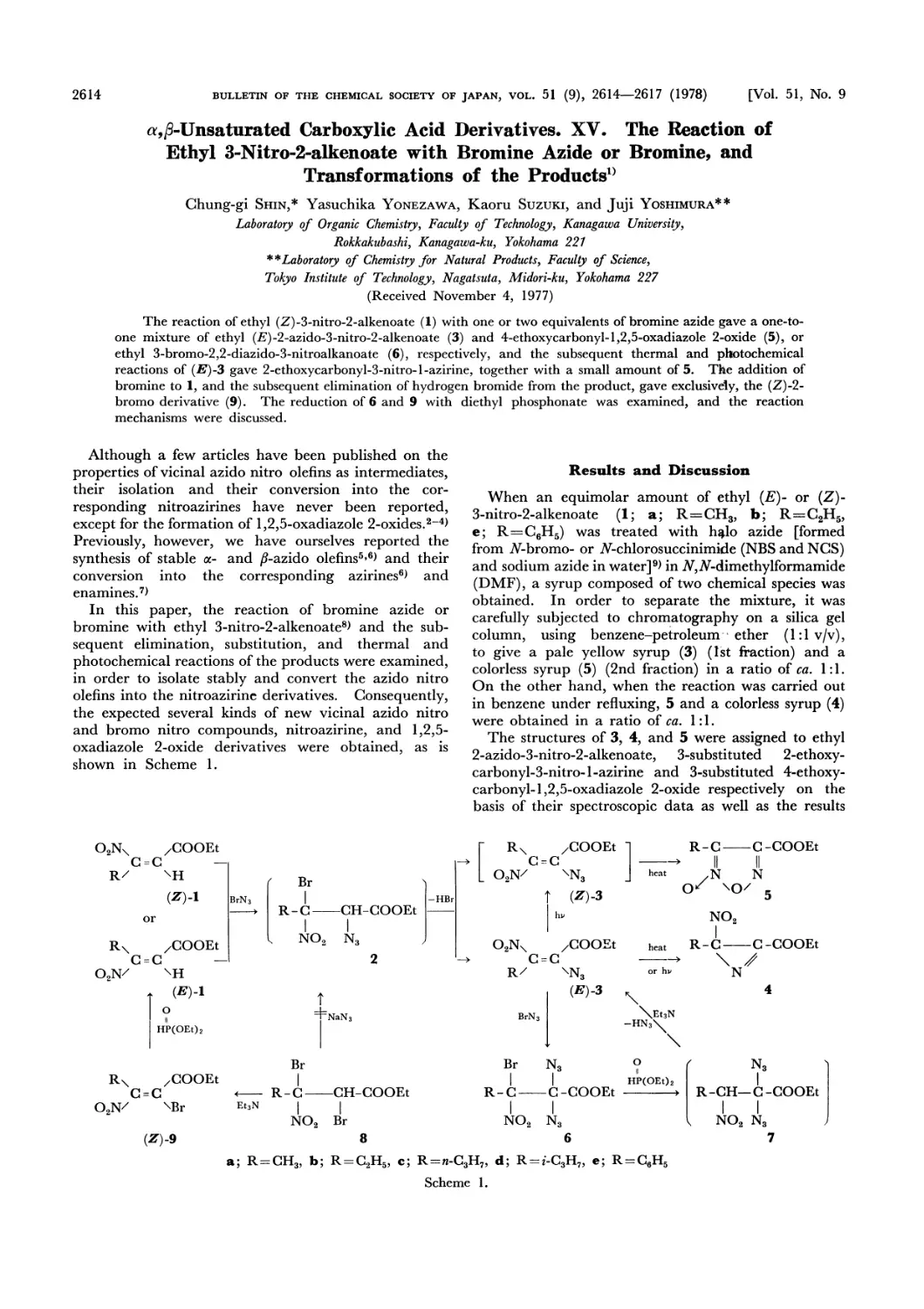
shown in Scheme 1.
Results and Discussion
When an equimolar amount of ethyl (E)- or (Z)-
3-nitro-2-alkenoate (1; a; R=CH3, b; R=C2H5,
e; R=C6H5) was treated with h$lo azide [formed
from JV-bromo- or Y-chlorosuccinimide (NBS and NCS)
and sodium azide in water]9) in N,N-dimethylformamide
(DMF), a syrup composed of two chemical species was
obtained. In order to separate the mixture, it was
carefully subjected to chromatography on a silica gel
column, using benzene-petroleum ether (1:1 v/v),
to give a pale yellow syrup (3) (1st fraction) and a
colorless syrup (5) (2nd fraction) in a ratio of ca. 1:1.
On the other hand, when the reaction was carried out
in benzene under refluxing, 5 and a colorless syrup (4)
were obtained in a ratio of ca. 1:1.
The structures of 3, 4, and 5 were assigned to ethyl
2-azido-3-nitro-2-alkenoate, 3-substituted 2-ethoxy-
carbonyl-3-nitro-l-azirine and 3-substituted 4-ethoxy-
carbonyl-1,2,5-oxadiazole 2-oxide respectively on the
basis of their spectroscopic data as well as the results
O2Nx /COOEt
C = C
R/ XH
BrN3
R\	/COOEt
C = C
o2n/	xh
T W-l
о
HP(OEt)2
Br
R-C----CH-COOEt
no2 n3
—HBr
R\	/COOEt
r* - c
O2N/	\N3
T W-3
R-C-----C-COOEt
-----> II	II
heat-M N
OZ \QZ -
’NaN3
O2Nx	/COOEt
c=c
R/	\N3
(K)-3
BrN3
heat
or hv
no2
R-C----C-COOEt
? f N3
HP(OEt)2	|
-------> R -CH— C -COOEt
I I
I no2 n3
7
Br
R\ /COOEt	|
C = C	<--- R-C----CH-COOEt
O2N/ \Br Et3N I I
NO2 Br
(Z)-9	8
Br N3
I	I
R-C-----C-COOEt
I	I
no2 n3
6
a; R=CH3, b; R=C2H5, c; R=n-C3H7, d; R = z-C3H7, e; R=C„H5
Scheme 1.
September, 1978]
Reaction of /?-Nitro Olefin with Bromine Azide or Bromine
2615
Wave number/cm-1
Fig. 1. IR spectrum of 4a and 5a.
of their elemental analyses. The difference between
4 and 5 can be characterized unambiguously by a
comparison of their IR spectral data, shown in Fig. 1.
The absorption bands at 1555—1560 and 1370 cm-1
assigned to the nitro group and the carbon-nitrogen
double bond6) of the azirine ring at 1790—1800 cm-1
indicate the formation of nitroazirine (4), whereas the
disappearance of the nitro group in 5 supports the idea
of ring formation between the oxygen in the nitro
group and the nitrogen atom caused by the azido
group.2-4)
The configuration of a separated isomer of 3 could
be determined as (E)-geometry by the formation of
4, since the (Z)-isomer of vicinal azido nitro olefins
is known to convert immediately at a higher tem-
perature into the corresponding 1,2,5-oxadiazole 2-
oxide.2-4) It is noteworthy that (E)-3 is the first
example of an isolated azido nitro olefin.
Next, the thermal isomerization from (E)-3 to (Z)-3
was performed in benzene under reflux; however,
only 4 was obtained in ca. a 60% yield. The irradi-
ation of (E)-3 in carbon tetrachloride externally with
a high-pressure mercury lamp under a stream of nitrogen
gas at room temperature also gave 4 in ca. a 35%
yield, together with a small amount of 5. This shows
that (E)-3 is slightly isomerized to (Z)-3, which is
then immediately cyclized to 5.
Moreover, the similar treatment of (i£)-l or (Z)-l
with two molar bromine azide gave the same compound
as a colorless syrup in ca. a 70% yield. It was identi-
fied, by means of spectroscopic analyses, as ethyl 3-
bromo-2,2-diazido-3-nitro-alkanoate (6). It is known
that diethyl phosphonate does not react with both
nitro10) and azido11) groups in the carboxylic acid
ester and that it reduces the halogen atom.12) Accor-
dingly, when 6 was treated with diethyl phosphonate
in benzene in the presence of triethylamine, (E)-3
was obtained in a fairly good yield, along with 5 in a
low ylied. This fact indicates that the bromide atom
of 6 is reduced with phosphonate to form an unstable
intermediate, ethyl 2,2-diazido-3-nitroalkanoate (7);
the subsequent rapid elimination of hydrazoic acid13) in
the presence of the base from 7 gives (E)-3 snd (Z)-3,
the latter of which is further transformed into 5.
From the above facts, the formation of 3 and 6 from
1 seems to be through successive the addition reaction
of bromine azide to 1 and the elimination of hydrogen
bromide to give (E)-3 and (Z)-3, formed as a labile
intermediate, which in turn reacts further with excess
bromine azide to give 6, as is shown in Scheme 1.
The latter addition was substantiated unambiguously
by the reaction of the isolated (E)-3 with bromide
azide.
The yields, physical constants, and spectral data of
3—6 are summarized in Tables 1 and 2.
On the other hand, the dehydrobromination of
ethyl 2,3-dibromo-3-nitroalkanoate (8), prepared in
a good yield from the reaction of (E)-l or (Z)-l with
bromine in chloroform, with triethylamine gave 2-
bromo-3-nitro-2-alkenoate (9) in ca. a 90% yield.
Although the compound, 8, derived from individual
(Z?)-l and (Z)-l consisted of two stereoisomers in
various ratios, listed in Table 3, according to the re-
action, a single product, 9, was formed stereospeci-
fically. The configuration of 9 could be determined
as the (Z)-geometry by conversion into (2?)-l in ca.
a 50% yield by reduction with diethyl phosphonate.
From the above results, it was deduced that the base-
catalyzed ^-elimination of 8 composed of erythro- and
threo-stereoisomers (see Table 3) proceeded by means
of ElcB mechanism via the corresponding nitronate
carbanion.8) Attempts at the substitution of the bromo
atom at the 2-position with the azido group in 8 and 9
by treatment with sodium azide was unsuccessful,
forming an ambiguous mixture.
Table 1. The yields and spectral data of 3 and 6
Compound*)		Yield1» (%)	Yield») (%)	IR spectrum in KBr (cm-1)				NMR spectrum4) 3-alkyl (JHz) (3-phenyl)
	R			N3	ester	c=c	no2
(j£)-3a	CH3	41.9	85.1	2100,	1730,	1640,	1515, 1320	2.20 s
(E) -3b	C2H5	38.8	81.2	2100,	1732,	1635,	1520, 1330	2.61 q (7.2 Hz)
(E)-3e	CeH6	36.5	75.8	2110,	1735,	1622,	1532, 1335	(7.30 s )
6a	CH3	70.3		2100,	1750,		1562, 1332	2.48 s
6b	c2H6	74.2		2100,	1750,		1565, 1320	2.28—3.08m
6e	c.H5	75.2		2120,	1760,		1570, 1340	(7.45—7.76m)
a) 3; pale yellow syrup, 6; colorless syrup, b) From 1. c) From 6. d) d value, measured in CDC13.
Table 2. The yields, physical constants, and spectral data of 4 and 5
Compound		Yield				(Mp °C) Bp °C/mmHg	Formula	Found (Galcd), %			IR spectrumf) (cm'1) N-»O			NMR spectrum^) 3-alkyl (JHz) (3-phenyl)
		(%)*>	(%)b>	(%)c)	(%)d>			C	H	N
	R										C=N	Ester	no2
4a	GH3	32.5	62.5	36.7	—	69—72/0.5	CeH8N2O4	41.90 (41.86	4.70 4.68	16.19 16.28)	1800,	1750,	1555 1370	2.70s
4b	c2h5	40.1	55.7	35.5	—	71—77/0.5	C,H10N2O4	45.12 (45.16	5.44 5.41	15.15 15.05)	1790,	1750,	1558 1370	3.06q (7.6Hz)
4e	ceH5	29.1	61.2	38.5	—	syrup	CuH10N2O4	56.40 (56.41	4.22 4.30	11.89 11.96)	1795,	1750,	1560 1370	(7.38—8.00m)
5a	CH3	2.5	—	32.5	10.5	67—71/0.5	c6h3n2o4	41.91 (41.86	4.72 4.68	16.25 16.28)	1615,	1745		2.46 s
5b	c2H5	3.1	—	40.2	12.5	70—75/0.5	c,h10n2o4	45.11 (45.16	5.43 5.41	15.08 15.05)	1610,	1742		2.86q (7.5Hz)
5e	CeH5	3.2	—	35.6	17.2	(51—52)®)	CuH10N2O4	56.44 (56.41	4.39 4.30	11.88 11.96)	1585,	1745		(7.48—7.77m)
a) From the photochemical reaction of 3. b) From the thermal reaction of 3. c) From 1. d) From 6. e) Colorless needles from ethanol, f) Recorded in KBr.
g) <5 value, measured in CDC13.
Table 3. The yields, physical constants, and spectral data of 8 and 9
Compound R		Yield (%)	Bp °C/mmHg (Mp °C)	Formula	Found (Calcd), %			IR spectrum in KBr (cm-1)				MNR spectruma) 2-H		Ed) : Te> ratioc>
					c	H	N	Ester	c=c	no2
8a	GH3	95.0	67—68/0.33	C6H9NO4Br2	22.52	2.80	4.81	1752,		1570,	1330	5.05 s	, 5.03 s	6 : 1
					(22.57	2.82	4.89)
8b	c2h5	92.3	88—90/0.13	C7HuNO4Br2	25.26	3.34	4.25	1745,		1560,	1325	5.29 s	, 5.19s	4 : 1
					(25.22	3.30	4.20)
8c	n-C3H7	93.5	93—95/0.13	C8H13NO4Br2	27.39	3.75	4.06	1745,		1560,	1330	5.27 s	, 5.14s	3 : 1
					(27.66	3.75	4.03)
8d	z-C3H7	61.5	84—85/0.18	C8H13NO4Br2	27.60	3.72	4.05	1760,		1580,	1325	5.28 s	, 5.15s	6 : 1
					(27.66	3.75	4.03)
8e	C6H5	60.5	colorless syrup	CnHnNO4Br2	34.55	2.97	3.62	1750,		1570,	1330	5.72 s	, 5.61 s	1 : 5
					(34.65	2.87	3.67)
9b	C2H5	85.5	64—70/0.2	C,Hi0NO4Br	33.40	3.97	5.49	1735,	1640,	1545,	1337
					(33.33	3.96	5.55)
9c	и-С3Н7	87.7	75—79/0.4	C8HI2NO4Br	36.37	4.35	5.33	1730,	1635,	1535,	1330
					(36.09	4.51	5.26)
9d	г-С3Н7	91.1	65—66/0.3	C8H12NO4Br	36.12	4.45	5.30	1735,	1620,	1545,	1338
					(36.09	4.51	5.26)
9e	С6Н5	90.2	(96.5—97.5) ь)	CnH10NO4Br	44.05	3.35	4.62	1740,	1650,	1527,	1328
					(44.00	3.33	4.67)
a) d value, measured in CDC13. b) Colorless needles crystallized from benzene-petroleum ether, c) Evaluated from the intensity of the methine proton in the
2-position. d) Erythro. e) Threo.
2616	Chung-gi Shin, Yasuchika Yonezawa, Kaoru Suzuki, and Juji Yoshimura [Vol. 51, No.
September, 1978]
Reaction of /7-Nitro Olefin with Bromine Azide or Bromine
2617
The yields, physical constants, and spectral data of
8 and 9 are listed in Table 3.
Experimental
All the boiling and melting points are uncorrected. The
IR spectra were recorded with a Hitachi EPI-G3 Spectrom-
eter. The NMR spectra were measured with a JNM-PS-
100 Spectrometer (Japan Electron Optics Laboratory Co.,
Ltd.), using tetramethylsilane as the internal standard.
Preparation of 3, 4, and 5. Into a solution of NBS or
NCS (0.06 mol) in DMF (100 ml) we stirred, drop by drop,
a solution of sodium azide (0.06 mol) in water (18 ml) at
— 20 °C for 15, min. The resulting solution was added, drop
by drop, to a solution of (2?)-l or (Z')-l (0.06 mol) in DMF
(20 ml) at —40------45 °C. After stirring at —30 °C for
45 min, the mixture was poured into ice-water (350 ml).
After continuous stirring for 1 h, the aqueous solution was
extracted three times with dichloromethane (130 ml). The
extracts were collected, washed twice with water, and then
dried over anhydrous magnesium sulfate. The dichlorometh-
ane layer was evaporated to give a residual syrup, which was
chromatographed on a silica gel column, using benzene-
petroleum ether (1:1 v/v) as an eluent below 5 °C. Mainly
two fractions were obtained. After concentrating each frac-
tion, the (2?)-3 compound as a pale yellow syrup from the
first eluted fraction and 5 as a colorless syrup from the second
eluted one were obtained.
On the other hand, the syrup obtained from the above
dichloromethane solution was directly dissolved in dry ben-
zene (60 ml), and then the benzene solution was refluxed for
1 h. The resulting solution was evaporated to give a residual
syrup, which was distilled under reduced pressure to give a
colorless syrup composed of a mixture of 4 and 5. A similar
separation gave 4 and 5 in ca, a 1:1 ratio.
Preparation of 6. Procedure A: Into a solution of
(F)-l or (Z)-l (0.05 mol) and NBS (0.11 mol) in DMF
(100 ml) we stirred drop by drop, a solution of sodium azide
(0.11 mol) in DMF-water (1:1 v/v) (30 ml) below—10 °C.
After continuous stirring for 40 min, the mixture was poured
into ice water (400 ml). After stirring for 1 h, the aqueous
solution was extracted three times with hexane (100 ml).
The extracts were collected, washed twice with water, dried
over sodium sulfate, and finally evaporated under reduced
pressure to dryness. The residual syrup was placed in a
silica gel column using benzene as the eluent. The fractions
were collected and evaporated under reduced pressure to
give 6 as a colorless syrup.
Procedure В: Into a solution of (2?)-3 (0.01 mol) in DMF
(30 ml) we stirred drop by drop, a solution of NBS (0.01 mol)
and sodium azide (0.01 mol) in water (10 ml) below —10 °C.
After continuous stirring for 30 min, the mixture was worked
up such as has been described in Procedure A.
Thermal Reaction of /EJ-З. A solution of (E)-3 (0.03
mol) in dry benzene (20 ml) was refluxed for 1 h. After the
removal of the solvent under reduced pressure, the residual
syrup was purified on a silica gel column, using benzene-
ethyl acetate (20:1 v/v) as the eluent. The fraction was
then collected and concentrated. The residue was distilled
under reduced pressure to give 4.
Photochemical Reaction of fE)-3. A solution of (f?)-3
(0.03 mol) in dry carbon tetrachloride (80 ml) was irradiated
with a high-pressure mercury lamp (450 W) in a stream of
nitrogen gas at 10 °C for ca. 7 h, at which time the azido
group band at ca. 2100 cm-1 disappeared. The resultant
solution was evaporated; the purification of the residual syrup
thus obtained was worked up such as above to give 4 and 5
in ca. a 10:1 ratio.
Reaction of 6 with Diethyl Phosphonate. Into a mixture
of 6 (0.01 mol) and diethyl phosphonate (0.01 mol) in dry
benzene (30 ml) we stirred, drop by drop, triethylamine
(0.01 mol) below 10 °C. After continuous stirring for 30 min,
triethylammonium bromide was filtered off, and then the
benzene layer was concentrated under reduced pressure.
The residual syrup was chromatographed on a silica gel
column, using benzene as the eluent; two fractions were thus
obtained. After each fraction had been concentrated under
reduced pressure, the first fraction gave (2?)-3 in ca. an 80%
yield, while the second one gave 5 in ca. a 13% yield.
Preparation of 8. To a solution of (1?)-1 or (^)-l
(0.1 mol) in chloroform (70 ml) we added, drop by drop, a
solution of bromine (0.1 mol) in chloroform (30 ml) with
occasional shaking. The mixture was allowed to stand at
room temperature for 24 h and then concentrated to dryness.
The residual oil was distilled under reduced pressure to give
8 as a colorless oil.
Preparation of 9. Into a solution of 8 (0.1 mol) in dry
benzene (80 ml) we stirred, drop by drop, triethylamine
(0.12 mol) under cooling. After continuous stirring overnight
at room temperature, triethylammonium bromide was
precipitated. It was filtered off, and the filtrate was washed
sucessively with 3 M-hydrochloric acid and water. The
resulting benzene layer was dried over anhydrous magnesium
sulfate and concentrated under reduced pressure to give a
residual syrup. The residue was distilled under reduced
pressure to give (Z')-O as a colorless oil.
Reaction of (2)-9 with Diethyl Phosphonate. Into a solu-
tion of (Z’)-O (0.1 mol) and diethyl phosphonate (0.1 mol)
in dry benzene (70 ml) we stirred, drop by drop, triethylamine
(0.12 mol) under cooling. After continuous stirring for 1 h
at room temperature, triethylammonium bromide was filtered
off and the filtrate was washed successively with 3 M-hydro-
chloric acid and water. The benzene layer was dried over
anhydrous magnesium sulfate and concentrated under reduc-
ed pressure to give (I£)-l as a colorless oil.
References
1)	Part XIV: G. Shin, Y. Kosuge, M. Yamaura, and
J. Yoshimura, Bull. Chem. Soc. Jpn., 51, 1134 (1978).
2)	W. D. Emmons and J. P. Freeman, J. Org. Chem.,
40, 456 (1975).
3)	T. E. Stevens and W. D. Emmons, J. Am. Chem. Soc.,
80, 338 (1958).
4)	A. N. Thakeore, J. Buchshriber, and A. G. Oehle&ch-
lager, Can. J. Chem., 51, 2406 (1973).
5)	G. Shin, Y. Yonezawa, and J. Yoshimura, Tetrahedron
Lett., 1974, 7.
6)	G. Shin, Y. Yonezawa, and J. Yoshimura, Chem. Lett.,
1976, 1063.
7)	G. Shin, Y. Yonezawa, and J. Yoshimura, Chem. Lett.,
1976, 1095.
8)	G. Shin, Y. Yonezawa, H. Narukawa, K. Nanjo, and
J. Yoshimura, Bull. Chem. Soc. Jpn., 45, 3595 (1972); G. Shin,
Y. Yonezawa, and J. Yoshimura, Nippon Kagaku Kaishi, 1974,
718.
9)	D. V. Ende and A. Krief, Angew. Chem. Int. Ed. Engl.,
13, 279 (1974).
10)	G. Shin, Y. Yonezawa, K. Katayama, and J. Yoshi-
mura, Bull. Chem. Soc. Jpn., 46, 1727 (1973).
11)	Unpublished data.
12)	S. Dershowitz and S. Proskauer, J. Org. Chem., 26,
3595 (1961); A. J. Speziale and G. G. Tung, ibid., 28, 1353
(1963).
13)	A. Hassner and F. W. Fowler, J. Am. Chem. Soc., 90,
2869 (1968).