/





Text
                    daily newspaper of the year

£2.80 £2.00 to subscribers

S1

Friday June 21 2024 | thetimes.com | No 74441

(based on a 7 Day Print and Digital Subscription)

England cling on
Martin Samuel’s Euros verdict

PULLOUT

Flatpack
secrets!
Inside Ikea’s
test lab

Bricks
&Mortar

Labour will delay VAT on private school fees until at least 2025
Oliver Wright Policy Editor

Labour will not impose VAT on private
school fees before 2025 at the earliest,
Rachel Reeves has said, promising that
the tax would not be levied on parents
retrospectively.
Speaking at The Times CEO Summit, the shadow chancellor defended
the tax — one of Labour’s most conten-

tious policies — but said it “wouldn’t be
the right thing to do” to force parents
into higher fees from September.
Instead, she said, the measures would
be contained in Labour’s first budget in
the autumn and would become law
after being passed by MPs in Labour’s
first finance bill. This would mean the
earliest the tax could take effect would
be the spring term, starting in January.

inside today

However, experts said Labour was
almost certain to delay the policy until
the start of September next year, giving
private schools a one-year reprieve.
Labour says its plans to make private

schools pay VAT and business taxes
would raise about £1.6 billion a year,
which would be used to recruit about
6,500 specialist teachers in secondary
schools. But it has led to warnings of an
exodus of pupils whose parents cannot
afford the higher fees and may then
struggle to find a place in a state school.
Experts said it made “no sense” to
impose the charges in the middle of the

Sunak vows
to boot out
Tories over
poll betting

Marriages
surge after
Covid put
love on hold
James Beal Social Affairs Editor

PM tells debate audience he is ‘incredibly angry’
Matt Dathan Home Affairs Editor
Ed Halford, Tom Witherow

Rishi Sunak has said he is “incredibly
angry” about senior Conservative
Party figures accused of betting on the
date of the election, and insisted that
those found to have broken the rules
should “face the full force of the law”.
The prime minister said on the BBC
last night that two candidates accused
of placing bets would be “booted out” of
the party if found guilty of wrongdoing.
The gambling watchdog is investigating a series of suspicious bets placed
before Sunak announced the election.
Tony Lee, the Conservative Party’s
director of campaigning, took a leave of
absence after it was disclosed that he
and his wife, Laura Saunders, a Tory
election candidate, were being investigated by the Gambling Commission
over bets placed on the election date. It
is not known when either individual
placed a bet, or their value.
“These investigations are ongoing,
they are widely confidential, one of
them is a criminal investigation that’s
being conducted by the police,” Sunak
said. “What I can tell you is if anyone
is found to have broken the rules, not
only should they face the full
consequences of the law, I will make
sure that they are booted out of the
Conservative Party.”
Sunak’s comments came during last
night’s edition of Question Time at York
University, in which he was questioned

by members of the audience alongside
Sir Keir Starmer, the Labour leader, Sir
Ed Davey, the Liberal Democrats’
leader, and John Swinney, the Scottish
National Party leader.
During
the
debate
Starmer
suggested that Jeremy Corbyn would
have been a better prime minister than
Boris Johnson, as he was repeatedly
challenged on his support for the
former Labour leader.
Lee and Saunders are the latest
individuals with Downing Street
connections who are alleged to have
placed bets on the election date. On
Monday one of Sunak’s police
protection officers was arrested after it
was alleged that he had placed a bet on
the election’s timing. And last week the
Gambling Commission began an
investigation into Craig Williams,
Sunak’s parliamentary aide, after it was
revealed he had placed a £100 bet on a
July election. The Conservative Party
said: “We have been contacted by the
commission about a small number of
individuals.”
Betting on a July election rose significantly the day before Sunak announced the date. Betfair said nearly £6,000
was placed on a July 4 election in bets
with its exchange platform on May 21.
Before May 21, no more than £1,000
had been bet on a single day over the
previous month.

academic year — a move that could
force pupils to leave schools midway
through an examination cycle. They
warned that imposing the tax in the
spring would leave schools with no
choice but to pass the cost on to parents
immediately rather than make
efficiency savings, because budgets,
dominated by staff salaries, would

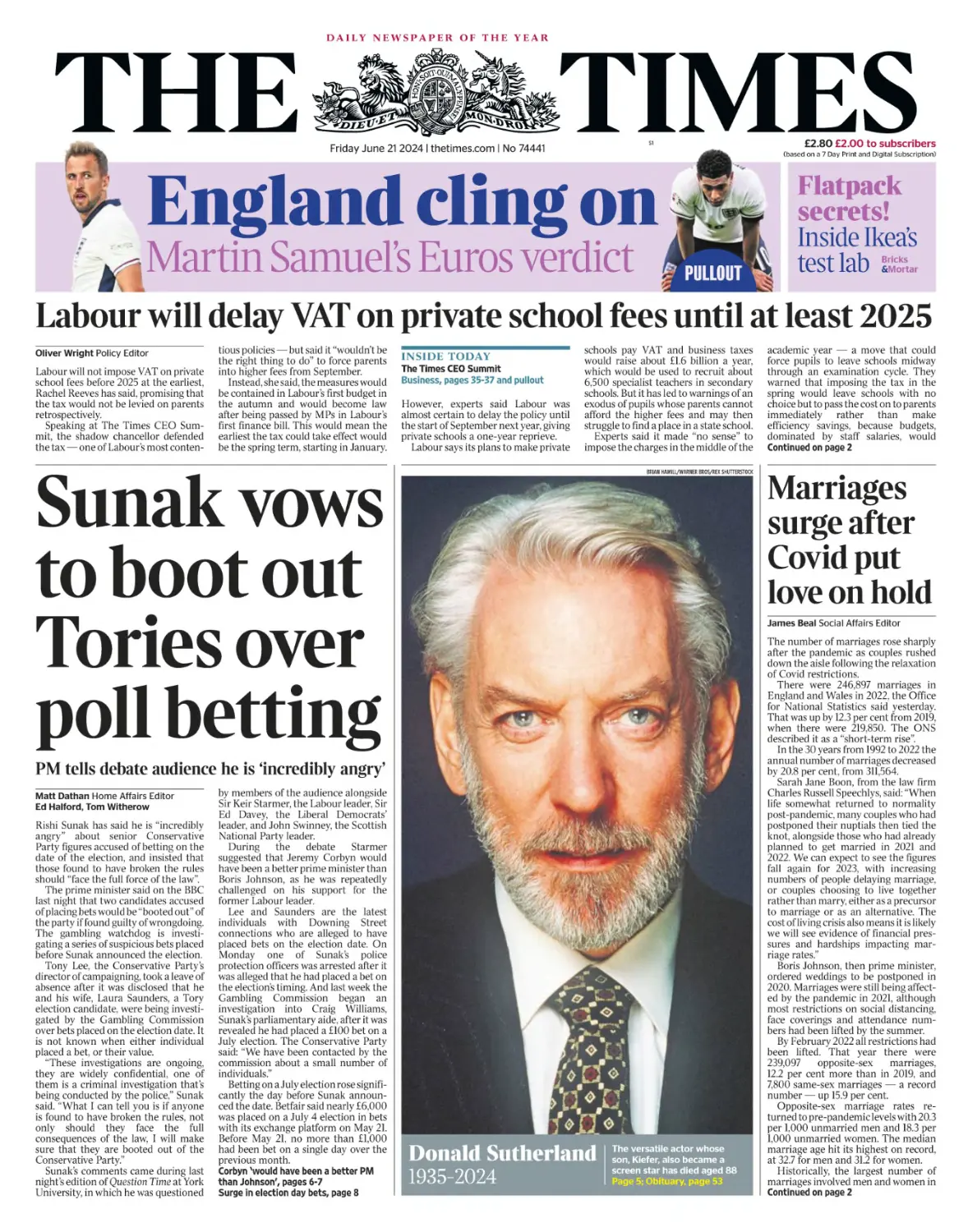
Donald Sutherland
1935-2024

The versatile actor whose
son, Kiefer, also became a
screen star has died aged 88
Page 5; Obituary, page 53

The number of marriages rose sharply
after the pandemic as couples rushed
down the aisle following the relaxation
of Covid restrictions.
There were 246,897 marriages in
England and Wales in 2022, the Office
for National Statistics said yesterday.
That was up by 12.3 per cent from 2019,
when there were 219,850. The ONS
described it as a “short-term rise”.
In the 30 years from 1992 to 2022 the
annual number of marriages decreased
by 20.8 per cent, from 311,564.
Sarah Jane Boon, from the law firm
Charles Russell Speechlys, said: “When
life somewhat returned to normality
post-pandemic, many couples who had
postponed their nuptials then tied the
knot, alongside those who had already
planned to get married in 2021 and
2022. We can expect to see the figures
fall again for 2023, with increasing
numbers of people delaying marriage,
or couples choosing to live together
rather than marry, either as a precursor
to marriage or as an alternative. The
cost of living crisis also means it is likely
we will see evidence of financial pressures and hardships impacting marriage rates.”
Boris Johnson, then prime minister,
ordered weddings to be postponed in
2020. Marriages were still being affected by the pandemic in 2021, although
most restrictions on social distancing,
face coverings and attendance numbers had been lifted by the summer.
By February 2022 all restrictions had
been lifted. That year there were
239,097
opposite-sex
marriages,
12.2 per cent more than in 2019, and
7,800 same-sex marriages — a record
number — up 15.9 per cent.
Opposite-sex marriage rates returned to pre-pandemic levels with 20.3
per 1,000 unmarried men and 18.3 per
1,000 unmarried women. The median
marriage age hit its highest on record,
at 32.7 for men and 31.2 for women.
Historically, the largest number of
marriages involved men and women in

2

Friday June 21 2024 | the times

News

Today’s highlights
7am

David TC Davies, secretary of state
for Wales
8.30am Peter Kyle, shadow science
secretary
10.30am How to Win an Election, with Daniel
Finkelstein and Polly Mackenzie
4.10pm Lord Rose of Monewden,
chairman of Asda
5.10pm Brendan Cox, right, campaigner
and husband of the late Jo Cox

Chris Smyth Whitehall Editor

DAB RADIO l ONLINE l SMART SPEAKER l APP

T O D AY ’ S E D I T I O N
NEWS

SPORT

TIMES2

JET ATTACK
Activists protest
over Taylor Swift’s
private aircraft

NET GAIN
Briton Jack Draper
beats world no 2
at Queen’s

STAGE RETURN
Will James Corden’s
UK return boost
his reputation?

PAGE 13

PAGES 64-65

PAGES 4-5

450

days since Wall Street Journal
reporter Evan Gershkovich
was detained in Russia
#FreeEvan

COMMENT 23
LETTERS 26
LEADING ARTICLES 27

WORLD 28
BUSINESS 35
REGISTER 53

SPORT 60
CROSSWORD 68
TV & RADIO TIMES2

Why Tories are talking
about ‘Canada 1993’

The

Story

Twenty-one years ago the
Canadian Conservative party
went into the election in
power but lost all but two of its
seats. Could the same be about
to happen in the UK?
Available on the Times Radio app or
wherever you get your podcasts

OFFER

Save up to 30% with a subscription to
The Times and The Sunday Times
THETIMES.COM/SUBSCRIBE

THE WEATHER

20

22
17

14

16
17

21
23
23

23

Outbreaks of rain, occasionally
heavy, in western regions. Brighter
elsewhere.

Council tax ‘must rise by £600
in five years to protect services’
Even council tax rises of £600 over the
next parliament will not be enough to
stop more cuts to services such as parks
and libraries, the Institute for Fiscal
Studies has said.
Council tax will “almost certainly” go
up whoever wins the election, the think
tank said, and it berated both main parties for failing to take seriously the
looming crisis in council finances.
More councils face bankruptcy and
essential services such as social care
will fray further even as they consider
implementing the biggest council tax
rises in 20 years, it says in a report.
The Conservatives have accused Sir
Keir Starmer of planning to introduce
additional council tax bands for more
expensive houses, a measure that
Labour has ruled out. However, the
institute says that both parties are
involved in a “conspiracy of silence”
over the tough choices ahead.
Rising demand and higher costs for
core services such as social care, children’s services, homelessness and trans-

port for pupils with special needs has
led to councils estimating that realterms rises of 4.5 per cent a year are
needed. The IFS says that even increases in council tax of 5 per cent every year
for the next parliament — which would
be the biggest rise since the 2001-2005
parliament — would not plug the gap.
This would push the average band D
bill of £2,171 up by £600 by 2029.
“If cost pressures rise as fast as they
have been, there’s a gap,” said David
Phillips, associate director of the IFS.
“At some stage they should start to slow
down — only so many children can
have a special education need — but
how fast and how much is uncertain.
“There is a conspiracy of silence
about council funding. There was virtually nothing in the manifestos about it,
which is quite remarkable. Irrespective
of who wins, unless there is a big top-up
to overall spending plans, which would
require more borrowing or higher taxes, council tax will almost certainly
have to go up in real terms. Even so,
unless spending pressure declines there
won’t be enough and it will mean cuts to

some services.” Phillips said that reform could reduce costs in areas such as
children’s homes or temporary accommodation for the homeless but added
that “in the short term, some councils
will draw down further reserves.
Others could make cutbacks to service
provision or seek to raise alternative
sources of revenue”.
Michael Gove, the levelling up secretary, acknowledged “financial pressures in local government” but said that
only those that had been “mismanaged” were going bust.
Matthew Pennycook, the shadow
housing minister, said that Labour had
“no plans to re-band council tax”.
Kevin Bentley, of the Local Government Association, urged Labour and
the Tories to promise “a significant and
sustained increase in funding”. He said:
“A funding gap of more than £6 billion
facing local services over the next two
years, fuelled by rising cost and demand
pressures, means a chasm will continue
to grow between what people and their
communities need and want from their
councils and what councils can deliver.”

Interest rates held despite fall in inflation
Jack Barnett
Economics Correspondent

The Bank of England has kept interest
rates unchanged for a seventh consecutive meeting, with Andrew Bailey
emphasising that it must keep policy
tight to ensure inflation stays low.
The monetary policy committee
(MPC) voted 7-2 in favour of freezing
the base rate at 5.25 per cent in an
unchanged voting pattern from last
month. The move had been expected
by City analysts, despite inflation falling back to the 2 per cent target.
Members who backed a hold, including Bailey, the Bank’s governor, said it
had been “finely balanced”, with some
saying more “evidence of diminishing
inflation persistence was needed before
reducing the degree of monetary policy

continued from page 1
VAT on school fees
already have been set. A senior Labour
source said Reeves had made “no final
decision” on when the tax would be
introduced and that she wanted to take
advice from officials when in
government. The source did not deny
that the policy could be further delayed.
Before the election was called, Sir Keir
Starmer said it would be implemented
“straight away” but later said it would
happen “as soon as possible”.
Speaking to business executives at
The Times summit, Reeves defended
the policy but suggested she intended
to take a pragmatic approach to its implementation. “We’re not going to have
a retrospective tax,” she said. “I don’t
think that would be the right thing to
do. So these changes would be in our
first budget, but they would come in
after that, not retrospectively.” Reeves
said she did not expect schools to pass
on the full cost to parents, suggesting
that she was prepared to give them the
chance to make savings before implementing it. “Over the last 14 years, state
schools have had to make huge efficiencies because of the cuts to real-terms
spending,” she said. “I strongly believe
that private schools, as well, have to be
able to make efficiencies.”
Also speaking at the summit, Jeremy
Hunt said the Conservatives were not
pretending victory was “the most likely

restrictiveness”. Sir Dave Ramsden and
Swati Dhingra, two members who
voted for a reduction of 0.25 points, said
that the economy needed an injection
of demand to keep inflation at the
Bank’s target over the medium term.
Bailey said: “We need to be sure that
inflation will stay low and that’s why
we’ve decided to hold rates at 5.25 per
cent for now.”
Rob Wood, UK economist at Pantheon Macroeconomics, said that by describing the call as finely balanced, the
Bank “suggests three additional members could be ready at the MPC’s next
meeting in August to join Swati
Dhingra and Dave Ramsden in voting
for a cut, which would give a majority to
change policy. Markets see an August
cut as odds-on after these minutes.”
Peter Arnold, EY’s UK chief

economist, agreed. He said: “Successive
significant overshoots for services inflation — one of the MPC’s key measures of inflation persistence — had removed any likelihood of interest rates
being cut. So the focus was really on any
messaging around future rate cuts.”
Markets responded favourably. The
FTSE 100 hit 8,240 points, up 0.4 per
cent, led by rises among the big housebuilders. The pound fell slightly against
the dollar, as investors shifted bets toward the prospect of an earlier cut.
This week figures from the Office for
National Statistics showed that inflation had dropped to the Bank’s target
for the first time since July 2021.
Bailey and the rest of the committee
will not issue communications during
the general election campaign.

outcome” of the election. But he insisted a Labour win would lead to higher
taxes. “The Labour perspective is that
they believe taxation is broadly a force
for good. They believe that for social
justice reasons. I think one of the challenges if Labour do win is going to be on
tax-and-spend because all the pressure
from the Labour Party, the labour
movement, the unions, is going to be to
spend more.”
John Jerrim, professor of education
at University College London, said it
made “no sense” to implement the VAT
change immediately, as it would need to
be fully worked through. “They won’t
do it [in the spring],” he said. “Although
the policy has been well trailed, schools
rightly need time to adjust and work out
how they deal with the new charges.”
Julie Robinson, the chief executive of
the Independent Schools Council, said
she welcomed Reeves’s comments
ruling out retrospective taxes. But she
added: “This is only one part of the picture. Families and schools still do not
have the clarity they need to properly
plan. In particular, we are concerned
about the prospect of in-year tax rises
and the acute negative effect that
would have on parents’ budgets and
children’s education.”

continued from page 1
Marriage rates
their twenties, but more recently it has
been people in their thirties. In 2022,
the highest number of opposite-sex
marriages involved those aged 30-34.
Overall marriage rates also returned
to being higher than divorce rates in
2021 and 2022, following the drop in
marriages during the pandemic.
More than 90 per cent of couples
who married in 2021 or 2022 were
already living together — the highest
level since comparable records began in
1994. That year, 59.6 per cent of couples
cohabited before marriage.
Madelaine Hailey, at Hall Brown
Family Law, said the figures suggested
couples increasingly appreciated the
practical benefits of marriage. She said:
“I think that this data shows that far
from being the death of marriage, cohabitation amounts to something of a
trial marriage for many people.”
The areas that had the largest percentage changes in the number of marriages between 2019 and 2022 were
Monmouthshire and Haringey, north
London. Marriages were up by 67.4 per
cent in Monmouthshire and down by
51.1 per cent in Haringey.
The most popular wedding day in
2022 was July 30 — a Saturday — with
a total of 3,608 marriages. With three
weddings on Christmas Day, that remained the least popular date.

the times | Friday June 21 2024

3

News

McKellen
out of show
after fall
from stage

The late Freddie
Mercury’s
portion will go to
a close friend.
Roger Taylor,
John Deacon and
Brian May, left to
right with
Mercury, all also
wrote No 1 hits.
Sony is believed
to have brought
rights to Bruce
Springsteen’s
catalogue

David Sanderson Arts Correspondent
George Sandeman

Sir Ian McKellen has withdrawn from
the remaining West End performances
of Player Kings after falling off stage
while playing Falstaff on Monday.
David Semark, his understudy, who
had been playing Sir Richard Vernon in
the adaptation of Shakespeare’s Henry
IV Part One and Part Two, will assume
the role, allowing McKellen, 85, longer
to recuperate.
The acclaimed adaptation is due to
go on tour around England after its
final performance at the Noël Coward
Theatre in central London this
weekend.
Semark said he hoped that his
“friend, wonderful actor and human
being” McKellen had a “swift recovery”,
adding that he was “awed and excited”
to be performing as Falstaff.
“I walk in the shadow of greatness
and will do my best not to let him or our
hugely talented company down,” Semark added.
When McKellen fell on Monday,
witnesses said that he “pretty much
went head first into the audience”. One

Sony goes ga ga
over Queen’s
music rights . . .
to tune of £1bn
Deal rivals that done
for Michael Jackson’s
record-breaking back
catalogue, writes
David Sanderson
It’s a kind of magic for Queen, who
appear to have sold portions of their
music catalogue for £1 billion.
The three surviving members of the
band and the estate of Freddie Mercury
are reported to have struck a deal for
their songs that rivals the record-breaking sum agreed for a stake in Michael
Jackson’s back catalogue — and the
complexity of the deal makes Bohemian
Rhapsody look a simple composition.
The dealmakers for Sony have had to
unravel the band’s complicated recording and publishing rights to account for
factors including, for example, each of
the four members having written a No 1
single for the band.
Some of the North American recording rights to the band’s songs remain
with Disney and other copyrights stay
at Universal, but royalties from the
successful 2018 Bohemian Rhapsody
film are said to be included.
Variety said that Sony was paying
about £1 billion, adding that the deal did
not include revenue from live perform-

ances by the founding members Sir
Brian May and Roger Taylor, who still
tour with Adam Lambert singing.
The company has never confirmed
the deals but it is widely reported to
have bought Bruce Springsteen’s publishing and recording catalogues for
$500 million and half of Jackson’s catalogues and masters for a similar sum.
Jackson’s deal was further complicated by family squabbling and the estate’s
ownership of other songs, including the
Sly and the Family Stone publishing
catalogue.
May, Queen’s guitarist, Taylor, the
band’s drummer, and John Deacon —
the bass player, who retired from the
band in 1997 — were already among
Britain’s richest musicians with regular
eight-figure incomes via Queen
Productions, the company capturing their earnings. Mary Austin, the close friend of Mercury,
the singer, who died in 1991
from an Aids-related illness, is also a beneficiary.
The Queen deal highlights the riches investors believe lie in the
hits of the past. Billboard magazine estimates that the Jackson
catalogues earned the
estate nearly £60 million a year.
Queen’s broad back

David Semark said
he was awed to be
playing Falstaff

catalogue, from Radio Ga Ga to Don’t
Stop Me Now, was brought to the attention of new generations and continents
by the 2018 biopic, starring Rami Malek
as Mercury.
The Sunday Times Rich List reported that earnings at Queen Productions
were £73 million in that financial year.
The many platforms on which old
and new songs can now capture attention — such as TikTok and YouTube —
and ease of access to music through
streaming services such as Spotify have
lured investors, with older musicians
keen on one last payday.
Songs can be catapulted to
global attention in films and television productions. Kate Bush’s
1985 hit Running Up
That Hill reached millions of new listeners
when it featured prominently in
the Netflix hit Stranger Things.
Complicated personal histories
between band members have in the
past however made already complex

deals hard to secure. A £400 million
deal for the Pink Floyd catalogues has
reportedly stalled in part because of the
prickly relations between the members
Roger Waters and David Gilmour.
Bob Dylan split his catalogues, with
the recording rights going to Sony and
the song rights to Universal for a reported $550 million.
Variety said Sony had been fighting
for the Queen catalogues with another
party having dropped out at just over
£700 million — Universal had previously been negotiating a deal.
One complication in Queen’s reported deal, which has been at least two
years in the making, would have been
the rare situation that each member
composed a No 1 single.
Mercury was credited with their 1975
breakout song, Bohemian Rhapsody,
May with We Will Rock You in 1977,
Another One Bites the Dust was by Deacon and Taylor composed Radio Ga Ga.
The surviving members will presumably be singing We Are the Champions.

said that he appeared to trip on a prop
from a battle scene. Another said that
the actor had “almost flipped over”. He
was taken to hospital by ambulance.
A statement on Tuesday said the
NHS had assured McKellen that he
would “make a speedy and full
recovery”.
McKellen posted on Twitter/X that
he had been told his recovery would be
“complete and speedy … I am looking
forward to returning to work”.
The producers of Player Kings had
initially hoped that the actor — whose
commitments include a nationwide
solo tour and a month-long Edinburgh
Fringe run, as well as playing Hamlet —
would be able to return to the stage this
week in London.
However, they said yesterday that
McKellen was still recuperating.
They added that “we look forward to
Ian returning to the production”, which
begins its tour in Bristol on July 3 before
visiting Birmingham, Norwich and
Newcastle.

4

Friday June 21 2024 | the times

News
Quintagram® No 1974
Solve all five concise clues using
each letter underneath once only
1 Long complex story (4)

----

2 Skewered meat dish (5)

-----

3 Bird that fans its tail for display (7)

------4 Injured (7)

-------

5 Player of a summer sport (9)

--------A

A

A

A

B

B

C

C

C

D

D

E

E

E

C
E

E

G

I

K

K

K

N

O

O

P

R

R

S

T

U

W

Solutions see T2 MindGames p15
Cryptic clues T2 MindGames p14

Breakfast:
6am to 10am
Our free radio station has all the
latest headlines, interviews and
debates every morning

Unfurled Brimming with roses and lavender, the Union Flag Garden at Penshurst Place in Kent, used as a hunting lodge by Henry VIII, was originally planted in 1986

Listen seven days a week
On DAB,
app,
website
and smart
speaker

Global alert over fake Ozempic jabs
Eleanor Hayward Health Editor

World Health Organisation officials
have issued a safety warning about
potentially life-threatening fake Ozempic injections that have entered the
UK’s supply chain.
They urged patients and doctors to
be alert for counterfeit batches of the
weight-loss drug.
The WHO said it had detected the
fake medicine in the UK, the US and
Brazil, adding that it was being “supplied in the regulated supply chain”,
which means it has been provided by
legitimate clinics or doctors and could
affect NHS patients.
The WHO called for “diligence by
national regulators” on batches of
Ozempic and other weight-loss injec-

tions, and said people should look for
signs such as spelling errors on the box.
Ozempic is the brand name for semaglutide, made by the Danish company
Novo Nordisk. It is used to treat type 2
diabetes and “off-label” to help weightloss. The clamour for the drug has led
to global shortages and supply has been
unable to keep up with demand, leading
to fakes appearing on the black market.
The WHO said three falsified batches of Ozempic were circulating in the
UK, and were first detected in October.
Novo Nordisk confirmed the products
were fake. It said this posed a serious
risk, adding: “The use of falsified Ozempic may result in the ineffective treatment of patients due to incorrect dosage, contamination with harmful substances, or use of unknown or substi-

tuted ingredients,” and that its
administration by subcutaneous injection could be life-threatening.
Health officials have been monitoring reports of fake weight-loss injections since 2022, but this is the first time
a global warning has been issued.
Dr Yukiko Nakatani, from the WHO,
advised “healthcare professionals, regulatory authorities and the public [to]
be aware of these falsified batches”.
People should check Ozempic injections for signs they may be fakes and the
WHO has issued the serial numbers of
the fakes. It urged patients to examine
the injection pen and assess label quality: “The carton may have spelling mistakes on the front.”
Semaglutide is the first in a new generation of weight-loss injections known

Missing genes point way to obesity
Eleanor Hayward Health Editor

Scientists have discovered a genetic
cause of obesity that makes the body
burn fewer calories while at rest.
Research from the University of
Exeter found that 1 in 5,000 people
lacked two copies of the SMIM1 gene
and were more likely to be overweight.
People who lacked the gene also had
a rare blood type, Vel-negative, which
means it can be difficult for them to
receive blood transfusions.
The study found they also expended
much less energy while at rest or sleeping, so cannot eat as much as the rest of
the population without gaining weight.
Scientists say they could now use
DNA testing to identify people with this
genetic make-up and offer them help to
avoid weight gain. About 13,500 people
in the UK have the variant.

The study, published in the journal
Med, adds to evidence about the
importance of genes in determining the
risk of becoming overweight or obese.
It involved analysing the DNA of
nearly 500,000 participants in the UK
Biobank database. Researchers identified 104 people with the genetic variant
that disables the SMIM1 gene.
Previously, it was thought that the
SMIM1 gene only influenced blood
type, but scientists discovered that it
also played a crucial role in metabolism.
The team found that those with this
genetic make-up were also significantly
more likely to be overweight, with
women weighing an extra 4.6kg on
average, and men an extra 2.4kg.
Mattia Frontini, the lead author and
associate professor of cell biology at the
University of Exeter Medical School,
said: “In a small minority of people,

obesity is caused by genetic
variants. When this is the case, new
treatments can sometimes be found to
benefit these people.
“Obesity rates have nearly tripled in
the past 50 years, and by 2030 more
than one billion individuals worldwide
are projected to be obese. The associated diseases and complications
create significant economic burden on
healthcare systems.”
The discovery could lead to targeted
anti-obesity treatments and unlock
clues to how the body burns calories.
Other genes have previously been
identified that can increase the risk of
obesity up to six times.
Two out of three adults in the UK are
overweight or obese, and although this
is largely driven by lifestyle and diet,
some people are also genetically predisposed to obesity.

as GLP-1 agonists, which work by suppressing the appetite. In branded versions, Ozempic is used on the NHS for
patients with type 2 diabetes, and
Wegovy is used for obese patients.
The WHO alert has been issued
amid safety concerns about the weightloss drugs market. The Times has exposed how online pharmacies are selling the products to patients who have
lied about their weight online. The
NHS has called for pharmacies to tighten restrictions, including weighing
people in person before prescribing the
drug, due to concerns the system is
being abused by patients with eating
disorders.
NHS doctors have warned that
patients are ending up in A&E after
buying weight-loss injections online.

Some have needed hospital treatment
or developed severe complications
after buying fake versions of the drug.
Eli Lilly, the company that manufactures tirzepatide (Mounjaro), the main
rival to semaglutide, also issued a statement warning of the dangers of counterfeit versions. The company said it
was “deeply concerned about the proliferation of online sales and posts on
social media involving counterfeit,
fake, compounded and any other unsafe or untested versions of what they
say is tirzepatide”.
It added that illegal online pharmacies were selling “substandard and falsified” weight-loss injections that were
unsafe and put patients at risk.

Doctors use ‘shockwaves’
to rebuild heart muscle
Doctors have been able to make heart
muscle “regenerate” for the first time.
Researchers pioneered the technique
by delivering mild shockwaves to
patients’ hearts after bypass surgery.
Volunteers given the treatment were
later shown to be in better health than
those who had regular care.
Their hearts were able to pump more
oxygen and they reported being able to
walk further without resting.
“For the first time, we are seeing the
heart muscle regenerate in a clinical
setting, which could help millions,” said
Professor Johannes Holfeld of Innsbruck Medical University.
The Austrian trial involved 63
patients with damaged heart muscle.
Researchers used a machine — dubbed

a “space hairdryer” — to apply mild
shockwaves after surgery.
A year later, the amount of oxygenated blood pumped by the heart had increased by 11.3 per cent in the 30
patients given the treatment. For the 33
volunteers in the control group the
figure was 6.3 per cent.
The authors of the study, published in
the European Heart Journal, also reported that the shockwave patients did
better in a six-minute walking test and
had a higher quality of life.
“It means they are able to go out for
a walk with their dog again or go to the
supermarket,” Holfeld told the BBC.
“We also anticipate they will have a
longer life expectancy and fewer
re-hospitalisations.”

the times | Friday June 21 2024

5

News

He loved what he did and did what he loved: Donald Sutherland dies at 88
Josie Ensor New York

Donald Sutherland, the Canadian film
and television actor whose long career
stretched from M*A*S*H to The Hunger Games, died yesterday aged 88.
Sutherland died at his home in
Miami, Florida, after a long illness, his
family confirmed. His son Kiefer, best
known for his role as Jack Bauer in 24,
led the tributes, posting on Twitter/X
that he thought his father was “one of

the most important actors in the history of film. Never daunted by a role,
good, bad or ugly. He loved what he did
and did what he loved, and one can
never ask for more than that.”
Known for his unconventional looks
and versatility as an actor, Sutherland
was one of the biggest stars in Hollywood in the 1970s and remained in
demand for film and TV projects into
his eighties. Born in Saint John, southeastern Canada, he moved to the UK in

1957 where he studied at the London
Academy of Music and Dramatic Art
before getting roles in TV shows and
films including The Avengers and The
Saint. He was best known for his roles as
a US army surgeon in M*A*S*H in
1970, and as a local official facing
an alien presence in Invasion of
the Body Snatchers. In 1971, at
Donald Sutherland was in
demand into his eighties

the height of the Vietnam
War, Sutherland and Jane
Fonda toured an anti-war
comedy show across southeast Asia. He was put on the
US National Security
Agency’s
“watch
list” between 1971
and 1973 as a result
of his political
views. Ron Howard, the director

and film producer, posted: “I was
blessed to direct him in Backdraft. One
of the most intelligent, interesting and
engrossing film actors of all time.”
Sutherland was considered among
the best actors to never receive an
Oscar or a nomination. He was, however, presented with an honorary Academy Award for lifetime achievement
in 2017. He is survived by five children
from three marriages.

pusher
Police to start dig for Muriel Tube
not guilty of
due
McKay’s remains next month attacks
to insanity
Ben Ellery Crime Editor

The police have visited the site where
Muriel McKay’s killer says she was
buried and say that they will dig for her
remains next month.
Yesterday detectives from the Metropolitan Police met McKay’s grandson at
the Hertfordshire farm where her murderer, Nizamodeen Hosein, says he
buried her 54 years ago.
Hosein and his brother, Arthur,
killed Mrs McKay, 55, during a bungled
kidnapping in 1969 after mistaking her
for the wife of Rupert Murdoch, now
chairman emeritus of News Corporation, publisher of The Times. She was in
fact the wife of Alick McKay, Murdoch’s
deputy at the time.
Mark Dyer, Mrs McKay’s grandson,
has been working with the force and the
owner of the farm in Stocking Pelham
to plot the parameters of the search.
The work is expected to take five days.
The brothers were convicted of Mrs
McKay’s murder but refused to say
where she was buried. The case was one
of the UK’s first murder convictions
without a body. Hosein, who was deported to his native Trinidad after serving 20 years in prison in Britain, has
since told the family where he says he
buried her, to “clear his conscience”.
Yesterday Detective Superintendent
Katherine Goodwin was at the farm to
discuss the search with Dyer. A
member of the police team mapped the
terrain using a sensor and others placed
red flags around the boundaries of the
search area. Ian de Burgh Marsh, the
owner of the farm, was also there and is
supportive of the dig.
Mrs McKay’s daughter, Dianne, 84,
said: “It’s great to get to this point, it’s a
big achievement to know we are
potentially so close to finding where my
mother is buried. I am not getting any
younger and so this really means a lot to
me and the whole family. I cannot bear
to think that my mother is lying there in
that farm. Incredibly, the area of the
farm where Nizam says she is buried is
the one part which has not been developed, so we are confident that my
mother will still be there.”
The family became aware that Hosein was still alive in 2021 when a documentary crew interviewed him about
the murder. He agreed to help them try
to find her body, refusing offers of
money for his help.
In January Mrs McKay’s daughter
and grandson flew to Trinidad to meet
him and he showed them on a map
where he said she was buried.
Dyer, 59, said: “We’re very happy
with the area that the police have
marked out. It was a purposeful meeting and the farm owner was even happy
that it might be necessary to knock
down an old barn.
“I am confident that my grandmother is there and I just want closure for my

Muriel McKay’s daughter, below with
Nizamodeen Hosein, and grandson
met officers at the farm where she is
said to have been buried in 1969

Behind the story

I

n January The
Times went with
Muriel McKay’s
family to witness
the extraordinary
moment when her
daughter Dianne met
the murderer
Nizamodeen Hosein
(Ben Ellery writes).
“It’s me,” were the
first words she said to
Hosein, before kissing
him on both cheeks.
“We came all this way
to see you.”
Hosein and his
brother abducted
McKay outside her
Wimbledon home in
1969, beginning what
the family described
on Thursday as “a
ghastly mystery which
has plagued our lives”.
They tried to extort
a ransom but were

caught and convicted
of McKay’s murder.
They refused to reveal
the location of her
body. Arthur Hosein
died in prison in 2009
and his younger
brother was deported
to Trinidad after
serving his sentence.
In 2021, Sky made a
documentary, The
Wimbledon
Kidnapping, including
an interview with the
surviving brother. The
McKay family had not
known he was still
alive and contacted
him via a barrister on
the island. They
offered him money,
which he declined,
saying he would help
them “to clear my
conscience”. Speaking
to the family on a

video call, he said
McKay had died after
what they presumed
was a heart attack. He
said they buried her
behind a barn on a
Hertfordshire farm.
In March 2022 the
Metropolitan Police
made an “extensive
search” of the farm
but found nothing.
Hosein had worked
from an updated map
of the property which
he did not recognise
and said police had
searched the wrong
area. Last December
Hosein signed an
affidavit pinpointing
where McKay was
buried. The family
offered the farm
owner £40,000 to let
them dig at the site.
The farmer declined.

mother. We have lived with this in our
family, it has always been something
that has been part of us and we just
want to close this chapter.”
The brothers had intended to kidnap
and hold to ransom Anna Murdoch,
then the wife of Rupert Murdoch.
Mrs McKay was kidnapped in Wimbledon, southwest London, by mistake.
They held her at the Hertfordshire
farm, where Arthur lived, and tried to
extract a ransom from the family before
they were caught.
During their trial they denied any
involvement in her murder. But Hosein
has since told the family that she had a
heart attack and died two days after she
was kidnapped. In January he said he
had buried her “two feet from the
hedge, by the old manure heap”.
Officers flew to Trinidad in March
and came back saying that they had
enough evidence to search the farm.
The police had searched the farm after
catching the brothers, but the hard
winter ground made it difficult to dig
properly.
They searched again in 2022 after
Hosein first indicated to the family that
she was at the site, but he later said that
they had dug in the wrong place.

A mentally ill Tube passenger has been
found not guilty by reason of insanity of
three attacks at London Underground
stations that included causing someone
to fall on to rail tracks.
Donovan Kenlyn, 39, punched
Samer Jawad, another Tube passenger,
at Baker Street station and minutes
later caused Angel Cambeiro to fall on
to the tracks at Finchley Road,
narrowly missing live rails. Kenlyn then
travelled to nearby West Hampstead
station, where he struck a third man,
Peter Acton, on the back of the head.
Kenlyn accepted that he was
involved in the attacks, which occurred
over a 35-minute period, but denied the
charges because he was suffering with
“active” schizophrenia that caused him
to falsely believe he was under threat.
Jurors at the Old Bailey were asked to
consider whether he was too unwell to
know if his behaviour on October 27,
2022, was wrong and whether he intended to injure Cambeiro.
Kenlyn was cleared by the jury
yesterday of attempted murder against
Cambeiro and of causing grievous
bodily harm with intent to the same
complainant.
An alternative charge of causing
grievous bodily harm without intent to
Cambeiro was added on Tuesday and
jurors found Kenlyn not guilty by reason of insanity of that count. The jury
also found him not guilty by reason of
insanity of assault occasioning actual
bodily harm to Acton and of assault by
beating against Jawad.
A verdict of not guilty by reason of
insanity is a “special verdict” and does
not mean Kenlyn has been acquitted on
those counts by the jury. He likely faces
a hospital order when he comes to be
sentenced on a date yet to be fixed.
At the time of the incident Kenlyn
was single, living alone and not
receiving any treatment for his mental
health condition.
Dr Bradley Hillier, a consultant
forensic psychiatrist, told the court on
Monday: “It does appear for various
reasons — not entirely surprising, in
my opinion — that Kenlyn had not
been under the care of mental health
services.” Kenlyn had likely been ill for
“many years” because schizophrenia
usually sets in during the late teens or
early twenties, Hillier added.
The clinician said that he met Kenlyn
at least four times in the 18 months
before the trial and described the defendant’s illness as “severe, enduring,
relapsing and remitting”.
Kenlyn has been remanded in
custody since his arrest on October 31,
2022. His defence barrister, Paul
Lazarus, said in his closing statement:
“Kenlyn was a very ill man in terms of
his mental health at the time. Even with
treatment for almost two years he is still
very unwell.”

6

S1

Friday June 21 2024 | the times

News
News Politics

Corbyn would have made better
Oliver Wright Policy Editor
Aubrey Allegretti

Jeremy Corbyn would have been a better prime minister than Boris Johnson,
Sir Keir Starmer said last night, as he
was repeatedly challenged on his
support for the former Labour leader.
In the latest interview with party
leaders Starmer refused to say whether
he stood by his claim in 2019 that Corbyn would have been a “great” prime
minister. But asked to say yes or no,
Starmer told a BBC One Question Time
audience: “He would be a better prime
minister. Well, look, look what we got,
Boris Johnson, a man who made massive promises, didn’t keep them.”
Sir Keir Starmer also revealed Labour would pass a law to prevent landlords conducting “bidding wars”
between potential renters.
“We can pass legislation to say you
can’t do it because it is driving rents
through the roof, and it’s not fair on
people,” he said. But he refused to say
how the system would work and whether landlords would have to accept the
first offer that they received.
Starmer also appeared to move further on gender, as he issued his bluntest
comment yet on an issue with which he
has often struggled. “I agree with what
Tony Blair said the other day, in relation to men having penises and women
having vaginas,” he said.
Having previously said that one of his
own MPs, Rosie Duffield, was wrong to
say that only women had a cervix,
Starmer said he had done so because he
was worried by the “very toxic” debate
on the issue. Starmer later shifted to say
that “99.9 per cent of women haven’t
got a penis” but his comments in the debate appeared to go further again towards a gender-critical position.
He was challenged on the programme, broadcast from York, on
issues ranging from reducing NHS
waiting times, his position on gender,
cutting migration and dropping his
promise to abolish tuition fees. He said
he had dropped the pledge because it
was “a straight choice” between scrapping them and bringing down waiting
lists. He said the economy had deteriorated since he made the pledge but accepted it was a “political decision”.
“I accept it’s different to the position
I put forward five years ago but that’s
the position, because I don’t think until
we get those waiting lists down, we can
afford to do the tuition fees as well.”
Starmer promised to clear NHS wait-

ing lists “completely” by the end of the
parliament but avoided saying how
quickly patients would notice a difference. He promised to “get started
straight away” but said: “we will be able
to do two million [appointments and
operations] a year on this model. That
means that over the course of the parliament [we] will get it down and clear
the backlog completely”.
Starmer said that increasing taxes on
ordinary people would be “the wrong
thing” because of the cost of living, but
insisted he could pay for public services
without them.
“We will put some immediate money
into our public services. I ran a public
service for five years, I believe in our
public services and I know that they
need to be properly funded,” he said.
Starmer said that rescuing the NHS
“will require a different model, a preventative model” and said reform was
vital and that Labour’s plans would be a
big “ask” of doctors and nurses.
“I’m not going to say otherwise,
because we will be asking people to
work evenings and weekends to get
those lists down,” he said.
Rishi Sunak was criticised about the
legacy left by Liz Truss, after being told
by an audience member that her short
premiership had turned Britain into “an
international laughing stock”. The
prime minister said he was clear “mistakes had been made” and that he
argued against Truss’s plans when he
ran against her in the leadership race.
Sunak said Starmer’s promises were
unfunded and compared them to Truss,
in his most direct attack on the Labour
leader. The prime minister instead
urged people to “judge me on my 18
months” in No 10 and welcomed inflation falling to 2 per cent.
He admitted that he had failed to
meet his pledge last year to cut waiting
lists. “We haven’t made as much
progress as I would have liked,” he said,
but added that over the past five
months waiting lists were shorter.
The Liberal Democrat leader Sir Ed
Davey was challenged about his party’s
record in coalition with the Conservatives. One member of the audience accused him of bringing in university tuition fees and “enabling austerity”.
Davey was “not proud” of some of the
votes that he had made in that period,
but said that they had blunted the worst
excesses of the Tories. “It was very difficult governing with the Conservatives,”
he said. “We couldn’t get everything we
wanted. We were faced with a choice as

a minister: you either had to stay in and
fight inside the government or leave.
“I think the easy choice for me would
have been to leave the government,
vote against it, and tour the media
studios and complain. The hard choice
was to stay in, roll up my sleeves and
really fight. The Tories didn’t want us to
bring in free school meals and we got it.
They wanted actually to cut spending
on welfare far greater than happened.”
He said what he had learnt from the
tuition fees fiasco was not to “promise
something you can’t deliver” and admitted he and the party had been “punished” by voters.
However, he denied the party was
still promising something which it
couldn’t deliver with its manifesto,
which is pledging £27 billion of additional day-to-day spending. “I think the
money can be found. It’s about the political will,” he said.
Davey was also asked whether he was
proud of his role in the Horizon scandal
when he was the minister responsible
for the Post Office.
He said that he had eventually met
Alan Bates and put his concerns to officials and Post Office managers, but he
had accepted their denials. “I wish I’d
seen through the lies,” he said.
John Swinney, Scotland’s first minister, admitted that the SNP had faced a
“very tough time as a party”.
Pressed on the scandals that engulfed both his predecessors, the SNP
leader vowed to “rebuild trust” with
voters after a “turbulent” 12 months.
He said independence would remain
the SNP’s primary objective, but one
audience member accused him of too
often blaming Westminster for Scotland’s issues. If the SNP wins the majority of Scottish seats in Westminster,
Swinney said that would be a mandate
for independence.
However, he refused five times to say
whether, if the SNP got fewer than half
of Scotland’s MPs in a fortnight, that
would cause the party to think again.
When asked why 7,000 people in
Scotland are on NHS waiting lists for
more than two years compared with
300 in England, he blamed “austerity”
and the pandemic, but added there
were “lessons we can learn from other
parts of the UK”.

Rishi Sunak admitted that NHS waiting lists were not falling as fast as he had

Facing one googly Labour’s leader remains stumped as ever
Tom Peck
Political Sketch

T

here is usually a moment
when a leader of the
opposition transforms into
a prime minister in waiting.
With David Cameron it
happened not all that long after the
financial crisis when the tide went
out on Gordon Brown. With Tony
Blair in 1994, it took a matter of
seconds.
Keir Starmer has left it until two
weeks shy of polling day but last
night it finally seemed to happen.
Anyone who’s paid even faintly close
attention to the past four weeks of
electioneering has heard every word
Starmer said many, many times.
This time, he finally managed to
bring the fire.
The BBC’s studio audience in York
are as weary of politics as the rest of
us, but as he spoke to them, they

seemed to look back at him with
wide eyes. They seemed engaged.
They seemed persuaded.
When he was angrily asked why
he’d backtracked on promises to
nationalise energy, he told them that
it had been more important to get
people’s bills down than to pay off
the shareholders. “These are
political choices,” he said, with an
admirable bluntness. The angry
questioner actually nodded.
It wasn’t all quite like that. When
he was asked, for roughly the ten
thousandth time, why he’d said that
Jeremy Corbyn would be “a great
prime minister” he still had little to
offer beyond his stock answer.
You can buy specialist cricket
bowling machines now that can
send down the identical delivery ten
thousand times in a row. You can
programme them to bowl the late
Shane Warne’s “ball of the century”
at you over and over and over and
over again. Eventually, so the
thinking goes, you manage to

actually make contact with it.
Starmer has faced this question over
and over and over again and yet
each time he looks as hopelessly
confused as Mike Gatting turning
around to wonder what on earth has
just happened to his felled off stump.
When it came to Rishi Sunak’s
turn he took on what is now his
established role in this campaign,
which is to stand there and be
abused by members of the public for
things that weren’t really his fault.
His first question, from an angry
man called Kevin, was thus: “Would
you like to confess to just a small
amount of embarrassment to be
leading the Conservative Party into
this election?”
That’s the prime minister there,
on national TV, being asked why he’s
got the nerve to leave the house.
Then the audience moved straight
on to the quite epically hilarious
scandal of Conservative Party
officials and prospective MPs getting
investigated for betting on the

election date. It was Sunak’s election
in microcosm. He wants to be
judged on his success in cleaning up
his own party’s mess, but no one is
prepared to be that generous.
Sunak loves to say that “only one
of two people is going to be prime
minister after this election” but on
this evidence, much of the audience
might think that a shame.
How, after all, can you not love Sir
Ed Davey? He was kind, he was
articulate, he had patient
explanations to all the questions put
to him. One woman wanted to know
whether it was “prime ministerial”
to have spent “your entire election
campaign engaged in horseplay?”
He pressed his fingers together.
He cocked a gentle smile. Actually it
was “really important” for him to
pratfall off that paddle board
because there’s a problem with
sewage in Windermere. “When I
came down that inflatable slide I
was launching a really important
policy about mental health.” The

Thorpe Park rollercoaster had been,
he conceded, mainly for the lols.
After him came the SNP leader,
John Swinney, who isn’t an MP, isn’t
standing to be an MP, who runs a
party that 93 per cent of the
population can’t vote for, and who
burns with a fierce longing never,
ever to be prime minister of the
United Kingdom. Indeed it is
possible there is no one in the UK
less desirous of the job at stake in
two weeks’ time, yet here he was. I
still don’t get it.
Mainly, this format predates the
“TV debate era” which began in
2010 and is already feeling very
stale. Blair did it, nigh on a quarter
of a century ago, as did William
Hague. We are unfortunate enough
to live in far more interesting times,
yet political debate could hardly be
more boring. If it seems like there
are no big ideas knocking around, it
might be because even a big idea
looks small next to the scale of the
problems we face.

the times | Friday June 21 2024

7

S1

News
News

PM than Johnson, says Starmer
Stunts forgotten, only
Ed Davey looked like
a safe pair of hands
Jenni Russell
Comment

A

pledged; Sir Ed Davey was criticised for his party’s performance in coalition; and Sir Keir Starmer rowed back on gender

Fact check
The Labour, Tory
and Lib Dem claims
The Times data team has
fact-checked the claims
made by parties in the
Question Time leaders’
special on BBC1.

years of Tory rule, net
migration was 323,500 a
year on average, compared
with 179,400 per year over
the 13 years of Labour rule.

Labour
Migration
Sir Keir Starmer said the
Tories had lost control of
migration, and that net
figures — the number of
people entering the country
minus the number of people
leaving — were at record
levels. This is true: in 2022
net migration hit a record
745,000. He refused to set a
limit, but promised to
reduce it. The party’s record
on doing so is stronger than
the Tories. During the 14

The Conservatives
The economy
Rishi Sunak was quick to
throw Liz Truss under the
bus, admitting the party had
made mistakes but that he
had argued against Truss’s
economic policies. His plan
was working, highlighting
that inflation was back to
the 2 per cent Bank of
England target. Although he
has succeeded in “halving
inflation” as promised,
efforts to do so by altering
interest rates are under the

remit of the Bank of
England, not the
government. He said he had
succeeded in bringing the
economy into good health.
Although the impact of the
pandemic hampered
growth, the average GDP
growth throughout their
period in office was 0.8 per
cent, compared with 1.4 per
cent under Labour rule.
National service
Two young audience
members said they did not
support national service, but
Sunak said the policy was
popular among the youth.
This is not true, 74 per cent
of 18 to 24 year-olds oppose
it, and is more popular
among older voters.
Liberal Democrats
Spending
Audience members accused
Sir Ed Davey of having a
“wishlist” manifesto that

was unrealistic and said his
party would spend more
than Labour. According to
the Institute for Fiscal
Studies’ analysis, the Lib
Dems are proposing a
£26.8 billion increase in
public service spending by
2028-29. This compares
with an increase of £5 billion
for Labour, growing
annually by 1.2 per cent on
average.
Tax
Davey said the Tories
had brought in policies
resulting in Britons paying
the highest amounts of tax
ever. This is true, depending
on how far back one
considers the record. The
tax burden — total tax
revenues as a percentage of
GDP — is 36.3 per cent, the
highest since 1949. The
average tax burden during
14 years of Tory rule has
been 33.5 per cent.

t the end of two hours the
night belonged to Ed
Davey. If this had been an
interview for the top job,
with candidates appearing
without any knowledge of who they
were and what they stood for, Davey,
the current leader of 15 Lib Dem MPs,
would have walked it. Keir Starmer
was peculiarly lacking in confidence,
one-liners and poise — a
disappointment to all of us, since he
will be running the country in two
weeks’ time.
Rishi Sunak proved how unsuitable
he has always been as a leader,
combining a clear sense of personal
superiority with a ratty and impatient
attitude to challenges. John Swinney,
Scotland’s first minister, demonstrated
just why he lost the SNP leadership
20 years ago and why his party is
failing to impress voters now.
I sat down to watch Davey with
some weariness, expecting him to be
either dull or silly. This is the man
who has made his name in this
campaign by falling off paddleboards
and swooping down waterslides. But
he confounded those expectations. In
the first few minutes he looked
nervous, earnestly explaining that
although the Lib Dems were
promising spending at four times
Labour’s rate, every promise was
costed, purposeful and realistic.
Then he relaxed and began to enjoy
himself, completely in command of
his agenda and his answers. The Lib
Dems intended to do lots of good
things; feed hungry children, put
mental health professionals into
schools, fund new GPs. He was most
impressive when asked how he would
pay for it all; one of his proposals was
to put £1 billion into tax inspectors, so
that HMRC could recover between £7
and £18 for every pound invested. You
wondered why every party wasn’t
planning the same.
Could he be taken seriously, given
his silly stunts? Yes, said Davey
disarmingly; politicians shouldn’t take
themselves too seriously; it was the
issues that mattered — and each of
his stunts had drawn attention to one.
Paddleboarding had highlighted the
scandal of sewage-filled rivers.
He was challenged repeatedly on
whether anyone could trust the Lib
Dems, given their broken promise on
tution fees in the coalition
government at the start of the last
decade. Davey was calm on how
mistakes had been made; he had
learnt from that never to promise
what couldn’t be delivered.
Equally he was sorry that he had
failed Alan Bates in the post office
scandal, but he had been lied to by
officials.
I was only sorry that nobody asked
Davey about the Lib Dems’ most
outrageous policy; allowing any man
to declare themselves a woman from
one minute to the next. But he left
the platform looking like a safe pair of
hands; you’d buy a car or life

insurance from this man. Swinney
was quite a different proposition. He
looks like a gloomy headmaster who
is resentful at having to explain
himself. He has no charm, talks
plaintively and spends too much time
pointing his fingers at the audience.
It was hard to imagine him
converting any voter who was
sceptical of the SNP. He attacked
austerity, defended the SNP as worth
supporting despite past scandals, and
made a case for an independent
Scotland as a country that could
become as equal as Scandinavian
nations if it had the choice.
The only moment where he broke
his gloom was when he was asked
who would make a better PM, Sunak
or Starmer, which made both the
audience and Swinney laugh before
he said, looking human for the first
time, that the Tory government had
been a disaster and he couldn’t hope
for that.
Starmer came on looking — the
only way to describe it — positively
happy. But the first question was why
he had supported Jeremy Corbyn’s
campaign to become prime minister
in 2019, and he instantly became a
little flustered, sounding high-pitched
and defensive. His answer was that he
believed in the Labour Party and he
knew that Corbyn wouldn’t win.
Pressed again he remained slightly
flustered. His answers on how Labour
would pay for its spending
programme without raising tax were
long-winded. There were clearly no
prepared soundbites or slogans here,
but it meant that his messages weren’t
clear.
Soon the discussion fell into the
weeds on the NHS workforce and
winter crises. Starmer was asked how
he could be trusted after changing his
mind on tuition fees and the
£28 billion green energy transition.
He remained remarkably ill at ease —
looking more like a junior manager
trying to convince his bosses that he
could still be trusted with his division
despite errors than a man who will be
PM in a fortnight’s time.
Sunak bounded on looking lithe
and keen, to be asked immediately
whether he was embarrassed to be
leading his party after so many prime
ministers. Sunak ought to be crushed
by this point. His party has failed on
every count, some of his staff and
candidates are accused of being so
keen to make a quick buck that they
placed bets on the date of the
election, and he’s leading the Tories
to certain and possibly crushing
defeat.
Remarkably, he was resilient,
defending his national service scheme
as if it were a serious proposition
rather than a last-ditch appeal to his
core elderly vote, and refusing to
apologise for Brexit. But he quickly
became querulous and impatient
when the audience were sceptical
about the Tories’ record, citing far too
many facts on the NHS and
convincing nobody. He looked and
acted like a man who will be off to
less taxing things shortly, and who
will be relieved to shrug off the
coming defeat.

8

Friday June 21 2024 | the times

News
News Politics

July election bets spiked
on day before poll called
Matt Dathan Home Affairs Editor
Ed Halford, Tom Witherow

Betting on a July election spiked significantly the day before Rishi Sunak announced the date of the vote, according
to an analysis of betting data.
Last week the the gambling watchdog
instructed every gambling company to
submit information on all bets placed on
a July election with a stake of more than
£199 after Craig Williams, the prime
minister’s parliamentary aide, was revealed to have placed a £100 bet on a July election days before it was called.
Analysis has shown that almost all
known bets on a July election were
placed on May 21, the day before Sunak
surprised the nation by calling a snap
poll for July 4, according to industry
sources. The election had previously
been expected to be in the autumn.
Figures from Betfair have revealed
that on May 21 nearly £6,000 was
placed on bets with its exchange platform on a July election. The odds on a
July election at the time were about 4-1.
Before May 21, no more than £1,000
had been bet on a single day over the
previous month. Labour sources said
they noticed the odds narrow
on the day before the election was called.
Speculation is rife about
the involvement of further
senior
Conservative
figures after the party
issued a statement
suggesting
that
more were being
investigated.
The party said:
“We have been
contacted by the
Gambling
Commission about a
small number of individuals.”
The Times understands that the
Gambling Commission is in-

Laura Saunders. above, is being investigated for placing a bet on a July election.
Her husband, Tony Lee, below, is the Conservatives’ director of campaigning

vestigating a series of other suspicious
bets that were placed on a July election
after receiving new information from
gambling companies.
Tim Montgomerie, the Conservative
commentator, told Times
Radio: “I’m hearing half a
dozen more people in Tory HQ are apparently
under investigation.
“It’s awful, indefensible.
I’ve been speaking
to Conservative
members and
activists today
and
they’re
shell-shocked.
It’s almost like
every time we
get up from the
last knock to
our
morale,
something else
knocks
us
down.
And
I’ve had three
members say
they’ve decided

enough is enough today, they’ve resigned.”
The Conservative Party has denied
claims that more than a dozen staffers
are under investigation.
Michael Gove, the levelling up secretary, said that it would be “reprehensible” if Conservative officials had used
“inside information” to place bets.
He said: “Obviously, it doesn’t look
great. And, obviously, the conclusions
lots of people are drawing are not at all
great. But I don’t know all the facts at
the moment. I’d be loath to condemn
without there being an investigation
that’s been concluded.”
He added: “If people have used inside
information to place bets, that is deeply
wrong. What I can’t do is sort of get too
much into the detail of the case while an
investigation is going on. But I can talk
about the broad principle and you’re
absolutely right, it’s reprehensible.”
Iain Duncan Smith, the former Conservative party leader, told The News
Agents podcast that those under investigation for placing bets were “stupid
and venal” and “whatever happens to

them wouldn’t be hard enough in my
book”.
Laura Saunders, the Tory candidate
for Bristol North West and the wife of
the party’s director of campaigning, is
also being investigated by the watchdog. Labour and the Lib Dems called on
Sunak to suspend her.
Starmer said: “This candidate should
be suspended and it’s very telling that
Rishi Sunak has not already done that.
If it was one of my candidates, they
would be gone and their feet would not
have touched the floor.”
Sir Ed Davey, leader of the Lib Dems,
said: “I think it’s quite awful. It needs a
heavy hand from the top.”
Nigel Farage, the leader of Reform
UK, accused the Conservatives of corruption. Speaking during a campaign
visit in Runcorn in Cheshire, he said:
“We’ve had a close protection bodyguard of the prime minister, a party official, Conservative Party candidates,
all of whom won money on it being an
early election. So, it looks as though the
corruption within that organisation
perhaps runs deeper than any of us
have realised.”
A spokesman for the Gambling Commission said: “The Gambling Commission regulates gambling in the interests
of consumers and the wider public.
Currently the Commission is investigating the possibility of offences concerning the date of the election. This is
an ongoing investigation, and the Commission cannot provide any further details at this time. We are not confirming
or denying the identity of any individuals involved in this investigation.”
Saunders will be “co-operating with
the Gambling Commission,” her lawyer
said in a statement. She added that she
was “considering legal action against
the BBC,” which first revealed her involvement, and other news outlets
“who infringe her privacy rights”.
The statement said: “The publication
of the BBC’s story is premature and is a
clear infringement of Ms Saunders’ privacy rights.”

The four types of seat to watch for on the night
Dan Atherton, George Willoughby

YouGov’s MRP poll on Wednesday was
remarkable in many ways. Labour is on
course to win the biggest majority of
any party in a century, the Conservatives are forecast to win only about 100
seats and Nigel Farage is set to be an
MP for the first time. However, analysing the results on a constituency level
has produced even more interesting
revelations.
never been labour
The worry for Rishi Sunak is that the
MRP poll suggests that even some of
the safest Conservative seats could
change hands. Macclesfield in Cheshire has been a Conservative seat since
1918. David Rutley, who has held the
seat as Tory MP since 2010, was reelected with a majority of more than
10,000 in 2019. Only the Liberal Democrats have rivalled the Tories there but
according to YouGov, Labour is forecast to win for the first time in history.
Another constituency that looks to
be shifting in Labour’s direction is Aldershot, which has had Tory representation for more than 100 years. YouGov
has forecast that Labour will win 37 per
cent of the Hampshire seat’s vote com-

pared with the Tories’ 31 per cent. Aldershot is a significant area for the British Army. Leo Docherty, who previously held the seat for the Conservatives, is
a minister of state for the armed forces.
Sunak has been criticised for decreasing army personnel figures and the latest round of polling suggests Docherty
is more than likely to lose this seat.
bellwether seats
Great Grimsby & Cleethorpes has received a lot of coverage in elections of
late and 2024 is no different. An area
with a proud fishing heritage, it overwhelmingly voted to leave the European Union and switched from Labour
to Boris Johnson’s Conservatives in
2019, recording a swing of almost 15
points. The seat appears to be comfortable with Sir Keir Starmer’s past allegiances to Remain and will probably
back him at the ballot box next month.
YouGov has Labour on 43 per cent of
the vote here, with Reform UK second
on 25 per cent.
Thurrock is a constituency that has
historically been synonymous with the
Labour Party — that was until David
Cameron’s Conservatives won in 2010.
The Essex constituency has stayed the
course with the Tories since but looks

set to go back to its roots and support
Starmer’s campaign for No 10. Labour
is extremely well placed to overturn a
majority of more than 11,000.
At some point on the evening of July
4 we will almost certainly hear of Nuneaton’s significance to the general election outcomes in recent years. It has
been seen as the ultimate bellwether
seat and according to YouGov’s latest
MRP poll, is very likely to go red for the
first time since 2010, with Labour
taking almost 43 per cent of the vote.
The result of this constituency will
mark a key moment of election night.
potential breakthroughs in
scotland for starmer
There will be a lot of attention north of
the border as Labour seeks to claw back
some of the ground it ceded to the SNP
in Scotland. One key battleground will
be the newly named Lothian East constituency. Starmer will be delighted to
know that the former Labour cabinet
minister Douglas Alexander is being
tipped to claim victory here. YouGov’s
MRP estimates his vote share at 48 per
cent, comfortably ahead of the SNP. A
lack of governing experience within the
parliamentary Labour ranks makes his
return a significant win.

other worries for sunak
The theme “no seat is safe” has been
mentioned numerous times in this
election and Conservative politicians
would be wise to believe it. This includes the chancellor Jeremy Hunt who
is forecast to lose at the newly formed
constituency Godalming & Ash. Hunt,
who had been the MP for South West
Surrey since 2005, had enjoyed comfortable majorities for many years. Yet
YouGov has him losing to the Liberal
Democrats by more than 15 points.
A further potential headache for
Sunak will be the insurgent Reform
campaign in Clacton, led by the party
leader and local candidate, Farage.
YouGov’s previous MRP poll was conducted before the former Ukip leader
threw his hat into the ring and we can
now see the full effect of his inclusion.
Farage has stood for election to the
Commons on seven previous occasions, but has never won. According to
YouGov, it will be eighth time lucky as
Farage is 20 points clear of his nearest
rival in the Essex seaside town.
These figures are merely a snapshot
and we still have some time left before
polling day. However, it is ever more
apparent that Sunak faces an uphill
challenge.

Patel rules out
letting Farage
rejoin Tories
after election

P

riti Patel and other
leading Conservative
leadership contenders are
privately ruling out
striking a post-election
pact with Nigel Farage as they
seek to win support from
colleagues (Matt Dathan writes).
The former home secretary has
made clear to Conservative
colleagues that she would not
allow him to rejoin the
Conservatives if she became
leader, pointing out that he has
spent the past two decades

the times | Friday June 21 2024

9

News
News
Nigel Farage at a campaign event in
Frodsham, Cheshire, yesterday. Priti
Patel doesn’t want him to join her party

campaigning against the
party.
She believes that entertaining
the prospect of a post-election
deal with the Reform UK party
would tear the party apart and
has urged colleagues to resist any
such move, according to allies.
Patel has emerged as a leading
contender to replace Rishi Sunak
after the election, with polls showing
the Conservatives are on course for
their worst election defeat in more
than 100 years.
Patel has a close relationship with
Farage, having known him for 20
years, and the pair met for lunch
earlier this year. They were also
filmed dancing with each other at an
event on the fringes of the
Conservative party conference last
year.
However, a close ally of Patel
made clear she would not allow him
to join if she was leader. They told
The Times: “Priti has dedicated over

20 years to the Conservative Party,
no one with such a record would
welcome someone to the party
who has repeatedly stood against
Conservatives.
“She feels that we must remain
united as a party and anything else
is a distraction. It’s not the time for
self promotion and egos, it’s time
to fight.
“Keir Starmer’s Labour Party
will be disastrous for business and
increase our taxes. Waging that
battle needs to be the focus for all
Conservatives.”
Most other Conservatives touted
for leadership are also privately
ruling out making a pact with
Farage after the election.
Robert Jenrick, the former
immigration minister and another
emerging leadership contender, is
also understood to not be in favour
of allowing Farage to rejoin the
party.
Last month Jenrick said he
would have “no problem” working
with Farage or him being a
member of the Conservatives.
However, a source close to Jenrick
pointed out that the comments
came before Farage had returned
to frontline politics by becoming
leader of Reform UK and deciding
to run against the Conservatives at
the election.
The source said: “The question is
irrelevant — he’s been clear he
doesn’t want to join and is intent
on the Tory party’s destruction.”
Kemi Badenoch, the
bookmakers’ favourite to become
the next Tory leader, has
categorically ruled out serving
alongside Farage. Penny Mordaunt,
the Commons leader, and James
Cleverly, the home secretary, are
both understood to be firmly
against allowing Farage to rejoin.
It has left Suella Braverman,
another former home secretary, an
isolated figure among those touted
for leadership. She said in an
interview with The Times earlier
this month that Farage should be
welcomed back into the party
because there is “not much
difference” between Reform’s
policies and the Conservatives.
Farage quit the Conservatives in
1992 in protest at the UK
government signing the Maastricht
Treaty, the foundation of the
European Union.
Farage has insisted he is not
interested in joining the
Conservatives, insisting his
ambition is for Reform to “take
over” the party.
Last week a YouGov poll for The
Times put Reform ahead of the
Conservatives for the first time in
the election.
Farage’s return to politics and
the growing popularity of Reform
has made the question of how to
deal with him post-election a
central talking point among
Conservatives.
Mark Littlewood, director of
Popular Conservatism, a rightwing pressure group set up last
year by Liz Truss, said whichever
candidate best answers that
question will be best placed to
become leader.
He said: “If the Conservatives
are defeated then there needs to
be a long and serious look at what
the hell is going wrong, such as
why haven’t we achieved more in 14
years and how the party needs to
change and how we deal with the
Farage question. The person who is
best able to answer that question is
the person who would be best
suited to become the leader.”

A quarter of voters
think worse of Sunak
since campaign began
Chris Smyth Whitehall Editor

A quarter of voters think worse of Rishi
Sunak after a campaign beset by missteps, according to polling showing that
Nigel Farage and Sir Ed Davey have
been the leaders who have fared best.
The two main parties are on course
for their lowest vote share since the advent of mass democracy, even though
half of voters expect a big Labour
majority.
Senior figures in Labour and the
Conservatives have insisted that they
did not believe polls this week projecting that Sir Keir Starmer, the Labour leader, will win a majority of 200
or more, saying millions of voters were
still undecided.
Michael Gove, the levelling-up
secretary, admitted that a Tory victory
was “a stretch”. However, he said:
“There are still a significant number of
people who are undecided. Will they all
break for us? Experience would suggest
not, but you’ve got to believe that it is
possible.”
Citing the Euro 2024 football championship, he added: “I’m a Scotland fan,
so you wait until the final whistle.” He
told Sky News that the polls were “not
great, but it’s not the 90th minute, we’re
not in ‘Fergie time’ yet”.
Matthew Pennycook, the shadow
housing minister, said he took the polls
“with a pinch of salt”, telling Times
Radio: “I’m not sure I believe them. I
think our message of turning the page
on 14 years of Tory chaos is resonating
— but there are still lots of people
uncertain, undecided, which is why we
are fighting for every single vote.”
Others in Labour were blunter, dismissing polls suggesting the Tories
would be reduced to 53 seats as “ludicrous”. A campaign source said: “These
polls are bad news for us ... There’s this
sense ... of people saying, ‘You guys have
won already’. It will mean some people
think, ‘I don’t need to vote Labour’.”
Professor Sir John Curtice, the polling expert, said that the Conservatives
had made “no progress” during the
campaign and were “putting in poll
numbers that are the worst for them in

British polling history”. He told The
Times CEO Summit that the Tories
were “seemingly heading for something way below their lowest since the
end of the First World War and the
advent of the mass franchise”.
Both Labour and the Tories have lost
about three points during the campaign
as the Lib Dems, under Davey, and Reform, led by Farage, have gained. “The
public, if anything during this campaign, has shifted further away from the
two largest parties,” Curtice said.
“We’re heading for a little more than
60 per cent of the public voting for
either Conservative or Labour. That
will be the lowest share since 1922,
when effectively the ConservativeLabour Party system first came in.”
Fresh YouGov polling for The Times
found that 3 per cent of voters say the
campaign has improved their opinion
of Sunak, against 25 per cent saying it
has made them think worse of him and
59 per cent saying it has made no difference. Only 6 per cent of those who
voted Conservative in 2019 think better
of Sunak, against 24 per cent thinking
worse. The prime minister attracted a
torrent of criticism after leaving D-Day
commemorations early, as well as complaints about a campaign launch in the
rain and changes in the Tory message.
For Starmer, 14 per cent have a better
opinion as a result of the campaign,
against 13 per cent worse and 57 per cent
no different.
The view of Farage has improved
among 16 per cent of voters since his
dramatic entry into the race, but declined among 9 per cent. Notably,
31 per cent of 2019 Tories have a better
opinion of the Reform leader, with just
6 per cent a worse one.
Davey’s standing has improved after
a campaign dominated by stunt appearances. About 14 per cent have a better opinion and 7 per cent a worse one.
About 50 per cent of voters expect a
large Labour majority, with just 3 per
cent expecting a Tory majority.
YouGov surveyed 2,047 adults on
Wednesday and yesterday.

Jim Ratcliffe: Labour’s
net-zero plans are absurd
Robert Lea Industrial Editor

Politicians risk damaging the economy
by taxing North Sea oil and gas production “out of existence”, one of Britain’s
richest men has said.
Sir Jim Ratcliffe described Labour’s
plans to decarbonise the UK’s electricity supply by 2030 as “absurd” and said
any government that tried to shut down
oil and gas production would be making a strategic and economic mistake.
At The Times CEO Summit yesterday, Ratcliffe, the billionaire founder of
Ineos, which has interests in oil refining, said: “The North Sea will ... become
extinct because it is being taxed out
of existence.”
Labour has a 2030 deadline for a clean electricity grid. It
has pledged
to phase out
Jim Ratcliffe
says we need
North Sea gas

new North Sea oil and gas licences.
Rishi Sunak has proposed a “pragmatic” approach to net-zero targets and
claimed Labour’s plan will “destroy”
200,000 jobs and lead to more imports.
Ratcliffe, 71, said the UK was struggling with the cost of energy even with
the North Sea open.“Our energy is four
to five times more expensive than the
United States’. If we shut the North Sea,
what is that accomplishing for
the world and climate? It just
means we have to import
energy,” he said.
Yesterday Chris Skidmore, the former energy
minister who resigned as an MP
in January, said
he would vote
Labour because
Sunak
has
been “siding
with climate
deniers”
to
politicise netzero targets.

the times | Friday June 21 2024

11

News

Royals in ranks of Frankfurt fans
Lineker to
say sorry for
his Lampard
‘hair joke’

Charlie Parker in Frankfurt

Crusaders crossed swords with Viking
raiders, fans belly-flopped into fountains and royal families cheered on
their teams as England battled Denmark in the Euros.
Throngs of Danes and Three Lions
fans, many in fancy dress, took over the
streets of Frankfurt yesterday to
support their sides in the second group
stage match of the tournament.
Prince William, attending in his
capacity as president of the Football
Association, joined King Frederik of
Denmark and his 13-year-old daughter
Princess Josephine in the stands. In a
diplomatic post on Twitter/X before
kick-off, the Prince of Wales wrote:
“May the best team win.”
The best team, it turned out, was neither side after the Danes equalised
following an early goal by Harry Kane,
in what played out as a nervous 90 minutes.
Disappointed Danes told The Times
that they wanted any other team than
the Three Lions to win the Euros. The
English have a Continent-wide reputation for gloating after a victory, making
them “by far the most annoying winners”, they laughed. Luckily for the
Scandinavians, England fans ultimately did not have much to cheer about as
they gathered in the old town square to
discuss the performance of Gareth
Southgate’s men.
Hours earlier the city came alive with
singing, dancing and drinking. Mads
Soerensen, 34, a bearded physiotherapist in a horned helmet, said that a
“Viking horde” from his homeland had
descended on Frankfurt.
He claimed that his side would channel their ancestors to defeat their opponents. “We’ve still got that spirit in our
DNA. We come here to conquer!” he
roared as thousands of his countrymen
partied in a fanzone at the foot of the
Alte Oper concert hall.
A 20-minute walk away in the English camp, supporters dressed as lions,
Spice Girls and medieval knights
marched along the banks of the River
Main, where a giant floating screen had
been erected to show the game.
Alex Bowers, a project manager for
an IT firm, and Karl Kieselbach, a restaurant manager, who are from Suffolk,
joked that if the English had managed
to fend off Danish invaders centuries
ago, they could do it again.
“This time we’ve got 90 minutes to do
it, not a few hundred years so we better
work quick,” Kieselbach, 39, said.
The rivalry between the two sides
was light-hearted compared with England’s first game of the tournament,

George Sandmean

Prince William hailed Harry Kane’s goal, above. He was joined by Denmark’s King
Frederik and his daughter, Princess Josephine, left, for their teams’ 1-1 draw

when some fans violently clashed with
Serbian supporters in the streets of Gelsenkirchen.
In Frankfurt, some Danes offered the
English free pints from the nation’s battle bus, the Roliganbussen, and had
kickabouts together outside the bustling cafés and restaurants. Others
strolled through the streets shouting
“Stick your f***ing teabags up your

arse!” Benjamin Skjrd, 29, a Dane who
lives in London, said that his loyalty to
his homeland was uncompromised,
and doubted England would go all the
way to the final. “There’s something
about England probably having the
best team for years and years and still
never winning anything,” he said.
England fans were at one point spotted booing a Danish oompah band,
before the musicians changed their
tune to begin playing God Save the King
and Hey Jude.
The estimated 50,000 supporters
from the UK had been warned by the
Football Supporters Association not to
jump in the river, as they had done during the World Cup in 2006.
Instead, fans set their sights on the
fountain in the Römerberg square, with
some performing belly-flops and back
flips into the water to cheers.
A group of 11 fans from Basingstoke,
Hampshire, combined the football with
a stag do. Carl Hasler, 37, the groom, was

dressed as Geri Halliwell in the signature Union Jack dress she wore while
part of the Spice Girls.
The family of England midfielder
Adam Wharton was also spotted enjoying the festival-like atmosphere in the
fanzone. The 14-strong group — including his parents John, 57, and Helen,
57, brothers Scott, 26, and Simon, 24,
and other relatives and friends including Adam’s cousin, who is Danish, all
had on shirts with the 20-year-old’s
name and number 25 on it. Scott said:
“All this has happened so quick for Adam, four months ago he was at Blackburn. It’s been absolutely mental but
he’s done well to come this far.”
Stormzy and Ed Sheeran were also
watching the game at Frankfurt Arena.
The singers were spotted leaving the
VIP section after the final whistle.

Gary Lineker has said he will apologise
to the former England footballer Frank
Lampard after making a joke on live
television about Lampard’s “slightly
thinning” hair.
The two former England stars were
on the BBC’s programme on Wednesday covering the European Championship match between Hungary and Germany, the hosts.
Their studio in Berlin is located
behind the Brandenburg Gate and has
a direct view of the landmark where a
giant screen has been erected for fans to
watch the competition.
After the match finished, Lineker
told viewers of the celebrations by German fans watching their team score
twice to secure victory. In a clip widely
shared on social media, he said:
“There’s the Brandenburg Gate there. I
wish they would take that screen down,
then we’d see all the punters but if they
took it down then they wouldn’t be able
to watch the game.”
Lampard, 46, remarked: “They’d be
watching the back of our heads and
they wouldn’t turn up for that.” Lineker,
63, replied: “No one wants to see the
back of your head these days, do they
Frank? That’s for sure.”
Social media users highlighted the
moment a couple of seconds later when
a smiling Lampard appeared to look
away in annoyance by which time Lineker had moved the conversation on to
Germany’s performance.
Speaking on the podcast The Rest is
Football, Lineker said he intended the
joke to be self-deprecating about both
of them but did not find the right words.
“Obviously Frank’s slightly thinning,
I’m slightly thinning, and I actually
meant it about everyone,” he said.
“When it came out, it came out a bit
wrong. Frank’s great fun, he won’t
mind. I must admit, when I got back to
the hotel I saw it on social media and
thought, ‘Oh you f***ing idiot’.
“I felt really bad, I’ll have to apologise.
I will apologise because it wasn’t deliberate but I get how funny it was. Those
things happen on live TV.”

Good clean fun and memories of past glories in the Nan Zone
Andrew Ellson, Ellie McDonald

There was no beer thrown in the air
when England scored against
Denmark at this venue. Indeed, there
wasn’t any beer at all because this was
the country’s first “nan zone”: a space
specifically for older football fans to
watch the big match.
The event in Watford — and two
more in Manchester and Liverpool —
was hosted by Asda, the supermarket
chain, as part of an initiative to combat
loneliness in communities.
It followed research that found
nearly two million over-65s will be
watching Euro 2024 alone this summer.
One of the fans, Liz Price, 68, of Borehamwood, thought it was a brilliant
idea. “A lot of people are on their own
and socialising is important,” she said.
“Coming to something like this you get
to meet new people.” Irene Chadder-

ton, 77, added: “It’s so wonderful. We
have already exchanged numbers with
some of the people we’ve met. Maybe
we can watch the next game together
with them.”
Spirits were high among the pensioners before kick-off. When asked
whether England might win the tournament, Margaret Smith, 80, said: “Oh
yes, and wouldn’t that be wonderful.
You need a strong team and we have
that — and these young players are
paid so much more than the 1966 lot.”
While there may not have been much
jumping up and down, there was passion. When Harry Kane scored, some
of the complimentary sausage rolls
may have fallen on to the floor.
However, the early enthusiasm was
not matched by Gareth Southgate’s
players, who put in another insipid display after a turgid 1-0 victory against
Serbia on Sunday. By the final whistle,

Steve and Liz
Price and their
grandson Aiden
celebrate
England’s goal
against Denmark
at the Asda store
in Watford. The
chain’s “nan
zones” are
an initiative
to combat
loneliness among
older people

few of the pensioners still believed England could go on to lift the trophy. Steve
Price, 68, described the performance as
“terrible”. He said: “I watched the 1966
final on the telly and I don’t believe this
lot are anywhere near as good. Back

then they played as a team. This lot play
as individuals. I don’t think there is any
chance we can win [the tournament].”
Mrs Price remained optimistic. “The
pitch was awful,” she said. “It looked like
they were playing on a soggy carpet. We

know they can play better and they will
be given a talking to, so I think there is
hope.”
There were, perhaps understandably,
more raucous scenes at the Mikkeller
Brewpub in London, where Danish fans
assembled to watch the match.
The microbrewery in Exmouth
Market had been transformed into a
riot of red and white for an event organised by the Danish-UK Association.
Emma Ho, 24, who was there with
her friend Dracyce Saelton, 25, said:
“I’m happy with that scoreline.” Helene
Lassen, from Denmark, said: “I thought
it was quite an equal match.”
Asda launched the nan zones after its
Togetherness Tracker survey showed
that 60 per cent of customers cited
loneliness and isolation as key issues in
communities. David Hills, of Asda, said:
“Sport has a way of bringing people
together like nothing else.”

12

Friday June 21 2024 | the times

News

MoD admits forces could veto sanctuary for Afghans
Larisa Brown Defence Editor
Kieran Andrews
Scottish Political Editor

The Ministry of Defence has admitted
that British special forces were able to
stop their Afghan counterparts coming
to the UK to escape the Taliban despite
having previously said they did not
have that power.
Campaigners had complained to
ministers that an elite Afghan unit was
in effect blocked from sanctuary in the
UK after the Taliban takeover in 2021.
It is believed that some of the soldiers, who were members of the Triples
— units set up, funded and trained by
the UK — could have evidence crucial

to the official inquiry into claims that
British special forces murdered unarmed Afghans.
Johnny Mercer, the veterans minister, complained of a “conflict of interest” because special forces headquarters had been given a role in deciding
whether the units’ members should be
allowed into Britain.
The MoD originally denied that
special forces were able to make a final
decision on the cases but it has now
emerged they had in effect been able to
veto the applications.
Stewart McDonald, the SNP candidate for Glasgow South, had accused
ministers of “stonewalling and lies”
about the role of the special forces in

Afghan applications. In a correction
issued to McDonald last week, the
MoD said the rules, or “standard operating procedure”, had been changed so
such vetoes could not happen again.
Andrew Murrison, the minister for
defence people and families, said “other
government departments or organisations” — a reference to special forces
headquarters — had previously provided MoD caseworkers with an assessment of whether they would support an
application. Caseworkers used this to
decide whether to let the person in.
Under the new procedure, Murrison
said, the other organisations’ input was
“limited to providing specialist background knowledge and assisting with

identifying individuals who can
support applications. All final eligibility
recommendations are made by MoD
caseworkers, endorsed by MoD civil
servants — who were not part of previous decisions — and then submitted to
ministers who make the final decision.”
McDonald said: “This is an extraordinary admission by the UK government, and a complete betrayal of those
Afghan men who fought alongside UK
personnel and now face being hunted
and executed by the Taliban.”
The operations of special forces soldiers are secret and there is no independent oversight of what they do. The
MoD has refused to disclose how many
alleged killings the elite units may be

under investigation for after freedom of
information requests by The Times.
If the Afghan soldiers were allowed
into the UK they could be compelled to
give evidence by the judge leading the
inquiry.
James Heappey, the armed forces
minister, announced in February that
all the Triples cases were being looked
at again and many were expected to
qualify for sanctuary as a result.
The MoD said: “There has been no
evidence to suggest that any part of the
MoD has sought to prevent former
members of Afghan specialist units
from giving evidence to the inquiry. We
encourage anyone with relevant information to come forward.”

Grand design The actress Jenna Coleman at Imaginary Conversations, an
exhibition at Chatsworth examining how the late Duchess of Devonshire, the
former Debo Mitford, inspired Erdem Moralioglu’s spring/summer collection

Attack by Russian hackers
halted 1,100 NHS operations
Mark Sellman
Technology Correspondent

Russian hackers have forced the
cancellation of more than 1,100 NHS
operations and 2,000 appointments as
a result of their attack on a London
pathology service.
The cybercriminals from the Qilin
ransomware group hacked into Synnovis, a laboratory that provides tests for
five hospitals and GP services in the capital, on June 3. The attack paralysed the
company’s IT system, blocking the
digital ordering of tests and delivery of
results. The tests are often a pre-requisite for hospital admissions and operations.
The NHS said that 1,134 elective procedures and 2,194 outpatient appointments had been postponed at King’s
College Hospital Trust and Guy’s and
St Thomas’ NHS Foundation Trust.
Others affected include the Royal
Brompton and Harefield hospitals and

the Evelina children’s hospital as well as
GP services in southeast London. Doctors at King’s have been told full services may not resume until September.
One said: “The executive team openly
acknowledged that we are working to
minimise harm and risk, and talking
about systems to record the harms.”
Blood transfusions are one of the
most affected procedures. The mother
of a three-year-old girl with kidney failure accused the hackers of “directly attacking and targeting babies, toddlers
and amazing children”.
Qilin has claimed responsibility for
the hack and posted a notice on its site,
which is hosted on the dark web, threatening to publish data taken from
Synnovis on June 20. Reports have suggested that the hackers have demanded
$50 million to unfreeze the IT system
and return the stolen data. The NHS
said that urgent treatment remained
available and that the majority of
planned activity had gone ahead.

the times | Friday June 21 2024

13

S1

News

Budget airlines say EU emissions scheme lets long-haul flights off hook
Adam Vaughan Environment Editor

EasyJet, Ryanair and Wizz Air have
criticised plans to water down a scheme
tracking how planes warm the atmosphere, saying it would hurt efforts to
fight climate change.
The European Union had planned to
make airlines monitor the warming impact of the contrails generated by their
planes from next year, covering flights
departing or arriving at airports in the

European Economic Area, and flights
to the UK.
Several airlines and a global aviation
industry body have opposed the monitoring, arguing that science is not ready
to measure the warming effect. Their
lobbying appears to have paid off.
A leaked draft of the EU plan seen by
The Times reveals that it will only initially apply to flights within the EEA or
between an EEA airport and the UK
and Switzerland. That in effect lets

long-haul flights, which were included
in earlier drafts, off the hook until 2027.
“This outcome would be both
counterproductive and detrimental to
climate action,” the budget airlines said.
The EU plan is to establish a monitoring, reporting and verification
system of “non-CO2 effects” — all the
ways flights contribute to climate
change beyond the CO2 released by the
jet fuel their engines burn. Effects include the formation of contrails, which

are clouds created by water vapour and
exhaust particles from planes.
Factoring in the effects makes a huge
difference to the impact of aviation on
climate change, pushing it to 4 per cent
of global emissions, up from 2.5 per cent
without them.
“The European Commission is correct that aviation should worry about
its non-CO2 effects,” said Nicolas Bellouin, a researcher at the University of
Reading. He said that while there was

uncertainty about measuring the effects, leaving out long-haul flights was a
“missed opportunity” because the
North Atlantic was a contrail hotspot.
EasyJet, Ryanair and Wizz Air said
flights outside the EEA were important
because they account for three quarters
of European aviation carbon emissions.
The International Air Transport
Association, the industry body, said the
EU’s proposed methods were “insufficiently mature” to measure the effects.

Former Swift fan
targets private jets
in pollution protest

J

ennifer Kowalski
was overjoyed to
meet Taylor Swift
in 2015 when the
star flew into
Glasgow on her world
tour, and smiled as the
singer threw her arms
around her and her
sister for a photo (David
Woode writes).
Nine years later, as
Swift returned to Britain
for her Eras Tour,
Kowalski’s adoration has
turned to abhorrence
over the singer’s use of
private jets.
Yesterday morning,
Kowalski, 28, and a
fellow Just Stop Oil
activist, Cole
Macdonald, 22, broke
into a VIP section at
Stansted airport and
sprayed two private jets
with orange paint, near
where Swift’s aircraft
was believed to have
been parked. Flights
were not affected.
A video showed them
using an angle grinder

on the metal fence to get
on to the airfield in
Essex shortly after
5am. The protest
group is
demanding that
the government
end all new oil and
gas projects.
Swift, whose hits
include I Knew
You Were Trouble,
has been criticised
by Chris Packham,
the broadcaster
and campaigner,
for her “absurd”
use of private
planes. It has been
reported that she
flew 178,000 miles
on her two aircraft
last year.
A video posted
on social media
showed one
activist targeting
each aircraft,
using a fire extinguisher
filled with orange paint.
The pair hugged each
other after they defaced
the jets and said: “We

Jennifer Kowalski, above left, and Cole Macdonald broke into Stansted. Kowalski met Taylor Swift in 2015

Jennifer Kowalski, who
met her idol in 2015, and
Cole Macdonald filmed
themselves at Stansted
spraying two private jets

just spray-painted
the f*** out of this
private jet and the
one behind.” Swift’s
rented plane was not
one of the jets
damaged.
Kowalski, a former
sustainability
manager from
Dumbarton, in West
Dunbartonshire,
said: “Over the
years, I’ve had to
realise that even
working in
sustainability provides
me with essentially no
ability to make the
necessary changes to
prevent the complete

collapse of our natural
systems. I have to take
desperate measures to
make my voice heard.”
Macdonald, from
Brighton, added: “We’re
living in two worlds: one
where billionaires live in
luxury, able to fly in
private jets away from
the other, where
unlivable conditions are
being imposed on
countless millions.”
They were arrested on
suspicion of criminal
damage and
interference with the
use or operation of
national infrastructure
and taken into custody.

Chief superintendent
Simon Anslow, of Essex
police, said: “I would
like to reassure
passengers and the
wider public that we are
well prepared and
resourced to deal with
incidents of this nature.
We maintain a constant
presence at the airport
and this presence will be
heightened over the
summer period.”
Just Stop Oil repeated
its call for the next
government to “sign up
to a legally binding
treaty to phase out fossil
fuels by 2030”. A
spokesman said: “Whilst

governments are
allowing oil
corporations to run
amok destroying our
communities, the
actions of individuals
mean very little. Failure
to defend the people
they represent will mean
Just Stop Oil supporters,
along with citizens from
Austria, Canada,
Norway, the
Netherlands and
Switzerland, will join in
resistance this summer
if their own
governments do not take
meaningful action.”

Oil and gas projects hit by court ruling
Ben Cooke, Patrick Harrington
Adam Vaughan

The Supreme Court has delivered a ruling that could impede the development
of oil and gas fields in the North Sea.
In a case brought against Surrey
county council for approving six oil
wells in Horse Hill, north of Gatwick,
the court has said that emissions produced by burning fossil fuels should be
considered before projects to extract
them are approved.
The council had considered the direct environmental impact of digging
the wells before granting permission,
but the court said it should also have
considered the indirect emissions pro-

duced when oil from the site was burnt.
Environmental campaigners said the
ruling set a precedent that would make
it harder to approve other projects. A
proposed coal mine in Cumbria faces a
challenge from Friends of the Earth
after it was approved without considering the emissions to be released.
The charities Uplift and Greenpeace
are challenging the approval of the
Rosebank oilfield on the same
basis. While Labour has promised to
block new oil and gas licences, it has
said it will not cancel projects already
approved, which includes Rosebank.
However, the estimated emissions
from the oilfield 80 miles west of Shetland would dwarf those from Horse

Hill, at 129 million tonnes of carbon
dioxide to ten million. Greenpeace said
it expected the government to concede
the decision on the Rosebank case —
and a similar one for the Jackdaw gasfield — in light of the court’s judgment.
Sarah Finch, a resident of Horse Hill,
who brought the case on the behalf of
Weald Action Group, described the ruling as “a massive vindication of what
we’ve been saying”. She added: “It’s a
huge victory for the residents of Horse
Hill. The residents there are now not
going to have to face all the traffic, the
noise, the air pollution and light pollution from that big development.
“But it’s not just Horse Hill. In future,
every fossil fuel development project

that’s of a size to meet environmental
impact assessment requirements, they
will have to assess the downstream
emissions from the fuel when it’s
burned. That’s now clarified, that is the
law. That is going to make it a lot harder
to open a new coal mine or oil field.
“In climate science we hear a lot
about tipping points — Amazon deforestation, melting permafrost, things
that accelerate global warming in an
unpredictable or frightening way. I
think today we have just seen a tipping
point in the other direction.”
UK Oil and Gas, the company that
hoped to pump 3.3 million tonnes of
crude oil at Horse Hill, called the ruling
“perplexing” and said it underscored

why it had moved its focus away from
oil and gas towards hydrogen storage.
However, it said it would still work with
the council in an effort to secure planning permission.
Finch challenged an earlier Court of
Appeal ruling dismissing her case,
having also lost a legal battle in the
High Court.
The council argued that the law did
not require it to consider “downstream”
emissions as part of its environmental
impact assessment, but in his judgment, Lord Leggatt said that emissions
created by burning oil extracted at the
site “are effects of the project”, and as a
result “it follows that the council’s decision was unlawful”.

the times | Friday June 21 2024

15

News

Private schools
investigated
over deepfake
images of girls
Sean O’Neill

Two private schools are at the centre of
a criminal investigation into the alleged
making and sharing of deepfake pornographic images.
Police are investigating claims that
the deepfakes were created at a boys’
school by an individual manipulating
images taken from the social media
accounts of pupils at a girls’ school.
The schools are in the same area of
the country. Detectives became involved seven weeks ago when staff at
the girls’ school alerted police and
social services to reports that deepfake
images and videos were in circulation
at the boys’ school. About a dozen girls
are understood to have been victims.
The inquiry coincides with increased
concern among child protection
experts that parents, schools and police
are ill-equipped to deal with the rapid
spread of “nudifying” technology
which makes it easy to create abusive
imagery. Measures to strengthen the
law on AI-generated abuse images
were dropped in the parliamentary
“wash-up” process after Rishi Sunak
called the snap election.
The investigating force said it was
limited in what it could say. There is
anger among parents of some of the
girls, though, that no action has yet
been taken. “This has been really hard
for our daughter,” one parent said. “To
find out that these videos had been
created of her and had been circulated
was a horrible shock. For her to see,
seven weeks later, that no one has been
disciplined and that she has had no
form of apology is even harder.
“What has happened is totally unacceptable. As time passes she is sadly
coming to the realisation that this is
how it is going to be — something that
she will just have to put up with.”
Both schools are spending tens of
thousands of pounds on public relations firms and London law firms to
manage the fallout. It is understood
that police asked the schools not to
undertake internal inquiries or disci-

plinary measures during their investigation. A police spokesman said that on
May 2 “we received a report from staff
at the girls’ school relating to the creation and distribution of computer-generated indecent images of children. Inquiries into the incident are ongoing.
No arrests have been made.” Police declined to comment on claims that they
had been unable to recover phones and
computer equipment of potential value
to the investigation.
The girls’ school said that when it
became aware of “allegations related to
the creation of deepfake computer generated images involving a small number of pupils at our school” it immediately contacted social services and
police. A spokesman said: “We have
worked with the pupils involved and
their parents to provide pastoral
support and guidance during what has
been a challenging time. As a police investigation has been ongoing, we have
been bound by their direction, preventing us from discussing this matter.”
A spokesman for the boys’ school
said: “Were any allegation to be received, the school would always take all
appropriate steps to ensure the matter
was fully and thoroughly investigated,
including through making reports to,
and taking advice from, the relevant
external agencies and authorities. The
school will always fully co-operate with
any police investigation or directions.”
Parliament had been due to consider
amendments to the criminal justice bill
and digital protection legislation which
would have outlawed nudifying apps —
which can easily turn images into nude
pictures — and instruction manuals on
how to generate child abuse images using AI. The Internet Watch Foundation
has warned that most of the AI-generated child sexual abuse material it finds
is “visually indistinguishable from real
child sex abuse material, even for
trained IWF analysts”.
The College of Policing said that
forces were in the early stages of getting
to grips with deepfake and AI technology and its criminal implications.

Letby trial is
told ‘babies
can dislodge
own tubes’
Babies are capable of dislodging their
own breathing tubes, a nurse has told a
court during an attempted murder trial
of Lucy Letby.
Letby, 34, was convicted last year of
murdering seven babies and attempting to murder six more at the Countess
of Chester hospital.
She has denied attempting to kill
another infant, known as Baby K, by
displacing her breathing tube while
another nurse was out of the room.
Baby K had been born less than two
hours earlier at 2.12am on February 17,
2016 at 25 weeks, weighing 1lb 8oz.
Dr Ravi Jayaram, a consultant paediatrician, is said to have caught Letby
“virtually red-handed” as he entered
the unit’s intensive care room and said
that he saw Baby K’s blood oxygen
levels dipping on the monitor screens,
although no alarms were going off.
He previously told jurors that he saw
“no evidence” of Letby having done
Lucy Letby, 34, was
convicted of killing
seven babies in a
trial last year

Star turn Josh Drury, 26, has devised an image of the constellation Orion above
the Pyramid Stage at Glastonbury. The music festival starts on Wednesday

Culling deer ‘can improve road safety’
Lizzie Roberts

Culling deer near urban areas of
Scotland would provide quality meat
for locals and reduce car crashes, gamekeepers have suggested.
Roe deer numbers have expanded
unchecked around towns and cities,
leading to an increase in road collisions
and problems in gardens and nature
reserves, the Scottish Gamekeepers
Association (SGA) said.
Scotland’s wild deer population is
estimated to have doubled in the past
30 years to one million. Since 2016,
there have been almost 2,000 vehicle
collisions with deer each year.
An initial cull would take the pressure off roads and habitats, with “high
quality, low-fat roe venison” being
brought into the local food chain,
according to the SGA. A “modest

investment” by the Scottish government could establish a larder facility,
with trained recreational deer managers to produce “central belt roe deer for
collection by an approved game meat
handling establishment”.
The SGA, which has written to the
government with its pilot proposal, has
identified two zones around Glasgow
as initial target areas.
David Quarrell, an urban deer
manager and member of the SGA Deer
Group, said: “If you journey in your car
around the major cities now, the
chances are you will see roe deer. They
are drawn to areas like roadside verges.
There are more carriageway collisions,
which means more insurance bills and
a greater danger to public safety.
“That now needs to be addressed and
with a small amount of targeted investment, there could be a disproportionate

benefit for people, biodiversity and for
the deer themselves.”
About 2,000 deer managers are
being under-utilised, according the
association, and with additional
support for larder facilities could do
more for biodiversity because most
only have access to small chill units or
fridges at home to store the meat.
The pilot scheme would prioritise
humanely culling female deer, within
season, because reducing female populations has been identified as key to
reducing overall populations of the
animal.
Alex Hogg, the SGA chairman, said:
“Scotland will have to increase its deer
cull by around 50,000 animals per year
to meet biodiversity targets. Yet, we
have this under-utilised resource of
deer managers close to our cities, keen
to do more, with the right help.”

anything to help Baby K and that he
heard no call for help.
Yesterday Joanne Williams, Baby K’s
designated nurse, told the court that she
could not remember if she asked a specific colleague to watch the baby while
she was absent but three other nurses,
including Letby, were on the night shift
and the practice was to work as “a team”.
She said she “would not have left”
Baby K had she not been in a stable condition. Asked what she remembered
seeing when she re-entered the room,
Williams said: “Just that people were in
the room and the alarms were going off.
I remember Dr Jayaram being in the
room and Lucy being in the room.” She
added that she did not remember what
either person was doing.
When asked if babies were capable of
dislodging tubes, she replied: “Certain
babies, yes.” Jurors were also told that
alarms could be silenced, which generally happened when staff were dealing
with a medical problem.
Baby K was transferred to Arrowe
Park Hospital later on February 17 and
died there three days later. The trial
continues.

Antarctic English speakers
coming in from the cold
Rhys Blakely Science Correspondent

How did you gonk last night? And is the
forecast for dingle day? If those sentences make any sense to you, then
congratulations: you are a speaker of
Antarctic English.
It may be the only continent to lack
any permanent human habitation, but
according to an academic from New
Zealand, that has not stopped the frigid
southernmost region on Earth from
developing its own language.
Dr Steph Kaefer, a linguistics expert
at the University of Canterbury, spent
months listening in on the inhabitants
of three Antarctic research stations,
run by the United States, Britain and
New Zealand. For the Americans a

clear blue sky is the defining feature of
a “dingle day”, while going for a “gonk”
means having a sleep.
At the British base, a new arrival is
known as a “fidlet”. It comes from FID,
an acronym of Falkland Islands Dependency, the former name of the British
territories in the region.
“Often, when we create words, we
make them transparent [and easily understood]. Particularly in a situation
where you need to pass on a lot of information easily, you want people to
understand without needing a lot of
background information,” she said.
“But when you’re creating a community … you might make the words more
opaque, so that people can’t work them
out unless they’re part of that group.”

16

Friday June 21 2024 | the times

News

Law failed me,
says woman
who sued for
rape and won
Lucy Bannerman, David Brown

The criminal justice system is not “fit
for purpose” when it comes to providing justice for rape victims, according to
a woman who spent eight years in a
court battle with a therapist accused of
being a sexual predator.
Ella Janneh was awarded more than
£200,000 in a civil case against Michael
Lousada, a sex therapist who was said to
have claimed that his penis was a “laser
beam” that could “burn up trauma”.
Janneh, a 37-year-old artist, claimed
that Lousada raped her during a £750
session at his clinic in Belsize Park,
northwest London, in August 2016. She
reported the allegations to police the
next day, but was told two years later
that the CPS would be dropping the
case because there was not a realistic
chance of conviction.
Instead, she sued him for personal
injury and negligence, waiving her
right to anonymity. This week she was
awarded £217,000 in damages after a
court ruled that the therapy session
caused her to suffer a panic attack,
meaning that she “entirely lacked capacity” to consent to what took place.
Lousada continues to work as a sex
therapist.
Reflecting on her prolonged battle
against Lousada, Janneh told The
Times that she felt a mixture of “grief”
and a “deep sense of pride” over what
she had achieved.
“This is the beginning of accountability. I didn’t appoint myself as his personal policeman. I’ve done the best I
can to bring this to the public’s attention but I shouldn’t have had to sacrifice
eight years of my life, the best part of a
decade, to do what I believe the institutions should be doing.
“Why should I have had to spend
eight years pursuing a man who has

unchecked power? I kept going because
I didn’t want anyone else to be harmed.”
After reporting the the alleged
assault, Janneh claimed that she was
told by the female police specialist dealing with her case “not to expect too
much because she had so many cases”.
“I was also told, off-the-cuff, that it was
a ‘he said, she said’ matter.”
Rape, she pointed out, “is always a ‘he
said, she said” matter. “What was I
meant to have done? Filmed my rape?”
Janneh said that, as a survivor of
childhood abuse, she had managed to
make positive progress in her life, but
when she walked out of Lousada’s clinic
that day, after the alleged assault, “I
wanted to die. I felt suicidal.” She said
that she worried about others who were
even more vulnerable. “What if he does
that to them?”
When she received a letter from the
CPS in 2018, saying the case was
dropped, she spent a weekend thinking
about whether to continue the court
battle. “I decided I could not let this go.”
Criminal and civil cases require different standards of proof: criminal
prosecutions require a higher standard
of “beyond reasonable doubt”; civil
cases rely on “the balance of probabilities”.
She said: “I feel very demoralised by
the way I was treated by the [Metropolitan] Police and the CPS.”
Janneh believes that the criminal justice system has failed in its duty to uphold public safety. “I personally can’t
stop him. I can’t physically stop him. All
I can do is speak out. I did the best I
could. Powerful people are able to keep
their exploitation and violence hidden
with defamation laws. It’s really easy to
use defamation [law] but it’s clearly very
hard to prove a rapist.
“The system is completely inadequate to deal with rape from the

Ella Janneh says the legal system “is completely inadequate to deal with rape”

beginning to the end. There’s a deeply,
deeply prejudiced, patriarchal culture
around the way rape is investigated. It is
informed by outdated ideas of what it
means to be raped.”
She said that it was no surprise the
rape conviction rate in the UK was so
low. “At every step, you can see how you
lose more people. The whole system is
totally flawed and not fit for purpose.”
She added: “There was no way I was

the only person he had done this to. His
method was so sophisticated. I hope
this will encourage other people to
speak out.”
The court heard how Lousada, who
has been a guest on the ITV show This
Morning, penetrated her with his fingers and penis, which he told the hearing was a “therapeutic technique”.
He told her that “his penis was, ‘like a
laser beam’ and that it could ‘burn up

trauma’, and that he should use his penis to absorb the trauma”.
Lousada denied the allegations.
Anyone can call themselves a therapist or counsellor in the UK. If someone
sets up a website, promoting themselves as a trauma-informed therapist
or claiming that they help support survivors of sexual abuse, there is no way
formally to hold them accountable unless they voluntarily sign up to a professional body and a code of conduct.
Lousada, 57, continued promoting his
online sex therapy courses even after
the damning judgment on Wednesday.
The therapist is now based primarily
in Germany but targets patients in the
UK, claiming: “At their core, sex and intimacy issues are caused by a dysregulation of the nervous system. This in
turn is caused by either our early bonding experiences in childhood or by trauma.”
For men he provides coaching for
those “struggling with performance in
bed” or who are “lost in fantasies or
porn”. For female clients he targets
those who feel uncomfortable with
“sexuality or your femininity”, “feel unable to enjoy sex” and “have difficulty
experiencing orgasm”.
Lousada says that he offers “psychosexual somatics”, described as a
“powerful and unique combination of
therapy, coaching and hands-on bodywork”. He asks clients to call a UK
mobile telephone number. He has said
he no longer works “intimately or sexually with clients”.
Lousada’s book Real Sex: Why Everything You Learned About Sex is Wrong,
remains on sale on Amazon. His co-author, Louise Mazanti, 41, a Danish sex
therapist, resigned from the publishing
company where they were joint directors in 2022.
He did not respond to a request to
discuss Janneh’s compensation award.
A CPS spokesman said: “Following a
careful review of the evidence in this
case, we concluded there was not a
realistic prospect of conviction — a
decision later supported by two
independent reviews.”
Scotland Yard said that it was aware
of the outcome of the civil case and
would assess any new information.
There is no active police investigation.
Commander Kevin Southworth,
who leads on public protection, said:
“We strive to deliver the best service we
can and take allegations of rape and
sexual assault seriously, so it’s concerning whenever we hear that someone
feels let down. We have not received
any complaints about this investigation
but would welcome the chance to discuss this further so we can understand
and address any concerns.”

Police chief ‘lied about role in Haiti’ Met has a culture of poor
A police chief told a “pack of lies”, suggesting he was a Royal Navy commander and a military negotiator in Haiti
despite never having travelled to the
island, a misconduct hearing was told.
Nick Adderley, who is suspended
from Northamptonshire police, is accused of lying to colleagues and deceiving the public by exaggerating his Royal
Navy rank and length of service. He
said he that had a ten-year career when
it was actually two and at the lowest
rank of able seaman, a panel was told.
In his closing statement, John Beggs
KC, representing the Northamptonshire Police, Fire and Crime Commissioner, claimed that Adderley’s first
deceitful act was wearing a “bogus”
Falklands War medal from about 2009,
despite being only 15 when the conflict
began in 1982.
“It starts with a toe in the water,”
Beggs said. “The toe in the water is ‘I’ll
give the impression that I have some
military credentials’.”
The hearing was told that Adderley
started wearing the South Atlantic
Medal, awarded to British military per-

sonnel and civilians, when he was a
superintendent in Cheshire and explained that it belonged to his brother.
However, his brother was not eligible
for a medal until after Adderley started
wearing one.
“Whichever way you analyse it, lies
are flowing from his mouth,” Beggs
said. “It’s a pack of lies.”
Adderley, who is still receiving his full
Nick Adderley is
accused of
misconduct

salary of £176,550 a year, did not attend
the hearing in Northampton. A decision is expected today.
Adderley “deliberately and sustainably advanced a false narrative or legend
about his naval career”, Beggs told the
hearing, including claims that he studied for four years at the Britannia Royal
Naval College in Dartmouth. In a series

of articles in the Manchester Evening
News from 2011 he was described as a
lieutenant and was said to have run a
“tight ship”.
In his CV to become chief constable
in 2018 Adderley exaggerated further,
Beggs said. “In his application form, no
longer content with the lie of lieutenant, he goes further and describes himself as a more senior rank, a commander. He never saw active service.”
Beggs described Adderley’s claims to
have been a military negotiator during
the civil uprising in Haiti in 1984 as the
“killer blow” to his credibility.
“He’s never been to Haiti and he’s
never been a negotiator,” Beggs added.
Matthew Holdcroft, defending, said
that Adderley was an “officer of good
character”, adding: “The suggestion
that this is a clever and contrived lie
that has been spanning decades is
untrue.”
The hearing had been told earlier
that Adderley denied misconduct and
acting without integrity but admitted
breaching standards in terms of duties
and responsibilities.

management, coroner claims
The Metropolitan Police have been
accused of having a “culture of poor
management and institutional defensiveness” following an inquest into an
officer’s death.
Nicola “Nikki” Forster, 45, a safety
training officer at Hendon Police College in north London, was found dead
at her home in September 2022. She developed PTSD as a result of her work
during the Grenfell Tower fire in 2017
and had been suffering with anxiety
and depression, Central Bedfordshire
coroner’s court previously heard.
Concluding an inquest into her death
at the same court earlier this month,
the coroner Emma Whitting said line
management decisions contributed to
“a further significant deterioration” in
Forster’s mental health. She also found
that Forster could have been referred to
occupational health for support and
counselling at an earlier stage.
A prevention of future deaths report
published by Whitting accused the Met

of failing to make sufficient changes to
their employment policy following
Forster’s death.
Whitting said: “Although I was informed during the inquest process
about various changes that have been
made to [the Met’s] employment policy
and processes since Nikki’s death,
including the introduction of a new
‘raising concerns’ policy in May 2023, I
believe there remains evidence of a
culture of poor management and institutional defensiveness … which these
changes do not address. There is no
point in encouraging concerns to be
raised whilst this culture persists.”
She said the worsening of Forster’s
mental health was exacerbated by the
actions of her employer.
The Met have been given until
August 15 to respond to the prevention
of future death report. A spokesman
said: “We will carefully study the coroner’s findings before responding to the
prevention of future deaths report.”

the times | Friday June 21 2024

17

News

Fight over Braveheart poster costs professor £75,000
Jonathan Ames Legal Editor

A legal case that included a row over a
damaged poster for the film Braveheart
has cost a renowned archaeologist
£75,000, despite him winning his claim.
Raimund Karl, a professor in Celtic
history, claimed that removal staff had
left his treasured poster for the 1995
Mel Gibson epic “smelly and soggy”
after a house move.
The expert in early history and Iron
Age archaeology, who was born in
Austria, moved to Wales in 2001 to take
up a research post at Bangor University,
before returning to Austria in 2021.
Karl and his wife, Sonja, sued Quality
Moving Group, the removals firm,
claiming that workers had damaged or
lost £19,000 worth of their belongings,
including smashing the glass of Karl’s
framed Braveheart poster.
Gibson directed and starred in the
film, which depicts 13th-century battles
between the Scots, led by William
Wallace, and the English.
A judge has now awarded the couple
£120 for the damaged poster, a broken
light fitting and a damaged plastic

box. However, sitting at Central
London county court, Judge Nigel
Gerald also found that the couple could
not prove that the removalists were responsible for the rest of the damage,
labelling parts of the claim “a waste of
time”.
The ruling has left the couple more
than £75,000 out of pocket because
they will be forced to pay the majority
legal fees amounting to about £87,000.
During the hearing, the court was
told that the couple had paid the company about £9,700 to ship their belongings from Bangor to Vienna.
The move was beset by delays and
the couple were given a partial refund
before paying nearly £7,000 to another
removal company to collect the items
from a depot where Quality Moving
Group, which trades as Britannia Fleet
Removals, had stored them.
When staff from the second company collected the stored belongings
from the depot, damage was recorded
to a light fitting, plastic containers and
the Braveheart poster.
The couple also claimed that some of
their possessions were missing or were

TMS

diary@thetimes.co.uk | @timesdiary

Make Starmer
pay penalty
Rishi Sunak may have one last
tactic to try — is a vote for him a
vote for football coming home?
Maybe so, for the BBC’s Nick
Robinson says that if England do
make the final Keir Starmer might
not be the best man to lead our
support. “Sir Keir confessed to me
that he’d been in the crowd when
Gareth Southgate missed that
penalty [in 1996],” Robinson tells
The Spectator. “I wonder if we
could persuade our new prime
minister to stay away in case he
jinxes it?” Perhaps Rishi Sunak
will now tell football fans that he’s
a safer bet — though, after recent
events, he might not put it in quite
those terms.
Divorce was the making of Abba,
according to band member Bjorn
Ulvaeus, below. He tells the
Rosebud podcast that the group
flourished even after the quartet’s
two marriages broke down. “We did
some of our best stuff after that,”
he says. “The Winner Takes It All
for instance.” Interviewer Gyles
Brandreth gently inquired: “That
wasn’t a song about the divorce
settlement, was it?”

bolt from the blue
It is a brave celebrity who puts
their prowess up against an
athlete’s for charity — even braver
to do so while hungover. Maisie
Adam tells fellow comic Richard
Herring that she took part in
Soccer Aid the day after her
wedding and arrived at Old
Trafford feeling nauseous.
Her manager Mauricio
Pochettino then gave her
some terrifying
instructions. “When the
left wing makes a run,
run on the right
wing and be ready
to receive the
cross,” he said.
This seemed like

a challenge on its own before she
met the winger she had to keep
pace with: it was Usain Bolt.
Lord Parkinson of Whitley Bay
should have read TMS the other
week when we advised canvassers
to use spatulas while leafleting. He
tells OppositionCast that he’s had
his finger bitten by a dog in Clacton
(who’s presumably supporting Nigel
Furrage). However, Parkinson also
reports that the TMS solution is not
foolproof. “One chap used a spatula
and the dog grabbed it and took it
into the house,” he said. “Although I
suppose that’s more replaceable
than a finger.”

welsh left wounded
The film buffs at War Movie
Theatre got The Times’s critic of
Empire Sathnam Sanghera to
watch their childhood favourite
film Zulu and asked him whether it
was a bit racially problematic.
Sanghera said it was watchable
and well made but was also “the
most racist film” he’d ever seen,
with no proper black characters,
imperial tropes and derogatory
terms. Still, at least it didn’t solely
target the Zulus. “On top of
everything else,” Sanghera said, “it
really stereotyped the Welsh.”
esther’s false step
Our series on stage disasters has
given Dame Esther Rantzen a shot
of nostalgia. She tells me that in
her last summer at Oxford she
played Gwendolen in a production
of The Importance of Being Earnest
and suffered a wardrobe
malfunction. “During the tea party
the fringe of my dress knotted
itself round my stilettos so when I
stood I was bent over backwards,”
she said. The audience was even
more amused by her next line:
“Do you allude to me, Miss
Cardew, as an entanglement?” It
was all worthwhile though — she
managed to crowbar one of
her lines into each of her
exams and secured her
degree in English.
jack blackburn

Raimund Karl
won in court
against the
removals firm

ruined in transit, with packing boxes arriving at their
destination “smelly and
soggy” and part of Karl’s
collection of academic
books damaged.
The couple claimed that
the damage was caused by a
“failure to properly pack

the items” before transit, and sued for
about £19,000, plus £6,965 for extra
moving costs.
In his ruling, the judge awarded the
couple £6,965 damages to
cover the costs of the
second removal company,
having accepted that Quality Moving Group had
breached its contract.
However, the judge
rejected almost all of the
couple’s £19,000 claim for
missing or damaged goods.
He noted that the Karls
had presented photographs
to the court of their goods in

a “shambolic” and “dishevelled” state
inside a shipping container. Those
pictures, however, did now show the
damage in enough detail, with the
judge concluding that the claim for
damaged goods ought never to have
been brought to court.
“Litigation is very expensive — it is
time-consuming and emotionally
consuming,” the judge said, adding that
“it behoves a claimant to pursue cases
that are based on solid evidence”.
The Karls were awarded £11,627, but
their barrister, James Holmes-Milner,
told the court that they had incurred a
costs bill of about £87,000, leaving them
more than £75,000 out of pocket.

18

Friday June 21 2024 | the times

News
Winners by
a head
Ladies’ Day at
Royal Ascot
brought out the
traditional array
of unusual hats.
The five-day
racing festival
ends tomorrow

Boris sells
more books
than his hero
Churchill

Drugs novel given top
prize by young readers

Laura Hackett Deputy Books Editor

Lucy Bannerman

Boris Johnson’s memoirs are to be
published this autumn, but he is already
the bestselling prime minister-turnedauthor of the century, his books having
sold more than 600,000 copies.
HarperCollins will publish his 11th
book, Unleashed, on October 10 and
Johnson has warned readers to “stand
by for my thoughts on Britain’s future to
explode over the publishing world like a
much-shaken bottle of champagne”.
Yet even before the publication of
Unleashed, for which he is reported to
have received an advance of more than
£500,000, Johnson is miles ahead of his
fellow former prime ministers, including his great hero, Winston Churchill,
in sales over the past 26 years.
Figures from Nielsen BookScan,
which has tracked sales since 1998,
show that Johnson’s ten titles have sold
a combined 615,182 copies. The most
popular was The Churchill Factor, his
biography of the wartime leader, which
has sold 296,332 copies. That is more
than the combined sales of Churchill
himself: 108,914 copies since 1998,
which include his magisterial A History
of the English-Speaking Peoples, his
multi-volume The Second World War,
and his youthful memoirs about
struggling with Latin grammar, My
Early Life. The next most profitable
prime ministerial scribbler is Sir Tony
Blair, whose memoir A Journey has sold
351,478 copies. His new book, On
Leadership, is out in September.
Sir John Major is on 146,097, Gordon
Brown on 72,992 and David Cameron
on 74,196. Liz Truss’s Ten Years to Save
the West has sold 5,242 copies so far.

A former artist’s model and television
presenter has won the readers’ choice
prize in the leading children’s book
awards for a novel about county lines
drug-dealing, which was inspired by the
true story of her friend’s son.
Tia Fisher has been awarded the
Shadowers’ Choice Carnegie medal for
Crossing the Line, a book about a 14year-old boy who falls under the influence of a drugs gang.
The judges’ pick for the Carnegie
medal for writing was Joseph Coelho,
the children’s laureate, for his book The
Boy Lost in the Maze, and Aaron Becker
won the both the judges and Shadowers’ prizes for illustration for his picture
book The Tree and the River.
Crossing the Line is aimed at readers
aged 13 and over, and is Fisher’s first
published novel. She wrote it after
learning about the troubles of a friend’s
son, who was recruited by a drugs gang
in southeast England and exploited
when he was between 13 and 16.
County lines describes drug
dealing in which mobile phones are
used to move drugs from large
cities to smaller towns and rural
areas. The system of distribution,
which leads to violence and exploitation, is run by “line holders” and the runners who deliver drugs are often very
young. During a week-long
crackdown in March the
police identified 1,653 children and young adults who
had been groomed to run
drugs around the country.
Despite its impact on many

children’s lives, Fisher said that when
she went to find out more “there was
nothing for children on the books
shelves”.
She added: “There were government
reports, but nothing which could help
children understand what was happening to them.”
Fisher, 59, a mother of two from
south London, said: “I hadn’t even
heard of county lines until a few years
ago when my friend phoned me and
told me her son was caught up with a
drugs gang. I was so shocked. He was
the same age as my son. They grew up
together. That showed me that it can
happen to anybody.
“I wrote Crossing the Line because I
wanted to show it was so easy to get
involved. My friend’s son helped me. He
spoke to me for ages and ages and told
me his story because he wanted to warn
other kids that this can happen.”
The novel, about a boy named Eric
whose life spirals out of control, is a
gritty choice for the Shadowers’
Choice award, which is voted for by
young readers who “shadow” the
judges by reading, discussing and
reviewing
the
books
on
each shortlist. In the book, Eric is
groomed in the same way as
Fisher’s friend. He was in
trouble at school, where he
was bullied for having
red hair, and his family
were struggling financially, Fisher said.
Then “the older,
cool kids” started ofTia Fisher was inspired by
the story of a friend’s son

fering him money, and he went from
distributing “a little bit of weed to class
As”. She added: “A low point was when
he delivered drugs to a school friend’s
mum. When he tried to get out [of the
gang], he was told his house would be
petrol-bombed.”
Asked whether she was surprised
that children had chosen a novel about
such a serious subject, Fisher said: “It
shows we are growing up and we’re realising that children need to see the
world in an age-appropriate way, with
the right book at the right time. Fiction
can be a safe space as a rehearsal for
events. You can’t protect children from
the world, but you can give them the
tools to protect themselves. I’m really
hoping that if they see what happened
to Eric, they will see how it can happen
to them.”
Addressing the audience at the Cambridge Theatre in London, she said:
“You’re reading books, all of you, which
are going to change your lives and spark
your imagination. They are going to
show you worlds and let you step inside
the heads of people who you have never
known and learn what they thought
and why they made those decisions.
Crossing the Line has got a job to do.
Please go out there and teach the
message of how easy it is to make bad
choices and how hard it is to get out of
them.”
The judges said of Crossing the Line:
“The use of verse keeps the pace lively,
adds vibrant meaning and ensures
engagement throughout. A skilful
exploration into drug crime and county
lines using beautiful spare text with
rhythm and rhyme to make for an
affecting story.”

Island divided
over plan to lift
embargo on
Sunday driving
Charlotte Alt

Residents of the car-free island of Sark
are in uproar over plans to allow the
driving of tractors on Sundays.
Members of the Douzaine, the body
in charge of roads on the Channel
Island, have justified the move by saying it is no longer seen as a day of rest.
Their chairman, Chris Bateson, admitted it was a contentious issue but
said there had been a gradual shift from
the notion of keeping Sunday special to
it becoming “just another working day”.
The 580 inhabitants use bicycles and
tractors as their main mode of transport, except for Sundays when all
motorised vehicles are forbidden.
Bernadette Southern, a chef at the
Fleur du Jardin restaurant, told the
BBC it was “essential” for farmers to be
able to use tractors all week.
However, other residents say overturning the rule could destroy a valued
tradition. Jason Salisbury of Sark Dairy
said the vehicle ban was a selling-point
for tourists and limiting tractor movement to six days a week would “keep
Sark special”.
Peter Plummer, nicknamed the King
of Sark, has special permission to run a
tractor-towed bus service seven days a
week. It takes visitors up and down
Harbour Hill on arrival and when leaving the island but he said not everyone
should be allowed to drive every day of
the week.
Plummer added: “If the rule is
changed, I think people will take it for
granted. It’s a slippery slope — at what
point do you say no?”
The plan goes before the island’s
Chief Pleas parliament next month.

the times | Friday June 21 2024

19

News

Singer’s former partner wrote series of suicide notes, inquest is told
Tom Ball, Nic North

The singer James Morrison walked in
to find his former partner of 17 years
dead at her home, an inquest has heard.
Gill Catchpole, 45, was found on
January 5 on a country estate she and
Morrison, 39, shared in Whitminster,
Gloucestershire.
When a colleague at the sandwich
bar that Catchpole ran in Gloucester
arrived at her home to pick her up for
work, he found a handwritten note

attached to the front door that read:
“Don’t come in — call the police.”
The inquest at Gloucestershire
coroner’s court was told that he
immediately ran to the main
house to alert Morrison and together the pair entered the hallway, where they found Catchpole. Paramedics pronounced
her dead at 9.37am. The coroner,
Gill Catchpole and James
Morrison met 20 years ago

Roland Wooderson, recorded a conclusion of suicide and said the cause of
death was “ligature suspension”.
The
couple, who separated last year,
first met 20 years
ago and had two
daughters
together. Morrison,
whose hits in the
mid-2000s
in-

clude You Give Me Something, did not
attend the inquest hearing, held in
Gloucester.
The court heard that Catchpole had
suffered from “reoccurring mental illhealth”, including anxiety and PTSD,
and had suffered from kidney disease
since 2008.
Catchpole’s mental health declined
following the collapse of her relationship with Morrison a year before her
death, Wooderson said at the inquest.
Toxicology tests found an alcohol level

of 190mg of alcohol per 100ml of blood.
The legal driving limit is 80mg per
100ml of blood.
Police officers who entered the house
found on the living room table a series
of handwritten notes that she had
addressed to Morrison, her children
and family.
Wooderson told the inquest: “The
contents of the notes to her family
indicate to me that Gill was in a very
difficult place mentally at the time of
her death.”

left
Friends of teenager missing in Woman
disabled
to die
Tenerife start their own search man
in car park
Tom Ball

Spanish police investigating the disappearance of a British teenager missing
in Tenerife are “not doing a good
enough job”, his friends have said as
they take the search efforts into their
own hands.
Mountain rescue officers and sniffer
dogs have been combing the mountains
to the north of the island since Monday
when Jay Slater, 19, went missing.
Slater, an apprentice bricklayer from
Oswaldtwistle in Lancashire, had gone
to the Canary Islands for a music festival with two friends. He is believed to
have gone on Sunday night to the house
of two men he had met at the festival.
The following morning he phoned a
friend saying that he was lost and in
need of water. His phone ran out of
power shortly afterwards.
As the search enters its fifth day, Slater’s friends have said that they are increasingly frustrated with the efforts of
the local police and have started looking for evidence and interviewing
potential witnesses themselves.
More than two dozen relatives and
friends have flown out to the island to
help find Slater, who was on his first
holiday abroad.
Lucy Law, 18, one of the friends who
travelled to Tenerife with Slater, told
The Times: “We were driving
around the island for 12 hours. We
have been everywhere you can
imagine, up and down the
mountain several times and
searching spots that he might have
sheltered in.
“We are having to do this all
by ourselves as Spanish police
are not doing a good enough
job. They don’t even speak
English. It’s been a very
slow process here so we
need the British police to
come out and help them.”
Shortly before his phone ran
flat on Monday morning, Slater posted a picture on Snapchat of himself apparently at
a villa in the north of the island.

George Sandeman

Jay Slater was apparently last seen at a villa in the north of the island. The official search continued yesterday

Using the photograph, Law
tracked down the villa where he
had spent the night, and
spoke to the two men.
Law said they told her
that Slater had gone out
for a cigarette before
going back in and saying he wanted to go
home.
The men had offered
to drive him back later in
the morning but had
Slater decided that he
would walk home, Law said.
“They told me he’d spoken
to the next-door neighbours

and they’d told him there was a bus
every ten minutes back down to Los
Cristianos,” she said. “The bus stop was
right next to the house. So obviously if
he’d gone to get the bus he wouldn’t
have got lost because it [the stop] was
visible from the front door.”
The trip back down from the mountains is an hour’s drive. “Everything
looks the same. It’s just a road and hills,”
Law told Sky News.
“I can’t understand why he would
come out of the house and then decide
he was going to walk. I think he maybe
set off walking with battery [charge on
his phone] and had not realised how far
the walk actually is.” There were “so

many questions that are unanswered”,
she added.
Slater phoned Law on Monday
morning saying that he was lost and
needed water. His said that his phone
had only 1 per cent battery left and he
had cut his leg on a cactus. Slater’s
phone then cut off, and his last location
was shown as the Rural de Teno park, a
mountainous area popular with hikers
and close to the village of Masca.
The Spanish Civil Guard have said
they are “doing everything possible” to
find Slater.
Lancashire police said officers were
“supporting the family” and staying in
touch with the consulate in Tenerife.

A woman has admitted killing a disabled man suffering from Parkinson’s
disease who was found unresponsive in
a supermarket car park in freezing
conditions.
Kimberley Ann Hawkins, 41, pleaded
guilty to the manslaughter of Neil
Shadwick in Stroud, Gloucestershire, at
Bristol crown court yesterday.
Shadwick, 63, was found in a Tesco
car park at 6am on January 22 last year.
He was taken to hospital but died that
day. His mobility scooter was found on
the other side of the town at 8am.
Shadwick, who had previously suffered a stroke, was well known in the
local community and relied on the
scooter to get around.
He lived in sheltered accommodation about a mile away from the supermarket in an area known to be blighted
by drugs and prostitution.
After his death, The Times obtained
CCTV from a local car dealership
which appeared to show Shadwick pulling up outside a Tesco Express shop
close to his home at 2.20am on January
22 with a woman on his lap.
The man, dressed in a blue puffer
jacket and identified by locals as Shadwick, can be seen hobbling to a cash
machine outside the shop and standing
there for two minutes before entering
into a discussion with the woman. They
are then seen climbing back on to the
mobility scooter together before driving off down the road in the direction of
the Tesco supermarket, where he was
found unresponsive a few hours later.
Hawkins pleaded guilty to manslaughter after appearing in court via
video link from prison. She had previously admitted charges of aggravated
vehicle taking and assault.
Judge Peter Blair KC adjourned the
case with a sentencing hearing due to
take place in August. He told Hawkins
that he would need to gather more information before a decision could be
made about the length and nature of
her sentences.

Terrorist attack survivors condemn ‘broken promises’ of protection
Mario Ledwith

Survivors and those bereaved by terrorist attacks have urged politicians to implement protection for victims and the
wider public after being let down by repeated delays.
More than 120 people have written to
party leaders to say they are languishing on mental health waiting lists and
waiting for compensation years after
support was promised.

After two people were killed in the
Fishmongers’ Hall terror attack in
London in 2019, Boris Johnson, who was
then prime minister, vowed to open
consultations on a “survivor’s charter”.
He also committed himself to a law,
named after a victim of the 2017 Manchester Arena attack, that would ensure
protection against terrorism in public
places. Despite a plethora of promises in
the following years, the letter signed by
affiliates of the Survivors Against

Terror charity says that “neither of
these promises have been kept”. The letter has been signed by people associated
with terrorist attacks in the UK and
abroad. It calls for political parties to
commit themselves to the measures
before the general election and set out a
timeline for implementation, stating
that draft legislation “doesn’t save lives”.
Gary Furlong, whose son James was
stabbed by an extremist in Reading in
2000, accused politicians of failing to

keep their word. He said: “When terror
attacks happen, politicians promise the
world. They tell us they will do everything they can to keep us safe; that survivors and bereaved families will be
looked after. Before this happened to
my family I thought that was true, but I
now know it’s not. And that’s not good
enough. I brought my children up to always do the right thing, it is now up to
politicians to do the same.”
Brendan Cox, the widower of Jo, the

murdered Labour MP, and the founder
of Survivors Against Terror, said the
group’s “modest expectations have
been consistently dashed”.
Accusing politicians of a “lackadaisical” approach, he added: “They haven’t
yet summoned the political courage to
do what needs to be done.”
The Home Office carried out a consultation based on the group’s proposals
a year ago, since which recommendations have been sitting with ministers.

20

Friday June 21 2024 | the times

News

Big-name
sun creams
fail to meet
SPF claims
Andrew Ellson
Consumer Affairs Correspondent

Big-brand sun creams have failed a
safety test and been beaten by a discount supermarket product costing
less than a third of the price.
The consumer group Which? tested 26 popular sun creams and found
that three products failed to offer the
level of SPF and UVA protection
claimed on the label. One that failed
was Calypso’s Press & Protect SPF30
lotion, which costs £8 for a 200ml
bottle. Which? said the product
“barely mustered two thirds of its
claimed SPF30 in both tests”.
Bondi Sands’ SPF50+ Face sun

screen, which sells at £7.99 for a 75ml
bottle, also twice failed the SPF test.
Which? said the cream “did not come
close” to the claimed SPF, nor did it
reach the minimum required UVA
protection.
Another to fail was Asda’s Protect
Moisturising SPF30 High sun lotion,
at £2.80 for 200ml.
One product that triumphed in
both the SPF and UVA tests was Lidl’s
Cien Sun Spray SPF30, which sells at
£3.29 for a 200ml bottle, earning it a
Which? “Great Value” endorsement.
The consumer group said Lidl’s
“affordable” spray did an “all-round
excellent job of protecting skin from
the sun and provided all the SPF30
protection and UVA sun defence
claimed”.
The consumer group also endorsed
Aldi’s Lacura SPF30 sun lotion, which
sells at £2.49 for a 200ml bottle.
For those looking for effective sun
protection for their children, Lidl’s
Cien Kids Sensitive SPF50+ spray lotion won a Great Value award.
Natalie Hitchins, the head of home
products and services at Which?,
said: “It is incredibly concerning that
some big brands failed our tests and

did not offer the level of sun protection claimed on the packaging. However, it is great to see cheaper, topquality sunscreen options available
on the high street and in supermarkets at a time when shoppers need
affordable options.”
Boots, Nivea, Piz Buin and Soltan
brands all passed the tests but were
each more expensive per litre so did
not receive an endorsement.
A spokesman for Asda said: “We
recently had our Asda Protect Moisturising Sun Lotion SPF30 High retested by a leading external provider
using internationally recognised
testing methods. These test results
confirmed that this product has a sun
protection factor of 31.5 and therefore
we do not recognise the test results
Which? has published.
“When Which? reviewed this same
product in 2022, they awarded it
‘Great Value’ at that time and it
passed their SPF test.”
Calypso Sun said: “All products are
carefully and independently tested
and have passed EU standards and
regulations.”
Bondi Sands did not respond with a
comment.

Labour to review licence fee
model for ‘success story’ BBC
Alex Farber Media Correspondent
David Sanderson Arts Correspondent

The BBC will face a review of the licence fee model under Labour, according to a shadow culture minister.
Sir Chris Bryant said it would be
“insane for the country to let the BBC
die” as he committed to ensuring a sustainable future for the broadcaster.
Speaking at a hustings organised by
the industry body Creative UK, Bryant
said: “Of course there’s got to be a review of the licence fee and the way it operates and precisely how we structure
it, which will look at other models. But
the fundamental principle must be to
stop wittering on about impartiality,
which is basically a way of trying to undermine the BBC, and making sure that
it is able to make great programmes
that reflect the UK that it can sell
around the world.”
Bryant added that the BBC was one
of Britain’s few international success
stories, alongside the Premier League.
“I’ve always seen the licence fee as

basically a very large production budget which makes sure that British
dramas and comedies which might not
otherwise be commercially viable get
made,” he said.
If elected, Bryant said, Labour would
assess the progress of the government’s
funding review of the BBC for its charter
renewal process in 2028. It would then
decide whether to carry on under those
terms or launch its own review.
Lucy Frazer, the culture secretary,
warned that the BBC was in “peril” from
the rise of streaming services, having
previously highlighted the 400,000
people who opted to stop paying the
£169.50 fee last year. “If we do absolutely nothing, then the BBC will not thrive
and survive,” she said. The BBC has
been conducting its own assessment,
with Tim Davie, the director-general,
saying he was open to a “more progressive” funding model under which richer
households would pay a different
amount to poorer households.
At the hustings Bryant warned that
Britain’s film industry needed an over-

haul of the “nonsense” planning system
to thrive, following the rejection of
plans for a studio to make a slate of 3D
projects backed by the Oscar-winning
director James Cameron. Bryant highlighted the rejection of plans for Marlow Film Studios in Buckinghamshire
which Cameron, the director of Titanic
and Avatar, had hoped would be “the
next evolution of 3D storytelling”.
Buckinghamshire council rejected the
plans for a proposed 167,800 sq m complex late last month.
Bryant added that “the single most
important thing” a Labour government
could do was to ensure that every
privately and state-educated child had
“a proper creative education [with
access to] art, drama, music — the
whole panoply of arts”.
There have been concerns about the
marginalisation of creative subjects,
with stark drops in student participation at state schools. Bryant said the
creative industries were increasingly
dependent upon people for whom it
was a “heredity career”.

Every dog has its day Whompy, Figgy, Moishe, Dotty, Beetle, Lord Dachsington, Lieutenan
Dachshund Day at Goodwood, West Sussex. The word means “badger dog”, and they used

the times | Friday June 21 2024

21

News

The AI screenwriter
really loses the plot
Film Kevin Maher
The Last Screenwriter
lastscreenwriter.com (72min)
HHIII

S

tow those pitchforks. The end
of cinema has not arrived just
yet, despite a London cinema
having cancelled the premiere
of this AI-assisted film after an
outcry. Yes, The Last Screenwriter has
been written by an ambitious young
creative called, ahem, ChatGPT 4.0.
The film’s Swiss director Peter Luisi
gave the virtual assistant the
command “Write a plot to a featurelength film where a screenwriter
realises he is less good than artificial

nt Maveryck and Frida, celebrate National
d to be kept for hunting underground prey

intelligence in writing.” A four-day
“writing” process then allowed
ChatGPT to flesh out characters,
introduce plot twists and shorten
scenes.
The resulting film sent the foamflecked commentariat to their
keyboards. “Shame!” they bleated,
having not seen a single frame of the
film but making enough noise for the
Prince Charles Cinema to pull the
plug over a “strong concern held by
many of our audience on the use of AI
in place of a writer, which speaks to a
wider issue within the industry”.
The film itself is by turns bizarre,
unintentionally hilarious and certainly
worthy of exhibition. It should allay
all fears that the best original
screenplay Oscar will soon be
presented to an overdressed laptop.
Everything that could be wrong is

Losing streak
at fantasy
football ‘a
health risk’
Poppy Koronka Health Correspondent

More time spent playing fantasy football could be linked to poorer mental
health, a new study has suggested.
New research has found that experienced players had less anxiety than
novices, but players who spent more
time and money on the game overall
were also found to have more mental
health concerns.
Fantasy football players pick a team
from a particular league or competition
and score points according their chosen
players. And for fantasy footballers,
comparison really is the thief of joy.
Those who spent more time comparing
their fantasy team with others’ reported poorer mental health.
Players who frequently checked how
their team was doing also had poorer
mental health when compared with
people who checked less. However,

Nicholas Pople plays a successful screenwriter persuaded to use AI in his work

there could be a positive impact on
mood for people engaged in the game,
especially if a team was doing well.
Dr Gary Ian Britton, from Queen
Mary University of London, said:
“While the results of the study might
seem worrying, all of these involved/
engaged groups also reported more
positive mood as a result of playing
fantasy football compared to people
who are less involved/engaged in the
game.
“When your fantasy football team
does badly you are more likely to feel
down if you are more financially invested in the game, or if you are just invested in the game more generally.
“But equally, if your fantasy football
team performs well in any given week,
this is going to positively boost the
mood of an engaged fantasy football
player more than it would the mood of
a less engaged player.”
Britton said the Premier League
should put a warning on its website
about the potential negative effects of
fantasy football if a player becomes
overly invested in the game “be that financially or just in terms of their time”.
The study, published in the journal
Simulation and Gaming, involved 635
people from two popular leagues,
almost all of whom were men and typically aged 34. One question asked
whether their involvement caused
arguments with their partners.

excessively, alarmingly, wrong in The
Last Screenwriter. Plot points are
repeated endlessly, narrative positions
needlessly restated and all characters
are seeming automatons, only
occasionally inching across the flattest
of dramatic arcs.
We’re introduced to the successful
screenwriter Jack (Nicholas Pople),
who is almost immediately persuaded
by his agent Paul (Phil Cardwell) to
get help from a soft-spoken AI system
(Anna Arthur). Jack has doubts. “I
don’t see how a machine can capture
the intricacies of human emotion,” he
says, reciting a line that’s denuded of
literary possibility and rhythm. “The
future always comes with a price,
Jack,” replies Paul, doing that creepy
restating of names thing that suggests
he’s either a cyborg or from HR.
Jack does eventually use the AI
system and becomes even more
successful before he realises he’s losing
his humanity. And what is humanity,
pray tell, according to ChatGPT? “It’s
the messy and beautiful chaos that
makes each one of us unique.” As I
say, hilarious, but worth seeing.
Streaming from July 11 on
lastscreenwriter.com

22

Friday June 21 2024 | the times

News

Watchdog investigates more than 20 law firms in Post Office scandal
Jonathan Ames Legal Editor

A legal watchdog is investigating more
than 20 law firms and individual solicitors for potential professional misconduct in the Post Office saga.
“We have more than 20 live investigations into solicitors and law firms
who were working on behalf of the Post
Office/Royal Mail Group,” the Solicitors Regulation Authority said. It would

not provide any names. Officials said
that none of the investigations could be
concluded until the inquiry into the
Post Office scandal had finished.
More than 700 sub-postmasters were
prosecuted for fraud, theft and false
accounting in what is thought to be the
UK’s biggest miscarriage of justice.
A specialist recruited to scrutinise
cases linked to the faulty Horizon
accounting system told the inquiry that

Post Office lawyers thwarted those
efforts. Ron Warmington, one of two
specialists from the consultancy
Second Sight, which was hired by the
Post Office in 2012, told the inquiry that
he was infuriated by the tactics
deployed to block the investigations.
He said that responses to Second
Sight’s questions were clearly “weasel
worded” and “filtered” by lawyers.
In its statement the authority said

that its investigation would centre on
the “management and supervision” of
the private prosecution cases brought
by the Post Office. Its investigations
were said also to cover problems with
“disclosure obligations and improper
application of privilege to protect communications from disclosure”.
The regulator said that it was also
looking at the operation of the Post
Office complaint review and mediation

Found, a
dinosaur
with all
the frills

A

fossilised
dinosaur the
size of an
elephant with
some of the
most elaborate headgear
ever seen has been
discovered in the US
(Rhys Blakely writes).
Lokiceratops
rangiformis weighed
about five tonnes and
was almost seven metres
(23ft) long, making it the
largest herbivore in its
Late Cretaceous
ecosystem. But its most
remarkable feature
would have been two
huge blade-like bony
plates that framed its
face, the largest found
on a horned dinosaur.
Scientists suspect it
used these bony frills to
attract mates, just as
some birds do today.
A distant cousin of the
triceratops, which
appeared later,
Lokiceratops lived about
78 million years ago. Its
fossilised remains were

unearthed in northern
Montana, a few miles
south of the Canadian
border.
The name means
“Loki’s horned face that
looks like a caribou”. It

refers to the Norse god
and Marvel character
Loki, who is sometimes
depicted as armed with
blades — as well as to
how the creature’s horns
appear to have been

slightly wonky, like
those of a caribou.
Lokiceratops would
have inhabited swamps
and floodplains along
the eastern shore of
Laramidia, an island

continent that went on
to become the western
part of North America.
It is a member of the
ceratopsids, a group of
horned herbivorous
species that evolved

E coli outbreak slows as
confirmed cases pass 250
Poppy Koronka Health Correspondent

At least 86 people have received hospital treatment over the E. coli outbreak
linked to lettuce, health officials have
said, taking the total number of
confirmed cases to 256.
Data from the UK Health Security
Agency has shown there have been 45
further cases of the infection as of
Tuesday, although new cases are
slowing. All those affected first developed symptoms before May 31.
The agency said: “Although the rate
of cases has slowed, we expect the
figure to rise as NHS laboratories refer
specimens to UKHSA for genomic
sequencing which can link cases to this
outbreak strain.”
Several food manufacturers, including suppliers to supermarkets such as
Asda, Aldi, Sainsbury’s and Tesco, have
recalled sandwiches, wraps and salads
over fears they could be contaminated.
E. coli is a bacterial infection that can
cause severe stomach pain, bloody
diarrhoea and kidney failure.
Darren Whitby, head of incidents at

the Food Standards Agency, said:
“Several sandwich manufacturers have
taken precautionary action to withdraw and recall various sandwiches,
wraps, subs and rolls, as food chain and
epidemiological links have enabled us
to narrow down a wide range of foods
consumed to a small number of salad
leaves that have been used in these
products.
“This remains a complex investigation and we continue to work at pace
with the relevant businesses and local
authorities to ensure necessary steps
are being taken to protect consumers.
“Although we are confident in the
source of the outbreak being linked to a
small number of salad leaves ... work
continues to identify the root cause of
the outbreak with the growers,
suppliers and manufacturers so that
actions can be taken to prevent a
re-occurrence.
“We will remain vigilant until the
root cause of the outbreak is confirmed
and we are keeping an open mind about
possible causes of the outbreak.”
Dr Sarah Pitt, a virologist at the

University of Brighton, said that the
illness caused by E. coli was “much
worse” in young children, elderly
people and those with compromised
immune systems.
She told BBC Breakfast: “If you do
have diarrhoea, just try not to pass it on
to other people, be careful about your
health, but also be mindful of the people
around you.”
E. coli are a diverse group of normally
harmless bacteria that live in the intestines of humans and animals. However,
some strains produce toxins that can
make people very ill, such as shiga
toxin-producing E. coli (STEC).
About 50 per cent of STEC cases
have bloody diarrhoea and other symptoms include stomach cramps and
fever. Symptoms can last up to two
weeks in uncomplicated cases.
Some patients, mainly children, may
develop haemolytic uraemic syndrome, which is a life-threatening condition resulting in kidney failure. A
small proportion of adults may develop
a similar condition called thrombotic
thrombocytopenic purpura.

The
horned
dinosaur
lived 78 million
years ago

scheme, including the “overcharging of
claimants, use of non-disclosureagreements and labelling of correspondence”.
Officials said that the investigations
covered “multiple, multifaceted issues
where there may have been potential
misconduct” and emphasised that
“new issues and evidence are coming to
light on an ongoing basis, particularly
from the public inquiry”.

about 92 million years
ago and diversified into
an array of fantastically
ornamented animals.
They survived until an
asteroid strike ended the
reign of the dinosaurs
about 66 million years
ago.
Researchers now have
evidence of four similar
ceratopsid dinosaur
species that were living
in the same place,
apparently at the same
time.
“There’s really way
more diversity than we
ever imagined,”
Professor Mark Loewen,
of the
University of
Utah,who
co-led the study, said.
“There really are new
lessons to be learnt
every day.”
Joseph Sertich, a
palaeontologist with the
Smithsonian Tropical
Research Institute and
Colorado State
University, who co-led
the study, said: “If you’re
into dinosaurs and you
love bizarre headgear on
dinosaurs, this is
probably the craziest,
coolest dinosaur to
come along in a really
long time.”
The fossils were
reported in the journal
PeerJ.

Children with allergies are
‘at risk in cookery lessons’
Nicola Woolcock Education Editor
Katie Gibbons

Children with food allergies are being
banned from cookery lessons or having
their lives put at risk by unsafe practices, a charity has claimed.
The Benedict Blythe Foundation
said that food allergies affect one or two
children in every class of 30, on average,
but that the UK lagged behind many
other countries when dealing with
issues. It has drawn up guidance, called
the Allergy Safe Food Lessons Checklist for Schools, setting out good practice for planning, preparing and
delivering food lessons.
The guidance was co-written by the
Food Teachers Centre (FTC), a help
group for food technology teachers and
support staff. It recommends having
separate equipment for children with
allergies, a more rigorous approach to
getting information from parents and
incorporating the use of substitutes,
such as baking with egg alternatives.
The foundation was set up in
memory of Benedict Blythe, who collapsed at school in December 2021 and
died from anaphylaxis at the age of five.
The cause is not known but Benedict

was allergic to dairy, eggs, peanuts, sesame and chickpeas.
Helen Blythe, his mother, has called
for the law to be changed. She said:
“The stories we heard from food teachers would strike fear into any parent of
a child with allergies wanting to take up
cookery at school. Since Benedict died
we have heard too many examples of
crowded classrooms with bubbling
saucepans four to a hob, inadequate
time and resource to plan allergy-safe
meals or to clean down properly
between lessons, and children sadly
being excluded entirely from a subject
that’s particularly beneficial for those
with a food allergy.”
In March the largest study of allergies in UK schools, commissioned by
the foundation, found that almost 70
per cent of schools did not have adequate allergy policies in place.
Louise Davies of the FTC said: “We
find that despite awareness of the
dangers, our food teachers are left
without whole-school support or
action. The school rarely has a policy
and our food teachers are left to reach
out to ask the Food Teachers Centre
team what they need to do to protect
the children they teach in food lessons.”

the times | Friday June 21 2024

23

One man on sinking Tory
ship deserves praise
Emma Duncan
Page 24

Comment

Reeves’s plan for growth is built on private cash
New Labour’s PFI became discredited but the party intends to finance its pledges with new public-private co-operation
Patrick
Maguire

@patrickkmaguire

W

hat’s the problem
with Labour
governments?
Margaret Thatcher
said it was that they
eventually run out of other people’s
money. For Anthony Crosland, it was
that they didn’t like other people
making money. Every interview with
Sir Keir Starmer and Rachel Reeves
now focuses on the Thatcher
problem. Which other people have
enough money to pay for a
resolution to the junior doctors’
strike or the renationalisation of
Thames Water? Which other people
will they tax? And how much of their
money will Labour have to spend?
All are fair questions, even if
Starmer and Reeves insist that no
policy in their manifesto requires tax
rises beyond those they have already
announced on private schools, oil
and gas profits and non-doms.
When pressed, both the Labour
leader and his shadow chancellor
reject the premise of the question and
talk about economic growth instead,
playing for time like Irish footballers
abusing the old back-pass rule at
Italia 90. It’s easy to dismiss their
lines as either cynical or delusional,
and in a few months their first
budget — and the state’s first crisis
under a Labour government — may
well prove the critics right. Gotcha!
Well, maybe. But let’s entertain the
possibility that Starmer and Reeves
mean what they say about economic
growth and that their vision of social

democracy amounts to more than
taxing and then spending other
people’s money. Consider instead the
Crosland thesis: that the left
instinctively dislikes private profit.
In The Future of Socialism, the 1956
book that urged Labour to abandon
its old shibboleths on the economy
and became the bible of the party’s
revisionist right, Crosland said
something heretical. Profits were not
only a precondition of rapid growth
but something that socialists must
“logically applaud” as a driver of
industrial expansion and investment.
Remember Crosland next time you
hear Starmer or Reeves dismiss the
idea that there are only two levers at
their disposal: one marked tax, the
other marked spend. Remember, too,
that Ed Miliband told Roy Hattersley
just after his election as Labour
leader: “I’m a Croslandite.” Their basic
analysis is the same: that a Labour
government that wishes to transform
public services needs to encourage

She has really been
engaged in one long
sales pitch to business
private investment and, yes, profit.
This is much more fundamental to
how Britain’s incoming chancellor
sees the challenge before her than
anything else. Reeves doesn’t think
she will end up running out of other
people’s money because, like
Crosland, she hopes to give business
and the banks the opportunity to
make more of it than they have
become accustomed to if they invest
in public sector projects.
The shadow chancellor has not
spent three years eating smoked
salmon and scrambled egg in City
boardrooms simply so newspaper
columnists write her up as the

opposite of John McDonnell. She has
been frustrated by the reductive
character of the election
conversation, obsessed as it is with
fiddly changes to tax, because she
wishes to change the terms of the
debate, both as a politician and an
economist. There are no fewer than
18 mentions of a “partnership” with
business in Labour’s manifesto.
Reeves has really been engaged in
a long sales pitch. On Monday she
met the country’s ten biggest private
investment groups at the headquarters
of M&G, the global fund manager. It
is these businesses, not taxpayers,
that a Labour government hopes will
pay for much of what it wishes to do.
For every pound of public (or,
indeed, borrowed) money that a
Labour government invests in new
economic infrastructure — battery
factories, wind farms, green steel —
Reeves wants three more from the
private sector. Her £7.3 billion
National Wealth Fund, overseen by
the former Bank of England
governor Mark Carney, is designed
to leverage many billions more in
private cash to the growth industries
Labour wants to power its industrial
strategy. Indeed, everything the
manifesto says on the economy —
with its promises of reform to
planning law and business rates, no
increases in corporation tax and a
closer trading relationship with the
EU — amounts to a come-and-getme plea to private finance.
“They know what they get from us:
subsidies,” says one party official.
“And they know what we expect:
good pay and conditions for workers
and investment in infrastructure.”
Sixteen years on from the financial
crash, Labour has learnt to stop
worrying and love the banks.
A Labour government that
believes there is a middle way
between austerity and tax rises, as

the length stipulated in the deal the
local council signed decades ago.
No Westminster government has
dared touch PFI since the collapse of
Carillion in 2018, when Reeves was
chair of the business select
committee. But as the ever-influential
Lord Mandelson told a private dinner
for City luminaries at Labour
conference last September: “We need
to have a grown-up conversation

Westminster has not
dared to touch PFI since
the collapse of Carillion

Anthony Crosland urged the left to see
the benefits of private profit in 1956

Reeves does, will really need billions
in private investment. Even before a
Starmer government builds anything
new, it will have to invest an extra
£25 billion a year simply to maintain
Britain’s existing social and economic
infrastructure. That sort of sum, and
whatever it wants to spend on top, is
not going to be raised by borrowing
or taxes. So it is the fund managers
who have been breakfasting with the
shadow chancellor who will be
invited to pay for it instead.
At this point you may be
wondering whether this all amounts
to the bad old days of the private
finance initiatives (PFI) embraced by
New Labour — the system that gave
us shiny new schools and hospitals
that are still locked into punitive
maintenance contracts, like the state
primary in Liverpool that spends
£30,000 a year mowing its grass to

about up-to-date models of private
finance for UK infrastructure, given
fiscal pressures ... PFI became
discredited for its inflexibility and
cost but alternatives can surely be
devised, as they have been elsewhere
in Europe and globally.”
That is exactly what a cashstrapped Labour government is likely
to do. The Future Governance
Forum, a think tank with close links
to the party leadership, is working on
models similar to those used by the
Labour governments of Wales and
Australia. Like PFI, private firms are
paid a fee to build, finance and
maintain state infrastructure. Unlike
PFI, the state takes an equity stake in
a joint investment vehicle, operations
are not outsourced and investors are
obliged to hire and train local
workers during construction.
Whether Labour MPs and the left
are prepared to embrace a public
realm that turns a profit for private
interests remains to be seen. “Sharon
Graham won’t like it,” mutters one
senior party source of the combative
general secretary of Unite. Nor will
it generate soaraway growth
overnight. But for Reeves, this is
the future of socialism.

DIGITAL SUBSCRIPTION

Our daily
election briefing
Sign up to The Times Politics newsletter to keep up with every step
of the election campaign and the latest insights from our expert
political commentators, straight to your inbox every day.
To try a digital subscription, visit thetimes.com/subscribe
or scan the QR code

SUBSCRIBE
TODAY

24

Friday June 21 2024 | the times

Comment

One man on sinking Tory ship deserves praise
Jeremy Hunt is the best Conservative chancellor since 2010 and many of his ideas will survive
Emma
Duncan

S

ince this government is
likely to be remembered
only for having steered the
Conservative Party to its
biggest defeat in history,
putting in a good word for any of its
members feels a bit like singling out
one of the Titanic’s crew for
commendation on the grounds that
they kept the propellers in good nick.
But that seems to me a reasonable
thing to do, for while Rishi Sunak
has indeed been a dud as prime
minister, there are others in the
government who have been doing
a decent job.
The main man I have in mind is
Jeremy Hunt, who by my reckoning
is the best chancellor the Tories
have had since they came to power
in 2010. That is, admittedly, a low
bar, as a quick canter through the
competition shows. In ascending
order, Kwasi Kwarteng was obviously
disastrous while Sajid Javid and
Nadhim Zahawi were of no
consequence, which leaves four
with an arguable record.
George Osborne got a good press
at the time but the excessive
austerity he imposed on the country
has left wounds that are yet to heal.
Philip Hammond would have been a
decent chancellor but was undone by
the madness in his party. Sunak
rolled out the furlough scheme
impressively fast but subsequent
analysis suggests it has contributed

to our labour-market problems by
allowing people to get used to being
paid for doing nothing. And Eat Out
to Help Out was, let’s face it, daft.
Hunt is not blameless. The fiscal
position in which he leaves the
country implies hefty cuts in most
departments over the next few years.
He is also playing the game of
promising not to raise taxes in a
future in which he will be out to
pasture. Labour has fallen into the
trap, thus constraining its future
freedom of movement unnecessarily.
Salting the earth for your
successor is standard political stuff.
Overall, though, Hunt is better than
that. His record sets him apart from
most of those who have held high

His most significant
move was the increase
in childcare provision
office over the past 14 years, in that
he has put the country’s interests
over his party’s instincts.
Hunt’s party has been baying for
tax cuts. Had he been hungrier for
his fellow Tories’ approval, he could
have done a Boris or a Liz and
sprayed money around or slashed
taxes, but he is neither a cakeist
nor a lettuce. He knows debt is too
high and that pumping more
demand into the economy would
fuel inflation. So he has done the
responsible, unpopular thing,
raising taxes by extending a freeze
on thresholds.
The token cuts he has thrown to
the party are reductions to national
insurance, which will help the

economy more than income tax cuts
would, but are not red meat to the
core vote because they benefit
working-age people rather than
pensioners or those living off
unearned income.
Sensible economic management
has enabled Britain to avoid both
hyperinflation and deep recession,
thus achieving the soft landing
everybody was hoping for. The
reward has been May’s inflation
figure, down to 2 per cent for the
first time in three years.
Growth remains flat, though, and
that is the country’s principal longterm problem. The party has
impeded the search for solutions by
blocking the two most obvious ways
of getting growth going: reforming
the planning system and improving
Britain’s trade relations with Europe.
With these obvious approaches
ruled out, Hunt has done what he
could, in part by trying to get more
people into the workforce. The most
significant measure he has adopted
to achieve that is the increase in
childcare provision announced last
year. There was pushback against it
from within the party, for it smells
dangerously of European social
democracy. But by getting the Office
for Budget Responsibility to model
its impact on growth, Hunt
persuaded his colleagues the
measure would increase tax receipts
sufficiently to cover much of the
cost. The recently announced
welfare reforms — changing the way
the work capability assessment and
fit notes operate — are also designed
to get more people into the workforce.
Hunt has taken useful steps to
increase investment — important,

since Britain has lagged behind the
G7 on this measure for 30 years.
For the public sector, he forked out
£3.4 billion in the last budget to raise
health service productivity by
upgrading the NHS’s rotten IT
systems. For the private sector, he
has given firms tax relief on the full
cost of investment in plant and
machinery. And in order to make it
easier for businesses to raise capital,
he has set about reforming the
regulation of pensions to get funds to
invest less in low-yielding
government bonds and more in fastgrowing businesses that could both
boost the economy and bring higher
returns to pensioners in the long run.
There was pushback from the City
against the pension reforms, on the
grounds that Hunt was interfering
with the market, but they go with
Labour’s economic grain and Rachel
Reeves will stick with them. This is
the benefit of Hunt’s non-partisan
approach to the job: his measures are
more likely to survive a change of
government and thus are more likely
to provide the country with some of
the stability it so badly needs.
If Hunt loses his seat, as seems
likely, his party will not mourn him.
The Conservative Home league table
suggests that he is only slightly less
unpopular with members than the
prime minister is. Given that he’s a
Remainer who stood against Boris
Johnson for the leadership and has
raised taxes, it is hardly surprising
that hardcore Tories have no time
for him. But the rest of us should
acknowledge a difficult job decently
done. As the ship goes down, the
man who did his best to keep the
propellers whirring deserves a salute.

The citizens, told they would all be
invited to one big global party.
Here’s the reality. When I asked
my hotel concierge the best route for
a good, brisk hour’s walk, he directed
me down Unter den Linden,
through the Brandenburg Gate
and into the eastern entrance of
Grosser Tiergarten. It’s a 520acre site, dating back to the
1500s. But it’s shut.
Not all of it, obviously,
because I was in a part to
the far west on Friday to
watch Germany play
Scotland. But the bit
nearest the heart of the
city was completely
fenced off and patrolled
by security guards. At
first, I thought it was
just that area, for
security reasons.
Pariser Platz, in front
of the Brandenburg
Gate, is where the BBC
and ITV have their
studios, so perhaps the
authorities feared an
attack from the open
space, but no. There is,
instead, a fan park at
Brandenburg Gate but
not one so vast that
acres needed
cordoning off. Yet as I
carried on walking,
skirting the park perimeter, the

metal fences never ended. Eventually
I gave up, finding myself standing at
an entrance to a large underpass.
There must be people who use that
area of parkland every morning.
Who commute or exercise or simply
stroll amid the greenery. People who
will be here in Berlin long after the
circus has left town. What about
them? How can the authorities shut
their park, certainly a large swathe of
it, and put signs around that boast of
improvements? “We are building for
you!” reads the notice on the fence
keeping them out. No they’re not.
They’re building for the brands
whose logos are plastered
everywhere and for a specious
football family of corporates who
demand projects like this. Who locks
people out of their own city? On the
way back I passed the Akademie der
Künste. So maybe it’s them.

Martin Samuel Notebook

No aggro,
less wasted
beer with the
German fans

T

he nicest place I ever
watched a match at a
tournament was in a quiet
little backstreet square in
Lisbon. The local church,
and the bar opposite, had rigged up a
screen outside and we sat in the
shade with no more than a handful
of others, drinking ice-cold beer and
watching — to tell you the truth, it
was all so lovely, I can’t actually
remember who we were watching.
It’s fair to say Café am Neuen See in
Berlin’s Tiergarten was not like that.
It, too, was outside and under the
trees, but noisy and boisterous with
thousands in attendance, singing,
shouting and, when Germany’s victory
was confirmed, lighting bright-red
flares near the biggest of the big
screens. A little unhinged but also
absolutely wonderful. There was no
violence or cocaine-fuelled
aggression; nobody stuck a firework
up their arse or threw their beer in the
air because, well, Germans actually

like beer and prefer drinking it to
chucking it all over some poor sod
because Harry Maguire has scored.
It was fun, the café. When you
see some of the scenes from the
Boxparks when England start doing
well, that doesn’t look much fun at
all. Unless you want to be
drenched in beer and sticky
and stinking of it the rest of the
day. Is that the new fun?
When did it become fun?
There must be the
odd troublemaker at the
German equivalent
because security was in
attendance and, sure
enough, removed one
or two before the
match started. But the
atmosphere was goodnatured, not intimidating,
and not male-dominated,
either. We always think of
German football crowds as
similar to ours. But there’s
been a fork in the road.

Space invaders

I

t has long been
my theory that
tournaments ruin
cities. Not for people like
me, because I’m engaged
and excited to be here.
But for the locals. The
businesses, sold the lie
of boosted takings.

Aladdin Berlin

D

avid Bowie was, of course, very
fond of Berlin and, as we now
know, football. His publicist
revealed he became obsessed with
the game during the 2002 World
Cup, developed an encyclopaedic
knowledge of players and tactics,
then never mentioned it again. How
different a Bowie playlist could have
been: Boys Keep Inswinging, Midfield
Diamond Dogs, The Man Who Sold
Sheffield Wednesday’s Left Back
(Stop that — Ed.) ...

Sinn Fein is unfit
to rule until it faces
up to IRA horrors
Sean O’Neill

A

short while ago Pat
Cullen was head of the
Royal College of Nursing,
“the voice of nursing”.
Today she speaks for Sinn
Fein, the party that grew out of the
IRA, as parliamentary candidate for
Fermanagh & South Tyrone.
Cullen was challenged this week to
condemn one of the worst IRA
atrocities to happen in that
constituency: the bomb that claimed
12 lives at the war memorial in
Enniskillen on Remembrance
Sunday 1987. Among the dead was
Marie Wilson, a 20-year-old student
nurse. The candidate ducked the
issue, talking instead about being a
nurse in those “darkest days” when
she treated people from all sides of
Northern Ireland’s divided
communities and felt their trauma.
“Let’s not go back there,” she said.
Earlier this year, when the
Operation Kenova report into
Freddie Scappaticci — a vicious IRA
killer who was also a British spy —
was published, its author called on
the republican movement to
“acknowledge and apologise for” the
activities of the IRA’s internal
security unit. Scappaticci and his
associates, the report said, were
responsible for “torture, inhumane
and degrading treatment and
murder, including of children,
vulnerable adults, those with
learning difficulties and those who
were entirely innocent of the claims
made against them”. There were
“physical beatings with iron bars and
hammers and the shooting of victims
in their legs, elbows, knees or feet,
sometimes simply because they were
accused or suspected of being
involved in crime or anti-social
behaviour”. The victims were not the
IRA’s “enemies” but members of the
nationalist community it wanted to
control and subjugate. People who
co-operated with the investigation
into Scappaticci today, a quarter of a
century after the Good Friday peace
deal, encountered “pressure,
intimidation and threats” from
republican elements.
How did Sinn Fein respond to that
request for an apology? Michelle
O’Neill, its first minister in the
Northern Ireland executive, said
she was “sorry for all the lives lost
during the conflict”. Well, Michelle
and Pat — and I say this as someone
who shares your Co Tyrone
backgrounds and your aspiration for
the reunification of Ireland — these
general expressions of regret are not
enough. Sinn Fein is vocal when
condemning outrages perpetrated by
the security forces and the sectarian
killing sprees of loyalist terrorists but
it lacks the courage to face the brutal
reality of what the IRA did.
This is a party that aspires to govern
Ireland, north and south. It will never
be fit to do that, never be able to
reconcile communities, unless it is
mature enough to recognise and atone
for the horrors of its recent past.

the times | Friday June 21 2024

25

Comment

Buy prints or signed copies of Times cartoons from our Print Gallery at timescartoons.com or call 0800 912 7136

Biden is gambling on a migration trade-off
Democrats want to show they’re tough on illegal immigrants while offering an amnesty to many already in the US
Gerard
Baker

@gerardtbaker

I

mmigrants do disproportionately
well in America. Nvidia, the
newly minted largest company in
the United States (and world),
which makes the chips that run
artificial intelligence systems, is
headed by an immigrant, as are three
more of the top ten companies:
Google, Microsoft and Tesla.
A recent study by the National
Foundation for American Policy
discovered that 55 per cent of startup firms valued at $1 billion or more
had at least one immigrant founder.
In sport, entertainment and culture,
the brightest talents flock to America
to enjoy phenomenal success. It will
come as no surprise to hear that the
most recent — and improbable —
US sporting accomplishment, on the
cricket field in the men’s T20 World
Cup, has been powered by young
men born overseas. The American
team that shocked Pakistan in Dallas
earlier this month included players
born in India, South Africa, New
Zealand, Canada and Pakistan itself.
So it’s true that America’s success
is driven in part by the success of its

large immigrant population. But
the outsized achievements and
contributions of immigrants are not
an argument for uncontrolled access
for anybody to the richest country in
the world. Orderly, regulated
immigration for deserving people, of
either exceptional talent or critical
need, is essential to ensuring that a
nation keeps control of its borders.
But while legally admitted
migrants have continued to excel, the
story of the US since Joe Biden took
office three years ago has been one of
exploding numbers of people here
without authorisation. The influx of
people flooding over the porous
southern border or overstaying their
visa is so large that no one has a clue
how many people have entered the
US illegally since 2021.
Official estimates by the
unironically named US Customs and
Border Protection put the number at
more than seven million. That is
more than in the previous 15 years
combined. The real numbers are
probably much higher, since these
are official “apprehensions”: people
caught trying to enter illegally, most
of whom are briefly detained and
then allowed to enter the US with a
date for a court appearance to begin
the asylum process — which most of
them, of course, never show up for.
Large numbers of migrants are
now living and working, or often
receiving benefits, in cities and towns

across the US. In New York City, one
in five hotels have been reserved for
“undocumented” migrants, as the
language police here insist they be
called, housed at the taxpayer’s
expense and contributing to the
soaring costs of available hotel rooms
for everyone else.
With unemployment low, many of
these migrants are doing valuable
jobs, often the least appealing ones.
But the availability of additional
labour also helps to suppress wages.
Illegal immigrants have also been
apprehended in multiple serious

Biden’s base is wedded
to the idea of a more
welcoming stance
crimes. Law enforcement officials
have warned of the security threat
posed by so many unknown
foreigners at large in the country.
Perhaps the most striking aspect of
the surge in migration in the past
three years is the growing
geographic diversification of those
trying to enter. In 2020 almost 90
per cent of illegal immigrants were
from Mexico or three central
American countries. Last year that
number was only 50 per cent, with
growing numbers coming from
Africa, the Middle East and Asia.
All this is why, like their

counterparts in Europe, American
voters say that, after inflation,
immigration is the most pressing
issue facing the country. In a close
election it may be decisive. When
Donald Trump and Biden meet next
week in Atlanta for their first
presidential debate it is sure to be a
dominant topic. Currently it looks
like a big winner for Trump. The
former president has promised not
only to restore control over the
border if he is elected but also to
deport millions of those who are
already in the US illegally. A poll by
Marist College this week showed
that voters favour Trump on the
issue over Biden by 54 to 44 per cent.
But the politics are complex. While
Republicans and most independents
favour a get-tough approach, Biden’s
Democratic base remains wedded to
the idea of a more open and
welcoming stance to all-comers.
Many of these voters, especially
younger ones, have expressed only
lukewarm support for Biden and may
not be motivated to vote in
November. That’s why, after three
years of open borders, Biden is now
trying a subtler strategy.
This month, to draw some of the
sting from Trump’s supporters, he
announced tougher asylum policies,
enabling authorities to quickly send
back some applicants. But this week,
he unveiled a proposal that would
allow half a million or more migrants

already here to stay permanently. It
would allow the spouses of migrants
who have been in the US for at least
ten years to obtain a path to
citizenship. At first sight it looks like
the kind of amnesty of which most
voters strongly disapprove, and
Republicans characterised it that
way. Advisers close to Biden say it
was carefully drawn to appeal to
Democratic voters doubtful about
voting for him in the election.
Biden is behind Trump in the
key swing states. Two of those —
Arizona and Nevada — are in the
southwest and are home to large
numbers of immigrants. Trump
has been gaining ground among
Hispanics, many of whom have gone
through the complex immigration
process legally and are disgusted by
the idea that others should get away
with jumping the queue. But Biden’s
proposal could still be popular in
these critical states. In Nevada,
according to an article for the
Spanish-language network Univision
by the state’s Democratic senator,
Catherine Cortez Masto, 136,000
citizens live with at least one family
member who is an illegal immigrant.
After three years of border chaos
and mounting public anger, Biden’s
team is offering a choice to some
key voters: deportation for your
husband by Trump or citizenship for
him with us. In a close election,
every vote counts.

26

Friday June 21 2024 | the times
Letters to the Editor should be sent to
letters@thetimes.co.uk or by post to
1 London Bridge Street, London SE1 9GF

Letters to the Editor

The verdict on Brexit: a success or failure?

Disease prevention
Sir, Dame Emma Walmsley is right to
highlight the benefits that the NHS
could gain from a greater focus on
preventing disease (“Prevention is
best medicine for the NHS”, Jun 20).
It was disappointing, however, that
the three steps she articulates to
enable this are to increase clinical
trial and regulatory capacity,
streamline information systems to
attract more research and clinical
trials, and improve access to the latest
medical innovations. While all of this
is commendable, where is the
mention of the virtually cost-free
population-level changes to prevent
disease? For obesity, for example, this
would involve applying measures
against unhealthy and highly
processed foods that have proved
successful against the tobacco
epidemic: taxation, advertising bans,
plain packaging, point-of-sale
restrictions, ending corporate
sponsorship and many others. She
presents disease prevention as a
problem that is solvable simply
through a greater use of drugs. But
then, as chief executive of a global
pharmaceutical company,
GlaxoSmithKline, she would say that,
wouldn’t she?
John Britton
Emeritus professor of epidemiology,
University of Nottingham;
Hoveringham, Notts

Standing tall
Sir, Like Mr and Mrs O’Hagan (letter,
Jun 20), I am in my seventies but take
a different view about the courtesy of
Londoners. While travelling on a bus
with my daughter in the capital a few
weeks ago a young woman offered
her seat to me. I politely refused the
offer but was seething inside. I see
myself as fit, healthy and, most
importantly, as still in my twenties.
Keith Robinson
Hoylake, Wirral

Surfeit of Lumleys
Sir, Reading Janice Turner’s
Notebook (Jun 20) about her
collecting discarded life-sized heads
reminded me of the time I was
transporting five female mannequins
in the back of my car from a
department store in Essex to another
in Taunton. All naked, wigless and
with the facial image of Joanna
Lumley, they caused quite a stir,
seated as they were on the back seat
when I was stuck in traffic.
Rod Grant
Long Eaton, Notts

Corrections and
clarifications
The Times takes
complaints
about editorial
content seriously. We are committed to
abiding by the Independent Press
Standards Organisation (“IPSO”) rules
and regulations and the Editors’ Code of
Practice that IPSO enforces.
Requests for corrections or
clarifications should be sent by email to
feedback@thetimes.co.uk or by post to
Feedback, The Times, 1 London Bridge
Street, London SE1 9GF

Sir, Iain Martin’s article “You may
hate Brexit but it’s working out well”
(Jun 20) is a welcome attempt to
challenge Hugo Rifkind’s verdict
(“Brexit failed, right? So why’s Nigel
off the hook?”, Jun 18) but contains
two fallacies: first, that the binary
choice we faced in 2016 was the only
one; and second, that the EU would
today be the same as it now is if,
instead of Brexit, the UK had chosen
another route. The real problem with
the EU was, and remains, political
union; its major benefits are union on
every other level — trade, defence,
health, science, technology, the arts
and education. Could the UK ever
have had the pros without the con? In
hindsight Maastricht was the moment
the UK made the wrong choice. We
will never know for sure whether
Brexit was the best possible way to
remedy that error, but whatever route
the UK chose in 2016 would have
been disruptive, to both parties.
Nick Ritblat
London NW8
Sir, Missing from the debate on
whether Brexit has been a success or
failure is the question of how it has
affected Europe. Europe is a fractious,
fissiparous and sometimes unlovely

VAT on school fees
Sir, Labour’s proposed imposition of a
tax on school fees should be followed
by the second prong of “Morton’s
Fork”. John Morton was Henry VII’s
Archbishop of Canterbury and then
lord chancellor in 1487. He devised a
new tax that clobbered the rich on
the grounds that if they had obvious
wealth then they could certainly
afford to pay extra taxes. But the
second prong of his fork was even
more sneaky: he argued that if people
had no apparent wealth then clearly
they were concealing their assets and
therefore had enough money to pay
extra tax.
On this basis, perhaps Labour
should introduce VAT for wealthy
parents who send their children to
state schools. Obviously they do not
pay private school fees so they have
more disposable income to tax. Better
still, what is to stop any government
imposing VAT on university tuition
fees for overseas students? This could
provide free university tuition for
British students and encourage more
applications from poorer families.
John Urquhart
Newcastle upon Tyne

MALLORY AND
IRVINE LOST
ON EVEREST
from the times june 21, 1924
The Mount Everest Committee
have received with profound regret
the following telegram from LieutColonel E S Norton, the leader of
the expedition, dispatched from
Phari Dzong on June 19, at 4.50 pm:
“Mallory and Irvine killed on last
attempt. Rest of party arrived at
base camp all well.” The Committee
have telegraphed to Colonel Norton
expressing their deep sympathy
with the expedition in the loss of
their two gallant comrades. The last
message from Colonel Norton,
dated May 26, told how the party
had been driven out of their high

community of nations. But its
stability, security and prosperity are
vital to our own national wellbeing.
The EU is the primary legislative and
regulatory body in Europe, and
Europe’s future depends largely on
how well the EU performs its various
functions. Our departure from the
formal and informal systems of
influence and decision-making has
not helped. The UK should have
remained as a strong, committed
member helping to balance the
federalist tendencies of some states
and the bolshiness of others.
The EU has been weakened by the
UK’s departure and a weaker EU is
less able to support the development
of a stable, secure and prosperous
Europe. This is undoubtedly to our
own long-term detriment.
Our next government must do
everything possible to rebuild our
influence in the EU and in Europe
more widely. It is a vital strategic
interest for our nation.
David Thomas
Great Denham, Beds

year it is now accepted that Northern
Ireland must remain within the EU
regulatory orbit in a way that does
not apply to the rest of the UK. This
serves to emphasise that it was never
going to be possible for the UK to
leave the EU as it was supposed to, as
one nation state. Surely the
restoration of sovereignty was never
meant to look like this?
Graham Davies
Bogotá, Colombia

Sir, Iain Martin believes that an
upside of Brexit was the restoration of
sovereignty. Yet since the Windsor
framework was agreed in March last

Letters to the Editor must be exclusive
to The Times and may be edited. Please
include a full address and daytime
telephone number.

Sir, I have learnt that some parents of
children at private schools are
applying for places at their local state
school with no intention of taking up
the place if offered, just as your report
says (“Parents ‘scare’ councils over
school fees”, Jun 6). They are
encouraging other parents to do the
same, so as to put pressure on Labour
to drop its plan to put VAT on school
fees. In fact this will block places for
children whose parents do not have
the financial luxury of choice and is
likely to cause chaos when children
fail to appear at the start of term.
His Honour Gareth Cowling
Alresford, Hants

the government could enact Mr
Prince’s proposals, perhaps this
bottleneck would cease to exist and
the crisis would be alleviated.
Nicholas de Mattos
Shepperton, Middx

Housing crisis plan
Sir, Regarding Ryan Prince’s
Thunderer (“Only joined-up thinking
will solve our housing crisis”, Jun 18;
letters, Jun 19), in this age of
increased working from home, and
the resultant widespread release of
office space, it makes sense to turn
such office space into housing.
However, my son, a commercial
property agent, says the bottleneck in
the process is the apparent lethargy of
the council planning departments. If
camp for the second time by heavy
snow. It seems probable that they had
been able to return to the assault
early this month, and that the
lamentable accident which has cost
the lives of two of the best climbers
occurred about June 6. The tragic
death of these two men — George
Leigh Mallory, who alone of all those
engaged in the present attempt had
also taken part in the two previous
expeditions, and A C Irvine, one of
this year’s band of recruits — is a
terribly sad ending to the story of the
assaults on the mountain that began
three years ago. It is only a few days
since we published Mr Mallory’s own
account of a reverse suffered by the
present expedition. About the middle
of last month they had been driven
back by the exceptional severity of
the weather, “discomfited, but very far
from defeated”, from their first
attempt to establish a chain of camps.
After a very short stay at the base
camp, they returned once more, only

Sir, Is Brexit a failure? Hugo Rifkind
and some of your correspondents
(Jun 19) seem to forget that many of
us saw that it was important to leave
an organisation that was becoming
increasingly corrupt, a threat to the
sovereignty of the UK parliament,
and damaging to the standing of the
British monarchy. For this successful
outcome, a 4 per cent diminution in
our long-term productivity seems a
reasonable price to pay.
Richard Wellesley
London SW14

Napoleon biopic
Sir, The Cinémathèque Française and
the director Georges Mourier are to
be congratulated on compiling a
complete version of Abel Gance’s
Napoleon (“Boney walks tall in 7-hour
biopic”, Jun 19). However, the strange
history of this 1927 silent masterpiece
is incomplete without a record of its
earlier restoration in this country by
Kevin Brownlow, whose decades-long
pursuit of fragments from all over the
world resulted in a triumphant fivehour showing at the Empire, Leicester
Square, in 1980, accompanied by the
Wren Orchestra under the late Carl
Davis, who wrote his own score for
the project. Two years later Brownlow
and Davis took the film to Le Havre,
where its presentation met with
further acclaim. Many more such
“live” performances would follow.
John Coldstream
London NW8
to be driven back again by a
blizzard, and a temperature which
for five nights averaged 60 deg of
frost. It was this second attempt
which Mr Mallory so graphically
described in the dispatch published
on Monday last. He was suffering,
wrote Colonel Norton, from the
prevalent high-altitude cough —
which prevents sleep at night and
handicaps the climber — and “few,”
he added, “would, or could have
done what he did.” He wrote his
dispatch in the spirit of one who was
about to engage in a desperate
battle. “The issue will shortly be
decided. The third time we walk up
East Rongbuk Glacier will be the
last, for better or worse.” He had
counted the odds, and was ready to
face them. “We expect,” he said, “no
mercy from Everest,” and Everest,
alas! has taken him at his word.
thetimes.com/archive

Drive for growth
Sir, Juliet Samuel acutely and
accurately identifies some of the
bureaucratic obstacles to growth in
this country (“Why Starmer will
struggle to deliver growth”, Jun 20),
but her analysis is incomplete. Silos
are a real issue, but the fundamental
problem is the failure to resolve the
contradictory objectives they reflect.
We want clean rivers, but also need
new houses, which will add to
pollution. We want government to
fund innovative projects but also
intense scrutiny of public spending.
Good government is not pretending
that these conflicting tensions in
policy do not exist. It is first
acknowledging their existence and
then persisting in resolving them. I
worked on two “projects” in and out
of government: the peace process in
Northern Ireland and HS2. In one the
government I worked for persisted. In
the other it didn’t.
Tom Kelly
Prime minister’s official spokesman
2001-07; director of communications
HS2 2013-19; Aghadowey, N Ireland

Fujitsu’s ‘blindness’
Sir, Having owned and operated a
small successful computer software
company for the past 39 years I cannot
accept the excuse that there were no
“red flashing lights” at Fujitsu (“Fujitsu
chief: We didn’t see any red flashing
lights on Horizon”, Jun 20). If we hear
of a problem it is immediately entered
into our database for investigation. If
we hear the same from a second
source its priority is increased. A third
occurrence would be tantamount to a
“red flashing light”. I simply cannot
imagine even reaching a stage where
there were over 900 occurrences.
Michael Gilbert
Marlow, Bucks

Church’s lost pews
Sir, The Victorian Society regards the
loss of pews at St Michael’s in Bath as
“appalling” with “scandalous
consequences” (Jun 20). Not so: the
church is attracting new worshippers,
is utilising the freed-up pew space and
has sale proceeds of £1,500 to boot.
Hugh Purkess
Bagendon, Glos

Sex appeal
Sir, The letters (Jun 14 & 18) about the
threat to watching cricket at Fenner’s
reminded me of when I was a student
at Hughes Hall College. My mother,
an attractive woman, was puzzled that
she had produced a daughter not
noted for her looks and worried that I
would not be able to attract suitors.
Paying a surprise visit to the college
in the summer of 1964, she was
amazed to find me in my room
surrounded by half a dozen attractive
young undergraduates all talking to
me and seeming grateful for favours I
had bestowed. Reassured, she left and
I never revealed to her that my
bedroom had the best view of the
match that was about to be played.
Mrs Joan Olivier
London SW19

Snappy sounds
Sir, As a photographer, may I add the
sound of the legendary mechanical
Hasselblad 500 series cameras to the
list (letters, Jun 19 & 20)? Clunk
(mirror going up), click (shutter
release). A sound never forgotten.
Paul McMullin
Aughton, Lancs

the times | Friday June 21 2024

27

Leading articles
Daily Universal Register
UK: Official report on public sector finances
released; first estimate published of last
month’s retail sales figures.

Nature notes
Burnt-tip orchids
are among our
greatest travellers.
Though individual
plants are rooted in
the fungi and soil of
undisturbed
meadows, their seeds can travel for
hundreds of miles. Light as dust, these tiny
particles are carried far and wide by the
wind, in the hope that they find suitable
terrain in which to germinate. The plant’s
distinctive name comes from the unopened
flowers at the tip of the floral spike. These
are dark purple, and give the plant a singed
look. This charred appearance is key in
attracting the orchid’s main pollinators — a
species of tachinid flies that like to perch on
the burnt tips. Once the flowers open, they
are a confetti of white, glinting with purple
polka dots. jonathan tulloch

Birthdays today
The Prince of Wales,
pictured, 42; Izzy Atkin,
first British skier to win
an Olympic medal
(2018), 26; Brian
Barwick, chairman,
Rugby Football League
(2013-19), chief executive,
the Football Association (2005-08), 70; Don
Black, lyricist, James Bond theme songs, 86;
Ian Burke, chairman, Pets at Home, Studio
Retail Group, 68; Zuzana Caputova,
president of Slovakia (2019-2024), 51; Robert
Childs, chairman, Hiscox (2013-23), 73; Sir
Ray Davies, singer-songwriter, the Kinks,
80; Lord (Andrew) Dunlop, Scotland and
Northern Ireland minister (2015-17), 65;
Michael Edwards, chief executive of
football, Fenway Sports Group (Liverpool
FC), 45; Lord (Terence) Etherton, Master of
the Rolls and head of civil justice (2016-21),
73; Robin Faccenda, founder (1962) of
Faccenda Foods, 87; The Rt Rev Olivia
Graham, bishop of Reading, 68; Baroness
(Kate) Hoey, Labour MP for Vauxhall (19892019), 78; Juliette Lewis, actress, Cape Fear
(1991), 51; Ian McEwan, author, Atonement
(2001), 76; Prof Dame Averil Mansfield, first
British female professor of surgery (1993), 87;
David Morrissey, actor, The Other Boleyn
Girl (2008), 60; Ramin Navai, ambassador to
Paraguay, 46; Rain Newton-Smith, chief
executive, Confederation of British Industry,
49; Pierre Omidyar, founder of eBay (ecommerce), 57; Michel Platini, French
footballer, president of Uefa (2007-15), 69;
Chris Pratt, actor, Guardians of the Galaxy
film series (2014-23), 45; Lady (Alexis)
Redmond, lord-lieutenant for Cheshire, 69;
Sir Malcolm Rifkind, defence secretary
(1992-95) and foreign secretary (1995-97), 78;
Lord (Maurice) Saatchi, co-founder of
Saatchi & Saatchi, director, Centre for Policy
Studies (1999-2019), co-chairman of the
Conservative Party (2003-05), 78; Scottie
Scheffler, golfer, world No 1, 28; Lalo
Schifrin, composer, Mission: Impossible
theme (1967), 92; Edward Snowden, CIA
whistleblower, 41; Lord (John) Lee of
Trafford, Tory MP, now Lib Dem peer, 82;
Joko Widodo, president of Indonesia, 63.

On this day
In 2001 the blues singer and guitarist John
Lee Hooker died. Known for his “talking
blues” style, his songs include Boogie Chillen,
I’m in the Mood and Boom Boom.

The last word
“To do for the world more than the world does
for you, that is success.” Henry Ford, motor
manufacturer, Ford News (1926)

Planning for Tomorrow
In an arid election campaign dominated by tax and spend, Labour’s promise to
unleash the housebuilders and provide new homes for the young is a ray of hope
Anxious to reinforce his everyman credentials
(his father was a toolmaker, you know) Sir Keir
Starmer has waxed lyrical about the pebble-dash
semi in Surrey in which he grew up. It was, he said,
“everything” to his family, providing the stability
that comes from a place of one’s own. “That’s why
Labour will get Britain building again,” he tweeted.
“So working people’s aspiration to own their home
can be a reality.” It was a blatant attempt to seize
Margaret Thatcher’s mantle and pitch Labour as
the champion of property-owning democracy.
And a wise move, too.
When the inquest is held into the Conservative
implosion of 2024, exhibit one will be the party’s
betrayal of that most basic of British aspirations:
home ownership. Sixteen housing ministers since
2010 attest to the drift in Tory policy that has resulted in millions of young people being barred
even from stepping onto the first rung of the property ladder, let alone climbing it.
Yet Labour’s promise to build 1.5 million homes
over the next parliament, as well as a constellation
of new towns, will not be easy. In recent times,
growth has been impeded by the external shocks
of Covid and Ukraine. But one of the most serious
brakes on economic expansion is old and homegrown: a sclerotic, labyrinthine planning system.

Labour must bulldoze not only the land needed
to build these promised homes but the thicket of
restrictive regulations imposed over decades that
strangle proposed developments, particularly in
the greenbelt of south-east England where the
need for affordable properties is most acute. The
default answer to planning applications in this
vast donut of space surrounding London is No.
Environmental and aesthetic objections are
routinely wheeled out by councillors on planning
committees under pressure from nimbyist residents. Often inexperienced in planning, they defer
to planning officers skilled in delaying tactics or so
few in number that applications routinely exceed
deadlines. Labour has promised 300 more planning officers but these represent only a tenth of
those who quit the job in the first decade of Tory
rule. Many more are required.
The housing famine is a huge drag on the economy. Expensive homes mean more household
income being diverted away from consumer
spending. Workers needed in thriving areas are
prevented from moving there by prohibitive prices
and rents. And planning obstacles act as a brake on
a construction industry that should be a driver of
growth and provider of employment. This is selfinflicted; it does not have to be this way.

There is no time to lose. The shortfall in available homes is as much as 4 million. Housebuilding
in Britain peaked in the 1960s, when council house
building was still strong. The Centre for Cities, a
think tank, estimates that if Britain kept pace with
western European housebuilding between 1955
and 2015 an additional 4.3 million homes would
have been built. Like Labour, the Tories are promising 300,000 new homes a year. But the party’s
credibility on the issue is undermined by U-turns
and retreats in the face of local Tory opposition.
Labour, less dependent on the rural vote, must be
bolder in the face of inevitable protest.
The danger is that in trying to reform planning
Labour will become bogged down in the legislative
process. It needs to be nimble, tweaking the
system rather than overhauling it, and ruthless in
pushing forward selected projects. An arc of new
towns — say between the tech hubs of Oxford and
Cambridge and connected by an east-west rail line
— should be an iron commitment, not a distant
dream. Britain is infinitely richer than in the 1920s,
when mock-Tudor Metroland was being born, and
in the 1940s when new towns began to rise. It can
be done again. Beauty, however, must be a central
concern. Pebble-dash served Sir Keir and his
family well but Britain’s architects can do better.

Foreseeable Harms
Weak regulation of innovative treatments puts public health at risk
It’s a problem that could so easily have been predicted: the likely consequences when young
women of a healthy size, but dissatisfied with their
body image, collide with a new, heavily publicised
prescription drug offering rapid weight loss with
the minimum of effort.
One such outcome is that hitherto unseen numbers of young women — some anxious to be
“beach body ready” — are being admitted to A&E
departments with serious complications after
taking Wegovy or Ozempic. These are brand
names of semaglutide, which works to make individuals feel fuller and less hungry. They are, however, intended only for use under medical supervision in patients who are obese or suffer from
type 2 diabetes.
For patients who meet the criteria and are monitored, such drugs can have notable benefits. For
those who don’t, and aren’t, they can be highly
dangerous. Potential complications include inflammation of the pancreas: as one alarmed hospital consultant said, “You can get very, very sick
from it, and really quite quickly”. Yet as a Times
investigation has established, it is worryingly easy

for almost anyone to obtain these drugs by duping
the checks demanded by online pharmacies.
Chemists such as Boots and Superdrug are prescribing semaglutide-based drugs via their “online
doctor” services without verification in person,
placing the onus on the patient to provide truthful
information. But for young women, or indeed
men, who are preoccupied with achieving a particular body type, or have an eating disorder, being
truthful online is unlikely to be a priority.
This foreseeable harm joins others associated
with the misuse of prescription drugs and the government’s seeming inability to control how or
where they are dispensed. In one troubling instance, it recently emerged in court that an autistic
British 15-year-old with gender dysphoria was prescribed potentially life-threatening levels of testosterone by an online clinic, GenderGP, after a
single online consultation with a counsellor.
In terms of regulation, the authorities are too often scrambling to shut the stable door months or
even years after the horse has bolted. Vapes, for example, were first promoted as an alternative to cigarettes for adult smokers: they were considered

the lesser of two evils, but not devoid of possible
harm. Yet instead of being retained as a prescription-only tool, they have been widely marketed
and sold in sickly sweet flavours which are appealing to children. Their sale to under-18s was officially banned but laxly enforced: unbelievably, a
loophole even allowed retailers to give them to
children as free samples. Children’s doctors have
now warned that vaping may cause long-term
damage to young people’s lungs, hearts and brains,
but in many the addiction is already established.
Two dismal certainties emerge from these
widespread failures of scrutiny. The first is that the
health of young people will inevitably be harmed.
The second is that the NHS will be required to repair the damage, where that is possible, or to manage the resultant conditions. With NHS productivity flagging, and the public purse under ever
greater strain, protecting the young from likely
injury has an economic as well as a moral aspect.
The UK simply cannot afford to allow companies
or individuals to enrich themselves at the expense
of public health, in the knowledge that the taxpayer will carry on meekly picking up the bill.

Just Stop it
Environmental zealots must be held responsible for their campaign of destruction
Just Stop Oil has a counterintuitive way of trying
to win political allies. It is rare that a week goes by
without the environmental pressure group vandalising some treasured cultural artefact or engaging in a stunt designed to annoy members of
the public who might otherwise have been sympathetic to their cause. Such activism may be a good
way to grab headlines, but it is bad politics. Most
people are understandably repelled by the spectacle of wanton damage to public property and intrusive grandstanding. Those guilty of criminal
vandalism must not be spared the legal consequences of their actions.

It is hard to avoid thinking that Just Stop Oil’s
activists get a self-righteous thrill from depriving
their fellow citizens of their valued pastimes and
small pleasures. Over the past year, its activists
have disrupted the BBC Proms, vandalised entries
at the Chelsea Flower Show, and rushed the stage
during a West End performance of Les Mis. They
have interrupted play at Wimbledon, Lord’s and
the Crucible, thrown soup at Van Gogh’s Sunflowers and smashed the protective glass over the
Magna Carta with a hammer and chisel.
In anticipation of summer solstice celebrations,
protesters covered Stonehenge in orange powder,

a stunt which archaeologists fear may have permanently damaged rare lichen on the ancient
stones. It is no small irony that in attempting to
stand against environmental degradation, Just
Stop Oil leaves a trail of destruction in its wake.
Yesterday, in what may be the group’s greatest
public relations misstep to date, two Just Stop Oil
activists were arrested at Stansted Airport after attempting to vandalise Taylor Swift’s private jet and
spray painting two others. Should it carry on in
this way, Just Stop Oil risks angering the only contingent in society more uncompromisingly wedded to their cause than they are: Swifties.

28

Friday June 21 2024 | the times

World
UK-trained fighters cling
on in Ukraine’s river war
Dnipro bridgehead is
increasingly tenuous
for commandos taught
by the Royal Marines,
writes George Grylls
The commando’s voice, halting and
uncertain, darkened the mood at the
Ukrainian headquarters, where a bank
of screens illuminated an airless room.
The updates from the river were
radioed in periodically: this one
brought bad news. “I’ve been hit,” the
marine said.
On the left bank of the Dnipro river
— also known as the Dnieper —
Ukraine is defending a sliver of land. It
is a bridgehead that Kyiv’s generals
once hoped might lead to a wider
southern offensive. But it looks increasingly difficult to defend.
To get there, Ukrainian commandos
speed across the river in four-man
teams, braving FPV drones and heavy
shelling. The boats embark in the
gloaming, when Russian surveillance is
at its most ineffective, caught between
night and day-vision cameras.
Each stint on the left bank typically
lasts a month and those who cross
know there is no easy way back. Water,
food and ammunition are ferried back
and forth by Vampire hexacopter
drones.
At their base on the Ukrainian-controlled right side of the river, the 38th
Brigade toggled through live video
feeds of the marshy islands near the
Dnipro’s estuary, trying to locate the
stricken commando. The marine was
bleeding from his midriff, but he did not
know what had caused the injury.
Outside, the temperature climbed into the mid-30s as “Bassoon”, 26, the
company’s deputy commander, delivered the news the marine surely expected to hear: no one was coming to
help. His best chance of survival lay in
remaining where he was, hoping to escape the notice of the Russian drones
until an evacuation could be staged.
“When you are fighting in Donbas,
there is land behind you,” said Bassoon,
known by his nom de guerre, as Ukrainian protocol dictates. “But here you just
have water. You constantly feel like the
Russians are trying to drown you.”
President Zelensky’s last significant
territorial victory came in November
2022, when the southern city of

Ukrainian
soldiers brave
heavy shelling to
navigate the
Dnipro river,
where the
British-trained
sergeant
“Foreman”,
below, is among
those still
defending a
sliver of land

Contested area
Claimed Ukrainian
counteroffensive

UKRAINE

Dnipro River
Nova

Kherson

Krynky Kakhovka

Russian
control

Kyiv

Five miles

Kherson was liberated by Ukrainian
troops. At that point there were optimistic predictions that Kyiv could continue the advance to the other side of
the river.
But the Dnipro, which cleaves
Ukraine in two, has proven to be a significant obstacle. Since first establishing a beachhead at Krynky in October
2023, the Ukrainians have struggled to
push on and are battling to maintain
even that toehold.
To sharpen their attacks, the Ukrainians have turned to the Royal Marines
and their 359 years of amphibious fighting experience. Almost 1,000 Ukrainian
troops have completed a gruelling fiveweek training course split between
Longmoor, Okehampton and Plymouth.
The marines teach the Ukrainians
how to swim in body armour and how
to refloat capsized boats, skills that
were put into practice by the 38th Brigade when one of their vessels was upturned by shelling a few months ago.
“We didn’t panic because we had done

it before,” Bassoon said. Ukraine’s
obvious disadvantages against a military superpower with a population
nearly four times larger have shown on
the battlefield in recent months, where
Kyiv is on the back foot. The Russian
offensive on Kharkiv, the country’s
second largest city, has stalled and
Ukraine is exacting a heavy price for
Vladimir Putin’s boldness. But all along
the front lines, the question is whether
Ukraine can hold its ground rather
than advance.
In these trying circumstances —
and distracted by the bad news from
their injured comrade — it was perhaps
understandable that the commandos of
the 38th Brigade took time to sift
through their memories of Britain
before they began to narrate stories
from their time with the Royal Marines
with any fluency.
The recollections, when they did
share them, had a sepia-tinted nostalgia
despite being relatively recent—
such as the snowball fight they
staged last winter. “The marines were absolutely massive
compared to our guys,” a smiling Syava, 27, said at last. “We
were way smaller but we
still won.”
The peculiar cuisine was also the subject of much mirth.
The Ukrainians recalled searching in
vain for beetroot in
British supermarkets to cook
borscht. “There
was some sort
of strange pasta
with meatballs,”

recalled Syava of the British ration
packs. “That was about the only thing
that was edible.”
The culmination of the Royal Marines training — a raid on Scraesdon Fort
in Cornwall — impressed Foreman, 34,
a former hotdog seller from Chernivtsi,
who joked it could serve as a rehearsal
for a landing at Swallow’s Nest, a famous castle in Crimea. But emerging
from the dark headquarters and squinting into the sun, the battle-hardened
sergeant also reflected on the difference
between training and the reality of war.
After dinner the British marines
would share their tales from Afghanistan and Iraq, where improvised explosives threatened death at every bend in
the road. But in Ukraine, FPV drones
have become the biggest killer, a weapon never encountered by British troops.
“The marines tend to fight infantry
versus infantry. But the Russians use infantry and artillery at the same time.
They shell their own guys who are attacking. They just don’t care,” Foreman
said.
On the display screen, images of the
Dnipro’s mazy tributaries alternated
with pictures showing the flattened remains of Krynky, where glide-bomb
craters offer scant cover. “The Russians
don’t count their manpower. They just
walk straight across,” said Bassoon,
zooming in on the wasteland.
The Russians advance into the open
terrain with armoured vehicles and
tanks — easy pickings for FPV drones.
But no matter how many the Ukrainians
destroy, more arrive to take their place.
Meanwhile, a Ukrainian advance of just
30m on the left bank requires days if not
weeks of intense planning.
Through the radio, a crackly
voice brought more news: a
charred corpse had been discovered and the commando on
the other end of the line was not
sure if the body was Ukrainian or
Russian.
The Ukrainians claim they
have killed significantly more
soldiers than the Russians on
the left bank of the Dnipro, but
casualties on both sides appear
to be immense. In the 38th Brigade, the number of commandos trained by the Royal
Marines has been significantly reduced. “There’s
not many of our guys left,”
said Bassoon. “Very few.”
Additional reporting by
Viktoria Sybir

Putin’s people back on the hard stuff since invasion
Russia
Alec Luhn

Over a few sharpeners, Russians might
tell you “beer without vodka is money
down the drain,” a popular saying. A
thousand years ago, Prince Vladimir of
Kievan Rus is even said to have picked
Christianity over Islam because
drinking “was the joy of the Russes”.
Yet the country is ruled by a president
who is rarely seen taking more than a

sip of champagne, and who started
raising alcohol taxes a decade ago.
In recent years, however, President
Putin’s tax rises haven’t kept up with inflation, nor with the wartime economic
growth. As wages rise, vodka becomes
even more affordable with a 0.7-litre
bottle often costing less than £5. Statistics suggest that this is the drunkest
Russia has been in a decade.
In 2023, people aged 15 and older
bought the equivalent of eight litres of

pure alcohol per capita, according to
the research agency To Be Precise, a
high not seen since 2015. Actual alcohol
consumption is much higher than official figures, since cheap counterfeit
alcohol is common, analysts said.
Boozing reached a low of seven litres
per capita in 2017. But weaker alcohol
policies, the coronavirus pandemic and
the war in Ukraine have contributed to
rising sales since then, Vladimir Omelin, of To Be Precise, said. “We can’t say

for sure that after the special military
operation people started drinking
more,” he said. “But we see that these
crises stopped the trend toward lower
alcohol consumption.”
Some 60 per cent of what Russians
drink is hard alcohol like vodka and
cognac. In the UK, that figure is less
than 10 per cent. The vodka-maker
Ladoga sold 40 per cent more in the
first five months of 2024 than a year
earlier, it told Kommersant newspaper.

Farewell (and a
parting gift of
dogs) to Kim’s
brother in arms

K

im Jong-un waved a
fond farewell to
Vladimir Putin after a
busy day in Pyongyang
in which two of the
world’s most isolated leaders
exchanged gifts of dogs, a car and
a defence agreement that has
alarmed North Korea’s neighbours
(Richard Lloyd-Parry writes).
Kim gave Putin two Pungsan
dogs, a local breed, according to
state media. The men were filmed
with the dogs, which were tied to a
rose-covered fence, in a segment

the times | Friday June 21 2024

29

Watch that JFK lost at
cards turns up trumps
Page 31

President Putin waves to his
ally, Kim Jong-un, on the
runway, as he leaves North
Korea for Vietnam. During a
state visit Kim gave Putin
two Pungsan dogs and Putin
gave Kim a limousine,
although the Russian leader
was in the driving seat when
they took it for a spin

We can’t eliminate
Hamas, says army in
rift with Netanyahu
Israel
Gabrielle Weiniger Tel Aviv

that was aired on Korean statecontrolled television.
The pact between Putin and Kim
followed a summit on Wednesday
dedicated to a “new multipolar
world” united against the United
States-led international order. The
details are not clear, and it may not
amount to a full defence treaty such
as that of Nato. However, covering
trade, healthcare, education, science
and cultural and humanitarian
relationships, as well as security, it
represents a new stage for the allies.
It formalises a friendship that led
North Korea to supply munitions to
Russian troops in Ukraine, a
violation of UN sanctions that both
leaders deny.
After talks, they exchanged gifts,
said Yuri Ushakov, a foreign affairs
adviser to Putin, who presented his
host with a second Aurus limousine,
an admiral’s dirk and a tea set. Kim
reciprocated with “art depicting

Putin was greeted by President Lam of
Vietnam, and a 21-gun salute, on the next
leg of his diplomatic tour of the region

Putin”, said the Tass news agency.
North Korea’s neighbours
denounced the pact as Putin
arrived in Hanoi to a 21-gun salute
on the next leg of a trip intended
to shore up relations with the
dwindling number of nations that
will host him. President Lam of
Vietnam congratulated Putin on
securing a fifth term as president.
Putin said a stronger partnership
with Lam’s one-party communist
state was a priority for Russia.
South Korea and Japan
expressed alarm about the pact,
which obliges Kim and Putin to
provide “mutual assistance” if the
other is attacked and opens the
way to “military technology cooperation”. Lim Soo-suk, of South
Korea’s foreign ministry, said it
was of “grave concern”and “openly
commenting on military
technology co-operation” was a
“violation of the UN resolution”.

Macron angers party with
his election rhetoric
Page 32

Israel’s government has insisted that
the war in Gaza will conclude only with
the destruction of Hamas after its military spokesman said that the group
could not be eradicated, underscoring
the rift between Binyamin Netanyahu
and the Israel Defence Forces.
“The security cabinet, chaired by
prime minister Binyamin Netanyahu,
has defined the destruction of Hamas’s
military and governing capabilities as
one of the goals of the war,” a statement
from the prime minister’s office read.
“The IDF is, of course, committed to
this.”
In the face of international and domestic anger over the continuation of
the hostage crisis and failure to protect
civilian lives in Gaza, Netanyahu has
consistently defended his mission: the
total destruction of the Islamist group.
So far he has been backed by Israel’s
military in words and actions, with the
main IDF spokesman, Rear Admiral
Daniel Hagari, reaffirming the official
aim of the war in nightly appearances
on Israeli television.
On Wednesday, however, Hagari appeared to contradict the official position, saying the “idea” of Hamas could
not be defeated.
“This business of destroying Hamas,
making Hamas disappear — it’s simply
throwing sand in the eyes of the public,”
Hagari told Israel’s Channel 13 News in
an interview. “Hamas is an idea, Hamas
is a political party. It’s rooted in the
hearts of the people — whoever thinks
we can eliminate Hamas is mistaken.
Hamas is the Muslim Brotherhood, it
has been around for many, many years.”
His comments came as protests ramp
up across the country calling on Netanyahu to step down over his failure to
secure the release of the remaining 116
hostages held by Hamas.
Hamas took some 240 hostages during their attack on Israel on October 7.
The Wall Street Journal yesterday cited
US officials and Israeli intelligence suggesting that 66 of the hostages could no
longer be alive, 25 more than Israel has
publicly admitted.
The Islamist group, which rules the
Gaza Strip, has previously told peacetalk mediators that it does not know
how many hostages are alive. America,
Egypt and Qatar are attempting to broker talks that will end hostilities.
However, talks are stalling over
Israel’s stated aim that Hamas must be
defeated and Hamas’s insistence on a
permanent ceasefire under the deal.
The UN-backed proposal from US
president Joe Biden would lead to the
release of all hostages in return for steps
towards a cessation of the war, under
the US assumption that Hamas would
no longer pose a military threat to Israel.
Israel’s war cabinet, made up of centrists including Gadi Eisenkot, a former
chief of staff of the IDF, and Benny
Gantz, the leader of the centrist
National Unity alliance, disbanded this
week over Netanyahu’s failure to come
up with a post-war plan for Gaza. In his
resignation speech, Gantz said “crucial
decisions are being met with
hesitation”, adding that a diplomatic

Israel targets
enemy chiefs
Anshel Pfeffer Jerusalem

Israel will step up attempts to
assassinate Hamas leaders in an
attempt to force the group to
accept a ceasefire deal in Gaza,
according to a senior Israeli official.
The official, speaking on
condition of anonymity, said that
“following the refusal of the
leadership of Hamas to accept the
deal, Israel has international
legitimacy to continue carrying
out operations to assassinate
senior Hamas members and
release hostages”.
Israel has killed dozens of midlevel Hamas commanders and two
of its most senior figures, Saleh
al-Arouri, the operations chief
who was assassinated in a drone
strike on a Hamas office in Beirut
on January 2, and Marwan Issa,
chief of staff of the Hamas military
wing, who was killed on March 10.
Yahya Sinwar and Mohammed
Deif, the two remaining senior
leaders in Gaza, are believed by
Israeli intelligence to be hiding in
tunnels beneath Khan Yunis.
and civilian initiative was needed to
overcome Hamas.
Hagari’s latest comments appear to
indicate the military’s need for a postwar plan as the campaign against
Hamas continues, mainly in the southern city of Rafah, although Hamas’s
presence has also re-emerged in northern areas that Israel had claimed to
have cleared. “If we don’t bring something else to Gaza, at the end of the day
we will get Hamas,” Hagari said.
The head of the IDF, Herzi Halevi,
has previously spoken out against the
government’s lack of vision, calling the
military campaign to rid Gaza of
Hamas a “Sisyphean task”.
While the US has called for a “revitalised” Palestinian Authority (which partially rules the West Bank) to take over
the administration of the Gaza Strip —
part of a pathway towards a two-state
solution — Israel’s government has repeatedly rejected the idea.
“What can be done is to develop
something else to replace it [Hamas],”
Hagari said. “Something that will make
the population realise that someone
else is distributing the food, someone
else is taking care of public services. To
really weaken Hamas, this is the way.”
A senior Hamas official called Hagari’s comments a “frank confession”
and “an admission that [Israel] has
already failed”.
Ghazi Hamad, a member of the
group’s politburo, said in an interview
with Al Jazeera that the “Hamas movement will remain in the political scene
and will be a permanent part of the
social fabric and the fabric of resistance”.

30

Friday June 21 2024 | the times

World

The great resit: a million exam papers binned amid cheating claims
India
Penelope MacRae Delhi

More than a million students will have
to retake a high-stakes entrance exam
in a crackdown on the rampant cheating industry that surrounds government jobs and college admissions in
India.
The “compromised” exam is the
gateway to obtaining junior university
teaching jobs and admission to PhD
programmes. Attracting 1.1 million applicants a year, it is the first exam to be
cancelled since the government passed
a law in February carrying a possible

ten-year jail term and a fine of up to ten
million rupees (£94,270) for cheating
offences.
An investigation by cybercrime detectives suggested “the integrity of the
examination may have been compromised”, the education ministry said. A
fresh exam will be held “to ensure the
highest level of transparency”, while
India’s top investigative agency, the
Central Bureau of Investigation, conducts a “thorough probe”.
India’s selective exam process for jobs
and university placements is brutally
competitive and the threshold for
success can be extraordinarily high.

School-leavers need top marks —
sometimes 99 per cent or more — to get
into universities that are highly oversubscribed. Some parents spend large
sums to access “leaked papers”, bribe
examiners or arrange stand-ins to sit
exams for their offspring. Friends and
family of students taking exams have
been filmed climbing walls to pass crib
sheets to their loved ones inside.
The latest row comes amid a furore
over the conduct of another crucial exam: the all-India pre-medical entrance
test, in which thousands of candidates
received surprisingly high marks. A
record 67 students achieved a perfect

score in the test this year, compared
with only a handful in previous years.
The results have skewed the ranking
system, meaning many top-performing
students cannot get places at medical
school. This year 2.4 million students
competed for 110,000 seats in the medical exam held in May. Many candidates
spend months or even years preparing
for the exam, conducted by the government-run National Testing Agency.
Four students who were arrested on
suspicion of cheating have alleged that
the question paper was leaked the previous day to some candidates in exchange for money, while another nine

people have been taken into custody for
impersonating candidates and writing
the exam for them.
Many students have demanded the
right to resit the exam and have filed
petitions in the courts. India’s Supreme
Court will decide on July 8 whether to
cancel the exam results.
The authorities are also installing internet jammers near schools to stop
students receiving answers via Bluetooth — in one notorious case in 2022,
a medical student was caught with a device implanted in his ear — and using
CCTV cameras to monitor exam halls
for suspicious behaviour.

Nearly two million Muslims
are in Mecca for the haj in
torrid heat. Air conditioning
has been introduced but
not all pilgrims can access
the cooler areas

Hundreds
of pilgrims
die in haj
heatwave

H

undreds of
Muslim
pilgrims
have died in
Mecca as
they performed the
annual haj during a
heatwave (Samer AlAtrush writes).
About 1.8 million
Muslims descended on
the holy city in Saudi
Arabia this week for the
pilgrimage, which every
Muslim who is able to is
required to perform at
least once, as
temperatures soared
above 50C.
The Saudi authorities
have not yet released
figures, but 530 Egyptian
pilgrims have died, said
Reuters. The deaths of
dozens of others have
been announced by
several nations, including
Tunisia, Pakistan, India
and Indonesia.
There are deaths each
year, particularly among
the vulnerable and the
elderly, but rising
temperatures attributed
to global warming pose a
growing threat to the

six-day ritual. It includes
rites such as walking
around the Kabba, a
building Muslims believe
was built by Abraham,
and pacing between two
hills in the footsteps of

Hajar, Abraham’s wife.
With scientists
predicting further
temperature increases,
the ritual, held
according to the Muslim
lunar calendar, is

expected to become
even more dangerous. A
study in 2019 led by a
scientist at the
Massachusetts Institute
of Technology projected
“an increase in the

frequency and intensity
of future extreme
danger heat stress
events” during the haj.
The Saudi government
has tried to regulate
numbers with the use of

permits and sought to
remove unregistered
pilgrims this year.
Saudi Arabia, which
prides itself as the
custodian of Islam’s
holiest sites, has tried to

assist by installing air
conditioning in pilgrims’
quarters and spraying
mist on worshippers. It
has advised people to
carry umbrellas.
However, many of the
pilgrims who died are
believed to have been
unregistered, so would
not have had access to
air-conditioned areas.
The Saudi authorities
have not acknowledged
the deaths yet but Fahd
bin Abdul-Rahman alJalajel, the health
minister, said on
Tuesday that health
services had provided
consultations to several
thousand pilgrims
suffering from the heat.
Jalajel told Saudi state
media that the ministry
had allocated 189
hospitals and clinics for
the haj that served more
than 390,000 pilgrims.
Mass deaths have
occurred during the raj
since the 7th century,
but the Gulf kingdom
has taken precautions to
avert outbreaks of
disease and stampedes
after several disasters in
recent decades.

We won’t be crutch for ANC, ally warns
South Africa
Jane Flanagan Cape Town

Decades as South Africa’s most prominent and divisive female politician have
not slowed Helen Zille down — anything but.
Her latest role as co-signatory on a
historic power-sharing deal between
her opposition party and the African
National Congress has propelled Zille,
73, back to the political front line and
toe-to-toe with her fiercest opponents.
The rival parties are already at loggerheads over how much power Zille’s
Democratic Alliance (DA) will have in
exchange for backing Cyril Ramaphosa’s second term as leader of a new government of national unity.
“What our party will not be is a
crutch for the ANC to continue business as usual,” Zille told The Times.
Senior ANC figures have insisted in
interviews that the signed framework
agreement gave the DA no veto on
their decisions. Zille disagrees.

The appointment of President Ramaphosa’s cabinet will be “the first big
test” of whether the ANC has come to
terms with the result of last month’s
election, which ended the political domination it has enjoyed since the end of
apartheid.
“When you have had an unthreatened run of power for so long, there is an
entire mindset that needs to change.
They are still acting as though they are
running the country,” said Zille, a
former DA leader and now its chair.
The signed accord paved the way for
a cabinet reflecting the election’s outcome; but the ANC now asserts that
agreement cannot trump the president’s constitutional right to appoint
his own ministers.
If the ANC ignored “the spirit of the
agreement”, Zille said her party would
not hesitate to return to opposition.
“The biggest risk for them is that the
government of national unity falls
because they ignore the document they
have signed. it will have huge implica-

tions for the country and when Cyril
Ramaphosa faces his first motion of no
confidence, he is likely to fall,” she said.
The rand strengthened to its highest
position against the dollar for a year
fueled by optimism over a grouping of
the ANC, the pro-business DA and the
Zulu nationalist Inkatha Freedom
Party. At least two other small centrist
parties are expected to join them.
The Economic Freedom Fighters
and uMkhonto weSizwe, the ANC renegade parties led by Julius Malema and
the former president Jacob Zuma respectively, would be the preferred
partners for many in the ANC’s ranks
who balk at the DA’s predominantly
white national leadership. Their
alarm might also be explained
by the DA’s pledge to end lucrative corrupt deals and pursue
prosecutions for those implicated of wrongdoing.
At the most politically
volatile point since South
Africa’s first free vote in

1994, rivals will have to find common
ground. A wounded ANC has emboldened the DA, but Zille’s “adversarial, demanding and assertive” tone will grate,
said Tessa Dooms of the think tank
Rivonia Circle.
Zille rejects claims that her party is
seen as inherently white, a cause not
helped by the removal of its first black
leader, Mmusi Maimane, in 2019.
“The melanin-quotient of
the DA leader is the least significant aspect of this historic agreement,” she said
on Twitter/X after critical
headlines about John
Steenhuisen, who took
over from Maimane.
Zille’s supporters
point to her credentials as a reporter for
the anti-apartheid
Rand Daily Mail in
Helen Zille fought
against apartheid

the Seventies who exposed the regime’s
lies about the murder in prison of Steve
Biko, founder of the anti-apartheid
Black Consciousness Movement. She
was a leading figure in the Black Sash, a
white woman’s human-rights group
and turned her home into a safe house
for anti-apartheid activists.
Whether Zille agrees that race is a
consideration or not, it inevitably is in a
country where 81 per cent of the population is black and there is deep inequality, predominantly according to race.
She is more recently known for suggesting in a tweet in 2017 that colonialism had not been all bad. The defections from the DA by a string of prominent black figures has contributed to
the fragmentation of the political opposition, much of it along ethnic and cultural lines. The party suspended one of
its MPs, Renaldo Gouws, yesterday,
after a video resurfaced in which he is
shown calling for the killing of black
people. The DA said Gouws would face
party disciplinary charges.

the times | Friday June 21 2024

31

World

Watch that
JFK lost at
cards turns
up trumps
Germany
David Crossland Berlin

John F Kennedy was 25 when he was
given the elegant, Swiss-made Bulova
wristwatch by his family on Christmas
Day in 1942.
Gold-plated and rectangular with a
sub-dial to show the seconds, it was engraved at the back with “JFK 12-25-42”
and replaced a watch he had wrecked
by wearing it while swimming.
Two days later he was back at the
Naval Reserve Officer Training School
in Chicago when a friend took a photo
of him at a desk wearing the gift with
pride. However, the future president of
the United States with a weakness for
partying and playing bridge lost the

It is thought that JFK’s Bulova watch
could sell for as much as $2 million

watch in a card game. It is unclear how
many times it changed wrists in the
decades that followed.
By 1998, it was in a pawnshop near
Boston. Bought by a German tourist for
$280, it was touted around flea markets
in Austria before arriving at Christie’s in
New York, where it will be auctioned on
Monday with a $720,000 starting price.
Reports say it could fetch $2 million.
“Two million would very good,” said
Heinrich Hüttner, the current owner,
who plans to donate part of the sale’s

proceeds to charity. After returning
from his American holiday in 1998, the
tourist from Berlin failed for years
to find a buyer because he had no proof
that it had once been a gift to the assassinated former president.
Then came Hüttner, 55, a master
watchmaker and expert jewellery
appraiser from Wörgl in the Austrian
state of Tyrol, who inspected the watch
at a flea market in Scheffau in 2007 and
knew from the serial numbers on the
back that it was a genuine Bulova from
the 1940s.
“The seller wanted €15,000 but
without 100 per cent proof that
Kennedy wore the watch I told him I
wouldn’t even give him €1,000 for it,”
Hüttner said.
The seller lived locally and they
stayed in touch. In 2019 Hüttner finally
bought the watch for a “mid-range
four-digit sum”. He spent four years
searching for the missing proof. In the
meantime, he restored the watch and
wore it himself.
Then his luck changed. His son’s
fiancée, who is from Chicago, helped to
arrange remote access to the photo
archive at Chicago University containing 4,800 images of Kennedy, his family
and friends from 1941 to 1943. He went
through the photos one by one.
“There were at least 50 showing him
playing cards. Then I came across one,
dated December 27, 1942, showing
Kennedy wearing the watch. I almost
got a heart attack,” he said. “Without
this photo, the watch is worth nothing.
Now it’s worth a fortune.”
He said the watch was unlikely to
match the value of a timepiece that had
belonged to John Lennon, whose Patek
Philippe 2499 is being kept in a secret
location in Geneva pending a Swiss
Supreme Court ruling on its ownership.
Given to the former Beatle by his
wife Yoko Ono shortly before he was
assassinated in 1980, it resurfaced last
year in Geneva, where it is in the
possession of lawyers on behalf of an
Italian watch collector. Its value has
been estimated at between $10 million
and $40 million.

Bernini’s
stolen god
returns to
royal home

T

he identity of
the thief who
stole a Gian
Lorenzo Bernini
sculpture from
the Spanish royal
collection may never be
known. But a court has
returned the work after
its sale at auction raised
suspicions (Isambard
Wilkinson writes).
The date of the theft of
the 17th-century piece
depicting the Ganges
river is unknown but
when put up for auction
in Barcelona in 2021,
experts saw it was not
what it purported to be.
Described as a statue of
Vulcan, the Roman god
of fire, an independent
piece made in mercurygilded bronze and

belonging to the Italian
school, “possibly
Florence”, after models of
Pietro Simoni da Barga, it
would have been worth
between €2,000 and
€2,400. But the
authorities declared the
work un-exportable as a
precautionary measure
and police began
investigations that led to
its discovery as
Bernini’s Ganges,
part of his
model
Fountain of
the Four
Rivers, on
display in
the Royal
Collections
Gallery in
Madrid.
The
model
represents
Bernini’s
fountain with an
obelisk in Piazza
Navona in Rome and
depicts the Nile in Africa,
the Rio de la Plata in
South America, the
Danube in Europe and

Iberian lynx back from the brink
Spain
Patrick Harrington

Experts have hailed the “greatest recovery ever seen” by an endangered cat
species after the Iberian lynx was rescued from the brink of extinction.
The predator’s numbers dropped to
62 adults in 2001 but, thanks to a widespread conservation effort, now sit at
more than 2,000.
The animal, one of four species of
lynx, is a medium-sized wild cat native
to parts of southern Spain and Portugal.
Its fur is heavily spotted and forms a
characteristic beard around its face.
A combination of factors have made
the lynx’s natural territory increasingly

hostile. Populations of its primary prey,
the European rabbit, have suffered
from numerous epidemics, and the
lynx’s habitat was severely reduced and
fragmented by human development. In
2005, the entire population was
squeezed into just 19 sq miles.
Craig Hilton-Taylor, head of the
International Union for Conservation
of Nature (IUCN) Red List unit, said:
“Conservation efforts have focused on
restoring the European rabbit population, creating corridors for the lynx to
move between habitable areas, and reintroducing young lynx to areas from
breeding programmes. This is really
great news which, hot on the heels of
the European parliament announcing

the nature restoration law, gives us a
moment of cautious optimism.”
He warned, however, that the threat
had not disappeared. The lynx is still
vulnerable to fluctuations in the abundance of prey, and traffic collisions continue to kill lots of the animals. The species was historically considered an attractive hunting trophy, although it was
protected from poaching in the early
1970s. A low level of poaching continues, and lynx also fall victim to traps
and snares set for other animals.
The IUCN has downgraded the lynx’s
status from “endangered” to “vulnerable”. Although this is an improvement,
the classification means it still faces a
“high risk of extinction in the wild”.

Fountain of the
Four Rivers in
Piazza Navona in
Rome, Italy. The
personification of
the Ganges river,
left, is part of his
model of the
sculpture by Gian
Lorenzo Bernini,
and is on display
in the royal palace
in Madrid. It is not
known when the
17th-century piece
was stolen

the Ganges
in Asia.
The last
inventory
in which
the whole
piece
appears
dates from
the end of the
19th century.
These allegorical
figures disappeared
without record.
Police discovered the
stolen sculpture had been
bought from a private
person by a property

clearance company, then
passed through an
antiques dealer before
ending up at auction.
Experts from
Patrimonio Nacional, the
state-run body that
manages palaces and
heritage, verified that the
small figure “fits like a
glove” on the original.
A Barcelona court
declared the sculpture
“an indivisible part of the
work as a whole” and
ordered the company to
hand over the figure to
the institution.

Police demand electric ‘fat
bike’ laws to save children
Netherlands
Bruno Waterfield Brussels

Dutch police have called for “fat bikes”
to be in the same class as mopeds, imposing a minimum age of 16 for riders,
as demands grow for tighter restrictions on chunky electric bicycles.
Doctors have also urged new rules
after a rise in accidents and injuries to
children involving the bikes, which feature wide tyres and typically travel at
slower speeds than other e-bikes — but
are often “souped up”.
To improve safety for young people,

police are calling for an increase in the
minimum age and urging parents to
take more responsibility.
Fat bikes and electric scooters are
supposed to be limited to speeds of
16mph. The sale of “performance sets”
to boost speed will be banned but there
are no restrictions for high-speed fat
bikes. In a letter to central government,
municipalities called for action over
“souped-up” fat bikes being riden by
uninsured riders at speeds of 31mph.
More than half of fat bike accident
victims are aged 10 to 14 and a quarter
of injuries involve brain damage.

32

Friday June 21 2024 | the times

World

Dutch PM to
head Nato as
chief ‘Trump
whisperer’
Nato
Bruno Waterfield Brussels

Mark Rutte, the caretaker Dutch prime
minister who has been described as a
“Trump whisperer”, will be the next
Nato secretary-general after Romania
withdrew its opposition to his
candidacy.
Rutte, 57, has Joe Biden’s blessing as
Nato and Europe brace for the possible
return of Donald Trump after the US
presidential election in November.
His application for the job, which was
made after his government collapsed
last year, had been opposed by Klaus Iohannis, the president of Romania, who
had been standing for the post himself
and had expressed anger at western
Europe’s apparent monopoly of the
role. However, his office confirmed yesterday that Iohannis was withdrawing
his candidacy.
Rutte, who has the backing of all
other 31 members of the alliance, will be
anointed at a summit of Nato leaders in
Washington — potentially Sir Keir
Starmer’s first foreign trip as prime
minister — on July 9, with a start date
set for October.
Some have described Rutte as a
“Trump whisperer” because during a
testy Nato summit in 2018, the then
president called him a “nice guy”. In
February Trump said that he would
Mark Rutte has a
reputation for
straight talking
Royal salute Queen Maxima of the Netherlands takes part in an army exercise in Den Bosch, a city iiberated by soldiers of the 53rd (Welsh) Infantry Division in 1944

‘Can’t we lock him up?’ Macron
election rhetoric angers party
France
David Chazan Paris

President Macron shocked his supporters this month when he called a parliamentary election that many saw as
unnecessary. Now he is facing an
onslaught of criticism from his own
camp over his outspoken comments
during the campaign.
“Can’t we lock him up until July 7 [the
date of the final vote]?” an MP from his
liberal Renaissance party joked in a text
message to a minister, according to Le
Parisien newspaper.
This account of the friction was
confirmed by a party source, who said it
reflected “growing unease in the ranks
over the president’s strategy”.
The MP fired off the text after
Macron spooked many of his party’s
candidates by describing the New
Popular Front, an opposition alliance of
left-wing parties, as “totally immigrationist”. The term is often employed by
the hard-right National Rally against
parties it considers to be too soft on
immigration. Macron said the left-wing
alliance’s economic policies were “four
times worse in terms of cost” than the
National Rally’s.
In a further attempt to win over rightwing voters, Macron criticised what he
said were the left’s “ludicrous” policies
on self-identification, which would

allow people to “change gender at a
town hall” without involving a doctor
or a court. He was immediately accused
of transphobia by left-wing and LGBT
groups.
Clément Beaune, a gay MP for Macron’s party and a former transport
minister who was once one of the president’s closest allies, tweeted: “We must
reject any stigmatisation in political
discourse and advance rights.”
Macron appears to be courting rightwing, rural and small-town voters but
the strategy could backfire. Some of his
party’s candidates fear that his declarations could help the hard-right
National Rally to win power.
Another MP for the president’s
party said: “Whenever he comes
out with this sort of thing, we lose a
point. He should keep his
mouth shut and let us get
out of the situation he’s put
us in.”
The president will not
change tack, however. A
source close to Macron
played down the dissent
in the party, telling Le
Parisien that the comments had “shocked only
10,000 people in Paris, at
the very most”.
Despite opinion polls
suggesting that the National

Rally is on course to win the most seats,
the president still believes that his party
can prevail.
The latest survey, which was carried
out by Cluster 17 for the conservative
magazine Le Point, placed the National
Rally on 29.5 per cent of the vote, with
the New Popular Front only a point
behind. Macron’s Renaissance and its
allies, who are contesting the election
under the banner Together for the
Republic, polled 18 per cent.
Macron is focusing his attacks on the
left in an attempt to prevent his party’s
candidates being pushed into third
place in the initial vote of the tworound election, which will take
place on June 30.
According to party sources, the
president thinks he can discredit the hard right during
the crucial phase of campaigning after the first
round. “He’s convinced
that voters will think
twice about backing an
extreme group in the
decisive
second
round,” a party official
said.
France’s two-round
President Macron has
been attempting to win
over right-wing voters

election system is designed partly to
favour mainstream parties over fringe
groups but Marine Le Pen has moderated the National Rally’s rhetoric.
Her party’s resounding victory in this
month’s European parliamentary elections, the trigger for Macron to call his
own parliamentary election, demonstrated her success in making the party
palatable to voters who would never
have backed it in the past.
Many of Macron’s candidates are
unhappy about having to fight an
unexpected election in the run-up to
the Paris Olympics and at a time of year
when the French are usually focused
more on les grandes vacances than
politics.
Aurélien Rousseau, Macron’s former
health minister, said the president’s decision to dissolve parliament was
“based on a gamble that the left-wing
parties wouldn’t reach an understanding, so it would be Renaissance versus
the National Rally”.
The left-wing parties have, however,
joined forces, albeit in a fractious
grouping of moderate and hard-left
parties with little common ground.
Rousseau himself has switched sides
and is now standing as a candidate for
the New Popular Front.
“Renaissance is not the party it was
when Macron was running for the
presidency,” he said.

encourage Russia to attack any allies
that did not meet alliance spending targets. He is expected to be one of the defining factors in transatlantic relations
and geopolitics if he is re-elected this
year.
Like many other leaders in Nato,
Rutte, who has led the Netherlands
since 2010, failed to hit the target of
spending 2 per cent of GDP on defence.
The country says that it will raise
spending to 2.05 per cent this year
when 23 alliance countries will hit the
target, compared with only five in 2016.
At the time Trump warned that the US
would “go its own way” unless spending
went up.
Rutte is known for being a straight
talker with a populist touch. In 2020 he
was known in the EU as “Mr No No No”
because of his opposition to shared
European debt.
Nicknamed “Teflon Mark” for his
ability to survive scandals and
collapsing coalitions, he stepped down
last year before elections in which
Geert Wilders, a right-wing nationalist
triumphed.
At first he said that his only ambition
after leaving politics was to become a
teacher but the lure of the powerful Nato job proved irresistible for the relatively young statesman.
Rutte is single and enjoys a famously
frugal lifestyle — he has driven the
same Saab 9-3 estate for 20 years and
only gave up his battered pre-smartphone Nokia in 2022.
All that will change when he takes up
the Nato job. He will have a tax-free
salary of more than €300,000 a year
and live in a new Brussels Nato residence, said to have more than 20 bedrooms, on a gated private street, with
new neighbours including members of
the Taittinger champagne family.

the times | Friday June 21 2024

33

World

Bringing back grizzly bears drives
human neighbours wild with worry
United States
Harriet Alexander
North Cascades, Washington

Grizzly bears are being transported by
helicopter to an area of the United
States where they no longer roam, in a
decision that has deeply divided the
local community.
North Cascades National Park, in
Washington state, was home to the
bears for millennia. The 505,000-acre
wilderness, 100 miles northeast of Seattle, is one of America’s least-visited
parks, where snow-capped mountains
with names such as Torment, Despair
and Desolation soar above the forests.
Wolves, coyotes and black bears still
prowl there but hunting devastated the
grizzly population and the last recorded
sighting in the park was in 1996.
After more than a decade of debate
and research, the decision has been
made to reintroduce them — a cause
for celebration for conservationists but
anxiety for ranchers and farmers.
“The residents, by a large majority,
have made it clear they don’t want bears
in their backyards,” Dan Newhouse, the
Republican congressman representing
the area, said. One of the chief worries,
he said, was that the animals would
struggle to find enough food in nature
and be driven to people’s doorsteps.
“They are huge animals, and have to
eat,” he said. “And they will go where
the food is — in the valleys, where there
are orchards and livestock. It’s not that
people don’t like bears, or are contesting their right to exist. But people have
a right to exist as well.”
Jason Ransom, wildlife programme
supervisor for the North Cascades, said
he was not surprised by the ferocity of
the debate. “Bears elicit a lot of emotions,” he said. “There’s so many stories
about bears. They’re all over Disney
and everything else, right? And some of
that comes with reputations that may
not be deserved.”
The National Park Service (NPS), in
conjunction with the US Fish and
Wildlife Service, plans to take the reintroduction slowly: between three and
seven grizzlies will be relocated each
year, for a period of five to ten years, to
establish an initial population of 25.
Each bear, taken from Glacier
National Park in Montana, Yellowstone
in Wyoming or across the Canadian
border in British Columbia, will be
lured into a trap and sedated, then veterinarians will check that it is the right
age and sex. Then it will be transported
by land to the park, moved by helicopter to the remote reaches of the wilderness and released.
A large part of Ransom’s job has been
to explain to a sceptical public why the

ALASKA

CANADA

Grizzly bear
populations
Current
Historical
500 miles

North
Cascades
National
Park

US
MEXICO

Grizzly bears have a diet that is 90 per cent plant-based but communities living near North Cascades National Park fear they will begin to seek food in built-up areas

bears should be reintroduced. Last
November he and others gave a talk at
a high school auditorium, arguing that
bringing back the bears would restore
the balance of the ecosystem and right
a historical wrong.
In the 1800s an estimated 50,000
grizzlies roamed throughout western
North America; by the 1930s the population in the US, excluding Alaska, had
fallen to fewer than 500. Today scientists believe there are about 2,000 grizzlies in the so-called lower 48 states,
with most of them in northwestern
Montana. The species is classed as
threatened.
That did not stop residents bringing
hand-painted “Hell no to grizzlies”
signs to the meeting, and denouncing
the plans.
Jon Yandel, who works at Gold Nugget Outfitters, a gun and outdoor
adventure store, was among those to
voice concern. “I told them it’s a stupid
idea,” he said, standing in front of an
array of hunting rifles and pistols. “I

think about 90 per cent of people in
Darrington are against the idea.
“In high country, the bears will take
the deer and elk, and push the coyotes
and wolves further down. The black
bears will avoid the grizzlies, and come
lower. It’s bad for us, and bad for all the
other wildlife in the park.”
Velma and Ken Perrigoue agreed.
Their ranch is home to one of the largest cattle herds in the region: 200 contented-looking Angus cows graze in the
meadows beneath the park’s peaks.
Black bears — of which there are
almost 1,600 in the park, and up to
25,000 in Washington state — do not
trouble their cattle. “But I wouldn’t
trust the grizzlies,” Mr Perrigoue, 78,
said. His wife, 77, added: “I’m worried
for the humans, too. And I don’t buy this
idea that grizzlies were here originally.”
Ransom and his team have fought
hard against suggestions that the grizzlies will not have enough to eat without encroaching on backyards. Their
studies suggest there is sufficient food

for up to 300 of them in the park. Unlike
their Alaskan cousins, which gorge on
salmon, they have a 90 per cent plantbased diet.
“The important fact is that meat is
not a huge part of their diet; they’re not
wolves,” Ransom said. “So I think
there’s a confusion of this predator role,
and grizzly bears get lumped in with the
carnivores, and they’re not really.”
Ransom thinks the broader public is
on his side. He said that when the consultations started in 2014, out of
140,000 public comments, 88 per cent
of those with Washington postcodes
were in favour of reintroduction.
North Cascades is one of six “grizzly
bear recovery areas”. At an NPS visitor
centre in Newhalem, a volunteer drew a
crowd with her table of bear pelts.
Children mustered the courage to
touch the fur, and teenagers marvelled
at the huge claws as the volunteer explained the bears’ behavioural patterns.
Fatal bear attacks are rare. From
2020-22 six people in the US were

killed in a grizzly bear attack and two
were mauled to death by black bears.
The NPS believes that education is
the answer. Carrying bear spray is now
recommended, plus using bear-proof
bins and storage containers. Grizzlies
can smell food a mile away.
Jeff King, a tourist from Charlotte,
North Carolina, backed letting the
bears “go back to nature”. He said: “You
should take precautions whatever you
do. If you’re in an area with ticks, use
spray; if there are rattlesnakes, wear
boots. Bears, you should have something for protection too. But you’re in
their environment.”
But Ransom doubts that most visitors will notice any difference. The
chances of encountering a grizzly are
extremely slim, given the park’s size.
“When there’s deep wilderness, that’s
the area the bears are going to stick to,”
he said. “People have this idea that
grizzly bears are going to seek people
out and cause chaos. But they really
don’t want anything to do with us.”

Oldest shipwreck sheds light on time of the ancient mariners
Israel
Jack Blackburn History Correspondent

It could almost be described as biblical:
the oldest evidence of a shipwreck ever
found in the deep seas, dating back to
the time of the Canaanites and the Old
Testament, has been discovered off the
north of Israel.
The 3,400-year-old trading ship was
found at a depth of 1,800 metres and
appears to transform our understanding of the skill and abilities of ancient
mariners. Being 90km from the nearest
shore, it shows that Bronze Age sailors

were able to travel without a line of
sight to the coast.
Jacob Shavit, head of the Israel Antiquities Authority Marine Unit, said:
“This is a world-class history-changing
discovery: this find reveals to us as
never before the ancient mariners’ navigational skills. They probably used the
celestial bodies, by taking sightings and
angles of the sun and star positions.”
The ship was found last year during a
survey by the gas company Energean,
which identified an anomaly on the
seabed that turned out to be a cargo of
ancient jars emerging through the sedi-

Pottery jars, part of the cargo of a ship
wrecked more than 3,400 years ago

ment. Remains of the ship are thought
to survive beneath the sediment, but
anything above it has decayed.
Energean organised an investigation, which confirmed that the ship
was 12-14 metres long and could transport hundreds of pots. A specially designed robot recovered two Bronze Age
pots from the seabed, confirming that
the cargo was Canaanite even if no one
can be sure that the ship was. It is
assumed the pots would have held oil,
wine or food but have diffused, decayed
or been consumed over the years.
It appears that the ship sank quickly,

perhaps as the result of a storm or a raid
by pirates, who were known to be a
threat at the time. The cargo of hundreds of pottery jars is still in position
after more than 3,000 years, suggesting
there was not time to disturb them.
Only two other shipwrecks from this
era have been found in the Mediterranean, both near Turkey. In that context,
the location of this ship is revelatory.
“This is a truly sensational find,” Shavit
said. “There is tremendous potential
here for research. The ship is preserved
at such a great depth that time has
frozen since the moment of disaster.”

Join us for
election insight
and debate
What will the election mean for Britain?
As we countdown to July 4, join our free
newsroom livestreams every week.
Renowned Times journalists and
presenters break down the key election
issues, from business and the economy
to education and the environment.

Join Stig Abell and our panel on
Wednesday, June 26 from 7pm

Register today: Visit times-event.com/election or scan the QR code

FromWestminster
to your World

THE ELECTION STATION

the times | Friday June 21 2024

35

Business
world markets (Change on the day)

commodities

FTSE 100
8,272.46 (+67.35)

Gold
$2,355.61 (+24.88)

May 22 30

June 6

Dow Jones
39,134.76 (+299.90)

13

currencies
$

Brent crude (6pm)
$85.65 (+0.58)

$

£/$
$1.2668 (-0.0056)

£/€
€1.1831 (-0.0006)

$

¤

8,500

42,500

2,600

120

1.400

1.300

8,000

40,000

2,400

100

1.300

1.200

7,500

37,500

2,200

80

1.200

1.100

7,000

35,000

2,000

60
20

1.100

20

May 21 29

June 5

12

20

May 23 30

June 6

13

20

May 23 30

June 6

13

May 23 30

June 6

13

20

1.000
May 23 30

June 6

13

20

Reeves rolls
out the red
carpet for
business
UK more stable than Europe, says shadow chancellor
Mehreen Khan Economics Editor

Britain is becoming a “safe haven” for
international investment, Rachel
Reeves has said, pointing to populist
politics taking a hold in France and
neighbouring European countries as a
boon for Britain.
Speaking at The Times CEO Summit
yesterday, the shadow chancellor said
that the Labour Party would hold an
international investment summit
within 100 days if it were to win office
next month in an effort to convince
multinationals that the UK was a more
stable and predictable environment
than neighbouring countries facing
political “turbulence”.
“Over the last few years, it’s been
Britain that has looked like an unstable,
unsafe place to invest,” Reeves said. “I
want investors to look at Britain and say
it is a safe haven in a turbulent world, a
place where I can invest with confidence in a world where perhaps other
countries are tilting to more populist
politics.”
In the past week traders have sold the
euro and French and Italian bonds over
the prospect of a big fiscal loosening in
France, the European Union’s second
largest economy, where the hard-right
National Rally is poised to win the most
seats in parliamentary elections, ahead
of an alliance of the left and greens.
Labour’s expected election victory
would make it the most successful
centre-left party in Europe, where ruling social democrats lost ground in
large economies such as Germany and
Spain in this month’s European parliament elections.
Reeves said: “I want Britain to be seen
by investors around the world as a safe
place to put your money, a place that
you can invest with confidence, knowing that government and business will
work in partnership to really exploit the
big opportunities we have as a country.”
Her comments came as Sir Charlie
Mayfield, the former chairman of The
John Lewis Partnership, gave his tacit
support to the party ahead of the

general election on July 4. Writing in
The Times, Mayfield welcomed the
party’s “vital ... emphasis on collaboration with business in pursuit of renewed
growth”. He said Reeves and Sir Keir
Starmer had promised a “determined
leadership and a focus on outcomes. If
they do, business leaders will lean in.
We cannot afford to be bystanders in
the pursuit of growth.”
Reeves told the summit that Labour
was “unambiguously, unapologetically,
a party of wealth creation” and that
businesses had “nothing to worry
about” from the party’s plans to bolster
workers’ rights. She said the party
would not ban flexible working or zerohour employment contracts and would
allow companies to hire “on short-term
contracts, for example, to meet holiday
demand, Christmas demand, summer
holidays demand or to offer overtime.
We’re not going to prohibit those
things.
“We will make sure that all the plans
that we bring in will be properly consulted on with business. We want to
make sure that businesses have the
flexibility that they need while also
ensuring that working people have
greater security in work, because too
many working people don’t have that
today. There’s nothing in Labour’s New
Deal for working people that businesses should worry about.”
Reeves, who is poised to become
Britain’s first female chancellor, said she
was targeting an annual growth rate for
the economy of 2 per cent of GDP,
above the 0.7 per cent projected for this
year and an average just above 1 per
cent over the past decade.
“That’s not a growth [target] that’s
out of this world. That’s just having the
average growth of other OECD economies and I want us back on track
with strong and sustained growth. That
in the end is the only way to improve
living standards and have the money
that’s needed for public services.”

Dame Emma Walmsley, right, with Lyssa McGowan, left, and Dame Tristia Harrison, middle, at The Times CEO Summit

GSK ‘fully committed’ to UK listing
Alex Ralph
Chief Business Correspondent

GSK remains “unequivocally, 100 per
cent committed” to retaining its listing
in Britain, the drugs company’s chief
executive has said, in a boost for the
London Stock Exchange after several
big companies moved their listings to
New York.
Speaking at The Times CEO Summit, Dame Emma Walmsley said that
although GSK generated only 3 per
cent of its business in Britain and that
while she considered herself a “globalist” who had worked around the world,
switching the company’s listing was
“not a debate for us”.
She said: “We spend more than £1 billion on research and development
[annually] in this country. We have nine
sites. We’ve got factories from Montrose to Worthing. We have 11,000
people and we have 300 apprentices
every single year.” Walmsley, 55, added:
“We’re just about to open, next month,
our new global headquarters in central

London because this can be a great
magnet and attraction for talent.”
The FTSE 100 company, one of
Britain’s two Big Pharma groups, traces
its roots to a London pharmacy in 1715.
Today it generates more than half of its
£30.3 billion of annual revenues in the
United States.
Walmsley’s comments were made to

3%

of GSK’s business is in Britain, compared
with more than 50% in the US

an audience of summit delegates
including David Schwimmer, the chief
executive of the London Stock
Exchange Group, and Nikhil Rathi,
chief executive of the Financial Conduct Authority, the City regulator.
Schwimmer, 55, later told the
audience that: “If you look at the facts,
there is no factual evidence for valua-

tion difference in terms of going to the
US for a listing. And there are many
reasons why London is a very attractive
environment and there are many
reasons why it’s becoming an ever more
attractive environment. Nikhil and the
FCA are leading the most significant
reforms for the UK markets in 40 years
and that should be coming in the next
couple of weeks. There is now a healthy
discussion in this market about pension
fund [reform].”
A number of leading London-listed
companies, including those with large
American businesses, have switched
their listings to New York, wholly or in
part, such as CRH, the building
materials supplier, Flutter, the gambling company, and Ferguson, the
plumbing group. Ashtead, the plant
hire company that generates more than
90 per cent of its revenue in America, is
exploring moving its listing.
The switches and, until recently, a
dearth of new stock market floats, have
called into question the strength and
appeal of the London market.

36

Business

Need to know

1

Britain is becoming a “safe
haven” for international
investment, Rachel Reeves has
said, pointing to populist politics
taking a hold in France and other
European countries as a boon for
Britain. At The Times CEO
Summit, the shadow chancellor
said a Labour government would
hold an international investment
summit within 100 days.

2

GSK remains “unequivocally,
100 per cent committed” to
retaining its UK listing, Dame
Emma Walmsley, the drugs
company’s chief executive, has
said in a boost for the London
Stock Exchange after several
companies relisted in New York.

3

The boss of Barclays hit back
at protesters targeting the
bank over conflict in Gaza,
saying they needed to get their
facts right and calling on them to
stop attacking its branches. Staff
have been intimidated, branches
have been vandalised and the
lender has suffered damaging
claims on social media.

4

Rishi Sunak’s job retention
scheme during the pandemic
is a direct cause of the
inflation that has plagued the
economy ever since, a leading
industrialists has claimed. Sir Jim
Ratcliffe, the Ineos petrochemicals
billionaire, said furlough was to
blame for soaring inflation.

5

The Bank of England could
cut interest rates at its August
meeting, traders said after
ratesetters signalled they were
more confident that underlying
price pressures were easing.
Financial markets think there is an
even chance that the central bank
will lower the base rate by 0.25
percentage points at its next
meeting.

6

Almost three quarters of
professionals in Britain think
virtual meetings hold back
their productivity. In a survey by
Robert Walters, the recruitment
company, more than half said
virtual meetings “regularly”
interrupted their working day.

7

Sobeys, the Canadian
supermarkets partner of
Ocado, has put on hold the
launch of a new automated
warehouse, blaming a weaker
online grocery market, in a fresh
blow to the London-listed retail
and technology group.

8

The new boss of NatWest has
struck a deal to acquire most
of Sainsbury’s banking
operations, swelling the high street
lender’s assets by £2.5 billion. The
supermarkets group will pay
NatWest £125 million to take the
business off its hands.

9

Tate & Lyle is pressing ahead
with plans to focus on healthy
food products with the
purchase of an ingredients
supplier for $1.8 billion.

10

Anthropic claims to have
released a more powerful
chatbot than its rivals. The
Amazon-backed artificial
intelligence start-up launched the
latest iteration of Claude, its
product, saying it “set new
industry benchmarks” in reading,
coding, maths and vision.

V2

Friday June 21 2024 | the times

We can work with Labour,
Company heads at The
Times CEO Summit
were reassured by the
shadow chancellor,
Patrick Hosking writes
Business leaders at The Times CEO
Summit left reassured that they could
work with a victorious Labour government, were enthused about the opportunities offered by artificial intelligence
but were freshly alive to the dangers
posed by anti-business campaigns
spread on social media. The overwhelming mood was that change was
needed in slow-growth Britain and that
a lengthy period of stability and consistent and predictable policymaking
was essential after the shocks, U-turns
and blunders of recent years.
Alex Mahon, the chief executive of
Channel 4, summed up the mood of
many and raised laughter when, asked
what she wanted the next government
to do, she said simply: “Well, not mess it
up.”
The 150 delegates had the chance to
judge the economic policy credentials
of both main parties as Jeremy Hunt,
the chancellor, and Rachel Reeves, his
shadow, each set out their stalls.
“We are the underdogs, no question
about it,” said Hunt, who amused his
audience when he revealed that when
Liz Truss had first rung him to ask him
to step in as chancellor after the minibudget fiasco, his first thought was that
it must be a hoax.
Asked about the differences between
him and Labour, he said: “It does boil
down to tax.” The Tories like low taxes
because they helped to generate faster
growth; Labour inevitably wanted
higher taxes for social justice reasons.
Delegates on the sidelines said Hunt
looked like a man already planning his
next career move. “He looked like he’s
already checked out,” said one in a coffee break. “He was almost horizontal.”
There was more interest in the pitch
from Reeves, who looks likely to be running the Treasury in three weeks’ time.
The former Bank of England economist lost no time in repeating the stability mantra that has helped to make her
party so electable. “I want investors to
see Britain as a safe haven in a turbulent
world,” she said, underlining her oft-repeated message that Labour is now the
natural party of business.
Bosses should be able to see their

fingerprints all over the Labour manifesto, which, she said, had been shaped
by their comments made at “smoked
salmon and scrambled eggs breakfasts”.
“You’ve got nothing to worry about,”
she added when asked about Labour’s
plans to strengthen job security by
giving workers new rights from day one
of their employment, reforms that have
rattled some employers wedded to
flexible working. The soothing words

and the promise not to raise any of the
main tax rates have mollified business.
One delegate muttered privately: “I
think she’ll be great for business, but I
am not so sure she’ll be great for
businesspeople.”
With scores of bosses in the room on
multimillion-pound pay packages and
with several private equity chiefs fearing that their tax-favoured status could
be removed, there was an unvoiced

feeling that Labour would find a way to
extract more of their cash.
Reeves had one small consolation
message, suggesting that because of the
timing of her first fiscal statement,
parents with children at private school
might have at least one more VAT-less
term.
If anything, some delegates wondered whether she was being bold
enough. Keith Anderson, chief execu-

Protesters have little respect for facts, says Venkat
Richard Tyler

The boss of Barclays has hit back at
protesters targeting the bank over the
conflict in Gaza, saying that they need
to get their facts right and calling on
them to stop attacking its branches.
The high street bank’s staff have been
intimidated, some of its branches have
been vandalised and it has suffered
damaging claims on social media after
being targeted by pro-Palestinian
protesters, who say that it invests in
defence companies that sell arms being
used by Israel in Gaza, and by anti-fossil
fuel activists.
Protests have resulted in Barclays
suspending its sponsorship of live
music events this summer, after bands
boycotted the Latitude, Download and
Isle of Wight festivals because of its
involvement.
CS Venkatakrishnan, also known as
Venkat, told The Times CEO Summit:

“There is very little respect for facts in
social media. It is as if what is asserted
and repeated is the truth.
“There is an assertion that we are
investors in defence companies. We
don’t invest in defence companies. We
invest in clean tech and climate tech,
but we don’t invest in defence companies. We occasionally own shares in
them on behalf of clients, but to get that
across has been very hard.
“If you go beyond facts to try to talk
argument, which is why is it important
for the UK to have a strong defence
industry, to protect itself, for legitimate
exports that our government authorises and why banks are important in that
— to get that across is a Herculean task
if you can’t get the facts agreed.”
He described the impact on staff
from vandalism of its branches as “horrible” and he called it a “social problem”
for Britain. “I have been going around
branches, some of which have been

attacked four or five times, and for the
staff it is horrible. As one of them told
me, ‘I walk out of the Tube station on a
Monday morning and I am dreading to
look at the branch because I don’t know
if something has happened.’ ”
Dozens of acts have boycotted
festivals this summer in protest at Barclaycard’s sponsorship. Bands Boycott
Barclays, the group behind the protest,
said it had 700 artists and industry
professionals behind it. The Palestine
Solidarity Campaign, a pressure group
behind protests about the Gaza conflict
since the October 7 attack by Hamas,
has accused Barclays of “bankrolling
Israel’s genocidal assault on Palestinians”.
A separate movement called BDS,
Boycott, Divestment, Sanctions, organises the boycott of corporations linked
to Israel and features Barclays on a list
of “divestment and exclusion” targets.
The action against Barclays comes

after a boycott of Baillie Gifford. Fossil
Free Books, the activist group that
orchestrated the boycott, claimed that
the investment group had links to Israel
and the fossil fuel industry through its
investments. Its activities led Baillie
Gifford to withdraw its support for
literary festivals.
Venkat said: “The most important
manifestation of that is how we think
about where we do business. We
withdrew from Russia many years
ago. We have a presence in Hong
Kong and a limited presence in China.
That is the central debate for us, which
is how much larger do we become in
China?
“Equally, in the Middle East you will
have seen that branches have been
attacked because we finance the
defence industry. Now that is a foreign
problem that has come home in a very
unjustified and unfair way, and frankly
inaccurate way.”

the times | Friday June 21 2024

37

V2

say business leaders

Anne Glover, of
Amadeus Capital,
had a warm
welcome for
Rachel Reeves.
Jayne-Anne
Gadhia, the lead
non-executive at
HM Revenue &
Customs, was
among those
who heard
the shadow
chancellor speak.
Barclays’ chief CS
Venkatakrishnan
hit back at
protesters who
have targeted
the bank

tive of Scottish Power, questioned whether the steady-as-she-goes message
was compatible with “the need to give
everything a kick up the backside”.
Sir Nigel Wilson, the former Legal &
General boss, asked whether she
planned to make it mandatory for UK
pension funds to allocate a portion of
their investments to UK venture capital
and was disappointed with the answer,
which was “no”. Sir Jim Ratcliffe, the

chemicals tycoon, fired missiles at both
parties, ridiculing Labour’s decarbonisation targets as totally unrealistic,
while blaming the Conservatives for
stoking the recent years of inflation
with an over-generous and protracted
furlough scheme. But he said it was
time for a change, adding that Sir Keir
Starmer was “a straightforward, decent
man”.
Anxiety about London’s diminishing
role as a listing home for growth
companies was palpable. Coimbatore
Sundararajan Venkatakrishnan, the
chief executive of Barclays also known
as Venkat, lamented the recent snapping up of the newly listed Darktrace,
the cybersecurity software group, by
American private equity. “That’s a
loss,” Venkat said. “As individuals,
we’ve lost the equity risk culture.”
He added that he hoped that
whichever party formed the next
government, it would press on
with the (presently shelved)
retail share offer of NatWest.
David
Schwimmer,
the
chief
executive of
the London
Stock
Exchange

Group, insisted that there was “no
factual evidence” that London-listed
companies were less highly valued than
equivalent firms in New York. “Bollocks,” whispered one delegate from an
investment bank.
The power of artificial intelligence to
transform business and supercharge
productivity was the theme of the day.
Dame Emma Walmsley, the chief
executive of GSK, described how the
technology was speeding up drug discovery and how it had helped to bring
about a new treatment for colorectal
cancer. “I think it [AI] is going to
change everything,” she said.
Omar Abbosh, the former Microsoft
sales chief who now runs Pearson, the
educational publisher, said that AI’s
impact was seismic and that its pace of
change was “breathtaking”. There was
hype, he said, and the bubble would
pop, “but in ten years time we will look
back and be astounded at how much
has changed”.
On the sidelines John Neill, the
chairman of Unipart, was enthusiastically demonstrating a specially composed song on his smartphone that he
had asked AI to compose in country
and western style to extol the virtues of
one of his products.
One dampener to the mood was
Venkat’s description of how activists
had intimidated Barclays’ staff by
smashing windows and spray-painting
branches in the wake of lies about the
bank’s alleged ownership of arms
companies supplying weapons used in
Gaza by Israel.
“There’s very little respect for facts on
social media,” he said. “What is asserted
and repeated becomes the truth.” More
than 20 Barclays branches were vandalised last week. Some had been attacked
four or five times, he said. It was
“very, very hard” for staff.
Richard
Fletcher,
business editor of The
Times, said that the
episode, which had
led to Barclays pulling
out of sponsorship of
music festivals, and a
parallel boycott of
Baillie Gifford, the
fund management group
that pulled out of
book
festival
sponsorships, held
lessons for
everyone
in
the
room.

Ratcliffe blames furlough for inflation
Robert Lea Industrial Editor

Rishi Sunak’s job retention scheme
during the depths of the pandemic is a
direct cause of the inflation that has
plagued the economy ever since, one of
Britain’s leading industrialists has
claimed.
Asked about the impact of inflation
on the economy, Sir Jim Ratcliffe, the
Ineos petrochemicals billionaire, a
campaigner for Brexit in 2026 and a
Monaco tax exile since 2019, said the
job retention scheme, or furlough as it
was popularly known, was to blame.
In a damning indictment of the
scheme set up by Sunak when he was
Boris Johnson’s chancellor, Ratcliffe
said: “We were a bit immature in terms
of the level that we set furlough, the
payments and the extent of the length
of time.”
Speaking at The Times CEO Summit, Ratcliffe said: “The furlough

scheme was basically a good scheme
because it gave some sort of continuity
during the two-year shutdown.
“But the average cost of furlough was
double that of mainland Europe. It
became a discouragement for people
working. I’m not an economist, but if
you pay people not to be productive,
then by definition you are diluting the
currency.
“Currency represents value. But if
you pay a lot of people lots and lots of

inside today

Britain’s
business
leaders on
the search
for growth

money to do nothing and add no value,
then by definition you dilute the
currency and you get inflation. And
then you have to put the interest rates
up to battle inflation. We should have
been encouraging people to get back to
work to add value.”
Asked to clarify that he was claiming
furlough had stoked the inflation that
has blighted the economy, Ratcliffe
said: “Yes, that is where the inflation
came from.”
Sunak’s coronavirus job retention
scheme was announced on March 20,
2020, at the outset of the lockdowns to
battle Covid-19. The scheme provided
grants to employers to pay 80 per cent
of staff wages and employment costs
each month up to a total of £2,500 per
person, per month. The scheme was in
place till September 2021.
Almost 12 million workers benefited
from furlough at its height at a total cost
to the taxpayer of £70 billion.

Business

Rachel Reeves may
grow on us yet
business commentary Alistair Osborne

W

inning the election
is the easy bit. The
next government
will still face the
same problem: how
a skint country gets growth.
It was a theme of The Times CEO
Summit. And at least the wannabe
chancellor Rachel Reeves has had
three years in her shadow role to
come up with a rudimentary answer.
Contrast the present one, Jeremy
Hunt, a fellow who’s now sounding
increasingly demob happy. As he
reminisced to the audience, when Liz
Truss rang to ask him to take the job:
“I thought it was a hoax and refused
to take the call.”
No similar lack of preparation for
Reeves, whose political point-scoring
was broadly grounded in fact. She
spoke of recent “political chaos”,
complete with “five prime ministers
and seven chancellors” in fourteen
years. And a likely Labour
government knows it should have
one easy, and free, win. It just needs
to deliver what every chief executive
wants — “predictability and
stability”, to borrow the words of BT’s
Allison Kirkby. Or, as Channel 4’s
Alex Mahon put it, to “not mess it
up”.
Yet the reality is that the new
government will inherit a nation with
debt at almost 100 per cent of our
£2.7 trillion GDP, the highest tax
burden for 70 years and creaking
public services. On Reeves’ analysis,
Britain has got itself into a cycle of
low growth, higher taxes and/or
spending cuts. Her hoped-for fix?
“Higher growth.” As she was keen to
point out, Britain’s GDP would be
£150 billion higher if we’d simply
tracked average growth in the OECD
over the past 14 years.
Still, delivering it is far easier said
than done, not least when we don’t
have money to chuck at the problem.
“We are not America, we don’t have
the fiscal firepower,” she said, unlike
Joe Biden, say, with his $369 billion
Inflation Reduction Act. “That’s why
my focus is on reform, not just
splashing the cash”.
On the face of it there’s plenty to
go for, too. Labour’s promised assault
on planning logjams — everywhere
from housing to grid connections —
is long overdue. But seeing is
believing, given the likely local
backlash: opposition that can’t always
be dismissed as Nimbyism.
Reeves also wants “pension
system” reform, calling for mergers
among 27,000 final-salary schemes,
the majority of which have fewer
than 100 members. Switch them out
of bonds and she hopes to “unlock
long-term patient capital”. Yet it’s
hardly a new idea — and one that’s
had limited success so far.
Another Reeves aspiration? A
“new ethos of partnership” between
government and business to kickstart UK investment, which has long
lagged other G7 countries. Yet that
still sounds vague. Barclays boss, CS
Venkatakrishnan, called for
something more explicit, “to
recognise that it is in our national
interest to promote industries where
we are good”, everything from life
sciences to tech to film and TV. At
what point, though, would that see
the government drift into the risky
business of picking winners?
Then there is regulation, which

much of business thinks too
bureaucratic, long-winded and
unpredictable. Edi Truell, the boss of
Pension Superfund Capital, raised the
issue of Thames Water, where
infrastructure investors have been
waiting months for a decision from
Ofwat. “Why does it take so long?
What other job does Ofwat have but
to create an investable framework?”
Can Labour really cut through all
this? Pull it off while also delivering
stable government and Reeves may
yet get the growth she wants. Lower
inflation and interest rates should
make for a more helpful backdrop.
And, to judge by the summit,
business chiefs are becoming more
chipper. Even so, Reeves is still far
from proving that this incarnation of
Labour can really be “the party of
wealth creation”.

Foot on the gas

O

ne relative gloomster — or
maybe realist? Sir Jim
Ratcliffe, the boss of chemicals
group Ineos. And not just because
he’s bought into Man Utd, where he
found “lots of bad surprises” and the
“third highest waterfall in Britain” —
Old Trafford’s leaking roof.
Asked what he expected from a
Labour government, he said
“absolutely no idea”, even if he
described Sir Keir Starmer as a
“sensible guy”. He rightly stuck it to
him, though, over his heroic pledge
to decarbonise UK electricity by
2030. Asked what he thought of that,
Ratcliffe burst out laughing. “I’m
sorry but that’s absurd. Where’s it all
going to come from?”
Emphasising that “we make our
electricity in the UK” from
hydrocarbons, nuclear and
renewables, he said gas provided
32 per cent of it last year. “You can’t
just operate your hospitals on a
windy day,” he said, noting that when
it’s not blowing, “we have to switch
on our gas-fired power stations”. How
will Labour find an alternative in less
than seven years?
He also said that the North Sea
would become “extinct and relatively
soon because it is being taxed out of
existence”, with the rate going up to
about 80 per cent under Labour. The
likely upshot? Britain will end up
importing more gas. So not the nice
green outcome Starmer wants —
assuming Ratcliffe’s right.

Self defence

T

oday’s social media may soon
look old hat in a world of AI.
But it can still cause havoc.
Barclays had 20 branches vandalised
last week and workers intimidated
after pro-Palestinian protesters
claimed it invested in defence
companies that sell arms used by
Israel in Gaza.
The bank’s boss, Venkat, said “we
don’t invest in defence companies”,
even if it “occasionally owns shares in
them on behalf of clients”. But “there
is very little respect for facts in social
media. It is what is asserted and
repeated is the truth.” What chance
any improvement when the web is
awash with deepfakes?
alistair.osborne@thetimes.co.uk

38

Friday June 21 2024 | the times

Business
Time for a change?

UK inflation

1990

2000

11%
10
9
8
7
6
5
4
3
2
1
0
2010

2020

Source: ONS

UK interest rates

6%
5
4
3
2
1

2022

2023

2024

0

Source: Bank of England

Hopes rise for August interest
rate cut as price pressures ease
Jack Barnett Economics Correspondent

The Bank of England could cut interest
rates at its August meeting, traders said
after ratesetters signalled that they
were more confident that underlying
price pressures were easing and would
not become embedded in the economy.
Financial markets now believe that
there is an even chance that the central
bank will lower its base rate by 0.25 percentage points at its next meeting in
two months’ time.
The move in market expectations
came after the Bank’s monetary policy
committee voted 7-2 in favour of freezing the base rate at 5.25 per cent, a 16year high, for the seventh meeting in a
row in an unchanged voting pattern to
its previous gathering in May. The
move had been widely expected by City
analysts, despite prices inflation having
fallen back to the 2 per cent target.
Rishi Sunak, the prime minister, has
emphasised that the economy has

stabilised under his premiership, laying
the groundwork for the Bank to cut
interest rates. Labour commands an
average 20-point lead over the
Conservatives in polls heading into the
general election on July 4.
Andrew Bailey, the governor, and the
rest of the ratesetting committee have
suspended making speeches and communications during the general election campaign, denying them opportunities to explain whether they are
moving towards voting for a reduction
to borrowing costs. The committee said
the election “was not relevant to its
decision at this meeting”.
Minor tweaks to the language in the
minutes of the latest gathering prompted expectations that an August interest
rate cut is the most likely scenario.
Before the minutes were published,
September had been the base case.
Members of the MPC that favoured a
“hold”, including Bailey, said the decision had been “finely balanced”, with

some saying further “evidence of
diminishing inflation persistence was
needed before reducing the degree of
monetary policy restrictiveness”.
However, ratesetters in this group
also noted that stronger services
inflation than had been expected“did
not alter significantly the disinflationary trajectory that the economy was
on”, adding that it had been driven
mainly by one-off factors such as the
increase in the national minimum wage
and indexed household bills.
Sir Dave Ramsden and Swati
Dhingra, the two members who voted
for a reduction of 0.25 percentage
points, said the economy needed an
injection of demand to keep inflation at
the Bank’s target over the medium
term.
“The language in today’s minutes
was not much more hawkish than in
May,” Ruth Gregory, deputy UK
economist at Capital Economics, said.
“We would interpret this as a sign the

Bank is willing to cut rates in August, if
the data evolves as it expects.”
Sanjay Raja, chief UK economist at
Deutsche Bank, said: “Despite the
recent punchy wage and services
inflation prints, today’s decision was
more finely balanced than we expected.
While the Bank rate stayed put at
5.25 per cent, multiple MPC members
downplayed the upside surprises in the
prices and wages data, instead putting
more stock in forward-looking survey
data. Put differently, the MPC has
softened its focus on the hard price
data, in favour of a broader macroeconomic outlook.”
The decision to keep borrowing costs
unchanged came despite figures from
the Office for National Statistics on
Wednesday showing that inflation had
fallen to the Bank’s 2 per cent target for
the first time since July 2021.
The FTSE 100 rose 67.35 points, or
0.8 per cent, to end the day at 8,272.46,
while sterling fell below $1.27.

Consumer confidence hits its highest level since 2021
Jack Barnett

Mounting hopes that the economy will
improve its performance over the
coming year have propelled consumer
confidence to its highest point since
2021, according to a closely watched
survey.
The GfK consumer confidence
index, which has run since the 1970s,
has risen to a measure of -14 in June
from -17 in the previous month, the
strongest reading since November
2021. It is the third month in a row that
confidence has improved and the
reading has topped City analysts’
forecasts.
The rise has been driven almost

entirely by optimism over the health of
the economy after Britain exited a
short, shallow recession at the
beginning of this year. GfK said that
confidence in economic performance
over the next year had risen by six
points to -11, while sentiment toward its
record over the past 12 months had
leapt by seven points to -32.
The data is the latest that suggests
the economic landscape could be more
favourable after the general election on
July 4. Figures from the Office for
National Statistics on Wednesday
showed that inflation had fallen to the
official 2 per cent target for the first
time since July 2021. GDP expanded by
0.6 per cent in the first quarter of this

year, among the fastest in the rich
world.
Rishi Sunak hailed the inflation
decline as evidence that the economy
had normalised since he became prime
minister in October 2022, when
inflation was in double digits. The
Conservatives trail Labour by about 20
points in polls before the general
election, suggesting that Sir Keir
Starmer, the Labour leader, will reap
the benefits of the improved economic
environment.
Joe Staton, client strategy director at
GfK, said: “Once again we have an
improved reading for the overall index
score, with June showing a three-point
improvement bolstered by consumers’

more sympathetic view of the economy
for the past year and the 12 months to
come.”
GfK surveyed 2,011 individuals
between May 31 and June 14, meaning
that the research captured the economic mood of consumers for the first
time since the election was called on
May 22. The major purchase index improved by three points to -23, while the
savings index declined by five points to
22, a dynamic that suggests consumers
are becoming more willing to spend.
Despite the third monthly rise, the
GfK consumer index has been in negative territory since 2016. It tumbled to a
record low of -49 in September 2022 in
the wake of Liz Truss’s mini-budget.

EU economies
with high debt
need austerity,
warns IMF
Mehreen Khan Economics Editor

Countries in the eurozone with high
debts and deficits should carry out
“front-loaded” austerity to win over
financial markets, the International
Monetary Fund has said, amid fears
that high-spending populist parties are
poised to win power in France.
As part of its annual assessment of
the 20 countries in the eurozone, the
IMF said that economies with the worst
public finances needed to carry out
significant fiscal consolidation with
high levels of political support for
painful budgetary measures.
Its warning comes as France, the
European Union’s second largest economy, holds a snap parliamentary
election. The right-wing National Rally
is polling strongly, challenged by an
alliance of left-wing and green parties.
French stocks, bonds and the euro have
been sold off on the back of both sides’
plans to loosen fiscal policy through
higher spending and tax cuts.
“Significant fiscal adjustment will be
needed in many high-debt and highdeficit member states,” the IMF said in
an overview of its Article IV assessment
of the eurozone’s economy. The Washington-based body did not name
France nor any other member state in
its recommendations, but its warning
underlined the need for countries to
have “a clear fiscal strategy, growth
and resilience-enhancing structural
reforms, and high-quality measures”.
Referring to the European Union’s
budgetary rules, it said: “In high-debt
Marine Le Pen has
promised to cut
VAT on energy bills

countries where output gaps are small
and measures with low fiscal multipliers are available, more front-loaded
fiscal adjustment than the framework’s
default linear annual adjustment path
would demonstrate resolve, support
market confidence and create room for
future expenditure surprises.”
France had the second highest deficit
in the eurozone last year, at 5.5 per cent
of GDP, and it is heading for a debt ratio
of 112 per cent of GDP in 2027, the third
highest in the bloc after Italy and
Greece. The EU imposes a deficit limit
of 3 per cent of GDP and a 60 per cent
ceiling on debt. This week Brussels
reprimanded the French government
for breaking its budgetary rules and it is
likely to demand billions in tax rises and
spending cuts from any new government after the summer.
France’s National Rally, led by
Marine Le Pen, has promised to cut
VAT on energy bills and to reduce
French contributions to the EU budget.
The leftist alliance, known as the New
Popular Front, is campaigning to reduce the retirement age from 64 to 60
and wants to raise the minimum wage.
Philippe Ledent, senior economist at
ING, the Dutch bank, said the EU’s
budget rules would clash with France’s
“far left and the far right, who have in
the past proclaimed their willingness to
oppose the wishes of the European
institutions. The history of Europe has
already been marked by tough confrontations between electoral promises and
the constraints imposed by membership of the EU and eurozone. France
could be at the heart of a new episode.”

the times | Friday June 21 2024

39

Business

Harry Wallop

Working day
‘interrupted
by virtual
meetings’

Cynicism is simply not the same as
scepticism and it’s bad for business

‘‘

In 1999, the Boston
fire department was
accused of wasting
millions of
taxpayers’ dollars
through corruption, mismanagement
and the firemen themselves of
cheating the system by going on sick
leave for weeks at a time with faked
injuries. The fire department chief
resigned in disgrace and a new system
was instituted.
Sick leave used to be taken as
needed; now each firefighter could
take only up to 15 days a year. Before,
the department had taken 6,400 sick
days off in a year; the first year the
new rule came into force, that
increased to 13,000. Sick-day absences
mysteriously rocketed on July 4 and
on other holidays. The number of
firefighters who took exactly 15 sick
days increased by almost tenfold. The
policy was a massive failure.
The story is recounted in a
forthcoming book by Jamil Zaki, a
Stanford University professor of
psychology. He does not tell it to prove
that firefighters are dishonest. Rather,
for him, it is a cautionary tale about
how, if you do not trust your workers,
they will repay that distrust in kind.
“Negativity bias makes us think people
are worse than they are, and these
mistakes leak into our actions,” he
writes.
The book, Hope for Cynics, will be
published before America’s
presidential election, which is shaping
up to be more polarised even than the
poll in 2020, and just after the general
election in Britain, which has proved
already that voters are alarmingly
disillusioned with politicians.
Think the 1980s was a time when
Britain was divided? Think again. Last
week, the long-running British Social
Attitudes survey found that we have
never been as cynical about our ruling
class. In 1987, when voters were asked
whether they trusted the government
to place the needs of the country
above their own party, a mere 9 per
cent answered “almost never”. That
figure is now 45 per cent.
This cynicism has bled into our
views about business and bosses, not
helped by every month yet another
water company being discovered to be
pumping sewage into our rivers or
more horrors at the Post Office being
unearthed. After a while, even the
most libertarian free marketer starts to
lose optimism in the invisible hand.

The Edelman Trust Barometer,
published this year, did suggest we
have a higher opinion of business than
politics, but the majority of people
believe businesses serve the interests
of “only certain groups of people” and
those thinking businesses are “honest
and fair” fell from 53 per cent 12
months previously to 43 per cent.
Zaki’s book, however, is an
anguished plea for us all to stop being
so cynical, for customers to trust
businesses and for bosses to trust
workers. Maybe even for workers to
trust bosses. He argues that cynicism
is “a poison” that is bad for our
physical health (cynics are more likely
to suffer from depression, to drink
more, earn less money and die young)
and for our economic health, too.
His main case study to prove that
cynicism is destructive to corporate
culture is Microsoft. Back in 2012, its
market value was $223 billion, half
that of Apple’s, its slicker rival, and the
software company was bedevilled by

what Zaki calls organisational
cynicism. Steve Ballmer, the chief
executive, was fond of the “rank and
yank” policy pioneered by Jack Welch
of General Electric, in which the
weakest-performing members of staff
each year are axed and the best are
promoted.
Every six months, Microsoft
managers drew the blinds on
conference rooms and arranged Postit notes on a whiteboard to decide
their employees’ fates. This led to a
widespread lack of co-operation
between teams, with engineers
spreading false rumours about
colleagues and everyone viewing
everyone else as an adversary. If you
treat your fellow workers as potential
backstabbers, then they will live up to
your expectations.
One of the first to spot this
phenomenon in the workplace was
David Packard, the co-founder of
Hewlett-Packard, who started his
career at General Electric in the 1930s.

Wall-to-wall laughter
Buy fine art, signed and framed prints by our cartoonists Peter Brookes,
Morten Morland, Peter Schrank and Nick Newman.
Exclusively at The Times Print Gallery
at timescartoons.com or call us on 0800 912 7136

At the time, GE was paranoid about
theft and locked up its equipment.
“Faced with this obvious display of
distrust, many employees set out to
prove it justified, walking off with tools
and parts whenever they could,”
Packard remembered.
Satya Nadella, Ballmer’s
replacement at Microsoft, was
determined to end the organisational
cynicism. Rank and yank was ditched
in favour of performance reviews that
rewarded workers for how
collaborative they were; tight
management gave way to
“hackathons”, when coders came up
with as many new ideas as possible.
Nadella even ended Microsoft’s longheld refusal to allow its software on
Apple’s hardware. Partnering with
rivals gave customers what they
wanted. Microsoft is now the world’s
second most valuable company, worth
$3.32 trillion, just pipping Apple and
just behind Nvidia, the chip
manufacturer. Zaki is not so crass as to
say the company’s enlightened
management of recent years is
responsible for this turnaround, but it
didn’t hinder it.
In 2024, it may feel hopelessly naive
to put your faith in your boss or your
colleague, let alone your bank or
insurance company to serve your best
interests. But Zaki argues that
cynicism is not the same as scepticism,
an attribute that we should foster.
“Cynicism is a lack of faith in people;
scepticism is a lack of faith in our
assumptions,” he writes. Cynics, when
listening to a politician, adopt the
maxim beloved of journalists, “Why
is this lying bastard lying to me?”,
often attributed to Jeremy Paxman
but first made by Louis Heren,
formerly of this newspaper. Sceptics,
in contrast, “gather information
about who they can trust. They hold
on to beliefs lightly and learn quickly.”
Most people enter politics because
they genuinely believe that they can
make things better. Most people
running a business want to offer a
good service or to sell a great
product. That does not need to be
your final opinion,
but there’s no harm
done if it’s being
your starting
position.

’’

Harry Wallop is a consumer
journalist and broadcaster. Follow
him on Twitter @hwallop

ORDER
TODAY

Emma Taggart

Almost three quarters of professionals
in Britain think virtual meetings hold
back their productivity, amid warnings
of workers suffering “virtual burnout”.
In a survey by Robert Walters, the
recruitment company, more than half
of professional workers said that virtual
meetings were “regularly” interrupting
their working day. A high level of virtual meetings was also found to prevent
employees from getting work done.
A quarter of professionals surveyed
said they had five or more online meetings each day, while a third had up to
four. There are concerns the high level
of video calls could result in employees
experiencing “virtual burnout”. On
average, an online meeting takes about
30 minutes, meaning that for workers
with a high number of virtual calls as
much as two and a half hours is being
taken out of their working day.
The survey also revealed concerns
about the level of productivity in virtual
meetings, as 56 per cent of professionals said that the productivity was
entirely dependent on the call. Thirteen per cent believed that virtual
meetings were not very productive at
all and only 5 per cent said they would
opt for a video call “to get things done”.
Even though people have returned to
offices, virtual meetings remain prevalent, with a third continuing to be held
virtually despite up to half of the
attendees being in the same office.
Daniel Harris, director of Robert
Walters London and South East, said:
“Throughout the pandemic, virtual
meetings were indispensable for maintaining communication and connection with our colleagues and teams. The
tide is now shifting. As more professionals return to the office, we’re still
seeing Teams or Zoom meetings being
scheduled for things that could be more
efficiently and effectively handled
through a brief message or email.”
Despite the shift in working habits
after the pandemic, in-person meetings
remained the preferred choice for
67 per cent of professionals when
making an important business decision, compared with 31 per cent who
said they would opt for a video call.
Generational differences were found
to affect communication choices. A
third of professionals aged over 27 said
their preferred form of communication
in work was email, while 62 per cent of
Gen Z said they favoured messaging
apps such as WhatsApp or Microsoft
Teams for contacting others in work.

GIFTS

40

Friday June 21 2024 | the times

Business

Ocado fails to deliver with
Canada warehouse on hold
Isabella Fish Retail Editor

The Canadian supermarkets partner of
Ocado has put on hold the launch of a
new automated warehouse, blaming a
weaker online grocery market and
dealing a fresh blow to the Londonlisted online retail and technology
group. Shares in Ocado closed down by

42½p, or 12.1 per cent, at 310p after
Sobeys said it had temporarily halted
the “go-live” date of its new customerfulfilment centre in Vancouver, which
had been due to open next year.
The two companies are also ending
their exclusivity agreement before its
original completion date.
Ocado was founded in 2000 by three

former Goldman Sachs executives,
including Tim Steiner, its chief executive. It is best known for delivering
Marks & Spencer groceries in Britain
and for operating Morrisons’ online
grocery business.
It signed an agreement with Sobeys
in January 2018 and the first customerfulfilment centre, the term Ocado uses

STUDENTS

Interested in a
career in journalism?
Why not apply for a place on our Summer Academy?
Our summer academy is a training course that
includes talks from journalists and editors from
The Times, Sunday Times and Times Radio
as well as a tour of the newsrooms and studios.
During the week, we cover story sourcing, news
and feature writing, journalism ethics, broadcast
journalism, photography and much more.
A fantastic addition to any CV.
Location: News UK Offices, London Bridge
Dates: July 22 to 26 or July 29 to August 2, 2024
Visit thetimes.com/summeracademy to apply
now or scan the QR code

Summer Academy
IN ASSOCIATION WITH

“

It was not
only extremely
valuable, but
also incredibly
inspiring

”

Ciara Broomfield,
Summer Academy attendee 2023

to describe the automated warehouses
it runs for companies, went live in 2020.
Sobeys said that although market
penetration in Canada was strong, the
size and growth of the country’s
ecommerce market had proved
“smaller than anticipated, resulting in
higher net earnings dilutions than
originally estimated”.
The Canadian supermarkets group
said that it wanted to focus its efforts on
driving volume and performance in its
three active warehouses in Toronto,
Montreal and Calgary. “Once ecommerce rates in Canada increase, the
company will be in a position to make a
decision quickly on when it will proceed with the opening [of the fourth
warehouse],” it added.
Construction of the external building for the fourth warehouse serving
the urban heart of British Columbia in
the west of Canada had been “substantially completed”, it said, with the
internal work not yet started. Ocado
and Sobeys said the launch date would
be kept under “regular review”.
William Woods, an analyst at
Bernstein, the broker, said: “We see this
as bad news for Ocado as Canada has
been performing well and adds to
another partner who is pulling back,
alongside Kroger and problems at
Coles. We think this is related to the
weak rebound in online volumes across
all markets, which is challenging the
unit economics of ramping the customer fulfilment centres.”
Steiner, 54, admitted last year that
Ocado’s customers were not rolling out
warehouses as quickly as it would like,
after Kroger, the American grocery
chain that is Ocado’s largest customer,
halted the rollout of new warehouses.
Ocado also faced delays in opening a
Melbourne-based warehouse for Coles
Group, the Australian supermarkets
chain.
The end of the exclusivity clause in
Canada will mean that Ocado can now
work in partnership with other retailers. Ocado operates exclusivity clauses
with its international partners, which
means that it is unable to sell its technology to other retailers in a specific geography where it is already working with
a retailer subject to exclusivity terms.

Time Out’s
audience
and profits
are surging

Trading apps come under
fire over ‘game’ features
Dominic Walsh

The Financial Conduct Authority has
issued a fresh warning over the dangers
of using game-like design features in
financial trading apps.
After an online experiment with
9,000 consumers, the City regulator
said that so-called digital engagement
practices deployed by apps, including
push notifications and prize draws,
could increase trading frequency and
risk-taking.
In what it claimed was a first, the
watchdog built an experimental trading app platform to test the effect of a
variety of digital engagement practices
on trading behaviour. It found that
digital engagement practices could
have a greater impact on those with low
financial literacy, women and those
aged 18 to 34.
Under the authority’s consumer
duty, trading apps are obliged to design

and test trading apps so that they meet
consumers’ needs and help them to
make “effective, timely and properly
informed investment decisions”. The
authority said this duty applied
particularly to potentially vulnerable
users.
The FCA first warned stock trading
apps to review their game-like design
features in 2022 before the implementation of the consumer duty.
Sheldon Mills, executive director of
consumers and competition at
the watchdog, said: “Trading apps have
the potential to transform retail
investments, but some in-app features
might be pushing consumers towards
more frequent or riskier trading, which
isn’t right for everyone.
“With the usage and popularity of
trading apps growing, we’ll be keeping
them under review to make sure customers can make investment decisions
that suit their needs.”

the times | Friday June 21 2024

41

Business

NatWest takes
over Sainsbury’s
bank business
Ben Martin Banking Editor

P

eople’s appetite
for international
branded food and
drink markets
has driven up
sales growth at Time Out
Group and has prompted
the media and leisure
operator to increase its
annual profit expectations
(Jessica Newman writes).
The company said that
growth in its media and

market sales had
improved from April to
the end of June. This,
along with disciplined
cost management, meant
that underlying profits for
the year would be ahead
of market expectations, it
said.
The consensus among
City analysts yesterday
was that the company
would achieve

underlying profits of
£11.7 million. The group’s
strong finish to the year
led analysts at Liberum,
the broker, to raise their
underlying profit forecasts
for the year by 8.1 per
cent to £12.7 million and
to increase their
expectations for next year
to £17.7 million.
Chris Ohlund, the chief
executive at Time Out

Group, said he was
“increasingly confident
that this momentum will
continue as we approach
the new financial year”.
The global monthly
brand audience of Time
Out’s media business has
grown by 5 per cent to
142 million.
The Aim-listed shares
rose by a penny, or 1.9 per
cent, to 53p.

The new boss of NatWest has made his
first big strategic bet by striking a deal to
acquire most of Sainsbury’s banking
operations in a move that swells the high
street lender’s assets by £2.5 billion.
The supermarkets group, which has
long been considering an exit from
banking, will pay NatWest £125 million
to take the business off its hands. The
transaction will add £1.4 billion of personal loans and credit card balances
totalling £1.1 billion to NatWest, as well
as £2.6 billion of customer deposits and
about a million customer accounts.
It marks the first significant move by
Paul Thwaite since he was confirmed as
NatWest’s permanent chief executive
in February, having run the business on
an interim basis since last July when
Dame Alison Rose, his predecessor,
abruptly left over the Nigel Farage
debanking scandal.
It is also the biggest deal struck by
NatWest in terms of customers and
cumulative balance sheet impact since
before the 2007-09 financial crisis,
when the bank had expanded rapidly
and almost collapsed after the credit
crunch struck. NatWest was rescued by
the government with a £45.5 billion
bailout and it remains more than a
fifth-owned by taxpayers.
“This transaction is a great opportunity to accelerate the growth of our
retail banking business at attractive
returns, in line with our strategic
priorities,” Thwaite, 52, said. “As well as
a complementary customer base, the
transaction is expected to add scale to
our credit card and unsecured personal
lending business.”
The sale intensifies a recent surge in
dealmaking among lenders and repre-

Investors give clear verdict
on YouGov’s profit warning
Jessica Newman

‘Clean sweep’ puts CMC on front foot
Dominic Walsh

CMC Markets achieved a “clean sweep
of positive updates” when it announced
forecast-beating 2024 results, an
encouraging start to 2025, a confident
medium-term outlook and guidance
upgrades that were well above what the
market had expected.
Profits before tax at the online
trading business rose by 21 per cent to
£63.3 million in the year to the end of
March. Revenue over the period rose to
£324.7 million, from £311.2 million. Its
net operating income grew by 15 per
cent to £332.8 million.
CMC, which was founded in 1989 by
Lord Cruddas, 70, the Tory peer who
remains its chief executive with a stake
of 65 per cent, declared a final dividend
of 7.3p, making a total for the year of
8.3p.
The group said its present trading
was “encouraging, with positive trends
seen early in the new fiscal year”. It
lifted its forecast for net operating
income by 8 per cent to between

£320 million and £360 million, on a cost
base and excluding variable remuneration and non-recurring charges of
about £225 million, down 3 per cent.
The FTSE 250 trading platform is
one of Britain’s leading providers of
spread-bets and contracts-for-difference, derivatives used by amateur and
Lord Cruddas, the
Tory peer, founded
CMC in 1989

professional traders to make bets on
movements in financial markets. These
surged in popularity during the
pandemic, when traders locked down at
home sought to profit from big swings
in markets during the Covid turmoil.
That boom has abated, however,
putting pressure on derivatives sellers.
CMC continues to evolve and
expand away from its traditional busi-

ness. Its diversification into areas such
as traditional stockbroking culminated
on Tuesday with the forging of a deal
with Revolut, the challenger bank.
In
February,
the
company
announced plans to shed about 200
jobs, or 17 per cent of its total workforce,
to cut costs by more than £20 million a
year. It is merging back-office positions
and is automating jobs. CMC said it was
making the cuts because it had reached
“the peak of its investment cycle”.
The market reqacted positively to the
update, with RBC Capital Markets hailing CMC’s “clean sweep of positive updates” and shares in the company,
which were priced at at 240p when it
was floated in 2016, jumping by 36p, or
12.8 per cent, to close at 317p last night.
Asked whether a shift of listing to
New York might be on the cards, Albert
Soleiman, 45, its chief financial officer,
said that CMC was committed to the
UK. “That’s where our head office is,
that’s where our business is and, as of
now, we don’t have plans to change
that,” he said.

sents the latest retreat by a supermarket
from financial services, after Tesco sold
most of its banking business to Barclays
for about £600 million in February.
Mounting competition for deposits
and mortgages has spurred a wave of
takeovers among banks and building
societies this year. Nationwide Building
Society is buying Virgin Money for
£2.9 billion and Coventry Building
Society has agreed to acquire The
Co-operative Bank for as much as
£780 million.
Sainsbury’s Bank started in 1997 as a
joint venture with Lloyds Banking
Group, before the grocer agreed to take
full ownership of it in 2013. However,
under Simon Roberts, 53, the Sainsbury’s boss since 2020, the retailer has
been pursuing a “food first” strategy
and in January it announced that it
would pull back from financial services.
Its deal with NatWest leaves Sainsbury’s with its commission income
businesses, such as insurance, ATMs
and travel money, which the company
described as being “capital-light and
profitable”. The supermarket is also
retaining Argos Financial Services. It
expects its withdrawal from its core
banking business and a revamp of
Argos Financial Services to release
£250 million of excess capital, which it
plans to return to shareholders.
City analysts said the takeover made
sense for NatWest. Joseph Dickerson at
Jefferies, the broker, told clients: “This
is a smart deal in that it brings in some
higher-yielding consumer loan products, a key focus area for NatWest.”
In afternoon trading, NatWest
shares rose 5¼p, or 1.7 per cent, to 317¾p.
Sainsbury’s stock advanced by 3p, or 1.2
per cent, to 262½p.

A profit warning from YouGov, alerting
the stock market that this year’s profits
are set to fall short of expectations,
wiped more than 40 per cent off the
research group’s share price.
Although YouGov has been
dominating headlines with its political
polling in recent weeks, that accounts
for only a small part of revenue at the
Aim-quoted business. It blamed its
warning on slowing sales in data
products, one of its bigger divisions, a
continued decline in its fast-turnaround research services and challenges in Germany, Austria and Switzerland.
These factyors had offset increased
demand for its customised research
solutions. Because of disappointing
sales bookings since its half-year
results, in which it announced a statutory pre-tax profit of £10.4 million on
revenues of £143.1 million, the company
now believes that revenue for the 12
months to the end of July will be
between £324 million and £327 million.
It generated revenues of £258.3 million
a year earlier.
While YouGov said there had been
an improvement in the second half of
its financial year, growth has been

below its expectations, prompting the
business to slash its operating profit
guidance to a range of £41 million and
£44 million, down from £48.3 million a
year previously and significantly below
what analysts had been expecting.
In its half-year results, YouGov had
said it was confident of meeting market
expectations, when consensus forecasts suggested revenue of £341 million
and operating profit of £67 million.
“This is a very disappointing statement from YouGov,” said analysts at
Peel Hunt, who added that the downgrade was “larger than we expected”.
Shares in YouGov closed down by
380p, or 46.4 per cent, at 440p, their
lowest since March 2020.
The company said it would “focus on
optimising our cost base and prioritising investment in key growth areas,
such as upgrading our data products,
continuing to build out our AI capabilities and enhancing our sales organisation to further capitalise YouGov’s
unique asset: its high-quality global
panel and proprietary dataset”.
YouGov, founded in 2000 by Stephen
Shakespeare and Nadhim Zahawi, the
former chancellor, sells insights into
consumer behaviour to companies and
governments. It has moved towards a
more standardised subscription model.

42

Friday June 21 2024 | the times

Business
Smith is due to be going
through a £5.8 billion
takeover by a US rival

DS Smith
papers over
cracks in
takeover

T

he future of
DS Smith may
not be entirely
clear, but one
thing does
seem certain — these
are tough times in the
cardboard box market
(Robert Lea writes).
The FTSE 100
packaging company is
due to be going through
a £5.8 billion takeover by
International Paper, an
American rival. That
deal came after a failed
£5.1 billion takeover
attempt earlier in the
year by Mondi, its
London-listed industry
rival.
However, there is now
said to be uncertainty
around the International
Paper transaction after
the American company
received a hostile

takeover approach from
Suzano, of Brazil, an
offer caveated on the
Americans giving up the
DS Smith purchase.
At DS Smith’s annual
results yesterday, it said
little about its deal but

Sri Lanka

insisted that as far it was
concerned it was still on.
Miles Roberts, 60,
Smith’s chief executive,
said: “In April, we
announced a
combination with
International Paper

13 DAYS FROM

TO U R

£2,299

WITH TH E S ERVIC E S O F A C RU I S E
DIRECTOR AN D CONC IERGE

PER PERSON

Return scheduled flights
Stay in hand-picked threestar superior, four and fivestar hotels, with breakfast
and eight dinners
The services of our
experienced and insightful
tour manager throughout
INCLUDED EXPERIENCES

Eight visits including
Dambulla, Sigiriya Rock,
Kandy, the Royal Botanical
Gardens, a tea estate and
spice plantation, Galle and
the Elephant Transit Home
Enjoy a 4x4 drive in Yala
National Park, famed for its
incredible wildlife
Three nights relaxing on
one of Sri Lanka’s idyllic
tropical coastal locations

A

s soon as you arrive, your senses are
overwhelmed by Sri Lanka. This fabled
island of spices and gems is a vibrant blend of
entrancing Buddhist culture, ancient cities,
wildlife, rich lowland jungles - the home of
leopards, elephants and monkeys, a mistshrouded hill country and tropical palm-fringed
beaches. The warm tropical air, the colourful
wildflowers and the mystique of countless
temples await you on this truly wonderful
escorted tour.
Departures September to November 2024
and January to November 2025

SIGNATURE EXPERIENCES

Wander through jungle
landscape and rustic
farming villages with a
local. Get a taste of rural
life and experience Sri
Lanka’s traditional mode of
transport on a bullock cart
ride across the paddy fields
Nature’s wonders will be
revealed on a fascinating
cruise along the Mahaweli
River in the company of a
knowledgeable naturalist
Sumptuous high tea at the
acclaimed Grand Hotel in
Nuwara Eliya

0808 134 9597 quote KS705
thetimes.com/riviera-sr

Prices based on two people sharing. Single rooms available at a supplement. Additional entrance costs may apply. Travel insurance is not included but is strongly
recommended. This holiday is operated by and subject to booking conditions of Riviera Travel, ABTA V4744 ATOL 3430 protected, a company independent of News UK.
Subject to availability. Images used in conjunction with Riviera Travel. For further information please write to Riviera Travel, New Manor, 328 Wetmore Road, Burton
upon Trent, Staffs, DE14 1SP quoting The Times. KS705. See website for full details.

through an all-share
transaction. The
combination with
International Paper
is an attractive
opportunity to create a
truly international
sustainable packaging

solutions leader that is
well positioned in
attractive and growing
markets across Europe
and North America.
“We are working
collaboratively with
International Paper to

satisfy the offer
conditions and bring
about the successful
completion of the
transaction.”
DS Smith’s latest
financials were not so
positive. The company

reported a 16 per cent
fall in revenue in the
year to the end of April
to £6.8 billion. Pre-tax
profits tumbled by
24 per cent to
£503 million. There was
a cash outflow of
£175 million in the
period and net debt
jumped 36 per cent to
£2.2 billion. All that was
on a decrease of only
2 per cent in box
volumes.
The company blamed
pricing pressures and
the impact of
commodity costs, as well
as “capital and
operational expenditure
programmes to support
our customers and
improve productivity
and environmental
efficiency”. It said it had
suffered the largest
decline in volumes in
Britain and northern
Europe. Shares in
DS Smith rose 10p, or
2.8 per cent, to 362p.

Extra ingredients improve
product mix for Tate & Lyle
Helen Cahill, Isabella Fish

Tate & Lyle is pressing ahead with
plans to focus on healthy food
products with the purchase of an
ingredients supplier for $1.8 billion.
The FTSE 250 company once
known for its sweet goods is looking
to serve manufacturers that are
trying to make healthier products
without compromising on taste.
The acquisition of CP Kelco is set to
give Tate & Lyle access to products
that can help to improve the textures
of foods. The United States-based
company is a provider of pectin,
speciality gums and other natural
ingredients.
Tate & Lyle said the deal would
help it to meet a target of annual revenue growth of between 4 per cent and
6 per cent by capitalising on the increased public demand for healthier
foods. It also would help to increase
the group’s range to products helping
to sweeten foods, provide the right
texture and improve fibre content.
Founded in 1859, when Henry Tate
went into partnership with John

Wright, a Liverpool sugar refiner,
Tate & Lyle introduced sugar cubes to
Britain in 1875, opened a refinery in
Silvertown, east London, and merged
with another London sugar business,
Abram Lyle & Sons, in 1921.
In the 1970s, the company started
to diversify into corn starch and
discovered sucralose, leading to the
creation of Splenda, in 1976. In 2010
Tate & Lyle, then a member of the
FTSE 100, sold the last of its sugar
business and licensed the Lyle’s
Golden Syrup and Tate & Lyle brand
names to America Sugar Refining.
Tate & Lyle has undergone a
significant restructuring in recent
years to keep pace with a consumer
shift towards healthier eating. In
2021, the company said that it was
splitting into two. The core business
contained the food and beverage
solutions and sucralose segments.
The second business was hived off
into an entity known as NewCo,
which consisted of Tate’s North
America and Latin America primary
products business, a producer of
sweeteners, starches, acidulants and

animal nutrition products. Tate sold
its controlling stake in primary products to KPS, an American private
equity firm, in 2022. The remaining
stake was bought by KPS this year.
Tate & Lyle has been focused on
expanding its food and beverages
solutions business. This develops and
sells healthier ingredients to help
food producers to lower the sugar,
calories and fat content in beverages,
dairy products, soups, sauces and
dressings. It is targeting growth
through new product development
and acquisitions. Recent acquisitions
include stevia sweetener, tapioca
starch and dietary fibre businesses in
Asia and an American chickpea
protein business.
Tate & Lyle expects cost savings
and improved revenues of at least
£40 million from the latest combination by the end of the first year after
the deal’s completion. The group has
estimated that the market for specialty ingredients in the food and drinks
sector is worth about $19 billion.
The shares were down by 61½p, or
9.1 per cent, at 615½p at the close.

Europe’s electric car sales hit the brakes
Robert Lea

The crisis of confidence in the
European electric vehicle market has
deepened after latest figures showed
a 12.5 per cent slump in zero-emission
car registrations in May.
The figures were sharply skewed
by the German market, the largest in
Europe, where electric car sales were
down by 30 per cent in the month.
In the first five months of the year,
Germany has registered 140,000
electric cars. That is a year-on-year
slump of 27,000 vehicles, or nearly
16 per cent. It comes after the end of
government subsidies to support
electric car sales in Germany.
The state of the German market is

Germany suffered a 30 per cent
slump in electric car registrations

in stark contrast with the market in
Britain. Despite pessimistic predictions for the UK electric market after
poor sales earlier in the year, British
sales were up by nearly 10 per cent in
the first five months of 2024 at
133,000. That makes the UK Europe’s

second largest electric car market.
However, its growth is trailing that of
France, which this year is up 22 per
cent at 128,000.
The latest data from ACEA, the
European automotive trade body,
shows a very mixed picture across
mainland Europe. The Netherlands
is one of the leading places for the
take-up of electric vehicles, which account for nearly a third of all car sales.
However, sales there in May were
down 11 per cent.
Sales in May in Denmark, another
country with a large penetration of
electric vehicles, rose by 63 per cent.
There have been hopes that
cheaper electric cars from Chinese
producers will invigorate the market.

the times | Friday June 21 2024

43

Business

Powerful and
polite: Anthropic
lauds Claude, its
updated chatbot
Katie Prescott
Technology Business Editor

Anthropic claims to have released a
more powerful chatbot than its rivals.
As the race to create ever more
advanced generative AI accelerates,
the Amazon-backed artificial intelligence start-up launched the latest
iteration of Claude, its product, saying it
“set new industry benchmarks” in
reading, coding, maths and vision.
Often regarded as the most punctilious AI model available, because of the
company’s emphasis on safety, Claude
3.5 Sonnet is the second version to hit
the market in the past three months
and is said to be twice as fast as its
predecessor.
Anthropic said that in terms of its
ability to interpret text, vision and
audio at speed, it outperformed
ChatGPT4-o, OpenAI’s most up-todate product, which came out to great
fanfare in May, as well as Google’s
Gemini.
“According to the benchmarks and
evaluations that are run on all models
like this when they’re released, it is the
most intelligent, strongest-performing
model in the industry,” Daniela
Amodei, 36, the company’s president
and co-founder, said.
Ever since OpenAI’s launch of
ChatGPT in November 2022, AI
companies have been vying to release
increasingly sophisticated technology that can mimic human output such as writing, speech or
images. The companies training the “large-language models” that underpin chatbots,
also known as frontier AI
companies, have attracted
huge sums of investment.
The results are lucrative,
as businesses try to integrate the technology into
Daniela Amodei is
Anthropic president
and co-founder

their operations to improve efficiency
and as new uses become apparent.
This new model from Anthropic
marks the latest move from a business
that is vying with Google, OpenAI,
Mistral and Meta, among others, for the
top spot in AI development.
Anthropic was founded in 2021 by
seven former members of OpenAI,
including Amadei and her brother
Dario. They had left OpenAI amid
concerns about how to ensure the safe
development of the technology and the
business has made its pitch to customers
all about “safety and controllability”.
The developers created the concept
of Constitutional AI, which lays a
framework for the chatbots’ behaviour,
rather than using human feedback to
guide and improve their performance,
known in the industry as reinforcement
learning from human feedback.
The business has raised more than
$7 billion in the past year, with $4 billion
coming from Amazon, while other
investors include Salesforce and
Google. At its inception it raised
$500 million from FTX, the collapsed
crypto company run by convicted
fraudster Sam Bankman-Fried.
Part of that stake was sold off during
the bankruptcy proceedings that came
after FTX’s demise.
As generative AI becomes increasingly powerful, global policymakers
have become wary about the issue of
safety, especially in a key year for
elections. Chatbots can “hallucinate”, which means that they can
produce false information that is
portrayed as fact.
Customers for the new
Claude are varied. Amodei said:
“Some of our financial services
companies will, we hope, be
able to use 3.5 to accelerate
financial analysis and drug
discovery-related
businesses are using Claude
to help them with
genetic analysis of
biomarkers.”

BP counts
the cost of
North Sea
windfall tax

A

n increase in
North Sea windfall
levies meant that
BP paid higher taxes of
$2.3 billion in Britain last
year (Emma Powell
writes). The rise in taxes
paid in the FTSE 100

constituent’s home
country, up from
$1.8 billion in 2022, came
despite a fall in profits.
The windfall tax on UK
oil and gas profits was
introduced in 2022,
increasing the headline

rate from 40 per cent to
60 per cent, before being
raised again to 75 per
cent in January last year.
BP paid taxes of
$14.4 billion globally.
Shares in BP rose 4¼p,
or 0.9 per cent, to 470½p.

Energean offloads Mediterranean assets
Emma Powell

FTSE 250 oil and gas explorer Energean has sold a bundle of projects in the
Mediterranean to Carlyle in a deal
worth almost $1 billion, as it bets on
growing demand for gas as economies
shift away from coal.
The sale of assets in Egypt, Italy and
Croatia for $945 million to the private
equity giant will leave Energean
focused on the Karish gasfield in Israel,
and reduce its weighting towards oil to
just 13 per cent of its portfolio.
Mathios Rigas, Energean chief executive, said the company had “realised a
significant return” on its investment,

when it acquired the assets for
$284 million in 2020. Looking ahead,
this transaction unlocks management
capacity and financial flexibility to
drive future growth.
“Our focus will be to create enhanced
value from our Israel assets, and evaluate new opportunities that fit Energean’s
key business drivers: paying a reliable
dividend, deleveraging, growth, and our
commitment to net zero.”
The Mediterranean assets produced
34,000 barrels of oil equivalent a day
last year and had potential reserves of
150 million barrels of oil a day.
Energean listed in London in 2018
and produced 123,000 barrels of oil

equivalent a day last year and had been
targeting between 155,000 and 175,000
barrels a day this year before the Mediterranean sale.
Shareholders will be handed a special
dividend of $200 million, equivalent to
about 8 per cent of the company’s
market value, and a $450 million corporate bond will also be redeemed. The
company said it would review its dividend policy once the sale closes.
The deal will remove about 60 per
cent of Energean’s decommissioning
liabilities and improve free cashflow in
the short to medium-term, the company said. The shares rose 23p, or
2.2 per cent, to £10.55.

Economic growth will be impossible if we fail to invest in skills
Commentary
Charlie Mayfield

I

n the midst of an election
campaign, there is inevitably a
focus on the problems we face
and how politicians will address
them. Yet the reality is that
many of these problems are shared.
Whether as individuals, businesses
or employers, we have a key role to
play in solving them.
One of the most obvious problems
— economically, socially and
politically — is the need for faster,
sustained growth. Here, the
government has a key role to play,
providing stability, predictability
and direction that encourage
investment. However, growth is
hard and it’s achieved, let alone
sustained, only if it’s nurtured by

other factors, including skills and
education.
Labour’s emphasis on
collaboration with business in
pursuit of renewed growth is not
only welcome but also vital. Take
skills. The facts about our skills
investment are stark. We’re simply
not investing enough in developing
our workforce. By some estimates,
investment in training per employee
is about half that of European
countries and the gap has widened
over the past ten years. With
technology-driven change
accelerating, our competitiveness
and growth increasingly depend on
changing this situation.
The apprenticeship levy was
established as an attempt to create a
system of incentives and regulations
— aka the carrot and stick — to
address this. It hasn’t worked well
enough. Apprenticeship starts are

down and overall investment in
training hasn’t improved.
However, the track record and
effectiveness of Britain’s skills policy
have been hit hard by chopping and
changing and, within the overall
picture, good apprenticeships are
making a difference. So the solution
is to improve the system, not to
upend it. Labour’s proposal to enable
50 per cent of the money raised to
support other high-quality,
accredited training is a step in the
right direction. This is where
responsible collaboration becomes
vital. If all that happens is that this
additional freedom to spend the levy
replaces existing investment, we will
not have achieved anything. With a
willing government, effective
collaboration and a focus on
outcomes, we can do much better.
In education, the situation is
different. Standards in literacy and

numeracy have improved, yet at the
end of their academic education,
fewer employers are relying on the
qualifications that young people
work so hard to achieve. This is a
clear sign that the gap between the
world of work and education has
grown wider than ever.
This gap can be closed only over
time, but we can start to narrow it
right away. Labour’s commitment to
review the curriculum is welcome
and timely. Again, collaboration is
key. The curriculum can be made
more dynamic and work-ready
without diluting academic standards.
Employers can help by signalling
better what they need. And together
government and business could
encourage earlier exposure for
young people to the world of work.
A 2022 survey of entry-level
technology roles showed that an
applicant’s degree subject was well

down the list of important criteria,
far behind characteristics such as
experience and aptitude. Labour has
the right intent in these areas and
has shown it is willing to listen to
and work with businesses. As always,
much depends on execution. Making
“mission boards” central to the
approach speaks to the urgency and
intent required. It’s a promising sign.
Fulfilling that promise will require
determined leadership and a focus
on outcomes. That’s what Sir Keir
Starmer and Rachel Reeves have
promised to provide. If they do,
business leaders will lean in. We
cannot afford to be bystanders in the
pursuit of growth.
Sir Charlie Mayfield is chairman of
QA Limited and Be the Business, and
a former chairman of John Lewis
Partnership and the UK Commission
for Employment and Skills

44

Friday June 21 2024 | the times

Business Markets
news in brief

William Kay Tempus
Buy, sell or hold: today’s best share tips

Crypto arrests

A new level looks a solid investment
bodycote

A

Showing its mettle
P/E ratio for
2026 10.5

fter spending several
years under the radar,
Bodycote may be about to
break through on to
investors’ screens.
Unloved as a formerly old-fashioned
metal-basher, its operations can be
summarised prosaically as “takes
metal and makes it harder”. But now,
with the advent of modern, lowcarbon technology, that has
developed into injecting maximum
energy-saving efficiency into oilrigs,
aircraft and civil and military
vehicles. It is thus double-haloed:
green and Ukraine. Happily, the new
technologies come with higher
growth rates and fatter margins. To
top off the mix, in March a new chief
executive, Jim Fairbairn, arrived with
a strong pedigree and a brief to take
the group to a new level.
There are two main
divisions: aerospace, defence and
energy, generating 45 per cent of
revenue, and automotive and general
industrial, making up the remaining
55 per cent, catering for electric and
hybrid vehicles. The aerospace and
defence operations harden metals for
Boeing and other aircraft builders,
while the energy unit sells to the oil
and gas industries. The automotive
and general industrial unit serves
General Motors, Caterpillar and
other heavyweights.
Bodycote employs more than 5,000
people to reach 40,000 customers
carnival
Market cap
£1.56bn

A

Revenue in 2023
$21.6bn

year ago this column
recommended buying
Carnival at 897p. After
reaching £13.77 the shares have
settled at a comfortable £11 or so.
They are among the more volatile
stocks, regularly featuring in the
day’s top ten that have fallen or risen.
That may say something about their
investor profile, with listings in
London and New York, but the
company is in an industry prone to
excessive bouts of hope and

Share price

800
p
750
700
650

Revenue (2023)
Automotive & general industrial (£m)
Western Europe

254.6

North America

102.4

Emerging markets

90
447

Total AGI

Aerospace, defence & energy (£m)

600
Source: FactSet

Market cap
£1.36bn

550

2023
2024
Jul Sep Nov Jan Mar May

North America
Emerging markets

500

162.8

Western Europe

185.1
7.6

Total AGI

355.5

through processing treatment plants
in China, Mexico, Britain and North
America. Heat treatments account
for about three quarters of its total
output, the other quarter coming
from the high-margin specialist
technologies that look to be the main
focus for the next few years.
The aerospace and defence division
was knocked sideways by the
pandemic, partly because nobody was
flying for most of 2020, but it is now

picking itself up off the ground. Sales
last year were up from £743.6 million
to £802.5 million, with operating
profit £15 million higher at
£127.6 million. The headline pre-tax
profit was £120.1 million, against
£105.5 million previously. Earnings
per share rose from 42.7p to 48.4p.
The dividend rose by 1.4p to 22.7p,
leaving plenty of cover against future
shocks. However, the growth rate
tapered off in the second half of the
year, hit by a United Auto Workers’
strike in America applying a brake to
vehicle revenues and by slowdowns
in China and eastern Europe.
Henry Flockhart, of Artemis Fund
Managers, which holds 5 per cent of
the shares, believes Bodycote is at a
turning point, arguing that “a

disappointment. Hope is the present
mood as the global hospitality
industry puts Covid behind it and
focuses on the serious business of
partying.
Carnival is the world’s biggest
cruise company, sailing under the
Cunard, P&O Cruises (nothing to do
with P&O Ferries), Princess Cruises
and several other flags.
This month Cunard put out the
bunting in Liverpool to launch the
3,000-passenger ship Queen Anne,
which has several cinemas, pools and
ballrooms. A high customer age
profile means it can expand only by
attracting more young first-timers,
turning cruise liners increasingly into

floating holiday camps. In a business
with such expensive assets, accurate
financing is crucial. The company
is simplifying its capital structure,
refinancing where possible,
prioritising unsecured debt, turning
debt into equity and prepaying debt
to cut interest. It has pre-paid
$2.6 billion of debt this year, out of an
expected $29 billion when the halfyear numbers are totalled for the end
of May.
In the first three months of the
year, revenue rose from $4.4 billion a
year previously to $5.4 billion, helped
by this year’s extra day in February.
It was notable that while passenger
ticket sales rose by 28 per cent in

ADVICE Buy
WHY This looks like the
bottom of the cycle,
generating exciting prospects

recovery in end markets should lead
to better operating leverage for
Bodycote than the market anticipates,
as the headwinds over the past four
years have masked the internal
improvement”. Nevertheless, revenue
fell in the first four months of this
year because underlying growth was
offset by surcharges that halved as
energy prices fell. That shows a high
correlation to overall industrial
production, a plus at this stage in the
cycle but a factor to keep a wary eye
on ahead of the next downturn.
Attention should switch to the new
technologies, which strengthen
stainless steel and squeeze air out of
metal to make it more durable. Not
only does this segment enjoy 25 per
cent profit margins, it is also
outgrowing traditional operations.
Those trends should be boosted by
Fairbairn. He comes with a fresh pair
of eyes and a CV steeped in
engineering, telling shareholders at
the annual meeting that he had been
touring the business and reviewing
“strategic and operational priorities”.
Stephan Klepp, the HSBC analyst,
sees Bodycote as “an early cyclical
beneficiary of an improving
macroeconomic environment. It is
one of the most underestimated UK
industrials, much more resilient than
investors are currently appreciating.
We reiterate our view that it is a very
interesting investment proposition at
this point in the cycle.” He expects
the price-earnings ratio on the
present 727p share price to fall to
10.5 for 2026 and the dividend yield
to rise to 3.7 per cent. His target price
is 950p.
cash terms, onboard and other
turnover added only 12.8 per cent.
That suggests more customers are
whiling away the cruises in poolside
loungers and fewer are propping up
the bars. Operating expenses rose by
only $600 million to $3.7 billion.
After administration, depreciation
and amortisation, the business
turned a $172 million loss to a
$276 million profit. Second-quarter
earnings will be announced on
Tuesday next week.

ADVICE Buy
WHY The shares are cruising

PRICES
Major indices

London Financial Futures

© 2021 Tradeweb Markets LLC. All rights reserved.
The Tradeweb FTSE Gilt Closing Prices information contained
herein is proprietary to Tradeweb; may not be copied or
re-distributed; is not warranted to be accurate, complete or timely; and does not constitute
investment advice. Tradeweb is not responsible for any loss or damage that might result
from the use of this information.

Commodities

Two individuals have been
arrested on suspicion of running
an illegal cryptocurrency
exchange used to trade more
than £1 billion of unregistered
assets. The Financial Conduct
Authority said it had worked with
the Metropolitan Police on the
operation, which involved the
searches of two homes in
London, as well as a visit to
offices. Therese Chambers, its
executive director of enforcement
and market oversight, said the
regulator “has an important role
to play in keeping dirty money
out of the UK financial system”.

Pensions dividend
Britain’s biggest listed pensions
consultancy increased its annual
dividend by nearly 20 per cent
after reporting a 37 per cent rise
in pre-tax profits. XPS Pensions
Group made a pre-tax profit of
£44.5 million for the 12 months to
the end of March, up from
£32.4 million in the previous year.
Its revenue rose 21 per cent to
£196.6 million. It announced a
final dividend of 7p, increasing
total dividends for the year to 10p.
Its shares rose 13p, or 4.8 per cent,
to 283p.

Citi fined in Germany
Citigroup has been fined nearly
€13 million by Germany’s
financial regulator for lapses in its
trading system controls. The
penalty related to an incident in
2022 when Citi processed a
$444 billion order that was meant
to amount to only $58 million,
prompting $1.4 billion in mistaken
“sell” orders, an event for which
the American investment bank
had already been fined
£61.6 million by authorities in
Britain in May. Citi said: “We are
pleased to resolve this matter.”

Popeyes makes it 50
Popeyes, an American fried
chicken chain that entered the
British market in 2021, said
Glasgow would be home to its
50th venue in the country. The
outlet will be Popeyes’ 18th
opening this year. The company
said the pace of rolling out new
stores had put it on track to
double the size of its UK estate in
2024. The brand, founded in New
Orleans in 1972, said it would
open a further nine shops this
year, including launching in
Belfast for the first time.

the times | Friday June 21 2024

45

Markets Business

Analysts give SSP investors
painful case of indigestion
Emma Taggart Market report

I

nvestors in SSP Group may have
been left wondering if the station
food provider had veered on to
the wrong track after Berenberg
downgraded its rating, sending
shares in the company to their lowest
level in three years.
Analysts warned that the owner of
Upper Crust was coming under
pressure from Britain’s railway
regulator over the acquisition of
station food outlets. A report from the
Office of Rail and Road has
recommended simpler and
standardised contracts for food
outlets at stations. Berenberg thinks
the new strategy will increase
competition for catering units at train
stations and could spell bad news for
profits at SSP.
The bank warned that headwinds

Adnams set
to walk away
from the bar

T

he chairman of
Adnams is set to
step down,
marking the end of the
family’s representation
on the Suffolk brewer’s
board (Tom Saunders
writes).
Jonathan Adnams,
67, said that he would
leave the company
before its annual
shareholder meeting in
June next year.
The business was
founded in Southwold,
Suffolk, by George and
Ernest Adnams in 1872.
The family remains a

big shareholder in the
company.
Adnams also said
that it had made
progress in its search
for funds, after
announcing in
February that it had
been “exploring”
options to secure its
financial future, with
an outright sale
apparently being
considered.
The brewer said that
interest has been
secured from “multiple
parties” and that a
board committee was
evaluating proposals to
determine which
would offer “the best
long-term value for the
company and its
shareholders”.
In addition to its

brewery and distillery,
Adnams runs 11 pubs
and hotels and has 34
partner pubs in
Suffolk, Norfolk,
Cambridgeshire and
Essex.
In May, the company
announced an
operating loss of
£2.5 million for 2023,
although it said that
since the start of its
2024 financial year,
falling inflation had
“eased some costs”.
Andy Wood, 64, the
business’s chief
executive, will step
down from his role at
the end of June to be
replaced by Jenny
Hanlon, 52, the chief
financial officer, who
will be its first female
chief executive.

The day’s biggest movers

Gold/Precious
metals

Wall Street report
The S&P 500, down 13.86 points, or
0.3 per cent, at 5,473.17 and the
Nasdaq, 140.64 points, 0.8 per cent,
lower at 17,721.59 retreated from
Tuesday’s records. The Dow Jones
industrial average was up 299.90
points, or 0.8 per cent, at 39,134.76.
to SSP’s business in the UK and
Ireland were a risk to profits. Shares
in SSP fell 9¾p, or 6.1 per cent, to
150¼p after Berenberg downgraded
the stock to “hold” from “buy”.
However, London’s markets got a
further boost from the Bank of
England’s decision to hold interest
rates at 5.25 per cent. The FTSE 100
rose 67.35 points, or 0.8 per cent, to
end the day at 8,272.46.
A broker upgrade from UBS sent
shares in Land Securities up 27p, or
4.4 per cent, to 636½p. The bank
raised its rating of the commercial
property landlord to “buy” from
“neutral” after its analysts said that
the company was trading at too high
a discount compared with the value of
its assets.
Housebuilders received a boost, too,
as the City’s expectations for an
August rate cut increased. Barratt
Developments advanced 8p, or 1.7 per
cent, to 474¾p; Taylor Wimpey rose
¾p, or 0.6 per cent, to 144½p.
Gold prices rose by 1.4 per cent to

Money rates %

banking and finance

Alpha beats a path out of here

T

he wave of
takeovers of
London-listed
companies has
intensified with the
news that Alpha
Financial Markets
Consulting has struck
a £626 million deal to
sell itself to
Bridgepoint (Ben
Martin writes).
The board of that
specialist consultancy,
said it had agreed a
recommended 505p-ashare offer from the
private equity firm.
The shares rose 17p,
or 3.6 per cent, to
496p.
The deal represents
a 50.7 per cent
premium to Alpha’s
share price before the

Many London-listed
companies have
been subject to bids

stock surged at the
beginning of May
after it emerged that
both Bridgepoint and
Cinven, another
buyout firm, were
circling the business.
Cinven walked away
from a bid last month,
leaving the field open

$2,359.19 per ounce, lifting shares in
several miners. Fresnillo added 24p,
or 4.4 per cent, to 565p; Glencore
gained 7¾p, or 1.7 per cent, to end the
day at 464p; and Hochschild Mining,
the FTSE 250 goldminer, advanced
7¼p, or 4.1 per cent, to 184¾p.
BP flowed up 4¼p, or 0.9 per cent,
to 470½p after it took over the other
half of a biofuel joint venture with
Bunge in Brazil for $1.4 billion. It t will
take complete ownership of
Bioenergia, which has the capacity to
produce about 50,000 barrels a day of
ethanol equivalent derived from sugar
cane.
It was a positive afternoon for the
FTSE 250, which rose 117.67 points, or
0.6 per cent, to 20,498.72. Not so for
Ocado, the biggest faller on the midcap index, shares of which declined
by 42½p, or 12.1 per cent, to 310p, after
it announced that the deployment of
a new warehouse for Sobeys, the
Canadian grocer, had been paused.
Companies trading without
entitlement to the dividend payment

Dollar rates

for Bridgepoint to
pursue a takeover.
Alpha joins a string
of other quoted
companies that have
agreed to takeovers in
recent months, as
predators seize on
cheap valuations in
the London stock
market. Recent deals
include the £4.3 billion
sale of Darktrace, the
cybersecurity group,
to Thoma Bravo,
another buyout firm,
the planned purchase
of DS Smith, the
packaging business,
by International
Paper for £7.8 billion
and Nationwide
Building Society’s
acquisition of Virgin
Money for £2.9 billion.

weighed on indices. These included
United Utilities, which supplies water
in northwest England and which fell
16½p, or 1.6 per cent, to 993½p, and
British Land, which shed 7½p, or 1.8
per cent, to close at 416½p.
NCC Group climbed 12¼p, 8.5 per
cent, to 156p after a trading update.
The cybersecurity company expects
adjusted operating profit for the 12
months to the end of May to beat
forecasts at about £31 million.
Mike Ashley, the retail tycoon,
further strengthened his position as
the largest single stakeholder in
Boohoo, increasing his stake to 24 per
cent. The fast-fashion brand also
faced a backlash from its shareholders
at its AGM as 14 per cent voted
against approving the directors’
remuneration report. Shares in
Boohoo rose ½p, or 1.5 per cent, to
35p. Spectris, however, extended its
losses for a further day as the shares
declined 114p, or 3.8 per cent, to £29.12
after the precision engineer cut its
profit guidance on Wednesday.

Exchange rates

Because of a technical issue, the gold fix
prices are from Wednesday.

Sterling spot and forward rates
Other Sterling
European money
deposits %

Data as shown is
for information
purposes only. No offer is made by
Morningstar or this publication

the times | Friday June 21 2024

47

Business
The Times unit trust information service
Sell

Buy

+/-

Yld
%

Sell

Buy

+/-

Yld
%

Sell

Buy

+/-

Yld
%

Sell

Buy

+/-

Yld
%

Sell

Buy

+/-

Yld
%

Sell

Buy

+/-

Yld
%

British funds

SIMPLE AND CONVENIENT
YOUR ONE-STOP SHOP FOR SAVINGS

Simple & convenient to use
Competitive savings rates
Manage multiple accounts
with a single login

raisin.co.uk/offer-tmm0424

This is a paid for information service. For
further details on a particular fund, readers
should contact their fund manager.
Data as shown is
for information
purposes only. No offer is made by Morningstar
or this publication

48

Friday June 21 2024 | the times

Business Equity prices
Dividend yields Please note dividend yields are
supplied by Morningstar. The yield is the sum of a
company’s trailing 12-month dividend payments divided
by the last day’s closing share price.
12-month high and low High/low prices for UK
equities are based on closing prices. Investment trust
high and low prices are based on intra-day figures.

12 month
High Low Company

Price
(p) +/- Yld% P/E

12 month
High Low Company

Price
(p) +/- Yld% P/E

Price
(p) +/- Yld% P/E

12 month
High Low Company

Price
(p) +/- Yld% P/E

12 month
High Low Company

v

v
v
v

v

Price
(p) +/- Yld% P/E

v

v

v
v

v

Automobiles & parts

Price
(p) +/- Yld% P/E

v

v

v

12 month
High Low Company

12 month
High Low Company

v

v
v

v

Banking & finance

v

v

v

v
v

v
v

v

v

v

v

v

v
v

v

v

v
v

Consumer goods

v

v

v

v
v

v

v

v

v

v

v

v
v

v

v

v

v

v
v

v

v

v
v

v

v

v

v

v

v
v

Investment companies
12 month
High Low Company

Price
Yld Dis(-)
(p) +/- % or Pm

v

v

12 month
High Low Company

v

Price
Yld Dis(-)
(p) +/- % or Pm

v
v
v
v

v
v

v
v

v

v
v
v

v

v

v
v

v

Health

v
v
v

v

v

v

v

v

v

v

v

v

v

v
v
v

v
v

v

v

v
v

v
v
v

v

v

Engineering

Construction &
property

v
v

v

v
v

v
v

v

v

v

v

v
v

v
v

the times | Friday June 21 2024

49

Equity prices Business
12 month
High Low Company

Price
(p) +/- Yld% P/E

12 month
High Low Company

Price
(p) +/- Yld% P/E

v

12 month
High Low Company

Price
(p) +/- Yld% P/E

v

v

12 month
High Low Company

Price
(p) +/- Yld% P/E

Price
(p) +/- Yld% P/E

12 month
High Low Company

Price
(p) +/- Yld% P/E

v

v

v

v

v

v

v
v

v

12 month
High Low Company

v

v

v

v

v

v
v

v
v

v

v

v
v

v

v

v

v
v

v

v
v

v
v

v

v

v
v

v

v

v

v
v

v

v

v

v

v

v

v

v

v

v

v

v

v

v

v

v

v

v

v

v

v

v

v

v

v
v

Real estate

v

Industrials

v

Professional &
support services

v
v

v

v

v

v

Retailing

v
v

v

v

v
v

v
v

v

v

v

v

v
v

v

v

v

v

v

v

v
v

v
v

v

v
v

v

v

Telecoms

v
v
v

v

v

v

v
v

v

v

v

v

Natural resources

v

v

v

v

v

v

v

v
v

v

v

v

v
v

v

Leisure

v

v

v

v

Transport

v
v

v

v

v
v

v

v

v

v

v

v

v

v

v
v

v
v

v

v

v

Technology

v

v

v

v

v
v

v

v

v

v

v

v

v

v

v

v

v

v

v

v

v

v

v
v

v
v

v

v

v

v

Utilities

v

v
v

v

v

v

v

v

v

v

v

v

v

v

v

v

v

v
v

v

v

v

v

v

v

v

v

v

v

Media

v

v

v

v
v
v
v

v

t

v
v

v
v

v

v

v
v

s

v

v

v
v

u

v

v

v

v

v

v

v
v

v

v

v

v

v

v

v
v

v
v

Data as shown is
for information
purposes only. No offer is made by
Morningstar or this publication

50

Friday June 21 2024 | the times

Business Recruitment

Let’s engineer a change for women
The number of women
working in the sector
is dropping, despite a
growth in posts overall,
Jane Hamilton writes

Six from the best
In a world of mergers and takeovers,
employee ownership remains a
favoured model for staff. This
Sunday is Employee Ownership Day
and Sue Craven, who
chairs Parkhouse
Bell, the executive
talent researcher,
has her reasons for
moving to a fully
employee-owned
model.

E

lon Musk, the Space X and
Tesla mogul, describes engineering as “magic made real”,
so why are women finding the
sector less than spellbinding?
While the number of engineering
posts continues to climb year-on-year,
figures from EngineeringUK show that
the proportion of women working in
the sector has fallen in the past 12
months from 16.5 per cent to 15.7 per
cent. The biggest drop is concentrated
among women aged 35 to 44, prompting fears of a female “brain drain” and of
a lack of future leaders in the industry.
According to data published by the
Engineering Council, the average age
of women leaving the profession is only
43, in contrast with 60 for men.
This lack of senior female staff is
feeding into a notable pay gap, with
Royal Academy of Engineering research from 2020 revealing that female
engineers earn about 11 per cent less on
average than their male counterparts.
“We are taking this small but significant decline very seriously,” Hilary
Leevers, the chief executive of Engineering UK, said. “Behind the percentages are professional women with real
lives and careers. The sector as a whole
needs to better understand why women
are leaving and must work harder to
improve their retention, including
creating opportunities for those who
have left the profession to return.”
For younger women, engineering is
increasingly a career of choice and
females secure half of all first-class
honours on engineering degree
courses. The challenge is for organisations to improve their recruitment
and retention practices for older female
staff, with companies increasingly
offering flexible and part-time working,
enhanced professional development
and paid career breaks.
This Sunday is International Women
in Engineering Day and the global
theme
#Enhancedbyengineering
highlights what women bring to the
sector. It’s also a chance for companies
including British Airways, Siemens and
Atkins Realise to showcase potential
career paths for female engineers.
Tara Bishop, BA’s head of strategic
planning, is responsible for scheduling maintenance across the airline
and for recruiting graduate and
apprentice engineers. “Engineering is
often overlooked as a career for
women. It’s so important that we
change this dated perception,” she said.
“Women can have long and successful
engineering-based careers and I
couldn’t recommend a career in engineering more.”
Siemens has pledged to ensure that

Create an environment
where every team member
can contribute and thrive.
Employee ownership
reinforces empowerment, maximising
opportunities for all

1

Profitability follows quality
and commitment. Stay very
close to your customers. Be
willing to break into a sweat
on their behalf.

2

Know your numbers. Be in
the detail and know your
indicators; the three
questions you need to ask
on a ten-minute call with your
management team.

3

4
‘Diverse
teams get
better
results’
Case study

T

ara Bishop is
head of strategic
planning for
British Airways
and is
responsible for recruiting
graduate and apprentice
engineers.
“Engineering careers
are extremely varied and
allow you to develop so
many transferrable
skills,” she said. “From

gaining commercial
experience to
collaborating with
different teams, problemsolving and planning,
you’re constantly building
your skill-set.
“Don’t be put off by not
having a technical
qualification. There are
some roles that require a
specific degree, but many
don’t. There are also

Engineering your career path
Tara Bishop, the head of
strategic planning at
British Airways, and
the Women’s Engineering
Society offer these
expert tips.
6 Do your research, don’t
discount any, find one
that you are passionate
about and go for it.
6 It’s not all about
engineering expertise.
Other skills, such as
leadership or project
management, are equally
as important.
6 You don’t always need

a degree. Many firms
offer apprenticeships or
pathways for ex-military
staff to join.
6 Say “yes” to
opportunities that will
challenge you and don’t
be scared to go out of
your comfort zone.
6 Speak to other women
in roles that interest
you. They have the
experience and
knowledge and will give
the best advice to help
you get to where you
want to be.

6 Engineering is
undergoing a cultural
shift. Increasing the
number of women in
engineering roles is
essential to changing
perceptions and
reducing prejudice.
6 Have determination
and self-belief and do
not be worried about
being “over-eager” or
“pushy”. These are traits
that often would be
considered to be
“driven” or “determined”
in men.

opportunities to gain
qualifications while
working, so it’s never too
late to change paths and
keep learning.
“All companies must
embrace diversity in their
workforce. If we don’t,
we’re losing out on great
talent. We know that
diverse teams create
better results and provide
different perspectives.”

at least 30 per cent of its senior
management will be women by the end
of 2025, including the engineering
sectors.
Carl Ennis, Siemens’ chief executive
in the UK and Ireland, said: “Major,
complex challenges like sustainability
requires a variety of minds and lived
experiences, contributing to solutions.
It’s why improving gender balance is
vital for the success of organisations.”
As well as traditional heavy engineering roles, the sector is experiencing
huge growth in specialist modern positions, including electrical engineering,
software control engineering, data
science, project managers and green
skills, giving women a much more
varied set of career paths and a better
work-life balance.

Working week

On-the-job training valued

Support for mental health

Gen Z ‘telephobic’ at work

Difficulties for disabled

Only a third of UK workers believe a
traditional university degree is as
essential for a good career as it was
ten years ago. A new Amazon Future
of Work & Career Development study
by Ipsos shows two thirds feel on-thejob training or apprenticeships are
more valuable for preparing people
for work. Eighty-one per cent of
employees are concentrating on
learning new skills and 67 per cent
are focusing on receiving a promotion.

With more than 300,000 people
trained as mental health first-aiders,
MHFA England has launched the
first membership body to support
mental health in the workplace.
Mental health first-aiders are trained
to identify those with poor mental
health and show them the available
support. Sarah McIntosh, director of
membership at the association, said:
“The association is empowering a
growing community to tackle stigma.”

Workplace telephone skills are on the
decline, with younger staff far less
likely to answer calls with “hello” or to
say “goodbye”. Seventy-five per cent of
the general population find this rude,
but Moneypenny, a PA service, found
that 40 per cent of Generation Z say
failing to use greetings is “acceptable”.
Joanna Knight, group chief executive
of Moneypenny, said: “We wonder if
this is due to ‘telephobia’ among the
younger generations.”

It’s Learning Disability Week, but
one business claims that recruitment
practices are failing staff with
learning difficulties. Howard Trotter,
of Shelforce, a window maker 75 per
cent of whose staff have a learning
disability, said: “Taking part in an
interview would be overwhelming for
some. Standard recruitment process
for people with learning disabilities
are not fit for purpose, so what
chance do they have to shine?”

Be brave. Champion
innovation and embrace
change. Learn from
mistakes and move on.

Don’t think you have failed
because you checked in
from your holiday. Worklife balance occasionally
goes out of the window. However, the
benefits outweigh the negatives.

5

Before going into a deal,
always know and commit
to your red lines. If at any
point, even when the
completion is in sight and you are
asked to compromise, remember
there was a reason for those red lines
and always be prepared to walk away.

6

Appointment of the week

Bag a job as financial
boss at Oxford college
Oxford University’s Corpus Christi
College is seeking to appoint a
bursar. A registered charity with an
annual turnover of approximately
£11 million, the college has invested
assets in the mid-range of colleges,
but it is relatively wealthy on a per
capita basis, with ambitions to
increase significantly the size of its
endowment and revenue return.
The bursar is the college’s senior
financial officer and an official fellow
and trustee of the college. The
successful candidate will be a member
of the governing body, supporting it
in its deliberations and advising on
risk management and the long-term
financial position of the college.
The primary requirement is for
someone financially astute, who can
safeguard and grow the college’s
endowment. A background in
managing investments or related
financial services roles is likely, but
the bursar must also have the
experience and technical ability to
lead on financial planning and
oversee college accounts. Applicants
should be able to build relationships
with colleagues, staff, students, donors
and alumni. Apply by July 15
at appointments.thetimes.co.uk

the times | Friday June 21 2024

53

V2

Charismatic grande dame
of human rights
Leah Levin
Page 54

Register

Obituaries

Donald Sutherland
Canadian actor who made his name playing off-beat characters in war films and became an unlikely sex symbol in Don’t Look Now
Donald Sutherland enjoyed the irony
of appearing in one of cinema’s steamiest scenes — up to that point he had often been described as gangling, slouching, droopy-eyed and big-eared. While
filming the 1973 thriller Don’t Look
Now, the director Nicolas Roeg instructed him and his co-star, Julie
Christie, to walk into the bedroom naked.
“I didn’t take my clothes off very often,” he said. “Holy cow. Julie and I
walked in like Adam and Eve and we
didn’t really know each other. We laid
on the bed and the director said, ‘All
right Julie pull your knees up to your
shoulder. Donald take your mouth and
slide it down the inside of her left thigh.’
It went on like this for 12 hours. Neither
of us could speak afterwards.”
The resulting scene was one of the
first to depict sex realistically in a mainstream film, although Sutherland —
unlike Christie — always denied rumours that the sex had been real. It
made the off-beat actor into a sex symbol, but then he quickly learnt that his
life in film was nothing if not random.
He had risen to prominence in the
1967 war film The Dirty Dozen. His role
was a small one until the day he was sitting around a table with Lee Marvin,
Charles Bronson, John Cassavetes and
other members of the cast who were
arguing about which of them was going
to impersonate a German general. “Aldrich [the director Robert Aldrich], who
made decisions faster than you can imagine, looked down the table, saw my
shaved head, but didn’t know my name.
He said, ‘You with the big ears, you do it.’
That changed everything.”
He still did not have many lines, but
the scene, which comes towards the climax of the movie, gave him the chance
to employ various physical tics as the
suspense of the mission builds and he is
forced to hang around outside the mansion where Marvin has infiltrated a
meeting of German top brass.
Sutherland’s naturally laid-back demeanour was complemented by a
warm chuckle and distinctive little
whistle, spectacles and what looked like
an angler’s hat when he played an army
surgeon in the original 1970 film version of M*A*S*H. Shooting was reported to have been chaotic, the
film was episodic in structure,
the acting was naturalistic with
Robert Altman pioneering his
famous “overlapping dialogue”
and the end result contained
more blood than a Peckinpah
western. Nevertheless it was
one of the biggest hits of the
year.
It was followed by Clint Eastwood’s war film Kelly’s Heroes,
in which Sutherland presented
a vision of detached cool as a
hippy tank commander while
the craziness of war rages
around him.
Although his three early hits
were all set during either the
Second World War or the Korean War,
Sutherland was very much a part of the
zeitgeist and became a countercultural
figure both on-screen and off. He had a
three-year affair with Jane Fonda, his
co-star in Klute (1971), in which he
played the titular private detective,
while Fonda played a prostitute mixed

Sutherland’s expressive face lent itself to a variety of roles: Oddball in Kelly’s Heroes; President
Snow in The Hunger Games; the grieving father John Baxter in Don’t Look Now with Julie Christie

up in his case. The couple became
prominent campaigners against the
Vietnam War.
Sutherland was described as one of
the finest actors never to win an Oscar,
although many thought he was
“robbed” when he was not even nominated for a brilliant 15-minute cameo as
the Pentagon whistleblower Colonel X
in Oliver Stone’s JFK.
Offbeat and relaxed, Sutherland was
never overly reverential about his craft,
once saying: “When I’m acting I’m just
the director’s concubine. I just do what
he wants as perfectly as I can.”

Donald McNichol Sutherland was
born in Saint John, New Brunswick, in
1935, to Frederick, a salesman, and Dorothy (née McNichol). As the name
suggests, the family were originally
from Scotland, though they also had
English and German ancestry. He grew
up largely in Nova Scotia, where he at-

tended Bridgewater High School and in
his teens worked as a reporter and disc
jockey for a local radio station. At Toronto University he opted for the unusual combination of engineering and
drama. Thinking about a career in acting, he once asked his mother if he was
good looking. She replied: “No, but your
face has a lot of character.”
Intent on becoming an actor, he
headed for England in 1957 and enrolled at the London Academy of Music
and Dramatic Art, but dropped out
after a year. In 1959 he married Lois
Hardwick, an actress whom he had met
in Canada, and they found work at the
Perth Repertory Theatre in central
Scotland, appearing in several plays
there in the early 1960s, including Inherit the Wind.
Back in London in the mid-1960s he
was in several episodes of The Saint, The
Avengers and Man in a Suitcase. He also
began securing film roles and played an
American doctor who discovers his
wife is a vampire in one of the segments
of Freddie Francis’s Dr Terror’s House of
Horrors (1965), the film that inspired
Steve Coogan’s comedy series Dr Terrible’s House of Horrible (2001).
The Dirty Dozen was his first major
break. It featured a team of psychopathic military prisoners given the chance
to redeem themselves on an operation
behind enemy lines. Lee Marvin played
the officer in charge, while the prisoners themselves were divided into a
group of stars, including Charles Bronson and Telly Savalas, and — as Sutherland put it — “the bottom six”, who
were there to make up the numbers.
One of his more interesting roles

from the period was
in Dalton Trumbo’s
Johnny Got His Gun
(1971), in which Timothy
Bottoms plays a soldier who has lost his
limbs, eyes, ears and mouth, and Sutherland was Christ, to whom he appeals
for help. But it was not a commercial
success.
Sutherland subsequently turned his
back on Hollywood and made several
films in Europe, playing the title role in
Federico Fellini’s Casanova (1976). He
later described Fellini as his favourite
director because “he has even made my

He said his affair with
Jane Fonda was ‘hot and
terrific and then it ended’
face into something I like”. He appeared
as a child-rapist and fascist killer in Bernardo Bertolucci’s period epic 1900
(1976) and was impressive as the man
who realises the awful truth in the 1978
remake of Invasion of the Body Snatchers. He was a dope smoking college professor in John Landis’s cult comedy
Animal House (1978) and the father in
Robert Redford’s earnest Oscar-winning family drama Ordinary People
(1980).
By the end of the 1970s his brief
period as a leading man was virtually
over and he was moving towards character roles, playing a sadistic British sergeant-major in the historical flop Revolution (1985) and a liberal South African
schoolteacher in A Dry White Season
(1989), with Marlon Brando.

His second marriage, to Shirley
Douglas, lasted from 1966 to 1971.
Douglas was involved in the Black Panther movement. While filming Kelly’s
Heroes, his co-star Clint Eastwood approached Sutherland and said: “I’ve got
some bad news for you. Your wife has
been arrested. It seems she tried to buy
some hand grenades from the CIA.” He
is survived by their twins, Kiefer, who
became a successful Hollywood actor
in his own right, and Rachel.
The marriage ended in divorce and
soon afterwards Sutherland became involved with Jane Fonda. With opposition to American involvement in the
Vietnam War growing, Sutherland and
Fonda put together a revue called FTA
(Free The Army) and staged it in venues near military bases. He described
their affair as “very bright, hot and terrific and then it ended”. The break up, he
said, was “very painful, but it was terrific
to be upset. It was very invigorating.”
He eventually settled down with the
Canadian actress Francine Racette,
whom he married and with whom he
had three more children, Roeg, Rossif
and Angus.
His career picked up again
in the Nineties. Roles included a New York art
dealer forced to reconsider his values by the
arrival of a stranger,
played by Will Smith,
in the drama Six Degrees Of Separation (1993) and one of
Clint Eastwood’s team
of veteran astronauts
in
Space
Cowboys (2000).
The John Grisham adaptation A Time to Kill (1996) enabled him to realise his ambition of
appearing on screen with his son Kiefer. He was Nicole Kidman’s minister
father in Cold Mountain (2003) and
even for a generation that had never
seen M*A*S*H and Kelly’s Heroes, he
was a familiar face. He had reached a
stage where he could pick and choose
his roles, and do nothing, if he wanted.
In later years Sutherland took on
character roles in a wide range of films
and television series, proving equally
adept at fatherly figures and villains. He
could be enormously charming,
though his wolfish grin could hide, or
hint at, sinister intent. He was a curious
but inspired choice as Mr Bennet, the
long-suffering husband and father, in
the 2005 version of Pride and Prejudice,
and he made a memorably machiavellian senator in the TV series Commander
in Chief.
He continued to make films into his
eighties. His best-known role in recent
years was President Snow in four Hunger Games films.
If there was one lesson he had learnt
from Hollywood it was that anyone
who promises a sure-fire hit is lying. “Al
Pacino and I sat on the top of a hill once
when we were doing Revolution and he
said ‘I’ve never said it before in my life,
but this one really I believe will be
great.’ And it wasn’t. It’s impossible to
tell.”
Donald Sutherland, actor, was born on
July 17, 1935. He died after a long illness
on June 20, 2024, aged 88

54

Friday June 21 2024 | the times

Register

Leah Levin
Quietly charismatic grande dame of human rights who led the legal reform group that helped secure the Birmingham Six release
In 1991 no fewer than 20 people were
freed from British jails after new evidence led to their convictions being
quashed by appeal court judges. Some
had spent nearly two decades protesting their innocence from behind bars.
Many of their cases had been championed by Leah Levin, the grande dame
of human rights and director of the
legal reform group Justice.
“It has been a watershed year for the
whole of the criminal justice system.
We have campaigned for many years,
but 1991 has been very dramatic,” she
told Reuters, pointing to the release
that year of the Birmingham Six, who
had been wrongly jailed for the murders of 21 people in two IRA bombings
in 1974.
In another case the appeal court
cleared three men who in 1986 had
been convicted of murdering a police
officer during a London riot after forensic tests revealed that detectives had
fabricated their notes. Several cases
were taken up by the BBC television
programme Rough Justice.
Levin, a quietly charismatic figure
with a smoky voice, determined jaw
and naughty laugh, joined Justice in
1982, holding together lawyers from all
over the political spectrum and persuading them to work together. “The
very conservative sector of the legal
profession probably regard us as very
radical, and the radical sector no doubt
regard us as establishment. We are neither and so we are able to prick people’s
consciences,” she said.
It was a remarkable achievement,
even more so given she had no legal or
human rights training. Nor was she part
of the legal establishment. Instead, she
brought to her work a relentless dedication to righting injustice.
Levin played a key role in reforms
such as the Criminal Justice Act 1988
and the British government’s agreement to provide statutory compensation for wrongful imprisonment in line
with the International Covenant on
Civil and Political Rights. She also

pushed for Britain
to comply with
international legal
standards, including all aspects of
the
European
Convention
on
Human Rights.
Her work required endless patience. Many Justice reports gathered
dust
on
shelves until the
issue they covered
suddenly became
fashionable, such
as the system for
prison complaints. The difference
between Justice and other campaigning
groups was, Levin said, that “we don’t
pluck things out of the public domain;
we put them in the public domain”.
At times her work was frustrating, especially given the inaccessibility of
police investigations, the length of time
Home Office reviews took and the narrowness of the appeal court’s self-imposed parameters. Yet she remained focused. “I’m not particularly put out if
things don’t happen overnight,” she
said. “I’m much more inclined towards
constructive, brick-by-brick building.”
Sarah Leah Kacev was born in Mazeikiai, Lithuania, in 1926, the eldest of
four children. The family emigrated to
South Africa to escape post-First World
War poverty and antisemitism. They
settled in Piketberg, a small town in an
Afrikaans-speaking area of the Western Cape, where her labourer father became a cattle and mule trader.
Known there as Leah Katzeff, she
was the first in her family to attend university, graduating from the University
of Cape Town in 1945. Her memories
were happy ones, of sport, friendships
and flirtatious holidays at the seaside
town of Muizenberg. Although aware
of her Yiddish-speaking mother’s unhappiness about what was happening
in Lithuania, it was a remote issue

Leah Levin increased awareness of human rights through her work and writing

because, as she said, she had never been
there. At war’s end it transpired that
most of her mother’s family had been
murdered in the early days of the Nazi
advance of 1941; one of her greatest
achievements was reconstituting a
large and happy family after so many
had been lost.
In 1947 she married Archie Levin,
whose father had fought the British in
the Boer War, telling Vanora Bennett,
her biographer, that she admired his
“wacky brain”. Archie was 15 years her
senior and, like her, was from a Lithuanian-Jewish background. He had been
a journalist on the Cape Times and set
up a record company. During the war
he joined South African intelligence
before working in a furniture factory.
Together they wrote travel guides to
central and southern Africa.
The couple became involved in antiapartheid protests. After the Sharpeville massacre of March 1960 in which
69 people were killed by the police, they

fled to Southern Rhodesia (now Zimbabwe) with their two children, Michal
and Jeremy. A third child, David, was
born there. All three survive her.
Levin completed a second degree in
international relations at the University of Rhodesia and Nyasaland, while
her husband’s interests included consultancy work for the big businesses vying for the region’s mineral wealth. He
also established a newspaper for Africans called the Sunday Mirror, wrote a
political newsletter called the Confidential Newsletter that brought him into conflict with the authorities, and was
an unofficial representative for Kenneth Kaunda, who in 1964 became
president of Zambia.
Shortly before Ian Smith issued Rhodesia’s unilateral declaration of independence from Britain in 1965, Archie
Levin received a tip off that he was likely to be arrested. He quickly moved to
Britain with Michal and was soon
joined by Jeremy. A few months later

Levin also arrived in the country with
David, later laughing about the domestic challenges she faced adjusting to life
without a cook and other staff.
She taught adult evening classes in
international relations, worked as a
part-time research assistant at the Ministry of Transport in Southall and found
a voluntary post as secretary of the
newly founded United Nations Association’s human rights committee.
“That was the beginning of what I call
the me of now,” she said.
Her husband, who had continued to
work for the Zambian government
from London, died in 1977. Thereafter
Levin threw herself even more into
human rights work and in 1978 was appointed secretary of the Anti-Slavery
Society. The move connected her to the
UN in Geneva, home of the organisation’s human rights activities, and led to
her producing a hard-hitting report onthe differences between child employment and child exploitation.
Four years later she joined Justice. By
then she had published Human Rights:
Questions & Answers (1981), one of the
most widely disseminated books on
human rights, which has been translated into more than 30 languages. On retirement in 1992 she was able to look
back with satisfaction on the increased
awareness of human rights within both
the legal profession and the population
at large. “I will continue to work in the
broad field of human rights,” she insisted, adding that she did not understand
the meaning of retirement. “I’m retiring from Justice, but I’m not retiring
from life.”
She continued to dispense wisdom to
friends and colleagues, always in as few
words as possible. One journalist who
sought her counsel about a reporting
job in Africa was told in a single, laconic
sentence: “Watch what the multinationals are doing.”
Leah Levin OBE, human rights activist,
was born on April 1, 1926. She died of
cardiac arrest on May 25, 2024, aged 98

David Levy
Israeli foreign minister who served in the Knesset for 37 years and had a fractious relationship with Binyamin Netanyahu
David Levy began his adult life digging
ditches, planting trees and picking cotton on kibbutzim after he emigrated
from Morocco to Israel with his parents
at the age of 19. He had not even completed high school, which made his
later life all the more remarkable.
He went on to sit in the Knesset,
Israel’s parliament, for 37 years. He
served in various ministerial posts including that of foreign minister, and as
deputy prime minister. Most importantly, he more than anyone changed
the way Mizrahim (Jews from North
Africa and the Middle East) were treated as second-class citizens by the longdominant Ashkenazi elite (those from a
European background).
He gave them a political voice and an
inspiring example to follow, but he also
believed that same discrimination prevented him from attaining the ultimate
post of prime minister. Three times he
sought the leadership of the Likud
party and its predecessor, Herut, and
failed each time.
A somewhat pompous and pugnacious speaker with a crown of carefully
coiffed white hair, Levy was often the
butt of jokes about his lack of education
and humble background. He spoke Arabic, Hebrew and French but not English,
which meant he was often excluded
from talks with the United States, Israel’s
closest ally. He was notoriously thinskinned, and frequently threatened to

Netanyahu and Levy together in 1996

resign if he felt slighted, but he complained with some justification that “in
the mouths of some I was a monkey that
just came down from the trees”.
David Levy was born in Rabat, the
capital of Morocco, in 1937, the second
of eight children of a humble carpenter.
He left school in his early teens, and in
1957 his family joined an exodus of
North African Jews to Israel. Initially
destitute, the family lived in a transit
camp tent before moving to a flat
in Beit She’an, a small town in northern
Israel that would become Levy’s

political power base and where he lived
the rest of his life. Initially he worked as
a manual labourer on kibbutzim before
organising a strike to protest about the
poor quality drinking water provided to
workers. Spared military service
because of his poor eyesight, he became
a union activist. While still young he
married Rachel Edri, a school cook and
cleaner, with whom he had 12 children,
two of whom followed him into politics.
Aged 28, he won a seat on Beit
She’an’s municipal council. At 32 he was
elected to the Knesset. But his real
breakthrough came in 1977 when he delivered hundreds of thousands of working-class Mizrahi votes for Menachem
Begin’s right-wing Likud, enabling it to
break the Labour Party’s 30-year hold
on power and re-align Israeli politics.
Begin reciprocated by appointing
Levy minister of immigration absorption, as “a gesture of gratitude to our
brethren, the Middle Eastern Jews, who
supported us”. Two years after that
Begin made him minister of housing
and construction, a post he held from
1979 to 1990.
In those two jobs Levy enjoyed his
greatest success by building “development towns”, providing affordable
housing for waves of poor Israeli immigrants similar to his own family, and
giving a political voice to the Mizrahim.
He also built settlements in the West
Bank, but offered Palestinians conces-

sions in return for their acquiescence.
He was more moderate than most of his
Likud colleagues.
In 1990 Begin’s successor, Yitzhak
Shamir, appointed Levy foreign minister, a post he would hold three times
during the 1990s. With the Cold War
over, he presided over the restoration of
relations with China, the former Soviet
Union and other countries, but was
largely sidelined by successive prime
ministers when it came to US relations.
In 1991 Shamir chose Binyamin Netanyahu, formerly Israel’s US-educated
ambassador to the United Nations, over
Levy to be his deputy at the Middle East
peace talks opening in Madrid. That
was the start of a long antagonism
between Levy and Netanyahu that only
deepened after the latter defeated Levy
in the Likud leadership contest of 1993.
During that campaign Netanyahu
cynically and unjustly accused his rival
of trying to blackmail him with a nonexistent sex tape.
Levy refused to accept Netanyahu’s
hardline leadership and was deeply
critical of Likud’s provocative rhetoric
prior to the assassination of Yitzhak
Rabin, Israel’s doveish prime minister,
by a right-wing extremist in 1995.
In March 1996 he left Likud to lead a
new party, Gesher, which won five seats
in the general election that May.
Despite their differences, he joined a
three-party alliance with Netanyahu,

now the prime minister, and was re-appointed foreign minister. But he never
agreed with Netanyahu’s go-slow approach to Middle East peace talks, and
at one point refused to accompany him
to meetings with Madeleine Albright,
the US secretary of state, unless he took
clear proposals with him.
Levy resigned as foreign minister in
1999. He was re-appointed to the post as
part of Ehud Barak’s newly elected centrist coalition later that year, but resigned again just eight months later in
protest at Barak’s decision to withdraw
Israeli forces from Lebanon.
Levy rejoined Likud in 2003, but by
then he was well past his prime. He failed to win re-election to the Knesset in
2006 and called an end to his political
career.
From the White House to the Élysée
Palace and the Duma in Moscow, the
transit camp always remained with
him, he told the newspaper Haaretz.
“My great achievement is that I paved
the way for many more [Mizrahim] and
created a reality in which people began
to believe in themselves, in their
potential to dare and succeed.”
David Levy, Israeli foreign minister, was
born on December 21, 1937. He died on
June 2, 2024, aged 86

Email: obituaries@thetimes.co.uk

the times | Friday June 21 2024

55

Register
Lives remembered

June Mendoza
Barry Goodchild writes: In
2007 I visited
the Mall Galleries for a
show of work
by a group of
amateur painters,
among
whom was a friend of mine. This
was on at the same time as the
Royal Society of Portrait Painters’ annual exhibition, whose
president offered a raffle prize,
for which I bought a ticket.
Some days later I came home
to find a telephone message –
“Hello, this is June Mendoza. You
have won me (at least a portrait
by me).” There ensued two very
happy sessions in her Wimbledon studio, with her choice of
Rachmaninov’s second symphony accompanying her concentrated work, which is now much
loved and prized (obituary, May
20). Thereafter, we enjoyed her
company when she and Keith
came with us to the Chichester
theatre a couple of times.

Births, Marriages and Deaths

Lord Field of
Birkenhead
Anthony Jennings writes:
Frank
Field
(obituary,
April 24) was a
strong
supporter of the
parish system
of the Church
of England, and among his
many commitments he was a
patron of Save Our Parsonages
throughout the 16 years when I
was its director. He was very
concerned about parishioners
being deprived of the visible
presence of the church in their
community, and often of a vicar
for the future, by the selling off
of their rectory or vicarage. He
was therefore much more than a
figurehead as a patron.
Deep Sagar writes: I met Frank
Field in 2011 when I was chair of
the Social Security Advisory
Committee. I asked him what he
thought he had been able to

achieve as adviser to David
Cameron and minister under
Tony Blair. “Nothing,” he said. I
liked him because unlike many
people he was straight and to the
point and genuinely interested
in helping poor people build better lives.

Sir Andrew Davis
Alastair Hume
writes: In 2001,
the fickle finger of fate
pointed
Sir
Andrew Davis
(obituary,
April 22) in the
direction
of
Michael Aspel and his red book,
and a This is Your Life programme. Brian Kay and I were
invited on to the show to give
our recollections of Andrew, as
we had both been in the choir of
King’s College, Cambridge, in
his organ scholar days, and he
had also worked with and accompanied a very early manifestation of what went on to be-

come The King’s Singers.
Not only did we have the temerity to sing to him “You don’t
have to be a baby to cry” (arranged for two counter-tenors,
and a staple of very early King’s
Singers repertoire), but I also reminded him that, before he even
got going in his life, a very eminent fellow organist had advised
him that “he hadn’t a hope of
getting anywhere so long as he
had a beard”.
Needless to say, Andrew remained resolutely, and happily,
bearded throughout his long
and very illustrious career. No
matter what, every time we met,
he was back to being a King’s organ scholar c1963: funny, warm,
so likeable, full of enthusiasm
and love of life — a true gentleman of the conductor’s podium.

@

To book a Birth, Marriage or Death
announcement in the Register, visit:
newsukadvertising.co.uk
for help, please call 020 7782 7553
or email BMDs@thetimes.co.uk

AND ABOVE all these put on love,

which binds everything together in perfect
harmony. And let the peace of Christ rule in
your hearts, to which indeed you were
called in one body. And be thankful.
Colossians 3.14-15 (ESV)
Bible verses are provided by the
Bible Society

Births
HARRISON on 10th June 2024 to Miss

Listen to Your History
for free via the QR code,
on Apple Podcasts,
Spotify or wherever
you get your podcasts.

HARRISON David MICE MBE on 27th May
2024, aged 97. Much-loved widower of
Jean, and father of four children, seven
grandchildren and three great
grandchildren. Funeral service at St Mary’s
Childrey, Wantage, OX12 9PQ, on Tuesday
25th June 2024 at 11am. No flowers please,
donations if desired to Tearfund. Phone
01235 886138.

HINDHAUGH Jenneth (née Scott) on 13th
June 2024, aged 93. Wife of Andrew,
mother of James, Matthew and Ruth,
grandmother of Eliza, Molly, Grace, Beth,
Will and Rob. Funeral service at Darlington
Crematorium on 2nd July at 1.15pm.
Contact family for details.

KENNEY on 22nd May 2024 to Jacqueline

HUNTER Janet Mary (née Roberts) died

(née Sainsbury) and Alexander, a son,
George Teunis William, brother to
Rosamund.

Forthcoming Marriages
MR W. PRIOR
AND MISS T. SHEPHERD

The engagement is announced between
William, son of Mr and Mrs Adrian Prior of
Bishopstone, Salisbury, and Thomasin,
daughter of Mr and Mrs Robert Shepherd
of Damerham, Hampshire.

BOLTON Dr Reginald Martin George died

Join Anna Temkin,
deputy obituaries
editor of The Times,
every week and
discover endlessly
fascinating stories.

peacefully at home on 3rd June 2024, aged
85. Widow of Peter Everidge. She will be
sorely missed by her children, Simon and
Helen, and by her grandchildren, Josh,
Luca, Lilian and Savannah. The Funeral
Mass will be held at St James’s Spanish
Place, George Street, London, W1U 3QY, on
Monday 1st July at 12:30pm, followed by a
private committal. No flowers, please.
Donations can be made, in lieu, directly to
St James’s Catholic Church. Please contact
the parish administrator,
spanishplace@rcdow.org.uk or 020 7935
0943, for details.

Rosemarie D Colton and Captain Anthony J
Harrison, a daughter, Mallory Rose Harrison
(8lbs 10oz), sister to Arthur Robert
Harrison. Grandson to Robert and Clare,
Jeremy and Pauline.

Deaths

A new podcast looking back
on the remarkable lives that
have shaped our times

EVERIDGE Rosemary (née James) died

peacefully on 23rd May 2024, aged 80.
Beloved husband, father and grandfather.
He was much loved and will be greatly
missed. The funeral will be held 26th June
at 2pm, All Saints Church, Chester. Family
flowers only. Please make any donations to
the Chester Aid to the Homeless.

BUCKLEY Dennis Graham passed away

on 5th June 2024 surrounded by his family.
A dearly loved husband to Matilda, devoted
father to Emma and Andrew, beloved
grandfather to four grandchildren and
friend to many, who will be greatly missed.
A service will be held at the Kent and
Sussex Crematorium on Wednesday 3rd
July 2024, 11.30a.m. Family flowers only,
but donations can be made to the BHF or
Great Ormond Street Hospital.

CASSIM Julia Kathleen (née Grimble) on

16th June 2024, aged 76. Julia passed
away peacefully following a sudden heart
attack in Japan, surrounded by family and
friends.

Court Circular

peacefully at The Royal Star and Garter
Homes, Surbiton, on 8th June 2024, aged
101. Much-loved mother, grandmother and
great grandmother. Private family funeral
followed by a thanksgiving service at Holy
Trinity Claygate, Church Road, Claygate,
KT10 0JP, on Friday 5th July 2024 at
12.30pm. No flowers please but donations if
desired to Marie Curie (charity reg:
207994).

MARR Wendy (née Livock) died

peacefully on 13th June 2024, aged 85.
Beloved mother of Andrew and Charlotte,
sister of Adrienne, aunt of Beth and granny
to Christian and Lara. Funeral to be held at
Woking Crematorium, 8th July, at 10am.

MARTIN
Joy (née Holland), of Harrow-on-theHill, passed peacefully on 18th June
2024, aged 95, after a long and happy
life. Loved wife of John. Loved and
survived by children and
grandchildren. There will be a private
funeral.

NORMAN Pamela Gordon, died

peacefully 31st May 2024, aged 87. Beloved
wife of Huntley, loving mother and
grandmother. Funeral to be held at 2.30pm
on Wednesday 26th June at HD Tribe
Chapel, Broadwater, Worthing. All inquiries
to HD Tribe Ltd: 01903 234516.

VERNON Roderick (Roddy) William

Pomeroy died peacefully on 14th June
2024, aged 89. Much-loved husband,
father, grandfather and great grandfather.
Funeral 11am, Friday 28th June, at St
Lawrence Church, Chobham, Surrey.
Please no flowers. Donations are welcome
to RNLI.

Acknowledgements
O’CONNOR In memory of Karen Yvette
O’Connor, who died on this day in 2016,
too soon, aged just 60.

Windsor Castle
20th June, 2024
The King and Queen honoured
Ascot Races with their presence
today.
Kensington Palace
20th June, 2024
The Prince of Wales, President,
the Football Association, this
evening attended the Union of
European Football Associations
Euro 2024 Group Game between
England and Denmark at
Frankfurt Arena, Mörfelder
Landstrasse, Frankfurt am Main,
Germany.
Kensington Palace
20th June, 2024
The Duke of Gloucester, Patron,
Richard III Society, this afternoon
received Mr Matthew Lewis
(Chairman).

Politics with no boring bits
Listen to Matt Chorley on
Times Radio, Monday to
Friday at 10am

LEGAL, PUBLIC,
COMPANY &
PARLIAMENTARY
NOTICES
To place notices for
these sections please
call 020 7782 7553
Notices are subject to
confirmation and
should be received by
11.30am three days
prior to insertion

OUR

LOWEST
PRICED,

LIGHTEST &
MOST COMPACT
HEDGE TRIMMER

EVER!

4.7/5
‘Rated Excellent’

Perfect for maintaining
and shaping small to
medium hedges

POWERFUL AND
LONG-LASTING
2.0Ah BATTERY

40cm
diamond
ground blade

FREE
DELIVERY

GB Mainland
Only

16mm
Dual-handle design for safe
& steady cutting

ONLY

Easily cuts through
16mm branches

£99.99

18V Cordless 40cm Hedge Trimmer
2.0AH Battery Starter Kit

INCLUDES FREE DELIVERY
GB MAINLAND ONLY

Perfect for maintaining and shaping small to medium hedges such as laurels
and evergreen shrubs. This 18V 40cm hedge trimmer is Ryobi’s lightest and most
compact hedge trimmer, making it easier and more convenient for the user to keep their
hedges and shrubs in top shape. The 40cm diamond ground blade will cut
easily through 16mm branches.
This hedge trimmer features a dual handle design giving the
user more control and better ergonomics whilst cutting.

††

further restrictions apply

Starter Kit includes:
• 40cm Hedge Trimmer
• ONE+ 2.0Ah Battery
• ONE+ 1.5A Charger
• 3-year Warranty*
(RY18HT40A-120)

ORDER NOW
There's a Ryobi for
®

EVERYONE

CORDLESS
BATTERY SYSTEM

0333 006 9466
PROMOTION CODE PR2825

Phone lines open:
8am – 8pm (Mon-Sun)

www.ryobitools.co.uk/press
Subject to availability. *Registration required for warranty extension from 2 – 3 years. Register within 30 days of receipt of goods at RyobiTools.co.uk. †Saving against RRPs of kit
components. ††Free 3-5 day delivery to GB Mainland only – restricted delivery postcodes: BT,IM,JE,GY,HS,IV4,KA2, W,PA,PH4,ZE,TR2.Your right to cancel will last for 14 days after
receipt of goods. If you change your mind during this period, provided the goods remain unused & in original packaging, you can notify us of cancellation. Product sold by Techtronic
Industries (UK) Limited, company registration: GB 551396338. All rights reserved. For full terms & conditions of sale please visit RyobiTools.co.uk. RYOBI is a Trade Mark of Ryobi Limited,
and is used under license. Trustpilot score correct as of April 2024.

the times | Friday June 21 2024

59

Weather
Weather Eye
Paul Simons

Today Outbreaks of rain and showers in western areas. Drier and sunnier further east. Max 24C (75F), min 7C (45F)
Five days ahead

Around Britain
Key: b=bright, c=cloud, d=drizzle, pc=partly cloudy
du=dull, f=fair, fg=fog, h=hail, m=mist, r=rain,
sh=showers, sl=sleet, sn=snow, s=sun, t=thunder
*=previous day **=data not available
Temp C

Rain mm

midday yesterday

Aberdeen
Aberporth
Anglesey
Aviemore
Barnstaple
Bedford
Belfast
Birmingham
Bournemouth
Bridlington
Bristol
Camborne
Cardiff
Edinburgh
Eskdalemuir
Glasgow
Hereford
Herstmonceux
Ipswich
Isle of Man
Isle of Wight
Jersey
Keswick
Kinloss
Leeds
Lerwick
Leuchars
Lincoln
Liverpool
London
Lyneham
Manchester
Margate
Milford Haven
Newcastle
Nottingham
Orkney
Oxford
Plymouth
Portland
Scilly, St Mary’s
Shoreham
Shrewsbury
Snowdonia
Southend
South Uist
Stornoway
Tiree
Whitehaven
Wick
Yeovilton

17
15
16
17
20
20
16
20
21
16
20
17
19
16
14
15
21
20
16
16
20
19
18
17
17
13
17
20
18
21
19
19
16
19
19
19
15
20
22
20
17
21
19
18
16
13
12
13
16
13
20

Sun hr*

24 hrs to 5pm yesterday

PC
C
S
PC
PC
S
C
PC
S
S
PC
S
S
C
R
C
PC
C
S
C
S
S
C
S
PC
B
C
PC
S
S
PC
PC
C
PC
PC
PC
S
S
PC
S
S
C
PC
PC
C
C
C
C
C
C
S

0.0
0.0
0.0
0.0
0.0
0.0
0.0
0.0
0.0
0.0
0.0
0.0
0.0
0.0
0.0
0.0
0.0
0.0
0.0
0.0
0.0
0.2
0.0
0.0
0.0
2.0
0.0
0.0
0.0
0.0
0.0
0.0
0.0
0.0
0.0
0.0
0.2
0.0
0.0
0.0
0.0
0.0
0.0
0.0
0.0
0.4
1.2
1.0
0.0
0.0
0.0

8.5
8.7
11.0
6.0
**
**
13.6
**
9.2
**
8.0
4.2
12.6
6.2
2.8
5.6
**
8.9
9.4
12.0
**
9.6
**
5.3
**
0.0
6.5
5.8
**
8.7
9.7
8.7
8.9
**
**
6.4
0.2
**
**
**
**
6.9
5.7
**
10.8
**
0.0
**
6.7
**
10.6

Mostly dry with warm
sunny spells and isolated
showers. Turning more
unsettled next week
Tomorrow
A mainly dry day, with increasing
amounts of sunshine as cloud clears
in the afternoon. The chance of some
isolated showers in southeastern and
northwestern areas.
Max 24C, min 7C
21

Free wine
Complimentary
with dinner
room upgrade
each night*.

PC
B
PC
PC
S
B
C
B
R
B
B
PC
M
S
B
S
B
B
B
PC
S
B
PC
PC
SH
PC
S
S
S
PC
PC
S
S
PC
PC
B
PC
S
S
PC
PC
PC
PC
PC
PC
B
PC

22

Slight

Temperature

11

Moderate
Rough

28 (degrees C)

17
19

At 17:00 on Thursday there were
four flood alerts and no warnings
in England and no flood alerts or
warnings in Wales or Scotland.
For further information and updates
in England visit flood-warninginformation.service.gov.uk, for Wales
naturalresources.wales/flooding and
for Scotland SEPA.org.uk

19
25

Aberdeen

NORTH
SEA
Edinburgh

Glasgow

21

15

Londonderry

ATLANTIC
OCEAN

Sunday

Galway
Dublin

Cork

Thick cloud and scattered showers in
Ireland and northwestern Scotland.
Drier elsewhere with spells of warm
sunshine.
Max 26C, min 10C

A scattering of showers, some heavy
and perhaps thundery across Ireland
and northern Britain. Hot and dry
with sunny spells and patchy cloud in
southeastern Britain.
Max 29C, min 11C
21

Tides

28

27

Wednesday
An unsettled day with scattered heavy
and thundery showers. Some longer
periods of rain possible in Ireland and
Scotland.
Max 26C, min 8C

Free late
checkout

21

21
26

23

The Times weather page
is provided by

Today
Aberdeen
Avonmouth
Belfast
Cardiff
Devonport
Dover
Dublin
Falmouth
Greenock
Harwich
Holyhead
Hull
Leith
Liverpool
London Bridge
Lowestoft
Milford Haven
Morecambe
Newhaven
Newquay
Oban
Penzance
Portsmouth
Shoreham
Southampton
Swansea
Tees
Weymouth

eter
Exeter

Ht
13:56 3.9
19:47 12.2
23:45 3.3
19:34 11.5
18:20 5.1
23:37 6.2
--:--17:45 4.8
12:35 3.1
12:04 3.7
23:00 5.2
18:54 6.7
15:14 5.1
23:45 8.7
14:22 6.6
22:06 2.3
18:46 6.4
23:56 8.7
23:42 6.2
17:38 6.5
18:26 3.6
17:12 5.1
12:03 4.3
23:47 5.8
23:12 4.3
18:55 8.7
16:13 5.1
19:27 2.0

5

London

Brighton

CHANNEL

16

dry morning with sunny spells, turning
cloudier with rain spreading eastwards
in the afternoon. Light increasing to
moderate southwesterly wind, perhaps
fresh near the coast. Maximum
21C (70F), minimum 10C (50F).
Aberdeen, Edinburgh and Dundee,
Borders, Cen N Eng, Lake District,
NW Eng, NE Eng: A mainly dry day
with sunny spells and a scattering
of showers, heavy in places. Light to
moderate southerly winds. Maximum
21C (70F), minimum 9C (48F).

Noon today

Ht
01:31 3.9
07:23 11.8
11:27 3.3
07:09 11.1
06:00 4.9
11:22 6.1
11:56 3.7
05:26 4.6
--:----:--10:42 5.0
06:30 6.9
02:46 5.0
11:26 8.4
01:57 6.7
09:50 2.4
06:24 6.2
11:37 8.4
11:26 6.1
05:16 6.3
06:02 3.5
04:49 4.9
--:--11:32 5.7
10:52 4.1
06:32 8.5
03:46 5.0
06:57 1.8

14

Southampton

spells of sunshine. The slight chance
of a shower in the afternoon. Light
southwesterly winds. Maximum
24C (75F), minimum 12C (54F).
IoM, SW Scotland, Glasgow, Argyll,
NW Scotland, Cen Highlands, N Isles,
Moray Firth, NE Scotland: Sunny
intervals and a few showers in the
morning, turning cloudier with longer
periods of rain later. Light to moderate
southerly winds. Maximum 21C (70F),
minimum 7C (45F).
Wales, SW Eng, Channel Is: A mostly

1000

Tidal predictions.
Heights in metres
22

23

-15

23

Bristol

16

Tuesday

32

Cambridge

24

19

24

0
-5
-10

19

Plymouth

General situation: An unsettled day
in western areas with a band of rain
spreading eastwards, heavy at times.
Drier with sunny spells elsewhere.
Republic of Ireland, N Ireland: A cloudy
day with a band of rain spreading
eastwards, heavy at times. Turning
drier in the afternoon with sunny
spells. Light to moderate southerly
wind veering westerly. Maximum
18C (64F), minimum 8C (46F).
Cen S Eng, Midlands, London, SE Eng,
E Anglia, E Eng: Mainly dry with warm

41

Oxford
Cardiff

CELTIC
SEA
17

22

50

5

12

Birmingham

Swansea

13

59

10

Nottingham

17

15

Channel Islands

68

15

Norwich

19
22

77

20

Sheffield

Shrewsbury

23

25

Hull

23

21

Llandudno

17

21

Manchester

Liverpoo
Liverpool

IRISH
SEA

86

rk
York

19

20

F
95

30

22

18

16

C
35

Newcastle

Carlisle

Belfast
18

Sunny spells and patchy cloud but
mostly dry. The small chance of an
isolated shower in areas of thicker
cloud in northern and western Britain.
Max 24C, min 8C

15

15

Flood alerts and warnings

22

Monday

Shetland

17

16

25

23
Madeira
19
Madrid
27
Malaga
25
Mallorca
33
Malta
11
Melbourne
Mexico City 24
29
Miami
22
Milan
27
Mombasa
33
Montreal
26
Moscow
30
Mumbai
24
Munich
20
Nairobi
36
Naples
New Orleans 30
27
New York
27
Nice
32
Nicosia
20
Oslo
21
Paris
17
Perth
19
Prague
10
Reykjavik
20
Riga
Rio de Janeiro 29
43
Riyadh
29
Rome
San Francisco 16
14
Santiago
25
São Paulo
30
Seoul
30
Seychelles
31
Singapore
St Petersburg 16
20
Stockholm
14
Sydney
32
Tel Aviv
25
Tenerife
27
Tokyo
19
Vancouver
28
Venice
23
Vienna
20
Warsaw
Washington 31
22
Zurich

Orkney

Calm

24

21

PC
PC
S
B
S
PC
PC
PC
S
PC
S
PC
PC
R
SH
S
B
B
S
**
S
S
B
S
S
**
S
B
PC
S
S
SH
PC
S
PC
PC
S
S
S
PC
**
PC
PC
M
PC
PC
S

Sea state

(mph)

22

All readings local midday yesterday

**
19
34
14
41
33
32
21
30
29
33
21
27
20
19
35
30
15
34
35
6
18
32
19
35
36
41
18
21
30
23
21
23
19
32
29
31
32
19
31
**
25
24
16
20
22
41

34

18

The world
Alicante
Amsterdam
Athens
Auckland
Bahrain
Bangkok
Barbados
Barcelona
Beijing
Beirut
Belgrade
Berlin
Bermuda
Bordeaux
Brussels
Bucharest
Budapest
Buenos Aires
Cairo
Calcutta
Canberra
Cape Town
Chicago
Copenhagen
Corfu
Delhi
Dubai
Dublin
Faro
Florence
Frankfurt
Geneva
Gibraltar
Helsinki
Hong Kong
Honolulu
Istanbul
Jerusalem
Johannesburg
Kuala Lumpur
Kyiv
Lanzarote
Las Palmas
Lima
Lisbon
Los Angeles
Luxor

Wind speed

1008

LOW

1016
1000

992
LOW

HIGH

HIGH

1016

LOW
1008

LOW

1016
HIGH

1016

Cold front
Warm front
Occluded front
Trough

HIGH

Synoptic situation
An area of low pressure south
of Iceland will push a cold front
eastwards towards Britain and
Ireland today bringing a band
of persistent rain, heaviest in
western areas. The front will
also bring areas of thicker cloud
further east with the chance
of some isolated showers into
the early hours of tomorrow.
Turning drier tomorrow over
Britain as high pressure builds.

Highs and lows
24hrs to 5pm yesterday
Warmest: Southampton, 25.9C
Coldest: Cairngorm, 2.6C
Wettest: Baltasound,
Shetland, 2.2mm
Sunniest: Thomastown,
Co Fermanagh, 14.1hrs*

Sun and moon

For Greenwich
Sun rises: 04.42
Sun sets: 21.20
Moon rises: 21.43
Moon sets: 04.15 Sat
Full moon: June 22

Hours of darkness
Aberdeen
Belfast
Birmingham
Cardiff
Exeter
Glasgow
Liverpool
London
Manchester
Newcastle
Norwich
Penzance
Sheffield

C

hoose from 16 Warner Hotels in some of the
UK’s most breathtaking locations.

Each Warner Hotel tells a unique story and offers
a bespoke experience.
Whether you're dreaming of a coastal escape
with waves crashing against the shore or a serene

Book online now at thetimes.com/warner
Call 0808 304 6887 and quote Thetimes25
(lines open Monday- Friday 9am to 7pm and Saturdays 9am to 4pm)
Full Warner Hotels terms and conditions apply.

22:38-03:42
22:34-04:17
22:04-04:14
22:03-04:25
22:00-04:31
22:36-04:01
22:14-04:13
21:51-04:13
22:11-04:10
22:19-03:57
21:52-04:01
22:05-04:42
22:08-04:07

S

ummer is gradually
spreading across the UK in a
warm embrace, although it’s
a somewhat stuttering
appearance in some places,
where outbreaks of rain and cooler
conditions are still hanging on. But
warmer weather is in prospect for
the whole country, with increasing
talk about “temperatures above
average” — a phrase that hasn’t
been heard much so far this month.
High pressure is responsible for
the increasingly warm, dry and
sunny conditions and there has been
much excitement in some news
media of a heatwave on the way.
Temperatures are expected to rise
later this weekend and into the first
half of next week, although whether
the temperatures meet the criteria
for a heatwave is another question.
The Met Office lays down some
strict rules to qualify for a heatwave,
with a maximum temperature
needing to be sustained above a
certain level for at least three days
running. These temperatures vary,
higher towards the southeast and
lower towards the west and north.
So, for example, a heatwave in the
north of England, Wales, Devon and
Cornwall must be a minimum 25C,
but for London and surrounding
counties it must be 28C.
Whether these heatwave criteria
will be met any time soon remains
to be seen. Later next week there
may be continuing hot weather,
possibly even hotter if warm air is
imported from Europe, with even a
remote chance of hitting 30C
somewhere. At the other extreme,
though, conditions may turn
somewhat cooler.
Much depends on where our
current high pressure system sits —
if the pressure carries on building
up from the Azores in the Atlantic
then conditions will probably
remain warm, dry and sunny over
the UK but unlikely to qualify
anywhere as a heatwave. If high
pressure drifts over to the northeast
it could sweep in hotter, continental
air and raise the chances of a
heatwave. Should the high pressure
disappear to the southwest it would
open the way for the return of a
much cooler northerly airstream.

Speak directly to one
of our forecasters on
09065 777675
8am to 5pm daily (calls are charged
at £1.55 plus network extras)

weatherquest.co.uk

countryside retreat surrounded by rolling hills
and lush greenery, we've got the perfect destination
for you.
With delicious dining, endless activities, and electric
entertainment all included in the price. Simply focus
on the fun and we’ll take care of the rest.

60

V2

Sport
Kyprios regains title
in Gold Cup thriller
Brough Scott

Battle joined, battle won. The 2022
Gold Cup winner Kyprios finally
outgunned old adversary Trawlerman
in a duel that echoed that epic GrundyBustino King George VI & Queen
Elizabeth II shoot-out in 1975.
In seven weeks’ time the world will be
transfixed by the very best human
athletes straining every sinew at the
Olympics; here at Ascot yesterday the
equine runners held us in equal thrall.
Two-and-a-half miles, 4,000 metres
with 130lb — 60kg of man and saddle
on their backs — the ten runners in the
Gold Cup faced a test that has not
lessened in the two centuries since its
founding in 1807.
It is the most illustrious race of the
royal meeting and yesterday lived up to
its billing. Last October Godolphin’s
Trawlerman and Frankie Dettori, enjoying a swansong, had edged out Kyprios and Ryan Moore on this track at
the start of Qipco British Champions

Goodwood

Day. With Dettori a spectator, and a
further half-mile to travel, William
Buick set out to make Trawlerman
repeat the treatment.
Buick’s steady rhythm in front, with
Moore and Kyprios away outside him,
was temporarily upset when Benoit de
la Sayette’s brakes failed down the hill
and the mare Caius Chorister swept
upsides. It was a hazard Moore, too,
could have done without. One of Kyprios’s assets is that he is economical with
his effort and you could see the wrists of
the world’s best jockey pressing on the
reins to ensure his horse got outside
the mare to attack the leader in the
straight.
Swinging into the straight, Buick sent
the blinkered Trawlerman for home,
Moore was immediately after him but
this was going to be a fight to the limit.
At the furlong pole it looked as if
Kyprios had it but Trawlerman took it
back as he had last October. Then, over
the final 100 yards, Kyprios clinched it
and was king again.
8.35

Handicap (3-Y-O: £6,621: 5f) (5)

Kyprios, right, is driven to a hard-fought victory over Trawlerman in the Gold Cup

It was Moore’s second winner of the
day having passed Dettori’s 81-winner
total by taking the Ribblesdale Stakes
on Port Fairy half an hour earlier. He is
only 40, is at the very peak of his powers
and may even exceed Lester Piggott’s
extraordinary Royal Ascot landmark of
3.55

116 wins. He speaks with almost Piggottesque minimalism but the words were
measured and heartfelt.
“He was more value than the winning
distance. We didn’t get it quite right but
he still won,” Moore said of Kyprios,
before adding: “Aidan [O’Brien] knows

Handicap Chase

Rob Wright
2.15

5.45

Maiden Stakes (2-Y-O: £7,851: 5f) (9)

exactly what is required to win this race
and how to get his horses ready. I’m
lucky to ride a horse like this and it’s
great he can come back and do it again.”
To win the Ascot Gold Cup is always
difficult, to win it after missing a year
has only been done twice in all its
history, Anticipation in 1819 and Kayf
Tara in 2000. But Kyprios’s achievement was much greater than that
because 18 months ago, after a year in
which he had carried all before him, an
infection on his right foreleg had left
him unable to walk.
“We thought we would lose him,”
O’Brien said, after the groom Wieslaw
Kwasnaik had led his white-faced
chestnut champion, still adrenalinefuelled and snorting, from a scattered
winner’s enclosure. “People have done
amazing. I didn’t think he would get
right back. Not,” O’Brien said, taking
the arm in that conspiratorial way of
his, “not until I saw that today.”
Getting Kyprios’s mind and body into
frame and focus has been as good a
challenge as the O’Brien team have
faced with all their world-record 401
group one victories. Last week the
trainer’s car was travelling at close to
40mph as Kyprios was driven right out
at the end of his final gallop. Nine days
later he jigged into the Ascot paddock
lean, hard and ready to run for his life.
Then he did.

Newmarket

(£11,090: 2m 5f) (13)

Rob Wright

Handicap (3-Y-O: £3,140: 7f) (12)

Market Rasen

6.03

Handicap Hurdle (£4,093: 2m 7f) (11)
4.35

6.20

Handicap (3-Y-O: £6,621: 1m 4f) (8)

6.50

Handicap (£6,621: 1m 4f) (9)

Handicap Hurdle
(Div I: £4,093: 2m 5f) (11)

2.50

2.05

Novice Stakes
(2-Y-O: £5,154: 7f) (6)

Rob Wright

1.35

Friday June 21 2024 | the times

Novices' Hurdle (£4,084: 2m 7f) (8)

5.10

6.35

Handicap (3-Y-O: £5,154: 1m) (9)

7.10

Handicap (£12,885: 1m) (7)

7.45

Novice Stakes

Handicap (£8,100: 1m) (14)

Handicap Hurdle
(Div II: £4,093: 2m 5f) (10)

3.30

2.40

Novice Stakes (£3,780: 1m 2f) (10)

Handicap Chase (£4,489: 2m 3f) (12)

(3-Y-O: £5,154: 1m 2f) (7)

7.25

Maiden Stakes (£7,851: 1m 6f) (10)

Redcar

Rob Wright

8.00

Handicap (3-Y-O: £6,621: 1m) (7)

Blinkered first time: Goodwood 7.25 Atrixi. Market
Rasen 2.40 Mackie Dee. Redcar 1.45 Plink. 2.15 Sir
Garfield. 4.45 Obligatory. Royal Ascot 2.30 Cradle Of
Love. 2.30 Burning Pine. 3.05 Starlust.

3.15

Handicap Hurdle (£4,093: 2m 1f) (12)

1.45

Handicap (£3,140: 7f) (15)

4.05

4.45

Handicap (3-Y-O: £5,234: 1m 2f) (5)
8.20

Handicap (3-Y-O: £7,731: 1m 2f) (6)

8.55

Handicap (3-Y-O: £5,154: 1m 4f) (7)

Handicap (£3,664: 5f) (11)

the times | Friday June 21 2024

61

Racing Sport

Ramatuelle primed to lift Coronation crown
Rob Wright Racing Editor

French raiders have a good record in
the group one Coronation Stakes (3.45)
and Ramatuelle can provide a fourth
Gallic success in ten years at Royal
Ascot today.
This filly finished a close third to
Elmalka in the 1,000 Guineas but
shaped like the best horse in that classic, racing close to the overly strong
early pace and then going for home
much sooner than ideal. She quickened
clear of her rivals two furlongs out,
looking sure to win but was overhauled
in the final 50 yards by both Elmalka
and Porta Fortuna, who were both
ridden with much more patience. In
the circumstances, she did really well to
be beaten just a neck and a short head.
Aurelien Lemaitre was in the saddle

at Newmarket but he has been replaced
by Oisin Murphy here and Ramatuelle
is likely to be ridden with a little more
patience this time around. If that is the
case, she will be the one to beat.
Elmalka benefited from being held
up in last early on in the 1,000 Guineas
and, while she is still unexposed after
just three starts, she might struggle to
confirm the form with both Ramatuelle
and Porta Fortuna.
The biggest threat could come from
French 1,000 Guineas winner Rouhiya.
She showed a good turn of foot to
force her way through a narrow gap in
the final furlong at Longchamp and
looks fair each-way value at the 10-1
generally on offer.
2.30 albany stakes
Second to the promising Sparkling Sea

Royal Ascot

9

MALC

10

MILITARY

on her debut at Naas, Fairy Godmother turned the tables on that rival on
faster ground in a group three race at
the same track last time. She showed a
a decent turn of foot to win there and
she can give the top trainer/jockey
combination of Aidan O’Brien and
Ryan Moore a fifth winner of the week.
3.05 commonwealth cup
Elite Status looked an improved performer on his return to action in a listed
race at Newbury, always travelling well
and quickening sharply to beat the useful Relief Rally with ease. He showed
his liking for this track when third in the
Norfolk Stakes 12 months ago and, unexposed under these conditions, looks
the one to beat. Kind Of Blue steps up in
class but he is well bred and looks the
each-way value at around 25-1.
10

95

4.25 duke of edinburgh stakes
Shadow Dance was unraced as a juvenile but improved throughout last year
and is fancied to make a winning return
to action. He was an impressive winner
at Haydock in September and that was
the only time that he has encountered
fast ground. Unexposed after just five
starts, there should be more to come.
5.05 sandringham stakes
Without Words showed fair form in
two starts last year in France and was
then bought for €450,000 (£381,000) to
join the yard of Joseph O’Brien. She
shaped really well on her first start for
new connections at Listowel, held up
last in a slowly run race and not given at
all a hard time as she stayed on strongly
to finish second. That should have set
her up perfectly for this test.
SKELLET

5.40 king edward vii stakes
Voyage made a big impression when
winning on his debut at Newbury in
April and he passed the post in front in
the Derby at Epsom but without his
jockey, Pat Dobbs, who was unseated as
Voyage stumbled coming out of the
stalls. He ought to be well suited by this
trip and can see off unlucky Goodwood
second Space Legend.
6.15 palace of holyrood
house stakes
An operation to help with his breathing
at the start of the year has had the desired effect on Jubilee Walk, who has
won both starts this season in fine style.
He is bred for speed — his dam was
second in the Queen Mary Stakes here
— and he was always travelling best at
York last time. He can strike again.

106

Rob Wright

102

5.40

King Edward VII Stakes

ITV4

(Group II: 3-Y-O: £154,818: 1m 4f) (14)

11
2.30

Albany Stakes

ORNE

101

4.25

ITV

(Group III: 2-Y-O fillies: £70,888: 6f) (17 runners)

Duke Of Edinburgh Stakes

ITV4

(Handicap: £56,694: 1m 4f) (21)

12

POCKLINGTON

97

13

STARLUST

114

14

CLASSIC FLOWER

101

15

PANDORA'S GIFT

104

v

v

v

6.15

Palace Of Holyrood House Stakes ITV4
(Handicap: 3-Y-O: £56,694: 5f) (28)
v

3.45

Coronation Stakes

ITV

(Group I: 3-Y-O fillies: £368,615: 1m round) (10)

3.05

Commonwealth Cup

ITV

1

CONTENT

107

2

DEVOTED QUEEN

102

(Group I: 3-Y-O: £411,573: 6f) (15)

5.05

1

ELITE STATUS

118

2

EVADE

99

3

ELMALKA

111

3

GIVEMETHEBEATBOYS

117

4

FOLGARIA

104

4

INISHERIN

117

5

OPERA SINGER

101

5

JASOUR

- 120

6

PORTA FORTUNA

110

6

KIND OF BLUE

103

7

RAMATUELLE

110

7

LAKE FOREST

91

8

ROUHIYA

8

LOUIS BARTHAS

75

9

SEE THE FIRE

Sandringham Stakes

ITV4

(Handicap: 3-Y-O fillies: £56,694: 1m straight) (31)
v

Course specialists: Goodwood Trainer W Haggas, 26 winners
from 121 runners, 21.5%. Jockey A Farragher, 5 winners from 16
rides, 31.2%. Market Rasen Trainer H Derham, 4 from 12, 33.3%.
Jockey H Skelton, 23 from 88, 26.1%. Newmarket Trainer E
Walker, 13 from 51, 25.5%. Jockey Georgia Dobie, 3 from 14,
21.4%. Redcar Trainer C Hills, 4 from 10, 40%. Jockey Laura
Coughlan, 4 from 20, 20%. Royal Ascot Trainers W Mullins, 4
from 17, 23.5%; H Eustace, 4 from 19, 21.1%. Jockeys J Crowley,
30 from 179, 16.8%; O Murphy, 26 from 184, 14.1%.

- 113

109

Yesterday’s racing results
Chelmsford

Ripon

Going: standard
2.15 (6f) 1, Sunshine State (Jason Hart, 5-2);
2, Cyclonite (2-1 fav); 3, Dark Thunderstorm
(12-1). 10 ran. l, 3 l. C Johnston.
2.50 (5f) 1, Almaty Star (Ray Dawson, 4-1);
2, Emperor Spirit (18-1); 3, Dark Side Prince
(11-2). 8 ran. NR: The Defiant. ns, 2 l. R M H
Cowell.
3.30 (1m 2f) 1, Ehtiram (Daniel Muscutt, 9-4);
2, Expected Arrival (5-1); 3, Loves Loving
(7-4 fav). 12 ran. 2 l, sh hd. Owen Burrows.
4.10 (1m 2f) 1, Enfjaar (J Mitchell, 6-4 fav);
2, Stay Well (7-2); 3, Zealot (28-1). 8 ran. 1 l, l.
R Varian.
4.50 (1m 2f) 1, Shaheen Saqaar (J Mitchell,
4-1); 2, Brassavola (7-2); 3, Night Breeze
(3-1 fav). 10 ran. l, nk. E A L Dunlop.
5.20 (1m) 1, Noodle Mission (Daniel Muscutt,
5-1); 2, Royal Parade (20-1); 3, Billy Mill (4-1). 12
ran. NR: Bora Bora. 1l, 1 l. E Smyth-Osbourne.
Placepot: £21.20.
Quadpot: £3.90.

Going: good to soft
1.35 (1m 4f 10yd) 1, Sameem (Mrs Emily
Roberts, 5-1); 2, Rayena (22-1); 3,
Stellarmasterpiece (7-2). 10 ran. l, nk. T D
Easterby.
2.05 (6f) 1, Line Of Force (S A Gray, 3-1 fav);
2, Stapleford Park (6-1); 3, Lovely Spirit
(4-1). 10 ran. NR: Capla Daviekins. 4 l, l.
K R Burke.
2.40 (6f) 1, Run This Way (D Nolan, 9-4 fav);
2, Impressor (14-1); 3, Canaria Queen (9-2).
10 ran. NR: Flavius Titus.
l,
l. P T
Midgley.
3.20 (1m 1f 170yd) 1, Up The Jazz (Connor
Murtagh, 100-30); 2, Hortzadar (15-2);
3, Garden Oasis (100-30). 7 ran. l, 1 l.
R A Fahey.
3.55 (6f) 1, Marine Wave (Brandon Wilkie, 8-1);
2, Dakota Gold (9-2); 3, Mr Wagyu (9-2). 7 ran.
1 l, l. R A Fahey.

4.35 (1m 4f 10yd) 1, My Noble Lord (K Stott,
11-8 fav); 2, Filibustering (5-2); 3, Carnival Day
(14-1). 6 ran. 4 l, 1 l. M L W Bell.
5.10 (1m) 1, Crown’s Lady (William Pyle, 22-1);
2, Aspire To Glory (12-1); 3, Likleman (12-1).
9 ran. NR: Emu War. 1 l, l. Craig Lidster.
Placepot: £53.20.
Quadpot: £16.00.

Royal Ascot
Going: good to firm
2.30 (5f) 1, Shareholder (James Doyle, 12-1);
2, Tropical Storm (11-1); 3, Arizona Blaze
(14-1). 13 ran. NR: Evening Saigon. 1l, hd.
K R Burke.
3.05 (1m 3f 211yd) 1, Going The Distance
(Rossa Ryan, 9-1); 2, Neski Sherelski (33-1);
3, Go Daddy (25-1); 4, Fouroneohfever (10-1).
19 ran. l, l. R M Beckett.
3.45 (1m 3f 211yd) 1, Port Fairy (R L Moore,
12-1); 2, Lava Stream (20-1); 3, Kalpana
(9-4 fav). 12 ran. NR: Forest Fairy. Nk, 1 l.
A P O’Brien.

4.25 (2m 3f 210yd) 1, Kyprios (R L Moore, 11-10
fav); 2, Trawlerman (7-1); 3, Sweet William
(9-1). 9 ran. NR: Trueshan. 1l, 5l. A P O’Brien.
5.05 (1m) 1, Mickley (Callum Rodriguez, 15-2);
2, Skukuza (16-1); 3, Native Warrior (22-1);
4, Mission To Moon (25-1). 29 ran. NR:
Bergamasco, Grey Cuban, Miletus. l, 2 l.
E Bethell.
5.40 (1m 1f 212yd) 1, Jayarebe (S M Levey, 7-1);
2, King’s Gambit (2-1 fav); 3, Bellum Justum
(10-1). 12 ran. l, 1 l. B J Meehan.
6.15 (7f) 1, English Oak (James Doyle, 100-30);
2, Billyjoh (28-1); 3, Carrytheone (25-1). 26 ran.
NR: Awaal, Bopedro, Ropey Guest. 3l, 1l.
E Walker.
Jackpot: Not won. Pool of £23,833.06
carried forward to Royal Ascot today.
Placepot: £682.30.
Quadpot: £19.90.

Lingfield Park
Going: standard
6.25 (1m 2f) 1, Chico Dulce (Mr Fletcher
Yarham, 7-1); 2, Bakersboy (10-11 fav);

3, Dillydingdillydong (8-1). 11 ran. l, 1 l.
M Madgwick.
7.00 (1m 2f) 1, Midnight Rumble (PierreLouis Jamin, 5-2 fav); 2, Worrals (16-5);
3, Alpen Power (4-1). 8 ran. 2 l, 2 l. A King.
7.30 (6f) 1, Spirit Of Leros (Marco Ghiani,
13-8 fav); 2, Pit Boss (11-2); 3, Tolerance
(17-2). 9 ran. NR: Badeco, Dinky Diva. 3l, hd.
M Botti.
8.00 (7f) 1, Gilt Edge (Gina Mangan, 7-1);
2, Top Button (6-1); 3, Essme (9-2). 11 ran.
l, sh hd. C Mason.
8.30 (7f) 1, Yantarni (Josephine Gordon,
100-30 fav); 2, So Quiet (5-1); 3@, Hodler (14-1).
3@, Love De Vega (11-2). 9 ran. 2 l, 1l.
Ian Williams.
9.00 (4f 217yd) 1, Spring Is Sprung (Archie
Young, 11-8 fav); 2, Agostino (13-2); 3, Darlo
Pride (22-1). 6 ran. l, 1 l. P T Midgley.

Wolverhampton
Going: standard
5.28 (1m 4f 51ys) 1, Divine Presence (Tyler

Heard, 11-8 fav); 2, Pique’ (9-4); 3, Love You
Darling (12-1). 5 ran. Nk, 3 l. J & T Gosden.
6.00 (7f 36yd) 1, Cavallo Bay (D C Costello,
5-4 fav); 2, Brindavan (11-4); 3, Patrol (9-2).
7 ran. l, 3l. C Appleby.
6.35 (7f 36yd) 1, Sustained (Dylan Hogan,
10-1); 2, Thanks Dad (100-30); 3, Synthesize
(100-30). 11 ran. NR: Gaiety Musical. 1l, 1 l.
D & C Kubler.
7.10 (1m 1f 104yd) 1, Flying Panther (S D
Bowen, 5-4 fav); 2, Trackman (17-2); 3, Eva
Rosie (25-1). 11 ran. 2 l, l. James Owen.
7.40 (1m 142yd) 1, Night Lark (Rhys
Clutterbuck, 11-2); 2, Luas (17-2); 3, Garden View
(25-1). 8 ran. NR: Rich Harry. l, l. R M Beckett.
8.10 (1m 142yd) 1, Baroque Buoy (Liam
Wright, 11-8 fav); 2, Sugarloaf Lenny (15-8);
3, Treasure Storm (40-1). 9 ran. Nk, l. George
Scott.
8.40 (5f 21yd) 1, Ustath (Cieren Fallon, 5-2
fav); 2, Wakai Umi (9-2); 3, More Than Likely
(11-1). 8 ran. l, 1 l. R Fell & S Murray.
Placepot: £14.30.
Quadpot: £8.80.

62

Friday June 21 2024 | the times

Sport Rugby union

Cherish this England
tour, it’s last of its kind
Alex Lowe Rugby Correspondent
Tokyo

Thamesians RFC are a small but thriving rugby club based on Twickenham
Green. Despite their proximity to the
headquarters of English rugby, Thamesians have produced only one capped
England player. Bob Mordell, a rugged
flanker, made his Test debut against
Wales in the 1978 Five Nations. It was to
be his sole England cap but not the only
time he wore the red rose.
Mordell was part of the 1979 England
squad that toured Japan and the South
Pacific under the captaincy of Bill
Beaumont. The letter of invitation had
reminded the players to bring their
passports. Mordell played in the first of
two games against Japan, a 21-19 victory in Osaka that went to the wire. England were poor and avoided an embarrassing defeat courtesy of a stoppagetime try from Peter Squires and a Dusty
Hare conversion.
England went on to play Fiji and then
became the first major team to visit
Tonga. Such was the standing of those
nations in the 1970s that the games
were not awarded Test status, leaving
Mordell marooned in the one-cap club.
In total he had played ten games for England, eight of which would now be
capped.
It had been the same in 1971, when an
England XV embarked on a tour to
mark the RFU’s centenary with stops in
Japan, Hong Kong, Singapore and Sri
Lanka. No caps and no tour fee, but
those were the days of the great rugby
adventures. “Those trips felt out of this
world,” Squires said. “My normal summer holiday was not to Fiji, Tonga and
Japan — more like Bridlington or Scarborough.”
Professionalism has changed the nature of traditional summer tours — England no longer visit the Pacific islands,
for example — and they will soon be
scrapped for good, with the Nations
Championship due to be launched in
2026. The new competition will pitch
the Six Nations countries against the
top six from the southern hemisphere
(including Japan, whose commercial

power has earned them a seat at the top
table) in July and November, with a
grand final, potentially in that rugby
hotbed of Qatar, to decide the biennial
champions. Money talks.
This, therefore, is the last of the summer tours that will matter for its own
sake, without the construct of a global
narrative. England play Japan tomorrow — only their fifth Test contest in
history but the fourth in seven years —
and then face the All Blacks twice in
New Zealand. Jamie George, the England captain, will rue the change and
has raised it with his players as a source
of motivation.
This England trip falls at the end of a
gruelling 13-month season, which
stretches back to the start of the World
Cup training camp. George has also
taken on the captaincy during that time
and lost his mother. There would be
every reason for him to feel drained.
But the Saracens hooker was told by
a Japanese journalist yesterday that he
“looked sharp” — and that is how he
feels: invigorated by the opportunity
that lies ahead on this three-stop tour in
Tokyo, Dunedin and Auckland.
“There is lots that is special,” George
said. “We’ve spoken about the fact that
this could be the last traditional tour.
We will be set challenges through this
entire tour. Whether it be the heat or
the Eddie Jones game plan here in
Japan or going down to New Zealand
and playing at Eden Park with their
record there [undefeated since 1994].
“I love Test series, playing teams back
to back. It’s fascinating how you need to
be tactically different across those
games. You set people up with plans in
game one that you then might try to
manipulate differently in game two.
That’s something I’ve always loved, and
learnt to love probably from 2017 [when
George was in the British & Irish Lions
squad that drew 1-1 with New Zealand].
“Bring it on. I feel great. I am genuinely so excited about the group. The
way that I see it is this three-match Test
series — one here, two in New Zealand
— is such an amazing opportunity to
show the growth of this team.”
It would be a seismic shock if Japan

How they line up
Japan
Y Yazaki
J Naikabula
D Riley
T Osada
K Nezuka
Lee Seungsin
N Saito
T Mohara
M Harada
S Takeuchi
S Waqa
W Dearns
M Leitch (c)
T Costley
F Makisi
Replacements
A Sakate
S Miura
K Tamefusa
A Saumaki
K Yamamoto
S Fujiwara
R Matsuda
S Tua

15
14
13
12
11
10
9
1
2
3
4
5
6
7
8

England
G Furbank
I Feyi-Waboso
H Slade
O Lawrence
T Freeman
M Smith
A Mitchell
B Rodd
J George (c)
D Cole
M Itoje
G Martin
C C-South
S Underhill
B Earl
Replacements
T Dan
J Marler
W Stuart
C Ewels
T Curry
H Randall
F Smith
T Roebuck

Referee Luc Ramos
Kick-off 6.50am Saturday
Streamed online on RugbyPass TV

got as close to this England team as they
did in 1979. Eddie Jones, launching his
second stint as their head coach, is
promising a repeat although without
his usual bravado.
The Brave Blossoms have not got
within 15 points in those five official
Test matches. Jones named a team yesterday that includes a front five with
only 16 caps, a full back who is yet to
play a senior match and a fly half who
does not usually play in that position.
There are more caps in the Japan
coaching team, which features Victor
Matfield and Owen Franks, than in
their starting XV. Notwithstanding that
inexperience, Jones did his best to rev it
up. “We’re going to give it a red-hot go,”
he said. “We will take England to the
last moment. I have a really good feeling in my bones.”
Jones’s transformational work with

Japan until 2015 was key to the country
securing a seat at the top table of the
global game. He challenged and
changed the rugby culture. Jones’s mission now is to repeat the trick, a project
he began by taking the squad to a village in the mountains near Nagano
with a population of less than 20,000
but 140 rugby pitches.
“In the first and second week of July,
there’ll be 280 high-school teams up
there,” he said. “It was a good start. We
need to change Japanese rugby. I want
to produce a good team for four years.
This is just the first step.
“If you look at the history of Japanese
rugby, every time they have been
successful they have played with a
courage to attack the line. They have
played with a relentlessness in defence.
Japan are different to the rest of the
world, physically they are different. We
have got to find advantages in the way
we play. We have gone for some young
players. They are the best players for
this game.”
Borthwick, by contrast, has picked a
strong side as England seek to recapture the momentum they generated in
the Six Nations and tune up for their
first Tests on New Zealand soil in a
decade. Marcus Smith takes over at fly
half, with an opportunity to lay longterm claim to the No 10 jersey. Chandler Cunningham-South brings ferocity to the back row, Immanuel Feyi-Waboso, the elusive, powerful wing, returns
to the side and Bevan Rodd starts at
loose-head prop. Tom Curry is poised
to come off the bench, having played
less than half a game of rugby since the
World Cup. With this being a full Test
match, Tom Roebuck will earn his first
cap when he comes off the bench in Tokyo’s Olympic Stadium.
Mordell will be tuned into the game.
He has wonderful memories of Japan
and of that whole 1979 tour but he remains “very frustrated” at forever being
classed as a one-cap wonder. Mordell’s
hope for Roebuck is that the Sale
Sharks wing does not become the latest
inductee to the club. “I wish him the
best of luck,” he said. “I hope he has a
long career and gets more caps.”

Michael Leitch

LICENSED RADIO PARTNER

the times | Friday June 21 2024

63

Sport

A student, a Archibald to
Korean and a miss Games
veteran Kiwi after trip on
garden step

Yoshitaka Yazaki

yoshitaka yazaki — full back
It is remarkable that Yazaki is facing
England, as this will be the first firstclass match of his career. He is a 20year-old student at Waseda
University in Tokyo who has only
previously played at international
level in the Pacific Challenge
involving A teams from Samoa, Fiji
and Tonga.
Eddie Jones, the Japan head
coach, said it was an easy decision to
pick him, adding: “We brought him
into camp and every time he’s
trained he’s got better and better.
“Yes, he’s young, he lives with 150
other students in a dormitory. He’s
not a great student at the moment,
but he’s a great student of rugby. He
has a fantastic future in Japan.”
lee seung-sin — fly half
England were expecting Japan to
pick their starting No 10 from last
year’s World Cup, Rikiya Matsuda,
yet Jones has picked Lee, who has
often played at full back or centre.
Lee, 23, is of South Korean
ethnicity but grew up in Kobe. He
was the first Japan Test player to be
selected from a school for those of
Korean heritage. Only 0.3 per cent
of Japan’s 123 million people are
ethnically Korean.
Jones wants him to spark the
attack, saying: “I remember
watching Lee play for Japan a year
or two ago and I was always
impressed by how he moved the
team.”

Lee Seung-sin

michael leitch — blind-side
flanker
The legendary Japan captain was an
influential figure in the breathtaking
34-32 victory over South Africa at
the World Cup in 2015. A New
Zealander who qualified on the
grounds of residency, he played in
the 2011, 2015, 2019 and 2023 World
Cups for his adopted country.
He is one of Jones’s favourites
among all the players he has ever
coached. At 35, he has been
reinstated as captain. “You’ve got to
look at where your team is and what
sort of a captain the team needs at
that particular time,” Jones said.

George wants ‘leader’ Sinfield to stay
Will Kelleher Deputy Rugby
Correspondent, Tokyo

The England captain Jamie George
wants Kevin Sinfield to stay on as an assistant coach beyond this summer as he
has become a vital mentor to the squad.
Sinfield initially joined Steve Borthwick’s staff as the defence coach in
December 2022 but took on the role of
skills coach after the World Cup.
The 43-year-old announced before
the Six Nations that this summer’s tour
to Japan and New Zealand would be his
last with England, despite having a contract until the 2027 World Cup.
However, it is understood that Borthwick is now reconsidering his decision
to move on from Sinfield as he recognises the impact the former rugby
league player is having with England.
It has not yet been decided whether
Sinfield will stay. He and the RFU need
to work out the finer details of his role,
job title, whether he should remain as a
full-time coach or a part-time consultant figure and — crucially — what that
would cost. As his role is difficult to
define, the RFU would need to

calculate how that is reflected in his
salary.
Sinfield has a wide remit with England now, and is particularly good at
mentoring the younger players and
those that do not make Borthwick’s
match-day squads.
“He’s almost become the head coach
of the non-23 guys who are running
against us,” George said. “I’ve never
really seen a role like that before but
he’s really taken that on and takes pride
in working with those guys.
“It can be very difficult on a tour like
this, when you’re not selected when you
hope to be selected. They have a conversation with Steve, but Kev is the person who puts the arm around the shoulder. The amount of times I’ve seen him
having a coffee with a lot of the non-23
guys — his caffeine intake is significant!
“He is such an incredible coach.
What a wealth of knowledge he has on
both sides of the ball. I don’t think I’ve
worked with someone like that.
“He probably reminds me of [the Ireland head coach] Andy Farrell in that
respect, in that he’s got such an
amazing understanding of our defence,

obviously having been our defence
coach, and then also the attacking side
of the game. That’s what made him
such a good defence coach, as the attack
worked so well.
“That transition to being a skills
coach, working with the kickers as
well, has been seamless. He gives little
snippets and insights for me as captain.
His leadership credentials speak for
themselves. The little things that he’s
said to me this week and throughout
the Six Nations have been absolutely
invaluable.
“I couldn’t be keener for him to stay.
The role he’s playing is absolutely invaluable and he’s an incredible man. You
don’t need me to tell you that. In terms
of the role he’s playing in this team, it’s
been amazing to see and I think that’s a
huge part of us being able to kick on.”
Sinfield is still grieving after the
death of his great friend and former
team-mate Rob Burrow this month.
The rugby league legend died of motor
neurone disease (MND) aged 41 on
June 2. Sinfield has raised millions for
MND charities through undertaking
running feats.

Wales call-up
for league star
Steve James

Wales have handed a shock call-up to
the former rugby league star Regan
Grace, who has never played a competitive game of rugby union.
Grace, 27, comes in for the injured
wing Keelan Giles, having switched
from league in 2022 when joining Racing 92 from St Helens.
He never played for the French side
after rupturing an achilles and is now
with Bath, for whom he has played two
friendlies, meaning he could not have
played tomorrow against South Africa
at Twickenham because the match
falls outside World Rugby’s summer
window.
However, he could now travel to Australia for Wales’s two Tests, with the
head coach, Warren Gatland, due to
finalise his squad after tomorrow’s
match. Wales are known to be concerned about their lack of options in the
back three, after Louis Rees-Zammit
decided to pursue a career in American
football and Leigh Halfpenny retired.

Cycling

John Westerby

Katie Archibald, one of Great Britain’s
best cycling medal hopes, has been
ruled out of the Paris Olympics after
breaking her ankle tripping over a step
in her garden.
Archibald, 30, who has won two
Olympic gold medals, had surgery on
Wednesday and will not recover in time
for the Games, which begin on July 26.
Her absence will create a big gap in
the women’s endurance squad, with
whom she was expected to ride the
team pursuit and madison. At the Tokyo Olympics in 2021 she was part of
the quartet that won silver in the team
pursuit, and then won gold in the madison with Laura Kenny, who announced
her retirement three months ago.
Archibald and Kenny won Olympic
gold in the team pursuit in Rio de Janeiro in 2016. At the Track Cycling World
Championships in August Archibald
won gold in the team pursuit.
Archibald
underwent surgery
on Wednesday

“Katie had an accident at home,
which has resulted in a broken ankle,” a
British Cycling statement read. “We
share Katie’s heartbreak over her injury
and the cruel manner in which she has
been denied the chance to ride for the
medals she so coveted.”
Archibald wrote on Instagram: “I
tripped over a step in the garden and
managed to, somehow, dislocate my
ankle, break my tibia and fibula, and rip
two ligaments off the bone. What the
heck. Had surgery to pin the bones back
together and reattach the ligaments.
“A hundred thank yous for the fabulous doctors, nurses, radiographers,
porters, physios, surgeons and more at
Manchester Royal Infirmary. A hundred apologies for what this means for
the Olympic team.”
Archibald has had many setbacks
since Tokyo. In 2022 she missed the
Commonwealth Games after injuring
both ankles being knocked off her bike
by a car, while her partner, Rab Wardell,
died of cardiac arrest the same year,
aged 37. She also suffered a broken collarbone and a concussion in a crash on
during a World Cup event.

Vingegaard to ride Tour
despite fitness concerns
Jonas Vingegaard will defend his Tour
de France title after he was named in
Visma-Lease a Bike’s team 11 weeks
after he suffered lung, rib and
collarbone injuries in a crash.
Vingegaard, 27, won the Yellow
Jersey at the past two Tours and
retains hopes of making it three in a
row. Though deemed fit enough to
start in Florence a week on Saturday,
doubts over the Dane’s fitness remain.
Merijn Zeeman, the Visma sporting
director, said: “Of course, we don’t
know how far he can go yet. We are
being cautious because he has not
been able to race, and his preparation
has been less than ideal, to say the
least. But he will be there, healthy and
motivated.”
Tim Heemskerk, Vingegaard’s
coach, rated his chances of making
the start line as 50-50 last week.

64

Friday June 21 2024 | the times

Sport Tennis

Dazzling Draper’s watershed
Carlos Alcaraz (Sp, No 1)

63 3

Jack Draper (GB)

7

7

6

Stuart Fraser Tennis Correspondent

What a contrast at the Queen’s Club
Championships within the space of
24 hours, from the deflation of Andy
Murray’s painful exit to the elation of
a tremendous second-round win for
Jack Draper against the reigning
Wimbledon and French Open champion, Carlos Alcaraz.
The capacity crowd of 9,000 lapped
up every minute of Draper’s 7-6 (7-3),
6-3 victory. They witnessed what could
be a watershed moment for the 22year-old Briton, beating one of the
sport’s best players on home soil. With
only 11 days to go before Wimbledon
begins, some could inevitably be
heard pondering whether he has
what it takes to go all the way at the All
England Club.
It is a little over the top to suggest that
could happen this year given that Draper has never before reached the quarter-finals of a grand-slam event —
physically he still has improvements to
make in the gruelling best-of-five-sets
format.
But there is no do doubt that he has
the weaponry to be a contender in
future years. His booming serve earns
him free points on the grass, as do his
powerful groundstrokes when he is firing on all cylinders.
“I’m thinking match by match,” Draper said, cautiously. “Obviously it’s
amazing to beat someone like Carlos,
and that’s great, but in tennis you’ve got
to go again the next day.
“I’m not going to get too high on this
win. It’s nice to reflect on things when
you’re done with the week, and the
wins you have had, but my main priority is to make sure I’m doing everything
I can to be best prepared for my next
match, because everyone at this level
can beat you if you’re not quite on your
game.”
It pleases Draper that he has claimed
a win over Alcaraz at the third attempt.
He has often spoken with envy about
the way the world No 2, Alcaraz, and
the world No 1, Jannik Sinner — both
contemporaries at the age of 21 and 22
respectively — have ploughed ahead to
the top of the game. There is still some
way to go before he catches up, as his
projected world ranking is still only
No 28, but this will offer him reassurance that he can trouble the very best
on his day.

Draper also claimed a slice of history
in the process. He is the first British
player to have defeated the top seed at
Queen’s since 1972, when John Paish
beat Stan Smith in the quarter-finals.
The caveat is that Murray, the fivetimes champion, was often the top seed
here himself, but it is nonetheless a fine
achievement.
For those who were at Queen’s in
2005 when Murray made his professional breakthrough at the age of 18, the
memories came flooding back. Nineteen years on, Andrew Castle was again
sitting in the BBC commentary booth
with excitement building about a talented British prospect.
“It is reminiscent of that,” Castle, the
former British No 1, said. “Isn’t it
strange. Twenty-four hours after Andy
[lost], it really feels like the baton has
been passed. You don’t get to the ranking Draper has got to without earning
that position. Jack can go a long way. It’s
tempting to overhype things but if you
can beat a reigning champion, a genuine superstar, you can get excited. This
is a moment of arrival.”
If there was a time to play Alcaraz,
this was probably it. Even though he
was on a 13-match winning streak
on grass after winning Queen’s and
Wimbledon last year, as well as a firstround match this week, it did not look
as if he had quite got to grips with the
transition from clay to grass yet. Draper, on the other hand, is well accustomed to the surface by now, having
won his first ATP Tour title at last
week’s Stuttgart Open.
The first set was tight with neither
player bringing up any break points.
Draper was first to edge ahead in the
tie-break, courtesy of some punchy
ball-striking, and he went on to close
out the set.
With the momentum behind him,
Draper was in control. He claimed the
first break of the match in the second
set and quickly moved to the brink of
victory at 5-2 up. Despite failing to take
three match points on the Alcaraz
serve, he held his nerve on his own
serve at 5-3 to clinch the best win of
his career and a quarter-final today
against Tommy Paul, the world No 13
from the United States.
There was particular pleasure for
Draper as he looked towards his family
sitting courtside. While his grandmother, Brenda, was unable to attend
because of her dementia, he was proud
to see his grandfather, Chris, watching
on. “He’s just turned 80,” Draper said.
“It’s amazing for him to be here and be

Draper leaps in the air to celebrate beating Alcaraz in straight sets at the Queen’s Club in west London yesterday. Alcaraz,

a part of my success. He lives and
breathes tennis.
“He’s always on the live rankings and
all that stuff like, ‘ What’s this person
doing in the 15K [a lower-tier event]?’ I
say, ‘I don’t know. Just give me a day off

tennis, mate.’ ” Alcaraz should not be
too concerned by this loss as he still has
plenty of time to fine-tune his game for
Wimbledon.
He was more concerned about the
fairness of the new shot-clock rule,

which deems that umpires must start
the 25-second countdown as soon as
the point has finished rather than after
the score is called.
“I think for the player it is something
bad,” Alcaraz said. “Today I felt like I

Results and scoreboards
Cricket
T20 World Cup
Super 8, group one
Afghanistan v India
Bridgetown, Barbados (India won toss):
India (2pts) beat Afghanistan by 47 runs
India
(balls)
*R G Sharma c Khan b Farooqi
8 (13)
V Kohli c Nabi b Khan
24 (24)
†R R Pant lbw b Khan
20 (11)
S A Yadav c Nabi b Farooqi
53 (28)
S R Dube lbw b Khan
10 (7)
H H Pandya c Omarzai b Murid
32 (24)
R A Jadeja c Naib b Farooqi
7 (5)
A R Patel run out
12 (6)
A Singh not out
2 (2)
Extras (lb 5, w 8)
13
Total (8 wkts, 20 overs)
181
K Yadav and J J Bumrah did not bat.
Fall of wickets 1-11, 2-54, 3-62, 4-90, 5-150,
6-159, 7-165, 8-181.
Bowling Farooqi 4-0-33-3; Nabi 3-0-24-0;
Murid 4-0-40-1; Khan 4-0-26-3; Lakanwal
3-0-30-0; Omarzai 2-0-23-0.
Afghanistan
(balls)
†Rahmanullah Gurbaz c Pant b Bumrah 11 (8)
Hazratullah Zazai c Jadeja b Bumrah 2 (4)
Ibrahim Zadran c Sharma b Patel
8 (11)
Gulbadin Naib c Pant b K Yadav
17 (21)
Azmatullah Omarzai c Patel
b Jadeja
26 (20)
Najibullah Zadran c Singh b Bumrah 19 (17)
Mohammad Nabi c Jadeja b K Yadav 14 (14)
*Rashid Khan c Jadeja b Singh
2 (6)
Noor Ahmad c Sharma b Singh
12 (18)

Naveen-ul-Haq c Pant b Singh
0 (1)
Fazalhaq Farooqi not out
4 (1)
Extras (b 4, lb 7, w 7, nb 1)
19
Total (20 overs)
134
Fall of wickets 1-13, 2-23, 3-23, 4-67, 5-71,
6-102, 7-114, 8-121, 9-121.
Bowling Singh 4-0-36-3; Bumrah 4-1-7-3;
Patel 3-1-15-1; Pandya 2-0-13-0; K Yadav
4-0-32-2; Jadeja 3-0-20-1.

Vitality Blast: North group
Birmingham Bears v
Northants Steelbacks
Edgbaston (Birmingham Bears won toss):
Birmingham Bears (2pts) beat Northants
Steelbacks by 90 runs
Birmingham Bears
(balls)
*†A L Davies c Willey b Butt
36 (29)
E G Barnard c Butt b Bopara
48 (29)
D R Mousley c Butt b Heldreich
43 (26)
S R Hain c and b Bopara
13 (12)
C G Benjamin not out
16 (10)
J G Bethell not out
56 (16)
Extras (b 1, lb 1, w 1, nb 4)
7
Total (4 wkts, 20 overs)
219
G H S Garton, C N Miles, R J Gleeson, J B Lintott
and D R Briggs did not bat.
Fall of wickets 1-80, 2-90, 3-125, 4-146.
Bowling Sanderson 3-0-36-0; Willey 3-0-480; Zaib 1-0-9-0; Weatherall 2-0-32-0; Bopara
4-0-21-2; Heldreich 3-0-31-1; Butt 4-0-40-1.
Northants Steelbacks
(balls)
*D J Willey c Barnard b Gleeson
8 (4)
M P Breetzke c Lintott b Miles
9 (7)
G A Bartlett c Benjamin b Gleeson
1 (3)
R S Bopara st Davies b Lintott
34 (28)
S R Butt c Barnard b Garton
13 (11)

S A Zaib c Hain b Garton
0
(1)
†L D McManus c Miles b Bethell
9 (7)
J Broad c Barnard b Briggs
8 (6)
B W Sanderson st Davies b Bethell 1 (5)
F J Heldreich not out
21 (27)
R A Weatherall not out
21 (21)
Extras (lb 2, w 2)
4
Total (9 wkts, 20 overs)
129
Fall of wickets 1-13, 2-15, 3-20, 4-48, 5-48,
6-69, 7-85, 8-87, 9-89.
Bowling Garton 2-0-23-2; Gleeson 1.1-0-2-2;
Miles 2-0-12-1; Barnard 0.5-0-11-0; Briggs
4-0-20-1; Lintott 4-0-22-1; Bethell 3-0-18-2;
Mousley 3-0-19-0.

Yorkshire Vikings v
Lancashire Lightning

Headingley Carnegie (Yorkshire Vikings
won toss)
Yorkshire Vikings
(balls)
A Lyth lbw b Green
2 (3)
D J Malan c Wells b Mahmood
14 (13)
J E Root c Lavelle b Blatherwick
43 (33)
*S M Khan c Hurst b Mahmood
61 (41)
†D Ferreira c Wells b Blatherwick
9 (7)
J A Thompson run out
22 (13)
M L Revis b Green
0
(1)
D M Bess not out
10 (8)
J A Chohan b Mahmood
0
(1)
C McKerr not out
1
(1)
Extras (lb 1, w 8, nb 2)
11
Total (8 wkts, 20 overs)
173
D T Moriarty did not bat.
Fall of wickets 1-8, 2-23, 3-127, 4-131, 5-152,
6-153, 7-165, 8-165.
Bowling Wood 4-0-32-0; Green 4-0-21-2;
Mahmood
4-0-41-3;
Wells
3-0-28-0;
Balderson 2-0-20-0; Blatherwick 3-0-30-2.

Lancashire Lightning
(balls)
L W P Wells b Bess
7 (10)
J J Bohannon c Lyth b McKerr
2 (6)
*K K Jennings c Revis b Bess
46 (24)
†M F Hurst lbw b Moriarty
15 (15)
G Lavelle c and b Chohan
15 (8)
G P Balderson b Root
17 (11)
S J Croft not out
21 (25)
C J Green not out
3 (3)
Extras (lb 1, w 4)
5
Total (6 wkts, 17 overs)
131
L Wood, J M Blatherwick and S Mahmood to
bat.
Fall of wickets 1-6, 2-47, 3-67, 4-80, 5-88,
6-124.
Bowling Moriarty 4-0-25-1; McKerr 2-0-18-1;
Bess 4-0-26-2; Thompson 2-0-27-0; Chohan
4-0-26-1; Root 1-0-8-1.

South group
Essex Eagles v
Hampshire Hawks
Chelmsford (Essex Eagles won toss): Essex
Eagles (2pts) beat Hampshire Hawks by eight
wickets
Hampshire Hawks
(balls)
*J M Vince c B M J Allison b Snater 15 (15)
†B R McDermott c Pepper
b B M J Allison
15 (9)
F S Middleton c Rossington
b Walter
18 (18)
J J Weatherley lbw b B M J Allison 48 (38)
T E Albert c C W J Allison
b Critchley
10 (6)
B A C Howell lbw b Critchley
5 (10)
J K Fuller not out
39 (16)
M G Neser c Elgar b B M J Allison 12 (7)

C P Wood not out
0
(1)
Extras (lb 1, w 3)
4
Total (7 wkts, 20 overs)
166
B T J Wheal and J A Turner did not bat.
Fall of wickets 1-31, 2-31, 3-78, 4-96, 5-113,
6-117, 7-149.
Bowling Harmer 4-0-17-0; Snater 3-0-23-1;
Walter 4-0-39-1; B M J Allison 4-0-44-3;
Critchley 3-0-20-2; Benkenstein 2-0-22-0.
Essex Eagles
(balls)
†A M Rossington c Vince b Neser 18 (8)
D Elgar not out
60 (44)
M S Pepper c Neser b Wood
44 (24)
J M Cox not out
45 (25)
Extras (lb 1, w 2)
3
Total (2 wkts, 16.5 overs)
170
P I Walter, M J J Critchley, C W J Allison,
*S R Harmer, L M Benkenstein, S Snater and
B M J Allison did not bat.
Fall of wickets 1-31, 2-111.
Bowling Neser 3.5-0-36-1; Wood 4-0-33-1;
Turner 3-0-34-0; Fuller 2-0-28-0; Wheal
1-0-12-0; Howell 3-0-26-0.

Glamorgan v Gloucestershire
Sophia Gardens (Glamorgan won toss):
Gloucestershire (2pts) beat Glamorgan by
two wickets
Glamorgan
(balls)
*K S Carlson c M D Taylor b Shaw
4 (5)
S A Northeast not out
46 (42)
M Labuschagne c Bracey
(15)
b M D Taylor
18
C A Ingram c J M R Taylor
(24)
b M D Taylor
25
†C B Cooke c Bracey b M D Taylor 0
(1)

B I Kellaway c Charlesworth
(5)
b De Lange
4
D A Douthwaite c J M R Taylor
(17)
b Webster
21
T van der Gugten not out
17 (11)
Extras (lb 4, w 1)
5
Total (6 wkts, 20 overs)
140
M S Crane, A W Gorvin and J P McIlroy did not
bat.
Fall of wickets 1-5, 2-42, 3-76, 4-76, 5-81, 6-118.
Bowling Payne 4-0-25-0; Shaw 4-0-33-1;
M D Taylor 4-0-21-3; De Lange 4-0-27-1;
Webster 4-0-30-1.
Gloucestershire
(balls)
M A H Hammond b McIlroy
12 (9)
C T Bancroft b Van der Gugten
3 (4)
†J R Bracey c Cooke
b Van der Gugten
1 (7)
B J Webster c Cooke b Douthwaite 9 (15)
*J M R Taylor run out
70 (48)
B G Charlesworth c Labuschagne
b Crane
10 (8)
G L van Buuren b Douthwaite
14 (17)
M D Taylor c McIlroy b Gorvin
1 (4)
M de Lange not out
7 (6)
J Shaw not out
8 (2)
Extras (lb 6, w 1)
7
Total (8 wkts, 20 overs)
142
D A Payne did not bat.
Fall of wickets 1-8, 2-16, 3-16, 4-30, 5-45, 6-87,
7-90, 8-134.
Bowling McIlroy 4-0-35-1; Van der Gugten
4-1-8-2; Douthwaite 4-0-42-2; Crane 4-0-27-1;
Gorvin 4-0-24-1.

Middlesex v Surrey
Lord’s (Middlesex won toss): Surrey (2pts)
beat Middlesex by 56 runs

the times | Friday June 21 2024

65

Football Sport

triumph

Ratcliffe: I have faced a lot
of bad surprises at United
Martyn Ziegler, Kit Shepard

Wimbledon likely for Murray
Andy Murray’s prospects of making
a final appearance at Wimbledon
look promising after an initial
examination of the back injury that
forced him to quit his second-round
match at Queen’s.
The 37-year-old will have further
medical checks but there is cautious
optimism he will be fit enough to
participate in the championships,
which begin a week on Monday.
Murray has struggled with pain in
the left side of his back in recent
weeks but had an injection before
the grass-court season. One option
is to have another similar procedure
before Wimbledon. Murray said on
Wednesday that he suffered “a
numbness and loss of strength,
power and control”.
the Wimbledon champion, had not lost a match on grass in almost two years

was in a rush all the time. I had no time
to bounce and do my routine.”
The feelgood vibe for the British fans
continued in the following match,
with Billy Harris defeating France’s Giovanni Mpetshi Perricard 6-4, 7-5. The

Surrey
(balls)
D W Lawrence c Helm b Hollman 32 (29)
D P Sibley lbw b Helm
5 (7)
L J Evans lbw b Hollman
41 (20)
*O J D Pope c Eskinazi b Hollman 15 (11)
†J L Smith lbw b Hollman
9 (8)
R J Burns st Davies b Hollman
0 (2)
T K Curran c Hollman b Brookes 48 (28)
J Clark run out
10 (8)
S A Abbott c Helm b Cornwell
9 (6)
A A P Atkinson not out
0 (0)
S H Johnson not out
4
(1)
Extras (b 1, lb 6, w 5)
12
Total (9 wkts, 20 overs)
185
Fall of wickets 1-10, 2-72, 3-91, 4-103, 5-105,
6-106, 7-131, 8-168, 9-181.
Bowling Cornwell 4-0-34-1; Helm 4-0-39-1;
Brookes 4-0-49-1; Cullen 3-0-28-0; Higgins
1-0-12-0; Hollman 4-0-16-5.
Middlesex
(balls)
*S S Eskinazi c Pope b Abbott
23 (19)
M K Andersson c Lawrence b Abbott 11 (9)
J L du Plooy c Sibley b Curran
6 (9)
M D E Holden b Abbott
0 (1)
R F Higgins lbw b Abbott
7 (11)
†J L B Davies c Clark b Abbott
35 (30)
L B K Hollman lbw b Lawrence
4 (6)
T G Helm not out
26 (27)
H J H Brookes c Lawrence b Atkinson 5 (7)
B C Cullen not out
1 (4)
Extras (lb 3, w 2, nb 6)
11
Total (8 wkts, 20 overs)
129
N B Cornwell did not bat.
Fall of wickets 1-32, 2-41, 3-41, 4-41, 5-75, 6-85,
7-114, 8-123.
Bowling Johnson 4-0-30-0; Atkinson
4-0-31-1; Abbott 4-0-18-5; Curran 2.2-0-8-1;
Lawrence 2-0-15-1; Clark 3.4-0-24-0.

29-year-old from the Isle of Man is
continuing the good form that earned
him a Wimbledon wild card and can
now look forward to a quarter-final
against Lorenzo Musetti, who beat
Brandon Nakashima 6-4, 4-6, 6-4.

Sussex Sharks v Kent Spitfires
Hove (Kent Spitfires won toss): Sussex
Sharks (2pts) beat Kent Spitfires by 31 runs
Sussex Sharks
(balls)
H D Ward c Finch b Parkinson
61 (28)
D P Hughes c Bell-Drummond
b O’Riordan
26 (16)
J M Coles lbw b Parkinson
21 (13)
†J A Simpson b Swanepoel
3 (5)
T P Alsop lbw b Parkinson
2 (3)
F J Hudson-Prentice c Bell-Drummond
b Bartlett
21 (18)
D J Lamb c Bell-Drummond
b Bartlett
40 (23)
N J McAndrew not out
10 (6)
O E Robinson not out
11 (9)
Extras (lb 1, w 3, nb 2)
6
Total (7 wkts, 20 overs)
201
A D Lenham and *T S Mills did not bat.
Fall of wickets 1-81, 2-87, 3-98, 4-102, 5-117,
6-178, 7-179.
Bowling O’Riordan 3-0-31-1; Bartlett 4-0-27-2;
Swanepoel 4-0-53-1; Stewart 4-0-51-0;
Parkinson 4-0-31-3; Evison 1-0-7-0.
Kent Spitfisres
(balls)
Z Crawley b Robinson
4 (3)
D J Bell-Drummond b Mills
37 (34)
M K O’Riordan c Alsop b McAndrew 0 (3)
*†S W Billings c Robinson b Lamb 51 (35)
J D M Evison not out
34 (23)
T S Muyeye b Lamb
5 (4)
H Z Finch c Hughes b Lamb
18 (13)
B Swanepoel c Hughes b McAndrew 1 (2)
X C Bartlett not out
5 (4)
Extras (lb 7, w 6, nb 2)
15
Total (7 wkts, 20 overs)
170
G Stewart and M W Parkinson did not bat.

Sir Jim Ratcliffe says he has been confronted by “lots of bad surprises” since
becoming a co-owner of Manchester
United in February, as epitomised by
the club’s inefficient transfer spending.
The British billionaire, who owns 29
per cent of the club, contrasted United’s
situation with that of Real Madrid,
detailing how the Spanish side have had
far more recent success on and off the
pitch despite spending less on players.
Ratcliffe, 71, also said United’s problems ran far deeper than the manager,
Erik ten Hag.
Speaking at The Times CEO Summit, Ratcliffe elaborated on what he
encountered once he gained control of
the club’s football operations. “Lots of
bad surprises,” Ratcliffe said. “I see the
problem as an opportunity.”
Ratcliffe then compared the fortunes
of United and Real since Sir Alex Ferguson retired as the United manager in
2013. Since then, Real have won six
Champions Leagues and remained a
dominant force in club football, while
United’s trophy haul is only four domestic cups and the Europa League.
The Ineos chief executive stated that
the disparity was encapsulated by
United spending less wisely on players.
“There’s a really simple anecdote
which I think describes what’s happened to Manchester United in the last
ten years, which has been a slow degradation,” Ratcliffe said.
“If you compare, since the day that
Sir Alex Ferguson and David Gill [the
former United chief executive] retired
11 seasons ago, Manchester United with
Real Madrid, they have consistently
performed well and performed where
United should be performing today.
“The net spend on players at
Manchester United is £1.1billion and at

Branthwaite price ‘too high’
Manchester United will turn to other
targets if Everton do not
compromise on the fee they are
demanding for Jarrad Branthwaite.
United made an initial bid of
£43 million, including add-ons, for
the 21-year-old but Everton value
their defender at £70 million.
Negotiations are continuing but
United will not rush to make another
bid, believing that Everton need to
be more realistic with their pricing.
Unless a compromise can be
reached United are likely to focus on
other targets, including the Lille
defender Leny Yoro, 18, although
they would face competition from
Real Madrid and Liverpool.
Everton’s stance on Branthwaite
will be strengthened if they sell the
winger Lewis Dobbin to Aston Villa,
which will ease Profitability and
Sustainability Rules (PSR) concerns.
The American billionaire Daniel
Friedkin has moved closer to
securing a 94.1 per cent stake in
Everton after he was granted an
exclusivity agreement by the owner
Farhad Moshiri.

Real Madrid, rather surprisingly, it’s
£200million.”
According to Ratcliffe, Real’s comparatively low net spend has allowed
them to redevelop their stadium, the
Santiago Bernabéu. By contrast, Old
Trafford has become run-down, as
shown by the stadium’s leaky roof.
United have had a busy off-season,
deciding to keep Ten Hag as manager
despite exploring other options.
Ratcliffe said the Dutchman had been
retained “because he’s a good coach”.

Ten Hag oversaw a disappointing
2023-24 Premier League campaign —
though United did win the FA Cup —
yet Ratcliffe played down the importance of the manager’s role. “The man in
the street likes to think that everything
revolves around the coach, and maybe
it did in the days of Alex Ferguson,”
Ratcliffe said.
“But if you look at those 11 seasons
we’ve had a whole series of coaches,
and some of them are very good ones,
and none of them have succeeded at all.
“You can’t prescribe the root of the
problem to the coach. It’s the environment they’re working in. That’s where
we are putting our efforts . . . which is
what we would do in [any] business.”
Ratcliffe, a boyhood United fan, emphasised that his investment is “a labour of love”. However, his fellow supporters may wince after his praise for
the Manchester City chairman, Khaldoon al-Mubarak. “He’s an extremely
good businessman and runs a really
good football club,” Ratcliffe said.
In a separate TV interview with
Bloomberg, Ratcliffe hit out at the Premier League’s financial rules, claiming
that they risk ruining the competition.
Ratcliffe said “too much interference”
would affect the top flight’s success.
“The Premier League needs to be
careful it doesn’t get itself into an endless legal wrangle with lots and lots of
clubs,” Ratcliffe said. “We’ve got more
accountants than we’ve got sporting
people at Manchester United.”
The billionaire also said signing a superstar such as Kylian Mbappé was not
the way to fix United’s squad issues, and
called Uefa’s multi-club ownership
rules “unfair” for blocking the potential
sale of a Nice player — the defender
Jean-Clair Todibo — to United. Ratcliffe is the controlling owner of Nice,
who finished fifth in Ligue 1 last season.

Leicester confirm Cooper as manager
Charlotte Duncker

Steve Cooper has been appointed as
Leicester City manager on a three-year
deal. The former Nottingham Forest
head coach signed a contract on
Wednesday, having impressed the club
hierarchy with his plans.
Leicester, who achieved promotion
back to the Premier League by winning
the Sky Bet Championship, were forced

Fall of wickets 1-4, 2-7, 3-100, 4-106, 5-120,
6-161, 7-164.
Bowling Robinson 3-1-12-1; McAndrew
4-0-24-2; Mills 4-0-35-1; Lamb 4-0-37-3;
Lenham 3-0-26-0; Coles 2-0-29-0.

Golf
DP World Tour KLM Open
Amsterdam: Leading first-round scores
(Great Britain and Ireland unless stated): 64
M Manassero (It), M Korhonen (Fin). 65 R
Hoshino (Japan). 66 S Crocker (US), E
Molinari (It), J Morrison, H Norlander (Swe).
67 C Shinkwin, R Fisher, E Kofstad (Nor), F
Celli (It). 68 L Canter, G Migliozzi (It), M
Baldwin, J Luiten (Neth), Z Lombard (SA), M
Schmid (Ger), A Fitzpatrick, M Kinhult (Swe),
G Fernández-Castaño (Sp), A Pavan (It), F
Laporta (It). 69 T McKibbin, A Otaegui (Sp), En
Ferguson, F Kennedy, A Ayora (Sa), L List
(US), A Del Rey (Sp), G Green (Malaysia), M
Schneider (Ger), E Pepperell, J Schaper (SA),
A Hidalgo (Sp), J Blixt (Swe), C Jarvis (SA), L
Scalise (It), D Fichardt (SA), M Besard (Bel), N
Galletti (US), J De Bruyn (Ger), V van Veen
(Neth), T Aiken (SA), R Williams (SA).

Swimming
European Aquatics Championships
Belgrade: Diving: Leading final positions:
Men: 1m springboard 1, A Rzeszutek
(Pol) 394.40pts; 2, M Santoro (It) 391.70;
3, S Belotti (It) 370.50; 6, M Dixon (GB) 345.30.
Women: 3m synchro springboard 1, Great
Britain (D Bent-Ashmeil and A Rollinson)
269.10pts; 2, Sweden (N Janmyr and
E Widerstrom) 258.75; 3, France (N Gillet and
J Landi) 243.33.

into a managerial change after Enzo
Maresca joined Chelsea this month.
Cooper, who had been out of work since
he was sacked by Forest in December,
will bring his own backroom staff after
Maresca’s team left with the Italian.
In an open letter to Leicester fans,
Cooper said: “Any person who loves
football can only look with great respect upon how much this club has
achieved in recent years. The Premier

Swimming: Leading final positions:
Men: Freestyle: 4 x 100m relay 1, Serbia
3min 12.90sec; 2, Poland 3:13.25; 3, Greece
3:13.73. Breaststroke: 200m equal 1,
L Epitropov (Bul) and E Persson (Swe)
2:09.45; 3, J Kalusowski (Pol) 2:10.20; 7,
E Corby (Ire) 2:12.71. Butterfly: 100m 1, K
Milak (Hun) 50.82sec; 2, H Kos (Hun) 50.96; 3,
J Majerski (Pol) 50.98; 8, J Gammon (GB)
52.32. Women: Freestyle: 200m 1, B
Seemanova (Cz) 1:55.37; 2, L Minna Abraham
(Hun) 1:57.22; 3, N Maier (Ger) 1:57.36; 8, L
Schlosshan (GB) 1:59.38. Backstroke: 50m
1, D HILL (Ire) 27.73; 2, T Drakou (Gr) 27.87;
3, A Piskorska (Pol) 28.00.

Rugby league
Betfred Super League Castleford Tigers 12
Hull Kingston Rovers 13.
P W D L F
A Pts
St Helens
14 11 0 3 405 142 22
Wigan
13 11 0 2 367 164 22
Hull KR
15 11 0 4 383 201 22
Warrington
14 9 0 5 334 195 18
Salford
14 9 0 5 275 270 18
Catalans D
14 8 0 6 266 202 16
Leeds
14 7 0 7 256 260 14
Huddersfield 14 6 0 8 280 295 12
Leigh
13 5 1 7 254 208
11
Castleford
15 3 1 11 238 429
7
Hull
14 2 0 12 180 450
4
L Broncos
14 1 0 13 140 562
2

Tennis
ATP cinch Championships
Queen’s Club, London: Second round T Paul

League title of 2016 and the FA Cup of
2021 have demonstrated what’s possible for a united club.
“As the new manager, I don’t take
that legacy lightly. My job will be to
build on those achievements. Great
challenges lie ahead.”
Cooper, 44, had attracted interest
from a number of clubs over recent
months but wanted to wait until the
summer before deciding his next move.

(US) bt A Tabilo (Chile) 6-3, 6-4; J Draper (GB)
bt C Alcaraz (Sp) 7-6 (7-3), 6-3; B Harris (GB) bt
G Mpetshi Perricard (Fr) 6-4, 7-5; L Musetti (It)
bt B Nakashima (US) 6-4, 4-6, 6-4.
ATP Terra Wortmann Open
Halle, Germany: Second round H Hurkacz
(Pol) bt J Duckworth (Aus) 7-6 (7-3), 6-4;
J Sinner (It) bt F Marozsan (Hun) 6-4, 6-7
(4-7), 6-3; M Giron (US) bt M Berrettini (It)
3-6, 6-4, 6-3; J-L Struff (Ger) bt S Tsitsipas (Gr)
6-4, 6-4.
WTA Rothesay Classic
Edgbaston Priory Club, Birmingham:
Second round Y Putintseva (Kaz) bt A

Kalinina (Ukr) 6-3, 6-0; D Shnaider (Russ) bt M
Bouzkova (Cz) 7-6 (7-5), 6-3; B Krejcikova (Cz)
bt H Dart (GB) 6-3, 6-4; C Dolehide (US) bt E
Mertens (Bel) 6-3, 3-0 ret.
WTA ecotrans Open
Berlin: Second round A Kalinskaya (Russ)
bt M Vondrousova (Cz) 5-5, ret; E Rybakina
(Kaz) bt V Kudermetova (Russ) 6-4, 7-5; K
Siniakova (Cz) bt Zheng Qinwen (China) 6-4,
6-4; C Gauff (US) bt E Alexandrova (Russ) 7-6
(8-6), 6-2; J Pegula (US) bt D Vekic (Cro) 6-4,
7-5; O Jabeur (Tun) bt L Noskova (Cz) 6-7 (5-7),
6-3, 6-4; A Sabalenka (Bela) bt D Kasatkina
(Russ) 6-1, 6-4.

Fixtures
Football
European Championships: Group D Holland
v France (8.0, at Red Bull Arena, Leipzig);
Poland v Austria (5.0, at Olympiastadion,
Berlin). Group E Slovakia v Ukraine (2.0, at
Merkur Spiel-Arena, Düsseldorf).

Falcons.
Worcester
Worcestershire
Rapids v Birmingham Bears (5.30).
South group: Bristol Gloucestershire v
Somerset. Utilita Bowl Hampshire Hawks v
Sussex Sharks (7.15). Canterbury Kent
Spitfires v Essex Eagles. Kia Oval Surrey v
Glamorgan.

Cricket

Rugby league

T20 World Cup: Super 8: Group two:
Gros Islet, St Lucia England v South Africa
(3.30).
Vitality Blast (6.30 unless stated): North
group: Chester-le-Street Durham v
Yorkshire Vikings. Northampton Northants
Steelbacks
v
Leicestershire
Foxes.
Trent Bridge Notts Outlaws v Derbyshire

Betfred Super League (8.0): Leeds Rhinos v
Leigh Leopards; Wigan Warriors v London
Broncos.

Tennis
Queen’s Club, London ATP cinch
Championships. Edgbaston Priory Club,
Birmingham WTA Rothesay Classic.

66

Friday June 21 2024 | the times

Sport T20 World Cup

Archer and Salt
show England can
be a force to fear
Mike Atherton

Chief Cricket
Correspondent, Gros Islet

West Indies v England
Gros Islet (England won toss):
England (2pts) beat West Indies
(0pts) by eight wickets

Scoreboard
WEST INDIES

R

B

6/4

B A King
retired hurt
J Charles
c Brook b Ali
@N Pooran
c Buttler b Archer
*R Powell
c Wood b Livingstone
A D Russell
c Salt b Rashid
S E Rutherford
not out
R Shepherd
not out
Extras
(b 2, lb 1, w 10)

23

13

1/3

38

34

1/4

36

32

1/4

In one brilliant over, Jofra Archer gave
36 17 0/5
notice of why he is so highly valued by
England. It was in the 16th over of
1
2 0/0
West Indies’ innings, when they were
ominously placed at 137 for two, with
Nicholas Pooran unbeaten and Andre
28 15 2/1
Russell just arrived at the crease, that
Archer sent down four pinpoint yorkers
5
7 0/1
to Pooran before getting him out with
the last ball. In a batsman’s game, these
13
small triumphs stand out.
Archer and Adil Rashid were outTOTAL (4 wkts, 20 overs) 180
standing in a bowling display that held
R L Chase, A J Hosein, A S Joseph and
its nerve under potentially heavy fire,
G Motie did not bat.
allowing the batsmen to chase a score
Fall of wickets 1-94, 2-137, 3-141, 4-143.
that was no more than par on the best
Bowling Topley 3-0-26-0; Wood
pitch in the Caribbean. In doing so with
3-0-36-0; Archer 4-0-34-1; Curran
startling ease, due to two blistering, un3-0-25-0; Rashid 4-0-21-1; Ali 2-0-15-1;
beaten innings from Phil Salt (87) and
Livingstone 1-0-20-1.
Jonny Bairstow (48), England showed
that they will be a force to be reckoned
ENGLAND
R B 6/4
with during the business stages of the
P D Salt
87 47 5/7
tournament.
not out
England’s victory was a commanding
25 22 0/2
*@J C Buttler
one against a strong side in home conlbw b Chase
ditions. There were 15 balls remaining
M M Ali
13 10 0/2
when Bairstow hit the winning runs, by
c Charles b Russell
which time many of the capacity crowd
J M Bairstow
48 26 2/5
had begun to leave.
not out
What started the drift away was
Extras
8
when Salt took 30 runs from the 16th
(lb 1, w 7)
over bowled by Romario Shepherd, and
the silence that accompanied the blizTOTAL (2 wkts, 17.3 overs) 181
zard of boundaries was a measure of
H C Brook, L S Livingstone, S M Curran,
their disappointment.
J C Archer, A U Rashid, M A Wood and
They had come in high hope. Salt, on
R J W Topley did not bat.
seven, had been given a life by Pooran
Fall of wickets 1-67, 2-84.
behind the stumps in the third over off
Bowling Hosein 4-0-35-0; Shepherd 2-0Akeal Hosein, and he made the wicket41-0; Russell 2-0-21-1; Joseph 2.3-0-32-0;
keeper pay a heavy price. He enjoys
Motie 4-0-32-0; Chase 3-0-19-1.
batting in the Caribbean, having spent
a good portion of his youth in Barbados,
Umpires A Raza (Pakistan) and
and he scored two hundreds in the T20
N N Menon (India).
series here before Christmas. He put his
Man of the match P D Salt (England).
stamp on this victory by taking Shepherd for 4,6,4,6,6,4 in that fateful over
Super 8, group 2
— quite a contrast to Archer’s 16th — to
P W L T NR Pts RR
kill the game.
England
1 1 0 0 0 2
1.34
After taking his share of criticism in
South Africa 1 1 0 0 0 2 0.90
certain quarters after the defeat by
United States 1 0 1 0 0 0 -0.90
Australia, which was harsh
West Indies 1 0 1 0 0 0 -1.34
given how difficult conditions had become in
that match, Bairstow
England v
took control of matSouth
Africa
ters mid-innings to
Super eights
ensure there would
be no wobble. Moeen
Darren Sammy Stadium
Ali had been promotStart: 3.30pm
ed to No 3 after the
TV: Sky Sports
opening partnership of
67 to provide a left-handed threat to the two left-arm
spinners. Once he holed out in the deep,
Bairstow grasped the game by taking
five boundaries in the 14th and 15th
overs, a precursor to Salt’s coup de
grâce.
After a stuttering start to the campaign, blighted as it has been by poor
weather and limited opportunity, this
was a heavyweight contest between Archer’s bowling was vital to the win

two fancied sides with a history of
success in this format.
West Indies were unbeaten, on a run
of four consecutive victories, and have
been something of a bogey side for
England in T20 cricket. This, then, was
a good test of England’s resolve and an
indication of their prospects.
It was a terrific evening in the Daren
Sammy Stadium. While an 8.30pm
start time, local time, is probably an
hour later than ideal — giving spectators a post-midnight return home — it
is a lot better than the sterile morning
starts to keep the Indian TV audience
sweet. With the lights on and a full
house, the atmosphere was as you
would expect with an essential Caribbean vibe too, unlike many of the Tests
England have played in the region in
recent years.
Jos Buttler had opted to bowl and the
first sign of aggression from West Indies in the opening powerplay came in
the third over when Brandon King hit
Reece Topley clean out of the ground to
the long leg-side boundary, a magnificent strike.
King was just starting to accelerate
when he suffered a side strain in the
fifth over and had to retire hurt, bringing the hero of the Afghanistan game,
Pooran, to the middle.
Pooran can be susceptible to high
pace and, accordingly, Buttler brought
back Mark Wood, who was duly dispatched for six to the long side with a
lovely, languid swing of the bat. Having
taken no wickets with the new ball,
Rashid, the No 1 bowler in the T20
world rankings, was always likely to
play a key role and, with West Indies
well placed at 72 without loss after eight
overs, Buttler called on Rashid as well
as Ali.
This combination of spin and the
middle overs brought a mini lull. The
local boy, Johnson Charles, struggled to
accelerate at this point and holed out
off Ali at long on; in a potentially highscoring game his 38 off 34 balls was a little too pedestrian. Rovman Powell, the
West Indies captain, has arms the size
of traffic bollards and gave notice of his
intent when Sam Curran replaced Ali,
hitting his first of five sixes.
Rashid bowled three excellent overs,
conceding only 19 runs. Buttler held
one over from his leg spinner in
reserve, then, introducing Liam Livingstone instead. He was duly dispatched
for 20 in one over, including three
mighty sixes by Powell before, aiming a
fourth, a catch was sent to short third
man. No team score more quickly than
West Indies in the final five overs and
as Buttler brought back Archer the
home side looked set for a powerpacked finish.
Archer bowled his brilliant 16th over,
a series of wide yorkers that frustrated
Pooran, who eventually edged behind.
Rashid returned to pick up Russell at
deep mid-wicket and the expected
charge did not quite materialise. Only
43 runs came in the final five overs.
On a potentially difficult night
against a destructive line-up, Rashid
and Archer stood out, conceding 55
runs between them and picking up two
vital wickets. They looked a class apart
with the ball.

How opener
peppered the
West Indies
Phil Salt steered the game decisively
in England’s direction with some
brilliant hitting in the 16th over,
bowled by Romario Shepherd,
scoring 30 runs with boundaries
from all six balls

Born in Wales but
Seeds of opener Phil
Salt’s eye-catching
knock were sown while
growing up in Barbados,
Simon Wilde writes

P

hil Salt’s brilliant innings
against West Indies, brilliant
both for the quality of its
strokeplay but also its sound
judgment under pressure,
was the most significant he has played
for England. The game mattered
enormously. England could have lost
and still made the semi-finals, but the
win has given them both breathing
space and a swagger in their step.
Salt, 27, has had a hell of a nine
months. He scored two hundreds in

England’s T20 series in the West
Indies where he was man of the series
with 331 runs in a losing side. He then
shone in the Indian Premier League
after receiving a late summons to
replace Jason Roy, who withdrew
from the Kolkata Knight Riders.
Shortly after arriving in the
Caribbean for the T20 World Cup, he
acknowledged that he had acquired a
more ambitious mindset: “I want to
be the person winning more games
for England,” he said.
That is precisely what he did here,
overseeing a sizeable run chase from
start to finish. After Jonny Bairstow
clipped the ball to mid-wicket for the
winning run, Salt ran down the pitch
and punched the air in delight before
Bairstow had time to start his
celebrations. Salt knew he had ticked
off his job for the day.
Salt likes to be the aggressor at the

the times | Friday June 21 2024

67

Sport
First ball 4

Second ball 6

Third ball 4

Silverstone
urged to
lower prices
by Hamilton
Formula 1

Molly Hudson Motor Racing Reporter

Fourth ball 6

Fifth ball 6

Sixth ball 4

Salt was named the player of the match for his
terrific innings, which helped England prove they
are a force to be reckoned with at this World Cup

Caribbean is in blood of new Jason Roy
start of the innings in the way that
Roy once was for England, and has a
range of brutal strokes that must
leave bowlers quivering — again, just
as Roy once did. His method also
dovetails perfectly with that of Jos
Buttler, who likes to take more time
before moving into a higher gear.
Here, Buttler was noticeably sedate,
striking only two fours from the 22
balls he received.
Salt’s innings fell into three phases.
In the first, in the powerplay with the
field up, he pummelled 35 off 20 balls,
although he was dropped by the
wicketkeeper Nicholas Pooran on
seven; in the second, when the
spinners asserted more control and he
lost the strike to Bairstow, he added
only 14 from 17 balls. In the final
phase, he plundered 38 from ten balls
including an astonishing 30 off the
16th over from Romario Shepherd as

England raced to victory. Salt says he
has been drawing on the knowhow of
Kieron Pollard, England’s consultant,
about batting through an innings,
with Pollard telling him to think
about taking eight an over off bowlers
from one end and 12 off those from
the other. That is pretty much what
he did here. He found it harder going
against the spinners (off whom he
took 30 from 27 balls) than he did the
quicks (57 off 20) but overall was
striking at nearly 200.
Salt’s demolition of Shepherd
involved a cover drive for four (to
bring up his 38-ball half-century); a
towering straight six; an uppercut for
four as Shepherd tried to compensate
for over-pitching; a strike over long
off that carried downwind for 93
metres; a hook for six into the wind;
and another four through cover.
The only other England batsman to

take 30 off an over in a T20 is Buttler,
against South Africa’s Wayne Parnell
in 2012.
Salt had an itinerant childhood. He
was born in North Wales and initially
went to school in Chester. His first
ambition was to play football and he
is a fan of Manchester City, but when
he was nine his father’s work as a
property developer meant the family
moved to Barbados for six years.
Almost inevitably, given the
importance of cricket in Bajan
culture, his love for the sport grew.
He attended Harrison College and
played junior cricket at the
Wanderers club. He would stay on for
senior training, where he would keep
wicket and watch the likes of Kraigg
Brathwaite and Jason Holder.
“Everything about the place suited
me,” he said of Barbados. “It was laid
back and there was lots of cricket.”

He was in the crowd at the
Kensington Oval in Bridgetown as a
13-year-old when England won the
T20 World Cup for the first time in
2010; at one point the captain, Paul
Collingwood, went past holding the
trophy and said to Salt: “Touch it
while you can.”
That moment only fuelled his
desire to one day be a World Cup
winner himself — something he
achieved two years ago when
England won the trophy again in
Melbourne, although he himself
played a small part.
When he left Barbados, he went
back to England with a scholarship to
Reed’s School in Surrey, although his
early county cricket would be played
for Sussex before he moved to
Lancashire in 2022. But it seems as
though the Caribbean never quite left
his blood.

Lewis Hamilton has said Silverstone
should lower its three-figure ticket
prices for the British Grand Prix to
make the event more accessible for
fans.
In February it was announced that
the grand prix will remain at Silverstone and on the calendar up to and
including 2034. Tickets have not yet
sold out for this year’s race weekend on
July 5-7. Silverstone has sought to
reduce capacity this year because it was
thought that fans would benefit from a
less-crowded event.
Last year’s combined weekend
attendance was 480,000, with up to
470,000 spectators expected this year.
Hamilton was asked what he would
improve about the event now its future
is guaranteed and he said: “We have to
watch ticket prices, they continue to
rise, and with the cost of living nowadays it is too high. The sport won’t like
me saying that but I’m just thinking
from the perspective of a fan. If you
come with a family it is hugely expensive. It is looking at where we can make
better accessibility for people.”
Silverstone uses dynamic pricing, encouraging fans to buy early at a cheaper
price. Tickets are available at present
from £100 for a single-day ticket and
from £339 for a three-day ticket.
Stuart Pringle, the Silverstone managing director, told Autosport: “As a
promoter, you have to get your ticketpricing strategy correct. You could
make these things go quicker if you reduce price. But we have got expensive
bills to pay, so it’s about hitting a strategy and making sure it works, which
we’re pretty comfortable with.”
When approached for comment, a
spokesman for Silverstone said: “We
fully support Lewis’s comments and are
pleased to announce we have a greater
number of our lowest price general
admission tickets available this year
compared to 2023. As a non-profit
organisation, we work diligently to
balance the event’s economics.”
Pringle also believes Red Bull’s dominance has contributed to the difficulties
selling tickets, with Max Verstappen
having won six of the nine races this
season. The three-times world champion, though, thought that the blame
should not be placed at his door when
asked about the comments.
“I don’t think it’s my fault,” Verstappen said. “I mean, the F1 season is very
exciting. There are a lot of teams fighting for wins now. And if a promoter
can’t fill the seats and they blame it on
someone, then they first have to look at
themselves with their own eyes.”
Hamilton also moved to defend George Russell after online trolls accused
Mercedes of favouring his team-mate,
who is remaining with the team, while
Hamilton is moving to Ferrari next
season. Last week an anonymous email
claiming to be from a Mercedes team
member was sent to the media suggesting that Hamilton was being sabotaged
from within and Russell was being favoured. It is understood that Mercedes
believe the email could have originated
from a superfan who had discovered
the same mailing list that was used to
distribute alleged WhatsApp messages
from Christian Horner this season.
“We need support, not negativity,”
Hamilton said. “George has done
nothing but his best every single weekend and delivering for the team, so he
can’t be faulted at all.”

Friday June 21 2024 | the times

Sport

Draper beats Alcaraz

Salt leads the charge

Briton too good for Wimbledon
champion at Queen’s

Opener powers England to
T20 win over West Indies

Kane: We’re struggling
with and without the ball
Problems laid bare by captain and
Southgate as England scrape draw
Denmark
England

1
1

Paul Joyce Frankfurt

The England manager Gareth
Southgate and the captain Harry
Kane addressed the team’s
problems after a disjointed draw
with Denmark prompted boos
from supporters in Frankfurt.
Kane’s first goal at Euro 2024
brought the breakthrough in the
group C match but for the second
successive game England’s display
nosedived alarmingly after taking
the lead. This time they were
punished by Morten Hjulmand’s
strike from 30 yards.
Though England remain top of
their group, neither Southgate nor
Kane glossed over the issues. “We
know the level has to be higher,
we know the level can be higher,”
Southgate said. “We are falling a
bit short.” Southgate said changes
would be considered for Tuesday’s
final group game against Slovenia
and that even the position of Kane
— who was substituted after 69
minutes — will come under
scrutiny.
Kane said: “We’re struggling
with and without the ball. The
pressing hasn’t been quite right.”

The Euros
12 pages of
first-class
analysis
Inside T2

Kane, right, scored the opening goal after 18 minutes but England struggled to stay in control of the match against Denmark and Southgate, left, replaced him with Ollie Watkins after 69 minutes in Frankfurt

Times Crossword 28,949
1

2

3

4

5

6

7

8

9
10

11

12

13

15

14

16

17
18

19

20

21

22
23

26

29

24

25

27

28

30

across

down

1 Nurse takes day in country (6)
4 Wine’s harsh — ultimately, trouble
with gold filling (8)
10 John noticed detective has
unfinished business (5,4)
11 Used to manage cattle and horses,
primarily (5)
12 State one’s earlier blunders (6,5)
14 Tooth finally extracted, which is
cool (3)
15 Idiot needs help to trap bird (7)
17 Affectionate pooch welcomes time
at home (6)
19 Broadside from craft protecting
island (6)
21 Fantasy about unkempt hair
absorbs me (7)
23 Peers initially ignored vote? (3)
24 Around lake, Barry sits in mobile
home — the most prominent in
field (11)
26 Black slimy stuff found in drink (5)
27 Evidence of debts, earlier run up,
without interest (9)
29 Just over three feet in length,
European species that bears fruit
(4,4)
30 Wild activity with setter? Father’s
lacking protein (6)

1 Duty of music maker to carry
article in case (5,3)
2 Travel to away match as intended
(5)
3 Seen inside, sheltering with female
(3)
5 Escape using muscles: prisoner
departs (7)
6 Naughty terrier? Salt of the earth!
(11)
7 Call on criminal to protect funds in
this way? (4-5)
8 More than ever, it needs this gas (6)
9 Nude relative scratches bottom on
trailer (6)
13 Meant to be involved with recent
portrayal of historical event (2-9)
16 Wet weather’s coming, endlessly
covered by press (9)
18 Leicestershire’s opening pair
handling over in game (8)
20 Flame once applied to an explosive
device in test (7)
21 From West Coast state, one firm
supplying cloth (6)
22 Throw my shilling up, making
representation (6)
25 Money from state regularly — yet
too lazy to get up (5)
28 Carry ladder (3)

Yesterday’s solution 28,948
P L A S T
U
N
I
S UGA R
S
E
E
L A D
D
I
E S C A R
M
I
OO L ON
N
E G
T R A F F
F
N
E
O L D E N
R
E
C
T OR P E

I C
H
C A N
P
I E S
R
GO T
N
G
L
O
I CW
T
A N
V
DO

S P A R T A N
L
N
U O
E
K I ROV
E
L
N
A
T R E S S E S
Y
B
T
C
ROCOCO
P
N
T
I T E R A T I
L
N
A
A RD E N
S
A
E
I
T I T OX I N
E
U
E
E
R AME S E S

Check today’s answers by ringing 0905 757
0141 by midnight. Calls cost £1 per minute
plus your telephone company’s network
access charge. SP: Spoke 0333 202 3390.

Newspapers
support recycling
The recycled paper content of
UK newspapers in 2023 was 45.5%

y(7HB7E2*OTSNPQ( |||+$!\'

ARTS
Can we
learn to
love
James
Corden
again?

June 21 | 2024

2

Friday June 21 2024 | the times

the
arts column
times2

Richard Morrison

Look in vain in the parties’
manifestos for anything
meaningful about culture

A

part from
political
journalists,
who are paid
to take fantasy
seriously,
I suspect that
few people read
manifestos before a general
election. Even fewer turn straight
to the bits relating to culture,
traditionally buried somewhere
around page 57.
And I imagine I am in a very
select club if I confess that I have,
in the past, decided how to vote
solely on the basis of what a
political party promised to do
for the arts. Why not? Somebody
should.
Not this time, though. So that
you don’t have to, I have trawled
every manifesto in search of arts
policies. Result? I have succeeded
only in depressing myself.
In a way I admire Reform for
not mentioning the arts at all in
its “contract with the people”.
At least we know where it stands.
Elsewhere, however, the word
“waffle” doesn’t begin to do
justice to the shapeless cloud of
vague platitudes in the culture
sections of these manifestos.
And the platitudes are backed up
by no spending commitments
whatsoever, or any evidence
that the politicians want to
confront (let alone offer solutions
to) the real problems in our
culture sector.
For example? Well, the arts
world is being torn apart by the
Let’s Create strategy devised by
Arts Council England (ACE),
which has removed millions of
pounds of subsidy from national
performing organisations
(imperilling leading opera
companies, orchestras, theatres
and hundreds of jobs) to finance
more community arts projects
with diversity agendas. True,
ACE is theoretically a quango at
“arm’s length” from direct political
control. But this radical shift was
presumably signed off by
politicians. So does our next
culture secretary, whoever she or
he may be, approve of it? I haven’t
a clue. Not one manifesto
mentions ACE or Let’s Create.
Another elephant in the room?
The dire financial state of our
local authorities. For regional
museums, galleries and theatres,
the knock-on effects are
catastrophic. Look at
Birmingham, which was once
a cultural powerhouse. Now
all city council funding for the
arts is being withdrawn.
That’s just the most prominent
example of what’s happening in
many towns, cities and counties
as local authorities effectively go
bankrupt. And how will the next

government tackle this? The
answer appears to be: look the
other way and pretend nothing’s
wrong. Apart from the Lib Dems,
who at least make some reference
to the plight of local authorities,
you search the manifestos in vain
for any mention of this unfolding
disaster story, let alone its grim
impact on culture.
So what do the manifestos talk
about, culturally? In the Tories’
case, very little. But then they
will stand or fall on their 14-year
record of achievement. And
I don’t use that word entirely
sarcastically. Jeremy Hunt’s
decision to extend tax relief for
theatres and orchestras, and to
initiate tax breaks for UK films,

Keir Starmer’s Labour manifesto
is chronically light on detail

The manifesto
offers not
a whiff of
encouragement
has been much appreciated in
their respective quarters.
Against that, however, you have
to set the crass way in which the
Tories have pushed music and
other arts subjects to the margins
of the state school curriculum.
It’s not hard to detect that same
spirit of ignorant contempt for
“soft subjects” in their manifesto
pledge to cull “rip-off university
degrees”.
Labour’s manifesto is also
chronically light on detail.
And it offers not a whiff of
encouragement for those hopeful
souls who imagine that the
subsidy cavalry is about to gallop
out from the cafés of Islington
and rescue our beleaguered
citadels of culture.
That makes its pledges seem
hollow. To take one example, it’s
all very well to imagine “publicly
funded national museums and
galleries increasing the loans they

make from their collections to
communities across the country”.
But who’s going to pay for the
security, transport and
installation costs if thousands
of paintings and sculptures are
suddenly consigned to surgeries,
schools and libraries? Our
galleries hardly have the dosh to
keep their own doors open.
In fairness, Labour has already
floated the notion of nurturing
a new golden age of philanthropy
as an answer to the arts funding
crisis. But that’s rather like its
assertion that “growth” will
magically rescue the UK’s
economy. As Vivien Duffield,
the doyenne of British arts
patrons, said to me last week:
“We philanthropists were once
seen as the icing on the funding
cake. Now we’re the whole
bloody cake.”
It is Labour’s plans for
education that have the biggest
potential to transform our arts
scene. It is the commitment to
instigate an “expert-led review”
of the school curriculum. Let’s
hope they choose the right
experts. We need that curriculum
broadened so that every child
learns to think creatively.
In this context, however, it
seems perverse that Labour is
whacking VAT on private schools.
In effect it is clobbering the only
part of the educational sector that
devotes an adequate proportion of
its resources and teaching time to
music, art and drama, and which
consequently produces many of
Britain’s finest performers, artists
and directors.
Thousands of those highly
talented kids attend private
schools (including specialist
drama and music schools) on
bursaries. Those bursaries could
largely disappear when Labour’s
VAT raid starts to bite. Will
the state sector accept
responsibility for nurturing our
next generation of world-class
actors, dancers and musicians?
On that Labour is silent.
It is silent, too, about its track
record of supporting culture in
the one part of the UK where it
has been in power for years. As
Plaid Cymru’s manifesto robustly
points out, arts institutions have
suffered bigger funding cuts in
Labour-controlled Wales than in
any other part of the UK. Indeed,
only a few weeks ago the Labour
administration in Wales admitted
that the National Museum in
Cardiff was in such a poor state
of repair that it might have to
close. Which prompts the obvious
question: is the V&A, the RSC
or your local museum safe in
the same hands?
I sense we will know the
answer quite soon.

I’ll never
write about
sex again
For years Sophia Money-Coutts loved
writing steamy scenes, the funnier the
better. Now she’s given up, which means
no more Tories shouting ‘cowabunga’

D

o we want sex or do
we not want sex? I’m
confused. According
to a recent and
immensely scientific
study by The
Economist, sex
scenes in films have
dropped 40 per cent since 2000 and
half of last year’s biggest box-office
hits didn’t have sex in them at all.
I seem constantly to read newspaper
articles claiming that nobody’s having
sex any more. On the other hand,
Gen Z must be a bit into sex because
they can’t get enough of Bridgerton
and sexy fairies.
By sexy fairies I mean the literary
genre known as romantasy — books
about sexy fairies/dragons/witches set
in faraway lands (romance in a fantasy
world). It is big business, the latest
publishing trend.
Last year the American romantasy
writer Sarah Maas encouraged
billions of TikToks as teenagers and
twentysomethings fell for her books.
And various others are crowding the
bestseller lists with evil but libidinous
princes and frisky demons. A friend
told me about the literary sensation
a few months ago, instructing me to
google “fairy porn”, which threw up
quite weird results. But sexy fairies
and their ilk are a thing. They have
become a hot new phenomenon.
Meanwhile, with impeccable timing
my new book is about to come out
and it doesn’t have sex in it at all.
Not one steamy scene. Such moments
are alluded to but are not in there.
Couldn’t face writing them; didn’t
include any. Sex is out, I decided while
writing it. Sorry. (There are no horny
dragons either.)
When I started writing rom-coms
a few years ago I included plenty of
sex, but it was comedy sex. Sex, of
course, is a wonderful thing, but fairly
comedic, and I wanted to get that
across in my books. Why are you
putting your hand there? What are
you doing now? What is that noise?
(In my third novel, The Wish List,
there’s a Tory who shouts
“Cowabunga!” every time he
reaches a critical moment, and while
I can’t possibly tell you who inspired
that, I was enormously moved by all
the readers who wrote “Cowabunga!”

underneath my Instagram posts about
the book.)
I have written sex scenes set in cars,
sex in showers, sex in Norfolk gardens,
sex in sexy hotels, phone sex and so
on. A lot of sex, rarely deeply serious.
When Dame Jilly Cooper gave me a
quote for my first novel (“The sex is
amazing — makes me feel like a nun”)
I felt as though I had been anointed by
the Pope. The Pope of Sex.
That was back in 2018, and when
I started writing my forthcoming
novel I decided against sex scenes
for various reasons. Partly because
I couldn’t face spending another week
in a soundproofed booth reading
the audio version aloud while a
twentysomething sound technician in
the adjacent booth listened along and
told me to go back a few sentences if
I fluffed a word.
“Can we just go back to the bit
where you said —”
“Yes, don’t worry, I know exactly
which line you mean.”
(My fourth book even begins with
a sex scene, between a long-term
couple doing it one Friday morning,
pushing and shoving while having a
conversation about the leaking shower
tray and when the plumber’s coming
to fix it. That was a memorably
embarrassing scene to kick off with in
the sound booth.)
I also decided against sex scenes
because laughing or making jokes

Jilly Cooper said
my sex scenes
made her feel
like a nun
about sex feels more dangerous now.
One can so easily be criticised or
cancelled for a perceived lack of
sensitivity that I chose to do without
it altogether. I decided that readers
could imagine what went on after a
bedroom door closed. You might, for
example, have a male character do
something to a female character
that people disprove of. Let’s not use
anything too disgusting as an example.
Let’s say he’s smearing jelly over her.

the times | Friday June 21 2024

3

times2

Want a £6m home? Contact me
on TikTok — the heiresses do

I

recently sold a gorgeous flat on
Eaton Square, in the heart of
Belgravia, for £6.5 million after
putting it on Instagram. It was
a fabulous property with a white
stucco exterior, high ceilings, lots
of light, three bedrooms, three
bathrooms, columns in the dining
room and exquisitely renovated with
lots of cream and beige, white marble
with a beautiful outdoor terrace.
My video tour had 332,000 views,
thousands of likes and comments
— “I am manifesting this gorgeous
stunning flat, it is mine!” There is an
allure in stepping inside these places,
a virtual glimpse of an extraordinary
lifestyle that few people get to
experience. And amid all
the gawping and wishing
there were some serious
buyers.
The funny thing is ten
years ago my job didn’t
exist. Now I’m getting
messaged by heiresses,
Middle Eastern families,
wealthy families across
Europe, sometimes from

Filming
can be
stressful
... but the
staff are
helpful

Sophia Money-Coutts
So he’s smearing jelly over her, but
someone reads this, takes offence and
grumbles about it online. Suddenly
the Society Against Jelly Smearers
weighs in and says it’s irresponsible to
be promoting jelly smearing in a book
even though it’s a fictional character
smearing jelly over another fictional
character, and the next thing I know
I’m being cancelled for a scene
involving jelly smearing.
You see what I mean? I became
increasingly nervous that I might fall
foul of the morality police, so I
wimped out of writing such scenes
at all because I didn’t want to write
something straight and uptight just
to keep people happy. It is not a
natural way to write. Maybe certain
screenwriters and directors have
decided the same, thus less sex on
the big screen.
Certain contemporary writers do
sex brilliantly. Sally Rooney is often
singled out and praised, and the
TV adaptation of Normal People, her
second novel, was celebrated for its
thoughtful depiction of sex between
the two young protagonists. So much
so that a friend tells me her

daughter’s school used scenes from
the TV series to teach the pupils
about sex. Rooney’s next book,
Intermezzo, is out in September, FYI,
and it is about two brothers who live
in Dublin — one a lawyer, one a
competitive chess player. I imagine
there will be sex in that, although
I hope not between the brothers.
My forthcoming one, The Right
Place, is a sex-free zone, if you feel
like that when it comes out in August.
My family will be pleased because
they largely skip over the racy parts,
although one brother used to pick up
each new novel and choose passages
to read aloud over boozy lunches
while everyone else hooted with
laughter. You didn’t see that in
Saltburn, did you?
The kids who are into romantasy
may not like it. But to make up for
the lack of action there are croissants
and jambon baguettes and beef
bourguignon and lavender ice cream
and camembert and French onion
soup and baked pears, because my
heroine is a chef and almost the entire
novel is set in a château in Provence.
No jelly, though. Don’t panic.

Africa, and US types,
wanting to view the
properties I show,
wanting to find out
more or put in an offer.
My clients tend to
be the spenders, late
thirties, forties,
upwards. I don’t
necessarily get the
young demographic.
In the US finding your
luxury home on a
social media app is
more mainstream. It’s why you see
hashtags such as #realestate with six
million posts on TikTok and a million
tagged as #housetour. With Instagram
in particular it is not a young thing
any more. Even my parents use it and
they’re in their seventies and eighties.
I’m on TikTok too, where I have
250,000 followers. I’m more popular
on Instagram: 393,000.
I fell into a career in property during
the pandemic, having bounced around
a few roles after studying Chinese and
history of art at university in London.
I was lucky enough to do my training
with an American firm, Keller
Williams, because my godfather
worked there. I joined during
lockdown and worked remotely. They
taught me the importance of social
media and how to make yourself a
point of interest instead of just trying
to sell property — because that gets
boring very quickly.
Soon I started doing my own
property tours on social media.

Forget
Foxtons: the
rich make
their moves
on social
media, says
Ari Reid,
below

I brought my personality and a nice
wardrobe. I’m naturally drawn to the
Princess Diana and Kate Middleton
aesthetic. I have a red pillbox hat that
I wear all the time.
I do have the occasional sticky
conversation with landlords who
manage the properties when I explain
what I do. Sometimes they say no to
a video. Not everyone wants their
fabulous, pristine home in the public
domain. Some feel it’s a security issue.
When I do film it can be stressful,
but not because the butler is walking
into shot. If there are staff around
they’re usually very helpful. It’s more
likely that there is someone outside
attempting to ticket my car.
Many of my clients have
a level of lifestyle that you
have to match in terms
of professionalism.
Sometimes they can be
difficult, changing their
minds left, right and
centre, but maybe that’s
what we’d all like to do
when we’re older and have
money. They can do what
they want.
I know I wouldn’t like
to look at expensive
properties that I couldn’t
afford. It’s torture. So I also
do property stats videos
— the average price of a
house in Chelsea, for
instance. Those are fun and
anyone can watch them. It
doesn’t make someone feel,
you know, poor.
People reach out all the
time — from Italy to South
Africa, Australia, New York
and Florida. A client, a
vendor, can come directly to
me and say, “Hey, Ari, we’ve
got this family house in
Barbados. We want to sell it.
Come over — we’ll fly you
— do one of your fabulous
videos, put it on your
channel, see if you can
get any buyers.”
I have never used a
hashtag. More useful are
reels, videos you post on
Instagram up to 90 seconds
long. They go into the reel
“universe” on Instagram so they can
be discovered by anyone in the world.
It’s not all digital, however. I work
with a bricks-and-mortar office in
Mayfair, Oliver Bernard Private,
although it’s not on the high street
like Foxtons. And I have my brand
too, Ari Reid Property.
I love what I do and work damn
hard. That Eaton Square property?
The sale was done in a month and
a half. As lead generator I get a
percentage of the commission. In
London it’s usually 1.5 to 2 per cent,
a good chunk of money.
A month ago I posted a video of
a sexy pied à terre in Knightsbridge
overlooking Hyde Park for
£3.65 million, which got 4.3 million
views. It was very fresh and modern.
What was particularly amazing about
it? I think my outfit. I was wearing
these leather biker pants, which
seemed to set the internet on fire.
As told to Anna Maxted

4

Friday June 21 2024 | the times

cover story

The story behind the
great Corden comeback
Some adore him, some loathe him. On the Gavin & Stacey star’s return
from America, Ed Potton watches his daring theatrical relaunch at the
Old Vic and talks to Ruth Jones and the people who know him best

H

e has co-created and
starred in one of
Britain’s most adored
sitcoms, become the
toast of the West
End and Broadway,
hosted a wildly
popular late-night
talk show in Los Angeles, won a
Bafta, a Tony and 12 Emmys, and
duetted behind the wheel with Paul
McCartney, JLo and Stevie Wonder.
So it says something about James
Corden’s image that his return to the
London stage is being portrayed by
some as a comeback.
Who else has had so much success
while attracting such vitriol? Perhaps
only Simon Cowell and Piers Morgan,
two other British men who made
splashes in America. It sometimes
feels as though Corden’s every word
and deed have been pored over for
evidence of despicability. “Why so
many people dislike James Corden”
was the headline of a recent feature
on the Screen Rant website, which
offered reasons ranging from an
interview style that was variously
deemed rude and fawning to being
banned from Balthazar in New York
for being, its proprietor Keith McNally
claimed, “the most abusive customer
to my servers since the restaurant
opened 25 years ago”. In 2021 a
petition demanding that Corden
should “in no way shape or form” be
“in or near” the forthcoming Wicked
film got more than 100,000 signatures.
Having ended his eight-year stint
presenting The Late Late Show with
James Corden last year, you can see
why the Buckinghamshire-raised
star has returned to the UK. The
programme, which made groundbreaking use of social media to ensure
that its Carpool Karaoke segments
went viral, had been losing viewers,
going from four million to less than
two million. Yet the fact that it was
axed rather than continuing with a
new host suggests that Corden was not
entirely to blame, and he has insisted
that he quit so he could see more of
his children, Max, 13, Carey, 9, and
Charlotte, 6. He and his wife, Julia
Carey, wanted them to be in the UK
near their grandparents, and Max was
starting secondary school.
Coming home lets Corden, 45,
return to two safe spaces: Gavin &
Stacey and the London stage. The first
is his biggest hit, in the UK at least;
the second was where he played his
breakthrough role in The History Boys
in 2004 and had his greatest critical
success, in 2011, with One Man, Two
Guvnors, the farce that conquered
New York the next year. Corden and
Ruth Jones, who created Gavin &

Stacey together, are finishing the script
for the finale of the Anglo-Welsh
sitcom, which will air over Christmas.
When I ask Jones, 57, what she
thinks about being arrogant and
petulant, she says: “I just don’t
associate these adjectives with James.
Yes, we’ve both got on each others’
nerves over the years, like a lot of
friends do — I should say, I’m equally
as annoying to him as he can be to me
— but our friendship has lasted nearly
25 years [they met in 2000 on the
TV series Fat Friends, a big break for
both], and he’s one of the kindest,
biggest-hearted and most generous
people I know. When I’m out and
about with him people stop him for
photos or lorry drivers shout hello at
traffic lights. People are genuinely
delighted to meet him and he always
does selfies. He’s much nicer than
I am in that regard.”
Before Gavin & Stacey,
Corden is appearing at the
Old Vic in The Constituent, a
blistering new play written by
Joe Penhall (Blue/Orange) and
directed by Matthew Warchus
(Matilda the Musical). He plays
Alec, a British veteran of the
war in Afghanistan whose job
installing security systems
brings him into the orbit of
Monica, his local MP, played by
Anna Maxwell Martin. It had
me in tears by the end. I knew
he could act, but I hadn’t
seen him this nuanced and
emotionally raw.
On one level the role is
familiar. Seeing Corden

James Corden hosting
The Late Late Show in
2021. Below: with his
wife, Julia Carey

dressed in fleece and
cargo shorts and
rummaging in a
toolbox brings back
memories of Smithy,
his builder and
decorator in Gavin & Stacey, and
many of Alec’s self-described qualities
— “charm”, “fitting in”, “good at
bullshitting” — are in the Corden
wheelhouse. Alec gets plenty of
laughs, explaining that the culture
clash between him and his soon to be
ex-wife has nothing to do with race or
religion. “She’s from Lewisham, I’m
from Shepherd’s Bush.”
Yet Alec’s bitter divorce, and PTSD
from his army days, let Corden tap
into much darker impulses: violence,
intimidation, toxic masculinity.
Monica, trying to help with his
custody battle, becomes a
focus for his ire, which is
timely when MPs such as
Michael Freer are not
seeking re-election because
of fears for their safety. The
Constituent is topical in a
wider sense too, depicting
a society fractured by
wars, the financial crisis,
Brexit and Covid. “You’re
a dead person, working
for a dead parliament in
a dead country,” Alec roars
at Monica.
It’s proof that Corden can
be one of a company again,
working for considerably less
than the reported £4 million a
year he got for The Late Late
Show. Warchus says that

Corden wanted a part that would
“stretch him, an acting workout”, and
the director knew he would be able to
handle the heavier stuff. “There are
a lot of great serious actors who have
a clown about them,” he says, from
Mark Rylance to Ronnie Barker.
The Constituent, Corden told Zoe
Ball on Radio 2 this week, is “about
empathy and compassion, and is there
room for [those traits] today?” Those
are things that some of his detractors
see him as lacking, but that wasn’t the
case on the two occasions that I’ve
interviewed him. The first was in 2009
on the set of the ill-fated film Lesbian
Vampire Killers, which even then was
being lambasted for peddling
misogynistic fantasies of lesbianism.
Corden’s defence — that it couldn’t
“cause any offence to lesbians, only
lesbian vampires” — didn’t really help.
The film, surprise, turned out to be
awful. The big screen has not been as
kind to Corden as theatre has. Take
The Emoji Movie (the only film I’ve
given zero stars) and Cats (miaow).
The second time we met was in
2013, as he prepared to host the Brits
for the fourth time in a total of five —
he would go on to host the Grammys
and Tonys twice each. Corden’s ego
was a topic by this point. “I don’t know
any performer who doesn’t have
overconfidence,” he told me. “I may
not have hidden it quite as well as a lot

the times | Friday June 21 2024

5

cover story

I saw Taylor
Swift alone
— I wasn’t
the only one

T

Left: Corden doing
Carpool Karaoke
with Jennifer
Lopez at the 2017
Grammys. Above,
from top: with
Ruth Jones in
Gavin & Stacey;
with Anna
Maxwell
Martin
in The
Constituent

of people.” In his acceptance speech at
the Baftas in 2008, having won best
comedy performance for Gavin &
Stacey, he grumbled about the show
not being recognised enough. “How
can what is apparently the best
comedy performance of the year … not
even be nominated as a comedy?”
Unlike Morgan and Cowell, Corden
has built a brand on being affable and
down to earth, so suggestions of divotype behaviour are more wounding.
This month, when his flight from the
Algarve to London had to make an
emergency landing in Lisbon, he was
pictured arguing with airport staff,
which many assumed was another
hissy fit. Yet eyewitnesses confirmed
that Corden had been protesting that
other passengers had not been
properly looked after.
Jones is not the only one to point to
Corden’s generosity — he paid the
salaries of furloughed staff on his CBS
show during the pandemic. Warchus
found him “impeccably behaved, very
hard-working”. Is he aware of how
polarising Corden can be? “I’m not
very interested in people who opine
on social media platforms. They don’t
really represent the populus.”
Has Corden’s weight been a factor in
his treatment? “I’m a bit gobsmacked
that you’ve even asked that question,”
Jones says. “Are you even allowed to
in this day and age?” Yet Corden’s size

was a point of attack used by Patrick
Stewart at the Glamour Women of the
Year awards in 2010. Stewart said that
Corden, the host, looked as though “he
wished he could be anywhere but
here”, adding: “From where I was
sitting, I could see your belly.”
The son of a salesman of Christian
books and a social worker, Corden
sees himself as working class, and
perhaps a perceived departure from
his roots has fuelled some of the
animosity towards him. Suddenly the
home counties everyman was being
flown in a plane piloted by Tom
Cruise, hosting the Friends reunion
and bagging the first interview with
Prince Harry after his move to
California. Anna Wintour, the
kingmaking editor-in-chief of Vogue,
was in the audience for the first
performance of The Constituent.
Corden loves being famous and saw
no reason to hide it, he told me in
2013. He was tired of actors talking
about “how much they hate being
famous, to a journalist, in an interview
for which they’ve shot a cover. The
minute someone is honest … then a lot
of people write ‘brash, arrogant’.” He is
still scratching the celebrity itch in his
new podcast series This Life of Mine,
where the guests — Kim Kardashian,
David Beckham, Martin Scorsese —
show his pulling power.
Next, the Gavin & Stacey finale.

Theatrekid energy
is kind of
his thing.
Some love
it, others
find it
wearisome

The Constituent is at
the Old Vic, London
SE1, to August 10,
oldvictheatre.com

The last special, in 2019 — with
18.49 million viewers it was the mostwatched scripted programme of the
year — ended on the cliffhanger of
Jones’s Nessa proposing to Smithy.
“We were both always content with
how the last special ended,” Jones says.
“But more and more people would ask
us if we were going to make any more.
In the end we thought: ‘Let’s just
spend some time together seeing if
there’s a script there.’”
They write together, “and we always
start a session off by talking about
stuff other than the script, because
we’re really good friends who enjoy
each other’s company and the writing
comes naturally out of that,” she says.
“Naps are definitely important during
a day’s writing, and one or other of us
will at some point definitely say: ‘Shall
we just have a little five minutes?’
Writing the words ‘the end for ever
and ever’ on the script was a bit of a
moment for us. I think we filmed it! It
felt good — sad but good.”
Jones and Corden will “definitely”
work together again, she says. “We’re
already talking about a few ideas.”
He is “genuinely interested in what’s
going on around him”, which is “what
made him such a good presenter on
The Late Late Show”. Many Americans
agreed. “There was some excitement
about having a Brit take over the
role,” says Jen Chaney, a TV critic at
New York Magazine. “His energy was
often fun and infectious. Over time,
though, it started to feel more and
more like Corden was trying too hard
too much of the time. Theatre-kid
energy is kind of his thing, and some
people love that, while others find it
wearisome.”
Well, the theatre kid has come full
circle, and Warchus thinks there’s
more to come. “I’d love to work with
him again,” he says. “It would be great
if we could do an out-and-out comedy
together. He’s very bright, I can see
why he’s so good at so many different
things, and he’s not handcuffed to a
single job any more.” Corden may not
need a comeback, but The Constituent
could give him one anyway.

wo weeks ago I sat alone
among 73,000 fans at
Murrayfield Stadium. It felt
like the perfect way to
celebrate my first year living
in Edinburgh (I’m from the US) and to
reflect on the 13 years since I last saw
Swift live, when I was 15. It may have
been nostalgia, or the set list, or feeling
a bit lonely, but I found myself wiping
away tears at one point. One perk of
going solo: no one cares if you cry.
I had wanted to go with a friend, but
when I got to the front of the queue
last year the cheapest ticket left was
£299 — and there was only one. As
the timer ticked down, I bought it.
I am not alone in gigging alone.
According to data shared by the online
marketplace Viagogo with The Times,
28 per cent of Eras tour transactions
have been for single tickets — the
highest percentage of a concert
among the site’s top-ranking artists
globally in the past 18 months.
So how was it? The nerves kicked
in the night before, partly because
the long evenings meant it would be
daylight at the start, making it obvious
I was alone. But there are Reddit
threads dedicated to solo Swifties.
And when I posted an Instagram reel
asking for advice 11 people said they
had gone alone and loved it.
Two minutes into my trip I helped a
woman from New York to download
the tram app. We spent the next hour
getting to the
stadium,
before
vowing to
be in
touch
online.
Walking
to my
seat
behind
friends
Taylor Swift
and motherdaughter
duos I felt selfconscious. I was between two pairs of
friends and spent the opener going
through possible conversation starters.
Then the woman to my left offered me
a friendship bracelet — a common
occurrence at Eras shows (Brisbane
experienced a “great bead shortage”).
There was an infectious joyfulness to
the crowd. I felt welcome and safe
— perhaps partly because we were
mainly women. But it was an
environment that Swift fosters: she
stopped the show several times to
make sure her fans were OK.
There was little time to talk. For
four hours my seatmates and I sang
and danced. Afterwards I called my
mother and told her how much
I wished she’d been there too.
Would I have as good a time seeing
other artists solo — or was this the
Taylor Swift magic? My hunch is that
there are kind people everywhere
willing to make strangers feel less
alone. When the roles are reversed
I’ll try to be that person too.
Sarah Wood

6

Friday June 21 2024 | the times

THE CRITICS

arts

Pouts, leathers and little else
Jodie Comer and
Austin Butler are
wasted in a vapid
biker drama,
says Kevin Maher

Something in the Water
15, 86min

{{(((
The Shallows meets Sex and the
City with a dash of Open Water in this
fitfully successful shark thriller about
five giddy gal pals at the Caribbean
wedding from hell. It’s the debut from
the former art director Hayley Easton
Street (Justice League), working from a
broad-strokes screenplay by the
television writer Cat Clarke (Good
Omens) that trades in hoary
stereotypes and improbable set pieces.
Lizzie (Lauren Lyle) is the gang’s

Desperately Seeking
Susan 1985
15, 99min

{{{{(

W

hat a strange, dated
and oddly lethargic
movie this is.
The Bikeriders is a
sprawling ensemble
drama about rough, tough Midwestern
bikers which unfolds during the
politically tumultuous late 1960s and
features a knockout cast including
Tom Hardy, Michael Shannon, Austin
Butler and Jodie Comer. It’s also
largely incurious and rarely delves
beneath the machismo of its bad boy
protagonists, preferring to celebrate
their leather-clad camaraderie and the
raw-knuckle donnybrooks that fill
their lazy, booze-addled days. It’s one
of those very John Ford movies where
enormous groups of strong and furious
men overcome their grievances via
skull-splitting punch-ups, after which
they all become best friends and
banter over beer — no MRIs required.
The film is directed by Jeff Nichols,
who has previously made sensitive,
character-driven pieces such as Loving,
Mud and Take Shelter. This time his
source material is a slim photographic
book of biker portraits from 1967,
which might explain the movie’s
overwhelming surface quality and its
inability to find defining traits in
Butler’s character, Benny, other than
“looks great”, “has a temper” and
“smokes a lot”. Butler lives in that
Venn intersection between his savage
Feyd-Rautha Harkonnen character
from Dune: Part Two, the dreamy star
of Elvis, and a vacant poster boy who
can’t seem to lean against a pool table
or light a cigarette without unleashing
a Vogue-friendly cover pout. Wait, is
that “Blue Steel” or “Magnum”?
Hardy has a better time with the
meatiest character, Johnny, a trucker
and family man from Chicago who
launches the Vandals motorcycle club
after watching Marlon Brando in
The Wild One and who appears to be

the classic film

in love with Benny. “Benny I need
you,” he growls into Butler’s ear,
inches from his face, gripping their
shiny 1200cc metaphors in a scene
that could not have been more
homoerotic had it appeared in a Tom
of Finland fantasy. But all of the juicy
stuff is simply ignored by Nichols as
soon as it’s out there.
There’s a significant conversation
happening somewhere just beyond
the film about the performance of
masculinity. Johnny is effectively
copying the mannerisms and hardman
codes of his namesake in The Wild
One, just as Hardy is imitating, gesture
for gesture, the performance mode
and adenoidal delivery of Brando in
that film. Being a tough guy, it seems,
is all an act, but one that is only
sustained by the complicity of the
women who are most affected by it.
Comer’s Kathy, for example, is a big
fan of male violence and neanderthal
behaviour. “Benny’s always been a
fighter,” she coos proudly. Then she
adds the homophobic put-down:
“There’s a lot of guys out there that
are candy asses.” There is, of course,
megalomaniacal “bridezilla”, while
Cam (Nicole Rieko Setsuko) is the
raucous party animal (Samantha from
SATC meets Scary Spice) and the
sensitive Meg (Hiftu Quasem) exudes
the quietly resilient energy of every
slasher flick’s “final girl”.
Clarke’s single jolt of originality is
that Meg is the victim of a near-fatal
homophobic attack, shown during the
London-set pretitles sequence. And so
her vaguely defined emotional journey
about facing primal fears becomes
literal on day two of the festivities
when the gang’s tiny boat sinks and
they are forced to survive for the rest
of the film in shark-infested water.
Our bleeding protagonists spend far

Jodie Comer, Austin
Butler and a knockout
cast can’t save Jeff
Nichols’s drama

The Bikeriders
15, 116min

{{(((

a certain ironic poetry in the
connection between Kathy’s desire
for the ultimate butch boyfriend and
Benny and Johnny’s unspoken desire
for each other.
Nichols, unfortunately, abandons
the film’s best ideas, concentrating
instead on more punch-ups, gang
fights and slick scenes of motorbikes
revving slowly across the frame.
There’s no real plot to speak of, just
time passing. Kathy is the main
narrator and possesses some of the
sass of Lorraine Bracco from
Goodfellas with the strangulated
accent of Frances McDormand in
Fargo, as performed by an
amphetamine-fuelled Muppet. Comer
is famously an accent specialist but the
Liverpudlian actress has gone so
specific (touches of Dutch-American)
that her vocal cadence is, at best,
consistently distracting. She gets to tell
the story of the Vandals; how they
became popular, had fights, got drunk
and eventually went their own ways.
As a moviegoing experience, it’s
conspicuously insubstantial.
In cinemas

Lauren Lyle, Natalie Mitson, Ellouise Shakespeare-Hart,
Hiftu Quasem and Nicole Rieko Setsuko in the shark thriller

Susan Seidelman’s tale of female
obsession was swallowed up, in
cultural memory, as a minor part of
the mid-1980s Madonna explosion
that also included the bestselling
albums Like a Virgin and True Blue.
Yet the film is also one of the great
New York movies and still, nearly
40 years later, buzzes with realworld energy (Seidelman was
influenced by the handheld street
style of the French New Wave).
And so, as the bored and
patronised Roberta (Rosanna
Arquette) tracks the wildcard Susan
(Madonna) across Manhattan, the
film pings from Battery Park to the
Port Authority bus terminal to,
famously, the interior of the
Danceteria nightclub, where
Madonna sways to her own hit (Into
the Groove) while delivering loaded
exposition to Roberta’s priggish
husband, Gary (Mark Blum).
Madonna remains the movie’s
megawatt performance and drips
with the knowing charisma of a star
whose time has come. Her best line?
“Fortunately for everybody, I’m here
and I’m thinking.”
On Blu-ray from Monday,
streaming now on Prime Video

Rosanna Arquette and Madonna

too much time discussing non-shark
matters. Lizzie, staying true to her one
character trait, obsesses about her
wedding. “This can’t be happening,”
she says, as a shark eats her friends.
“I’m getting married tomorrow.”
Easton Street’s direction is undone
by budget limitations. The girls,
depending on the shot, seem to be
close to shore, out to sea or in a pool
in the studio. And the shark? Oh dear.
Mostly CGI and seemingly rendered
on a ZX Spectrum. It repeatedly leaps
at the camera, mouth agape, with all
the intensity of an angry rainbow
wheel. The screaming women only
make it worse.
In cinemas

the times | Friday June 21 2024

7

arts
film reviews

C

eline Dion has
redefined
“unvarnished” with
this profoundly
moving biographical
documentary that
frames the 56-year-old
singer in unsparing
close-ups, and climaxes with her
twisted torso captured, prone, in the
midst of a prolonged seizure. Dion
has the rare neurological disorder
stiff-person syndrome (SPS), which
affects as few as one in a million
people and is characterised by
muscular spasms, rigidity, chronic
pain and, worst of all for a power
balladeer, vocal impairment.
“When your voice brings you joy,
you’re the best of yourself,” she muses
sadly from the palatial Las Vegas
home where she lives with her twin
teenage boys, attentive staff and, it
seems, low-level despair. In this
spotless place of luxury decor her
lunch is “medication” accompanied
by a side-order of two extra-strength
painkillers.
Dion’s life story unfolds here like
an inverted fairytale in which a
singing-obsessed child from
small-town Canada reaches global
heights (more than $1 billion in
concert revenue) only to be struck
down by a curse from within. “I think
I was very good,” she says modestly,
reflecting on the star she was while
honest tears stream down her cheeks
and the camera of the director,
Irene Taylor, shakes slightly, urgently,
around her subject.
Oscar-nominated Taylor was an
ingenious directorial choice — she
has made uncompromising non-fiction
films about illness, blindness and
child abuse. She tackles the material
without any of the branded insincerity
normally found in music docs
(see Homecoming: A Film by Beyoncé),
and certainly none of the biographical
coyness. We see all aspects here,
from the intimate maternity ward
footage where Dion’s first son,
René-Charles, is delivered, to
sequences of grief over the coffin
of her husband and manager,
René Angélil.

Celine Dion
performing in
Hyde Park in 2019

Bravo for a heart that goes on
the big film

Celine Dion’s struggle with a
terrible condition makes for a
moving film, says Kevin Maher
I Am: Celine
Dion
12A, 103min

{{{{(

The Exorcism
15, 95min

{((((
It’s a dangerous and depressing thing
when a movie’s production backstory
is more engrossing than the film. But
so it is with this aimless Russell Crowe
flick, shot in 2019 in North Carolina
then ignominiously left on the shelf
through Covid. Meanwhile Crowe
bashed out another possession
movie, The Pope’s Exorcist, which
made a tidy $77 million on an
$18 million budget and, according
to industry cynics, motivated Team
Exorcism to drag their cast back into
action and film additional material
in 2023, in Los Angeles, New York
and Australia.
The result, unsurprisingly, is an
extraordinary mess. The director and
co-writer Joshua John Miller has
crudely glued together a bricolage of
scenes, set pieces and half-formed

Russell Crowe as
Anthony Miller

And yes, Taylor flashes back to
Dion in her prime, roaring through
the roof-raisers — her version of
Jennifer Rush’s The Power of Love is
Richter-level huge. But these scenes
are deployed, deftly, in counterpoint
to Dion today, who grapples with
physical infirmity and confesses that
her SPS began 17 years ago and has
necessitated years of denial and drug
treatment. The first signs were throat
spasms and a vocal range that became,
after breakfast every day, higher and
ideas united only by Crowe’s
hammy performance and the
seeming inability of the art
department to afford a single
overhead bulb. Note to
film-makers: dark does not
necessarily mean scary.
Crowe plays Anthony Miller, a
failed actor about to embark on
a remake of The Exorcist while
facing alcoholism, a conflicted
relationship with his daughter Lee
(Ryan Simpkins), all-consuming
guilt over the recent death from
cancer of his wife, and traumatic
flashbacks to the clerical abuse he
suffered as a child. Oh, and he’s
possessed by the one true Beelzebub.
Crowe’s Anthony is ridiculously
overloaded, while the film around him
is ecstatically stupid, a barely
functioning mass of random
sequences that nudge you towards
the far more rewarding game of:
“Was that scene shot before or after
the pandemic?”
In cinemas

more restricted. This eventually led,
she says, to a battle with her muscles,
tendons and nerves that affected
everything from breathing to walking.
One of the most touching moments
— a revealing insight into Dion’s
determined, showbiz persona —
comes at the end of a sequence in
a Vegas warehouse, where she’d been
guiding Taylor through her most
outrageous stage outfits. Then, the
interview done and thinking that she’s
off camera, Dion whispers gravely in
strained French to her assistant: “It’s
becoming painful to walk.”
It’s no wonder she admits that her
SPS “journey” included a period of
heavy medication. “I was on 90
milligrams of valium a day,” she says.
“And that was just one of the
medicines. I don’t want to sound
dramatic, but I could have died.”
There are eerie echoes of last year’s

Green Border
15, 152min

{{(((
Compassion fatigue is real, seeping into
this refugee drama and playing havoc
with the final act. It’s a story of a
handful of Syrian and Afghan refugees
trapped in the icy woodland “exclusion
zone” between Belarus and Poland. As
they are pinged between the countries
by pitiless military brutes their
humanity is stripped and destroyed.
It’s directed and co-written by
Agnieszka Holland (Europa Europa),
who is clearly appalled by the
weaponising of the refugee debate by
Alexander Lukashenko, the president
of Belarus, and by the demonising of
immigrants as “non-people” by her
Polish government. A key scene
features an angry border captain
reassuring his recruits that the
refugees are not to be regarded as
human and vulnerable but as highly

standout documentary Still: A Michael
J Fox Movie in these moments,
especially when Dion reveals the
tricks she used to disguise failing vocal
prowess during concerts — she
turned the mic to the crowd or tapped
it repeatedly to obscure the sound.
The final section is the toughest,
and includes the aforementioned fit.
That shocker is filmed by Taylor with
unapologetic intimacy, and captures
the involuntary grimaces on Dion’s
face, as well as the rising panic in the
voices of her staff, who scramble
about in loaded rucksacks for the
right pharmacological interventions.
But it’s soon followed by Dion,
energised post-seizure, rasping along
wildly to Who I Am by Wyn Starks,
with its defiant refrain: “I gotta be who
I know I am inside.” And who she is,
from all available evidence, is heroic.
On Prime Video from Tuesday
dangerous “live bullets” being
repeatedly shot towards the nation
they are defending. Later this advice
will be used to justify endemic
violence and abuses of human rights.
The result is a film that’s harrowing
and expertly made but that too often
slips into podium-speak. Maciej Pisuk
and Gabriela Lazarkiewicz’s screenplay
crudely rams manifestos into the
mouths of unlikely characters and
transforms every scene into a
Manichean struggle between the
forces of darkness and light. If a
pregnant woman appears she’ll be
beaten by a psychotic border guard.
If there’s a cute kid he’s going to die.
The modern refugee drama has
become a vibrant genre, featuring
nuance-laden works such as Flee,
Tori et Lokita and Io Capitano. Shooting
misery porn is initially effective and
incendiary, but there needs to be
something else. And here, alas, bar
the closing suggestion that systemic
change is possible, there is not.
In cinemas

8

Friday June 21 2024 | the times

music reviews

A victorious, vulnerable return
After her 2007 hit
record Kate Nash
faced many issues,
but her latest work
is a winner, says
Victoria Segal

knows she’s never been part of the
immaculate in-crowd.
On Millions of Heartbeats — a
trembling, tumbling showstopper that
should one day reduce Claudia
Winkleman to tears on The Piano —
she sings, “Everything hurts, yeah, it
hurts so much/ I eat my dinner in the
toilets at lunch.” Even her new label,
the 1990s riot grrrl-hatchery Kill Rock
Stars, underscores her sense of
outsiderdom, the knowledge that her
brand of pop oversharing — a ladder
in its tights, lipstick on its teeth — isn’t
going to sit at the cool kids’ table.

pop
Kate Nash
9 Sad Symphonies

Her music is
both heartfelt
and theatrical

Kill Rock Stars

{{{{(

‘M

isery, it’s out
to get you,”
Kate Nash
announces
on her fifth
album, 9 Sad
Symphonies,
plucking at
your sleeve like a leotard-wearing
Ancient Mariner. The Harrow-born
singer-songwriter knows what she’s
talking about. Her 2007 major label
debut, Made of Bricks, made her a
quirky star before she hit her
twenties, but her third record, the riot
grrrl-influenced Girl Talk (2013) was
self-released and she was dogged by
issues with management, money and
mental health. “Making music keeps
me alive,” Nash said in 2017, “but
being in the music industry has
almost killed me.”
Finding a space where she can
function has become an enduring
project. A role in the Netflix wrestling
drama GLOW provided a new
direction, as did writing the
Off-Broadway musical Only Gold, but
her first album since Yesterday Was
Forever in 2018 is still awash with
vulnerability. Confessional pop might
be on a Taylor Swift high, but Nash

That’s not to say her writing has no
filter. The songs on 9 Sad Symphonies
are precisely constructed, glittering
with orchestral embellishment. Her
theatre work has left a clear mark —
satiny matinee strings might have you
craving a small overpriced ice cream
— but there’s a touching disconnect
between the dramatic arrangements
and her conversational voice, the
occasionally gauche honesty. Whether
she’s railing against the music industry
(My Bile), frankly describing
depression (Ray) or detailing a
rom-com affair, Nash’s songwriting
comes with built-in fragility, the
rawness of the greasepaint.
“Let the demons from your past
explode into the sun,” she sings on
Vampyre’s hopeful turbo-country
strum. Maybe they will — or maybe
they’ll hang around. Yet there’s a real
sense that Nash is working to ward
off the darkness with this album,
operating from a space that is
theatrical and utterly heartfelt. It’s
a record at peace with never quite
being at peace — a personal victory,
but one that should win with a wider
audience too.

Perfect harmony from a duo off stage and on

P

iano duettists at war with each
other can rarely be successful,
even if they have a piano to
themselves. The rule applies
more strictly still if the
two sit at the same
instrument, like Pavel
Kolesnikov and Samson
Tsoy, right. Happily, no
one should fear conflict
with these musical and
personal partners who
first met as students in
Moscow in 2007. They
may have distinct artistic
personalities (Kolesnikov
leans towards the poetic, Tsoy is
more flamboyant), yet they know
perfectly how to pool resources and
complement each other.
Besides, on most of this album
they’re playing Schubert, and who
could come to blows doing that?
Reading the booklet notes might
spread some alarm: there’s talk of
paper scraps and a silk scarf inserted
into the Yamaha piano’s innards to

modify the sound. But any qualms fall
away under the loving attention paid
to touch, articulation, dynamics and
resonance as these assiduous and
mesmerising musicians traverse
the deceptive simplicities of
the Divertissement à la
Hongroise and the
grander fare of the
F minor Fantasia,
written in 1828, the
year Schubert died.
In between, we get the
piece the pair premiered
at last year’s Aldeburgh
Festival, Leonid Desyatnikov’s
20-minute Trompe l’Oeil —
essentially a fantasia on Schubert’s
Fantasia, demanding great finger
dexterity, plus a little more patience
from the listener than I was able to
muster. But once the real Schubert
returns, you do listen to him in a new
light: the point of the exercise in the
first place. As for the brief intrusions
of paper and silk, they’re quickly over.
Besides, Kolesnikov and Tsoy, and

classical
Pavel
Kolesnikov/
Samson Tsoy
Trompe l’Oeil
Harmonia Mundi

{{{{(

Graeme Steele
Johnson
Forgotten
Sounds
Delos

{{{{(

Jazz album

Vincent Herring has
serious fun leading a
soul jazz supergroup.
thetimes.com/culture

Schubert too, don’t need any add-on
tricks to hold the listener’s attention.
The reviews were mixed when
Charles Martin Loeffler’s Octet for five
strings, two clarinets and one harp was
premiered in Boston in 1897. “The new
work,” one critic wrote, “took nearly
everyone by storm”, but another
thought it dry and uninteresting. After
hearing its first revival in 125 years,
engineered by the clarinettist
Graeme Steele Johnson, I’m with
the storm-swept. It might not be a
missing masterpiece, but the work’s
mellifluous flow is appealing: imagine
Brahms with French trimmings.
I’d love to hear the Nash Ensemble
dig into its rich textures. In the
meantime, Johnson’s team, performing
with gusto, have definitely revived
something worthwhile. The album
also includes Johnson’s chamber
version of Debussy’s Prélude à l’Aprèsmidi d’un Faune: a perfect signpost to
the heady bloom of Loeffler’s
forgotten Octet.
Geoff Brown

Linda Thompson
Proxy Music
StorySound

{{{{(
No longer able to sing due to a
condition called spasmodic dysphonia,
the British folk-rock queen Linda
Thompson has outsourced songs to
vocal “proxies”.
Some sound like trad relics,
mudlarked along with belt buckles and
pipe bowls — Three Shaky Ships, for
example, performed with candlelit
drama by the Unthanks. Yet she also
understands modern meta trickery:
John Grant gamely sings a wonderful
song about their friendship called John
Grant, while her son Teddy performs
Those Damn Roches, a self-referential
salute to famed folk families “bound
together in blood and song”. There’s a
sadness she can’t lead the chorus, but
this gloriously idiosyncratic record is
a joyful way to ensure she is heard.

Rich Ruth
Water Still Flows
Third Man

{{{{(
Spiritual jazz, trance-inducing
minimalism, horizon-expanding
krautrock: Rich Ruth has never met a
cosmically inclined genre he didn’t
like. If there’s a portal to a higher
consciousness, the Nashville-based
multi-instrumentalist is committed to
finding it, using guitar, synthesizers,
samples and players such as the
saxophonist Sam Que and the harpist
Mikaela Davis to help him.
His third album is a heavier prospect
than 2022’s excellent I Survived, It’s
Over, the tracks Aspiring to the Sky and
Crying in the Trees betraying Ruth’s
love of weighty doom-metal, but it
retains the sense of a hectic existential
quest. No Muscle No Memory draws
from King Crimson, Terry Riley and
Alice Coltrane; God Won’t Speak is
ambient if you live in a black hole. It’s
a beautiful record, but don’t expect to
leave it blissed out and meditative.

Kehlani
Crash
Atlantic

{{{((
No artist
has ever
said that they
love being
pigeonholed, and
with her fourth
album, the Californian R&B star
makes a decent case for shape-shifting
fluidity. Groove Theory opens with a
luscious girl-group swell; Sucia,
featuring the neo-soul heroine Jill
Scott and the Puerto Rican rapper
Young Miko, is a masterclass in sultry
maximalist layering; while Vegas is an
apocalyptic driving song wrapped in
warm leatherette.
It can feel a little diffuse — summer
pop mutation here, new generation
rock balladry there — and the lyrics
don’t always build the worlds to match
the music’s woozy invention. Kehlani’s
taste for high drama holds Crash
together, though, ensuring there are
enough moments that hit hard.

the times | Friday June 21 2024

9

first night
rolling Gloucestershire countryside
transformed by the experience.
Many (if not most) of the audience
will return to this small yet ambitious
opera house over the rest of the week
to hear the complete Ring cycle, which
Longborough Festival is staging three
times this summer, having built it
opera by opera over the years. After
missing its slot in 2020, Die Walküre
was given a socially distanced concert
performance with a reduced score in
2021. Now it’s back at full throttle, with
Negus spurring on his orchestra to
give an impassioned performance.
(Spare a moment, if the conductor
monitor is in your sight, to watch his
expansive, endlessly energetic
gestures.)
At first, the minimal, literal sets (by
Rhiannon Newman Brown) look
rather unpromising: in Act I, an ash-

pop
Foo Fighters

Hampden Park, Glasgow

{{{{{

‘W

hat is this f***ing
weather?” asked
Dave Grohl as the
sun shone over
Hampden Park. “It’s
not what I expected.” Glasgow greeted
Foo Fighters more warmly than
Manchester, where rain washed out
the opening night of the veteran
rockers’ 12th tour — their first in
Europe since the death of their
drummer Taylor Hawkins, aged 50, in
2022. So warmly, in fact, that Grohl
brought on not only his daughter as a
surprise special guest, but a translator
to understand what the boisterous
crowd were howling at him.
During a magnificent Monkey
Wrench, two hours into an epic, near
three-hour show that never sagged,
the hairy, bear-like frontman paused,
perplexed. “What are they chanting?”
he asked his band. Cue a series of
shrugs. On came a crew member to
tell him it was “no Scotland, no party”,
although by then it had turned into
something more suitably sweary.
As Nirvana’s former drummer and
leader of the all-conquering Foos for
three decades, Grohl has little left to
prove. Yet that wasn’t how it felt from
the moment he ran on to the stage at
8.04pm, headed down a walkway and
let out a lengthy, guttural scream.
This was the band at their toughest
and most electrifying. There were
swerves into Motörhead’s Ace of
Spades, Metallica’s Enter Sandman and
Black Sabbath’s Paranoid. From Grohl,
there was the F-word at every turn
and so much screaming that you
feared for his voice from five minutes
in. No Son of Mine was as much
sermon as it was song. For Times Like
These half an hour in, the screens
turned from black and white into
colour as pints were flung by fans.
Even the softer moments sizzled,
among them an acoustic half of
My Hero and a spine-tingling Skin
and Bones, during which Grohl was
accompanied by accordion. His
18-year-old musician daughter Violet
proved Billie Eilish-like on the
haunting Show Me How. During a
deafening rendition of Flower of
Scotland that must have been heard
miles away, Grohl grabbed a beer,
stood back and beamed at what will be
a hard gig to better.
Lisa Verrico
Touring to June 27, foofighters.com

theatre
The Importance
of Being Earnest
Royal Exchange,
Manchester (140min)

{{{{(

O

We get shadowy
woods, swirling
mists and a blaze
of red-gold fire
Paul Carey Jones as Wotan and Madeleine Shaw as Fricka

Ringing in
the changes
Wagner’s epic has come to the Cotswolds
and it has a seductive fervour, whipped up
by the conductor, says Rebecca Franks

opera
Die Walküre

Longborough,
Gloucestershire (360min,
including dinner interval)

{{{{(

scar Wilde’s comedy of
high society and bad
manners is about keeping
up appearances. Jack
Worthing and Algernon
Moncrieff invent fictional identities to
escape their social obligations and
enjoy a jolly life of fun and games, all
the while in pursuit of great love. The
director Josh Roche makes this quest
for constructed identity the hinge pin
of his contemporary makeover of
Wilde’s classic. And what a decision.
This Earnest is as much a critique of
today’s technology-dependent world as
it was of Victorian England.
Phones are clutched on to as if they
were extensions of their owner’s
bodies. The loving moments of
wedding proposals are paused for
photographs of engagement rings. All
the farcical indulgence gets the

F

our years later than
planned, Die Walküre finally
lands at Longborough. One of
the last stragglers, surely, in
the wave of Covid-postponed
shows from 2020. Was it worth the
wait? In a word, yes. Not because Amy
Lane’s new production does anything
wildly innovative, but because it’s
impossible not to be seduced by the
fervour and drama whipped up by the
cast and conductor Anthony Negus.
After nearly four hours (six, with
intervals) and three acts of Wagner
immersion, you’ll emerge back into the
audience laughing — we’re in an era
defined by self-obsession. But the
generational divides of Wilde are
stark: the life of Lady Bracknell (a
suitably gorgonian Abigail
Cruttenden) seems decades away from
Cecily, a spirited Gen Zer who just
wants her voice to be heard. Jack and
Gwendolen are eaten alive by their
millennial anxieties, seeming to retreat
into themselves as they talk, even
while they swoon over one another.
Roche’s production is a soufflé of
pink. Candy floss cushions border the
stage, and cherry blossom blooms and
hangs like mistletoe in the centre,
willing the lovers to pose under it.
Eleanor Bull’s set is an Instagrammer’s
paradise; you can imagine queues
forming around it to get that killer
money shot. The pace of Roche’s
production never falters. We hurtle

tree stump, an armchair and crates for
Hunding’s home. Yet with Charlie
Morgan Jones’s lighting and Tim
Baxter’s backcloth video projections,
the whole is effective enough to
conjure shadowy woods, swirling
mists, a brutalist Valhalla and a blaze
of red-gold fire. And while the acting,
in terms of gestures, expressions and
movement, is never going to win an
Oscar, for most of the time all you
need to know is there in the voices.
Granted, things begin stiffly on the
vocal front, with Mark Le Brocq’s
Siegmund sounding rather rough and
ready, but he warms into something
much more rounded and enjoyable,
and the love (and lust) between him
and his twin sister, Emma Bell’s
impressive Sieglinde, feels real. Deeply
troubling, but real. Julian Close’s
Hunding is full of menace, while
Madeleine Shaw is suitably imperious
as Fricka. But the most memorable
part of this performance arrives in Act
III. After the thrill of the frenzied
Valkyries, our attention focuses not on
heroics, myths or shattered swords but
on the relationship between a father
and daughter, superbly sung by Paul
Carey Jones (Wotan) and Lee Bisset
(Brünnhilde). It’s very moving.
The complete Ring is repeated on
Tuesday and July 4; Die Walküre is
repeated on July 12 and 14, lfo.org.uk

Rumi Sutton, Robin Morrissey and
Parth Thakerar are a delight
through the scenes, bouncing from
town to country, never stopping for
breath. Jack rushes around the
Exchange’s outer circle in search of the

pop
Incognito

Royal Festival Hall

{{{{(

I

ncognito are most associated with
the acid jazz scene of the Nineties,
but, their Mauritian-born founder
and guitarist Jean-Paul “Bluey”
Maunick reminded us, they have
been going since 1979. In that time the
British-based international collective
have featured about 1,500 musicians,
he reckoned, including Jocelyn Brown,
Carleen Anderson and, erm, the actor
and musician Max Beesley. None of
that trio was part of this line-up (you
were missed, Max), but the 14-strong
band still bristled with jazz-funk
firepower, from the ebullient Sicilian
pianist Chicco Allotta to the effortless
Jamaican bass player Francis Hylton.
First among equals, though, was the
American singer Maysa Leak — when
she swept on in a wide-brimmed hat to
purr her way through A Shade of Blue
the temperature went up a few degrees.
During Deep Waters Leak broke off to
tour imperiously through snatches of I
Will Always Love You, Donna Summer’s
Love to Love You Baby and Adele’s
Hello. What a voice. In presence and
power she would be a match for Chaka
Khan, who booked Incognito as
curator of this year’s Meltdown.
Stevie Wonder loomed large, as he
tends to among right-thinking
devotees of this kind of music. He was
namechecked alongside Herbie
Hancock on the languidly nostalgic
1975, while the British vocalist Tony
Momrelle had a Stevie-style richness
to his melodies on When the Sun
Comes Down, and the tributes become
explicit on the group’s trademark
radiant covers of Wonder’s As and
Don’t You Worry ’Bout a Thing. “He
doesn’t muck around,” genial Maunick
said of Momrelle. “The tours are very
exciting. Sometimes too exciting.”
They burnt through some of their
goodwill towards the end with an
interminable string of solos that
showed, once again, that it’s quite
possible to be virtuosic and boring.
It was a bit too close to The Fast
Show’s Jazz Club (“Nice!”) for
comfort. All was forgiven, though,
with an exultant encore featuring
an en masse rendition of Incognito’s
biggest hit Always There and the
sweet departing strains of Nights Over
Egypt. Here’s to another 45 years.
Ed Potton
Incognito are at Venue 16, Ipswich,
on July 13 and Boogietown festival,
Walton-on-Thames, on September 8

famous handbag and the stage
becomes a maze.
What fun it all is. Beneath Roche’s
solid concept Wilde’s exquisite
language is as bright as ever. Years-old
humour is tugged out of the script and
placed in the present: the “sugar is not
fashionable any more” line is replaced
for a more current refusal of milk in
coffee. The cast, led by Parth
Thakerar, dynamic as hedonistic
Algernon, are a delight. Rumi Sutton
brings a joyous confidence to the
airhead Cecily — her insults visibly
sting Gwendolen as she flings them
out. And yes, this is Earnest in rosetinged overload, but it is as Wilde
should be: perfectly fashioned and
commenting on the workings of
civilisation.
Anya Ryan
To July 20, royalexchange.co.uk

10

Friday June 21 2024 | the times

first night
classical

opera

Cocteau Trilogy

Katya Kabanova

{{{((

{{{{(

Barbican

Grange Park Opera, West Horsley (280min)

I

n 1903 the maverick Russian
composer Alexander Scriabin
began to devise the ultimate
multisensory event. Mysterium was
to be a weeklong festival of sound,
dance, light, touch and smell conjured
up in a shapeshifting cathedral
somewhere in the Himalayas.
Sadly his heady idea was never
realised. But its synaesthetic spirit
lived on in London’s solid and slightly
more accessible Barbican in this
performance of Philip Glass’s Cocteau
Trilogy, a recent arrangement for two
pianos of his operas based on the
French polymath’s work. Performed by
Katia and Marielle Labèque, it was
accompanied by overhead lighting as
well as a series of scents by the
perfumer Francis Kurkdjian, who has
already collaborated with the sisters as
well as Klaus Makela.
The first thing to say about this
experiment is that I can’t imagine this
music being better served. The
Labèques, who recently recorded
the Trilogy, played with unerring
sensitivity, at times virtuosic ferocity,
and what looked like telepathic coordination throughout. They seemed
barely to glance at each other, even on
those rare occasions when (with Glass’s
permission, they claim) they pulled the
tempo around. It’s just the concert’s
other elements that didn’t quite press
themselves as firmly on the senses.
The lighting fixture, designed by
Cyril Teste and Nina Chalot and
programmed by Mehdi Toutain-Lopez,
definitely had some Parisian flair; a
modernist chandelier of gold chains
strung between cylindrical pendants,
it channelled 1930s showgirl chic.
What the fixture did was less
compelling, the lighting sequence
coming across as a little erratic when
it wasn’t mostly static. Perhaps the
designers didn’t want to distract, but in
fact some more visual noise would
have been welcome, especially in the
absence of the original operas’ action.
The same goes for the curated
scents which, perhaps, I was always
going to struggle to distinguish from
fresh laundry or Love Hearts sweets,
but which were initially hard to tell
apart from the usual audience odours.
Again, had this element been a bit
more forthright — shoved right under
our noses, say, rather than politely
diffused — it might have transported
me further than my suburban
childhood or the row in front of me.
Daniel Lewis

J
Soroosh Lavasani as Samuel, Lauren Waine as Rowan and Ryan Nolan as Percy in The Bounds

He shoots, he misses
This Tudor
football drama
is high on
energy and low
on tactical
nous, says
Clive Davis

theatre
The Bounds

Jerwood Theatre Upstairs,
Royal Court, SW1 (90min)

{{(((

I

was hoping to report that Stewart
Pringle’s play about a game of
intercommunal football in Tudor
times transported us into some
enigmatic theatre of dreams.
Instead it’s more like watching a
kick-around in a primary school
playground. There’s lots of energy on
display but precious little tactical nous.
Oddly enough, this is the second
piece with a vintage footballing theme
in this studio space in recent weeks.
Unlike that gauche feminist romp
Gunter, Jack McNamara’s production
— staged in conjunction with Live
Theatre, from Newcastle — does at
least work hard at generating a sense
of historical verisimilitude. Ryan
Nolan and Lauren Waine convince
you that they are a pair of peasants,
Percy and Rowan, patrolling tufts
of boggy Northumberland ground
as part of an annual match that’s
closer to a gigantic brawl than
anything the prawn sandwich brigade
watch today.
The duo are so far from the action,
it transpires, that they have only a
dim idea of what is going on.
Unfortunately, the audience find
themselves in the same position as
Pringle’s script wanders here and
there, touching on ancient loyalties,
the reign of Edward VI, witchcraft
and the reshaping of traditional
boundaries while shying away from

Win a copy of The House of Beckham by Tom Bower
Through extensive research, expert sourcing and interviews with insiders, Britain’s
most celebrated investigative biographer Tom Bower reveals the truth behind
David and Victoria Beckham’s iconic status. As a Times+ member you have the
chance to win a copy of the book - there are 50 up for grabs.

Visit mytimesplus.co.uk
T&Cs apply.

anything resembling a conventional
narrative.
For the first twenty minutes or so it’s
engaging enough, the two characters
exchanging rough-hewn banter dotted
with swear words ancient and modern.
Nolan is particularly impressive as a
horny-handed son of the soil. He’s just
the kind of inarticulate rebel who a
couple of centuries later would have
been on the march with the Luddites.
But who is Samuel, the mysterious
aristocratic figure (sleekly played by
Soroosh Lavasani) who seeks out their
company? When Percy hears that the
stranger has been at Oxford he bridles
at the mention of a city that is “full of
twats”. The conversation later turns to
the subject of Catholicism, and Ryan’s
suspicions explode into violence.
Meanwhile, another enigmatic figure,
a young boy (played this evening by
Wilbur Conabeare), appears on the
scene, explaining that the local
boundaries are to be redrawn.
Had it been condensed this would
have made for a reasonably diverting
hour at the Edinburgh Fringe. Pringle,
though, turns the final scenes into a
weird gothic romp that ends with a
risible leap into the future amid talk
of guns and putting on suicide vests.
The villagers’ half-time oranges must
have been laced with something
psychedelic.
To July 13, royalcourttheatre.com

anacek’s terse tragedy is a tonic
in times of turmoil. However
grim our own circumstances
may seem, it always looks a lot
worse in that Russian village
where the despairing Katya is driven
to drown herself in the Volga by her
spineless husband, unreliable lover
and monstrous mother-in-law.
One weakness in David Alden’s new
staging is that, until the final act, we
get little idea of that village or the
prying, claustrophobic community
in which Katya exists. Or indeed
anything except the usual Alden
fixtures and fitttings, designed here by
Hannah Postlethwaite; namely, stark
shadows thrown on cracked walls by
harsh footlights, characters tottering
on a tilted stage, doubtless symbolising
their general mental instability, and
a religious icon, precariously hanging
by one corner (more symbolism, no
doubt) or turned back to front by the
mother-in-law, Susan Bullock’s
Kabanicha, so God can’t observe her
sadomasochistic rumpy-pumpy with
Clive Bayley’s equally grotesque Dikoj.
In Act III, however, Alden goes into
directorial overdrive. A giant crucifix
sways over a storm represented by
dozens of upturned chairs. The chorus
swirl around with umbrellas. There’s a
bit of gratuitous cat-strangling and a
touching sequence where it seems as if
Natalya Romaniw’s Katya and Thomas
Atkins’s Boris will achieve improbable
happiness by precariously edging
towards each other along the river
wall. That doesn’t happen, of course,
but at least the staging here matches
the intensity of Janacek’s music.
Throughout, however, everyone
sings with passion, and at the centre is
a performance of wonderful emotional
and vocal power by Romaniw. She can
really ride over Janacek’s full-blooded
fortissimos, yet her most telling
moments come when she floats
beautifully lyrical lines.
As the perfect foil for her tortured
relationship, the playful interplay
between Katie Bray’s Varvara and
Benjamin Hulett’s Vanya is delightful.
It’s a pity that Adrian Thompson,
playing Kabanicha’s son and Katya’s
husband, looks older than his mother,
but he delivers the vocal goods. And
in the pit Stephen Barlow gets lean,
incisive textures from the Gascoigne
Orchestra, even if not all of Janacek’s
twists and turns are quite in place yet.
Richard Morrison
To July 12, grangeparkopera.co.uk

the times | Friday June 21 2024

11

television & radio

When Damien Hirst, Star Wars and NFTs collide
Carol
Midgley
TV review

The Stormtrooper Scandal
BBC2

{{{((

N

ot often but just
occasionally, I thank my
lucky stars that I am
behind life’s curve. I barely
understood what nonfungible tokens (NFTs) were when
they first emerged, let alone dreamt of
investing in them. After watching the
bizarre disaster spelt out in The
Stormtrooper Scandal, I’m thankful.
This was an epic tale of greed,
naivety, betrayal and digital fool’s gold.
It was the emperor’s new clothes
soaked in snake oil.
What was perhaps unusual about
this documentary was that the art
curator Ben Moore, the architect of

Radio choice
Joe Clay

the titular “scandal”, agreed to be
interviewed — at length. This felt a
little like participating in your own
takedown. If he watched it, he’d have
heard himself being called things such
as “a posh boy chancer” and “a c***”.
He was generous with his quotes and
said he was sorry … while showing
little real remorse.
He, along with others, organised
the online auction of more than
1,000 NFTs based on the iconic
stormtrooper helmets from Star Wars
and which had been designed and
customised by leading artists including
Damien Hirst and Anish Kapoor.
Years earlier they had completed the
work for Moore’s charity project. The
NFTs sold out in seconds in 2021,
making Moore an instant millionaire.
The trouble is, he hadn’t sought
permission from the artists. Many of
them, outraged, pulled out, feeling
exploited. Then it all went tits up,
especially when lawyers for Lucasfilm,
the production company behind Star
Wars, sent Moore cease and desist
letters. Angry NFT buyers left him
furious messages; some even turned
up at his London flat.
The documentary eked the story out
over 90 complicated but meticulous
minutes interspersed with strange
intermissions of Moore dancing in
slow motion while wearing a
stormtrooper helmet. This added to
the sense of it not being entirely

Times Radio

Digital, web, smart speaker, app
5.00am James Hanson with Early Breakfast
6.00 Chloe Tilley and Calum Macdonald with
Times Radio Breakfast 10.00 Matt Chorley
1.00pm Ayesha Hazarika 4.00 Cathy
Newman with Times Radio Drive 7.00
Ed Vaizey 10.00 Henry Bonsu 1.00am The
Story 1.30 Highlights from Matt Chorley
2.00 The Best of Times Radio

Radio 2

Communicating with
Ros Atkins
Radio 4, 2.45pm

In a new eight-part series,
the BBC’s analysis editor
Ros Atkins explores the
art of communication.
Atkins, above, has form
— you might have seen
one of his explainer videos
on social media or the
News at Ten, in which he
expertly gets across
complex issues in a concise
and understandable way.
For this show he has
assembled a series of guests
to explore the best ways to
communicate and examine
how simple changes in the
way we make our point can
be effective. First up it’s
Rob Brydon, who reveals
how to win an audience
over and the importance
of making people laugh.

our tv newsletter

FM: 88-90.2 MHz
6.30am The Zoe Ball Breakfast Show 9.30
Vernon Kay. Hollywood star Russell Crowe
chooses his Tracks of My Years 12.00
Jeremy Vine 2.00pm Scott Mills 3.30 Scott
Mills’ Wonder Years 4.00 Sara Cox 7.00
Michelle Visage 8.30 Michelle Visage’s
Handbag Hits 9.00 The Good Groove with DJ
Spoony. A mix of soulful house and lyrical
garage tunes 11.00 The Rock Show with
Johnnie Walker. 12.00 Romesh
Ranganathan: For the Love of Hip-Hop
1.00am Ray Davies at the BBC 2.00 Tracks
of My Years — A Ray Davies Special 3.00
Radio 2 Unwinds with Angela Griffin (r) 4.00
Sophie Ellis-Bextor’s Kitchen Disco

Radio 3

FM: 90.2-92.4 MHz
6.30am Breakfast
Petroc Trelawny presents Radio 3’s classical
breakfast show with the Friday poem and
music that captures the mood of the morning
9.30 Essential Classics
Georgia Mann plays a selection of music and
features, including new discoveries, musical
surprises and plenty of familiar favourites
1.00pm Classical Live
Elizabeth Alker with the best performances
by BBC orchestras and performing groups
from Europe and around the globe, including
Sibelius’ 7th Symphony and Nielsen’s Pan
and Syrinx. Tveitt (Velkomne ned aera,
Op.151); Cimarosa arr. Vikingur Ólafsson
(Sonata No. 42 in D minor); Mozart (Fantasy
in D minor, K. 397; Rondo in D, K. 485);
Vivaldi (Violin Concerto in F minor, RV. 297
— Winter — The Four Seasons arr. for
recorder); Sibelius (Tapiola, Op. 112);
Telemann (Fantasia in A minor, TWV. 40:25
No. 12); Suk (Fairy Tale, Op. 16); Christian
Sinding (Suite im alten Stil, Op. 10); Holmès
(Memento Mei Deus); Nielsen (Helios
Overture); Sibelius (Symphony No. 7 in
C minor, Op. 105); Bruch (Kol nidrei, Op. 47);
and Mozart (Overture: Lucio Silla, K. 135)

Curator Ben Moore in a stormtrooper helmet by Anish Kapoor

4.00 Composer of the Week:
Dvorak (1841-1904)
Kate Molleson reflects on Dvorák’s
memorable journeys, and discovers his
passion for all things transport. As a boy, he
grew up watching a major new railway line
being built metres from his house, and for
the rest of his life, he was captivated by
trains — so much so that in Prague,
trainspotting was part of his daily routine.
Dvorák (Miniature in D minor, Op 75 No 2;
String Quartet No 12 in F major “American”,
Op 96 — 4th movement; Symphony No 7
— 4th movement; Scottish Dances, Op 41;
New World Symphony — Finale — live
recording; and Cello Concerto in B minor —
2nd movement)
5.00 In Tune
7.00 Classical Mixtape
The mezzo Jamie Barton chooses her perfect
half-hour of music for Pride Month
7.30 Live Friday Night Is Music Night
From the BBC Maida Vale Studios, Richard
Balcombe conducts the BBC Concert
Orchestra, singers Katie Birtill and Lance
Ellington and bass clarinet player Derek
Hannigan in dance-related light music.
Presented by Katie Derham. Tchaikovsky
(Sleeping Beauty Waltz); Coates (Summer
Days — At the Dance); Schwarz (Dancing in
the Dark — The Bandwagon); Lerner/Loewe
(I Could Have Danced All Night — My Fair
Lady); Berlin (Let’s Face the Music and Dance
— Follow the Fleet); Dvorak (Slavonic Dance
Op 48 No 6); Roderick Elms (De Profundis);
Andrew Lloyd Webber (The Jellicle Ball —
Cats); Weber (Invitation to the Dance);
Farnon (The First Waltz); Brahms (Hungarian
Dance No 5); Khachturian (Spartacus);
Bernstein (Glitter and Be Gay — Candide);
Berlin (It Only Happens When I Dance
With You — Easter Parade); Franke Previte,
John DeNicola and Donald Markowitz
(I’ve Had the Time of my Life — Dirty
Dancing); and Prokofiev (The Dance of
the Knights — Romeo & Juliet)
9.45 The Essay: The Sounds of Tyne
Poet Jake Morris-Campbell evokes the spirit
of Newcastle god Antenociticus (r)
10.00 Late Junction
Verity Sharp picks a selection of tracks to
celebrate the longest day of the year, from
the urban sounds of Kate Carr’s walks along
the Thames to hypnotic hymns by Old Saw
11.30 ’Round Midnight
The saxophonist Soweto Kinch presents
the best in jazz with a particular focus
on the British scene
12.30am Through the Night

Radio 4

FM: 92.4-94.6 MHz LW: 198kHz MW: 720 kHz
5.30am News Briefing
5.43 Prayer for the Day
5.45 Farming Today
6.00 Today
9.00 Desert Island Discs
Lauren Laverne talks to the broadcaster
Clive Myrie (6/14) (r)
10.00 Woman’s Hour
Magazine presented by Anita Rani
11.00 The Food Programme
Sheila Dillon investigates a new strain of
e-coli that is impacting food producers, and
discovers the challenges of staying ahead of
the curve when it comes to food and science
11.45 Book of the Week:
The Stalin Affair
By Giles Milton. May 1942. Foreign
Commissar Molotov is sent by Stalin to visit
Churchill in London. Churchill later visits
Stalin in Moscow, and the two leaders bicker
and argue. Stalin reacts angrily when told of
the postponement of the planned Allied
landings in France. Read by Nigel Anthony
and abridged by Libby Spurrier (5/10)
12.04pm Rare Earth
How wildlife and the environment are being
treated in the election manifestos (3/10)
1.00 The World at One
1.45 Understand: The UK Election
Key elements of the General Election (10/10)
2.00 The Archers (r)
2.15 Drama: The Specialist
By Matthew Broughton. As the illness
accelerates at breakneck pace, Ged starts to
crack. Medical thriller starring Saran Morgan
and Sion Daniel Young (4/6)
2.45 Communicating with Ros Atkins
Guests join Ros to reveal the best ways to
communicate, beginning with Rob Brydon.
See Radio Choice (1/8)
3.00 Gardeners’ Question Time
Experts answer listeners’ queries
3.45 Short Works
The Shooting Drill, by Benjamin Markovits
4.00 Last Word
4.30 More or Less
Numbers and statistics (5/7) (r)
5.00 PM
6.00 Six O’Clock News
6.30 The News Quiz
Andy Zaltzman hosts the topical comedy
panel game (3/7)
7.00 The Archers
Alice makes a shocking decision
7.15 Add to Playlist
With sitar player Jasdeep Singh Degun
and composer Anne Dudley (5/6)

serious. Although I will say that
I found his honesty endearing,
annoying as it doubtless was for those
who lost their money. It had been, he
said, a chance for him to make “serious
money very quickly”. Moore, who is
now so broke we saw him selling his
Bentley to Webuyanycar.com, said
that: “When you have got a million
staring at you from the other side … it’s
kind of difficult not to do it.”
NFTs, for which an item such as a
piece of digital art is given a unique
code recording the official owner,
found their moment during lockdown
but now seem an oddity. Who would
lash their savings on something that
doesn’t technically exist? Lots of
people, it seemed. In 2021 an artwork
that was a series of digitised images
saved as a jpeg file sold for £50 million.
What I couldn’t quite see was what
was in it for Moore to be in the film
that raked all this up again. “People do
f*** up. And I have,” he said. Was it to
put his side of the story? To do a selfdeprecating mea culpa? To help to
restore his reputation? If so, saying
that he was “sorry this happened the
way it did” but “I still would have done
it” may not exactly help with that.
It’s a fascinating, cautionary tale,
though. Perhaps the stand-out
sentence of the 90 minutes was this: at
the end of 2023 it was estimated that
more than 90 per cent of NFTs issued
are worthless.

8.00 Any Questions?
Topical discussion, chaired by Alex Forsyth
9.00 Free Thinking
With guests Mark Miodownik, Emily Herring
and Fay Dowker (12/13)
10.00 The World Tonight
10.45 Book at Bedtime: Jensen —
The Bellevue Poltergeist
By Heidi Amsinck (5/5)
11.00 Americast
Cultural and social stories in the US
11.30 The Beauty of Everyday Things
Poet Ian McMillan explores the beauty of
everyday things, places and encounters (r)
12.00 News and Weather
12.30am Book of the Week:
The Stalin Affair (r)
12.48 Shipping Forecast
1.00 As BBC World Service

Radio 4 Extra

Digital only
8.00am Says on the Tin 8.30 Diary of a
Young Naturalist 8.45 Exile 9.00 Michael
Spicer: No Room 9.15 Michael Spicer: No
Room 9.30 Self Drives: The Trabant 9.45
Daily Service 10.00 Soul Music 10.30 The
Number 1 Ladies’ Opera House 11.00 Boxer
and Doberman 11.30 Letters of Introduction
12.00 The Older Woman 12.30pm The
Burkiss Way 1.00 Says on the Tin 1.30 Diary
of a Young Naturalist 1.45 Exile 2.00 Foul
Play 2.30 Arrested Development 3.00
Brideshead Revisited 4.00 Soul Music 4.30
The Number 1 Ladies’ Opera House 5.00
Boxer and Doberman 5.30 Letters of
Introduction 6.00 The Older Woman 6.30
The Burkiss Way 7.00 Says on the Tin 7.30
Diary of a Young Naturalist 7.45 Exile. By
Adrian Bean. Last in the series 8.00 Foul
Play. Whodunit panel game hosted by Simon
Brett 8.30 Arrested Development. Dating is
a disaster for Kate 9.00 Brideshead
Revisited. Charles is reunited with Julia. Last
in the series 10.00 Comedy Club: Michael
Spicer: No Room. A billionaire makes an
impassioned appeal to please give generously
10.15 Michael Spicer: No Room. Satirical
sketches 10.30 Laura Solon: Talking and Not
Talking 11.00 The Problem with Adam Bloom
11.30 The Casebook of Max and Ivan. Sitcom

Radio 5 Live

MW: 693, 909
5.00am Wake Up to Money 6.00 5 Live
Breakfast 9.00 Nicky Campbell 11.00 Chiles
on Friday 1.00pm 5 Live Sport 2.00 5 Live
Sport: Slovakia v Ukraine (Kick-off 2.00)
4.00 5 Live News 4.30 5 Live Sport

5.00 5 Live Sport: Poland v Austria (Kick-off
5.00) 7.00 5 Live Sport 8.00 5 Live Sport:
Netherlands v France (Kick-off 8.00) 10.30
Stephen Nolan 1.00am Lisa McCormick

talkSPORT

MW: 1053, 1089 kHz
5.00am Early Breakfast 6.00 talkSPORT
Breakfast with Alan Brazil 10.00 Euro
GameDay Warm Up 1.00pm Euro GameDay
Live 4.00 Live Euro GameDay: Poland v
Austria (Kick-off 5.00) 7.00 Live Euro
GameDay: Netherlands v France (Kick-off
8.00) 10.30 Euro Sports Bar Weekender
1.00am Extra Time with Ben Fletcher

Talk

Digital only
5.00am James Max 6.30 Mike Graham
10.00 Morning Show 1.00pm Ian Collins
4.00 Peter Cardwell 7.00 Kevin O’Sullivan
10.00 Andre Walker 1.00am Martin Kelner

6 Music

Digital only
5.00am The Remix with Chris Hawkins 5.30
Chris Hawkins 7.30 Lauren Laverne 10.30
Mary Anne Hobbs 1.00pm Craig Charles
4.00 Huw Stephens 7.00 The People’s Party
with DJ Paulette 9.00 Loud and Proud Artist
Takeover: OneDa 10.00 Loud and Proud
Artist Takeover: Sim0ne 11.00 Loud and
Proud Artist Takeover: Michelle Manetti
12.00 Loud and Proud Artist Takeover:
Narciss 1.00am 6 Music’s Rave Forever
2.00 Focus Beats 4.00 Ambient Focus

Virgin Radio

Digital only
6.30am Chris Evans 10.00 Ryan Tubridy
1.00pm Jayne Middlemiss 4.00 Ricky
Wilson 7.00 Ben Jones 10.00 Stu Elmore
1.00am Harpz Kaur 4.00 Rich Williams

Classic FM

FM: 100-102 MHz
6.30am Classic FM Breakfast with Dan
Walker 9.00 The Classic FM Hall of Fame
Hour with Dan Walker 10.00 Alexander
Armstrong 1.00pm Anne-Marie Minhall
4.00 Sam Pittis 7.00 Classic FM at the
Movies with Jonathan Ross. Featuring scores
from Superman, The Sound of Music,
Chocolat, Pride & Prejudice and The
Godfather 9.00 Traditional Tunes with
Iona Stephen 10.00 Calm Classics 1.00am
Katie Breathwick 4.00 Sam Pittis

12

Friday June 21 2024 | the times

television & radio
Viewing Guide
James Jackson

Walter Presents:
You Shall Not Lie
Channel 4 streaming

When it
comes to
plot, Spanish
dramas tend
not to deal in restraint.
A case in point is this
juicy six-parter (if you
can’t find it on your TV,

Early

Top
pick

find it online at
channel4.com), which
runs riot with secrets,
lies, accusations and
murder. It hinges on
a teacher’s worst
nightmare. Macarena
works at an upmarket
school in Belmonte,
an idyllic seaside
development of luxury
homes, where she leads
a quiet life with her
teenage daughter and
psychiatrist husband.

One day her class is
interrupted by the
pinging of text
messages: a video has
gone viral of her having
sex with one of her
students. She is fired on
the spot. Her husband,
being a considerate
type, packs her suitcase
for her before kicking
her out. Her daughter
won’t have anything to
do with her. Her
neighbours are

disgusted. Her (now
former) best friend
starts a smear
campaign against her.
Things then get worse
for Macarena. Why is
there a dead body at
the bottom of a cliff ?
From this outrageous
scenario the plot
thickens and spreads
wider, largely by
unveiling, one at a time,
the various secrets of
Macarena’s friends and

students in this closeknit community.
The grown-ups are as
bad as the students,
making this rather
like a Spanish twist on
the 1990s Matt Dillon
movie Wild Things.
As Macarena, Irene
Arcos seems oddly
unruffled given how
her life is imploding
so dramatically. But
then again, what is
she hiding?

Taylor Swift vs
Scooter Braun:
Bad Blood
Discovery+

In case you haven’t
heard the words
Taylor and Swift
enough lately, here is
a two-parter about the
controversial sale of
the pop phenomenon’s
masters to Scooter
Braun, a mogul
she despised. And this

promises some actual
balance. Yes, we hear
what a feminist icon
Swift is, but episode
two counters things
somewhat by saying
that she was offered
the rights to buy her
masters but declined,
reframed the facts of a
deal she disliked, and
then weaponised her
fiercely loyal fanbase
against Braun.
Contentious.

BBC1

BBC2

ITV1

Channel 4

Channel 5

6.00am Breakfast 9.30 Morning Live. Presented by
Gethin Jones and Sara Cox 10.45 Scam Interceptors.
The team foil scammers in India persuading victims to
send cash to UK addresses 11.15 Homes Under the
Hammer. Featuring properties in Whitstable, Bedworth
and Torquay (r) (AD) 12.15pm Bargain Hunt (AD) 1.00
BBC News at One; Weather 1.15 BBC Regional News;
Weather 1.25 BBC News at One; Weather 1.30 Live
MOTD Uefa Euro 2024: Slovakia v Ukraine (Kick-off 2.00)
Coverage of the Group E match from Dusseldorf Arena, as
both sides play their second group game 4.15 Antiques
Road Trip. Hettie Jago and David Harper search the
antiques shops of the Lake District, picking up items
including Japanese crab sculptures, an art deco figurine
and an oriental rose bowl (r) 4.45 Antiques Road Trip.
Hettie Jago and David Harper hit the shops of Lancashire,
hoping to find the items to clinch them victory with
everything from inkwells to hat stands being put up for
auction (r) 5.15 Pointless. Quiz hosted by Alexander
Armstrong and Lucy Porter (r) 6.00 BBC News at Six;
Weather 6.30 BBC Regional News; Weather 6.55
Party Election Broadcast. By Reform UK

6.15am Homes Under the Hammer (r) (AD) 7.15 Escape
to the Country (r) 8.00 Sign Zone: Mammals. Mammals
that have adapted to survive in cold conditions (r) (AD,
SL) 9.00 BBC News 12.15pm Politics Live. The latest
stories from Westminster and beyond 1.00 Live Tennis:
Queen’s. The cinch Championships. Clare Balding presents
coverage of day five of the men’s grass-court tournament
at Queen’s Club, featuring the singles quarter-finals.
British singles involvement came to an end at this stage
last year when Cameron Norrie was beaten 6-4, 7-6 by
Sebastian Korda, who set up a last-four meeting with
Grigor Dimitrov’s conqueror and the top seed Carlos
Alcaraz. In the other half of the draw, there were wins
for Alex de Minaur and Holger Rune against Adrian
Mannarino and Lorenzo Musetti respectively 6.00 Richard
Osman’s House of Games. Jasmine Harman, Dave Johns,
Suzannah Lipscomb and Jason Mohammad test their
general knowledge skills before Richard Osman announces
the week’s winner (r) 6.30 Robson Green’s Weekend
Escapes. Dragons’ Den star Sara Davies takes Robson
gorge-walking in Teesdale to introduce him to her
way of getting close to nature (r) (AD)

6.00am Good Morning Britain 9.00 Lorraine.
Entertainment, current affairs and fashion news, as well
as showbiz stories and celebrity gossip. Presented by
Lorraine Kelly 10.00 This Morning. Daily magazine,
featuring a mix of celebrity chat, showbusiness news,
lifestyle features, topical discussion, health and beauty
advice and more. Including Local Weather 12.30pm Loose
Women. Topical debate from a female perspective 1.00
ITV News; Weather 1.20 Regional News; Weather 1.30
Live ITV Racing: Royal Ascot. Francesca Cumani and
Ed Chamberlin present coverage of the fourth day of
the meeting, including the 3.05 Commonwealth Cup,
plus races at 2.30 and 3.40. With analysis from Jason
Weaver and Megan Nicholls, reporting from Matt
Chapman, Rishi Persad, and Luke Harvey, betting news
from Brian Gleeson, commentary from Richard Hoiles and
Mark Johnson, social stable news from Oli Bell, and all
the news from around the racecourse with Charlotte
Hawkins and Mark Heyes. Coverage continues on ITV4
4.15 Live Uefa Euro 2024: Poland v Austria (Kick-off
5.00). Laura Woods presents coverage of the
Group D encounter from Olympiastadion Berlin

6.25am Cheers (r) 7.15 Everybody Loves Raymond (r)
(AD) 9.05 Frasier (r) (AD) 11.05 Great Canal Journeys.
Timothy West and Prunella Scales explore the Lancaster
Canal (r) 12.05pm Channel 4 News Summary 12.10
Help! We Bought a Village. The last wedding party of the
season is planned at a restored French medieval village (r)
1.10 Car SOS. Fuzz Townshend and Tim Shaw restore a
Renault 5 GT Turbo (r) (AD) 2.10 Countdown. Greg
Rusedski joins Susie Dent in Dictionary Corner 3.00 A
Place in the Sun. Ben Hillman helps a couple find a holiday
home on Spain’s southern Costa Blanca on a budget of
£75,000, which has to be close to a golf course (r) 4.00
A Place in the Sun. Lee Juggurnauth helps a woman to
find a holiday home in the popular resort of Villamartin
on Spain’s Costa Blanca on a budget of £110,000 (r) 5.00
Sun, Sea and Selling Houses. Sharon and Steve Garner
help a couple from Reading find a holiday home in Almeria
6.00 Four in a Bed. Payment Day sees a pair of owners
want to know why their décor has been called dated when
the wallpaper has only been up a week (r) 6.30 The
Simpsons. Lisa goes on a rampage through school, and
Bart is bullied into stealing a road sign (r) (AD)

6.00am Milkshake! 9.15 Jeremy Vine. The broadcaster
and Storm Huntley discuss the latest news and get views
and opinions of the day 11.15 Storm Huntley. Debate on
the day’s talking points continues with the host taking
viewers’ calls on the biggest stories 12.45pm Friends (r)
(AD) 1.40 5 News at Lunchtime 1.45 Home and Away.
Tane finally meets with Marshall for the first time, Alf is
sceptical of the film crew’s intentions with their town and
Rose is fuming with Tane for missing her calls (r) 2.15
FILM: She Went Missing (12, TVM, 2022)
A reporter’s long-dormant stalker re-emerges when
she returns to her home town to investigate the
disappearance of her childhood best friend. Thriller
starring Corbin Reid (AD) 4.00 Bargain-Loving Brits in
the Sun. A pair who have been together for over 11 years,
and trying to tie the knot for the last three. “Ding Dong”
Val has some new products and new ideas (r) (AD) 5.00
5 News at 5 6.00 Party Election Broadcast. By Plaid
Cymru 6.05 Police Interceptors. Two officers manage to
track down a suspected drunk driver, who runs at one of
them holding a knife, leaving the other with no choice
but to use his Taser (r) 6.55 5 News Update

How to oppose a

Late

11PM

10PM

9PM

8PM

7PM

How might a small Tory rump in parliament challenge a new Labour government? Peter Mandelson, Polly Mackenzie and
Daniel Finkelstein look back at the aftermath of the 1997 Labour landslide to consider the party’s options with host Matt Chorley.
7.00 The One Show Presented by Alex
Jones and Vernon Kay
7.30 Live MOTD Uefa Euro 2024:
Netherlands v France (Kick-off
8.00). Coverage of the Group D match
from Leipzig Stadium, as two former
champions face each other in an
eagerly awaited encounter. Ronald
Koeman’s Dutch team are looking to
win their first major title since 1988,
when they beat the Soviet Union 2-0
in the final thanks to goals from Ruud
Gullit and Marco Van Basten. Since
then they have reached the semi-finals
twice in the Euros, while also making
the final four three times at the World
Cup. The French have fared better in
major tournaments since 1988,
winning the World Cup twice and also
reaching the final of this competition
twice, including one victory in 2000.
Gary Lineker presents, with
commentary from Steve Wilson
and Jermaine Jenas

7.00 Digging for Britain: The Greatest
Discoveries The key archaeological
sites of Anglo-Saxon Britain.
Last in the series (r) (AD)
7.30 Beechgrove Garden Brian
Cunningham and Carole Baxter offer
tips on alpines, and take a look at an
area they re-planted two years ago

7.00 Channel 4 News

7.30 Emmerdale Kerry’s plan backfires,
Belle hides the truth from Tom, and
Dawn admits her worries to Will (AD)

8.00 Gardeners’ World Frances Tophill
spends the day at Powderham Castle in
Devon with her friend Jeanette, who
has been transforming part of the
walled garden into a productive
growing space. Plus Toby Buckland
explores the gardens at Wollerton
Old Hall, in Shropshire

8.00 Coronation Street Kevin gets caught
on camera by Stefan, Steve orders
Cassie to toe the line at Number 1,
Joseph upsets Chesney by embellishing
the truth to his school friends, and Joel
picks Sabrina for his new target (AD)

8.00 Rubbish Tip Britain: Dispatches
Exposing how banned waste has been
dumped for years in a major landfill
site, seemingly unnoticed by the
authorities, while posing a risk to
human health. See Viewing Guide (AD)

9.00 Chinook: Zulu Delta 576 In the
wake of the 1994 helicopter crash in
the Mull of Kintyre, the RAF blames
the pilots, leading to a 14-year
campaign to clear their names.
See Viewing Guide (2/2)

9.00 Beat the Chasers Bradley Walsh
hosts as contestants from across the
UK take on Darragh Ennis, Mark
Labbett, Jenny Ryan, Issa Schultz
and Shaun Wallace (3/5) (r)

9.00 Celebrity Gogglebox A rolling cast of
famous faces — including Mo Gilligan,
Andi Oliver, Rylan Clark, Sara Cox,
Stephen Mangan and Gyles Brandreth
— critique the week’s biggest
television shows (AD)

10.10 BBC News at Ten

10.00 QI With Rosie Jones, Henning Wehn
and Ahir Shah (r)

10.00 ITV News at Ten

10.40 BBC Regional News and Weather
10.50 Ant-Man (12, 2015) A thief
attempting to go straight is recruited
by a scientist who provides him with a
suit that gives him the power to
shrink. He must use his new skills to
carry out a special mission — helping
the inventor to steal back his
miniaturisation technology from a
ruthless businessman who intends to
turn it into a deadly weapon. Superhero
adventure starring Paul Rudd, Michael
Douglas and Evangeline Lilly (AD)

10.30 Newsnight Headline analysis
presented by Kirsty Wark

10.35 Regional News
10.45 Uefa Euro 2024 Highlights
Celina Hinchcliffe presents action from
the latest matches in Germany,
featuring Netherlands v France and
Poland v Austria in Group D, and
Slovakia v Ukraine in Group E

12.40am Euro 2024 Match Replay Netherlands v
France. Another chance to see the Group D match from
Leipzig Stadium, as both teams played their second
contest of the tournament. With commentary from
Steve Wilson and Jermaine Jenas 2.25-6.00 BBC News

7.55 Party Election Broadcast
By the Green Party

11.05 The Stormtrooper Scandal The
story of London art curator Ben Moore
and his controversial Art Wars NFT
project, involving the sale of over 1,100
Stormtrooper helmets (r) (AD)

12.35am Sign Zone: Panorama Current affairs report
(r) (SL) 1.05 Springwatch. Chris and Michaela
commentate on the drama from the live nests (r) (SL)
2.05 David & Jay’s Touring Toolshed. The pair visit
the North East Coast of Scotland (r) (AD, SL) 2.35-3.05
On Thin Ice: Putin vs Greenpeace (r) (AD, SL)

11.50 Adam Lambert: Out, Loud & Proud
Exploring the history of LGBTQ+ music
artists in the UK (r) (AD)
12.50am Shop on TV 3.00 The Larkins. Ma organises
her own sting operation when Norma confesses to her
that Pop was set up by the Jerebohms. Bradley Walsh
and Joanna Scanlan star (r) (AD, SL) 3.50 Unwind with
ITV 5.05-6.00 Katie Piper’s Breakfast Show. With
Kate Nash and Claire Richards (r) (SL)

10.00 The Nevermets A thirtysomething
from Warrington gets to experience a
physical relationship for the very first
time as he gets to know his online
girlfriend of three years (5/6) (AD)

11.05 The Inbetweeners 2 (15, 2014)
The awkward teenagers find university
does not live up to their expectations,
and go to Australia in search of
adventure. Comedy sequel starring
Simon Bird and James Buckley (AD)

12.55am FILM: Mortal Engines (12, 2018)
In a post-apocalyptic world, two people meet in London
and try to stop a conspiracy. Fantasy adventure starring
Hera Hilmar (AD) 3.00 Ramsay’s 24 Hours to Hell and
Back (r) (AD) 3.45 Come Dine with Me (r) (AD)
5.55-6.00 Sunday Brunch Best Bits (r)

7.00 Lidl: Middle Aisle Secrets & More
A behind-the-scenes look at the inner
workings of the supermarket, shedding
light on the tricks of the trade and how
to get the best out of the famous
middle aisle offerings (r)
7.55 5 News Update
8.00 Dalgliesh A young doctor is set on fire
in the grounds of his family museum.
Everyone who works there comes
under suspicion — including his own
siblings. The detective later informs
everyone that a second person has
died, but nobody remembers seeing
the victim, and Caroline shows
Dalgliesh around a curious private flat
that leads into the Murder Room.
Crime drama starring Bertie Carvel

10.00 Live Championship Boxing: Lyndon
Arthur v Liam Cameron Coverage of
the light-heavyweight bout at Bolton
Whites Hotel. Arthur will be looking to
get back to winning ways after losing
on points to one of the world’s leading
pound-for-pound boxers in Dmitrii
Bivol last time out in December.
Cameron’s last outing came in March,
when he stopped Hussein Itaba in the
first round, but Arthur should be a
considerably tougher proposition.
Plus, matches from the undercard

12.05am FILM: The Warriors (15, 1979) Action
adventure with Michael Beck and James Remar
1.45 PlayOJO Live Casino Show 3.45 Britain by Bike
with Larry & George Lamb (r) 4.30 Call the Bailiffs: Time
to Pay Up (r) 5.20 Entertainment News on 5 5.25
Fireman Sam (r) (SL) 5.35-6.00 Paw Patrol (r) (SL)

the times | Friday June 21 2024

13

television & radio
Isle of Wight
Festival 2024
Sky Arts/Now, 7pm

Since relaunching in
2002 as a big festival in
the calendar, the Isle
of Wight’s annual bash
is hardly a destination
for the hip, but it knows
what it’s doing —
targeting a Radio 2-ish
mainstream with bands
whose choruses
everyone knows. Sky’s

free coverage starts
tonight, with bands
including the
Pretenders, the
Darkness, Crowded
House, the Streets and,
headlining the main
stage, the Prodigy (still
firestarting away).
Tomorrow it’s Suede,
Keane and the Pet Shop
Boys, while on Sunday
the mighty Simple
Minds then Green Day
close things out.

Rubbish Tip
Britain:
Dispatches
Channel 4, 8pm

A damning report that
lifts the lid on the
lucrative world of waste
crime. Surveillance
footage and interviews
from insiders reveal
how banned waste has
been dumped for years
in a big landfill site,
seemingly unnoticed by

the authorities, while
posing a risk to human
health. It uncovers
satellite data suggesting
that hundreds of
unregulated waste
dumps are being
operated in plain sight.
And it investigates
evidence of the growing
role of organisations
engaging in illegal
fly-tipping. It promises
to be an important
programme.

Chinook: Zulu
Delta 576
BBC2, 9pm

Part two of this quietly
angry exposé about the
crash of the RAF
Chinook 30 years ago
that killed all 29 on
board begins with
Squadron Leader
Robert Burke recalling
his career before
offering his testimony
for us. In 1994, as a test

pilot, he expressed
concerns that the
Mark II Chinook wasn’t
ready for service. He
had also been told by
Flight Lieutenant
Jonathan Tapper of his
worries about the
aircraft that went on to
crash. Bit by bit we
hear from journalists
about what the RAF did
not want the bereaved
families and the
general public to know.

Film Booksmart
BBC3, 10pm

Up there with Mean
Girls, Superbad, Fast
Times at Ridgemont
High and other
Hollywood high school
classics, this directorial
debut from the actress
Olivia Wilde is witty,
raucous, perfectly
played and packs an
emotional wallop.
(15, 2019)

Sky Max

Sky Atlantic

Sky Documentaries Sky Arts

Sky Main Event

Variations

6.00am NCIS: Los Angeles (r) 7.00 DC’s
Legends of Tomorrow (r) (AD) 8.00 The Flash
(r) 9.00 Stargate SG-1 (r) 11.00 NCIS: Los
Angeles (r) 12.00 The Flash (r) 1.00pm
MacGyver (r) (AD) 3.00 Hawaii Five-0 (r) 4.00
S.W.A.T (r) (AD) 5.00 DC’s Legends of
Tomorrow. The team searches for the last
fragments of the Spear of Destiny (r) (AD)
6.00 Stargate SG-1. The team encounters a
planet of soldiers engaged in a war game (r)
7.00 Stargate SG-1. Daniel Jackson is reunited
with his long-lost wife Sha’re (r)
8.00 A League of Their Own: Mexican Road Trip.
A look behind the scenes of the trip (r) (AD)
9.00 The Walking Dead: The Ones Who Live.
Michonne tells Rick about their son (AD)
10.00 Never Mind the Buzzcocks (r) (AD)
10.45 The Walking Dead (r)
11.45 We’re Here (r) (AD)
1.00am Road Wars (r) 3.00 Hawaii Five-0.
Kono’s husband escapes from prison (r) 4.00
S.W.A.T (r) (AD) 5.00 Highway Patrol (r) (AD)

6.00am Urban Secrets (r) 7.55 Six Feet
Under (r) (AD) 10.10 Gomorrah (r) 12.20pm
Game of Thrones (r) (AD) 1.50 The
Sopranos (r) 4.05 Six Feet Under (r) (AD)
6.25 Gomorrah (r)
7.30 Game of Thrones. After the Battle of
Winterfell, the Great War to gain control over
the mythical land of Westeros continues as Jon
and Daenerys look to the south (r) (AD)
9.00 The Pacific. Basilone is assigned to train
new recruits after urging the army to give him a
more active role, but grows surprisingly close to
a female sergeant at his new base (r)
10.10 House of the Dragon. Fantasy drama set
200 years before the events of Game of Thrones
and telling the story of House Targaryen (r) (AD)
11.20 The Wire. D’Angelo Barksdale is
questioned about the murder of the witness
who testified against him (r)
12.25am The Time Traveler’s Wife (r) (AD)
1.25 Euphoria (r) (AD) 2.35 Game of Thrones
(r) (AD) 4.00 Urban Secrets (r)

6.00am The Movies (r) 7.00 Discovering: Tom
Hanks (r) (AD) 8.00 The Directors (r) 9.00 The
Eighties (r) (AD) 10.00 Brazil 2002 (r) 11.50
My Icon: Casey Stoney (r) (AD) 12.00 FILM:
Busby (PG, 2019) A profile of former
Manchester United manager Matt Busby (AD)
2.00pm FILM: All That Breathes (12, 2022)
Documentary starring Salik Rehman 4.00 The
Directors. The life and work of Sergio Leone (r)
5.00 Discovering: Tom Hanks (r) (AD)
6.00 The Eighties (r) (AD)
7.00 House of Kardashian (r) (AD)
10.00 Terry Venables: A Man Can Dream.
A look at the life and times of the former
football manager, intertwined with the story of
England’s unforgettable run at Euro 96, with
insight from players, friends and family (r) (AD)
12.00 The Two Escobars. How the fates of
two Colombians were permanently linked (r)
(AD) 2.00am Sergio Leone: The Italian Who
Invented America (r) 4.00 The Directors (r)
5.00 Discovering: Tom Hanks (r) (AD)

6.00am SSN Euro Report 7.00 Good Morning
Euros 8.00 Good Morning Euros 9.00 Good
Morning Euros. Round-up of the all the news
from the tournament 10.00 Live Tennis. The
Berlin Ladies Open. Coverage of day five of the
WTA event, featuring the quarter-finals 3.00pm
Live ICC Men’s T20 World Cup. Coverage of a
Super Eight match from Daren Sammy National
Cricket Stadium in Gros Islet, St Lucia
7.00 Live Betfred Super League: Leeds Rhinos v
Leigh Leopards (Kick-off 8.00). The match from
the 15th round at AMT Headingley Stadium
10.15 Live PGA Tour Golf. The Travelers
Championship. Day two of the tournament from
TPC River Highlands in Connecticut
11.00 Live Women’s PGA Championship. The
KPMG Women’s PGA Championship. Coverage of
day two of the Major from Sahalee Country Club
in Sammamish, Washington
3.00am Live ICC Men’s T20 World Cup. Coverage
of a Super Eight match from Kensington Oval in
Bridgetown, Barbados 5.30 SSN Euro Report

BBC1 N Ireland
As BBC1 except: 6.55pm-7.00 Party Election
Broadcast 10.50 Party Election Broadcast (r)
10.55 FILM: Ant-Man (2015) (AD)
12.45am-2.20 Euro 2024 Match Replay

6.00am Cirque du Soleil: Zaia 7.00 Classic FM
Rising Stars 8.00 The Joy of Painting (AD) 9.00
Tales of the Unexpected (AD) 10.00 Alfred
Hitchcock Presents 11.00 Discovering 12.00
The Joy of Painting (AD) 1.00pm Tales of the
Unexpected (AD) 2.00 National Treasures: The
Art of Collecting (AD) 3.00 Cleo Laine: The
Unseen Home Movies (AD) 4.00 Discovering
5.00 The Joy of Painting (AD)
6.00 Tales of the Unexpected (AD)
7.00 Isle of Wight Festival 2024. The set by the
Bootleg Beatles. See Viewing Guide
7.30 Isle of Wight Festival 2024
8.00 Isle of Wight Festival 2024.
9.00 Isle of Wight Festival 2024. The Streets
10.00 Isle of Wight Festival 2024. The Darkness
11.00 Isle of Wight Festival 2024
11.30 Isle of Wight Festival 2024
1.00am Live from the Artists Den 2.15 Led
Zeppelin: In the Light 3.30 Cheltenham
Literature Festival 4.30 Auction:
Shakespeare Special 5.00 Auction

AUDIO

supermajority
Listen for free via the QR code, on the Times
Radio app or wherever you find your podcasts

BBC1 Wales
As BBC1 except: 7.00pm Live BBC Wales
General Election Debate 8.00-10.10 Live
MOTD Uefa Euro 2024: Netherlands v France
(Kick-off 8.00) 10.50 Paranormal: The
Village That Saw Aliens (r) 11.20 Paranormal:
The Village That Saw Aliens (r) 11.50
Mavericks: Sport’s Lost Heroes (r)
12.25am-12.40 Weatherman Walking (r)
BBC2 Wales
As BBC2 except: 6.30pm Springwatch in
Wales (r) 7.00 The One Show 7.30-8.00
Live MOTD Uefa Euro 2024. Build-up to
Netherlands v France

“

Best
political
podcast

BBC1 Scotland
As BBC1 except: 11.15am-12.15 Homes
Under the Hammer (r) (AD) 6.55pm Party
Election Broadcast. By the SNP 7.00-7.30
River City (r) (AD) 10.50 The Outlaws (AD)
11.50 Late Night at the Euros with Compston
and Smart 12.20am Icons of Football 12.50
Euro 2024 Match Replay 2.35-6.00 BBC News

STV
As ITV1 except: 1.30pm-4.15 Live STV Racing
Royal Ascot 10.35 STV News 10.40-10.45
Party Election Broadcast (r) 12.50am-3.00
Shop on TV 3.50-5.05 Night Vision

”

Apple Podcast listener review

UTV
As ITV1 except: 9.00pm UTV Life
9.30-10.00 Keepers of the Lough (r)

BBC3

BBC4

Talking Pictures

Film4

More4

7.00pm FILM: Emma (U, 2020) In
Regency-era England, wealthy Emma Woodhouse
proceeds to interfere in the romantic affairs of
her friends. Adaptation of Jane Austen’s novel
starring Anya Taylor-Joy (AD)
8.55 The Catch Up. A round-up of the day’s news
9.00 Paranormal: The Village That Saw Aliens.
Sian’s mind is blown to discover reports of
hundreds of UFO sightings (3/4) (AD)
9.30 Paranormal: The Village That Saw Aliens.
Sian’s investigation concludes (4/4) (AD)
10.00 FILM: Booksmart (15, 2019)
On the eve of their high-school graduation,
two best friends realise they should have
worked less and played more. Comedy starring
Kaitlyn Dever, Beanie Feldstein and Jessica
Williams. See Viewing Guide
11.35 Ladhood. Liam examines his relationship
with drugs after he finds himself doing cocaine
on a Tuesday night when he should be preparing
for his mental health assessment
12.00 Ladhood. Liam is nostalgic 12.25am
Peacock 1.25 Confessions of a Teenage
Fraudster 2.10 Ladhood 3.00-4.00 Paranormal:
The Village That Saw Aliens (AD, SL)

7.00pm TOTP: 1996. Andi Peters presents the
pop chart programme featuring Gina G, Paul
Carrack, 2Pac with Dr Dre and Longpigs
7.30 TOTP: 1996. Beertje Van Beers presents
the pop chart programme featuring Alanis
Morissette and the Presidents of the USA
8.00 TOTP: 1992. Performances by Take That,
the Orb, Sophie B Hawkins and Utah Saints
8.30 TOTP: 1978. Presented by David Jensen.
First broadcast June 22, 1978
9.00 Studio 54. Ian Schrager, one of the two
people behind the New York City venue, tells the
in-depth story of how one of the world’s
greatest nightclubs was created
10.35 Disco at the BBC: Volume 3. Disco classics
from the 1970s and 1980s courtesy of the BBC
archives, featuring Tina Charles, the Real Thing,
Sister Sledge and the Bee Gees
11.35 Disco: Soundtrack of a Revolution. A look
at how disco fell victim to a violent backlash
after a glut of bad singles and the perceived
elitism of clubs fuelled a surge in anti-disco
feeling. Last in the series
12.35am Glastonbury Anthems 2.05 We Love
Glastonbury 3.05-3.35 TOTP: 1978

6.00am FILM: No Way Back (PG, 1949)
Crime drama (b/w) 7.30 FILM: The Stars
Look Down (U, 1940) Drama (b/w) 9.25
FILM: Crime of Passion (PG, 1957)
Melodrama (b/w) 11.10 FILM: River Beat (U,
1954) Thriller (b/w) 12.30pm The Four Just
Men (b/w) 1.00 Melvyn’s Talking Pictures 1.10
FILM: Eternally Yours (PG, 1939) Romantic
comedy (b/w) 2.55 Melvyn’s Talking Pictures
3.05 The Stranger Left No Card 3.35 FILM:
The Bargee (PG, 1964) Comedy starring
Harry H Corbett 5.45 Look at Life
6.00 Worzel Gummidge
6.30 Fireball XL5 (b/w)
7.00 FILM: The Halfway House (PG, 1943)
Thriller starring Mervyn Johns (b/w)
9.00 Cellar Club with Caroline Munro
9.05 FILM: The House on Sorority Row
(18, 1982) Horror starring Kate McNeil
10.55 Cellar Club with Caroline Munro
11.00 FILM: Offerings (18, 1989) Horror
12.45am Cellar Club with Caroline Munro 12.50
FILM: The Cat Burglar (PG, 1961) Drama
starring Jack Hogan 2.10 FILM: Strange Days
(18, 1995) Sci-fi thriller 5.00 Bonanza

11.00am Carry On Regardless (U, 1961)
Comedy with Sid James (b/w) (AD) 12.50pm
The 7th Voyage of Sinbad (U, 1958) Fantasy
adventure with Kerwin Mathews 2.35 Jason
and the Argonauts (U, 1963) Fantasy
adventure with Todd Armstrong (AD) 4.45
The Golden Voyage of Sinbad (U, 1974)
Fantasy adventure with John Phillip Law (AD)
6.55 Sister Act (PG, 1992) A nightclub singer
is sent to live in a convent for protection after
agreeing to testify against a gangster. Comedy
starring Whoopi Goldberg (AD)
9.00 Kingsman: The Secret Service (15,
2015) A streetwise teenager is given the
opportunity to work with a super-secret spy
organisation. Action comedy based on a comic
book starring Colin Firth and Taron Egerton (AD)
11.40 Tropic Thunder (15, 2008) The cast
of a Vietnam War movie unknowingly wanders
into the middle of a real-life conflict. Comedy
directed by and starring Ben Stiller, with
Jack Black and Robert Downey Jr
1.45am-3.40 Bill & Ted’s Bogus Journey
(PG, 1991) Comedy sequel starring Keanu
Reeves and Alex Winter (AD)

8.55am A Place in the Sun 10.25 A New Life in
the Sun 11.25 Find It, Fix It, Flog It 12.30pm
Come Dine with Me 3.10 Four in a Bed 5.50
Château DIY. Ben tries wallpapering (AD)
6.55 PopMaster TV
7.55 PopMaster TV. In the tenth heat, Ken
Bruce challenges players from Leicester,
Cleethorpes, Staffordshire, London and Ayr,
on their music knowledge
9.00 Astrid: Murder in Paris. An apprentice is
found dead inside the radio broadcasting house’s
huge organ, so Astrid and Raphaelle focus their
investigation on and around the instrument.
Sara Mortensen stars. In French (4/8)
10.05 24 Hours in A&E. A man is treated after
falling off a ladder while fixing his roof, and an
87-year-old woman arrives in resus suffering
from a serious infection (AD)
11.10 24 Hours in A&E. Patients include a
54-year-old man who was involved in a cycling
accident in which he went over his handlebars
and was unconscious for 10 minutes (AD)
12.15am 8 Out of 10 Cats Does Countdown
1.15-3.40 The Twelve: Cinderella Murder. Anton
gives new testimony, while Maya meets Esther

ITV2

ITV3

ITV4

Drama

Yesterday

6.00am CITV 9.00 World’s Funniest Videos
9.30 Totally Bonkers Guinness World Records
10.00 Love Bites (AD, SL) 12.00 Dress to
Impress 1.00pm Deal or No Deal 2.00 Family
Fortunes 3.00 Veronica Mars 4.00 Dawson’s
Creek 5.00 Celebrity Supermarket Sweep (AD)
6.00 Catchphrase Celebrity Special (AD)
7.00 Deal or No Deal. Game show
8.00 The Masked Singer US. The stars of
Sesame Street bring the fun in this special
themed episode. Jennifer Nettles joins the
panellists as three more celebrities perform
9.00 Love Island. A dramatic third week comes
to an end, but there are plenty more surprises in
store for the islanders on the path to true love
10.05 The Stand Up Sketch Show. Luke
Kempner, Chris Hall and more bring the laughter
10.35 Family Guy (AD)
11.05 Family Guy (AD)
11.35 American Dad! (AD)
12.05am American Dad! (AD) 12.35 The
Sex Lives of College Girls. Double bill. Comedy
(SL) 1.40 Celebrity Karaoke Club 2.40 Unwind
with ITV 3.00 Teleshopping

6.00am Classic Emmerdale 7.00 Classic
Coronation Street 8.05 Agatha Christie’s Poirot
(AD) 10.25 The Royal (AD) 11.35 Heartbeat
(AD) 1.40pm Classic Emmerdale 2.40 Classic
Coronation Street 3.50 Inspector Morse (AD)
6.00 Heartbeat. Rural drama (AD)
7.00 Heartbeat. Bernie disappears (AD)
8.00 Doc Martin. Aunt Joan locks a mischievous
schoolboy in a chicken coop — and faces the
consequences when he falls ill (5/8) (AD)
9.00 Shetland. As the death toll rises,
Perez heads to Glasgow in an attempt to
crack the case, and joins forces with DI Sam
Boyd from the trafficking unit
10.20 Shetland. An angry Duncan confronts
Jimmy over his fears for Cassie’s safety, so the
detective and Sandy pay Morag Dunwoody a visit
in an attempt to extract further information
11.35 Lewis. A man incarcerated for the
murders of three police officers launches an
appeal when the evidence is called into question
— and then another officer is killed (AD)
1.25am Upstairs, Downstairs. James runs off
with a friend’s wife 2.30 Teleshopping

6.00am The Protectors (SL) 6.30 Minder (AD,
SL) 7.20 The Sweeney (SL) 8.20 The Return of
Sherlock Holmes (AD) 9.30 Live ITV Racing: The
Opening Show. Oli Bell and the team are at
Royal Ascot ahead of the final day 10.35 The
Best of the 90s 10.40 Kojak 11.45 The Return
of Sherlock Holmes (AD) 12.55pm Magnum, PI
(AD) 1.55 Kojak 2.55 Minder (AD) 4.10 Live
ITV Racing: Royal Ascot. Francesca Cumani and
Ed Chamberlin present coverage of the fourth
day, including the 4.25 Coronation Stakes, and
races at 5.05, 5.40 and 6.15
6.30 River Monsters. Primordial bloodsuckers
7.00 The Motorbike Show. The California-based
Brit who is reviving the American chopper
8.00 Junk and Disorderly. Henry Cole and his
team buy a tractor at an agricultural auction
9.00 An Audience with Billy Connolly. The
comedian entertains a celebrity crowd
10.05 All Elite Wrestling: Dynamite. Action
from the world of All Elite Wrestling
12.05am Made in Britain (AD) 1.05 The
Sweeney (SL) 2.05 The Protectors (SL) 2.30
Unwind with ITV 3.00 Teleshopping

6.00am Teleshopping 7.10 London’s Burning
8.00 Doctors 9.20 Classic Holby City 10.40
Classic Casualty 11.40 The Bill 12.40pm Classic
EastEnders 2.00 London’s Burning 3.00 Lovejoy
4.10 Tenko 5.10 Birds of a Feather
6.00 Waiting for God
6.40 Are You Being Served?
7.20 Last of the Summer Wine. A drunken
Smiler goes on the run
8.00 Father Brown. The priest hopes that a
broken leg will not prevent him from solving the
mystery surrounding the death of a member of
Kembleford’s WI. Mark Williams stars (AD)
9.00 Sister Boniface Mysteries. When a
“Professor Y” convention arrives in the village,
Sister Boniface finds herself investigating the
disappearance of the show’s creator (AD)
10.00 New Tricks. Gerry and Steve investigate
the unsolved murder of a bookie in Glasgow.
Denis Lawson stars (9/10) (AD)
11.20 Soldier, Soldier. Joy plans a party for the
girls while the men are on their training exercise
12.30am Footballers’ Wives 1.40 Lovejoy 2.45
Classic Holby City 4.00 Teleshopping

6.10am Classic Car Garage (AD) 8.00
Abandoned Engineering (AD) 10.00 The World
at War 11.00 World War Weird 12.00 Great
British Railway Journeys 1.00pm Antiques
Roadshow 2.00 Bangers & Cash (AD) 4.00 The
World at War 5.00 World War Weird
6.00 Antiques Roadshow
7.00 Bangers & Cash. Derek gives the once-over
to a Royale Formula Ford race car, and Paul is on
a marathon trip to Teesside (AD)
8.00 Hornby: A Model World. A huge
challenge faces designer Phil with Hornby’s
latest range of A4 locos (7/11) (AD)
9.00 Hornby: A Model World. Designer Phil
takes on his toughest challenge yet — an entire
reinvention of the Black Fives (8/11) (AD)
10.00 Bangers & Cash. Derek picks up a lovingly
restored 1925 Calthorpe motorbike (AD)
11.00 Abandoned Engineering. Ruined
engineering projects that have been put to
alternative use (1/6) (AD)
12.00 Great British Railway Journeys 1.00am
Hornby: A Model World (AD) 2.00 Secrets of the
Transport Museum (AD) 3.00 Teleshopping

BBC Scotland
7.00pm The Seven 7.30 Return to Uist (r)
(AD) 8.00 Michelle McManus: Talent Show
Winners (r) 9.00 Rebus (AD) 9.45 Still Game
(r) (AD) 10.15 Late Night at the Euros with
Compston and Smart 10.45 Two Doors Down
(r) (AD) 11.15-12.00 Confessions of a
Teenage Fraudster (r) (AD)
BBC Alba
6.00am Alba Today 5.00pm Treubh an
Tuathanais (Big Barn Farm) (r) 5.15 Na
Clangairean (r) 5.30 Sionnach agus Maigheach
(Fox & Hare) (r) 5.40 AH-AH/No-No (r) 5.50
Peicein/Petit (r) 5.55 Stòiridh (r) 6.00
Pròiseact Plòigh (r) 6.15 Belle agus Sebastian
(r) 6.30 A’ Chuil (r) 6.35 Dùbhlain CBBC ALBA
(r) 6.45 Donnie Murdo (Danger Mouse) (r)
7.00 An Là (News) 7.25 Dàn (r) 7.30 Machair
(r) 7.55 Fraochy Bay (r) 8.00 Leugh Mi (Book
Show) (r) 8.30 Mar a Chunnaic Mise: Nancy
Dorian agus a’ Ghaidhlig (r) 9.00 Rose Reilly
(r) 10.20 Binneas — Na Trads (r) 10.30
An Clò Mòr (r) 11.00 Belladrum (r)
12.00-6.00am Alba Today
S4C
6.00am Cyw: Odo (r) 6.10 Bendibwmbwls (r)
6.20 Guto Gwningen (r) 6.35 Tomos (r) 6.45
Cacamwnci (r) 7.00 Timpo (r) 7.10 Ein Byd
Bach Ni (r) 7.20 Blero yn Mynd i Ocido (r) 7.35
Anifeiliaid Bach y Byd (r) 7.45 Ne-wff-ion (r)
8.00 Olobobs (r) 8.05 Jen a Jim a’r Cywiadur
(r) 8.20 Patrol Pawennau (r) 8.35 Digbi Draig
(r) 8.45 Ben Dant (r) 9.05 Blociau Lliw (r)
9.10 Nos Da Cyw (r) 9.15 Twt (r) 9.30 Crawc
a’i Ffrindiau (r) 9.45 Kim a Cet a Twrch (r)
10.00 Olobobs (r) 10.05 Digbi Draig (r) 10.20
Cymylaubychain (r) 10.30 Patrol Pawennau (r)
10.45 Y Diwrnod Mawr (r) 11.00 Brethyn a
Fflwff (r) 11.05 Pablo (r) 11.20 Da ’Di Dona
(r) 11.30 Crawc a’i Ffrindiau (r) 11.45 Kim a
Cet a Twrch (r) 12.00 News 12.05pm Bwyd
Bach Shumana a Catrin (r) 12.30 Heno (r) 1.00
Cegin Bryn (r) 1.30 Ma’i Off ’Ma (r) (AD) 2.00
News 2.05 Prynhawn Da 3.00 News 3.05 Y Fets
(r) (AD) 4.00 Timpo (r) 4.10 Cymylaubychain
(r) 4.20 Pablo (r) 4.35 Dreigiau Cadi (r) 4.45
Awyr Iach (r) 5.00 Stwnsh: Larfa (r) 5.05
Rhyfeddodau Chwilengoch a Cath Ddu (r) 5.25
Siwrne Ni (r) 5.30 Un Cwestiwn (r) 5.50 News
Ni 6.00 Gerddi Cymru (r) 6.25 Darllediad
Etholiadol 6.30 Garddio a Mwy (r) 6.57 News
7.00 Heno 7.30 News 8.00 Ken Owens: Y
Sheriff (r) 8.55 News 9.00 Siwrna Scandi Chris
(r) 10.00 Cynefin (r) 11.00-11.35 Welsh
Whisperer — Ni’n Teithio Nawr! (r) (AD)

14

Friday June 21 2024 | the times

MindGames
Backgammon

Codeword

Chris Bray

Union Club: take two
Building on their success of 2023,
Tim Cookson and his band of very
willing members at the Union Club
in Greek Street, London, organised
another excellent one-day tournament on May 19. Sixty-four players
spent a most enjoyable day in Soho
playing backgammon and meeting
old friends.
The tournament was won by
Richard Olsen who was playing
backgammon for the UK when I
was still learning the game. Age has
not dimmed his skills as I found out
when I met him in the quarterfinals. This week’s position is taken
from our match. As Black, I was
trailing 1-4 to 5, and this was the
Crawford game.
It is a difficult position because
the candidate plays all support different game plans. Before reading
on, take a couple of minutes to
identify the four top plays.
They are: (a) 24/15, escaping a
rear checker and duplicating threes;
(b) 13/4, the priming play; (c) 13/7,
4/1*, the first blitzing play; and (d)
8/2, 4/1*, the second blitzing play.
I spent four minutes studying the

Train Tracks

No 5247

position before selecting the fourth
best move. I decided that (b) would
give me good gammon chances
while still building a strong prime,
but the cardinal rule is to first win
the game and then win the gammon. However, it turns out that the
duplication of threes created by (a)
is the most important factor. The
hitting plays and even my priming
play of 13/4 all win more gammons,
but that doesn’t compensate for the
fact that 24/15 wins more games
and keeps Black in the match.
13/4 gives up the mid-point at a
time when Black still has rear
checkers, which is not normally a
good idea as it separates the two
halves of Black’s army. It is normally correct to attack a lone rear
checker but not here.
I played out the position a few
times with each of the four possible
plays but didn’t really get a feel for
the position. Only XG can do that in
such a difficult position.
In hindsight 24/15 looks more obvious now than it did over the
board, but I will use this position
with students to demonstrate just
how difficult backgammon can be.
If you found 24/15, well done.

No 2275

Lay tracks to enable the train to travel from village A to village
B. The numbers indicate how many sections of track go in
each row and column. There are only straight sections and
curved sections. The track cannot cross itself.

Quintagram®
Solve all five cryptic clues using each
letter underneath once only

1 Brave man to cross street
backwards (5)

Every letter in this crossword-style grid is represented by a number from 1 to 26.
Each letter of the alphabet appears in the grid at least once. Use the letters already
provided to work out the identity of further letters. Enter letters in the main grid
and the smaller reference grid until all 26 letters of the alphabet have been
accounted for. Proper nouns are excluded. Yesterday’s solution, right

-2 Fish- husband
- - -caught by one of
the Channel Islands (5)

Cluelines Stuck on Codeword? To receive 4 random clues call 0901 293 6262 or
text TIMECODE to 64343. Calls cost £1 plus your telephone company’s network
access charge. Texts cost £1 plus your standard network charge. For the full solution
call 0905 757 0142. Calls cost £1 per minute plus your telephone company’s network
access charge. SP: Spoke, 0333 202 3390 (Mon-Fri, 9am-5.30pm).

Lexica
U

Winning Move
White to play.
This position is from TabatabaeiPranav, Sharjah 2024.
Chess can be a subtle game. An
apparently innocent pawn move
can have a profound effect – but
only after a further 30 moves. Or
a precise reorganisation of forces
can overwhelm a previously solid
defensive formation. On other
occasions however, as here, brute
force triumphs. White has thrown
the kitchen sink at the opposing
king. How did he finish off?

KenKen

Difficult No 6239

N

Easy No 7485
N

E

A

Hard No 7486
T

S

S

T

S

L

C

G

H

G

A

U

I

N

A

C

D

E

E

G

I

I

K

L

N

O

O

A

P

R

S

S

S

S

S

S

S

S

T

T

T

T

U

Y

N

F

E

L

E

S

A

F

I

F

F

Y
A

G

O

E

T

H

Slide the letters either horizontally or vertically back into the grid to produce a
completed crossword. Letters are allowed to slide over other letters

Futoshiki

No 4787

Kakuro

---------A

E

E

-4 Assist
- -with-fixing
- -stagnation (6)
-5 Son-being
- -spiteful,
- -showing
A

T

W

dog (6)

H

I

I

-3 Daughter
- - -in Dorset
- town gets

careless behaviour (10)

T

T

Challenge
your mind
with puzzle
books from
The Times

timesbookshop.co.uk

What are your favourite
puzzles in MindGames?

Email: puzzles@thetimes.co.uk

No 3746
Fill the grid
using the
numbers 1 to 9
only. The
numbers in each
horizontal or
vertical run of
white squares
add up to the
total in the
triangle to its left
or above it. The
same number
may occur more
than once in a
row or column,
but not within
the same run of
white squares.

All the digits 1 to 6 must appear in every row and column. In
each thick-line “block”, the target number in the top left-hand
corner is calculated from the digits in all the cells in the block,
using the operation indicated by the symbol.

Fill the blank squares so that every row and column contains
each of the numbers 1 to 5 once only. The symbols between
the squares indicate whether a number is larger (>) or smaller
(<) than the number next to it.

the times | Friday June 21 2024

15

MindGames
1

2

3

Brain Trainer

No 9563
4

5

6

7

8
9

Cell Blocks

EASY

4

SQUARE
IT

MEDIUM

15

+ 2/3

HARDER

99

x 5 + 282 x 8

x4

÷8

x9

50%
OF IT

+ 16 ÷ 4

+7

50%
OF IT

10

11

OF IT

x 14 + 112 + 1/6 – 47 x 2
OF IT

OF IT

7/8

OF IT

2/3

+ 62

x2

÷6

x3

12
13

14

16

15
17
18

4/7

OF IT

19

23

25

Across
1 Junk emails (4)
3 Temporarily act in place of
(a colleague) (5,3)
9 Part above a shoe’s sole (5)
10 Element used in batteries (7)
11 Quantities (7)
12 Pesters with demands (4)
14 Old Testament prophet (6)
Solution to Crossword 9562

S
CORNE
C U
V I S I B
E S
A T T A I
Y N
P
CR
ROMEO
O O S
TODA T
E E E
MEMOR

S
R
I
L
A
N
K
A

PEA
P
SP
E E
A
AB L
I
BNE
O
EMP
I
E
A L
I A L

KERS
E K
ARSE
I W
RE T E
D
E
A A
BU L A
S L
OW E R
R G
BERT
O

16
18
19
22
23
24
25

Set Square

Palm fibre (6)
Navigational diagrams (4)
Be the owner of (7)
City in Provence (7)
Antipodean soldier (5)
With caution or timidity (8)
Infant’s conveyance (4)

Down
1 Made a noise like a mouse;
--- through, just got by (8)
2 Rough estimate (13)
4 Resembling a nocturnal
bird (6)
5 Baltic state (7)
6 Kitchen appliance (6-7)
7 Access slope (4)
8 Female relative (4)
13 Bell pepper (8)
15 Complete lack (7)
17 Relating to the backbone (6)
20 Unforeseen difficulty (4)
21 Chimed, tolled (4)

Please note, BODMAS does not apply

Killer

Moderate No 9532

Solutions
Quick Cryptic 2707

Tetonor 476

44
4

♠ AJ82
♥K J
♦A K J 2
♣J 9 8

♠ AK982
♥ AQ
♦K 9 5 2
♣3 2

21

34

x 11 16 + 5 2

56
14 x

63

24

Dealer S

Sudoku 15,007

x

8

36

4 21 x 3 11 + 4 2 + 34

16

50

68

3 + 21 34 x

27

x 25 25 + 2

18

80

2 4 + 14 5

Cell Blocks 5129

Killer

64

x 17 8

15

17 + 2 8 + 8 2

pleasing shape. You could invite
with 3♠ — a general try for game
promising a fit (and therefore with
at least five spades). Better,
though, is a second-suit bid of 3♦.
Partner will now know to upgrade
diamond honours (or shortage).
This second-suit bid locks you
into a spade contract (guaranteeing a fifth spade). Because you’ll
never actually play in diamonds,
you don’t need a fourth card to
make the bid. It is sometimes
referred to as a “trial bid”, or —
more helpfully — a “help-suit” bid.

Kakuro 3745

Codeword 5246

Train Tracks 2274
Sudoku 15,006

Andrew Robson

This maxim refers to partner supporting the suit you’ve opened, not
bidding a new suit. (It also refers to
the response of Two-of-a-suit to a
1NT opener if Stayman and
Transfers are not being played.)
The point is that raising (say)
1♥ to 2♥ is a weak bid. Responder
has about five-eight points. Note,
most fives will scrape up a raise to
Two; most nines will scrape up a
raise to Three (bidding another
suit without the fourth trump). As
opener, you need substantial extra
strength/shape to bid on.
You open 1♠ and partner raises
to 2♠ . What now with these?

♠ AQ 7 2
♥Q 7
♦A 7 2
♣K J 8 2

Enter each of
the numbers
from 1 to 9 in
the grid, so that
the six sums
work. We’ve
placed two
numbers to get
you started.
Each sum
should be
calculated left
to right or top
to bottom.

19

Twenty Bidding Maxims
12. One-Two, that’ll (usually) do

No 3749

Yesterday’s answers
acme, ambo, amok, back, bake, beak,
beam, bema, boak, boma, cack, cake,
came, cameo, coca, coma, comeback,
kame, mace, mack, make, mako

Need help with today’s puzzle? Call 0905 757 0143 to check the
answers. Calls cost £1 per minute plus your telephone company’s
network access charge. SP: Spoke, 0333 202 3390 (Mon-Fri 9am-5.30pm).

Bridge

Divide the grid
into square or
rectangular
blocks, each
containing one
digit only. Every
block must
contain the
number of cells
indicated by the
digit inside it.

From these letters, make words of
four or more letters, always including
the central letter. Answers must be in
the Concise Oxford Dictionary, excluding
capitalised words, plurals, conjugated
verbs (past tense etc), adverbs ending
in LY, comparatives and superlatives.
How you rate 13 words, average;
18, good; 24, very good; 31, excellent

21

24

3/5

OF IT

Polygon

20

22

– 167

No 5130

ANSWER ANSWER ANSWER

times2 Crossword

x 16

Set Square 3748

B

Deadly No 9533

O

O
A

R

F

F

R

E

R
O

O

R

D

A
A

T
E

Sudoku 15,008

Futoshiki 4786

KenKen 6238

Lexica 7484
P

O

L

Z
L

O

♠ KJ9
♥9 5
♦J 10 9 3
♣K 9 8 5

E

A

R

M

B

O

P

U

R

E

N
H

With the first, pass. “One, Two,
that’ll do.” When you have a flat
S
W
N
E
hand with only four spades, you
1♥
Pass
2♥
Pass
really need 17 high-card points to
Pass(1)
Pass
look for game.
On to our second. Bear in mind (1) “One-Two, that’ll do.”
Declarer ducked West’s ♣Q
that partner will often bid 2♠ with
only three spades — normally opening lead, winning ♣J with ♣A.
preferable to her other weak At trick three, she ducked a spade
response of 1NT. You have too (planning to discard a spade from
much strength to pass 2♠ (although dummy on her third top diamond
to do so could easily work best). and ruff a spade — or two).
Your correct bid is 2NT, showing 17- However, after winning ♠ 9, East
18 points and (probably) only four switched to ♥ 5, West winning ♥ Q,
cards in spades. Partner will pass or cashing ♥ A and leading ♥ 3.
raise to 3NT without the fourth Declarer overtook dummy’s ♥ J with
spade; and correct to 3♠ or jump to ♥ K, cashed ♥ 10 and ducked a second spade. Unfortunately, East won
4♠ with that fourth spade.
In spite of this week’s maxim, I and cashed ♣K. One down (with no
think you are just worth a try for way to succeed) — and that’s in only
andrew.robson@thetimes.co.uk
game with the third — and its 2♥ .

D

E

E

♠ 854
♥J 7 4
♦7 5
♣A 10 6 4 3

♠ Q 10 6
N
♥ AQ 8 3 W E
♦8 6 4 2
S
♣Q J
♠ A732
♥ K 10 6 2
♦A KQ
♣7 2

Lexica 7483

L

U

G
L
E

Today’s solutions
Killer 9530

As with standard Sudoku, fill the grid so that every column,
every row and every 3x3 box contains the digits 1 to 9. Each set
of cells joined by dotted lines must add up to the target number
in its top-left corner. Within each set of cells joined by dotted
lines, a digit cannot be repeated.
Cluelines Stuck on Sudoku, Killer or KenKen? Call 0901 293
6263 before midnight to receive four clues for any of today’s
puzzles. Calls cost £1 plus your telephone company’s network
access charge. SP: Spoke, 0333 202 3390 (Mon-Fri 9am-5.30pm).

Killer 9531

Concise
Quintagram
1 Saga
2 Kebab
3 Peacock
4 Wounded
5 Cricketer

Cryptic
Quintagram
1 Gutsy
2 Shark
3 Poodle
4 Stasis
5 Scattiness

Suko 4148

Brain
Trainer
Easy 10
Medium 636
Harder 2,031

Word watch

Quiz

Jilgie (a) A small freshwater
crayfish (Collins)
Anguilliform (b) Eel-like
(Chambers)
Tralatitious (b) Handed
down from generation to
generation (OED)

1 Elizabeth I 2 Odysseus or
Ulysses 3 “Happy St David’s
Day” 4 Africa 5 Star Trek
6 Seville 7 Tutti Frutti
8 Inside No. 9 9 Jack the
Ripper 10 Baci 11 Icarus
12 Canes Venatici 13 Akira
Endo 14 Matthew Syed
15 Raymond Blanc

Chess — Winning Move
1 Qxf6! gxf6 2 Nh7+ (2 Ne6+
also works as 2 ... Rxe6
3 Rg8+ Ke7 4 Nf5 is mate)
2 ... Ke8 3 Rg8 is mate

21.06.24

Word watch

Sudoku

David Parfitt

Mild No 15,009

Difficult No 15,010

Fiendish No 15,011

Jilgie
a A small freshwater
crayfish
b A female ferret
c A disco dance of the
1970s
Anguilliform
a Having irregular
jagged projections
b Eel-like
c (Of wings) large and
protruding
Tralatitious
a Singing light-heartedly
b Handed down from
generation to generation
c Sailing due east or west
Answers on page 15

Fill the grid so that every column, every row and every 3x3 box contains the digits 1 to 9.

The Times Daily Quiz

Suko

Olav Bjortomt

1 Which Tudor queen
led England to victory
over the Spanish
Armada?

15

3 Said every March 1,
what does the Welsh
greeting “Dydd G yl
Dewi Hapus” mean?

6 The Mozart opera The
Marriage of Figaro is
set in Count Almaviva’s
palace near which
Spanish city?

4 Mungo Park
wrote the 1799
book Travels in the
Interior Districts of …
which continent?
5 The wiki encyclopedia
Memory Alpha is
devoted to which
science fiction
franchise?

7 Nik Cohn’s 1969
book Awopbopaloobop
Alopbamboom derives
its title from which
Little Richard song?
8 Plodding On (2024)
is the final episode of

The Times Quick Cryptic
2

3

4

8

9

11

12

22

9 In the 1966 Ellery
Queen novel A Study
in Terror, Sherlock
Holmes pursues which
serial killer?
10 Named after the
Italian for “kisses”,
which chocolates were
created in Perugia in
1922 by Luisa Spagnoli?

5

6

7

14
16
19

18

21

12 Which constellation,
whose brightest star is
Cor Caroli, represents
dogs held on a leash
by Boötes?

Can psychedelics
make us
better people?

13 The 1970s work
of which Japanese
biochemist (1933-2024)
led to the discovery of
cholesterol-lowering
statins?

Every week, the TLS publishes book reviews,
essays and poems by leading writers from
around the world. Surprising, authoritative,
often provocative, we inspire our readers to
ask better questions.

14 Which former table
tennis player wrote the
2015 book Black Box
Thinking
15 Which French chef is
pictured?
Answers on page 15

Place the numbers 1 to 9 in the spaces so
that the number in each circle is equal to
the sum of the four surrounding spaces,
and each colour total is correct

For interactive puzzles visit
thetimes.com

No 2708 by Peridot

15

20

which BBC black comedy
anthology show?

10

13

17

ASK BETTER QUESTIONS

11 In 1898, Herbert
James Draper painted
The Lament for … which
figure of Greek
mythology?

2 While returning
home from the Trojan
War, which mythical
hero encountered
Polyphemus the
cyclops?

1

No 4148

Across
1 One Barking High Street (6)
4 Regret holding “escape” and
“save” (6)
8 Beginning to see, except when
lacking light (7)
10 Impenetrable contents of
hidden secret (5)
11 Figure lacking a horse (5)
12 Turn over decisive factor in
what’s fitting for head? (7)
13 Gate allowing one to enter
until rest dispersed (9)
17 Greek character not favouring
Italian wine (7)
19 Small, tricky splinter (5)
20 Some volume of books
teaching religion (5)
21 Put in shifts almost the whole
of marriage (7)
22 Dessert that’s frozen, or best
whipped (6)
23 Ace fellow is a looker (6)

Down
1 Source of oil in southeast
unaltered (6)
2 Sure it won’t get muddled? It’s
hard to say (6,7)
3 One choosing e-reader? (7)
5 Ultimately become parody,
losing head (3,2)
6 Conservative faction getting
share as payment (13)
7 Level, containing the French
football team (6)
9 Sees coins, tossed, splitting (9)
14 Trendy drink I had is bland (7)
15 What may cover Pisces or
Libra (6)
16 Goes off seat, second to last (6)
18 French city hosting English
relation (5)

SALE NOW ON
Visit the-tls.co.uk/buy
or scan the QR code

Times
Literary
Supplement

23

Yesterday’s solution on page 15

FRIDAY JUNE 21 2024

Class wars
THE RACE FOR HOMES NEAR THE
BEST STATE SCHOOLS IS ON pages 6-7

2 Bricks & Mortar
2

Bricks
& Mortar

Friday June 21 2024 | the times
Friday June 21 2024
the times

£3.5 million

A Wedgwood mansion once rescued for £1
has been restored to its 18th-century glory

I

t was known as the £1 house —
From the outside, Barlaston Hall looks
but to even call it a house was
palatial, with Palladian-style façades,
generous. In 1981 Barlaston Hall,
four and a half acres of grounds and
an 18th-century manor near
four acres of paddocks. There’s also a
Stoke-on-Trent in Staffordshire,
12th-century deconsecrated church
was a ruin with no future.
which the couple have revived.
Having been run into the
Gilchrist-Dick and her husband have
ground by the pottery company
created a home that is surprisingly cosy
Wedgwood — which had owned it since
in spite of its size. “People look at it and
1937 and used it as a factory and homes
think, how could you live in that whole
for its workers — it had been left empty
house? But with three children and five
and rotting from 1961.
dogs and four horses and a hedgehog, it’s
However, with Wedgwood applying
very easy,” she says.
for permission to demolish, the home
The reason the Dicks have decided to
was rescued by the charity Save Britain’s
sell is because of the strain of running
Heritage. Led by Marcus Binney, a
the events business they set up — almost
former journalist, Save bought the house
by accident — within the walls of the
for £1 and rescued it, reroofing and
estate. In recent years, they started
underpinning the structure. “If Barlaston
hosting intimate events within the
can be saved, no other major country
church and grounds, intending it to be a
house need be forsaken,”
modest sideline to finance
Binney said at the time.
the running of the estate.
Sign up to our
Since its period on life
However, this has
property newsletter mushroomed into a
support, Barlaston has
for
the
latest
analysis,
flowered unrecognisably. In
constant run of garden
gossip, tips and tricks parties, non-religious
1992 it was bought by the
every
Monday
at
Hall family, who continued
weddings, naming
thetimes.com/
its refurbishment before
ceremonies, yoga retreats,
newsletters
selling it to Cameron Dick,
wellness activities,
conferences and even
literary festivals and fashion shows.
“We feel that, at our time of life, do we
want to be running a full-time events
business? What we wanted was
potentially a couple of events here or
there maybe, but it is turning into a lot
more,” she says. “It needs somebody else
to take the reins and push it forward.”
They plan to base themselves in the
Cotswolds, where they have a second
home. What will Gilchrist-Dick do next,
after all that work to refurbish it and
maintain their hectic business? “I’m
going to put my feet up and ride my
horses,” she jokes.
David Byers
£3.5 million; jackson-stops.co.uk

ST12 The postcode in numbers
In this part of Stoke-on-Trent
21% of properties for sale
are under offer, falling to
zero for those costing
£1 million or more

Foxcliffe House in the village of
Gateforth, 20 miles from Leeds and
York, has 2,712 sq ft of floor space, six
bedrooms and three receptions. The
ground floor features a utility room
and snug, while the first floor has four
bedrooms, including a generous
main bedroom with an en suite and a
dressing room, and a family bathroom.
The two other bedrooms are on the
second floor. Outdoors, there is a
landscaped garden with a patio,
plus a driveway with electric gates
and a garage. The market town of
Selby, with its abbey (and an
enormous planned M&S foodhall)
is a 12-minute drive away.
EPC C (present and potential) —
on a scale from A (best) to G (worst)
Upside Plenty of off-street parking.
Downside Dated interiors.
Contact carterjonas.co.uk

£570,000

21%

The hotter the
market, the quicker
and easier it should
be to sell a home

Suffolk

This grade II listed cottage, one
of the medieval oak-framed houses that
Lavenham is known for, is bursting
with period features including wooden
beams. The ground floor has two
reception rooms, a kitchen and a
toilet. There are three bedrooms
on the first floor and a family bathroom.
The paved garden benefits from a small
summer house, which could be used
as a WFH studio. Lavenham is a
well-served village with a GP, post
office and a range of shops and
restaurants. It is also full of history,
with its timber-framed Guildhall and
15th-century church. Ipswich is a
40-minute drive away; the market town
of Sudbury is seven miles away.
EPC Exempt
Upside Off-street parking.
Downside Poor public transport links.
Contact jackson-stops.co.uk

£575,000

BUYE
RS’
MA
R

TAKING THE TEMPERATURE
BUYERS' MARKET
T
KE

21°

SE
LL

Source: Propcast and Rightmove

£289,082 is the average house price

What £575,000 buys you in . . .
North Yorkshire

Decrease
in buyer
demand
in the
past year

RKET
MA
S’
ER

53, and his wife, Claire
Gilchrist-Dick, 51, in November 2020
for £2 million.
It was the “ultimate lockdown
purchase” for her family, Gilchrist-Dick
says, and became an obsession as the
19,065 sq ft mansion, located in a village
of the same name, was restored to its
18th-century glory.
The many highlights of this tenbedroom pile include a maximalist
dining room with filigree plasterwork on
the walls and ceiling that would be
worthy of a scene in Bridgerton. On the
lower ground floor an expansive kitchen
and dining room has a pink electric Aga.
The house is full of enormous bedrooms,
bathrooms and period features.

the times | Friday June 21 2024

Bricks & Mortar 3
3

Brief encounter
Ask the expert
I am a landlord and found tenants
who signed an agreement and paid
a holding deposit. But they have
just emailed to cancel the agreement due
to family illness. What should I do?
Once a tenant
signs a tenancy
agreement, they are
bound to pay the
rent on the rent days for
the minimum period of the
tenancy. And this applies
whether they move in or not.
Where tenants decide not
to move in, landlords are not
under any strict obligation
to mitigate their loss by
remarketing. But it would
obviously be sensible for
replacement tenants to be
found as soon as possible.
There are essentially three
ways tenants can legitimately
end a tenancy before the expiry
of the minimum period of the
tenancy. First, there could be a
break clause in the tenancy
agreement, so the tenant may
be entitled to terminate it by
giving written break notice.
Second, tenants can
occasionally repudiate the
letting agreement on the basis
that their landlords are in
fundamental breach of the
bargain between them. In
the 1992 case of Hussein v
Mehlman, a county court judge
decided that a property was in
such poor condition that it
amounted to a fundamental
breach of the landlord’s
obligations to repair. But the
decision has been controversial,
and there are older cases
suggesting that repudiation is
never an option with tenancies.
Third, landlords can accept
an early surrender of the

The ruined dining room in 1981. Right:
current owner Claire Gilchrist-Dick

Gloucestershire

It may look small from the front,
but this L-shaped property in
the village of Calcot is surprisingly
large, with 1,000 sq ft of space.
Meadow View Cottage is a stone-built
detached property built in 1817. It has a
large reception room with a flagstone
floor and cast-iron wood-burner as you
enter, which leads to a generous kitchen
with Shaker-style units, a Belfast
sink and an Aga, and a shower room.
Upstairs are three bedrooms and a
family bathroom with a roll-top bath.
Views of the Cotswolds are a highlight
and there are country walks nearby.
Calcot is near to the A40 for trips
to Gloucester or Oxford, and it’s a
20-minute drive to Cirencester.
EPC E (potential A)
Upside A stone-built garage.
Downside No walkable pub.
Contact haymanjoyce.co.uk

£575,000

Portugal

Santa Barbara de Nexe is a quaint
little village in the southern Algarve.
It’s home to plenty of bars, cafés,
beautiful scenery and churches,
but if you’re looking for a little
more buzz, Faro is only a few kilometres
away. This three-bedroom, threebathroom detached villa is the perfect
home away from home on a 5,257 sq m
plot. The property was built in 2007
and could do with a little refresh,
but the terraces have stunning views
of the surrounding rolling hills and
the garden is bursting with fruit trees.
The coastal resorts of the Golden
Triangle are also on your doorstep.
Flights from Faro to London take just
under three hours.
Upside Tranquillity only 20
minutes from the airport.
Downside No swimming pool.
Contact spotblue.com

€655,000

tenancy, whether by written
agreement or by “operation of
law”. Surrenders by operation of
law cover circumstances such
as where landlords relet to new
tenants, or tenants leave, and
their landlords unconditionally
accept back the keys.
Once they have signed the
tenancy, your tenants cannot
therefore simply cancel the
letting without your agreement.
You should tell them the
tenancy will continue until
you find new tenants to take
over. But the tenants will be
liable for the rent until any
new tenancy begins.
Mark Loveday is a
barrister with Tanfield
Chambers. Email questions
to brief.encounter@
thetimes.co.uk

4 Bricks & Mortar
4

Bricks
& Mortar

Friday June 21 2024 | the times
Friday June 21 2024
the times

Moving stories
Your tales from up and down the property ladder

‘I was abused.
My council left me and
my child homeless’

M

y four-year-old child and
I have just become
homeless (Zara* writes).
I’m disabled, have diabetes
and even with the help of a
walking aid I cannot walk for more than
a couple of hundred yards at a time.
I first had to flee my home after
suffering domestic abuse, which has
severely affected my mental health and
left me with acute depression. My child
was also badly affected by witnessing my
ex-partner’s violence, but has improved
since attending the local nursery.
I was first housed by Waltham Forest
council’s social services through
something called the “no recourse to
public funds” (NRPF) team. I was told
that because I’m a foreigner I had no
right to benefits or housing assistance. I
was eventually referred to social housing
in 2022 after I was awarded indefinite
leave to remain.
I’ve been living in Walthamstow since
2018 and I love the area, but most
importantly, I’ve met some incredibly
kind people who help me on a day-to-

day basis — my neighbours in particular,
who help me with anything from my
shopping to cleaning me and my house
when I’m too unwell to do so myself.
In September 2023 the housing
department offered temporary
accommodation in Harlow, Essex, but
that is over an hour on the train, too far
away for my friends to help me and my
child whenever I have a spell of illness.
My child would not be able to go to the
nursery, which has worked so hard to
help them to recover and develop, so I
did not accept the offer. I tried to explain
to the council and asked if I could have
an interpreter since English is not my
first language and the technicalities can
be quite daunting to me, but it did not
provide one. I appealed and requested a
review of my case, which was accepted.
This year Waltham Forest council
assessed the welfare of my child and
recommended that the nursery continue
to support them and that the housing
department address our issues.
In March the NRPF team told me it
would not continue to provide housing,

Have your say
Would you like to share
your moving story?
Email carol.lewis@
thetimes.co.uk

A week before
I came back to
England, one of
my neighbours
realised that
the locks had
been changed

considering I now had indefinite leave to
remain. It referred me to a different
team. It was all very confusing. But
because I had rejected the Harlow offer,
in April the housing department said
that it would not make another offer.
From the letter, it was clear that it didn’t
investigate my situation.
I was abroad at that point, visiting my
father who had had a severe stroke. A
week before I came back to England one
of my neighbours, who was checking my
flat, realised that the locks had been
changed. The news made me absolutely
terrified. I couldn’t stay abroad; I had to
come back. When I did, on May 28, I
had no place to stay. They didn’t even
tell me where all my stuff was — my
clothes, my child’s clothes and toys. The
landlord had put it in boxes in storage
without even sending me a message.
One of my neighbours took us in for
the night. We’ve been staying at a B&B,
mostly paid by my friends and
neighbours, ever since. Two days later a
woman from the council’s children
services department visited and told me

she had referred my situation to council
housing, but that it wouldn’t do
anything. She added that she could
arrange to find a home through
children’s services, but that it could be
anywhere in the country.
I told her that was impossible for us
and asked how I could take care of my
child now that the council had made us
homeless. The council worker said that if
I could not take care of my child
someone else would. I was stunned by
her words: it felt like a threat. I’m taking
legal action against the council. But a
legal fight is not what I want. I just want
a roof for me and my child.
A Waltham Forest council spokesman
said: “We work hard to assist people at
risk of being made homeless who come
to us for help. The high demand for
housing, both in the borough and across
the capital, means that we like all
London councils must now look further
afield for suitable properties.
“In Waltham Forest there are close to
10,000 people on our housing waiting
list. We have over 1,000 households in
temporary accommodation and there
has been a 50 per cent increase in the
number of families turning to us for
housing assistance in the past year alone.
“All offers of accommodation are
made in line with the Housing Act 1996
and the council’s Temporary
Accommodation Allocation Policy and
Private Rented Sector Offer Policy.
“When considering where to
place homeless households the
private rented sector accommodation
offered must be affordable within their
household budget.”
Interview by Emanuele Midolo
*Not her real name

NEW SHOWHOME
LAUNCHING SOON
DESIGNED BY SOHO HOME
Broadway East is a reimagined Canalside landmark
set in the creative heart of the capital. Broadway East
offers landscaped waterfront gardens and shared public
spaces, alongside resident facilities including coworking,
wellness spaces and a squash court with many of the
apartments offering unrivalled views of the city.

Register now to view

BROADWAYEAST.CO.UK
020 3834 0914

6 Bricks & Mortar
6

Bricks
& Mortar

Friday June 21 2024 | the times
Friday June 21 2024
the times

Classroom
wars
Labour plans to impose VAT on private school fees in its
first budget. This could make the battle for state school
places even more intense, David Byers reports

H

unting for a home
state catchment areas still further. In
C O V E R S T O RY
near a decent state
Hertfordshire, this could mean fewer
school can be a
parents paying to send their children to
painstaking, fiercely
renowned fee-paying schools such as the
competitive and
Haberdashers’ girls and boys schools and
expensive endeavour
trying to find a place in already— and thanks to
overheated catchment areas.
Labour’s plan to add
Melanie Sanderson, who has
VAT to private school fees, the state
prolifically reviewed schools for the
education scrummage may be about to
Good Schools Guide since 2013, says
get even more intense.
there are “massive differences up and
Research carried out for The Times by
down the country” in demand for
the estate agency Savills (conducted
schools, with population density in
using data from the Office for
London and the southeast creating
National Statistics and the Land
the tightest pinch points. She thinks
Registry) shows that parents in
Labour’s VAT policy could have the
England frequently shell out
greatest impact in the suburbs of
hundreds of thousands of pounds
commuter-belt counties such as
How much do you need
more to buy a property in the
Hertfordshire, but also Surrey.
catchment area of schools rated
“In some areas which are quite
to pay to live near an
“outstanding” by Ofsted, the
densely populated, like Surrey, what
‘outstanding’
school?
education watchdog, compared
we’re seeing is that if they did want to
thetimes.com
with the price they would pay in
move that child to a state school from
surrounding boroughs. Even then, in
the independent sector, there are very,
some areas they only have a seven in ten
very few places for any age group. State
chance of actually getting the school
education in Surrey is really
place they wanted.
‘outstanding’ across the board — they’ve
State schools will give pupils a place
got a huge number of outstanding
based on whether they live in the local
primary and secondary schools — so
catchment area. The size of this
it’s the kind of place where parents do
catchment area varies from school
move from other parts of the country
to school, and can change from
to educate their children in the state
year to year.
system. So I think there will be areas
In commuter-belt strongholds near the
like that where it would be incredibly
most popular schools, even living within
difficult to find a school place.”
the catchment area doesn’t guarantee a
Estate agents in Surrey agree, saying
place. For example, in Hertfordshire,
some anxious parents are already
10.5 per cent of primary school
contacting them in advance of the
applicants and 23 per cent of all
changes, wondering whether they should
secondary school applicants do not get
move their children out of private
allocated their first choice — but
schools. Henry Griffin, of the estate
outstanding-rated schools such as Sir
agency Winkworth’s office in Farnham,
John Lawes, St George’s and Roundwood
Surrey, says there has been more interest
Park, in Harpenden, are very popular.
than ever recently in homes within the
Fair enough, you might say, but parents
catchment area of Weydon School,
pay 126 per cent more than the
which was ranked sixth in the UK by
It
could
add
Hertfordshire average to buy a home in
The Sunday Times in its most recent
a
20
per
cent
this affluent town.
guide to the best secondary schools.
Education analysts worry that
“Weydon is an excellent school and a
premium
on
Labour’s plans — which the party has
huge driver for parents moving to the
homes
near
said would be in their first budget, which
area,” Griffin says. “The recent talk of
could be as early as September, if elected
VAT on private schools has definitely
good
state
— could trigger an exodus of pupils from
heightened interest. Locally, we see a
schools
the private sector, thereby swamping
premium of more than 10 per cent on
homes within Weydon’s catchment area.
We have had parents who have sold
their homes and rented within the
catchment area to ensure their children
qualify. They then rent until a house in
the area becomes available to buy.”
So how competitive is your catchment
area? These are our findings.

A farmhouse in Devon, near the “outstanding” Colyton
Grammar School, is on the market for £2.25 million through
Strutt & Parker On the cover A five-bedroom property in
Stockwell, southwest London, near four “outstanding”
primary schools, is on sale for £2.75 million with Winkworth

The ultimate postcode lottery
As Sanderson says, securing the school
place you want depends enormously on
where you live.
In general, you will struggle more in
London and the southeast (particularly
in the most desirable or overcrowded
areas), while in some rural areas —
particularly those with both low
property prices and population density
— parents are almost guaranteed the
school place they want.

A house in Clapham, southwest London, near the “outstanding” St Mary’s RC Primary S

67%

of primary
school pupils in
Wilmslow,
Cheshire, attend
‘outstanding’ schools

Weydon School, Surrey,
is highly sought-after
According to the most recent intake,
the local authority with the lowest
proportion of pupils who get their
parents’ first choice of primary school is
Kensington and Chelsea (75 per cent get
a place), followed by the City of London
(80 per cent), Westminster (82 per cent),
Wandsworth (82 per cent) and
Hammersmith and Fulham (83 per cent).
On the other hand, if you lived in
the authority of Cumberland, in the
northwest of England, almost all (99 per
cent) of primary school applicants get
their first choice. It’s the same figure
in the authorities of North East
Lincolnshire and Cleveland.
In the northeast, 96 per cent of
primary school applicants get their first
choice, the highest rate in the country,
while you have the lowest chance (88
per cent) of getting into the primary
school you want in central London.
The gap is bigger for secondary
schools. The competition is greatest in
Hammersmith and Fulham, west
London, where only 62 per cent of pupils
get their first-choice school, followed
by Lewisham (63 per cent) and
Wandsworth (64 per cent).
However, if you live in Dorset, 97 per
cent of secondary school applicants
succeed in getting a place at their first

choice. It’s the same figure in Sunderland
and Westmorland and Furness in the
Lake District, which is increasingly being
hollowed out by holiday lets.
It’s a similar story in primary schools:
the northeast is the least-competitive
region to live in, with 90 per cent of
pupils getting their first choice, and the
most competitive for parents is central
London (69.5 per cent).
Anthony Pears, director of the estate
agency Jackson-Stops in Sherborne,
Dorset, explains that parents living in
remote areas with a low population
density have more choice simply because
catchment areas there are significantly
bigger. “The catchment areas for schools
in Sherborne are much larger compared
to cities such as London, which means
less of a premium is placed on being
right on the school’s doorstep,” he says.
“Given the sheer number of excellent
schools in the Sherborne area, parents
often have the luxury of first choosing a
house to buy and then deciding which
school to apply for.”
Dominic Agace, chief executive of
Winkworth, which has about a hundred
branches across the country, predicts
there will be up to a 20 per cent
premium on the price of homes near
good state schools if Labour fulfils its

the times | Friday June 21 2024

Bricks & Mortar 7
Bricks
& Mortar

Friday June 21 2024
the times

7

The election guide to ...
First-time
buyers

Three-bedroom Woodgrange House in Salisbury is near two grammar schools
and several private schools. On sale for £1.65 million through Strutt and Parker

School, is on sale for £2.6 million with Dexters
pledge to impose VAT on private
schools. He says: “The VAT move will be
a game-changer. I think we will see an
increase in parents with more than one
child opting to send them to a mix of
private and state schools — a hybrid
version. The result will be an up to 20
per cent premium on homes near good
state and grammar schools. We will also
see an increase in downsizers as more
people seek to free up funds to keep
their children in private education.”
The price you pay to live near an
Ofsted-outstanding school
In England there are 2,052 Ofstedoutstanding primary state schools, 13,124
“good” schools, 1,258 schools that
“require improvement” and 250 rated
“inadequate”, according to Ofsted data.
Separate figures for secondary schools,
which include both comprehensive and
grammar schools, show there are 501
Ofsted-outstanding schools, 2,290 rated
“good”, 431 that “require improvement”
and 143 rated “inadequate”.
Of course, parents frequently choose
a school as their first choice because
it is highly rated by Ofsted. Separate
research by Savills, focusing on Ofstedoutstanding primary schools, shows
how sharp-elbowed parents hunting
specifically for these schools are driving
up property prices.
The figures show, for example, that 67
per cent of all primary school pupils in
Wilmslow, Cheshire, attend Ofstedoutstanding state primary schools — the
highest proportion in England — and
that the average sale price there
(£519,787) is 117 per cent higher than the
regional average.
Another middle-class battleground is
in Epsom, Surrey, where 66 per cent of
pupils are in Ofsted-outstanding schools
and parents pay an average £570,056 (24
per cent more than the regional average)
to buy a home there. Richmond, in
southwest London, is another
battleground. More than half (53 per
cent) of all primary pupils go to Ofstedoutstanding schools there and sale prices

are 32 per cent higher than the London
average, at £948,362.
An analysis by Hamptons, the estate
agency, found that so far this year, more
than a quarter (26 per cent) of homes
sharing a postcode with an Ofstedoutstanding school were sold after a
bidding war — defined as a property that
has offers from three or more
prospective buyers. By contrast, fewer
than one in five (17 per cent) of homes
near schools rated “inadequate” by
Ofsted were subject to the same
levels of competition.
Aneisha Beveridge, head of research at
Hamptons, believes Ofsted-outstanding
schools undoubtedly boost house prices
in their catchment areas. She says that
properties close to top-rated schools had
bucked the market slowdown.
“In 2023, the average price of a home
near an Ofsted-outstanding secondary
school was just 1.5 per cent less than the
year before, outperforming the rest of
the market,” Beveridge says. “The same
type of home close to an Ofstedinadequate school sold on average for 5.5
per cent less.”
The turf war for grammar schools
House prices in the same postcode as a
selective grammar school are also
significantly higher than in their
surrounding areas, according to analysis
carried out for The Times by Outra, a
property data company. However, this

501

the number of ‘outstanding’
secondary schools in England
trend has to be treated with more
caution, because often you can send
your child to them even if you live
further away as long as they pass the
school’s entrance exam.
In Birmingham, for example, if you
live in the same postcode as one of the
city’s eight grammar schools, you’d pay
an average £265,000 more for a property
than in a postcode with none. In
Gloucestershire, meanwhile, you’d have
to shell out £258,000 more to live in the
same postcode as one of the county’s
seven grammar schools compared
with postcodes in the county with
none. In the Wirral, you’d pay £156,000
more on average to live near one of its
six grammar schools.
Harry Gladwin, a buying agent at The
Buying Solution, says that some parents
priced out of private school are tutoring
their children intensively so they can sit
for grammar school entrance exams.
“We’ve had a recent request from a
client searching in Warwickshire who
wants three separate study spaces so
there are dedicated areas for each child
away from their bedrooms,” he says.

What parents can do
Estate agents say that parents are going
to extreme lengths, including even
buying homes they dislike, to secure a
spot in the catchment area of a top state
school. Sally Smales at Mullucks, an
agency covering Saffron Walden — the
Essex town’s secondary school, Saffron
Walden County High School, is Ofstedoutstanding — says: “Many people with
school-age children will simply buy the
first property they find as a stopgap, or
rent until a more appropriate one
becomes available in order to get their
children a place.” She adds that more
parents are piling into her patch — or
remaining there, living in small homes
that are not fit for families — to qualify
for the state school because they cannot
afford to pay private fees.
If you’re planning on moving to the
catchment area of the school of your
choice, you need to be living in the area
by the time you make your application.
You’ll be asked to show proof of
residence when you do so. Applications
for primary school admissions open in
September, a year before your child is
due to start, and close on January
15. Secondary school admissions open on
September 1 and close on October 31.
You can rent a property in a school
catchment area and apply — you just
have to be living in it. Geoff Wilford, of
Wilfords London, an estate agency that
covers Kensington, says this is a
common tactic. “We have seen families
renting small apartments just to secure
spots in good state schools,” he says.
Don’t try to beat the system by
moving to an area and then leaving, or
using a friend’s address or even a fake
address. It is the responsibility of the
school to review the address for
accuracy, and places will not be offered
to fraudulent applicants, who may also
be blacklisted. One landlord in Kent, a
county with some of the UK’s best state
schools, claimed recently that he had
more than 60 inquiries from parents
wishing to rent his property in the
Dartford area on a short-term basis, just
to cover the application date.
Nigel Bishop, of the buying agency
Recoco Property Search, says if you’re
planning on moving, it may be wise to
do so before Labour introduce its VAT
policy. He predicts a larger number of
bidding wars for properties in desirable
areas as a result of private schools
becoming pricier. “A boost in demand for
such homes could strengthen a seller’s
position during negotiations even
further, creating an even more
competitive market for buyers.”

Find out where you are most likely to get
your first choice of school thetimes.com

R

ecord rents and high mortgage
rates mean it is even more
difficult for first-time buyers to
get on to the property ladder
in the past five years.
The average house price is now 8.3
times the average wage in England,
official statistics show, and the Bank of
England’s base rate is at 5.25 per cent, a
16-year high.
There are up to 3.6 million votes to be
won by turning renters into owners, as
62 per cent of private tenants plan to buy
a home one day, according to the English
Housing Survey. So how are the political
parties planning to turn Generation
Rent into Generation Buy?
Conservatives
The Tories’ big offer to first-time buyers
is the revival of its Help to Buy scheme
for three years. Like the last version of
the scheme, which ended in March 2023,
it would allow first-time buyers to put
down a 5 per cent deposit on a new-build
home and get an equity loan of up to 20
per cent of the property’s value interestfree for five years. There is no mention
of the 40 per cent equity loan available
to help first-time buyers in London.
The threshold at which first-time
buyers pay SDLT has been raised
temporarily from £300,000 to £425,000
from September 23, 2022, until March 31,
2025; now the Conservatives have said
this change will be made permanent if
they are re-elected.
The Conservatives would also extend
their mortgage guarantee scheme, due to
end in June 2025, which makes it easier
for lenders to offer 5 per cent deposit
mortgages to first-time buyers.
They have also promised to build
1.6 million homes in the next five years
in 20 of the UK’s largest cities —
320,000 a year.
Labour
Labour would introduce Freedom to
Buy, a government-backed mortgage
guarantee scheme, similar to the
guarantee scheme introduced
by the Conservatives.
Another key Labour pledge is to stop
new housing being sold to buy-to-let
investors and overseas buyers, with firsttime buyers given first refusal.
Labour has also promised to build
1.5 million homes in the next five years,
which is the same as the Conservatives’
previous target of 300,000 homes a year
until this goal was abolished in 2022.

How one
designer is
making his
own fakes to
foil fraudsters
The Sunday
Times Home
this weekend

Liberal Democrats
The Lib Dems have pledged to build
380,000 homes a year, with 150,000 of
those to be social housing, by creating
ten new garden cities.
The party would also give councils the
option to end right to buy, where social
tenants can buy their homes at a
discounted price, and create a rent-toown scheme where rent payments would
give social tenants an increasing equity
share over a 30-year period until they
owned the property outright.
Reform
Fast-tracking planning approval for
housing developments on brownfield
(previously developed) land is Reform’s
solution to increasing housing supply.
If elected it would also have a “loose fit
planning policy” for large developments
that adhere to pre-approved guidelines
to get more homes built. To speed up
building it would encourage innovation
in factory-built homes, but the manifesto
does not outline how.
Melissa York

8 Bricks & Mortar
8

Bricks
& Mortar

N

ext time someone
asks you where babies
come from, maybe tell
them Ikea. A factoid
that has been floating
about the internet for
more than a decade,
first reported in The
New York Times, is that 10 per cent of
babies in Europe are made on Ikea beds.
When asked to comment, Ikea is coy:
“We can’t officially confirm the statistic
but are flattered that our beds are such
a popular choice for creating more than
just a good night’s sleep.” The truth
remains that the UK is hot for the
Swedish furniture giant. According to
the latest available figures, in 2022/3
there were a total of 47 million visits to
its 22 British stores.
The aphrodisiac effect of the big blue
box may be moot, but if someone asks
you where Billy or Ivar comes from, or
indeed their siblings Kallax, Pax or
Metod, the answer is clear: they were
conceived deep in the southern Swedish
forest, in Almhult.
Ikea was founded in the village of
Almhult by Ingvar Kamprad in 1943, to
provide functional and affordable home
furnishings. Today the site is the
company’s global design hub, a campuslike location with 5,600 co-workers,
2,600 of whom also live in Almhult.
Situated either side of Ikeagatan,
there’s Ikea Hotell (with meatballs on
the breakfast menu) and Grillen (“we
push the boundaries of the iconic Ikea
hot dog”). A short walk away is Ikea
Museum, and the firm’s HQ, Ikea of
Sweden, where ranges are planned and
products prototyped. On the other side
of the compound is the secret location
(the “Ikea test lab”) where a mattress is
in the process of being pummelled
50,000 times before it can be deemed fit
for British beds.
On a perfect June day, under blue
skies the colour of a Frakta carrier bag,
Ikeaville feels part theme park, part
place of pilgrimage and — ornamented
with gigantic versions of its keyholeshaped table clock, watering can and
kid’s chair — a bit Alice in Wonderland.
I visit during a happening called
Nyfikshult, when co-workers and
“curious minds” from across
the globe are invited to
attend talks on play and
creativity. There is a
marquee, hung with festive
lights, street food trucks and
a model train to take us
between events; at night there is
a Kate Bushesque live music
act. It’s terrifically jolly.
Everyone I meet says their
work is fun and their mission
rewarding. I am asked by one
co-worker, who quickly adds
that they wish to remain
anonymous, “Do you feel
like you are in The Truman Show?”
According to GlobalData, a market
analyst in the UK, Ikea “has
comfortably been the market leader in
furniture for the last ten years”, so I’ve
come here to discover how furniture
designs precisely tailored to British
everyday life, found in 60 per cent of the
nation’s homes, are developed 730 miles
from London. “We have big ears to
people’s lives, their needs and
frustrations,” says Fredrika Inger, Ikea’s
global range manager. “Everyone
deserves comfortable, sustainable and
affordable design, and a beautiful home.”
The design process begins with
detailed research into real British
homes. Ikea co-workers undertake
hundreds of home visits yearly, and add
snapshots and notes to an in-house
database. “We want to understand how
they live. Some proudly show us their
solutions, others [present us with]

Friday June 21 2024 | the times
Friday June 21 2024
the times

Ikea’s Tesamman
range features
colourful textiles

Flatpack secrets
from Ikea’s test lab
Where does your Billy bookcase come from? Katrina Burroughs
visits the Swedish HQ of the world’s largest furniture company

1 in 10
babies in Europe
said to be conceived
on an Ikea bed

60%

of British homes have
Ikea furniture

problems,” says Sarah Fager, a senior
designer. “If I want to work on a
bathroom solution, I go into my database
and see how our customers really live.”
Fager makes sketches, renders, 3D
printed models and then prototypes.
Every product in the collection of about
25,000 has to fulfil Ikea’s democratic
design principles: form, function, quality,
sustainability and low price.
And quite often it must have a truly

preposterous name. Fager
designed Fröset with Henrik
Preutz, and the steam-bent easy
chair has become one of Ikea’s
design icons. The name means
“frozen” in the local Smaland slang.
Why? “We think customers like
umlauts!” she says. “We think you think
it’s exotic!” The global design manager,
Johan Ejdemo, says: “When we began
naming the products, they were boys’

140m
Billy bookcases have
been sold by Ikea

names: Anton, Billy. Eventually you run
out of boys’ names. Next we had a list of
Swedish cities and Danish cities.” Then
someone in marketing discovered
microdosing. Tillslag, a trestle, is a word
for touching the ball in soccer. Blasverk,
a table lamp, means “bladder effect”. The
pet collection, Utsadd, is a gardening
term that translates as “outsown”.
Tone Holmberg, a capability
developer, describes how products are
created for the widest possible customer
base and then honed for a local market.
She explains that North America likes a
very high, soft bed, Japan wants a hard
bed that’s relatively low to the ground.
The UK has its own unique bed sizes,
and because of the small spaces in many
of our homes day beds and storage beds
are popular. “We particularly want to
support people living in small spaces and
those starting out with young children
and a low budget,” Holmberg says. “We
want to help them organise their space.”
Back at the test lab, I’ve stepped away
from the mattress-bashing department,
walked past a machine that simulates a
140kg human sitting 25,000 times on an
easy chair, and am watching tables
undergoing the “loading and shaking”
test. They are compressed with weights
and shoved from side to side.
Rebecca Danielson, the global test
manager, says: “Do people dance on
Ikea tables? Of course they do.” By
industry standards the tables need to
withstand 50kg. “We are seeing if they
take over 75kg,” she says. When they sail

the times | Friday June 21 2024

Bricks & Mortar 9
Friday June 21 2024
the times

25,000

Right: the
Camden building
with its two extra
storeys. Below:
Bill Collins

times a machine simulates
a human sitting on a chair
in the Ikea factory

We raised the roof
New rules making it easier to
extend upwards are a benefit to
some owners, finds Melissa York

through this test, there is an unexpected
consequence to overdelivery. “We say
neither the customer nor the planet
should pay more than necessary,”
Danielson says. The performance of the
new product implies unnecessary
material has been used in its
construction, which would add cost to
the raw materials budget and weight to
shipping, resulting in higher emissions.
So she will suggest the product is pared
back to a sweet spot combining
sturdiness, cost and carbon footprint.
When I last visited the Ikea
mothership, ten years ago, the talk was of
sustainability. Now a more precise term,
circularity, is the buzz: all products must
be designed “to be repurposed, repaired,
reused, resold, or as a last resort
recycled”. Being the world’s largest
furniture company, using [in 2019] almost
1 per cent of global lumber production,
and at the same time being the good
guys is not easy. But that is Ikea’s aim.
Billy, Ikea’s beloved bookcase, has sold
more than 140 million units since it first
appeared in the 1979 edition of the
catalogue. Someone, somewhere buys a
Billy every five seconds, which comes to
about 6.3 million sales a year. By 2030,
if the company achieves its target, at
least 80 per cent of Billy’s particleboard
will be based on recycled wood.
By the door is an intriguing 2m x 2m
square of red carpet, which turns out
to be the average amount of room
the Ikea customer has to construct their
Hemnes chest or Pax wardrobe. So when
the robots have finished having fake sex
on the beds and simulating dancing on
the tables, are they handed the assembly
instructions? No, there are some things
only humans can do.

F

ive years ago the residents of
50 Oakley Square in Camden,
north London, were facing a
six-figure bill to fix the roof.
Last month the work was
finished and the building has been newly
redecorated. It has a wheelchair ramp
and a new parcel room — and the
residents didn’t have to pay a penny.
How did they do it? They allowed a
developer to build two extra storeys on
top of their existing building.
“The service charges were very high
here, which meant it was difficult to sell
the [existing] flats,” says Samuel Pye,
creative director of Echlin, the
residential design and development
company, who saw an opportunity at 50
Oakley Square. “The residents were
trying to get money to pay for the new
roof because it was leaking and there
were problems all around the building.”
For small and medium-sized
developers such as Echlin, airspace
development (building on top of existing
structures) makes economic sense. They
can avoid paying high city centre land
costs, and they don’t have to be able to
buy and demolish an entire building.
While airspace development has been

The service
charge is down
to £4 a sq ft
with the new
storeys

happening for decades, applications are
flooding in since the government created
a permitted development right (PDR) in
2020 that allows the owner of a building
to extend up to two storeys upwards
without needing full planning consent.
Existing residents are sometimes less
convinced. Some councils have restricted
its use after complaints that it is a cash
grab by freeholders, many of whom are
accused of maximising a building’s value
at the expense of leaseholders living
below: they are forced to endure the
building works but gain little from it.
However, the flat owners at 50 Oakley
Square collectively own their building’s
freehold and they have made the new
planning rules work for them. In the end
the occupants of 21 out of the 36 flats, or
58 per cent, voted in favour of the works.
Bill Collins, who has been the daytime
porter at Oakley Square for 24 years,
says: “The building was a bit oldfashioned and falling apart in places
before these guys came in. There were a
few grumbles because of the noise and
stuff, but [the dissenting residents] came
around in the end because [Echlin has]
done a great job, I think.”
Collins’s role ranges from checking in
visitors to checking up on elderly
residents. He’s such an established part
of the furniture that he’s often invited up
for lunch in the flats above.
Part of the improvements include a
office for Collins and a parcel room with
extra space for the new apartments’
deliveries. The dated carpet in the foyer
has been replaced with porcelain tiles.
There is now a second lift that goes to
all floors “because we wanted all the
residents to benefit from it, not to feel
like it was an ‘elite’ lift for the new
floors”, Pye says, as well as a new cycle
store, redecorated corridors and
stairwells, and a disability access ramp.
“I think there’s a lot of talk about how
you can just go and find a roof and build
another building on top, have it made
off-site, and dump it on the roof,” Pye
says. “It’s not actually like that. There are
a lot of hoops you have to go through. It
needs to have a proper structural
engineer report.
“Then you’ve got to make sure the
entire building adheres to the new post-

Bricks
& Mortar

9

Grenfell fire regulations, including
sprinkler systems and fire doors,
which is a good thing.”
Originally 50 Oakley Square, near
Mornington Crescent, was going to be
taller than its four storeys, but the
developer ran out of money before it
could finish the building.
This made Mark O’Callaghan, Echlin’s
co-founder and director, feel as though
he was “finishing it off” by adding a fifth
and sixth floor containing eight one and
two-bedroom apartments from £795,000
to £1.315 million. Three are still on sale.
“There’s a lower risk for something
like this,” O’Callaghan says. “Once
you’ve sold half the development, or five
flats, you’ve paid off most of the bank
debt. When you’ve got one big unit
you’ve renovated stuck in central
London, sometimes you’re waiting for
a while for that to sell.”
From the outside the new balconies
align with the old ones, but there’s a
horizontal strip of lighter brick at the
top, which will fade over time to match
the brick at the bottom.
The block was built in the early 1980s
in a rundown part of Camden, an area
that has gentrified since then.
Echlin has been building small to
medium-sized housing developments in
central London for almost a decade.
O’Callaghan has a luxury retail
background and runs Echlin with his
business partner, Sam McNally, whom
he met as a result of an article in The
Sunday Times. “He was on the front
page as a developer to watch,” he says.
Most of Echlin’s work is for private
clients in Hampstead and St John’s
Wood, northwest London, but the
business is scouting for more rooftop
opportunities in Shoreditch, east
London, and has bid to develop another
site in Angel, north London.
Inside the new apartments at 50
Oakley Square, the furnishings are pale
and neutral. The Italian bespoke
kitchens have terrazzo worktops, there
are punches of natural light from
skylights, and air conditioning streams
into the bedrooms from sleek slats above
built-in wardrobes.
Unlike the flats built in the 1980s, the
new ones are triple-glazed and heated
using air source heat pumps and
underfloor heating. The building benefits
from a brown roof system, a substrate
surface that’s left to allow plants and
insects to grow on it to improve
biodiversity and reduce water run-off.
“There’s a bit of concern about how
well these [airspace extensions] can be
delivered on existing buildings,”
O’Callaghan admits. “Hopefully we can
show that they can be done in a way that
is thoughtful, exceeds minimum housing
standards and isn’t just a case of ticking
boxes and knocking them up.”
The service charge has come down to
£4 per square foot, “which is good for
central London as most are £9 or £10”,
O’Callaghan says, and maintenance
costs are spread between more flats.
“After all these flats are sold, the
residents will have a big lump sum [in
the sinking fund], which will financially
future-proof the building against other
problems that come up,” he adds.
The work took two years to complete
— all of it on site. There were two
towers of scaffolding on the side of the
building — one to build the lift — and
they did not have any large-scale
construction going through the centre of
the building until the end of the build to
minimise the disruption for residents.
Originally Echlin had planning
permission to add one storey on top, but
it won an appeal to add another storey
around the same time as the PDR
approval came back, which allowed them
to build bigger balconies for each of the
new apartments.

10 Bricks & Mortar
10

Bricks
& Mortar

Friday June 21 2024 | the times
Friday June 21 2024
the times

Is the party
over for Ibiza?
Locals are protesting about
overtourism and spiralling house prices.
But some overseas buyers are trying to
make a difference. By Cathy Hawker

S

tanding on Juntos Farm
brands to open on Ibiza in 2018,
in the middle of Ibiza,
attracting the private jet brigade.
Christian Jochnick looks
Property prices started their steep rise
out over 20 hectares of
and the audience for Ibiza got ever
land where he has
wealthier. You can see it year on year in
introduced regenerative
Ibiza Town’s harbour with the yachts
farming practices. He is
getting bigger and bigger.”
outlining his view on the
The protests are a positive sign for
difference between the Balearic island
Ibiza and Mallorca, says Charlie Hill, a
he calls home and other prime
co-founder of Charles Marlow. “They
Mediterranean locations.
show that people care about providing
“What’s unique about Ibiza compared
enough housing for local workers, nurses
with St Tropez or Monaco,” he says,
and teachers who keep these islands that
“is that in those locations everyone is
we love functioning,” he says. “This is an
trying to look like a billionaire, whereas
issue we are all aware of and not unique
in Ibiza you have billionaires trying
to the Balearics but happening around
to look like hippies.”
Europe. The islands where we operate,
Jochnick, 40, with his long tousled hair Mallorca and Ibiza, can be leaders in
tied up in an elastic band and
facing these challenges. They
wearing scruffy jeans and a
certainly have enough
T-shirt, might not have
wealth and creativity to
reached billionaire
find solutions.”
Six Senses
status but he’s doing
The wealth is shown
well, thanks to both
in the supremely
his family wealth
beautiful — and
Balearic
Juntos
in Sweden and his
supremely pricey —
Sea
Farm
former career in
properties. Inland,
IBIZA
banking and tech
15 minutes from
start-ups in London.
the beach and the
Nobu
Cala Tarida
But rather than
airport, Charles
Ibiza Town
plough his money
Marlow is selling a
into fast cars or lavish
well-restored fiveThree miles
holidays, he is investing
bedroom finca set in a
in “remedies for
pine forest, for €4.75
regeneration”, the tagline
million. On the west coast close
of Juntos Farm where he
to Cala Tarida, the agency is selling a
is chief executive.
newly completed six-bedroom villa with
Jochnick bought the former dairy
sea views for €16.5 million. Only a few
farm in 2022 with Finn Harries, the
years ago the top price in this area was
grandson of the British playwright
closer to €8 million, Hill says.
Michael Frayn, to act as a co-operative
“The general market has registered
for farmers on the island. It aims
annual increases of around 10 per cent
to bring down costs through shared
in recent years but prime and superinfrastructure while pursuing traditional
prime homes, those at €7 million and
farming methods, to “reconnect people
upwards, have doubled in price in the
with nature”. So far the pair have
past five years,” he says. “It shows the
raised €6 million from 16 investors.
demand for unique and special homes.”
Juntos Farm illustrates the
Ibiza used to be deserted once the
contradictions of Ibiza. Projects like
clubs closed at the end of the season,
this require deep pockets and serious
but now more and more people
time commitments which, in the main,
are living here full time, Hill says, and
come from wealthy international arrivals many of this group have brought
on the island. But the wealth assembled
a focus on wellbeing that’s tied to
in the white roads and green hills of the
supporting the land.
island — along with about four million
“People with money come here
tourists a year — causes problems for
to use it for the good of the island, to
the locals, who took to the streets
help make Ibiza more sustainable,” Hill
last month to protest at the lack of
says. “DJ Calvin Harris is among
affordable housing.
“Rich people want to go where they
will find interesting and creative people,
which drives up the price of property in
those locations and means the creative
people can no longer afford to live there
6 Capital gains tax is 24 per cent for
and they move out,” Jochnick says. “It’s
British passport holders and 19 per
a challenge. Of course there’s money in
cent for EU nationals.
Ibiza but it’s not the only currency. Ibiza
6 British nationals also need a military
attracts people who are curious, up for
permit to purchase most property on
adventure and determined to have a
rural land in Ibiza, which can add four
good life journey, to make a difference.”
to five months to the purchasing time.
Tim Stacey of the estate agency
Charles Marlow has sold property on
6 For short-term rentals, owners must
Ibiza since 2014 and has seen the
have a rental licence. Having one can
gentrification happen at pace. It has
add up to 20 per cent to the sales price,
undoubtedly become a luxury island, he
Charlie Hill of Charles Marlow says.
says: “Nobu Hotel was one of the first big

i

Need to know

Villa Teresa, top, and Villa Solstice, above, both near Cala Tarida,
are on sale for €17 million and €16.5 million with Charles Marlow.
Right: Christian Jochnick and Finn Harries at Juntos Farm
those who have bought farms here.
Ten years ago everyone wanted to be
in the southwest or close to Ibiza Town
and the clubs, but now places like
Santa Gertrudis in the centre of the
island with international schools are
popular with year-round residents.”
The quieter north of Ibiza is where the
wellbeing brand Six Senses opened a
hotel in 2021. It’s also where Harries’s
mother, the novelist and screenwriter
Rebecca Frayn, owns an eco-friendly
farm, Can Pep.
“You could say the north of Ibiza is
about wellness while the south is about
champagne,” she says. “I bought my
house in 2000 for about €150,000
having seen it in an estate agent’s
window in Chiswick High Road
on a rainy winter’s day. I didn’t know
much about Ibiza but came and
discovered an amazing community
of hippies based on Benirras Beach
and it was their ethos of caring for the
planet, being environmentally aware,
that laid the path for the current focus
on regeneration.”
Frayn is married to Andy Harries,
the producer of The Crown, and both
their sons are environmental
campaigners. Her latest novel, Lost in
Ibiza, tells the story of the wealth-meetswellness scene on the island.
“For all the money here now, the
biggest shift that I have seen over 20
years has been the regenerative
movement,” Frayn says. “Ibiza was
once self-sufficient but today only
produces about 4 per cent of its own
food. We’re working to change that.”

i
Discontent rumbles on in Mallorca
Meanwhile, on the
neighbouring island
of Mallorca, 10,000
local residents
marched through
the capital, Palma,
in May in protest
against mass
tourism. Javier Vich,
the president of the
Palma Hoteliers
Association, has
been reported as
“concerned” about
the impact this will
have on tourists.
Jim Dunn, from
the UK, has lived on
the island for more
than 30 years with
his partner. The
problems of heavy
tourism are
concentrated in
Palma and the
coast in summer
months, he says.
“There’s no doubt
that Palma and the
airport are much
busier,” he says.
“We live in a rural
farming community
30 minutes from

Palma and the coast
and haven’t noticed
a great change here.
The protesters are
not demonstrating
against tourism.
They are
demonstrating
against the local
government so that
they can rent or buy
affordable housing
and get around the
island easily.”
Yet with one
protest movement
named Menys
Turisme, Mes Vida
(Less Tourism, More
Life), it is clear that
too much tourism is
the issue for some.
Estate agents
on Mallorca are
treading a fine
line, balancing
promoting homes
for sale with
managing local
sentiment. “Our
members want to
express our respect
and solidarity with
the protest in Palma

against mass
tourism and
inaccessibility of
affordable housing
for local people,”
says Hans Lenz,
chairman of the
Balearic National
and International
Real Estate
Association. “The
Balearics cannot
support 20 million
visitors a year, nor is
it acceptable that
someone must work
for 18 years on the
average salary
to get on the
housing ladder.”
While
acknowledging
the scale of the
problem, Lenz
believes that for
the first time the
“public and private
sector are coming
together to work
out sustainable
solutions”.
Their progress
will be closely
monitored.

AWAR D WI N N I N G R E TI R E M E NT APARTM E NTS FO R SALE

Pop in and
receive a
£20 M&S
gift card*

Move into a Churchill apartment with complete peace of mind and less maintenance worries so you can focus on
the things that truly matter. No unexpected bills, one annual service charge, and a completely transparent process
so you can budget with confidence. What’s more, we’ll consult with you every 6 months, so you know what’s
covered and keep service charges to a minimum.

REGISTER YOUR INTEREST TODAY

Freephone 0800 090 3455

enquiries@crl.co.uk

crl.co.uk

LODGE MANAGER • GUEST SUITE • LIFT • LANDSCAPED GARDENS • OWNERS’ LOUNGE • FREE PARKING • 24-HOUR SUPPORT
APARTMENTS FOR SALE - Bristol Yate; Bucks Aylesbury, Burnham, Marlow, Princes Risborough; Cheshire Handforth; Cumbria Kendal, Penrith; Devon Honiton, Totnes;
Dorset Highcliffe-on-Sea; Essex Witham; Gloucs Cheltenham; Hants Basingstoke, Fareham, Farnborough, Fleet, Lymington, Park Gate, Portswood; Herts Hitchin;
Kent Orpington, Paddock Wood, Rainham, Swanley, Tenterden, Westwood Cross; Leicestershire Market Harborough; Middlesex Pinner; Norfolk Diss; Northants Brackley,
Towcester; Notts Beeston, Ruddington; Oxfordshire Abingdon-on-Thames, Kidlington, Thame; Shropshire Bridgnorth, Ludlow; Somerset Taunton; Suffolk Bury St Edmunds,
Haverhill; Surrey Ashtead, Bagshot, Camberley, Cranleigh, Epsom, Oxted, Reigate, Selsdon, Staines-upon-Thames, Walton-on-Thames; Sussex, Eastbourne, East Grinstead,
Peacehaven; West Midlands Kings Heath, Kings Norton, Knowle, Shirley; Wilts Calne, Chippenham; Wirral West Kirby.
COMING SOON - Cambs Great Shelford; Cheshire Penketh; Devon Barnstaple, Exmouth; Dorset Shaftesbury; Essex Saffron Walden; Hants Drayton; Herts Hertford;
Kent Gravesend, Tonbridge, Staplehurst; Oxfordshire Banbury, Bicester, Didcot; Somerset Wells; Sussex Bexhill-on-Sea; West Midlands Aldridge; Worcestershire Evesham;
Yorkshire Wigginton.
AWAITING PLANNING - Bristol Staple Hill; Bucks Newport Pagnell; Cambs St Neots; Cornwall Bude; Dorset Bridport#, Christchurch; Essex Old Harlow; Gloucs Cirencester,
Westbury-on-Trym#; Greater London Welling#; Greater Manchester Didsbury, Urmston#; Hants Andover#, Romsey; Kent Canterbury, Faversham#, Larkfield, Maidstone#;
Leicestershire Oadby; Somerset Bath#, Portishead, Street; Suffolk Felixstowe; Sussex Hassocks, Seaford#, Southwater; West Midlands Kingswinford#; Wiltshire Salisbury;
Yorkshire Meanwood, Otley#.

Rated Excellent† on Trustpilot
†Trustpilot rating at time of going to print. #Land acquisition in progress. *T&Cs apply, visit our website for more information.

VERANDAS • GLASS ROOMS • PATIO AWNINGS • CANOPIES
SUPPLIED AND INSTALLED THROUGHOUT THE UK

CALL 0808 134 2118 OR VISIT LANAIOUTDOOR.CO.UK

GIVING YOU THE SPACE TO
LIVE, WORK AND PLAY
SPRING SALE NOW ON – SAVE UP TO 30%
Solar panels can be

Convert your terrace into a more

added to the roof blades.

flexible outdoor space with a
remote controlled roof.

FIND MORE INSPIRATION AT

LANAIOUTDOOR.CO.UK

THETIMES.COM/SPORT

Spain too good for Italy

FRIDAY JUNE 21 2024

Kanté reborn

Euros getting VAR right

2

1GG

The Euros

Friday June 21 2024 | the times

Germany 2024

Scared England
a sorry mess of
tired bodies and
tangled minds

A draw on the scoresheet but in reality
England lost a lot of things. Control for
large parts, their heads for a while and,
overall, any sense that their assault on
Euro 2024 is planned and orderly. Once
again they started a game like a steam
train and ended it like a car careering
across the track. Boos rang out from
their supporters. It was — and not in a
good way — wild.
After Harry Kane had scored in a
tournament group stage for the first
time since 2018, there was the platform
for a win that would have taken Gareth
Southgate’s side into the knockout
phase. They were dominating, there
were patterns, there was positivity.
But — just as against Serbia in
Gelsenkirchen — they stepped back
and surrendered initiative, and fluent,
fearless Denmark took advantage to
power into the ascendancy, equalising
through a missile of a strike from
Morten Hjulmand. And then it was
chaos. Attacks jagging end to end, Denmark the better team and shots raining
at the goalkeepers — 28 in total, the
more threatening ones from the Danes.
Southgate replaced his entire front
three, removing Kane, Bukayo Saka

and Phil Foden to send on Ollie Watkins, Eberechi Eze and Jarrod Bowen.
He had already abandoned the idea of
Trent Alexander-Arnold in midfield,
substituting Alexander-Arnold in the
53rd minute despite him being one of
England’s better players.
It ended with Denmark’s fans singing
loudly, and English ones silent — they
were saving their vocal cords for the
boos. And it ended with frightened
England players looking for fouls more
than they were looking for the ball. Amid
the mess, few emerged with credit but
Marc Guéhi was immense again, tough
in the duels, brave on the ball. And those
old faithfuls, Kyle Walker and Kieran
Trippier, as usual let no one down.
Jude Bellingham? His performance
was patchy, but still contained more
moments of inspiration than most.
The pressing was all over the place.
That’s not just this writer’s judgment, it
was Kane’s. He had a funny game,
scoring classily but then having a brain
fart that led to Denmark’s leveller and,
just as against Serbia, he looked some
way off his physical peak. The same
could be said of Saka, Bellingham and
others. So that’s England right now:
tired bodies and tangled minds.
It is strange, watching eight years of
Southgate psychology-building and
tactical development suddenly up in
flames. He will need everything he has
learnt in the England job to put them
out. A cocktail of injuries, lost form and
lost ways have left him without the
team he would have envisaged at these
Euros and he is trying to improvise a
style and an XI. It’s not working.
But supporters booing players and a
backroom team clearly trying to give
their all, who does that help?
The best that can be said is England
remain well placed to qualify from group
C and there is such talent in the ranks
that significant improvement remains
possible. In terms of Southgate, you
could read it two ways. He is not responsible for conditioning, form and the
descents of certain absent players, and
he did something critics pretend he can-

NOT ENOUGH CONTROL
As Opta's match momentum graphic shows, Denmark were the dominant side as
England struggled to impose themselves
Denmark more threatening
34’

First half

Second half

Attacking
threat

18’
15

30

England more threatening

Minutes
45 45

60

75

90
Source: Opta

not do: make bold substitutions. But you
could also say that, whatever the circumstances, his fourth tournament is
proving his least convincing. And the
substitutions made England more
harum-scarum, not less.
It is not a good sign if Pierre-Emile
Hojbjerg runs the game, and you are
the opposition. That is not to disrespect
Hojbjerg. He is a fine pro but he is not
Toni Kroos.
Alexander-Arnold? Others will disagree, of course, but he did not do much
wrong. He played deeper than against
Serbia to help Declan Rice police
Christian Eriksen and did his bit while
moving the ball well. He also went to
right back while Walker was off the field
changing boots having rolled an ankle
when slipping on the heavily watered
surface. It looked a nasty injury when
Walker went over, stayed down, then
got up gingerly, but what an unbreakable competitor the veteran is.
Before you knew it, Walker was back
on the pitch and hammering forward
with his timeless speed and, in the 13th
minute, arrived at the edge of the penalty area to join a lovely England move
and feed Foden, who sidestepped
Hojbjerg only to sky his shot.
The numbers England had in the
attack epitomised their initial positivity. Southgate’s full backs were wide and
high, Foden and Bellingham were getting up to join Kane, and John Stones
and Guéhi were pushing well into Denmark’s half. A goal came. Victor Kristiansen relaxed, believing an underhit
Bellingham pass was easy to deal with
— unaware Walker was arriving, and
Walker seized the ball, charged into the
area and fed Saka, whose scuffed shot
rolled the way of Kane, who, amid flailing bodies, waited calmly for the ball to
roll across him before side-footing in.
One-nil, 18 minutes gone, playing
like a dream. So why did England
abruptly retreat and get nervy? All of a
sudden they were banging balls long
and losing shape. Denmark, such a
characterful team, did not waste the
opportunity to assert themselves.
Hojbjerg, bashing aside Bellingham
at one point, was magnificent and Eriksen and Hjulmand came into the game.
At the back, marshalled by Kasper
Schmeichel, they were firm. Having
prepared for Denmark’s threat at set
pieces it was ridiculous that England
conceded from one of their own.
From Trippier’s throw-in Kane
wheeled and played a ball to nothing,
across his own defence straight to
Kristiansen, who played infield to
Hjulmand. The midfielder strode into
space, teed himself up and caught his
shot perfectly, flashing it through the
bodies in England’s area and in off a
post. The stadium big screen had the
stats: a strike from 28 metres out, travelling at 114km/h (71mph).

Joachim Andersen threatened with a
header and Hojbjerg with a meaty shot.
Rice showed how far English heads had
gone by getting caught trying to dribble
out from his area. The second half
began in the same vein but Conor
Gallagher’s introduction signalled a
need for more urgency, which some
England players heeded, including
Bellingham — and he helped to build a
move that released Foden into the middle. Foden, having whipped a shot close
in first-half stoppage time, struck a
beauty that almost scorched the grass
en route to thumping off Schmeichel’s
post.
It became like basketball, the teams
trading attacks. From a half-cleared
corner Mikkel Damsgaard worried
Jordan Pickford with a looping volley.
Bellingham then released Watkins, but
Schmeichel was out brilliantly to save
at the forward’s feet.
Hojbjerg whistled shots at Pickford,
and Andreas Christensen should have
scored, but 1-1 it stayed and Southgate
stood deep in thought. Thankfully for
him he wore a white shirt that didn’t
show how much he was sweating.

Southgate: We
miss Phillips –
we haven’t
been able to
replace him
Gareth Southgate has admitted that
England supporters were entitled to
boo his side’s ramshackle display and
reeled off a worryingly lengthy list of
problems he must solve to save the
country’s Euro 2024 campaign.
The England manager delivered a
brutally honest appraisal of the
disjointed 1-1 draw with Denmark and
finished by conceding his squad was
missing the midfielders Kalvin Phillips
and Jordan Henderson.
Southgate said he would not shirk
the challenge of finding solutions to
glaring structural shortcomings as he
took issue with his side’s pressing
against the Danes, something he had
first flagged after the warm-up defeat
by Iceland. He raised concerns over his

the times | Friday June 21 2024

3

1GG

Germany 2024

players’ physical fitness and said they
were struggling to meet the expectation he had previously said they should
embrace.
Despite England remaining top of
group C and on course to reach the
knockout stage, there was audible
booing at the Frankfurt Stadium at the
final whistle, though Southgate was
philosophical about that.
“We have to accept this is the environment we’re in,” he said. “The environment of winning on the biggest
possible stage and if we don’t hit the
level, if I don’t hit the level, then we have
to accept what comes our way.
“We have to find the best way to solve
that. Of course we need the fans. But I
have to say they’ve been brilliant, absolutely brilliant in the stadiums, so I can
completely understand their frustration with the way we played.
“These boys are not lacking effort. It’s
not that they’re not trying. But we’ve
got to find a better way of playing.
We’ve got to find more quality. So I
don’t think people would look at them
and say they don’t care. If anything we
care too much and we’re going to find a
way of getting that right balance.
“We have to accept that we are in an
environment [in which] we have to deliver. So we’ve got to walk towards that
challenge and I’m intending to walk
towards it. I’m not going to avoid going
up to the fans at the end of the game. We
confront it and head on. What we’re
going to have to do is play better.
“We have to accept that we didn’t
press the ball with enough intensity and

we kept conceding possession too
cheaply and when you do those two
things, it is hard to have control in the
game. It led to an anxious performance
the longer the game went on and we
understand that has to be better if we
want to progress to the latter stage of
the tournament and deliver what
everyone is expecting us to deliver.”
The substitution of the captain,
Harry Kane, after 69 minutes as part of
a triple change in which Bukayo Saka
and Phil Foden were also taken off,
illustrated how Southgate felt his entire
front line had underperformed.
He said his team did not have
the right profile or, currently,
the physical prowess to press
high up the pitch. Trent
Alexander-Arnold
was replaced by Conor
Gallagher nine minutes after the break
and the experiment
of using him in midfield will now be reviewed.
Southgate was
asked about the
balance of the
team with Alexander-Arnold,
who starts at
right back for Liverpool, in the engine room and said:
“He had lots of prob-

lems to solve without the ball and most
of those he did really well. I know and I
understand you’re always going to ask
me about individuals, but the team
didn’t function today.
“We have been trying to find a solution in midfield for the last seven or
eight years. If we hadn’t had Declan
Rice, I don’t know where we would have
been. Unfortunately, Kalvin wasn’t
possible for this tournament and Hendo the same. We are trying something
different and some of that has worked
and not worked so well.”
Henderson was omitted from the
squad over concerns about his fitness,
while the fortunes of Phillips’s club career have
plummeted over the past
year.
Southgate, whose side
were visited in the
dressing room afterwards by Prince
William,
added:
“We know the
level has to be
higher, we know
the level can be
higher. At the
moment we’re
falling. I’m a bit
short of that. Ultimately that’s my responsibility. I’ve got to guide
this group in the best
way. To achieve extraordinary things, you have
to go through difficult
moments.”

The Euros

4

The Euros

1GG

Friday June 21 2024 | the times

Germany 2024

Play like this and
we’ll lose to first
good side we face

A

nd so we wait. It’s a
familiar feeling, this.
Waiting for England.
Waiting for a team in
whom so much is invested to turn up, to
perform, to deliver a game with which
we are familiar. We think we’re
familiar with a swashbuckling, frontfoot England, one of the favourites to
win this tournament, because we see
names on a sheet of paper and think:
how can they fail?
Yet fail they did in Frankfurt yesterday. Not failure in a mathematical
sense because, since this competition
expanded to 24 teams with 16 going
through from the group stage, no
nation with four points has failed to
progress. And England already have
four points. Indeed, they are a win
against Slovenia — ranked 57th in the
world — from topping group C. It
would all be going swimmingly, in
fact, were it not for the actual
matches.
The matches are bringing everyone
down. Not the results. A win in the
first game, a draw with Denmark, it’s
not the worst. Denmark are a decent
team. England, we think, are better.
Yet Denmark looked decent, for
reasonable spells, but England did not
look better. Even given the advantage
of an early goal — and that is something they are getting right in Germany, striking first and swiftly — England conceded the advantage. It is
peculiar. Momentum works for other
countries, but not England.
When Morten Hjulmand equalised
from 28 yards the Danes maintained
the energy that exploded from that.
For a while it looked as though they
might score a second. When England
got ahead, ho became hum. The disillusionment was apparent looking at
the respective ends, ten minutes
after the final whistle. The reds
had stayed behind, first to salute
their team, but also to talk about
what they’d just seen. They were
enthused, they were inspired. The
England end emptied, in the words
of the terrace taunt, as though responding to a fire drill. Some of the
fans making their way down the
stairs had some choice words for Gareth Southgate. Not for repeating
here, but you’ll find them in Chaucer.
It is worth asking, then, whether
England’s manager overdid the pastoral care in the build-up to this

game. So much is said and written
about the way he has removed the
fear from his dressing room, made it
fun to play for England again, that
everyone loves being called up these
days, and the mood is light and airy.
Plays have been written about it, for
heaven’s sake. Yet in the preamble to
this match Southgate might have said
a little too much.
He spoke to his players about how
they could win, as happened against
Serbia, and still be subject to negativity. He talked about narratives that
surround individuals after the game.
Were they worried about those
before? Who knows? But were they
worried about them after? How could
they not be? Did the players know
about the criticism of aspects of the
Serbia performance? Probably, they’re
professional footballers. Many play
for the elites of Europe. They live
with expectations every day. What
was Southgate imparting that had
passed them by?
Look, play for Manchester United
and you know what it’s like. How
many games did they win last season,
only to be cursed by bad reviews?
Every time Scott McTominay rescued

We thought England
would have laid down a
marker. Instead, this
feels like a rehash of
tournaments past

them late, the FA Cup semi-final
against Coventry City. Remember
that? United reached an FA Cup final,
which they would win, and got
slaughtered. So Luke Shaw or Kobbie
Mainoo won’t be under any illusions
playing for England. Neither will
those from Liverpool, Manchester
City, or Arsenal, Bayern Munich or
Real Madrid. Harry Kane scored almost a goal a game for Bayern last
season, and it was regarded as a
season of disaster. Why make it all
about that? Southgate says he never
engages with media reaction during
tournaments, then turns it into a seminar. No wonder England looked
scared.
The reaction to the opening game
wasn’t that negative anyway. A debate
about how to get the best out of Phil
Foden, discussion around the pros
and cons of Trent Alexander-Arnold
in midfield, point-counterpoint on
Kane being denied his chance to play
his typical 9.5 role. It was all about
football, really. As was this. England
didn’t press as well as they should,
didn’t close as smartly as they can
and, after his well-taken goal, Kane
faded. Ollie Watkins looked livelier
replacing him, but there weren’t too
many performance positives from
front to back. Marc Guéhi recovered
very well from the odd mistake, and
Foden certainly got in the game
more. Yet as dominant as Jude Bellingham was in match one, so he was
becalmed in match two. It was as
though he had been advised not to
put the hammer down so ferociously
and had taken it too much to heart.
Sloppy in possession, sloppy out of
possession, the worry is what lies
ahead. Not Slovenia, necessarily. England should have enough for Slovenia, although they will still need to
improve on this. But what about beyond? England have got lucky with
group C. In the old 16-team Championship days, Serbia and Slovenia
would not have made it. Yet this was a
performance that suggests England
will be defeated by the first good
team they face — and there are
dangerous teams here, even filling
the third-place lucky-loser slots.
Portugal, champions in 2016, came
third in their group that year too.
So we wait. And we didn’t think
we’d be waiting. We thought, by now,
that England would have laid down a
marker. That they would have shown,
as Germany have done, as Spain have
done, that they have come to play. Instead, this feels like a rerun. A rehash
of tournaments past when England
were never the sum of their parts and
games that were eagerly awaited ended up being wished away once in
progress. The empty stands at the
Deutsche Bank Park were still wet
with celebratory spillages from Kane’s
first goal. But the angry, scowling
groups leaving the sodden rows behind seemed to already be carrying
the pain of the next day’s hangover.

I fell in love
with Danes
in ’92 – this
reminded
me why

Underestimate Denmark at your peril.
If you were sitting on your sofa wondering what on earth just happened, why
the England fans were booing at the
final whistle, why England were so
outclassed, then do not simply castigate
Gareth Southgate but also doff your
cap to the opposition.
This was not the perfect performance
from Kasper Hjulmand’s team because
they did not win, but it came darned
close to being a masterclass in how to
harness indignation and exploit
relatively limited resources. And,
crucially, in how to rub England’s noses
in the fact that they must all know they
simply cannot find a way to pull
together to produce a display that if not
greater than the sum of its parts then is
at least comparable to what they ought
to be able to give us.
It was so bad that Gary Lineker, who
usually tries to avoid giving too much
analysis, completely dissected, at
length, Harry Kane’s limp display.
“It’s tournament football,” was Kyle
Walker’s explanation. Exactly. The full
back had hit the nail on the head while
meaning something else entirely.
What Denmark illustrated was how
the big stage can galvanise a smaller
nation so much they completely forget
who cost what, who won the Premier
League player of the season awards and
who just won the Champions League.
Denmark, perhaps aware of all the

the times | Friday June 21 2024

5

1GG

Germany 2024

The Euros

Pressing problems for Southgate’s side
England’s results this year have
been underwhelming — just two
wins in six matches — and the
issues Gareth Southgate said would
serve as a “wake up call” after the
1-0 friendly defeat against Iceland
have not been acted upon. There
was a lack of energy, confidence and
leadership.
England’s pressing, especially
from the front players, was awry yet
again and allowed Denmark to
build up their play too easily.
Worryingly, Southgate said England
do not possess the profile of player
or physicality to press high up the
pitch. Such a structural problem
highlights the extent of the work he
and his assistant, Steve Holland,

must oversee to muster a convincing
response from his side. England
managed only 11 touches in the
Denmark penalty box, one fewer
than in the win over Serbia on
Sunday, which at the time was the
joint-lowest total in a European
Championship game.

Foden yet to get his chance on right
The new ditty to Phil Foden — a
reworking of the lyrics to Bruce
Springsteen’s Dancing in the
Dark — had another outing
yesterday but his luck
remains out. A shot from
20 yards thudded against
Kasper Schmeichel’s left
post, though the key takeaway
was from where Foden, inset,
attempted the effort: he was to the

right of centre, moving inside on to
his trusted left foot. That is the
position he regularly takes
up for Manchester City and
it almost paid dividends for
England. Yet, for all the
changes that Southgate has
made, he has not yet freed
the Premier League’s player of
the year from the left flank and
flipped him on to the right wing.

Selfless Hojbjerg ‘carries whole team’

worries about who Southgate should
play in the middle, controlled the
midfield. Pierre-Emile Hojbjerg was a
warrior, a colossus and we all know if he
were English he would not have been
near Southgate’s squad. The beauty of
managing a smaller nation is that you
have fewer dilemmas and can ignore
club stats. Denmark shifted between a
5-4-1 that would morph into 3-2-5,
allowing them to outnumber in the
middle of the pitch when required.
Denmark’s attitude overall, though,
was layered. In the first instance they
wanted to avenge their semi-final
defeat at the last European Championship. They had largely outplayed
England and taken the game to extra
time but Joakim Maehle was judged to
have fouled Raheem Sterling in a highly
contentious decision and Kane followed
up his poor penalty to win the game.
Everyone who was not English was
miserable. Denmark had recovered
from losing their opening game against
Finland to be within touching distance
of the final, and why had they lost that
first match? Because they played 50
minutes of it after Christian Eriksen
had collapsed on the pitch and been
technically dead for about four minutes. Eriksen recovered and told them
to go ahead but with hindsight no one
should have given them that option.
Then came the wave of relief and a
desire to win the competition for their

team-mate. They did not deserve to fail
because of the way Sterling fell over.
Pah, you might think, enough of the
fairytales but Denmark have a fairytale
pedigree. They are the miracle nation
when it comes to the European Championship. In 1992 they won the tournament having not qualified for it. With
two weeks’ preparation after replacing
Yugoslavia they produced one of the
most captivating upsets in modern
football to defeat Germany in the final.
They were a team who were literally on
the beach. Heck they even won the

tournament without their best player.
Michael Laudrup boycotted the team
for being too defensive and watched
from his own sun lounger in the United
States as his brother, Brian, and the rest
of the team defied the odds.
I fell in love with Denmark in 1992. I
was hitching my way around Sweden
and kept on bumping into Danes who
could not stop grinning at the fact they
were part of the tournament at all. It was
quite the change from hanging out with
England fans, who failed miserably to
hold their drink. Inebriated Danes were
smart, quoted philosophers and their
grasp of English was remarkable. I think
I might even have fibbed and said I had
Danish roots which if I screwed up my
eyes very tightly felt true.
And so the most impressive element
to Denmark’s landmark performances
has been how they are laid-back and yet
intense. Chilled and yet clinical. By
contrast England teams and fans can
become weighed down by their own
national characteristics.
I have also always held Eriksen in
high regard because of how effortlessly
he can run a team and how he is always
so economically honest. “I don’t think
England surprised us,” he told the BBC
after the game. “We should have won
instead of getting the draw.”
There, that says it all really. England
were predictably one dimensional and
got lucky. Again.

He won tackles, gave Jordan
Pickford some nervous moments,
circulated possession efficiently
(completing 96 per cent of his
passes) and covered 10.53km. Little
wonder, then, that the Denmark
midfielder Pierre-Emile Hojbjerg
was named man of the match.
The Tottenham Hotspur player
epitomised one of the differences

between the two teams: he was all
about a team-first ethos, England
lacked cohesion and were too
individualistic. “This is Pierre at his
best,” the Denmark head coach
Kasper Hjulmand said. “He is
involved, he fights, he sends a signal
to the stadium.
“When he reaches this level, he
carries the whole team.”

Pickford made to
wait for record

Midfield changes
are inevitable

A large proportion of the goals
scored at Euro 2024 have come
from outside the box, as England
discovered to their cost.
Morten Hjulmand’s strike from
30 yards ended Jordan Pickford’s
hopes of setting a record for
England for the number of clean
sheets at major tournaments. The
Everton goalkeeper remains on ten
alongside Peter Shilton.
Hjulmand’s equaliser was as
eye-catching as Xherdan Shaqiri’s
against Scotland and Nicola
Barella’s winning goal against
Albania.
Of the 46 goals — that’s
excluding own goals — scored by
the time the final whistle blew here,
13 have been from distance. That
equates to 28 per cent. For England,
it was utterly avoidable. Harry Kane
carelessly gave the ball away by
picking out Victor Kristiansen with
a crossfield pass.

England’s formation was tweaked
slightly to face Denmark. Against
Serbia the average positions of
Gareth Southgate’s side showed that
Declan Rice was operating on his
own at the base of the midfield.
Against Denmark it was noticeable
that Trent Alexander-Arnold
started closer to Rice, though the
Liverpool vice-captain was unable to
make much of an impression.
Southgate later said that
Alexander-Arnold’s inability to
make an impression was a result of
England’s troubles pressing — but
his substitution after 54 minutes for
Conor Gallagher suggested that the
experiment of playing in midfield
will be short-lived. Changes are
inevitable for Tuesday’s game with
Slovenia in Cologne. The balance in
midfield remains a huge problem for
England, though there were a raft of
conundrums to solve after a
disjointed, messy display.

6

The Euros

1GG S1

Friday June 21 2024 | the times

Germany 2024

Luciano Spalletti tried everything he
could to stem the tide of red and gold.
He brought on a second right back at
half-time to double up on Nico Williams; he used four of his substitutes by
the 64th minute; and he tinkered with
his formation to try to gain some
semblance of control in midfield.
But in the end, it was no good. No
matter which personnel they had on
the pitch or how they lined up, Italy
were no match for Luis de la Fuente’s
Spain side.
This match was billed as the battle of
the heavyweights, but Spain made Italy
look like a punch-drunk journeyman
fighter who had been outsmarted and
outfought by a leaner, cleverer and
more devastating opponent.
As their flags behind the goal
denoted, Spain’s fans had travelled
from Oviedo in the north, from Algete,
near Madrid, and from the Canary
Islands.
When they got out of the Arena
AufSchalke, they no doubt messaged
their friends and loved ones to tell
them that they had witnessed one of
the great Spain performances in recent
years, one that underlines why many
believe that this will be the year that
they win their fourth European
Championship.
The statistics were jaw-dropping.
Spain had 58 attacks, they won the shot
count 20-4 and had nine shots on target

compared with Italy’s sole effort. Had it
not been for the heroics of the goalkeeper, Gianluigi Donnarumma, the
reigning champions would have suffered a resounding defeat.
Nico Williams, the 21-year-old winger, shone brightly down Spain’s left. He
created the only goal of the night,
which cannoned off Riccardo Calafiori
into his own net.
On the opposite flank, Lamine Yamal, five years younger than Williams,
was also a constant threat as Spain
claimed a victory that sent them
through as group B winners with a
match to spare.
In the middle, Pedri and Fabián Ruiz
not only kept the ball well, they moved
it forward with pace. This is the difference between the Spain of now and the
last tournament.
They play at Premier League pace
and Rodri is at the heart of all their
moves.
“We have shown again that we are a
great team and that we suffocate any
rival,” Álvaro Morata, the captain, said.
This fixture has thrown up some classics down the years — think of Roberto
Baggio’s sorcery in the quarter-finals of
USA ’94, Spain’s tiki-taka triumph in
the Euro 2012 final and Jorginho’s nonchalant penalty that broke Spanish

Lean, clever
Spain reduce
Italians to
punch-drunk
journeymen

hearts in their Wembley semi-final
three years ago.
Of the Spain team that started that
night in London, only three began the
game in Gelsenkirchen while five Italians kept their place.
Both teams have new managers who
are trying to implement new styles.
De la Fuente wants Spain to be more
direct. Spalletti spoke of wanting his
team to “dominate” the game.
Spain barely gave Italy a kick in the
opening half though. With less than
two minutes gone, Donnarumma was
called into action, tipping Pedri’s header over from six yards after he was
picked out by Williams.
Spain piled forward again. Morata
flicked a long ball to Pedri, who sent his
captain racing down the left. Morata
crossed wonderfully, placing the ball
right on to the head of Williams but,
slightly off-balance, the winger missed
the target.
Yamal spun on the ball in front of
Spalletti as he stood on the touchline.
On the other flank, Williams toyed
with Giovanni Di Lorenzo before slipping the ball through his legs.
Ruiz would have scored an early
contender for goal of the tournament
had Donnarumma not sprung to his
left and tipped over the midfielder’s

30-yard drive. When there was a lull in
the chant of “España, España,” the only
sound heard in the arena was that of
Italian commentators repeating the
names of Spain players as they passed
the ball around the edge of the box.
“Lamine… Rodri… Ruiz… Williams...
Morata…” they yelled into their microphones, their tone more alarmed with
every name.

the times | Friday June 21 2024

7

1GG S1

Germany 2024

The Euros

Serbia fans pelt Slovenia
team with bottles in draw

When Yamal spun his way past three
Italians on a 30-yard run it became
clear why Xavi has compared the
youngster to Lionel Messi.
It was exhibition football from Spain.
Rodri complained after Federico
Chiesa caught Marc Cucurella with his
arm and earned a booking, meaning he
will be suspended for Spain’s final group
match against Albania.
Williams had caused so much
mayhem that Spalletti took off his
right winger, Davide Frattesi, and
brought Andrea Cambiaso, a full
back, to sit in front of the right back
Di Lorenzo.
Despite doubling up on Williams, he
beat Cambiaso and Di Lorenzo and
pinged a flat, low cross that skimmed
off Morata’s head towards the back
post, where Donnarumma parried it towards the unfortunate Calafiori who
kneed the ball into his own net.
The onslaught continued. Cambiaso,
also wasteful in possession, finally
managed to do something useful, clearing Robin Le Normand’s header off the
line.
Williams then rattled the bar. In the
dying minutes, Italy threw everything
forward — including Donnarumma,
who came up for a corner — but Spain
claimed their deserved win.

Yesterday morning, the general secretary of Serbia’s football association
threatened to pull his country’s team
out of Euro 2024. For much of this
match, they were on the verge of obliging him but with the last touch of the
game, Luka Jovic rescued a point, and
denied Slovenia their first-ever European Championship win, amid disgraceful scenes in which Serbia fans
pelted Slovenia players with plastic
drinks containers. The Serbs had
thrown empty bottles, and empty
threats, but in the end the feeling of
emptiness belonged to Slovenia.
The draw preserves both teams’
hopes of qualifying for the knockout
stage, and also boosts England’s chances of progressing as group winners.
Slovenia, the smallest nation by population at Euro 2024, were expected to be
the weakest team in group C, but played
excellently for most of this game. Even
without their star striker Benjamin Sesko having found the net in their first
two games, they have been more than
the equals of Denmark and Serbia, and
against Dragan Stojkovic’s side they
mustered far more shots (11-5) and
expected goals (1.52 v 0.54) than England had managed. They will be no
pushovers in England’s final group
game.
This result will sting though, all the
more so because their captain and
other top-class player, the Atletico Madrid goalkeeper Jan Oblak, who had
been excellent all game, was guilty of a
bizarre positioning error for the equaliser, standing well behind his goalline
when the 95th-minute corner was
swung in and glanced into the bottom
corner by Luka Jovic. “Serbs do not die
so easily,” Stojkovic said.
The day had begun with news of an
interview in which Jovan Surbatovic,
the general secretary of the Serbian FA,
called for Uefa to sanction Croatia and
Albania for chants of “Kill, kill, kill the
Serbs” by both teams’ supporters, and
suggested that Serbia might not continue in the competition if no

punishment was forthcoming. Later,
Uefa suggested to The Times that there
was little prospect of that happening
and, asked about it after the match,
Stojkovic refused to comment and said
he hadn’t even seen the interview.
Slovenia were much the better team
in an impressive opening half-hour,
forcing Serbia back through their aggressive pressing and directness and
lacking only that final moment of silkiness in the Serbia box. Sesko was not as
prominent as he had been in the opening match against Denmark, where he
went within a yard of scoring two longrange thunderbolts, but his ability to
come deep, in the moments when
Slovenia were under pressure defensively, and relieve the pressure by
holding the ball up or winning a free
kick, was valuable.
He did have one clear chance, when
Timi Elsnik, formerly of Derby County,
Swindon Town and Mansfield Town,
slalomed past an attempted slide
tackle and hit the post. It rebounded to Sesko — slightly
behind him, in fairness — and
the RB Leipzig striker, on the
turn, couldn’t keep his effort
beneath the crossbar.
Elsnik, though far
from the most illustrious player on the pitch,
was outstanding, also
making a vital block
from Sasa Lukic’s shot
towards the end of the
half.
By this stage, Serbia had
seized the ascendancy. Aleksandar Mitrovic’s attritional
physicality had gradually
worn down Slovenia’s defenders, and he had the biggest
chance of the half when
Andrija Zivkovic’s cross, via a
flick-on from Dusan Vlahovic,
reached him at the back post. Slovenia needed Oblak, who narrowed the
angle well.
Mitrovic had one of those Romelu
Lukaku-esque days where his strength

and intelligence got him on the end of
several good chances, only for the universe to thwart him at every turn. Twice
in quick succession after half-time, he
was found by Dusan Tadic: Oblak saved
the first chance, then Mitrovic headed
the second over the bar.
Sesko tested Predrag Rajkovic with a
curling shot from 25 yards, but in a team
which mingles hotly hyped names and
seldom typed ones, it was one of his
lesser known team-mates who had the
moment of his life.
Zan Karnicnik, a 29-year-old right
back who has spent only one season
outside Slovenia in his career, won
possession deep in the corner of his
own half, surged into Serbia territory,
fed Elsnik and just kept running. When
Elsnik curled a lovely cross behind Serbia’s retreating defence, he was there,
ghosting in at the back post to prod the
ball in with his studs.
And when, minutes later, Mitrovic
stole into the six-yard box and connected with Zivkovic’s cross, Karnicnik was
there again to prevent a certain goal,
sticking out a leg to divert the ball onto
the crossbar.
It looked like Slovenia were
going to hold on, though
Oblak’s goal was under siege
in the closing moments,
and Erik Janza, the Slovenia
left back, found himself
under a hail of cups and
bottles as he went to
take a throw-in. Then
Jovic supplied the final
twist.

Backtrack on threat to quit over chants
Serbia are set to backtrack on claims
that they are ready to quit Euro 2024
over anti-Serb chanting by Croatia and
Albania fans.
Jovan Surbatovic, the general secretary of the Serbian FA, had claimed in a
media interview that the country
would not continue to play in the tournament if Croatia and Albania were not
sanctioned for fans of both teams

chanting “Kill, kill, kill the Serb” during
their group B game.
It is understood that Uefa had
already decided to bring disciplinary
proceedings against Croatia and Albania even before Surbatovic’s claim,
which would have caused huge disruption to England’s group.
Pulling out of the tournament would
put Serbia at risk of being disqualified
for Euro 2028.
One Uefa official told The Times
that the Serbian FA had been in touch
but had not made any threat to the

European governing body to quit the
Euros. “I think this was a case of someone speaking to satisfy local populism,”
the official said.
Surbatovic told the Serbian sports
website RTS.rs: “What happened was
scandalous and we will ask Uefa for
sanctions, even if it means not continuing the competition.
“We will demand from Uefa to punish the federations of both teams. We
do not want to participate in that, but
if Uefa does not punish them, we will
think how we will proceed.”

8

The Euros

Friday June 21 2024 | the times

Germany 2024
When he
comes in
he takes
the ball
and he
gets us
playing

Composed, technically assured Gilmour
can help transform Scotland’s fortunes

P

assion and aggression have
only ever taken Scotland so
far. Technique and
composure under pressure
are also essential in elite
international tournaments, and too
often Scotland have lacked both. The
end result has been 11 appearances at
major tournaments without making it
beyond the group stage. Could Billy
Gilmour make the difference?
A couple of days ago the manager,
Steve Clarke, was sensitive about
piling too much pressure on Gilmour.
Having been dropped against

Germany it would be unfair to hail
him as the second coming when he
returned against Switzerland, Clarke
said. In fairness, to suggest Gilmour
alone might haul Scotland into some
sort of footballing enlightenment
would be clearly absurd.
Still, this much is also true.
Scotland have started poorly at two
consecutive European Championships
when Gilmour was left out of the
opening game, and then delivered
hugely improved and technically
superior performances when he was
brought back in their second fixture.
For the goalless draw at Wembley
during Euro 2020, read Wednesday’s
stirring 1-1 draw with the Swiss, which
kept them alive at Euro 2024.
Germany are levels above
Switzerland and would have beaten

Scotland in Munich whether Gilmour
started or not. But not only do
Scotland look a more capable and
confident passing side with the 23year-old Brighton & Hove Albion
midfielder — it also feels that way to
the players themselves.
The 5-1 capitulation to the
Germans suggested Scotland were
out of their depth at Euro 2024 and
would soon be ushered out of it.
There was no quality or belief on the
ball, no one who could keep it under
pressure and buy time to get a
foothold in the game. And then
Gilmour, against the Swiss, brought
those qualities.
His influence helped Callum
McGregor and Scott McTominay
swell into delivering unrecognisably
improved performances given how

overwhelmed they had looked against
Germany. Time on the ball and
supporting players around them made
Andy Robertson and Ché Adams
more effective. Improvement was
contagious: the back three were
unconvincing with the ball but
defended well at set pieces. The
goalkeeper Angus Gunn made saves
that had been beyond him in Munich.
Gilmour and McGregor at the base
of midfield, with McTominay and
John McGinn higher than them,
supporting Adams, is still Scotland’s
most convincing front five just as it
was at Wembley in 2021. Kieran
Tierney’s injury raises the prospect of
Clarke switching to a back four but he
would have only two days to work on
that before the game against Hungary
on Sunday. It is more likely he would

make a change when there is a week
to prepare for the round-of-16 tie,
should Scotland get there.
Gilmour and McGregor should still
be a non-negotiable pairing. When
they play well, the team usually do.
“When he comes in he takes the ball
and he gets us playing,” McGregor
said of Gilmour. “I like playing inside
him because he will take the ball and
will start to connect the game. At this
level you need to have the ball, you
can’t just defend for 90 minutes.
“Sometimes you need to breathe
with the ball and put a few passes
together. That got us to half-time and
obviously we came out in the second
half refreshed and with a bit more
energy and we started to take the
game to them. Overall it was a much
better performance and I think we
can get even better than that as well.”
Hungary are still without a point
and would have to beat Scotland and
hope for advantageous results in the
other sections to sneak through as
one of the four best third-place teams.
Victory for Scotland would put them
on four points, which would give them
a chance of finishing second, or would
probably be enough to qualify as one
of the third-place sides.
The management and players
returned to Garmisch-Partenkirchen,
on the Austrian border, after the
game on Wednesday night and did a
light training session before thoughts
turned to Hungary. The mood was
transformed compared with the
gloom that followed the Munich loss.
“Over the next few days everybody
will be buzzing,” McGregor said. “We
just need to stay calm and recover.
We have two days’ recovery and then
plan our way into the game. As I said
about having the ball and dictating
the game, it can’t just be constant
running, running, running, you have
to control the game as well. We have
to do a lot right on Sunday but let’s
see where we go.”
McGregor was bowled over by the
special atmosphere in Cologne and
expects the same again in Stuttgart.
The Hungarians, with the Liverpool
playmaker Dominik Szoboszlai, were
beaten 3-1 by the Swiss and 2-0 by
Germany but played well in spells of
both matches.
“Hopefully we can bring that level
of energy again on Sunday and get
everyone going again,” McGregor
said. “The fans will turn up to the
stadium with big expectation and
hope and that’s what we will do as
well. We have to try and give a
performance that matches that.”

the times | Friday June 21 2024

9

Germany 2024

Why switch to
Saudi Arabia
revived career
of action
man Kanté
Moving away from relentless intensity of Premier
League appears to have given Frenchman a new
lease of life, explains Hamzah Khalique-Loonat

R

oughly 70 per cent of the
Earth is covered by
water. As for the rest,
well, that’s covered by
N’Golo Kanté — so went
the joke so often quoted
that Kanté felt it important to put the
record straight.
“I obviously do not cover 30 per
cent of the earth,” he said seven years
ago. But watching the France
international on Monday night, you
would not put that feat past him.
He rolled back the years to produce
a vintage performance in France’s 1-0
win over Austria. He was typically
both irrepressible and indefatigable,
picking up the man of the match
award for his efforts. Most
importantly, he lasted the 90 minutes.
The former Leicester City and
Chelsea midfielder was everywhere:
five ground duels won, six ball
recoveries, two interceptions, a
clearance and two successful tackles.
Oh, and he created two chances for
his team-mates.
Few spectators would have
expected to see Kanté playing in
Germany this summer. His inclusion
in France’s squad came as a surprise;
before being called up, his most
recent international appearance was
in June 2022, a 2-1 loss to Denmark in
the Nations League.
Many questioned, quite fairly,
whether he would be able to cope

with the standard and pace of the
Euros, particularly as he had spent
the entirety of last season playing for
Al-Ittihad in the Saudi Pro League.
That was a move prompted by a
couple of injury-hit seasons at
Chelsea in which he shone brightly
but briefly between stints on the
physio table.
According to data from Uefa,
France covered 112.6 kilometres
against Austria, of which Kanté
contributed 11.8km (10.5 per cent).
Unsurprisingly, his distance was the
highest in the team — by 700 metres.
Not only did Kanté cover the most
ground, he reached
the second-fastest
top speed,
34.5km/h,
bettered only by
Kylian Mbappé’s
35.2km/h. This was a
colossal performance both
technically and physiologically,
quashing any questions about
whether Kanté would be able to cope
with the stresses of tournament
football, in spite of inferior quality of
the Saudi league compared with
European football.
One reason that the Premier
League is considered the world’s best
league is because of its speed and
intensity. A recent report by Fifpro,
the players’ union, highlighted the
extraordinary workload placed on

CLASSIC KANTÉ

73
Touches

Direction of play

Source: Opta

The France midfielder produced a barnstorming, box-to-box performance as
he led France to victory over Austria
Austria 0-1 France (Jun 17, 2024)

The Euros

Mbappé gets mask – and is set for shock return to face Holland
Kylian Mbappé will make a surprise
return to the France team today after
a protective face mask was made for
him.
It was thought that Mbappé would
miss France’s group-stage match
against Holland after he broke his
nose in the 1-0 win over Austria on
Monday. The French Football
Federation (FFF) has made a
lightweight mask for the
striker, though, and after a
couple of training sessions
wearing it, he is ready to
make his return in the match
against the Dutch in Leipzig.
“Everything is going in
the right direction
after this major

Premier League players, and stated
that they were at “breaking point”.
Given that, it is little surprise that
the all-action box-to-box Kanté could
not play consistently in England once
he suffered his first significant
hamstring injury, and it snowballed
into a recurrent one. Rather, it helps
to explain why this season was his
first since 2018-19 in which he started
more than 24 league matches. In fact,
he started 30 and was substituted
only three times.
Moving away from the Premier
League’s intensity has seemingly
allowed Kanté to condition himself to
play international football
once more. His
energetic

shock he had,” Didier Deschamps, the
France head coach, said. “Yesterday,
as you could see, he was able to go
out and do some activity. So, it has
evolved in the right direction.”
The mask Mbappé wore for training
is coloured blue, white and red and
featured the FFF logo, the
striker’s initials and the No 10,
his squad number.
Uefa rules indicate
Mbappé will not be able to
wear the same mask in the
match, however. The rules
require medical equipment
worn on the field to be “free
of team and
manufacturer
identification”.

performance contrasted with the
relatively jaded one produced by
England against Serbia, whose players
— mainly drawn from the English top
flight — flagged as the game wore on.
Maurizio Sarri, the former Chelsea
head coach, described the physical
difference between the Italian and
English league as such: “In Italy, we
run more in terms of quantity but the
difference [with the Premier League]
is the quality,” he said — a claim
supported by the sport tracking
service SkillCorner, which found that
the number of high-intensity sprints
is considerably higher in the Premier
League compared with the other top
five European Leagues. Its research
also found that teams in the Premier
League averaged the most sprints per
game and the longest sprint distance.
The only area in which any top
European leagues exceed the Premier
League is in total distance covered —
La Liga and Serie A average the
highest distances per game — but the
Premier League also has the highest
“high-intensity” distance.
In terms of high-intensity running,
high-speed running and sprints, the
Premier League is the most
demanding. A report last year, by
the sports scientist Martin Buchheit,
also found that even before the
number of available substitutes
was increased from three to
five, the average number of
changes used by Premier
League managers was
trending upwards since
the start of the
millennium, with most
changes made when
the game was in the
balance.
The consequence is
that players who
feature regularly in the
Premier League are often
carrying a level of fatigue
that may disadvantage them
in tournaments towards the
end of the season, or after it ends.
Manchester City, Arsenal,
Liverpool, Aston Villa and Brighton
& Hove Albion flagged and
struggled in the latter stages of
European competitions this
season, and both City and
Liverpool have arguably done
so for a number of years, as
the toll of intense league
seasons and title races has
led to jaded and burnt-out
players in the closing
weeks of the league
campaign.
The more moderate
intensity of the Saudi
Pro League appears
to have given Kanté
a new lease of life
at international
level.

10

Friday June 21 2024 | the times

The Euros

Germany 2024

TODAY AT THE EUROS
SLOVAKIA v UKRAINE

POLAND v AUSTRIA

Group E, Merkur Spiel-Arena, Düsseldorf
Kick off: 2pm TV: BBC One
Radio: talkSPORT 2, BBC 5 Live
Referee: M Oliver (England)
Weather: 19C

Group D, Olympiastadion, Berlin
Kick off: 5pm TV: ITV1
Radio: talkSPORT, BBC 5 Live
Referee: H U Meler (Turkey)
Weather: 25C

Slovakia (possible; 4-3-3)

Poland (possible; 3-4-2-1)

M Dubravka
P Pekarik
D Vavro
J Kucka

S Lobotka

O Duda

I Schranz

R Bozenik

L Haraslin

M Mudryk

A Dovbyk V Tsyhankov

T Stepanenko
G Sudakov
M Shaparenko
M Matviyenko

I Zabarnyi

O Zinchenko

Y Konoplya

J Bednarek

B Salamon

M Gregoritsch

F Grillitsch

P Pentz

Slovakia No injuries
Ukraine Doubt V Mykolenko

Most-capped
players in squad

No injuries for either team

Head to head
Ukraine 3

Slovakia lost their opening game by one
goal having won their two warm-up
matches 4-0 – exactly the same as
Holland.

English-based players in squad

Slovakia 2

Austria (possible; 4-2-3-1)
Head to head

Ukraine 2

Tony Cascarino’s view:
I was totally surprised by how poor and
disorganised Ukraine were in their 3-0 defeat
to Romania. They have several players of
very high quality – the likes of Mykhailo
Mudryk and Oleksandr Zinchenko – but the
team failed to gel and offered very little, while
failing to cope with the pace of Romania’s
counter attacks. Slovakia beat Belgium 1-0 in
their opening fixture but they did get away
with it to a certain extent. Romelu Lukaku
had two goals chalked off by marginal VAR
calls and Martin Dubravka pulled off some
great saves. Even so, Slovakia made it very
hard for their opponents.
Tony’s prediction: Slovakia 1, Ukraine 1

Poland 5

Draw 2

Austria 3

The three team who began Euro 2024
with the longest unbeaten runs all lost
their opening game: Belgium and these
two sides.

English-based players in squad

Poland 3
Poland 40m

Most-capped
players in squad

Austria 9m

C Gakpo

O Giroud
M Thuram A Griezmann

O Dembélé

A Rabiot
N Kanté
W Saliba D Upamecano
T Hernandez

J Koundé
M Maignan

English-based players in squad

Daley Blind,
Holland

Holland 7

France 3

Population

Robert Lewandowski,
Poland

134

113

Olivier Giroud,
France

Marko Arnautovic,
Austria

Tony Cascarino’s view:
Poland could be boosted by Robert Lewandowski’s
return from injury, possibly from the bench, which
would be so important. I know his scoring record at
previous tournaments is nothing like his record at club
level for Borussia Dortmund, Bayern Munich and
Barcelona but his national team still miss him a lot
when he is absent. Austria will probably take their 1-0
defeat to France in their opening game as a positive.
They were only beaten by an own goal against one of
the favourites, and France have incredible pace, which
is not something you will face normally.
Tony’s prediction: Poland 1, Austria 2

England-based players made up 48 per
cent of France’s squad in Euro 2016 but
only 12 per cent of their squad this
summer.

107

150

Austria 1

Population

T Reijnders

J Veerman

France (possible; 4-2-3-1)
Holland No injuries
France Doubt: K Mbappé, A Tchouaméni,
E Camavinga

N Seiwald

P Mwene M Wober K Danso S Posch

Ukraine (possible; 4-3-3)

Draw 3

Most recent meeting:
Oct 2023, European
Championship
qualifying: Holland 1,
France 2

M Sabitzer C Baumgartner K Laimer

A Lunin

Slovakia 2

First meeting:
May 1908, friendly:
Holland 4, France 1

K Urbanski

X Simons

N Aké

M Depay

Draw 4

P Zielinski
A Buksa

V van Dijk

J Schouten

France 15

Holland 11

T Romanczuk

S Szymanksi
N Zalewski

D Dumfries
S de Vrij

Head to head
J Kiwior

P Frankowski

B Verbruggen

Group D, Red Bull Arena, Leipzig
Kick off: 8pm TV: BBC One
Radio: talkSPORT, BBC 5 Live
Referee: A Taylor (England)
Weather: 22C

W Szczesny

D Hancko
M Skriniar

Holland (possible; 4-2-3-1)

HOLLAND v FRANCE

CODY GAKPO
Holland

Holland 17.6m

France 64.8m

Tony Cascarino’s view:
This is one of the great match-ups of the
group stage. I like how Xavi Simons,
Memphis Depay and Cody Gakpo link up
in the Holland attack with the option of
changing strategy by bringing on the more
physical Wout Weghorst. The Dutch will
have a real go at France so that sets up
the game perfectly. I thought the French
central defensive partnership of William
Saliba and Dayot Upamecano was
excellent – with the Arsenal player easily
the team’s best defender – and N’Golo
Kanté was like the Kanté of old that we
knew at Leicester City and Chelsea.
Tony’s prediction:
Holland 2, France 3

VAR use at Euros has shown the way forward

V

AR has been used very
well at Euro 2024, so far at
least, and I am confident
we will see that replicated
in the Premier League
next season.
When a VAR intervention
has been required it does
appear, from my own
conversations with
friends and fans, the
outcome of that
intervention has almost
always been accepted as
the right outcome.
We have not had the
constant debates
afterwards. The VARs have been
very selective in their interventions
and have stuck with the protocol,
which is: don’t interfere if it is a very
subjective decision.
They have also been able to back
up their decisions with good evidence
so we have avoided much of the
fallout we have experienced on many
weekends in the Premier League. I
know that Howard Webb, the chief

refereeing officer at PGMOL, is in
Germany and during the summer
plans to refine the use of VAR for the
new season, so I am convinced what
we are seeing from the Euros will be
closely replicated in the Premier
League, which will be a good thing.
One of the main sticking points of
VAR is the amount of time it takes to
come to a decision. The majority of
VAR decisions are offsides, and
though I believe the Premier League
has been correct in not rushing to
bring in new technology, the
introduction of semi-automated
offsides to the English top
flight in the autumn will
be a great
improvement. The
public can see how
slickly it can be used
and it should save 40 to
45 seconds per decision
— a lifetime when you are
waiting to see if a goal
stands or not. You don’t have
to draw lines in and put markers on
the defender and the attacker, the
system tracks the attacker and
artificial intelligence interprets if they
are in an offside position. The VAR or
assistant VAR then decides if an
offence has taken place.
Another big improvement at the
Euros has been giving a lot more

information about VAR decisions on
the big screens. Fans get frustrated
when they don’t know what’s
happening and communication is an
aspect they have homed in on. I
expect to see changes in the Premier
League. I also like Uefa’s approach to
stoppage time. I am not convinced
stopping the clock for every little
thing so you end up with another ten
minutes at the end of the match is the
best thing. It is much better to
increase the amount of time the ball
is in play by controlling the game
better, and this is also an area the
Laws of the Game could look at. For
example, if a goalkeeper or defender
takes too long to take a goal kick,
should that become a corner to the
other team?
The one VAR decision at the Euros
I was not convinced by was when
Belgium had a goal against Slovakia
ruled out for a handball by Loïs
Openda in the build-up, which was
detected by the “snickometer” — the
chip in the ball confirmed it had
struck Openda’s hand.
I can see by the letter of the law
why a handball was given, but from a
purist’s point of view, that was a step
too far. Football is an art, not a
science, and I would question if that
kind of decision is what the fans or
the players really want.

DIGITAL SUBSCRIPTION

Our unbeatable
Euro 2024 line-up
Subscribe to The Times and Sunday Times and you’ll find
these exclusive football features across all your devices.
On-the-ground coverage
Jonathan Northcroft, Paul Joyce,
Martin Samuel, Matt Lawton, Owen Slot,
David Walsh, James Gheerbrant, Paul Hirst,
Martyn Ziegler, Michael Grant and
Bradley Ormesher bring you reports, news,
comment and photos, every day from Germany

Live reporting
Follow England matches as they happen
with our live reporting and analysis

The Game podcast daily

Subscribe at thetimes.com/subscribe
or scan the QR code

Tom Clarke, Gregor Robertson,
Martin Samuel and Alyson Rudd lead
the expert analysis every morning
during the tournament

The Football newsletter
Daily insights from our writers out
in Germany

SUBSCRIBE
NOW

12

The Euros

1GG

Germany 2024 Route to the final

Friday June 21 2024 | the times

CEO Summit 2024
FRIDAY JUNE 21 2024 | THETIMES.COM

In association with

The search
for growth
Our Partner

PUT AI
TO WORK
FOR
PEOPLE
OUR PLATFORM PUTS AI TO WORK ACROSS YOUR
BUSINESS, HELPING YOUR PEOPLE WORK BETTER.
Right now, there are a lot of AI players out there
making big noise and big promises. There’s AI for
this. And AI for that. But which AI do you choose?
Truth is, AI is only as powerful as the platform it’s
built on. We’re not talking point solutions. Or siloed
systems. We’re talking a single, intelligent platform
that’s made for this moment. One you can trust with
all your customer and business data to harness the
true power of AI. To simplify. To unify. To help all your
people do what they do even better.

© 2024 ServiceNow Inc. All rights reserved.

With ServiceNow,® AI touches every corner of your
business — transforming how everything works.
Making old tech work with new tech. Reaching
across departments, from the front office to the
back office and every office in between.
Supercharging developers. Empowering customer
service. Reinventing how your people work.
On our intelligent platform, AI isn’t just a promise
— it’s happening today. Simply. Seamlessly.
Freeing your people to do the work that matters.
Because when your people work better, everything
works better. ServiceNow.com/uk/AIForPeople

Letter from the Editor

CEO Summit
Agenda
8.30am
Welcome from Dominic O’Connell,
business presenter, Times Radio,
and Hannah Prevett, deputy editor
of The Times Enterprise Network

8.35am
Opening remarks from Richard
Fletcher, business editor of The Times,
and Simon Freakley, chief executive
of AlixPartners

8.40am
Jeremy Hunt, chancellor of the
exchequer, interviewed by Steven
Swinford, political editor of The Times

9am
Dame Emma Walmsley, chief executive
of GSK, in conversation with Alex
Ralph, chief business correspondent
of The Times

9.20am
Panel discussion on how Britain sells
to the rest of the world and how it can
better attract overseas investors,
chaired by Richard Fletcher with:
6 Sean Doyle, chairman and chief
executive of British Airways
6 Alex Mahon, chief executive of
Channel 4
6 CS Venkatakrishnan, group chief
executive of Barclays

10.20am
Allison Kirkby, chief executive of BT,
interviewed by Hannah Prevett

10.40am
Panel discussion on how companies
have successfully integrated AI into
their organisations. Katie Prescott,
technology business editor of
The Times, talks to:
6 Omar Abbosh, chief executive of
Pearson
6 Margherita Della Valle, chief
executive of Vodafone

11.20am
Rachel Reeves, shadow chancellor,
interviewed by Mehreen Khan,
economics editor of The Times

11.45am
Guide to the UK and US elections with
Sir John Curtice, professor of politics
at the University of Strathclyde, and
Frank Luntz, author and US
commentator, led by Dominic O’Connell

12pm
Chief executives hold round-table
discussions on attracting investment,
and how companies put AI into action

12.35pm
Sir Jim Ratcliffe, chief executive and
chairman of Ineos, in conversation
with Dominic O’Connell

12.55pm
Closing remarks before lunch

W

CEO SUMMIT
2024

ith two weeks to go until the general election, politics inevitably loomed
large at this year’s Times CEO Summit.
The chancellor, Jeremy Hunt, and the shadow chancellor, Rachel Reeves,
joined us to tell delegates at our annual gathering of political and business
leaders about their plans for the economy. In return they heard from
our speakers and guests, who were unanimous in their priorities for the next government:
stability and certainty, to allow British businesses to make long-term investments and to
attract more backing from overseas.
The theme of this year’s summit — Searching for Growth — was decided long before the
election was called, but it couldn’t have been more timely. Our discussions on Thursday
focused on key engines of growth: artificial intelligence, attracting foreign investment and
boosting exports.
The chancellor was our first speaker, confessing that he enjoys knocking on doors on
the campaign trail, despite some residents of his Surrey constituency not recognising him
or indeed knowing what party he represents. He admitted it will be “very tough” for the
Conservatives to turn the tide and secure a win, and sounded a warning about what he saw
as the risks of a large Labour majority.
He was followed by Dame Emma Walmsley, chief executive of the pharmaceutical giant
GSK, who knows a thing or two about growing a business. This year GSK has raised its profit
forecasts on the back of strong vaccine sales, and Walmsley described herself as a “massive
tech optimist”, saying the potential for AI in new drug discovery is “incredibly exciting”.
Richard Fletcher, business editor of The Times, led a panel discussion on how to “sell
Britain”, with CS Venkatakrishnan, also known as Venkat, the chief executive of Barclays,
Alex Mahon, the chief executive of Channel 4, and Sean Doyle, the chairman and chief
executive of British Airways. They tackled the vexed question of how to encourage more of
the successful private companies started by UK entrepreneurs to list here, with Venkat giving
his vocal support to more London listings of tech and life sciences companies.
BT’s new chief executive, Allison Kirkby, spoke to Hannah Prevett, deputy editor of The
Times Enterprise Network, about her experience leading the Swedish telecoms company Telia,
explaining why there are no “not spots” in Sweden, in contrast to the lack of connectivity
where she lives in Windsor (it comes down to a mast on a church rooftop apparently). She
talked about the urgent need to invest in digital skills for young people, particularly in more
deprived areas of the UK such as south Wales, where BT is one of the biggest employers.
The second panel discussion, led by Katie Prescott, The Times’s technology business editor,
looked at how two FTSE 100 companies are using AI to improve their products and customer
service. Margherita Della Valle, the chief executive of Vodafone, described three ways the
company is using AI in customer service: for speech analytics, co-pilots for call centre
agents and better chatbots, and said the results have been “beyond our expectations”. The
Pearson chief executive Omar Abbosh, meanwhile, said he expected the AI “bubble” to burst
in the short term but for the technology to have an astounding impact on humanity over
the next decade.
Reeves then gave a speech outlining the party’s “pro-business” stance and commitment to
wealth generation, before an interview with Mehreen Khan, The Times’s economics editor,
in which she said businesses have “nothing to fear” from Labour’s plans for reformed
workers’ rights.
Sir John Curtice, a polling guru and professor of politics at the University of Strathclyde,
talked us through the latest polling numbers, which show Labour and the Conservatives
losing ground over the past four weeks — although he pointed out that it is the Conservatives
who are on track for their worst result since 1906. The American pollster Frank Luntz, in
a pre-recorded interview, gave the view from the US, and said if the election was held now
Donald Trump would win.
Our 150 delegates then gathered for round-table discussions, before the Ineos chair and
chief executive, Sir Jim Ratcliffe, rounded off the summit with a wide-ranging interview with
Dominic O’Connell, Times Radio’s business presenter. Ratcliffe said Britain needs
“competitively priced” energy to fuel growth and attract investment, and cast doubt on the
Labour Party’s ability to meet its commitment to decarbonise the electricity grid by 2030.
He also answered questions about his latest business venture — as an investor in Manchester
United, which he jokingly described as “another problem”.
It was a morning of thought-provoking discussion, with our speakers all putting forward
potential solutions to the many challenges British companies face in the pursuit of growth.
I would like to thank everyone who joined us, and our summit sponsors — AlixPartners
and ServiceNow — for their generous support.
TONY GALLAGHER, EDITOR

3

4

CEO SUMMIT
2024

Harnessing new technologies

Friday June 21 2024

the times

How to avoid the
pitfalls of using AI
to recruit employees
A guiding (human) hand
is needed when utilising
the latest technology to
find the best candidates,
says Shane Richmond

I

t’s hard to avoid predictions about
the impact of AI on every area of
business, but recruitment is an area
it is already reshaping.
Almost two thirds of employers
are using AI in some part of the hiring
process, according to the HR software
company Workable, while a survey by
the Institute of Student Employers found
more than a quarter are using it to recruit
graduates, up from 9 per cent in 2022.
The technology is being deployed
in everything from online
psychometric assessments to find
the most capable candidates to
chatbots that answer questions
about the application process
and deliver updates on the
hiring process. Companies
are tempted by the costsaving potential of AI, as
well as
the opportunity to
find good candidates
more quickly or
uncover people who
traditional processes
might miss, such as
those from minority
backgrounds.
AI can be applied in
numerous ways.
Computers’ natural language
processing can analyse the
text in job descriptions then
compare it with cover letters and
CVs to shortlist those that match
the requirements. Machine learning
and predictive analytics can examine
past hiring decisions and employee
performance data, then predict the
traits of successful candidates.
“What AI increasingly allows
companies to do is not just filter out
people that don’t have the required skills
but to do a more sophisticated search for
people who have many of those skills
but not all,” said Paul Henninger, head
of UK connected technology at KPMG,
the consultant and accountancy giant.
“They can identify those who are
likely to be trainable in the skills
they are missing. That’s beneficial
to employers because they are
able to tap into a larger group of people.
It’s beneficial to job seekers because it’s a
development opportunity for them.”
If invited to interview, candidates may
find the first stage is to record on video
their answers to questions asked via a
pre-recorded video, such as those
delivered by the recruitment technology
firm HireVue. Companies often receive
too many applications to review the
replies of all first-round candidates
manually, says Lindsey Zuloaga, HireVue’s
chief data scientist, so the company
uses AI to rank the recorded replies, and
then businesses manually review a

proportion, often the top 50 per cent.
The questions are identical for every
candidate, which is designed to ensure
equal treatment, and they address
the key competencies for the role. The
AI then measures the quality of the
candidate’s answers. “The algorithm is
trained on data that has been labelled by
evaluators who have seen thousands and
thousands of answers to the same
question,” Zuloaga says. “So, the AI
is mimicking an expert evaluator’s rating
on that competency.”
While the adoption of this
type of AI in recruitment promises
efficiency, it also raises ethical concerns.
Critics warn that it may simply automate
flawed processes or, worse, amplify
hiring prejudices. In 2018, for example,
Amazon abandoned an AI recruiting
tool after discovering it was biased

against women. The system was trained
on CVs predominantly submitted by
men and as a result it downgraded those
from women.
There are also questions about the
effectiveness of some of these
technologies. In a 2021 investigation,
Hilke Schellmann, a journalist and
professor, found that she received a high
score in English proficiency from one
AI-powered interviewing tool, even
when she spoke only in German.
Katrina Collier, a recruitment expert
whose forthcoming book, Reboot Hiring,
addresses weaknesses in AI recruitment,
said skills matching is a particular
problem: “Managers struggle to define
who they need to hire, and candidates
are bad at writing CVs that match
the job description.” If both the job
requirements and the applications
are poorly written, then automation
just accelerates a broken system.
Experienced recruiters have learnt to
work around such flaws, but AI lacks the
judgment and autonomy to do the same.
While AI-powered recruitment can
benefit candidates by matching them

with roles for which they might once
have been overlooked, there are
concerns about the transparency of
the process. Collier says that too often
candidates are funnelled into an
automated process with little explanation
of what is happening and no chance to
ask a human to answer their questions.
There is the risk of alienating
candidates by failing to provide enough
— or perhaps even any — human
interaction during the hiring process.
Avoiding such pitfalls is a matter
of being prepared. In March, the
Department for Science, Innovation and
Technology published Responsible AI in
Recruitment, warning employers against
perpetuating historical hiring biases and
explaining how certain tools could lead
to businesses inadvertently breaking UK
laws against discriminatory job ads.
Companies should ensure that they
have robust AI assurance processes,
the guide advises. That means clearly
defining the problem they are
trying to solve and how they
expect AI to solve it, assessing
evidence for suppliers’ claims
about what their AI systems
can achieve, and continually
monitoring the systems.
“The challenge with the
ethics of AI is
fundamentally a
challenge for us as
humans,” Henninger
says. He adds
that while AI can be
a useful tool in
recruitment, issues
such as diversity and
fairness in the hiring
process depend on
company policies and
principles. Those processes
could include minimising
bias by training AI systems on
diverse datasets, and improving
transparency by ensuring the AI
gives clear explanations of its
decisions. Candidates can then
receive feedback and challenge
decisions if they feel they were unfair.
HireVue customers already have the
option to give candidates feedback on
why their application was unsuccessful.
Zuloaga says that the approach varies by
company in the US, while in some parts
of the European Union and Australia,
employers are expected to give feedback
to candidates.
Collier agrees that the solution starts
with humans. She urges companies not
to rush into AI deployment and begin by
understanding the needs of internal and
external recruiters and only then look
for technology that can help them.
She suggests that employers should be
looking at other ways that AI can help,
such as by automatically transcribing
interviews and assessing the content to
ensure candidates were treated equally.
Since the language used in job ads can
often unintentionally discourage certain
groups from applying, AI could also be
used to suggest more inclusive wording.
Balancing the benefits of AI with
ethical considerations and human
oversight is crucial to create a recruitment
process that serves both employers
and candidates effectively and fairly.

AI will have
an ‘extremely
positive’ effect
on teaching
TOM SAUNDERS

T

he frequency of phone
calls to Vodafone’s
customer service centres
dropped by a fifth
immediately after it
started using generative artificial
intelligence, the company’s
chief executive has said.
Speaking at The Times CEO
Summit, Margherita Della Valle,
the chief executive of Vodafone,
said that the new technology had
“revolutionised” its call centres
and that calls were now on the
whole lasting for less time than
before.
Della Valle estimated that
customer satisfaction had
improved by half compared with
its earlier non-generative AI tools,
adding that there had been

Above:
technology
business editor
Katie Prescott
with Omar
Abbosh and
Margherita
Della Valle at
The Times
CEO Summit

CEO SUMMIT
2024

5

‘It’s an exciting tool
we’re already using’
Sean Doyle
The chairman
and chief
executive of
British Airways

considerable improvement to its
net promoter score — a metric
used to measure customer loyalty.
She was joined by Omar
Abbosh, the chief executive of
Pearson, the world’s biggest
educational publisher, to speak
on a panel about the applications
of AI to businesses.
Abbosh, in one of his first
interviews since joining Pearson
from Microsoft, where he was
president of the software giant’s
industry solutions business, was
optimistic about how AI could
lead to changes in Pearson’s
business of education and beyond.
“While I believe we’re in a
hype cycle and the bubble
will pop,” Abbosh said,
“I think in ten years’ time
we’ll look back and be
astounded at how
much the world has
fundamentally altered.”
He pointed to AI’s
ability to personalise
teaching as a factor in
improving outcomes, with
new generative AI-based
tools enabling changes to
the provision of education
that weren’t previously
possible.
“We know that
the model of
classroom
teaching,

where you come into class and
the teacher is on the high altar
imparting knowledge, and then
you go away and do your
homework, works less well than
other models,” Abbosh said. “I
think we will see many more
types of vocational pathways
that people can go down in
different types of professions as
we recognise that talent pools
are different.”
At the same time, he admitted
that concern about these new
technologies remains. In his
first annual general meeting
at Pearson Abbosh received
questions on how AI might affect
teachers’ jobs.
“I think it’s going to
be an extremely positive
[development for
teachers], but you have
to make the case
and help people
understand,” he said.
So-called AI
hallucinations — when
generative AI chatbots
unintentionally provide
false information — are
less of a concern to Abbosh,
at least in relation to the
models used by the
education company.
“When you
narrow the
amount of data

that the [model] is trained on —
for example, a textbook — it
doesn’t [make hallucinations].
It’s much, much more stable,”
Abbosh said.
One of the problems facing
businesses designing AI tools is
sourcing the infrastructure
needed to run the
resource-intensive models. The
chief executives were in
agreement that AI tools meant
that businesses had to change the
way they interacted with Silicon
Valley-based tech companies.
In fact, the two chief executives
met when Della Valle was
attempting to change what she
said was Vodafone’s “mostly
transactional” relationship with
Microsoft, and Abbosh, then
still working at the tech giant,
was tasked with leading the
relationship with Vodafone.
Abbosh said that companies
that were serious about
developing AI products shouldn’t
think of its relationship with a
big-cloud provider in terms of
typical procurement. “It’s a
marriage. It’s a multi-year
commitment,” he said.
Della Valle, concurring, though
pointing to the importance of not
being naive when dealing with
such tech behemoths, added:
“Marriages make me think of
prenups, be careful!”

O

n Thursday, June 10, 1965,
new technological ground
was broken in aviation when
British European Airways
Flight 343 touched down
at London Airport.
Most of those boarding that Trident
aircraft in Paris had no prior knowledge
of the significance of their flight, with
just the crew members aware they were
about to make history by conducting the
first “automatic” landing of a commercial
passenger plane entirely by autopilot.
A few moments after landing at
the airport, renamed Heathrow the
following year, Captain Eric Poole broke
the news to his 80 passengers over
the intercom: “You are the very first
passengers in the world to experience an
automatic touchdown on a scheduled
passenger service. This is a significant
milestone in the history of civil aviation.”
It’s difficult to overstate the scale of the
achievement. It was a world first for the
industry and a huge win for cutting-edge
computer technology and automation.
For British European Airways (which
later merged with British Overseas
Airways Corporation to form British
Airways) it represented the culmination
of many years of painstakingly detailed
testing by the airline’s technical data
experts, working closely alongside the
aircraft manufacturer Hawker Siddeley.
Almost 60 years on and the same
spirit of problem solving remains at the
heart of British Airways’ approach to the
adoption of technology. BEA’s use of
digital computing to conduct statistical
analysis to validate the safety of the
Trident Autoland system has evolved to
encompass the broader field we now
define as artificial intelligence (AI).
As part of a £7 billion investment in
our business, we’re revolutionising the
way we work through the increased use
of AI, including machine learning,
optimisation and forecasting. We now
have more than 100 data scientists using
AI to help us provide better service.
Every part of British Airways now
utilises AI in one way or another: to
better predict required stock levels for
aircraft parts, to cut the amount of time
jets spend in the workshop, and better
navigate supply chain issues.
The number of delays in the time it
takes to process compensation claims
where customers have faced unavoidable
disruption has been reduced through a
bespoke algorithm generation process
and robotic process automation (RPA).
Elsewhere, our technical experts have
developed an application that means we
can now allocate our aircraft landing at
Heathrow to stands based on a live
analysis of the onward travel plans of
customers on any given flight, to cut
the number of missed connections.
AI is also being used to improve the
environmental efficiency of our aircraft,
helping with optimised route planning
and reduced fuel consumption.
In a complex organisation with more
than 270 aircraft, flying 43 million
passengers a year to more than 200
destinations, it is a no-brainer to use
technology to analyse the masses of data
to help us make better decisions.
AI at British Airways will never be a
solution looking for a problem. It’s an
exciting tool that we already are using to
great advantage. But it is one that we
will only ever deploy carefully and where
it adds value.
The rate at which technologies are
advancing is phenomenal and it’s
difficult to predict with certainty where
they will take our industry in the future.
Much like those involved in Flight 343,
we will embrace new technology to
provide a more personalised service that
is both reliable and more robust.

ALIXPARTNERS DISRUPTION INDEX

SPONSORED CONTENT

A delicate balance
rench high wire
artist Philippe Petit
– famous for a range
of daredevil stunts in
the 1970s – may
seem an unlikely
role model for CEOs in 2024. After
all, his breathtaking unauthorised
walk between the swaying twin
towers of New York’s World Trade
Center, 417m up with no safety net,
may have won him a place
in the record books but it also
got him arrested.
Yet Petit’s fundamental rules for
staying on the wire resonate strongly
with many modern business leaders:
whatever you do, keep moving;
and if you feel you are going to fall,
don’t stop to regain your balance
but jump forward instead.
Simon Freakley, chief executive
of AlixPartners, headline sponsor
of the Times CEO Summit, suggests
that today’s “tightrope leaders”
are similarly alone and exposed.
They struggle to balance delivering
growth for their stakeholders with
keeping their employees engaged
and motivated, while buffeted
on all sides by the winds of
technological, climatic, geopolitical
and demographic disruption.
“The object is to stay on the
wire,” Freakley says, “but you
can’t just stay upright and walk
straight – you must lean first one
way and then the other. That’s a
lot like the job of a CEO.”
It’s a balancing act that requires
both action-oriented self-confidence
and an acute awareness of the risks.
Which may account for the state
of “anxious optimism” prevalent
among CEOs, identified by the
2024 AlixPartners Disruption Index.
Now in its fifth year, this annual
survey of more than 3,000 business
leaders across the world finds that
while 84 per cent of CEOs expect
company revenues to rise this year,
65 per cent report high levels of
disruption in their organisations
and nearly 60 per cent are worried
about losing their jobs.
These figures reflect the reality
of contemporary leadership, says
Freakley, where even those with a
strong track record of performance
can be dislodged by unexpected
market changes, or external events
beyond their direct control. “The
median tenure of a CEO in the
S&P 500 fell from six years in 2013
to 4.8 years in 2022,” he says,
quoting recent Equilar research.
“CEOs expected a throne when
they got the role. But instead they
found they were in the hot seat,
and now they are worried that it
might become an ejector seat.”
In such a shapeshifting
environment, success means
staying agile and innovative, while
limiting ultimate exposure to risk
through judicious experimentation
with new technology and business

F

CEOs expected
a throne and got a
hot seat – now they
are worried it might
be an ejector seat
about their company not adapting
fast enough, down 19 points
year-on-year, while reports
of critical skills shortages are
down 50 per cent.
Nevertheless, big differences
remain between those companies
that win by truly embracing the
opportunities disruption brings,
and the also-rans. Developing
a turnaround mindset is one key,
even if there doesn’t appear to be an
immediate need for a turnaround.
“Responding to disruption is not
that different from turning around
a distressed company, except for
the fact that there is no crisis. But
that’s exactly the time that you
should take the initiative to seize
the opportunities presented by
disruption,” says Freakley.
But if there is one thing that
really marks the top-performing
companies in this year’s
Disruption Index out from the
rest, it’s pace rather than
perfection. “They do it nearly
right but do it now. Make quick,
evidence-based decisions and be
prepared to course-correct.”
Because as both Philippe Petit
and the most successful CEOs
know, the one thing you can’t do
in a volatile and uncertain world
is stand still. As Freakley
concludes: “Doing nothing is
not a strategy – to be successful,
the one thing you have to do
above all else is to maintain your
forward momentum.”

Business leaders are walking the tightrope between delivering
value and keeping their staff motivated. Success comes to those
with the agility and confidence to carry on moving forward

CHIEF CONCERNS FOR CEOs

84 65 60
of CEOs expect
company revenues
to rise this year

are worried
about losing
their jobs

report high levels of
disruption in their
organisations

FALLING SHORT? MEDIAN CEO TENURE
2013
2022

6 YEARS
4.8 YEARS

be used to generate the most valuable
insights into buying behaviour.
“What we are seeing is that
the organisations at the front of the
pack on AI are those that have
the best data, not necessarily the
best LLM,” Freakley says. “The
smartest of all actually use a
cocktail of LLMs so they are not
hostage to any single one, and they
work hard to really understand
their data and use that to be their
competitive advantage.”
Fears that AI will result in fewer
jobs for humans are overblown,
he adds, and may stem at least
partly from the term itself being
a misnomer. “We are still at the
beginning of a journey of discovery,
but no previous technological
change, from the printing press to
the mobile phone, has ever resulted
in fewer people being employed.
“I do think that AI is misnamed,
however. It should be called
augmented intelligence, because
that is how people are using it.
It’s more useful to think about
how this technology can drive
growth by augmenting what you
are doing already rather than
replacing it entirely.”
Overall levels of disruption
reported by the survey are down
slightly for the second year
running: an indication that the
sheer volume of uncertainty
that threatened to overwhelm
businesses in the immediate
post-pandemic period has abated.
Leaders have also become more
used to dealing with disruption:
just 36 per cent are worried

AlixPartners is the headline sponsor
of the Times CEO Summit. For more
information, visit alixpartners.com

SHUTTERSTOCK

Simon Freakley, CEO of
AlixPartners since 2015

models. The vast majority of
respondents (91 per cent) anticipate
the need to overhaul their business
models in the next year, while all
recognise both the threat and the
opportunity represented by
generative AI – unanimously rated
as the most significant digital issue
facing organisations in 2024.
Freakley says that while
top-team engagement with AI is
now universal, it remains early days
in terms of “killer applications”,
and commercial use cases for AI are
still emerging. He believes many
organisations are focusing too much
on specific technologies – such
as which of the many proprietary
large language models (LLMs) to
choose – rather than on what data
they have access to and how it can

Scan to read the 2024
AlixPartners Disruption Index

CEO SUMMIT
2024

‘The UK has
ambition but
more needs
to be done’

N

ever in my working life has
the attention on the future
of the UK’s stock market
been greater than it has been
in recent years. It is reported
about almost daily, its future often at the
centre of the debate.
While much of the commentary is
about the need to improve our capital
markets, I am heartened by the attention
because it validates the important role
they provide to the economy and the
UK’s position as a global financial centre.
The money raised through our
markets drives growth, jobs and
prosperity for the UK. As a nation we
want to be capable of funding our
own growth and retain a leading role
in finance globally, as we have done
for centuries.
In many ways the UK is in an
enviable position, something we do not
recognise enough. We have worldleading universities; we create more
companies valued at more than $1 billion
(so called unicorns) than anywhere
outside the US and China; and we have
the third largest pool of pensions assets
in the world, standing at more than
£3 trillion, with only the US and Japan
being larger.
We also have an effective capital
market: so far in 2024 there has been
more capital raised on the London Stock
Exchange than the next five largest
European exchanges combined. The
second largest capital-raising transaction
in the world so far this year also took
place on the London Stock Exchange.
However, we must be honest that we
could be making what we have work
better for the benefit of the country as
a whole.
To achieve this, the UK’s capital
markets have been undergoing the
largest reform in decades. From

Julia Hoggett says the UK
doesn’t invest in itself as
much as it should

Julia Hoggett
Chief executive
of the London
Stock Exchange
and chairwoman
of the Capital
Markets Industry
Taskforce

In many ways the
country is in an
enviable position,
which we do not
recognise enough

7

rewriting listing rules to stimulating
broader research coverage of companies,
allowing greater participation by the
UK public in its capital markets, making
corporate governance rules fit for
purpose and launching the world’s
first regulated crossover market between
the private and public markets, the
UK has not lacked ambition. The
reform agendas for its capital markets
are among the most wide-ranging
anywhere in the world with cross-party,

regulatory and business support.
Much of this work will come to
fruition this year, and it is inspiring to
see how the entire ecosystem has come
together to achieve this. But there is
more to do, and action is needed now.
We must complete the existing reform
agenda and the last piece of the jigsaw
puzzle — capital.
Put simply, the UK does not invest
in itself as much as it could, or should.
Well-meant policies and regulations

have, cumulatively, over the past two to
three decades resulted in more than
£1.9 trillion being withdrawn from UK
listed companies. The stats are now
well known that, in 2000, 39 per cent
of shares listed on the London Stock
Exchange were owned by British pension
schemes and today that number is
nearer 4 per cent.
This has not been a choice made by
the UK population. With 97 per cent
of the public in a default defined
contribution scheme or a defined benefit
pension scheme (neither of which they
actively manage), I suspect that many
people do not know that the vast
majority of their pension that is being
invested in companies is invested in
overseas companies, driving the growth
of other economies. However, they
are affected by this decision every
day, in the economy in which they live
and work.
Ensuring that we invest more
domestic capital into our domestic
market, driving higher returns and
economic activity and growth in the
UK, not only generates returns for our
savers, pensioners and policy holders
but makes a broader contribution
to growth by helping returns and
savings rates.
Thankfully, there is now a growing
recognition that this investment flywheel
really matters and that this issue needs
addressing. There have been recent
welcome announcements to start to
address this.
The so-called Mansion House
Compact agreed last year seeks to
channel greater investment by defined
contribution pension schemes into UK
private companies or those listed on
growth markets such as AIM. This is
predicted to unlock up to £50 billion for
investment into high-growth companies.
A UK Isa will provide a £5,000
annual tax-free savings allowance to the
UK population to invest in UK listed
shares and bonds, the details of which
are being consulted on. Requirements for
UK pension schemes to start to disclose
how much they are investing back
into the UK from 2027 will provide
welcome transparency about where the
UK’s pensions are being directed.
Arguably, that transparency would be
welcome sooner.
The UK has incredible potential, with
all the ingredients needed to support
a thriving, world-leading economy that
supports the needs of the UK today
and the generations to come. I am
increasingly optimistic that the UK’s
capital markets will play their part in
delivering on this potential, but we
must not be afraid to take bold action.

A message to the next government: ‘Don’t mess it up’
RICHARD TYLER

C

orporate Britain’s No 1 wish
for the next government was
summed up by Alex Mahon,
Channel 4’s chief executive.
“Don’t mess it up,” she said.
Mahon said business has had to
deal with “operational blancmange”
in Whitehall in recent years. The
“foundations” for Britain to be
successful remained, she said,
highlighting the country’s science,
technology, media, education and
capital base. But it would “require a
period of five to ten years” of focused
effort, the government working closely
with the private sector.
Mahon was speaking on a panel at
The Times CEO Summit discussing
“Selling Britain”, joined by the boss of
Barclays, CS Venkatakrishnan, known
as Venkat, and the British Airways

chief executive and chair, Sean Doyle.
For creative industries to continue
to thrive, Mahon added, they need
the resources to develop their own
intellectual property, rather than
simply servicing overseas productions.
“In terms of policy for selling abroad,
[we also need] help from DCMS [the
Department for Culture, Media &
Sport] — a clear strategy,” she said.
“I have been in the job six years and
we have probably had eight or nine
secretaries of state. When you are in
that environment it is hard to be stable.”
Venkat highlighted one of Britain’s
strengths: that the country’s two main
political parties agree on the same
approach to running the economy.
“Whatever the outcome of the election,
economic and financial policy and
investment policy will be roughly the
same. You can’t say that of almost any
other election around the world.”
However, Britain needed to
rediscover its “equity risk culture” so

that domestic companies could access
the capital they require to thrive, he
said. “The London Stock Exchange
should not be comprised of 330year-old banks paying dividends.
We are happy to be here and we
can be an important part of it,
but it should have more tech,
more life sciences. When a
company like Darktrace, an
AI company … is bought by
private equity, that is a loss to
the UK and individual investors
who should be in equities.”
He said the move in the past
30 years for pension funds to buy
bonds had been “rational”. But “as
individuals we have lost the equity
risk culture”. Planned reforms by the
London Stock Exchange to London
listing rules were “a start”, he said.
“Ultimately it is for individuals and
institutions to realise the value.” He
said a planned sale of the government’s
stake in NatWest to the public, which

Channel 4 chief executive
Alex Mahon says creative
industries need resources
to develop their own
intellectual property

would “hopefully” be taken up by the
new government, “is one example
of that”.
Doyle said the next government
needed a clearly articulated plan.
“We have had a long-term
erosion of productivity since
about 2009. I think the
general public would accept
a long-term vision that is
executed well.”
He said the biggest
industries, such as aviation,
needed a regulatory and tax
“level playing field”, and he called
on the new government to address
what he described as “policy creep”
that threatened to make his industry
“uncompetitive”. He cited high aviation
taxes and new airport transfer fees.
Mahon said the private sector was
willing to help the next government to
tackle the most pressing issues. “I have
never seen such enthusiasm and desire
to put the shoulder to the wheel.”

8

CEO SUMMIT
2024

The future of overseas investment

A clear strategy is needed
to attract foreign investors
Foreign investment

Tech and finance are the
biggest magnets, but
regional disparities show
more needs to be done,
finds Oliver Pickup

W

hen it comes to
balancing the nation’s
books, much of the
election debate so far
has been dominated by
discussions about balancing a high tax
burden with the prospect of cuts to
already strained public services.
However, the next government’s priority
will be to boost economic growth to
reduce the need for tax rises and
spending cuts.
One of the ways to achieve this is to
boost the attractiveness of the UK as a
destination for foreign direct investment
(FDI), which can infuse capital into the
nation’s businesses and regions, and in
turn help to deliver much needed
productivity gains.

UK share of Europe’s inward investment market (right scale)
UK foreign direct investment projects (left scale)
1,200

21%

1,000

20

800

19

600

18

400

17

200

16

0

2014

2016

Source: EY European Investment Monitor

2018

Innovate to prevent illness
and boost the economy

B

ritain is in a “golden age
of biological advances”, but
needs support to keep up
innovation and find new
cures, the boss of the
pharmaceutical giant GSK has said.
Dame Emma Walmsley, who
has served as chief executive of
GSK since 2017, said: “There are
still so many diseases we just do
not have a solution to. One of
the greatest burdens is going to be
neurodegeneration.”
Walmsley added that the life
sciences sector, the economy and the
NHS all faced a “critical moment”,
with the health of the nation
and the health of the economy
inextricably linked.
“It costs our GDP 2 per cent a year

2022

15

Recently published data from EY
shows an encouraging picture of the
UK’s prospects on this front. In 2023
the country secured 985 FDI projects —
a 6 per cent increase from the year
before, which made Britain the second
most attractive FDI destination in
Europe, behind France and ahead
of Germany. Technology and business
services were the main beneficiaries.
Across the continent the number of FDI
Dame
Emma
Walmsley,
right, and
with the
banker
Lord
Gadhia

LAUREN ALMEIDA

2020

with people being out of work just for
sickness,” she said. “The NHS is
under untenable pressure. The way
you solve this pressure on budgets
and pressure on the provider system
is to invest more in prevention.”
Walmsley noted that the UK could
improve innovation in the sector by
increasing the capacity of its
regulator, the Medicines and
Healthcare products Regulatory
Agency, as well as highlighting the
“promise of the data of the NHS”.
“The rest of the world looks at what
we could have in our hands here, with
due safety guards on privacy, with
this dataset, to be far better at
supporting innovation,” she said.
The NHS has previously faced calls
to monetise its vast archive of
medical records, as the public health
body wrestles with a deep funding
crisis. This year Tony Blair and
William Hague proposed an “NHS

projects was down 4 per cent on the
2022 figure, EY’s numbers showed.
The UK was the only country in the
top three where project numbers
increased year-on-year. This growth was
propelled by the UK’s ability to attract
more than a quarter of all European
technology projects last year, says Peter
Arnold, EY UK’s chief economist.
“Over 2022 and 2023 the UK shifted its
attention further towards higher-value
foreign direct investment [FDI] projects,”
he says. “Digital technology, financial
services, business services and utility
supply — all typically associated with
high-value projects — ranked as the
UK’s biggest FDI drivers” in 2023.
Erik Peterson, managing director of
the global business policy council at
the management consultant Kearney
reinforces this optimism. He points to
the UK’s position in fourth place —
behind the US, Canada and China — in
Kearney’s 2024 FDI Confidence Index.
“Investors value the UK’s role as a
global financial services hub, its stable
business environment and open
economy, and the country’s standing as
a global leader in innovation,” he says.
“They are looking past what they likely
see as a short-term economic slowdown

Friday June 21 2024

the times

and instead are focused on the
fundamentals that make the UK an
attractive investment destination in
the longer term.”
However, a closer examination of
the UK’s FDI landscape reveals a more
nuanced picture. Overall project
numbers have not yet returned to
pre-pandemic levels, and there was a
drop in investment in areas including
research and development-intensive
projects and manufacturing.
There are stark regional disparities —
yet another blow to the present
government’s record on its promise to
“level up” regional economies. London
continues to be the most attractive
destination, with its financial services
centre, mature infrastructure and
global reputation. EY’s research found
that the capital was the most successful
region in Europe at attracting FDI
last year.
“As an investor you don’t feel like
you are taking a high-risk punt by
coming to London,” says Peter Hogg,
the UK cities director at Arcadis, an
Amsterdam-headquartered engineering
and design company.
By contrast, FDI declined markedly
in other regions in 2023. Research by
Irwin Mitchell, a law firm, shows there
were double-digit falls in deal volumes
across Yorkshire (minus 11 per cent),
the northwest (minus 12 per cent),
West Midlands (minus 26 per cent),
East Midlands (minus 20 per cent), the
northeast (minus 15 per cent) and
Scotland (minus 36 per cent) compared
with the year before.
This uneven distribution of foreign
investment risks exacerbating existing
regional inequalities and hinders the
UK’s overall growth potential. Hogg,
recently appointed senior council chair

CEO SUMMIT
2024

at the CBI, suggests that other UK cities
and regions are not as adept as London
at articulating their strengths to
potential investors.
One exception, Hogg says, is
Birmingham and the West Midlands,
for its leading position in advanced
manufacturing and the automotive
sector. Other cities and regions, he
stresses, must provide foreign investors
with a stronger “evidence base of why
they are low-risk places to invest”.
Making more of the UK’s strengths
in areas including life sciences could be
a good place to start, EY says.
To narrow the gap with London and
enable a more balanced distribution of
FDI, Hogg recommends adopting a
“Team UK” approach, where regions and
cities collaborate rather than compete.
Using a rugby analogy, he argues that
the UK hasn’t mastered the art of
“passing the ball down the line”
regarding investment opportunities that
may be better suited to other parts of
the country.
This requires regions to showcase
their strengths and develop ecosystems
to encourage innovation and growth.
However, a collaborative approach
needs proactive effort from central
government. “Initiatives such as
freeports and investment zones could be
game-changing for providing favourable
conditions for UK-based businesses
looking to attract more interest and
investment,” says Bryan Bletso, a partner
and director of strategic growth for
international business at Irwin Mitchell.
Freeports, special economic zones
where customs rules such as taxes do
not apply until goods leave, have been
in operation in the UK since early 2023,
and as of April this year had attracted
£2.8 billion of private investment, 75 per

6

The
percentage
increase
in foreign
direct
investment
projects in
the UK
2022-23

cent of which was FDI, according to a
House of Commons business and trade
committee report. However, they are
contentious, with questions about
whether they are truly bringing in fresh
investment for the nation or simply
displacing economic activity from
elsewhere in the country. There are also
concerns about a lack of transparency
and possible links to economic crime.
As the UK stands at a political
crossroads, local and central government
have pivotal roles to play in attracting
and nurturing FDI. Regions must
champion their strengths, build a robust
evidence base to mitigate risk for
investors, and create growth strategies in
partnership with the private sector, Hogg
says. Regional leaders should not wait
for direction from Westminster, he adds,
but “proceed until apprehended” with
their investment agendas.
Cynics will be concerned at the UK’s
ability to encourage a more local-led
approach to growth by pulling
decision-making power away from
Whitehall. The last significant attempt at
this, local enterprise partnerships, ended
in failure. The partnerships between
business leaders and local authorities
had their funding pulled this year, and
their duties to identify and tackle
barriers to growth are being absorbed by
already stretched councils.
However, Hogg is optimistic about
the potential for a more cohesive and
effective strategy towards attracting
investment. “I hope that the incoming
government will prioritise creating a
clear, crisp and, most importantly, agile
growth and industrial strategy,” he says.
“They should establish a broad and
ambitious national framework, then step
aside to let regional leaders ink in the
specific details relevant to their areas.”
Data Trust”, which would allow
research entities access to
anonymised health data.
While Walmsley emphasised the
need for the safe handling of health
data, she added that watchdogs in
both the US and the UK had to be
careful not to “over-regulate our way
out of growth”.
Pharmaceutical companies are
increasingly turning to data-driven
artificial intelligence tools to
increase the efficacy of their drug
development process. “What gets
incredibly exciting is when you start
to see the possibilities to accelerate
pipeline and innovation, which is
a very hard job,” Walmsley said.
“It takes a decade, 90 per cent of it
fails in biotechnology and it costs
billions. Technology is right at the
heart of improving the productivity
of the sector.
“In drug discovery, you can start
to be more precise and increase the
probability of success of the biological
targets, how you design molecules,
how you organise clinical trials, how
you speed up regulatory submission
— I think we can improve those by
60 per cent.”
Walmsley added that the use
of AI had helped to accelerate
the development of its new vaccine
for respiratory syncytial virus
(RSV), Arexvy.
“In our RSV drug trials, we weren’t
always first in the world, but we
accelerated things by two years and
became first because we were able to
track how the infectious disease was
spreading,” she said.
This month the US regulator
approved expanding the use of
Arexvy to adults aged 50 to 59. The
drug was approved last year for use
in adults aged 60 and above. “RSV
was the world’s first vaccine for this
horrible disease which is a huge
burden for hospitalisation and GPs,”
Walmsley added. “We have a highly
effective vaccine that has more than
90 per cent efficacy on those who are
most likely to be hospitalised.”

9

Planning restrictions
are holding back Britain
BT boss Allison Kirkby
argued that red tape is
hindering the UK’s digital
infrastructure expansion,
reports Alex Ralph

P

lanning restrictions are
holding back Britain’s digital
infrastructure expansion,
the new boss of BT has said
— while citing not being
able to get a connection in her local
Waitrose supermarket.
Allison Kirkby began her role as
chief executive of BT Group in February,
having run the Swedish telecoms
company Telia Company. Kirkby, 56,
who in her previous role commuted to
Scandinavia from her home in Berkshire,
said: “It always really upset me that
I could connect everywhere in Sweden,
even in the most northern part of
the country. But when I was in my
local Waitrose in Windsor I could
not connect.
“And it’s not about the networks,
actually. We have planning restrictions
in the UK that are not yet developed to
support digital infrastructure expansion
and for everybody to be connected.”
Planning permission was particularly
difficult in the town because the local
mast was at full capacity and positioned
at the top of a church, meaning “it has
to go through the dioceses and all the
way to the High Court”. She added: “It’s
being fixed now — God is fixing it.”
Kirkby, who had been a BT
non-executive since 2019, was speaking
at The Times CEO Summit in her
first set piece media interview since
becoming chief executive.
Her appointment followed years of
major capital investment under
Philip Jansen, her predecessor, to hit a
headline target of delivering full-fibre
broadband to 25 million UK premises by
the end of 2026.
The faster, more reliable connections
from BT’s Openreach infrastructure
division were in line with the
Conservative government’s agenda to
“level up” the economy and modernise
the nation’s infrastructure.
In a strategy update at BT’s full-year
results last month Kirkby said BT had
reached an “inflection” point in its
long-term strategy, and passed its peak
capital expenditure for the full-fibre
build. It helped BT to raise its cashflow
guidance and increase its dividend, and
in turn led to a rally in its share price

and a squeeze on short-sellers who
had been building bets against the
company’s share price.
Since BT’s full-year results were
announced it emerged that the
Mexican billionaire Carlos Slim had
bought a 3.2 per cent stake in BT. The
tycoon, who has built a stake through
companies controlled by his family,
is the latest billionaire to take a large
position in the company. Patrick
Drahi, founder of the telecoms group
Altice and owner of the auction
house Sotheby’s, holds a 24.5 per
cent stake.
Asked about Slim’s intentions,
Kirkby told today’s summit that he
“obviously sees a lot of value”. “They
are very sophisticated investors,” she
said. “They know the sector, and we
are delighted that they also see the
upside value in BT that we do.”
She said Drahi was “a gentleman”
and quipped that “it’s lovely to be
hosted in Sotheby’s for an investor
meeting”.
The top of BT’s share register is
tightly held, with its competitor
Deutsche Telekom holding about
12 per cent, making it the second-largest
investor in the company. The German
company stoked speculation about its
holding after its chief executive,
Tim Höttges, called it a “kingmaker”
regarding BT’s future ownership.
Kirkby, though, said it was “great”
to have “three very large shareholders
that know the sector. They believe
in our strategy. They believe in the
long-term nature of that strategy. And
that’s important.”
Asked whether the shareholders
wanted BT to move faster in its
strategy, she said: “They don’t want us
to go faster if it brings more risk to
the business ... I spent a lot of time
with investors in February and March,
and they were all getting frustrated
that they bought into this long-term
value-creation story that BT had
with the fibre investment; that it was
all coming in 2030 and beyond.
“My task over the first few months
was ... how do I sharpen the focus
of the strategy now so that we can
start to see a road map towards the
end of the decade?”
She added: “We’ve reached peak
capex [capital expenditure]. We’ve
reached an inflection point, and they
are happy that we’re now showing a path
to sustainable long-term returns for
them as owners, but also sustainable
long-term benefit for the country and
our customers as well.”
Shares in BT traded up 0.2 per cent,
or ½p at 141½p, leaving them up 12.3 per
cent over the past six months.

10

CEO SUMMIT
2024

Quotes of the day

Friday June 21 2024

the times

It was the most
dramatic week in my
life when I got that call
from Liz Truss asking
me to be chancellor. I
thought it was a hoax.

It [moving the listing
to New York] is not a
debate for us. I’m a
globalist, but we are
committed to being
listed here.

There is very little
respect for facts on
social media. What
is asserted and
repeated is ‘the truth’.

We’ve got an
opportunity to
re-establish a much
more opportunistic
trading relationship
with Europe.

We need to be a bit
more proud. It’s been
quite embarrassing,
hasn’t it, being British
for a while? Luckily,
now we’ve got France.

The UK has [one of
the] largest pension
sector in the world
and yet is not using
it effectively to invest
in this economy.

JEREMY HUNT
The chancellor on his “rather
unexpected” call-up from
the then prime minister in 2022

DAME EMMA WALMSLEY
The chief executive of GSK
insists that London will remain
the home of the company

CS VENKATAKRISHNAN
The chief executive of Barclays
on how the age of social media
affects perceptions of truth

SEAN DOYLE
The British Airways chief
executive on rebuilding ties
with the Continent

ALEX MAHON
The chief executive of Channel 4
on discord across the Channel

DAVID SCHWIMMER
London Stock Exchange Group
CEO on the need for UK pensions
to invest in UK companies

ALLISON KIRKBY

OMAR ABBOSH
RACHEL REEVES

SIR JIM RATCLIFFE

JEREMY HUNT

CS VENKATAKRISHNAN
ALEX MAHON
MARGHERITA DELLA VALLE

BT, like a lot of telcos,
held on to its legacy
services for too long; it
milked them and didn’t
invest early enough in
the new generation.

AI is a seismic change.
In ten years’ time
we’ll look back and
be astounded at
how much the world
has altered.

I think we all know
that telcos didn’t get
customer service right
historically. Our call
centres have been
revolutionised [by AI].

We have campaigned
as a pro-business party
and we will govern as
a pro-business party.

The Conservatives are
now putting in poll
numbers that are the
worst for them in
British polling history.

I’m sorry, but that’s
absurd. Where’s it all
going to come from?

ALLISON KIRKBY
The chief executive of BT on
the company’s past troubles

OMAR ABBOSH
The Pearson chief executive
on the impact of technological
advancement

MARGHERITA DELLA VALLE
The chief executive of Vodafone
on how technology is improving
customer service

RACHEL REEVES
The shadow chancellor on
Labour’s promise to businesses

SIR JOHN CURTICE
The professor of politics at the
University of Strathclyde on the
Tories’ woes

SIR JIM RATCLIFFE
The Ineos chief executive on
Labour’s plan to decarbonise
UK power by 2030

SERVICENOW

Putting AI to work

SPONSORED CONTENT

SO, I’VE BEEN THINKING ABOUT AI
Much has been said about how machines are going to change the world of work for ever.
But how are employers reaping the benefits of artificial intelligence? It’s time to walk the walk

W

hen CNN journalist
Fareed Zakaria stood
up at ServiceNow’s
Knowledge 2024
conference and declared
that “this might be the most
revolutionary moment in human
history”, he was only partly
talking about AI. Nevertheless,
as a new generation of technology
is used to augment human
intelligence across a backdrop of
economic shocks and turbulent
geopolitics, it’s the No 1 topic for
millions of business leaders
around the world.
Spending on AI in EMEA alone
is expected to grow by 61 per cent
year on year in 2024, according to
research by Lenovo. Over half
(57 per cent) of businesses have
already invested in generative
AI specifically, with a further
40 per cent planning to invest in
the coming year. Nielsen predicts
that gen AI could increase the
average worker’s productivity by
66 per cent, and three quarters of
the executives recently polled by
McKinsey believe it will lead to
significant or disruptive change
for their industries in the future.

With the current pace of
change and seemingly endless
possibilities, leaders can be
forgiven for feeling overwhelmed
by AI or apprehensive about
falling behind. For many large
businesses, change takes time,
but it is possible to cut through
the noise and start putting AI
to work for your organisation,
whatever its size.
LET’S TALK STRATEGY
There’s been a clear shift in the
conversation around AI in 2024,
says Damian Stirrett, ServiceNow
group vice-president and general
manager of UK and Ireland.
“We’ve moved from ‘why AI’ to
‘how AI can help with business
priorities’. Everyone’s searching
for the killer use case. There are
also questions around how to get
AI ready in terms of infrastructure,
data security and compliance,
as well as what to address first.”
AI is not a silver bullet and
shouldn’t be introduced for its own
sake despite the pressure many
are feeling, advises Simon Morris,
ServiceNow’s vice-president of
solution consulting. Leaders
should think about the capabilities
that would best serve their
individual business according
to its objectives, bottlenecks
and capacity for change.
“There’s so much excitement
and momentum around AI and
its use cases that business leaders
are saying to technology leaders:
‘Come on, what are we doing?
What’s our strategy?’” he says.
“CIOs are effectively the safety
nets around the excitement, by
thinking about how to respond in
a way that’s aligned with strategy,
governance and the cost benefits
the business is trying to achieve.”

SIMON MORRIS,
VP OF SOLUTION
CONSULTING,
SERVICENOW

CIOs are
effectively
the safety
nets
around the
excitement

Take the plunge:
AI provides a
great opportunity
for much-needed
data audits

Depending on an organisation’s
data practices, there may be some
work required to improve the
data behind a system before
AI can be layered on top. This
provides a good opportunity to
do an audit of governance and
data privacy measures, Stirrett
says. “There is nervousness among
the C-suite about responsible AI
and data privacy. That’s all down
to really good governance. Who’s
allowed what? Where does data
sit? How does it flow? You need to
be AI ready from a security and
compliance perspective, and have
those guardrails in place.”
Change management is another
aspect leaders need to consider,
particularly while there is still
apprehension around what AI
will mean for jobs. Factor in the
time and money required to reskill
employees and emphasise the
benefits, Morris says. “Luckily,
a lot of these categories of AI
products make people’s lives
easier. Employees want to feel
their work matters and to leave
behind the more mundane and
repetitive tasks.”
ONE SMALL STEP…
Starting your company’s AI
journey with modest changes will
also help. There’s a temptation to
go big straight away, Morris says,
particularly with gen AI. “A lot of
business leaders think about gen
AI as a cognitive brain that can
understand the entire business
landscape and make strategy
decisions better than our people
can. Those projects are inherently
risky. However, with something
like embedded AI, for example,
you can get to value really quickly
because it focuses on making
the existing workflows and

DAMIAN
STIRRETT,
GROUP VP,
SERVICENOW

We’ve
moved
from ‘why
AI?’ to
‘how AI
can help’

journeys much more cognitive.”
A study commissioned by
Microsoft found business leaders
are seeing $3.50 return for every
$1 invested in AI, with return on
investment (ROI) being realised
an average of 14 months from
deployment. At ServiceNow,
gen AI solutions so far have largely
focused on content creation,
content summarisation and intent
detection. The company’s
intelligent chatbot Now Assist has
increased employee self-service
by 14 per cent, and customer
self-service by 10 per cent as
people can get the answers
they need without any human
involvement. Developers are also
seeing a 5 per cent gain in weekly
productivity hours thanks to Now
Assist’s text-to-workflow tools.
“We’re using it extensively for
productivity gains but also to
understand our customers better,”
Morris adds. “We’re using AI to
predict risk in our business and to
anticipate trends, as well as make
productivity improvements and
free up time to do more valuable
things for customers rather than
low value, repetitive work.”
LOOK TO THE FUTURE
Once companies are comfortable
with the improvements AI has
made around productivity,
leaders will be able to proactively
explore what the technology
could mean for expanding
business models. “I’m starting to
see customers not just wanting
to improve a process but to
actually reimagine it, to coinnovate a new revenue stream or
even go to market,” Stirrett says.
Sometimes what’s required is a
leap of faith, he adds. Otherwise,
there is a risk that businesses can
get caught in a proof-of-concept
loop, where new technologies are
not given the chance to scale.
“Just don’t drown in the
intellectual possibilities or
technical complexities of AI.
Know the tech, understand how
it can help your business and the
teams you work with, and go for
the most impactful things. You
need to be both fast and nimble.”
Morris adds that success with AI
comes down to a company’s ability
to transform. “Experimentation
and the ability to iterate is what
will separate the winners from the
losers. Although the technology is
novel and unknown to a certain
extent, the fundamentals are as old
as business itself. Have good goals,
understand what you’re trying to
achieve, and execute hard. If you
do that, you’re well on your way.”

The AI platform for
business transformation
Discover more at
ServiceNow.com/uk/AIForPeople
servicenow.co.uk/YES

91% of CEOs
say they need
to overhaul their
business model
this year.
Are you
ready?