/
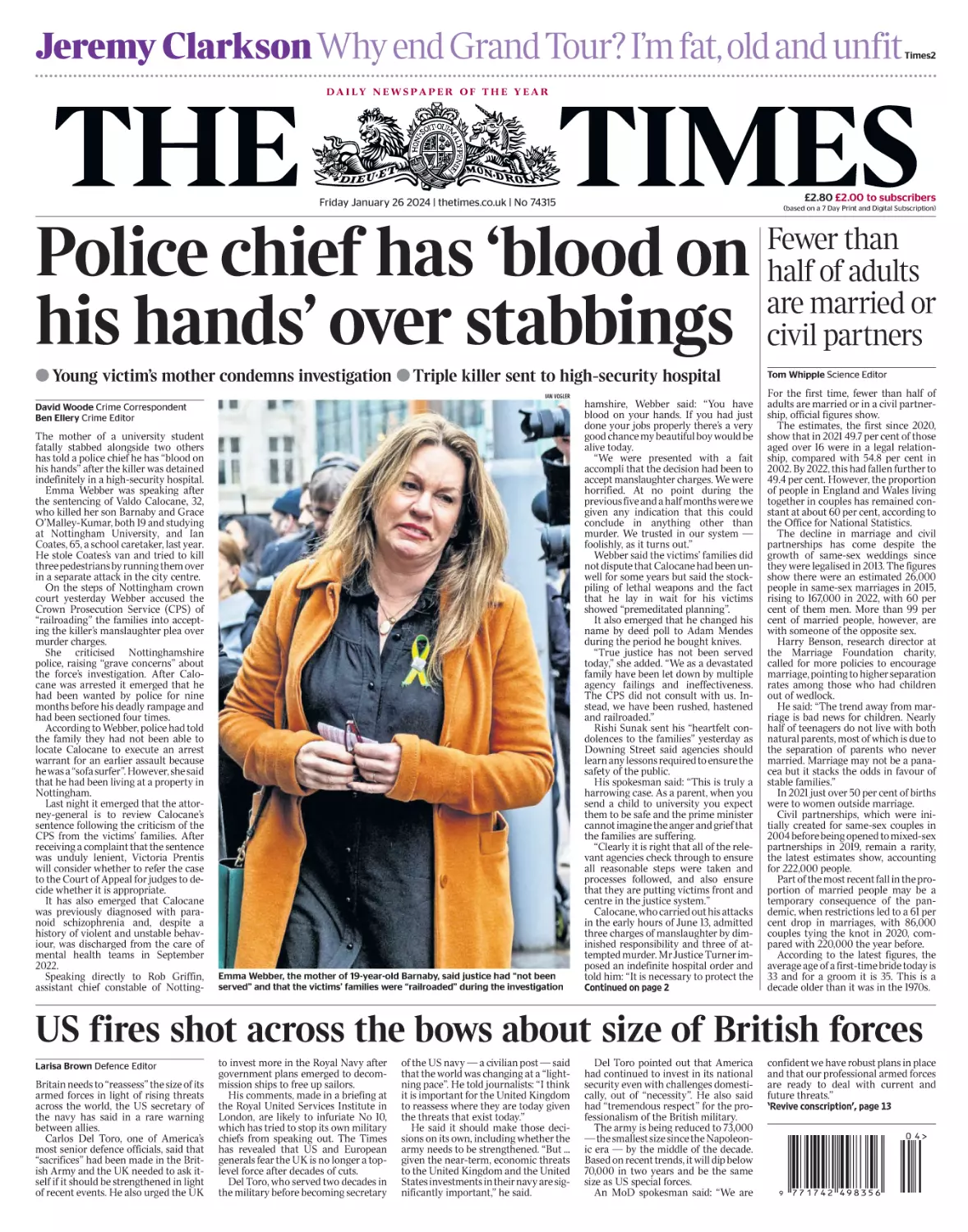


Tags: news newspaper the times
Year: 2024




Text
Jeremy Clarkson Why end Grand Tour? I’m fat, old and unfit
Times2
daily newspaper of the year
£2.80 £2.00 to subscribers
Friday January 26 2024 | thetimes.co.uk | No 74315
(based on a 7 Day Print and Digital Subscription)
Police chief has ‘blood on
his hands’ over stabbings
Fewer than
half of adults
are married or
civil partners
6 Young victim’s mother condemns investigation 6 Triple killer sent to high-security hospital
Tom Whipple Science Editor
David Woode Crime Correspondent
Ben Ellery Crime Editor
The mother of a university student
fatally stabbed alongside two others
has told a police chief he has “blood on
his hands” after the killer was detained
indefinitely in a high-security hospital.
Emma Webber was speaking after
the sentencing of Valdo Calocane, 32,
who killed her son Barnaby and Grace
O’Malley-Kumar, both 19 and studying
at Nottingham University, and Ian
Coates, 65, a school caretaker, last year.
He stole Coates’s van and tried to kill
three pedestrians by running them over
in a separate attack in the city centre.
On the steps of Nottingham crown
court yesterday Webber accused the
Crown Prosecution Service (CPS) of
“railroading” the families into accepting the killer’s manslaughter plea over
murder charges.
She criticised Nottinghamshire
police, raising “grave concerns” about
the force’s investigation. After Calocane was arrested it emerged that he
had been wanted by police for nine
months before his deadly rampage and
had been sectioned four times.
According to Webber, police had told
the family they had not been able to
locate Calocane to execute an arrest
warrant for an earlier assault because
he was a “sofa surfer”. However, she said
that he had been living at a property in
Nottingham.
Last night it emerged that the attorney-general is to review Calocane’s
sentence following the criticism of the
CPS from the victims’ families. After
receiving a complaint that the sentence
was unduly lenient, Victoria Prentis
will consider whether to refer the case
to the Court of Appeal for judges to decide whether it is appropriate.
It has also emerged that Calocane
was previously diagnosed with paranoid schizophrenia and, despite a
history of violent and unstable behaviour, was discharged from the care of
mental health teams in September
2022.
Speaking directly to Rob Griffin,
assistant chief constable of Notting-
Emma Webber, the mother of 19-year-old Barnaby, said justice had “not been
served” and that the victims’ families were “railroaded” during the investigation
hamshire, Webber said: “You have
blood on your hands. If you had just
done your jobs properly there’s a very
good chance my beautiful boy would be
alive today.
“We were presented with a fait
accompli that the decision had been to
accept manslaughter charges. We were
horrified. At no point during the
previous five and a half months were we
given any indication that this could
conclude in anything other than
murder. We trusted in our system —
foolishly, as it turns out.”
Webber said the victims’ families did
not dispute that Calocane had been unwell for some years but said the stockpiling of lethal weapons and the fact
that he lay in wait for his victims
showed “premeditated planning”.
It also emerged that he changed his
name by deed poll to Adam Mendes
during the period he bought knives.
“True justice has not been served
today,” she added. “We as a devastated
family have been let down by multiple
agency failings and ineffectiveness.
The CPS did not consult with us. Instead, we have been rushed, hastened
and railroaded.”
Rishi Sunak sent his “heartfelt condolences to the families” yesterday as
Downing Street said agencies should
learn any lessons required to ensure the
safety of the public.
His spokesman said: “This is truly a
harrowing case. As a parent, when you
send a child to university you expect
them to be safe and the prime minister
cannot imagine the anger and grief that
the families are suffering.
“Clearly it is right that all of the relevant agencies check through to ensure
all reasonable steps were taken and
processes followed, and also ensure
that they are putting victims front and
centre in the justice system.”
Calocane, who carried out his attacks
in the early hours of June 13, admitted
three charges of manslaughter by diminished responsibility and three of attempted murder. Mr Justice Turner imposed an indefinite hospital order and
told him: “It is necessary to protect the
For the first time, fewer than half of
adults are married or in a civil partnership, official figures show.
The estimates, the first since 2020,
show that in 2021 49.7 per cent of those
aged over 16 were in a legal relationship, compared with 54.8 per cent in
2002. By 2022, this had fallen further to
49.4 per cent. However, the proportion
of people in England and Wales living
together in couples has remained constant at about 60 per cent, according to
the Office for National Statistics.
The decline in marriage and civil
partnerships has come despite the
growth of same-sex weddings since
they were legalised in 2013. The figures
show there were an estimated 26,000
people in same-sex marriages in 2015,
rising to 167,000 in 2022, with 60 per
cent of them men. More than 99 per
cent of married people, however, are
with someone of the opposite sex.
Harry Benson, research director at
the Marriage Foundation charity,
called for more policies to encourage
marriage, pointing to higher separation
rates among those who had children
out of wedlock.
He said: “The trend away from marriage is bad news for children. Nearly
half of teenagers do not live with both
natural parents, most of which is due to
the separation of parents who never
married. Marriage may not be a panacea but it stacks the odds in favour of
stable families.”
In 2021 just over 50 per cent of births
were to women outside marriage.
Civil partnerships, which were initially created for same-sex couples in
2004 before being opened to mixed-sex
partnerships in 2019, remain a rarity,
the latest estimates show, accounting
for 222,000 people.
Part of the most recent fall in the proportion of married people may be a
temporary consequence of the pandemic, when restrictions led to a 61 per
cent drop in marriages, with 86,000
couples tying the knot in 2020, compared with 220,000 the year before.
According to the latest figures, the
average age of a first-time bride today is
33 and for a groom it is 35. This is a
decade older than it was in the 1970s.
US fires shot across the bows about size of British forces
Larisa Brown Defence Editor
Britain needs to “reassess” the size of its
armed forces in light of rising threats
across the world, the US secretary of
the navy has said in a rare warning
between allies.
Carlos Del Toro, one of America’s
most senior defence officials, said that
“sacrifices” had been made in the British Army and the UK needed to ask itself if it should be strengthened in light
of recent events. He also urged the UK
to invest more in the Royal Navy after
government plans emerged to decommission ships to free up sailors.
His comments, made in a briefing at
the Royal United Services Institute in
London, are likely to infuriate No 10,
which has tried to stop its own military
chiefs from speaking out. The Times
has revealed that US and European
generals fear the UK is no longer a toplevel force after decades of cuts.
Del Toro, who served two decades in
the military before becoming secretary
of the US navy — a civilian post — said
that the world was changing at a “lightning pace”. He told journalists: “I think
it is important for the United Kingdom
to reassess where they are today given
the threats that exist today.”
He said it should make those decisions on its own, including whether the
army needs to be strengthened. “But ...
given the near-term, economic threats
to the United Kingdom and the United
States investments in their navy are significantly important,” he said.
Del Toro pointed out that America
had continued to invest in its national
security even with challenges domestically, out of “necessity”. He also said
had “tremendous respect” for the professionalism of the British military.
The army is being reduced to 73,000
— the smallest size since the Napoleonic era — by the middle of the decade.
Based on recent trends, it will dip below
70,000 in two years and be the same
size as US special forces.
An MoD spokesman said: “We are
confident we have robust plans in place
and that our professional armed forces
are ready to deal with current and
future threats.”
y(7HB7E2*OTSNPQ( |||+"!&'
2
V2
Friday January 26 2024 | the times
News
Today’s highlights
7am
2pm
Gareth Davies, Treasury minister
Ruth Davidson chats to Ronan Bennett,
the creator of the hit TV series Top Boy
4.50pm Former contestant Amanda Lovett, right,
looks ahead to The Traitors final
7pm
Ed Vaizey looks back at the week in
Westminster with Thérèse Coffey, the
former environment secretary
11pm
Mick Mulvaney, the former chief of
staff to Donald Trump
DAB RADIO l ONLINE l SMART SPEAKER l APP
T O D AY ’ S E D I T I O N
Consultants
reject pay deal
‘Time to look
at conscription’
Shoplifting up
by one third
The government is
“carefully considering”
whether to offer more
money to stop NHS
strikes dragging on
until the summer after
hospital consultants
narrowly rejected an
improved pay offer.
Senior doctors voted
by 51.1 per cent against
the deal.
A former Nato chief
says it is time to “think
the unthinkable” and
consider bringing back
conscription to deter
Russia from all-out
war. General Sir
Richard Shirreff said
with recruitment in
freefall, it was unlikely
enough civilians would
volunteer.
A total of 402,482
shoplifting offences
were recorded by
police in England
and Wales last year, up
a third on the previous
12 months. It is the
first time the ONS
figure has risen above
400,000 since current
records began in
2002-03.
303
days since Wall Street Journal
reporter Evan Gershkovich
was detained in Russia
#FreeEvan
Donors desert
Haley after loss
Security fears
over Vodafone
Omar Berrada
‘can’t fix United’
Several top donors
have stopped funding
the Republican
presidential hopeful
Nikki Haley after her
loss in New Hampshire
as Donald Trump piles
on the pressure with
threats to ostracise
anyone giving money
to her long-shot
campaign.
The government has
imposed restrictions
on the relationship
between Vodafone and
its largest shareholder
— e&, the United Arab
Emirates-based
telecoms group —
amid rising scrutiny of
foreign investment in
sensitive British
infrastructure.
Pep Guardiola,
the manager of
Manchester City, has
cast doubt on whether
Omar Berrada will
solve all of Manchester
United’s problems.
Berrada is stepping
down as City’s football
operations officer
to be United’s chief
executive.
COMMENT 25
THUNDERER 26
LEADING ARTICLES 29
WORLD 30
BUSINESS 35
REGISTER 53
SPORT 60
CROSSWORD 70
TV & RADIO TIMES2
FOLLOW US
thetimes
timesandsundaytimes
thetimes
OFFER
Save up to 33% with a subscription to
The Times and The Sunday Times
THETIMES.CO.UK/SUBSCRIBE
THE WEATHER
Oliver Wright Policy Editor
Britain has suspended negotiations on
a multibillion-pound trade deal with
Canada in an acrimonious row over
cheese.
Kemi Badenoch, the trade secretary,
told her Canadian counterpart yesterday
that she could see no point in the talks
continuing after Ottawa imposed a
245 per cent tariff on stilton, cheddar
and other British cheese imports at the
start of the month.
The Canadians are also planning
additional tariffs on British car exports in
April. Both moves are being seen in
London as attempts by Canada to
pressurise Britain into negotiating less
favourable terms as part of a wider deal.
In particular, Canada has been pushing
ministers to relax their ban on hormonetreated beef, something government
sources insisted was “off the table”.
Britain began negotiations with
Canada on a post-Brexit trading
relationship in 2022, saying at the time
that it would help more than 10,000
small and medium-sized businesses in
Britain. British trade with Canada is
worth about £20 billion each year and is
expected to grow by about 30 per cent
over the next decade.
Talks ran into trouble over British
access to Canadian markets for cheese,
41
31
6
8
9
9
9
17
A largely dry and sunny day for
most, outbreaks of rain and showers
in Scotland.
worth more than £18 million in 2022.
Cheese exports had been covered by
the terms of the EU’s trade deal with
Canada and after Brexit. Both sides
negotiated temporary tariff-free export
quotas while talks on a wider free trade
agreement took place.
However, government sources said
that in an attempt to put pressure on
London, the Canadians refused to extend
the concession beyond the January
deadline unless Britain agreed in
principle to include hormone-treated
beef as part of the wider deal.
They also made clear that they would
not extend an April deadline for a temporary agreement on rules of origin for
British car exports, which will mean
new tariffs being imposed on British
vehicles sold in Canada. Last year Britain sold almost £750 million worth of
cars to Canada — the single biggest
export to the country.
A source close to Badenoch said both
moves showed that it was time to “pull
the plug” on the talks. “We entered into
FTA negotiations with Canada with an
agreement not to go backwards, now
they’ve limited our dairy access and are
threatening our rules of origin access,”
the source said. “That is bad faith. Kemi
negotiated a good deal for the UK with
Canada as part of CPTPP [Comprehensive and Progressive Agreement for
Drivers face 15-hour wait
in Dover with EU checks
Ben Clatworthy
Holidaymakers driving to Europe face
queues of 15 hours or more in Kent
when new rules for Britons travelling to
the European Union come into force
this year.
Officials have said that the “reasonable worst-case scenario” would result
in gridlock in the county and “welfare
concerns for passengers” when the EU
entry/exit system (EES) begins in
October, prompting fears of chaos at
the autumn half-term.
Passengers will be required to register their fingerprints and picture under
the system, which applies to all non-EU
passport holders.
Bosses at the Channel Tunnel estimate that the average time for processing a car through the French border will
rise from under a minute to five to seven
minutes. There are also concerns about
bottlenecks at the port of Dover and the
Eurostar terminal at St Pancras station
in London.
Ashford borough council in Kent has
written to MPs on the European scrutiny committee to raise concerns. The
council highlights space constraints at
Dover, the UK’s busiest port.
It is particularly worried about the
continued from page 1
Police criticised over stabbings
6
8
Canada trade deal suspended
over 245% tariff on UK cheese
public from serious harm and it is not
possible to say for how long that will be
so.” He added that it was very likely
Calocane would “never be released”.
As Calocane left the dock and returned to Ashworth Hospital, the highsecurity unit in Merseyside, CCTV and
police body-worn footage chronicling
his violent frenzy was released. Footage
shows Webber and O’Malley-Kumar
walking along Ilkeston Road at 4am.
The pair were 200m from their accommodation when they were ambushed
by Calocane. After fatally stabbing
knock-on effect on the A20 and M20.
The problem is greatest at ports where
border controls are in addition to
French immigration formalities conducted on UK land.
The fear of the council is that “without usable systems”, the scheme will
have considerable disruption on the
Kent and Ashford economy. It added:
“In the summer of 2022 delays on the
approaches to both the port of Dover
and Eurotunnel in Kent caused long
delays with tourists stuck in queues for
over 15 hours. The impact of EES on
tourist traffic crossing the short straits
is expected to be much worse.”
The EU says EES is an “automated IT
system for registering non-EU nationals travelling for a short stay, each time
they cross the external borders of European countries”. It is designed to make
the EU’s border more secure.
It adds that the system is designed to
save time by replacing the “wet stamping” of passports.
UK officials were involved in early
talks about the scheme before Brexit.
Passengers flying from Britain will
have their biometric details registered
on arrival in the EU, although airlines
have warned that they could still face
delays.
Coates, he stole the caretaker’s van. The
video paused at the moments he drove
at speed towards three pedestrians.
Nottinghamshire police and the Nottinghamshire Healthcare NHS Foundation Trust faced questions yesterday
about the string of missed opportunities to prevent the attack.
Dr Sanjoy Kumar, Grace’s father, said
his family would be “forever troubled”
by agencies’ failure to take action. He
said: “The lack of toxicology, contemporaneous mental health assessment,
as well as missed opportunities to divert
his lethal path will forever play on our
minds and this requires further review.
We will look for answers regarding
Trans-Pacific Partnership] and this is
how they respond. It was time to walk
away.”
A government source said: “We have
always said we will only negotiate trade
deals that deliver for the British people.
And we reserve the right to pause negotiations with any country if progress is
not being made. We remain open to restarting talks with Canada in the future
to build a stronger trading relationship
that benefits businesses and consumers
on both sides of the Atlantic.”
The suspension of the talks is the
latest setback in the government’s
attempts to reach new trade agreements
around the world. Badenoch secured
membership of the CPTPP last year but
talks on what would be a landmark deal
with India have become stuck. Rishi
Sunak hoped to secure a deal last
autumn and had pencilled in a visit to
Delhi to sign the agreement. Amid
disagreements over whisky tariffs and
business visas for Indian businessmen,
the trip was postponed.
Government sources have insisted
that a deal can still be done, saying that
both Sunak and Narendra Modi, the
Indian prime minister, were providing
high-level political support for an
agreement. However, some officials
have said there is little evidence that
Delhi is prepared to compromise.
Second-home
rights struck
out in France
Charles Bremner
British owners of second homes in
France have been dealt a blow after a
state authority quashed their exemption from onerous restrictions on the
time they can spend in the country.
The measure, which allowed British
citizens with second homes to stay
more than the 90 days agreed after
Britain left the European Union, was
struck out by the Constitutional
Council, the highest constitutional
authority in France, from a broad
immigration bill that was passed by
parliament in December.
The rules, which affect all British
visitors to the 27-nation Schengen
passport-free zone, forbid any stay of
more than 90 days out of every 180 days
unless the visitor goes through the process of applying for a visa. Breaching
the rule results in a fine and a temporary ban on re-entry. Many Britons
with French homes recall the assurances of Boris Johnson and other Brexit
campaigners before and after the 2016
referendum that “nothing will change”
about the freedom of Britons to travel,
live and work in Europe.
missed opportunities to intervene and
prevent this horrendous crime.”
Ifti Majid, the chief executive of Nottinghamshire Healthcare NHS Foundation Trust, said: “If a patient no
longer engages with our services and
support and they do not meet criteria to
be detained under the Mental Health
Act, they are discharged back to the
care of their GP and can be referred
back into our services at any time.”
Griffin, the assistant chief constable,
admitted that the force “should have
done more to arrest him”.
3
the times | Friday January 26 2024
News
Pen is mightier than the keyboard,
so give your brain a scribbled boost
Kaya Burgess Science Reporter
Students were
asked to write
words using a
digital pen on a
touchscreen then
type the same
words with a
single finger on a
keyboard. The
results show that
handwriting
promotes
learning and is
an essential skill
to maintain. Neil
Gaiman and
Susan Sontag,
below, are
writers who like
to wield a pen.
He said writing
by hand
“changed my
head” and she
said she enjoyed
the slowness
Scribbling in felt-tip pen on a yellow
legal notepad, Susan Sontag swore by
the power of handwriting. Only for
later drafts would the American writer
resort to the typewriter or keyboard,
preferring the “slowness” of traditional
penmanship.
Now scientists have discovered that
handwriting also trumps typewriting as
a boost for the brain, urging teachers to
ensure that penmanship remains a core
part of teaching even as tablets and laptops become more common in the
classroom.
The skill and concentration needed
to form the shapes of letters while writing with a pen or pencil stimulates a far
greater range and complexity of connections within the brain than simply
tapping the correct keys on a keyboard,
according to a study by researchers at
the Norwegian University of Science
and Technology.
The scientists examined brain activity while people were writing by hand
with a pen and compared it with activity when they were typing on a computer keyboard. They were specifically looking at the degree of
“brain connectivity” observed
during each activity. This refers
to the strength of interactions
and connections between different regions of the brain.
“We showed that when writing
by hand, brain connectivity patterns are far
more elaborate than
when typewriting
on a keyboard,” said
Professor Audrey
van der Meer, a
researcher at the
university.
The idea that
the brain functions differently
when writing by
hand rather than
on a keyboard is
something that
has been noted
by authors. In
the 1990s, Neil
Gaiman decided
to approach his
novel Stardust in
a different way. “It
was, in my head,
being written in the 1920s, so I bought a
fountain pen and a big notebook and
wrote it by hand to find out how writing by hand changed my head,” he
once told BuzzFeed.
“And it did, it really did. I was sparser, I would think my way through a
sentence further, I would write less,
[but] in a good way.”
After that, many of his novels, including American Gods, were “all
written by hand”.
Sontag told the Paris Review in
1995 that she “likes the slowness of
writing by hand” and wrote with a
felt-tip pen or a pencil on yellow or
white legal notepads. Both writers
said they would only turn to typing
for second and later drafts.
Though writing longhand may
boost creativity, it could also be key
for learning, according to the Norwegian researchers. Their study, published in Frontiers in Psychology,
noted that connectivity between areas
of the brain was “crucial for memory
formation and for encoding new information and beneficial for learning”.
The researchers fitted 36 university
students with electroencephalogram
brain sensors to measure brain activity.
The students were asked to write words
in cursive using a digital pen on a touchscreen. They were then asked to type
the same words with a single finger on
a keyboard.
“Our findings suggest that visual and
movement information obtained
through precisely controlled hand
movements when using a pen contribute extensively to the brain’s connectivity patterns that promote learning,”
Van der Meer said. “This also explains
why children who have learnt to write
and read on a tablet can have difficulty
differentiating between letters that are
mirror images of each other, such as ‘b’
and ‘d’,” she said. “They literally haven’t
felt with their bodies what it feels like to
produce those letters.”
The study said: “We urge that children, from an early age, must be exposed
to handwriting activities in school to establish the neuronal connectivity patterns that provide the brain with optimal conditions for learning.”
Students might find it better to take
notes by hand while learning but use a
computer for longer pieces of work, Van
der Meer said. She added: “There is
some evidence that students learn
more and remember better when
taking handwritten lecture notes, while
using a keyboard may be more practical
when writing a long text or essay.”
A 2009 study from the University of
Washington showed that primary
school students who wrote with a pen
not only wrote more, but also wrote
faster and in more complete sentences.
Step aside Barbie: Lopez to put Bob the Builder on big screen
Keiran Southern Los Angeles
In what must constitute one of the
unlikeliest pairings in Hollywood’s
recent past, Jennifer Lopez has
been given the task of bringing Bob the
Builder to the big screen.
The singer and actress, known as
Jenny from the Block and who once
had to deny insuring her backside, is
producing a film adaptation of the British animated construction worker.
The toymaker Mattel, which owns
the brand, is seeking to capitalise on the
box office success of Barbie by putting
more of its favourite mascots into cinemas. Lopez’s adaptation will follow Bob,
whose catchphrase is “Can we fix
it?”, on his way to the US territory of
Puerto Rico for a big construction job,
according to producers.
When on the Caribbean island Bob,
or Roberto, who will be voiced by the In
the Heights star Anthony Ramos, will
tackle problems facing the residents
and dig “deeper into what it means to
build”.
Lopez, the 54-year-old chart-topping
pop star who was born in New York to
Puerto Rican parents, will produce the
film with Nuyorican Productions, her
company.
Ramos, a 32-year-old American actor of Puerto Rican descent, said the adaptation would carry an “important
message” and that aspects of the film
were inspired by his own life.
“For years, Bob the Builder’s characters have inspired young people around
the world,” he said. “A movie about
friends working together, a celebration
of a beautiful home they share, and how
love can help to conquer any obstacle in
your way.”
While a director is yet to be attached
to the project, the script will be written
by Felipe Vargas, a Colombian film-maker who recently made a short film
about a shadowy monster
stalking an orphanage.
Elaine GoldsmithThomas, Lopez’s
producing partner,
said: “The show’s
ability to promote
positive thinking,
problem-solving
and
empowerment with a completely original
story set in
Puerto
Rico
puts a new spin
on a beloved
Can we film it? Yes
we can! Jennifer
Lopez and Bob
brand. We can’t wait for new and existing fans to connect with these amazing
characters.”
Bob the Builder was created by Keith
Chapman and began in 1999. The series
followed Bob, voiced by the Men Behaving Badly star
Neil Morrissey,
and his band of
anthropomorphic construction vehicles,
including
Scoop,
Muck, Dizzy, Roley and
Lofty. It was
not clear whether Bob’s sidekicks would also
appear in the
film.
The show’s
theme song, Can We Fix It? became a
chart hit and was the UK Christmas No
1 in 2000.
Mattel, the American toy giant,
bought the company that owned Bob
the Builder in 2011 for $680 million.
Last year Mattel had the top-grossing
film in Hollywood with Barbie, which
made more than $1.4 billion at the box
office. When the adaptation was announced with Greta Gerwig as director and Margot Robbie as the star eyebrows were raised. However, the doubters were silenced when the film, an
exploration of feminism and sexism,
was released to rave reviews.
Barbie became a cultural phenomenon last summer and earned eight Oscar nominations this week, including
one for best picture. Gerwig and Robbie
were snubbed for best director and actress respectively, however, which
caused an outcry.
4
Friday January 26 2024 | the times
News
Quintagram® No 1848
Solve all five concise clues using
each letter underneath once only
1 Final (4)
----
2 Most lazy (6)
------
3 Join the armed forces (6)
-----4 Go away! (3,4)
-------
5 Frenzied desire for gore (9)
--------A
B
D
D
E
E
E
G
I
I
L
L
L
L
L
L
N
O
O
O
S
S
S
S
S
T
T
T
T
T
T
U
Solutions see MindGames p15
Cryptic clues MindGames p14
Breakfast:
6am to 10am
Our free radio station has all the
latest headlines, interviews and
debates every morning
Listen seven days a week
On DAB,
app,
website
and smart
speaker
See the light Helen Whittaker of Barley Studio puts the final touches to a stained glass window for St Michael’s Church in Highgate, north London, at her York studio
Fresh strikes feared as NHS
consultants reject pay deal
Eleanor Hayward
Health Correspondent
The government is “carefully considering” whether to offer more money to
stop NHS strikes dragging on until the
summer after hospital consultants
narrowly rejected an improved pay
offer.
Senior doctors voted by 51.1 per cent
against a deal that would increase their
salaries by up to £19,500. The British
Medical Association said the offer
“does not go far enough”.
Consultants have walked out for nine
days so far and have a mandate to stage
further strikes until June. The BMA has
not set further strike dates and said it
wanted to “give the government the
opportunity” to improve its offer.
Victoria Atkins, the health and social
care secretary, said the government
would “carefully consider next steps”
after the deal was rejected “by the narrowest of margins”.
It is a blow for Rishi Sunak, whose
hopes of reducing NHS waiting lists of
7.6 million are dependent on resolving
the long-running pay dispute. In November ministers agreed to offer consultants a pay rise averaging 4.95 per
cent, on top of an existing 6 per cent
increase. The offer was put to BMA
members in a month-long referendum
that closed on Tuesday.
Dr Vishal Sharma, the BMA consultants committee chairman, said: “The
vote has shown that consultants do not
feel the current offer goes far enough to
end the current dispute and offer a
long-term solution to the recruitment
and retention crisis for senior doctors.
“In the coming days we will be
further engaging with consultants, and
seeking talks with government to
explore whether the concerns
expressed by our members during the
referendum process can be addressed.”
He said consultants were concerned
about pay erosion and changes to the
time dedicated to professional development, teaching and research.
Consultants earn an average of
£132,000 a year for their NHS work.
The deal would have given them a rise
of between £5,634 and £19,459.
Ministers will be desperate to avoid
strikes before the election, with a million appointments and operations cancelled over the past year.
Matthew Taylor, chief executive of
the NHS Confederation, said: “This is a
very narrow outcome and health
leaders will hope that it will be used as
a basis for reopening negotiations with
consultants to address their concerns
rather than as a stepping stone to call
for more damaging industrial action.”
Wes Streeting, the shadow health
secretary, called for Sunak to take personal charge of negotiations. He said:
“Last week Rishi Sunak was bragging
that NHS doctors had accepted his pay
offer. This vote shows he was trying to
pull the wool over the public’s eyes. The
prime minister cannot continue to
wash his hands of the crisis in the NHS.”
The BMA is also balloting junior doctors on extending their mandate for
industrial action for six months.
Junior doctors have walked out for 34
days since March and if they vote Yes
the union could keep calling strikes
until September. Dr Robert Laurenson
and Dr Vivek Trivedi, co-chairmen of
the BMA’s junior doctors committee,
said: “In the two weeks since our last
strike ended, we have been waiting for
ministers to come back to the table,
something the health secretary said she
could do in ‘20 minutes’. But no such
offer of talks has been forthcoming.”
King arrives in London to undergo prostate operation
Kate Mansey
The King arrived in London yesterday
in preparation for a hospital procedure.
Buckingham Palace announced last
week that the King would undergo
treatment for a benign enlarged prostate this week.
After returning from Scotland,
Charles, 75, had been staying at Sandringham, his estate in Norfolk, but was
seen yesterday being driven near Buckingham Palace, where the royal standard is being flown, which denotes the
sovereign is present either at the Palace
or, for the new reign, at nearby Clarence
House.
The King has cancelled several
engagements because he will need time
to recover after the procedure.
The Queen, who has continued with
her duties, has told well-wishers that
the King is “fine”.
The news of the King’s diagnosis was
announced on Wednesday last week,
90 minutes after Kensington Palace
said that the Princess of Wales had
undergone planned abdominal surgery
The King had the condition diagnosed
after he experienced symptoms
on January 16. The statement said the
princess, 42, would be required to stay
in hospital for ten days to a fortnight
and was not expected to return to official duties until Easter.
The Prince of Wales has been to visit
his wife at the London Clinic. Palace
officials have not specified the precise
nature of her condition but it is understood to be non-cancerous.
The King had his prostate condition
diagnosed on January 17 while staying
at Birkhall on Royal Deeside, after
experiencing symptoms.
Rush to get
measles jabs
for children
Eleanor Hayward
There has been a surge in parents
taking their children for measles jabs
this week, as the NHS works to prevent
a nationwide outbreak.
GPs have reported an increase in
demand for the measles, mumps and
rubella (MMR) vaccine, after a
“national incident” was declared on
Friday.
The NHS, which is reassuring parents
about the safety and importance of the
vaccine, has experienced a 600 per cent
increase in visits to its MMR webpage. NHS figures show that 3.4 million
under-16s in England have not received
the necessary two MMR doses, and so
are susceptible to measles and its
potentially fatal complications.
Vaccine uptake has slumped to its
lowest for more than a decade, leading
to dozens of children being admitted to
hospital in Birmingham in the UK’s
biggest measles outbreak since the
1990s.
The UK Health Security Agency has
warned of a “very real risk of outbreaks
across the country”, prompting the
NHS to start an MMR catch-up
scheme on Monday.
Professor Claire Fuller, NHS England’s medical director for primary
care, said: “We’re hearing from GPs
that more people are coming forward to
get an MMR catch-up jab in response
to efforts to protect as many people as
possible against measles.”
The NHS has opened temporary
MMR vaccination clinics at schools.
Parents of all unvaccinated children
younger than 11 are being contacted.
Young adults are also being targeted.
5
the times | Friday January 26 2024
News
Victim of Post Office scandal
weeps as conviction is quashed
Charlotte Wace
A former sub-postmistress who “suffered in silence” after she was convicted
of fraud based on evidence from the
faulty Horizon IT system wept yesterday when she had her conviction
quashed by the Court of Appeal.
Kathleen Crane, who had a Post
Office branch in Eastbourne, was given
a 12-month community order and told
to pay more than £18,000 when sentenced in 2010.
However, three appeal judges ruled
there was “no doubt” that her conviction was unsafe and an “abuse of
process”.
Crane, 68, was one of hundreds of
postmasters convicted on the basis of
data from the defective Horizon computer system, provided by Fujitsu, the
IT company, which suggested that
money was missing from their
branches. Her case is one of many expected to be overturned as a result of
the Post Office’s own case review.
The company had contacted Crane
last June to say it believed that there
had been a miscarriage of justice. In
January this year, she lodged an appeal,
which the Post Office did not resist.
Crane, who has two daughters, wept
as her conviction was quashed. Speaking outside the Royal Courts of Justice
after the decision, she described her experience as “horrible” and urged anyone else affected to come forward. “If
you’re innocent, you should have your
conviction quashed,” she told ITV.
Her daughter, Katy, added: “I actually don’t know how they [the Post Office]
sleep at night. I absolutely think someone should serve some jail time. I think
somebody needs to be held to account.”
Crane’s husband, Robert, who died in
2016, had become sub-postmaster of
the Old Town Post Office in Eastbourne in October 2000. She took over
the branch because of his ill health. An
audit in January 2010 found a financial
shortfall and, after she voluntarily attended an interview with Post Office
investigators, Crane was accused of defrauding the company of £18,721.52.
During the investigation, she said
that she had been aware of inexplicable shortfalls since 2008 and
asked for them to be investigated but no action was taken. She
later pleaded guilty to fraud by
false representation after
legal advice made her feel that
Horizon was infallible.
Flora Page, representing
Spider-Man’s
£1m payslip
sent to the
wrong Tom
David Sanderson Arts Correspondent
Tom Hollander was feeling smug,
having banked about £30,000 for his
role in a BBC drama.
Then the accounts department of his
agency sent him the payslip for a million-pound box-office bonus being
received by his near namesake, the
Spider-Man actor Tom Holland.
“My feeling of smugness swiftly disappeared,” Hollander said this week. “It
was an astonishing amount of money. A
seven-figure sum. And this was [just] his
first box-office bonus.”
While Hollander has a global profile
through roles in Gosford Park and In
The Loop, it is low compared to that of
Holland, who has appeared in six
Marvel films, some of which have
grossed more than $1 billion.
Hollander, 56, told Late Night With
Seth Meyers, an American chat show,
meant he was often mistaken in a “nonvisual context” for his fellow British
Kathleen Crane, with her two daughters, below, urged others harmed by the Post Office Horizon scandal to come forward
her during the appeal, said that Crane
had “suffered in silence” since her “appalling experience” and that a “fraud
she had not committed brought its own
humiliation”.
Page added: “She is somewhat overcome with the prospect of clearing her
name. She works in a care home and
she will no longer have to contend, we
hope, with the fact that this conviction
comes up every year when they do their
enhanced checks. It will close a very
long and painful chapter in Mrs Crane’s
blameless life.”
Simon Baker KC, representing the
Post Office, said that while the
company was duty-bound to investigate the case based on evidence available at the time,
the case “amounts to an
abuse of process”. He also
told the court that three
appeals against convictions arising from the
scandal had been lodged
in the past week.
Giving judgment,
Lord Justice Holroyde, said: “No leap
of imagination is
needed to understand the anxiety and
fear which Mrs Crane and her husband,
who is since sadly deceased, and their
two daughters must have experienced.”
As well as those convicted in court,
the Post Office also forced at least
4,000 branch managers to pay back
money based on the flawed Horizon
data. Some victims were left financially
ruined. At least four postmasters have
taken their own lives.
Following the ruling a Post Office
spokesman said: “We are deeply sorry
for past wrongs and are doing all we can
to put these right, including extensive
work to support overturning wrongful
convictions. ... We contacted Mrs Crane
and other individuals who were unjustly convicted, on the evidence that we
hold, to encourage them to mount an
appeal and we are pleased that Mrs
Crane’s conviction has been overturned.”
Tom Holland’s “seven-figure” bonus
astonished fellow actor Tom Hollander
actor Holland, 27. He said the accounts
department at his acting agency which
he briefly shared with Holland had also
been confused by the similarity in their
names. “It was a terrible moment,”
Hollander said.
“I went to see my friend who was doing some theatre in England for £300 a
week and I sat smugly in the audience
having just done a BBC show for 30
grand or something, which was going to
get me through the next year or so.”
Hollander said that during the interval he had checked his emails to find a
“payment advice” from his agency
containing his “first box-office bonus”
for an Avengers film.
“It was an astonishing amount of
money and it was not [even] his salary.
And it was his first box-office bonus, not
[even] the whole box office.”
“That’s showbiz,” he said. “It’s up, it’s
down. It’s hero, it’s zero.”
Chess prodigy let off after Taliban joke Rubiales to go on trial for
Laurence Sleator
A British chess prodigy who caused
fighter jets to be scrambled after he said
he was a member of the Taliban and
intended to “blow up” a plane has been
cleared of wrongdoing.
Aditya Verma, 20, who represented
England at several international chess
tournaments, went on trial in Madrid,
charged with public order offences.
In July 2022 he sent a message to a
private Snapchat group before boarding a flight from Gatwick to Menorca
for a post-A-level holiday with friends.
With a picture of himself wearing a hat
and sunglasses, Verma wrote: “On my
way to blow up the plane, I’m a member
of the Taliban.”
When the message was picked up by
the authorities at Gatwick, two Spanish
fighters were sent to escort the easyJet
flight. Verma, from Kent, was arrested
when it landed.
This week prosecutors told Madrid’s
high court that they were seeking
£81,000 from Verma towards the cost of
scrambling the jets, plus a £22,500 fine.
But the judge, José Manuel Fernández Prieto, said Verma’s actions had not
constituted a crime under Spanish law.
He said there was “no intention to
provoke the mobilisation of a military
plane, or any police or other emergency
service is apparent”.
“It cannot be ignored that the message and photograph with it were not
sent to any official organisation, nor
were they publicised in any way that
would inevitably lead to the corresponding mobilisation of the pertinent
police, assistance or rescue services.
“On the contrary, they were shared in
a strictly private environment, between
the accused and the friends he was flying with, to which only they had access.
“The accused could not even remotely assume that the joke he played
on his friends could be intercepted
or detected by the British services, or
by third parties outside of his friends
who received the message.”
Verma, who is studying economics at
Bath University, told the trial that the
message had been a private joke
between friends. “I was called a Taliban
at school because of my features and I
used to joke about it and I know the Taliban is considered to be a terrorist
group,” he said. “I just wanted to go to
Spain with my friends to enjoy the nice
weather and experience Spanish football and nightlife.”
The state prosecution service has ten
days to lodge an appeal. There was no
response from Verma or his parents.
kissing World Cup player
Martyn Ziegler Chief Sports Reporter
Luis Rubiales, the disgraced former
president of Spanish football, must
face a criminal trial for kissing a
member of Spain’s women’s team after
their victory over England in the
World Cup final, an investigating judge
has ruled.
Rubiales, 46, is set to stand trial
for kissing Jenni Hermoso without
her consent at the final in Sydney,
Australia, in August.
The former head coach of the team,
Jorge Vilda, is also set to stand trial,
along with Albert Luque, the men’s
team’s sport director, and Ruben
Rivera, the federation’s marketing
chief, for pressuring Hermoso to make
a video saying the kiss was consensual.
Hermoso refused and then filed the
criminal complaint.
Judge Francisco de Jorge ruled that
Rubiales’ kiss was “unconsented and
carried out unilaterally and in a surprising fashion”. The judge launched the
investigation after state prosecutors
accused Rubiales of sexual assault and
of allegedly coercing Hermoso into
publicly supporting him in the face of
the backlash against him.
Based on a sexual consent law passed
in 2022 that eliminated the difference
between “sexual harassment” and
“sexual assault”, Rubiales could face a
fine or a prison sentence of one to four
years if found guilty, according to the
prosecutors’ office in Madrid.
6
Friday January 26 2024 | the times
News
News Nottingham killings
Mentally ill killer left alone to
Ben Ellery, David Woode
Moments after a judge handed the triple
killer Valdo Calocane an indefinite
hospital order, the families of his victims
appeared on the steps of Nottingham
crown court and gave their excoriating
verdict on how authorities had failed
their loved ones.
Calocane, 32, killed the Nottingham
University students Grace O’MalleyKumar and Barnaby Webber, both 19,
and a school caretaker, Ian Coates, 65,
on June 13 last year.
Questions have been asked about
why a man who had been detained by
mental health services four times, who
consistently showed he was unwilling
to take antipsychotic medication and
who committed violence during outbursts of uncontrollable rage, was free
to walk the streets.
When Calocane carried out his
attacks he had been the subject of an
arrest warrant for nine months but
police had been unable to track him
down.
Police have since admitted that more
could have been done to arrest him.
Yesterday, footage from bodyworn
police cameras of the moment he was
arrested was released. CCTV footage of
the final moments of O’Malley-Kumar
and Webber was also shared — it
showed them walking together at 4am
before they were attacked 200 metres
from their student accommodation.
Here The Times chronicles how
Calocane slipped through the net.
crown prosecution service
Emma Webber, mother of Barnaby,
who was studying history, said “true
justice has not been served today”.
Some of her criticism was directed at
the Crown Prosecution Service (CPS),
which decided to pursue charges
against Calocane for manslaughter
with diminished responsibility for
those he stabbed to death, and
attempted murder for the three people
he mowed down with a car.
Officials at the East Midlands branch
of the CPS decided in June to charge
Calocane with three murders and three
attempted murders. According to the
CPS, they offered to meet the families
of O’Malley-Kumar and Webber then.
After receiving three psychiatric
reports, the CPS first met the families
online in November, four days before
the pre-trial hearing. The families
were informed that prosecutors had
received the reports on Calocane and
that he would plead guilty to manslaughter on the grounds of diminished
responsibility.
Webber said: “At no point during the
previous five and a half months were we
given any indication that this could
conclude in anything other than
murder. We trusted in our system,
foolishly as it turns out.
“We do not dispute that the murderer
is mentally unwell and has been for a
number of years. However, the premeditated planning, the collection of
lethal weapons, hiding in the shadows
and the brutality of the attacks are of an
individual who knew exactly what he
was doing.”
A number of factors that suggested
Calocane had planned the attack
emerged in court. These included
travelling with extra Sim cards and
changing his name by deed poll to
Adam Mendes at the time of buying
weapons. During the sentencing, the
defence argued that Calocane should
not be given a whole-life order because
it was a manslaughter case, not murder.
nottinghamshire healthcare
nhs foundation trust
Webber said “this has been a trial
3
3.49am Barnaby
Webber and
Grace O’MalleyKumar walk along
Ilkeston Road
1
Valdo Calocane
arrives in
Nottingham on a
train from London
2
Calocane
boards a
tram, above, and
disembarks at
Wilkinson Street
Cytxy tyux
tuyxt uyxt uyxt
yutx tyuxtyuxt
uy txuy xyu
tyucyucyucu
CCTV, dashcam or bodycam video
Stabbing
Maples St
A6514
4
8
5
62 7
A60
Forest
recreation
ground
4am: Barnaby and Grace
are stabbed to death by
Calocane on Ilkeston Road
500 metres
by doctors” and accused the local
mental health services of a number of
failings.
Calocane had first started having
problems with his mental health in
2019, when he began to hear voices. In
May 2020 he went to hospital believing
he was having a heart attack and when
he returned to his home in Nottingham
he knocked down a door to another flat
in his block.
He was arrested for criminal damage
and assessed as psychotic but released
without charge. On returning home he
almost immediately knocked down
another door and was arrested for
criminal damage. A reassessment led to
him being detained under the Mental
Health Act.
He was discharged from hospital into
the care of the local crisis team in July
4.13am After
killing the pair,
he walks past The
Student Lodge
Ian Coates is stabbed
by Calocane and his
white van stolen
Woodborough Rd
Player St
Ilkeston Rd
4
St Ann’s
allotments
3
Nottingham
Trent University
Van, followed by
police, rams two
pedestrians
NOTTINGHAM
About 5.30am: Van
rams pedestrian
City
Centre
Nottingham
Canal
2
1
but he stopped taking his medication,
tried to force himself into another flat
and was admitted to hospital again.
The following year Calocane’s family
reported that his mental health had
deteriorated and he had spoken of
hearing voices telling him his family
members would die. He admitted he
had stopped taking his medication and
had no intention of continuing the
treatment.
In August 2021 antipsychotic medication was “restarted and increased”,
Karim Khalil KC, for the prosecution,
said. Calocane was believed to have
concealed symptoms of psychosis
during a home visit by a mental health
worker.
The following month he evaded
contact with the community team, and
a warrant under the Mental Health Act
was secured to gain entry to his
property so that an assessment could be
conducted.
Between September and October he
was admitted to in-patient services
under the Mental Health Act. After
being released, he missed mental
health appointments and often
appeared confrontational, Khalil said.
In January 2022 Calocane was
involved in an altercation with a flatmate and a mental health assessment
concluded that he could continue
to be treated outside hospital. At the
end of that month Calocane was
admitted as an in-patient for three
weeks under the Mental Health Act.
In May Calocane travelled to London
and attempted to hand himself in to
MI5, which he believed was controlling
him, at its Thames House head-
quarters, urging officials to “please
arrest me”.
Calocane was due to appear in court
for the assault of the police officer in
September 2022, but he failed to attend
and a warrant was issued for his arrest.
That warrant was outstanding nine
months later when he was arrested for
the fatal attacks.
That same month, Nottinghamshire
Healthcare, which had been treating
him, discharged him to his GP. When
this happened, “several attempts were
made to contact him, but no response
was received”, the Trust said.
Nottinghamshire Healthcare’s chief
executive, Ifti Majid, said: “If a patient
no longer engages with our services
and support and they do not meet
criteria to be detained under the
Mental Health Act, they are discharged
7
the times | Friday January 26 2024
News
News
‘make mockery of the system’
Health professionals
accused of washing
hands of Calocane
6
He tries to
break into
a residential
care home on
Mapperley Road
Emma Yeomans, David Woode
About 120 people each year are killed
by people with mental illnesses and
more lives will be lost unless mental
health services are reformed, campaigners have warned.
Julian Hendy, whose father was
killed 17 years ago by a psychotic man
with a long history of mental ill health,
said health professionals must be
“more assertive” and work better with
other agencies such as the police.
The campaigner and founder of the
charity Hundred Families, which
supports bereaved families, said their
research showed that one in five killings were related to mental illness.
Valdo Calocane, who was sentenced
yesterday to an indefinite hospital
order after being convicted of manslaughter of three people in Nottingham, had fallen off the radar of the
mental health services, which allowed
him to avoid taking his medicine.
Hendy said: “We want to see more
assertive mental health services. I want
to see more joined-up working between
the agencies. I want more sharing of
information and I want more listening
to families.”
He
accused
Nottinghamshire
Healthcare NHS Foundation Trust,
which was responsible for Calocane’s
care, of “washing their hands” of him.
“It’s not responsible and it’s not safe. It
doesn’t look after people properly,” he
said. “That hasn’t helped him at all, or
protected his rights at all, because he
has now committed this terrible
offence.”
Calocane’s unwillingness to engage
with mental health treatment could
itself be a symptom of severe illness,
Hendy said, adding that of the 250 families he had worked with, “most of those
cases were people unwilling or unable
to access proper care and treatment”.
He said: “Services need to be more
assertive in looking after the small
number of people who are dangerous. I
think there’s often an unwillingness to
treat violence in people with severe
mental illness.
Ifti Majid, the chief executive of Nottinghamshire Healthcare, said Calocane had been in its care from May
2020 and September 2022 before being
discharged.
The trust was not able to say whether
7
5.13am. After
stabbing
Ian Coates,
Calocane is seen
in his van on
Woodborough
Road
5
4.21am
Calocane
is captured
on CCTV on
Player Street
back to the care of their GP and can be
referred back into our services at any
time.”
Sanjoy Kumar, a primary care
physician of 30 years and the father of
O’Malley-Kumar, said: “Whilst we
have never questioned this man’s
diagnosis, the lack of toxicology,
contemporaneous mental health
assessment, as well as missed opportunities to divert his lethal path, will
forever play on our minds and this
requires further review.”
Webber also raised concerns about
the way Calocane’s mental health was
treated once he had been arrested for
the knife attacks and raised questions
about Professor Nigel Blackwood, who
prepared a report for the case that recommended he be given a hospital order.
A spokesman for NHS Nottingham
8
Police stop
the van on
Maples Street,
above, and taser
Calocane, right
and Nottinghamshire Integrated Care
Board said: “When the patient was
discharged back to the GP, several
attempts were made to contact him, but
no response was received.”
nottinghamshire police
The families’ most damning criticism
was reserved for the police. Webber said
Rob Griffin, assistant chief constable of
the Nottinghamshire force, had “blood
on your hands”. It was only last Friday,
the family said, that they received an
answer to the question of his outstanding warrant issued in September 2022
“for a vicious attack on a police officer —
such a violent assault he was tasered”.
This week Griffin said he had
reviewed the force’s involvement and it
should have done more to locate him.
Nottingham crown court was told
Calocane had no previous convictions
or cautions despite being involved in
incidents of criminal damage and
trying to force his way into flats.
It also emerged at the hearing that in
early May, about five weeks before the
three killings, Calocane started working
in a warehouse in Kegworth, Leicestershire, where he attacked two employees.
James Coates, whose father was
five months from retirement when he
was killed, said: “The NHS mental
health trusts have to be held accountable for their failures along with the
police. All we can do is hope that in due
course some sort of justice will be
served. This man has made a mockery
of the system and he has got away with
murder.”
any formal case review into his treatment would take place, but The Times
understands that an investigation will
take place.
The trust also did not reply when
asked whether Calocane was ever subject to a community treatment order,
which could have allowed clinicians to
require him to take medication or be
returned to hospital. The orders are
part of a package of measures introduced in the 2007 Mental Health Act.
In addition, patients can be sectioned
when their condition poses an immediate risk to themselves or others, and a
separate order can be used to hold a
person for up to 36 hours for an emergency assessment.
The act was significantly shaped by
Jayne Zito, whose husband, Jonathan,
was killed by a man with schizophrenia.
Her husband’s killer, Christopher
Clunis, died in February 2021 in a
secure mental health facility. Speaking
Vado Calocane, 32,
was ordered to be
detained at a highsecurity hospital
after his death, Zito said: “Christopher
was chronically and critically mentally
ill at the time he took Jonathan’s life,
and he had been failed. He had not
received the care and help he was supposed to get in the mental health care
system.”
Her charity, the Zito Trust, called for
mental health patients with a history of
violence to be subject to compulsory
drug regimes in some cases, and helped
to shape the 2007 act.
Satisfied with the changes to the law,
she wound up her charity in 2009.
However, in 2016 she returned to campaigning, with a new charity to support
families where a failure in publicly
funded services had caused death or
severe harm.
Speaking in 2016 after the case of
Matthew Daley, whose family had
begged for him to be sectioned before
he went on to stab a pensioner, Zito said
she had a “personal sense of failure”
about her campaign.
“I think, well, what did we
achieve?” she said.
Key dates
May 23, 2020 Calocane
visits A&E, believing he
is having a heart attack.
On his return home he
knocks down the door
of a flat and is arrested.
Assessed as psychotic,
he is released, knocks
down another door, and
is then sectioned.
July 14, 2020 Sectioned
after he stops taking
medication. Managed
in the community.
May 2021 Stops taking
his medication. Family
report deterioration in
his mental health.
July 2022 Told to
collect medication but
says he is abroad.
September 3, 2021
Eight months’ worth of
unused medication
found in search of his
house. Sectioned.
August 4, 2022 Mental
health team visit, told
he no longer lives there.
January 2022 Arrested
after altercation with his
flatmate. Sectioned.
Starts buying weapons.
September 22, 2022
Discharged from mental
health services. Failed
to appear in court for
police assault. Warrant
issued for his arrest.
May 31, 2022 Tries to
hand himself in to MI5.
June 13, 2023 Kills three
people.
8
2GM
Friday January 26 2024 | the times
News
News Nottingham killings
Ian Coates, Barnaby Webber and Grace O’Malley-Kumar died in the early-morning attacks in Nottingham last June
Amid the love and
tears, the attacker
stood impassive
David Woode Crime Correspondent
Standing yards from her son’s killer,
Emma Webber paused after entering
the witness box at Nottingham crown
court. She leant towards a prosecuting
barrister and asked: “Can you move so
I can look at him?”
The man in her sightline was
Valdo Calocane, the “evil” university
graduate whose “horrific and heinous”
knife attack claimed the life of her
son Barnaby, 19, in the city on June 13
last year. His talented friend Grace
O’Malley-Kumar, 19, was also killed, as
was the well-regarded school caretaker
Ian Coates, 65.
As Coates lay dying, Calocane, 32,
stole his van and tried to kill Wayne
Birkett, Sharon Miller and Marcin
Gawronski by running them down
from behind in Nottingham city centre.
Court 1 fell silent as Webber described how her son had been “loving
every single moment” of his life. “I have
lost my firstborn. I would give anything
to hear his voice again,” she said.
Barnaby, known as Barney, was a history undergraduate in the city. He was
cricket-mad, an aviation buff and
dreamt of serving in the armed forces.
His mother shared the waves of pain
she feels at points in the day: 4pm is
when she last heard Barney’s voice;
4.04am is when she wakes, the time
of Barney’s final moments; 10am is
when she and her husband, David, told
Charlie, 16, that he would “never see
his big brother again”.
Looking at the killer, who appeared
impassive in the glass-fronted dock,
Webber said: “Barney didn’t lose his life
on the 13th of June. It was stolen from
him in the most vicious, unprovoked,
senseless and evil way imaginable.
There must be appropriate justice
served and punishment for the actions
of this one monstrous individual.”
Over three days, every seat in the
court was filled as Mr Justice Turner
heard submissions from prosecution
and defence barristers and consultant
psychiatrists before passing sentence.
Dr Sanjoy Kumar and Dr Sinead
O’Malley, Grace’s parents, sat side
by side with the Webbers. Facing them
across the courtroom were Coates’s
sons, James and Lee. All were supported by relatives and loved ones.
Grace and Barney’s friends were
present too. Many wore yellow and
green ribbons, colours of the university
hockey and cricket clubs for which the
pair respectively played. Scores of journalists were present and the court
heard keyboards tapping and shorthand notes scribbled in notepads.
The prosecution accepted Calocane’s
three guilty pleas to manslaughter by
reason of diminished responsibility and
three more to attempted murder. An
indefinite hospital order seemed likely.
Victim personal statements offer a
glimpse into the emotional, physical
and psychological impact crimes have
on families. They allow the offender
to understand the destruction their
actions have caused.
O’Malley wept as she spoke of her
beloved “baby girl”. A small “Gracie”
tattoo, with a heart above the “i”, was
visible on her left wrist.
She recounted how she would drive
up the M1 “just to spend the night with
Mr Justice Turner heard three days of
submissions before passing sentence
Grace”. They’d go shopping, have dinner and Grace would “stay with me in
my hotel room. We had no secrets. I
loved hearing every detail of her life.”
She continued: “My precious, kind
and talented daughter. Grace was
such a good girl. She was at a top-class
medical school [and] playing a sport
she adored. I can say she was happier at
university than at any point of her life.”
She recounted Grace’s sporting and
academic achievements, and how she
was following in her parents’ footsteps
and training to become a doctor.
Grace, “one of the country’s youngest
vaccinators”, aspired to become a surgeon and serve with the Royal Army
Medical Corps, the court was told.
O’Malley, a consultant anaesthetist,
said that her daughter’s killing had left
her unable to return to the operating
theatre. Her voice rose as she told
Calocane: “You are responsible for the
ongoing pain and suffering of my
family. You are duplicitous and manipulative as a matter of record. You have
shown no remorse.”
Kumar lamented the “missed opportunities” that the police and mental
health teams had to alter Calocane’s
offending, after it emerged that he had
a history of violence and was wanted by
police nine months before the attacks.
“I must live with a lifetime of grief. I
should have been there to protect my
little girl,” he said.
In a short statement, James Coates
told the court: “We should be at work,
but we can’t because he killed our
father. To have a life taken so horrifically is something you will never come to
terms with. The effect this has had on us
cannot be put into words. The reason
for our very existence, gone.”’
The prosecution outlined the horror
of Calocane’s crimes in full for the first
time. Karim Khalil KC, for the prosecution, said the defendant “intended to
kill his victims”.
On the evening of June 12, Calocane
had spoken to his brother Elias on the
phone and said: “This is the last time I
will talk to you. After this I will leave
you alone .. . Disassociate yourself from
me. If anything happens, don’t come
and see me in hospital.”
Khalil said it was clear that Calocane
“had formed a clear plan to kill”.
Dressed in black with a black beanie hat
pulled over the top half of his face, the
killer had left home with a rucksack
containing “a Boker dagger, a Gerber
survival knife, a large, sharply pointed
knife and a metal scaffolding pole”.
Family members left the court as
CCTV images of Grace and Barney’s
final moments were played. Emma
Webber muttered “pig” at the killer.
Khalil told the court that Barney had
sustained defence wounds as he faced
down his killer. Grace was repeatedly
knifed as she sought to protect Barney.
Peter Joyce KC, Calocane’s barrister,
told the court that Calocane had been
diagnosed with paranoid schizophrenia in May 2020, but presented
symptoms in late 2019. He believed that
“technology” was controlling his mind.
In May 2021, he visited MI5’s headquarters “to try to get them to stop control-
ling him”. Calocane had undergone previous violent outbursts and had been
sectioned four times. He “disengaged”
from community mental health teams
in August 2022 and stopped taking antipsychotic medication. He was wanted
by police in September 2022 after failing to appear in court for allegedly assaulting a police officer. By June, Calocane was “grievously, seriously and
mentally ill”. Voices in his head said that
if he did not do what he was told, he
would “kill his family”. Joyce said:
“Schizophrenia can strike anyone.”
Just before Mr Justice Turner returned to pass sentence, Lee Coates,
another of the caretaker’s three sons,
stood and addressed the court. Speaking to Grace and Barney’s parents, he
said: “No matter what the outcome is,
our family [is] here for you from now
until whenever. I am so sorry that we
had to go through this and this is how
we have met. If I don’t manage to stay
the whole day because I can’t keep my
mouth shut, I apologise.”
Laughter and applause rang out. Emma Webber said: “Right back at you.”
Sinead O’Malley broke down in tears.
Shortly after 11.30am, the judge sentenced Calocane to an indefinite hospital order. Calocane showed no emotion
as he was escorted from the dock by five
medical staff and dock officers. As the
reporters and officials filed out, O’Malley was heard to say: “It’s all over.”
In their own
emma webber
mother of barnaby webber,
outside the court
“True justice has not been served today.
We as a devastated family have been let
down by multiple agency failings and
ineffectiveness. The CPS did not consult with us as has been reported;
instead we have been rushed, hastened
and railroaded.
“The first meeting we had with them
at our behest was Friday 24th November a few short days before the pre-trial
plea hearing on the 28th. For the record
they had suggested that we meet them
on that very morning, which we clearly
thought wasn’t enough time.
“We were presented with a fait
accompli that [the] decision had been to
accept manslaughter charges. We were
horrified. At no point during the previous five and a half months were we
given any indication that this could
conclude in anything other than
murder. We trusted in our system, foolishly as it turns out. We do not dispute
that the murderer is mentally unwell
and has been for a number of years.
However, the premeditated planning,
the collection of lethal weapons, hiding
in the shadows and the brutality of the
the times | Friday January 26 2024
9
2GM
News
News
Dr Sanjoy Kumar, the
father of Grace O’MalleyKumar, alongside his son,
James, outside
Nottingham crown court,
where Ian Coates’s son,
James, read a statement,
below left. Barnaby
Webber’s brother, Charlie,
below right, and the
university students’
friends, above, also
words: anger and heartache of victims’ families
attacks are of an individual who knew
exactly what he was doing. He knew
entirely that it was wrong but he did it
anyway.
“This has been a trial by doctors.
Why was there no mental health
assessment during his time in custody?
Why was the first time he had any
assessment in mid-July for the defence
report only? Why did he not begin to
receive treatment till mid-September?
And why did he remain in prison until
the first of November? Importantly,
why did Dr Blackwood, instructed by
the CPS in August, wait until the 14th of
November to interview and assess him?
So many questions.
“To Nottingham Police we additionally have grave concerns regarding
aspects of this investigation. Why were
we repeatedly told through the summer
the offender was a sofa surfer and had
no real abode. Not true — he did. One
that was registered in his name in Nottingham and one he had been in for six
months prior to his eviction on only the
11th June last year. Why? It took repeated questioning from us to finally receive an answer late last Friday afternoon to the question of his outstanding
warrant issued September 2022 for a
vicious attack on a police officer, such a
violent assault that he was tasered.
“To the assistant chief constable Rob
Griffin who finally released this information publicly yesterday I say this:
you have blood on your hands. If you
had just done your jobs properly there’s
a very good chance my beautiful boy
would be alive today.
“There is so much more to say and
clearly serious questions regarding this
case and events leading up to this monster being out in society but for today
our darling son, his dear friend Grace
and a wonderfully kind grandfather Ian
have been stolen for us forever and let
down by the very system that should
have been protecting them.”
dr sanjoy kumar
father of grace o’malley-kumar
“We will never come to terms with the
loss of our beloved daughter Grace and
how she lost her life.
“Her heroic actions mean she was the
gift to us. And she was the gift of the
country. We’d like to thank our wonderful family from London and Ireland,
and all of our friends for their continued love and support.
“Whilst we have never questioned
this man’s diagnosis, the lack of toxicology, contemporaneous mental health
assessment, as well as missed opportunities to divert his lethal path, will
forever play on our minds and this
requires further review. We will look for
answers regarding missed opportunities to intervene and prevent this horrendous crime. Thank you.”
Asked by a reporter what happens
next, he said: “I think we all regroup.
We’ve been through absolute hell for
the last few days.”
james coates
son of ian coates
“My heart from the very beginning has gone out to the families
of Grace and Barnaby. It will
continue to go out to them, as we
all now share an anniversary
every June that will never be
celebrated.
“The letter of the law was once
considered the most important rule to live and abide
by, put upon us to make
the country a fairer and
Rob Griffin “has
blood on his hands”
safer place. Now they’re just a cautionary tale where the calculated cold brutal
killing spree can be reduced to something that falls within the same sentence and restrictions and guidelines as
that of death by dangerous driving.
“If this man was not stopped when he
was, this could have been one of the
most catastrophic of attacks this country had ever seen.
“This man is a killer. Murder was the
only thing he cared about. And he
fulfilled this in horrific fashion on
Tuesday June 13 last year. My family
has suffered a great loss.
“The failures from the police, the
CPS, the health service have
resulted in the murder of my
father and these two innocent
students. The NHS mental
health trusts have to be held
accountable for their failures
along with the police. All we can
do is hope that in due course
some sort of justice
will be served.
“This man has
made a mockery
of the system
and got away
with murder.”
showed the strain after the
hearing. Families wore
yellow and green ribbons
in memory of the victims
Memorial
foundations
raise £100k
Ben Ellery
Foundations created in the names of
the two university students killed by
Valdo Calocane have raised almost
£100,000 and will help support young
people with a focus on sport.
Grace O’Malley-Kumar’s younger
brother, James, set up a foundation
in her memory and in May it will hold
a charity motorbike ride in her name,
setting off from North Weald in Essex.
A GoFundMe page has raised almost
£50,000 after a fundraiser at her
favourite restaurant and a memorial
game of cricket, while several people
have run marathons.
Barnaby Webber’s family started the
Barnaby Webber Foundation and its
GoFundMe page has raised almost
£45,000 to provide support for young
people who are facing difficulties and
to fund grassroots cricket clubs.
On Thursday, the pair’s loved ones
wore yellow and green ribbons — the
colours of Grace and Barnaby’s sports
clubs — in memory of them.
10
2GM
Friday January 26 2024 | the times
News
Sturgeon’s sweary rant about ‘clown’ Johnson
Kieran Andrews Scottish Political Editor
Nicola Sturgeon called Boris Johnson
a “f***ing clown” in a foul-mouthed
outburst about the former prime minister’s handling of the pandemic.
Messages between the former
Scottish first minister and Liz Lloyd,
her chief of staff, have been disclosed
by the UK Covid inquiry.
Lloyd’s WhatsApp messages, which
Sturgeon had deleted, were presented
as evidence. They show that the pair
discussed crucial policy decisions,
despite repeated claims by the Scottish
government that texts were not used to
discuss substantive issues.
Sturgeon’s remarks about Johnson
came when he announced a second
national lockdown on October 31, 2020.
She said his address was “excruciating” and that the UK government’s
communications were “awful”. Sturgeon wrote: “His utter incompetence
in every sense is now offending me
on behalf of politicians everywhere.”
Lloyd replied that she was “offended”
on behalf of special advisers before
Sturgeon added: “He is a f***ing clown.”
Lloyd also told Sturgeon she wanted
a “good old-fashioned rammy [quarrel]” with the UK government to “think
about something other than sick
people”. She said she had “set a timetable” for Westminster to answer the
Scottish government on extending the
furlough scheme as a “purely political”
move. Sturgeon replied: “Yeah, I get it.
And it might be worth doing. I’ve sent a
rough formulation of what I might say
tomorrow.” Sturgeon will be questioned by the inquiry on Wednesday.
Nicola Sturgeon said of Boris Johnson: “His utter incompetence is offending me”
WhatsApp woes show
Nicola is idiot-adjacent
Tom Peck
Political Sketch
No one is suggesting there is
anything dubious about Nicola
Sturgeon’s deletion of all her
WhatsApp messages before they
could be submitted to the Covid
inquiry. She has told the inquiry she
has “nothing to hide” and there is
absolutely no reason not to believe
her, but she has been the victim of
some terrible luck.
Almost a year on from her
sudden realisation that she had had
enough of being first minister of
Scotland, large numbers of people
still wrongly believe that her
resignation was in some way
connected to the fact that she may
have known her home would shortly
be raided by police and her front
garden transformed into a scene
from Taggart. This is all extremely
unfair. There were reasonable
explanations.
Where Ms Sturgeon has been
especially unlucky, yet again, is that
in the intervening period between
large numbers of WhatsApps having
been deleted and this deletion
becoming the subject of a public
inquiry, the public have become
sudden experts in the deletion of
WhatsApp messages.
For example, just a couple of
months ago, Boris Johnson
explained to the Covid inquiry how
large numbers of his WhatsApp
messages had definitely not been
deleted but had become trapped in
some kind of Buddhist loop of death
and rebirth while his phone went
“up” and “down”.
It’s possible Ms Sturgeon would
have understood that WhatsApp
messages have only been
successfully deleted if they have
been deleted both by the sender and
the receiver of said messages. Had
she realised this, she would not be in
the uniquely unfortunate position
both of having to explain why it is
that all of her WhatsApps have been
deleted and of having to have them
publicly read out at the inquiry.
Yesterday afternoon, said inquiry
heard from Sturgeon’s former chief
of staff, Liz Lloyd. For some reason,
she did not act on the now wellpublicised but then private
suggestion of Scotland’s chief
medical officer, Professor Sir Gregor
Smith, “to delete your WhatsApps
every day”.
Ms Lloyd looked impressively
stony-faced while messages between
her and the first minister were read
out. Ones that call Johnson “a
f***ing clown”, that describe his
address to the nation in October
2020 as “f***ing excruciating”, and
that suggest engagement with him
had become “slightly pointless”.
In the afternoon, when it was
Humza Yousaf ’s turn, the first
minister made a rare deviation from
the now-standard script. As well as
offering an apology to all of
Covid-19’s many victims, he
apologised to the public for the way
in which the Scottish government
had handled “informal messages”.
They could, he said, have “done
better”.
But then again, maybe not. It
rather seems as if they got it exactly
right. The politics of deception is a
canny business, and it is arguably
worth noting that none of these atfirst-glance embarrassing messages
are actually an embarrassment at
all. Somewhere, we must presume,
are a load of WhatsApps that
explain why Scotland’s Covid
outcomes were broadly identical to
those south of the border; why it was
that Sturgeon and co fared no better
than the “f***ing clown” whose
“utter incompetence” they found so
offensive. It’s also conceivable that
there could have been messages on
there concerning the whereabouts
of a luxury campervan.
Oh well. It will be her turn to give
evidence soon enough, and as we
already know, she was only
following doctor’s orders.
11
the times | Friday January 26 2024
News
A fifth of all
pupils miss
school once
a fortnight
Nicola Woolcock
A smaller splash David Hockney’s California, painted in 1965, will be offered at Christie’s 20th/21st Century Evening Sale on March 7 with an estimate of £16 million
State school’s sixth form secures
more Oxbridge offers than Eton
Nicola Woolcock Education Editor
Teenagers at a state sixth form set up to
get more disadvantaged students into
top universities have received 57 Oxford
and Cambridge university offers —
more than Eton.
Harris Westminster Sixth Form,
which was founded ten years ago as a
free school, runs classes on Saturday
and is open from 7.30am to 6.30pm during the week.
Last year it had 48 Oxbridge offers —
about the same as Eton — but Eton
received 51 offers for this year, six fewer
than Harris Westminster, which is in
central London.
It is the highest number of Oxbridge
offers achieved by the mixed selective
sixth form, which was established in
partnership with Westminster School,
the alma mater of the author AA Milne,
the actors Sir John Gielgud and Sir Peter
Ustinov and the Conservative cabinet
minister Nigel Lawson.
Westminster School, which charges
day fees of £37,500 a year and boarding
fees of almost £50,000, and which has
historic links to Trinity College, Cam-
bridge, received 96 offers this year, the
highest number since 2014. Hills Road
Sixth Form College in Cambridge had
62 offers among about 1,300 applicants.
James Handscombe, executive principal of Harris Westminster, which has
300 pupils in each year group, said they
had received offers from Oxford and
Cambridge to study classics, English, history of art, law, chemistry,
architecture and Chinese studies,
among others.
He said: “I think over time the
universities have got better at
doing this. They’ve seen what you
need to look for in order to
select students with
potential who haven’t
had private education
throughout their lives.”
Of those receiving
offers, he said: “I’m full
of admiration for
them and their determination and resilience.”
Last summer, a
fifth of A-levels taken
at the school were graded
A* and half were A-grade or above. A
quarter of pupils achieved at least
A*AA.
Oxford and Cambridge have come
under pressure to widen their intake
and take more state school pupils. State
school pupils took 72.9 per cent of Cambridge’s domestic student intake in
2022, up from 71.6 per cent the previous year, but Oxford’s has
stalled at 68.1 per cent. Cambridge rejected almost 7,000
pupils in 2022 who went on to
achieve at least A*AA at A-level.
Sixth-form colleges will need an
extra £710 of funding per student in 2025 to keep pace
with rising costs and provide young people with
the support they need,
according to a report.
Research
from
London
Economics,
James Handscombe,
the head of Harris
Westminster Sixth
Form, which runs
classes on a Saturday
commissioned by the Sixth Form
Colleges Association (SFCA), found
that the average funding for students in
sixth-form colleges was 15 per cent lower in 2023-24 than it was in 2010-11 in
real terms.
Student maintenance loans will increase by only 2.5 per cent this year, the
government announced on Thursday,
provoking concern from universities.
Students are entitled to loans of up to
£13,000 a year to cover the cost of living,
but this depends on whether they live
away from home or study in London
and on their parents’ income. The maximum amount available has increased by
less than inflation for the past three
years.
The Russell Group of universities said
the high cost of living was compounded
by shortfalls in maintenance loan
provision. A spokeswoman said that
recent Russell Group analysis revealed
that increasing maintenance support by
only 2.5 per cent would leave students in
England almost £2,000 worse off next
year than if the government had
increased loans in line with inflation
since 2021-22.
A fifth of all children were persistently
absent from school last autumn in
England, government figures show.
They reveal that a quarter of all
secondary school pupils were persistently absent, meaning they missed at
least a day a fortnight.
Absences rocketed after the pandemic and rates have stayed high. Despite a slight drop, concern has been
raised about the numbers missing a
considerable period of lessons.
The figures, which relate to the
autumn term, show the absence rate
was 6.8 per cent for the academic year
to date — 5.3 per cent for primaries and
8.4 per cent for secondaries.
The persistent absence rate was 20.1
per cent, down from 24.2 per cent for
the autumn term of 2022-23. About
16 per cent of primary children were
persistently absent as were 24 per cent
of secondary pupils last term.
The Department for Education said
increases in absences throughout the
autumn term were driven mainly by illness, which rose from 2 per cent at the
start of term to 4.5 per cent at the end.
Unauthorised absence was fairly stable at about 2 per cent across the term.
However, there were peaks in the week
immediately prior to half term and the
final week of term, just before Christmas, suggesting some families were extending the holiday period.
Gillian Keegan, the education secretary, said attendance was her department’s No 1 priority. She has set up
attendance hubs, with expert schools
giving advice to others on how to tackle
problems.
Bridget Phillipson, the shadow education secretary, set out Labour’s education policies earlier this month. She
said fines for parents would not work in
isolation and that families should learn
that allowing children to skip lessons
was a “mark of disrespect” to teachers.
A Department for Education spokesperson said: “Attendance is vital for a
child’s wellbeing, development and attainment. There were around 380,000
fewer pupils persistently absent or not
attending in 2022-23 compared [with]
the previous year.
“We recently announced our further
work to reduce absences by launching
18 new attendance hubs, increasing the
total to 32, to support 2,000 schools
on top of £15 million to expand a pilot
mentoring programme.”
Separate government figures published yesterday showed that the number of children being home-educated
increased from nearly 81,000 in
autumn 2022 to 86,000 in spring 2023
and to 97,600 in summer 2023, according to estimates by local authorities.
Young think drink and drugs are defence against rape charge
Jonathan Ames Legal Editor
More than half of young adults say that
being drunk or high is an adequate
defence to a rape charge, researchers
have discovered, amid growing “myths”
about sexual offences and consent.
“More still needs to be done to tackle
common false beliefs about rape and
understanding of consent, especially
among young people,” Crown Prosecution Service officials said, as they unveiled new research aimed at debunking misconceptions around the law.
The researchers found that only 46
per cent of those aged between 18 and
24 were aware that being inebriated
through alcohol or drugs was not a
defence to an allegation of rape.
The survey of 3,000 UK adults
exposed significant generational disparities in awareness relating to sexual
offences. Across the survey, more than
70 per cent were aware of the accurate
position that if a man has been drinking
or taking drugs, he is still legally
responsible for rape. CPS officials
described the “false assumptions and
misconceptions about sexual offences
as “particularly striking”.
The researchers also conducted
focus groups involving different sexes
and ages. They found that only the
focus group with women aged 35-65
agreed with the proposition that people
“should not have to modify their behaviour to avoid rape”.
And the report noted that some of
those interviewed in the focus groups
“had a set idea about who could be a
rapist, not realising rapists come from
all walks of life — they can be some-
one’s friend, neighbour, brother, father,
son or partner”.
Andrea Simon, the director of the
campaign group End Violence Against
Women Coalition, welcomed the CPS’s
research, adding that misconceptions
around rape and sexual offences were
“a huge barrier to justice”.
Simon noted that it was “hugely concerning to see how attitudes towards
women’s credibility remain deeply
rooted across society, with so few correctly identifying that women rarely
make up rape allegations”.
She said that her organisation was
“particularly worried to see such a stark
regression in attitudes among young
people compared to older generations.
“The blurring of our online and offline lives has not only created new
forms of sexual violence but new ways
to blame victims based on our behaviours online.”
Simon added: “It is clear that the
rapid, unchecked spread of online
misogyny is also driving sympathy for
perpetrators and misconceptions about
sexual violence among young people.”
12
Friday January 26 2024 | the times
News
News Politics
Unmask mystery poll donor or
Steven Swinford Political Editor
Oliver Wright Policy Editor
Geraldine Scott
Senior Political Correspondent
A former cabinet minister who fronted
a poll predicting a Labour landslide has
been warned that he could be stripped
of the whip.
Lord Frost, who was described as the
“named contact” on the YouGov poll,
was said to have been “taken aback”
when challenged by Lord True, the
Tory leader of the Lords, who held a
meeting with him on Wednesday to discuss the poll and the funding behind it.
True repeatedly asked Frost who had
paid for the poll, which costs about
£40,000, but Frost declined to say. Frost
was pressed on whether the funds came
from a donor who has given money to
Reform, the right-wing party.
The peer said that while Frost was
entitled to criticise Sunak and the government, he would be stripped of the
whip if it emerged he had effectively
“collaborated” with another party.
Frost “flatly refused” to say who had
funded the poll, although he said he did
not think the donors were linked to Reform.
Earlier this month an anonymous
group of Tory donors funded a YouGov
poll of 14,000 people that suggested
Labour will sweep to power at the general election. It subsequently emerged
that the poll was part of an orchestrated
plot to remove Rishi Sunak from office
ahead of the contest.
YouGov has said that it does not
know the identity of the donors and
referred all queries to Frost.
A senior Tory source: “He’s been
going around claiming that he didn’t
know who’s been putting up the money.
We now know that’s just not true. He
needs to come clean.”
Another Tory source warned that
Frost could become embroiled in an
“ethics scandal” if he did not publicly
disclose the identity of the donor.
True declined to comment.
A source close to Frost said: “I can
confirm the meeting took place but
Lord Frost, even on background, won’t
reveal the content of a private meeting.
It’s not his style.”
Frost gave quotes accompanying the
publication of the poll to The Daily
Telegraph. He said that the findings
were “stunningly awful” for the Tories
and that the party was facing a “1997style wipeout — if we are lucky”. He
said that the only way to avoid a likely
defeat was “to be as tough as it takes on
immigration, reverse the debilitating
increases in tax, end the renewables tax
on energy costs – and much more”.
The questions in the poll were drawn
up by Will Dry, a former adviser to
Sunak who is working with a group of
rebels plotting to oust him.
Dry, who worked as a special adviser
in No 10, is said to have become disenchanted with Sunak’s premiership and
quit in November. He has since been
working with a loose grouping of about
a dozen former government political
advisers and MPs who believe the
Tories are doomed under Sunak.
The threat posed by the group
is being taken seriously by No 10.
Dry said: “It became clear to me
we weren’t providing the
bold, decisive action required to overcome
those challenges. You
cannot dent them without internalising just
how fundamentally
broken our political
system is.
“I further concluded, again sorrowfully,
that the Conservatives are heading for
26-year-old
plotting to
topple PM
Profile
F
rom
advocating
for a second
vote on
Brexit to
working with a
shadowy group on the
Tory right, Will Dry
has been on a political
journey (Geraldine
Scott writes).
The former adviser
to Rishi Sunak has
been revealed as one
of those working to
bring down the prime
minister as part of a
group calling itself the
Conservative Britain
Alliance.
His new position,
however, could not
be further from
where he began.
“There is always
more passion in a
convert,” Dry, 26,
told The Guardian
in 2018. He first
entered the sphere
of SW1 that year
when, aged 20, he
co-founded Our
Future Our Choice, a
pro-EU group formed
after the Brexit
referendum that
campaigned for a
“people’s vote”. He
worked alongside
Femi Oluwole, a wellknown face in the
pro-Remain
movement.
In 2018, writing for
The New European
newspaper, Dry
described the group
as being set up by
young people who
were “determined to
find a democratic way
to stop Brexit”.
At the time he was
in his second year
studying PPE at
Oxford, where he was
a member of the
hockey team. He
deferred for a year to
help run the
campaign.
Although he voted
Leave, he later said he
regretted the decision.
In one interview, with
The Guardian, he said
he had been
convinced by talk of
Turkey’s membership,
by promises for
£350 million for the
NHS and by
assurances it would
be easy to negotiate
trade deals outside
the EU. “Every one of
those things was a
lie,” he said.
His defunct Twitter
account still features
photos of Dry
campaigning around
the country,
including with figures
such as Lord Adonis,
Sir Patrick Stewart
and the Lib Dem MP
Layla Moran. In one
article for The
Independent, Dry
wrote that he was
part of a group suing
the then Brexit
secretary, David
Davis.
After failing to
overturn the
referendum, however,
he worked on the
leadership
campaign of a
staunch Brexiteer,
Rishi Sunak, and was
appointed a special
adviser after Sunak
made it into No 10.
Yet The Times
revealed that he quit
in November last year
over the direction of
the party. A month
earlier, at the
Conservative Party
conference, he was
spotted at a fringe
event where Suella
Braverman, the
former home
secretary, was the
lead speaker.
In a statement he
released to The Sun
— a highly unusual
move for a special
adviser — Dry said:
“Everyone in the
country can see just
how colossal the
challenges we face
are. Sadly, it
became clear to
me we weren’t
providing the
bold, decisive
action to
overcome those
challenges.”
Now he is working
with the Conservative
Britain Alliance,
fronted by Lord Frost,
which commissioned
a poll that found
Labour is on course
for a 1997-style
landslide victory. Dry
helped to draw up the
questions.
In his statement,
Dry said: “The
Conservatives are
heading for the most
almighty of defeats.
Be in no doubt: we are
on course for at least
a decade of Labour
rule. And if [Nigel]
Farage comes back,
the Conservative
party won’t exist by
Christmas.”
Rishi Sunak shrugged off talk of Westminster plots as he shared a builders’ brew
the most almighty of defeats. Be in no
doubt: we are on course for at least a
decade of Labour rule.”
Sunak’s allies are pressing to increase
the threshold for triggering a confidence vote to half of all Tory MPs.
Under existing rules, a confidence vote
is triggered if 15 per cent of Tory MPs —
currently 53 — submit letters to Sir
Graham Brady, the chairman of the
1922 committee.
On a WhatsApp group for Tory
MPs, Harriett Baldwin, the chairwoman of the Treasury select
committee, suggested the threshold be raised.
“One practical thing we could
do as a parliamentary party
is ask the 22 exec to change
our rules so that it
takes 50 per cent of
backbenchers to challenge a sitting PM,
rather than 15 per cent
of the parliamentary
party,” she wrote.
Lord Frost did not
divulge the content
of the meeting
European court’s Rwanda warning
Matt Dathan, Kaya Burgess
Rishi Sunak has become embroiled in a
row with the European Court of
Human Rights after its president said
the prime minister’s Rwanda legislation
would breach international law.
Sunak has said he is prepared to defy
the Strasbourg court by ignoring its
interim injunctions — known as rule 39
orders — to get deportation flights to
Rwanda off the ground.
But Siofra O’Leary, the court’s president, said that not complying with a
rule 39 order would breach the UK’s
obligations under the European Convention of Human Rights.
“There is a clear legal obligation
under the convention for states to comply with rule 39 measures,” she told a
news conference in Strasbourg.
She also pointed out that the UK had
previously declared the need for other
states to comply with rule 39 measures,
noting that Britain urged Russia to
comply with an interim injunction in
relation to the release of the dissident
Alexei Navalny in 2021.
Sunak’s Safety of Rwanda (Asylum
and Immigration) Bill, which returns to
the House of Lords next week, will give
ministers the power to ministers to
ignore rule 39 orders. It is seen as crucial to implementing the Rwanda
policy because the European Court of
Human Rights granted an injunction in
June 2022 to block the first scheduled
flight to Kigali.
Sunak said he was ready to defy
O’Leary’s warning, adding: “I’ve been
very clear, I won’t let a foreign court
stop us from getting flights up and running and establishing that deterrent.
The bill that we’ve just passed through
the House of Commons has a specific
power in it that says ministers will get to
make those decisions. I would not have
put that power in there if I wasn’t
prepared to use it.”
The prime minister’s spokesman
went further, saying: “I think it would
be bizarre to draw any comparison
between Russia’s cruel treatment of
Alexei Navalny, who was a victim of an
attempted assassination attempt, and
our plan to protect and deter vulnerable
migrants from making perilous crossings across the Channel.”
6 Lord Sumption, a former Supreme
Court judge, has come out in support of
Britain leaving the ECHR. He said that
he had given up on the prospect of the
Strasbourg court, the ultimate arbiter
of the convention, reforming its
procedures and added that Britain
should replace the convention with a
British bill of rights.
He told the University of Law podcast, hosted by Frances Gibb: “We
should come out of it ... it’s a view I’ve
come to recently and reluctantly.” He
added: “If you have an institution which
ignores the limited mandates given to it
by the states and cuts across the demarcation lines of responsibility essential
to a democracy, I think that you should
pause and ask yourself whether this is a
sensible way to behave.”
the times | Friday January 26 2024
13
2GM
News
News
lose Tory whip, Frost is told
Revive conscription
to scare off Russia,
says ex-Nato chief
Larisa Brown Defence Editor
with trainees at the Construction Skills Village, a training school in Eastfield, North Yorkshire, yesterday
A former Nato chief says it is time to
“think the unthinkable” and consider
bringing back conscription to deter
Russia from all-out war.
General Sir Richard Shirreff, who
was the deputy supreme allied commander in Europe from 2011 to 2014,
said that with recruitment in freefall it
was unlikely that the government could
persuade enough civilians to sign up
voluntarily.
In a letter to The Times, he said that
conscription might therefore be
needed to avoid a catastrophe should
Russia feel emboldened to take on the
Nato alliance. He wrote: “Although the
reserve army can go some way to reinforcing the regulars, now is the time
to think the unthinkable and look carefully at conscription. To most professional soldiers (myself included), conscription is anathema. However, if deterrence is to be effective, Russia
deterred and catastrophe averted, it
might be necessary.”
He also questioned the
Ministry of Defence’s preparedness for war of a
“scale and ferocity that
would engulf this country”
if Nato had to defend one of
its member states under Article 5, the principle of collective defence.
President
Putin
raised tensions with
Nato yesterday when
he made a surprise
visit to Kaliningrad.
The Russian exclave is
surrounded by the Nato
members Poland and
Lithuania. Speaking at
the Kant Baltic Federal
University, Putin criticised its neighbours for
removing Soviet war
memorials. “This is
stunning ignorance
and lack of under-
standing of where they live, what they
are doing and what will follow,” he said.
The Kremlin spokesman was reported as saying that “militaristic statements” from Baltic countries posed a
risk to the Kaliningrad region.
Downing Street and the MoD said on
Wednesday that there was “absolutely
no suggestion of a return to conscription” after General Sir Patrick Sanders,
the chief of the general staff, said
civilians needed to be trained and
equipped to fight in a “citizen army” in
the future.
His comments have started a debate
about whether Britain needs to bring
back conscription and what a “citizen
army” would mean for civilians.
Military chiefs and ministers are discussing how they would build a force of
up to 500,000 troops and civilians
ready to take on a country such as
Russia. Although civilians would have
to be persuaded to volunteer under the
plans, the defence secretary can recall
former servicemen and women. Anyone who left the armed forces in the
past 18 years and is under the age of 55
could be forced to return by law. Until
the mid-1990s people who were still
subject to their reserve service liability
were required to attend one weekend of
training each year.
James Heappey, the armed forces
minister, said any talk of
conscription if Nato went
to war with Russia was
“nonsense”.
He said Britain had
“long had plans” for
mobilising volunteers
in the event of conflict
but emphasised that
“nobody is thinking”
about bringing back
conscription.
Sir Richard Shirreff
warned of “catastrophe”
Dorries wrongly given £15k Mone court order on £75m of assets
after quitting as a minister
Poppy Koronka
Aubrey Allegretti
Chief Political Correspondent
Nadine Dorries wrongly received a
severance payment of more than
£15,000 when she quit Boris Johnson’s
government.
The former culture secretary was
among five ministers who received a
“golden goodbye” in error, amounting
to more than £50,000 between them.
Newly released figures also show
that payouts for all those who stepped
down during the turbulent final
months of Johnson’s premiership in
2022 and Liz Truss’s brief spell as prime
minister totalled nearly £1 million.
A departing minister is entitled to
three months’ salary in lieu of notice so
long as they do not take the job back
within three weeks. However, only
those under the age of 65 are eligible.
Dorries turned 65 several months
before she quit in September 2022. She
received a severance payment of
£16,876, records show. When contacted
by The Times, she said she was “not
aware” the payment was an error and
added: “Does this mean everyone is
going to know I’m not 49?”
Others who wrongly received payouts included Peter Bone, a former deputy leader of the Commons, and Maggie Throup, a former health minister,
who were both awarded £5,593. A further £4,479 went to David Evennett, a
whip. The highest incorrect payout, of
£17,742, went to Baroness StedmanScott, a former work and pensions minister. She is understood to have queried
the payment several times and is seeking to pay back the full amount.
Evennett said he was alerted to the
mistake this week and immediately repaid the sum. Bone and Throup were
contacted for comment.
Baroness Mone and her husband have
had about £75 million worth of assets
linked to them frozen or restrained by
court order, it emerged last night.
The court order comes as the lingerie
tycoon and her husband, Douglas Barrowman, face a National Crime Agency
investigation into alleged PPE fraud.
The order, seen by the Financial
Times, covers assets including a sixbedroom townhouse in Belgravia,
a country estate on the Isle of Man and
15 accounts at Coutts, C Hoare & Co
and Goldman Sachs International.
The court order, from December,
was “a result of a consensual process
during which negotiations took place
with the CPS [Crown Prosecution
Service]”, a spokesman for Mone and
Barrowman told the FT.
He said: “It allows the wider businesses and assets of the Barrowman
family to operate normally and free
from any restrictions or uncertainties.
“Doug and Michelle did not contest
the application and were happy to offer
up these assets, which means they can
begin the task of proving their innocence more quickly.”
Restraint orders are usually sought
during a criminal investigation and restrict assets for potential confiscation,
should the subject be convicted.
The order blocks the couple from
selling some of the assets and places
restrictions on some others. Among the
assets restrained is the 6,000sq ft house
in Belgravia, central London, which
features a sauna and steam room and a
purple-carpeted cinema room.
It was purchased in 2020 for nearly
£9.25 million, for redevelopment,
rather than as a personal asset, according to Knox Group, which is chaired by
Barrowman. It has been on the market
for £25 million and its sale is permitted
if the CPS is notified in advance. The
proceeds of any sale should also be held
in a UK bank account agreed by the
agency, according to the FT.
Nine other properties in Park Circus,
Glasgow, owned through companies in
the Isle of Man, are included, alongside
their Ballakew Estate, also on the Isle
of Man. The properties in Glasgow
cannot be sold but any rental income
from them is unrestrained.
Mone and her husband have been the
subject of media scrutiny after PPE
Medpro, owned by a consortium led by
Barrowman, was awarded government
contracts worth more than £200 million after a recommendation by Mone.
The UK government sued PPE Medpro in December 2022, claiming a
breach of contract because the quality
of protective gowns the company sold
was inadequate. PPE Medpro has
denied the goods were faulty and is
contesting the lawsuit. The NCA is now
investigating the couple concerning
“allegations of conspiracy to defraud,
fraud by false representation, and
bribery, which they both categorically
deny”, according to a recent documentary funded by PPE Medpro.
the times | Friday January 26 2024
15
2GM
News
Why dinosaurs developed puny wings that couldn’t help them fly
Kaya Burgess Science Reporter
The first dinosaurs to have feathers
used them to scare insects and other
prey out of hiding, rather than to fly,
according to scientists who built a robot
to test their theory.
The type of feathers needed to create
an aerodynamic surface on wings to aid
flight are called pennaceous feathers.
Fossil evidence shows that these first
emerged on dinosaurs with “protowings” that were too small and weak to
allow them to fly. Scientists had been
puzzled as to why feathered wings
evolved before dinosaurs could fly.
Researchers from South Korea have
suggested
that
the feathers
may have been for
“flush-pursuit” foraging, “a hunting strategy observed in multiple species of contemporary insectivorous and omnivorous bird species such as the
greater roadrunner”.
A study called Small dinosaurs
flapped their feathers to scare
prey, published in the journal
Scientific Reports said: “This
strategy consists of predators using displays of contrasting-coloured feathers on their wings and
tails to startle prey out of hiding
and into fleeing, at which point they
can be pursued and caught.”
To test their theory, the researchers
The Caudipteryx used its small wings
and feathered tail to flush out prey
from Seoul National University and
Sungkyunkwan University built a
robot, which they called Robopteryx, to
mimic the “size, shape and estimated
movement range of the pennaraptoran
dinosaur Caudipteryx, a two-legged,
peacock-sized predator that lived
approximately 124 million years ago”.
The researchers assessed the robot’s
effect on grasshoppers, who belong to a
family of insects that lived alongside
the Caudipteryx before its extinction.
They measured the grasshoppers’
Aristocrat’s
baby died after
being carried
in plastic bag
David Brown
An aristocrat described how her baby
died while she and her partner slept
in a tent, the child having spent most
of her short life being carried in a
supermarket bag while her parents
were on the run, the Old Bailey was
told yesterday.
Constance Marten allegedly carried
the newborn in a red Lidl “bag for life”
because she feared her daughter would
be taken into care like her previous four
babies.
Marten, 36, whose family is associated with the royal family, and her
boyfriend, Mark Gordon, 49, deny
manslaughter by gross negligence.
The couple lived “off grid” during a
police hunt and had few baby clothes
and little food while they hid in a tent in
a freezing winter in January and February last year, the court was told.
Tom Little KC, for the prosecution,
said Marten came from a “wealthy
family” and the baby would still be alive
if it were not for Marten and Gordon’s
“reckless, utterly selfish, callous, cruel,
arrogant and ultimately grossly negligent conduct”.
“They put their relationship and
their view of life before the life of a little
baby girl,” he added.
When Marten was arrested after
seven weeks on the run, she refused
to say what had happened to her
daughter. The baby’s body was found
wrapped in the Lidl bag hidden under
rubbish in a shed on an allotment
in Brighton.
Marten then told police: “I had her
in my jacket and I hadn’t slept properly
in quite a few days. I fell asleep holding
her sitting up and when I woke up she
wasn’t alive. When I woke she wasn’t
alive, in my jacket. I believe I fell asleep
on top of her. But I literally didn’t. She
didn’t make any crying or movements
and when I woke up she wasn’t alive.
“Then I was holding her in my jacket.
That’s how I usually held her, but I
think I fell asleep crouching over her
and she passed away.”
Marten said she wanted to give her
daughter a “proper burial” but instead
continued to carry the body around in
the bag, covering it with soil when it
began to smell.
She later told police: “There’s a
bottle of petroleum in the bag because
I debated whether to cremate her myself, get rid of the evidence, but I decided to keep her because I knew at some
point in the future I was going to be
asked about it.”
Gordon told police he woke up to find
the baby not moving so gave her CPR.
“It was the most harrowing experience
to see my child like that. And it was one
of the worst things that I ever saw in my
life,” he said. Gordon said he believed
Marten was suffering from a “type of
post-traumatic thing” and he did not
blame her for their daughter’s death.
The baby’s body was “significantly
decomposed” when it was found,
meaning pathologists could not determine the cause of death, the court
heard.
The couple deny manslaughter and
charges of concealing a birth between
December 28, 2022 and February 27
last year, child cruelty, causing or
allowing the death of the baby, and
Thousands
apply for
XL bully ban
exemptions
Kieran Gair
Constance
Marten told
police she
woke to find
her baby
dead in the
tent she and
boyfriend
Mark Gordon
used while
on the run
perverting the course of justice by
concealing the baby’s body.
Gordon sat in the dock at the Old
Bailey wearing a blue shirt and dark tie.
Marten did not appear in court. The
couple have been in a relationship since
2016. The baby was their fifth in the
eight years. Care and placement orders
for the four children were made by a
family court judge in January 2022.
The trial continues.
Nowhere is safe to be Jewish now, says Lipman
Poppy Koronka
Dame Maureen Lipman has said that
“nowhere is safe” for Jewish people.
Speaking before Holocaust Memorial Day tomorrow, the actress, known
for her roles in The Pianist and Coronation Street, said that her parents’ graves
were under lock and key because of
antisemitic attacks.
She said that in the present climate,
“[you] can’t take anything for granted”.
Speaking to Sophy Ridge on Sky
News, Lipman, 77, said: “I honestly
think that nowhere is safe to be Jewish
at the moment.
“One of the problems is, if you listen
to the radio and you listen to the media,
you will constantly hear the ‘Jews and
the Palestinians’, not the Palestinians
and the Israelis, which kind of [would]
let the Jews of the world off the hook,
or the Jews and the Muslims, which
makes it a level playing field.”
She added: “It just . .. drip-feeds into
the idea that Jews are responsible for
the ills of the world.”
Lipman spoke about her parents’
response to the robot spreading and
raising its wings and tail before pausing
and folding them away again.
The authors found 93 per cent of tested grassphoppers fled when the protowings were used, compared with 47 per
cent without.
They also found “significant associations between both the presence of
white patches on the proto-wings and
the presence of feathers on the tail and
the likelihood of the grasshopper
fleeing”.
graves, which are in a cemetery that
has to be locked and guarded because of
the risk of antisemitic vandalism. The
actress was born shortly before the end
of the Second World War in Hull, to
Maurice and Zelma Pearlman.
“Speaking out in favour of Jewish
things really [makes you a target],”
she said. “I don’t think people realise
that our synagogues and our burial
grounds have been guarded by the
[Community Security Trust Jewish
charity]. We have our own kinds of
people who watch over us — for
decades. It costs an absolute fortune. I
can’t get into my parents’ graveyard
without a key, because people get in and
desecrate it.
“I mean, I’m not hugely frightened by
any of this, but I think after events like
[the 2016 murder of the MP] Jo Cox, you
can’t take anything for granted. And I
think there are just people who don’t
like the look of me.”
Lipman added: “It’s just a way of saying, ‘This happened’, and we need help
in putting it into place and remembering those who are suffering from it still.”
Tens of thousands of XL bully owners
have been granted an exemption from
a looming ban, it has emerged.
From February 1, it will be a criminal
offence to own an XL bully dog in
England and Wales unless the owner
has a certificate of exemption.
The Department for Environment,
Food and Rural Affairs (Defra) has
granted more than 30,000 applications
for an exemption since the crackdown
on the breed was announced last year.
The figure is viewed by the government as evidence of strong compliance
with the new rules.
Last month it became illegal to breed,
sell, advertise, exchange, gift, rehome,
abandon or allow XL bully dogs to stray
in England and Wales. From December
31, XL bully dogs have had to be kept on
a lead and muzzled in public.
Owners without a certificate will face
a criminal record and an unlimited fine
and their dog could be seized.
The breed, which has been responsible for several fatal attacks, has been
added to the list of dogs outlawed under
the Dangerous Dogs Act.
Owners who choose to have their
dogs euthanised can claim £200 towards the cost of the procedure. There
have been more than 100 compensation claims so far, according to Defra.
Dr Christine Middlemiss, the chief
veterinary officer, said: “Please do not
risk leaving it to the last minute if you
want to keep your dog, you should register it now.”
Owners must apply before the online
system closes at noon on January 31.
American bullies originated in the
US in the 1980s, after American pitbull
terriers and American, English and
Olde English bulldogs were interbred.
They are not recognised by the Kennel
Club, meaning that no one knows
exactly how many there are in the UK,
but experts believe that there are
between 50,000 and 100,000.
Analysis of media reports of dog
attacks last year suggests American
bulldogs accounted for two in five
attacks and about four in five deaths.
To obtain a certificate of exemption,
owners will have to show that their dog
is microchipped and neutered. Applying for the exemption will cost £92.40.
Owners must be over 16 years old and
will be required to take out insurance
against their dog injuring people.
Anyone with an XL bully must be
able to show the certificate of exemption when asked by a police officer or a
council dog warden, either at the time
or within five days. If they fail to do so,
their dog could ultimately be taken and
put down. However, vets will not be
expected to report XL bully dogs and
their owners to the police.
16
2GM
Friday January 26 2024 | the times
News
Gloves are off
as Labour and
Tory candidates
go head-to-head
Tom Witherow and
Zahra Bashir look at
what Sadiq Khan and
Susan Hall have to offer
London’s constituents
With less than 100 days to the London
mayoral elections, Sadiq Khan has won
over half the electorate and is expected
to walk into a third term.
He was helped this week by Susan
Hall, the Conservative candidate, who
stumbled through a gaffe-filled radio
interview admitting that she did not
know the price of a bus fare, the starting
salary of a police officer or who controlled a vital Thames bridge at the
heart of a funding row.
Hall has risked alienating the capital’s
diverse electorate by liking Facebook
posts picturing Enoch Powell with the
caption “It’s never too late to get
London back!” or that referred to Khan
as the “mayor of Londonistan”.
She also appeared to support Donald
Trump’s re-election campaign in 2020
because it would “wipe the smile” off
Khan’s face. Yet she commands a greater
vote share in the polls than the collec-
tive weight of the Liberal Democrats,
Green and Reform candidates. Hall is
likely to be Khan’s only challenger
under the new first-past-the-post
voting system, when the election takes
place on May 2.
Amid this weak opposition, however,
polling found “a very widespread view
that life in the capital had got worse
overall in recent years”, with the report,
by Lord Ashcroft, the former Tory peer,
claiming that the more Londoners
cared about an issue, the lower they
rated Khan’s performance on it.
The mayor is accused of being a better
self-publicist than he is a governor,
more focused on posters bearing the
“Mayor of London” logo than on keeping Londoners safe (policing) and moving (transport). On the vital matter of
housing, he has been accused of “misleading” Londoners in election material
on new affordable homes — a point his
team contest.
This is the rundown since 2016 and
begs the question: do Londoners deserve better than a choice between a
controversial mayor and a line-up of
lightweights and nobodies?
crime and policing
Following the fatal stabbings of Nottingham students Barnaby Webber and
Labour’s Sadiq Khan and Tory MP Susan Hall have been campaigning in the capital ahead of the May 2 election
Grace O’Malley-Kumar, both 19, and
Ian Coates, a school caretaker, the row
over the zombie knife ban and teenage
deaths in London has thrust knife
crime back into the spotlight.
Yet last month, City Hall was forced
to correct a press release claiming that
“knife and gun crime, homicides and
burglary have all fallen since 2016”
after receiving a rebuke from the statistics regulator. There were 40 per cent
more knife crimes in London in the 12
months to March — 12,786 offences —
compared with the same period in
2015-16. The figure for the latest year is
roughly 20 per cent higher than in the
12 months previously.
The mayor’s team defends his record,
saying the increase in London performance is better than the national picture
in other hotspots, such as the West
Midlands and Greater Manchester.
They say the number of homicides in
London has fallen from 117 in 2016 to
110 last year.
Khan has put more cash into the
Metropolitan Police from his City Hall
budget, covering a fifth of its £4 billion
spending next year with the help of
soaring council tax on Londoners —
£1.3 billion of which goes to the mayor
via the “precept”.
Hall, who has pledged an extra
Elba slams ‘loopholes’ in knife laws
Aubrey Allegretti
Chief Political Correspondent
The actor Idris Elba has criticised government delays in closing a loophole
that has allowed the sales of zombie
knives to continue.
Chris Philp, the policing minister,
announced new legislation yesterday
that further clamps down on zombiestyle knives. Gaps in existing legislation
have allowed sellers to continue
distributing weapons that have no
threatening words or images on them.
New rules being introduced to parliament will go further by banning all
zombie-style knives and machetes
except for legitimate uses, such as
agriculture, in an effort to tackle youth
violence. Two previous attempts at a
crackdown on the knives were made
by the government in 2016 and 2019.
Elba said the new law would be
welcomed as a “small win” by the families of knife-crime victims who had
been left “wondering why our government hasn’t done something like
this earlier”.
Ministers “let so many loopholes in, it allowed the sales
to continue”, the actor told
LBC. He expressed concern
that the new legislation
would still allow the sale
of some swords.
Philp conceded that
some swords would not
qualify under the new
ban due to the difficulty
of differentiating between
those used for violence
Idris Elba: families will see
new law as a “small win”
and those used for historical or
religious reasons.
Despite criticism over the closure of youth centres, which antiknife-crime campaigners say
contributed to keeping youths
away from such violence, Philp
said violent crime figures
since 2010 had fallen
by 52 per cent. Figures
published by the Office
for National Statistics
yesterday revealed
knife crime rose by
5 per cent between
September 2022 and
September 2023.
The ONS said there
was a “notable” increase in robberies
involving a knife over the
same period.
£200 million for the Met, said: “Sadiq
Khan has failed to lead our police for
eight years and knife crime has spiralled
as a result.”
She added: “Over 1,000 people have
been killed under his mayoralty.” Hall
has pledged to “embed neighbourhood
teams in the community”.
Khan claims to have “restored neighbourhood policing”, reflected in the
recruitment of 1,300 additional police
officers and 500 community support
officers. On his watch, though, the Met
has remained in a form of special measures since 2022.
housing and planning
Runaway house prices and rents have
forced Londoners out of the city and
left others living at home or with
friends into their thirties and forties.
Khan’s campaign website offers some
eye-catching claims about the level of
housebuilding in the capital.
The number of new homes has
jumped to an average of 35,800 per
year, a third more than under his predecessor, Boris Johnson — but even by
City Hall’s own targets this fails to meet
the scale of the crisis.
Hall’s plan appears lightweight given
the scale of the problem. She plans
to “unblock the barriers that stop the
development of family homes” on
publicly owned land, and has pledged
to relaunch the London Land Commission, to identify suitable brownfield
sites for development.
transport and environment
More than three-fifths of London’s
£17 billion budget goes on the transport
network. Yet in recent months, Khan’s
mayorship have been beset by controversy over the expansion to outer
London of the ultra-low emission zone
(Ulez), prompting local campaigns and
vigilantes who vandalise the cameras
that enforce it.
Hall is offering an end to “the war
on motorists”. She has promised to
cancel the Ulez expansion and reverse
the installation of cycle lanes; to
remove 20mph limits on main roads
and fight councils that expand lowtraffic neighbourhoods.
what the candidates say
A source close to Khan said that Hall
represents “more of the same Tory failure, incompetence and division we’ve
seen over the past 14 years”.
A spokesman for Hall said: “This is a
two-horse race. A vote for any other
candidate is a vote for another four
years of failure under Sadiq Khan.”
Police appeal after teenager
is stabbed to death in park
Kieran Gair
A murder investigation is under way
after a teenager was stabbed to death in
a west London park on Wednesday
night.
The body of Tyler Donnelly, 19, was
found by joggers in Hanworth Park,
Feltham, shortly before 7.40am yesterday, the Metropolitan Police said. Large
sections of the park remained cordoned
off as police searched for evidence.
Donnelly left home at 9.10pm on
Wednesday and rode his bike along
Elmwood Avenue before entering the
park, police said. Detectives from the
Met’s homicide command have appealed for help.
Detective Chief Inspector Brian
Howie said: “If you were in the park and
saw something, regardless of the reason
you were there, please do get in touch.
Our focus is on what happened to Tyler
and who was responsible.
“Similarly, if you were driving
through Elmwood Avenue, returning
home or out walking, did you notice
anything? Did you perhaps see Tyler,
who was wearing dark clothing, riding
his grey bike or did you see him with
anyone? The H25 bus route goes
through Elmwood Avenue — were you
travelling through this area on
Wednesday or in the early hours of
Thursday? Did you see Tyler or anyone
matching his description?
“Tyler’s family and friends are inconsolable. Our thoughts are with them.”
17
the times | Friday January 26 2024
News
McGregor’s £2m
home investigated
TMS
diary@thetimes.co.uk | @timesdiary
Frazer ready to
run for her life
Lucy Frazer, the culture wars
secretary, reached for an allegory
when trying to explain the benefits
of unity at the launch of the think
tank Onward’s philanthropy report.
“I want to start with some thoughts
about lions,” she said, diving into a
story about two men in the desert
who meet a lion. One (let us call
him Sir Simon) bends down and
puts on his trainers. “Why are you
doing that?” asks his friend (possibly
called Rishi). “You’ll never run faster
than the lion.” “No,” Sir Simon says,
“but I will run faster than you.”
Frazer, above, went on to suggest
that survival for both was possible by
fighting the lion together. Though I
wouldn’t stick money on it.
That reminded me of another lions
story that may illustrate the Tory
plight better. This time a missionary
is confronted in the jungle by a whole
pride of lions. In desperation, all he
can do is pray. “Please, God, make
these lions into Christians,” he says.
He opens his eyes and sees the lions
kneeling, their front paws clasped in
prayer. A miracle! And then he hears
the king lion muttering: “For what we
are about to receive …”
hutches and invited to choose an
animal. “Oh that’s cute,” she said,
pointing to one and expecting she
would get to cuddle it on camera. “I
didn’t realise I was picking my
lunch,” she said. “The one I thought
was cute was then spatchcocked,
deep-fried and presented to me
with coleslaw.” How horrid. Chips
would have been much better.
a royal irish mix-up
Going to an Irish boarding school
meant misery for Robert Bathurst.
So much so that when the actor
was asked to play a barrister in the
film version of the BBC sitcom Mrs
Brown’s Boys he decided to “exorcise
the memory” by wearing the school
tie. He tells Richard Herring’s
podcast that he visited the school to
pick up a tie and met an old teacher
who asked what the film was called.
“Mrs Brown’s Boys,” Bathurst said, to
which the old man, perhaps
thinking of Judi Dench, replied:
“Oh how marvellous to have the
school represented in a film about
Queen Victoria.”
grilled rodent surprise
Helen Skelton got a nasty surprise
when making a film in Peru about a
children’s charity. The Countryfile
presenter tells Spooning with Mark
Wogan that as part of her tour she
was shown an array of guinea pig
I sense that Susie Dent is not a fan of
January abstinence. The lexicologist
writes in Waitrose Food magazine
about some of her favourite foreign
expressions, such as “kuchisabishii”, a
Japanese word for making frequent
trips to the fridge in the hope of
finding comfort, which literally
translates as “lonely mouth”. She also
likes the Danish olfrygt, meaning “the
fear of running out of beer”.
tory’s marxist inspiration
Politicians often decorate their
offices with images of their heroes,
so it is odd to hear that Eric Pickles
had a photo of Che Guevara. The
former communities secretary tells
All Talk that he found the Marxist
motivational. “I had him staring
over my shoulder,” Pickles said. “He
was to remind me that without
vigilance, the cigar-chomping
commies would take over.” Beware
the guerrillas in the midst.
patrick kidd
David Meikle, Max Kendix
Ewan McGregor’s new £2 million
home in Scotland is at the centre of an
investigation by council officials into
claims of unauthorised works.
Last year the actor bought an
18th-century country retreat in Perthshire set in more than 18 acres of land
and gardens. The ten-bedroom Category C-listed property is a 35-minute
drive from Crieff, where McGregor
grew up.
The Star Wars and Trainspotting star
has been spotted regularly in the area
in recent weeks and it is understood
he will now split his time between
Scotland and Los Angeles.
He had been given permission by
Perth and Kinross council to erect
a replacement garage and to
create a new master bedroom and
bathroom suite.
But the local authority has received a complaint that
“alleged
unauthorised
works” have been carried
out on the building. The
planning department has
launched an enforcement inquiry into the
matter and will make a
decision by March.
The council said: “It is
an offence to carry out
Ewan McGregor’s property
near Perth has 10 bedrooms
works to a listed building without consent and may be subject to enforcement
action.” If an enforcement notice is
served and not complied with, offenders can be fined up to £50,000.
Property records show McGregor,
52, bought the property last May for
£2.35 million.
It comes with a gate lodge and a
courtyard of outbuildings, and has
more than 15,000sq ft of living space on
three floors, with a two-bedroom flat,
stores and a wine cellar on the lower
ground floor. As well as an entrance
hall, there are three reception rooms, a
billiards room, family room, study and a
1930s hothouse/conservatory.
“What I miss the most about Scotland is, of course, my family,” McGregor has said. “I miss the landscape.
I miss the air . . . I miss the smell of
the rain, the smell of the green and
the colours of Scotland. And the
people and the culture. I could just
keep going on and on.”
McGregor left Scotland
in his late teens to move to
London to pursue his acting ambitions, later moving to the US.
A Perth and Kinross
council spokesman said:
“An allegation regarding
this property was recently reported . . . our officers
will consider the matter in
line with our planning enforcement charter.”
18
Friday January 26 2024 | the times
News
Bird counters urged to grab binoculars and get back into nature
Adam Vaughan Environment Editor
People are being urged to “reconnect
with nature” by spending an hour
counting garden birds this weekend.
One of Britain’s biggest citizen
science projects, the Big Garden Birdwatch, which has been running for 45
years, starts today. It asks people to take
an hour to count everything from
bluetits to blackbirds, to create a snapshot of how species are faring each year.
The RSPB said this year’s count provided a chance for people to get back in
touch with the natural world after the
Office for National Statistics recently
estimated a million fewer people were
spending time in nature compared with
2020.
“We know the time spent with
nature is hugely beneficial for us, but we
don’t kind of fully understand why,”
said Jeff Knott, director of policy and
advocacy at the RSPB. “Even just an
hour looking at the birds in your garden
can give real, measurable benefits.
And it’s a real concern that more than a
million fewer people across the UK
have spent time in nature in 2022.”
The ONS estimated the financial
value of lost health benefits from those
million fewer people was about £390
million, or £365 per person.
Knott said taking part was fun and
helped give an indication of the fortunes of various species, often picking
up declines before other surveys. About
600,000 people take part each year,
and even inmates are being invited to
participate. A copy of a bird-identification guide and entry forms have been
given to prisoners, along with a copy of
a newspaper for detainees, Inside Time,
and supervised use of binoculars.
Past instalments have revealed huge
declines in once-common species, such
as house sparrows and starlings. Last
year’s survey revealed just 4.3 house
sparrows on average were seen in each
garden, down 57 per cent on 1979 levels.
Knott said that good policies were
needed to deliver on the UK’s commitments at the Cop15 biodiversity conference in Montreal in 2022, including
halting human-caused extinctions.
The birdwatch runs until the end of
Sunday and 348,000-plus twitchers
have signed up. A downloadable guide
is provided to help people identify species and submit sightings.
Badgers digging a sett flooded a road,
far left, and cut off the water supply at
Carolyn Mitchell’s home hair salon
Biting badgers get
blame as village
left without water
V
illagers say
they have
been left
without water
for days after
badgers caused a mains
pipe to burst (Will
Humphries writes).
Residents said they
alerted Anglian Water
last week to flooding on
a road beside a sett and
now dozens of homes
have low pressure or no
water at all.
Badgers and their
setts are protected by
law, so the water
company had to seek
permission from Natural
England to fix the pipes
in Bradfield, Norfolk.
They have now been
allowed to work around
the sett and have closed
the road for
repairs.
Carolyn Mitchell,
who runs a hair
salon from her
home, said it was
not the first time
badgers had burst
the mains. “About ten
years ago, they gnawed
through a pipe and we
were without water for
four or five days.” she
said. “They couldn’t fix it
because badgers are
protected. They can
be a nightmare
because they’re all over
the place around here.”
She keeps horses in a
paddock next to
the sett and
worries
they will
be
Watercress wondercream
eases itchiness of eczema
Kaya Burgess Science Reporter
While it’s rare for people get an itch for
a salad, watercress could stop eczema
sufferers feeling the need to scratch
after scientists used it to develop a
range of treatments.
Inspired by a bad case of nappy
rash, scientists in Devon have used
the edible plant to create creams and
sprays to alleviate the condition.
Dr Kyle Stewart was prompted to
start researching treatment options
after being alerted as a junior doctor at
Torbay Hospital to a particularly severe
case of nappy rash.
He found that an enzyme called
urease could turn urea, contained in
urine, into ammonia, which irritates
the skin, and began looking at different
plants to find a substances that can inhibit this enzyme, preventing and
soothing skin irritation.
Stewart teamed up with Professor
Paul Winyard, of the University of
Exeter, and obtained £150,000 from
the Torbay Medical Research Fund and
more than £750,000 through private
backing to carry out his work.
The University of Exeter said: “After
experiments with camomile and pomegranates, Dr Stewart hit upon watercress, a plant which naturally contains
high levels of urease inhibitors and is
cheap and widely available.
“After some experiments in his
mother’s kitchen, he discovered it was
possible to extract the urease inhibitors
and other useful compounds.”
It said the urease inhibitors likely
help the plant retain nitrogen used to
build proteins for growth and repair.
Stewart said: “We know watercress is
a superfood and it’s no surprise that
something so nutritionally dense could
also have other beneficial properties.”
The team uses surplus watercress
from The Watercress Company in
Dorset. It is converted into an extract
and the final product is mixed and
bottled in nearby Tiverton. The university said: “Every part of the plant can
be used and the two by-products are a
watercress fibre and watercress protein, with their own commercial value.”
The pair have developed a cream and
a mist spray with a 10 per cent concentration of their watercress extract and a
serum with a 93 per cent concentration.
They are being sold under the brand
Prof and Doc, via a business called
Watercress Research Limited.
Stewart said: “Our product sales will
help fund our ongoing research into
whether watercress extract could
potentially treat some inflammatory
skin conditions.”
Winyard said: “It’s still early days, but
we’ve discovered so much in a decade,
and we’re really excited about the
potential for beneficial effects of watercress extracts on the skin.”
The pair are trying to create a synthetic version of the molecules found in
watercress without needing the plant.
injured stepping into
holes dug by the animals.
She said a badger once
came through the cat
flap at her parents’ home
in the village, leaving the
cat terrified: “We were
watching Countryfile one
day and she heard the
noise of the badgers on
the TV and it set her off.”
Anglian Water said
that despite a leak and
continuing repairs,
“residents are not off
water”. It added: “We
have some small
incidents of low pressure
and to reduce this we
have installed a pump at
the end of the main.”
Badgers, Britain’s
largest carnivore, are
most commonly found
in southern England in
woodland and open
country. Their burrows
can extend up to 100m.
Following historical
persecution, they are
protected by law, which
has allowed the UK
population to double
since the 1980s.
Last year farmers
were granted approval
to kill tens of thousands
across England in an
effort to tackle the
spread of bovine TB.
More than 210,000
badgers have been
culled since 2013, but
there is no scientific
consensus on whether
it has reduced
infections.
Invasion of tiny ants is
putting big cats in danger
Kaya Burgess
The tale of the ants who scared the
elephants to help the lions catch the
zebras may sound like a children’s
fairytale, but it is a true story with an
unhappy ending for the big cats.
Lions in Kenya are being pushed
closer to endangered status because the
acacia trees that they rely on for cover
while stalking zebra are dying, leaving
them nowhere to hide while hunting.
The cause behind the disappearance
of the trees lies in a civil war between
two species of ant, providing an
unusual insight into the complex way
that plants, insects and large mammals
interact within an ecosystem.
Scientists were surprised that acacia
trees were able to flourish in the Ol
Pejeta Nature Conservancy in central
Kenya, because there are so many
leaf-eating mammals such as elephants
and giraffes that would normally strip
the trees of all their leaves.
The acacias’ secret weapon is a
species of ant that nests in the tree. “The
trees are historically protected from
leaf-eating animals by a species of ant
that nests in the trees’ bulbous thorns,”
a release from the Science journal
notes. “In return for their home, the
ants ferociously defend the trees from
gigantic plant eaters, like elephants,
giraffes and other herbivores, an arrangement ecologists call mutualism.”
About 15 years ago, unnoticed by
conservationists, a new species of ant
slipped into the region. It is thought
that this invasive species, known as the
big-headed ant, often found hidden in
the timber used in construction, was
brought to the area by human activity.
These ants set about attacking and devouring the ants that used to defend the
trees. The new ants do not make any
effort to fend off leaf-eating mammals,
leaving the acacia trees defenceless.
This has set off a chain of events that
has resulted in a shift in predator-prey
behaviour that may further jeopardise
populations of lions, a species already
on the brink of endangerment, researchers said. “The lions, which are
ambush predators, rely on the tree cover
to stalk and hide before pouncing on zebras. Less tree cover means lions are not
as successful at ambushing their prey.”
the times | Friday January 26 2024
19
2GM
News
‘Nut free’ US
biscuit kills
British dancer
with allergy
Poppy Koronka
A British ballet dancer has died from
anaphylactic shock after consuming
Florentine biscuits that failed to disclose that they contained peanuts.
Orla Baxendale, 25, died on January
11 after eating the vanilla Florentine
cookies, which she bought in Connecticut. The biscuits, manufactured by
Cookies United, were sold over Christmas at a Stew Leonard’s shop.
The biscuits had not been appropriately labelled as containing peanuts
and have since been recalled.
“We are all devastated by the loss
of our beautiful and talented Orla
who was taken from us far too soon,”
wrote Baxendale’s sister, Niamh, in a
statement. “It’s incomprehensible
that allergies can still take lives in
2024. Please read about anaphylaxis as you may help to save someone’s life one day.”
She added: “Orla Baxendale’s Facebook page will be
memorialised, so please do
share messages on here for
Orla as we love to read
them.”
Originally from Helmshore, Lancashire, Baxendale had moved to New
York to become a professional ballet dancer. She had
been in the US for five years
and was due to undertake a
world tour with the dance company MOMIX.
She was in Milford, Connecticut, for a role in the
company’s adaptation of
Alice in Wonderland and ate
the biscuits while at a social
gathering.
The supermarket chain’s chief executive, Stew Leonard Jr, has said that
the chief safety officer of the shop
had not been told about a change of
ingredients to add peanuts to the
Orla Baxendale, 25, died after
eating vanilla Florentine cookies
product, a claim that Cookies United
denies, according to Channel 3 news.
“It’s a sad day for us,” Leonard
said. He noted that the cookies were
“from an outside supplier and unfortunately the supplier changed the recipe
and started going from soy nuts to
peanuts and our chief safety officer
here at Stew Leonard’s was never notified”.
Leonard added: “We have a very
rigorous process that we use as far
as labelling. We take labels very seriously, especially peanuts. And our chief
safety officer never was notified, we
didn’t change the label, hence we sold
about 500 packages of these cookies
over the holiday.”
Cookies United has disputed the
accusation and released an email
that appeared to show it had informed
Stew Leonard’s of the change.
In a statement, the company said:
“We need to point out that Stew
Leonard’s was notified by Cookies
United in July of 2023 that this product now contains peanuts and all
products shipped to them have been
labelled accordingly.
“This product is sold under the
Stew Leonard’s brand and repackaged at their facilities. The incorrect
label was created by, and applied
to, their product by Stew Leonard’s.”
The manufacturer added that
it had been co-operating with
the New York state
Department of Agriculture and was informed that it had complied with its rules and regulations.
Lawyers for Baxendale’s family
said that her death was “devastating yet preventable” and the result
of “the gross negligence and
reckless conduct of the manufacturer and/or sellers” of the biscuits.
The Connecticut Department of
Consumer Protection has advised
those with a nut allergy to dispose of
the biscuits immediately.
Couture by Fendi, centre,
and Valentino, left and right,
was more wearable than
usual. On the front row at
Fendi were the actress
Reese Witherspoon,
below with her
daughter, Ava
Elizabeth Phillippe
Tone and texture
turn heads on
catwalk in Paris
Anna Murphy
fashion director
V
alentino
restaked its
claim to being
the most
distinctive
couture house in Paris
this week. Apart from
anything else, no one
does colour like
Pierpaolo Piccioli, its
creative director. Some of
his quirky
combinations were
worthy of Mark
Rothko, a blockbuster
show of whose work is
pulling in crowds at
the Fondation Louis
Vuitton in the city.
How about a rosestrewn vermilion cape top
paired with mint-green
trousers? Or a sky-blue
coat worn over a purple
chiffon cowl neck and
straw-coloured shorts?
Piccioli told something
Chef sues for £4.4m over flooding
Jonathan Ames Legal Editor
A celebrity chef who was forced by
“malodorous and unhygienic” flooding
to shut a branch of his fashionable restaurant chain is suing for £4.4 million.
Nico Simeone went through a frenzy
of openings, launching six branches of
his chain in the three years to 2021 —
with the venues featuring tasting
menus with six to ten courses. The
chain, Six by Nico, continued to expand
and now stretches to 14 branches.
But in 2021, Simeone, who previously
worked in Edinburgh at the Michelinstarred Number One at The Balmoral
and the acclaimed Chardon d’Or in
Glasgow, was forced to close the doors
of his Liverpool branch after a flood in
the building on the city’s waterfront.
Lawyers for his company have told
the High Court that water began pour-
ing into the badly sealed walls, filling
a storage room, rotting the floor and
ultimately causing mould.
As a result, Simeone is suing the freeholder of the building, a company
called Highneal, for more than £4.4
million to cover its losses, pay for refurbishment and relaunch the restaurant.
But Highneal has denied liability and
claimed the restaurant’s heavy industrial dishwasher caused the leak.
Written submissions to the court
showed that Simeone’s company
bought the lease to the Liverpool restaurant in 2019, then launched a significant refurbishment of the premises
before opening the branch. Lawyers
submitted claims that the building has
been blighted by repeated leaks since.
“Water has penetrated both the
ground floor of the building and the
basement,” said Hugh Jackson, a barris-
ter for Simeone, in a written claim. He
noted that despite having complained
to the freeholder, the problem went
unresolved and flooding continued.
Jackson said that a “substantial
flood” occurred at the end of 2021,
which damaged stock and equipment,
and rendered the basement unusable.
By 2022, the basement was said to be
“so damp, mouldy and unhygienic” that
Simeone told his staff to stop using it. It
is alleged water seeped through external walls, which should have been
maintained by the freeholder.
Elizabeth Fitzgerald, the freeholder’s
barrister, said that Simeone was aware
that the state of the building had now
improved and his company had failed
to pay about £60,000 in rent. As a
result, the lease had been forfeited.
The court dispute is at an early stage
and has not yet been allocated a judge.
of a shaggy dog story, too,
courtesy of technically
innovative textiles so
richly textured as to
appear almost pelt-like.
Some pieces bristled with
metallic spurs, others
were constructed out of
feathered felt. A
pair of tufted
chiffon chartreuse
harem pants —
offset with a sleek
celadon polo neck
and grey coat —
looked worthy of
Mr Tumnus.
On the front row
Kylie Jenner and
her mini-me
daughter Stormi,
five, each had a
plumage of
Valentino black
marabou.
Despite the
opulence, much
of what was shown
verged on wearable.
Put aside the primping,
and at the heart of many
of the ensembles were
classic separates given
just enough modernising
slouch.
A lovely touch was that
the artisans who
produced the clothes, the
petites mains as they are
known in couture, walked
the catwalk at the end.
The show notes
detailed which of them
had laboured on which
outfit, and in some of
the more intricate
cases the time it had
taken them. A fullskirted fuchsia taffeta
bustier dress, for
example, clocked up
500 hours.
At Fendi, in front of
an audience that
included the actress
Zendaya, the British
designer Kim Jones
also took the rough
with the smooth. Clean
tailoring was
juxtaposed with skirts
that sprouted sequin
stalks, and there was a
coat so vast and hairy it
might be likened to a
Gruffalo. At the other
extreme were the slinky
bandage dresses, the
cream iteration looking
like the chicest ever
tubular bandage.
Dragons’ Den accused of
failing to scrutinise pitches
Alex Farber Media Correspondent
The BBC1 programme Dragons’ Den
has been accused of featuring “extravagant claims” about controversial products without putting them under
proper scrutiny.
The pro-science group Good Thinking Society believes that producers and
stars of the show are falling short in
their duty to protect vulnerable groups.
It has written to Tim Davie, the BBC
director-general, expressing “deep concern” after the appearance of Giselle
Boxer, who claimed that her “ear seeds”
aided her recovery from myalgic encephalomyelitis (ME). The letter’s eight
signatories also cited the appearance of
Liam Browne, a “spiritual healer” who
claimed that his cacao drinks had healing properties.
The BBC has pulled the episode featuring Boxer from its on-demand service as it explores the concerns, which
were initially raised by the campaign
group Action for ME.
Michael Marshall, of the Good
Thinking Society, said: “People with serious conditions may risk their time,
money and even turn down proven
treatments in favour of these products.”
A BBC spokeswoman said: “Dragons’
decision to invest is their own, and the
BBC has no involvement or commercial interest in any investments.”
After deals are struck, the Dragons
are understood to enter into a period of
due diligence with the entrepreneurs.
22
Friday January 26 2024 | the times
News
Food hub helps villagers beat rising bills
christmas
appeal
Emma Taggart
“I don’t eat for luxury, I eat to survive,”
says Terry as he chooses items from the
shelf in Brooklands community shop in
Jaywick, Essex.
The discount food shop offers
customers a variety of fresh fruit and
vegetables, meat, cheese and frozen
foods, as well as a range of household
items and cupboard staples.
For a small membership fee, locals
can visit the community shop three
times a week and purchase items that
cost about half what they would in a
typical supermarket.
Terry, 59, who has been living in the
seaside village since 2019, says the shop
means that he is “able to afford to eat”.
Rising supermarkets prices were pushing him to the limits of the groceries he
was able to buy. “You’re looking around
for the cheaper food but it’s just not
there in some supermarkets,” he says.
The social supermarket, which
opened in September 2022 as the cost of
living crisis started to bite and energy
bills soared, has proved to be a vital lifeline for many. Dee, 56, says: “It’s helpful
for the community, especially the
elderly people and saves them from
going into Clacton. They can come in
here and get all their bits and pieces. It’s
a lot cheaper than down the shop.” The
only other stores selling groceries in
Jaywick are the post office and corner
shops. However, their range is limited.
The nearest supermarket is three
miles away in Clacton-on-Sea and
would involve elderly members of the
community who don’t have a car
paying for a bus or taxi to do their
weekly food shop. The proximity of the
social supermarket to Jaywick’s
community centre allows locals who
are using its facilities and events to have
a “quick pop in to the shop,” says Louise
Bennett, 34, its manager.
Unlike at a food bank, the social
supermarket is not dependent on excess food from shops or donations, so
there is a continuous supply of groceries. It is backed by Feeding Britain, one
of the three chosen charities for The
Times and Sunday Times Christmas
Appeal. Feeding Britain works to prevent hunger and destitution across the
UK. Over its 85 regional and local net-
Britain will be matched up to £40,000.
Prezzo, the Italian restaurant chain, has
agreed to match each pound donated
by readers of The Times and The Sunday Times up to £15,000. A further
£10,000 will be matched by the Henry
Oldfield Trust and £15,000 matched by
an anonymous donor.
To donate
Call 0151 284 2336, go to
thetimes.co.uk/
christmasappeal
or use the QR code below
The manager Louise Bennett and Benjamin Mann at Brooklands community shop
works, there are 350 food clubs, pantries and social supermarkets which
help people of low incomes stretch their
budgets further and access food at a reduced cost. Anyone in the town feeling
the cost of living crisis can become a
member and shop at the community
supermarket. Members benefit from
the dignity that a choice of food brings,
and do not have to present proof that
they are on benefits or have an official
referral. The community shop has
more than 100 members and about 25
to 30 visit the store every week. “We get
a lot of elderly people that come in here
and shop and they wouldn’t dream of
walking into a food bank,” says Bennett.
Readers’ donations to Feeding
Calls are charged at normal landline rate.
Charges from other networks may vary.
Donations will be administered by the Charities
Trust on behalf of the chosen charities.
Donations may be refunded only in exceptional
circumstances. Ts&Cs apply
DJ jailed for filming himself
urinating on cancer sufferer
Will Humphries
Southwest Correspondent
A wedding DJ has been jailed for
filming himself urinating on a cancer
sufferer and posting it online.
Leigh Brookfield, 40, was standing
next to Peter Barton, 72, in the lavatory of a tennis club on Boxing Day
when the older man told him of his
cancer diagnosis.
Brookfield then filmed himself as
he secretly urinated over Barton’s
back, before uploading the video to
the Snapchat social media platform
that night.
A court was told that Barton had
cried when he was told the following
day what had happened to him at the
tennis and squash club in Llanelli,
Carmarthenshire.
Kelly Rivers, for the prosecution,
said Brookfield began talking to Barton at the urinal. She said: “Barton
was telling him he had been unwell
due to a cancer diagnosis and the
defendant proceeded to urinate on
his back.
“He filmed himself urinating and
posted the footage on Snapchat and it
began to go viral.”
The video showed Brookfield
feigning sympathy when Barton told
him of his cancer treatment, saying:
“Sorry to hear that.” He then posted
the video of his actions on Snapchat.
Rivers said Barton was “completely
shocked” after being told what had
happened by members of the tennis
club the following day.
“They showed him the video that
was circulating on the internet. He
was completely gobsmacked and
there were tears in his eyes,” she said.
In a victim impact statement,
Leigh Brookfield
said it was “just
something me
and the boys do
when we are
drunk”
Barton told Llanelli magistrates’
court: “I couldn’t believe someone
could do that to another person.” He
said his son had seen the video and
was disgusted when out in public
to hear a man say to his wife: “That’s
the man from Facebook”.
Brookfield, who is expecting a
baby next month with his partner,
was arrested and admitted common
assault.
Robert Thomas, in mitigation, said
Brookfield was “frankly appalled”
and wanted to apologise to Barton.
Judge Mark Layton sentenced
Brookfield, of Llanelli, to 14 weeks in
jail and ordered him to pay Barton
£500 compensation. He was also
ordered to pay £85 costs and a £154
surcharge.
The Llanelli Tennis and Squash
Club said it had banned Brookfield
for life “for his vile actions” and
described Barton as a “valued
member of our club”.
Brookfield, a DJ who performs in
bars and at weddings around Llanelli,
posted an apology on Facebook after
being criticised as soon as the video
had been posted. “I’m apologising to
you all regarding my actions this
evening,” he wrote. “I’m deeply sorry
for those who I have offended and if I
could take it all back I would.
“It’s just something me and the
boys do when we are drunk and until
watching the video back I didn’t
realise that the nice gentleman next
to me was going through health
problems.”
Brookfield had been due to
perform on Boxing Day night
at Stamps nightclub in Llanelli but
the venue said it cancelled his booking as soon as it learnt of the video.
Virgin Media gets most complaints
Andrew Ellson
Consumer Affairs Correspondent
Virgin Media is Britain’s most
complained-about telecoms provider, according to Ofcom.
The company’s broadband division
received nearly twice as many complaints per 100,000 customers as the
next worst supplier, Now.
Ofcom said there had been a “significant” rise in complaints across the
firm’s services, including landline and
pay TV, over the past three months.
Virgin Media O2, which owns both
the Virgin Media brand and O2,
admitted the figures fell short of its
expectations but appeared to blame
Ofcom, with a spokesman saying the
launch of Ofcom’s formal investigation into the company last year,
had “generated a higher number
of complaints than would ordinarily
be expected”.
The investigation began after customers said they had difficulties cancelling contracts and were unhappy
with how complaints were handled.
Last year, one customer who tried
to cancel his contract was hung up on
twice when he called the company.
“My bill was going up from £40 to £60
a month yet my router kept dropping
out,” they said. “There was no apology, no better offer and no new router promised, so I cancelled.”
Ofcom said Sky continued to be
the provider that attracted the fewest
or joint-fewest complaints.
Virgin Media said: “It should be
noted that overall complaints about
Virgin Media and O2 products still
represent a very small proportion of
our customer base.” It added that
customer service was its priority.
the times | Friday January 26 2024
23
2GM
News
Austen classic gets a
sassy, sapphic rewrite
Theatre Clive Davis
Northanger Abbey
Orange Tree, Richmond
upon Thames (150min)
HHHHI
It’s time to deconstruct another Jane
Austen novel. But don’t be deterred:
Zoe Cooper’s adaptation of the story
of gothic longing sets about its task
with the same sense of mischief that
Laura Wade brought to her hilarious
rewrite of Austen’s unfinished work
The Watsons at the Menier Chocolate
Factory five years ago.
Even if Cooper’s take on period
romance and country dances doesn’t
quite reach those heights — the
slightly overextended script slowly
begins to turn in circles in the second
half — Tessa Walker’s production
makes inspired use of a tiny cast and
minimalist set. Just three excellent,
quick-witted actors, Rebecca
Banatvala, AK Golding and Sam
Newton, carry us through the story of
young Catherine Morland’s obsession
with tales of dark and stormy nights
and her adventures in the speeddating circus in Bath.
The first half of this co-production
with the Octagon Theatre, Stephen
Joseph Theatre and Theatre by the
Lake moves at a tremendous clip.
Blink and you risk missing a plot
twist. Golding and Newton slip
between one character and another
like figures in a swirling ballroom,
while Banatvala focuses mainly on
drawing us into the inner life of
Catherine, here known as Cath, a
plain-speaking girl from the north
country whose utterances are
occasionally presented with a Carry
On twist. “I find myself longing for
balls,” she sighs.
But if that gives the impression that
she is about to turn into Barbara
Windsor, Cooper is much more
interested in recasting Cath’s
friendship with Isabella Thorpe (“Iz”)
as a sapphic relationship. Some
purists may protest, but the wooing is
done with such subtlety and good
humour that only the dourest of
culture warriors could possibly object.
Besides, indefatigable Newton is
always on hand to provide light relief
as he flits between the roles of Henry
Tilney, John Thorpe and an
occasional matron.
The designer Hannah Sibai adorns
the bare, pink in-the-round set with a
scattering of props dragged in by the
actors. A table becomes a fancy
carriage, while the unassuming edifice
AK Golding and Rebecca Banatvala in Zoe Cooper’s mischievous adaptation of Northanger Abbey, which will tour the north
that gives the novel its title is reduced
to a decorous doll’s house-sized model.
Matt Haskins’s lighting and Holly
Khan’s sound design supply a spectral
backdrop when Cath’s imagination
begins to feast on thoughts of dark
goings-on in locked rooms. Through
the evening chandeliers rise and fall
above the cast. Yes, towards the end
the script could do with a little more
illumination, but the joie de vivre
carries us along regardless.
To February 24, orangetreetheatre.co.uk.
Touring to the Octagon Theatre, Bolton,
March 1-23; Stephen Joseph Theatre,
Scarborough, March 27 to April 13; and
Theatre by the Lake, Keswick, April 27
to May 17
Shoplifting offences surge to record high
Matt Dathan Home Affairs Editor
A total of 402,482 shoplifting offences
were recorded by police in England
and Wales last year, up by a third on the
previous 12 months.
It comes after major retailers raised
concerns about the rising cost of
theft. The British Retail Consortium
estimates that shoplifting is costing
stores a combined £1 billion per year
but said the official figures mask
the true scale of the crime. Retailers
reported eight million incidents in
2022, it said.
The latest figures, published by the
Office for National Statistics (ONS),
mark the first time since current
records began in 2002-03 that the
tally has risen above 400,000.
Catherine Grant, from the ONS, said
there was a “mixed picture of crime”
but that police-recorded crime was
showing “notable increases in some
theft offences, including shoplifting”, as
well as a rise in motor vehicle theft.
The overall number of crimes
recorded by police in England and
Wales in the year to September stood at
6.7 million, up slightly from 6.6 million
in the previous year and higher than 6.1
million in 2019-20 pre-pandemic.
The figures are likely to reflect improvements in police recording practices, changes in the data to include new
offences and increased reporting by
victims, which means they “do not provide a reliable measure of trends in
these types of crime”, according to the
ONS — although it added they “do
provide a good measure of the crimerelated demand on the police”.
Figures from the separate ONS
Crime Survey for England and Wales
suggest people aged 16 and above experienced 8.5 million offences in the year
ending September, down 7 per cent
from 9.1 million in the previous year.
About 191,186 sexual offences were
recorded by police, down slightly — by
3 per cent — from 198,106 in the previous 12 months, but 17 per cent higher
than the 163,326 in 2019-20.
The report measures experiences of
crime in the 12 months before interview, meaning the latest survey —
which was conducted between October
2022 and September last year — reflects crimes that could have occurred
as far back as October 2021. Experiences of crimes, as measured by the ONS
survey, have been on a broad downwards trend since the mid-1990s.
The ONS figures also revealed that
knife crime rose by 5 per cent between
September 2022 and September 2023,
with a total of 48,716 offences.
Separate figures published by the
Home Office revealed that 43 per cent
of offences investigated by the police,
2.3 million crimes, were closed without
a suspect being identified last year.
For some types of crime, the proportion going unsolved was even worse,
with 80 per cent of residential burglary
cases — 149,311 — closed without a suspect being identified. For offences
involving violence against the person,
17 per cent of cases were closed without
a suspect being identified.
Meanwhile, senior Conservatives
argued yesterday over plans to use
technology to scan the public to detect
when people are carrying knives.
Chris Philp, the policing minister,
said the technology was not yet ready
and said the aim was to roll out the
scanners next year. However, Sir David
Davis MP, who campaigns for civil liberties, said the plans were “over the top”.
25
the times | Friday January 26 2024
Phobia made me eye-roll —
but now I see the light
Martin Samuel
Page 26
Comment
Divided Labour fear party is fading to Gray
Starmer’s chief of staff is efficient and omnipresent but sceptics feel her civil service background is blunting the message
Patrick
Maguire
@patrickkmaguire
F
or years, Tory leaders
depended on Sir Oliver
Letwin for counsel on affairs
of state. This vinegary
Thatcherite is nobody’s idea
of an expert on the internal politics
of the Labour Party but, strangely
enough, he is the first person anyone
wishing to understand how the
opposition now works should be
consulting. “It took me precisely two
years before I realised finally who it
is that runs Britain,” Letwin told the
Liberal Democrat minister David
Laws in 2012. “Our great United
Kingdom is actually entirely run by
a lady called Sue Gray, the head of
ethics or something in the Cabinet
Office. Unless she agrees, things just
don’t happen. Cabinet reshuffles,
departmental reorganisations, the
whole lot — it’s all down to Sue
Gray. Nothing moves in Whitehall
unless Sue says so.”
Labour is often a party of slow
learners but here is a lesson it is
absorbing quickly. It has been four
months since Gray began work as
Sir Keir Starmer’s chief of staff, her
first foray into party politics after a
lifetime’s officialdom, and since then
she has been everywhere. Sue posing
for a publicity picture in the leader’s
office. Sue on the doorstep in
Scotland. Sue breakfasting with
party donors. Sue talking to Andy
Burnham. Sue complaining about
standards of cleanliness in Labour
HQ. Sue running the rule over the
Sunday papers and broadcast rounds.
Sue chatting in Portcullis House.
Sue on a Zoom call with council
leaders. Sue hugging shadow cabinet
ministers. Sue loitering with intent
outside the whips’ office as MPs vote
on the Rwanda bill. Sue reading her
texts from Keir. Sue spending her
Sunday afternoon at the annual
conference of the Jewish Labour
Movement. Wherever her colleagues
look, there is Sue Gray, the
embodiment of the leader’s authority.
“It’s remarkable,” says one senior
party official, “if you end up in a
meeting that she’s not invited to.”
Yet not everybody is pleased to see
her. Gray was the not uncontroversial
answer to the question that dogged
Labour for longer than one might
expect of a party that has led the
opinion polls for nearly two years:
who is in charge here? By the time
she arrived last September, Starmer
had been without a chief of staff for
11 months. Shadow cabinet ministers
despaired of their disempowerment,
Starmer may be ahead
but focus groups are
far from enthusiastic
relations with regional mayors had
soured and MPs complained of
living in the dark. Consequential
conversations were those between the
lads in the leader’s office, cloistered
from elected politicians. That was
the popular critique of the way the
Labour leadership did business.
Gray understood it intuitively.
To these accusations of autocracy
and aloofness she has become a
one-woman solution. Good news,
unquestionably, for the dispossessed
and never-possessed of Labour
politics. For such people — of which
there are many — Gray has been a
straightforwardly positive influence.
Anyone who makes it their
mission to improve and formalise
engagement between the shadow
cabinet and Labour MPs, as Gray
has, is bound to be popular.
But what of those who were
previously making the big decisions?
From this crowd the reviews are
mixed. The other day I put the
emerging criticisms of Gray to a
shadow cabinet minister who sees
both sides. They took a moment to
compose themselves and then,
weighing their words deliberately,
said: “That’s office politics for you.”
The case for Gray is that she is
fixing broken processes and
smoothing Labour’s path to
government. The countercase is this:
dialogue is nice but decisions are
better. Tough calls remain to be made
— of which more momentarily —
and taking them will mean bruising
some of the egos soothed by Gray.
Starmer may be ahead in the polls
but, as his strategy director, Deborah
Mattinson, reminded the shadow
cabinet last week, focus groups are
far from enthusiastic. Making sure
the general election is won well will
require a ruthless campaign and a
merciless approach to policy. That,
in turn, requires a clear chain of
command and political direction.
These sceptics fear she is
depoliticising Starmer’s operation.
“The leader is a civil servant. His
chief of staff is a civil servant. The
guy writing the manifesto is a civil
servant,” complains one casualty of
the new ascendancy. “Where is the
politics?” Among the survivors of the
purges that have punctuated the past
three years, there was initially
concern that Gray — who will help
to determine who gets jobs in
government — would answer that
question with a series of sackings. This
has not come to pass, at least not yet,
but even if she has not driven a
domain of the campaign director,
Morgan McSweeney, and the shadow
minister Pat McFadden.
Now the divide is not so stark. Take
the green investment plan formerly
known as The £28 Billion. It is now
the Lord Lucan of Starmerism. The
figure was missing from campaign
literature released last week and the
policy as announced a couple of
years ago is widely assumed to be
dead. Briefings suggest as much
Where does preparing
for government begin
and electioneering end?
This is Sue Gray’s first foray into party
politics after a career in officialdom
bulldozer through the party’s
structures she may yet build new
ones over which she is in undisputed
control. Talk of other big hires above
the heads (and salaries) of existing
advisers has unsettled incumbents.
Resentments are deepening, as
Philip Larkin once wrote of parents
and their damaged children, like a
coastal shelf.
Uncomfortable though it may be
for the would-be losers, changes in
personnel are probably a prerequisite
in preparing for government.
Preparing for government, after all,
is what Starmer said Gray was hired
to do. In an election year, however,
the question is this: where does
preparing for government begin and
electioneering end? When Gray was
hired most people understood that
terrain to be sharply demarcated:
the former was her job, the latter the
almost daily. Plenty at the top of the
party would certainly like it to be so
and it is surely Gray’s job to execute
their will. But confirmation has not
come yet. She is said by some to be
resisting any decision that leaves
Starmer vulnerable to accusations
of folding under Tory pressure.
At Tuesday’s shadow cabinet
meeting, chaired in Starmer’s absence
by Angela Rayner, his deputy, there
were complaints by Emily
Thornberry and Louise Haigh that
this background hum of speculation
is taking its toll on policymaking and
planning. Yet on and on it goes.
So who is in charge here? Is it
Gray? Or is it the campaigners who
think voters and the markets will
panic unless The £28 Billion is put
out of its misery? We don’t yet know.
It may not come without the sort of
fight that Gray was hired to stop.
red box
For the best analysis
and commentary on
the political landscape
26
Friday January 26 2024 | the times
Comment
Starmer must heed Europe’s rightward drift
Young people across the EU are voting for illiberal parties but here, for now, they’re unmoved
Emma
Duncan
S
een from most angles, what is
going on in the Conservative
Party appears quite bonkers.
Behaving like rats in a sack is
not a good look in the run-up
to a general election. But there’s one
angle from which the attempt by
some of the party’s members to drag
it to the right makes at least partial
sense: the European one.
For as long as I have been
politically conscious, Britain has
been to the right of the European
mainland. Sure, we have had Labour
leaders when France and Germany
have had conservative ones, but
whatever the name of the ruling
party, on the European mainland
the state is generally larger and
more active, and social policy has
generally been of the more liberal,
immigrant-welcoming variety.
Now, our relationship with Europe
appears to be flipping. All over the
Continent, new right-wing parties
are on the rise, fuelled largely by
hostility to immigration. On the
basis of their current positions in
the polls, they’re forecast to win or
make a strong showing in 18 of the
EU’s 27 member states in this
summer’s elections.
It started with Italy, where Giorgia
Meloni, a former member of the
young fascists’ group and founder of
a hard-right party, was a marginal
figure until a couple of DJs remixed
her statement that “I’m Giorgia, I’m
a mother, I’m a woman, I’m Italian,
I’m Christian” into a dance hit. It was
intended as pro-LGBT satire but it
propelled her into the big time, and
in 2022 she became prime minister.
She opposes abortion and same-sex
marriage, has said that there is a
left-wing plot to replace Italians with
immigrants and has advocated a
naval blockade to stop immigration.
Geert Wilders has been hovering
on the edge of Dutch politics for
decades, but in a country whose free
and easy drug laws proclaim it to be
the epicentre of European social
liberalism, a man who tried to ban the
Koran, impose what he calls a “head
rag tax” on women wearing the hijab
Sunak has hung his
credibility on promises
that he can’t fulfil
and stop immigration from Muslim
countries seemed highly unlikely to
make it into the mainstream. Then,
in a shock result, his party came
first in last year’s election.
In France, Marine Le Pen’s
National Rally party was in third
place a year ago, behind a left-wing
alliance and Emmanuel Macron’s
party, Renaissance; since last
summer it has come top. In
Germany, the Social Democratic
Party of Olaf Scholz, the chancellor,
has gone from top position in the
polls two years ago to a distant third;
the hard-right Alternative for
Germany has more than doubled its
support, to 21 per cent, and is in
second place. And in Austria, the
hard-right Freedom Party has been
way out in front for more than a year
and is expected to win this year’s
general election.
Right-wing parties tend to gain
their support disproportionately
from the old, but the new European
right is relatively young. In the
Saxony-Anhalt state elections in
Germany in 2021, the AfD came top
among under-thirties. In the
presidential run-off in France,
Marine Le Pen won 44 per cent of
the under-35s’ vote and 30 per cent
of the over-65s. Her party’s president
— she is its figurehead — is 28. In
the Netherlands, Wilders’s party won
more of the under-35 than the
over-35 vote.
The age profile of the new right
suggests that what we’re witnessing
may be more than a transitory
phenomenon. People’s political
views, like their musical tastes, tend
to be formed when they are young.
If Europe’s youth is moving right,
there’s a good chance that the
Continent’s political centre of gravity
may shift in that direction and stay
there for the foreseeable future.
What does this mean for us?
Although generally Eurosceptic, the
new right is unlikely to push for the
break-up of the EU. The union is too
popular among voters. Their rise
should not, therefore, complicate our
dealings with the Continent. The
more interesting question is whether
— as those who are trying to drag
the Tory party to the right anticipate
— this wave of youthful right-wing
enthusiasm will cross the Channel.
I find the idea implausible. The
Conservatives are polling at 9 per
cent and Reform at 3 per cent among
18 to 24-year-olds; Labour is on
60 per cent. We’ve been through a
wave of panic about immigration,
got up by the Leave campaign during
the Brexit referendum, and most
of us aren’t very happy with the
consequences. Immigration is not
uppermost in voters’ minds: people
are more worried about the economy
and health. And Britain is, by and
large, less xenophobic and more
tolerant than most of the
European mainland.
I suspect that we will find
ourselves to the left of Europe for
some time to come; even so, whoever
next runs this country needs to deal
with the main issue that is fuelling
the rise of the right in Europe better
than Rishi Sunak has. By hanging his
credibility on promises that he can’t
fulfil — to stop the boats and offload
the problem to Rwanda — he has
both raised the salience of the issue
and made himself look foolish. The
Tories used to be more trusted on
immigration; now Labour is.
Immigration is a tricky one for
Labour, though, for the voters’
instincts tend to clash with the party’s
progressive tendencies. Labour
leaders have therefore tended to try
to ignore the issue. Sir Keir Starmer
should not. He needs to pursue
practical policies — processing
asylum claims faster, introducing ID
cards and working more closely with
the French — that will help to make
voters feel that the government is
getting the situation under control.
Otherwise whatever remains on the
right of the political spectrum after
the Tory party has torn itself into
shreds will try turning Britain
European, and not in a good way.
Seeds of doubt
were secretly upbeat because they felt
research into their disease would be
of use and, having been ignored and
disparaged for so long, they would be
dragged along in long Covid’s
slipstream. It hasn’t worked out like
that. Last week, an ME Association
newsletter expressed dismay that “it
has taken over three years for many
of the researchers involved in long
Covid research to accept that overlaps
occur”. They don’t seem to be banking
as heavily on ear seeds or the
endorsement of Gary Neville, either.
Martin Samuel Notebook
Phobia made
me eye-roll
— but now I
see the light
W
e were in London last
week for my wife’s
birthday, staying at
one of those boutique
establishments. Very
nice. It offered instruction in shibari,
a Japanese form of rope bondage, but
we were too late for that, so made
use of the teasmade instead.
Anyway, there was a hotel
newsletter and an invitation to
“Meet Our Tribe”, meaning the staff.
“I have a phobia for eyes and eye
pupils,” a senior marketing executive
revealed, “so I usually avoid looking
people in the eye. I also have a weird
thing about buttons. It freaks me
out.” Comedy gold, obviously. “Have
you met our senior marketing
executive? She’s the shifty-looking
one in the corner. You might want to
take that jacket off, or she’ll faint.”
Later, I was regaling the kids with
this story, while not quite getting the
merriment return imagined. “Very
common phobia, eyes and pupils,”
noted Art sagely. Will chipped in: “So
what would you do if you were head
of HR? Sack her?” “No, of course
not,” I floundered, “but, come on,
it’s marketing, it’s about meeting
people.” “Welcome to the front page
of The Sun,” Will sniffed.
In the face of their disapproval,
the penny dropped. Times
change. People change. This
war on woke stuff might
not be the winner the
government imagines.
There is a whole
generation out there
who won’t be buying it.
Not now, not ever.
They’re wired differently.
A little nicer, a little
kinder, more tolerant
of frailty.
Art’s right, too. It is
a common phobia,
ommetaphobia. Irrational,
obviously because there is
no real danger from eyes
or pupils, unless Godzilla’s
checking into the
honeymoon suite, but
that isn’t the point. We
depict the coming
generation as judgmental
but it didn’t feel that way
around the table. They
judged me, of course.
But not so harshly
that I wasn’t allowed
to pick up the bill.
M
aybe with today’s
understanding, more could be
done for sufferers of myalgic
encephalomyelitis. ME, as you may
know it. Yuppie flu, if you’re from
a certain crueller age. It’s back
in the news because Giselle
Boxer went on Dragon’s Den
with some ear seeds and a
back story about a cure
and became the first
contestant to get offers
from all six entrepreneurs.
This provoked the ME
Association to contact
programme-makers over
unfounded claims
offering false hope. Snake
oil, read one headline.
The history of ME
treatment is full of
quackery. Nobody
would be allowed near
a television camera with
a set of magic beans and a
promise they cured long
Covid. Yet ME and long
Covid have many similar
traits and symptoms.
Both are triggered by
infection, and have a
direct impact on energy
levels and functional
impairment. Indeed,
when long Covid was
first identified, a lot of ME sufferers
The unpopulists
T
he plot thickens, announced a
Times newsletter on the latest
machinations of the Tory party
this week. It might have been more
appositely phrased as the thick ’uns
plot. Could this lot get any thicker?
We’re up to six splinter groups and
counting — there’s another one
incoming next week — and most
appear to be twice the width of a
two by four. A personal favourite is
Lee Anderson, the former deputy
chairman who resigned from a job
he now wants back, and is widely
described as a populist. Yet in a
recent doomsday chart of election
predictions, Anderson was tipped to
be high on the list of Tory big beasts
most at risk, his 8,817 majority under
threat from Labour. This makes him
an unpopular populist, and my
kids say they’re the worst kind.
Oxfam’s sneering at
the rich is simplistic
and unhelpful
Jawad Iqbal
O
xfam is one of Britain’s
best-known charities,
employing thousands of
staff working across 85
countries, and describes
itself as a “global movement of people
working towards a world without
poverty”. Yet, if its annual inequality
report is anything to go by, the charity
is consumed by such staggering
prejudices about wealth, based on
the politics of envy, that questions
must be asked about how it can
realistically hope to achieve its aims.
Its inequality report, published this
month and more than 70 pages long,
is a mishmash of muddled thinking
and meaningless sloganeering. The
opening sentence reads: “Since 2020,
the richest five men in the world
have doubled their fortunes. During
the same period, almost five billion
people globally have become poorer.”
Critics have been quick to point
out the flaws in this sentence alone:
the wealth of the five richest is
calculated from 2020, the low point
of the Covid crash, and the decline
for the five billion poor is measured
from 2019, pre-pandemic.
Oxfam — indeed, all charities —
should resist the temptation to be
selective in the use of facts and
statistics to make a political point.
The fact is that poverty worldwide
has been falling steadily, contrary to
the impression given by Oxfam.
According to the UN statistics
authority, the share of the world’s
population living in extreme poverty
(defined as living on less than $1.90 a
day) stood at 10.1 per cent in 2015,
falling to 9.3 per cent in 2017, and is
expected to fall to 7 per cent
(600 million people) in 2030. There
is still a long way to go but it suggests
that the world’s poorest people are
slowly rising in the income scales.
Oxfam’s apparent obsession with
the concept of “inequality” is just as
unhelpful. It ignores, for example,
other measures of economic progress
such as social mobility. Pointing the
finger of blame at the evil super-rich
is juvenile and counterproductive:
their enormous wealth is a
by-product of the jobs they create
and the innovations they drive,
helping to improve life opportunities.
Just as troubling is the charity’s
patronising approach to the poor,
whom it appears to view as an
amorphous bloc of victims, with no
human agency or capacity to improve
their lives. Many of the world’s
poorest people live in countries
where the rule of law has been
eroded and corruption is rampant.
Why not focus more on this?
Oxfam — its name comes from the
Oxford Committee for Famine Relief
— was founded in 1942 and has done
much good work in the eight decades
since. Sneering at wealth and the
wealthy offers no real answers to
world poverty and damages its
reputation. Oxfam must do better.
27
the times | Friday January 26 2024
Comment
Buy prints or signed copies of Times cartoons from our Print Gallery at timescartoons.co.uk or call 020 7711 7826
Trump’s easy win exposes his big problem
It’s independents who decide the election, and early primaries suggest they won’t vote Republican with him on the ballot
Gerard
Baker
@gerardtbaker
T
hat was quick. One set of
caucuses. One primary.
Just two small states out
of 50. Half a million votes
down, another 60 million
to go. But it’s over. The US primary
election is finished before it really
started, the quickest resolution to the
parties’ nominating process on
record: two incumbents, one an
actual one, the other a de facto
version, cruising to victory over
no-hope pretenders.
The presidential election everyone
expected and few craved is upon us
before January is out: Trump v
Biden, The Sequel. If you liked the
first one, you’ll love the second.
Nine and a Half Months. Get out the
popcorn and the diazepam. The
longest general election campaign
in history promises also to be the
nastiest and most volatile.
To be sure, Nikki Haley begs to
differ. She hasn’t yet surrendered to
the inevitable. Like the manager of a
football team in one of the relegation
spots, 15 points adrift of safety with
five games to go, she insists there’s all
to play for. In her concession
speech after she lost to Trump by
11 percentage points in New
Hampshire, the state she had placed
her chips on, she vowed to carry on.
The next real contest is in her own
state of South Carolina in a month.
The question for her is whether she
drops out of the race before then
and avoids the risk of humiliation
at home, or marches on regardless,
mustering a small resistance force in
the Republican Party all the way to
the convention in the summer.
Like one of those Japanese soldiers
in the Philippines who eventually
surrendered to tourists in the 1970s,
her resolution might be admirable but
her cause is surely lost. For the rest
of us, attention turns to November.
A third say they won’t
back him if he gets
a criminal conviction
The active primary season may
have been only eight days long and
involved less than half of 1 per cent
of the US electorate, but it’s still
possible to glean some clues about
what happens next from the votes
cast in lowa and New Hampshire.
The most striking reality, on the
Republican side at least, was the
sharp divergence between the party’s
committed and enthusiastic voters
on the one hand, and its more
moderate supporters and
independent voters on the other.
Trump won in both states by once
again energising the former. They
were enough to give him a slight
majority in each state overall. The
latter — lukewarm Republicans
and swing voters — rejected him.
The divergence was most visible
in New Hampshire, where voters
who register as independent can
participate in either party’s primary.
According to exit polls, Trump won
74 per cent of registered Republicans
to Haley’s 25 per cent. Among the
independents who voted, Haley won
58 per cent to Trump’s 39 per cent.
This difference is far greater than in
the past. In 2016, the last competitive
primary, Trump won 36 per cent of
both Republicans and independents
— in what was, to be fair, a wider
field of candidates. But even allowing
for that, this split is significant for
the general election.
And more than a third of all
those who voted in the primary said
they wouldn’t vote for Trump in
November if he is the nominee. One
third of lowa caucus-goers and a
slightly higher proportion of New
Hampshire voters said they wouldn’t
vote for him if he’s convicted in any
of the criminal trials he faces.
We should take this with a pinch
of salt. Voters have a habit of coming
home to their party in the end.
What’s more, national opinion
polling suggests Trump is faring
fine with independent and less
committed voters — enjoying a
small lead, in fact, over Biden.
But these were real votes cast
in real elections and this is an
unprecedented number of
Republican and non-aligned primary
voters saying they won’t support
the party’s nominee. In a highly
polarised country, whether there
are enough swing voters and
He will need a huge
turnout among
committed supporters
fair-weather supporters to make a
difference is critical.
Officially registered independent
voters are more than a third of the
total electorate, but the majority of
those are, in practice, routine voters
for one party or the other. The actual
number of genuinely undecided
others may be not much more than
10 per cent. Even so, these primary
numbers would be enough to deprive
Trump of an election victory if they
are repeated in November.
So for Trump, victory will depend
on either hoping Democrats are so
unenthused about their candidate
that they don’t come out to vote —
with Trump occupying prime
position in their demonology,
that seems unlikely — or
generating huge turnout among
committed Republicans.
“Trump’s theory of the case,
which is different than virtually any
politician I’ve ever seen, is first and
foremost run to your base,” Doug
Schoen, a veteran pollster, told me
this week. “When in doubt go back to
your base ... politics has become more
and more advocacy and mobilisation
of your core constituency than it is
building broad coalitions.”
But Trump is merely taking to an
extreme what have long been the
ground rules of American politics.
George W Bush was able to get
enough Republicans to the polls in
2004 to eke out a re-election victory
in the midst of an increasingly
unpopular war in Iraq. Barack
Obama mobilised Democrats to
stave off defeat in his re-election
bid in 2012, despite rising voter
dissatisfaction with the state of the
country. The particular challenge for
Trump, surely the most polarising
politician in modern history, is that
he motivates his opponent’s
supporters to go to the polls as much
as he motivates his own people. And
in those circumstances the small but
critical band of swing voters in the
middle matters more than ever. The
message of this short primary season
for Trump is clear: at least for now,
the persuadables are not persuaded.
28
Friday January 26 2024 | the times
Letters to the Editor should be sent to
letters@thetimes.co.uk or by post to
1 London Bridge Street, London SE1 9GF
Letters to the Editor
Citizens’ army and calls for conscription
Sexual diseases rise
Sir, Professor Sir Chris Whitty’s
remarks on the increasing rates of
sexually transmitted diseases comes
as no surprise to me (“STIs don’t just
happen to bad people”, news, Jan 25).
As a nurse, midwife, specialist public
health practitioner and sexual health
nurse, I have witnessed how public
health budgets have reduced
dramatically, particularly over the
past ten years. School nursing and
health visiting services have been
reorganised and reduced so much
that little face-to-face public health
work is now carried out. This has led
to a reactive, rather than pro-active,
approach. Many public health
services valued by young people have
been lost, and specialist nurse-led
clinics in schools, colleges and youth
clubs have mostly disappeared.
Historically, public health initiatives
have often been short-term in nature,
both in financial terms and longevity,
and outcomes difficult to measure.
Sadly this example cited by Chris
Whitty is probably only one of many
public health concerns that needs
addressing by a well-educated,
well-funded and sustainable
professional workforce.
Caron Robinson
Thixendale, N Yorks
Ethics of MMR
Sir, Dr David Cottam’s suggestion of
financial penalties for parents whose
children require hospital treatment
owing to non-vaccination with MMR
is reasonable and not ridiculous
(letter, Jan 23). Omission of
vaccination threatens the whole of
society with three preventable
diseases that can have long-term
consequences. This differs from
self-inflicted illness, mentioned by
Dr Rachel Turner (letter, Jan 24), and
should have consequences for parents
whose failure to listen to scientific
reason threatens vulnerable children
(including the unborn) and adults.
Philip Belcher, MD
Bearsden, Glasgow
On philanthropy
Sir, I agree with the views expressed
by Steve Morgan and others (letter,
Jan 25). We are on the cusp of the
greatest taxable wealth transfer ever
as we, the boomers, die off.
Philanthropy is not only tax-effective
but rewarding and fun. I used to be
described as “banker”, but now it is
philanthropist” — surely a step up.
Sir David Verey
London W8
Corrections and
clarifications
The Times takes
complaints
about editorial
content seriously. We are committed to
abiding by the Independent Press
Standards Organisation (“IPSO”) rules
and regulations and the Editors’ Code of
Practice that IPSO enforces.
Requests for corrections or
clarifications should be sent by email to
feedback@thetimes.co.uk or by post to
Feedback, The Times, 1 London Bridge
Street, London SE1 9GF
Sir, It is pure smoke and mirrors for
the MoD to claim that Britain is
anywhere near being ready for a war
of the scale and ferocity that would
engulf this country if Nato had to go
to war with Russia to defend an ally.
As for the army, the assumption must
be that to generate a single
warfighting division (the unit of
currency that matters in war), two
peacetime divisions are needed.
Hence, General Sir Patrick Sanders
is right to call for urgent expansion of
the army from its derisory size of
74,000 to 120,000 (“UK ‘should have
citizen army to see off Russia’ ”, news,
Jan 25). The question is how to do it.
With the army unable to recruit the
men and women it needs, and
personnel numbers in freefall, the
cost of expansion by volunteers is
likely to be out of the question, even if
the numbers of young men and
women needed were prepared to
come forward (which is unlikely).
Although the reserve army can go
some way to reinforcing the regulars,
now is the time to think the
unthinkable and look carefully at
conscription. To most professional
soldiers (myself included),
conscription is anathema. However, if
deterrence is to be effective, Russia
deterred and catastrophe averted, it
might be necessary.
General Sir Richard Shirreff
Deputy supreme allied commander
Europe 2011-14; author, War with Russia
Mail privilege
move to three-day service, says
Ofcom”, Jan 24) Doesn’t that exist
already? It is called first-class post.
Philip Moger
East Preston,W Sussex
Sir, On behalf of Royal Mail, Keith
Williams calls for an honest
conversation about its letter deliveries
(business commentary, Jan 24). It
would have been good if he had
admitted that six-days-a-week
deliveries have for some time now
been a fiction. In this part of
Hampshire we often have only four
deliveries a week, and elsewhere the
service is even less frequent. Mr
Williams could also have come clean
about the priority that parcels are
given over letters. Then the honest
conversation could begin.
John Bridcut
Liss, Hants
Sir, I would happily drop Saturday
deliveries (letter, Jan 23) if those on
every weekday were guaranteed. But
on past form, Royal Mail would take
the concession and not deliver, in
both senses of the word.
David Martin
Gillingham, Kent
Sir, I note that one of Ofcom’s
proposals is “a next-day service” for
urgent letters (“Royal Mail could
BRUNNHILDE
STRANDED BY
RAIL STRIKE
from the times january 26, 1924
The British National Opera
Company had a misfortune last
night. Miss Florence Austral, who
was to have sung the part of
Brunnhilde in the third act of
Siegfried, was, it seems, fulfilling
engagements in Scotland when the
railway strike began, but was still
trusting to the railway to bring her
back to her rock in time to be
awakened by the new Siegfried, Mr
Walter Widdop, whose first Covent
Garden appearance was booked for
this performance. The management
went on hoping for her arrival until
the end of the first act, when a
Sir, The solution to the shortfall in
army recruits and the possible need
for a citizens’ army is staring us in the
face. The illegal immigrants pitching
up on the beaches of Kent and
elsewhere would be perfect recruits.
They should be given fast-track
British citizenship and be immediately
conscripted into the army to begin
military training. Most of them appear
to be young men of fighting age who
are prepared to take significant risks
and possess high levels of
resourcefulness and determination, as
demonstrated by their long journeys
to Britain. These are excellent
characteristics for soldiers.
Julian Moss
Sywell, Northants
Sir, The citizens’ army proposed by
the chief of the general staff and
based on the model used to train
Ukrainian citizens (report, Jan 25) is a
cost-effective means of creating some
resilience in the defence of our
nation. Furthermore, we
Monitoring sewage
Sir, In your leading article (“Best
Disinfectant”, Jan 25), you welcome
the move to end self-monitoring of
sewage discharges by water
companies but you highlight “concern
that the Environment Agency,
hobbled by 14 years of cuts, is not up
to the job, with funding at historically
low levels”. Surely this is but one
example of where better regulation
and more public spending may be
needed — the health, education and
justice sectors spring to mind. Many
people I meet are in despair and share
the general view that nothing is
working, but none say that tax cuts
are a priority. Indeed, Max Hastings
says in his Notebook today (Jan 25)
that he is “one of many voters who
does not crave tax cuts”. Why then
does the Conservative Party seem
obsessed with them?
Michael Shelton
Burton-on-Trent, Staffs
telegram from Rugby showed this to
be out of the question. After the
second act the announcement was
made that since it was impossible to
complete the opera, the first act of
The Valkyrie would be given instead
of the third act of Siegfried, and so
just at the moment when Siegfried’s
love story should have begun his
parents were resuscitated in the
persons of Miss Beatrice Miranda and
Mr Walter Hyde to tell theirs. Mr
Widdop was heard in acts I and II.
The forging songs showed the robust
quality of his voice, and the reverie
beneath the beech tree and among
the murmurs of the forest allowed us
to discover less expected qualities. He
comes from Yorkshire, where robust
voices are bred, but there is a
sympathetic quality in his quiet tones
which is engaging, and he showed a
remarkable grasp of the musical
requirements, in spite of plentiful
signs of his inexperience. One must
admire the courage of a young singer
underestimate the largely untapped
pool of 1.85 million veterans in the
UK who, while too old to fight in
many cases, can be used in basic
military training and, as in the case of
charities like Serve On, teach young
people the benefits of service and the
values that go with it, something that
it worth doing anyway.
Simon Edwards
Chairman, Serve On; Chilmark, Wilts
Sir, Anna Maxted (Times2, Jan 25)
and others express alarm at General
Sir Patrick Sanders’s entirely sensible
suggestion that we need to prepare a
citizens’ army against the risk of war
with Russia. They might reflect that
the Oxford Union debate in 1933, that
this house would not fight for king
and country, was taken by the Nazis
as indicative that Britain would not
oppose their aggression. We would do
well to remember that many foreign
governments do not understand the
concept of a free media and assume
that what they read and hear is a
reflection of government policy. It is a
truism that the better prepared for
war we become, the less likely it is
that we will have to fight.
Simon Banks
Burghclere, Hants
Sturgeon’s handling
of the Covid crisis
Sir, Iain Martin’s comment article is
spot on (“The fast-dying myth of
St Nicola, Covid saviour,” Jan 25).
Nicola Sturgeon milked the
pandemic for all it was worth to her
personally and to the nationalist
cause. The bogus attempts to show
that Scotland was better than
England; the daily Sturgeon
television shows that continued long
after Boris Johnson had ended them
in England; and the nationalist
outrage when the BBC tried to stop
these television appearances.
The Covid-19 inquiry in
Edinburgh is now exposing the
reality of the Scottish National
Party’s handling of the pandemic,
and with it the separatist cause
curdles further.
Dr Bruce Halliday
Dumfries
Letters to the Editor must be exclusive
to The Times and may be edited. Please
include a full address and daytime
telephone number.
who is prepared to walk straight on
to the stage and sing Siegfried,
though it is questionable whether he
ought to be allowed to do so. A little
elementary training in acting and
moving on the stage would be
advantageous, and surely even a
naturally left-handed man can be
taught to brandish a sword in his
right hand. Mr Widdop was
enthusiastically received, and he
certainly earned his applause. An
outstanding merit among the
remainder of the cast was Mr
William Michael’s clear diction in
the part of Alberich, and the scene
between him and the Wanderer (Mr
Joseph Farrington) was particularly
successful. Mr Goossens conducted
a performance in which the
orchestral playing was very much
better than any which we have
heard at Covent Garden this week.
thetimes.co.uk/archive
Restoring trust
Sir, Alice Thomson (Jan 24; letters,
Jan 22, 24 & 25) claims that the
grassroots campaign Restore Trust
was set up with the blessing of
Conservative MPs. I disagree. Restore
Trust was founded in 2021 as a
non-partisan movement; no MPs
were involved in the process nor have
any been formally linked to the group.
In my one and a half years as director
of Restore Trust, it became clear that
members of all political persuasions
felt for one reason or another (or
several) that the National Trust had
strayed from its founding ethos and
statutory and charitable objects. The
trust itself is rightly a much-loved
institution but its present leadership
has undermined internal democracy,
dismissed long-serving and dedicated
staff and volunteers, and shown
disdain for historic houses and
gardens, despite the charity’s statutory
duty of “permanent preservation”.
Zewditu Gebreyohanes
Former director, Restore Trust; senior
researcher, Legatum Institute
Forest of boar
Sir, Ms Lyons may wax lyrical about
the local wild boar population but
many residents in the Forest of Dean
are not so enamoured by their
presence (“If you go down to the
wood today . . . watch out for wild
boars”, Jan 24). Boar have an
extraordinary ability to plough up
ground, causing great damage to
playgrounds, sports pitches,
graveyards, gardens and verges. They
are good at upturning full dustbins
that are put out for waste collection
and they cause costly damage to
vehicles when they run from the
forest across roads. The one good
thing about them is that their meat is
good and available at times from our
excellent local butcher.
Pamela Sheppard
Cinderford, Forest of Dean
Tongue twister
Sir, Imogen Thomas’s letter about
children who can’t pronounce their
sibling’s name reminded me of when
my friend’s young boys couldn’t
produce their new sister’s name.
Kirsty Louise became “Kirsty the
Wheeze”. When told there was an “l”
in her name, she became “Kirsty the
Wheels”. The latter was preferred.
Charles Murray
High Harrington, Cumbria
Fashion nightmare
Sir, Further to your article “It’s not
easy being tall (if you’re a woman)”,
Jan 20; letter, Jan 25), I am 4ft 10in
tall and take a size 21/2 shoe. I can’t
remember the last time I was able to
wear a dress, and even so-called
“short-fitting” trousers have to be
taken up a good four inches. I can
assure your taller ladies that it’s just
as difficult down here as it is up there.
Pam Butcher
Staines, Surrey
Well-to-do parrot
Sir, Not all parrots are rude (news,
Jan 23; letter, Jan 25). My mother’s
green Amazon parrot came from
Harrods, where it had clearly been
much admired. As a result it would
proudly squawk “Oh, soopah” at
passers-by. It took years for this to
wear off, and it then developed a new
speciality in seagulls and motorbikes.
Nigel Wollen
Bishopsteignton, Devon
29
the times | Friday January 26 2024
Leading articles
Daily Universal Register
UK: House of Lords holds debate on the
situation in Ukraine; Office for National
Statistics releases data on life expectancy in
local areas.
Nature notes
When you see a
kingfisher, it’s easy
to feel for a moment
that you’ve strayed
into the tropics.
That mixture of
metallic blues,
greens and vivid orange can feel too
colourful a sight for these climes. Especially
in winter. The large beak seems extravagant
too. Imagine how a Lincolnshire birdwatcher
felt when he discovered a kingfisher perched
on his guttering. Apparently it was fishing,
or trying to. Kingfishers are particularly
vulnerable to hard winters, during which
their numbers can plummet. Hit by the
recent cold snap, the bird had been starving.
It had seen water in the gutter and hoped it
might hold food. jonathan tulloch
Birthdays today
Simon Roberts,
pictured, chief
executive, Sainsbury’s,
53; Prof Igor
Aleksander, neural
systems engineer,
designed the first
neural pattern
recognition system, 87;
Robert Cailliau,
collaborated with Tim Berners-Lee on the
system that led to the World Wide Web, 77;
Adam Crozier, chairman, BT Group,
Whitbread and Kantar, Asos (2018-21), chief
executive, ITV (2010-17), 60; Angela Davis,
American political activist, 80; Jules Feiffer,
cartoonist (Pulitzer prize, 1986) and writer,
Carnal Knowledge (1971), 95; Sir Christopher
Hampton, screenwriter, Dangerous Liaisons
(1988), Atonement (2007), 78; Kim Hughes,
cricketer, Australia captain (1979-84), 70;
Prof Sir Michael Marmot, CH,
epidemiologist, director, Institute of Health
Equity at University College London, 79;
Prof Dame Anne Mills, health economist,
deputy director and provost, London School
of Hygiene and Tropical Medicine (2011-22),
73; José Mourinho, football manager, Roma
(2021-2024), Manchester United (2016-18),
61; Anders Fogh Rasmussen, secretarygeneral, Nato (2009-14), prime minister of
Denmark (2001-09), 71; Andrew Ridgeley,
pop singer, Wham!, 61; Peter Sagan, road
bicycle racer, three-time world champion
(2015-17), 34; Heather Stanning, rower,
double Olympic gold medallist (2012, 2016,
women’s coxless pair), 39; Mark Urban,
diplomatic and defence editor, Newsnight,
and writer, The Skripal Files: The Life and
Near Death of a Russian Spy (2018), 63;
Laura Wade-Gery, chairwoman, NHS
Digital (2020-23), and director, John
Lewis Partnership (2017-21), 59.
On this day
In 1926 John Logie Baird gave the first
demonstration of his television system, to
Royal Institution members and a reporter
from The Times. His “televisor” first showed
the head of a ventriloquist’s dummy, and
then an office worker. The Times reported:
“The image as transmitted was faint and
often blurred, but substantiated a claim that
... it is possible to transmit and reproduce
instantly the details of movement, and such
things as the play of expression on the face.”
The last word
“Reading makes me feel like I’ve accomplished
something, learned something, become a
better person ... Reading is bliss.” Nora
Ephron, American writer and film director,
I Feel Bad About My Neck (2006)
Reckless Endangerment
A failure to contain mentally ill patients who pose a clear threat to public safety is
resulting in horrifying attacks and killings. Preventing them must become a priority
The crimes committed by Valdo Calocane, who
has been sentenced to indefinite detention in a
high-security hospital, were of a particularly
appalling nature. In the early hours of June 13 last
year he went on a rampage through Nottingham,
in the course of which he stabbed to death two
19-year-old university students, Grace O’MalleyKumar and Barnaby Webber, and a 65-year-old
school caretaker, Ian Coates.
Much discussion of this case has focused on
knife crime, a scourge which demands urgent attention, not least because of the disproportionate
number of young lives it claims every year. Yet it is
unlikely that even the most stringent penalties for
carrying a knife would have acted as a deterrent to
Calocane, who suffered from paranoid schizophrenia and had a history of violent behaviour.
What is now glaringly clear, however, is that
there were numerous other ways in which he
could have been stopped earlier. Calocane was
first diagnosed as psychotic in May 2020, after he
knocked down a door to another flat in his block,
something he did more than once. He was repeatedly sectioned, and upon release habitually found
to be both confrontational and ignoring his medication. In September 2021 he assaulted a police officer, which in September 2022 triggered a warrant
for his arrest following his failure to appear in
court. That warrant was still outstanding, nine
months later, when he committed the heinous
attacks in Nottingham.
Calocane’s family reported his deteriorating
mental condition, which included him hearing
menacing voices. He believed that MI5 was controlling him, and in May 2022 even travelled to its
headquarters, begging the organisation to arrest
him.Yet nothing decisive was done to address his
spiralling mental decline or to protect the public.
The most frustrating aspect of this dreadful catalogue of failure is that it has been seen before. In
1992, the country was similarly horrified by the
murder of Jonathan Zito, a young musician fatally
stabbed at Finsbury Park Tube station in London.
His killer, Christopher Clunis, had been diagnosed
with paranoid schizophrenia, and his profile included factors which are now wearily familiar: a
problematic history of engagement with psychiatric services, frequent failure to attend appointments or take medication, and recurring incidents
involving criminal damage and violence.
In the aftermath of Mr Zito’s death, his widow
Jayne Zito memorably campaigned for a better
mental health system in which fewer such tragedies could occur. Her efforts contributed to the
Mental Health Act 2007, which placed conditions
on certain high-risk patients to comply with “community treatment orders” including taking medication, or be recalled to hospital.
The success of a system, however, depends not
just on rules but how consistently they are enforced. Underfunded, overstretched services are
routinely letting down all concerned: the acutely
mentally ill themselves, and those harmed by their
actions. Julian Hendy, a campaigner whose father,
Philip, was fatally stabbed by a psychotic stranger
in 2007, estimates that some 100 people a year in
the UK are killed by someone who is mentally ill.
Too often, threatening behaviour is ignored,
warnings not passed on, responses paralysed by
bureaucracy and lines of responsibility muddied.
Our attitude to mental health has, fortunately,
advanced a long way in recent decades. Such problems are more sympathetically discussed, treatment has greatly improved, and the large asylums
in which people were once too recklessly incarcerated are mostly gone. But a small minority of sufferers, resistant to medication and in the grip of
terrifying and violent delusions, pose a clear risk
which society cannot ignore. The cost of doing so,
as we saw yet again in Nottingham, is paid in the
loss of precious lives, and the grief of families.
Pony Up
The defence secretary calls for greater European commitment to aiding Ukraine
Telling home truths will rarely make a politician
popular. But ones who refuse to acknowledge facts
on the ground will rarely make an impact. All the
more credit, therefore, to Grant Shapps, the defence secretary, for his blunt warning to his European counterparts that unless they “pony up” and
send more help, military and financial, to Ukraine,
the country will not prevail in its fight against
Russian aggression.
His address to the Ukraine Defence Contact
Group, comprising 54 countries including Nato
member states, is both timely and stark. Ukraine is
in difficulties. Its counteroffensive last year produced no breakthrough. It is bleeding from heavy
casualties, is critically short of ammunition as well
as effective air defences, and is facing an enemy
that has learnt from earlier mistakes, has replenished its arsenals and seems ready for a long war
that it calculates will demoralise Ukraine and its
western supporters.
Above all, the refusal of the US Congress to
authorise the $60 billion promised last year in a
comprehensive package of weapons, money and
wartime necessities is a threat that could bring
Ukraine’s defence to a sudden halt — as President
Zelensky, with increasing desperation, has repeatedly warned Washington. Overwhelmingly Kyiv
has depended on the ammunition, missiles and air
defence systems provided by the US. As it is, the
Biden administration is giving enough to keep
hope alive but leave Ukraine still in cruel
limbo. Fellow Nato members have also sent tanks,
artillery shells and ammunition and have promised delivery, at some future date, of fighter aircraft and more materiel. Much of this has yet to
arrive. Ukraine has been given mostly weapons
that were in store or were about to be replaced
with modern equipment. Now Nato members are
being asked to step up their defence budgets and
send arms that are new. Enthusiasm is waning,
and commitments are falling well short of what
is needed.
Mr Shapps claimed that Britain had a good
record. During his recent visit to Kyiv, Rishi Sunak
announced an increase in UK military support to
£2.5 billion in the next financial year, taking the
overall total to more than £7 billion. Britain is also
committed to intensive military training for
Ukrainian fighters, and is providing intelligence
training and equipment. Germany, after a fitful
start and various unwelcome provisos and exceptions, has done more: committing €17.1 billion up
till last October.
Commitments by other European Nato members have been somewhat half-hearted. The
European Union as an institution promised a
€50 billion package, only to have it vetoed by Hungary, as ever playing the maverick Kremlin stooge.
But promises by individual EU members of bilateral aid instead have amounted to little. In countries far from the front line there is hardly a sense
of urgency.
Mr Shapps’s warning was not received with appreciation. Nato has signed a €1.1 billion deal to
procure more ammunition, an absolute necessity.
But unless Europe does very much more, an abrupt cut-off by any future Trump administration
would doom Ukraine to a humiliating surrender,
a step catastrophic for western collective security.
President Putin would then be poised for further
aggression. It is not only the Baltic states who
should be worried.
Writing by hand is more conducive to learning than using a keyboard
Traditionalists bemoaning the decline of handwriting, both the volume of its usage and the quality of its execution, will be heartened by research
by a Norwegian university. Neuropsychologists
have discovered that writing by hand fosters much
stronger and more complex connectivity between
different regions of the brain than typing on a
computer keyboard. Or, for that matter, using the
keypad on a phone or tablet, however fast a youngster’s fingers fly across the screen. Such connectivity is crucial to memory formation. The better the
link, the more chance of fishing out relevant information when you need it.
Inveterate back-of-an-envelope scribblers may
be forgiven a degree of smugness at this news.
Their hard-copy dinosaur method really is superior to (and generally quicker than) the laborious
business of opening a notes app to record your
to-do list. The physical act of fine motor control
needed to form the letters with a pen requires, and
therefore develops, more brain power than is
needed to tap a key. Many readers will agree that,
often, the very act of writing something down with
pen and ink on paper feels like an essential component of their aide-memoire. The science now confirms such anecdotal evidence.
Handwriting also teaches children to distinguish between similar letters by feeling the different action required to form shapes. These advantages led the California legislature last October
to mandate cursive instruction in elementary
schools. Coming from the birthplace of a technological revolution that threatens to sweep away
established forms of communication, recognition
of the value of the old ways is illuminating.
Meanwhile, many music fans are rediscovering
vinyl, and printed books are winning out over
e-books. What’s next? People using their phones
to actually talk to each other? Imagine that!
30
2GM
Friday January 26 2024 | the times
World
Donors abandon Haley as
Trump warns of blacklist
United States
David Charter, Hugh Tomlinson
Washington
Several top donors have stopped
funding Nikki Haley after her loss in
New Hampshire as Donald Trump
piles on the pressure with threats to
ostracise anyone giving money to her
long-shot presidential campaign.
He issued an angry warning on his
Truth Social site that Haley donors
“will be permanently barred from the
MAGA camp”, referring to his “Make
America Great Again” slogan that has
become his own political movement.
Haley has remained defiant, inviting
donors to more than a dozen fundraising events. The main committee
raising cash to support her announced
that it brought in $50.1 million in the
second half of last year — compared
with $46 million raised by Trump’s
main political action committee —
suggesting that she has the resources to
continue for a while.
Trump, 77, is furious that the woman
he has nicknamed “Birdbrain” is
fighting on for the nomination despite
having lost in Iowa and New Hampshire. He is now seeking to starve her of
funds to prevent her competing in the
next early states and on Super Tuesday,
March 5, when there are 16 contests.
Haley, 52, is also facing extreme pressure from senior Republicans, including
an unprecedented intervention from
Ronna McDaniel, chairwoman of the
central party committee, who told Fox
News: “I don’t see it for Nikki Haley.”
Many of the donors to the former
South Carolina governor’s campaign
back her precisely because they reject
Trump and the MAGA takeover of the
party. She lost in New Hampshire by
54.3 per cent to 43.2 per cent, but the
CBS News exit poll showed that Trump
won registered Republicans by 74 to
25 per cent, with Haley boosted by
unaligned voters.
Andy Sabin, a metals magnate and
prominent donor, said he would no
Donald Trump has disparaged his last rival in the Republican race as “Birdbrain”
longer fund Haley’s campaign and
declared that the Republican race was
essentially over. “Haley needs to drop
out,” he said. “Her money is going to dry
up. Why would you fund someone who
you know has no chance?”
Another donor, Reid Hoffman, the
anti-Trump billionaire co-founder of
the online platform LinkedIn, has also
pulled back. Dmitri Mehlhorn, a
Hoffman adviser, told The Wall Street
Journal: “We invested in Governor
Haley when we thought she had a shot
of winning. I’d need to see a new case,
with new evidence, to persuade me that
more money could help her win now.”
Haley responded to Trump’s threats
by posting a link on Twitter/X for anyone willing to donate. “Well in that case
. . . donate here. Let’s Go,” she wrote.
Haley’s campaign scored a coup in
November when it won backing from
the Americans for Prosperity Action
group, founded by the billionaire
Charles Koch. It has yet to indicate
publicly whether it remains on board,
issuing a statement after the New
Hampshire primary noting that Haley
was “closing the gap” on Trump but conceding there was a “steeper road ahead”.
Four Wall Street billionaires —
Stanley Druckenmiller, Henry Kravis,
Ken Langone and Cliff Asness — are
scheduled to co-host a fundraising
event for her on Tuesday in New York,
one of three in the city next week.
Haley’s team did not respond to
questions about whether that and other
events would go ahead. Invitations
have also gone out for three fundraisers
in Florida — one of them in Trump’s
backyard of Palm Beach — four in
California, three in Texas and one in
South Carolina four days before the
make-or-break primary there on
February 24. Prices for tickets start at
$3,300 and go as high as $33,000.
A source close to the Haley campaign
told The Times that Trump’s threats
were backfiring and that “existing
donors are doubling down” while others
were “coming out of the woodwork.”
The North Carolina businessman
Art Pope told Reuters he was still in, but
another Haley donor, Doug Deason,
warned that her long-term career could
be damaged if she failed to overhaul
Trump’s huge lead in South Carolina.
The 538 aggregate of polls puts the
former president on 63.3 per cent and
Haley on 24.9 per cent. “She does not
want to lose her home state,” Deason
told The Washington Post. “Imagine she
runs in 2028, that would be the things
that other candidates use against her,
that you can’t even win your own state.”
Trump pressured Republicans in
Congress this week with November’s
election in mind, demanding that they
“kill” a bipartisan deal to tackle the
migrant crisis on the southern border.
Negotiations to secure billions of
dollars in funding to stem the record
surge of undocumented migrants
crossing into the US from Mexico have
been under way for weeks, with a
compromise deal taking shape in recent
days. Republicans are blocking emergency military support for Ukraine and
Israel, demanding agreement on border
security as part of the deal.
Determined to deny President Biden
a victory on a hot-button issue heading
into the general election, however,
Trump contacted several Republican
senators directly this week, urging them
to reject the deal. “Trump doesn’t want
Biden to have a victory,” one source told
the HuffPost website. “He told them he
will fix the border when he is president.
He said he only wants the perfect deal.”
Biden’s failure to curb the flow of
migrants is seen as one of his greatest
weaknesses. Trump has already made
the issue central to his 2024 campaign.
The pressure from Trump has
divided Republican senators: Ted Cruz,
in Texas, said on Wednesday that the
agreement was a “stinking pile of crap”.
The HuffPost source added: “The
rational Republicans want the deal
because they want Ukraine and Israel
[aid] and an actual border solution. But
the others are afraid of Trump, or
they’re the chaos caucus who never
wants to pass anything.”
Judge gives ex-president short shrift at libel trial
Will Pavia New York
Donald Trump tried to deny during a
brief appearance on the witness stand
in a New York courtroom that he had
sexually assaulted the writer E Jean
Carroll, but he was stopped by the
judge, who ruled the fact that “he did it”
had already been established.
Taking the stand in a defamation
trial, the former president was asked if
he had denied sexually assaulting
Carroll after she made the allegation in
a magazine article published in 2019.
“That’s exactly right,” he replied. “Yes
I did. She said something that I consider
a false allegation.”
Judge Lewis Kaplan intervened,
ordering that everything that followed
the words “yes I did” in his answer
should be struck from the record.
Trump, 77, shook his head and stared
silently at his lawyer, as he awaited the
next question. He was testifying in a
case brought by Carroll in
2019, alleging that he
defamed her and
ruined her reputation when he
denied her allegation that he raped her
in the mid-1990s.
Carroll also sued Trump for
sexual abuse in a civil case that came
to court last year and was decided in
her favour. Because of this, Judge
Kaplan has ruled that “the fact
that Mr Trump sexually abused
— indeed raped — Ms Carroll
has been conclusively established” and the jury in the
present case must only decide if
Carroll was damaged by his
statements, and if so, how much
money he owes her. Her lawyers
are seeking at least $10 million.
Trump’s lawyers argue that
Carroll was not damaged by the
allegations, that she enjoyed the
attention she received and that
Trump’s
statements
could not be shown to
have directly caused
the hate mail and
threats
she
received.
Carroll’s
lawyers said his
recent appearances at a
civil fraud trial in which
Trump ignored orders from the state
judge and called the
case a “witch-hunt”,
showed he hoped to
“sow chaos” and
“poison
these
proceedings”.
E Jean Carroll is
seeking damages
of $10 million-plus
Yesterday, however, Trump found
himself before a far stricter federal
judge, who told him “keep your voice
down” after his outbursts from the defence table interrupted legal arguments
about what he would be allowed to say.
“This is not America,” he was heard
to mutter as he left the courtroom.
Before Trump’s appearance, Peter
Navarro, a former aide allegedly
involved in the plot to overturn the
2020 election, was sentenced to four
months in jail for defying a congressional subpoena. Navarro, 74, ignored a
2022 request to appear before the committee investigating the January 6 riot
at the US Capitol a year earlier.
He became the second member
of Trump’s inner circle, after Steve
Bannon, to face being jailed for refusing
to co-operate with the committee.
Bannon’s four-month sentence was
suspended, pending an appeal. Navarro
is also expected to appeal.
Court ruling
moves Fritzl
a step closer
to parole
A
n Austrian court has
paved the way for
Josef Fritzl, who
incarcerated his
daughter in a cellar and
sexually abused her for 24 years, to
be released from a maximum
security prison wing to a normal
cell (Oliver Moody writes).
Fritzl, 88, is seeking to be freed
on parole after serving 15 years of
his life sentence, bolstered by a
psychiatric report which
concluded that he no longer posed
a danger to society. The ruling at
Krems regional court was a
“partial” victory, his lawyer, Astrid
Wagner, said.
The judges found that Fritzl,
who has formally changed his
name to Josef Mayrhoff, could
not be released. He will also
remain in an institute for
“mentally abnormal” offenders in
the town of Stein until the
judgment comes in to force.
Austrian state prosecutors now
the times | Friday January 26 2024
31
2GM
Rookie couple put sparkle
back into Breton wines
Page 33
South Korea’s first lady
in Dior handbag scandal
Page 34
Scholz resists calls
to ban hard-right
leaders from office
Germany
Oliver Moody
Josef Fritzl, now 88, being driven from
court after yesterday’s ruling, which
left him “very moved”. Left, the
basement where he imprisoned his
daughter Elisabeth, below, for 24 years
have 14 days to decide whether to
challenge the verdict at a higher
regional court in Vienna. If the
verdict is upheld it will lead to Fritzl
being transferred to “normal”
prison conditions.
“In practice that would very
probably mean he remains in the
same prison [in Stein] where he is
currently held,” a spokesman for the
Vienna court said. “Then he would
have to continue serving the life
sentence that was imposed on him
in 2009.”
Fritzl’s crimes, which were
exposed in 2008, are among the
most notorious in 21st-century
Europe. He first began molesting
Elisabeth in 1977, when she was 11.
Seven years later, after she had
turned 18 and briefly fled the family
home, he lured her into his
basement, which he had adapted
into a rudimentary prison, and
locked her in. Over the next
quarter of a century he raped her
regularly and Elisabeth gave birth
to seven children. One of them
died in infancy; three were kept in
the cellar with their mother; and
the other three were brought up by
Fritzl and his wife, Rosemarie. He
claimed, and his wife accepted,
that they were foundlings left on
the doorstep and that Elisabeth
had left home to join a cult.
Rosemarie is said to be estranged
from Elisabeth and living in a
small apartment.
Fritzl was ultimately caught
when one of the children in the
basement had to be taken to
hospital with a life-threatening
case of kidney failure. On
Thursday morning he made a
personal appearance in court for
the judges’ ruling, wearing a
denim jacket.
Wagner, 60, his lawyer,
conceded that she was not entirely
satisfied with the judgment but
said that her client had been “very
moved”. She said Fritzl now fully
expected to be moved out of the
psychiatric wing of the prison. She
also vowed to continue
campaigning for his release.
The German chancellor has acknowledged widespread “disquiet” amid the
economic and political turmoil in his
country but said he was unconvinced
by proposals to ban hard-right figures
from running for office.
In a reflective and self-critical interview, Olaf Scholz also admitted that he
had to take responsibility for the ceaseless infighting that has hamstrung his
government in recent months.
Germany has been roiled by protests
and industrial action as the right-wing
populist Alternative for Germany
(AfD) party tries to capitalise on the
deep public dissatisfaction with
Scholz’s coalition.
Farmers and lorry drivers, angered
by the elimination of their subsidies
and road-tax exemptions, have blockaded roads across the country, and
train drivers have brought the inter-city
rail network to a standstill.
Scholz and some of his ministers
have taken part in mass rallies against
the resurgence of right-wing extremism, involving several million people.
Speaking to Die Zeit, a weekly news
magazine, he said the mood in the
country was unsettled and insecure as
it groped its way towards a new economic model after the ructions unleashed by Russia’s full-scale invasion
of Ukraine in February 2022.
“Beyond that, you can feel that the
pandemic has changed our way of living together. Overall I perceive a greater irritability than before,” Scholz said.
While the AfD has settled on about
22 per cent in the polls, it is far ahead of
the competition in three east German
states that will hold regional elections
in September. This has resulted in calls
for a ban on the party’s local branches
and figureheads such as Björn Höcke,
the AfD’s stridently ethno-nationalist
leader in the state of Thuringia.
A petition lobbying the mainstream
parties to have Höcke barred from
public office has been signed by 1.6 million people. However, Scholz said he
would prefer to stop Höcke through the
conventional tools of liberal democracy. “His words sound like an echo of
Germany’s darkest times,” he said.
“That’s why it’s so important that we as
democratic citizens make a stand
together so that he can’t unleash the
havoc brewing in his head.”
Scholz’s personal approval ratings
have fallen to 28 per cent, the lowest
recorded by a chancellor in decades,
and his Social Democratic party (SPD)
has slipped to 13 per cent in the polls.
Some politicians in the SPD are
increasingly uncomfortable about this
situation. Reports suggest there have
been internal discussions about an
effort to persuade Scholz to resign and
hand over power to a more popular politician, such as Boris Pistorius, the SPD
defence minister.
Scholz dismissed these claims as a
“fairytale” and said he had at no point
contemplated stepping down before
the Bundestag election next year.
He conceded, however, that his coalition had stoked the public unease as the
three parties openly haggle over the
course of government policy. “We
should acknowledge that it doesn’t
exactly contribute to the sense of security when those in power argue with one
another too often,” he said.
“As chancellor I bear responsibility
for the government. Full stop. So it
would be wrong for me to say I have
nothing to do with it. Unfortunately we
haven’t succeeded often enough in
making important decisions without
lengthy public controversies.”
Asked about the conflict in Ukraine,
Scholz said his European allies were not
providing enough weapons.
“Europe needs to discuss what each
country can contribute so we can significantly increase our support,” he
said. “I’m vexed that in Germany I constantly have to deal with criticism suggesting my government is doing too
little and being too hesitant.
“We’re doing more than the other EU
countries, a great deal more. So right
now I’m on the phone to my colleagues
and appealing to them to do more.”
Tourist finds diamond in
the rough at US state park
Keiran Southern Los Angeles
A French tourist digging through the
mud of a state park in Arkansas discovered a 7.46-carat diamond after taking a
break from his road trip.
Julien Navas, from Paris, was in the
US to watch a rocket launch at Cape
Canaveral, Florida, before driving to
New Orleans with a friend. On the way
to Louisiana, Navas heard about Crater
of Diamonds State Park, that features a
37-acre field where the public can
search for diamonds.
Navas, who had previously panned
for gold, rented a basic diamond hunting kit, park officials said, and started
digging in the muddy surface left behind by heavy rainfall. After hours of
“back-breaking” work, he brought his
haul to park experts. Officials said the
7.46-carat diamond, deep brown in colour, is the largest registered at the park
since 2020.
“All I can think about is telling my
fiancée what I found,” Navas said, when
told of his find. Visitors who find a diamond at the park are able to name it.
Navas named his the Carine diamond,
after his fiancée. He can keep it but it
has yet to be valued.
More than 75,000 diamonds have
been discovered at the park since 1906.
Park officials say that 11 diamonds have
been registered at the site this year
alone. The largest diamond ever found
in the US, “Uncle Sam”, was a 40-carat
stone unearthed at the site in 1924.
32
Friday January 26 2024 | the times
World
Woman who
gave bomb to
blogger jailed
for 27 years
Russia
Marc Bennetts
Holy water Hindu devotees bathe in a river and pray for conjugal happiness on the first day of the month-long Swasthani Brata Katha festival in Kathmandu, Nepal
US condemns attack on Gazan
refuge after ‘tank strike’ kills 12
About 800
people were
believed to
be sheltering
inside the
training
centre when
it was hit by
two tank
shells, a UN
spokesman
said
Gaza
Richard Spencer Tel Aviv
Amal Helles Rafah
The United States issued a rare condemnation of an attack on a training
centre in Gaza where Palestinians were
sheltering after the UN said 12 people
were killed by an Israeli tank strike.
Thomas White, head of the United
Nations Relief and Works Agency
(UNRWA) in Gaza, said two rounds
fired by an Israeli tank hit the building
in Khan Yunis that was being used as a
refuge for displaced Palestinians. He
said 800 people were inside and that at
least 75 had been injured.
The Israel Defence Forces (IDF) said
that fighting was taking place in the
area but denied that it was responsible
for the deaths, suggesting that the strike
was the result of Hamas fire.
“We deplore today’s attack on the
UN’s Khan Yunis training centre,”
Vedant Patel, a spokesman for the US
State Department, said. “Civilians must
be protected, and the protected nature
of UN facilities must be respected, and
humanitarian workers must be protected so that they can continue providing
civilians with the life-saving humanitarian assistance that they need.”
A spokeswoman for the National
Security Council said: “The United
States is unwavering in its support for
Israel’s right to defend itself, consistent
with international humanitarian law.
But Israel retains a responsibility to
protect civilians, including humanitarian personnel and sites.”
Philippe Lazzarini, the head of
UNRWA, called the attack “a blatant
disregard of basic rules of war”. He
added: “The compound is a clearly
marked UN facility and its co-ordinates
were shared with Israeli authorities as
we do for all our facilities.”
The IDF has said that Khan Yunis, in
southern Gaza, has been surrounded by
its troops as it presses on with its offensive, triggered by the October 7 attacks
by Hamas in which more than 1,200
Israelis, mostly civilians, were killed
and more than 240 were taken hostage.
About 130 of those are still being held in
captivity or have since died after more
than three months of fighting.
Hundreds of thousands of Palestinians who fled northern Gaza in the early
stages of the war have crowded into
Khan Yunis. Many had taken up residence in tents in the western suburb of
al-Mawasi, near the coast, which Israel
had declared a safe zone but which is
now caught up in the fighting.
Ahmed Almoghabe, a doctor at the
al-Nasser hospital, the largest in the
area, said the facility was “under siege”
as the battle between Hamas and the
IDF raged on. “People are trying to
evacuate but can’t because of the gunshots coming from snipers and tanks
which are shelling all around,” he said.
The IDF has reduced the scale of its
operations in northern Gaza but hostilities in the south have dashed hopes
that the war was beginning to wind
down. Lord Cameron of Chipping Norton, the foreign secretary, met Binyamin Netanyahu, the Israeli prime minister, on Wednesday, telling him that
more aid needed to reach Gaza. “The
scale of suffering in Gaza is unimaginable,” he said afterwards. “More must be
done, faster, to help people trapped in
this desperate situation.”
He also called for an end to the
fighting, adding: “We need an immedi-
ate humanitarian pause to get aid in
and hostages out, followed by a sustainable ceasefire, without a return to
hostilities.”
The UN’s highest court in the Hague
will rule today on whether to grant
emergency measures to stop the war,
after South Africa filed a case accusing
Israel of genocide. A panel of 17 judges
at the International Court of Justice
will make the decision, which will be
legally binding under UN conventions
to which Israel is a party.
Any “interim” or “provisional” measures will have no bearing on the merits
of South Africa’s genocide allegations,
supported by many Islamic countries,
but would put pressure on Israel.
Netanyahu has insisted that the war
will continue until Hamas is destroyed.
He has offered Hamas a deal in which
its six main leaders, thought to be hiding deep in Gaza’s tunnel network,
would be allowed to leave for third
countries in return for a ceasefire and
the release of hostages, but that has
been rejected.
Negotiations are continuing but
Qatar, which has acted as the main intermediary between Israel and Hamas,
reacted with outrage to a leaked
recording of a discussion between Netanyahu and families of the hostages in
which he was critical of the Gulf state’s
funding for Hamas.
In the recording, Netanyahu called
Qatar “problematic” and said he was
appalled by the US decision to continue
to operate its main Middle East airbase
there. Qatar says its funding of civilian
operations in Gaza is agreed with Israel
and funnelled through Israeli accounts.
A woman who handed a pro-Kremlin
military blogger a golden statuette that
killed him when it exploded in his
hands has been jailed for 27 years, the
longest sentence given to a female
defendant by a Russian court.
Darya Trepova, 26, was arrested in
April 2023 after presenting Vladlen
Tatarsky with a bust of himself at an
event in a café in St Petersburg in
support of Russia’s invasion of Ukraine.
It blew up moments later, killing Tatarsky and injuring more than 50 others.
Trepova, an art school graduate,
claimed she was set up by a Russian
opposition journalist and an unknown
second person. She told the court that
she had been ordered to hand the bust
to Tatarsky but that she had believed it
contained a hidden microphone that
would be used to spy on him.
“I was sent to my death with a bomb.
I brought the statuette [to the café], I did
not support the ‘special military operation’ and I wanted to go to Ukraine,” she
said. “I was willing ... to risk my freedom
to find out the truth. But I wasn’t ready
to sacrifice other people’s lives.”
Tatarsky, one of a group of hardline
military bloggers in Russia, was a convicted bank robber from eastern
Ukraine who escaped prison in 2014
Darya Trepova said
she thought the
bust contained
only a microphone
after the invasion. He gained notoriety
after an online video in which he promised to “defeat everyone, kill everyone
we need to, and rob, like we love doing!”
Investigators said the bombing was
organised by Ukrainian intelligence
with the help of exiled Russian opposition and that Trepova knew the bust
contained explosives. Her lawyer, Daniil Berman, said he would appeal
against the verdict. “If Tatarsky had not
shielded her with his back, she would
have suffered in the same way as the
other victims there,” he said.
Trepova said she had been instructed
to take the statuette to the café by
Roman Popkov, a Russian journalist
and former member of the outlawed
National Bolshevik Party, and a person
she knew only as “Gestalt. Her husband, Dmitry Rylov, accused Popkov of
using his wife as a “walking bomb”.
Kyiv has neither confirmed not denied its role in the blast. In a Telegram
post, Popkov said that Trepova was telling the truth but he would not reveal
the details of the “operation” to kill
Tatarsky until “evil” had been defeated
in Russia. He called Trepova “the
brightest thing that has appeared in
Russia over the past 30 years”.
Her sentence came on the same day
that a court in Moscow imprisoned Igor
Girkin, a former Russian FSB officer
who once commanded pro-Kremlin
forces in eastern Ukraine, to four years
on extremism charges. Girkin, also
known as Igor Strelkov, was arrested
last year after he called Vladimir Putin
a “talentless coward” and said he would
challenge him for the presidency.
He was found guilty in 2022 by a
court in the Hague of shooting down
Malaysia Airlines flight MH17 in 2014,
killing all 298 people on board. He was
sentenced in absentia to life in prison.
the times | Friday January 26 2024
33
2GM
World
‘Gang of ex-soldiers’ held over robberies of Marbella homes
Spain
Isambard Wilkinson Madrid
Spanish police have arrested an alleged
criminal gang of former military
personnel from eastern Europe that has
been breaking into luxury homes on
the Costa del Sol.
Police described the six gang members as highly skilled in robberies. They
were arrested after they left a glove and
DNA evidence at the scene of one of
their 71 alleged break-ins. The ringleader, an Albanian, is a “military expert” in
“boarding [ships] and countersurveillance, who took part in all of the robberies carrying a gun”, the police said.
The criminals organised themselves
like a commando unit, the police said.
Since 2021 they have targeted luxury
homes and shops but investigators
could not trace them, according to Javier Santos, chief inspector of the local
police. “There were no fingerprints, no
DNA; nothing appeared,” he said.
Before each robbery, they scrupulously followed the same pattern, meeting in their hideout on the outskirts of
Marbella, the police said. Hidden “in
the undergrowth, in a place that was
difficult to access”, they changed into
“working clothes” and took the tools
they needed to carry out the robberies,
including a gun.
“They returned there after each
crime, where they left absolutely everything — the material they used to commit the robberies and the jewellery or
valuables they stole,” Santos said.
Of the break-ins, 64 of were carried
out in the southern resort of Marbella
and the rest in Malaga, Torremolinos
and Estepona, according to police.
“With their knowledge of military
techniques, they used strict personal
security and countersurveillance
measures while moving around on foot
or in vehicles, changing direction or
making unexpected stops,” Santos said.
“They were trained to access any
type of property, regardless of the
height of its walls and perimeters, and
to act quickly and efficiently,” he said.
The gang staked out the houses, which
were often near golf courses. The
thieves always dressed in dark military
clothing. However, a year ago they
made a mistake: they left a glove, and
the DNA of a gang member, at the
scene of one of their crimes.
Investigators were able to track them
by the vehicles they used, mostly hire
cars that they changed frequently using
false documentation with the help of a
Spanish businessman based in Malaga.
The gang members have been
charged with armed robbery with
violence, belonging to a criminal
organisation and money laundering,
the police said.
Rookie couple
give Breton
wines a place
at the top table
France
Adam Sage Paris
The vineyard was greeted with incredulity when it opened in Brittany,
northwestern France. For one thing, it
was in a valley where there had been no
vines for four centuries and in a region
better known for cauliflowers than
grapes. For another, the owners had
little wine-making experience.
Édouard Cazals, 34, is an economics
graduate born in Normandy to a British
mother and a French father. Pauline
von Kunssberg, 41, his wife, is a FrancoGerman marketing expert. This month
their wines upset the established order
by winning a prize from La Revue du
Vin de France, the magazine that is the
connoisseurs’ bible.
In comments that came as a shock to
a country that long considered land on
both sides of the Channel coast as unfit
for anything so noble as vines, the
Pauline von Kunssberg and Édouard
Cazals are the first to grow vines in
their valley for four centuries
review heaped praise on
their Glaz and Ar Hir
Gwini range of still
reds and whites and
sparkling wines. They
were “sincere and
without deviancy”,
it said, adding that
their chardonnay
was “impressive in
its finesse”.
The attribution
of the Discovery of
the Year award to
their
vineyard,
the Domaine Les
Longues Vignes, has
been interpreted as a
watershed in a French
wine sector struggling
to adapt to global warm-
ing. Experts said northern regions such
as Brittany and Normandy could witness a rebirth of long-lost vineyards as
temperatures rise. On the other hand,
traditional southern bastions such as
Bordeaux fear that climate change will
reduce the yield of their vineyards and
alter the taste of their wines.
Cazals, who became interested in
wine when he got a student job as a
grape picker in Burgundy, said he and
his wife “could have chosen pretty
much anywhere in the world” for their
own vineyard, as both were unburdened by the weight of tradition.
The couple settled on the Rance Valley on the northern coast of Brittany,
where the vines that once produced
wine for Mass in the local churches had
disappeared in the 17th century. In
recent years the fields had been given
over for buckwheat, the main ingredient in Breton crêpes.
Von Kunssberg and Cazals were met
with “mocking looks” when they said
they were going to try making wine
there again but they persisted, planting chardonnay, pinot noir and grolleau
varieties of vines in 2019. “It is a magnificent site,” Cazals said. “And we both
love the sea, and this is close to the sea.”
Their first 6,500 bottles of wine,
priced at between €19 and €50, were
snapped up by gastronomic restaurants
and wine sellers so fast that when a British distributor inquired about buying
some there were none left. This year
they are marketing 13,000 bottles,
which are also set to sell out.
La Revue du Vin de
France
called
the
couple “pioneers” at the
forefront of what it predicted would be the “incredible
renaissance” of Breton viniculture.
The first vines
were planted in the
region in the 5th
century but winemaking
disappeared in the
20th century.
Now it could
return. Dozens of
would-be winemakers
have planted vines in
Brittany in recent years,
although Cazals said that
so far only four had managed to sell their bottles.
The bull runs of the San
Fermin fiesta attract more
than 1.5 million visitors to
Pamplona but officials and
politicians are concerned
about animal cruelty
Pamplona
runs with
idea of going
bull-free
T
o aficionados
such as Ernest
Hemingway the
mere whisper of
it would have
been heresy. A debate has
broken out over whether
the San Fermin fiesta in
Pamplona should be
conducted without bulls
(Isambard Wilkinson
writes).
The newly appointed
head of the federation of
clubs that form the
backbone of the fiesta
said she would prefer it to
be bull-free to avoid
allegations of animal
cruelty. “I can easily live
without seeing a running
of the bulls or without
going to bullfights,”
Rakel Arjol, president of
the Pamplona federation
of clubs, told El Diario de
Navarra, the Spanish
region’s main newspaper.
“I would like San Fermin
to be without bulls, that’s
my personal opinion.”
Hemingway was taken
by the danger of the
fiesta’s morning encierro
during which thousands
of runners accompany six
fighting bulls through the
narrow cobbled streets of
Pamplona’s old town over
800 metres. They reach
the Plaza de Toros, where
the animals are killed in
bullfights. His novel The
Sun Also Rises
popularised the event,
which now attracts
1.5 million visitors.
While the suggestion of
a San Fermin without
bullfights or bull running
seems implausible to
many, Arjol said: “I know
that there are people who
are experts on the subject
who say that bullfights
are not possible without
bull runs. But for me it’s
not fundamental. You
have to visualise San
Fermin without live
animals that later die.”
She added: “There is
increasingly more
entertainment in the
afternoon, when the
bullfight takes place. I
think there can be San
Fermin without bulls.”
Her statement was
greeted with incredulity
on Spain’s airwaves.
“There can be San
Fermin without bulls,
without clubs, without
alcohol, in which there
are not too many people
so as not to disturb those
who do not like crowds,”
Chapu Apaolaza, a
regular runner, told the
Onda Cero radio station.
“The point is that it would
not be San Fermin.”
Alexander FiskeHarrison, an amateur
British matador who has
written a book about San
Fermin, said: “The idea
that Pamplona would
exist without the bulls is
like saying that the Jerez
horse festival would
survive without the
horses.”
The debate has taken
on a political dimension
in the Navarre region,
where tensions are high
between Basque separatist
and pro-Spanish parties.
The separatist Bildu took
control of Pamplona city
hall last month. Joseba
Asirón, its new mayor,
said “the leisure of the
21st century cannot be
based on the suffering of
animals”.
34
Friday January 26 2024 | the times
World
Australia Day
protesters cut
through the legs of
Captain Cook’s statue
in Melbourne and
defaced the Queen
Victoria memorial
Australian
symbols of
colonialism
vandalised
A
statue of the
English
explorer
Captain
James Cook
erected in Melbourne in
1914 was felled by
protesters on the eve of
Australia Day and a
memorial to Queen
Victoria smeared with
red paint (Bernard
Lagan writes).
The bronze of the man
who charted much
of Australia’s east coast
was sawn off at the
ankles in the early hours
of Thursday morning by
campaigners who want
Australia’s national day
moved from January 26,
which marks the arrival
of Britain’s First Fleet at
Sydney Cove in 1788.
The protesters painted
the message “the colony
will fall” on the granite
plinth and dumped the
statue nearby.
Video of the two
incidents posted on an
anonymous Instagram
account showed a group
of hooded and masked
people scaling the
statue, placing a noose
around Cook’s neck and
severing the legs with
angle grinders. It also
showed them splashing
paint over the Queen
Victoria memorial in
Melbourne, spraypainting anti-colonial
slogans and holding up a
banner reading “Land
Back”.
Jacinta Allan, premier
of the state of Victoria,
said that vandalism had
no place in the
community and vowed
to reinstate the statue.
Yesterday marked 30
years since Paul
Keating, the Labor
prime minister, declared
January 26 Australia’s
national public holiday.
Since then there has
been growing
momentum to change
the date to one that does
not commemorate the
beginning of white
settlement.
Australia Day has long
been a day of protest for
Aboriginal Australians,
the continent’s first
occupants. Many refer to
South Korea’s first lady in
scandal over Dior bag gift
Kim Keon-hee
with President
Yoon, whose
office has
refused to
comment on the
claims. Failure
to defuse the
scandal could
jeopardise his
party’s chances
in the election
on April 10
South Korea
Gavin Blair Tokyo
South Korea’s first lady has been compared to the out-of-touch French
queen Marie Antoinette after she allegedly demanded expensive gifts in
exchange for meetings and was secretly
filmed receiving a designer handbag
worth £1,750.
The Dior “Lady” bag was given
to Kim Keon-hee, wife of President Yoon, in 2022 by the Rev Abraham
Choi, a Korean-American pastor, in
a possible violation of laws on gifts for
public officials and their spouses.
Choi had sought to meet Kim to discuss Yoon’s hardline policy on North
Korea, as he had been involved in religious exchanges with the North and
was an advocate of engagement.
Choi said although she was a family
acquaintance, her response to discussions over possible luxury gifts, including Chanel cosmetics he claims he gave
her in their first meeting, led him to
believe such gifts were the only way to
secure an audience. “You might say
they were like an entry pass,” he said.
Footage filmed by Choi with a hidden
camera of Kim, 51, accepting the handbag, complete with price tag, was posted
on YouTube in November.
After stating that the bag had been
officially recorded and stored as a state
gift, Yoon’s office refused to comment
on the claims. However, that has only
prolonged what has been dubbed the
“Dior bag scandal”, and created a rift
within Yoon’s conservative People
Power Party (PPP) as it prepares for a
general election in April.
Critics say Kim’s acceptance of the
handbag, as the wife of a government
official, may have violated an antibribery law. However, the president’s
supporters say she is the victim of an
illegal set up, pointing to the secret recording and noting that the bag’s value
is the exact limit a public official can
receive from one person in a year.
Senior members of Yoon’s party have
urged the president and his wife to
apologise and admit that receiving the
bag was at least inappropriate, in the
hope of putting the matter to rest.
When the PPP leader Han Donghoon,
a protégé of the president, weighed in on the matter last
week, Yoon, 63, was said to have called
for him to stand down. They later made
a public show of unity.
Kim Kyung-yul, another senior party
figure, compared Kim to Marie Antoinette. “The French Revolution was an
outcome of public uproar over Marie
Antoinette’s luxurious life and disorderly privacy,” he said. “There is no
way of defending the first lady from this
controversy. The only option is begging
for the people’s mercy.”
The first lady’s reputation remains
tainted by accusations of share-price
manipulation dating back 12 years, and
the opposition-controlled parliament
voted last month to open an investigation into the matter.
She has also faced allegations of
plagiarism in her PhD thesis and
having inflated her professional record,
for which she apologised in 2021.
In a poll released by YTN cable news
this week, 69 per cent of respondents
said Yoon needed to explain his position on the controversy involving the
first lady.
In another poll, by the financial publication News Tomato last month,
53 per cent of respondents said they
believed Kim acted inappropriately, but
27 per cent said she was caught in a trap
set up to embarrass her.
Yoon won a close presidential election in 2022 but the PPP is a minority in
the parliament, which is controlled by
the rival Democratic Party.
The
president’s
unsuccessful
attempts to defuse the scandal risk
jeopardising the PPP’s chances in the
April 10 election, analysts have said.
the date as Invasion Day
or Survival Day.
Opposition to the date
has been supported this
year by Patrick
Cummins, the country’s
white cricket captain. “I
absolutely love
Australia, it is the best
country in the world by
a mile and I think we
should have an
Australia Day, but I
think we can probably
find a more appropriate
day to celebrate,” he
said.
Scott Boland, the fast
bowler, an
Aboriginal, said:
“It’s a day of
mourning for a lot
of people. I’m not
sure January 26 is
the day that is
inclusive of
everyone.”
Cricket Australia
has chosen not to
brand this week’s
second Test against
the West Indies as
“the Australia Day
match”, or to use the
term on day two of
the Brisbane Test
on Friday.
Last month, Peter
Dutton, the Australian
opposition leader, called
for a boycott of one of
the nation’s largest
supermarket chains,
Woolworths, after it
decided to stop stocking
Australia Day
merchandise.
Australians are split
on keeping Australia
Day on January 26, with
58.5 per cent in favour
and 41.5 per cent
opposed, according to a
Roy Morgan poll last
week.
Japan’s lunar lander came
down the wrong way up
Japan
Rhys Blakely Science Correspondent
Japan’s first moon landing hit the precise patch of the lunar surface it had
been aiming for, the country’s space
agency said. There was a problem, however: the $120 million probe appears to
be upside down.
Japan became only the fifth country
to achieve a soft landing on the moon,
after the US, Russia, India and China,
when the Smart Lander for Investigating the Moon, or Slim, touched
down a week ago.
The mood at mission control was solemn, however, as scientists realised
that the lander was running out of
power because of a problem with its
solar panels. The spacecraft was able to
compensate for the loss of an engine,
though, as Slim’s onboard software
identified the anomaly and continued
the descent with the other engine.
As for the landing itself, the data suggests that the project was a qualified
success. Whereas most robot lunar missions have aimed for landing
zones
several
miles
across, Slim’s target
was about the size of
a football pitch,
earning it the
nickname
“moon sniper”.
It
touched
down on the
correct spot,
close to a small
crater, Shioli,
near the lunar
equator.
However, the Japanese
The Slim smart lander
toppled on to its nose
after landing on the moon
Aerospace Exploration Agency (Jaxa)
thinks that one of its main engines lost
thrust when the probe was about 50m
above the surface. That led to a harder
landing than planned. Two robots
released by Slim before touchdown
have sent back images of the probe,
which appears to be the wrong way up.
The landing zone was on an incline of
about 15 degrees, which made tipping
over a danger. Jaxa has shut down the
lander with about 12 per cent of its
battery remaining. Officials said there
was still a hope that the probe would be
able to recharge as the angle of the sun
changed in the next few days.
“If sunlight reaches the moon from
the west, we believe there is a possibility
of generating energy,” the agency said.
“Based on current estimates, we are
preparing to resume investigation
operations on February 1.”
Despite the problem Shinichiro
Sakai, the project manager, said the
images the probe had sent back are just
as he had imagined. “Something we
designed travelled all the way to the
moon and took that snapshot,” he said. “I almost
fell down when I saw
it.”
A succession of
unmanned
probes have attempted moon
landings in the
past decade but
fewer than half
have succeeded.
The latest US
attempt, Peregrine
Mission
One, failed this
month after a propellant leak. Only China
has a perfect record: three
landings from three attempts.
35
the times | Friday January 26 2024
Business
world markets (Change on the day)
Dec 23 Jan 4
11
commodities
Gold
$2,013.81 (-4.07)
Dow Jones
38,049.13 (+242.74)
FTSE 100
7,529.73 (+2.06)
13
26
currencies
$
Brent crude (6pm)
$81.18 (+1.32)
$
£/$
$1.2696 (-0.0055)
£/€
€1.1717 (+0.0024)
$
¤
8,500
40,000
2,200
120
1.400
1.300
8,000
37,500
2,000
100
1.300
1.200
7,500
35,000
1,800
80
1.200
1.100
7,000
32,500
25
1,600
25
60
25
1.100
Dec 23 31
Jan 10
18
Dec 28 Jan 4
11
18
Dec 28 Jan 4
11
18
Dec 28 Jan 4
11
18
25
1.000
Dec 28 Jan 4
11
18
25
Consumer confidence hits two-year high as inflation worries ease
Jack Barnett Economics Correspondent
The prospects of interest rate cuts by
the Bank of England and further falls in
inflation over the coming year have lifted consumer confidence to its highest
point in two years, a closely watched
survey shows.
The GfKconsumer confidence index,
now in its 50th year, edged up to -19
points in January from -22 in the previous month.
Improved optimism in household finances over the next 12 months
dragged the overall GfK index higher.
The marketing company’s personal finance expectations index was flat in
January — the first time it has not been
in negative territory in two years.
Joe Staton, client strategy director at
GfK, said that “consumer confidence
has started the year well”, adding that
“despite the cost of living crisis still affecting many households across the
UK, consumers appear to be encouraged by the positive news on inflation”.
The rate of prices growth in the economy has fallen more quickly than expected to 4 per cent, raising hopes that
the Bank will lower its base interest rate
from its present level of 5.25 per cent, a
15-year high, several times in 2024.
Andrew Bailey, governor of the Bank,
and the ratesetting monetary policy
committee are expected to keep the
base rate unchanged at their meeting
next Thursday. However, financial
markets think they could begin loosening monetary policy as soon as May.
Mortgage rates have been falling
since November as financial markets
priced in a round of rate cuts by the central bank, improving consumers’ outlook for the finances over the coming
year.
High inflation and a rapid increase in
interest rates to tame it have held back
the economy for the past two years,
Doubts over
Vodafone
shareholder
Public fears
for digital
currency
‘read’ by AI
Patrick Hosking Financial Editor
UAE-based firm could ‘materially influence policy’
Katie Prescott
Technology Business Editor
The government has imposed new
restrictions on the relationship
between Vodafone and its largest
shareholder — e&, the United Arab
Emirates-based telecoms group —
amid heightened scrutiny of foreign
commercial investment in sensitive
British infrastructure.
In a surprise announcement, the
government said Vodafone’s roles both
in cybersecurity and as a supplier of
services to central government raised
potential national security concerns.
A strategic relationship between the
two businesses, announced last May,
could allow e& to “materially influence
the policy” of Vodafone, the government said, adding that the intervention
was “necessary and proportionate” to
“mitigate the risk to national security”.
The company is 60 per cent owned by
the UAE government.
Relations between British and Emirati businesses have come under the
spotlight because of a £600 million bid
for the Telegraph Group by a company
backed by the Abu Dhabi ruling family,
which has led to fears about threats to
press freedom. RedBird IMI has made
promises to preserve free reporting.
Lucy Frazer, the culture secretary, has
ordered additional regulatory scrutiny
on public interest grounds of the bid.
Vodafone is also likely to face a
national security review over a planned
merger with Three, a rival owned by CK
Hutchison that is based in Hong Kong.
Karen Egan, head of telecoms at
Enders Analysis, a media consultancy,
said the government’s order about the
e& tie-up demonstrated “real sensitivity
around the services Vodafone provides
and that influence from autocratic
states is viewed with some caution”.
Under the order from Oliver
Dowden, the deputy prime minister,
the companies must establish a
national security committee made up
of Vodafone employees to oversee
sensitive work that Vodafone Group
performs and how it could affect
national security. They also must meet
certain requirements on the make-up
of the board and to inform government
about any changes to their relationship.
Vodafone claims on its website to
supply government departments with
services such as the provision of secure
and encrypted communications.
The Emirati telecoms group has a
near 15 per cent stake in Vodafone
worth about £3.3 billion. It has pledged
not to acquire more than 24.99 per cent.
Under the terms of its strategic tie-up
Hatem Dowidar, group chief executive
of e& and a former chief executive of
Vodafone in Egypt, is set to take a seat
on Vodafone’s board as a non-executive
director. This is subject to the deal
being approved by other jurisdictions.
The National Security and Investment Act, introduced in 2021, gives
ministers the power to intervene in
transactions that may pose a national
security risk. The Cabinet Office said
the act “enables the UK to continue
championing open investment, whilst
protecting national security”.
A Vodafone spokesman said: “We are
pleased to have received clearance in
our home market for our strategic relationship agreement with e&.”
with growth across 2023 expected to be
a sluggish 0.5 per cent. However, these
constraining factors are set to partly
unwind in the next 12 months, sparking
hopes the UK will avoid recession and
boosting consumer confidence.
Separate PMI figures released this
week revealed that the private sector
economy had expanded at the fastest
pace in seven months. Next week the
Bank is likely to upwardly revise its
forecasts for the economy.
Having a ball Lionel Messi poses with Louis Vuitton luggage and accessories.
Its owner, LVMH, has reported rising demand for its products.
Treasury and Bank of England officials
used computers to “read” the public’s
views on their planned digital currency
after being swamped with more than
50,000 submissions, many concerned
about privacy and surveillance.
In a joint report, the bodies set out
more details of plans for the currency
— once dubbed Britcoin by Rishi Sunak
— including a decision that holders
should not earn interest and holdings
should be capped at £10,000 to £20,000.
They said that any final decision on
introducing a central bank digital currency would not be made until “the
middle of the decade at the earliest”
and only after parliamentary approval.
They also pledged to put in privacy
safeguards but said the system would
not guarantee users’ anonymity
because of the need to fight money
laundering and fraud.
Respondents’ main concern, they
said, was “that the Bank and the government would use the technology and
processes of the [digital currency platform] to breach users’ privacy actively
for surveillance purposes, for example
to track individuals’ spending habits”.
Maintaining the right to privacy was
“a top priority”, the report said. “Many
respondents expressed concerns that a
digital pound could encroach on their
rights. The Bank and HM Treasury recognise the strength of feeling on these
matters and the need to build public
trust in a digital pound.”
It was confirmed that a central bank
digital currency would be exchangeable for conventional sterling at all
times. It would sit alongside cash and
bank account balances and would not
replace either.
While Treasury and Bank officials
read some of the public’s submissions,
they also used “industry-standard
computational models, which process
text in a systematic way” because it was
36
Friday January 26 2024 | the times
Business
Need to know
1
Britain has suspended
negotiations on a multibillionpound trade deal with Canada
in an acrimonious row over
cheese. Kemi Badenoch, the trade
secretary, told her Canadian
counterpart she could see no point
in the talks continuing.
2
The number of shoplifting
offences recorded by the
police in England and Wales
last year rose by a third on the
previous 12 months. The British
Retail Consortium estimates
that the crime is costing stores
£1 billion per year.
3
The government has imposed
new restrictions on the
relationship between
Vodafone and its largest
shareholder — e&, the United
Arab Emirates-based telecoms
group — amid heightened
scrutiny of foreign commercial
investment in sensitive British
infrastructure.
4
The prospects of interest rate
cuts by the Bank of England
and falls in inflation over the
coming year have lifted consumer
confidence to its highest in two
years, a survey shows. The GfK
consumer confidence index edged
up to -19 points in January from
-22 in the previous month.
5
Treasury and Bank of
England officials used
computers to “read” the
public’s views on their planned
digital currency after receiving
more than 50,000 submissions,
many concerned about privacy
and surveillance.
6
The boss of Dr Martens has
warned that it is going to take
time to “ignite” a recovery in
the United States as the
bootmaker struggles with weak
wholesale and consumer demand
in the country. Revenue at Dr
Martens declined by 18 per cent
year-on-year.
7
The American economy looks
likely to dodge a recession
after new figures revealed that
gross domestic product expanded
rapidly last year despite interest
rates reaching a 23-year high.
According to an early estimate, the
GDP of the world’s largest
economy expanded by 3.1 per cent
between the fourth quarters of
2022 and 2023, powered by robust
consumer spending.
8
Disappointing quarterly
inflows and plans for a
thorough operational review
drove shares in the wealth
manager St James’s Place down by
as much as 9 per cent to 617p, a
ten-year low, before they
recovered to 646½p.
9
Retail sales in Britain slowed
down again this month, falling
at the sharpest pace in three
years. The CBI’s monthly retail
sales balance, a gauge of sales
compared with a year previously,
fell to -50 in January from -32 in
December. It is the lowest reading
since January 2021, when the
country was lockdown.
10
Attacks on shipping by
Yemeni Houthi rebels in
the Red Sea are storing up
huge supply chain costs for
western economies, according to
research by the London Stock
Exchange Group.
Music stops
in the US for
Dr Martens
Isabella Fish Retail Editor
The boss of Dr Martens has warned
that it is going to take time to “ignite” a
recovery in the United States as the
bootmaker struggles with weak wholesale and consumer demand in the
country.
Revenue at Dr Martens declined by
18 per cent year-on-year to £273.8 million in the three months to the end of
December, driven by a “weak” and
“volatile” performance in the US and
from the company’s wholesale business.
Kenny Wilson, the chief executive,
said the footwear brand had taken
action to turn around its fortunes in the
American market, including recruiting
a new leadership team “now fully in
place and working at pace”, as well as investing in marketing, digital and new
product innovation. The US “remains
our No 1 priority”, he said, but it “is
going to take time to ignite”.
Wholesale orders, which make up
about 50 per cent of Dr Martens’ total
revenue, declined by 46 per cent during
the quarter. The Northamptonshirebased brand said that a shaky consumer
backdrop in the US meant that wholesale customers were reluctant to stock
large volumes of its boots and shoes.
Wholesale revenue also declined
“significantly” in the Europe, Middle
East and Africa region, which Dr Martens said had been expected as it had
decided to reduce the number of orders
to online retailers as it continues with
plans to sell its boots, shoes and sandals
directly to consumers.
Wilson, 57, said that wholesale performance had been “lumpy” throughout the year, adding that he did not “ex-
pect the USA is going to turn around
quickly in terms of pre-book orders”.
There was also weakness in its directto-consumer channels. Online revenue
declined by 8 per cent during the
period, which the company blamed on
a double-digit slowdown in sales in
America. Overall revenue declined by
26 per cent in the US.
Bricks-and-mortar revenue was up
slightly, at 3 per cent, as “continued
weak footfall” in the US offset doubledigit growth in the Asia-Pacific and the
Europe, Middle East and Africa regions. Growth was helped by the opening of 13 new stores in the latter divisions.
Shares in Dr Martens jumped by
12 per cent, or 9p, to 84½p,, with investors encouraged by the absence of a
profit warning despite a difficult
Christmas. Dr Martens said it expected
its full-year forecasts to remain unchanged. In November it had said that
its adjusted profits in the present financial year would be “moderately below”
the bottom end of previous City expectations of £223 million to £240 million.
It now expects a revenue decline of “a
high-single-digit percentage year-onyear”.
Dr Martens was started by Klaus
Martens, a German soldier, who developed an air-cushioned rubber sole to
support his foot after a skiing accident
in 1945. The Griggs family in Northamptonshire acquired the licence for
the product and built the business producing work boots sporting its signature yellow stitching.
The company has 235 stores in more
than 60 countries, and concessions and
third-party franchise stores in China,
Japan, Australia and New Zealand.
Losing its footing
Share price
180p
160
140
120
100
80
Apr
2023
Jul
Oct
Apple has bowed to new European
competition rules to announce sweeping changes that open up its App Store
and operating system.
In a significant about-turn, the
$3 trillion technology powerhouse said
that iPhone users in European Union
countries would be able to use rival app
stores, such as Google’s Play Store, and
alternative payment methods on their
devices.
The U-turn sets a precedent for similar revisions in Britain and other parts
of the world and is in response to the
EU’s Digital Markets Act, which imposes new rules on Alphabet (the owner of
Google), Amazon, Apple, ByteDance,
Meta Platforms and Microsoft, the
technology companies it has designated as “gatekeepers”.
As part of a catalogue of changes by
Apple, developers also will be able to
choose to use different payment
methods, including external links, effectively bypassing Apple’s in-app purchasing system. In addition, Apple has
cut the fees that it charges developers
from 30 per cent to 17 per cent.
Apple has long fought against regulators and companies that have sought to
Apple users in the European Union
will be able to access rival app stores
break the dominance of its App Store,
arguing that it provides a service to
users, the majority of whom do not pay
for it. It claims that it has tried to navigate a tricky path between managing
risks while opening up its systems to external developers.
The UK competition watchdog is investigating Apple’s conduct in relation
to the distribution of apps and the terms
and conditions governing developers’
access to Apple’s App Store.
The Digital Markets, Competition
and Consumers Bill, which is currently
at at the committee stage in the House
60
Source: FactSet
Revenue performance
FY24 Year to date, year-on-year change
Europe, Middle East, Africa
−2%
Americas
−24%
Asia Pacific
−9%
Dr Martens was listed on the London
Stock Exchange in 2021. The shares
began trading at 370p and rose to 500p.
The price has stumbled since then,
however, dragged down by its US problems including supply issues at a distribution centre in Los Angeles, which resulted in four profit warnings last year.
EU forces Apple to loosen its grip
Katie Prescott
Technology Business Editor
Jan
2024
of Lords, could mean that Apple is
forced to roll out the changes to British
customers.
Announcing these changes in the
EU, Apple said that they would create
“constraints” and “complexities”, including “a less intuitive user experience”, and would “open new avenues
for malware, fraud and scams, illicit and
harmful content and other privacy and
security threats”.
To reduce these risks, Apple said it
was putting in place extra cyber protections, introducing automated checks as
well as human reviews of apps and rules
for new marketplaces.
The company would not be drawn on
the anticipated financial impact of the
alterations. The EU makes up 6 per cent
of its global App Store revenue, an estimated $5 billion, although Apple does
not supply the figure.
“The changes we’re announcing today comply with the Digital Markets
Act’s requirements in the European
Union, while helping to protect EU
users from the unavoidable increased
privacy and security threats this regulation brings. Our priority remains creating the best, most secure possible experience for our users in the EU and
around the world,” Phil Schiller, of Apple, said.
Wilson said that disrupted shipping
in the Red Sea had had “no impact” on
its Asia-Pacific and American regions
but it was an “issue” for Europe, the
Middle East and Africa. “We’re seeing
an impact on 12 days of shipping [and]
there’s a cost implication to that,” he
said. He also noted that there had been
Dull markets
leave spreadbetter adrift
Patrick Hosking Financial Editor
Revenue and customer numbers dwindled at IG Group in the six months to
November as relatively placid markets
kept punters away.
The spread-betting group reported a
9 per cent decline in revenue to
£472.6 million and a 21 per cent dive in
adjusted pre-tax profits to £205.7 million in what it called “softer market
conditions”. The number of its regular
customer numbers fell from 312,000
to 296,000.
The announcement sent shares in
the FTSE 250 City bookmaker company down by 7.6 per cent, or 59p, to
716p, reducing its market value to
£2.8 billion.
Charlie Rozes, 56, IG’s acting chief
executive, said that it was “encouraging
to see the benefits of our diversification
strategy paying off, despite a mixed
trading backdrop for our clients, driven
by persistently low levels of market
volatility in the first quarter and the
second quarter.” A new chief executive,
37
the times | Friday January 26 2024
Business
Behind the story
D
r Martens entered the US
around the same time
that Kim Wilde, the
English pop star, released
her debut single Kids in
America (Isabella Fish writes).
However, unlike the 1980s hit,
which sold so rapidly the people who
regulated the charts thought it was a
scam, the British bootmaker failed
to drum up anywhere near the same
levels of success with its own debut.
The Northamptonshire-based
brand began selling its products in
the US after American musicians
touring Britain began to take pairs
of the sturdy black boots back to the
west coast.
It prompted an expansion into the
country, yet “the influence of the
shoes in the US were mere ripples
compared to the wave it created in
the UK, leaving investors holding
their breath regarding the success of
the Stateside market”, according to
Leo Grieco of Proactive Investors,
the financial news portal.
In recent years the company has
suffered a significant slowdown in
sales in the country, which it has
blamed on an “increasingly
difficult” macro-environment of
high inflation and the squeezed cost
of living.
But it also has been plagued by
problems of its own making. In
January last year Dr Martens
experienced “significant issues” at
its distribution centre in Los
Angeles after buying too much stock
and suffering supply chain
bottlenecks. Investors, who had
been sold a dream of “significant
global growth potential” when the
footwear brand announced its
intention to float, instead have been
hit with four profit warnings since it
came to market in 2021.
Yamei Tang, an analyst at Third
Bridge, a global investment
company, said that the American
market was more complex to
operate in than other countries and
that, as a European brand, Dr
Martens “needs to adopt a more UScentric approach to comprehend the
market better. The emphasis on
boots and low-risk products, while
maintaining control over the price,
may not always align precisely with
consumer preferences.”
a “major slowdown” on the cost inflation of products since the war in
Ukraine began, down from about 6 per
cent last year to between zero and 2 per
cent now.
Analysts at RBC Capital Markets
said their confidence in Dr Martens’
“ability to turn around in the near-mid-
term is low for now”. However, they
added that “given its size, the longerterm growth prospects remain fairly
healthy, supported by store rollout,
franchisee conversations and an increasing direct-to-consumer mix, as
well as improving the quality and depth
of wholesale distribution”.
Breon Corcoran, is due to take over on
Monday.
Spread bets enable speculators to
take short-term positions on the price
direction of assets including shares,
bonds, commodities and currencies.
Volatility boosts betting activity.
The disappointing numbers were a
contrast with CMC Markets and
Plus500, its City bookmaking rivals,
both of which published more positive
trading statements this month.
IG said that a cost-cutting programme would reduce its annual expenses by £50 million a year by 2026. It
expects interest income in the second
half to be similar to the first half, when
interest income on client balances rose
nearly threefold to £70.2 million.
Tastytrade, its American futures and
options division, delivered another
tasty record half, with revenues increasing by 29 per cent to $117.8 million.
“Given that the trading backdrop remains relatively subdued and is likely to
lead to lower revenue expectations, and
while cost savings will provide some
mitigation, we see downside risk to our
(and consensus) estimates,” Peel Hunt,
the broker, said.
Sixty-eight per cent of IG’s retail customers lose money making spread bets,
the company says on its website — a
warning all spread-betting companies
are required to make by regulators.
IG lifted its interim dividend from
13.26p to 13.5p.
Revenue growth is no luxury
for LVMH as sales lose steam
Isabella Fish
The owner of Christian Dior, Louis
Vuitton and Moët & Chandon has reported rising demand for its products,
but has failed to match the success of
the first half of last year.
Revenue at LVMH, whose brands also include Stella McCartney, Tag Heuer watches and Bulgari and Tiffany jewellery, rose by 10 per cent to €23.95 billion in the fourth quarter of 2023, above
consensus forecasts of 8.6 per cent.
That compares with a 9 per cent rise
in sales in the third quarter to the end of
September, but is down from rises of
17 per cent in each of the first two threemonth periods of 2023.
The French group, seen by many as a
bellwether for the entire luxury goods
industry, said the increase in revenue in
the fourth quarter had helped it to complete another “record” year of revenue,
up 13 per cent to €86.2 billion. Profit
from recurring operations stood at
€22.8 billion for the year, up 8 per cent.
LVMH reported revenue growth
across all its categories, which include
fashion and leather foods, perfumes,
watches and jewellery. That was with
the exception of wines and spirits,
which it said had been faced with a
“high basis of comparison and high
inventory levels”.
Shares in the luxury goods company
closed up 0.3 per cent, or €1.90, at
€685.30 in Paris last night. The stock has
declined by 14 per cent in the past year.
Demand for luxury goods produced
by the $350 billion global sector has
been under pressure in recent months
as inflation and the cost of living crisis
squeeze even the wealthiest of shoppers. Burberry, the British luxury
brand, and Watches of Switzerland, the
seller of Rolex watches, have both
warned about their profits after slowing
growth in the past few months. However, Richemont, the Swiss luxury
group, said that it had enjoyed an
improvement in China and America in
the run-up to Christmas.
LVMH said that while the global
political and economic backdrop remained “uncertain”, it was “confident in
its ability to continue to grow in 2024”.
At the company shareholder meeting
in April, LVMH will propose a dividend
of €13 a share. An interim dividend of
€5.50 a share was paid in December.
The final dividend of €7.50 a share will
be paid on April 25.
Tesla board caught
in a tight spot
business commentary Alistair Osborne
S
lowing sales, shrinking
margins, “lower growth” to
come and a share price on
the skids — down 12 per
cent by lunchtime to put an
$80 billion dent in the group’s
market value (report, page 45).
Most chief executives would
realise that none of that makes the
ideal backdrop for a nice toys-pram
routine: threatening to take the
company’s growth story elsewhere
unless the board finds a way to hand
them 25 per cent control of the
business. But, then, who else has the
chutzpah of Tesla’s Elon Musk?
The electric carmaker’s just taken
the air out of its tyres with some
pedestrian fourth-quarter figures:
revenue growth up just 3 per cent to
$25.2 billion, or the worst for three
years, after Musk cut prices to stoke
demand. Worse, it backfired, with
China’s BYD outselling Tesla in the
final three months of 2023 to take
pole position in the market.
Tesla claimed to be in the lull
“between two major growth waves”.
But the figures even spooked the
bulls. Wedbush’s Dan Ives admitted
his “near-term confidence” had
been “shaken” — not helped by
“another train wreck conference
call”. He cut his share price target
from $350 to $315, even if that’s still
miles ahead of the present $182.
In short, it was a bit of a car crash.
Still, one puzzler: could it actually
help Musk’s demands for a quarter
of the company? He owned 22 per
cent before his insane $44 billion
splurge on X, the business better
known as Twitter. But after selling
Tesla shares to fund that, he’s down
to 13 per cent, not counting 8 per
cent more in unexercised options.
So last week he used his social
media platform to post: “I am
uncomfortable growing Tesla to be
a leader in AI and robotics without
having 25 per cent voting control.”
It’s a stance he reiterated after the
results: “Twenty-five per cent is
not so much I could control the
company even if I went bonkers, but
it’s enough that I have a strong
influence.” How does he expect that
outrageous demand to be met?
Musk has not explicitly called
for the board to dilute other
shareholders and grant him a
vast slug of shares. But he also
knows the other idea he’s floated —
dual-class shares — is, as Ives put it,
a “non-starter, given the corporate
governance structure and Delaware
charter” under which Tesla is
incorporated. So, by default, Musk
must be after a share award, even
if it’d have to wait until the verdict
in a shareholder lawsuit over his
$50 billion-plus package from 2018.
It’s a proper try-on, effectively a
request for Tesla investors to bail
him out after goofing up on X. Even
so, the board has a dilemma. Tesla,
trading on 51 times future earnings,
isn’t valued as a car company. Its
present market cap of $575 billion is
still roughly equivalent to Toyota,
General Motors, Ford, Daimler,
BMW and Volkswagen combined.
No one’s valuing Tesla merely on its
results. Or hopes for its Cybertruck.
Or its mooted mass-market vehicle.
The value is in its supercomputer,
Dojo, that’ll build the AI software
to run driverless cars, its Optimus
humanoid robot and Musk: the
relentless promoter of a Tesla future
that, whether it arrives or not, has
attracted an investor fan club.
If he quit to develop that sort of
stuff elsewhere, Tesla shares would
tank. True, that’d hurt him, too. But,
as he’s proved with X, he’s rich
enough not to care. His lobbying
may be “blackmail”, as one investor
put it, but it’s still left the board in
a tricky spot. As the latest results
show, Tesla can’t risk being valued
only on its skills at selling cars.
Rebels with a cause
M
ore proof it can be easier to
run an activist campaign
than a company. Rewind a
year and rebel investors, led by
hedge fund Palliser Capital, had
ganged up to boot seven directors
off the board of Capricorn Energy.
They’d had their provocations,
too, not least from the oil group’s
chairwoman, Nicoletta Giadrossi.
She’d combined a hectoring style
with two attempted deals more than
40 per cent of shareholders didn’t
want. First, becoming the junior
partner in a merger with Tullow Oil,
despite Capricorn sitting on
$630 million of cash, so helping debtladen Tullow engineer a rights issue
in disguise. Second, selling to Israel’s
NewMed Energy, now a target of BP.
Both deals were canned and the
rebels installed a fresh board,
including a new boss, Randy Neely.
Yet, since then, things have not gone
so swimmingly. Unlike the old board,
the activists also including Madison
Avenue, Kite Lake and Irenic
Capital — backed by a vociferous
Legal & General — were not bound
by rules over what they could say.
Hence, maybe, one claim: that
they’d unlock 315p to 400p of value
per share. How’s that going? Well,
despite returning $550 million via
dividends and starting a $25 million
buyback, a share price adjusted for
the cash returns is down from 250p
to 141p: off another 3 per cent on
Capricorn’s full-year trading update.
Yes, the key problem is its stalled
oil business in Egypt, whose
government owes Capricorn
$173 million. And it’s early days to
judge the new management. Most
of the rebels remain invested, too.
Yet, so far, they’ve proved far slicker
at delivering boardroom coups than
any value for shareholders.
Emirati tie-ups
A
nother day, another spot of
joined-up policymaking
from the government. It’s got
itself worked up about the “national
security” risks from the UAE’s
Emirates Telecommunications —
also risibly known as e& — having a
“strategic relationship” with
Vodafone and a 15 per cent stake.
And maybe there are issues over
cybersecurity, say — ready to ramp
up, too, if Voda manages to pull off
its UK mobile merger with Three
from the China-backed Hong Kong.
Still, this is the same government
tapping up Abu Dhabi investors for
the Sizewell C nuclear plant. Are
there no security risks with that?
alistair.osborne@thetimes.co.uk
38
2GM
Friday January 26 2024 | the times
Business
Strong growth
reduces worry
over recession
in America
Jack Barnett Economics Correspondent
The American economy looks likely to
dodge a recession, experts said, after
new figures revealed that gross
domestic product in the United States
had expanded rapidly last year despite
interest rates reaching a 23-year high.
According to an early estimate from
the US Bureau of Economic Analysis,
the GDP of the world’s largest economy
expanded by 3.1 per cent between the
fourth quarters of 2022 and 2023,
powered by robust consumer spending.
Annual growth hit 3.3 per cent in the
final quarter of last year alone, well
above Wall Street analyst expectations
of 2 per cent, while real household disposable incomes rose by 2.5 per cent.
Wall Street responded positively to
the latest growth data. By the close the
S&P 500 was at a record high for a fifth
successive session with a gain of 25.61
3.1%
Estimated Q4 rise in US GDP
points, or 0.5 per cent, to 4,894.16. The
Dow Jones industrial average clocked
up its fourth record close for this year
after rising 242.74 points, or 0.6 per
cent, to 38,049.13. The US dollar index,
which measures the greenback against
the currencies of other developed economies, strengthened after the figures
were published.
The numbers underscore the
vibrancy of the economy and that widespread predictions of a recession,
triggered by the US Federal
Reserve lifting rates to
5.25 per cent to 5.5 per
cent, look misplaced.
The US economy
has grown much
more rapidly than
its peers in the G7
since before the
onset of the pandemic, with its
GDP estimated to
be more than 7 per
cent larger compared
with the last three
months of 2019. In comparison, the UK economy
has expanded by 1.4 per cent over the
same period; Germany and France are
0.3 per cent and 1.7 per cent larger,
respectively.
According to the International Monetary Fund’s latest World Economic
Outlook report, the US economy will
expand by 1.5 per cent in 2024 compared with the UK’s expected 0.6 per
cent growth rate.
Economists have said that robust
growth in America has been driven by
consumers using savings amassed over
the pandemic to fund their spending, as
well as by government handouts to
cushion the blow from Covid.
Unemployment is still historically
low at 3.7 per cent, wages are growing
healthily and inflation looks on track to
return to the 2 per cent target in the first
half of this year, from its present level of
3.4 per cent, leading analysts to claim
that America will emerge from the
price surge relatively unscathed — a
process known as a “soft landing”.
Separate figures suggested that
underlying inflationary pressures had
been contained, with the core personal
consumption expenditures index falling to 2 per cent in the final three
months of last year. The Fed monitors
this measure of inflation closely to
inform its interest rate decisions.
“The upshot is that an early spring
rate cut by the Fed is still the most likely
outcome,” Paul Ashworth, chief North
America economist at Capital Economics, the consultancy, said.
Ian Shepherdson, at Pantheon Macroeconomics, said: “The Fed will have
to ease unless they have very good reasons to think the economy is about to
restrengthen or inflation somehow
will rebound. We doubt those
arguments can be made
with confidence, so expect the first easing in
March or May.”
Jerome Powell,
chairman of the
Fed, and the federal open market
committee are expected to keep
rates unchanged at
their next meeting.
Unemployment in
America stands at a
historically low 3.7 per cent
Christine Lagarde believes the summer would be an appropriate time for the central bank to look at cutting rates
European Central Bank holds rates at 4%
Jack Barnett
The president of the European Central
Bank has emphasised that it is “premature to discuss rate cuts”, dampening
speculation that its policy will be eased
as early as March.
Christine Lagarde’s comments came
after the ECB kept its main eurozone
deposit rate at 4 per cent, an all-time
high, widely expected by analysts. It
means that borrowing costs have been
held at every meeting of the ECB’s governing council since October.
Markets have stepped up their bets
on how much the central bank of the 20
countries that use the euro will trim interest rates in 2024 as a result of the
bloc’s economy stagnating and inflation falling rapidly, pricing in about six
reductions.
Figures published next Tuesday by
Eurostat, the statistics agency, will confirm whether the eurozone slipped into
recession over the winter. Germany,
AI ‘read’ public fears over digital currency
quicker. This approach, a form of artificial intelligence, had been used to
identify key words and phrases in online submissions to identify themes, the
report said. The computers also could
extract more meaning from respondents’ writing than could be achieved
by human beings, who were prone to
“error or subjectivity”, it was claimed.
A Bank spokesman confirmed that
not every written submission had been
seen by human eyes but said the findings of the computational review had
been “validated by manual review”.
The Bank and the Treasury received
more than 51,500 responses, including
almost 41,000 that were made via an
online questionnaire.
The report said no interest would be
paid on digital currency balances, arguing they were not a savings product.
That scotched a proposal from the
Commons Treasury select committee
last month that paying interest could
make monetary policy more effective
and would prod banks into passing on
interest rate rises more quickly.
The report also suggested a cap of
£10,000 to £20,000 on balances as a
financial stability measure. There have
been fears that in times of financial pan-
ic depositors would convert conventional bank balances into central bank
digital currency, exacerbating any crisis.
A so-called Britcoin could speed up
transactions and help to boost more
innovation in the payments system, the
Bank has argued. However, a report in
2022 from a House of Lords panel that
included Lord King of Lothbury, a
former Bank governor, expressed deep
scepticism about the benefits, saying
there was “no convincing case for it”.
The Bank and Treasury called the
consultation exercise “a major milestone in the UK’s national conversation
on the future of money”.
the bloc’s largest economy, is facing the
prospect of a protracted downturn as a
result of a slump in global export demand and higher energy prices after
Russia’s invasion of Ukraine.
Inflation has declined sharply from
its peak of nearly 11 per cent in October
2022, although it rose to 2.9 per cent in
December. Underlying inflationary
pressures, as measured by core and services inflation gauges, remain elevated.
Lagarde also downplayed expectations for early rate cuts this year at the
World Economic Forum in Davos this
month. She said that the summer would
be an appropriate time to begin the
loosening cycle. At a press conference
after the interest rate decision had been
announced, she said: “Inflation could
also turn out higher than anticipated if
wages increase by more than expected
or profit margins prove more resilient.”
ECB officials are concerned that
even though they have tightened policy
at an aggressive pace, inflation has not
been beaten back fully. Several members of the governing council have said
wage growth remains too high and that
companies are widening their profit
margins excessively, indicating that
they will hold off on lowering rates until
data confirms that both have eased.
Forecasts for early and steep rate cuts
have been loosening financial conditions, which Lagarde has said could
compel the ECB to leave monetary
policy restrictive for longer.
Analysts at Bank of America said:
“The ECB regards current market pricing as a risk to inflation converging to
target. Wage and profit developments
are key inputs for the next move.We
stick to our call of a first cut in June but
see a risk of faster action thereafter, depending on disinflation.”
Next Thursday the Bank of England
is expected to follow the ECB in keeping the base rate unchanged at a 15-year
high of 5.25 per cent. Markets expect
aggressive interest rates cuts this year.
City minister’s call to crypto investors
T
he City minister wants to
attract younger generations
— particularly those
interested in cryptocurrencies —
to start investing in mainstream
markets. “About 6 million people
in this country hold crypto assets,”
Bim Afolami told Bloomberg TV.
“They are not people who don’t
want to invest. The question is,
why are they not doing it in the
mainstream financial markets?
“If we make the mainstream
capital markets attractive for
them, that will help the flow into
our them — but critically it will
help ownership particularly among
younger people.
“But they don’t see the
traditional markets as somewhere
where they want to invest. We’ve
got to change that.”
The City minister also said the
prospects for a retail sale of the
taxpayer’s stake in NatWest Group
are “looking good” this year, when
the government is also predicting a
pickup in listing activity.
Afolami said he expects market
conditions to be right this year and
that the NatWest sale would help
catalyse “animal spirits”.
the times | Friday January 26 2024
39
2GM
Business
Harry Wallop
Andrew Neil:
Telegraph
bid should
be blocked
WhatsApp may seem harmless,
but at work it can be a minefield
‘‘
There is a theory
that the John Major
government was
brought down not
by internecine
squabbling within the Tory party over
Europe, nor the sleaze scandals, Black
Wednesday, nor lengthening NHS
waiting lists, but by the Cones
Hotline. In 1992, the prime minister
announced to great fanfare that
members of the public, fed up with
endless roadworks, could call an 0345
number to complain about cones
clogging up A-roads and motorways.
Major and his policy wonks
thought it a clever scheme to
empower citizens. The majority of
people thought it an empty gesture, a
desperate, flailing measure by a
desperate, flailing government. It was
widely lambasted.
I thought of the Cones Hotline this
week when Rishi Sunak’s government
announced a new WhatsApp channel
“to communicate important
information directly to people’s
phones”, launched with the aid of a
town crier outside parliament. Hello,
is that the metaphor hotline? Yes, I
have a crime I’d like to report.
The move may have been a forlorn
PR stunt but it does signal, 15 years
after WhatsApp was established, that
the platform is no longer merely the
default backchannel communication
used by an estimated 2.8 billion
people worldwide but is also now an
official publisher of sorts.
We know from the Covid inquiry
that Meta’s instant messaging app was
used remorselessly by ministers and
their advisers not only to gossip and
grouse but also to make decisions. Yet,
as it becomes more embedded in our
workplaces, it is causing an increasing
number of problems.
The latest incident was reported
last week when Asha Lad, who
worked at a dental company,
successfully sued her employers after
a male senior colleague refused to let
her back into a work WhatsApp
group while she was on maternity
leave.
For many, the last thing you want
to do when caring for a newborn is to
be pinged messages from colleagues
about the blocked toilets on the
fourth floor and plans for the Tough
Mudder bonding day. Spending a few
months away from your awful
colleagues is the recompense for
dealing with sleepless nights and a
teething baby. However, as the judge
ruled, “for some employees this
isolation will be welcome, but for
many others it will not be”. You are
still a full employee and are entitled
(if you choose) to be kept up to date
with company news.
We’ve yet to discover what Lad’s
compensation will be, but there are
examples in recent years of
employees being awarded more than
£100,000 for being left out of work
WhatsApp groups. Mark Brosnan, a
plumber working for a company
owned by Hounslow borough council,
was on sick leave because of a back
injury and was ditched from a work
WhatsApp group. An employment
tribunal awarded him £134,411, a
figure that incorporated loss of future
earnings, injury to feelings and
personal injury.
Being included in a work
WhatsApp group is, in many ways, far
worse. Last year, there were 85,000
cases that ended up in employment
tribunals, a further 71,000 that were
lodged then withdrawn, plus far more
where the employer and employee
reached a settlement before getting
that far. How many included
WhatsApps? We don’t know, but
lawyers say it is becoming a growing
issue.
“I am just now dealing with a data
subject access request, when an
employee asks to see all data
processed about them, and that
includes WhatsApp messages,” Alan
Lewis, a partner at Constantine Law,
a boutique employment law firm,
says. He says he often ends up wading
through hundreds of pages of
WhatsApp messages when dealing
with cases. Sometimes he is shocked
“at how casual some people are with
it. I often say to clients: ‘Anything you
write in an email, imagine what that
would look like on a hoarding at
Piccadilly Circus.’ They need to think
the same way with WhatsApp. Just
because a message can be deleted
quickly doesn’t mean the message
can’t be recovered by IT experts.”
Most companies have clear policies
about email and telephone usage.
Most also have guidance about social
media, but WhatsApp is this strange
hybrid that is neither one nor the
other, which partly explains its huge
success but also why it is cited in so
many employment tribunal cases.
It started as an easier, quicker and
far cheaper method than email or
text to share pictures of cats that look
like Hitler or inappropriate jokes
about Rolf Harris among your friends.
The promise that it was encrypted
lulled people into thinking it was
private — but it is not when it is done
on work time or involves work
colleagues.
Almost every disciplinary case
involving a “bad apple” policeman
(and sometimes I wonder if there’s an
orchard of them) includes derogatory,
racist, homophobic or sexist messages
they have shared among colleagues
on WhatsApp.
Even when the work groups are
well run and the messages
appropriate, they unacceptably blur
the boundary between office and
home in a very messy way, not least
because you access the platform via a
phone number. That means you can
mine any large group to get
someone’s telephone number, often
their private one. One friend said her
boss used to endlessly send her work
messages on her home phone because
the boss had seen that number in a
supposedly fun office WhatsApp
group that included both of them. Yet
deciding to leave a WhatsApp group
is a public act, as inflammatory as
flouncing out of a meeting.
The only solution is to remind
yourself that WhatsApp is ultimately
controlled by Mark Zuckerberg and
therefore should have nothing to do
with your career. Refuse to engage.
Reserve WhatsApp for stag weekends,
family baby snaps and inappropriate
jokes and insist that all work
communication is
done via email or
Slack. Or, if you are
the government, a
town crier.
’’
Harry Wallop is a consumer
journalist and broadcaster. Follow
him on Twitter @hwallop
Helen Cahill
The chairman of The Spectator called
on the government to block the Abu
Dhabi-backed bid for the Telegraph
newspaper group last night on the
grounds that no foreign state should
own major UK media assets.
Speaking on Newsnight, Andrew Neil
said: “You cannot have a major mainstream newspaper group owned by an
undemocratic government or dictatorship where no one has a vote.”
Neil was speaking after Anna Jones
was appointed chief executive of Telegraph Media Group in a boardroom
reshuffle before a possible acquisition
by the Abu Dhabi-backed fund. Jones,
the former boss of the media group
Hearst in the UK, replaces Nick Hugh.
RedBird IMI, a joint venture partfunded by an Emirati royal, is seeking to
take control of the Telegraph and its sister publication The Spectator after refinancing the Barclay family’s £1.2 billion
of loans from Lloyds Bank. The fund’s
proposed takeover is under a “public interest” investigation by the government
over concerns that it could limit free
reporting.
RedBird IMI made last-minute
changes to the structure of the deal
during the investigation and has been
criticised by Lucy Frazer, the culture
secretary, for failing to ensure the
authorities “have timely access to all
relevant information”.
Ofcom, the media regulator, had
been due to advise Frazer on whether to
start a more in-depth inquiry into the
deal by the close of today but she is now
planning to hold another inquiry into
the new company structure.
RedBird IMI has promised to protect
editorial freedoms at the Telegraph
titles by setting up an advisory board
to rule on possible disputes between
journalists and the government of the
United Arab Emirates.
Fraser Nelson, editor of The Spectator, has also attacked the deal. In his
column for the magazine he wrote: “To
be sure, the Emiratis are our allies. But
if that changes and they get closer to
Moscow, how much of the country’s
apparatus do we want in their hands?”
Separately, a cross-party group of
more than 20 MPs and peers have written to the culture secretary expressing
their concern. A signatory to the letter
said: “It is clear that this UAE-backed
enterprise is trying to pull the wool over
our eyes and interfere with the government’s legitimate efforts to fairly scrutinise this unprecedented deal.”
TMG declined to comment.
40
Friday January 26 2024 | the times
Business
Slowdown at St James’s
Place spooks the market
Patrick Hosking Financial Editor
Disappointing quarterly inflows and
plans for a thorough operational review
gave shareholders in St James’s Place an
early shock yesterday.
At one point shares in the FTSE 100
wealth manager were down by as much
as 9 per cent at 617p, their lowest level
for more than ten years, as the market
digested news of net inflows in the
December quarter totalling £770 million, a slowdown from the run-rate
earlier in the group’s financial year and
signs of potential upheaval ahead.
Mark FitzPatrick, 55, the company’s
new chief executive, said he was “reviewing all elements of our business to
ensure we are fully fit for the future and
best placed to keep delivering for all our
stakeholders”.
St James’s Place recently revealed
that it was considering raising a new
fund of as much as £1 billion to back the
independent businesses of the self-employed financial advisers who sell its
products.
It also has bowed to regulatory pressure to reform parts of its fee structure,
announcing plans to abandon controversial exit penalties of as much as 6 per
cent on clients who withdraw cash in
their early years.
The Cheltenham-based company is
one of the most widely used by betteroff households in Britain and boasts
more than 900,000 clients. Total funds
under its management climbed to
£168.2 billion by the year-end as the rally in stock markets boosted clients’
portfolios by £8.9 billion.
For the full calendar year of 2023, St
James’s Place reported net inflows of
£5.12 billion, down from £9.78 billion in
2022.
FitzPatrick took over from Andrew
Croft, 59, on December 1 after a twomonth handover. He was chief financial officer at Prudential for five years to
2022 and then was its interim chief executive. At the Pru he was one of the
team that oversaw a strategic shift and
the demergers of its British and American operations to focus on Asia.
He called St James’s Place’s performance over the past year “solid”, adding:
“While the need for trusted face-toface financial advice remains as strong
as ever, client capacity and confidence
to commit to long-term investment
have been impacted by the economic
environment and short-term alternatives in the form of cash deposit and
savings rates.
“As we build on the strong foundations we have established over three
decades, we continue to see a huge opportunity to support more clients who
need help and advice.
“I want SJP to capture this long-term
opportunity.”
Analysts said they did not expect a
significant strategic shift. “This looks
more like a new chief executive pulling
up the rug to check what’s underneath,”
one said.
However, the new consumer duty —
an obligation brought in last year on all
financial services providers to treat
their customers fairly — may continue
to put pressure on the company.
St James’s Place shares recovered to
close down by 4.4 per cent, or 29½p, at
646½p.
Fever-Tree
raises a glass
to watershed
moment in US
S
ales of Fever-Tree’s tonics
and mixers in the United
States have overtaken those
in Britain as the Londonlisted soft drinks group
pursues its growth ambitions
overseas (Charlotte Alt writes).
Fever-Tree said yesterday that its
revenue had risen by 6 per cent
last year to £364.4 million and that
its adjusted profits were likely to
Business
briefing
With hopes of a rate
cut receding after a
surprise increase in UK
inflation, financial
markets have had a
volatile start to the
year. Trading updates
have been mixed and
investors are looking
for evidence of an
upturn in the economy.
Get our latest
economics and
business coverage at
8am and 12.30pm each
weekday, direct by
email from the
Business Editor
Richard Fletcher and
the Business News
Editor Martin Strydom.
Sign up at
home.thetimes.co.uk/myNews
41
the times | Friday January 26 2024
Business
Mitie cleans up with
a Christmas surge
Times Business Reporter
Mitie said its business had never grown
as rapidly as it did in the recent Christmas trading quarter.
The cleaner, caretaker and outsourced workplace services group,
which has been through a multi-year
turnaround, said it had made £1.1 billion
in revenue in the three months to the
end of 2023, the third quarter of its
financial year.
The year-on-year increase of 14 per
cent came from extending or renewing
work with its key customers, “upselling” better-margin services, the
re-pricing of existing contracts and the
benefits from acquisitions. The company said it would make £190 million of
profits in the year to the end of March,
compared with £162 million last time.
The news sent shares in the company, which is now valued at £1.4 billion
on the stock market, up 5 per cent, or 5p,
to 105p — close to levels last achieved in
2017 before the sharp falls in the stock
that came after the abrupt end to the
ten-year reign at the top of the company of Baroness McGregor-Smith.
New contract wins and renewals
included Aena, the Spanish airport
operator, and at the stations of Network
Rail, the King George Hospital in east
London, the commercial offices of
Land Securities and the government
departments of Work and Pensions,
the Home Office and the Ministry of
Justice.
Liberum, the broker, said the strong
performance could lead to profit
upgrades and had put the company in
position for more acquisitions and
share buybacks. It reckons a fair price
for the shares is 125p.
Peel Hunt, another broker, said it
thought the shares were worth 137p.
“Mitie is cash-generative and has a
strong balance sheet to support
increased returns to shareholders and
future growth opportunities. We believe that the shares should re-rate,”
Christopher Bamberry, its analyst, said.
Activist investor frustrated
as Elementis refuses to sell
Helen Cahill
be about £30 million, albeit that
was below market expectations.
Underlying earnings doubled in
the second half thanks to what it
called operational efficiencies and
its ability to offset rising costs. It
said it expected to deliver 10 per
cent revenue growth for the FeverTree brand in 2024 and total group
revenue would grow by 8 per cent.
The American market was an
undoubted highlight, with revenue
there jumping by 22 per cent to
£117 million. In Britain, total
revenue was down 1 per cent at
£114.8 million, although the
company said this was ahead of its
previous guidance.
Tim Warrillow, the chief
executive of Fever-Tree, said: “The
US ended the year as our largest
region, where we have extended our
Britvic toasts revenue boost
Dark Trooper wins the Fever-Tree
Handicap Stakes at Ascot last year
Britvic has announced a jump in firstquarter revenue, with its sales rising by
8.1 per cent to £443.5 million in the
three months to December. It said it
had been a “robust” quarter for its
British business, with revenue up
6.9 per cent and with both its retail and
hospitality channels growing.
The soft drinks company, which was
founded in the 1930s and is based in
Hemel Hempstead, Hertfordshire,
produces and sells 39 brands, including
Robinsons squash, in more than 100
countries. It hailed “strong” trading in
December, with revenue 12.1 per cent
higher and volumes 6.4 per cent up
compared with the previous year.
Britvic shares rose by 30p on the
news, or 3.5 per cent, to 885p.
leadership position in both the tonic
and ginger beer categories. The
brand enjoyed a strong Christmas
trading period in the UK.” He added
that the company remained
“confident of driving good growth”
over the course of the next year.
Fever-Tree was established in
2004 by Warrillow and Charles
Rolls to make high-quality tonic for
the premium gin market. It went
public on Aim, the junior stock
market, a decade later valued at
£112 million, enjoying a strong run
towards £40 a share and a valuation
of £4.5 billion before being hit hard
by the pandemic.
Its shares rose by 64p, or 6.3 per
cent, to £10.76 last night.
Non-compete clauses ‘are on the rise’
Emma Powell
More than a quarter of British workers
face restrictions on starting work at a
rival company after leaving an
employer, the competition watchdog
has found.
So-called non-compete clauses are
becoming prevalent even in sectors
such as retail, education and food
services, where there is no apparent
need to protect intellectual property.
The Competition and Markets Authority warned that restricting mobility
may deter employees from switching
jobs, with a knock-on effect on
productivity.
“Non-competes are typically justified on the basis of enabling investment
in workers through training or sharing confidential information, that
employers may be less willing to do if
employees might take these skills
straight to a competitor,” the CMA said.
“On this basis, we might expect to see
non-competes only in particular
industries or groups of workers where
this sort of investment is happening.
However, we have found that they are
prevalent across the economy in all
industries and across the whole income
distribution. This includes some of the
lowest-paid workers, who might be less
likely to receive this sort of training or
investment.”
About 26 per cent of workers were
found to be covered by non-compete
clauses, with the number rising to
40 per cent for the IT and professional
services sectors. Twenty-four per cent
of workers with a non-compete clause
said they believed it had made it harder
for them to leave their employer to join
a competitor.
Last August the government announced plans to cap the length of the
contractual clauses at three months.
A broader review of the labour
market found that the number of employers operating within Britain had
been stable over 20 years, in contrast
with the United States, where the ratio
of workers to employers has decreased.
In areas where labour markets are
most concentrated, wages are on
average 10 per cent lower compared
with the least. That has exacerbated
regional disparities, the CMA said,
because employment markets are
about four times more concentrated in
Scotland and Wales than they are in
London and the southeast. The study
also found that working from home had
stabilised since the pandemic, with
about 20 per cent of job vacancies
offering remote and hybrid working.
Sarah Cardell, chief executive of the
authority, said: “This report adds to the
robust body of evidence to support the
benefits of well-functioning labour
markets, widely recognised as an
important driver of economic growth.
“Where labour markets work well,
workers are able to access the right jobs
for them, and firms can find the workers
they need in the easiest, most efficient
way.”
The study was conducted by the
CMA’s microeconomics unit, set up in
2022 as a sister to the Bank of England’s
macroeconomic research hub.
An activist investor has expressed
“dismay” at the board of Elementis for
rejecting a takeover offer that valued
the business at £840 million.
Franklin Mutual, an American fund
manager that has a 9.8 per cent stake
in the company, complained about the
board’s decision after calling for a sale
of the business in response to its “stagnant share price”.
Elementis shares closed up 12.1 per
cent, or 15p, to 139p after it was reported
that its board had rebuffed the takeover
bid from KPS Capital Partners, a
private equity firm based in New York.
Franklin Mutual’s campaign for a
sale of the business was backed by other
shareholders including Schroders Investment Management and Odyssean
Capital.
Elementis’s directors pushed back
against the proposal, however, because
they believe the company has “substantial value still to be realised” and that a
sale is not “in the best interests of its
shareholders”.
Steve Raineri, portfolio manager at
Franklin, has written to John O’Higgins, Elementis’s chairman, to express
dismay at the board rejecting a 160p-ashare takeover offer. Elementis also has
received offers from Mineral Technologies and Innospec, for 130p per share
and 160p per share, respectively.
Elementis was set up in 1844 as a tea
and coffee trader, later diversifying into
the making and selling of chemicals
used in cosmetics and cars.
Raineri said: “We are deeply concerned that, once again, the board does
not appear to be acting in the best interests of its shareholders ... We believe
that the leadership team at Elementis
is missing a valuable opportunity to
maximise the value of the company.”
Elementis recently said it had delivered a “resilient” performance in its
fourth quarter and that it would generate adjusted operating profit of between
$102 million and $104 million for 2023.
Lloyds to cut 1,600 jobs
amid online banking shift
Times Business Reporter
About 1,600 jobs are to go throughout
the branch network of Lloyds Banking
Group as part of an overhaul to provide
more services online.
The cuts by Britain’s biggest domestic
bank, which also owns Halifax and
Bank of Scotland, are part of a renewed
push by lenders to reduce costs and ease
the pressure on their margins from
competition, despite a year of healthy
profits for the industry.
As part of its overhaul, Lloyds plans to
create 830 roles in an expanded “relationship growth” team, which aims to
understand customers’ financial goals
and to provide services across branches,
video meetings and over the phone.
“As more customers choose to manage their day-to-day banking online, it’s
important our people are available
when it matters most,” the bank said.
“We’re introducing a number of new
roles and are making changes to our
branch teams so our customers can see
us how and when they want to.”
The net result of the changes will be
a loss of about 769 roles.
The bank said that the process was
separate to a shake-up of mainly backoffice roles reported in November,
which put about 2,500 jobs at risk.
In a post on Twitter/X, Accord, the
trade union, said the decision would
represent significant changes to ways
of working for its members.
The news emerged amid concerns
that Lloyds may have to pay hundreds
of millions of pounds to compensate
customers who might have overpaid for
motor finance between 2007 and 2021.
The Financial Conduct Authority, the
City regulator, launched a review into
the market two weeks ago, which analysts at RBC have estimated could cost
Lloyds — via its Black Horse subsidiary
— as much as £2 billion.
42
2GM
Friday January 26 2024 | the times
Business
Debt-laden Haleon
kisses goodbye to
ChapStick brand
Alex Ralph
Haleon has offloaded ChapStick in a
deal worth more than $500 million as
the consumer healthcare group seeks
to reduce its debts and boost its share
price.
The FTSE 100 company has agreed
to sell the lip balm brand to Suave
Brands, a portfolio company of Yellow
Wood Partners, an American private
equity firm, for about $430 million in
cash, plus a minority interest in Suave
Brands, valued at about $80 million —
below a $600 million price previously
mooted.
Haleon was spun off from GSK, one
of Britain’s biggest pharmaceuticals
groups, in July 2022 in the biggest
London listing in more than a decade.
The separation loaded Haleon with
debt, largely after the issue of bonds to
pay about £10 billion of dividends to
GSK and Pfizer, GSK’s joint venture
partner.
Haleon, whose other brands include
Sensodyne toothpaste, the Panadol and
Voltarol painkillers and Centrum multivitamins, said the cash from the sale of
ChapStick would be used to cut its leverage, helping it to hit a net debt/adjusted earnings target of below three times
this year.
The company also has been consid-
ering the disposal of other brands
deemed “non-core”, including Nicotinell,
the
smoking
cessation
brand. Last week Haleon was reported
to be in talks with Dr Reddy’s Laboratories, the Indian drugs company, to sell
Nicotinell, but at a sum likely to be below the $800 million asking price suggested in the summer. In July, Haleon
agreed the sale of Lamisil, an antifungal
treatment, to Karo Healthcare for
£235 million.
Shares in Haleon edged down by 1¼p,
or 0.4 per cent, to 312p. Those shares, for
what is the first listed company to be focused purely on consumer healthcare,
began life on the stock market at 330p
after the company’s separation from
GSK, but they have been weighed down
partly by its debt and by the overhang
from Pfizer and GSK retaining large
stakes.
Brian McNamara, 57, Haleon’s chief
executive, said: “While ChapStick is a
great brand, much-loved by consumers
around the world, it is not a core
focus for Haleon. Selling the brand
allows us to simplify our business and
pay down debt more quickly.” ChapStick generated £112 million in revenue
last year.
Bruno Monteyne, an analyst at Bernstein, said: “This deal helps to eliminate
one of the worries about Haleon. The
Microsoft
calls game
over for
1,900 staff
Times Business Reporter
The lip balm is being sold to Suave Brands in a deal worth $500 million-plus
sooner deleveraging occurs, the sooner
investors can be the beneficiaries of
buybacks beginning, as well as higher
dividends. We expect Haleon to
participate in share placements by
Pfizer and GSK during 2024, allowing
them to do buybacks at a discount.”
Last week GSK agreed to further
reduce its stake in Haleon to about
4.2 per cent of the company in a placing
priced at 326p per share. Pfizer retains
a 32 per cent holding.
Retail sales suffer sharpest fall for three years
Isabella Fish Retail Editor
Retail sales in Britain have suffered a
further slowdown this month, falling at
the sharpest pace in three years.
The CBI’s monthly retail sales balance, a gauge of sales compared with a
year previously, has fallen to -50 in January from -32 in December. It is the
lowest reading since January 2021,
when the country was in the third Covid lockdown.
Martin Sartorius, principal economist at the business lobby group, said
that retailers were expecting a similar
rate of contraction next month. “Looking ahead, demand conditions in the
sector will remain challenging as
higher interest rates continue to feed
through to mortgage payments and
household incomes,” he said.
He added that a record increase to
the national living wage this April, together with the forthcoming rise in
business rates, “will come as a significant blow to many retailers”.
Official figures released last week
showed that British retailers suffered a
record drop in the volume of goods sold
last month as early Christmas shopping
led to a slowdown in December sales.
Retail volumes fell by 3.2 per cent, reversing a 1.4 per cent increase in November, when shoppers made the most
of aggressive Black Friday discounting.
The decline in volumes between the
two months was much steeper than the
0.5 per cent fall forecast by economists
and amounted to the largest decline at
that time of year since records began in
1996, according to an analysis of data
from the Office for National Statistics.
Sales were down by 2.4 per cent compared with December 2022, well below
forecasts of 1.1 per cent growth.
The data clashed with Christmas
food trade reports from Sainsbury’s,
Tesco and Marks & Spencer, each of
which recorded strong sales.
Lisa Hooker, leader of industry for
consumer markets at PwC, the consultancy, said the positive figures would
have “represented pounds in the till, including the impact of inflation”.
Non-food shops bore the brunt of the
biggest drop in sales, falling by 3.9 per
cent month-on-month in December.
The CBI said retailers expected the
slowdown to continue at a similar pace
next month, down by about 35 per cent.
Microsoft will let go of 1,900 employees
at Activision Blizzard and Xbox this
week, the latest cuts in the technology
sector after huge layoffs over the past
two years. The job losses represent
about 8 per cent of the Microsoft
gaming division.
Mike Ybarra, the president of
Activision, and Allen Adham, the
company’s chief design officer, are also
leaving the business, while a previously
announced survival game by Blizzard
has been cancelled, Microsoft said.
The news comes months after
Microsoft closed its $69 billion deal for
Activision, boosting its position in the
video gaming market with bestselling
titles, including Call of Duty, to better
compete with Sony, the industry leader.
Several other Big Tech companies
such as Alphabet, the owner of Google,
Amazon and eBay have laid off thousands of staff in recent weeks to lower
costs and boost profitability. Overall,
more than 23,670 workers have been let
go by 82 such companies in January so
6 Intel forecast revenue for the first
quarter that could miss market
estimates by more than $2 billion, as
it grapples with uncertain demand.
The chipmaker expects adjusted
first-quarter revenue of $12.2 billion
to $13.2 billion, compared with
estimates of $14.5 billion. Its shares
fell 9.4 per cent, or $4.26, to $48.55
in late trading last night.
far, according to Layoffs, the tracking
website. The sector shed 262,595 jobs in
1,187 companies in 2023, according to a
report by Challenger, Gray & Christmas this month. That included more
than 10,000 job cuts at Microsoft.
The Verge was the first to report the
news on the latest job cuts by Microsoft.
Last night Microsoft’s stock market
value breached the $3 trillion level,
joining Apple as one of the most highly
valued public companies. Its shares
closed $2.31, or 0.6 per cent, higher at
$404.87, giving it a market capitalisation of $3.01 trillion.
43
the times | Friday January 26 2024
Business
Cabin-maker Hydda‘s loan
has been converted to a
state-owned stake, as has
Blue Holdings’, part-owned
by John Glen, far left
Taxpayer takes stake
in minister’s firm
A
mining and
energy
company
part-owned
by John Glen,
the paymaster-general
and former Treasury
minister, is among the
latest to be named as a
beneficiary of the
taxpayer-funded Future
Fund scheme (James
Hurley writes).
Blue International
Holdings, which focuses
on projects in subSaharan Africa, was
named alongside a new
batch of firms whose
Future Fund loans have
become government
equity stakes.
The pandemic
scheme, which involved
the state co-investing
with the private sector,
was championed by
Rishi Sunak when he
was the chancellor.
Originally aimed at
technology and sciencebased businesses, it
helped 1,191 companies
to raise £1.14 billion in
loans, which convert to
equity if there is a
subsequent round of
funding. Only the
companies where the
government has an
equity stake are named.
So far the state has
taken shares in 696
companies. Previously
identified beneficiaries
have included firms in
which Sunak’s wife was a
backer, an organiser of
sex parties and the
owners of Bolton
Wanderers FC.
As of the end of last
year there were 260
companies with
outstanding loans, 62
had been sold resulting
in cash realisations and
there have been 173
insolvencies. The
companies that have
gone bust had been lent
a combined £151 million.
Accounts for Blue
International, based in
Bath, are overdue.
According to its website,
its advisory board
includes Philip Green,
the former chairman of
Carillion; Lord
Triesman, a former
chairman of the Football
Western economies will pay the
price of Houthis’ Red Sea attacks
Robert Lea Industrial Editor
Attacks on shipping by Yemeni Houthi
rebels in the Red Sea are storing up
huge supply chain costs for western
economies, according to research by
the London Stock Exchange Group.
A report on the impact of the Red Sea
attacks has found that vessels avoiding
the region and diverting around South
Africa and the Cape of Good Hope are
incurring on average extra costs of
nearly $1 million per voyage as transit
times between Asia and northwest
Europe double from 16 to 32 days.
The extra average cost for shipping is
put by the report at $932,000. That
means a Aframax oil tanker’s voyage
will more than double. For a large container vessel, the extra costs work out in
excess of a third more. The costs include the extra fuel burnt and increased
insurance premiums.
Maersk, BP, Hapag-Lloyd and MSC,
linchpins of the worldwide trade in
goods and oil, have halted shipments
through the Red Sea after attacks on
vessels passing through the Bab elMandeb strait, a strip of water between
Yemen and the Horn of Africa. It is one
of the key arteries en route to the Suez
Canal, the gateway between the Mediterranean and the Red Sea that ultimately connects the North Atlantic
and the Indian Ocean.
“Its importance to global trade cannot be understated and the impact of
this conflict is therefore considerable,
leading to very difficult decisions to be
made regarding financial costs and
security risks,” Fabrice Maille, global
head of shipping at the London Stock
Exchange Group, said.
The Houthi attacks have vastly reduced the traffic going through the Red
Sea. Early last year, the average month-
The Yemeni rebels are costing the
average voyage an extra $1 million
ly volume was 1,914 vessels. After the
commencement of attacks on shipping,
that figure fell to 1,672, while the number for January indicates a monthly
total of about 947. Larger container
ships, which typically carry valuable
consumer goods, are among those most
likely to avoid the region, with as many
as 80 per cent diverting.
In normal times the traffic through
the Red Sea and Suez Canal would be
split evenly between container ships,
tankers carrying oil or liquefied natural
gas, and bulk carriers of other commodities.
The latest crisis began on November
19 in reaction to the conflict in Gaza,
when Iran-backed Houthis in Yemen
launched their initial attack on the Galaxy Leader, a roll-on/roll-off vessel
partly owned by an Israeli businessman
that was southbound from Turkey. At
least 25 attacks on shipping have been
reported since then, ranging from antiship missiles, ballistic missiles and
drone strikes to piracy.
Yemen is strategically placed for such
incursions, at the choke point of the
passage and the 20-mile-wide strait of
Bab-El-Mandeb, the Gate of Grief, with
the east African state of Djibouti on the
other side.
Wizz flies back to profit thanks to engine checks
Robert Lea
Wizz Air expects to return to profitability in the present quarter as it receives
compensation from Pratt & Whitney
over checks for faulty engines that will
ground a fifth of its fleet this spring.
However, the long-term impact of
the groundings, plus the uncertainties
around its services to Israel, Jordan and
Egypt amid conflict in the Middle East,
left investors heading for the exit, wary
of the eastern European budget airline’s
financial prospects.
The London-listed Wizz reported a
€105 million loss in the three months to
the end of December, but it is sticking
with estimates that it will make a profit
of between €350 million and €400 million for the full 12 months. That implies
a profit of at least €65 million in the
present quarter, when most other rival
airlines would be expecting losses.
Jozsef Varadi, 58, Wizz’s founder and
chief executive, said that its finances
had been underpinned by an undisclosed amount of compensation from
Pratt & Whitney and its parent RTX,
formerly Raytheon, after regulatory inspections over its geared turbofan
(GTF) PW1100 engine.
The GTF engines are on many Air-
bus A320neo airliners, the aircraft type
and engine type on which Wizz is dependent. RTX has taken a $5.4 billion
charge including airline compensation
against what will be the grounding of
hundreds of aircraft worldwide as engines come in for inspection for faulty
parts from impure powder metal in production.
Wizz says that within its fleet of about
200 aircraft, it expects 40 to be grounded in March and for the inspections and
groundings to continue through to the
start of the summer season in 2025.
Varadi conceded that the financial
impact of that and the 7 per cent of its
capacity suspended and diverted during the Gaza conflict made its present
and future financial performance difficult to gauge.
The figures for the Christmas quarter
reveal that while passenger numbers
had risen by 22 per cent to 15.1 million in
the three months, revenue growth was
slower at 17 per cent to €1.06 billion
because of fare-cutting and lost add-on
revenues for items such as baggage and
priority seating.
Shares in Wizz fell 83½p, or 4.1 per
cent, to £19.46½ last night, extending
their fall over the past fortnight to
about 13 per cent.
Association; and Lord
Dannatt, a former head
of the British Army.
According to filings,
Glen owns 1.3 per cent of
the business. It was
added to his register of
interests in April 2021.
Other beneficiaries
named include Hydda,
which builds luxury “offgrid” cabins; Real
Handful, a vegan snacks
company; Moda
Industries, which builds
vehicles for “adventure
travel”; and Smilepod, a
dentistry group.
Companies working on
AI, financial technology
and marketing software
also appear in the list.
The government said
that the scheme had
provided a “bridge to
the next equity funding
round” to keep
companies that rely on
equity backers alive
during Covid disruption.
Louis Taylor, chief
executive of the British
Business Bank, which
administers the scheme,
has said he expected the
programme to at least
return the funds that
have been invested.
Eurotunnel
attacks P&O’s
‘cheap labour’
Robert Lea
Eurotunnel has blamed P&O Ferries’
decision to sack 800 workers and hire
cheaper labour for distorting competition on the crossing between England
and France.
The Channel Tunnel operator said
that both a “sluggish economic environment” in Britain and price-cutting
by P&O Ferries — aided by its new low
pay rates — were to blame for a fall in
the number of freight lorries using its
Le Shuttle trains.
Getlink, Eurotunnel’s parent company, said Le Shuttle Freight was still
the market leader for lorries on the
short sea crossing, with a share of more
than 35 per cent. However, it also said:
“In the fourth quarter of 2023, the number of trucks transported by Eurotunnel shuttles fell by 13 per cent compared
with the same period in 2022, once
again penalised by ... increased competition from ferry companies deviating
from the social models applicable in
British and French domestic shipping.”
That appeared to be a thinly veiled
swipe at P&O, which in 2022 made 800
workers redundant and replaced them
with people not covered by the minimum pay norms in force on either side
of the Channel. Trade unions have been
critical of the British government for
not stepping in to prevent P&O’s move.
P&O, owned by Dubai Ports,
brushed off the criticism. “Unlike Eurotunnel’s monopoly, P&O Ferries operates in a highly competitive market,” a
spokesman said. “We are proud more
customers are choosing P&O for their
journey across the Channel.”
Despite the increased competition,
Getlink reported a 14 per cent rise in
revenue for 2023 to €1.82 billion.
44
Friday January 26 2024 | the times
Business Markets
news in brief
Daniel Libertus Tempus
Buy, sell or hold: today’s best share tips
Fuller’s in ‘great shape’
Great track record should ease fears
This sporting life
jd sports
Shops opening
each year 200
Market cap
£6 billion
Share price
250
p
T
vertu motors
Dividend yield
3.4 per cent
I
Revenues to Feb
28, 2023 £4bn
nvestors contemplating buying
Vertu following its profit warning
in December might want to
reconsider. More bad news could be
on the horizon — and it has not yet
been reflected in the share price.
The buy-and-build retailer trades
under various brands, including
Bristol Street Motors and Macklin
Motors, and does all the stuff car
dealers generally do: it sells new and
used vehicles and offers services and
repairs on them.
Up until recently, business was
200
Europe
26%
UK
38%
Rest of the World
5%
North
America
32%
150
100
Source: FactSet
he recent profit warning
from JD Sports Fashion was
especially painful. It raised
questions about the
relatively new management
team’s ability to see challenges
coming and suggested that the group
was more vulnerable to economic
turmoil than the market had
believed. Being heavily dependent on
Christmas and on weather conditions
and being susceptible to competitors’
discounting were supposed to be
other retailers’ problems.
This month’s wake-up call has left
investors fearing the worst and
adjusting their expectations. It’s
tempting to view sell-offs induced by
profit warnings as an attractive time
to buy, but often they are not. When
companies start delivering bad news,
more usually follows.
The present economic
environment dispels hope of a quick
turnaround. Many of the issues that
forced JD Sports to downgrade its
profit expectations aren’t going away
any time soon. Interest rates are
higher than normal and have been
for a while. The longer this goes on,
the more it weighs on disposable
incomes, meaning that demand for
the retailer’s expensive and arguably
non-essential clothing and trainers
could fall further.
When JD next updates the market,
this tricky situation, compounded by
Sales by region
2014
Sales mix by category
Footwear
40%
50
16
18
20
22
0
24
Apparel/
other
60%
*Financial year 2023
the group’s high and increasing
fixed-cost base, is likely to come up
in conversation. Its bosses, after
missing guidance, are now under
serious pressure to not
underestimate its challenges again.
Another valid concern is
competition. For years JD Sports was
able to differentiate itself and to
charge more than other shops
because it stocks exclusives from
popular sports brands such as Nike
and Adidas. Trading in the 22 weeks
to December 30 made investors
question the strength of that
premium status. In that period the
retailer was forced to engage in price
wars with other stores in the United
States and Europe in an effort to
grow its market share, and it missed
out on sales because it refused to do
the same in Britain.
All this understandably has
weighed on sentiment. Over the past
decade investors valued the shares at
just over 17 times forecast earnings.
Today they trade at only nine times.
A discount is warranted, given the
unfavourable economic environment
and questions about JD’s quality
credentials. However, a drop of
nearly 50 per cent seems excessive.
booming. Used cars selling for crazy
money and a string of acquisitions
led revenues to rocket. That, and
speculation that Vertu could get
taken over like its peers, encouraged
investors to jump on board and the
shares to rally.
Now the tables have turned.
Supply shortages have gone away
and the ugly side of car dealership
companies is becoming apparent
again. The challenges are numerous.
Prices are tumbling as the market is
flooded with vehicles, and the
economic environment and general
uncertainty are making consumers
hesitant or unable to buy them. And
operating costs are rising, partly
because of an increase in wages.
The prospect of squeezed revenues
is particularly daunting for lowmargin businesses with relatively
high operational gearing. In the past,
Vertu Motors could just say it is a
case of riding out the economic
downturn. This time it also has to
contend with longer-term regulatory
changes.
Consumers do not know which
technology will be acceptable to
drive in the future and are being
priced out of greener options. That
predicament may convince people to
wait it out and hang on to old cars
before making their next big
purchase.
Vertu’s valuation dipped since the
profit warning but arguably not
ADVICE Buy
WHY Outlook is bleaker but
investors are being too bearish
The present rating prices-in a lot of
bad news. It also seems to overlook
the fact that the sports footwear and
apparel specialist could get a boost
from this year’s Olympics and Euros
football tournament, easing inflation
and that it is still a fundamentally
good company.
JD Sports has an excellent track
record and the potential to continue
profiting from casual dressing and
exercise becoming more popular.
Organic sales keep growing, the
group is swimming in cash and it
plans to open at least 200 JD stores
in each of the next five years in
underpenetrated markets.
The growth potential is perhaps
being overshadowed by two fears:
that expanding in the United States
will weigh on margins; and that one
day the big brands JD Sports sells
will decide to cut out the middleman.
Sudden shocks can cause investors
to start fearing the worst. In this
case, some of their anxieties appear
unwarranted. Sales of trainers
generally are less cyclical than those
of apparel and, when accounting for
how many more of them can be
packed into stores, are arguably just
as profitable. Likewise, JD’s
partnerships don’t seem under
immediate threat. This business
model has been beneficial to all
parties for years, partly because the
biggest buyers of sports fashion don’t
want to dress in only one brand.
JD Sports perhaps no longer
deserves to be valued as a quality
growth stock. But it shouldn’t be
considered a dog, either.
enough to reflect all the challenges
faced. In a period of deep
uncertainty, the shares trade at just
under eight times forecast earnings,
which is close to the top of their
historic range.
Perhaps the prospect of getting
taken over is propping up the shares.
The next wave of bad news could
convince investors to put those
thoughts aside and trigger a much
more severe reaction.
ADVICE Avoid
WHY Too much optimism is
priced into the shares
PRICES
Major indices
London Financial Futures
© 2021 Tradeweb Markets LLC. All rights reserved.
The Tradeweb FTSE Gilt Closing Prices information contained
herein is proprietary to Tradeweb; may not be copied or
re-distributed; is not warranted to be accurate, complete or timely; and does not constitute
investment advice. Tradeweb is not responsible for any loss or damage that might result
from the use of this information.
Commodities
Fuller, Smith & Turneris is
braced for “significant rises” in
staff costs because of a higher
minimum wage but is in “great
shape” following strong trading
over the Christmas period. The
pubs and hotels group, which
runs 370 venues across the UK,
said sales jumped 21.6 per cent
over the five-week period around
Christmas and new year,
compared with the same period a
year earlier. Rivals including JD
Wetherspoon and Marston’s have
also reported a lift in festive sales.
The shares closed down 16p, or
2.3 per cent, at 670p last night.
CVS lifts revenue
Total revenue at CVS Group
increased by 11.4 per cent to
£329.9 million in the first half of
the year, allowing the Londonlisted veterinary services group to
reiterate its full-year forecasts. In
a trading update ahead of interim
results due to be published on
February 29, it said its adjusted
earnings margin “remains
consistent with the prior period
at about 19 per cent”. Shares in
the Aim-quoted company rose by
33p, or 2 per cent, to close at
£16.80 yesterday.
JLP cuts redundancy
The John Lewis Partnership is to
halve its redundancy pay package
as it continues to cut costs, part
of a major overhaul. The move
has increased concerns that more
job losses could be imminent at
the group, which also runs the
Waitrose grocery business. The
group’s redundancy pay package,
which gives workers two weeks’
pay for every year at the business,
will become one week (in
addition to statutory pay). “These
changes will allow us to invest
more in our partners,” JLP said.
Rents at record levels
Average monthly rents being
asked outside London reached a
record £1,280 in the final quarter
of 2023, with agents typically
receiving 11 inquiries per available
property. However, a survey by
the Rightmove property website
found that the 0.2 per cent
quarterly rise was the smallest
jump since 2019, indicating that
the pace of rent rises is slowing.
In London, asking rents similarly
hit a record high, at £2,631 per
month on average, up 6.1 per cent
on the previous year.
the times | Friday January 26 2024
45
V2
Markets Business
Investors issue stamp of
approval for Royal Mail
Helen Cahill Market report
R
oyal Mail may have been at
the centre of a political row
over a plan to deliver post
on only three days a week,
but its investors seem to be
thrilled at the prospect of cost savings.
International Distributions Services,
which owns the Mail, was one of the
top risers on the FTSE 250 index as
the market welcomed possible cost
savings of up to £650 million.
The postal operator has long
argued that it cannot afford to deliver
letters on a Saturday and investors
hope that reform could help to lift its
shares back to their peak of 600p in
2018. They have some way to go,
though, despite adding 11½p, or 4.1 per
cent, to a close of 286½p last night,
still some way off the 330p price on
the company’s market debut in 2013.
Super movie
profits gee
up Comcast
C
inema chains
revelled in the
success of
Oppenheimer
and The Super Mario
Bros. Movie, above, but
so too has Comcast,
with its Universal
Pictures division
helping the media-totelecoms conglomerate
to record revenue and
profits for a third
consecutive year (Alex
Ralph writes).
Comcast said its
studios business had
ranked No 1 in the
worldwide box office
for 2023. That, in turn,
helped annual group
revenue rise by 0.1 per
cent to $121.6 billion
and adjusted earnings
by 3.2 per cent to
$37.6 billion.
Comcast, based in
Philadelphia also owns
Sky, the NBC television
business and Xfinity
broadband in the US.
The group has a stock
market value of about
$180 billion.
Last year it altered
its reporting structure,
giving less detail on
how Sky, the satellite
broadcaster it bought
for £30.6 billion in
2018, fared as a
separate business.
However, it revealed
that revenue within its
connectivity and
platforms division,
which includes Sky, fell
by 0.5 per cent to
$20.4 billion at a
constant currency level
during the final
quarter. The number of
international
residential customers
fell by 92,000 to
17.85 million.
Overall fourthquarter revenue topped
Wall Street’s estimates,
with growth in its
streaming and theme
parks businesses,
including an NFL playoff game, more than
offsetting further losses
of broadband
subscribers.
The shares were up
$1.67, or by 3.8 per
cent, or $45.47, at the
close in New York.
The day’s biggest movers
Gold/Precious
metals
Wall Street report
Another day, another record close
for the S&P 500, its fifth in a row,
adding 25.61 points, or 0.5 per cent,
to close at 4,894.16. The Dow Jones
industrial average rose 0.6 per cent,
or 242.74 points, to 38,049.13, its
fourth record high of the year.
Analysts have said that parliament is
unlikely to approve a cut to delivery
days but they believe that Ofcom, the
media regulator, may allow a slower
service delivery. The company also
may implement other innovations to
use its network more effectively.
St James’s Place came under
pressure again after its inflows
disappointed the City. As analysts at
Peel Hunt cut their target price for
the stock from £15 to £11, the FTSE
100 wealth manager was the biggest
faller in the leading index, shedding
29½p, or 4.4 per cent, to 646½p.
The FTSE 100 ended the day to all
intents and purposes where it started,
up 0.03 per cent, or 2.06 points, at
7,529.73, supported by positive
economic news from the United
States and the European Union. The
US economy grew by 3.3 per cent in
the final quarter of last year but
managed to maintain core inflation at
the US Federal Reserve’s target of
2 per cent. Meanwhile, the European
Central Bank said it was observing a
Money rates %
automotive
Tesla is drifting into slow lane
I
nvestors in Tesla
saw more than
$80 billion wiped
off the value of the
world’s most valuable
carmaker yesterday
after Elon Musk
warned that sales
growth would slow
this year, despite price
cuts that have already
hurt margins.
Musk, the chief
executive, said growth
would be “notably
lower” as Tesla
focused on a cheaper,
next-generation
electric vehicle that
will be made at its
Texas factory in 2025,
which is expected to
trigger the next boom
in deliveries.
“The headlines have
Elon Musk, the chief
executive, says growth
will be “notably lower”
essentially gone from
bad to worse,” said
analysts at TD Cowen,
a financial services
company, noting that
the fourth-quarter
revenue and profit
numbers were also
below expectations.
Michael Hewson, at
“declining trend” on inflation thanks
to a drop in demand. The FTSE 250
was up 0.27 per cent, or 51.42 points,
at 19,223.10.
The energy majors also supported
the Footsie amid a rally in the price of
oil. Brent crude, the global
benchmark price, rose by 1.4 per cent
to $80.95 a barrel, prompting BP’s
shares to rise by 2¾p, or 0.6 per cent,
to 455¾p, while Shell, its great rival,
added 12p, 0.5 per cent, to £23.91.
Dr Martens put its best foot forward
in the FTSE 250 as shares in the
bootmaker climbed 12 per cent, or 9p,
to 84½p, but other consumer-facing
businesses had a more turbulent day.
Halfords reported a 15.3 per cent
decline in its motor retail division in
December, prompting its shares to dip
by 2.6 per cent in the morning, before
recovering to end the session up by
1½p, or 0.9 per cent, at 175½p.
Domino’s Pizza Group presumably
looked on with envy at Halfords’
rollercoaster. Don Meij, the pizza
group’s managing director in
Dollar rates
CMC Markets, said:
“The problem is any
significant attempt to
boost sales from here
on will probably need
to be achieved at the
cost of further falls in
operating margin, due
to having to compete
with BYD in China.”
At least nine
brokers have
downgraded Tesla
shares, while seven
raised their ratings.
The company, on
average, has a “hold”
rating with a median
price target of $225.
Shares in the
electric carmaker
closed down in New
York last night by
$25.20, or 12.1 per
cent, at $182.63.
Australia, said it was “humbling” to
share the “disappointing results” in
the region. The statement knocked
the London-listed shares, which fell
by 2.8 per cent, or 10p, to 346¼p.
On Aim, SkinBioTherapeutics said
it was raising debt of £5 million to help
to fund its acquisition of Dermatonics,
a rival skincare specialist. SkinBio’s
deal will cost up to £3 million and the
company said it would expand its
range to new healing balms,
treatments for warts and products to
relieve itchy skin. Did it soothe the
market’s mood? No. The shares fell by
a painful 13.6 per cent, or 2p, to 12¾p.
There was a better reaction to news
that Team17, the games developer,
had performed well over the
Christmas period. The company
refreshed its strategy last year to
focus on high-returning independent
games in its digital division and Steve
Bell, the new chief executive, said he
was “extremely excited” about the
group’s prospects in 2024. The share
rose 16½p, or 7.8 per cent, to 227½p.
Exchange rates
Because of a technical issue, the gold fix
prices are from Wednesday.
Sterling spot and forward rates
Other Sterling
European money
deposits %
Data as shown is
for information
purposes only. No offer is made by
Morningstar or this publication
47
the times | Friday January 26 2024
Unit Trusts Business
The Times unit trust information service
Sell
Buy
+/
Yld
%
Sell
Buy
+/
Yld
%
Sell
Buy
+/
Yld
%
Sell
Buy
+/
Yld
%
Sell
Buy
+/
Yld
%
Sell
Buy
+/
Yld
%
British funds
This is a paid for information service. For
further details on a particular fund, readers
should contact their fund manager.
Data as shown is
for information
purposes only. No offer is made by Morningstar
or this publication
48
Friday January 26 2024 | the times
Business Equity prices
Dividend yields Please note dividend yields are
supplied by Morningstar. The yield is the sum of a
company’s trailing 12-month dividend payments divided
by the last day’s closing share price.
12-month high and low High/low prices for UK
equities are based on closing prices. Investment trust
high and low prices are based on intra-day figures.
12 month
High Low Company
Price
(p) +/- Yld% P/E
12 month
High Low Company
Price
(p) +/- Yld% P/E
12 month
High Low Company
Price
(p) +/- Yld% P/E
12 month
High Low Company
v
v
Price
(p) +/- Yld% P/E
v
v
v
v
v
v
v
12 month
High Low Company
Price
(p) +/- Yld% P/E
12 month
High Low Company
Price
(p) +/- Yld% P/E
v
v
v
Automobiles & parts
v
v
v
v
v
v
Banking & finance
v
v
v
v
v
v
v
v
v
v
v
v
v
v
v
v
Consumer goods
v
v
v
v
v
v
v
v
v
v
v
v
v
v
v
v
v
v
v
v
v
v
v
v
v
v
v
v
Investment companies
12 month
High Low Company
Price
Yld Dis(-)
(p) +/- % or Pm
v
v
v
v
v
12 month
High Low Company
Price
Yld Dis(-)
(p) +/- % or Pm
v
v
v
v
v
v
v
v
v
v
v
v
v
v
v
v
v
Health
v
v
v
v
v
v
v
v
v
v
v
v
v
v
v
v
v
v
v
v
v
v
v
v
v
v
Engineering
v
v
Construction &
property
v
v
v
v
v
v
v
v
v
v
v
v
v
v
v
49
the times | Friday January 26 2024
Equity prices Business
12 month
High Low Company
Price
(p) +/- Yld% P/E
12 month
High Low Company
Price
(p) +/- Yld% P/E
v
12 month
High Low Company
Price
(p) +/- Yld% P/E
12 month
High Low Company
Price
(p) +/- Yld% P/E
v
v
Price
(p) +/- Yld% P/E
v
v
v
v
v
v
v
v
v
v
v
v
v
v
v
v
12 month
High Low Company
v
v
v
v
v
Price
(p) +/- Yld% P/E
v
v
v
12 month
High Low Company
v
v
v
v
v
v
v
v
v
v
v
v
v
v
v
v
v
v
v
v
v
v
v
v
v
v
v
v
v
v
v
v
v
v
v
v
v
v
v
v
v
v
v
v
v
Industrials
v
Real estate
v
v
v
v
Professional &
support services
v
v
v
v
v
v
Retailing
v
v
v
v
v
v
v
v
v
v
v
v
v
v
v
v
v
v
v
v
v
v
v
v
v
v
v
v
Telecoms
v
v
v
v
v
v
v
v
v
v
v
v
v
v
v
v
Natural resources
v
v
v
v
v
v
Leisure
v
v
v
v
v
v
v
v
v
Transport
v
v
v
v
v
v
v
v
v
v
v
v
v
v
v
v
v
v
v
v
v
v
Technology
v
v
v
v
v
v
v
v
v
v
v
v
v
v
v
v
v
v
v
v
v
v
v
v
v
v
v
Utilities
v
v
v
v
v
v
v
v
v
v
v
v
v
v
v
v
v
v
v
v
v
v
v
v
v
v
v
v
v
v
v
v
v
v
v
v
v
v
v
v
v
v
Media
v
v
v
v
v
v
v
v
v
v
v
v
u
v
v
v
t
s
v
v
v
v
v
v
v
v
v
Data as shown is
for information
purposes only. No offer is made by
Morningstar or this publication
50
Friday January 26 2024 | the times
Business
Grow your career in horticulture
The sector contributes
twice as much to the
economy every year as
the motor industry,
writes Jane Hamilton
Lockdown led 2.3 million people to take
up gardening, according to the Horticultural Trades Association. Meanwhile, the millennial obsession with
houseplants has led sales to blossom by
32 per cent, creating a new sector combining indoor plant care and interior
design. Far from being a gentle pastime,
however, horticulture is big business.
The sector employs almost 570,000
people and contributes more than
£28 billion to the economy every year,
twice as much as the motor industry. It
also offers one of the most diverse
ranges of careers, from the production
of edible and ornamental crops to the
maintenance of sports turf, urban green
spaces and historical gardens.
Suzanne Moss, director of learning
and public engagement at the Royal
Horticultural Society, said: “Horticulture is a growing and changing
sector in need of fresh talent. As an
industry that combines science, creativity and practical skills, there is a vast
array of opportunities within it for
people of wide-ranging backgrounds.”
Horticulture is becoming increasingly reliant on scientists to analyse
how climate, water, soil and pests affect
crop production, with specialists
needed to combat the impact of climate
change. Engineers and technologists
play a crucial role, as do landscape
designers creating the beautiful green
spaces for which Britain is famous.
There is also a growing appetite for
horticulture as “social prescribing”,
embracing the health and therapeutic
benefits of gardening, such as the trend
for “forest bathing”.
The RHS estimates that the horticulture industry will need to employ about
7,000 new entrants each year to meet the
growing demand, but, instead of relying
on foreign seasonal workers, industry
bodies are seeking homegrown talent.
New horticulture degrees, post-graduate qualifications and apprenticeships
and the increased use of cutting-edge
technologies are attracting new, highly
educated entrants who see the role as
part of protecting the planet.
Fran Barnes, chief executive of the
Horticultural Trades Association, said:
“We know that many sectors claim to
be special, to deliver for the country in
a unique way, but there are very few
that can match the economic numbers
with the environmental benefits and
the social value of horticulture.”
This week is RHS Horticulture
Careers Discovery Week, which aims
to highlight the careers available.
Career paths can be divided into a
few broad areas, including: landscape
design and maintenance; amenity horticulture, which focuses on enhancing
Six from the best
Simon Brown left school aged 18
with a single A-level and worked in a
factory to save £800 to travel the
world. After watching surfers on a
Welsh beach, he was
inspired to launch Joe
Browns, the clothing
brand. The West
Yorkshire-based
company now sells
globally. Here’s
how he did it.
Buy the ticket, take the
ride. Until you buy the
ticket, nothing changes.
Commit to taking action,
that’s when the adventure begins.
1
Do right, fear nothing. We
all know what’s right and
wrong. Doing the right
thing builds strength in all
situations. When faced with a difficult
decision, it’s the question we always
ask: simply, is it right or wrong?
2
Failing to prepare is
preparing to fail.
Preparation is everything.
In sport and in business, the
ones who prepare most thoroughly
are usually the ones who win.
3
Emma Tipping says
hands-on experience
is the best way to learn
Gardeners
‘do not
miss the
office’
Case study
E
mma Tipping
swapped her
office job to
study a
diploma course
at the English Gardening
School. After working as a
gardener and taking part
in the RHS Young
Designer competition, she
is a now a qualified
garden designer.
“Lots of people leave
their jobs to become
gardeners, but I don’t
know of any gardeners
who miss being in an
office,” Tipping, 30, from
northwest London, said.
“It’s such a huge industry
with so many niches, it’s
best to start by gaining a
broad knowledge and
then work out what you
find most exciting. It’s also
a really supportive
Talk to those already
working in the sector
Get a feel for the breadth
of careers available.
Attend industry events
and network with
established professionals
to seek out a mentor in
your chosen area.
industry. People in
horticulture tend to be
generous with their time
and knowledge. It helps if
you’re naturally curious
and eager to keep
learning, as not many jobs
mix science and creativity
like gardening does.
Going outside and getting
hands-on experience is
the fastest and most
enjoyable way to learn.”
Make it your business.
Never be afraid to question
and always be curious.
You’ll find great rewards in
the most unexpected places.
5
6
Stay focused. There will be
many distractions and
opportunities. Be aware and
refocus on the main
purpose.
RHS tips on putting down roots in the sector
Get hands-on experience
Help established garden
designers, volunteer on
community projects or
even offer to help out in
friends’ or relatives’
gardens.
Have a point of difference.
Don’t follow others. If it’s
comparable to everyone
else, then it comes down to
price and that’s not a strong position
to be in. Having a unique product
negates that problem.
4
Earn while you learn
With a horticultural
apprenticeship, you will
gain a recognised RHS
qualification.
Good foundations
Level 2 qualification is
the required minimum.
Garden design
You will also need a
specialist garden design
qualification. This can
range from a basic
certificate to a diploma
to a dedicated degree.
Visit as many gardens as
you can
Consider what you think
does and doesn’t work.
Start to build a sense of
the type of gardens you
enjoy — for example,
formal or informal — as
well as which plant
combinations you think
work best.
Build a portfolio
Showcase your projects
and demonstrate an
ability to work on
versatile designs
public and private spaces; and commercial horticulture, which includes food
production. There are also many career
opportunities in plant science and
research, utilising advanced technologies to study plant genetics, physiology
and biochemistry at the world-leading
Royal Botanic Gardens and Kew
Gardens. Finally, environmental horticulturists focus on sustainable land
management practices, while conservation horticulturists preserve and
restore native plant communities, often
in collaboration with conservation organisations and government agencies.
Moss said: “We believe that a career
in horticulture can be exciting,
rewarding and ever more important as
we recognise the need to protect our
natural environment.”
Working week
The smartest summer job
Beyond the nine-to-five
Misunderstood resources
Job fears in Britain
The Royal Collection Trust is seeking
350 summer staff to cover the public
opening of official royal residences
including Buckingham Palace and
Windsor Castle. The positions include
retail assistants, summer wardens,
ticket sales assistants, team leaders
and supervisors. A spokesman said:
“We look for warm and enthusiastic
people with a passion for excellent
customer service.” Apply at rct.uk/
about/working-for-us/summer-jobs
More than half of UK adults now
work outside standard office hours. A
study by Cigna Healthcare found that
54 per cent of staff are expected to be
available at weekends and in the
evening, with 47 per cent claiming
that their employer prioritises
productivity over staff mental health
and wellbeing. Jason Sadler, of Cigna
Healthcare, said: “We are seeing outof-hours working and burnout
become the ‘norm’.”
HR is viewed as the least productive
department by employees, a report
suggests. While 92 per cent of
employees rate themselves as
productive, only 62 per cent felt their
HR team worked hard. Claire
Williams from Ciphr, which
conducted the study, said: “Much of
HR’s work happens behind the scenes.
This low visibility could lead people
to underestimate the productivity,
importance and impact of HR.”
Two in five UK workers are worried
about losing their jobs in the present
economic climate, up from 28 per
cent last year. British staff are more
fearful that those in North America
and Asia, but are more secure than
much of Europe, a Randstad report
concludes. Victoria Short, Randstad’s
chief executive in the UK & Ireland,
said: “The concerns of workers are
not entirely unjustified. It’s clear the
jobs market is cooling.”
Appointment of the week
Room at the top for
experienced accountants
The Institute of Chartered
Accountants in England and Wales is
seeking to appoint non-executive
directors. This is an exceptional
opportunity to join the board of a
professional membership body
founded by royal charter in 1880.
The profession is influential across
the economy and the institute’s
200,000 members provide a critical
service to their clients. The institute
exists to attract, educate and train
members, support them and build and
promote its and their reputation and
influence.
After the recent appointment of the
first board chairman, the institute is
seeking up to six new board members,
including chairmen for the risk, audit
and investment committees. The
successful candidates will be
experienced leaders with excellent
strategic and communication skills.
They will be accustomed to situations
of complex governance and will
possess the analytical capability to
navigate complex issues, bringing
together a broad range of
stakeholders. All candidates must be
chartered accountants.
Apply by February 16 at
appointments.thetimes.co.uk
Recruitment
53
the times | Friday January 26 2024
Army officer and helicopter
pilot who won the MC
Lt Col John Charteris
Page 54
Register
Obituaries
Carl Andre
Pioneer of the minimalist movement known for his controversial ‘pile of bricks’ in the Tate and his alleged role in his wife’s fatal plunge
When Carl Andre sold 120 fire bricks to
the Tate Gallery and shipped them
across the Atlantic with instructions for
them to be arranged in two layers in a
six-by-ten rectangle, he launched the
greatest public controversy the British
art world has ever witnessed.
Titled Equivalent VIII, Andre’s minimalist sculpture was purchased by the
Tate for £2,297 (around £20,000 in today’s money) and when it went on display in 1974 it attracted little attention.
However, in early 1976 an article
appeared in the business section of The
Sunday Times about recent additions
to the Tate’s collection, illustrated with
a picture of Andre’s bricks.
Uproar followed. The next day, the
Daily Mirror splashed with a photo of
the bricks and the headline: “What a
load of rubbish.” The rest of Fleet Street
piled in and everyone had an opinion.
For a time, Andre’s bricks replaced football, television and pop music as the hot
topic of conversation in bars up and
down the country.
Some defended his installation. The
art historian Paul Overy (obituary
August 30, 2008) wrote in The Times
that the furore was a sorry example of
“all those philistine prejudices about
the visual arts that are so dear to the
English heart”. Yet such voices were in
a minority.
What particularly outraged the press
was that the Tate had spent “taxpayers’
cash” on Andre’s bricks.
The purchase was raised in parliament, although Hugh Jenkins, the
Labour arts minister, attempted to remain neutral. “The trustees of the Tate
have every right to spend a little on experimental art. I do not question their
judgment,” he told the Daily Mail while
carefully avoiding saying whether he
thought the bricks possessed any artistic merit.
The irony was that when the controversy erupted, Andre’s bricks were not
even on display at the Tate. Grasping
the opportunity to exploit the controversy, the gallery swiftly brought them
out of storage and lines
formed to see them.
“These bricks have
really brought the
public in. They can’t
make head [nor]
tail of them,” a
delighted spokesman for the gallery told the
Evening
Standard.
“Nothing
has attracted as
much attention as
they have.”
In fact, the bricks
attracted rather too much
attention and a month later
Andre’s work had to be removed from
display after they were covered in blue
dye by a protester.
Equivalent VIII is currently on display
at Tate Modern in Bankside, London.
“Carl Andre is famous for his sculptures
made of ordinary industrial materials
which are arranged directly on the
floor in simple linear arrangements or
grids,” the gallery’s guide states.
“By reducing sculpture to its most
basic elements and re-orientating it
from the vertical to the horizontal
plane, Andre helped to redefine the
Andre’s groundbreaking pieces were made of ordinary industrial materials. Equivalent VIII, right, caused
outrage after the Tate bought it with “taxpayers’ money”. Below, Andre in a Manhattan court in 1988
possibilities of sculpture for a whole
generation of artists.”
“Brickism” has since become a synonym for every kind of experimental
minimalism, but Andre was unfazed.
“You have to rid yourself of certainties
and assumptions and get down to
something which resembles some kind
of blankness,” he said.
The real “outrage” was not his sculptures but “the indifference of the public
to art”, which he was glad to have punctured, even if he had been excoriated for doing so. His
ambition was to be the
“Turner of matter”,
he explained. “As
Turner severed colour from depiction,
so I attempt to sever matter from
depiction.”
In the art world
if not in the general
public’s perception,
he was acclaimed as a
pioneer of the minimalist movement who
helped reconfigure the form
and function of sculptural art
with austere forms and industrial
materials.
He made the front pages for a second
time in 1985 as the scandal caused by his
art pursued him into his private life —
his third wife, the Cuban performance
artist Ana Mendieta, fell to her death
through the window of his 34th floor
New York apartment after an argument
between the couple.
“My wife is an artist and I am an artist
and we had a quarrel about the fact that
I was more exposed to the public than
she was and she went to the bedroom
and I went after her and she went out of
the window,” he told the police. They
had only been married eight months
and he was charged with seconddegree murder.
He was acquitted in 1988 but her
death later became a cause célèbre
among feminists who called him “the
OJ Simpson of the art world”. The flowing beard and hair and the blue overalls
he wore at all times, including at his
trial, led some to draw sinister comparisons with Rasputin.
His work is in the collections of
several of the world’s most prestigious
museums including New York’s
Museum of Modern Art, Washington
DC’s National Gallery of Art and Paris’s
‘He helped redefine the
possibilities of sculpture
for a whole generation’
Centre Pompidou but some galleries
have staged a boycott and Mendieta’s
friends and supporters have at times
mounted protests at exhibitions of his
work. In a profile of Andre published in
the New Yorker in 2011, the art critic
Calvin Tomkins wrote: “It is hard to
think of any artist whose career has
been so affected by circumstances that
have nothing to do with his art.”
He is survived by his fourth wife, the
artist Melissa Kretschmer, with whom
he lived in Manhattan in the apartment
from which Mendieta had fallen to her
death.
Carl George Andre was born in 1935,
in Quincy, Massachusetts, to Margaret
(née Johnson) and George Andre, a
Swedish-born naval draftsman who
worked in the New
England shipyards.
At Phillips Academy in Andover, he
came under the influence of a progressive teacher whom
he credited with
teaching him that art
was “an exhilarating
human experience”.
After graduating
he took a trip to Britain in 1954, staying
with an aunt and
visiting Stonehenge
and other neolithic
sites, an experience he described as pivotal in his decision to become a sculptor.
Returning to the United States, he
served a year in the US army and in 1957
moved to New York, where he resumed
a friendship with the painter Frank
Stella, who had been a fellow student at
Phillips Academy. Famous for his symmetrical paintings on shaped canvases,
Stella became a seminal influence and
for a time the two men shared a studio.
Critical of mainstream sculpture,
Andre sought to create “a great alternative” to the cubist and surrealist work
of artists such as Alberto Giacometti,
the first fruits of which emerged in 1960
when he made drawings for a series of
wooden structures called The Element
Series.
Lack of funds prevented him buying
the timber and so the work never left
the drawing board but the idea of using
modular units in regular, repeating
arrangements, which was to underlie
all of his work including his bricks
installations, was born.
Unable to make a living as an artist, in
1960 he took a job on the Pennsylvania
Railroad as a freight brakeman and the
experience was to have a further profound influence on his sculptures.
“The railroad completely tore me
away from the pretensions of art, even
my own, and I was back on the horizontal lines of steel and rust and great
masses of coal and material,” he said.
While his career as a sculptor was on
hold, he turned to poetry, arranging the
words on the page as if the poems were
geometrical constructions.
His breakthrough came in 1964
when he was invited to exhibit at the
Hudson River Museum in a show titled
Eight Young Artists. It encouraged him
to quit the railroad and devote himself
full-time to sculpture.
The Jenga-like structure Chain Well
1964 which stacked wooden units in a
box-like wall around an empty internal
space placed him at the heart of the
minimalist movement and he staged
his first solo show at a New York gallery
the next year.
His most famous work, the Equivalent series, comprising eight sculptures
of sand-lime brick stacked two deep in
rectangular piles, was first exhibited in
1966. Although the shape of each
arrangement was different, each contained the same number of bricks,
hence they were
“equivalent”.
“The sensation of
these pieces was that
they come above
your ankles, as if
you were wading
in bricks,” he explained. The works
also deliberately defied traditional notions of technical
skill and demanded
immediate confrontation with the spectator, which became
another
Andre
trademark.
It was one of the
Equivalent pieces
that the Tate purchased in 1972.
Having failed to sell
any of the works,
Andre had by then returned the bricks
for a refund and so had to buy replacements, meaning the bricks bought by
the Tate were not the originals from the
1966 exhibition, although the substitution was not readily discernible.
Further works based on the same
principles followed with tile-like
squares of zinc, copper, steel and other
metals arranged into geometric shapes.
In 1977, he created an outdoor work in
Hartford, Connecticut titled Stone Field
Sculpture, composed of 36 boulders
arranged in parallel rows.
Hartford’s mayor accused him of
bringing “international ridicule” to the
town while The New York Times reported a conversation in which a local
resident asked Andre if he was putting
them on. “I may be putting myself on. If
I’m deceiving you, then I’ve deceived
myself,” he answered. “It’s possible.”
Carl Andre, artist, was born on
September 16, 1935. He died of
undisclosed causes on January 24, 2024,
aged 88
54
Friday January 26 2024 | the times
Register
Lieutenant Colonel John Charteris
Army officer and helicopter pilot who fought in the Far East and won a Military Cross for bravery during the Troubles
For John Charteris — “the Colonel”, as
he was widely known in his native
Dumfriesshire — the career was never
the point.
His last posting was commandant of
the Otterburn training area in Northumberland, ground much fought over
by the old Border reivers, to the
bafflement of many a soldier who has
endured the wind and rain of the UK’s
largest firing range.
But on the way he had fought Yemeni
insurgents, flown helicopters in the
Borneo “confrontation”, commanded
the royal guard at Balmoral, worked
with the Secret Intelligence Service in
Hong Kong, raised a new infantry
training battalion and won one of the
first Military Crosses of the Troubles in
Northern Ireland.
John Anthony Charteris was born in
London in 1940. His father, a colonel in
the Royal Engineers, was the son of
another sapper officer, Brigadier General John Charteris, Field Marshal Sir
Douglas Haig’s chief of intelligence on
the Western Front; or, as some called
him “Haig’s evil counsellor”.
Charteris was educated at Wellington
College. In 1959 he went straight to Sandhurst and was commissioned into The
Royal Scots (Lothian Regiment). There
was a single vacancy and several applicants. The choice reputedly came down
to which of them could drink the most
Martinis. Charteris was tall, strongly
built and good looking; his photograph
remained in the window of the regimental tailors for many months.
He joined the 1st Battalion (1RS) in
Libya, during which he took part in
monitoring French nuclear weapons
tests in the Algerian Sahara. On 1RS’s
return to England in 1963 they were
soon dispatched to up-country Aden,
the Radfan mountains, where earlier an
SAS patrol had been ambushed and
two of its members decapitated. The
battalion returned to England after
nine months of serious soldiering.
Charteris had an urge to fly helicop-
ters, however. His father had given him
some money on his 16th birthday
and he had gained a private pilot’s
licence. He applied for training with the
Army Air Corps, qualified on the threeseater Bell H-13 Sioux helicopter, and
was posted to the newly formed federation of Malaysia.
When President Sukarno of Indonesia began a campaign of cross-border
intimidation in the federated states of
Sarawak and Sabah, Charteris flew
from the base at Seremban on the Malay Peninsula to join the detachment in
Brunei in support of operations.
“Flying a single-engine helicopter
over virgin jungle for hundreds of miles
a day certainly concentrated the mind
and all the young pilots developed
some strange characteristics while operating from the Bario airstrip in Sarawak,” he wrote later. “One day I was
summoned to the village longhouse to
be shown a baby gibbon which had
been found on its mother’s back after
she was killed by a blowpipe poisoned
dart. The mother was in the communal
stew pot. After admiring the tiny creature, which was all legs and arms, the
headman gave it to me. Against all odds
I managed to keep it alive using a Parker
pen as a milk bottle.” It became his constant companion, notching up 1,000
flying hours.
Later, in Hong Kong while commanding the Gurkhas’ air platoon, he
had to ferry an expectant Gurkha wife
to hospital. She squeezed in between
Charteris and the midwife, but halfway
to hospital she went rapidly into labour
and the midwife asked him to help.
“With the collective locked and the
cyclic in my left hand, I groped around,
found a head and started to pull. The
birth was successful but the cabin was in
a hell of a mess and the ground crew certainly earned their crate of Tiger beer.”
The logbook registered the flight
starting with two passengers and finishing with three. The baby was named
John.
John Charteris with his three-seater Bell H-13 Sioux helicopter in Malaysia in 1966
In Singapore, Charteris met his
future wife, Antoinette Lowe, who
worked for MI5 and whose father had
been second in command of the Assam
Regiment at the battle of Kohima in
1944. They married in 1967. She and
their three children survive him: Camilla, who married an officer of the Army
Air Corps; Annabel, who married an officer of The Highlanders (Seaforth,
Gordons and Camerons); and Nick,
who served in The Highlanders too.
1RS served four emergency opera-
tional tours of duty in Northern Ireland
between 1970 and 1972 (and 13 altogether during the Troubles). Charteris took
part in all four, latterly as a company
commander. It was a time of inter-communal violence and intense IRA sniping and bombing.
Awards of the Military Cross were
uncommon, but Charteris’s recommendation especially praised his “personal courage, unhesitating determination and complete disregard for his
own safety [serving ] as an inspiration to
his company … [his] outstanding leadership and dedication to duty”.
He worked subsequently for the Joint
Services Intelligence section in Hong
Kong, commanded a company at Sandhurst, the royal guard at Balmoral, saw
more active service in Northern Ireland (six tours in all), and was a liaison
officer for GCHQ and the US Defense
Intelligence Agency in the Falklands in
the aftermath of the war.
Responsible also for “environmental
liaison”, he set about improving arrangements for the annual race meeting outside Port Stanley, restoring the
five-furlong course which the Argentinians had used as a runway, calling in
favours from the Hong Kong Jockey
Club, Royal Ascot and many others.
On promotion to lieutenant colonel,
he raised a training battalion in Northumberland for boys of 16 and 17, took
charge of recruiting in Scotland and
then for his last five years in uniform
ran the 80,000 acres of Otterburn
training area, where he was able to indulge his love of field sports.
On leaving the Army he returned to
the family home in Dumfriesshire,
where he planted 10,000 trees, built five
ponds for fishing and duck shooting,
and tended his flock of Zwartbles sheep.
He became chief fundraiser (southwest
Scotland) for Marie Curie Cancer
Care, was active in veterans affairs and
the Dumfriesshire aircraft museum,
and was chairman of the Dumfriesshire
and Stewartry Foxhounds.
Charteris was the quintessential officer of what a contemporary called “the
fag-end of Empire”: robust, independent-minded, leading from the front
whether in action or a party, and who
held the ring in Northern Ireland during the worst years of the Troubles.
John Charteris MBE, MC, Royal Scots
officer and army pilot, was born on
September 4, 1940. He died of
complications arising from dementia on
December 23, 2023, aged 83
Frank Farian
German music producer who created the Seventies disco group Boney M and the controversial pop duo Milli Vanilli
No one saw him on stage and his face
did not appear on their record covers,
but to all intents and purposes, Frank
Farian was Boney M. He invented the
name, wrote and produced the songs
and sang on hits such as Daddy Cool and
Rasputin to become pop’s invisible Svengali and the godfather of Euro-disco.
Indeed, the first Boney M single, Baby
Do You Wanna Bump (1975), was a solo
record with Farian singing every part
from the deep male lead to the high falsetto backing vocals. When the song
started to take off, he realised he
needed to create a troupe to promote
the record with television appearances
and hired Maizie Williams, a model
from Montserrat, Bobby Farrell, a
dancer from Aruba, and the singers
Marcia Barrett and Liz Mitchell from
Jamaica. The Caribbean quartet became the public faces of Boney M. However, Farian ruled that only Barrett and
Mitchell had good enough voices to sing
on the group’s records and took all the
male vocals himself on a string of memorable hits that included not only Daddy
Cool and Rasputin but also Brown Girl in
the Ring and Rivers of Babylon.
During live appearances the vocal
deficiencies of Williams and Farrell
were covered by backing singers, yet
when the deception was discovered,
nobody on the disco floors seemed
bothered by the legerdemain. Boney M
sold more than 100 million records.
At the height of the group’s success in
Farian had a No 1 hit in Germany before he formed Boney
M in 1975. The group sold more than 100 million records
1978, the politburo of the Soviet Union
extended a rare invitation to play a concert in Moscow. They diplomatically
agreed not to play their hit about the
tsar’s infamous confidant, hailed in Farian’s song as “Ra-Ra-Rasputin, Russia’s
greatest love machine”.
If the German-born producer got
away with the low-level fakery that surrounded Boney M, it was a different
story a decade later when he tried the
same stunt with the duo Milli Vanilli. As
with Boney M, Farian recorded the act’s
first songs before recruiting Fab Mor-
van and Rob Pilatus
to be the faces of the
project. Their first single,
Girl You Know It’s True (1988),
was a hit but neither sang a note on it.
Instead Farian employed two session
singers, John Davis and Brad Howell, in
the studio and sent Morvan and Pilatus
on tour to lip-sync the vocals to pre-recorded tracks. With their spandex
shorts, thigh-high boots and cornrow
hair extensions they caused a sensation
and scored three No 1 singles in the US
and won a Grammy award for best new
artist. The lie began to unravel in 1989
when the group’s backing track jammed
during an MTV performance in Connecticut, causing Pilatus to flee the stage
in embarrassment. Such was the backlash that Farian was forced to admit the
deception at a press conference in 1990.
Milli Vanilli were asked to hand back
their Grammy award and a glut of lawsuits followed. “Our lives have been
a total nightmare,” Pilatus complained. “We’ve had to lie to
everybody. We are true
singers, but that maniac
Frank Farian would
never allow us to express ourselves.”
Farian remained
unapologetic and was
bemused by the furore.
“It was fantastic music,
people were happy, so
what’s the problem?” he
asked. He scored further
hits in the Nineties with the
Euro-dance acts La Bouche and
Le Click. He also produced the jukebox
musical Daddy Cool, featuring songs by
Boney M and Milli Vanilli, which
opened in the West End in 2006.
A version of Boney M supported by
Farian and with Mitchell as the only
member of the original quartet in its
line-up was still touring last year, but
Milli Vanilli’s career never recovered.
The duo were about to embark on a
comeback tour in 1998, when Pilatus
was found dead of a suspected drug and
alcohol overdose.
Frank Farian was born Franz Reuther in Kirn, Germany, in 1941. He
never knew his father, who was killed in
the Second World War shortly before
his birth. Brought up by his mother, he
began playing the guitar when he was
12 and on leaving school trained as a
cook. He made his recording debut with
a band called Frankie Boys Schatten in
1964 and spent the next decade as a solo
singer. He topped the German charts
with a German-language cover of
Dickey Lee’s Rocky in 1976 but it was
not until Boney M — a name adopted
at random after seeing an Australian
television detective series called Boney
— that he tasted international success.
Farian was still working in 2021 when
he recorded a version of Kool & The
Gang’s Cherish with his daughter Yanina. She survives him along with another
daughter Zoe and a son from a previous
15-year relationship with Chinya Onyewenjo, a former swimsuit model.
He likened his method of producing
hits to the skills he had learnt as a chef.
“The ingredients have to be right,” he
told Der Spiegel. “You can’t do it without
a good voice and the song has to be
catchy, with a good melody and a memorable chorus.”
Frank Farian, pop producer, was born on
July 18, 1941. He died of undisclosed
causes on January 23, 2024, aged 82
55
the times | Friday January 26 2024
Register
Court Circular
Sandringham, Norfolk
25th January, 2024
Dame Veronica Anne (Polly)
Courtice (Emeritus Director
and Senior Ambassador,
University of Cambridge
Institute for Sustainability
Leadership) and Professor
Robert Miller (Director, the
Whittle Laboratory) were
received by The King this
morning.
St James’s Palace
25th January, 2024
The Duke of Edinburgh,
accompanied by the Governor
of St Helena, Ascension and
Tristan da Cunha (His
Excellency Air Commodore
Nigel Phillips), today carried
out the following engagements
in St Helena.
His Royal Highness this
morning visited Longwood
House and, having been
received by Mr Michel
Dancoisne-Martineau
Births, Marriages and Deaths
(Honorary French Consul),
subsequently visited
Napoleon’s Tomb, Longwood.
The Duke of Edinburgh,
accompanied by
representatives of the Blue Belt
Programme, later embarked in
the boat EGALITE at
Jamestown Wharf to view the
marine life.
His Royal Highness this
afternoon visited St Helena’s
Active Participation in
Enterprise charity at Sandy Bay.
The Duke of Edinburgh
afterwards visited Millennium
Forest, Longwood, and met
representatives from St Helena
National Trust.
His Royal Highness later
attended a Reception held by
the Governor at Plantation
House for business leaders,
charities and members of the
local community.
The Duchess of Edinburgh,
Patron, Awareness Foundation,
this evening held a Dinner at
St James’s Palace.
St James’s Palace
25th January, 2024
The Princess Royal, Royal
Patron, National Coastwatch
Institution, this morning
visited Cromer Station, Beach
Road, East Runton, and,
having been received by His
Majesty’s Lord-Lieutenant of
Norfolk (the Lady Dannatt),
afterwards attended a
Reception at Cliftonville Hotel,
29 Runton Road, Cromer.
Her Royal Highness,
President, Royal Yachting
Association, this afternoon
opened Norfolk Schools
Sailing Association’s new
facilities at Filby Centre, Main
Road, Filby, and was received
by Mr Christopher Dicker
(Deputy Lieutenant of
Norfolk).
The Princess Royal, Patron,
National Association of
Official Prison Visitors, later
visited HM Prison Norwich,
Knox Road, Norwich, and was
received by Mr Michael
Gurney (Vice Lord-Lieutenant
of Norfolk).
St James’s Palace
25th January, 2024
The Duke of Kent this evening
attended a Concert given by
Dame Mitsuko Uchida,
accompanied by the
Philharmonia Orchestra, at
the Royal Festival Hall,
Southbank Centre, Belvedere
Road, London SE1.
A new collection of
Times obituaries
To book a Birth, Marriage or Death
announcement in the Register, visit:
newsukadvertising.co.uk
for help, please call 020 7782 7553
or email BMDs@thetimes.co.uk
AND as they did eat, Jesus took bread, and
blessed, and brake it, and gave to them,
and said, Take, eat: this is my body. And he
took the cup, and when he had given
thanks, he gave it to them: and they all
drank of it. Mark 14.22-23 (AV)
Bible verses are provided by the
Bible Society
Forthcoming Marriages
MR H. R. FISHER
AND MISS E. R. JOICE
The engagement is announced between
Harry, youngest son of Mr and Mrs Gavin
Fisher of Ramsbury, Wiltshire, and Emily,
only daughter of Mr and Mrs Charles Joice
of Colkirk, Norfolk.
MR J. F. PEACOCK
AND MS M. M. MAPLE
The engagement is announced between
James, elder son of Mr Roger Peacock of
Binfield, Berkshire, and Melissa, the
daughter of the late Mrs Tessa Ewen of
Haslemere, Surrey.
HOCTOR-DUNCAN/BURKE Caroline
(née Gray) on 21st December 2023, aged
78. Dearly loved mother of Kate and
Alexander. Grandmother of Archie, Baye
and Wren. Service at Easthampstead Park
Crematorium, RG40 3DW, Thursday 8th
February 2024 at 11am. All welcome. No
flowers, donations if desired/inquiries c/o
info@linesbannister.co.uk, 01344 620266.
MAXWELL Dr David Lindsay died
peacefully at home on December 18th
2023. Much-loved husband of Maxine,
father to Imogen, Iona and Bryony, and
grandfather to Art, Kitto, Rudy and Pip.
Celebration of life service at the Old
Chapel, All Saints, 22 Darley Road,
Eastbourne, BN20 7GE, on 2nd March at
2pm. All welcome. Colourful clothes, tartan
and rowing blazers. No flowers please, but
donations to St Wilfrid’s Hospice,
Eastbourne, welcomed.
The simple way to
place your Birth,
Marriage or Death
announcement in
the Register. Available
24 hours a day. Go to:
newsukadvertising.co.uk
MORGAN John Anthony on 13th January
peacefully at home, aged 81. Dearly loved
husband of Virginia, father of Charles and
Nick, stepfather of Rebecca, Melissa and
Sophie. Adored by his eleven
grandchildren. Private cremation. Service
of celebration of John’s life, at St Michael’s
Church, Northchapel, on Friday, 8th March
2024 at 11.30am. Thank you.
NEWTON Ancel on 12th January 2024,
aged 96. Peacefully at home.
ROE Michael died on 2nd January 2024,
Deaths
ADAMSON Dr Donald JP FRSL, died
suddenly but peacefully at Polperro on 18th
January 2024, aged 84. Much-loved and
devoted husband of Helen and father of
Richard, John and his wife Victoria, and
grandson Rupert. Family funeral in Kent to
be followed by a service of thanksgiving in
the City of London, to be arranged.
BOURNE Carolyn Grace, died peacefully
at home on December 27th 2023, aged 72.
She will be deeply missed by all who knew
and loved her. Three medals at Chelsea
Flower Show and twice named grower of
the year, she was an exceptionally talented
businesswoman and horticulturalist.
Funeral service to take place on
Wednesday 31st January 2024 at 11am at St
Nectan’s Church, Ashcombe. Donations in
lieu of flowers are for St Nectan’s, Rowcroft
Hospice or Brain Tumour Research. Further
inquiries to JH Way Funeral Service, 9
Brook Street, Dawlish, 01626 862 321.
CULLENS
Lt Col (Retd) David Kernohan, Royal
Army Educational Corps, of Wishaw,
Lanarkshire, passed away peacefully
on 22nd January 2024. Dearly
beloved, he is survived by his wife,
Florence, three sons and six
grandchildren.
aged 84. A loving father to Sean, Sophie
and Jake, and wonderful Grandpa to Fin,
Asha, Evan, Freddie and Oscar. A cracking
Dad, legendary pub user, eternal optimist
and a total gentleman. Loved by all who
knew him. Funeral at Oak Hill, Hatfield, on
27th January at 2pm.
SPENCER-PHILLIPS Valerie, died
peacefully on 16th January 2024, aged 100.
Beloved wife of Dr Patrick Spencer-Phillips.
Mother, grandmother and greatgrandmother. Service of thanksgiving at St
Mary Magdalene Church, Bildeston, Suffolk,
on Monday 5th February at 2pm.
Legal Notices
STEEL Hilary Joan (née Preston) died on
19th January 2024, aged 83, following a
short illness.
STONEHILL Eileen Mary (née Peck) died
peacefully on 19th January 2024, aged 95.
Much-loved wife of Gerald (dec’d), adored
mother of Caroline, Charles and
Christopher, grandmother of Jessica,
Antonia, Lucy, Kate, James, Archie, Edward,
Rupert and Lydia, and great-grandmother
of Ada and Ernest. Thanksgiving service
will be held on 22nd February at 1pm at St
Christopher’s Church, Hinchley Wood. No
flowers please but donations, if desired, to
Dementia UK.
TOMACELLI FILOMARINO Riccardo,
HIGMAN William Penrose (Bill) passed
away peacefully on 9th January 2024
aged 91. Late of Dulwich Village. Devoted
husband of Janet, and father to Nick,
Daniel and Penny.
LEGAL, PUBLIC,
COMPANY &
PARLIAMENTARY
NOTICES
To place notices for
these sections please
call 020 7481 4000
Principe di Boiano, knight of the Order of
Malta and of the Sacred Military
Constantinian Order of St George, died
peacefully on 13th January in London, aged
92. A modest and frugal man of notable
character, he leaves his wife Irene and
three children, Letizia, Eduardo and Sibilla,
and seven grandchildren. A funeral service
will take place at 11am on 7th February at
the Brompton Oratory.
Join us for breakfast
Listen to Aasmah Mir and
Stig Abell on Times Radio,
Monday to Thursday at 6am
Notices are subject to
confirmation and
should be received by
11.30am three days
prior to insertion
Politics with no boring bits
Listen to Matt Chorley on
Times Radio, Monday to
Friday at 10am
Delve into the lives of the
quirky and unorthodox
Available now from
thetimes.co.uk/bookshop
GPS Energy Solutions Section of the
Combined Nuclear Pension Plan
Notice under section 27 of the
Trustee Act 1925
Notice is hereby given pursuant to
section 27 of the Trustee Act 1925 that
the Trustee of the GPS
Energy Solutions Section (the Section)
of the Combined Nuclear Pension Plan
(the Plan) are intending to
distribute the assets of the Section in
accordance with its governing
documentation and overriding law. This
will be achieved by securing all
members' defined benefits (or final
salary benefits) by the purchase of
immediate and deferred annuities with
an insurance company. Please note
that other sections of the Plan are
unaffected by these actions.
The following individuals are requested
to write to: Combined Nuclear Pension
Plan Trustees Limited as Trustee of
the GPS Energy Solutions Section of
the Combined Nuclear Pension Plan,
[Herdus House, Westlakes Science &
Technology Park, Moor Row, CA24
3HU] on or before 19 March 2023:
● any employee or former employee of:
- ATK Energy EU Limited (formerly
known as EnergySolutions EU
Limited) who believes that they were a
member of the Section and who is not
already receiving a pension in respect
of their membership of the Section and
has not received any correspondence
from the Plan trustees within the last
12 months;
● any person who believes themselves
to be a beneficiary of the Section as
the widow, widower or dependant of a
deceased member of the Scheme; and
● any other person who believes they
have a claim against, or an interest in,
the Section.
Claimants should provide their full
name, address, date of birth, National
Insurance number and details of when
they were members of the Section.
Your claim must arrive on or before 19
March 2023 from the date of this
notice, at which time this notice
shall expire. Claimants need not write
if they have received correspondence
from the Plan trustees within the
last 12 months.
After 19 March 2023, the Plan trustees
will proceed to deal with the assets of
the Section among the persons entitled
to them, having regard only to the
claims and interests of which they
have prior notice and, in relation to the
assets used for such distribution, the
Plan trustees will not be liable to any
person or persons for a claim of which
they do not have notice.
The Trustee of the GPS Energy
Solutions Section of the Combined
Nuclear Pension Plan.
59
the times | Friday January 26 2024
Weather
Weather Eye
Paul Simons
Today A largely dry and sunny day for most, outbreaks of rain and showers in Scotland. Max 10C (50F), min 1C (34F)
Five days ahead
Around Britain
Key: b=bright, c=cloud, d=drizzle, pc=partly cloudy
du=dull, f=fair, fg=fog, h=hail, m=mist, r=rain,
sh=showers, sl=sleet, sn=snow, s=sun, t=thunder
*=previous day **=data not available
Temp C
Rain mm Sun hr*
midday yesterday
24 hrs to 5pm yesterday
Aberdeen
Aberporth
Anglesey
Aviemore
Barnstaple
Bedford
Belfast
Birmingham
Bournemouth
Bridlington
Bristol
Camborne
Cardiff
Edinburgh
Eskdalemuir
Glasgow
Hereford
Herstmonceux
Ipswich
Isle of Man
Isle of Wight
Jersey
Keswick
Kinloss
Leeds
Lerwick
Leuchars
Lincoln
Liverpool
London
Lyneham
Manchester
Margate
Milford Haven
Newcastle
Nottingham
Orkney
Oxford
Plymouth
Portland
Scilly, St Mary’s
Shoreham
Shrewsbury
Snowdonia
Southend
South Uist
Stornoway
Tiree
Whitehaven
Wick
Yeovilton
7
11
10
6
13
11
12
11
12
6
12
12
11
10
7
8
11
11
9
11
10
11
10
9
9
6
7
9
10
13
11
10
10
11
6
10
7
12
11
11
12
11
11
10
9
10
8
10
8
7
13
C
D
R
R
C
C
C
C
C
C
C
C
R
R
R
R
D
C
M
C
M
D
R
C
C
C
R
C
C
C
C
C
C
R
C
C
R
C
C
M
C
R
C
R
D
C
R
D
R
R
C
0.0
1.6
3.2
2.0
4.6
0.6
3.0
0.4
0.8
0.4
1.4
0.6
3.0
0.6
8.0
7.0
0.4
0.8
0.6
3.0
1.6
5.2
1.4
0.8
1.0
0.2
1.8
1.0
1.4
0.0
1.2
0.8
0.2
3.0
1.0
1.6
1.8
0.0
1.2
0.6
0.6
0.8
0.0
23.8
0.8
2.2
3.0
4.2
14.0
0.6
0.0
5.3
0.0
0.0
1.5
**
**
1.2
**
2.8
**
3.5
0.3
2.0
2.1
1.2
2.4
**
3.1
2.1
1.2
**
0.1
**
2.9
**
0.1
5.3
0.1
**
3.8
2.2
0.6
3.3
**
**
2.8
1.8
**
**
**
**
3.3
0.1
**
2.2
**
3.3
**
0.0
**
0.5
An unsettled period with
spells of rain in the north
and west, a little drier
and brighter elsewhere
Tomorrow
A day of thick cloud and showery rain
across Ireland and Scotland, heaviest
in western areas. Dry with sunny
periods in England and Wales.
Max 9C, min 2C
8
9
PC
S
S
S
B
**
S
B
S
**
C
SN
**
PC
B
PC
B
D
PC
PC
S
PC
S
PC
B
SN
C
S
PC
B
S
C
S
B
SH
R
SN
S
PC
S
PC
R
S
PC
B
M
D
34
Slight
Temperature
30
Rough
6
6
At 17:00 on Thursday there were
66 flood alerts and 14 warnings in
England, two flood alerts and no
warnings in Wales and three flood
alerts and two warnings in Scotland.
For further information and updates
in England visit flood-warninginformation.service.gov.uk, for Wales
naturalresources.wales/flooding and
for Scotland SEPA.org.uk
6
34
Aberdeen
NORTH
SEA
6
Edinburgh
Glasgow
40
30
Londonderry
Galway
Dublin
Llandudno
8
12
A day of patchy cloud and outbreaks
of rain and showers across Ireland and
central Britain. Mostly dry with bright
spells elsewhere.
Max 11C, min 2C
Channel Islands
8
A cloudy day with plenty of rain across
Ireland, Wales and western Scotland.
Drier and brighter in southern and
eastern Britain.
Max 11C, min 1C
7
10
10
Bristol
9
11
Wednesday
An unsettled and blustery day for
most with bright intervals and
showery outbreaks of rain, perhaps
turning wintry in Scotland.
Max 12C, min 1C
9
9
12
12
The Times weather page
is provided by
Today
Aberdeen
Avonmouth
Belfast
Cardiff
Devonport
Dover
Dublin
Falmouth
Greenock
Harwich
Holyhead
Hull
Leith
Liverpool
London Bridge
Lowestoft
Milford Haven
Morecambe
Newhaven
Newquay
Oban
Penzance
Portsmouth
Shoreham
Southampton
Swansea
Tees
Weymouth
32
23
14
-15
5
London
9
Southampton
eter
Exeter
Plymouth
Brighton
CHANNEL
outbreaks of rain, perhaps turning
wintry over high ground by the
afternoon. Moderate to strong west to
southwesterly winds. Maximum
6C (43F), minimum 4C (39F).
SW Scotland, Borders, Lake District,
NE Eng, Cen N Eng, NW Eng, IoM:
Mainly dry with sunny intervals and
a few showers through the morning,
particularly in southwest Scotland.
Light to moderate westerly winds,
fresh over the hills. Maximum
9C (48F), minimum 2C (36F).
23
London, E Anglia, E Mids, SE Eng,
E Eng: Mostly dry with the odd shower
through early morning. Light to
moderate westerly winds. Maximum
10C (50F), minimum 1C (34F).
Republic of Ireland, N Ireland: A
dry morning with lengthy spells of
sunshine. Patchy cloud and a chance of
one or two isolated showers through
the afternoon. Light to moderate
southwesterly winds, perhaps fresh in
the northwest later. Maximum
8C (46F), minimum 4C (39F).
Noon today
Tidal predictions.
Heights in metres
10
0
-5
-10
9
Cardiff
CELTIC
SEA
Tides
41
Cambridge
Oxford
11
Tuesday
50
5
26
Birmingham
9
11
59
10
Nottingham
Swansea
General situation: Bright periods and
showery rain across much of Scotland,
mainly dry and sunny elsewhere.
Cen S Eng, W Mids, Wales, SW Eng,
Channel Is: A dry day with long spells
of sunshine through the morning,
especially across Wales. Light to
moderate westerly winds. Maximum
9C (48F), minimum 1C (34F).
Edinburgh and Dundee, Cen Highland,
NW Scotland, NE Scotland, Aberdeen,
N Isles, Moray Firth, Glasgow, Argyll:
A day of bright periods and showery
68
15
Sheffield
8
11
5
77
20
Norwich
19
Cork
25
Hull
8
9
Shrewsbury
10
11
Manchester
Liverpoo
Liverpool
IRISH
SEA
86
rk
York
31
11
F
95
30
7
7
8
C
35
Newcastle
Carlisle
Belfast
7
Staying dry with bright intervals
across central and southern Britain.
Patchy cloud and outbreaks of rain in
Ireland and Scotland.
Max 12C, min -1C
6
26
Flood alerts and warnings
Sunday
Monday
Shetland
6
Moderate
28 (degrees C)
ATLANTIC
OCEAN
8
19
Madeira
15
Madrid
21
Malaga
20
Mallorca
16
Malta
22
Melbourne
Mexico City 25
27
Miami
11
Milan
**
Mombasa
-9
Montreal
-1
Moscow
31
Mumbai
8
Munich
26
Nairobi
13
Naples
New Orleans 26
6
New York
15
Nice
18
Nicosia
1
Oslo
13
Paris
29
Perth
8
Prague
2
Reykjavik
1
Riga
Rio de Janeiro 23
23
Riyadh
15
Rome
San Francisco 14
34
Santiago
22
São Paulo
-3
Seoul
30
Seychelles
29
Singapore
St Petersburg 1
-2
Stockholm
25
Sydney
18
Tel Aviv
24
Tenerife
9
Tokyo
7
Vancouver
11
Venice
10
Vienna
5
Warsaw
Washington 7
10
Zurich
Orkney
Calm
7
7
S
S
PC
S
S
B
PC
S
S
DU
PC
C
B
DU
B
S
B
S
PC
**
DU
S
R
PC
PC
M
S
B
S
B
PC
PC
S
B
PC
B
B
PC
B
PC
**
S
S
DU
S
C
S
Sea state
(mph)
6
All readings local midday yesterday
23
8
13
23
23
29
29
16
4
16
10
8
19
10
9
4
10
28
18
20
27
34
3
7
15
13
25
13
21
11
10
13
18
0
11
27
9
18
24
33
**
21
22
25
17
17
20
34
7
The world
Alicante
Amsterdam
Athens
Auckland
Bahrain
Bangkok
Barbados
Barcelona
Beijing
Beirut
Belgrade
Berlin
Bermuda
Bordeaux
Brussels
Bucharest
Budapest
Buenos Aires
Cairo
Calcutta
Canberra
Cape Town
Chicago
Copenhagen
Corfu
Delhi
Dubai
Dublin
Faro
Florence
Frankfurt
Geneva
Gibraltar
Helsinki
Hong Kong
Honolulu
Istanbul
Jerusalem
Johannesburg
Kuala Lumpur
Kyiv
Lanzarote
Las Palmas
Lima
Lisbon
Los Angeles
Luxor
Wind speed
Ht
01:50 4.0
07:36 12.4
11:43 3.6
07:30 11.5
06:05 5.3
11:45 6.2
12:02 4.0
05:34 4.9
01:01 3.2
--:--10:51 5.5
06:47 6.8
03:04 5.2
11:39 8.9
02:15 6.5
10:16 2.3
06:44 6.6
11:49 8.9
11:37 6.3
05:34 6.6
06:04 3.9
05:06 5.3
11:48 4.4
11:47 5.9
10:57 4.2
06:45 8.9
04:10 5.1
07:04 2.0
Ht
13:54 4.2
20:03 12.3
--:--19:54 11.4
18:30 5.0
23:59 6.4
--:--17:57 4.7
12:52 3.5
12:19 3.8
23:13 5.2
18:52 7.2
15:17 5.3
--:--14:33 6.8
22:05 2.5
19:03 6.4
--:----:--17:53 6.5
18:32 3.7
17:24 5.1
--:----:--23:23 4.2
19:07 8.7
16:18 5.3
19:41 1.8
LOW
LOW
LOW
LOW
LOW
984
976
HIGH
992
1008
1000
HIGH
1016
LOW
1032
1024
Synoptic situation
A warm front associated with
a low-pressure system over
Iceland will bring some patchy
cloud and showery outbreaks
of rain to much of Scotland,
heaviest in the west through
the afternoon and perhaps
falling as sleet and snow over
high ground. High pressure will
ridge into the south keeping the
rest of the British Isles largely
dry with sunny spells.
Highs and lows
24hrs to 5pm yesterday
Warmest: Magilligan, 13.9C
Coldest: Cairngorm, -3.1C
Wettest: Capel Curig, Gwynedd,
23.8mm
Sunniest: Wittering,
Cambridgeshire, 5.3hrs*
Sun and moon
For Greenwich
Sun rises: 07.47
Sun sets: 16.37
Moon rises: 17.14
Moon sets: 08.59 Sat
Third Quarter: February 2
Cold front
Warm front
Occluded front
Trough
Hours of darkness
Aberdeen
Belfast
Birmingham
Cardiff
Exeter
Glasgow
Liverpool
London
Manchester
Newcastle
Norwich
Penzance
Sheffield
16:51-07:48
17:18-07:51
17:11-07:27
17:20-07:28
17:24-07:27
17:06-07:50
17:12-07:35
17:07-07:16
17:08-07:32
16:59-07:36
16:58-07:15
17:34-07:33
17:06-07:29
S
torms have been battering
the UK thick and fast so
far this winter, with three
named storms in December
and three this month,
including Isha and Jocelyn just this
past week. And over autumn and
winter up until now there have been
a total of ten named storms.
How unusual is this storminess?
The Met Office only began naming
storms in 2015-2016, when there
were 11 named storms, and although
that stands as a record it was such a
short time ago it makes most
comparisons fairly meaningless.
Added to that, naming storms is
subjective because it is based on the
likely impact they are forecast to
have; also some of the storms in the
UK are also named by the Irish or
Dutch meteorological services
rather than the Met Office.
Apart from this limited record, a
look further back in recent times —
when storms were not named — the
winter of 2013-2014 was reckoned to
be the stormiest for 20 years, with
the Thames Barrier closing a record
50 times.
But to reveal any climate trends in
storminess needs far longer records.
Looking back over decades and
centuries there is no discernible
trend in storms in the UK, with huge
fluctuations in the numbers and
intensities of storms over the years,
even from one year to the next. A
good example is when the great
storm of October 1987 was followed
by the even more devastating Burns
Day storm in 1990, with both storms
leading to widespread death and
destruction in the UK and northwest
Europe. At the time fears were
raised in the media that this was a
sign of an increasingly stormy
future, but it turned out to be
natural variability in the climate.
However, there is one particular
trend in storms that stands out as an
increasing threat. As sea levels rise,
coastlines and estuaries are being
battered by more flooding from
storms at sea, and this is likely to
grow worse in future from the threat
of higher waves and storm surges.
As a result, more sea defences are
being built or improved to cope with
the onslaught.
Speak directly to one
of our forecasters on
09065 777675
8am to 5pm daily (calls are charged
at £1.55 plus network extras)
weatherquest .co.uk
60
Friday January 26 2024 | the times
Sport
3.35
Sandown Park
Handicap Hurdle (£7,804: 2m 4f) (13)
2.37
Handicap (3-Y-O: £2,983: 5f) (6)
3.12
Handicap (£2,983: 5f) (7)
2.10
Handicap Chase (£4,700: 2m 3f) (6)
6.15
Handicap (£7,851: 6f) (6)
2.45
Handicap Hurdle
6.45
Maiden Fillies' Stakes
Rob Wright
1.15
Novices' Hurdle (£5,446: 2m) (9)
(£4,066: 2m 1f) (6)
4.10
Handicap Hurdle (£5,281: 2m 4f) (14)
3.47
1.50
(£3,942: 1m 1f 104yd) (9)
Classified Stakes (£2,983: 6f) (9)
3.20
Handicap Chase (£4,700: 2m 1f) (5)
7.15
Handicap (£2,983: 1m 1f 104yd) (9)
7.45
Handicap (£5,234: 6f) (12)
8.15
Handicap (£2,983: 1m 4f) (8)
Handicap Hurdle
(Military amateur riders: £4,967: 2m) (8)
3.55
4.20
Handicap Chase (£3,248: 3m 3f) (10)
Handicap (£2,983: 1m 4f) (11)
Lingfield Park
Rob Wright
2.25
Handicap Chase (£9,105: 1m 7f) (6)
Wolverhampton
12.52
3.00
Handicap (£3,716: 7f) (6)
Rob Wright
Sedgefield
Rob Wright
1.00
Novices' Hurdle (£4,193: 2m 4f) (8)
1.35
Handicap Hurdle (£3,248: 2m 1f) (9)
5.15
Handicap (£2,983: 7f) (7)
5.45
Handicap (£3,716: 1m 1f) (9)
Grand Military Gold Cup
(Military amateur riders: £8,556: 3m) (10)
1.27
Handicap (3-Y-O: £4,972: 1m 2f) (4)
2.02
Novice Stakes (3-Y-O: £3,942: 6f) (9)
Course specialists
Sandown: Trainers P Nicholls, 30 from 130
runners, 23.1%; G L Moore, 23 from 120, 19.2%.
Jockeys J Sole, 3 from 4 rides, 75.0%; Ben Jones,
3 from 8, 37.5%; N Houlihan, 7 from 35, 20.0%.
Yesterday’s racing results
Huntingdon
Going: good (good to soft in places)
12.50 (2m 104yd, ch) 1, Kansas City Star (Paul
O’Brien, 16-5); 2, Aggagio (4-1); 3, Lime Drop
(10-1). 6 ran. NR: Limetree Boy. 2 l, 1 l. Harry
Derham.
1.25 (1m 7f 171yd, hdle) 1, Moon Chime (Brendan Powell, 10-11 fav); 2, Jour D’evasion (5-1);
3, Can’t Resist It (13-2). 14 ran. 3 l, 4 l. D Killahena G McPherson.
2.00 (2m 7f 129yd, ch) 1, Galway Mahler (Caoilin Quinn, 16-1); 2, Furkash (11-2); 3, Barrakhov
(10-1). 9 ran. NR: Malinas Island. 6l, 15l. K
Jewell.
2.35 (2m 4f 145yd, hdle) 1, Sun Joy (Ben Jones,
13-2); 2, Zestful Hope (16-1); 3, Haas Boy (7-1). 15
ran. NR: Eric Carmen, Gms Prince, Lifetime
Legend. l, 1 l. B Pauling.
3.10 (2m 3f 189yd, ch) 1, Brides Hill (K M
Donoghue, 10-11 fav); 2, La Renommee (15-2);
3, Midnight Mary (22-1). 7 ran. NR:
Lady Adare, Plenty Of Time. 6l, 4l. G P Cromwell.
3.45 (3m 1f 10yd, hdle) 1, Beachcomber (Mr
Anthony O’Neill, 4-1); 2, Loup De Maulde
(13-2); 3, White Rhino (11-4 fav). 13 ran. NR:
Pounding Poet. 3 l, 4 l. Jonjo O’Neill.
4.20 (1m 7f 171yd, flat) 1, What’s One More
(Thomas Bellamy, 11-2); 2, Seas The Day (11-2);
3, Crazierthandaisy (11-10 fav). 12 ran. Nk, l.
Miss E C Lavelle.
Placepot: £176.40.
Quadpot: £65.70.
Newcastle
Going: standard
4.15 (1m 2f 42yd) 1, Optik (Hayley Turner, 10-11
fav); 2, Sea Girt (10-3); 3, Coconut Bay (9-1). 9
ran. Sh hd, 2 l. D M Simcock.
4.45 (5f) 1, Call To Action (S A Gray, 5-6 fav);
2, Helga Brandt (9-2); 3, La Boo (5-1). 10 ran.
NR: Artistic Mission, Notion In Motion. 1l, 1 l.
K A Ryan.
Results
5.15 (7f 14yd) 1, Marcello Si (C Lee, 11-8 fav); 2,
Shine’s Ambition (6-1); 3, Mr Coco Bean (7-2).
9 ran. NR: Butterfly Island. l, 1l. M Dods.
5.45 (1m 5yd) 1, Pop Favorite (Elisha Whittington, 6-1); 2, Pallas Lord (11-8 fav); 3, Fifty
Sent (6-1). 7 ran. 1 l, 1 l. S Dixon.
6.15 (5f) 1, Herakles (D Nolan, 7-1); 2, Rory (2-1
fav); 3, Street Life (16-1). 7 ran. Nk, 1 l. P T
Midgley.
6.45 (6f) 1, Bonito Cavalo (P Mulrennan, 7-5
fav); 2, Bernie The Bear (8-1); 3, Willow Baby
(10-1). 10 ran. 1 l, sh hd. J S Goldie.
7.15 (7f 14yd) 1, Sibyl Charm (A Mullen, 9-4
fav); 2, Leap Day (3-1); 3, Matty Too (9-2). 8 ran.
NR: Gobi Sunset, One More Dream. Nk, 1 l. I
Jardine.
Placepot: £9.00.
Quadpot: £7.30.
Southwell
Going: standard
11.25 (4f 214yd) 1, Musical Diva (D Tudhope,
9-4); 2, Bint Havana Gold (11-8 fav); 3=, Gogo
Yubari (6-1). 3=, Smooth Silesie (80-1). 7 ran.
NR: Showmeagoodtime. 2 l, 2 l. D
O’Meara.
11.55 (4f 214yd) 1, Toptime (Lewis Edmunds,
11-10 fav); 2, Mehmo (7-1); 3, Dapper Man (6-1).
11 ran. NR: Golden Prosperity. Nk, 1l. S R
Bowring.
12.25 (1m 4f 14yd) 1, Dunstan (K T O’Neill, 17-2);
2, Pagliacci (6-5 fav); 3, Trojan Storm (9-2). 5
ran. Hd, l. F Brennan.
1.00 (1m 3f 24yd) 1, Enemy (Rossa Ryan, 17-2);
2, Military Order (11-8 fav); 3, The Foxes (3-1).
6 ran. Hd, 1 l. Ian Williams.
1.35 (1m 13yd) 1, Copper Mountain (Joanna
Mason, 3-1); 2=, Big Narstie (7-4 fav); 2=,
Thoughtful Gift (22-1); . 8 ran. 1l, dht. M D
Easterby.
2.10 (1m 13yd) 1, Stoic Syd (Marco Ghiani, 2-1
fav); 2, Inexplicable (4-1); 3, Ebury (18-1). 8 ran.
2l, 2 l. I Furtado.
2.45 (7f 14yd) 1, Pride Of Spain (L Morris, 6-1);
2, Flash The Dash (7-2 jt-fav); 3, Spartan
Fighter (25-1). 10 ran. NR: Daafy. 1 l, hd. A
Watson.
3.20 (7f 14yd) 1, Bobby Joe Leg (J P
Sullivan, 10-3); 2, Almodovar Del Rio (11-2); 3,
King Of Speed (10-1). 10 ran. l, 1 l. Mrs
R Carr.
3.55 (6f 16yd) 1, Hiatus (Jack Gilligan, 6-1); 2,
First Company (16-1); 3, Blackjack (2-1 fav). 9
ran. NR: Fletcher’s Flight, Love Your Work,
Thank The Lord. l, l. C Allen.
Placepot: £7.40.
Quadpot: £5.60.
Wetherby
Going: soft (heavy in places)
1.15 (2m, hdle) 1, Torneo (G Sheehan, 8-13 fav);
2, Man Of Monaco (7-1); 3, Silverbridge (9-2). 6
ran. 26l, 18l. Jamie Snowden.
1.50 (2m 3f 154yd, hdle) 1, Goguenard (Harry
Atkins, 40-1); 2, Heard That (3-1 jt-fav);
3, Mister Barclay (3-1 jt-fav). 9 ran. l, l. D J
Jeffreys.
2.25 (2m 3f 85yd, ch) 1, Docpickedme (Lee
Edwards, 11-1); 2, The Edgar Wallace (11-4 jtfav); 3, Our Jet (11-4 jt-fav). 8 ran. l, 7l. R
Hobson.
3.00 (2m, hdle) 1, Asta La Pasta (Harry Skelton, 10-11 fav); 2, Tedtwo (11-2); 3, Fortunate
Man (5-4). 9 ran. NR: Breizh River. 1 l, 13l. D
Skelton.
3.35 (2m 3f 85yd, ch) 1, Lincoln Lyn (B S
Hughes, 11-8 fav); 2, Pougne Aminta
(7-4); 3, Oakley Dancer (13-2). 5 ran.
NR: Juniper, Whatsdastory. 3 l, 18l. T R
Gretton.
4.10 (3m 26yd, hdle) 1, Tune In A Box
(Stan Sheppard, 5-4 fav); 2, Nearly Wed
(20-1); 3, Fainche (50-1). 10 ran. 2 l, sh hd. T
Lacey.
Placepot: £5.10.
Quadpot: £2.90.
Football
FA Cup fourth round
Bournemouth (5) 5 Swansea
(0) 0
Kelly 7
Scott 10
Sinisterra 14
Brooks 35
Solanke 44
Women’s League Cup
Southampton 0 Tottenham Hotspur 3.
Cricket
Australia v West Indies, second Test
Brisbane Cricket Ground (first day of five,
West Indies won toss and elected to bat):
West Indies have scored 266 runs for eight
wickets against Australia
West Indies: First Innings
*K C Brathwaite c Carey b Hazlewood
4
T Chanderpaul c Smith b Starc
21
K S A McKenzie c Khawaja b Cummins
21
A S Athanaze c Carey b Starc
8
K A R Hodge c Smith b Starc
71
J P Greaves c Khawaja b Starc
6
†J M Da Silva lbw b Lyon
79
K Sinclair not out
16
A S Joseph c Smith b Hazlewood
32
Extras (b 4, w 2, nb 2)
8
Total (8 wkts, 89.4 overs)
266
K A J Roach and S Joseph to bat.
Fall of wickets 1-9, 2-42, 3-54, 4-57, 5-64, 6-213,
7-225, 8-266.
Bowling Starc 20-3-68-4; Hazlewood 16.4-532-2; Cummins 18-0-70-1; Lyon 22-0-62-1;
Marsh 2-0-3-0; Green 7-2-12-0; Labuschagne
1-0-1-0; Head 3-0-14-0.
Australia S P D Smith, U T Khawaja,
M Labuschagne, C D Green, T M Head, M R
Marsh, †A T Carey, M A Starc, *P J Cummins,
N M Lyon, J R Hazlewood.
Umpires: N N Menon and S I S Saikat
Second tour match, India A v England Lions
Ahmedabad (second day of four): India have
a first-innings lead of 341 runs over England
England Lions first innings 152 (O Price 48;
Deep 4-46)
India A: First Innings
A Easwaran lbw Potts
58
D Padikkal c Jennings b Carse
105
T Varma b Potts
6
S Khan lbw Price
161
R Singh c Mousley b Carse
0
W Sundar b Potts
57
U Yadav b Carse
0
S Kumar b Potts
77
A Deep b Potts
3
A Singh c Price b Potts
9
Y Dayal not out
1
Extras (4b, 8lb)
12
Total (111.1 overs)
493
Fall of wickets 1-162, 2-174, 3-182, 4-184, 5-353,
6-364, 7-460, 8-469, 9-484.
Bowling Potts 30.1-3-125-6; Carse 25-7-81-3;
Lawes 15-3-51-0; Parkinson 23-1-128-0; Price
12-0-71-1; Mousley 6-0-21-0.
Umpires: U Gandhe & S Veetil
Tennis
Golf
FA Cup fourth round (7.45 unless stated):
Bristol City v Nottingham Forest; Chelsea v
Aston Villa; Sheffield Wednesday v Coventry
City; Tottenham Hotspur v Manchester City
(8.0).
USPGA Tour Farmers Insurance Open
San Diego: First round scores (US unless
stated): 64 Chun-An Yu (Taiwan) 65 P
Cantlay; R Hisatsune (Japan). 66 T Detry (Bel);
S Lowry (Ire); H Matsuyama (Japan); A Rai
(Eng); A Tosti (Arg). 67 E Grillo (Arg); C Hadley;
N Hardy; N Hoejgaard (Den); M Kim;
M McNealy; C Morikawa; M NeSmith; J Suh;
B Burgoon.
DP World Tour Ras Al Khaimah
Championship
United Arab Emirates: First round scores
(GB & Ire unless stated) 62 C Shinkwin. 64 R
Mansell; B Stone (SA). 65 R Gouveia (Por); F
Lacroix (Fr); F Schott (Ger). 66 R Hoejgaard
(Den); Z Lombard (SA); D Huizing (Neth);
S Jones (NZ).
Australian Open
Melbourne Park (seedings in brackets):
Women’s Singles: Semi-finals (2) A
Sabalenka (Bela) bt (4) C Gauff (US) 7-6 (7-2),
6-4; (12) Zheng Qinwen (China) bt D
Yastremska (Ukr) 6-4, 6-4.
Men’s Doubles: Semi-finals (2) R Bopanna
(Ind) & M Ebden (Aus) bt Zhang Zhizhen
(China) & T Machac (Cz) 6-3, 3-6, 7-6 (9-7);
S Bolelli & A Vavassori (It) bt Y Hanfmann &
D Koepfer (Ger) 6-3, 3-6, 7-6 (7-5).
Women’s Doubles: Semi-finals (2) Hsieh
Su-wei (Taiwan) & E Mertens (Bel) bt (3) S
Hunter (Aus) & K Siniakova (Cz) 7-5, 1-6, 6-3.
Fixtures
Football
Rugby union
Gallagher Premiership Harlequins v
Leicester Tigers (7.45).
Championship Bedford Blues v London
Scottish (7.45).
Cricket
First women’s T20 international, Harare
Zimbabwe v Ireland (11.0).
Men’s U19 World Cup, Potchefstroom
England v West Indies (8.0).
61
the times | Friday January 26 2024
Guinness Six Nations Sport
Judge England on
ambition, not the
scoreline in Italy
Stuart Barnes
S
teve Borthwick has been
talking about England
needing a “different mindset”
for this year’s Six Nations, a
tournament they have not
won since 2020. In the past three
seasons they have managed a win
rate of 40 per cent. “We’re taking a
different approach because we need
different results to previous
tournaments,” the head coach said.
Sounds fine — if a bit of a soundbite
— but, worryingly, there is no
mention of performance.
England have been on a losing
streak because there has been a
decline in performance. That’s what
breeds bad results. Their cricketing
counterparts have committed
themselves in deed as well as word to
a “different mindset” in the Test
series against India. Brendon
McCullum, the red-ball head coach,
has omitted England’s record Test
wicket-taker, James Anderson, and
opted for the seriously radical balance
of one fast bowler and three spinners,
including a 6ft 4in 24-year-old
debutant, Tom Hartley. Now that
truly is different.
Borthwick is keeping the rugby
team’s tactics to himself and his
squad. His 36-man selection has a
healthy dose of players from
England’s three most positive teams:
Northampton Saints, Harlequins and
Bath. But don’t expect anything as
eye-catching as McCullum’s approach.
Borthwick seems to be focusing only
on the psychological side of sporting
life. His statements are ambiguous
enough to suggest a career in
Westminster one day.
England’s intent, he said, is “to hit
the ground running in Rome
the way we want, with the
intensity that we want to,
which is something that
England have not done in
recent years”. Hold on.
England may have started
previous Six Nations with
less intensity than they would
like — losing their opening match to
Scotland in each of the past three
years — but outclassing perennial
whipping boys Italy next weekend
would not prove they have hit the
ground running in any way.
Were those three defeats by
Scotland a matter of being slow out of
the blocks, as implied by the England
head coach? Not if subsequent results
are the only way to judge a team. Last
season England were comfortable
31-14 round-two winners against Italy
at home. In 2022 they won 33-0 in
Rome in the second round and 41-18
at Twickenham in 2021.
It is not untrue to state that: “At
times we have not jumped into this
tournament and have been caught in
that first game.” But it is
disingenuous. So let us just reiterate.
Scotland 3 England 0; England 3 Italy
0. England have prevailed in all 30
meetings against the weakest of the
Six Nations and in the three meetings
in the years since England last won
the tournament, the average scoreline
has been 35-11.
If England win in Rome, they can
claim to have “jumped into the
tournament”, but only because those
previous three opening-weekend
losses were against an infinitely
superior Scotland side. It wouldn’t be
a lie but nor would any claim to have
bucked a recent trend be anything but
the most simplistic of truths.
England haven’t been coming face
to face with Europe’s genuine world
powers, Ireland and France, off the
back of slow starts. In both 2023 and
2022 they went into the final
fortnight of Six Nations rugby with
two wins from their first three rounds.
Being “intense”
from the off
against Italy in
Rome next
weekend will
not be enough
for Jamie
George and his
England team
In both cases, they were duly
dispatched by the big two.
The problem has been the failure to
develop as a side. Winning against
Italy away and Wales at home in their
opening two matches should be the
stuff of quiet certainty within the
England camp. So it has proved to
be in previous years in the wake
of the defeats by Scotland,
but the team have failed to
raise their level of
performance.
You can beat inferior
sides without testing the
limits of your collective
ambition but it then
leaves teams
vulnerable to those
who can match them.
Ireland and France
haven’t just
mysteriously started
dominating the Six
Nations. Under
Andy Farrell and
Fabien Galthié
respectively, they have
stretched their
capacities (and
sometimes reined them
back in). That is how
tight matches are won:
knowing when to
accelerate, when to slow
the game down.
Hopefully, after Italy’s
96-17 and 60-7 World Cup
pool losses at the hands of
New Zealand and France
respectively, the Azzurri will
rediscover at least some of their
previous confidence under a new
head coach, Gonzalo Quesada.
But for England, facile wins count
for nothing — while the quality of
performance counts for everything.
The 2003 World Cup-winning team
blew potential grand slams en route
to global glory. They pushed their
boundaries.
This England, at the World Cup,
were clearly too one-dimensional.
The meeting with Italy is a chance to
develop the aspects of their game
that remained untouched in
France. Being “intense” from
the kick-off isn’t enough.
Nobody expects England to
win the Six Nations title. But
the fans do have a right to expect
a team intent on developing their
game, even if they pick up some
losses along the way. It’s a new cycle
and a clean slate. Judge this team not
on the size of their victory against
Italy, but on the quality of their
effort come the final two weekends
against Ireland and France.
I healed like
Wolverine,
says Genge
continued from back
Baxter, the 21-year-old Harlequins prop,
is on standby if another loose-head
suffers an injury, but Genge will be
ready to play in Rome on February 3.
His director of rugby at Bristol, Pat
Lam, said: “He trained with us last week
and was knocking a few people around
and getting right into it.
“After seeing the way he trained, and
how he was on Monday before he left
[to join up with England], I’m pretty
confident that I expect to see him
running out if Steve wants to play him.”
Genge missed out on the England
captaincy to Jamie George, the
Saracens hooker, but is an important
leader in the team. Last week Genge
said he had been frustrated watching
rugby while injured, but has completed
a “miraculous” recovery.
“The rehab has been long, daunting.
It’s tough watching everyone else
playing,” he said. “I’ve been sitting on
the sidelines pulling my hair out. They
said the hammy has healed. They said
[it is] miraculous, like Wolverine.”
While Genge trains with England at
their camp in Girona, Spain, Bristol are
preparing to face Bath in the Gallagher
Premiership. For the first time in an English fixture, a Bristol player will wear a
microphone during the match as the
Premiership tries to bring fans closer to
the action. The audio will not be broadcast live, to avoid swearing and giving
away tactics, but will be played on TNT
Sports’ coverage during breaks in play.
Player microphones have been used
in the United Rugby Championship
this season — and were first introduced
in the Pro 12 in 2015. Bristol were more
than happy to be the first English club
to participate in this trial — which will
involve only one player — and Lam has
created a shortlist of three who could be
chosen to wear the microphone.
Meanwhile, Eddie Jones, the former
England head coach, will return to
Twickenham in November with his
Japan team. The RFU has confirmed
Japan will be part of the Autumn
Nations Series that also includes Tests
against New Zealand, South Africa and
Australia. Jones rejoined Japan after his
disastrous stint with Australia at the
World Cup and his first Test in charge is
also likely to be against England in July.
62
2GM
Friday January 26 2024 | the times
Sport Australian Open
Sabalenka exacts revenge to
Stuart Fraser
Tennis
Correspondent,
Melbourne
C Gauff (US, No 4)
62 4
A Sabalenka (Blr, No 2)
77 6
A few years ago we were crying out for
rivalries on the women’s tour. How
Aryna Sabalenka and Coco Gauff have
delivered in this regard, producing yet
another entertaining contest in the
semi-finals of the Australian Open.
Sabalenka was the winner this time,
prevailing 7-6 (7-2), 6-4 to become the
first female player since Serena
Williams in 2017 to reach back-to-back
singles finals at Melbourne Park. The
No 2 seed will attempt to complete the
defence of her title on Saturday against
Qinwen Zheng, the No 12 seed from
China.
On the evidence of Sabalenka’s performances this fortnight, she is the
overwhelming favourite. The 25-yearold has not lost a set yet and has won 26
of her past 27 at this tournament,
stretching back to last year. She is also
the most consistent player on the
sport’s biggest stages in recent times,
reaching three finals in her past five
grand-slam appearances.
It is particularly satisfying for Sabalenka that she claimed revenge for her
defeat by Gauff in the US Open final
four months ago. The No 4 seed from
the United States had the opportunity
here to extend her head-to-head lead to
5-2, as well as the chance to overtake
Sabalenka as the new world No 2, but
was ultimately overwhelmed by the
power coming from the opposite side of
the net.
“It was an incredible match,” Sabalenka said. “She’s a great player and it is
always a tough battle against her. Of
course I’m super happy to be in another
final of a grand-slam. Hopefully I can
do a little bit better than the last time.
“I think in New York I played a little
bit passive tennis. I didn’t put so much
pressure on her. The whole preseason I was working on those approach shots, on coming to the net
and finishing the point. I’m super
happy that I was able to do that on
court today, and I think that’s the
difference between these two matches.”
Gauff said: “Tough match for me
tonight. Overall a positive tournament.
I had chances in both sets, but she
played better tonight. I think it just
came down to a couple of points, and
that’s tennis.”
The first set was actually far from the
signs of frustration that she had not yet
clinched the set and a poor forehand
error handed the break to Gauff for 6-5.
Remarkably, Gauff hit the fastest
women’s serve of the tournament —
124.9mph — at 30-15 up but still lost the
point. Sabalenka pounced to break
back for 6-6 and she quickly raced 4-0
ahead in the tie-break before going on
to see it out.
Gauff valiantly held on in the second
set but she struggled to make any inroads against the Sabalenka first-serve
percentage of 76. A Gauff backhand
landed long against break point at 4-4
and Sabalenka subsequently secured
her best ever grand-slam victory by
ranking, hitting an unreturnable serve
on her second match point.
Tomorrow Zheng will bid to disprove
the theory that the highprofile
showdown between Sabalenka and Gauff was effectively
the final.
Zheng has her sights
set on becoming the
Sabalenka is the second
second Chinese woman
woman this century to
to win the Australian
reach 3+ hard-court
Open
singles title — ten
grand-slam finals in a row
years after Li Na’s famous
(V Azarenka reached 4
victory over Dominika
Aus Open 2012-US
Cibulkova, of Slovakia.
Open 2013)
“When everything is working well, I believe in the destiny,”
Zheng said when asked about the
relevance of Li’s win a decade ago.
“But if the destiny doesn’t go on my
side, I don’t believe that at all. Only
depends where destiny goes.”
She added: “It feels unbelievable. I’m
super excited to have such a great perbest level of tennis that both players can formance and arrive in the final. I think
produce when they go toe-to-toe, yet my opponent is playing unbelievable
it was still enthralling for the capacity tennis and had really good baseline
crowd of 15,000 inside the Rod Laver strokes. It’s tough to explain my feelings
Arena. The atmosphere was noticea- now.”
bly louder, though this was partly
As Gauff herself pointed out, the
because the roof was closed with talented 21-year-old is not to be underheavy rain falling outside.
estimated following a comfortable 6-4,
Gauff was the more nervous player of 6-4 win against the Ukrainian qualifier
the two, hitting two double faults in her Dayana Yastremska.
opening service game as she quickly
“Anything can happen in a grandconceded the break for a 2-0 slam final,” Gauff said. “I do think from
deficit. Although Gauff pulled experience, with her playing her first
this back, she was again bro- grand-slam final, it’s going to be a
ken for 4-2 after recording different feeling. I feel like in my first
another three double faults. final I was just so nervous.
Sabalenka looked well in
“To win against Aryna, you just need
charge with a lead of 5-2 but to treat it like any other match and not
the Belarusian suddenly put so much weight on it. Just get over
tightened up and failed your nerves. I do know a game plan, but
to serve out the set at I’m not going to say it because it didn’t
5-3. Gauff saved a set work today.”
point on her serve at 5-4 down
Meanwhile, Great Britain’s Alfie
and levelled for 5-5 as the momentum Hewett will bid for his ninth grandshifted quickly.
slam wheelchair singles title on
Despite a barrage of ferocious Saturday. The 26-year-old defeated
groundstrokes from Sabalenka, Gauff is Belgium’s Joachim Gérard 6-4, 6-1 and
so good in defence that she managed to now aims to complete the defence of his
continually get an extra ball back into Australian Open crown against Japan’s
play. Suddenly, Sabalenka was showing Tokito Oda.
3
Zheng is the
first Chinese
grand-slam
singles finalist
since Li Na won
the Australian
Open in 2014
Zverev’s progress dragging
tennis into moral quagmire
Stuart Fraser
The crowning of Alexander Zverev as a
grand-slam champion is only two wins
from coming in Melbourne this Sunday.
As the German is facing allegations of
domestic abuse in his home country,
Australian Open organisers may well
be crossing all their fingers and toes
that this potentially awkward moment
does not take place on their soil.
Sabalenka’s
aggressive
approach was
too much for
Gauff, left
Zverev’s impressive performances on
the court — the best of which was his
four-set victory over Carlos Alcaraz in
the quarter-finals on Wednesday —
have been overshadowed by the confirmation on the eve of the tournament
that his trial will start on May 31. It was
particularly noticeable in the early
rounds that the Australian Open’s own
media channels had toned down the
coverage of his matches, a position that
is now unsustainable because of today’s
semi-final against Daniil Medvedev.
There have been times this fortnight
when it has felt as though Zverev is
something of an elephant in the room,
as the 26-year-old received a penalty
order last year for allegedly assaulting
his ex-girlfriend, Brenda Patea. Under
the German legal system, a provisional
fine of €450,000 (£392,000) was issued
but he has lodged an objection and
retains the presumption of innocence
until a final ruling is made at a trial.
A similar awkwardness is likely to
overshadow this summer’s big events.
His trial at Berlin’s Tiergarten district
court begins on May 31, with a total of
eight days pencilled in over the following two months if required. These
coincide with Wimbledon and the
French Open, although Zverev can still
play in both tournaments because he is
not required to attend court in person.
Questions have been raised about
why Zverev is allowed to continue competing when he is the subject of serious
allegations. He is accused of “physically
abusing a woman and damaging her
health during an argument”. Responding in November, Zverev described the
penalty order as “complete bullshit”.
The ATP has preferred to wait until
legal proceedings are complete before
making a decision on Zverev’s participation. Although other sports, such as
the NFL, now have specific domestic
abuse policies that would prevent an
athlete from competing while facing
such allegations, the ATP has been
somewhat slow to revise its rulebook.
An independent safeguarding report
was commissioned in 2021 to consider
new measures to cover domestic abuse,
but the report’s recommendations have
still not been publicly revealed.
This has led to some paying ticketholders feeling uncomfortable in the
stands. One female fan with tickets for
the night session on the Rod Laver
Arena last Saturday expressed her
disappointment that Zverev was competing in the marquee men’s match.
“As someone paying hundreds of $
for a seat on RLA tomorrow night
I cannot tell you how disappointed I am
the times | Friday January 26 2024
63
2GM
Sport
power into final
Trans swimmer’s legal
bid to compete in Paris
Swimming
Craig Lord
The transgender swimmer who
sparked a bitter dispute in the sport has
asked the Court of Arbitration for Sport
(CAS) to overturn a ban on biological
males competing alongside women so
she can compete at the Paris Olympics.
Lia Thomas came to prominence in
2022 when she beat three United States
female Olympic silver medallists at the
NCAA College Championships to
claim gold in the 500-yard freestyle in
Atlanta. Three months later, World
Aquatics imposed a ban on any athlete
who had gone through male puberty
from competing in women’s races.
Thomas has not competed since 2022.
The hurdles to Thomas winning a
CAS challenge are considerable. When
the 24-year-old took up the case at the
tribunal in Switzerland last September,
World Aquatics swiftly applied to have
it thrown out because Thomas had not
submitted to the rules and jurisdiction
of USA Swimming.
World Aquatics says only members
of domestic federations that are subject
to its rules are eligible to challenge
them, ruling out Thomas. Even if
Thomas cleared that barrier, the whole
case would have to be expedited to
make the deadline for qualification to
the US Olympic trials in June.
Although the deadline for
entry to the trials is June 4,
Thomas would have to
win the case several
weeks earlier to allow her the chance
to submit times in
May that would be
good enough for
her to enter the
trials that begin on
June 15. Realistically, Thomas and her
lawyers have less
Thomas denies that she
transitioned to win races
than four months to land a favourable
verdict and get the rulebook changed.
In 2022, Thomas told Good Morning
America: “It’s been a goal of mine to
swim at Olympic trials for a very long
time and I would love to see that
through. The biggest misconception,
I think, is the reason I transitioned.
People will say, ‘Oh, she just transitioned so she would have an advantage,
so she could win’. I transitioned to be
happy, to be true to myself.”
However, Sharron Davies, the 1980
Olympic silver medallist and a leading
voice among critics of transgender
campaigners seeking to include biological males in women’s swimming, told
The Times: “It’s got nothing to do with
inclusion and everything to do with
advantage. When World Aquatics
invited transgender swimmers to take
part in a test event for an ‘Open’ category at the World Cup last autumn in
Berlin, they didn’t get a single entry.
Had it been an invitation for transwomen to race with women, guess what?”
World Aquatics director Brent
Nowicki told The Times: “World
Aquatics remains confident that its
gender inclusion policy represents a
fair approach and remains absolutely
determined to protect women’s sport.”
Thomas, who began transitioning in
2019, had a highest college ranking of
65 when competing as Will, a male, at
the University of Pennsylvania. Thomas’s fastest
pace as Will would not
have ranked him in
the top 1,000 400m
freestyle
swimmers in the world.
In female competition, Thomas
topped
the
NCAA race in a
time that, when
converted
to
metres and the 50m
Olympic-sized pool,
suggested a world top 20
placing among females.
Leclerc aims for title after
extending stay with Ferrari
Formula 1
Rebecca Clancy
Motor Racing Correspondent
that Zverev is playing,” she wrote on
social media. “What on earth??? Why
are you highlighting this person??”
The women’s world No 1, Iga Swiatek,
also raised eyebrows over Zverev’s role
on the ATP Player Council, a
group that represents
players in discussions
with tour executives.
He was elected by his
peers this month as
one of five new
members.
“For
sure it’s not good
when a player
who’s facing charges like that is being
promoted,” she said.
Zverev, whose trial
begins in May, is still
able to play on the tour
Zverev has previously denied
allegations of domestic abuse by
another former girlfriend, Olya
Sharypova, in 2019. In January of 2023,
the ATP Tour closed a 15-month
investigation
into
these
allegations after finding
there was “insufficient
evidence” to proceed.
Sharypova did not
take legal action
but she did submit
a
three-page
affidavit, describing the alleged
assaults on her by
Zverev, for Patea’s
case.
After his firstround victory, Zverev
was asked if it was
appropriate for him to
continue on the council. “Why would
not it be?” he replied. When it was put
to him by one reporter that there was a
“question mark” about his judgment, he
answered: “There isn’t.”
After his second-round win Zverev’s
press conference opened with an
inquiry about whether he planned to
attend his trial. “Wow, that’s a
question,” Zverev said. “I just played
four hours, 40 minutes. That’s not the
first question I really want to hear, to be
honest. I’ve got no idea. It’s in May.”
More pertinent questions will follow
if Zverev wins the Australian Open.
First the No 6 seed must overcome a
losing 11-7 head-to-head record against
Medvedev, the No 3 seed, today before
a final on Sunday against the 24-times
grand-slam singles champion Novak
Djokovic or the in-form No 4 seed
Jannik Sinner.
Charles Leclerc has promised the “best
is yet to come” after signing a contract
to remain at Ferrari for “several
more seasons”.
The 26-year-old’s contract had been
due to expire at the end of this season
but both parties were understood to
have wanted to reach a new deal before
the new campaign, which begins with
the Bahrain Grand Prix on March 2.
The announcement did not specify
the length of the contract but there was
speculation at the end of last year that
the driver and the team wanted a
five-year deal. It is likely that Leclerc’s
rumoured earnings of $20 million
(£15.7 million) a year will have been
bumped up to keep him as the thirdhighest-paid driver on the grid behind
Max Verstappen and Lewis Hamilton.
Ferrari have shaped the team around
Leclerc and believe he is the man to
deliver their first drivers’ title since
Kimi Raikkonen in 2007.
However, the Monégasque has
struggled with an uncompetitive car
and, despite being on pole 23 times, he
has only five victories to his name. Last
year he finished fifth in the drivers’
championship and has not won a race
since July 2022.
Leclerc joined Ferrari in 2016 as part
of their junior driver programme and
after becoming the first driver to win
back-to-back GP3 (now Formula 3) and
Formula 2 titles, he moved up to
Formula 1 with Sauber in 2018. Ferrari
promoted him to their top team in 2019.
Announcing the new deal, Leclerc
said: “I’m very pleased to know that
I will be wearing the Scuderia Ferrari
race suit for several more seasons to
come. We have achieved a lot together,
fighting through thick and thin over the
past five years. However, I believe the
best is yet to come. My dream remains
that of winning the world championship with Ferrari and I’m sure in the
years ahead we will enjoy great times
together and make our fans happy.”
Leclerc’s team-mate Carlos Sainz Jr
remains in talks with the team about a
new deal. The Spaniard is understood
to want to stay but Ferrari have been
looking at their options. Lando Norris,
of McLaren, is one of the most soughtafter drivers, despite his contract not
running out until the end of 2025. Red
Bull are also thought to be talking to the
British driver as a potential replacement for Sergio Pérez, who is out of
contract at the end of this year.
64
Friday January 26 2024 | the times
Sport Football
Matt Dickinson
Senior Sports Writer
More goals in top
flight – but less of
a sense of wonder
‘G
oals have become the climactic
events in the lives of the Soccer
Tribesmen. They talk lovingly of
beautiful goals, dramatic goals,
sensational goals — the goal of
the month, the goal of the season, the goal of a
lifetime, the goal of the century. Nothing creates
greater ecstasy or greater dismay. They cheer
them and weep over them, long for them and
dread them. Theirs is a tribe dominated by the
very thought of goals.” Desmond Morris, The
Soccer Tribe.
Goals transform not only football matches but
moods and emotions among countless millions
— so it seems worth contemplating that, in
English football’s top division, we are on course
for more of them per game than in any season
for almost 60 years.
Not since England were winning a World Cup
— yes, that long ago — has the net rippled so
frequently and so many roars (or groans)
erupted from the stands and sofas.
To first venture back to the 1960s, and the last
big shift in goal rates, it is remarkable to note
the sharp decline of that era, with almost a goal
a game lost across the decade. Not so much the
Swinging Sixties as a swingeing cut to football’s
moments of ecstasy and truth.
Among the explanations, we can look to the
introduction of a substitute for injuries from
1965 to 1966 and tactical shifts away from the
4-2-4 that won the World Cup thrillingly for
Brazil in 1958 to the modern 4-4-2 with oldfashioned wingers often replaced with utilitarian
midfielders, such as Alan Ball for England. Sir
Alf Ramsey’s pragmatic, wingless triumph in
1966 accelerated a huge coaching reappraisal in
which improvements to defensive strategy
clearly outpaced those in attack.
Not since 1965-66, with that decrease in goals
already under way, has there been an average of
more than three per game (it has been fewer
than 2.5 in some Premier League campaigns)
and there has been no jump comparable in
more than half a century to the one this season
that startlingly records 3.11 goals per match.
Of course, we are talking in fractions but this
notable shift counts in a sport in which goals are
so infrequent: when the most common score is
one and the next most common is nil. As Chris
Anderson and David Sally noted in The
Numbers Game: “Why is football so enduringly,
so ubiquitously popular? What is it about
football that people love? The answer, of course,
lies in the goal. The goal is football. Its rarity is
its magic.”
We could easily make the game more highscoring and, in doing so, much more like every
other major sport — with bigger goals, for
starters — but we choose to maintain this rarity
value, which raises questions not only about the
causes of this season’s sharp increase, which
should yield about 130 more goals than a decade
ago, but also about whether it is entirely
welcome.
Is it inevitably more dramatic or does it touch
your inner José Mourinho? Notoriously riskaverse (only 15 goals conceded by Chelsea in
2004-05), he once reacted to Arsenal
overcoming Tottenham Hotspur with
characteristic disdain: “5-4 is a hockey score, not
a football score.”
Looking at the causes of the spike — notable
on top of what was already a Premier
League record of 2.85 last season — it is,
inevitably, necessary to start with the attempts
to ensure that the ball is in play for longer,
passed down from Fifa.
There has been an extra 6 per cent of ball-inplay time per match compared with last season
— to almost 59 minutes from less than
55 minutes — which my colleague Bill Edgar,
who can do much better maths with his brain
than I can with a calculator, reckons accounts
for two thirds of the rise. Average added time is
11min 42sec per game. It was almost half that a
decade ago and 8:27 last season.
The 100-minute game explains much, but not
all. Another record that is on course to be
broken is red cards. The tally from last season
(30) was passed in December and if referees
continue the clampdown on dissent, in
particular, and time-wasting, which has led to
many more dismissals from two yellows, then
the record of 73 from 2002-03 is on course to be
surpassed. Numerical imbalances on the pitch
would tend to encourage more goals.
Tactically, the increase in teams playing out
from the back as a strategy is underscored by
every measure — the Pep Guardiola effect —
though errors leading to goals does not show an
increase. Teams seem to be much better at it,
Chelsea’s 4-4 draw with City, in which Raheem Sterling scored, sums up this season’s free-scoring chaos
though we might ask if any team this season has
that Mourinho-esque control.
City, the best team in the world, have created
their own free-scoring chaos, including the 4-4
draw with Chelsea as well as sharing six goals
with Spurs. In a week when Mourinho was
sacked by Roma, it feels as if his constricting
risk-aversion would be even more out of time.
Instead, there is a contagious attacking
ambition, which has led to an average of almost
55 touches in the opposition penalty area per
game this season, which is notably up from
49.54 last season and ten touches more than
much of the previous decade. The division has
had a reduction in back threes and fives, with
proactive football celebrated and rewarded,
including Unai Emery extolling the risks taken
by his Aston Villa team and Ange Postecoglou
winning points and admirers with Tottenham’s
commitment to the front foot.
Fatigue at the end of extended matches, even
in an era of five substitutes, seems not to be
reducing attacking intent. Stoppage-time goals
have already matched last season’s tally, with
goals after 90 minutes standing at more than
9 per cent of the total, more than double last
season’s rate and well above the average of the
past decade.
Liverpool going back to set-piece boffins
Paul Joyce
Northern Football Correspondent
Liverpool’s preparations for the
Carabao Cup final against Chelsea next
month will include sessions with the
German neuroscience team credited
with helping them to beat the same
opponents on penalties in the final of
the competition in 2022.
The club have a longstanding
arrangement with neuro11, which
visited the training facilities last week
before the second leg of their semi-final
tie with Fulham on Wednesday, which
could also have gone to penalties. The
match finished 1-1, with Liverpool going
through 3-2 on aggregate.
Dr Niklas Häusler and Patrick
Häntschke founded the company and
part of their work involves using headsets with electrodes that measure the
live electrical activity of the brain.
This allows neuro11 to identify if a
player is in the “zone” — the state of
mind when a sportsperson is running
on automatic rather than thinking
about what they are attempting to do.
The Liverpool manager, Jürgen
Klopp, and his assistant, Pepijn
Lijnders, believed neuro11 could bring a
fresh stimulus to training sessions that
focused on accuracy, but had to delay
their work because of the pandemic.
The 2021-22 season was successful
for Liverpool, who beat Chelsea on
penalties in the Carabao Cup final
(11-10) and FA Cup final (6-5).
“They work for us,” Klopp said. “They
were here last week because there was
the potential of a penalty shoot-out. We
will do something before the final.”
Trent Alexander-Arnold, Mohamed
Salah and Andrew Robertson are
among the players who have worked
with neuro11, with Alexander-Arnold
crediting the experience with bringing
consistency to his set pieces.
So we are witnessing plenty of longer matches
and late goals, though whether that is bringing
added drama is more subjective and can
obviously depend on whether it is a close
contest or not. There can be beauty in any goal
at any time but the rarity, the magic, comes
from the intrinsic tightness of games. It is why
football is so unique; a 0-0 can be dull but it can
also be nail-biting.
The goal may, as Morris wrote, perhaps with
knowing sexual undertones as a sociologist, be
“the ritual climax” of the game, but more than
7 per cent of games finish without one and last
season, despite a record for free-flowing goals in
more than 30 years, still showed 1-0 as the most
common scoreline.
We are drawn obsessively to the goal, count
the numbers painstakingly and celebrate the
greatest scoring exponents far more than any
other player. This season is almost certain to
bring the highest rate in a very long while and
that probably seems a good thing.
But one of the wonders of football is still
how much joy can be had knowing, even in a
bumper season, that one, only one, can turn a
game, a mood, a week upside down in a
momentous second and leave a memory for
a lifetime.
Surgery blow for Dele
Cusack death investigated
Dele Alli has undergone surgery on a
groin problem after the Everton
midfielder’s hopes of resurrecting his
career suffered yet another setback
(Paul Joyce writes).
The 27-year-old originally went
under the knife in the summer but has
been injured twice since then. Sean
Dyche, the Everton manager, said
there is “no timescale” for his return.
Dele last played competitively in
February 2023 on loan at Besiktas.
His Everton contract is due to expire
in the summer. Should he feature in
seven matches before the end of the
season, Everton would have to pay
Tottenham Hotspur £10 million as part
of the terms of his transfer in 2022.
The FA is set to investigate the death
of Maddy Cusack, the Sheffield
United Women midfielder, after new
information was presented to it
(Molly Hudson writes).
Cusack, 27, died at her home in
Derbyshire on September 20 last year.
A third-party investigation, conducted
on behalf of Sheffield United, cleared
Jonathan Morgan, the manager, of
wrongdoing and allowed him to
return to work. Cusack’s family believe
Cusack took her own life for reasons
connected with the appointment of
Morgan, who has strenuously denied
any wrongdoing and believes the
initial investigation vindicated him.
the times | Friday January 26 2024
65
2GM
FA Cup fourth round Sport
Swansea are
out for the
count after
15 minutes
Bournemouth
Kelly 7, Scott 10, Sinisterra 14, Brooks 35,
Solanke 44
Swansea City
Sinisterra gets Bournemouth’s
third goal to all but end the tie
as a contest. The irrepressible
Scott, inset, makes it 2-0
5
0
Hamzah Khalique-Loonat
Why rotate for the FA Cup when you
can wrap up the game in 15 minutes and
relax for the remainder?
Even with a glut of injuries,
Bournemouth manager Andoni Iraola
fielded a strong team and was rewarded
for it as his side reached the fifth round
with a footballing masterclass against
Swansea City, crowned by five
first-half goals.
Each of the front four contributed to at least two goals:
Dominic Solanke, Alex Scott
and Luis Sinisterra recorded a
goal and an assist, while David
Brooks set up two and scored
one after Lloyd Kelly had
opened the scoring.
At the heart of it all was
Scott. Injuries have
meant the 20-year-old —
signed from Bristol City
in the summer — has
needed time to settle in.
But he embodies the
best of Bournemouth
and Iraola.
“He is playing well and
Solanke salutes team-mate
Jaidon Anthony’s mother
reaching offensive numbers that he
didn’t even have last season,”
Iraola said.
Scott is a languid, cool
operator — comparisons
with Jack Grealish have
been
drawn,
partly
because they both wear
their socks low.
Like Grealish, Scott is
always seeking space and
attempting to carry the
ball forward. He also led
Bournemouth’s relentless
first-half press, which
made a mockery of
Swansea’s gameplan.
“The setup of the
team was wrong, in hindsight,” Luke
Williams, the Swansea manager,
admitted. “It’s a cup game, so there’s no
point coming to nick a draw, but I went
too aggressive, too brave and we paid
the price. I said sorry to them [his team
at half-time].”
Nathan Wood paid a heavy price for
fouling Sinisterra in the third minute.
From the free kick, Brooks’ cross to the
unmarked Kelly was met sweetly on the
half-volley, giving Andrew Fisher no
chance in the Swansea goal.
Bournemouth began to dominate:
Brooks raced in behind, skipping
beyond Bashir Humphreys’ challenge
and cut back to Scott, who finished
with aplomb.
A third followed as Scott beat Charlie
Patino to the ball and slipped in
Sinisterra, who shot into the bottom
corner of the net. And when Brooks
intercepted Humphreys’ pass and
sprinted on to Solanke’s through-ball,
Bournemouth had their fourth.
Soon Swansea’s players began to
hide. Patino attempted to pass infield
just before half-time but Jay Fulton and
Matt Grimes had dropped too deep,
worried about a counterattack. Had
they been positioned correctly they
could have stopped Bournemouth
breaking and Solanke adding their fifth.
Solanke and Kelly were withdrawn at
half-time and the home team eased off,
much to the relief of Williams.
Iraola’s commitment to his own
breathless
attacking
style
has
Bournemouth fans picturing champagne football under the arch at
Wembley; it is a dream they can
entertain a little longer.
Bournemouth (4-1-4-1): M Travers 6 — J Hill 6
(G Kilkenny, 57min, 6), I Zabarnyi 6, M Senesi 6,
L Kelly 7 (M Kerkez 46, 6) — L Cook 6 — D Brooks
8 (M Tavernier 71), A Scott 8 (D Sadi 82),
R Christie 7, L Sinisterra 8 — D Solanke 8
(K Moore 46, 6). Booked Solanke, Scott.
Swansea City (4-3-3): A Fisher 4 — H Ashby 3
(F Lissah 76), N Wood 3, K Naughton 3,
B Humphreys 4 — M Grimes 3, J Allen 4 (O
Cooper 68), J Fulton 3 — L Cullen 3 (J Patterson
76), J Yates 3, C Patino 4 (Y Bolasie 57, 4).
Booked Wood, Ashby, Allen, Fulton.
Referee D England.
How did we end up with tin-pot dictators like Ceferin?
Martin Samuel
Brian Clough had a theory about
England managers. They all talked as if
it was the impossible job, he reckoned,
but had to be dragged out of the FA by
their ankles. Heaven knows what he
would have made of the present breed
of sports administrators.
We can now add Aleksander Ceferin
of Uefa to Thomas Bach, of the
International Olympic Committee
(IOC), and Fifa’s Gianni Infantino in
wishing to extend his term beyond its
allotted limit. That’s how much these
guys wish to return to the cheap seats.
That’s how tough it is at the top. Ceferin
was actually elected on the back of a
package of reforms, including a limit on
the tenure of the president. Then he got
comfy. Then he changed his mind.
Zvonimir Boban, the former Croatia
midfielder and Uefa’s chief of football,
resigned yesterday in the belief Ceferin
will stay beyond the permitted 12 years.
He has not confirmed he will stand
against Ceferin in 2027, but that is the
expectation. “I’m not pretending to be
any sort of hero,” Boban insisted, and
some would argue he is too deeply
embedded in Uefa and Fifa politics for
that. Yet what he is not, either, is
Ceferin, a man whose Uefa reign has
come to be synonymous with chaos,
disorder and, at times, a threat to life.
It was on Ceferin’s watch that the
2022 Champions League final between
Real Madrid and Liverpool unfolded.
Such was the level of mayhem that
night in Paris, it was lucky no one died.
Innocent fans were tear-gassed and
attacked and then slandered by local
authorities desperately trying to hide
their incompetence. Ceferin’s Uefa was
complicit in this dismal episode, not
least because the head of security,
Zeljko Pavlica, is a personal friend of
the president.
The hapless Pavlica was also in the
post during the most recent European
Championship final at Wembley and
the 2022 Europa League final in Seville.
All were abysmally organised events in
which the safety of supporters was
compromised. So was last year’s
Champions League final, in Istanbul,
with Manchester City’s supporters
particularly poorly treated. Yet in a selfserving interview published this week,
Ceferin spoke of the security threat
posed to this summer’s European
Championships if Ukraine or Israel
qualified.
Wrong. The biggest threat to
supporters this summer will, as ever,
come from the organisational
inadequacies of Ceferin and his
cronies, many of whom are
long-standing allies from
Slovenia. That is what
these tin-pot mandarins
do. They build up little
empires,
create
bankrupt
dynasties,
cling to power until
their fingers are prised
from the doorframe one
by one. Bach’s tenure at
the IOC — a legacy of
toadying to Russia, despite
Boban said that Ceferin is
pursuing “personal aspirations”
Boban quits Uefa in protest
Martyn Ziegler Chief Sports Reporter
U
efa has been plunged into
turmoil after Zvonimir
Boban, the former AC Milan
and Croatia midfielder who was
one of its most senior executives,
abruptly quit in a protest at plans
to let its president and other
elected officials
extend their terms in office.
Boban’s move could open the
way to a potential challenge by
him to Aleksander Ceferin for the
Uefa presidency in 2027, though
sources close to the Croat insist
that it is not in his mind at the
moment to do so — and that he
resigned as a matter of principle.
The 55-year-old had been a close
aide of Ceferin and was his righthand man during the
European Super
League crisis, so
his resignation
as the
organisation’s
chief of
football will
be a heavy
blow. It
follows
England’s
David Gill
speaking out
against the
term-limit plans
at a Uefa executive
committee meeting
last month. The statute changes
are due to be voted on at Uefa’s
congress in Paris on February 8
and would allow Ceferin to remain
in power for 15 years instead of 12,
and for other executive committee
members elected before 2017 to
remain for longer.
Boban said in a statement: “The
Uefa president does not consider
there to be any legal issues with
the proposed changes, let alone
any moral or ethical ones, and he
intends to move forward regardless
in pursuit of his personal
aspirations. It was the Uefa
president himself that proposed
and launched a set of reforms in
2017 which were introduced to
prevent such a possibility. These
rules were designed to protect
Uefa and European football from
the ‘bad governance’ which for
years had unfortunately been the
modus operandi of what is often
referred to as the ‘old system’ of
football governance.”
Term limits of 12 years were
brought in to Uefa in 2017, a year
after Ceferin, a Slovenian lawyer,
was first elected. They were part of
much-needed reforms to Fifa and
Uefa after the scandals that
engulfed Michel Platini and Sepp
Blatter. The amendment would
clarify that Ceferin’s first three
years would not count against the
12-year term limit as he completed
the term started by Platini.
its devotion to state-sponsored,
systemic cheating — is supposed to end
next year, but almost certainly won’t.
Infantino — he’s never met a dictator
he didn’t like, or see a tournament he
didn’t try to monetise to the point of
exhaustion — is likely to exploit a
loophole that will take him through to
2031. What have we done to deserve all
of them, indeed any of them? Ceferin
claimed he was very tired this week, but
aren’t we all?
Boban’s dissent is important because
he is exactly the sort of admired figure
that is used to protect these imposters.
Think of the role Arsène Wenger fulfils
for Infantino. Almost gives him
respectability. Almost. Boban was
considered a man of principle, too. He
was a central figure in the fight for
Croatian nationalism, a brilliant
footballer and winner of four Serie A
titles and the Champions League with
AC Milan. He was exactly the sort of
man who flattered Ceferin, so exactly
the sort of man whose rejection should
damage him, too.
Will it depose him, though? Hard to
say. The problem with this band of
would-be dictators is that they have
such willing accomplices in the
constituency. These men are returned,
most commonly, unopposed, as
happened to Infantino last year. “The
new Fifa is a democracy, not a
dictatorship,” he announced in his first
speech as president. That was in 2016
and it now looks as if he may do 15 years,
much of it with a salary of £3 million a
year and rising. His first three years,
apparently, no longer count as it was
not a full term. Ceferin is using similar
logic to maintain his own fiefdom. Four
more years, four more years, sing the
presidents, and to hell with the crowd.
66
Friday January 26 2024 | the times
Sport FA Cup fourth round
‘That perfect header
has bought me a few
pints down the years’
Tonight’s FA Cup tie between Spurs and Manchester City evokes memories
of their replay in 2004. Paul Hirst and Gary Jacob talk to players, managers
and fans to recreate the story of one the greatest comebacks of all time
2min Tottenham 1 Manchester City 0
Ledley King, playing in midfield, curls
in from the edge of the area to score
the opening goal.
Kasey Keller (Tottenham goalkeeper)
David [Pleat] was brought in as
caretaker manager in September.
We beat City in an EFL tie in
December and had four straight wins
at the start of the year. Ledley King
started in midfield and curled a leftfooted shot into the top corner inside
two minutes.
Neil King (City supporter in away end)
I had done a 12-hour night shift, had
four hours’ sleep and set off for
London. I was shattered and we
made a terrible start.
19min Tottenham 2 Manchester City 0
Robbie Keane scores a second Spurs
goal after Stephen Carr’s pass.
Michael Brown (Tottenham and former
City midfielder) Robbie Keane’s first
touch was class. He pushed it across
the defender and it was a nice dink
finish. It was an unbelievable feeling
to be 2-0 up but I thought, “We still
have work to do”.
27 min Macken replaces Anelka
Nicolas Anelka, a £13 million signing
from Paris Saint-Germain and City’s
star striker, suffers a groin strain and
is replaced by Jon Macken.
Macken Nicolas Anelka pulled up and
was struggling. He tried to carry on
and it was a big blow when we lost
our star man. It was my chance.
43min Tottenham 3 Manchester City 0
Christian Ziege steps up to bend a
brilliant free kick into the top of
the net.
Macken At that point, you think, “Is
this going to be a six or seven?” They
were playing so well.
Clive Petty (Tottenham supporter in
East Stand): Christian Ziege curled a
pearler of a free kick and at 3-0 we
were making plans for the fifth-round
tie. City’s fans had been in good
voice and were now conspicuous
by their absolute silence.
Half-time
City’s Joey Barton is sent off for a
second booking. He had berated the
referee, Rob Styles, for the decision
that led to the free kick for the third
goal and Styles didn’t like what
was said.
Macken The manager and the staff
went straight down the tunnel at
half-time and didn’t know that Joey
had got a second yellow card for
arguing with the ref over the free
kick. I knew because I saw him hold
the red card in the air. I thought,
“Oh no!” Joey was really frustrated
in the dressing room and thought,
“I’ve let the team down”.
Brown Styles, the referee, didn’t like
players having a go at him at the
best of times and Joey had lost his
head. At the break I said, “Don’t
underestimate City” as I knew they
were good in adversity. I didn’t feel
confident.
Johnnie Jackson (Tottenham
midfielder, now AFC Wimbledon
manager): At half-time we thought the
job was done.
Macken Arthur Cox [Keegan’s righthand man] took most of the talk at
the break. There was not much
tactical talk but it was inspirational
because he had been through similar
situations. He said, “Get yourselves
together lads. Don’t let them score,
see if we can get a goal and you never
know. We can still win.” Deep down,
I don’t think anyone thought that we
could, though.
Second half begins
Neil King Not many fans had left.
I certainly never thought about it.
The fans were still behind the team.
Macken When we came out of the
tunnel our fans were singing. It was
surreal. We thought, “What are they
singing for?” They had just seen an
absolute shambles of a first-half
performance! It made you think,
“Right, chest out, shoulders back, let’s
see if we can put on a performance
for the fans.” They were our
inspiration.
48 min Tottenham 3
Manchester City 1
After winning a free kick 30 yards
from goal, Michael Tarnat shapes as if
to drive in a shot but chips the ball
into the left half of the area and
Sylvain Distin ghosts in unmarked to
head into the far corner.
Macken Early after the
restart, Sylvain headed in a
set piece. It looked like a wonderful
routine that we had been practising
all week. It looked that way. I am not
going to lie, it wasn’t. Their defenders
just switched off.
69 min Tottenham 3
Manchester City 2
Paul Bosvelt’s shot is
deflected in to his own
net by Anthony
Gardner.
Brown I thought,
“This is worrying,
here we go.”
Keller It was a
combination of us
collapsing and every
bounce and deflected
shot going against us.
There were flukey and
spectacular goals. Paul
Bosvelt’s shot took a big
deflection off Anthony Gardner
and looped in for 3-2. When those
things go against you, you feel the
pressure mount and you think, “How
the hell is this happening?”
Macken They all count! I thought,
“We want to win but even if we lose
3-2, we have shown a bit of fight.”
71 min Tottenham nearly make it 4-2
At the other end, Arni Arason,
making the first of his two
appearances in goal for City, makes a
stunning save to tip a Ziege free kick
on to the bar, then scrambles to deny
Gus Poyet’s follow-up to keep the
score at 3-2.
Neil King Árni Arason’s shirt was
about five sizes too big for him. We
were at the other end of the ground
so we couldn’t see them [the saves]
properly and they didn’t show a
replay on the big screen. It was
only when I heard them talking
about it on the radio on the way
home that I appreciated how
good they were.
Keller There was an analogy
with quicksand — the harder
you struggle, you deeper you
go. That is what it felt
like. No matter what we
did, we couldn’t get out of
the quicksand.
David Pleat We had two
great chances and every
time they went down the
other end, they scored. We
got nervous.
80min Tottenham 3
Manchester City 3
Shaun Wright-Phillips scores the
equaliser, flicking Robbie Fowler’s
pass over Keller.
Jackson Although I was 21,
David [Pleat] had a lot of faith
in me and brought me on to
shore things up. Maybe it
made it a whole lot worse.
That night I felt wholly
responsible for Manchester City’s
final two goals. I played left midfield,
Macken celebrates his late
winner and City players
embrace at the final whistle, left
— scenes no-one would have
predicted when Ziege curled in
a free kick to make it 3-0, top,
and Barton was sent off, inset
90 min Tottenham 3 Manchester City 4
facing Wright-Phillips. It was a
mismatch in pace and he ran off me.
Tarnat delivers a great cross to the
Macken Shaun was offside but
back post and Macken heads past
sometimes it’s written in the stars.
Keller.
Petty City fans bellowed, “Ten men . . .
Macken When I watch the goal back
we’ve only got ten men . . . we’ve
it makes my hair stand on end. It
only got ten men”. It grew
was a magical moment you
louder when, unbelievably,
dream about as a kid and
Shaun Wright-Phillips
it’s bought me a few pints
Tottenham v
equalised. Cue the
down the years. The
clanking of seats
perfect header. We had
Manchester
City
tipping closed as
worked on a similar
shellshocked home
move in training. The
fans started to leave.
cross beat every
FA Cup fourth round
I stayed. It was like
defender.
I crept in
Kick-off: 8pm
rubbernecking a terrible
behind them and
TV:
ITV1
car crash. Painful to see
directed it exactly where
and I didn’t want to look
I wanted it to go. As soon as
but I couldn’t help myself.
I saw the goalkeeper scrambling
Neil King I have watched the goal
for it, I knew it was in and I was off
many times. If you look at the ball, it
celebrating in front of the fans.
doesn’t just drop in, it spins in. That’s
I could see everyone’s faces, how
when we started to believe.
much it meant to them and what
Pleat At 3-3 we thought we could do
we had just done. I can still picture
it in extra-time.
them now.
67
the times | Friday January 26 2024
Sport
Creative burden won’t
just fall on Maddison
now, says Postecoglou
Maddison is back after
almost three months out
league games. “The beauty is when
Madders is back, we’re not just relying
on him and maybe at the start of the
year we were a little bit more relying on
him,” Postecoglou said.
“Pedro Porro has become really creative in that midfield area. Our front
three have really picked up and we’ve
got goals from set pieces.”
Like many injured players, Maddison
struggled being around the training
ground when unable to play and was
accompanied by a club physio for a spell
working in Dubai.
“Rehab is hard, especially [for] a character like him, and I suggest that our
sports science staff wouldn’t enjoy the
one-on-one with Madders,” Postecoglou said. “He’s more of a guy who
wants to be in the group. It was tough
for him as he loves the dressing room.”
Postecoglou has been reminded by
supporters he has encountered about
the importance of Tottenham trying to win a first trophy since 2008.
He reiterated that his bigger vision
is for Tottenham to be competitive
every season, not just lifting
one piece of silverware.
“While one trophy will
satisfy that thirst, which I
understand, if the following year we struggle and
fall back to mediocrity
then it will quickly get
forgotten,” he said.
“I’m under no illusions of
what bringing a trophy to
this club means to the
supporters. But I can’t
let that dictate what I
do because I know
what I need to do to
take this football club
to where it needs to be.
My objective within
that is to give them that
joy on a regular basis
and not just as a oneoff.”
continued from back
Pep: No quick fix at Old Trafford
continued from back
United review medical set-up
they have to make a stand for Omar
Berrada because he’d deserve it.”
Speaking before tonight’s FA Cup
fourth-round tie away to Tottenham
Hotspur, Guardiola took a swipe at
Aleksander Ceferin, the Uefa president,
for speaking about the accusations
against City with regard to the Financial Fair Play rules (FFP).
In an interview with the Daily Telegraph earlier this week, Ceferin said
that Uefa’s Club Financial Control
Body was right to find City in breach of
FFP rules after deeming they had falsely inflated sponsorship revenues
between 2012 and 2016. Along with a
two-year ban from European competition, City were handed a €30 million
(£25 million) fine.
In July 2020 the Court of Arbitration
for Sport overturned the ban and
reduced the fine to £8.5 million.
Ceferin refused to speak about the 115
charges that have been levelled against
City by the Premier League and Guardiola believes the Slovenian lawyer
should not have talked about the case.
“He should respect the procedure
and understand we have the right to
defend ourselves,” Guardiola said.
Guardiola also admitted that Haaland fractured a bone in his foot, which
is why City are taking it steady with his
recovery. The Norway forward will
miss tonight’s game and return for the
match against Burnley on Wednesday.
decided to change various working
practices.
The Times understands that one
senior physio will leave his post —
amicably — although the club refused
to comment on that matter when
approached yesterday. Other members
of staff could be replaced in the coming
months if O’Driscoll is not satisfied
with them.
One temporary change has already
been implemented, with Ibrahim
Kerem, who used to work with the
women’s team, transferred to the men’s
set-up, where he has taken up the
interim role of senior physio.
The club targeted O’Driscoll, a lifelong United fan, after the long-serving
club doctor Steve McNally left Old
Trafford last February to become
performance support director at
PGMOL, the body in charge of referees.
O’Driscoll, who spent 14 years at
Arsenal, wants United to have the best
facilities and staff in football — a view
shared by United’s new minority investor, Ineos. The head of sports medicine looked into the nutrition, training
and sleep of each player in an effort to
improve their overall fitness.
Ten Hag, the United manager, has
regularly bemoaned his team’s woeful
injury record this campaign. “The
reasons why it went the way it did in the
first part of the season is because many
players were not available,” he said.
Gary Jacob
James Maddison is eager to make up for
lost time as he prepares to bolster
Tottenham Hotspur’s attacking flair
against Manchester City in the FA Cup
fourth round tonight.
The midfielder was in excellent form
and central to Tottenham’s high-risk
style when he suffered an ankle injury
in a 4-1 defeat at home to Chelsea
almost three months ago; it is the
longest period that he has been out in
his career.
Ange Postecoglou, the Tottenham
head coach, confirmed that Maddison,
who has contributed three goals and six
assists in 11 matches for Spurs in the
Premier League, is ready to start after
returning to training in the past fortnight while some of his team-mates
were abroad during the winter break.
“I know what Madders expects and in
training, you wouldn’t know that he’s
missed so much,” Postecoglou said.
“The quality is there, he’s looking
good physically, he’s the kind of guy
who will want to make an impact
straight away. When someone is
available I assume they are
ready to start.”
In Maddison’s absence
Tottenham took time to
regroup, trying Giovani Lo
Celso and Pierre-Emile
Hojbjerg in the creative
role before settling on
Dejan Kulusevski playing
as No 10. They were also
helped by Pedro Porro,
the right back, claiming six
of his eight league assists in that
period. The upshot was that
Tottenham scored 21 goals in
the past ten league matches
without Maddison, compared
with 23 goals in the opening 11
Jackson Macken pulled off a defender
and he was not necessarily my man.
As I tried to get back, he leapt above
me and I ended up on the floor
watching his header in slow motion.
During the later debrief I debated
with Chris Hughton, the assistant
manager, about whether he was
my man.
Neil King I was in the group of people
that Macken had his eyes on because
I was in the fourth or fifth row, no
more than a couple of yards away
from his eye line. He seemed to hang
in the air for ages. Then I remember
him just standing there lapping it up,
as he should. There were loads of
people picking themselves up off the
floor. Nobody could believe that we
had done it.
Full-time Tottenham 3
Manchester City 4
Macken Everyone said to each other,
“I can’t believe we’ve just done that”.
I got a load of text messages from my
friends and family, and then my wife
rang me and you start reliving it
again. I am so proud to have been
part of it and scored the winning goal
and to have my little piece of FA Cup
history.
Keller The dressing room was
devastated, and the match was a fair
reflection of the season. It was almost
a write-off.
Brown Every time I see Jon Macken,
I say, “You killed me there”. Playing
against your former team you don’t
want to lose. I got it from both sets
of supporters — and still get it to
this day.
Jackson The punters went ballistic
and someone said, “Don’t leave the
stadium yet, let it die down.” We
waited a long time. I used to avoid
watching the highlights but I showed
it to my AFC Wimbledon staff last
week, breaking down the goals. I said,
“I am not sure that is me, maybe
I could have done a bit better but he
wasn’t my man.”
Pleat It was freakish, a blur, and I
have never watched it back. I can’t
believe how I, the players and
supporters felt. When I was
interviewed after, I replied, “No one
died tonight”.
Petty It was the first time I had taken
my then girlfriend to White Hart Lane.
I took her presence as a bad-luck
omen and it was a long time before
she, now my wife, attended another.
Tottenham Hotspur (4-4-2): K Keller — S Carr,
A Gardner, D Richards, C Ziege (J Jackson 60min)
— S Dalmat, M Brown, L King, S Davies —
H Postiga (G Poyet 10), R Keane. Substitutes not
used R Burch, M Yeates, S Kelly.
Manchester City (4-4-2): A Arason — Sun Jihai,
R Dunne, S Distin, M Tarnat — S Wright-Phillips,
J Barton, P Bosvelt (A Sibierski 80), T Sinclair
(S McManaman 80) — N Anelka (J Macken, 27),
R Fowler. Substitutes not used K Stuhr-Ellegaard,
S Jordan.
Booked Barton, Bosvelt, Sun. Sent off Barton.
Referee R Styles.
68
Friday January 26 2024 | the times
Sport India v England: First Test
Spinners exposed by Jaiswal
Mike Atherton
Chief Cricket
Correspondent,
Hyderabad
India v England
Hyderabad (first day of five): India,
with nine first-innings wickets in hand,
are 127 runs behind England
Until the opening day in Hyderabad,
the city of biryanis and pearls, Bazball
and spin had not chanced upon each
other. Ben Stokes’s team had won on
the subcontinent last year, quite
brilliantly, but the grey, concrete-like
slabs of the north are very different
from the mixed black-and-red soil surfaces of the south — which can be more
receptive to spin, but not necessarily to
the high-scoring template that was so
fundamental to winning in Pakistan.
It will be a very different type of series
if the rest of the pitches replicate the
one at Rajiv Gandhi International
Stadium, which offered significant turn
and bounce for India’s spinners from
the outset, before becoming easier as
the ball got older. It was far from
unplayable, but nor was it the kind
where you could contemplate scoring
more than 500, as England did so thrillingly on the opening day of that series
in Rawalpindi, and it will test the mettle
of England’s inexperienced spinners.
Such variety is the beauty of the
game, and such variety is the beauty of
a cricketer such as Ben Stokes, for
whom the ability to adapt is a much
underestimated and overlooked aspect
of his game. His first Test innings of
2024 showed that the surgeon’s scalpel
had not removed anything more
important than a troublesome bone
spur, as he cajoled his team away from
a desperate position with a mixture of
watchful defence, first of all, and then
thrilling attack.
We have seen that transformation
before, of course, often when playing a
lone hand, and he was the only man to
pass the half-century mark this time,
after his team had slumped to 137 for six
halfway through the day. He looked
physically back to his best and there
was no hobbling once he decided that
he needed to up the ante: his first
40 balls brought 11 runs; he did not hit
his first boundary until his 53rd; but he
finished with 70 from 88 balls, with six
fours and three sixes in all.
Instinctively, it felt that England’s
246 was competitive, if a little below
par, but there is one significant factor to
throw into any calculation: the proven
quality of India’s spinners, who shared
eight wickets in all, compared to
England’s. There was certainly not as
much turn for Jack Leach and Tom
Hartley later in the day — although
Leach did encourage Rohit Sharma
into lofting a high catch to mid-on —
and Hartley was given a brutal
introduction into Test cricket,
conceding 63 runs in nine overs.
Having been given the new ball,
Hartley did not bowl badly, but he was
targeted by Yashasvi Jaiswal, the
22-year-old opener who plays with real
poise and confidence. The left-hander
made his intentions clear in Hartley’s
first over, when he swept the first ball
and fifth into the stands for six and
continued to attack thereafter. Stokes,
as is his way, continued to keep faith in
his debutant spinner, and in his
desperation to get Hartley a wicket,
England burnt the third and last of their
reviews in the 14th over.
Jaiswal played a gem of an innings,
full of sparkling footwork and aggressive intent. He made life very difficult
for the left-armers spinning the ball
First Test scoreboard
ENGLAND first innings R
B
6/4
Z Crawley
c Siraj b Ashwin
B M Duckett
lbw b Ashwin
O J D Pope
c Sharma b Jadeja
J E Root
c Bumrah b Jadeja
J M Bairstow
b Patel
*B A Stokes
b Bumrah
†B T Foakes
c Bharat b Patel
R Ahmed
c Bharat b Bumrah
T W Hartley
b Jadeja
M A Wood
b Ashwin
M J Leach
not out
Extras
(lb 1, nb 2)
20
40
0/3
35
39
0/7
TOTAL (64.3 overs)
246
1
11
0/0
29
60
0/1
37
58
0/5
70
88
3/6
4
24
0/0
13
18
0/1
23
24
1/2
11
24
0/2
0
3
0/0
3
Fall of wickets: 1-55, 2-58, 3-60, 4-121,
5-125, 6-137, 7-155, 8-193, 9-234
Bowling: Bumrah 8.3-1-28-2;
Siraj 4-0-28-0; Jadeja 18-4-88-3;
Ashwin 21-1-68-3; Patel 13-1-33-2
INDIA first innings
R
B
6/4
Y B K Jaiswal
not out
*R G Sharma
c Stokes b Leach
S Gill
not out
Extras
(lb 1, w 2, nb 2)
76
70
3/9
24
27
0/3
14
43
0/1
5
TOTAL (1 wkt, 23 overs) 119
S S Iyer, K L Rahul, R A Jadeja, †K S
Bharat, R Ashwin, A R Patel, J J Bumrah
and M Siraj to bat.
Fall of wickets: 1-80
Bowling: Wood 2-0-9-0; Hartley 9-0-630; Leach 9-2-24-1; Ahmed 3-0-22-0.
Umpires C Gaffaney (NZ) & P Reiffel (Aus)
Feasting on inexperience
Opener Yashasvi Jaiswal was watchful
against the experienced Leach and
Wood but made hay against the young
guns Hartley and Ahmed
Runs Boundaries Strike rate
Overall
76
12
v Wood
6
1
v Hartley 44
8
11
1
v Ahmed 15
2
v Leach
108.6
54.5
169.2
57.9
107.1
Source: ESPNCricinfo
into him, so it was very odd that Joe
Root’s off spin was not utilised. Leach
and Hartley shared 18 of the 23 overs
bowled, with Rehan Ahmed given three
before the close, and with India’s spinners bowling 52 overs, the rhythm of
the day was clear. Has there been a time
when England have gone into a Test
match with fewer seamers than India?
Mark Wood, given only two overs at the
start of India’s innings, did not look
disappointed when the coin came down
in Stokes’s favour at the start.
The way Ben Duckett and Zak Crawley set off was as if they, too, suspected
time was short before the introduction
of spin. There can never have been an
opening partnership for England quite
like theirs and they added 55 in a little
under a dozen overs, a breezy affair in
which they rode their luck. They looked
determined to make the most of the
new ball.
Crawley’s start against Mohammed
Siraj’s first over summed things up as he
drove two over-pitched balls for fours
and played and missed twice to the
swing. Duckett cut and carved mainly,
but drove two sumptuous boundaries
down the ground as well — the opening
thrust brought eight boundaries and
even more plays and misses. When spin
was introduced after eight overs, it felt
like the game had cleared its throat and
the speech was upon us.
There was enough turn and bounce
immediately — was there residual
moisture in the surface? — for both
Ravichandran Ashwin and Ravindra
Jadeja to suggest England had read the
runes correctly. Duckett had endured a
torrid time against Ashwin on his
last tour and had promised a more
proactive approach before this one, but
fell to the eighth ball he received from
him, pushing forward too far outside of
the line and falling leg-before.
Ollie Pope, returning from a serious
shoulder injury suffered in the Ashes,
looked like a man who had not batted in
a match for seven months, all hard
hands and frenetic in defence. An early
leading edge to cover indicated his
jitters before an edge off Jadeja from a
firm push brought his demise. When
Crawley drove Ashwin loosely to
mid-off, where Siraj took a good, low
catch, England had lost three wickets
for five runs in 21 balls.
Root and Jonny Bairstow offered
some respite before lunch. After a poor
World Cup, Root looked calm and
composed. He is in his element here
and when he went into double figures,
he became the highest runscorer in
Tests between these two countries, a
measure of his excellence. Bairstow,
too, settled quickly back in the No 5
position, with one late cut played so
deftly, a second take was required to
ensure it was he who played it, not Root.
The old firm of Ashwin and Jadeja
gave way for the introduction of Axar
Patel, the lanky left-armer who had
caused such consternation in 2021.
Initially, Patel’s line was too wide but
after lunch he bowled the ball of the day
when he spun one sharply from wide of
the crease to rock back Bairstow’s off
stump. When Root top-edged a sweep,
undone by Jadeja’s extra bounce, England were 125 for five and wobbling.
It was a case, then, of eking out a
competitive total. And, for a while,
eking was an apt, if rare, description for
this team. In the hour after lunch,
17 overs in all, came 45 runs, and either
side of the drinks break the antiBazballer, Ben Foakes, sweated 24 balls
for his four runs. Stokes then shifted
gears and Ahmed and Hartley, three
caps between them, played with
innocence and optimism, helping the
captain to add 73 in the hour before tea.
Ashwin and Jadeja shared six wickets
and looked as dangerous as ever,
although Stokes, waiting menacingly
for Jadeja towards the end, did give the
left-armer some punishment and
Jadeja ended up conceding almost five
an over. It needed a good one to get rid
of Stokes and Jasprit Bumrah provided
it, showing that a quality seamer could
extract some juice from the pitch too.
From round the wicket, Bumrah
deviated one sharply off the seam to
rattle Stokes’s stumps: a ball so perfect
that it was greeted with a gesture of
resignation from a man so rarely
willing to be second-best on the cricket
field. On the first day of the series,
though, England were second-best, but
there is all to play for and they will need
to bowl well on the second day to stay
competitive on first innings.
Cook finds an
unlikely fan
Alastair Cook retired
from Test cricket in
2018 but he is still
missed . . . by India
fans. Charlie Fletcher,
a travelling fan in
Hyderabad, spotted
one of the home fans
with this sign which
read: ‘We miss you
Alastair Cook. Die
hard fan of you.’ With
England struggling he
might not have been
the only one missing
the former opener.
Stokes waited 53 balls before his first boundary of the day, but hit six fours and
‘We’ll worry
about the
score later’
Simon Wilde Hyderabad
Ben Duckett insisted that England
remained in a good position in the first
Test match despite India starting
strongly with the bat and racing to 119
for one in 23 overs by stumps. This was
in reply to England’s 246, built around
70 off 88 balls from Ben Stokes. Duckett
said the advantage of winning the toss
and batting first on a deteriorating pitch
could yet reap rewards.
“I think we were over par,” he said. “It
was a tricky day one pitch and there was
consistent spin from early on. We were
very happy being bowled out for what
we got. Credit to Stokesy, that could be
a match-winning knock in a couple of
days. We didn’t get our rewards with the
ball, but I don’t think we were far away.
Credit to them, they played well.
“We’re in a strong position,
regardless of them only being one
down. You saw the way they played
tonight. They don’t always go about it
like that, so it shows they think the pitch
is going to get quite a bit worse. It’s all
about taking wickets tomorrow. That
[India’s innings] could easily be 150 for
five. We’ll keep looking to be positive.
69
the times | Friday January 26 2024
Sport
after rescue act from Stokes
Hartley had baptism
of fire – but he was
thrown in at deep end
fide seamer, Wood had most recently
opened the bowling in Test cricket nine
years ago and Hartley has never
opened the bowling in four seasons of
red-ball cricket with Lancashire.
Hartley is the first England spinner
Hyderabad
to open the bowling on his debut since
Jack White in 1921. At least White did it
in England; Hartley had to do so against
In times past, a specialist spin bowler some of the best players of spin in the
making his Test debut on the subconti- world, in their own conditions.
nent might have expected a gentle
Even by Indian standards, Yashasvi
introduction into the game after his Jaiswal attacks with rare gusto, being
captain won the toss and chose to bat. cut from the same cloth as Virender
A chance to sit in the dressing room, Sehwag. Hartley’s first ball was not tertake a deep breath and soak up the rible but Jaiswal slog-swept it into the
atmosphere as the batsmen go to work stands. Four balls later, Jaiswal repeated
laying the platform for a big score. If the shot. Welcome to Test cricket. Harthings don’t go especially well, you tley is only the third bowler to have his
might bat towards the end of the day.
first ball in Test cricket hit for six after
Fat chance, these days, especially if Faf du Plessis of South Africa and Soyou play for England’s Crazy Gang. hag Gazi of Bangladesh, who also conConvention counts for nothing and ceded a second six in his opening over.
everything happens on fast-forward.
Stokes stuck with his man, giving
The only rule is: there are no rules.
Hartley nine overs off the reel. Hartley
This is the world into which Tom took some heavy punishment from
Hartley, 24, an orthodox slow left- Jaiswal, conceding seven of the eight
armer with 16 County Championship boundaries he struck in his 50-ball
appearances behind him and a bowling half-century. It was a tough watch, no
average last summer of 45, was thrust as mistake. There were some drag-downs
this series between two of Test cricket’s and he over-stepped twice, a sure sign
behemoths got under way. His that he was feeling the pressure, but he
involvement may well rank among the flirted with a good rhythm, and came
biggest gambles taken even by this close to dismissing Rohit Sharma and
group of chancers.
Shubman Gill. Stokes would have been
Hartley was presented with his Test desperate for his gamble to pay off and
cap by Mike Atherton at 8.45am, 45 called for reviews against both players,
minutes before the start, and by 1.27pm but neither reaped a reward.
he was walking out to bat with England
In the build-up to the game Stokes
rather uneasily placed at 155 for seven.
explained his interest in Hartley. “I’ve
It is important to stress what a done plenty of tours here and think I’d
punchy innings his 23 off 24 balls was. It have some idea around what a bowler
probably helped that he had Ben can look like here who will be
Stokes, his captain, for company. If he successful,” he said. “Tom is someone
were in doubt about how to play, Stokes who’s obviously very tall. He bowls at a
would have reminded him. Harvery difficult pace to be able to
tley is tall at 6ft 4in (his height
handle out here and he’s
was central to his selection
someone who gets a lot of
as a bowler) and used his
natural variation which,
long levers to good effect.
in India, is sometimes
His punch through
the
hardest
thing
Hartley is just the third
wide mid-on off Ravito face.”
man in history to see his
chandran Ashwin to get first ball in Tests hit for six
Hartley’s career has
off the mark
taken some extraordiafter S Gazi (Ban v WIn,
with the fourth
nary twists in the past
2012) & F du Plessis (SA
ball was one of the
few months. He was
v Aus, 2012)
shots of the day, and
handed a place in England’s
Stokes responded by
ODI squad to face Ireland last
banging his raised arms
summer after Craig Overton was
together in salute at the
forced to withdraw and he then made
other end of the pitch. He
his debut in the game at Trent
later slog-swept Ashwin, one
Bridge after Luke Wood fell ill
of the finest bowlers in Indian
hours before the start. Now he
conditions the game
was being given a lead role in a
has seen, for the first
major Test match because of
six of the match.
extreme pitch conditions
Ravindra
Jadeja
and a tactical
knocked back his leg stump with a
punt by his
sharply spun delivery out of some
captain.
rough, but Hartley had given the
In many
innings an impetus, which Stokes
ways
it
fed off in plundering 53 from his last
was so nearly a mem36 balls.
orable day. Had one of
An hour and a quarter later,
the two reviews come off,
Hartley was returning to the field to
Hartley would have achieved the rare
share the new ball with Mark Wood.
double of hitting a six and taking a
To get an idea of how audacious this
wicket on his first day of Test cricket
plan was, England had never before
— a sort of reverse Stuart Broad, who
gone into a Test with only one bona
in his last game of Test cricket at the
Oval last summer hit his last ball for
Hartley bowled nine overs but did
six and took a wicket with his
not take a wicket, allowing 63 runs
final delivery.
Simon Wilde
3
three sixes from his final 36 balls. He hit back-to-back sixes to bring up his half-century before being bowled by Bumrah
“We’ll have some nice food tonight,
play a few games of cards, then come
back in the morning and worry
about it then.”
India’s lead spinner
Ravichandran Ashwin
agreed that England’s
score was a reasonable one. “I think
240 was a competitive total, that’s
how we felt. It was
probably 20 or 30
more than we
would have liked.
But the start that our
Jaiswal, the 22-year-old
India batsman, ended the
first day on 76 not out
openers gave us was brilliant. If
someone can kick on tomorrow and get
us a century, we will be in a very
good position.
“In the first session,
there was a bit of moisture in the pitch
which helped the
spin. Then it just
slowed down.”
England spinners Tom Hartley, on debut,
and
Rehan
Ahmed, playing
his second Test,
conceded 85 runs in
12 overs with Hartley’s
first ball in Test cricket
being hit for six and his first
three overs going for 34, mainly at the
hands of Yashasvi Jaiswal.
“We back Tommy,” Duckett added.
“Stokesy gives him however many
overs to bowl and other captains might
take you off after two overs and you’re
then hiding away for the rest of the
game. Stokesy keeps bowling him and
he nearly gets Shubman [Gill].”
Duckett, who scored 35 from 39 balls,
posted an opening stand of 55 with Zak
Crawley that was the best of the
England innings. “We’re very happy
with how we started. We were always
trying to be positive. They bowled some
really nice balls; I could have nicked off
about 15 times, but I put the bad ball
away. You’re up against really good
spinners where one is ragging sideways
and the other isn’t. It was tricky.”
Friday January 26 2024 | the times
2GM
Sport
Bournemouth cup rout
Matt Dickinson
Top-flight side hit five goals
in first half to crush Swansea
Goals change games, but is a
record haul really a good thing?
Genge will be
fit to face Italy
Can Stokes
and England
turn the
tide against
India on
second day?
Will Kelleher
Deputy Rugby Correspondent
Ellis Genge will be fit for England’s
Six Nations opener against Italy next
Saturday, having overcome a hamstring injury that has kept him out since
the start of December.
The news comes as a boost to Steve
Borthwick, the head coach, who was
facing a mini crisis at loose-head prop.
Joe Marler is still carefully managing a
biceps problem he suffered just after
Christmas and Bevan Rodd is out for
the whole tournament after foot
surgery. Mako Vunipola retired from
Test duty this month, so Bath’s
Beno Obano was selected for the Six
Nations squad.
Genge, 28, tore his hamstring in
training with Bristol Bears in
December and it was feared he would
miss the start of the competition. Fin
Visit thetimes.co.uk
to follow the action in
Hyderabad via our live blog.
Enjoy top comment and
analysis from Simon Wilde
Old Trafford
medical review
Paul Hirst
Pep: Berrada can’t fix United
Haaland will play here, so in the end it’s
not that simple.”
Berrada, 46, played a key role in some
of the biggest transfer negotiations
during the Guardiola era, such as the
£52 million signing of Haaland from
Borussia Dortmund 18 months ago.
The Paris-born Moroccan, who had
worked at City for 13 years, said his
goodbyes to staff on Wednesday, four
days after it was confirmed that
United’s new minority owners Ineos
had persuaded him to join them.
“Maybe United thinks with this
person [Berrada] everything is going to
change — congratulations. I don’t
know if this is going to happen,”
Guardiola said. “He is a lovely person,
incredible character, incredible professional. Yesterday I saw him, we hugged
and I wished him all the best.
“But I don’t know if [by] doing this
[clicking his fingers] everything is going
to be sorted and it works.
“If it does happen then, oh my God
Manchester United are planning to
shake up their medical department as
part of a drive to improve standards at
the club and their woeful injury record.
United’s season has been blighted by
injuries to the extent that at one point
they had more than ten players
unavailable due to illness or injury.
Luke Shaw, Casemiro, Lisandro
Martínez and Mason Mount have been
missing for most of the season, which
has hindered Erik ten Hag’s ability to
get the best out of his team, who are
eighth in the Premier League.
Gary O’Driscoll has been reviewing
the medical department’s staff and
practices since being poached from
Arsenal and appointed United’s head of
sports medicine last September. Now
that he has completed his review, he has
across
down
Yesterday’s solution 28,822
1 Picked up Asian needing sunshine
in Asian island (6)
4 Spooner’s relative speculates in
toxic assets (3,5)
10 Some stock pine things,
periodically stocking gold (9)
11 Magazine business means to make
sound projection (5)
12 Perhaps one clergyman with less
sensitivity (8,6)
14 One of a couple particular about
eating meat or fish (5)
16 Ties braids of hair Romeo’s cut (9)
18 Old exercise and food regime
inspiring new, practical method (9)
20 E.g. caviar dressing queens sent
back? One may get cross (5)
21 Revered figure, say, among trees
with staff (5,9)
25 Kind of poppy composition starts
off in upbeat medley (5)
26 Take off and fly — go off on sortie
originally (9)
27 Fruit given to wee model of
diminutive stature (8)
28 Idiot guards empty space, which
people are in until they come out?
(6)
1 Person trying to package fancy
lace, one responsible for what’s on
the box (10)
2 Private place to drink Erdinger on
vacation (5)
3 One might shun temples where
robbers are? (7)
5 Losing head, churchman gives
offence (5)
6 Democrat with awful malice makes
a kind of point (7)
7 Very great king accepting a fair
option? (6,3)
8 Belt in this fashion designer’s label
(4)
9 Material in publication on Muslim
festival coming up (8)
13 Bitter drunk neat, tucked into by
saint with halo, say (10)
15 Disgusting case of revenge beating
(9)
17 Might one take a group of workers
for lunch? (8)
19 Utopian article in Bild covering lots
of paper (7)
20 Look over confession of someone
crying aloud (7)
22 Sometimes lazy female star
without appeal (5)
23 Servants bringing down article for
legendary alchemist (5)
24 What’s uttered by setter in court
loudly (4)
City manager says stand at rivals’ ground should be named after new chief if he revives club
Paul Hirst
Pep Guardiola has cast doubt on
whether Omar Berrada will be able to
solve all of Manchester United’s
problems, suggesting they should name
a stand at Old Trafford after him if
he does.
Guardiola was sad to bid farewell to
Berrada, who is leaving his post as Manchester City’s chief football operations
officer to be United’s chief executive.
He warned that the departure of the
director of football Txiki Begiristain’s
right-hand man will not shift the power
balance in Manchester, however, and
stated that City will continue to thrive
without Berrada, who will take up his
new role in the summer after completing his gardening leave.
When it was put to Guardiola that
Berrada would be taking the secrets
behind City’s recent successes with him
to Old Trafford, the City manager
replied bluntly: “Yeah but Kevin De
Bruyne is still in Man City and Erling
Times Crossword 28,823
1
2
3
4
5
6
7
8
9
10
11
12
13
14
15
18
16
17
19
21
20
22
23
24
25
27
26
28
P OW E
A O
S HOP
T
L
OW L E
R
E
AGNU
L
L E S I
E
T
T URN
T
I
E I GE
R
I
C L O
R B R E A K
E
E
B
L I F T S
I
O E
T
RUNN
M
T
S D E I
G
L
R
D
ON W I N
P
H
S
E DOU T
A
L
R
R D I A C
M
I
C
S E T O T H
F
A
I
R
Y
L
A
N
D
A S
I
MA
M
ME
S
T E
F A
N
F UN
A
A
R I T
C
T
E BO
T
C
GO
M
D E
F
A U
L
L L
C
G I
R
I C
L
N E
Check today’s answers by ringing 0905 757
0141 by midnight. Calls cost £1 per minute
plus your telephone company’s network
access charge. SP: Spoke 0333 202 3390.
Newspapers
support recycling
The recycled paper content of
UK newspapers in 2020 was 67%
ARTS
Is that
your final
answer?
We quiz
Jeremy Clarkson
on killing off
The Grand Tour,
giving away
millions on ITV
— and bullying
James May
January 26 | 2024
2
Friday January 26 2024 | the times
Caitlin Moran’s
Playboy Mansion
Celebrity
Watch
6
Children’s car seat
as contraceptive
Good day, dear Times readers — or,
at least, good day to those of us still
left standing. In the past few weeks
Britain has been alternately lashed
by floods, snow, ice and then Storms
Isha and Jocelyn, and it feels there is
barely a house left in the country
that is not either very cold, very
soggy or newly situated under a
mighty upended oak.
However, if you are still, correctly,
finding time to read The Times,
then I can only hope this week’s
Celebrity Watch will help you
through this difficult patch by giving
you some chunky thought-nuggets
to chew over.
On Monday, The Times’s science
editor Tom Whipple tweeted some
5
Bearskins
Last week a debate broke out over the
future of the traditional tall bearskins
worn by the King’s Guards. Made from
the fur of Canadian black bears at a
cost of £1,710 a pop, the bearskins are
increasingly being seen as both a mad
use of a bear’s arse and ridiculously
expensive, given that you can buy a
whole box of knock-off Adidas black
beanies from the market for £50. The
animal rights organisation Peta has
suggested a synthetic fur substitute,
and public opinion is behind that: a
2022 poll suggested three quarters of
voters believe bearskins to be “a bad
use of government funds”.
While this is debated, the letters
page of The Times shed light on the
tradition, with Michael Scott, formerly
of the Scots Guards, and William
McClean, formerly of the Coldstream
Guards, revealing how they used
their bearskins. Scott recalled that,
while on duty at St James’s Palace,
he used his break to go for a swim
at the Royal Automobile Club’s
indoor pool at nearby Pall Mall,
secreting his Speedos under his
bearskin. McClean, meanwhile, had
his “steadiness” tested by a japetastic colleague, who hid a small
alarm clock under his bearskin,
which went off “in the early
hours” of the morning.
I don’t want to be obvious, but
the ideal replacement for the
bearskin readily suggests itself.
In both cases, any woman
research, published in 2020, which
he captioned “Discuss.” The
research? It found that children’s
car seats act as a very efficient
contraceptive. Since 1977, American
states have passed laws steadily
raising the age at which a child must
ride in a car seat. As most cars
cannot fit more than two in the
back, a third child necessitates
the expense of buying a bigger car
— an expense suggested as the
reason the US had 145,000 fewer
births since 1980.
On the one hand this could be,
and almost certainly is, a total
coincidence. On the other
hand, my parents decided to
have eight children at a time
when you could easily fit five
kids in the boot of a Peugeot
estate if you stacked them
on top of each other like
logs. And we once drove
across Pendine Sands with
one child lying right across
the dashboard. So maybe
there is something in it.
would be able to identify what the
soldiers really needed: handbags. Yes,
modern soldiers simply need
handbags, or the Uniqlo bumbag,
which comes in an array of colours —
just pick one that “vibes” with your
regiment! After all, their primary
problem seems to be not “what shall
we make our massive hats out of?” but
a matter of storage. Celebrity Watch is
always here to help our boys!
4
MI5
To the world of spying where, this
week, we learnt of something that
triggers all manner of philosophical
conundrums: the intelligence services
hold an annual awards ceremony — a
Spy Oscars, if you will — hosted by
the King. And, for obvious reasons, it’s
been shrouded in secrecy. Until now.
Or has it? For MailOnline reported
that MI5 had revealed Charles’s
involvement in May, via its
official Instagram account. And
so: the conundrum. Just how
“secret” is an awards ceremony if
MI5 shares it on its social media
account, and the King hosts it? It’s
almost as if MI5 has become
borderline kinky about “secret”
things, and is instead kind of teasing
enemy agents. “Yeah, we get all
the best spies in a room, get them
drunk, then the King gives them
medals with their names on.
Bet you’ll never find out where
it is! Chase me!”
Spy
2
3
Robert Jenrick
Far be it from me to question
the Westminster bubble so
many political correspondents
live in; I’m sure they all know
at least three people who aren’t
straight white middle-aged men
who wear trousers and have
similar faces.
However, The Sun recently ran a
piece suggesting that Robert Jenrick
— the immigration minister, until he
resigned last month — had had “a
glow-up”. “Rebel ringleader Robert
Jenrick sparks leadership rumours
with weight loss and Caesar haircut
glow-up,” the paper insisted.
For those unversed in the “glowup”, it’s basically a “hot makeover”.
In the world outside Westminster,
these are usually very dramatic and
noticeable things: classic examples
would be teenage George Clooney
v adult George Clooney, Kylie
Jenner in 2011 v Kylie Jenner in
2024, or — blast from the past —
Cinderella.
Now compare and contrast the two
photos The Sun gave us: one is of
Jenrick before the “glow-up”, the
other is, apparently, after. I don’t
want to imply that being able not
only to call fractionally shorter hair
“a glow-up” but even to notice it at
all is the mark of someone who has
spent too much time knowing who
Jenrick is. But if they think this is
a dazzling reinvention, RuPaul’s
Drag Race will blow their minds.
To one of the most famous buildings
in the world, a dwelling so famous
that it superseded simply being
“somewhere with a kitchen and some
toilets” and became a modern
cultural landmark: the Playboy
Mansion. This month, in a
memoir that was both
sensational and, often,
heartbreaking, Crystal Hefner,
the former wife of the
Playboy mogul Hugh,
lifted the lid on what it
was like to actually live
somewhere that was, in
a previous time, considered
one of the most glamorous,
sexy and aspirational places
on Earth.
“It was gross,” revealed
Crystal, who was invited to
live in the Playboy Mansion
when she was 21 and her
future husband 82. The
building “didn’t really get
cleaned that well”; it was
riddled with black mould; the
famous hot tub was found to
be the source of an outbreak of
legionnaires’ disease.
Hefner himself had a chunky
opioid habit, to cope with back pain,
and had to take Viagra to join the
orgies he regularly organised. Female
inhabitants of the mansion were
ordered never to allow their roots to
grow out, meaning they often got
scalp burns from the
bleach; security
would be alerted
if they tried to
go out in the
evening. “I just
wanted to cry
all the time,”
Crystal said,
simply.
Given these
revelations, it will
be interesting to see
what subsequent
generations make of the Playboy
Mansion. I’ve long thought that its
name should actually have been the
Lady Zoo, and that we’re probably
overdue a bit of deconstruction of the
word “playboy” too. Can you really be
a “boy” at 82? And is it really “play” if
you’re paying the women $1,000 a
week to have sex with you? Sounds
more like “work” from here. I do hope
there was a pension scheme and
statutory holiday leave so that for four
weeks of the year the women could
simply close off their vaginas and have
a well-earned break away from that
filthy hot tub.
And as for having sex with
hundreds of people a year — well,
there’s a problematic word for that for
the ladies, and it’s not “playgirl”.
Accordingly, abiding by the rules of
Goose/Gander Equality, in future the
Playboy Mansion should, technically
and feministly, be referred to as the
Man-Slut Mansion. Or there should be
a Playgirl Mansion, where blond,
vulnerable teenage boys are paid
$1,000-a-week to have bisexual orgies
with an 82-year-old woman whose hot
tub is a stranger to Cif.
I’m not saying either of these things
is right. I’m simply King Solomon-ing
the whole situation.
3
the times | Friday January 26 2024
the arts column
1
Richard Morrison
Why are Britons mocked
for their strange hobbies?
Kanye West
Whoa. Well, it’s been a hot minute
since Celebrity Watch ventured
into the world of Kanye
West, a man who a
couple of years ago was
so regularly in the
No 1 slot he might as
well have brought a
sleeping bag and
camped here.
There are various
reasons for this
absence — but the
main one is his vexing
insistence that his name
isn’t now Kanye West but
Ye. I’m afraid that, in these
matters, I’m becoming
increasingly hardline. By my informal
poll, less than 2 per cent of the
population recognises the name Ye
and so any mention of him
necessitates the sentence “Ye, the
artist formerly known as Kanye West”.
So, frankly, I’ve not had time to
mention him here: I just can’t commit
to that much typing. It’s exactly the
same kind of time-vampiring egotism
that led Elon Musk to change Twitter’s
name to X — again recognised by less
than 2 per cent of the population, and
again necessitating the thudding,
arduous paperwork of the sentence
“X, the social media platform formerly
known as Twitter”.
I don’t know how much spare time
Musk/West think people have on their
hands but it doesn’t run to basically
giving a potted history of their naming
whims every time we mention
them or their businesses.
Traditionally, the kid who
turns up at school after the
summer holidays and says,
“Hey, everyone, I’ve got
a new nickname — I’m
Ace. Just call me Ace from
now on!” was met with
immediate 100 per
cent rebrand-refusal.
And in this matter
the Rule of the
Playground was
wholly correct.
Anyway, I’m having
to check back in with
Ye-formerly-known-asKanye because last
week West unveiled his
new too-much-timeon-his-hands
development: mad
teeth. At a reported
cost of $850,000, West
has given himself
permanent “titanium
dentures”, apparently
modelled on the James
Bond baddie Jaws.
As you can see from
looking at a picture of
these teeth, it’s hard to
know where to begin with
a response. The obvious,
headline news is that West
now looks like nothing less
than a massive novelty
tin opener. But according to
the dentist who carried out
the procedure, Kanye’s
“vision” for “designing
unique art
transcends
the dental
progression”.
Big news that
there’s such a
thing as “dental
progression”, which
involves “shaving your
original teeth down to
tombstones” and then
soldering two sushi-knives to
the stumps. For $850,000. And to what
end? I don’t ever want to crush
“unique art” in the teeth department,
but I also don’t think it’s a good idea to
be the kind of person Wile E Coyote
could best with the use of a single
giant Acme magnet. Were West a Top
Trump card, his Greatest Weakness
now would be either Smart Cartoon
Foes or just “biting your own tongue
off while eating sweetcorn”.
All these are considerations that
would surely have been raised had
West a girlfriend/spouse with the
levels of “sighing practicality” found
in most middle-aged women.
Unfortunately, Kanye, 46, has a new,
29-year-old wife, Bianca Censori — an
age difference usually chosen by men
with a psychologically telling aversion
to dating the kind of woman who
might, to use the scientific term, “tell
them when they’re being a bit of a tit”.
The deal with Censori seems to be
an understanding that she will never,
ever tell Kanye when he is being a
tit, no matter how sorely it
needs to be done. A few
days after we learnt of
the Tin Foil Teeth,
West posted a
picture of Censori
compliantly making
his breakfast
porridge, dressed
only in a black
PVC gimp mask
and a random
piece of bumstring. A classic —
and indeed the only
— example of
“mad-toothed man
can now only eat
baby food for
breakfast, but ropes
in his wife to make it
look darkly sexual”.
And yet fails.
And so this is
where we leave
Kanye for this
week: poorer by
more than three
quarters of a
million dollars,
eating mush and
presumably
replacing his
toothbrush with Brasso
and/or an angle grinder.
I’m sure there will be an update
next week. See you then!
L
ike many good ideas,
creating an exhibition
celebrating the nation’s
hobbies seems in
retrospect so obvious
you wonder why it hasn’t been
done before. Of course many TV
programmes, from Bake Off and
Gardeners’ World to The Great
Pottery Throw Down, showcase
individual hobbies. But the
beauty of what was announced
this week by the cultural producer
Artangel — a year-long
exhibition called The Hobby Cave,
to be seen in 13 venues across the
UK starting this summer — is
that it could be a breathtaking
panorama of the nation’s
pastimes in all their eccentric,
many-splendoured glory.
The main creative impetus
comes from the Bolton-born
artist Hetain Patel, whose work
has been viewed all over the
world (as well as 50 million times
online). He is making a film
depicting his selection of ordinary
people’s hobbies, to be shown at
every venue. But more important,
I think, is the call for everyone to
send in videos or details of
their own hobbies (go to
thehobbycave.org.uk). Along with
the thousands of handcrafted
objects on display, that could give
us a huge and reassuring picture
of the creative ways in which
the British population spends its
spare time.
Why reassuring? Well, I can’t
be alone in feeling that the
pressures of modern life tend to
push out hobbies. One pressure
is the feeling that we should
sacrifice everything for work
if we are serious about “climbing
the ladder”. You see that
particularly in politics and the
City: people living, breathing and
sleeping their jobs; eyes fixed
relentlessly on “the goal”;
imagination emptied of
everything except career.
No wonder that some of
their decision-making seems
catastrophically sociopathic.
They have no hinterland, no
perspective, no intellectual or
creative life outside their
workplace bubble. I know Boris
Johnson was ridiculed when, in
an infamous Talk Radio
interview, he rambled on about
making model buses out of wine
crates, but compared with the
dead-eyed automatons
surrounding him at least he came
across as mildly human. Similarly
Jeremy Corbyn’s admission that
his favourite pastime is
photographing manhole covers.
It’s the most endearing thing I
learnt about him.
Then there’s the way we
structure our life spans. As
children most of us had plenty of
hobbies. Usually the ones we
were most passionate about —
sport, music, dance classes,
whatever — survived our college
years. After that, however, all
the statistics suggest that the
drop-out rate for hobbies is
dramatic, especially for women.
Paying the rent or mortgage,
raising kids, trying to hold down
a demanding job — these
consume our waking hours and
(as Wordsworth put it) “lay waste
our powers”.
After about 55 it becomes easier
again, which is why so many
choirs, pottery groups and drama
societies are disproportionately
packed with empty-nesters and
pensioners. But the sadness is that
The artist Hetain Patel making
his own Spider-Man costume
We should
rejoice in the
infinite variety
of pastimes
it is precisely in those hard-labour
middle years that a hobby is most
needed. Study after study has
shown that an active pastime
relieves work and domestic
anxieties, builds friendship circles,
stretches the brain in new
directions and increases feelings
of self-fulfilment and purpose. Or,
as is the case with such solitary
pleasures as fly-fishing, knitting,
painting and reading (still the
UK’s most popular hobby,
according to most surveys), it
gives us some revitalising periods
of tranquillity.
In that respect, it’s a pity that
people are so often lampooned for
their hobbies. Especially blokes,
and particularly by academics
who should know better.
Trainspotters, for instance, have
been declared by the Cambridge
University professor of
psychopathology Simon BaronCohen to be extreme examples
of the “obsessive completist”
tendency in the male mind —
despite the fact that such
boundlessly creative talents as
WH Auden, Alfred Hitchcock
and Michael Palin were partial to
a bit of loco-fixated anoraking at
Clapham Junction.
My feeling is that as long as a
hobby doesn’t inflict harm on
other people or the natural world,
we should rejoice in the infinite
variety of pastimes people enjoy.
It shows, in Louis MacNeice’s
glorious line, that the world, and
the human imagination, is
“crazier and more of it than we
think, incorrigibly plural”.
That’s a vital corrective. So
much of the global entertainment
business is designed — and
massively promoted and financed
— with the sole aim of turning us
into passive consumers: couch
potatoes who sit and gawp for
hours each day at screens large
and small. Of course I don’t
knock the awesome technological
advances that let us access such
cultural riches without leaving
home. But I do think that when
it comes to nurturing our mental,
physical and spiritual wellbeing,
taking up an active hobby beats
being passively entertained nearly
every time.
I hope the exhibition will truly
reflect the breadth of what people
have chosen as their pastimes.
Artangel is anticipating
contributions from “cosplay
makers, crocheters and knitters,
wood carvers and model makers,
ceramicists, robotics engineers,
origami specialists, augmented
car enthusiasts and many
more”. That’s too unambitious!
I want to see entries from
Britain’s legions of soap
carvers and sand sculptors,
astrophotographers and
backyard rocket builders,
bookbinders and calligraphers,
ukulele strummers and steel-pan
thumpers, battle re-enacters
and brass-rubbers, twitchers and
philatelists.
And let’s have a celebrity
selection as well. Wouldn’t it be
a crowd-puller if The Hobby Cave
included a few jars of honey
from Beyoncé’s 80,000 bees, or
the odd classic typewriter from
the 250 that Tom Hanks has
collected over the decades, or
the giant train layout that
accompanies Rod Stewart on his
travels (it apparently needs its
own hotel room), or some nice
scarves created by those avid
home knitters Julia Roberts and
Ryan Gosling?
“The empowering thing about
hobbies,” Patel said when
launching The Hobby Cave, “is
choice, about doing something on
our own terms.” Those are wise
words. It’s so easy to be defined
and hemmed in by your job or
circumstances. A hobby sets your
psyche free. For those few hours
each week you really are where
you want to be.
4
Friday January 26 2024 | the times
cover story
Why end The
Grand Tour?
‘I’m unfit and
fat and old’
Jeremy Clarkson is back hosting Who Wants to Be
a Millionaire? after parking his motoring show. He
talks to Ed Potton about quizzes, farming and spats
W
here is
Jeremy
Clarkson
speaking
from? “Far
away,” he
says over
Zoom. He
won’t say any more, but turns the
camera to show an empty beach. Later
he admits he’s on holiday in the
Caribbean. It’s a rare question to
which the journalist, presenter, rabid
petrolhead, stressed farmer and leftie
bête noire doesn’t give a straight
answer. Clarkson, 63, is frank, funny
and vividly opinionated on almost
everything: whether he and James
May loathe each other, how being
bullied at school made him a better
person, the end of The Grand Tour, the
rise of Clarkson’s Farm and its breakout
star, the farmer Kaleb Cooper, who is
“easily the most entrepreneurial
person I’ve ever met. He makes Mrs
Thatcher look like Stalin.”
Clarkson has interrupted his holiday
to talk about a new series of Who
Wants to Be a Millionaire?, which he
has hosted since 2018. “I genuinely
adore quiz shows. Blockbusters, The
Weakest Link, Pointless. So to be
hosting it still is literally a dream
come true,” he says. It’s unnerving
to hear him so sincere.
“You can’t possibly prepare
for Millionaire — you’d have
to learn the internet. Yet
somehow, if these pub
quizzers are told something
they sort of remember it
for ever. I can’t even
remember their names
after we’ve gone through
three questions.”
Clarkson looked
thrilled when Donald
Fear, a teacher from
Telford, became the
first contestant to win
a million under his
watch in 2020. “I was.
It’s a million pounds.
I know when the show
started two hundred
years ago a million pounds
was worth a lot more than
Jeremy Clarkson and
his partner, Lisa Hogan
it is now.” £1.8 million, apparently. “But
it’s still a colossal amount of money,
and it’s tax-free.”
Richard Osman, who produced
Pointless and Deal or No Deal, recently
talked about the pressure quiz shows
with big prizes feel from TV networks
that are afraid of being bankrupted.
Deal or No Deal, Osman said, used an
algorithm to ensure that the payout
was kept to an average of about
£16,000 a day. Does Millionaire do
anything similar? “Absolutely not,”
Clarkson says. “There is nothing to
stop a series being made up of people
winning a million pounds. Questions
are selected at random at the
beginning of a show: there is no way of
interfering with the process. If you had
20 really good pub quizzers, one after
the other, that really would dent ITV’s
finances. I long for it to happen.”
He loved Quiz, James Graham’s TV
drama about Charles Ingram using a
coughing accomplice to win a million.
Did that change the way we see
Millionaire? “Not as much as Mr Bates
vs the Post Office has changed how
we feel about the Post Office,”
Clarkson says. “You think, ‘How can
Chris Tarrant [the host] not have
noticed something was wrong?’ But
when you sit in that chair I can
absolutely understand — your
focus is on asking the
questions. Although I
am attuned to people
coughing.” He hasn’t
deviated far from
Tarrant’s presenting
style, which he
thinks “struck
exactly the right
tone: serious,
patient, kind, very
much on the side of
the contestant”.
There are two
differences — the
new “Ask the host”
option, and that he
“doesn’t hug people as
much as Tarrant did. I say
to the contestants, ‘Even if
you win a lot of money,
let’s stick to shaking
hands.’ ”
He says he needs the salary from
Millionaire to subsidise his farm,
especially as another “revenue stream”,
The Grand Tour, is about to dry up.
Clarkson, James May and Richard
Hammond have filmed two final
episodes of the motoring series in
Mauritania and Zimbabwe and that
will be it. Which feels right, he says.
“I’ve driven cars higher than anyone
else and further north than anyone
else. We’ve done everything you can
do with a car. When we had meetings
about what to do next, people just
threw their arms in the air.”
The show, he adds, “is immensely
physical and when you’re unfit and fat
and old, which I am …” Camping in
Mauritania was a stretch. “If you’re
Bear Grylls you go to a hotel — there
aren’t any hotels in the Sahara desert.”
And nobody to cook you a steak, I say.
Not being able to get one at the end of
a day shooting Top Gear was allegedly
why he punched the producer, Oisin
Tymon, which led to Clarkson leaving
the BBC. He purses his lips. “I don’t
like steak! You’ve been reading the
Daily Mail.”
May recently said that the chemistry
between the trio was “fuelled by
mutual loathing”. Clarkson shakes his
head. “We’ve spent more time in each
other’s company than our families’
over the last 25 years so I don’t think it
would have lasted as long as it did if
we’d hated each other as much as
James likes to think.” Is there not a bit
of creative tension? “No. They do as
they’re told.”
Born in Doncaster to parents who
made enough money manufacturing a
line of Paddington Bear toys to send
him to board at Repton, Clarkson has
talked about how school bullies threw
him into an ice plunge pool, made him
lick the lavatories clean and defecated
in his tuckbox. That left him “a
suicidal wreck”, he said in 2015 but he’s
more bullish now. “Oh, it was
completely normal — it was the
Seventies and it made me a better
person.” In what way? “I thought, ‘I
have to stop this happening. If I start
smoking and breaking all the rules
and being funny they’ll stop doing it.’
And they did.” Did the bullied become
a bully? “No, I used to go hard on
bullies, tell tales on them to teachers.
I was never a bully.” Maybe a bit with
May? “That’s not bullying!”
How about bullying in print? In
2022 Clarkson wrote a column about
the Duchess of Sussex in The Sun in
which he imagined “the day when she
An electric car is
as interesting as
a chest freezer or
microwave oven
is made to parade naked through the
streets of every town in Britain while
the crowds chant, ‘Shame!’ and throw
lumps of excrement at her”. The
column was taken down, having been
criticised by many, including his
daughter Emily, and he tweeted about
being “horrified to have caused so
much hurt”. Ipso, the press regulator,
later controversially ruled that the
column made “pejorative and
prejudicial reference to the duchess’s
sex”. The Times then ran a leader
article describing the ruling as
“ill-judged” and warned that it should
concern all defenders of a free press.
5
the times | Friday January 26 2024
cover story
Dirty Harry! The
Traitors’ real winner
The Gen Z charmer is a ruthless assassin
with a baby face, says Susie Goldsbrough
T
Clarkson must have worried he
would be fired. He survived but has it
made him more circumspect? I had
been warned that this subject was off
limits and he has no intention of
answering. I rephrase my question:
does he feel under pressure to be
controversial? “No! I like being
controversial. Some people who
see a still pond find that
peaceful, but I cannot
resist throwing a stone in
it.” Not that he always
believes what he writes.
When Alastair Campbell
went on Top Gear,
Clarkson told him, “I
don’t believe what I write
any more than you
believe what you said
[about the Iraq war].”
With the demise of
The Grand Tour and the
rebooted Top Gear, is
this the end for cars on
telly? “James May thinks
there’s never been a
more interesting time
for how we move
around and he’s probably right,
but I don’t think it’s very interesting
television,” Clarkson says. “An electric
car is no different from a chest freezer
or a microwave oven. There’s no
glamour or excitement. This week on
Top Chest Freezer! I think it suits the
written media more.” Indeed, he still
has his car review column in The
Sunday Times.
Clarkson has three grown-up
children from his marriage to Frances
Cain, which ended in 2014, and since
2017 he has been in a relationship with
Lisa Hogan, an Irish-born former
actress who features in Clarkson’s
Farm. Will he clout me if I suggest he’s
Jeremy Clarkson on
his farm, Diddly Squat,
in Oxfordshire. Below:
with James May and
Richard Hammond in
The Grand Tour
Who Wants to Be a
Millionaire? starts on
ITV1 at 8pm on Sunday
slowing down? “I’ve got three
newspaper columns a week, the farm
to run and the farm show to make [he
is about to start shooting the fourth
series] and I have the brewery
[Hawkstone, which makes beer and
cider] and Millionaire so I reckon I’ve
got eight full-time jobs,” he says. I
make that seven, but he has a point.
“Farming is fantastically
busy — you can’t step away
from it. Well, I’m in the
Caribbean so I have stepped
away from it. But it’s an
underpaid treadmill.”
The farm, Diddly Squat in
Oxfordshire, lived up to its
name in its first year,
making a profit of £114.
“That’s a thousand acres
working seven days a week.
It’s what farming pays these
days.” The show has made a
star of Cooper, a local farmer
in his twenties who was
brought in to babysit
Clarkson. “I’m genuinely
happy for him, he’s such a
nice guy,” Clarkson says.
Last year Cooper was
invited to Downing Street to discuss
supermarket supply chains with Rishi
Sunak, which makes for a “very
funny” scene in the forthcoming third
series, Clarkson says. “It was his third
trip to London — God he hates it.”
Cooper’s geographical cluelessness is
a pet theme. “He’s doing a speaking
tour and was in Glasgow and then
Edinburgh the next night and he said,
‘I’ll come home in between.’ No, Kaleb,
you won’t.”
And Clarkson? Well, his grand tour
may be over, but he has plenty of gas
left in the tank when it comes to
appalling the liberals.
o some, he’s a cherubic
charmer, to others, an icy
killer. His sweetly naive
fellow players on The
Traitors, the BBC’s mustwatch game of deception, have seen
him as “an oracle”, a brave soldier, and
“100 per cent faithful”. But to those
who know the truth, he’s “22-year-old
Scarface”, the best mobster since Tony
Soprano.
It’s anyone’s guess what will happen
in the bloody climax of The Traitors
tonight, which is expected to draw an
audience of more than four million.
But one thing’s for sure — whoever
takes home the prize pot, this
second season already has a winner:
cheeky, chummy, mercilessly
murderous Harry.
When we first met the army
engineer Harry Clark three weeks ago,
he was one chubby-cheeked face
among 22 hopefuls assembling in a
weird Scottish castle for a
game of what is
essentially televised
wink murder. The
group is split into
“faithfuls” and a
handful of
“traitors”: the
faithfuls’ goal is
to survive 12
episodes and
claim the prize
money; the traitors’
goal is to wipe them
out and avoid
detection.
When the (massive) hoods
were lowered on the first night,
revealing Harry as one of three
traitors, I did not think: ah, a criminal
mastermind. From the start, he has
played the genial, slightly
dim-witted joker, here to goof around
more than to scheme. Gen Z in vibe —
with his wet-look baby curls, his single
dangling cross earring, his shades-ofbeige wardrobe — Harry looks as if he
signed up to Love Island and wandered
on to the wrong reality show.
He had us fooled, though, with one
of the most audacious, surprising and
satisfying character arcs since Al
Pacino in The Godfather. What is it
about these nice army boys?
The first inkling came in the fifth
episode, when Harry turned on fellow
soldier Jonny, then fled the round
table in floods of seemingly genuine
tears when Jonny was revealed as a
faithful. “We had a bond,” he told the
camera, head in hands. This was
Harry at his brilliant, psychotic best:
capable of experiencing real and
powerful feelings in front of his fellow
players, then revelling with the other
traitors over another day’s bloodshed.
Outside the castle walls, his profile
was growing — those cute grins and
sweet curls endearing him to the Insta
generation. He now has nearly 30,000
followers (beaten only by Diane,
at 38,000). From Instagram, we
discovered he is actually a bit of a stud
and for the past two years has been
dating Anna Maynard, a CBBC
presenter and the younger sister of the
singer Conor Maynard, whom he met
in a Bristol nightclub. The couple’s
social media feeds are a sleek
slideshow of parties, luxury escapes
and private jets: who could have
suspected that our bashful soldier boy
already had his eyes on the high life?
Maybe that’s why he wants to win so
badly — as he put it to fellow traitor
Andrew as they threw one more body
to the wolves: “More money, innit?”
Harry’s coming-of-age moment
arrived last week when, in a flash of
inspiration, he turned on his father
figure and fellow traitor, Paul. With a
calm, clinical rhetoric nobody
expected of him (this is the same guy
who failed to spell Charlotte’s name
correctly), he turned every secret he
was privy to against his fellow deceiver
and built a beautifully compelling case
for the prosecution. Paul could only
watch, flabbergasted, as his death
warrant was signed, his treachery
revealed and the rest of the players
declared Harry their hero.
“It’s also kind of annoying
’cos they’re saying he’s
the most amazing
traitor,” a beaming
Harry told the
camera. “I’m like,
‘I’ve been sat
here the whole
time. None of
you have realised
it’s me yet.’”
Caterpillar days
long forgotten, Harry
became a brightwinged butterfly of death,
confident and gleeful in his
killing sprees, utterly untroubled by
his generation’s mantra to “be kind”.
“Bless little Andrew, it’s his first
murder,” he purred over the new
recruit, more than 20 years his senior.
Later, out of his earshot, he added: “If
you come for me, I’ll just put you six
feet under. I’ve done it three times
before.” Loyal to no one, not even
golden-locked Mollie, the other
youngster in the castle, to whom he
grew so close that the internet is
seething with whispers of romance.
But it was all a ruse: “She believes
everything I say!” he said in the
traitors’ tower this week.
Speaking of romance, another
rumour newly washing around the
internet accuses Harry’s real girlfriend,
Anna, of kissing another boy. Poor
Harry — but also, not poor Harry at
all: in three short weeks he has
become enough of a celebrity to get
the tabloids sniffing around his love
life. You can just imagine his slow,
Cheshire-cat grin. Still, if he’s made
it this far, let’s hope he’s got his
head in the game because he’s going
to need all that ice-cool quick thinking
for the final.
Harry has been the secret brains,
the teen heart-throb and the
undisputed star of this year’s show. As
he crowed to the camera after another
successful killing spree on Wednesday
night: “I’m literally just so smart, aren’t
I? I’m actually genuinely so smart.”
Yes, Harry. You are.
The Traitors concludes on BBC1
tonight
6
Friday January 26 2024 | the times
arts
THE CRITICS
Racism, the feelgood musical
the classic film
La Bamba
15, 104min
{{{{(
Alice Walker’s
searing American
novel simply
doesn’t lend itself
to show tunes,
says Kevin Maher
This rousing foot-tapper from the
American film-maker Luis Valdez is
the definitive Eighties music biopic.
Frothier than Coal Miner’s Daughter
or Great Balls of Fire, it nonetheless
foregrounds the social prejudices
encountered by the singer Ritchie
Valens (Lou Diamond Phillips) in
his journey from Mexican farmhand
to superstar. Plus, through the
repeated use of plane-crash dream
sequences, Valdez suggests that
Ritchie was somehow anticipating
his own death in the “Day the Music
Died” accident.
At times the acting is a tad soapy
but the music, performed by Los
Lobos, lifts the film to sublime
places. When Ritchie, for instance,
first announces his intention to
deliver the title track with the line
“Here’s a bit of a rattlesnake!”, it’s a
hairs-on-the-neck moment.
On Blu-ray and Prime Video
I
t’s been two weeks since Mean
Girls and here we go again: a film
adaptation of a stage musical
adaptation of an original, muchadored movie. And in this case
there’s even a Pulitzer prizewinning
Alice Walker novel underneath it all.
Walker’s poetic prose, religious themes
and epistolary structure have long
since disappeared, though, lathered
over by Steven Spielberg’s syrup in the
1985 film and a host of incongruous
show tunes in this garish mishmash.
Yes, our resilient protagonist Celie
(Fantasia Barrino of American Idol) in
early 20th-century Georgia is
repeatedly raped by her father and
forced to hand over the two resulting
babies, but now she intersperses the
torture with jazzy dance routines and
a fantasy number featuring a groovy
chain gang in stripy pyjamas. Yes,
Celie is still sold to the deranged
Mister (Colman Domingo), who
immediately tries to rape her sister
Nettie (Halle Bailey) and brutally
beats Celie into a stupor over the next
three decades, but at least she’s got
some nifty melodies for comfort. And
yes, Celie retains her female mentors,
including Shug Avery (Taraji P
Henson) and Sofia (Danielle Brooks),
from whom she learns about systemic
prejudice, the legacy of colonialism
and the role of capital in racial
oppression, but none of that matters
any more. Why? Because Celie’s
biographical agonies are purged by a
self-empowerment ballad in which she
bellows, “I’m thankful for loving who
I really am. I’m beautiful. Yes, I’m
beautiful, and I’m here!” It’s as if
Walker’s novel has been reimagined by
way of The Greatest Showman.
The second improbable “elixir of life”
movie of the month, after Arthur’s
Whisky, is an intensely peculiar tale
about a septuagenarian novelist who
imbibes an experimental serum that
reverses ageing. Whereas Arthur’s
Whisky went for broad strokes, Lulu
jokes and a cameo from Boy George,
this hovers uneasily around abortion,
heroin addiction and the seemingly
depthless vanity of women.
A coolly charismatic Diana Quick
plays the writer Robyn in the early
scenes. Frustrated with the emptiness
of her autumnal years, she mopes
around her country mansion,
regretting the childlessness of her
marriage to Oscar (Bernard Hill) and
trading barbs with her best friend, the
cosmetic surgery enthusiast Jane
(Stephanie Beacham). Fortunately,
Robyn is soon visited by her old flame
Jim (Julian Glover), a Big Pharma
renegade with a supply of “Novis”
potion. Robyn devours it, flops into
a chrysanthemum-covered bath and
Phylicia Pearl Mpasi as
young Celie and Halle
Bailey as young Nettie
The Color
Purple
12A, 141min
{{(((
Forever Young
15, 99min
{{(((
The cast are uniformly fine. But
Barrino’s Celie cannot match the
wounded alien otherness that Whoopi
Goldberg brought to the role in
Spielberg’s film, and Brooks’s Oscarnominated turn as Sofia is all Popeyelevel pugilism where Oprah Winfrey
had infused the part with a quiet
authority. The director Blitz Bazawule
adds conspicuous pizzazz to the
musical numbers, but “Historical
Racism: The Feelgood Musical” was
always going to be a hard sell.
In cinemas
emerges in her fresh-faced twenties
not played, alas, by Diana Quick from
her Brideshead Revisited heyday but by
the conspicuously untested actress
Amy Tyger (putting the “novice”
into “Novis”).
The film then becomes bizarrely
po-faced. It’s directed by the South
African film-maker Henk Pretorius
with the earnestness you would
expect of a docudrama about cancer
research. The tone is frequently
ponderous and borderline
Lou Diamond Phillips as Valens
misogynistic: Jane is obsessed with her
fading looks while Robyn is obsessed
with having babies, and the rest of the
movie revolves around the
rehabilitation of a drug-addicted
wannabe rock star and non-character
called Anna (Anna Wolf). There are
serious ideas in here about art, fame
and the compromises of middle age
but they are poorly expressed by a
clumsy screenplay and a hit-and-miss
cast. KM
In cinemas
7
the times | Friday January 26 2024
arts
film reviews
Neither Andrew Scott
nor Paul Mescal have
received Oscar
nominations
G
reat films that
received zero
nominations at the
Oscars: to the sad
list that includes
Tokyo Story, Don’t
Look Now and
Before Sunrise we
can now add All of Us Strangers. This
grief-scarred fantasy-romance did get
six Bafta nods, which will lessen the
blow, although there is another
travesty because Andrew Scott, whose
intelligent, quietly devastating
performance is the heart of the movie,
went unrecognised there too.
Scott, Paul Mescal, Claire Foy, Jamie
Bell — it’s not often a film has a cast
that fine. Add the fact that it’s written
and directed by Andrew Haigh and
you have a delicious prospect. Haigh is
the Briton who made Weekend, a
drama full of wisdom about gay
relationships, and 45 Years, in which
Tom Courtenay and Charlotte
Rampling played a couple whose
marriage is upturned by news of his
long-dead ex-girlfriend. All of Us
Strangers combines those themes to
tell a love story between two men that
pulses with memory and loss.
Adapted by Haigh from Strangers,
a novel by the Japanese writer Taichi
Yamada, it stars Scott as Adam, a
taciturn screenwriter living in a newbuild apartment block with
gobsmacking views over London. One
night there’s a knock on the door. It’s
Harry (Mescal), one of his few
neighbours in the largely empty block,
brandishing a bottle of Japanese
whisky that’s almost finished. Harry is
looking for company. “Do I scare ya?”
he asks. Adam says no but he is
intimidated by, as well as attracted to,
the direct and candid younger man.
As their romance blooms, Adam
visits the suburban house where he
grew up (Haigh’s real-life childhood
home in Croydon) until his parents
died when he was 12. And yet, after
another fateful knock on a door, there
they are: alive and well, played by Bell
and Foy. They are younger than him,
dressed as they were in the Eighties —
Dad has a nail-brush moustache and
patterned jumper; Mum has been
hitting the volumising mousse — and
they treat Adam as if he’s been away
on a long trip. Are they ghosts?
Creations of his writer’s imagination?
That’s less important than the
reconnection between parents and
damaged son, which is beautifully
handled by all.
“You were just a boy … and now
One of the most original opening
sequences of any recent British action
movie leads to gradual incoherence
and disappointment in this stylish
feature debut from the TV director
Jamie Childs (His Dark Materials), set
in Hartlepool and the industrial
northeast. Our taciturn hero, the
special forces veteran Jack Dawson
(Oliver Jackson-Cohen), newly
returned from overseas, begins by
embarking on a motorbike dash that
becomes a drugs pick-up that becomes
a kayak sprint through offshore wind
turbines that becomes a breakneck
police chase. The momentum alone is
audacious and the confident execution
from Childs suggests that we’re about
Baghead
15, 95min
{((((
How could the Oscars
snub this lovely film?
the big film
you’re not,” his mother says, before
asking (ouch) if he has a girlfriend. She
and Adam’s father, it turns out, still
have the attitudes of the Eighties as
well as the clothes. Bell and the Baftanominated Foy stop short of outrage,
though: they are understated in parts
that could have descended into
caricature. Haigh uses music — Pet
Shop Boys, Alison Moyet and most of
all Frankie Goes to Hollywood — as a
powerful bridge between past and
present. Adam, Harry notes, has a
weakness for watching episodes of Top
of the Pops “from before I was born.”
Mescal, also up for a Bafta, is as
psychologically raw as we’ve come to
expect — this time rocking a
reasonable Yorkshire accent and
snorting ketamine off a key — and his
casting has inevitably revived the
argument about gay roles being played
by gay actors. Scott is gay, which is
apparently what Haigh, who is also
gay, wanted for that role, but Mescal
isn’t and both are equally convincing.
It’s also interesting that Mescal plays
the character who is more comfortable
with his sexuality. The sex scenes are
elegantly done, Harry’s gentle
confidence contrasting with Adam’s
excited vulnerability.
This is Scott’s film, though. One
look, which Adam gives his parents
across a restaurant table, is a little
masterpiece of love and pain. He
deserves more meaty leading roles
like this, and an award or two wouldn’t
go amiss.
In cinemas
to witness a homegrown thrill ride
with hints of Speed, Dead Man’s Shoes
and Nick Love’s Outlaw. There’s even
political subtext, as a semi-criminal
gym boss warns Jack, “Things have
changed since you left. England is not
what it used to be.”
Then everything splodges like a
deflated blancmange. Jack infiltrates
the, ahem, underground Hartlepool
rave scene, where he encounters his
childhood sweetheart Bo (Jenna
Coleman) and fights nameless
henchmen while wearing, bizarrely, his
motorcycle helmet. Jack, it transpires,
is also a former motocross champion
and, like the Mandalorian, is rarely
seen without his “lid”, which is
preposterous, eliminating his
peripheral vision in any combat situation.
By the end Childs is reduced to
rehashing genre clichés about family
connections and a sinister Mr Big
(Rory McCann), while Jack becomes
a strange and passive observer in his
own story. It doesn’t help that JacksonCohen, when the helmet is eventually
removed, boasts a single lonely look
that evokes nothing more than mild
constipation. And though the film
consistently delivers arresting imagery
(gun-toting drug-dealer on horseback
outside nightclub, anyone?), it seems
like so much empty window-dressing.
KM
In cinemas
Andrew Scott is magnificent
opposite Paul Mescal in a movie
that’s part grief fantasy, part
gay love story, writes Ed Potton
All of Us
Strangers
15, 105min
{{{{{
Jackdaw
15, 97min
{{(((
No, it’s not a re-release of the 2008
Greta Gerwig comedy-horror of the
same name, though its premise could
have been concocted by the dopes
who made that film. This one, from
the Spanish director Alberto Corredor,
is about a shapeshifting witch (Anne
Müller) with a hessian bag on her
head who lives in a Berlin basement
and can, for two-minute bursts, allow
visitors to have a face-to-face with
their dearly departed. If, however, the
visitors run over their allotted time
(naturally they all do) the witch
becomes angry, makes hurtful
comments and vomits gallons of sewer
water across the room.
Enter Iris Lark (Freya Allan from
The Witcher), a penniless London art
student who inherits the Berlin
building from her recently deceased
pop, Owen (Peter Mullan), and who
soon discovers the secrets of the
cellar-dwelling she-devil. Does Iris run
to the nearest media outlet and reveal
that she’s found an empirically
verifiable gateway to the afterlife,
forcing a rethink of global religion and
Freya Allan as Iris Lark in Baghead
concepts of the self, the universe and
the illusion of linear time? Nope.
“I could start my own art studio!”
she excitedly tells her sidekick Katie
(Ruby Barker), deciding to charge
grieving visitors €2,000 per witchy
meet’n’greet.
It all, of course, goes horribly wrong,
especially when the weepy widower
Neil (Jeremy Irvine) appears and
seems unduly obsessed with Baghead’s
powers. None of it is especially
compelling. The performances are
dreadful, the dialogue is worse and the
concept was imagined with infinitely
superior aplomb by the Australian
directorial twins Danny and Michael
Philippou in last summer’s wickedly
inventive Talk to Me. In that film the
gateway to the afterlife was a porcelain
hand, yet the characters were
complex, the screenplay vivid and the
performances sophisticated. It was
Oscar-worthy, especially compared
with this. KM
In cinemas
8
Friday January 26 2024 | the times
music reviews
More than a Radiohead side project
Strange Folk Records
{{{((
Thom Yorke and
Jonny Greenwood
have found a bold
new groove, writes
Will Hodgkinson
In the late Nineties Kula Shaker
combined Sixties-style psychedelic
rock and Indian mysticism with
stunning success: a bit mocked for
seeming like gap year kids who
couldn’t shut up about their encounter
with a sadhu in Varanasi, but
essentially liked. Then their leader,
Crispian Mills, made some ill-advised
comments about the origins of the
swastika and it all went wrong.
Three decades later they’re doing
exactly the same musical thing and
now it’s a case of come back, all is
forgiven. Waves opens with sitar
before going into a groovy organ tune
about everyone coming together;
Stay with Me Tonight rolls along like
the Stones at their most soulful.
There are moments of silliness —
a song called Idontwannapaymytaxes
is not a good look for a successful
rock star — but an effervescent spirit
runs throughout.
Y
ou can understand where
Liam Gallagher was coming
from when in 2011 he
dismissed Radiohead, with
brutal but perceptive logic,
for writing “a song about a f***ing
tree”. Commenting on the Oxford
band’s album The King of Limbs being
named after a 1,000-year-old oak in
Wiltshire, Gallagher went on to
berate the band for not even writing
about “a modern tree, or one that
was planted last week”. It was
working- class versus middle-class
culture laid bare, the difference
between a new pair of trainers from
JD Sports and some antique riding
boots, muddied and passed down
through the generations.
Now Radiohead’s singer Thom
Yorke and guitarist Jonny Greenwood
have teamed up again with Tom
Skinner, a superb drummer from the
British jazzers Sons of Kemet, as the
Smile, seemingly to liberate
themselves from the weight of the
Radiohead name and go even further
into, if not songs about trees, then the
kind of complex, slowly rewarding
music that is free from such vulgar
constraints as hooks or singalong
choruses. The trio announced Wall of
Eyes, their second album, with Bending
Hectics, eight minutes of Yorke
murmuring about driving “a vintage
soft top from the Sixties” through an
Italian mountain range as Greenwood
picks out notes on the guitar, Skinner
lays down a skittering rhythm, and
strings glide along with elegant
restraint. Around the six-minute mark
the song descends into squealing
metal mayhem, suggesting that the
vintage soft top has skidded on a
hairpin bend, smashed on the rocks
and become a hideous melange of
From left: Tom Skinner,
Jonny Greenwood and
Thom Yorke
pop
The Smile
Wall of Eyes
XL Recordings
{{{{(
Jazz album
Clark Terry’s protégés
pay tribute to the great
trumpeter. Reviewed at
thetimes.co.uk/arts
metal and flesh. It’s not as uplifting
as Wonderwall.
Wall of Eyes is the work of three
sophisticated musicians exploring
different forms and ideas without
worrying too much about how the
result is perceived, and if you give it
the time it’s very rewarding. The title
track has a samba beat and pretty
bossa nova chords on acoustic guitar,
and appears to deal with Yorke’s everpresent sense of guilt. “Let us raise our
glasses to what we don’t deserve,” he
sings gently, berating himself for being
so “rich and white”; the pain of the
former public schoolboy laid bare.
All of this might seem to emphasise
Radiohead’s image as humourless
bores, forever taking themselves too
seriously and winning over hordes of
bespectacled fans of difficult music.
Yet the songs are so exploratory, so
liberated from conventional form, that
a sense of lightness pervades
everything. “It takes the fun out,”
Yorke moans on Read the Room, but
Greenwood was clearly having a lot of
fun when he improvised on the song’s
weird, scratchy guitar lines. There is
also a sense here of a band with a deep
love of popular music and the ability
to pay homage to it in their own way.
Friend of a Friend recalls After the
Gold Rush-era Neil Young, with Yorke’s
reedy falsetto floating over a handful
of simple piano chords. You Know Me,
which closes the album, has the folky
experimentation of Tim Buckley.
You end up feeling respect for the
Smile, for their inventiveness,
virtuosity and in particular their
bravery, because it takes a lot to put a
band as big as Radiohead to one side
and go for it with an album so far
outside present trends. It doesn’t feel
like an indulgence or a side project; it’s
too fully realised for that. What it
means for the future of Radiohead is
anyone’s guess, but for the rest of us
this is an immersive, satisfying
experience absolutely worth losing
yourself in.
A superstar diva who’s gone off the boil
F
ew superstars dazzle for ever,
especially those who sing, and
one who shows signs of fading
appeal is the Romanian
soprano Angela
Gheorghiu. In May last year
this glamorous trouper,
right, used to opera houses
around the world, could
be found recording a
recital of Puccini songs in
a south London church.
Well, recording venues are
often not glittering, but it’s
telling that she was working not
for one of the big league labels but for
a solid independent, Signum Classics.
Was this all a good idea? Yes, from
the repertoire’s point of view.
Spanning the years 1882 to 1919, the
Puccini selection fascinates on two
fronts. Future opera melodies
frequently hove into view, notably
Kula Shaker
Natural Magick
from La bohème and Manon Lescaut.
And the variety of genre and mood!
One song marks the launch of a
steamship; another serves as a school
hymn. One presents a little
bird’s lullaby; another is a
noisily nationalistic victory
shout in the wake of the
First World War.
Otherwise the
enterprise’s wisdom is
more doubtful. Though
her voice retains some of
its luxurious power,
Gheorghiu’s control is getting
looser and the amount of vibrato
displayed could be politely termed
generous. However steady Vincenzo
Scalera’s piano accompaniments, I felt
myself tossed on billowing waves, a
condition made worse by her
extravagant, seesawing dynamics. The
lullaby couple E l’uccellino and Sogno
classical
Angela
Gheorghiu
A te, Puccini
Signum Classics
{{{((
Javier Camarena
Sogno
Pentatone
{{(((
d’or offered sustained quiet, but more
was needed to steady the boat.
Deeper disappointment strikes with
an overly long recital by the Mexican
Javier Camarena, a sunshine tenor
who might blaze nicely in the opera
house but has a way to go before he
can convince singing lighter fare. The
composer is the once famous Tosti, a
strong Victorian favourite in Britain,
whose output can still give pleasure if
sung with charm and a lyrical lilt.
Instead Camarena plumps for the
overly studied forensic attack, while
Tosti’s accompaniments remain
unimaginative despite the best efforts
of the pianist Angel Rodriguez. The
opening tracks, featuring the seriousminded Canzoni d’Amaranta, are the
most satisfactory, but their pleasures
couldn’t stop me retreating from this
80-minute album demoralised.
Geoff Brown
Gruff Rhys
Sadness Sets Me Free
Rough Trade
{{{{{
The Welsh artist and Super Furry
Animals singer Rhys’s 25th (!) album is
further proof that he is one of Britain’s
best if most underrated songwriters.
The timeworn melancholy of
country rock sets the tone. But the
album being recorded in Paris’s La
Frette Studios means a touch of classic
French pop à la Serge Gainsbourg too:
you can hear it in the rhythmic
funkiness and rich strings of Silver
Lining (Lead Balloons). They Sold My
Home to Build a Skyscraper attacks the
trend for selling off venues to build
blocks of flats. Yet it is all so uplifting,
not least because the album ends with
the glorious I’ll Keep Singing, an
anthem of hope if ever there was one.
His Lordship
His Lordship
Psychonaut Sounds
{{{{(
Shades of
the White
Stripes and
the Stooges
filter into the
wild debut by
a garage rock
duo made up of
the Pretenders alumni
Kris Sonne and James Walbourne,
which fizzes along with unhinged
energy. Walbourne is a master
guitarist but keeps things simple,
employing on Cat Call the distorted
riffing trademarked by the rockabilly
pioneer Link Wray, while for Joyboy,
the punk rock ode to a young
chancer, Sonne hammers the drums
with total abandon.
With the exception of the spooky
ballad The Repenter, there is a sense of
racing through everything, meaning
there’s no chance of getting bored.
No wonder there’s a frantic rocker
called I’m So Bored of Being Bored.
9
the times | Friday January 26 2024
first night
theatre
classical
The Frogs
AAM/Cummings
Royal, Northampton (120min)
West Road Concert Hall, Cambridge
I
T
{{(((
t is a tough ask and they know it.
How can Spymonkey, once justly
dubbed “Britain’s leading physical
comedy ensemble”, make a
2,500-year-old comedy funny in
2024? More than that, how can the
company pep up Aristophanes’ tale of
a mission to the underworld despite
having lost half of their line-up? The
group’s Stephan Kreiss sadly died in
2021, and Petra Massey moved to
Vegas. This show sees them address
these reduced circumstances. But is
the result a play within a play? Or is it
a play within a play within a play?
The Frogs is hard work. It’s still
performed with zest. The two original
members of the Spymonkey quartet,
Toby Park (the clean-cut, musical one)
and Aitor Basauri (the Spanish, silly
one), have a fine new foil, Jacoba
Williams, as everyone from Heracles
to Medusa to a warped version of
herself, the supposed writer of this
ancient Greek retelling.
Yet there is a lot of pressure on Park
to move the story forward and Basauri
to send everything sideways. Their
relationship is central, but they don’t
yet feel formed as a double act. And
while their script (co-written with Carl
Grose) is nothing if not self-knowing,
it’s messy. Park and Basauri’s best
work with Kreiss and Massey always
danced between order and anarchy.
Here, by taking a story that nobody
really knows, by subverting it before
we really know what the rules are, this
metatheatrical mock epic asks a lot of
its audience.
Park plays Dionysus, and sometimes
plays a mean sax too. Basauri plays his
slave Xanthias, and often plays the
crowd with an endearingly arch wink
too. Joyce Henderson’s brisk
production keeps things busy as they
don togas and disguises, as they hunt
for the dead playwright Euripides, as
they go to Spymonkey HQ to fret
about what they do now they are
two, until a dying tycoon offers them
a big payday if they perform The Frogs
for her …
It all lacks clarity. There are some
lovely ideas in The Frogs but, as Eric
Morecambe might say, they are not
necessarily in the right order.
Dominic Maxwell
To February 3,
royalandderngate.co.uk; Kiln,
NW6, February 8 to March 2,
kilntheatre.com
W
e love Paris in the
springtime, but opera
audiences prefer it
wintry: ice-cold Mimì
snuggling up to her
boho boyfriend; the chill of the student
garret warmed by such an ardent yet
breathtakingly concise score. Data
crunchers can do the percentages but
Puccini, the centenary of whose death
is celebrated this year, is doing some
heavy lifting for the Royal Opera
House box office. After this triplecast Bohème — Angela Gheorghiu
revisits Mimì, a role she has been
singing for 30 years, for some
performances — comes a revival of
Tosca, then Madama Butterfly.
Director Richard Jones played it
straight with his 2017 Bohème
production, with smart, sometimes
unforgiving designs by Stewart Laing.
{{{((
here is something thrillingly
peculiar about the
perspective in Shuvinai
Ashoona’s drawings. There’s
no obvious horizon, no real
recession, no sure point to start from.
It’s almost as if you’re standing on one
end of an ice floe as the far end tips
away, sending you sliding. A scene of
teenage boys on sledges has all the
stability of an avalanche. A panorama
of sleighs drawn by huskies seems to
be seen from three or four directions
at once: a tern’s-eye view, a low,
water-line vantage, a far, frieze-like
frontal approach and the musher’s
line of sight over the muscular bums
of the dogs. A port is stacked with
red boats, one atop the other like
builder’s bricks.
More intriguing still is a drawing
looking down on the head of a figure
looking down through a break in the
ice at fish that look back up. One fish
is upside down. But then it would
probably say the same about us.
Perhaps it’s the spiral staircase
running through four floors of the
Perimeter gallery in central London,
but I begin to feel quite dizzy. When
you see a photograph of Ashoona
at work, lying on her stomach on
a table, you understand a little better
how her peculiar views come into
being.
Ashoona, 62, is a third-generation
Inuit artist who lives and works in
Kinngait, formerly Cape Dorset, in the
Arctic north of Canada. Kinngait has a
rich artistic tradition, although as the
Inuit artist Kenojuak Ashevak, who
died in 2013, says in the riveting and
beautiful 1963 documentary Eskimo
Artist: Kenojuak, everyone here makes
art, but no more than 20 are true
artists. (A note reminds us that we
no longer say “Eskimo”.) You need,
really, an equivalent film for today,
introducing us to Ashoona and her
way of life.
Even with only scant context
Ashoona’s is a singular vision. She
works in coloured pencils on rolls of
cartridge paper, drawing with
methodical deliberation. You almost
want to reach out and stroke her
pencil marks. They are so like
individual strands of fur and hair.
Her figures, with their pine nut
eyes and trefoil noses, are rather
difficult to read: content, sad, bored,
determined? Blank but somehow
beguiling.
The more surreal the scenes, the less
successful. I can take or leave the
Arctic monsters with gaping maws and
flailing tentacles, but I couldn’t take
my eyes off Ashoona’s girls and
women in their parkas, hoods up or
down, fidgeting with their mittens,
playing with a drawstring or tugging at
a collar. Those still, solemn faces,
hands betraying unsettled energy and
a sense somehow of the start of a
crack or a thaw.
To April 26, theperimeter.co.uk
he Academy of Ancient
Music is celebrating its
50th birthday this season
and there were moments
during its performance of
Bach’s six Brandenburg Concertos
when I was vividly reminded of the
1970s, and not in a good way. The
pioneering period instrument
orchestras of that era often struggled
with tuning and balance, and that was
sadly the case here too, at least in a
couple of these challenging
masterpieces.
Unfortunately they were the two
that began and ended the concert. In
No 1 the ensemble was rocky, with
over-assertive and not always accurate
horns dominating, and the intonation
never settled. The latter was true at
times too in No 6. And although the
mellow timbre of the violas and cellos
was beguiling, the faster passagework
often didn’t cut through.
I did wonder, though, whether the
decision to follow the urgings of some
modern scholars and play all the
concertos at “French baroque” pitch
— that is, a full tone below modern
pitch (rather than the usual semitone)
— created more problems than it
solved. Arguably you get richer
sonorities but at that low register
the flutes and recorder struggle
even more to make themselves
audible, and the low pitch also
seems to take the sparkle off the
mercurial allegros.
That said, there was much to admire
in the other four concertos. David
Blackadder’s neat and graceful high
trumpet playing was a highlight in No
2. The solo strings really seized their
moments to sizzle in an exuberant
performance of No 3. And perhaps
best of all was a well-shaped
performance of No 5, full of gentle
interludes and slow-building
crescendos.
Its high point rightly came when
Laurence Cummings, directing the
whole show from the harpsichord,
delivered the famous first-movement
cadenza not as the feverish clatter of
prestissimo passagework one usually
hears but as one imagines Bach
himself might have done — with
pauses for emphasis and subtle
variations in speed.
Richard Morrison
Tonight at Milton Court Concert
Hall, Barbican, aam.co.uk
Lauren Fagan is a formidable Musetta
The heavy inference — the Jones
touch, if you like — is that the four lads
can be (mostly) carefree because their
impoverishment is temporary. The
women, foregrounded in this revival by
Simon Iorio, have fewer choices: their
affection can be won or it can be
bought. It’s a sharp underscore but
ultimately Bohème must break your
heart or it’s a non-starter.
In the first night cast, it was the two
leading ladies who impressed me most.
Making a striking house debut, Ruzan
Mantashyan is not one of those
consumptive Mimìs whose voice hangs
on a thread. The gutsy Armenian has a
powerful, dark-toned instrument that
— thankfully — could keep up with
the wall-shaking high notes belted out
by Saimir Pirgu’s fitfully satisfying
Rodolfo. Yet she pared it back for some
melting moments too. Lauren Fagan’s
take-no-prisoners Musetta (replacing
Danielle de Niese) is irresistible,
having great fun with the physical
comedy but also giving this good-time
girl a stature she often lacks. There is
nicely contrasting energy between the
two baritones, Mikhail Timoshenko’s
irascible Marcello and Hansung Yoo’s
bouncy Schaunard.
With these good ingredients,
however, it’s a shame that the
conductor Keri-Lynn Wilson lets the
pot overboil. It isn’t only Pirgu who
overdoes volume: the orchestra is
frequently too loud and Wilson’s
pacing soggy. During a hearse-paced
Mi chiamano Mimì there was a real
fear that our heroine’s tuberculosis
would progress to fatal before we’d
even reached Act II.
Neil Fisher
To February 16, roh.org.uk
Untitled (My GG’s Camp), 2022, by Shuvinai Ashoona, who lives in Kinngait in Canada’s Arctic north
Life in the deep freeze
Shuvinai
Ashoona’s
depictions
of the Arctic
enchant Laura
Freeman
visual art
Shuvinai
Ashoona:
When I Draw
The Perimeter, WC1
{{{{(
T
opera
La bohème
Royal Opera House
(155min)
{{{{(
11
the times | Friday January 26 2024
television & radio
A painful, riveting reminder of a nation divided
Carol
Midgley
TV review
The Miners’ Strike 1984:
The Battle for Britain
Channel 4
{{{{{
T
hey say time heals, but that
is not always true. Anyone
who saw the TV drama
Sherwood will know that
the 1984-85 miners’ strike
caused deep, festering wounds within
formerly close-knit communities —
and memories are long. Families were
riven, friendships ruined irreparably.
Picketing miners at the Orgreave
coking plant were subjected to police
brutality amid a government narrative
that they were the enemy within.
The Miners’ Strike 1984: The
Battle for Britain captured the
complex essence of this superbly. The
Radio choice
Joe Clay
Soul Music
Radio 4 Extra, 8.30pm
This year marks 85 years
since the release of Strange
Fruit, the ballad that will
always be associated with
Billie Holiday. The song, in
which scenes of lynchings in
the segregation-era south
are set against poetic
visions of poplar trees and
the scent of magnolias, was
the work of a communist
poet, Abel Meeropol. This
edition of Soul Music, from
2013, tells the story of the
song. Meeropol, above, was
a New York Jewish teacher
who also adopted the
children of Julius and Ethel
Rosenberg, electrocuted as
Soviet spies in 1953. In the
programme one of the
children, Robert Rosenberg,
describes their death as
“state-sanctioned lynching”.
our tv newsletter
ex-miners interviewed still wore the
trauma on their faces. Like young men
returning from war, some hated to talk
about it. The second episode (all are
on demand) about the “Battle of
Orgreave” is outstanding, using
miners’ own video footage from that
day which showed a very different
“truth” from the one professed by
South Yorkshire Police. They said they
were brutally battered by police who
exaggerated the “violence” they faced
as an excuse to wade in. The police
were later accused of perjury (one expolice officer described how his
statement was more or less dictated to
him). The miners were prosecuted
(unsuccessfully) for a “riot” in what
Michael Mansfield KC has described
as “the biggest frame-up ever”.
The first episode, however, focused
on the schisms the strike caused in the
mining community of Shirebrook,
Derbyshire. The first person we met
said that people never forget which
side you were on. Roland Taylor was a
miner who crossed the picket lines to a
chorus of “scab”. He had to have
Home Office panic alarms installed in
his house. He said he worried about
the flak, the “aftershock” he would
receive for appearing in this
documentary four decades later.
But men on the other side of the
argument whose families endured
months of hardship argued that
without these pits, supportive, vibrant,
Times Radio
Digital, web, smart speaker, app
5.00am Rosie Wright with Early Breakfast
6.00 Chloe Tilley and Calum Macdonald with
Times Radio Breakfast 10.00 Matt Chorley.
An insider’s take on politics 1.00pm Ruth
Davidson. Covering the big political stories of
the week, and looking ahead to the weekend,
especially in sport and entertainment,
Friday’s headlines and discussions 4.00
Cathy Newman with Times Radio Drive.
Friday’s headlines and discussions 7.00
Ed Vaizey. The Conservative peer and former
MP sits in bringing his take on the day’s
news 10.00 Henry Bonsu 1.00am Stories
of Our Times 1.30 Highlights from Matt
Chorley 2.00 The Best of Times Radio
Radio 2
FM: 88-90.2 MHz
6.30am The Zoe Ball Breakfast Show 9.30
Vernon Kay. Sharon Osbourne chooses her
Tracks of My Years 12.00 Jeremy Vine
2.00pm Anita Rani 3.30 Anita Rani’s
Wonder Years 4.00 Sara Cox 7.00 Michelle
Visage 8.30 Michelle Visage’s Handbag Hits.
Feelgood party classics on a Musicals Magic
theme 9.00 The Good Groove with DJ
Spoony. Joyful floor fillers, soulful house and
lyrical garage tunes 11.00 The Rock Show
with Johnnie Walker. Sheryl Crow picks her
ultimate Rock Goddess 12.00 Romesh
Ranganathan: For the Love of Hip-Hop
1.00am Top Brass 2.00 Best of Radio 2’s
Piano Room (r) 4.00 Sophie Ellis-Bextor
Radio 3
FM: 90.2-92.4 MHz
6.30am Breakfast
Petroc Trelawny presents Radio 3’s classical
breakfast show live from Bristol
9.00 Essential Classics
Presented by Georgia Mans
12.00 Composer of the Week:
Offenbach (1819-1880)
Donald Macleod looks at Offenbach’s later
years, which were marked by ill health.
Offenbach. (Les contes d’Hoffmann —
Prologue & Introduction — Glou, Glou, Glou;
American Eagle Waltz; Le voyage dans la
lune — Introduction, Les Hirondelles Bleues,
Le Bonhomme de Neige, Les Flocons Animes,
Polka, Mazurka, Variations & Galop; Madame
Favart — Overture; Les contes d’Hoffmann
— Act III: Cher ange!, Aujourd’hui, cependant,
affermis mon courage, Schlemil!… J’en etais
sur! & Helas! mon coeur s’egare encore!
and A Grand Orchestra — Ouverture)
Children pictured on a miners’ demo in Nottingham in 1984
1.00pm Radio 3 Lunchtime Concert
Elizabeth Alker presents the fourth and
final recital from Queen’s Hall in Edinburgh
featuring performances by Amatis Trio
and the Armida Quartet. Shostakovich
(Piano Trio No 1 in C minor, Op 8); and
Schoenberg (Verklarte Nacht, Op 4) (r)
2.00 Afternoon Concert
Penny Gore introduces assorted performers
including the Berlin Konzerthaus Orchestra
under conductor Joana Mallwitz. Lehar (Die
lustige Witwe Act II — Entracte Vilja-Lied);
Monteverdi (Magnificat Primo a 8 — Selva
morale e spirituale 1640-1641); Ravel
(Menuet antique arr. for orchestra, orig. for
piano); Brahms (Nanie for chorus and
orchestra, Op.82); Beethoven (Symphony No.
7 in A major); Bach (Concerto in the Italian
style for keyboard BWV.971 in F major);
Fanny Mendelssohn (Quartet in
E flat major for strings, 3rd movement —
Romanze); and Max Reger (Fantasia
and Fugue on B-A-C-H, op. 46)
4.30 The Listening Service
Presenter Tom Service explores Olivier
Messiaen’s epic Turangalila Symphony (r)
5.00 In Tune
Music and arts news
7.00 Classical Mixtape
A selection of classical favourites mixed with
jazz, folk and music from around the world
7.30 Radio 3 in Concert
Tom McKinney presents a performance
by the BBC Philharmonic, under chief
conductor John Storgards that was recorded
at Manchester’s Bridgewater Hall in
November 2023. Copland (Fanfare for the
Common Man); James Lee III (Shadows of
Unbroken Dream — UK Premiere); Sebastian
Fagerlund (Helena’s Song); and Nielsen
(Symphony No 4 — Inextinguishable)
10.00 The Verb
Presenter Ian McMillan presents an extended
interview with writer and novelist Tessa
Hadley. Her first novel was published
when she was 46, and since then she has
written short stories as well as novels.
10.45 Under Milk Woods
Rhondda by Rachel Trezise, the last of five
dramatic portraits from different areas of
Wales in 2024 with Ruth Jones, Maisie Lee
Bryant and Sophie Melville. Last in the series
11.00 Late Junction
Verity Sharp selects two hours of
ear-quenching, adventurous sounds
1.00am Composed with Devonté Hynes
This episode shines a spotlight on the voice
and 20th and 21st-century composers (r)
2.00 Gameplay with Baby Queen (r)
3.00 Through the Night (r)
Radio 4
FM: 92.4-94.6 MHz LW: 198kHz MW: 720 kHz
5.30am News Briefing
5.43 Prayer for the Day
5.45 Farming Today
5.58 Tweet of the Day (r)
6.00 Today
With Nick Robinson and Justin Webb
8.31 (LW) Yesterday in Parliament
9.00 Desert Island Discs
With cellist Sheku Kanneh-Mason (r)
9.45 (LW) Daily Service
9.45 Book of the Week:
The Country of the Blind
Written and read by Andrew Leland (5/5)
10.00 Woman’s Hour
Presented by Anita Rani
11.00 The Briefing Room
David Aaronovitch and guests discuss a story
in the news headlines (10/15) (r)
11.30 You Heard It Here First
With panellists Alan Davies, Jess Fostekew,
Suzi Ruffell and Paul Chowdhry (2/4) (r)
12.01pm (LW) Shipping Forecast
12.04 Rare Earth
Tom Heap and Helen Czerski have a
discussion on the issue of waste (2/7)
1.00 The World at One
1.45 Ian Hislop’s Oldest Jokes
The Heege manuscript (5/10)
2.00 The Archers (r)
2.15 Drama: Cobalt
By Eno Mfon and Darragh Mortel. Maita is in
Zimbabawe looking for her father, but she is
not ready for what she finds. Thriller starring
Saffron Coomber and John Pfumojena (3/5)
2.45 Child
Examining why pregnant women wait 12
weeks before announcing the news (3/7)
3.00 Gardeners’ Question Time
Experts answer listeners’ queries
3.45 Short Works
The Language of Flowers, by Elaine Chiew
4.00 Last Word
Obituary series with Matthew Bannister
4.30 More or Less
Numbers used in everyday life (3/8) (r)
5.00 PM
5.54 (LW) Shipping Forecast
6.00 Six O’Clock News
6.30 The News Quiz
Topical comedy panel game (4/10)
7.00 The Archers
Tension mounts at the Bull
7.15 Screenshot
News and insights from the film world (7/8)
8.00 Any Questions?
Alex Forsyth chairs the political forum held
this week at HaverHub in Pembrokeshire
working-class communities with
communal cricket fields, social clubs
and recreation grounds would
collapse. They were right. The strike
was never about money, they said, it
was about saving jobs and community.
“The pit were like a mother,” one
former miner said. “If people came
upon bad times, had to have a leg off
or an arm off, the ‘mother’ could look
after them, find them work.”
We saw Margaret Thatcher
declaring she would never negotiate
with “people who use violence to
achieve their objective”. Then it cut,
without comment, to footage of a
police officer beating seven bells out of
a striker with a baton.
The series also reflects the nuances
and grey areas. Arthur Scargill wasn’t
involved in the day-to-day running of
the strike, said one union worker, so
didn’t see the hardships families faced.
There was discomforting footage of a
mother walking down the road with
her four children, being loudly heckled
by neighbours because her husband
had returned to work. Some strikers
thought that was wrong. As the former
assistant chief constable in Derbyshire
said of “strikers versus non-strikers”:
“One of the difficulties is there are
good arguments on both sides.”
If you are old enough to remember
the strike, this was a painful but
riveting reminder. If not, it is a
first-rate education.
8.50 A Point of View
A reflection on a topical issue
9.00 Ian Hislop’s Oldest Jokes
Omnibus edition looking at the earliest
examples of British comedy staples (1/2) (r)
10.00 The World Tonight
With Shaun Ley
10.45 Book at Bedtime:
Scenes from a Childhood
By Jon Fosse (5/5)
11.00 Americast
Analysis of social stories in the US (3/12)
11.30 Today in Parliament
Political round-up
12.00 News and Weather
12.30am Book of the Week:
The Country of the Blind (r)
12.48 Shipping Forecast
1.00 As BBC World Service
Radio 5 Live
Radio 4 Extra
TalkRadio
Digital only
8.00am Marriage Lines 8.30 Know Your
Place 9.00 Whispers 9.30 Relativity 10.00
McLevy 10.45 Tourists 11.00 Adam
Dalgliesh: Cover Her Face 11.30 Tales from
the Arabian Nights 12.00 The Great
Romantic 12.15pm Dombey and Son 12.30
Ed Reardon’s Week 1.00 Marriage Lines 1.30
Know Your Place 2.00 Whispers 2.30
Relativity 3.00 McLevy 3.45 Tourists 4.00
Adam Dalgliesh: Cover Her Face 4.30 Tales
from the Arabian Nights 5.00 The Great
Romantic 5.15 Dombey and Son 5.30 Ed
Reardon’s Week 6.00 Marriage Lines 6.30
Know Your Place 7.00 Whispers. With Lynne
Truss, Michele Brown, Lucy Moore and
Anthony Holden 7.30 Relativity. Comedy
written by and starring Richard Herring
8.00 The Drop Out Boogie. Journalist Laura
Snapes attempts to finds out why university
drop-outs chose not to finish their degrees
8.30 Soul Music. Billie Holiday fans explain
their appreciation for the singer’s 1939
hit Strange Fruit. See Radio Choice
9.00 The Curious Cases of Rutherford & Fry.
How people perceive colour 9.30 Murder
Most Foul. A 1946 case, when the King of
Siam was found dead in his bedchamber
10.00 Comedy Club: Can You Hear Me Now?
Character comedian showcase hosted by
farmer Jim Smith 10.30 John Finnemore’s
Souvenir Programme. Including a curious }
tale of murder 11.00 The Show What You
Wrote. Themed sketch show starring John
Thomson. From 2013 11.30 A World of
Dowie. John Dowie is absolutely sick and
tired of the meddlesome nature of the
telephone. From 1991. Last in the series
MW: 693, 909
5.00am Wake Up to Money 6.00 Breakfast
9.00 Chris Warburton 11.00 Chiles on Friday
1.00pm Defoe & Deeney Football Firsts
1.30 My Mate’s a Footballer 2.00 Colin
Murray 4.00 5 Live Drive 7.00 The Friday
Football Social 8.00 5 Live Sport 10.30
Stephen Nolan 1.00am Lisa McCormick
talkSPORT
MW: 1053, 1089 kHz
5.00am Early Breakfast 6.00 Breakfast with
Alan Brazil 10.00 Jim White and Simon
Jordan 1.00pm Hawksbee and Jacobs 4.00
Drive 7.00 Live FA Cup GameDay: Tottenham
Hotspur v Manchester City (Kick-off 8.00)
10.00 Sports Bar 1.00am Martin Kelner
Digital only
5.00am James Max 6.00 Talk Today with
David Bull & Sarah Hewson 9.30 Kev and
Alex 10.00 Jake Berry 1.00pm Kevin
O’Sullivan and Alex Phillips 3.00 Ian Collins
4.00 Vanessa Feltz 6.00 The Talk 7.00 Plank
of the Week 8.00 Evening Show 10.00 What
Just Happened? with Kevin O’Sullivan 10.30
The World According to Mike Graham 11.00
Andre Walker 1.00am Martin Kelner
6 Music
Digital only
5.00am Chris Hawkins 7.30 Mark Radcliffe
10.30 Mary Anne Hobbs 1.00pm Craig
Charles 4.00 Huw Stephens 7.00 The
People’s Party with Afrodeutsche 9.00
Indie Forever 11.00 The Ravers Hour
12.00 Rave Forever 1.00am Emo Forever
2.00 Focus Beats 4.00 Ambient Focus
Virgin Radio
Digital only
6.30am Chris Evans Breakfast Show 10.00
Ryan Tubridy 1.00pm Jayne Middlemiss
4.00 Ricky Wilson 7.00 Ben Jones 10.00
Rich Williams 1.00am Olivia Jones
Classic FM
FM: 100-102 MHz
6.30am Breakfast with Dan Walker 10.00
Alexander Armstrong 1.00pm Anne-Marie
Minhall 4.00 Margherita Taylor 7.00 At the
Movies with Jonathan Ross 9.00 Young
Classical Stars 10.00 Calm Classics
1.00am Katie Breathwick 4.00 Sam Pittis
12
Friday January 26 2024 | the times
television & radio
Viewing Guide
James Jackson
Masters of the Air
Apple TV+
From the
producers
of Band of
Brothers
(Steven Spielberg
and Tom Hanks among
them), here’s a Second
World War drama
freighted with high
7PM
Early
Top
pick
expectations. And with
a budget rumoured to
be upwards of $300
million, an eyecatching cast led by
Austin Butler (the star
of Elvis) and a decent
book upon which to
base its action (by
Donald L Miller), this
series lives up to the
anticipation. Following
the men of the 100th
Bomb Group (the
“Bloody Hundredth”)
8PM
9PM
10PM
the psychological and
emotional costs. Butler
plays a navigator with
dreamboat looks, and
among other familiar
faces showing up are
Callum Turner (The
Capture), Barry
Keoghan (Saltburn) and
Ncuti Gatwa (Doctor
Who). This is oldfashioned storytelling,
full of American
heroism and pride, and
very watchable with it.
Expats
Prime Video
Another Nicole
Kidman-led series on
Prime Video (after
2022’s Nine Perfect
Strangers), this elegant
drama is set around the
lives of three female
residents of Hong
Kong. Kidman’s
Margaret is steeped
in ennui about her
marriage, while pining
for her life “back
home”. However, things
become a whole lot
more complicated
after a terrible event.
Who’s to blame? We’re
promised an absorbing,
slow-burning drama
where grief and
cultural identity collide
— and the early
evidence suggests
something very classy.
Two episodes out today,
then a weekly release.
BBC2
ITV1
Channel 4
Channel 5
6.00am Breakfast 9.30 Morning Live. Magazine show,
presented by Gethin Jones and Kimberley Walsh 10.45
Rip Off Britain. The team investigates a dubious
meet-and-greet company (r) 11.30 Homes Under the
Hammer. Featuring properties in Gower Peninsula, Suffolk
and Yardley in Birmingham (r) (AD) 12.15pm Bargain
Hunt. The teams search for money-making items in
Carmarthenshire (AD) 1.00 BBC News at One; Weather
1.30 BBC Regional News; Weather 1.45 Father Brown.
A food fayre comes to Kembleford — bringing murder
with it (AD) 2.30 Money for Nothing. Sarah Moore saves
dining chairs and a dressing screen (r) 3.00 I Escaped to
the Country. Sonali Shah visits former Escape to the
Country house-hunters in Norfolk (r) 3.45 The Repair
Shop. The team transform a mother-of-pearl coin purse, a
flamenco guitar and a 1950s black cab taxi meter (r) (AD)
4.30 The Travelling Auctioneers. Izzie Balmer travels to
Merseyside, where she uncovers carefully curated items
from a bygone age, including computer games, train sets,
watches and cameras 5.15 Pointless. Quiz hosted by
Alexander Armstrong and Vick Hope 6.00 BBC News
at Six; Weather 6.30 BBC Regional News; Weather
6.45am The Travelling Auctioneers (r) 7.30 David & Jay’s
Touring Toolshed (r) (AD) 8.00 Sign Zone: Inside the
Factory (r) (AD, SL) 9.00 BBC News 12.15pm Politics
UK. The week’s political proceedings around the UK 1.00
Impossible. Quiz hosted by Rick Edwards (r) 1.45
Lightning. Quiz hosted by Zoe Lyons (r) 2.15 Inside the
Supermarket. Sainsbury’s embarks on an ambitious
makeover of one of its biggest stores (r) (AD) 3.15
Animal Babies: First Year on Earth. Cameras follow six
baby animals as they approach the end of their first year
on Earth, including spotted hyena sisters in Kenya (r)
(AD) 4.15 Trawlermen: Hunting the Catch. A fisherman
leaves his home waters in search of Dover sole in the
hope of covering his growing expenses (r) (AD) 5.15
Flog It! David Harper and Adam Partridge search for items
to sell at auction at Penrhyn Castle in north Wales (r)
6.00 Richard Osman’s House of Games. With Craig Doyle,
Tanni Grey-Thompson, Anne-Marie Imafidon and Leo
Reich 6.30 David & Jay’s Touring Toolshed. David Jason
and Jay Blades are at the Kelsall Steam and Vintage Rally
in Cheshire, where they meet with a 17-year-old who has
developed a passion for restoring old farm vehicles (AD)
6.00am Good Morning Britain 9.00 Lorraine.
Entertainment, current affairs and fashion news, as well
as showbiz stories and celebrity gossip. Presented by
Lorraine Kelly 10.00 This Morning. Daily magazine,
featuring a mix of celebrity chat, showbusiness news,
lifestyle features, topical discussion, health and beauty
advice and more. Including Local Weather 12.30pm Loose
Women. Celebrity interviews and topical debate from a
female perspective 1.30 ITV News; Weather 1.55
Regional News; Weather 2.00 Dickinson’s Real Deal.
David Dickinson hosts from Bradford in West Yorkshire,
where the owner of a gold coin collection hopes he can
turn his expensive investment into a profit (AD) 3.00
Riddiculous. Three more pairs of contestants take part in
Ranvir Singh’s quiz, but it remains to be seen how they
cope against Riddlemaster Henry Lewis 4.00 Jeopardy!
Two new players try to beat the reigning champion in the
hope of claiming the series title for themselves. Stephen
Fry provides the answers 5.00 The Chase. Contestants
hailing from Weybridge, Huddersfield, Milton Keynes and
Truro take part, while Bradley Walsh asks the questions
6.00 Regional News; Weather 6.30 ITV News; Weather
6.15am Countdown. Jon Culshaw is in Dictionary Corner
(r) 6.55 Cheers (r) 7.45 3rd Rock from the Sun (r) (AD)
8.35 The King of Queens (r) (AD) 10.05 Frasier (r) (AD)
11.35 Channel 4 News Summary 11.40 Four in a Bed.
Five back-to-back editions of the B&B challenge (r)
2.10pm Countdown. Jon Culshaw is in Dictionary Corner
with resident lexicographer Susie Dent 3.00 A Place
in the Sun. Craig Rowe helps a woman find a home in
Dordogne, France, on a budget of £250,000 (r) 4.00
A New Life in the Sun. As the end of the summer season
approaches, a couple from Nottingham prepare to greet
their very first paying guests in Normandy. In Italy, a
brand-new home rises from the rubble 5.00 Château DIY.
In the Dordogne, a heavily pregnant woman and her
husband struggle to install a kitchen before the arrival of
their first baby in two weeks’ time (AD) 6.00 Four in a
Bed. The hopefuls meet up to discuss the events of
the week before the winner of the competition is
announced (r) 6.30 The Simpsons. Bart inadvertently
uses voodoo to get his teacher pregnant, and when word
spreads that he is a baby-making wizard, he becomes a
saviour to childless couples in Springfield (r) (AD)
6.00am Milkshake! 9.15 Jeremy Vine. The broadcaster
and guests discuss the issues of the day with co-host
Storm Huntley joining him for phone-ins and reading out
viewers’ correspondence 11.15 Storm Huntley. Debate on
the day’s talking points continues with the presenter, who
takes viewers calls on the biggest stories 12.45pm
Alexis Conran & Friends. The actor, writer and broadcaster
examines the important stories of the day 1.40 5 News
at Lunchtime 1.45 Home and Away. Felicity naively hopes
Tane might be moving back in, but he hits her with a
reality check. Remi works up the nerve to invite Bree to
his parents’ wedding anniversary (r) 2.15 FILM: No
Way Back (12, TVM, 2023) A woman finds her
husband seduced by her daughter’s teacher, who has a
devious plan to take over her life. Thriller starring Maria
Breese and Omar Gooding 4.00 Bargain-Loving Brits in
the Sun. Cameras focus on two cousins who run La Parra,
rumoured to be the longest established British fish and
chip shop on the Costa del Sol (r) 5.00 5 News
at 5 6.00 Sunshine Getaways with Amanda Lamb.
Amanda is joined by JB Gill and Sam Pinkham to search
Europe for holiday homes to rent 6.55 5 News Update
7.00 Marcus Wareing’s Tales from
a Kitchen Garden The chef decides
to venture out to the Romney Marsh
to meet salt marsh lambs. He also
learns about growing unusual fruits
and vegetables, pays a visit to a trout
farm and builds a smoker (3/10)
7.00 Emmerdale Gabby attempts to build
bridges with Laurel, and Marlon and
Mary are worried about Rhona (AD)
7.00 Channel 4 News The day’s news and
analysis. With sport and weather
7.00 Coastal Devon & Cornwall with
Michael Portillo The presenter
explores the rugged north Cornish
coast, beginning in Widemouth Bay, a
gigantic stretch of coastline with
ancient links to the Celtic nations of
Wales and Brittany (2/6) (r)
7.55 5 News Update
8.00 Extraordinary Extensions
In Lincolnshire, Tinie Tempah follows a
couple of serial property flippers who
are about to finally settle down in the
modern country home of their dreams,
while in Hertfordshire an architect is
building an extension for his fiancée
and their blended family (3/6) (AD)
8.00 Cruising with Susan Calman
The comedian takes a river cruise
through the Douro valley, starting in
Porto, where she tackles her fear of
heights aboard the city’s cable car. In
Spain, she visits Salamanca, where she
manages to order some tapas (4/7)
9.00 8 Out of 10 Cats Does Countdown
Jimmy Carr hosts as Rob Brydon and
Katherine Parkinson take on Jon
Richardson and Babatunde Aléshé.
Adam Buxton assists Susie Dent in
Dictionary Corner, while Rachel Riley
handles the letters and numbers
9.00 The Canary Islands with Jane
McDonald In Lanzarote, Jane visits
the underground volcanic tunnels of
the Jameos del Agua caves, and has a
lesson with an artisan master potter,
learning how to make small bowls
in the traditional way used over
hundreds of years. Last in the series
7.00 The One Show Weekday magazine
show co-hosted by Alex Jones
8.00 Would I Lie to You? Sam Campbell,
Will Mellor, Kimberley Walsh and
Charlene White join the regulars (5/9)
8.30 Amanda & Alan’s Italian Job
Amanda Holden and Alan Carr tackle
the first bedroom, and Alan is
determined to have a mural (4/8) (AD)
11PM
Hitler’s doorstep”. The
drama joins them as
they’re striking deep
into Germany, and
we are introduced
to the all-American
bombardiers with the
knowledge that some
will be shot down and
captured, some will be
killed and some will
make it. The action
switches between their
base in Norfolk and the
missions, and examines
BBC1
7.30 Celebrity Mastermind Quiz show,
with contestants Jonathan Agnew,
YolanDa Brown, Davood Ghadami
and Jessica Knappett
Late
during their raids over
Nazi Germany, we get a
vivid sense of the frigid
conditions, lack of
oxygen and sheer terror
of combat conducted
at 25,000ft in the air.
The group was sent to
England in the spring
of 1943 to join the US
Eighth Air Force. The
unit was made up of
four squadrons, their
common purpose to
“bring the war to
9.00 The Traitors Claudia Winkleman
presents the final of the game of
treachery and trust, as the Faithful
hope to weed out all the Traitors and
split the prize pot between them.
See Viewing Guide (12/12) (AD)
10.10 BBC News at Ten
10.40 BBC Regional News and Weather
10.50 The Graham Norton Show
This week, the host is joined by studio
guests Bradley Cooper, Carey Mulligan,
Bryan Cranston, Bryce Dallas Howard,
Daniel Kaluuya and Kevin Bridges
11.40 Meet Joe Black (12, 1998) Death
takes on human form to claim a
tycoon’s life, but ends up falling
for his daughter instead. Remake
of 1934 romantic fantasy Death
Takes a Holiday, starring Brad Pitt,
Anthony Hopkins and Claire Forlani
2.35am-6.00 BBC News
8.00 Gardeners’ World The first of four
compilations in which the experts offer
viewers gardening tips. Monty Don
plants hemerocallis for a burst of
summer colour and Toby Buckland finds
himself surrounded by spring blossom
and bulbs at Aberglasney Gardens
9.00 QI XL Sandi Toksvig puts the UK-US
Special Relationship under scrutiny
with Kemah Bob, Alex Edelman,
David Mitchell and Alan Davies
7.30 Live FA Cup Football: Tottenham
Hotspur v Manchester City
(Kick-off 8.00). All the action from the
fourth-round tie held at Tottenham
Hotspur Stadium. The Citizens were
last year’s winners of this competition
and they overcame Championship
Huddersfield Town 5-0 in the previous
round. However, they are likely to face
a much sterner test this evening as
Spurs have an excellent record against
them at this ground, winning all four
of the previous meetings between the
teams here. See Viewing Guide
9.45 Man Like Mobeen After the attack
on his best friends, Mobeen is armed
and set for revenge (1/5) (r) (AD)
10.10 The Traitors: Uncloaked Ed Gamble
takes viewers inside the castle for the
last time. Last in the series (AD)
10.30 ITV News
10.00 I Literally Just Told You
Jimmy Carr hosts this game show in
which contestants are given every
answer with the questions written,
literally, as the show is happening
10.50 Newsnight With Faisal Islam
11.25 Effie Gray (12, 2014) A Victorian
woman trapped in a loveless marriage
to an art critic creates scandal by
demanding a divorce. Fact-based period
drama with Dakota Fanning, Emma
Thompson and Tom Sturridge
11.00 Regional News
11.15 Big Zuu’s 12 Dishes in 12 Hours
The rapper takes Anna Maxwell Martin
on a culinary tour of the Dutch capital
city of Amsterdam (3/6) (r) (AD)
11.50 The NFL Show Craig Doyle, Osi
Umenyiora and Jason Bell preview
the Conference Championships
11.05 Big Fat Quiz of the Year 2023
Jimmy Carr presents his annual quiz
rounding up the last year’s events
with Richard Ayoade, Katherine Ryan,
Mel Giedroyc, Mo Gilligan, Rosie Jones
and Kevin Bridges competing (r)
1.05am Sign Zone: Britain’s Crumbling Schools
— Panorama In-depth current affairs report covering a
story behind the headlines (r) (SL) 1.25 The Secret
Genius of Modern Life. The technology behind the lift.
Last in the series (r) (AD, SL) 2.35 Disappeared: Mexico’s
Missing 43 (r) (AD, SL) 3.35-4.35 Gladiators (SL)
12.40am Shop on TV 3.00 Wheel of Fortune. Graham
Norton hosts the game show as three contestants
compete to solve word puzzles to get the chance to spin
the wheel and win big money prizes (r) (AD, SL) 3.50
Unwind with ITV 5.05-6.00 Dickinson’s Real Deal. The
experts are in Bradford in West Yorkshire (r) (AD, SL)
1.00am FILM: The Ring (15, 2002) A journalist
investigates teenage deaths linked to a videotape, which
is rumoured to cause the demise of anyone who watches
it. Supernatural horror remake starring Naomi Watts 2.50
Ramsay’s Kitchen Nightmares USA (r) (SL) 3.40 Come
Dine with Me (r) 5.50-6.00 Kirstie’s House of Craft (r)
10.00 Lethal Weapon 4 (15, 1998)
Mismatched LAPD detectives Riggs and
Murtaugh stumble across a ship
transporting Chinese immigrants into
the US. As they try to get to the
bottom of the organisation behind the
smuggling, they find themselves up
against a master criminal who is an
expert in martial arts and heads a triad
responsible for people-trafficking and
forgery. Action sequel starring Mel
Gibson, Danny Glover, Rene Russo,
Joe Pesci, Jet Li and Chris Rock
12.35am Criminals: Caught on Camera (r) 1.05 Live
Casino Show 3.05 FILM: Primal Fear (18, 1996)
Courtroom thriller starring Richard Gere 4.40 Divine
Designs (r) (SL) 5.10 Cruising with Jane McDonald (r)
5.30 Entertainment News on 5 5.40 Milkshake! Monkey’s
Amazing Adventures (r) (SL) 5.45-6.00 Paw Patrol (r)
13
the times | Friday January 26 2024
television & radio
Arctic Circle
Channel 4
Set in Finnish Lapland,
this icy, intriguing
crime drama returns.
The first series featured
a standard detective,
Nina Kautsalo (Iina
Kuustonen), but also a
comatose woman in a
frozen shack, reindeer
butchers and a virus
subplot. The second has
Nina join a new unit to
investigate a hunting
society that may be
responsible for, yes, a
murder. Pretty soon
Nina is racing against
time to unravel a web
of secrets that threaten
the safety of her family
and the wider
community. Euro-crime
fans will enjoy the
chilly landscapes of
the north, a backdrop
to a sinister game of
cat and mouse.
Live FA Cup
Football
ITV1, 7.30pm
The fourth-round draw
has served up an allPremier League tie
between Tottenham
Hotspur and
Manchester City
(kick-off 8pm). It’s
a mouthwatering
prospect. City are the
holders, while Spurs
are desperate to lift
their first piece of
silverware since 2008
and have something of
a hoodoo over Pep
Guardiola’s side:
his record at the
Tottenham Hotspur
Stadium is played five,
lost five, scored zero.
Wags on social media
think City’s best chance
of progressing is to
secure a 0-0 draw to
get Spurs back to the
Etihad. Joe Clay
The Traitors
BBC1, 9pm
Series two of the water
cooler phenomenon
has done even better in
the ratings than the
first, the conclusion of
which sent the online
chattersphere into a
state of overexcitement.
We can presumably
expect the same
tonight as those left
make their climactic
moves in an orgy of
betrayals and
banishments, presided
over by Claudia
Winkleman. For those
who are into this giant
game of wink murder,
the finale will be an
unmissable, dastardly
treat. And if you’re
really into this show,
the latest series of The
Traitors Australia
begins tonight on BBC3
at 10.50pm.
Film choice Eyes
of Laura Mars
Talking Pictures TV, 9.05pm
This 1970s slasher film
is all brains and very
little gore as a police
detective tracks a serial
killer who is targeting
New York fashionistas.
The performances from
the two stars, Faye
Dunaway and Tommy
Lee Jones, are utterly
fabulous. (15, 1978)
Sky Max
Sky Atlantic
Sky Documentaries Sky Arts
Sky Main Event
Variations
6.00am NCIS: Los Angeles (r) 7.00 DC’s
Legends of Tomorrow (r) (AD) 8.00 Supergirl (r)
9.00 Stargate SG-1 (r) 11.00 NCIS: Los Angeles
(r) 12.00 Supergirl (r) 1.00pm MacGyver (r)
(AD) 3.00 Hawaii Five-0 (r) 4.00 S.W.A.T (r)
(AD) 5.00 DC’s Legends of Tomorrow (r) (AD)
6.00 Stargate SG-1. A duplicate of Carter
approaches Stargate Command for help (r)
7.00 Stargate SG-1. The Prometheus is stolen
while responding to a distress call (r)
8.00 An Idiot Abroad. A visit to Mexico (r) (AD)
9.00 Based on a True Story. Ava and Nathan
face a race against the clock (8/8) (AD)
9.35 Never Mind the Buzzcocks. With Paloma
Faith, Benji Webbe and Judi Love (r) (AD)
10.20 Never Mind the Buzzcocks. Panellists
include Roisin Murphy and Billy Porter (r) (AD)
11.05 Strike Back: Vendetta. The team runs into
an old ally as the mission continues (r) (AD)
12.00 Brit Cops: Rapid Response (r) (AD)
1.00am Road Wars (r) 3.00 Hawaii Five-0 (r)
4.00 S.W.A.T (r) (AD) 5.00 Highway Patrol (r)
6.00am Urban Secrets (r) 7.55 The Sopranos
(r) 10.05 Billions (r) (AD) 12.15pm Game of
Thrones (r) (AD) 1.25 Gomorrah (r) 3.30
The Sopranos (r) 5.40 Billions (r) (AD)
6.45 The Wire. Baltimore-set drama telling the
story of a drug-and-murder police investigation
starring Dominic West and Sonja Sohn (r)
7.55 Game of Thrones. In Braavos, Arya runs
into a familiar face, while in Meereen, Daenerys
hosts a celebration of athleticism (r) (AD)
9.00 The Staircase. David angles for a retrial in
2011, and in 2017, Michael faces another
hearing. Elsewhere, Sophie comes to terms with
a revelation. Colin Firth stars (8/8) (r) (AD)
10.20 Julia. The chef is at odds with her new
director, and a run-in with an old colleague finds
her fielding questions from the FBI (4/8) (r)
11.20 Band of Brothers. Major Winters is
given a promotion to a desk job (5/10) (r)
12.25am Billions. The last-ever episode (r)
(AD) 1.40 The Outsider (r) (AD) 2.50 Game
of Thrones (r) (AD) 4.00 Urban Secrets (r)
6.00am Fish Town (r) 7.00 Discovering: Judi
Dench (r) 8.00 The Directors (r) (AD) 9.00
Urban Secrets (r) 10.00 The Vietnam War (r)
11.05 First Ladies (r) (AD) 12.00 FILM: The
Inventor: Out for Blood In Silicon Valley
(2019) The rise and fall of healthcare company
Theranos 2.10pm The Apollo (r) 4.00 The
Directors (r) (AD) 5.00 Discovering: Judi Dench.
A profile of the Oscar-winning actress (r)
6.00 Urban Secrets. The history of Bristol (r)
7.00 The Vietnam War. In 1967, the Johnson
administration attempts to reassure the
American public that victory is in sight (r)
8.05 First Ladies. A look at the personal and
political life of Michelle Obama (1/6) (r) (AD)
9.00 The Zen Diaries of Garry Shandling. The life
of the iconic American comedian (1/2) (r)
11.10 The Zen Diaries of Garry Shandling.
The comedian’s landmark TV shows (2/2) (r)
1.50am FILM: On the Record (15, 2020)
(AD) 3.50 Children of Shanghai. Foster children
in China (r) 5.00 Discovering: Judi Dench (r)
6.00am Sky Sports News 7.00 Good Morning
Sports Fans 8.00 Live ICC Under-19s World Cup
Cricket: England v West Indies. Coverage of the
Group B match taking place at JB Marks Oval in
Potchefstroom, South Africa 4.00pm Live SA20:
Paarl Royals v Durban Super Giants. Coverage of
the T20 match from Boland Park, Paarl
7.30 The Transfer Show. The latest news and
updates from around the transfer market
8.00 Live PGA Tour Golf. The Farmers Insurance
Open. Coverage of day three at Torrey Pines in
La Jolla, California. The past three winners of
this event have been American golfers with Max
Homa, Luke List and Patrick Reed prevailing in
that time. Tiger Woods and George Burns hold
the event record with a score of 22-under-par
with Woods winning his first title at this
tournament with this score in 1999
1.00am Sky Sports News 1.30 Live NCAA
Basketball: St Bonaventure Bonnies v Saint
Joseph’s Hawks (Tip-off 1.30). Coverage from
Reilly Centre 3.30-6.00 Sky Sports News
BBC1 N Ireland
As BBC1 except: 6.55pm-7.00 Party Political
Broadcast. By the Ulster Unionist Party (r)
6.00am Sky Arts Ambassador Bursary Shorts
6.10 André Rieu: Fiesta Mexicana 8.00 The Joy
of Painting 9.00 Tales of the Unexpected (AD)
10.00 Alfred Hitchcock Presents 11.00
Discovering: Clark Gable (AD) 12.00 The Joy of
Painting (AD) 1.00pm Tales of the Unexpected
(AD) 2.00 The Art of the Garden 3.00 The Big
Design Challenge (AD) 4.00 Discovering: James
Stewart (AD) 5.00 The Joy of Painting (AD)
6.00 Tales of the Unexpected (AD)
7.00 Alfred Hitchcock Presents. Double bill
8.00 Jethro Tull: Live at Montreux 2003. The
folk-rock band perform at the jazz festival,
featuring songs including New Jig and Aqualung
10.35 Guy Garvey: From the Vaults. The Elbow
frontman celebrates 1977, looking back at Marc
Bolan’s last TV appearance and the rise of punk
11.35 The Who: Live at Kilburn 1977. A concert
by the band, filmed at Gaumont State Cinema
1.05am Blondie: Song by Song. Back-to-back
editions (AD) 3.05 Berlin Live Bloc Party 4.15
The South Bank Show 5.10 Auction (AD)
BBC1 Scotland
As BBC1 except: 11.40pm Jules and Greg’s
Wild Swim. The River Tay (r) (AD) 12.10am
FILM: Meet Joe Black (1998) 3.00 Weather for
the Week Ahead 3.05-6.00 BBC News
BBC2 N Ireland
As BBC2 except: 8.00pm-9.00 Great British
Menu. The two highest scoring chefs from the
North East of England go head-to-head
BBC2 Wales
As BBC2 except: 7.00pm Newport: Dare to
Dream. Polly James and Nathan Blake preview
Newport County v Manchester Utd 7.30-8.00
The Hairy Bikers’ Asian Adventure (r)
STV
As ITV1 except: 11.00pm-11.15 STV News
12.40am-3.00 Night Vision. News, sport
and weather 3.50-5.05 Night Vision
UTV
As ITV1 except: 6.20pm-6.30 Party Political
Broadcast. By the Ulster Unionist Party 11.15
Mr Bates vs the Post Office: The Drama That
Shocked Britain — Tonight. A look at the ITV
drama which led to a change in the law (r)
11.45-11.50 Hidden Northern Ireland
TalkTV
BBC4
Talking Pictures
Film4
More4
6.00am Talk Today with David Bull & Sarah
Hewson. The day’s early news 9.30 Kevin &
Alex. A look at the front pages of the papers
10.00 Jake Berry. News and discussion 1.00pm
CrossTalk with Kevin O’Sullivan and Alex Phillips.
The afternoon’s main headline 3.00 Ian Collins.
Monologues and debates 4.00 Vanessa Feltz.
The drivetime show with political debates
6.00 The Talk. A panel of well-known faces
debate the topics everybody is talking about
7.00 Plank of the Week. With Mike Graham
8.00 TalkTV Special. The team offer continuous
news coverage of the day’s events
9.00 Piers Morgan Uncensored Best Of. The host
presents his verdict on the week’s global events
10.00 The Talk. Debate on the major topics
11.00 What Just Happened? with Kevin
O’Sullivan. A review of the past week’s events
11.30 The World According to Mike Graham.
An examination of the week’s biggest stories
12.00 TalkTV Special 1.00am Piers Morgan
Uncensored Best Of 2.00 Plank of the Week
3.00 What Just Happened? with Kevin
O’Sullivan 3.30 The World According to Mike
Graham 4.00 TalkTV Special 5.00 Cristo
7.00pm Top of the Pops. A musical compilation
from 1989, featuring Tina Turner, Phil Collins,
Soul II Soul, Paula Abdul, Lisa Stansfield, Stone
Roses, Happy Mondays and the Beautiful South
8.00 Top of the Pops: 1990 — Big Hits.
Performers include Adamski featuring Seal,
Vanilla Ice, Beats International, Primal Scream,
Betty Boo, Sinead O’Connor, Maria McKee,
En Vogue, Kylie Minogue and Tina Turner
9.00 Top of the Pops. A selection of
performances from the year of 1991, including
Chesney Hawkes, Seal, Mariah Carey, Crystal
Waters, Nirvana, Color Me Badd, the KLF, Cathy
Dennis, PM Dawn and Massive Attack
10.00 Top of the Pops: 1992 — Biggest Hits.
A selection of performances that took place on
the show. Including Kris Kross, Bizarre Inc,
Manic Street Preachers and Primal Scream
11.00 Top of the Pops. Memorable performances
from 1993, featuring Haddaway, Sub Sub, Ace of
Base, Suede, Radiohead, Björk, Meat Loaf,
Gabrielle, Jamiroquai and Chaka Demus & Pliers
12.00 Top of the Pops 12.45am Top of the
Pops: The Story of 1990 1.45 Top of the Pops
2.45-3.45 Top of the Pops: 1990 — Big Hits
6.00am FILM: Tons of Trouble (U, 1956)
(b/w) 7.35 FILM: Come Back Peter (U,
1952) (b/w) 9.10 FILM: Thunder in the City
(PG, 1937) (b/w) 10.50 FILM: The Fast and
the Furious (U, 1954) 12.20pm FILM:
She’ll Have to Go (U, 1962) (b/w) 2.05
FILM: Androcles and the Lion (U, 1952)
(b/w) 4.00 FILM: Operation Amsterdam
(PG, 1958) Second World War adventure
starring Peter Finch and Tony Britton (b/w)
6.00 Worzel Gummidge. Worzel receives an
unexpected visit from his cockney nephew
6.30 Fireball XL5. The first episode (b/w)
7.05 FILM: The Beverly Hillbillies
(PG, 1993) Comedy starring Jim Varney
9.00 Cellar Club with Caroline Munro
9.05 FILM: Eyes of Laura Mars (15, 1978)
Thriller with Faye Dunaway. See Viewing Guide
11.10 Cellar Club with Caroline Munro
11.15 FILM: Mansion of the Doomed
(18, 1976) Horror starring Richard Basehart
12.55am Cellar Club with Caroline Munro 1.00
FILM: The Cheap Detective (PG, 1978)
Detective spoof 2.50 FILM: Three Came
Home (U, 1950) 5.00 Saints and Sinners
11.00am Tomahawk (PG, 1951) Western
starring Van Heflin 12.40pm Arizona Raiders
(U, 1965) Western starring Audie Murphy 2.30
Barnacle Bill (U, 1957) The latest in a long
line of seafarers tries to save a derelict Victorian
pier threatened with demolition. Ealing comedy
starring Alec Guinness (b/w) 4.15 Carry On
Cabby (PG, 1963) The neglected wife of a
workaholic taxi owner launches a rival cab firm
using women drivers to tempt customers away
from him. Comedy starring Sid James, Hattie
Jacques and Kenneth Connor (b/w) (AD)
6.05 K-19: The Widowmaker (12, 2002)
The crewmen of Russia’s first nuclear submarine
struggle to prevent a cataclysmic reactor
explosion. Thriller starring Harrison Ford
8.50 All Of Us Strangers Interview Special
9.00 Scarface (18, 1983) A Cuban immigrant
to Miami becomes a powerful drug baron, but
his empire is threatened by his paranoia and
escalating cocaine addiction. Thriller remake
starring Al Pacino and Michelle Pfeiffer
12.25am Dredd (18, 2012) Sci-fi thriller
with Karl Urban (AD) 2.15-4.00 Countdown
(15, 2019) Horror starring Elizabeth Lail
8.55am A Place in the Sun 10.25 A New Life in
the Sun 11.25 Find It, Fix It, Flog It 12.30pm
Come Dine with Me (AD) 3.10 Four in a Bed
5.50 Kirstie and Phil’s Love It or List It (AD)
6.55 Escape to the Château. With no guests
to entertain at the chateau, all the family
come together to build an open kitchen (AD)
7.55 Grand Designs. Kevin McCloud meets two
artists who are constructing a modern home
on the Isle of Skye with a second building
alongside to use as their art studio (7/12) (AD)
9.00 Astrid: Murder in Paris. Following a
woman’s murder, Astrid questions the DNA
evidence of a seemingly wrapped-up case. With
Sara Mortensen. In French. Last in the series
10.15 24 Hours in A&E. A nurse is called to
resus to help a 71-year-old who has had a
suspected stroke, and only has a narrow window
of time to give him a life-saving drug (3/6) (AD)
11.20 24 Hours in A&E. An emergency care
nurse reflects on his role and describes the
impact his GP father had on his life (1/9) (AD)
12.20am Emergency Helicopter Medics: Air
Crash Emergencies (AD) 1.20 24 Hours in A&E
(AD) 3.30-4.00 Food Unwrapped (AD)
ITV2
ITV3
ITV4
Drama
Yesterday
6.00am CITV 9.00 Totally Bonkers Guinness
World Records 9.10 Chuck 10.00 One Tree Hill
12.00 Secret Crush 1.00pm Dress to Impress
2.00 Family Fortunes 3.00 Chuck 4.00 One Tree
Hill. Double bill of the teen drama series
6.00 Celebrity Catchphrase. With Richard
Ayoade, Katie McGlynn and Joe Swash (AD)
7.00 Deal or No Deal. Stephen Mulhern hosts
8.00 Superstore. Glenn is fired, so his
colleagues walk out of the store in protest (AD)
8.30 Superstore. A workplace accident threatens
Amy’s plan to impress the district manager (AD)
9.00 Love Island: All Stars. It is the end of the
second week in paradise for the hopefuls
10.05 Shopping with Keith Lemon. Keith joins
Olly Murs and Motsi Mabuse on shopping trips
10.35 Family Guy. Peter’s new friendship with
a paramedic boosts his self-esteem (AD)
11.05 Family Guy. Peter opens a food truck
business and Meg joins a roller derby team (AD)
11.35 American Dad! Animated comedy (AD)
12.05am American Dad! (AD) 12.30 Superstore
(AD) 1.30 The Stand Up Sketch Show 2.30
Unwind with ITV 3.00 Teleshopping
6.00am Classic Emmerdale 7.00 Classic
Coronation Street (AD) 8.05 Where the Heart Is
(AD) 10.15 The Darling Buds of May (AD)
11.25 The Royal 12.30pm Heartbeat (AD) 1.40
Classic Emmerdale 2.40 Classic Coronation
Street (AD) 3.50 Midsomer Murders (AD) 5.50
Downton Abbey. Edith takes drastic measures
after receiving some terrible news (AD)
6.55 Heartbeat. Nick is alerted when a lay
preacher is wounded in a shooting accident (AD)
8.00 Doc Martin. One of Joan’s old flames comes
back into her life, but Martin discovers the man
has a life-threatening heart condition (5/6) (AD)
9.00 Doc Martin. Martin grows closer to Louisa
when one of her pupils has a serious accident
that lands him in hospital (6/6) (AD)
10.00 Professor T. Jasper thinks a vulnerable
girl may be a murder witness, while Lisa
agrees to go on a date with Dan (5/6) (AD)
11.00 Professor T. An attempt is made on a
billionaire businessman’s life, and the professor
is haunted by a childhood memory (6/6) (AD)
12.05am The Royal (SL) 1.10 Where the Heart
Is (SL) 2.20 Unwind with ITV 2.30 Teleshopping
6.00am Minder (AD, SL) 7.00 The Sweeney
(SL) 8.05 The Saint 9.05 The Adventures of
Sherlock Holmes (AD) 10.20 Magnum, PI (AD)
11.20 The Saint 12.25pm The Adventures of
Sherlock Holmes (AD) 1.35 Kojak 2.45
Magnum, PI (AD) 3.45 Minder (AD) 4.50 The
Sweeney. The Flying Squad trails a jewel thief
6.00 Live World Series of Darts: Dutch Masters.
Coverage of day one of the second event of the
year, held at Maaspoort Den Bosch, featuring
the first-round matches, as eight of the biggest
names in the PDC take on eight Benelux
representatives. The players in the two-day
tournament include freshly-crowned world
champion Luke Humphries, the 16-year-old he
beat in the final Luke Littler, and the title-holder
of this event Michael Van Gerwen, who was
victorious in Amsterdam in September 2023
10.00 All Elite Wrestling: Dynamite. Hardhitting action, featuring the likes of Samoa Joe,
Orange Cassidy, Toni Storm and Christian Cage
12.05am Monster Carp. Buffalo carp in Texas
1.05 The Motorbike Show 2.10 The Protectors
(SL) 2.45 Unwind with ITV 3.00 Teleshopping
6.00am Teleshopping 7.10 All Creatures Great
and Small 8.00 Doctors 9.20 Classic Holby City
10.40 Classic Casualty 11.40 The Bill 12.40pm
Classic EastEnders 2.00 Monarch of the Glen
3.10 Kingdom 4.10 All Creatures Great and
Small 5.20 Terry and June. Terry looks after
Tina’s nephew, and has a problem with graffiti
6.00 As Time Goes By. Lionel and Jean find
living together is not like how they imagined
6.40 Last of the Summer Wine. Alvin dresses as
a crow, but struggles to walk in a straight line
7.20 Last of the Summer Wine. Smiler takes up
dancing in a bid to impress his dream woman
8.00 Father Brown. A contestant is murdered
at a ballroom dancing competition (AD)
9.00 Father Brown. An investigation gets under
way when a girl is left for dead at a fete (AD)
10.00 New Tricks. The team reinvestigates the
murder of a boxer after the gun used to kill him
is found at the scene of a robbery (9/10) (AD)
11.20 Spooks. The attempted assassination of a
novelist is investigated by the team (3/10)
12.40am Hustle. Drama series 2.00 Kingdom
3.00 Classic Holby City 4.00 Teleshopping
6.10am Secrets of the Transport Museum 8.00
Abandoned Engineering (AD) 10.00 Adolf
Hitler’s War 11.00 World War Weird 12.00
Great American Railroad Journeys 1.00pm
Antiques Roadshow 2.00 Bangers & Cash (AD)
4.00 Adolf Hitler’s War 5.00 World War Weird
6.00 Antiques Roadshow. Fiona Bruce and the
experts returns to BBC Caversham, near Reading
7.00 Great British Railway Journeys. Presenter
Michael Portillo travels from Sandwich to
Folkestone, and visits Walmer Castle
7.30 Great British Railway Journeys. A journey
from Hythe to Hastings on England’s south coast
8.00 Great Continental Railway Journeys.
Michael Portillo explores Switzerland
9.00 Bangers & Cash. Paul picks up a rare 1960
Vauxhall Cresta PA Friary estate car (AD)
10.00 Bangers & Cash. A vivid Dutch DAF 66
lands at the North Yorkshire showroom (AD)
11.00 Abandoned Engineering. A sprawling Wild
West ghost town in Montana, USA (10/12) (AD)
12.00 Great British Railway Journeys 1.00am
Fred Dibnah’s Age of Steam 2.00 Secrets of
the Transport Museum 3.00 Teleshopping
BBC Scotland
7.00pm The Seven 8.00 One Night in the
Museum. Children visit the National Museum
of Scotland after hours (r) 8.45 Rewind 1980s.
Music and stories from 1982 (r) 9.00 Josh
Taylor: Portrait of a Fighter. An insight into the
life of the Prestonpans boxer (r) (AD) 10.00
Still Game (r) (AD) 10.30 Burnistoun (r)
11.30-12.00 Sacked in the Morning (r)
BBC Alba
6.00am Alba Today 5.00pm Treubh an
Tuathanais (Big Barn Farm) (r) 5.10 Na
Clangairean (r) 5.25 Sionnach agus Maigheach
(Fox & Hare) (r) 5.35 AH-AH/No-No (r) 5.40
Peicein/Petit 5.50 Stòiridh (r) 6.00 Aithne air
Ainmhidhean (All About Animals) (r) 6.20
Bogaisean is Gumbalan/Bottersnikes and
Gumbles (r) 6.35 Ronia, Nighean a’ Mheirlich/
Ronja, the Robber’s Daughter (r) 7.00 An Là
(News) 7.25 Dàn (r) 7.30 Machair (r) 7.55
Fraochy Bay. Herman Lee’s quick money-making
scheme gets him in trouble (r) 8.00 Prosbaig.
Including a vintage news story about a German
ban on Scottish venison (r) 8.30 Seòid a’
Chidsin — The Kitchen Coves (r) 9.00 Oidhche
Gun Tamh/Lewisian Nights (r) 10.00 FILM: As
an Eilean (1993) Comedy drama starring Ken
Hutchison and Ian F MacLeod 11.35 Binneas
— Na Trads (r) 12.00-6.00am Alba Today
S4C
6.00am Cyw: Og y Draenog Hapus (r) 6.10
Caru Canu a Stori (r) 6.20 Cymylaubychain (r)
6.30 Pablo (r) 6.45 Jen a Jim a’r Cywiadur (r)
7.00 Blociau Rhif (r) 7.05 Ein Byd Bach Ni (r)
7.15 Oli Wyn (r) 7.25 Pentre Papur Pop 7.40
Ahoi! (r) 8.00 Bing (r) 8.10 Abadas (r) 8.25
Yr Ysgol (r) 8.40 Octonots 8.50 Ysbyty Cyw
Bach (r) 9.05 Odo (r) 9.10 Dreigiau Cadi (r)
9.20 Anifeiliaid Bach y Byd (r) 9.30 Patrol
Pawennau (r) 9.45 Kim a Cet a Twrch (r) 10.00
Og y Draenog Hapus (r) 10.10 Caru Canu a
Stori (r) 10.20 Cymylaubychain (r) 10.30 Pablo
(r) 10.45 Jen a Jim a’r Cywiadur (r) 11.00
Blociau Rhif (r) 11.05 Ein Byd Bach Ni (r)
11.15 Oli Wyn (r) 11.25 Pentre Papur Pop (r)
11.40 Ahoi! (r) 12.00 News; Weather
12.05pm Cymry ar Gynfas (r) 12.30 Heno Aur
(r) 1.00 Ar Werth (r) 1.30 Y Fets (r) (AD) 2.00
News; Weather 2.05 Prynhawn Da 3.00 News;
Weather 3.05 Noson Lawen (r) 4.00 Awr Fawr:
Bing (r) 4.10 Dreigiau Cadi (r) 4.20 Pentre
Papur Pop (r) 4.35 Pablo (r) 4.45 Kim a Cet a
Twrch (r) 5.00 Stwnsh: Seligo (r) 5.05 Tekkers
5.35 Rygbi Pawb Stwnsh 5.50 News Ni 6.00
Cymru, Dad a Fi (r) (AD) 6.30 Colleen Ramsey:
Bywyd a Bwyd (r) 6.57 News 7.00 Heno 7.30
News; Weather 8.00 Pobol y Cwm. Sioned and
Maya’s relationship is further complicated (AD)
8.25 Rownd a Rownd. Lowri proves difficult to
contact (AD) 8.55 News 9.00 Am Dro! Walking
show (r) 10.00 Sgwrs Dan y Lloer (r) 10.35
Bariau (r) (AD) 11.15-11.50 Gareth! (r)
14
Friday January 26 2024 | the times
MindGames
Backgammon
Codeword
Chris Bray
A question from the archives
Mick Hodgkin, the puzzles editor
of The Times, has recently been researching the paper’s archives, and
he has come up with an absolute
gem. The Times only became
known by that name in 1788, but in
1789 it received its first backgammon question from a reader.
The letter to the editor read as
follows: “Mr Editor, when you have
a corner to spare in your entertaining paper, be kind enough to insert
the following, by which you will
much oblige an old correspondent
and an admirer of backgammon. A
has bore all his men but five, which
are thus situated; on his duce point
two, on his trois point two, and on
his quatre point one. B has on A’s
ace point two men. A throws quatre ace; how is he obliged by the
laws of Backgammon to play it?”
Translating this into the language of 21st-century English, we
reach this week’s position where
Black has a 41 to play.
There are two rules in backgammon of which many players are
unaware: (a) if you can play only
one of the two numbers on your
Train Tracks
No 5121
dice, you must play the higher one;
(b) you may play your dice rolls in
either order. Does either rule affect the solution to this problem?
If you don’t know rule (b) then
you will play 4/off, 3/2, leaving a
blot exposed to any two from
White. However, if you are conversant with this rule then you will
play 4/3 with one and then 3/off
with the four. This is because the
rules of backgammon state that if
there are no checkers on a point
higher than the number rolled
then you can bear a checker off
from the next highest point.
I have often witnessed mistakes
by even strong players who either
don’t know or who have forgotten
rule (b). The result of a key match
in a recent women’s international
was determined by just such an
error.
What I find fascinating is that all
those years ago there were already
players who were unsure about the
rules.
The two rules defined above often get overlooked in beginners’
courses. Make sure you remember
them, particularly (b), and use
them to your advantage.
No 2152
Lay tracks to enable the train to travel from village A to village
B. The numbers indicate how many sections of track go in
each row and column. There are only straight sections and
curved sections. The track cannot cross itself.
Quintagram®
Solve all five cryptic clues using each
Solveunderneath
all five cryptic
letter
onceclues
only using
each letter underneath once only
1 Clothing to boast about (4)
Every letter in this crossword-style grid is represented by a number from 1 to 26.
Each letter of the alphabet appears in the grid at least once. Use the letters already
provided to work out the identity of further letters. Enter letters in the main grid
and the smaller reference grid until all 26 letters of the alphabet have been
accounted for. Proper nouns are excluded. Yesterday’s solution, right
Cluelines Stuck on Codeword? To receive 4 random clues call 0901 293 6262 or
text TIMECODE to 64343. Calls cost £1 plus your telephone company’s network
access charge. Texts cost £1 plus your standard network charge. For the full solution
call 0905 757 0142. Calls cost £1 per minute plus your telephone company’s network
access charge. SP: Spoke, 0333 202 3390 (Mon-Fri, 9am-5.30pm).
Lexica
V
Winning Move
No 7239
R
C
G
A
N
O
V
E
N
A
Black to play.
This position is from MakhnevKeymer, World Rapid
Championship, Samarkand 2023.
Black is a huge amount of
material ahead here, having two
rooks against a bishop. However,
White does have serious threats
with 1 Qxg7 mate being the most
obvious. Black’s natural try is 1 ...
Re7 but then 2 Nxf6+! Kh8 3
Nh5! is winning for White. Can
you spot Black’s ingenious
defence?
KenKen
Difficult No 6113
A
A
B
C
E
F
G
G
I
I
I
I
U
L
N
N
O
O
P
R
R
B
X
R
S
S
S
T
T
T
T
C
W
O
Y
E
N
U
T
E
B
I
H
H
Y
R
P
A
I
C
O
R
Slide the letters either horizontally or vertically back into the grid to produce a
completed crossword. Letters are allowed to slide over other letters
Futoshiki
-------A
L
I
language? (7)
E
D
T
-4 Setter
- -for-one-backing
- - old
A
O
E
-3 Wise
- getting
- - -panties
- off (7)
civil disorder (8)
C
V
woods (6)
-5 So-called
- - -betrayer:
- - one’s
- about
No 7240
N
-2 Way- found
- -after warning in
No 4661
Challenge
your mind
with these
fiendish
word and
number
puzzles
Kakuro
E
thetimes.co.uk/
bookshop
What are your favourite
puzzles in MindGames?
Email: puzzles@thetimes.co.uk
No 3620
Fill the grid
using the
numbers 1 to 9
only. The
numbers in each
horizontal or
vertical run of
white squares
add up to the
total in the
triangle to its left
or above it. The
same number
may occur more
than once in a
row or column,
but not within
the same run of
white squares.
All the digits 1 to 6 must appear in every row and column. In
each thick-line “block”, the target number in the top left-hand
corner is calculated from the digits in all the cells in the block,
using the operation indicated by the symbol.
Fill the blank squares so that every row and column contains
each of the numbers 1 to 5 once only. The symbols between
the squares indicate whether a number is larger (>) or smaller
(<) than the number next to it.
15
the times | Friday January 26 2024
MindGames
times2 Crossword
Brain Trainer
No 9437
Cell Blocks
Just follow the instructions from left to right, starting with the number given to reach an answer at the end.
2
3
4
5
6
7
EASY
38
–9
x3
MEDIUM
65
+ 1/5
x 7 + 87 + 1/3 – 98
HARDER
179
–6
÷9
+7
x 2 + 15
25%
OF IT
+9
50%
OF IT
– 86 x 3 – 88
8
9
OF IT
OF IT
10
11
12
13
14
15
75%
OF IT
+ 981 x 3 – 879 + 1/2 + 888
20
Across
1 Assistant cleric (6)
4 First man in the Bible (4)
7 Baby’s conveyance (4)
8 Floating frozen masses (8)
9 Sleeveless garment (6)
10 Existent, animate (5)
11 Road vehicle set up in
the US manner (4-4,5)
Solution to Crossword 9436
CONDESCEN
H O N
X
I NT ACT C
P
I
R RE L
PROPOSA L
I
N A
I
S
ACO L Y T
N
GNASH W A
O T T A I L
A RMOU R Y L
T U E M I
O
LOAN S
N D I SMAN
D B
EV I L
V S
I GHT
A O
TUPA
E
U
V C
BACK
S L
ASMA
A N
T L ED
90%
OF IT
Set Square
14 Of the smallest amount (5)
15 Whole (6)
17 Wing of a church at right
angles to the nave (8)
18 Hard work, labour (4)
19 Jane ---, novel by Charlotte
Brontë (4)
20 Of the near past (6)
Enter each of
the numbers
from 1 to 9 in
the grid, so that
the six sums
work. We’ve
placed two
numbers to get
you started.
Each sum
should be
calculated left
to right or top
to bottom.
Yesterday’s answers
giro, glory, gooly, gori, gory, groovy,
grovy, gyro, igloo, ivory, logo, logy, lory,
oily, olio, orgy, roil, roily, vigor, vigoro, viol,
virology, yogi
Please note, BODMAS does not apply
Killer
Moderate No 9280
Solutions
Quick Cryptic 2581
Down
1 Destruction, slaughter (7)
2 Ballroom dance (5)
3 People or groups involved
indirectly (5,7)
4 Artist’s studio (7)
5 Squabble, bicker (5)
6 Place for the detention of
suspects awaiting trial (6,6)
12 Learner, apprentice (7)
13 Definitive judgment (7)
14 Unspecified illness (5)
16 Noble appellation (5)
Tetonor 434
84
3
27
x 28 25 + 2
19
50
two extra tricks.
Sometimes, however, a suit is
irretrievably blocked. This will
occur when the short hand has
only high cards with no accompanying low card. With ♠ AQ facing
♠ K42, you’ll want to cash ♠ AQ
fairly early, so when you return to
the opposite hand in another suit,
you’ll be able to cash ♠ K.
Dealer S
25
W
Pass
25 x
29
88
2 8
78
216
x
108
19
6
35
24 + 11
264
x 11 6 + 13 24 x 11
Set24Square
3622
108
2 2 Cell
3 4Blocks
6 8 5003
10 11 11 13 15
25 25 28
Lexica 7237
A
Killer
Deadly No 9281
R
U
O
S
Sudoku 14,630
Futoshiki 4660
KenKen 6112
K
N
P
A
O
P
R
I
U
U
N
E
Lexica 7238
B
♠ K 10 7 3
♥ 10 8 4
♦10 9 7 5
♣K 9
C
H
E
♠ Q6
♥ KQ
♦AQ J 4
♣J 8 6 4 3
♠ J982
N
♥9 7 6 5 W E
♦8 6 2
S
♣A 7
♠ A54
♥A J 3 2
♦K 3
♣Q 10 5 2
S
1NT
Sudoku 14,629
31
+ 2 3 + 28
x 25 10 + 15 13 x
10 x 15 4 + 25 2
Andrew Robson
Every less experienced player (and
we were all less experienced once)
has suffered the embarrassment
embarrasment of
blocking him/herself. Winners are
stranded in the other hand and
eventually
go to waste. We’ve all
eventally go
been there.
Enter the Unblocking Rule, which
applies when you (as declarer) have
sequential high cards between
your two hands. If you are leading
from the hand with the Longer
length, lead the Lowest card; if you
are leading from the hand with the
sHorter length, lead the Highest
card. Or Lowest-Longest, sHortest
Highest: LL-sHH.
With ♦AQ2 facing ♦KJ43,
start first with ♦A — high from
the short hand. If you found yourself leading from the other hand,
lead ♦3 (low from long) to ♦A.
Then, repeating the mantra, cash
♦Q (high from short) and lead ♦2
to ♦KJ.
With ♣AQJ42 facing ♣K5, cash
♣K first (or lead ♣2 to ♣K); now
you can lead ♣5 to ♣AQJ and,
assuming the suit has split no worse
than 4-2, enjoy ♣4 length winner
(I’m assuming Notrumps, or that
you’ve previously drawn trumps).
The same principle applies
when you are forcing out higher
cards. With ♥ Q2 facing ♥ J1093,
lead ♥ Q first. Assuming that loses
to (say) ♥ K and you soon regain
the lead, next play ♥ 2 towards
♥ J109 (or ♥ J if you found yourself
in that hand). You’ll soon promote
110
108
100
11 + 8 4
150
Twenty Useful Acronyms
12. LL-sHH ***C
(*/**/*** is usefulness scale;
A/B/C = level. C less experienced)
Kakuro 3619
Codeword 5120
Train Tracks 2151
Sudoku 14,628
Need help with today’s puzzle? Call 0905 757 0143 to check the
answers. Calls cost £1 per minute plus your telephone company’s
network access charge. SP: Spoke, 0333 202 3390 (Mon-Fri 9am-5.30pm).
Bridge
No 3623
From these letters, make words of
four or more letters, always including
the central letter. Answers must be in
the Concise Oxford Dictionary, excluding
capitalised words, plurals, conjugated
verbs (past tense etc), adverbs ending
in LY, comparatives and superlatives.
How you rate 12 words, average;
16, good; 21, very good; 26, excellent
18
19
OF IT
Polygon
16
17
x 4 + 228
Divide the grid
into square or
rectangular
blocks, each
containing one
digit only. Every
block must
contain the
number of cells
indicated by the
digit inside it.
ANSWER ANSWER ANSWER
1
No 5004
E
A
S
H
E
A
E
C
A
D
O
R
C
I
V
U
N
E
R
E
L
N
3NT
Today’s solutions
E
End
West leads ♠ 2 and you try ♠ Q
from dummy (hoping West has
♠ K). Unfortunately, East covers
with ♠ K and you win ♠ A.
(Ducking is possible but if ♠ 2 is
West’s fourth highest, spades are
4-4 and ducking is pointless as you
cannot exhaust East of spades).
You have the relatively unusual
delight of having nine top tricks —
♠ A, ♥ AKQJ, ♦AKQJ. You don’t
need to establish the clubs — and
indeed cannot afford to do so, for
you’d lose three spades and ♣AK.
However, care is required
because hearts are unblocked. You
must unblock ♥ KQ straight away.
Now lead ♦4 (low from long) to
♦K. Cash ♥ AJ then return to
♦AQJ. Game made.
andrew.robson@thetimes.co.uk
Killer 9278
As with standard Sudoku, fill the grid so that every column,
every row and every 3x3 box contains the digits 1 to 9. Each set
of cells joined by dotted lines must add up to the target number
in its top-left corner. Within each set of cells joined by dotted
lines, a digit cannot be repeated.
Cluelines Stuck on Sudoku, Killer or KenKen? Call 0901 293
6263 before midnight to receive four clues for any of today’s
puzzles. Calls cost £1 plus your telephone company’s network
access charge. SP: Spoke, 0333 202 3390 (Mon-Fri 9am-5.30pm).
Killer 9279
Concise
Quintagram
1 Last
2 Idlest
3 Enlist
4 Get lost
5 Bloodlust
Cryptic
Quintagram
1 Garb
2 Forest
3 Sapient
4 Gelatin
5 Iscariot
Suko 4022
Brain
Trainer
Easy 41
Medium 773
Harder 6,453
Word watch
Quiz
Extravagate (a) To roam at
will (Collins)
Bluette (c) A short playful
piece of music (Chambers)
Thigmokinesis (a) Motion in
response to lack of touch
(OED)
1 Padstow 2 Water 3 Paddy
Ashdown. The party was
renamed the Liberal Democrats
in 1989 4 The Raven 5 Joseph
Stalin 6 Scarlett Johansson
7 Ludwig van Beethoven
8 London Euston 9 Maestro,
starring Cooper as Leonard
Bernstein 10 Catherine de’
Medici 11 Scarlet Witch aka
Wanda Maximoff 12 Crosby,
Stills & Nash 13 Jan Struther,
born Joyce Anstruther
14 Livingston FC 15 Eileen Agar
Chess — Winning Move
1 ... Ne3+! 2 Qxe3 (2 Kg1
Qxg2+ 3 Qxg2 Nxg2 wins as
does 2 Ke1 Nf5!) 2 ... Qxd7!
(3 exd7 Rxe3) and White’s
attack fizzles out, leaving
Black with a decisive
material advantage
26.01.24
Word watch
Sudoku
Mild No 14,631
Difficult No 14,632
Fiendish No 14,633
David Parfitt
Extravagate
a To roam at will
b To clear entirely
c To make assumptions
based on past trends
Bluette
a A winter-fruiting
toadstool
b A junior Conservative
c A short playful piece
of music
Thigmokinesis
a Motion in response to
lack of touch
b The implanting of
thoughts in another’s
mind
c An S-shaped curvature
Answers on page 15
Fill the grid so that every column, every row and every 3x3 box contains the digits 1 to 9.
The Times Daily Quiz
Suko
Olav Bjortomt
TV drama The Serpent
Queen?
1 Which Cornish
seaside town has
been nicknamed
“Padstein” after the
TV chef Rick Stein?
11 In 1975, which Marvel
Comics character married
the android Vision?
2 In the human body,
dehydration is a
drop below normal
levels of what?
3 Who was elected as
the first leader of the
Social and Liberal
Democrats in July 1988?
4 “Nevermore” is the
constant refrain of the
titular bird in which
Edgar Allan Poe poem?
5 Orwell based the
Animal Farm character
Napoleon the pig on
which Soviet dictator?
6 Which US actress
has described her
12 Which 1969 debut
album features the
tracks Suite: Judy Blue
Eyes, Guinnevere and
Helplessly Hoping?
13 Which columnist
for The Times wrote the
1939 novel Mrs Miniver?
15
media nickname
“ScarJo” as “tacky”?
what is the West Coast
Main Line’s southern
terminus?
7 Which German
composer dedicated his
first symphony (1800)
to Baron Gottfried van
Swieten, an early patron?
9 Yannick Nézet-Séguin
was Bradley Cooper’s
conducting consultant
for which 2023 film?
8 Opened in 1837
as London’s first
intercity railway station,
10 Samantha Morton
plays which Italian-born
queen of France in the
The Times Quick Cryptic
1
2
3
4
8
11
5
6
7
12
13
14
15
16
17
18
19
22
20
23
14 Which Scottish
football club’s home is
Almondvale Stadium
or the Tony Macaroni
Arena, nicknamed the
“Spaghettihad”?
15 Who is this British
surrealist painter and
object-maker?
Answers on page 15
Place the numbers 1 to 9 in the spaces so
that the number in each circle is equal to
the sum of the four surrounding spaces,
and each colour total is correct
For interactive puzzles visit
thetimes.co.uk
No 2582 by Felix
9
10
No 4022
21
Across
1 Moderate force used in
dispersing tadpoles (4-5)
6 Surpass international player (3)
8 French people inhabiting cabin
or mansion (7)
9 Pinched glove: let off (5)
10 Parrot maybe left in old
college (5)
12 One going on to choose Civil
Service’s visionary study (6)
14 Drunk abstains until becoming
weak (13)
16 Delegate announced a
function for mathematicians
(6)
17 Chief measure (5)
19 Swindle German wife and
daughter (5)
20 Central Bulgaria: sky outdoors
brings shocked reaction! (1,3,3)
22 Wine on the far left? (3)
23 Such an invaluable assistant is
just present (5,4)
Down
1 Small sibling holding up small
horse, in summary (8)
2
3
4
5
6
7
11
13
15
17
18
21
Tree is what burns, largely (3)
Emaciated Yankee just below
summit (5)
Stopping going to nightclubs,
grabbing books in university!
(13)
Go pale: hint leg is broken (7)
Briefly agitate cool war leader
(9)
Ruth showing up in County
Tipperary (4)
Custer had one go on bear!
(4,5)
General left to tuck into a
large slice of bread (3-5)
Great performance from
Venetian queen once (7)
Clear lie about end of
malpractice (5)
Ace military pilots coming up
from a distance (4)
Nine months? Indeed! (3)
Yesterday’s solution on page 15
FRIDAY JANUARY 26 2024
Upsize in Camden and
pay an extra £492k ...
... or move to Wembley
and make £57k
Relocation rules
HOW TO FIND THE BEST-VALUE HOTSPOTS CLOSE TO HOME
pages 6-7
Downsize in Winchester and
pocket £293k ...
... or move next door to
Eastleigh and make £359k
2 Bricks & Mortar
2
Bricks
& Mortar
Friday January 26 2024 | the times
Friday January 26 2024
the times
£3.5 million
The Court, a former gatehouse with Tudor
links, is a Cotswolds dream. By David Byers
R
obin and Barbara Baker
two paddocks, one containing a lake.
stumbled across the
The property is one of the most
Court, a grade II* listed
historically important in the area. It was
Jacobean former
built as the gatehouse to Broadway
gatehouse that was built
Court — the mansion’s previous owners
in 1600, when they were
included Henry VIII — which is long
on holiday in the
gone, having been demolished 250
Cotswolds in 2010. “We
years ago.
were driving past it and took a
Towards the end of the 19th century
photograph of the house and the view
the Court was substantially restored and
and thought: ‘Wow, isn’t that fabulous?’”
extended under the supervision of the
Robin says. “A month later we found it
Cotswold architect Sir Guy Dawber.
had come up for sale.”
It is considered a fine example of mellow
By chance the Bakers had been
Cotswold stone beneath a traditional
looking to sell their riverside home in
stone roof.
Hammersmith, west London, and
The only problem with the house in
relocate to the countryside — Robin was
2010, when the Bakers bought it, was the
planning to retire from his job in finance. state of it. “Little money had been spent
Barbara, a non-fiction writer and
on it for 25 years,” Barbara says. “There
gardening enthusiast, was happy to work
was a bucket on the landing collecting
from anywhere.
rainwater and about three
They had prioritised
radiators in the whole
Sign up to our
finding a handsome country
house. We were keen to put
property newsletter our own stamp on a
house with a beautiful
for
the
latest
analysis,
garden — the subject of
property, but we weren’t
gossip, tips and tricks actually necessarily looking
several of Barbara’s books
every
Monday
at
— and a view that rivalled
for somewhere that had
thetimes.co.uk/
that of their Thames vista.
quite such a lot of work. In
newsletters
The Court, close the village
the end it took 18 months.”
The renovation was
thorough, including new roofing, central
heating, electrics and plumbing.
Barbara says she never thought they’d
sell the home. But now they are in their
seventies and have a grown-up family
they need to downsize, although they
intend to stay in Broadway, with its
honey-coloured buildings and a busy,
friendly high street lined with boutique
shops, galleries, tearooms, restaurants
and pubs. The couple are steeped in
village life and have been involved in its
newsletter, church and arts festival.
“We will miss the house deeply,
but it would be a wonderful home for
a family,” she says.
£3.5 million, countryhousedepartment.com
WR12 The postcode in numbers
In this part of Worcestershire
37% of properties for sale
are under offer, rising to
44% of those costing
£1.5 million or more
The hotter the
market, the quicker
and easier it should
be to sell a home
Reservoir House is an eco-friendly,
off-grid house with an energy efficiency
rating that’s as good as it gets. The
four-bedroom home is about eight miles
from Plymouth on the edge of grade II*
listed Gnaton Hall, a country house, in
the South Devon area of outstanding
natural beauty. More than 1,900sq ft of
living space is arranged over two floors,
including a huge kitchen/dining/sitting
room, a laundry room, lavatory and
study. Each of the bedrooms has a
terrace, and there’s an outbuilding which
is configured as a gym, a triple car port
and 0.78 acres of land. Green features
include Smart aluminium Warmcore
windows and solar panels.
EPC A — on a scale of A (best)
to G (worst)
Upside No chain.
Downside Rather a lot of lawn to mow.
Contact luscombemaye.com
£1.25 million
Shropshire
A postcard property in Church Stretton,
built in the Arts and Crafts style by the
former mayor of Shrewsbury in 1903,
Arden House sits in an elevated position
on the edge of Carding Mill Valley, an
area of outstanding natural beauty.
The house has been divided into four
self-contained apartments which could
be let out separately, each with
its own kitchen and bathrooms, and
with a total of six bedrooms. It comes
with a half-acre plot of land with
mature trees, pathways and terraces
connecting the property at various
levels. A roof terrace offers unparalleled
views over the town and surrounding
hills and countryside.
EPC C, and E for the top flat
Upside Commercial potential.
Downside The partition slightly stifles
the house’s character.
Contact knightfrank.co.uk
£1.2 million
BUYE
RS’
MA
R
TAKING THE TEMPERATURE
SELLERS' MARKET
T
KE
37°
SE
LL
Source: Propcast and Rightmove
£672,662 is the average house price
What £1.25 million buys you in . . .
Devon
13%
Decrease
in buyer
demand
in the
past year
RKET
MA
S’
ER
of Broadway near Chipping
Campden and which has 5,441 sq ft of
space, delivers on both fronts.
It has views of the gently rolling
Cotswolds countryside, including the
Norman church of St Eadburgha’s. The
gardens, which are nestled behind a
stone wall, stretch to 6.6 acres — and,
after moving in Barbara commissioned
the landscape designer and horticulturist
Dan Pearson to redesign them. There
are herbaceous borders, a kitchen garden
with raised beds and fruit cages, a
parterre — a formal area of enclosed
beds separated by gravel — and an
extensive south-facing lawn and yew
tunnel. A small stream runs along the
western end of the lawn and there are
Bricks & Mortar 3
the times | Friday January 26 2024
3
Brief encounter
Ask the expert
I am trying to sell a flat but I can’t
complete the sale because my
landlord has not supplied a
landlord’s certificate. How can I force
them to supply it?
A landlord’s
certificate is a
document that
applies to safety
works in blocks of flats over five
storeys or 11m high. They were
introduced by the Building
Safety Act 2022 after the tragic
Grenfell Tower fire and must
contain detailed information
specified by the Building Safety
(Leaseholder Protections)
(England) Regulations 2022.
They quickly became a routine
feature of conveyancing for
flats in taller buildings.
The certificates are intended
to give leaseholders details of
any known building safety
defects, who is liable to pay to
remedy them and information
about the landlords and any
companies associated with
them. But they proved hugely
problematic. The 2022
regulations were
riddled with mistakes
and had to be
completely
redrafted in 2023.
The basic
requirement
is for
landlords to
provide a
certificate within
the four weeks
of a request by a
leaseholder. But
even the bestintentioned
landlords can find it
hard to pull together all
the required information
at this time. Solicitors
Flintshire
Plas Nant Y Glyn is a grade II listed
property with doer-upper potential. On
the ground floor there is a drawing room
with French doors to the garden, dining
room, sitting room, study, kitchen with
an Aga, and a conservatory. The upper
floor houses five bedrooms (one en suite)
and two further bathrooms. The twobedroom west wing can be accessed via
the utility room and is decked out with a
kitchen, dining room, living room and
bathroom. Set in 15 acres of terraced
gardens, farmland and mature woodland
bordering the River Terrig, there is a
tennis court, croquet lawn, outbuildings
and a further two-bedroom lodge (by
separate negotiation). The house is three
and a half miles from the town of Mold.
EPC Exempt
Upside Gothic grandeur.
Downside Dated bathrooms.
Contact savills.com
£1.25 million
Spain
Moraira is a small coastal town on the
Costa Blanca, about 70 miles south of
Valencia. This modern four-bedroom
villa sits in the exclusive Pla Del Mar
area, next to the local yacht club and
close to its pristine Blue Flag beaches.
South-facing, the house has a large
open-plan kitchen and living room on
the ground floor with floor-to-ceiling
glass doors opening on to the terrace.
Outside there is a kitchen and seating,
sunbathing deck and a raised 18m
saltwater pool. The first floor has three
double bedrooms with en suites, while
the main bedroom is on the top floor
with its own en suite bathroom and
private terrace.
Upside It’s huge, with about 3,400 sq ft
of space.
Downside The Costa Blanca is rather
touristy.
Contact kyero.com
for anyone buying a flat in
taller buildings now invariably
insist their sellers obtain a
landlord’s certificate before
they complete, so delays
are common.
Although the Building Safety
Act gives property tribunals
many powers to deal with
disputes, none of these
powers enable them to
force landlords to provide
landlord’s certificates.
But there is actually quite a
simple answer. Regulation 6(10)
of the 2022 regulations says
that landlords who fail to meet
the deadline are automatically
responsible for any safety
defects, irrespective of who is
actually at fault. It follows that
leaseholders of flats and their
buyers are often better off
without a landlord’s certificate
than with one.
You cannot force
your landlord to
provide a
landlord’s
certificate. But
if they haven’t
met the
four-week
deadline, your
buyer can safely
complete the sale
without one.
Mark Loveday
is a barrister
with Tanfield
Chambers.
Email questions
to brief.encou
nter@theti
mes.co.uk
€1.45 million
4 Bricks & Mortar
4
Bricks
& Mortar
Friday January 26 2024 | the times
Friday January 26 2024
the times
Moving stories
Your tales from up and down the property ladder
‘We are trying to rent for
the first time in 40 years —
it’s a nightmare’
L
ast summer my wife Linda
and I decided to downsize,
so we sold the home where
we had lived for 37 years
and in which our children
grew up in Finchley, north
London. We thought that
we could grow old
footloose, if not fancy-free. We called
ourselves itinerant, not homeless.
Until we found the location we wanted
to buy, we had resolved to rent. The last
time either of us had rented was nearly
half a century ago — but just how tough
could it be to navigate today’s rental
sector? We were about to find out.
While we looked for somewhere to
rent, we pitched up at the flat of our
daughter and her husband near London,
and then the house of our son and his
wife in Brussels. They have spare rooms.
First a local estate agent, Adam Hayes,
showed us a flat to rent in Finchley. We
agreed the asking price, no haggling, and
handed over our £600 deposit.
Since we are retired, the landlord, a
retired banker, required a guarantor for
the rent, so our daughter stepped
forward. All three of us had to upload all
our recent bank statements on to a
complicated system for a referencing
agency called Goodlord.
The agent suggested that we could save
trouble by giving Goodlord authority to
roam freely in all our bank accounts — a
process called open banking — but we
said no, thank you. We also had to
provide bank statements to the estate
agency. We worried about confidentiality
and possible scamming.
We all passed referencing and all was
well. But, two days before we were due
to move in, the agent called again. The
landlord now wanted further financial
evidence, showing how we had invested
the proceeds of our house. We said he
had enough information to assure him
that his rent would be paid and we were
tired of all this poking around in our
affairs. The deal was off. Soon afterwards
the flat was advertised again — lo and
behold, at a higher rent.
A few weeks later the estate agency
Leo Newman showed us a flat in a block
Francis Beckett and his
wife, Linda, have
struggled to find a
place to live in London
Have your say
Would you like to share
your moving story?
Email carol.lewis@
thetimes.co.uk
overlooking Hampstead Heath
Extension. We moved forward with it
and again we decided not to haggle —
we would pay the asking price.
On December 22 our offer was
accepted in writing. Leo Newman was
very anxious to get it done. The agency
prompted me if I was slow to answer
emails and, much to my amazement,
even wrote at length to me on Christmas
Day. We were promised a six-month
break clause. All seemed to be in order.
We passed the referencing and went
on holiday, expecting to come back in
mid-January and move in. But we were
in Tenerife when we read an email from
Leo Newman telling us that the landlord
now wanted more rent, and there would
be no break clause. The agency
apologised but, “we are at the mercy of
our clients,” my agent wrote.
I replied: “If you had told me that
there was a risk of this happening, we
would not have taken the flat. I am 78
and my wife is 73, and we would not
have risked coming back to London in
mid-January without a home.”
According to the agent, this behaviour
is commonplace in today’s rental sector.
The tenancy had, I was told, simply
“fallen out of bed”, which happens a lot
in today’s overcrowded market.
I know how fortunate we are. We have
good friends so, when our predicament
became known, we had several kind
offers. As a last resort we could book a
hotel. But it seemed unfair that we had
to pay a deposit, which we would lose if
we backed out, but the landlord could
back out at any time, for any reason, and
lose nothing.
Talking to younger people, I have been
told many horror stories — not least
tales of tenants queuing around the
block for properties, submitting personal
statements and competing offers,
enduring huge rent rises, or being thrown
out of their homes because the property
is to become a holiday let.
I am sure that many landlords are
highly responsible and fair towards their
tenants. But given the shortage of
properties at the moment, I fear tenants
have less power than ever if they are
faced with bad landlords. If they face
excessive rent rises or last-minute
demands, can younger tenants afford to
walk away as we did? Renters with
nowhere to go have a near-impossible
choice when faced with a bad landlord.
For now our hunt for a home goes on.
By Francis Beckett
6 Bricks & Mortar
6
Friday January 26 2024 | the times
Bricks
& Mortar
Friday January 26 2024
the times
Upsize in
Edinburgh and
pay £93k
... or move to
the Borders and
save £24k
C O V E R S T O RY
Owners who want to upsize or downsize
may find the best value by looking close
to home, says David Byers
D
uring a torrid 2023, as
mortgage interest rates
and inflation rocketed,
millions of us put any
hope of moving house
on hold. Yet now, for
the optimists out there,
there’s the hint of a
again committed to office working, that
isn’t an option any more.
Still, upsizing in your own area may
break the bank for many buyers — so
what kind of saving could you make if
you moved to a neighbouring local
authority instead?
Research for The Times by Savills
silver lining.
shows there are some areas surprisingly
Inflation is at 4 per cent in the year
close to home where you could make
to December — down from a high of
significant savings if you do this.
11.1 per cent in October 2022 — while
The biggest savings could be made if
average mortgage rates have tumbled to
you were to leave Kensington and
their lowest levels since early June, with
Chelsea in west London. On the one
some lenders cutting rates to beneath
hand, if you upsized and stayed put,
4 per cent.
moving from a two-bedroom to a
As the financial constraints eased for
three-bedroom house would cost you
would-be movers, buyers and sellers
an average of £428,130 more. But if you
have trickled back to estate agent
chose to move to any of the
windows. A Savills survey of 1,400
neighbouring boroughs — Brent,
prospective movers, published this week,
Hammersmith and Fulham or
found that 42 per cent are more
Westminster — you could pay an
committed to moving home over
average £53,277 less than the cost of
the next six months, up from
your original two-bedroom flat
37 per cent in July.
in Kensington, making an
Meanwhile a marketoverall saving of £481,407.
wide analysis by the
James Burridge, a
estate agency Benham
buying agent at the
and Reeves found that
Buying Solution, says
in the fourth quarter
the “obvious” saving is
of last year, 277,115
a move from Chelsea
homes listed for sale
to Fulham. “A twoonline had been sold
bedroom flat off the
subject to contract, a
Kings Road may set
7 per cent rise compared
you back £1.5 million to
thetimes.co.uk/
with the first quarter of
£2.25 million, while a three
propertyprices
the year — or 18,000 more
or four-bedroom house in
homebuyers taking the plunge.
nearby streets such as Marville,
So for a burgeoning family crammed
Brookville and Rosaville Road in Fulham
into a tiny property and needing to
can be bought in a similar price bracket.
upsize — or, indeed, for a retired couple
You can get a residential villagey feel yet
who want to downsize but couldn’t find
still be ten minutes from the Kings
a buyer in last year’s slow market — this
Road.”
seems like good news.
He adds: “At the top end of the market,
However, while mortgage rates are
the obvious one is Paultons Square,
coming down, they’re still double what
SW3, a Georgian terraced garden square
they were. Now, more than ever, finding
off the Kings Road priced at £1,850 to
value when you move is key. Here’s how
£2,250 a square foot, versus the
to do it.
Wandsworth Common area south of the
river — Routh Road, Baskerville Road,
Where to upsize
Patten Road and Nicosia Road, known
If you were looking to move up to a
as the ‘toast rack’ roads — where you
bigger property but couldn’t afford one
would pay £1,200 to £1,400 a sq ft for the
in your area, the answer for many
equivalent good house. If they can
families during Covid was to move out
accept crossing the river they realise
of town. For families today who are once
they can get more space, more greenery,
Keep it local: ho
serious savings wh
wider housing, bigger gardens with great
schooling, yet still close enough to good
amenities.”
Among other authorities where this
trick works is trendy Hackney in east
London. If you chose to stay put here
and upsize from a two-bedroom flat to
a three-bedroom house, you’d expect to
pay an extra £397,593 on average for the
upgrade. But moving to a neighbouring
local authority, such as Haringey,
Islington, Newham, Tower Hamlets or
Waltham Forest, would cost an average
of just £181,539 more than your twobedroom in Hackney was worth — a
saving of £216,054.
The contrast in other parts of the
capital is equally stark. If you stay put in
Camden, northwest London, and upsize,
it will cost you an average of £491,844.
But if you moved to a local authority
next door — Barnet, Brent, City of
London, Haringey, Islington or
Westminster — the average upsize cost
would be £145,197 (a difference of
£346,647). Of these authorities, Brent,
the home of Wembley Stadium, would
give you the biggest saving: here, a
three-bedroom house actually costs
£57,728 less than a two-bedroom flat in
Camden.
Outside London, there are intriguing
choices too. Moving from St Albans
in Hertfordshire (upsizing costs
£275,197 if you stay put) to less
glamorous local authorities such as
Dacorum in Hemel Hempstead or
Watford would save you £160,545
because upsizing costs only £114,652
on average here.
If you were to stay put in Cambridge,
one of Britain’s boom cities, you’d pay
Downsize
in York and
make £195k
... or move to
Scarborough and
make £247k
£173,971 to upsize. But if you moved to
neighbouring South Cambridgeshire,
where there has been huge new-build
development near the city’s science park,
a three-bedroom property would only
cost £52,227 on average more than you’d
sell your Cambridge property for — a
saving of £121,744.
Staying in York to upsize would cost
you £100,996, whereas moving to the
East Riding of Yorkshire or North
Yorkshire would set you back an average
of just £11,173 for that bigger house.
Staying amid the dreamy spires of
If older
homeowners in
large houses feel
they can’t move,
upsizing families
will lose out
Bricks & Mortar 7
the times | Friday January 26 2024
Friday January 26 2024
the times
A four-bedroom home in London W6
is on sale for £1.65m via Hamptons
Where to downsize
Housing market go-slow
Of course, the first thing to consider if
you’re downsizing is the chronic lack
of suitable smaller properties to move
into — a particular frustration for
many families given the sharp rise in
mortgage costs for their big homes over
the past year.
“If older homeowners remaining in
larger family homes feel they can’t move,
upsizing families will also find
themselves at a loss,” Steve Bangs, chief
executive of the later life provider
Pegasus, says. “This will in turn have a
ripple effect right across the board,
As the market in England slowed, only 3.49% of properties
changed hands in 2023 - the slowest rate for 18 years
ow to make
hen you move
Oxford and getting an extra bedroom
would cost you £155,114. But if you move
to the neighbouring authorities of
Cherwell, South Oxfordshire or the Vale
of White Horse, it would cost you an
average of £49,959 — a £105,155 saving.
Ed Sainter from Middleton Advisors,
a buying agency, says avoiding Oxford
and moving to South Oxfordshire makes
financial sense, and is also a shrewd
lifestyle choice for many families. “In
South Oxfordshire, you’ll discover
picturesque villages like Warborough,
Little Haseley, Great Milton, Little
Milton and Aston Tirrold. These areas
are also coveted for their exceptional
educational institutions, including
Moulsford, the Oratory and Abingdon
School. Nearby market towns like
Goring and Pangbourne provide
excellent connections to Reading,
Oxford and London.”
North of the border, if you chose to
leave Edinburgh, where upsizing costs
you an average of £93,120, and looked
to trade up in East Lothian, Midlothian,
the Borders or West Lothian, you’d pay
£24,803 less on average than the original
cost of your two-bedroom flat in
Edinburgh — if you moved to Borders,
the most affordable of the three areas,
you’d make a tidy saving of £57,976.
Frances McDonald, director of
residential research at Savills, says: “In
the markets which have seen the
strongest levels of price growth since the
credit crunch, such as in London and the
south and more generally across urban
areas, the price gap between twobedroom flats and three-bedroom
houses has widened, making it harder
for buyers to make that second step.”
Steep mortgage rates and rising
living costs put many would-be
movers in a holding pattern
7.91%
Housing turnover rate
in England in 2006
3.49%
Housing turnover rate
in England in 2023
1.88%
The slowest rate in
2023 was in Newham
At 2023’s pace,
it would take
almost 30 years
for all the homes
in England to
change hands
10%
8
6
4
2
Source: Hamptons, English Housing Survey and HMRC
2006 08
10
12
14
16
7
Why the housing
market slowed to
a crawl in 2023
slowing down transactions and
hindering housing prospects for firsttime buyers.”
A survey of 2,000 potential retired
people by Pegasus finds that only 14 per
cent of those aged 55 are planning on
downsizing, with 50 per cent intending
to stay put in their larger home even
after retirement age. A lack of suitable
housing was cited by one in four
respondents as the greatest barrier.
Savills took a look at the savings
downsizers could make if they also
moved one hop — this time comparing
the average price of a four-bedroom
with a two-bedroom home. It found that
you’d pocket £685,751 if you downsized
and stayed put in Camden, northwest
London, but that this windfall would
increase to £1,060,172 if you moved to a
neighbouring local authority — Barnet,
Brent, the City of London, Haringey,
Islington or Westminster — a difference
of £374,421.
If you stayed in Cambridge and traded
down, you’d get £350,725. But if you
moved to South Cambridgeshire, you’d
make £435,784 — an extra £85,059.
In York, you’d make £195,001 by
downsizing and staying put, but moving
to Scarborough would earn you £246,721
— a £51,720 difference.
In the Derbyshire Dales, you’d get
£192,600 on average if you stayed put
and downsized, but £257,610 if you
moved to the neighbouring authorities
outside the beauty spot — a saving of
£65,011.
If you were staying in Trafford,
Greater Manchester, you’d make
£263,523 by downsizing, but moving
next door would earn you £325,380
— a £61,857 difference.
Research by the estate agency
Jackson-Stops illustrates the impact of
the national shortage of downsizer
properties which means the gap in value
between semi-detached and detached
properties is growing every year.
Examining Office for National
Statistics data, the agency found the
price difference between the two
averaged £209,215 in 2023, up 3 per cent
on the £203,748 difference the year
before, which was 10 per cent more than
the gap of £185,187 the year before that.
In 2020, the gap was £162,959 — a 2 per
cent rise on the previous year.
The shortage of flats has worsened as
successive governments miss their own
building target of 300,000 new homes
a year.
Nick Leeming, chairman of JacksonStops, says larger mortgages have
increased the desperation of older
couples who wish to downsize to help
their resources and in some cases their
children who are struggling financially.
“Downsizers today are of all ages,
a consequence of higher rates of
borrowing, where the aspiration to
maintain lifestyles, school fees and
sunny holidays — as well as wanting to
be less wasteful with heating and upkeep
— means smaller properties, typically of
two and three bedrooms, in highly
prized locations, have never been so
sought after.”
A five-bedroom country house in
Aston Rowant, Oxfordshire, is on sale
for £1.625m with Michael Graham
Bricks
& Mortar
18
20
22
0
‘W
ouldn’t it be nice,
to get on with me
neighbours,” the
English rock band
Small Faces sang.
“But they make it very clear they’ve got
no room for ravers.” In 1968, when their
hit song Lazy Sunday was released, there
would have been a far greater chance of
getting to know your neighbours —
ravers or otherwise. Today, in our towns
and villages, life is more transient.
Not so last year, however. In 2023, as
the housing market slowed, the pace at
which homes changed hands crawled to
its slowest point in 18 years, with 3.49 per
cent of properties sold on average in
England. This is compared with 6.19 per
cent in 2021, during the Covid-era
market frenzy, and 7.91 per cent in the
pre-financial crisis free-for-all in 2006.
More chance, perhaps, to get to know
the neighbours.
Hamptons, the estate agency that
carried out the research, found that at
last year’s pace it would take almost 30
years for all the homes in England to
change hands, compared with just over
15 years in 2021 and less than 13 years in
2006. Because of high mortgage rates
and the cost of living crisis, many
would-be movers were left with no
choice but to stay put.
Unsurprisingly, the areas where homes
were sold in 2023 were more affordable,
suburban or out-of-town locations. All
but three of the local authorities in
Hamptons’ top 20 fastest-selling areas
had average prices below £400,000.
The joint fastest-moving location in
England was Hastings, with 4.63 per cent
houses sold in 2023, which was still
slower than the rate of 6 per cent in
2021. Hastings is one of southern
England’s most affordable coastal towns,
with an average house price of £286,200.
It was followed by Burnley, with 4.57 per
cent of all homes sold. This northwest
town, which according to government
analysis is among the most deprived
areas in England, has an average house
price of £113,490 but is a sound
investment area for squeezed landlords.
Rother in East Sussex (average price
£379,320) also registered a figure of
4.57 per cent of all homes sold last year,
while Scarborough (£228,460) was next
with 4.6 per cent
England’s list of slowest-selling areas
was dominated by middle-ranking
London boroughs where the residents
would usually need mortgages to move.
By contrast, the richest areas, where
many buyers wouldn’t need mortgages,
didn’t suffer as badly. The London
borough of Newham was the slowestselling area in England, with a housing
turnover of 1.88 per cent, meaning it
would take more than 53 years to sell
every house there. It was followed by
Barking and Dagenham with 2.1 per cent
and Brent (2.15 per cent).
“In London boroughs, the high prices
compounded with mortgage rates forced
out a dwindling supply of would-be
buyers,” says Aneisha Beveridge,
Hamptons’ director of residential
research, who compiled her analysis
using data from the Land Registry.
David Byers
8 Bricks & Mortar
8
Bricks
& Mortar
Friday January 26 2024 | the times
Friday January 26 2024
the times
The Sheffield
housing estate that
inspired a musical
Once a no-go area, Park Hill is being transformed. Jayne Dowle
speaks to its residents about its notorious past — and rosier future
W
hen Standing at
working poor, retired folk, students,
the Sky’s Edge,
long-term renters. Creative businesses
the awardare based here; the diversity and mix of
winning musical
people makes it an interesting place to
inspired by the
live. It’s my forever home and I love it.”
Park Hill flats in
Unlike many city-centre housing
Sheffield, hits the developments, Park Hill does not
West End next month, they’ll be raising
discriminate in favour of the young.
a cocktail or two in the local pub.
Carol Grantham, 65, a painter and
Perhaps a Mid-Century Martini
decorator who lives in Streatham,
(Tanqueray No 10 gin, British coconut
south London, bought a two-bedroom
cream and fig leaf)? Or a Dizzy New
flat for £185,000 in 2021, so that she
Heights (with Brugal rum, spent coffee
and her husband, Nigel, 70, can easily
and Bullion chocolate, made by an
visit their daughter, who lives in
artisan chocolatier in nearby Neepsend)? Sheffield with her husband and their
With funky bubble lighting, original
five-year-old grandson.
concrete walls softened by pink
“We didn’t want to live in a
upholstery and cocktails at £9 a
retirement-type place, we wanted
pop, the Pearl at Park Hill is as
to live somewhere a bit more
cool a hangout as any in the
funky,” Grantham says. “Here
city. Opened in
we have three cinemas,
September by the local
theatres, restaurants
Standing
at
the
entrepreneurs Jack
and shops within a
Sky’s Edge follows
Wakelin and Tom
seven to ten“Ronnie”
minute walk.
the
fortunes
of
a
Aronica, it’s the
One of the things
single
flat
at
Park
Hill
latest addition to
we really like is that
the once-notorious
it’s so quick to get into
—
starting
in
1960s housing estate
the countryside. We can
the 1960s
that is now more famous
be in the Peak District in 15
than infamous.
minutes, Manchester in under
Standing at the Sky’s Edge
an hour, at the Hepworth Gallery
follows the fortunes of a single flat
in Wakefield in about 45 minutes.”
at Park Hill — starting in the 1960s,
Park Hill inspires devotion from
when it’s the home of the newlywed
both residents and architecture fans.
Rose and her steelworker husband,
Jonathan Kaplan, 44, a senior adviser in
Harry, followed by a group of Liberian
flood risk at the Environment Agency,
immigrants and finally Poppy, a middlerented a one-bedroom flat for £750 a
class Londoner fleeing a failed same-sex
month before buying a two-bedroom
relationship — exploring six decades of
property off-plan for £170,000 in 2022.
seismic social change along the way.
Kaplan helps to organise regular 90Above: Jonathan
The musical opened in Sheffield at
minute tours of Park Hill. “We had at
Kaplan. Right: the
the Crucible Theatre in 2019, then
least 300 people last year,” he says. “I’d
32-acre estate.
transferred to the National Theatre in
like to see more people coming who hate
Far right: Leanne
London in February last year, where it
Park Hill. I’d like to change perceptions.”
Cloudsdale
won two Olivier awards: best new
This ambition would chime with the
musical and best original score.
aim of Chris Bush, the writer of Standing
Last month Standing at the Sky’s Edge
at the Sky’s Edge, and the singer/
became the first theatrical production to
composer Richard Hawley (a former
be awarded the “Made in Sheffield”
member of the Sheffield bands Longpigs
trademark, a maker’s mark related to the
city’s steel and cutlery-making industry.
The musical’s diversity definitely
reflects Park Hill today, says Naomi
Lopez-Iglesias, a 60-year-old
homeowner, sitting outside South Street
Kitchen, a licensed café serving Middle
Eastern-inspired, plant-based dishes.
Inside, on this wintry Thursday
afternoon, the café’s windows are
steaming; there’s not a seat to be had
downstairs. Upstairs, the local chapter of
the Wildlife Trust is holding a meeting.
“This isn’t a gated community full of
yuppies; there are 96 social housing flats
with more earmarked for the new
phases,” says Lopez-Iglesias, a former
vintage clothes dealer. She moved here
18 months ago, downsizing from a
Victorian property in the southwest
Sheffield suburb of Nether Edge to a
one-bedroom flat. “There are folk with
Lily Godmon bought a two-bedroom flat in Park Hill in 2022
second homes living alongside the
and Pulp), who wanted people to see
Park Hill, often viewed as a mouldering
blot on the cityscape, in a different light.
From four storeys at the lowest point
of its curving brutalist blocks up to 13 at
the highest, looming high above the
Victorian railway station, Park Hill is
believed to be the largest grade II* listed
building in Europe.
Inspired by the work of Le Corbusier,
it was constructed between 1953 and
1961, designed by the young architects
Jack Lynn and Ivor Smith under the
supervision of JL Womersley, the city
architect for Sheffield. Womersley’s
response to the 13,000 families on the
council’s housing waiting list was to build
ambitious “streets in the sky”.
At Park Hill, the pinnacle of his
ambition, these streets, named after
some of the original terraced rows, such
as Gilbert, Hague, Long Henry and
Norwich, would include almost 1,000
homes, be wide enough to take milk floats
— travelling between floors by service lift
— and be surrounded by grassed slopes.
Park Hill had shops, four pubs,
including the Parkway Tavern and the
Earl George (the Pearl is an
amalgamation of the latter two), a
dentist, a surgery, a community centre,
and the Grace Owen Nursery School,
which opened in 1963 and moved into a
new building at Park Hill in 2016.
“The nursery on site is fabulous, the
best start to our child’s education,” says
Jen Harris, 34, a nurse consultant who
has owned a two-bedroom flat at Park
Hill for eight years with her husband,
Rob, 34, who is head of learning and
development at the retail brand Frasers
Group, and their two daughters, Elsie,
five, and Ivy, three. “When we decided to
have a family, friends asked what we
were going to do with the flat, but we felt
strongly that it was a perfect place to
raise our children.
“We regularly have the girls out on the
walkways practising on their bikes,
scooters and rollerskates. We all cherish
the flat and its unique architecture and
feel too attached to lose that at present.”
In the 1980s Park Hill wouldn’t have
even been on the radar of professional
families. Buildings had fallen into
dilapidation, the walkways were prowled
by drug dealers, and Womersley’s lofty
ambitions tarnished as the city’s steel
industry fell into recession and social
Bricks & Mortar 9
the times | Friday January 26 2024
Friday January 26 2024
the times
Park Hill was
to have 1,000 homes
and be wide enough to
take milk floats,
travelling between
floors by lift
The Sheffield estate
has inspired a musical
that opens in the
West End next month
problems followed. On the list for
demolition, the 32-acre estate was saved
when campaigners persuaded English
Heritage to list it in 1998.
Mark Wall, 60, a social housing
tenant, who moved here aged
nine with his mother,
father and five brothers,
is one of the longeststanding residents. He
remembers the bad
times, but also the
neighbourliness of
the early 1970s.
“People used to sit
outside, fetching cups
of tea out, and biscuits,
just chatting,” he says.
“We’d play hide-and-seek
and football. It’s changed a lot,
but I’ve got friends here.”
The phoenix-like rise of Park Hill from
near-dereliction is thanks to a
programme of regeneration spearheaded
by the Manchester-based developers
Urban Splash, working in a joint venture
with the social enterprise company
Places for People, that started in 2004.
This is taking place in five phases.
Phase one included 260 mixed tenure
(for sale and rent) homes with
commercial space taken up by
tenants. Phase two brought
forward 195 homes for sale and
mixed-use workspace, and phase
three is Béton House, a 356-bed
student block with a convenience store.
Phase four will create another 124
homes, including 24 affordable homes,
and commercial space, with plans passed
by Sheffield city council in November
last year, despite 144 objections from
locals, particularly over green spaces
being turned into parking.
Mark Latham, the development
manager at Urban Splash, who has
worked on the project for more than a
decade, says: “For me, the joy of Park
Hill is that transformation from being
somewhere that had lost its life and its
sparkle to a place that feels like it’s gone
back to a sense of community and life.
“It was very hard to do that when it
had reached rock bottom. There’s no
getting away from it, it was a tough place
to live, with a lot of crime. But seeing
normal, happy life returning, with people
walking down South Street, mums with
prams, grannies shopping, people
walking dogs, it’s incredible.”
This afternoon, in place of that
legendary milk float, there is a cockerpoo
going up in a lift with its bearded owner,
parents walking children home from
school, and residents off down the path
to the station, towing overnight bags.
“I can get from locking my front door
to the railway station, to the London
platform, in seven minutes,” says Leanne
Cloudsdale, a 49-year-old journalist and
corporate communications fashion
expert, who rents her light and airy onebedroom flat with a balcony from Urban
Splash/Places for People for £765 a
month. (Trains to London St Pancras are
from 2 hours 4 minutes.) “It’s not even a
commute, it’s just there. We’ve got a
women’s group — there are 122 of us in
it, another girl and I set it up in June
2022, just after I moved in. If I get back
late from London, nine times out of ten
someone from the group will come and
meet me at the station so I don’t have to
walk up on my own.”
Cloudsdale, an “architecture nut” who
hopes to buy at Park Hill when a suitable
property comes up, says that being here
makes her happier than anywhere else
she has lived. She has set up Concrete
Communities, a group to bring together
architects, design professionals and the
public. She loves the textured concrete
walls — “each flat has a different pattern”
— and the rusted “ghost sockets” echoing
back to previous eras.
She introduces her neighbour, Lily
Godmon, 32, a tax adviser who bought
a two-bedroom flat in January 2022 for
£185,000. As they share their
enthusiasm for concrete patterns
and city sunsets, there’s a
neighbourly camaraderie
more akin to a student
hall of residence than
an apartment block.
What do they think
makes it so special?
“Park Hill was built to
live in, and I believe
that the soul of the
original Park Hill is still
here,” Cloudsdale says.
“I think that’s what makes
people behave the way they
do, because it’s got the gravitas.
It’s a grade II* listed building, it’s got the
history, it’s got a past, a colourful past,
and the way it’s being renovated means it
also has a future.”
Standing at the Sky’s Edge opens at the
Gillian Lynne Theatre, London WC2, on
February 8
Bricks
& Mortar
9
Kelly Castle, near Arbroath, has
33.5 acres and 10,000 sq ft
For sale: a
castle with its
own title
Kelly Castle has a golf course — plus
optional barony. By Malcolm Jack
‘I
don’t use the title often,”
Alun Grassick, the
Baron of Kelly in Angus,
admits. “But a lot of my
friends know I have it.
So I’m often referred to
as the Baron,” he says,
laughing. “Either in a
derogatory sense or otherwise.”
The title is a potential benefit of
owning Kelly Castle, a fine 15thcentury fortified tower house near
Arbroath. It was back in 2001 that
Alun together with his wife, Emily
— Lady of Kelly in Angus —
bought a dilapidated historic home
after spotting it advertised for sale
in a magazine on a flight to their
native Scotland from Hong Kong,
where they have been based since
1988 (Alun, now retired, worked as
an accountant for KPMG).
Before the abolition of the
feudal system in Scotland in 2004,
when a barony changed from a
territorial dignity to a personal
dignity, it was necessary to own the
attendant land to buy the title — as
Alun did when he purchased Kelly
Castle. He was under no obligation
to buy it but thought it a shame
not to. “I really think the title
belongs with the house,” he says.
It bestows no rights or
privileges upon him and is just
“the icing on the cake”, as Emily
puts it. “I’m sure you could have
your own court,” she jokes with
her husband. “Prosecute people
from the great hall.”
Alun is allowed to have the title
officially stamped on his passport,
though. It also permitted him to be
written into the annals of Scottish
history in his own small way, by
becoming one of the last people in
344 years of the archaic system to
have the Lord Lyon of Scotland
design and approve his own coat
of arms, complete with baron’s cap.
His heraldry is two sewing needles
crossed (Grassick derives from the
Gaelic word for seamster). “He
also designed my standard,” Alun
says of the Lord Lyon King of
Arms, “that I could fly from the
flag post of the castle or put on
pennants which could be displayed
at jousting tournaments.”
Today it’s possible to own the
title independent of the property (a
Scottish barony remains the only
title of UK nobility capable of being
bought and sold) and Grassick
could stay the baron for ever if he
so wished. Or he could sell the title
to anyone who wants it.
But as Kelly Castle comes to
market, after a 23-year spell in the
Grassicks’ ownership, they’re keen
that the title of Baron of Kelly in
Angus should remain associated
with a home that has given them
so much pride and joy. Assuming
an agreeable price for it can be
reached on separate negotiation,
of course (ballpark figure: £80,000
to £100,000).
Kelly Castle is steeped in legend
and mystery. Its lands are believed
to have been obtained in the 12th
century by the Norman settler
Philip de Moubray from William
the Lion, King of Scotland, with
the current tower erected probably
sometime in the 15th century.
The property was forfeited by
the Maule Earls of Panmure after
the Jacobite Rebellion of 1715 and
lay abandoned for about a
hundred years — during which
time local lore says the great hall
(now the dining room) was used to
store contraband wine from the
Continent. Various patch-ups,
additions and improvements have
been made across the centuries,
but by the 1990s the castle had
fallen into a state of disrepair.
The Grassicks had been
searching for a large second home
in Scotland when they spotted
Kelly Castle in 2001. “I wouldn’t
necessarily say we fell in love with
it,” Alun says, recalling their first
viewing, when he turned on the
boiler and hot water suddenly
started pouring into the courtyard
from a faulty pipe. “But we saw it
had potential.”
Renovations took seven years
and cost around £2 million. The
plumbing was a mess and the
electrics borderline dangerous —
all had to be ripped out and
replaced. At one point they noticed
the floor had started moving away
from the wall in the drawing room
and a scaffold had to be thrown up
to brace it. The architect revealed
that the tower had been about
24 hours away from full collapse.
The trials, tribulations and
outlay were all worth it, because
the result was a wonderful and
manageable fully modernised
home, yet still with the instant
wow factor and fairytale feeling
only a Scottish castle can bring.
“At the end of the day we think of
this as a family castle,” Alun says.
“The way we configured it there
are essentially five double
bedrooms, which is not that many.
But it’s 10,000 sq ft, so there are
lots of other rooms as well.”
On the castle’s 33.5 acres of land
they added a private nine-hole golf
course — full-sized, if a little rough
around the edges. They neither
drain it nor feed the grass, moles
and rabbits are a problem, and the
bunkers are a bit wonky because
the estate manager (not a golfer)
originally built them the wrong
way round. Carnoustie it isn’t. But
it has been a source of tremendous
entertainment with guests over the
years, playing “Kelly rules”, as they
call it. “There’s no pressure,” Alun
says. “It’s just a bit of fun.”
Maintaining the property is by
no means simple or cheap,
however, and trips over from Hong
Kong have become fewer as life
has gone on. So the Grassicks have
decided it’s time for the page to be
turned once again on the long
history of Kelly Castle, and for
them to take their final bows as the
Baron and Lady Kelly of Angus.
“We are just stewards of this
historical building,” Emily says.
“We hope that we left it in a state
that it will continue to stand for
another 100 years.”
Offers over £2.3 million;
struttandparker.com
10 Bricks & Mortar
10
Bricks
& Mortar
Friday January 26 2024 | the times
Friday January 26 2024
the times
What it’s really
like being an expat
in Saudi Arabia
Jordan Henderson may have quit the
Gulf kingdom, but plenty of Britons are
lured by the perks. By Emanuele Midolo
J
ordan Henderson, the former
the European Saudi Organisation for
Liverpool midfielder, said
Human Rights.
leaving the Saudi Arabian club
Alex Malouf, 43, a Riyadh-based,
Al-Ettifaq after six months
Manchester-born communications
was “a football decision”.
professional, has lived in the Gulf region
Henderson’s reason for
for 20 years. He worked in the UAE as a
moving there in the first place
journalist in 2004, before moving into
was most definitely an
PR. He has since lived in Dubai, Abu
economic one: he was earning a
Dhabi, Bahrain (where his wife is from)
reported £700,000 a week. In his short
and Saudi Arabia, twice — his first stint
time with Al-Ettifaq the England
was in 2006, then he returned in 2022.
international would have collected
He agrees with Sofi that the country
almost £17 million in wages.
has changed for the better. “It’s very
He was not alone in being tempted by
different now, it’s much more open,” he
high salaries, low tax and year-round
says. “They call it Saudi 2.0.”
sunshine: about 30,000 British expats
Malouf lives in a gated community
live in Saudi Arabia. More are expected
with amenities included — the favoured
to arrive in the Gulf kingdom as it
option for most foreigners in Saudi
accelerates Saudi Vision 2030, a
Arabia. The compound, Diriyah
big project that aims to
Hills in northwest Riyadh, is
reduce the country’s
13 miles from the city
dependence on oil and
centre and comprises
diversify its economy.
172 properties of
BAHRAIN
The project includes
various sizes built
Dammam
upgrades of existing
around a large
cities as well as the
swimming pool. It
Medina
Riyadh
UAE
development of new
has a restaurant,
“smart cities” (think
café, gym, laundry
Jeddah
SAUDI
car-free, net-zero
and cinema, plus a
ARABIA
havens with digital
football pitch and
Red
connectivity) and
tennis court. “It looks
Sea
200 miles
tourism destinations on
like a five-star hotel,”
Sanaa
the Red Sea.
Malouf says. “It has all
YEMEN
Riyadh, the capital,
the things you need and
has had the biggest
that people associate with
transformation. A town with just
compound living. It’s in a quiet area,
18,000 inhabitants a century ago, its
but still near one of the ring roads, so
population is now almost eight million.
getting around is fantastic.”
“The city’s lines keep shifting,” says
Malouf and his wife live in a fourSeral Sofi, a British-born headhunter
bedroom, two-storey villa with a garden.
who grew up in Saudi Arabia. “When I
Their rent is 320,000 Saudi riyals (about
went to the British [International] School £67,000) a year, paid upfront — a
here in Riyadh it was literally at the end
standard practice in the country. “The
of the city — there was nothing beyond
more you pay upfront, the more
it, just sand. Today it’s in the heart of this discount you get,” Malouf says, adding
metropolis that keeps expanding.”
that rents are going up due to huge
After living in London for 15 years,
demand, especially from expats — about
Sofi returned to Saudi Arabia in 2005 to
85 per cent of residents in Diriyah Hills
set up its first female recruitment centre.
are foreigners, he says. His has gone up
She says that small but significant moves by 10 per cent in a year.
Employers in Saudi Arabia are so
eager to hire professionals from the West
There is no
that they offer them attractive benefits
mortgage support. on top of what are already high (and
tax-free) basic salaries. The standard
If you want to buy, you
practice is to give a 25 per cent
have to pay in cash
allowance for accommodation and a
10 per cent allowance for transport. Say
towards something resembling gender
your salary is £120,000 a year — not
equality are happening at last. “Diversity
unusually high in Saudi Arabia. You
and inclusion have been the biggest shift, would also get £30,000 a year towards
along with equal rights for women to a
your rent, plus £12,000 for your car
greater degree,” she says. “I know that’s
(public transport in Saudi Arabia is
not how it’s seen internationally, but we
practically non-existent).
now have a country that pays equal for
Sofi says that many companies are
men and women.”
willing to pay an employee’s rent upfront
It is true that in recent years Saudi
and even help with their search for a
Arabia has made progress on women’s
home, in what is an increasingly
rights, particularly at work: women
competitive Saudi rental market. She
accounted for 20 per cent of the
adds that there is often an annual school
country’s workforce in 2017 and about
fees allowance of between £4,000 and
35 per cent last year, according to the
£8,000 each child up to three children,
World Bank. In spite of Sofi’s optimism,
and a “relocation allowance” of up to
however, the wage gap is still significant,
£20,000 so you can move to the country
with women earning almost 40 per cent
for a month while getting your visa and
less than male counterparts, according to accommodation sorted. Free return
Top: Riyadh. Above left:
Peter Kaminski, 33,
moved to Saudi Arabia
in 2019. Above right:
Jeddah’s old town
flights to your home country for holidays
are also a common perk.
The downside to all this is that Saudi
companies are required by law to
prioritise their own citizens. This policy
is known as “Saudisation” and it means a
company must have a certain number of
Saudi employees before it is allowed to
hire a foreigner.
Buying a property in Saudi Arabia is
not impossible any more, but it is
complicated. In 2021 the country
introduced a law that allows foreigners
who are permanent residents to buy a
home there, except in the holy sites of
Mecca and Medina. To facilitate this the
Saudi government introduced a
Rents are going up
in the kingdom
due to huge demand,
especially from expats
Seral Sofi works in
Saudi Arabia
“premium residency” scheme — a form
of golden visa — for foreigners who
want to reside in the kingdom. It costs
800,000 riyals as a one-off payment.
Sofi explains: “There is no mortgage
support. If you want to buy something
you have to pay in cash. Also as an expat
you cannot own a second home — you
have to live in your own home.”
The Saudi lifestyle isn’t to everyone’s
taste either. Both Henderson and
Steven Gerrard — Henderson’s former
Liverpool team-mate and the head coach
of Al-Ettifaq — chose to live in
neighbouring Bahrain, which has more
permissive alcohol laws (alcohol is
banned in Saudi Arabia).
Attitudes towards gay people are a
much bigger issue. Homosexuality in
Saudi Arabia is illegal and can be
punishable by death, life imprisonment,
flogging, fines and deportation. And
unmarried heterosexual couples are not
allowed to live together under the same
roof. The Saudi authorities made an
exception for the football superstar
Cristiano Ronaldo, who is allowed to live
with his partner, Georgina Rodríguez
(Ronaldo plays for Al-Nassr in Riyadh).
For younger expats, Jeddah, a port city
on the west coast known for its white
sand beaches and water sports, is a
popular location. Peter Kaminski, 33,
moved there in 2019 from a “poky flat in
Putney”, knowing next to nothing about
the country. “My dad said, ‘Why the hell
would you want to go there?’ He’d been
in Saudi for work a couple of decades
ago and obviously things were very
different at that point. I eventually
managed to convince him to visit me in
December and he absolutely loved it.”
He has also started a YouTube
channel, @petedoessaudi, which now
has more than 5,000 subscribers. His
videos about expat life have racked up
tens of thousands of views and helped to
land him a job as a presenter for a local
radio station, speaking English. Speaking
Arabic is not essential to live in Saudi
Arabia: Kaminski started studying it a
few months ago, but most people speak
English, he says.
Kaminski used to live in a onebedroom flat in a compound but last
year he moved into a two-bedroom
apartment in Bayat Plaza, a tower near
Jeddah’s business district. He is paying
slightly more than before — 85,000
riyals a year compared with 75,000 riyals
for the compound — but the new flat is
larger and much nicer, he says. He found
the apartment using Aqar, a Saudi
property-finding app.
Leigh Ross Farmer, from Edinburgh,
also used to live in a compound in Jeddah
but he has moved into a villa on the
outskirts of Riyadh. An entrepreneur
working in the hospitality sector, Ross
Farmer, 35, relocated to Saudi Arabia in
2020. He and his wife have just moved
into a large five-bedroom villa, for which
he pays about 80,000 riyals a year. He
hopes to buy the villa one day — if the
government ever changes the rules on
foreign homeownership. “I would
never move back to the UK,” Ross
Farmer says. “To me Saudi is the safest
place to live in the world.”