/


Author: Holmgren D.
Tags: biology ecology agriculture permaculture agronomy
ISBN: 978-0-9750786-4-8
Year: 2020


Text
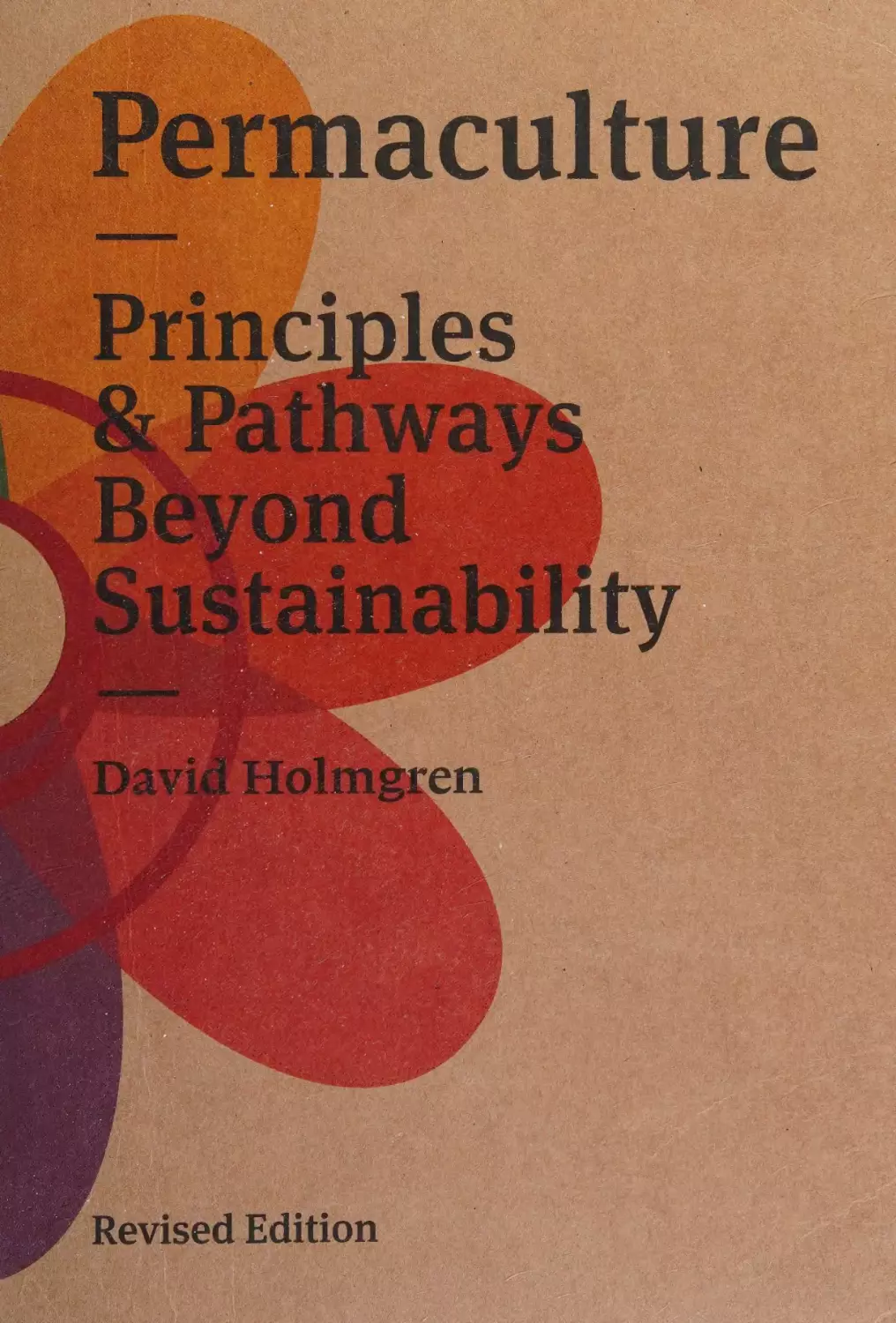
Permaculture
ges
— y Revis
ed Edition
David Holmgren
Permaculture
Principles & Pathways
Beyond Sustainability
Revised Edition
the memory |
—11Sep tember 200 2
Contents
Foreword to the first edition _ Stuart Hill
The purpose of this book __ David Holmgren
13
Prologue to the revised edition
Preface: Permaculture in an uncertain age
Introduction
What is Permaculture?
Ethics of Permaculture
Permaculture Design Principles, Icons and Proverbs
Principle
1_ Observe and interact
Principle
2__Catch and store energy
Principle
3__Obtain a yield
Principle 4
Apply self-regulation and accept feedback
113
Principle
5_Use and value renewable resources and services
129
Principle
6 Produce no waste
143
Principle
7 Design from patterns to details
167
Principle
8__Integrate rather than segregate
189
Principle
9 Use
207
Principle 10__ Use and value diversity
225
Principle 11 ___Use edges and value the marginal
239
Principle 12 ___Creatively use and respond to change
269
Postscript: After September 11, 2001
274
List of Illustrations
272
Selected Bibliography
274
280
- Index
Colophon
small and slow solutions
If the Permaculture Principles that David Holmgren
discusses in this extremely important book were
applied to all that we do, we would be well on the
road to sustainability, and beyond. Furthermore, we
would be liberated from the lurking feelings of guilt
that most of us feel when we reflect on what we are
currently passing on to future generations.
Foreword to the first edition (2002)
Professor Stuart B. Hill
Permaculture is about values and visions, and
growing waste production problems and
designs and systems of management that are
environmental impacts, are all obviously pre-
based on wholistic understanding, especially on
dictable. This situation is particularly distressing
our bio-ecological and psycho-social knowledge
because it can be largely avoided by applying
and wisdom. It is particularly about our relation-
the ‘Permaculture Principles’ outlined in the
ships with, and the design and redesign of,
following pages. Instead of repeatedly wasting
natural resource management systems, so that
they may support the health and well-being
of all present and future generations. What is
particularly puzzling is that whereas all engineers
— people who work primarily with non-living
materials — learn about design principles, nearly
all agriculturists, and others working with living
systems, are still able to graduate without ever
discussing principles of design, let alone having
expertise, time, energy and resources in efforts
any unit devoted to this critical competence.
It is the persistent lack of recognition of the
importance of design, of the importance of
mutualistic relationships and high biodiversity
within sustainable ecosystems, and of the need
to design managed ecosystems based on this
awareness that is responsible for so many of the
problems we currently face in natural resource
management.
to address such problems, at the ‘back-end’ of
the system, permaculture enables us to avoid
and minimise them by focusing on ‘front-end’
imaginative design and redesign initiatives.
My particular experience of doing this has
been focused mainly on pest control and soil
management.
Permaculture also reflects the ongoing evol-
ution of our knowledge systems. This evolution
is currently being driven by challenges from postmodernists and post-structuralists, feminists and
eco-feminists, social ecologists, deep ecologists
and eco-psychologists, and those interested in
post-normal science, holism, sense-of-place,
sustainability, communalism, spirituality and
indigenous knowledge systems.
Many factors have contributed to the develop-
Permaculture may be described in a diverse
range of complementary ways. It is one express-
ion of a next step in the evolution of natural
resource management, particularly as it relates
ment of permaculture. Key among them are:
¢ synchronicity and collaboration across
difference — the chance association between
to agriculture, most of which is still stuck at
David Holmgren, the modest, reflective,
thorough, follow-through person, and Bill
an earlier evolutionary stage, characterized by
Mollison, the wild ideas man with the public
deceptively simple designs based on special-
persona;
isation, monocultures and simple rotations.
¢ the visioning of permaculture as an inter-
These designs, the problems they produce,
national movement;
e the requirement for teachers to have extensive
training and field experience and to maintain
- and the disruptive solutions commonly used
to address them, have led to losses of topsoil,
moisture holding capacity, fertility, product-
ongoing practice in order to teach courses; and
ivity, resilience, wildlife habitat, biodiversity,
¢ the integration of ethics and design principles
including natural control organisms, and the
gene pool upon which the system depends. Toa
permaculturist, agriculture’s growing dependence on resource inputs to compensate for this
progressive degradation of its resource base and
associated need to control pests and diseases, its
increasingly negative energy budget, and
into all aspects of theory and practice.
This comprehensive quality, and its associated
heavy demands on the process of wholistic
planning and action, have also been a major
barrier to many who would benefit from
permaculture. Just as most people tend to opt
aee
o>)
for the aspirin rather than get their life in
This is the most advanced presentation of
order, most farmers and gardeners remain
Permaculture concepts that
similarly dependent on chemicals to ‘fix the
The 12 principles have been extensively tested,
Iam aware of.
headaches’ in their maldesigned and mismanaged
not only by the author, who is the co-originator
production systems. Those who have crossed this
of permaculture, but also by thousands of
barrier however, and found permanent design
permaculturists around the world.
solutions to problems — that only need to be
If Permaculture is new to you, this volume will
discovered once — are never willing to go back
to the dependence, inefficiency and illusion of
provide you with an outstanding introduction to
‘magic-bullet solutions’.
this wholistic approach to landscape design.
If you are a long time practitioner or teacher of
In the followng chapters David Holmgren has
Permaculture, it is likely that this is the book that
provided a reasoned, systematic and docu-
you have been waiting for — to challenge and
mented account, based particularly on his
hone your ideas, and to use as the core text in your
extensive experience, of the key principles
Permaculture courses. I hope you enjoy reading
for developing the intellectual competence to
and referring to this extremely valuable book as
practice permaculture. This must be matched
with parallel experience in the field. Ideally this
might include both work as an apprentice with
Permaculture
Pathways
and
Principles
Sustainability
Beyond
—
a mentor, such as David, and also opportunities
much as I have.
Professor Stuart B. Hill is Foundation Chair of
to experiment freely and boldly alone, without
Social Ecology at the University of Western Sydney
supervision. This latter work should focus on
NSW Australia
what I call ‘small, meaningful initiatives that you
can guarantee to carry through to completion’.
Such initiatives minimise the chances of negative
impacts from inappropriate designs, and feelings
of discouragement from failure to followthrough on mega-projects.
As a holographic thinker — being open to the
idea that anything one observes anywhere is
likely to have parallel expressions everywhere —
Iam led to go beyond the usual boundaries that
are put around permaculture. In fact, when I
lived in North America I used to run workshops
for permaculturists entitled ‘Permaculture of
the Inner Landscape’. I did this because I had
observed that many of these designers were
being limited, not by their knowledge of external
systems, but by their woundedness and need to
‘heal and redesign’ their internal systems.
I encourage you to similarly try applying these
Permaculture Principles to any area that might
benefit from such wholistic design theory
and practice. Areas that immediately come to
mind include human settlements and business
enterprises, political and economic systems,
and the health field, child rearing and learning
environments.
WwW
https Ilear ch Ive. org/de tail:
-
Permaculture is much more than a form of organic
gardening. My aim in writing this book is to explain
permaculture to a wider audience that may not be
attracted by the organic gardening label. It is especially
aimed at activists, designers, teachers, researchers,
students and others grappling with the vexed issues of
sustainability within a wide range of fields.
The purpose of this book (2002)
David Holmgren
Permaculture One was written 25 years before
Three years later, the project was again trans-
this book when I was 20 years old.' Most of my
formed by input from professional editor and
more recent publications have been case studies
permaculture activist Janet Mackenzie. The
manuscript had grown into a new, hopefully
with a practical focus that only hint at a deeper
framework which guides that work. With this
profound reinterpretation of permaculture
book, I want to build on the strengths and
principles, while the Collected Writings remained
successes of 25 years of permaculture thinking
references for further reading best able to stand
and action around the world to provide a more
alone. That collection has since been published
evolved picture of the principles that inform
and is available on the website — holmgren.com.au
permaculture design and action. In the process,
I hope to invigorate the intellectual debate within
the permaculture movement and address some of
the real and perceived weaknesses of the concept.
I know from decades of experience of applying,
The patterns of work and practice that created
this book reflected the principles within. The
manuscript was written over a four year period
at Melliodora on a second hand Power Mac
9600 computer primarily using Clarisworks 5.
writing and teaching permaculture that people
During that time the author was supported by
will use what they find relevant and meaningful
the production from the property and occasional
and leave the rest. The quest by some fora
permaculture courses, tours and consultancy.
completely consistent and logical picture of
permaculture may not be useful. Rather than
seeking to define or control permaculture, I
write about it as simply one more contribution
to understanding, meaning and action in a world
full of uncertainty.
Evolution of the project
This project began with a suggestion from
permaculture colleague, Ian Lillington, that we
publish an edited collection of my writings over
the last two decades. The aim was to provide those
interested in permaculture with access to more
cerebral writing that illustrated permaculture
The major proof reading drafts were printed on
second hand paper on a1o year old laser printer.
The editing, graphics and book production was
done by other self-employed people in the local
community. The original book was printed and
bound at Maryborough, a nearby regional centre,
by McPhersons, an Australian owned company
ona Timson T32 offset press. The paper used in
the original was Australian made, primarily from
plantation and recycled sources. The cover was
Australian made, from fully recycled sources.
No grants, subsidies or work for corporations or
governments contributed to this book.
thinking in a wide range of contexts. In the
Format of this book
process it would show an important lineage in
A chapter on the ethics is followed by one on each
the ongoing evolution of permaculture ideas and
applications by its lesser-known author.
of the 12 design principles, roughly in accordance
with the structure of our residential Permaculture
Towards the end of the process, Ian (as editor)
Design Courses that began in 1993.
suggested that what the collection really needed
Each design principle takes the form of a brief
was an article that directly explained perma-
action statement with an associated icon anda
culture principles, as taught on our residential
proverb or saying which exemplify the principle.
Permaculture Design Courses. The moment he
The action statements emphasise the positive
suggested this, I knew he was right; but my heart
aspect of permaculture based on the abundance
sank, for I knew that the task was not as simple
as it seemed. The idea of quickly getting my ideas
out to a permaculture readership receded.
1. Bill Mollison & David Holmgren, Permaculture One Corgi 1978
and since published in 5 languages (now out of print).
= io)
of nature, and the proverbs provide a caution-
My choices, and therefore even the principles
ary warning about the constraints and limits of
nature.
themselves, are simply tools to help us with
Each principle is explained in terms of design
observable both in the wider world of nature
multiple perspectives on whole-systems thinking.
Cross-references to the other principles point out
a selection of the more important linkages.
and in the use of land and natural resources by
In this sense, each principle can be thought of
traditional pre-industrial societies.
as a door into the labyrinth of whole-systems
Then I discuss the ways in which our high-energy
industrial society has transformed, or ignored, or
apparently overturned the principle, especially
where this is relevant to the claim of universality
for these design principles.
Included in each chapter are examples of the
application of the principle towards creating
an ecological culture. The applications of the
principle start with examples from gardening,
land use and the built environment as the most
Permaculture
Principles
and
Pathways
Beyond
Sustainability
_
concrete and widely understood; but they also
include the more vexed and complex issues of
personal behaviour and social and economic
organisation.
thinking.
Acknowledgements
My thanks to Jan Lillington for his strategic
thinking, and his gentle but persistent encouragement and follow-up which have kept this
project moving (even when it changed tracks)
over many years.
Other permaculture colleagues who have given
inspiration, encouragement and feedback include
Jason Alexandra, Stephen Bright, Andrea Furness,
Stuart Hill, Sholto Maud, Kale Sniderman and
Terry White. I particularly acknowledge Janet
Mackenzie for the generous donation of her
I use our own property, documented in the book
Melliodora (Hepburn Permaculture Gardens)? to
professional skills and time and for instilling the
confidence to keep going when I thought I was
finished; Richard Telford for his ori ginal ideas
illustrate each principle. References to the various
articles published in the CD David Holmgren:
Collected Writings 1978-2006 further explain or
illustrate aspects of each principle.* Where
and artistic rendering of the principle icons; Luke
Mancini for his artistic reworking of my graphics;
and Rob and Terttu Mancini for their graphic
and production skills in making this book a local
possible, I have made reference to published and
other sources for the great diversity of concepts
and ideas which I condense under each principle.
business venture. I also want to acknowledge the
permaculture students and colleagues who have
patiently waited for the original publication of
As always, when trying to use the inevitably linear
this book in 2002.
logic of writing to convey wholistic concepts,
Su Dennett
the division between the issues and perspectives
covered under each principle is arbitrary.
It is traditional for authors, especially men, to
. David Holmgren, Melliodora (Hepburn Permaculture
Gardens): Ten Years of Sustainable Living Holmgren Design
Services 1996. Updated in 2005 as an eBook.
- David Holmgren: Collected Writings 1978-2006 CD,
Holmgren Design Services 2002 (updated in 2006).
The project to publish my collected writings was the
starting-point of this book, and the articles in the
collection complement this book in several ways. Firstly,
they provide further examples of the application of the
principles. Secondly, the content of some of the articles
will be of particular interest to some readers and they
provide references to further sources. Finally, the articles
provide a historical lineage of my personal evolution,
application and explanation of permaculture concepts
to
a wide range of audiences since 1978, the year Permacult
ure
One was published.
acknowledge the patience and support that their
partners have provided through the long and
at times difficult process of authorship. All of
that is appropriate in my acknowledgment of Su
Dennett, my partner in life and livelihood over
the decades.
In the early days of our relationship it was frustrating to us that, because Su was not prominent
in the ‘important’ activities of permaculture
teaching, writing and public speaking, she was
often seen as a follower implementing my ideas.
Ironically, this view often came from women who
were both permaculturists and feminists. Su’s
commitment and energy in pursuing a low-
impact, simple lifestyle have been a constant
source of renewal of my own commitment to
voluntary frugality as an empowering pathway
adapted to ecological realities.
Su’s contribution to the ideas in this book has
come not as a heavyweight intellectual sparring
partner but in helping me get past the limitations of my own overly intellectual and rational
approach. Early in life I came to rely ona rational
consideration of all factors and perspectives as a
constraint on acting like a bull at a gate. But I have
found that this adaptation has, in turn, often led
me into dogged persistence in the certainty that
I had considered all the factors or, alternatively,
‘paralysis by analysis’. It has been through my
partnership with Su that I have gradually overcome my deep suspicion of my intuitive capacity
and been able to use it as a pathway toward more
wholistic understanding and action. At the practical level, Su has performed a major role facilitating
and managing this do-it-yourself publication.
Oliver Holmgren
From his birth at home to his work experience on
organic farms in Italy at 15, Oliver has been imm-
ersed in the permaculture lifestyle. Like any teenager, his views and behaviour were a challenge to
his parents, but over the years of writing this book,
Oliver’s thinking and action were an inspiration
in refining my conception of permaculture. He has
confirmed for me that it takes more than a single
generation to create a new ecological culture; for
example, some difficult aspects that I have grappled with, he has easily digested and integrated.
Gerard Holmgren (1958—2010)
My brother had often reminded me of the political
dimension to permaculture, not only through his
passion, intellect and action. The hard road of his
experience has been a constant reminder that the
pathway to a better world will not necessarily be as
fortunate and positive as mine has been.
Venie Holmgren (1922—2016)
Having got this far in family acknowledgements,
an anecdote about my mother is apt. To the public
exclamation from a permaculture enthusiast “So
you’re David Holmgren’s mother!”, she replied
“No, he is my son.”
of
The
book
this
purpo
The world has changed radically since Permaculture:
Principles & Pathways Beyond Sustainability (PP&PBS)
was first published in 2002. By many environmental,
economic and social measures, local and global
Systems are now in crisis and even collapse.
The premise of the book was that the ‘energy
descent’ future would inevitably require new ways of
thinking to replace the failing principles that guided
industrialisation, modernity and globalisation.
In the book and my teaching, I use the ‘energy
descent’ concept that informed the Original
conception of permaculture in the mid 1970s to
highlight the urgency in applying permaculture
principles to reshaping every aspect of everyday life.
13
Prologue to the revised edition
David Holmgren
This book has already contributed to the rising
tide of permaculture activism on many fronts.
Within the established global permaculture
Rhymer’s Manual, is now included in the Principles
networks, a renewed and deepened teaching of
ethics and principles is essential in extending
permaculture beyond the sensible design of
gardens and farms to a redesign of our economy
principles framework, the permaculture flower
and culture from ‘first principles’.
The articulation of principles in the book, and
their representation by twelve icons crafted by
permaculture colleague Richard Telford, has
led to the website permacultureprinciples.com,
and a yearly calendar that use the icons to help
embed the principles into everyday thinking.
The Transition Movement that was initiated by
permaculture colleagues in Britain has applied
these principles to directly generating relocalised
community responses to energy descent.
During three public speaking and teaching
tours overseas, in 2004, 2005 and 2007, I
was able to contribute to the deepening and
extension of interest in permaculture outside
of the English-speaking world. The teaching of
advanced principles courses around the world,
and the receiving of substantial feedback from
colleagues and strangers, has given me more
food for thought about how best to convey the
concepts. One of the results of this is the Essence
of Permaculture —a free downloadable summary
in the world. His music CD, Permaculture: A
Teaching Kit.
,
Academics across many disciplines have used the
of 7 domains, and the book as a text; while plans
for whole courses based on this framework have
taken root in several universities.
Many more people around the world are experiencing the (mostly adverse) impacts of the early
stages of the energy descent future through the
interlocking climate, energy, geopolitical and
economic crises, even if the big picture systemic
understanding of these forces in shaping every-
day living seem destined to remain the privilege
(and/or burden) of a small minority.
The positive story is that a growing number
of people, consciously applying strategies and
techniques adapted to a world of less, are fairing
relatively well. Permaculture is at the forefront of
this creative response to energy descent because it
is based on ethics and design principles that have
been evolved and tested over the decades since
the evidence for the energy descent future first
became clear. Permaculture will not help save the
world as we know it, but it can inspire and inform
a multitude of creative responses to the world
that is emerging.
of the book in many languages. At the same
How the book was first published
time, the success of PP&PBS in reinvigorating
The self publication of PP&PBS in 2002 was an
and consolidating the teaching of permaculture,
expression of permaculture do-it-yourself culture
across and beyond the English speaking world,
that preceded the explosion of the blogosphere
has encouraged permaculture teachers in other
and the peer-to-peer movement. Despite
countries to initiate collaborative processes for
not receiving any reviews in the recognised
translation of the book into 9 languages.
mainstream media, PP&PBS has sold 10,000
A permaculture Principles Teaching
Kit has allowed
copies in Australia (and over 40,000 world wide).
me to incorporate many insights on how best to
In this country 10,000 copies is considered the
convey the concepts to diverse audiences.
upper limit for any book of complex ideas and
More recently, Charlie McGee’s electro-swing
I think any reader would agree PP&PBS is a book
of complex ideas. We knew that the text was
music and wonderful lyrics have translated these
abstract ideas to young audiences, from primary
schools tc some of the largest music festivals
far from perfect in its language, organisation
and referencing, but for the sake of sanity, anda
=
4
sense of urgency that these ideas had to get out
historical reality that underpins the explosive
there, we took the shortcut to publication in 2002
growth in renewable energy, economic contraction
without years of further work.
and geopolitical realignment. Similarly, the posi-
Some readers have described it as hard going
tive and environmentally-heretical view of species
naturalisation that I articulated in the book is
now supported by a rapidly growing body of peer
reviewed science within the new field of study of
‘novel ecosystems’.
theory, not for the faint hearted, some experience
it as like rich chocolate cake, full of substance
but only digestible in small doses, for others it
is an empowering romp through whole-systems
thinking that confirms intuitively obvious
For these and other examples, I think the integrity
ideas that somehow remain unarticulated or
misunderstood in modern society.
of the text from the turn of the millennium will
be of some historical value. This revised edition
One of the reasons it would never have been
has allowed a comprehensive review of the text
published by any conventional publisher in
to improve grammar, use of terms, and an update
its current form is that it contains too many
apparently different ideas, many of which are
and the addition of references. Most importantly
not fleshed out in detail. That even a few of
conceptual misunderstandings have been
those ideas have stimulated a greater depth in
permaculture teaching and design has confirmed
corrected. The graphics have also been redrawn to
better convey the concepts.
the value from the breadth of the project. That
Readers of existing translations can be assured
Permaculture
Principles
Pathways
and
Beyond
Sustainability
_
asmall numbers of serious typos, errors and
breadth has also provided many hooks for those
that the changes made are minor in nature
unfamiliar with the biological and land base
compared to the great difficulty in translation
of permaculture to connect to its underlying
ethics and principles. In this way the text has led
wholistic thinkers from many fields to a greater
appreciation of permaculture as a design system
for living, beyond its land use origins. This wide
reach of the text has contributed to realising the
bold vision of Bill Mollison — that permaculture
did mean permanent agriculture and permanent
generally and especially for this work. We trust
culture.
Over the years, a series of related writing projects
such as the Future Scenarios, Retrofitting the Suburbs
and Collected Writings, have taken priority over
any root-and-branch edit and rewrite fora
second edition of PP&PBS. Ina rapidly changing
world, it may be more appropriate to continue
to build on this work rather than trying to make
it into some enduring and complete text of
permaculture theory.
In reflecting on the book, I remain happy with
the eclectic mix of abstract theory, grounded
examples and personal anecdotes that riled
academic and editorial sensibilities. While some
ideas and points remain speculative, many others
have since become clearer through the course of a
growing body of practice and more than a decade
of turbulent world history that we have lived
through. For example, for the well-informed,
Peak Oil has moved from speculative concept to
that the painstaking translation work, by those
with an understanding of and commitment to
the concepts, has captured the text for the better
but we hope the text of this edition will make any
future translations a little easier.
I want to acknowledge the input of Maureen
Corbett and Ian Lillington in reviewing the
text, Joel Meadows for his illustrations and
especially Ian Robertson for the book and cover
design, graphics reworking and production. The
permaculture flower image and the icons are the
now widely recognised work of Richard Telford.
As ever I remain one of permaculture’s strongest
internal critics in insisting that for permaculture
concepts and teaching to remain relevant, it must
be grounded in practical action that regenerates
nature and improves the lives of ordinary and
especially impoverished people. In addition, it
must remain open to influence from parallel and
complementary concepts, movements and ideas
that are contributing to a gentler and more benign
energy descent future in which nature’s wealth is
regenerated and humanity finds its place in that
natural order.
—— Melliodora, August 2017
«
1 Sw
}
owe
Uncertainty is one of the defining characteristics of our
age. Contributions to this state of affairs come from
diverse sources.
Theoretical science has elevated uncertainty from simply
a result of inadequate information to something that is
inherent in everything.
The clash between the world’s multifarious cultural
traditions and modernity leaves most people unsure of their
values, and of their role in society.
The avalanche of evidence and information about the
impermanence of almost every aspect of modern society and
economy, especially due to looming environmental threats,
undermines any sense of certainty about the continuity of
everyday life.
At the same time, accelerating technology and the emergence
of endless new ideas, ways of seeing and being, movements,
spiritual pathways and subcultures have expanded possibilities, hopes and fears beyond previously imaginable
horizons.
The permaculture concept and movement are part of this
global cultural reality, which some call post-modernism,
where all meaning is relative and contingent.
Preface: Permaculture in an uncertain age
The permaculture concept was a product of an
intense but relatively brief working relationship
between Bill Mollison and myself in the mid-
* The environmental crisis is real and of a mag-
nitude that will certainly transform modern
global industrial society beyond recognition.
1970s. It was a response to the environmental
In the process, the well-being and even survival
crisis facing modern society.
of the world’s expanding population is directly
threatened.
The publication of Permaculture One in 1978 was
the culmination of that initial work and a starting
* The ongoing and future impacts of global
point for both the evolution of the concept and
industrial society and human numbers on the
the emergence of the worldwide permaculture
movement.
world’s wondrous biodiversity are assumed to
Bill Mollison has described permaculture as a
‘positivistic’ response to environmental crisis.'
That means it is about what we want todo and
can do, rather than what we oppose and want
others to change. This response is both ethical
and pragmatic, philosophical and technical.
Like all ideas, permaculture is founded on
some fundamental assumptions that are critical
to both understanding and evaluating it. The
be far greater than the massive changes of the
last few hundred years.
¢ Humans, although unusual within the natural
world, are subject to the same scientific (energy)
laws that govern the material universe, including the evolution of life.
¢ The tapping of fossil fuels during the industrial
era was seen as the primary cause of the spectac-
ular explosion in human numbers, technology,
and every other novel feature of modern society.
¢ Despite the inevitably unique nature of future
assumptions on which permaculture was orig-
realities, the inevitable depletion of fossil fuels
inally based were implied in Permaculture One
and are worth repeating.
within a few generations will see a return to the
general patterns observable in nature and preindustrial societies dependent on renewable
. This description should not be confused with the
philosophy of‘logical positivism’ but rather follows
the common use of the terms positive and negative as
descriptions of personal attitudes.
energy and resources.
The conceptual underpinning of these assumptions arises from many sources, but I recognise
. H.T. Odum, Environment, Power& Society John Wiley
1971 was a book which influenced many key environmental thinkers in the 1970s and was the first listed
reference in Permaculture One. Odum’s prodigious
published output over the three decades since, as well as
a clear and special debt to the published work of
American ecologist Howard Odum.? The ongoing
influence of Odum’s work on the evolution of
my own ideas will become clear through the
the work of his students and colleagues, has continued to
numerous references in this book, as well as the
inform my work.
articles referred to in David Holmgren: Collected
Writings 1978-2006.3
. David Holmgren: Collected Writings 1978-2006. Article 11
“Development of the Permaculture Concept” and Article
25 “Energy and eMergy: Revaluing Our World” are
Some of the predictions of resource decline
especially relevant in explaining the influence of Howard
and economic collapse made in the 1970s have
Odum’s work on my development of perma-culture.
. For one of the most authoritative books on the energy
proven to be mistaken, at least in their timing.
crisis see C. Campbell, The Coming Oil Crisis, Multi-Science
However, the evidence that natural resources
Publishing 1997. The following websites provide many
are already constraining human development,
other sources on the subject: resilience.org, aspo-australia.
after approximately 300 years of growth and 50
org.au and theoildrum.com
years of super-accelerated growth, is strong and
:
increasing. The evidence that the current oil crisis
reflects the permanent end to cheap energy is
compelling.*
17
= CO
Models from natural systems suggest a collapse
without waiting for fundamental changes either
back to low energy and resource use (mostly
renewable), and a decline in world population
personal behaviour and habits of citizens.
is likely. Within this broad scenario, an almost
infinite array of pathways and local possibilities
can be considered, from the benign to the horrific.
On the other hand, technological and economic
ability, with many similarities and overlaps with
Lovins’ emphasis on design processes drawn from
optimists argue that we are at the beginning
nature. For many, the permaculture focus on land
will lead to a golden age of material well-being.
and natural resource management is complementary to the industrial focus of the ‘green tech’
Again some of the evidence is compelling. Amory
optimists, but there are also differences.
dramatic examples of science and industry doing
more with fewer resources and less energy are
perhaps the most credible.°
Although a future of much diminished use of
energy and resources seems inevitable, the nature
Permaculture:
* gives priority to using existing wealth to
rebuild natural capital, especially trees and
forests, as a proven storage of wealth to sustain
humanity into a future with less fossil fuel
* emphasises bottom-up ‘redesign’ processes,
of that world (and its various parts) is uncertain,
starting with the individual and household
to say the least. In the emerging energy transition,
as the drivers for change at the market,
community and cultural level
Permaculture
Principles
Pathways
and
Beyond
Sustainability
_
ideas and models such as those of Lovins have had
considerable influence because they can be applied
by business within a capitalist market economy
. See P. Hawken, A. Lovins & H Lovins, Natural Capitalism:
Creating the Next Industrial Revolution Rocky Mountain
Institute 1999 including the case studies of business
achieving factor 4 and factor 10 improvements in energy and
resources use per unit of value or profit.
. See Permaculture International Journal (Australia), no longer
in print but many libraries have back issues, Permaculture
Magazine (UK & Nth America) and Permaculture Design
Magazine {formally Permaculture Activist] (USA) for an
indication of the scope.
. For a review of the influence of permaculture on the whole
field of ecological alternatives see Article 11 “Development
of the Permaculture Concept” in David Holmgren: Collected
Writings 1978-2006.
[have noticed that sustainable agricultural innovation
in Australia tends to be clustered in periods of economic
recession in the 1880-1890s, the 1930s & ’40s and since the
1970s (a more or less continuous rural recession in Australia)
with very little of enduring significance during economic
booms especially in the 1950s & 60s. More fundamentally, I
see the ecological and social movements of these periods as
well as the more recent decades being part of a continuous
lineage of counterculture in the modern world. See Article
30 “The Counterculture as Dynamic Margin” in David
Holmgren: Collected Writings 1978-2006.
- D.H. Meadows et al, Limits to Growth report to the Club of
Rome — wikipedia.org/wiki/The-Limits-to-Growth
10.
Permaculture is a creative design response toa
world of declining energy and resource avail-
of a new industrial/biological revolution that
Lovins’ ideas of natural capitalism and the
.
in the political and cultural realm or in the
The third wave of modern environmentalism that was
building in the late 1990s became stillborn by the events
following September 11th 2001. It was not until the oil shock
and the resultant Global Financial Crisis of 2008 that the
third wave developed more form and strength.
¢ more fundamentally, was predicated on the
likelihood of some degree of collapse and
breakdown in technology, economics and even
society, which is not envisaged or designed for
by the ‘green tech’ optimists but is a current
reality for many people around the world
* sees pre-industrial sustainable societies as
providing models that reflect the more general
system design principles observable in nature,
and relevant to post-industrial systems.
Insofar as permaculture is an effective response to
the limitations on use of energy and natural resources,
it will move from its current status as ‘alternative
response to environmental crisis’ to the social and
economic mainstream of the post-industrial era.
Whether it will be called permaculture or not is a
secondary matter.
The permaculture concept and movement
have already changed the lives of thousands of
people and affected perhaps millions ina myriad
of ways.® All this has occurred without any
substantial support from powerful institutions,
corporations or governments. Some would
attribute its influence solely to the tireless energy,
intellect and charisma of Bill Mollison. Although
his role in permaculture’s initial global spread
is unquestioned, its persistence, evolution and
influence must be attributed to its relevance to
people’s lives and situations.
Having pinned the relevance of permaculture
to a future with less energy, what might be its
relevance in some brave new world of abundant
energy and resources? This new world could
include nuclear energy and weapons, genetic
engineering, space colonies, or any of the other
hoped-for or feared possibilities. I suspect that
the impact of permaculture would contract
However, past experience suggests that each
new phase also throws up new insights and
= Xo)
innovations that challenge the assumptions of
the previous wave. This book is my contribution
to the third wave.
to influence the lives of relatively isolated
individuals and groups who hold to minimal
energy and resource use for ethical reasons.
The question of defining what permaculture is
and isn’t troubles some people. Its multifaceted
character has allowed its progressive evolution
into a comprehensive integration of ‘ecological
alternatives’. I have contributed to this expansive
evolution,’ but I also recognise there are
dangers in attempts to develop ‘a theory of
everything’, and in being ‘a jack of all trades and
master of none’ and in ‘reinventing the wheel’.
Nevertheless, I see the progressive evolution of
permaculture as a strength in influencing the
patchy and pulsing nature of social change.
Third Wave Environmentalism
The emergence of environmental awareness
and innovation in the last quarter of the zoth
century can be seen as clusters of intense
activity followed by longer, slower phases of
consolidation. These phases of new activity tend
to coincide with recession in the mainstream
economy.® Permaculture was one of the
environmental alternatives that ernerged from
the first great wave of modern environmental
awareness, following the Club of Rome report in
1972 and the oil shocks of 1973 and 1979.”
After the economic growth of the Reagan—
Thatcher revolution in affluent nations during
the 1980s, the public awareness of the greenhouse
effect in the late 1980s triggered a second wave of
environmentalism, which accelerated interest in
permaculture.
In the 1990s, as new technology and the global
economy diverted attention, there was another
phase of consolidation. By 1999 the signs were
in place for a third wave of environmentalism." 0
In this new phase we can expect public interest
to lead to the mainstreaming of many of the
innovations of the second wave.
Prefac
Permac
in
uncert
an
age
_
Permaculture Design System Evolution
Figure 1 The Permaculture Flower
Land & Nature Stewardship
_Bio-intensive gardening _ Forest gardening
Building
_Seed saving _ Organic agriculture
Passive solar design _ Biotechture
—Biodynamics _ Natural farming
_Natural construction materials
_Keyline water harvesting
_ Water harvesting & Waste re-use
_Wholistic rangeland management
_Earth sheltered construction
—Natural sequence farming _ Agroforestry
—Nature-based forestry _Integrated aquaculture
_Wild harvesting & hunting _ Gleaning
_ Natural disaster resistant construction
Owner building _ Pattern language
Tools & Technology
Land Tenure &
Community Governance
—Reuse & creative recycling
Hand Tools _ Bicycles / electric bik
_ Cooperatives & body corporates
_Efficient, low pollution wood stov
2
-_Cohousing & eco-villages
_Native Title & traditional
_Fuels from organic wastes
—Consensus decision making
— Wood Gasification _ Bio-char fro
Ethics
use rights _ Open space technology
forest wastes _ Co-generation
and Design ©
Principles
_
—Micro-hydro & small scale wind
—Grid-tied renewable power
generation _ Energy storage
Finance & Economics
—
_Transition engineering
—Local and regional currencies
_Carpooling / Ride sharing / Car share
—Ethical investment & Fair Trade
_—Farmers markets _ Community
supported agriculture (CSA) _LETS _»..
WWOOFing & similar networks _ Tradable’
energy quotas _ Life cycle analysis
Culture & Education
—Home schooling — Waldorf education
— Participatory arts & music
— Social ecology — Action research
—eMergy accounting
Health & Spiritual Wellbeing
—Home birth & breast feeding
—Complementary & wholistic medicine
— Yoga, Tai Chi & other body/mind/spirit
disciplines _ Spirit of place, indigenous
cultural revival _ Dying with dignity
_ Transition culture
21
Introduction: What is Permaculture?
Having said in the preface that I don’t want to
The application
define or control permaculture, I now must do at
The Permaculture Flower (Figure 1) shows the
least the first of these for the purpose of clarifying
the subject of this book.
key domains that require transformation to create
a sustainable culture. Historically, permaculture
The Vision
has focused on land and nature stewardship
as both a source for and an application of the
The word permaculture was coined by Bill
ethics and design principles. They are now
Mollison and myself in the mid-1970s to describe
being applied to other domains dealing with
an “integrated, evolving system of perennial or
physical and energetic resources as well as
self-perpetuating plant and animal species useful
human organisation (often called invisible
1
to man’.
structures in permaculture teaching).? Some of
Amore current definition of permaculture used
the specific fields, design systems and solutions
by many teachers, which reflects the expansion
that have been associated with this wider view of
of focus implicit in Permaculture One (1978), is
permaculture are shown around the periphery
“Consciously designed landscapes which mimic
of the flower. The spiral evolutionary path
the patterns and relationships found in nature,
beginning with the ethics and design principles
while yielding an abundance of food, fibre and
suggests a knitting together of these domains,
energy for provision of local needs.”
initially at the personal and the local level and
proceeding to the collective and global level.
People, their buildings, and the ways they org-
anise themselves are central to permaculture —
the permaculture vision of permanent (sustainable)
agriculture has evolved to one of permanent
(sustainable) culture.
The design system
For many people, myself included, the above
definitions of permaculture are so global in scope
that their usefulness is reduced. More precisely,
Isee permaculture as the use of systems thinking
and design principles that provide the organising
framework for implementing the above vision.
It draws together the diverse ideas, skills and
ways of living which need to be rediscovered
and developed in order to empower us to move
from being dependent consumers to becoming
responsible and productive citizens.
While the spiral suggests a clear trajectory, the
process of integration is uncertain and patchy,
depending on the context and the players.
The network
Permaculture is also a worldwide network
and movement of individuals and groups who
are working in both rich and poor countries
on all continents to demonstrate and spread
permaculture design solutions. Largely
unsupported by government or business, these
people are contributing to a more sustainable
future by reorganising their lives and work
around permaculture design principles. In this
way they are creating small local changes but ones
that are directly and indirectly influencing action
in the wider environment, organic agriculture,
appropriate technology, communities and
In this more limited, but important sense,
other movements for a more sustainable world.
permaculture is not the landscape, or even the
Permaculture may rank as one of Australia’s most
skills of organic gardening, sustainable farming,
significant
‘intellectual exports’.
g
energy efficient building or eco-village development as such. But it can be used to design,
establish, manage and improve these and all
other efforts made by individuals, households
and communities towards a sustainable future.
. B. Mollison & D. Holmgren, Permaculture One Corgi, 1978.
. See B. Mollison, Permaculture: A Designers’
Ny
Tagari 1988, chapter 14.
Manual
NN
The Permaculture Design Course
Permaculture as gardening
Most of the people involved in this movement
As a system of gardening, or perhaps even as
have completed a Permaculture Design Course,
commonsense, environmentally-aware living,
which since 1981, has been the prime vehicle for
permaculture has been accepted by many people
permaculture inspiration and training world
in Australian society as a benign activity. The
wide. A curriculum was codified in 1984, but
effects of television gardening programs, easy
divergent evolution of both the form and the
do-it-yourself books and videos, local school
content of these courses, as presented by different
projects, community gardens, LETSystems, and
permaculture teachers, has produced very varied
its inclusion as an option in horticultural and
and localised experiences and understandings of
permaculture.
enthusiasm for permaculture.®
In the early 1990s when I began to teach Design
The process of providing for people’s needs
Courses regularly, I used the curriculum asa
in more sustainable ways requires a cultural
foundation but I freely adapted the format to
emphasise my own understandings, experience
and priorities. I also contributed to the discussion
and debate within the movement about how
permaculture
education should develop.’
Permaculture
Principles
and
Pathways
Beyond
Sustainability
_
The debate about the content of Permaculture
Design Courses has become more intense in
recent years. Bill Mollison and others have
asserted that a failure to adhere to the curriculum, the inclusion of religious beliefs outside
the scope of ‘design science’, and a lack of
attention to principles and theory is diluting
and devaluing some permaculture education.‘
Although I might agree with some of these claims
about some courses, I have always found the
perception of dilution has to be balanced by the
value of diversity even when, like weeds, it comes
other tertiary courses, have all contributed to
revolution, but to propose this as a prerequisite
can alienate people and inhibit productive steps
toward personal and social change. Permaculture
has avoided some of the obstacles and opposition
that revolutionary ideas encounter by beginning
the revolution in the garden.
The permaculture movement and the rudimentary public understanding of permaculture
show that it is possible for complex, abstract and
revolutionary ideas to exercise influence through
positive grassroots processes. This example
provides an alternative to the reception of some
sustainability concepts, which have been mired
in the largely unsuccessful attempts to shift
culture by top-down policy processes, exemp-
lified by the Rio Earth Summit and similar
subsequent events.
in forms we don’t particularly like.
Popular Conceptions of
Permaculture
In many countries, only the relatively small
numbers of people who have done Permaculture
Design Courses, or been closely associated with
permaculture projects, are familiar with the
concept. In Australia, however, a longer history
of permaculture activism and influence within
large related environmental movements, as well
as extensive media exposure, have resulted in
broader public appreciation of permaculture.°
Popular conceptions of permaculture as a system
of gardening or as a counter-cultural lifestyle are
both strengths and weaknesses, which providea
context for understanding and appreciation of
the ideas in this book.
Permaculture as counterculture
The perception of permaculture as a phenomenon of the countercultural lifestyle, with regular
gatherings, its own magazines and newsletters
and local groups, has also had positive aspects.
As such, permaculture has provided a wholistic
framework for reorganising the lives and values
of a small minority ready for more fundamental
change. This has been particularly so for the
minority of young people disillusioned with the
conservative consumer youth culture of the late
twentieth century.’ For others, permaculture
has provided a message of hope in the struggles
against environmental and social evils.®
The Permaculture Design Course (PDC),
especially in its two-week residential format,
has been particularly effective in galvanising
fundamental change and new focus in the lives
of participants, and in providing a sense of
belonging. This subcultural or countercultural
Permaculture itself was conceived within
academia. Many who are involved in large-scale
aspect of permaculture has facilitated the
experimentation and pioneering of lifestyle
agriculture and land use policy saw it as theo-
models directed by the ecological imperative.?
difficult to apply within the prevailing social,
market and policy environment.’
retical, utopian and impractical because it was
Academic, professional and official
reaction
Since the growth of the permaculture movement, permaculture has itself become a subject
The reaction to permaculture of academics,
of academic study, with emphasis ranging
professionals and decision-makers has been more
from the sociological, political and educational
varied than that from the wider public.
aspects to the ecological and agricultural.'? Some
Among the small number of professionals
university teachers use permaculture texts and
and academics attempting to integrate the
other resources; and in 1992, a whole unit on
ethical, pragmatic, philosophical and technical
permaculture, which I wrote, was included in the
aspects of ecological thinking in the late 1970s,
first Australian postgraduate course in sustain-
Permaculture One produced some enthusiastic
able agriculture."
reactions, such as “Permaculture provides a
Elsewhere in the world, academics have been
valuable conceptual framework for future
at the forefront of development and promotion
thought on sane, sustainable societies” from
Earle Barnhart of the New Alchemy Institute.'°
has placed permaculture within a spectrum of
On the other hand, Bill Mollison noted more
concepts and ideas about sustainability.'©
of permaculture,” while the work of Stuart Hill
generally, “The professional community was
outraged because we were combining archi-
9. I expand on the historical lineage of the counterculture as a
context for permaculture in Article 30 “The Counter-culture
tecture with biology, agriculture with forestry
as Dynamic Margin” in David Holmgren: Collected Writings
and forestry with animal husbandry, [so] that
almost everybody who considered themselves
1978-2006.
10.
to be a specialist felt a bit offended.”
. “The Permaculture Movement and Education: Searching
Earl Barnhart, Introduction to the American edition of
Permaculture One International Tree Crops Institute, 1981.
11.
Preface to Introduction to Permaculture.
12.
For example: Peter King, agricultural and environmental
For Ways Forward” 1993, was circulated through the
consultant, speaking on “Science Bookshop” ABC Radio, July
Australian permaculture network of teachers, and later
1978.
published in three parts in Permaculture and Landcarers
13. For example: Caroline Smith, The Getting of Hope: personal
(later Green Connections) issues 3-5, 1995. See Article 14. in
empowerment through learning permaculture PhD thesis, Faculty
David Holmgren: Collected Writings 1978-2006.
of Education, The University of Melbourne. 2000; Adam
. Lisa Mollison in Permaculture International Journal no. 73,
February 2000.
. See “The Landcare Movement: Community-Based Design
Nelson, Permaculture: Against the New Orthodoxy of Sustainable
Development BA(Hons) thesis, School of Science and Technology
Studies, University of New South Wales, 1994; Mona Loofs,
and Action on a Scale to Match the Continent” in David
Permaculture, Ecology and Agriculture: an investigation into
Holmgren: Collected Writings 1978-2006.
permaculture theory and practise using two case studies in northern
. The following show some of the range of Australian books:
B. Mollison and R. Slay, Introduction
to Permaculture Tagari 1991; R. & J. Mars, The Basics of
Permaculture Design Candlelight Trust 1994; L. Woodrow,
The Permaculture Home Garden Viking 1996.
. Graham Burnett in Permaculture:ABeginners Guide
Land & Liberty 2000, provides a British example of the
flavour of this countercultural view of permaculture,
in his case complete with connections to veganism and
anarchism.
. G. Holmgren, Beyond the Nuclear Age (self-published)
1985, a small book that circulated through environmental
and political activist networks in the 1980s, outlined
New South Wales BSc (Hons) thesis, Human Ecology Program,
Dept of Geography, Australian National University.
14. UNE Orange Agriculture College 1992, Article 8 “Gardening
as Agriculture” in David Holmgren: Collected Writings 1978-2006
was written as part of the collected reading materials of that
course.
15. Most notably, Declan and Margrit Kennedy, professors
of architecture strongly identified with the Global Ecovillage Network, have been pivotal in the development of
permaculture in Germany and throughout Europe since the
early 1980s.
16. S. Hill, “Ecological and Psychological Prerequisites for the
Establishment of Sustainable Agricultural Communities”
the dangers of genetic engineering and promoted
in J. Martin (ed.), Alternative Futures for Prairie Agricultural
permaculture as part of an integrated alternative
Communities, University of Alberta 1991.
perspective.
N oN)
Intro
What
Perma
is
—
S) aN
ER
RY
a
PRopuUCcT:
RUT S
yy
F
(ONDARY
g oS
PRODU:
oF
PRODUCTS
|CATEGOgiES
-
>
%
Oy"
ESTABLISHME
“g
X
4D
»
e
a
EARTH
a
oe
WATER
xe
6G
pwrwee
N)ol
x
on
oo?
<
2
\'
oF
ie)
©
»
ae
BRANCHES (RoaTS)
Lit
BAN Ss A 0
82
KS
\
UII
SCIENCE
vP
SYSTEM
\
%
A
low
ECOLOGY
Oo
=
x
w
. oe
& Be
~~
y
x
a
Be
&
Y
¢S&
o
zy
ES
6
Oop
or
xs
r »)
EVOLUTION
+ IN SE EATON
2) a
ey
fe}
9,=
DATA
OF
2
ENVIRONMENTAL
cy
>
ay
¥
Ny
UNREALISED
DESIGN
L
RS
S
ox
w
~
9
oo
S
“SES
GERMINATION
! Es
END.
Ag
Q
a
Zz
le
Oe
fs) Fs S
igral
GS
—
kow
Be
es:
x
=
Se 2
_——
&
SS
Ae
<
a
SYS i ek
Ses Oa
UP
foe
© Se A
a
°g,
2 ee
W
Sa
su
E
os
Se
Ss
a
AP.
jl
yee
Sas
~
©
ne
DES
ah
GF
— a
v fo) si
%
oo
= oe
i
3
PERMACULTURE
9
i
eo Ne,
HEE nNeagaatiol
4M
DISCIPLINES
*
)
SS.
“System
EVOLUTION
(8
HUMUS
2
%
et
A
x
%
=
oz
w
\2.
ES
=
cq
xy
a
Zz,
‘
Permaculture
Principles
Pathways
and
Sustainability
Beyond
_
G2
°
3
a)
5
Cee
CGS
a
DECOMPOSERS.
=
w
Y
OD
4,9,
%
aye
YSay
x
Sy
ey
AIR
ety
ee
eae gk
val
2%
2)
ng)
LIGHT
Oy
~~
2
2,
:
fi
DIUM I
FeA
&
ae
es
Ly
i
ee
<)
“5
W_
p
z
Se
a
&
oF
S
4
eee)
Pa
2a
oe
BEES
an"
cas
SYSTEMS
3
Crime)
Ron, Ley.
ome
2
oy
YT
aX
yy,
Bo
f)ly EEO ow
h/GR TORS,
Se, Ay
Sy
a
wo
0
x
ees
%
&
Bp
&
re
*,
[
wo
=
SEQUENCE
w
%
%
Say
PRIMARY
>
Wy zu
%
=
=
bs
%
o
FS)
Citas,
%,
2,
WE
_
—
on
SiS
S
Zr
2
Ss
Z
=
Te Ss
oe ee
>
Ss
ghiaee
US
TS
Ne es
ae
ROOTS
a
Figure 2 Permaculture Tree (Original drawing reproduced from
Permaculture One, 1978)
Hill’s ‘Deep Sustainability’ perspective on the
dilemmas of sustainable agriculture reinforces
the personal and bottom-up strategies for change
within permaculture:
empowered, aware, informed, competent and
clear about our values that each of us is, then
the more effective we are likely to be in bringing
about the structural and institutional changes
Thus my analysis of the situation is primarily
psychosocial, rather than just political, and that
is exactly what makes sucha proposition so difficult to accept, because for me this requires that
I first recognise and act on my responsibilities
that are required. Trying to do the latter
without addressing the former can only ever
result in initiatives that will fail to address the
causes of our problems and that at best can only
slightly reduce the levels of unsustainability
and change myself before pointing fingers at
others, or at least while concurrently doing this.
This is not to deny the inequities and oppressions that exist and that need to be addressed
within our societies, but rather to acknowledge
and degradation.”
that each of these can be traced to collective and
individual patterns of behaviour, which if not
changed will continue to wreak havoc with our
precious planet, our societies and our individual
wellbeing. Furthermore, I believe that the more
Hill’s views are grounded in his experience
in ecological agricultural and entomological
research at McGill University in Canada and in
knowledge of the organic and other ecological
agriculture practices around the world.
Permaculture has been granted a degree of
recognition, and has generated strong intere
st
from some students through inclusion as an
option in formal horticultural and other
tertiary courses. However, a perception of lack
of intellectual rigour, and the populist image
of permaculture, has continued to inhibit the
concept being taken seriously in academia.
into the world of intergovernmental policy and
corporate spin doctors.
Whatever path they follow, ideas have to get dirty
in one of many ‘real worlds’ outside academia if
they are to have life and utility.
Some of the caution about permaculture in
academia can be attributed to Bill Mollison, or
at least to his personality. His charisma, his ego,
Permaculture Ethics and
Principles
and his abrasive and confrontationist manner
have made him the perfect media subject. The
In Permaculture One, Bill Mollison and I outlined
the theory and some initial applications of
permaculture design without explicitly listing
image of Bill as someone’s eccentric uncle with
irreverent but neat ideas has struck a chord with
many Australians, and he has become a guru to
the permaculture faithful.
a clear set of permaculture principles. The
permaculture tree (Figure 2)?° presented the
Dr John Wamsley, another environmental iconoclast, had a similar media role and public reaction
concept as analogous to the germinating tree
seed, giving rise to interdependent root and aerial
structures. In the same way, the germination
in recent years.'* This media portrayal produces
of the idea generates both the physical reality
an automatic suspicion and rejection by many
people, even when they accept such characteristics
of ecological human support systems and the
wholistic conceptual framework of knowledge.
in mainstream leaders. In addition, Mollison’s
occasional use of outrageous statements to break
In Permaculture: A Designers’ Manual (1988),
down people’s preconceptions and get a point
of the scope and possibilities of permaculture
Mollison provided an encyclopaedic coverage
across has enraged many in the scientific and
academic communities who are already suspi-
design as well as an enlargement of the theory
and design principles which underlie the
cious of wholistic approaches and who resent
generalists delving into their own fields.
applications. Chapters 2 and 3, which deal with
Over-promotion
and insightful, but although these chapters
these conceptual foundations, are multifaceted
mention principles, they don’t provide a clear list.
Sometimes permaculture-designed solutions
In Introduction to Permaculture (1991), Bill Mollison
have proved, at least in retrospect, naive, misguided or counterproductive. More commonly,
and Reny Slay presented design principles ina
a lack of finance, information and skill has often
much simpler format, attributed to American
seen good ideas flounder and be discarded. Robert
permaculture teacher John Quinney, which
has since been widely used or adapted by many
Gilman, editor of In Context magazine, has spoken
permaculture teachers.”!
of the community being “inoculated against good
ideas” by too early and too strong a promotion
before the ideas are well tested and proven.”
17. S. Hill, “Redesigning Agroecosystems for Environmental
Sustainability:
1998.
permaculture design has given credibility to
. Founder of a series of native animal sanctuaries, including
large projects with little or no environmental or
Warrawong in South Australia, and critic of government
ethical basis.
policies for wildlife protection.
19. Address to Australasian Permaculture Convergence,
Roseworthy Campus, University of South Australia,
the popular domain so quickly may have had the
effect of muddling, and perhaps short-circuiting,
the further intellectual development of the
concept.
A Deep Systems Approach”, in System
Research and Behavioural Science, no. 15, John Wiley & Sons
Occasionally, superficial and cynical use of
The fact that permaculture was catapulted into
February 1995.
20.
Originally published in Permaculture One and reproduced
21.
John Quinney “Designing Sustainable Small Farms and
in Introduction to Permaculture (1991).
Homesteads” in Mother Earth NewsJuly/August 1984, p.54.
This process can be compared and contrasted to
See website — motherearthnews.com or permacultureprinciples.
the Sustainable Development concept, which was
com/book/intro-21/
muddled and discredited by its rapid projection
N al
Introdu
What
is
Permac
_
N
o>)
The value and use of principles
A simple set of guiding principles that have
wide, even universal application is attractive.
This is especially so given that the process of
providing for people’s needs within ecological
limits requires a cultural revolution, and that
we appear to have little time to achieve this
is hard for us to proceed very far with ethical
frameworks without at the same time acting
in the real world to develop ourselves as whole
persons. The dangers of isolation of philosophical
thought from an integrated existence are as great
as the dangers of ignorance of the history of
philosophy and ethics.
revolution, and that such a revolution is fraught
Inevitably in the modern world of constant
with many confusions, false leads, risks and
uncertainty and questioning, the very simple
inefficiencies. The idea behind permaculture
permaculture ethics are being interpreted
in many ways. My own understanding of
principles is that generalised principles can be
derived from the study of both the natural world
and pre-industrial sustainable societies, and that
these will be universally applicable to fast-track
the post-industrial development of sustainable
use of land and resources.
Permaculture principles are brief statements or
Permaculture
Principles
Pathways
and
Sustainability
Beyond
_
slogans that can be remembered as a checklist
when considering the inevitably complex options
for design and evolution of ecological support
systems. These principles are seen as universal,
although the methods which express them will
vary greatly according to place and situation. By
still developing extension, these principles are
also applicable to our personal, economic, social
and political reorganisation, as illustrated in the
Permaculture Flower (p.20), and the application
of these principles is still developing.
Permaculture ethics
As with design principles, permaculture ethics
are universal. Permaculture ethics were distilled
from “research of community ethics as adopted
by older religious and cooperative groups”.??
Since the emergence of permaculture, ethics —
especially environmental ethics — has becomea
very active field of academic and wider study. This
move recognises the ethical problems that lie at
the heart of the multiple crises facing humanity at
the beginning of the third Christian millennium.
Permaculture itself has become a subject for study
permaculture ethics is informed by a range of
sources both before and after Permaculture One.
Others versed in environmental ethics may put
these ideas in a wider context.
In seeking to be more explicit about ethics and
their application in this book, I walk through
another philosophical minefield with only
limited awareness of the details of the hazards.
Many academics will see the use of energetics
and systems theory to understand and inform
ethical concepts as a dangerously deterministic
view of reality.?* Even within the permaculture
movement, some feel uncomfortable with some
of my interpretations of ethics and design prin-
ciples. But energetics was fundamental in the
original conception of permaculture and implicit
in most of its teaching. This book makes those
understandings explicit.
I offer my thoughts in the belief that discomfort,
especially ethical discomfort, is a healthy alternative to ideological certainty.
Design principles
The scientific foundation for permaculture design
principles lies generally within the modern
science of ecology, and more particularly within
the branch of ecology called systems ecology.
Other intellectual disciplines, most particularly
landscape geography and ethnobiology, have
contributed concepts that have been adapted to
within the field of environmental ethics.??
design principles.
Moral philosophers may argue that such a simple
foundation, without extensive reference to the
broad field of environmental ethics, let alone
Fundamentally, permaculture design principles
arise from a way of perceiving the world that is
often described as ‘systems thinking’ and ‘design
thinking’ (see p.46. Other examples of systems
philosophy in general, is fraught with ethical and
practical dangers. While I agree that ignorance
of history condemns us to repeat it, I believe it
and design thinking include:
¢ the Whole Earth Review, and the better-known
Whole Earth Catalog, edited by Stewart Brand,
which did much to publicise systems and design
thinking as a central tool in the cultural revolution to which permaculture is a contributor
¢ the widely known and applied ideas of Edward
De Bono fall under the broad rubric of systems
and design thinking”®
* and in the academic discipline of cybernetics,
systems thinking has been an esoteric and
difficult subject, closely associated with the
emergence of computing and communication
networks and many other technological
applications”°
Despite the powerful applications of systems
thinking in the modern world, it has been slow
to change the fundamental aspects of our everyday thinking patterns. Recently I was quizzed
about my approach to teaching systems thinking
Design principles in practice
Although the idea of a simple set of ethics and
design principles has been central to permaculture teaching, any review of texts, teaching
and websites about permaculture shows a
diversity of approaches, and even confusion
about the ethics and design principles and their
application. Permaculture-inspired projects
and processes frequently illustrate a difficulty
in using principles except in an illustrative and
literal way.
It could be argued that permaculture has
contributed to the spread of some innovative
design solutions that illustrate permaculture
principles, but that it has been less effective in
spreading the systems and design thinking
which underlies those solutions.
Inevitably, any set of principles that has been
in a permaculture context by an American
found useful needs to be constantly questioned
academic. He was nearing retirement after a
and further articulated to help us to recognise
career spanning labouring, mining engineering
the creative solutions more clearly. This book
and academia. In teaching systems thinking
represents a culmination of my own efforts to
as it applied to organisations, he had begun to
understand and explain the thinking behind
wonder whether such thinking was an almost
innate ability, to which teaching could contribute
permaculture solutions since the concept was
first articulated.
little. His experience was that most people seem
stuck in simplistic understandings and reactive
I organise the diversity of permaculture
thinking under 12 design principles. My set
responses to complexity, unable to grasp the
broader understandings of systemic thinking,
of design principles varies significantly from
those used by most other permaculture teachers.
which he saw as both enlightening and em-
Some of this is simply a matter of emphasis
powering.
and organisation; in a few cases it may indicate
Apart from the ecological energetics of Howard
difference of substance. This is not surprising,
Odum, the influence of systems thinking in my
given the new and still emerging nature of
development of permaculture and its design
permaculture.
principles has not come through extensive study
of the literature, but more through an osmotic
absorption of ideas in the ‘cultural ether’ that
strike a chord with my own experience in permaculture design. Further, I believe many of the
insights of systems thinking that are difficult to
grasp as abstractions are truths that are embodied
in the stories and myths of indigenous cultures.
Permaculture ethics and design principles may
be observed operating all around us. I argue that
their absence in, or apparent contradiction by,
modern industrial culture does not invalidate
their universal relevance to the descent intoa
low-energy future.
NN
22. B. Mollison, Permaculture: A Designers’ Manual p.2.
23. Freya Mathews La Trobe University pers. comm.
24. Sholto Maud, pers. comm.
25. Edward De Bono is best known for coining the term
‘Jateral thinking’.
26. Norbet Wiener, Cybernetics: Control and Communication
in the Animal and the Machine, 1948, is the foundation
text. John Gall, General Systematics, Harper & Row 1977,
provides an accessible and useful guide for permaculture
designers.
Introdu
What
is
Permac
_
N ie.)
Permaculture Zones and Sectors
Among the great diversity of design concepts
taught in Permaculture Design Courses, the zone
and sector concepts are by far the most widely
understood and applied to make sense of the
myriad choices in Permaculture site design (see
p.152). For those familiar with these concepts,
Figure 3 provides a meta-analysis of the zones
and sectors of permaculture, in which zones of
influence and direct power start with the personal
and extend to the global.?’
* The zones, like the permaculture site design
zones, are partly physical and geographic and
In the same way that permaculture site design
has empowered people to make sense of their site
and improve their design decisions, this meta-
analysis may be useful in empowering people to
better understand their world and to act both for
themselves and for the future.
Sustainable Culture?
Permaculture principles have an immediacy and
relevance to day-to-day life for people in many
different situations and cultures, without the
need for a particularly unified view of the future.
As l explained in the preface, the uncertainty
of the future and the ambiguity of concepts of
partly conceptual. They work from a core of
sustainability are unavoidable. However, we can-
integration and strength to a wider domain
of uncertainty and flexibility. The particular
without considering large-scale perspectives that
strategies and methods that work in one zone
will not necessarily be effective in another.
Permaculture
and
Principles
Pathways
Beyond
Sustainability
_
¢ The sectors of external energetic forces and
material flows inform, support, constrain,
influence and damage our meta-system. We can
focus, amplify and/or ameliorate these forces
and flows, by both spatial and
conceptual design responses. At the same time,
we need to accept that our influence on their
large-scale dynamics may be minimal.
not live with change or think about sustainability
provide some context for the past, present and
future. In many ways this book is as much about
making sense of our world as it is about what we
should do.
One way to view sustainability is as a set of coherent system priorities. The table on the facing
page gives a snapshot of the contrast between a
prevailing industrial culture, which is currently
reaching a global climax, and a sustainable
culture, which reflects long-range ecological
Figure 3
Zone and Sector analysis
of Permaculture
S
Zones 0-5
Increasing scale and distance
Decreasing power of influence
O Permaculture Design Principles
1 Personal
& Household
forces
cyitural
ang
Hoy
2 Business & Community
3 Bioregional
4 National / Continental
5 Global
Comparative
characteristics of
cultural systems
Industrial Culture
Sustainable Culture
Non-renewable
Linear
Renewable
Cyclical
Storage
Distributed network
Small
Slow
Negative
Edge
Rhythmic stability
Wholistic
Feminine
Consumption
Centralised network
Large
Fast
Positive
Centre
Episodic change
Reductionist
Masculine
realities. This set of polarised characteristics is
inevitably artificial, but it quickly identifies the
fundamental and universal nature of the cultural
shift to which permaculture is contributing.
shows such a graph of civilisational growth and
predicted decline.?°
Industrial culture and permaculture are stable
only in their direction of energy use. The current
The dynamic balance between these polarised
pairs of characteristics is a theme that can be
one of chaotic climax and transition from growth
found running through my explanation of
in population and energy use to decline.??
permaculture principles:
¢ In Principle 9: Use small and slow solutions,
Iuse the image of the beam balance to explore
the asymmetrical and dynamic balance between fast and slow systems in industrial and
sustainable cultures (see Figure 29, p.192).
¢ In Principle 12: Creatively use and respond
to change, the pulsing model of ecosystem
dynamics provides another graphical illustration of these balances (see Figure 32, p.247).
cultural and economic dynamic of globalisation is
The philosophical and artistic concepts of
modernism and post-modernism can be loosely
linked to these energetic and ecological realities.
We have trouble visualising decline as positive,
but this simply reflects the dominance of our
prior culture of growth. Permaculture is a wholehearted adaptation to the ecological realities of
decline, which are as natural and creative as those
of growth. The proverb “what goes up, must come
down” reminds us that, in our hearts, we know
Both those models can be useful in understanding
this to be true. The real issue of our age is how we
the other polarities listed above.
make a graceful and ethical descent.
The limitation of this concept of sustainable
Beyond Sustainability
culture is that it suggests some stable state that
we might arrive at sometime soon (by applying
The lack of any reasonable definition of sustain-
permaculture principles). A future in which much
ability has left it open to inevitable appropriation
smaller human populations are in balance with
by the corporate ‘spin doctors’. But even the
their renewable resource base may be hundreds of
most genuine and useful sustainability concepts,
years ahead, but this is no longer than the lifespan
including permaculture, contain an ambiguity
of an old tree, a well-built and well-maintained
about sustainability as a state or a process.
- building, or some universities. Paradoxically, it is
easier to characterise that low-energy sustainable
culture than to explain how we get there.
This process is best visualised using the graphs
of dynamic change that have been recorded and
predicted for self-organising systems across
many scales, from populations of microbes to
economies and galaxies. Figure 4 (overleaf)
. ‘Meta-analysis’ because it is the use of a permaculture
tool to analyse permaculture itself (rather than design a
site).
28. This diagram is not a prediction generated by a model, but
asimple tool to visualise the change process.
29. The word climax is used here in its common sense rather
than the classic ecological meaning of a sustained mature
ecosystem.
N©
Introduc
What
is
Permacu
_
Qoe)
Climax (post-modern cultural chaos)
Industrial growth
culture (modernism)
Descent culture
(permaculture)
Energy
and
population
use
Low-energy future
sustainable culture
Pre-industrial
Figure 4
Large-scale cultural
dynamics based on
Permaculture
Principles
and
Pathways
Beyond
Sustainability
_
fossil energy pulse
sustainable
culture
1000 AD
1500 AD
Once we accept the reality and magnitude of
energy descent, we begin to ask what ‘sustainability’, ‘sustainable systems’ or ‘sustainable system
design’ might mean. Even the idea of permanence
at the heart of permaculture is problematic to say
the least.
For any human culture to be considered sustainable it must have the capacity (proven only
with hindsight) to reproduce itself through the
generations while providing human material
needs without cataclysmic and long-term
breakdown. If it is energetically impossible for
high-energy society to be anything more than
a pulse in the long run of human history, then
it cannot, by this definition, be sustainable, no
matter how much we shuffle the technological
deckchairs.
In articulating Permaculture as the Principles and
Pathways Beyond Sustainability, lam suggesting that
we need to get over our naive and simplistic notions of
sustainability as a likely reality for ourselves or even
our grandchildren and instead accept that our task
is to use our familiarity with continuous change to
adapt to energy descent.
2000 AD
2500 AD
From the mountain peak
When we picture the energy climax asa
spectacular but dangerous mountain peak that
we (humanity) have succeeded in climbing, the
idea of descent to safety is a sensible and attractive
proposition. The climb involved heroic effort,
great sacrifice, but also exhilaration and new
views and possibilities at every step. There are
several false peaks, but when we see the whole
world laid out around us we know we are at the
top. Some argue that there are higher peaks in the
mists, but the weather is threatening.
The view from the top reconnects us with the
wonder and majesty of the world and how itall
fits together, but we cannot dally for long. We
must take advantage of the view to chart our
way down while we have favourable weather and
daylight. The descent will be more hazardous
than the climb, and we may have to camp on
a series of plateaus to rest and sit out storms.
Having been on the mountain so long, we can
barely remember the home in a far-off valley that
we fled as it was progressively destroyed by forces
we did not understand. But we know that each
step brings us closer to a sheltered valley where
we can make a new home.
Ethics of Permaculture
Ethics are the moral principles that are used to
Care of the earth
Rebuild nature's capital
guide action toward good and right outcomes and
away from bad and wrong outcomes.
Ethics act as constraints on survival instincts
and the other personal and social constructs of
self-interest that drive human behaviour in any
society. They are culturally-evolved mechanisms
for more enlightened self-interest, a more
inclusive view of who and what constitutes ‘us’,
and a longer-term understanding of good and
bad outcomes. The greater the power of human
civilisation (due to energy availability) and the
greater the concentration and scale of power
within society, the more critical ethics become in
ensuring long-term cultural — and even biological
— survival. This ecologically functional view of
Care for people
Care of self, kin and community
ole
ethics makes them central in the development
of a culture for energy descent.
Like design principles, ethics were not explicitly
listed in early permaculture literature. Since the
development of the Permaculture Design Course,
ethics have generally been covered by three broad
maxims:
Care of the earth
Rebuild nature’s capital
Care for people
Care of self, kin and community
Fair share
Fair share
Set limits to consumption and
reproduction, and redistribute surplus
Y
Set limits to consumption and reproduction,
and redistribute surplus
In the 1970s these ethics were distilled from
research into community ethics, as adopted by
older religious and cooperative groups. The third
ethic, and even the second, can be seen as derived
from the first.
The ethics have been taught and used as simple
and relatively unquestioned ethical foundations
for permaculture design within the movement,
and within the wider ‘global nation’ of likeminded people. More broadly, these ethics can
be seen as common to all indigenous tribal
of material well-being. Further, we should
peoples, although their conception of ‘people’
expect that the beliefs and values that have
may have been more limited than the notion that
developed with a rising energy base are likely to
has emerged in the last two millennia.' This focus
be dysfunctional — even destructive — in a world
in permaculture on learning from indigenous
of limited and declining energy.
tribal cultures is based on the evidence that
these cultures have existed in relative balance
with their environment and survived for longer
than any of our more recent experiments in
civilisation.
Of course, in our attempt to live an ethical life
we should not ignore the teachings of the great
spiritual and philosophical traditions of literate
civilisations or the great thinkers of the European
Enlightenment and since. But in the long
transition to a sustainable low energy culture we
need to consider, and attempt to understand, a
broader canvas of values and concepts than those
delivered to us by recent cultural history.
Philosophical frameworks
Most philosophers acknowledge that ideas and
values are never free of their ecological, economic
and cultural context. However, few seem to
be prepared to accept the degree to which the
energetically novel conditions of recent centuries 2
Most philosophers reject the primacy of energetic
and ecological forces. I see this rejection as a
continuing expression of the ‘Cartesian dualism’
that separates mind and body, humanity and
nature, thought and action, subject and object.
Reductionist science, which seeks the fundamental causes of material and living complexity
in simple constituents, arises from the same
philosophical base. Reductionism both explained
the physical reality of the industrial world and
reflected its fundamental ideology. Despite the
substantial philosophical critiques and alternatives to the world-view created by reductionism,
it has held sway partly because it is powerful in
dealing with the increasingly disintegrated world
created by the rising energy base.? Through it
we have achieved much. But, despite the hubris
about new contributions to humanity’s wellbeing, I believe reductionist science is now an
impediment to human survival.*
are primary factors in the creation and spread
Some productive alternatives have emerged
of much of what we hold precious in human
within the culture of science, such as dialectical
thinking and culture. In particular, we need
materialism, systems theory and design science.
to be suspicious of seeing the philosophy of
The development of a truly wholistic science is
individualism as the source, rather than outcome,
important; otherwise we will see a wholesale
rejection of the culture of science in the new
. Foran exploration of the evolutionary limitations of
tribalism in the modern world see Article 29, “Tribal
Conflict: Proven Pattern, Dysfunctional Inheritance”
in David Holmgren: Collected Writings 1978-2006.
. Meaning the abundance of fossil fuels that we have
accessed.
. Dialectical materialism, although currently unfashionable
millennium as it increasingly fails to explain and
predict the novel phenomena of energy descent.
The fundamentalist adherence to reductionism
and rationality that characterises much of the
scientific, economic and political establishment
because of the disasters of communism, still provides
will increase the likelihood of cultural revolutions
similar to those that have already occurred in
one of the most substantial critiques of philosophical
several Islamic countries. Arguably, the centre of
and scientific understanding that is useful for a postindustrial, low-energy culture. See R. Levins and R.
Lewontin, TheDialectical Biologist Harvard University
scientific rational power, the United States, is the
most likely candidate for this type of revolution
Press 1985 for a dialectical perspective on many issues
in response to the major decline in the well-being
directly relevant to the permaculture agenda and John
and security of people brought on by the energy
Bellamy Foster, Marx’s Ecology: Materialism and Nature,
crisis and related phenomena.
Monthly Review Press 2000, for an insightful re-
evaluation of the ecological nature of Marx’s thinking.
. In The Dialectical Biologist, Levins and Lewontin use the
term ‘alienated’ to describe this dis-integrated industrial
ideology and reality.
Q Ww
Introd
Ethics
Permac
of
—
Figure 5
Emergent union of materialism and spirituality
via creative and destructive pathways
Creative union of religion & science?
Inclusive and ecological spirituality
Emerging wholistic science
:
Environmental
and New Agespirituality
Permaculture design science
Gaia
ala
Indigenous spiritual revival
ee
hypothesis
Steiner's spiritual
Systems ecology
science & other
attempts at union
Modern inclusive faiths
Jungian psychology
Buddhism, Taoism and other
meta-religious Eastern traditions
Quantum mechanics
Cybernetics
Interfaith dialogue and
ecumenism
Dialectic science
Pre enlightenment union of
science and religion
Tribal religions
Cartesian dualism
Reductionist scientific method
Evangelical religions
Darwinism
New exclusive cults
Fundamentalist religions
Communism
Nazism & super race
ideology
Economic rationalism
Eugenics and sci-fi utopianism
Religious states
Corporate globalism
:
Holy war and religious errorism
War on drugs
War on terrorism
Spiritual purity via Armageddon
_
Survivalist materialism
Destructive union of religion & science?
Permaculture as design science
For others, permaculture reinforces their
Bill Mollison has described permaculture as
integrated design science. This brief definition
places permaculture firmly within the culture
spiritual beliefs, even if these are simply a basic
animism that recognises the earth as alive and,
in some unknowable way, conscious. For most
people on the planet, the spiritual and rational
of science. Permaculture is applied science in
that it is essentially concerned with improving
still coexist in some fashion. Can we really
the long-term material well-being of people. In
drawing together strategies and techniques from
imagine a sustainable world without spiritual
life in some form?
modern and traditional cultures, permaculture
For myself,
seeks a wholistic integration of utilitarian values.
in which humanist values defined an ethical
1am proud of my atheist upbringing,
By using an ecological perspective, permaculture
framework for a rational world; but I also accept
sees a much broader canvas of utility than the
that, through the project of permaculture, my
more reductionist perspectives, especially the
life is by small increments being drawn towards
econometric ones, that dominate modern society.
some sort of spiritual awareness and perspective
Spiritual dimensions
Although permaculture can be seen as essentially materialist and scientific, it depends on an
ecological perspective. Spiritual beliefs about a
higher purpose in nature have been universal and
defining features of all cultures before scientific
rationalism. We ignore this aspect of sustainable
cultures at our peril.
that is not yet clear. To deny this, based on the
evidence, would be irrational. However, for the
present, my own interpretation of the ethics
of permaculture rests firmly on rational and
humanist foundations.
The deliberate design of a new spirituality that
reflects ecological realities may be an unrealistic
and dangerous extension of the permaculture
agenda. However, an organic growth of spirit-
Robert Theobold and others have expounded
uality from ecological foundations promises
the idea that the very success of science and mat-
more hope for the world than the increasingly
erialism has led us to a state of disharmony and
strident clashes between religious and scientific
fundamentalism. While I baulk at being part
discontent which is almost without historical
precedent, and they argue that a shift toa more
spiritually based value system is essential if we
of designing this spiritual union, I can’t help
but use my systems thinking framework to
are to survive.”
help comprehend the dynamics of polarisation
The more we understand the world through the
and emergent union between materialism and
lens of systems thinking and ecology, the more
spirituality. While I focus on what I see as the
we see the wisdom in spiritual perspectives and
positive and creative aspects of this union, they
are mirrored by a dark and destructive alternative
traditions. The same process has happened in the
field of psychology, especially Jungian psychology.
Many thinkers and writers have suggested that
that is also emerging out of apparent polarisation.
Figure 5 shows this broad pattern, witha
the most progressive aspects of science are mov-
myriad of materialist and spiritual philosophies,
ing towards a union with the universal aspects of
applications and movements located along these
spiritual belief. Rudolf Steiner’s spiritual science,
pathways. Although my labelling and placement
although generally ignored, is a past attempt at
union that has since borne some practical fruits
of these conceptual elements may be somewhat
arbitrary and not necessarily understood, I find
’ in the fields of education (Waldorf schools) and
this graphical representation useful in locating
agriculture (biodynamics).
Permaculture attracts many people raised in
a culture of scientific rationalism because
its wholism does not depend on a spiritual
dimension.
5. “Reworking Success”, ABC Radio National 1999.
Q Ul
permaculture in the conceptual storm of our
times.
Introdu
Ethics
of
Permacu
_—
Q cop)
Care of the earth builds on both the scientific and
Care of the earth
Rebuild nature's capital
ethical traditions of the larger and older organic
(biological) agriculture movements.
There are good scientific and historical reasons
for regarding the state of our soils as the best meas-
ure of the future health and well-being of society,
but reverence for the soil tends to be forgotten
in the excitement about more easily understood,
‘sexy’ issues.
How to care for the soil remains controversial.
These technical questions are entwined with ethical
ones because we do not know how far it is possible
to improve the soil’s capacity to support nature and
provide for human needs. It is certain though, that
careless and profligate use of the soil can result ina
Spaceship Earth
rapid loss of its capacity to support life.”
People often associate Care of the earth with
Stewardship
Permaculture
Principles
and
Pathways
Beyond
Sustainability
_
some sort of planetary stewardship, reflecting the
concept of ‘Spaceship Earth’ first popularised in
the late 1960s and early 1970s by Stewart Brand.°®
These ideas have been powerful in galvanising
an understanding of the global environmental
crisis and other ethical crises, but they often
remain abstractions separate from us. Further,
‘Spaceship Earth’ implies that we have the power
and wisdom to manage the earth.
The Gaia hypothesis of James Lovelock and Lynn
Margulis has provided a brilliant example of
whole-system science that makes it clear that the
earth is a self-organised system.’ The evidence
of 4000 million years of evolutionary history is
that, if we get to a point of seriously affecting
the fundamental life-support systems of the
planet, we will be ‘neutralised’ by one or more
co-evolutionary mechanisms (such as climate
change or disease). The Gaia hypothesis has also
spawned a countercultural revival of the almost
universal view of the earth among indigenous
and peasant peoples, as our living, all-powerful
mother. Care of the earth in this global context
is not only due to ethical restraint and respect
but also to fear of motherly rejection and
annihilation.
Living soil
In the most grounded sense, Care of the earth
can be taken to mean caring for living soil as
the source of (terrestrial) life and for which we
have the greatest responsibility. In this sense,
As we lift our focus from the earth beneath our feet
to the ring of the horizon, Care of the earth means
looking after home, place, country or territory, as
understood by indigenous cultures and concurrent
through the concept of bioregionalism in the
1970s.'° This understanding acknowledges our
individual and collective responsibility in the care
of particular natural resources about which we
have some understanding and power.
Wendell Berry, the American writer, organic farmer
and environmentalist, has eloquently criticised the
notion of planetary stewardship as a product of
our arrogant disconnection from nature and belief
in our own power. I quoted him in my book about
our own home in central Victoria: “The question
which must be addressed ... is not how to care for
the planet, but how to care for each of the planet’s
millions of human and natural neighbourhoods,
each of its millions of small pieces and parcels of
land, each one of which is in some precious and
exciting way different from all the others.”"2
The stewardship concept demands that we
constantly ask the question: “Will the resource be in
better shape after my stewardship?” One cannot go
far in this process without challenging the ethical
validity of the ownership of land and natural
resources that lies at the heart of our legal system.
Control of land and natural resources has been
central throughout history; ina low-energy future
it will again become the primary focus for ethics,
politics and culture. Indigenous land rights and
agrarian land reform in poor countries are two
issues that continue to challenge the prevailing
Most indigenous peoples see individual killing
ethics about land. The ethic of earth stewardship
provides a moral imperative to continue to work
any attempt to exterminate a whole population
out more creative ways for vesting control of land
scientists are trying to use genetic engineering
in collective structures, rather than taking as
natural the individual ownership of land that goes
with industrial culture. Efforts to do this over the
to make the fox sterile, in the hope of saving
native animals from extinction. To many, this is
a benign and ethical approach, a view that stems
last hundred years show that it is not an easy task.
from an extension of the Enlightenment idea
Biodiversity
of rights and values of the human individual to
Care of the earth can also encompass the notion
Aborigines in central Australia now see donkeys,
of caring for all the diverse life-forms that inhabit
rabbits and other introduced animals as mwerranye
the earth. This care is not dependent on the
(Arrernte for “belonging to the land”), even
current usefulness to us of those life-forms, but
accepts them all as valid parts of the living earth
though they understand that these species were
introduced by white people. While they are
with intrinsic value. There is much controversy
happy to use these animals, they see the mass
as a natural and integrated part of life, but regard
or life-form as unethical. Today, Australian
individual animals. On the other hand, traditional
among environmental ethicists about caring
extermination programs (such as those conducted
for other species, which is reflected in a general
by Landcare™) as immoral waste and disrespectful
uncertainty in permaculture and the wider
to individual and collective animal life.
environmental movement about how we should
deal with this ethical and practical issue.
Our ability to directly care for the diversity
6. In the 1968 Whole Earth Catalog.
7. Another concept first published by Stewart Brand after
rejection by Scientific American Magazine. For the story
of life-forms is as limited as our ability to care
behind the Gaia hypothesis see Lynn Margulis, “Another
for the whole planet. To assume responsibility
Four Letter Word: Gaia” in P. Warshall, 30th Anniversary
for the fate of all species is beyond our power or
Celebration Whole Earth Catalog, Point Foundation 1998.
For explanation of the concept see J. Lovelock, Gaia: ANew
intelligence. If permaculture is a philosophy,
then it is a pragmatic, down-to-earth one,
which takes the ecological limits of our power
Look At Life, Oxford University Press 1979, and other more
recent books by Lovelock.
8. I use the word ‘terrestrial’ here and elsewhere to mean
and intelligence as foundations for anything
belonging to the land rather than to the sea or the air. In
we do. The traditional saying “live and let live”
How nature catches and stores energy (p.60) I discuss the
encapsulates a more modest notion of avoiding
fundamental forces constraining terrestrial life that do not
necessarily apply to the very different oceanic ecologies.
harm where possible. Permaculture principles
Despite humanity’s vigorous exploitation of the open
and strategies provide ways to meet our needs
while allowing other species to meet theirs (see
Balancing productivity and diversity, p.207)
oceans, we can no more escape our dependence on land
and soil than we can realistically escape the planet.
9. The permaculture idea that tree systems — less dependent
on the ‘arable’ soils required for annual crops — could help
Living things
us escape the limitations of soils, may have contributed to
later problems of achieving and maintaining soil fertility
In meeting our needs, the killing of other life
and balance by permaculturists.
(individuals) is inevitable, even if we followa
10.
vegan diet. In traditional Tibetan society, the
11.
killing of rodents and wolves by the peasants
was a tolerated exception to the Buddhist
teaching of the sanctity of all sentient beings.
It is easy for most of us, living separated from
nature, to agree that all life is sacred because we
do not have to deal personally with the killing
done consciously and unconsciously on our
behalf.
ee)NX
See website — wikipedia.org/wiki/Bioregionalism
D. Holmgren, Melliodora: Hepburn Permaculture Gardens
(1995).
12.
W. Berry, Culture and Agriculture: The Unsettling of
America, Sierra Club Books 1977 (written prior to the Gaia
hypothesis).
13. R. Nugent, Some Aboriginal Attitudes to Feral Animals and
Land Degradation, Central Land Council,
November 1988.
14. Landcare is an Australian network of thousands of locally-
based community groups. See website — landcareaustralia.
org.au
Introdu
of
Ethics
Permac
_
%C
This is a good example of traditional indigenous
views providing an important perspective to
inform permaculture ethics.
conditions in which we find ourselves, these can
I interpret the care of other life-forms to mean:
easily become a source of bitterness and disem-
* weaccept all life-forms or species as intrinsically valuable, no matter how inconvenient
they are to us (or to other life-forms that
open to understanding why those same external
we value)
* we reduce our total environmental impact”
as the best way to care for all living things, with
no need to understand, have control over, or be
responsible for the myriad of impacts of every
individual action
¢ when we harm and kill other living things,
we always do so in a conscious and respectful
way; not to use what we kill is the greatest
disrespect.
Although it is naive to ignore the family, historical and political explanations for current
powerment. On the other hand, we should be
forces make it hard for others less fortunate than
ourselves to take control of their lives.
Spiritual beliefs that encourage us to remain
emotionally unattached to specific outcomes are
helpful when they allow us to stand back from
our own goals and desires to see that maybe life
and nature are providing us with what we need.
On the other hand, these beliefs can also lead to
fatalism, in which there is no need to address
practical or even ethical issues.
Care for self
Permaculture
Principles
and
Pathways
Beyond
Sustainability
_
Care for people starts with the self, but it expands in widening circles to include our families,
neighbours, local and wider communities. In
this sense it follows the pattern of almost all
Care for people
Care of self, kin and community
traditional (tribal) ethical systems. Figure 3 (p.28)
shows this as a ‘zone and sector’ meta-analysis
of permaculture. The greatest ethical concern
is naturally focused close to the centre because
that is where we have the greatest power and
influence. To be able to contribute to a wider
good, one must be healthy and secure.
The second ethic — Care for people — can also
be interpreted at many levels. It firstly makes
permaculture an unashamedly human-centred
environmental philosophy which places human
needs and aspirations as our central concern
because we have power and intelligence to affect
our own Situation. At the most local level this
means accepting personally responsibility for our
situation as far as possible, rather than regarding
external forces or influences as controlling our
lives. The permaculture approach is to focus on
the positives, the opportunities that exist even
in
the most desperate situation. The successful use
of permaculture strategies in helping urban and
rural poor in the Two-Thirds World to become
more self-reliant is partly a result of this focus on
opportunities rather than obstacles.
At first glance this may appear to bea recipe for
ignoring the gross disparities of wealth between
rich and poor nations and people, especially when
applied by the two billion or so middle-class
people across the planet who, more than the
numerically few rich, consume the vast bulk of
the planet’s resources.
The fact is that our own comfort is based on
the rape of planetary wealth, depriving other
people (and future generations) of their own
local
resources. Our own ‘hard work’ and the so-call
ed
‘creativity’ of our economy and ‘fairness’ of our
system of government are all secondary factors
in creating our privilege. Once we understand
the massive structural inequities between rich
and poor nations, urban and rural communities,
and human resources and natural resourc
es, the
emphasis on providing for one’s own needs
first
is seen in a different light (see Failure of selfregulation by elites, p.101).
As we reduce our dependence on the global economy
and replace it with household and local economies, we
reduce the demand that drives the current inequities.
Thus “look after yourself first” is not an invitation to
greed but a challenge to grow up through self-reliance
and personal responsibility.
ioe)No)
Fair share
Set limits to consumption and
‘reproduction, and redistribute surplus
Non-material well-being
One of the best ways to apply this ethic is to focus
on non-material values and benefits. When we
enjoy a sunset rather than watching a movie,
when we look after our health by walking rather
Intro
of
Ethic
Perma
_
than consuming medicine, when we spend time
playing with a child rather than buying them a
toy, we are taking care of ourselves and others
without producing or consuming material
resources.
In Permaculture: A Designers’ Manual, Mollison
focuses on ‘Setting Limits’, but the principle is
There is increasing recognition that rising
often taught with emphasis on the more positive
consumption is not improving well-being in
rich countries. For the United States, alternative
‘Redistribution of Surplus’. The apparently contradictory messages of abundance and limits
measures of well-being such as the Genuine
encourage us to repeatedly ponder the meaning
Progress Indicator have been declining since
1978, despite huge rises in per capita consump-
and expression of these two aspects of nature as
a paradox which should continuously reshape
tion.'© This is because much of the new wealth
our ethical response to life’s opportunities and
is being used to offset the adverse effects of
problems.
over-consumption and over-development. This
includes increasing expenditure on remedial
Abundance and limits of nature
health care, pollution control, crime control,
Asense of abundance emerges when we
litigation, and a myriad of other ‘bads’ and
experience the gifts of nature/god and human
‘disservices’ (as opposed to goods and services).
endeavour. This is often sharpest within a context
Thus, the limits to material improvements are
of external or internal constraint. Something
structural and internal to ourselves as much as
as simple as the taste of the first strawberry
they are external environmental and political
of the season is special when nature does not
ones.”
In poor countries, most people know that it
is the non-material aspects of well-being that
are most valuable (even if they dream of their
children having the opportunities to consume
much more). This perspective reduces, or even
eliminates the apparent conflict between
looking after nature and looking after us.
E15. Using methodologies such as Ecological Footprint and
eMergy Analysis (see Fair share).
16. See Redefining Progress website — rprogress.org
17 See Clive Hamilton’s book Growth Fetish (2003). For
in depth exploration of these issues see the website —
provide strawberries year round. Luxuries all
serve this function, but they lose their power
and value when they become everyday realities.
The experience of abundance encourages
us to distribute surplus beyond our circle of
responsibility (to the earth and people) in the
faith that our needs are provided for. The sense of
abundance is lost through addictive indulgence
to excess and waste. This excess and waste is only
possible through power over nature and people.
Asense of limits comes from a mature understanding of the way the world works. We see that
everything in nature, including ourselves, has
clivehamilton.com or permacultureprinciples.com/book/
a limited lifespan and a limited place. The view
ethics-17/
of our planet from space has given iconic power
to the understanding of its material limits. The
statistics on the growth in human consumption
+ Cc
and numbers and the extinction of species make
From an ethical perspective, we need to focus
clear the impossibility of continuous growth in
anything.
on what is appropriate for us to do, rather than
on what others should do. This is especially
important in a world divided between rich and
Recognition of limits does not come from the
experience of scarcity. Except in extreme famine
poor where the situations are often so different.
and other natural disasters, scarcity is a culturally
mediated reality; it is largely created by industrial
economics and power, rather than actual physical
show that birth rates drop rapidly when three
There is much evidence from poor countries to
factors apply: women are economically secure,
they have control over their own reproduction,
limits to resources.'® This manufactured scarcity
encourages unrestrained consumption and repro-
and infant mortality rates are low.?? On the other
duction in the hope they will deliver security.
hand, almost every child born in rich countries
Fair share requires us to consider what is enough,
and sometimes to make hard decisions. When
we accept our own mortality and limited power,
the setting of our own personal limits becomes a
reasonable bargain with the world. We maintain
our autonomy and self-control by exercising selfrestraint, and so reduce the likelihood that some
Permaculture
Principles
and
Pathways
Sustainability
Beyond
_
external force or power will force us to change.
For example, some businesses have found that by
developing zero pollution standards they have
avoided the regulatory requirement for complex
and costly environmental monitoring.”
In thinking about what is enough, we have to
look at the needs and wants that drive material
gain, and also at the capacity of earth and people
to provide those needs and wants. The ecological
footprint is one relatively simple method to
audit and reorganise our personal demand on
natural resources.?° Such methods help us to set
limits and monitor our performance. Often the
processes of enlightened self-interest leading us
to non-material values will provide a carrot (see
Care for people). In other situations, we need to
draw a line in the sand.
The issue of population growth is a vexed one
with many different perspectives. The world is
probably already overpopulated for the long-term
good of humanity and other species. Some of
the most detailed and authoritative studies of
sustainability have been done in the tiny and
relatively prosperous Caribbean country of
Costa Rica. Modelling of the ecological footprint
suggested Costa Rica could sustainably support
80% of its 1987 population at current levels of
consumption, while eMergy analysis suggested
just 53%." Although more affluent than most
countries, Costa Rica’s per capita use of eMergy is
but one-quarter that of the United States.
accelerates consumption.
For many people considering this question in
rich countries, adoption and fostering provide
opportunities to satisfy the natural instinct to
have children as a part of our lives. Often these
desires are seen as driven by women, but for men
the idea of heirs and successors is often a powerful
one. Learning to see all children, rather than just
our own offspring, as our heirs is one of the great
challenges for male culture around the world.
Redistribution of surplus
Redistribution of surplus requires us to share
surplus resources to help the earth and people
beyond our immediate circle of power and
responsibility. It requires us to exercise that power
to stimulate or fund the provision of needs beyond
those of ourselves, family, community and region
where there may be no mutual obligation or
feedback mechanism to reward our benevolence.
This provides the context for consideration of
those apparent tensions and dilemmas between
the personal and the collective, the local and the
global, the current and the future, which I have
raised in relation to the first two ethics.
What we choose to support with our surplus time,
resources and wealth is an increasingly important
life issue for many of the world’s relatively affluen
t
citizens. In the social domain, all cultures showa
wide range of ways in which surplus is distrib
uted
for the benefit of others, present or future.
In
traditional pre-industrial and modern societi
es,
the distribution of surplus is often codifie
d in
legal and religious institutions such as the
tax
system or the church.
Today the traditional institutions of church
and
state are losing their authority while corpor
ations
and other powerful economic institutions
have
gained enormous power with little if any
ethical
constraint. In this context, people are finding a
In many cases, social and environmental good
wide variety of ways to help others, including
works can be seen as some sort of atonement for
overseas aid and development projects, social
service clubs, philanthropic trusts, voluntary
and community work. Even the arts and culture,
which have no strong marketplace value, can be
seen as current expressions of the redistribution
of surplus. It is not surprising that redistribution
of surplus should bea major feature of affluent
modern societies. What is surprising is that
many traditional and materially poor societies
redistribute relatively more of their material
our collective sins, rather than necessarily provid-
wealth.In most indigenous and peasant societies,
in Ethical Decisions
caring for the land beyond the needs of family
In attempting to lead an ethical life we need
or descendants was embedded in nature-spirit
conceptual tools that will allow us to find what
traditions which required gifts, work or other
is appropriate, is practical for the situation and
expressions of devotion to maintain all of the
context, and yet will have some enduring value
ing what people or nature really need. Sometimes
our giving is a disguised form of self-interest that
creates dependency. In both the social and the
natural domain, how to give in ways that show
true altruism has always been problematic, but in
the modern world it is an ethical question of great
magnitude and complexity.
Permaculture as Tools to Assist
living world. At a more practical level in many
in chaotically changing times. Permaculture, and
agricultural societies, the planting of long-
especially permaculture design principles, are
lived and valuable trees and forests has-been a
conceptual tools which many people are finding
traditional way of redistributing surplus time
useful in this journey. Hopefully my own descrip-
and resources for the benefit of future gener-
ations and the land itself.
tion of permaculture principles will deepen
understanding of how these tools can assist in an
Within the more recent tradition of the organic
ethical adaptation to ecological realities.
movement, land management to repair and
improve long-term soil fertility, especially by
increasing its humus content, has been regarded
as a form of stewardship in which one leaves
the land in better shape than it was when one
received it. Many permaculture strategies, and
even whole design principles, are predicated on
the idea that increasing long-term soil fertility
. See Ivan Illich, “Beauty and the Junkyard”, in Whole
Earth Review no. 63, 1991, for explanation of this concept of
scarcity as a creation of industrial economics.
19. See P. Hawkin, A. Lovins and H. Lovins, Natural Capitalism:
Creating the Next Industrial Revolution 1999 for examples
from the textile industry and other industries.
. A spreadsheet for calculation of household ecological
is possible (see Living soil, p.66). Although more
footprint is available from the Redefining Progress
modest soil conservation strategies imply an
website — rprogress.org. The Ecological Footprint model
ethical responsibility not to further degrade soil,
the more activist permaculture concepts demand
that we make all reasonable efforts to increase,
and even transform, the biological capacity of
of total environmental impact developed by Mathis
Wackernagel is not as rigorous as eMergy analysis but
is much more easily applied and is gaining popular
currency.
. C. Hall (ed.), Quantifying Sustainable Development: The
soil for the benefit of future generations.
Future of Tropical Economies, Academic Press 2000.
Planting of trees and other perennial vegetation
work of making a product and expressed in units of
to restore the health of the land, without the
one type of energy. Written with a capital M, so it is not
misread as ‘energy’, eMergy is a contraction of ‘embodied
need to gain an economic benefit, has been a
central activity of the permaculture and broader
Landcare movements. In its purest form,
conservation of indigenous ecosystems in small
reserves implies a commitment to manage, in
perpetuity, systems otherwise unable to survive
broad ecological changes.
aS_
eMergy is all the available energy that was used in the
energy’, a more general term that covers several different
methodologies. I sometimes use the more general term
“embodied energy’ where the differences between methods
are not important in explaining general conclusions.
. See New Internationalist (eg. no. 235, September 1992) for
the argument that over-consumption by the rich rather
than reproduction by the poor is the key to the global
unsustainability.
Introdu
of
Ethics
Permac
_
+N
Permaculture Design Principles, Icons and Proverl
PRINCIPLE 1
Observe and interact
PRINCIPLE 4
Apply self-regulation and
accept feedback
Beauty is in the eye of the beholder
The sins of the fathers are visited on th
children unto the seventh generation
PRINCIPLE 2
PRINCIPLE 5
Catch and store energy
Use and value renewable
resources and services
Permaculture
Principles
and
Pathways
Beyond
Sustainability
_
——_
<a
Make hay while the sun shines
PRINCIPLE 3
Obtain a yield
Let nature take its course
PRINCIPLE 6
Produce no waste
nb
You can't work on an empty stomach
A stitch in time saves nine
Waste not, want not
PRINCIPLE /
_ Design from patterns to details
PRINCIPLE 10
Use and value diversity
r
Can’t see the forest for the trees
|
PRINCIPLE 8
_ Integrate rather than segregate
Oo.
Don’t put all your eggs in one basket
PRINCIPLE 11
Use edges and value the marginal
ne,
LY
ON
Many hands make light work
Don’t think you’re on the right track
just because it’s a well-beaten path
PRINCIPLE 9
PRINCIPLE 12
Use small and slow solutions
Creatively use and respond
to change
e]
\
| The bigger they are, the harder they fall
Slow and steady wins the race
Vision is not seeing things as they are
but as they will be
Good design depends upon a free and harmonious
relationship between nature and people, in which
careful observation and thoughtful interaction
provide the design inspiration, repertoire and
patterns. It is not something that is generated in
isolation, but through continuous and reciprocal
interaction with the subject.
Permaculture uses these conditions to consciously
and continuously evolve systems of land use and
living that can sustain people through the era of
energy descent.
PRINCIPLE 1
Observe and interact
Beauty is in the eye of the beholder
In hunter-gatherer and low-density agricultural
solutions than brave conquests in new fields of
societies, the natural environment provided all
specialised knowledge by the armies of science
material needs, with human effort mainly requi-
and technology.
red for harvesting. In pre-industrial societies
with high population densities, agricultural
productivity depended on large and continuous
input of human labour.' Industrial society
depends on large and continuous inputs of
fossil fuel energy to provide its food and other
goods and services. Permaculture designers use
careful observation and thoughtful interaction
to reduce the need for both repetitive manual
labour and for non-renewable energy and high
technology. Thus, traditional agriculture was
labour intensive, industrial agriculture is energy
intensive, and permaculture-designed systems
are information and design intensive.
Ina world where the quantity of secondary
(mediated) observation and interpretation
threatens to drown us, the imperative to renew
and expand our observation skills (in all forms)
is at least as important as the need to sift and
make sense of the flood of mediated information.
Improved skills of observation and thoughtful
interaction are also more likely sources of creative
. See F. H. King, Farmers of Forty Centuries, 1911 facsimile
edition Rodale Press for a description of Chinese
agriculture at the turn of the zoth century as an example
of asustainable society dependent on maximum use of
human labour.
The icon for this principle is a person as a tree,
emphasising ourselves in nature and transformed
by nature. It can also be seen as the keyhole in
nature through which one sees the solution, and
many other interpretations.
The proverb “beauty is in the eye of the beholder”
reminds us that the process of observing
influences reality, and that we must always be
circumspect about absolute truths and values.
Observe, Recognise Patterns
and Appreciate Details
A process of continuous observation in order to
recognise patterns and appreciate details is the
foundation of all understanding. Those observed
patterns and details are the source for art, science
and design. The natural, and especially the
biological world, provides by far the greatest
diversity of patterns and details observable without the aid of complex or expensive technology.
Those patterns and details provide us with a great
repertoire of models and possibilities for the
design of low energy human support systems.
See Principle 7: Design from patterns to details.
While good observation is the source of new
insight and creativity, it is also the foundation for
renewing the most basic abilities that we appear
aNoO
to be losing as fast as technology finds substitutes.
Victor Papanek defines design as “the conscious
For example, observation of a baby’s pattern of
and intuitive effort to impose meaningful order”.*
bowel movements and early action to hold them
This emphasises that design is not
over the potty at the right time can lead to easy
and early toilet training, saving endless work,
water and energy.”
simply the result of rational, analytical and
Computerised Geographical Information Systems,
To design requires that we are familiar with
reductionist thinking, but also depends on our
intuitive and integrative capabilities.
while useful, often substitute for, or cover up, a
models generated by nature and humanity (past
deficit in simple skills of reading the landscape.
and current solutions and options) as well as
Interact with Care, Creativity
and Efficiency
variation or possibility. The capacity to imagine
other possibilities is another important aspect of
There is little value in continuous observation
and interpretation unless we interact with the
design thinking. The most creative design involves
the promiscuous hybridisation of possibilities
subject of our observations. Interaction reveals
new and dynamic aspects of our subject and
draws attention to our own beliefs and behaviour
as instrumental to understanding. The interplay
Permaculture
Principles
and
Sustainability
Pathways
Beyond
_
between observer and subject can be thought of
as the precursor to design. The accumulation of
the experiences of observation and interaction
build the skill and the wisdom needed both to
intervene sensitively in existing systems and to
creatively design new ones.
The Thinking and Design
Revolution
Everyone knows about the breathtaking emergence of the information economy. The information
and knowledge systems that direct and organise
the physical economy of goods now have the
greatest value and power. Computers are the most
obvious feature of the information economy,
but changes in the way we think, especially the
emergence of design thinking, are more fundamental to the information economy than the
hardware and software we use. Permaculture
itself is part of this thinking revolution.?
A large part of this revolution involves the
emergence of design as a universal skill alongside literacy and numeracy. It is not that we
are just beginning to design; rather, we are
becoming more conscious of the power of our
individual and collective design processes and
how to improve them. Design is fundamental to
humanity and nature, yet difficult to define.
having an ability to visualise some new adaption,
from apparently disconnected, or even discordant
sources to create a new harmony.
Papanek’s ‘imposition of meaningful order’
recognises the powerful nature of designing. The
dangers of ‘playing god’ inherent in this definition
remind us of the potent nature of design. As
Stewart Brand said in the original Whole Earth
Catalog (1968), “We are as gods so might as well get
good at it.”
From a systems ecology perspective, ‘design by
nature’ is not simply a metaphor but a result of the
forces of self-organisation which can be observed
everywhere in the living and wider universe. This
imposition of meaningful order is a counter-flow
to the prevailing entropic forces of disorder within
nature and the wider universe. (For entropy, see
Energy Laws, p.57.) Self-organisation occurs
wherever energy flows are sufficient to generate
storages. Designing is as natural as breathing and,
like breathing, most of us can learn to do it better.
Observation and interaction involve a two-way
process between subject and object: the designer
and the system. Perhaps because of the bias built
into our culture by Cartesian dualism, we need
constant reminding and examples of the true
nature and consequences of this two-way process
if we are to improve the quality of our design
thinking and practical actions.
The maxim “everything works both ways” isa
useful general reminder that finds expression
in many diverse examples. The following more
specific maxims provide the concrete guidelines
and reminders which can help prevent us
as designers from falling back into dualistic
thinking.
¢ All observations are relative.
Similarly, in trying to foster appropriate com-
* Top-down thinking, bottom-up action.
¢ The landscape is the textbook.
munity change in a context of more powerful
¢ Failure is useful so long as we learn.
can make a difference is essential. Perhaps
¢ Elegant solutions are simple, even invisible.
* Make the smallest intervention necessary.
¢ Avoid too much of a good thing.
¢ The problem is the solution.
be characterised as ‘top-down’ (dominant)
¢ Recognise and break out of design cul-de-sacs.
bottom-up (participatory) action at all levels
Design Thinking Guidelines
and political context for this maxim is further
All observations are relative
Observation can be a reflection of an internal state
rather than objective fact. Even the concept of
forces, recognising leverage points where we
the current prevailing mode of action could
action typified by governmental and corporate
management. Instead what is needed is more
in natural and human systems. The historical
considered in Top-down thinking, bottom-up
action (p.102), especially through interpretation
of the well-known environmental slogan “think
globally, act locally”.
objective fact in science is now acknowledged as
flawed; scientists know that observation, directly
and indirectly, influences reality.
The landscape is the textbook
Given the limits to objectivity, it is better to be
of subject material for the observer and designer
The natural world provides such a vast diversity
clear and articulate about our assumptions, pre-
that we can characterise the landscape as the
conceptions and values, and to acknowledge how
textbook to follow. All the knowledge we need to
these influence and structure how we see. Ethics
create and manage low energy human support
and ideology act as filters that determine what
systems can come from working with nature.
and how we see. These filters are unavoidable —in
By observation we usually mean using our eyes,
but this just reflects how visually dominated
fact, essential — but the rush to judgment of right
and wrong frequently clouds our observation and
modern people are, raised in a literate and now
prevents understanding. This commonly occurs
graphical world. All of our senses have great
in our attitude to pest plants and animals.
potential to provide valuable information. For
example, smelling or tasting soil can reveal
otherwise invisible aspects of its biological,
Top-down thinking, bottom-up action
In considering any subject it is always useful
physical and chemical balance. An experienced
to step back and look for the connections and
bird-watcher often learns more from songs
contexts that can reveal our subject as part of
and calls than from glimpses of birds that may
large-scale systems. This assists us to identify
important inputs to the system that are outside
. Su Dennett, pers. comm.
system control or feedback effects and also to see
. See Edward De Bono’s many books about ‘lateral thinking’
outputs and losses that larger-scale systems are
absorbing.
This ‘top-down’ systems thinking is a useful
balance to ‘bottom-up’ reductionist perspectives
that seek to understand a subject by looking for
its fundamental parts.”
~ On the other hand, bottom-up action focuses
and more broadly the ‘thinking and design revolution’.
For the connection with permaculture, see Article 26
“Permaculture: Thinking and Acting for Sustainability”
in David Holmgren: Collected Writings 1978-2006. See also
Natural Capitalism and other books by Amory Lovins et al,
on the design revolution in business and industry.
. V. Papanek, Design For The Real World (znd ed.) Thames
& Hudson 1984.
. The term ‘top-down’ is used by Howard Odum to describe
systemic thinking that gives an overview of major features
on the leverage points that are available for
of a system without being confused by detail. The saying
small-scale elements or individuals to influence
“unable to see the wood/forest for the trees” reminds us
large-scale systems in which they participate.
of the problems of being too close to something to see the
This is especially important when we are trying
larger systemic pattern. The term ‘top-down’ conveys the
to manage rangelands, forests and other wild
landscapes where our ‘management’ options area
small part of the larger system.
aNN
meaning we associate with the view from a mountain, the
air or even heaven.
Principl
Observe
interact
and
1_
+ ie
Restate
be elusive. A good fitter and turner can feel the
the problem
removal of a few ‘thou’ (thousands of an inch)
from a crankshaft turning ina lathe.
or issue
The development of good observation skills
takes time and a quiet, centred condition. This
in itself requires a change from a lifestyle that is
indoor, semi-nocturnal and media-dominated to
one that is outdoor, mainly daytime, and nature-
Reflect on
the result
State the
problem or
issue
focused. At Melliodora we try to balance indoor
deskwork with observation and physical work in
i.
Consider realistic
options for action
the garden that supplies most of our food. As well
as feeding us, working with nature provides the
inspiration for, and testing of, the more abstract
ideas expressed here.
In consultancy work I have found that skills in
Action
‘reading landscape’® to be the most important a
permaculture designer can develop to be useful
in advising others on the potentials, limitations,
Action Learning Loop
land use history and successional processes’ of
Although this is an excellent and simple process,
any particular parcel of land.
when working with complex natural systems
we need to remember that we don’t understand,
let alone control, all the factors; and that cause
and effect are often a loop or a web, rather than
a linear chain. When you try some action that
Figure 6
Permaculture
Principles
and
Pathways
Beyond
Sustainability
_
Failure is useful so long as we learn
Planning and design processes (like life in
general) often involve incremental adjustment
in response to experience. Figure 6 shows a
simple action learning loop that allows us to
start wherever we are, no matter how little knowledge we have, and proceed from a very narrow
perspective to a broader and more wholistic one
by incremental adjustment.
. See Article 3 “An Eclectic Approach to the Skills of
Reading Landscape and their Application to Permaculture
Consultancy” in David Holmgren: Collected Writings 1978-2006.
- The progressive replacement of one plant community by
another in development towards climax vegetation. Fora
full discussion of the succession and climax concepts and
their application in permaculture, see p.244.
8. M. Fukuoka, The One Straw Revolution Rodale Press, 1978.
9. See Joan Larking, Audrey Lenning and Jean Walker, (eds.),
10.
The Bradley Method Of Bush Regeneration Lansdowne Press
Sydney 1988.
The following articles from David Holmgren: Collected
Writings 1978-2006 are particularly relevant: Article 1
“Permaculture: Design for Cultivating Ecosystems” gives
examples of replacing negative responses to weeds with
more positive approaches; Article 21 “Permaculture and
Revegetation: Conflict or Synthesis” and Article 22 “Inquiry
into Pest Plants in Victoria — Submission to Environment
and Natural Resources Committee of Parliament of Victoria”
expand on this positive view of weeds and pests.
works, don’t assume you were the reason for any
success. Conduct small trials and think about
other possible causes for success or failure.
Elegant solutions are simple, even
invisible
In science the simplest answer that explains all
the facts is regarded as having more validity than
a complex answer. Similarly in design, enormous
complexity often indicates poor design. A really
effective design solution may be remarkably
simple.
Really effective systems may work so well that we
don’t even notice them. This is common with free
environmental services, such as purification of air
and water or soil rehabilitation and good design
solutions that go unnoticed until they fail from
abuse. The saying “we don’t know what we’ve got
till it’s gone” is relevant here. Careful observation
and a respect for humble life-forms and processes
is a partial antidote for this perennial problem.
Make the smallest intervention
necessary
In attempting to adjust systems to fix problems,
are characteristic of affluence, and of any natural
system subject to surplus energy flows, helps us
recognise new cases before we fall into the trap.
we need to be careful that we don’t damage or
Many of these statements that caution us against
disrupt other processes that are working perfectly.
bold and impulsive action reflect a general obser-
Because much effective design is invisible,
large-scale interventions are likely to do more
harm than good, and they require large amounts
of energy and resources to implement. Japanese
natural farmer and philosopher Masanobu
Fukuoka has written eloquently about the value
of doing nothing and the damage from large-scale
intervention in nature.® The Bradley method of
bush regeneration, based on the careful observation and minimal interventions of the Bradley
sisters, has been acknowledged as highly effective
in conserving bushland from spread of environmental weeds’ Its focus on minimal disturbance
to remove weeds from the most intact areas of
native vegetation runs counter to the prevailing
approach, which is to attack the weeds head-on
with herbicide and other high-impact methods.
vation: that success or function in any system may
represent failure in connected systems that are
larger or smaller in scale.
Despite these cautions against bold and confident
action that pushes ahead based on positive feedback, we need also to be open to the signs that
radical change in our perspective and action is
needed.
The problem is the solution
This slogan expresses the idea that things are
not always as they seem; the things we view negatively may have a positive aspect that is more
important than, or at least compensates for, the
predominant negative perception.
The most common examples of this idea relate
to weeds or other life-forms which we regard as
Avoid too much of a good thing
pests, which may be positive. For instance, weeds
When we experience a positive result from
an action, there is almost always a powerful
temptation to repeat the action, working on
the (often misguided) idea that if some is good,
more must be better. In sustainable societies and
or pests may be:
nature, limited resources often acted as a natural
¢ environmental indicators of need for
management change
e agents repairing or protecting damaged soil
e resources which, for economic or cultural
reasons, we fail to value.
constraint on such actions, but in the modern
Pests can be viewed as the surpluses of nature,
world these temptations are everywhere. One of
the universal effects of affluence is the change
which need to be used rather than destroyed.
(See Hardy (self-reliant) species, p.84 and Urban
in diet towards consuming more sugar, fat and
weedscapes as ecological succession and
ecosynthesis, p.259.) This idea of pests as surplus
protein. Foods with these concentrated energy
past natural limits protected us from the adverse
natural abundance that we can use has been a
major theme in my work over many years.'°
effects of overindulgence.
An open, inquiring attitude to problems is almost
Any gardener or farmer who has a great harvest
following use of a fertiliser knows the temptation
always more fruitful than an urgent demand for
to use more next time. The slowing in growth of
unquestioned consensus about the nature of the
world food yields, despite increases in fertiliser
problem.
use, shows the problem is widespread. As in the
case of overindulgence in sugar, fat and protein,
overuse of any fertilisers creates imbalances that
reduce long-term yields and plant health.
solutions to problems can be found in places and
sources have always been desirable, but in the
Ethical constraints on greed are part of the antidote to the problems created by too much of a
good thing. The recognition that these situations
solutions. The latter is often driven by fear and an
Another aspect of this maxim is that the best
cultures where the problem is extreme. In these
situations co-evolutionary pressure for better
design solutions is strongest.
Princip
and
Observ
interact
1_
Where the design problem is less severe, people
often ignore it or come up with solutions that use
more effort or resources to overcome the problem.
A simple example is the way men will often use
brute force to solve a problem while women will
often use thinking to work around the problem.
In my brief time on the precipitous Amalfi coast
in southern Italy, I became aware of several
creative solutions to the problems and limitations
of very steep land; some traditional and others
modern and imported. Conversely, while
travelling in the Mediterranean I was surprised
by the poor development of rainwater tanks
and small earth dams compared with Australia.
Despite the dry summers, the prevalence of
permanent streams, springs and good-quality
groundwater in the Mediterranean has reduced
the stimulus to harvest rainwater that has
Permaculture
Principles
and
Pathways
Beyond
Sustainability
_
operated in Australia.
Recognise and break out of design
cul-de-sacs
It has been suggested that “solutions usually
come from people who see the problem only as
an interesting puzzle, and whose qualifications
would never satisfy a selection committee”."
When we recognise the potential to turn
problems into solutions, we often encounter
the inertia of fundamental beliefs, system
architecture and power structures that stand to
lose by the innovation. Although modern culture
appears to encourage innovation (within narrow
limits), we need to be aware why conservatism
— resistance to radical change — is an important
characteristic of both natural and human systems.
In nature and in human behaviour, proven
solutions tend to become entrenched, while
recent innovations are easily swept away by
unfavourable conditions. In the history of life,
mutations in the basic chemistry of cellular life
almost never manage to get past early embryo
stage because evolution over hundreds of
millions of years has perfected these processes
and any variations are usually lethal. More
recent evolutionary patterns have rarely been
vested with fundamental funtions, so occasio
nal
mutations survive, at least initially. For exampl
e,
variation in the number of nipples, and even
11. From J. Gall, General Systematics Harper
& Row 1977.
of digits, is common in mammals. Stress and
competition tend to suppress such variations from
proliferating through low success in reproduction.
In families, most parents deliberately or
unconsciously teach their children the lessons
(good and bad) that they learnt in childhood from
their parents, in preference to their own insights
as adults. The more stressed parents are, the more
this becomes true. The cycle of battered child to
battering parent is now well recognised. Similarly
in human culture, patterns of proven behaviour or
knowledge become entrenched through tradition
and institutions. Over long periods of relative
stability, institutions rather than individuals are
the critical keepers of culture.
This conservatism is functional when rates of
change in the surrounding environment are slow.
In these conditions, internal novelty is more often
a malignant aberration than a useful innovation.
Incremental small improvements are integrated
where they can be implemented without altering
the fundamental structure. These incremental
changes can lead systems to optimum design for
a particular set of conditions. However, rapid
change in the environmental conditions can make
the ‘optimum solution’ a design cul-de-sac where
there is no way forward and no going back.
The story about the frog that fails to leap out of
the water as it slowly rises to a lethal temperature
illustrates how incremental adjustment fails to get
out of the trap created by a design dead-end.
Amory Lovins talks of ‘tunnelling through the
cost
barriers’ to gain large improvements in energy
and resource efficiency, rather than fiddling with
small improvements. Although common sense
suggests this will be very costly, many examples
in industrial design and manfacturing show the
costs can be less than those produced by small
incremental adjustments.
What is needed in these situations is the capaci
ty
to think laterally, a readiness to abandon
the
proven and take risks, and the incentive to
get to
something better.
Broad experience and observation of the
world
outside the particular situation or syste
m can
allow recognition of the patterns of desig
n culde-sacs and the general nature of transforma
tive
solutions. In most cases these solutions
will
challenge and undermine existing structures of
power and wealth in society and are therefore
strongly resisted.
Ironically, information and communications
Formal Education and
Communications Media
prevailing tendency of the technology to favour
technologies are increasing these possibilities,
although this benefit is minor compared with the
presentation over content, and replication over
creation.
Today it is common to hear the suggestion that
Fourth, and most problematic of all, formal educ-
appropriate education and training is the key to
ation at the higher levels is focused on digesting
allowing people to contribute to a more sustain-
massive amounts of information within the
able future. Although I recognise the value of
constructs of separate disciplines and cultures
formal education and training and communica-
(such as science and art). This education lacks
tions media, they are also part of the problem
wholistic integration with living experience, and
preventing us from a more direct connection
its insights and truths often make little impression on the underlying structures of understand-
with, and experience of, the natural world
through observation and experience.
Much could be said about how we need to modify
ing and belief created by family upbringing, mass
media and popular culture. In many fields we find
formal education and the media so they can
the solutions to problems are known but are not
contribute better to the thinking revolution,
but we need to recognise several fundamental
applied for a myriad of specific reasons. The core
of these problems is that knowledge which people
problems.
appear to hold has not been integrated with, and
;
First, almost all education, and especially higher
education, is based on knowledge from secondary
sources interpreted through existing frameworks
of understanding. Academic training that
reinforced by, their personal experience.
Observation and the Limitations
of Direct Experience
requires that every idea and concept be referenced
In pointing out the limitations of formal educa-
to refereed published sources is the extremity of
this approach to learning.
tion, I do not ignore the limitations of observation
Second, information technology has accelerated
the speed of circulation, retrieval and repro-
duction of information. The professional
packaging of secondary experience in media
promises faster and better ways to learn. For
instance, in comparison to the wildlife program
on TV, looking at the real thing seems to bea
dull and fruitless activity. This focus on the
representation of existing information has been
to the general detriment of observational skills
and original thinking.
and direct experience as a foundation for ecological design. The proverb about reinventing the
wheel reminds us of the limitations of observation and design isolated from other sources of
knowledge.
Observation, trial and error and direct experience
are often seen as slow and inefficient ways to
learn for two reasons. First, the consequences of
failure can sometimes be so great that we dare not
experiment. This was well understood in most
traditional sustainable societies; they tended to be
conservative and frown on innovation as involving
too many risks. Second, it is common for people to
Third, almost all formal scientific education is
repeat mistakes over and over again for a variety
based on bottom-up reductionist thinking. While
of reasons, from failure to observe or ask the right
the cultural harvest from specialised reductionist
questions through to fear of oppressive authority.
thinking over the last few hundred years has been
If grassroots approaches to energy descent are to
succeed, they must find more efficient ways for
people to learn through observation and direct
experience to create ecological support systems.
To move from the relatively limited ‘tool kit’
approach to permaculture design and towards
great, it is the integration and cross-fertilisation
of concepts and ideas that is now providing the
most fruitful results for dealing with the systemic
problems of the environmental crisis. Much of
this integrated thinking is happening outside
educational institutions (see Ideas and science at
the fringe, p.236).
an-_
Princi
Obser
intera
and
1_
17 b
a diverse and flexible pattern language will
Today it is individuals who are pursuing a great
require an enormous reinvigoration of obsery-
diversity of interests, values and lifestyles, outside
ational and innovation skills.
the constraints of the marketplace or educational
institutions.
Modern Context for Experiential
Learning
Included in the great diversity of personal,
amateur and hobby activities are opportunities
The expanding possibilities created by the
to become skilled observers of nature. This
Industrial Revolution and its continuing con-
knowledge can be applied in gardening and
sequences have provided a myriad of opportunities for overcoming the limitations of direct
provide the foundations for an energy descent
other working relationships with nature that
experience. Firstly, market economics have
future. The contribution of amateur observers to
for several generations rewarded materially
scientific knowledge is dramatically illustrated
advantageous innovations, creating a cultural
climate that sees (at least some) innovation ina
The Atlas of Australian Birds, first published by the
favourable light. Secondly, it has been possible for
more people to experiment or engage in lifelong
self-education, increasing and diversifying the
pool of direct experience from which innovative
Permaculture
Principles
and
Sustainability
Pathways
Beyond
_
creativity can arise. Thirdly, relative freedom and
democratic pluralism have fostered the tolerance
of difference and even of dissident behaviour.
The seemingly invincible nature of capitalist
materialism has contributed to the sense among
the elites that they gain more from a free pluralist
society than a rigidly controlled one.'2
Finally and perhaps most importantly, affluence
has provided a safety net or insurance against
the adverse consequences of failures that are
inevitably high with any experimental or innovative activities. Generational and family wealth,
the welfare state and philanthropy are all aspects
of this insurance system.
These factors have led to an explosion in the arts
and sciences and creativity generally, most of
which until recent decades was tolerated, if not
actively nurtured, in educational institutions,
government organisations and private corporations. The wealth and power of these organisations provided some latitude for individual
experimentation and innovation (along with
some simple laziness and waste), but during the
1980s and 1990s economic rationalism stripped
away most of that latitude in the interests of
so-called economic efficiency. At the same time
‘centres of excellence’, ‘creative departments’ and
‘innovation units’ have been set up to capture
these values for narrowly defined, short-term
goals. Commentators argue that this approach is
knocking the creative guts out of our society.
by the work of the Australian bird observers.
Royal Australian Ornithological League in 1981
and updated in 2002,was made possible by the
observations of tens of thousands of amateurs
across the continent.”
Permaculture has provided a focus for many
people motivated to apply the intellect to what
have traditionally been regarded as humble and
simple activities of necessity in peasant societies.
The desire to solve problems, to experiment and
to design are some of the defining characteristics
of the permaculture gardener. A great example
of the contribution of the amateur enthusiast is
the work of Melbourne doctor Louis Glowinski.
In his suburban backyard, Louis has created one
of the most important horticultural trial sites in
southern Australia for new fruit and nut crops
in temperate climates, which has inspired the
Melbourne permaculture network. His book
The Complete Book of Fruit Growing in Australia
is a delightful mix of original observation,
personal opinion, and thorough research and
documentation.
Amateur experimenters often suffer from a lack of
resources, skills or communication with peers, but
these apparent negatives can free them to explore
untrodden paths, not restricted by the fear of
failure or the boundaries of a particular discipline.
- Many would argue that pluralism and democra
tic
freedom are now contracting rapidly and that many
of
the elements are now in place for a new totalita
rianism
in the Western world (see J. Ralston Saul, The Unconsci
ous
Civilisation Penguin 1997).
. See website — birdlife.org.au or permacultureprin
ciples.com/
book/1-13/
- Louis Glowinski, The Complete Book of Fruit
Growing in
Australia Lothian Books 1991.
Observations and Interaction in
a Post-modern World
If energy supply is too great, the system usually
aW
dies from self-pollution (in the way a yeast culture dies from its own alcohol waste) or through
|
Permaculture could be described as a post-modern
cancerous growth that causes major system
concept, in which all assumptions are open to question
and elements from different systems and traditions
are combined without regard for any fixed aesthetic or
tradition.
of people who win the lottery and go on a spend-
malfunction. We are familiar with the stories
ing spree, finding hell rather than heaven.
Similarly the history of the Roman Empire
Indigenous and traditional cultures of place have
shows that excess consumption and cultural
provided much of the inspiration, elements and
degradation combined with resource depletion
design solutions, both in the original conception
lead to a decline and eventual collapse of the
and in the ongoing evolution of permaculture.
system.
However, the speed of change in recent decades
has resulted in much of traditional knowledge
and culture being either lost, or taken into
the modern world through travel experience,
documentation and migration. To some extent,
modernity has already culturally appropriated
almost everything in the natural and traditional
worlds. (For further discussion of permacultural
appropriation, see p.214).
Modern society, as well as being a great collector
and appropriator of everything in the natural
and traditional worlds, seems to be a “fastbreeder’ system that generates-new information,
knowledge, innovation and culture. In this
context, the educated, travelled and wellinformed person is a new ‘resource’ created by
the high-energy industrial culture (see Energy
hierarchy, p.100). Unfortunately most of this
diversity will prove highly dysfunctional in the
energy descent towards sustainable society.
Eventually energy supply again becomes
constraining, either because the store of energy
is exhausted, or because the system has grown to
fully use the flow available from the new energy
source. In these conditions, negative feedback
controls again operate to constrain or eliminate
system elements or organisations that do not
contribute to system survival in an energyefficient way.
While this basic picture may be a grim prognosis
for much in human culture that we have come
to cherish and depend on, there is an optimistic
angle. The proliferation that occurs under free
energy supply will, by various evolutionary
mechanisms, create possibilities that, although
they could never emerge in a context of energy
constraint and negative feedback controls, may
nevertheless prove to be adaptive once the energy
supply is again constrained (see Evolutionary
change, p.255). By this process, bursts of free
But even this waste and inefficiency can be
energy act as fast breeders for evolutionary
understood as reflecting natural processes and
change. For example, permaculture gardeners
humanity’s way of adaptive change to unknown
experimenting with many new and climatically
future conditions. When any natural system
marginal crops can be seen as a hobby activity
(organism, ecosystem, individual or society)
reflecting personal and societal affluence, but
receives a sudden increase in net energy supply,
it will also lead to advances useful in a world of
the system is transformed by rapid growth. If the
climate change and reduced energy.
high-energy supply is maintained, diversification
tends to take over from simple growth. Negative
feedback controls are suspended, and any and
every developmental possibility is allowed to
persist. In the garden, extra water and fertility
increase the vigour and profusion of plants that
grow, including a myriad of weeds. The history
of the Roman Empire gives us a great example
of cultural growth and diversity based on the
resources of the whole Mediterranean.
Of course, the changes can be so great that,
from the perspective of the original system, they
represent cancer and death rather than adaptive
change. For example, voluntary frugality
threatens to undermine the foundations of
the consumer economy.
and
Obser
Princ
intera
1_
Scavenging on the Cultural
Rubbish Tip of Modernity
In a low-energy future, most of today’s technology and culture will end up in the dustbin
of history; but some aspects of modernity may
provide critical components of an energy descent
culture. Permaculture principles provide one
lens for helping to identify the useful pieces of
modernity and combine them with those from
nature and from pre-modern cultures in a new
designed synthesis.
In this task we need to become detached observers
of our own cultural context, looking for patterns
that reflect principles rather than simply the
familiarity of upbringing, habit and convention.
One image that comes to mind is looking at what
we do and why, in the way an anthropologist
Permaculture
Principles
and
Pathways
Beyond
Sustainability
_
would study indigenous people. Another image is
the scavenger at the rubbish tip looking for gems
among the possibilities; while shocking to some,
this image is one that many permaculturists
relate to. Perhaps these images come together in
the archaeologist who sifts through the deposited
remains of past cultures to understand their life
and their demise.
It is as if we are wandering about a landscape
littered with the pieces of many different jigsaw
puzzles. Our task is to pick up as many pieces as seem
possibly useful, limited in the end by how many we
can recognise, and carry them to a place we don't yet
know, where we must construct a new Jigsaw puzzle
from what we have."°
Good observation and design skills will be the
key to our success.
The Value of Scepticism
Personal, political and religious freedom that we
often take for granted is itself a foundation for
the
thinking and design revolution. A relatively free
society allows us to remain sceptical about any
of
our current collective and individual beliefs.
. This image came to me from reading the America
n
historian William Irwin Thompson’s accounts
of Pythagoras in ancient Egypt and the monks of Lindisfa
rne in
Celtic Britain, who as social radicals reinterp
reted some
of the essential truths from their respective
decaying
cultures and provided the seeds for a new culture.
16 - John Ralston Saul, Voltaire’s Bastards:
The Dictatorship of
Reason in the West Penguin 1993.
In Voltatre’s Bastards John Ralston Saul makes an
eloquent plea for scepticism and questioning as
antidotes to the excesses of certainty and fundamentalism.'© He documents how extremist ways
of thinking and exercise of power have grown
like monsters from rationalism since the
Enlightenment.
Scepticism and resistance to dogma are just as
important in the development of a society adapted
to energy descent as they are in the maintenance
of a free one. Nature is always providing us witha
myriad of indicators, warning signs and questions
in response to our actions driven by certainty and
belief. Adaptation to energy descent depends
ona dynamic balance of values, and contextual
knowledge, rather than holy crusades of good
over evil or simplistic, universal solutions.
The Importance of Interaction
These and other insights, drawn both from the
interpretation of traditional systems of knowledge
and from the great thinkers of the modern world,
can help us make sense of our own observations
and experience. Without access to a broad spectrum of ideas and frameworks of understanding,
we are drawn to any explanation that circulates
among our peers and/or the media.
Conversely, if we are overly focused on abstraction
and theory, and our own observations and interactions are all highly mediated and/or very
personal, we end up having less and less lived
experience against which to test our abstract
understandings. Unless we get out there, and open
our eyes and use our hands and our hearts, all the
ideas in the world will not save us.
Thus the thinking and design revolution, of which
Permaculture is a part, only makes sense when
it
reconnects us to the wonder and mystery of
life
through practical interaction. We all need
the
constant feedback that comes when we observ
e,
interact and experience the interplay with
nature
and people.
We live in a world of unprecedented wealth resulting
from the harvesting of the enormous storages of
fossil fuels created by the earth over hundreds of
millions of years. We have used some of this wealth
to increase our harvest of the earth’s biological
resources to an unsustainable degree.
Most of the adverse impacts of this over-harvesting
will show up as available fossil fuels decline.
In financial language, we have been living by
consuming global capital in a way so reckless that
it would send any business bankrupt.
PRINCIPLE 2
Catch and store energy
Make hay while the sun shines
We need to learn how to save and reinvest most
The proverb “make hay while the sun shines”
se
creer
or wasting so
children and descendants
might have a reasonable life, The ethical foundation for this principle couid hardly be clearer.
reminds us that we have limited time to catch
and store energy before seasonal or episodic
abundance dissipates.
Unfortunately, conventional notions of value,
Energy Laws
capital, investment and wealth are not useful
To move beyond the metaphors of capitalism
in this task.
and financial planning, we need a basic under-
Inappropriate concepts of wealth have led us
to ignore opportunities to capture local flows
of both renewable and non-renewable forms of
energy. Identifying and acting on these opportunities can provide the energy by which we
can rebuild capital as well as provide us with
an ‘income’ for our immediate needs.
This principle deals with the capture and longterm storage of energy, that is, savings and investment —to build natural and human capital. In
contrast, the generation of income (for immediate
needs) is noted in Principle 3: Obtain a yield.
standing of energy laws, the foundation for
all that is possible in nature and human
affairs. Understanding of these energy laws
was fundamental to the development of the
permaculture concept."
We are used to thinking of sources of energy
as fuels that are supplied to us through the
economic system, but energy (in a diversity of
forms) is the driving force behind all natural and
human systems. Food, which we can think of as
body fuel, is the most important energy that
people (like all animals) catch from their
environment.
The icon of sunshine captured in a bottle suggests
the preserving of seasonal surplus and a myriad
of other traditional and novel ways to catch and
store energy. It also reflects the basic lesson of bio-
logical science: that all life is directly or indirectly
dependent on the solar energy captured by green
plants.
. See Article 11 “Development of the Permaculture Concept”
in David Holmgren: Collected Writings 1978-2006.
Throughout the universe, energy is always
spreading from centres of concentration to
vacant regions, where it tends to remain dispersed and diluted. In addition, energy of high
quality degrades into lower-quality forms, thus
reducing its power to aeffect change :or do ‘work’
in the sense that physicists and engineers use this
word. This tendency to disorder and eventual
death is called entropy; it affects every living
and non-living system.
U C
However, self-organising systems (primarily
living ones), can capture and transform a limited
propottion of energy they absorb. This energy is
then held in storages of varying form and durability for use in self-maintenance, growth and the
capture of more energy. This stored energy is
generally higher in quality than the source from
which it was derived and is thus capable of driving a wider range of processes than the original
source energy.
For living systems (from single cells to Homo
sapiens to the whole living planet), available
energy flows are mostly erratic, limited in
quantity, and low in quality. Living systems that
are ‘designed’ to optimise the efficiency of energy
transformation and storage are the systems that
tend to prevail through evolution.
Figure 7 uses the energy circuit language developed by Howard Odum to show the relationships
between external energy sources, primary producers (plants) and consumers (animals) as an energy
hierarchy or food chain. It shows energy flows as
arrows with the following general pattern:
Permaculture
Principles
and
Pathways
Beyond
Sustainability
_
* reducing energy and mass contributed along
the food chain
* increasing power and value per unit of energy
and mass along the food chain
* unavoidable energy dissipation losses to the
environmental heat sink (electrical earth
symbol)
* feedbacks of high quality energy to stimulate
inflows.
Asimple Australian example of a food chain
illustrates these relationships.
Figure 7
An Australian
ecosystem seen as
an energy circuit.
Energy sources
Sun / rain / minerals
Ze
The more useful and durable forms into which
we transform those sources of energy are stores
of high quality energy —or in ordinary language,
‘real wealth’.
The fundamentals of this energetic view of the
world are taken as given by scientists. But because
of a major disconnection between the biophysical
sciences and the social sciences, most notably
economics, the energetic view has little impact on
our normal understandings of value and wealth.
The modern pattern
In modern affluent societies, the flow of energy
in
forms useful to people (food, materials and services) has becom
energy
ca
—
€ So, energy storage — has
Gardeners and farmers have for centuries captured the food energy in seasonal agricultural
crops which they have stored or preserved for
ceased TSBETMISFCONCETT: Solong aspasse
later consumption. Saved seed was a particularly
potent storage of energy, essential for next season’s crop. By catching and storing the energy in
seed, growers maintained a genetic and cultura
l
lineage from ancestors to descendants.
engineers, and so on. In the extreme devel
opment
of modern urban living, no food or fuel is
stored
All biological and mineral resources can be
considered (and measured) as embodied energy
.
The tools, infrastructure and technology that
are needed to support a human society, wheth
er
simple or complex, all derive from these primar
y
energy sources collected from the natural
environment.
have aflow ofMoney tobuy things, the provision
of basic needs has been left to farmers, minin
g
in the house and purchasing power is depen
dent
on credit, which itself is dependent on perma
nent
employment.
At the same time, economic rationalism in
business and government has led to the
decline
of large-scale stores of food, fuels, materi
als,
essential spare parts and permanent
employment
in the interests of economic efficiency,
which in
turn increases the likelihood of disruption
Ecosystem boundary
nnNo)
Princip
and
Catch
2
store
energy
Energy lost to heat sink
Primary Producer
>>
<
Eucalypt tree
Primary Consumer >>
Caterpillar
< Secondary Consumer >>
Magpie
< Tertiary Consumer
Goanna
and even disaster. The vulnerability of modern
and devices such as dryers and water heaters,
systems to slight disturbance was highlighted
as well as more complex technology such as
in the late 1990s by the concern over the pos-
sible impacts of the Y2K computer bug and the
enormous cost of reactive prevention strategies.
In an emerging low-energy world, we will
rediscover opportunities to harvest and store
immediately available (on-site) renewable
photovoltaics
¢ wind energy: pumping and power generation
¢ biomass: the sustainable management of trees
and forests for fuel and construction materials
¢ run-off water: irrigation, aquaculture and
power generation.
energies and wasted resources across our rural
In addition, we are surrounded by wastes
and urban landscapes, and in our households and
from agriculture, forestry and industry, part-
local economies. This will be essential to avoid
icularly organic matter that can be used for soil
disasters from inevitable disruptions to energy
improvement, fuel and animal feed; and also as
and resources supply lines.
building materials, containers and so on. These
Sources of Energy
renewable, but they can be tapped in the trans-
What constitutes a usable source of energy will
ition to low-energy systems (see p.133).
vary greatly with the context, and it is natural for
At Melliodora, we have made use of all four of
people (and all organisms) to focus on the sources
these energy sources to establish and maintain
manufactured resources are not necessarily
that have been sustaining in the past. After a
the system. The particular mix and ways in
period of unprecedented energy flow, people
which we do so are unique to our site and
are particularly blind to new or novel sources
situation. The slogan “the problem is the
of energy, especially if they are modest and
solution” helps us recognise opportunities to
situation-specific.
harvest sources of energy that are specific to our
Important sources of energy that are currently
site and situation. For instance:
e occasional creek floods in the gully across
poorly used but are commonly available for
building greater personal and local self-reliance
include:
¢ solar energy: simple drying of wood, clothes
and crops, passive solar design of houses,
Melliodora provide nutrients and sediment
- hot drying winds are an opportunity to dry
fruit and other produce
¢ blackberries and other weeds serve as mulch,
animal fodder and some human food
* most fundamentally, every sunny winter day
re-charges our mudbrick, passive solar house so
we stay warm overnight.
provides for the needs of all other living things,*
as well as (indirectly) creating the fossil fuels of
coal, oil and gas.
PHOTOSYNTHESIS (in green plants)
Carbon Dioxide + Water + Sunlight —>
Carbohydrates + Oxygen
These examples reflect the way ecosystems
develop in response to the diverse and irregular
energy availability across landscapes.
RESPIRATION (in plants and animals)
Landscape Storages of Energy
Carbohydrates + Oxygen —>
Carbon Dioxide + Water + Metabolic Energy
Figure 7 shows that the distinction between
sources and storages of energy is vague: what
is a storage for one element or organism ina
system is a source for another. Because humans
are not confined ina fixed and simple ecological
niche, what is a source in one situation is a
storage in another.? However, for the purposes
of explaining the dual actions of this principle,
Permaculture
Principles
and
Pathways
Sustainability
Beyond
_
the distinction is useful. Permaculture strategies
of landscape development and evolution range
from the back doorstep to the horizon, and deal
with today’s opportunities through to those of
our descendants. Many, if not most of these can
be grouped as rebuilding the natural capital of
landscapes in four key energy storages: water,
living soil, trees and seed. To understand why so
much permaculture literature and action focuses
on these strategies, we need a grasp of how the
energy sources of sun and earth have driven the
evolution of terrestrial life on earth over millions
of years and why these imperatives are critical to
the continuity of human civilisation ina future of
declining energy.’
How Nature Catches and Stores
Energy
For billions of years life was confined to shallow
seas that fringed barren eroding land masses.
About half a billion years ago this marine life
began to colonise the land and create soil life
capable of taming this wasteland. The evolution
of terrestrial ecosystems and landscapes has
maximised the power of nature to use both
climatic and earth energies.
Solar energy (in the form of visible light) is used
by plants to transform water and carbon dioxid
e
from the atmosphere into carbohydrates by the
photosynthesis process. These carbohydrates are
the start of the chemical energy supply chain
that
Solar energy also drives the weather and climate
systems that deliver energy in the form of rain,
wind, lightning and fire. These climatic energies
influence not only the type of plants that grow
but also the nature of soils and the shape of the
land, from river catchments to drifting desert
dune fields. Sunlight for photosynthesis is a
limiting factor in very cloudy and high latitude
climates during winter, but a much better indic-
ator of biological productivity is the amount
of rainfall an area receives. The pure water in
rainfall is embodied solar energy because it is
solar heat that evaporates the water to create the
atmospheric moisture for precipitation.
Most people are aware that the sun is a thermonuclear furnace but few realise that a much closer,
but slower, source of nuclear power inside the
earth is equally important in sustaining life.
This power drives the movement of the tectonic
plates of the earth’s crust. Uplift and vulcanism at
the plate edges build and reshape mountains and
deliver rock minerals critical to soil fertility and
all living things. Subduction of oceanic sediments
and surplus organic materials exposes them to
heat and pressure that re-forms rocks, creates
fossil fuels and concentrates rare minerals into
ore bodies.°
Changes in either the climatic or the geophysical
energies, or both, result in a radical reorganisation of terrestrial landscapes and ecosystems.
These large-scale system changes can cause
massive erosion, physical destruction, biodive
rsity loss, habitat destruction and fragmentatio
n,
as well as building and fertilising new soil and
allowing rapid invasion and evolution of
new
life forms.
For example, the continental ice sheets
and
montane glaciers expand and contract in
pulsing
rhythms that we call ice ages. The ice destro
ys
whole living landscapes but it also grinds
out of the sea that all terrestrial ecosystems
vast amounts of rock into glacial dust, a mixed
mineral fertiliser of great potency that sustains
new life. The time-scale for these changes in
landscapes ranges from millions of years down
to human lifespans.
and landscapes can be seen as design systems —
Humans, like all other animals, have evolved
to take advantage of the resources created by
these large processes; but we ourselves have also
become agents of change, now geological in
scale, through our harvest and use of fossil fuels
and minerals. Within a few human generations,
the low-energy patterns observable in natural
landscapes will again form the basis of human
system design after the richest deposits of fossil
fuels and minerals are exhausted.
designed to overcome, or at least limit, the effects
of these forces. Thus we can say that terrestrial
ecosystems have co-evolved to catch and store the
energy in water, mineral nutrients and organic
carbon as effectively as possible.
Water storage in landscapes
Water is perhaps most easily understood as a
limiting factor, especially in Australia, the driest
inhabited continent. The erratic nature of the
rainfall and the constant needs of microbes,
plants and animals for moisture have caused
landscapes to evolve as efficient rainwater
storages. Vegetation holds substantial quantities
of rainwater, both in its tissues and in the humid
Although it is tempting to think of ancient
air and moisture trapped by forest canopies and
natural landscapes as reflecting a stability in
understoreys. Forest litter and mulch act as an
climatic and geologic forces, long periods of
open sponge, absorbing and holding water. The
climatic and geophysical stability actually
balance of soil chemistry and the development of
result in a rundown of the energy available to
humus in topsoils provide a more stable moisture
ecosystems and people. Geologically young
supply for plants, while deep subsoils, especially
regions with recent mountain building and
clay, provide very stable moisture, although it
is harder to access. The capacity of the soil to
store water is a major factor determining the
vulcanism® tend to be much more biologically
productive and have supported large populations
of people despite their vulnerability to natural
productivity of ecosystems and the sustainable
disasters. Geologically old regions (like most
support base for people.
of Australia) tend to have low biological
productivity and supported fewer people.
The biological productivity and human support
Rainwater that infiltrates into the subsoil beyond
the reach of plants contributes to catchment
productivity as it is released slowly through
capacity of these geologically young landscapes
derive from their ability to capture and hold
water from the atmosphere, essential minerals
from the earth, and the organic matter that their
resultant ecosystems generate. These large stores
of soil minerals, organic matter and water can
support large human populations — they led to
the development of agriculture and what we call
civilisation.
The capacity of terrestrial systems to hold water,
mineral nutrients and organic matter is limited
and is always being eroded by the inexorable
force of gravity. Eventually these storages of
energy are lost to terrestrial life (in river flows
to the ocean or deep earth storage). Atmospheric
oxygen continuously oxidises (locks up) min-
erals and breaks down organic matter, slowly,
or rapidly through fire. These forces have been
so consistent in their effects since life emerged
(?)=
. In ecology, ‘niche’ means the role of an organism within
its natural environment that determines its relations
with other organisms and ensures its survival. The more
common usages in relation to business and personality
derive from this ecological concept.
. The argument that the oceans could provide vast new
resources for humanity is overstated, being based ona
simple numerical equation about the proportion of the
earth’s surface covered by the oceans. It ignores the facts
that most of the deep oceans are ecological deserts and
that the energy cost of exploiting mineral resources in the
ocean rises exponentially with the depth of water. Almost
all of the exploitable biological and mineral resources of
the sea are in the shallow waters of the continental shelves,
where the water is up to hundreds of metres deep rather
than thousands.
. A few other minor biochemical processes allow some
microbes to collect chemical energy in other ways.
. Subduction describes the dragging down of one tectonic
plate beneath another.
6. Generally the last 100,000 years.
Princip
and
Catch
2store
energy
__
springs and soaks lower down the landscape,
The old plumbing drainage model was depicted
especially along gullies and watercourses.
by the Murray Darling Basin Commission in its
These springs and soaks sustain the base flows
in streams and rivers between ‘run-off events’
Murray River. It has been largely discredited as
system description for the managed flow of the
— precipitation heavy enough to cause run-off.
destructive of natural resources. The storages
Deep-rooted plants can recycle water from
underground aquifers, but some water moves
(public dams) are too large and low down in the
down into deep groundwater storage beyond the
recycling mechanisms of plants or landscape.
The pattern of these storages is from more
ephemeral to more permanent as water moves
down under the influence of gravity.
These micro and local storages of vegetation,
soil and sediments are set in catchment landscapes with topographical forms capable of
storing water. Lakes, which are analogous to
constructed reservoirs, are most common in
geologically young landscapes, such as glaciated
Permaculture
Principles
and
Pathways
Sustainability
Beyond
_
and earthquake-prone mountain landscapes. In
drier climates, small deep pools in gorges as well
as gravel and sand streambeds are important
water storages. Within rivers and streams,
the pool and riffle pattern acts to filter and
oxygenate water.
Swamps and wetlands are even more important
as temporary storages and filters. They have
been called the kidneys of catchment landscapes
because of their role in filtering and purifying
water. Streams and wetlands also ameliorate the
destructive forces of large flood flows that recur
at intervals ranging from one year to a thousand
or more years. During the flood, some of the
energy is captured as new alluvial soils deposited
by slow-moving floodwater. In drier and flatter
coastal landscapes, sand dunes dam the course of
streams, creating fresh and brackish estuaries and
coastal lakes. Peak floods break the sand barriers,
releasing estuarine fish trapped for years or
decades. Storms and winds then rebuild the sand
bars to create new lakes.
Concepts about the management of catchments
have shifted radically in recent times, froma
prevailing engineering model of draining water
away fast to a hydrological model of slowing and
filtering the flow of water from the mountains
to the sea. This shift in thinking is graphically
illustrated by Tané’s plumbing drainage, hydrographic and ecographic models of river systems
.’
catchment landscape; and the regulated flows are
too fast and too constant for the sustenance of
river health and productivity, which has evolved
to use the seasonal variations and pulses of
natural flows. The hydrographic model depicted
by the mapping of floodplain water bodies
recognises the sinuous and complex nature of
natural river floodplains, which slow and divert
the flow of water as optimal for maintenance of
natural resources. The ecographic model incorporates the latest understandings of rivers and their
floodplains as highly productive ecosystems that
are constantly renewing and rebuilding themselves in response to catchment change. Tané sees
Aboriginal ‘abstract’ paintings of these waterdominated landscapes as a graphical description
of these physical and biological resource patterns
as an integrated whole.
Nutrient storage in landscape
The evolution of ecosystems and catchment
landscapes in response to the limited availability
of mineral nutrients is more difficult to understand than the response of ecosystems and
catchment landscapes to the limited availability
of water.
Mineral nutrients are largely invisible, and they
control the productivity of every ecosystem in
subtle but important ways. The essential elements of carbon, oxygen, hydrogen and nitrogen
are abundant in the atmosphere; they are
supplied to living things through the energyharvesting system of photosynthesis and other
associated processes in plants. The mineral
nutrients of calcium, magnesium, potassium,
phosphorous, sulphur, along with trace element
s
essential to living things, occur in small and
varying amounts in the diverse rock types that
make up the earth’s crust. Plants can easily
absorb
. H. Tané, “The Case for Integrated River
Catchment
Management” Keynote Address, Proceedings
of the
International Conference on M ultiple Land
Use and Integrated
Catchment Management Macaulay Land Use
Research
Institute, Aberdeen, UK, 1996.
fo)YW
Figure 8
Snowy-Tumut
Development
Yarrawonga Weir
118 Gigalitres
Plumbing drainage,
.
hydrographic and ecographic
models of river systems
(after Tané 1996)
Corowa
Albury
x
e
@
MURRAY
Yarrawonga
Hume Reservoir
3038 Gigalitres
“MURRAY RIVER
RIVER
Tooma River
Wodonga
Princip
Catch
2store
and
energ
_
Dartmouth Reservoir
4000 Gigalitres
Swampy Plain River
Plumbing drainage model
River Murray
(Snowy-Yarrawonga)
Hydrographic model
River Murray
(Albury — Wodonga)
34
No, ale
a
Lid
ee,
rf
AS»
,
ee
i 4 Rae Ecographic model
Mtn.
“Wh(3% Riverine Floodplain
Saath waht: (Koorinesia)
these nutrients in water-soluble forms, but
beyond the reach of plants. Consequently, soil
plants — especially trees — represent an important
store of nutrients which can be recycled to the
soil by annual leaf drop, browsing by insects and
ecosystems have evolved to catch and store plant
herbivores, or fire.
solubility also results in leaching of the nutrients
nutrients in non-soluble but available forms.
Ecosystems develop against a geochemical
background of nutrient imbalance and
deficiency. They seek to overcome these through
mechanisms that ‘mine’ bedrock and other inert
sources, and also catch nutrients leaking from
adjacent systems and atmospheric transfer in
dust, smoke, pollen and other life-forms.®
Over long periods of geological time, there is a
loss of mineral nutrients from all ecosystems
through the forces of gravity and leaching, as
well as periodic fires, droughts, floods and other
natural disasters. In addition, the chemical
bonding of nutrients (by natural processes)
Permaculture
Principles
and
Pathways
Beyond
Sustainability
_
into highly unavailable forms makes it more
difficult for plants to obtain balanced mineral
nutrition. Unless a landscape can mine or catch
more than it loses, there is a progressive decline
in productivity; species requiring high levels of
nutrients are replaced by those adapted both to
low levels of mineral nutrients and to chronic
imbalances.
In Australia much of our exquisite biodiversity
results from endless adaptations to low and
unbalanced mineral nutrients. Unfortunately
humans, by our very nature, are completely
dependent on very high and balanced mineral
fertility in our foods. Without adequate, balanced
mineral nutrition, human societies from huntergatherers to great civilisations have crumbled
because their soils could not provide them with
the quantity or quality of food required.
Soil is the most important storage for nutrients
in temperate climates. Humus is perhaps the
greatest ‘invention’ of nature, because it increases
the capacity of soils to store mineral nutrients
(as well as water and carbon). There are good
ecological reasons for the veneration of humus
in the organic, biodynamic and permaculture
Carbon storage in landscape
The storage of mineral nutrients in both soil
humus and living plants is co-dependent on
the primary storages of organic carbon in plant
biomass. This organic carbon is produced by
photosynthesis in green plants and provides the
chemical building blocks of life.?
Ecosystems with actively growing plants can
accumulate several tonnes of carbon per hectare
every year. Trees are especially significant as
carbon stores because of their ability to keep
accumulating carbon as wood for hundreds —
even thousands — of years. This long-lived storage
of carbon in woody biomass is one of the best
measures of the ability of terrestrial ecosystems
to continue to catch and store energy and to resist
seasonal variability and other disturbances.
Concern about the greenhouse effect has combined with the understanding that trees store
carbon to produce a huge increase in research
into ‘carbon sequestration’ by trees. This interest
in using trees as a ‘sink’ to get rid of unwanted
atmospheric carbon dioxide has increased awareness, as well as scientific knowledge, of the role
of trees in storing carbon. From a permaculture
perspective, the debate and activity is back-tofront; it focuses on the problem: carbon dioxide
pollution, rather than on carbon as a source of
fuel for new life.'°
For humankind, the storage of carbon in living
plants and soil humus is much more than disposal of unwanted atmospheric carbon dioxide.
Carbon in staple food crops provides the body
fuel needs of people and is literally ‘the staff of
life’. But the small quantities of carbon in human
food are a minor part of the carbon storage that
humanity needs. Much larger quantities of
carbon in fibrous fodder plants sustain grazing
animals, which in turn provide us witha myriad
movements. But in the wet tropics, the rates of
oxidation and leaching are so high that natural
systems rely more on storage of nutrients in
of renewable products and services, from proteinrich foods and wool to ‘horsepower’.
living plants. Long-lived trees are the most
abundant and stable living store of nutrients in
tropical systems. Even in temperate ecosystems,
Particular forms of cellulose and lignin from
some plants provide us with the material for
fabrics, paper and ropes, as well as the myriad
diversity of timber for every imaginable use.
Last, but perhaps most important to the postfossil fuel age, plants (specifically trees) provide a
renewable fuel for cooking, heating, smelting and
other tasks. Wood used for traditional cooking,
heating, smelting and other tasks still represents
|
be seen as the other great task for humanity,
alongside reforestation of our catchments and
degraded rangelands.
Rebuilding Natural Capital in
Landscapes
10% of global energy use (more than solar and
Using these understandings of how nature
wind combined)." Perhaps most important to
the post-fossil fuel age, modern heat and power
systems burning plant biomass (mostly wood)
catches and stores energy, we can rebuild the
natural capital in managed landscapes so that
energy from wind and solar.
they can provide for future human needs as well
as essential environmental services. Permaculture
strategies for catching and storing energy in
Timber and fuel forests — and, to a lesser extent,
landscape can be grouped under four broad
pastures, fodder trees and fibre crops — can be
headings: water, living soil, trees and seed.
provide base load energy to balance intermittent
grown on marginal soils which lack the depth,
Water
structure or fertility to support human food
The value of catching and storing water is well
understood (especially in Australia). More recent
crops. This is the single most important reason
why the storage of carbon by perennial plants,
concerns about the adverse environmental
impacts of catching and storing too much water
in the wrong landscapes emphasise the impor-
and especially trees, is central to permaculture
strategies for catching and storing energy.
Soil humus as carbon storage
tance of focusing on the greatest overall benefit.
The value of carbon-rich plant materials in
By building reservoirs, dams, swales, tanks,
directly providing for future human needs cannot
cisterns and other structures, people increase
the biological potential of landscapes to store
be overestimated. But an equally valuable storage
water and therefore to support other biological
of carbon is created when we simply allow plant
materials to rot back into the soil.
processes. If it is done in the right location
and proportions, the environmental benefits
Organic matter, especially carbon-rich bulky
of water storage are greater than the impacts.
plant materials, is the fuel for soil microorganisms, which in turn are the key to the
. Including migrating birds and fish. Eels, salmon and
cycling and availability of plant nutrients. After
other species of fish that return from the sea to ancestral
processing by worms and other soil organisms,
spawning grounds area
organic matter is converted into polysaccharides,
special case of transfer of valuable
minerals from the sea to the top of catchment landscapes.
g. Atmospheric carbon dioxide is the raw material that plants
proteins and other fast-turnover products that
use to create organic carbon compounds, starting with
support soil micro-organisms and plant life.
simple sugars.
Consequently, much of the carbon cycles back to
10.
sequestration show all the signs of creating more, rather
or so— from respiration of the teaming microbial
than fewer, problems; they include proposals for massive
life in healthy soil. Some of the carbon in organic
monocultural, short-rotation plantations and for pumping
material is distilled into complex organic com-
carbon dioxide from power stations underground.
. See the bioenergy page on the International Energy Agency
website — iea.org or permacultureprinicples.com/book/2-11/
fulvic acids, which increase the capacity of soils
to hold nutrients, water and oxygen. Under
favourable conditions these humus storages
can be stable for hundreds and even thousands
of years. Wes Jackson of the Land Institute in
Kansas has referred to the loss of this ancient
humus from American prairie cropping soils
Although this might seem like simply a matter of
semantics, the dominant corporate strategies for carbon
the atmosphere as carbon dioxide within a season
pounds that are more stable, such as humic and
{e) nn
12.
Some activists within the indigenous ecological restoration
movement have dubbed permaculturists as ‘biomass
junkies’ for placing so much importance on woody plant
growth as an ecological good. (For a discussion of a more
balanced view of plant biomass, see Plant and animal
biomass as indicators of fertility, p.150.)
ie W. Jackson, New Roots for Agriculture Lincoln University of
Nebraska Press 1980. For more information about the Land
as ‘the mining of young coal’.” The rebuilding
Institute and research in perennial grain crops see website
of humus in the world’s cropping soils should
— landinstitute.org
Princip
Catch
and
2store
energy
__
fo lo
For a given quantity of stored water, small catch-
At the same time as we have burned around half
ment dams have more benefits and less adverse
environmental effects than large reservoirs in
of the coal), we have ‘burned’ over half of the soil
major river valleys. Large reservoirs in suitable
carbon in the world’s farmlands.”
environments, such as steep mountain valleys,
are less environmentally damaging and are
analogous to lakes naturally created by glaciers
and landslips. Large reservoirs and tanks can store
and maintain water in a near pure state, which is
valuable for its biochemical potential to support
living (and manufacturing) processes.
the world’s fossil carbon in oil (and somewhat less
This invisible burning of ‘young coal’ has been
caused by ploughing that inverts the soil, and
the use of artificial (soluble) fertilisers. These
accelerate the smaller losses created from export
(in crops and livestock) of organic material from
farmland. Soil carbon is the fuel of the largely
invisible soil ecosystem that in turn regulates
Water at a height (in tanks, dams and reser-
plant nutrition.'©
voirs) has potential energy to drive mechanical
processes such as high-pressure irrigation,
Increasing the humus content of agricultural soil
fire fighting, and generation of mechanical
and electric power. Opportunities for microhydropower, especially in mountainous tropical
countries, are probably collectively greater than
Permaculture
Principles
and
Pathways
Beyond
Sustainability
_
the hydropower from damming large rivers, and
the adverse environmental impacts of the micro
solutions are much less. The higher the water
source, the greater the pressure and its flexibility
in use. For example, cheap hoses of 12 millimetres
diameter are adequate for garden watering from
a high-pressure source; more expensive (and
heavier) hoses of 18 or 25 millimetres are needed
for low-pressure hand watering.
Nutrient-rich, relatively shallow water (in dams,
wetlands, ponds, swales and paddies) provides
storage of chemical energy to support highly
productive aquaculture systems. In fact, shallow
aquaculture systems on fertile lowlands always
produce more protein than grazing or even
dairying. This ecological efficiency of aquaculture for protein production was the reason for
promoting aquaculture in early permaculture
literature. In the wet tropics, growing rice in
paddies integrated with fish and duck production
is one of the most highly productive and sustainable agricultures yet developed.
has always been a principal objective of organic
agriculture. Changing the management offarmland
to use organic and permaculture strategies and
techniques can rebuild this storage of soil carbon,
fertility, and water to be close to those of natural
grasslands and forests. It is arguably the greatest
single contribution we could make to ensure the future
survival of humanity.”
Building soil organic matter
Mainstream agricultural research now recognises the loss of organic matter from cropping
soils as one of the greatest threats to agricultural
sustainability. Strategies and techniques to
increase soil organic matter are no longer
regarded as the peculiar obsession of organic
farmers, but the problem of how to describe,
measure and value differing forms of soil organic
matter leads to much confusion. Most soil-testing
laboratories measure Total Organic Matter, rather
than attempting to distinguish differing forms
and their relative age and turnover time.
Soils with a build-up of partially decomposed
mulch and compost may indicate a mineral
imbalance.'® Soils that have no visible compost
layer but are very dark and well structured may
have a high humus content, reflecting past
Living soil
‘digestion’ of large amounts of organic matter.
Living soil with a good structure and high humus
content has a huge capacity to store water, mineral
nutrients and carbon.
Where supplies of organic materials are abundant
(as in gardens supplied by surrounding lowdensity urban or rural landscapes), a favourable
mineral balance and microbial population are the
critical factors that enable soils to digest organic
The differences between soils in their capacity to
store water, nutrients and carbon is the greatest
single factor in the productivity of terrestrial
ecosystems and agriculture.
matter.
Where supplies of organic matter are limited to
what can be grown on site (as in broadacre farms),
appropriate crop rotations, pastures and tree and
=~-pees shrub systems are as important as the mineral and
~~
microbial factors.
Robbing Peter to pay Paul
It is often stated that agricultural crop waste,
especially grain straw, could provide a huge
renewable source of carbon for fuel and fibre-
board products in the future. Although such
schemes might be preferable to the practice
of burning grain stubble, they amount to
“robbing Peter to pay Paul”. To maintain, let
Brown coal as new soil humus
Ironically brown coal, with appropriate
processing, is emerging as one of the most
valuable resources for building the long-term
humus content of agricultural soils. Highsulphur brown coals are especially valuable
because sulphur is a valuable plant nutrient.'?
Coal-based fertilisers are increasingly being used
in the conversion of conventional agriculture to
organic methods; they offer the hope of building
the long-term, stable humus content of soils
at a faster rate than is possible with traditional
methods. We need to remain cautious about
alone increase, the level of soil huraus, cropland
the enduring value of any novel fast track route
everywhere needs full recycling of crop waste,
to fertile and balanced soil, given the history
either through grazing animals or directly by
soil microbes, or both.
of our collective failures. However, using fossil
fuel directly to rebuild the natural capital of
In northern Germany grain straw is burned in
our farmlands sounds a better bet than burning
it for industrial and consumer electricity or,
high-efficiency furnaces in order to heat buildings; a ‘renewable energy’ that replaces fossil fuel.
Traditionally this straw would have been used
as feed and bedding for livestock contained in
large barns over winter. The resulting compost
was then returned to the fields in spring, thus
maintaining the humus content and fertility of
the predominantly sandy soils. Today the slurry
washings from the barns are stored in large tanks
during the winter and then sprayed onto the
fields. Although this slurry provides some organic
matter, it is not enough to maintain levels of soil
humus or to prevent leaching of nutrients into
the groundwater, which supplies the local towns
and cities.
Concerns about nitrate pollution have led to
slurry quotas, which in turn have led to trading
in quotas and even to ‘slurry marriages’ between
farming families trying to maximise their
alternatively, leaving it in the ground.
Balance between woody and
herbaceous biomass
In clearing forests for agriculture, humans have
mobilised the nutrients in large woody biomass
for uptake by crops. Annual crops provide no
permanent nutrient store, but where perennial
pastures or other perennial crops are grown,
nutrient storage in plant biomass can be as great
as that in native forest and woodland (see Plant
and animal biomass as indicators of fertility,
p.150).
14. For excellent documentation of ‘the state of the art’ see
T. Furuno, The Power of Duck: Integrated Rice and Duck
Farming Tagari 2001.
. Fertile arable soils in the temperate zones contain over 10%
humus, while the majority now contain less than 5%.
16. Relatively recent advances in soil science are confirming
production. The next step could be to follow the
and clarifying the organic principles of plant nutrition
Dutch solution of exporting animal manure to
and exposing the conventional soluble absorption
Spain, which would use much more fossil fuel
than is saved by burning straw for heating. This
- story illustrates the complex, interconnected
nature of environmental problems and the need
for a wholistic framework for moving towards
real solutions. Understanding and applying this
principle may help prevent such absurd circular
problems.
o>)N
theories as simplistic or even wrong.
i772 See Article 28 “Why Natural Landscapes Catch and Store
Water, Nutrients and Carbon” in David Holmgren: Collected
Writings 1978-2006.
18. See Article 28 “Why Natural Landscapes Catch and Store
Water, Nutrients and Carbon” in David Holmgren: Collected
Writings 1978-2006.
19. High-sulphur brown coal is highly polluting when
burned in power stations and furnaces.
Principl
Catch
2store
and
energy
__
oO 14
A balance between stored and available nutrients
in all systems is an important indicator of the balance and tension between long-term stability and
short-term productivity. For example, grazing by
livestock converts nutrients in perennial pasture
We can do this in many ways, both directly (in
our own gardens and farms) and by supporting
farmers and land managers who are doing
so — largely, but not exclusively, organic and
biodynamic farmers. The methods are:
into more concentrated and useful forms (urine
¢ return all organic wastes to productive garden
and faeces), which feed micro-organisms and
and agricultural soils
¢ eliminate all intensive forms of livestock husbandry or factory farming (which consume
excessive fossil fuels and reduce soil humus by
more palatable and nutritious grasses, which in
turn support more livestock. But these nutrients
are also more mobile and easily lost through
leaching and gassing off.
Letting grass mature and rot back into the
ground and slowly grow over to woody vegetation
increasing the demand for field crops)
e provide for (reduced) meat consumption in rich
countries from conservative management of
is a safer but slower strategy; it is useful where
natural rangelands (mostly native animals such
overgrazing has been a problem but fire hazard is
not. Managed rotational and cell grazing systems
as kangaroos) and extensive management of
have been shown to be a productive balance
between overgrazing and destocking.
Permaculture
Principles
Pathways
and
Sustainability
Beyond
_
Soil humus as carbon sink
The focus on the ‘greenhouse effect’ has
grazing animals to build soil humus through
perennial pastures
* use rotations of leguminous pastures to build
arable soil humus, rather than continuous
cropping supported by herbicides
¢ replace soluble fertilisers aimed at crop feeding
produced some research and policy discussion
with rock mineral fertilisers and coal humus for
of agricultural soils as carbon sinks, although
soil feeding (see below)
this has not received as much publicity as the
role of vegetation clearing and tree plantations.
¢ establish large-scale tree systems as an integral
part of all farm landscapes, especially in high
This research is providing quantitative evidence
rainfall areas (with emphasis on soil-building
to support the long-standing claim of the
fodder shrubs, tree crop species and long-lived
organic agricultural movement that rebuilding
timber trees, with a lesser role for soil-depleting
agricultural soil humus levels is the greatest
and fire-encouraging species such as Eucalypts
and Conifers).
contribution to the survival of humanity.
Alan Yeomans, who manufactures the famous
Yeomans soil-conditioning plough originally
developed by his father P. A. Yeomans, has argued
that loss of humus from agricultural soils is as
large a contributor to greenhouse gas emissions
as motor cars, and that achievable increases in
humus across the world’s farming soils could
reabsorb the whole of the damaging imbalance of
carbon dioxide in the atmosphere.”° Study of his
remarkably simple calculations suggests that we
are at least talking about quantities in the same
order of magnitude.
Research and debate about actual and potential
carbon cycles and storages in agricultural soil will
no doubt continue. The greenhouse issue simply
gives us another good reason to get on with
the job of rebuilding the natural capital of soil
humus as essential for humanity’s survival in the
post-fossil fuel era.
When the earth beneath our feet is more like
a dark, moist living sponge than a dead concrete
slab, then we know we are on the right track.
Mineral balance
The American soil scientist William Albrecht was
one of the first to recognise that it is possible to
create an ideal balanced soil in which all crops
give high yields of good quality, and he did the
pioneering scientific work to identify the mineral
and biological characteristics of such a soil.2"
Albrecht’s ideal mineral balance also increases the
capacity of a soil to store water and resist erosion
by creating an open absorbent fabric. In addition,
this ideal mineral balance optimises the conversion of soil organic matter and litter to humus.
My own observations suggest that it is reasonable to extend the concept of Albrecht’s ideal
soil for all crops to suggest that this represents
lop)©
Most farm & garden soils
Balanced fertility
Potential trajectory of
soil evolution
Virgin bush on
best soils
Degraded bush soils
——————>
nutrients
of
level
Increasing
Improving balance of nutrients
Figure 9
Soil fertility level and balance matrix
a biologically optimum soil in which all plants
virgin soils. As a result of persistence and/or luck,
will thrive. Within the constraints of climate, this
some land managers achieve the Holy Grail of
balanced soil will support the most productive
balanced but high fertility.
biological system in terms of total energy capture
In future (perhaps within a hundred years), after
and storage. Thus balanced and fertile soil is
the fossil fuel energy subsidy to agriculture has
nature’s integrated
and self-reinforcing design
declined, the mineral fertility and balance of our
solution for maximum power of terrestrial life.
farmlands and entire catchment landscapes
Figure 9 shows soils on a matrix that combines
level and balance of mineral fertility.
will become one of the most important issues
in resource management and economics, and
yet the powerful means that are currently
Most agricultural (and garden) soils have evolved
available to achieve this on a large scale will
through two stages of development, with a rare
be very costly or simply unavailable.?? In this
situation we will once again be dependent on
few reaching the ideal of a high level and balance
of fertility. Virgin soil fertility (on the better
the slower, low-energy processes of building
soils at least) tended to be reasonably balanced.
and balancing fertility.
Pioneer exploitation quickly or slowly depleted
the level of nutrients and created imbalances.
Modern fertilising has managed to increase the
20.
See Yeomans website — yeomansplow.com.au
21.
Charles Walters Jr, (ed.), The Albrecht Papers Acres USA,
22.
Leaching (typically of nitrogen, potassium and calcium)
level of nutrients, and thus production. However,
imbalances typically remain or new imbalances
have been created that are reflected in the poor
nutrient levels in food produced and increased
rates of soil fertility loss.??
Poor management and abandonment can see
this cycle reversed as natural vegetation slowly
1975.
can be accelerated by poor soil structure and loss of
nutrient-holding humus, to which mineral imbalances are
contributing factors.
WE, Rock phosphate is one of the most important, and severely
depleted, mineral resources. In countries where phosphate
use has been widespread there are often abundant reserves
locked up in agricultural soils, which can potentially be
rebuilds balance at a lower level. In Australia and
released by soil microbes; but in many poorer countries
other geologically old regions this rebuilding may
where fertilisers have not been widely used these soil
be very slow and may never recover the balance of
reserves do not exist.
Principl
and
Catch
2__
store
energy
N fo)
Trees
Trees and other long-lived perennial plants
are essential to sustainable agriculture partly
because of their ability to efficiently absorb and
store water and nutrients that might otherwise
be lost by annual plants. This idea was central
to the initial articulation of permaculture and
earlier ideas of tree cropping.7“ More recently
it has been promoted through the Landcare
movement as critical to dealing with salinity,
acidification, eutrophication and other serious
land degradation problems in Australia.
Tree crops that provide human food tend to be
more demanding of mineral fertility; they are
The dependence of European nations on their
forests for the building of wooden warships is
the great example from history, but the breadth
and depth of dependence on forests applies far
more widely. In the same way that steel replaced
wood for ships and other uses as fossil fuel energy
increased, wood will progressively replace steel,
concrete, aluminium, plastics and other energy-
intensive composite materials as fossil fuel energy
declines. But this will only be possible if we grow
those forests at least a generation in advance.
Without any particular focus on greenhouse gas
amelioration, this principle of building natural
capital suggests that we should grow long-rotation,
often less vigorous and grow more slowly than
mixed species forests for multiple values. The
hardy forest trees capable of generating the
consequences of this approach would be more
most woody biomass. Although permaculture
strategies have tended to focus on the former,
Permaculture
Principles
Pathways
and
Beyond
Sustainability
_
it is the latter group that is most important in
rebuilding natural capital in our landscapes. These
hardy forest trees are necessary for reclaiming
useful as a response to climate change than the
monocultural mentality that drives much of the
current design and investment in plantation
forestry.
vast areas of degraded land and providing the
Such long-rotation mixed forests have various
climate advantages:
traditional forest yields of timber, fibre and fuel,
« the best way to establish most long-lived timber
as well as secondary products such as honey,
fungi, herbs, meat and hides.?°
species is to grow them with fast-growing, soil-
These timber forests are especially important in a
spp), which also have the effect of increasing
world of declining fossil fuels for several reasons:
¢ they can grow on our poorest land unsuited to
other food or even fibre crops?°
* actively growing forests can accumulate
biomass at rates of 5 to 35 tonnes per hectare
per annum. This rate is similar to that of
grasslands, but differs in that the wood in trees
is a long-term carbon storage that can be stable
for centuries
* wood in straight and tall trees continues to
increase in value long after the rate of growth has
slowed because large, slow-grown trees provide
saw-logs with a great variety of durable product
applications
¢ where a sophisticated market for forest wood
products exists (as in Europe), trees capable of
yielding sawlogs are worth ten times more than
those yielding paper pulp or fuel wood.
In a low-energy future the value of mature forests
capable of sustained yield of a diverse range of
wood products will be very high. As in the past,
the wealth of nations will be measured by the
quantity.and quality of their forests.
improving nurse species (such as Acacias — Acacia
uptake of carbon in the early years
* continuous careful thinning of long-rotation
forests can maintain good growth rates in some
of our most useful timber species for at least a
century, by which time fossil fuel use should have
dramatically declined (see p.200).
* well-managed forests of long-lived, high-quality
timber trees protected from fire can last for
hundreds of years before their timber value and
carbon storage begin to decline
¢ houses and other high-quality products made
from this type of timber can last for centuries
* some decomposition of leaves, bark and wood
from older trees accumulates as soil humus,
capable of lasting for thousands of years
* such forests can be regenerated without the
massive release of carbon dioxide associated with
clear-felling and burning.
The reasons to grow long-rotation mixed forests
are many; their function as a sink for greenhouse
gases is simply one more reason to get on with
the job. Permaculture has contributed to the now
widespread notion that “reforesting the earth
is one of the few tasks left to us to express our
humanity”.’” While it is appropriate to focus on
One of the advantages of perennial plants
highlighted by permaculture is that they do not
the often invisible environmental services (such
require saving of seed and growing again every
as catchment protection and greenhouse gas
few years. Once established, most perennial
sequestration) that forests provide, few people
plants have plenty of years to produce seed
recognise that it will be the capacity of forests to
and other propogules?° adequate to ensure
store carbon as structural timber and fuel which
may allow humanity to be sustained by renewable resources in a low-energy future.
reproduction. However, conservation of valued
Seed and other propogules
genetic diversity in trees and perennial plants
is also an important example of catching and
storing energy. In rural Australia, many Landcare groups have been involved in collecting
Even with increased use of perennial crops,
seed from the last remnants of locally indig-
annual and biennial 78 vegetables and field crops
remain essential to sustenance and culture. Most
enous species in their locality. The plantations
and shelterbelts established with that seed are
of these crops produce large amounts of seed, a
living storages of that genetic material.
superabundance that astonishes novice gardenezs
used to a few seeds in a packet.
Plantings of useful species established in the
Maintenance of a seed line by regularly growing
past are storages of great value that we can draw
on. Perhaps the best example is the street and
and saving seed is one of the most important
examples of catching and storing energy. Even
}f,
,,
though the total amount of energy in seed is
small, its density and potential value are very
high. For a limited range of locally-hardy crops,
simply letting some self-sow each year is all that
24. See Article 11 “Development of the Permaculture Concept”
in David Holmgren: Collected Writings 1978-2006.
. Eucalypts, Casuarinas (Casuarinaceae spp), Acacias and
Conifers are typical of these timber trees.
26. For discussion of the relative merits of hemp and trees
as fibre crops and the importance of sustainable forestry
is required. With others, isolated growing and
to the permaculture agenda, see Article 19 “Hemp asa
careful selection of seed from many plants is
Wood Paper Pulp Substitute: Environmental Solution or
necessary to prevent undesirable cross-pollination that could degrade the seed line. Seed of
some species can be stored for years, even
decades, while others last only a single season.
Although we can think of saved seed as a
household storage of energy (see Rebuilding
household storages of energy, p.73), it is the
regular growing that maintains the seed line.
Thus, the permaculture food garden can be
thought of as a landscape storage of very special
Diversion from Sustainable Forestry?” in David Holmgren:
Collected Writings 1978-2006.
27. Bill Mollison, in the video The Permaculture Concept: In
Grave Danger of Falling Food, Julian Russell and Tony
Gailey, ABC Video 1989.
28. Biennials take two seasons to produce seed and complete
their life cycle but may be harvested at the vegetative stage
after one season (eg. carrots and cabbages).
29. In Australia Jude and Michel Fanton of the Seed Savers
Network (seedsavers.net) and Clive Blazey of Diggers
Seeds have been some of the activist entrepreneurs at
the forefront of seed-saving movement. For a valuable
and practical guide to seed-saving see M. and J. Fanton,
energy — genetic information. Stored seeds
The Seed Savers Handbook The Seed Savers Network 1993.
are the stable and durable form taken by that
See The Diggers Club website — diggers.com.au and Seed
Annual for Clive Blazey’s unique blend of environmental
information at one stage in the cycle.
campaigning and integrated marketing. Kent and Diane
Within the permaculture movement, the saving
Whealy, who started the Seed Savers Exchange in Iowa
of seed — especially of old, local and rare varieties
USA, in 1973 were early and continuing activists in this
abandoned by agribusiness — has inspired activists, connected them to networks of seed savers,
and reawakened a cultural practice fundamental
field. See website — seedsavers.org
30. Propogules include bulbs, runners, suckers, cuttings, and
other vegetative parts of plants capable of reproduction.
Plants produced from seed are often not true to type due
to future survival.?? The rapid buy-out by the
to cross-pollination. Vegetative (clonal) reproduction is
agribusiness multinationals of most of the estab-
true to type.
lished seed companies in the 1970s and 1980s and
their promotion of junk hybrids jump-started the
modern seed-saving movement.
N aN
Princ
and
Catc
2__
stor
ener
NN
The leaching of nutrients from well-balanced
soils protected by perennial vegetation is extremely
slow. The timber of long-lived healthy trees
in mature forests degrades very slowly. Welldesigned earthworks to store water require little
other plantings of Canberra, which were an
integral part of the visionary planning by Walter
and Eliza Burley Griffin.*' The many useful
and uncommon species of Oaks (Quercus spp) in
Canberra streets, which have been a source of
true-to-type seed for permaculturists over the
maintenance. Seeds of some vegetables, such as
last two decades, are of particular value to future
tomatoes and beans, are very easy to save and stay
tree crop systems in southern Australia.
true to type.
Scion and bud wood?? from rare fruit trees in
Easily tapped without specialised
or expensive technology
abandoned gardens and horticultural research
stations have been the collected by many gard-
If an energy store can be tapped with simple
eners.?? New permaculture-inspired gardens and
means, people in the future will be able to make use
orchards are the living stores of this heritage.
of it almost irrespective of their level of technology
At Melliodora all these storages of energy were
and other wealth sources. Throughout history,
central in the original development strategy
for the property and continue to define how
water, fertile soil, seed and good timber forests have
been real wealth in any culture or language.
we measure the strength and resilience of
the system.
Resistant to monopolisation, theft
and violence
Permaculture
Principles
Pathways
and
Beyond
Sustainability
_
Characteristics of Natural Capital
Stores that are naturally dispersed and diffuse
make centralised and inequitable control
Water, living soil, trees and seed all have the
following characteristics that are important in
any low energy sustainable society:
¢ adegree of self-maintenance
¢ low depreciation rate
more difficult. This is especially true of seeds,
despite the enormous effort by the agribusiness
Bik See L.D. Pryor and J. Banks, Trees and Shrubs in Canberra
Little Hills Press 1991. An excellent reference book that
* easily tapped without specialised or expensive
technology
includes the species planted in every Canberra street.
32 . Cuttings used for grafting and budding to reproduce
* resistant to monopolisation, theft and
violence.
varieties true to type.
33. Cutbacks in state Agriculture Department budgets and
collapse of public interest in favour of corporatised goals
A degree of self-maintenance
in the 1980s led to the abandonment of many collections
and arboreta of fruit and nut varieties. Without action by
individual departmental officers and private growers, these
Living storages such as soil and trees are largely
self-maintaining and continue to grow over time.
The quality of water in dams and even tanks can
be self-maintaining through the living systems
valuable collections would have been lost. The Heritage
Fruit Group of Permaculture Melbourne and permaculture
entrepreneurs Jason Alexandra and Marg McNeil manage
and maintain one of the few remaining public collections
of heritage apples in Australia at Petty’s Orchard in
they contain. Vegetable species which self-seed
and stay true to type are a self-maintaining
genetic resource.
Low depreciation rate
An energy storage with a low depreciation rate
will last for a long time, only slowly degrading
in quality and quantity, as well as requiring
minimal additional energy to maintain. If we can
establish such stores when energy, information
and labour are abundant, then a future lowenergy society should be able to maintain them.
BL
35-
Melbourne. See the Earthbeat report on the ABC Radio
National website — abc.net.au or permacultureprinciples.com/
book/2-33/
. The agribusiness multinationals, backed by government
legislation, have made enormous and innovative efforts to
control seed supplies, including plant patenting and genetic
engineering. The battle continues.
See P. A. Yeomans, Water For Every Farm first published
Murray Books, 1965. Revised by Ken Yeomans. See website —
keyline.com.au
See
B. Mollison, Permaculture: A Designers’ Manual for an
36.
overview of strategies and techniques. See D. Holmgren,
Trees on the Treeless Plains: Revegetation Manual for the
Volcanic Landscapes of Central Victoria Holmgren Design
Services 1994, for more detailed designs for tree systems to
achieve these ends within existing farming systems.
.
corporations.*“ Stores (such as fertile soil, water
and forests) that are large and low-value (per unit
of weight) are resistant to theft. Resistance to the
violence of civil unrest, terrorism and war is more
problematic, but these stores are less vulnerable
to violence than the usual symbols of wealth in
buildings and consumer goods (and are generally
at a distance from larger populations).
Catchment and Regional
Planning
The key landscape storages of natural capital and
the above criteria are the basis for a new way of
thinking about catchment and regional planning.
They provide a wholistic lens through which
we can more clearly consider both proposals for
development (generation of real wealth) and
concerns about conservation (of what we already
have). In this way we could integrate and summarise a vast complexity of environmental regulation and provide a more fundamental expectation
that development should generate real natural
capital rather than the current hotchpotch of
impact amelioration and cosmetic cover.
In considering new and existing land uses and
management we should:
¢ identify the mechanisms and storages for water,
nutrients and carbon in the system
¢ identify the likely leakages of water, nutrients
and carbon from the system
¢ compare the relative efficiency of storage
and risks of losses with natural and wild
(weedscape) systems evolved under similar
energy and resource regimes.
Even where no hard data is available, good skills
of reading the landscape allow eyeball assessments that are useful at all stages of a project
— strategic planning, design and implementation.
Perhaps most importantly, the incremental
modification of existing land uses can allow
ecological succession and co-evolution processes
of wild nature which are already efficiently
catching and storing water, nutrients and carbon
(see Urban weedscapes as ecological succession
and ecosynthesis, p.259). These incremental
modifications can assist and reinforce existing
natural and wild factors that are already achieving
these functions.
Many strategies and techniques described in
a
permaculture literature are excellent examples
of ways to increase efficiency in the catching and
storing of water, nutrients and carbon. They
include perennial crops, Keyline soil conditioning
and water harvesting,” swales, food forests, tree
fodder, cell grazing and long-rotation forests.*°
eMergy evaluation
Howard Odum and his colleagues developed
and applied eMergy evaluation for environmental impact assessment. This provides a
more quantitative and rigorous example of the
wholistic thinking that permaculture attempts to
foster (see eMergy accounting, p.89). Isee the two
approaches as complementary, one providing a
check on the other. The eMergy accounting helps
us refine our broad principles and strategies; the
permaculture principles provide commonsense
rules of thumb to identify missing aspects in any
model used to quantify complex human environmental systems.
Rebuilding Household Storages
of Energy
One permaculture strategy is to encourage
household and local economic self-reliance
(see Principle 3: Obtain a yield and Principle 4:
Apply self-regulation and accept feedback). This
rebuilds traditional forms of energy storage in
food, fuel and other resources that complement
the landscape storages of energy. Many images of
traditional rural life come to mind.
At Melliodora, we see the seedbox, the cellar full
of produce and the stack of firewood as traditional
storages of modest wealth which we enjoy and
celebrate.
Order and diversity in the seedbox reflects efforts
to save, exchange and purchase the potential for
abundance in future seasons. A pantry and cellar
full of preserves capture the essence and substance
of a bountiful season and provide insurance
against a bad one next year. A large wood stack,
with green wood added at one end and two-year
seasoned wood used from the other, represents
both the abundance of nature and good honest
work, all slowly maturing through the agents of
weather and sunshine.
Princi
and
Catch
2store
energ
__
iN
These types of household energy storages are
economies of scale and stave off accumulating
by their nature:
software corruption and other problems.
¢ diverse
e small
¢ dispersed
¢ easily used
¢ not rich or portable enough to attract much
attention from thieves and those seeking to
monopolise wealth.
A nation full of such wealth is much more secure
and stable than one dependent on the highthroughput, centralised systems for supplying
food and fuel of the supermarket and electricity
grid (see Self-reliance and disaster preparedness,
p.108).
The Built Environment asa
Store of Energy
Permaculture
Principles
and
Pathways
Beyond
Sustainability
_
The energy stores in seed, food, fuels and other
resources considered so far are fundamental to
any society, but they are only part of the picture.
The transformation of energy into progressively
more elaborate and valuable forms extends well
beyond physical resources to the things we make
The ways in which permaculturists deliberately
pursue the catching and storing of natural site
energies can be extended to apply to the development of energy-efficient buildings, appropriate
technology, and all things manufactured and
constructed.
When considering the development of the tools,
buildings and infrastructure, we should aim to
emulate, where possible, the characteristics listed
previously for natural storages of energy. The
following design criteria are relevant:
¢ modest in scale
* well-designed for long life and/or made from
easily renewable materials
* simple to maintain (not necessarily maintenance-free)
* multi-purpose and easy to adapt to other uses.
Along with the creative retrofitting of existing
buildings and infrastructure, applying these
design criteria in all new developments could
help contain the overdevelopment problem in
with those resources — tools, buildings, and infra-
the Western world, where the costs of maintain-
structure such as roads, power and telecomm-
ing what we have are beginning to erode our
economic wealth. Maintenance engineering has
a bright future, but the solutions will not be
unications.
In modern society, the huge harvest of fossil
and natural energies over the last few hundred
years has moved down the ‘industrial food chain’
resulting in the explosive development of cities,
technology, and infrastructure for power and
communications. People in the affluent world
now live primarily in a built, rather than natural,
environment; they are constantly shedding
‘junk’ to make way for new possessions that are
made possible by technology, and ‘necessary’ by
lifestyle and culture.
In the systems sense, modern society has been
very active in “catching and storing energy” in all
of its ‘stuff’. Unfortunately most of these stores
are useless without the rest of the industrial
complex, and they mostly encourage more
energy consumption and waste. For example,
energy-consuming buildings and freeways rely
ona constant flow of new fossil energy. Even
computers, heralded for allowing us to do more
with less, may be dependent on continuous
redundancy and replacement to achieve
easy to find because most of our built assets have
been designed and constructed assuming cheap
energy and obsolescence (see p.136).
At Melliodora we have made maximum use of
earth and stoneworks to construct terraces, dams
and paths, and resisted the tendency to build too
many fences, outbuildings and structures that
need continuous maintenance and renewal. Our
permanent buildings are similar in size to those
on many small rural properties, but we pack more
functions and hours of use into them with our
working-from-home and self-reliant lifestyle.
Each building is multi-purpose and constructed
to be easily retrofitted internally — allowing for
different functions over time.
In building construction we have made extensive
use of earth and wood as locally available and
renewable materials. Although we have used
modern industrial building materials for
long-life functions, we have minimised the
use of pumps, active devices and technology in
performing essential building functions.
Energy Storage in Culture
Despite the massive scale of technology and built
assets today, the largest stores of high-quality
embodied energy are in forms that people do
not recognise as containing energy or even much
material. For example, information and organisa-
tion in government, economy, community and
nected from the sources of real wealth. Financial
crashes of many different types have been increasing since the 1980s; there may be many more
to come before financial wealth comes to more
realistically represent potential material wealth.
Ethical investment is one of the most rapidly
unrelated to energy and resources. But it is no
growing areas of financial services. This growth
accident that the proliferation of these ‘things’
is constrained more by a shortage of appropriate
has been an essential element in our high-energy
fossil-fuel-based society.
businesses and projects that meet social and envi-
the transformation of solar energy into more and
more complex forms, such as the organisation of
ronmental criteria and appear financially sound
than by a shortage of investors. Nevertheless,
returns on investment have generally been as good
as, or better than, market averages.
a beehive, the physical structure of an old-growth
The rapid evolution of more appropriate governance,
forest, the hunting skill of a long-lived predator
economy and culture, including art and myth, are
and biodiversity in general.
central to adapting to energy descent. To claim that
Howard Odum and other systems ecologists
have shown that the eMergy (embodied energy)
required to create these complex forms of organ-
isation and structure is very large.?” Similarly,
studies of human systems have shown how
the creation and maintenance of government,
economy, education and culture follow the same
energy rules as natural ecosystems. The diversity
and complexity of these ethereal assets reflect
the past harvesting and storage of energy in
useful forms.
The much-heralded ‘weightless economy’ of
it is possible to use permaculture principles to design
a sustainable culture and society may be too big a
leap, butI believe it is possible at least to use them for
evaluating the diverse cultural phenomena we find
ourselves participating in.
Attitudes and values adaptive
to descent
Some of the attitudes and values that Ithink are
contributing to the development of a new descent
culture include:
e acknowledging and supporting useful
contributions from outside any particular
information and services (concentrated in centres
intellectual discipline, profession or field
of wealth) that does not involve the processing or
of knowledge we are involved in
transport of much energy or even materials,
is novel and unprecedented, but it does not free
us from the laws of energy, as most economists
seem to think.
Financial capital is, of course, the most obvious
¢ learning from, and valuing, knowledge systems
and ways of understanding outside scientific
rationalism (our dominant cultural paradigm
and the one from which permaculture emerged)
e remaining sceptical of official authority and
and potent form of non-material wealth in the
formal qualifications in any field unless they
modern world. In recent decades, the rapid move-
are supported by more localised, networked
ment of capital around the world and its focus
in destructive and short-term investment has
been widely recognised as the most dysfunctional
element of modern capitalism. There is obviously
a need to better regulate and direct this most
volatile form of wealth for long-term benefits.
credentials and demonstrable performance
¢ acknowledging the validity and value in all
pre-existing cultures of place (different from
the international culture of no place) and freely
adopting bits that seem useful in a local context
¢ contributing to the evolution of a culture of
place by supporting and celebrating the local,
37. See Article 25 “Energy and eMergy: Revaluing Our World”
in David Holmgren: Collected Writings 1978-2006.
N ui
may be illusory, because it has become so discon-
culture are thought to be largely ethereal ‘goods’
In nature, long food chains and webs involve
LI
POeA
But in fact, much of the value of financial capital
instead of the international, in knowledge,
food, art and culture
Princ
and
Catch
2__
store
ener
SIfo>)
e using the immense power of media and infor-
For example, a passive solar house uses the
mation technology, with a sceptical caution that
high-embodied energy in glass to capture solar
resists total commitment and loss of other ways
energy. If it does this while providing the other
of communication, memory and interpretation
functions of glass in buildings, such as natural
lighting and views, this is good use of embodied
non-renewable energy.
—I think of information technology as the icing
on the cake, rather than the cake itself.
These attitudes and values are relevant to the
Bulldozers and other large earth-moving equip-
ways we organise our lives, earn a livelihood, raise
ment are perhaps the most dramatic example of
appropriate use of fossil fuels and technology
promoted in permaculture. They are used to
make well-designed systems to harvest, store and
distribute water, as well as creating vehicle access
and house sites that increase the productivity of
urban and rural landscapes. These earthworks
are capable of being maintained indefinitely, by
human labour if necessary. Another example is
the soil rehabilitation by deep ripping of hard
children, deal with sickness and crisis, contribute
to community life, and redistribute wealth and
power.
Future sustainable culture
As the rate of change during energy descent
slows, more enduring (sustainable) and diverse
(bioregional) cultures will emerge. I expect
those diverse cultures to have the following
characteristics:
Permaculture
Principles
Pathways
and
Beyond
Sustainability
_
¢ bioregional political and economic structures,
giving a renewed geographic diversity
biogenetically, racially, culturally and
intellectually cross-fertilised, giving natural
hybrid vigour
pans, followed by well-designed and managed
plantings to maintain soil structure in the
long term.
Mineral fertilisers for building soil
Mineral fertilisers are a special case of using fossil
fuels (in crushing and transport) and limited
accessibility and low dependence on expensive
and centralised technology
non-renewable sources (such as phosphate rock) to
capable of being developed by incremental
improve the long-term productivity of soils.
steps with feedback and refinement
For examples of the application of these
The history of modern agriculture shows that
characteristics to rebuilding community in the
most attempts at improved fertility are generally
very short-term (crop feeding, not soil feeding);
transition to and acceleration of descent, see
Rebuilding community (p.181).
in addition, they often have other detrimental
effects such as soil imbalances or pollution. How-
Non-renewable Resources
ever, there is evidence that, if the principles of
balancing soil minerals can be better understood
and applied, soil re-mineralisation can create a
I have discussed various strategies for investing
existing wealth to rebuild natural and human
capital. They all imply some, if not considerable,
permanent improvement in biological productivity that does not need to be repeated, except to
replace minerals exported in produce.
use of fossil fuels and other non-renewable
resources. The transition to declining energy
availability provides a unique strategic opportunity to make the best use of existing wealth and
Permaculturists have tended to ignore the
powerful positive changes to long-term soil
productivity and health that can be effected by
carefully selected and timed mineral applications.
This is understandable, given the history of detri-
Appropriate Use of
non-renewable resources to rebuild natural and
human capital.
In general, the best use for non-renewable resources and technology should be to establish
a system, rather than to maintain or harvest it,
even if the ‘establishment’ process is a gradual
one that takes place as a transition over a lifetime (or even generations).
mental effects of incorrect use of (mostly soluble)
minerals and the emphasis in permaculture on
biological solutions. Rock minerals are powerful
medicine that can easily be overused or misused.
Nevertheless, permaculturists who ignore the
potential benefits they offer may design systems
that do not provide the mineral balance essential
for livestock and human health.
Better understandings of soil improvement based
¢ The ideal soil has the following balance by
on the use of chemistry (rock minerals) and biol-
percentage base saturation: calcium 68%,
ogy (plants, animals and microbes) are emerging,
magnesium 12%, potassium 2—-5% and
which can hopefully provide more reliable ways to
sodium <1%.>”
achieve the ‘Holy Grail’ of organic farming, high
+ Measuring the acidity or pH balance is of some
productivity and healthy balance. At Melliodora
use but can be very misleading. A balanced soil
we have found that many of the emerging limit-
has a pH of approximately 6.5 but a pH of 6.5
does not necessarily indicate a balanced soil.
ing factors to health and productivity of our place
have had their origin in mineral imbalances that
we had not adequately dealt with.
In recent years, we have been using soil testing
(based on Albrecht methods), refractometer
testing of plant sap and broadly based observation
skills to guide remedial applications of minerals.
Refining and extending our use of biological
approaches (including biodynamic preparations)
is our current focus, given that we think the basic
mineral balance is reasonable. Only time will tell
whether our current understandings lead to high
and balanced fertility.
:
* Inclay soils, the balance between calcium and
magnesium is the most powerful factor in
determining how friable and open the soil is to
air and water, as well as the ability of the soil to
store water, carbon and nutrients. These factors
in turn control biological productivity, ease of
management, and resistance to erosion and
degradation.
¢ The balance between calcium and potassium
is the strongest soil factor in determining how
lush or woody vegetation will be.
e When calcium is relatively high, herbaceous
vegetation will tend to be soft, lush, palatable
The following points summarise my current
to animals, and broken down rapidly to humus
understandings about the role of mineral
by bacteria. Fruits tend to be sweet and long-
balances in optimising fertility:?®
e The level and balance of mineral nutrients are
two important but different measures. Both are
necessary to understand and maintain fertility.
« Bioregional and soil-type patterns of mineral
keeping.
« When potassium is relatively high, herbaceous
plants are fibrous and less palatable to animals,
resist breakdown, and fungal decay dominates
imbalance are important, but intensive use of
over bacterial. Fruits tend to be more acid and
do not keep as well; woody plants do well and
land, especially gardening, can create quite
wood is more durable; forest litter tends to
different imbalances.
¢ Inthe ideal balanced soil, the full range of crops
that can be grown in the climate will be productive, healthy and produce good-quality food.
¢ Although wild and indigenous plants are
adapted to particular imbalances, all will do
well in a balanced soil.
¢ The most important soil mineral balance to
get right is that between the alkaline mineral
nutrients of calcium, magnesium, potassium
and sodium.
38. For further exploration of this subject, see Article 28 “Why
Natural Landscapes Catch and Store Water, Nutrients and
Carbon” in David Holmgren: Collected Writings 1978-2006.
39. As calibrated by the Brookside Laboratory in the USA,
using percentage base saturation of Total Cation Exchange
capacity allows for minor bases 5% and hydrogen 12%.
N S|
accumulate as dry fuel rather than rot.
« Organic matter and composts made in different ways and with different ingredients
vary greatly in their quality as sources of soil
fertility. Organic materials produced froma
balanced system will maintain that system in
balance if carefully recycled. Recycling within
an unbalanced system will be successful to
varying degrees, dependent on the nature and
severity of the underlying imbalances.
- Fertilising programs to maintain balance are
quite different from those necessary to establish
balance. Just because a soil fertiliser (organic,
rock mineral or artificial) produces a good
result does not mean that more will produce
a better result.
and
Catch
Princ
store
2energ
_
78
Idealism versus Pragmatism?
In practice, it is hard and maybe unwise to completely
avoid using the generous energy subsidy that comes
with the power and convenience offossil fuels for
day-to-day living. Nevertheless, in making use of coalgenerated electricity, petrol in the car or lucerne hay
(produced with fossil fuel subsidy) for garden mulch,
we should never take these underpriced resources for
granted. Instead, we should design our systems as if
these resources were much more highly priced.
At Melliodora, for example, we are connected
to mains electricity. Because of the design of
the house and our lifestyle, our use, at less than
three kilowatt hours a day, is less than one-fifth
of typical household use. The energy-demanding
functions of space heating, water heating and
cooking are provided with renewable energy
(passive solar and wood). With an evaporative
cool cupboard, a seasonal diet and low-energy
food preservation methods, electricity for refrigeration is more of a luxury than an essential
service. By buying the slightly more expensive
renewable energy tariff, we contribute to stimulating development of renewable sources of
energy, but this is less important than our low
consumption of electricity.
Our power needs could be provided by photovoltaic cells and grid feedback electronics, but for
the present we can make better use of the money
that would be required in developing other aspects of our property. (See Solar cells: renewable
salvation or technological diversion?, p.116, for
discussion of the merits of solar electric power.)
At one level, this might seem to be simply
balancing principle with pragmatism, but I also
mention it to counter the view that use of fossil
fuels is bad, inefficient and immoral. In facts
fossil fuels are very useful, but they are massively
overused and most of the uses to which they are
put are destructive or, at best, banal.
40. Postgraduate Diploma of Sustainable Agriculture, Faculty
of Rural Management, University of Sydney, Orange NSW.
41. Box Eucalypts are slow-growing but yield very hard
and
durable timber eminently suited to bridge construction
and other heavy engineering uses.
An early realisation of the banality of our fossil
fuel use occurred to me on a sunny Sunday in
Hobart back in 1974. A friend who was an abalone
fisherman had invited me out for a jaunt in
his powerboat. As we sped down the Derwent
estuary chasing seagulls, powered by twin
80-horsepower outboards, I remember thinking
that our consumption of energy was far greater
than that of the ancient kings. While the actions
of the ancient kings had immediate consequences
for people and nature, ours appeared to be of no
consequence beyond momentary exhilaration
(and incremental resource depletion).
Although it is hard to assess the long-term effects
of any particular behaviour, in many cases, it is
clear that we are wasting our lives and the earth.
I remember a discussion with a fellow passenger
on a packed business flight from Sydney to
Melbourne in 1990 that illustrates this well. I
was musing on the balance of values in my air
travel from Victoria to the town of Orange NSW,
for a two-day workshop of writers of the first
Australian postgraduate course in sustainable
agriculture.*° The woman next to me was returning from a day trip to Sydney selling desktop
computers to small businesses. Her candid
admission that the equipment she was selling was
little different from competing brands made from
the same components underlined her perception
of the trip as pointless (beyond earning her daily
bread). Her master’s degree in mathematics only
emphasised the waste of human as well as natural
resources. The comparison with her trip diverted
my attention from my own ethical questions
to wondering about the possible value from a
whole planeload of Melbourne—Sydney business
day-trippers.
Conclusion
Long-term asset building for the benefit of future
generations has been a focus for ethical behaviour
down the ages. In a time of rapid change and
short-term thinking we need to rebuild the aspect
of our culture that emphasises caring for the
future, as well as deciding what is worth investing in for the benefit of our grandchildren and
descendants. This principle provides a framew
ork
for considering what may have value in an
uncertain world.
Ona Permaculture Design Course I was demonstrating form-pruning of Box Eucalypt forest
regrowth when I was asked whether it would
not be better to let the trees grow crooked and
branched so that future generations would not
cut them down for timber.*! My reply was that
we needed to consider what future generations
would think of us, who, having lived high on the
hog of fossil fuel affluence, decided to leave them
nothing in the way of high-quality renewable
resources because we didn’t trust that they would
use them wisely.
On another course, a sceptical participant queried
this focus on rebuilding stores of energy in forests
and other biological resources. He referred to
planting of the Oak (Quercus robur) forests by the
British to provide timber for wooden ships, which
they never needed because new energy sources
and technology allowed steel to replace wood in
shipbuilding.
My answer was that, in the unlikely event of a
high-technology future where we didn’t need
natural resources, we would have all these
beautiful forests which, like Britain’s ‘ancient’
Oak forests of today, would be a home for wild
nature and an inspiration to the soul. Not a bad
result for getting it so wrong.
We)
The previous principle, Catch and Store Energy,
focused our attention on the need to use existing
wealth to make long-term investments in natural
capital. But there is no point in attempting to plant
a forest for the grandchildren if we haven’t got
enough to eat today.
This third principle reminds us that we should
design any system to provide for self-reliance at all
levels (including ourselves) by using captured and
stored energy effectively to maintain the system and
capture more energy. More broadly, flexibility and
creativity in finding new ways to obtain a yield will
be critical in the transition from growth to descent.
81
PRINCIPLE 3
:
e
Obtain a yield
)
i|
You can't work on an empty stomach
5
i
i
Without immediate and truly useful yields,
whatever we design and develop will tend to
wither, while elements that do generate immediate yield will proliferate. Whether we attribute it
to nature, market forces or human greed, systems
that most effectively obtain a yield and use it
most effectively to meet the needs of survival,
tend to prevail over alternatives.’ A yield, profit,
or income functions as a reward that encourages,
maintains and/or replicates the system that generated the yield. In this way, successful systems
spread. In systems language, these rewards are
called positive feedback loops, which amplify
the original process or signal. If we are serious
about sustainable design solutions, then we must
be aiming for rewards that encourage success,
growth and replication of those solutions.
All organisms and species obtain a yield from
their environment adequate to sustain them.
Those that fail in this task quickly disappear.
There could hardly be a more fundamental lesson
from nature, one that reinforces our basic survival
instincts.
Darwin’s emphasis on competition and predation
as the driving forces in natural selection was
based on observation of natural systems, but
it was also drawn from Darwin’s personal
experience of the competitive ravages of early
industrial England that predisposed him to
look for similar models in nature. In turn, the
Victorian industrial elite used Darwinian ideas
to support their social and political views.
useful plants rather than useless ornamentals is
Just over one hundred years ago the Russian
geographer and anarchist, Peter Kropotkin,
provided a refutation of the social Darwinists
still an important example of the application of
with very diverse examples of co-operative and
this principle. The icon of the vegetable witha
symbiotic relationships both in nature and in
bite taken shows the production of something
that gives us an immediate yield but also reminds
us of the other creatures who are attempting to
human history.” (See Principle 8: Integrate rather
than segregate for exploration of this important
aspect of permaculture design.)
obtain a yield from our efforts.
In the last two decades of the zoth century,
The original permaculture vision promoted by
Bill Mollison of growing gardens of food and
=
Models from Nature
. This is a rephrasing of Lotka’s Maximum Power Principle.
Howard Odum suggested the Maximum Power Principle
unbridled economic competition again became
the sacred cow of the political mainstream. The
(or at least his eMergy-based version of it) should be
misguided and highly selective use of the capital-
recognised as another Energy Law.
ist ideology of economic competition should not
2. P. Kropotkin, Mutual Aid Heinemann 1902.
oON
Maximum power
Power
Figure 10
Maximum power
for a heat engine
Zero
% Efficiency of energy conversion
blind us to a balanced appreciation of the need
to obtain a yield and the role of competition in
testing alternative design solutions, processes
Permaculture
Principles
Pathways
and
Sustainability
Beyond
_
and systems.
Maximum possible
Maximum Power Principle
The entropic loss of energy as low-grade, waste
heat, unable to drive any further processes, was
explained in Energy Laws (p.57) as an inevitable
Benefits of Competition
Competition in nature helps test the vigour and
fitness of individual organisms, or a species,
for particular conditions. Predation, where it
removes the weaker individuals, also contributes
to ‘survival of the fittest’. For example, direct
seeding to produce dense stands of plants (be
outcome of energy conversion in all physical
processes. This inevitable loss of energy reduces
the efficiency of conversion to useful work.
The rate of input energy and the efficiency of
conversion determine the rate of useful work, or
power, produced by any process.
The classic thermodynamic example of energy
it radishes or Oak trees) encourages the fastest-
conversion is a simple heat engine using the
growing and most vigorous individuals to prevail.
chemical energy (of fuel) to generate mechanical
We can help that process along by thinning, as
energy (of motion). Figure 10 shows power output
the more vigorous individuals become obvious.
against efficiency of conversion for a heat engine
using high-quality fuel. If the engine is running
By doing so, we are acting as selective predators.
Australian graziers who let mis-mothered
lambs die may be seen by some as callous or lazy,
but they are also allowing a positive selection
pressure for adequate mothering in their flocks.
(See Principle 8: Integrate rather than segregate,
Principle 10: Use and value diversity and
Principle 12: Use and respond to change for more
elaborate ways we can make use of competition
and predation.)
In human systems, we understand that comfort
and excessive protection from challenges and
competition can lead to self-satisfied, lazy and
eventually dysfunctional behaviour. We can see this
at many scales, for example, the raising of children,
the evolution of organisations and the history of
civilisations.
free with no load, energy is being consumed;
but there is no useful work, thus power output
is zero. If the engine is loaded towards the point
of stalling, power output falls to zero when the
engine stalls. Maximum power is achieved when
the energy being converted into mechanical
power is about half the maximum that is
thermodynamically possible. The operation of
a power station or the simple action of chain
sawing wood illustrate that maximum power
does not occur at maximum possible efficiency.
This is also true in biological systems although
much harder to measure. For example the
number of leaves a tree produces and maintains
to collect solar energy is about half the number
that would be needed to capture the maximum
possible energy.
While the optimal efficiency for maximum
power will vary greatly with the quality of energy
used, all biological and self-organising systems
show this same basic pattern in the conversion
of energy to useful work. Everywhere in nature
The concept of useful work or yield is central
to the explanation of maximum power and
permaculture. It is easy to see that mechanical
energy is the useful output of an engine and that
heat, exhaust gases and noise are useless; but
there is a balance between simply sucking in
separating the useful from the useless in complex
and dissipating energy for no real purpose, and
biological and human systems is more difficult.
attempting to get maximum efficiency of energy
conversion by squeezing every ounce of possible
value out of an energy source. Evolution in
nature, and innovation in society, tend toward
this balance between energy dissipation and
efficiency of conversion that gives maximum
Howard Odum gives a list of ways in which all
successful and persisting self-organised systems
maximise power to meet the needs of survival.
These systems
« develop storages of high-quality energy
power from any particular process or situation.
¢ feed back work from the storages to increase
inflows
Consumer versus conserver values
« recycle materials as needed
The modern consumer economy and culture
encourage consumption for its own sake, despite
all the talk about efficiency and productivity. This
is analogous to the engine running with no load,
consuming energy but doing little of value.
The conservation ethic focuses on attempting
to get maximum efficiency out of every use of
natural resources, which is necessary to correct
the dysfunctional nature of consumption (see
Principle 6: Produce no waste). However, at the
extreme, this approach is analogous to the engine
loaded to the point of almost stalling — efficient,
but not so useful either.
The application of the Maximum Power Principle
to complex ecological, let alone human, systems
is controversial. Many reasonably argue that the
environmental crisis results from the excesses
of humanity ‘obtaining a yield’, and that
permaculture and other sustainability concepts
are about moderating these excesses in a more
long-term self-interest.
The Maximum Power Principle may appear to
support rampant market capitalism as the most
natural and functional evolutionary path for
humanity. Although some (who could be called
‘systems energeticists’) make this assumption,
“TIsee the law as useful in framing a more down-
* organise control mechanisms that keep the
system adapted and stable
° set up exchanges with other systems to supply
special energy needs
¢ contribute useful work to the surrounding
environmental systems that helps maintain
favourable conditions.
Rather than confirming some sort of dog-eatdog world, this list provides abundant scope for
including ethical and co-operative behaviour that
meets the needs of survival.
It is also encouraging that quantitative analysis of
complex biological and human systems to predict
states that represent maximum power is tending
to support many of the values embodied in the
environment movement and especially permacul-
ture. (See discussion in eMergy accounting, p.89.)
On the other hand, sometimes these evaluations
challenge us to question whether some apparently
beneficial processes and designs may exemplify
the excessive pursuit of efficiency but not achieve
an outcome that is truly useful in a wider sense.
(See discussion of biomass fuels in eMergy yield
ratio and replacement time, p.90 and solar cells in
Solar cells: renewable salvation or technological
diversion?, p.116.)
Positive Feedback
to-earth but wholistic permaculture design
Positive feedback is a system mechanism that
principle. By this principle we recognise that we
should design systems and organise our lives so
harvesting and use of energy. For example:
that we obtain a yield in ways that maximise the
¢ ina bushfire, the heat from burning pre-
power of useful work from whatever we do.
ie)1)
amplifies a process or effect, particularly the
heats vegetation, making it more readily
combustible; in extreme cases this creates
Princip
Obtain
yield
3a _
or)as
massive updrafts, which suck in more oxygen to
feed the conflagration
¢ by the use of energy captured from sunlight,
plants grow more leaves, which in turn capture
more energy.
Landscape change is often driven by positive
feedback processes, as occurs when the growth
of reeds ina billabong? slows the water flow and
increases sedimentation, leading to more plant
growth and a change from creek bed to swamp.
In human society, law, religion and the
marketplace work (more or less) to distribute
rewards to those who provide the most valued
Guinea swidden agriculture showed very high
net energy gains from food gardens, but raising
pigs was a net loss in energy terms.’ However, pigs
provided needed protein and important social
functions, as well as being linked to localised
warfare in an ecologically functional way. This
cross-subsidising of important functions from the
net energy supply can be seen at all levels in human
and natural systems.
Many other yields and passive functions in
traditional pre-industrial societies could be
obtained with relatively little work or effort from
self-regulating semi-wild systems. For example,
outcomes, thus encouraging them to provide
medicinal herbs, animal fodder and fuels were
more. For example, when we spend money we
available from plants on common land that did
are providing a strong signal to encourage the
not require planting, fertilising, watering or
production of more apples, cars, massages, or
much tending except harvesting. These benefits
whatever we are buying.
did not require energy subsidies, but neither did
Permaculture
Pathways
and
Principles
Sustainability
Beyond
—
In systems that are well adapted to their energy
base, positive feedback can be thought of as an
accelerator to push the system towards freely
available energy, while negative feedback is the
brake that prevents the system falling into holes
they provide a high energy yield. These modest
self-maintaining systems were good examples of
obtaining a yield in ways that are neither complex
nor even obvious. Good design solutions can work
so well as to be almost invisible.
of scarcity from overuse. (See Principle 4: Apply
Hardy (self-reliant) species
self-regulation and accept feedback.)
Hardy and self-reliant species are important in
Staple Foods and Net Energy
Supply
hardy, locally adapted and self-reproducing plants
any low-energy sustainable system. By selecting
wherever possible, the designer can minimise the
tendency for people to focus their energy and
resources required to maintain gardens, farms and
forests.
effort on what provided them with their most
These species can be thought of as ‘self-reliant’ or
Even in pre-industrial times there was a natural
important yield. Most traditional peasant
societies had one or more ‘staples’; high-yielding
carbohydrate-rich crops, which provided that
important yield.’ In energy terms, these crops
provided a clear net energy yield. Because the
yield was relatively high, investing more work in
selection, cultivation, protection and storage of
these crops was worthwhile, and thus these areas
were a focus of labour and technology. The value
of these staple crops was often reflected in cultural
and religious practices, such as the worship of
maize as a god in pre-Columbian America and the
John Barleycorn rituals of pre-industrial Britain.
The net energy gain from staples provided
people with the sustenance and thus allowed
them to use other important resources that could
not provide a net energy return. For example,
detailed energy analysis of traditional New
‘competent’ in ‘obtaining a yield’. In fact it is their
minimal demands, relative efficiency, or associated
symbiotic microbes that fix nitrogen or tap locked-
up minerals that give them a competitive advantage on poor soils over fertility-dependent species.
Although problems of rampancy of hardy species need to be considered, the obsession with
maintaining control in gardens, farms and forests
limits our ability to develop systems less dependent
on endless inputs of non-renewable energy and
resources. By using only species that do not grow
too much or reproduce too freely, we ignore some
of the most useful species. Thus the first priority
in healthy broadacre farm landscapes, rangelands
and forests must be vigorous and self-reproducing
plants. The need to cull surplus regrowth of trees
and shrubs is a sign of a healthy farm landscape,
where natural processes of reproduction and
a substantial proportion of our food needs is
succession are still at work. A static landscape
without unwanted regrowth can indicate a loss of
ecological vitality.
small, so by concentrating our soil-improving
activities in gardens and intensive farms we can
complement large-scale areas where we adapt to
It is easier to remove excess tree and shrub regen-
prevailing conditions. (See Zones, sectors and
eration with fire, grazing animals or machines
slopes, p.153.)
than it is to plant more trees, and natural regen-
Secondly, plants that are adapted to low fertility
eration generally produces stronger, more
generally grow better with higher fertility, so long
adapted stock than planting does. The hardy
as that fertility is balanced: The popular myth that
nature of local indigenous and other Australian
native and other hardy plants dislike fertility can
native plant species makes them ideal for provid-
be attributed to cases of:
ing shelter and other functions in unirrigated
e unbalanced fertiliser applications (in some cases
and unfertilised soils.
The same ideas apply to animal husbandry. In
Europe, intensive management systems have
resulted in breeds of cattle that can no longer give
birth without assistance. In Australia, turkeys
resulting in death of mature trees)
e insect predation attracted by more palatable
growth
e direct competition by fertility-demanding
species.
are bred with breasts so big that the males cannot
So increasing and balancing soil fertility allows
serve the females, which have to be artificially
the widest range of species to thrive, although
inseminated. During energy descent, plant and
more fertility-demanding (and generally more
animal species and breeds that require large
useful) species will tend to dominate.
external input will have been displaced by those
more adapted to prevailing conditions.
Increasing fertility
While adapting to prevailing conditions by
using hardy species is a classic permaculture
strategy, increasing and maintaining fertility in
Utility versus cosmetics in
horticulture
The focus in Permaculture One on the cornucopia
of useful plants from which we can obtain food
and other important yields is an example of
order to grow a wider range of more useful and
the great opportunities in affluent societies to
refocus on what is useful. Despite their emotional
higher-yielding species is equally important.
association with nature, ornamental horticulture
It is relatively easy in climates with adequate
and traditional landscape design contribute to
moisture (and where grazing animals are
excluded) to grow bulk biomass from grass
and trees on low fertility soils. But if our aim
resource depletion and simply provide a cosmetic
cover over the disharmony and unsustainability of
industrially-determined environments.
is to grow human food, especially on limited
areas of land, then high and balanced fertility
is essential. Food crops, especially annual field
. Creek anabranch.
. Typically grains or tubers, but in some cases tree crops
such as chestnuts or acorns. For a perspective on tree crops
crops and vegetables, are much more demand-
as staples see J. Russell Smith, Tree Crops: A Permanent
ing of fertility, especially if the yield potential of
Agriculture Devin-Adair 1953. For my hypothesis on
highly selected varieties is to be realised. Novice
the reason for the decline of tree crop staples in favour
gardeners are often surprised that yields from
vegetables can vary as much as two orders
of magnitude, depending on fertility.°
These apparently opposite strategies, using hardy
species versus high yield but delicate species, for
obtaining a yield are always in dynamic tension
in permaculture design, but the conflicts between
them are less than they seem at first. Firstly, the
area we need to make most fertile to provide
ie)vi
of grains and other annuals, see Article 7 “Historical
Precedents for Permaculture” in David Holmgren: Collected
Writings 1978-2006.
. R.A. Rappaport, “The Flow of Energy in an Agricultural
Society” in Biology and Culture in Modern Perspective:
Readings from Scientific American W. H. Freeman & Co. 1972.
. For example, a tomato plant grown in poor central
Victorian bush soil with adequate water and nothing to
improve the fertility may yield less than 100 grams of
fruit, while high-yielding plants in perfect conditions can
bear 100 times this (10 kilograms).
Princi
Obtain
yield
3a _
ie)o>)
Over the years I have often found visitors to
Melliodora are surprised that we have some roses
and even a small lawn, those great icons of ornamental horticulture, and some local indigenous
species that do not produce apparently useful
yields. Rather than some begrudging concession
to cosmetics and indigenous purity, I see these
design elements as reflecting a more complex and
contextual notion of utility than some people
have interpreted from permaculture.
In the article “Lawns, Mowing and Mulch in
The food production strategy
While the permaculture strategy of growing our
own food is a step towards appropriate application
of this principle, it is how we gain a reward
or yield from the strategy that is important.
Growing our food can give us aesthetic delight
and relaxation, a better understanding of how
nature works, a greater sense of security and
well-being, and an appreciation of farmers who
earn their living growing food; but it is consuming
the harvest that provides us with the visceral
Permaculture” I give my interpretation of a bal-
reward. If we fail to harvest anything that gives us
anced use of lawns and pasture in permaculture
sustenance and enjoyment and buy all our food
design.’ In “The Role of Native Vegetation in
from the shop, then our permaculture-designed
Backyard Permaculture”, I respond to the use of
garden won’t last long as a display of ideals. On the
native and indigenous vegetation in gardens as
other hand, if we enjoy abundant, high-quality
a perhaps more benign example of ornamental
horticulture.®
Permaculture
Principles
and
Pathways
Sustainability
Beyond
_
While it is important to recognise the value of
harvests, this will sustain us once the novelty has
worn off and through the inevitable seasonal ups
and downs.
aesthetic delight and other, hard-to-quantify
If we expose very young children to the delight of
yields and functions in any system, the culture
foraging food in a garden, they are more likely to grow
of affluent consumerism can lead us away from
up with a deep and intuitive understanding of our
functional and effective design. For example,
dependence on nature and its abundance. Despite the
it may be argued that the noise of a hotted-up
distractions of youth, it is also true that those early
motorbike or car driven by a young male is an
connections lead to later interest and ease in growing
output that performs the social function of
food as adults.?
attracting attention and releasing aggression.
While this argument may have some merit, a
Social relationships
society where people meet simple emotional
If our personal and community relationships are
only based on powerful but shifting emotional
benefits and we lack the experience of more
practical and concrete ‘yields’, then it is difficult to
sustain and strengthen those relationships over
the long term. If, on the other hand, we actually
depend on our family, friends and relations
to maintain the house, fix the car, supply our
needs in ways like this will not survive long in
an era of declining energy.
Permaculture designers can still give priority
to fundamental and resource-hungry needs
such as food, clean reliable water supply,
and shelter, while providing complex but
passive environmental services (eg. wildlife
habitat) and social functions (eg. recreation)
as by-products of an integrated design. This
contextual and balanced understanding of
utility reflects the Maximum Power Principle,
while acknowledging that we do not live by
bread alone. The multi-functional aspect of
permaculture design is explained further in
Multi-function and complexity (p.170), while my
perspective on the role of aesthetics in design is
in Aesthetics of descent (p.164).
food and so on, we are more likely to resolve the
difficulties that arise in these relationships. This
truth is more obvious in rural communities where
the realities of interdependence are generally well
understood.
This principle forces us to become more aware of
the real sources of our own sustenance and wellbeing. For peasant people connected to the cycles
of life and death, this may be self-evident.
7. Article 12 in David Holmgren: Collected Writings 1978-2006.
8. Article 20 in David Holmgren: Collected Writings 1978-2006.
9. For many case studies see Kerry Dawborn and Caroline Smith
(eds) Permaculture Pioneers, Melliodora Publishing, 2011.
In the modern world, complexity, scale and
ing asack of potatoes for the shelter from a
affluence have obscured these sources, making it
farmer. The residents’ notion of frugality was
hard to know if we are better or worse off from
to. go the corner store and buy a packet of instant
our efforts to obtain a yield, and at what cost or
mashed potato for that night’s meal. 1am sure
benefit to anyone else. In this context, permacul-
welfare agencies today are the source of many
ture can be thought of as ‘remedial wholistics’
that are necessary because of generations of
household skills. No-one is as disadvantaged as
industrial affluence. As a design system, it leads
the poor without the skills of poverty.
by progressive steps to regaining control over
our own sustenance, and to 4 realistic rather than
romantic understanding of what it means to live
with and from nature.
Timing and Flexibility
more bizarre stories about the absence of basic
For many people, permaculture has provided a
framework for a personal transition from conventional, often city-based, employment to a more
self-reliant, self-employed and often rural life,
where the ups and downs of opportunities and
income are the norm. The fluctuations of seasons,
In obtaining a yield from any system, timing
is critical. Most natural systems go through
phases of growth and accumulation, leading to
work opportunities and other sources of ‘income’
demand that we design for a high degree of
flexibility.
abundance. Outside the wet tropics, seasonal
cycles of hot and cold, wet and dry determine
the patterns of seasonal abundance. We need to
relearn to match our harvesting activities to these
phases of abundance. For the cool-climate food
gardener, the autumn surplus and spring scarcity
are fundamental realities that determine the
organisation of the year’s food supply.
It can come as a shock to find that the enormous
yield fruit trees can produce in good conditions
The ability to substitute and adapt recipes to
what is seasonally available is a common feature
of peasant cuisine around the world, and is
essential if we are to really enjoy the benefits
of home-grown food. The jokes about 101 ways
to use surplus zucchini show that, although
attempts to moderate the up and downs of yields
from natural systems are important, surpluses
and gluts can be an incentive to find new and
creative ways to obtain a yield.
can all be ripe for eating over one or two weeks,
and that birds may take the lot the week before
House-building
you do. In less affluent societies the competition
Owner-builders who change and adapt their
house designs as they build in order to take
from other people is often more of an issue.
Drip-feed culture
advantage of bargains in second-hand windows,
At another level, we can see that the drip-feed
the use of flexible design to obtain a yield.
culture of weekly wages and weekly shopping is
increasingly out of step with economic and social
realities. Flexibility, retraining and contract work
are progressively replacing the full-time job for
life. These changes may be forced on people by
institutions dishonestly seeking to escape their
previous social responsibilities to provide secure
jobs, but this should not blind us to the opportu-
nities to break our dependence on the drip-feed
culture that has little chance of surviving the
transition to declining energy availability.
This flexibility and openness to opportunity was
one of the skills of poverty, which has been lost. In
the 1970s I remember a friend, who did voluntary
work at Hobart’s first women’s shelter, describing
the residents’ shock at her extravagance in buy-
ioe)NX
doors and other materials are a good example of
The professional builder buys house-lots of
materials for a standard design that has been
driven by efficiency in use of labour and (toa
lesser extent) materials, and can turn out finished
project homes at a surprisingly low cost. However,
these business efficiencies depend on a constant
supply of precisely specified components, available at a guaranteed price and delivered on time.
Just-in-time madness
The progressive elimination of materials inventories because of the ‘just-in-time’ manufacturing
strategy shows the extreme pursuit of high effic-
iency at the cost to self-reliance and flexibility.
Princ
Obta
yield
3__
a
ioe)00
In systems theory, the adage that “loose systems
last longer and work better” suggests that flexibility can be more important than efficiency.
Systems ecology recognises that stable conditions
give advantage to highly specialised species, but
that changing conditions favour species known
as generalists that can adapt to different food,
habitat or other factors. Specialisation comes ata
cost to flexibility; generalisation comes at a cost
to efficiency. In the example of the builders, the
owner-builder is the generalist; the professional
is the specialist.
The balance of efficiency is different in the
country from the city and very different in rich
and poor countries. At Melliodora we know that
millions of people around the world walk miles
to collect fuel no better than the great piles of
sticks that our goats leave after eating the leaves
and bark of the tree fodder we cut for them. We
use some of this material as kindling, but the rest
we burn in autumn equinox and winter solstice
bonfires, where it serves a social purpose.
Permaculturists who are used to constantly looking for creative ways to use the wasted resources
Many permaculture strategies and techniques
of a throw-away society can easily become
are generalist in nature, allowing a high degree
obsessed with collecting more stuff than they can
of flexibility with less emphasis on efficiency.
use. We need to remember that degradation from
Efficient Use of Resources as
we have and where it is stored, can prevent us
a Trap
Permaculture
Pathways
and
Principles
Sustainability
Beyond
—
weather and termites, or simply forgetting what
obtaining a yield. ‘Scoring’ some amazing cast-off
Self-reliance is a generalist strategy, but in self-
can be exhilarating, but it is only when we make
reliant lifestyle, motivated by environmental
effective use of our find that we have obtained
ideals, it is still easy to fall into that trap of
chasing efficiency in the use of resources to an
a yield.
extent well beyond maximum power. I have
personally fallen into this trap many times and
see others doing the same.
In commercial production of fruit and vegetables,
large quantities of undersized produce are left
unharvested because of the fickle nature of the
market and the need to maximise efficiency in the
use of labour and machines, rather than the use
of produce. The scale of waste on farms can shock
even the most hardened economic rationalists
when they see it first hand.
Numeracy
The farmer or business person who keeps
complete financial records and uses them for
managing the business might not be considered
a typical permaculturist, but numeracy and
accounting skills are important and complementary to the core observation and design skills (see
Principle 1: Observe and Interact). Numeracy and
accounting give us measures of yield that allow
us to deal with complexity and quickly respond
to novel situations and systems. They are critical
By contrast, in the home garden we can make
skills if we are to build systems adapted to energy
descent.
use of undersized produce. But there are limits
beyond which more efficient use of produce does
Money may not be an adequate measure of value
not make sense. Harvesting and washing marblesized potatoes might be something we do once
but not again.
Owner-builders visiting a local sawmill often
in accounting, but this should not detract from the
value of accounting itself. An accountant friend
once suggested that accountan ts were not really the
enemies of sustainability, they just needed to be given
appropriate numbers to add up.
take advantage of off-cuts for all sorts of creative
constructions. However, most find there are limits
to how highly we should value the efficient use of
a natural resource compared with the investment
of skill and time. If our creative constructions are
neither functional nor durable, this apparently
efficient use of wood may be misguided.
The plague of economic rationality of the late
2oth century led to reactions calling for the ‘triple
bottom line’ (financial, social and environmental)
in corporate accounting. There is a great scramble
to find appropriate methods for environmental
and social accounting, which is likely to accelerate
as limited energy supply becomes entrenched.
The failure of financial accounting to effectively
consider environmental and social costs has
contributed to an undermining of faith in the
value of numeracy. This is part of a deeper distrust
of science and measuring things as processes to
ascertain their value. This more fundamental
criticism of numeracy is valid, but most of the
problems relate to what is being measured and
what is being ignored.'°
Records of the measures of inputs and yields by
weight, volume and/or financial cost are useful in
managing any garden, farrn or household because
they complement memory and qualitative evaluations and provide indicators of success and failure
in complex systems. These simple measures are also
the base data for more complex forms of environmental accounting discussed below. Unfortunately
measuring and record-keeping take time and
energy — learning is always a costly process.
At Melliodora we calculated our ecological
footprint as 1.95 hectares per person.“ Besides
confirming that it is possible to live in an affluent
country and not feel deprived while consuming
less than one-third the Australian average, the
interactive nature of the spreadsheet allowed us
to identify the sensitivity of the index to various
aspects of our lifestyle and consumption patterns.
eMergy accounting
The eMergy methodology referred to earlier is an
example of a powerful accounting system that
has been continuously developed by Howard
Odum and colleagues around the world since
its beginnings in the late 1960s. It is based on
universal energy laws and uses an energy symbol
language to describe natural systems. Within the
field of energy accounting methodologies, it is
the most wholistic but complex to understand.
Unfortunately, few in the scientific community,
With the complexity of the modern world, where
a myriad of cross-subsidies of energy and other
let alone the public policy arena, are familiar with
it. The measures generated by eMergy studies of
factors operate at many levels, it can be hard to
natural and human systems around the world
know whether we have obtained a yield, and if so,
have provided a major quantitative check in
how much. Industrial recycling, pollution control
my continuing development and application
and many other environmental sacred cows may
of permaculture principles, but I have never
or may not be good ideas, depending on a comp-
developed the skills and resources to do eMergy
lete environmental and social audit.
evaluations of our own small-scale systems.
Ecological footprint
The chapter on ethics, Abundance and limits
One interesting method of environmental
accounting that is accessible and useful at the
household scale is the Ecological Footprint."
of nature (p.39) compared the two systems of
accounting, eMergy and Ecological Footprint,
for Costa Rica. (Ecological Footprint analysis
suggested the country could sustainably support
This method converts all consumed resources to
80% of its 1987 population at current levels of
a figure representing the area of land required
consumption while eMergy analysis suggested
to generate those resources and dispose of the
only 53%). This example illustrates that eMergy
wastes. Like all environmental accounting meth-
accounting generally provides a deeper level of
ods, it depends on calculations using regional
challenge to current conceptions of sustainability
or national data and relies on assumptions that
and the importance of the debate about how to
simplify complex relationships. It has gone
best measure the environment.
through several cycles of refinement and is being
widely applied to measuring the total environmental impact of nations and households.
. See J. Ralston Saul, Voltaire’s Bastards: The Dictatorship of
Reason in the West for an excellent historical overview of the
problems of rational management in modern society.
In 2007 the average global ecological footprint
was 2.7 hectares of productive land being used to
support each person, although only 1.8 hectares
were available.'*In other words, we are eating
into natural capital to support humanity. Close
to the top in consumption is Australia at around
6.45 hectares per person.”
ie)©
. See the Global Footprint Network website — footprint
network.org or permacultureprinciples.com/book/3-11/
. See the Global Footprint Network data from 2007,
published in 2010 on the website — footprintnetwork.org
13. ACF Consumption Atlas — Archived pdf originally sourced
from the ACF website acfonline.org.au — download available
at permacultureprinciples.com/book/3-13/
. Using the data from the ACF Consumption Atlas.
Princi
Obtain
yield
3a _
Xo}‘o)
Biomass fuel
Replacement
timein years
Net eMergy
yield ratio
eMergy yield ratios of
biomass fuels as a function
Rainforest timber (Brazil)
Spruce
300
90
12.00
4.10
of frequency of harvest
(after Odum 1996)
Slash pine (Florida)
Eucalypts (Brazil)
BE
7
2.40
2.20
Figure 11
Radiata pine (NZ)
24
2.10
Willow (Sweden)
6
Sugar cane alcohol
Corn
Palm oil
1
1
1
1.34
1.10
1.10
1.06
Although eMergy accounting may provide
Perhaps it is not surprising that the more the
a more severe analysis about environmental
work is left to nature, the greater the net yield but
cost than the Ecological Footprint, it also has
the longer the time required. It is unfortunate
a positive aspect in that it reorganises our
that people down the ages, from Neolithic grain
understanding of benefits, redefining what
farmers to forestry economists, like the proverbial
we mean by wealth and work. By redesigning
dog chasing its own tail, have failed to recognise
Permaculture
Principles
Pathways
and
Beyond
Sustainability
—
both sides of the ledger, it allows us to better
distinguish the differences between productive
this basic pattern as they look for higher yield
from shorter rotations of crops. Thus sometimes
use of natural resources and wasteful ones, and to
the most apparently productive and high-yielding
identify within any system where the gains and
losses are accumulating.
sources of energy involve a lot of activity for little
My interpretation of eMergy accounting is
naturally grown forests, provide the greatest value
that it reinforces the proactive developmental
for future generations. While catching and storing
perspective of permaculture rather than the
energy in these forests, it may be better to rely on
return, while long-term investments, especially in
impact minimisation that lies behind Ecological
(modest) use of fossil fuels rather than allocating
Footprint accounting and the environmental
mainstream.
annual and short-rotation biomass fuels."
eMergy yield ratio and replacement
time
show more favourable net energy evaluations for
One application of eMergy accounting is the
that dispute over methods is less important than
fertile farmland to grow intensively managed
Simple embodied energy evaluations generally
renewable biomass as sources of fuel energy. But
calculation of eMergy yield ratio. This compares
the patterns revealed by these studies, which all
the eMergy (inherent value) of a resource with the
show greater value in slow-growing, naturally
feedback of eMergy from the economy required
produced biomass energy sources.
to produce that resource. A value greater than 1
indicates a net gain to the economy in eMergy.
Environmental impact evaluation
A value over 4 is a high-value source that is
comparable to many current resources, both
non-renewable and renewable, that are fuelling
the economy.
Figure 11 compares the results from eMergy
studies of a range of existing biomass energy
sources in different parts of the world with the
replacement time (that is, the time taken for the
crop to grow). Annual crops have yield ratios little
better than 1, while wood plantations yield 1.5 to
4,and a 300-year-old rainforest yields 12.
A 1977 study of the environmental impacts of
a power station on local everglade swamps in
Florida illustrates the challenges to conventional
environmental protection.'© A power company
was using the swamp as a source of cooling
water. The environmentalists wanted it to
build the concrete and steel cooling towers
that typify modern power stations. Odum, a
world-renowned expert on the everglade ecology,
was asked to consider the impact of the heated
water on the lagoon. He estimated that the total
biological productivity of 150 acres of swamp
had been reduced by 50% (quantified as solar
energy not captured). However, he also estimated
While eMergy evaluations are very complex and
that the embodied energy cost of the cooling
tower alternative was 100 times greater, but the
environmental impacts were dispersed into
someone else’s backyard.
tend to confirm my own evolving permaculture
This study delayed the construction of the cooling
contentious in their implications, I find the results
common sense, which comes from decades of
observing nature and operating from a basis of
voluntary frugality.
tower by a decade until it was overridden by
Unlike the real poverty that comes from a sense
of no choices and constant self-comparison with
national policy. The finding in this case may have
the consumption standards of society, voluntary
been one of the reasons that environmentalists
have not championed this approach.
frugality allows us to learn to optimise allocation
of resources. When we become permaculture
jacks-of-all-trades — building houses, gardening
and being self-reliant, as well as being selfemployed and involved in community affairs —
we have more chance of developing an intuitive
sense of the patterns of resource allocation that
work. When we work in a personal and business
economy that grows organically from its own
productivity rather than reliance on substantial
debt, we can see these patterns become clarified.
This constant learning mode works as an acceler-
Odum also noted that, if the flow of warm water
from the power station were not so erratic,
the swamp ecology would adapt to this extra
energy input and actually increase in biological
productivity. Criticism could be made of this
approach from both a biodiversity perspective
(what if a species went extinct) and a political one
(who gains and who loses).
More recent development of eMergy evaluation
has began to quantify these factors and to show
that species extinctions, especially of what is
known as keystone species, are very costly in
ated research and development process that
accumulates integrated knowledge.
eMergy terms. On the political question, studies
After more than four decades of personal com-
of development projects in poor countries typic-
mitment to voluntary frugality, Iam willing to
concede that there are disadvantages in what
ally show a gain to the donor country, a loss to the
recipient country, and a huge loss to the local area
and people —the supposed beneficiaries. This may
be one reason why developers, like environmentalists, have not championed eMergy evaluations.
some describe as a poverty mentality. My personal
experience is that the biggest contradiction in this
process is that the accumulated knowledge which
one develops must always be given a modest value
(monetary or otherwise) in small-scale self-reliant
Voluntary Frugality
systems. Such systems are simply not wealthy
Although an eMergy yield ratio tells us nothing
directly about the sustainability of a particular
enough (in money or eMergy) to support a top-
heavy design and management structure.
process, it certainly provides a useful quantifica-
On the other hand, those same skills can overview
tion of whether we have obtained a yield. Ina
complex systems and grasp the driving forces and
slowly evolving low-energy society, time event-
pitfalls that characterise the current transition
ually shows what works and common sense
provides an intuitive grasp of probabilities.
from growth to descent. These capabilities have
immense value in steering the huge capital and
other resources in large-scale economic systems
15. I put this perspective in a submission to a 1983 draft report
towards better outcomes.
on biomass fuels by the Victorian Solar Energy Council
but received no response or acknowledgement. The report
Having seen a number of self-educated permaculture
suggested that Victoria could be producing 10% of its liquid
colleagues move from small-scale self-reliance to
fuel needs by 2000 from root crops grown in northern
relatively highly paid work informing and directing
Victorian irrigation districts. I referred to a
New Zealand
study showing low eMergy yield ratios for fuel alcohol crops
larger organisational systems, I am convinced that
and suggested a set of environmental impacts of the proposed
permaculture thinking and practice are one of the most
production systems that appeared to have been ignored.
efficient ways to develop the skills to direct large-scale
Article 4 in David Holmgren: Collected Writings 1978-2006.
systems to more appropriate and humane ends.
16. See H.T. Odum, Environmental Accounting: eMergy and
Environmental Decision Making Wiley 1996, p.160.
Ko}eat
Princ
Obtai
yield
3a __
Ko}N
The Problems of Success
There is little doubt that obtaining a yield
represents a structural dilemma for a transition
to energy descent. If maximum power is an
energy law governing all self-organising systems,
then systems that yield the most (perhaps best
measured in eMergy terms) will continue to
prevail. But the pattern of successful systems
must shift from:
¢ dependence on high and opportunistic yields
from non-renewable resources to
¢ using low and sustained yields from renewable
resources.
and small business to large organisational roles
mentioned previously presents similar structural
dilemmas and pitfalls. Creative, ethically-driven
people in large organisations tend to be co-opted
and corrupted by the large-system forces within
which they must work. In large organisations,
the roles allocated to even the most powerful
allow far less wholistic and integrated action than
is possible at the personal level, so the creative
people are probably more effective ‘outside’.
Quality of change is traded-in for quantity
of influence. When thinking and activity are
highly focused around very specific, limited
The challenge to reconfigure success around dec-
and conventionally measured outcomes, the
lining energy is fundamental. It is tricky to determine how we (individually and collectively) can
degradation in quality is greatest.
obtain a yield and reproduce our successes without
creating more demand than is sustainable.
Permaculture
and
Principles
Pathways
Sustainability
Beyond
_
17.
The transition from permaculture self-reliance
Solutions to the problems of success
It is easy to see why systems that are under
In systems modelling of sustainable transition,
pressure to shift from high to low energy sources
this phenomenon is described as ‘rebound’. When
tend to do so by crashing and rebuilding. In
design and behaviour changes result in energy
and resource savings, the savings tend to be
order to bypass this path to the low-energy
immediately spent or invested in other sectors of
apparent paradox between the abundance and
future, we must integrate into our thinking the
the economy which further stimulates demand
the limits of nature referred to in the third ethic
for energy and resources. This phenomenon
Fair share. We must transform ourselves so that
was first pointed out to me by a colleague who
had spent decades helping friends reduce
we are happy, healthy and comfortable without
their energy consumption with the purchase,
Howard and Elizabeth Odum spoke of the need
the need to consume the planet and the future.
modification and construction of energy-efficient
to conceptualise the transition to an economy
technology. He noted that his friends now drove
their energy-efficient cars further, and his sister’s
and society based on declining energy as “a
savings on electricity and gas for her new passive
solar house were spent on an airfare to Europe.
To some extent these problems can be dealt with
The most recent book by Howard and Elizabeth Odum,
prosperous road down”.’”
by the progressively more wholistic approach
embodied in the wholistic learning loop (see
A Prosperous Way Down: Principles and Policies Wiley 2001,
Failure is useful so long as we learn, p.48).
is a readable and timely explanation for the lay reader
Where success in meeting one environmental
objective leads to stimulation of other networked
and progressively more integrated low-energy
alternatives, the rebound from those successes
can reconfigure the economy and society while
of the eMergy concepts and implications of energy
transition for the economy, society and culture. It updates
their earlier, and also easily accessible text Energy Basis
for Man and Nature McGraw-Hill 1979. Although I have
never had any correspondence with the Odums, and
the manuscript of Permaculture: Principles and Pathways
Beyond Sustainability was largely complete before the
publication of A Prosperous Way Down, the common
understandings informing the two are clear. The strategic
difference in our responses to the reality of transition
is the Odums’ emphasis on top-down cultural and
public policy change directed at a mainstream audience.
Permaculture has historically focused on pushing the
boundaries of innovative change at the cultural fringe
and putting in place real but modest models of living
from nature’s abundance.
decreasing the total demand for resources. For
example, when the money saved from the more
energy-efficient car or house is put into an ethical
investment or spent buying local organic produce
or employing a neighbour, then the adverse
rebound effects will be reduced.
Further, the large-scale systems of intensive
energy demand need only be starved of a small
proportion of sales before they are forced to reduce
production. When one is purchasing technology
produced by large-scale systems such as cars and
computers, second-hand goods are often better
value and dilute the feedback of demand for new
goods (see Principle 4: Apply self-regulation and
accept feedback and Principle 8: Integrate rather
than segregate).
Conclusion
The early vision of permaculture reclaiming the
delusional ornamental landscapes of suburbia
to create an abundant support base for its
inhabitants has not eventuated to any great
extent. However, that vision can also be taken
as a meta-model for a larger and deeper process
of change: from dependent and demanding
consumers to interdependent and responsible
producers. A global consensus about the reality
of energy transition and descent necessary
for constructive top-down change could have
emerged quickly in an electronically-networked
world, but it could be argued that the opposite has
happened. In any case, permaculture is for those
who already understand or sense the reality of
transition and descent and want to give practical
and integrated expression to that reality, whether
the rest of society is ready or not to do so.
By paying constant attention to our successes
and failures in design to obtain a yield, and by
judging how close those designs are to maximum
power for ourselves, our communities and the
earth, we can resist both subsidised delusions of
efficiency and rampant disregard for what we are
consuming.
No)W
Princi
Obtai
yield
3a _
Principle 4 deals with self-regulatory aspects of
permaculture design that limit or discourage
inappropriate growth or behaviour. With better
understanding of how positive and negative feedbacks
work in nature, we can design systems that are more
self-regulating, thus reducing the work involved in
repeated and harsh corrective management.
95
PRINCIPLE 4
Apply self-regulation and accept feedback
The sins of the fathers are visited on the children
unto the seventh generation
Feedback is a systems concept that came into
common use through electronic engineering.
In modern society, we take for granted an
1
enormous degree of dependence on large-scale,
Principle 3: Obtain a yield described the feedback
often remote, systems for provision of our needs,
of energy from storages to help get more energy, an
while expecting a huge degree of freedom in
example of positive feedback. This can be thought
what we do without external control. In a sense,
of as an accelerator to push the system towards
freely available energy.
our whole society is like a teenager who wants to
Similarly, negative feedback is the brake that
Many of the ecologically dysfunctional aspects
prevents the system falling into holes of scarcity
of our systems result from this denial of the
have it all, have it now, without consequences.
and instability from overuse or misuse of energy.
need for self-regulation and denial of feedback
Organisms and individuals adapt to the negative
systems that control inappropriate behaviour that
feedback from large-scale systems of nature and
simply deliver the consequences of that behaviour
community by developing self-regulation to
back to us. John Lennon’s song Instant Karma
pre-empt and avoid the harsher consequence of
suggests that we will reap what we sow much
external negative feedback.
faster than we think. The speed of change and
Self-maintaining and regulating systems might be
increasing connectivity of globalisation may be
said to be the Holy Grail of permaculture: an ideal
the realisation of this vision.
that we strive for but might never fully achieve.
The Gaia hypothesis of the earth as a self-
Traditional societies recognised that external
regulating system, analogous to a living organism,
negative feedback effects are often slow to emerge.
makes the whole earth a suitable image to
People needed explanations and warnings, such as
represent this principle. Scientific evidence of the
“the sins of the fathers are visited on the children
Earth’s remarkable homeostasis over hundreds
unto the seventh generation” and “laws of karma
of millions of years highlights the earth as the
which operate in a world of reincarnated souls”.
archetypical self-regulating whole system,
which stimulated the evolution, and nurtures
=
. The return of part of an output of a circuit to the input
ina way that affects its performance.
S See J. Lovelock, Gaia: A New Look At Life on Earth, Oxford
University Press, 2000.
the continuity, of its constituent life-forms and
subsystems.2
© Oo
Nurture and Control in Nature
Systems theory, systems ecology and earth system
science in the late zoth century provided evidence
that higher-order ‘intelligence’, in some form,
is a universal characteristic of self-organising
systems, even if those forms are more loose,
contingent and free-flowing than those in an
organism constrained by genetic inheritance.
Ecosystems provide for the survival and
health of their member species by maintaining
an environment that is, overall, beneficial and
nurturing. Specific positive feedback from species
high in the food chain encourages the life of
species lower in the chain. For example, birds
that eat berry fruits spread the seeds, which pass
through their digestive systems unaffected (in
a nice package of fertiliser). Grazing by animals
Permaculture
Pathways
and
Principles
Beyond
Sustainability
—
helps maintain many grassland plants against
ecological succession to forest.
Thinking of a nursing mother feeding her
baby can bring home the image of nature asa
nurturing mother. The baby sucking at the breast
can be seen as a classic example of behaviour to
obtain a yield: the sucking simulates milk flow,
while the mother provides both a nurturing and
There is an inherent design tension between
autonomy and higher-order system control. Each
cell, organism and population is as self-reliant as
possible. This self-reliance at the smallest practical
scale provides benefits to the large-scale system.
For instance:
¢ internal selection for maximum power in the
cellular parts contributes to the general fitness
of the larger system
¢ the failure of some of the cellular parts due to
external stress does not adversely affect the
resilience of the larger system. For further
discussion of cellular design see Site design as
cellular design (p.153).
On the other hand, cells within an organism that
grow and reproduce without control can be fatal
for the organism. We call this cancer. Similarly,
at all levels of nature, including ecosystems and
the living planet, the larger system controls its
constituent parts for the good of that system.
We can think of a hierarchy of large-scale
system controls that flow back down the energy
hierarchy to constrain the exuberant and prolific
life of smaller-scale systems. The large-scale
system controls are relatively harsh, and at times
protective environment, as well as the essential
destructive. For example, natural disasters,
sustenance which is a direct reward and positive
feedback to the baby. In essence, this is the
predators and parasites control plant and animal
relationship of all organisms to earth and, toa
Most dramatically, the Gaia hypothesis has given
lesser degree, to the ecosystems on which they
us a scientific renewal of the idea of the earth as
populations.
depend. While the baby’s dependence on the
a nurturing mother who maintains favourable
mother is total, over time a degree of self-reliance
conditions for the diversity and renewal of life, but
is ruthlessly harsh to individual species, and even
whole ecosystems in maintaining that balance.
Many biologists are reluctant to accept the idea
of any higher-order control beyond the organism
level. Isee this reluctance as reflecting the Cartesian
mechanistic worldview, which most physicists
and eventually self-regulation emerges as the
child develops.
As well as the positive nurturing feedbacks,
negative feedback mechanisms act to constrain
or control the parts of a system. In ecosystems,
predators, pests and diseases meet their own needs
of survival by controlling and regulating particular
species or populations, but they also providea
service to the ecosystem as a whole by contributing
to a healthy and functional balance. These negative
feedback control mechanisms regulate, rather than
destroy, the species predated or parasitised. They
are everywhere we look in the natural world. In the
human world, parents exercise negative feedback
controls over the behaviour of child (hopefully in
the child’s long-term interest).
have long since abandoned. Perhaps this reluctance
is partly driven by a fear of the re-emergence of a
spiritual wholism to explain nature.
It is ironic that the life sciences are the last to
discard this view and accept that higher-order
system control operates at all levels in nature.
In general, I have found systems thinkers in the
Gk This view has been expressed by eminent Australian
biologist and theologian Professor Charles Birch
(interview, ABC Radio National, 24 February 2000).
©N
=
cs
i<-]
Energy lost to heat sink
Princip
Apply
self-r
4and
feedba
accept
_
Lower order
1/3 energy stored (rabbit)
Higher order
system provider
1/3 flows back to lower order system provider
system controller
(grasslands)
1/3 flows to higher order system controller
(eagle)
Figure 12
Tripartite altruism for distribution of available energy (after Odum 1983)
fields of organisational and business management, computer science and engineering regularly use biological metaphors and models to
explain systems concepts and are incredulous
at the idea that biologists might not accept the
reality of higher-order system control.
the environment. This is a good example of selfregulation in human systems.
I beiieve these self-controlling aspects of human
culture, rather than the expansion of technology
for resource exploitation and growth, represent the
highest evolutionary development achieved by Homo
Self-regulation
sapiens. The ways in which we apply these abilities
One of the most important evolutionary resp-
over the next century will be the greatest test of our
onses of organisms to higher-order control is to
evolutionary sophistication.
to controlling the excesses of growth and expansion
develop internal self-regulation mechanisms,
which control excessive growth or inappropriate
behaviour before the harsher higher-order
controls come into effect. For example, inadam
or pond the growth of fish and crustaceans is
suppressed by their own wastes. This decreases
the likelihood of disease or starvation killing
all the fish. Kangaroos and other marsupial
herbivores can respond to seasonal conditions by
slowing the development of embryos, and so
(at least partially) regulate their numbers before
poor feed favours diseases and predator control.
Traditional societies had social and ethical
constraints on population growth and resource
use, which allowed communities and culture to
persist over long periods without destroying
Tripartite Altruism
Another way of thinking about this issue is to
look at how any organism or population divides
and allocates its available energy. Howard Odum
has described a ‘tripartite altruism’ in nature:
approximately one-third of captured energy is
required for metabolic self-maintenance (of an
individual or population); one-third is fed back
to maintain lower-order system providers; and
one-third is contributed upward to higher-order
system controllers. Figure 12 illustrates this
using Odum’s energy circuit language. The
behaviour of rabbits provides a simple example.
Rabbits eat grass to live, grow and reproduce.
Xo)ioe)
balance. If these feedback mechanisms fail, the
weeds or human work to thin dense stands of
forest trees provide negative feedback to keep the
system balanced. Even in the garden, much of
the work we do is not planting, but removing or
rabbit population will suffer.
cutting back unwanted growth.
For example, if the rabbits deposit most of their
As indicated in Hardy (self-reliant) species
(p.84), by making use of wild, hardy and self-
Their manure fertilises the grass that feeds
them, and the ‘sacrifice’ of weak rabbits to
predators helps keep the population fit and in
manure under adjacent brambles in the process
of avoiding predators, they may be progressively
reproducing species, we can avoid the need for
eliminated, both by overpopulation leading to
high levels of inputs to maintain growth and
overgrazing of a declining pasture and by the
growth of fertilised brambles shading out their
reproduction, and so focus our intelligence and
efforts on harvesting and controlling excess
pasture food.
growth (preferably as another yield).
Nurturing, Negative Feedback
and Self-regulation in Managed
Systems
Failures in our efforts to obtain a yield are
As designers and developers of gardens and
other productive systems, we can see our role as
analogous to the nursing mother in a number
Pathways
Sustainability
Permaculture
and
Principles
Beyond
—
of ways.
useful if we pay attention and learn in the ways
described in Failure is useful so long as we
learn (p.48). If we believe our system or strategy
is sound in principle, then we may need to
invest more effort or resources to ensure it does
eventually yield results. However, more work
(such as weeding) or more resources (such as
¢ Inthe early establishment phase, gardens are
water) are not always the best response. Failure
totally dependent on our care and attention.
can alert us to a flaw in what we are doing. For
For example, newly planted trees must be pro-
example, if we harvest a little from our garden
tected from browsing animals and may require
in the growing season and then go to the shop
weed control, water and fertiliser to get started.
for the rest of the year, we might never notice
¢ The designer/manager who appears to be allpowerful, like the nursing mother, acts without
that our produce doesn’t keep in storage. seeing
all your pumpkins or garlic rot can be very
being able to control or even understand all the
discouraging, but it can help you to recognise the
factors that might impact on the garden.
link to imbalances in soil minerals or other subtle
¢ If the design is effective, the garden becomes
progressively more self-reliant and less
dependent on our care, although like a young
child it may require intervention at times to
save it from external and internal danger.
¢ If our design and care are truly inspired, the
garden, as well as becoming more robust,
will develop a degree of self-regulation and
balance analogous to children growing through
adolescence to be responsible adults.
factors and provide the spur to get it right.
The process of attempting to obtain a yield can
also create long-term problems. If we have ways
of responding to these problems, we can correct
or adjust the system to make it more efficient
or stable. For instance, if we grow a woodlot to
supply our firewood, wasteful use will have an
obvious negative impact. If, on the other hand,
we buy firewood, we might never consider how
much forest or woodlot is required to provide
As in the development of children, a myriad of
for our heating. If we get our heating at the flick
circumstances, as well as the inherent potential
of a switch and don’t pay the real cost of power,
of the site, will create a garden that is unique and
differs from our plans and specific hopes.
warming) will seem remote and abstract.
In any managed natural system, especially ona
If we live a typical modern urban lifestyle,
large scale, much of the work of management is
where electricity, water, salary, and so on arrive
not making sure that plants and animals grow
inappropriate growth and reproduction. For
in a remote way, it is often hard to know when
we are making unacceptable use of, or exploiting,
common resources, whether water supply, peace
example, using goats to control rangeland
and quiet, or the honesty of our neighbours.
and reproduce, but preventing excessive and
then the impacts of our choices (such as global
The market and the law are the main mechanisms for providing negative feedback, but these
are often crude or ineffective for many social and
environmental issues. In smaller, and particularly
rural, communities, more intimate social mechan-
isms exist that signal an appropriate level or time
for the ‘harvesting’ of common resources, be they
physical or conceptual.
If they also provide food or some other yield to
domestic animals or us, then we have both self-
regulation and methods of control and balance
through harvesting. For instance, Dock (Rumex
spp) grown in wet clay soils and eaten by goats
or Daikon Radish (Raphanus sativus) for human
consumption, both help to break up subsoils and
could be said to be feeding back energy to lowerorder system providers (the soil). In providing a
For example, construction of dams on small
catchment gullies can lead to conflicts between
neighbouring farmers, but casual social inter-
yield, they are contributing to the maintenance
action in the pub, volunteer fire brigade or
sporting club at least allows the neighbours to
people), which in turn maintain an environment
favourable for the plant.
understand each other’s view. The more we come
In modern economies people ‘earn a living’ in
of higher-order system controllers (animals or
to depend on our own and local resources, the
diverse ways — salaried work, welfare, business,
more likely we are to recognise problems, and
speculation. They use this money to pay for goods
institute corrective behaviours to deal with them.
and services, since they have nothing directly
The tripartite distribution of energy can be used
useful to give the producers or suppliers; and
to understand how relationships will naturally
in the process, they pay some of that money in
develop as a system goes through its own co-
taxation to ensure the wider society that they
evolution, as well as to guide conscious design
depend on continues to function.
of systems. Perhaps most importantly, it can be
All these examples broadly reflect Odum’s
used to guide our own allocation of personal,
tripartite altruism. The modern economy, despite
family or organisational resources.
its complexity, fails to provide critically important
Thus the first priority is to survive (obtain a yield
feedback signals to ensure appropriate behaviour
to decide important questions. For instance:
¢ How much is enough to consume? (When
from captured energy), while the second is to pay for
what we get in some way that helps maintain the
future flow of energy. The third contributes in some
other way and direction, to the wider system, rather
than seeing our own survival as an end in itself.
For example, food gardeners provide for themselves and their families through harvesting,
while they ‘pay’ for the harvested food with
additional work to plant, weed, water, fertilise
and maintain the plants to ensure future harvests.
Some of the surplus food and seed might be given
away to promote goodwill, to support those in
need, and to maintain a seed-saving network.
In designing gardens and other food-producing
should the rabbit stop eating? How big a house
do we really need?)
¢ How much work is enough? (How many vegeta-
bles is it sensible for one gardener to produce?
How many hours do we really need to work?)
¢ How should we pay and how do we measute it?
(What should the real price be? Do markets fail
to provide correct information about values?)
¢ What should we contribute to the greater good?
(Is paying tax, working for community groups
etc., useful or sufficient? If not, what else should
we do?)
With the progressive breakdown of many trad-
systems, this principle suggests that we should, to
itional and institutional functions, each person
the greatest extent possible, choose and organise
needs to consider how to answer these questions,
elements (both plants and animals), that provide
since the current social and economic structures
for their own needs, rather than being dependent
are clearly failing to provide appropriate and
on constant inputs. Deep-rooted plants that can
credible feedback and guidance. One example
of the application of these concepts is to allocate
draw on deep soil moisture, rather than shallow-
© No}
rocted ones, are an example. If these plants help
one-third of our time to providing for our
break open the subsoil layers, they contribute
material needs, one-third to self-development and
to maintaining or improving soil moisture by
allowing better infiltration of rainfall.
reflection, and one-third to wider societal benefit.
Princip
self-re
Apply
4and
feedba
accept
_
_ io) ie)
Figure 13
Trophic pyramid model
of ecosystems and traditional
societies
One
Top predator
Spiritual & temporal leader
Several
Carnivores
Royalty & managerial elite
Numerous
Herbivores
Specialised trades & professions
Producers (plants)
Peasants & other producers
Permaculture
Sustainability
Beyond
Pathways
and
Principles
—
Energy Hierarchy
In contrast, industrialisation has created a great
bulge of middle-class consumers with manual
In nature and in low-energy pre-industrial
labourers becoming almost as few as the elite.
societies, tripartite altruism is set into hierarch-
This ‘normal distribution curve’ has come to
ical structures illustrated in Figure 7 (p.58). Those
dominate our thinking about what we believe
at the start of the energy chain (producers) are
is a natural social structure.
numerous but have little individual power, while
those at the end of the chain (consumers) are less
The evidence of nature and history reveal it that it
numerous but more powerful.
is a novelty. We can think of the middle-class as a
bulge in the low-energy curve created by the pulse
The trophic (food) pyramid in Figure 13 is
of fossil fuel energy moving up the hierarchy.
another way to illustrate these relationships,
where each level of the pyramid is founded
and dependent on the level below. All levels
While statistics of the modern nation state may
reflect law, culture and history of that state,
are functional and complementary; none is
economic and ecological reality is now global.
more important than another, but individual
When we consider all people today being part
organisms and people (as opposed to the whole
of a global society and economy, the middle-
group) at the lower levels have less influence and
class bulge is very modest: rural and industrial
power than individuals at the higher levels.
workers in poor countries far outnumber the
The saying “too many chiefs and not enough
billion or so middle-class consumers mostly in
rich countries.
Indians” refers to an imbalance in this traditional
organisational structure. Industrial energy and
affluence have made this imbalance possible
ona
grand scale because ‘energy slaves’* (plus
-
Ahuman being requires about 2500 calories (10467 joules)
per day of food energy. The embodied energy in natural
resources indirectl y consumed to support a modern
lots of almost-slaves in poor countries) support
person can be calculated and measured in joules. Dividing
everyone. Transition from growth to descent
the total number of joules by 10,467 gives a sense of the
requires that we rebuild the trophic pyramid to
suit local energy realities and social justice.
human equivalent in energy expenditure. This type of
measure does not attempt to evaluate the relative value of
human effort based on age, skill, training, etc. The eMergy
methodology does allow some tentative measure of these
Figure 14 shows the energy hierarchy as a hyperbolic curve with abundant producers on the left
and the less common consumers on the right.
values, thus providing a check on our economic and social
valuation of different human contributions.
Failure of Self-regulation by
Elites
levels in response to abundant supplies of highquality energy. All of these levels are occupied
by simple fallible humans. We simply do not
The acceleration in difference between the rich
and the poor on a global scale suggests we havea
more extreme distribution of wealth and power
than that observable in traditional low-energy
have the wisdom to occupy the higher levels. The
saying “power corrupts, absolute power corrupts
absolutely” is relevant here.
societies.” This excessive accumulation of wealth
and power by the rich coincides with a situation
The problem of the upper hierarchical levels is
where the elites are failing to perform their trad-
absolute power because they are constrained by
itional role of providing control and guidance for
a social network of others at that level. All the
not that any one person at those levels exercises
people at that level function as a self-reinforcing
the long-term good of society.°®
community. These networks are like (global)
The historically recurring problem with elites is that
villages of parochial citizens unable to step
they start to believe that the whole social ecosystem
outside their community’s social norms; and
is simply for their benefit. This corrupts the process of
yet they are stratospherically removed from the
acknowledging higher power (god or nature) and also
effects of their actions on people at much lower
hierarchical levels of humanity.
fails to provide functional feedback control to keep
the system healthy and adapted. This breakdown of
We need to recognise that a high-energy society
will inevitably develop a large number of hier-
self-regulation and tripartite altruism at the highest
levels tends to cascade back through the social hierarchy
until a corruption at all levels leads to some sort of
archical levels and then return to a low-energy
breakdown and reform.
base. This recognition may, over time, allow us to
redevelop a flatter structure where elite functions
Since the European Enlightenment, social demo-
and roles are not so inherently corrupting.
cratic, Marxist and other ideologies have sought
to overcome this problem with elites but the
The trophic pyramid or energy hierarchy
historical record of achieving effective guidance
challenges some of our cherished beliefs about
social equity, but we have a much better chance
and wisdom without corruption is not great.
of building a humane and just transition to
Perhaps the energetic foundation of these failures
declining energy if we recognise the broader
ecological ‘rules of the game’. Without this
recognition in rich countries we are likely to fall
into more inhumane ways of restoring the trophic
is that the social hierarchy has developed so many
Figure 14
Energy hierarchy in pre-industrial and modern societies
t
‘
,
a
pyramid. Today’s economic and social pressures
Low-energy
pre-industrial
are already squashing the middle-class bulge and
society
least) of both the rich and the poor.
.
x
1 fe)1
increasing the numbers (for the time being at
.
‘\
. In 1991 the richest one-fifth accounted for 83% of all
OS
L
ANU
economic activity, while the poorest one-fifth accounted
for just 1.4%.
Peasants
.
of
individuals
—>
——
[use the word ‘elites’ to refer to the most powerful
people in any society, perhaps 1% of the population,
that exercises substantial influence or control over the
After centuries of
fossil fuel-based
affluence
important cultural, political and economic institutions. In
Australia, conservative commentators have recently taken
to referring to substantial sections of the well-educated
upper middle class that are concerned about larger social
issues as elites. The assumptions behind this particularly
cynical bit of spin-doctoring are that anyone able to spend
LD
AUMHALAIYNC
+
Homeless _--~"
individuals
of
—->
—
energy and time focusing on wider issues must be rich,
and that those concerned with hip-pocket issues are all
‘Aussie battlers’ (the working class).
Total energy use by social classes —————>
Princip
self-r
Apply
4feedba
and
accept
_
-_io) N
their self-reliance and self-regulation. I see this
The prevailing focus on economics, and more
specifically economic rationalism, can be seen
process as the most potent way of reducing total
at one level as a partly-conscious recognition
environmental impact and transforming society
that we can no longer live by consumption and
by slowing and reorganising the production-
need to be more ‘productive’. Unfortunately,
consumption cycle. This approach is based on
most economic measures of ‘productivity’ are
the recognition that a certain proportion of
hopelessly inadequate or downright wrong,
society is ready, willing and (most importantly)
and they are irrational in giving reward to
able to substantially change their own behaviour
ecologically destructive processes. Much deeper
if they think it is possible and significant. This
and broader notions of ‘productivity’ are needed.
socially and environmentally motivated minority
represents a leverage point for large-scale change.
Rather than a big economic stick to force the
Top-down Thinking, Bottom-up
Action
majority off the ‘gravy train’ of affluence, we
need a change in values and rewards to reinvest
in creating livelihoods and lifestyles of humble
husbanding of nature. In other words, we need a
In Principle 1: Observe and interact (see p.45),
deep cultural revolution that recognises society’s
I proposed that bottom-up collaborative behay-
increasing dependence on nature.
iour is a fundamental element of permaculture
action, whether in the garden or the community,
The mass of people will need to return to working
Permaculture
Pathways
and
Principles
Sustainability
Beyond
_
and that this behaviour is informed by wholistic
with nature to provide the food and other resources
systemic understanding that can be characterised
necessary to support all the other levels of a future
low-energy sustainable society.
as top-down. Thus, “top-down thinking, bottomup action” is a restatement in systems terms of the
Permaculture could be seen as ecological
environmental slogan “think globally, act locally”.
rationalism: it recognises the design rules
Isee a historical rationale for this behaviour
and measures of value in energy descent, and
mode in permaculture, but this in turn depends
it provides ethical and positive pathways for
embracing those design rules.
on a top-down systemic view of pre-industrial,
Top-down and Bottom-up
Strategies for Social Change
illustrated in Figure 15 using the trophic pyramid
previously described as a base model.
industrial and post-industrial societies. This is
In traditional cultures before scientific reductionism, the behaviour of educated elites (royalty,
Strategies for social change are often broadly
grouped as top-down or bottom-up. The top-
priests, scholars) could be characterised as
down strategies range from lobbying decisionmakers and influencing media through to
predominantly top-down, in the sense that they
used wholistic understandings of human systems
revolution. What constitutes bottom-up and top-
to inform their exercise of power. Others lower
down depends, in part, on your perspective. For
down the hierarchy, such as patriarchal heads of
many people, the broad environment movement
households, may have used wholistic understand-
isa bottom-up grassroots movement, but the
majority of the movement’s activities are focused
ing somewhat to inform their actions in controlling their limited territory of soil and family.
on changing the behaviour of government,
However, in general, ordinary people had a much
bureaucracy, corporations and the media. More
more fragmented understanding of nature and
fundamental bottom-up strategies start with
society; their power to influence things was small
and it worked collectively through the aggrega-
the self and develop by example and replication,
moving towards mass change.
tion of participatory bottom-up forces.
Permaculture, although complementary to
many top-down approaches within the broad
environment movement, is not primarily about
lobbying government to change policies. Instead
it is concerned with facilitating individuals,
households and local communities to increase
>
This pattern of powerful top-down thinking and
action by elites, balanced by fragmented understanding and bottom-up action by the masses,
is the basis of acommon understanding of how
traditional societies and nature work.
1 io)3
Traditional / Steady State
Traditional society with
a stable and small number
of highly stratified levels
in the energy hierarchy
Integrated understanding
Top-down action
age iF
4
Managers
Fragmented understanding
Bottom-up action
Industrial / Expansion
Fragmented understanding
Top-down action
Industrial society with an
expanding scale and number
of loosely stratified levels in
the energy hierarchy
Princip
Apply
self-r
4feedb
and
accept
_
Post-industrial /Contraction
Post-industrial society with a
contracting scale and number
of consolidating levels
in the energy hierarchy
Integrated understanding
Bottom-up action
Figure 15
Trophic pyramid model of understanding and action in traditional, industrial
and post-industrial societies
With the increasing power of scientific reductionism following the Enlightenment, the
elites became more and more influenced by its
methods, which analyse the smallest components
of systems to predict and control larger-scale
behaviour. This was especially true of the new
ways of understanding markets as the aggregated
outcomes of many small, individually-focused
(selfish) actions, which collectively have
understandable dynamics.’ These reductionist
modes of understanding can be thought of as
bottom-up, in that they build a world-view based
on aggregating the properties of fundamental
particles — atoms, cells, individuals — in order
to describe and predict the behaviour of large
systems — substances, organisms, societies.
In the 19th and early zoth centuries this way of
understanding had become so powerful that
the behaviour of elites could be characterised as
“bottom-up thinking and top-down action”.
7. Based on the ideas of Adam Smith and others.
104
The elites still pulled the levers of power but
Ashift from evident, formal and managerial
they did so informed by the specialised reduction-
exercise of power to invisible, informal and
ist knowledge of scientists and technologists.
collaborative modes allows elites to bypass the
Progressively, the forces of democratisation
democratic and bureaucratic controls on their
acted as a moderating control using the same
power demanded by the public. More funda-
methods of thinking and action. This mode of
mentally, when the powerful overcome their own
understanding and behaviour has since become
the norm for the middle-class masses. In school, at
egos to see they are just small players in these vast
work, and in the home and garden, most people’s
will recognise that collaborative and subtle exer-
human systems of global energy peak, then they
understandings are based on a great amount of
cise of power is more effective than threats and
factual knowledge; but this knowledge remains
brute force. The ways in which this revolution in
fragmented into different intellectual disciplines
understanding and action must have permeated
and aspects of life with little systemic integration
the highest levels are not yet clearly visible.
or overview. At the same time their actions tend
to be managerial (top-down) wherever possible
Personal Responsibility
and they avoid collaborative and participatory
The slogan “change the world by changing
processes.
yourself” is recognised as a spiritual or inward-
But the elites themselves have learnt that
reductionist logic and understandings are of
limited use in comprehending and predicting
There is compelling evidence though, that this
complex systems the size of modern corporations
concept such as permaculture with its roots in
and governments, let alone cities and national
scientific objectivity.
and global economies. Increasing power is
The emphasis on personal responsibility in
returning to the generalists who can think
permaculture arises from the situation where
wholistically rather than the technocratic
much of the need to design for energy descent is
specialists. Having gained an insight into the
Opportunities to use the power of top-down
primarily through the behaviour and actions of
systemic thinking, it is natural to seek to apply
individuals. Despite all the talk about institu-
those insights through managerial top-down
tional and business ethics, it is only individual
humans who can directly consider and be affected
by moral concerns.
Permaculture
Pathways
and
Principles
Sustainability
Beyond
_
action. The results — in the corporate, public and
community sectors of this top-down thinking
and top-down action — are limited and often
counter-productive.
focused approach to working for a better world.
idea is a principle for an externally-focused
informed by ethics that have leverage and impact
In taking personal responsibility for our needs
and accepting the consequences of our own
In the post-modern world of global energy peak,
actions, we aim to change from dependent con-
the most effective and powerful behaviour could
sumers of unsustainable products and services to
responsible producers of appropriate wealth and
be best characterised as “top-down thinking and
bottom-up action”. I believe this applies whether we
are managing a corporation or a garden, and whether
we are participating as a bioregional community in
a globalised world or as an individual within a local
community.
Although I am articulating “top-down thinking
and bottom-up action” as a restatement of the
environmentalist slogan “thinking globally
acting locally”, there is plenty of evidence that
global power elites have learnt this new mode of
understanding and action.
value. Personal responsibility implies full awareness of the structure of our individual dependence
on, and effect on, the local and the global environment, and local and global communities.
One way to take responsibility is to change ourselves as our most substantial contribution to
a better world. Although many environmental
activists regard this approach as politically naive
and unrealistic, or simply too slow, there are
sound political, historical and ecological reasons
for this emphasis on personal responsibility in
permaculture.
Individual wealth and power
Institutional decay and
Because of the high-energy nature of the modern
world, each person, especially in rich countries,
has much greater power and impact on nature
organisational turnover
and society than any previous — or probably,
future — generation. Estimates of the resources
that a person in the rich world commands are in
the order of 100 energy slaves. Even the majority
of citizens of poor countries today may have the
equivalent of several energy slaves.® During the
lifetime of an American baby-boomer born in
1950 and dying in 2025, over half the conventional
oil reserves of the United States (originally more
oil reserves than Saudi Arabia) will have been
consumed.
The second reason for the importance of
personal responsibility is the relatively weak
and decadent nature of many of our cultural
institutions, including the church, parliamentary democracy, and even the legal system.
Institutions fail due to cultural decay and the
challenge of fundamental change that is too
strong and fast for these normally durable but
conservative social structures to adapt to. When
they fail, individuals and small groups come to
the fore to adapt and carry culture into the new
age, where new institutions again emerge. The
American historian William Irwin Thompson has
The relative power between individuals and
placed the current opportunity for social change
groups within generations is naturally the focus
by individuals and small groups of individ-
of economics and politics. Thus, we are constantly
comparing ourselves to our peers, but we have
uals in historical perspective by referring to
previous periods in history.”
many more abstract and vague concerns about
For example, he describes Pythagoras as a
future generations. Further, the culture of growth
radical initiate of the ancient Egyptian ‘mystery
assumes that future generations will be more
schools’, who took sacred arcane knowledge
powerful than we are. Rapid energy descent
means that our individual behaviour today may
from these decaying institutions and set up the
world’s first university in southern Italy, teaching
be more potent in determining the future than
mathematics and science. His followers, fleeing
the behaviour of whole communities in that
future.
local political strife, settled in Greece. This was
Much of this power is expressed through our
of what we call classical Greek culture and the
origin of Western civilisation. Thompson’s own
Lindisfarne Institute, which was influential in
purchasing decisions in the monetary economy.
In this way, it is the billion-plus middle-class
people around the world who are the engine of
global destruction, rather than the numerically
small elite, or the relatively self-reliant but
increasingly destitute majority.
The rise of individualism in the modern world
the culturally fertile ground for the germination
the philosophical foundation of the counterculture, was named after the libertarian monks
of Lindisfarne who converted the whole of
the British Isles to Christianity well before the
institutional church gained its hold.
makes possible personal expression and action
The great power and global reach of recently
through lifestyle choice, even if few choose to
developed organisations, especially the multi-
do so in any more than superficial ways. This
national corporation, tends to delude us into
empowerment of the individual provides a
believing these structures are durable, almost-
unique opportunity for bottom-up change.
permanent features of human society.
8. There is good evidence that the poorest have got poorer
through environmental degradation and loss of access to
In fact, the average life expectancy of the great
corporations is less than a human lifetime.
natural resources. Further, the energy slaves for the Two-
People alive today will outlive many of the
Thirds World may be in the form of Coca-Cola, blue jeans,
institutions and organisations that currently
TV, and other consumer goods while adequate housing,
dominate the world.
nutrition, health, education, meaningful work and social
values are unattainable.
. W.I. Thompson, Article in Journal of the New Alchemy
Institute, Stephen Green Press, 1979.
105
Principl
Apply
self-re
4and
feedba
accept
_
106
Lack of direct feedback mechanisms
The third reason for personal responsibility
is that it is the fastest way to rebuild needed
negative (and positive) feedback mechanisms.
Globalisation causes economic and other
benefits to accumulate at centres of affluence
(rich countries and cities) and adverse social
and environmental impacts to accumulate in
the natural and human hinterlands and in poor
countries. Because we are frequently not faced
with the consequences of our decisions and
actions, normal negative feedback and selfregulation mechanisms, which act to prevent or
ameliorate inappropriate behaviour in traditional societies fail to function in modern society.
Despite the acclaimed power of modern media
and information systems, people still live toa
remarkable degree in the world that they can see,
Permaculture
Pathways
and
Principles
Sustainability
Beyond
_
hear and touch, while almost all our food and other
needs are provided by sources beyond the reach of
our senses. This means we need more conscious
and explicit awareness of our dependence and
impact, followed by the reorganisation of our lives
to close the circle of cause and effect so that our
needs are provided closer to home.
As Ihave explained, the well-known environmental slogan “think globally, act locally”
means much more than opposing inappropriate
local development as a contribution to saving
the planet. It requires awareness of the whole
and of our relationship to it; it informs our
reorganisation of the way we live so our impacts
drawing its water supply downstream from its
wastewater outlet as an incentive to reduce pollution to zero. Perhaps his most dramatic example of
the power of feedback is a car with the exhaust fed
back into the passenger compartment, rather than
being aimed at the pedestrians. Feedback fosters
personal responsibility and personal responsibility builds in feedback.
The individual as a whole system
The fourth reason for personal responsibility is the
need to develop the whole-system thinking that is
central to design for energy descent.
Learning to think wholistically requires an overriding,
or reversal, of much of the cultural heritage of the last
few hundred years. With little experience of wholesystem thinking and such cultural impediments as
already described, we need to focus our efforts on simple
and accessible whole systems before we try to amend
large and complex ones. The self is the most accessible
and potentially comprehensible whole system.
This logic reflects the universal pattern of
developmental learning where we need to crawl
before we walk. But of course, the recognition
of that development pattern is itself an
example of systems thinking. Thus much of the
reasoning behind the permaculture strategies
that
Iam presenting will be seen as either
self-evident common sense, or alternatively, as
incomprehensible nonsense.
Self-audit
are closer to home. In practice, this may require
To an amazing degree, we are driven by processes
acceptance of greater local environmental impact
that we are barely aware of, or think very little
in exchange for more self-reliance and control.
about. In teaching Permaculture Design Courses,
we have found that basic personal habits and
For example, harvesting trees from our own
properties is generally a more environmentally
sound solution than buying wood in the marketplace because we can control the process (and
get the negative feedback of stuff-ups). Or, if not
from our own woodlot, through buying timber
harvested from local forests, we have a better
chance of understanding the complex issues,
and of influencing timber providers and forest
managers, than when we buy timber from
overseas via systems that we cannot influence.
In describing feedback as one of the essential
principles of the industrial design revolution,
Amory Lovins used the example of a factory
behaviours are some of the most difficult and
sensitive to deal with, and yet they are at the heart
of the ecologically dysfunctional nature of modern
society. For example, daily bathing or showering is
regarded by many people in affluent countries as
an unquestioned, non-negotiable part of personal
hygiene. The consequent escalation in demand
for energy, water and access to bathrooms is a
significant factor in driving activity in the wider
economy.
Taking responsibility for the consequences of our
personal habits and behaviours is facilitated by a
self-auditing process, where we consider all our
inputs and outputs, both material and otherwise,
just as we consider the needs and yields of a
I have described permaculture (only partly
species as part of the garden design process. Thus
the self-audit is not a confession about our sins,
the growing awareness of the structure and
but an ecological observation exercise designed
to help us better understand the real structure
of our existence. This is the top-down thinking
stand the widespread addictions in modern life
implicit in “thinking globally, acting locally”.
The self-audit process
¢ List or brainstorm all your needs, wants,
addictions, abilities, liabilities, and
responsibilities.
¢ Consider all the influences and connections.
tongue-in-cheek) as ‘aid for addicts’, and I use
processes of pharmacological addiction to underto shopping, television and other media, driving
cars and other forces of unsustainability.'©
The term ‘hedonic treadmill’ refers to the
phenomenon in affluent societies where continuous increases in material wealth are now
needed to maintain societal happiness measures,
but overall improvements in happiness do not
seem achievable.''I think we should call a spade
a spade and recognise that this is addiction by
¢ Map the material and energy flows and your
personal movement patterns.
another name. Suggestions that the majority
¢ Take responsibility without guilt or blame on
others.
their cars (for example) are often dismissed
¢ Look for the easiest opportunities for reducing
dependence, minimising harm and improving
quality of life.
« Make small changes and review the audit
regularly.
Another insight from considering these issues
in Permaculture Design Courses is the degree
to which fundamental material needs may be
glossed over or taken for granted, while emotional,
intellectual, and spiritual needs are highlighted.
Many of these non-material needs are gained
through, or in association with, material consumption; but they can be met in much simpler
ways. This emphasises the degree to which family
upbringing, peer pressure, ceaseless advertising
of the population may be addicted to using
on the basis that there is no comparison to the
emotional and physical dependence or level of
harm suffered by a drug addict. The answer to
this is at two levels.
First, a complete social and environmental audit
of car transport can show the damage is deep
and long-term, even if people suffer in ways not
directly connected to their driving decisions.
Second, the only way to test the emotional and
physical dependence of commuters on driving is
to withdraw the daily ‘hit’. The irrational anger
of people unable to get petrol during strikes is
an indication of that addiction. I suspect many
commuters unable to get petrol would be as
dangerous as heroin addicts if they were denied
their hit; the same could also be said for many
and propaganda have linked emotional, intel-
television viewers, internet-users and shoppers
lectual, and even spiritual needs to consumerism.
if they were denied their respective hits.
Every spiritual tradition in the world gives us the
opposite message.
Addiction
Perhaps more fundamental than how we provide
for our needs, is how we identify them as distinct
Beyond personal addictions, we can identify
systemic addiction within organisations and
institutions. A well-recognised example is the
dependence of governments on revenue from
gambling as well as alcohol and tobacco taxes.
from ‘wants’ and the degree to which those wants
Any discussion about transitions to organic and
have, in turn, become dysfunctional needs (addic-
low input methods of broadacre cropping are
tions). Central to this process is the recognition
pointless unless we acknowledge that current
of the role of addiction in the modern world and
in ourselves.
high-yield agriculture is addicted to inputs
which maintain those yields, even if they are at
the same time destroying the future productive
10. See Article 15 “Permaculture as Development Aid for the
North” in David Holmgren: Collected Writings 1978-2006.
11.
“Background Briefing” ABC Radio National, 1 June 2001.
1 fo) 7.
base. Simply stopping the input can result ina
cold turkey of collapsing yield.
Princip
Apply
4and
self-re
feedba
accept
_
108
Understanding the structure of these addictive
The amorphous and informal nature of self-
relationships doesn’t provide instant answers
reliance makes it hard to identify how effective it
is in undermining the power of dysfunctional and
dangerous economic systems. This invisibility
can slow the recognition of the power in people’s
hands, but it also has the effect of confounding
—but it can help us to see that irrationality isa
greater driver in the design of our unsustainable
society than scientific rationality — and allow us
to design better adaptive strategies.
In dealing with our personal addictions or
designing solutions for more complex largescale ones, the lessons from dealing with drug
addiction are useful:
the efforts of the media, corporations and
government to track, control and subvert
processes that might undermine their interests.
The resistance of self-reliant people to subversion
e acknowledge our own addictive behaviours and
is one of the great strengths of apparently dis-
admit that they are barriers to a better lifeanda
organised movements that might be described
more sustainable world
as anarchist in strategy, if not in conscious
e recognise the emotion and other benefits or
yields we get from the addiction
¢ avoid guilt and blame of others, including our
parents
¢ disconnect from reinforcing relationships with
Permaculture
Pathways
and
Principles
Sustainability
Beyond
—
addicts who are unwilling to acknowledge or
deal with the particular addiction
¢ connect with ex-addicts who understand, and
philosophy.
The so-called anti-globalisation movement is
derided in the mainstream media as directionless
and without substance because the elites cannot
identify a simple set of demands or any real
leaders on whom to focus their denigration and
subversion (and if necessary, negotiations).
form self-help groups of addicts willing to
Self-reliance and Disaster
change.
Preparedness
Self-reliance as Political Action
Taking personal responsibility naturally moves
us to be more self-reliant and less dependent on
centralised sources of needs and responsibility.
In the process, we discover that governments
and corporations, while preaching self-reliance,
actually need our dependence. This need at
the centres of power has become so great that
a slackening in the frenzy of consumption is
called a ‘consumer strike’. Environmental groups
have found that focused selective boycotts of
corporations such as McDonalds and Nike can
have dramatic impact and force some beneficial
and visible changes.
Self-reliance tends to work as a more generalised and
invisible consumer boycott, undermining the market
share and psychosocial dominance of the centralised
and large-scale economies that support and maintain
addictive and dysfunctional behaviour. At the same
time, it tends to foster and stimulate new local forms
of economic activity. For example, I have argued
that home food production has tended to foster,
rather than compete with, small commercial
organic growers serving local markets.'2
While the value of self-reliance might be
hotly disputed by many social and political
activists, its importance in reducing vulnerability
to precipitous change, whether from natural or
human origin, should be more readily accepted.
As [have said, the design of natural systems
makes the elements of the system as autonomous
as practical in order to ensure overall resilience
to disturbance in the larger system. Failure in
one element or group of elements doesn’t lead
to a domino-like collapse of the system. As well
as providing resilience, this relative autonomy
allows the elements to become starting points
for the rapid evolution of new systems when the
old systems become dysfunctional and unstable
for the prevailing conditions. Ecosynthesis, the
evolution of new ecosystems, is discussed in this
context in Ecosynthesis (p.258).
The organisation of modern society and the
economy has made individuals, families and
communities dependent on outside resources and
services to an historically unprecedented degree.
I remember being shocked at hearing on the news
reports following the devastation of Darwin by
Cyclone Tracy in 1974 that baby formula was one
of the most urgently needed supplies because
very few mothers breast-fed their babies. Perhaps
comparison with 1939 and many other great
this is one example where self-reliance may have
actually increased due to the current advice in
favour of breast-feeding, but in general, people
are now far more dependent on centralised
worked throughout the rural and forest areas
resources, information and authority than they
were in the mid 1970s.
services. All they had was their self-reliance.
This dependence is in part due to the consumer
economy that is always replacing non-monetary
self-reliance with economically-mediated goods
and services. It is also a natural outcome of the
of the best in the world but, in the absence of
top-down management of the fires came close to
causing deaths of citizens by use of the strategy of
society’s capacity (from fossil-fuelled wealth) to
evacuation. It is now broadly acknowledged that
ameliorate the impacts of natural and human
disasters through high-cost, professionally-
managed evacuation in large-scale, fast-moving
bushfires creates more problems than it solves.”
designed and engineered infrastructure and
information systems.
Systems under stress
Bushfire resilient design
Permaculture One included a section on design
against bushfire as an integral part of all rural
design in Australia, especially for the southeast
section of the continent where most people live,
which is acknowledged as the worst bushfire
region in the world.” This design-based
approach was part of wider recognition that
design against, and self-reliance in, the face
of natural and human disasters is one of the
essential elements of a society based on
declining energy.
Since then, design against bushfire has been
fires of earlier times. In 1939 people lived and
devastated by the fires without the support of
modern communications or professional fire
In 1983, the professional resources were some
self-reliant households and communities, the
This dynamic is not unique to bushfires, but it
illustrates a more general principle about disaster
management.
Very powerful systems can insulate themselves
against the adverse effects of small disasters, but this
can lead to a lack offitness to deal with large disasters.
Eventually a disaster arrives which overwhelms
the top-down management systems, hastening
. See Article 8 “Garden as Agriculture” in David Holmgren:
Collected Writings 1978-2006.
13: Also see B. Moilison, Permaculture: A Designers’ Manual
and D. Holmgren, The Flywire House: A case study in design
against bushfire Holmgren Design Services 2010.
14. The CFA used to facilitate local self-reliance through
incorporated in mainstream information about
Community Fireguard groups and encouraged prepared
bushfire preparedness in Australia but a more
householders to stay at home in the face of the most
fundamental shift has also taken place. The
experience of fighting large bushfires in the semi
rural fringes of cities in the 1980s and 1990s led
severe fires. Since the 2009 Black Saturday Fires Royal
Commission, the CFA is now encouraging people to
leave early!
15. The Black Saturday bushfires, which occurred in 2009
fire services such as the Victorian Country Fire
after this book was first published, were ona
Authority to acknowledge the limits of top-
places, an intensity comparable to 1939, but the contrast in
scale, and in
down management if the population being
centralised bushfire response is even greater than was the
assisted has a culture of dependence.”
case in 1983. Apart from better equipment and training,
Professional fire-fighting resources and personnel
technologies — especially the internet and mobile phone
cannot substitute for personal, household and
—should have allowed much more effective response
community self-reliance. Professionally managed
volunteer rural fire-fighting resources in Aust-
the improvements and spread of communications
to the fires. I think the most significant improvement
in response, compared with 1983, was the Community
Fireguard groups creating cells of self-reliance, that were
ralia have only been effective in co-operation with
most effective at staying and defending houses. Tragically
rural households and communities with a high
the Royal Commission that followed the 2009 fires wound
level of self-reliance.
back the government support for these groups and
Most people believe the 1983 Ash Wednesday
encapsulated the importance of household level decision-
fires in Victoria were an historical benchmark
making in bushfires.
of catastrophic fire but in fact they pale in
1 fo) 2
diluted the ‘Stay and Defend or Leave Early’ message that
Principl
self-reg
Apply
4feedbac
and
accept
_
110
catastrophe. In nature, small stresses generally
In all these situations the most elaborate and
function to keep the system fit and adapted, and
most recently evolved structures and processes are
therefore better able to cope with severe stress.
The behaviour of organisms and ecosystems
under extreme stress that threaten the integrity
discarded and there is a fall-back to lower-order,
small-scale and older, more proven structures and
processes.
(life) of the system provide plenty of models of
Modern society has lost or actively dispensed
how to consciously design resilient systems.
with most of its informal fall-back strategies and
For example:
back-up protection of essential functions. The
¢ bodies of all warm-blooded animals will
defence forces are a costly and formal remnant
conserve heat for the essential organs in
extreme cold, allowing limbs to die if necessary
¢ in the evolution of Gaia (the living planet), it
is now clear that most of the critical planetary
functions are performed by microbes capable
of surviving the greatest catastrophes.'© All the
complexity of advanced plants and animals
is the icing on the ‘cake of life’, which can
proliferate and be trashed by ice ages, magnetic
Permaculture
Sustainability
Beyond
Pathways
and
Principles
—
reversals, meteor impacts, etc. without the core
functions of the living earth being affected
¢ in social unrest and famine, most social and
economic functions break down while the
family and the household manage to persist as
the fundamental units of society. Experience in
African famines suggests that, at the extreme,
of what were once a deep and broad structure of
fall-back strategies and back-up systems built into
every level of society.”
Today, the peasants in the world’s poorest
countries remain amazingly resilient in the
face of natural disasters.'® Despite the massive
scale of international disaster relief, self-reliant
response remains the predominant factor in
restoration of normality in most parts of the
world. In the relatively minor San Francisco
earthquake (1989), community response in poor
black neighbourhoods was more effective than in
affluent white suburbs.”
The vulnerability to natural and man-made
disasters in modern society is so great that it is
family relationships break down, but the last
conceivable that a series of natural disasters could
to fail is that between mother and child
lead to global depression or even the collapse of
* young parents going through the stress of
modern civilisation. As ridiculous as this seems,
caring for infants frequently abandon many
imagine the effect if the 1923 Tokyo earthquake
of their own values and ideals and fall back
on behaviour (good and bad) that they learnt
had been repeated at the peak of the Japanese
by osmosis from their own parents as a child.
ten biggest banks in the world were Japanese, and
economic boom in the late ’8os, when eight of the
all were massively exposed to the breathtaking
16. J. Lovelock, The Ages of Gaia: A Biography of Our Living
Planet, Oxford University Press, 1988.
real estate values in Tokyo.?°
ip Some examples of what has been lost include: fewer
The global insurance industry is already having
jacks-of-all-trades in the community able to stand
a tough time due to the run of ‘natural’ disasters
in when professional systems fail; fewer long-term
in rich countries that have been attributed to
employees with local and system-specific knowledge;
loss of local food production around cities and on farms;
just-in-time manufacturing with no storages of parts
and materials; and general breakdown in community
networks and contact between neighbours.
18. In wealthier countries there has been major erosion of
rural self-reliance around the world by economic forces
and degradation of natural resources.
19. “Earthquake Lessons”, Whole Earth Review. no. 68, 1990.
20. The total value of the city was reputed to be worth more
than the whole state of California.
21.
Since this was written, the crisis in the insurance ind-
ustry has intensified considerably due to the events of
September 11th 2001.
the effects of global warming.*' It seems that, as
material assets proliferate and dependence on
centralised systems intensifies, large-scale vulnerability to disaster compounds. Modern industrial
society is setting itself up to play out the story of
Atlantis.
My point here is not to get hysterical about any
particular risk or its impact, but to emphasise
some of the fundamental systemic values in selfreliance. Any society that fails to invest in selfreliance will eventually suffer for its shortsightedness.
Conclusion
111
By applying permaculture principles to our
lives, households and community relations,
we rebuild the deep structures that provide
collective security and a degree of individual
security against disasters. We accept that the
endless pursuit of security, with shrill demands
for paternalistic protection or macho survivalist
plans, is unrealistic and counterproductive.
There are always limits to the efficiency and
degree of insurance provided by any particular
self-reliant behaviour, but on balance self-reliance
remains one of the most important strategies
for political and economic freedom, as well as
for dodging the vicissitudes that nature delivers
to us.
The ideals of self-reliant autonomy are
compatible with open awareness and receptivity
to the wider world. This principle helps us to
balance and integrate those human imperatives
in ways that fit a declining energy base. Whether
we are selecting locally-hardy tree species for
a shelterbelt, using a compost toilet, choosing
to have a home birth or, reducing the status of
the television as a privileged member of the
household, we are applying this principle of
self-regulation and acceptance of feedback.
In the process of empowering ourselves, we
contribute to a more balanced and harmonious
world capable of continuing to support life and
humanity.
Principl
Apply
self-reg
4and
feedbac
accept
_
Renewable resources are those that are renewed
and replaced by natural processes without the need
for major non-renewable inputs. In the language of
business, renewable resources should be seen as our
sources of income, while non-renewable resources
can be thought of as capital assets.
Spending our capital assets for day-to-day living is
unsustainable in anyone’s language. Permaculture
design should aim to make best use of renewable
natural resources to manage and maintain yields,
even if some use of non-renewable resources is
needed in establishing the system.
113
a)
PRINCIPLE 5
Use and value renewable resources and services
Let nature take its course
In restoring the balance between renewable and
Intimate relationships to domestic animals such
non-renewable resource use, it is often forgotten
as the horse also provide an empathetic context
that these ‘new ideas’ were the norm not so long
for the extension of human ethical concerns to
include nature.
ago. The joke about the environmentally aware
person using a solar clothes dryer (washing line)
is funny because it works on the very recent
nature of much of this takeover of functions by
technology and fossil fuels.
Renewable services (or passive functions) are
those we gain from plants, animals, living soil
and water without them being consumed. For
example, when we use a tree for wood we are
The proverb “let nature take its course” reminds
us that human intervention and complication
of processes can make things worse and that we
should respect and value the wisdom in biological systems and processes.
Renewable Resources as Energy
using a renewable resource, but when we use
The idea that all resources and even services
are forms of energy of differing concentrations
a tree for shade and shelter, we gain benefits
which drive the development of all self-organ-
from the living tree that are non-consuming
ising systems was introduced and linked to
more familiar financial concepts of wealth,
and require no harvesting energy. This simple
understanding is obvious and yet powerful in
redesigning systems where many simple functions have become dependent on non-renewable
and unsustainable resource use.
Permaculture design makes best use of nonconsuming natural services to minimise our
consumptive demands on resources and emphasise the harmonious possibilities of interaction
between humans and nature.
There is no more important example in history of
human prosperity derived from non-consuming
use of nature’s services than our domestication
and use of the horse for transport, soil cultivation
and general power for a myriad of uses.
power, capital and income in the introduction
of Principle 2: Catch and store energy.
In eMergy accounting (p.89), the eMergy (real
wealth) measure of various biomass sources was
related to the rates at which they are renewed,
confirming that the slowly accumulating ones are
more valuable.
The limited and often erratic flow rates of renewable energies are the reason they have tendedto be
displaced by fossil fuels that have very high and
regular flow rates. As we go through the essential
transition to declining energy, the limited and
erratic nature of renewable energies provides a
114
valuable negative feedback, reminding us that
all natural resources must be used carefully and
respectfully.'
In a future low energy society where change is
less rapid (see Energetic Limits, p.189) and there
is minimal waste and regular maintenance (see
Durability and maintenance, p.135), then the
Criteria for Using Renewable
Resources
A book made from high-quality paper could
To develop a deeper sense of the appropriate (and
potentially last and be used as long as an
half-life of products could be greatly extended.
inappropriate) use of renewable energies and
heirloom dining table and so justify the use
resources, we need to understand both the broad
of slowly renewable natural resources (such as
patterns and specific requirements of renewable
old-growth trees).
resources so that we:
e make the best use of each renewable resource
e ensure use is within the renewable limits of the
resource.
What constitutes appropriate use will always
depend on factors specific to the site and situation. The industrial mindset where resources
are used in gross and standardised ways must be
Permaculture
Pathways
and
Principles
Sustainability
Beyond
—
replaced by a great diversity of resources, each
contributing in different ways.
While making greater use of renewable
resources is a popular idea, the reality can be
environmentally disastrous. The growing of
crops for fuel instead of food has led to clearing
of rainforests and has contributed to rising
food prices. In poor regions where people
largely depend on very depleted firewood and
other potentially renewable resources, the local
environmental impacts can be severe.
Resource replacement time and
product half-life
To decide whether use of a renewable resource
is reasonable, it is helpful to ask, “How long
did it take nature to generate the resource? Will
Multiple products from every
resource
By-products with varying degrees of value are the
inevitable outcome of any sensible use of a natural
resource. We should be suspicious of any use that
achieves 100% conversion to a single product because
this probably represents a devaluing of many of the
potential uses for the natural resource.
Some years ago a contractor was clearing the
timber from a neighbouring residential block
of land. As he began to cut the timber into
firewood ‘foot blocks’,
lasked why he wasn’t
cutting fence posts, as these were straight and
durable Yellow Box trees. He replied that a fence
post was no good to him, so I offered to take the
timber in uncut lengths for its firewood value.
The same mentality on a much larger scale
drives whole-of-tree harvesting for wood fibre
or fuel, ignoring the potential of some trees for
higher-value uses.
. Mollison’s five categories of resources also provide a
perspective directly relevant to this principle. (1) Those
which increase with modest use, (2) Those unaffected
by use, (3) Those which degrade if not used, (4) Those
the function or product that the resource is
reduced by use, and (5) Those which pollute if used. See
being used for last at least as long?” Thus, it is
Permaculture: A Designers’ Manual chapter 2.4.
appropriate to make relatively ephemeral daily
. Half-life means the time taken for half of the quantity or
value of a product to be degraded or lost.
use of the sun, tides, water and wind because
. See Redefining Progress website — rprogress.org
they are daily or seasonally renewable energies.
. The facts behind these guestimates are that in Australia
On the other hand, the use of timber resources
the cows graze clover/grass pastures (all renewable
from trees is more problematic because of the
processes) with smaller fossil fuel inputs in making
time the trees take to grow. Paper products havea
phosphate fertiliser, fencing, dairy shed processing etc.
In Europe the cows are kept in sheds and fed crops grown
half-life of maybe a few years, but the trees being
used to make the paper may have taken decades
or even hundreds of years to grow.? In contrast, if
the same tree is used to make a fine dining-room
table, the table may have a half-life of hundreds of
years and so this is a much more appropriate use.
with fertilisers and harvested and transported with
machines. In Israel, the situation is similar to Europe
except that the crops are all grown using irrigation water
pumped with fossil energy. For more interpretations
of Israeli landscapes and land uses see Article 16
“Impressions of Israel: A Permaculture Perspective” in
David Holmgren: Collected Writings 1978-2006.
Total process evaluation
Investment of Non-renewable
It is not possible to fully evaluate the appropriate
use of natural resources in isolation from the
Energies
wider industrial context. If the furniture manufacturing process demands the cutting and milling of large numbers of trees to generate enough
high-quality timber to make tables, then are those
tables any more appropriate than the low-value
disposable uses, such as paper pulp or fuel wood,
which use all the leftover wood? Alternatively, a
craftsperson using wood left behind in the forest
after logging to make a unique piece of furniture
may be the best example of use of renewable
resources.
A whole-systems approach that sees each resource
and product as part of a larger industrial ecology
reveals important cross-subsidies and links. The
concepts of the Ecological Footprint and eMergy
mentioned in previous sections are useful in providing quantitative answers to these questions.?
Renewable resources generally supported the
harvesting of renewable energies and resources
in pre-industrial times. Human labour, animal
power and many of the tools used in agriculture
and forestry were all generated from renewable
sources, frequently the same resources. Thus the
horses that ploughed land to raise crops were
generally fed from the same farms they worked.
In traditional forestry operations the forest
provided most of the materials for the structures
and tools that were used in harvesting the forest.
Sawmills were powered by steam engines fuelled
by mill off-cuts.
Today, modern agriculture is the most pervasive
and important example of increases in produc-
tivity from renewable resources by the use of
additional non-renewable energies, materials and
technology to assist in the management, harvest-
Appropriate use
ing and processing of natural resources. Although
How well we use the products from natural
these processes have increased total yields, they
resources is as important as the way those prod-
have transformed agriculture from our prime
ucts are made. The dining table that is used each
means of harvesting renewable resources to
day to feed a large household is very different
one of our largest consumers of non-renewable
from the one used for the occasional dinner
resources. While teaching permaculture in Israel,
party in an otherwise empty house. One will
I suggested that a glass of milk in Australia was
become imbued with the memories and marks of
perhaps 20% oil, while in Europe the figure was
living. The other will occupy space that is locked,
insured, maintained and heated, doing little.
Capital asset size
As well as resource replacement time, the total
perhaps 50%; and that from what I had seen of
Israeli dairy farming, 80% of a glass of milk
must be oil.4
To harvest, store and use renewable energy
size of the resource available is crucial because it
sources requires varying inputs of high-quality
(generally non-renewable) energy. eMergy
can provide a buffer against the adverse effects
evaluations show the inputs for good-quality
of variations in rate of consumption. To some
tidal and hydropower sites are very low because
extent the time taken for growth and size factors
the landscape-forming processes have already
can be multiplied together to gain a sense of
created most of the infrastructure needed. In the
how abundant a renewable resource really is.
case of biomass from forest waste or thinnings,
Historically, forests provided nations witha
the photosynthesis and the natural processes of
capital asset that accumulated in peacetime and
the forest have already done most of the work.
was drawn down during wars. Ona small rural
property, a woodlot that could theoretically
supply the fuel wood needs of a household
may, in practice, be difficult to manage because
a rotational thinning system that produces a
constant year-to-year supply may be less than
optimal management.
115
In the case of wind power, the lower quality and
erratic nature of the energy resource requires the
much greater harvesting infrastructure. For solar
electric power, the resource is most abundant
but so low in quality that vast infrastructure is
required relative to the quantity of harvested
energy.
Principl
value
and
Use
5and
renewab
services
resourc
_
1 _ o>)
Solar cells: renewable salvation or
technological diversion?
Despite these limitations, solar (photovoltaic)
cells that convert sunlight to electricity have
These costs may be substantially reduced as solar
power plants become more usual. The equivalent
costs for small domestic solar systems may be
much less.®
become the great symbol of renewable energy.
Even with these improvements, the other imp-
They are seen by many as the environmentally
ortant factor in discounting optimistic claims
clean source of power that will sustain a high-
about solar cells is based on understanding the
tech but energy-efficient society in the future.
Although solar cells are a convenient way to
Maximum Power Principle (see p.82). Because
generate electricity at locations remote from the
energy available for life on earth, billions of years
power grid and they may be able to contribute
of evolution have probably already optimised
solar energy has been the primary external
during a transitional period from energy growth
the capture and conversion of solar energy.
to energy decline, I believe that a high-tech
Technological alternatives are unlikely to match
society running on solar cells is the stuff of
dreams.
that efficiency when properly evaluated.
To quote Howard Odum: “With research and
The basis of this somewhat heretical view
depends in part on methods for assessing the
services required to make the solar cells have
net energy yield of solar cells. In other words,
Permaculture
Pathways
and
Principles
Sustainability
Beyond
—
manufacturing experience, the goods and
been decreasing a little each year. Costs per unit
do they collect more energy over their useful life
of power have been decreasing slowly. However,
than they took to manufacture and maintain?
when this process of improving efficiency has
Studies have been done using a variety of
gone as far as is thermodynamic, the efficiency
embodied energy methodologies that show
positive net energy results, but eMergy analysis
of these cells may approach that of the green
suggests the solar cells are a net loss.° The
cell. Studies in biophysics providing curves of
differences between this and the other methods
are mostly due to differences in the evaluation of
human labour and services.
efficiency as a function of light intensity for
In most other methods, human labour is rated
by metabolic food energy use or, in some cases,
national fuel share.° The eMergy methodology
measures human service input by national
eMergy use share. By these measures, human
services in the United States are 200 times more
valuable (and expensive) than metabolic energy
plant chloroplast which is nature’s photovoltaic
isolated chloroplasts show them to be more
efficient than hardware cells. It may be that the
natural conversion of sunlight to electric charge
that occurs in all green plant photosynthesis after
1 billion years of natural selection may already be
the highest net eMergy possible.”?
Trees: Nature’s Solar Power
Plants
and about double the simple national fuel share.’
The ultimate development of the biological
These figures are national averages, independent
capture and storage of solar energy in forms
of what people actually use. Consequently, a semi-
useful to future generations of people is forest
literate office cleaner ‘costs’ the same as the most
highly paid computer software engineer. This
might bea
nice idea, but it does not accord with
economic or ecological realities. If we multiply
the figures by income, we obtain (albeit crude)
differential costs for human service inputs.
Manufacturing solar cells is a very high-tech
process and requires highly skilled human input
while the quantities of electricity generated to
‘pay’ for that input are relatively small. However,
it is the administration and operation costs that
give such disappointing eMergy yield ratios.
trees. Although trees do not yield electricity
directly, they do most efficiently convert the very
dilute solar energy into wood that we can more
effectively substitute for many current uses of
fossil fuel. For example, modern technology for
wood gasifiers and micro-gas turbines appears to
bea much more economical pathway for electricity
production than solar cells.'° eMergy analysis
of existing wood-burning power generation
supports this comparison." When this electricity
production is combined with the following
advantages, trees are clearly the best renewable
energy source for the future.
Advantages of trees as a renewable energy
source include:
¢ they provide wood for decentralised production
Sustainable Use of Renewable
Resources
of transport fuels using intermediate
If harvesting trees and other biological resources
to provide for our energy and material needs
is the way of the future, then the key issue is to
ensure that harvest does not deplete the capacity
technology (wood gas or methanol)"
* they provide structural timber products, fibre
and wood chemical products to replace highenergy concrete, metal and synthetic materials
* forests produce honey and other products and
environmental services
* wood-producing forests can grow sustainably
of nature to continue to yield. Further, where
natural resources have been depleted, we need to
rebuild natural capital as described in Rebuilding
natural capital in landscapes (p.6s), so that in
future times of need we can draw on these stores
of energy and wealth.
on our poorest land unsuited to food
production.
Appropriate Role of Solar Cells
Some environmentalists believe that the
Solar cells may be an appropriate way to make use
of already embodied fossil fuel energy in human
skill and industrial manufacturing capacity to
ecologically sound and that all forest products
should be made from plantations on existing
contribute to electric power production during
such as hemp, as alternatives to trees as a source
the transition to declining energy availability.
of wood fibre. Although hemp is an excellent
substitute for cotton, which needs high inputs
of water, fertiliser and pesticides, hemp asa
harvesting of natural forests can never be
farmland. Others have suggested annual crops,
This is especially so:
¢ where small demand systems are remote from
the grid
substitute for wood pulp does not make so much
sense because it is an annual crop that requires
* insunny dry climates, where low rainfall limits
arable land suited to food production. On the
other hand, wood pulp can be a by-product
wood and other biomass production
¢ in sunny urban environments, where solar cells
can double as a roofing material.
. Two eMergy studies of installed solar systems in Austin
The greatest value from solar cells may be their
Texas and Nashville Tennessee in the 1990s showed
role in forcing us to reassess how precious
eMergy yield ratios of 0.41 and 0.36 respectively (anything
electricity is, and the inevitable conclusion that
less than 1is a net loss). For comparison, lignite coal
produced electricity in Texas yields 2.1 and hydroelectric
we should use it only for high-quality functions
power in New Zealand yields 10. See H.T. Odum,
such as small electric motors, lighting and
communications. The increasing numbers of people
Environmental Accounting.
©. Metabolic energy 2500 kilocalories per day, fuel share
(USA) 229,000 kilocalories/day.
living with autonomous solar power systems are the
. National share of eMergy (USA) of 557,500 coal equiv-alent
pioneers in a new culture of modest electricity use
while continuing to participate in modern affluent
em(bodied) kilocalories/day from Odum 1996.
8 . These issues are discussed in a review of roof-mounted
society. The value of their actions may be far greater
solar PV systems by Bankier and Gale “Energy payback
than any net energy gains or losses of solar cells.
of roof mounted photovoltaic cells”. While this
Nevertheless, in 200 years time, the primacy of
it may not be high enough to support the energy rich
trees is likely to be entrenched, while solar cells
affluent society. This article was sourced from the
review of many studies concludes a net energy gain
may be one of the forgotten high technologies of
retired website — energybulletin.net and is available from
the past that there is no way to manufacture.
permacultureprinciples.com/book/s5-8/
. H.T. Odum, Environmental Accounting chapter 8.
This critique of solar power shows why
permaculture, and this principle in particular,
focus so much on rediscovering biological
solutions as alternatives to our bias towards
technology. The idea that ‘nature knows best’ is
often supported by the most rigorous scientific
understandings.
117
10.
Figures from CSIRO research quoted in Ecos no. 98, March
1999.
. See H.T. Odum, Environmental Accounting chapter 8.
. These can also be easily converted to hydrogen should
the much vaunted hydrogen economy manage to become
established in the next decade.
Principl
and
5renewa
Use
value
and
service
resour
_
1 b=io.0)
of timber production on much less fertile
The whole crop of a stone-fruit tree can disappear
and steeper land with greater environmental
with birds or rot ina week. The timing of hay
benefits.”
cutting to maximise the nutrient value before
At Melliodora we use the wood harvested by
thinning from well-managed native forest for
seed set is a critical skill for pastoral farmers in
many regions.
structural uses and as fuel for cooking, water
An example of a wild system that can be harvested
heating and back-up heating." I see this as
each season without adversely affecting future
reflecting permaculture principles as much as
yields is yabbies living ina dam.” Because there is
the firewood and poles we have harvested from
a constant inflow of organic material in catch-
our plantings at Melliodora.
What constitutes sustainable harvesting of
natural forests is complex and can only be
proven over long periods of time with careful
ment run-off to feed them, and the reproductive
capacity of these crustaceans is so great, they
rapidly breed to replace harvested numbers.
Without harvesting, the stock of yabbies cannot
management and documentation. But these
increase beyond a certain point; an unharvested
difficulties are not good reasons to avoid using
dam will often contain many small yabbies, while
natural resources in favour of more techno-
harvesting allows others to grow big.
logically mediated solutions; in the end we
Many short-lived water birds, such as ducks,
have to get our hands dirty if we are to adapt
Permaculture
and
Principles
Sustainability
Beyond
Pathways
_
to energy descent.
can be harvested in great numbers some years
to avoid a population crash. But because birds
The image of clean green technology where we do not
migrate across regions and even continents,
need to mess with nature or kill anything to provide
for our needs is, in the final analysis, an illusion.
large numbers at one place does not necessarily
indicate a surplus. A wider understanding of the
That illusion appears to have substance only because
movement and gathering patterns of wild birds
generations of the world’s more affluent urbanites
is needed to ensure sustainability of harvest.
have been disconnected from nature.
Ina world of energy growth, it is natural for
high yielding and intensively managed systems
to replace low yielding and self-maintaining
wild ones; but in descent, the efficiency of
self-maintaining wild resources will again be
critical even if human population pressures
require greater demand for yield and greater care
Regulation of wild harvesting in
traditional societies
Because wild systems can be harvested without the need for specific work or other inputs
(other than harvesting), it is natural to begin to
regard these yields as free. Without any required
payment or feedback, over-harvesting can result.
in harvesting. Sustainable yield can be defined as
Where these systems are part of
the surplus above that required for the system’s
rather than private resource, the incentive
acommon
own needs. Complexity of natural systems and
to over-exploit may be even greater.'© What
fluctuations determined by seasons and other
constitutes a sustainable yield may only be shown
factors require us to be very conservative in what
after centuries of experience and mistakes. This
we harvest, relative to (what we believe is) the
knowledge then needs to become incorporated
sustainable yield. How and when we harvest is
ina cultural tradition that can pass on the learnt
just as important as how much.
wisdom and provide sanctions and taboos to
Fluctuating and mobile resources
greed from damaging the natural abundance.
prevent short-sighted behaviour, self-interest and
The importance of timing has already been
discussed in Timing and flexibility (p.87). While
the accumulation of wood in living trees and
in slowly curing firewood allows considerable
flexibility in timing of harvest, many plant and
animal resources disappear if we don’t take the
opportunity to harvest at appropriate times.
We are reminded of Native American traditions
about the need to consider the effects of our
actions for seven generations into the future and
the European fable about the goose that laid the
golden egg.
In traditional agricultural societies, natural
systems beyond the boundaries of intensive
agricultural land provided important and
complementary yields and were almost universally owned in common ~ the origin of that
much-reduced feature of the English village,
‘the common’. In Nepal, one hectare of arable
land used to be adequate to support a farmer
and his family from rice production, vegetables,
a few tree crops and livestock. However, this
system required an additional seven hectares of
common forest to provide the animal fodder, fuel,
construction materials and other special yields
such as medicinal herbs.'”
A Hare Krishna devotee with considerable experi-
ence of farm management and permaculture
policies that provided those examples have since
succumbed to more rapacious and short-term
exploitation.
Like the yabbies in a dam, the total canopy cover
in a forest is limited, but that canopy may exist as
many thin saplings or a few large trees. Thinning
of regrowth forest stands allows the remaining
trees to grow faster and toa
larger size. If the
most desirable trees are removed, the value of the
forest is degraded over time. If, in thinning, the
least desirable trees are removed, the maturing
forest will have increased values. In this case, by
obtaining a yield of lower-quality, less useful
wood (as firewood), we ensure there will be more
useful wood in the future (as sawlogs). Put simply,
‘remove little trees to grow big trees.’ This is often
design presented a permaculture zoning interpre-
counter-intuitive for people who have experience
tation of the traditional Indian regulation of land
at reforestation (growing little trees) or managing
use by the Brahmins through the caste system.'®
He explained that everyone had the right to
short rotation mono-cultural plantations but
garden (Zones 1 and 2) to provide for family
needs, while those with the technical ability and
entrepreneurial drive were allowed access to the
arable land (Zone 3) to produce staple crops for
the market. The use of the forests and rangelands
(Zone 4) by farmers was strictly regulated and,
of course, there was always the sacred (Zone 5),
none in managing diverse established forest.
Even if we understand very little about forests
and forestry, we can go into the forest with the
question “What does the forest have to give?”
If we use observation skills, including the
. For more detail on this argument see Article 19 “Hemp as
a Wood Paper Pulp Substitute? Environmental solution or
beyond utilitarian use by anyone. The Brahmin
diversion from the search for sustainable forestry?” in David
elite understood that entrepreneurial drive of
Holmgren: Collected Writings 1978-2006.
farmers, which generated material wealth for
society in a privatised Zone 3 was constrained by
. Fryers Forest eco-village community with 100 ha of managed
Box forest. See Fryers Forest web page — holmgren.com.au/
Sfryers-forest/
the need for inputs of human and animal labour.
15: A yabby is a small freshwater crayfish.
If unrestrained in Zone 4 commons, this wealth-
16. American author Garret Hardin called this “The Tragedy of
producing but short-term focus would greedily
the Commons” and argued that over-exploitation of common
over-exploit the apparently free resources of
resources was inevitable. However, diverse examples across
fertility, water, fodder, fuel and other yields that
managed natural systems provided to the whole
of society.
Sustainable harvesting of native
forests
Given careful management, it is possible to
cultures show effective and sustainable management of
common resources has occurred, often for centuries, without
over-exploitation.
177 Lee Harrison pers. comm.
18. Presentation by Gokula Dasa at Hepburn Permaculture
Design Course 1995.
19. The 64,000 ha Wombat Forest in central Victoria was
completely devastated in the gold rush between 1860 and
1890.
Acomplete ban on cutting sawlogs until the 1930s and
harvest firewood, poles and sawlogs from native
continuous thinning for firewood and later short lengths for
forests without reducing the capacity of the forest
hard board manufacture helped create a valuable and diverse
to continue its full range of ecological functions
and to provide these yields to future generations.
forest. Unfortunately bad State government policies and
management since the 1970s have resulted in over cutting
for sawlogs and pulpwood from mature forest and created
Despite the ups and downs of over-harvesting and
mismanagement, some regrowth Eucalypt forests
local public forest management see Article 17 “Wombat Forest
in Australia show that timber harvesting can bea
Submission” in David Holmgren: Collected Writings 1978-2006.
mechanism for restoration of forests, even if the
119
large stands of dense, unthinned regrowth. For my views on
Princip
value
and
Use
5renewa
service
resour
_
-_N
ie)
decision-making loop (see Failure is useful so
long as we learn, p.48) it will become evident in
most forests that small stunted individuals of
the dominant canopy species are abundant and
can be removed without much risk of adverse
effects. The skill needed to fell such trees is not
great and the effort needed to process them for
use not onerous. If we make the best use of all
the trees that we fell, we can think about the
results and proceed in small incremental steps.
The yields from thinning might only be firewood
and mulch but could include posts or craftwood
if the type of tree is suitable. In the process of
obtaining a yield, we improve the capacity of the
forest to catch and store energy in larger, more
valuable trees.
In thinning a forest, we can use very simple and
absolute criteria for what is a ‘good’ tree to retain,
Permaculture
Pathways
and
Principles
Sustainability
Beyond
_
or we can use complex and contextual criteria
that take account of multiple values. In practice,
for many forest owners, limitation on the capacity
and cost of thinning is more of an issue than
whether the selection criteria could be improved.
In Australia, we are more familiar with culling
wild animals, whether kangaroos or rabbits, as
pest control rather than harvesting. The intention
has often been to inflict the maximum damage
on the population for the minimum effort;
killed animals are wasted or used for pet meat,
for example, a very low-grade use.
Even when hunted animals are seen as a valued
resource, dysfunctional macho killing of the
largest dominant male animals (eg. the stag with
large antlers) tends to damage herd health and
viability, and yields meat that is too rank and
tough to eat. This hardly helps the argument that
hunting can be a model of ecologically sound
resource use.
On the other hand, when young, barely mature
animals (especially males) are culled, the genetic
vigour and health of the herd is maintained and
even enhanced. In most species and environments,
these young animals are likely to die from stress,
competition or predation. In addition, they are
generally easier to hunt because of their risktaking behaviour. The meat from young animals
Failure to thin regrowth forest because we are
not sure it is a good idea will only encourage
future owners and managers to pick the best
is tender and with fewer hormones which make
the meat of older animals rank.
out of the poor inheritance we have left them,
making it even poorer — a process already
repeated many times.
dominant males, represent the selected genetics
At Fryers Forest eco-village, we are thinning a
100-hectare native Eucalypt forest of Box species
in a way that obtains a yield adequate to cover
the costs of the work while increasing future
timber and other forest values.”° The continuing
Older proven breeding animals, especially
and (in long-lived, intelligent animals) knowl-
edge and learned behaviour that can be passed
on to younger animals. Like old-growth trees,
dominant animals represent the essence of the
population and environment. They should have
the highest value in any managed wild system.
development of the forest management draws
No farmer would kill his prize bull for meat, and
on best examples from the past and the latest
yet this sort of behaviour has often prevailed in
practices in European nature-based forestry.”"
culling wild animals. Rabbit trappers who were
Hunting for sustainable yield
the main control on rabbits in Australia before
biological control through myxomatosis in the
ement of wildlife as a source of meat and hides.
Many herbivorous animals (both native and
1950s understood this wisdom. The trappers
‘farmed’ rabbits by not setting traps on breeding
mounds and so made a living where the grazier
introduced) reproduce and proliferate to a degree
struggled to do so.?2
that can damage the environment that supports
Today, most indigenous wildlife species, along with
native forests, have achieved the dubious distinction
of being both worthless and ‘sacred’. When wild
resources have low value, the cheapest and most
Similar principles apply to the sensible manag-
them. Sensible harvesting by humane methods
both provides a useful yield and keeps the
population and its environment healthy.
wasteful harvesting methods are used and there is
little care or management to sustain the resource.
On the other hand the emerging popular sanctity of
indigenous animals and trees is very shallow because
it is still founded on the premise that the resource
has little monetary value, so we are not sacrificing
anything by forgoing use.
In contrast, sanctity in indigenous cultures was
founded on the premise of very high material
value of wild resources generally, and the most
valuable became sacred. We can aspire to redeveloping this respectful valuing of nature’s gifts.
As long as we live from the oil well and the coalfield, we would do well to pay homage to them
rather than take them for granted like spoiled
children who have everything but value nothing.
Classic permaculture examples
In explaining how we can make better use of
renewable services once more, ‘the chook tractor’
isthe classic permaculture example: the natural
scratching action of the chook is used to cultivate
the soil instead of a tractor (and plough) or rotary
hoe.?? This comparison of the chook to the
tractor reveals that the functions of a tractor are
better understood than those of a chook. At the
same time as it cultivates, the chook’s foraging
for insects replaces the use of toxic insecticides
and its manure replaces use of energy-intensive
fertilisers.
In a similar way we can think of grazing animals
When we consciously obtain, and value, any
as mowers, and plants as water and nutrient
harvested yield (from the fruits of the season to
the fossil fuels of bygone aeons), we both provide
be thought of as a filter, purifier and store of
for our needs and recognise our connection to,
water and nutrients. Streams, swamps and other
and interdependence on, the cycles of nature.
waterways can be self-purifying water storages.
Renewable Services from Nature
In Mineral balance (p.68), I used the building
While sustainable use of renewable resources is
fundamental to energy descent, it is the non-
fertilisers as an example of the appropriate use
consuming use of nature’s services, which the
horse icon illustrates, where we can experience
a deeper harmony with nature. When we make
use of the services of living nature (animals,
plants, soil and self-purifying water systems) to
provide for our needs, we reduce our demand for
consuming both renewable and non-renewable
resources.
20. See Holmgren Design website — holmgren.com.au/fryersforest/
;
21. The Prosilva Network of Nature Based Forestry, see
pumps, shelter and living fences. Living soil can
of soil fertility by careful use of natural mineral
of non-renewable resources. Although mineral
fertilisers are still relatively cheap, we should
generally give priority to making soil nutrients
more available through biological processes.
Fostering the invisible action of soil organisms,
the passive functions of plants, and the trad-
itional roles of livestock in building fertility is
generally preferable to adding those nutrients
out of a bag. This is especially true in established
gardens and intensively managed farms, where
past applications of fertilisers have often created a
surplus of locked-up and unbalanced nutrients.
website — prosilvaeurope.wordpress.com
22. Bill Mollison, pers. comm.
Pioneer plants that build soil fertility, with or
23. Chook is a generic term for domestic fowl or chicken
without the help of soil microbes, are a feature
24. Especially on the roots of Ericaceous and Proteaceous
of almost all permaculture-inspired gardens and
plants (eg. Arbutus and Banksia). Although these
species are typical of very low fertility environments,
the potential to use these or similar species to mine
farms. Legumes that support nitrogen-fixing
microbes are the most common example.
previously applied, but locked up phosphates in fertilised
Symbiotic mycorrhizal fungi and similar
soil will be an important aspect of sustainable agriculture
organisms, which mine phosphate tied up in
in the future. Of the most commonly applied mineral
fertilisers, phosphate is most prone to being locked
insoluble form in the soil, are another.“
up (mostly as iron and aluminium phosphate). As a
Through use of this microbiological service, we
result most farm and garden soils can be considered as
can save our nearly exhausted rock phosphate
stores of phosphate which, given the right conditions,
sources for use where there is a genuine
mycorrhizal fungi should be able to mine for use by crop
deficiency.
plants. Surplus nitrogen and potassium on the other
hand tend to gas off or leach from the soil.
ZA
Princip
and
Use
5renewa
value
and
servic
resour
_
122
Deep-rooted pasture plants such as chicory, that
extract nutrients from and open poor clays are
most valuable in slowly improving soil. Similarly,
some long-lived forest trees, like Oaks, have
proven ability to thrive in poor soils in southern
Australia, and slowly accumulate critically
important calcium and boron in their leaves.
Soil animals such as earthworms and termites
physically mix and improve the soil layers.
We can think of countless examples of use of
nature’s renewable services, from the common to
the novel. In all cases, design and management
are the keys to getting a useful result. Often
management is required to focus or contain the
plants or animals providing the service. Without
this, the solution becomes a new problem.
In poorer countries there are huge opportunities to make use of biological services to solve
what appear to be intractable problems. Of
course, design and management remain critical.
There are many stories about inappropriate
introduction and use of exotic species, but
these bad stories should not blind us to the fact
that introduction of easily reproducible useful
plants which fill a missing niche is one of the
most simple, democratic and cheapest develop-
ment solutions. The gathering momentum of
using leguminous trees and shrubs in African
subsistence agriculture provides a dramatic and
well-documented case study of use of biological
services.
An African example
Examples from Melliodora include:
The yields of staple crops (especially corn)
¢ design to reduce the chance of chooks scratching
harvested by peasant farmers in Africa and other
Permaculture
Beyond
Pathways
and
Principles
Sustainability
_
newly planted vegetables by keeping a breed of
tropical regions have remained low or fallen as
birds (Black Australorp) that can (generally) be
the land degrades and populations increase. The
contained by standard-height fences
¢ hard pruning of nitrogen-fixing Tagasaste
poorest farmers are completely dependent on
natural fertility and rainfall. Cultivation is their
(Cytisus proliferus) and Wattle (Acacia spp) shrubs
only management option to maintain yields.
in the gardens and orchards (for goat fodder
However, repeated cultivation reduces organic
and tree mulch), to prevent excessive moisture
matter in the soil and kills earthworms that main-
competition and shading of vegetables and
tain structure. These changes lead to a decline in
fruit trees.
soil structure that in turn leads to greater need
In both cases, we have occasionally failed to
for cultivation. Uncultivated common land once
effectively control the ‘biological service’. It
provided wild foods, fuel, animal fodder, and
is understandable that, when non-renewable
consequently, manure to improve cropping soil
resources provide readily available and ‘cheap’
fertility. They are almost everywhere degraded to
solutions without these occasional failures, the
near desert or taken over for large-scale commer-
biological solutions tend to be abandoned. Often
cial pastoralism or cropping.
a combination of the technological and biological
elements is complementary.
Corn, a high-yielding ‘gift’ from the New World,
At Melliodora:
¢ we have used a walk-behind motorised slasher
as a powerful tool for conversion of brambles,
weeds and rough pasture to mulch and worm
food, but over time grazing animals are gradually replacing the slasher as converters of the
seasonal pasture surplus
* wecontrol the grazing of goats and the forag-
ing of poultry in the orchard with movable
electric mesh fencing (actual annual electricity
use is less than that for a regularly used light
globe).
originally increased the food supply for Africans
in the way the potato did for the Irish, but it is a
soil-depleting crop.
During the 1990s the International Centre for
Agroforestry (ICRAF) in Nairobi researched the
use of fast-growing leguminous shrubs and
trees to allow the poorest farmers to rebuild
soil fertility and provide fodder for dairy
cows.”° These biological solutions have in turn
produced more manure for soil fertility, and
milk for needed protein and cash. The dramatic
local success of these systems is leading to
their adoption across Kenya and beyond. These
classic permaculture solutions, using plants
as substitutes for unavailable conventional
fertilisers, are increasing yields of corn up to
tenfold. It is ironic that some of the legumes used
come from Mexico, the original home of corn
which was brought to Africa centuries ago.
work animals required humans to care for them
and respect nature in a way that could be as
Such huge increases in productivity are a saviour,
but they bring long-term hazards. The massive
between people. I don’t want to romanticise those
rise in available nitrogen and consequent
relationships, but instead point out that the value
yields will inevitably, over time, expose the
next weakest link in the fertility chain. I would
speculate that calcium is likely to be the next
limiting factor in most soils, a problem that is
accentuated by leaching of any unused nitrogen.
This acidification process, which is perhaps the
most widespread form of land degradation in
of a well-bred, well-trained working bullock or
southern Australia, has shown that the huge
intimate and empathetic as the relationships
horse (let alone an elephant) could be greater
than that of
ahuman worker. Is it any wonder
that so much of our mythologising about animals
concerns these working companions?
Examples abound in history of the power
associated with working animals. The value of
dogs in increasing people’s ability to capture
increases in pastoral productivity derived from
wild game led to the proliferation of hunting
breeds with very specific characteristics and
revolution in the 1950s were unsustainable.
temperaments, while a host of other functions
In the African case, the fact that the legumes used
drove the selection of other animal breeds.
are woody perennials and that further research
The dingo’s relationship to aboriginal
and extension work is encouraging the planting
of longer-lived, non-leguminous trees, including
Australians since its arrival about 4000 years
ago suggests that animal domestication was
Prunus africana,© may prevent the acidification
aco-evolutionary process: mutual benefits
problem emerging sooner than it need.
resulted in incrementally closer relationships
between humans and wild animals, rather than
the ‘capture and tame’ model of domestication.
ations of biological solutions will be social
and ethical rather than technical. Will the
minor boom in rural affluence created by the
agroforestry revolution lead to dysfunctional
Rather than seeing working animals as
slaves, this perspective shows an evolutionary
partnership.
consumer affluence in the next generation, ora
deepening respect for the earth and its gifts?
The rapid integration of horses into the culture
of the native Americans following their arrival
Working animals
with the Spanish is testament to the power that
horses provided. It is not widely recognised that
The horse icon that illustrates Principle 5 reminds
the use of the working horse as a measure of
us that the non-consuming services we gain from
machine power since the Industrial Revolution
working relationships with domesticated animals
has its roots in an expanding role for larger and
have a much greater history and potency than
faster working horses in Europe immediately
simple examples such as the chook tractor. Before
prior to industrialisation. The shift from
industrialisation, domesticated beasts of burden —
bullocks to horses for transport and farming
especially horses, but also dogs, bullocks, donkeys,
in the lead-up to the Industrial Revolution in
camels and elephants — were as important as the
Europe represented a significant increase in
pyrotechnic skills in increasing human well-being
speed, and therefore power, which were essential
and power to tap natural resources.
precursors to industrialisation.?”
See “Feeding the Soils of Africa” in Ecos 103, April-June
2000.
26. A local indigenous tree in Kenya, threatened by over
exploitation for the bark that is sold as a medicinal
remedy for prostate disorders.
O77. K.M. Dallas, Horse Power, Fullers Bookshop Hobart 1968.
123
human brilliance (or the gods), domesticated
the subterranean clover and superphosphate
Perhaps the key factors in these deeper applic-
25-
Unlike fire, which appeared to come from
Bullocks could work while being fed rough
pastures and tree and shrub fodders; working
horses capable of faster work pulling coaches
or ploughs required more concentrated feed
Princi
and
Use
5and
renew
value
servic
resou
_
1N 4
(primarily oats) produced from good cropland.
expensive. Personally I am waiting for the
The extensive oat monoculture?® that developed
Hepburn falconer as the long-term solution. A
to support the horse economy was itself possible
local falconer with suitable trained raptors could,
because of the supplementation of local agri-
for a fee, keep the valley free of cockatoos during
cultural production with imported food and
the fruiting season.”
fibre (wool and cotton) from foreign colonies.
Another example, more speculative still, of
creative possibilities concerns the brush turkey.
Working animals in the
technological era
These and other Australian megapodes are
Even today, with cheap fossil fuels and high
compost heaps to incubate their eggs. In the early
technology, working animals remain important.
¢ Despite cheap all-terrain motor bikes,
sheepdogs remain an integral aspect of the
labour efficiency of Australian wool production,
where savage economies of scale demand that
one person manage around 3000 sheep.
¢ Advances in robotics are yet to economically
replace guide dogs for blind people or sniffer
dogs in the customs and police services.
Permaculture
Principles
Pathways
and
Sustainability
Beyond
—
¢ Insmall-scale forestry, working horses remain
competitive with the latest advances in small
tractors. A well-trained horse snigging a log??
can be sent off to a loading ramp by itself
and will stop and wait if the log is caught up.
Navigating a wild forest might still be too
great a challenge for even the latest advances
extraordinary birds in that they construct large
1980s on the south coast of New South Wales, a
permaculture colleague, Peter Brew and I were
speculating that these birds from northern
New South Wales, which tame readily, could be
domesticated. We had observed that in making
compost heaps these birds dramatically reduced
the fire hazard from ground fuels in moist
forests. We wondered whether domesticated
birds could be usefully added to large-scale food
forest systems with predator-proof fencing. Such
systems could be used to breed up local stock for
reintroduction to local rainforests and over time
compost heaps (in the domestic systems) could be
harvested for use in intensive gardens and some
limited egg and meat production.
in robotics. In Sweden, the combination of
As someone who doesn’t have a natural empathy
working horses with lightweight modern
with animals, I recognise my own limits; I respect
vehicles and hydraulics technology represents
people who work effectively with animals as the
the best of both worlds.?°
conservators of the functional human intimacy
The impediments to the wider use of horses in
small-scale forestry are the lack of people with
the skills, and the cost of well-bred, well-trained
animals. Both positive and negative stories about
working farm animals abound. The productivity
and safety of working animals depend as much
on the empathetic, even loving, relationship
between person and animal as it does on breeding
and equipment. A purely rational comparison
between the productivity of machines and
working animals is not possible because the
difference between the best and worst of working
animals is the difference between heaven and hell,
while farmers do not have to be devoted to their
tractors to succeed in farming.
At Melliodora, cockatoos are very destructive of
fruit and nut crops. Most deterrent strategies are
of little use against these powerful, intelligent,
long-lived flock birds, while netting is very
with nature that will be an essential element of
any culture adapted to energy descent.
Those working to combine traditional skills and
knowledge with the latest understanding in nonviolent training of animals, and who make creative
use of readily available modern technology in combination with animals, exemplify permaculture in action
as much as the horticulturalist saving heirloom
varieties or maintaining the skills of grafting.
Ecosystem Services
Specific non-consuming services that we gain
directly from plants and animals are part of
a larger field of environmental or ecosystem
services. Most of these services operate at a large,
even global, scale. They include atmospheric
purification and climate maintenance, soil-
building processes and purification of surface
and underground water bodies.
The degree to which we are dependent on the
continued operation of these gifts of nature has
been highlighted by global warming. Evaluations using various methods of environmental
accounting show that the global value of enviro-
have evolved where sewerage outfalls have been
fed into natural swamps at rates moderate
enough to allow the adaptation of the swamp
ecosystem.*4
Beyond the design of simple earthworks to allow
biological processes of water purification to work,
the ecological succession of streamside vegetation
nmental services is greater than total economic
output.?2
Ata more local level, previously functioning
and free ecological services are noticed when they
break down due to overload or abuse. The cost of
providing alternatives to these free services highlights the absurdity of the notion of an economy
can effectively reinforce these water-purifying
functions. In a submission to government, a university limnologist and I advocated this approach
as an alternative to current streamside weed
destruction and planting of purely indigenous
vegetation adapted to low water and nutrient
flows.?°
independent of nature.
Water purification services
Willows (Salix spp) have been found to be efficient
and complementary to reeds in effluent purifica-
Perhaps the most important of these free ecological services is (or was) the natural purification
of water performed by flowing rivers. In pre-
tion in Europe,”° but very little research was done
in Australia before the large-scale, nationally
industrial times, people living by large rivers
funded Willow removal programs in southern
let them take away human and other wastes
Australia. Local research suggesting Willows were
(which they do anyway during periodic floods).
10 times more efficient than Eucalypts in purify-
The energetic and biological purification
ing water along local streams shows that Willow
processes of a flowing mass of water can make
river water safe to drink for downstream
communities.
The religious purifying effects of the Ganges
removal programs are counterproductive for
maintaining and improving water quality.?”
28. Monoculture means the growing of agricultural or forestry
crops in large stands of a single species, some-times of a
single variety.
river in India epitomise the recognition of this
aspect of great rivers. With rising populations
and additions of more toxic industrial pollut-
29. To drag using ropes or chains.
30. For an excellent and practical modern text on the subject
ants, rivers have lost their purifying capacity; a
see Sidback, Hans, The Horse In The Forest: Caring, Training,
myriad of human health and other problems
have resulted.
Logging Swedish University of Agricultural Sciences
About a century ago in industrialised countries,
Research Information Centre 1993.
31. Experiments in the Yarra Valley with eagles have kept
vineyards free of pest bird damage but wildlife laws in
Australia are a considerable impediment to this form of
surrogate river systems of reticulated sewerage
dealt with the critical health problems, and in
more recent decades an explosion of environ-
mental technologies have been developed to
replace or protect ecosystem services that were
pest bird deterrent becoming more widespread.
32. Costanza et al, “The Value of Everything” in Nature 395,
430 (October 1998).
33.
34.
Ocean Arks International website — oceanarksint.org
An alpine swamp receiving ski resort effluent at Thredbo,
once free.
NSW, for more than a decade was extensively studied in
The latest development phase in environ-
nitrogen and phosphorous. Attempts to improve the
1981 and found to be highly efficient at removing both
mental engineering has been the recognition
performance of the wetland showed it was a highly co-
that natural systems provide the best models for
water purification. Artificial reed beds, living
evolved system best left alone. See Ecos no. 60, Winter 89.
machines?? and other such technologies are some
of the fastest-growing aspects of environmental
technology, especially in Europe and North
America. Swamps are the natural models for
much of this technology. It is ironic that some of
the best and lowest-cost water purifying systems
125
35- See Article 22 “Inquiry in Pest Plants in Victoria” in David
Holmgren: Collected Writings 1978-2006.
36. Peter Harper (Centre For Alternative Technology Wales),
pers. comm.
SME Michael Wilson Post Gold Rush Stream Regeneration:
implications for managing exotic and native vegetation
Centre for Environmental Management, University of
Ballarat and presented at the Second Australian Stream
Management Conference in February 1999.
Principl
and
5renewa
Use
value
and
service
resour
_
126
Once again, we have free and invisible services
kitchens and farm dairy sheds. Cuba has 176
being destroyed without recognition of their
large-scale vermi-compost centres, which take
urban waste to make organic fertiliser for the
value.?®
The current flurry of research on artificial wetlands
has tended to obscure the extraordinary water-
extensive urban agriculture program.”
Existing natural systems — forests, soils, rivers,
filtering capacity of deep, well-structured soils.
swamps — can all provide water purification
A metre or two of free-draining, well-structured
services so long as population densities are low
loam and clay loam soil can destroy pathogenic
and toxic substances are minimal. However,
organisms in sewage water and free tied-up
some natural agents such as the common white
surplus minerals from clay and humus particles.
rot fungus break down even dangerous and
Where such favourable soils exist, the much-
persistent chemicals.
maligned septic tank absorption systems work
well. Improvements in soil structure and humus
Environmental technology
content increase the capacity of all soils to perform
Where existing wealth from non-renewable
this water-purifying function (see the discussion
resources is high and development is intense, arti-
of the role of mineral balance in soil structure in
ficial and managed systems (such as reed beds)
Mineral balance, p.68).
represent an improvement on using high-energy
Composting
Permaculture
Pathways
and
Principles
Sustainability
Beyond
_
as microbial service
mechanical solutions. These current state-ofthe-art environmental technologies may never
The flush toilet mixes large volumes of pure
become universal in poorer countries. Even in
water with small volumes of human waste, and
thus creates a problem. This never arises with
some environmental technology probably means
the compost toilet, which utilises the services of
they contribute to more environment damage
ubiquitous microbes, and sometimes manure
elsewhere than they prevent.
worms, to turn undesirable waste into safe and
useful compost.
rich countries, the embodied energy required for
Ina recent design project I was involved in
designing a dam and wetlands to catch urban
Composting on domestic and industrial scales is
stormwater for natural purification and reuse
increasing, rapidly driven by demands to reduce
landfill volumes. It provides a useful and saleable
for irrigation ina city farm project.*° Below each
stormwater outlet I had asmall pond dug and
supply of organic fertiliser. Worm farms, small
planted to locally wild Cumbungi Reeds (Typhus
and large, are increasingly being used to process
spp). The reeds will catch much of the debris
wet and high-nitrogen wastes from domestic
and sediment from the suburban street run-off
and, over time, the pond will fill up with silt. A
38. For an overview of this major failure within the
Landcare movement to recognise and value existing
vegetation along urban and rural streams see Article 21
“Permaculture and Revegetation: Conflict or Synthesis” in
David Holmgren: Collected Writings 1978-2006.
39. Cuba’s extraordinary development of urban and rural
organic agriculture is one of best large-scale models for
backhoe can dig out the pond and place the reeds
and sediment to compost in surrounding urban
forest plantings. Remaining pieces of reeds will
re-establish the system; plastic and other non-
compostable rubbish can be easily removed by
hand ata
later date from the matured compost.
transition to descent. The collapse of the Soviet Union’s
supply of subsidised fuel, fertilisers and pesticides
At one major stormwater outlet where there
initiated the proactive Government policies and
was no space for a Cumbungi pond, the supp-
programs, which are now providing social, economic and
ortive City Council offered to fund, construct
ecological benefits beyond those originally imagined. See
the article “Cuba’s Organic Revolution” on the website —
projectcensored.org or permacultureprinciples.com/book/s5-39/
40. Harcourt Park, Bendigo City in Central Victoria.
41. CDS units cost around AUD$35,000-$70,000 (2002).
Servicing and maintenance costs are estimated to be in the
order of 5%-12% ofcapital cost per annum. See website —
rocla.com.au or permacultureprinciples.com/book/s-41/
and maintain one of the new award-winning
‘CDS’ litter traps constructed of concrete
and galvanised steel. These structures use a
centrifuge action to separate rubbish from water.
Although very effective, there is no doubt in my
mind that the capital cost, let alone the embodied energy cost, of this technology creates more
environmental damage (in its manufacture)
than it could possibly save in preventing plastic
127
and beer cans spreading down the local creek.“"
Obviously, behaviour change is part of a full
solution.
Although I devote the next principle (Principle
6: Produce no waste) to elimination of waste,
this principle reminds us that nature often uses
apparent wastes to expand and strengthen living
systems, which in turn provide people with more
resources. So long as we work within nature’s
limits, this cycle of abundance can be continually
strengthened. (Principle 12: Creatively use and
respond to change expands on this theme of
adaptive change.)
Conclusion
The developing environmental orthodoxy is that
we must increasingly separate all human support
systems and ourselves from nature in order to
prevent damage. This is a delusion created by
generations of urban affluence separated from
the cycles of nature. Although there are many
positive and useful examples of environmental
technology based on natural models, the
underlying principles of separation of people
from nature are philosophically and energetically
flawed. We need to recognise that sustainable
systems are more likely to emerge from an
intimate partnership with nature, rather than
application of natural design principles within
the confines of the technosphere. Thus the slogan
“nature knows best” is appropriate.
Principl
5value
and
Use
renewa
and
service
resour
_
This principle brings together traditional values
of frugality and care for material goods, the mainstream concern about pollution, and the more
radical perspective that sees wastes as resources and
opportunities.
The industrial processes that support modern life
can be characterised by an input—output model, in
which the inputs are natural materials and energy
while the outputs are useful things and services.
However, when we step back from this process and
take a long-term view, we can see all these ‘useful’
things end up as wastes (mostly in rubbish tips) and
that even the most ethereal of services require the
degradation of energy and resources to wastes.
This model might be better characterised as
‘consume—excrete’. The view of people as simply
consumers and excreters might be biological, but it
is not ecological.
129
PRINCIPLE
6
Produce no waste
A stitch in time saves nine ... Waste not, want not
Bill Mollison defined a pollutant as “an output
of any system component that is not being used
productively by any other component of the
system”.' This definition encourages us to look for
ways to minimise pollution and waste through
designing systems to make use of all outputs. In
response to a question about plagues of snails
in gardens dominated by perennials, Mollison
Waste or Exchange in Nature
The issue of apparent waste in nature needs to be
understood in terms of system and sub-system
boundaries. The discussion in Tripartite altruism
(p.97) showed that apparently wasted energy
and resources from one organism or species
contribute to supporting lower-order system
providers and higher-order system controllers.
was in the habit of replying that there was not an
excess of snails but a deficiency of ducks.
These feedback payments and taxes help
The earthworm is a suitable icon for this principle
stability for the organism, so they are not
because it lives by consuming plant litter (wastes),
wasteful.
which it converts into humus that improves the
soil environment for itself, for soil micro-organisms and for the plants: Thus the earthworm,
like all living things, is a part of a web where the
outputs of one are the inputs for another.
The proverb “waste not, want not” reminds us
maintain the flow of energy and environmental
For example, plants lose up to 10% of their
primary chemical energy in carbohydrates
through their roots, which appears at first to be
wasteful.” In fact the ‘lost’ carbohydrates feed
symbiotic and free-living micro-organisms in
the soil, which supply the plant with critically-
that it is easy to be wasteful when there is an
needed mineral nutrients. Thus, what appears to
abundance but that this waste can be the cause
of later hardship. “A stitch in time saves nine”
reminds us of the value of timely maintenance
in preventing waste and work involved in major
be waste is actually exchange.
repair and restoration efforts.
Nutrients in fallen leaves are processed by soil
organisms and converted to humus that can
then feed the plant. This also has the effect of
stimulating a very rich soil ecosystem and other
1. B. Mollison, Permaculture: A Designers’ Manual, Tagari 1988.
plants from which the original tree may benefit
2. A. Smith, “Living Soil” Permaculture Journal no. 7, 1981.
directly or indirectly.
On the other hand, there are more risks of loss
to the plant in this process from fire, leaching,
erosion and competition from other plants.
130
Trees hedge their bets by extracting some of the
Waste Minimisation
mineral nutrients from old leaves before they
are shed. This efficiency in nutrient recycling is
internal to the plant organism but it requires
metabolic energy and resources.
The slogan “refuse, reduce, reuse, repair and
recycle” provides us with a hierarchy of strategies
for dealing with waste. Refuse means to decide
not to engage in the consuming action or task in
Eucalypts are very efficient at extracting
phosphorous from mature leaves because they
have evolved in soils deficient in this critical
nutrient. Because Eucalypt foliage is so low in
nutrients and contains oils and other substances
toxic to soil life, Eucalypts are poor at building
humus-rich (high-energy) fertile soils. Deciduous
trees tend to build humus-rich fertile soils more
rapidly, at least partly because the quality of shed
leaves is superior.?
the first place because it is not necessary. Reduce
means to minimise the materials and energy
required or the frequency of the consuming action.
Reuse means either reuse for the same purpose
or put to the next best use. Repair means to use
skill and very limited additional resources to
restore function. Recycle means to break down
into more basic elements or materials before being
reprocessed for the same or other uses.
Similarly, animal species vary in how efficiently
Refuse and reduce
they extract all the nutrients from their food.
After generations of fossil fuel-based affluence,
Carnivores and omnivores (such as dogs, chooks
the opportunities for refusal and reduction in
and people), which live on energy-rich and
rich countries are so many that ‘conservation’ is
nutrient-rich food, are much less efficient than
said to be the greatest new resource available to
Permaculture
Principles
and
Pathways
Beyond
Sustainability
_
herbivores, which live on lower quality foods.
exploit. For example, in the electricity industry,
Consequently, the manure from herbivores is a
promoting or subsidising energy-efficient light
less concentrated source of mineral nutrients.
bulbs can be equivalent to a new power station in
In China in 1900 the farmers who bought
saved demand. Introduction of compost toilets,
rainwater tanks and other water-conserving
nightsoil from the various European cantons in
Shanghai paid the highest price for the German
product because Germans ate more meat than
other nationalities and therefore excreted more
nitrogen and mineral nutrients.
Thus as a general rule, organisms and systems that
are sustained by rich energy resources generally appear
more wasteful, but they generally support richer
co-evolved systems.
This view of waste as a potential abundance
can be seen everywhere in nature because over
time any unused resources will, by system
co-evolution, become the energy source for
something else. Some of the factors that
contribute to this process include limits on
available energy, biodiversity and competitive
pressure.
Similarly in traditional pre-industrial societies,
waste is minimal due to limited resources; any
wastes are readily absorbed and recycled by
environmental systems because they are made
from low-cost biodegradable materials.
strategies can replace the need for new reservoirs
for town water supply.
The revolution in reduction has been
greatest in industry and business because
cost and competitive pressures drive rational
decision-making.
However, the greatest opportunities for savings from
waste refusal and reduction are at the household
and personal level, where people often feel that
extravagance and waste are elements of their sense
offreedom and affluence. In affluent societies new
extravagant expressions of consumption develop
with each generation that in succeeding generations
degenerate into a habitual norm, and eventually an
addictive necessity.
The need to buy new (but poor-quality) clothes, the
habit of throwing away half the food on the plate or
leaving the lights on at night so the kids don’t get
scared are all behaviours which show this pattern
from extravagant consumption to habitual norm
to addictive necessity. Addiction to wasteful habits
is a factor that has been underestimated in driving
consumption by the majority and in keeping the
disadvantaged poorer than they need be.
Reductions in over-consumption of food, drugs,
material goods, media and entertainment all have
the potential to improve quality of life, and they
are the most obvious examples we have of the
Reusable containers provide enormous oppor-
concept of ‘do more with less’.
¢ glass fruit juice bottles and other seal-top
Governments do not generally support major
social changes away from addictive consumption,
even though the social and environmental
benefits would be great, because the growth
economy is inextricably tied (that is, addicted)
to dysfunctional over-consumption.
tunities for reuse in permaculture systems. Some
examples of container reuse and next-best-use
at Melliodora include:
bottles for hot preserves and pickles
¢ plastic shopping bags for food storage, as
rubbish bags and other uses
¢ old-style beer bottles for making beer and juice
* egg cartons for egg storage and sale
¢ cardboard and polystyrene boxes for fruit
storage and sale
Container reuse
e plastic pots and plant tubes
Fired pottery containers were one of the
¢ glass flagons (with the bottoms cut off) as
essential technological innovations necessary
cloches, or joined together to form glass bricks
to reuse industrially produced containers are
¢ small containers and resealable bags for seed
storage
enormous in the transition to energy descent.
e milk cartons as plant pots and tree guards
This ‘next best use’ catches energy at each step
of degradation before it degrades to the point
e 20-litre olive oil drum for a drum fire for
roasting chestnuts
of being unusable by a system. For example, if
¢ 200-litre drums (purchased) with clip lids for
for the agrarian revolution. The opportunities
we reuse a food container that is far better than
sending it away for recycling. Most official waste
reduction strategies place little emphasis on
reuse — or confuse it with recycling.
Reuse for the same purpose was a normal
unquestioned part of domestic and commercial
activity less than 40 years ago. The returnable
milk bottle worked well when systems of
grain storage
¢ 200-litre poiyethylene pickle barrel (purchased)
for liquid manure drum
¢ 20-litre nylon plastic buckets for animal feed
and other storage, general farm use and pan
toilet buckets
e stackable take-away food containers for nails,
screws and other fasteners.
production and distribution of milk were
Although a few of these are purchased from
smaller, domestic standards of care in cleaning
commercial ‘recycling’ (that is, reuse) enterprises,
bottles were high, and there was little fear of
many we collect from other householders because
litigation.’ The more minimalist system of
we do not get enough due to our minimal purch-
decanting into everyone’s private milk billy also
asing of commercial food and other goods.
worked reasonably well in its social context.
With declining energy, it is unlikely that we will
redevelop these systems in an orderly fashion.
Free or cheap industrially produced containers,
which are rubbish for the average consumer
household, are a bonus for those involved in
. This appears to be true even in southern Australia,
where deciduous trees form wild stands on low-fertility
bush soils.
. F.H. King, Farmers of Forty Centuries, 1911 facsimile edition
Rodale Press.
. Concerns over what milk bottles might have used for led to
energy-expensive cleaning systems prior to refilling, which
self-reliant living. This abundance can be seen
in turn led to claims that milk cartons were environmentally
as a subsidy to the minority who adopts the
lifestyle of energy descent. Some argue that if
it’s not possible for everyone to behave this way
then it is not sustainable.® I see these advantages
to ‘early adopters’ of any innovation in behaviour
as a perfect mechanism for accelerating adaptive
preferable.
change.
131
. Of course, this argument is based on the assumption that all
workable solutions are mass solutions, whereas the diversity
principle suggests descent is characterised by a shift from
global mass solutions to diverse local solutions.
Principl
Produce
6waste
no_
132
Food and water waste
Repair
This is another area where there are great
In self-organising biological systems from cells
opportunities for waste reduction. The obvious
to landscapes, processes for repairing damage
and most important behaviour change is to eat
and restoring function operate to prevent
leftovers made into delicious dishes. What is left
waste of existing structures and to conserve
after that is better fed to chooks than composted
energy and essential materials required to build
— the chooks convert the scraps into eggs and also
new ones. For example, the process of wound
provide manure for soil fertility. We collect local
healing involves a whole series of complex repair
restaurant waste, as our chooks would starve
to death on what leaves our kitchen.’ Similarly,
processes, from stemming the loss of blood to scar
fresh hot water can be used to bath the family,
that destroy vegetation and topsoil are repaired
tissue formation. Similarly, wounds in the earth
wash the clothes, and then rinse the nappies
by rapidly colonising pioneer plants which grow
before irrigating the fruit trees.
on exposed subsoil and begin the process of
These simple hierarchies of next best use were
self-evident to my parents’ generation, but
building new soil organic matter.
they often need to be explained to younger
environmentalists who do not have an intuitive
understanding of the energy quality hierarchy.
Permaculture
Principles
Pathways
and
Beyond
Sustainability
_
Limitations to reuse
The opportunities for reuse of unwanted or discarded materials are so vast in affluent societies
that two traps for the enthusiastic reuser and
recycler need mentioning.
First, it is possible to collect so many things
that one cannot reuse them before they degrade
(due to weather, termites etc.) or are mislaid.
This is an example where the focus on efficiency
of potential reuse decreases useful outcomes as
explained in Maximum Power Principle (p.82).
Second, general design strategies can become
so dependent on the availability of complex
manufactured items at no cost that, when the
supply dries up, the design solution is no longer
appropriate. For example:
+ the ‘Eltham style’ mudbrick house using large
reused bridge timbers was an appropriate
design when these timbers were being burned
on the roadside; today, when many of these
timbers are re-sawn for fine furniture, the
300mm square post may be an extravagance
* sheet mulching is an excellent way to quickly
establish new food gardens with readily
available organic wastes, but the transport of
first-quality lucerne hay and other good-quality
animal feeds to manage weed growth over large
areas may be an inappropriate use
of resources.
In traditional societies, tools and other heirloom
possessions were lovingly repaired as soon as
damage occurred. For my parents’ generation that
lived through the Great Depression and World
War II, the skills and commitment to repair were
fundamental to their ethos of proud frugality.
Today some of these values survive condensed
in dedication of a few, generally older, people
taking the time to darn a much-loved jumper or
spending endless hours in restoring old furniture
or vintage motor cars.
The permaculture approach is to balance the
obsessive focus on restoration of one valued
item with more pragmatic and timely repairs
of anything of value, following the proverb “a
stitch in time saves nine”. But it is hard for even
the most dedicated repairer to apply this proverb
literally when near new clothes can be bought
from opportunity shops for a few dollars.
Maintenance, especially of buildings and infrastructure, is a more fundamental and cyclical
aspect of repair, which is considered in more
detail later in this principle.
Recycling
Recycling is the most generally overemphasised
of the strategies for preventing waste. Recycling
suggests some input of energy to actively degrade
a material to its more basic constituents. For
example, recycling a glass bottle requires energy
to melt and remould the glass into a new bottle.
Reusing the existing bottle is generally preferable.
In all ecosystems, decomposer organisms such
as earthworms recycle organic materials to
humus and minerals in the soil for later uptake
by plants. In the process, they gain energy from
the decomposition process needed for survival
and reproduction. This is the perfect model for
recycling materials once we have exhausted reuse
and repair options. The widespread innovation
in industry to replace toxic and durable materials
with non-toxic and biodegradable ones is one
of the most successful aspects of industrial
innovation using ecological principles.
These examples of reducing waste and pollution
while achieving economic gains are commendable, but they are still only transitional technolo-
gies making use of current wastes. As contraction
becomes the norm, these opportunities might not
be available, similar to the bridge timbers and the
sheet-mulched garden mentioned before.
The current green waste stream from cities is
available because urban affluence supports the
management of gardens and landscape to export
biomass as waste. Urban landscapes managed
according to permaculture principles would
Industrial Models
generate little, if any, green waste. The technology
Industrial recycling as a transitional
be useful, but the environmental and energy
strategy
gains now being made will decline, once waste is
Increasing efficiency and complexity in industrial
to efficiently burn green forest waste might still
not created in the first place.
recycling have made inroads into the rubbish
In the case of pig husbandry, intensive piggeries
mountains accumulating at landfills in recent
will be far too energy and resource intense to
times, but new opportunities for centralised
be economic in the future, so what is seen as
recycling of small and widely distributed
state-of-the-art environmental technology may
source materials will decline as the costs of
actually be no more than bandaids on a flawed
transport and energy rise. At the same time,
household recycling, such as composting for
food production, will reduce the scale of source
materials available for collection.
system. The latest research on natural free-range
More and more in industry, we see retrofit design
to make better use of what was previously wasted,
along with design of more integrated systems.
pig raising (in Denmark) has shown that, when
the pig is allowed to behave naturally in a freerange rotational environment and still access
concentrate feed, it grows just as fast as when kept
in costly sheds.'° Managers of intensive piggeries
find it difficult to believe such evidence because
it suggests that, even with current cheap energy
New technologies are being used to burn green
and resources, intensive piggeries may simply be
waste (from gardens and urban landscapes)
a system for keeping farmers in debt by investing
to generate electricity, reducing both landfill
in expensive technology and products.
and greenhouse gas generation.® A local
intensive piggery has received awards for its
environmentally progressive redesign to make
use of pig manure for methane to run the piggery
and produce saleable compost.”
. Large quantities of carbohydrate-rich food waste can
These examples show how upstream redesign can
cut off the resources that feed downstream wastebased industries. Further, they illustrate the more
general need for fundamental change to avoid
design cul de sacs. We can avoid some of these
dead ends by considering, at least qualitatively,
be unbalanced for egg-laying birds, and pigs were the
the benefits and losses to larger-scale systems
traditional consumers of these wastes. In many domestic
(such as society or the wider environment) caused
situations, a worm farm producing a surplus of protein-
by a design strategy or solution. We can also take
a fresh look at the intrinsic nature of the elements
rich worms fed to fowls combined with high-quality
compost is an optimal system.
. Fluidised bed combustion.
. See the Future Harvest case study on the archived website
available at — permacultureprinciples.com/book/6-9/
. Bent Anderson (of the Danish National Institute of Animal
Research) in Proceedings International Federation of Organic
Agriculture Movements conference Lincoln University, New
Zealand, December 1994.
133
(such as gardens or pigs) that are generating the
waste, to see if our understanding of the element
is constraining our design solution.
Princip
Produc
6waste
no_
134
A second industrial revolution?
The Industrial Revolution increased the efficiency in the use of human labour. This was most
dramatic in the textile industry, where the use
of technology and cheap energy and materials
massively expanded labour productivity.
Other factors that contribute to the apparent
success of the American economy in doing more
with less include:
- large-scale migration of energy-intensive and
polluting heavy industries to Mexico and other
trading partners
¢ global dominance of information technology,
Today, with fuels and non-renewable resources
especially the explosion in e-commerce
in decline and our renewable resources of soil,
e rapid growth of economic activity in areas
forests, fisheries and so on, in a poor state, the
widely regarded as producing ‘bads and vices’
imperative has shifted to increasing the efficiency
rather than ‘goods and services’, such as crime,
in use of every kilowatt of electricity, tonne of
the security industry, litigation, interventionist
medical services.
steel, cubic metre of wood or water. At the same
time, human labour and skill in science, business
and technology are abundant.
The huge improvements in productivity that the
green tech optimists envisage depend on more
Industrial ecology is a field of study that has
emerged over the last decade. It provides some of
the conceptual framework for radical examples
Permaculture
Principles
Pathways
and
Sustainability
Beyond
_
of industrial redesign." Green technology
fundamental design patterns and capacity for
integration. These are discussed in Principle 7:
Design from patterns to details and Principle 8:
Integrate rather than segregate.
optimists like Amory Lovins argue that redesign
of manufacturing processes driven by market
The prospects for Factor 4 and Factor 10
forces is rapidly producing examples of ‘Factor 4’
improvements in energy and resource use are
improvements (twice the value of output for half
exciting but I believe Lovins’ apparent faith in the
the consumption of energy and resources) and
highly centralised capitalist mode of production
even of ‘Factor 10’ improvements.2 Essentially,
ignores analysis and history. Capitalism has
Lovins believes that the application of natural
throughout its history been the very engine
design principles (permaculture principles) of
of consumption and waste, which has been
integration, feedback, no waste and so on to
periodically constrained by broader notions of
industrial and business processes is creating
a second industrial revolution, which will
the public good. The idea that unfettered and
increase material well-being while reducing
environmental impact and depletion.
On the other hand, after some decades of doing
more with less, the industrialised world is still
highly dependent on consuming energy and
resources for economic growth. The fact that
the United States has mirrored Lovins’ soft
energy path of decline in the growth of energy
and resource consumption while growing
economically (despite unfavourable public
policies) can be attributed, in large measure,
to the extremely wasteful nature of American
industry prior to the 1970s energy crises. There
was lots of fat to be trimmed or slashed.
Industrial and economic efficiency has a longer
history in other technologically advanced
countries, such as the Netherlands orJapan,
so there is less fat to cut.
centralised capitalism will somehow undergo
some fundamental transformation to become
capitalism based on minimising waste and
benefiting the environment seems far-fetched.
New high-tech examples of ‘doing more with less’
can be expected to proliferate as the costs of fuel
rise. But this will generate enormous demands
for capital and new energy investment at the very
time when the large energy-getting industries
(coal, oil, gas) will be placing the same demands
on capital for a decreasing net energy return.
The electricity crisis in California in the late
1990s shows some of these dynamics; it may be
a foretaste of the struggle for capital and energy
resources over meeting immediate demands or
investing in transition.
11. See H. Tibbs, “Human Ecostructure” Whole Earth Review
no. 93, Summer 1998, for an introduction and sources,
including J.M. Benyus, Biomimicry: Innovation Inspired by
Nature William Morrow & Co. 1997.
12. See Rocky Mountain Institute website — rmi.org
Industrial efficiency and human
ingenuity
problems within a framework of market capitalism. Even when more socially and environmental
If large high-technology industries controlled
by corporations make major increases in energy
and resource efficiency, this could conceivably
valuable outcomes are mandated, our cultural
provide a stepping-stone out of a high-energy
society and put in place some of the conceptual
frameworks needed for a more enduring, lowtechnology, low-consumption society. There
The severity of this difficulty is most clear when
we think of the huge proportion of scientists and
is controversy over accounting methods for
demonstrating whether or not these massive
who has spent his career working on the design
of some small part of swing-wing supersonic
improvements are real; this is the same issue that
fighter-bombers? Beyond these immediate rede-
underlies the debate over renewable energies
ployment issues, society needs to invest its wealth
bias in training and culture causes us to continue
to reinvent the old problems in new forms.
engineers working on military research. What
useful job can you give to an aerospace engineer
(see discussion of eMergy and other methods of
to create new skills and ways of thinking that can
accounting for the efficiency of solar cells in
help us design and manage natural systems which
will continue to provide our sustenance long
Solar cells: renewable salvation or technological
diversion?, p.116).
It is widely believed that human ingenuity,
design skill and culture are the keys to the second
industrial revolution, but eMergy analysis
suggests these less concrete forms of human and
social capital are themselves the product of past
after we have exhausted the mine of industrial
efficiency.
Durability and Maintenance
The prosaic subject of the maintenance of buildings and other physical infrastructure may be just
embodied energy from fossil sources. Although
as important in the transition to energetic and
this informational infrastructure is more flexible
economic contraction as new high-tech ways to do
more with less.
and enduring than physical infrastructure, like
other forms of embodied energy it is subject to
Maintenance must be one of the least romantic
gradual depreciation over time. Thus the current
and least loved of everyday activities but it is
rash of brilliant breakthroughs in industrial
a critical function in all systems. While repair
redesign and engineering can be seen as the
suggests episodic response to accidental damage,
natural products of half a century of social
maintenance is the pre-emptive response to the
democratic politics, education, welfare and other
predictable and incremental depreciation of value
social products of affluence, and since the 1980s
that (reflecting the Second Law of Energy) affects
all stores of embodied energy. These depreciation
refined and honed by resurgent laissez-faire
capitalism and individualism (see Socio-political
issues are most obvious in the built environment
cycles as a pulsing system, p.253).
which does not have the self-maintaining aspects
While I am not suggesting that the bonanza of
technological innovation is almost spent, there
of biological systems.
European cultural traditions placed great value
are plenty of indications that huge resources will
on the durable and the permanent, especially in
need to be invested in coming decades to rebuild
the built environment. The fable of the three pigs
the depleted social capital which has been the
and the varied value of their houses in defence
source of current successes.”
against the wolf suggest these values are deeply
From a permaculture perspective, most of the
existing human and social capital is configured
to solve large-scale technological and industrial
13. The parlous state of Australia’s investment in education
135
embedded in our culture. The attention that is
paid to good workmanship, maintenance and
durability in the Germanic and Scandinavian
cultures makes Australian attitudes seem more
akin to those of tribal nomads. Norway has the
and research and development is one more obvious
oldest wooden building in the world. Throughout
example of this problem.
rural Scandinavia, the seasonal ritual of applying
Princip
Produc
6waste
no_
136
Function with regular
Function with delayed
maintenance
Decline in function due to
inevitable decay
Time
maintenance
Time
Decline
of
system
attribute
function
or
Figure 16
Infrastructure decay and maintenance over time
home-distilled pine pitch to the external timber
With declining energy, we will find that the
of farm houses and barns was regarded as more
resources devoted to maintaining the great stock
of asacred ritual than a necessary chore."
of built assets and infrastructure created when
To take examples from other parts of the world,
energy and resources were cheap will become a
Permaculture
Principles
Pathways
and
Beyond
Sustainability
—
mudbricks are hardly the most durable building
huge burden, but the labour-intensive aspects of
material, but a 900-year-old building in New
maintenance will be relatively cheaper.
Mexico at Pueblo de Taos is reputed to be the
oldest continuously inhabited building in the
However, if our assets are already in bad repair
world. Such buildings are great testaments to
the power of maintenance.
then labour inputs in maintenance can do little
to recover the situation. The graphs in Figure 16
show how the decline in any built system value
Throughout the Mediterranean, stone terraced
responds to input of maintenance effort and
mountainsides appear as timeless landscapes;
resources.16 The second graph shows the effect of
but as the last generation of peasant farmers ages,
lack of maintenance where only large inputs can
remedy the situation.
this marginal agriculture is being abandoned.
Without maintenance, these landscapes may
Overlaying this somewhat alarming situation
undergo large-scale erosion before they grow
has been the privatisation and corporatisation of
back to forest. The consequences of cessation of
almost all publicly owned infrastructure, and the
widespread downgrading of funds and staff for
maintenance, along with the value placed on
maintenance on the extraordinary and extensive
rice paddy terraces of South-East Asia would be
even more catastrophic.
One of the modern delusions about the built
environment is that it is— or at least should
be — possible to build things to be maintenancefree. This delusion expresses itself not just in the
slackness of a new generation of homeowners,
but also in our great public buildings.
Maintenance engineering
Maintenance engineering is a profession with
a great future. Commitment of more resources
and the most innovative and creative solutions
will be required if we are not to be overwhelmed
by the cost of maintenance and replacement
in our built environment and service
infrastructure."
high standards of maintenance.
Increasing numbers of service failures, and
even fatal accidents, in many countries have
been attributed to this decline in maintenance
standards. These have fuelled public criticism
of privatisation, but they are only the visible tip
of the problems created by lack of maintenance,
which future generations of ratepayers, shareholders and customers will inherit.
These large-scale problems of failures of
maintenance under the onslaught of economic
rationalism are mirrored at the domestic scale by
a lack of interest and effort in home maintenance.
In contrast, renovation remains an attractive
option for the expenditure of surplus capital by
Australian homeowners.
The decline in basic maintenance can be attributed to several factors:
* increased demands and opportunities to
spend time on work and leisure activities
away from home
« high mobility, undermining long-term
thinking and values
* continual rises in real estate values, almost
irrespective of condition
¢ decline in the work ethic and the traditional
values associated with maintenance.
We realise that houses built in the 1960s, 1970s
and 1980s are not lasting well. This failure in
durability is often attributed to modern building
standards, but it must be at least partly caused by
lack of maintenance.
In How Buildings Learn, Stewart Brand used
archival and current photography to chart the
changes made to buildings by owners, occupiers
and the natural elements. Brand shows that
maintenance, or the lack of it, is one of the critical
factors in the evolution and survival of buildings
over time. He cites the Pompidou Centre (1979) in
Paris as an example of a maintenance nightmare:
Pest Plants and Animals as
Wasted Resources
It isironic that, at the very time in history
when concern about the decline in nature’s
self-renewing abundance has reached a peak,
there is an almost equal concern about unwanted
abundances and plagues of plant and animal
life. Pest plant and animal problems are more
prevalent in rich countries for two reasons.
Principl
6waste
Produce
no_
Available water, nutrients and land
The intensification of agriculture has (perhaps
counter-intuitively) decreased the amount of
marginal land that is managed because small
paddocks and edges of rivers, roads and railways
are not viable for machine intensive methods.
This has allowed redevelopment of nature, both
Native and exotic, on a scale not seen for centuries.
Increased use of water and nutrients in intensive
agriculture, 2s well as ornamental and recreational
land uses, have stimulated the proliferation of the
wild species that are best able to use these surplus
resources.
considered a landmark in architectural history, and
Affluence
it is a major tourist attraction, competing with the
A complex set of economic and social factors
Eiffel Tower. Where the Eiffel Tower (1889) exposed
its structure in an elegant and monumental way, the
Pompidou Centre tries to do the same with its services.
But iron structures can withstand the elements
much better than brightly painted ducts and pipes.
The Eiffel Tower’s lasting message to architecture is:
exposed structure can be gorgeous. Pompidou’s lasting
message: never expose services.
Rediscovering a commitment to maintenance
is one of the most important aspects of this
principle. The graphs in Figure 16 make it
abundantly clear that slack maintenance is a
hidden generator of enormous waste through
loss of value and performance in the built
environment. Renewability versus durability
in the built environment (p.242) discusses the
alternative strategy of using temporary and easily
renewable materials.
has also contributed to the spread of unwanted
plants and animals. Urban lifestyles, the social
welfare net, low prices for food and other natural
resources, and a lack of people actively involved in
agriculture all contribute to the lack of management, harvest and utilisation of wild species.
The prevailing response of land managers, environmentalists and society is to regard proliferating species
as new forms of biological pollution when they are in
reality, unused resources. Working out more creative
and effective ways to use wild resources is a constant
theme in permaculture design (see Hardy (selfreliant) species, p.84).
The excessive surpluses of pest plants and animals
represent a special opportunity. In these cases,
the more we use the better. The slogan “the
problem is the solution” challenges us to look for
creative ways to use what is otherwise regarded as
. Bertil Thermaenius, pers. comm.
. D. Brett, “Infrastructure: Going, Going, Where?” Ecos, no.
61, Spring 1989, CSIRO.
. After Dr Lex Blakey, reproduced in Ecos, no. 61, Spring
1989, CSIRO.
137
worthless.
The commercial harvesting of pest carp from Australian inland rivers for fertiliser is on the right
track; but in the long term, higher-value uses, such
1 Q ie)
as poultry feed, should displace use for fertiliser.
prejudices and unrealistic expectations. But to
Eventually, human consumption will be the
natural and best control on carp in Australia but
classify these people as the most destitute and
incapable people on the planet is wrong.
it may take a decline in affluence (or available fish
I believe the world’s poor, especially the rural poot,
stocks of preferred species) for that to be fully
represent a vast pool of human resource and capability
realised. Carp themselves are a response to inland
which is being debased and denigrated at the very time
waterways overloaded with algal growth. The
algae are stimulated by excessive nutrients from
farm fertilisers and town sewage entering the
streams, as well as increased sediment loads.”
Beyond recognising our own role in contributing
to nature’s plagues, learning how to accept plant
and animal plagues as opportunities for us to
creatively provide for our needs while restoring
a greater degree of balance epitomises our
harmonious place in nature. Historically, the
disenfranchised and the despised, such as the
rabbit trapper, have filled this role. We need to
Permaculture
Principles
Sustainability
Beyond
Pathways
and
—
turn this view on its head. In an environmentally
aware society, people who manage to earn a
living from using pests should be respected and
acknowledged as models rather than misfits.
Wasted Human Resources
The ingenuity of a formally well-educated
in history when it represents our greatest asset in the
transition to reduced energy availability. Not only ts
this a great injustice, but it is also a stupid and grossly
inefficient use of human resources.
Many of the most progressive development
projects by small non-government organisations
working with the world’s poor are consciously or
unconsciously applying permaculture principles:
¢ acknowledging and supporting existing local
systems which provide for people’s needs,
maintain cultural knowledge and foster
husbandry of natural resources
¢ identifying local human and natural resources
that are currently undervalued or wasted
e introducing very limited numbers of new
species, tools and materials which have been
found useful in similar scale traditional systems
and which can be maintained using local skills
and resources.
population, predominantly in rich countries, is
a well-recognised form of social capital, but it
One of the most important side-effects of some of
pales in comparison to the knowledge and skill of
these projects is the re-evaluation of traditional
traditional, mostly rural people, predominantly
knowledge that was being devalued as old-
in poorer countries. Our current global economy
fashioned and ineffective. This devaluation occurs
devalues these skills; it destroys people’s capacity
due to a complex of interlocking factors:
to apply knowledge productively and, at best,
* sometimes the useful knowledge is bound with-
treats them as uneducated and unskilled factory
fodder.
The majority of people on the planet still have
some personal or family experience of a culture of
place and living from renewable local resources.
Most of these people are struggling to climb
aboard the train of industrial affluence. This
primarily occurs through migration from rural
areas to cities. In the process monetary incomes
rise, but the people lose access to unmeasured
wealth and have to discard their most useful
technical skills and social values.
I do not want to romanticise the rural poor of the
Two-Thirds World. In some ways, they are like the
aerospace engineer at the other end of the scale,
unprepared by their traditions or experience to
understand energy descent and burdened with
in traditional integrated systems that no longer
work as they once did because of overpopulation, war, resource degradation or social change
« the knowledge is only understood by old people,
sometimes in a language that is no longer
spoken by the young
* advertising and government propaganda
promotes modern methods and denigrates local
knowledge
« the keepers of traditional knowledge perceive
that the rest of the world is affluent and uses
modern methods.
Many permaculture designers who have worked
in development projects in the Two-Thirds
World admit that they learnt more than they
were able to contribute. Bill Mollison made the
provocative suggestion that we need to get those
with knowledge of traditional sustainable systems
to the West to teach us how to feed ourselves;'8
this emphasises the fact that conservation
and reinvigoration of aspects of traditional
The Rich
139
National investment 85.0%
National savings 85.5%
World trade 84.2%
Gross National Product 84.7%
sustainable systems is not charity, buta path
to survival for the global community.
Ihave no personal experience in development
project work, but I remember being embarrassed
when I was asked to present a slide show about
Melliodora to a Bedouin community in the Negev
desert during a visit to Israel in 1994."
Princip
6waste
Produc
no_
The community was struggling to maintain
some aspects of traditional life on the fringes
of modern Israeli society. Most people worked
in the local towns and were on the low rungs
of the ladder to hopeful affluence, pulled and
pushed by the usual factors, including government obstruction (and at times destruction)
of their self-built houses on traditional land.
The Poor
National investment 0.9%
National savings 0.7%
World trade 0.9%
Gross National Product 1.4%
I was a ‘famous ecologist’ from Australia,
and presumably rich. At the first slide of our
mudbrick house, an old man gesticulated
excitedly. He said, “Look, a Bedouin house”
because earth was a traditional local building
material. Perhaps my status as a foreign expert
living in an earth house has encouraged some of
Figure 17
Wineglass model of (measured) global economic
activity. Each section represents one fifth (20%) of the
world's population.
the younger men to see the value in traditional,
rather than industrial, building materials.
In reality, the ability of outsiders to exercise
much useful influence in these situations is very
limited, unless working relationships based
on mutual trust and respect are developed
over a long period. Self-help development
projects and fair trade co-operatives that allow
people to maintain traditional skills and gain
modest incomes to supplement self-reliant
household and community economies are the
natural complement to greater self-reliance and
disconnection from the corporate version of the
global economy in rich countries.
For those of us from rich countries not directly
involved in helping these projects, the most
powerful thing we can do to help is engage
in the same process in our own homes and
communities. With a much greater degree of
self-reliance we:
¢ reduce demand for corporate-controlled
exploitative export development of Two-Thirds
World resources
* increase the status of self-reliance in the
emerging global culture
¢ free up capital to flow into underdeveloped
countries to gradually correct the mismatch
between overdeveloped and underdeveloped
economies, which is indicated by the wineglass
model of global economic activity.
Although the wineglass model shows a staggering
imbalance of measured economic wealth, if the
value of free environmental services were added
the disparity would not be quite so extreme.
from bank erosion generated by running the river asa
Poor rural people often still have access to
relatively more of these unmeasured goods and
massive summer irrigation channel.
services (through subsistence agriculture, hunt-
. Sediment in rivers, especially the Murray, is primarily
:
. In the video Bill Mollison The Permaculture Concept: In Grave
Danger of Falling Food.
. See Article 16 “Impressions of Israel” in David Holmgren:
Collected Writings 1978-2006.
ing, etc.), although these sources of unmeasured
wealth are diminishing rapidly.
_
ASfo)
eMergy evaluations of nations give a more real-
istic measure of real wealth. Although it is not
directly comparable to the data for the wineglass
model because it measures whole countries, the
following list of eMergy use per person per year
paints a more realistic picture of the real wealth
circulating in selected countries.
World Average
India
Brazil
USA
Australia
6 units
il
15
29
50
(each unit = 1015 solar emjoules/year)
The surprisingly high eMergy per person for
Brazil and the extraordinary figure for Australia
reflect the very high free services of nature, as well
Permaculture
and
Principles
Beyond
Pathways
Sustainability
_
as mining of non-renewable resources in these
countries and, in the case of Australia, the low
population.
The view of most Australians who travel overseas
— that Australia is the best place to live — possibly
reflects more than simple national chauvinism
and emphasises the immense opportunities in
this country to make better use of that real wealth.
Rubbish as Nature
Visiting Israel in 1994, I was shocked by the
prevalence of rubbish discarded in the streets
and the countryside, the lack of maintenance of
buildings and vehicles, and the cavalier approach
to waste management and pollution. Israel is, of
course, a Middle Eastern nation not a European
one, and many Western European sensibilities
that we take for granted do not apply. While it is
tempting to regard these attitudes (very common
in newly developing nations) as environmentally
unenlightened, another perspective was pointed
out by more than one Israeli, “If modern living
generates rubbish, pollution and waste, then it is
childish and naive to try to hide and ignore it.”
From this perspective, the Israelis or Greeks
having coffee on the street cafe as close to the
choking car fumes as possible, may be more at one
with their world than affluent Swedes living in
beautiful, clean and green Stockholm, worrying
about Strontium 90, synthetic oestrogens or
genetically modified organisms getting into their
organically certified food.
Conclusion
Permaculture Principle 6: Produce no waste
suggests a middle path to living lightly on the
planet, while accepting unwanted outputs when
they are an abundance that can be used by nature
and others as sustenance. In a Qi Gong breathing
exercise, we are encouraged to imagine ourselves
breathing in clear white light and breathing out
toxic black smoke: an idea a little confronting
to modern environmental sensibilities. The
wholistic view of waste is completed by a celestial
scorpion floating above us which takes in the
black smoke as nourishment.
The first six principles tend to consider systems
from the bottom-up perspective of elements,
organisms, and individuals. The second six
principles tend to emphasise the top-down
perspective of the patterns and relationships that
tend to emerge by system self-organisation and
co-evolution.
The commonality of patterns observable in nature
and society allows us to not only make sense of
what we see but to use a pattern from one context
and scale to design in another. Pattern recognition,
discussed in Observe, recognise patterns and
appreciate details (p.45), is the necessary precursor
to the process of design.
143
PRINCIPLE /
Design from patterns to details
Can't see the forest for the trees
The spider on its web, with its concentric and
radial design, evokes zone and sector site planning, the best-known and perhaps most widely
applied aspect of permaculture design. The
design pattern of the spider’s web is clear, but
the details always vary.
Modernity has tended to scramble any systemic
common sense or intuition that can order the
jumble of design possibilities and options that
confront us in all fields. This problem of focus on
detailed complexity leads to the design of white
elephants that are large and impressive but do
not work, or juggernauts that consume all our
energy and resources while always threatening
torunoutofcontrol.
—
Complex systems that work tend to evolve from simple
ones that work, so finding the appropriate pattern for
that design is more important than understanding all
the details of the elements in the system.
_ See B. Mollison, Permaculture: A Designers’
Manual chapter 4.
. Christopher Alexander et al, A Pattern Language: Towns,
Buildings, Construction (Oxford University Press, 1977) is
_ being used by some permaculture designers as a model
framework for developing a pattern language for productive
landscapes using permaculture principles and strategies.
_ For example in The Permaculture Handbook (New Society
Publishers, 2012) Peter Bane uses a pattern language
for garden farming to show the repeating themes and
patterns of organisation that can be used as a pallette in
permaculture design.
The proverb “can’t see the wood (forest) for the
trees” reminds us that the details tend to distract
our awareness of the nature of the system; the
closer we get the less we are able to comprehend
the larger picture.
Pattern Thinking
Bill Mollison’s introduction to patterns in nature
provides a broad, inspiring picture of a great field
of potential applications in permaculture design."
This search for spatial and temporal patterns
in nature, which take us beyond the Euclidian
geometries that dominate our educated thinking,
is important for designers in every field. Mollison
says: “Learning to master a pattern is very like
learning a principle; it may be applicable over a
wide range of phenomena, some complex and
some simple.” Although it is important to under-
stand the relevance of the organic and apparently
irregular patterns of nature to human systems,
often our attempts to apply these patterns are
arbitrary and inappropriate.
Christopher Alexander’s Pattern Language was
a milestone in the recognition and organisation
of classic patterns of human-scale built environments.” Developing a similar pattern language for
the much broader scope of permaculture design is
a need that several permaculture
designers have recognised.?
144
Genetic & geological
information systems
Replacement
————————_>
time
Human lives
Ecosystems
Microbes
Sustainability
Beyond
Pathways
and
Principles
Permaculture
_
Molecules
Territory of support and influence
>
Figure 18
Hierarchy of systems graphed in time and space (after Odum and Odum, 2001)
However, in developing such a pattern language
Further, we need to relearn pattern recognition
there are two problems:
¢ The processes of biological growth and
organisation represent a far greater and more
because cultural innovation, especially media
diverse field than the built environment.
¢ The implications of the rise and fall of the
loss of ability to see, hear and otherwise recognise
technologies, have scrambled the pattern thinking
that was common in pre-industrial societies.* This
the patterns of nature may be our greatest impedi-
energy base of humanity must be understood
ment in our attempt to adapt to realities of energy
and expressed through design principles
before we have the framework needed
descent.
to systematically identify and organise
appropriate patterns.
Scales in Space and Time
Many issues and strategies in permaculture design
Whether we are designing a garden, a village,
relate to selection of appropriate scales of systems,
or an organisation, we need a broad repertoire
decision-making and action. Spatial scales can be
of familiar patterns of relative scale, timing
thought of as ranging from perceivable with the
and geometry that tend to recur in natural and
sustainable human systems.
eyes (human scale), down to the microscopic, and
In this principle I want to contribute to development of the pattern language of permaculture
design by focusing on examples of structures
up the global and beyond. Scales in time can be
thought of as extending from the human daily
life and lifetime, down to the fast and short-lived
atomic processes, and up through ecological,
historical and beyond to geological time.
and organisation that seem to illustrate the
balanced use of energy and resources that we call
Principle 9: Use small and slow solutions
good design. As explained in Maximum Power
considers the imperative to reduce size and speed
Principle (p.82), this balance is actually one that
in the transition from energy growth to descent.
achieves maximum power, but as energy avail-
Here I focus on a more general understanding
ability and quality decline, our common sense
and intuition about what is optimal
design often fails us.
of scale in both space and time as patterns for
permaculture design that are as important as
the zone and sector concepts are for site design.
We can readily see change in people, other living
things and systems of a similar scale to ourselves,
but we find it difficult to perceive —let alone
comprehend — changes in macro or micro systems
at scales very different from those that our senses
and memory can access. Tools and technology,
stories, history and culture have extended this
range of comprehension to varying degrees, but
human nature, to a surprising extent, is bounded
by the human scale of the senses and personal
memory. Science and technology, especially
medical technology, are widely acclaimed for
their power over micro scale systems that affect
our well-being, but scientific understandings
of macro systems have not received the same
acclaim, perhaps because large-order systems are
not so amenable to control and any benefits are
slow to emerge. Similarly, spiritual teachings that
focus on macro scale understandings and wisdom
do not have wide appeal compared with ideas
dealing with the here and now. This bias towards
short-term thinking within our own lifetimes has
been described as an evolutionary weakness of
humans, which we must overcome if we are
to sutvive.°
To effectively grapple with sustainability questions, we must develop a rich and contextual
understanding of how scales in space and time
shape the design and evolution of systems. Further,
we need to develop a shared language for talking
about scale because it is a constant source of error
and misunderstanding in any collective action.
Figure 18 shows how systems across a large
range can be graphed according to scale in space
and time. Physically small, short-lived systems
can be described as drawing from, and affecting,
a limited territory and having a rapid replacement
time.® The graph shows the window of public
. For further exploration of how media technologies may
policy slightly expanded from the traditional
have reduced our pattern recognition ability, see Article
human-only focus to include issues of natural
27 “Do Media Technologies Scramble Young Minds?” in
David Holmgren: Collected Writings 1978-2006.
. See Robert Ornstein and Paul Erlich, New World New Mind:
system management and resource depletion.
Because this general pattern of linkage between
Moving Toward Conscious Evolution, New York Doubleday,
space and time in systems is so widespread in
1989.
nature, it is useful for thinking about issues of
. Although small organisms may be short-lived, their
1 aNon
appropriate scales in design for energy descent.
function is often continued by their offspring. Thus,
in systems thinking, small systems are characterised as
A more intuitive way to portray the same hier-
having a ‘rapid replacement time’ rather than being ‘shortlived’, which suggests a momentary event, not repeated.
archy of systems is shown below in Figure 19
where large, slow-changing systems are
composed of small, rapidly changing ones.
Figure 19
Hierarchy of systems nested in time and space
Systems 1-6
Increasing territory of
of support and influence
and increasing length
of replacement time
G1
On
tO
Go
=
Molecules
Microbes
Ecosystems
Human lives
Society & economy
Genetic & geological
information systems
Principle
from
Design
7details
to_
patterns
=
eeo>)
Physical scale or functional scale
Although physical scale is often a good indicator
of functional scale in systems, this is not always
the case. For example, predators are oftena
similar size to, or even smaller than, their prey,
but they occupy much more territory and are less
numerous. Thus Odum’s description of ‘territory
of influence and support’, while not an immediately obvious characteristic of any element or
system, is
amore accurate description of their
relative power than physical size.
This concentration operates in time as well as
in a physical location, so much of the critical
activity in nature occurs in short events. For
example, most of the erosion that happens
along stream courses occurs in very short-lived
peak floods. Between these events, almost
nothing happens. This pattern has enormous
implications for sustainable land use, where
adverse effects may only show up in occasional,
short-lived events. In environmental monitoring,
measurements that do not run continuously
over long periods can lead to false conclusions
The difference in scale between related systems
because they miss critical events that describe and
is often an order of magnitude. For example,
determine environmental outcomes. (See Lessons
predators typically occupy 10 to 100 times (1 to
for permaculture design and land management,
2 orders of magnitude) more territory than their
prey and are proportionally less numerous.
p.250, for extensive discussion of the pulsing
model of ecosystems.)
These order-of-magnitude jumps in functional
scale seem to also apply in the design of human
Permaculture
and
Principles
Pathways
Beyond
Sustainability
_
In the same way that the cellular architecture of
systems (see Optimum scales of production
and growth, p.155).
organisms concentrates energy and functions
Clustering of Energy in Space
and Over Time
special, highly productive systems or elements.
in cell nuclei, landscape and ecosystems have
nodes of concentrated energy, which support
A simple interpretation of the Second Law
of Energy suggests that energy, matter and
resultant activity and structure tend to become
more diffuse and randomly distributed. Thus,
concentrations were seen as random statistical
phenomena. One of the most important insights
of Chaos Theory is that the concentration of
energy, mass, activity and structure created by
living processes is not an aberration of the Second
Law of Energy but an inherent characteristic of
the universe. Thus, wherever (and whenever) in the
universe available energy and matter are abundant,
self-organisation leads to increasing complexity of
activity and structure.
Landscape patterns
The evolution of landscapes reflects the capture
and storage of energy from the sun and from earth
uplift, described in How nature catches and stores
energy (p.60). Although the primary sources of
energy vary from place to place, the conversion of
these primary sources — by large-scale environ-
mental systems of earth movement and climate
— further concentrates and gives structure to the
energetic potential and fertility available to plants,
animals and people.
The implications of this tendency to clustering
opens up many possibilities for ecological design,
but it also warns us of pitfalls and unpredicted
outcomes. The concentrations of fertility and
harvestable resources are perhaps the most
fundamental factors that have determined the
patterns of human land use and settlement
through time.
Rainforest versus Eucalypt woodland
The balance between rainforest and Eucalypt
woodland in many Australian indigenous
landscapes reflected an ecological and cultural
optimum, based on a clustering of energy and
resources. High rainfall, high fertility landscapes
may sustainably support an almost uniform cover
of rainforest. Drier, low fertility landscapes can
also be colonised by rainforest in the absence of
fire, but catastrophic fire during severe droughts
could wipe out rainforest from a whole catchment
and lead to major losses of soil in erosion
following the fire.
These dry, low-fertility landscapes regularly lose
water, nutrients and organic matter at higher
rates than rainforest (mostly after small fires and
floods). These sources of energy can be caught by
denser and more vigorous vegetation growing
along streams. This concentration of energy may
be enough to support a narrow corridor of richer,
denser riparian rainforest, with high species
diversity and high biological productivity.’
The indigenous landscapes of Australia frequently
reflected this general pattern of site enrichment
the barren desert landscape, is the iconic
representation of this phenomenon, which
was both alien and inspiring to the European
imagination. The ancient Nabbatean run-off
within landscape depletion. This pattern was at
least in part the result of Aboriginal management
agricultural systems in the Negev desert were
modelled on patterns observable in the local
landscapes.?
that reinforced these natural tendencies inherent
This self-organisation that is evident in wild
in all low-energy landscapes.®
While loss of energy and nutrients in one part of
a catchment may be seen as local degradation, the
landscapes and accentuated by indigenous and
traditional land use should be seen as a general
pattern for sustainable land uses in a low-energy
effective capture and concentration of that energy
future.It provides a framework for the location
in another part of the system is a master pattern
and scale of more fertile systems able to supply
for dealing with low or declining availability of
human food and other special needs, as well as
energy. By allowing surplus resources from one
dealing with land degradation across catchment
landscapes.
system to concentrate at a particular site, a more
energy-demanding, richer system can establish,
which in turn captures more free energy.
Structural Patterns of Vegetation
Soil patterns
Natural ecosystems are usually at maximum
power and optimal efficiency. This state results
My own observations of skeletal and duplex
from long periods of co-evolution within the
soils in Central Victorian Eucalypt forests show
constraints of available energy. The ecosystem
a mosaic pattern of soils at scales as small as one
structure and organisation as well as the species
square metre. Hard-setting surfaces devoid of
present are important factors in getting the most
life and organic matter shed almost all water
energy for the least effort.'©
(and leaf litter), while areas of accumulation
Forests as models for agriculture
behind logs and other debris absorb this water,
and create friable, humus-rich topsoils. As well
as supporting herbaceous groundcover species,
these sites allow deep absorption of water into
the subsoil and fractured rock aquifers, which
support the impressive drought-hardy RedBox, Yellow-Box and Grey-Box Eucalypts that
dominate these forests.
Excavation in these soils shows a mosaic of
The permaculture concept began with the idea
of natural ecosystems, especially forests, as
models for agriculture. In many parts of the
world with moderate to high rainfall, especially
steeper upland areas, forests are the predominant
ecosystems.
These ecosystems:
¢ are dominated by large trees which grow tall
through competition for light
buried organic matter, clays, silts, gravels and
stones; these reflect long-term cycles of cut-
. Ecologists use various indicators of biological productivity,
and-fill erosion over thousands of years, crea-
including total photosynthesis and respiration, standing
ting localised degradation and enrichment.
plant biomass, standing animal biomass, and length of food
Similar large-scale patterns have been described
as characteristic of arid ecosystems. These
examples show how nature responds to
degradation and loss of energy by concentrating
chains,
. See Article 5 “Aboriginal Land Use” in David Holingren:
Collected Writings 1978-2006.
. Fora brief description of these systems and the research
on their modern adaptation for sustainable agriculture;
see Article 16 “Impressions of Israel: A Permaculture
efforts on capturing and using the mobilised
Perspective” in David Holmgren: Collected Writings 1978-2006.
energy and resources at points of natural
For the full story, see M. Evenari et al, The Negev: The
accumulation that landscapes provide. The
Middle Eastern and North African oasis, with
its concentrated fertility and abundance amid
147
Challenge of the Desert Harvard University Press 1971.
. ‘Effort’, in a system ecology sense, is the feedback of highquality energy that an ecosystem contributes to maintain its
energy supply from the large-scale environmental sources.
Principl
from
Design
7pattern
details
to_
asor)
—_
¢ include understorey species that can use the
filtered light and stable microclimate created
by the canopy
¢ have diverse habitats for both small and large
animals
e are very effective at holding soil against land-
slips and other forms of instability.
Many traditional agricultural societies recognised
the value of forests for catchment protection and
In cool temperate climates most of the productive
fruit and nut trees have evolved to flower and
fruit and resist fungal diseases in more open
environments than dense forests, whereas many
subtropical species bear fruit under a shaded
canopy and are well suited to forest systems. On
a large scale, dense forests are only possible in
high-rainfall areas or along streams and sources
of abundant moisture. In low-rainfall regions,
other long-term values. For example, the origin
trees become more widely spaced, and a woodland
of the forest conservation ethic in Japan dates
structure is the norm. Most of Australia, prior
from the 14th century, when only 30% of that
to European arrival, was some sort of woodland.
mountainous country was clothed in forest."
Woodlands are still multi-layered but the plants
Floods devastated the lowland rice-growing areas.
in those layers are more widely spaced than in
Since the 17th century Japan has retained more
forests to reflect the limitations of rainfall.
than 70% of its area under forest.
These caveats help us refine, rather than reject,
In some places, forests actually provided many
the relevance of the food forest model to sustain-
of people’s basic food needs. Corsica’s ‘rural
able agriculture and encourage us to look for
other ecosystem models.
Permaculture
Principles
Pathways
and
Sustainability
Beyond
_
civilisation’ was supported by chestnut forests
which provided, as well as the usual resources of
fuel, timber and animal forage, the staple food of
the people. This and other examples documented
by Russell Smith in the 1930s and 1940s showed
Agroforestry and analogue forestry
The agroforestry concept integrates productive
use of trees into conventional agricultural
that food forests have been more productive and
systems."©It developed in parallel with perma-
sustainable than grain agriculture in many parts
of the world."
culture over the last three decades of the zoth
I believe that the paucity of surviving examples
of food forests that provide staple sustenance may
century, with considerable intellectual cross-fert-
ilisation. In its most limited sense, agroforestry
consists of widely spaced timber trees within
cropping and grazing paddocks.
be due to the effects of war, rather than any lack
of agricultural productivity from food forests
The more recent concept of Analogue Forestry
(especially in the ‘old world’ of the Mediterranean
and Middle East).
recreates the structural and functional interact-
Permaculture food forests
ions of the natural forest, using both indigenous
and exotic plants. In many ways it is a restatement
of the original permaculture concept with an
The permaculture strategy of establishing ‘food
forests’ — which are composed of a diversity
of species that provide for peoples’ needs, and
yet have many of the characteristics of natural
forests — is the best-known application of this
principle. This idea has been enthusiastically and
widely applied by permaculturists. These systems,
especially in moist subtropical and tropical areas,
have been productive and to some degree selfmaintaining, but they have also been criticised
as inappropriate from more traditional organic"
and biodynamic” perspectives.
mimics the indigenous climax ecosystem;” it
academic lineage from systems ecology, but its
cultural roots are in traditional tropical systems
of subsistence mixed tree cropping.
Landcare and Redesigning
Australian Agriculture
Perhaps the greatest vindication of the concepts
of permaculture, agroforestry and Analogue
Forestry has been the recognition that it is the
lack of perennial and woody plants in Australian
agricultural landscapes that is the prime cause
of salinity and a range of other land degradation
symptoms affecting our rural landscapes.
Annual crops and pastures are simply not
efficient at using rainfall. This unused water
leaches nutrients and causes acidification, and
contributes to a rising saline groundwater.The
Landcare movement has spread these understandings across rural Australia.'®
Deciduous and evergreen trees
One of the most noticeable differences between
forests around the world is the predominance of
evergreen trees in most climates, except in the
temperate zones of the northern hemisphere
where deciduous species predominate. Deciduous
The structure of ecosystems reflects annual
species are best able to use the seasonal pattern
rainfall more than sunshine levels. The period of
of strong alternation between cold winters
active growth of vegetation also closely follows
and warm summers, so it seems unusual that
the seasonality of rainfall. Thus in southern
deciduous species are so rare in the southern
Australia winter-active vegetation predominates,
hemisphere temperate zones. The explanation of
while in northern Australia the reverse is true.
more subtle but fundamental differences between
Although irrigation allows us to bypass these
the northern and southern hemisphere temperate
climatic limitations to some degree in garden
climates has major implications for permaculture
agriculture, large-scale systems need to be
design of tree crop and orchard systems.
designed to reflect and use rainfall where and
when it falls. Efficient use of rainfall is now one
of the catchcries of the Landcare movement.
However, many scientists and farmers now
accept that broadacre agriculture requires
fundamental redesign. Systems ecologist Ted
Because of the predominance of ocean in the
southern hemisphere, the alternation between
summer and winter is less extreme. This milder
climate favours the possibility of growth in
winter and, in winter-rainfall areas, the leaching
of soil nutrients.?°
Lefroy studied the use of water and nutrients
in Western Australian wheat belt agriculture
11. Haikai Tané, pers. comm.
as measures of ecosystem efficiency.’? His
12. See Russell Smith, Tree Crops: A Permaneni Agriculture
Devin-Adair 1953.
work was one of the starting points fora
large-scale multimillion-dollar research and
13. See Article 7 “Historical Precedent for Permaculture” in
David Holmgren: Collected Writings 1978-2006.
development project involving the Land and
14. Peter Harper, biologist and organic gardener and teacher
Water Resources Research and Development
at Centre for Alternative Technology, has been critical
Corporation and the Commonwealth Scientific
and Industrial Research Organisation (CSIRO),
called Redesigning Agriculture for Australian
Landscapes. Whether such projects make a major
difference to the design of agriculture on the
ground remain to be seen.
Optimum Plants and Animals
Despite the enormous variation in the characteristics of individual tree species, some of the
general patterns of global climate and biogeography are useful in understanding which
systems and species are likely to be most adapted
of the forest garden model as promoted and applied by
British permaculturists.
15. John Bradshaw of the Victorian Biodynamic Gardeners
Association has criticised the dense planting of fruit trees
as encouraging disease.
16. For an early overview see R. Reid and G. Wilson,
Agroforestry in Australia and New Zealand Goddard &
Dobson 1985.
17. See R. Senanayake and J. Jack, “Analogue Forestry: An
Introduction” in Monash Publications in Geography no. 49,
Monash University Melbourne 1998.
18. See Article 18 “The Landcare Movement — Community
Based Design and Action ona
Scale to Match the
Continent” in David Holmgren: Collected Writings 19782006.
19. Ted Lefroy of the Co-operative Research Centre for
to our local environment. Bill Mollison devotes
Legumes in Mediterranean Agriculture at the University
a whole chapter in Permaculture: A Designers’
of Western Australia. Lefroy is one of the few researchers
Manual to explaining the broad patterns
in Australia using eMergy accounting to take this
modelling to a more integrated level. It is not surprising
of climate and microclimate because of the
that the total eMergy in rainfall is much greater than that
importance of this basic geographic knowledge
of sunshine in all but arid regions. Thus efficient use of
in comparing and integrating information for
similar environments.
149
rainfall is efficient use of embodied solar energy.
20. In the more continental climates of the northern
hemisphere temperate zone, the cold temperatures (and
freezing of the soil) limit leaching.
Princip
from
Design
7patter
details
to_
= oyoe)
Thus evergreen species are generally better
adapted because they take advantage of the more
erratic growing conditions. The lesser seasonal
variation also leads to erratic cold changes in
spring and even summer. Deciduous trees, which
replace their whole canopy each spring, are more
vulnerable to frosts during the growing season
than evergreen species, in which the majority
of foliage is always mature and therefore less
vulnerable.
Most of the fruit and nut trees that can be grown
Fertility-loving and infertility-loving
plants
The adaptation of plants to fertile (high-energy)
and infertile (low-energy) soils also illustrates subtle but fundamental patterns important for design.
It is often assumed that plants that are found
naturally growing on infertile soils prefer these
conditions. In fact, it is their relative efficiency and
therefore competitive advantage on poor soils that
accounts for their natural occurrence. Most plants
grow better the higher the fertility, but only plants
in Australian frosty cool temperate climates are
evolved (or bred) to high-fertility soils are reason-
deciduous, and yet the winters are just warm
ably efficient in these situations.
enough for plant growth (by a limited range of
species that are resistant to cold and frost damage).
To make efficient use of winter rain at Melliodora
(480m above sea level, with frosts for 6 months of
the year) we:
Permaculture
Principles
and
Pathways
Beyond
Sustainability
_
* we make use of as many frost-hardy evergreen
fruiting species as possible: Feijoa (Acca
sellowiana), Olive (Olea europaea) and Loquat
(Eriobotrya japonica) and,
¢ our large deciduous orchard is interplanted
with Tagasaste and Wattles, which are ever-
Although our aim may be to increase productivity, matching plants and animals to suit current
conditions is also an important strategy. The
hardy nature of local indigenous and other
Australian native plant species makes them ideal
for providing shelter and other functions in
unirrigated and unfertilised soils.
When we plant a new garden, the soil fertility
may support only a limited range of vegetables,
green, winter-active, fix nitrogen, attract bees,
but over time we can introduce more demanding
ones. The use of pioneer plants that grow in
and provide mulch, poultry and goat fodder.
and improve poor soils is a strategy which is
Between the trees we have diverse mixed pastures
considered further in Permaculture use of plant
of grasses, legumes and herbs, which are also
and animal succession (p.24s).
winter-active, and under the trees we have spring
bulbs that are also active well before the trees
are in leaf. This system yields less fruit than a
Plant and animal biomass as
indicators of fertility
traditional orchard of the same size but, as well
The relative amounts and types of plant and
as providing other yields, it is more efficient in
animal biomass in natural and managed ecosystems can be used as a general indicator of mineral
growing organic matter, using natural rainfall,
recycling nutrients and preventing leaching.
In coastal areas of Victoria (which are milder
than at Melliodora) a wide range of subtropical
evergreen species, such as Avocado (Persea
americana), Citrus, Macadamia (Macadamia
integrifolia and Macadamia tetraphylla) and Sapote
(Manilkara zapota), can be grown. This astounds
visitors from the northern hemisphere, where
at similar latitudes winter cold precludes such
species. In these coastal areas, high-density ever-
green food forests become a design option.?!
fertility. Although the permaculture (and now
mainstream scientific) view is that substantial
perennial plant biomass is an important characteristic of sustainable agriculture, there are
understandable reasons why humans have
tended to reduce woody and perennial biomass
in managed systems.
Ecosystems with large amounts of woody plant
biomass often predominate on infertile, leached
soils in high-rainfall areas, whereas the archetypical human habitats tended to be drier regions
with more grassy vegetation. These regions have
vegetation with a higher mineral content which
supported large numbers of animals, and heavy
seed-producing grasses (parents of modern
grains).
North American landscapes
The ecological and soil mineral balances in the
short-grass prairie, tall-grass prairie and eastern
deciduous forests of the American mid-west were
closely studied by William Albrecht.22 He showed
that the balance of minerals in the lower biomass
and climatically drier prairies favoured large
herbivores, food crops, and thus people; while the
deciduous forests to the east with higher rainfall
had more leached soils, less ideal for crops and
naturally supporting fewer large herbivores.
These deciduous forests with abundant seed
crops of acorns, beechnuts and hickories that feed
squirrels and turkeys are replaced on lower-fer-
tility soils by Conifer forests. The Conifer forests
have abundant woody biomass but few nutrients,
large seeds or animals. Thus there is a correlation
between high animal biomass and fertility while
It is frequently reported in historical
interpretations of the early settlement of other
parts of New South Wales that settlers cleared
the tall forests in the mistaken view the soils
would be more fertile. It may have been that the
experience around Sydney led them astray. The
extreme mineral imbalances and lack of moistureholding capacity of the Hawkesbury sands creates
physiological drought stress and supports only
short, stunted woody vegetation. Although these
stunted heathlands may superficially look like
grasslands, they have few soft herbaceous species
palatable to grazing animals. Instead they are
dominated by hard-leaved and toxic vegetation,
which tends to burn in fires, even when green.
When the settlers moved beyond the Sydney
region, the better alluvial and volcanic soils supported open grassy woodlands with broader spreading trees but the “tall forests equals fertility” rule
high woody biomass correlates with low fertility.
that applied in Sydney may have misled them. The
Victorian and Sydney landscapes
ecological gradient from fertile grassland and open
More familiar to me are the natural patterns of
Victoria. Here the drier and more fertile western
woodlands on minerally rich soil through tall forest
on moderate fertility soil, to stunted heathland on
infertile soil is illustrated overleaf in Figure 20.
volcanic plains were covered in grasslands
and open grassy woodlands, while the higher
rainfall but more leached sedimentary soils to
the east supported tall Eucalypt forests. As a
general pattern, the grasslands supported more
large herbivores (kangaroos) and Aboriginal
people. Within the native grasslands the most
Understanding these general and similar, but
often local, patterns allows us to comprehend the
mosaics of landscape diversity, their limitations
and their potential for broad-scale sustainable
land uses, as well as their application to cultivated
diversity in smaller, more intensive systems.
nutrient-dense plants were small legumes,
tuberous wildflowers and other relatively delicate
These observations can temper the tendency of
herbaceous species that were mostly eliminated
regarding total plant biomass as the sole measure
by intensive sheep grazing, leaving the larger,
of good land management. The permaculture
more fibrous tussock grasses.
strategy of tree crops and food forests is not about
This pattern was widespread in pre-European
Australia and explained the distribution of
Aboriginal and early European settlement.??
It partially explains our ancestral antipathy
towards dense forests. For example, around
Sydney, the moderately fertile loam soils of the
Ashfield Shale country supported tall wet Sydney
blue gum forest, while the infertile sands of the
Hawkesbury sandstone supported more stunted
forest or low heathland.
some permaculturists to become ‘biomass junkies’,
creating massive biomass forests; instead, it
focuses on trees that have the maximum potential
to feed people and livestock. These tend to be
smaller trees, often deciduous, with soft leaves
that decompose readily and create non-acidic
compost soils; they have large fruits, seeds, nuts or
pods with a high content of carbohydrate, protein
or oil; and they are often fire retardant.
Many people make the mistake of including
tall forest species, especially Eucalypts and
Conifers, which can easily dominate these systems
=
.
AMelbourne example can be found at the website —
deepgreenpermaculture.com
22. See C. Walters Jr, (ed.), The Albrecht Papers.
23. See Article 5 “Aboriginal Land Use” in David Holmgren:
Collected Writings 1978-2006.
= U1_
without contributing much of value. Especially
Princip
from
Design
7pattern
details
to_
152
Tall forest Small tree herbivore
Healthy forest
Grassland
Heathland
Large grazing mammal
Nectar feeding bird
:
¥
ie,
/
y
Usb sini A
<————
yiteoale
alah
Ne alll
b
Higher & balanced fertility
Zz
i
fasy 8
ede>>oe,
a
=
P.
ees s Ba
wh,we
Lower & unbalanced fertility —————>
Figure 20
Gradient of vegetation type, canopy height, and characteristic herbivores reflecting soil fertility
in temperate mid-rainfall regions.
in high-rainfall areas with leached soils, the
Permaculture
Principles
and
Pathways
Beyond
Sustainability
_
excitement of fast growth is quickly overtaken by
In comparing cattle and sheep with kangaroos
in their efficiency in converting forage on
the frustration of biomass that nothing can eat
semi-arid rangeland into meat, it is now widely
and that takes sunlight, water and nutrients from
acknowledged that kangaroos are far more
plants that do yield food and fodder.
efficient.?“ I don’t know of any attempt to
On the other hand, if we need hardy species for
compare cattle and sheep with kangaroos on
shelter, fuel, timber and other less demanding
high-quality fertilised pastures, but theory would
yields than human food, these fast-growing,
suggest that domestic animals would be more
efficient in this situation. When available energy
is rising, it is natural to search for higher-yielding
maximum biomass species are very useful. At
Melliodora we even find an appropriate place
for heathland shrubs that attract native birds,
growing on the cut shale bank of the house site
that is suited to few other species.
Grazing animals
The idea that energetically optimal systems
follow broad patterns can be extended from
plants to animals. For example, in comparing
cows and goats as milk producers, cows produce
more milk on good quality grass and clover
pasture (high-quality energy), but on poorer
forage, including woody shrubs (low-quality
energy), goats are relatively more productive.
While cows may be the best animals in highrainfall cool climates to maintain healthy
pasture, goats are the best animals to create such
pastures in the first place. At Melliodora, goats
have helped convert rough pasture and woody
weeds to better-quality pasture, which is now also
supporting other animals such as geese, while our
abundance of tree fodder continues to provide an
ideal balance to lush pasture for the goats.
solutions; when energy availability is falling,
efficiency of energy conversion is more important.
Permaculture Site Design
The most common application of permaculture
design principles has been in the design and
development of permaculture sites. The ‘site’
concept used in permaculture is similar to the
use of the term by the design professions to
mean a limited parcel of land, often focused ona
central point that is generally a dwelling or other
building.”
The site-based approach to permaculture design
has several advantages:
* it encourages small-scale, nucleated
development that mimics the cellular growth
patterns of organisms
* itis well-suited to residential sites, the primary
concern of permaculture designers
+ it encourages distinct systems that reflect the
particular nature of the site
* it provides a focal point for permaculture zones
and sectors.
=
Site design as cellular design
We can think of a permaculture-designed garden
(Zones 1 and 2) as a ‘human settlement cell’. There
is a limit to efficient garden size before we have to
jump up into a more complex production system.
Successful gardens do not keep expanding.
Instead, they provide a surplus of plant stock and
knowledge that help to establish new gardens.
The dwelling and the human household it
contains are analogous to the nucleus of the cell,
providing control, management, and the information for cell reproduction. Households can be
thought of as ‘reproducing’ when children leave
home and establish their own. Again, it makes
sense that there is an upper limit beyond which
point (a dwelling). The closer to the centre, the
more efficient and intensive is our use of the land;
the further away we go, the more we must rely on
self-maintaining elements that require little input
from us, and generally yield less for us. ‘Starting
at the back door’ reminds us not to fall into the
common mistake of ‘overreach’ when developing
a site. If we extend our activities too far and fast
while the immediate territory is not organised
and working well, we find our energy dissipated.
In most situations, scattering a few vegetable
seeds, a little water and some compost across a
grass paddock gives no yield; the same effort and
resources can create a small but productive food
garden in one corner of the paddock.
household size doesn’t work well. Ironically in the
Western world, our households are too small to
be efficient in food production and preparation,
Although the zones are conceived of as concentric, this is never so in practice. Slope, soil, aspect
as well as other functions. The more traditional
extended family household of between five and
fifteen members was large enough to efficiently
shrink or expand. Even the idea that each zone is a
support many of the functions we focus on in
of Melliodora makes specific use of the zoning
permaculture self-reliance.
concept, but it is not concentric due to the nature
of the site and effects of title boundaries.
Despite the great challenges in re-creating com-
and infrastructure all cause particular zones to
continuous band enclosing the inner zone does not
necessarily work on the ground. The development
munity, the expanding interest in eco-villages
It is useful to think of each zone as characterised
and co-housing as part of the permaculture
by a particular set of plants and animals, manage-
vision is implicit recognition of the problem that
ment strategies and structures. This is useful
the nuclear family is too small in scale for many
aspects of ecological living. This problem is con-
within a bioregional and cultural context, but
sidered from another perspective in Community
commonality and diversity (p.221).
contexts. It is a mistake to turn this simple design
Zones, sectors and slopes
The site design tools of zone, sector and slope
allow us to organise information about the site
into useful patterns and provide a starting point
for an overall concept plan. They also help answer
questions about the placement of new elements
it may need to be varied considerably in other
concept for organising a site into a blueprint.
Figure 21 (overleaf) shows the permaculture zones
described in ways relevant to southern Australian
regions with moderate rainfall (450—1000 millimetres).
Zones and scale
progressively introduced to a site.
Each consecutive permaculture zone is both
further from the house, and by implication also
Permaculture zones are more-or-less concentric
larger in area. The question of how large these
areas of intensity of use, which describe the power
zones are, like their specific nature, is a matter of
and efficiency of people working from the focal
design methods that will vary with environment
24. T. Flannery, The Future Eaters Reed Books 1994, discusses
the metabolic efficiency of Australian animals.
25. See K. Lynch, Site Planning MIT Press 1971, a standard text,
and context rather than principle. However, it
is useful to explore how this widely used and
variously applied permaculture design tool can
and C. Alexander et al, A Pattern Language: Towns, Buildings,
be better understood as a step towards a pattern
Construction, an inspired work, for a better understanding
language for permaculture site design.
of the site concept.
1 nn3
Principl
from
Design
7details
pattern
to_
154
Some permaculture designers divide any given
Most of the food grown in Australia is produced
property, even an urban block, into five notional
on properties from 10 to 1000 hectares. While
permaculture zones. Although in a general
permaculture principles can be applied to land
sense it may be relevant to divide properties into
to think of the permaculture zones as land use
zones that relate to particular physical scales.
management at all scales, one of the overall effects
of applying the principles is to highlight the huge
opportunities at the scale of gardening rather
than farming (see Permaculture scale, p.190).
different zones of some sort, I find it more useful
Zone 1 food gardens vary substantially in size.
It is common for disagreements about gardening
Asmall, intensive food garden might be 10 square
and land management strategies and techniques
metres, while a large, intensive system might be
to be based on misunderstandings about scale. As
as much as 1000 square metres.
a consultant,
Similarly, the size of commercial farms varies
Blackberry (Rubus fruticosus) or how to plant trees,
greatly, from intensive horticultural enterprises
as if the appropriate techniques are independent
growing specialty herbs as small as 1 hectare
of context and scale. In considering the plethora
Iam regularly asked how to control
through to massive cropping properties of 1000
of gardening methods and techniques, even the
hectares, while rangeland pastoralism and forestry
difference between 10 square metres and 100
might include another two orders of magnitude.
When we put these scales together by order of
Permaculture
Sustainability
Beyond
Pathways
and
Principles
—
magnitude in Figure 22, we can see that gardening covers as large a scale range as farming. The
strategies, methods and technology that are
relevant at one order of magnitude in the scale
are not necessarily useful at another. For example,
square metres can be critical to success or failure.
In this context, the permaculture zones provide
a useful scaling tool to group not only species,
but also strategies and techniques, according to
the intensity of use and area of land required.
Over time it should be possible to develop some
common understanding within a particular bio-
it would be unusual if weed-control strategies
region (and possibly cultural context) of what
on a1o-hectare market garden applied to a 100-
strategies and techniques are appropriate in the
hectare cropping and grazing property. In fact,
the farmer’s crops and pastures may well be the
market gardener’s weeds.
various permaculture zones.?°
Linear versus area thinking
Perhaps the lack of awareness of scale is partly
Figure 21
Conceptual zones of intensity of use
around a rural homestead
due to the tendency for us to consider scale as
linear rather than area dependent. A garden of
Zones 0-5
Increasing scale and distance
Decreasing intensity of use
House
Fully irrigated garden
Irrigated orchards & small livestock
©
RF
WN
Commercial crop, sown pastures &
unirrigated plantations, dams &
livestock
4 Managed rangeland
5 Wilderness & ecological reference
>
Prevailing Australian
Land-use
_
y
1m?
10m?
1 NnWn
Broadacre cropping
& grazing
‘
f
Home gardens
100m?
Permaculture
Land-use scales
<
tha
|
fe
Market gardens
1000m?
Zone 1 Intensive gardens
Orchards
is
1oha
.
Rangeland pastoralism
é
100ha
& grazing
1000ha
fi
Zone 2 Orchards
:
& extensive gardens
:
10,000oha
Zone 5 Wilderness
5
Figure 22
Australian land-use scales
5
Z
we
& rangeland
forests
=
Zone 3 Field crops, sown pastures
:
& planted forest
S
;
10 by 10 metres is only three times longer and
Consider an enthusiastic and capable gardener
wider than a garden of 3.3 by 3.3 metres and yet
selling surplus from an intensive garden kept
it is 10 times larger in area. In most production
systems it is the total area that is the critical
fertile with hand-made compost heaps. Early
success leads to a rapid expansion in the number
determinant of the energy and resources required
of beds and compost heaps and the sale of good
for management and the yields that are likely
to result.?”
organic vegies at a local market. However, beyond
On large scales (>1000 square metres), it is rare
some optimum scale it gets harder to make enough
compost.
for the whole garden to be managed intensively.
Research suggests a few possible strategies:
Traditional orchards, animal runs and many
¢ getasmall truck and a Bobcat to collect and
systems of low-input gardening should be
considered as Zone 2 systems, which can comfort-
turn large compost heaps 28
e rent a much larger piece of land, grow green
ably push out the scale of garden agriculture
manure crops with the aid of rock minerals, and
another order of magnitude to 10,000 square
metres (1 hectare). At Melliodora we have an
the aid of a mechanical cultivator or slasher)
intensively managed area of 1000 square metres
around the house, while most of the rest of the
property (8000 square metres) is an extensive
Zone 2 drip-irrigated orchard system with free-
ranging livestock rotated through it. (See Figure
24, P.157).
rotate the vegetable beds around the land (with
* develop a large rotational chook tractor, using
electric mesh temporary fencing.
Whichever strategy is chosen, to help pay for and
make full use of the new equipment, the gardener
progressively expands the garden to five times
the previous size (which may be ten times larger
Optimum scales of production and
than the small system was at its optimum scale).
growth
After a few teething problems, the new system is
For any particular production system and set of
26. See D. Holmgren, Trees on the Treeless Plains: Revegetation
techniques, there is an optimum scale for best
Manual for the Volcanic Landscapes of Central Victoria for
productivity and stability as well as simplicity
a suite of revegetation patterns and templates for farm
of management. A significant increase (or
decrease) in the scale of operations will require
landscapes (Zone 3).
27. You can even garden on 1 square metre, which adds another
order of magnitude to the scale range. I would consider
ajump to a different production system and set
of techniques. Once the investment in the new
so small and intensive that the built environment (in the
production system is established, growth in scale
form of containers, paving, supporting balconies, adjacent
is rapid up to the new optimum size. Beyond this
optimum, growth is again slow.
gardening at this scale to be a Zone o system, because it is
walls and enclosing greenhouses) is the prime determinant
of system productivity.
28. A Bobcat is a skid-steer loader.
Principle
from
Design
7details
patterns
to_
1 Unop)
Home garden (part-time)
Large scale commercial organic
market garden supplying markets
(full-time with employed labour)
Local subscription organic
market garden (full-time)
10 ha
Decreasing yield per area
Increasing area and total yield
Figure 23
Optimal vegetable production scales with
development hills that must be climbed
to reach the next optimum valley.
very productive; with increasing demand, growth
is again possible until a new set of problems
Permaculture
Pathways
and
Principles
Beyond
Sustainability
—
Each bioregion has a generalised sector layout,
which is modified by topography, microclimate
appears — perhaps weed or insect control or
and land use for each site. Using the sector
marketing of the produce. Another set of changes
concept to understand and take account of the
and investment are necessary to allow expansion.
wild energies that influence a site allows us to
Maybe this time it is all too difficult and less
make best use of those energies and diffuse or
sustainable; after paying off the equipment, the
deflect their occasional destructive nature.
gardener decides to scale back to the optimum
size for current strategy and technology.
Once we are familiar with using the zone and
sector concepts in a range of design situations,
This development process is like a bike journey,
heavy going up the hills followed by a breezy ride
down into the next valley, as illustrated in Figure
23. Some hills prove too steep, and we turn around
to roll back down the hill into the last valley. This
roller coaster or pulsing pattern of growth can be
observed throughout natural and human systems
wherever there is the surplus energy to get to the
next valley. It is also analogous to the tendency in
evolution for species to gravitate around a limited
number of design solutions. (See The billiard
table analogy, p.256).
Sectors
Sectors radiate from the site focal point, defining
the direction from which external wild energies
enter the site. By far the most important of these,
in temperate latitudes, are the sun sectors, which
vary greatly between summer and winter but can
be precisely defined (from solar charts). Other
sectors — wind, fire, rain, and flood —are less
precise. They are based on local observation, skills
in reading landscapes, and regional data.
they become integrated as a mental map that
allows us to filter a large number of possible
location and relationship options. When everyone has this understanding, the mandala-like
pattern of zones and sectors becomes a key
building block in a bioregional culture of place.
Slope
On a perfectly flat site, the force of gravity works
neither to our advantage or disadvantage.
Ona
slope, even a very gentle one, part of the
gravitational force is acting to move things down
the slope. This is elementary, but if we design a
site to take advantage of this force and minimise
the degree to which we are working against it,
then we have a more energy-efficient system, as
illustrated in Figure 25 overleaf.
For example, by siting tanks and dams (when
practical) high on hills, we can gravity-feed water
without needing to pump. If the primary access
to a site is from above, the importation of bulk
materials such as mulch and firewood is easier
to manage. We can minimise erosion by use of
terraces, swales, contour access tracks and other
structures that slow the movement of water and
soil down slope. At Melliodora we have applied all
these examples of use of slope, some of which can
Permaculture Landscape
Patterns
be seen in the site cross-section in Figure 25.
Despite the importance of site design in perma-
Besides the concepts of zone and sector a range of
design tools can be used to help us recognise and apply
culture practice, it has some inherent limitations.
The question of whether the site is suited to the
appropriate patterns. Some of the site design tools we
use in Permaculture Design Courses and consultancy
include:
It is difficult to fully consider the nature and
- aerial photos, overlays, scale plans and models
- mud-maps?? and concept plans to quickly record
design concepts
use it is being designed for is often ignored.
implication of use and development of the wider
landscape, including multi-nodal development
where the links between sites are as important
as, Or More important than, the details of each
+ cognitive maps and brainstorming to understand
our view of the site
site. Whole farm planning and eco-village
* scoring or rating of key development options
or siting choices
based approach that builds on underlying
+ flow charts to explore complex development
processes and works.
development, for example, require a landscape-
patterns of the land rather than the details of
particular sites. To overcome these limitations,
other approaches that start with the whole
landscape are necessary.
29. Rough map drawn on a scrap of paper or in dirt or mud.
SITE ANALYSIS
PLAN
ZONE 1 |:
of BLEVATED
—
Figure 24
Zone and sector analysis of Melliodora
1 On7.
Principle
from
Design
7details
to_
patterns
= anioe)
Figure 25
Use of the slope at Melliodora
Fruit trees — Orchard block 1
Native shrubs & trees
Water supply dam
0.8 Megalitre
Dam/Drainage line
Fill slope
Permaculture
and
Principles
Sustainability
Beyond
Pathways
_
¢ the health of river systems reflects the state
of the whole catchment
Catchment Concepts
Although the concepts of site and ecosystem
¢ headwaters are pure, but infertile; estuaries are
fertile, but accumulate toxins.
have been central to a general understanding of
These ideas have been an important element of the
permaculture, neither is helpful in describing the
Landcare movement but were articulated earlier in
strong geographic dimension of nature’s patterns.
the Soil Conservation movement of the 1930s and
Even the energy language modelling of Howard
1940s. These movements have promoted a general
catchment pattern of land use: headwater regions
are forested to protect these steeper regions from
erosion, while at the same time protecting the
valuable agricultural lowlands from damage by
flooding, siltation and salinity.
Odum, which is excellent at depicting systemic
relationships, is not well-suited to describing the
geography of natural or human systems.
The idea of catchment landscapes as self-organising systems for catching and storing water,
nutrients and carbon was explored in How
Catchment protection can be seen as simply one
Nature catches and stores energy (p.60).2° More
by-product of applying this principle to catchment
general insights about rivers and catchments
landscapes. Once we recognise that forests must
which have been part of a ‘catchment protection
consciousness’, include:
be the predominant land use in the uplands of
* river catchments cover the whole landscape and
forest’.>" As discussed above, the permaculture
concept began with the question of how to create
forests that were agriculturally productive, rather
than simply seeing the need for less farmland and
generally include several ecosystem types
¢ the patterns of rivers and catchments reflect the
flow and form of energy, especially in rainfall
and water flow
* rivers are the lifeblood of landscapes and it is no
accident that their waters and associated fertile
alluvial flats have been the focus for human
development down the ages
¢ what happens at the head of a catchment can
affect the whole river system
catchments, then ‘the only issue is what sort of
more forest for catchment protection.
Small-scale food forests are the best-understood
example of the concept. Other broadacre examples
relevant to stabilising catchments and farm
economies have also been influenced by the
permaculture idea of making better use of shrubs
and trees because of their energy efficiencies.
159
House
Concrete header tank
42,000 litre
Native trees & shrubs
Cut slope
Road reserve
Rainwater tank
Principle
from
Design
7details
to_
patterns
Tank terrace
Driveway / Lawn
Main garden terrace
* strategies for managing rather than destroying mixed exotic and native vegetation along
Since the mid 1980s the idea that trees and
forests planted on farms for essential catchment
protection (erosion, salinity, etc.) could be equally
productive elements in the farm economy has
slowly taken root right across Australia.
Agroforestry combinations — timber and pasture,
timber and fodder tree species, seed and honey
production, dry-land tree crops such as Olives and
Carobs (Ceratonia siliqua) — are being developed as
alternatives to annual crops and pastures. Some
of the innovative examples in this wide field have
:
32
come from permaculture designers.
streams are based on evidence that these
systems represent the natural successional
adaptation to catchments with greater energy
in run-off water and nutrients.
All these strategies can be incorporated ina
catchment master pattern, as shown overleaf
in Figure 26. Catchment drainage patterns tend
to be dendritic, or tree-like; the river is the trunk,
the tributaries are branches and twigs, and the
permanent forests of the headwaters are the
canopy. This pattern is a revegetation metaphor,
giving us the priority locations for trees and
fae
ye
forest within a catchment landscape. This river
Other permaculture strategies relate to
catchment master pattern is useful, but we need
making our catchments more energy-efficient.
For instance:
to integrate it into other spatial patterns before
we can construct a complete pattern language for
¢ Keyline and other catchment-based perma-
permaculture design across landscapes.
culture strategies can be seen as reflecting the
broad design rules of natural catchments when
they seek to slow the flow of both water and
nutrients down the landscape and cycle them
3°: For further exploration of this idea, see Article 28 “Why
Natural Landscapes Catch and Store Water, Nutrients and
Carbon” in David Holmgren: Collected Writings 19782006.
through soil and plants as many times as possible. The primary function of surplus run-off
31. To quote Bill Mollison on the video Global Gardener:
Gardening the World Back to Life.
water stored in Keyline dams is toirrigate pas-
32: Kym Kingdon’s designs for alley farming the semi-arid
ture to rapidly build soil fertility and structure
:
33
(which can then store more water)
ches to urban catchment management
j
:
which aim to absorb and use stormwater as
close to the source as possible
farmer Anthony Sheldon. See the Museum of Victoria’s
Future Harvest exhibition case study. Darren Doherty has
* strategies to catch and use water run-off from
buildings and hard surfaces for household
use and garden irrigation reflect progressive
eae
Victorian mallee as implemented by grain and sheep
designed and implemented mixed timber plantations
and tree crop systems integrated with Keyline concepts
for clients especially in central Victoria. See the Regrarians
website — regrarians.org
33. See P. A. Yeomans, Water
For Every Farm first published
Murray Books, 1965 Revised by Ken Yeomans. See website
— keyline.com.au
= o>)jo)
Catchment boundary
(canopy edge)
Forested uplands
(tree foliage shading
the earth)
Permaculture
Pathways
and
Principles
Sustainability
Beyond
—
Forested riparian corridor
(tree trunk & branches covered
|
|
|
with bark)
Open farmland & settled areas
(open habitat of the
tree structure)
Coastal estuary fringing forest & mangroves
(mulched feeding roots)
Figure 26
The dendritic pattern of catchments
Land Evaluation and Mapping
Applications
An indication of the strength of the Land
Systems approach is provided by the studies
done of Kangaroo Island in South Australia prior
to clearing much of the island for agriculture. As
a result of those studies in the 1950s, the leading
Australian soil scientist Northcote warned the
government that salinity would emerge following
the clearing of specific land systems as a result
of hydrological changes, even though there was
little direct evidence of salinity in the natural
During the second half of the zoth century,
various methods of land capability assessment
were developed in Australia and elsewhere to
pre-empt the long-term degradation from uses
and management incompatible with the nature
of the land. The simplest methods use slope
and soil type to distinguish land that is subject
to erosion and therefore not suitable for arable
farming or urban development. While of some
use, these methods have generally failed to
predict long-term and complex land degradation
problems, such as salinity. Also, they tend to
reflect a cultural bias about what is good and
poor land. For example, sloping land tends to be
classified as problematic, whereas permaculture
strategies emphasise the advantages of slope.
Poorly drained wetlands tend to be seen
as unproductive, whereas recognition of
aquaculture as one of the most productive land
uses can reverse this view.?4
landscape.’ That advice was ignored and today
landholders and taxpayers are paying for the
remedial revegetation work.
The Land Systems concept also helps us to
describe and evaluate land independently of
current land use priorities, values and economics
in order to take advantage of biologically
productive land (such as wetlands mentioned
above). The ability to catch and store water,
mineral nutrients and organic matter described
in Landscape storages of energy (p.6o) helps us
reorient our notion of good and poor land.
Land systems
More sophisticated methods, such as the Land
Systems concept, incorporate ecosystems in
34.
The permaculture insights about the potential of land
a geographical framework. The Australian
types traditionally seen as poor have led some towards
development of the concept is generally credited
a view of ecological equivalence, which sees all land
to Christian and Stewart?’ who defined a land
as different but equally valuable, ignoring inherent
biological productive potential. The influence of the
system as “an area or group of areas throughout
which there is a recurring pattern of topography,
soils and vegetation”.*°
The method identifies whole landscapes as sys-
ecological restoration movement on thinking has led
to the view that less productive land is more valuable
because of its ability to resist environmental weed
invasion.
commonly hear clients say that their land
is good because it has no weeds in the bush, which, as
tems (which often cut across adjacent catchments
often as not, reflects very low fertility. Conversely, I hear
in bands from headwaters to the sea) reflecting
land colonised by vigorous soil-building weedscapes
climate, geology and topography. Within these
described as ‘highly degraded’ when it might be catching
land systems there is a characteristic pattern of
water, minerals and organic matter from more ‘natural’
repeating land ‘components’, which have more
uniform microclimate, slope, aspect, soil type
environments that are losing these same resources.
35: See Technology in Australia 1788 — 1988:A condensed history
of Australian technological innovation adaptation during
and natural vegetation. Individual sites can be
the first two hundred years Compiled by Fellows of the
seen as providing a finer level of detail. This top
Australian Academy of Technological Sciences and
down approach to landscape pattern recognition
Engineering 1988 (On-line edition 2000). See the archived
can overcome the tendency to a blinkered and
reactive understanding of land that farmers and
other land managers are subject to when only
dealing with specific problems within existing
paddocks; a case of not being able to see the
forest for the trees.
1 OY-_
website — permacultureprinciples.com/book/7-35/
.C.S. Christian and G.A. Stewart 1953, General report on
survey of Katherine-Darwin Region 1946 Australian Land
Research Service, Canberra: CSIRO.
37. Sabina Douglas-Hill, pers. comm.
Principle
from
Design
7patterns
details
to_
1 oa)N
Haikai Tané used the patterns of biological
However, considerable difficulties remain in
productivity in aboriginal dot painting to
distilling landscape patterns that can be widely
illustrate his ecographic model of rivers (see
recognised and applied in design. First, the
Figure 8, p.63). This painting shows the location
and nature of food resources along the Murray
patterns and classifications within one bioregion
do not necessarily translate to another. Attempts
River floodplain. The natural flooding of the
to standardise the survey methods and termi-
Millewa and Barmah Red Gum (Eucalyptus
nology, although useful, tend to ignore more
camaldulensis) forests before regulation of
informal ‘reading’ of the landscape““ as discussed
the Murray River for irrigation maintained
in The landscape is the textbook (p.47).
ecosystems more productive of animal protein
permaculture perspective, this more wholistic
than the unsustainable flood irrigated dairy
farms that followed.?° In arid regions Alan
and flexible approach to recognition of landscape
Newsome has noted a correlation between
understanding formal surveys.
aboriginal mythology and land systems.?”
Froma
patterns is as important as, and complementary to,
Second, the description of changes to land
Land Systems describe those self organising
as ‘improvements’ or ‘degradation’ remains
systems as a series of nested geographic systems
culturally loaded. As well as deciding whether an
which can be projected up to encompass the
induced change in land use is good or bad, there
bioregion and down to include individual sites.
Permaculture
Principles
and
Pathways
Sustainability
Beyond
_
This and similar technical languages and map-
is the problem of deciding how fundamental
and permanent it is. Many improvements to
ping tools can be used by landscape ecologists
land productivity turn out to be short-lived;
to provide more concrete ways to understand
but, on the other hand, so do some forms of
landscapes and apply ecological principles to
their management.*°
degradation. Ecological processes do not always
return land to some past equilibrium; just as often
Most Land Systems studies published by gov-
they transform it into some new state, requiring
ernment are at scales which are mostly useful
to planners and broadacre farmers but can also
us to describe novel and evolving land systems (see
Four-phase model of ecosystem change, p.251).
be of use to consultants, real estate agents and
It is only after we have entered a low-energy
those searching for the right land to buy (to
future that landscape evolution processes and
improve on more piecemeal understandings of
bioregional economies and culture will have
the diversity of land within any bioregion).*!
settled enough for patterns to bea readily
In “Whole Farm and Landscape Planning” I
recognised and widely used pattern language.
further explore the use of Land Systems and
Given the geological scale and novel nature of
change wrought by industrial culture, reading
landscape is destined to generate localised and
contingent patterns. Some may see this as a
prognosis for frustration; I see it as exciting
other planning concepts and tools especially as
a foundation for whole farm planning.** Some
examples of the application of Land Systems in
my design work have been published.*?
Limitations
The Land Systems method is little understood
or used outside professional and scientific circles,
and its relevance to permaculture is not generally recognised. Training in Land Systems
identification and mapping has mostly been
delivered by the apprenticeship model within
government agencies charged with land
capability assessment.
detective work, sifting the diversity of place and
process to inform design and management more
in tune with nature.
Bioregional Architecture
In pre-industrial times, architecture tended
to reflect the bioregional climate and local
availability of materials. The industrial era has
broken those patterns. In searching for more
sustainable building solutions there is a tendency
to regard the ecological building methods as a
supermarket of possibilities, a chaotic diversity.
Like the introduction of new species of cultivated
plants, the ecological building field is still one of
experimentation with old and new ideas.
While this may be functional in providing
examples of what works and what doesn’t over
time, ecological architecture will come to reflect
bioregional patterns. For instance, state-of-theart ecological building in northern Europe has
largely returned to traditional materials, such as
walls of rough-sawn vertical boards of naturally
durable local Conifers, and sod roofs.
These designs are driven not by romantic desires
to return to the past but by the latest research
on sick building syndrome and animal livestock
housing. This has shown that materials that are
Lightweight houses on poles, and even exploded designs with rooms as separate buildings,
are suitable in humid tropical and subtropical
climates, where cooling air movement is essential
and termites are a great problem. In south eastern
Australia, such designs are expensive to insulate
and heat and are almost impossible to make safe
against bushfires. Here, more compact designs,
generally on the ground, with greater internal
thermal mass make sense. The colder the climate,
the greater the benefits from the reduced surfaceto-volume ratio of compact and integrated
buildings. At Melliodora, the house includes a
greenhouse, and garage/workshop within a
single building envelope.
permeable to water vapour, have some thermal
The great thermal stability of underground
mass and have high insulation qualities, make
buildings has to be balanced against the
the best combination in cold climates.
engineering complexity and cost of the strength
and damp-proofing required. In continental
climates such as that of central Australia, and
38. For an explanation of the partial reflooding of these
floodplain forests see J. Murphy “Watering the Millewa
Forest” in N. Mackay & D. Eastburn The Murray Murray
Darling Basin Commission 1990.
even more so in North America, that balance
is favourable. The touted superior insulation
39. A. E. Newsome “The eco-mythology of the red kangaroo
in central Australia” Mankind 12, 327-331981.
value of straw bale walls is of greatest benefit in
extreme climates, but it must be matched with
40. For an overview of the field see T.T. Forman and M.
top-quality roof insulation. Compact two-storey
Godro, Landscape ecology John Wiley and Sons 1986. For
buildings make sense in cities, but in rural areas
an example of the North American application of these
large lightweight metal roofs over single-storey
buildings are more useful for rainwater collection.
concepts see Proceedings Land TypeAssociations Conference:
Development and Use in Natural Resources Management,
Planning and Research April 24 — 26, 2001 University
of Wisconsin Madison, Wisconsin Department of
Agriculture Forest Service Northeastern Research Station
General Technical Report NE-294. Download from the
Some architects and owner-builders try novel
design solutions, especially with roofs, in search
of asculpturally unique design. Almost always
N.R. Schoknecht, Land Inventory of the Loddon River
these solutions cost more and waste materials,
and they frequently don’t work in the long term
to exclude the weather. Despite his genuinely
Catchment Land Protection Division, Department of
great achievements as a designer, Frank Lloyd
link — permacultureprinciples.com/book/7-40/
11.ne For example, the study covering my home catchment,
Conservation, Forest and Lands Victoria 1988.
12. Article 10: “Whole Farm and Landscape Planning” in
David Holmgren: Collected Writings 1978-2006.
13 The case studies D. Holmgren, Melliodora (Hepburn
Permaculture Gardens) Holmgren Design Services 2005, and
D. Holmgren, Permaculture in the Bush Nascimanere
Wright was cursed by many of his clients for roofs
that leaked. It’s sometimes hard to accept that
most of the solutions for keeping out the rain
have already been worked out and that all we
need to do is copy them.
1992 (now out of print), show how the pattern language
of Land Systems has informed my design of small
Iam not denying that innovation and novelty
permaculture properties. D. Holmgren, Trees on the
can lead to breakthroughs in design or that
Treeless Plains: Revegetation Manual for the Volcanic
cultural norms are already optimal, but argue
that prizing design novelty is no better than rigid
Landscapes of Central Victoria provides examples of largescale landscape planning informed by Land Systems
concepts.
;
4. The Australian standard reference is R.C. McDonald et
al, Australian Soil and Land Survey: Field Handbook Inkata
Press 1984.
1 op)Ww
conservatism.
Principle
Design
from
7details
patterns
to_
1 (o>)aS
Owner building experience
One of my first experiences in house building
was helping some friends build a small octagonal
house in the mountains of Tasmania in the
early 1970s. My friends and I were more capable
carpenters than many novice owner-builders,
but we found that the construction of a dormer
window in one of the triangular roof sections
Only vigorous debate about the nature of
functional design in energy descent can expose
the dysfunctional forces driving design of our
inhabited landscapes and built environments
(see Utility versus cosmetics in horticulture,
p.85). However, any wholistic design will include
an aesthetic aspect. The creative tension between
function and aesthetics can be seen as analogous
to, or even a subset of, that between materialism
of the little house demonstrated some of the
reasons for conventional design. After carefully
measuring the angle cuts for the jack rafters using
The Industrial Revolution skewed many of
a rafter square, we were puzzled that none of the
architecture’s design rules that were distilled
cuts fitted to the ridge rafters of the main roof.
Sitting up on the bank above the house eating
follows function” characterised modernist
and spirituality illustrated in Figure 5 (p.34).
in artand ornamentation. The maxim “form
suddenly my friend realised the cause of our
architecture. Single, unsustainable functions
of industrial scale have dominated the built
problems. The sides of the dormer roof we were
environment, accentuating alienation from
attempting to frame were not simple planes but
the modernist functionalism and producing
lunch, we had an end-view of our dormer, and
Permaculture
Principles
Sustainability
Beyond
Pathways
and
—
complex three-dimensional curved surfaces.*°
That, and other experiences, made me under-
stand some of the wisdom in the conventional
rectangular timber framing of house design.
Although it was possible to do things differently,
this frequently involves not only more time
and skill but often greater waste in off-cuts
a plethora of aesthetic responses, collectively
called postmodernism, which attempt to give
a multi-faceted aesthetic veneer to alienating
modern environments. This role of aesthetics
in building design must be seen as one of the
primary diversions from ecological realities, akin
to role of ornamental horticulture in disguising
unsustainable gardens and landscapes.
of (rectangular) materials. The proverb “don’t
reinvent the wheel”seems to apply in building
structures more often than not.
The 1970s oil crises coincided with new app-
This raises the tricky subject of aesthetics in
arising out of the counterculture owner-builder
architecture, which, I admit, I am studiously
movement and awareness of vernacular architecture (without architects). There was a surge of
ignorant of, since my focus at design school
was on ecological functionality, which led to
the permaculture concept. Caution about this
roaches to less energy intensive building, partly
interest in more sustainable building concepts
and methods in architecture schools. Some of
intellectual minefield would suggest leaving
this overflowed into professional and building
well alone, but I cannot resist outlining a few
industry experimentation with energy-efficient
thoughts on the value of aesthetics.
buildings and revival of natural materials, but the
impetus was lost for a whole host of reasons.
Aesthetics of Descent
in permaculture was necessary to counter the
Unfortunately, the passionate aesthetic debates
that have consumed the attention of the architectural profession in recent decades can be seen
assumption that only aesthetic design issues are
as a case of “fiddling while Rome burns”.
worthy of debate, which leaves functionality as
simply a matter of technical detail.
Just because permaculture emphasises ecological
and human scale functionalism does not mean
I think the rejection of landscape aesthetics
45.
They were hyperbolic paraboloids. If we had included
valley rafters in the framing this would have eliminated
the curve, but not greatly reduced the overall work and
complexity.
that aesthetic appreciation has no place in
permaculture. A positive view of the ecological
role of aesthetics suggests that it represents the
distillation of the essence, or truths, of a design
culture in forms that have a sensory and inner
(spiritual) resonance.
Once the bioregional patterns of modest ecological design become established, we will see
the re-emergence of bioregional aesthetics that
165
act as a type of design shorthand or signature.
Aesthetics in this context can be seen as distilled
patterns specifically attuned to human sensory
response, which reinforce the recognition of
appropriate patterns.
In the transition from growth to descent, much
of our task is to find the appropriate patterns.
Over time, opportunities to be decisively
innovative will decline, but the potential for
every artisan and craftsperson to add their own
unique touch in building and construction can
provide a much more democratic expression of
aesthetics by a wider range of participants than
is possible in current society with its division
between function and aesthetics. In the lowenergy future, the older architectural maxim
“god is in the details” may again be true.
Principl
from
Design
7patterns
details
to_
In every aspect of nature, from the internal workings
of organisms to whole ecosystems, we find the
connections between things are as important as the
things themselves.
Thus “the purpose of a functional and self-regulating
design is to place elements in such a way that each
serves the needs and accepts the products of other
elements.” '
167
Talay
PRINCIPLE i
Integrate rather than segregate
Many hands make light work
Our cultural bias to focus on the complexity
The ability of the designer to create systems
of details tends to ignore the complexity of
that are closely integrated depends on a broad
relationships. We tend to opt for segregation of
view of the range of jigsaw-like lock-and-key
elements as a default design strategy for reducing
relationships that characterise ecological and
relationship complexity. These solutions arise
social communities. As well as deliberate design,
we need to foresee and allow for effective ecological and social relationships that develop
from self-organisation and growth.
partly from our reductionist scientific method
that separates elements to study them in
isolation. Any consideration of how they work
as parts of an integrated system is based on their
nature in isolation.
Principle 3: Obtain a yield and Principle 4:
Apply self-regulation and accept feedback
cover some aspects of integrated systems from
the bottom-up perspective of the elements or
individuals. How does each element (or person)
look after its own needs through self-reliance
and contribute to the larger system? Principle 7:
Design from patterns to details emphasised the
top-down perspective in order to identify and
apply appropriate patterns that guide the design
and self-organisational growth of elements and
The icon of this principle can be seen as a topdown view of a circle of people or elements
forming an integrated system. The apparently
empty hole represents the abstract whole system
that both arises from the organisation of the
elements and also gives them form and character.
In developing an awareness of the importance
of relationships in the design of self-reliant systems, two statements in permaculture literature
and teaching have been central:
e each element performs many functions
e each important function is supported by many
elements.
relationships (the details).
The connections or relationships between the
This principle focuses more closely on the
elements of an integrated system can vary
different types of relationships that draw
greatly. Some may be predatory or competitive;
elements together in more closely integrated
others are co-operative, or even symbiotic.
systems, and on improved methods of designing
communities of plants, animals and people to
gain benefits from these relationships.
1. Bill Mollison, Permaculture: A Designers’ Manual.
All these types of relationships can be beneficial
in building a strong integrated system or community, but permaculture strongly emphasises
building mutually beneficial and symbiotic
relationships. This is based on two beliefs:
168
¢ we have acultural disposition to see and believe
as integrated elements of the ecosystem: they cull
in predatory and competitive relationships,
sick trees and recycle foliage as fertiliser.
and discount co-operative and symbiotic
The flows of materials in these processes are
relationships, in nature and culture
cyclical rather than linear; they circulate in closed
e co-operative and symbiotic relationships
will be more adaptive in a future of declining
energy.
Permaculture can be seen as part of a long tradition
loops. The recycling consciousness of recent dec-
ades has made this one of the better-understood
aspects of natural systems and sustainable design.
of concepts that emphasise mutualistic and symbiotic
Types of Ecological Relationships
relationships over competitive and predatory ones.”
Ecological relationships can be thought of
Declining energy availability will shift the general
as on ascale from destructive or consuming
perception of these concepts from romantic idealism
to constructive or creative. I characterise these
to practical necessity.
relationships as follows.
The proverb “many hands make light work”
reminds us of the intangible benefits from
collective rather than solitary action, as well as
the more general synergistic nature of integrated
systems in which the whole is greater than the
Permaculture
and
Principles
Pathways
Sustainability
Beyond
_
sum of the parts.
Integration in Nature
Perhaps the most startling example of integration
is the complementary character of the two most
important biochemical processes on earth,
photosynthesis and respiration.
Photosynthesis is the process by which plants use
solar energy to power the conversion of carbon
dioxide and water into carbohydrate and oxygen.
Predatory relationships
Ina predatory relationship, one organism lives
by the death of another; but within this harsh
reality, a strong interdependence develops. The
predator depends on the continued reproductive
health and vigour of the prey population, and
the predated species depends on the predator to
maintain health by weeding out the sick and weak
individuals. Animals or people harvesting bulbs
and other tuberous plants can benefit the plant by
thinning the clump and loosening the soil; a most
benign example of predation.
Parasitic relationships
Parasites are life-forms that feed off larger,
The carbohydrate so created is the beginning of
more powerful and longer-lived host organisms.
the whole life-support system on the planet. Over
Parasitism is one of the most common relationships
a billion years of evolution have already optimised
in nature, although many of these are microscopic
the efficiency of the process. For a discussion of
and invisible. Parasites generally reduce the health
the relative efficiencies of green plants and solar
of the host, in most cases without killing it. This
cells, see Solar cells: renewable salvation or
technological diversion? (p.116).
delicate balance tends to favour mildly debilitating
parasites and suppress the most lethal ones.
Respiration in both plants and animals is the
Parasites often need to move from one host species
to another, and have been shown to change the
behaviour of their host to facilitate that transfer.?
‘slow combustion’ process that releases the
chemical energy in carbohydrates to support
metabolic activity, growth and reproduction.
But the by-products of respiration (carbon
dioxide and water) are the raw materials for
photosynthesis. The perfect balance between
these essential life processes could be taken as the
ideal model of an integrated system.
Ina similar way, plants provide the food for
animals, which in turn provide the fertiliser
needed by plants. Even plagues of leaf-eating
insects in forests are now recognised by ecologists
Competitive relationships
Competitive relationships occur where living
organisms have the same needs and struggle by
growth or behaviour to gain those needs from
available resources before the competitors do.
Competition is more common between individuals of the same species, such as a regenerating
stand of forest trees, but also occurs between plant
species and animal species occupying the same
ecological niche.
Avoidance relationships
Symbiotic relationships
Even where plants and animals appear to be
Symbiotic relationships go beyond mutualism
competing for apparently identical resources,
to the point where the organisms become so
diversity and specialisation tend to allow more
efficient and complete use of resources by
avoiding competition. For example:
¢ ina forest of mixed species — some with
shallow surface roots and some with deep
taproots — the trees can generally grow closer
together than in a forest of trees with the same
type of root system
interdependent that they cannot live without the
¢ by scheduling times of grazing, preferred
feeding grounds and trails, wallabies avoid
conflicts over feeding territory“
¢ very small birds (such as pardalotes) that eat
insects on the outer canopy of forest Eucalypts
do not compete with larger birds (such as tree
creepers) that work the bark of the same trees
for insects.
other. Lichen, a symbiotic combination of an alga
and a fungus, is the classic example from nature.°
Symbiotic nitrogen-fixing bacteria on the roots
of legumes are one of the best-known examples,
critical for organic and low-input agriculture.
Symbiotic integration is now thought to be one
of the important mechanisms that make possible
sudden evolutionary jumps. For example, the
nucleated cell, which is the building block of all
complex organisms, is thought to have originated
from a symbiosis between two previously freeliving primitive life forms. (See Post-Darwinian
evolution, p.255)
Polar opposites or emergent union
Such species are said to occupy different niches
The differences between symbiosis and pred-
formed from slightly different combinations
ation may seem great, but both involve closer
of habitat and forage resources within the
integration. Indigenous hunter-gatherer cultures
ecosystem. Avoidance relationships are neutral,
generally regarded the process of killing and
with needs, timing or spacing providing a form
consuming animals, and even plants, as one of
of segregation.
spiritual integration. The maxim that “we are
Mutualism relationships
Where living organisms have differing needs,
and in the process of meeting those needs they
provide benefits to each other, the relationship
is mutual or co-operative. The examples from
what we eat” is true at many levels.
. Charles Darwin’s emphasis on competitive and predatory
relationships in driving evolution was based on some
excellent observations of wild nature, but he was also
influenced by his observations of the society around him.
Early industrial England was a rapidly changing society,
nature are innumerable. The flocking behaviour
tapping new energy sources. Predatory and competitive
of migratory animals provides mutual benefits in
economic relationships were overturning previous social
avoidance of predators, navigation and mutual
assistance (as in herds of deer crossing fast-flowing
rivers). In rainforests, trees provide a shaded, cool,
moist understorey environment for ferns and
norms and conventions. The social Darwinists used
Darwin’s work to explain and justify industrial capitalism
and the free market. Peter Kropotkin was one of the first of
along line of critics of the social Darwinists. He provided
extensive evidence from both nature and human history
other species, which in turn further enhances the
that co-operative and symbiotic relationships were at least
moist decomposing environment so that it more
as important as competition and predation. Kropotkin’s
rapidly returns litter to compost and nutrients
for the tree. Mutualisms often link several species
in a web of interdependence. I remember sitting
work had a strong influence on my early thinking in
developing the permaculture concept. See P. Kropotkin,
Mutual Aid.
. “Health Report” ABC Radio National, 20 May 2002.
around the fire one evening with Bill Mollison
. Bill Mollison, pers. comm.
when he identified a birdcall as a sign that a
. The alga, like all green plants, is a photosynthesising
masked owl had made a kill. Since the owl eats
only the neck meat of its prey, several other species
feed from the kill; no doubt for them the sentry
birdcall was the sign that dinner was ready.
-_o>)io)
‘producer’ of carbohydrate energy from sunlight, water
and carbon dioxide; the fungus is a ‘consumer’, which in
return for food energy provides habitat and assists in the
provision of mineral nutrients and water to the algae.
Princi
than
rather
8segre
Integr
_
170
Maximum
segregation
On the other hand, symbiotic relationships
May appear positive, but they also representa
complete loss of autonomy for both organisms.
~O eg
T
cs
Thus symbiosis can be seen as killing both
organisms in the process of creating another.
es
i
¥
So
In
¢
system overview of ecological relationships
=
4
!
allows us to make sense of the diverse and
@
apparently contradictory evidence about how
a
i
Au
1
1
I
1
ecosystems work. In addition, it provides a
‘
I
Destructive
integration
and in wider human society.
Each Element Performs Many
Functions
Predation
Figure 27
The idea that elements in systems are simple
Integrated and segregated
and serve a single function is part of the dys-
relationships in nature
mechanism. Every element, especially living
plants and animals, is in itself a complex system
with many different characteristics, requirements,
outputs, and potential uses.
In nature, multi-functionality is the norm.
The trunk and branches of a tree hold up the
leaves for efficient collection of solar energy,
and the sapwood conveys water and nutrients
to the canopy, and carbohydrates to the roots. In
addition, the trunk and branches provide habitat
in bark crevices, faults and hollows for insects,
birds, mammals and other life-forms, that benefit
the wider ecosystem, which in turn may provide
benefits to the tree.
This multiple functionality at multiple levels
within systems provides a deep and broad
structure to integration within ecosystems.
It challenges us to extend our thinking about
natural systems and their elements beyond
the obvious. Bill Mollison has spoken of the
relationship between the forest and the river as
an exchange system:° the forest gives energyrich leaf litter to the river, while fish migrating
A
:
I
!
1
Creative
integration
{
Symbiosis
integration
Multi-function and complexity
that the universe was not just a giant clockwork
wI
Maximum
Permaculture
Principles
Pathways
and
Beyond
Sustainability
_
since science began to recognise (in theory at least)
e
‘
1
I
I
functional mechanistic view of the world that
%
1
i
shown in Figure 27. This top-down or whole-
still dominates our culture. It is over a century
Mey.
I
y
can be seen as different paths to integration, as
more integrated model for thinking about
Lb
~ %, %
!
These apparently opposite tendencies in nature
relationships both in practical system design
|
Re,
upstream are nutrient-rich material (from
the sea), which can spread into the forest (via
predatory birds). This relationship is analogous
to the sap flow in a tree, exchanging nutrients
and energy between the roots and the leaves.
For indigenous hunter-gatherers, this multifunctional nature of everything was self-evident.
Today it is so lacking that a system as complex as a
proposed new city was named the Multi Function
Polis,’ as if it were possible to imagine a city that
had a single function.
Sometimes our fundamental concepts of
structures prevent us from seeing the complexity
of functions they integrate. Howard Odum
modelled New Zealand Beech forest (Nothofagus
Spp) using the energy circuit language (described
in Energy Laws, p.57). He separated the canopy of
the forest (a producer system), from the trunks,
flowers, fruits and roots (consumer and storage
systems). These various parts of the forest tree
structure were each seen as important as whole
groups of animal consumers, such as forest
insects. At this level of detail, Odum placed all
the birds, mammals and reptiles in one consumer
group with about the same importance as
decomposers and soil animals.
The maximum yield fallacy
Maximum Power Principle (p.82) discussed the
valid tendency to focus on the most productive
yields and functions as reflecting the Maximum
Power Principle. Nevertheless, this tendency has
become extreme in modern society, where a ‘monoculture of mind’ has simplified our thinking.® As
with other ways of thinking that permaculture is
Characteristics of different breeds are also factors
in refining our design understanding of the chook.
For example, at Melliodora the purebred Black
Australorps are heavy birds and can be contained
by one-metre fences, a critical design factor.
For plants, a similar functional analysis shows there
are many potential yields and functions for any
element. At Melliodora we have pruned many of
attempting to overturn, the ignoring of secondary
our larger nut trees to a single trunk, between 1.5
yields or benefits in favour of a single yield or
and 1.8 metres tall, partly to increase the harvest of
benefit, especially among farmers, was a natural
valuable furniture wood possible from these trees at
response to readily available energy. The problems
the end of their useful (nut-bearing) life.
of extra work and pollution — the result of a failure
to design to use all the outputs and benefits of any
plant or animal — were covered by the great profit
from the primary yield, which was itself made
possible by the fossil energy subsidy. But without
increasing energy availability, this approach is
highly dysfunctional (see Principle 6: Produce no
waste and Principle 11: Use edges and value the
marginal).
Sometimes, obtaining secondary yields actually
contributes to primary yield. For example, at the
Fryers Forest eco-village, the grandfather of the
previous owner thinned the regrowth forest over
the first half of the zoth century to increase the
grass for his sheep.'° The retained Yellow and
Grey-Box trees developed large canopies, which
provided increased nectar yield for his honeybees;
when they grew to a mature size they provided his
The multiple yields and functions of plants, animals,
grandson with a substantial inheritance of valuable
buildings, infrastructure and human activity itself
timber. By resisting the prevailing practice of that
now need to be reassessed so we can design and rebuild
beneficial links between elements.
sheep pasture (single function), the landowner
Functional analysis
To design integrated systems, we need a working
knowledge of the characteristics, needs and
outputs of the potential elements in a system.
In teaching permaculture Bill Mollison has used
the chook as the classic example to illustrate
the maxim “each element performs many
functions”.? He lists the “intrinsic characteristics,
products and behaviours and needs” of the
chook. The element (chook) needs to be located
in the system so that it can behave naturally,
and in the process gain access to its needs, while
providing outputs that can be directly used by
other elements in the system. By this process
we minimise our own work, and also minimise
polution (unused outputs). Of course, our
primary interest in the chook is eggs and meat,
but often the neglected outputs (manure, heat,
feathers) or characteristics (foraging, scratching)
era to remove all the trees in order to create more
created greater total value while leaving the land in
good shape and conserving biodiversity.
This multi-functional use of plants and animals
often involves compromises, because varieties
and breeds suited to one use may not be so good
for another. In industrial agriculture there is
the power to maintain conditions that favour
single-function varieties and breeds, and so pursue
the highest single yield. With declining energy,
flexibility to changing conditions and needs is
more useful than the apparent gains possible from
specialisation.
6. In the video Bill Mollison The Permaculture Concept: In Grave
Danger of Falling Food.
7. An ill-fated project proposed in the 1990s by Japanese
investors for Australia and captured by the South
Australian government after much competition among
several states.
8. Aterm coined by Indian eco-feminist Vandana Shiva to
describe the reductionist thinking behind agricultural
offer special opportunities for design that
monocultures. See V. Shiva, Monocultures of the Mind:
incorporate these factors as benefits rather than
Perspective on Biodiversity and Biotechnology Zed Books 1993.
problems.
1 NX1
9. See B. Mollison, Permaculture: A Designers’ Manual chapter 3.
10. See Holmgren Design website — holmgren.com.au/fryers-
forest/
Princi
8segre
than
rather
Integr
_
_N N
Each Important Function is
Supported by Many Elements
“Each important function is supported by many
Complementary contribution
Another aspect of this maxim is the idea that
different elements contribute in varying ways to
an important function or yield when the usual
an important function. For example, the human
eye is a highly complex, integrated system, in
which the rod and cone cells in the retina respond
to differing light intensity and wavelength. The
exquisitely sharp and colourful images that we
see are a result of these and other elements working together. Specialisation of elements within
the eye produces a better image, but there is also
a degree of redundancy. Vision is possible, if not
as good, with only the rod cells, or only the cone
cells, functioning.
source or method fails. Obvious examples are the
In soil ecology, a vast diversity of organisms and
elements” is another maxim about integrated
systems used in permaculture teaching. Although
it can be seen as simply a corollary of “each
element performs many functions”, this key
permaculture concept introduces other ways
of thinking about how to design and develop
integrated systems.
Back-up system
Back-up elements, systems and methods provide
back-up electric power generators and batteries
micro-organisms contribute to the recycling of
in hospitals, telephone exchanges and other
essential services. The redundancy, cost and
Permaculture
Principles
Pathways
and
Sustainability
Beyond
—
apparent inefficiency of having back-up systems
organic matter. Earthworms are the most easily
that sit doing nothing for most of time used to
observed; they digest organic matter and turn it
into soil humus. In healthy soil, a dynamic and
complementary balance of fungi and bacteria
be accepted as essential in order to maintain
complements the macro scale activities of the
important system functions in almost all
circumstances.
worms. Fungi are most efficient in processing
The word ‘redundant’ has come to mean
are more effective in processing soft tissue,
unnecessary or excessive, but older meanings
include “characterised by superabundance”;
proteins and other nutrient-rich compounds.
it derives from the Latin redundans, meaning
overflowing. In electronics, it refers to elements
in a system that are not normally used, but come
into operation if an active element fails. This
essential design strategy in electronic engineering
derives from the understandings in systems
theory of the design of complex self-regulating,
self-maintaining natural systems. In nature,
a myriad of back-up systems exists for every
important function. For example, in the human
brain there is a huge redundancy and flexibility;
it is possible for people with substantial brain
damage to learn or relearn tasks that would have
been processed by the damaged section.
In natural systems, the relative cost of main-
taining back-up is not necessarily high. First,
the elements are often self-replicating cells
or organisms; and second, unlike the standby
generator, they perform other functions instead
of doing nothing.
tough, carbon-rich plant cellulose, while bacteria
Fodder shrubs
Fodder shrubs and trees are an excellent example
of complementarity. They are a useful element
in animal grazing systems, but their value has
been consistently underestimated because
conventional reductionist research has focused
on yields of edible dry matter and the weight
gain of animals on pure diets. But in almost all
situations, it is the complementary nature of
tree and shrub fodders that is the greatest value.
By accumulating edible feed without drying off
and going to seed like herbaceous pastures, trees
and shrubs can function as living haystacks that
can be grazed when pasture fodder is scarce. In
addition, the different nutritional characteristics
of fodder are often complementary. For example,
the high protein content of leguminous shrubs
complements bulky dry grass fodder.
Although trials of plant and animal productivity
are useful, the key design issue is how to integrate
appropriate species of tree and shrub fodders into
existing farming systems so these complementary
benefits can all contribute to the sustainability of
the farm and the landscape."
Water supply design
property can be at risk with a tank full of unusable
Household water
water. A back-up petrol-driven fire-fighting pump
—————
=
In designing human settlements few functions
are more important than water supply. In affluent
94
a
countries the reliability and low cost of reticulated
town supply has, for generations, led us to take it
ee
in
for granted. What else can you have reliably and
constantly delivered to your property for less than
one dollar per tonne? What other resource do we
need in small quantities on a daily basis (drinking)
yet at times in vast quantities (irrigation)?
and
he
=e
Ona
rural property, the design and construction
of a reliable and efficient water supply system
is generally the most important design issue,
and the greatest expense after house design and
construction. There is no specific profession
or trade that routinely designs and installs
integrated, self-reliant systems for water supply.
In my experience as a permaculture consultant,
owners, plumbers and equipment suppliers
often work without any grasp of the integrated
design issues involved. Specialised engineers
who are familiar with the design issues are rarely
hired because of cost; even if they are hired,
situation. Unfortunately, such pumps tend to sit
unused for long periods; as a result, people forget
how to use them, the fuel goes stale, and wasps’
nests can block the exhaust.
A more integrated system includes a header tank
ona
hill or a high stand, providing a moderate
pressure supply. The header tank is fed by an elec-
tric pump that can still be automatically switched,
but only needs to come on when the tank is, say,
half full. In case of a power failure, a minimum of
half a header tank is available. A small additional
tank on a low stand, catching water directly from
the roof, can be gravity-fed to an extra tap at the
kitchen sink at low pressure without any mechanical aids. If rainwater for this tank is collected from
a section of the roof without flue pipes, and a firstflush diverter is installed, such a system can give
very clean water for drinking, as well as providing
back-up water supply to the main system in case of
a power failure. We use this system at Melliodora
as an alternative (and back-up) to mains water.
Irrigation water
expensive systems that are over-engineered for
Our primary irrigation supply at Melliodora
domestic purposes. Architects generally have little
is from dam water that can be pumped toa
knowledge of water systems and are unaware
header tank by either a solar-powered pump ora
that self-reliant water supplies are nota plug-in
petrol-driven pump. The solar pump is slow but
very reliable for most of the irrigation season.
The most common (but undesirable) water supply
for Australian rural households is an electric
pressure pump drawing from a rainwater tank
at ground level. The house is plumbed as if it
were connected to mains water; every time a
tap is turned on, the pressure pump starts. The
convenience of high-pressure water encourages
waste when, in fact, supply is limited to the store
in the rain tank. Leaking taps cause the pump to
_ cutin and out, increasing noise, electricity use,
and wear of the switch mechanism. In case of a
power failure, with a tank at ground level and no
gravity-fed outlet, no water is available. Power
failures are common in bushfires, so life and
11.
is the add-on solution to salvage this disastrous
they frequently have experience only with large,
addition to a house, but need to be considered at
the beginning of the design process.
The petrol pump is fast and provides occasional
back-up in high demand periods. Thus, the
two pumps are complementary. The gravity
pressure from the header tank is adequate for
most uses, but the petrol pump makes it possible
to pressurise the whole reticulation system for
irrigation at the driest time of year, also the peak
bushfire hazard period. Because the petrol pump
is occasionally used for irrigation during this time,
it is more likely to be reliable in case of a bushfire.
We have roof sprayers for bushfire safety on our
shed and barn; these depend on the pump for full
pressure, but they will still work to some extent on
the gravity feed from the header tank.
These examples illustrate a fine balance between
the complementary and back-up aspects of design
See D. Holmgren, Trees on the Treeless Plains: Revegetation
redundancy, which reflect the robust and reliable
Manual for the Volcanic Landscapes of Central Victoria for
character of natural systems.
tree and shrub fodder design systems for integration into
existing farming systems in local landscapes.
173
Princip
rather
Integra
8segreg
than
_
174
Simplification and Segregation
Simplification is perhaps the human default
response to systemic problems (see Principle 10:
Use and Value Diversity). By eliminating the
apparently less important elements involved in
a conflict, we reduce the complexity of management. For example, eliminating the odd peren-
nial plant from an annual garden bed makes
management simpler. In building, the junction
between different walling systems can be complex
to construct. Sticking to one walling system
allows simpler faster construction requiring less
skill. When the elements involved in conflict are
essential or too powerful to eliminate, we often
resort to a strategy of segregation (see examples
below of segregation in gardening, homestead
design, land use planning, ethnic apartheid and
separation of church and state).
poultry, in gardens and orchards, fences and
enclosures are generally needed to maintain
segregation at appropriate times.
Segregated homestead design
The segregated approach can also be seen in
design strategies for the built environment. For
example, on the traditional Australian farm, space
is not a limited resource; homesteads, with their
various buildings and structures, often spread
over a large flat site with little connection or
integration between the elements. When a new
building is planned, the major design criterion
is often plenty of space all around so there is no
interference with other functions and elements.
This segregated design is not completely illogical,
because it makes use of abundant space to ensure
easy access for vehicles and machines. The fact that
Simplification and segregation are fundamental
it inhibits use of many of the secondary benefits or
yields from buildings is seen as a minor problem
methods of avoiding excessive conflict and com-
or not relevant. From a permaculture perspective,
petition between elements or sub-systems; they
these segregated systems are highly inefficient
and wasteful.’
Permaculture
Principles
and
Pathways
Beyond
Sustainability
_
tend to go hand in hand. Use of one increases
the opportunities to use the other, as we pare the
system down to its manageable bones. These are
valid but overused strategies for dealing with
dysfunctional system overgrowth and excessive
complexity.
Zoning controls to segregate land uses
In the late 19th and early 2oth centuries, the
problems created by polluting industries led to
land use planning and zoning controls. These
Segregation in the garden
sought first to segregate noxious industries from
By spacing vegetables widely, the conventional
land uses under the logic of avoiding conflict.
gardener prevents competition for water, sunlight
and nutrients between plants. This allows all
plants to grow to their maximum size, even
though it requires more land and more work in
weed control. By eliminating weed growth in the
garden, we reduce competition with our crops.
These and similar efforts at reducing competition
by segregation make our systems biologically
simpler, increase valued yields and are easier
to manage. But inadvertently they contribute
to other problems, such as a breakdown in the
free environmental services of maintaining soil
fertility and controlling pests and diseases.
A fundamental segregation tool is the garden
fence, which excludes animals that would
consume, scratch out, or trample food plants.
Although permaculture gardening strategies
focus on how to reintegrate animals, especially
residential areas, and eventually to separate all
Zoning controls and the resultant segregated
land uses have become so accepted that for
many in local government they are synonymous
with urban and regional planning. It is only
more recently that segregation of land use by
zoning has been questioned, partly because of
sustainability concepts such as permaculture.
Ethnic segregation and apartheid
Under a similar logic of avoiding conflict,
segregation of social and ethnic groups has been
tried in various societies throughout history.
Perhaps the most spectacular attempt in the
2oth century was apartheid in South Africa.
Social and ethnic segregation has been almost
completely discredited as an ethical or workable
social policy, although in extreme cases such as
Palestine it still has some currency as the only
possible way to reduce conflict and violence.
Separation of church and state
-ae
a
The separation of church and state as a result of
the European enlightenment, and the progressively widening gulf between scientific materialism and spirituality, are traditionally credited
with reducing the social conflict, oppression and
SS
ee
=a
superstition which dominated many societies
where these apparently incompatible aspects of
life were integrated. Segregation of spirituality and materialism in the modern world has
provided humanity with an opportunity to take
stock of conflict between these opposite parts
of us.
I believe this is just one of many ways in which
modernity has been a productive, but not
Nhl
a
bey
ep
ne
OS
necessarily sustainable culture for humanity.
EenEnergy
ee
descent is likely to lead a natural re-
integration of spirituality and materialism that
has been the norm of most of human history. In
Figure 5 (see p.34) I depicted this reintegration
Amoty Lovins argues that large-scale redesign
of industrial processes, driven by market forces,
will lead to integration more akin to ecosystems.
His promotion of the hypercar concept and
the hydrogen economy rests more on fitting
things together to create complementary and
integrated systems than on the invention of
new technologies. Whether low-tech and socially
accessible permaculture models or the high-tech
corporate ways prevail, integration of previously
segregated systems appears to be a fundamental
principle driving post-industrial design.
Companion planting and
permaculture guilds
Princip
8rather
Integra
than
segreg
_
The emphasis on building more mutual and
co-operative relationships while reducing
the impact of predatory and competitive
relationships is a key permaculture strategy for
more effective integration within and between
systems. Companion planting of vegetables
as having two aspects, one creative and the other
destructive.
and herbs, originally based on observations of
Co-operation and Integration
has popularised the idea that plants do not
While it is reasonable to understand segregation
necessarily compete and may have beneficial
effects on one another.
mutualistic effects by biodynamic researchers,
as a valid but overused design strategy, the
opportunities to use co-operative relationships
to build more integrated systems are everywhere
around us. Permaculture includes many examples
of application of this principle in the garden and
on the farm, but integrated design has a much
In the teaching of permaculture, the ecological
concept of guilds provides a wider view of
mutual relationships by identifying groups of
plants, and even animals, which can provide
mutual benefits.'* Guilds that can be reliably
wider currency.
demonstrated at a bioregional and local level
provide a pathway to condense substantial
Industrial integration
complexity in design of polycultures, especially
The redesign of manufacturing processes to
achieve greater energy efficiency and reduced
waste (see Principle 6: Produce no waste) is
taking hold, and with it comes the imperative
to integrate previously segregated elements and
those involving long-lived perennials and trees.
However, much more research is needed in this
field because what appears to work well in one
environment and soil may not work in another.
sub-system. Sometimes the natural response to
. For example, roof run-off water, the sheltered
microclimate against buildings for gardening, and animal
industrial good news stories, such as the piggery
manures from sheds and stables are all more difficult to
‘that uses manure to generate methane gas, is
to ask why the system wasn’t designed that
way in the first place. The answer is often that
the new way is more integrated, and therefore
more complex either in its physical design or
use if everything is widely separated and designed around
vehicle access. This approach causes people to drive
between different parts of the homestead site.
. See Rocky Mountain Institute website — rmi.org
. Mollison defines a guild as a “harmonious assembly
of species clustered around a central element (plant or
its organisation and planning. This complexity
animal)” See B. Mollison, Permaculture: A Designers’
of integrated systems provides the rationale for
chapter 3.
segregated systems when resources are abundant.
175
Manual
176
Integrated land uses
Integrated rural land uses, where every farm
is to some degree a forest, were perhaps more
central to the original permaculture vision than
companion planting and guilds. Agroforestry,
analog forestry, alley farming and other models
for integrating trees with traditional farm land
uses are examples of the ways that this vision is
coming to fruition.
My own realisation of the importance of land
tenure to the vision of broadacre permaculture
landscapes came when working briefly with
New Zealand planner and resource ecologist
Haikai Tané in 1979 and 1984. Haikai told me
how the relatively recent innovation, strata or
body corporate title was being used in some
shopping centres and industrial estates. As
co-owners of ashopping centre, small businesses
gained economies of scale to employ marketing,
However, the technical issues involved in
accounting and other shared services, as well
integrating trees with crops and pasture are
as more bargaining power with the large chain
only part of the picture. The prevailing system
stores that shared the centre. In industrial
of freehold land ownership remains one of the
estates, the sharing of waste management
greatest impediments to the development of
services provided economies of scale for small
integrated land use in rural Australia. Almost
businesses dealing with stricter pollution
every large farm has some potential to include
enterprises as diverse as livestock husbandry,
control regulations. We saw the potential for
cropping, horticulture, aquaculture, apiculture
examples of industrial ecology, where the output
of one business was the input of another.
Permaculture
Sustainability
Beyond
Pathways
and
Principles
_
and forestry in ways that increase the productivity
of all the enterprises. Unfortunately, it is
uncommon for one farming family to have the
skills, capital, or even the cultural disposition to
manage this diversity.
Rural landscapes with a patchwork of pastoral,
cropping, horticultural and even forestry land
use on separate freehold titles may be quite
diverse, but the level of integration is always
impeded by the tendency of each owner-operator
to maximise primary enterprise. For example, the
grazier sees trees as taking up space that could be
growing more grass, while the forester sees grass
as simply a fire hazard and ‘unstocked’ forest.
these industrial estates to develop more complex
Further, we saw the obvious opportunities to
use this modern form of land tenure to allow the
integration of forestry, horticulture, aquaculture
and apiculture into existing broadacre pastoral
farms without the need to subdivide the land.
We also recognised that, within the current
affluent society, the desire to live in a rural
environment provided the economic opportunity
for reorganising farms into rural residential
communities, while expanding and integrating
their potential for productive land use. I outlined
these opportunities for broadacre integrated rural
land use in 1984," and later tried to get planners
Urban land tenure models
to accept this form of creative land tenure asa
Ironically, examples of reintegration of previously segregated land uses have emerged in urban
solution to the ongoing loss of prime agricultural
areas driven by quite different forces. The control
or elimination of many of the noxious aspects
of industry, the development of new technology
and the expansion of the service sector have
again made it possible to live close to commerce
and industry. The adverse social consequences
of segregated urban land uses have also become
obvious to urban planners. Although new inner
city, mixed developments of residential, commercial and even industrial uses hardly represent
models of sustainability, they demonstrate that
the principle of integrated systems is gaining on
a number of fronts.
land to rural residential development.'®
Rural eco-villages with body corporate land
tenure provide a more sustainable way — economic, ecological and social — for people to live in
attractive rural environments than conventional
subdivision. However, the development and
proliferation of this alternative in Australia has
been slow. This is due to a number of factors
including:
+ planning schemes give no incentives for groups
or developers who initiate this type of rural
resettlement and, to some degree, actively
discourage it
e)
¢||
* rural land is relatively cheap, due to low commodity prices and poor economic viability of
agriculture
¢ there is a reluctance to deal with the complexities and constraints of community (see
discussion of intentional communities below).
Even when rural residential communities have
been developed specifically with permaculture
local food produced on the farm, and experience
a variety of activities in a diverse and harmonious landscape. Farms that have maintained or
developed this integration for ecological and other
reasons have the highest degree of integrity and
value for developing rural tourism.
It is ironic that tourism is subsidising organic
and other innovative sustainable agriculture
in mind, the permaculture vision of broadacre
in Australia, just as tourism is providing an
integrated land uses has been slow to develop.
economic base for traditional, sustainable
Although I see rural communities as having great
culture and land uses around the world. Despite
potential to realise this vision, several major
the contradictions and problems of this type
impediments remain.
of development, it is providing an economic
¢ Food remains cheap relative to wages, and
incentive for integrated land use when most
returns from agricultural production are
other economic forces and policies continue to
low. Thus the incentive for residents to use
accelerate the disintegration of rural landscapes.
community land for developing a land-based
livelihood is low.
world, a shortage of integrity — in the broadest
¢ Continued economic growth and affluence
More importantly, it shows that in the modern
sense — has created an economic value from
provide better opportunities to obtain income
what were once common and everyday aspects of
(from social welfare to consultancy).
integrated systems.
¢ There are perceived conflicts between residen-
mechanisms for rights to land use, or of
Patterns of Competition and
Co-operation in Nature and
Society
structures for integration and conflict
The emphasis in this principle is to increase the
resolution with other land-users.
co-operative relationships as an essential aspect
tial amenity and agricultural and forestry uses.
¢ There is little knowledge of suitable legal
Although the potential of these visionary attempts
of integrated systems, but we must understand
at integrating communities and land uses is yet
these relationships in the context of other
to be fully realised, the combined effects of rural
possible relationships between living organisms.
resettlement and rural tourism have stimulated
many examples of integrated rural land use, often
broad understanding of the functions of co-
with a permaculture inspiration. People who
come to the country as tourists to experience the
Effective design for co-operation depends ona
operation and competition. Simply deciding that
competition and conflict are bad will not help us in
environment are attracted by many of the same
this task. To the contrary, we need a balanced view
values and interests as people who move to the
of the contribution of all relationship dynamics to
country to live. It is no accident that many new
natural and human systems.
rural tourism ventures have been started by new
rural settlers or by members of farming families
disillusioned by the general trends in farming.
In nature, systems that are immature and growing
rapidly, in a situation of surplus free energy, tend to
be dominated by competitive relationships; mature
One of the defining characteristics of the rural
ecosystems, in which there is little free or surplus
tourism boom is that visitors are seeking an
energy, show a high degree of mutualistic and
integrated experience. They want to stay in accom-
symbiotic relationships. For example, a rainforest
modation made from local natural materials, eat
clearing with abundant sunlight and fertility
15. D. Holmgren, “Prospects for Rural Development”
Permaculture Journal no.17, 1984.
will grow a profusion of competing annual
weeds, vines and trees; in the mature forest,
Rural Land Use in Victoria” in David Holmgren: Collected
adjacent plants are more likely to have mutual
or symbiotic relationships, such as trees that
Writings 1978-2006.
exchange nutrients via mycorrhizal fungi.
16. See Article 6 “Submisssion in Response to a Review of
177
Princip
8than
rather
Integr
segre
_
1 N ie)
Pioneer communities
In rapidly growing human communities that are
tapping new resources (pioneering and colonising), competition tends to prevail; in stable
traditional societies where all resources are fully
allocated, defined roles, mutual obligations, gift-
ing, taxation and other social mechanisms prevail
over competitive ones. In some hunter-gatherer
societies that survived in very harsh environments, competition between group members
was regarded as evil. For example, some Inuit
groups in the Canadian arctic are reputed to have
killed missionaries who attempted to introduce
competitive team sports to their communities.”
key factor in employment, wealth generation
and economic efficiency in the Emilia-Romagna
region of northern Italy.'®
Niche markets
The ecological term ‘niche’ is used by economists
to describe small market opportunities with
specific characteristics and needs. Small, specialised businesses have generally been able to
service these markets more effectively than large
corporations that focus on mass markets. This
non-competitive behaviour by small businesses
has allowed them to survive the growing power
and domination of the corporations.
In any rapidly developing area of knowledge or
Nature determines society
work, people are often surprised and dismayed
Tim Flannery has argued that Australian eco-
that competition between like-minded people
systems and people have a strong disposition
can be common. When the field is new and
towards co-operative rather than competitive
open, competition is a natural response. This
relationships because of the harsh and infertile
competition is especially confusing when the
environment.” This seems true of indigenous
field (such as permaculture) has a strong focus on
ecosystems and culture. His extension of the
co-operation.
hypothesis to post-settlement culture is harder
Permaculture
Principles
Beyond
Pathways
and
Sustainability
_
Co-operation in capitalism
to accept, because fossil-fuel-based capitalism
and individualism masked the development of
Over the last few hundred years, continuous
co-operative rural culture almost before it could
growth and change based on the tapping of new
become established late in the 19th century.
and larger resources has created a global culture
in which economic competition (capitalism)
and personal competition (individualism) have
become the dominant forces. This system has
broken down many of the structures of mutual
obligation of pre-industrial society.
Nevertheless, if we compare the pioneer history
of Australia to that of the United States, there is a
huge difference in the degree to which competition, conflict and outright warfare shape those
histories. America’s endowment of natural wealth
was, and remains, much greater than Australia’s,
Early social Darwinists used evidence from
and its history is far more violent. The Middle
nature to justify these radical changes. Although
reference to nature as a justification for com-
East, as the world’s richest region, has been far
petition has reduced since the development of
from peaceful in the zoth century while energy
descent threatens even worse conflict.
ecological science, the assumption that economic
competition is an unbridled good has reached
new heights at the end of the zoth century.
Internal co-operation, external
competition
trust are still essential elements. For example,
Another aspect of the balance between competition and co-operation is the way self-organising
small manufacturing businesses routinely
systems, especially ecosystems, tend to internalise
accept substantial orders for products and
co-operation between member species and externalise competition with other ecosystems. For
example, grasslands and forests compete for
But even within capitalism, co-operation and
contract work based on verbal communication
without any legal contract with customers.
Without some trust and co-operation, most small
businesses could not exist. Highly sophisticated
networking and co-operation between small
manufacturing businesses is reputed to bea
territory. Ecologists are familiar with the various
mechanisms (fire, grazing, bird-distributed seed,
shading, etc.) by which this happens.
Further, to quote Bill Mollison, “mature
ecosystems exploit immature ecosystems”.2°
The tribal pattern of internal co-operation and
external competition also occurs between families, communities, businesses and institutions.
Immature ecosystems tend to be less efficient at
catching and storing energy, and they are more
subject to leakage and loss of energy (as water,
nutrients or biomass). These losses are often
soaked up by more mature systems with larger,
long-lived biomass storages and deep, well-
Given that this pattern is so widespread in nature
and culture, it would be naive to ignore it.
It is often suggested that we are fated by nature
to use violence to resolve conflict. Tribal conflict
and aggression is a pattern of behaviour that
structured soils. For example:
+ the Red Gum floodplain forests of the Murray
River system have, for thousands of years,
had more benefits than problems for most of the
100,000 years or so of human culture. Like all
successful evolutionary strategies, it has become
caught most of the nutrients in sediment
deeply embedded in our social nature and recurs
in new forms time and again. However, the
eroding from steeper, fire-prone forest and
woodland catchments
successful spread and proliferation of people in
¢ in northern Australia small areas of rainforest
the last 10,000 years and the escalating power
gain nutrients in smoke and ash from the
and scope of warfare have made tribal conflict a
dysfunctional pattern.??
seasonal fires in adjacent infertile savannah
woodlands.
The lack of new territory or resources to exploit,
In farm landscapes, similar processes can involve
and the degree of global interconnection and
relatively larger and faster transfers of energy.
integration, have dramatically shrunk the
For example, wind eroded soil and fertiliser that
opportunities for functional competition and
drift from cropland catch in well-established
conflict in human systems. A more inclusive and
global understanding of interdependence also
shelterbelts and natural vegetation on roadsides;
these same tree belts also gain nutrients from
adjusts our interpretation of permaculture ethics.
perching and roosting birds that feed on the crops.
This global perspective requires us to consider
Permaculture examples of catching and storing
all people and other life-forms as part of the
energy often involve taking advantage of the
same living earth as ourselves, and therefore as
losses of unsustainable land use. For example,
participants in mutual relationships.
nutrients in catchment run-off are intercepted
The appalling evidence of current global conflicts
appears to suggest that violence and warfare are
by dams, soil and vegetation; and spoiled hay,
collected from farms that have no use for rotted
permanent and immutable aspects of human
behaviour. I see these horrors as a condensation
of the ancient ‘war between the tribes’, analogous
organic matter, is used to establish gardens.
These and other examples raise many ethical
issues about exploiting the misfortune of others.
We are more likely to be able to decide the ethical
course of action in any particular situation if
we understand this tendency to internalise
co-operation and externalise competition.
to a boil on the skin which condenses and
excretes a deep systemic disorder that was
previously unrecognised. In the last 2000 years,
and especially the last century, humanity has
been developing new patterns of collective
identity and new ways to sublimate warfare into
Tribal Conflict
more acceptable forms of conflict, including
Tribal hunter-gatherer societies once had high
degrees of internal co-operation, while com-
1772 Bill Mollison, pers. comm.
petition between tribes resulted in occasional
18. Robert Putnam, Making Democracy Work: Civic Traditions in
warfare. It could be argued that this occasional
conflict on a contained battlefield acted as a way
to apply selection pressure on surplus young
Modern Italy Princeton University Press 1993.
19. T. Flannery, The Future Eaters Reed Books 1994
20. Pers. comm.
As occurred in the
21.
males without the conflict having too much
adverse impact on the tribe asa whole.?!
179
New Guinea highlands at the time of
European contact.
22.
See Article 29 “Tribal Conflict: Proven Pattern,
Dysfunctional Inheritance” in David Holmgren: Collected
Writings 1978-2006.
Principle
8than
rather
Integrat
segrega
_
_ ie.)oe)
diplomacy, commerce and sport. Violence and
and development of global capitalism. However,
warfare are like a worn-out pair of shoes that we
that growth effectively undermines those values,
can discard as we fashion new shoes to wear.
just as the fertility of prime agricultural soils has
Those new shoes include better conflict
been undermined by chemical monocultures.
resolution mechanisms as well as new forms of
The shift from segregated local and national
collective identity. Inevitably some of those new
economies to a highly integrated global economy
solutions will end up recreating the problem
reflects the maturing of capitalism; it is another
in new forms. This classic problem in both
sign that the flows of energy that spawned
capitalism are slowing. Although this maturation
evolution and design requires many iterative
cycles before we expunge the dysfunctional
process brings increased efficiencies and internal
behaviour. The most obviously dysfunctional
examples of tribal conflict in the late z2oth
benefits, it tends to more effectively lock out
century — Rwanda, Bosnia, Palestine — are
nature and communities as competing systems
to be consumed. The role of the nation state in
recognisable as boils on the skin of humanity.
providing captive markets and subsidies for the
The forces driving these expressions of primitive
continued growth of the corporations gives the
behaviour are less obvious. Besides the pressure
impression that these relatively recent and short-
of more people on fewer natural resources,
lived commercial entities are invincible organisms.
there is evidence that the very solutions we have
Permaculture
Pathways
and
Principles
Sustainability
Beyond
_
created to avoid even larger-scale warfare are
major contributors, directly or indirectly, to these
outbreaks of unrestrained but localised violence.
Corporate Culture and Ecology
Although this new global ecosystem is clearly
born from human organisation and culture, a
strong case can be made that it is anti-people,
anti-nature, and set on a course of self-destruction.
When I describe the corporations and their global
ecosystem as ‘alien’, Ido not mean that the people
The rise of corporations from simple instruments
who work in and depend on those structures are in
of human commerce to super-organisms driving
any way alien. Instead, I use
human evolution is the greatest example of the
this term to emphasise the emergent potential
solution that turns into a new form of the old
problem.
of institutions and structures that become self-
Currently, most people are dependent for
values and ethics.
their needs ona
global economy dominated by
multinational corporations. It can be argued that
these corporations, along with governments,
large public institutions (increasingly seen as
corporations) and international organisations
(the World Bank, the International Monetary
Fund, the World Trade Organisation) form a
new global ‘ecosystem’. This novel ecosystem
has come into being based on the consumption
of both the biological and fossil resources of the
planet and the human resoutces of traditional
cultures and values.
While the consumption of natural resources is
well understood, the consumption of human and
cultural resources is not so well recognised. Some
traditional personal, community and cultural
values — frugality, household self-reliance, the
work ethic, the rule of law, free markets, universal
education, concepts of national interest, and so
on, have been important catalysts for the growth
organising without the constraint of human
Serious researchers in artificial intelligence
talk optimistically about continuing growth in
technology that will allow human informational
and organisational networks to generate intelligence that is a kind of hive mind.”? The successful
transformation of the large banks from service
organisations employing large numbers of people
into informational networks with little need for
people, either as workers or real customers, baffles
many people. Potential future developments
that hybridise technology with biology, through
genetic engineering and a limited number of
‘well-connected’ and highly rewarded human
employees, could see new autonomous symbiotic
life-forms emerge with remarkable speed.
Some of the latest developments in evolutionary
theory suggest that this type of symbiotic leap
in evolution is not unprecedented (see PostDarwinian evolution, p.255).
ies)1
The anti-globalisation movement has refocused
our defensive natures from other people and communities to the predatory economic organisms of
the global economy. Mainstream commentators
constantly deride this movement as unrealistic
and naive. if the pattern of internal co-operation
and external competition that we see in nature
and society is a given of self-organising systems,
then this particular case of demonising the alien
has a lot more to offer, with fewer risks, than the
more traditional forms of xenophobia that are
periodically recycled by powerful elites at times
of emerging crisis.
The recognition of corporate globalism as a new
enemy can stimulate the more self-reliant but
locally interdependent ways of living that we call
permaculture. Fear and loathing of an enemy can
provide enormous motivation for action, but that
does not of itself create alternatives to alienated
dependence on the global economy. This requires
the bottom-up evolution of greater degrees
of internal co-operation and effective conflict
resolution in new communities and culture.
Figure 28
Yin-Yang symbol
nexus between fossil fuels and religious fundamentalism is providing a focal point to draw these
opposite worlds together in an emergent destructive union. Perhaps the empowering lesson in this
graphical depiction of segregation and integration
is that we can, to some extent, choose the form
of integration, but not the inevitable process of
integration itself.
These models are desperately needed. They will
Rather than constantly struggling to keep the
be our best hope in future scenarios of either a
gradual reformation of the social mainstream or
spiritual and the material in separate domains,
a rebuilding of society after a more dramatic and
precipitous collapse of global capitalism.
Materialism and Spirituality
While the corporate capital version of an
emergent hive mind is in a race against the limits
to growth in use of energy and materials, the real
Achilles heel of this vision may be the denial of
the spiritual side of humanity.
Earlier in this chapter I mentioned the separation
of church and state as one of the productive uses
of segregation in the history of western civilization but Figure 5 (p.34) shows the polar opposites
of materialism and spirituality being drawn
together. A creative and optimistic process is
‘mirrored by a destructive integration of corporate
materialism and religious fundamentalism.
Almost inevitably, as a result of the modern
history of the Middle East and Central Asia, the
23. Kevin Kelly, Out of Control: The Rise of Neo-Biological
Civilization Addison-Wesley 1994.
24. For more about the story of King Canute and the waves see
the website: wikipedia.org/wiki/King—Canute-and-the-waves
we need to recognise that the gravitational pull
toward integrated systems in nature and human
affairs is always at work. If we don’t creatively
design an ethical integration, then larger systemic
forces will create one that is less sensitive to
human values. The Yin-Yang symbol of Eastern
spirituality, in which the polar opposites form an
integrated whole and each contains the seeds of
the other, is a brilliant graphical representation
of systemic thinking.
Rebuilding Community
My speculative extension of this principle to
describe the dynamics of integration in the global
economy and the spiritual realm may be too
‘airy-fairy’ for some permaculturists, but almost
everyone active in the permaculture movement
would agree that stronger development of
co-operative relationships between people,
families and communities outside the large
institutional structures is the perfect complement
to personal and household self-reliance. Without
this alternative, political strategies for taming the
global institutions are like King Canute telling the
sea to retreat.?4
Princip
8than
rather
Integra
segreg
_
_ ie)N
Characteristics of a sustainable
these cultures will be local in their action, they
community
will be informed by global understandings and
values, at least in the early stages.
In Energy storage in culture (p.75) I described
a store of energy, which needed to be transformed
Accessibility and low dependence on
expensive and centralised technology
and rebuilt in ways suitable for an energy descent
In possibly chaotic and uncertain conditions,
human organisation and cultural information as
future. This is analogous to the ways we need to
and without the global economies of scale,
adapt and rebuild physical storages of energy. I
complex, centrally controlled technologies
expect that emergent sustainable cultures and
are likely to be unreliable, although it may be
forms of organisation will have the following
characteristics:
communication and information technology for
¢ local and bioregional political and economic
structures
cross-fertilisation — biogenetic, racial, cultural
and intellectual — giving natural hybrid vigour
¢ limited accessibility to, and low dependence on
expensive and centralised technology
capable of being developed by incremental
steps with feedback and refinement.
Permaculture
and
Principles
Pathways
Sustainability
Beyond
—
While it is difficult, if not impossible, to predict
possible to maintain some elements of current
some generations.
Capable of being developed by
incremental steps
Because the design of sustainable culture is
beyond the capability of any mortal, the process
must be organic and iterative. Each small step and
stage should be immediately useful and workable
and should provide feedback for refinement, and
even changes of direction.
sustainable culture, I think there are good systemic reasons for accepting these characteristics
Alternative culture
as useful indicators. We will look at them in turn.
These criteria are reflected in many of the
Bioregional political and economic
elements of the alternative or counter cultural
movement since the 1970s such as:
structures
As energetic descent demands small-scale, local
use of natural energy and resources, structures
of governance will need to be more localised.
The bioregionalism movement, which is closely
associated with both permaculture and indigenous cultural resurgence, has raised awareness
of the need to identify geographic governance
boundaries that reflect natural systems, especially
river catchments.
Cross-fertilisation — biogenetic, racial,
cultural and intellectual
Although these new local economies and communities will have some of the characteristics of
¢ home birth, homoeopathy, herbal and
traditional medicines, self-healing and personal
growth
« home schooling, Waldorf (Steiner) and other
alternative schools, and a revitalised role for
elders
* community gardens, city farms and subscription farming
+ LETSystems” and ethical investment
use of body corporate, co-operatives and other
legal structures for the community ownership
and management of land and other assets
¢ bioregionalism, spirituality of place and
indigenous cultural resurgence.
traditional and indigenous ones from the past,
they will also be radically different in that they
will be distilled from hybrid multicultural
and migrant populations with genetics, rituals
and ideas from around the world. This is producing new hybrid vigour, analogous to the hybrid
ecosystems of exotic and indigenous plants
and animals that will provide the resources for
these new local economies. Thus although
Most permaculturists would recognise at
least some of these elements and concepts
as being integral parts of a permaculture
toolkit for building a more sustainable world,
and complementary to the primary focus on
sustainable land use. Some of the other elements
may elicit support from permaculturists because
of gut feelings that they fit with permaculture
or because of social exposure to these elements
through their peer group.
Many of these examples could be used to illustrate several permaculture principles, especially
Principle 2: Catch and store energy, Principle 4:
better society but that the path forward is by
the establishment of small models rather than
incremental mainstream change.
Apply self-regulation and accept feedback, and
Principle 9: Use small and slow solutions. In the
context of this principle, they can all be seen as
The most successful of these movements, the
Zionist kibbutzim, succeeded in creating the
nation state of Israel in 1948. While the existence of
parts of an integrated alternative cultural system,
which amplify the value and power of the primary
permaculture agenda of sustainable land use
a threatening Arab majority in Palestine obviously
contributed to cohesion and success of the kibbutzim, their cultural and religious unity is often
as well as each other. The degree to which these
examples reflect the design criteria listed above is
a prediction of their likely persistence in a lowenergy future.
could be argued that the hybrid community vigour
Often when people attempt to move forward in
as important as the unifying values of Judaism and
one area of sustainable alternatives, the mismatch
Zionism. Few people realise that many of the early
with mainstream culture reduces the potential
kibbutzniks were not only socialist ex-urbanites
value of the change. An integrated approach
(many from Eastern Europe) but were also antireligious if not atheist.?°
overstated as a reason for their success. In fact, in
generated by Jews coming together from many
different countries and cultural backgrounds was
is essential if we are to succeed in creating a
powerful alternative to dependence on the alien
The decline of the kibbutz movement since the
1970s is partly a product of its own success in
and energetically-dysfunctional ecosystem being
created by the corporations. Although much can
creating a strong, more secure and more affluent
be done at the personal and household level, many
nation, which has now followed the path of
of the diverse aspects of design illustrated in the
virtually all developed nations towards increasing
permaculture flower (Figure 1, p.20) can be best
individualism. We should not underestimate the
applied at the local community level.
contribution to this change made by the United
See Origins of permaculture at the margin
States — both the government and the powerful
American Jewish community — in aid, culture
(p.235) for further exploration of the systemic
importance of the cultural margins.
and politics. The success and subsequent decline
of the kibbutz movement provides an instructive
Designing community
case study of the conditions in which current
Many of these strategies, such as LETSystems,
attempts to develop intentional communities are
subscription farming and other sustainable social
likely to flourish.”
and economic alternatives, can be developed
within existing local communities with a critical
Co-housing
mass of like-minded people. However, the most
‘Rugged individualism’ is often cited as an innate
integrated application of permaculture principles
characteristic that prevents Australians from
and strategies is possible in establishing and
choosing community living. This parochial view of
evolving ‘intentional communities’. These are
national character ignores how the development
communities that have been deliberately planned
of individualism and a socially autonomous
or designed by their participants, rather than
unconsciously evolved by social and economic
processes.
For more than a century intentional commun-
ities have been established to create alternatives
to the dominant industrial society. Many have
been spiritually based; most would be regarded
as utopian to varying degrees in believing that
human nature is capable of creating a much
183
25.
LETS stands for Local Exchange and Trading System. It is
an interest-free barter and information system, developed
in Canada and popularised through the permaculture
movement.
26. Venie Holmgren, pers. comm.
27. For a brief history of Australian intentional communities
and the personal perspectives of some of the pioneers
of the recent history of communities, see Bill Metcalf,
From Utopian Dreaming to Communal Reality: Co-operative
Lifestyles in Australia University of New South Wales Press
1995.
Princi
8segre
than
rather
Integr
_
1 oe)aS
existence develops as the default lifestyle, wherever conditions of industrial affluence prevail.
Interestingly, this universal trend is less apparent
in affluent Scandinavia. The Danish co-housing
movement?? might not be the way of life for the
majority in Denmark, but neither is it regarded
as some weird alternative lifestyle, which could
that were trying to get on with life. Nevertheless,
these studies have contributed to what I believe is
an increasing survival rate of attempts at community; they have provided better design guidelines
for those planning communities, as well as better
information to the authorities that must remove
the impediments to progressive housing and
only be sustained by belief in some New Age
community models.?? The development of the
guru. Co-housing generally involves a group of
Global Eco-village Network has been closely
people jointly developing medium-density private
associated with the permaculture movement.”?
apartments or houses, integrated with some degree
However, for most people involved in intentional
of commonly owned and used facilities.
communities, permaculture remains an environ-
The successful Danish model is being widely
mentally friendly method of growing food, rather
used by people in affluent countries wanting
better ways to house themselves. Most co-housing
projects are in urban areas, and many are mainstream in their architectural style and cultural
demeanour. The common ownership structure
Permaculture
and
Principles
Pathways
Sustainability
Beyond
—
and integrated design aspects of co-housing have
made incorporation of ecological technologies a
strong feature of recent projects. More important
is the lesson that people can live together and
effectively self-govern their community, a
powerful alternative to the general view that
co-operating with the neighbours is generally
not possible or even desirable.
Intentional communities in the origin
of permaculture
Intentional communities, including co-housing,
than the design and philosophical basis of the
community itself.
Use of ecology to describe community
Many permaculture designers have drawn on
skills in facilitating groups, consensus decisionmaking, conflict resolution and other relevant
tools that are used in eco-village networks to
enhance the toolkit approach to permaculture.
Others have found the language of permaculture
design useful in describing, strengthening, and
rebuilding local communities.
Some, such as Ian Mason, have taken this further,
using ecological terminology to directly and
literally describe social functions and community
design.** Some of Mason’s literal applications
of ecological concepts are apt because ecological
provide the ‘invisible structures’ of land owner-
terms (‘pioneer community’, for example) were
ship, economic relationships, social services and
originally coined by ecologists to reflect common
decision-making processes that are necessary for
understandings from the social realm. Others
a full and integrated development of the diverse
(like ‘niche’), have already been appropriated by
aspects of permaculture such as land use, alternative technology and building.??
economists to describe markets.
The usual criticism of this approach is that
In the original conception of permaculture and
natural models are never adequate to describe
its early spread, intentional communities were
human social complexity. My view is that,
throughout human history and culture, we have
used the astonishing diversity of nature as an
encyclopaedia to understand and discuss human
possibilities.
a source of ideas on ethics, as well as technical
and social alternatives. The Farm in the United
States, a long-surviving intentional community
of the late 1960s,°° had an influence on the design
of the Tagari permaculture community which
Bill Mollison and others established in Stanley,
Tasmania, in 1979.>"
At one stage Bill Mollison suggested that all the
academic researchers of alternative communities
get together and form a community instead of
constantly knocking on the doors of communities
The use of nature as a model for human behaviour
can be good or bad; but to attempt to understand
and design human systems without any reference
to nature is arrogant, and may prove more
dangerous than the risks of simplification.
||
i The second criticism is by ecologists, who say
a} that the classical ecological theory that informs
} permaculture and other social applications of
a} ecological science has been rendered obsolete or
i overturned by a greater complexity of ideas and
i understandings.
and diversity (p.221) for a discussion of the
importance of social diversity within intentional communities.
The development of more co-operative social
patterns of behaviour and resource use is fund-
amental in a world of diminishing resources.
‘ Part of the role of this book is to use recent
Many people can see the enormous efficiency
I understandings of biological systems to help
and savings of resources in shared ownership of
}
©
land, infrastructure and facilities. But as long as
to make better designs for new land uses and
communities. For example:
4 ¢ the discussion of differing types of ecological
relationships and their relevance reflects a more
:
sophisticated ecological understanding than
simply regarding co-operation as good and
competition as bad
.
° ¢ although shared beliefs and co-operative
{
;
behaviour are fundamental to the success of
intentional communities, too much similarity
in skills, ages, needs and personalities encour-
ages competitive rather than co-operative
relationships. See Community commonality
28. For an overview of both Danish co-housing and the
individual and nuclear family autonomy remain
possible, more co-operative living arrangements
seem a remote dream (or nightmare) for most
people.
Principl
than
rather
Integrat
8segrega
_
The hope, that in a sustainable future we can
continue to live isolated from each other, is the social
side of the illusion of a sustainable future in the
technosphere. The belief that human nature demands
that we live segregated and uncooperative lives is
arguably a greater impediment to a sustainable future
than the belief that technology and human brilliance
can solve environmental problems.
Intentional communities are tackling the hard
application of the concept in America, see K. McCamant
but rewarding job of evolving ways of more
and C. Durrett, Co-Housing: A Contemporary Approach to
integrated community life; they are at the
vanguard of the social solutions for declining
Housing Ourselves Ten Speed Press 1994.
29. ‘Invisible structures’ is a term widely used in permaculture
teaching to describe organisational elements in
energy. That task requires patience and a whole-
permaculture design, which must be considered along
hearted acceptance and embrace of complexity,
with the land, plants and animals, and physical structures.
rather than any illusion that forced simplicities
can work.
|30. In recent years permaculture has become a major element
of The Farm’s teaching and extension work. It is best
known for its work in promotion and support of home
birth. See website — thefarm.org
31. Although Tagari as a close-knit intentional community
Fryers Forest
Some of the lessons learnt from previous succ-
strategies were recognised as useful in the design of other
essful and not-so-successful communities have
informed my own contribution in the design
communities—for example, the buying of cheap houses in
and development of the Fryers Forest
an existing and relatively isolated small country town or
community.”°
with a ‘shared purse’ lasted only a few years, some of its
village, with farmland owned by the community within
walking or bicycling distance.
32. See David Kanaley, Eco-villages, a Sustainable Lifestyle:
European Comparisons for Application in Byron Shire and
Australia Environmental Planning Services Byron Shire
Council, June 2000.
.
34. See I. Mason, The Living System: Modelling
1 ioe)5
In the future I may be able to make a more
substantial contribution to the distillation of
design guidelines for communities. For the
moment, the subtle possibilities of my own
place in the emerging social complexity of
33. See website —ecovillage.org
Human
our small community are more important than
Communities on Plant and Animal Communities a self-
the detachment and perspective necessary to
published discussion book from the archived webpage —
speak clearly about the process and its wider
permacultureprinciples.com/book/8-34/
35. See Fryers Forest page on Holmgren Design website —
holmgren.com.au/fryers-forest/ and Article 24 “Starting a
Community: Some Early Lessons from Fryers Forest” in
David Holmgren: Collected Writings 1978-2006.
lessons.
1 ee)o>)
Collective commons or feudalism
Most pre-industrial societies had broadacre
commons, and all community members had
some, if varying, rights to use them. The
Enclosure Acts in England began the global
process of privatising the commons, which is
still proceeding in poorer countries. Reform of
land tenure is one of the central sustainability
and justice issues in the Two-Thirds World.
At present most large farms tend to be industrial
monocultures; in energy descent, more diverse
and integrated uses of farm land will develop,
which will be much more labour-intensive. Large
farms will again become communities of some
sort. Within this structure it is possible to imagine
highly integrated and ecologically sustainable
land uses, and even benevolent owners who look
after the interests of their workers.
However, governments and corporations of the
History shows that relying on the benevolence
overdeveloped world have resisted any positive
initiatives that might provide livelihoods
distribute the abundance from the broadacre
and justice, let alone new models of collective
management.
In rich countries, our remaining commons in
state forests, national parks and so on are an
unlikely source of innovative and creative models
of community management. Their fate seems to
Permaculture
Principles
Pathways
and
Beyond
Sustainability
_
be determined by bureaucratic and increasingly
corporatised management structures and
combative public policy compromises; this leads
to carve-ups of territory and functions, and in
many cases to privatisation.?©
Models for the management of public land
are more likely to emerge from innovations in
common land management within intentional
communities. Perhaps more fundamental to the
future sustainable society will be the tenure and
management of our more fertile agricultural
land. Without models of common ownership,
redevelopment and management for the
broadacre farmland commons, the default model
for a low-energy future will be some form of
feudalism.
Although this word conjures up all sorts of
negative emotions, ownership of vast tracts
of land by a single family or company does
have the potential to institute some sort of
‘baronial sustainability’ where land is worked
by non-owning farm labourers. The aggregation
of most of our better farmland into very large
holdings makes this feudal future most likely.
36. For my perspective on the tragedy of the commons
in our
public forests, see Article 17 “Wombat Forest Submission (to
Victorian Government Minister Coleman, 9 January 1995)” in
David Holmgren: Collected Writings 1978-2006.
of elites is hardly desirable. How we manage and
commons is perhaps the greatest design issue for
a society adapting to energy descent.
Systems should be designed to perform functions at
the smallest scale that is practical and energy-efficient
for that function.
Human scale and capacity should be the yardstick
for a humane, democratic and sustainable society.
Whenever we do anything of a self-reliant nature —
growing food, fixing a broken appliance, maintaining
our health — we are making very powerful and effective
use of this principle.
Whenever we purchase from small, local businesses
or contribute to local community and environmental
issues, we are also applying this principle.
189
PRINCIPLE 5
Use small and slow solutions
The bigger they are the harder they fall...
Slow and steady wins the race
The speed of movement of materials and people
(and other living things) between systems should
be minimised. A reduction in speed is a reduction
in total movement, increasing the energy available
for the system’s self-reliance and autonomy.
Speed, especially of personal movement, generates
high levels of stimulation that drown out the
subtle and the quiet. For example, when we drive
somewhere new, we are stimulated by what we
see in the landscape. When we travel the same
route regularly, we may notice small changes
but generally we lose interest and become bored.
However, if we ride a bicycle or walk over the same
route, our eyes, ears, skin and noses are opened
to anew world of subtle stimulation that the
enclosure and speed of the car keeps from us.
The spiral house of the snail is small enough to be
carried on its back and yet capable of incremental
growth. With its lubricated foot, the snail easily
and deliberately traverses any terrain. Although
it is the bane of gardeners, the snail is an
’ appropriate icon for small scale and slow speed.
The proverb “the bigger they are, the harder they
Energetic Limits
As with the other principles, there are good
energetic reasons why this principle represents
‘enlightened self-interest’. To understand this, we
need to look again at natural systems for models of
the effects of scale and speed on energetic viability.
Most people are familiar with the great planteating dinosaurs, the largest terrestrial animals;
they know that these animals were slow-moving,
and perhaps slow-thinking. One hypothesis
suggests that smaller, faster and perhaps smarter
dinosaurs may have replaced these huge creatures
through competition. Whether this hypothesis
is true or not, it explains a common-sense view
about size and speed: that it is possible to have
one or the other, but not both.
In simple energetic terms, a given energy supply
can support a large mass moving slowly, or a small
mass moving fast, but not both. If energy availability
rises, systems can grow in size and increase in speed of
movement. If energy availability diminishes, systems
must shrink, or slow down, or do both.
Asimple non-biological example is the difference
fall” is a reminder of one of the disadvantages of
between a speedboat — small, fast, manoeuvrable
size and excessive growth. The proverb, “slow
—and an ocean liner — large, slow, unwieldy.
and steady wins the race” is one of many that
An ocean liner designed to have the speed and
encourage patience while reflecting a common
manoeuvrability of
truth in nature and society.
energy out of all proportion to the advantage.
aspeedboat would require
=
No)io)
Current materials technology and engineering
individual cells is generally impossible, uncon-
would also find it difficult to make a ship strong
trolled overgrowth of cells by replication does
enough to withstand the forces involved.
occur; it is generally a sign of large-scale systemic
In the animal world, an ant can lift and carry
disorder, which in medicine is called cancer.
many times its own weight, while that symbol of
Despite the almost universal nature of this
strength, the elephant, cannot. This reflects these
pattern of growth and replication in nature, in
energetic and material limits to scale.
human society we have come to regard individual
Pursuing our example of an ocean liner anda
and national economic growth and replication as
speedboat, let’s look at their engines. The liner
symbols of what is good and successful.
has a very large, slow-turning engine, which also
Permaculture Scale
has a very long service life; the speedboat has a
high-revving, two-stroke engine, which needs
Permaculture has become synonymous with
regular tuning and has a limited service life.
food gardening in many people’s minds. But, I
Similarly, in the natural world, algae, bacteria
prefer to use the term garden agriculture (to which
and other micro-organisms come and go quickly,
permaculture principles are readily applied) and
while large ones like forest trees and elephants are
have argued for it to be taken seriously as a form
long-lived and reproduce slowly or infrequently.
of agriculture in Australia and other affluent
We can see that this also makes sense in the design
countries. !
of buildings and other material assets. Large,
Food gardens are the smallest-scale and poten-
expensive public buildings should be designed to
tially most intensive form of agriculture; they
represent the nuclei in the clustered cellular
pattern of productive land use described in Site
design as cellular design (p.153).
Permaculture
Principles
Pathways
and
Sustainability
Beyond
_
last a long time, while small shelters may be seen
as temporary and built accordingly.
This common-sense understanding of the way the
world works is a further example of the patterns
of scale in space and time that we explored in
Scales in space and time (p.144).
Households and gardens are, almost by definition, ona human scale — the tasks and the avail-
able yields fit the capacities and needs of people.
Cellular Design
These are normal scales for providing not only
much of people’s food needs, but also health
Cells, as we saw in Site design as cellular design,
(p.153), provide one of the most fundamental
patterns in natural and sustainable design.
care, education, and entertainment. Some other
examples of small-scale, minimal-movement
Small cells, usually with a concentrated nucleus,
replicate to create large systems. Most of the
basic functions of living organisms operate at
the cellular level, where relatively simple and
very reliable processes with a long evolutionary
history operate at the smallest possible scale. Each
cell in the organism is as autonomous as possible
within the constraints of the larger organ and
organism. Cells have their own optimum size
beyond which they do not grow. Where growth
occurs to meet the requirements and potential of
the larger system (organ or organism), division
into two similar-sized cells is the result.
Cellular design in nature suggests that functions
are best dealt with at the smallest workable
scale, and that replication and diversification are
the mechanisms for growth to support largerscale functions. Although excessive growth in
alternatives associated with permaculture
include:
¢ stacking of plants to make full use of soil, water
and sunlight in small areas
+ multi-purpose buildings and integrated land
uses that pack more functions onto less land
* production of perishable foods from gardens
adjacent to housing
* low- and medium-density village and hamlet
housing patterns
* local economic systems such as LETS and other
local currencies
* bicycle and small battery powered (solar
rechargeable) transport.
We have come to regard such activities as
small-scale only because almost all functions in
industrial society reflect ‘economies of scale’;
these dwarf what was considered sensible and
efficient in pre-industrial times.
Slow is Sane
The imperative to slow down is not as well
understood as the need to reduce the physical
scale of systems (see Small is Beautiful later
in this chapter). In Principle 1: Observe and
interact, I mentioned the need to slow the hectic,
over-stimulated pace of modern life in order to
observe and understand natural processes that are
slow-moving and subtle.
¢ Specialised publications in small print runs
-_No)=
provide information on permaculture,
which large publishers pursuing mass markets
do not service.
¢ Slowly accumulated savings are used to fund
gradual development, rather than using
borrowed money for rapid growth.
Optimum Scale and Speed
It could well be argued that the principle is one
Working to produce anything of value can be
of optimum scale; neither too small, nor too big;
a painstaking experience when we are used to
neither too slow, nor too fast. However, we must
seeing things apparently appear from nowhere.
emphasise small physical scale and slow speed
Houses (made from prefabricated components)
because of the built-in cultural bias in modern
are knocked together in weeks or months, while
society towards growth in scale and speed as
owner-built houses using more labour-intensive
indications of what is good, effective and powerful.
methods typically take years. The idea of building
Beyond the need to hear this message and change
something once — to last — tends to occur to
habitual behaviour and design, it is important to
builders and other practical people later in life,
thought were good enough at the time.
understand the appropriate balance between these
polarities — of small versus large, and slow versus
fast — is not achieved when they are equal.
Melliodora
Rather than just swinging the pendulum in favour
after they have reconstructed a few things they
At Melliodora, the following aspects of our
property, lifestyle and business all illustrate the
small and slow approach:
¢ We use timber cut by small local sawmills and
portable mills, which process logs at slower
rates to get the best out of each unique tree.
e Home-produced food combined with
infrequent bulk purchase of goods dramatically
reduces ‘food miles’ and speed. (Perishable food
of more small and slow solutions and having it
swing back as fashions change, we need a more
fundamental change. The beam balance is a more
useful analogy: it has arms of different length to
compare the weight of bulky goods to calibrated
heavy weights. The merchant’s metal weight on
the short arm balances the bulky goods delivered
by the farmer. A small set of merchants’ weights
can balance a large amount of common produce.
brought from great distances demands fast
In traditional sustainable societies this ratio
transport.)
between the special and the common was one
e The use of site and local energies (passive solar
that applied to scale and speed. High speed and
and wood) illustrates small scale relative to the
long distance travel (of people and goods) were
centralised energies of gas and electricity.
potent factors that were only available to a few.
¢ Home birth and home education deal with
This was balanced by the prevalence of local, slow
life’s processes without the need for large-
movement (of people and goods) for the majority.
scale, centralised medical and educational
In the modern world, the growth of speed and
institutions.
mobility has tipped the balance, with consequent
¢ Working from home, with a commitment to the
fracturing and decay of slow and sedentary
~
systems.
Jocaland the regional over national and global,
reduces the need to travel great distances and at
high speed.
¢ Long-distance and overseas travel is for longstay, multipurpose visits.
For example long-distance, high-speed transport
of fresh food has displaced local production due
to cheap energy and subsidised road transport.
Figure 29 (overleaf) shows how we should balance
these qualities in a world of contracting energy
. See Article 8 “Gardening as Agriculture” in David Holmgren:
-_
Collected Writings 1978-2006.
availability.
Principl
9and
small
Use
slow
solution
_
-_© N
Figure 29
Speed and movement in industrial and post-industrial societies
(Note: Examples of transport modes are illustrative rather than literal)
A: Prevailing imbalance in speed and movement of materials and people in industrial society
High speed and long distance
Accumulation and growth of new
patterns of high energy use
Permaculture
Pathways
and
Principles
Sustainability
Beyond
_
Local and slow
Decay and loss of previous
low energy patterns
B: Optimal balance in movement of materials and people in low energy society
High speed and long distance
Quantity greatly reduced
Cy
S.«
Local and slow
Rebuilt with resources released from
reduction in speed and distance
Transformative adaptation to new low energy pattern
of conscious system redesign
| To deconstruct fast systems and move up the
steep slope to the other side of the balance
_ requires high initial energy and commitment.
_ The balance model emphasises the design and
_ effort needed to consciously rebuild slow systems;
it reinforces the idea that descent from an energy
| peak is not an easy coast down.
)
|
|
of this in relating a history/myth of the Congo
had lived in cities. This way of life failed due to
technological hubris that conflicted with nature’s
laws. Our own cultural history provides us with
a similar story; the Atlantis myth about the
all-powerful civilisation brought down by natural
rebalancing a set of scales or a seesaw by weight-
story is that, at the time it was told to Turnbull,
ing the other end until it tips. The enthusiasm for
the largest settlements these forest-dwelling
forces. What is extraordinary about the Pygmy
home-grown food (among a small proportion of
people had ever seen were Negro agricultural
the population) has increased awareness of, and
villages in forest clearings in their region. The
support for, local commercial production ona
Pygmies were thought to have lived as forest-
modest scale through systems such as subscrip-
dwellers with the barest of possessions in a
tion farming. This reaction against long distance
continuous lineage from human ancestors until
food is a modest example of overshoot and
the arrival of Negro settlements about 300 years
rebalancing in action.
ago, and yet they have their own ‘Atlantis’ story.
The asymmetrical balance model helps us to
We can take this as another fragmentary piece
visualise the appropriate balance between large
of evidence that perhaps the 6000 years of
and small scale, as well as the other polarities
‘historical’ civilisation has been preceded by
that were mentioned in the Introduction (p.21) as
others; or we can comprehend it as part of
humanity’s ‘collective unconscious’ (in the
characterising the differences between industrial
and sustainable culture:
e linear or cyclical flows of materials
e non-renewable or renewable resources
e positive or negative feedbacks
e centralised or distributed network organisation
e central or edge focus
e consumption or storage of assets
e reductionist or wholistic thinking
e episodic or rhythmic activity
Jungian sense) that includes some understand-
ing of all human possibilities.
Since the Enlightenment, optimism about
human (especially European) power and material
expansion has gathered strength, so that the old
ethical constraints on growth and expansion
have had less and less influence in human affairs.
Perhaps there was some truth in the belief of
European colonists around the world that only
Ethical Constraints on Size
they had the drive and ‘intelligence’ to better
themselves, while the local indigenous people
The permaculture ethic of recognising and
had an ‘indolent’ satisfaction with their situation.
acknowledging limits (Fair share p.39) prov-
Lessons of the folly of excessive growth and size
ides a clear foundation for the ‘small and slow’
(such as ‘natural’ disasters and economic depress-
principle. In contrast, “big is better’ is a form of
ions) have not been strong enough to counter the
greed. The slogan “live simply so others may
gathering momentum of the ‘bigger is better’
simply live” sums up this idea.
culture. At the beginning of the new millennium,
There are boundless examples of ethics and
it seems we need even larger disasters before we
taboos that constrain growth and development
in traditional societies. Many constrain simple
eventually learn what all traditional cultures
understood.
immediate urges to catch another fish (for
example); some control personal ego (the desire
for the biggest house in the village); others
193
Pygmies.” This story told that their ancestors
In rebuilding slow and small systems, overshoot
is inevitable and necessary. This is analogous to
|
)
Colin Turnbull provided a dramatic example
2. C. Turnbull, The Forest People: A Study of the Pygmies of
the Congo Simon and Schuster 1962.
3. For a serious discussion and research related to this hyp-
warn of evil consequences of barely imaginable
othesis, see archived Institute of Meta History website —
worlds.
permacultureprinciples.com/book/9-3/
Principle
and
small
Use
9_
solution
slow
194
After the Big Fish are Gone
It is natural for a fisher to focus on big fish when
there are plenty to catch. As the supply declines,
smaller fish become more interesting, but if you
1.285 million hectares for Australia as a whole.*
In this context, my own region of central Victoria
does not rate a mention.
My own research on the potential for Tagasaste
only have large hooks and tackle you won’t catch
in this region suggests that it may be economically
anything. Thus as we move from fossil fuel scale
advantageous on stony, well-drained ridges,
to natural, human-scale systems and solutions, we
which form a mosaic of sites covering perhaps
are constantly searching for the big answers, but
4000 hectares through volcanic, granitic and
they don’t work. For example, new opportunities
sedimentary farm landscapes. Although this
for large-scale hydro-electric power are extremely
amount is chickenfeed in terms of national
limited: most prospective rivers have already
industry development, Tagasaste has the potential
been dammed, and in many countries, the
to address urgent salinity recharge issues while
adverse environmental impacts of huge dams
increasing farm productivity. This scale of
preclude new projects. On the other hand, there
benefit is ignored by our large-scale systems. A
is substantial potential for small-scale hydro-
myriad of innovations that are local and specific
electric development, both mini (for a small
town) and micro (for a house or small business).
Spillways of existing dams supplying irrigation
Permaculture
Principles
Pathways
and
Beyond
Sustainability
—
water and very small mountain streams along
to a particular site and situation are relevant to
sustainable land use, but large-scale systems of
research and development will never identify or
deal with them. The implications for the diversity
the Australian east coast and Tasmania are being
of sustainable agricultural research solutions is
developed for electricity generation — partially
because of the need for power companies to
meet greenhouse gas targets.
further explored in Action research for diverse
agricultural solutions (p.219).
Agricultural research and small-scale
opportunities
The failure of agricultural research to tackle, or
even recognise, the myriad of small-scale and
situation-specific opportunities for innovation
illustrates the difficulties of this change from
macro to micro scale. In agricultural research and
development, the issues and opportunities that
affect whole industries receive the majority of
funding. Because most sustainable agriculture
solutions are small-scale, they tend to fall
through the net and are ignored.
For example, in the 1980s and 1990s there was
considerable interest and trialling of Tagasaste
(tree lucerne) for animal fodder on grazing
properties across southern Australia. Many of
the trials were at sites not suited to Tagasaste;
today it is only in parts of Western Australia
where you are likely to see large stands as part
of conventional farming systems. The current
estimates of agricultural regions where Tagasaste
will grow well and be economically competitive
with conventional pastures, has been scaled back
from an optimistic 3 million hectares to 0.85
million hectares in Western Australia and
Self-regulation
If we have a backpack to carry our possessions
when travelling, we will fill it; if we have a car,
we will fill that. This tendency to use, occupy and
consume whatever is available is natural and can
be widely observed in human affairs as well as
nature. Nature is said to abhor a vacuum. If there
is spare sunlight, water or space, some plant will
colonise the available resource (see Principle 3:
Obtain a yield).
External environmental factors — such as food
availability, disease, or predators — ultimately
constrain the excessive growth of any species.
These external controls can be thought of as
mechanisms by which the large-scale high-order
ecosystem keeps its constituent parts in proportion. However, as explained in Self-regulation
(p.97), successful species often develop internal
constraints to excessive growth. For example,
behaviour patterns that limit breeding and
reproduction typically interact with external
factors to maintain growth and population atan
appropriate scale and prevent booms and busts.
In human culture, ethics and taboos provided
the internal constraints to endless expansion and
growth. Because of the growth and development
culture of the last 300 years, we tend to think
that people have always exploited every opportunity for growth in numbers and material
' wealth and that it was only environmental and
external constraints that contained humanity.
f
i
a
aoe
national trade was generally restricted to highvalue, low-weight durable commodities for use by
However, there is ample evidence of traditional
the elites, such as spices, silk and precious metals.
The shift from bullocks to horses as the basis
Before fossil fuels provided concentrated resources, hunter-gatherer and agricultural peoples
gained all their needs from nature. Allowing for
variations due to rainfall (embodied solar energy)
and fertility (embodied earth energy), resources
were modest and distributed across the whole
landscape. Consequently, human populations
and development were decentralised and small
in scale. Following the clustering patterns of
nature, nodes of high-energy availability-along
edges between water and fertile land and between
mountains and plains, supported the development of towns and cities (see Principle 11: Use
edges and value the marginal). The physical
capacity of people was the unit of energy that
determined the scale of technology and every
aspect of society. The ability to co-opt the work
of other humans (through organised warfare and
slavery) was an important element in creating the
er
i
a
wealth that we associate with ancient civilisations
right through to the early industrial era.
Most importantly, travelling (by people) and
of transport and farming in the lead-up to the
Industrial Revolution (see Working animals, p.123)
represented a significant increase in speed and
therefore power.
Industrial Scale and Speed
Fossil fuels from holes in the ground represented
such a vast increase in the scale and concentration
of available energy that human systems became
reorganised around this new factor.
Growth in total population and concentration
(cities), greater complexity and scale in economic
and governmental organisation, education, health
and every other element of modern society has
come to reflect the ‘economies of (fossil-fuel) scale’
rather than human scale.
The disempowerment of people by this shift in
scale has been the subject of endless debate and
literature. Architects, urban and social planners
are constantly searching for ways to provide
human-scale environments and organisation
because it has been recognised that people cannot
be fully human without this.
Fossil-fuel scale also has the effect of overriding
transport of goods was minimal. People worked
the fine-grained character of natural and land-
within walking distance of where they lived, and
scape resources. The abandonment of small
gained the bulk of their food from within a day’s
fields or their amalgamation by destruction of
travel by bullock transport. The sun determined
the patterns of daily life until the advent of the
town clocks in the 14th century, in towns in
hedgerows and drains in the traditional British
and European landscapes has been responsible
renaissance Italy.° Minutes, and even hours, were
amenity values.
an unnecessary measure of speed. The durability
for major degradation in wildlife and landscape
and beauty of a item was valued more than how
Industrial speed
fast it could be produced and copied.
Even more dramatic than the increase in physical
-Only a few people ever travelled internationally,
and for them it was generally a once-in-a-lifetime
experience. The biological, cultural and economic
. T. Lefroy, J. Cook and B. Peake, “Tagasaste in Australia” in
Tagasaste: Proceedings of Workshop Review of Tagasaste Research
scale of the industrial world is the increase in
movement and speed. Transport of goods of great
bulk and low value completely reconfigured the
economic geography of the world. Fast, longdistance refrigerated transport of perishable food
has (in my lifetime) destroyed one of the last links
in Western Australia Centre for Legumes in Mediterranean
to the patterns of the seasons in the life of ordinary
Agriculture Occasional Publication no. 19, 1996.
people.
5. Louis Mumford, The City in History Penguin 1961.
195
very great — Marco Polo springs to mind. Inter-
and indigenous people living in the midst of
abundance that they did not seek to exploit.
Pre-industrial Land Use
:"
)
consequences of travel by individuals were often
Principl
small
Use
9solutio
slow
and
_
= \Oop)
Commuting has become entrenched as a completely
As an Environmental Design student in Hobart
natural way of living, which begins at an early age
in the mid-1970s, I remember seeing the 1962
with the daily trip to the childcare centre. The need to
Transport Strategy Plan; it showed Hobart ringed
get in the car and go somewhere each day has become
by freeways, which even today have not been fully
a fundamental one for an increasing proportion of the
built.
population.
Similar techno-optimism and energy-optimism
The concept of fast food, prepared as quickly as
affected planning for new power stations across
possible and disposed of almost as quickly, is
the industrialised world. In the early 1980s I
bizarre —and yet considered normal behaviour.
remember seeing plans put forward by the State
Electricity Commission of Victoria for a dozen
Transport is an important factor in the urban
massive coal-fired power stations (2000 megawatts
sustainability debate. There is wide recognition
each) in the Latrobe Valley, which would make
and ample evidence that the more car-dependent
a city is, the more unsustainable (and unliveable)
it tends to be.° A greater role for efficient and
Victoria one of the most energy-consuming
fast public transport on the European model is
bullish projections of increasing domestic and
regions of the world. These plans were based on
commendable for reducing energy waste and
industrial demand for power. Back in the 1940s
improving the equity and the quality of urban
Sir Mark Oliphant and other advisers to the
life, but these changes will not be adequate for the
Australian government on nuclear energy were
Permaculture
Pathways
and
Principles
Beyond
Sustainability
—
fundamental redesign requirements of declining
advocating nuclear-powered desalination of
energy. Radical commentators have suggested
seawater and predicting that nuclear-generated
that minimal movement and slow speed are
electricity would be so cheap by 1980 that it
fundamental sustainability criteria for cities.’
would be ‘too cheap to meter’.
The current European situation, where people
The idea that faster is better in agricultural and
commute 100 to 200 kilometres on high-speed
trains (often in neighbouring countries), has put
and travel, eating, and almost every aspect of
industrial production, transport, communication
in place a pattern that is inherently unsustainable
during energy descent.
life is deeply entrenched as a cultural norm. The
Techno-optimism
an enormous boost to the idea that speed is good,
information technology revolution has resulted in
at the same time that the material and energetic
Although it may seem that travel and transport
limits to giantism are beginning to be realised.
continue to get faster, I contrast these developments with the technological optimism I rem-
6. P. Newman and J. Kenworth, Sustainability and Cities:
ember as a child in the 1960s. Besides predic-
Overcoming Automobile Dependence Island Press 1999.
tions of space colonies on the moon, and even
. Including Professor Allen Rodger, pers. comm.
Mars, by the end of the century, the Boeing and
. E. F, Schumacher, Small Is Beautiful: A study of economics as
Lockheed Corporations produced plans for large
ifpeople mattered Blond & Briggs 1973.
9.
supersonic swing-wing passenger planes. The
more technologically modest and smaller Anglo-
Action. See website — practicalaction.org
10.
cial failures. More fuel-efficient, slower, largercapacity planes, such as the 747 and the Airbus,
dominate air transport both for passengers and
cargo. Current plans to develop slower and
much more efficient modern airships are a sign
of a trend. Significantly higher oil prices could
make this technology the only economically
viable air transport.
In north-western Europe the proportion of heating that
can be obtained from the sun is 30% (Declan Kennedy,
pers. comm.), while in southern Australia it is close to
French Concorde and its Russian competitor
were the only supersonic passenger planes to
fly regular services, and they have been commer-
ITDG was founded in 1965 and is now called Practical
100%.
11,
Proposed new energy efficient housing regulations in
Victoria make no reference to size as the most important
environmental impact factor. The regulations will require
all new houses to gaina 5 star rating using the First Rate
software which predicts heating and cooling energy use
per square meter of occupied building space but does not
consider total or per person energy use.
12. “Background Briefing” ABC Radio National, May 1999.
iy See Ricardo Semler, Maverick 1995, about the revolutionary
management changes at Semco, one of Brazil’s biggest
manufacturing companies.
=
Small is Beautiful
One of the most eloquent and famous critics of
‘giantism’ in economics and development was the
English economist E. F. Schumacher, author of
Small is Beautiful and other well-known books.8
Schumacher’s research showed that modern
technologies and organisation were ineffective,
counterproductive and destructive when applied
to Two-Thirds World development problems. The
inappropriateness of modern technology is due
* more space also encourages an indoor lifestyle
with less time spent in nature and the
community
¢ higher heating, cleaning and maintenance
costs.
Corporate Growth and Shortlived Solutions
Despite the evidence for the climaxing of energy,
corporations and banks are getting bigger faster
to its large scale, its centralised and technically
in order to pursue the remaining economies of
complex nature, and its inflexibility when applied
scale in giantism. Often we hear that Australia
in differing environments and cultural contexts.
(with more than 23 million affluent consumers)
Schumacher’s Intermediate Technology
Development Group,’ and many other nongovernment groups working in developing
countries, have promoted technology and
development methods that:
e aresmall scale
is not a large enough market to support the
economies of scale required for modern manufacturing. The degree to which this globalisation is
obtaining any remaining real economies of scale
in giantism is hard to say.
* are simple to apply and maintain
Paul Hellyer and other critics of globalisation
point out that ordinary people everywhere are
¢ are labour-intensive rather than capital- or
energy-intensive
giantism led by the big banks and corporations.
e use local resources
¢ support local markets.
He suggests that the collapse of capitalism is
inevitable unless there is fundamental reform of
These intermediate technologies have been far
more effective in achieving economic, social
and environmental benefits than conventional
development technology pushed by corporations
and most government aid.
Other criticism of giantism has come from
architects and social and urban planners who
recognise the psychological need for a human
(small) scale to our physical and organisational
environment.
In the ecological housing movement in Europe
the losers in this recent acceleration in the rush to
the monetary system that allows banks to create
money. Capitalism without the regulation of
sound public policy is a system out of control, like
an engine without a governor winding itself up to
destruction.
The sustained pressure for deregulation and
subsequent collapse of national economic
sovereignty over the last two decades of the zoth
century may itself reflect the fact that real energy
and resource availability (if correctly measured)
has been declining. The hoped-for efficiency of
unfettered capital can be understood as the last
there was early optimism about the possibility
top-down self-organisational attempt of ‘the
of houses with no adverse environmental impacts,
which capture all of their own energy from the
system’ to get more out of a shrinking cake by
sun.'° This optimism has been tempered by an
ently minor constituent parts — ordinary people!
acceptance that, in general, an ecological house
is a small house."
Apart from the obvious environmental costs
of a larger house — more materials are required —
sacrificing its regulation mechanisms and appar-
Corporate alternatives
Some of the most progressive of the world’s
manufacturing companies have realised the
human limits to giantism."” They have sacrificed
the following factors become important:
¢ higher debt, which in turn leads to
attempts to engineer economies of scale for
unsustainable lifestyles
* more space, which encourages purchase of more
gains of small working groups, where workers
consumer goods
197
the sake of the human productivity and creativity
have control over a complete manufacturing task.
Princi
9and
small
Use
slow
solut
_
1 Xo)ioe)
Gigantism creates the open niche
Overall, we do not see many signs of a swing back
to modest scales. More commonly, we see new
economic activities beginning at the micro scale
and growing into the vacuum left by the rush
to gigantism. Boutique breweries and bakeries
have emerged at the same time that mainstream
brewers and bakers have become national and
multinational. As Monsanto and other chemical
However, the chances of these global corporations
persisting for long are very low.
Corporate lifespan
Many people are surprised, even shocked, to learn
that most corporations have a shorter lifespan thar
humans. The cause of this surprise is the common-
sense understanding that big, powerful systems
should be slow-changing and have a long lifespan.
giants have bought out all the established seed
World affairs are now dominated by enormous govern-
companies, new companies have sprouted to
ment and corporate institutions, operating at scales
provide non-hybrid and non-GMO seeds to small
that affect global climate, but driven by an intelligence
farmers and gardeners.
and planning horizon which ts shorter than individua
The do-it-yourself industry has expanded greatly
in recent years, boosted by the availability of
relatively cheap hand-held and bench power
tools; even if these tools are themselves the crea-
humans are capable of: This mismatch of scale and
lifespan is close to the heart of the unsustainability of
industrial culture.
Long-term Thinking
tion of vast global production systems to perform
Permaculture
Principles
Pathways
and
Sustainability
Beyond
_
tasks previously done by large, expensive factory
The fable of the Tortoise and the Hare and the
machines. Desktop and Internet publishing
have cut a hole in the market of traditional large
associated proverb “slow and steady wins the race”
reminds us of the value of persistence and taking a
long-term perspective. It is natural for young peop
to focus on the immediate and ignore the long
term. As a middle-aged person trying to explain
why slow and steady are fundamental values in
energy descent, Iam relieved that Permaculture One
evidence that I had the same ideas when I was in m
early twenties, and my preference is not simply an
book publishers (which have been also subject
to takeover by integrated multimedia giants).
The explosive growth of the micro or personal
computer and the global Internet — despite
the plans of the corporations for centralised
super computer dominance of the information
economy — is perhaps the most potent symbol of
‘small is powerful’.
effect of ageing.
To some extent, the advantage of small.size
In Nurturing, negative feedback and self-regulatic
in managed systems (p.98) I mentioned the
in technology and organisation derives from
the overall speed of change. Small size allows
‘adolescent’ nature of our society, where people
reallocation of available resources to flexibility,
want to consume without consequence. This same
culture of adolescence, which dominates our
personal, economic and political affairs, leads to th
valuing of the fast, flashy and novel over durability
something widely recognised in relation to small
business.
Corporate dematerialisation
The continued economic dominance of global
corporations can itself be attributed partly to
their strategies to shed huge material and fixed
assets (which reduce their flexibility), and move
into controlling the capital and information flows
that direct the production of goods and services.
The survival and rapid growth of global corporations since the first energy crisis in the 1970S
suggest that, when embodied energy in infrastructure and information has accumulated to
high levels, and flows of raw energy remain
high and stable, then big and fast is possible.
permanence and the evolved. This should not be
taken as a criticism of young people; rather, it is a
collective failure of older people to grow up.
Most of the debates about the economy versus
the environment revolve around the issue of
short-term versus long-term benefits. The degree
to which short-term thinking dominates politics
and business today is shocking to people who
remember the behaviour of leaders of the 1960s;
historical evidence suggests that thinking was ever
more long-term a century ago. For example, today’
corporations and investors struggle with the long-
term investment required for timber plantations
with rotations of 25 years.
In 18th-century Britain, replanting Oaks to
provide timber for shipbuilding required a 200year plan. Because steel ships made those Oak
forests redundant (for shipbuilding), Britain still
Slow-growth Strategies in
Agriculture and Forestry
The benefits of slowness in biological growth
has ancient Oak forests today. This gives a clue as
to why the planning horizon keeps contracting.
and development are less evident to us than
In a situation of rapid and unpredictable change,
competitive advantage in disturbed areas. Pioneer
those of speed. In nature, fast growth is certainly a
long-term investment strategies often go astray
plants, which are adapted to these conditions,
because of novel factors. Faith that technology and
are the source of most of our crops, as well as
human brilliance will get us out of any fix in the
most weeds. Fast growth must be one of the
future prevails, despite the mounting evidence to
the contrary.
agricultural crop plants. However, in the absence
most ancient and persistent selection criteria for
of disturbance, slower-growing but longer-lived
Building stone walls
plants tend to take over from the pioneers (this is
Stone, the most durable and timeless of materials,
the story of the tortoise and the hare).
remains the best solution for many built
structures because of its resistance to rot, termites
Perennial crops
and fire, combined with its low embodied energ.
While it would be hard to ignore the advantages
and absence of toxicity.
of fast-growing, short-lived, predominantly
When I was building dry stone retaining walls
from stone excavated from our house site in 1986,
Iwondered why I was building garden walls when
I did not even have a house. That questioning led
me to rush the job. Within ten years, I wished I had
paid more attention to the quality of the stone,
and have since rebuilt the walls. If I had found
the wall was in the wrong place, [ would certainly
annual plants in providing for human needs, the
benefits of slow-growing, long-lived, perennial
species in creating sustainable systems was a
key concept expounded in Permaculture One.
This strategy of making greater use of perennial
plants in providing for human needs is perhaps
the most fundamental demonstration of the
principle that ‘slow is sane’.
have regretted putting so much effort into
In gardening, perennial vegetables have the
something that I would later remove. Because of
advantage that they do not require replanting
the innovation and experimental nature of much
every year. Many of them are older types of our
of what people do with permaculture, the solid,
annual vegetables. Although they may not yield
long-term approach can be counterproductive.
quite as much as highly selected annuals, the
By investing too much in current ideas, we may
savings in energy and soil disturbance in annual
miss new opportunities as they develop. Although
cultivation and planting is a contribution to more
this might be seen as an argument for temporary
sustainable systems.
and contingent (fast) solutions, it can also be
New Zealand flax is a perennial rush; it produces
interpreted as a reason to slow down and think
high-quality fabric that can substitute for several
carefully before we act.
annual fibre crops, including cotton. Cotton is the
Once we decide to act, we should not be easily
most environmentally damaging of all broadacre
diverted or rushed in our task. (See Renewability
crops because of its very high demand for nutri-
versus durability in the built environment, p.242,
ents and water and its susceptibility to pests. This
for discussion of the appropriate use of temporary
substitution would result in huge savings by
preventing soil degradation, conserving water,
solutions.)
and reducing chemical and fertiliser use."
14. Grown in Tasmania during World War II (Bill Mollison,
pers. comm.) and widely adaptable to seasonally wet bottomland in high rainfall southern Australian.
15. See website of the Land Institute in Kansas — landinstitute.org
199
In the long term, the development of perennial
grain crops from promising native grasses has
the potential to substitute for at least some of
the current dependence on wheat and other
annual grains.”
Princi
and
small
Use
9_
solut
slow
S) o) fo)
Vegetable production
Modern vegetable production systems aim to
harvest a crop as quickly as possible. Soluble fertilisers, maximum irrigation, and even hydroponic
techniques have all been employed to this end.
Some of the adverse effects of this approach
include:
¢ minerals are generally at a low level and
unbalanced, leading to poor flavour, keeping
qualities and nutritional value
¢ the very high water content of produce further
dilutes flavour and nutritional qualities
¢ the luxury uptake of nutrients, especially
nitrogen and potassium, leads to
unmetabolised nitrates in the product that have
been shown to be carcinogenic.
In the last 100 years, fast-growing pioneer trees —
Conifers, Poplars, Eucalypts, Acacias — have come
to dominate plantation forestry. Short rotations
of these species for pulp, sawlogs and composite
wood products have been planted to replace the
more diverse, slower-growing native forests across
the world.
As woodworkers know, in the world of wood you
never get something for nothing. Fast-grown trees
tend to produce timber that is:
« non-durable in exterior situations or in the
ground
¢ poor in strength and toughness
¢ small in cross-section
* prone to high shrinkage, and therefore
deformation and cracking
¢ plain and featureless in aesthetics.
With slightly slower organic production systems,
Permaculture
Principles
Pathways
and
Sustainability
Beyond
_
plants are predominantly fed nutrients as
Three important factors have allowed foresters
needed by symbiotic microbes, which draw on
to focus almost exclusively on fast-growing trees
insoluble organic and mineral sources. If the
producing poor-quality timber:
market were able to recognise nutrients and
* continued harvesting of old-growth native
other hidden qualities, organically-produced
forests to provide high-quality wood
fruit and vegetables would gain a price premium
independent of any certification."©
energy materials, such as steel, aluminium,
industrial substitution with high embodied
concrete and plastics
Well-hardened nursery plants
industrial (high-energy) processing of wood to
It is acknowledged in the tree nursery business
that good-quality tube stock for farm plantations
jointing, reconstituted fibre boards).
improve performance (laminating and finger-
and shelterbelts should be hardened off before it
is planted out. The perfect growing conditions
The low environmental values of fast-growing,
of the nursery produce fast, lush growth, which
well recognised. The vast plantations of Blue
Gum (Eucalyptus globulus) and other fast-growing
Eucalypts around the world have given them a bad
name as timber that splits like a celery stick, and is
cannot endure exposure to the elements of
wind, sun and frost. Consequently, any nursery
producing quality stock hardens the plants by
gradual exposure to environmental stresses,
which slows the growth rate and literally hardens
the soft lush foliage.
Long-rotation forestry
Forestry provides strong evidence for the importance of growing trees slowly. Before industrial
times, forests were the measure of the wealth
of nations — as important as agriculture. Fastgrowing European trees, such as Pine (Pinus spp),
Poplar (Populus spp), Birch (Betula spp), Alder (Alnus
glutinosa) and Hazel (Corylus avellana), all had a
myriad of uses, but it was the strong, durable,
slow-growing timbers, primarily Oak and Beech,
which were the measure of sovereign wealth.
short-rotation, monocultural plantations are
brittle and non-durable, only suitable for pulp or
firewood. As firewood these fast-growing species
are fast burning. Few people outside Australia
are aware of the wonderful high-strength,
high-durability, beautiful wood from our Boxes,
Ironbarks and other slow-growing Eucalypts.
The same situation exists with respect to exotic
trees grown in Australia. The vast majority of
plantation timber in Australia is Radiata Pine
(Pinus radiata), a Conifer from the Monterey
Peninsula in California. Its very fast growth in
early arboreta and trial plantations of Conifers
made it the focus of research and successive
generations of plantations, even though it
produced awful timber from a tree of poor form
zo
with large branches. Nearly a century of natural
and human selection and product development
My fascination with Californian Redwood
has resulted in respectable softwood that supplies
the bulk of the house framing and other major
timber markets in Australia.
(among other timber trees) intensified during the
mid-1980s when I became aware of the Redwood
plantations belonging to the Ballarat Water Board.
The board’s foresters were thinning and taking
A huge range of more valuable exotic timbers has
been ignored because of apparently slow growth
in early arboreta and trial plantations.
60-year-old trees that they were harvesting were
These early arboreta and trial plantations around
Australia (mostly planted in the 1930s ‘work for
the dole’ schemes) have been sites of pilgrimage
for me since the 1970s for many reasons. One of
the lessons from those plantings takes us back
eeto the story of the tortoise and the hare. While
ee
many of the species planted have not produced
wood in volumes to justify wider planting, others
have grown to trees of great size after 60 years.
just large enough for sawlogs, the plantations
were very dense. The annual growth rate of the
whole plantation over the 60 years had averaged
20 cubic metres per hectare, and the plantations
were currently growing at an annual rate of 44
cubic metres per hectare. For most people outside
the forestry profession, these numbers mean
nothing. For a forester, they stretched credibility.
After 20 years of making my own (unqualified)
judgments and asking many foresters about the
value of a wider selection of plantation timber
was why foresters believed these trees were too
species (including Californian Redwood), my
slow growing to justify wider planting. Many of
reaction to this information was frustration
the best timber trees grow slowly when young
and may require sheltered conditions, but after a
and anger at the forestry profession’s collective
blindness to this natural abundance.'®
decade or two, their growth rate increases.
The trees at Ballarat are not growing in the ideal
climate for Redwood, unlike a small stand of trees
in the Aire Valley of the Otway Ranges in southern
Californian Redwood (Sequoia sempervirens) pro-
Victoria. Those trees are a similar age, and before
vides a dramatic example. Despite the less-than-
they reach 100 years they will probably set a record
ideal climate, these trees are frequently the largest
for the largest volume of wood standing on any
in parks and arboreta in southern Australia. The
hectare of land in Victoria. The Water Board
wood is excellent stable softwood, similar to
forester’s eyeball estimate in 1988 was 2000 cubic
western red cedar. In 1983, the catastrophic Ash
metres on one hectare of land; this approaches the
Wednesday bushfires in Victoria provided the
standing volume of our largest old-growth forests
opportunity for my colleague, Jason Alexandra,
of Mountain Ash (Eucalyptus regnans), which are
to salvage logs from a diverse range of exotic and
more than 250 years old!"?
native trees from the charred gardens of Mount
Macedon.
Among the thousands of tonnes of dead and fire-
16. One recent study by the Organic Retailers and Growers
Association of Victoria of vegetables from a single
Victorian organic grower showed levels of key food
damaged trees that he salvaged was one particular
nutrients 10 times higher than those in a random sample of
Redwood, which we suspected was the largest
conventional market produce.
exotic tree in Victoria (2.1 metres diameter). It
came from a garden designed by that giant of
- early Australian economic botany, ecology, and
landscape design, Baron von Mueller. Our house
at Hepburn is a celebration of the beautiful native
and exotic timbers from Mount Macedon, much
of it from trees 40 to 80 years old, and all species
that were regarded at the time as too slowgrowing for commercial plantations.
o) =
the time to measure growth rates.” Although the
The question that troubled me for many years
The Californian Redwood story
N
17. For more details on this and other examples of forgotten
and rediscovered timber species, see D. Holmgren, Trees
on the Treeless Plains: Revegetation Manual for the Volcanic
Landscapes of Central Victoria.
18. The average annual growth rate of our good Pinus radiata
plantations over a 25-year rotation is 20 cubic metres per
hectare. The figure of 44 cubic metres per hectare is as
high as some of the record measurements for sub-tropical
pulpwood Eucalypts over a 15-year rotation.
19. Vern Howell, pers. comm.
Princip
small
9slow
Use
and
soluti
_
N ‘e) N
Californian Redwood is not unique. Many of
They were more valuable than cows, which
our Australian rainforest timber species also
yielded only small amounts of milk because of a
demonstrate this growth pattern of slow at first,
shortage of year-round good fodder. To slow dowr
to bullock pace is a great challenge in today’s
fast later.
world, even for devotees of Lord Krishna. What
Today a new generation of qualified foresters and
appears to be a mad and unsustainable taboo, is —
farmers is including slow-growing timber trees
or at least was, in its cultural context —a lesson in
in plantations in order to provide high-quality
the limits to good things (dairy products) and the
wood, despite the continued chanting of the
need for a slow and steady approach.
forest economists’ mantra that interest rates will
reduce the current net value of such plantations.
Childhood Development
Animal husbandry
There is also increasing evidence relating to
In the field of animal husbandry, intensive feedlot
humans that growing up fast physically and
production systems are designed to maximise the
mentally may not be such a good thing. The
speed of growth up to the age at which animals
emerging key value is balance rather than speed.
The familiar notion of learning to crawl before
are slaughtered. Apart from the outrageous waste
you walk has a much wider currency. For example,
of energy and resources, the pollution and the
ethical issues directly and indirectly deriving
Permaculture
Pathways
and
Principles
Sustainability
Beyond
—
from these systems, there are issues about the
Waldorf schools, based on the educational concept
of Rudolf Steiner, pursue the idea that teaching
quality of meat produced. For example:
children to read and write at a very young age
¢ hormones and other additives that are used
creates imbalance and stunts the development of
to achieve these growth rates sometimes
other faculties.
persist in the meat
In human nutrition, the practice of feeding
¢ the water and fat content can be very high,
children concentrated food, especially processed
while nutrients and flavour are reduced
foods that are rapidly absorbed by the body,
¢ many animals raised in these systems would
has many negative effects. There is now plenty
die of degenerative diseases if they were not
slaughtered within a year or two of their
allotted time. A similar situation exists with
by children drinking too much pure fruit juice
dairy cows, brought into production at a young
possible that over-nutrition is causing children
of evidence about the health problems created
(a concentrate rather than a whole food).?! It is
age and dispensed with after a few years.
to mature earlier and grow taller than previous
This outcome of a system designed to maximise
generations. Degenerative diseases (as with the
milk output per kilo of fodder can be contrasted
feedlot pigs) may be more common as a result.
to the slow, steady approach required on dairy
Slow Food
farms run by Hare Krishna communities,
where every calf born, female and male, must
One of the signs of a turnaround in the valuing of
be cared for over its natural life. To produce
slow processes is the emergence of the Slow Food
dairy products under this tradition (without
movement.” It celebrates the loving preparation
unsustainable growth in animal numbers) it is
and consumption of food as an alternative to the
necessary to maximise the milk production per
aesthetic (as well as physiological and ecological)
calf by continuing to milk a cow for many years
obscenities of fast food.*? The movement is
before getting her in calf again. With careful
reputed to have 100,000 members world wide.
management, it is possible to have about seven
milking cows in a total stable population of 80
—9o0 cows and bullocks.?°
Of course, the other half of this curious equation
is to find a job for the bullocks. In India the bullocks were used for pulling carts and ploughs.
20.
21.
Gokula Dasa, pers. comm.
American Academy of Paediatrics, The Use and Misuse of
Fruit Juice in Paediatrics (RE0047) See website — pediatrics.
aappublications.org or download from permacultureprinciples.
com/book/9-21/
. See website — slowfood.com
. See C. Petrini, (ed.), Slow Food: Collected Thoughts on Taste,
Tradition and the Honest Pleasures of Food Chelsea Green Pub.
24. Steven Bright, management consultant, pers. comm.
==
The Information Economy
The information aspects of the service economy
The acceleration in the material world has
been small in comparison to the acceleration in
what is being bought and sold often involves no
information, media and culture, where there
as
appears to be no limits to speed. Most of the
discussion of this phenomenon focuses on the
wondrous increase in speed and capacity of
technology — but ignores the value of what is
communicated, and the side-effects of speed.
The throughput of authors and titles by publishers, which began to accelerate in the 1970s,
astonished and frustrated my parents who rana
specialised technical bookshop in Perth, WA.
have been called the weightless economy because
actual materials or direct energy despite the long
chains of embodied energy (eMergy) involved in
their production. It is the miniaturisation, and
consequent speed, of information technology
that has made possible the decoupling of
economic activity from materials and energy
consumption.
Although information technology does allow us
to do more with less, there is ample evidence that
consumption of materials and energy continues to
rise in affluent countries (even without increases
Today, new information is generated and becomes
in population). The much-heralded ‘paperless
redundant almost as soon as it is produced. The
office’ has not eventuated. Instead, the increasing
contraction in the number of minutes, and now
capacity and reduced capital cost of creating paper
seconds, during which the general viewing public
copies of electronic documents, along with a whole
can be expected to focus on any TV news item
range of habits and expectations, have resulted in
is a cynical and shocking measure of increasing
even more paper in the bin, and almost as much in
the archives.
speed and collapsing attention span. The mobile
phone, in a period of only 10 years, had severely
damaged people’s ability to make simple travel
plans and inform others of them without the aid
of continuous contact; it has redefined what it
means to be alone.
As computer and other systems of artificial
E-commerce, which was touted as a way to reduce
travel time and cost in shopping, has generated an
explosion in the individual door-to-door delivery
of goods. In the United States the private logistics
corporations that are replacing the postal service
memory grow exponentially, the breathtaking lies
are some of the fastest-growing companies,
stimulated by e-commerce and subsidised by
of politicians and corporate PR representatives,
cheap oil and a publicly funded highway network.
and lack of interest in history, reflect a general
Many high-level government and corporate
loss of memory and an inability to understand
planners appear unaware of the linkage between
what older people are talking about when they
remember the past.
e-commerce and increased transport costs.24
The continuing acceleration in computer speed,
and therefore capacity, has become an everchanging yardstick for measuring everything.
Permaculture and information
technology: dancing with the devil?
The value or otherwise of this information
economy is a contentious issue for people involved
The reports, plans and presentations of con-
in permaculture. Many see it as simply another
sultants in every field follow the escalation in
tool, which can be used for good or ill; they argue
technology for getting the message across, while
that we need to use it to understand, communicate
the focus on content has shrunk to a point where
about, and manage natural and human systems.
content-free presentations at high-level confer"ences receive earnest attention and praise. For
media technology sceptics in the 1990s, the
Microsoft Powerpoint computer slide present-
ation became a symbol of this world of ‘all
show, no substance’ and earned the nick-name
“‘WhatsThePoint’.
203
To reject it is like refusing to use two arms when
everyone else is.
Some enthusiasts see the self-organising, networking and evolving nature of information
technology as reflecting natural (permaculture)
principles, and believe the promise of reduced
materials and energy use.
Princip
9and
small
Use
slow
soluti
_
204
Others mistrust it for:
reducing our connection to, and ability to
e assess all new and old functions to gauge
whether it is worth the effort of computerising
comprehend, the slow-moving processes of the
them; include realistic estimates of the time
natural world
accelerating the consumption of materials and
it will take to learn to use the system and the
energy, despite the promises of reducing waste
printer jams)
(the myth of the paperless office)
increasing the centralisation of power, despite
the promises of devolution of information and
power (for instance, electronic democracy).
increasing dependency on complex technology
that cannot be locally produced.
As aconsultant and author, I have used a computer
since the mid 1980s; I know that the technology
has shaped my work, for better and for worse.
inevitable downtime (crashes, malfunctions,
¢ value the local over the global and use access to
global information networks to strengthen yout
use of local resources
e always maintain non-computerised back-up
systems for all essential functions
¢ balance time at the screen with time spent with
people and with nature
* try to minimise the exposure to computers of
children below the age of 12
e remember the map is not the territory; the
Iam aware that my ability to treat computer
virtual world is never reality.
technology as a tool in my hand is very different
from the shaping effect that it is having on
Permaculture
Pathways
and
Principles
Sustainability
Beyond
—
younger generations, who could see it as an
integral part of their body and senses. This may
increase efficiency in the use of these tools, but
it will probably follow the pattern of previous
innovations in media technology that atrophy
other human capacities. 25
The Paradox of the Radical and
the Conservative
As energy availability peaks, it is slowing down
the rate of change in many factors. The change
of direction from growth to contraction, from
materialistic to more spiritual values, is so funda-
mental that it will turn the world on its head.
I use the following guidelines in planning my
relationship with computers.
Stay abreast of the technology if you need to
in your work, but never operate at the cutting
edge of new hardware and software because you
become part of the free debugging service for
the technology developers.°
The costs and depreciation rates are very high,
which in turn require full-time commitment to
using the technology (you become a slave to it).
Don’t reward the corporations for producing
more of the new stuff rather than refining what
already exists.
Don’t let the gee-whiz factor get in the way of
the task at hand.
Instead:
update with second-hand hardware and software that is well proven and does not carry high
costs and depreciation rates
accept that the Holy Grail of fully integrated
and compatible systems will never eventuate
while rapid growth in speed and capacity
continue
Our experience of this shift is likely to be one of
incomprehensible and chaotic change — that is,
an acceleration of what we are experiencing now!
Think of being in a speedboat as it accelerates —
it lifts and bounces on the waves. After awhile, we
get used to the speed and the exhilaration, but
making a tight 180-degree turn intensifies the
thrill, even if we slow down in the process of
the turn.
This presents a structural paradox about the
change from material growth to contraction,
which is inherent in permaculture, and more
broadly, in the counterculture and radical
movements.
Radical and revolutionary ideas suggest the
need for change from some stable norm, a break
with tradition and the established ways.
oe For a discussion of how media technologies have damaged
cultural and human capacity, see Article 27 “Do Media
Technologies Scramble Young Minds?” in David Holmgren:
Collected Writings 1978-2006. For a realistic appraisal of
the value of the Internet, see Jerry Mander, “Internet: The
Illusion of Empowerment” in 30th Anniversary Whole Earth
Catalog1998.
26. The ‘leading edge’ is now known as the ‘bleeding edge’.
a
Be
Se
However, when the norm is itself one of
continuous and radical change and the new idea
relates to durability, permanence, persistence and
sustainability, we have a contradiction in terms
74 fo) 5
and ways of being. The conservative is the radical,
and the radical advocates a new conservatism.
This paradox underlies much of the confusion of
current
Dead
Loes
Bees
Ses
17
wet"
environmental and political debates. The
term ‘conservationist’ epitomises this paradox.
amen
Fundamentalism and
Reactionary Values
Saal
As well as the radical critics of the status quo of
sdeatitis
accelerating change, there are also reactionary
critics who want to return to what they see as
traditional values. Within the spiritual domain,
the religious fundamentalists who preach precise
adherence to specific versions of the ‘word of God’
are gaining influence worldwide in response to the
impacts of modernity. Although the critiques of
the mainstream by the radical and the reactionary
have much in common, the reactionary seeks to
rebuild the past, piece by piece, while the radical
aspires to utopian possibilities that must be
constructed or evolved. For those in the current
mainstream, the radical and reactionary critiques
are indistinguishable; they are unable to imagine
anything other than the present instant anda
constantly reconstructed history, which gives the
present its illusion of lineage and permanence.
Conclusion
The evidence that ‘small is beautiful’ and ‘slow
is sane’ is all around us. The more we come to
terms with the implications of energy peak and
descent, the more we can recognise giant systems
as dinosaurs of the era of fossil-fuel abundance.
As we accept our own fallibility and mortality and
tune in to nature’s patterns, we see that slow and
steady does win the race.
When an adolescent sense of immortality and
_ values of speed, novelty and endless growth define
awhole civilisation, I think we are close to its demise
and the birth of a new cultural paradigm. Watch it
slowly unfold.
Princip
9slow
and
small
Use
soluti
_
The spinebill and the humming bird both have long
beaks and the capacity to hover — perfect for sipping
nectar from long, narrow flowers. This remarkable
co-evolutionary adaptation between the birds and
flowers symbolises the specialisation of form and
function in nature.
The great diversity of forms, functions and interactions in nature and humanity are the source for
evolved systemic complexity. The role and value
of diversity in nature, culture and permaculture is
itself complex, dynamic, and at times apparently
contradictory.
Diversity needs to be seen as a result of the balance
and tension in nature between variety and possibility
on the one hand, and productivity and power on
the other.
207
PRINCIPLE 1O
Use and value diversity
Don't put all your eggs in one basket
It is now widely recognised that monoculture
Most of the responses to these problems are
is a major cause of vulnerability to pests and
essentially reactive attempts to minimise loss of
diseases, which results in the widespread use
wild and cultivated biodiversity. Some examples
of toxic chemicals and energy to control these.
Polyculture is one of the most important and
parks and nature reserves, wildlife protection
widely recognised applications of the use of
laws, endangered species breeding and restocking
diversity, but is by no means the only one.!
programs, and seed and germ plasma banks.
are arboreta, botanic gardens and zoos, national
Diversity between cultivated systems reflects
Diversity of nature is a constant theme of
the unique nature of site, situation and cultural
biological science. With the gathering pace of
context. Diversity of structures, both living and
biodiversity loss due to human impacts, it has
built, is an important aspect of this principle, as
including human communities.
become common to think of environmental
issues as always involving a conflict between
nature’s drive for diversity and human demand
The proverb “don’t put all your eggs in one
for productivity. But this view of environmental
basket” embodies the common sense understandding that diversity provides insurance against
the vagaries of nature and everyday life.
incorporates strategies to conserve biodiversity,
is the diversity within species and populations,
issues is very limited. While permaculture
it also seeks a more fundamental redesign of
all we do, so that biodiversity becomes a valued
Biodiversity Conservation
General awareness about loss of species diver-
sity in wild nature has emerged as an important
environmental issue after 200 years of fascination with, and classification of, biodiversity by
_ botanists and zoologists. Public recognition
of the rapid loss of biodiversity in cultivated
varieties of plants and breeds of livestock has
been slower to emerge, even though it may have
more adverse effects on humankind than losses
in wild nature.
. Polyculture is the cultivation of many plant and/or animal
species and varieties within an integrated system.
and functional part of our world. By extension,
it can also provide the support of ‘natural
principles’ for the continuing social and political
struggle worldwide to value human cultural and
individual diversity.
Balancing productivity and diversity
The discussion of the Maximum Power Principle
(p.82) shows that the systems that most effectively use available energy (more correctly eMergy)
for survival tend to prevail over those which do
not. So survival of the fittest operates at a system,
as well as an individual level.
208
Nature is equally concerned with power and
More wholistic understandings of the use and
productivity as with diversity. Teaching of
value of diversity, at all levels, in all systems, allows
environmental science and popular environmental
us to see itin dynamic balance and complementary
tension with productivity.
culture tends to ignore this aspect of nature in an
effort to counter the obsession with the prevailing
economic measures of productivity and power.
Diversity of elements and functions has already
been discussed as one of the key characteristics
of integrated systems (see Principle 8: Integrate
rather than segregate). Proverbs such as “don’t
put all your eggs in one basket” and “variety
is the spice of life”, remind us of the value of
diversity. The well-known quote from pioneer
American conservationist Aldo Leopold, “the key
to intelligent tinkering is to save all the pieces”,
reminds us of the problems of biodiversity loss
from human intervention in nature. But we
need a much richer contextual sense of diversity
Permaculture
Principles
Pathways
and
Sustainability
Beyond
_
because it is such an important balancing value
Specialisation in Nature
One broad ecological classification of plants
and animals is as generalist or specialist species.
Generalists are the jacks-of-all-trades, able to
thrive in a range of habitats and with a range
of nutritional sources. Generalist plants make
good pioneers, moderating and improving the
environment for more sensitive specialists.
Specialists are more like the master craftsperson,
efficient in a particular habitat but inevitably not
very flexible or adaptable.
Landscape patterns of diversity and
specialisation
to the drives for functionality in permaculture
Ata
expressed through the Principles 2: Catch and
store energy, 3: Obtain a yield and 4: Apply
self-regulation and accept feedback.
mapped onto the underlying biophysical varia-
Those principles focus on broadening our
understanding and evaluation of what is
‘functional’, ‘productive’, and even ‘good’, from
the narrow, rigid econometric values that are the
distilled wisdom of fossil-fuel-based capitalism.
This will no doubt be interpreted by some
as aruthless ecological version of economic
rationalism, where anything that does not prove
to be ‘useful’ or productive should be dispensed
with. This sense of what is productive may be
informed by rational measures such as eMergy
accounting, but it can also flow from animal
instinct, gut feelings and intuition.
However we describe it, the drive to productivity
and power always suffers from a tendency toa
narrow and short-term focus. Making use of, and
valuing diversity maybe the most potent principle
for balancing this tendency.
On the other hand, the strong advocacy of diver-
sity, especially narrowly defined biodiversity as
representing the highest of ecological values, can
also lead to imbalance and dysfunction. This has
been particularly so in mainstream biodiversity
conservation where efforts to conserve indigenous
species have often led to “collateral damage” to
other forms of biodiversity.
landscape scale, the diversity of ecosystems is
tion created by climate, landform and bedrock
minerals. Different species and ecosystems are
most efficient and powerful in using the available
resources in different places. These ‘different
places’ range in scale from bioregions to microclimatic niches occupied by single organisms.
Diversity in terrestrial plants is especially great,
simply because the potential growing sites vary
so greatly in available resources of sunlight, heat,
water and nutrients. For herbivorous animals (able
to move around and select what they consume),
the extremities of environment are moderated by
the storages and variety of plant fodder available,
and by habitat diversity. Higher up the food chain,
omnivorous and carnivorous animals are supplied
with a more stable (if hard-to-catch) food supply,
which further dampens the seasonal variations
that affect plant foods.
Consequently, animal diversity, while still great,
is constrained, following fewer successful patterns
which repeat themselves across many ecosystems.
This is especially true for many of the higher
animals, which are generalists adapted to a range
of environments. Homo sapiens and our associated
pests, such as rodents, are the ultimate generalists.
The dynamics of competition and co-operation
were explored in Patterns of competition and
co-operation in nature and society (p.177). The
observation that diversity tends to reduce
competitive relationships and instead foster cooperative and symbiotic ones was demonstrated
with examples from nature.
Where available resources are little differentiated
into niches, a single generalist species tends to be
aos
eae
evolving diversity can continue to accumulate.
On the other hand, some apparently simple
ecosystems appear to be very stable. For example,
many forests go through successional stages,
from pioneer stages involving a great number of
by one species of slow-growing, long-lived trees.
Large numbers of individual organisms of the
Examples are the Yew (Taxus baccata) forests in
same species fully occupying those resources
inevitably compete with one another, because all
individuals have the same needs. Where resources
are highly differentiated into niches, different
species tend to prevail in different niches. This
typically occurs as a mosaic spatial pattern, where
different species are in close proximity but do not
compete for exactly the same resources. Temporal
differentiation can also occur, when different
species or individuals occupy the same space
at different times of the day or season. Beyond
the absence of competition, mutual and even
symbiotic relationships can develop because of
the different needs and outputs of those species.
For example nitrogen fixing Acacias grow well
in the shade and root zone of Eucalypts to the
western Europe and Myrtle Beech (Nothofagus
Diversity Creating Stability?
Total biodiversity, as measured by the number
of species, either at a site or within whole ecosystems, can vary greatly. There was a substantial
debate between ecologists over several decades
as to whether greater diversity was a major, or
even a contributing, factor in the stability and of
ecosystems and their resilience to stress. Diversity
provides alternative pathways for essential ecosystem functions in the face of changing conditions.
This makes sense from our understanding of the
traditional organisation of human systems, where
diversity of crops and resources provides insurance against failure in one or another function.
Tropical rainforests, which are some of the
_ most stable ecosystems in the world, have high
biodiversity. Large-scale climatic disturbance
cycles (ice ages) periodically eliminate much of the
biodiversity from temperate latitudes, especially
in the northern hemisphere; in the tropics,
. Forests such as Mountain Ash, dominated by sclerophyll
(hard-leaved) trees (Eucalypts), but with an understorey
of soft-leaved and moisture-dependent species including
many species found in rainforests.
9
initial species, to a very stable climax dominated
most efficient at using the resources; it therefore
comes to dominate, resulting in low diversity.
benefit of both trees.
20
cunninghamii) forests in Tasmania.
Diversity of structure
The structural diversity in the complex matrix
of roots, litter and compost, trunk buttresses,
faults and hollows, as well as a complex canopy
structure, are features of Yew and Myrtle Beech
forests, which in turn support substantial insect
and microbiological diversity. In addition to this
structural diversity, the potential lifespan of
these trees (many hundreds of years in the case of
Myrtle Beech and thousands in the case of Yew)
is the key factor giving stability in the face of
seasonal fluctuations.
Diversity of age
Capacity for regular regeneration, and therefore
diversity in the age structure, of forest trees
may also bea factor in ecosystem stability.
In the case of tall wet sclerophyll forests of
Mountain Ash and other species that occur
in south-east Australia and Tasmania, itis
generally thought that these forests regenerate
only after catastrophic wildfire, and that all the
trees are a single age. Without fire, it is assumed
rainforest species invade wet sclerophyll forest
and become dominant after the Eucalypts
die. This suggests that single age structure is
a weakness in ecosystem persistence, unless
drought and resulting wildfires hot enough to
burn wet sclerophyll forest are regular features
of the climate. The great ribbons of bark shed
in the hottest months may be an adaptation to
encourage a regenerating fire.
The common view of catastrophes such as fire
and insect plague in forests used to be that they
were a dysfunctional disturbance. The idea that
they may bea co-evolved aspect of a system which
pulses periodically for maximum power and
health is explored further in Pulsing model of
ecological succession (p.247).
Princip
and
10_
Use
diversi
value
210
dating of old Eucalypts, combined with historical
animal breeders understand how hard it is to
completely breed out so-called undesirable traits,
and how quickly they reappear once selection
pressure is withdrawn. Because environmental
Most foresters and ecologists have assumed that
trees in wet sclerophyll forests can live for 250
to 300 years. However, limited evidence from
evidence on the size and form of these trees,
conditions rarely remain the same for long,
suggest that ages of 500 to 1000 years may have
been possible on favourable sites. On such sites,
especially in Tasmania, these trees grow in what
characteristic may be periodically reversed.
The generation of new and novel diversity by
are described as ‘mixed forests’, because they
mutation and other ‘creative’ forces may also
always include rainforest trees. It is possible that
contribute to maintaining diverse populations.
these mixed forests are not simply a succession
Whatever the mechanisms, diversity isa
phase between wet sclerophyll and rainforest, but
a third ecosystem. This system is able to maintain
itself in the absence of fire by developing an
positive feedback to entrench a particular
proven survival strategy for plant and animal
populations and species. Nature rarely seems to
place all her eggs in one basket.
uneven age structure as a result of the occasional
regeneration of Eucalypts following wind throw
On balance, I believe it is reasonable to say
of seed from large mature trees.’ Given that it is
that diversity of individuals, populations,
hard to tell the age of very old Eucalypts, these
species, ages and structures in natural systems
mixed forests may well be uneven in age, even
Permaculture
and
Principles
Beyond
Pathways
Sustainability
—
if no obviously young trees (less than 100 years)
are present. Whether or not my hypothesis about
our most spectacular and fought-over forests is
correct, it illustrates how diversity of age could
increase ecosystem stability.
Genetic diversity
are contributing factors to stability, even if
the concept of stability itself requires further
clarification (see Principle 12: Creatively use
and respond to change).
Pre-industrial Cultivated
Diversity
Another factor that may be missed by simply
In pre-industrial agriculture, polyculture was
the norm; where monoculture did exist, it was
focusing on species diversity is the role of
ona
diversity within dominant species. Many
in traditional pre-industrial agriculture are
widespread and dominant plants show great
themselves diverse.
varietal diversity. For example, in the case of
small scale.® The reasons for polyculture
widespread and dominant Eucalypts, such as
Self-reliance demands diversity
Manna Gum (Eucalyptus viminalis) and Red Gum
Where agriculture provides for household
in southern Australia, the provenances and
(subsistence) needs rather than serving markets,
even subspecies show great variation from one
diversity of crops is essential to provide nutrition,
another.’ This reflects adaptation to specific local
variety and, to the extent possible, regular supply.
In many regions of India, for example, legume
conditions, and sometimes isolation from other
populations of the same species. These natural
variations between local and regional types are
of critical importance as a foundation for the
crops such as lentils provide the protein that is
nutritionally complementary to grains (as well
as fixing nitrogen and providing a disease break
evolution of new species and, the selection and
for the staple grain crop, rice). Thus self-reliance
breeding of plants and animals for human use.
demands diversity.
Within any local population of common and
On the other hand, when central markets redistribute food, they provide for people’s diverse
needs. This makes possible the specialisation
dominant plants, great individual variety is
also common. This genetic diversity allows
adaptation to changing conditions as the
more vigorous individuals reproduce more
successfully. It is perhaps surprising that this
process of survival of the fittest does not lead toa
monoculture of identical individuals. Plant and
and marketable yield increases of monoculture
as part of an evolving fossil-fuel-based industrial
ecosystem, but it damages the ability of the
agricultural ecosystem to provide for people’s
needs in the long term.
Security through diversity
A diversity of crop varieties and species provides
some degree of security or insurance against
seasonal failures and pest or disease attack. This
is One reason peasant farmers persist in the
cultivation of some low-yielding or otherwise
inferior varieties alongside higher-yielding or
superior varieties. In plant selection there is often
a trade-off between high-yield, easy-to-harvest
characteristics on the one hand, and drought
tolerance, resistance to pests and diseases, and
general hardiness on the other.
Diversity as cultural maintenance
Improvements in Crop Breeding
or Shifting the Goal Posts?
Some may argue that modern agricultural selection has provided fundamental improvements
in plant varieties and animal breeds. This view
reflects a progressive paradigm: that modernity
creates constant improvement in all areas of
human endeavour. The so-called improvements
of modern varieties and breeds over traditional
ones were achieved by selecting for a novel set of
conditions provided by non-renewable resources
and technology.
Many scientists and others involved in the
A third reason for crop diversity is that people
development and introduction of the ‘improved’
often grow varieties for aesthetic, sentimental,
strains of rice and wheat that constituted the
Green Revolution appeared to be unaware of the
cultural and spiritual reasons. These desires and
Sometimes this commitment to diversity is like
trade-off between monocultural productivity
and resilience.’ Of course the ‘deeper wisdom’
behind the Green Revolution was that inputs of
homage or a tithe to the abundance of nature,
fertiliser, pesticides and water would compensate
which symbolically acknowledges the importance
for the loss of resilience in ‘improved’ strains. The
obligations may celebrate a lineage of kinfolk
(growing Grandpa’s special bean, for example).
of things other than our own immediate needs.
inputs would be purchased from multinational
corporations (or in the case of water supply, which
. While living in these forests in Jackeys Marsh in the late
19708, I occasionally saw young Eucalypts growing on the
clay soil attached to the massive upturned root fan of a
forest giant, giving individual replacement of canopy trees.
. Provenance is a forestry term to describe a naturally
occurring local variety of forest tree.
. Unless the individuals result from clonal reproduction,
such as that from a suckering stand of trees that are
genetically identical.
. Larger fields of staple crops were grown in some places,
but the larger the crop area, the harder it was to control
was not profitable, from large government dams
and irrigation projects funded by international
aid and constructed by corporations).®
In Australia, the early history of scientific crop
improvement by the CSIRO did give priority to
hardiness and natural disease resistance in crops.
This was a key factor in establishing more natural,
low-input farming as the norm in Australia
long before current environmental concerns
weeds. The weeds themselves represented a great biological
arose. The diminishing returns from traditional
diversity, which (along with reducing crop yield) would
breeding of traditional crops, combined with
a shift from public to corporate and industry
have helped prevent the spread of pests and diseases
through the crop by a number of mechanisms including:
harbouring and feeding pest predators and parasites, and
funding, is driving CSIRO’s work toward genetic
interfering with the spread of pests and diseases from plant
engineering and corporate objectives.
to plant.
Breeding of vegetable varieties has been more
. Local people and the natural environment felt all the
adverse effects. For example, the Green Revolution grains
that required more fertilisers and pesticides also produced
_ less straw for feeding animals and soil organisms. See
counterproductive than traditional field crops.
The infamous machine-harvestable tomato that
has no flavour is a good example of a change in the
Vandana Shiva, Monocultures of the Mind 1993 and her other
selection criteria in crop breeding resulting in the
books for detailed evidence of the effects of the Green
loss of other values. Even with optimum (organic)
Revolution, especially in India.
. The current hard sell of genetically engineered crops
fertilisation and watering, some trials have shown
shows this lesson has not been learnt because the Green
that ‘improved’ market hybrids consistently
Revolution was a great success for corporations and market
fail to yield as much as traditional varieties.”
capitalism.
. Trials by Diggers’ Seeds, Victoria. See C. Blazey, The
Australian Vegetable Garden Book 2000.
N _ any
Princip
and
10_
Use
diversi
value
N anN
Thus, the concept of ‘improving’ already highly
cows still get shipped to Two-Thirds World aid
bred, ancient, traditional crops through plant
projects even though the unsustainable and
breeding is often erroneous. What passes for
inappropriate nature of these modern breeds
improvement is generally an unconscious change
is well-documented." This degeneration from
in the selection criteria, and a blindness to lost
over-breeding results from what Vandana Shiva
attributes.
has incisively described as “the monoculture
of the mind”.'? The most limited yardsticks
Balancing Productivity and
Diversity
without reference to the wider context or adverse
The growing of varieties that are not the
side-effects.
highest-yielding, and other examples of diversity
maintenance, can be seen as reflecting a much
broader tension and balance in all cultivated
systems between productivity and resilience.
measure what is productive, functional and good,
Breed fanciers
Not only have animal breeds been degraded to
drive agricultural economic ideology. Even worse,
breeders of poultry and pet animals, especially
Ata landscape scale, it is between the cultivated
dogs, have ruined many of the breeds they sought
systems and wild ecosystems. The cultivated
system provides high yields, but is dependent on
intensive management. On the other hand, the
to conserve. Breeding by conformation without
Permaculture
Principles
Pathways
and
Sustainability
Beyond
_
wild ecosystem provides low yields with little or
no management other than harvesting (see Hardy
(self-reliant) species, p.84, and Wild foods as
marginal systems, p.233).
Animal Breeding and Diversity
Maintenance of rare breeds of domestic livestock
is an important part of agricultural biodiversity
conservation. Like old varieties of vegetables, the
rare breeds of poultry, cattle, horses, dogs, and
the more basic performance and hardiness criteria
is the source of the problems. These latter criteria
prevailed when the animals were useful rather
than ornamental. For example, a long narrow
nose might have been a conformation sign for
Collie dogs, but a dog with a long nose that was
also small-brained and skittish would have most
likely been killed, and certainly not used for
breeding. In poultry breeding, even common and
widespread breeds like Black Australorp have
been largely maintained for decades by fanciers
so on represented careful selection over many
who are not necessarily interested in the bird’s
generations for characteristics adapted to specific
ability to forage without being caught by foxes
uses and environments. The characteristics are
frequently appropriate to permaculture designed
or even in their egg-laying capacity in free-range
systems.
systems. For example, most dog breeds once had
It is easy to restore the wild hardiness in poultry
specific hunting, retrieving, herding or other
and other livestock, but in the process lose the
high productivity and other characteristics of the
breed. For example, in temperate Australia, ’ve
seen people recreate the wild junglefowl of SouthEast Asia in only a few generations of free-range
functions (see Working animals, p.123). The use
of conformation” to select good breeding stock
was always balanced by functional criteria, which
included performance in the chosen task as well
as fecundity, growth, resistance to disease, and
general hardiness.
Industrial animal husbandry
In animal breeding today there has been a
separation and intensification of selection.
In production livestock industries, elaborate
performance criteria for factory farming of
poultry, pigs and beef and dairy cattle are
turning animals into machines barely able to
exist outside intensive rearing facilities. Over-
bred and weak European and North American
breeding from domestic birds. The result is a very
impressive and hardy bird — but try finding the
eggs or containing the birds ina run, and it’s like
being a hunter-gatherer!
Traditional animal shows are partly to blame for
rewarding breeders only on looks and purity of
breeding. In-breeding, the curse of over-selection,
is the result. Where animals are still predominantly
bred for a useful function in a natural environment, such as cattle and sheep dogs, looks are less
important than performance. The popularity as
pets of the Blue Heeler, Kelpie and other working
plants, husbanding animals, and organising the
breeds threatens to destroy the intelligence and
landscape, and often its own language to describe
energy that people love in these animals.
reality, which all reflected local conditions anda
Breeding selection by aesthetic criteria did
degree of isolation from neighbouring regions.
have merit in the traditional context in which
the breed emerged. In that environment a
particular conformation and set of patterns and
Food fermentation cultures
colours represented an aesthetic summary of
the breed, a visual shorthand for a complex mix
a
lt
of invisible traits. But, without the appropriate
environmental context, the aesthetic rules are as
meaningless as a European Christmas celebrated
in an Australian summer.
A subtle, invisible example of lost cultural food
diversity and its close links to biodiversity is
microbiological diversity in food fermentation
cultures. The continuously maintained sourdough culture of any European village bakery
was a co-evolved ecosystem of many different
yeasts and other micro-organisms; it reflected the
Diversity in this context is a paradox. The
varieties of grain grown in the village fields, the
methods of the baker, and the microbial environ-
diversity of traditional breeds is maintained first
ment of the (often ancient) bakery. Unsurpris-
by purity of breeding to exclude wild diversity
ingly the bread of each village was unique.
and hybridisation, which would destroy the
In the 1920s, Japanese
breed. But without an appropriate environmental
‘purifying’ the culture for miso production
in the interests of efficiency and productivity.
context, the breed is destroyed by maintenance of
food scientists began
purity. This paradox is analogous to the debates
Today, virtually all the world’s fermented foods
over functionalism and aesthetics in horticulture
are produced with pure (monocultural) starter
(see Utility versus cosmetics in horticulture, p.85)
cultures. We have no idea what we have lost
or how long it takes to recreate such complex
fermentation cultures.
and in architecture (see Aesthetics of descent,
p.164).
Clearly the balance and integration of productivity with aesthetics, purity of line with hybrid
While travelling in Europe in 1994, my partner
Su Dennett was offered a sourdough culture
vigour, and fixed specialised form with diversity,
reputed to be 500 years old. Apart from the
is delicate. It needs to be constantly reconsidered
impossibility of taking this back to Australia
in every situation and context. Ultimately, we
because of quarantine controls, she found the
have to ask ourselves whether what we are doing
idea of responsibility for such an old culture
too great. To anyone who has kept a sourdough
represents Care of the earth and its life-forms,
Care for people, distribution of surplus, and
or yoghurt culture going for years, the idea of a
acceptance of limits (Fair share).
domestic and community economy that are stable
Geographic and Cultural
Diversity
beyond comprehension. As in nature, specialised
So far I have focused on diversity within cultivated and managed ecosystems. What is even
more evident is the great diversity between the
enough to maintain one for 500 years is almost
co-evolved diversity requires great stability in the
environmental conditions.
Language diversity and loss
cultivated ecologies of different places docu-
The diversity of human cultures, which aston-
- mented by ethno-botanists and more generally
ished early travellers and remains a source of
10.
anthropologists. Every bioregion of the world
wonder and conflict in the modern world, is itself
had its own characteristic ways of cultivating
nested within the bioregional diversity that gave
Conformation: in animal breeding, the form or outline
rise to them. Even in Europe, where the power of
kings, empires and nation states has for centuries
that is used as a visual cue to the breeding purity.
11.
a Phil Larwill (local vet and aid project worker in Mexico),
pers. comm.
12. Vandana Shiva Monocultures of the Mind 1993 Zed Press.
13. P. Sampat, “Last Words” World Watch Institute Report June
2001.
216
tended to create homogeneity and punish
cultural diversity, variety redevelops as soon as
the opportunity arises.'? The diversity of dialects
Princi
divers
value
and
10_
Use
214
and cultures from one region to another reflected
aspects — language, kinship, spiritual beliefs
the constantly renewed power of the land asa
— become a disconnected, and eventually a dead
formative force in human culture. Nevertheless,
tradition.
Europe is the home of less than 4% of the world’s
languages; this may reflect past losses as much as
an inherited lower cultural diversity.
According to the World Watch Institute, about
90% of Australia’s 250 Aboriginal languages
are near extinction; only seven have more than
1000 speakers; and only two or three are likely
to survive the next 50 years." The predicted
loss of most of the world’s languages in the
next 100 years rivals the loss of biodiversity as a
devastating consequence of industrial culture. It
represents a direct loss of indigenous knowledge
This global culture is accepted as normality, and
one’s own tradition becomes some anachronistic
leftover of a parochial past. Whether people view
modernity positively or negatively, they generally
understand and live mostly within it. They then
use the perspective of modernity to interpret
their own traditional roots as different and
unique. Few people have much understanding of
the commonalities between all traditions of place,
or, on the other hand, of the unique nature of
modernity as a global culture of no-place.
and local sustainable design, most of which has
New cultures of place
not been documented or passed on.
Permaculture uses the patterns that are com-
Permaculture
Principles
Pathways
and
Sustainability
Beyond
_
Cultural
Globalisation and
Renewal of Cultures of Place
Responses to globalisation
Most people on the planet today find themselves
with one foot in a tradition of place and one in
modernity, which they frequently perceive to be
the culture of some other (dominant) people. For
Aboriginal Australians, it is white culture; for
Israeli Arabs, it is Jewish Zionism; for Corsicans, it
is metropolitan French culture. For many people
worldwide it is American culture, increasingly
delivered by media and the internet.
Elements of local domination of one people and
culture by another persist as a major element of
politics and society. This often disguises the fact
that ‘modernity’ as delivered by the media and
corporations is the greatest cultural imperialism
mon to traditional cultures for design principles
and models. The diversity of design solutions,
strategies, techniques and species are a toolkit
towards new cultures of place. Wherever we live, we
must evolve new local cultures of place.
Ironically, some people may see permaculture
in this context as ‘cultural appropriation’, and
therefore to be resisted. I would see it as contributing to the recognition of the value of traditional
culture, knowledge and biological diversity,
which is a pre-requisite to ‘fair cultural trade’.
So long as sources are clearly acknowledged
and respected, and the use of the knowledge is
not critical to generating substantial private or
corporate wealth, this use of indigenous knowledge is an important aspect, even a foundation,
of permaculture design in many parts of the
world. For example the use of indigenous “Bush
Anglo-American in origin, with English as its
Tucker” species in Australian permaculture
designs may be appropriate outside of the
country or culture from which they originated.
lingua franca, modern global capitalism (or
whatever we want to call it), driven by fossil-fuel
All cultivated plants have a history or linage
which we would do well to understand and value.
the world has ever seen. Although predominantly
wealth, is consuming human cultural, agricultural and natural diversity and replacing it witha
global monoculture at all levels.
Everywhere in the world there is anxiety, anger
and conflict about the loss of local culture and
meaning in the face of globalisation. Most indigenous and traditional people recognise, that if
their culture is removed from nature, land, food
and other practical expressions, its most valued
We are beginning to recognise that the sharing
of experiences between traditional peoples can
provide an understanding of diversity within
basic patterns that are widespread or even
universal. The commonalities between traditions
of place provide a powerful alternative to the
usual comparison between the local and the
global, which assumes that the global culture of
no-place is normal.
I assume that globalisation will run its course to
garden food gourmet is that not even the Garden
the extent allowed by non-renewable energy and
of Eden could provide the diversity of ingredients
resources. If the engine of the global economy
that many people have grown accustomed to in
stopped tomorrow, the aftermath of gathering
the fridge and supermarket culture."
change in both nature and culture would ensure
that reconstruction of pre-industrial culture (and
nature) is impossible. Everywhere some pieces of
old traditions, relatively intact, will be combined
with diversity from other places to create new
local cultures with hybrid vigour.
Therefore, gardening strategies that maximise
diversity of yield will generally be more successful
in alluring jaded consumers away from their
dependencies on high-energy systems. This issue
may account for the popularity of ‘permaculture
gardens’ over more traditional food gardens.
The image of us collecting pieces for a new
Much of what are called traditional gardens are
jigsaw puzzle (see Scavenging on the cultural
rubbish tip of modernity, p.54) is a way of
responding to natural and cultural diversity. It is
a search to understand and value what nature and
other people have to contribute and at the same
time a determination to create new indigenous
cultures of place from the best-of-all relevant
diversity.
small versions of market gardens; they producea
Self-reliance and Diversity of
Yield
abandoned by agribusiness.
The application of self-reliance to the food
In poor countries today, especially for the urban
supply (see Self-reliance as political action, p.108)
and landless poor, gardens provide the only
has enormous implications for diversity within
nutritional balance to a monocultural diet of the
traditional staple. They can obtain a moderate
production systems. In current high-energy
handful of varieties in great abundance, but with
little variation and/or surprise.
Similarly, the rapidly increasing popularity of
heritage vegetable varieties can be attributed
to anti-corporate sentiment and the search for
novelty as much as practical need, but it is having
the effect of maintaining some of the diversity
Poor countries
for peoples’ needs and wants, even though the
diversity of fresh food (including animal protein
from poultry and other small livestock) from
production systems that feed those markets are
gardens to supplement the staple, which may be
systems the diversity of the marketplace provides
almost all monocultures. By extending the lines
a root crop (cassava) or grain (millet, corn or rice).
of supply across bioregional boundaries, and even
In these situations, garden diversity can mean the
continents, marketplace diversity has increased
difference between bare survival and well-being.
dramatically in recent decades.
In rich countries, the same issues may emerge in
In growing our own food, we are immediately
confronted with the simple reality that people
the future. The remarkable growth of urban and
have diverse needs, so the systems that supply
the Soviet Union and the US economic blockade
provides one of the best models for redevelopment
these needs must be diverse in their products.
Affluent countries
organic agriculture in Cuba since the collapse of
of diverse fresh food production to meet local
needs. Although relatively poor, Cuba is quite
I have argued that we need to regard gardening
urbanised and has a long history of modern
as aserious form of agriculture, and that we
market-based agriculture.”
need a major increase in the number of skilled
food-growers who can feed their families and
neighbours from food gardens."
If this garden agriculture is to begin replacing
central market systems in the supply of fresh
produce, before energy and food costs force these
changes, the diversity of yields that are possible
from those systems will be a key factor in their
success. One of the sobering realities for the
215
. Sampat ibid.
. See Article 8 “Gardening as Agriculture” in David Holmgren:
Collected Writings 1978-2006.
. If we analyse the typical modern diet rather than that of the
health food gourmet, we find that a handful of plant and
animal species provide 90% of the content of an amazing
range of highly processed and refined unhealthy food
products; the remaining food diversity provides little more
than an occasional garnish.
Princ
diver
value
and
10_
Use
216
In any incremental development of less energy-
The dynamics of diversity:
dependent systems, a diversity of sources of
proliferation and culling
supply is important. For many people, a home
garden, a local market, or subscription farm
or barter with friends, plus some purchases of
organic produce from the central market system,
can satisfy needs and wants and provide greater
fresh food security.
Although permaculturists can become obsessed
with growing the widest possible variety of
plants, for most experienced food gardeners,
the fascination with diversity is balanced by
the need to concentrate on what produces the
greatest weight and nutritional value of produce
Melliodora
for the least space, water, fertiliser and work. At
Some of the strategies that we have applied
Melliodora, after not purchasing vegetables since
at Melliodora to maintain diversity of food
the late 1980s, we are now a little more inclined
production include:
to concentrate on growing what does best and is
* physical design — such as raised beds, keyhole
layouts — which is suited to sequential sowings
of small batches of seed
¢ taking advantage of micro-climatic variation,
including that created by the built environment, to grow crops that are early or climaticPermaculture
Principles
and
Pathways
Beyond
Sustainability
_
ally marginal
* use of varieties suited to early and late yields
¢ use of varieties suited to storage and
preservation
« inclusion of semi-wild and self-sown varieties
and species that can provide a yield when more
favoured ones fail.
The Diversity Debate in
Permaculture
Some people see the emphasis on diversity in
permaculture as meaning that a random mix
of species makes a system stable. In response,
Bill Mollison suggests that it is the number of
functional connections between species, rather
than the number of species, which makes for
stability. We can think of zoos or botanic gardens
as very diverse but not stable, because they lack
the functional connections that contribute to
a self-regulating system. (See Each important
function is supported by many elements, pie
and more generally Principle 12: Creatively use
and respond to change for more about stability
and change in ecosystems.)
There is good reason to doubt that planting a
chaotic (or even well-planned) diversity of plant
species will necessarily contribute to a stable and
self-regulating ecosystem directly, although it
may contribute indirectly.
easiest to harvest. We have also replaced some fruit
and nut tree varieties that have performed poorly
with more successful ones. Some might see this as
a slackening of the commitment to permaculture
ideas, or alternatively as pragmatic realism. I see
it as harvesting some of the fruits of diversity to
create a more refined, more functional system.
Many years ago, one of Victoria’s pioneers of
commercial organic berry production, who
started out inspired by permaculture, told me
that the diversity strategy didn’t work.'® He cited
his recent culling of all his apricots and most
other stone fruit after years of failure to fruit
well. Further, he had simplified the production
system to rows of berries with mown clover
paths, and apples interplanted with chestnuts
at very wide spacings. What he had seen as a
failure of principle, I saw as natural progression:
proliferation, followed by culling to produce a
more refined and functional system. In fact, I
believe that this is a perfect example of the
success of the diversity principle.
The key to designing more self-reliant systems
is that we always lack knowledge about what
will work and how it will work. There are several
reasons for this:
« the lack, or limited relevance, of local sustainable traditions as models
« the inherent complexity and individuality of
integrated systems designed for energy descent
* novel factors such as the availability or presence
of new species, knowledge or technology (for
instance, the role of trace elements, the use of
drip irrigation)
* natural co-evolutionary forces, which operate
once systems are established.
|
\
This inherent uncertainty provides a strong
a | incentive to experiment, to try lots of
species and
iy different strategies. It is inevitable that much of
what we try will fail, but frequently we find novel
Di solutions that we
could have never anticipated. It
4
is natural that we should see the culling process
as what finally makes things productive; but
\ without the diversity, there is literally nothing
to
cull.
t Melliodora
i)
;
:
At home, I have resisted the pressure to ruthlessly
cull what has not worked for many reasons:
* our aims are to provide for our own needs, not
commercial production. Aesthetic variety and
interest are non-material needs that our place
provides for us, thus reducing our demand
for more costly and less sustainable forms of
entertainment and stimulation”?
e asa permaculture research and demonstration
site, experimentation is an essential,
continuing, long-term function
¢ realisation of the persisting mineral
imbalances in our soils some years ago led to
corrective measures, foliowed by a reappraisal
of varieties of vegetables and fruits that had
been either unproductive or poor in quality. We
are finding some varieties of vegetables that
we had given up on are now successful, and
some fruit trees we had considered culling or
regrafting are now producing more and betterquality fruit.
much greater diversity to thin out, leaving only
the very best. Thus, it is fine to focus on culling for
productivity as long as natural processes maintain
diversity. We must never forget the value of the
diversity, and remember that the gains from
culling are made possible by nature’s diversity.
Natural proliferation
Nature appears profligate in the production of
seed, insects, young plants, and even animals,
which are culled not only to provide sustenance
for those higher up the food chain but also to
ensure the ‘survival of the fittest’. One limitation
of the Darwinian view of evolution has been the
over-emphasis on natural selection that leads to
survival of the fittest, and the lack of attention
to the processes that generate diversity in the
first place. In other words, Darwin provided an
explanation for nature’s culling or editing process,
but not much about her creative process. The
orthodoxy of neo-Darwinian evolutionary theory
is now challenged by a plethora of ideas that focus
more closely on nature’s creative process (see
Post-Darwinian evolution, p.255).7°
This proliferation of diversity followed by culling
is a fundamental pattern of nature. It operates in
all systems, at all scales, from the whole earth over
geological time through to growth and development of business organisations. It is like the wild
enthusiasm and experimentation of youth, which
is replaced in middle age by a more sober focus
on our role in society (whatever that may be).
Forestry models of diversity and
culling
Without experimentation, we do not know what
the possibilities are.
In Sustainable harvesting of native forests,
(p.119) I explained the rationale for thinning
regrowth forests. This focus on culling to increase
productivity relies on reducing diversity of form
in the timber trees although it may contribute to
forest diversity in other ways, such as allowing
understorey species to thrive. The prolific
regenerative capacities of most dominant forest
tree species following disturbance (especially in
the temperate climate zones) make this culling a
sustainable and appropriate process.
Much of the evolution of modern agriculture and
Similarly, plantations established by direct
seeding generally produce far healthier and
better timber than planted trees because
hundreds of thousands of seedlings provide a
247
modern economics can be seen as a ruthless culling
of apparently inefficient traditional diversity in
order to produce more powerful centralised and
. For an extraordinary model of nationwide sustainable
development under stress, see the Project Censored
website — projectcensored.org or permacultureprinciples.com/
book/10-17/ and also the film The Power of Community:
How Cuba Survived Peak Oil. See the website —
communitysolution.org or permacultureprinciples.com/
book/10-17-2/
18. Phil Rowe, pers. comm.
. For example, keeping gnarled old Tagasaste that have
fascin-ating form though the orchard system no longer
needs them.
20. See Kevin Kelly, Deep Evolution: The Emergence of Post-
Darwinism Addison-Wesley 1993.
Principle
10
and
Use
diversit
value
_
218
is about rebuilding diversity, but the major value
What is surprising from my own research is the
degree to which random diversity, and even
of diversity in cultivated systems will emerge in
ignorance, have generated success.?7
the future, as we cull what doesn’t work. This is
Some of the most useful planted native trees
true in any cycle of innovation and refinement.
diversity is part of the wisdom in most spiritual
traditions; diversity was often protected by taboos
are successful well outside their natural climatic
range. If we planted only species from similar
climates, we would never have discovered these
ready adaptations. For example, Spotted Gum
as a restraint on over-zealous culling.
(Corymbia maculata) comes from the east coast,
A reference to this principle, and ultimately to
which is dominated by summer rainfall. It is one
the Care of the earth ethic that requires us to
of the most vigorous and valuable farm timber
productive systems. In this context, permaculture
A deep respect for both natural and human
consider and care for all nature’s diversity, can
trees in parts of southern Australia dominated by
help us find the right balance.
winter rainfall.
Rebuilding Diversity
Further, we find examples of species that are
The use of current wealth to rebuild diversity is
environment due to disease or insect predation,
an excellent investment strategy for dealing with
which thrive in areas outside their climatic
an uncertain future. We need to focus our efforts
limits. Tuart (Eucalyptus gomphocephala), which is
Sustainability
Beyond
Pathways
and
Permaculture
Principles
—
little used for revegetation in their natural
in rebuilding diversity on what we believe is most
indigenous to the Perth coastal plain in Western
likely to be adaptive and useful. Because of the
inherent uncertainty and lack of knowledge that
prevail, chaotic proliferation of almost random
Australia, is severely affected by beetle attack
biodiversity is a valuable strategy, despite the
In contrast, Tuarts planted along the moist to
high failure rate.
semi-arid southern coast of Western Australia
For example, seedling fruit trees mostly yield
and South Australia are thriving. In coming
across its rainfall range, from 450 millimetres
in the north to 1000 millimetres in the south.
fruit that we consider inferior to that of selected
decades, they will dominate some of these coastal
cultivars; but if we have thousands of wild trees,
landscapes from follow-up plantings and natural
regeneration.
we are certain to find a few that are valuable
enough to further propagate and spread. At
Perhaps the most extraordinary tree on exposed
Melliodora we have found that in the case of
Nectarines (Prunus persica var. nucipersica), we have
Australian coasts is the ubiquitous Norfolk Island
Pine (Araucaria heterophylla). It comes from a high-
superior types within a very small collection of
rainfall, subtropical climate with relatively mild
seedlings. More significant by far is the work of
onshore wind conditions. This tree has been
Philip Rutter of the Badgersett Research Farm
planted — and has slowly grown to massive
developing what are called neo-hybrid swarms
of seedling nut trees; with diverse genetics, but
highly productive as an alternative to clonal
reproduction of selected cultivars."
mature size — in some of the harshest onshore
coastal environments in Australia, with winterdominated rainfall as low as 450 millimetres,
where the tallest indigenous tree is about 3
Revegetation
metres.
Over the last three decades of the zoth century
Because of this constant element of surprise in
a wide variety of Australian native trees and
plant adaptation and vigour, the strategy of ‘try
shrubs were planted in rural landscapes for many
everything’, (maximum unselected diversity),
reasons. The knowledge that informed those
or even simple ignorance, will continue to bea
plantings ranged from brilliant to ignorant;
source of new adaptive diversity in the future.
the successes have become prevalent by their
(See Evolutionary change, p.255, for a discussion
physical dominance in the landscape, by natural
of chaotic proliferation of new and unregulated
diversity as a mechanism for accelerating
evolution.)
regeneration, and by follow-up plantings.
Indigenous restoration
While exotic diversity is often a source of
species that thrive, indigenous species that are
rare or have died out locally are not necessarily
maladapted to prevailing conditions. In many
ecological restoration projects, the results of
reintroduction of both plant and animal species
can be surprising. Even when species appear
doomed to extinction, a change in one factor
may allow them to thrive. The recent success
(especially in South Australia) of wildlife refuges
with predator-proof fences in allowing the rapid
proliferation and breeding of many threatened
er
and
that provided information to practising farmers.
Over time, a series of generally applicable
replacing the previous diversity created by the
unique interaction between land, culture, family
history and personal character in pre-industrial
times. This transformation of agriculture from
something embedded in nature to something
embedded in human-controlled industrial
systems has been much slower than was the
case with the manufacturing and construction
sectors of the economy because the diversity
and complexity of nature are less amenable to
mass soiutions than the more controlled, non-
Food Forest permaculture demonstration farm
biological fields of human activity.
at Gawler, South Australia,? a predator-proof
fence has allowed bettongs to thrive (and become a
Although it is natural for me and other critics
potentially harvestable animal) while controlling
agricultural research and development has been
extraordinarily successful. It has created methods
which, when followed by a great diversity of
Economic and Social Diversity
The patchwork quilt of diverse
systems
One of the great challenges in energy descent
is to replace mass solutions and systems with a
great diversity of systems and solutions to suit the
particular nature of sites, situations and cultural
contexts. Much of what is described as ‘design
from patterns to details’, or a shift from ‘segregated simplicities to integrated complexities’, or
of modern agriculture to focus on its failings,
farmers on very variable land, produce more or
less reliable results. Much of the doubt among
farmers about modern methods is due not so
much to the failure of these forced simplicities,
but to the relentless downward pressure on
commodity prices. As prices fall, even farmers
who follow the recipe perfectly and get high
yields of good-quality produce receive barely
enough to cover their costs.
As the pressure to find more economically viable
from ‘big to small scale’, is by implication, a shift
and ecologically sustainable farming methods
from a mass monocultural solution to a diversity
has increased, governments and agricultural
of solutions. From the bottom-up perspective, a
researchers have attemptd to find better methods.
Progress in this new direction has been slow for
particular, local, integrated, multi-faceted solu-
tion replaces a universal and simple recipe. The
many reasons. A greater political will and financial
diversity of these local solutions shows up when
support for sustainable agricultural research
we take a more global, top-down perspective and
would be useful but there are fundamental
see them like a patchwork quilt of many colours
impediments to this top-down approach.
and patterns.
Many researchers and others fail to recognise
Action research for diverse
-agricultural solutions
The evolution of modern agriculture provides a
clear example of the challenge to think systemically and accept diversity. The success of modern
scientific agriculture can be attributed in part
to the agricultural education system which
educated future farmers in modern methods,
and the extension systems of government,
agricultural colleges and chemical companies
9
and standardised farming systems developed
small marsupial species is well known. At the
weed growth.“
21
that the unsustainability of modern methods
is due, in part, to mass solutions applied to
21. See Permaculture Activist Issue 95 February 2015 ‘Hybrid
swarms and Hickory-Pecans’ and on the website —
badgersett.com
22. See D. Holmgren, Trees on the Treeless Plains: Revegetation
Manual for the Volcanic Landscapes of Central Victoria.
23. See the Food Forest website —foodforest.com.au
24. Because there is no legal market for bettongs (other than
more wildlife refuges), geese remain a more important
yield at the Food Forest.
Principl
10
and
Use
diversit
value
_
NN©
diverse conditions. More sustainable systems
The call for the development of a new field of
will be characterised by site-specific and
sustainability science is a direct recognition of
situation-specific solutions. Further, instead of
silviculture — they will be found between and
the failure of current scientific methods and
disciplines to deal with the diverse, integrated an
complex nature of interactions between humans
and their environment.”°
across research fields. In fact, the solutions will
In the permaculture movement, the need fora
the solutions arising within established fields
of research — animal health, pasture agronomy,
be part of integrated systems which will include
myriad of diverse and local demonstration sites
the unique nature of the land and the farmer.
has been recognised as essentially complementar)
In this context, conventional approaches to
to the teaching of general principles and design
research fail.
methods.”° I have emphasised the value of local
A more useful approach to research, emerging
demonstration sites and case study document-
partly by design and partly ad hoc, is the
ation because these allow us to experience what
recognition of innovators who appear to be ‘doing
integrated complexity looks and feels like, even if
interesting things’. A collaborative and wholistic
they provide no blueprint for what to do some-
systems approach could then be used to measure
where else.
and document the aspects of the system which the
All the detailed complexity of our science and
farmer and the researchers think might be useful
Permaculture
and
Principles
Sustainability
Beyond
Pathways
_
for ongoing development, or that are interesting
large-scale systems blind us to the diverse and
integrated complexity all around us.
in terms of some more widely applicable strategy
or technique. The results of that research will
Mass and niche markets
never be conclusive or certain; it will rarely
When the world of business adopted the ecologic:
produce models that are very widely applicable
term ‘niche’ to describe emerging markets, it
as a whole, but it can provide information that
signalled a recognition that the mass markets for
others might find useful in developing their own
unique sustainable systems.
products and services built up in the early phases
of the industrial economy were fragmenting into
This type of action research has the effect of
a greater diversity of smaller, more specific and
recognising the innovative practitioner as the
creative source, with the researcher performing
specialised markets.
a secondary role like that of technical assistant,
record-keeper and librarian. Many interesting
innovations in sustainable agriculture in Australia, including organics and the use of tree and
shrub fodder, reflect this model, although formal
There were early signs that this break-up of
mass markets would result in a flowering of small
business and challenge the continued increase in
the power of the global corporations.’
To the extent to which this has happened, it has
research support for these innovations is rare.
been more than balanced by the collapse of small
The much lower cost of this type of research,
businesses in many areas and the adaptation of
compared with the conventional controlled trials
the corporations to the demands of niche market:
in standardised conditions, is a major advantage.
The computer revolution has been the main
For many within the research community, these
progressive approaches represent a hopeless loss
of scientific (reductionist) rigour. They do not
provide large-scale influence with solutions that
are applicable to millions of hectares and millions
of dollars worth of produce (and therefore of
funding). Unfortunately, unless the research
community faces up to this issue it will continue
to generate more problems than solutions by
attempting to simplify complex integrated
systems into a few controllable factors.
factor that has allowed the corporations to hijack
niche markets and use technology to provide an
apparent substitute for individual service. The
banks, with their endless stream of new products
tailored to every imaginable consumer group, are
the grand masters in this wholesale replacement
of people with technology and junk diversity.
The explosion of diversity in the service economy
illustrates the point that diversity is not of itself
necessarily useful. Rather, we need to identify the
diversity of functional connections and work out
which systems are nourished by those connection
0 Community commonality and
i diversity
One of the burning issues for intentional
' communities is the bond of common belief,
values, experience, ownership and so on which
hold successful communities together in the face
of the individualistic atomising forces which
prevail in the modern world. While it is clear that
many people in mainstream society yearn for
the missing sense of community, the energetic
realities that continue to allow people to pursue
more segregated and individual lives undermine
any commitments to collective endeavour.
Rapid growth in intentional communities is
unlikely to occur until economic and social
options in the wider society contract.
On first analysis, individualism appears to be
* provide a basis for economic exchange and
interdependence
¢ allow for the emergence of natural authority
in relation to different issues and fields of
community activity?®
* foster recognition that commonality and
difference are in a dynamic tension.
Multiculturalism
The wider community has come to value a measure of diversity in multiculturalism — although
for some people, this amounts to not much more
than increased shopping opportunities.
Multiculturalism itself contains the same
paradox as the permacultural use of biological
diversity, where the process of valuing and making
use of nature’s diversity contributes to changing
it. Acknowledgement of the value of differing
a case of too much diversity, which needs to be
traditions goes hand in hand with a promiscuous
constrained or culled for the common good. In
hybridisation to create new local cultures of place.
practice, it may be the opposite. In response to
the perception that difference is the source of
_ conflict, many people have made great efforts to
_ form communities with like-minded people.
This has often resulted in communities of
people of similar age, social background and
wealth getting together, only to find that their
expectations of commonality with others were
rarely fulfilled. If they were all raising young
This contributes to the eventual dissolution of
those original ethnically diverse cultures — which
was the expressed aim of the now discredited
assimilationist values and policies. Perhaps the
significant difference is that the change and
transformation of the cultural mainstream is an
implicit part of multiculturalism, whereas this
was strongly resisted in assimilationist Australia.
children and building their own houses, then
Modern multiculturalism is very different from
sharing brought some benefits; but over time the
need for social and economic relationships with
groups that used to be the norm in many cities
the carefully maintained balance between ethnic
people outside the community (distant parents,
of the pre-industrial world. Ancient cities were
the mechanic in town, etc.) were often stronger
like beehives, highly dense but on a human
than those within the community.
scale; people of different ethnic groups often
mixed freely in their public lives but fastidiously
Experience has shown that intentional commun-
ities need diversity in age, interests, livelihoods
—and possibly even wealth — in order to:
5. Prof. Ian Lowe on “Ockham’s Razor” ABC Radio National,
24 June 2001.
6. D. Holmgren, “The Permaculture Movement and
Education: Searching for Ways Forward” Permaculture and
Landcarers (later Green Connections) vol. 3, Spring 1995. See
Article 14 in David Holmgren: Collected Writings 1978-2006.
7. See P. Hawken, The Next Economy Henry Holt & Co. 1983.
Bs By ‘natural authority’ I mean the recognition within a
community of the particular ability of an individualin
some field that justifies accepting their opinion as having
greater weight (in that field). This natural authority is
earned over time and is not necessarily dependent on
formal position or qualification.
221
maintained their own culture for generations
through separate language, education, religion,
and even professions. These diverse human
ecosystems mostly worked well, despite the
periods of violence that punctuate the historical
record.
Modern multiculturalism can only representa
transitory stage in the evolution of new cultures
of place. This is analogous to the permacultural
combination of biotic diversity in pioneering
combinations, rather than the ancient stability
of pristine biodiversity — the icon of the
conservation movement.
Principle
10
and
Use
diversity
value
_
NNN
We do not know whether multiculturalism can
have any impact on stemming the mass extin-
In this view of Homo sapiens, the diversity we see
languages over the next century to allow some
is akin to the diversity in breeds of domesticated
animals. We have applied selection pressure
through a diverse range of cultural preferences
more gentle hybridisation and integration of
and taboos, which interacted with natural
knowledge and culture. A rapid and wholesale
collapse of industrial civilisation would probably
selection pressures to produce the physical and
ction of most of the world’s remaining 6800
save much more of this vast cultural diversity
other characteristics of tribes and races. We
probably began this process before we did the
than the combined effects of multicultural
tolerance and pro-active linguistic conservation.
same to livestock. Thus humans were the first
Which loss would be greater for the long-term
continue to influence human characteristics
domesticated animals. These selection pressures
survival of humanity — thousands of distinct
through aesthetic preferences. Cultural change is
languages and cultures of place maladapted to
so fast that a selection pressure for, say, blue eyes
a world changed forever by industrialisation, or
may not be maintained for enough generations
the vast internal diversity of industrial culture
to create a new global culture dominated by
maladapted to declining energy?
blue eyes. The important point about human
These impossibly tragic outcomes, about which
we can do little, may inspire gloom and paralysis.
Permaculture
Pathways
and
Principles
Sustainability
Beyond
_
I take them simply as evidence for getting on with
self-selection is that it operates through cultural
co-evolutionary processes not controlled by any
person or power structure.
the practical business of creating local cultures
In the 1920s and 1930s eugenics, the science of
of place, which will eventually create new global
biological and cultural diversity. This can only
‘breeding better people’, was a respectable field
of research; its many enthusiastic proponents
be done when we become rooted to place and
influenced public policy and laws at least in
community, rather than the global culture of
no-place, which both accelerates the losses, and
the United States and Germany. The Nazi
experiments in breeding a ‘super-race’ and,
leaves people mourning the direct or indirect
more importantly, the systematic elimination of
consequences of past losses.
“inferior” peoples gave eugenics a bad reputation.
Human Biological Diversity
Since the Holocaust, it has been widely recognised
that it may not be possible to meddle with the
The biological diversity of human kind at the
diversity of humankind without running the risk
racial, ethnic and individual levels is extraordinary, and has been used throughout human
of similar horrific and dysfunctional insanities.
history to include and exclude people from social
groups of all descriptions. This diversity led many
difficult to discuss the most fundamental issues
concerning human fitness and diversity.
scientists in the late 19th century to suggest that
Some of those questions include:
racial and even ethnic differences reflected genetically fixed groups that had separate evolutionary
development paths.
However, modern genetic evidence shows that
even strong features such as skin colour are
relatively superficial responses to environment
and social selection pressures, which operate on
a common human genetic pool that is relatively
fixed and long-standing. It is even possible that
some of our so-called ancestors thought to be
other species, such as the Neanderthals, were no
more than racial selections.
Because this is such a sensitive subject, it is
* has inter-breeding of previously separated
races and ethnic groups injected hybrid vigour
into Homo sapiens, especially over the last few
hundred years?
« is the disappearance of ethnic and racial
identity inevitable with inter-breeding?
« have medicine and other benefits of the modern
world reduced human fitness in the way overbreeding has reduced fitness in animal breeds?
« is the re-emergence of eugenics inevitable if
biotechnology continues to provide new ways
of intervening in human reproduction and
genetics?
i: * have technology and rapid change made
rt.
|
1
|
+a ||
b |
i; N W
conventional notions of fitness irrelevant?
* are new diseases of crowding, and other novel
environmental stresses, introducing new
selection pressures?
* what will be the effect of declining energy on
old and new selection pressures?
_ Using the ecological systems perspective to consider the global situation over the last and next
few thousand years, it seems the rapid growth
in the human energy base has broken down old
biological and cultural diversity, and simultan-
eously led to proliferation of human numbers and
individual diversity. The climaxing 2nd decline
of energy will inevitably result in a reduction
of human numbers, and possibly individual
diversity, while stimulating the re-emergence of
localised biological and cultural diversity.
The details of how this could take place range
from the benign and enlightened to the horrific
and genocidal. While we need to acknowledge
that human self-selection through cultural forces
will continue in some form, the wisdom of the
ages has been to value human diversity as a gift of
nature or of God. While accepting this gift, we need
to also acknowledge that we have neither the power
nor the wisdom to conserve every aspect of human
individual or ethnic diversity, any more than we
have the power to conserve and maintain all the
planet’s life-forms.
It seems that even conserving the diversity that
has been built up over the last few thousand years
in cultivated plants and domesticated animals
may be beyond our capacity and wisdom.
In accepting this situation, we are back to the
third ethic of Fair Share: recognising diversity
as a form of abundance to be cherished, while
accepting that forces larger than ourselves will
set the limits to that abundance.
Principle
and
Use
10
value
diversit
_
The icon of the sun coming up over the horizon with
a river in the foreground shows us a world composed
of edges.
Eastern spiritual traditions and martial arts regard
peripheral vision as a critical sense that connects
us to the world quite differently to focused vision.
This principle reminds us to maintain awareness
and make use of edges and margins at all scales in all
systems. Whatever is the object of our attention, we
need to remember that it is at the edge of any thing,
system or medium that the most interesting events
take place.
Design that sees edge as an opportunity rather
than a problem is more likely to be successful and
adaptable. In the process, we discard the negative
connotations associated with the word ‘marginal’
in order to see the value in elements that only
peripherally contribute to a function or system.
225
an
PRINCIPLE 11
Use edges and value the marginal
Don't think you’re on the right track just because
it’s a well-beaten path
Within every terrestrial ecosystem the living soil
The shallow water allows penetration of sunlight
— which may only bea few centimetres deep — is
for algae and plant growth, as well as providing
an edge or interface between non-living mineral
including humanity, this is the most important
forage areas for wading and other birds. The fresh
water from catchment streams rides over the
heavier saline water that pulses back and forth
edge of all.
with the daily tides, redistributing nutrients and
earth and the atmosphere. For all terrestrial life,
Deep, well-drained
a
a
and aerated soil is likea
food for the teaming life.
sponge, a great interface that supports productive
Within terrestrial landscapes, water bodies (rivers,
and healthy plant life. Only a limited number of
lakes and wetlands) support freshwater aquatic
hardy species can thrive in shallow, compacted
and semi-aquatic ecosystems that are also diverse
and productive. Vegetation immediately adjacent
to streams and waterways (riparian vegetation)
and poorly drained soil that has insufficient edge.
“Don’t think you are on the right track just
because it is a well-beaten path”, reminds us that
the most common, obvious and popular is not
necessarily the most significant or influential.
Landscape Edges
is often more diverse in species and has greater
density than vegetation further from the water.
In contrast, where the sea and land meet at the
abrupt edge of a sandy beach or cliff, the interface
On a global scale, coastal ecosystems are diverse
is minimal; the extreme and erratic energies of
the surf and wind make it difficult for more than
a limited number of hardy species to colonise.
and ecologically productive interfaces between
Animal life living off the detritus delivered by
terrestrial and oceanic domains. While the deep
those wild energies is predominant. In the tropics,
Coastlines
_oceans are ecological deserts, the shallow coastal
waters fed by nutrients from the land support a
huge diversity and abundance of fish and other
life-forms.
Tidal estuaries are a complex interface between
land and sea, which can be seen as a great ecological trade market between these two great
domains of life.
the generally calm weather and moderate seas
allow mangroves, the ultimate development of
living interface between land and sea, to move out
of the sheltered tidal estuaries and colonise parts
of the open seashore, especially rocky headlands.
226
Elsewhere on bush properties of a similar size
Ecotones
In bio-geography, an ecotone is edge between
two bioregions where the distribution of species
from both regions overlaps, creating greater
biodiversity than in either of the respective
regions. Ecotones generated by altitude may
be quite narrow (less than 1 kilometre); those
generated by latitude or by distance from the
in southern Australia I was used to seeing two
Eucalypt species, or six or even eight, but never
13. Apart from the complexities of wood value
and management in such forests, these species
were the sign of a local climate that produces
some bizarre combinations of weather, of critical
importance to what could be grown in gardens.
sea (continental versus maritime) may be tens of
Geographers recognise that older cities and
kilometres in width.
towns were usually located at the edge between
The Towamba Valley on the far south coast of
New South Wales is the centre of one of the most
at least two major resource regions or land
important ecotones on the Australian continent: a
three-way edge between the warm temperate east
coast, the cool temperate south coast, and the cold
dry plateaus of the Monaro region (Figure 30).
While developing a bush property in the Towamba valley in 1980, the presence of 13 species of
Permaculture
Principles
Pathways
and
Beyond
Sustainability
_
systems. Typically, cities are built on harbours and
sheltered bays along the coast, adjacent to great
rivers and often at confluences of major rivers, or
on the foot slopes below mountains and above
adjacent plains.
Land systems
Changes in soil type, slope (break of slope) or
Eucalypts from all three of those bioregions on
aspect (ridges) can create rapid transition in
less than 75 hectares was a sign we were close to
vegetation types over distances as small asa
the heart of that major ecotone. 1
metre. Bushwalking along these edges gives us a
strong sensation of being in a great garden where
some unseen hand is doing the weeding and the
Warm Temperate
cutting. The most dramatic of these involve edges
East Coast
e
Narooma
Cooma
between forest and grass, heath or swampland.
Such edges support a greater number of bird
species than either vegetation system because the
resources of both systems are available. They also
often mark the boundaries between different land
systems (see Principle 8: Integrate rather than
segregate).
Particularly distinct edges in wilderness
landscapes are spiritually uplifting, perhaps
because it is there that we recognise the designer
Wyndham, Towamba
Merimbula
a
:
“
SS
Cool Temperate —
a
-South Coast
ooee™
2
es
:
:
aa
8
s
ek
aa
— Mallacoota
“
Figure 30
The ecotone overlap between major bioregions
on the far south coast of New South Wales
in nature/God. One of my favourite roads in
Australia is the Chesapeake Road on the wild
south coast of Western Australia. It runs through
wildflower-filled heathlands, with a mosaic of
stunted heathy? Eucalypt woodland and reed
and rush swamps on peaty and sandy soils. These
sandy landscapes were laid down over the last
ten thousand years by the relentless onshore
south westerlies that blow the tops out of the
massive coastal dune fields 10 kilometres to
the southwest. Rising out of this plain of sand,
peat and tea-coloured water are islands of red
granitic loams that support towering forests of
Karri (Eucalyptus diversicolor) with a soft-leafed
and ferny understorey.
The transition between heathy woodland 6 metres
tall to dense Karri forest 40 metres tall is complete
in as little distance as the height of one mature
as an alternative mode of growth and develop-
Karri. Over a 25 km stretch from the Gardiner
Use small and slow solutions.
to Shannon Rivers, the Chesapeake Road passes
through more than a dozen of these spectacular
ment to gross system expansion. In this way
increasing use of edge feeds into Principle 9:
Conceptual edges as overlap
Karri islands, which are now thankfully protected
Venn diagrams, named after the English logician,
within the D’Entrecasteaux National Park. The
John Venn, have been widely used to explain the
driving experience is awe-inspiring.
overlap between sets of elements in mathematics.
- Micro scale edge
Within the bodies of plants, animals and living
The ecotone map, in Figure 30, is like a Venn
diagram in showing the ecotone as the overlap
between different bioregions. Venn diagrams
soil, edges are where the action happens. The
are also useful in helping us organise our
lungs are perhaps the ultimate development of
thinking about complex conceptual overlaps and
a fractal pattern of tissue (a type of delicate skin)
interactions. In Figure 31 (see overleaf)overlapping
that allows maximum gaseous exchange between
small circles represent the human domain asa
the atmosphere and red blood cells.
subset of larger conceptual overlaps between
Plant roots have surprisingly little mass, but
the energetic, elemental and network aspects of
enormous surface area (edge) to allow forthe osm-
nature. Rather than being a rigid picture of reality,
otic absorption of soil water, gases and dissolved
nutrients. The root surface and its immediate
such tools help us to grasp fuzzy overlapping
environment support (literally, with a flow of
Edge in Cultivated Landscapes
plant carbohydrates) myriads of micro-organisms, which make available and regulate
the supply of mineral nutrients. —
concepts and phenomena.
Old England
The patchwork fabric of traditional English
Clay and humus provide complex surfaces
farm landscapes was made up of irregular fields
(indicated by soil cation exchange capacity),
bordered by hedgerows, with woods and small
which hold and release nutrients for uptake by
copses of trees, tightly clustered villages anda
plants. Soil structure is composed of interlocking
network of roads and lanes, streams, ponds and
particles (peds) with spaces in which water and
drains; in other words, it was full of carefully
air can flow. A huge part of what makes a soil
maintained edges. These diverse cultivated
productive is an open friable structure that
landscapes reconstructed some of the values that
amounts to maximum edge.
probably existed in a less intensive form in much
Edge as a Systemic Property
A hedgerow or shelterbelt can be thought of as a
older, partially cleared, Anglo-Saxon landscapes.
From these examples across many systems and
scales, it can be seen that edges are dynamic and
productive parts of all natural systems where
exchange of materials and energy take place.
double forest edge, intersecting crop and pasture
land. Drainage and irrigation channels, ponds and
dams all increase the land/water interface.
The change from small-scale intensive systems
They are the places where both co-operative
to large-scale monocultures had the effect of
and competitive relationships between system
eliminating much of the landscape complexity in
elements and whole systems are played out.
What constitutes an edge and what is a system
in its own right is a matter of scale and perspective.
At a given scale, edges represent only a small part of
any system.
However, increasing edge is one important way
to increase system intensity and productivity. It is
possible to see increasing complexity of edge
7
edges. The removal of hedgerows from traditional
British and other European farm landscapes to
create larger fields is a well-known example.
1. Documented in D. Holmgren, Permaculture in the Bush (out
of print).
2. ‘Heath’ here means the plant,
acommon name for the
Ericaceae family; similar to Scottish heather.
Principl
and
edges
Use
11__
the
value
margina
228
=<
5
S
Elements / Species
(difference, possibility, diversity)
a
=
WY
me}
=
{s}
D
co
=
Persons
=
ahs
©
a
=
Abundance
Landscape
a
=
Wealth
Knowledge
Structures
Institutions
2
2
=
|
Life
Culture
S
g
Resources
=
&
Growth
Succession
Economy
Socie
:
Energy sources
Network / Ecosystem
(eMergy flow, productivity)
(connection, feedback)
Figure 31
Conceptual musing on self-organising systems
By reducing the amount of edge in farm landscapes, costs of management and labour were
reduced and marginal increases in cropping
productivity were sometimes achieved.
Simplification of the farm landscape goes hand
in hand with high throughput of fossil fuel
energy and higher outputs of monocultural
yields. Unfortunately, these changes reduced
environmental values such as wildlife habitat,
and rural resources such as wild food, herbs
and construction materials, as well as landscape
atUcUtty.
Today, the traditional English countryside, or
what remains of it, is regarded as a national
treasure for its aesthetic, environmental and
heritage values. In fact, it is also an economic
treasure, earning millions of pounds in foreign
exchange from tourists who flock to see and
experience ‘old England’. More important to a
sustainable future are the efforts to use these
living museums as models for the design of
modern sustainable farm landscapes.
Mediterranean terracing
From the 14th to 16th centuries, the terracing of
stony hillsides degraded by pastoral farming in
the Mediterranean region increased agricultural
productivity by heroic construction and
meticulous maintenance of landscape edge.
This and other examples of terracing illustrate
the general pattern in the development of
cultivated landscapes from primary forests.
Initial clearing for grazing and limited cropping
increases landscape edge, ecological diversity
and agricultural productivity. Further clearing
reduces edge and leads to degradation and
reduced productivity. Eventually, after substantial
investment of resources in new designed
edge, both ecological values and agricultural
productivity rise.
The amount of structural edge in a landscape
can be seen as a ‘leading indicator’
ofbiological
and resource diversity and, eventually, economic
productivity.°
Indigenous Australian landscapes
Aboriginal land management
Active landscape management by the Aboriginal
people of Australia was a stimulation and
inspiration in the original conception of
Permaculture, well before the Mabo High Court
As an inspiration for sustainable management
decision overturned the legal fiction of terra
nullius.*
examine Aboriginal systems of management in
more detail.
Childhood musings on primary school history
lessons in my home state of Western Australia
were a trigger for my research of this subject,
confronted by a landscape that was alien and
strange in all its elements; its diversity and edges
years later. I had found it very curious that the
slight rises of the Darling Range remained a bar-
were too subtle for many to consider it anything
rier to exploration and settlement for many years.
but monotonous. Certainly, the differences
from the cultivated landscapes of England were
Were the early explorers so incompetent that
gentle hills contained them? Years later, I found
immense, but those differences were not as great
that the answer to my question was to do with the
as is commonly imagined today. Large parts of the
nature of the vegetation and its management by
indigenous landscape were managed by people
aboriginal people.
distinct patches of rainforest or thickets, with very
sharp transitional edges. Today we often see either
vast tracts of cleared farmland, or dense regrowth
forests. Areas with a mosaic of cleared paddocks,
woodland and forest are generally less degraded,
more biologically productive (and attractive for
rural residential development) than either of the
extremes of cleared farm or dense forest.
. ‘Leading indicator’ is a term used by economists to
describe an observable and often measurable parameter,
On the coastal plain, a complex landscape of
heath-covered sand plains dotted with wetlands,
limestone ridges with Tuart woodland, and rich
colluvial foot slopes of the Darling Range in
Marri (Corymbia calophylla) woodland, blended
with the extensive estuary of the Swan River. In
contrast, Dale, the explorer who made it over
the Darling Range, described a dark and gloomy
monotonous Jarrah (Eucalyptus marginata) forest,
which went on and on as a trackless wilderness,
that their Aboriginal guides abandoned after two
such as interest rates, which tends to pre-empt general
days. When he reached the granite soils beyond
economic activity and can be used to predict events.
the Jarrah forest he described “a landscape as
The dynamic nature of this concept could be applied in
fine as an English gentleman’s country estate
sustainable land design and management to enhance the
with trees so widely spaced one could scarcely
‘biological indicator’ concept, which aims to measure
general ecosystem health through the presence or
absence of a particular species.
. Terra nullius was a legal doctrine that the colonial
authorities used as a way to get around the readily
observed fact of Aboriginal management, which under
begrudge the space they occupied and native
camp fires to be seen everywhere”.”
Aboriginal people made use of most Australian
landscapes, though to varying degrees. Some
English common law accepted the title rights of native
areas were heavily populated and managed while
peoples. The Mabo decision in 1992 famously overturned
other areas, such as extensive rainforests, were
this doctrine in Australian law. This legal revolution
virtual wildernesses. The most densely populated
has an ecological parallel. The orthodoxy of Australian
and used areas tended to have one or more of
ecosystems as essentially wild and natural is being
replaced with a recognition of the deep-seated cultural
_
of landscape in a low energy future, it is useful to
The early European settlers in Australia were
(using fire) to create open pastoral woodland with
aspect in virtually all Australian indigenous ecosystems.
. For further exploration of indigenous land management,
see Article 5 “Aboriginal Land Use” in David Holmgren:
the following characteristics:
e high mineral fertility
¢ moderate rainfall
¢ edges along permanent streams, lakes, wetlands
Collected Writings 1978-2006. The source of the quote from
and coastlines, as well as between major land
the explorer Dale’s journal was Sylvia Hallem, Fire and
systems, supporting different food and other
Hearth Aboriginal Studies Institute Canberra 1975. An
excellent review of the historical evidence on the use of
fire by aborigines in the S.W. of Western Australia.
229
resources.
* vegetation structure tending to open forest
or woodland, but with sharply defined edges
Princip
edges
Use
value
and
11_
the
margin
N ies)io)
of denser vegetation along gullies and other
sheltered sites
¢ pockets of elevated mineral fertility and
organic matter.
The first three characteristics may be seen as
aspects and the ridges that have the shallowest,
lowest-fertility soils. Gullies, southerly slopes and
more fertile sites would act as firebreaks.
The effects of the fire regime were manifold:
¢ it created open accessible ground along all
fixed aspects of the landscape, but even these
routes used to traverse the particular land
changed dramatically over the long cultural
system
memory that directed Aboriginal land management. Ability to adjust to these changes with
- itshaped mature trees, creating nest hollows
where burnt branches died back and base
no substantial cultural changes evident in the
hollows which were used for shelter, including
archaeological record is indicative of the great
ancient revered birthing trees
adaptability of the culture.
The last two characteristics were to a large extent
a creation of land management practices over
centuries. In fact, it is appropriate to regard
the landscape at the time of white colonisation
as acultural landscape well suited to human
habitation, rather than a wilderness. This is
Permaculture
Sustainability
Beyond
Pathways
and
Principles
_
supported by historical and ecological evidence.
¢ itstimulated the growth of lush green grass,
high in protein, which attracted kangaroos and
other herbivores, stimulated flowering in heathland plants (rich sources of nectar), and was
frequently critical in stimulating germination,
fruiting or tuber formation of a diverse range of
food plants (orchids, yams and beans)
¢ itcreated, over time, an incremental decline in
the mineral fertility and organic content of the
The seasonal movements of Aboriginal
groups followed specific, culturally embedded
patterns, which allowed for the harvesting of
food and application of management practices
to the particular land system. Harvesting
and management were often achieved by the
same activity done in (apparently) the most
casual manner. Timing of these activities was
determined by precise synchronous cues in the
natural environment.
Fire was the major management tool used by
Aborigines to shape whole landscapes, and make
them habitable and comfortable places to live.
Most importantly, it enhanced production of
traditional foods. Prehistorian Rhys Jones coined
the term ‘firestick farming’ to describe this land
management process. There is debate about the
frequency and intensity of burning in different
vegetation types and bioregions, but there is
substantial evidence that the net effect was far
from random or chaotic. The landscapes that
Europeans found could not have evolved without
great regularity and precision in the use of fire
over thousands of years.
In my view, most of Australia’s fire-prone land
systems, such as heaths and grasslands, were
burned as often (each annual dry season) and as
soon as they would burn. By this process only
the driest sites will burn — generally northwest
soil, with an associated ecological drift to more
fire-prone vegetation. Although this may appear
to bea form of land degradation, the nutrients
lost from the burnt areas, in smoke and water,
were mostly absorbed by unburnt areas adjacent
and often down slope. Over time, these areas
became more fertile, with ecological succession
to less fire-prone vegetation (often rainforest).
These ‘islands’ provided different food sources
and habitat for food animals that utilised the
seasonal productivity of the burnt areas.
The culturally embedded land management
practices produced a pattern of localised degradation and enrichment, which was self-reinforcing.
It illustrates the fundamental pattern of energy
distribution in Aboriginal landscapes described
in Rainforest versus Eucalypt woodland (p.146).
It is also a brilliant example of the use of edge,
between burnt and unburnt areas, to increase total
landscape diversity and productivity.®
Kakadu National Park and the loss of
edge
Fire management in Kakadu National Park over
the last two decades provides an example of the
consequences of failure to consider the importance
of edge effects. The burning of the savannah
woodlands of Kakadu for ecological reasons has
always been contentious, but park management
burned about half the park every year during
the 1990s. Falls in small mammal numbers
were noted in the 1993 surveys (compared with
base surveys in 1986), and they accelerated
dramatically in the 1999 surveys.’ This is hardly
a good result for our iconic national park with its
special federal funding.
The idea of burning vast areas in one year might
make sense for park managers looking ata map,
but it creates a monoculture in nature that reflects
application of concepts at too large a scale to
maintain edges between burnt and unburnt
savannah. Annual burning destroys habitat in
hollow logs and reduces fruiting shrubs and
trees as well as directly killing many animals.
Although the appropriate burning regime
remains contentious, it is now recognised that a
patchwork pattern of burnt and unburnt country
is probably better than past prescriptions.
If the grasslands were burned only in the early dry
season, then only the driest parts of the landscape
would burn. In successive seasons, the same areas
would tend to burn. Over time, the edges between
burnt and unburnt areas would begin to become
self-reinforcing as the processes of ecological drift
to more and less fire-prone vegetation increased
the differences between adjacent areas. This use
of edge on a grand scale would mimic traditional
Aboriginal management.
Urban Examples of the Use
of Edge
The urban/rural fringe
Edges are dynamic, diverse and productive sites
monoculture takes over from the rural resources.
The sought-after edge moves further out as the
city grows.
Suburban landscapes such as the North Shore
of Sydney have always been attractive real estate
because the constraints of topography have
retained a network of escarpment bush and
harbour inlets through the suburban fabric.
Progressive suburban design maintains green
space along watercourses for amenity and stormwater management, as well as attempting to
create nodes of denser, pedestrian-dominated
urban development, which provide services
within bicycling distance of the suburban fabric.®
These designs can all be seen as drawing on
the amenity of natural edge or the creation of
designed edge.
City shop front as edge
In the retail centres of cities, shopfront is a
limited resource in great demand, which real
estate agents sell and lease to the highest bidders.
Shopfront is the interface between the public
domain of the street and the private stores of
goods for sale, the edge across which information
about what is for sale is presented, and through
which people move to participate in economic
exchange. As city retailing intensified, the
development of arcades and redevelopment of
service lanes increased the length of edge where
exchange could take place.
Today’s shopping mall has captured and enclosed
the edge so that the whole character of the previously public street domain is managed and
in both natural and cultivated landscapes, and
manipulated to maximise the exchange of money
for goods. This management and manipulation
these characteristics can also be seen in modern
diffuses the shopfront membrane in a confusing
industrial economies and landscapes.
fractal structure, in which the public naturally
The urban sprawl, lamented by generations of
and unconsciously takes up goods and are
urban planners, is one of the defining character-
relieved of their money before being ejected into
the monoculture of the carpark!
istics of modern car-dased settlements. But while
the car and cheap energy make the sprawl possible,
what pushes it is the constant search for that edge
between town and country, between the human
and natural worlds.
The edge of suburbia, with its open paddocks
and abandoned spaces, has been a great place
to grow up for generations of Australians,
but it is inevitably destroyed as the suburban
231
6. These understandings of Aboriginal land managment
have been strongly supported by the evidence assembled
by historian Bill Gammage in his book The Biggest Estate on
Earth: How Aborigines Made Australia, Allen & Unwin 2011.
. “Up in smoke: what is killing the wildlife of the Top
End?” The Age (Melbourne) 30 September 2000.
. See P. Newman and J. Kenworth, Sustainability and Cities:
Overcoming Automobile Dependence Island Press 1999.
Princ
edge
Use
11_
valu
and
the
marg
i) Q N
Classic Permaculture Examples
¢ establishing good timber form in wide-spaced
trees is difficult and labour-intensive
If use of edge is everywhere, the important issue
is the appropriate use and application of edge.
Examples of the use of edge are given in many
e the spacing of trees creates inter-row spaces
that dictate the type of cropping or haymaking
equipment that can be used.
permaculture books:
¢ Keyhole garden beds increase the accessible
edge for a given area of path and bed.
Ponds and dams that are built with a sinuous
edge of peninsulas, marshy flats and islands
have greater total biological productivity than
These problems have naturally led to the develop-
ment of alley farming" and shelterbelt forestry?
systems, where the trees are concentrated in belts
but there is still strong beneficial interaction
between the trees and the cropland.
those with a simple shoreline; greater edge
These systems are good examples of the use of
increases the yield of farmed fish in the dam by
providing more habitat and feeding surface for
edge, without completely dissolving the indep-
aquatic organisms on which fish feed.
and the forest. Playing with edge in the design of
Revegetation
Shelterbelts and hedgerows are traditional
endent nature of both the crop or pasture system
revegetation, increasing its length, and ensuring
that it reinforces fundamental underlying patterns of landform and soil, are important ways
farm landscape examples of edge, which were
in which we can get the benefits without the
also a major feature of my own work on farm
problems of complete integration.
Permaculture
Principles
Pathways
and
Sustainability
Beyond
_
revegetation.9 Although broadacre permaculture
strategies often suggest returning whole landscapes to some sort of forest, in other areas —
such as high-fertility arable soils with middling
Another example of use of edge in revegetation
is the planting of shrubs along the edges of, rather
than throughout, plantations. Although it seems
less ‘natural’, siting shrubs along edges has the
rainfall, and lower-rainfall pastoral farming areas
following advantages:
— continuous forest may be unsuccessful or a poor
¢ branching problems on the first row of timber
use of resources.1°
trees is reduced
In these landscapes, the most effective and prod-
the forest floor is sheltered against wind and fire
uctive revegetation is often linear (not necessarily
¢ healthy growth in the shrubs is maintained
enough (five or more rows) to provide for forest
for longer, due to better access to sunlight and
moisture, providing aesthetic variety with more
edge functions and species, they can optimise the
prolonged and visible flowering.
straight) belts of trees. If these belts are deep
passive functions and yields from trees without
the disadvantages of fence-to-fence reforestation
of cropping or grazing land.
Agroforestry
Wide-spaced tree systems (agroforestry), where
tree-growing is completely integrated with
cropping or grazing to form a third land use, has
received a lot of publicity in Australia and New
Zealand. Although these agroforestry systems are
good expressions of a number of permaculture
principles, especially integrated systems, they are
also subject toa number of problems:
* most trees, even the hardiest, prefer to get
established in a self-sheltering stand of dense
young trees where the canopy suppresses grass,
the worst enemy of young trees
This edge design of plantations actually mimics
the development of natural forest edges once tree
canopy reduces the light available for understorey
shrubs.
Designed Edge as Appropriate
Segregation
Simplification and segregation (p.174) acknowledged segregation as a sometimes useful, if
simplistic, strategy for dealing with the competition and conflict between system elements.
The balance between integration and segregation
of system elements and functions is a fine one.
Often a design that allows the separate nature
of the system elements and functions to be fully
expressed will be more successful than complete
integration.
The farm revegetation strategies referr
ed to
above involve adding elements to cleare
d farm
landscapes, so they could hardly be called
segregation. On the other hand, the effort
s
made by previous generations of farmers
to
maintain the integration of the classic pastor
9 <n
hn
ll
al
woodlands by retaining shade and shelter trees
when clearing land have not been very succes
sful.
While the natural pastoral woodlands worked
well when they had many trees and low-intensit
y
pasture management, intensive stocking and
few trees has led to salinity, tree decline, and
other problems. By way of contrast, the carefully
designed edge created by retained timber belts,
proposed and demonstrated by P. A. Yeomans
and other progressive farmers in the 1950S, was
appropriate segregation of grazing animals and
trees and shrubs; it has stood the test of time
and become the model for most current farm
revegetation.”
Intensity and Scale of Land Use
The complexity of edge between different
vegetation systems that it is possible to manage
is dependent on scale and intensity of use. For
example, if we mow or cut by hand an edge of
grass along garden beds, that edge can be sinuous,
scalloped or lobed. If we do it witha mower, the
edge must have much fewer changes of direction
- See D. Holmgren, Trees on the Treeless Plains (Chapter
12). For the best exploration of the functions, design
and management of shelterbelts and hedgerows, see
D. Soltner, L’arbre et la haie (The Tree and the Hedge) 10th
ed. Collection Sciences et Techniques Agricoles 1995 (in
French).
10.
- The current plague of speculative BlueGum pulpwood
plantations replacing three generations of dairy and
grazing land use from fence to fence, often destroying
farm assets, remnant trees and houses, gives tree-growing
a bad reputation.
11.
The alley farming systems developed in the Victorian
Mallee by permaculture designer Kym Kingdon and grain
farmer Anthony Sheldon are an excellent illustration of
this approach, which is designed around the natural sand
ridge/loam flat pattern of the Mallee landscape. See the
Museum of Victoria Future Harvest exhibition archived
website — permacultureprinciples.com/book/11-11/
. Ashelterbelt of high-pruned Pinus radiata harvested from
a New Zealand dairy farm in the 1983 with a royalty value
of $30,000 per kilometre made a big impact in the farm
forestry fraternity.
. See P. A. Yeomans, The Challenge of Landscape Keyline
Publishing 1958.
and they need to be less acute. Edges controlled
by tractor slasher or animals contained bya
strained fence must have much less variation.
233
If we are applying minerals to balance a soil, we
might treat garden beds or slight natural variations in soil type as different, with their own
tests and treatment. In a field crop it May not
be practical to treat small areas of different soil
differently, so we are forced to ignore them in
testing.
The imperative of small-scale systems suggests
we should always be considering the possibility
of changing our designs and management to
reflect small site variations. But for any scale
of operation, there is a limit to what can be
managed effectively: there will always be finegrain variations that must be ignored. This scale
difference is embodied in the permaculture
zoning concept described in Zones and scale
(p.153). The strategies and techniques for applying the use of edge in Zone1 may be inappropriate
in Zone 2 and certainly in Zones 3 and 4.
Our reference point for increasing the length and
complexity of edge must be the default or typical
management for that type of land use. Although
permaculture-designed farms might look
somewhat like gardens, they can never have the
complexity of edge that is appropriate or practical
in gardens (for the reasons explained earlier).
The Value of Marginal Systems
This section builds on the discussion in Hardy
(self-reliant) species, p.84, and in Pest plants and
animals as wasted resources, p.137.
Wild foods as marginal systems
It is natural for us looking back to pre-industrial
Europe to think that all food and other needs
were supplied by the cultivation of grains, flax
and other field crops, and animal pastures. But
this is not the case. The patchwork fabric of the
landscape, referred to previously, provided many
of the foods and products that people consumed
and used. The woods and hedgerows provided
fuel and structural materials and also animal
fodder (foliage, acorns, beechnuts), human
food (berries, hazelnuts, rabbits, mushrooms),
medicinal herbs (Hawthorn, Crataegus monogyna,
Comfrey, Symphytum officinale, Elder, Sambucus
Princi
Use
11_
edges
and
margi
value
the
Z QW4
nigra). Aquatic systems provided fish and plant
materials for baskets and other constructions.
This diversity among the productivity of field
agriculture was critical in providing the needs of
the poorest people; during times of famine, whole
At the other end of the social and cultural
spectrum, wild foods have gained a special status
in affluent urban society. There are several reasons
for this:
- the increasing rarity, and therefore status value,
The cultural bias that ignores or undervalues the
of many wild foods
« wild foods provide a sense of reconnection to
nature, which is lacking in modern life
wild is not restricted to modern affluent society.
* concerns about the toxic and ‘unnatural’
In many peasant societies, because wild diversity
substantial degree, be ignored.
industrial agriculture
« the high cost of many wild foods, due either to
rarity or to high labour costs in harvesting.
Furthermore, since the value of these resources
This valuing of wild food, although superficial in
was greatest for the poor or in times of crisis,
some ways, may be part of an antidote necessary
it was often denigrated. The Russian author
Alexander Solzhenitsyn, in The Gulag Archipelago,
to expunge the deep-seated disrespect and
communities depended on it for survival.
required so little work to maintain, it could toa
recounted that they were forced to eat nettles as
an illustration of the extremity of deprivation.
Nettles are actually highly nutritious and flavourSustainability
Beyond
Pathways
and
Principles
Permaculture
—
devaluing of wild and marginal systems.
Rundown neighbourhoods as
marginal systems
some in soup, but if your primary experience of
Another example of the importance of marginal
any particular food is in dreadful conditions, it
systems concerns the sources of both cultural
will naturally colour your attitude.
and enterprise innovation and their relationship
The well-recognised persistence of taste memory
to urban renewal. Jane Jacobs pointed out that
allows those negative attitudes to last for a life-
one of the values of rundown urban neighbour-
time. Many Australians who consumed rabbit
hoods was that they provided cheap rents
during the hardship of the Great Depression have
in old warehouses, shops and houses, where
never been able to see it as flavoursome meat. At
small start-up businesses and companies could
Positano on the Italian Amalfi Coast, my son and
establish themselves.'© She provided evidence
I collected delicious carob pods, which the locals
that the elimination of these areas by urban
ignore as human food. Older people told us that
renewal programs in the 1950s and 1960s was
they remember eating carobs as children during
the hard times of the war that ended when the
killing the economic life, as well as the artistic
Americans came with chocolate.”
In discussion with Italian environmentalist
and cultural life, of American cities.
There is tension between the ‘tidy up’ mentality that
wants to recycle and make full use of everything, and
Giannozzo Pucci,’ I asserted that the trouble
the mindset that values leaving things be to see what
with tradition, as a basis for sustainability, was
emerges. The balance ts a fine one, whether we are
that people within a tradition rarely understood
working in the garden or planning a city.
the functional basis of traditional practices.
describing was merely the “shadow of tradition,
The city and the hinterland as centre
and margin
and that in true tradition people understood
Another more abstract, but universal, example
exactly why they did things”. He gave the
of the importance of marginal systems is the
example of ashare farmer, a man in his seven-
conceptual divide between the city and the rural
ties who ploughed with the rare white Chianina
hinterland. For thousands of years, the city and
Giannozzo responded strongly that what I was
bullocks, gave the appearance of dancing while
its institutions have distinguished so-called
forking hay, and used complex seasonal patterns
civilisation from more simple cultures.” But over
and signs to determine sowing times. This may
most of that time, the relationship between the
be so, but today it is hard to find people like that
city and its hinterland was that of the nucleus
to the cell, as described in Site design as cellular
design (p.153).
share farmer, let alone learn what they know.
Although exploitation of the hinterland
by the
city is a repeating therne in history, there
were generally limits to that exploitation
because
dependence on the hinterland was never
completely overcome.
Today the city has become — conceptually,
if
not physically — the whole; rural life, farmin
g
and nature are some sort of surrounding mem-
brane or fringe. These marginal systems contin
ue
to wither as every aspect of nature becomes
controlled and managed (often from the city)
and commodity prices paid to farmers are screwed
down further and further. After providing the
wealth on which the city is built, the countryside
and its people are increasingly seen as dispensable. When it appears that cities can thrive on their
global connections, rural hinterlands die.
On a national scale, small regional economies
such as Tasmania or Nova Scotia in Canada suffer
from being economically marginal; and all small
towns are definitely non-viable, the economic
gurus tell us. Ona global scale, the relationship
between rich and poor countries, and even whole
continents, has led to the hinterlands being seen
as dispensable.'®
The environmental crisis is one for the whole
of human civilisation, especially in the cities.
There are good reasons to believe that we will
only succeed in dealing with the environmental
crisis when we do so in the cities. However, I
believe the inspiration, examples and wisdom
for the solutions come not from the centre but
from the margins, where people live at the edge
between culture and nature, between modernity
and the past. The idea that the hinterland
provides a wellspring of human biological vigour,
14. American troops invading the Italian peninsula in 1943
were issued with chocolates and cigarettes to ‘pacify’ the
not very resistant locals.
. Organic farmer, publisher (including Permaculture One in
Italian) and green politician from Florence.
16. J. Jacobs, Death and Life of Great American Cities, Vintage
Press, 1961.
17. L. Mumford, The City in History, Penguin 1961, provides
the classic overview.
. Africa is frequently referred to by those at the centre as an
economic ‘basket case’ which can fail without substantial
impact on the global economy.
19. Now recognised as World Heritage and the focus of the
environmental battle over the Franklin River in the early
1980s.
values and renewal for civilisation is an old one,
but I believe the ways in which this is happening
235
are diversifying and intensifying as we approach
the end of the fossil-fuel era.
Origins of Permaculture at the
Margin
People (generally from North America and
Europe) sometimes ask me why I think permaculture emerged from somewhere like Tasmania.
Tasmania is a place where modernity and nature
are in close proximity. It is far enough away from
the sources of the dominant paradigms of society,
but it has had the benefits of modern education
and relative affluence for as long as anywhere else
in the world. It is a site where the inspiration and
lessons of nature and rural culture can be infused
back into urban and intellectual culture.
Hobart, capital of Australia’s second-oldest and
most decentralised state, is not set within some
settled European landscape but clings to the foot
of the wild slopes of Mount Wellington. For me
it symbolises this interaction between civilisation
and wilderness. From the property on the footslopes of Mount Wellington where the permaculture concept was born in the mid-1970s, it was
possible to drive (or catch a bus) 5 kilometres in
one direction to the city centre or the university.
In the opposite direction, 5 kilometres on walking
tracks puts you on the alpine southwest face of
the mountain, with nothing more manmade than
a fire trail between you and the great wilderness
of southwest Tasmania.”
Bill Mollison bridged these worlds. A fisher and
bushman who left school at fifteen, he went on to
become a wildlife researcher, university academic,
environmental activist, co-originator and teacher
of permaculture around the world.
Apart from permaculture, Tasmania had the
world’s first green political party, and it was the
place in Australia where organic agriculture first
grew from isolated individual farmers to a vibrant
network.
Early in the 2oth century, Australia was a nation
where the benefits of education, political democracy and affluence were fused with exposure to
the natural world and rural economy to generate an extraordinary range of scientific and
Princi
edges
Use
11_
and
margi
value
the
72 QQop)
technological innovation (when compared to its
small population). New Zealand, with its even
smaller population, has an even stronger record
of innovation in science and technology.
I believe that another reason for radical
innovations to emerge from the fringes of the
physical and intellectual fringes of society to
contribute more to progressive ideas and action.
These factors include:
- devaluation of undergraduate education by
its increasingly universal consumption and
the declining quality of, and rewards for,
small scale of political and social institutions
teaching
- failure to deal with the intellectual limitations of reductionist thinking within the
gives those with radical ideas the feeling that
scientific disciplines, to develop a culture
they can make a difference. In the big cities of the
of wholistic integration, or to reward cross-
affluent and democratic world is that, in places
like Tasmania, New Zealand and Denmark, the
great nations, the massive scale of establishment
culture and institutions makes for apathy and
acceptance that the world is a bad place and
cannot be changed.
In 1994 I travelled to Europe to teach perma-
culture and study sustainable systems, both
traditional and innovative. Although I saw many
Sustainability
Beyond
Pathways
and
Principles
Permaculture
—
inspiring examples of innovation, it was only in
discipline endeavours
+ replacement of the community of scholars
with a corporate culture selling products,
with associated loss of financial and political
autonomy
* new communications technology and media
allow those at the fringes more equal access to
information and ideas.
Denmark where I had the sense that the vitality
As a university student in the 1970s, I thought
and relative scale of the various ‘sustainable
alternatives’ was comparable to, or greater than,
I regard Australian universities as a tragic joke,
this process was already fairly advanced. Today
what I was familiar with in Australia and New
Zealand. In Britain and Germany, as in the United
States, there are a great many interesting projects,
although I respect many people who continue to
groups and individuals, but they are few in
disadvantages, but overall I have found it has
number compared to their populations.?°
given me the freedom to explore other sources
Ideas and Science at the Fringe
work within them. I recognise my own relative
isolation from university culture has had some
of intellectual stimulation in nature and those
who work with it.
Taking further this idea of innovative renewal
University-educated participants in our Perma-
from the margins, the university as an institution
culture Design Courses often comment on the
is losing its grip on intellectual culture more
intellectual challenge and stimulation that
than 2500 years after Pythagoras founded the
the course, and permaculture generally, have
first university.
A combination of factors has
provided, compared with the staid and discipline-
dramatically weakened the hold of the universties
bound thinking presented at university. Many
on intellectual culture and allowed those at the
years ago, a consultancy client of mine (with an
MBA), left his merchant-banking career to take
20.
Two decades on, the interest in permaculture and related
concepts in Europe and the United States has grown
oA
22.
up full-time farming, and after a year described
enormously but I think the sense of being able to ‘make
it as the most intellectually challenging thing
a difference’ is still stronger in smaller rather than larger
nations.
he had done. A shame he was not able to make
a living by farming.
See the 2013 New Statesman story about James Lovelock on
the website — newstatesman.com or permacultureprinciples.
James Lovelock, the independent atmospheric
com/book/11-21/
physicist who works from his cottage and
For further exploration of this important aspect of the
laboratory in Cornwall, provides one model of
the new scientist no longer tied to the bonds of
the city, the university, the discipline, and the
funding institutions. He is the co-originator of
the Gaia hypothesis and, arguably, of the whole
field of Earth System science.?"
principle, see Article 30 “The Counterculture as Dynamic
Margin” in David Holmgren: Collected Writings 1978-2006.
23. W. Berry, The Unsettling of America: Culture and Agriculture,
Sierra Club, 1977.
Never in human history has there been
such
a great need and opportunity for cultur
al and
intellectual renewal from the margi
n. The
countercultural movement of the late
1960s and
early 1970s is perhaps the most dynam
ic cultural
example of the value of marginal syste
ms in social
transition. The counterculture, misunderst
ood
and denigrated in the cultural mainstream
as
a failure characterised by naive and silly
ideas,
has been a major source of innovation. I
see
Permaculture and the counterculture withi
n a
longer tradition of alternative movements
within
modernity, which have the potential to spark
the transformation of civilisation necessary for
inevitable energy descent.22
The American poet, novelist and organic
farmer Wendell Berry has written eloquently
about the values of margins, both physical and
conceptual.?3
Within a critique of modern industrial agriculture and the associated destruction of rural
life and community, he saw modern agriculture
as controlled by orthodoxy, both ignorant and
arrogant, and characterised by its progressive
contraction around increasingly limited notions
of what is productive and economic. Around
this orthodoxy, a “widening margin of the
divergent possibilities” exists to be explored.
At the same time that these conceptual margins
are expanding, he saw “the margins of geography
and practice” as having narrowed drastically. By
this he means that the places and people who
know how to farm outside the orthodoxy are rare.
As Berry was writing these words, permaculture
was another divergent possibility being conceived
in Tasmania. Since then there has been a rapid
growth of organic agriculture and associated
activities, despite the expanding hegemony of
agribusiness over farming generally. Just maybe,
Berry’s margins of geography and practice are
beginning to expand and that edge is where is
-action is.
7
Princip
Use
11_
edges
and
margi
value
the
This principle has two threads: designing to make
use of change in a deliberate and co-operative way,
and creatively responding or adapting to largescale system change that is beyond our control or
influence.
The acceleration of ecological succession within
cultivated systems is the most common expression
of this principle in permaculture literature and
practice.
These concepts have also been applied to understand
how organisational and social change can be
creatively encouraged. As well as using a broader
range of ecological models to show how we might
make use of succession, I now see this in the wider
context of our use of, and response to, change.
NI
PRINCIPLE 12
Creatively use and respond to change
Vision is not seeing things as they are but as they
will be
In Permaculture One we stated that although
stability was an important aspect of
permaculture, evolutionary change was essential.
Permaculture is about the durability of natural
living systems and human culture, but this
durability paradoxically depends in large
A contextual and systemic sense of the dynami
c
balance between stability and change contributes
to design that is evolutionary rather than random
.
measure on flexibility and change. Many stories
and traditions have the theme that within the
greatest stability lies the seeds of change.
The proverb “vision is not seeing things as they
are but as they will be”, emphasises that understanding change is much more than the projection
of statistical trend lines. It makes a cyclical link
between this last design principle about change
and the first principle, about observation.
Science has shown us that the apparently solid
and permanent is, at the cellular and atomic level,
Systemic Perspectives on Change
a seething mass of energy and change, similar to
the descriptions in various spiritual traditions.
The butterfly, which is the transformation of a
caterpillar, conveys the idea of adaptive change
that is uplifting rather than threatening.
While it is important to integrate this understanding of impermanence and continuous
change into our daily consciousness, the apparent
illusion of stability, permanence and sustainability
is resolved by recognising the scale-dependent
nature of change discussed in Zones and scale
(p.153). In any particular. system, the small-scale,
fast, short-lived changes of the elements actually
contribute to higher-order system stability. We
live and design in a historical context of turnover
and change in systems at multiple larger scales,
and this generates a new illusion of endless change
with no possibility of stability or sustainability.
Top-down managerial change
The top-down and bottom-up perspectives
explained in Top-down thinking, bottom-up
action (p.47) and Top-down and bottom-up
strategies for social change (p.102) are useful
as a framework for considering change. When
we intervene in systems over which we have
some substantial design or management influence — gardens, farms, business, family — we can
make use of change in ways that reflect our power
and relationship to the system. This is top-down
control.
The systems in which we
changed by the effects of
as the plants and animals
our partners in business,
Participate are also
our cO-participants, such
in the garden or farm,
or family members. Our
hierarchical relationships with cO-participants,
and the degree to which we are engaged in an
interactive exchange or dialogue with them,
2 imo)
will determine the degree to which top-down
control is possible or appropriate. We appear to
exercise arbitrary control in the garden when we
plant, shift or remove plants, but other forces
may also be planting, shifting (by reproduction)
or removing species from our garden — for
instance, wild birds, insects and diseases. In
any enterprise, decisions frequently depend on
others to implement change processes. When
we act in co-operation with other agents, our
effective power to change systems is amplified.
Even in trying to change our own behaviour we
frequently fail because our whole being does not
support our rational decisions.
This experience of apparent lack of power to
bring about what we believe is appropriate
change gives us an opportunity to think more
systemically about the situation. There are vast
Sustainability
Beyond
Pathways
and
Principles
Permaculture
_
literature and consultancy processes about change
self-directed individuals. Again, at the personal
level, there is a vast literature on personal growth
and transformation of the self.
Permaculture design as top-down
change
The permaculture approach to these issues is
to start by dealing with the most concrete and
mundane aspects of our material existence
through the self-audit process described in Selfaudit (p.106). By making small changes, we
increase our confidence to tackle larger and more
difficult changes. It is surprising how a rational
audit process of material needs and processes can
bea fast track to dealing with the most abstract
questions of motivation, value and meaning.
The permaculture design process can be thought
of as a top-down change management process.
It might begin by focusing on external factors
management in organisations, partly because
of a physical and biological nature, but it is
efforts by decision-makers to implement change
increasingly drawn back to a personal change
have been so fraught with difficulty, conflict
and unexpected outcomes. Much of the change
Design Courses I have found, for example, that
process. In both consultancy and Permaculture
management during the 1980s and after has been
driven by the ideology of economic rationality
and so-called efficiency. John Ralston Saul and
as people begin to think more systemically about
others have argued that this ideology has failed to
result of this more wholistic approach, personal
reinvigorate corporations or public institutions."
change is often shown to be an easier, faster
and better process for improvement than the
Some management consultants have used novels
and short stories to try to introduce more accessible ways of thinking wholistically about organisational change.” Perhaps the most dramatic and
positive example of creative top-down change
in business is the story of Semco, the giant but
failing Brazilian manufacturing company.? It was
turned around by the owner Ricardo Semler, who
instituted management transparency, flattened
their house and garden design the issues of the
way they live are drawn into the picture. As a
external environmental changes that are the
initial focus. So often the maxim that “to change
the world we need to change ourselves” is true.
Despite this, the initial focus of permaculture is
on the external systems that provide our basic
material needs, especially food, by designing and
managing home gardens. This can be useful in
exploring the processes by which we bring about
the hierarchical structure, provided human-
creative change.
scale rather than industrial-scale workplaces,
In the garden we are free to explore and experi-
established worker share ownership and decision-
ment with top-down change processes because
making, and made other radical changes in an
we can exercise great power (relative to other
integrated approach to restructure the company
system elements) if and when we choose. The
for the benefit of all participants.
changes we implement are not earth-shattering
It is not surprising that creative and positive
in either good or bad ways, but they provide an
change in large-scale, complex systems is so
excellent opportunity to learn to think more
fraught with difficulty when we have trouble
systemically and act in more wholistic and less
instituting creative change at the smaller scale —
arbitrary ways.
managing small businesses, community groups,
families, and perhaps most of all, ourselves as
The mysteries of soil and nature’s complexity
are
an ever-present challenge to our desire to control
as well as an opportunity to learn; seasonal
harvest and ease of Management are rewards for
appropriate action.
The general problem with top-down control
over systems is that we do too much too quickly.
A little change goes along way if used carefully.
Identifying where we can be most effective in
using our limited resources and power to gain the
most leverage is more important than rushing
around trying to keep or make everything
just right. Human motivation and energy are
wonderful resources, but excessive intervention
in natural systems is a mistake that we seem to
make over and over again. Masanobu Fukuoka’s
eloquent articulation of ‘do-nothing’ natural
farming suggests that it is always a good strategy
to observe first and think hard before we change
anything, but especially when dealing with
systems for the first time. In attempting to fix any
system, we may damage another that is working
perfectly well.
Fukuoka’s “do-nothing farming” and Mollison’s
“self-maintaining permaculture Garden of Eden”
should not be misinterpreted to mean simply
an alternative way to bea passive and sedentary
consumer of a ‘natural’ drip feed. Some of us
need constant reminders that it is often better
to “let nature take its course”; others need the
proverbial ‘boot in the backside’ or the ‘fear of
God’ before we act to save ourselves. These two
responses, over-energetic and slothful, come
to the fore in most of us at different times.
Permaculture involves the transition from
dependent consumer to responsible producer,
Resilience to Change from Above
Sometimes we find ourselves responding to
change that comes from above, driven by forces
beyond our control or even comprehension.
Gaia, the living earth, delivers change in many
forms — the tectonic forces of earthquakes and
volcanoes, weather events and climatic change,
species invasions and disease. Governments
and global corporations make decisions that we
cannot significantly affect. How, and how much,
these larger forces affect our lives and systems
depends on our independence from, or resilience
and adaptability to, specific or general change.
Natural systems at all scales must develop
resilience to pulses of catastrophic change that
arrive from large-scale forces. Resilience in ecosystems is the continuity of basic system functions and critical elements, despite fluctuations
in the environmental conditions and even the
balance of species populations. The ways in which
species, ecosystems and whole landscapes develop
resilience to these larger destructive forces is a
central issue in ecology and, by conscious design,
in permaculture.
Flexibility
When dealing with powerful external forces,
flexibility becomes more important than resistance and rigidity. For example, the large, longlived trees that occupy fertile alluvial flats in
many ecosystems are replaced by pliable trees and
shrubs along stream banks and on islands, where
destructive floods make rigidity, strength and
great age a disadvantage. So it must be with our
own design, where there are always natural and
human forces to which we must bend.
but it is just as important to acknowledge that
it is our energetic creative side trying to control
and manipulate nature that is the root of the
environmental crisis.
This flexibility produces a dynamic stability that
is more like riding a bike than the inert stability
of aconcrete slab.“
In the face of extreme and unpredictable change,
iS J.Ralston Saul, The Unconscious Civilisation, Free Press,
~
1995.
. See S. Bright, The Line Ahead, Catalyst Communication
human behaviour is driven to more and more
opportunistic responses. We can see this at many
Consultants, 1996. A series of short stories that trace
levels. The homeless person who lives by hustling
the possible future of Queensland Rail over the next 50
and handouts takes advantage of opportunities
years was one outcome of a consultancy project.
as they arise, generally without any plan or
. Ricardo Semler, Maverick, Warner Books, 1993.
. Paraphrasing Bill Mollison from the video Bill Mollison
The Permaculture Concept: In Grave Danger of Falling
Food.
N aN=
even much expectation. In semi-arid rangeland,
the pastoralist who sows acrop ona lakebed
or floodplain to use the fertility and moisture
delivered by rare floods takes the — perhaps
Princi
Creati
12
and
respo
chang
use
to
_
2;aN’&
once-in-a-lifetime — opportunity to make more
make-work activity constantly battling nature’s
money than is yielded by sheep or cattle grazing
in normal years (and this opportunism is perhaps
be described as a reaction to inevitable change, a
no more damaging to the land than grazing).
reaction that is repetitive and uncreative.
recycling processes. However, maintenance could
On a larger scale, human society has had to
Rather than always building things to last, the
maintain a high degree of flexibility in the face
of both natural environmental change and social
opposite strategy of using a cheap and abundant
change. Large-scale warfare between established
the waste of expensive or valuable materials when
renewable option has merit. This strategy avoids
and permanent armies appears to be associated
they are not needed, and adapts to the inexorable
with the first cities in the Middle East about
effects of entropy by going with the flow. The
6000 years ago, and it has remained the scourge
banana leaf was used as a plate for take-away food
of humanity ever since. It is possible that annual
in South-East Asia prior to the spread of polysty-
grain agriculture and grazing developed in
rene, plastic and paper, an excellent example of a
this region partly because of the destruction
simple throw-away solution that is sustainable.
of ancient managed ‘food forests’ during the
In tropical countries, several factors favour
periodic wars. Annual crops and grazing animals
could be more readily restored after the invading
armies scorched the earth than fruit and nut
Permaculture
Pathways
and
Principles
Sustainability
Beyond
_
trees hundreds of years old.°
Entropy as a Constant Source of
Change
the temporary over the permanent in the built
environment:
¢ rapid decay rates for most materials
¢ high level of natural disasters (cyclones,
earthquakes, floods)
¢ availability of rapidly grown renewable
materials (bamboo)
Besides the stresses and opportunities created
¢ availability of cheap and skilled labour
by precipitous change from above, there are also
¢ largely outdoor lifestyle.
the predictable and inexorable changes due to
the effects of entropy, or the tendency to disorder.
These lead to ageing and gradual decay in all
living systems, but they especially affect the
built environment.
Renewability versus durability in the
built environment
Learning to see change in the built environment
as an organic process will be important as energ.
declines, because buildings designed for high
energy have to be progressively adapted to new
uses with limited resources.
Principle 9: Use Small and Slow Solutions
In some cases, it may be better to leave things to
weather and decay rather than constantly trying
to keep them in pristine condition.
In the garden we are always making use of small
structures, trellises, animal hutches and so on.
When we consider the high decay rates of wood
and metal exposed to weather, compost-rich soil
and animal wastes, we can see that it is best to
take one of two courses: either build very durable
structures, or build temporary ones with reused
or easily renewable materials. Often half-hearted
attempts at durability end up being costly, and
emphasised the value of long-term, durable
even toxic, when a renewable solution would be
much better. Examples include:
design and materials in the built environment.
e unnecessary use of galvanised or cadmium-
Principle 5: Use and Value Renewable Resources
and Services considered the use of living
structures that are largely self-maintaining.
Principle 6: Produce No Waste discussed the
importance of traditional values and behaviours
associated with regular maintenance. Neatness
and tidiness may have provided a socially visible
icon closely associated with functional maintenance, but it also has often persisted as obsessive
plated nails and other fasteners in outdoor
structures, because the timber will often
rot well before the nails holding the garden
structure together have rusted away
* unnecessary treatment of naturally durable
poles in the ground until the natural
preservatives in the wood have broken down.
The ability to add preservatives after some
decades might be an important consideration
in permanent buildings
* painting timber inan attempt to increase
durability can be counterproductive. Unless the
painting is renewed often, the life expectancy
may actually be reduced by flaking paint that
holds in moisture.
I remember discussing the merits of untreated
and supposedly non-durable Peppermint,
Eucalyptus elata,® for weatherboards with a bush
sawmiller in New South Wales while standing
outside his modest house. The rough-sawn
weather boards were a beautiful silver-grey colour
from 30 years of sun and rain. The miller thought
they had another 20 years in them. In that region
a Peppermint would grow into a sawlog in less
than 50 years. I thought about the generations
of builders and homeowners who have fought
to avoid the silver-grey of weathered timber
with the aid of paints, oils and sandpaper, and
the growth rate of Peppermint; I had to-agree
that, from an environmental perspective, it was
a good argument for natural weathering and
replacement when necessary.
durable solutions; for instance, urban squatter
settlements without land tenure
* the solution is only required to address an
ephemeral or occasional need; for instance,
tarpaulin covers for storage of bumper grain
harvests on farms.
In How Buildings Learn, Stewart Brand provides
a key concept for working-‘out how to combine
durable and renewable approaches to making
buildings both enduring and adaptable to
changing needs. The Six S’s of buildings, from the
most permanent to the most ephemeral, are:
e site
* structure
° skin
* services
° space plan
° stuff.’
By not embedding the ephemeral aspects of
buildings in their more permanent structure,
we maintain flexibility for current and future
users of the building to adapt it to their needs.
The Danish research on pig husbandry referred
to in Industrial recycling as a transitional
strategy (p.133) made use of carefully designed but
This approach is well established in the design
of modern commercial buildings because of the
rapidity of change of occupants and technology,
very simple seasonal shelters made from straw
bales as part of a mobile free-range system. Each
season’s shelter was allowed to compost, and next
but it could be usefully applied to domestic
architecture, and more broadly as a strategy for
managing change in the built environment.
year’s house was built in a fresh location. This
The idea that buildings and their uses change
was a much simpler way to minimise disease risk
over time by organic processes contrasts with
than maintaining hygiene in expensive, climate-
the concept of a fixed sculptural art piece that
controlled, high-tech, permanent buildings.
informs many in the architecture profession.
Knowing when and how to allocate resources
Although some of these ideas about organic
towards renewable structures and systems instead
change can be easily grasped and widely applied
of maintaining durable ones can bea
key issue
as simple common sense, there is great value in
in permaculture design. Conditions that suggest
exploring more deeply the patterns of natural
the relative merit of the renewable approach are
where:
that are designed and managed by humans.
system change and the implications for systems
¢ alow-input renewable resource (such asa
forest) can grow replacement materials in less
time than decay or degradation of function
demands replacement; for instance, saplings
or bamboo for bean poles
¢ the process of replacement can be easily done
without disruption of other elements of the
system; for instance, replacing house cladding,
compared with replacing the structural frame
¢ novel design conditions and high degrees
of uncertainty reduce the possible value of
243
. For an outline of this hypothesis, see Article 7 “Historical
Precedents for Permaculture” in David Holmgren: Collected
Writings 1978-2006.
6. River Peppermint, aka River White Gum, named after the
smell of the oil in its leaves.
. Expanded from a concept by British architect Frank Duffy.
Princi
Creati
12
and
respo
chang
use
to
_
244
Ecological Models of Succession
+ Many of our marginal and abandoned patches
of land are covered by vigorous pioneer shrubs
The concept of ecological succession, where there
is a pattern to changes in vegetation composition
and structure, has been a central idea in ecological
theory for nearly 100 years. Although some of the
more classical models of ecological succession
have since been challenged by new evidence and
models, the basic idea of ordered and directional
and fast-growing forest trees.
¢ Intraditional pre-industrial Europe, the
great, managed, long-rotation royal forests of
valuable long-lived timber trees were close toa
climax state.
By recognising the stages of ecological succession
change as a characteristic of ecosystems is still
which particular land uses represent, we are more
useful.
able to see their systemic characteristics, strengths
and weaknesses and, most importantly, predict
Classic succession
the sort of succession forces that can be expected
The classic model of ecological succession was
to operate within them.
based on observation of patterns of change in
¢ Bare ground is an unstable ecological void
moist, fertile and temperate North American and
into which any possible plant life will flow to
European landscapes. Following disturbance, the
bind the surface against erosion and prevent
colonisation of bare ground by herbaceous weeds
leads to grassland and then pioneer shrubs and
¢ Pastures grazed by livestock tend to be invaded
Permaculture
and
Principles
Sustainability
Beyond
Pathways
—
leaching of nutrients.
brambles, followed by fast-growing forest trees;
by spiny and unpalatable plants, especially
finally, slow-growing, long-lived trees forma
shrubs and brambles.
stable climax ecology. These stages might all be
¢ Forests of light-demanding pioneer trees
viable ecosystems with their own dynamics, but
provide an environment for succession
for a given climate and soils the climax vegetation
to shade-tolerant trees spread by berryeating birds, but they do not provide a good
prevails in the absence of disturbance.
In this and similar examples of classic succession
there is generally change from:
¢ low biomass to high biomass
¢ low soil humus to high soil humus
¢ low resilience to disturbance to high resilience
¢ low diversity to high diversity
* predominance of competitive relationships to
predominance of co-operative and symbiotic
relationships.
environment for regeneration of their own
kind.
Initial floristic composition
In contrast with the classic model, this modei of
ecological succession suggests that disturbance
leads to a simultaneous regeneration of all
species; but over time, the short-lived species
die out, leaving the long-lived ones. Within
this model there is still a change from low bio-
The latter two points are contentious, even in
mass and humus to high biomass and humus.
the northern hemisphere temperate deciduous
forests.
However, diversity is greatest following regeneration and lowest at maturity.
This classic succession model has been useful in
This model describes most Australian ecosystems
from heathlands to wet sclerophyll® forests,
understanding agriculture and other human land
uses.
¢ Most crop agriculture is analogous to the
herbaceous weed phase; it involves the rapid
growth of annual plants over bare (cultivated)
ground.
where disturbance, typically fire, results in the
shortest-lived and longest-lived species regenerating together. For example, in a dry sclerophyll
Eucalypt forest, a hot fire or other major distur-
bance produces a thick regeneration of seedling
¢ Pastures grazed by animals are a managed
version of the grassland, which is dominated
by perennial species, but still herbaceous rather
than woody.
. Sclerophyll is a type of vegetation that has hard leaves and
short internodes (the distance between leaves along the stem).
The word comes from the Greek skléros (hard) and phyllon
(leaf).
Eucalypts and Wattles, along with many flowering understorey, herbaceous and grassy species;
but after a few years some of the ephemerals
have disappeared. After 30 years there may be no
Wattles present, the diversity of understorey has
been reduced to the most shade-tolerant species,
and those adaptable to soil conditions where most
of the nutrients are tied up in dominant trees or
slowly decomposing organic matter.
Permaculture use of plant and
animal succession
Both models, the classic and initial floristic
composition, influenced the ideas and examples
of designed succession proposed in Permaculture
One, where fast-growing pioneer plants provide
some yields and improve the environment for
more long-lived and valuable plants.
More broadly, we recognised that if we could provide
more of our needs from later successional stages
dominated by perennial plants, especially trees, then
our cultivated ecologies would be more ecologically
balanced and resilient to seasonal variability than
those based largely on annual crops.
Some of the ways we have made use of succession
at Melliodora include:
* prevention of burning to allow accumulation of
organic matter and nitrogen fertility
¢ rabbit-proof and stock-proof fencing to exclude
animals in the early stages, thus allowing a
An understanding of successional dynamics
is essential to working with plants and land.
The following examples illustrate some of the
problems that can be attributed to a lack of
understanding of succession.
e Most people tend to design and establish
gardens (unconsciously following the
initial floristic composition model) and are
disappointed that there isn’t enough space for
everything and that some things die out or
grow poorly as the system changes.
+ Sometimes the response to understanding that
some trees grow very large is to plant them
at wide spacings in shelterbelts, where they
struggle with competing grass and damaging
wind (which actually increases in speed as it
whistles between the slowly growing trees).
+ In other situations, people give up growing
some species because frost, wind and sun
damage the plant, when a more mature system
with more shade and shelter would allow these
delicate species to thrive.
+ When new weeds appear, people frequently
assume that large numbers herald an invasive
takeover. Instead, it may be that disturbance
such as earthworks or ploughing have allowed
the growth of weeds like thistle which, in many
situations, decline dramatically in abundance
as perennial grass species become established in
successive years.
wider range of more palatable pasture species
The role of animals in preventing or steering
to grow and improve the soil
succession in a particular direction is often
¢ slashing grass and weeds to mulch tree
plantings, and simultaneously improve pasture
quality
¢ mixed shelter plantings of fast-growing,
nitrogen-fixing Acacias, Tagasaste and
ignored or misunderstood. In the case of the
thistles, close grazing, especially by sheep or
rabbits in autumn, is a recipe for maintaining
the thistles. Even botanists sometimes fail to
recognise the signs that grazing by wild animals
Casuarinas with slower-growing, longer-lived,
is often the dominant factor determining what
shade-tolerant shrubs and trees
regenerates and persists in natural systems.
e interplanting of widely spaced Walnut trees
(Juglans regia) with Hazel (Corylus spp) hedgerows
to provide nut yields in the decades before the
Walnuts fully occupy the site
¢ planting of dense canopied deciduous and
evergreen trees along the gully to shade out
Blackberry
;
¢ use of goats to eat Blackberry, coarse pasture
grasses and weeds, to encourage richer pasture
species suitable for grazing geese.
245
It could be argued that these problems arise from
a failure to understand the specific needs and
characteristics of plants (and animals). However,
if we expect change and are familiar with a variety
of successional patterns from observing natural
and cultivated ecosystems, we are in a better
position to predict and apply succession to get
better results from what we plan and plant.
Princ
12
Creat
and
resp
chan
to
use
_
2 aN6
Observation, the first principle of permaculture,
not be obvious to someone whose main contact
is the key to making use of succession.”
with animals has been through pets, the zoo, the
Landscapes embody dynamic processes with a
history and, to some extent, a future that can be
read from the signs observable now. This ability is
a critical observational skill that can be developed.
Dynamic change in nature and landscape is easily
accepted as an intellectual concept, but our direct
visual experience of landscape is most commonly
a static image or picture in which the past and
future are invisible.
racecourse, or the bird fancier. The commercial
feedlot illustrates this contradiction on a grand
scale: it is financially viable only because of cheap
energy, externalised environmental costs, and
agricultural subsidies.
Collingwood Children’s Farm
When I worked with Collingwood Children’s
Farm"? in Melbourne to refine and improve the
farm’s sustainability and environmental education
Many modern urbanites experience seasonal
value, we proposed fodder trees and shrubs that
and even daily weather as unique characteristics
of a place without any clear picture of how that
experience might be part of a larger cycle or
as an alternative to the then current practice of
providing stale bread." The bread, apart from
process. Real estate agents know that spring is the
being bad for the goats’ digestion, was giving
best time for marketing rural land because the
children the message that goats, like people, eat
grass is green and the streams are flowing. As a
Permaculture
Principles
Beyond
Pathways
and
Sustainability
—
consultant working with new rural land owners,
could be lopped by children to feed the goats,
‘sponge white’ out of a plastic bag from the shop.
The Tagasaste and Willow tree fodder has beena
an important part of my job is helping decode
great success with the staff, the children and the
the signs in the landscape of past events, use and
goats. The possible ecological lessons that might
potentials which are not readily visible. Once we
start to see all landscapes in this way, we under-
be absorbed by osmosis from this activity could
stand that, although chance events are the cause
sustenance from plants that we find inedible and,
of much of what we see, the patterns described by
ecologists from study of natural landscapes are
also useful in understanding landscapes radically
changed by human intervention. These temporal
patterns that we call succession are analogous
include the fact that ruminant animals get their
hopefully, that you need plants before you can
sustain grazing animals.
Permaculture Design Course
experience
to the spatial patterns of landscapes described
In introducing systems ecology thinking in our
in Land systems (p.161). The urban weedscape
Permaculture Design Courses, I have found that
case studies later in this principle primarily rely
the idea of energy and successional hierarchy flowing
from the plants to herbivores and on to carnivores is,
on reading landscape skills to understand novel
succession processes.
Plants Come Before Animals
Leaving aside the complex possibilities of
for many people, a new way of thinking about nature.
The usual perspective focuses on the active role of
animals in consuming food. This perspective is natural
the various models of vegetation succession,
enough (for animals and humans) but it misses the
point: it is not the act of eating or living that creates
fundamental ecological successional rules can
food and habitat. These resources are created for
also be used in simple ways to ensure sound
animals and humans by the slow-moving processes of
development of land. The basic fact of ecological
plants that appear (superficially) to be doing nothing.
succession is that plants provide the resources to
support animals. This reminds us that we should
establish pastures and fodder crops before we get
animals. Imagine a small rural property which
has too many livestock, fed out of purchased bags
and bales, accumulating manure that cannot
be absorbed by the overgrazed pasture — an
example of the contradiction of succession order.
This contradiction of ecological patterns may
To understand our place in the world, this idea
is simple and yet quite profound. In an address
to a permaculture conference I suggested that
permaculture could be seen (at one level) as
‘remedial wholistics’ for citizens of affluent
countries divorced from nature.’ As the rest of
the world becomes rapidly urbanised (but not
necessarily affluent), this remedial education has
become a global necessity.
Old Climax Concept — showing net growth
followed by climax state
Landscape evolution
Producers (plants) —-—
Before ecologists had begun to question the
Consumers (animals)
247
classic climax models of succession and stability, in another field of natural science, geomorphology, this pulsing model was already
widely accepted. Called Catastrophism, this
theory suggests that many, perhaps most, landforms are primarily the result of very powerful
Quantity
forces acting for relatively short periods of
time. The obvious example is the relatively fast
formation of mountains by volcanic activity, but
ee
more generally mountain-building happens
at the edges of the earth’s tectonic plates over
relatively short periods of geological time.
New Pulsing Concept — showing pulse
alternation of production and consumption
More surprising is the idea that river courses
may be set by catastrophic flood events on an
enormous scale, rather than by gradual, slow
Quantity
erosion. Under this model, the formation of
a river is similar to what we can observe ona
small scale with erosion gullies. These minor
watercourses are generally stable for long periods
Figure 32
of time, until extreme run-off and soil conditions,
Comparison of two paradigms for growth and
succession (after Odum 1987)
often combined with degradation of catchment
vegetation, result in major extension of the gully.
Most of the fully vegetated U-shaped gullies
Pulsing Model of Ecological
Succession
from a series of weather events during the gold
Ecological theory since the 1960s has begun
rush in the late 19th century, at a time when the
to recognise that many ecosystems are evolved
catchments were largely cleared of vegetation."
to go through periodic disturbance as part of
Earthquakes in mountainous country result in
in farm and bushland in central Victoria date
an overall dynamic stability. The disturbance
multiple landslips, stream blockages and even
may be external to the ecosystem, in the case
lake formation; this is another dramatic example
of bushfire or flood, or internal, in the case of
of catastrophic land formation.
defoliating insect plagues.'’? When viewed from
. See Article 3 “An Eclectic Approach to the Skills of
the organism level, the disturbance may appear
Reading Landscape and their Application to Permaculture
as a catastrophe, but for the ecosystem as a whole
Consultancy” and Article 10 “Whole-Farm and Landscape
it can be beneficial. The pulse can contribute to
Planning” in David Holmgren: Collected Writings 1978-2006.
efficient use of limited resources and maximise
total energy capture. These pulsing ecosystems
. See website — farm.org.au
11.
typically develop a pattern of long, slow accumulation of biomass (production) followed by a
12.
See Article 15 “Development Aid for the Industrialised North:
Turning an Idea on its Head, or The Problem is the Solution”
short intense pulse of consumption where total
biomass falls rapidly and nutrients are recycled.
M. Wilson and D. Holmgren, Collingwood Children’s Farm
Property Management Plan Consultation April 1996.
in David Holmgren: Collected Writings: 1978-2000.
13.
Studies of insect plagues in forests suggest that the
Figure 32 shows the patterns of production by
defoliation of trees may recycle nutrients, while the death of
plants and consumption by animals (or fire)
some trees removes weaker individuals and thins the forest.
under the old climax concept and the more
recent pulsing concept.
See references to Ludwig et al, 1978 in H. T. Odum, Living
with Complexity Crafoord Lectures in the Biosciences, Royal
Swedish Academy of Science 1987.
14. This extension of an erosion gully always travels upstream
from a nick point in the gully course, where water falling over
a vertical face undermines the cliff of soil leading to a collapse.
Princ
12
Creat
and
resp
chan
to
use
_
2 aN8
Even in old, comparatively stable Australian
By reducing fuel levels, smaller fires reduce
landscapes there are many examples of the fast
the likelihood of larger and potentially more
formative processes. Dust storms and wind
damaging fires. How frequent and intense fire
erosion may be minimal for decades, but a
should be to maintain ecosystem health is a
single event, such as the dust storm of 1983 that
contentious issue for national parks managers,
blanketed Melbourne in Victorian Mallee topsoil,
can move more soil than decades of normal wind
erosion.
loss of edge (p.230).
as illustrated in Kakadu National Park and the
There is evidence that frequent fires result in an
The old theory of Gradualism in geomorphology
ecological drift to more fire prone vegetation.'®
still has a place in explaining the slow adjustment
The reasons for this are complex, but the loss of
to the new forms created by catastrophic events.
nitrogen and phosphorous following fires has
Examples are the slow erosion and occasional
been shown to be substantial, providing evidence
collapse of the sidewalls of an erosion gully until
for a drift to lower fertility. Important chemical
a new stable profile is established, and the gradual
changes may have been missed in ecological
erosion of landslips damming a valley after an
earthquake.
studies due to misleading soil fertility theory.”
Chaos Theory
Permaculture
Principles
and
Pathways
Sustainability
Beyond
_
Chaos Theory has provided a general frame-
work for understanding the role of change and
stability across many scientific disciplines. It
suggests that events (changes) are not randomly
distributed in space or time, but occur in clusters.
Further, this clustering of events operates at
multiple scales. Thus there are clusters within
clusters. The Big Bang theory of the origin
The details of the effects of fire on natural
ecosystems are enormously complex and contentious. For any particular low-fertility ecosystem
adapted to fire, a particular frequency and intensity will provide an optimal balance between
system stimulation and stability. The pulse of fire
appears to provide the action and the benefits,
but the long slow phase of plant growth is just as
essential for system health.
Pulsing Agricultural Ecosystems
of the universe is similar to the catastrophic
geomorphological event followed by gradual
Cell grazing
adjustments (formation of galaxies of stars etc.).
Allan Savory and others put forward the idea that
Galaxies can themselves be seen as intense points
roaming herds of grazing animals maintained the
of activity (energy) and form (matter), which are
health and vigour of rangelands by grazing hard
very dense and separated by thousands of light
and then moving on."® This has been successfully
applied to pastoral farming as cell grazing. There
is now ample evidence that pastures grow better
without the constant nibbling of animals, but a
years of almost empty space. Within galaxies, star
clusters, binary stars and solar systems represent
smaller-scale clusters within the larger clusters.
Although the Big Bang suggests a single origin
point, a recent theory suggests the Big Bang was
one expansion in a pulsing universe."
Fire as a pulse in Australian
ecosystems
Most Australian forests are adapted to periodic
fire, which recycles nutrients, results in plant
regeneration, and often provides a flush of nectar
and seed for insects, birds and animals dependent
on these resources. Also, the effects of heat can
release previously unavailable minerals in clays
and rocks. The fire is a form of consumption of
biomass analogous to animal grazing but much
more intense and powerful.
short burst of grazing maintains the vegetative
growth of pastures and recycles nutrients. An
occasional hard graze exposes and cuts the soil
surface, providing favourable conditions for
regeneration of short-lived legumes and other
useful species.
In a systems ecology sense, this separating of the
production aspect of the system (plant growth)
from the consumption (animal grazing) increases
the total energy processing and resilience of
the system. Further, if the system is to remain
healthy, the consumption phase is always brief
and relatively intense. How brief and how intense
are key management questions for pastoral
farmers.
Pasture ley cropping
Another important agricultural
example of
pulsing systems is the rotation of
fertilitydemanding annual crops with long
er rotations
(leys) of soil-improving perennial
pastures. In
moderate rainfall temperate clima
tes, mixtures
of clovers, perennial grasses and other
herbaceous
plants improve soil organic matter, struc
ture and
fertility, especially if the grazing regi
me follows
the pulsing patterns referred to previ
ously.
Ploughing under the pasture releases
much of
the accumulated fertility leading to high
yields in
annual crops. However, if the sequence of
annual
crops is maintained for too many years,
fertility
declines. Variations of this System preva
iled in the
Australian cropping zones until the pastu
re phase
supporting sheep became uneconomic.
Today, the typical regime is direct drill seedin
g
without cultivation, using herbicides to
control
weeds, and adding fertility (from the bag of
artificial fertiliser); this compensates for the
loss
of the pasture phase. Whether this more intensive
land use will rebuild organic matter and mineral
fertility in cropping soil or lead to another
downward spiral of land degradation remains
contentious, but the evidence is not encouraging.
Organic sources of bagged nitrogen fertiliser are
too expensive for use on broadacre organic farms.
Green manure and legume pasture leys used
by organic farmers remain a more sustainable
method of soil improvement that reflects the
pulsing ecosystem model.
Bush regrowth as soil-conserving ley
In high-rainfall, low-fertility hill country in
southern Australia, regrowth bush (es pecially
of soil-improving Wattles) has, by default, acted
as a fertility rebuilding phase between more
opportunistic clearing and sowing to pastures,
which last for a decade or two before the bush
reclaims the land. Inexperienced and enthus-
iastic landholders, spurred by observations of
good pasture growth following clearing, have
done this repeatedly over the last 100 years. In
most cases, the clearing and pasture-growing
phase probably caused more erosion and loss
of organic matter and nutrients than 20 or
more years of bush regrowth have been able to
accumulate. Consequently, each pulse contributes
to a downward spiral of land degradation.
Tropical slash and burn
249
Of the pulsing agricultural systems that have
been well documented, the most evolved and
sustainable example is the swidden or slashand-burn agriculture of New Guinea and other
tropical regions. Small areas of rainforest
are
cleared, burned and planted to a great mixtu
re of
perennial crops, which form food forests thrivi
ng
on the fertility released by the burning. The
structure of the food garden mimics the rainfo
rest,
with multiple levels of tree, shrub, vine and
root
crops minimising the leaching of nutrients.
Over
time the garden becomes harder to harvest
and
there is more growth of woody non-food plants.
It is then abandoned and returns to forest.
Sometimes naturally regenerating forest trees
are retained, known as the ‘mother of the
garden’ in recognition of the need for rainforest
regeneration to rebuild soil fertility. In the New
Guinea highlands before Europeans arrived in
the 1930s, this system of agriculture sustainably
supported dense populations. It is the most
energy-efficient form of agriculture documented
by scientists.
15. Neil Turok. The Chair of Mathematical Physics
at
Cambridge University interviewed on “AM” ABC Radio
National, April 26 2002.
16. See W. Jackson, “Ecological Drift” in The South
West Book,
Australian Conservation Foundation, 1978.
17. From the Albrechtian perspective referred to in Mineral
balance (p.68) the ratio of calcium to potassium is
the critical factor in determining the quality of plant
biomass and the resulting litter. The higher the calcium—
potassium ratio, the softer and more nitrogen-rich will
be
the vegetation, resulting in rapid decomposition and low
fire hazard. The lower the calcium—potassium ratio, the
harder, more fibrous and unpalatable to mammal grazers
will be the plants. This results in accumulation of fuels.
Tam not aware of any fire ecology study that included
measurement of levels of calcium, let alone calcium—
potassium ratios. Given the poor record of agricultural
science in maintaining the health of farm soils, let alone
natural ecosystems, it is surprising, even shocking, that
most ecologists seem to accept conventional agricultural
soil science as a foundation for designing studies to
monitor ecosystems.
18. A. Savory, Holistic Resource Management Island Press 1988.
19. For a classic study done in the early 1960s, before
contact with industrial society had changed social and
agricultural systems, see R. A. Rappaport, “The Flow of
Energy in an Agricultural Society” in Biology and Culture
in Modern Perspective: Readings from Scientific America, W.H.
Feeeman & Co., 1972.
Princip
12
Creativ
and
respo
use
chang
to_
N Ui\o)
The rotation time under regrowth forest is
critical, with 20 years generally necessary to fully
rebuild fertility before another cycle of gardening. Consequently the ratio of garden to forest
is always small. In tropical regions this form of
agriculture is now widely regarded as unsustainable because the exploitation phase has become
more and more frequent. The shorter rotation
times result when the area of available forest
shrinks. This contraction results from forest logging and conventional agricultural development
by governments, corporations and migrants more
than rises in the population of local gardeners.
Lessons for Permaculture
Design and Land Management
to stop nature’s successional processes under
the frequently mistaken idea that great yield
or value will result.2° But I also gave examples
of how pulsing the system with axe, fire and
grazing animals can harvest the production that
vegetation has slowly accumulated.
A friend of mine, who had been an enthusiastic
no-dig permaculture gardener for 15 years,
discovered the power and productivity of a
rotary hoe in his extensive vegetable garden. But
after several years of cultivation, his wife’s new
sheet-mulch garden on a piece of old pasture land
out-produced his cultivated patch, which began
to suffer from soil structure problems. Ironically,
the sheet-mulch technique is itself a kind of
These examples emphasise the importance of
exploitative pulse, where the decomposition
of the mulch and smothered pasture results ina
the pulsing ecosystem model in understanding a
high-yielding garden for a few years before the
Sustainability
Beyond
Pathways
and
Principles
Permaculture
_
wide range of land uses.
The use offire, grazing and cultivation to provide a
pulse of high yield between longer phases of biological
rebuilding can be recognised as strategic use of change
against a background of catching and storing energy.
The discovery of this process was more fundamental
to the success of Homo sapiens than the invention of
annual crop agriculture.
underlying mineral imbalances tend to become
limiting factors and reduce yields.
Sheet mulching and successional
alternatives
It is annoying that permaculture has become
equated with the sheet-mulch gardening
technique as if it were the pinnacle of sustainable
land use. For me the technique has always been
The more difficult lesson is that the benefits
from the pulse are dependent on the slow
an easy way to convert lawn and pasture into
accumulation of the building phase; pulsing the
of digging and weeding and by making use of
productive food gardens without the hard work
system too frequently leads to a downward spiral
locally abundant and wasted organic materials.
of land degradation. This dynamic can be seen as
While vast quantities of organic materials are
a generalised model of land degradation, where
available (from urban landscapes and farms),
addiction to a particular management pattern
sheet mulching is a good use of what others
undervalue or waste; but in a lower-energy future
provides immediate benefits but produces longterm decline.
such materials will not be available cheaply.
The use of grazing, fire or cultivation can be
Used as a maintenance technique, rather than an
seen as an interruption of successional processes.
establishment technique, sheet-mulch creates
This is the antithesis of the classic permaculture
dependence on a constant supply of mulch. If that
strategy of accelerating succession towards climax
mulch is high-quality animal feed such as lucerne
vegetation. To suggest that these productive
hay, this is hardly sustainable.
uses of disturbance follow patterns observable
Also, there are doubts about the health and
in nature could be seen as dangerous, because
balance of garden soils continually covered by
they may encourage the over-exploitation and
quantities of organic material at a density 10 to
land degradation which permaculture is trying
100 times greater than that possible from litter
in any natural ecosystem. From a biodynamic
perspective, excessive and continuous mulching
to reverse through a fundamental redesign of
agriculture and land use.
In “Permaculture: Design for Cultivating
is said to smother the life in the soil; from an
Ecosystems” I showed how easy it is to slip back
Albrechtian perspective, over time it typically
into the pioneering mentality which always tries
results in excessively high levels of potassium.
Successional alternatives to continuous
maintenance of a sheet-mulch vegie gard
en include:
* reversion to a grass and weed fallo
w, and
moving the garden to a fresh location
* gradual dominance by fruit trees and
other
shade-tolerant perennials, with natur
al litter
fall and prunings providing adequate
mulch
* more intensive methods of soil manag
ement,
including application of high-quality compo
st,
carefully selected and measured rock miner
als,
and modest use of mulching, combined
with
light surface cultivation and deep aeration
forking to maintain a balanced and productive
soil, hopefully in perpetuity.
The first alternative is the fate of many garden
s
for a variety of reasons, not the least of which
is that the gardeners move house. The second
creates the classic permaculture food forest,
where fruit trees are intentionally planted, or
grow from seeds in compost. Many see this as the
ideal but it still leaves the question about where
to grow the tomatoes and lettuces.
At Melliodora we have pursued a combination
of the second and third strategies, but have also
experienced the first in some locations where
Creeping Bent Grass has got the better of us.2!
Food forest succession
Many intensive sheet-mulch permaculture
gardens of mixed annuals and perennials are an
application of the initial floristic composition
model of succession. The succession to fruit
trees, climbers, shade-tolerant herbs and a few
perennial vegetables has resulted in many and
varied food forests, which continue to providea
variety of yields for very little work.
a
Article 1 “Permaculture: Design for Cultivating Ecosystems”
in David Holmgren: Collected Writings 1978-2006.
Creeping Bent Grass (Agrostis stolonifera) is a creeping
Ze
rhizomous grass (similar to Couch), which is active in both
summer and winter in our climate.
In our area, mulched gardens turn into Cherry Plum (Prunus
20.
cerasifera) forests with an assortment of co-dominant trees,
unless they are regularly weeded of fruit trees.
. Article 9 “Natural Gardening and Intensive Biological
4.
Gardeneing”inDavid Holmgren: Collected Writings 1978-2006.
See C. S. Holling, “The Renewal, Growth, Birth, and Death
of Ecological Communities” Whole Earth Review Summer
1998. Holling is one of the pioneers of this new model of
ecosystem change and its wider application to human
institution and societal change.
On the other hand, high-yielding production
of
the most valued annual vegetables requires an
251
Open sunny space.
After a decade or so of nurturing an expanding
food forest, I have seen permaculturists take
to
overgrown leguminous trees and excessively
numerous fruiting species with the chainsaw
and chipper, to release some fertility and sunlig
ht
for vegetable gardening or other valued plants.
I gain an iconoclastic delight in seeing this
reinvention of slash and burn agriculture. I plant
soil-improving trees in the knowledge that the
greatest benefits will come when I cut them down
and release the fertility in their roots and tops for
use by other plants.
Perhaps less confronting examples of the use of
nature’s abundance in creating a food forest at
Melliodora are provided by our living fences of
wild cherry plum seedlings transplanted from
the gardens, and countless seedling fruit trees
for fruit and root stock given away to others
establishing gardens.??
In “Natural Gardening and Intensive Biological
Gardening” I considered the broad range of
strategies and techniques that might be relevant
to garden agriculture as a continuum between
intensive and extensive approaches.22 Many of
the options considered relate to the issues of
scale addressed in Principle 9: Use small and
slow solutions but this principle about the
constructive and creative use of change is also
central to an important understanding: what
exists now will evolve into something else. Simple
notions of stability and sustainability will not
help us decide on the best actions.
Four-phase Model of Ecosystem
Change
The two-phase model of pulsing ecosystem
change is useful, but a more elaborate four-phase
model is also instructive. The four phases are
Conservation, Release, Reorganisation and
Exploitation.*4
* Conservation: the long-lived, steady-state
climax, where there is a high degree of
interconnection between system elements, a
large amount of stored biological capital, and
little leakage of nutrients.
Princip
12
Creati
and
respo
use
chang
to_
N eatN
- Release: the pulse of disturbance, typically very
short in duration.
« Reorganisation: the most unstable phase, when
open niches, soluble nutrients and energy are
available to be tapped or lost. During this phase
there is the potential to flip to some system
that is less, or more, productive and organised.
- Exploitation: fast-growing pioneer species
The restored old buildings, arts and craft workers,
cafés and health-food shops, permaculture
properties and alternative buildings, small-scale
organic farms, conserved patches of forest
and wetland, alternative schools and health
practitioners were the achievements of the first
generation of back-to-the-land settlers, and they
attracted a second phase of new settlers and
the more gradual build-up of biomass and
tourists. The social infrastructure created by the
pioneers enabled these regions to attract people
and money, countering the intensifying hold of
greater connectedness, leading toward a new
the big cities over national culture and economy.?°
conservation phase.
The irony in this social succession process is that
colonise the opportunities, catch and store
energy quickly, and cement the patterns for
This model focuses attention on the conditions
the pioneers rarely view the arrival of the new
within the climax that make the system
migrants and tourists with equanimity. They
vulnerable to disturbance, and on the complex
see the newcomers as unappreciative consumers
and uncertain dynamics that follow the release
phase, before a new vigorous exploitation phase is
of the rural cultural and resources, who bring
Sustainability
Beyond
Pathways
and
Principles
Permaculture
—
established. Most importantly, the reorganisation
with them dysfunctional urban attitudes. There
is much truth in this view, but if we understood
phase incorporates:
more about social succession we would not be
¢ the high risk of ecological drift to lower
productivity (generally due to loss of mineral
so disappointed by this process. As pioneers we
nutrients)
¢ the lower risk of major degradation (often due
to coincidence of severe weather events)?”
¢ the potential for ecological invasion and
possible shift to more productive systems better
able to use available resources.
Economic and Social Succession
Models of ecological succession are also useful
in understanding micro-economic and social
change as well as large-scale human cultural
patterns.
Back-to-the-land pioneers
The term ‘pioneer plants’ derives from the
original meaning of ‘pioneer’ as one who first
settles a region, thus opening it for occupation
make the social environment favourable for likeminded people, but over time we will collectively
create conditions that suit another class or sector
of society. This rural phenomenon is a variation
of the recognised social succession process in
inner-city areas called ‘gentrification’.
Gentrification
The process begins when students, artists and
other trendsetters are attracted to working-class
inner-city areas that are physically rundown
but socially dynamic. The pioneers make the
area more attractive to owner-renovators. The
renovators raise rental and resale values, and this
pushes out many of the original working-class
occupants. Since the 1970s this gentrification
process has transformed the old inner suburbs of
most cities of the Western world.
and development by others. Since the 1970s
There is some evidence that there are further
back-to-the-land migrants have left the cities for
stages to this succession process. Investor owners
rent out the fancy townhouses to upwardly
mobile young professionals, but by this stage
the dynamic community, which attracted the
original bohemians in the first place, is dead.
Absent and disinterested owners, increasing
crime and, eventually, declining values create a
new opportunity for the poor to obtain shelter
and create the possibility of community. This
looks like a pulsing or even a four-phase system.
amore autonomous rural life. They have acted
as pioneers in changing the social and economic
environment of the depressed rural areas into
which they moved. In the process, they laid the
foundations for more mainstream rural resettlement and for the tourist industries that make
these regions stand out from the ongoing decline
of most of rural Australia.
Nouveau riche succession
Cultural succession occurs within famil
ies. The
shift over several generations from
traditional
rural peasants connected to place, to
migrant
urban workers, to successful small busin
ess
persons, to educated professionals, is
a classic one
that rides the wave of fossil-fuel-based
affluence.
This pattern can be seen in all cultures
and is now
a truly global social process. The first gener
ation
that makes the break from home is often
driven away by grinding poverty, oppression
or dispossession, but may also be lured by
the
carrot of hoped-for riches, like Dick Whittingto
n
who believed that the streets of London were
paved with gold.”” This successional pattern,
and variations on it, have been repeated in the
histories of hundreds of millions of families
worldwide over the last century.
Like the rapid succession of gentrification,
there is evidence that the transition to affluence
is nota final stable climax state but a pulse of
consumption, which is not sustained. The maxim
about the first generation creating the wealth,
which the second generation spends and third
loses, shows a common understanding of the
limits to affluence. It is true that the aristocracy
and the rich often maintain an affluent lineage
for many generations by careful nurturing of
specific characteristics in their children. However,
this maintenance of wealth has been achieved in
a context where their very distinction from the
masses and small numbers help to maintain their
culture. If everyone were equally rich, it would be
very hard for the elites to maintain any distinctive
culture.
Affluent Western industrial societies have to
some extent managed to maintain generations
of moderately functional affluence for the
majority, but only ina global context where
the masses remain poor. Further, many of the
problems of mounting health and welfare costs,
the loss of a work culture, addictive behaviours,
crisis in the education system and so on, are
indicators that the costs of affluence are starting
to catch up with us. It is hard to imagine a world
where this pulse of affluent consumption can
persist for more than a few generations, even if
there were not severe constraints on materials
and energy resoutces.
Socio-political cycles as a pulsing
253
system
Neo-classical economic theory and its attend
ant
political beliefs, which dominated mainstream
public policy over the last two decades of the
2oth century, is the subject of an increasing
body of critical analysis from both social and
environmental perspectives. Almost everyo
ne,
except the true believers, has some story about
the
follies of so-called economic rationality. Rather
than adding to that litany, I think it is useful
to
understand this period as an intense pulse of
economic activity based on consuming the social
and economic capital built up over the preceding
four decades.
This current phase of laissez-faire capitalism
began with the governments of Margaret
Thatcher and Ronald Reagan in the early 1980s.
It signalled the demise of Keynesian economics
and social democratic politics that had prevailed
in the industrialised world since the disasters of
the Great Depression and World War II.
During the time of Keynesian economics a mix of
factors contributed to an accumulation of public
infrastructure and assets, education, health, and
other social wealth. They included:
¢ the work ethic and culture of frugality
¢ faith in societal structures and values
* rising wages and working conditions
* strong public policy to control the worst
excesses of capitalism and to direct societal
wealth for the common good.
By the 1970s, the oil crises, the Cold War and other
factors impacted on the capacity to suppotta
continually rising standard of living and public
wealth. The agents of the elites sold the message
that the inefficiency of public bureaucracy and
. For example, the heavy rains and floods that followed
the 1983 Ash Wednesday fires in Victoria removed large
amounts of minerals (as ash) from whole regions.
- For expansion of this theme of rural resettlement see Article
6 “Submission in Response to a Review of Rural Land Use in
Victoria” and Article 30 “The Counter Culture as Dynamic
Margin” in David Holmgren: Collected Writings 1978-2006.
Also see Permaculture Pioneers: stories from the new frontier,
Melliodora Publishing 2011, for the personal stories of some
Australian permaculturists and their contribution to this
cultural transformation.
27. See the website — wikipedia.org/wiki/London-streets—are—
paved-with-gold
Principl
12
Creativ
and
respon
use
chang
to_
254
control of the economy inhibited the market
from efficiently distributing resources and
creating wealth. The privatisation, income tax
cuts, downsizing and corporate buyouts since
the controls on capital have been relaxed have
certainly increased measurable economic wealth.
Most of this new wealth has fallen into corporate
and private hands in rich countries.
With the recent emergence of the anti-global-
The Large-scale Pulse of Fossil
Fuels
Today we have consumed the easy half of the total
likely reserves of conventional oil, and opportunities for major expansion of electricity networks are
contracting. At the same time the world’s population has more than tripled. Thus the rebuilding
of social and cultural capital must occur within a
isation movement many can now see that much
context of declining net energy availability, and in
ways that reinforce the simultaneous rebuilding of
of the so-called productivity of this period was
natural capital in our landscapes.
built by cashing in the public assets created over
previous decades. Like the farmer marvelling
at his crops growing on the ashes of a burnt
forest, many mistakenly believe that this phase
of intense economic consumption can go on
indefinitely and falsely identify it as productive.
Public physical assets have been sold off and
Sustainability
Beyond
Pathways
and
Principles
Permaculture
—
dismantled. In addition, the knowledge and
skills of people in large organisations, which
represent system intelligence and foresight
Grasping this energetic reality leads many to
despair at the magnitude of the task and the
impediments to success. While global capitalism
has been like a fire converting green forests to
ashes, it has likewise released potential and
information from the constraints of cultural
norms and institutions that were hopelessly
inappropriate for dealing with a world of declining
energy. The ashes of the consumed forest provide
created by a public education system and long-
opportunities for the seeds of pioneering species to
term visions, have been discarded in favour
of fast-moving animal cunning driven by the
scale realities, such as fertility or climate change.
reform the forest in a way that better reflects large-
bottom line. The commonwealth of shared
knowledge in science has become the intellectual
Similarly, globalisation provides the opportunities
property goldmine to be plundered, traded and
cultures adapted to energetic realities.
controlled. Even the goodwill and credibility
The cultural and ecological destruction created by
for social seeding to create new bioregional
of non-government organisations, built up by
global capitalism is providing new opportunities tc
decades of voluntary action and commitment,
setting the parameters of very large-scale and long-
are valued in terms of millions of dollars.”®
term cultural systems adapted to declining energy.
Can the rich countries avoid another economic
tragedy on the scale of the Great Depression
Thus the permaculture aphorism “the problem is
the solution” is not some naive optimism in the
before there is widespread recognition that we
face of terrible prospects, or the delusion of those
need to rebuild the collective wealth??? It is
with all the opportunities, but asimple idea with
tempting to see this in terms of a holy crusade of
good against evil, but most would acknowledge
powerful relevance to our time. If we view global
that some good has come from the pulse of
renewable and non-renewable resources according
rampant capitalism. The structures of public
to Holling’s Four-Phase Cycle,*° then permaculturt
wealth that are rebuilt will of necessity be
is the new potential of the Reorganisation phase.
different from those that have been swept away.
In developing a post-affluent culture it is not necessary
Those structures arose from the social democratic
to denigrate what our parents, grandparents or
politics of the 1930s, 1940s and 1950s, at a time
ancestors did as ignorant, short-sighted or anti-nature.
of rapidly rising net energy. In the 1930s tapping
of conventional oil for transport and coal for
electrification was beginning to accelerate. Thus,
the building of social and economic capital
Instead, we recognise that the ground on which we
was based on the rapid consumption of natural
face of the immense opportunities from energy
descent.
capital.
capitalism as releasing the earth’s accumulation of
stand has been prepared for us by those who have gone
before. A more positive view of generational change
enables us to see how to act constructively in the
Evolutionary Change
Plant and animal selection
Although the use of ecological succe
ssion has
been emphasised in permaculture desig
n, other
uses of biological changes are equally impor
tant.
The application of deliberate selection
pressure
to create and change cultivated plant variet
ies
and domestic animal breeds is perhaps
the most
ancient and important use of genetic chang
e for
building a sustainable future.
Balancing productivity and diversity (p.207)
discussed the factors of plant and animal selection in terms of a balance between productivity
and diversity. As human-induced change in
environmental conditions becomes faster and
more erratic, predicting which selected forms
will prove adaptive becomes more uncertain.
Hence the argument for the primacy of diversity,
including the chaotic wild diversity of weeds.
The spectrum of plant, animal and human
diversity allows enormous scope both to
conserve and to create new, selected diversity
to suit emerging conditions. In the same way
that industrialisation led toa surge in plant and
animal breeding to suit higher energy availability,
a decline in energy availability will lead to wider
use of traditional varieties and breeds (where
they still exist) and the creation of new ones.
Permaculture and organic agriculture are at the
vanguard of this trend.
While plant and animal breeding has greatly
contributed to humanity’s expansion over the
last 10,000 years, we tend to forget that plant
and animal breeding have failed to create any
new species. Until the advent of genetic engineering, selection was confined to working within
the pool of natural diversity of each species.
Species evolution and extinction
The vast majority of species that have ever
existed are now extinct: Gaia is savage, as well
as a nurturing mother. The 3800-million-year
history of life on earth etched in the fossil
record is a sobering reminder of the finality of
extinction. The process of extinction is well
understood, especially because humanity gains
the dubious distinction of being one of the most
powerful agents of species extinction in the
history of the planet.
Conversely, the evolution of new species and
larger families of life by Gaia over that same time
is the astonishing reality exposed by the fossil
255
record. The processes involved in this explosion
of life remain a mystery 150 years after the
publication of Darwin’s Origin of Species.
Post-Darwinian evolution
Darwin’s theory of evolution changed thinking
fundamentally toward an acceptance of deep
and persistent change at the heart of the
natural world. In evolutionary theory, the
idea that evolution proceeds by gradual small
increments has now been overturned by the idea
of Punctuated Equilibrium, where evolution
proceeds by occasional jumps. This view is in
keeping with the shift from Gradualism to
Catastrophism in geomorphology, from Climax
to Pulsing ecosystems in systems ecology, and
Chaos Theory more generally."
The clustering of otherwise random mutations
might bea more realistic model than classic
Darwinian gradualism in explaining the pulses of
species emergence in the fossil record. However,
there is also widespread doubt among evolution-
ists that natural selection, even operating on
clustered genetic mutations, is adequate as a sole
mechanism to explain the evolution of species. ?2
Natural selection might be the editor of life, but
it is not the author. The possibility that randomly
generated genetic mutations are the lone creator
of life’s variety has been problematic since Darwin
first proposed it. After a century anda half, it
28. The Greenpeace ‘label’ has been valued at over $US410
million worldwide: The Economist, 1998, quoted by S.
Beder, Global Spin Scribe Publications 2000.
29. The Global Financial Crisis (2007-2008), resulting
Sovereign Debt Crisis and ongoing instabilities suggest
the economic tragedy unfolding in some countries and
spreading worldwide will be on a much larger scale than
the Great Depression.
30. See C. S. Holling, “The Renewal, Growth, Birth, and Death
of Ecological Communities” Whole Earth Review Summer
1998.
Bie Richard Goldschmidt, a geneticist, was the first to show
that gradualism was not a plausible explanation of
evolutionary change, but his ideas were derided until
revived by Steven Jay Gould in the 1970s.
BQ Kevin Kelly, “Post Darwinian Evolution” in Whole Earth
Review no. 76, Fall1992.
Principl
12
Creativ
and
respon
use
change
to_
Z Uio>)
seems even less adequate to explain the evidence
of nature’s creativity, especially because of the
great difficulty in observing signs of classical
speciation under any conditions.”
This idea is uncomfortable for most biologists
because it is the same argument that Creationists
use. Even Punctuated Equilibrium can be
seen as acknowledging that creative events are
the real drivers in evolution. Although these
processes might move the science of life closer
to concerns of theology with creation, there
These design solutions can be thought of as
depressions ina flat table. Evolving species are
balls that roll around on the table until they
are captured in a design solution. The range of
possibly viable design solutions is limited. For
example, an elephant that has legs as thin asa
horse’s is just not possible. In many ways, the
order in nature is these possible viable design
solutions as much as it is in the species that
represent them.
Plant and animal breeding moves the balls
are many mechanisms that may explain how
around the depressions. Some large force or
the self-organising characteristics of life lead
different mechanism is needed to get a ball (a
to evolutionary change without resorting toa
species) out of a depression (a possible design
paternalistic god.
solution) and onto the table surface. Once out on
Some of the processes that may be generating
variation in addition to mutation include:
e gene transfer between bacteria
Sustainability
Beyond
Pathways
and
Principles
Permaculture
—
¢ symbiosis between previously free-living
organisms to create a new organism
¢ internally directed mutations within organisms in response to environmental pressures
¢ internal selection operating on mutations.
Recent evidence about the widespread nature
of gene transfer between bacteria suggests it
may be a major mechanism of evolution.*“ Lynn
Margulis, who co-wrote The Gaia Hypothesis with
James Lovelock in the 1970s, is well known in
biological science for her 1965 hypothesis: that the
nucleated cell, which is the basis of all complex
organisms, originated from a novel symbiosis.*°
the table, the slightest force can cause the ball to
go anywhere. Sooner rather than later, the ball
will be captured by another depression.
As well as the physical and metabolic limits to
possible design solutions, there are organisational
and ecological limits. Ecosystem self-organisation
provides niches into which species are more or
less constrained to fit. The patterns of niches and
relationships follow more general system design
rules determined by energy quality and flow.
For example, in most temperate forests, rodents
occupy the forest floor. In the relatively recent
creation of New Zealand’s ecosystems, ?° there
were no rodents or even mammals, but there was
a need and opportunity for a small animal that
scurries around in the forest litter eating seeds
and insects. A series of flightless wrens were the
This hypothesis, now widely accepted, suggested
evolutionary solution. The arrival of rodents with
that membraned cells incorporated free-living
bacteria along with their own millions of years
the Maoris and Europeans put paid to the wrens,
which are now all extinct.
of evolutionary history. The evidence about gene
transfer between bacteria shows one mechanism
The extensive extinction of specialised species
by which symbiotic unions between species
and their replacement by hardy generalist
may bea continuing source of evolutionary
species has led many biologists to believe we are
innovation.
witnessing the “McDonaldisation of the world’s
biota”.?” The catastrophic changes that lead to
The billiard table analogy
species extinctions also create new and novel
Each species can be thought of as representing a
conditions; these may stimulate or accelerate
design solution; minor variations are possible,
mechanisms that lead to the emergence of new
but over time an archetypal form (called an
species.
“Attractor” in Chaos Theory) holds sway.
If evolution does proceed by diverse processes
Whenever selection pressure is released, the
in jumps analogous to the pulsing ecosystems
archetypal form re-emerges in the way described
model, it is hard to imagine a greater stimulation
in animal breeding (see Genetic diversity, p.210).
for evolutionary jumps than the current planetary
situation.
The same factors that are the source of specie
s
extinction may generate new ones and possib
ly a
flood of new species. Those factors include:
* mining and use of almost half of the fossil
fuels
created about 300 million years ago
* 7 billion people — highly connected and
concentrated to form one global population
* world trade, leading to unintentional transfer
of life-forms ona scale never possible in
the history of life, on top of the energetic
intentional introductions of the last few
hundred years
+ risk of widespread nuclear contamination
from weapons, power production and waste, as
well as ongoing chemical contamination from
industrial processes
¢ the rapid expansion in release of genetically
engineered organisms.
We need to keep this unpredictable state in
mind when thinking about designs that depend
on very long-term strategies, in the same way
that we now need to consider climate change
as a factor in design. The thought of novel
lifeforms suggests new animal and human
disease organisms or rampant weeds taking
over the landscape; in a similar way, climate
change raises many negative possibilities.
While it is important in a public policy sense to
attempt to minimise the human contribution
to destabilising global environmental change, it
is clear that we also have to be prepared, to the
extent possible, for large-scale changes already
beyond human control. Like the onset of the last
ice age 18,000 years ago, any change also presents
opportunities, but it is very hard to speak of
opportunities without appearing flippant about
negative effects. The permaculture slogan that
“the problem is the solution” provides a good
discipline to look for opportunities in what may
be the bleakest of situations.
System Evolution
Although the potential for evolution of new
species is an important threat and Opportunity for
humanity, the concept of evolution has a much
wider currency when applied to much more fluid
self-organised systems of natural ecosystems and
landscapes, as well as businesses, organisations,
communities, and cultures. This wider use of
the concept of evolution has been generally
understood in terms analogous to Darwinian
evolution of species.
Just as the concept of species evolution has itself
changed from gradual imperceptible change to
one of novel and transformative change, so too is
it appropriate to understand ecosystem and social
evolution as transformative change. The idea of
constant change in technology, economics, society,
politics and culture is now the norm as a result of
the continuous, multi-dimensional and radical
changes of recent centuries. It is now appropriate
to think of system evolution as resulting from
‘emergent’ behaviour or characteristics that
transform the system to a degree where, like a
new species, we would call it something fundamentally different with its own dynamic that has
the potential to be replicated over time.
For example the modern corporation represented
a New organizational form able to use the massive
net energy from fossil fuels, and in the process
create the global economy.?8
. Ironically, studies with fruit flies, which have shown new
characteristics attributed to symbiotic virus, are defined as
non-evolutionary by neo-Darwinian theory.
. See news article “Recent revelation about bacteria’s
evolution could affect thinking on how higher organisms
evolved” in University Times (University of Pittsburgh
Faculty & Staff Newspaper) June 8th 2000 on the website —
utimes.pitt.edu or permacultureprinciples.com/book/12-34/
- Lynn Margulis (March 1938 — November 2011).
. New geomorphological evidence suggests that New
Iam arguing that an eruption of new species is
Zealand was completely under the sea 20 million years
both a positive expression of nature’s abundance
ago, So its total flora and fauna has evolved in that time
and a potential mortal threat to humanity. To
simultaneously hold both concepts is difficult:
the focus on one tends to dilute or diffuse the
power of the other.
257
from what managed to cross the ocean.
. B. Holmes, “Day of the Sparrow” New Scientist June 1998.
. The legal foundations for the explosion of corporations
in the the British empire in the second half of the 19th
century followed from simple registration and legal
personhood in 1844 and limited liability of company
members in 1855.
Princip
Creati
12
and
respo
chang
use
to
_
2, UioO
In Holling’s Four-Phase Model of ecological
rainforest vegetation dominated. The human
change, the highly connected and co-evolved
factor seems the most likely cause of this
structures of the Conservation phase maintain
anomaly, but it also means that some of our
current diversity but prevent the development
indigenous systems are not climatically
of new possibilities. The Release (disturbance)
optimal and are ripe for invasive domination by
breaks the connectivity; it allows the risky and
uncertain development of new connections
during the Reorganisation phase, which exhibit
their real power in the Exploitation phase before
settling into a new long Conservation phase. If
that Conservation phase lasts for a long time
and survives several cycles of disturbance then
we could accept it having achieved some sort of
evolutionary success in creating a new system.
The legal changes that allowed the modern
corporation were the Reorganization phase that
allowed the Exploitative phase of the latei9th
century expansion and the long Conservation
Permaculture
Sustainability
Beyond
Pathways
and
Principles
—
phase of the zoth century that saw corporations
come and go but the system survive several cycles
of disturbance. Energy descent is almost certainly
another Release phase that will massively reduce
if not destroy the importance of corporations.
Ecosynthesis
rainforest-type vegetation
* The recognition that indigenous land
management has for tens of thousands of years
shaped the rapid evolution of ecosystems and
landscapes is a relatively new idea in science
* Theco-evolution of European and Mediterranean ecosystems to cultural management
systems spanning a thousand years or less is
now acknowledged as providing some of the
greatest reservoirs of biodiversity in Europe
- At the very time that concern about spread of
non-native plants and animals has captured
the imagination of the scientific and wider
community, there is mounting evidence
of continuous and eruptive evolution and
adaptation in ecosystems on timescales as short
as ahuman generation.
European trade and expansion across the globe
over the 500 years to 1900 was the source of what
may prove to be the furthest-reaching and most
The focus of conservation biology on the ancient
permanent changes.*° There is even evidence that
co-evolved nature of some ecological relationships
European wooden ships seeded the coastal waters
has led to a distorted view that most ecosystems
of the whole world, but especially the temperate
zones, with European coastal lifeforms, so that
are fixed and ancient systems, almost like species
themselves. Although species may be remarkably
durable and persistent systems, the relationships
between species and the physical environment
factors that make up an ecosystem are remarkably
plastic, with new relationships and adaptations
leading to rapid ecosystem evolution.
For example:
¢ Palaeo-botanical evidence shows that many of
what marine ecologists are recording for the first
time are already radically changed ecosystems.*"
These changes are typically described in terms of
ecosystem degradation.
I, and others, prefer to call this ‘ecosynthesis’ and
have described and defended it as the evolution
of new ecosystems of native and exotic species
responding to novel conditions. Ecosynthesis
today’s remnant and predominantly natural
has had, and continues to have, beneficial effects
ecosystems did not survive the fluctuations of
ice age intact in climatic refuges, as previously
in moderating and repairing the environmental
impact of human expansion, as well as providing
thought.?? Instead, they appear to be novel and
new resources as plants and animals naturalise.
contingent combinations of species that have
Some of the more thoughtful research in cons-
come together during this interglacial (the last
10,000 years). These species survived the ice
ervation biology has recognised that mutualism
(co-operative relationships) is a major factor in
ages in many different places and systems
assisting the spread of exotic species,” but it
¢ Further, there is increasing evidence that
Australia’s current fire-prone, low-fertility,
Eucalypt-dominated vegetation is decidedly
atypical of other interglacial periods, when
generally fails to make the connection to the idea
of ecosystem evolution.”
Urban weedscapes as ecological
succession and ecosynthesis
Abandoned gardens and farms were
for me some
of the earliest inspiration for the perma
culture
concept. A trip to New Zealand in 1979
intensified
my interest in the emergent ecosystem qualit
ies
of weedscapes. The article “I mpressions of New
Zealand” written at the time includes a descri
ption
of a large-scale weedscape that was inspirationa
l
for later work.44
Riparian weedscapes of Melbourne
In 1982 a personal quest to improve my skills
in
landscape pattern recognition and my understanding of succession dynamics of weedscapes
led me, along witha colleague, to an observational study of the Yarra River floodplain in the
heart of metropolitan Melbourne.*°
We observed the composition and structure
of vegetation and land use at a wide range of
alluvial flats, riparian edges and wetland sites
39. Kale Sniderman, pers. comm.
40. For an excellent analysis of the ecological foundations
of
European expansion and the role of introduced weeds
and pests in stabilising landscapes degraded by European
exploitation, see A. W. Crosby, Ecological Imperialism:
European Expansion 900 to 1900 Cambridge University Press
1986.
41. See T. Low, Feral Future Penguin Books 1999, for
reference to this issue. He reviews the degree to which
exotic lifeforms are moving around the world and
changing ecosystems. Low’s factual research and original
observations and anecdotes are excellent, but the doom
and gloom analysis of consequences, and the conclusions
drawn, reveal little systemic understanding.
42. David M. Richardson et al, “Plant Invasions: The Role of
Mutualisms” Biological Review no. 75, 2000 provides an
interesting review of examples.
43. Since writing this book a substantial body of peerreviewed scientific literature had been published in a new
field, studying what Tane and I had called ecosynthesis
back in 1984. For the best overview see R. J. Hobbs et al,
Novel Ecosystems: Intervening in the New Ecological World
Order Wiley-Blackwell 2013. Some other examples of more
recent books in this field include: F. Pearce, The New Wild:
Why invasive species will be nature’s salvation Icon Books
2015; and T. Orion, Beyond the War on Invasive Species: a
permaculture approach to ecosystem restoration Chelsea
Green Publishing 2015.
44. Article 2 in David Holmgren: Collected Writings 1978-2006.
45. This work was documented in D. Holmgren and P.
Morgan, The Yarra Floodplain: The Study of an Urban Ecosystem Environment Studies Association of Victoria 1982.
16. Most notably Wilson’s Reserve.
on the Chandler floodplain and correlated this
with recorded and anecdotal information about
vegetation and land use in the past.
259
Despite the wide disparity and severity of land
use impacts from grazing and farming to golf
courses and stormwater drainage works,
patterns of vegetation succession were evident.
Of greatest value were areas where there had
been no substantial management for decades:
these places showed slowly emerging stages of
vegetation succession that appeared to have some
characteristics of a classic climax.
For example, in the absence of fire, grazing
and clearing, the floodplain vegetation changed
towards a forest, dominated by an overstorey
of indigenous river Red Gums, with a closed
canopy understorey of tall shrubs and small
trees, including locally-indi genous, Australian
native and exotic species. The ground layer
was dominated by Wandering Jew (Tradescantia
albiflora) that loves fertility and is very shadetolerant. The few mature (80-year-old) examples
of this forest type were exciting and beautiful
places.“ Our recognition that the earlier stages
of this forest structure and composition were
emerging at many other sites was the evidence
that the old sites were more than unique chance
mixtures of vegetation with no systemic pattern.
The robustness of this ‘successional climax’
was given further weight by the fact that the
vegetation pattern was emerging from diverse
starting points — grazed Red Gum woodland,
cultivated fields, and even freshly bulldozed
areas.
At the time that we were identifying successional patterns and other systemic characteristics
in these new urban ecosystems, indigenous
revegetation advocates, under a new manage-
ment regime for urban bushland, were identifying
all the non-indigenous species as environmental
weeds to be removed. After nearly two decades of
this management, many of these areas have been
turned into a purely indigenous version of the
same forest type with massive inputs of herbicides
and labour. It is ironic that, despite the continued
dominance of the ubiquitous Red Gum, the
emerging wild systems (and the intensively
managed revegetation alternative) bear little
Princi
12
Creati
and
respo
chang
use
to_
S) fey)ie)
functional or structural relationship to the preEuropean ecosystem: an open grassy woodland,
much drier, more dependent on fire and grazing,
and lower in fertility.
Four factors important in driving the evolution
of novel successional patterns in this urban
ecosystem were the abundance of:
e water, from both natural and stormwater
sources
This reflected similar processes to those observed
on the Yarra. Other deciduous species, most
notably Sycamore (Acer pseudoplatanus) and
European Ash (Fraxinus excelsior) were also present
and we predicted that over time they would
overtake the Willow canopy. The role of animals
and birds was critical in both spreading the
invading trees and preventing their establishment
by predation.
¢ nutrients, from farming, stormwater and other
Two formal university research projects by
sources
¢ seed and vegetative propagules, from diverse
suburban garden, agricultural and indigenous
quantify some of our more general observations
forest sources
¢ absence of grazing animals and fire.
A PhD study comparing the streambed ecology
The absence of grazing animals and fire began
Eucalypts showed the Willows were capturing 40
the breakdown of the pre-European ecosystem,
times more sediment and 10 times more phospho-
members of the group were able to confirm and
and predictions.
of this creek with a parallel stream dominated by
while the water and nutrients provided the
rous than the Eucalypts.48 Most of the sediment
energy for vigorous growth and decay cycles,
was trapped in the extraordinary Willow root
as well as abundant food for birds and animals.
mattresses that clothe the streambed. This and
Sustainability
Beyond
Pathways
Permaculture
and
Principles
_
The seed sources ensured a wide diversity of
many other measures confirmed that these Willow
potential species from which systemic charac-
corridor forests provided a near optimum water
teristics could develop.
filtering system in a steep catchment receiving
Riparian weedscapes of Hepburn Springs
The extensive riparian weedscape of Spring Creek
and its tributary gullies attracted my attention
when I moved to Hepburn Springs in 1985. Over
runoff and sediment from both native forest
(subject to sheet erosion), and suburban storm
water. We were working with a powerful example
of nature catching and storing energy.
the following decade we (an informal group
The other study aged the Willows, Sycamores
of local residents) created tracks and planted
and Ashes along the creek and in an elegant use
trees over several kilometres of the Blackberry
of statistical analysis and successional theory
(Rubus fruticosus) and Willow (Salix albaXfragilis)
predicted that Sycamore and Ash would begin to
dominated stream corridor.”
dominate as the first generation of Willows died.*?
Our management decisions were constrained
by the great scale and power of the system and
our limited resources. We used reading landscape
skills and ecological theory to help guidea
This hypothesis agreed with our more wholistic
observations and predictions about the likely
successional patterns in this novel ecosythesised
forest.
strategy for accelerating the succession to a low
These may take a lifetime to confirm but they
fire hazard, high amenity mixed corridor forest.
show the potential for more predictive ecological
For some of us predicting the ecosynthesis
processes at work, it was as interesting as any
interventions we made.
science. These examples suggest that the development
A succession from primary weedscape of
Blackberry, Gorse (Ulex europaeus) and Cape Broom
(Genista monospessulana) to deciduous forest of
Willow, Hawthorn and native Blackwood (Acacia
melanoxylon) was evident.
of systemic properties in novel combinations of plants
and animals is not so much the final outcome of slow
bottom-up evolutionary processes as the design rules
that guide the cyclical and evolving dance of species
towards a new nature. The ecological holocaust of
the Central Victorian goldrush in the late 19th
century was the release phase that allowed the
piecemeal settlement processes since to lay down
the energetic regimes and biological resources for
this ecosynthesis.
Humanity as Part of Nature
The idea that complex weedscapes, especially in
our urban landscapes, represent new evolving
ecosystems of great importance in an energy
descent future is a major theme of my work
in permaculture.*° A broad understanding of
successional models and evolutionary dynamics
has helped me to see ecological pattern and order
where others see meaningless and destructive
chaos. However, the following quote shows that
others with more official endorsement agree:
there is no fundamental difference between natural,
wild or modified, semi-natural or developed, domesticated or purely artificial vegetations. The laws
governing these ecosystems are identical. — ‘Use and
Conservation of the Biosphere’, UNESCO, 1968
Paris.
The recognition of the reality of ecosynthesis is
important at a number of levels. Knowing that
ecosystems can evolve at remarkably fast rates in
response to human and other influences, we hope
that the self-organisational power of nature can
be enhanced and augmented to create functional
human ecosystems in relatively few generations.
Thus permaculture and similar concepts such
as Analogue Forestry, which design agricultural
and evolve. Conventional agriculture, master
nature and human complexity.
To recognise our actions and ourselves as a part
of nature is a cultural transformation, begun but
not completed. The change — from seeing human
impacts on nature as improvements to seeing
them as destructive — may be a necessary step
in that evolution, but the transformation comes
when we no longer see ourselves as outside nature.
To make this final step, we must first set aside the
judgments about our actions being good or bad.
Then we can see the examples of ecosynthesis all
around us as nature at work.
Observation skills are necessary to perceive the
and other land use systems modelied on natural
systems, are not using some vague analogy
but making a direct and conscious application
greater (slower) than the observation period. This
is a critical issue in making sense of change on all
of processes that are continuously at work
everywhere in nature.
of sustainability. Slow is sane (p.191) referred
system evolution, even the most carefully planned
and controlled biological system will change
47. D.
Holmgren Melliodora, includes a brief description of the
strategy and species used in the ‘gully project’.
48. Michael Wilson, Post gold rush stream regeneration:
implications for managing exotic and native vegetation, Centre
for Environmental Management, University of Ballarat
(presented at the Second Australian Stream Management
Conference in February 1999).
49. J. M.
(Kale) Sniderman, Successional Dynamics in a Mixed
Native/Introduced Riparian Forest in Central Victoria,
University of Ballarat 1998.
50. See Article 23 “Weeds or Wild Nature?” in David Holmgren:
Collected Writings 1978-2006. For the influence of these and
related ideas in the evolution of permaculture in the US see
Orion, T. Beyond the War On Invasive Species: A Permaculture
Approach to Ecosystem Restoration, Chelsea Green, 2015.
51. See Article 27 in David Holmgren: Collected Writings
1978-2006.
op)_
planning, ecological preservation and other rigid
methods are of limited use in dealing with the
complexity of biological and human systems. Use
of excessive energy to simplify and control the
system is the typical solution. Simplification and
control might be a brief description of what we
tend to do in all areas — using natural systems,
organising scientific research, managing organisations, and designing our living environment. If
we can develop more open, flexible and interactive
processes for planning, design and management,
we are more likely to see the benefits from wild
subtle signs of changes over time-scales much
Because of this ubiquity of self-organisation and
N
scales and for making sense of the broader issue
to the impediments that modern life creates
to developing these skills. In the article “Do
Media Technologies Scramble Young Minds>”,
I suggest that ways of thinking built into very
young minds through TV and other media
technology are perhaps the greatest impediment
to pattern understanding involving the temporal
dimension.*'
But these more recent deficiencies are only
compounding factors. The real Achilles heel
of modern thinking comes from the European
Enlightenment separation between humanity
and nature, mind and body, good and evil,
which blinds us to more wholistic integrated
understandings.
Princi
Creati
12
and
respo
chan
use
to
_
N OyN
The science of ecology provided the overwhelming
evidence that everything is connected, so it is a great
irony that conservation biology is now dominated by
an orthodoxy that is blind to ecosynthesis as nature’s
way of weaving a new tapestry of life.
Emergence
Emergent possibilities are all around us as a
natural outcome of the extraordinarily fast coevolutionary growth of human systems based
on fossil fuels. Many of them, like information
technology and genetic engineering, show the
potential to overturn many of our assumptions.
As evidence mounts for the climax of energy con-
One of the key ideas from systems theory,
sumption and rapid energy descent, the particular
which has gained a wider currency, is that of
and local nature of that future is filled with uncer-
‘emergence’. This suggests that self-organisation
tainty and emergent possibilities. The choices we
within complex systems results in activity,
structures and behaviours that clearly emerge
as fight to the death, uneasy compromise, or
from within the system but have the effect
going with the flow — may or may not make any
of either transforming it or producing some
difference.
completely new system. This is analogous to
the Reorganisation phase of Holling’s model
of ecosystem succession, or the creation of new
species in biological evolution.
Permaculture
Principles
Pathways
and
Sustainability
Beyond
_
take in responding to large-scale forces — such
Even the grand assumption of permaculture
that the future of descending energy is inevitable
may be mistaken. There is the possibility that
some combination of computer networks, human
An obvious example is the global network of
culture and biotechnology will create a runaway
personal computers, smart phones and other
world of accelerating energetic and informational
hand-held devices, which increasingly dominates
growth (at least for another few hundred years).°?
world communication and economy; it arose
out of the information technology industry
quite unpredicted by the mainstream players or
It is clear that new evolutionary jumps emerge out of
commentators. Most experts instead predicted a
world controlled through a hierarchical structure
necessarily lead to human salvation. In any case, the
forces at work are clearly beyond human control, so
from a few centrally located mainframe comput-
we might as well get on doing what we can to create a
ers. It is important to understand how strongly
world that reflects human values and ethics within the
committed the corporations and governments
constraints of nature’s laws.
were to this centralised technology, and how fast
Genetic Engineering: Explosive
Evolution or Techno Dream?
they have had to adapt to the anarchic emergence
of the networked world of personal computers
and the Internet.
Of course everything has moved so fast that we
can now see huge corporate and government
interests riding the wave of network anarchy (to
varying degrees of success). But it is important to
remember that the advocates and entrepreneurs
for the networked world were, until fairly
recently, small, fringe actors with apparently
the chaos of high-energy systems, but these will not
Much has been written about the hazards of
genetic engineering. The rapid emergence of
consumer resistance to food from genetically
modified organisms (GMOs), despite the grand
plans of corporations, has made it one of the most
controversial environmental issues of our time.
Of all of the emergent factors being generated
by human systems, genetic engineering of novel
“having a life of its own” comes to mind. Many
life-forms seems most interesting because it feeds
back into nature’s well-established biological
of the proponents of this networked world see
foundations for evolutionary change.
little power to influence anything. The phrase
global computer networks as the beginning
of a global human consciousness, a hive mind
(as in beehives), with either utopian or sinister
connotations.°2
Unlike information technology, it does not depend
on complex infrastructure and energy flows to
have impact once released into nature. Because
gene transfer between bacteria in nature has been
identified as common, the idea that the genetics
of novel life-forms will stay put in GMOs released
on farms, or even used as medicines, is laughable.
New microbes will spread to the limits set by
ecological constraints, not those set by human
Management or edict, much faster than the
spread of introduced plants and animals.
are more realistic than the larger group of
enthusiasts within the scientific community
who believe that genetic engineering can allow
steady economic growth, save us from ecological
disaster, but remain as a technological tool in
our hands rather than becoming the proverbial
If, on the other hand, like so many favoured
and pampered introduced species, genetic
monster of Dr Frankenstein in Mary Shelley’s
engineering turns out to be a failure, then
portentous novel.
the resources devoted to it will have been just
We are unable to stop the accumulation of risk
another lost opportunity for creative and graceful
adaptation to an energy descent.
of catastrophic change resulting from nuclear
radiation, climate change or genetic engineering.
The vast and pervasive nature of genetic
Much of our frustration is the residual feeling
promiscuity may mean genetically engineered
that we should be able to prevent these things
organisms are lost in the sea of much more
because they are of human origin. On the other
robust genetics responding to real factors in
hand, these out-of-control forces have simply
the environment, rather than the cocoon of
replaced in the human psyche some of the high-
human illusions created in the laboratory and
order, large-scale forces of nature and/or gods that
the boardroom. The grand illusion on which
previously precipitated catastrophic change as
well as bestowing gifts of abundance.
virtually all genetic engineering is founded is the
faith in an ability to manipulate our environment
using high energy and technology. Whether the
biotechnology industries can continue to attract
Gender Balance and
Sustainability
massive investment capital once the high cost of
energy becomes entrenched is also uncertain. In
I started this principle by saying that we need
to integrate a new balance between stability and
these conditions, competition for capital will be
intense from the established energy-harvesting
change into our daily lives and designs, and that
(fossil-fuel) industries, as well as the proven
nature of change and stability to overcome the
limitations we inherit from industrial culture.
quick returns on investment from conservation
we need an understanding of the multi-scale
and some renewable energy sources. Even if
the biotech industry can continue to attract
investment capital, its ability to create life-forms
that are very powerful without the support of a
high-energy economy is dubious.
If genetic engineering does manage to mine
the world’s genetic diversity to generate real
. See Kevin Kelly, “Hive Mind” Whole Earth Review no. 82,
1994. Whole Earth Review has provided an insight into many
of the emergent phenomena of information technology,
especially when it was edited by Kevin Kelly in the late
1980S.
. In 2008 I published my Future Scenarios work on the
website futurescenarios.org. It provides a framework for
understanding and creatively responding to the diverse
wealth rather than more economic illusions,
ways in which energy descent futures could unfold over the
then the Maximum Power Principle (p.82) would
next few decades. The response to that work led to a book
predict a rapid economic and technological
edition (Future Scenarios: How communities can adapt to Peak
reorganisation around genetic engineering
Oil and Climate Change Chelsea Green 2009), and in a series
(probably combined with computer technology)
to create a massive acceleration in change. This
-would include the transformation of humanity
into some new recombinant species, as suggested
by Jeremy Rifkin.**
of further essays, I have built on these perspectives (see
website — holmgren.com.au). Since writing this book a range
of authors and commentators have explored and deepened
understanding of the energy descent concept. Most notable
of these is John Michael Greer, author of the on-line blog
The Archdruid Report (thearchdruidreport.blogspot.com), the
book The Long Descent (2008) and other titles.
The scientists who enthusiastically look
54.J. Rifkin, Entropy: ANew World View Viking 1980.
forward to such evolutionary transformation
55- The lead character in Stanley Kubrick’s classic film Dr.
or replacement of humanity by self-organising
genetic and/or information technology might
seem like Dr Strangelove.” But I believe they
N OVies)
Strangelove or: How I Learned to Stop Worrying and Love the
Bomb, 1964.
Principl
Creativ
12
and
respon
change
to
use
_
264
biased towards rhythmic change.
supposedly-boring aspects of childcare and education, housework and building maintenance,
plant and animal husbandry, community support
and maintenance, which must dominate any
notions of sustainable culture. It is hard to avoid
the conclusion that women will be leaders in this
transformation.
The classical view of history as a series of epis-
Ivan Illich argued that industrialisation has trans-
Although we know that change is continuous,
Qthe balance and quality of that change may be
one of the most important characteristics of a
sustainable culture. In the Introduction, I characterised the bias of industrial culture toward
episodic change, while sustainable culture is
odic crises and conflicts, with great men as
formed patriarchy into a genderless culture that
the leading actors, can be seen as an elitist and
has absorbed both men and women but curiously
patriarchal view, which ignores the less dram-
leaves men structurally dominant.°° Despite the
atic, rhythmic, cyclical nature of ordinary life,
achievements of feminism, modern industrial
which is the greater part of human experience
culture has condensed around a core of hard-to-
across time and space.
budge ways of thinking, doing and being, which
Similarly, in our working relationship with
nature, environmental concepts, including
but which are, in essence, masculine in origin.
permaculture, emphasise working with the
rhythmic cycles of change in nature, rather than
Permaculture
Pathways
and
Principles
Sustainability
Beyond
_
excessive reliance on the episodic intervention
that kicks the system into some hopefully preferable state. It is reasonable to see this view of
nature as more in tune with feminine rather
than masculine culture.
The pulsing ecosystem model and the land use
examples that I discuss show how episodic, even
chaotic, change becomes integrated into ecological systems. But this type of change is a two-edged
sword: it can lead either to a spiral of degradation,
or to novel and often unintended transformative
change. Rather than simply rejecting episodic
change as destructive, I have sought to show how
we can use this type of change creatively rather
than being captive to its dynamics. In terms of
gender cultures, it is a process of beginning to
see the limitations of patriarchal culture, while
recognising that the masculine ways of action
that have built that culture are potent agents of
change which do have a place.
The value of the pulsing model of ecosystems is
that it clearly demonstrates that in any system,
asmall amount of this type of change goes a
long way. Any system that persists (relatively) is
dominated by small-scale rhythmic patterns that
maintain and conserve a larger stability.
Bringing this all down to earth, it is the patterns of traditional life focused on the home
and a domestic connection to nature, the
cycles of the seasons, and even the mundane,
most men and women take for granted as normal
One of the most important of these is the bias
towards seeing all systems as passive and inactive
until a powerful actor or force pushes the system
somewhere.
To me it seems inevitable that society eventually evolves a new structure of ‘ambiguous
complementarity’ between the genders, if only
because it reflects a fundamental energetic effic-
iency for organisation of households.?’ Before
this is likely in any enduring form, restoring the
asymmetrical balances explored in this and the
other principles is a task for all of us. As a man,
I recognise the deep masculine roots of my own
ways of thinking, acting and being. Although
the obvious influences on the development of my
ideas may have been men, the wisdom and guid-
ance that have tempered and tested those ideas
have come from the women in my life, especially
at critical times of decisive action or change.
My inability to be concrete and explicit about
that process is a reflection of the structural bias
in our language and culture, in which feminine
ways of being remain apparently passive and
invisible. The Indian eco-feminist Vandana Shiva
has identified the cultures of women, indigenous
and peasant peoples as having a common invis-
ibility that is consumed by the dominant culture;
for me this is very relevant. That Vandana Shiva,
like all of us, uses the education and tools of
modernity to convey these understandings is
itself a paradox.
Clearly the progressive rebalancing of feminine
and masculine characteristics within a culture
Geology and biology long ago overturned the
Biblical notion that the world is only 6000 years
of sustainability will be different to that in any
old. The expansion of human power based on
traditional sustainable culture. The feminist
movement has done much to break down the
hegemony of men in industrial society, but I
believe much feminist orthodoxy, like that of the
environment movement, unconsciously accepts
the high-energy genderless society as some sort
of natural enduring state within which we must
develop new values and ideas. Just as with the
environment movement, the diversity and vitality
of feminism are good signs for its continued
contribution as we move into the uncharted
territory of gender politics in descent.
consumption of a substantial portion of the most
Long-term Thinking, Largescale Cycles
Making sense of our era demands that we get
past the limited notion of change driven by the
inexorable arrow of progress to see that nature
and humanity are governed by cycles, both large
and small, nested within each other like Russian
nesting dolls (matryoshka) and overlapping as
depicted by Venn diagrams.
We need to integrate into our thinking multiple
accessible and potent fossil fuels of the planet
requires us to think simultaneously on multiple
time-scales if we are to develop the wisdom
necessary for a culture of sustainability to emerge
during energy descent. We must rebuild and
surpass the long-term thinking that was natural
to indigenous cultures of place. Learning how
to see and feel the multi-dimensional, patterned
nature of the earth’s living history is central to
the ability to use and creatively respond to the
changes we face.
The pulsing patterns of life on earth
The history of life on earth includes vast periods
of tens of millions of years when all the earth’s
land masses were worn down, shallow seas cov-
ered most of the planet’s surface, and the climate
was almost uniformly mild and moderately wet.
Bio-diversity was low and ecosystems changed
little over vast areas and millions of years. This
stability was punctuated by shorter periods of
great change.
The last 1.6 million years, known as the Quater-
cycles on a larger scale than those suggested by
nary, has been characterised by tectonic uplift and
current fashion or business or political cycles.
volcanism, global and montane ice caps, more
Historians explaining the lessons of history
extensive continents with vastly varied climates,
have never been popular, especially since they
ice ages and warmer interglacials, massive
have lost the excitement of the ‘great men’ theory
extinctions and prolific speciation. Much of the
of history. When geologists, palaeo-biologists
wondrous biological and geographic diversity of
and archaeologists try to paint the really big
the earth, which we accept as natural, only exists
in these periods of great change. It is unlikely that
a species such as Homo sapiens could emerge,
pictures that provide a context for the present,
this is perceived as academic musings of little
consequence, or at best as exciting snapshots
of other times which are compared to our own
in a one-dimensional way. On the other hand,
apocalyptic predictions of either a scientific or
or even survive, the long, slow, stable periods
that dominate the earth’s geological history. On
that scale, humanity is a short-lived microbial
explosion.
spiritual nature lead some to follow very specific
Within these ages of great geologic, climatic
plans and preparations rather than displaying
and biotic change, there are small-scale patterns
of stability, followed by brief pulses of activity.
Ice ages lasting hundreds of thousands of years
a wholistic and flexible attitude to unpredictable
change.
56. See I. Illich, Gender Pantheon 1982.
57. Illich uses this term to describe the relationship between
the genders in pre-industrial societies, where men and
women existed in separate but complementary cultures,
which could never be fully understood or controlled by
each other.
N i>)nn
represent the stable norm of the Quaternary, with
interglacials, lasting roughly ten thousand years,
representing the explosive pulse of life based on
new fertility, benign climates, and the growth of
biodiversity.
Principl
Creative
respond
and
change
12
to
use
_
266
Golden Age
24,000 year cycle
Age of Ritual
18,000 year cycle
a‘
ey
Introduction
~S
of Agriculture }
>
4
Age of Doubt
12,000 year cycle
>
ane
Fy.
Kali Yuga
Age of Conflict
6,000 year cycle
Aryan Invasion
Fall of Ancient
Matriarch
60,000 years ago
18,000 years ago
Permaculture
Principles
Sustainability
Beyond
Pathways
and
—
2442 AD
Initiating—Generating 54,438.3 years
Matriarchy
SS
Patriarchy
Fieure4:
Degenerating—Terminating 6,048.7 years
The traditional Hindu cultural cycle calendar
(after Lawlor 1991)
Atasmaller scale still, we can see both the
Within this current benign and remarkably stable
glacial and the interglacial as relatively stable
interglacial climate, humanity has developed
states with rapid transition in between: a
temporal edge between two stable systems.
For example, as sea levels rose at the end of the
last ice age 12,000 to 8,000 years ago, ancestors
of Australian Aborigines would have seen
agriculture, what we call civilisation, and finally
global industrial culture. All of them have
the Bassian Plain between Tasmania and the
mainland shrink each year as winter storms
breached the coastal dunes, flooding thousands
of hectares which would never return to dry land.
More dramatic is the evidence that continental
glaciers shed icebergs of such magnitude that sea
levels may have risen to flood vast areas, as in the
Atlantis story.
Mammoths were frozen with grass in their
mouths, suggesting an early and severe winter
precipitating
the onset of the last ice
ee
uae
ages in
:
; the
:
northern hemisphere.””
58
ie
:
This is more evidence
that far-reaching change can be precipitated
with great rapidity.
accelerated the pace and power of human cultural
and environmental change, but all are dependent
on the fragile stability of the interglacial paradise.
While the adverse effects of global warming have
created a reason once more to contemplate our
dependence on larger forces and circumstances,
any serious consideration of the next ice age (due
any time in the next thousand or so years) would
have us designing a modest, generalist, flexible
culture, carried by a small global population able
to make the transition into and through the long
slow years of the ice age.°”
5 8.Onceh
nce heavy as
ee NETL and ii to melt over the
summer at high latitudes, whole regions become devoid of
life. Thus one cold winter triggers the ice age.
59. Suggested by Rhys Jones on “The Science Show” ABC
Radio National, 4 November 2000 as a way of putting
concern about global warming in context.
60. See R. Lawlor, Voices of the First Day: Awakening in the
Aboriginal Dreamtime Inner Traditions 1991.
We need to break out of the delusion of
apparently linear acceleration of human material
It is the steady, cyclical and humble engagement
and numerical progress to a world-view in
of insight and integration (integrity), which, in turn,
which everything is contained by cycles, waves
and pulses that flow between polarities of great
informs and transforms the practice. The first is
stability and intense change, all nested one
powerful. The joyful asymmetric balance between
within another.
the two expresses our humanity.
N or)N
with nature that provides the sustenance for the spark
harmonious and enduring; the second is episodic and
This cyclical view of time is not sorne new
idea, but simply a rediscovery of ways of understanding that are embedded in human cultural
history and our collective unconscious.
For example, the ancient Hindu cosmology
gives us a breathtaking perspective on the cyclical
nature of time and proportional pulsing balance
between change and stability (Figure 33).°° A
60,000-year cultural cycle is dominated bya
long matriarchy phase composed of three great
enduring ages; it collapses in a vortex of chaos
before the birth of the patriarchy phase, the Kali
Yuga. The Kali Yuga (or Age of Conflict) lasts only
6000 years before another vortex of change leads
to the next cycle. By the very precise reckoning
of the Hindu numerologists, we still have over
400 years of chaotic change within the Kali Yuga
before the new matriarchal age emerges. No time
at all in the scheme of things!
Without granting any particular credence to
this or any other predictions, it is reasonable to
conclude that life for our children, grandchildren
and their descendants is hardly likely to be
characterised either by a steady state of illusory
continuous growth or by a quiet, predictable,
sustainable culture. We must prepare them for
uncertainty and rapid change, while instilling
in them a living appreciation of the enduring
rhythms of nature along with the value of
long-term thinking, persistent ethical behaviour,
and the importance of the simple, ordinary, even
mundane, aspects of life.
Permaculture is a dynamic interplay between
two phases: on the one hand, sustaining life
‘within the cycle of the seasons, and on the other,
conceptual abstraction and emotional intensity
of creativity and design. I see the relationship
between these two as like the pulsing relationship
between stability and change.
Principl
Creativ
and
respond
change
12
to
use
_
ni
_r
||
Postscript: After September 11, 2001
Under the heading Top-down thinking, bottomup action in Principle 4 (see p.102) I observed:
are afraid to speak, for fear of being labelled a
Although I am articulating top-down thinking
of insanity).
and bottom-up action as a restatement of the
environmentalist slogan “thinking globally acting
A barrage of propaganda from the mainstream
media denigrates any systemic understandings
conspiracy theorist (which is akin to certification
locally”, there is plenty of evidence that global power
of political processes as conspiracy theories. This
elites have learnt this new mode of understanding and
ensures that all evidence is considered and evalu-
action. A shift from evident, formal and managerial
ated through reductionist logic — which sepa-
exercise of power to invisible, informal and collabor-
rates causes and effects, processes and products,
ative modes allows elites to bypass the democratic and
system and element. Conspiracy theories provide
bureaucratic controls on their power demanded by the
asimple and useful way of explaining this power,
public. More fundamentally, when elites overcome
but they are inadequate because they assume
their own egos to see they are just small players in
that exposure of the persons apparently near the
these vast human systems of global energy peak,
centre of the particular conspiracy will remedy
then they will recognise that collaborative and subtle
the adverse effects of these new abuses of power.
exercise of power is more effective than threats and
A more sophisticated understanding would
brute force. The ways in which this revolution in
see that world events tend to be driven by loose
understanding and action must have permeated
coalitions of economic, political and military
the highest levels are not yet clearly visible.
interests, which function like guilds of species in
If the truly powerful global elites have retained
an ecosystem. These guilds generate patterns of
and reinforced their wholistic systemic under-
events that meet the interests of those coalitions,
standings with the recent insights from Chaos
without there being any unity of purpose or clear
theory, cybernetics and systems ecology and
plan. When powerful players accept they are not
developed alternatives to top-down managerial
ali-powerful, they increase their effectiveness but
control, then they wield a power few of us can
are also able to deny and cover any responsibility
imagine. When systemic thinking is a skill in
for the adverse outcomes of those actions.
the hands of a few, it can and will be used for
During the Cold War, the CIA and the KGB
good and ill. For example, in the 1980s I realised
that the eMergy evaluations of Howard Odum
functioned as complementary and selfreinforccing institutions rather than representing
can be used, and probably have been, by global
resources, which they can exploit.
the interests of their respective nations. In
the process, they exposed us all to the risk of
nuclear annihilation. Today, new, more powerful
Political and economic analysts frequently
ecosystems of global institutions and invisible
misunderstand the impact and consequences of
this new mode of behaviour. Events are gener-
emergent ‘organisms’ are dancing humanity
ally explained in terms of the almost random
scenario still as real as ever.
aggregations of market and political forces, which
There is abundant evidence that September 11
represent some sort of balanced and democratic
was an outcome of these shadowy coalitions,
corporations to identify free and undervalued
toward energy Armageddon, with the nuclear
- outcome. At the other extreme, conspiracy theo-
which link global energy corporations, US foreign
ries explain events in terms of fully controlled
outcomes by some particular grouping of elites
Islamic fundamentalists, arms dealers and the
using managerial methods.
illegal drug trade.'
I believe that top-down thinking, bottom-up
action provides a way of comprehending the
powerful synergistic forces to which the majority
of the intelligentsia seems blind. Or perhaps they
policy, the global ‘intelligence community’,
»
. Readily available on the Internet by dedicated private
researchers and activists. For example: Mike Ruppert’s
website — mikeruppert.blogspot.com.au and Jared Israel &
Michel Chossudovsky on the website — emperors-clothes.com
269
Zz N io}
Discussion of this bizarre symbiosis remains
Figure 5 in Ethics of permaculture (p.34) allows
beyond the pale of mainstream media in
us to make sense of this apparent conflict as
Western nations partly because of the blanket
the destructive pathway to the emergent union
agreement that conspiracy theories that could
of our materialist and spiritual aspects.
affect the highest levels of global affairs are, ipso
Puns like ‘Bush-Laden’ (combining the names
Jacto, invalid. This is the best example of the
of George W. Bush and Osama bin Laden) are
paralysis of public discourse due to an absence of
light-hearted attempts to recognise the locus
language to comprehend top-down thinking and
of power behind this dark union.
bottom-up action as a new mode of power.
Removal of one set of unsavoury characters
Any study of the history of covert action by
the US government around the world over since
the 1970s (primarily by the CIA) shows that
systemic understandings have informed the
application of relatively limited resources to
provide massive political and economic leverage.
The CIA ‘community’ uses the term ‘blowback’
Just as important as the decadent power elite is
the complicity of the billion or so middle-class
recipients of most of the fossil-fuel wealth that
flows from this system of power.
During the 1990s, social and environmental
to describe the adverse consequences of agents
movements lost ground through the declining
of influence who turn and bite the hand that
effect of hard won top-down bureaucratic control
Permaculture
Principles
Pathways
and
Sustainability
Beyond
—
feeds them. Liberal-left analysts have generally
over excesses of corporate power. These new
interpreted this as evidence of the incompetence
excesses of power are increasingly exercised
of the CIA and the need for reforms (more top-
through proxies, lobbyists, agents provocateurs,
down managerial control).
think tanks, public relations, identification of
A more wholistic understanding sees these
eruptions of evil by drug barons, dictators like
Manuel Noriega and Saddam Hussein, and
movements like the Taliban as essential to sustain
the power of CIA as a ‘virtual’ private army of
the global energy corporations. September 11
highlights that this new locus of global power
may be consolidating around an apparent fight to
the death between fundamentalist religion and
rational materialism. Most people around the
world find themselves having to take sides.
Dr Sherif Youssef Hetata, a leading Egyptian
activist against religious fundamentalism, has
pointed out that globalisation, as delivered
by hegemonic Western power, not only drives
the rise of religious (especially Islamic) fundamentalism but also shares many characteristics
with religious fundamentalism.”
ind
just leads to their replacement with another.
. Interviewed on Radio National, 27 May 2002.
3. See S. Beder, Global Spin: The Corporate Assault On
Environmentalism.
. Fora sample of creative and entertaining culture jamming
see the following websites — adbusters.org, yeslab.org and
informationactivism.org
invisible allies in grassroots movements, and
other methods.’ On the other hand, those same
movements have had extraordinary success
in using limited resources to influence society
through small but significant consumer and
shareholder boycotts, culture jamming,”
empowering and celebrating sustainable
alternatives. More fundamentally, the creation of
sustainable alternatives exposes the big lie that
we, and our descendants, are all beholden to this
global hegemonic power for our very existence.
Social democratic movements of the late 19th
and early 2oth centuries mastered the then novel
model of bottom-up thinking and top-down
action in order to control some of the excesses of
corporatist and fascist power. Today the so-called
anti-globalisation movement is the tip of the
sustainable alternatives iceberg, which has the
potential to stop those same titanic forces precipitating global Armageddon after the oil peak.
Understanding and applying top-down thinking
and bottom-up action is the key to success.
List of Illustrations
Figure 1 The Permaculture Flower p.20
2 Permaculture Tree p.24
3 Zone and sector analysis of permaculture p.28
4 Large-scale cultural dynamics based on fossil energy pulse p.30
> Emergent union of materialism and spirituality via creative and destructive
pathways p.34
o>)
Action Learning Loop p.48
7 AnAustralian ecosystem seen as an energy circuit p.58
Plumbing drainage, hydrographic and ecographic models of river systems (after
Tané 1996) p.63
Soil fertility level and balance matrix p.69
Maximum power for a heat engine p.82
eMergy yield ratios of biomass fuels as a function of frequency of harvest
(after Odum 1996) p.90
Tripartite altruism for distribution of available energy (after Odum 1983) p.97
Trophic pyramid model of ecosystems and traditional societies p.100
Energy hierarchy in pre-industrial and modern societies p.101
Trophic pyramid model of understanding and action in traditional, industrial and
post-industrial societies p.103
Infrastructure decay and maintenance over time p.136
Wineglass model of (measured) global economic activity p.139
Hierarchy of systems graphed in time and space (after Odum and Odum, 2001) p.144
Hierarchy of systems nested in time and space p.145
Gradient of vegetation type, canopy height, and characteristic herbivores reflecting
soil fertility in temperate mid-rainfall regions p.152
Conceptual zones of intensity of use around a rural homestead p.154
Australian land-use scales p.155
Optimal vegetable production scales with development hills that must be climbed
to reach the next optimum valley p.156
Zone and sector analysis of Melliodora p.157
Use of slope at Melliodora p.158
The dendritic pattern of catchments p.160
Integrated and segregated relationships in nature p.170
Yin-Yang symbol p.181
Speed and movement in industrial and post-industrial societies p.192
The ecotone overlap between major bioregions on the far south coast of New
South Wales p.226
Conceptual musing on self-organising systems p.228
Comparison of two paradigms for growth and succession (after Odum 1987) p.274
The traditional Hindu cultural cycle calendar (after Lawlor 1991) p.266
271
rN)N N
Selected Bibliography
Alexander, C. et al. A Pattern Language: Towns,
Buildings, Construction Oxford University Press
1977. This classic design text is being used by some
permaculture designers as a model framework for
developing a permaculture pattern language for
productive landscapes.
Beder, S. Global Spin: The Corporate Assault On
Environmentalism Scribe Publications 2000.
Documents the scope and depth of methods used by
corporations to disarm and deflect environmental
activism.
Berry, W. The Unsettling of America: Culture and
Agriculture Sierra Club Books 1977. A classic and
articulate advocacy of the role of small traditional
farming as a foundation for modern environmental
concerns and the destructive forces of big agriculture
Permaculture
Principles
and
Pathways
Beyond
Sustainability
_
pushed by corporations and governments.
Campbell, C. The Coming Oil Crisis Multi—Science
Publishing 1997. One of the most authoritative books
on the global energy peak phenomenon and its
consequences. For further sources see the website —
hubbertpeak.com
Crosby, A. W. Ecological Imperialism: European
Expansion 900 to 1900 Cambridge University
Press 1986. An excellent analysis of the ecological
foundations of successful colonisation by Europe
of other global regions and the role of introduced
weeds and pests in stabilising landscapes degraded
by European exploitation.
Dawborn, K. & Smith, C. Permaculture Pioneers:
Stories from the New Frontier Melliodora
Publishing 2011. This book charts a history of the first
three decades of permaculture, through the personal
stories of Australian permaculturists.
Flannery, T. The Future Eaters Reed Books 1994.
A palaeo-ecological overview of the nature and
constraints of the Australian environment —
Flannery’s description of the process and outcomes
of human exploitation of new free resources can be
used to understand fossil fuel peak.
Fukuoka, M. The One Straw Revolution Rodale
Press 1978. The classic book about agriculture
and philosophy from Japan’s foremost exponent
of ‘natural farming’ published the same year as
Permaculture One.
Furuno, T. The Power of Duck: Integrated Rice and
Duck Farming Tagari 2001. Excellent documentation
of one of the best integrated polyculture systems
from south east Asia.
Gall, J. General Systematics Harper & Row 1977.
An accessible guide to systems theory.
Hall, C. ed. Quantifying Sustainable Development:
The Future of Tropical Economies, Academic Press,
2000. An overview with case studies of how the field «
environmental accounting is being applied to TwoThirds World development issues.
Hawkin, P., Lovins. A. and Lovins, H. Natural
Capitalism: Creating the Next Industrial Revolutiot
Rocky Mountain Institute, 1999. The arguments
and evidence for environmentally-benign industries
modelled on principles of natural design.
Holmgren, D. The Flywire House: A Case Study in Desi,
Against Bushfire Holmgren Design Services 1991.
Compatible with latest understandings, providing a
unique case study approach. A new foreword reviews
the material in the context of the devastating 2009
“Black Saturday’ bushfires in Victoria, Australia.
Holmgren, D. Trees on the Treeless Plains Holmgren
Design Services 1994, released as an eBook in 2006.
A revegetation manual that provides a design system
approach and principles applicable everywhere to
assist in the development of local strategies and desig:
solutions.
Holmgren, D. Melliodora (Hepburn Permaculture
Gardens): Ten Years of Sustainable Living Holmgren
Design Services 1996, updated in 2005 and released as
an eBook. Documents the design and development of
our own small rural property in central Victoria.
Holmgren, D. David Holmgren: Collected Writings
1978-2006 (CD) Holmgren Design Services. Articles
ona diverse range of subjects related to permaculture
which illustrate and expand on some of the concepts
and examples in this book. This compilation is
regularly updated. See website — holmgren.com.au
Jackson, W. New Roots for Agriculture University of
Nebraska Press 1980. Classic book about using the
prairie ecosystems as a model in the development of
perennial grain crops as a major element of sustainabl
agriculture. For more recent information see the
website — landinstitute.org
Kropotkin, P. Mutual Aid Heinemann 1902. The
classic answer to the social Darwinists by the Russian
naturalist and anarchist.
Levins, R. and Lewontin, R. The Dialectical Biologist
Harvard University Press 1985. A useful introduction
to the Marxist dialectical perspective on many issues
directly relevant to the permaculture agenda.
Lovelock, J. The Ages of Gaia: A Biography of Our
Living Planet Oxford University Press 1988. An
overview of the dynamics of the earth as a self
regulating system by the co-originator of the Gaia
hypothesis (in the 1970s).
Low, T. Feral Future Penguin Books 1999. A readable
review of the spread of exotic life-forms both
Savory, A. Holistic Resource Management, Island Press,
1988. The conceptual text behind an agricultural
training system and network of pastoral farmers
using ecological principles to maintain and improve
pastoral ecosystems.
Schumacher, E. F. Small Is Beautiful: AStudy of
Economics as ifPeople Mattered Blond and Briggs
in Australia and around the world. Low’s doom
1973. One of the classic books envisioning human
and gloom perspective reveals little systemic
scale economic systems and processes connected
understanding although he does provide plenty of
to decades of alternative economic success stories
before and since.
evidence to justify a more balanced view.
McCamant K. and Durrett, C. Co-Housing: A
Shiva, V. Monocultures of the Mind: Perspective on
Contemporary Approach to Housing Ourselves
Biodiversity and Biotechnology Zed Books 1993.
Ten Speed Press 1994. An overview of both Danish
Goes behind the dysfunctional simplicity of Two—
Thirds World agricultural development to show
the conceptual simplicity and naked exploitation
driving these systems.
co—housing and the application of the concept in
America.
Mollison, B. & Holmgren, D. Permaculture One
Corgi 1978. Since published in 5 languages (now
Smith, J. Russell. Tree Crops: APermanent Agriculture
out of print). Outlines the concept and its initial
applications.
Devin Adair 1953. The classic book on the under—
Mollison, B. Permaculture: A Designers’ Manual Tagari
1988. Mollison’s most complete work on the concepts
and design systems of permaculture with extensive
graphical interpretation by permaculture designer
Andrew Jeeves. Widely uses as the definitive text for
permaculture teaching.
Newman, P. and Kenworth, J. Sustainability and Cities:
Overcoming Automobile Dependence Island Press
1999.
Acomprehensive analysis of the dysfunctional
nature of urban transport infrastructure as well as
some examples of more enlightened solutions to
urban development.
Odum, H.T. Environmental Accounting: eMergy and
Environmental Decision Making Wiley 1996. The
definitive text explaining the principles and methods
of eMergy evalution and their diverse applications.
Odum, H.T. & Odum, E.C. A Prosperous Way Down:
Principles and Policies Wiley 2001. A readable and
timely explanation for the lay reader of the eMergy
concepts and implications of energy transition for the
economy, society and culture. It updates their much
earlier text for the lay reader Energy Basis for Man
and Nature McGraw-Hill 1979.
Saul, J. Ralston Voltaire’s Bastards: The Dictatorship
of Reason in the West Penguin 1993. A novel and
integrated history of the conceptual flaws in our
civilization and an alternative view to the defunct
left-right political framework. Although the
environmental crisis is marginal to Ralston—Saul’s
analysis, he provides a new way of understanding
how enlightenment thinking has been a seed for the
environmental crisis.
developed potential of tree crops to substitute for
grain agriculture
Walters, C.Jr. ed. The Albrecht Papers: Volume One
Foundation Concepts Acres USA 1975. A collection
of readable articles about the nature of living soil by
an eminent soil scientist. William Albrecht’s work
and research encompassed and digested the successes
and failures of chemical agriculture and laid the
foundations for the scientific understanding of
organic agriculture.
Yeomans, P. A. Water For Every Farm Murray Books
1965. Technical details and results of the Keyline
system of land design, possibly Australia’s greatest
contribution to broadacre sustainable land use.
Revised and reprinted by Ken Yeomans, see website —
keyline.com.au
273
274
Index
A
Aboriginal Australians 35, 151, 214, 266
land management 147, 229-231
languages 214
paintings 62, 162
relationship to dingoes 123
acacias 70, 122, 150, 200, 209, 244-245,
249
academia 13-14, 26, 51, 184, 219-220, 265
reactions to permaculture 23, 25, 148
access, site 76, 156, 174
acidification, soil 70, 123, 149
action learning loop 48 sce also action
research
action research 20, 194, 219-220
addiction 39, 107-108, 130-131, 253
adolescent nature of society 198, 205
aesthetics 164-165
in animal breeding 213
Permaculture
Pathways
and
Principles
Sustainability
Beyond
—
in architecture 164
in permaculture 85-86, 164
affluence 49, 52, 130, 137-138, 253
Africa 110, 122-123, 147, 174
agriculture 24, 148-149, 190 see also
agroforestry; garden agriculture;
sustainable agriculture; swidden
agriculture; organic agriculture
in Australia 115, 123-124, 148-149,
154-155, 190, 211, 220, 249
comparison of systems 45, 115, 211
history of 61, 67, 76, 84, 147-148, 161,
211, 219, 228, 242, 266
industrial 107, 171, 219, 234, 237, 246
pulsing 248-249
research 194, 219-220
slow growth strategies 199
succession in 244
urban 126, 215
agroforestry 20, 122, 148, 159, 232
Albrecht, William 68, 77, 151, 249, 250
Alexander, Christopher 143
Alexandra, Jason 201
alley farming 159, 176, 232
alternative culture 182
animal husbandry, industrial 85, 202, 212
annual crops
comparison with perennials 67, 90,
117, 149, 159, 199, 242, 245, 251
growing techniques 85, 174, 249, 251
importance of 71, 199
anti-globalisation movement 180-181,
254, 270
apartheid 174
aquaculture 20, 59, 66, 161, 176
architecture 137, 195, 243
aesthetics in 164
bioregional 162-163
arid ecosystems 147, 162, 241
art 41, 51-52, 75
artificial intelligence 180
breeding, animals 123, 171, 210, 212-213,
Asia
Brew, Peter 124
255-256
Central 181
Britain 13, 79, 84, 105, 195,199, 227, 236:
South-East 136, 212, 242
also England
brush turkey 124
building materials 74, 139, 243 see also
mudbrick; stone; strawbale; timber
built environment 20, 87, 135-137, 143,
162-165, 174, 242-243 see also buildin
Atlantis 110, 193, 266
Australia
attitudes to natural world 37, 52, 120,
125, 137-138
ecosystems 64, 150, 161, 178, 218, 244,
247-248, 258-259
eMergy per capita 140
land degradation 70, 123, 148, 161,
249-250
landscapes 61, 69, 70, 149-151, 155, 161,
179, 209-210, 218, 226, 229-230, 247,
249, 258
native animals 37, 120, 123-124
permaculture in 21, 22, 25, 235
plants 85, 119, 200-202, 209-210, 214,
218
society 50, 65, 135, 140, 179, 183, 197,
214, 221, 231, 234-236, 252
avoidance relationships 169
B
babies 46, 96, 108
materials; design; owner building
as a store of energy 74
durability 135, 190-191, 242-243
maintenance 74, 132, 135-136, 242
bullocks 123, 195, 202
Chianina 234
bushfire 83, 109, 163, 173, 201, 247
butterfly 239
c
calcium 62, 122,123
ratio in soil 67, 77, 249
Californian redwood 201
Canberra street trees 72
Capitalism 18, 75, 81, 134-135, 178,
180-181, 197, 253-254
‘Care for People’ ethic 38-39
‘Care of the Earth’ ethic 36-38, 218
back-to-the-land pioneers 252
back-up systems 110, 172
Badgersett Research Farm 218
carbon storage 64—65, 70
Barnhart, Earl 23
carp 137-138
bathing, daily 106
Cartesian dualism 33, 34, 46, 96
catastrophism 247, 255
catchment
beam balance 191-192
Bedouin 139
bees 150, 171
Berry, Wendell 36, 237
bettongs 219
bicycles 20, 189, 190, 231
carobs 159, 234
patterns 158-161
planning 73
cell grazing 68, 73, 248
change 238-267
production scale analogy 156
billiard table analogy in evolution 256
evolutionary 53, 218, 239, 255-257 see
also evolution
biodiversity 17, 37, 60, 75, 130, 207-209,
geological 64, 247, 265
management 240
218, 226, 265
Australian 64
conservation of 171, 207, 221
biodynamics 34, 35, 64, 68, 77, 148, 175,
250
biomass
energy 59, 65, 90, 113, 115
in landscapes 64, 70, 150-152, 244, 247
“Biomass junkies’ 151
bioregions 36, 76-77, 104, 156, 162-163,
182, 213, 226-227
birds 52, 96, 118, 124, 152, 169, 170, 179,
206, 225, 244, 260
as pests of fruit 87, 118,124
blackberries 60, 154, 245, 260
body corporates 20, 176, 182
‘Bottom-up’ actions and strategies 18, 24,
47, 102-104, 142, 181, 219, 239, 269-270
Box Eucalypts 79, 114, 120, 147, 171, 200
Bradley method 49
Brand, Stewart 27, 36, 46, 137, 243
Brazil 90, 140, 240
breastfeeding 20, 96, 108
Chaos Theory 146, 248, 256, 269
chicken see chook
childhood development 202
children 39, 40, 50, 57, 76, 82, 86, 98, 110
153, 202, 204, 246, 253
China 130
chook 121-122, 130, 132, 171
breeds 121, 171
tractor 121, 123, 155,171
city and hinterland as centre and margi
234-235
climate 60, 87, 149, 265
differences between hemispheres 14
influence on architecture 162-163
influence on vegetation 148-150, 218
climate change 36, 53, 70, 98, 110, 125, 25
257, 263, 266
climax ecosystems 148, 209, 244, 247,
251-252
Climax Model of succession 244, 247, 25
clothes dryers 59, 113
coal
as soil humus 67
power stations 196, 254
coastlines 225
co-housing 20, 153, 183-184
Cold War 253, 269
Collingwood Children’s Farm 246
commons 84, 98-99, 118-119, 122, 186
Dennett, Su 10-11, 47, 213
depression, economic 110, 253-254
see also Great Depression
desert 122, 147 see also arid ecosystems
design 13, 18, 21, 27-28, 44-47, 50,
80-81, 94, 132-134, 142-165,
166-167, 171, 240-241, 250-251 See also
community gardens 22, 182
community, rebuilding 181-182
permaculture
aesthetics in 85-86, 164
of built environment 74, 76, 87,
commuting 196
162-165, 173-174, 190, 242-243
companion planting 175
cellular 96, 146, 153, 190, 234
of community 183-185
relationship to principles 9-10, 21,
25-27
competition 81, 168-169, 177-179, 209
benefits of 82
economic 81
segregation to avoid 174
computers 46, 74, 78, 93,198, 203-204,
220, 262-263
appropriate use of 204
compost 66-67, 77, 124, 126, 132,155, 251
compost toilets 111, 126, 130
conifer 68
forests 151
plantations 90, 200
timber 163
conspiracy theories 269-270
cooperation 175, 177
in capitalism 178
internal tribal 179
COIN 90, 122-123, 215
corporations 104-105, 178, 180-181,
197-198, 220, 254, 258
Corsica, chestnut forests 148
Costa Rica 40, 89
cotton 117, 124
alternatives to 117,199
counterculture 18, 22, 105, 164, 204-205,
237
COWS 112, 114, 122, 152, 202, 212
CSIRO
crop breeding 211
Redesigning Agriculture for
Australian Landscapes project 149
Cuba 126, 215-216
culling see also regrowth forest, thinning
in nature 168, 217
in permaculture systems 216-217
pest animals 120
plants 84
cultures of place 53, 75, 138, 214, 222, 265
new 156, 214, 221
Cyclone Tracy 108
D
-daikon radish 99
dams 97, 99, 118, 126, 156, 158-159, 173,
179, 227, 232
large-scale 194, 211
Darwin (city) 108
Darwin, Charles 81, 169, 217, 255
Darwinists 81, 178
De Bono, Edward 27, 47
dendritic pattern of catchments 159-160
Denmark 133, 184, 236
development projects 41, 91, 138-139
Dick Whittington story 253
diet, Western 49, 215
dingoes 123
dinosaurs 189
disaster preparedness 74, 108-109
diversity 206—223 see also biodiversity;
genetic diversity
age 209
animal 208, 212-213
balance with productivity 207—208
cultural diversity 213-214, 222-223
debate in permaculture 216—217
landscape 208-209
pre-industrial cultivated 210
rebuilding 217-218
relationship to stability 209-210, 216
and self-reliance 210-211, 215—216
social 185, 219
vegetation structure 209
dogs 123, 124, 212
domains (permaculture) 13, 20-21
domestication of animals 113, 123-124,
212, 222-223
human domestication 222
ducks 66, 118, 129
E
‘Each important function is supported
by many elements’ 167, 172
earthquakes 62, 110, 241, 247-248
earthworks 72, 76, 125, 245
earthworms see worms
ecological footprint 38, 40, 89-90, 115
Ecological Housing movement 195
ecological relationships, types of
168-170, 185
economic rationalism 34, 53, 58, 88, 102,
136, 208, 240, 253
economy 38, 46, 53, 75, 83, 90-92, 99,
105, 108-109, 134, 220, 252
community and local 180, 213
effect on environmentalism 19, 198
global 39, 100, 139, 180-181, 257
household 39
ecosynthesis 108, 258-262
ecosystem services 124-125
ecotones 226-227
eco-villages 20, 153, 157, 176 See also
intentional communities
edges 224-237
cultivated landscapes 227-231
landscape 225-227
micro-scale 227
shopfronts 231
as a systemic property 227
education 20, 51, 75, 135, 180, 190,
195, 219, 235-236, 253, 264 see also
permaculture, education
self- 52, 91
eMergy 20, 40-41, 73, 75, 83, 89-91, 113,
115, 116, 135, 140, 203, 207-208, 228,
269
embodied energy 41, 58, 75, 116, 126, 135,
198-200 see also eMergy
emergence 262
Enclosure Acts 186
energetic limits 189
energy see also biomass; coal;
hydropower; nuclear; solar; wind
hierarchy 53, 58, 96, 100-103
laws 17, 26, 46, 57—60, 81-83, 92, 146,
170
renewable 14, 17, 59, 67, 78, 113-117,
135, 263
storage 20, 57, 58, 60-61, 71-79, 97,
146, 182
energy crisis of 1970S 134, 164, 198, 253
energy descent 12-14, 18, 30, 175, 258, 261,
262-265
adapting to 32, 51-52, 54, 75-76, 85,
88, 92, 104-105, 118, 124, 131, 164, 182,
186, 219, 236, 265
“Energy slaves’ 100, 105
engines 82-83, 190
England 81, 186, 227—228 see also Britain
Enlightenment, European 33, 37, 54, 101,
103, 175, 193, 216
entropy 46, 57-58, 242
erosion 60, 77, 136, 244, 249
following fire 146
minimising 68, 156, 161
in waterways 146, 158, 247, 260
wind 248
estuaries 62, 158-160, 225
ethical investment 20, 75, 92
Ethics of Permaculture 13, 21, 25-26,
32-41, 213
Eucalypts see also Box Eucalypts; Red
Gum; Tuart
comparison with rainforest plants 146
comparison with willows 260
eMergy yield 90
forestry 68, 200
forests 119-120, 209, 244
genetic diversity 210
relationship with soils 68, 130, 147, 151
Europe 70, 115, 123, 125, 135, 140, 163, 193,
196, 213-214, 233, 236
forestry 70, 120
landscapes 195, 227, 233, 235, 244, 258
evolution 50, 60, 82, 83, 95, 116, 156, 168,
255, 262
275
2 N o>)
of landscapes 146-147, 162, 247-248,
subtropical 148, 150
home education/schooling 191, 182
258
Fryers Forest eco-village 120, 171, 185
honey 70, 117, 159, 171
of systems 58, 108, 130, 145, 180, 210,
Fukuoka, Masanobu 49, 241
functional analysis 171
fundamentalism 54, 181, 205, 270
horses 113, 115, 121, 123-124, 195, 212
217, 257-258
‘Post-Darwinian’ 255-257
punctuated equilibrium 255-256
experiential learning 52
extinction
language 214, 222
species 91, 219, 255-257, 265
eye, structure of 172
fungi
decay 77, 126
in soil 172
in symbiosis 121, 169, 178
G
Gaia 34, 36, 95—96, 110, 236, 241, 255
F
‘Fair share’ ethic 39—41, 92, 193, 223
Farm, The 184
feminine culture 29, 264-266
feminism 10, 264
fences 174
living 121, 251
posts 114
garden agriculture 155, 190, 215, 251
gasifiers, wood 20, 116
geese 152, 245
gender 263-265
generalists 88, 104, 208-209, 256
genetic diversity 71, 210, 156, 256, 263
genetic engineering 19, 23, 37, 180, 211,
255, 262-263
household energy storage 73-74
household size 153
human capital 57, 76 see also social capit
human labour 45, 76, 115-116, 134
in eMergy calculations 116
human resources, waste of 138
humans see also population
as domesticated animals 222
genetic diversity 222-223
humus 41, 61, 64—69, 126, 129, 133, 227,
244 see also organic matter
as a carbon sink 68
hunter gatherer societies 45, 169-170,
178-179
hunting 20, 137, 139
for a sustainable yield 120-121, 137
hydropower 62, 66, 115, 194
fermentation, food 213
gentrification 252
Genuine Progress Indicator 39
fertiliser see also minerals, fertiliser
Germany 67, 130, 222, 236
ice AGES 50, 110, 209, 257, 258, 265, 266
Gilman, Robert 25
Global Eco-village Network 184
global warming see climate change
globalisation 29, 95, 106, 197, 214-215,
254, 270 see also anti-globalisation
movement
Illich, Ivan 264
India 119, 125, 140, 202, 210
predator proof 219
alternatives to 68, 76-77, 122, 121, 199,
Permaculture
Pathways
and
Principles
Beyond
Sustainability
—
249
coal-based 67
organic 126, 137
problems with 49, 66, 138, 200, 211,
249
financial capital 75
fire see also bushfire
)
corporate 34, 181
I
indigenous land management 229, 258
see also Aboriginal Australians;
pre-industrial cultures
individualism 33, 105, 135, 178, 183, 221
industrial
cultural 214
Glowinski, Louis 52
culture 27—29, 37, 53, 198, 214, 222,
in ecosystems 61, 64, 68, 85, 130, 146,
151, 179, 209-210, 230, 244, 247, 248,
goats 122,246
ecology 115, 134,176
efficiency 135
integration 175
258, 260
indigenous use of 229-231, 258
firewood 73, 88, 98, 114, 118-119, 200
fish 138, 194, 225
production 66, 232
role in ecosystems 65, 170
Flannery, Tim 178
flexibility 87-88, 241-242
fodder shrubs and trees 65, 68, 88, 150,
152,172, 194, 246 see also tagasaste
from commons 84, 119, 122, 233
Food Forest, The 219
food forests 73, 148, 150, 151, 158, 242, 249,
251 see also tree crops
food production 81, 99, 148, 154, 175, 190,
216, 249
at home 108, 153, 215-216
strategies 84-86, 216
forestry 70, 115, 120, 124, 148-149, 176,
199-201, 217, 232 see also agroforestry
Four-Phase Model of ecosystem change
251-252
applied to society 254, 258
fractals 227, 231
fruit
evergreen, frost hardy 150
growing 52, 77, 87, 118, 122, 124, 148,
150, 216-218, 251
heritage varieties 72
juice 202
processing 59, 131
comparison to cows 152
in vegetation management 98, 245
gold rush (Australia) 119, 247, 260
grasslands 151
carbon storage 70
fire 230-231
succession 96, 244
grazing animals 68, 122, 152, 246, 248,
260
Great Depression 1930S 132, 234, 253-254
Greece 105, 140
Green Revolution 211
“Green tech’/green technology 18, 118, 134
groundwater 62, 67, 149, 150
guilds (permaculture) 175, 269
H
habits, personal 18, 54, 106-107, 130
Hare Krishnas 119, 202
Harper, Peter 149
263-264, 266
Industrial Revolution 52, 123, 134, 164,
195
second 134-135
information economy 46, 198, 203-204
information technology 51, 76, 134, 182,
196, 203-204, 262
insurance
household 73
industry 110
through affluence 52
through diversity 207, 209, 211
integrated land use 176-177
intentional communities 177, 183-186, 2
Inuits 178
‘invisible structures’ 21, 184
irrigation 59, 66, 126, 149, 162, 173, 200,
211
hay 57, 78, 118, 179, 250
Israel 114, 115, 139, 140, 183, 214
heathlands 151-152, 226-227, 229-230,
Italy 11, 50, 105, 178, 195
244
J
hedgerows 195, 227, 232-233, 245
Jackson, Wes 65,
“Hedonic treadmill’ 107
Jacobs, Jane 234
Japan 110, 134, 148
Jones, Rhys 230
Hellyer, Paul 197
hemp 71, 117
Hetata, Sherif Youssef 270
hierarchy of systems 144-145
Hill, Stuart 5-6, 23-24
Hindu cultural cycle 266-267
home birth 20, 111, 182, 191
K
Kakadu 230-231
Kangaroo Island 161
kangaroos 68, 97, 120, 151-152, 230
karma 95
climate 59, 150, 216
keyhole garden beds 216, 233
keyline design 20, 73,159
Keynesian economics 253
Kibbutz movement 183
energy use and storage 59-60, 72,
Nepal 119
nettles 234
73-74; 78, 118, 191
New Guinea 84,179, 249
New Zealand 232, 236, 256, 259
King Canute 181
food systems 73, 131, 191, 216-217
irrigation/water 150, 173
lifestyle 48, 78, 89, 131, 194
King, F.H. 45, 131
Kropotkin, Peter 81, 169
218, 245, 251
L
land systems 161-162, 226-227, 246
land tenure 20, 176, 186
Landcare 37, 41, 70-71, 126, 148-149, 158
language 138, 213, 221
loss 213-214, 222
lawn 86, 250
laws of energy see energy laws
Lefroy, Ted 149
legumes
crops 210
in ecosystems 121
in pastures 68, 249
woody 122-123, 251
Lennon, John 95
Leopold, Aldo 208
LETS 20, 22, 182-183, 190
ley cropping 249
lichen 169
Lillington, Ian 9, 10, 14
) Lindisfarne Institute 105
long-term thinking 198, 265
Lovelock, James 36-37, 95, 236, 256
Lovins, Amory 18, 50, 106, 134, 175
M
maintenance 114, 129, 135-137, 242
of built environment 74, 132, 135-136,
242
cultural 211
engineering 136-137
maize 84 see also corn
mammoths 266
Marco Polo 195
Margulis, Lynn 36, 256
plant species 86, 122, 150, 152, 216-217,
slope 157-159
soil 77, 217, 245
succession, use of 245
wood use 88, 118, 171, 191
ZONES 153, 155, 157
Mexico 123, 134, 136
microbes 110, 126, 144-145, 209, 263
in fermentation 213
in soil 65, 67, 121, 129
symbiotic 84, 121, 200
middle-class 38, 100-101, 104-105, 270
Middle East 140, 147-148, 178, 181, 242
minerals 61—64, 126, 200, 227, 230
balance in soil 66, 68—69, 76-77, 98,
150-151, 217, 248, 250
fertilisers 76-77, 121, 233, 251
influence on vegetation 150-151
Mollison, Bill
definition of permaculture 17, 35
design strategies 129, 143, 166
ecological thinking 129, 158, 169, 170,
179, 216, 241
ethics of permaculture 22, 39
history of permaculture 5, 17, 18, 21,
23, 25, 235
intentional communities 184
patterns in nature 143, 149
permaculture design course 22
principles of permaculture 25
quotes 17, 22, 23, 70-71, 129, 143, 158,
166,179
reforestation 70-71
resources, five categories 114
beech forest 170
New Zealand flax 199
Newsome, Alan 162
niche
ecological 60, 168-169, 209, 256
market 178, 220
nitrogen 62; 126, 200, 245, 249
fixing 84, 121-123, 150, 169, 209, 210
loss after fire 248
in waste 126, 130
non-renewable resources, appropriate
use of 76
Norfolk Island pine 218
North American landscapes 244, 151
novel ecosystems 14, 258—261 see also
ecosynthesis; weedscapes
nuclear energy 19, 60, 196, 257
numeracy 88
O
oaks 72, 79, 199-200
observation skills 45-48, 119-120, 156,
261 see also reading the landscape
Odum, Howard 17, 27, 47, 58, 73, 75; 81,
83, 89, 90-91, 92, 97, 116, 144, 158, 170,
247, 269
oil crisis of 1970s see energy crisis
organic agriculture 21, 36, 41, 66, 68, 77,
107-108, 148, 156, 177, 200, 215-216,
235, 237 249, 255, see also sustainable
agriculture
organic matter in soil 65—68, 122, 132, 161,
172, 249 see also humus
ornamental horticulture 81, 85-86, 93,
137, 164
owner building 20, 87, 164-165, 191
Pp
site design 28, 144, 152, 152-153, 157
Palestine 174, 180, 183
traditional knowledge 138-139
Papanek, Victor 46
Marxism 33, 101
“Monoculture of the mind’ 171, 212
parasitism 168
masculine culture 29, 164-166
monocultures 124, 186, 207, 210, 227, 231
parenting 40, 50, 76, 82, 86, 204
Mason, Jan 185
materialism
dialectical 33
and spirituality 34-35, 175, 181
Maximum Power Principle 82-83, 132,
171, 207, 263
McGee, Charlie 13
media 51
mainstream 13, 102, 106, 108, 214, 269
technologies 144, 203-204, 261
Mediterranean 50, 53, 136, 148, 228, 258
terracing 228
Melbourne §2, 248
weedscapes 259-260
Melliodora 9, 10, 139
aesthetics 86, 217
animals (domestic) 122, 152, 155, 171,
245
buildings 74, 78, 163,199
plantations 70, 200
starter cultures 213
mudbrick 60, 132, 136, 139
multi-functionality 86,170-171
multiculturalism 182, 221-222
Murray River 62—63, 139, 162,179
mutualism 169, 175,177
exotic species 258
in permaculture 168
N
national parks 186, 207, 230, 248,
natural authority 221
natural capital 18, 60, 65, 67—68, 70,
72-73, 89, 117, 254
natural disasters 61, 64, 96, 108-110, 242
see also disaster preparedness
negative feedback 53, 84, 95-96, 98-99,
106, 114, 193
passive solar design 20, 59-60, 76, 78,
92,191
Pattern Language 20, 143-144, 153, 159,
162
patterns 45—46, 50, 58, 62, 143-165,
177-178, 190, 194-195, 208-209, 214,
244-246, 261, 265
landscape 157, 161-162, 226-227, 246
peak oil 14, 17, 30, 105
perennial plants 67, 73, 199, 250 see also
trees; forestry
permaculture
definition of 18-19, 21-22, 267
design process 9, 25, 45-49, 51, 86, 98,
113, 143-146, 152-155, 214, 240-241,
250
as a design system 13-14, 18, 21, 35, 87,
102,106
277
2 N ioe)
education 22-23, 106-107, 157, 236,
246
history 9, 17-19, 21-25, 184, 235
Permaculture Design Course (PDC) 9, 22,
28, 32, 106, 157, 236, 240, 246
rainforest
comparison with woodlands 146-147,
seed saving 20, 58, 71
diversity 209-210
segregation 167, 174-175, 232-233
balance with integration 232
self-audit 106-107, 240
self-maintaining systems 72, 97
self-regulation 94-111, 194-195
self-reliance 39, 73, 87-88, 110-111, 139, 1
and disaster preparedness 108-109
and diversity 210, 215
as political action 108
ecology 146-147, 169, 177, 209-210,
Permaculture Flower 13, 14, 20—21, 26, 183
249
human influence on 230, 249, 258
85, 109, 198, 199, 239, 245
pesticides 117, 126, 207
pests
attitudes to 47, 120, 137
as wasted resources 49, 120, 137-138
phosphorus/phosphate 62, 69, 76, 121,
130
fertiliser 114
and fungi 121
landscape patterns 179, 229-230, 258
timber 90
Reading the Landscape 46, 47—48, 73, 16,
151, 156, 162, 245-246, 460
recycling 20, 89, 130-133
industrial 89, 133
Red Gums 162, 179, 210, 259
reductionism / reductionist thinking 29,
33, 35, 47%) 51, 102-104, 167, 172, 220,
236, 269
photosynthesis 60, 62, 64, 115, 116, 168
redundancy 172
photovoltaic cells see also solar energy
appropriate use of 78, 117
future of 116
regrowth forest 84-85, 119, 229
Pigs 84, 133, 175, 212, 243
pioneer communities 178
Permaculture
Principles
Pathways
and
Beyond
Sustainability
—
pioneer plants 121, 132, 150, 199, 208,
245, 252
pollution 39, 67, 89, 106, 128-129, 140,
reeds 84, 125-126
soil conservation 249
thinning 84, 119-120, 171, 217
religion 35, 40—41, 84, 221, 271
renewable energy see energy, renewable
renewable resources 79, 92, 113-128, 242
repairing 130, 132, 135
global 18, 29-30, 40, 139-140, 195, 254,
resilience 96, 108-109, 211
balance with productivity 211-212
ecosystems 209, 241, 244
to change from above 241
retrofitting 74, 133
reuse of materials 20, 88, 130-131, 242
containers 131
limitations to 132
257, 266
revegetation 159, 218—219, 232-233
171,176
Pompidou Centre 137
ponds 66, 232
population (human)
balance with resources 29, 45, 61, 89,
97, 194, 249-250
diversity 182, 207, 210
influence on society 235-236
landscape influence on 61, 249-250
population dynamics (ecology) 97-98,
118, 120, 168, 194
rice 66, 119, 136, 210, 211
Rifkin, Jeremy 263
riparian vegetation 147, 160, 225,
259-260
Post Modernism 16, 29-30, 53, 104
rivers 61-63, 125, 158, 170, 194, 226, 247
potassium 77, 200, 249, 250
see also catchment; Murray River
rodents 37, 208, 256
Roman Empire 53
roots, plant
poverty 87, 91, 253
prairie 65, 151
pre-industrial cultures 10, 130, 144, 162,
178, 195, 215, 221, 244, 264
156-157
258
Permaculture One 9, 10, 17, 21, 23, 24, 25, 26,
personal responsibility 104-106, 108
sectors (permaculture) 28, 143, 153,
Semco 240
Semler, Ricardo 240
septic tanks 126
sheet-mulching 132, 250-251
Shelley, Mary 263
shelterbelts 179, 232, 245
living storages 71
Shiva, Vandana 171, 212, 264
shopping malls 232
slash and burn agriculture 249, 251 see
also swidden agriculture
slope 153, 156-157, 161, 228
Slow Food movement 202
“Small is Beautiful’ 197
Smith, J. Russell 85, 148
snails 129, 189
social capital 135, 138 see also human
capital
social change 19, 22, 105, 131, 239, 242
strategies for 102-103
social relationships 86, 167
soil see also eucalypts; fungi; humus;
microbes; minerals; organic matter
contamination 76
as an edge 225
fertility 41, 69, 85, 150-152, 248-249
improvement 41, 66—69, 77, 85,
121-122, 159, 248
Soil Conservation movement 159
‘Soil fertility level and balance matrix’ 6
solar energy see also passive solar,
photovoltaic cells
carbohydrate loss 129, 169
deep 62, 99, 122
in ecosystems 57, 60, 75, 83, 91, 168,
energy use in 30, 45, 84, 100-104, 115,
195, 73,192
diversity 169, 209
for electricity 65, 115, 116-117, 191
relationship to permaculture 18, 26,
surface area 227
symbiosis 169
willow 260
35,53, 214
(The) problem is the solution’ 47, 49-50,
59, 137; 247, 254, 257
Pucci, Giannozzo 234
pulsing agricultural ecosystems 248-250
Pythagoras 105, 236
Qi Gong 140
Quinney, John 25
R
rabbit trappers 120, 138
rabbits 37, 97-98, 120, 233-234, 245
Royal Australian Ornithological League
52
Rutter, Philip 218
S
salinity 70, 149, 159, 161, 194, 233
Saul,J.Ralston 52, 54, 89, 240
Savory, Allan 248
scale 144-145, 153-157, 190-192, 233,
239-240, 248
human 143, 145, 188, 190, 195, 221, 240
170, 195
household use 59-60, 78, 113, 173, 191
Solzhenitsyn, Alexander 234
“Spaceship Earth’ 36
specialisation 88, 169, 172, 206
in nature 208
spider 143
spirituality 34-35, 164, 175, 181, 182
staple foods 64, 84, 122, 148, 210, 215
Steiner, Rudolf 34, 35, 182, 202
stone, as a building material 199
success, problems of 92-93
succession
ecological 48, 73, 96, 125, 150, 209-21
Schumacher E. F. 197
230, 239, 244-248, 250-251, 259-260
seasonal eating 39, 78, 86-87, 211, 230
economic and social 252-254
permaculture use of 245-246, 250-25
pulsing model of 247-248
role of animals 245
sustainability 4, 8, 22, 23-24, 28-30, 40,
in permaculture 65, 70-72, 122, 148—
83, 89, 91, 145, 196, 220, 239, 251, 261,
150, 158-159, 171, 172, 175, 176-177, 218,
in ecosystems 61-66, 158, 225, 247
in landscapes 61—62, 121, 159
232-233, 245
storage 65
as redistribution of surplus 41
as renewable resource 106, 114, 116-117
role in ecosystems 64—65, 70, 122, 130,
148-150, 168-169, 177, 209-210, 244,
263-265
sustainable agriculture 23-24, 66, 70,
148, 150, 194, 219-220
sustainable culture 21, 28-30, 35, 75-76,
177, 182, 264-267
comparison with industrial culture
29, 193
258-260
259-261
in society/history 70, 200, 227, 242,
control of 49, 98, 122, 132, 154, 174,
244
219,249
ecological functions of 49, 125, 161,
199, 211, 244-245, 255, 259-261
tribal conflict 179-180
tripartite altruism 97—101, 129
trophic pyramid 100-103
tropics
swales 65, 66, 73, 156
swamps see wetlands
swidden agriculture 84, 249
Sydney landscapes 151, 231
symbiosis 167-170, 209
new organisms 256
agriculture 66, 122-123, 148, 249-250
architecture 163, 242
ecosystems 64, 209, 225
plants and microbes 84, 121, 169, 177
and technology 180
Tuarts 218, 229
Turnbull, Colin 193
Two-Thirds World 38, 138-139, 186, 197,
212
systems ecology 26, 34, 46, 88, 96, 148,
246, 248, 255, 269
systems thinking 10, 14, 21, 26-27, 35, 47,
U
96,106, 145
UNESCO 261
T
USA 33, 39; 40, 105, 116, 134, 178, 183, 203,
236, 269-270 see also North American
taboos 118, 193, 195, 202, 218
Tagari community 184
Landscapes
Tagasaste 122,150,194, 245, 246
universities 105, 236
Tané, Haikai 62-63, 149, 162, 176
urban
agriculture 126, 215
tanks see-also water; septic tanks
header 156, 159, 173
rainwater 50, 65—66, 72, 130, 159, 173
Tasmania 184, 266
forests 209-210
as marginal place 235-236
origin of permaculture 235
tax 40, 99, 129, 178, 254
techno-optimism 196
Telford, Richard 13
termites 88, 122, 163, 199
Theobold, Robert 35
‘Think globally, act locally’ 47, 102, 106
‘Third Wave’ environmentalism 19
Thompson, William Irwin 54, 105
timber
growing 65, 70-71, 79, 148, 159,
199-202, 217, 232
maintenance of 136, 243
salvage 201
use of 79, 106, 114, 119, 132, 191, 199,
243
top-down control 239-241
‘Top-down thinking, bottom up action’
47, 102-104, 107, 239-240, 269-270
tourism 177
Towamba Valley 226
Transition Movement 13
travel
ecosystems 259-260
;
edges and margins 231, 234
land tenure models 176
landscapes 133
lifestyles 58, 98, 137
rundown neighbourhoods 234-235,
252
stormwater management 126, 159
transport 196
urban/rural fringe 231, 234-235
Vv
value of principles 26
vegan diet 37
vegetable production 85, 150, 155-156,
200, 250-251
Venn diagrams 227, 265
voluntary frugality 11, 53, 91
von Mueller, Baron 201
Ww
Wamsley, John 25
warfare 148, 179-180, 242
waste 127, 128-140
in animal systems 202
food 132
human resources 138-140
minimisation 130-133, 173, 174,
pest plants and animals as 120,
in history 195
137-138
long distance 191
reuse 59, 67, 88, 126, 133
tree crops 70, 85, 148, 151, 159
trees see also forestry; individual spectes
deciduous and evergreen trees 130,
149-150
systems design 173
wattles see acacias
weeds see also weedscapes
attitudes to 49, 84,125, 161, 245, 257,
in society 39, 53, 128, 134, 140
water see also groundwater; irrigation;
tanks
ecological purification 125-126
weedscapes 73, 161, 246, 259-261
Western Australia
farming 149, 194
landscapes 218, 226, 229
wetlands 62, 66, 84, 90—91, 125, 161,
225-226, 229, 252,259
artificial 126
Whole Earth Catalog 27, 26, 263
wild foods 212, 233-234
wild harvesting 20, 118-122, 212, 228,
233-234
and affluence 137-138
regulation of in traditional societies
118
willows 90, 125, 246, 260-261
wind 60, 156, 200, 210, 218, 225, 232, 245
energy 20, 59, 65, 114, 115
erosion 179, 248
“Wineglass model of economic activity’
139
women 40, 50, 264
woodlots 98, 106, 116
working animals 123-124 see also
domestication; breeding
working from home 191
worms
earthworms 65, 122, 129, 133, 172
farms 126, 133
Wright, Frank Lloyd 163
vf
Y2K computer bug 59
yabbies 118-119
Yeomans, Alan 68
Yeomans, P.A. 68, 72, 159, 233
Yin-Yang symbol 181
Z
Zones (permaculture) 28, 143, 153-157;
233
in urban design 154
zones (land use planning) 174
ZOOS 207, 216, 246
279
Permaculture
Principles & Pathways Beyond Sustainability
David Holmgren
Revised Edition 2017
Second Printing 2020
Published by Melliodora Publishing
16 Fourteenth Street Hepburn Victoria Australia 3461
melliodora.com
Copyright © David Holmgren 2002/2017/2020
The moral rights of David Holmgren to be identified as
the author of this work have been asserted. This book is
copyright. Apart from fair dealing for the purposes of
private study, research, criticism or review, as permitted
under the Copyright Act, no part may be reproduced by any
process without written permission from the publisher.
Enquiries should be addressed to the publisher.
All reasonable efforts were taken to obtain permission to
use copyright material reproduced in this book. In the
event of any omissions please contact the publisher.
MEHTALAINEN
PHOTO:
JUHA
David Holmgren was born in 1955, in Fremantle,
National Library of Australia
Cataloguing-in-Publication entry:
Western Australia. As a child of working class
political activists he was greatly influenced by the
Creator: Holmgren, David, author
social revolution of the late 1960s and early 1970s.
Title: Permaculture: Principles and
Pathways Beyond Sustainability
While travelling around Australia in 1973 he fell in
Subjects: Environment, Design, Eco-politics,
Self-reliant living, Attitude change
Dewey Number: 631.58
First print edition December 2002
love with the Tasmanian landscape and joined the
innovative Environmental Design School in Hobart.
Over the following three years an intense working
relationship with his mentor Bill Mollison led to the
development of the permaculture concept and set
ISBN 978 0 646 418 445
the course of both men’s lives.
Revised eBook edition
As the young co-author of Permaculture One in
ISBN 978 0 9750786 4 8 (ePub)
1978, David shunned the limelight and focused on
Revised print edition September 2017
further developing his practical and design skills
ISBN 978 0 9943928 48
for a self-reliant lifestyle. Since then he has written
Reprinted August 2020
several more books, conducted workshops and
(with minor amendments)
courses throughout Australia, New Zealand, Israel,
Japan, the Americas and Europe. As a consultant
Credits
Editing 2020: Beck Lowe
Principles and Ethics icons: Richard Telford
Illustrations: Joel Meadows
Diagrams: David Holmgren, Ian Robertson
designer he has developed a great expertise in the
temperate landscapes of south-eastern Australia
with a strong bioregional focus on his home
territory.
Proofreading: Ian Lillington, Beck Lowe
Since 1985 he has lived with his partner Su
Project management: Richard Telford, Beck Lowe
Graphic design and production: Ian Robertson
Dennett in Hepburn, central Victoria, on their
Typefaces: Lexicon (Bram de Does), Meta Serif, Meta
(Erik Spiekermann, Christian Schwartz, Kris Sowersby)
Printed by Focus Print Group, Australia
Cover stock: 283gsm Buffalo Board
Text stock: 1oogsm Grange Offset
PEFC Certified
A
»
P E F Cc
PEFC/21-31-58
This product is
from sustainably
managed forests and
controlled sources
Recognised in Australia
through the Australian
Forestry Standard
wwwpetc.org.au
property Melliodora, one of Australia’s best-known
permaculture demonstration sites.
In Permaculture: Principles & Pathways
Beyond Sustainability David Holmgren
brings into sharper focus the powerful and
still evolving Permaculture concept he
pioneered with Bill Mollison in the 1970s.
He draws together and integrates 25 years
of thinking, exploring and teaching to reveal
new ways of understanding and acting
guided by a focussed and concise set
of twelve interlocking design principles.
Each principle is distilled into a statement
and a proverb that expresses its essence
Holmgren draws a correlation betwee
every aspect of how we organise our
communities and landscapes in order
creatively adapt to the ecological reali
shaping human destiny.
|
Within the ever-growing local and
international permaculture movement,
David is respected for his commitment to
presenting permaculture ideas through
practical projects. Together with partner
Su Dennett, David teaches by personal —
example that a sustainable lifestyle
is a realistic, attractive and powerful
alternative to dependent consumerism.
This book is the distillation of a life lived
by the principles of permaculture.
9 "780994"392848
|
3
: :
: