/


Tags: military affairs armed forces
Year: 1951




Text
                    DEPARTMENT OF THE ARMY PAMPHLET
NO. 20-240
HISTORICAL STUDY
REAR AREA
SECURITY
IN RUSSIA
THE SOVIET SECOND FRONT
BEHIND THE GERMAN LINES
DEPARTMENT OF THE ARMY
JULY 1951
DEPARTMENT OF THE ARMY PAMPHLET NO. 20-240
This pamphlet supersedes MS No. T-19, “Rear Area Security in Russia,” published
by the Office of the Chief of Military History, Special Staff, U. S. Army, in July 1950
REAR AREA
SECURITY IN RUSSIA
The Soviet Second Front
Behind the German Lines
DEPARTMENT OF THE ARMY
JULY 1951
DEPARTMENT OF THE ARMY
Washington 25, D. C., 31 July 1951
DA Pamphlet 20-240 is published for the information and guidance
of all concerned.
[AG 385 (25 Jun 51) ]
By order of the Secretary of the Army :
Official :
WM. E. BERGIN
Major General., USA
The Adjutant General
J. LAWTON COLLINS
Chief of Staff, United States Army
Distribution :
GSUSA (5) ; SSUSA (5) exc NGB (15) ; Tech Svc (25) ; Bd
(10); AFF (25) ; AA Comd (2) ; OS Maj Comd (50) ; Log
Comd (5) ; A (10) ; CHQ (10) ; D (8) ; R (3) ; Bn (4) ; FC
(5) ; PMS & T (1) ; MAAG (2); Special distribution.
For explanation of distribution formula, see SR 310-90-1.
iii

PREFACE
This pamphlet was prepared by a committee of former German
generals and general staff officers under the supervision of the Histor-
ical Division, EUCOM, in the early part of 1948. All contributors
had extensive experience on the eastern front during the period 1941-
45. The principal author, for example, was successively G4 of an
infantry division and assistant G4 of a panzer army in Russia.
The reader is reminded that publications in the GERMAN RE-
PORT SERIES were written by Germans from the German point of
view’. As in DA Pamphlet 20-230, Russian Combat Methods in "World
War ZZ, and DA Pamphlet No. 20-231, Combat in Russian Forests and
Swamps, the “Introduction” and “Conclusions” to this study present
the views of the German author without interpretation by American
personnel. Minor changes in form and in section titles have been
made to secure greater clarity, and tactical examples have been re-
arranged to illustrate better the growth of the partisan front between
1942 and 1944. However, passages which reflect the author’s prejudices
and defects, whatever they may be, have not been changed and find
the same expression in the following translation as they do in the
original German.
v

CONTENTS
Page
Section I. INTRODUCTION........................................... 1
II.	GERMAN PLANS AND PREPARATIONS........................... 4
III.	THE FRONT BEHIND THE FRONT............................. 13
1.	Interference by Isolated Russian Units........... 13
2.	German Attempts to Restore the Local Economy...	15
3.	The Rise of the Partisan Front................... 19
4.	Attacks on Rail Communications................... 24
5.	Disruptions of Highway Traffic................... 30
6.	Attacks on Supply Depots......................... 32
IV.	CONCLUSIONS................................. 34
MAPS
1.	Reference Map..............................(facing)	40
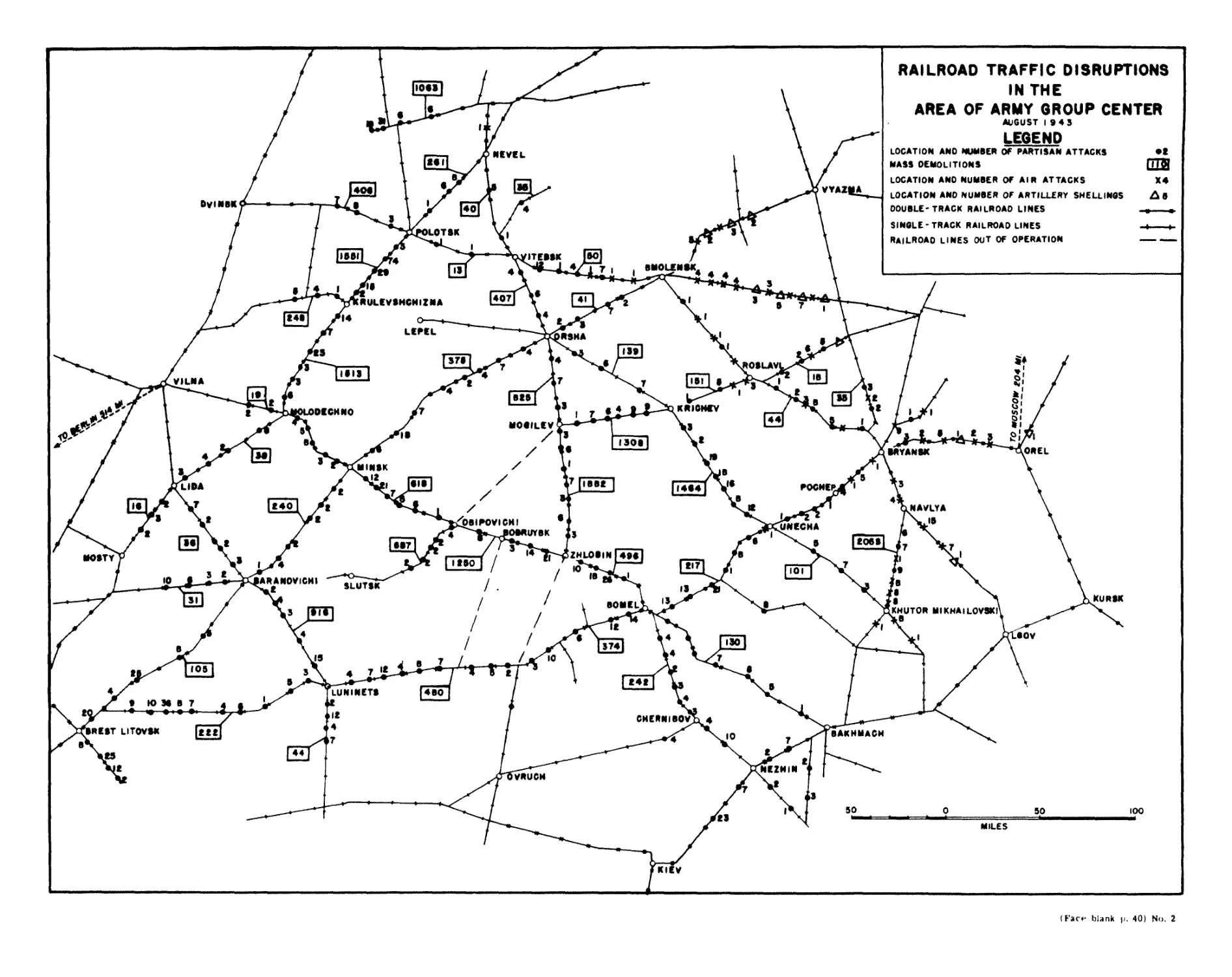
2.	Railroad Demolitions.......................(facing)	40
This pamphlet supersedes MS No. T-19, “Rear Area Security in Russia,” pub-
lished by the Office of the Chief of Military History, Special Staff, U. S. Army,
in July 1950.
SECTION I
INTRODUCTION
This study on the problems of rear area security is based on German
experiences during the Russian campaign. Particularly striking
examples have been selected which show most clearly the type of
disturbances created by the Russians, the German countermeasures
taken against them, and the lessons learned from experience. The
same, similar, or different circumstances were encountered in other
theaters of war. Accordingly, a variety of security measures be-
came necessary and many new experiences were gathered. Yet, the
fundamental questions remain the same everywhere.
Seen from the Russian point of view the problem might be stated
as follows: “By what means or methods can I most effectively cut
the lifeline of the enemy’s fighting forces, either for a short time,
or, if possible, for an extended period; where can I disrupt the line
in such a manner that the effect will be felt at the front?” The
answer is a definite combat method which has the typical character-
istics of a blockade. It can be executed with relatively small forces
and limited means; by allowing for the mobilization of the populace
it represents a morale factor as well as an increase in fighting strength,
while offering further advantages through the use of sabotage and
espionage behind the enemy lines.
A country as vast as Russia, where many sparsely settled areas
offer an abundance of shelter and concealment, naturally provides
much greater possibilities for the use of this combat method than
countries with different terrain. An additional factor is the strong
natural inclination of the Slavs toward fighting from ambush and
under cover of darkness.
From the German point of view, the problem might be approached
in the following manner: “What active and passive measures of se-
curity must be employed in order to deprive such combat methods
of their effectiveness or to reduce their effect to virtual insignifi-
cance?” Such considerations should not be confined to purely mili-
tary aspects. In varying degree the politician, the public
administrator, the military commander, and even the ordinary soldier
have to deal with these questions. Uniformity in understanding
1
2
GERMAN REPORT SERIES
and in meeting the problem, from the highest to the lowest echelon,
is a fundamental prerequisite for success. Furthermore, one should
never be caught unawares by combat methods of that type. By
careful advance study, not only of the country itself but also of the
people, their customs, cares, and needs, as well as their hopes and
desires, one must be prepared to meet such methods and even to
anticipate new’ tactics on the basis of current experiences.
It should be emphasized at this point that whoever makes use of
this combat method constantly gains new’ experience which will enable
him to improve and intensify his actions. Different methods are de-
veloped from day to day, and some of them are likely to be funda-
mentally new\ The tremendous technical advance of the last Id years
has placed entirely newT and undreamed-of means of great effectiveness
at the disposal of mankind. Even if one disregards the practical ap-
plication of atomic energy, rocket weapons alone constitute a sub-
stantial element of destruction. Further possibilities may lie in the
harnessing of nature’s own functions. Just as science has recently suc-
ceeded in producing man-made rain, it is conceivable that a w’ay might
be found of causing a coating of ice to form on switch tower installa-
tions, turntables, and switches, so that railroad traffic may be tempo-
rarily paralyzed. At the height of battle such measures could be of
decisive importance in hampering strategic troop movements, as well
as transportation of fuel and ammunition. It would be profitable,
therefore, to employ at an early stage the most capable experts in tech-
nology, physics, and chemistry who are able to apply, as w-ell as to
counteract, such modern methods of warfare. This is one field where
no limit is set to man’s imagination. At any rate, to be prepared means
to save lives and to limit the range of those incalculable factors which
must be expected in any war.
It is a fact supported by many examples in military history that
events and conditions behind the front lines have often failed to re-
ceive sufficient attention. In all but a few cases this has w’orked to the
disadvantage of the front. Combat forces, w’hile they are in contact
with the enemy, should never have to concern themselves w’ith security
problems of areas that lie behind them. That should always be the
responsibility of higher echelons.
Rear area communications are comparable to the blood vessels of the
human body. The most capable brain, the strongest arm, the most
powerful heart can no longer fully perform its functions if the blood
cannot follow its prescribed course through the vital arteries. It w7as
wfith these ideas in mind that the following study was prepared.
During the Russian campaign, the most significant and instructive
examples presented themselves in the area of Army Group Center.
REAR AREA SECURITY IN RUSSIA	3
From the wealth of material available for this study, primarily based
on the personal recollections of the contributors who had taken part in
the Russian campaign, only those examples were selected which had
been duplicated by experiences on other sectors of the front. To that
extent the present report may be considered generally applicable.
The areas of Army Group South (Ukraine) and Army Group North
(Baltic States) were not favorable to partisan activities. Reasons for
this are to be found in the well-known political conditions. Army
Group Center, however, entered old Russian territory at the very out-
set of operations.
4
GERMAN REPORT SERIES
SECTION 11
GERMAN PLANS AND PREPARATIONS
When the first plans were laid for the campaign against Russia, the
problem of security for all the necessary supply routes through the
vast areas of the future theater of operations played a significant part.
In the light of historical experience, a considerably greater enemy
effort against the German supply lines was to be expected than in
previous campaigns with their relatively short lines of communica-
tions, or in any of the areas already occupied. But the main point in
all deliberations and the primary factor in all phases of military prep-
aration was the vast expanse of Russian territory. Obviously, all
supply routes would have to be considerably longer than ever before
and thus more susceptible to incursions of all kinds. This was true
not only for all roads, rail lines, and waterways, but also for all points
at which supplies were to be stored. Anyone aware of these facts
could virtually anticipate the location and number of probable danger
points and the strength of the forces required to eliminate these se-
curity threats.
Deliberations over the type and extent of essential security meas-
ures led to the conclusion that, in this field also, a new approach had
to be found. No longer was the main danger focussed on the same
areas as in previous campaigns, for the operations zone of an army
now appeared to be much less exposed than the areas farther to the
rear. Areas in close proximity to the front are always the scene of
strong concentrations of forces which have firm control over the local
rail and road net and are in a position to keep the local population
under close surveillance. In such areas it was, therefore, possible to
maintain constant supervision and a high degree of security without
employing a large force exclusively for that purpose. Any special
security forces that were saved in this manner could be used to better
advantage in other areas where the danger was greater, while those
remaining in the combat zone could now be assigned to more specific
tasks.
An entirely different situation prevailed in the rear areas where the
vastness of the country, sparsely covered by German troops, presented
a constant problem. Here, in view of the over-all manpower situa-
tion, only a limited number of widely dispersed occupation units could
be employed. The constant lengthening of communication lines be-
cause of the rapid progress of operations produced an increasing need
for security forces, a need that was even greater in the rear than in
the vicinity of the front lines. These considerations determined all
REAR AREA SECURITY IN RUSSIA
5
German plans for the protection of communication lines, a. factor of
vital importance to the outcome of the entire operation.
From the outset a distinction was made between active and passive
security measures. For the purpose of active security, special units
of various types and strength were created. At first they were or-
ganized in the form of separate battalions, and only in those instances
where unusually extensive installations had to be protected w’ere sev-
eral battalions combined under the control of a security regiment head-
quarters. Most of their personnel was taken from older age groups
and consisted largely of veterans of World War I or of men who had
received a minimum of training in replacement units. They were led
by older reserve officers or retired officers who had been recalled to
active duty. These facts need to be emphasized for the better under-
standing of the difficulties which these units had to overcome later on
in the performance of their tasks. Nevertheless, many of these se-
curity units gave an excellent account of themselves, particularly when
the growing manpower shortage necessitated their employment as
combat troops at the front.
They had a variety of weapons in altogether insufficient quantities.
When the Replacement Army was no longer able to furnish an ade-
quate supply of small arms, which were then more urgently needed
at the front, the security units had to bp equipped with captured
Russian weapons. It is quite obvious that units outfitted in that
manner and often inadequately acquainted with their new and un-
familiar weapons were extremely limited in their usefulness, except
for areas where little or no trouble on the part of the populace was
to be expected.
The unusual extent of all prospective operations in the East
prompted the German High Command to lay plans for the estab-
lishment of a security organization that would be more or less in-
dependent of the .armies operating in the forward areas. For this
reason the area immediately to the rear of an army group operations
zone was designated as an army group rear area (Ruecksvaertiges
Heeresgebiet}. There, using his own forces, the army group rear area
commander was to be responsible for all active security measures,
for the pacification of enemy territory, and, consequently, for the
protection of all lines of communication. Whereas in previous cam-
paigns no more than weak security units had been organized and em-
ployed, the arrangement for the Russian campaign included (the
formation of entire security divisions, largely similar in composi-
tion and equipment to standard infantry divisions, but subject to
certain variations depending on the availability of personnel and
materiel. These units eventually proved capable of conducting an
6
GERMAN REPORT SERIES
active defense against enemy forces appearing in army group rear
areas. The areas assigned to individual security divisions varied in
size from 5,000 to 10,000 square miles.
The security and pacification of occupied enemy territory behind
the army group rear areas was to be the responsibility of the mili-
tary occupation authorities, an arrangement that had fully proved
itself during other campaigns. Their administrative agencies were
to cover the occupied territory in a network of Kommandanturen
[administrative area headquarters] of various levels, such as ОЪет-
feldkommandanturen [divisional level], F'eldkommandanturen [reg-
imental level,] and Ortskommandanturen [company level]. Security
forces of various strengths, as mentioned above, were to be assigned
to these administrative units, depending on the size of the areas to
be controlled. During the course of the Russian campaign, this or-
ganization made a substantial contribution toward the maintenance
and security of German lines of communication from the homeland
to the front. z
Perhaps it should be emphasized at this point that to assure the
security of future supply routes, active precautionary measures must
be taken, even during the advance, to prevent the destruction of vul-
nerable objectives. This is especially true of the main supply car-
rier—the railroads.
On 22 Juqe 1941, for instance, during the very first hour of the
Russian campaign many road and railroad bridges were saved from
destruction by the swift and surprising action of a few small combat
patrols. Later these bridges were of invaluable importance to the
entire German supply system in the East and in some instances ac-
tually provided the basis for further successful operations. During
the course of the entire war, many objectives of vital importance
to the transportation of supplies, such as bridges, underpasses, via-
ducts, railroad shops, and water supply installations were secured
intact because of the energetic action of advance detachments. This
was of particular significance in the case of railroad bridges which,
if destroyed, would have required a long time to be restored to normal
operation.
In the final analysis it was the master plan of the Chief of Supply
and Administration which determined, more than anything else, the
over-all structure of the security organization. Although recognized
as a primary prerequisite, the immediate availability of the railroads
as a carrier of supply could not be expected and, at first, was not taken
into account. It was assumed that the roadbeds would be unusuable
because of demolitions, that the Russians would remove all their roll-
ing stock, that the difference in gauge would necessitate the re-laying
REAR AREA SECURITY IN RUSSIA
7
of tracks, and that considerable partisan activity would be encoun-
tered. Therefore, all German plans for the movement of supplies
were initially based on the use of the sparse road net that existed in
Russian territory.
Armored spearheads were to be accompanied by heavy motor truck
transportation units carrying supplies up to a distance of about 300
miles from the base. In this plan the supply of the more slowly ad-
vancing infantry divisions, which were equipped with horse-drawn
vehicles, was also taken into consideration. The motortruck trans-
portation units were to establish supply depots approximately 50-75
miles apart. These installations were to be set up in the immediate
vicinity of large communities and preferably close to favorable rail-
road facilities. Particular emphasis was placed on the establishment
of safe and adequate facilities for the storing of large quantities of
supplies. As the combat elements continued to advance, a special
security force was to be assigned to each of these supply depots to as-
sure their undisturbed organization and improvement. The strength
of these forces depended on the size of the installation, the area that
had to be guarded, and the degree of danger from partisan activities.
Generally, the plan called for a regimental headquarters with the
usual number of security battalions in the case of a larger town, while
a battalion headquarters with the corresponding number of smaller
units was to be employed for the protection of smaller installations.
As far as possible, front line troops were to be relieved of all such
security assignments. As it turned out later, this policy could never
be fully enforced.
The protection of these supply depots involved a variety of prob-
lems. Internal security consisted of guarding the supply dumps and
adjacent buildings and facilities. Since these installations were to
include warehouses for all classes of supply, as for instance rations,
clothing, ammunition, fuel, medical and veterinary equipment, as well
as motor vehicles and spare parts, the need for security forces grew
considerably as operations progressed. This circumstance had to be
taken into account in all planning and especially in organizing secu-
rity units. Furthermore, all installations necessary for the mainte-
nance and operation of the supply depots, such as powTer plants,
railroad stations, and airfields, as well as the billets of the security
troops themselves, required additional protective measures.. The mere
fact that some of the larger supply installations might well assume
the proportions of a medium-sized city may offer an indication as to
the number of security troops that would become necessary.
The supply plan called for each newly installed supply depot to
organize a forward echelon which was to move up behind the combat
8
GERMAN REPORT SERIES
forces along the most suitable road. At these central supply depots,
other smaller supply depots were to be organized and distributed
laterally in both directions. In this manner the infantry divisions,
regardless of their route of advance, could obtain their supplies with-
out the necessity for long-distance hauls. A “block system” of suc-
cessive guard posts was to be established to safeguard the flow of
supply from one depot to the next.
In addition to the forces required for the above-mentioned tasks,
security troops were to be furnished to the several armies to protect
their base supply depots and installations and to relieve the combat
forces as soon as possible of all security duties. Experience had
taught that the actual combat elements were excessively burdened
with such duties and thus often deprived of forces which were urgently
heeded at the front.
The initially established supply depots were to remain in opera-
tion until the Russian railroads could be converted to normal gauge
and the supply bases advanced into the zone of operations. Then, as
supply depots farther to the rear would be dissolved, their security
forces could be made available for employment in forward installa-
tions. Another possibility for the release of security troops on an
even larger scale would arise as soon as a previous zone of operations
or an area under military control was taken over by a civilian admin-
istration. The police forces of this administration were then to as-
sume the former duties of the security troops.
According to the original plan, the initial requirements of security
forces were to be met by selecting combat units that had proved them-
selves during previous campaigns. Subsequent needs had to be cov-
ered by organizing new units. It was clear to all concerned that this
plan would never produce a fully satisfactory result, partly because
of the vastness of the prospective theater of operations and partly
because of the limited replacement potential, which would certainly
preclude the large-scale organization of units for purposes of security
only. This view was later borne out in practice. To an ever increas-
ing degree transportation and supply units of many types, and fre-
quently even front line troops, had to be charged with the above-men-
tioned duties.
German plans for active security also called for an active air de-
fense. Antiaircraft artillery units were to be provided for the pro-
tection of large or particularly important railroad stations, work-
shops, bridges, and similar installations. In each case the strength
of these units depended on the availability of personnel and the im-
portance of the installation. They were to be under the control of
regional air force commanders.
REAR AREA SECURITY IN RUSSIA
9
Fuel trains and similar shipments, which at a later stage of the
campaign became unusually valuable, were to be protected wherever
possible by railroad antiaircraft batteries consisting of 20-mm. four-
barreled guns mounted on flatcars. These units were under the com-
jnand of the army group rail transportation officer.
Since it was quite obvious that both manpower and materiel for
security purposes would be limited, special consideration was given to
the problem of passive defense. Thorough training of all agencies
and forces concerned with the moving and handling of supply was
recognized as a primary prerequisite for passive security measures.
The combat troops themselves can contribute in many ways to the
security and preservation of scarce and valuable supplies, and thus
increase their own readiness for action as well as their combdt effi-
ciency. Combat and service troops alike received continuous instruc-
tion by appropriate directives and orders and were further trained by
means of demonstrations and field exercises.
Of the many passive means of protection, the following may be
mentioned: Over poor roads, through endangered areas, or at night
long supply columns were to move quickly and without interruption;
single vehicles were to avoid passing through partisan-infested areas;
full use was to be made of the block system of security established
along the roads by driving in convoy from block to block; and un-
loaded supplies were to be dispersed for protection against destruc-
tion from the air.
Particularly after 1943, as a result of experiences gathered during
enemy air raids, unloaded supplies of all classes were generally placed
underground. Only in this manner was it possible to preserve large
quantities of supplies, which up to that time had been prize targets
for the Russian air force. Protection for ammunition of all types
was assured not only by means of dispersal but also by storage in tun-
nels and bunkers. In the case of fires caused by bombing attacks this
method of storing had the obvious advantage that the spreading blaze
caused considerably less damage to ammunition dumps than oh pre-
vious occasions.
The precious motor fuels were stored in trenches protected by banks
of earth on both sides. Drainage ditches were dug which, in the event
of a large fire, would allow the fuel to flow off quickly and thus di-
minish the danger of an expanding blaze. The storing of rations re-
quired a greater expenditure of material and labor, especially in the
case of valuable food supplies which had to be protected against spoil-
age due to moisture.
The passive air defense of railroad lines, buildings, and other rail-
road installations wTas carried out at the request of, and in close co-
10
GERMAN REPORT SERIES
operation with, the regional transportation agencies. In army areas
this was the responsibility of the local commanders, in army group
rear areas that of the rear area commanders. Security forces of
the type discussed in the earlier part of this study, particularly
security divisions, were employed for this purpose. In areas where
additional protection was required because of heavy partisan activi-
ties or the presence of important railroad lines, these security forces
were at times supported by other German units that happened to
be in the area$ such as combat divisions which had been withdrawn
from the front. As a last resort, the so-called emergency alert
units were called upon which, though formed specifically for this
purpose, were not too highly valued. In areas under the control of
civilian occupation authorities, all security functions mentioned above
were assigned to the regular police forces.
On many occasions, replacement transfer battalions and casual de-
tachments en route had to be employed in the defense of endangered
railroad lines. The trains themselves were protected by so-called
transport security regiments. They were subordinate to the army
group rail transportation officers and received their specific assign-
ments from regional transportation headquarters. Troop transports
and personnel on leave trains were responsible for their own security.
For the protection of freight trains, cars were attached which offered
observation and fields of fire over the entire length of the train.
Railroad lines and installations were protected by a system of block
control points and by security patrols operating along the lines. In
wooded areas both sides of the tracks were cleared to a width of 300
yards to prevent partisans from approaching without being discov-
ered. Among the many protective measures developed during the
course of the campaign the following might be mentioned at this
point: One or more flatcars' loaded with rocks were used in front of
particularly important trains to provide protection against pressure
and vibration-type mines. In some instances a whole train of empties
was placed ahead of the train that was to be protected. Mobile con-
construCtion units were distributed along the railroad lines. Amply
equipped with construction materials and interconnected by a tele-
phone circuit, they could be immediately directed to any point where
the railroad had been damaged by enemy interference. At a later
stage, when telephone poles became a favorite object of destruction
foy the partisans, demolition charges were inserted which would det-
onate if an attempt was made to cut or fell the poles. An item of
civilian railroad equipment—a special mine-clearance device without
crew—was placed in front of the trains to set off enemy mines in the
roadbed by subjecting the tracks to continuous vibrations.
REAR AREA SECURITY IN RUSSIA
11
Iii the operation of the railroads, various protective measures were
introduced. They included travel at low speed (at night not over
10 miles per hour) ; movement of several trains in convoy; rerouting
of trains insofar as the lines permitted; and placing the locomotive
in the center of the train in order to protect it from immediate destruc-
tion in case of mine explosions. Later on, when large numbers of
Russian railroad personnel were employed, particular emphasis was
placed on their closest surveillance.
Specific measures of passive air defense—a matter of paramount
importance for railroad stations and junctions—comprised the trans-
fer of all central switchboards from railroad stations to the outside,
so as to create individual loop circuits. In the construction of new
installations considerable intervals were maintained between build-
ings. As soon as they were occupied, all vital installations and all
personnel quarters were immediately protected by every available
means against the effect of bombs or fragments. Troops were fre-
quently quartered in trains which were taken out onto open track
at night.
In close cooperation with the supply agencies the unloading of all
shipments was to be accomplished in the shortest possible time. As
a standing operating procedure at night or during air raid alerts,
all railroad stations were to be cleared of trains carrying ammunition
and fuel. If supply trains could not be unloaded promptly, they were
to be separated and their individual sections distributed as far as
possible over all available spur tracks.
The aircraft warning service of units in the area was hooked up
with the railway signal communication system, so that all traffic con-
trol agencies could be alerted in time and with maximum speed. If
the wire lines were destroyed, these warnings were to be transmitted
by radio.
As the above-mentioned plans and precautions indicate, the German
Army High Command was by no means caught unawares by the strong
partisan activities encountered during the Russian campaign. It was
known for some time that the Russians were determined to use organ-
ized partisan warfare in the defense of their country and that they
had used propaganda to spread the idea among their population.
Their future military leaders in partisan warfare had been carefully
trained in the use of this combat method. Just before the start of
the campaign—according to information received in Germany—the
Russian War Academy conducted war games in an area where cer-
tain locations were designated as so-called partisan centers.
Similarly, the Russian High Command had recognized at an early
stage that, in contrast to the dense railroad and highway networks
12
GERMAN REPORT SERIES
of .the highly urbanized West with its ever-present possibilities for
alternate routes, the very few serviceable supply routes through the
vast expanse of the Russian area were of paramount strategic impor-
tance. Furthermore, in view of the great distances, the poor condition
of the highways (which easily deteriorated under the influence of the
weather), and the anticipated shortage of motor vehicles and fuel on
the German side, the Russians realized that the main burden of
supply would have to be carried by the railroads and that this would
be equally true of all large-scale troop movements, furlough trans-
portation, and evacuations. Clearly cognizant of this handicap, which
would present itself in any military campaign against Russia, the
enemy began early in the war to build up a “second front” behind
the German lines.
REAR AREA SECURITY IN RUSSIA
13
SECTION III
THE FRONT BEHIND THE FRONT
1.	Interference by Isolated Russian Units
During the first 6 months of the Russian campaign, the German sup-
ply system generally functioned without major interruptions. Either
the enemy had failed to recover from the initial blow, or he was yet
unable to muster the proper means for effective raids on German rear
communications. Isolated attacks were made on German supply
units, and at times entire divisions were cut off from their supply
base for a short period. But actually this was always the work of
organic Russian troop units or of groups of stragglers who, in their
attempt to fight their way back to the east and rejoin their own forces,
had to cross highways or side roads and on such occasions came into
sudden and unexpected contact with German supply units. In these
engagements, the supply troops were mostly at a disadvantage since
they were hardly prepared to meet a fully armed opponent. At the
very beginning of the Russian campaign the drivers of supply trucks,
for instance, were inadequately equipped with small arms, and ma-
chine guns were lacking altogether.
In the fall of 1941, a heavy truck transportation company was pro-
ceeding along the Slutsk-Bobruysk road; The convoy consisted of
30 trucks with trailers and a crew of about 75 men. Because of ex-
cessive dust an interval of 50 yards was maintained between vehicles,
which were moving at a speed of about 15 miles per hour.
When the leading truck rounded a curve, a large Russian cavalry
force suddenly came into sight at a distance of about 1,200 yards—ap-
parently in process of crossing the road from south to north. At the
same time the truck column drew fire from the front; what appeared
to be an antitank shell went through the windshield of the leading
vehicle and into the cargo without injuring anyone.
The truck stopped at once; its crew, with the exception of the driver,
jumped off and took up positions about 25 yards ahead. An antitank
gun was spotted in a ditch about 300 yards down the road. The com-
pany commander, who because of the breakdown of his own vehicle,
had been riding on the leading truck, ordered his men to open fire on
the Russian gun crew. Meanwhile the assistant drivers of the other
vehicles had been brought up and placed in position. A motorcycle
messenger was dispatched to notify the military commander of Slutsk
and request assistance.
14
GERMAN REPORT SERIES
By now the enemy was also using machine guns and his volume of
fire increased steadily. On the German side two machine guns and
30 rifles had been brought into action. Soon the first casualties were
caused by the very accurate fire of the Russian antitank gun.
To save the vehicles, which were loaded with ammunition, the
company commander ordered the drivers to take their trucks about
1 mile back on the same road and to wait out of sight with their
engines running. Great skill was required to turn the 20-ton trailer
trucks around on the narrow road. Screened by clouds of smoke
billowing from the leading truck which had been set on fire, this
maneuver succeeded. About an hour later the company commander
received word that the order had been carried out.
After another hour and a half reinforcements came up from the
rear and went into position. Finally, elements of a machine gun
battalion arrived on the scene and its commander took charge of the
fighting. The men of the truck company could now be withdrawn.
Their losses amounted to one dead and seren wounded, with three
ammunition trucks and trailers destroyed. Subsequent reconnais-
sance and interrogation of prisoners established that the truck com-
pany had run into elements of a 2,500-man Russian cavalry unit
which had crossed the road on its way into the forest area south
of Minsk.
The company had accomplished its general mission of protecting
its cargo and of keeping it from falling into the enemy’s hands.
Had the convoy not been carrying ammunition, the outcome of a
prolonged fire fight with an enemy of the described strength would
have been extremely doubtful. Certainly the 30 rounds of ammu-
nition which each man carried on his person would have proved
inadequate. It was only because of the nature of the supplies loaded
on the trucks that the enemy could be held at bay until reinforce-
ments arrived.
At the time mentioned, the local inhabitants were generally co-
operative everywhere. They welcomed the German forces as their
liberators and desired nothing more fervently than to resume their
normal, peaceful activities. This attitude was demonstrated in
many ways. It was a common occurrence for mayors to request
protection against scattered Russian soldiers who had formed bands
in the deep forests and conducted raids against German troops and
local inhabitants alike, primarily for the purpose of obtaining food,
civilian clothing, and other necessities. Frequently, German supply
units or delayed single vehicles had to bivouac in deep forests and
passed the night without suffering any damage. On some occasions
the local inhabitants actually warned German troops against bands
REAR AREA SECURITY IN RUSSIA
15
operating in the vicinity and called their attention to specific danger
spots.
2.	German Attempts to Restore the Local Economy
The German combat forces, at least during the initial period of
the campaign, made every effort to restore normal conditions in the
areas they occupied and to gain the confidence of the local population.
In the summer of 1941, the eastward advance of a German infantry
corps was halted temporarily by strong resistance near Rogachev
in the area of Bobruysk. At the same time a supply bottleneck had
developed which made it necessary to fall back on supplies that could
be obtained from the surrounding territory. For the purpose of
administration and local management the corps area, insofar as it
was not affected by the fighting, was divided into subareas and
placed under the control of the divisions. The area assigned to one
particular division covered about 40 square miles and extended
between the Bobruysk-Roslavl highway and the Berezina River.
Under the control of the division’s supply and administration
echelon the area was subdivided into districts similar to those of the
former civilian administration. Each district was under the man-
agement of an officer or a civilian official of the division to whom a
permanent interpreter was assigned. These officers and officials
were relieved of all other duties and had to be present in their dis-
tricts at all times. They were instructed to take up personal contact
with the people, particularly with the older and more influential
inhabitants, and to make every effort to gain their confidence.
Even in peacetime the area around Bobruysk had figured in the war
plans of the Soviet High Command as a potential center of organized
partisan resistance. As early as 1940—as the Germans found out
later—the Russian War Academy had made this area the scene of
special partisan war games under the direction of General Kulik who
was yet to play an important role in actual partisan warfare. It was
all the more remarkable that only 1 year later, because of their judicious
handling of the population, the Germans were able to keep the in-
habitants at peace and, moreover, to utilize the resources of the region
for their own purposes.
When the area was first occupied, its peacetime economy appeared
completely paralyzed. The bulk of its agricultural and industrial
machinery had beeir either destroyed or removed by the Soviets. In
keeping with the Russian mentality, all work in the cities was at a
standstill and the fields lay fallow. Everybody seemed to be wait-
ing for a direct order to start the wheels turning. As a first step in that
direction all existing enterprises were seized and inventoried under
16
GERMAN REPORT SERIES
the supervision of the district officers. Then all plants that were still
adequately equipped received orders to resume operation immediately.
In other cases attempts were made to replace damaged machines of
missing materiel.
Russian mayors and collective farm managers were charged with the
responsibility for getting the work in the fields under way, and soon
the first harvests were brought in. Next, the grist mills, dairies, baker-
ies, and workshops of local craftsmen were put back into operation.
Salvaged tractors, with fuel for them, were issued to the local civilian
agencies. Egg collecting points, grain depots, and milk delivery sta-
tions were established. The marmalade factory at Bobruysk resumed
operation under the direction of one of the division’s disbursing offi-
cials who happened to have previous professional experience in this
particular field. While the plant provided employment for many
Russian laborers, both male and female, its products were welcomed by
German troops and local inhabitants alike. All financial transactions
were left entirely to the Russian civilian agencies, subject only to final
supervision by German experts. No friction of any kind resulted from
this procedure.
To assure the proper treatment of the Russian population, all Ger-
man officers and noncommissioned officers appointed to these admin-
istrative posts were given a short orientation course by German experts
on Russia. The redistribution of collective property was begun with
the greatest caution, so as to cause the least possible disturbance to the
general structure of the local economy. Collective workshops were
abolished and henceforth every craftsman was permitted to practice
his trade freely. For the repair and rehabilitation of factories and for
their subsequent operation, skilled laborers were placed under the
supervision of men with suitable background who were drawn from
the German forces or even from the native population. The admin-
istration of state farms (Sovkhoz) was decentralized, and they were
turned into local agricultural cooperatives.
Thus the division was soon able to cover at least part of its supply
needs from local sources without actually robbing the country, while
making a notable contribution toward the improvement of the over-
all supply situation. Within a short time a variety of articles was
produced in the area under the division’s administration. In addition
to foodstuffs and similar items, the products included horseshoes,
hardware made by local blacksmiths, and tow ropes for the horse-
drawn units, especially for the divisional artillery. The local in-
habitants were immediately reimbursed for all deliveries by certifi-
cates of value received, and the amounts were credited by the Russian
local administration against their requirements of every-day com-
modities.
REAR AREA SECURITY IN RUSSIA
17
It was not without significance for the establishment of good will
among the inhabitants of the area that one of the division’s chaplains
happened to be a native of Russia who had a good command of the
language and was fully familiar with the Russian mentality. With
the arrival of the German forces all churches had been reopened every-
where, and German troops and local inhabitants met in common wor-
ship. The news spread rapidly throughout the area; from afar
Russian parents would bring their children to Bobruysk to have them
baptized by the German minister in the newly opened church.
Once a feeling of mutual confidence had developed, the dance- and
music-loving inhabitants arranged village festivals at harvest time
which were regularly attended by German district officials and mem-
bers of the security units.
Any arbitrary acts by German troops, such as the unwarranted
slaughtering of cattle, plunder in any form, or the wanton destruction
of property, were most severely punished. This served to protect
the few possessions which the Soviet regime had left in the hands of
private individuals and strengthened the confidence of the people in
the fairness and justice of the German forces. For some time after
August 1941, when it had to resume its advance toward the east, the
division remained in touch with the area that, had been under its con-
trol until increasing distance made all further contact impossible.
With the arrival of the occupation forces, which assumed control
over the Bobruysk area following the departure of the German combat
division, the picture changed from the very outset; the population
was treated in a manner quite different from that to which it had
been accustomed. Whereas previously certain regulations pertaining
to freedom of movement in the area, curfew, etc., had been somewhat
relaxed, they were now rigidly enforced. Every rule of common sense
was suddenly replaced by strict adherence to the letter of the law.
Such methods naturally had the effect of lessening the confidence of
the people in the good will of the occupying forces. Particularly the
well-meaning elements among the population, who had demonstrated
their willingness to cooperate fully, were now sadly disappointed,
whereas their opponents rejoiced and hastened to exploit the new
situation for the benefit of the partisans and their counterpropaganda.
Eventually the new occupation forces proved incapable of taking
effective measures against the partisans, who were now operating
under the command of Marshal Kulik. The Germans gradually lost
control over the entire area around Bobruysk, which became one of
the most dangerous centers of partisan activities. German rear com-
munications were continuously disrupted, while troop movements,
railroad trains, and truck transports were harassed by persistent
attacks.
18
GERMAN REPORT SERIES
The preceding example may serve as an illustration—even though
on a limited scale—of the many advantages to be gained by the pacifi-
cation of occupied territory, provided of course that forces are em-
ployed who are properly trained and adequately prepared for their
task. This was not an isolated incident. Other German combat units
were even more successful in enlisting the active cooperation of local
administrative officials.
In the fall of 1941, a German division advancing toward Bryansk
encountered heavy enemy resistance in the area of Pochep and had to
assume the defensive on a broad front. As a result, the divisional
supply point was located for some time at or near Mglin (20 miles
northeast of Unecha). Here also, following the successful example of
Bobruysk, a Germany military headquarters was established for the
purpose of administrative supervision and area management, while
the local Russian administration was reconstituted and staffed with
new personnel.
In numerous meetings with the town council, arrangements were
made for the resumption of work in local crafts and trades, as well as
for the assurance of an adequate food supply. Soon the harvest was
under way; then grist mills and distributing agencies resumed opera-
tion. It was even possible to reopen a print shop and a tannery which
served the German forces, as well as the local inhabitants. With the
aid of the Russian mayor, who was extremely active and willing to
cooperate, a program was initiated for the repair of damaged hous-
ing and the construction of new dwellings. Offenses against the oc-
cupying forces were handled by German military courts with the co-
operation and advice of local experts. In no instance was it necessary
to inflict the death penalty or to take hostages.
In the town of Mglin and throughout the surrounding area peace-
ful conditions were soon established. Without disturbance the in-
habitants continued to pursue their normal occupations. It was in-
creasingly evident that after a short period, during which the activi-
ties of the German troops had been under careful scrutiny, the occu-
pying forces had succeeded in gaining the confidence of the people.
The same reaction was found even among the large Jewish popula-
tion living both in the town and in the rural districts. During that
entire time the front lines were no more than about 25 miles away.
In all other respects the pacification of the area was accomplished in
about the same manner as described in the preceding example.
When the division finally had to leave, it also tried to maintain
contact with the region that had been under its control. But here
again the same administrative blunders turned an initial success
into failure. The occupation forces which took over proved incapable
REAR AREA SECURITY IN RUSSIA
19
of protecting the population against the partisans, and quickly de-
stroyed all confidence by their unreasonable treatment of local in-
habitants. The police forces assigned to the area soon began to
recruit forced labor and to persecute the Jewish elements of the
population. Six months later this area also had developed into a
hotbed of partisan activities through which supply transports were
routed only in extreme emergencies.	x
3.	The Rise of the Partisan Front
By late fall of 1941, occasional acts of sabotage by groups and
individuals had become routine. The beginnings of a well-planned
partisan organization that operated with a variety of technical and
psychological means were clearly noticeable. A typical Russian in-
stitution based on national tradition, this organization grew steadily
in size and importance throughout the entire war.*
There can be little doubt that by the winter of 1941-42 the basic
pattern of the Soviet partisan organization had been established.
To lay the groundwork in German-occupied territory, Russian agents
under the guise of helpless civilians took advantage of the kind-
heartedness of the German soldier by passing through the lines and
infiltrating into the army group rear areas. Other agents who had
been left behind during the retreat of the Red Army gradually
began their work. Many of them were women who felt that they
could count on protection by the German soldiers.
Changes in the attitude of the population soon gave evidence of
the incessant 'activity of thoroughly trained agents who made the
best of apparent weaknesses of their German opponents. The people
were told that the inevitable return of the Red Army would be
a day of reckoning for all those who had collaborated with the occu-
pying power. On the other hand, strong appeals were made to their
national sentiment. “Shame and death to those who collaborate
with the enemy ! Save Mother Russia 1” was a typical slogan. With
great skill, the Russian propagandists exploited every mistake made
by the occupying power in the treatment of the local population.
Eventually these mistakes, more than anything else, served to under-
mine the initial confidence of the people in the Germans and in Ger-
man propaganda.
Whereas the local inhabitants up to that time had been friendly,
trustful, and entirely willing to cooperate, their attitude changed
greatly during that first winter. While they did not commit any overt
acts, they clearly displayed more restraint in their relations with the
*Ed. : See also DA Pamphlet 20-230, Russian Combat Methods in World War II,
pp. 103 ff.
20
GERMAN REPORT SERIES
German occupying forces. Many of them took great pains to avoid
being seen during daytime in the company of German soldiers. It
became more and more difficult to find men who were willing to accept
local administrative posts. Here also the terror tactics employed by
Soviet agents began to make themselves felt.
The next step was the formation of small bands which established
their hideouts in the forests. They forced the inhabitants of the
area to supply them with food and give support in other ways. At
first their activity was confined to more or less coordinated raids
on targets of opportunity. They attacked smaller German camps or
supply depots, raided and plundered single vehicles on the road,
blew up Russian industrial enterprises that worked for the German
troops, and took with them any Russians who were working for
the occupying power. Occasionally, they carried out demolitions
of railroad lines which could often be repaired without major delay
in operation. In some instances even German railway construction
units working under insufficient protection were attacked and wiped
out by partisan bands.
Early in 1942, in order to facilitate the movement of supply
through difficult terrain or partisan infested areas, attempts were
made by the German forces to restore some of the railroad lines that
led into the corps sectors of the Second Panzer Army. Individual
railway construction units were employed which had to provide their
own security as they advanced along the tracks to make the neces-
sary repairs.
In this manner, a railway construction company was assigned to
the Bryansk—Dudorovsky sector, about 50 miles east of Bryansk.
Strictly on its own the company worked for weeks on one particular
section of the track. Eventually several days passed without any
report being received from the unit. Investigations revealed that the
entire company had been wiped out by partisans while it was working
near Zhurinichi (15 miles east of Bryansk). All repairs on the sec-
tion were immediately halted, and the line was of no further use since
no additional forces could be spared to strengthen the security of the
construction troops. The search for the partisans who had carried
out the raid proved fruitless. Thereafter, to prevent the recurrence
of such surprise attacks, railway construction units were no longer
sent out alone unless they could maintain daily direct contact with
nearby supply depots or combat troops.
By 1942 Russian partisan warfare against the German rear com-
munications had entered a more advanced stage. A network of
channels for transmitting orders, thoroughly planned in peacetime,
reached from a central headquarters in unoccupied Russian territory
REAR AREA SECURITY IN RUSSIA
21
up to the western border of Russia and, in some regions, even into
Polish territory. Whereas prior to that time individual messengers,
crossing the lines in the guise of harmless civilians, had sufficed to
maintain communications and transmit orders, this task was now
regularly performed by courier planes and even transport aircraft.
These airplanes forwarded instructions to the partisan groups oper-
ating behind the German lines and supplied them with arms, ammu-
nition, signal communications equipment, motor fuel, medical
supplies and other necessities. They always carried full radio
equipment to maintain contact with each other and their central
headquarters.
That these flights were very numerous could be established by
German ground and air observation; abandoned parachutes which
were often found by German reconnaissance patrols offered very
definite indications. Apparently the partisan planes operated only
at night; they landed on well-concealed air strips deep in the swamps
and forests or dropped their loads over temporary drop zones identi-
fied by light markers. Partisan headquarters, air strips, and drop
zones were perfectly protected by natural cover and impassable ter-
rain obstacles. Although numerous radio messages emanating from
partisan centers could be intercepted, it was impossible to establish
the accurate location of their transmitters and to take effective counter-
measures either on the ground or from the air.
In the fall of 1942, a German army operating southwest of Orel
was ordered to assure the delivery of a certain quota of grain and
potatoes from the local harvest. Agricultural control officers (Land-
wirtschaftsfuehrer} were posted throughout the entire army area to
supervise and direct the harvest operations carried out by the local
inhabitants. Equipped only with'small arms and scattered widely to
include even the smallest villages in the area, these agricultural con-
trol posts could not be expected to offer effective resistance in the event
of partisan raids. The harvest had no sooner been brought in when
reports about increased partisan activities began to mount. Nu-
merous partisan raids on harvest control points had the result of
frustrating gradually the entire agricultural program until the Ger-
man control organization was virtually driven out of alb harvest areas.
Thus, in the absence of adequate security forces, which could not
be spared anywhere else, the Germans gradually lost control over an
area of great agricultural value. Local inhabitants reported that the
partisans were continuously seizing and carrying off grain supplies.
Other accounts indicated that Russian airplanes were landing every
other night in the partisan-held forests around Bryansk, supposedly
to pick up the grain seized by the partisans and to transport it to the
22
GERMAN REPORT SERIES
east. These reports could actually be verified by German reconnais-
sance which observed landing lights in various places. But since
these air strips were obviously located in areas held by strong partisan
units, any interference from the outside was impossible.
In this manner the Russians succeeded in exploiting an enemy-
occupied area to the advantage of their own war effort, while the
Germans, ostensibly the occupying power, were unable to take ef-
fective countermeasures. Thereafter, whenever German troop move-
ments or antipartisan actions were carried out, they were also used
as an opportunity for salvaging and removing local stores of all kinds.
In February 1942 a Russian plane shot down in the Orel sector was
found to carry a recently completed moving picture film on the “Rus-
sian Counteroffensive Against the Invaders, Begun on G December
1941.” The film was obviously intended to be shown in the rear areas
in order to bolster the morale of the partisan groups and the local
population. On their return flights from partisan areas such aircraft
usually carried messages and reports, captured weapons, and wounded
partisans. Occasionally, they even took along important German
prisoners, as in the case of Brigadier General Max Ilgen who was
captured in the German rear area and flown to Moscow during the
same night.
Generally, the following may be said about the origin, type, and
size of Russian bands operating behind the German lines: Organized
partisan activity usually began with the formation of small, isolated
bands of from 5 to 20 members who were hiding out somewhere in the
woods. Even during the gradual buildup of the entire partisan or-
ganization, these basic units remained fairly independent. Their
activity was initially confined to raids of opportunity conducted for
no other purpose than to supply them with booty. What held them
together was a certain spirit of adventure, probably a natural trait
peculiar to many of their members. It did not take long until the
over-all partisan organization extended also to bands of that type.
They were fitted into a well co-ordinated plan and were employed
chiefly to harass certain areas. In addition, larger groups were or-
ganized, some of which reached a membership of several hundred.
Constituted along military lines and led and employed as military
units, these bands differed only in their appearance from regular Rus-
sian combat troops. Most of their leaders were well-trained profes-
sional soldiers, some of them even general staff officers. They were
brought in by parachute or glider or, wherever possible, were landed
on partisan airfields. Most partisan groups were equipped with small
arms and heavy weapons; a few even used artillery which the Ger-
mans had captured and then abandoned for lack of suitable trans-
REAR AREA SECURITY IN RUSSIA
23
portation facilities after the encirclement battles of the first weeks of
the war. On many occasions large bodies of Russian combat troops
were separated from their main force and sought refuge in the dense
forests. There they were organized into partisan groups and em-
ployed in operations against the German lines of communication.
In the spring of 1943 the Second Panzer Army, comprising about
35 divisions, was engaged in defensive operations in the Orel-Bryansk
area. The main burden of supply was carried by the double-track
railroad line Gomel-Unecha-Bryansk-Orel, which at the same time had
to transport part of the supply for the adjoining Second Army in the
Kursk area. A single-track railroad through Krichev-Surazh, which
joined the main line at Unecha, was available for occasional use and
provided some relief. Another single-track line from Smolensk
through Roslavl to Bryansk served as an additional supply route.
Motor transportation depended primarily on the main Smolensk-
Roslavl-Bryansk highway. The road leading up from Gomel via
Unecha, because of its exceedingly poor condition, w’as used only in
emergencies. Moreover, it crossed some of the worst partisan areas
and for that reason was bypassed whenever possible.
Strong partisan bands were located in the forests west of Lokot
(south of Bryansk). They had been formed of Russian soldiers, cut
off in the Vyazma-Bryansk encirclement battle, who now received their
instructions from partisan headquarters somewhere in unoccupied
Russian territory. Particularly during the Russian breakthrough
into the Kursk area in the winter of 1942-43, they constituted a serious
menace to the deep flank and the rear of the Second Panzer Army.
In order to provide protection against these bands the Germans em-
ployed native units recruited in the area around Lokot. After the
above-mentioned encirclement battle numerous Russian stragglers also
were left in the forests around Kletnya and Akulichi west of Bryansk.
Large sawmills located in that area were soon taken over by the parti-
sans and, according to reports, some of the lumber was even trans-
ported to Moscow by air. The bands established in these forests con-
ducted persistent raids on the road and railroad line leading to
Roslavl. Thus the German communication lines into the so-called
Orel salient were exposed to partisan attacks from all sides; the un-
pleasant consequences were soon to be felt in all supply operations of
the Second Panzer Army.
The following security forces were available to the Second Panzer
Army for defense against partisan bands and protection of German
lines of communications: one security division to protect communi-
cation lines running north and southwest of Bryansk and to conduct
antipartisan operations in the forests north and northwest of the city
24
GERMAN REPORT SERIES
and in the area around Kletnya; several security battalions to guard
the depots in the vicinity of Bryansk and to protect the road and rail-
road line to Orel, as well as the connecting roads in the area of
Zhisdra; and native Russian formations to provide security around
the town of Trubchevsk (south of Bryansk). These native security
units had been formed for the primary purpose of protecting the local
population against marauding bands of scattered Russian soldiers.
From their hideouts in the forests, these bands made daily forage raids
on the villages in the open country and subjected them to ruthless
pillaging and plundering. The local inhabitants, therefore, had
braved the dangerous woods to gather abandoned weapons, ammuni-
tion, and equipment for their own use against such attacks.
All the security forces mentioned above were engaged day and
night in antipartisan activities. They guarded the depots, bridges,
and other vital installations. They furnished security detachments for
the protection of trains that had to pass through endangered areas.
On the roads they manned the control points established for security
purposes and escorted the columns of supply trucks from one point
to the next. In view of the large number of partisan bands and the
vastness of the partisan-infested areas, it is not surprising that these
security units fell far short of accomplishing all their tasks. Accord-
ing to reports by local inhabitants, it was in these forests that bands
of White Russians had held out until 1926 or 1927 without ever be-
ing captured by the Soviet Government.
The partisans replenished their ranks in several ways. They
brought in replacements from the unoccupied part of Russia; in their
own areas they used the regular Russian conscription system to draft
able-bodied individuals who were then trained in partisan units. Some
of the bands acquired a high degree of mobility with the help of aban-
doned or captured German motor vehicles or by using sleighs and skis
in the wintertime. Once a partisan band was known to operate in a
certain area, one never knew just where or when it would strike next.
That close liaison existed between the Russian leaders behind and in
front of the German lines was clearly noticeable. Immediately before
and during Russian offensives partisan bands were concentrated at
strategic points, and their activities increased to the scale of major
operations.
4.	Attacks on Rail Communications
Throughout the Russian campaign the railroads remained the chief
carrier of supply. German logisticians had hoped that the lines would
be available and had constantly emphasized their vital importance to
all operations in the East. But nobody had counted on so early an
REAR AREA SECURITY IN RUSSIA
25
operation of the railroads as was actually possible in the course of
the campaign. What this meant to all German movements was clearly
recognized during the first muddy season in the fall of 1941, as well
as during the winter that followed. Without the railroads all Ger-
man supply operations would simply have come to a standstill. Ger-
man motor vehicles, exposed to excessive wear and tear over roads in
poor condition, were deteriorating rapidly, so that a considerable pro-
portion of the motor tonnage was soon unavailable for the movement
of supplies.
The enemy did not take long to recognize his advantage; the num-
ber of railroad demolitions through partisan action increased steadily.
The methods employed varied with the purpose the enemy wanted to
accomplish. Daily interruptions of traffic were caused by rail demo-
litions for which t,he Russians used various types of mines.* Pres-
sure- and vibration-type mines were placed in the track, to be deto-
nated by the locomotives. To destroy particularly valuable supplies,
such as gasoline in tank cars, the partisans used mines with pull-type
fuzes which were set off by remote control. Retreating Russian forces
often buried mines with long-delay fuzes, under the tracks where they
might blow up as much as 3 months later. Mines with simple delay-
type fuzes were also employed to avoid hitting the previously men-
tioned protective cars ahead of the locomotive. In order to escape the
mine detectors, nearly all of these mines were placed in wooden con-
tainers, and their construction was of the most primitive type; some of
them consisted of no more than a small package of explosives with a
safety fuze. Occasionally, even magnetic mines w’ere used. They
served as means of sabotage in workshops and on standing trains and
were mostly equipped with delay-type fuzes.
In the fall of 1943 four supply trains were destroyed simultaneously
at the Osipovichi railroad station, and all traffic on that line had to
be suspended for a long time. Investigations revealed that a mag-
netic mine had been attached, presumably by a native railroad worker,
to one of the tank cars of a gasoline train. When the mine went off
it set the car on fire, and the spreading blaze soon enveloped the entire
train. An ammunition train standing nearby wTas ignited and blew
sky high, setting fire in turn to an adjacent forage train. Finally, a
fourth train loaded with “Tiger” tanks suffered the same fate and also
burned out completely. The shortage of personnel as well as the lack
of extra locomotives made it impossible to save even part of the trains
by removing individual cars. Moreover, the explosion of the ammuni-
*E<1 : See also DA Pamphlet No. 20-230, Russian Combat Methods in World War II,
pp, 60S.
26
GERMAN REPORT SERIES
tion train had caused considerable damage to many of the switches,
so that the line itself was no longer in operating condition.
Similar disruptions were caused when locomotives were fired upon
with antitank rifles or bazookas. In addition, various acts of sab-
otage were committed by Russian railroad personnel who, for lack of
German manpower, had to be employed in large numbers to keep the
railroads in operation. About 110,000 Russian railroad men were used
in the sector of Army Group Center alone.
At a later stage, demolitions were frequently combined with raids on
disabled trains, which resulted in even greater losses of rolling stock
and longer delays in the restoration of the lines. An excerpt from the
monthly report of the Chief of Transportation, Army Group Center,
covering the period from 1 to 31 August 1943, contained the following
information:
“Despite the employment of special alert units for the protection
of the railroad lines, partisan activity increased by 25 percent dur-
ing August 1943 and reached a record of 1,392 incidents as com-
pared with 1,114 for July. The daily average amounted to 45 demoli-
tions. In 364 cases the rails were cut simultaneously in more than
ten places. Individual demolition points amounted to 20,505, while
4,528 mines could be removed. During the night from 2 to 3 August
the partisans began to put into effect a program of large-scale de-
struction. Numerous demolitions were carried out which caused
a serious curtailment of all railroad traffic and a considerable loss
of railroad materiel. Within two nights the six to seven thousand
miles of track in the area were cut in 8,422 places, while another
2,478 mines were detected and removed prior to exploding. Sev-
eral lines could not be put back into operation for a considerable
time.
“Another major handicap in the operation of the railroads was
the increasing number of sabotage acts, committed chiefly by native
workers under partisan orders. These acts resulted chiefly in a se-
vere shortage of locomotives. In many instances, the so-called east-
ern volunteer units (native formations) which were employed to
protect the railroad lines made common cause with the partisans and
took German weapons along with them. In one case, for instance,
an entire Russian security detachment of 600 men went over to the
partisans. On 17 August 1943 this force attacked the Krulevsh-
chizna railroad station. Using the machine guns, mortars, and
antitank guns which they had taken with them at the time of their
desertion, the Russians caused considerable damage. German losses
in that engagement amounted to 240 dead and 491 wounded. Alto-
gether, partisan activities from 1 to 31 August 1943 resulted in dam-
REAR AREA SECURITY IN RUSSIA
27
age to 266 locomotives and 1,373 railroad cars; about 160 miles of
track were rendered unserviceable.” (Map 2.)
The operation of the railroads was often seriously impaired
when their own signal communication lines were cut. This was
usually done by sawing off or felling individual line poles. As a
rule, such minor acts of sabotage were hardly the work of partisans
but rather of otherwise harmless civilians who were acting under
the pressure of Soviet agents.
With time the partisans developed a definite system in the dis-
ruption of railroad traffic. In support of major operations, for
example, they were no longer satisfied with destroying the lines
at certain points but carried out mass demolitions with the effect of
disabling long sections of the track. Partisan operations on the
ground were often combined with attacks from the air directed
primarily against railroad stations, rail junctions, bridges, and par-
ticularly important railroad lines. Such actions, as previously men-
tioned, were carefully co-ordinated and usually indicated that the
enemy intended to launch an attack against the German lines.
Until the fall of 1942 Russian air activity against German supply
lines was confined to isolated attacks which did not appear to follow
any definite pattern. There were occasional bombings of railroad
stations, supply dumps, or roads, but these raids did not cause major
disruptions 'or traffic jams. The situation remained virtually the
same during the winter of 1942-43. But a radical change came with
the spring of 1943 when the German forces began their
strategic concentration for an offensive south of Orel (operation
ZIT ADELLE).
At first the main railheads at Orel and Bryansk were blasted day
after day by the Russian air force. The loss of supplies and rail-
road materiel was felt immediately, since the lines were now not
only serving the Second Panzer Army but also bringing up supplies
in preparation for operation ZITADELLE. At Orel a supply train
loaded with one million rations received a direct hit and went up
in flames. As the fire spread, it destroyed an army ration' dump
which had not yet been dispersed and placed into underground
shelters.
At the eastern edge of Bryansk, bombs were dropped on an am-
munition dump which resulted in the loss of about 1,200 tons of
ammunition. The Bryansk railroad station was hit repeatedly at
the peak of its night traffic. In contrast to the usual procedure the
station had to be kept in operation at night because of the heavy
load carried by the feeder lines. On one of these occasions a train
loaded with ammunition for the Second Panzer Army was blown up,
28
GERMAN REPORT SERIES
and the fire spread to another train carrying the equipment of a
division in transit. Consequently, the entire reserve supply of arms
and equipage of that division was destroyed. As another ammuni-
tion train was leaving the station, the last few cars were hit by
bombs and the train was set on fire.
As a countermeasure, all army supply dumps in the area were
immediately separated into smaller dumps. This could only be ac-
complished by using all temporarily available motor transportation,
chiefly, corps and division vehicles, with the added disadvantage that
now even more security forces were required than before. Moreover,
the new dumps were no longer close to good railroad facilities. This,
in turn, tied down an excessive number of vehicles and caused the
consumption of more gasoline. Wherever possible, supply trains
were broken up before reaching the unloading stations and rerouted
by individual carloads to those corps which had their own rail-
road facilities. The railroad stations were completely cleared of
all cars by nightfall. Another countermeasure was the unloading
of supply trains somewhere along the line, just prior to reaching
the last damaged section of the track. At such points the supplies
were transferred directly to organic army vehicles or even to trucks
of the front-line units proper. But this again was a measure which
required additional personnel, tied up a large number of trucks, and
caused a substantial increase in the consumption of gasoline. There-
fore, it was soon necessary to reroute supply shipments over the
Roslavl-Bryansk line, which became the next major target for
Russian air attacks.
The Seshchinskaya railroad station, 55 miles northwest of Bryansk,
was completely destroyed by heavy, successive bombing raids. In
that area the highway ran close to the railroad line, and the temporary
destruction of both made it extremely difficult to bring up the men
and materiel required for repairs. For some time supply trains were
taken only as far as Roslavl, and from there all supplies had to be
carried forward by army group trucks. All available repair units
were now placed along the main railroad line in order to restore it as
quickly as possible to full operating capacity. They succeeded for
short periods of time, and soon individual supply trains could be
pushed through as far as Bryansk or at least to a point outside of
Pochep where the supplies could be transferred to motortrucks.
When the enemy realized that he could not bring about the com-
plete isolation of the Orel salient by air attacks alone, he tried to
disrupt the German lines by ground tactics. In a series of demoli-
tions, the partisans cut the main railroad line as far back as Gomel.
In this situation again the close cooperation between the partisans
REAR AREA SECURITY IN RUSSIA
29
behind and the enemy forces in front of the German lines, with all its
detrimental effects upon the German supply situation, became clearly
noticeable. As a last resort, some of the trains were now diverted
over the single-track Krichev-Unecha line. In the absence of any
reserve forces, there was no way of strengthening the security of
roads or railroad lines. But in spite of all obstacles and difficulties,
the Germans managed time and again to get a lone supply train
through to Bryansk.
Meanwhile, the offensive plans of the Russian forces facing the front
and the flanks of the German salient had become apparent. On the
German side the need for supplies became even greater than before.
Corps and divisions had to use every imaginable expedient in re-
plenishing their dwindling supply from army dumps.
In March 1943, the main supply line into the Orel salient was com-
pletely interrupted for some time. The break occurred about 15 miles
southwest of Bryansk where a double-span railroad bridge crossed the
Desna river. The paramount importance of this bridge had been im-
pressed upon the commander of the rear area, and he had been re-
peatedly warned that the structure was to be protected and kept intact
at all costs. The commander had therefore assigned a security pla-
toon with antitank weapons to the task of guarding the bridge. One
of the German reliefs which failed to take the proper precautions and
was observed by the enemy from the neighboring woods, fell victim
to a partisan night attack. The leader of the covering force had
neglected to assign his men before nightfall to their individual de-
fensive positions. At the crack of dawn the partisans first made a
feint assault from the west. Once they had succeeded in distracting
the attention of the security unit, a group of 200 to 300 men attacked
the bridge from the east; the guards were overrun and the bridge
blown up. The main line was now blocked to all traffic.
All available railway engineer and maintenance forces were im-
mediately put to work to deal with this emergency. They constructed
crib piers of railroad ties which had to rise to a height of 60 feet. It
took 5 days before the improvised structure was usable for single
freight cars, and these had to be moved across by hand. After little
more than a week the bridge was capable of supporting entire trains
without their locomotives. Each train had to be pushed on to the
bridge from one side and pulled off from the other.
During the same night in which the bridge was destroyed, other par-
tisan forces disabled the relief line running from Krichev to Unecha
by cutting it in 90 places over a total length of about 60 miles. As a re-
sult, both lines were out of operation at the same time.
30
GERMAN REPORT SERIES
During the night of 19-20 June 1944 the partisans carried out a
major operation in the area of Army Group Center. This was 1 day
prior to the Russian general offensive which eventually led to the
collapse of the German Army Group. Altogether, the partisans at-
tempted 15,000 demolitions on the railroad lines running through the
area and were successful in 10.500 cases, all in the course of 1 night.
Their main effort was directed against the supply lines that served
the Third Panzer Army, the same German unit which was to bear the
brunt of the first heavy attack by the Red Army on the following
day.
As an immediate result, dll double-track lines were blocked for a
period of 24 hours, while the operation of single-track lines was inter-
rupted for over 48 hours. This was another example that demon-
strated the excellent coordination between the Russian combat forces
and partisan headquarters behind the German lines. Obviously, the
sudden collapse of its entire rail transportation system had disastrous
effects upon the operations of an army group engaged in a desperate
struggle at the front. It was too late to apply effective counter-
measures, and only a few temporary expedients could be found to
relieve the situation.
5.	Disruptions of Highway Traffic
The undue burden on the railroad net, coupled with a widespread
lack of efficient railroad lines, forced dependence on highway trans-
portation for a substantial part of all supply shipments. As a result,
the roads soon became favorite targets of partisan raids. This was
especially true for stretches leading through dense and extensive
forests, where the partisans found perfect concealment and could not
be pursued by German troops. The tactics employed in these raids
followed generally tire same pattern: A German motor convoy travel-
ing through a dense forest would suddenly run into a log barrier con-
structed at a blind spot on the road and, while coming to a halt or
trying to turn, would be exposed to devastating enemy fire from all
sides. If any vehicle managed to escape to the rear, it was only to
be caught and destroyed in another road block set up by the partisans
in the meantime.
Cutting of telephone lines was another means of paralyzing road
traffic. It always called for a time-consuming and painstaking effort
on the part of the line crews who had to find and repair the breaks.
The partisans frequently laid mines on the roads. Without causing
any serious damage this had the effect, at least, of blocking traffic for
short periods of time. Virtually all of these mines were no more than
wooden boxes of primitive construction, filled with various kinds of
REAR AREA SECURITY IN RUSSIA
31
explosives and equipped with a simple pressure-type fuze. Because
of their nonmetallic containers they could not be picked up by German
mine detectors. Actually these mines had no greater effect than to
damage or destroy the wheel which had run over them. Seldom did
they cause any casualties among the drivers.
In the early stages of the campaign single vehicles were sometimes
attacked by well-concealed Russian snipers. Even later, during their
first fire raids on German convoys, the partisans usually remained out
of sight. As their strength increased, they began to carry out regular
attacks on highway traffic, using the same tactics as in their raids on
railroad trains. The partisans would open surprise fire on a German
motor convoy and then go over to a regular infantry attack which
usually ended with the destruction of the vehicles, capture of the
crews, and seizure of the supplies. In many cases the bodies of Ger-
man soldiers who had belonged to the raided convoy were found
later with all signs of having been brutally murdered by the partisans.
Bitter experience taught the Germans that the most dangerous roads
were those that ran through impenetrable and often swampy forests,
which by European standards were of gigantic size. It was prac-
tically impossible to advance into these woods for more than a mile
or two, since anyone not familiar with the terrain would be left with-
out a path and unable to find his bearings. Therefore, the Germans
established a system of security strong points along all roads leading
through partisan-infested areas. Single trucks were no longer per-
mitted to pass through the forests. Depending on the degree of dan-
ger in each case, motor convoys of ten to thirty trucks with adequate
crews and sufficient protection were formed and escorted through the
partisan-infested woods from one control point to the next.
At the beginning of the Russian campaign the crews of German
supply trucks had small arms, but no machine guns. Later on, after
some truck convoys had been helplessly exposed to surprise fire and
partisan raids, they were issued machine guns which were mounted
on the platform of y2 to 1-ton trucks. At a still later stage of the
campaign the trucks were lightly reinforced with armor plates. Short-
age of personnel, however, precluded the use of special machine gun
crews and placed an additional burden on the supply troops. On
every trip the relief driver had to sit behind the machine gun, ready
to fire, while the rest of the convoy personnel was constantly on the
alert against surprise attacks. Soldiers returning from furlough
were sometimes collected at security strong points along the roads and
employed as escort personnel for supply convoys moving up to the
front.
32
GERMAN REPORT SERIES
6.	Attacks on Supply Depots
Now and then the partisans raided German supply dumps in army
rear areas. But compared to other partisan incursions, such raids
were quite infrequent, perhaps because these dumps and distributing
points were usually located close to the front and therefore more
strongly protected against surprise attacks.
The personnel in every supply installation, in addition to their reg-
ular work, were charged with interior guard duty and the protection
against enemy attacks on the ground and from the air. A perimeter
defense plan was drawn up for each installation. In case of attack
prepared positions indicated in this outline were to be occupied and
held by all personnel present at the installation. In most instances,
however, the projected field fortifications could not be completed be-
cause of the pressure of time. A complex communications network
consisting of radio, telephone, motorcycle messengers, and runners
assured the rapid transmission of orders, reports, and calls for immedi-
ate assistance.
Russian air attacks on German supply installations showed a
marked increase in 1942 and 1943. During the first winter of the
campaign Russian air activity had been confined to isolated attacks
by so-called “sewing machines”—obsolete aircraft with noisy en-
gines—which dropped single, small-sized bombs and did little damage.
But soon thereafter the Russians began to concentrate their air attacks
on German supply lines on an ever increasing scale. Soviet air recon-
naissance seemed to pay special attention to locating German supply
installations; in contrast to the preceding period, even supply dumps
close to the front were now subjected to frequent raids.
Wherever the supply troops used adequate precautions, these raids
caused relatively little destruction. Major damage was prevented
in most instances by maintaining proper safety intervals between
stacks or burying supplies in the ground, as well as by the unhesitating
commitment of all available personnel in case of emergency.
There was no evidence that the Russian civilians living in the im-
mediate vicinity of these German supply dumps ever used their knowl-
edge to pass information to the enemy, promote acts of sabotage, or
facilitate partisan raids. While few of these advance supply installa-
tions were ever attacked by the partisans, it was established that in
one particular area partisan convoys led by German-speaking indi-
viduals in German uniforms called for provisions, and by the presen-
tation of the regular requisition forms they managed to obtain Ger-
man supplies. This\was made possible by the fact that the German
forces were using altnost exclusively Russian personnel for their so-
called panje-convoys'(columns of native horse carts), with only a few
REAR AREA SECURITY IN RUSSIA	33
Germans to supervise them. Thus it was relatively easy for the
partisans to organize the same type of convoys without attracting
undue attention and to disappear again as soon as their mission was
accomplished.
German supply traffic on Russian inland waterways was seldom
subjected to enemy interference; no instance is known in which the
Russians mined their rivers. Wherever possible, river craft used for
supply and transportation by the German forces were provided with
makeshift armor and equipped with light guns.
34
GERMAN REPORT SERIES
SECTION IV
CONCLUSIONS
A. From the wealth of practical experience gained during the
Russian campaign and particularly from the foregoing examples a
number of important lessons can be derived.
1.	The employment of peaceful means clearly offers the best as-
surance for military security in an occupied area. Failing that so-
lution the only alternative lies in an all-out program of active defense.
2.	In the selection and organization of security forces, despite the
usual difficulties, the main emphasis must be placed on the high
quality of personnel and equipment. No partisan-infested area can
be cleared and rendered permanently safe by a force composed of
old men who are equipped with foreign weapons and a few rounds
of ammunition. If such security units fail to accomplish their mis-
sion, they are likely to become the laughing-stock of an inherently
antagonistic population and their ineffective operations will have
the result of strengthening the resistance of the enemy.
3.	Anyone charged with responsibility for planning and conducting
military operations must take into account the size, danger, and
proper significance of the front behind the front. Any disruption of
German rear communications anywhere in the vast expanse of occu-
pied Russian, territory was sure to have immediate effects which
could be felt by virtually every German headquarters, indeed by
every single unit. No similar experience had been made in any of
the previous campaigns, with the possible exception of the Balkan
operations. The full implications of this new problem became par-
ticularly obvious whenever the German armies in Russia were con-
fronted with the perfect teamwork between the enemy behind their
lines and the Russian forces in front. What happened in the rear
area frequently served as a clue to the enemy’s intentions at the front.
It might be mentioned that German troops harbored no illusions about
the nature of this added theater of operations. It did not take long
until word was passed among the divisions on the line that the fight-
ing against the partisans for the protection of rear communications
was often more severe and resulted in larger numbers of casualties
than actual combat at the front. Many a division brought to the rear
for rehabilitation and there, as a sideline so to speak, employed in
antipartisan operations, requested after a short time to be relieved
of such duties and permitted to return to the front. This reaction
alone should well support the contention that the front-behind-the-
REAR AREA SECURITY IN RUSSIA
35
front is a theater ot operations in its own right. No longer is it
appropriate to treat this zone as a stepchild or to regard it merely
as the zone of communications in the traditional sense.
4.	Any commander who is determined to conduct an active defense
against partisan bands must of necessity accept the idea of commit-
ting regular combat forces in occasional mopping-up operations of
partisan-infested areas. German experience during the Russian cam-
paign clearly demonstrated that a passive defense based on scattered
security strong points is not sufficient, no matter how well such a de-
fense may be organized.*
5.	The greatest promise of success lies in carrying the fight against
partisans beyond the immediate vicinity of threatened supply lines
and right up to the enemy’s strongholds and rallying points. Care-
ful reconnaissance is a paramount requirement for such operations.
Without adequate knowledge of the terrain any expedition into a
partisan-infested area can be no more than a plunge in the dark and
will only lead to excessive losses in men and equipment. Another pre-
requisite is the current maintenance of accurate maps which cover the
pockets of resistance and the assembly areas of partisan groups. Data
for these maps can be obtained from local sources if the occupying
troops are able to gain the confidence of the indigenous population.
6.	Constant patrolling activity must be maintained not only on the
main highways but also along the side roads. Occupied areas are to
be kept under close surveillance at all times through a regular net-
work of interlocking patrol posts. But even such patrols will only
serve their purpose if at least some of their personnel are acquainted
with the country and able to obtain information and reports from the
local inhabitants. Therefore the careful selection and judicious em-
ployment of men who are familiar with the terrain, the language of
the people, and the enemy’s military tactics are among the principal
prerequisites for the success of an active defense.
7.	Commanders of village strong points or of local security units
are to be granted complete authority for local antipartisan opera-
tions. This will enable them to take aggressive and successful meas-
ures immediately at the appearance of partisan bands, and obviate
any lengthy and time-consuming inquiries or requests to higher head-
quarters. Small motorized forces must be available for the rapid
pursuit of the enemy. Partisans operate at great speed; they appear
on the scene, complete their mission, and withdraw again to their
hideouts. Once they have disappeared into the woods, it is practically
impossible to pick up their tracks.
*Ed. : See DA Pamphlet 20-230, Russian Combat Methods in World War II, pp. 107 ff.
36
GERMAN REPORT SERIES
8.	Of equal importance is the constant use of aircraft for the sur-
veillance of areas (hat are suspected or known to be infested by parti-
sans. This is especially true of large forest regions. Wherever local
terrain conditions render any ground reconnaissance impossible, it is
only from the air that a rough estimate can be obtained of the where-
abouts and activities of partisan forces.
9.	It is clear, nevertheless, that there must be another solution to the
entire problem of rear area security. In modern warfare even an ac-
tive defense based on the combined efforts of combat troops and se-
curity forces cannot assure the complete elimination of partisan ac-
tivities. In the area of Army Group Center, for instance, there Were
80,000 to 100,000 partisans, who tied down a security force conserva-
tively estimated at 100,000 men. The use of front-line divisions in
mopping-up operations on a large scale—such as the combing of the
Bryansk forest in the spring of 1943—had no more than a temporary
effect; in no instance did the result of such operations justify their
cost.
10.	The only all-inclusive solution to the problem of rear area secu-
rity seems to lie, in the actual pacification of occupied enemy territory.
In every country under military occupation there are people in all
walks of life whose most ardent desire is the return to peace and nor-
malcy, not to speak of those among them who for personal reasons are
willing to support the policies of the occupying power. Cultivating
their friendship, assuring them of one’s peaceful intentions, and re-
storing the safety of their homes, their work, and their subsistence
are the best guarantees for real security in the rear of the fighting
troops.
11.	News of good treatment travels just as fast as reports of bad
treatment, and most people will decide quickly and intelligently what
kind of treatment they prefer. Generally speaking, the civilian pop-
ulation in Russia was quite willing to cooperate. Moreover, the vil-
lagers themselves were ready to defend not only their homes but also
their places of work against native plunderers, Red Army stragglers,
and raiding partisans. The reopening of places of worship and the
revival of long-neglected church services contributed greatly toward
the establishment of good will.
12.	Many other examples pointed to the wisdom of a policy of paci-
fication. Although friendly and cooperative in the beginning, the
inhabitants of some areas were soon driven into the arms of the par-
tisans by improper treatment or unwise occupation policies. German
military commanders or their troops were always the least to be
blamed for such developments. But whenever an area was turned
over to a German civilian administration, it did not take long until
the attitude of the population changed from collaboration to hostility.
REAR AREA SECURITY IN RUSSIA
37
B. Wh at then are the methods by which the indigenous population
can be won over? What must be done to establish and maintain the
security of rear areas?
1.	The first and foremost prerequisite is the full confidence of the
population in the good faith, as well as in the military capabilities of
the troops fighting at the front or occupying the rear areas. Such
confidence can be created by a sound, straightforward, and factual
propaganda prepared and disseminated by individuals who are famil-
iar with the Russian language, the population, and local living con-
ditions. Extraneous ideas are to be avoided; whatever the people
are told must be expressed in their own everyday language, on their
own intellectual level, and concerned with their own immediate
problems.
2.	A thorough knowledge of Bolshevist doctrines and methods is
indispensable, especially of those aspects which in the past have im-
posed hardships and suffering on the population. While being re-
minded of their unpleasant experiences, the people must be shown
the road to freedom from Bolshevist oppression and communist
ideology.
3.	The Russian is a great believer in official papers. He is happiest
when he has an official document, a stamped identification card, or
an official pass in his hands. This propensity is to be cultivated, since
it offers a fine medium of propaganda.
4.	Typical Soviet propaganda methods, such as placards, bulletin
boards, and oversize posters, should not be copied. If the Russian
has little faith in Bolshevist propaganda, he will put even less in its
imitation. He can be strongly influenced by pictures and statistical
charts, provided that they are used to present clear and simple facts.
At the same time an appeal to his emotions should be made in the
wording and visual presentation of the propaganda material.
5.	The Russian is not interested in pin-up girls. He wants to be
told about western machinery, industrial operation, and farming;
about the methods and profitableness of western private enterprise.
He has toiled long enough for State and Barty. Now he would like
to know in what way and to what extent he may work for himself.
In this respect he is looking for the help of the occupying power.
6.	Propaganda, to be effective in Russia, must not operate with
far distant goals, since Bolshevism presented the Soviet-people with
too many long-range promises in its Four Year Plans. The individ-
ual Russian wants to know:
What will I get from the next harvest?
May my children go to school ?
May they freely choose any vocation?
38
GERMAN REPORT SERIES
7.	Russian youth want to have the right of choosing and freely
practicing a profession. The Russian girl is not too domestically
inclined; she is primarily interested in achieving an equal standing
with men in all occupations.
8.	Propaganda in occupied enemy territory must advocate meas-
ures which are practicable even in wartime and develop programs
which can be put into operation prior to the termination of hostilities.
The immediate aim must always be in the foreground; no more than
a general outline should be given of the long-range goal.
9.	The foremost propaganda agent is the individual member of
the occupying forces, the man who is able to talk and associate with
the Russians everywhere and to tell them what they want to know.
At the same time he must have full authority to issue local regula-
tions since it is well known that the Russian waits for directives,
ordeae, and permits, rather than doing anything on his own. Con-
vinced that it will harm him in the end, he avoids independent action
wherever possible. But whatever he is ordered to do, he does will-
ingly and wholeheartedly. This is an outgrowth of Russia’s his-
torical evolution under both czarist and communist rule, as well as
an inherent national characteristic.
10.	Speeches at public rallies or in meetings of municipal councils
are an effective medium of propaganda. By far the best results are
achieved wherever propaganda can be disseminated by word of mouth.
11.	It goes without saying that the actions of the occupying forces
must be in strict accordance with their propaganda. -The start or
resumption of work by the civilian population is to be ordered, but
no forced labor must be permitted. Civilian food requirements are
to be assured at a minimum subsistence level. Arbitrary actions by
either the occupying power or the local administrative agencies are
to be avoided under any circumstances. The resumption of work
in native crafts and trades is to be given all possible aid and en-
couragement. Spiritual activities and religious freedom are to be
restored by reopening the churches and protecting public worship.
12.	Prisoners of war are to be well treated and used for produc-
tive work only. Wherever their presence is not needed and they are
not likely to jeopardize the security of the occupying forces, they
are to be released as soon as possible. Experience has shown that the
early release of prisoners of war contributes greatly to the pacifica-
tion of occupied territory.
13.	Although as a general rule the free movement of civilians must
be confined to their local communities, exceptions should be made
to permit securing of food, attendance at public worship, and
necessary travel in the event of illness.
REAR AREA SECURITY IN RUSSIA
39
14.	The importance of work for everyone, with the assurance of
adequate pay and subsistence, cannot be overemphasized. Unem-
ployed and discontented masses of people, lacking the bare necessities
and perhaps exposed to arbitrary acts at the hands of the occupying
troops, represent an enormous danger to rear areas and communica-
tion lines. This is all the more true in the vast territory of Russia,
where such dissatisfied elements are offered innumerable opportuni-
ties to disappear in forests and swamps, in the wilderness, and on
river islands. Here nature provides fertile soil for the rapid growth
of partisan bands.
* U. S. GOVERNMENT PRINTING OFFICE : 1973 О - 510-520 (7248B)
(Face blank p. 40) No. 2