/





































Tags: armed forces military history
Year: 1951



Text
                    DEPARTMENT OF THE ARMY PAMPHLET
NO. 20-233
HISTORICAL STUDY
GERMAN DEFENSE TACTICS
AGAINST RUSSIAN
BREAKTHROUGHS
DEPARTMENT OF THE ARMY
OCTOBER 1951
DEPARTMENT OF THE ARMY PAMPHLET NO. 20-233
This pamphlet supersedes MS No. T-1O “ Defense against Break-Throughs—Russia
1942-45," which was given a limited distribution by the Office of the Chief of Military
History, Special Staff, U. S. Army.
GERMAN DEFENSE TACTICS
against
RUSSIAN BREAK-THROUGHS
DEPARTMENT OF THE ARMY
OCTOBER 1951
DEPARTMENT OF THE ARMY
Washington 25, D. C., 4 October 1551
Department of the Army Pamphlet 20-233 is published for the
information and guidance of all concerned.
[AG 385 (28 Aug 61)]
By order of the Secretary of the Army :
Official :
WM. E. BERGIN
Major General, USA
The Adjutant General
J. LAWTON COLLINS
Chief of Staff, United States Army
Distribution :
GSUSA (5); SSUSA (5) esc NGB (15); Tech Svc (25); Bd
(10); AFF (25); AA Comd (2); OS Maj Comd (50); A
(10); CHQ (10); D (8); R (3); Bn (4); FC (5); PMS & T
(1); Mil Dist (1); MAAG (2); SPECIAL DISTRIBUTION.
For explanation of distribution formula, see SR 310-90-1.
Facsimile Edition
Center of Military History
United States Army
Washington, D.C., 1984
ii
PREFACE
This pamphlet was prepared for the Historical Division, EUCOM,
by a group of former German generals and general staff officers. The
names of the contributors are not announced at this time. The prin-
cipal author, who by the end of the war had attained the rank of gen-
eral (Generaloberst), served on the Eastern Front throughout the
Russian campaign and the subsequent retreat into the plains of north-
ern Germany. He was successively commander of an infantry
brigade, a panzer division (November 1941 to February 1943), and
two different corps in the battles for Kharkov and Belgorod. Ap-
pointed commander of a panzer army on 1 December 1943, he par-
ticipated in the withdrawal across southern Russia until the Germans
reached the Carpathians. In August 1944 he was transferred to
Army Group Center, and his last assignment was with Army Group
Weichsel. During this final phase of his military career, he played
an important part in the retreat from Lithuania, East Prussia, and
Pomerania.
The reader is reminded that all publications in the German Report
Series were written by Germans from the German point of view and
that the procedures of the German Army differed considerably from
those of the United States Army. Throughout this pamphlet the
point of departure for tactical innovations was official German com-
bat doctrine and authorized German tables of organization and equip-
ment. Moreover, it must not be overlooked that a fundamental
condition of German operations in Russia was the almost consistent
German inferiority in both manpower and materiel. Various other
factors colored the authors’ thinking in ways unfamiliar to Americans.
Every effort has been made to retain the point of view, the expres-
sions, and even the prejudices of the authors.

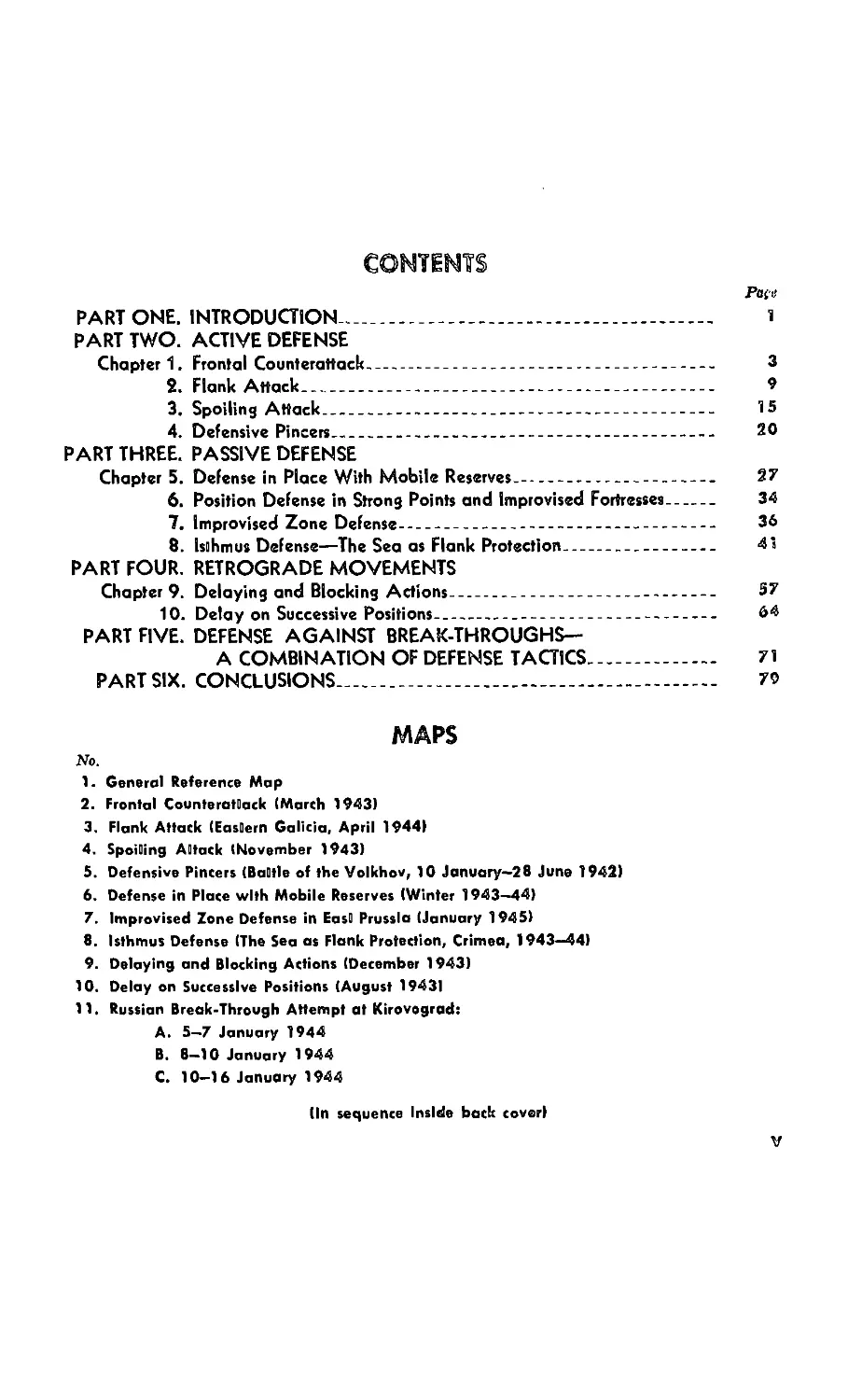
CONTENTS
Раса
PART ONE	. INTRODUCTION________________________________________________ 1
PART TWO	. ACTIVE DEFENSE
Chapter 1. Frontal Counterattack------------------------------------------- 3
2.	Flank Attack_________________________________________________ 2
3.	Spoiling Attack_____________________________________________ 15
4.	Defensive Pincers___________________________________________ 20
PART THR	EE. PASSIVE DEFENSE
Chapter 5. Defense in Place With Mobile Reserves__________________________ 27
6.	Position Defense in Strong	Points and Improvised Fortresses-	34
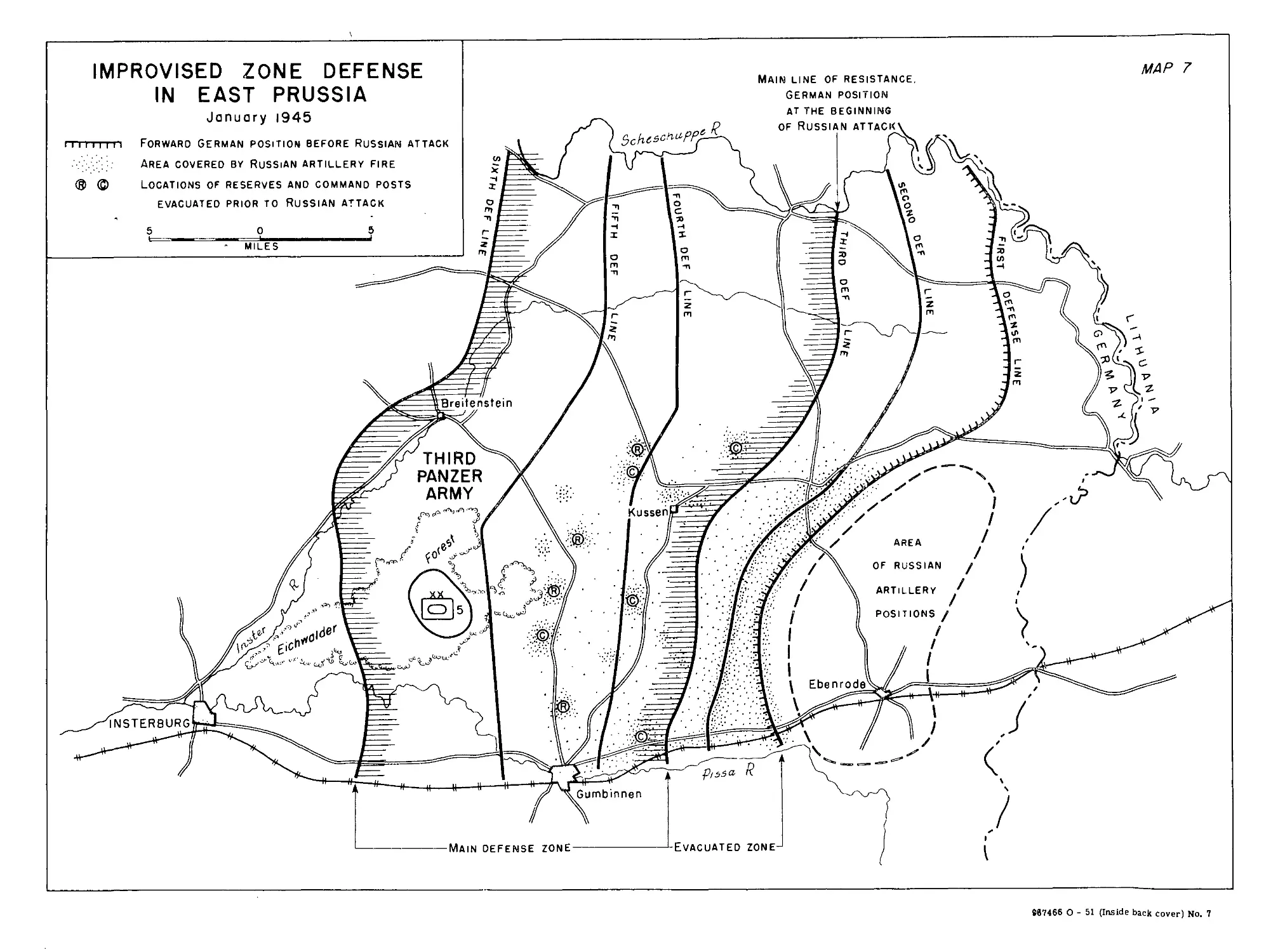
7.	Improvised Zone Defense------------------------------------- 36
8.	Isohmus Defense—The Sea	as Flank Protection------- 41
PART FOU	R. RETROGRADE MOVEMENTS
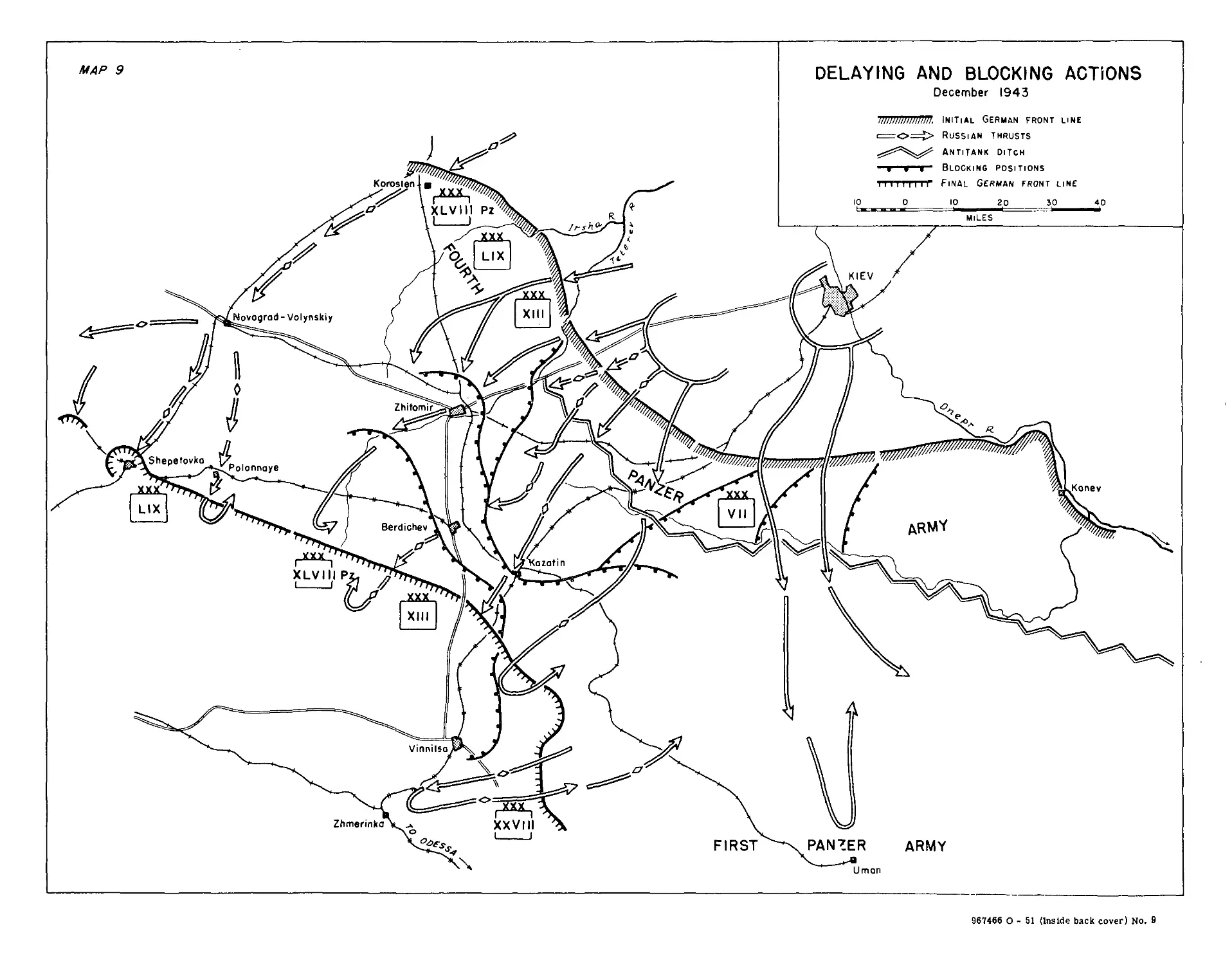
Chapter 9. Delaying and Blocking Actions------------------------------- 57
10.	Delay on Successive Positions------------------------------ 64
PART FIV	E. DEFENSE AGAINST BREAK-THROUGHS—
A COMBINATION OF DEFENSE TACTICS_____________________________________ 71
PART SIX	. CONCLUSIONS_______________________________________________ 79
MAPS
No.
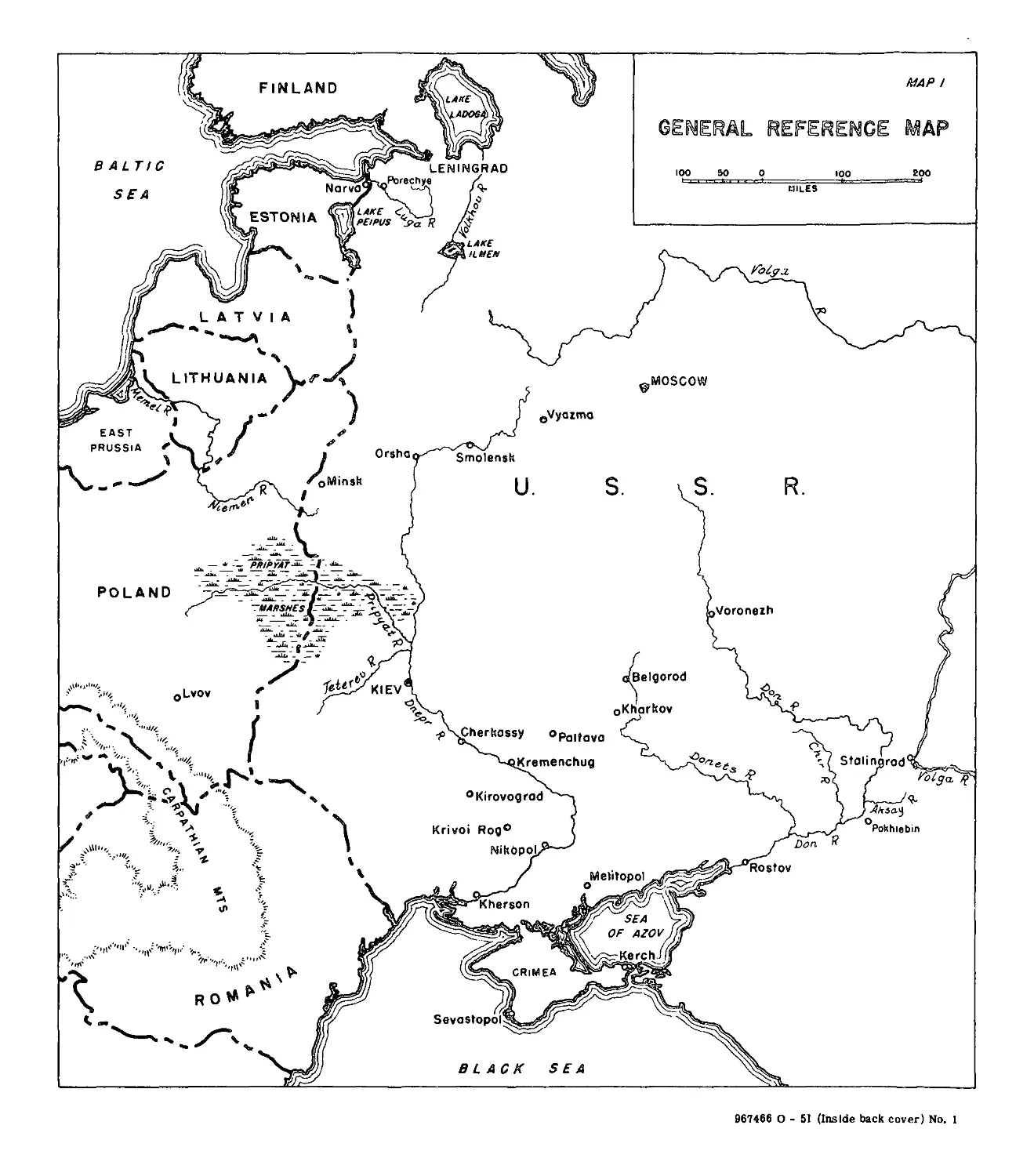
1.	General Reference Map
2.	Frontal CounteratOack (March 1943)
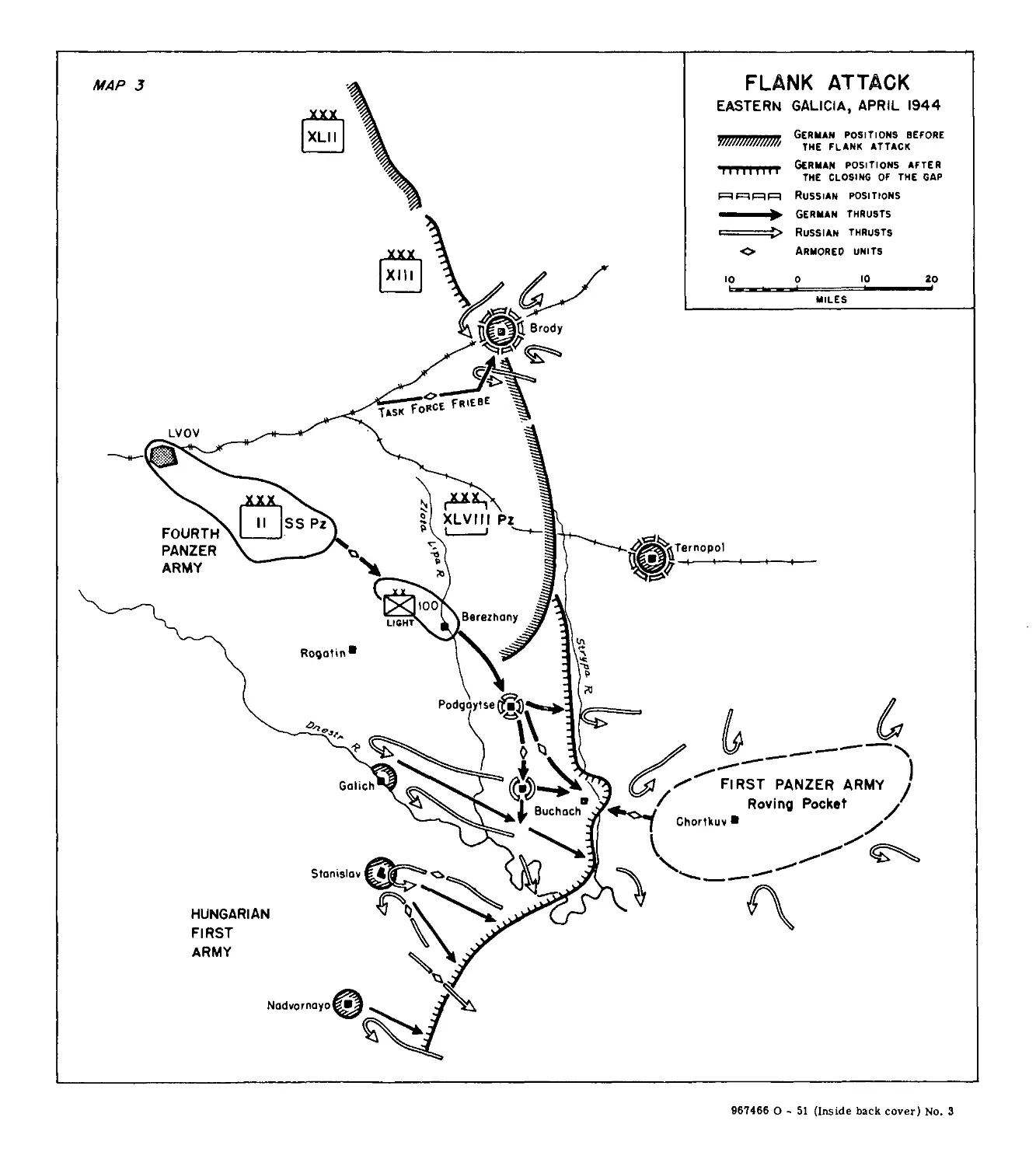
3.	Flank Attack (EasOern Galicia, April 1944)
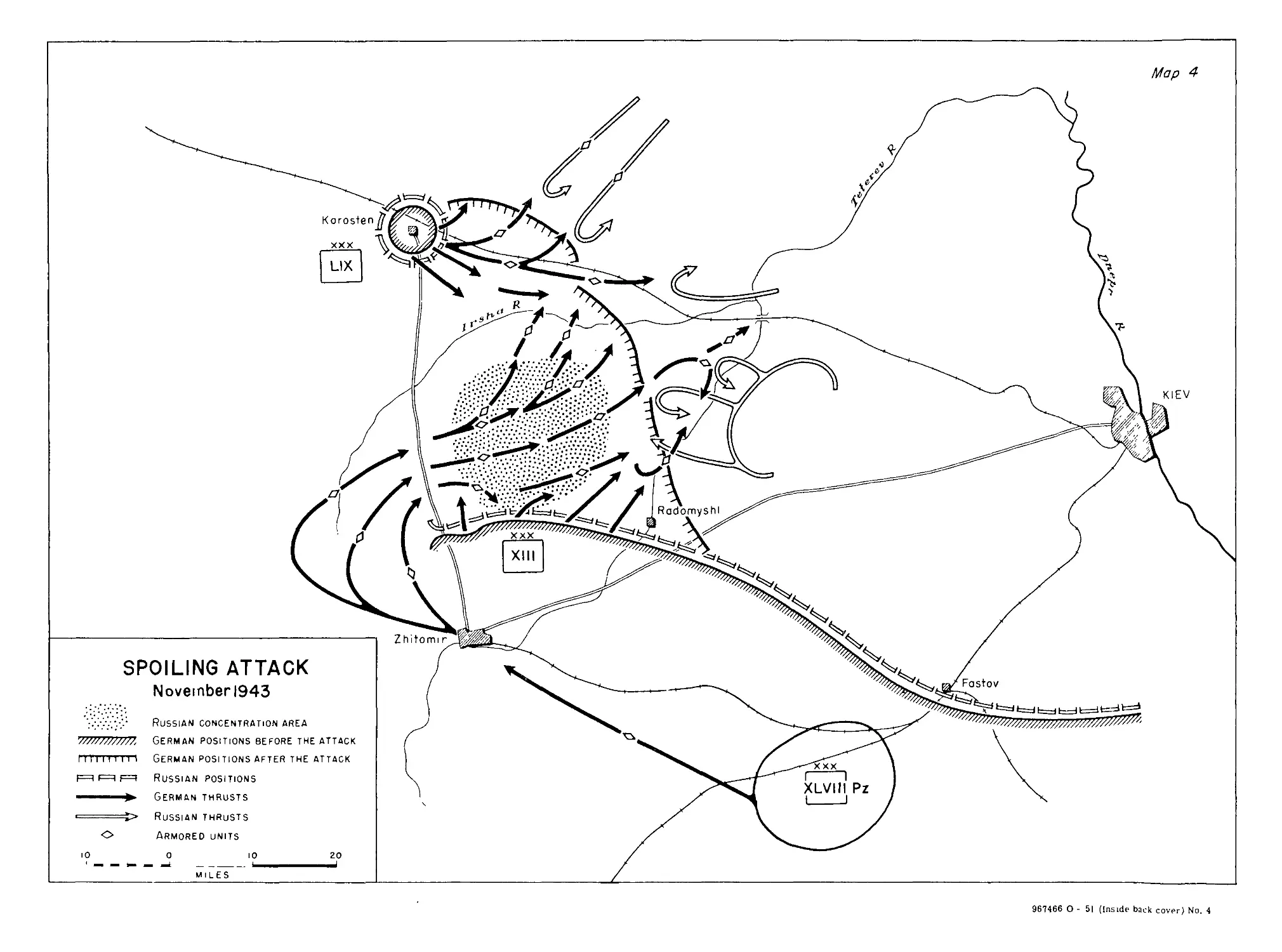
4.	Spoiling Attack (November 1943)
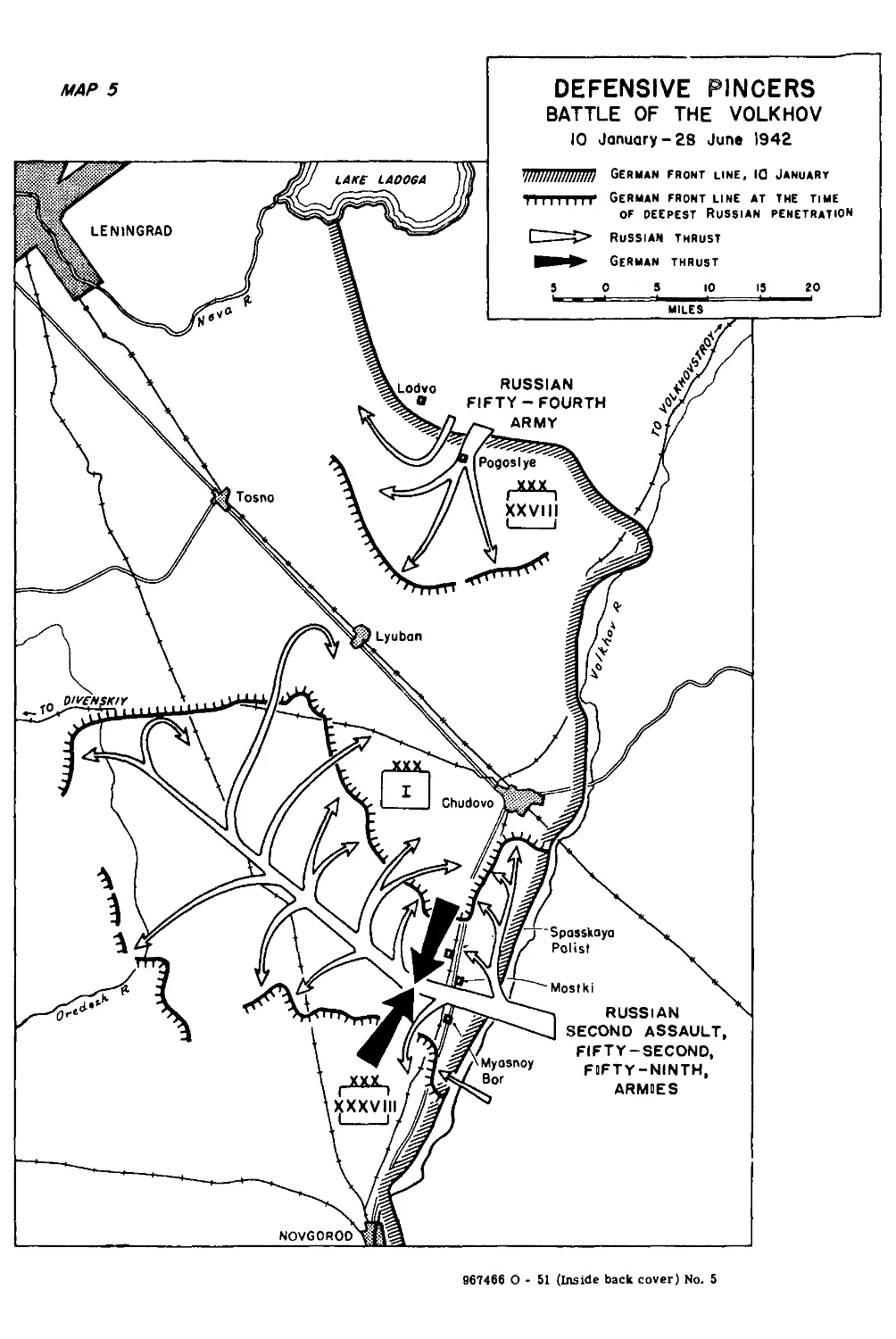
5.	Defensive Pincers (Battle of the Volkhov, 10 January—28 June 1942)
6.	Defense in Place with Mobile Reserves (Winter 1943—44)
7.	Improvised Zone Defense in East Prussia (January 1945)
8.	Isthmus Defense (The Sea as Flank Protection, Crimea, 1943—44)
9.	Delaying and Blocking Actions (December 1943)
10.	Delay on Successive Positions (August 19431
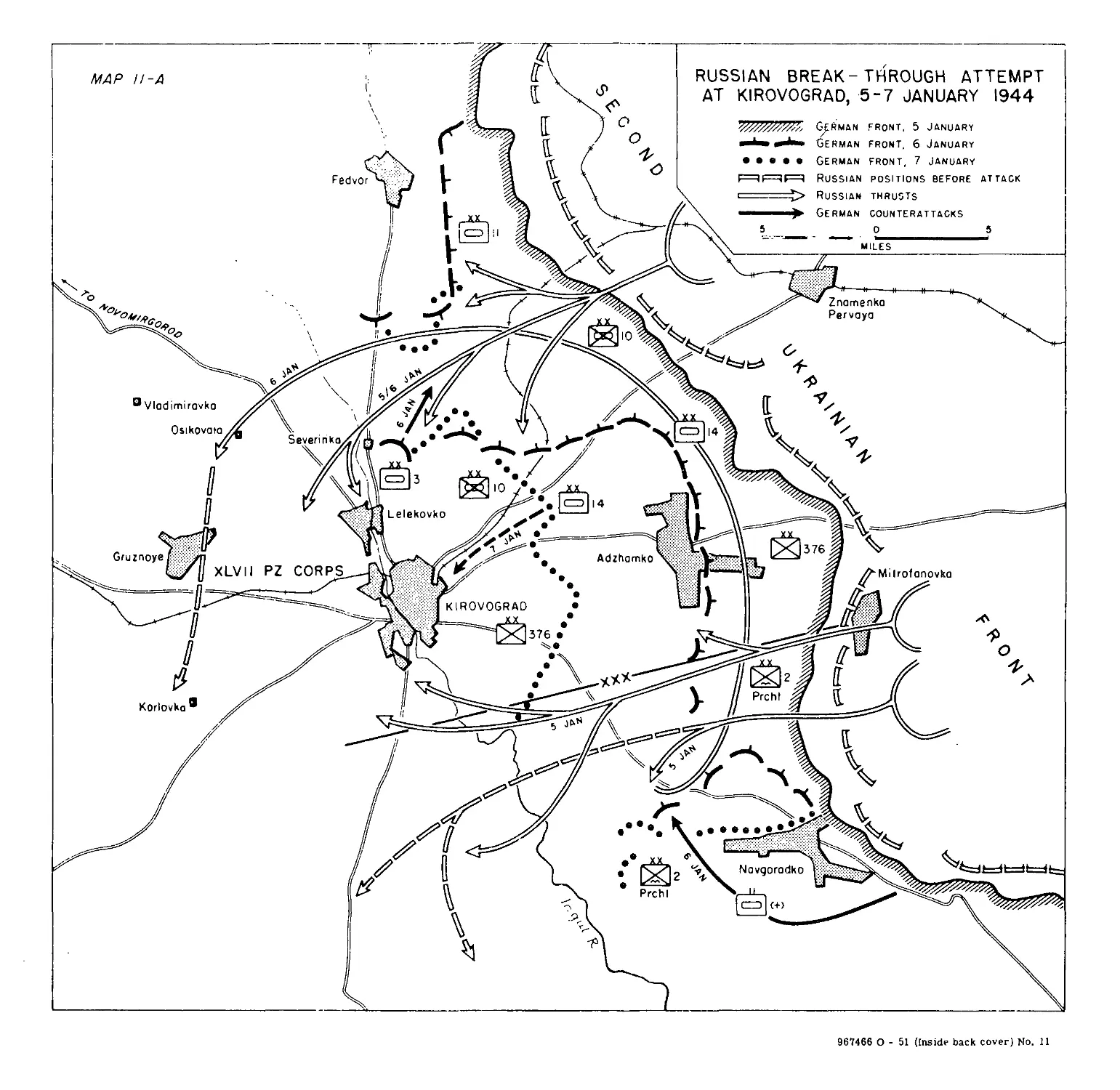
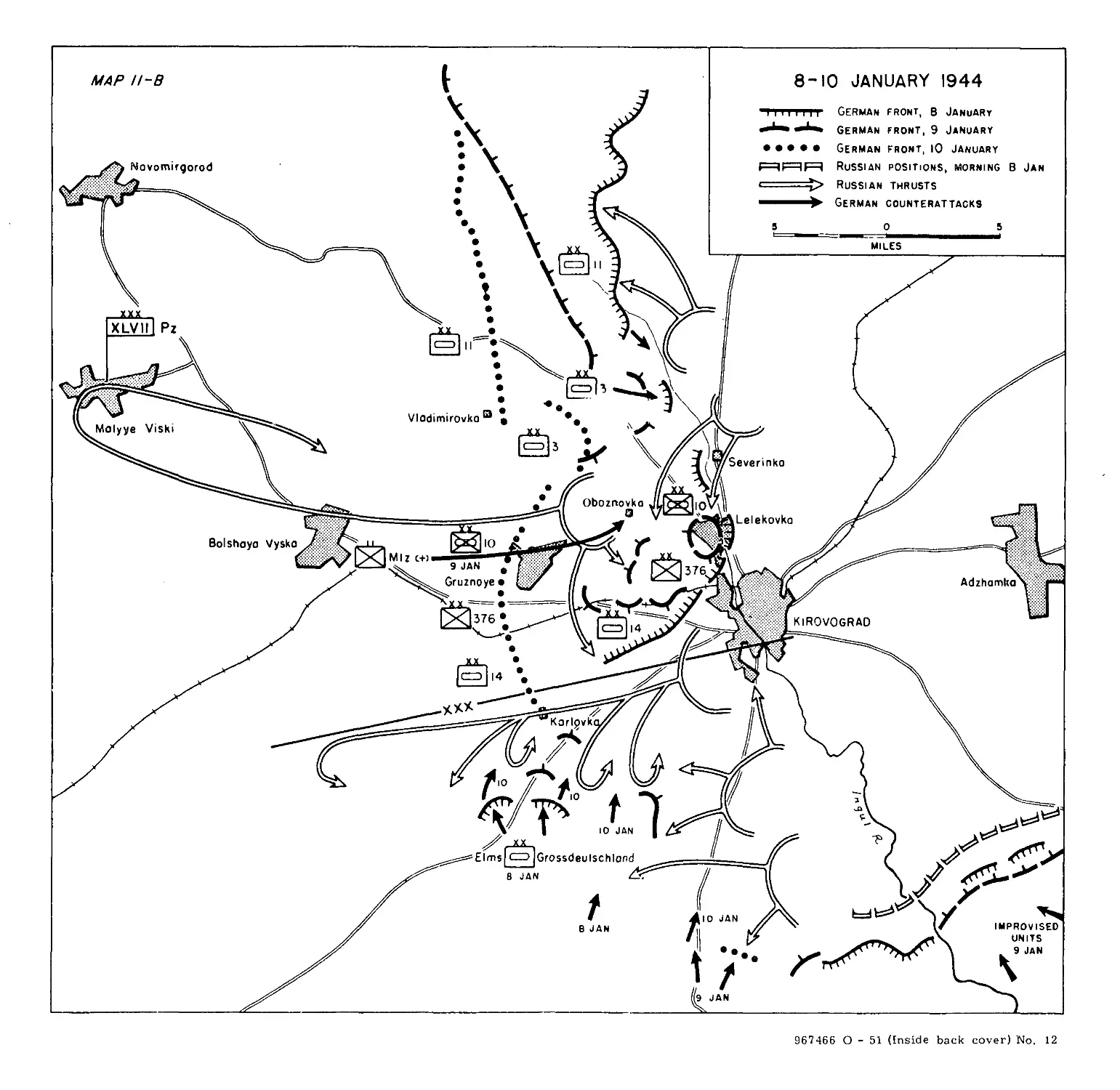
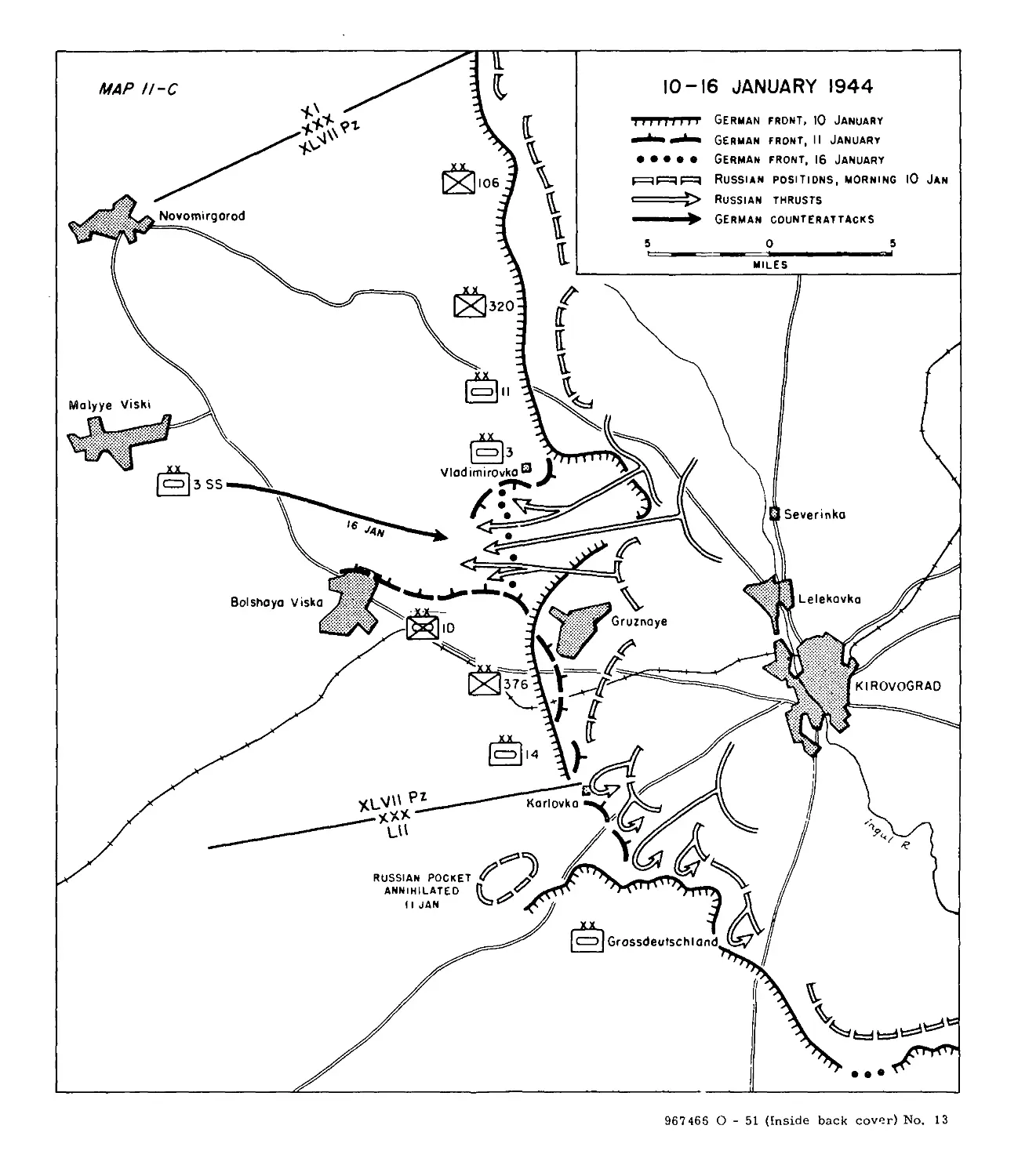
11.	Russian Break-Through Attempt at Kirovograd:
A.	5—7 January 1944
B.	8—10 January 1944
C.	10—16 January 1944
(In sequence Inside back cover)
V
Thia pamphlet supersedes MS No. T-10, “Defense against Break-Throughs—
Russia J942-45,” which was given a limited distribution by the Office of the
Chief of Military History, Special Staff, V. S. Army.
[PACT ©Mi
«мета
By means of short narratives based on actual experience, this study
endeavors to describe the characteristics of Russian break-throughs
and the countermeasures employed by the Germans. No attempt has
been made to present anything like a complete picture. Since these
reports were written from memory, some of the dates and figures may
be inaccurate. A few combat narratives contain other than strictly
tactical details in an effort to convey some of the emotional factors
which affected the actions of troop commanders and their men in
different situations.
Each of the following chapters deals with one of the more fre-
quently employed tactics to prevent or contain break-throughs. It
should be pointed out, however, that only in rare instances was one
single method used. Most often one tactical measure predominated
in an operation, with two or three others, or even more, complementing
it During extended defensive operations even the predominant
method changed occasionally. The use of a combination of defense
tactics without preponderance of any one often proved effective. On
many occasions the parent unit employed one specific defense method
while its subordinate units had to use other tactics. No two situations
were alike, and each had to be treated on its own merits. The selection
of the type of defensive tactics depended on the intuitive perception
of the commander in the field as well as upon the circumstances.
1

PART TWO
ACTIVE DEFENSE
Chapter 1
FRONTAL COUNTERATTACK
One of the simplest methods of sealing off a break-through or elim-
inating a penetration is the frontal counterattack. Usually, such a
counterattack can be launched only if the break-through is minor and
can be localized, and if both shoulders are secure. Moreover, sufficient
reserves must be available to close the breach by a quick counterthrust
before the enemy is able to widen the gap. Once hostile preparations
for a break-through have been clearly recognized, it is most effective
to move the reserves close to the rear of the threatened sector. While
the reserves must be close enough for instantaneous effective employ-
ment, they should be sufficiently removed from the front line so as
not to forfeit prematurely their freedom of maneuver. In their
assembly areas the reserves must be concealed from enemy observation
and air attacks and must not be exposed to hostile preparation fire.
Obviously, reserves should have maximum fire power and mobility;
armored divisions come closest to these requirements because they com-
bine tremendous striking force with concentrated fire power. In-
fantry supported by assault guns will often restore the situation so
long as the break-through is local.
A counterattack is far more complicated if, before its effect is felt
by the enemy, the shoulders begin to crumble, the breach is widened,
and the enemy attack gains ground in depth. But even in this event,
it is best to maintain the tactical integrity of the reserve so that upon
commitment it can overrun the enemy infantry in one powerful thrust
and regain the key positions of the former line. Only then should
attempts be made to close the smaller gaps by flanking actions. As
a countermeasure against the disintegration of the shoulders and as
support to the flanking actions, it will prove effective to protect the
open flanks of the break-through area with artillery and to assemble
small local reserves behind them. Frequently one infantry company
supported by assault guns will suffice for this purpose.
It would be a mistake to attempt to close an extensive breach across
its entire width by overextending the attack frontage of the main
reserve force. A counterattack delivered under such circumstances
3
4
GERMAN ВЕРОЙ? SERIES
would not have sufficient striking power and would be in danger of
losing its punch and bogging down before it reached its objective. On
the other hand, a delayed commitment of the reserves will result in an
expansion of the breach; then, the counterattacking force will be faced
with an entirely new situation with which it will be unable to cope
alone. Such a delay often leads to heavy losses which can only be
offset by committing additional forces.
Whenever the enemy achieves a major break-through that causes
the collapse of a wide sector of the front (thirty miles or more), the
local reserves will always be insufficient to close the gap by frontal
counterattack. Piecemeal commitment of individual divisions in
a gap of this width will simply lead to their engulfment by the ad-
vancing hostile avalanche. Only a strong force consisting of several
corps will be able to stem the tide and halt the enemy advance in the
depth of the defense or to close the gap by a counterattack. There will
usually be a considerable time lapse, however, before a force of such
strength can be released from other sectors and moved to the break-
through area. Meanwhile, attempts must be made to narrow the
breach by withdrawing to a shorter line and by strengthening the
resistance in the sectors adjacent to the gap.
The German offensive to recapture Kharkov and Belgorod presents
a good example of a frontal counterattack. By 23 November 1942
the Russians had closed the ring around Stalingrad and started the
most powerful winter offensive of the war. Advancing rapidly, they
annihilated in quick succession the Romanian, Italian, and Hungarian
units along the Chir and Don Rivers and opened a 350-mile gap in the
German front. This breach was equal to the total length of the western
front in World War I. Initially, only isolated German divisions, com-
mitted in support of the allied and satellite forces, stood in the way of
the Russians, like the stays of a corset. The bulk of the German re-
serves, including five fully equipped panzer divisions, were tied down
in western Europe because of the invasion of North Africa by Allied
forces. Some of these divisions later appeared on the eastern front.
The German armies in the Caucasus, in danger of being cut off,
were forced to withdraw. Their motorized units, mainly First Panzer
Army, were committed along the Donets in order to strengthen the
southern wing of Army Group Don. North of the gap, the Second
Army was forced to evacuate Voronezh and the Don front, and its
southern wing was pushed far back to the west. Gradually, two-thirds
of the entire Eastern Front began to sway and crumble. Russian
pressure mounted constantly and the only solution was to withdraw
farther and farther to the west. The Russians poured in a never
ending stream of hastily reorganized divisions and continued their
drive. Three hostile armies converged on Kharkov and in mid-
February 1943 succeeded in capturing this important traffic center by
DEFENSE TACTICS AGAINST RUSSIAN BREAK-THROUGHS	§
a concentric attack. (Map 2) But their next thrust, aimed at Poltava,
ground to a halt 30 miles short of the city because the Soviet troops
were too exhausted to continue. Now they placed all their hopes in
the Third Tank Army commanded by their most capable tank expert,
General Popov. In mid-February Popov advanced practically with-
out resistance in the direction northwest of Dnepropetrovsk with the
apparent intention of reaching the Dnepr bend. His objective was
to cross the Dnepr before the German forces were able to build up
their defenses along the river, but it soon became obvious that his
forces lacked the necessary drive. Meanwhile, the Germans were
building up strength for a frontal counterattack.
The divisions arriving from the West detrained at Poltava behind
a defensive screen established by Provisional Corps Raus. This corps
held the line with three infantry divisions and the reconnaissance
regiment of the 3d SS Panzer Division. Its other motorized elements,
the Panzer Division Grossdeutschland and the Fuehrer Escort Bat-
talion, were in rest areas west of Poltava, close to the front. They
formed a mobile reserve to be committed in the event that the enemy
attempted to capture Poltava by an enveloping thrust through the
gap to the north. The Russians actually tried to outflank Poltava,
but this danger was eliminated by German infantry supported by the
reconnaissance regiment and tactical Luftwaffe units. During these
actions the enemy showed definite signs of weakness and exhaustion,
and the time for a major counterattack seemed to be approaching.
Quick action was indicated since the snow was beginning to thaw.
Mud formed on the ground and soon all movements would become
impossible. But deep down the soil was solidly frozen. Cold nights
prevented a quick thaw and favored movements during the early morn-
ing hours. Meanwhile, the battle-weary German front-line troops
were granted a short breathing spell and given the opportunity to
integrate newly arrived replacements and equipment.
By 10 March 1943 the counterattack forces stood ready to jump
off; their morale was excellent. The main effort was placed on the
southern wing where terrain conditions favored the employment of
armor. Here, the Grossdeutschland Division was assembled and given
the mission of attacking toward Valki. Adjacent on the left, the
320th Infantry Division jumped off after a preparation from all guns
of two divisions, supported by corps artillery. The infantry pene-
trated the enemy positions, mopped up a strong point on the main
Poltava-Kharkov highway, and pushed the enemy beyond a flooded
brook on the other side of the town. This normally insignificant
watercourse had suddenly grown into a raging torrent which brought
the attack to an unexpected halt after a gain of only one mile. The
tanks of the Grossdeutschland Division attempted to overcome the
swift current farther upstream and finally succeeded in crossing after
6
GERMAN REPORT SERIES
several hours. More than eighty tanks broke through the second enemy
position on the east bank of the brook and rolled toward Valki. Soon
an improvised bridge was thrown across the brook and the attack
regained its momentum. In the sector adjacent to the north, the 167th
and 168th Infantry Divisions penetrated the enemy positions after
heavy fighting, captured a number of villages, and attempted to estab-
lish contact with the LI Infantry Corps on the left. The reinforced
reconnaissance regiment, committed between the 320th and the 167th
Divisions, closed in on the enemy positions situated in the woods and
penetrated deep into the forest. Its tanks advanced along the railroad
tracks running parallel to the woods. By afternoon Corps Raus was
making progress along its entire front and kept the crumbling enemy
forces on the move.
On the second day of the thrust the corps committed all its forces
in a concentric attack on Bogodukhov. For this purpose the corps
zone was narrowed to 10 miles. Its width had already been reduced
from 60 to 25 miles by the end of the first day. The enemy forces
holding Bogodukhov were unable to resist the onslaught of the Ger-
man ground troops which were closely supported by the Luftwaffe.
The city fell after brief house-to-house fighting. Corps Raus then
established contact with the spearheads of the I SS Panzer Corps
which had just entered Olshany, fifteen miles southeast of Bogoduk-
hov. After annihilating strong enemy forces in the Olshany area, the
panzer corps turned to the east to envelop Kharkov and cut off the
enemy’s route of withdrawal to the north.
While the main force of Provisional Corps Raus was to advance
northward in an attempt to establish contact with the LI Corps and
thereby cut off the enemy forces in the Akhtyrka area, the 320th Divi-
sion was to screen the pivoting movement of the I SS Panzer Corps.
Ever increasing mud and floods slowed the advance at every step.
Although all bridges across the swollen Vbrskla, Udy, and Lopan
Rivers had been destroyed, the infantry and panzer units were
nevertheless able to reach their daily objectives. Many motor vehicles
and horse-drawn artillery pieces, however, bogged down along the
way. On the other hand, the considerably lighter artillery of the
Russians and their Panje [Ed.: Russian peasant] wagons pulled
through everywhere and escaped the German advance.
The Grossdeutschland Division carried the main effort and reached
the upper Vorskla, with the 167th Division following closely. Since
the LI Corps on the southern wing of Second Army lagged far behind,
no contact with that corps could be established and the enemy around
Akhtyrka escaped encirclement. The continuation of the operation by
a thrust on Tomarovka required the panzer forces to pivot to the east,
changing the direction of their advance. They were replaced by ele-
ments of the 167th Division which were to hold a line facing north
DEFENSE TACTICS AGAINST RUSSIAN BREAK-THROUGHS	7
to provide flank cover. The advance toward Tomarovka was delayed
because territorial gains toward the east automatically led to an exten-
sion of the open flank.
By the second day of this eastward thrust, the strong 167th Divi-
sion was almost entirely immobilized along the flank. The arriva'
of LI Corps had to be awaited before the eastward thrust could be
resumed. The main reason for this delay was that the boundary
between Army Groups Center and South ran along the Vorskla
River. The Army High Command, responsible for co-ordinating the
operations of the two army groups, was too far removed, and its
decisions therefore were too slow’ to keep abreast of the fast-moving
events at the front. Finally, the Army High Command ordered
LI Corps to relieve the 167th Division. The advance continued and
the Grossdeutschland Division entered Tomarovka. On its approach
to the town, the division destroyed a considerable number of Russian
tanks while many undamaged ones, which had bogged down in the
mud, were retrieved and turned against the enemy.
It was in this action that Tiger tanks engaged the Russian T34’s
for the first time; the results were more than gratifying for the
Germans. For instance, two Tigers, acting as an armored point,
destroyed a pack of T34’s. Normally the Russian tanks would stand
in ambush at the hitherto safe distance of 1,350 yards and wait for
the German tanks to expose themselves upon their exit from a village.
They w’ould then take the German tanks under fire while the Panthers
were still outranged. Until now, these tactics had been foolproof.
This time, however, the Russians had miscalculated. Instead of leav-
ing the village, the Tigers took up well-camouflaged positions and
made full use of their longer range. Within a short time they
knocked out sixteen T34’s which were sitting in open terrain and,
when the others turned about, the Tigers pursued the fleeing Rus-
sians and destroyed eighteen more tanks. It was observed that the
88-mm. armor-piercing shells had such a terrific impact that they
ripped off the turrets of many T34’s and hurled them several yards.
The German soldiers’ immediate reaction was to coin the phrase, “The
T34 raises its hat whenever it meets a Tiger.” The performance of
the new German tanks was a great morale booster.
Farther to the south, Kharkov was captured by the 1st SS Panzer
Division after four days of street fighting during which Tigers again
played a decisive role. The 2d SS Panzer Division turned north,
advanced on Belgorod, captured the city, and linked up with the
Grossdeutschland Division which had thrust beyond Tomarovka.
The capture of the two cities secured the anchors of the new German
line along the Donets. Between these two points two German divi-
sions slowly struggled through the mud in their effort to reach the
west bank of the river.
8	GERMAN REPORT SERIES
The Russian elements that were able to cross the Donets were badly
mauled. German reconnaissance units, advancing beyond the river,
met with little resistance. Even though the German attack divisions
were fully capable of continuing their drive, the over-all situation and
the prevailing mud made it inadvisable.
The objective of the frontal counterattack had been achieved. The
breach, open for four months, was closed and the greatest Russian
winter offensive was stopped. After suffering a defeat of gigantic pro-
portions, the Germans once again held a continuous line anchored on
the Donets River.
(£(л)<2)р><}®5Г 2
FLAW ATTACK
The defender will often find it expedient to attack the flank of an
enemy penetration with the objective of cutting off and destroying
the hostile forces that have broken through. Such tactics are effective
only when a secure shoulder provides the defender with a spring-
board for an attack which is launched straight across the gap to the
other shoulder, or when a natural obstacle, such as a large body of
water or a swamp, serves as an anvil against which he can crush the
attacker. An effective flank attack requires a balanced force with
adequate striking power whose strength need not necessarily exceed
one-third of the total enemy forces committed in the break-through.
The more powerful and mobile the force, the quicker the defender will
attain his objective. Unsupported infantry is incapable of mounting
a successful flank attack against an armored penetration. In such a
situation infantry must always be supported by strong assault gun
and armored units as well as sizable antitank forces.
The defender who attacks the flank of an enemy penetration runs
the risk of exposing his own flank and must therefore take this factor
into account when he plans the counterattack. The danger is usually
less serious than anticipated because, during the initial stages of the
break-through, the attacker usually commits his forces almost exclu-
sively along the axis of advance without giving much attention to his
flanks. These rush tactics are practical, however, only so long as the
defender has neither the means nor the opportunity for immediate,
effective counteraction. During their invasion of Russia in 1941,
for instance, the Germans did not present the Russians with any such
opening. On the other hand, during the Russian counteroffenses in
1942, the German command always had strong armored forces at its
disposal, making it inadvisable for the enemy to be careless in expos-
ing his flanks. Bitter experience was to teach the Russian that flanks
must be protected until he finally made them so tank-proof that they
could only be overpowered with heavy casualties. For this reason
the German flank attacks gradually lost their sting after 1943 and
were more often repulsed.
Flank attacks are particularly effective when employed to eliminate
hostile river crossings. The forces which cross first can usually be
shattered or wiped out without too much difficulty because they rarely
have adequate defensive protection. This happened, for instance,
along the Teterev in December 1943. (Chapter 3) The defender
9
10
GERMAN REPORT SERIES
will find it much more difficult, well-nigh impossible, to eliminate
a strongly fortified enemy bridgehead which has adequate fire support
from the far bank of the river.
At the beginning of April 1944, the Germans launched a flank attack
which proved very effective in remedying a precarious situation.
After heavy winter fighting in eastern Galicia and Podolia, the Fourth
Panzer Army, with three corps, was, on a line extending from Kovel
in the north, through Brody, to Berezhany in the south. (Map 3)
The Russian encirclement of Brody was imminent. There was a
gap between that town and the army’s left wing, and the army right
flank was exposed. The so-called fortress Ternopol, 18 miles to the
front of the south wing, had been encircled for ten days. The First
Panzer Army, forming a roving pocket, was moving north of the
Dnestr River toward the gap on Fourth Panzer Army’s southern
flank. Strong Russian forces were driving westward past the pocket
on both sides of the river.
Although the over-all situation was far from satisfactory, the
Fourth Panzer Army had at least stopped its retrograde movement^
The army was intact after many critical battles and had inflicted
heavy losses upon the enemy during the winter. Despite evident
battle weariness, the Russians continued their attempts to take Brody
in order to gain a route to Lvov. They did succeed in encircling the
city on several occasions. The encirclements were broken each time
by the provisional armored Task Force Friebe, made up of one bat-
talion of Tigers and one of Panthers. This task force, augmented
by a rocket projector brigade equipped with 900 late-type launchers,
destroyed the enemy while he was still in his assembly area preparing
for the final all-out attack. The Russians abandoned the siege of
Brody and, in a most unusual change of tactics, used their newly
arrived forces to form a continuous front line opposite the army
center. The XIII Infantry Corps followed suit and linked up with
the XLII Infantry Corps to the north, thus closing the gap north
of Brody. The armored task force was now available for other
missions.
The army’s exposed right flank was under light attack. The Rus-
sians captured a few villages, but they were promptly retaken by
local reserves supported by an armored battalion which moved freely
along the flank. The army front was intact and the southern flank,
though exposed, was secure.
Still, the Russian forces which had bypassed the roving pocket
continued their westward drive. Their armored spearheads south of
the Dnestr entered Stanislav, and those to the north of the river ap-
proached the fortified area around the Galich bridgehead. Quickly
gathered German infantry, together with advance elements of the
DEFENSE TACTICS AGAINST RUSSIAN BREAK-THROUGHS
11
Hungarian First Army, which was assembling in the Stanislav-Nad-
vornaya area, drove the enemy out of Stanislav after street fighting.
North of the river, however, the enemy, hampered only by muddy ter-
rain, reached the Zlota Lipa valley. His axis of advance pointed
toward the Drohobycz oil fields.
The forward elements of the forces in the pocket had by now
reached the Chortkuv area. The Fourth Panzer Army was' given the
mission of relieving the First Panzer Army by a flank attack, and it
received strong reinforcements for the execution of this task. The
flank attack was to be launched to the southeast from Berezhany, while
a secondary thrust to the Dnestr was to pinch off and destroy the Rus-
sian infantry divisions which had penetrated as' far as the Galich area.
As a preliminary step, the first elements of the 100th Light In-
fantry Division, detraining in the army rear area, were ordered to
capture the terrain south of Berezhany. Elements of another in-
fantry division were to take the area south of Rogatin. Both of these
operations were designed to secure the unloading of II SS Panzer
Corps, which had been transferred from Italy. Within a few days
after detraining the corps was ready to jump off. Aware of the
threat to their flank, the Russians used all their available air power
to harass the assembly of the German forces which were restricted to
the only two usable roads in the area. This enemy interference, how-
ever, was negligible compared to the difficulties presented by the
muddy terrain.
The 100th Light Infantry Division was to clear the way for the
decisive thrust, with the panzer corps following close behind. The
only available all-weather road permitting major mechanized move-
ments, led via Podgaytse to Buchach. The infantry had the mission
of capturing heavily defended Podgaytse to open the road for the
panzer thrust. Hardly had the enemy screening force been dislodged
from the wooded heights south of Berezhany, when the infantry ran
into huge snowdrifts which covered the entire road to a depth of sev-
eral feet along 200- to 500-yard stretches. It was impossible to bypass
these obstacles because of the rugged, snow-covered terrain on both
sides of the road. Security guards were posted and the combat troops,
equipped only with intrenching tools and a few locally procured
shovels, began to clear the snow. After several hours of steady work,
a single lane was opened and around noon it was possible to move up
the artillery and tanks which were essential for the impending opera-
tion against Podgaytse.
Despite the delay, the infantry took the strongly organized high
ground in front of Podgaytse the same day. The division’s Tiger
battalion knocked out the T34’s and antitank gun positions' which de-
fended the entrance to the town, but in so doing completely blocked
907468’—Bl---2
12
©2ЙШМ QEPORT SERIES
its own advance. The main entrance alone was clogged by sixteen
disabled Russian tanks and, as the infantry edged forward in house-
to-house fighting, the wrecks were towed off, pushed aside, or blown
up. By late evening the Tigers had thrust across the town, knocking
out thirty-six additional tanks in their advance. The infantry mopped
up during the night and on the next morning turned eastward to-
ward the Strypa River to secure the left flank of the panzer corps
and to make way for its advance.
The 10th SS Panzer Division now took the lead, with 100 tanks
spearheading the movement. At the southern edge of Podgaytse the
division ran into strong resistance from skillfully concealed antitank
guns which were too well entrenched to be attacked frontally and
could not be bypassed because of the deep water ditches, ravines, and
swamps on both sides of the road. After close reconnaissance, the
guns were finally knocked out one by one with concentrated panzer
and artillery fire. The way cleared, the tanks rolled forward. To
avoid further delay, the division commander decided to drive cross-
country to Buchach, but the route taken for a short cut proved to be
a quagmire. Only the division commander with five lead tanks got
through. Although he was able to establish contact with the spear-
heads of the First Panzer Army, this achievement served no practical
purpose as long as the highway from Podgaytse to Buchach was still
in enemy hands. The hasty decision to leave this highway delayed
the operation and cut off the division commander from his troops.
Their tanks bogged down, the panzer troops, fighting as infantry
under the corps commander, undertook the clearance of the highway.
Hostile antitank fire interfered with their advance, and the Soviets
offered strong resistance in the villages along the road. But, sub-
jected to increasing pressure both from the panzer corps and the
infantry division approaching from the Galich area, their efforts were
in vain. That evening, near the bend of the road west of Buchach,
the Russian infantry divisions fleeing eastward along the Dnestr were
blocked off, hurled against the river, and destroyed with the help of
newly arrived infantry forces. The attack units regrouped and then
turned eastward. On 5 April Buchach was reached, and the axis of
withdrawal of the encircled army was cleared. The Russians did not
readily yield the prize which was being wrung from their grasp. In
fierce pursuit they tried to cross the swollen Strypa to cut the escape
artery, but they were no match for the liberating forces. Whenever
they got across the river, they were immediately thrown back.
By mid-April the right wing of the Fourth Panzer Army had de-
ployed behind the Strypa, and the front, anchored on the Dnestr to
the south, included a bridgehead across the Strypa opposite Buchach.
On this line fixed positions were organized. The objective of the flank
attack—stabilization of the front in eastern Galicia—was attained
DEFENSE TACTICS AGAINST RUSSIAN BREAK-THROUGHS
u
with the liberation of the First Panzer Army from encirclement and
its reintegration into the German defense system.
In another instance, hostile armored forces opened a 20-mile gap
through which the Russians poured reinforcements. The German
command wanted to close the breach by a flank attack but had only
one panzer division for this purpose. The division was much too
weak for this mission, all the more since the enemy had committed
strong forces to widen the gap and was protecting his southern flank
with powerful armored and antitank units. The operation was there-
fore divided into several phases. As an initial step the crumbling
shoulder south of the gap was strengthened, and then a preliminary
panzer attack narrowed the breach to ten miles. Immediately after
its replacement by infantry units, the panzer division was ready for
the main phase of the operation—the closing of the gap. In a sur-
prise night attack against the enemy flank, the mechanized infantry
overcame the tank and antitank cover, and the German tanks, im-
mediately following, succeeded in closing the gap. Furious enemy
attacks against the newly established defense line were repelled, but
now the northern anchor, held by a recently activated division, gave
way in the face of heavily mounting pressure. Finally, this danger
was eliminated by the timely arrival of reinforcements. This example
clearly demonstrates the effectiveness of a well-executed flank attack
even though it may have to be carried out with comparatively weak
tank forces. The importance of securing the shoulders at the base
of a break-through is only too obvious.
The flank attack is very frequently used in local counterattacks and
is an integral part of many large-scale defensive operations. A
break-through on a very wide frontage by overwhelmingly superior
armor cannot be eliminated by a flank attack even though strong tank
forces may be available to the defender, because the attacker usually
protects his interior flanks with adequate armor and antitank gun
fronts. But even if the flank attack should surmount this obstacle,
the attacker still has sufficient time to shift strong tank units from his
main effort to the threatened interior flank in order to eliminate the
danger. Under the most favorable circumstances, the defender’s
armored units may be able to divert the attacker’s main force by
compelling him to establish a new defense line on his flank. This
happened west of Kiev in November 1943 when the Germans first
succeeded in thwarting the enemy’s attack plan, but later saw their
own plans frustrated. The result was an extension of their own front
line which tied down the German reserves committed in the flank
attack. Moreover, by leaving their own flank open, the Germans
encouraged the Russians to press their attacks in that direction.
Frequently, the threat of a flank attack by armored forces will alarm
the attacker so much that he will halt his offensive in order to avoid
14
GERMAN REPORT SERIES
the annihilation of those of his forces which have broken through.
He will be especially apprehensive if, only shortly before, he has
suffered a severe blow by a flank attack or some other armored thrust.
During the German relief thrust toward Stalingrad, for instance,
panzer forces turned against the flank of the advancing Russian in-
fantry, who fled panic-stricken. This was not surprising since earlier
that month a Russian cavalry corps had been annihilated by a flank
attack of a strong panzer division at Pokhlebin on the Aksay River
and two Russian infantry divisions had been routed north of the river
by similar methods. (See Department of the Army Pamphlet No.
20-230, Russian Combat Methods in World War II, pp. 69 ff.)
Chapter 3
SPOILING ATTACK
The spoiling attack—a surprise thrust into the enemy attack prep-
arations—is a very effective, though rare, operation. Its purpose is
to disorganize the enemy’s assembly and thereby delay and weaken
his offensive or to force him to launch his attack at a less vulnerable
point.
Such an attack from the defensive can be undertaken only under
certain conditions. The enemy assembly area must be easily acces-
sible to a surprise thrust, and the defender must have strong armored
reserves on hand. The terrain and road net must facilitate quick
maneuver under cover of darkness. All attack plans must be con-
cealed from the enemy, or he must be deceived with regard to the real
intentions. For this reason, it is imperative that one act without
delay.
These prerequisites existed only on rare occasions. However, the
Germans were presented with a perfect opportunity to exploit them
at the beginning of November 1943. (Map 4) The Russians had
broken through north of Kiev, and there were indications that they
intended to envelop the northern wing of Army Group South. The
forces at the disposal of the First Ukranian Front were insufficient
to attain this objective. The Soviets advanced sixty miles to the
west, captured the important railroad junction of Fastov, neutralized
Zhitomir, and encircled the LIX Infantry Corps in Korosten. But
a German flank attack by armored units forced the Russians to pull
back across the Teterev. Although Zhitomir was relieved, Fastov
remained in enemy hands, and the siege of Korosten continued. The
Fourth Panzer Army front, which had faced east before the Russian
offensive, gave way and was now facing north. Both the German and
the Russian flanks were open to the west. Because of their inability
to close this gap, the Germans extended an open invitation to the
Russians, to continue their offensive in order to exploit the success they
had hitherto achieved. They had a unique opportunity to execute
a wide envelopment out of their assembly area north of Zhitomir.
Troop concentrations and road repairs performed behind the hostile
lines indicated the imminent resumption of the Soviet offensive which
would first threaten the Fourth Panzer Army and subsequently the
entire army group.
The situation called for immediate action, and the Germans there-
fore decided to avert the threat by striking the flank of the hostile at-
16
GERMAN REPORT SERIES
tack preparations with strong panzer forces. The XLVIII Panzer
Corps, with the 1st SS, 7th, and 1st Panzer Divisions, was withdrawn
from the front and assembled behind the center of the army sector.
Meanwhile the approach routes—some of which led through marshy
wooded terrain—were reconnoitered, bridges repaired, and the parti-
san units rampant in the forests dispersed by the security division re-
sponsible for this area. Immediately afterward, the combat elements
of all three panzer divisions moved out in broad daylight and marched
along the main highway through Zhitomir in order to deceive the
enemy into believing that strong forces were being shifted to another
sector of the front. It was later established that this deception was
completely successful. In any event, these preliminary steps were
actually inevitable since the movements connected with them had
to be executed to enable the Germans to strike deep into the open
enemy flank. Without this attempt at deception, the movements
would have required two nights, since the approach and assembly of
such a strong panzer corps could not be effected in one night. By
carrying out the movements by day, they could be timed so that the
units reached their turn-off points along the main highway shortly
after dusk. By that time half the itinerary had been covered and
the movements continued without interruption. The enemy had no
opportunity to observe the turning movements of the corps, first to
the north, then toward the east.
The entire movement proceeded according to plan without enemy
interference. On 4 December 1943, at 0600, all three panzer divi-
sions were poised for attack along the Zhitomir-Korosten high-
way. At the same time all the GHQ artillery, a rocket-projector
brigade with launchers of different calibers up to 320-mm., and an
armored train, were moved into position behind the left wing of XIII
Infantry Corps on the extreme end of the open flank. These prepara-
tions, as well as the concentration of strong reserves behind XIII
Corps wing, were to lead the Russians into assuming that the German
attack would continue on the army left wing, exactly where it had
bogged down the previous month. The Russians were easily convinced
of these intentions because their own reaction in similar situations was
identical. When a heavy concentration was delivered in this sec-
tor at dawn and a German infantry division launched a frontal at-
tack immediately afterward, the enemy felt absolutely certain that
his estimates were correct. He shifted strong reserves to this sector
and counterattacked, only to be stopped in his tracks by the con-
centrated fire of 300 rocket launchers. The Russians were still com-
pletely unaware of the impending flank attack. Only after they had
moved all available forces and weapons close to the front line, did two
German corps comprising five divisions simultaneously attack their
right flank. The main thrust was executed by the three divisions of
DEFENSE TACTICS AGAINST RUSSIAN BREAK-THROUGHS
17
XLVIII Panzer Corps which advanced east toward the Teterev
River. Some 1st SS Panzer Division elements were to turn south
and attack the Russian forces from the rear. The 7th Panzer Division
was to cover the corps left flank and establish contact with LIX
Corps, which was breaking out of encircled Korosten.
Completely surprised by this flank attack, the enemy offered little
resistance during the first day. The mine fields emplaced by the
Russians to protect their open flank were easily discovered from the
air and bypassed. The entire flank was crushed and destroyed by the
attack from the rear. Within a few hours the German tanks pene-
trated deep into the enemy artillery emplacements, overran batteries
under cover of light ground fog, and destroyed the guns. Since the
ground was frozen and covered by only a thin layer of snow, the
tanks were able to move quickly and according to schedule. By
the end of the first day, the panzer divisions had advanced fifteen to
twenty miles into the enemy’s flank, taken numerous prisoners, and
captured all of his artillery. The LIX Corps had achieved its break-
out and established contact with the panzer corps. The Zhitomir-
Korosten highway and railroad line were once again in German hands.
The completeness of the surprise achieved guaranteed the success of
the operation. Only weak remnants of the enemy forces escaped
to the east.
The thrust was continued during the second day. But its momen-
tum was greatly impaired by heavy fog and a breakdown of the 1st
SS Panzer Division supply system. Even though this division
dropped out because of ammunition and fuel shortages, the other divi-
sions advanced twelve more miles. The enemy resistance remained
negligible. As the attack progressed, the elements of the XIII Corps
gradually joined the panzer corps thrust along the sectors in which
the flank attack had swept away all enemy opposition. Farther north,
however, the LIX Corps was heavily engaged and progressed only step
by step.
It was not until the third day that the first enemy countermeasures
were felt, but the few Russian armored and infantry units thrown
across the lower Teterev were incapable of withstanding the powerful
drive of the panzer corps. The Russians’ newly established defenses
were quickly overrun and several Soviet tanks destroyed during this
action. Armed points of the 1st Panzer Division reached the Teterev
south of the railroad bridge. The 69th Infantry Division, operating
on the right wing of XIII Corps, crossed the Teterev at Radomyshl
and joined the panzer corps advance- On the other hand, the sizable
Russian forces remaining in the swampy forests along the Irsha held
out so tenaciously that the LIX Corps with its two infantry divisions
was unable to overcome their resistance. West of the Teterev, the
enemy troops were reduced to a few bridgeheads. During the night,
18
GERMAN REPORT SERIES
however, these were reinforced to a point where they nearly burst with
personnel and equipment. A new enemy army attempted to reverse
the tide at any cost. ,
During the fourth day, heavy enemy attacks struck at the XIII
Corps and XLVIII Panzer Corps sectors. Most of them were checked
and territorial gains were made by means of armored counterattacks.
By the end of the day, however, the center of XIII Corps was in
danger of being overrun.
The Germans now decided to eliminate the enemy bridgeheads. On
the fifth day of the drive the 1st Panzer Division and the 1st SS Panzer
Division formed the jaws of a pincers movement intended to annihilate
all enemy forces remaining on the west bank of the Teterev. The
weak 7th Panzer Division was to protect the north flank. Desperate
enemy attempts to withstand the onslaught of 200 tanks were in vain.
One bridgehead after another was crushed or reduced by the powerful
drive of the panzer divisions. By noon armored points established
contact within the perimeter of the fifth and last enemy bridgehead.
The bridges were blown up and the bulk of the enemy equipment,
together with many prisoners, fell into German hands. The day
culminated in an all-out attack by all available panzer forces and
strong elements of XIII Corps against those enemy units which had
dented the German lines during the preceding day. It ended in their
encirclement and annihilation.
Thus, the first objective of the operation was achieved. The surprise
thrust from the defensive penetrated an area forty-five miles in depth
and completely destroyed one Russian army and a second one suffered
such heavy casualties that it was at least temporarily rendered ineffec-
tive. Enemy casualties numbered thousands dead, wounded, or
prisoners; more than 200 enemy tanks were destroyed and approxi-
mately 800 artillery pieces captured. German losses were light. The
front line was shortened and now faced east; it was held solely by Ger-
man infantry divisions. The XLVIII Panzer Corps was available
for another mission.
The second phase of the thrust had the objective of consolidating
the German lines. In order to clear the swampy forests along the
Irsha of hostile forces and establish direct contact between LIX and
XIII Corps, the XLVIII Panzer Corps moved to the Korosten area
and launched a pincers attack against the enemy forces in the swamps.
Two panzer divisions and Korpsabtellung “E” [Ed.: a provisional
unit of divisional strength formed by ..three weakened infantry
divisions, each organized into one regiment] attacked from Korosten,
north of the Irsha, toward the southeast, and the 7th Panzer and 112th
Infantry Division thrust from positions south of the river toward the
northeast. The northern spearhead, advancing in open terrain along
the railroad to Kiev, initially made good progress, whereas the south-
DEFENSE TACTICS AGAINST RUSSIAN BREAK-THROUGHS
19
ern thrust was slowed down by heavy fighting in the wooded terrain.
Nevertheless, the two armored speadheads established contact by the
second day. The marshy forests along the Irsha were still being
combed when strong Russian tank formations suddenly launched a
flank attack from the north. Soviet armor and infantry also moved up
from Kiev. According to statements made by prisoners of war, the
Russians anticipated a German offensive to capture Kiev and there-
fore committed all units available in the area. In view of their
limited strength, the Germans had not planned such a large-scale
operation, quite apart from the difficulties they would have had in
getting through the marshy forests extending between the Teterev
and the Dnepr. Actually, the objective of the surprise thrust had been
fully achieved, and the intended creation of a continuous infantry front
was well under way. In spite of the reckless expenditure of newly
arrived armored and infantry forces, the Russian counterattack did
not gain any ground. All enemy attacks were repelled after stubborn
fighting. On the very first day of the clash, the enemy lost more than
eighty tanks. During the following two days, 150 additional tanks
were destroyed by the Germans, and the Russian counterattack bogged
down eventually. Minor thrusts supported by tanks were directed
against the XIII Corps sector but were equally futile.
The consolidating phase of the thrust accentuated the effects of the
initial surprise attack. Two additional Russian armies were so badly
mauled that they were incapable of offensive action. The acute threat
in the area north of Zhitomir was thereby eliminated. A few weeks
later the Russian Christmas offensive was launched at a less vulnerable
sector of the front, an obvious indication that the enemy had been
forced to change his plans.
The spoiling attack therefore achieved the dual purpose of relieving
an encircled corps and enabling the Germans to build up a continuous
front where previously there had been a wide gap. The annihilation
of strong enemy forces was an incidental, though important result of
this operation. A frontal counterattack would not have been suc-
cessful in this case, quite aside from the heavy casualties it would have
involved.
Frontal thrusts into enemy attack preparations can be employed
only in minor operations. Their success depends on achieving com-
plete surprise as, for instance, during night raids. A singularly well-
executed frontal surprise thrust was launched at the beginning of
March 1945, when a detachment of young German naval cadets carried
out a raid from a bridgehead north of Stettin. Well equipped with
Panzerjausts [Ed.: recoilless antitank grenade launchers], they struck
at the center of the assembly area of a Russian tank brigade and
destroyed all its thirty-six tanks.
Chapter 4
DEFENSIVE PINCEKS
Since defensive pincers are the most effective countermeasure
against an enemy break-through, they should be applied whenever
the tactical situation permits and the necessary forces are available.
If these forces have sufficient striking power and mobility, the appli-
cation of defensive pincers will reverse an unfavorable situation very
quickly and decisively. The immediate objective is to seal off the
enemy penetration by flank attacks launched simultaneously from
both shoulders. Ideally, this maneuver should lead to a “Cannae”
—the encirclement and destruction of the enemy force which has
broken through.
The jaws of the pincers must attack simultaneously, overcome the
hostile flank protection, and link up before enemy countermeasures
can become effective. If the jaws do not strike at the same time,
the enemy will be given an opportunity to reinforce that interior
flank which is not under attack and the maneuver may easily fail.
A typical example for such a failure was the Russian pincers attack
which was launched during the summer of 1941 in an attempt to
eliminate the German bridgehead at Porechye on the Luga. (See
Department of the Army Pamphlet No. 20-230, pp. 42 ff.)
Another indispensable prerequisite for the success of defensive
pincers is the close co-ordination of all participating units under one
command. In minor actions the exercise of unified command will not
meet with any particular difficulties. Complications arise during
large-scale operations when some of the participating divisions are
separated by long distances and belong to different armies or army
groups. In such instances it is expedient to make a single army or
army group command responsible for the entire operation. A similar
procedure must be followed even in minor actions if the enemy at-
tempts to break through at a sector boundary—a common practice with
the Russians.
Defensive pincers can eliminate even comparatively major break-
throughs. During the course of such an operation several divisions or
corps may regain their freedom of maneuver as, for instance, after
the Russian break-through near Belgorod in 1943. At that time the
armored wedge which the enemy had driven to a depth of 100 miles
was pinched off at the base of the penetration, and his thrust was
checked by a pincers movement carried out by two panzer corps, start-
ing from the two opposite shoulders.
20
DEFENSE TACTICS AGAINST RUSSIAN BREAK-THROUGHS
23
When the jaws of the pincers are too weak or the terrain too difficult
to tie off the enemy forces that have broken through, protracted fight-
ing involving many critical situations and the formation of curiously
shaped front lines will result. In the Russian campaign this occurred
for the first time during the battle along the Volkhov in the winter of
1941-42, when the city of Leningrad came close to extinction, one
million civilians being starved or frozen to death. Even the Russian
soldiers were inadequately fed and equipped and by the end of the
winter half of them were dead.
Faced by this situation, the Soviet leaders decided that Leningrad
must be relieved at all cost. For this mission a new command staff
was formed under General Merezkov, and the Fifty-ninth and Second
Assault Armies, moving up with strong, fresh forces, were integrated
into the front line built up along the Volkhov River. (Map 5) At
the same time six divisions from the Leningrad sector were shifted
farther east to strengthen the Russian Fifty-fourth Army. After
the German spearheads had been withdrawn from Volkhovstroy, fight-
ing continued along a broad front extending from Novgorod to Lodva.
Although the German forces dug foxholes and trenches in the frozen
swampy forests and snowdrifts, they lacked adequately prepared posi-
tions and supply routes.
In this situation, between 10 and 13 January 1942, the Second
Assault Army, led by General Vlassov, achieved a break-through
across the Volkhov. Five divisions and one ski brigade reached the
Novgorod-Chudovo highway and railroad line and pushed back the
German screening force along a twenty-mile front. The Germans
attempted to re-form their lines along the highway. Islands of resist-
ance in encircled Mostki and in Spasskaya Polist prevented a German
rout, but a fifteen-mile gap was opened in the German line, leaving the
Russians free access to the rear of the Eighteenth Army. The Second
Assault Army struck across no man’s land through the forests to the
northwest. The attack plan called for cutting the Tosno-Chudovo
Rollbahn [Ed.: road designated as a main axis of motorized trans-
portation] and the disruption of the other German supply routes in
conjunction with frontal attacks along the Leningrad sector. If the
Russians succeeded, most of Eighteenth Army would be lost with only
a few remnants escaping to the west. The Russian spearheads ad-
vanced 50 miles, meeting virtually no resistance.
The German command and troops performed extraordinary feats
during these weeks of extreme danger. Battalions, combat teams,
even entire divisions were improvised and thrown into battle. No
task was left undone; virgin territory was explored; new expedients
were developed. All service forces were employed in combat, troops
of other arms suddenly becoming infantrymen. This was a struggle
for survival waged simultaneously against an enemy superior in
22
GsS.ViAN ЙЕРОЙ1Г SERIES
manpower and materiel and against the terrors of a fierce winter.
Besides struggling against a cunning enemy, the Germans also had
to steel and conquer themselves. Yet the impossible was accom-
plished. Only 12 miles separated the enemy spearheads from their
objectives when they were suddenly stopped, repelled, and shattered.
On 25 February one enemy force that had penetrated close to the
Rollbahn west of Lyuban was cut off from its rear communications
and annihilated. A new inner front extending over 120 miles was
built цр around the Volkhov pocket and connected with the outer
front. It ran straight across the marshes north of Lake Ilmen,
followed the course of the Oredezh and the railroad tracks connecting
Divenskiy with Chudovo. The danger had not yet been overcome.
In view of the latest setback, the Soviet command reduced its ob-
jectives, but its new intentions presented an even greater danger. For
several weeks the Russian Fifty-fourth Army had attacked the thinly
held German line in the swamps south of Lake Ladoga. These at-
tacks were repelled by the 269th Infantry Division and units of
XXVIII Corps. The Fifty-fourth Army received additional forces
and was given the mission of breaking through at Pogostye and
thrusting toward Lyuban. At the same time the Second Assault
Army in the pocket stopped its westward drive and assembled its
forces south of Lyuban. Strong elements of the Fifty-second and
Fifty-ninth Armies followed into the pocket to cover the rear and
the flanks of the Russian forces. The Fifty-fourth and Second As-
sault Armies were to launch a pincers attack, cut off the German I
Infantry Corps, and encircle and annihilate it. Once this was ac-
complished, the road to Leningrad would be open again.
By now the Volkhov pocket held fourteen Russian infantry divi-
sions, supported by three cavalry divisions, seven cavalry brigades,
one tank brigade, and five GHQ artillery regiments. The Fifty-
fourth Army had reached a strength of twelve divisions. Its striking
power centered in an armored force of 200 tanks, most of which were
T34’s capable of operating under winter conditions. The German
defense forces had no equivalent materiel to oppose them. Jumping
off on 9 March, the Fifty-fourth Army therefore had no difficulty in
penetrating the German lines and widening the gap until it reached
ten miles in width and twelve miles in depth. The German infantry
formed a human wall in an attempt to stop the enemy. Although its
number was at no time more than 3,500, it withstood the onslaught of
90,000 Russians. The German forces yielded ground, lost some en-
gagements, but final victory was theirs because the Russians were
denied the opportunity to exploit their local penetrations. The enemy
was finally forced to discontinue the offensive three weeks after he
had launched his first attack in this sector.
The encircled Second Assault Army was even less successful when
DEFENSE TACTICS AGAINST RUSSIAN BREAK-THROUGHS	22)
it hurled its forces against the German lines forming the northern
boundary of the pocket. During several weeks of fierce struggle, the
Russians were incapable of overcoming the German resistance. What
finally paralyzed them was the disaster that took place to their rear.
On 15 March, elements of I Corps with the SS Police Division in
the lead went over to the attack west of Spasskaya Polist and struck at
the enemy supply routes. Elements of the XXVIII Corps con-
verged from the south. After great hardships, the German spear-
heads linked up on 19 March. Even though this ring around the
Volkhov pocket could not be fully maintained in the face of incessant
counterattacks by superior Russian forces, the escape gap was kept
down to approximately two miles. The Russians laid the tracks for
two narrow-gage field railways through the gap, but their capacity was
insufficient to supply the 180,000 men within the pocket.
When, after a series of attacks and counterattacks, the front was
stabilized, the German lines formed a “finger” cutting across the Rus-
sian axis of movement. It was twelve miles long, but in no place more
than two to two and a half miles in width. There was not a single
point within this finger which could not be swept by enemy heavy
weapons fire from the east or from the west.
At first the Soviets made some vain attempts to envelop the finger
through the swamps in the rear and cut it off at its base. In April
the Russians decided to make an extreme effort. On 29 April the
Fifty-ninth Army threw seven infantry regiments and two armored
brigades into an attack along a narrow front. Thrusting westward
from positions north of Mostki, they were to link with four divisions
attacking eastward. This Russian attack had to succeed. Two gaps,
each two miles in width, were torn open on either side of the finger
which was lacerated to the bone. During the next few days the for-
tunes of war changed frequently. Finally, undaunted courage and
supreme devotion triumphed. By 13 May the Russian regiments
which had penetrated the German lines were encircled and shattered,
and the former main line of resistance was re-established.
The die was cast. The Volkhov pocket had become untenable for
the Russians, and their withdrawal began about 15 May. The cavalry
corps farthest to the northwest was withdrawn, the concentration south
of Lyuban was dispersed, and medium artillery as well as supply
units were pulled out. The Germans soon recognized the enemy inten-
tions. On 22 May German forces launched the pursuit from north and
west across mud and slush and reduced the pocket to a twelve-mile
square by 30 May. On that day the Germans also sealed the small
escape gap and established a blocking position across the Soviet supply
route in the vicinity of Myasnoy Bor.
The struggle entered its final phase, a phase which was to last four
more weeks. While the German spearheads steadily narrowed the
24
GERMAN REPORT SERIES
enemy-held territory, the Soviets, with courage born of desperation,
furiously sought to extricate themselves from the pocket. In their
quest for safety and escape from death, elements of eight divisions
repeated their daily attacks in waves of four to six regiments. The
Russians pinned their main hope on the Fifty-ninth Army which was
to break through from the east. Without interruption this army at-
tacked 2-26 June, delivering a crescendo of fire and hurling ever
increasing masses of infantry and tanks into the battle. The carnage
reached tremendous proportions. At times it seemed as if the Russians
might achieve a break-through after all, but the Germans always
succeeded in hurling them back. Only small groups escaped. The
encircled forces were split into several smaller pockets, and all organ-
ized resistance of the Second Assault Army ceased by 25 June. The
Russian casualties in the pocket amounted to 60,000 dead and prison-
ers, among the latter General Vlassov and numerous high-ranking
commanders and staff officers. Six infantry divisions and six brigades
were annihilated. Nine additional divisions were either totally or
partially destroyed. The Soviets had suffered terrific losses, expended
more than twenty divisions, and spent themselves in a vain, six-month
effort to break the ring around Leningrad.
Another incomplete pincers movement led to curiously shaped front
lines during the fighting near Rzhev in January 1942, where a German
pocket separated the main body of enemy forces from a Russian
pocket. In this instance the Russian forces in the pocket had only
poor supply routes at their disposal, and more than 100,000 men had
to subsist for several months under the most precarious circumstances.
The Russian cavalry corps, trapped in the swampy forests southwest
of Sychevka after its pocket was reduced by the Snail Offensive was
in such a pitiful situation that the men first ate the meat and later
chewed the hides of their horses to keep from starving. Despite
their plight, the Russians refused to consider abandoning their pocket.
(See Department of the Army Pamphlet No. 20-201, Military Im-
provisations during the Russian Campaign, pp. 7 ff.)
Two additional incomplete pincers movements are worthy of men-
tion. In March 1944, First Panzer Army formed a roving pocket
when its pincers attack failed to liberate the encircled German forces
near Cherkassy. Finally, during the battle near Lvov in July 1944,
the Germans were forced to hold simultaneously two parallel fronts,
twenty-five miles apart. The forward front line had a gap which
was narrowed to three miles by a pincers attack, whereas the other
line was open on the flanks. This extraordinary synthesis of defense
lines, as well as the interlocking pockets, were caused by German
and Russian pincers, the jaws of which were not completely closed.
Defensive pincers are the preferred method of eliminating an enemy
bridgehead. German experience shows that there are no safer tactics
DEFENSE TACTICS AGAINST RUSSIAN BREAK-THROUGHS
25
for wiping out bridgeheads and inflicting heavy losses on the enemy.
Chapter 3 contains a description of the elimination of five newly
formed enemy bridgeheads across the Teterev which were wiped out
in one, day by a. pincers attack executed by strong panzer forces.
The most effective pincers attacks are those which, instead of being
directed against both flanks, simultaneously envelop the enemy’s front
and rear. However, the jaw of the pincers that is to strike the hostile
rear area is in danger of being attacked in its own rear, as happened,
for example, during the Russian defense against the German break-
through of the Leningo-ad line. In this operation the Germans exe-
cuted two simultaneous pincers attacks. The forward claws pinched
off the Russian front line and shattered it while the rear pincers
enveloped and inflicted heavy casualties on the armored reserves which
bad been thrown in to lend assistance. (See Department of the
Army Pamphlet No. 20-230, pp. 62 ff.)
By some extraordinary circumstance it may occasionally be feasible
to strike at both enemy flanks and simultaneously envelop his front
and rear. This double pincers maneuver will nearly always lead to
the complete encirclement and annihilation of the enemy forces. For
instance, in March 1943 in the lower Dnepr bend, the pulverizing jaws
of a double pincers movement destroyed the Third Russian Tank
Army.
The success of pincers attacks is contingent upon the size of the
forces available in a given situation. Whenever the tactical situa-
tion offers an opportunity for the use of defensive pincers but avail-
able forces are insufficient, it will prove more advantageous to
assemble all available units and launch a powerful flank attack.

PART THREE
PASSIVE DEFENSE
Chapter 5
DEFENSE IN PLACE WITH MOBILE RESERVES
Even large-scale offensives can be stopped by a defense in place if
a number of successive positions are available and the infantry holding
the front line has strong artillery, tank, and assault gun support.
The reserves must be mobile so they can be shifted from one sector
to another in time to prevent or at least contain an enemy penetration.
This can be achieved only if the road net is in good condition and
sufficient transportation is available.
A conflict entailing simultaneous fighting in different theaters of
war and at different fronts within each theater may easily produce a
shortage of combat forces which can be overcome only by improvising
reserves. In such a situation, security and supply troops, as well as
other service units, may have to be committed along extensive, quiet
sectors to release combat forces for the formation of reserves. A
correct estimate of the enemy’s intentions is essential for the timely
withdrawal of units from apparently safe sectors.
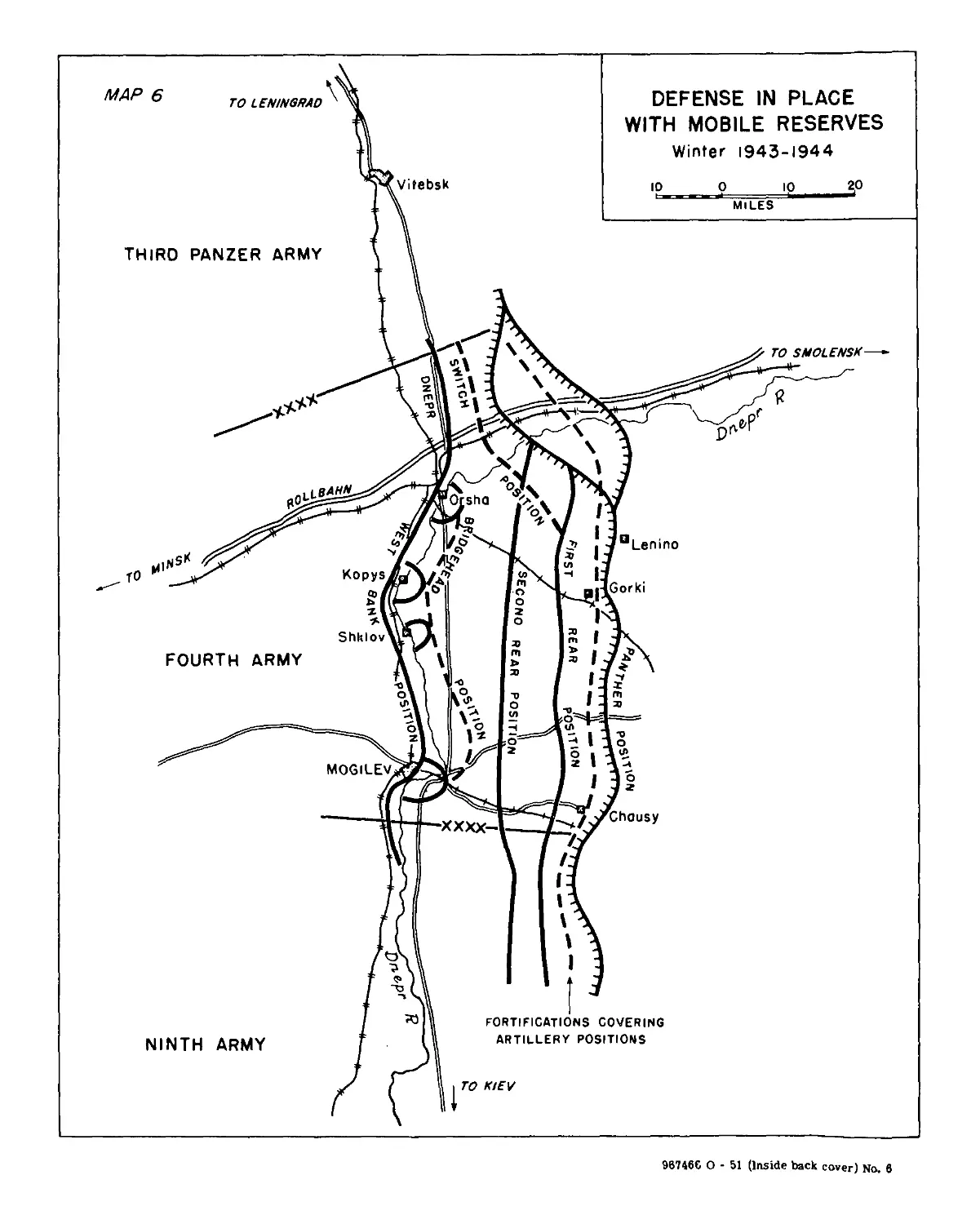
In the operations near Orsha during the winter of 1943^44, the
Germans employed defense-in-place tactics and denied the Russians
the use of the Minsk-Smolensk Rollbahn for several months. In this
instance, railroad and highway communications were excellent, and
the mobility of the reserves, together with the construction of defensive
positions in depth, prevented a Russian break-through. Used in other
sectors, the same tactic proved ineffective when road nets were bad
or when the Russians massed a thousand or more tanks to force a
break-through, and the Germans had no adequate weapons to oppose
them. Had the enemy used such a mass of armor at Orsha, the Ger-
mans would have been unable to hold with a defense in place.
Even at Orsha the general situation of Fourth Army was anything
but favorable. (Map 6) By the end of September 1943, the army
had just completed a strategic withdrawal from positions east of
Smolensk under extreme difficulties. In accordance with orders
from Army Group Center, the army was to occupy the Panther
position east of the Dnepr in order to deny the Russians access to
Orsha, the communication center on the Dnepr, where three railroad
967466“—51----з
27
28
GERMAN .REPORT SERIES
lines and the Moscow-Minsk and Leningrad-Kiev highways intersect.
The capture of Orsha would have jeopardized the position of Third
Panzer Army adjacent to the north and Ninth Army to the south.
The Fourth Army sector was seventy-five miles wide and ran from a
point ten miles north of the RoUbahn to the southern outskirts of
Chausy. The army had three corps with eleven divisions whose
combat efficiency was greatly reduced by the hard fighting and the
withdrawal they had recently undergone. With the exception of
one reorganized division, the combat strength of the divisions had
dropped to that of regiments, and their weapons and equipment were
inadequate. At first the Panther position was very thinly held. With
the arrival of replacements and the introduction of various expedi-
ents, the army gradually succeeded in building up a fairly adequate
defense system.
The construction of the Panther position began in August 1943.
In some sectors the position consisted of two parallel trenches, in
others of only one. A number of trenches had not been completed
by the time the line was occupied and in these sectors the defense
system was only a cordon of individual strong points. Tactical wire
was strung intermittently and dugouts were few. Natural obstacles
had been integrated into the defense line wherever possible. From
a tactical point of view, some of the sites were not too well selected
because they ran along unsuitable forward slopes. Enemy fire soon
led to the abandonment of these positions and forced the Germans
to dig in on reverse slopes. Observation was adequate and, though
the position was far from perfect, it offered the weakened German
forces the possibility of making a stand.
The Russians had followed the German withdrawal very closely.
They assembled their forces in front of the position and made careful
preparations for a break-through. They did not attack until 12 Octo-
ber and the German troops made good use of this delay to improve
their defense area. The German command expected that the immedi-
ate objective of the impending Russian attack would be to take
Lenino, cut the Orsha-Gorki highway, link up with strong partisan
groups operating in the forests northwest of Gorki, turn toward Orsha,
and advance along the Rollbahn to Minsk.
The reserves of the Fourth Army consisted of several assault gun
battalions, some motorized antitank units, GHQ artillery, rocket pro-
jector regiments, and engineer and construction units. The success
of the defense in place depended upon correctly timing the shift of
the mobile elements of these reserves to threatened areas or sectors
already under attack. No outside assistance was to be counted on, but
the army intended to withdraw battalions, regiments, and even divi-
DEFENSE TACTICS AGAINST RUSSIAN BREAK-THROUGHS
29
sions from quiet sectors and move them to critical points once the
Russian attack was in full swing. In so doing, the army commander
was ready to take great risks in stripping quiet sectors of the front.
The task of shifting these forces was greatly facilitated by the
availability of excellent routes of communication. From the lateral
highway and railroad line connecting Vitebsk with Orsha and Mogi-
lev, routes branched off to each corps sector. Truck transportation,
earmarked for supply functions, was diverted to troop movements.
All roads and highways were clearly marked, and construction units
maintained them in serviceable condition, a task which was especially
difficult in spring and required a lot of manpower. Particular care
was given to the marking and maintenance of panzer roads. Special
bridges had to be constructed or fords provided for heavy tanks and
assault guns because the existing bridges could not carry such loads.
Railroad operations were conducted up to points immediately behind
the front line.
Instead of giving the weak combat forces a well-deserved rest, the
army commander was forced to issue strict orders that all front-line
troops work without interruption on improving the forward positions.
An exacting, at times even petty, control system had to be imposed
by the army to find out where the construction work was lagging and
how weak points could be reinforced. By this method the defense
system gradually gained depth, and one obstacle after another was
coristnicted. Finally, the Panther position consisted of two con-
tinuous trenches and a fortification system protecting the artillery
gun positions. As soon as the Panther position was sufficiently strong,
several other positions were constructed in the rear. The first two
were spaced at six-mile intervals, and the third covered Mogilev,
Shklov, Kopys, and Orsha on the Dnepr by the construction of perim-
eter defenses east of the river. These bridgeheads had a depth of
three to five miles and were interconnected by a trench linking their
most forward points. Numerous switch positions were built between
the individual trenches and fortified lines so that, in case one sector
was lost, contact between units would not be disrupted. Contrary to
customary German technique, these switch positions connected the
successive trenches diagonally and not vertically. Another position
extending north beyond Orsha was built along the west bank of the
Dnepr. During the winter the Germans also constructed a strong
position farther to the rear along the Beresina.
The antiaircraft artillery, as well as the few available planes, were
held in reserve to be committed in sectors under attack. The flexibility
of the mobile antiaircraft guns greatly strengthened the defense sys-
tem. Effective reconnaissance was of great importance. Informa-
tion obtained from ground reconnaissance, sound ranging, and air
30
©ЕйМАМ REPORT SERIES
observation usually provided the Germans with sufficient intelligence
to determine the scope and time of Russian attacks with exactitude.
Thus, the army was able to introduce effective countermeasures even
before the beginning of an attack.
The Russians launched altogether eight major thrusts against the
German defense system. Their last attempt to break through was
warded off at the beginning of April 1944. The Dnepr defenses were
still intact after six months of bittie struggle. The Russians failed to
force a break-through in the direction of Orsha and Mogilev despite
a series of frontal, flanking, and enveloping attacks. An analysis of
this German success shows that the Fourth Army was able to com-
pensate for a one-to-ten inferiority in manpower and materiel only by
exploiting all possibilities for defense and co-ordinating all its forces.
For this purpose the army had to interfere in details of the command
functions of its subordinate corps and divisions, a procedure altogether
contrary to German doctrine, but one which proved necessary in this
instance. Orders for the formation of reserves, the purpose of which
could be understood only from the perspective of the over-all situa-
tion, frequently did not make sense to lower echelon commanders.
The same may be said for some of the orders pertaining to improving
positions, constructing roads, transferring stocks of ammunition, and
similar demands.
The unusually good communications made it possible to shift re-
serves freely. When Russian attacks were at their heaviest, the rate
of transfer was stepped up to two battalions per day. The with-
drawal of an entire division from the front and its subsequent move-
ment to another sector usually required several consecutive nights.
During the first night one or two battalions were pulled out, and
adjacent sectors extended. During the following night the width of
the adjacent sectors was equalized and one or two more battalions
were withdrawn in the same manner. This was continued at the
same rate until the movement was completed. The transfer of forces
would have been accomplished much faster had single battalions been
withdrawn from different divisions, but the army avoided this pro-
cedure whenever possible since it attempted to maintain the organiza-
tional integrity of its divisions.
Before the first Russian thrust, the corps sector where the enemy on-
slaught was expected was widened by the inclusion of two additional
divisional sectors. This was contrary to the established procedure
of narrowing that defense sector where an attack was expected. The
purpose of this measure was to enable the corps to form strong re-
serves from its own forces and shift them to the points where they were
most needed. In this case, the widening of the defense sector proved
effective since all Russian attacks were halted.
DEFENSE TACTICS AGAINST RUSSIAN BREAK-THROUGHS
31
In another instance a motorized infantry division, which had but
five organic battalions in line at the beginning of the fifth Russian
thrust, was subjected to particularly heavy attacks. By the time
the fighting abated on the fifth day, fifteen additional battalions had
been brought into the divisional sector, and the front was held. At
the same time, the German lines in quiet sectors were so overextended
that one mile of frontage was occupied by only thirty men. The
slightest attack would have penetrated the line in these sectors, but
the Russians did not attempt to launch one.
To command and troops alike, the construction of reserve positions
gave a sense of security which they ordinarily lacked in the Russian
theater. At no time did their existence lower the resistance of the
troops or induce them to withdraw before it became absolutely neces-
sary. The infantry felt reassured by the effective tactics the army
employed in massing its artillery. The army artillery commander
held far-reaching authority over all organic artillery, giving full sup-
port to whichever corps was under attack and withdrawing units not
needed in quiet sectors. He made all arrangements to provide an
adequate supply of ammunition by diverting supplies slated for quiet
sectors and using them where they were most needed. Supply move-
ments were facilitated by the availability of the main highway and
railroad leading from Minsk which, however, were frequently cut
by partisan attacks. During lulls in the fighting, ammunition was
saved for impending enemy thrusts.
The mass employment of supporting units such as assault gun,
panzer, tactical air support, antiaircraft, and antitank elements was
stressed by the army commander. These units were pulled out wher-
ever they were not absolutely essential and shifted to sectors under
attack.
The Russian offensive tactics during these operations varied little
from those used earlier in the campaign. The infantry fought
bravely, launching attack upon attack, often with only a few hours’
interval. Manpower was no problem to the Russians. In seemingly
never-ending waves, they came out of their trenches, advanced, with-
drew, and returned to the attack. During the five thrusts along the
Minsk-Smolensk highway, the Russians usually renewed their attacks
at the identical spot where they had tried before. They persisted in
their efforts to force a break-through at a particular point and entirely
disregarded the cost. A more flexible command might have consid-
ered other solutions.
The Russian was capable of concentrating tremendous fire power
and employing artillery effectively. During the first day of an opera-
tion, artillery fire was well coordinated, but thereafter its unity of
GERMAN REPORT SERIES
§2
effort gradually disintegrated and its effectiveness decreased. During
the second thrust he assembled approximately 800 pieces along a six-
mile front and fired a quantity of ammunition which was hitherto
unsurpassed in the Russian theater of operations. The number of
German guns available for counterfire was approximately 250. On
the first day of the thrust the Russians achieved a deep penetration
between the Dnepr and the Minsk highway. An attempt to straighten
out the salient was unsuccessful. The next day the Russians pene-
trated the German lines north of the highway and isolated an entire
artillery battalion-group. In spite of the commitment of additional
reserves, the German line had become so fragile that the army decided
to withdraw to the second line of the Panther position. When the
Russians renewed their attack, it seemed that their artillery lacked
unity of effort and co-ordination. The Germans repelled all further
assaults and prevented a break-through.
Russian camouflage and concealment were excellent. The enemy
moved at night and disappeared from sight during daylight, hiding
in villages and wooded areas. Although the Russians often regrouped
their forces, their movements could rarely be observed.
The Soviet lower command echelons often lacked initiative. After
having succeeded in pushing back the German line for instance, the
Russians had difficulty in sustaining the momentum of the attack and
in assembling their infantry and artillery forces for an attack on the
next objective. On the other hand, the enemy showed extraordinary
skill in exploiting even the smallest penetration with amazing speed.
Because of these infiltration tactics, the Germans were forced to make
every possible effort to immediately seal off penetrations, however
small their own counterattack force. Otherwise, it would have been
impossible or would have involved heavy casualties to ferret the Rus-
sian out of the break-through area. Once they had sufficient time to
organize positions, even planned attacks by fresh units often failed
to overcome the stubborn resistance offered by the Russians.
The enemy’s zone of attack was usually strictly limited, almost as
if it had been cut to measure. The German supporting weapons out-
side the attack zone proper were not neutralized. For instance, the
flanking fire delivered by a German artillery battalion-group from
an adjacent sector straight into the Russian attack waves was not
interfered with in any way.
The Russian rarely launched diversionary attacks at points outside
the main zone of attack. Considering the extent to which the Ger-
mans had weakened the quiet sectors of their front, such diversionary
attacks would probably have caused some very critical situations.
The Russian proved once again that he was practically immune to
DEFENSE TACTICS AGAINST RUSSIAN BREAK-THROUGHS	33
unfavorable weather conditions. Snow, rain, cold, and ice affected
him but little. His winter clothing was of excellent quality.
Except for attacks against German infantry in the front line, the
enemy air force was almost inactive, although German antiaircraft
defenses were inadequate. Since the Russians never undertook stra-
tegic air operations, the Germans were able to move supplies without
enemy interference.
Chapter 6
POSITION DEFENSE IN STRONG POINTS AND
IMPROVISED FORTRESSES
The defender who decides to hold out in place in strong points
and improvised fortresses usually employs emergency measures rather
than defense tactics. The Germans were forced to resort to such meas-
ures because of the acute manpower and materiel shortages from which
they suffered once the war had spread all over Europe and to North
Africa. In Russia, the overextended front lines, the bitter struggle
against a superior enemy, and the elements of nature led to an expendi-
ture of forces for which German manpower resources and industrial
potential were insufficient. The long duration of the war accentuated
these deficiencies with the result that position defense in improvised
strong points and fortresses became ever more frequent. Excessive
losses, difficult terrain, and bad weather forced the Germans to anchor
their defense system on inhabited localities along wide sectors and to
use these defense areas as substitutes for a continuous front line.
These tactics often proved effective because they helped to gain time
and overcome critical situations. During the winter or during the
muddy seasons, for instance, holding villages and towns was the only
way to escape annihilation. Then, it was the weather and terrain
that imposed the adoption of these emergency measures. During the
summer and dry weather many an enemy break-through attempt was
delayed and whittled down by the same tactics until the Germans
were capable of containing the Russians along a continuous line
prepared in the rear.
Service troops took a major part in the defense of inhabited locali-
ties. In most instances they built and improved fortifications in areas
where they were stationed and made strong points of them. Fre-
quently, supply elements were organized into alert units and com-
mitted as replacements in the most forward fortified areas. The
system of mutually supporting strong points provided for defense
in depth and maximum utilization of all available forces for combat
purposes. Every soldier in a headquarters or service unit and in rear
installations received combat training with emphasis on proficiency
in the use of antitank weapons in close combat. Whenever the train-
ing schedule was rigidly adhered to, the results were favorable. In
1943, for instance, in Zolochev (near Kharkov) a divisional bakery
company stopped Russian tank units which had broken through,
destroyed several tanks, and forced the remaining ones to turn about.
34
DEFENSE TACTICS AGAINST RUSSIAN BtlEAK-WBOUGHS
35
The practice of defending strong points should, however, not be
overdone or adopted as a standing operating procedure. It would be
wrong to order all unit trains and supply trucks to stop in the midst
of a withdrawal and make their service personnel fight to the last
man. If such an order was obeyed to the letter, it would lead to the
loss of all transportation facilities and disrupt traffic. This, in turn,
would jeopardize the supply of the combat forces, greatly impair
freedom of maneuver, and result in disaster.
During the battle for Lithuania in October 1944, the German de-
fense based on fortified inhabited localities did not actually stop or
even delay the Russians for long, but it achieved a certain continuity
in the defense and checked the enemy advance by causing many delays
and inflicting casualties. Since no new reserves could be formed or
provided by army group, a number of service schools and headquarters
units, all available trains and supply troops, as well as all other
auxiliary units, had to be employed in the defense. They strengthened
the resistance at crucial defiles and potential points of penetration.
A tightly knit defensive network was built up which even strong
enemy forces could penetrate or bypass only by a time-consuming
process. The strongly defended towns usually withstood the enemy’s
daylight attacks. During the evening hours, however, the Russians
bypassed or attacked these towns from all sides, and the German
elements had to be withdrawn under cover of darkness to escape
encirclement and annihilation. In the meantime, renewed resistance
was organized along another line, which the German forces occupied
by dawn and the process was repeated. The Russians did not advance
more than five to six miles a day, even in the sector where they placed
their main effort. They did not achieve a break-through or open a
gap in the front. Once they reached the Memel River, the German
forces, reinforced by other improvised units, brought the enemy
offensive to a halt.;
Ctepter 1
IMPROVISE© ZONE
A variant of zone defense was improvised by the Germans during
the battles for the city of Lvov and for East Prussia in the final
phase of World War II. Though similar to the doctrine of elastic
defense in depth and the evacuation of forward positions introduced
during the First World War, these defensive tactics are not identical
with any others employed before 1944. The characteristics of this
improvisation, as applied during the battle for Lvov, have been ex-
plained in the Department of the Army Pamphlet No. 20-201, pp. 27 ff.
Since the prerequisites for their successful application rarely existed,
and since most German commanders in the field doubted their prac-
ticability and utility, these tactics were not employed on any other
front. Besides, the over-all situation was so critical that there was
a general reluctance to introduce experiments. By the second half
of 1944 the Germans rarely had sufficient time for the construction
of numerous positions or for the thorough indoctrination and train-
ing of troops. Only the most ardent faith in this improvisation
could overcome all handicaps and achieve final success. During both
battles improvised zone defense tactics helped to keep intact the
combat strength of the German divisions subjected to terrific con-
centrations and to prevent the enemy from breaking through. On
both occasions the Russians suffered heavy casualties and were forced
to shift their main effort to other sectors.
In East Prussia the Third Panzer Army, with its 9 weak divisions,
50 tanks, 400 artillery pieces, and insignificant air support was op-
posed to 44 Russian divisions, 800 tanks, 3,000 guns, and strong air
forces. The use of improvised zone defense tactics enabled the army
to stop the Russian onslaught for one month, after which the collapse
of the adjacent armies forced a withdrawal from this sector. Dur-
ing December 1944 special training in zone defense was introduced
with the active participation of both command and troops. Army
engineer and construction units supervised the paramilitary and ci-
vilian labor forces building position after position. Antitank ob-
stacles, mine fields, and a system of local strong points and nests of
resistance, fifty miles in depth, were built. (Map 7) The foremost
fifteen-mile belt was fortified on the basis of the lessons learned at
Lvov. Everyone, from corps commander to private, made strenuous
efforts to improve the defense system. Strong points and pillboxes
were to afford maximum protection and defensive power by the con-
36
DEFENSE TACTICS AGAINST RUSSIAN BREAK-THROUGHS
37
struction of perimeter defenses. At the same time precautions were
taken to prevent pillboxes or nests of resistance from becoming traps
for their defenders. Tactical details and technical improvisations
were carefully planned to preclude disagreeable surprises. All of
East Prussia became one fortress with the zone defense area its
strongest outpost. The morale of the troops was excellent, and they
faced coming events with confidence.
The Russians attempted a war of nerves by announcing the start of
their offensive at three different times and by telegraphing their
punches in advance. The Germans did not take these announcements
too seriously and refused to be intimidated by the Russian show of
armored strength in front of their lines. They were more concerned
about Russian preparations along a railroad embankment, a few hun-
dred yards in front of the German lines, where the enemy brought
up antitank guns and dug eight passages through a dam which his
tanks were unable to surmount. These preparations were too close
to remain unobserved, although the Russians tried to cover the noise
of the nightly demolitions by heavy mortar fire and camouflaged the
passages with boards and foliage. This was the line on which the
Russians emplaced their most forward heavy weapons which were to
eliminate any German interference by direct fire and cover the tanks
advancing through the gaps in the embankment. Other indications
of an imminent major offensive were the trenches dug by the Russians
to facilitate the approach of infantry spearheads and the construc-
tion of positions connected by communication trenches to provide
cover for the assembly of the first-wave infantry. Changes in the
daily aerial photographs provided information on newly constructed
emplacements and showed fresh tracks in the snow leading to am-
munition dumps and battery positions. Reports from agents gave
information on the arrival of new divisions, and a few radio signals,
intercepted despite the enforcement of strict radio silence by the
Russians, uncovered the location of forward command posts. These
indications made it clear where the Russians intended to place their
main effort and at what time and with which forces they planned to
start the attack. The Russian attack preparations were methodical:
enemy artillery observers occupied newly constructed observation
posts; medium guns registered cautiously; enemy fighters suddenly
swept the sky to stop German aerial reconnaissance; and dive bombers
plastered approach routes, command posts, and towns behind the
German front with machine gun fire and bombs. Together with
heavy Russian troop movements toward the front, particularly dur-
ing the nights of 9 and 10 January, these indications were closely
observed and studied to enable the army commander to give the code
word for the withdrawal to the main battle position at the right
moment. It required steady nerves and expert evaluation of combat
38
©EKMAN DEPOUT SERIES
intelligence not to exhaust the troops by repeated premature with-
drawals or to suffer heavy casualties from the enemy’s barrage because
delayed withdrawal orders had jeopardized the defensive maneuver.
On 11 January there was a noticeable reduction in enemy combat
activity and movements. The German troops were nervously wait-
ing for the orders which were to spare them from the enemy’s deadly
fire, but they failed to receive any such order at the front line. Instead,
the graduating class of the Luftwaffe Academy was to be conducted
on a tour of the army sector- The young officer candidates watched
demonstrations by the newly arrived 5th Panzer Division and in-
spected the fortifications of the battle position. Since the front was
calm, it was possible to fulfill their request to visit some outposts and
observe the enemy’s positions and movements. Here and there an
enemy machine gun fired a few rounds, breaking the silence of a
sunny afternoon. Suddenly, some projectiles whizzed through the
air and dug up the earth near a crossroads. Several mortar shells
exploded near the outposts, and the platoon leader shouted the com-
mand : “Take cover.” Detected by the enemy, the visitors quickly took
cover in a deep dugout. After a few more rounds registered in the
vicinity, two German artillery salvos hit back at the enemy observa-
tion posts and silence was restored. Proud of their front-line experi-
ence, the officer candidates returned unharmed to the rear.
The following day was even more peaceful. No new clues regarding
the probable H Hour of the enemy attack were observed by the out-
posts. On the other hand, radio intercepts as well as the latest obser-
vations of night reconnaissance planes left no doubt that strong Rus-
sian columns were moving into their assembly areas, that the artillery
emplacements were fully occupied, and that the armed units had
moved up into the depth of the concentration area. The Germany
army commander therefore decided to give the code word at 2200 on 12
January. The evacuation of the two forward lines went smoothly and
the units moved into the battle position. Three hours later the move-
ment was completed, the new command posts were occupied, and the
signal communications functioned normally.
As usual before a major Russian offensive, several deserters arrived
at German outposts; their statements agreed—a heavy artillery prep-
aration at 0600 was to precede the launching of the attack on 13 Jan-
uary. The army commander immediately issued orders that the
German artillery deliver at 0530 a concentration on the assembly
areas of the enemy infantry and use the two basic loads set aside for
this purpose. Thus, a heavy German preparation led off the second
battle for East Prussia. At 0600 the enemy unleashed a hail of fire
with more than 3,000 pieces pouring shells of all calibers on the two
forward German positions evacuated only a few hours earlier. By
then the German infantry and artillery occupied the battle position
0EFENSE fACTICS AOAINS? RUSSIAN DDEAK-THSOU@HS	§<g)
which had its forward boundary in the third position. The area fire,
covering up to three miles in depth, was scattered and damaged only
evacuated towns and former command posts, the obvious targets of
the Russian artillery. The German reserves were hidden in the woods
and remained unharmed by the preparation fire. By 0800, after
pulverizing the first position, the Russian fire concentrated on the
second one, but with less intensity. Half an hour later the shells were
scattered in the depth of the battle position, gradually diminishing
to area or harassing fire without definite targets.
Following the first salvos of artillery fire, the Russian infantry
had gone into action, carefully advancing through thick fog which
covered the terrain until 1100. Only slightly delayed by the fire of
German rear points left behind in the first position, the Russians soon
rushed beyond this obstacle. But even before they reached the evacu-
ated second position, they were pinned down by artillery and rocket
fire. Their reports, announcing the capture of the first and second
German positions to higher headquarters, failed to mention that they
had taken no prisoners or booty. It was not until 1000 that they
reached the forward line of the battle position. Pinned down by the
fire of all German guns and the ladder fire of the rocket projector
brigade, their advance came to a sudden halt. The Russian infantry
sent out distress signals for immediate tank support. Poor visibility
prevented the enemy from taking advantage of his superiority in fire
power and in the air. Nevertheless, the Russian infantry succeeded
in penetrating between individual strong points. When the fog lifted,
these spearheads were cut off and annihilated.
The Russians directed their main thrust against the only elevation
in this area, near Kussen, which they captured around noon after a
strong armored attack. Their infantry, attempting to follow the
tanks, was repelled with heavy casualties along the forward line of
the main battle position. The Russian armored units, however, con-
tinued their thrust from the Kussen area because the German anti-
tank guns were unable to cope with such masses of tanks. This threat
was all the more serious since enemy planes appeared in great number
and were initially unopposed. They bombed towns, roads, evacu-
ated command posts, and artillery emplacements and attacked every-
thing that moved on the ground. German planes, called to the rescue,
attacked the low-flying Russian formations, shot down several planes,
and dispersed the rest. This was the cue for the German counter-
attack. Leading the attack, 5th Panzer Division columns emerged
from the protective cover of the forests and launched simultaneous
thrusts against the flank and rear of the Russian armor in the Kussen
area. The clash, in which the panzer division was supported by an
assault gun brigade and rocket-firing planes, raged for several hours.
After the Germans recaptured Kussen, Russian tank reserves made a
40	GERMAN REPORT SERIES
counterattack, but were turned back by assault guns and fighter planes.
The German infantry, supported by assault guns, tore gaps into
the Russian attack columns which had been weakened by heavy artil-
lery and rocket fire. Before long the entire enemy attack force
wavered and fell back in confusion. During the evening the former
main line of resistance was reoccupied by the German infantry. The
booty was rich, aside from 122 burned-out tanks piled up on the slopes
near Kussen. Improvised zone defense had saved the German forces
from being annihilated and had stopped all enemy break-through
attempts.
The Russians continued their assaults during the following days,
feeding them with a constant flow of men and materiel. They were
unable, however, to repeat the deadly preparation of the first day
because they lacked the necessary ammunition. Despite tenfold
superiority and extreme sacrifices, they made little headway and were
unable to overcome the zone defense belt. The high ground near
Kussen changed hands several times, and 200 additional enemy tanks
met with destruction in that area. The enemy finally succeeded in
penetrating some marshy woods to the south of the zone defense area
and forced the panzer army to withdraw in order to escape
envelopment.
Chapter 8
ISTHMUS DEFENSE—=THE SEA AS HANK PROTECTION
Military history offers many examples of the defense of an isthmus.
This terrain feature affords a multitude of opportunities to deny the
attacker access to large and usually important areas with a minimum
expenditure of forces. The short frontage of an isthmus defense can
be anchored on bodies of water, and the line can be quickly fortified
and easily defended. Although the adjacent shore line has to be
secured, this can often be achieved with small forces. An isthmus
separating two oceans is an unsurmountable obstacle if the defender’s
flanks are protected by superior air and naval forces. Even with
inadequate naval forces, the defender will be able to repel enemy
landings with the help of artillery and air power or to destroy a
beachhead with mobile ground forces. During World War I the
British were unable to break through the Turkish line on the Galli-
poli Peninsula, despite their overwhelming superiority on the sea and
in the air.
An isthmus between lakes can also be of great tactical value. The
Battle of Tannenberg in 1914 offers a valid example. In this battle
the Germans took advantage of the fortified isthmus near Loetzen,
in the East Prussian lake district, to delay the Russian First Army
until the German Eighth Army had completed the encirclement and
annihilation of the Russian Fourth Army.
Both during the Russian withdrawal in 1942 and that of the Ger-
mans in 1943, the swampy isthmus between Lake Peipus and the
Baltic Sea proved a formidable obstacle. The German thrust on
Leningrad was blocked along the isthmus near Narva until an envel-
opment from the south across the Luga forced the Russians to aban-
don their positions. The Russian offensive in 1943 encountered simi-
lar difficulties when it was stalled at the same isthmus.
In 1941-42 weak Russian forces delayed the German advance for a
long time on the strongly fortified isthmus of Kerch in the Crimea.
With the reversal of the tide in 1943, two German corps, blocking
the Perekop and Kerch Isthmuses, succeeded in delaying the many-
times superior Russian armies for six months. The story of the de-
fense of the two Crimean isthmuses by the Germans shows how effec-
tively break-through attempts can be frustrated by taking advantage
of this geographic feature. The subsequent withdrawal to Sevastopol
indicates the importance of the sea as flank protection. At the be-
ginning of October 1943 the mission of defending the Crimea was as-
41
4)2
@2RfSAN ИЗРОЙ? SERIES
signed to the German Seventeenth Army. The forces available for
this mission were constantly dwindling since one division after another
was transferred to the Sixth Army which was trying to stem the
Russian onslaught north of the Crimea. By mid-October Seventeenth
Army had two corps with two German and four Romanian divisions
at its disposal. One Romanian corps guarded the south coast of
the Crimea. (Map 8)
The V Infantry Corps was to prevent an enemy landing on the
Kerch Peninsula or throw the Russians back into the sea wherever
they landed. If possible, the corps, was to form mobile reserves.
The area under the jurisdiction of the V Corps included the city
of Feodosiya which, during the winter 1941-42, had been the target
of an amphibious operation conducted by the Russian Black Sea
Fleet, resulting in an extremely critical situation. The port of Feodo-
siya and the surrounding territory was held by Task Force Krieger,
a motley unit composed of two weak battalions of limited service and
over-age German personnel and one Azerbaijan and one Turkoman
battalion. Three divisions—the German 98th Infantry Division and
the Romanian 6th Cavalry and 10th Infantry Divisions—were avail-
able for the defense of the approximately 200-mile coast line of the
Kerch Peninsula. The 6th Romanian Cavalry Division was good but
numerically weak, whereas the Romanian infantry division was mili-
tarily and politically unreliable. Although there were many in-
stances of individual bravery in the performance of these Romanian
troops, they were subject to panic when faced by tanks and lacked
stamina under heavy, continuous artillery fire. Under these cir-
cumstances it was obvious that the German 98th Infantry Division
had to be committed in the most vulnerable sector around the city
of Kerch, with Eltigen as boundary in the south and Cape Tarkhan in
the north. Since the combat strength of the 98th Infantry Division
had dropped to approximately 40 to 50 men per company, a continuous
line of defense along the entire coast was out of the question. After
one regiment had been designated as sector reserve, the remaining
forces were just about sufficient to man strong points in the port areas
and at the extreme end of the peninsula at Zhukovka, with security
detachments patrolling the other parts of the coast.
The 6th Romanian Cavalry Division was responsible for guarding
the south coast of the peninsula and the 10th Romanian Infantry
Division covered the north coast from Cape Tarkhan to Ak-Monay.
The Luftwaffe was extremely weak, with the shortage of reconnais-
sance planes a matter of real concern to the German command. At
times only one reconnaissance plane was expected to cover the entire
Crimea. As a result, the V Corps lacked information about the size
of the Russian landing preparations, which doubtless were in progress
on tiie other side of the Straits of Kerch. Any plan to delay these
DEFENSE TACTICS AGAINST RUSSIAN BREAK-THROU@HS
preparations by air attacks was frustrated by the lack of intelligence
on Russian concentrations on the Taman Peninsula. Obviously, the
Germans had no clue as to the probable Russian landing points.
During the night of 19-20 October 1943, one Russian division landed
at Eltigen which was defended by a company from the 98th Division
numbering forty-six men. Immediately alerted, the German reserves
were able to narrow down the Russian beachhead but were not suffi-
ciently strong to eliminate it. While this fighting was under way,
the Russians attempted to land in force near the city of Kerch during
the night of 31 October-1 November. The landing parties in the port
of Kerch proper and along the coast between Kerch and Zhukovka
were repulsed. But immediately north of Zhukovka the Russians
overcame the security detachment and moved in reserves, widening
the beachhead in the course of a bayonet engagement. Soon the Rus-
sian pressure from the newly won beachhead increased so that a Ger-
man counterattack was out of the question. After overcoming some
critical situations, the German forces in this sector were barely able
to hold the important heights northeast of the city of Kerch. Thus
began a fierce struggle which was to seesaw in the immediate vicinity
of the city for five long months.
The area which the Russians had chosen for their main landing had
one great disadvantage. They had gained a toehold on the eastern-
most part of the peninsula on a comparatively narrow isthmus which
protruded beyond the city of Kerch. The Russians were unable to
deploy their forces or expand their beachhead until they had captured
the city and the high ground north of it. The German defense could
succeed only if the Russians remained hemmed in on the small isthmus.
German defense tactics therefore called for blocking the Russians on
Mount Mitridates, overlooking Kerch, and along the mountain range
north of the city, denying them access to the rest of the peninsula.
This German plan succeeded although the Russians gradually built
up their beachhead until it contained twelve divisions including many
tanks. The 98th Division bore the brunt of the fighting against this
superior force during the months of November, December, and Janu-
ary. It was assisted by one German infantry regiment which Seven-
teenth Army had moved across the Crimea from the Perekop area and
by some Romanian battalions which were held in reserve and com-
mitted in emergencies. Elements of the only assault gun battalion
in the Crimea repeatedly intervened at danger points. Toward the
end of January 1944, when the weakened line of the 98th Division
was at the point of breaking, the 73d Infantry Division was brought
in by air without its artillery components.
On 7 December 1943 the 6th Romanian Cavalry Division, concen-
trating all its forces and assisted by the assault gun battalion, elim-
inated the Eltigen beachhead which menaced the German flank and
967488”—51--4
44
©ERMAN REPORT SERIES
was close to the main landing. Although the operation was successful
and resulted in the capture of 2,000 Russian prisoners, it led to an
unexpected crisis. During the night, elements of the Eltigen force
broke through the Romanian line and moved north to link up with the
Kerch beachhead. This force overran several batteries which were
zeroed in on the main Russian beachhead and before dawn attacked
German artillery outposts on Mount Mitridates from the rear. From
there some Russian elements infiltrated into the southwestern part
of the city of Kerch. The Russian commander of the Kerch beach-
head, who had launched an attack as soon as he knew about the
German assault on Eltigen, recognized the favorable opportunity and
redoubled his efforts to link up with the Eltigen force. Since there
were no readily available German reserves, this critical situation had
to be overcome by the forces on hand. Three assault detachments
were formed by pulling combat-seasoned troops out of the line. They
recaptured Mount Mitridates in one swoop and held on to it. Later
on, elements of the 3d Romanian Mountain Division, moving up from
the north coast of the Kerch Peninsula, annihilated the remnants of
the Eltigen force.
The 98th and 73d Divisions, reinforced by Romanian troops, with-
stood four major Russian attacks launched from the Kerch beachhead.
Individual heights and key trenches constantly changed hands during
the weeks of bitter fighting. German counterattacks alternated with
minor local withdrawals and corrections in the front line in order to
save manpower and reduce casualties. All these actions were dom-
inated by the primary consideration of holding the key position on
Mount Mitridates and the area to its north. Another landing gave
the Russians control over the northern mole of the port of Kerch and
the eastern part of the city, but the Germans kept their hold on the
western portion and the crucial mountain. The Russians also landed
along the coast of the Sea of Azov near Cape Tarkhan, where they
captured an important hill. German counterattacks restored the sit-
uation somewhat.
Two outside threats hovered over the fighting around Kerch: the
Russian Black Sea Fleet and the impending defeat of the German
Sixth Army defending the land communications with the Crimea.
A large-scale landing, for instance at Feodosiya or Sevastopol, in
co-operation with the Russian Black Sea Fleet, would have put the
German forces in the Crimea in an untenable position because they
were powerless to prevent any such attack. Actually, the Russians
did not commit their fleet, not even for a deceptive maneuver. They
seemed to attach more importance to keeping their fleet intact than to
achieving a quick success in the Crimea. This was easily compre-
hensible since the offensive north of the Sea of Azov proceeded so well
that there was every reason to expect that the Crimea would fall sooner
DEFENSE TACTICS AGAINST RUSSIAN BREAK-THROUGHS
45
or later. While the Eltigen beachhead was being reduced by the
Romanians, the badly shattered divisions of the German Sixth Army
were driven back to Melitopol. At the time of the main enemy land-
ing near Kerch, the Russian armies in the north crossed the Dnepr and
achieved a break-through toward Krivoi Rog. By the beginning of
November 1943, the Russian forces north of the Crimea were attacking
the Perekop Isthmus which connects the Crimea with the mainland.
The German forces in the Crimea were cut off and hemmed in. The
Russians continued their advance on the mainland and by mid-De-
cember had reached the Kherson and Nikopol bridgeheads and the
Kirovograd area. With the continuation of the Russian offensive in
January 1944, all hope for a German counterattack from the Nikopol
bridgehead had definitely vanished. Nikopol was evacuated on 8
February, Kherson on 13 March, and Odessa fell on 8 April 1944.
The German units in the Crimea were isolated far behind the Rus-
sian lines without hope for relief.
By the end of March, the fourth major attack on Kerch was re-
pelled by the Germans. On the morning of 5 April, a heavy artillery
preparation preceded another attack, resulting in an insignificant
penetration north of Kerch. This was sealed off by a German counter-
attack on the next day. For the first time the Russian attack was co-
ordinated with simultaneous assaults against the XLIX Mountain
Corps on the Perekop Isthmus. There, the situation was similar to
that at Kerch. So long as the weak and gradually tiring German
forces were able to contain the Russians on the narrow isthmus, they
had a chance of putting up a successful defense. Once the Russians
got through this bottleneck and penetrated into the open terrain of
the northern Crimea, Germans had no means of stopping them. The
so-called Gneisenau position had been constructed in an arc around
Simferopol, but this position was incomplete and could serve only
as immediate protection for the city proper. The Russians were free
to bypass it to the west or east. The distance from Krasnoperekopsk
to Simferopol is 60 miles by air, that from Kerch to Simferopol 110
miles. In the event that the Russians should break through at the
Perekop Isthmus, Seventeenth Army planned that the XLIX and
V Corps join forces in the Simferopol area. In view of the disparity
in the distance to be covered, it seemed questionable whether V Corps,
withdrawing on foot, would be able to reach Simferopol in time.
If the Crimea was to be evacuated, Sevastopol was the only possible
port of embarkation for crossing the Black Sea to Romania. The
port of Yalta was much too small, inaccessible, and surrounded by
mountains. The Russians knew this only too well and there was every
reason to believe that, once they had broken through the Perekop
Isthmus, they would bypass the Gneisenau position with their armored
and motorized units and thrust straight toward Sevastopol.
46
GERMAN REPORT SERIES
Although there was a close similarity between the situations at
Kerch and Krasnoperekopsk, the latter had one peculiarity. This was
the flat, shallow, muddy island and lagoon region of the Sivash east
of the isthmus. The Russians had built some causeways over this
almost impassible area; German planes occasionally succeeded in
damaging the causeways, but were unable to destroy them. Shortage
of ammunition prevented their destruction by artillery fire, as in gen-
eral the scarcity of ammunition had become an ever-present problem
after the separation of the Crimea from the mainland. On 8 April the
Russians launched an all-out offensive in the XLIX Corps area and
achieved major penetrations in the Sivash region and on the isthmus.
The next day V Corps was warned that the situation in the XLIX
Corps sector was tense and that the withdrawal to Simferopol might
be ordered for the following day. Several plans for the withdrawal
had been studied and prepared for the event of a voluntary or forced
German evacuation of the Crimea. As one of the first measures, the
assault gun battalion, some of the artillery, and all the Luftwaffe
elements in the V Corps area were to be transferred to XLIX Corps.
On the morning of 10 April, V Corps received orders to start its
withdrawal to Sevastopol via Simferopol by 1900.
During the winter the so-called Parpach position had been con-
structed across the narrowest isthmus of the Kerch Peninsula and
strengthened by a continuous wire obstacle, an antitank ditch, and
emergency shelters. But the infantry could not possibly reach this
defense line in a one-night march from Kerch. An intermediate posi-
tion was therefore to be established between Kerch and Parpach on
either side of Murfovka and this line was to be reached before dawn
and held during the day. The withdrawal to the Parpach line was
to be completed during the following night. The first units to be
withdrawn from the front were to secure the most important roads
and terrain features ahead of the intermediate position and cover the
withdrawal of the main body. Upon completion of this mission, the
security detachments were to fight a rear guard action, withdraw be-
hind the intermediate position, and form a reserve force. This plan
could not be carried out because the critical situation in the Perekop
Isthmus necessitated the immediate transfer of these elements. As
a result, the covering positions were inadequately manned and the
corps was without reserves.
Except for a reconnaissance in force, the Russians in the Kerch
beachhead were inactive on 10 April. After the V Corps had trans-
ferred all its fighter planes to the XLIX Corps area, the Russian air
force reigned supreme and became extremely active. Since the Rus-
sian forces in the north crossed most of the Perekop Isthmus and the
Sivash flats, the enemy command at Kerch felt certain that the with-
DEFENSE TACTICS AGAINST BUSSIAN BBEAK-THROU@HS
47
drawal of the V Corps was imminent. Any attempt at deceiving
them as to the German intentions was futile.
Nevertheless, the disengagement carried out during the night of
10-11 April proceeded without unforseen incident. Just before mid-
night the Russians entered the German positions, held by rear guards.
A few Russian tanks, followed by motorized infantry, took up the
pursuit of the German units moving toward the intermediate position.
This line was not fortified and followed the so-called Tartar Wall,
an ancient wall leading from Lake Uzunlarskoye via Murfovka to
the Kasantipskiy Bay on the Sea of Azov. The 6th Romanian
Cavalry occupied the sector between the lake and Murfovka, the
73d Division the central one on both sides of the Kerch-Feodosiya
highway, and the 98th Division the northern sector up to Kasantipskiy
Bay. The average strength of the German companies varied be-
tween 30 and 40 men. Despite the fact that the Crimea had been
cut off from the mainland since November 1943, fourteen-day fur-
loughs were granted to all soldiers who had not been on leave for a
year or more. Although this was an excellent way of boosting morale,
the German units in the Crimea gradually lost their battle-tested
cadre because few of the men returned to their outfits. Upon re-
turning from furlough, Army Group A intercepted them at Odessa
while they were waiting for transportation, organized them into
battalions, and committed them on the mainland.
The Kerch Peninsula is a rolling treeless steppe. Trees are so rare
that the four high ones standing west of the village Libknekhtovka
were a landmark which served as a point of orientation for the entire
area. Outside the inhabited places there is no cover or concealment
in the open terrain. The forests of the Yaila mountains began at
Stary Krym, west of Feodosiya. There, too, began the territory of
the partisans. Firmly entrenched, strong partisan forces had inter-
cepted the traffic along the Feodosiya—Simferopol highway for many
months, forcing the Germans to travel in armed convoys.
Shortly after 0700 on 11 April, even before front-line reports could
be evaluated, the Russians launched a powerful thrust in the 73d
Division sector north of the Kerch-Feodosiya highway. After suffer-
ing heavy casualties, the Germans succeeded in stopping the Russian
tanks and supporting infantry about one mile behind the intermediate
position. While the Germans were struggling to get this situation
under control, a fierce Russian attack hit the 6th Romanian Division
sector. The lack of reserves made itself felt. During the early after-
noon, Russian tanks broke through at Murfovka, thrust deep into
the rear area, wrought havoc with the Romanian trains, and reached
Arma-Eli, twenty-five miles behind the intermediate position. Rus-
°’,’n infantry poured through the gap opened by the armor.
48
0ERMAN REPORT SERIES
This was a full-fledged break-through with no German reserves to
stop it. The original intention to hold the intermediate position till
dusk and withdraw to the Parpach position under cover of darkness
could no longer be carried out under the prevailing circumstances.
It was altogether doubtful whether the German infantry and the
horse-drawn artillery would reach the Parpach position before the
Russians. If the Russians exploited the break-through and moved
up strong motorized forces behind their armored spearheads at Arma-
Eli, they could easily penetrate and outflank the position held by
weak security detachments. Once the Russians captured the Parpach
position, the V Corps faced certain encirclement and destruction on
the Kerch Peninsula.
The Russians recognized this possibility and moved up motorized
forces behind their armored force at Arma-Eli. In addition, they
went over to the attack along the entire front. Nevertheless, they
did not overrun the Parpach position although some individual tanks
succeeded in crossing the antitank ditch along the Feodosiya road
where the Germans had delayed the demolitions too long. It is diffi-
cult to determine in retrospect exactly how the Germans were able to
hold the Parpach position. The weak security detachments were
reinforced by troops shifted from one danger spot to another, and the
Russians also seemed to show some reluctance to throw their full
weight against the line they had themselves so successfully defended
during the winter 1941-42. Undoubtedly, the lower echelon com-
manders of the Russian spearhead units were diverted from their
objective by the extraordinary spectacle, which unfolded in front of
their eyes: fleeing supply columns, rows of vehicles in the distance,
horse-drawn artillery, long lines of trucks, and small detachments of
troops stumbling northwestward in wild disorder. The Russians could
not resist the temptation to attack such easy prey and, destroying
many columns of vehicles, forgot about the more important objective—
the Parpach position.
The daylight retreat from the intermediate to the Parpach position
over a distance of thirty miles led to bitter fighting on 11 April,
causing more casualties than any one of the long defensive engage-
ments around Kerch. Russian fighter and fighter-bomber formations
met with no opposition in the air and could lend their full support
to the Russian ground forces. The steppe, with its lack of cover,
provided the Russian fliers with a variety of targets. The Russian
fighters seemed to concentrate on prime movers and draft horses pull-
ing heavy weapons and artillery as well as on infantry units on
the march, while the fighter-bombers attacked horse-drawn and mo-
torized convoys. As a result the Germans lost most of their horse-
drawn artillery in the steppe since they had to blow up the pieces
after the horses had been killed from the air. Light and medium
DEFENSE TACTICS AGAINST RUSSIAN BREAK-THROUGHS
49
howitzers and antitank guns fared only slightly better. The retreat-
ing infantry forces faced many difficulties in the steppe. Subjected
to continuous air attacks, their plight was worsened by frontal and
flank attacks on the ground while individual Russian tanks blocked
their route of withdrawal. The approach of darkness brought some
relief, although the Russians continued their air attacks on roads,
towns, and communication centers.
The V Corps had suffered a major defeat on 11 April. The 6th
Romanian Cavalry Division was wiped out except for small remnants
which reached the Parpach position and were assigned to a small
sector on the right wing. The last elements of the 73d and 98th Divi-
sions did not arrive in the position until the morning of 12 April, after
fighting their way back step by step. The casualties were heavy—one
regiment of the 73d Division was reduced to 200 men, its reconnais-
sance battalion to 50. Available forces were no longer sufficient to
man the Parpach position in its entire fifteen-mile length. Artillery
and antiaircraft personnel had to be used as infantry in order to oc-
cupy the most important points. Despite their exhaustion and the
enemy’s numerical superiority, the German troops repelled all attacks
throughout the day and eliminated minor penetrations in hand-to-
hand fighting.
Nevertheless, there was no doubt this weak defense force would
have to give way to the mounting Russian pressure before long.
Since the German artillery which had escaped the carnage was too
weak to counteract, let alone crush, Russian attack preparations and
armored concentrations, the Germans had to defend the Parpach
line with small arms and machine guns.
There were other reasons for a change in the planned withdrawal
schedule. Signal communications between V Corps and Seventeenth
Army were disrupted on 12 April. No reliable information regard-
ing the situation on the XLIX Corps front was available but, accord-
ing to rumors, Russian tanks had captured the railroad junction at
Dzhankoy, twelve miles south of the Perekop Isthmus. Around noon
the first reliable reports received from service units traveling from
Feodosiya to Simferopol were anything but reassuring. At Zuya,
twelve miles northeast of Simferopol, they had encountered Russian
tanks and had also been intercepted by partisan units emerging from
the forests. A motorcycle messenger returning from Karasubazar
reported that another column was fired on by Russian tanks in the
same vicinity.
The significance of this information was that armored Russian ele-
ments had broken through or bypassed the Gneisenau position. The
distance from the Parpach position to Zuya was sixty miles by air.
The question was whether the V Corps would be able to reach Sim-
feropol in time to join forces with the XLIX Mountain Corps. In
50
GERMAN REPORT SERIES
any event, it seemed certain that the corps would have to fight its
way back while holding off the Russian divisions fanning out of the
Kerch beachhead. If the Russian tanks at Zuya and Karasubazar
were not just advance detachments but elements of a strong force
thrusting from the Perekop Isthmus, the continuation of the V Corps
withdrawal toward Simferopol was no longer feasible. In this event,
the only way out of the trap was to turn south at Saly, six miles west
of Stary Krym, and to reach Sevastopol by the coastal road across
the Yaila and Yalta Mountains. The distance from Simferopol to
Sevastopol is 40 miles by air, that from the Parpach position to Se-
vastopol 105 miles. If the Russians had actually reached Zuya or the
area west of Simferopol in force, the V Corps would probably arrive
in front of Sevastopol after its capture by the Russians.
No matter whether the V Corps withdrew via Simferopol or along
the coastal road via Sudak, it had to take immediate steps to secure
and hold the area around Saly where the road branches off the main
Simferopol highway to the south. If the Russians got there first they
would deprive the corps of both routes of withdrawal. Since the
corps had no reserves, it could only use the troops fighting in the Par-
pach position. This meant that the position would have to be evac-
uated immediately after dusk on 12 April and that the troops with-
draw to the Saly area in one night. The remnants of the 6th Ro-
manian Cavalry Division and the 73d Division received orders to
move to the Sudak area and the 98th Division was to occupy the high
ground north and west of Saly.
The events which took place on the afternoon of 12 April com-
plicated the implementation of these orders but, instead of changing
their scope, speeded up their execution. During the early afternoon
a strong Russian armored column drove past the northern anchor
of the Parpach position near the Sea of Azov and penetrated into Ak-
Monay, but was stopped in that town. Immediately afterward, at
1530, Russian motorized units broke through at the boundary between
the 6th Romanian Cavalry Division and the 73d Division along the
road to Feodosiya.
At 1615, when the fighting for the Parpach position reached a
decisive stage, telephone communications with army were re-estab-
lished for a short period. Army confirmed that the Gneisenau posi-
tion was lost and that the Russians exercised strong pressure in the
Simferopol area. A link-up with the XLIX Corps at Simferopol was
no longer feasible. The V Corps was to attempt to reach Sevastopol
via the coastal road. This decision did not modify the orders issued
by the corps. Once again the Germans had to evacuate their positions
during the daylight hours. The withdrawal of the 98th Division
was further complicated by the fact that it had to take place over open
terrain, between Ak-Monay, and Vladislavovka, where there is no
DEFENSE TACTICS AGAINST RUSSIAN BREAK-THROUGHS
51
cover. The exact location of the XLIX Corps was still unknown.
Moreover, here were conflicting reports about a Russian advance from
Karasubazar toward Saly. Stary Krym, a town in the foothills of the
Yaila Mountains situated along the route of withdrawal of the 73d
Division, was suddenly attacked by partisans who descended from the
surrounding woods disguised as peaceful civilians. The 73d Division
was faced with a difficult situation since it had to ward off the pursuing
enemy forces on its front while partisans blocked its route of with-
drawal at Stary Krym. The division tried to clear a path in hard
house-to-house fighting, gained temporary possession of a few city
blocks, and was thus able to detour the vehicular traffic which had to
pass through the town. Except for brief intervals, the fighting in
Stary Krym continued all through the night of 12-13 April.
On the morning of 13 April the 73d Division, its line facing east,
held the high ground on either side of Stary Krym. Enemy forces in
hot pursuit attacked the German positions and linked up with the
partisans in the town. The 73d Division, joined by the remnants of
the 6th Romanian Cavalry Division, was ordered to hold the high
ground west of Stary Krym until the 98th Division had passed through
Saly on the march to Sudak. Upon completion of this mission, the
73d Division was to withdraw immediately to the wooded heights south
of Saly and block the enemy advance toward Sudak.
These movements went according to plan because the corps concen-
trated all its remaining forces within a narrow area despite continuous
Russian air attacks. This was contrary to established doctrine but the
heavily wooded mountainous terrain provided good cover for the corps
troops and hid their sudden pivoting movement to the south. The
Russians were deceived by German reconaissance in force west of
Saly which led them to believe that the bulk of the V Corps was
retreating toward Karasubazar. The Russian reaction was to throw
all available forces into a westward drive from Stary Krym. The
98th Division reached the Sudak area without meeting resistance and
the 73d Division had no particular difficulty in warding off the un-co-
ordinated Russian attacks against its blocking position on the high
ground two miles south of Saly.
Romanian demolition parties along the winding road between
Feodosiya and Sudak had prepared a number of charges to be blown
up after the last vehicles from Feodosiya had passed the demolition
points, closing the road to a Russian advance. While the successful
pivoting maneuver to the south constituted a minor success, the ob-
jective of reaching Sevastopol by the coastal route through the Yaila
Mountains before its capture by the Russians was much more difficult
to attain. Russian news broadcasts announced the capture of Sim-
feropol and reported fighting southwest of the city. A quick glance
at the map indicated only too clearly the difficulties the V Corps would
52	©SRMAN REPORT SERIES
have to face. The obstacles presented by the terrain of the long
mountainous route were considerable. The I Romanian Corps had
been unsuccessful in dislodging the partisans from the Yaila Moun-
tains. If the partisans blew up one single turn in the road, they
could jeopardize the entire withdrawal. A Russian landing at
Alushta or Yalta would have the same effect. Aside from the Saly-
Sudak road, firmly held by the Germans, no less than seven usable
roads branch off to the south across the mountains from the Saly-
Karasubazar-Zuya-Simferopol-Bakhchisaray highway, and most
were in Russian hands. At least three of these are improved roads,
suitable for all types of troop movements. The Russians therefore
had a variety of possibilities to block the V Corps withdrawal and they
also had the necessary forces at their disposal. Twelve divisions with
many tanks advanced from the Kerch Peninsula with an equal number
thrusting across the Crimea from Krasnoperekopsk. A joint drive of
these powerful forces in the direction of Sevastopol would crush the
weak German forces. On the other hand, most of the Russian divisions
were infantry units marching on foot and their link-up was bound to
take some time. If the V Corps plan was to succeed, it could only be
achieved by outrunning the Russians. The only possible solution
was to provide motor transportation for the weak German units which
had suffered such heavy losses during the withdrawal from the Kerch
Peninsula. The corps and GHQ troops as well as the flak artillery
had organic truck transportation and it was therefore a matter of
providing motor transportation for the infantry units, horse-drawn
artillery, and horse-drawn supply columns. Most of the trucks needed
were taken from army motor pools and supply depots. They were
commandeered, unloaded, and used for the movement of troops. The
naval coast artillery, which had to blow up its fixed batteries near
Feodosiya and along the coast, supplied a certain number of trucks.
The tractors belonging to German agricultural organizations in the
Crimea and the normally untouchable trucks of the well-equipped
Organization Todt [Ed.: paramilitary construction organization of
the Nazi Party, auxiliary to the Wehrmacht] units were also put into
service.
In Sudak, the corps suddenly ran into several Romanian battalions
without any transportation. Although this addition to the corps
strength was welcome, the presence of the Romanians was bound to
slow down the withdrawal of the now motorized V Corps. Despite
unrelenting Russian air attacks, the bulk of the Romanian units was
loaded on Navy landing craft in the small harbor of Sudak and taken
to Sevastopol by sea. The rest rode along the coastal road to Alushta
on German trucks with their horse-drawn service units following.
The simplest and quickest way to reach Sevastopol was to drive
from Sudak during the following night, from 13 to 14 April. It
DEFENSE TACTICS AGAINST RUSSIAN BREAK-THROUGHS	53
turned out that this was impossible, not because of enemy interference,
but because more Romanian units were encountered between Sudak
and Alushta. Some of them were withdrawing to Alushta to embark
in that port, while others blocked the roads against a Russian advance
through the mountains. The withdrawal of the German forces slowed
down until all the Romanian units along the coast were embarked in
Alushta and Yalta.
Russian pressure on the 73d Division front increased during the
afternoon of 13 April. Fighting a delaying action, the division with-
drew step by step southward from Saly. It was planned that the 98th
Division move to Alushta at dusk. The 73d Division was to follow at
a one-hour interval and, acting as rear guard, occupy the high ground
west of Uskut. But the enemy cancelled all these plans. As soon as
dusk set in, firing began east and north, and very shortly thereafter,
also southeast of Sudak. At first it was small arms fire, but then heavy
machine guns and antitank guns opened up, and finally there were
sharp reports of tank fire. Since the V Corps had no tanks, these
could only be Russian. It was never determined how these tanks
suddenly appeared in the Sudak area, but it was believed that they
might have come from Feodosiya along side roads.
This surprise attack was particularly inopportune because it sepa-
rated the 98th Division from the 73d. Moreover, it cut the only
highway along the coast leading to Uskut. No detours for motor
vehicles were available. A counterattack conducted by the 98th Divi-
sion during the night established that the opposing forces were mainly
partisans. No sooner was contact re-established between the two Ger-
man divisions, than a second enemy raid began and Russian tanks
penetrated into the center of Sudak. This new threat was finally
eliminated by another German counterattack.
The withdrawal of the 98th Division was thereby delayed until after
midnight. Direct enemy interference was negligible during the night
march which, however, turned out to be full of adventures because
most of the drivers were inexperienced. The road leading through
the Yaila Mountains was very poor and many steep turns were without
guard rails. At several steep gradients the roadbed was as slippery as
soap. Artillery pieces with long barrels had to back up several times
before they could negotiate some of the narrow turns. There were
endless traffic jams all along the road. Since the drivers were not
allowed to use headlights, a number of vehicles plunged into the abyss.
Fire signals on the mountain tops and burning farm houses along the
road revealed that the partisans were never far off.
During 14 April the 98th Division reached the area northeast of
Alushta, while the rear guards of the 73d Division covered the with-
drawal west of Uskut. The demolitions were set off according to plan
54
GERMAN REPORT SERIES
and no Romanians were left behind. The over-all situation continued
to be uncertain all through the day since wire communications with
army were interrupted most of the time. Atmospheric conditions
made it impossible to establish radio contact. The V Corps com-
mander believed that, after the capture of Simferopol, the Russian
command would drive straight to Sevastopol. If the Russians entered
the city on the heels of the XLIX Corps, the Seventeenth Army was
doomed. The V Corps commander was therefore not surprised to
find that there was no strong enemy pressure along the roads leading
across the mountains toward the south coast. He expected the Rus-
sians to block the seven mountain roads and attack via Bakhchisaray
toward Yalta or Foros.
Reports from German reconnaissance patrols confirmed these sus-
picions. Some Russian units advanced along the Bakhchisaray-
Yalta road which had been mined and was blocked by a Romanian
battalion, while stronger forces thrust southward in the direction of
Foros. Midway between Bakhchisaray and Foros some hastily as-
sembled German units were digging in, but it was difficult to predict
how long they would be able to withstand the Russian pressure. Every
possible step had to be taken to move the V Corps troops into Sevas-
topol before the escape route was closed.
During the night of 14-15 April, the V Corps established telephone
communications with Seventeenth Army at its new command post in
Sevastopol. The XLIX Mountain Corps had succeeded in stalling
the Russian advance at the ramparts of Sevastopol, but army doubted
whether the weak German units on the Bakhchisaray-Foros road could
hold out throughout 15 April. The arrival of the V Corps was es-
sential for the defense of Sevastopol which was indefensible without
immediate reinforcement. If the V Corps was unable to reach the
city, Seventeenth Army had no other choice but to form a beachhead
at some favorable point along the coast and wait for evacuation by
the sea.
A rough estimate by the corps commander indicated that the corps
could not possibly arrive in Sevastopol on 15 April unless it started
its withdrawal from Alushta no later than 1000, since this was not
j ust a drive over normal terrain but over a rugged mountain road across
partisan-infested territory. The chances of reaching Sevastopol be-
fore regular Russian troops or partisans cut the road were slight.
Was this sufficient reason to give up trying to reach the city? After
all, the corps was strong enough to fight its way back to Sevastopol.
If it stayed put and formed a beachhead at Alushta or Yalta, the corps
would lose all heavy weapons and trucks should the troops be evacu-
ated by sea. In addition, this desperate expedient could still be tried
after all efforts to reach Sevastopol had failed.
DEFENSE TACTICS AGAINST RUSSIAN BREAK-THROUGHS	55
The corps commander therefore issued orders that all German
units move out of Alushta during the morning of 15 April immedi-
ately after the Romanians had completed the embarkation of their
forces. The 98th Division, acting as advance guard, was to be ready
at 1000. The 73d Division was to follow at a one-mile interval. The
town commander of Alushta was instructed to hold a position north
of Alushta with two Romanian infantry battalions until the evening
of 15 April and to embark under cover of darkness. He was allotted
the necessary landing craft and a German staff was put in charge of
the final loading operations.
While the corps commander issued these orders during the early
morning hours, the Russians suddenly attacked the two Romanian
infantry battalions blocking the road to Alushta. German liaison
officers attached to the two battalions reported that some of the com-
panies were falling back. Soon afterward, individual soldiers were
seen running through the streets of Alushta toward the boats. It
was not without difficulty that these stragglers were returned to their
outfits which had continued to resist and had meanwhile repelled
the Russians.
The 98th Division started moving out of Alushta by 1100 and the
other troop movements took place according to plan. At Yalta, the
Germans were joined by Romanian troops which had secured the
road to Bakhchisaray. The Russian air force was ineffective because
thick fog rose from the Black Sea and hid the coast line around Yalta,
forcing the planes to drop their loads at random. The coastal road
out of Yalta is modern and of excellent construction. Interference
by partisans was broken up by immediate countermeasures and none
of the many road turns were blown up by them. One such demolition
placed at the right point, might have blocked the entire mountain
road and cut off the corps.
After the last truck had gone through, the extensive demolitions
prepared by the Germans were set off. The rocky defile at Foros
collapsed in a cloud of dust and a short distance from there a steep
turn, including the buttress, rolled down the mountain slope. None
too soon, the V Corps marched into Fortress Sevastopol. Two hours
later the Russians cut off the last approaches by land.

FART FOUR
RETROGRADE MOVEMENTS
Chapter 9
DELAYING AND BLOCKING ACTIONS
One of the frequently tried and always effective methods of defense
against break-throughs consists of delaying and blocking a main
enemy thrust with the help of strong reserves. Like most others, these
defense tactics presuppose the existence or early availability of ade-
quate reserves. Compared to the enemy attack forces these reserves
may be much weaker without necessarily being at a disadvantage.
During the Russian Christmas offensive in 1943, for instance, the
enemy wedge had a five-to-one superiority over the German blocking
forces. In such a case the block must be sufficiently resilient to with-
stand the terrific impact of hostile tank forces and must be absolutely
shockproof. The block should be placed in favorable terrain if it is
to prevent the enemy advance or divert its axis.
Whenever a blocking force fails in its mission, it must be withdrawn
to another line farther to the rear. Its essential task is to disable as
many hostile tanks as possible in order to weaken the enemy’s striking
power and re-establish the balance of forces. An attack by infantry
without the assistance of armor will rarely constitute a threat to tank-
supported units.
Eventually, the block will form the nucleus of the new defense line
that is to be built up. The line must be extended on both wings as
soon as possible and be strengthened by forces moved up from other
sectors which are not under attack. Tactical expedients, dictated by
momentary needs, often lead to confusion in the disposition of units.
The command must attempt to eliminate these deficiencies at the
earliest possible moment. The methods used and sequence observed in
closing any remaining gaps will depend upon the situation and local
conditions. Overextended frontages and shortage of manpower will
often prevent a further extension of sectors. Along the German front
in Russia in 1944, quite a few gaps remained open for weeks or even
months—for instance the so-called Wehrmacht Gap in the Pripyat
marshes. Ground and air reconnaissance had to be constantly on the
alert since the Russians rarely failed to take advantage of such gaps
by some surprise move.
57
58
GERMAN REPORT SERIES
It is extremely important to recognize the exact time at which the
enemy finally abandons his attacks against a blocking force, only to
renew them with fresh troops on the flank, at some other gap, or in a
different sector. Often the destruction of his last remaining tanks and
the fading of his infantry assaults will indicate the change in the
enemy’s intentions. Whenever the Germans observed any such indica-
tions, they immediately withdrew all their tanks from the blocking
force in order to build up strong reserves. This was all the more
necessary since they could not count on the arrival of reinforcements,
except in rare instances.
Whenever towns or major natural obstacles such as rivers are situ-
ated within the break-through area, it will prove advantageous to inte-
grate them into the defense system. Towns should be organized for
all-around defense and, in accordance with their characteristics, ob-
stacles should be used to strengthen the block. If extensive marshes or
other impassible areas are close behind the front line, the routes for by-
passing them in case of a withdrawal must be determined in advance.
Efficient guides, road repairs, bridges, corduroy roads, secure defiles,
and timely orders for withdrawal are some of the numerous elements
for the success of such difficult retrograde movements.
The duration of each delaying action by a blocking force, the
number of successive withdrawals, and the depth of a retrograde move-
ment depend upon the over-all situation, the terrain conditions, and
the distribution of forces, and therefore vary in each instance. Three
co-ordinated withdrawals to a total depth of sixty miles were necessary
during the Russian Christmas offensive in 1943. Additional inter-
mediate movements of minor significance were performed by indi-
vidual units whenever they were under particularly heavy pressure.
Strong resistance in every position was essential to accomplish the
delaying mission. Partial withdrawals were permitted only with the
approval of the army commander. The retrograde movement of the
entire blocking force was contingent upon his personal orders.
The Russian offensive followed the operations described in Chap-
ter 1. Even during the fighting in the Teterev-Irsha triangle, German
aerial reconnaissance reported increasing rail traffic from the north-
west in the direction of Kiev. (Map 9) Day and night, enemy
troop transports including hundreds of tanks moved across the Dnepr
bridges toward the west. Doubtless the Russians transferred strong
armored and infantry units into the Kiev area. They either intended
to commit them in an effort to regain the terrain they had lost north-
east of Zhitomir, or they planned a new operation. Sin.ce no new
units were identified along the Teterev front, everything seemed to
indicate that preparations for a new major offensive were under way.
It was not until the last days before Christmas that the Russians
started local probing attacks along and to the south of the Kiev-
DEFENSE TACTICS AGAINST RUSSIAN BREAK-THROUGHS
59
Zhitomir highway in order to find some weak points in the German
dispositions and to acquire advantageous jump-off positions. Air
photographs, taken daily, indicated a steady increase in the number
of enemy artillery emplacements which at first remained unoccupied.
New batteries moved into the emplacements and adjusted their fire.
These were clear indications of an impending enemy offensive. Rus-
sian tank movements, conducted simultaneously on the right army
wing near Kanev along the Dnepr, did not fit into the general picture
and were carried out so clumsily that they were immediately recog-
nized as feints. Even though radio intercepts indicated no change,
the heavy truck traffic which started to roll toward the front every
night after 20 December left no doubt that the Russian attack was
imminent. German reconnaissance planes sighted between two and
three thousand loaded trucks rolling from Kiev to the front during
several successive nights with just as many returning empty. This
was the best indication that the enemy would soon launch his attack
in this sector. The sudden calm descending upon the front on 23
December deceived nobody. On the contrary, it indicated that the
Russian offensive could start at any moment, especially since the
Russians liked to launch large-scale operations on Christmas Eve,
believing that the German soldiers could be caught off guard on this
important religious festival.
The Germans took a number of precautionary steps to absorb the
initial shock of the first enemy assaults and to add to the depth of
their defense. The fully motorized artillery division, which had
arrived only two weeks earlier and had been committed on a quiet
sector in accordance with specific orders issued by Hitler, was now
moved to Zhitomir. This division was equipped with 60 light and
40 medium pieces and 24 assault guns, and was therefore particularly
capable of shattering mass attacks. In addition, the XLVIII Panzer
Corps was pulled out and assembled in the vicinity of Korosten. A
motorized infantry division, undergoing rehabilitation in rest areas
west of Berdichev, was to form a regimental combat team with all
those elements which were ready for commitment. This combat team
actually consisted of two motorized infantry battalions, one light
artillery battalion, and one signal company. The weak local re-
serves near the Kiev-Zhitomir highway were reinforced with forty
tanks. Although the formation of reserves was of vital importance,
army was unable to relieve any other units because its front was
so greatly overextended. Army group could not help at this time,
and the Fourth Panzer Army therefore had to face the Russian on-
slaught with very meager reserves.
An antitank ditch was dug approximately ten miles behind the
main line of resistance. Its eastern section lay behind an unfordable
stream. The important railroad junctions at Zhitomir, Berdichev,
967466’—51---5
60
GERMAN REPORT SERIES
and Kazatin were protected by fortifications for the defense of which,
however, only alert units formed by service troops were available.
All nonessential rolling stock and supplies were evacuated to the west.
As expected, the Russian offensive began on 24 December south of
the Kiev-Zhitomir highway. After a heavy one-hour preparation,
the enemy succeeded in breaching the positions held by two under-
strength panzer divisions. But the two divisions continued to defend
their main line of resistance although they were completely encircled.
By noon this Russian force reached the antitank ditch and crossed
it at some points. A second powerful armored thrust penetrated
the overextended front in the central sector during the morning.
Only slightly delayed by local resistance, several hundred enemy
tanks rolled in an endless stream toward Berdichev. Here too, the
antitank ditch caused little delay because the Germans lacked suffi-
cient manpower for its effective defense. By the end of the first day
the enemy force forming the main effort reached the Kiev-Zhitomir
railroad line.
Another enemy thrust, carried out farther north in the direction
of Zhitomir proper, initially made slow progress in the swampy
forests south of the highway because of the strong German antitank
fronts. During the night the two encircled panzer divisions, ordered
to break out to the west, attacked the enemy from the rear and dis-
organized him so completely that he was incapable of continuing
the attack on the next day.
In an effort to stem the Russian advance, the XLVIII Panzer
Corps was withdrawn from the Korosten area and committed in a
counterattack south of the Teterev. The corps commander had orders
to block the hostile advance behind the undulating terrain between
Kazatin and Berdichev and to delay the Russians as long as possible.
Up to this time some 800 enemy tanks had appeared in this area.
When the panzer corps arrived south of the Teterev at dawn, enemy
tank columns, many miles long, suddenly came into view. The corps
commander could not resist the temptation and, instead of following
his instructions, he decided to make an immediate surprise attack
against the open enemy flank. But this flank attack had no chance
of succeeding because 150 German tanks could not combat or even
deflect the axis of the mass of Russian armor which had meanwhile
grown to 1,000 tanks. As expected, the enemy quickly recovered from
his initial surprise and held off the panzer corps with one-fourth of
his armor and some antitank weapons. Although the panzer corps
disabled seventy-eight tanks, it was unable to overcome this obstacle.
The bulk of two Russian tank armies rolled on to the area north of
Kazatin which was defended by a regimental combat team of the
20th Panzer Division, the twenty-four assault guns of the artillery
division, and the alert units stationed within the city limits. If this
DEFENSE TACTICS AGAINST RUSSIAN BREAK-THROUGHS
unforeseen threat was to be met and a break-through in depth to be
prevented, the other elements of the artillery division which had just
moved into the Zhitomir area had to be pulled out immediately and
transferred to Kazatin. Traffic bottlenecks, created by the simul-
taneous use of the Zhitomir-Kazatin road by units of the panzer corps
traveling in the same direction, were unavoidable. The excellent
condition of the asphalt road made it possible to pour enough re-
inforcements into Kazatin at the last moment, enabling the Germans
to withstand the impact of the Russian onslaught.
The other enemy thrusts in the Berdichev area and east of Zhitomir
were also brought to a halt. Thus, the XLVIII Panzer Corps was
afforded sufficient time to comply with its original orders and take
up positions between Kazatin and Berdichev. The corps arrived on
26 December, just in time to see the Russians streaming into Kazatin.
Their next objective was to cut the Zhitomir-Vinnitsa highway. The
German tanks repelled the enemy spearheads and retook the ridge east
•of the highway. The Russians then split their attack forces and at-
tempted to find a weak point for a break-through to the west, but
the panzer units took advantage of the good road net and always
reached the critical point in time to block the advance of the hostile
armor. Well concealed by terrain and brush, they let the Russian
tanks approach and scored direct hits before they were discovered.
On one day alone, 26 December, more than 200 enemy tanks succumbed
to these tactics. By the third day of the thrust the break-through
area of the attacking Russian tank armies was blocked by the panzer
corps which constantly received infantry reinforcements. For five
days the Russians tried to break through this blocking force. The
only visible result they achieved was their mounting losses of armor.
When the enemy realized the futility of his efforts, he changed the
direction of his thrust and attempted to unhinge both flanks of the
blocking force by outflanking Zhitomir in the north and bypassing
Kazatin on the south. To counteract this move, the LIX Corps was
withdrawn from Korosten to Novograd-Volynskiy and the XIII
Corps evacuated Zhitomir in order to take up new positions south
of the swampy forests along the Teterev. In addition, all available
elements of two divisions were moved closer to Kazatin to extend the
front of the blocking force. A local withdrawal of the XLVIII
Panzer Corps completed these measures and helped to build up a
new, integrated defense system. On the other hand, Hitler refused
to permit the withdrawal of the two right wing corps in position
along the Dnepr bend although these forces were in imminent danger
of being cut off. A light screening force maintained contact between
these two corps and the rest of the heavily engaged Fourth Panzer
Army. For the time being the Russians probed this screening force
without realizing their opportunity. Before long, however, the pres-
62
GERMAN REPORT SERIES
sure on the VII Infantry Corps front increased, the salient was over-
extended, and the front line was breached. The enemy poured more
and more troops into the gap north of Uman without meeting any
opposition. There was still a possibility of extricating the two corps
from the tightening noose, although they were seriously threatened
from the rear. Had they been allowed to use detours or to break
through, they could have re-established contact with the Fourth
Panzer Army and would have been integrated into the second block-
ing line put up by the army. But the two corps were ordered to stay
in place despite increasingly emphatic requests addressed to Hitler.
By the time the German command fully realized the danger, the enemy
had assembled one army north of Uman with a second one following
close behind. The staff of First Panzer Army—and two battle-weary
panzer divisions—was quickly relieved in another sector, shifted
to Uman, and put in charge of the two corps cut off in the north.
In the meantime, heavy fighting continued for weeks along the
Fourth Panzer Army front. In the center, the XIII Corps was
weakened by the heavy losses of equipment it had suffered during its
withdrawal across the swampy woods south of Zhitomir. Realizing
this weakness, the Russians concentrated their armor opposite the
sector held by this corps. They anticipated that the break-through
they had hitherto been denied could be achieved by attacking the sector.
During this phase of the fighting they attained several small pene-
trations. These were quickly eliminated with the assistance of
XLVIII Panzer Corps units, but the divisions of XIII Corps were
gradually reduced and crushed. Their remnants held out among the
panzer units and, to unify the command, they were subordinated to
the panzer corps and the staff of XIII Corps was withdrawn. In a
last desperate attempt to break through, the Russians massed all avail-
able tanks and penetrated the German lines. But in the subsequent
melee all seventy tanks that had gone through were put out of action.
Thus ended the attacks along this sector during the last days of
January.
The Russian armored thrust on Vinnitsa failed at about the same
time after enemy spearheads had come within reach of Zhmerinka,
the important railroad junction from which the double-track lines
branch off to Odessa. The XXVIII Infantry Corps, recently trans-
ferred from the northern front, launched a powerful counterattack
with one panzer and three strong infantry divisions, repelled the
hostile tank army, and cut off those elements which had advanced as
far as Zhmerinka.
The last major enemy thrust against the extreme west wing of
Fourth Panzer Army was directed against the Shepetovka railroad
station. One weak infantry division held Shepetovka against vastly
DEFENSE TACTICS AGAINST RUSSIAN BREAK-THROUGHS	63
superior enemy forces, but this Russian attack also failed. A sub-
sequent attempt to cut off the LIX from the XLVIII Panzer Corps by
an enveloping thrust via Polonnoye was equally unsuccessful. An
additional infantry division transferred from the northern front was
detrained in Shepetovka in time to launch a counterattack. The
division recaptured Polonnoye, sealed the gap, and re-established con-
tact with the adjacent panzer corps.
This brought the Russian Christmas offensive to its end. After
five weeks of hard struggle, Fourth Panzer Army with its four corps
and some 200 tanks had scored a major defensive success' against six
enemy armies with 1,200 tanks. Although the Russians forced the
Germans to withdraw their front lines by about sixty miles, they
did not achieve a strategic break-through with far-reaching objectives.
Their plan had been to crush Fourth Panzer Army, unhinge the two
army groups in the Ukraine, and nail them against the Black Sea or
push them into Romania. This plan failed and, in view of its pro-
portions, the territorial gains obtained by the Russians were really
insignificant. The Fourth Panzer Army remained intact and held
a continuous front line. This defensive success was achieved be-
cause, after the third day of the Russian offensive, a strong panzer
corps was employed as blocking force. At that time the center of the
army sector had been broken through and gaps up to ninety miles in
width extended on its flanks. But the blocking force formed the steel
clamp that held together the isolated infantry corps and preserved
the army from disintegration. The Russians were unable to split this
solid army front of twelve divisions. By fighting three successive
delaying actions, the blocking force had prevented a break-through
and stabilized the situation sufficiently to permit the formation of a
continuous front.
Chapter W
DELAY ON SUCCESSIVE POSITIONS
In a situation where enemy infantry attempts to break through
without much armored support, a delaying action in successive posi-
tions may be the most promising defensive tactic. The underlying
principle of this maneuver is to inflict casualties upon the enemy with-
out becoming too closely engaged. By offering limited resistance on
successive positions, the defender attempts to weaken the enemy until
his forces are too disorganized to mount a sustained offensive. After
the hostile attacks have lost their momentum, strong resistance may
be offered on a permanent position or a counteroffensive may be
launched. Delaying actions are therefore temporary expedients to
prevent a break-through by trading a minimum of space for a maxi-
mum amount of time to allow the defender to move up new forces.
Complications arise when the flanks of a weak delaying force are
open to attacks by strong hostile armor supported by ample reserves.
In August 1943, during the delaying action south of Belgorod, the
Germans reached Kharkov after co-ordinated withdrawals from eight
successive positions which they held during daylight and evacuated
under cover of darkness. (Map 10) The distance covered by each
withdrawal varied between five and six miles. Kharkov was held for
a week and then the delaying operation was continued by a withdrawal
via Poltava toward the Dnepr. During this phase, however, the un-
favorable situation in the Kiev area compelled the German commander
to accelerate the withdrawal, forcing him to abandon 120 miles of
terrain within twelve days. During the retrograde movement from
Belgorod to Kremenchug on the Dneper, the enemy was never able to
break through or push by the flanks. The entire delaying force, con-
sisting of twelve divisions, crossed the Dnepr and established a per-
manent defense line on the west bank of the river.
The auspices for this delaying action were not favorable. After the
failure of Operation Zitadelle, the German pincers attack on
Kursk in July 1943, the Russians held the initiative. They launched
the pursuit with powerful reserves, while the Germans withdrew to
the positions they had held before the ill-fated offensive. The XI
Infantry Corps moved into the heavily fortified defensive system
anchored on Belgorod and repelled all enemy attacks across the Donets
River. The Fourth Panzer Army, adjacent to the northwest, tried to
offer resistance in open terrain and was overrun by strong Russian
armored forces. Remnants of one of its infantry divisions sought
64
DEFENSE TACTICS AGAINST RUSSIAN BREAK-THROUGHS
65
refuge behind the left wing of the XI Corps. An attempt by Fourth
Panzer Army to close the gap by an armored counterattack was un-
successful. The Russian tanks advanced without much interference
and reached Bogodukhov on 6 August. This enemy thrust endan-
gered the XI Corps north of Belgorod. Russian armored spearheads
advanced toward Poltava and Akhtyrka fifty miles to the rear, while
other enemy forces attacked the front and flank of the corps to encircle
and annihilate it. The corps front formed a deep salient into enemy
territory which might have disintegrated with complete encirclement
its final destiny. This would have meant a widening of the gap from
15 to 50 miles and the immediate loss of 5 divisions. To prevent such
a disaster the corps had to withdraw from Belgorod, but the retro-
grade movement was to be gradual in order to gain time for the prep-
aration of countermeasures. In view of the limited strength of the
corps, it would have been a mistake to attempt to close the gap by
widening the corps sector nor was any such plan feasible since the
enemy kept up his pressure on the entire front. On the contrary, the
corps had to keep its forces together and form a solid block against
the superior enemy forces.
These considerations determined the conduct of operations. The
corps commander decided to fight a delaying action in successive
positions until the corps reached Kharkov and then to hold the city.
The corps had to build up a front facing north and protect its left
flank against an enemy envelopment, while the right flank was
anchored on the Donets River. Elements of two infantry divisions
were reinforced by an assault gun battalion, an antitank battalion, and
twelve Tiger tanks to provide cover for the left flank.
During the night from 5 to 6 August, Belgorod was evacuated after
heavy street fighting and the next position, prepared on the high
ground immediately south of the city, was occupied. Luftwaffe and
service troops defended the road crossings in the swampy lowlands
along the Lopan River against enemy spearheads threatening the deep
flank. The greatest danger, however, loomed along the Belgorod-
Kharkov Rollbahn, where the enemy massed his forces in an attempt
to break through to Kharkov. A full-strength assault gun battalion,
with forty-two self-propelled guns, moving up from Kharkov, was
to protect the highway. Its mobility and fire power were to enable
the battalion to stop any possible armored break-through.
The position south of Belgorod was held for one day and abandoned
after the enemy had deployed his forces. Continued resistance in one
position would have led to heavy casualties and the annihilation of
the isolated corps. Constant enemy attempts to outflank the left
wing submitted the command to a severe nervous strain and made
extreme demands on the physical endurance of the troops. However
great the sacrifices, they had to be made if worse disaster was to be
66
GERMAN REPORT SERIES
averted. On 9 August the limits of endurance seemed to have been
exceeded when, after an all-night evacuation, the Germans failed to
reach the new phase line by dawn. Enemy spearheads broke through
along the RoUbahn and the whereabouts of an entire division, the
168th Infantry Division, was uncertain. News from the Donets and
Lopan sectors was no less alarming. Enemy armor had broken out
of the Donets bridgehead, other Russian forces had crossed the Lopan,
and the assault gun battalion from Kharkov had failed to arrive.
Low-flying hostile planes in great numbers dropped fragmentation
bombs and machine gunned troops on the march. Suffering heavy
casualties, the German forces grew restless. A few division com-
manders came over to the corps command post, which by then was
situated close to the front line, and requested authorization for an
immediate speedy withdrawal to Kharkov in view of the critical
situation and the low morale of their forces. Suddenly several trucks
loaded with stragglers came tearing down the highway, ignoring all
stop signals. When the trucks were finally brought to a halt, the
stragglers explained that they had become separated from their 168th
Division unit and had been seized by panic when they were subjected
to an armored assault farther up the road. Their intention was to
drive straight through to Kharkov, at that time forty miles behind
the German front. They reported that their division had been wiped
out and added that the 88-mm. antiaircraft batteries, detailed to block
the highway, were no longer in place.
Every experienced combat commander is familiar with this sort of
panic which, in a critical situation, may seize an entire body of troops.
Mass hysteria of this type can be overcome only by energetic actions
and a display of perfect composure. The example set by a true leader
can have miraculous effects. He must stay with his troops, remain
cool, issue precise orders, and inspire confidence by his behavior.
Good soldiers never desert such a leader. News of the presence of
high ranking commanders up front travels like wildfire along the
entire front line, bolstering everyone’s morale. It means a sudden
change from gloom to hope, from imminent defeat to victory.
This is exactly what happened. The corps commander stood at a
crucial point along the RolCbdhn, orienting unit commanders and as-
signing them a mission in the new defense system which he attempted
to build up. Self-propelled antitank guns arriving at this instant
were immediately committed to block the highway against an armored
break-through which seemed imminent as the fire from approaching
tanks came ever closer. The corps commander quickly drove past the
newly established line toward the din of battle to find out for him-
self whether the antiaircraft guns were holding out. Driving around
a corner, he suddenly witnessed the destruction of a Russian tank by
the improvised antitank front. He counted eleven more disabled
DEFENSE TACTICS AGAINST RUSSIAN BREAK-THROUGHS
67
tanks and saw the remaining enemy armor withdraw straight into
an extensive mine field where one tank after another was blown up.
Shortly afterward, German fighter planes appeared, and shot down
more than a dozen enemy aircraft, clearing the air over the corps
front. German heavy weapons and artillery pinned the enemy in-
fantry to the ground when they advanced on a broad front. The
threat of a break-through along the Rollbahn was eliminated and the
German lines held.
The 6th Panzer Division on the left flank faced a difficult situa-
tion when, in addition to its own sector, it had to take over the one
previously held by the missing 168th Division. The enemy exerted
heavy pressure and the panzer division requested immediate antitank
support. The corps commander dispatched twelve antitank guns
and arranged for an air strike on the Russian tank column advancing
east of the Lopan River. These combined efforts prevented the im-
mediate collapse of the German flank cover.
Delayed by traffic jams, the long-awaited assault gun battalion did
not arrive until noon. After refueling in some gullies covered with
underbrush, it was committed in a counterattack against the enemy
tanks threatening the left flank. The massed attack of the forty-two
guns surprised the enemy and hit him hard. The assault guns de-
stroyed all enemy tanks and antitank guns on the east bank of the
Lopan, shattered the Russian bridgehead, and drove the remaining
enemy forces across the river. By early afternoon the situation was
under control. Reports from the Donets sector indicated that the
enemy was unable to enlarge his bridgehead in the face of stubborn
resistance from German infantry units supported by assault guns.
Even though an entire division was missing, the corps had scored
an initial defensive success. The enemy’s intention to annihilate the
German forces by a concentric attack from three sides had failed.
Heavy Russian losses in personnel and materiel, including sixty
disabled tanks, resulted from the day’s operations.
During the night to 10 August, the corps made an unobserved with-
drawal to a hastily prepared position about six miles to the south,
the salient points of which were occupied by advance detachments.
Weak rear guards, left behind in the former position, led the enemy
to believe that the line was fully occupied. The next morning, when
Russian infantry attacked the position after a heavy concentration,
they found only the rear party maintaining contact. The German
troops, exhausted by the previous day’s fighting and the night march,
were able to recuperate during the morning hours. By noon the first
enemy patrols cautiously approached the new position. Its gun
emplacements and strong points were well camouflaged, and enemy
ground and air reconnaissance therefore failed to locate them. Three
68
GERMAN REPORT SERIES
divisions held the line; one of them had left its positions along the
Donets to join the corps.
The Russian attacks resumed during the afternoon with increasing
violence. The most dangerous Russian arm was not the badly mauled
armor or the tactical air support, but the powerful artillery. In this
instance, the effect of the heavy artillery fire was not so devastating
since the excellent camouflage of potential German targets forced the
Russians to deliver flat trajectory fire. But whenever German ma-
chine guns or heavy weapons fired from open terrain, they were spotted
by hostile observers and quickly neutralized. If they were to escape
destruction, they had to use well-concealed and readily accessible
alternate and dummy positions.
By the evening of 10 August, the enemy attacks had lost some of
their sting. In view of the experience of the last few days, the Rus-
sians made probing thrusts after dusk to maintain contact with the
corps in case of another German night withdrawal. The enemy in-
fantry was given a hot reception and, after all attacks had been
repulsed, the corps withdrew to the next prepared position. By the
time the infantry occupied the new line, the bulk of the artillery and
antitank guns were ready to fire. Forming a solid block, the corps
was unshaken by renewed enemy onslaughts.
The same delaying tactics were employed during the following days.
The withdrawal to successive positions was exhausting, but the
casualty rate remained low. The enemy suffered disproportionately
high losses, which forced him to gradually relax the pressure on the
German lines. The corps front was shortened and strengthened by
units no longer needed for flank protection, and reserves were formed.
The 168th Division, missing for several days, was found in a well-
concealed area when the corps commander made a reconnaissance trip
north of Kharkov. The division commander explained that he had
understood his unit was to act as corps reserve and that he had there-
fore withdrawn to the forests twenty-five miles behind the front.
After his conduct had been castigated in no uncertain terms, he was
told to commit his division as covering force in the next position to
be occupied. This made it possible to pull out the 6th Panzer Division,
designate it corps reserve, and move it to the forest area fm a well-
deserved rest.
The XLII Infantry Corps, adjacent to the right, was forced to
join the XI Corps withdrawal during the night of 11-12 August be-
cause its defense line along the Donets formed a deep salient in Rus-
sian-held territory. The infantry division on the left wing of this
corps had not previously been engaged in a tank battle; it offered little
resistance to strong Russian armored forces,, which broke through
without difficulty and suddenly appeared in the rear of the XI Corps
front outside Kharkov. The situation became even more critical
DEFENSE TACTICS AGAINST RUSSIAN BREAK-THROUGHS
when the recruits of a newly arrived regiment, overcome by fear of the
approaching Russian tanks, ran for their lives until they were stopped
at the bridges in the suburbs of Kharkov. Strong enemy infantry
poured through the wide gap to exploit the initial break-through
achieved by the tanks. The 6th Panzer Division was immediately
alerted and its spearheads intercepted the enemy in the southeastern
outskirts of Kharkov where he had occupied the big tractor plant.
The division counterattacked, dislodged the enemy from the factory
after fierce fighting, destroyed many tanks, dispersed the Russian in-
fantry, and closed the gap. The danger was eliminated for the time
being.
Tank fright is frequent among newly activated infantry divisions
when training in antimechanized defense has been neglected. Com-
bined arms training with armored or assault gun units is essential in
order to give each soldier the experience of being overrun by a tank
while in his foxhole and to acquaint him with the use of antitank
weapons.
A recently arrived panzer division strengthened the corps flank and
blocked the approach routes to Kharkov. The battles for Kharkov
proper have been analyzed in Department of the Army Pamphlet No.
20-230, pages 53-56. The evacuation of Kharkov by the Germans
became necessary because of unfavorable developments on the southern
front. It was carried out without difficulty on 18 August, and a pre-
viously prepared position a few miles to the west was occupied by
the corps. The new position was situated on high ground protected
by a swampy valley cutting across the approach roads. It was con-
siderably shorter than the position skirting Kharkov and could there-
fore be held very effectively.
During the withdrawal of the German rear guard, the only bridge
across the marshes which had been left intact collapsed under the
weight of some Hornets (88-mm. tank destroyers). One infantry
battalion reinforced by eight Hornets was thereby cut off on the east
bank. The enemy attempts to annihilate this small rear guard were
frustrated by German units supporting the bridgehead from the west
bank. The rear guard held out for twenty-four hours until the bridge
was repaired and it could cross under cover of darkness.
In its new position, the corps had to ward off some fierce attacks
by enemy forces trying to envelop both flanks. Several local pene-
trations were sealed off by armored counterattacks. But even this
strong position had to be evacuated after a short while since it formed
a dangerous salient to the east after the adjacent units were forced to
pull out". The next withdrawal led the corps into exposed, flat ter-
rain where it had to extend its wings until the sector covered the forty-
mile stretch between the Kolomak and the Berestova Rivers.
70
GERMAN REPORT SERIES
In the meantime the over-all situation forced general withdrawal
behind the Dnepr River. The XI Corps was given the mission of
organizing and covering the withdrawal of twelve divisions across the
highway and railroad bridges at Kremenchug. (See Department of
the Army Pamphlet No. 20-201, pp. 82 ff.) During this retrograde
movement, the same delaying tactics were employed which had been so
successful during the withdrawal from Belgorod to Kharkov. Again
and again, delay on successive positions forced the enemy to make
time-consuming preparations for battle and to suffer heavy casual-
ties, leading to the gradual exhaustion of his forces. The'Russians
recognized these intentions and tried every day to force the issue by
achieving an armored break-through. Above all, the enemy wanted
to capture major cities commanding the road net needed for speedy
maneuver. In view of the rainy weather, the possession of hard-sur-
face highways became a decisive factor to both sides since the mud
prevented any movement off the roads. The Germans took this factor
into account and concentrated their antitank defenses in and around
important towns. During this phase, cities were therefore far more
important than during the fighting in the area north of Kharkov.
The enemy achieved only one armored break-through when he blocked
the German withdrawal across the Orchik River near Karlovka. A
critical situation developed because of additional delays in the river
crossing caused by floods, mud, and the steepness of the west bank.
There was a grave danger that enemy tanks might reach the weakly
held west bank before the arrival of the German units which were
forced to take devious routes. The densely populated suburban area
of Karlovka near the river was set ablaze by enemy artillery fire, which
meant a further delay in the crossing. Demolitions of factories, rail-
road installations, depots, and supplies, ordered by higher headquar-
ters in line with a German scorched earth policy, caused still more
delays. A major enemy break-through at this point seemed certain,
when suddenly the Russian tanks were forced to slow down because of
mud, and the danger subsided.
With a change in the weather the ground dried; the infantry
divisions were able to move faster and the daily rate of withdrawal
was stepped up to twenty to thirty miles. The Russian tanks did not
renew their pressure until the corps halted for several days at the
Kremenchug bridgehead. Russian striking power was impaired by
several weeks of German delaying actions on successive positions.
The enemy counteroffensive had spent itself.
PART FIVE
DEFENSE AGAINST BREAK-THROUGH—
A COMBINATION OF DEFENSE TACTICS
Every protracted defensive engagement requires the application
of a combination of tactics which correspond to the changes in the
situation. During the Russian campaign several defensive methods
were employed simultaneously or successively with no single one
exercising a predominant or, even less, a decisive influence on the
outcome of the operation. Even within one action, subordinate
units sometimes applied tactics differing from those used by the main
body. At the beginning of August 1944, for instance, during the
fighting along the foothills of the Carpathian Mountains, six infantry
battalions blocked the enemy advance while the two divisions to which
they belonged carried out a simultaneous flank attack. As a rule,
defensive actions are designated by the tactical measure which pre-
dominates. During the battle for East Prussia, for instance, the
Germans at first used improvised zone defense tactics. Subsequent
Russian break-through attempts were frustrated by defensive pincers,
flank attacks, delaying and blocking maneuvers, and attacks with
reversed fronts, but the outcome of the battle was determined by
the employment of zone defense tactics.
On the other hand, a combination of defense tactics stopped the
major offensive in which the Russians drove from the Volga to the
Dnepr in the winter of 1942-43. Delaying and blocking maneuvers by
panzer and infantry units, combined with pincers, flank thrusts, and
the encirclement of an armored corps prevented a Russian break-
through to Rostov in December 1942. This would have endangered
the German troops in the Caucasus and south of Stalingrad. In
another instance, rigid defense by infantry combined with mobile
maneuvers of armored units stopped a Russian break-through attempt
toward the Sea of Azov during January and February 1943. Delay
on successive positions during the withdrawal toward the Dnepr in
the summer of 1943 slowed down the enemy’s thrust to the west and
made it possible to move up German reinforcements. The pincers
attack following that retrograde movement crushed the Russian
armored wedge in the Dnepr bend and broke the backbone of the
offensive,
71
©E5MAN ЙЕРОВТ SERIES
During the fighting near Kirovograd in January 1944, the Ger-
mans employed delaying and blocking tactics, defensive pincers,
flank attacks, envelopments, and break-through maneuvers which were
of equal importance and followed each other in quick succession. For
this reason the Kirovograd operation is a typical example of the ap-
plication of combined defense tactics.
Toward the end of 1943, the Russian operations in the south seemed
to indicate that the Soviet command planned to break through the
German front in several places, split the forces of Army Groups A
and South, and drive them into the Black Sea and toward the Roma-
nian border. In line with these plans the Second Ukranian Front
launched a major offensive in December 1943 in order to break through
in the Kirovograd area. The Russians opened a breach in the Eighth
Army front, but this initial attempt was frustrated by swift counter-
attacks of German motorized units. During the first days of January
1944, German ground and air reconnaissance as well as radio inter-
cepts indicated Russian concentrations and attack preparations.
Strong artillery forces were assembling in the rear of the Russian
lines. While only about sixty Russian tanks were discovered in the
concentration areas close to the German front, intelligence estimates
assumed that strong armored forces were located in rest areas far-
ther to the rear.
The Eighth Army front was overextended and few reserves were
available to conduct an active defense. It seemed unlikely that any
sizable units could be shifted from sectors not under attack because
all the divisions were understrength and the enemy exercised pressure
along the entire front. The armored elements of two panzer divisions
committed along the front line were held back as corps reserves.
Eight GHQ artillery battalions were available to strengthen the two
potential centers of gravity. Artillery ammunition on hand was
abundant, a fact which partly compensated for the German inferiority
in number of guns.
The Russians launched their attack at 0300 on 5 January, jumping
off from their two principal concentration areas. Preceded by half
an hour’s artillery preparation and several air strikes, massed infan-
try poured through the gaps in the German front in an attempt to
break through to the Kirovograd area. Following closely, additional
infantry and some antitank units widened the areas of penetration
and secured the interior flanks for the advancing Russian armor. In
conjunction with the two main thrusts the Russians conducted holding
attacks in varying strength along the entire army front. By the time
the infantry assault got under way, the heavy preparation, in which
two-thirds of the enemy’s batteries participated, had neutralized most
of the German artillery and inflicted extremely heavy casualties. The
combat strength of some divisions dropped even lower—even before
DEFENSE TACTICS AGAINST RUSSIAN BREAK-TWBOUGWS
73
the start of the offensive the 2d Parachute Division held a twelve-mile
sector with 3,200 men and the 10th Panzer Grenadier Division covered
eleven miles of frontage with 3,700 men. The Russian infantry forces,
six to seven divisions strong and supported by armored groups of
varying strength, achieved deep penetrations during the morning
hours. At the southern point of main effort they advanced 6 miles
on a 4-mile front, and in the XLVII Panzer Corps sector 13 miles on
a 10-mile front. (Map 11A)
When the Russian armored forces attempted to exploit the initial
break-through, the German corps reserves launched small-scale flank
attacks. Supported by antitank units, they destroyed altogether
ninety-three enemy tanks, mainly in the southern sector. Neverthe-
less, it became evident that the Eighth Army forces alone would be
unable to seal the gaps in the front. As requested by army, the 3d
Panzer Division was transferred during the late morning and com-
mitted in the XLVII Panzer Corps sector. In the southern break-
through area, approximately 200 Russian tanks were held up by
diversionary flank attacks before they could reach the Ingul River.
In the northern area of penetration, however, the counterthrusts car-
ried out by elements of 11th Panzer Division failed to stop the armored
forces driving toward the southwest. There, the enemy threatened
to envelop Kirovograd from the north and west and cause its fall by
cutting the German lifelines.
On this first day of the Russian offensive the Germans destroyed 153
enemy tanks and caused heavy casualties, but their own losses were
proportionately high. The 10th Panzer Grenadier Division, for in-
stance, lost 620 men in one day. By the end of the day the situation
was confused since, despite a German withdrawal to Adzhamka and
a corresponding shortening of the line, the Russian penetrations were
not adequately sealed off.
During the night the enemy moved strong infantry forces into
the newly captured terrain. Approximately twenty-two infantry
divisions were equally divided between the two areas of penetration.
These divisions had been hastily reorganized and their replacements
consisted of inadequately trained troops; nevertheless, the over-all
ratio of infantry strength was eight to one in favor of the Russians.
The Russian infantry protected the interior flanks of the penetra-
tion by a quick build-up of antitank gun fronts echeloned in depth.
Lacking centralized fire direction and flexibility in forming points of
main effort, the Russian artillery did not make its overwhelming
superiority properly felt. This was partly due to transportation and
supply difficulties which delayed the arrival of many Russian artillery
units. Not until the capture of Kirovograd was the enemy able to
mass his artillery effectively. The German artillery played an impor-
tant part in the defense, delivering well-co-ordinated concentrations
74
GERMAN REPORT SERIES
with high expenditure of ammunition. During the first day of the
offensive the Germans expended six to seven times more ammunition
than the enemy, firing approximately 177,000 rounds against 29,000.
This enabled them to inflict extremely heavy casualties and break up
Russian attack preparations. In view of the high casualty rate suf-
fered by the German infantry, the artillery was in some sectors, espe-
cially along the shoulders of the gaps, the sole obstacle confronting the
Russians.
Statements by prisoners of war and captured documents permitted
the Germans to estimate the Russian armor at 620 tanks. Against
these forces the Germans could assemble only 56 tanks and 109 assault
guns. The enemy regrouped and reinforced his armor in the northern
penetration area during the night of 5 January. His mobile units were
deployed in accordance with German doctrine but lacked concentra-
tion of effort in one direction and paid too much attention to flank
cover. The latter fact was probably due to the relentless local flank
attacks which the Germans conducted even when they only had a few
tanks on hand. During these small-scale actions the German tank
crews proved their superiority over and over again. Moreover, this
type of active defense deceived the enemy as to German strength.
When the enemy renewed his attack on the morning of 6 January,
the Germans were able to tie down strong forces by active defense
and to delay the advance of some Russian armored units by hit-and-
run tactics. In the north, however, the 3d Panzer Division counter-
attacks failed to close the gap and in the south the enemy tanks thrust
toward Kirovograd without much obstruction, reaching the southern
suburbs of the city by evening. The other jaw of the Russian pincer
crossed the Ingul River at Severinka, cut the Kirovograd-Novomir-
gorod highway, and threatened Kirovograd from the north.
Since German resistance east of the Ingul had crumbled, the army
commander intended to block any further break-through attempts to
the west by moving up new forces which were to annihilate the enemy
spearheads west of the river. For this reason he urgently requested
reinforcements from army group. Even a further withdrawal and
shortening of lines would not have led to the formation of counter-
attack forces since every man was needed up front. The army group
replied that advance units of Panzer Division Grossdeutschland were
to arrive in the area southwest of Kirovograd during the evening of
7 January in order to close the gap south of the city. Until then the
German forces had to gain time and contain the enemy in a series
of quickly changing seesaw actions. East of the Ingul, a reinforced
panzer battalion made an enveloping thrust, attempting to cut the
enemy’s rear communications. After initial success the attack bogged
down against strong resistance by antitank guns. When the three
divisions holding out in the sector between the two areas of penetra-
DEFENSE TACTICS AGAINST RUSSIAN BREAK-THROUGHS	75
tion were pulled back to defend the perimeter of Kirovograd, one
of them—the 14th Panzer Division—was given the mission of closing
the southern gap. But during the night, while the preparatory move-
ment took place, strong Russian infantry and armored forces pene-
trated into Kirovograd from the south and hit the assembly of 14tb
Panzer Division. In stiff house-to-house fighting the enemy advanced
to the railroad tracks and breached the perimeter defense. The two
other divisions were fighting their way back north of the tracks when
they were suddenly attacked by enemy forces from three sides,
squeezed into Lelekovka, and isolated. In its withdrawal from Kirovo-
grad, the 14th Panzer Division succeeded in establishing contact with
the Lelekovka force after some bitter fighting. After withdrawing
to the west bank of the Ingul, the 3d Panzer Division attacked the
Russian armored concentrations but met with little resistance when
the enemy sidestepped the attack. (Map 11B)
Southwest of Kirovograd, the newly arrived units of the Gross-
deutschland Division were thrown piecemeal against strong Russian
forces advancing unobstructed toward the southwest and succeeded in
delaying the enemy advance.
The attempt to block the Russian advance in front of Kirovograd
had failed. The isolated force at Lelekovka, forming the last anchor
of the German position in this area, held out and tied down strong
enemy forces, thereby preventing a junction between the two areas of
penetration. But on each side the enemy’s motorized and armored
forces poured through the gaps, crossed the Ingul, and assembled on
the west bank for a major break-through. During the night of 8-9
January, a strong armored force advanced as far as Malyye Viski.,
overran the command post of the XLVII Panzer Corps, and threat
ened rear communications.
In this situation it was imperative that the army stabilize the front
wherever possible and then close the gaps. Since the available forces
were inadequate for a co-ordinated effort, it was necessary to resort to
local expedients. Above all, the blocking forces had to pin down
strong enemy units by vigorous resistance. Then, those Russian forces
that had broken through had to be weakened by limited objective at-
tacks and armored thrusts so that they would be incapable of breaking
through to the west in strength. This was achieved by a series of
local actions. By the evening of 9 January, the Grossdeutschland
Division pounced on the flanks of the enemy forces advancing south-
west of Kirovograd and turned them back. The gap in the sector
adjacent to the right was temporarily closed by a frontal counter-
attack of newly arrived improvised units.
The closing of the gap to the left of the Grossdeutschland Division
was accomplished by a pincers attack which cut off two Russian in-
fantry divisions and some armored units. After their annihilation
967486’—51---6
76
GERMAN REPORT SERIES
the Germans recaptured the high ground near Karlovka and restored
the front line southwest of Kirovograd by a frontal counterattack.
In the northern sector, elements of the 3d Panzer Division were
given the mission of restoring the situation at Malyye Viski. After
heavy fighting the enemy’s tank losses were so high that he was forced
to withdraw his troops from this area. The isolated German forces
holding out at Lelekovka were in a precarious situation. Unrelenting
Russian ground attacks, supported by waves of fighter bombers, left no
doubt about the outcome of this unequal struggle. The shortage of
ammunition was only partly relieved by air drops. A relief thrust
by the 11th Panzer Division did not materialize because the division
was unable to free itself from a holding attack by superior Russian
forces. As a last resort, a motorized infantry battalion was reinforced
with a few tanks and assembled in the Bolshay Vyska area. After
overcoming stiff resistance, the task force advanced across enemy-held
territory via Gruznoye to Oboznovka. During the night of 9 January,
the pocket force in Lelekovka broke out, linked up with the relief
force, and withdrew to Gruznoye. The defense in place at Lelekovka
had delayed and finally prevented an enemy break-through to the west.
The XLVII Panzer Corps front was consolidated along the line
Karlovka—west of Gruznoye—Vladimirovka and the XI Corps, ad-
jacent to the north, was aligned with the panzer corps. This with-
drawal permitted the transfer of the 282d Infantry Division to the
panzer corps, which held the division in reserve against any further
Russian break-through attempts in its sector. Despite the heavy tank
losses they had suffered, the Russians were expected to renew their
attacks after regrouping their forces.
By 11 January the enemy launched a new attack in the Gruznoye-
Vladimirovka area after an artillery preparation lasting half an hour.
(Map 11C) His armor was organized into several strong attack
formations which were to pave the way for the infantry. The Ger-
man blocking forces were unable to hold the line which was breached
in several places. During the following day the penetrations were
partly sealed off by local counterattacks. After the arrival of several
infantry divisions from other sectors, the enemy, on 15 January, re-
sumed his attacks with a heavy artillery preparation. Eleven in-
fantry divisions, supported by tanks, breached the German line between
Gruznoye and Vladimirovka, opening a seven-mile gap to a depth of
three miles. The three German divisions holding this sector were
split up and isolated. Resisting stubbornly, they fought their way
to the shoulders of the area of penetration and, by clinging to their
positions, made it possible to close the gap on the next day.
On 16 January, while the Russians concentrated all available ground
forces and air support for an all-out attack, the newly arrived 3d
SS Panzer Division made a spoiling attack into the enemy’s offensive
DEFENSE TACTICS AGAINST RUSSIAN BREAK-THROUGHS	77
preparations. The three German divisions holding the shoulders
joined the panzer forces and closed the gap.
The Russian break-through attempts had failed after twelve days
of bitter fighting in the Kirovograd area. The thirty-one Russian
infantry divisions used during this operation were weakened to such
an extent that many regiments were reduced to 300-400 men. By
17 January only about 120 Russian tanks were available for com-
mitment. Throughout the entire operation the German army com-
mander was handicapped by the low strength of his units which
dropped at an alarming rate under the pressure of the Russian of-
fensive. Unable to echelon his forces in depth, he had no means of
preventing the enemy from exploiting local penetrations in the Ger-
man front. Intermediate and lower commands were rarely in a po=
sition to form reserves. The weak corps reserves, usually consisting
of small armored units, succeeded in delaying the enemy and inflicting
slight losses, but were incapable of turning the tide. The complete
lack of general reserves forced the army commander to resort to
improvised tactics. During the entire struggle in the Kirovograd
area, the army commander was under strict orders prohibiting re-
tirement to shorter lines, otherwise he might have regained his free-
dom of maneuver and would have been able to form reserves in
divisional strength. Finally, after having received reinforcements,
the German Eighth Army frustrated all further Russian break-
through attempts. During this ten-day period the Germans had
demonstrated extraordinary flexibility in the use of different defense
tactics.

FACT sax
CONCWSiOhiS
The dynamic offensives executed by the German Army during the
first part of the Russian campaign ground to a halt in front of Moscow
and at Stalingrad. During the following months of bitter struggle
against a tenacious enemy who cleverly exploited the vast space and
climatic conditions of his homeland, German strenth declined so much
that the subsequent Russian counteroffensives could no longer be re-
pulsed. It was Hitler’s worst mistake not to have recognized the im-
pending disaster in time or, if he did realize it, to have dismissed it in
his peremptory manner. This obstinate denial of obvious facts forced
the German Army to fight a series of defensive actions against break-
throughs along overextended front lines during the second part of
the Russian campaign. Every time the Germans succeeded after ex-
treme sacrifices in closing one gap, the line gave way at another point.
Resolutely they went to their doom in a long succession of exhausting
battles and withdrawals. The disintegration of the German forces
was speeded up when corps, and even entire armies, under orders to
hold critical cities and areas, were cut off from the main force. The
perfection of defense tactics and the superhuman efforts of the field
forces were insufficient to turn the tide so long as the Germans were
unable to restore a balance of strength essential to an eventual victory
over the Russians. Under the prevailing circumstances an equilibrium
in the fields of manpower and materiel was beyond expectation. But
it was within the realm of possibility that the German military per-
formance in the field first equal and later outdistance the Russian. As
a prerequisite, the German potential should have been brought into the
proper relationship with the elements of time and space to compensate
for the Russian superiority in manpower and materiel so that victory
could eventually have been achieved through the application of su-
perior strategy. At no time should the German Army have expended
its strength as recklessly as it was required to do in front of Moscow
and at Stalingrad. The Russians thereby gained a superiority which
enabled them to hold the initiative. Contrary to Hitler’s concepts,
a timely halt in the offensive or a temporary withdrawal would not
have undermined the confidence of the field forces, but would have
led to additional successes, the sum total of which might have brought
the war with Russia to a favorable conclusion.
У9
GEEMAN REPORT SERIES
After the Stalingrad disaster the Germans fought delaying actions
along a 1,000-mile front for a four-month period. Even then they
succeeded in sealing off the wide gaps and stabilizing the front and
achieved a defensive victory by March 1943. However, the German
lines were overextended and the panzer forces, reconstituted during
a lull lasting three months, were still too weak to withstand the re-
newed onslaught of the forces which the Russians had meanwhile
moved up. Once again the enemy broke through the German front,
but this time the eleven best, fully reorganized panzer divisions which
were assembled in the Kharkov-Poltava area were able to frustrate
the Russian intentions by a determined counterattack. Even so, the
time had not yet come to seize the initiative. The Russians still had
to suffer heavier casualties. If necessary, the Germans should have
abandoned more terrain and shortened their lines to establish a balance
of strength which would have prevented other break-throughs. Only
then could a decisive German counteroffensive have assured a German
victory in Russia before the Allies landed in France. Defeat of
the western powers was contingent upon Russia’s being driven out
of the war.
The German defense against Russian break-throughs, as presented
in this study, was only a means toward attaining this over-all objec-
tive. In 1943 the German Army in Russia almost succeeded in putting
an end to enemy break-throughs by adroitly combining various defense
tactics. Victory was once again in the offing, but it turned out to be
a Russian one. Before the eleven panzer divisions could come to grip
with Russian reserves and annihilate them, the German armor, was
thrown into Operation Zitadelle in July 1943 and bled white when
it ran into a fortified system of hitherto unknown strength and depth.
Hitler thereby fulfilled the enemy’s keenest hopes and presented him
with the palm of victory. The subsequent Russian counteroffensive,
conducted with powerful reserves which were fully intact, broke
through the German line. The enemy break-throughs started anew
not only in this sector but also in others, where no adequate reserves
were available.
At best, skillful defense tactics and supreme personal sacrifices were
instrumental in producing local, temporary relief. The German strat-
egy of self-sacrifice precluded the possibility of stabilizing the front
along a line which by then had been shortened by the course of events.
Finally, a suggestion to shift all German forces from the West to the
East in order to stop the Red Army’s invasion of Germany and prevent
the territorial expansion of communism was turned down by Hitler.
While he belived his principal enemies to be in the West, the German
military leaders, for all their antagonism toward the western powers,
considered Russia their irreconcilable enemy.
☆ U.S. GOVERNMENT PRINTING OFFICE : 1984 О - 432-263
967466 0 - 51 (Inside back cover) No. 1
96'466 0 - 51 (inside back cover) No. 2
967466 0 - 51 (Inside back cover) No. 3
967466 0 - 51 (Inside back cover) No. 4
MAP 5
DEFENSIVE PINCERS
BATTLE OF THE VOLKHOV
IO January-28 June 1942
is 20
ШЯЯ German front line, IO January
German front line at the time
of deepest Russian penetration
967466 0 - 51 (Inside back cover) No. 5
967466 0 - 51 (Inside back cover) No. 6
007466 0 - 51 (Inside back cover) No. 7
967466 0 - 51 (Inside back cover) No. 8
967466 0 - 51 (Inside back cover) No. 9
967466 0 - 51 (inside back cover) No. 10
967466 0 - 51 (Inside back cover) No. 11
967466 0 - 51 (Inside back cover) No. 12
967 466 0 - 51 (Inside back cover) No. 13