/





Tags: military affairs grenade engineering design handbook
Year: 1967
Similar


Text
                    AMC PAMPHLET
АМСР 706-240
ENGINEERING DESIGN
HANDBOOK
GRENADES (u)
HEADQUARTERS, U.S. ARMY MATERIEL COMMAND
DECEMBER 1967
HEADQUARTERS
UNITED STATES ARMY MATERIEL COMMAND
WASHINGTON, D.C. 20315
AMC PAMPHLET
No. 706-240
13 December 1967
ENGINEERING DESIGN HANDBOOK
GRENADES (U)
This pamphlet is published for the information and guidance of all
concerned.
(AMCRD-R)
FOR THE COMMANDER:
OFFICIAL:
;TANLE'
ftW'tCKI
Colonel, MjS
Chief, Administrative Office
CLARENCE J. LANG
Major General, USA
Chief of Staff
DISTRIBUTION:
Specia1
AM СР 706-240
UNCLASSIFIED
The Engineering Design Handbook Series of the Army Materiel
Command is a coordinated series of handbooks containing basic
information and fundamental data useful in the design and develop-
ment of Army materiel and systems. The handbooks are authorita-
tive reference books of practical information and quantitative facts
helpful in the design and development of Army materiel so that it
will meet the tactical and the technical needs of the Armed Forces.
This handbook on Grenades has been prepared as an aid to
scientists and engineers engaged in military research and develop-
ment programs, and as a guide and ready reference for military
and civilian personnel who have responsibility for the planning and
interpretation of experiments and tests relating to the performance
of military materiel during design, development and production.
The text and illustrations were prepared by Lino-Tech, Incorpo-
rated, for the Engineering Handbook Office of Duke University,
prime contractor to the Army Research Office-Durham. Many valu-
able suggestions were made by personnel from Picatinny Arsenal,
Edgewood Arsenal, and the U. S. Army Harry Diamond Labora-
tories.
Comments and suggestions on this handbook are welcome and
should be addressed to Army Research Office-Durham, Box CM,
Duke Station, Durham, North Carolina 27706.
UNCLASSIFIED
АМСР 706-240
UNCLASSIFIED
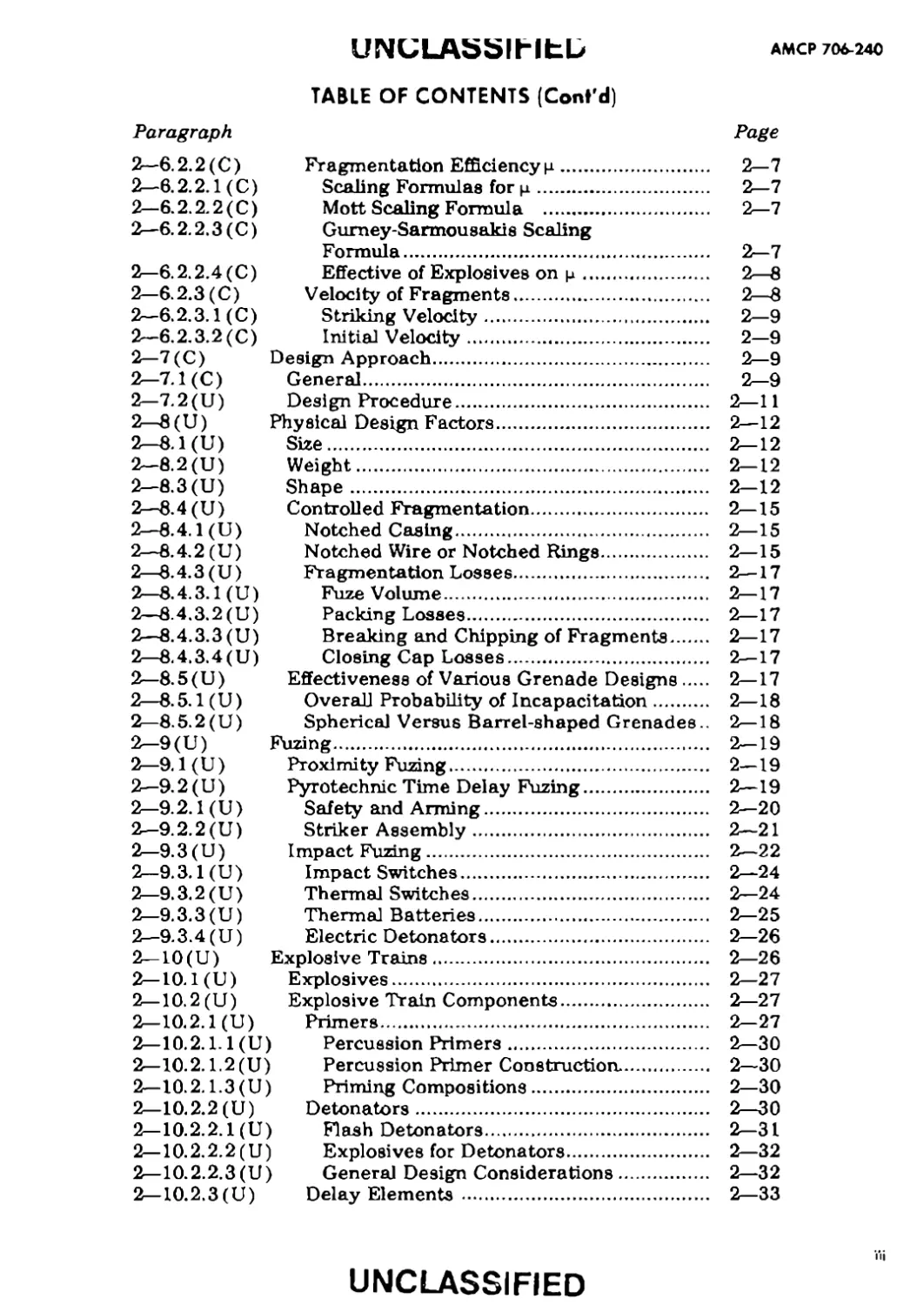
TABLE OF CONTENTS
Paragraph
Page
PREFACE	i
LIST OF ILLUSTRATIONS^.”........... vi
LIST OF TABLES................... vili
CHAPTER 1(U) INTRODUCTION
1—1 (U)	Purpose of Handbook......................... 1—1
1—2 (U)	General..................................... 1—1
1—2.1(U)	Grenade Payloads............................ 1—1
1—2.1.1 (U)	Explosive Grenades...................... 1—1
1—2.1.2(U)	Chemical Grenades....................... 1—1
1—2.2 (U)	Grenade Projection......................... 1—2
1—3 (U)	History..................................... 1—2
1—4 (U)	40 mm Grenade Systems....................... 1—3
1—4.1 (U)	Materiel and Purpose of System............. 1—3
1—4.2 (U)	Grenade Launcher, M79....................... 1—3
1—4.3 (U)	Grenade Launcher, XM148.................... 1—4
1—4.4 (U)	Cartridge, Grenade, 40 mm, HE, M406........ 1—4
1—4.5 (U)	Cartridge, Grenade, 40 mm,
Practice, M407........................ 1—5/1—6
(U) REFERENCES......................... 1—5/1—6
CHAPTER 2(C) HANDGRENADES
Section I(U) General
2—1(U)	Purpose....................................... 2—1
2—2(U)	Typical Hand Grenade Requirements........... 2—1
2—3(U)	General Test Specifications................. 2—2
Section II (C) Fragmentation Hand Grenades
2-4(U)
2—5(U)
2—5.1 (U)
2-5.2 (U)
2—5.2.1(U)
2—5.2.2(U)
2—5.2.3(U)
2—5.3(U)
2—5.4 (U)
2—5.5(U)
2—6(C)
2—6.1(C)
2—6.1.1(C)
2—6.1.2(C)
2—6.1.3(C)
2—6.2(C)
2—6.2.1(C)
General...................................... 2—2
Requirements................................. 2—2
Fragmentation Pattern...................... 2—2
Lethality.................................. 2—2
Incapacitation Time...................... 2—2
Effective Area........................... 2—3
Effectiveness Criterion................... 2—3
Size, Weight, and Shape..................... 2—3
Safety...................................... 2—3
Fuzing...................................... 2—4
Design Considerations......................... 2—4
Lethality................................... 2—4
Lethality Criterion....................... 2—4
Number of Incapacitating Fragments........	2—4
Lethal Area............................... 2—5
Fragmentation Considerations................ 2—5
Mass Distribution of Fragments............ 2—7
UNCLASSIFIED
AMCP 706-240
UNCLASSIFIED
TABLE OF CONTENTS (Conf'd)
Paragraph
Page
2-6.2.2(C)
2—6.2.2.1(C)
2—6.2.2.2(C)
2—6.2.2.3(C)
Fragmentation Efficiency ц...........
Scaling Formulae for p.............
Mott Scaling Formula ..............
Gumey-Sarmousakis Scaling
Formula............................
2—6.2.2.4 (C)	Effective of Explosives on p.........
2—6.2.3 (C)	Velocity of Fragments..................
2—6.2.3.1 (C)	Striking Velocity...................... 2—9
2—6.2.3.2(C)	Initial Velocity....................... 2—9
2—7(C)	Design Approach.......................... 2—9
2—7.1(C)	General................................... 2—9
2—7.2(D)	Design Procedure......................... 2—11
2—8(U)	Physical Design Factors.................. 2—12
2—8.1(D)	Size..................................... 2—12
2—6.2 (U)	Weight................................... 2—12
2—8.3 (U)	Shape.................................... 2—12
2—8.4(D)	Controlled Fragmentation................. 2—15
2—8.4.1(U)	Notched Casing........................ 2—15
2—8.4.2 (D)	Notched Wire or Notched	Rings......... 2—15
2—8.4.3(D)	Fragmentation Losses.................. 2—17
2—8.4.3.1(D)	Fuze Volume........................... 2—17
2—8.4.3.2(D)	Packing Losses........................ 2—17
2—8.4.3.3(D)	Breaking and Chipping of Fragments.... 2—17
2—8.4.3.4(D)	Closing Cap Losses.................... 2—17
2—8.5(U)	Effectiveness of Various Grenade Designs  2—17
2—8.5.1 (U)	Overall Probability of Incapacitation. 2—18
2—8.5.2(D)	Spherical Versus Barrel-shaped Grenades.. 2—18
2—9(D) Fuzing.......................................... 2-19
2—9.1(D)	Proximity Fuzing......................... 2— 19
2—9.2(D)	Pyrotechnic Time Delay Fuzing............ 2—19
2—9.2.1(D)	Safety and Arming..................... 2—20
2—9.2.2(D)	Striker Assembly...................... 2—21
2—9.3(D)	I mpact Fuzing........................... 2—2 2
2—9.3.1(D)	Impact Switches....................... 2—24
2—9.3.2(D)	Thermal Switches...................... 2—24
2—9.3.3(D)	Thermal Batteries..................... 2—25
2—9.3.4(D)	Electric Detonators................... 2—26
2- 10 (D )	Explosive Trains........................... 2—2	6
2—10.1(D)	Explosives............................... 2—27
2—10.2(D)	Explosive Train Components............... 2—27
2—10.2.1(D) Primers.................................... 2—27
2—10.2.1.1(D)	Percussion Primers.................... 2—30
2—10.2.1.2(D)	Percussion Primer Construction........ 2—30
2—10.2.1.3(D) Priming Compositions..................... 2—30
2—10.2.2(D)	Detonators............................ 2—30
2—10.2.2.1(D)	Flash Detonators...................... 2—31
2—10.2.2.2(D)	Explosives for Detonators............. 2—32
2—10.2.2.3(D)	General Design Considerations......... 2—32
2—10.2.3(D)	Delay Elements ....................... 2—33
UNCLASSIFIED
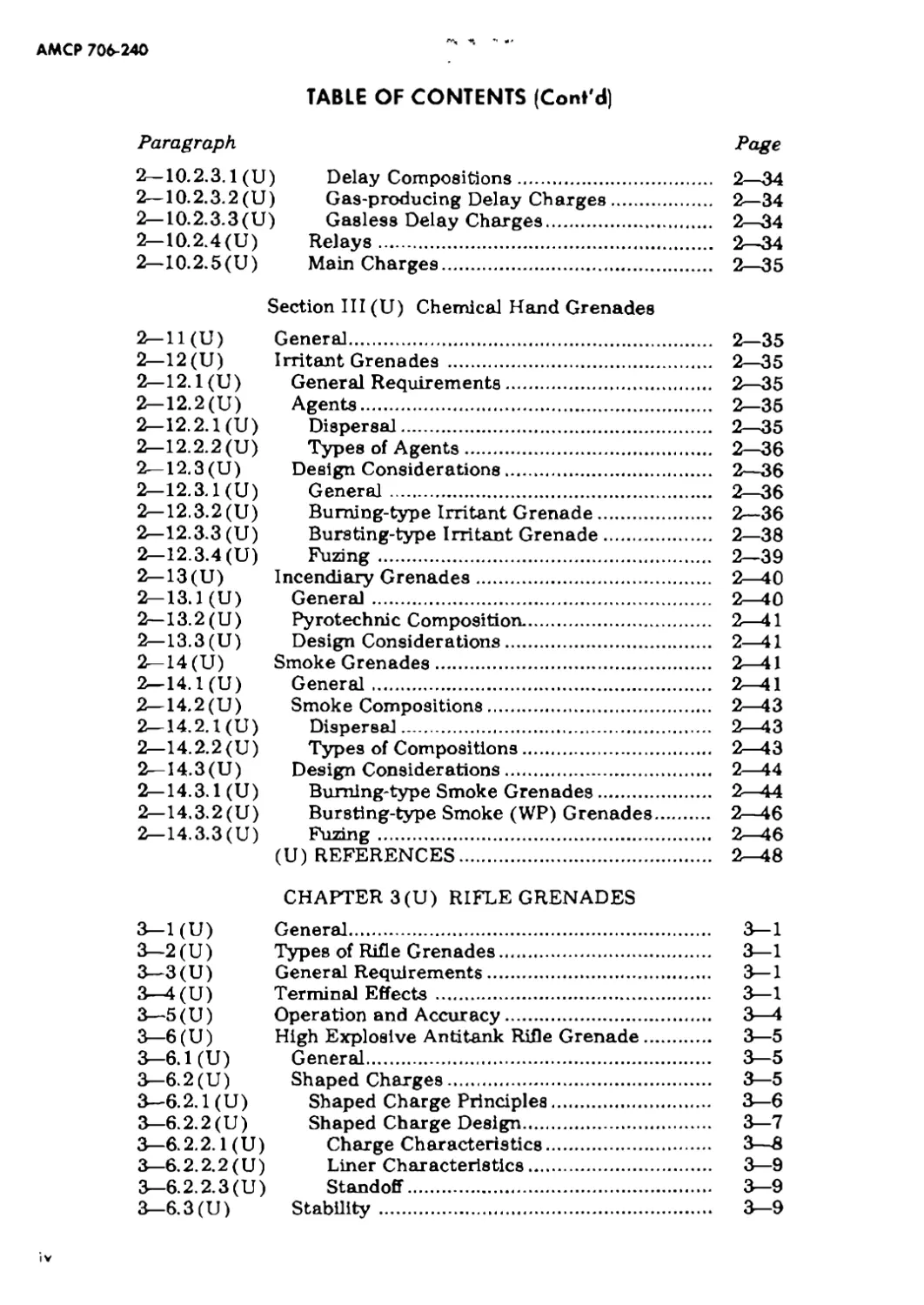
АМСР 706-240
TABLE OF CONTENTS (Conf'd)
Paragraph
Page
2—10.2.3.1 (U)	Delay Compositions..................... 2—34
2—10.2.3.2(G)	Gas-producing Delay Charges............ 2—34
2—10.2.3.3(G)	Gasless Delay Charges.................. 2—34
2— 10.2.4(G)	Relays.................................. 2—34
2— 10.2.5(G)	Main Charges............................ 2—35
Section III (U) Chemical Hand Grenades
2—11(U)	General................................. 2—35
2—12(0)	Irritant Grenades ...................... 2—35
2—12.1(G)	General Requirements.................... 2—35
2—12.2(G)	Agents.................................. 2—35
2—12.2.1(G)	Dispersal.............................. 2—35
2—12.2.2(G)	Types of Agents....................... 2—36
2—12.3(G)	Design Considerations................... 2—36
2—12.3.1(G)	General................................ 2—36
2—12.3.2(G)	Buming-type Irritant Grenade.......... 2—36
2—12.3.3(G)	Burs ting-type Irritant	Grenade....... 2—38
2—12.3.4(G)	Fuzing................................. 2—39
2—13(G)	Incendiary Grenades..................... 2—40
2—13.1(G)	Genera].................................. 2—10
2— 13.2(G)	Pyrotechnic Composition................. 2—41
2—13.3(G)	Design Considerations................... 2—41
2—14(G)	Smoke Grenades.......................... 2—41
2—14.1(G)	General.................................. 2—41
2—14.2(G)	Smoke Compositions...................... 2—43
2—14.2.1(G)	Dispersal............................. 2-^13
2—14.2.2(G)	Types of Compositions................. 2—43
2—14.3(G)	Design Considerations................... 2—44
2—14.3.1 (G)	Burning-type Smoke Grenades............ 2—44
2—14.3.2(G)	Bursting-type Smoke (WP)	Grenades..... 2—46
2—14.3.3(G)	Fuzing................................. 2-46
(G) REFERENCES............................ 2—18
CHAPTER 3(G) RIFLE GRENADES
3—1(G)	General.................................
3—2 (G)	Types of Rifle Grenades.................
3—3(G)	General Requirements....................
3—4(G)	Terminal Effects........................
3—5(G)	Operation and Accuracy..................
3—6(G)	High Explosive Antitank Rifle Grenade.....	3—5
3—6.1(G)	General..................................... 3—5
3—6.2(G)	Shaped Charges............................ 3—5
3—6.2.1(G)	Shaped Charge Principles................. 3—6
3—6.2.2(G)	Shaped Charge Design................... 3—7
3—6.2.2.1(G)	Charge Characteristics................. 3—8
3—6.2.2.2(G)	Liner Characteristics.................. 3—9
3—6.2.2.3(G)	Standoff................................. 3—9
3—6.3(G)	Stability.......................... 3—9
IV
АМСР 706-240
TABLE OF CONTENTS (Cont'd)
Paragraph	Page
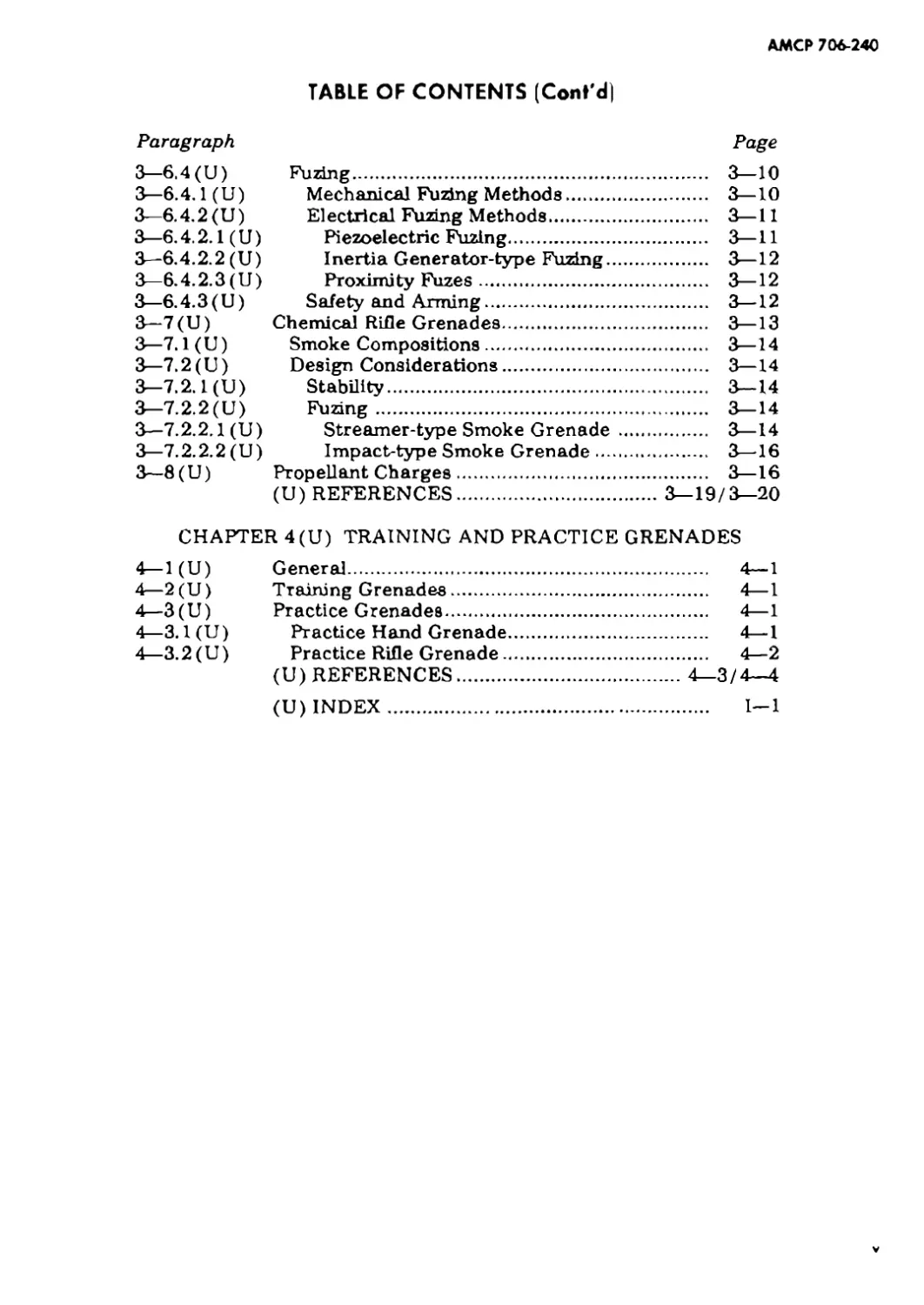
3—6,4 (U)	Fuzing.................................. 3—10
3—6.4.1 (U)	Mechanical Fuzing Methods.............. 3—10
3—6.4.2 (U)	Electrical Fuzing Methods.............. 3—11
3—6.4.2.1 (U)	Piezoelectric Fuzing................. 3— 11
3—6.4.2.2 (U)	Inertia Generator-type Fuzing........ 3—12
3—6.4.2.3(U)	Proximity Fuzes...................... 3—12
3—6.4.3(U)	Safety and	Arming..................... 3—12
3—7(U)	Chemical Rifle Grenades................... 3—13
3—7.1(G) Smoke Compositions........................... 3—14
3—7.2(U) Design Considerations........................ 3—14
3—7.2.1 (U)	Stability............................... 3—14
3—7.2.2(U)	Fuzing.................................. 3—14
3—7.2.2.1(U)	Streamer-type Smoke Grenade.......... 3—14
3—7.2.2.2 (U)	Impact-type Smoke Grenade............ 3—16
3—8(U)	Propellant Charges........................ 3—16
(U) REFERENCES........................3—19/3—20
CHAPTER 4 (U) TRAINING AND PRACTICE GRENADES
4—1(U)	Genera]................................... 4—1
4—2(U)	Training Grenades......................... 4—1
4—3(U)	Practice Grenades......................... 4—1
4—3.1 (U)	Practice Hand Grenade.................. 4—1
4—3.2 (U)	Practice Rifle Grenade................. 4—2
(U) REFERENCES.........................4—3/4-4
(U) INDEX.................................. 1—1
АМСР 706-240
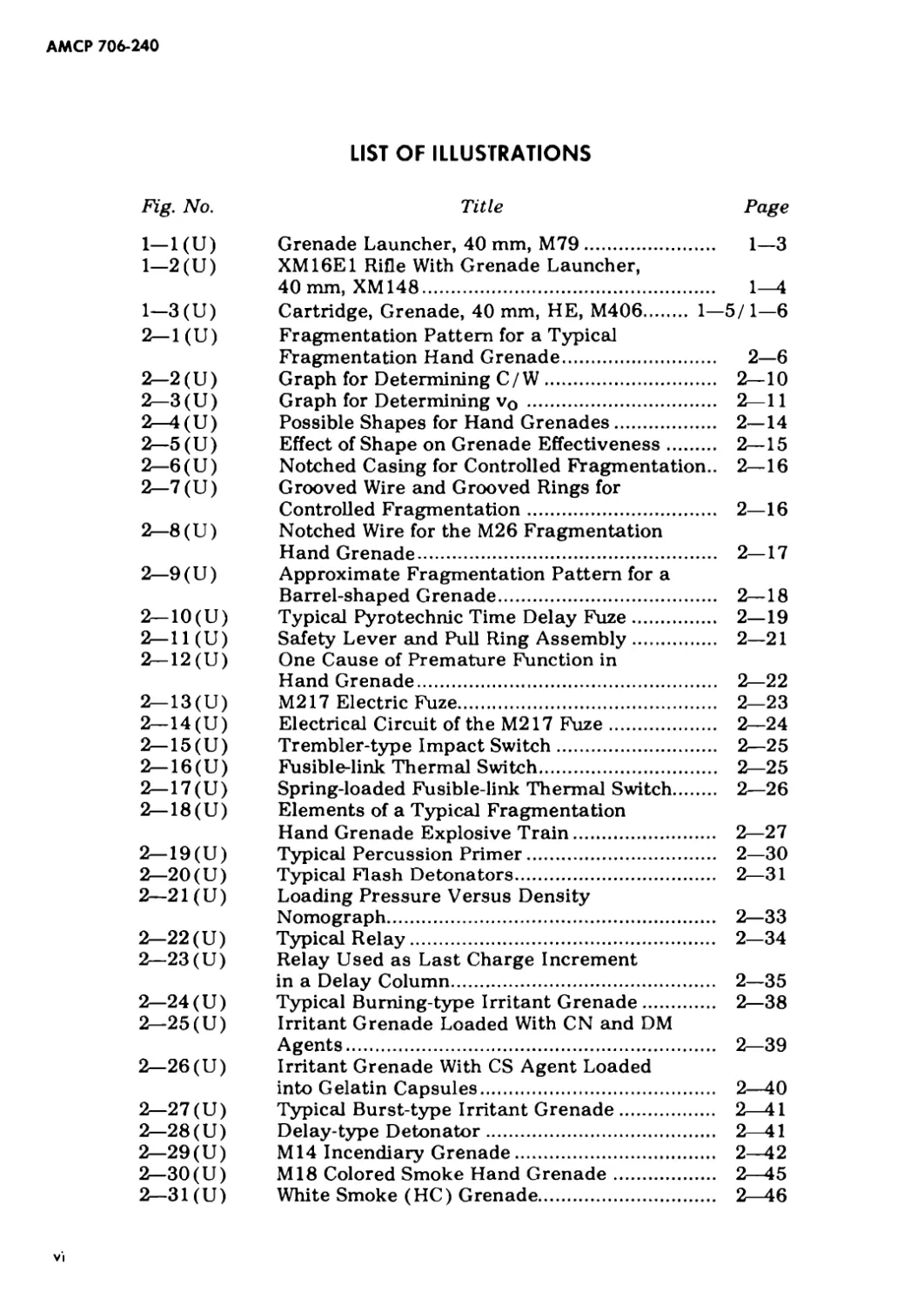
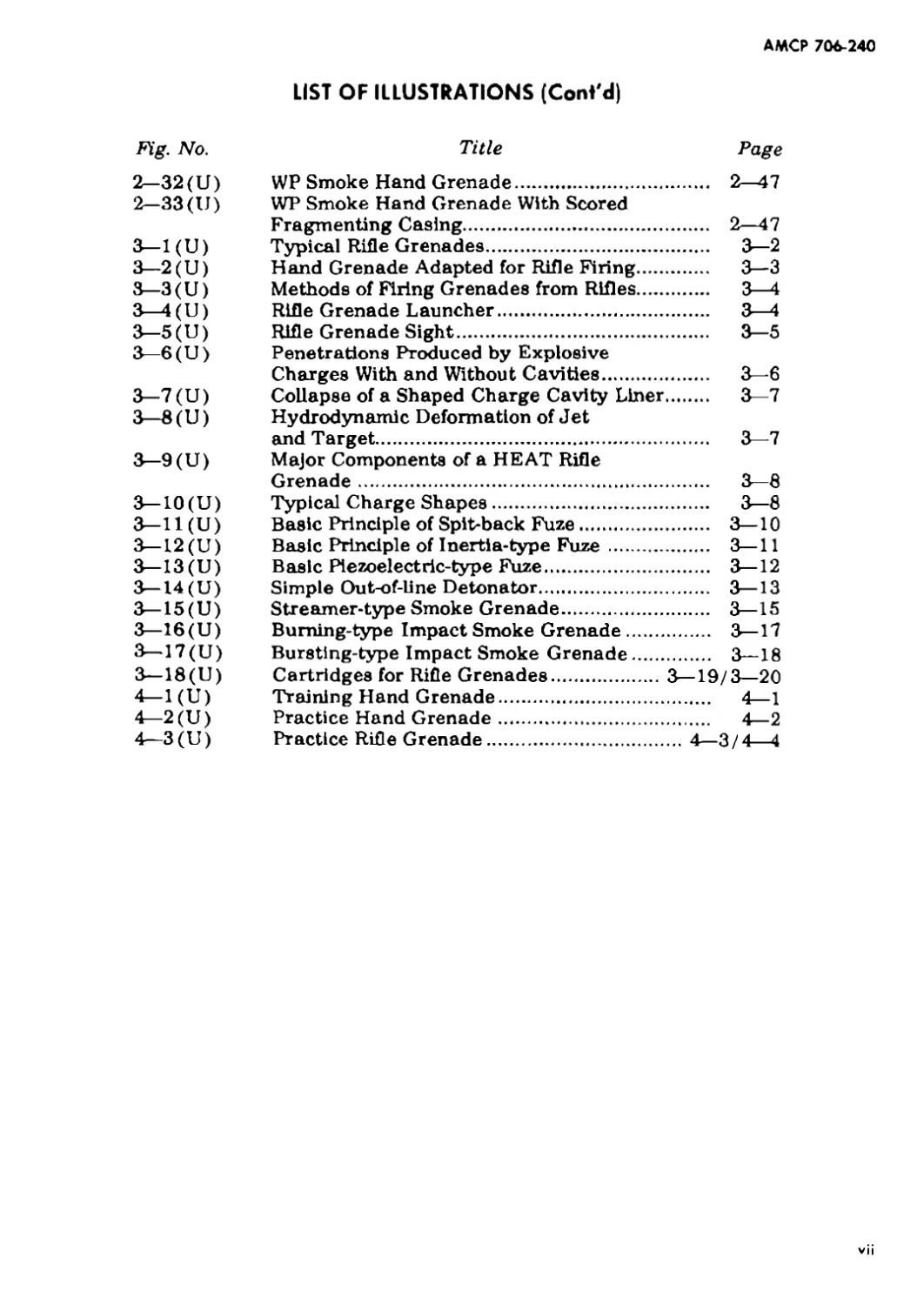
LIST OF ILLUSTRATIONS
Fig. No.	Title	Page
1—1 (U)	Grenade Launcher, 40 mm, M79............... 1—3
1—2(U)	XM16E1 Rifle With Grenade Launcher,
40 mm, XM148................................ 1^1
1—3(U)	Cartridge, Grenade, 40 mm, HE, M406..... 1—5/ 1—6
2—1 (U)	Fragmentation Pattern for a Typical
Fragmentation Hand Grenade................ 2—6
2—2(U)	Graph for Determining C/W.................. 2—10
2—3(U)	Graph for Determining vo................... 2—11
2—4(U)	Possible Shapes for Hand Grenades.......... 2—14
2—5 (U)	Effect of Shape on Grenade Effectiveness... 2—15
2—6(U)	Notched Casing for Controlled Fragmentation.. 2—16
2—7 (U)	Grooved Wire and Grooved Rings for
Controlled Fragmentation.................. 2—16
2—8(U)	Notched Wire for the M26 Fragmentation
Hand Grenade.............................. 2—17
2—9 (U)	Approximate Fragmentation Pattern for a
Barrel-shaped Grenade..................... 2—18
2—10 (U)	Typical Pyrotechnic Time Delay Fuze........ 2—19
2—11 (U)	Safety Lever and Pull Ring Assembly........ 2—21
2—12 (U)	One Cause of Premature Function in
Hand Grenade.............................. 2—22
2— 13 (U)	М217 Electric Fuze.......................... 2—23
2—14(U)	Electrical Circuit of the М217	Fuze........ 2—24
2—15(U)	Trembler-type Impact Switch................ 2—25
2—16(U)	Fusible-link Thermal Switch................ 2—25
2—17 (U)	Spring-loaded Fusible-link Thermal Switch.. 2—26
2—18 (U)	Elements of a Typical Fragmentation
Hand Grenade Explosive Train.............. 2—27
2—19(U)	Typical Percussion Primer.................. 2—30
2—20(U)	Typical Flash Detonators................... 2—31
2—21 (U)	Loading Pressure Versus Density
Nomograph................................. 2—33
2—22(U) Typical Relay.................................... 2—34
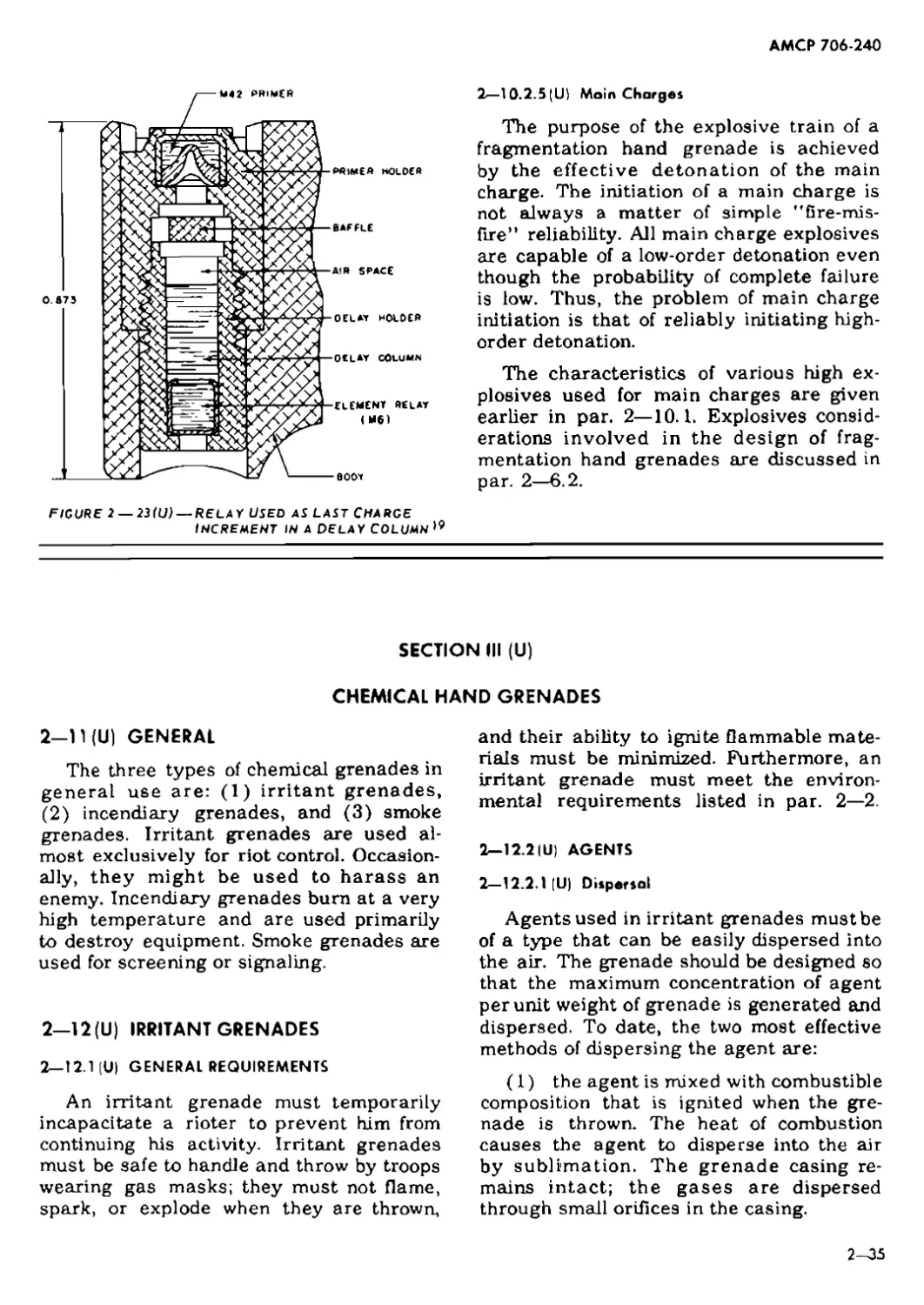
2—23 (U)	Relay Used as Last Charge Increment
in a Delay Column......................... 2—35
2—24(U)	Typical Buming-type Irritant Grenade....... 2—38
2—25 (U)	Irritant Grenade Loaded With CN and DM
Agents.................................... 2—39
2—26(U)	Irritant Grenade With CS Agent Loaded
into Gelatin Capsules..................... 2—40
2—27 (U)	Typical Burst-type Irritant Grenade........ 2—41
2—28(U)	Delay-type Detonator....................... 2—41
2—29(U)	M14 Incendiary Grenade..................... 2—42
2—30(U)	M18 Colored Smoke Hand Grenade............. 2—45
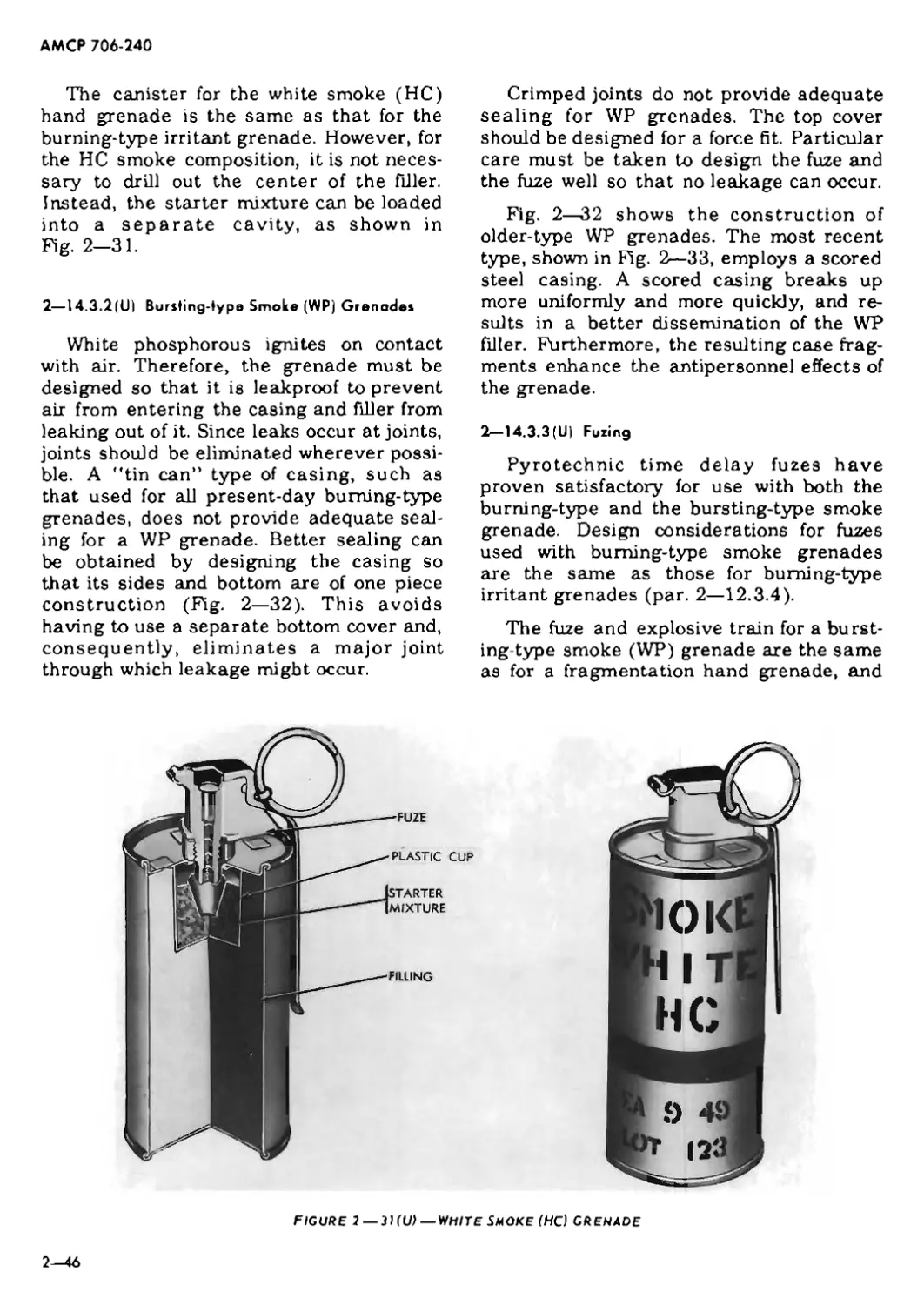
2—31 (U)	White Smoke (HC) Grenade................... 2-Л6
VI
АМСР 706-240
LIST OF ILLUSTRATIONS (Cont'd)
Fig. No.	Title	Page
2—32(U)
2—33 (U)
3-l(U)
3-2 (U)
3-3 (U)
3--l(U)
3—5(U)
3—6(U)
3-7 (U)
3-8 (U)
3—9(U)
3—10(U)
3-11 (U)
3—12 (U)
3—13(U)
3—14(U)
3—15(U)
3—16(U)
3—17(U)
3—18(U)
4-l(U)
4-2 (U)
4—3(U)
WP Smoke Hand Grenade.................... 2—47
WP Smoke Hand Grenade With Scored
Fragmenting Casing....................... 2—47
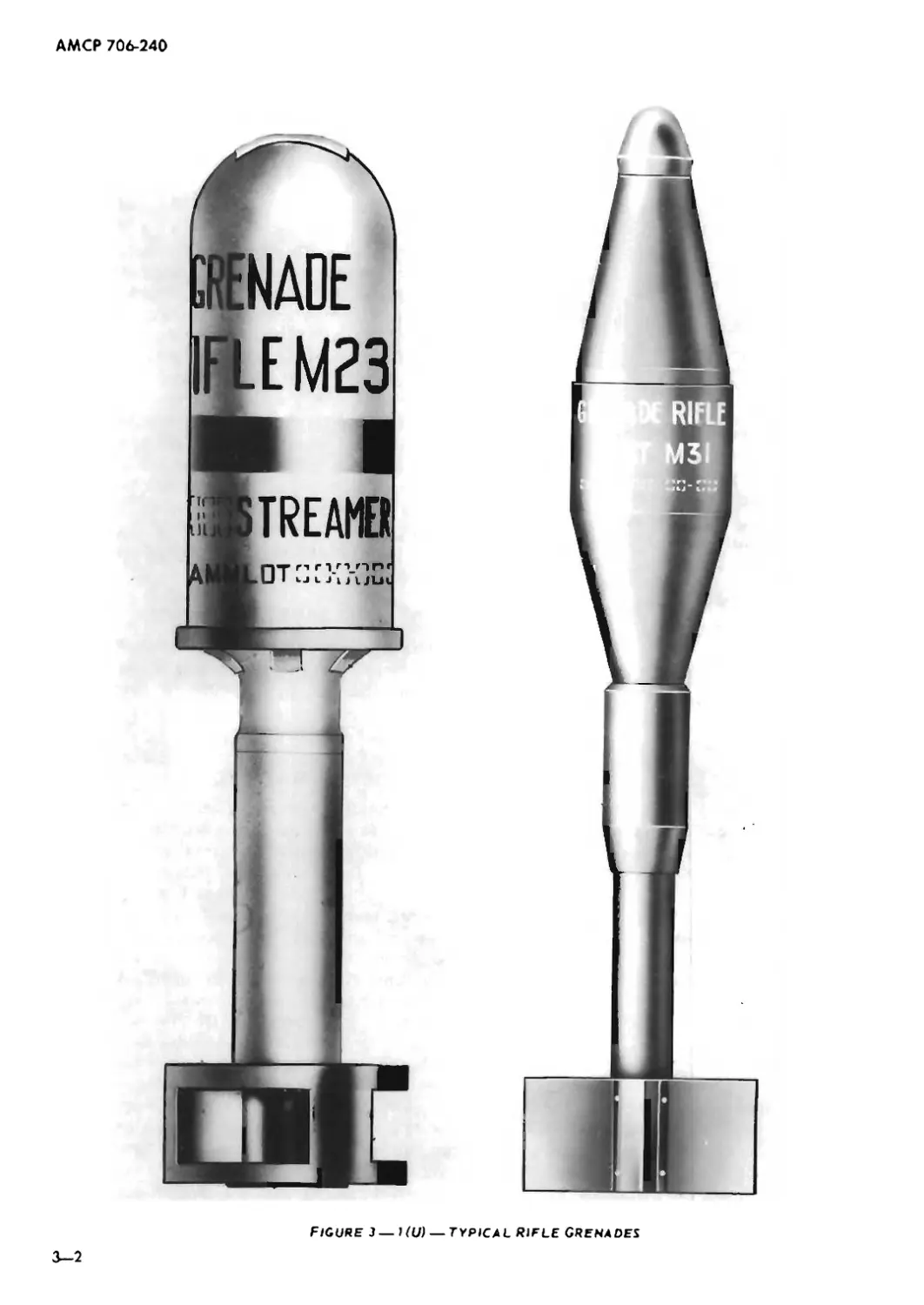
Typical Rifle Grenades................... 3—2
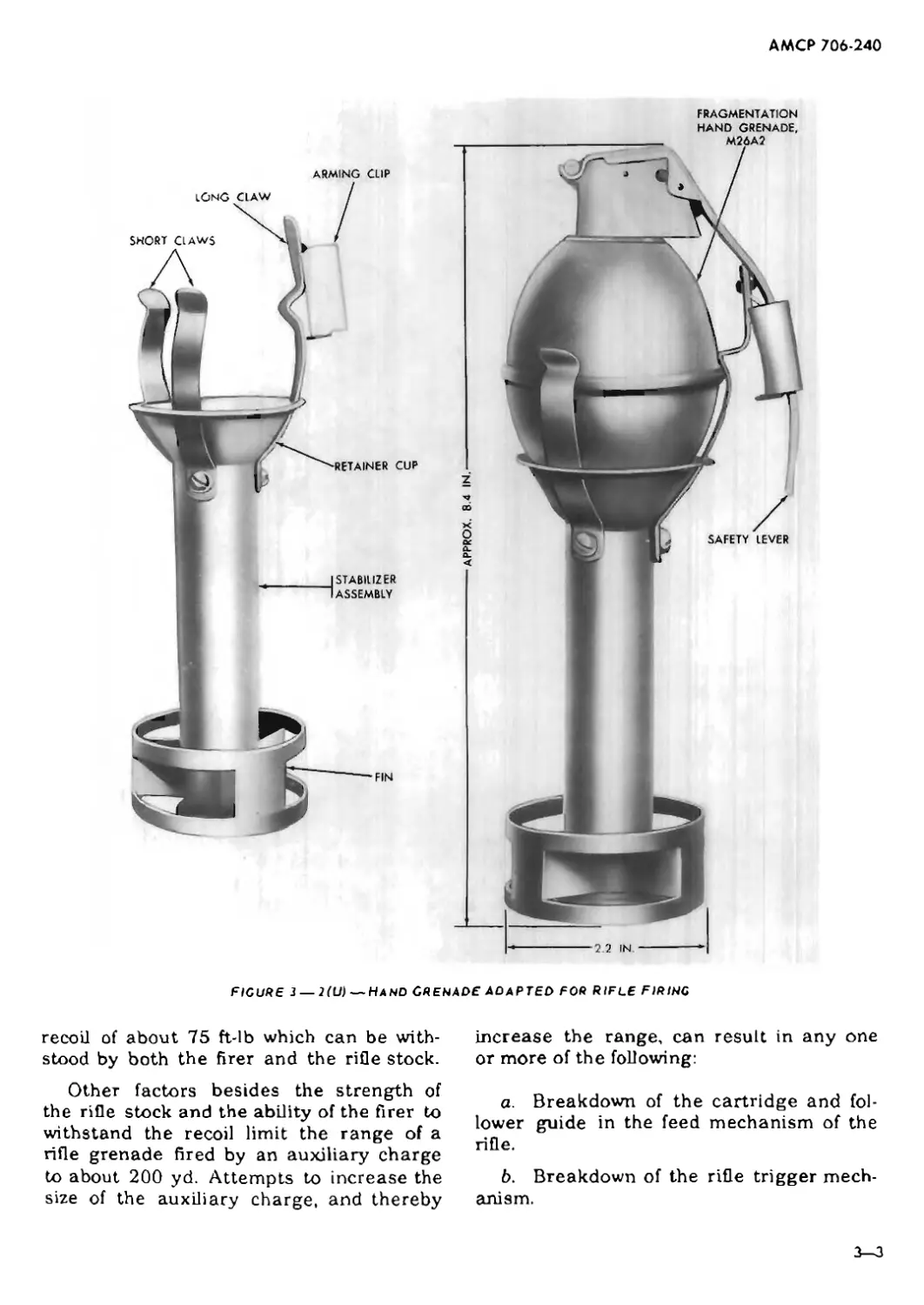
Hand Grenade Adapted for Rifle Firing....	3—3
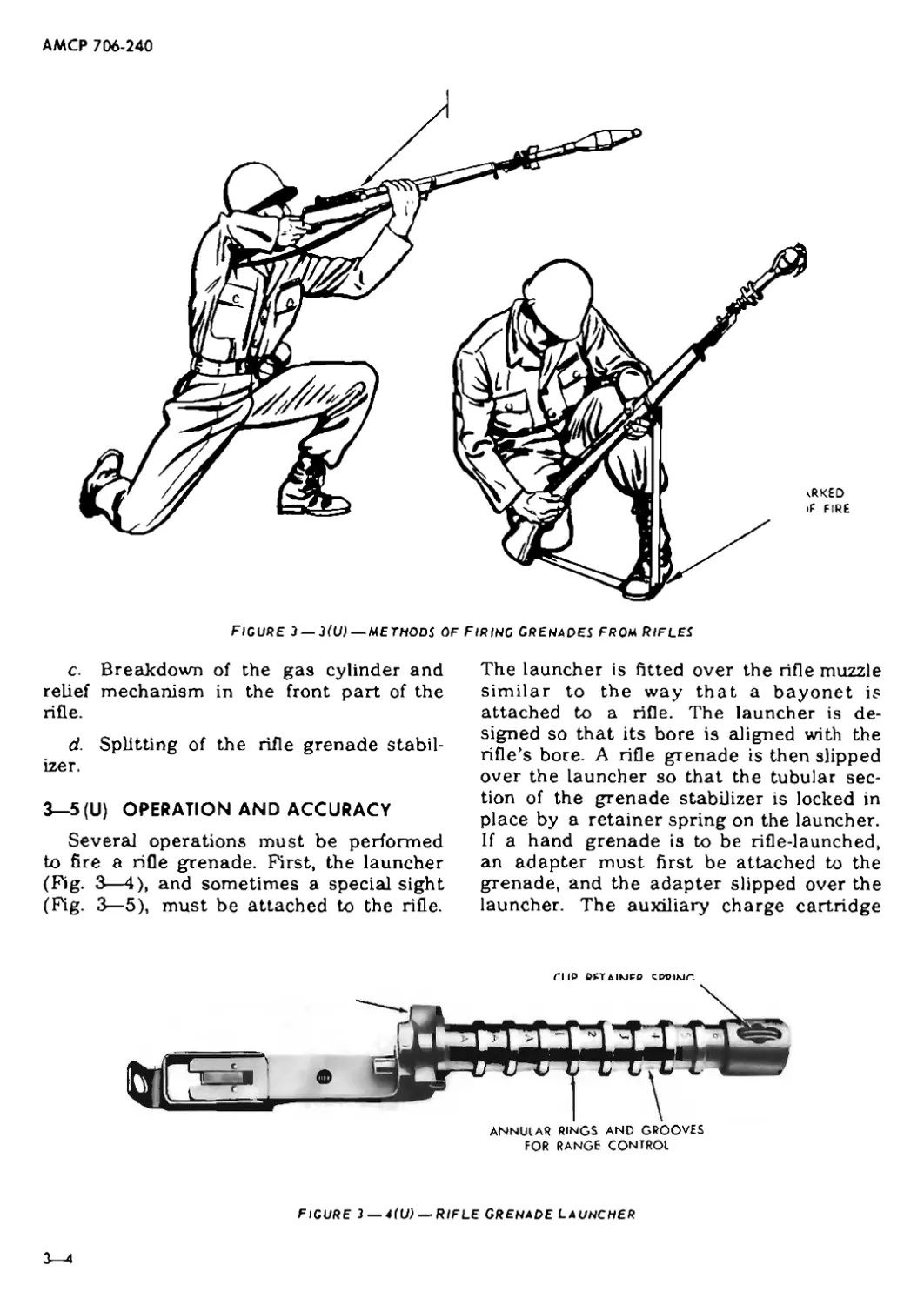
Methods of Firing Grenades from Rifles...	3—4
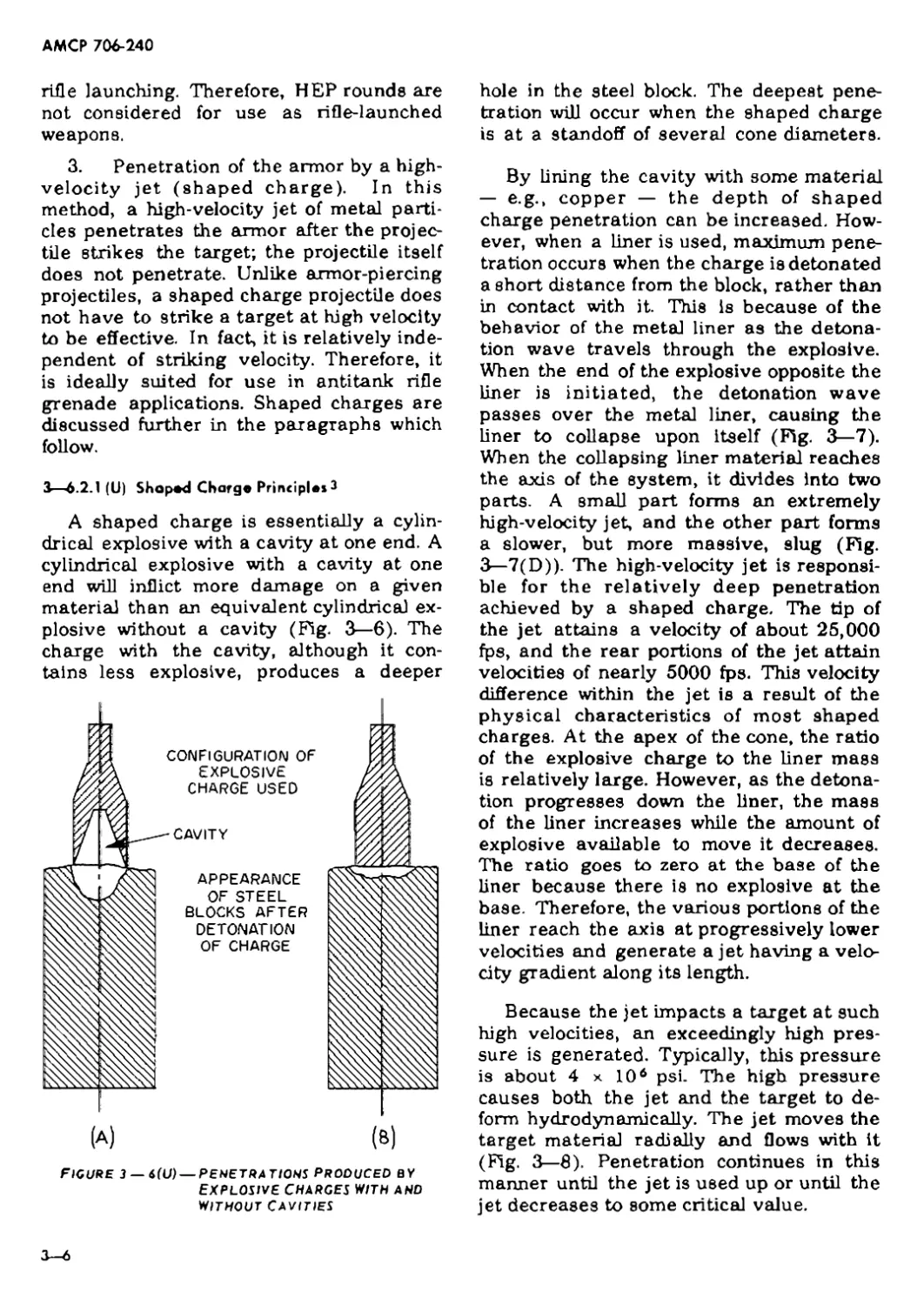
Rifle Grenade Launcher................... 3—4
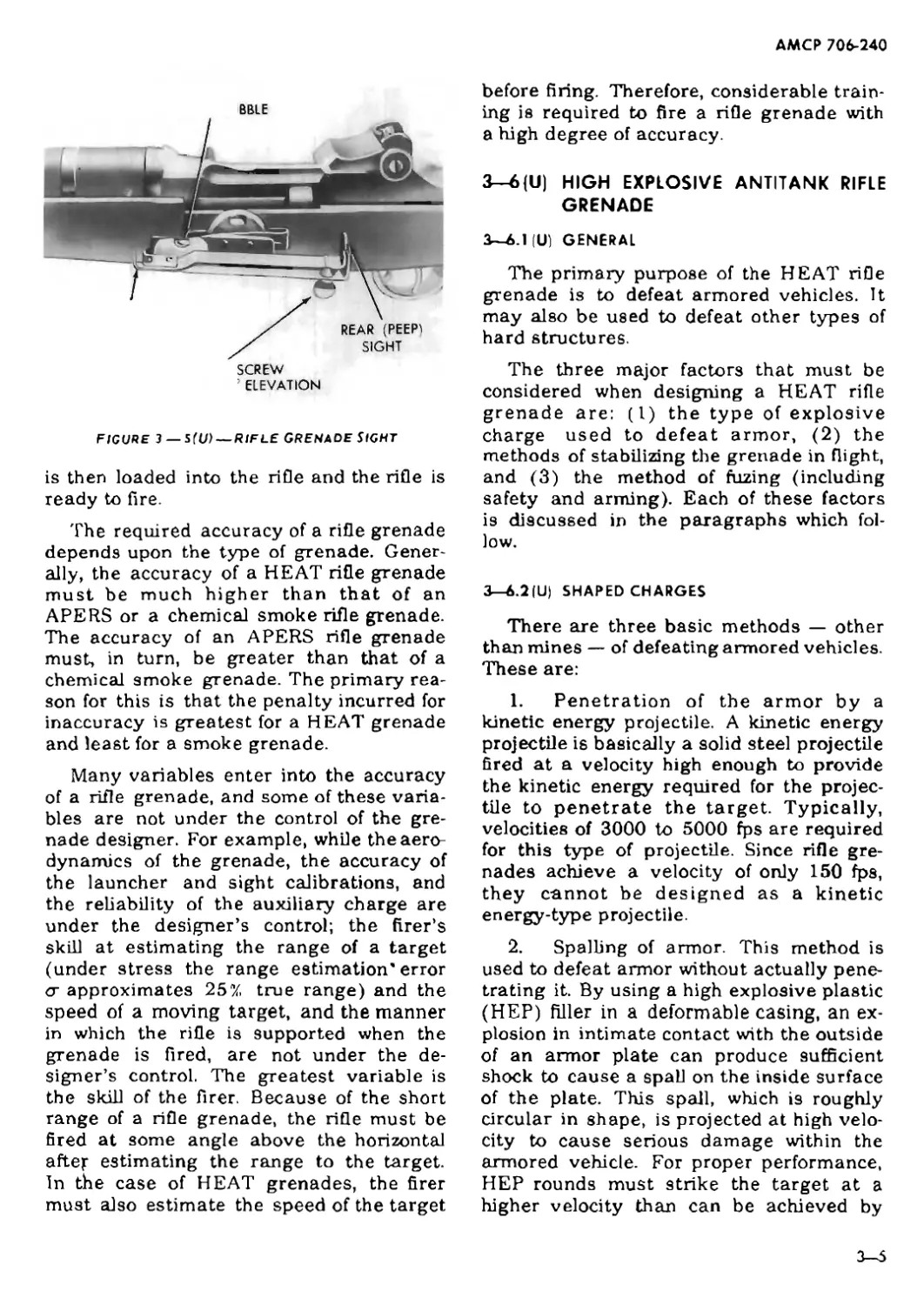
Rifle Grenade Sight...................... 3—5
Penetrations Produced by Explosive
Charges With and Without Cavities......... 3—6
Collapse of a Shaped Charge Cavity Liner.
Hydrodynamic Deformation of Jet
and Target..............................
Major Components of a HEAT Rifle
Grenade...................................... 3—8
Typical Charge Shapes........................ 3—8
Basic Principle of Spit-back Fuze............ 3—10
Basic Principle of Inertia-type Fuze......... 3—11
Basic Piezoelectric-type Fuze................. 3—12
Simple Out-of-line Detonator................. 3—13
Streamer-type Smoke Grenade.................. 3— 15
Burning-type Impact Smoke Grenade............ 3—17
Bursting-type Impact Smoke Grenade........... 3—18
Cartridges for Rifle Grenades..........3—19/3—20
Training Hand Grenade........................ 4—1
Practice Hand Grenade........................ 4—2
Practice Rifle Grenade....................4—3/4—4
vii
АМСР 706-240
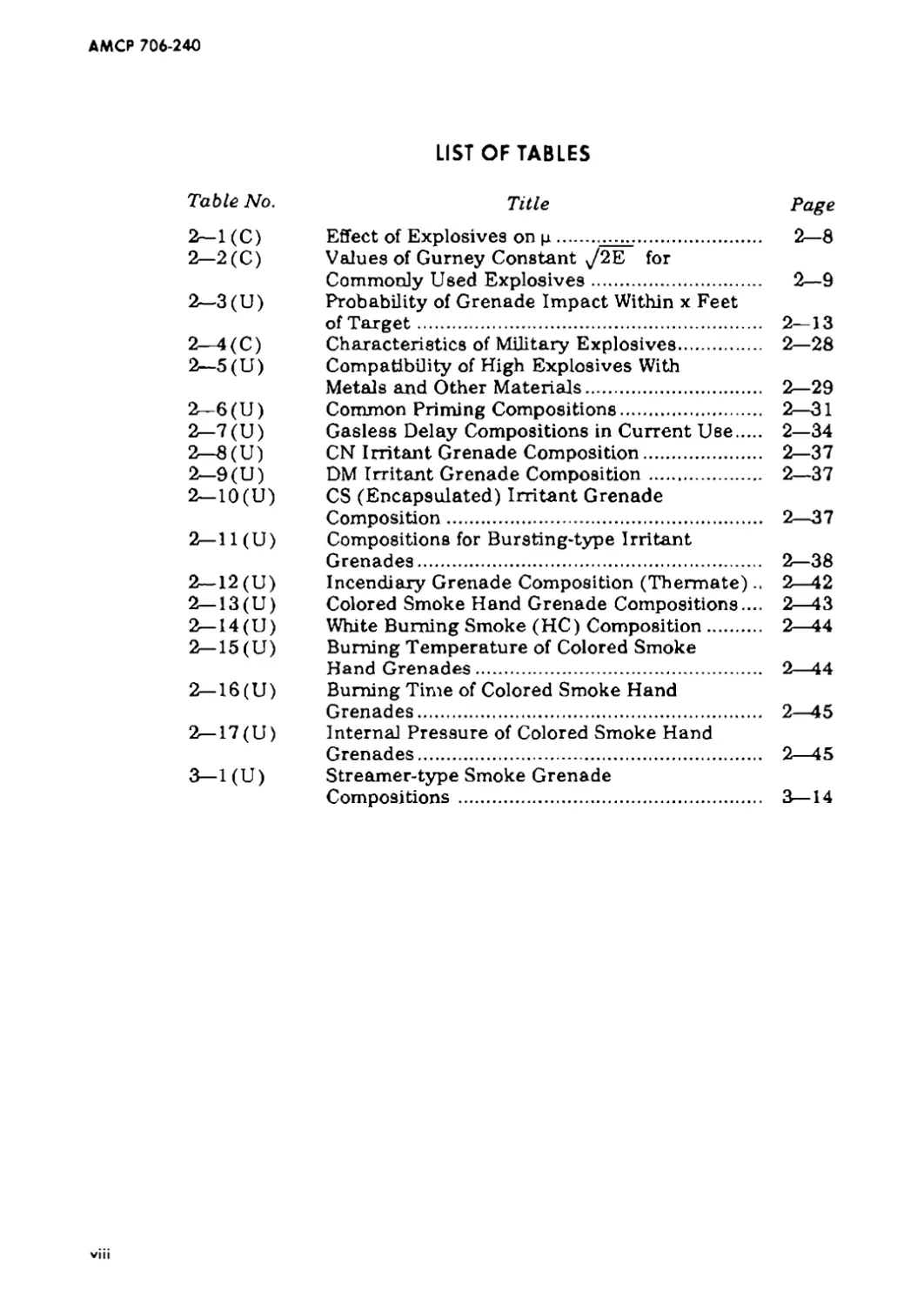
LIST OF TABLES
Table No.	Title	Page
2—1 (C)	Effect of Explosives on p.................. 2—8
2—2(C)	Values of Gurney Constant У2Е for
Commonly Used Explosives..................... 2—9
2—3 (U) Probability of Grenade Impact Within x Feet
of Target.................................. 2—J3
2—4(C)	Characteristics of Military Explosives..... 2—28
2—5 (U)	Compatibility of High Explosives With
Metals and Other Materials................. 2—29
2—6(U)	Common Priming Compositions................ 2—31
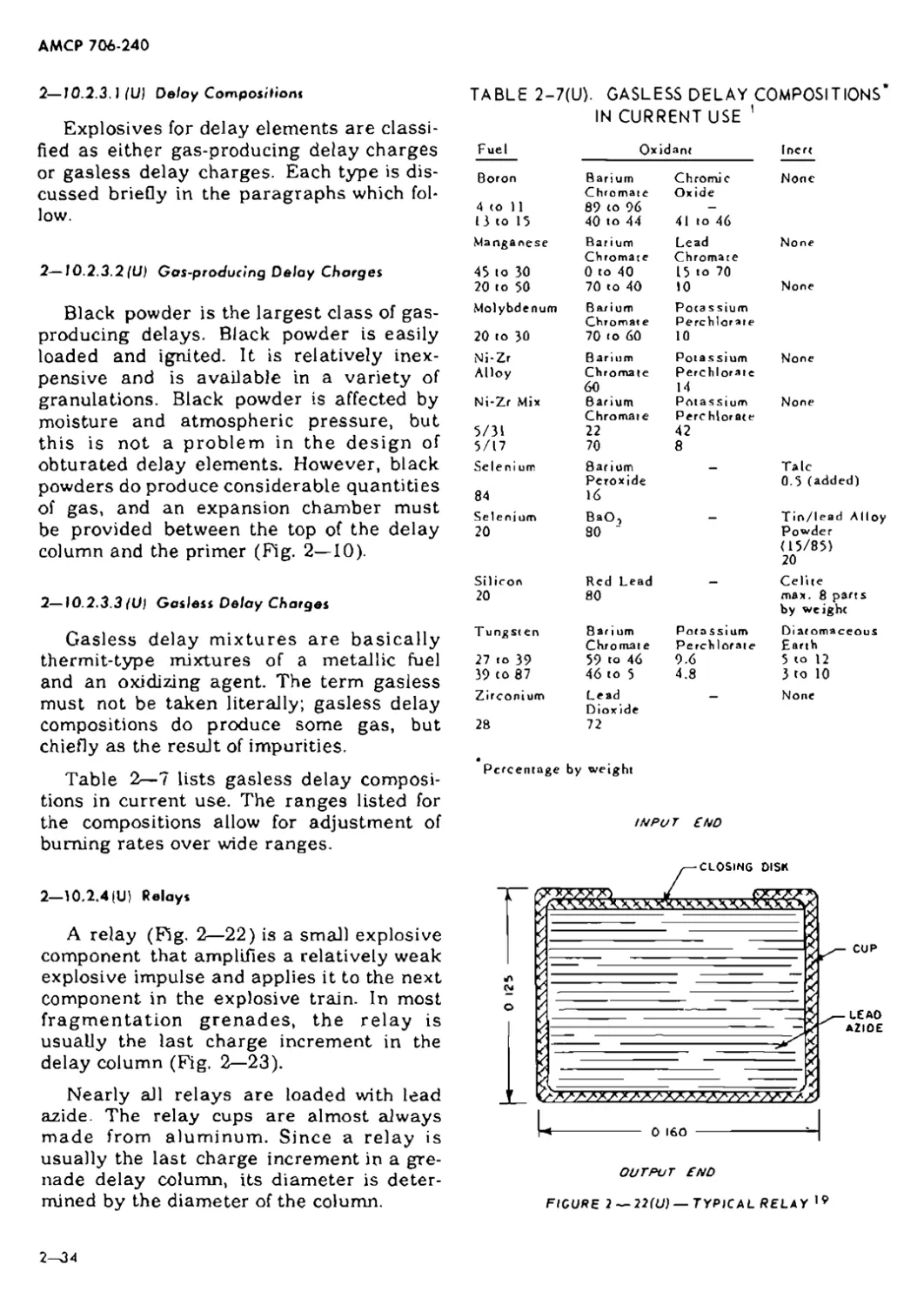
2—7(U)	Gasless Delay Compositions in Current Use.. 2—34
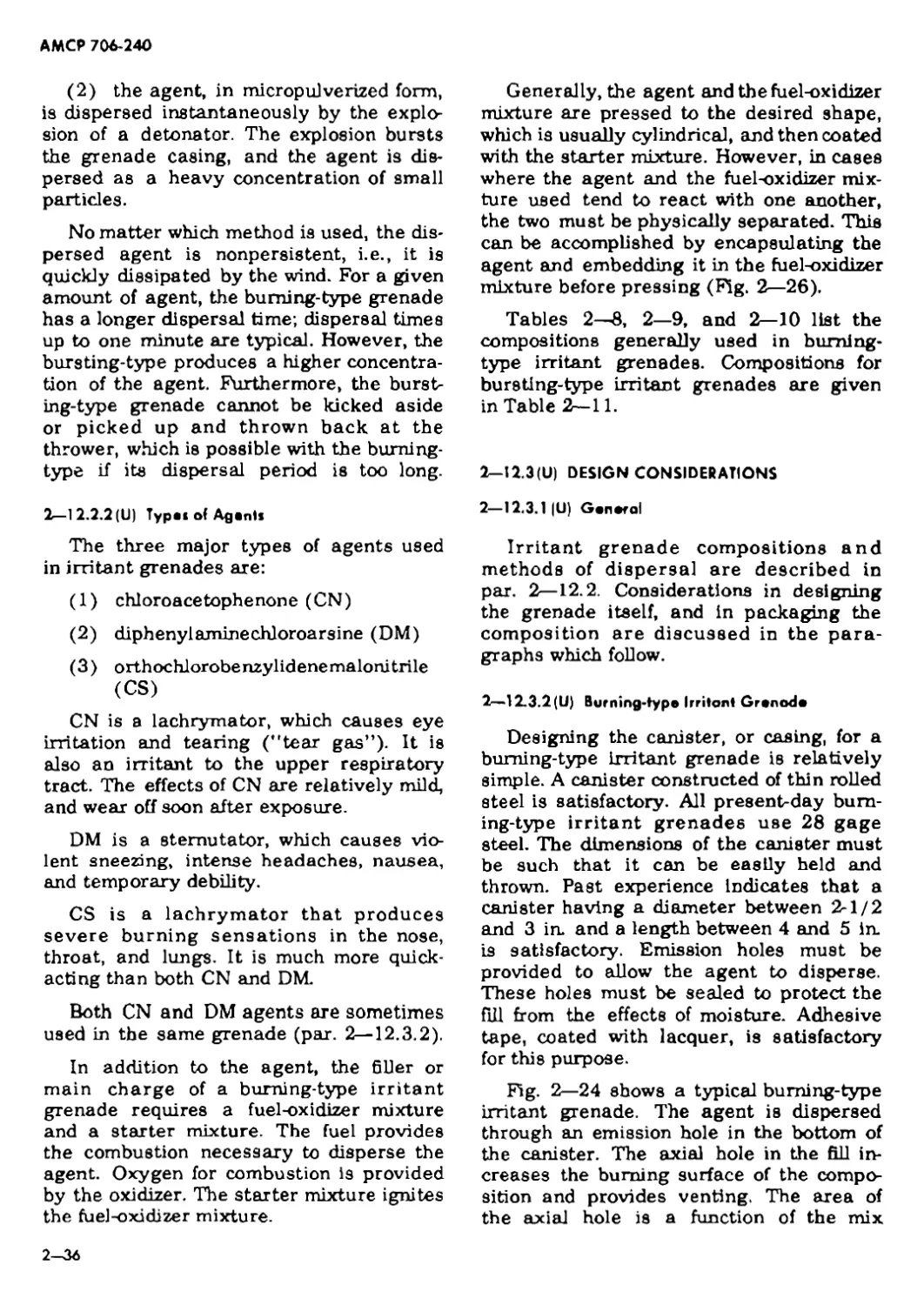
2—8(U)	CN Irritant Grenade Composition............ 2—37
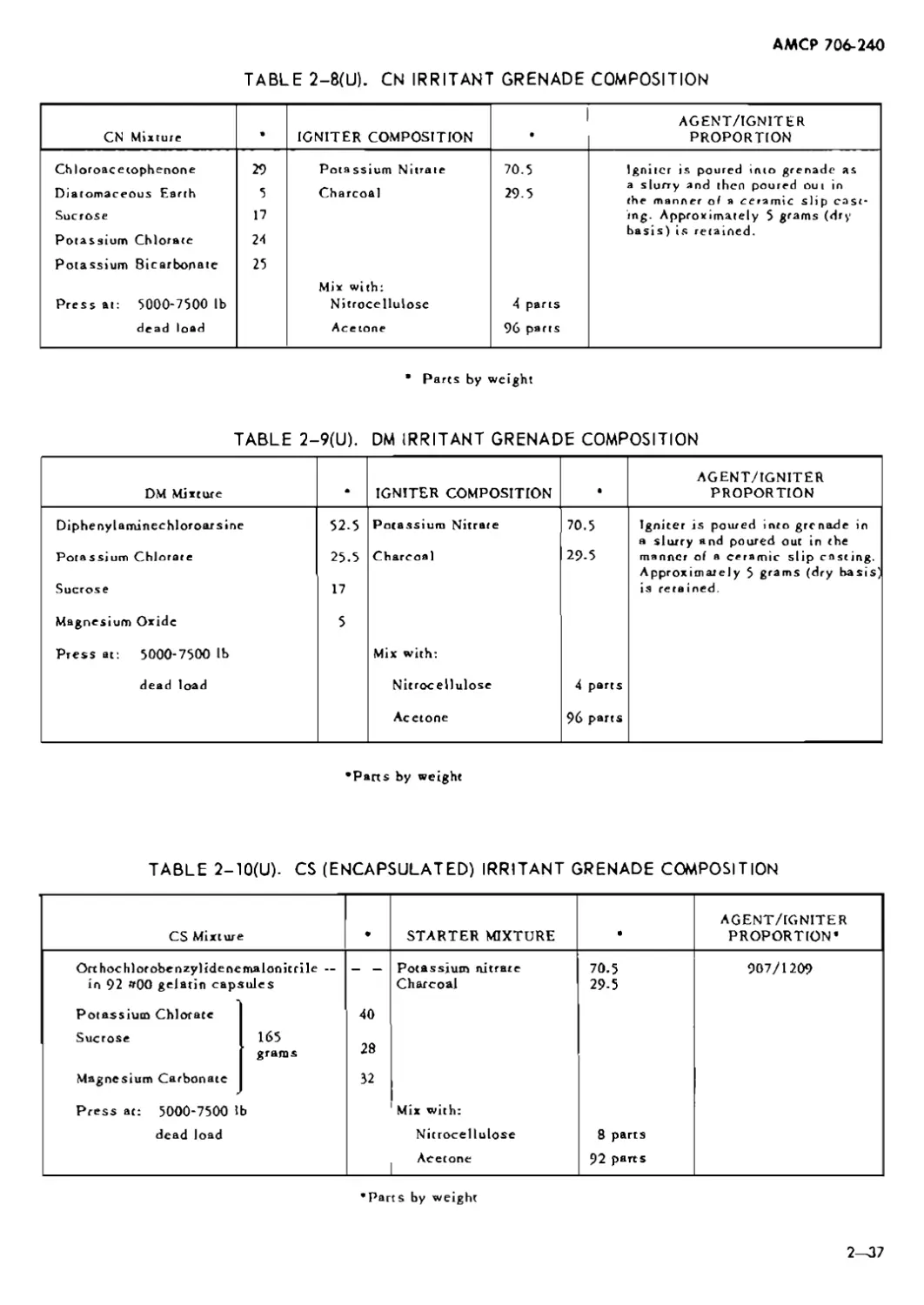
2—9(U)	DM Irritant Grenade Composition............ 2—37
2—10 (U)	CS (Encapsulated) Irritant Grenade
Composition................................ 2—37
2—11 (U) Compositions for Bursting-type Irritant
Grenades................................................. 2—38
2—12 (U)	Incendiary Grenade Composition (Thermate) .. 2—42
2—13(U)	Colored Smoke Hand Grenade Compositions.... 2—43
2— 14 (U)	White Burning Smoke (HC) Composition....... 2—44
2—15 (U)	Burning Temperature of Colored Smoke
Hand Grenades.............................. 2—44
2—16 (U)	Burning Time of Colored Smoke Hand
Grenades................................... 2—45
2—17 (U)	Internal Pressure of Colored Smoke Hand
Grenades................................... 2—45
3—1 (U)	Streamer-type Smoke Grenade
Compositions .............................. 3—14
viii
АМСР 706-240
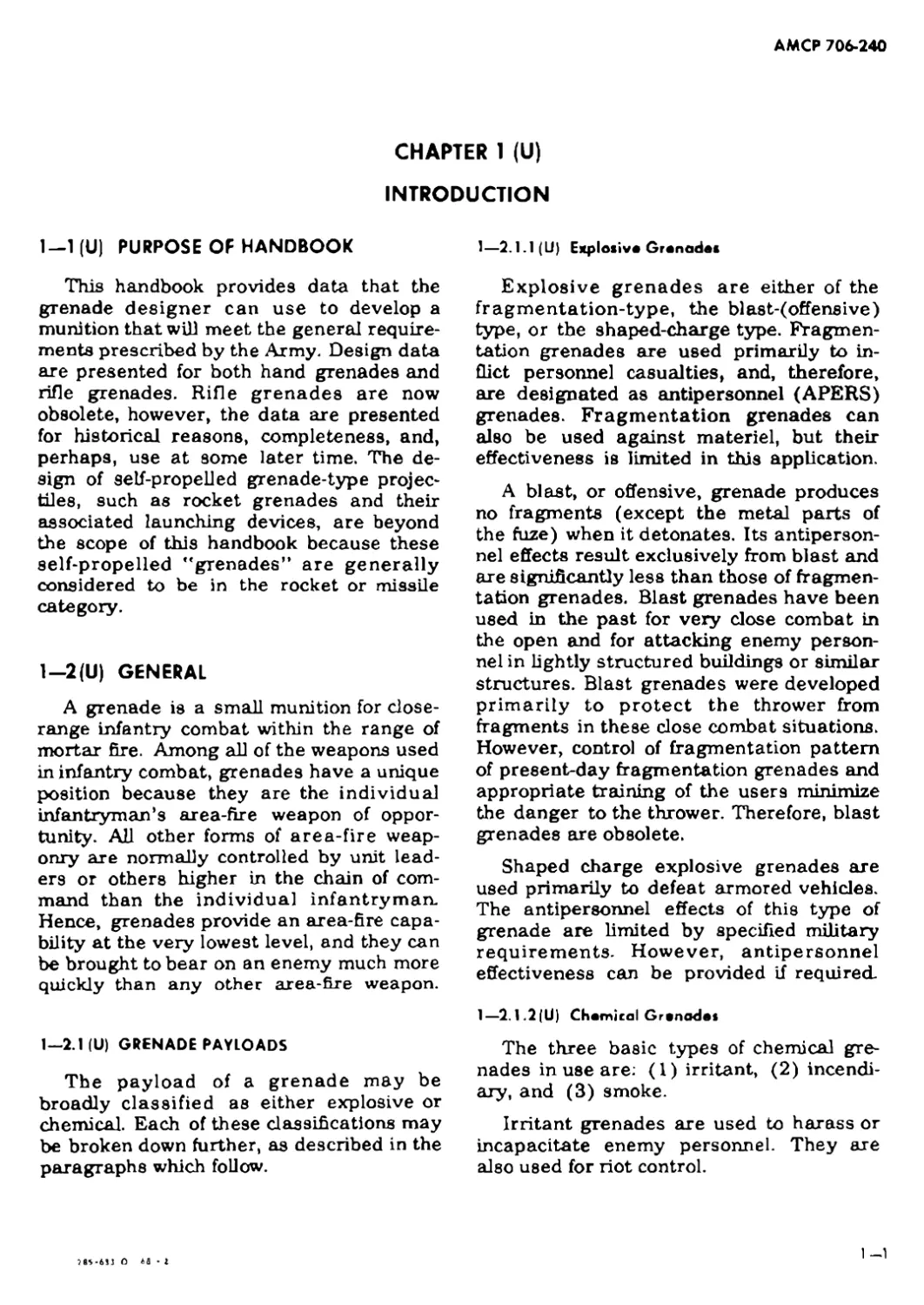
CHAPTER 1 (U)
INTRODUCTION
1—1 (U) PURPOSE OF HANDBOOK
This handbook provides data that the
grenade designer can use to develop a
munition that will meet the general require-
ments prescribed by the Army. Design data
are presented for both hand grenades and
rifle grenades. Rifle grenades are now
obsolete, however, the data are presented
for historical reasons, completeness, and,
perhaps, use at some later time. The de-
sign of self-propelled grenade-type projec-
tiles, such as rocket grenades and their
associated launching devices, are beyond
the scope of this handbook because these
self-propelled "grenades” are generally
considered to be in the rocket or missile
category.
l-2(U) GENERAL
A grenade is a small munition for close-
range infantry combat within the range of
mortar fire. Among all of the weapons used
in infantry combat, grenades have a unique
position because they are the individual
infantryman’s area-fire weapon of oppor-
tunity. All other forms of area-fire weap-
onry are normally controlled by unit lead-
ers or others higher in the chain of com-
mand than the individual infantryman.
Hence, grenades provide an area-fire capa-
bility at the very lowest level, and they can
be brought to bear on an enemy much more
quickly than any other area-fire weapon.
1— 2.1 (U) GRENADE PAYLOADS
The payload of a grenade may be
broadly classified as either explosive or
chemical. Each of these classifications may
be broken down further, as described in the
paragraphs which follow.
1—2.1.1 (U) Explosive Grenada*
Explosive grenades are either of the
fragmentation-type, the blast-(offensive)
type, or the shaped-charge type. Fragmen-
tation grenades are used primarily to in-
flict personnel casualties, and, therefore,
are designated as antipersonnel (APERS)
grenades. Fragmentation grenades can
also be used against materiel, but their
effectiveness is limited in this application.
A blast, or offensive, grenade produces
no fragments (except the metal parts of
the fuze) when it detonates. Its antiperson-
nel effects result exclusively from blast and
are significantly less than those of fragmen-
tation grenades. Blast grenades have been
used in the past for very close combat in
the open and for attacking enemy person-
nel in lightly structured buildings or similar
structures. Blast grenades were developed
primarily to protect the thrower from
fragments in these close combat situations.
However, control of fragmentation pattern
of present-day fragmentation grenades and
appropriate training of the users minimize
the danger to the thrower. Therefore, blast
grenades are obsolete.
Shaped charge explosive grenades are
used primarily to defeat armored vehicles.
The antipersonnel effects of this type of
grenade are limited by specified military
requirements. However, antipersonnel
effectiveness can be provided if required.
1—2.1.2(U) Chemical Grenada!
The three basic types of chemical gre-
nades in use are: (1) irritant, (2) incendi-
ary, and (3) smoke.
Irritant grenades are used to harass or
incapacitate enemy personnel. They are
also used for riot control.
2e$-6SJ О Afl - 2
1
АМСР 706-240
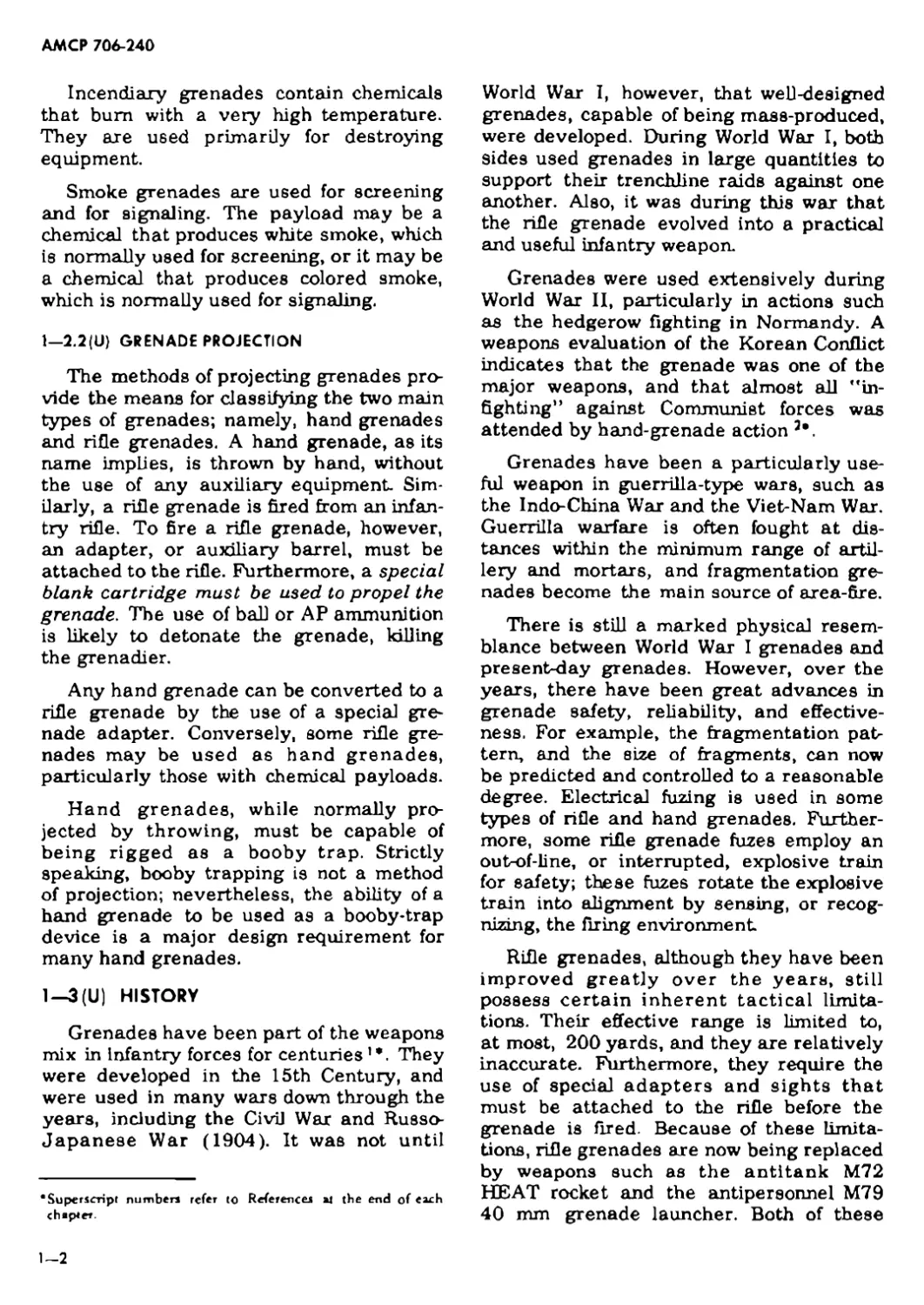
Incendiary grenades contain chemicals
that bum with a very high temperature.
They are used primarily for destroying
equipment.
Smoke grenades are used for screening
and for signaling. The payload may be a
chemical that produces white smoke, which
is normally used for screening, or it may be
a chemical that produces colored smoke,
which is normally used for signaling.
1-2.2(U) GRENADE PROJECTION
The methods of projecting grenades pro-
vide the means for classifying the two main
types of grenades; namely, hand grenades
and rifle grenades. A hand grenade, as its
name implies, is thrown by hand, without
the use of any auxiliary equipment. Sim-
ilarly, a rifle grenade is fired from an infan-
try rifle. To fire a rifle grenade, however,
an adapter, or auxiliary barrel, must be
attached to the rifle. Furthermore, a special
blank cartridge must be used to propel the
grenade. The use of ball or AP ammunition
is likely to detonate the grenade, killing
the grenadier.
Any hand grenade can be converted to a
rifle grenade by the use of a special gre-
nade adapter. Conversely, some rifle gre-
nades may be used as hand grenades,
particularly those with chemical payloads.
Hand grenades, while normally pro-
jected by throwing, must be capable of
being rigged as a booby trap. Strictly
speaking, booby trapping is not a method
of projection; nevertheless, the ability of a
hand grenade to be used as a booby-trap
device is a major design requirement for
many hand grenades.
1—3 (U) HISTORY
Grenades have been part of the weapons
mix in Infantry forces for centuries They
were developed in the 15th Century, and
were used in many wars down through the
years, including the Civil War and Russo-
Japanese War (1904). It was not until
* Superscript number? refer to References al the end of each
chapter.
1~2
World War I, however, that well-designed
grenades, capable of being mass-produced,
were developed. During World War I, both
sides used grenades in large quantities to
support their trenchline raids against one
another. Also, it was during this war that
the rifle grenade evolved into a practical
and useful infantry weapon.
Grenades were used extensively during
World War II, particularly in actions such
as the hedgerow fighting in Normandy. A
weapons evaluation of the Korean Conflict
indicates that the grenade was one of the
major weapons, and that almost all "in-
fighting” against Communist forces was
attended by hand-grenade action
Grenades have been a particularly use-
ful weapon in guerrilla-type wars, such as
the Indo-China War and the Viet-Nam War.
Guerrilla warfare is often fought at dis-
tances within the minimum range of artil-
lery and mortars, and fragmentation gre-
nades become the main source of area-fire.
There is still a marked physical resem-
blance between World War I grenades and
present-day grenades. However, over the
years, there have been great advances in
grenade safety, reliability, and effective-
ness. For example, the fragmentation pat-
tern, and the size of fragments, can now
be predicted and controlled to a reasonable
degree. Electrical fuzing is used in some
types of rifle and hand grenades. Further-
more, some rifle grenade fuzes employ an
out-of-line, or interrupted, explosive train
for safety; these fuzes rotate the explosive
train into alignment by sensing, or recog-
nizing, the firing environment
Rifle grenades, although they have been
improved greatly over the years, still
possess certain inherent tactical limita-
tions. Their effective range is limited to,
at most, 200 yards, and they are relatively
inaccurate. Furthermore, they require the
use of special adapters and sights that
must be attached to the rifle before the
grenade is fired. Because of these limita-
tions, rifle grenades are now being replaced
by weapons such as the antitank M72
HEAT rocket and the antipersonnel M79
40 mm grenade launcher. Both of these
АМСР 706-240
weapons, while not actually rifle grenades,
perform the same functions, and are more
effective and reliable. Since the 40 mm is
essentially a grenade-type weapon system,
a brief description is given below.
1—4(U) 40 mm GRENADE SYSTEMS3
1—4.1 (U) MATERIEL AND PURPOSE OF SYSTEM.
The 40 mm Grenade Systems include
the following items:
(a)	40 mm Grenade Launcher, M79
(b)	40 mm Grenade Launcher, XM148
(c)	Cartridge, Grenade, 40 mm, HE,
M406
(d)	Cartridge, Grenade, 40 mm, Prac-
tice, M407
The systems are provided for defensive
and offensive use by small units or individ-
ual combatants. They provide effective
area target fire coverage in the range zone
of 30 meters to 350 meters. This is the
area between the maximum throwing range
for the hand grenade and the minimum
range for mortar fire. They are suitable
for direct firing against vertical targets
such as openings in buildings, cave en-
trances and bunker apertures at ranges
of 30 meters to 150 meters. For area fire
they can be used at ranges of from 30
meters to 400 meters maximum range.
Each of the system components is described
in the paragraphs which follow.
1—4.2(U) GRENADE LAUNCHER. M79.
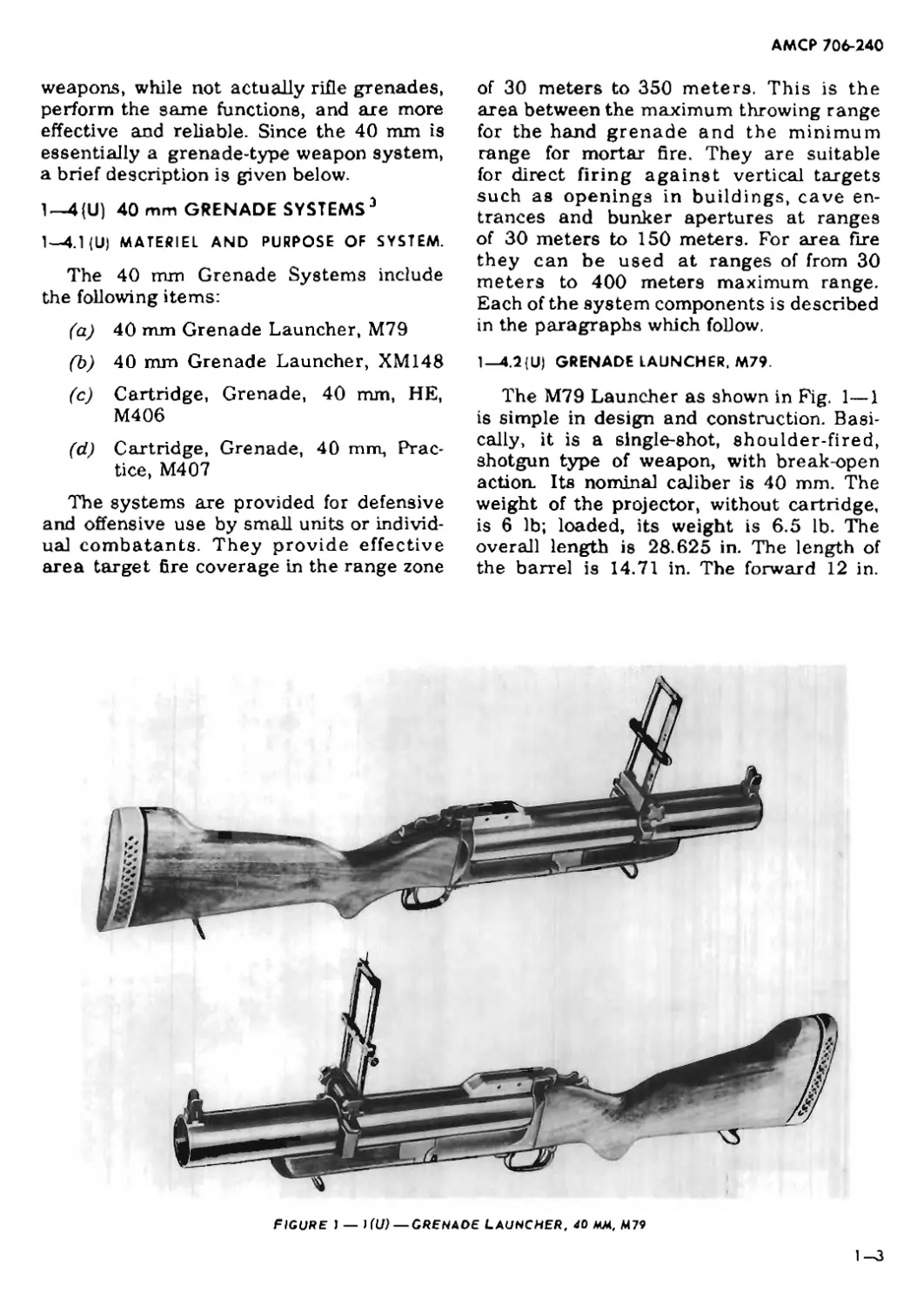
The M79 Launcher as shown in Fig. 1—1
is simple in design and construction. Basi-
cally, it is a single-shot, shoulder-fired,
shotgun type of weapon, with break-open
action. Its nominal caliber is 40 mm. The
weight of the projector, without cartridge,
is 6 lb; loaded, its weight is 6.5 lb. The
overall length is 28.625 in. The length of
the barrel is 14.71 in. The forward 12 in.
FIGURE ) — XU) — GRENADE LAUNCHER. dO ММ. M79
АМСР 706-240
of the barrel are rifled, with 6 rifling
grooves 0.01 in. deep, of uniform twist,
right hand; one turn in 48 inches.
1—4.3(U) GRENADE LAUNCHER, XM148
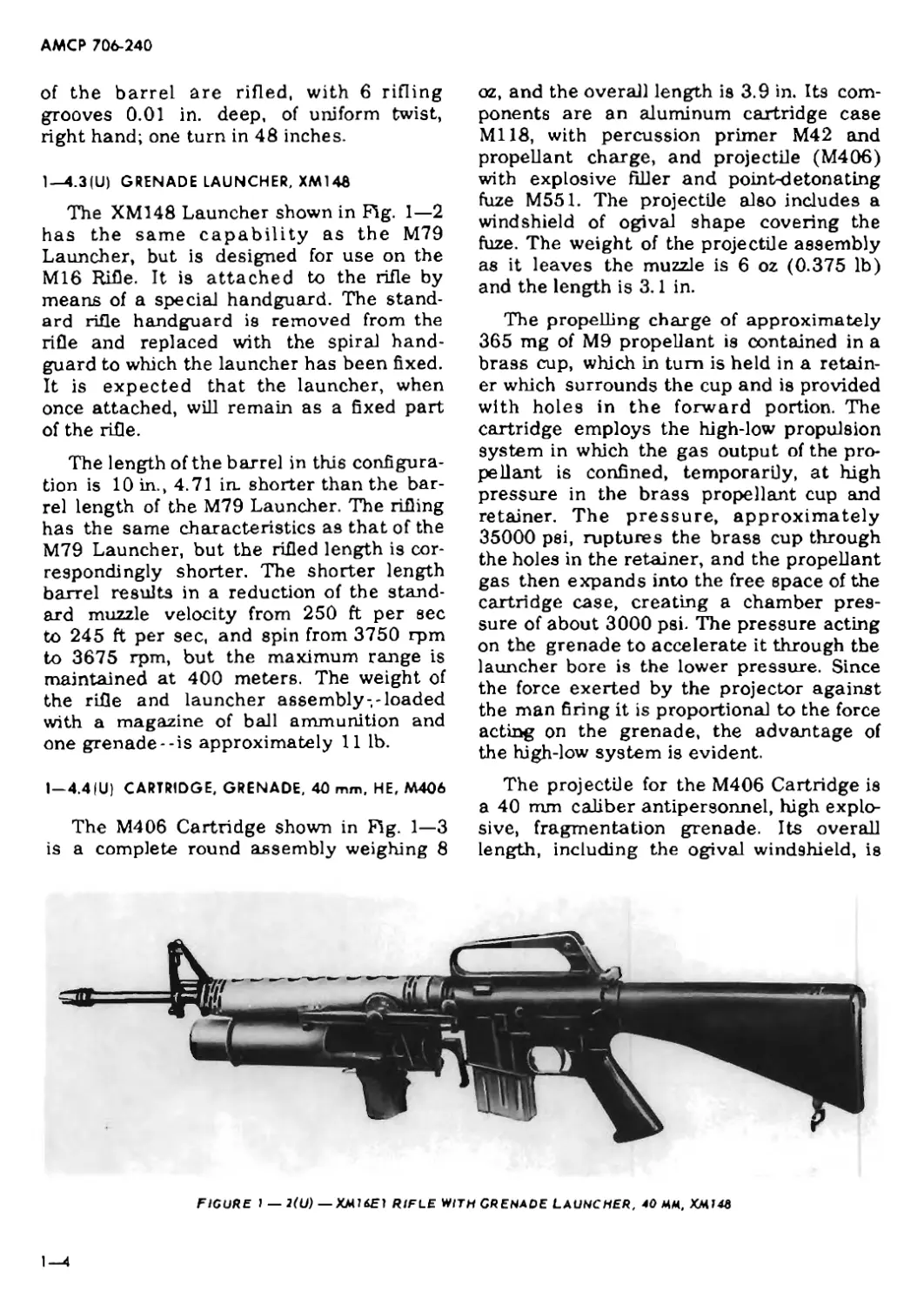
The XM148 Launcher shown in Fig. 1—2
has the same capability as the M79
Launcher, but is designed for use on the
M16 Rifle. It is attached to the rifle by
means of a special handguard. The stand-
ard rifle handguard is removed from the
rifle and replaced with the spiral hand-
guard to which the launcher has been fixed.
It is expected that the launcher, when
once attached, will remain as a fixed part
of the rifle.
The length of the barrel in this configura-
tion is 10 in., 4.71 in. shorter than the bar-
rel length of the M79 Launcher. The rifling
has the same characteristics as that of the
M79 Launcher, but the rifled length is cor-
respondingly shorter. The shorter length
barrel results in a reduction of the stand-
ard muzzle velocity from 250 ft per sec
to 245 ft per sec, and spin from 3750 rpm
to 3675 rpm, but the maximum range is
maintained at 400 meters. The weight of
the rifle and launcher assembly--loaded
with a magazine of ball ammunition and
one grenade--is approximately 11 lb.
1-4.4IU) CARTRIDGE, GRENADE, 40 mm. HE, M4O6
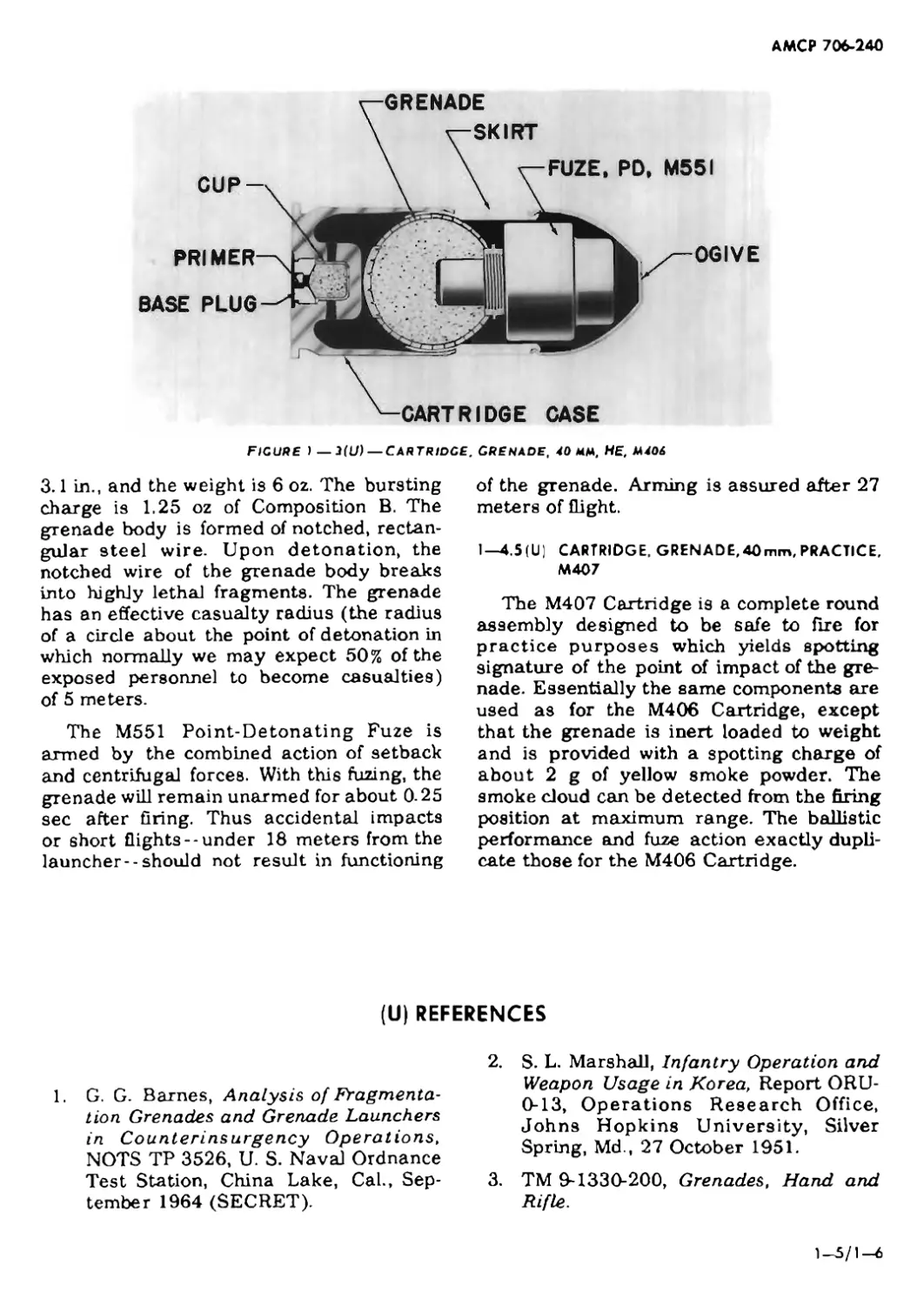
The M406 Cartridge shown in Fig. 1—3
is a complete round assembly weighing 8
oz, and the overall length is 3.9 in. Its com-
ponents are an aluminum cartridge case
Ml 18, with percussion primer M42 and
propellant charge, and projectile (M406)
with explosive filler and point-detonating
fuze M551. The projectile also includes a
windshield of ogival shape covering the
fuze. The weight of the projectile assembly
as it leaves the muzzle is 6 oz (0.375 lb)
and the length is 3.1 in.
The propelling charge of approximately
365 mg of M9 propellant is contained in a
brass cup, which in turn is held in a retain-
er which surrounds the cup and is provided
with holes in the forward portion. The
cartridge employs the high-low propulsion
system in which the gas output of the pro-
pellant is confined, temporarily, at high
pressure in the brass propellant cup and
retainer. The pressure, approximately
35000 psi, ruptures the brass cup through
the holes in the retainer, and the propellant
gas then expands into the free space of the
cartridge case, creating a chamber pres-
sure of about 3000 psi. The pressure acting
on the grenade to accelerate it through the
launcher bore is the lower pressure. Since
the force exerted by the projector against
the man firing it is proportional to the force
acting on the grenade, the advantage of
the high-low system is evident.
The projectile for the M406 Cartridge is
a 40 mm caliber antipersonnel, high explo-
sive, fragmentation grenade. Its overall
length, including the ogival windshield, is
FIGURE I — 2(U) — XM16SI RIFLE WITH GRENADE LAUNCHER, 40 ММ, XM14S
АМСР 706-240
FIGURE > — 3(U)—CARTRIDGE. GRENADE, 40 ММ, HE, M40i
3.1 in., and the weight is 6 oz. The bursting
charge is 1.25 oz of Composition B. The
grenade body is formed of notched, rectan-
gular steel wire. Upon detonation, the
notched wire of the grenade body breaks
into highly lethal fragments. The grenade
has an effective casualty radius (the radius
of a circle about the point of detonation in
which normally we may expect 50% of the
exposed personnel to become casualties)
of 5 meters.
The M551 Point-Detonating Fuze is
armed by the combined action of setback
and centrifugal forces. With this fuzing, the
grenade will remain unarmed for about 0-25
sec after firing. Thus accidental impacts
or short flights--under 18 meters from the
launcher--should not result in functioning
of the grenade. Arming is assured after 27
meters of flight.
1—4.5 (U) CARTRIDGE. GRENADE,40mm, PRACTICE.
M407
The M407 Cartridge is a complete round
assembly designed to be safe to fire for
practice purposes which yields spotting
signature of the point of impact of the gre-
nade. Essentially the same components are
used as for the M406 Cartridge, except
that the grenade is inert loaded to weight
and is provided with a spotting charge of
about 2 g of yellow smoke powder. The
smoke cloud can be detected from the firing
position at maximum range. The ballistic
performance and fuze action exactly dupli-
cate those for the M406 Cartridge.
(U) REFERENCES
1.	G. G. Barnes, Analysis of Fragmenta-
tion. Grenades and Grenade Launchers
in Counterinsurgency Operations,
NOTS TP 3526, U. S. Naval Ordnance
Test Station, China Lake, Cal., Sep-
tember 1964 (SECRET).
2.	S. L. Marshall, Infantry Operation and
Weapon Usage in Korea, Report ORU-
0-13, Operations Research Office,
Johns Hopkins University, Silver
Spring, Md., 27 October 1951.
3.	TM 9-1330-200, Grenades, Hand and
Rifle.
АМСР 706-240
CHAPTER 2 (С)
HAND GRENADES
SECTION I (U)
GENERAL
2—1 (U) PURPOSE
A hand grenade is a small, relatively
lightweight weapon used for close combat,
generally within a maximum range of about
40 meters. The most common use of hand
grenades is to inflict personnel casualties
on the enemy. For this purpose, high ex-
plosive fragmentation-type hand grenades
are used almost exclusively.
Hand grenades are also used for harass-
ing the enemy, for signaling and screen-
ing, and for incendiary use. For these pur-
poses, chemical hand grenades are used.
2—2(U) TYPICAL HAND GRENADE REQUIRE-
MENTS
Each type of hand grenade is designed
to meet certain specific requirements with
respect to lethality, size, weight, etc. It is
desirable that military requirements and
characteristics be so specified as to give
the designer-developer maximum flexibility
in achieving a most nearly optimum design.
Historically, military requirements, in the
effectiveness area, have been specified in
terms of effects against a specific test
arena which is not necessarily representa-
tive of combat usage of the item and may
not be conducive to the optimum design.
Military effectiveness requirements should
be specified in terms of specific targets,
with description of such targets; the fre-
quency of engagement of each specified
target; and the distribution of ranges at
which each specified target is engaged.
Relative to safety of the thrower, the mili-
tary requirement should specify the level
of risk which is acceptable; for example,
"the probability that the thrower will be
hit with an injurious fragment shall be less
than 1 in 100,000” and description of the
position of the thrower; for example, "prone
man in winter clothing with average terrain
cover”. Also, to the extent possible, physi-
cal characteristics should be general with
only the maximum specified; that is, maxi-
mum weight, maximum size, etc. However,
all hand grenades must meet the following
general requirements:
a.	Be operable over a temperature
range of -40° to +-125“F at any humidity
level.
b.	Be operable after prolonged storage
in a packaged state at temperatures be-
tween -65е and +160°F at any humidity
level. However, the low-temperature stor-
age limit for some types of chemical-type
grenades may be -40° F.
c.	Be operable after being subjected in
a packaged state to the atmospheric pres-
sure variations, shock, and vibration en-
countered during air transport.
d.	Be operable after being subjected to
the shock and vibration encountered during
truck and rail transport, whether trans-
ported in an unpacked or packed state.
e.	Be waterproof.
/. Be operable after being dropped by
parachute. Should the parachute fail to
open, they must remain safe for disposal.
g.	Be simple to operate under all com-
bat conditions by personnel having mini-
mum instruction.
h.	Be safe.
i.	Meet requirements of MIL-STD-331.
2-1
АМСР 706-240
2—3(U) GENERAL TEST SPECIFICATIONS
There are many standard military speci-
fications that prescribe test procedures for
determining if a hand grenade meets the
general requirements of par. 2—2. For ex-
ample, specifications for immersion testing
may be used to determine if the grenade is
waterproof. Or, specifications for transpor-
tation vibration testing may be used to
determine if the grenade can withstand the
rigors of truck transport.
There are also standard military specifi-
cations for testing grenade components.
For example, MIL-STD-331, Test No. 105,
"Temperature and Humidity”, provides
methods of testing a fuze for its resistance
to temperature and humidity extremes,
while Test No. 115, "Static Detonator
Safety”, provides methods of testing for
detonator safety.
The design specification for a grenade
will usually specify the test specifications
that must be used in the design of a par-
ticular grenade. In some cases, only the
requirements will be specified, and the de-
signer will have to determine which speci-
fications must be used to determine if the
requirements are met. In either case, the
designer must keep the requirements in
mind from the very beginning of a project
to the end, and should continually consult
the test specifications to insure that his
design can meet the test requirements.
SECTION II (C)
FRAGMENTATION HAND GRENADES
2—4(U) GENERAL
This section describes the military re-
quirements specified for a fragmentation
hand grenade. Following this, the design
considerations involved in meeting these
requirements are discussed, and a typical
design approach is illustrated.
2—5(U) REQUIREMENTS
In addition to the requirements speci-
fied in par. 2—2 for all hand grenades, a
fragmentation hand grenade must meet
certain operational requirements. These re-
quirements, which are normally given in
the design specifications for the grenade,
are discussed briefly in the paragraphs
which follow.
2—5.1 (U) FRAGMENTATION PATTERN
The required spatial distribution of frag-
ments will be given in the design specifica-
tion. Since it is impossible to predict a hand
grenade’s orientation with respect to the
target at the time of detonation, ideally,
the grenade should produce a uniform
spatial distribution of fragments. However,
because of certain practical factors, which
are discussed later, a uniform spatial dis-
tribution is impossible to attain. Therefore,
for all present-day fragmentation grenades,
a nearly uniform spatial distribution is re-
quired, and can be attained. A nearly uni-
form spatial distribution provides reasona-
ble assurance that a target within the frag-
mentation range of the grenade will be hit
by fragments.
2—5.2 (U) LETHALITY
The lethality of a grenade is a measure
of the grenade’s ability to incapacitate an
enemy. In this sense, incapacitation means
either to kill him or to severely wound him
so that he cannot fire a weapon or offer
effective resistance.
2—5.2.1 (U) Incapacitation Time
A requirement for fragmentation gre-
nades is that they incapacitate an enemy
within a certain time. Since hand grenades
are used for close combat, this time must
2-2
АМСР 706-240
be very abort; for present-day grenades, it
is usually immediate or at most 5 sec.
2—5.2.2 (U) Effective Area
The design specification will contain a
requirement that the hand grenade frag-
ments must be lethal to specified damage
level out to a certain distance and safe to
the thrower beyond a second specified dis-
tance. The effective area is normally ex-
pressed as a circular area about the point
of burst within which a specified average
probability of incapacitation of a specific
target is attained. The safe distance is
generally associated with the throwing
range of the grenade by a typical soldier.
Sound training techniques assist in assur-
ing that the thrower will not be incapaci-
tated by his own Item.
2—5.2,3 (U) Effectiveneu Criterion
The effectiveness criterion of a fragmen-
tation hand grenade is a measure of the
grenade’s capability for incapacitating an
enemy within the effective area of the gre-
nade and within the specified incapacitation
time. The effectiveness requirement is nor-
mally expressed as the probability that the
target will be incapacitated within a speci-
fied time period.
Since the study of wound ballistics is a
specialized field in itself, the grenade de-
signer will normally require pertinent data
relating to fragment lethality. The U.S.
Army Ballistic Research Laboratories
possess the latest information in this re-
gard.
2—5.3 (U) SIZE, WEIGHT, AND SHAPE
The shape of a hand grenade whether
it is spherical, cylindrical, or barrel-shaped
has little effect on the distance a grenade
can be thrown or on how accurately it can
be thrown. However, the size and weight
of the grenade greatly affect these two
parameters. If the grenade is too large, or
too small, it cannot be gripped properly by
the thrower, and therefore, both distance
and accuracy will be degraded. If a grenade
Is too heavy, obviously it cannot be thrown
the desired distance or thrown very accu-
rately. The same is true if the grenade is
too light, in which case, distance and accu-
racy are affected by wind forces.
The size, weight, and shape require-
ments for a hand grenade are usually given
in the design specification, and are speci-
fied in a manner that provides some leeway
for the grenade designer. For example, a
maximum weight for the grenade is nor-
mally specified rather than a precise
weight. A typical design specification may
state that the grenade should be as light
as practical, but shall not exceed 16 oz.
Similarly, maximum dimensions are usually
specified. For example, if the grenade is to
be spherical, its maximum diameter will
be specified, which, typically, is about 3 in.
If the grenade is to be barrel-shaped, the
length of its longest axis will be specified,
which, typically, is about 4-1/2 to 5 in.
2—5.4 |U) SAFETY
Safety requirements for the grenade will
be given in the design specification. Typical
requirements are:
(1)	The thrower must perform some
type of positive action to cause the grenade
to arm after it is released. For example,
for a fragmentation grenade to become
armed, two separate actions must occur,
namely: the thrower must first pull a safety
pin out of the grenade and then release a
safety lever when he throws the grenade.
(2)	A time delay must be incorporated
into the fuze so that the fuze will not ini-
tiate detonation until about 4 or 5 sec after
the grenade is thrown.
(3)	To protect the thrower, the number
of incapacitating fragments must be mini-
mum beyond a specified distance from the
point of detonation. For a typical fragmen-
tation hand grenade, this distance is about
60 ft.
(4)	If the hand grenade is designed for
impact function, it must not detonate im-
mediately if dropped by the grenadier in
the act of throwing. Immediate detonation
US-fclJ О - 6Я . .1
АМСР 706-240
CONFIDENTIAL
can be avoided by incorporating a delay-
after-arming feature into the fuze. Typi-
cally, this delay time is 1 sec, since a
grenade dropped from raised-arm height
will impact the ground in less than this
time.
2-5.5 (U) FUZING
The design specification for a fragmen-
tation grenade will specify the manner in
which detonation should be initiated, i.e.,
after expiration of a fixed time after final
arming or upon impact with the ground.
Practically all present-day grenades use
time fuzes, i.e., nonimpact, and these fuzes
are required to detonate the grenade ap-
proximately 4.5 sec after the grenade is
thrown.
If the specification specifies an impact-
type fuze, it most likely will also call for
an overriding time-function feature. This
ensures that the grenade will detonate after
a certain specified time should it fail to
detonate on impact.
2—6(C) DESIGN CONSIDERATIONS
To meet the requirements specified for
a proposed fragmentation grenade, various
design parameters must be determined and
controlled. During the initial design stages,
these parameters may be determined
analytically using the design formulas
given in the paragraphs which follow. These
formulas are generally accurate enough for
preliminary design; however, the optimum
design parameters can only be determined
empirically, based on the results of frag-
mentation tests of developmental gre-
nades2.
2—6.1 (C) LETHALITY
2—6.1.1(C) Lethality Criterion
The lethality criterion for a fragmenta-
tion grenade is based on the probability
that a random hit on a man will completely
incapacitate that man within a specified
time period. This time period is usually
immediate or at most 5 sec.
Precise wound ballistic data and cover
function data are needed to design a gre-
nade with fragments having a particular
probability of incapacitation as a function
of time and mission. These data are avail-
able at the U.S. Army Ballistic Research
Laboratories (BRL), Aberdeen Proving
Ground, Md., and are being updated con-
tinually. Reports BRL R 1269 and
BRL MR 1203 provide the most recent
wound ballistic data and cover function
data, respectively. However, because the
data are being updated continually, the
grenade designer should contact BRL for
the most recent data at the start of a
project.
Probabilities of incapacitation of single
fragments conditioned on a hit (P^k) 3X6
given in BRL MR 1209 as a function of
mass and striking velocity. The form of
the relation is:
phk
|_e-a(mve 3/2-b)n
(2-1)
where
m = mass of fragment, grains
vg = striking velocity of fragment,
fps
*.b,n= experimentally derived con-
stants
The constants — а, ь and n — for var-
ious stress levels and wounding times are
given in BRL MR 1269.
2—6.1.2(C) Number of Incapacitating Fragments
For a small target located at a certain
distance from the point of burst, the ex-
pected number of incapacitating fragments
Nk(r) of a given mass is given by the
expression:
(2-2)
where
CONFIDENTIAL
CONFIDENTIAL
АМСР 706-240
Ат = target area exposed to burst,
sq ft
Nm = total number of fragments of
a given mass
Phk = conditional probability that a
random hit on the target
will incapacitate the tar-
get
Q = solid angle throughout which
the fragments are pro-
jected. (For a spherical
grenade, Q would have
a value of 4 n .)
r - distance from point of burst
to target, ft
The probability Pk(r) that the target at
range г from ground zero will be incapaci-
tated is:
(2-3)
In Eqs. 2—2 and 2—3 it is assumed that
all fragments travel in a straight line, which
is usually an acceptable assumption over
the range that the fragments are effective.
2—6.1.3(C) Lethal Areo
Because hand grenades are unstabilized
in flight and are usually time fuzed, their
orientation with respect to the target at
time of burst cannot be predicted. Ideally,
then, the fragments should be uniformly
distributed in every direction about the
grenade. A spherical grenade would pro-
vide the most uniform distribution pattern;
but, for purposes of gripping and throwing,
fragmentation hand grenades are usually
barrel-shaped (par. 2—5.3).
The ideal fragmentation pattern —i. e.,
fragments distributed uniformly in every
direction about the grenade — is impracti-
cal to achieve in a barrel-shaped grenade.
In fact, it is impossible to achieve this in a
grenade of any shape, even spherical, be-
cause space taken by the fuze and the load
opening will interfere with fragment distri-
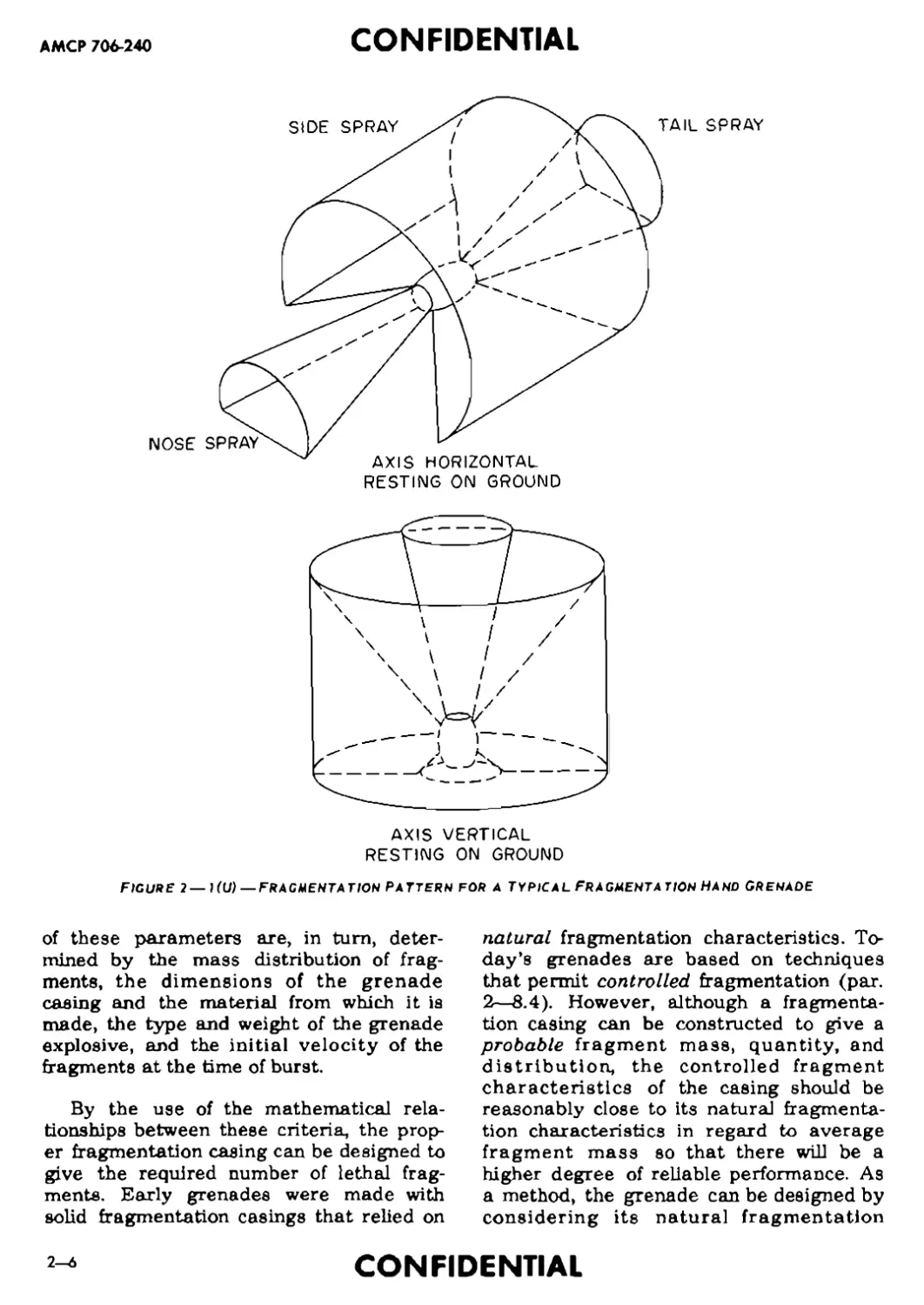
bution. A typical fragmentation pattern (or
a barrel-shaped grenade is shown in Fig.
2—1. The vertical burst (long axis vertical)
produces a higher lethal area than the
horizontal burst (long axis horizontal), but
the grenade will most likely settle in a
horizontal position on level terrain. It can
be seen that, in the horizontal burst posi-
tion, there are a number of blind spots in
the fragmentation pattern. While a prelim-
inary design may be based on achieving a
uniform fragmentation pattern, fragmenta-
tion tests must be performed to determine
the actual fragmentation pattern. Once the
actual number, mass, spatial distribution,
and initial velocity of individual fragments
are determined by experimental firings, the
actual lethal area of the grenade can be
calculated.
Lethal area is often used as a criterion
for evaluating the overall effectiveness of a
fragmentation grenade. Lethal area is gen-
erally computed using a high speed digital
computer. BRL TN 1510 describes lethal
area in detail. Lethal area AL is defined
as:
dx dy
(2-4)
where Pk(<* y) is the probability of incapac-
itation of a target located at x and у rela-
tive to munition ground zero. Lethal area
is not a physical area but rather a weighted
area where each differential area is
weighted by the probability of incapacita-
tion. Lethal area is proportional to the ex-
pected number of casualties produced by a
munition.
2—6.2(C) FRAGMENTATION CONSIDERATIONS4
From Eq. 2—1, it can be seen that the
lethality of a fragmentation grenade Phk
depends upon the mass and presented area
of any fragment, and the velocity at which
the fragment strikes the target. The values
CONFIDENTIAL
АМСР 706-240
CONFIDENTIAL
AXIS VERTICAL
RESTING ON GROUND
FIGURE 2—1(U)—FRAGMENTATION PATTERN FOR A TYPICAL FRAGMENTATION HAND GRENADE
of these parameters are, in turn, deter-
mined by the mass distribution of frag-
ments, the dimensions of the grenade
casing and the material from which it is
made, the type and weight of the grenade
explosive, and the initial velocity of the
fragments at the time of burst.
By the use of the mathematical rela-
tionships between these criteria, the prop-
er fragmentation casing can be designed to
give the required number of lethal frag-
ments. Early grenades were made with
solid fragmentation casings that relied on
natural fragmentation characteristics. To-
day’s grenades are based on techniques
that pennit controlled fragmentation (par.
2—8.4). However, although a fragmenta-
tion casing can be constructed to give a
probable fragment mass, quantity, and
distribution, the controlled fragment
characteristics of the casing should be
reasonably close to its natural fragmenta-
tion characteristics in regard to average
fragment mass so that there will be a
higher degree of reliable performance. As
a method, the grenade can be designed by
considering its natural fragmentation
CONFIDENTIAL
CONFIDENTIAL
АМСР 706-240
probabilities, and then applying controlled
fragmentation methods to assure reliable
performance. The paragraphs which follow
give the design criteria as related to
natural fragmentation. Their relationship
to controlled fragmentation is covered in
par. 2—8.4.
2—6.2.1 IC) Man Distribution of Fragments
Fragmentation grenades are considered
as having thin-walled casings. If it is as-
sumed that fragmentation from a thin-
walled casing is the result of two-dimen-
sional breakup7, the total number of frag-
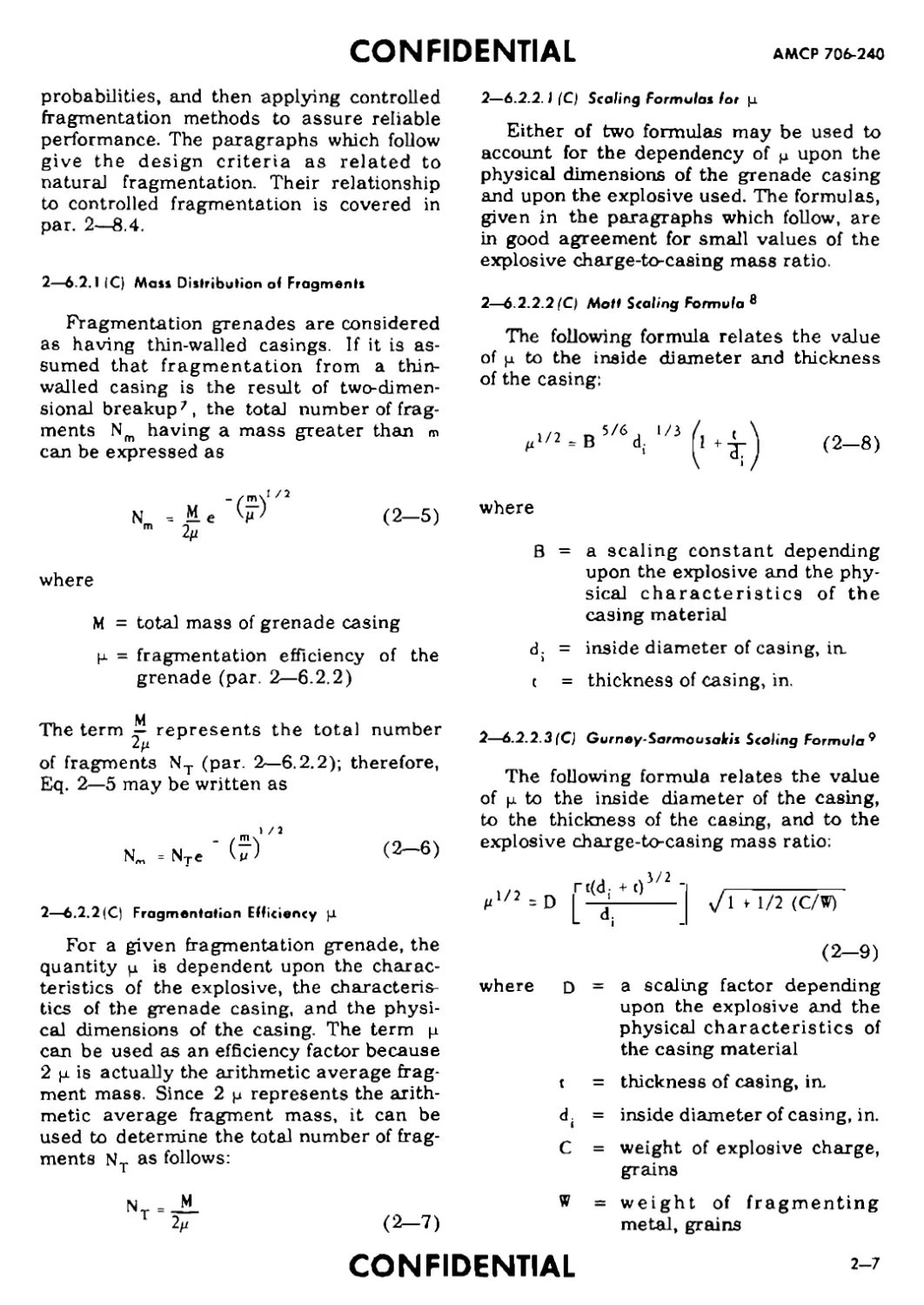
ments Nm having a mass greater than m
can be expressed as
2—6.2.2. J (C) Scaling Formulas lor p
Either of two formulas may be used to
account for the dependency of p upon the
physical dimensions of the grenade casing
and upon the explosive used. The formulas,
given in the paragraphs which follow, are
in good agreement for small values of the
explosive charge-to-casing mass ratio.
2—6.2.2.2(C) Mott Staling Formula ®
The following formula relates the value
of p to the inside diameter and thickness
of the casing:
^1/2 = В 5/6 d; 1/3 (1 + ‘ \	(2-8)
1	\ a* /
N -- Me W	(2—5)
m 2//
where
M = total mass of grenade casing
p. = fragmentation efficiency of the
grenade (par. 2—6.2.2)
M
The term — represents the total number
of fragments NT (par. 2—6.2.2); therefore.
Eq. 2—5 may be written as

(2-6)
2—6.2.2(C) Fragmentation Efficiency p
For a given fragmentation grenade, the
quantity p is dependent upon the charac-
teristics of the explosive, the characteris-
tics of the grenade casing, and the physi-
cal dimensions of the casing. The term p
can be used as an efficiency factor because
2 p is actually the arithmetic average frag-
ment mass. Since 2 p represents the arith-
metic average fragment mass, it can be
used to determine the total number of frag-
ments NT as follows:
N
M
T’2^
(2-7)
where
В = a scaling constant depending
upon the explosive and the phy-
sical characteristics of the
casing material
d. = inside diameter of casing, in.
t = thickness of casing, in.
2—6.2.2.3(C) Gurney-Sarmousaltii Scaling Formula9
The following formula relates the value
of pi to the inside diameter of the casing,
to the thickness of the casing, and to the
explosive charge-to-casing mass ratio;
. rt(d- + c)_	.------------
F y 2 = D --------- У1 f 1/2 (C/W)
(2-9)
where D = a scaling factor depending
upon the explosive and the
physical characteristics of
the casing material
t = thickness of casing, in.
ch = inside diameter of casing, in.
C = weight of explosive charge,
grains
W = weight of fragmenting
metal, grains
CONFIDENTIAL
2-7
АМСР 706-240
CONFIDENTIAL
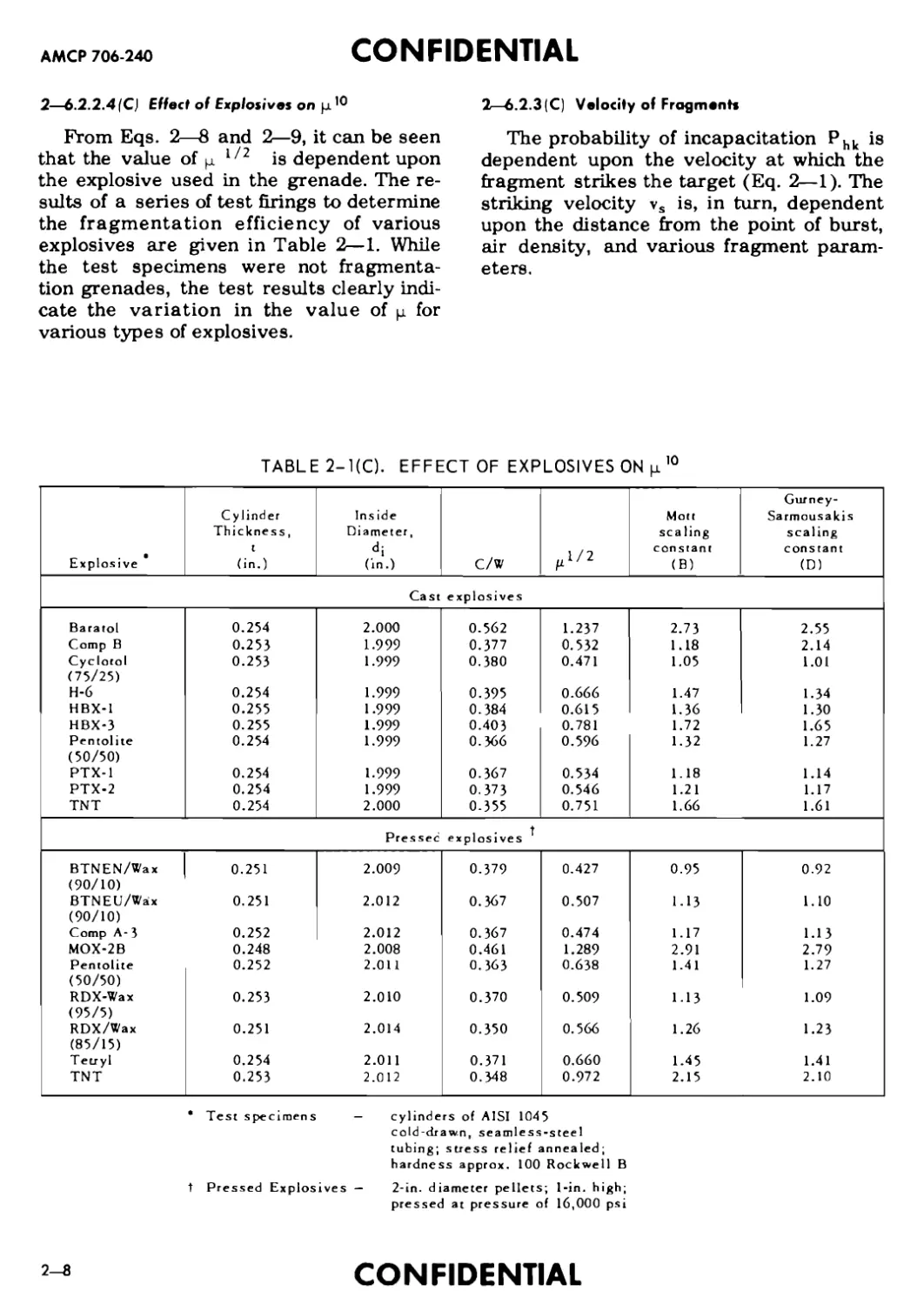
2—6.2.2.4 (CJ Effect of Explosives on p.10
2—6.2.3(C) Velocity of Fragments
From Eqs. 2—8 and 2—9, it can be seen
that the value of p 1/2 is dependent upon
the explosive used in the grenade. The re-
sults of a series of test firings to determine
the fragmentation efficiency of various
explosives are given in Table 2—1. While
the test specimens were not fragmenta-
tion grenades, the test results clearly indi-
cate the variation in the value of p for
various types of explosives.
The probability of incapacitation Phk is
dependent upon the velocity at which the
fragment strikes the target (Eq. 2—1). The
striking velocity vs is, in turn, dependent
upon the distance from the point of burst,
air density, and various fragment param-
eters.
TABLE 2-l(C). EFFECT OF EXPLOSIVES ON 10
Explosive	Cylinder Thickness, t (in.)	Ins ide Diameter, di (in.)	c/w	Ml/2	Mott scaling constant (B)	Gurney- Sarmousakis scaling constant (D)
		Cast	explosives
Baratol	0.254	2.000	0.562	1.237	2.73	2.55
Comp В	0.253	1.999	0.377	0.532	1.18	2.14
Сус lotol (75/25)	0.253	1.999	0.380	0.471	1.05	1.01
H-6	0.254	1.999	0.395	0.666	1.47	1.34
HBX-1	0.255	1.999	0.384	0.615	1.36	1.30
HBX-3	0.255	1.999	0.403	0.781	1.72	1.65
Pentolite (50/50)	0.254	1.999	0.366	0.596	1.32	1.27
PTX-1	0.254	1.999	0.367	0.534	1.18	1.14
PTX-2	0.254	1.999	0.373	0.546	1.21	1.17
TNT	0.254	2.000	0.355	0.751	1.66	1.61
		Pressec	explosives
BTNEN/Wax | (90/10)	0.251	2.009	0.379	0.427	0.95	0.92
BTNEU/Wax	0.251	2.012	0.367	0.507	1-13	1.10
(90/10) Comp A- 3	0.252	2.012	0.367	0.474	1.17	1.13
MOX-2B	0.248	2.008	0.461	1.289	2.91	2.79
Pentolite	0.252	2.011	0.363	0.638	1.41	1.27
(50/50) RDX-Wax (95/5)	0.253	2.010	0.370	0.509	1.13	1.09
RDX/Wax (85/15)	0.251	2.014	0.350	0.566	1.26	1.23
Tetryl	0.254	2.011	0.371	0.660	1.45	1.41
TNT	0.253	2.012	0.348	0.972	2.15	2.10
• Test specimens
t Pressed Explosives —
cylinders of A1SI 1045
cold-drawn, seamless-stee 1
tubing; stress relief annealed;
hardness approx. 100 Rockwell В
2-in. diameter pellets; 1-in. high;
pressed at pressure of 16,000 psi
2-8
CONFIDENTIAL
CONFIDENTIAL
АМСР 706-240
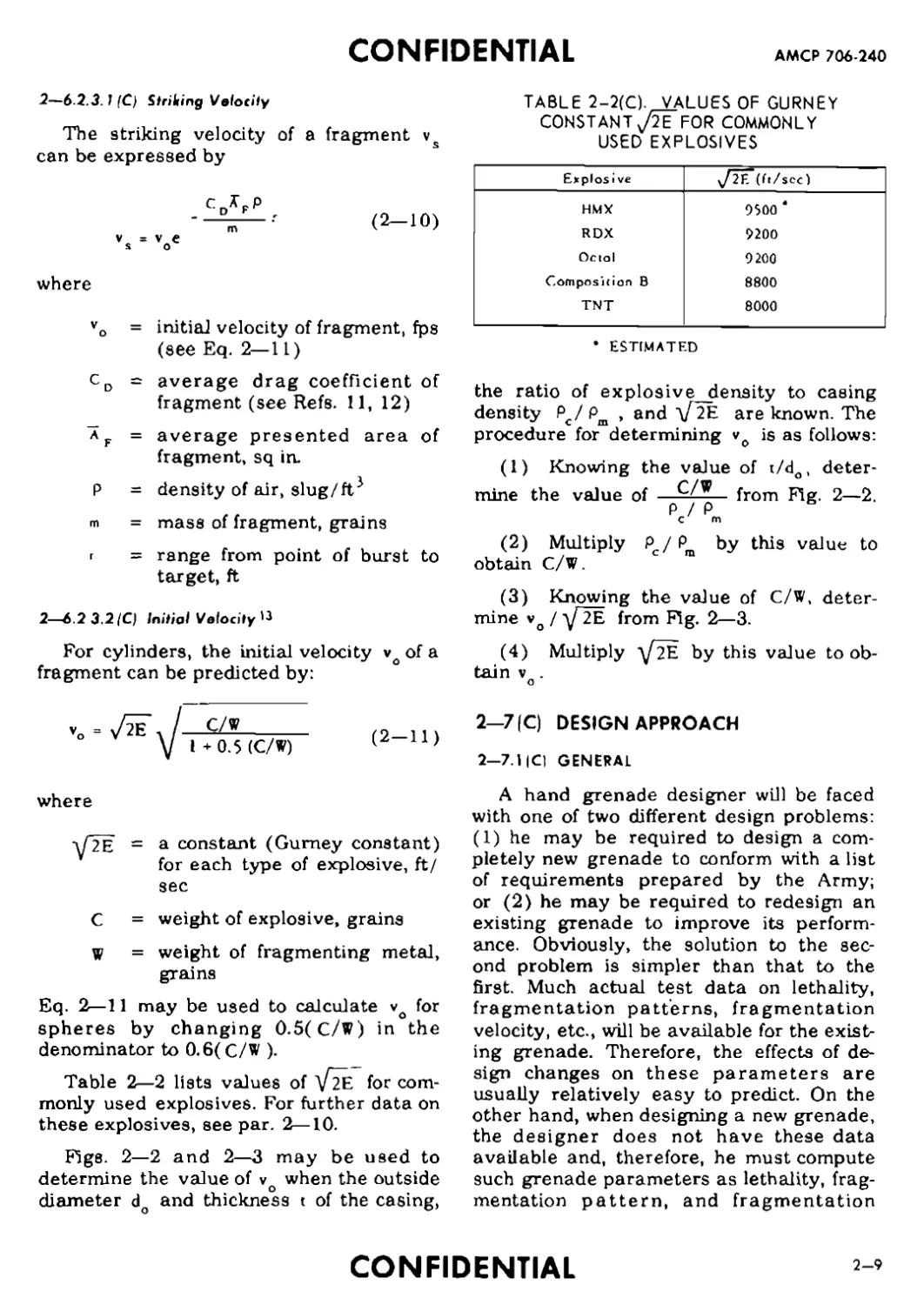
2—6.2.3. J /С} Striking Velocity
The striking velocity of a fragment vs
can be expressed by
where
vo = initial velocity of fragment, fps
(see Eq. 2—11)
cD = average drag coefficient of
fragment (see Refs. 11, 12)
af = average presented area of
fragment, sq in.
P = density of air, slug/ftJ
m = mass of fragment, grains
г = range from point of burst to
target, ft
2—6.2 3.2 IC) Initial Velocity >3
For cylinders, the initial velocity vo of a
fragment can be predicted by:
v = v/2E л /	______
° V I + 0.5 (C/W)
(2-П)
where
7e = a constant (Gurney constant)
for each type of explosive, ft/
sec
C = weight of explosive, grains
W = weight of fragmenting metal,
grains
Eq. 2—11 may be used to calculate vQ for
spheres by changing 0.5(C/W) in the
denominator to 0.6(C/W ).
Table 2—2 lists values of V2E for com-
monly used explosives. For further data on
these explosives, see par. 2—10.
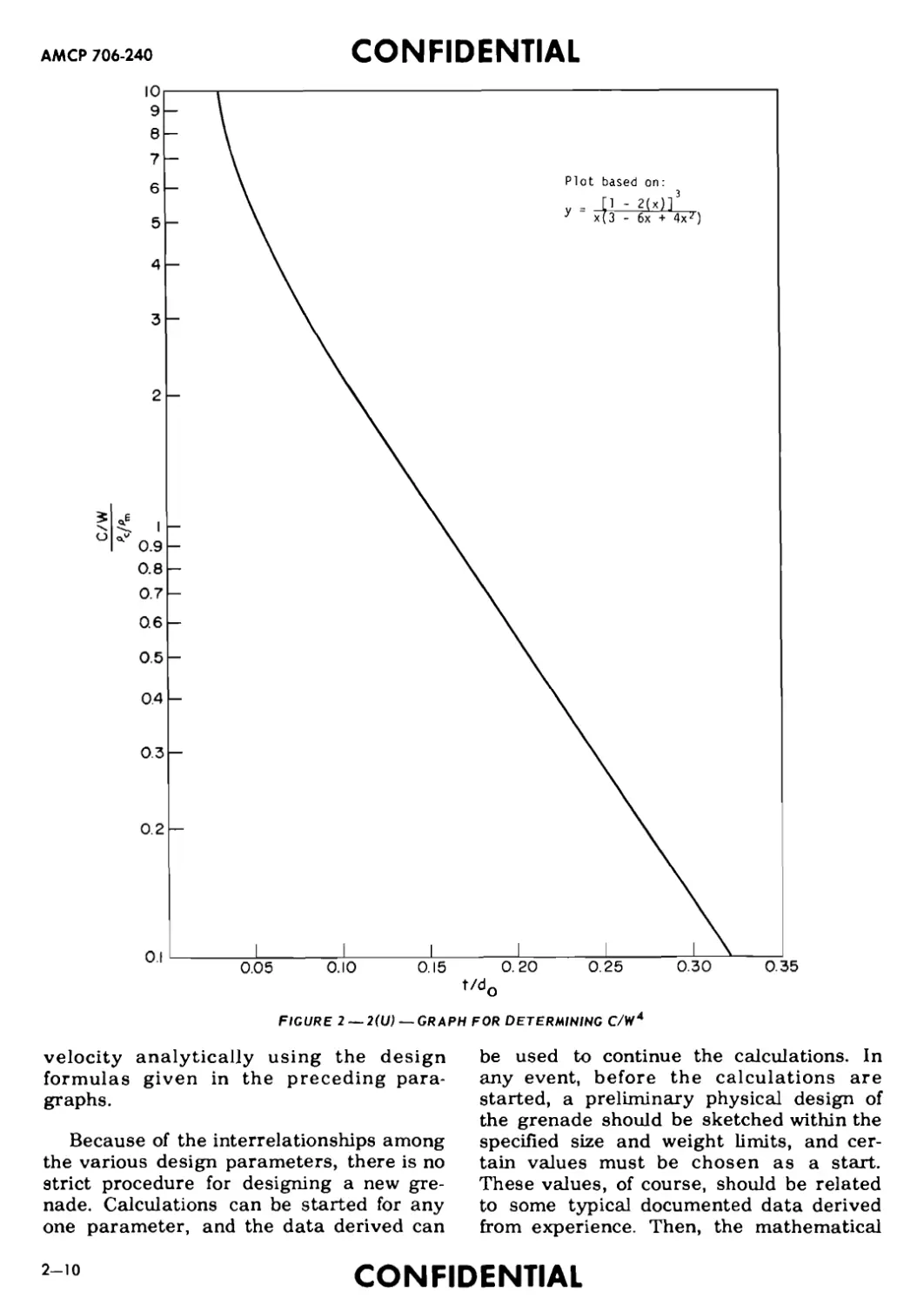
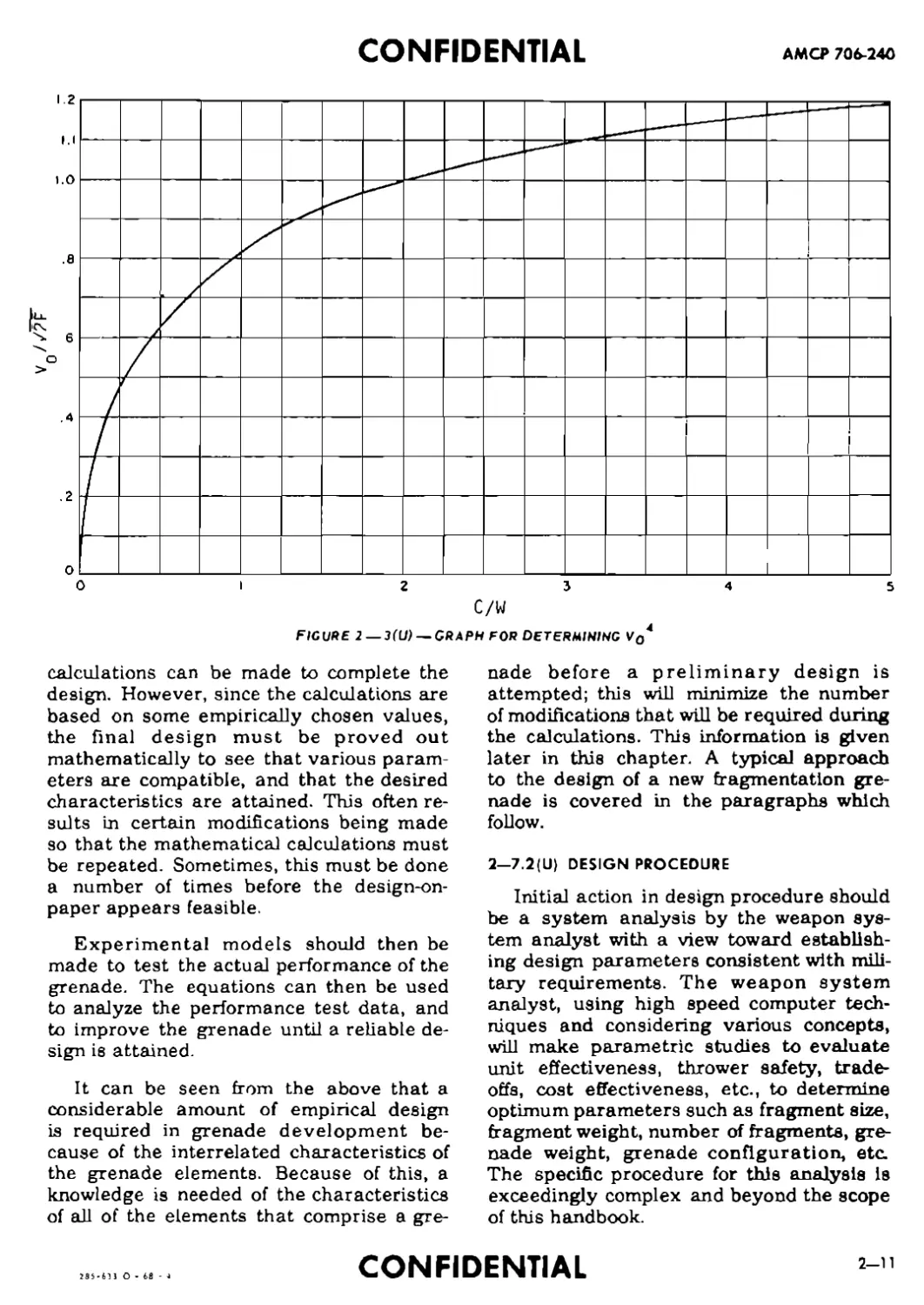
Figs. 2—2 and 2—3 may be used to
determine the value of vo when the outside
diameter d0 and thickness t of the casing,
(2-Ю)
TABLE 2-2(C). VALUES OF GURNEY
CONSTANT FOR COMMONLY
USED EXPLOSIVES
Explos i V£	^/2E" (ft/sec)
HMX	9S00 *
RDX	9200
Ociol	9200
Composition В	8800
TNT	8000
• ESTIMATED
the ratio of explosive_density to casing
density Pc/ Pm , and V2E are known. The
procedure for determining is as follows:
(1)	Knowing the value of t/do, deter-
mine the value of —from Fig. 2—2.
P / P
c m
(2)	Multiply Рс/ Рщ by this value to
obtain C/W.
(3)	Knowing the value of C/W, deter-
mine vo / 2E from Fig. 2—3.
(4)	Multiply "^2E by this value to ob-
tain v .
О
2—7(C) DESIGN APPROACH
2-7.1|C1 GENERAL
A hand grenade designer will be faced
with one of two different design problems:
(1) he may be required to design a com-
pletely new grenade to conform with a list
of requirements prepared by the Army;
or (2) he may be required to redesign an
existing grenade to improve its perform-
ance. Obviously, the solution to the sec-
ond problem is simpler than that to the
first. Much actual test data on lethality,
fragmentation patterns, fragmentation
velocity, etc., will be available for the exist-
ing grenade. Therefore, the effects of de-
sign changes on these parameters are
usually relatively easy to predict. On the
other hand, when designing a new grenade,
the designer does not have these data
available and, therefore, he must compute
such grenade parameters as lethality, frag-
mentation pattern, and fragmentation
CONFIDENTIAL
2-9
АМСР 706-240
CONFIDENTIAL
velocity analytically using the design
formulas given in the preceding para-
graphs.
Because of the interrelationships among
the various design parameters, there is no
strict procedure for designing a new gre-
nade. Calculations can be started for any
one parameter, and the data derived can
be used to continue the calculations. In
any event, before the calculations are
started, a preliminary physical design of
the grenade should be sketched within the
specified size and weight limits, and cer-
tain values must be chosen as a start.
These values, of course, should be related
to some typical documented data derived
from experience. Then, the mathematical
2-10
CONFIDENTIAL
CONFIDENTIAL
АМСР 706-240
dd/V
c/w
FIGURE 2—3(U)—~GRAPH FOR DETERMINING Vo
calculations can be made to complete the
design. However, since the calculations are
based on some empirically chosen values,
the final design must be proved out
mathematically to see that various param-
eters are compatible, and that the desired
characteristics are attained. This often re-
sults in certain modifications being made
so that the mathematical calculations must
be repeated. Sometimes, this must be done
a number of times before the design-on-
paper appears feasible.
Experimental models should then be
made to test the actual performance of the
grenade. The equations can then be used
to analyze the performance test data, and
to improve the grenade until a reliable de-
sign is attained.
It can be seen from the above that a
considerable amount of empirical design
is required in grenade development be-
cause of the interrelated characteristics of
the grenade elements. Because of this, a
knowledge is needed of the characteristics
of all of the elements that comprise a gre-
nade before a preliminary design is
attempted; this will minimize the number
of modifications that Mil be required during
the calculations. This information is given
later in this chapter. A typical approach
to the design of a new fragmentation gre-
nade is covered in the paragraphs which
follow.
2—7.2(D) DESIGN PROCEDURE
Initial action in design procedure should
be a system analysis by the weapon sys-
tem analyst with a view toward establish-
ing design parameters consistent with mili-
tary requirements. The weapon system
analyst, using high speed computer tech-
niques and considering various concepts,
will make parametric studies to evaluate
unit effectiveness, thrower safety, trade-
offs, cost effectiveness, etc., to determine
optimum parameters such as fragment size,
fragment weight, number of fragments, gre-
nade weight, grenade configuration, etc.
The specific procedure for this analysis is
exceedingly complex and beyond the scope
of this handbook.
2S5-61J О - 68 - J
CONFIDENTIAL
2-11
АМСР 706-240
2—8 (U) PHYSICAL DESIGN FACTORS
2—8.1 (U) SIZE
The physical size of a hand grenade
affects both the distance that the grenade
can be thrown and the accuracy with which
it can be thrown. To an extent, the size of
a grenade is affected by the required frag-
mentation characteristics. For a given-size
preformed fragment (par. 2—8.4), a larger
grenade can produce more fragments than
a smaller one. Similarly, the C/W ratio of
a grenade (par. 2—6.2.3.2) could be in-
creased by making the grenade larger so
that it could hold a greater quantity of
explosive. However, the size of a hand gre-
nade must be such that it can be comfort-
ably gripped and easily thrown. Based on
past experience, special grenades having
a diameter in the range of 3 to 3-1/2 in.,
and barrel-shaped grenades having a diam-
eter of about 2-1/2 to 3 in. and a length
of about 4 to 5 in., meet these require-
ments. Because of the relatively small
lethal area required for a fragmentation
grenade as compared to other types of
fragmenting projectiles, the required frag-
mentation pattern can be obtained within
the size Limitations given above.
2—8.2(11) WEIGHT
The weight of a hand grenade deter-
mines, to a great extent, the distance that
the grenade can be thrown and the accu-
racy with which it can be thrown (par.
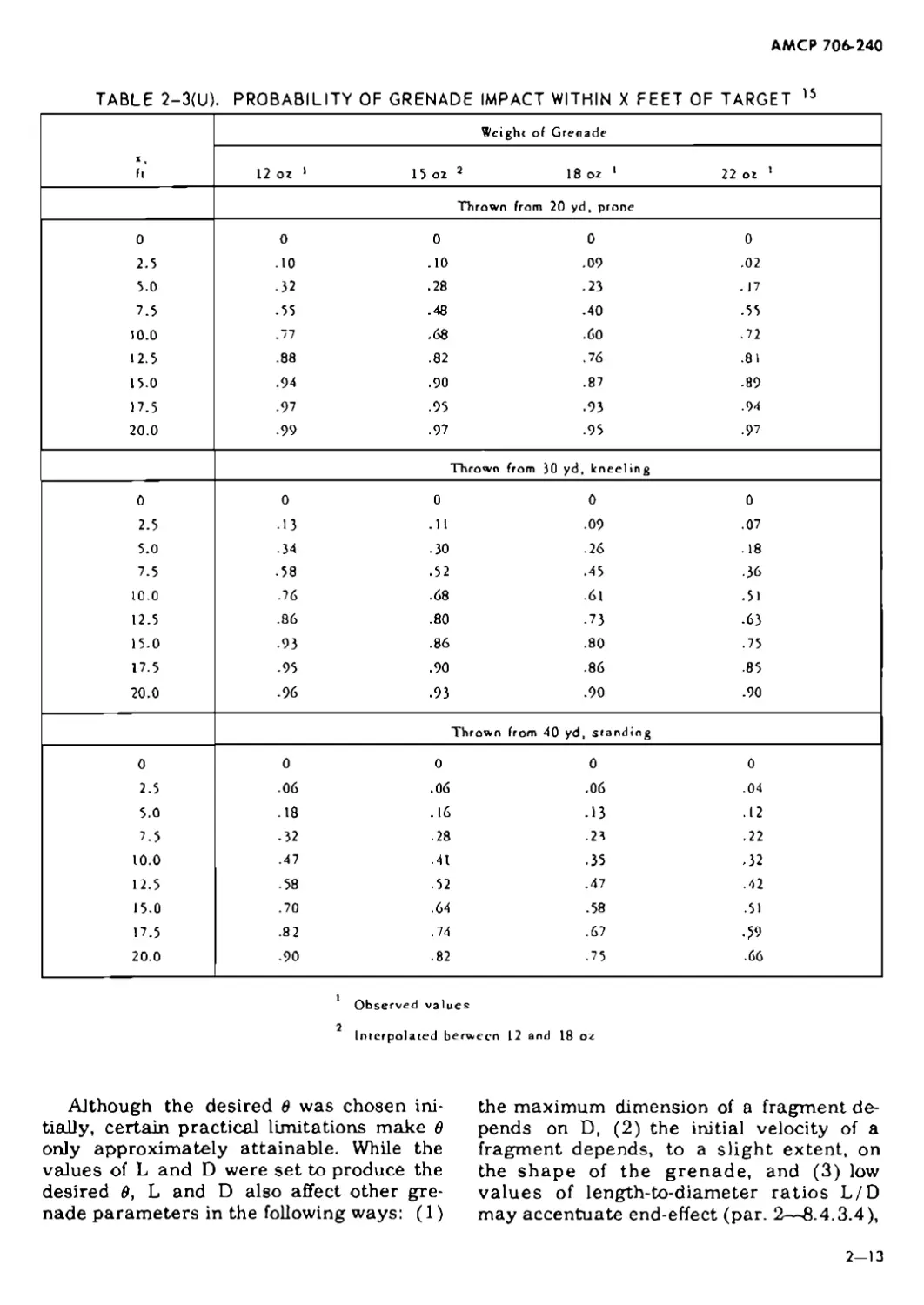
2—5.3). Table 2—3 shows the accuracy
with which various weight grenades can
be thrown from standing, prone, and kneel-
ing positions. The data are based on tests
conducted with 22 trained soldiers who
used whatever throwing style they felt was
most convenient and most accurate.
Throws were made with and without gloves,
and test results indicate that the gloves
had essentially no effect on the throwing
accuracy. Table 2—3 indicates that accu-
racy decreases as the weight of a grenade
increases, although the decrease in accu-
racy does not appear significant for gre-
nades thrown from 20 yd.
2—8.3(U) SHAPE15
The shape of a grenade has little effect
on the distance that the grenade can be
thrown. However, grenade shape is one of
the primary factors controlling the pro-
jected pattern of the fragments.
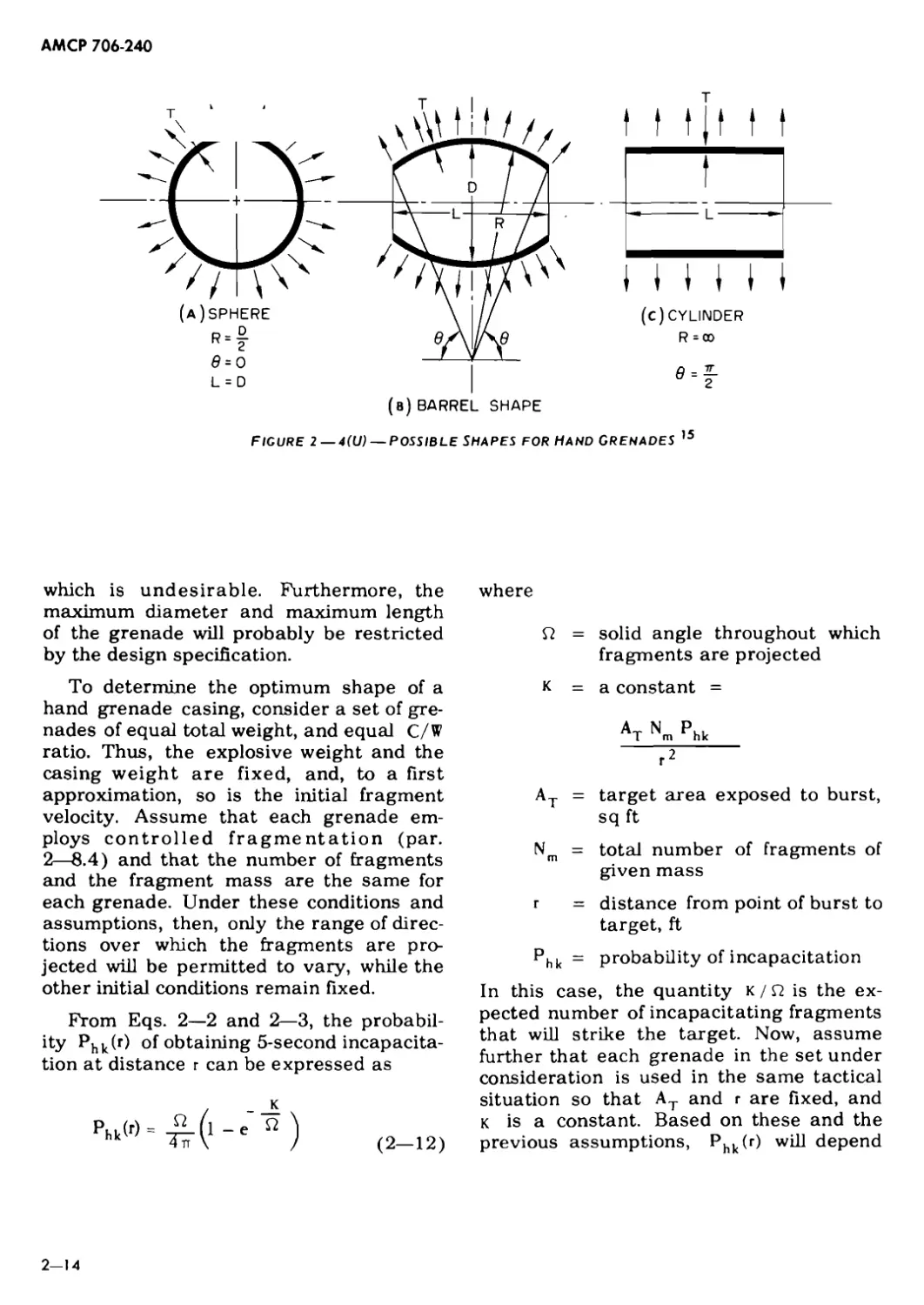
The three basic shapes usually con-
sidered for hand grenades are shown in
Fig. 2—4. From the theoretical patterns
shown, it can be seen that the spherical
grenade produces the most uniform cover-
age. The barrel-shaped grenade produces
nearly uniform coverage, but has some
voids. The cylindrically shaped grenade
produces a relatively nonuniform coverage;
therefore, this shape is generally not con-
sidered for fragmentation grenades. It
would be considered only if lowest possible
unit cost was the overriding design require-
ment. The body of a cylindrically shaped
grenade can be made essentially as a tin
can, with notched sheet steel wrapped
around its inside to produce fragments. The
Soviet Model RG-42 fragmentation hand
grenade is designed this way, making it
much cheaper to produce than the U. S.
M26 fragmentation hand grenade3. How-
ever, tests indicate that the lethal area of
the U.S. M26 grenade is 1-1/2 to 3-1/2
times that of the Soviet RG-42 grenade.
To a certain extent, it is possible to
choose the angle over which fragments are
projected independently of other initial
fragment parameters. Thus, the total un-
fuzed weight W of the grenade, the explo-
sive charge-to-weight ratio C/W , the weight
of each fragment, and the initial fragment
velocity may be specified, and any direc-
tion of projection of the fragments in space
can be realized. For example, for the bar-
rel-shaped grenade shown in Fig. 2—4, the
angle fl, which determines the range of
directions from fl to ( tt — fl) over which
fragments are projected, may be arbitrarily
chosen. Then, the casing radius R, diam-
eter D, and length L can be set to obtain
the desired value of C. Since W increases
continuously with wall thickness T, the
value of T can be set to give the desired
value of W and, consequently, the desired
values of C/W and initial fragment velocity.
2-12
АМСР 706-240
TABLE 2-3(U). PROBABILITY OF GRENADE IMPACT WITHIN X FEET OF TARGET 15
X , 11	Weight of Grenade
	12 OZ 1	1 5 oz 2	18 oz 1	22 oz ‘
		Th row г	i from 20 yd, prone
0	0	0	0	0
2.5	.10	.10	.09	.02
5.0	• 32	.28	.23	. 17
7.5	.55	.48	.40	.55
10.0	.77	.68	.60	.72
12.5	.88	.82	.76	.81
15.0	.94	.90	.87	.89
17.5	• 97	.95	.93	.94
20.0	• 99	.97	.95	.97
		Thrown	from 30 yd, kneeling
0	0	0	0	0
2.5	• 13	.11	.09	.07
5.0	• 34	• 30	.26	.18
7.5	.58	.52	.45	• 36
10.0	.76	.68	.61	.51
12.5	.86	.80	• 73	-63
15.0	• 93	.86	.80	.75
17.5	.95	.90	.86	.85
20.0	-96	.93	.90	.90
		Thrown	from 40 yd, standing
0	0	0	0	0
2.5	.06	.06	.06	.04
5.0	.18	.16	-13	.12
7.5	-32	.28	.23	.22
10.0	.47	.41	.35	,32
12.5	• 58	.52	.47	.42
15.0	.70	.64	.58	.51
17.5	.8 2	.74	.67	>9
20.0	.90	.82	.75	.66
Observed values
Interpolated berwecn 12 and 18 oz
Although the desired 6 was chosen ini-
tially, certain practical limitations make в
only approximately attainable. While the
values of L and D were set to produce the
desired в, L and D also affect other gre-
nade parameters in the following ways: (1)
the maximum dimension of a fragment de-
pends on D, (2) the initial velocity of a
fragment depends, to a slight extent, on
the shape of the grenade, and (3) low
values of length-to-diameter ratios L/D
may accentuate end-effect (par. 2—8.4.3.4),
2-13
АМСР 706-240
(в)BARREL SHAPE
FIGURE 2— 4(U)— POSSIBLE SHAPES FOR HAND GRENADES 15
which is undesirable. Furthermore, the
maximum diameter and maximum length
of the grenade will probably be restricted
by the design specification.
To determine the optimum shape of a
hand grenade casing, consider a set of gre-
nades of equal total weight, and equal C/W
ratio. Thus, the explosive weight and the
casing weight are fixed, and, to a first
approximation, so is the initial fragment
velocity. Assume that each grenade em-
ploys controlled fragmentation (par.
2—8.4) and that the number of fragments
and the fragment mass are the same for
each grenade. Under these conditions and
assumptions, then, only the range of direc-
tions over which the fragments are pro-
jected will be permitted to vary, while the
other initial conditions remain fixed.
From Eqs. 2—2 and 2—3, the probabil-
ity Phk(r) of obtaining 5-second incapacita-
tion at distance r can be expressed as
PhkW =
(2-12)
where
Q = solid angle throughout which
fragments are projected
к - a constant =
AT phk
Г2
AT = target area exposed to burst,
sq ft
Nm = total number of fragments of
given mass
г = distance from point of burst to
target, ft
Phk = probability of incapacitation
In this case, the quantity k/Q is the ex-
pected number of incapacitating fragments
that will strike the target. Now, assume
further that each grenade in the set under
consideration is used in the same tactical
situation so that AT and r are fixed, and
к is a constant. Based on these and the
previous assumptions, Phk(r) will depend
2—14
АМСР 706-240
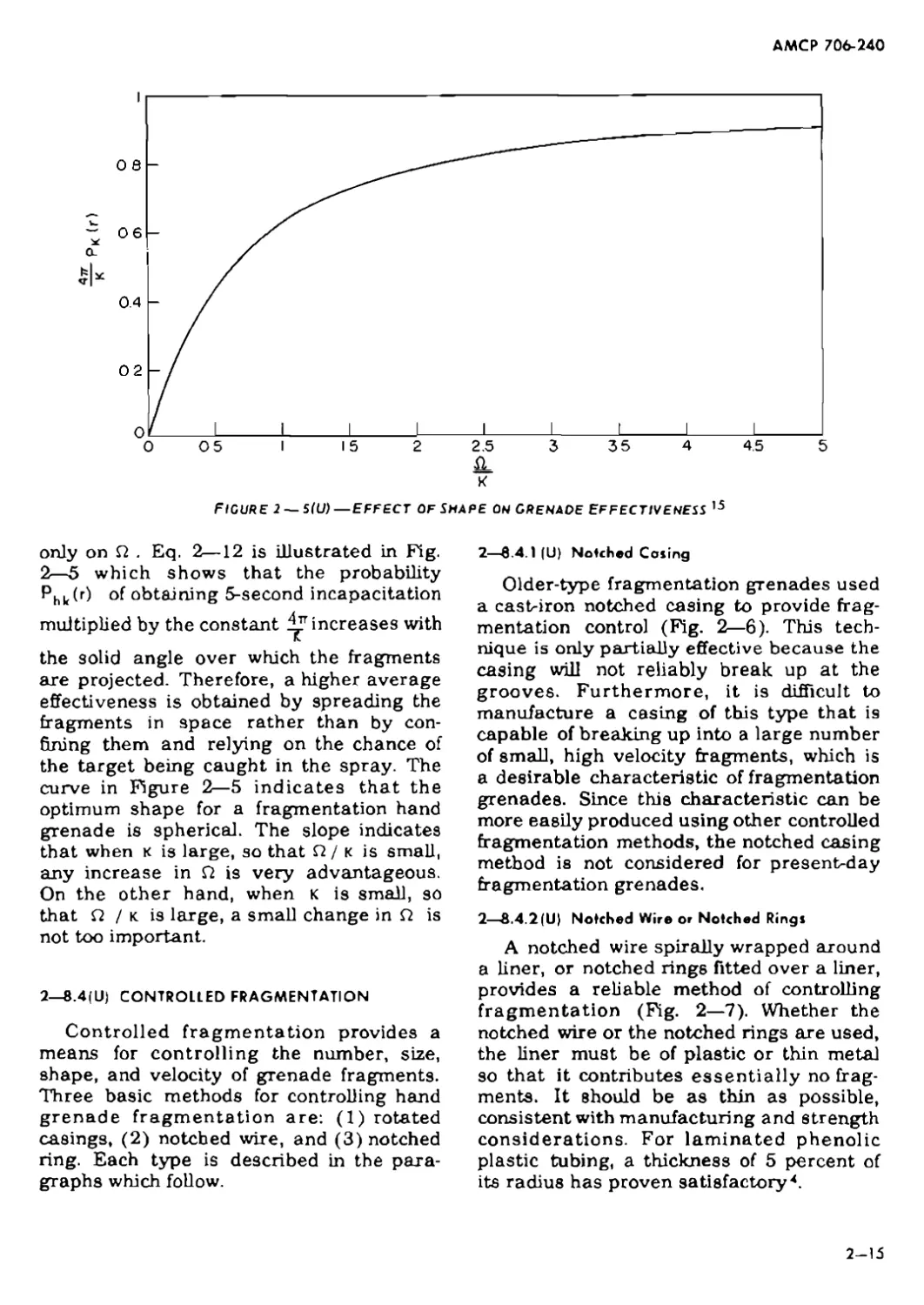
Figure 2 ~s(U)—effect of shape oh grenade effectiveness 15
К
only on Q . Eq. 2—12 is illustrated in Fig.
2—5 which shows that the probability
Phk(r) of obtaining 5-second incapacitation
multiplied by the constant increases with
the solid angle over which the fragments
are projected. Therefore, a higher average
effectiveness is obtained by spreading the
fragments in space rather than by con-
fining them and relying on the chance of
the target being caught in the spray. The
curve in Figure 2—5 indicates that the
optimum shape for a fragmentation hand
grenade is spherical. The slope indicates
that when к is large, so that Q / к is small,
any increase in Q is very advantageous.
On the other hand, when к is small, so
that Q / к is large, a small change in Q is
not too important.
2—8.4(D) CONTROLLED FRAGMENTATION
Controlled fragmentation provides a
means for controlling the number, size,
shape, and velocity of grenade fragments.
Three basic methods for controlling hand
grenade fragmentation are: (1) rotated
casings, (2) notched wire, and (3) notched
ring. Each type is described in the para-
graphs which follow.
2—6.4.1 (U) Notched Coting
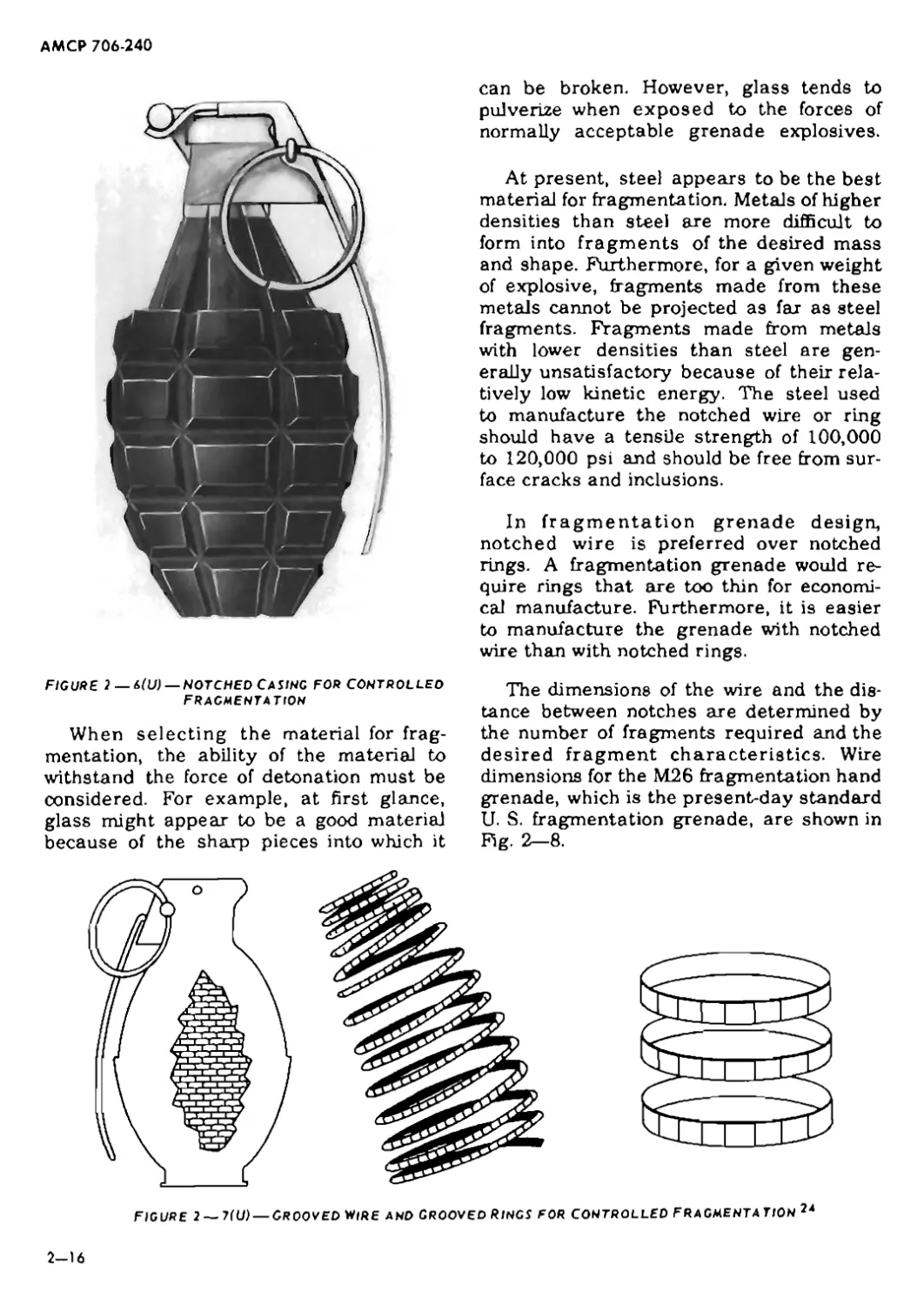
Older-type fragmentation grenades used
a castriron notched casing to provide frag-
mentation control (Fig. 2—6). This tech-
nique is only partially effective because the
casing will not reliably break up at the
grooves. Furthermore, it is difficult to
manufacture a casing of this type that is
capable of breaking up into a large number
of small, high velocity fragments, which is
a desirable characteristic of fragmentation
grenades. Since this characteristic can be
more easily produced using other controlled
fragmentation methods, the notched casing
method is not considered for present-day
fragmentation grenades.
2—8.4.2(D) Nokbed Wire or Notched Ring*
A notched wire spirally wrapped around
a liner, or notched rings fitted over a liner,
provides a reliable method of controlling
fragmentation (Fig. 2—7). Whether the
notched wire or the notched rings are used,
the liner must be of plastic or thin metal
so that it contributes essentially no frag-
ments. It should be as thin as possible,
consistent with manufacturing and strength
considerations. For laminated phenolic
plastic tubing, a thickness of 5 percent of
its radius has proven satisfactory4.
2—15
АМСР 706-240
FIGURE J — i(U) — NOTCHED CASING FOR CONTROLLED
FRAGMENTATION
When selecting the material for frag-
mentation, the ability of the material to
withstand the force of detonation must be
considered. For example, at first glance,
glass might appear to be a good material
because of the sharp pieces into which it
can be broken. However, glass tends to
pulverize when exposed to the forces of
normally acceptable grenade explosives.
At present, steel appears to be the best
material for fragmentation. Metals of higher
densities than steel are more difficult, to
form into fragments of the desired mass
and shape. Furthermore, for a given weight
of explosive, fragments made from these
metals cannot be projected as far as steel
fragments. Fragments made from metals
with lower densities than steel are gen-
erally unsatisfactory because of their rela-
tively low kinetic energy. The steel used
to manufacture the notched wire or ring
should have a tensile strength of 100,000
to 120,000 psi and should be free from sur-
face cracks and inclusions.
In fragmentation grenade design,
notched wire is preferred over notched
rings. A fragmentation grenade would re-
quire rings that are too thin for economi-
cal manufacture. Furthermore, it is easier
to manufacture the grenade with notched
wire than with notched rings.
The dimensions of the wire and the dis-
tance between notches are determined by
the number of fragments required and the
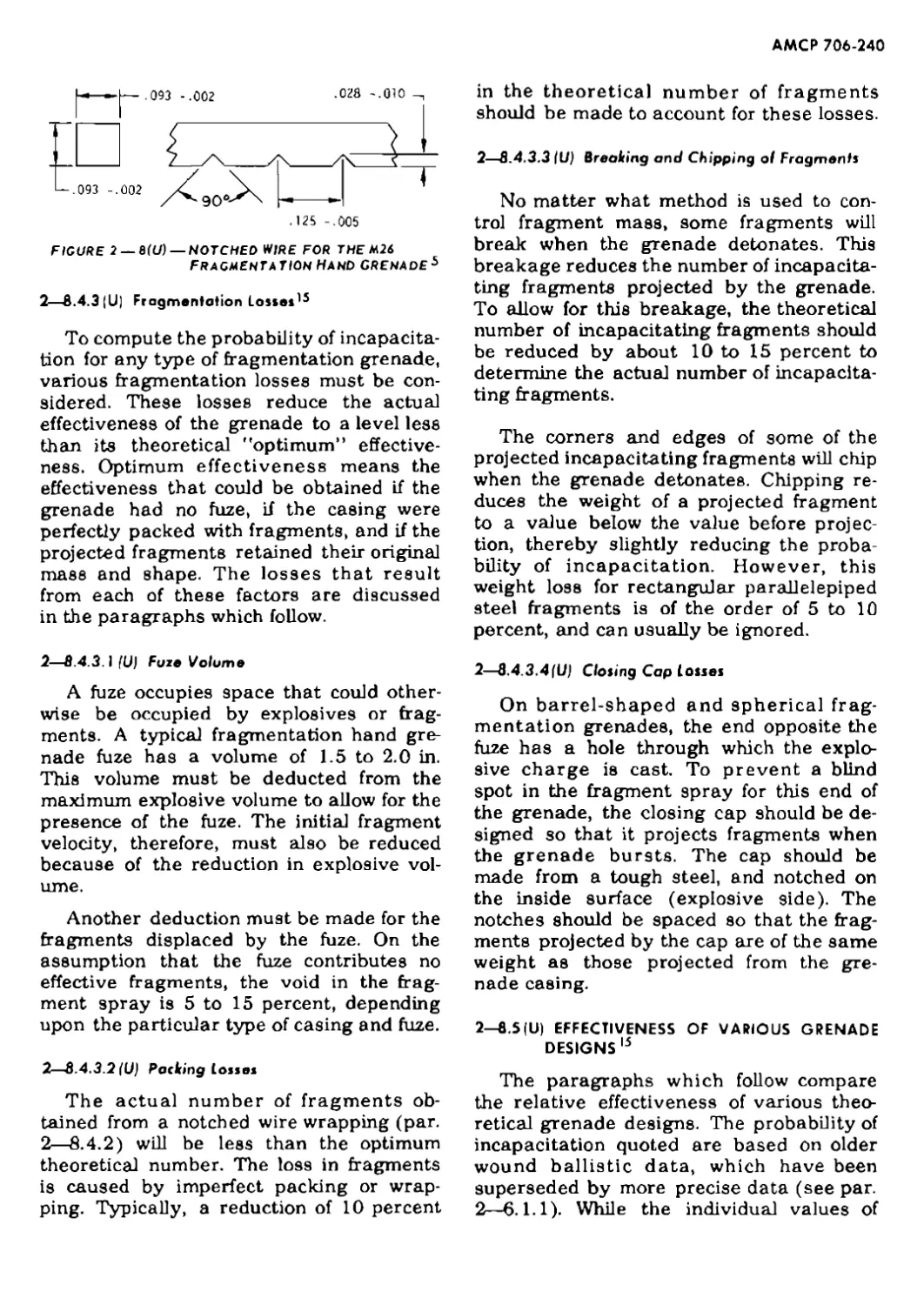
desired fragment characteristics. Wire
dimensions for the M26 fragmentation hand
grenade, which is the present-day standard
U. S. fragmentation grenade, are shown in
Fig. 2—в.
FIGURE 2~7(U) — GROOVED VHRE AND GROOVED RINGS FOR CONTROLLED FRAGMENTATION 24
2-16
АМСР 706-240
.125 -.005
FIGURE 2— 8(U)— NOTCHED WIRE FOR THE М2Л
fragmentation hand grenade5
2—e.4.3(U) Fragmentation Lojtei15
To compute the probability of incapacita-
tion for any type of fragmentation grenade,
various fragmentation losses must be con-
sidered. These losses reduce the actual
effectiveness of the grenade to a level less
than its theoretical "optimum” effective-
ness. Optimum effectiveness means the
effectiveness that could be obtained if the
grenade had no fuze, if the casing were
perfectly packed with fragments, and if the
projected fragments retained their original
mass and shape. The losses that result
from each of these factors are discussed
in the paragraphs which follow.
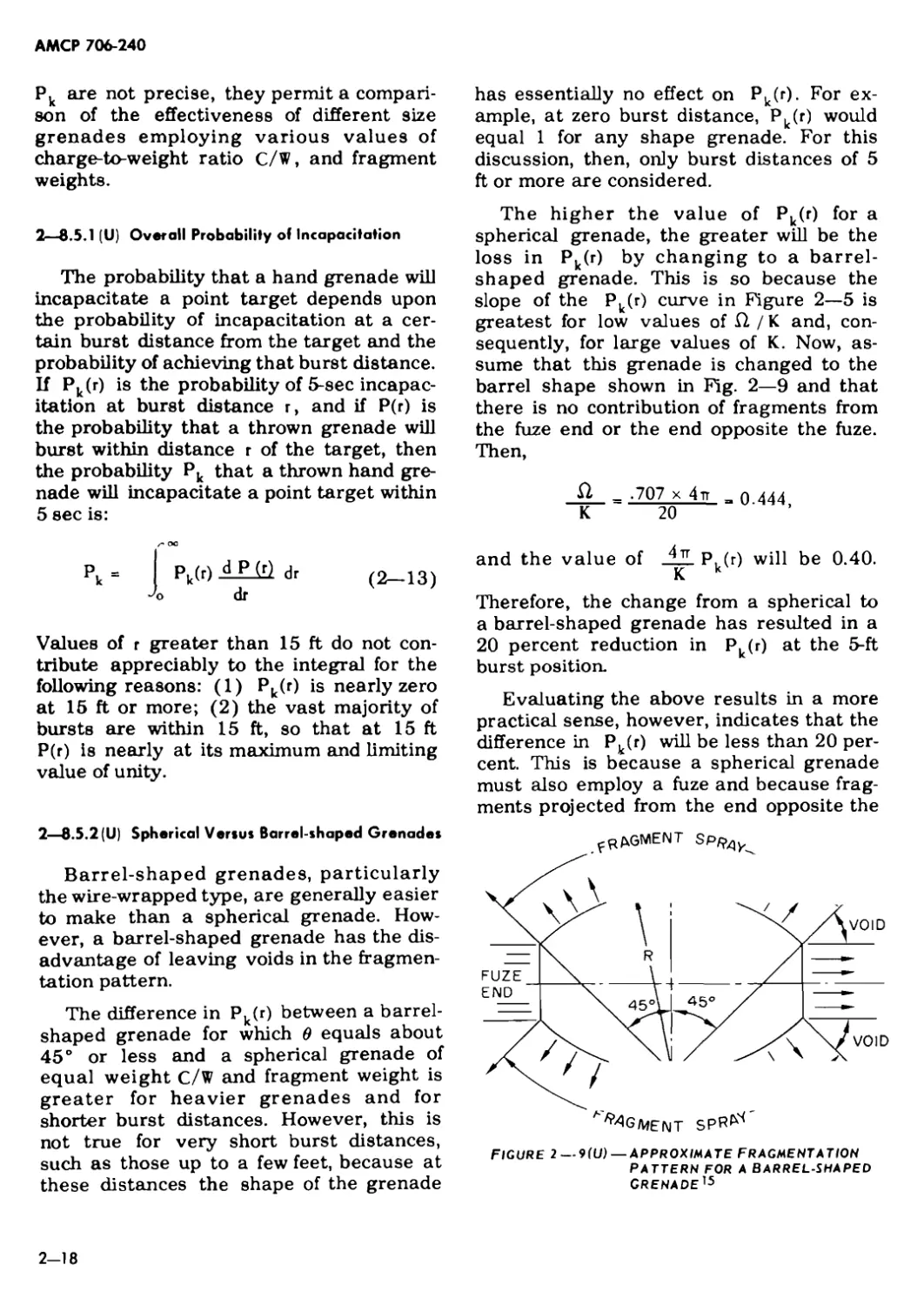
2—8.4.3.1 (UJ Fuze Volume
A fuze occupies space that could other-
wise be occupied by explosives or frag-
ments. A typical fragmentation hand gre-
nade fuze has a volume of 1.5 to 2.0 in.
This volume must be deducted from the
maximum explosive volume to allow for the
presence of the fuze. The initial fragment
velocity, therefore, must also be reduced
because of the reduction in explosive vol-
ume.
Another deduction must be made for the
fragments displaced by the fuze. On the
assumption that the fuze contributes no
effective fragments, the void in the frag-
ment spray is 5 to 15 percent, depending
upon the particular type of casing and fuze.
2—8.4.3.2 (U) Pocking tones
The actual number of fragments ob-
tained from a notched wire wrapping (par.
2—8.4.2) will be less than the optimum
theoretical number. The loss in fragments
is caused by imperfect packing or wrap-
ping. Typically, a reduction of 10 percent
in the theoretical number of fragments
should be made to account for these losses.
2—8.4.3.3 IU) Breaking and Chipping of Fragments
No matter what method is used to con-
trol fragment mass, some fragments will
break when the grenade detonates. This
breakage reduces the number of incapacita-
ting fragments projected by the grenade.
To allow for this breakage, the theoretical
number of incapacitating fragments should
be reduced by about 10 to 15 percent to
determine the actual number of incapacita-
ting fragments.
The corners and edges of some of the
projected incapacitating fragments will chip
when the grenade detonates. Chipping re-
duces the weight of a projected fragment
to a value below the value before projec-
tion, thereby slightly reducing the proba-
bility of incapacitation. However, this
weight loss for rectangular parallelepiped
steel fragments is of the order of 5 to 10
percent, and can usually be ignored.
2—8.4.3.4fU) Closing Cap Losses
On barrel-shaped and spherical frag-
mentation grenades, the end opposite the
fuze has a hole through which the explo-
sive charge is cast. To prevent a blind
spot in the fragment spray for this end of
the grenade, the closing cap should be de-
signed so that it projects fragments when
the grenade bursts. The cap should be
made from a tough steel, and notched on
the inside surface (explosive side). The
notches should be spaced so that the frag-
ments projected by the cap are of the same
weight as those projected from the gre-
nade casing.
2—a.5(U) EFFECTIVENESS OF VARIOUS GRENADE
DESIGNS13
The paragraphs which follow compare
the relative effectiveness of various theo-
retical grenade designs. The probability of
incapacitation quoted are based on older
wound ballistic data, which have been
superseded by more precise data (see par.
2—6.1.1). While the individual values of
АМСР 706-240
Рк are not precise, they permit a compari-
son of the effectiveness of different size
grenades employing various values of
charge-to-weight ratio C/W, and fragment
weights.
2—8.5.1 (II) Overall Probability o( Incapacitation
The probability that a hand grenade will
incapacitate a point target depends upon
the probability of incapacitation at a cer-
tain burst distance from the target and the
probability of achieving that burst distance.
If Pk(r) is the probability of 5-sec incapac-
itation at burst distance r, and if P(r) is
the probability that a thrown grenade will
burst within distance r of the target, then
the probability Pk that a thrown hand gre-
nade will incapacitate a point target within
5 sec is:
л- ОС
Pk = Pk(r) d p(£) dr (2—13)
-4> dr
Values of r greater than 15 ft do not con-
tribute appreciably to the integral for the
following reasons: (1) Pk(r) is nearly zero
at 15 ft or more; (2) the vast majority of
bursts are within 15 ft, so that at 15 ft
P(r) is nearly at its maximum and limiting
value of unity.
has essentially no effect on Pk(r). For ex-
ample, at zero burst distance, Pk(r) would
equal 1 for any shape grenade. For this
discussion, then, only burst distances of 5
ft or more are considered.
The higher the value of Pk(r) for a
spherical grenade, the greater will be the
loss in Pk(r) by changing to a barrel-
shaped grenade. This is so because the
slope of the Pk(r) curve in Figure 2—5 is
greatest for low values of П / К and, con-
sequently, for large values of K. Now, as-
sume that this grenade is changed to the
barrel shape shown in Fig. 2—9 and that
there is no contribution of fragments from
the fuze end or the end opposite the fuze.
Then,
& = -707 x 4тт = л 444
К 20	’
and the value of
JlP.(r) will be 0.40.
К k
Therefore, the change from a spherical to
a barrel-shaped grenade has resulted in a
20 percent reduction in Pk(r) at the 5-ft
burst position.
Evaluating the above results in a more
practical sense, however, indicates that the
difference in Pk(r) will be less than 20 per-
cent. This is because a spherical grenade
must also employ a fuze and because frag-
ments projected from the end opposite the
2—8.5.2 (U) Spherical Versus Barrel-shaped Grenades
Barrel-shaped grenades, particularly
the wire-wrapped type, are generally easier
to make than a spherical grenade. How-
ever, a barrel-shaped grenade has the dis-
advantage of leaving voids in the fragmen-
tation pattern.
The difference in Pk(r) between a barrel-
shaped grenade for which 0 equals about
45° or less and a spherical grenade of
equal weight C/W and fragment weight is
greater for heavier grenades and for
shorter burst distances. However, this is
not true for very short burst distances,
such as those up to a few feet, because at
these distances the shape of the grenade
FIGURE 2— 9(U) — APPROXIMATE FRAGMENTATION
PATTERN FOR A BARREL-SHAPED
GRENADE15
2-18
АМСР 706-240
fuze (par. 2—8.4.4.4) will contribute to the
Pk(r) of the barrel-shaped grenade. For
the 18-oz (fuzed) spherical grenade, it is
estimated that a change to barrel shape
will result in about an 8 percent reduction
in Pk(r) at 5 ft; for the 15-oz and 9-02 gre-
nades, the estimated reduction is about 4
percent and 2 percent, respectively. At the
10- and 15-ft burst positions, the reductions
are considerably less. The barrel-shaped
grenade, then, may be considered slightly
less effective than the spherical grenade at
the 5-ft burst distances, and about as effec-
tive at the 10- and 15-ft burst distances.
2—9(U) FUZING
Generally, three basic types of fuzing
have been considered for fragmentation
grenades: (1) proximity fuzing, (2) pyro-
technic time delay fuzing, and (3) impact
fuzing. Each is discussed in the paragraphs
which follow.
2-9.1 (U) PROXIMITY FUZING
The most effective fragmentation hand
grenade is one that detonates above the
ground and projects its fragments in all
directions below the horizontal. A grenade
of this type requires some type of proximity
fuze to sense the proper burst height and
detonate the grenade at that height.
Furthermore, a suitable grenade configura-
tion and some method of orienting the gre-
nade in a particular direction at the time
of burst are required. Both of these require-
ments increase the cost, weight, and com-
plexity of the grenade. These factors off-
set the greater effectiveness of proximity
fuzing when compared to other grenade
fuzing methods. Therefore, a proximity fuze
has never been used in any past or pres-
ent-day fragmentation hand grenades, and
there is little, if any, current effort to
develop one.
2—9.2(U) PYROTECHNIC TIME DELAY FUZING
The pyrotechnic time delay fuze (Fig.
2—10) is, by far, the type used most often
for fragmentation hand grenades. This type
Figure 2 — io(u) — Typical pyrotechnic Time
delay fuze
of fuze employs a delay column of slow-
burning powder that is ignited when the
grenade is released by the thrower. The
column requires a fixed time to burn
through, which is typically about 4.5 to 5
sec, and at the expiration of this delay time
it fires the detonator.
Fragmentation grenades employing
pyrotechnic time delay fuzes have proven
acceptable to the military, and their cost
is low compared to the cost of grenades
employing other fuzing techniques. How-
ever, grenades of this type have a number
of tactical limitations due to the time delay
element, the most important of which are:
(1) an enemy might be able to take cover
before the grenade detonates, (2) the gre-
nade might roll back downhill and detonate
near friendly personnel, and (3) the gre-
nade might be picked up and thrown back
by an enemy.
265-611 О • 6fi - ?
2-19
АМСР 706-240
Mechanical, electrical, and chemical de-
vices might be incorporated into a grenade
fuze to provide the required time delay.
However, these devices all possess the
same tactical disadvantages listed above
and, in addition, are more expensive to
produce than the pyrotechnic time delay
fuze.
Although present-day fragmentation
hand grenades employ pyrotechnic time
delay fuzes almost exclusively, there are
many military applications in which impact
fuzing techniques are desirable (par.
2—9.3).
Broadly, the pyrotechnic time delay fuze
consists of an explosive train, safety and
arming devices, and a striker assembly.
The explosive train is discussed in par.
2—10. Actually, the fuze does not contain
the complete explosive train; the main
charge is contained in the grenade casing.
2—9.2.1 (U) Safety and Arming
Ideally, an ammunition item should arm
only when it experiences forces unique to
the launch environment. At all other times
— i. e., during storage, transportation, and
handling— the fuze should remain safe (un-
armed). Most ammunition items do experi-
ence unique forces at the time of launch.
For example, a projectile experiences a
very high setback force when it is fired
from a gun. It may also experience a very
high rate of spin. The forces resulting from
both setback and spin can be used to cause
the fuze to arm. Similarly, missiles and
rockets experience high acceleration forces
after they are launched, which may be used
to cause the fuze to arm.
Unfortunately, a hand grenade does not
experience any unique forces at the time it
is thrown, or launched, or while it is in
flight. Therefore, arming must occur as a
result of some action or event prior to the
time the grenade is thrown.
Certain other problems arise in the de-
sign of safety and arming devices for hand
grenades. A mandatory requirement for
fuzes is that they must be "detonator safe.’’
Detonator safe means that if the detonator
functions accidentally, it cannot initiate the
next explosive train component. This can
be accomplished by using an out-of-line
detonator that rotates into place when the
fuze undergoes a high setback force. Or,
an interrupter, which forms a physical bar-
rier between the detonator and the next
explosive train component, can be moved
out of the way when the fuze undergoes
setback or some other force associated with
launch or flight.
Since hand grenades experience no
unique forces that can be used to perform
the functions described above, the detona-
tor safe requirement has been waived for
past and present-day hand grenade fuzes.
Actually, hand grenades can be designed
so that they are detonator safe. An out-of-
line detonator can be moved into place or
an interrupter moved out of the way by the
thrower just prior to throwing the grenade.
Or, a small electric motor can be used to
accomplish either of these functions after
the grenade is thrown. These approaches
are difficult, however, because of the size
and weight limitations imposed on hand
grenades.
While the detonator safe requirement
has been waived for existing hand gre-
nades, it is desirable that a practical det-
onator safe device be incorporated into
future fuze designs. Some type of device
requiring both automatic and manual oper-
ation during the arming-throwing cycle is
preferred, provided the device is practical,
inexpensive, and does not detract from
the tactical use or effectiveness of a hand
grenade.
Since there are no unique forces asso-
ciated with the launch or flight of a hand
grenade that may be used for arming, arm-
ing must occur as the result of some action
or event prior to the time the grenade is
thrown. To date, the best method of accom-
plishing this is to have the thrower perform
some positive action that will cause the
fuze to arm. In fig. 2—10, the firing pin is
restrained by the safety lever. The safety
lever, in turn, is restrained at one end by
the pull ring assembly, which is simply a
cotter pin attached to a metal ring, and
2-20
АМСР 706-240
by a T-lug at the other end (Rg. 2—11).
The fuze becomes armed when the thrower,
while holding the lever in place, pulls the
safety pin out of the fuze body. Only the
pressure of the thrower’s hand holding the
safety lever on the fuze prevents the fuze
from functioning. When the grenade is
thrown, the lever is released and is forced
out and away from the grenade body by
the striker. The striker continues moving
in an arc and hits the primer, thereby
initiating the fuze.
The use of a lever and a pull ring assem-
bly to provide safety is typical of almost all
U. S. and foreign hand grenades. However,
at least one foreign grenade uses a third
device, a wire ring around the head of the
fuze and the lever, to prevent the lever
from moving17. While this device provides
additional safety, removing the ring creates
an additional operation that the thrower
must perform before throwing the grenade.
Another major safety requirement for a
hand grenade is that the probability of a
premature function after the grenade is
thrown must be ideally zero for all practical
figure 2 —i Ku) —safety lever and pull ring
assembly
purposes. To ensure this low probability,
the reliability of the delay column must be
such that short burning times are very
improbable. A reliable delay column, by
itself, will not ensure a low probability of
premature function. The reliability is also
dependent upon the design and construc-
tion of other fuze components, and the de-
sign and construction of the fuze housing
itself. For example, a combination of exces-
sively porous fuze castings and cracked or
leaky detonator cups in M26 fragmenta-
tion grenades was believed to have been
the cause of a number of premature func-
tions ,8. The primer output flash broke
through the porous casting, bypassed the
delay column, and initiated the cracked
detonator (Fig. 2—12). Thus, grenade det-
onation occurred after essentially zero time
delay.
2—9.2.2(U) Striker Assembly 19
The striker assembly used in almost all
present-day hand grenades consists basi-
cally of a firing pin attached to a torsion-
type wire coil spring (Fig. 2—10). When a
grenade is assembled, the firing pin is
cocked, which winds the spring. The spring
force F is equal to
where
E = Young’s modulus of elasticity,
psi
2	= length of spring, in.
г - lever arm of force F, in.
6	= angular displacement of coil,
rad
lA = second moment of cross-sec-
tional area, in.4, which can be
expressed as
A 64
where dw = diameter of wire, in.
2—21
АМСР 706-240
Typical spring dimensions might be: i-
0.50 in.; r = 0.50 in.; dw = 0.035 in.;
E = 30 x 106 psi; and 6 = и rad. There-
fore,
I д n(0.5)4	_ 0 073 x 10-6	4
64
and
f _ (30 x 106) (0.073 X 1(H)
(0.5) (0.5)
it = 28 lb
Fragmentation hand grenades almost
always use percussion-type primers (par.
2—10.2.1.1). The energy needed to initiate
the percussion primer is obtained from the
potential energy Hs stored in the spring
and released when the striker swings. This
potential energy can be expressed as:
Hs = GB -
я
kBrdB
where
G = the torque that is proportional
to deflection ( = k0)
к = spring constant, lb/rad
r = radius arm of the striker that
swings through n radians
Since r = 0.5 in. and к = Ib/rad,
then
Hs = 7n Ib-in. = 352 in.-oz
If we assume that the striker assembly is
only 50 percent efficient because of friction,
the energy available as the striker hits the
primer is 176 in.-oz.
Since obturated fuzes are preferred for
fragmentation hand grenades (par. 2—10),
the firing pin must not puncture or rupture
the primer cup at the time of striker im-
pact. Therefore, a blunt firing pin must be
used. A typical firing pin radius is about
0.050 in. However, tests on flat firing pins
and pins with a radius up to 0.023 in. indi-
cate that the radius has little effect on
firing pin sensitivity 20.
CRACKED
DETONATOR
PRIMER FLASH
BREAK THROUGH
POROUS CASTING
PRIMER FLASH
ENTERING
CRACKED
DETONATOR
FIGURE 2 — 12(U) — ONE CAUSE OF PREMATURE
function in hand grenade'6
2-9.3 (U) IMPACT FUZING
The primary disadvantages of the pyro-
technic time delay fuze (par. 2—9.2) can
be overcome by using an impact fuze. How-
ever, impact fuzes are more complex and
more expensive, and, therefore, have not
replaced pyrotechnic time delay fuzes for
general use.
The only current U. S. fragmentation
hand grenade fuze employing impact func-
tion is the М217 electric fuze which is de-
signed for use with the M26 grenade. The
М217 fuze includes both an impact function
and an overriding time delay function. The
time delay function in the М217 fuze, like
that in the pyrotechnic time delay fuze, is
produced by initiating incendiary material.
However, in the М217, the delay function
occurs due to heat transfer through solid
thermal barriers; incendiary flash transfer
does not occur.
The М217 fuze is shown in Fig. 2—13.
It consists essentially of a power supply
(thermal battery), an omnidirectional im-
pact switch, an electric detonator, a fusible-
link arming delay switch, and a fusible-link
self-destruction switch. The arming se-
quence is as follows:
2-22
АМСР 706-240
FIGURE 2— )2(U)—M217 ELECTRIC FUZE 2)
(a)	When the grenade is thrown, the
striker assembly (par. 2—9.2.2) initiates
the percussion primer.
(b)	The percussion primer, in turn,
ignites a fast-burning pyrotechnic mixture
of metal and oxidizer which raises the tem-
perature of the thermal power supply to its
actuation point within about 0.5 sec.
(c)	Heat generated by the power sup-
ply then actuates the thermal arming
switch about 1.5 sec after the grenade is
thrown. This completes the arming process.
After arming is completed, any impact
of the grenade that is equivalent to the
impact resulting from a 6-in. drop on a
hard surface will close the impact switch
and complete the circuit from the power
supply to the electric detonator, thereby
causing the grenade to function. If no im-
pact occurs, or if the impact is too weak
to close the impact switch, the self-destruc-
tion switch (Fig. 2—14), which bypasses
the impact switch, closes after about 4.5
sec to complete the circuit from the power
supply to the detonator. The self-destruc-
tion switch, like the arming switch, is
thermally activated by the heat from the
thermal power supply.
The purpose of the 1.5-sec arming delay
is to assure that the grenade is a safe dis-
tance from the thrower (about 60 ft) be-
fore detonation can occur. This arming de-
lay also prevents immediate impact func-
tion if the thrower accidentally drops the
grenade after withdrawing the safety pin.
A dropped grenade will strike the ground
in about 0.5 sec, which is less than the
arming delay time, so that impact function
cannot occur. Since the self-destruction
switch does not close for about 4.5 sec, the
thrower will usually have time to take
cover, or to pick up and throw the armed
grenade. However, if a dropped grenade
should roll and strike a hard object, impact
function can occur at any time after the
arming delay period and before self-
destruction occurs.
2—23
АМСР 706-240
POWER SUPPLY
SWITCH
IMPACT
SWITCH
SELF-DESTRUCTION
SWITCH
ELECTRIC
DETONATOR
FIGURE 2 — 14(U) — ELECTRICAL CIRCUIT OF THE M217 FUZE2}
2—9.3.1 (U) Impact Switches
Since the orientation of a hand grenade
at the time of impact cannot be predicted,
an omnidirectional impact switch must be
used. Ideally, the sensitivity of the switch
should be such that the grenade will det-
onate upon impact with even the very soft-
est type of terrain, such as very soft snow.
However, the maximum sensitivity of the
switch is limited by the following factors:
(1) the sensitivity must be low enough to
permit the grenade to fly through light
foliage without switch closure occurring,
(2) the switch must not close should it be-
come necessary to throw an armed gre-
nade, and (3) the switch must not close
when subjected to centrifugal forces devel-
oped by spinning the grenade about any
axis when the grenade is thrown. Based on
these factors, the М217 fuze uses an impact
switch having a maximum sensitivity of 35
g. This provides sufficient sensitivity to
cause impact function on almost any ter-
rain, except very soft snow, following a
flight of the grenade that is long enough to
assure that the fuze has armed.
The М217 fuze uses a trembler switch
of the type shown in Fig. 2—15 to provide
impact capability. In its simplest form, a
trembler switch is a mass-spring combina-
tion enclosed in a case. Upon impact with
the ground, deceleration forces cause the
mass to deflect the spring so that the
spring makes contact with the case or
other switch element to close an electrical
circuit.
The switch shown in Fig. 2—15 uses
steel balls (g-weights) which, upon deceler-
ation of the grenade at impact, deflect leaf
springs that serve as contacts. Eight mass-
spring combinations in the switch are so
arranged that no matter what the orienta-
tion of the grenade at impact, at least two
or three of the balls will be accelerated
toward the axis of the switch. The ball
forces the end of the adjacent leaf spring
through a small air gap so that the leaf
spring contacts the center contact. Because
of flexure of the spring after contact, the
duration of closure is extended beyond the
period of deceleration. This characteristic
of switch operation is very important be-
cause it reduces contact chatter, and ex-
tends closure time for impacts of very short
duration.
2—9.3.2 (U) Thermal Switches23
Thermal switches close (or open) elec-
trical circuits when the switch reaches a
certain temperature. Of the various types
of thermal switches, the fusible-link type
appears to be the most suitable for pro-
viding electrical time delays in grenades.
Fusible-link thermal switches are small,
rugged, reliable, and relatively inexpen-
sive. There is little switch-to-switch vari-
ation in the temperature at which the
switch closes. Furthermore, unlike many
bimetallic-type thermal switches, fusible-
link type thermal switches do not require
individual calibration and adjustment.
Fig. 2—16 shows the fusible-link thermal
switch used to provide the arming delay
in the М217 impact fuze. It is activated by
the heat from the thermal battery, and
closes in about 1.5 sec after the thermal
battery is initiated. A cadmium-lead-zinc
alloy disk with a melting point of about
280°F and a perforated Fiberglas disk are
sandwiched between the two switch con-
tacts. When the alloy disk melts, molten
2—24
АМСР 706-240
SLEEVE
WASHER
FIGURE 2 — 15<UJ — TREMBLER-TYPE IMPACT SWITCH 22
HEAT SOURCE
AND CONTACT
OPEN POSITION
^WSSSSjSSSSS$SS
|	'CONTACT
INSULATOR
CLOSED POSITION
FIGURE 2 — li(U) — FUSIBLE-LINK THERMAL SWITCH 23
metal flows through the holes in the Fiber-
glas disk, thereby bridging the gap between
the contacts and closing the switch.
More uniform and more reliable switch
loading can be obtained by spring loading
one of the switch contacts. The spring-
loaded switch shown in Fig. 2—17 provides
the 4.5-sec self-destruction delay for the
М217 impact fuze. The thermally activated
element of this switch is a pressed pellet
of mercuric iodide which melts at about
500°F. When the pellet melts, the spring-
loaded contact firmly presses against the
other contact, thereby reducing the con-
tact resistance of the closed switch to a
few hundredths of an ohm.
2—9.3.3(U) Thermal Batteries
A thermal battery is basically a primary
voltaic cell (or combination of cells) having
a positive electrode, a negative electrode,
a solid electrolyte, and a heat source. When
the electrolyte is heated to about 275° F
2-25
АМСР 706-240
CONTACT
TEMPERATURE SENSITIVE
ELEMENT (Hql2)
CONTACT
INSULATION
CONTACT SPRING
FIGURE 2 — 17(U>—SPRING-LOADED FUSIBLE-LINK THERMAL SWITCH^
(в) CLOSED POSITION
or higher, it melts and becomes a liquid
ionic conductor. The most common way to
provide heat is to surround the cell (or
cells) with a pyrotechnic material.
A thermal battery for hand grenades
need only provide sufficient energy to fire
an electric detonator. Therefore, a battery
with a low output voltage and relatively
low current, and having a short active life,
can be used. For example, in the М217
fuze, the electric detonator is initiated by
a single cell (1.5 volts) having an active
life of about 15 to 20 sec. The battery is
only about 0.5 in. long and 0.5 in. in diam-
eter. It is simply, and reliably, initiated by
a percussion primer.
Thermal batteries will perform satisfac-
torily over the temperature range normally
specified for grenades, and can meet the
shock and vibration requirements specified
for grenades.
The minimum shelf life of a thermal bat-
tery is about 15 yr. Since the action of the
heat source is irreversible, thermal bat-
teries cannot be tested during storage,
which is probably their main disadvantage.
2—9.3.4(U) Electric Detonatari
The designer is referred to Reference 1
for a detailed discussion of various types
of electrical detonators. However, the de-
signer must keep in mind the need for
proper shielding to prevent accidental initi-
ation of the detonator by stray electro-
magnetic fields. For example, in the М217
fuze, all electrical components, including
the electric detonator, are contained in a
hermetically solder-sealed metal can. This
can provides shielding against electromag-
netic and electrostatic discharge, as well
as protection against moisture.
2—10(U) EXPLOSIVE TRAINS
Explosive trains are covered in detail
in Reference 1. The reader is referred to
that reference for a detailed discussion of
explosive train design techniques. Addi-
tional information is given in Reference 20
and References 24 through 28. The para-
graphs which follow briefly discuss some
of the important characteristics of explo-
sive trains, explosives, and components.
2-26
АМСР 706-240
An explosive train is an assembly of
explosive elements arranged in order of
decreasing sensitivity. Its purpose is to
amplify a low-level impulse to a level high
enough to detonate the main charge of a
munition. A typical explosive train for a
pyrotechnic delay (par. 2—9.2) fragmenta-
tion hand grenade consists of a primer,
delay element, relay, detonator, and the
main charge (Fig. 2—18). When the primer
is struck by the grenade firing pin, it initi-
ates, and, in turn, ignites the delay ele-
ment. The delay element provides the time
needed for the grenade to reach the target.
The delay element, after burning through,
fires the relay. (In most fragmentation
grenade explosive trains, the relay is sim-
ply the last charge increment in the delay
element.) The relay amplifies the relatively
weak impulse from the delay element to a
level high enough to fire the detonator
which sets off the main charge.
2—10.1(D) EXPLOSIVES
High explosives may be classified as
primary high explosives and secondary high
FIGURE 2 — ia(U) — ELEMENTS OF A TYPICAL
FRAGMENTATION HAND grenade
explosive train
explosives. A primary high explosive is
characterized by its extreme sensitivity to
heat and shock. It is capable of building
up from a deflagration to detonation in a
short distance and time; it can also propa-
gate a detonation wave in a very small
diameter column. Typical materials classi-
fied as primary high explosives are lead
azide, lead styphnate, and diazodinitro-
phenol (DDNP). Primary high explosives
are normally used to detonate secondary
high explosives.
A secondary high explosive is not
readily initiated by heat and shock. Nor-
mally, a secondary high explosive must be
initiated by a primary high explosive. Typi-
cal materials classified as secondary high
explosives are PETN, RDX, and Composi-
tion B.
The most important characteristics of a
high explosive are: (1) sensitivity, (2) sta-
bility, (3) brisance, (4) detonation rate,
and (5) compatibility with other materials.
Values of (1) through (4) for typical ex-
plosives now in use or being developed are
given in Table 2—4. The compatibility of
these explosives with various materials is
given in Table 2—5. The compatibility of
the explosives with metals, unless other-
wise noted, represents the effect of the
explosive in contact with the metals after
being tested at ambient temperature for
two years.
2—10.2(D) EXPLOSIVE TRAIN COMPONENTS
Design considerations for explosive train
components are discussed in detail in Ref-
erence 1. These considerations are re-
viewed briefly here with respect to frag-
mentation hand grenades.
2—10.2.1(D) Primer*
A primer is a relatively small, sensitive
explosive component used as the first ele-
ment of an explosive train. As such, it con-
verts mechanical (or electrical) energy into
explosive energy.
Primers may be classified according to
the way they are initiated — i.e., percus-
sion primers, stab primers, and electric
TABLE 2-4(C). CHARACTERISTICS OF MILITARY EXPLOSIVES33
MOTES 1 ' Tamped Cryilllliflr TNT D  0кло1рй*л 1 * Ign не 1 C • Gultlrs	U - Unaifecird E • E»ploder	F • Flame* erratically				Sen >iii«iry					Sentu iviry in (nit latino by Tetryl Sooner		Л г a 9 хгъ	i Po»c>		,S? 14 &S'* £cl	$		Dcnsii у		i в	Blaar Equi t alent heights (flare Chattel		Gurney n an Il eC
				Impact		б 1|		<uhL
																				Prak Dvrrpte »iu г TNT Equiv lerv	Poaii Im u ae TNT mi v a n
												flail iMic Morta* TNT Eguvalrnt	Tf«u«l Те* TNT EquivUfcM		09*1	Tj a 2 1 fi	Nofinal	£ и
				t b h J 7	« в ’С	5*ее| Shoe	Fiber Sloe
									1
Eiplalive	Chemical Svnt	Governing Specification	Gompnaii ian, %
Campoa<<io« в		MIL-C-4DI8	59 TNT. 60 RD*. 5	14	73	и	LI	278 D	1 69	1.40	54.0	1Я	>30	h	7fl40	7 800	1 .65		C*k	М3	1.O6	8800
PEIN	Pear aciyrhrirol T erranuraie	NIL P* J87A	19.0 C. 2.5 H, 17.7 N. 60.fl О	6	17	С	и	22) 0			62.7	145	173		8300	76fl0	1.54	1.77	Pressed
RD* (Cyf >oni<r)	C yclorr imei*>y 1 гл» Ti iniuaonine	MIL R-2172) MIL-ft MJMH	16.) C. 2.7 H. Jl.fl N. 43.2 0	fl	1)	Е	и	260 0	1 54	2-33	60.2	1 50	137		8180	8190	1 71	1 .81	P rr tied
RDX/W*» 97/5		MILS-1373Й	97 RD*, i Wei	II	30	и		273			5fl. 3				6240		1 .51		Pieaied			9200
Teoyl	2, 4, 6 - Tiimvo- Phenylmrlhyl Nitramine	JAN-T-359	293 C 1.7 H. 74 4 N. 44.6 0	a	26	С	и	257 1	1. Sfi	2.01	34.2	1 30	125		7510	7375	1 .62	1-73	Prr a red
Tetfyiol 70/30			70 Trityl, 30 TNT	11	ТА	и	и	120 1			53.2	120	121		7)00	7J42	I 61		Cui
TNT	T»i n Uroialue he	J AN’T-248	37.0 C. 2.2 H. Ifl 5 hl. 42.) О	1 4	100’	и	и	47) 0	1.33 1 60	1.68 G.B2	48 0	100	100	|‘!.. 11.	6970	6790	1 57	1.65	Pftnrd	1.00	1 00	8000
HM* (jg Form)	Cyclcteii ameihylrnc T епалнгат<пе	Mi L-HC444	16.2 C. 2.7 H. J7.9 N. 43.2 0	10	17	Е	и	327 0			59.3							1.94	Pee sled
Ocrol 7)/JS		MJL-O-4J445	7) HMX. J? TNT	n		и	и	330 F			62.1	H6				8400	1 81		Can			9 200
			I	2	3	4	5	6	7	fl	9	10	11	12	13	14	13	16	17	Ifl	19	20


АМСР 706-240
TABLE 2-5(11). COMPATIBILITY OF HIGH EXPLOSIVES WITH METALS AND OTHER MATERIALS 1
\	Material E x p 1 о	A luminum	Brass			Magnesium	Steel							Tt (a ni um	Black paint, acidpmof	Crmen r Pcttman
		Bras s	NRC coaled	Shellac coated		Steel	Cadmium plated	Copper plated	Parkerised	Zinc plated	S<ain less	Steel, acidp<“oof black paint
	W	W	W	W	W	W	W	W	W	W	W	W		W	W
Amatol 50/50		Sm	VSm	F«	Hmi	VH m	C|tJ	Hra	Cm	Hm	Fm	Fm
Merc ury fulminate	Fm	Fm	Fm	Fm		F„	Fmt	Fm	Fm		Fm	Fm
Pentoli le	Fm	VSm			Sm*	Fm	Fm	vsm		Fm	Fm	Fm
Picric acid	Fm	Fm	Sm	Fm		Fm	Fml	Sm	Fm	vsm	Fm	Fm
Tetrytol 65/35					Fm
Tetrytol 75/25	Fm	VSm ,			sm*	VSm	VSm	VSm		Sm	Fm	Fm
Black powder	Hra	Hm	Fm	Fm	Fm*	Hm	Fmt	VHm	Sm	F m	Fm	Fm i
Composition A-)	Fm	Sfn			Sm*	Sm	Fm	Sm		Stn	Fm	Fm
Composition В	F<n	Sm			Sm	VSm	VSm	Sm			Fm	Fm		M@100° U£120e	F m
														l\<®120ft
Explosive D	Fm	Fm	Fm	Fra		Cm	Fm‘	VSm	Fm	Sm	Fm	Fm
Lead azide	F ml	Pm	Pm	Pm	Fm*			P		VSm
PETN	VSm	VSm			Sm*	VSm	VSm	Fm		vsm	Fm	Fm
Picratol 52/48
RDX	Fm	Fm	Fm	Fro		Fm	Fm»	vsm	Fm	Fm	Fm	Fm
Tetryl	Fm	Fm	Fm	Fm		<=m	Fmt	Fm	Fm	Fm	Fm	Fm
Tetrytol 70/30					Fm
TNT	Fra	Fm	Fm	Fm	Hm*	Fm	VSmr	VSm	Fm	Fm	Fm	Fm		M
Tritonal 80/20														M
t 10 months t 12 months	*18 months
Legend
F = favorable, no visible
evidence of corrosion
VS = very slight corrosion,
indicated by light tarnishing
S = slight corrosion, indicated by
heavy tarnishing
H ~ heavy corrosion
VH - very heavy corrosion
C considerable corrosion,
indicated by pitting or rusting
P - prohibited
M = moderate reaction
U rz undesirable reaction
W = wet sample
Subscript m explosive re
action on metal
2-29
АМСР 706-240
primers. Of the three, the percussion
primer is the only type used in a fragmen-
tation hand grenade.
2—J 0.2.	Percussion Primers
To ensure reliable delay element burn-
ing time, a grenade fuze must be obturated
(sealed) to prevent the escape of gases
during burning (par. 2—10.2.3). To main-
tain this gas-tight seal, the firing pin must
not puncture or rupture the primer con-
tainer when it strikes the container. A
percussion primer, initiated by the impact
of a blunt firing pin, provides a simple and
reliable method of meeting this require-
ment.
2—	10.2.1.2 (U) Percussion Primer Construction
A typical percussion primer consists of
a cup, a thin layer of priming mix, a clos-
ing disk (cover), and an anvil (Fig. 2—19).
Initiation occurs when the blunt firing pin
pinches the priming mix between the cup
and anvil. The output of a percussion
primer is usually a flash or spit of flame,
and is seldom a detonation.
The primer cup should be constructed
of a ductile metal so that it will not rup-
ture when it is struck by the firing pin.
Brass is a common metal used for cups.
Reference 28 describes design practices
and specifies the standard dimensions, tol-
erances, materials, and finishes for primer
cups. In general, all designs and construc-
tion should conform with Reference 28.
However, it is not the intent of this refer-
ence to inhibit the development of new
concepts; occasional departures from the
prescribed practices may be necessary
under special circumstances.
FIGURE 2— 191L0 — TYPICAL PERCUSSION PRIMER 19
The output end of a percussion primer
is not sealed. The explosive is retained in
the cup by a thin paper or metal cover.
The physical construction of a percus-
sion primer can affect primer sensitivity in
the following ways:
a.	Cup Thickness. Primer sensitivity de-
creases as the thickness of the cup
increases.
b.	Cover Thickness. Primer sensitivity
decreases as the thickness of the
cover increases.
c.	Anvil Movement. The anvil must be
firmly attached. Any movement of
the anvil can drastically reduce the
sensitivity to the firing pin action,
yet increase the sensitivity to shock
and vibration.
d.	Excentric Firing Pin Impact. Sensi-
tivity is reduced for this type of im-
pact.
Firing pin requirements are discussed in
par. 2—9.2.2.
Loading pressure does not appreciably
affect the input requirements of percussion
primers. There is, of course, a direct rela-
tionship between the amount of explosive
charge and the primer output.
2—10.2.1.3 /U) Priming Compositions
Table 2—6 lists the composition of com-
mon pruning mixtures used by the military.
The ingredients are given for seven stand-
ard primer compositions.
2—10.2.2(11) Detonators
A detonator is a small, sensitive compo-
nent that can initiate a high-order detona-
tion in the next high explosive component
of the train. In the case of the fragmenta-
tion grenade, the detonator fires the main
charge (or the booster charge if one is
used). A detonator is similar to a primer,
except that its output is a detonation wave
instead of a flame.
Detonators are classified according to
the way they are initiated — i.e., flash
2^0
АМСР 706-240
TABLE 2-6(U). COMMON PRIMING COMPOSITIONS1
Ingredient $	'FA70	*FA<)0	Composition (percent by weight)				JNQH30
			*РАЮ0	2РЛ101	795	3NQL60
Lead Styphnate, Basic	—	—	—	53	39	60	40
Lead Styphnate, Normal	—	—	38	—	—	—	—
Barium Nitrate	—	—	39	22	44	25	20
Lead Azide	—	—	—	—	—	—	20
T etracene	—	—	2	5	2	5	5
Lead Dioxide	—	—	5		—
Calcium Silicide	—	—	11	—	14	—
Aluminum Powder	—	—	—	10	—	—	—
Antimony Sulfide	17	12	5	10	—	10	15
Lead Sulphocyanate	25	25	—	—	—	—	—
PETN	—	10	—	—	—	—	—
TNT	5	—	—	—	—	—	-
Potassium Chlorate	52	53	—	—	—	—	—
lFA - Frankford Arsenal
2PA - Picatinny Arsenal
3NOL - Naval Ordnance Laboratory
detonators, stab detonators, and electric
detonators. Of the three, flash detonators
are used the most in fragmentation hand
grenade design.
2—J0.2.2.1 /U) Flash Detonators
Flash detonators are sensitive to heat.
When they are initiated, a detonation wave
is created at the output. Detonators for
fragmentation grenades are initiated by
heat from the delay element
(par. 2—10.2.2).
A typical detonator consists of a cup;
primary, intermediate, and base charges;
and closing disks (Fig. 2—20(A)). The pri-
mary charge is located at the input of the
detonator, and the base charge is located
at the output Usually, in a flash detona-
tor, the primary and intermediate charges
are combined so that, in effect, the detona-
tor contains only two charges (Fig.
2—20(B)).
Aluminum and stainless steel are good
cup materials for flash detonators. Gilding
metal is also satisfactory, though it is not
used for flash detonator cups as often as
aluminum and stainless steel.
Output
End
Output
End
(8) M17
F/G URE 2 — 20(U) — T YPICA L FLASH DETOHA TORS
The closing disks may be of metal or of
paper. Both the material and the thickness
of the material used to seal the input end
of the cup affect primer sensitivity.
2—31
АМСР 706-240
2—10.2.2.2 (U) Explosives for Detonators
Most flash detonators contain only a pri-
mary charge and a base charge, although
in the past most also contained an inter-
mediate charge (Fig. 2—20). Since the
trend is toward detonators containing two
charges, only those types are discussed
here.
a.	Primary Charge. Primary high ex-
plosives (par. 2—10.1) are used as the
primary charge. The properties that pro-
mote the growth of detonation have not
been quantitatively defined. However, lead
azide appears to be so superior to other
explosives that it is the only one used in
current fuze detonators (excluding bridge-
wire applications). At first glance, certain
other explosives might appear to be as
suitable as, or even superior to, lead azide;
but on close analysis, lead azide has better
ouerall characteristics in this application.
The fact that flash detonators are ignited
by rather diffusely distributed heat might
lead to the conclusion that such explosives
as tetryl and PETN, which have relatively
low ignition temperatures, would be effec-
tive at the input end of a flash detonator.
However, these explosives are much less
sensitive to heat pulses of short duration
than is lead azide.
Lead styphnate is more sensitive than
lead azide, however it cannot be used to
detonate tetryl, TNT, PETN, or RDX. Sil-
ver azide appears superior to lead azide in
some respects, but it may never be avail-
able in sufficient quantities.
b.	Base Charge. A secondary high ex-
plosive (par. 2—10.1) is usually used as
the base charge of a flash detonator. Both
tetryl and RDX have proven to be good
base charges for flash detonators, and in
most cases are the only explosives con-
sidered for this purpose.
2—10.2.2.3(U) General Design Considerations
The total energy released by a flash det-
onator is the sum of the heat of detonation
and the quantity of the various explosives
used. Of this total energy, only the energy
from the high-order detonation is the effec-
tive output. In general, this includes the
base charge and part of the primary
charge. Where the primary charge is
dextrinated lead azide, the portion that
detonates high-order can vary appreciably
with loading density, confinement, and lot-
to-lot variations in the lead azide. The azide
that actually detonates must be sufficient
to initiate the base charge. A rule of thumb
calls for a 0.10-in. minimum column height.
The growth of detonation is most rapid
in explosives loaded at densities well below
those usually used in military applications.
But, the effective output of stable det-
onating explosives increases sharply with
density. Therefore, a given quantity of ex-
plosive charge has a maximum effective
output at a particular optimum density.
This optimum density is affected by the
composition and particle size of the explo-
sive, the energy with which it is initiated,
and the dimensions and confinement of the
explosive. For conditions usually encoun-
tered in designing detonators for fuzes, the
optimum density for dextrinated lead azide
and normally used base charge explosives
is obtained by loading at between 10,000
and 20,000 psi. For other lead azides —
such as PVA, colloidal, and RD 1333 — load-
ing pressures are much higher. These are
given in Fig. 2—21.
Confinement of the explosives is an
important factor in both the growth of det-
onation and the effective output resulting
from a stable detonation. In the early
stages of detonation, the detonator case,
closure, and the surrounding structure
should be considered as a container of high-
pressure gases. During these early stages,
tightness — i. e., the absence of leaks — is
the most important factor. As the growth
of detonation progresses, the strength of
the container becomes more important,
while the importance of leaks diminishes.
As the detonation approaches its stable
rate, the pressure exceeds the bursting
strength of any practical container and con-
finement becomes a matter of inertia. In
relatively thin-walled containers, the con-
finement afforded by the inertia of the con-
tainer is related to the weight ratio of the
charge to case C/W .
2—32
АМСР 706 240
cn
z
LU

—	TNT
- TETRYLsI
—	pf TN
ROX
50,000
40,000
30,000
25,000
20,000
15,000
10,000
A STRAIGHT LINE THROUGH THE POINT SHOWN FOR
A PARTICULAR EXPLOSIVE WILL INTERSECT THE TWO SCALES TO
SHOW THE LOADING DENSITY RESULTING FROM ANY GIVEN LOADING
PRESSURE.
EXAMPLE : THE DENSITY OF LEAD A2IDE PRESSED AT
lOpOOpti IS ABOUT 2.9
USE WITH CAUTION AT HIGH PRESSURES
5,000
4,000
3,000
2,500
2,000
1,500
1,000
500
FIGURE 2 — 2 J (U) — LOA D/NC PRESSURE VERSUS DENSITY NOHOGRA PH 1
2—10.2.3 (U) Delay Elements
Delay elements are incorporated into
hand grenade fuzes to provide time for the
grenade to reach the target before det-
onating. The most typical delay time re-
quired for fragmentation hand grenades is
about 4.5 sec.
The delay element can be a mechanical
or electrical device, but simple and inex-
pensive delay columns of explosive mate-
rials are the ones used in current frag-
mentation hand grenades. Generally, these
delay columns burn like a cigarette, i. e.,
they are ignited at one end and burn lin-
early.
Delay elements are classified as either
vented or obturated. Vented delays allow
the gases generated by the initiator and
delay element to escape. Obturated delays
are inherently independent of the effects
of ambient pressure and humidity. Obtura-
tion also helps in the design of shorter de-
lay times because the resulting rise in pres-
sure increases the burning rate. Further,
because the delay is protected from the
ambient atmosphere, more reliable and
consistent delay times can be achieved.
For these reasons, modern U. S. fragmenta-
tion hand grenades use obturated delays
exclusively.
2—33
АМСР 706-240
2—10.2.3.1 (U) DeJoy Compositions
Explosives for delay elements are classi-
fied as either gas-producing delay charges
or gasless delay charges. Each type is dis-
cussed briefly in the paragraphs which fol-
low.
2—10.2.3.21U) Gas-producing Delay Charges
Black powder is the largest class of gas-
producing delays. Black powder is easily
loaded and ignited. It is relatively inex-
pensive and is available in a variety of
granulations. Black powder is affected by
moisture and atmospheric pressure, but
this is not a problem in the design of
obturated delay elements. However, black
powders do produce considerable quantities
of gas, and an expansion chamber must
be provided between the top of the delay
column and the primer (Fig. 2—10).
2—10.2.3.3/U) Gasless Delay Charges
Gasless delay mixtures are basically
thermit-type mixtures of a metallic fuel
and an oxidizing agent. The term gasless
must not be taken literally; gasless delay
compositions do produce some gas, but
chiefly as the result of impurities.
Table 2—7 lists gasless delay composi-
tions in current use. The ranges listed for
the compositions allow for adjustment of
burning rates over wide ranges.
2—10.2.4 (U) Relays
A relay (Fig. 2—22) is a small explosive
component that amplifies a relatively weak
explosive impulse and applies it to the next
component in the explosive train. In most
fragmentation grenades, the relay is
usually the last charge increment in the
delay column (Fig. 2—23).
Nearly all relays are loaded with lead
azide. The relay cups are almost always
made from aluminum. Since a relay is
usually the last charge increment in a gre-
nade delay column, its diameter is deter-
mined by the diameter of the column.
TABLE 2-7(U). GASLESS DELAY COMPOSITIONS*
IN CURRENT USE 1
Fuel	Oxidant		Inert
Boron	Barium Chromate	Chromi c Oxide	None
4 co И	89 co 96	—
13 to 15	40 to 44	41 to 46
Manganese	Barium Chromate	Lead Chromate	None
45 to 30	0 to 40	15 to 70
20 to 50	70 to 40	10	None
Molybdenum	Barium Chromat e	Poca s sium Perchlorate
20 to 30	70 to 60	10
Ni-Zr	Barium	Potassium	None
Alloy	Chromate 60	Perchlorate 14
Ni-Zr Mix	Barium Chromate	Potassium Perc Horace	None
5/31	22	42
5/17	70	8
Seleni um 84	Barium Peroxide 16	-	Talc 0.5 (added)
Selenium	BaO^		Tin/lead Alloy
20	80 ’		Powder (15/85) 20
Sil icon	Red Lead	—	Celite
20	80		max. 8 parts by weight
Tu ng st en	Barium	Potassium	Diatomaceous
	Chro mat e	Perchlorate	Earth
27 to 39	59 co 46	9-6	5 to 12
39 co 87	46 co 5	4.8	3 to 10
Zirconium 28	Lead Dioxide 72	-	None
Percentage by weight
/Л/Я4/ T END
0 160
OUTPUT END
FIGURE 2— 22(U)— TYPICAL RELAY 19
2—04
АМСР 706-240
FIGURE 2 — 23(U) — RELAY USED AS LAST CHARGE
INCREMENT IN A DELAY COLUMN 19
2—10.2.5 (U) Main Charges
The purpose of the explosive train of a
fragmentation hand grenade is achieved
by the effective detonation of the main
charge. The initiation of a main charge is
not always a matter of simple "fire-mis-
fire” reliability. All main charge explosives
sire capable of a low-order detonation even
though the probability of complete failure
is low. Thus, the problem of main charge
initiation is that of reliably initiating high-
order detonation.
The characteristics of various high ex-
plosives used for main charges are given
earlier in par. 2—10.1. Explosives consid-
erations involved in the design of frag-
mentation hand grenades are discussed in
par. 2—6.2.
SECTION III (U)
CHEMICAL HAND GRENADES
2—11 (U) GENERAL
The three types of chemical grenades in
general use are: (1) irritant grenades,
(2) incendiary grenades, and (3) smoke
grenades. Irritant grenades are used al-
most exclusively for riot control. Occasion-
ally, they might be used to harass an
enemy. Incendiary grenades burn at a very
high temperature and are used primarily
to destroy equipment. Smoke grenades are
used for screening or signaling.
2—I2(U) IRRITANT GRENADES
2—12.1 (U) GENERAL REQUIREMENTS
An irritant grenade must temporarily
incapacitate a rioter to prevent him from
continuing his activity. Irritant grenades
must be safe to handle and throw by troops
wearing gas masks; they must not flame,
spark, or explode when they are thrown,
and their ability to ignite flammable mate-
rials must be minimized. Furthermore, an
irritant grenade must meet the environ-
mental requirements listed in par. 2—2.
2— 12.2IU) AGENTS
2-12.2.1 (U) Dupersai
Agents used in irritant grenades must be
of a type that can be easily dispersed into
the air. The grenade should be designed so
that the maximum concentration of agent
per unit weight of grenade is generated and
dispersed. To date, the two most effective
methods of dispersing the agent are:
(1) the agent is mixed with combustible
composition that is ignited when the gre-
nade is thrown. The heat of combustion
causes the agent to disperse into the air
by sublimation. The grenade casing re-
mains intact; the gases are dispersed
through small orifices in the casing.
2—35
АМСР 706-240
(2) the agent, in micropulverized form,
is dispersed instantaneously by the explo-
sion of a detonator. The explosion bursts
the grenade casing, and the agent is dis-
persed as a heavy concentration of small
particles.
No matter which method is used, the dis-
persed agent is nonpersistent, i.e., it is
quickly dissipated by the wind. For a given
amount of agent, the buming-type grenade
has a longer dispersal time; dispersal times
up to one minute are typical. However, the
bursting-type produces a higher concentra-
tion of the agent. Furthermore, the burst-
ing-type grenade cannot be kicked aside
or picked up and thrown back at the
thrower, which is possible with the buming-
type if its dispersal period is too long.
2—12.2.2(D) Typai of Aganli
The three major types of agents used
in irritant grenades are:
(1)	chloroacetophenone (CN)
(2)	diphenylaminechloroarsine (DM)
(3)	orthochlorobenzylidenemalonitrile
(CS)
CN is a lachrymator, which causes eye
irritation and tearing ("tear gas”)- It is
also an irritant to the upper respiratory
tract. The effects of CN are relatively mild,
and wear off soon after exposure.
DM is a stemutator, which causes vio-
lent sneezing, intense headaches, nausea,
and temporary debility.
CS is a lachrymator that produces
severe burning sensations in the nose,
throat, and lungs. It is much more quick-
acting than both CN and DM.
Both CN and DM agents are sometimes
used in the same grenade (par. 2—12.3.2).
In addition to the agent, the filler or
main charge of a buming-type irritant
grenade requires a fuel-oxidizer mixture
and a starter mixture. The fuel provides
the combustion necessary to disperse the
agent. Oxygen for combustion Is provided
by the oxidizer. The starter mixture ignites
the fuel-oxidizer mixture.
Generally, the agent and the fuel-oxidizer
mixture are pressed to the desired shape,
which is usually cylindrical, and then coated
with the starter mixture. However, in cases
where the agent and the fuel-oxidizer mix-
ture used tend to react with one another,
the two must be physically separated. Thia
can be accomplished by encapsulating the
agent and embedding it in the fuel-oxidizer
mixture before pressing (Kg. 2—26).
Tables 2—8, 2—9, and 2—10 list the
compositions generally used in buming-
type irritant grenades. Compositions for
bursting-type irritant grenades are given
in Table 2—11.
2— 12.3(D) DESIGN CONSIDERATIONS
2—12.3.1 |U) General
Irritant grenade compositions and
methods of dispersal are described in
par. 2—12.2. Considerations in designing
the grenade itself, and in packaging the
composition are discussed in the para-
graphs which follow.
2—12.3.2(D) Burning-type Irritant Grenade
Designing the canister, or casing, for a
buming-type irritant grenade is relatively
simple. A canister constructed of thin rolled
steel is satisfactory. All present-day burn-
ing-type irritant grenades use 28 gage
steel. The dimensions of the canister must
be such that it can be easily held and
thrown. Past experience Indicates that a
canister having a diameter between 2-1/2
and 3 in. and a length between 4 and 5 in.
is satisfactory. Emission holes must be
provided to allow the agent to disperse.
These holes must be sealed to protect the
fill from the effects of moisture. Adhesive
tape, coated with lacquer, is satisfactory
for this purpose.
Fig. 2—24 shows a typical buming-type
irritant grenade. The agent is dispersed
through an emission hole in the bottom of
the canister. The axial hole in the fill in-
creases the burning surface of the compo-
sition and provides venting. The area of
the axial hole is a function of the mix
2—36
АМСР 706-240
TABLE 2-8(U). CN IRRITANT GRENADE COMPOSITION
CN Mixture	•	IGNITER COMPOSITION	1 •	AGENT/IGNITER PROPORTION
Chloroacetophenone Diatomaceous Earth Sucrose Potassium Chlorate Potassium Bicarbonate Press at: 5000-7500 lb dead load	29 5 17 24 25	Poca ssium N itraie Charcoal Mix with: Nitrocellulose Ace tone	70.5 29.5 4 parts 96 parts	Igniter is poured into grenade as a slurry and then poured out in the manner of a ceramic slip cast- ing. Approximately 5 grams (dry basis) is retained.
* Parts by weight
TABLE 2-9(U). DM IRRITANT GRENADE COMPOSITION
DM Mixture		IGNITER COMPOSITION	•	AGENT/IGNITER PROPORTION
Diphenyl aminechloroar sine Potassium Chlorate Sucrose Magnesium Oxide Press at: 5000-7500 lb dead load	52.5 25.5 17 5	Potassium Nitrate Charcoal Mix with: Nitrocellulose Acetone	70.5 29-5 4 parts 96 parts	Igniter is poured into grenade in a slurry and poured out in the manner of a ceramic slip casting. Approximately 5 grams (dry basis' is retained.
•Pans by weight
TABLE 2-10(U). CS (ENCAPSULATED) IRRITANT GRENADE COMPOSITION
CS Mixture	•	STARTER MIXTURE	•	AGENT/IGNITER PROPORTION’
Ort hochlorobenzylidenemalonitrile — in 92 fifOO gelatin capsules Potassium Chlorate Sucrose	165 grams Magnesium Carbonate Press at: 5000-7500 lb dead load	40 28 32	Potassium nitrate Charcoal Mix with: Nitrocel lulose । Acetone	70.5 29-5 8 parts 92 parts	907/1209
•Parts by weight
2^37
АМСР 706-240
TABLE 2-11(U). COMPOSITIONS FOR
bursting-type irritant grenades
MIXTURE	%
CS	95
Aerogel	5
DM	95
Aerogel	5
CN	92.0 i 0.5
Magnes ium oxide	8.0 ♦ 0.5
being used and must be determined in each
case.
In some cases, a single grenade may be
required to contain more than one type of
agent. If the agents are incompatible, they
must be kept physically separated within
the grenade. This can be accomplished by
loading the agents into separate containers
that are ignited simultaneously when the
grenade is fired. Fig. 2—25 shows a gre-
nade loaded with CN and DM agents which
tend to react with one another when in con-
tact.
If the agent tends to react with the fuel-
oxidizer mix, the agent can be loaded into
gelatin capsules which are then embedded
in the mix. Fig. 2—26 shows a CS irritant
grenade loaded in this manner.
2—1 2.3.3(U) Bursfing.fype Irritant Grenade
The agent in the bursting-type grenade
is dispersed as a cloud of micropulverized
particles. The casing of the grenade is
made in two halves which are blown apart
by the detonator. This releases the micro-
pulverized particles, essentially as an aero-
sol, and the force of the detonation dis-
perses them. Since the principal purpose
of the detonator is to open the casing, no
additional bursting charge is used. The
most uniform agent distribution is obtained
by using a special casing. The casing must
be designed so that: (1) it readily breaks
apart when the detonator explodes and
(2) it will not fragment when the grenade
detonates. This last requirement is very
important because irritant grenades are
used primarily for riot control, and the
FIGURE 2— 24(U> —TYPICAL BURNING-TYPE IRRITANT GRENADE
2-38
'06-240
FIGURE 2 — 25(U)—IRRITANT GRENADE LOADED WITH CN AND DM AGENTS
probability of injuring a rioter must be
kept to a minimum. Fig. 2—27 illustrates
the most common method of meeting these
requirements. A spherical plastic casing,
consisting of hemispherical sections, breaks
in half at detonation. Since the casing
breaks up along the junction of the two
sections, essentially no fragments are pro-
duced.
2^12.3.4(U) Furing
Pyrotechnic time delay fuzes, because
of their low cost and acceptable perform-
ance, are used in all present-day irritant
hand grenades. Design considerations for
striker assembly and safety devices for a
buming-type irritant grenade are the same
as those for the fragmentation hand gren-
ade, and are covered in pars. 2—9.2.1
and 2—9.2.2, respectively. The explosive
train for a burning-type irritant grenade is
relatively simple, requiring only a percus-
sion primer, a pyrotechnic delay column,
and a flash base charge. The delay column
must be designed so that the delay is long
enough to protect the thrower, yet short
enough to minimize the possibility of a
rioter picking up the grenade and tossing
it back. Time delays in the range of 1-1/2
to 3 sec meet this requirement.
Although the bursting-type irritant gre-
nade uses a pyrotechnic time delay fuze
also, its fuze and explosive train differ from
those used in the buming-type grenade. A
spherical casing does not readily lend it-
self to the use of a striker assembly or a
safety lever of the types used with spheri-
cal and barrel-shaped hand grenades. From
a design and construction standpoint, a
plunger-type fuze (Fig. 2—27) is more
adaptable to a spherical grenade. This type
of fuze employs a spring-driven arming
sleeve which is held down by the thrower’s
thumb. The arming sleeve is released when
the grenade is thrown, thereby allowing the
arming pin to fly free. The spring then
drives the detonator, which is contained in
the lower half sleeve, down onto the firing
pin to initiate grenade detonation.
The bursting charge of a bursting-type
grenade need only be great enough to
2-39
АМСР 706-240
FIGURE 2 — 26(U) —IRRITANT GRENADE WtTHCS AGENT LOADED INTO GELATIN CAPSULES
burst the casing and disseminate the agent.
A main explosive charge is not needed to
burst the casing and disseminate the agent;
the explosive output of a detonator can be
used for this purpose. A delay-type detona-
tor — consisting of a primer, delay column,
and the detonator explosive charges (Rg.
2—28) — is ideally suited to burst-type
irritant grenades. Although vented delay
detonators have been used in the past, the
use, or design, of a nonvented delay detona-
tor is desirable. Surveillance tests of M25
irritant grenades with vented detonators
uncovered a large quantity of duds, which
were believed to have been caused by per-
meation of the delay composition during
storage2’. Nonvented delay detonators,em-
ploying a gasless delay composition, will
greatly improve the storage characteristics
of delay detonators. Reference 29 gives
design details for a nonvented-type delay
detonator.
2—13(U) INCENDIARY GRENADES
2—13.1 (U) GENERAL
Incendiary hand grenades provide con-
centrated heat for destroying enemy equip-
ment or for destroying friendly equipment
in danger of falling into enemy hands. An
incendiary hand grenade may also be used
as a booby trapping device.
2—40
АМСР 706-240
FIGURE 2 — 27(U) — TYPICAL BURST-TYPE IRRITANT GRENADE
EXPLOSIVE
CHARGES
Figure 2 ~~28(U)—delay-type detonator
2—13.2(U) PYROTECHNIC COMPOSITION
A complete description of incendiary
mixtures is given in Reference 30. In
present-day incendiary grenades, thermate
is used as the pyrotechnic composition.
Besides starting fires, thermate, because
of its high burning temperature, is capable
of melting and/or distorting metals such
as iron and steel. The thermate composi-
tion used for present-day incendiary gre-
nades is listed in Table 2—12. The M14
incendiary grenade (Fig. 2—29) contains
26 oz of thermate, and burns for about 40
sec at 4300°F3’. The thermate charge is
capable of burning through a 1/4-in. thick
steel plate.
2— 13.3(U) DESIGN CONSIDERATIONS
Except for the type of composition
(par. 2—13.2) and the manner in which the
composition is loaded, the design of an
incendiary grenade is the same as that for
a burning-type irritant grenade. The same
type of canister (par. 2—12.3.2) and the
same method of fuzing (par. 2—12.3.4) are
used in both grenades. However, while the
starter mixture is coated on the surfaces
of an irritant grenade fill, it is pressed into
a separate cavity in the incendiary gre-
nade. Unlike the fill of an irritant grenade,
the pyrotechnic fill of an incendiary gre-
nade, once ignited, will burn through until
the supply is depleted.
2—14(U) SMOKE GRENADES
2—14.1(U) GENERAL
Smoke hand grenades are used primarily
for signaling and screening. White and
2—41
АМСР 706-240
TABLE 2- 12(U). INCENDIARY GRENADE COMPOSITION
THERMATE (TH3) INGREDIENT AND SPECIFICATION	PARTS BY WEIGHT
Aluminum, Type Ц, Mil-A-512, Grade D, Class 5	16
Aluminum, Type II, MjI-A-512, Grade C, Class 4	9
Iron Oxide, Mil-I-275, Black, Class В	44
Barium Nitrate, Mjl-B-162, Class 5	29
Sulfur, Mil^S-00487, Grade E	2
Castor oil (hinder)	not to exceed 0.2% by weight

STARTER MIXTURE •
INGREDIENT	PARTS BY WEIGHT
Red Lead	54.2
Manganese	54.2
Sil icon	11.6
Nitrocellulose )	.	8.0
4 (binder)
Acetone	)	92.00
• 25 grams of starter mixture are added to grenade
STARTER
MIXTURE
FM.1ING
Figure — 29(u)—мм /мсемомлг grenade
2—42
АМСР 706-240
colored smokes are used for signaling,
usually to identify friendly troops. For
screening, white smoke is used exclusively.
2—I4.2(U) SMOKE COMPOSITIONS
2—14.2.1 (U) Di»per»ol
All present-day smoke hand grenades
used for signaling are of the burning type;
depending upon the particular design, they
disperse smoke for about 50 to 120 sec.
There is no requirement for a bursting-
type smoke hand grenade for signaling
purposes. Bursting-type smoke munitions
are used primarily as target indicators for
friendly forces providing artillery and air
support. This support would normally not
be provided within 40 to 50 yd of friendly
troops, which is the maximum distance that
a hand grenade can be thrown.
For screening purposes, a smoke hand
grenade must produce a low-lying, dense
smoke cloud instantly. Therefore, a burst-
ing-type grenade is required.
2—14.2.2 (U) Type* of Composition*
Smoke compositions for green, red, yel-
low, and violet smoke hand grenades are
given in Table 2—13. The composition for
white smoke is given in Table 2-—14.
TABL E 2- 13(U). COLORED SMOKE HAND GRENADE COMPOSITIONS
SMOKE MIXTURE
INGREDIENT AND SPECIFICATION	PARTS BY WEIGHT
	VIOLET	RED	YELLOW	GREEN
	42	40	14	4
Dye	(MIL-D-369D	(MIL-D-3718)	(MIL-D-50029)	(MIL-D-50029)
Sodium Bicarbooate O-S-00576	24	25	33	22.6
Potassium Chlorate Mil-P-150, Grade B, Class 7	25	26	20	27
SuWur, Mil-S-00487 Grade E	9	9	8,5	10.4
Benzanthrone, Mil-D-50074		—	24.5	8
Dye, Solvent, Green J, Mil-D-3277 Press at 500'	0 — 5500 p«i	-	-	28
	IMPREGNATING MIXTURE
INGREDIENT	PARTS BY WEIGHT
Potassium Nitrate	152
Charcoal	65
Gum Arabic (dissolved in water 8:92)	9
	INGREDIENTS	STARTER MIXTURE	PARTS BY WEIGHT
Potassium Nitrate			417
Silicon			309
Charcoal			46
Nitrocellulose 1 >	(binder)		13
Acetone	J			317
АМСР 706-240
TABLE 2-14(U). WHITE BURNING SMOKE (HC) COMPOSITION
Smoke Mixlure	•	Starter Mixture	•	Agent/1 gni ter Proportion
Hexachloroethane	44.53	Si (icon	26
Zinc Oxide	46.47	Potassium Nitrate	35	2$ grams of starter mixture are used
		Charcoal	4
Aluminum Powder	—	Iron Oxide	22
(Amount required to obtain burning time)		Aluminum Powder	13
		Nitrocellulose 1	6
		> /binder)
		Acetone	)	94
• Parts by weight
Three parameters of a colored smoke
grenade that are of primary concern to the
designer are: (1) burning time, (2) burn-
ing temperature, and (3) burning pressure.
Tests on the M18 colored smoke hand gre-
nade32, which is the standard U. S. colored
smoke grenade, indicate that these param-
eters sometimes vary considerably for
different colors and even for any one
particular color. The most noticeable differ-
ence among the grenades was in burning
temperature (Table 2—15). Red and yel-
low grenades burn cooler than green and
violet grenades. Furthermore, visual obser-
vation indicates that green and violet gre-
nades sometimes burn erratically, whereas
red and yellow grenades burn more uni-
formly.
Average grenade burning times, and the
range of burning times for each color of
smoke are given in Table 2—16. Normal
burning pressures for each colored smoke
TABLE 2-15(U). BURNING TEMPERATURE OF
COLORED SMOKE HAND GRENADES32
Color	No. of Samples	Burning-Temperature Range CC) ।
Green	4	580-750
Red	5	440-610
Ycl low	4	420-510
Violet	5	630-780
1 The burning temperature variation for
individual grenades was about 50°C-
grenade are given in Table 2—17. The nor-
mal burning pressure for all of the gre-
nades is 1 psi. However, during tests, the
orifices of the green and the violet grenade
sometimes became plugged, which caused
the interna] pressure of these grenades to
rise to about 20 psi. The plugging resulted
from thick liquid reaction products flowing
through the orifices during combustion.
When the internal pressure reached about
20 psi, these reaction products were blown
through the orifices to distances up to 10
ft. The pressure then dropped to normal
until the orifice became blocked again.
Reference 32 gives methods for directly
measuring burning temperature, burning
pressure, and weight loss during burning.
Burning time can be calculated from either
pressure or weight-loss data.
The only standard bursting-type smoke
hand grenade in use contains 15 oz white
phosphorous (WP). White phosphorous
ignites on contact with the air and produces
a dense white cloud when dispersed from a
grenade by a high explosive. Because WP
ignites and bums on contact with the air,
WP grenades may also be used for incen-
diary and antipersonnel purposes.
2-14.3(U) DESIGN CONSIDERATIONS
2—14.3.1 (U) Burning-type Smoke Grenades
Design of the canister, or casing, for a
buming-type colored smoke grenade is the
2—44
АМСР 706-240
TABLE 2-16(U). BURNING TIME OF COLORED SMOKE HAND GRENADES32
Color	No. of Samples	Range of Burning Times (Sec)	Average Burning Time (Sec)
Green	7	45-57	52
Red	8	52-83	66
Yellow	8	5 1-60	55
Violei	7	47-71	59
TABLE 2-17(U). INTERNAL PRESSURE OF
COLORED SMOKE HAND GRENADES32
Color	No. of Samples	Pressure Range During Normal Burning (psi)
Green	4	0.05 - 1.0
Red	6	0.04 - 0.41
Y e 1 lo«	6	0.03 - 0.6
V iolet	4	0.03 ’ j.o
same as that for the burning-type irritant
grenade (par. 2—12.3.2). For present-day
applications, 28 gage steel has proven a
satisfactory casing material. Like burning-
type irritant grenades, burning-type
colored smoke grenades require that the
filler composition be drilled out and the
surface coated with the starter mixture to
provide sufficient burning surface and vent-
ing.
The standard U. S. colored smoke hand
grenade, the Ml8, is shown in Fig. 2—30.
This grenade may be loaded with a red,
green, yellow, or violet smoke composi-
tion. Burning times, and other data, for
each of these compositions are given in
par. 2—14.2.2.
figure 2 —Colored smoke hand grenade
2-^5
АМСР 706-240
The canister for the white smoke (HC)
hand grenade is the same as that for the
burning-type irritant grenade. However, for
the HC smoke composition, it is not neces-
sary to drill out the center of the filler.
Instead, the starter mixture can be loaded
into a separate cavity, as shown in
Fig. 2—31.
2—14.3.2(D) Bursting-lype Smoke (WP) Grenades
White phosphorous ignites on contact
with air. Therefore, the grenade must be
designed so that it is leakproof to prevent
air from entering the casing and filler from
leaking out of it. Since leaks occur at joints,
joints should be eliminated wherever possi-
ble. A "tin can” type of casing, such as
that used for all present-day buming-type
grenades, does not provide adequate seal-
ing for a WP grenade. Better seeding can
be obtained by designing the casing so
that its sides and bottom are of one piece
construction (Fig. 2—32). This avoids
having to use a separate bottom cover and,
consequently, eliminates a major joint
through which leakage might occur.
Crimped joints do not provide adequate
sealing for WP grenades. The top cover
should be designed for a force fit. Particular
care must be taken to design the fuze and
the fuze well so that no leakage can occur.
Fig. 2—32 shows the construction of
older-type WP grenades. The most recent
type, shown in Fig. 2—33, employs a scored
steel casing. A scored casing breaks up
more uniformly and more quickly, and re-
sults in a better dissemination of the WP
filler. Furthermore, the resulting case frag-
ments enhance the antipersonnel effects of
the grenade.
2—14.3.3(D) Fuzing
Pyrotechnic time delay fuzes have
proven satisfactory for use with both the
burning-type and the bursting-type smoke
grenade. Design considerations for fuzes
used with buming-type smoke grenades
are the same as those for buming-type
irritant grenades (par. 2—12.3.4).
The fuze and explosive train for a burst-
ing-type smoke (WP) grenade are the same
as for a fragmentation hand grenade, and
figure 2 — 3XU)—White Smoke (He) grenade
2—46
АМСР 706-240
FUZE
FILLING (WP)
DELAY ELEMENT
DETONATOR
FUZE WELL
FIGURE 2 — 32fUJ —WP SMOKE HAND GRENADE
FIGURE 2 — 33(U) — WP SMOKE HAND GRENADE WITH SCORED FRAGMENTING CASING
2^7
АМСР 706-240
are covered in pars. 2—9.2.1 and 2—9.2.2,
respectively. The WP grenade requires a
time delay of 4 to 5 sec because, like the
fragmentation grenade, a premature func-
tion can cause serious injury to the thrower
or to friendly troops.
(U) REFERENCES
1.	AMCP 706-179, Engineering Design
Handbook, Explosives Series, Explo-
sive Trains.
2.	TECP 700-700, Interim Pamphlet No.
70-90, Arena Tests of High Explosive
Fragmentation Munitions, U.S. Army
Test and Evaluation Command Mate-
riel Test Procedure, 20 August 1963.
3.	T. E. Sterne, A Provisional Casualty
Criterion, Technical Note No. 370,
Ballistic Research Laboratories, Aber-
deen Proving Ground, Md., March
1951.
4.	AMCP 706-245, Engineering Design
Handbook, Ammunition Series, Sec-
tion 2, Design for Terminal Effects
(CONFIDENTIAL).
5.	M. M. Hillyard, Fragmentation Char-
acteristics of the Soviet Hand Grenade,
Model RG-42, As Compared to the
U.S. M26 Hand Grenade. Memoran-
dum Report No. 764, Ballistic Re-
search Laboratories, Aberdeen Prov-
ing Ground, Md., February 1954
(CONFIDENTIAL) — AD 34752.
6.	A. R. Vincent and M. Pedicini, An
Effectiveness Evaluation of the M-16
Antipersonnel Mine, Memorandum Re-
port No. 835, Ballistic Research Lab-
oratories, Aberdeen Proving Ground,
Md., October 1964 (CONFIDENTIAL)
— AD 58898.
7.	Mott and Linfoot, AC 3642 (Great
Britain).
8.	Mott, Fragmentation of H. E. Shells,
A Theoretical Formula for the Distri-
bution of Weights of Fragments, AC
3642 (Great Britain), March 1943.
9.	Gurney and Sarmousakis, The Mass
Distribution of Fragments from
Bombs, Shells, and Grenades, Report
No. 448, Ballistic Research Labora-
tories, Aberdeen Proving Ground, Md.,
February 1944.
10.	Solem, Shapero, and Singleton, Explo-
sives Comparison for Fragmentation
Effectiveness, Report NAVORD 2933,
Naval Ordnance Laboratory, Aug-
ust 1953.
11.	J. E. Shaw, A Measurement of Drag
Coefficient of High Velocity Frag-
ments, Report No. 744, Ballistic Re-
search Laboratories, Aberdeen Prov-
ing Ground, Md.
12.	D. J. Dunn and W. R. Porter, Air Drag
Measurements of Fragments, Memo
Report No. 915, Ballistic Research
Laboratories, Aberdeen Proving
Ground, Md., August 1956 (CONFI-
DENTIAL).
13.	R. W. Gurney, The Initial Velocities
of Fragments from Bombs, Shells, and
Grenades, Report No. 405, Ballistic
Research Laboratories, Aberdeen
Proving Ground, Md., September 1943.
14.	D. J. Dunn, A Fragmentation Study of
Hand Grenades, Memo Report No.
558, Ballistic Research Laboratories,
Aberdeen Proving Ground, Md., July
1961 (CONFIDENTIAL).
15.	D. J. Dunn and T. E. Sterne, Hand
Grenades for Rapid Incapacitation,
Report No. 806, Ballistic Research
Laboratories, Aberdeen Proving
Ground, Md., April 1952 — AD 87752,
(CONFIDENTIAL).
2-43
АМСР 706-240
(U) REFERENCES (Cont'd)
16.	АМСР 706-107, Engineering Design 24.
Handbook, Elements of Armament
Engineering, Part Two, Ballistics.
17.	R. Schofield, Examination and Evalua- 25
tionof: (A) Grenade, Hand, Offensive,
Type 54S, W/Fuze Type 54S and (B)
Detonator for Grenade, Hand. Offen-
sive, Type 54S, Swedish, Memo Report
No. 107, Samuel Feltman Ammunition 26.
Laboratories, Plcatinny Arsenal,
Dover, N. J. (CONFIDENTIAL) — AD
366568.
27.
18.	B. Kroll, Malfunction Investigation of
Prematures, Grenade, Hand, Frag-
mentation, M26, MK2, and MK3 with
Fuzes M204AI and M206Al, Techni-
cal Report 3199, Picatinny Arsenal,
Dover, N. J., October 1964 — AD
454058.	28.
19.	AMCP 706-210, Engineering Design
Handbook, Ammunition Series, Fuzes, 29.
General and Mechanical.
20.	Ordnance Explosive Train Designers
Handbook, Report NOLR 1111, U.S.
Naval Ordnance Laboratory, April
1952 (CONFIDENTIAL).
30.
21.	F. Gaines, Arctic Winter Environmen-
tal Test of Fuze, Grenade, Hand,
T1012, Report No. ОТА/ТВ5/1401/
528, Ordnance Test Activity, Yuma,
Arizona, September 1959 (CONFI-	31.
DENTIAL) — AD 312696.	32
22.	AMCP 706-214, Engineering Design
Handbook, Ammunition Series, Fuzes,
Proximity, Electrical, Part Four
(SECRET).
23.	AMCP 706-215, Engineering Design 33.
Handbook, Ammunition Series, Fuzes,
Proximity, Electrical, Part Five
(CONFIDENTIAL).
AMCP 706-106, Engineering Design
Handbook, Elements of Armament
Engineering, Part One, Sources of
Energy.
AMCP 706-177, Engineering Design
Handbook, Explosives Series, Prop-
erties of Explosives of Military Inter-
est.
AMCP 706-178, Engineering Design
Handbook, Explosives Series, Prop-
erties of Explosives of Military In-
terest. Section 2 (CONFIDENTIAL).
A. J. Clear, Standard Laboratory Pro-
cedures for Determining Sensitivity,
Brisance, and Stability of Explosives,
Technical Report 3278, Picatinny
Arsenal, Dover, N.J., December 1965
— AD 476513.
MIL-STD-320, Terminology, Dimen-
sions, and Materials of Explosive
Components Used in Fuzes.
R. Snook and E. Demberg, Develop-
ment of a Hon-Vented Delay Detona-
tor for the M25A2 Riot Hand Grenade,
Technical Memo. 1642, Picatinny
Arsenal, Dover, N. J., July 1965 — AD
468157.
AMCP 706-185, Engineering Design
Handbook, Military Pyrotechnics
Series, Military Pyrotechnics, Part
One, Theory and Application.
FM 23-30 Grenades and Pyrotechnics.
G. Haynes, Burning Temperatures and
Pressures of M18 Colored-Smoke Gre-
nades, CRDL Special Publication 1-54,
Edgewood Arsenal, Md., October 1965
— AD 474437.
AMCP 706-294, Engineering Design
Handbook, Surface-to-Air Missile
Series, Part Four, Missile Armament
(SECRET).
2—49/2—50
АМСР 706-240
CHAPTER 3 (U)
RIFLE GRENADES
3—1 (U) GENERAL
For the purposes of this handbook, a
rifle grenade is a grenade that can be fired
from a standard infantry rifle. This includes
grenades designed specifically for rifle fir-
ing (Fig. 3—1) and grenades that can be
fired from a rifle by use of a special gre-
nade adapter (Fig. 3—2). Both types are
launched by a special auxiliary propellent
charge that is loaded into the rifle. Gre-
nades fired from special grenade launchers,
and self-propelled grenade-type projectiles
are not covered. Furthermore, smoke and
illuminating ground signal devices, which
resemble rifle grenades very closely and
are often fired from rifle grenade launchers,
are not covered. These devices, because of
their use, are classified as pyrotechnic
items 1 .
There is at present no requirement for
rifle grenades that can be launched from a
standard infantryman’s rifle M14; however,
some of these grenades are still in inven-
tory and can be fired from the Ml rifle.
The antitank rifle grenade has been re-
placed by the 66 mm rocket launcher M72
and the antipersonnel rifle grenade by the
40 mm grenade launcher M79 (see par.
1—4.2). Both of these new weapons are
superior to rifle grenades in range accuracy
and effectiveness. However, the informa-
tion given in this chapter is to preserve
technical knowledge on the subject, and to
be prepared if a unique fighting situation
again requires rifle grenades.
3—2(U) TYPES OF RIFLE GRENADES
The two basic types of rifle grenades in
present use, due to an existing inventory,
are the high explosive antitank (HEAT)
grenade and the chemical smoke grenade
adapted to firing from the Ml rifle. The
HEAT grenade is used primarily against
enemy tanks and armored vehicles, al-
though it may also be used against other
types of enemy vehicles and against enemy
structures. The chemical smoke grenade is
used for signaling and screening. There is
no requirement for an antipersonnel
(APERS) rifle grenade or for an irritant-
type chemical grenade. However, both
antipersonnel-type and irritant-type hand
grenades can be adapted to firing from the
Ml rifle. Furthermore, some foreign nations
have developed antipersonnel rifle gre-
nades. For example, the French T32XO
rifle grenade2 is an antipersonnel fragmen-
tation-type grenade designed specifically
for rifle firing.
3—3(U) GENERAL REQUIREMENTS
The general requirements for a rifle gre-
nade are the same as those for a hand
grenade (par. 2—2). Specific requirements
for each type of rifle grenade are discussed
later in this chapter.
3—4(U) TERMINAL EFFECTS
The required terminal effects for a rifle
grenade are strictly defined for the particu-
lar type of grenade. Terminal effects, such
as the defeat of armor, smoke signals,
screening, etc., are discussed later in this
chapter. Generally, however, the maximum
range of all rifle grenades is limited by
the recoil that the soldier and rifle can
withstand. If a grenade is fired with the
rifle stock resting on the ground (Fig. 3—3),
the stock may break if the recoil is too
great If the grenade is shoulder-fired (Fig.
3—3), excessive recoil may injure the firer.
These two factors limit the weight, and,
therefore, the payload, of a rifle grenade
and the maximum range that the grenade
can be fired. Operational and test data
limit the maximum range of a 1-1/2-lb
grenade to about 200 yd. This results in a
AMCP 706-240
Figure з—Ки) — typical rifle Grenades
AMCP 706-240
FRAGMENTATION
HAND GRENADE,
M26A2
2 2 IN
figure 3 — 2(u) — hand grenade adapted for rifle firing
recoil of about 75 ft-lb which can be with-
stood by both the firer and the rifle stock.
Other factors besides the strength of
the rifle stock and the ability of the firer to
withstand the recoil limit the range of a
rifle grenade fired by an auxiliary charge
to about 200 yd. Attempts to increase the
size of the auxiliary charge, and thereby
increase the range, can result in any one
or more of the following:
a.	Breakdown of the cartridge and fol-
lower guide in the feed mechanism of the
rifle.
b.	Breakdown of the rifle trigger mech-
anism.
АМСР 706-240
Figure J — 3(U)—methods of Firing grenades from Rifles
c.	Breakdown of the gas cylinder and
relief mechanism in the front part of the
rifle.
d.	Splitting of the rifle grenade stabil-
izer.
3—5(U) OPERATION AND ACCURACY
Several operations must be performed
to fire a rifle grenade. First, the launcher
(Fig. 3—4), and sometimes a special sight
(Fig. 3—5), must be attached to the rifle.
The launcher is fitted over the rifle muzzle
similar to the way that a bayonet is
attached to a rifle. The launcher is de-
signed so that its bore is aligned with the
rifle’s bore. A rifle grenade is then slipped
over the launcher so that the tubular sec-
tion of the grenade stabilizer is locked in
place by a retainer spring on the launcher.
If a hand grenade is to be rifle-launched,
an adapter must first be attached to the
grenade, and the adapter slipped over the
launcher. The auxiliary charge cartridge
ГНР OFTAIKJPO СРР1Х1Г.
ANNULAR RINGS AND GROOVES
FOR RANGE CONTROL
FIGURE 3 — 4(10 — RIFLE GRENADE LAUNCHER
AMCP 706-240
SCREW
ELEVATION
FIGURE 3 — S(U> —RIFLE GRENADE SIGHT
is then loaded into the rifle and the rifle is
ready to fire.
The required accuracy of a rifle grenade
depends upon the type of grenade. Gener-
ally, the accuracy of a HEAT rifle grenade
must be much higher than that of an
APERS or a chemical smoke rifle grenade.
The accuracy of an APERS rifle grenade
must, in turn, be greater than that of a
chemical smoke grenade. The primary rea-
son for this is that the penalty incurred for
inaccuracy is greatest for a HEAT grenade
and least for a smoke grenade.
Many variables enter into the accuracy
of a rifle grenade, and some of these varia-
bles are not under the control of the gre-
nade designer. For example, while the aero-
dynamics of the grenade, the accuracy of
the launcher and sight calibrations, and
the reliability of the auxiliary charge are
under the designer’s control; the firer’s
skill at estimating the range of a target
(under stress the range estimation’error
<r approximates 25% true range) and the
speed of a moving target, and the manner
in which the rifle is supported when the
grenade is fired, are not under the de-
signer’s control. The greatest variable is
the skill of the firer. Because of the short
range of a rifle grenade, the rifle must be
fired at some angle above the horizontal
after estimating the range to the target.
In the case of HEAT grenades, the firer
must also estimate the speed of the target
before firing. Therefore, considerable train-
ing is required to fire a rifle grenade with
a high degree of accuracy.
3—6(U) HIGH EXPLOSIVE ANTITANK RIFLE
GRENADE
3—6.1 (U) GENERAL
The primary purpose of the HEAT rifle
grenade is to defeat armored vehicles. It
may also be used to defeat other types of
hard structures.
The three major factors that must be
considered when designing a HEAT rifle
grenade are: (I) the type of explosive
charge used to defeat armor, (2) the
methods of stabilizing the grenade in flight,
and (3) the method of fuzing (including
safety and arming). Each of these factors
is discussed in the paragraphs which fol-
low.
3—6.2(11) SHAPED CHARGES
There are three basic methods — other
than mines — of defeating armored vehicles.
These are:
1.	Penetration of the armor by a
kinetic energy projectile. A kinetic energy
projectile is basically a solid steel projectile
fired at a velocity high enough to provide
the kinetic energy required for the projec-
tile to penetrate the target. Typically,
velocities of 3000 to 5000 fps are required
for this type of projectile. Since rifle gre-
nades achieve a velocity of only 150 fps,
they cannot be designed as a kinetic
energy-type projectile.
2.	Spalling of armor. This method is
used to defeat armor without actually pene-
trating it. By using a high explosive plastic
(HEP) filler in a deformable casing, an ex-
plosion in intimate contact with the outside
of an armor plate can produce sufficient
shock to cause a spall on the inside surface
of the plate. This spall, which is roughly
circular in shape, is projected at high velo-
city to cause serious damage within the
armored vehicle. For proper performance,
HEP rounds must strike the target at a
higher velocity than can be achieved by
AMCP 706-240
rifle launching. Therefore, HEP rounds are
not considered for use as rifle-launched
weapons.
3.	Penetration of the armor by a high-
velocity jet (shaped charge). In this
method, a high-velocity jet of metal parti-
cles penetrates the armor after the projec-
tile strikes the target; the projectile itself
does not penetrate. Unlike armor-piercing
projectiles, a shaped charge projectile does
not have to strike a target at high velocity
to be effective. In fact, it is relatively inde-
pendent of striking velocity. Therefore, it
is ideafly suited for use in antitank rifle
grenade applications. Shaped charges are
discussed further in the paragraphs which
follow.
3—6.2.1 (U) Shaped Charge Principle»3
A shaped charge is essentially a cylin-
drical explosive with a cavity at one end. A
cylindrical explosive with a cavity at one
end will inflict more damage on a given
material than an equivalent cylindrical ex-
plosive without a cavity (Fig. 3—6). The
charge with the cavity, although it con-
tains less explosive, produces a deeper
CAVITY
CONFIGURATION OF
EXPLOSIVE
CHARGE USED
APPEARANCE
OF STEEL
BLOCKS AFTER
DETONATION
OF CHARGE
(8)
FIGURE 3 — 6(U)— PENETRATIONS PRODUCED BY
EXPLOSIVE CHARGES WITH AND
without Cavities
hole in the steel block. The deepest pene-
tration will occur when the shaped charge
is at a standoff of several cone diameters.
By lining the cavity with some material
— e.g., copper — the depth of shaped
charge penetration can be increased. How-
ever, when a liner is used, maximum pene-
tration occurs when the charge is detonated
a short distance from the block, rather than
in contact with it. This is because of the
behavior of the metal liner as the detona-
tion wave travels through the explosive.
When the end of the explosive opposite the
liner is initiated, the detonation wave
passes over the metal liner, causing the
liner to collapse upon Itself (Fig. 3—7).
When the collapsing liner material reaches
the axis of the system, it divides into two
parts. A small part forms an extremely
high-velocity jet, and the other part forms
a slower, but more massive, slug (Fig.
3—7(D)). The high-velocity jet is responsi-
ble for the relatively deep penetration
achieved by a shaped charge. The tip of
the jet attains a velocity of about 25,000
fps, and the rear portions of the jet attain
velocities of nearly 5000 fps. This velocity
difference within the jet is a result of the
physical characteristics of most shaped
chargee. At the apex of the cone, the ratio
of the explosive charge to the liner mass
is relatively large. However, as the detona-
tion progresses down the liner, the mass
of the liner increases while the amount of
explosive available to move it decreases.
The ratio goes to zero at the base of the
liner because there is no explosive at the
base. Therefore, the various portions of the
liner reach the axis at progressively lower
velocities and generate a jet having a velo-
city gradient along its length.
Because the jet impacts a target at such
high velocities, an exceedingly high pres-
sure is generated. Typically, this pressure
is about 4 x 10⁶ psi. The high pressure
causes both the jet and the target to de-
form hydrodynamically. The jet moves the
target material radially and flows with it
(Fig. 3—8). Penetration continues in this
manner until the jet is used up or until the
jet decreases to some critical value.
АМСР 706-240
DETONATION
FRONT
LINER
UNDETONATED
EXPLOSIVE
(C)
fA)
FIGURE 3 — 8(U) — HYDRODYNAMIC DEFORMATION OF
jet and target "
Fig. 3—9 shows a typical HEAT rifle
grenade. It contains a high explosive (Com-
position B) hollowed out in the form of an
inverted cone. The cone is lined with cop-
per. Since a shaped charge must be initi-
ated along the axis in the direction towards
the target, a point-impact, base-detonating
(PIBD) type of fuze must be used. Various
types of PIBD fuzes are discussed in par.
2—9. However, the fuzing method shown in
Fig. 3—9 appears to be the one best suited
to rifle grenades. A piezoelectric (Lucky)
element in the nose of the grenade de-
forms upon impact with the target. The
emf developed by the lucky element initi-
ates an electric detonator at the base of
the grenade. The rotor rotates the detona-
tor into line only if the grenade achieves a
predetermined acceleration.
3—6.2.2(U| Shaped Charge Design
A detailed description of shaped charge
design is given in Reference 4. In addition,
there are a large number of reports on
shaped charge design published by
Picatinny Arsenal, Dover, N. J., and the
Ballistic Research Laboratories (BRL),
AMCP 706-240
FIGURE 3 — 9(U)—MAJOR COMPONENTS OF A HEAT
rifle grenade
Aberdeen Proving Ground, Md. General
shaped charge design considerations relat-
ing to rifle grenades are discussed in the
paragraphs which follow.
3—6.2.2.1 (U) Charge Characteristics
The length of the grenade body, and
hence of the charge, is usually limited by
aerodynamic performance considerations
and by grenade weight specifications. In
general, the penetration and the hole vol-
ume obtained increase with increasing
charge length. They reach a maximum when
the charge length is 2 to 2-1/2 times the
charge diameter for heavily confined
charges, and when the charge length is
about 4 times the charge diameter for
lightly confined or unconfined charges.
Existing shape charge designs usually
have one of the shapes shown in Fig. 3—10.
Although all three designs can be made to
perform satisfactorily, each has certain ad-
vantages. Design (A) has the advantages
of ease of manufacture, higher explosive
loading, and blast effect (because of the
larger amount of explosive). Designs (B)
and (C) are sometimes necessitated by the
requirements for aerodynamic configura-
tion and accuracy. Design (B) is the type
found most suitable for HEAT rifle gre-
nades.
A longer jet of high velocity can be
achieved by using wave forming techniques,
i.e., by placing a block of high explosive
with a lower detonating rate in the center
of the main charge. By doing this, the
detonating wave hits the sides of the liner
sooner than it reaches the apex, thereby
reducing the time required to collapse the
entire liner and form the jet. At the pres-
FIGURE 3 — 10(U) — TYPICAL CHARGE SHAPES
АМСР 706-240
are not considered economically feasible
for rifle grenades.
Generally, the effectiveness of the jet is
proportional to the detonating rate of the
explosive. Since the detonating rate is pro-
portional to loading density, the explosive
should be cast as solid as practicable.
3—6.2.2.2/U) Liner Characferiificx
Liners of many different shapes have
been investigated. To date, however, the
most effective and most consistent results
have been obtained with conical liners of
appropriate apex angle and wall thickness.
Practical restraints limit the liner apex
angle to between 40° and 60°. Wall thick-
ness is generally about 0.04 in.
The depth of the cavity formed in the
target is related to the density of the liner
material, as part of a complex relationship
with the liner length, type of explosive used,
explosive configuration, explosive confine-
ment, amount of explosive, standoff, etc.
Both copper and low-carbon steel have been
found satisfactory for rifle grenade liners.
Since copper is denser than steel, the jet
will penetrate further into the target when a
copper liner is used. However, the cavity
diameter will be smaller when a copper
liner is used. Copper liners are more effec-
tive against armor, while steel liners are
more effective against personnel because
they produce fragments. Since a HEAT
rifle grenade is designed exclusively to de-
feat tanks and armored vehicles, a copper
liner should be used in the shaped charge.
3—6.2.2.3 (U) Standoff
The shaped charge must be initiated be-
fore excessive crush-up of the grenade nose
occurs. There is an optimum standoff at
which the shaped charge is most effective.
Standoff distance is determined by the
length of the HEAT grenade ogive, the
velocity of the grenade, and the fuze func-
tion time. The optimum standoff for a coni-
cal liner is often four conical diameters or
greater. However, the actual standoff dis-
tance is usually limited to from one to three
cone diameters by aerodynamic considera-
tions involved in ogive shape and size. This
range of standoff is adequate to achieve 90
percent of the penetration achieved at opti-
mum standoff.
3—6.3(U) STABILITY
Accuracy is one of the most important
requirements for a HEAT riOe grenade.
For the grenade to be accurate, its proba-
ble error or standard deviation must be
small. For a number of grenades of the
same type fired at the same elevation and
launcher position, the greater the drag on
any one grenade, the shorter will be its
range. Thus, for accuracy the drag must be
essentially constant for all grenades of the
same type. For the drag to remain constant,
the grenade must be stabilized so that it
always travels nose first.
The two methods of stabilization are
spin stabilization and fin stabilization. Al-
though spin stabilization is desirable be-
cause of its simplicity and ease of imple-
mentation, rifle grenades must be fin-
stabilized because of the way that they are
launched.
A detailed description of stability design
for fin-stabilized projectiles is given in Ref-
erence 5. General considerations with re-
spect to rifle grenades are discussed in the
paragraphs which follow.
The stability of a grenade in flight is
dependent upon the shape of the grenade,
its center of gravity, and the location of the
center of pressure with respect to the cen-
ter of gravity. A favorable location of the
center of pressure for a rifle grenade can
be achieved by mounting fins on the stabili-
zer tube (Fig. 3—9). If the fins are placed
near the rear of the stabilizer tube and are
large enough, the lift on the fins will result
in the center of pressure of the normal force
being behind the center of gravity, thereby
ensuring static stability. Because the cen-
ter of pressure is to the rear of the center
of gravity, the overturning moment is nega-
tive; therefore, the overturning moment
becomes a righting moment and tends to
reduce yaw.
Increasing the size of the fins shifts both
the center of gravity and the center of pres-
sure towards the rear of the grenade.
AMCP 706-240
Hence, since the total length of the grenade
is usually limited, there is а Гт size that
will maximize the distance from the center
of gravity to the center of pressure. For
adequate stability, this distance should be
at least- 10 percent of the total length of
the grenade.
The stability of a rifle grenade design
can be predicted roughly by using the data
given in Reference 5. However, the stability
of a grenade can be determined with rea-
sonable assurance only by wind tunnel tests
and firing tests.
3—6.4(111 FUZING
To be effective, a shaped charge must
be initiated along the axis in the direction
towards the target. Since the grenade
strikes the target "nose on/’ a point-impact,
base-detonating (PIBD) fuze must be used.
Furthermore, there is an optimum standoff
distance at which detonation should occur
(par. 3—6.2.2.3), and, therefore, the shaped
charge must be initiated before excessive
crush-up of the grenade nose occurs. Typi-
cally, the nose should not collapse more
than about 1/4 in. before initiation of the
shaped charge. Therefore, although a rifle
grenade is considered a low velocity pro-
jectile, a fuze capable of initiating the
shaped charge in a matter of microseconds
is required. For example, a rifle grenade
travels about 150 fps. On the assumption
that the nose is permitted to collapse 1/4
in. before the shaped charge is initiated,
then the time available from nose impact
to shaped charge initiation is 140 p sec.
This is a relatively short time for mechani-
cal fuze action to occur.
Mechanical methods and electrical
methods of transmitting information from
the nose to the rear of the grenade have
been investigated. Both types are discussed
in the paragraphs which follow.
3—6.4.1 (U) Mechanical Fuzing Methods 5
Two basic mechanical fuzing methods
have been investigated to transmit infor-
mation from the nose to the rear of a rifle
grenade. One method employs a so-called
"spit-back” or "flash-back” fuze. In this
type of fuze, a small shaped charge explo-
sive in the nose of the grenade is initiated
by a percussion primer upon impact with
the target (Fig. 3-—11). The shaped charge
fires a jet rearward through a passage pro-
vided in the main charge into a base
booster charge which initiates the main
charge. Since the velocity of a shaped
charge jet is very high (par. 3—6.2.1), the
triggering action caused by nose impact is
transmitted very quickly to the rear of the
grenade.
This method, although it results in a
shaped charge initiation very quickly after
grenade impact, depends upon a clear path
from the shaped charge in the grenade
nose to the booster in the rear. This condi-
tion is not always satisfied because parts of
the grenade, and particular parts of the
fuze, sometimes become misaligned or de-
formed upon grenade impact. Therefore,
this fuzing method is no longer considered
for use in HEAT rifle grenades.
figure 2 — ) i(U) — Basic Principle of spit-back fuze
АМСР 706-240
The second mechanical fuzing method
makes use of grenade deceleration upon
impact with the target. A firing pin, which
is backed by a mass of high inertia, is
mounted in the rear of the grenade (Fig.
3—12). The grenade decelerates when it
strikes the target, and the firing pin slides
forward and fires the percussion primer.
This type of fuze is inherently slow-
acting. Furthermore, the grenade must have
a very rigid nose section so that the nose
will not collapse before the shaped charge
is initiated. Because of these disadvantages,
this method of fuzing is not used in present-
day rifle grenades.
3—6.4.2 [U) Electrical Fuzing Methods
Various methods of electrical contact
fuzing that appear applicable to HEAT rifle
grenades are discussed in the paragraphs
which follow. Of the methods discussed,
however, only piezoelectric-type fuzing has
been seriously considered and developed.
The piezoelectric-type PIBD fuze is pre-
ferred for HEAT grenades because it can
provide a response rate within practical
grenade size, weight, and geometry. All of
the other methods have certain limitations
that make them inferior to piezoelectric
fuzes with respect to effectiveness, relia-
bility, ease of manufacture, and cost.
3—6.4.2.! (U) Piezoelectric Fuzing
A piezoelectric fuze consists basically of
a piezoelectric element connected in series
with an electric detonator. When a rifle gre-
nade strikes a target, the piezoelectric ele-
ment deforms, thereby generating sufficient
electrical energy to fire the detonator. A
separate power source is not needed since
the deformation of the piezoelectric element,
itself, produces the required electrical
energy.
Since the energy developed by the piezo-
electric crystal is typically only a few hund-
red ergs, detonators used in rifle grenades
must have a very high sensitivity. For this
reason, a film-bridge detonator is used in
present-day rifle grenades. A detonator of
this type, using graphite as the bridge
material, can be designed with a sensitivity
of less than 100 ergs. Design considera-
tions for film-bridge detonators are given in
Reference 6. Input requirements and other
data for various types of film-bridge detona-
tors are given in Reference 7. When deter-
mining the input requirements for a detona-
tor, however, the designer should keep in
mind that grenade impact with a target will
not always be "nose-on.” Rifle grenades
often strike the target obliquely, and as the
angle of obliquity increases, the electrical
energy developed by the piezoelectric ele-
ment decreases. For example, a flat piezo-
electric element that produces 300 ergs
upon nose-on impact may produce only 2
or 3 ergs upon impact at a 60° angle of
impact. By using a curve-shaped piezoelec*
trie element, performance at oblique angles
is improved (Fig. 3—13).
Since a HEAT rifle grenade requires a
PIBD fuze, the piezoelectric element is
mounted in the nose of the round and the
detonator in the rear (Fig. 3—13). Piezo-
electric elements of barium titanate have
figure з — ]2(u) —Basic principle of inertia-type fuze
AMCP 706-240
Figure 3 — i3(u) — basic piezoelectric-type Fuze
proven satisfactory for rifle grenades. Both
sides of the element are silver-coated to
form electrodes, and an electrical connec-
tion is brought out from each side. Usually,
one side is grounded, and the other side
connected by an insulated wire to the de-
tonator.
Care must be taken when installing the
element so that it is not mounted under
stress. Since a barium titanate element
possesses capacitance, any charge result-
ing from mounting stress will be stored by
the element. Furthermore, stresses result-
ing from setback at the time the grenade is
launched may cause a charge to be de-
veloped and stored. A third factor, heat, —
which can produce stresses in the element,
— may also cause a charge to be stored.
To overcome this problem, a bleeder resis-
tor is normally connected across the barium
titanate element to dissipate any charge
that might accumulate as the result of
stress. The value of the bleeder resistor
must be high enough to ensure that most of
the energy resulting from impact is deliv-
ered to the detonator. Typically, a resistor
of about 1 megohm is satisfactory. A de-
tailed discussion of piezoelectric elements
is given in Reference 8.
3—6.4.2.2/U) Inertia Generator-type Fuzing
Inertia generator-type fuzing systems
have been investigated for contact fuzing
applications. This type of fuze consists
essentially of a magnet encircled by a coil
of many turns of fine wire. When a round
strikes the target, the magnet is ejected
very rapidly from within the coil, thereby
inducing a high voltage in the coil. This
voltage could, in turn, be used to initiate
an electrical detonator.
3—6.4.2.3(U) Proximity Fuzes
At first glance, certain types of proximity
fuzes, — such as capacity fuzes’, magnetic
fuzes'°, and, perhaps, electrostatic fuzes’0
— might appear feasible for use in rifle
grenades. All of these fuzes are capable of
initiating detonation within a few inches to
a few feet of a target. However, these fuzes,
in addition to being much more complex
and expensive than a piezoelectric fuze,
have other operational limitations as dis-
cussed in References 9 and 10. Therefore,
they have never been considered for use
in rifle grenade applications.
3—6-4.3(11} Solely and Arming
Safety and arming considerations are
discussed in par. 2—9.2.1. In that para-
graph, it was stated that a mandatory re-
quirement for ali fuzes is that they must
be detonator safe, but that the require-
ment has been waived for hand grenades
because they experience no unique forces
that may be used for arming. However,
a HEAT rifle grenade, because it does
experience unique forces when it is
launched, must employ a fuze that is deton-
ator safe. A simple and reliable way of
achieving a detonator safe condition is to
use an out-of-line detonator (Fig. 3—14).
In the safe position, unintentional initiation
3^12
AMCP 706-240
Figure з — h(U) —Simple Out-of.line detonator
of the detonator cannot initiate the booster,
and, subsequently, the main charge. The
booster charge, and, consequently, the
main charge, can be initiated only when
forces associated with grenade launching
cause the detonator to rotate into line.
A rifle grenade experiences a fairly
large, short-time acceleration at launch.
Typically, this acceleration ranges between
500 and 1000 g, depending upon the propel-
lent charge and the launcher setting. De-
vices operated by setback forces resulting
from this acceleration can be used to arm
the fuze, i.e., to rotate the detonator into
line. However, the fuze should not be de-
signed so that it arms simply because the
grenade experiences a specified accelera-
tion. Instead, it should arm only when it
experiences a specified acceleration over a
specified period of time. There are two rea-
sons for this, namely:
(1) the setback forces resulting from
grenade launching might be duplicated dur-
ing rough handling and transportation,
thereby causing the fuze to arm. For exam-
ple, this might occur during aerial delivery
should a parachute fail to open.
(2) if the fuze is designed to arm upon
experiencing setback only, the grenade will
become fully armed at launch, or a brief
instant thereafter, which is considered un-
safe by U.S. standards. The fuze must not
become fully armed until the grenade has
traveled a safe distance from the launcher;
typically, about 10 to 20 yd.
Various types of arming mechanisms are
capable of providing this delay after launch.
For example, an inertial weight that moves
at setback can allow a simple escapement
timer to rotate the detonator into line. Or,
a sequential events setback mechanism
(setback leaves) which monitors accelera-
tion time during launch and an escapement
timer — e.g., the T1022 series fuze — may
be used. Methods of designing these mech-
anisms, and other applicable mechanisms,
are described in References II and 12. No
matter which type of mechanism is used, it
should be reversible, i.e., if a round ex-
periences a very brief acceleration shorter
than that specified for arming, the fuze
should not remain in a partially armed
State. It should, by itself, revert to the
completely unarmed state.
3—7{U) CHEMICAL RIFLE GRENADES
The only chemical rifle grenades in pres-
ent use are smoke-type grenades. There is
no requirement for a riot-type or incendiary-
type grenade designed specifically for rifie
firing. However, both of these types may
be fired from the Ml rifle by use of a
special grenade adapter.
The two basic types of smoke rifle gre-
nades are the streamer-type and the
impact-type. A streamer-type smoke gre-
nade is designed to issue smoke from the
start of its trajectory until it reaches its
maximum range, which is about 200 yd.
Most impact-type smoke grenades are de-
signed to ignite and burn upon striking the
ground at the end of their trajectory. How-
ever, the white phosphorous white smoke
bursts at impact and releases the smoke as
a cloud within a second or so after impact
(par. 3—7.2.2.2).
3-13
АМСР 706-240
i-7.1(U) SMOKE COMPOSITIONS
Smoke grenades must produce a smoke
of distinct color that is recognizable from
various positions in relation to the sun and
under various daytime atmospheric con-
ditions. To be tactically useful, the grenade
must burn for about 1 minute, and the
smoke must be identifiable from a distance
of one-half mile on a clear day.
Three colors of smoke, — red, green, and
yellow, — are generally considered for use
in smoke rifle grenades. The compositions
of these smokes are given in Table 3—1 for
streamer-type grenades and in Table 2—13
for impact-type grenades. The tables also
give the composition of violet-colored smoke,
but this smoke, because its visibility char-
acteristics are poor at long distances, is
not used in any present-day grenade.
White smoke is also used in smoke gre-
nades. This type of grenade uses white
phosphorous as the agent.
3—7.2(U) DESIGN CONSIDERATIONS
3—7.2.1 (U) Stability
Aerodynamic considerations involved in
designing a stable smoke rifle grenade are
the same as those for a HEAT rifle gre-
nade, and are discussed in par. 3—6.3. In
general, the requirements for a smoke rifle
grenade, particularly one of the streamer-
type, are not as stringent as those for the
HEAT rifle grenade, particularly with re-
spect to accuracy.
3—7.2.2 |U) Fuzing
Methods of initiating streamer-type and
impact-type smoke rifle grenades are dis-
cussed in the paragraphs which follow. Both
the burning-type and the bursting-type im-
pact grenades are discussed.
3—7.2.2.1 (U) Slraam»r-typ» Smoka Granada
A streamer-type smoke grenade, In a
sense, does not require a fuze, although
the device used to initiate the smoke mix-
ture can be referred to as a fuze. Actually,
the propellant gases produced by the pro-
pellant cartridge are used to ignite the
mixture. As shown in Fig. 3—15, the pro-
pellant gases pass through a baffle to re-
duce the force. The gases then pass through
a hole in the "fuze” body and ignite a pel-
let of ignition powder. The ignition powder,
in turn, ignites the smoke mixture.
TABLE 3-l(U). STREAMER-TYPE SMOKE GRENADE COMPOSITIONS
SMOKE MIXTURE		•
		Green	Red	Yellow	Violet
Dye P di as si hit Chloraie Sucrose Potassium Bicarbonate		156 > 16 116 20	122 143 143 Press at	149 69 68 3000 psi (min)	122 143 143

IMPREGNATING MIXTURE	•		STARTER MIXTURE		•
Potassium Nitrate Charcoal Gum Arabic (dissolved in water 6:Q2)	152 65 9		Potassium Nitrate Silicon Charcoal В inder: ।	Nitrocellulose I	Acetone		417 309 46 13 317
• Parts by weight
AMCP 706-240
TAPE
SMOKE CHARGE
STARTER
MIXTURE
CHARGE
EMISSION HOLE
IGNITING CHARGE
TAPE
BODY.
IGNITING
FUZE
STABILIZER TUBE
FUZE
•BAFFLE
FIN ASSEMBLY
FIGURE 3 — 'iS(U)-STREAMER-TYPE SMOKE GRENADE
AMCP 706-240
Since a streamer-type grenade actually
has no fuze, it requires no arming mecha-
nism. Safety is inherent because the forces
required for initiation, i. e., the propellant
gases, can only be present when the gre-
nade is launched from the rifle. They can-
not be duplicated in transportation and
handling.
3—7,2.2.2 (Uj Impccf-fype Srnoh Grenade
Inertia-type impact fuzes have proven
satisfactory for impact-type smoke gre-
nades. For a grenade that burns after im-
pact, this type of fuze consists essentially
of a high-inertia firing pin, a creep spring
and a simple safety device (Fig. 3—16).
When the grenade strikes the ground at
the end of its trajectory, the firing pin, be-
cause of its inertia, is driven into a stab
primer. The primer, in turn, ignites the
smoke mixture.
A creep spring must be placed between
the firing pin and the primer to prevent the
firing pin from moving forward as the gre-
nade decelerates due to air resistance.
As air resistance causes the grenade to
decelerate in flight, there is a tendency for
the firing pin to move forward (creep). If
this movement is not restrained, the dis-
tance between the firing pin and primer
may be reduced to a point where the firing
pin cannot acquire sufficient energy to
initiate the primer. The simplest way to
overcome firing pin creep is to place a
spring between the primer and the firing
pin. Methods of determining creep forces,
and of designing a spring to resist them,
are given in Reference 12.
Arming safety for this type of rifle gre-
nade can be provided simply by locking the
firing pin with a device that is removed by
hand just prior to launching the grenade.
A safety pin or wire that passes through
the firing pin and locks it in place is gen-
erally used. This pin or wire can be at-
tached to a clip that is snapped off by hand
just prior to launch, which simplifies re-
moving the pin or wire (Fig. 3—16). How-
ever, some additional safety is provided by
making the pin or wire more difficult to re-
move, as shown in Fig. 3—17.
The fuze, and safety and arming for a
bursting-type impact grenade (WP) is
essentially the same as that for the bum-
ing-type, except that it requires a detona-
tor to open the casing and disperse the fil-
ler. A detonator of the same size and type
as an ordinary blasting cap has proven
satisfactory for this purpose.
3—B(U) PROPELLANT CHARGES
Rifle grenades are projected from a rifle
by special blank cartridges. The use of
service ammunition, such as ball or AP
ammunition, is ABSOLUTELY PROHIB-
ITED, since it will most likely detonate the
grenade, killing the firer. In the past,
attempts have been made to design gre-
nades that can be fired by service ammuni-
tion. This was done to eliminate the hazard
of inadvertently using service ammunition
rather than special blank cartridges. Gre-
nades of this design contained a central
hole that "caught” the bullet, and were
referred to as bullet "catchers.” For vari-
ous reasons, such as the need for a very
rugged grenade to withstand bullet impact
and the difficulty of designing a reliable
and safe grenade, the design of bullet-
catcher ride grenades has been abandoned.
Some foreign rifle grenades are launched
with special cartridges having frangible
bullets of wood or plastic. However, these
cartridges resemble ball ammunition,
making identification in the dark difficult.
Thus, this increases the possibility, and the
hazards, of launching a grenade with the
wrong ammunition.
The use of special blank cartridges
(Fig. 3—18) to launch grenades from an
infantryman’s rifle is a standard require-
ment for U. S. grenades. The cartridge
charge is limited in size by the rifle cham-
ber; the amount of the charge is governed
by the weight of the grenade and the re-
coil that the firer and the rifle, itself, can
withstand.
The 7.62 mm M64 cartridge is loaded
with 40 grains of IMR 4895, or 37 grains
of HPC 4, or 45 grains of WC 830.
3^16
АМСР 706-240
OGIVE v jee	STARTER MIXTURE CHARGE

STABILIZER TUBE
FIN ASSEMBLY
TAPE RETAINER
FUZE ASSEMBLY
FIRING PIN SPRING
FIRING PIN
SMOKE CHARGE
CLOSING PLUG
EMISSION HOLE\
PRIMER
FIGURE 3 — 16(U)— BURNING-TYPE IMPACT SMOKE GRENADE
AMCP 706-240
FIGURE 3 — I7(U) — BURSTING-TYPE IMPACT SMOKE GRENADE
AMCP 706-240
(A) Cartridge, Cal. 7.62 гпл. Rifle Grenade, M64
(B) Cartridge, Cal. .30, Rifle Grenade, М3
figure i — i8(u>—cartridges for rifle grenades
The cal. 30 М3 cartridge is loaded with
40 grains of 1MR 4895 and 5 grains of A-4
black powder.
In cases where very light grenades are
to be launched, the charge may be in-
creased by adding an auxiliary charge con-
tainer in the base of the round so that it
will be ignited by the blank cartridge when
the rifle is fired.
(U) REFERENCES
1.	TM 9-1370-200, Military Pyrotechnics.
2.	V. Wittenbreder, Exploitation of
French T32XO Rifle Grenade, Tech.
Memo. 1679, October 1965, Picatinny
Arsenal, Dover, N. J. (CONFIDEN-
TIAL) AD 366355.
3.	J. Regan, J. Apgar, Effects of Shaped
Charges Against Monolithic and
Spaced Targets, Memo. Report No.
1678, Ballistic Research Laboratories,
Aberdeen Proving Ground, Md., July
1965 (CONFIDENTIAL) AD 367657.
4.	AMCP 706-245, Engineering Design
Handbook, Ammunition Series, Sec-
tion 2, Design for Terminal Effects
(CONFIDENTIAL).
5.	AMCP 706-242, Engineering Design
Handbook, Ammunition Series, Design
for Control of Projectile Flight Char-
acteristics.
6.	AMCP 706-179, Engineering Design
Handbook, Explosives Series, Explo-
sive Trains.
7.	Electrical Initiator Handbook, The
Franklin Institute, Philadelphia, Pa.,
April 1960, 3rd Ed. (CONFIDEN-
TIAL) AD 319980.
8.	L. Doremus, Piezoelectric Elements as
High Power Electrical Energy Sources,
Tech. Report No. 2562, Picatinny
Arsenal, Dover, N. J., September
1958.
9.	AMCP 706-212, Engineering Design
Handbook, Ammunition Series, Fuzes,
Proximity, Electrical, Part Two
(SECRET).
10.	AMCP 706-214, Engineering Design
Handbook, Ammunition Series, Fuzes,
Proximity, Electrial, Part Four
(SECRET).
11.	AMCP 706-210, Engineering Design
Handbook, Ammunition Series, Fuzes,
General and Mechanical.
12.	AMCP 706-215, Engineering Design
Handbook, Ammunition Series, Fuzes,
Proximity, Electrical, Part Five
(CONFIDENTIAL).
3-19/3-20
AMCP 706-240
CHAPTER 4 (U)
TRAINING AND PRACTICE GRENADES
4—1 (U) GENERAL
Various types of grenades are required
to train personnel in the handling and use
of service grenades. These grenades must
simulate service grenades as closely as
possible. However, they must be safe for
use by personnel undergoing training and
by instructors conducting the training.
The paragraphs which follow discuss de-
sign considerations for training grenades
and practice grenades. A third typ ‘ of gre-
nade, called a simulated grenade, is not
covered. This type is used simply to simu-
late a grenade burst during battle maneu-
vers, and is classified as a pyrotechnic
item’. It more closely resembles a fire-
cracker rather than a grenade.
4—2(U) TRAINING GRENADES
Only fragmentation-type hand grenades
require a training counterpart. Unfilled
service hand and rifle chemical grenades
may be used for training with little or no
hazard. Practice-type HEAT rifle grenades
(par. 4—3) can also be used as training
grenades.
A training grenade must be inert, i. e.,
it must contain no explosives or pyrotech-
nic of any kind. Its primary purpose is to
give the trainee the same "feel” as its
service counterpart. Therefore, it should
conform as closely as possible to the size
and weight of the service grenade, and
should possess the same types of arming
features. It can be loaded with sand or
similar material to simulate the weight of
the explosive charge. Since the grenade
must be handled and thrown over and over,
it must be as durable as practicable.
A typical training grenade is shown in
Fig. 4—1. It can be compared with its serv-
ice counterpart, the MK2, which is shown
in Fig. 2—6.
Figure 4 — i(u)—Training Hand grenade
4—3(U) PRACTICE GRENADES
Only fragmentation-type hand grenades
and HEAT-type rifle grenades require
practice counterparts. Unfilled service
hand and rifle chemical grenades may be
used as practice grenades. Furthermore,
service chemical grenades, themselves, ex-
cept for those containing white phospho-
rous, can be used for practice with little
hazard.
4—3.1 (U) PRACTICE HAND GRENADE
A practice hand grenade differs from a
training hand grenade primarily in that it
АМСР 706-240
contains a small explosive charge to simu-
late detonation. Safety is the primary con-
sideration in designing the practice gre-
nade. A major requirement is that the ex-
plosive charge must not be great enough
to break the grenade casing. This elimi-
nates the danger of trainees being struck
by fragments.
For simplicity and cost, practice gre-
nades generally use black powder as the
explosive charge. Black powder produces
a reasonable amount of white smoke and
a fairly loud report. By confining the
powder, and by adding about 10 percent
of flaked aluminum to the charge, the
brisance of the explosion, and, therefore,
the loudness and sharpness of the report,
can be greatly increased.
For economy, practice grenades should
be designed for reloading and reuse. To
accomplish this, the grenade body must be
rugged enough to withstand not only re-
peated impacts but also the repeated ex-
plosions of the practice charge. Ideally, the
grenade should be designed so only a re-
placement explosive cartridge need be in-
serted after each use.
A typical practice grenade is shown in
Fig. 4—2. Its service counterpart is the
Mk2 fragmentation grenade shown in Fig.
2—6. It consists of a cast iron Mk2-type
grenade body fitted with the standard fuze
for the Mk2 grenade. However, in place of
a detonator, a black powder igniter in a
gilded metal case is used. A small charge
of black powder in a cloth bag supplements
the igniter charge. A loading hole in the
base of the casing allows the grenade to
be reloaded with explosive charge.
4—3.2 [U) PRACTICE RIFLE GRENADE
A practice rifle grenade provides prac-
tice in handling and firing a particular type
of service rifle grenade. A practice rifle
grenade does not contain any explosive
charges; therefore, it can also be used as
a training grenade.
Rifle grenades are subject to a great
deal of abuse, and therefore must be ex-
ceptionally rugged if they are to be used
repeatedly. The stabilizer assembly of a
practice rifle grenade is particularly prone
to damage by repeated firings. Therefore,
it is desirable to design a practice grenade
FIGURE 4 — 2 (u) — PRACTICE HaNO GRENADE
AMCP 706-240
so that the assembly is replaceable. Re-
placement procedures should be simple
enough to be carried out in the field with-
out the use of special tools. For example,
the fins of the T44 Practice Rifle Grenade
can be removed simply by rotating them
90 degrees, by hand. Replacement fins can
be installed by slipping them onto the sta-
bilizer tubing and twisting them 90 de-
grees, by hand, to lock them in place 3 .
Fig. 4—3 shows a typical practice rifle
grenade. It conforms to its service-type
counterpart in shape, weight, and ballistic
characteristics. The body is made of cast
iron, and the stabilizer assembly is replace-
able.
Practice rifle grenades can also be made
with solid rubber bodies. These can be used
against operational vehicles, with little risk
of damaging the vehicles. However, it is
usually more difficult to manufacture rub-
ber-type grenades to match the character-
istics of their service-type counterparts.
figure 4 — 3(u)—Practice Rifle grenade
(U) REFERENCES
1. TM 9-1370-200, Military Pyrotechnics.
2. W. Cole, Production Engineering Study
of T44 Rifle Grenade, Tech. Memo.
1468, Picatinny Arsenal, Dover, N. J.,
April 1965, AD 460580.
4—3/4—4
AMCP 706-240
INDEX (U)
Page
A
Acceleration, rifle grenade.........3-13
Accuracy of hand grenades .. 2-3, 2-12, 2-13
see also Throwing distance
Adapters, grenade............... 1-2,	3-3
see also Launchers
Agents
bursting-type irritant grenade..... 2-38
loading into gelatin capsules...... 2-38
types used in irritant grenades.... 2-36
Angle over which fragments
are projected.......................2-12
Antipersonnel rifle grenade..........3-1
Arming
PIBD fuzes..........................3-10
requirements ...................... 2-20
safety of.................... 2-20,	3-16
Armor penetration................... 3-5
Armor spalling...................... 3-5
Armored vehicles, methods of
defeating............................3-5
Auxiliary charge cartridge........3-3, 3-4
Auxiliary charge container..........3-19
В
Barium titanate element............ 3-12
Barrel-shaped grenade.............. 2-14
Base charge........................ 2-32
Batteries, thermal..................2-25
Black powder
as gas-producing delay charge.......2-34
in practice grenades...............4-2
Blank cartridges................... 3-16
Bleeder resistor................... 3-12
Booby trapping.................. 1-2,	2-40
Bullet catchers.................... 3-16
Page
Burning-type grenades
impact smoke rifle grenade....3-13,	3-16
irritant hand grenade........2-36,	2-38
Bursting-type grenade
bursting charge.....................2-39
smoke hand grenade.................2-46
smoke rifle grenade...........3-13,	3-16
C
Cartridges
auxiliary charge............... 3-3,	3-5
blank........................... 3-16
M406............................. 1-4
M407 ............................ 1-5
Casing
optimum shape...................... 2-14
notched......................... 2-15
Casing radius..................... 2-12
Cause of premature function in
hand grenade....................... 2-22
Cavity liner................... 3-6,	3-9
Charge
base............................... 2-32
bursting-type grenade........... 2-39
main.............................2-35
primary......................... 2-32
shapes........................... 3-8
Charge container, auxiliary....... 3-19
Charge-to-weight ratio..........2-9,	2-12
Chemical grenade compositions
bursting-type irritant grenade......2-38
CN irritant grenade............. 2-37
colored smoke grenade........... 2-43
CS (encapsulated) irritant
grenade..........................2-37
DM irritant grenade............. 2-37
incendiary grenade...............2-42
streamer-type smoke............. 3-14
white smoke..................... 2-44
I—l
АМСР 706-240
INDEX (U) (Cont'd)
Page
Chemical hand grenades
incendiary......................... 2-40
irritant......................... 2-35
smoke.............................2-41
Chemical rifle grenades
incendiary..........................3-13
smoke, see Smoke rifle grenades
Chipping of fragments...............2-17
Colored smoke hand grenades
burning temperature................ 2-44
burning time......................2-45
internal pressure................ 2-45
Controlled fragmentation............2-15
Cylindrical explosives...............3-6
D
Definition of a grenade............. 1-1
Deformation, hydrodynamic............3-6
Delay charges
gas-producing...................... 2-34
gasless.......................... 2-34
Delay elements .................... 2-33
tactical limitations of...........2-19
Delay mixtures......................2-34
Detonation, growth in.............. 2-32
Detonator safe requirements
for hand grenades...................2-20
for HEAT rifle grenades...........3-12
Detonators
black powder igniter.................4-2
bursting-type grenade.............2-39
delay-type ...................... 2-41
electric..........................2-26
explosives for....................2-32
film bridge...................... 3-11
flash ............................2-31
out-of-line...................... 3-12
smoke rifle grenades..............3-16
Diameter of hand grenade........... 2-12
E
Early development................... 1-2
Effectiveness of fragmentation
hand grenades...................... 2-17
Page
Energy, total........................2-32
Explosive trains.....................2-26
components........................ 2-27
elements ..........................2-27
Explosives
characteristics.................... 2-28
classification.................... 2-27
compatibility with metals......... 2-29
cylindrical.........................3-6
for delay elements.................2-34
plastic (HEP).......................3-5
primary........................... 2-27
secondary ........................ 2-27
F
Film-bridge detonator................3-11
Firing pin...........................2-21
Forces, setback......................3-13
Fragmentation
control........................ 2-15, 2-16
efficiency..........................2-7
pattern.......................2-5, 2-18
Fragments, breaking and
chipping of........................ 2-17
Fuze volume...........................2-17
Fuzing, fragmentation hand grenades
impact fuzes........................2-22
proximity fuzes.................... 2-19
pyrotechnic time delay..............2-19
specification requirements......... 2-4
Fuzing, irritant hand grenades.......2-39
Fuzing, rifle grenades
capacity fuze.......................3-12
electrical fuzing..................3-11
flash-back fuze....................3-10
inertia generator-type fuze....... 3-12
inertia-type impact fuze...........3-16
magnetic fuze..................... 3-12
mechanical fuzing..................3-10
piezoelectric-type fuze............3-11
point impact base detonating
(PIBD)...........................3-10
proximity fuze.................... 3-12
spit-back fuze.................... 3-10
1—2
AMCP 706-240
INDEX (U)
Page
Fuzing, smoke hand grenades.........2-46
G
Gasless delay compositions.........2-34
Gloves, effect on throwing
accuracy ...........................2-12
Grenade adapters............... 1-2,	3-1
see also Launchers
Grenade launcher, M79...............3-1
Grenade payloads................... 1-1
Guerrilla-type wars................ 1-2
Gurney constant.....................2-9
H
High explosive plastic (HEP)........3-5
High-velocity jet...................3-6
Hydrodynamic deformation............3-6
I
Igniter, black powder.............. 4-2
Ignition powder....................3-14
Inertia-type fuze, basic principle..3-11
Irritant hand grenades
agents..............................2-35
burning time......................2-36
design considerations.............2-36
use of........................2-35,	2-38
К
Kinetic energy projectile...........3-5
L
Launchers
M72 rocket...........................3-1
M79 grenade................... 1-2,	3-1
XM148..............................1-4
see also Adapters
Lead azide.........................2-32
Lead styphnate.....................2-32
Limits, rifle grenade inherent......3-1
(Cont'd)
Page
Liner, cavity....................3-6,	3-9
Loading pressure versus density.....2-33
Losses, closing cap.................2-17
M
Maximum dimensions of
hand grenades...........................2-3
Maximum range, rifle grenade..........3-1
Methods of firing grenades
from rifles............................ 3-4
Methods of projection................ 1-2
MK2 grenade...........................4-1
Ml rifle............................. 3-1
M14 incendiary grenade...............2-41
M16 rifle............................ 1-4
M18 colored smoke hand grenade.......2-45
M25 irritant grenade................ 2-40
M26 fragmentation
hand grenade.....................2-21,	2-22
M72 rocket launcher...................3-1
M79 launcher..................... 1-3,	3-1
М217 electric fuze .... 2-22, 2-23, 2-24, 2-26
M406 cartridge....................... 1-4
M407 cartridge....................... 1-5
P
Packing............................. 2-17
Payloads..............................1-1
Penetration, armor................... 3-6
Physical size of hand grenades.......2-12
Piezoelectric-type fuze..............3-12
Potential energy.....................2-22
Powder, ignition.....................3-14
Practice hand grenades................4-1
Practice rifle grenade................4-2
Premature function, cause of.........2-22
AMCP 706-240
UNCLASSIFIED
INDEX (U) (Cont'd)
Page
Primary charge ..................... 2-32
Primers
composition......................... 2-31
cup construction...................2-30
definition of......................2-27
percussion....................2-22,	2-30
Probability
of incapacitation ........ 2-14,	2-17, 2-18
Prohibited use of ball or
AP service ammunition................3-16
Projectile, kinetic energy............3-5
Propellant charges...................3-16
Pull ring............................2-20
R
Range, rifle grenade..................3-1
Recoil, rifle....................3-1,	3-16
Relative effectiveness.............. 2-17
Relays...............................2-34
Reloading practice grenades...........4-2
Resistor, bleeder....................3-12
Rifle grenade
antipersonnel........................ 3-1
launcher............................3-4
sight.............................. 3-4
Rifle, Ml............................ 3-1
Rifle, M16........................... 1-4
Rifle recoil.....................3-1,	3-16
Rocket launcher, M72..................3-1
S
Safety
hand grenade requirements............2-20
impact type rifle smoke grenade.....3-16
lever and pull ring................2-21
typical requirements................2-3
Setback forces.......................3-13
Shape of hand
grenades.................. 2-12,	2-14, 2-18
Page
Shaped charge rifle grenade
description............................3-5
design characteristics...............3-8
principles of........................3-6
stabilization requirements.......... 3-9
Sight, rifle grenade.................. 3-4
Simulated grenade......................4-1
Size, weight, and shape of hand
grenades...............................2-3
Smoke hand grenades
burning temperatures .................2-44
burning times ......................2-45
design considerations...............2-44
smoke compositions............2-43,	2-44
use of........................2-35,	2-43
Smoke rifle grenades
composition of....................... 3-14
design considerations...............3-14
fuzing methods..................... 3-14
impact types..................3-13,	3-16
stabilization requirements......... 3-14
streamer type.......................3-15
Soviet RG-42 hand grenade............ 2-12
Spalling, armor........................3-5
Spatial distribution...................2-2
Specifications, test...................2-2
Spit-back fuze, basic principles.....3-10
Stabilization, rifle grenades
effects on accuracy..............3-9,	3-14
removable fins, practice
rifle grenade........................4-2
shaped charge rifle grenades.........3-9
smoke rifle grenades................3-14
Standoff, conical liner............... 3-9
Streamer-type smoke rifle grenades
see Smoke rifle grenades
Striker assembly..................... 2-21
Switches
fusible-link ........................ 2-25
impact..............................2-24
spring-loaded...................... 2-26
thermal.............................2-24
trembler-type...................... 2-25
UNCLASSIFIED
UNCLASSIFIED1™1'10^1™*"
АМСР 706-240
INDEX(U)
Page
T
Terminal effects of rifle grenades..3-1
Throwing distance.............2-12,	2-43
Training grenades..............4-1,	4-2
T32XO rifle grenade................3-1
T44 practice rifle grenade........ 4-3
V
Velocity
initial............................2-9
of fragments....................2-12
of rifle grenades............... 3-5
striking ....................... 2-9
(Cont'd)
Page
W
Weight, size, and shape of
hand grenade.......................2-3
White phosphorous smoke hand
grenade...........................2-47
White smoke (HC) hand grenade......2-46
Wound ballistics........... 2-3,	2-4, 2-17
X
XM148 launcher.................... 1-4
U. s. GOVERNMENT PRINTINC OFFICE : 196Я Q -
1-5/1-6
UNCLASSIFIED
UNCLASSIFIED
ENGINEERING DESIGN HANDBOOK SERIES
Listed below are the Handbooks which have been published or are currently being printed. Handbooks with publication
dates prior co 1 August 1962 were published as 20-series Ordnance Corps pamphlets. ANC Circular 310-38. 19 July 1963.
redesignated those publications as 706-series AMC pamphlets (i.e., OROP 20-138 was redesignated AMCP 706-138). All new,
reprinted, or revised Handbooks are being published as 706-series AMC pamphlets.
Genera' vid Miscellaneous Subjects
No.	Title
106	Elements of Armament Engineering, Part One, Sources of Energy
107	Elements of Armament Engineering, Part Two» Bal 1 is tics
108	Elements of Armament Engineering, Part Three, Weapon Systems and Components
1 10	Experimental Statistics, Section 1, Basic Con- cepts and Analysis of Measurement Data
111	Experimental Statistics. Section 2, Analysis of Enumerative and Classificatory Data
112	Experimental Statistics, Section 3, Planning and Analysis of Comparative Experiments
113	Experimental Statistics, Section 4, Special Topics
1 14	Experimental Statistics, Section 5, Tables
121	Packaging and Pack Engineering
134	Maintainability Guide for Oesign
135	Inventions, Patents, and Related Matters (Revi sed)
136	Servomechanisms» Section 1. Theory
13?	Servomechanisms, Section 2, Measurement and Signal Converters
138	Servomechanisms. Section 3, Amplification
139	Servomechanisms, Section 4, Power Elements and System Design
170(C)	Armor and Its Application to Vehicles (U)
255	Spcclrol Cho/acieristics ol Munk Flash
270	Propellant Actuated Devices
290(0	Warheads--General (U)
331	Compensating Elements (Fire Control Se/ies)
Arvnun	itton and try losives Series
175	Solid Propellantst Part One
176(C)	Solid Propellants. Part Two (11)
177	Properties of Exolosives of Military Interest» Section 1
178(C)	Properties of Explosives of Military Interest, Section 2 (11)
179	Explosive Trains
210	Fuzes, General and Mechanical
211(0	Fuzes, Proximity, Electrical, Part One (U)
212(5)	Fuzes, Proximity, Electrical, Part Two (U)
213(b)	Fuzes, Proximity, Electrical, Part Three (U)
2I4(S)	Fuzes, Proximity, Electrical, Part Four (u)
215(C)	Fuzes, Proximity, Electrical, Part Five (U)
24O(U)	Grenodes
242	Design for Control of Projectile Flight Characteris tics
244	Section 1, Artillery Ammunition--Genera 1, with Table of Contents, Glossary and Index for Senes
245(0)	Section 2, Design for Terminal Effects (U)
246	Section 3, Design for Control of Flight Characteristics (out of print)
247	Section 4. Oesign for Projection
248	Section 5. Inspection Aspects of Artillery Ammuni tion Design
249	Section 6. Manufacture of Metallic Components of Artillery Ammunition
Automotive Senes
355	The Automotive Assembly
356	Automotive Suspensions
Ballistic Missile Series (continued)
No.	Ti tie
283	Aerodynamics
284(C)	Trajectories	(U)
286	Structures
Bailie tics Series
140	Trajectorles. Differential Effects» and Data
for Project!les
150	Interior Ballistics of Guns
I6O(S) Elements of Terminal Ballistics. Part One,
Introduction, Kill Mechanisms, and
Vulnerability (u)
161(S) Elements of Terminal Ballistics, Part Two,
Collection and Analysis of Data Concerning
Targets (U)
162(S-RD) Elements of Terminal Ballistics. Part Three,
Application to Missile and Space Targets (II)
Carriages and Mounts Series
340 Carriages and Mounts--General
341	Cradles
342	Recoil Systems
343	Top Carriages
344	Bottom Carriages
345	Equf 1 ibrators
346	Elevating Mechanisms
347	Traversing Mechanisms
Guns Series
250	Guns--Genera 1
252	Gun Tubes
Military Pyrotechnics Series
185	Pan One, Theory	and Application
186	Pa/t Two, Safety,	Procedures	and Glossary
187	Pari Three, Properties of Materials Used In
Pyrolecbnic Compositions
199	Pori Five, Bibliography
Surface-to-Air Missile Series
291	Part	One, System Integration
292	Part	Two. Weapon Control
293	Part	Three, Computers
294(S)	Part	four, Missile Armament (U)
295(5)	Parc	Five, Countermeasures (U)
296 Part Six, Structures and Power Sources
297(S)	Part Seven, Sample Problem (U)
Materials Series*
149	Rubber and Rubber-tike Materials
212	Gasket Materials (Nonmetal 1ic)
691	Adhesives
692 Guide to Selection of Rubber O-Rings
693	Magnesium and Magnesium Alloys
694	Aluminum and Aluminum Alloys
697	Titanium and Titanium Alloys
698	Cooper and Copper Alloys
699	Guide to Specificat ions for Flexible Rubber
Products
700	Plastics
721	Corrosion	and Corrosion Protection of Metals
722	Glass
Sallis lia Miccile Series
281(S-RO) Weapon System Effectiveness (U)
282 Propulsion and Propellants
•The Materials Series is being published as Military Handbooks (MIL-HOOK-) which are available to Department of Defense
Agencies from the Naval Supply Depot. 5801 Tabor Avenue, Philadelphia. Pennsylvania 19120.