/
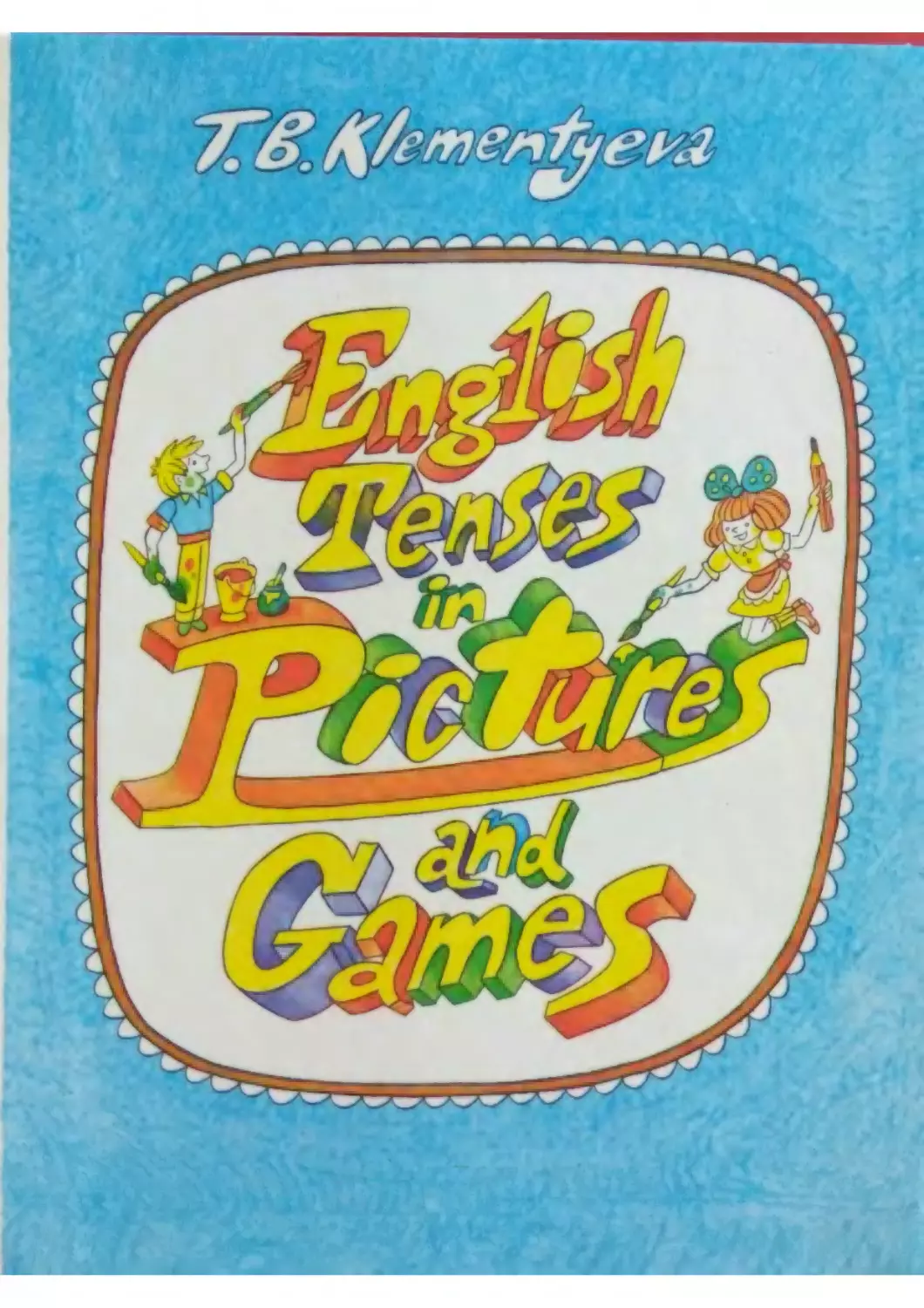


Author: Клементьева Т.Б.
Tags: английский язык лингвистика иностранный язык изучение языков книга для учащихся
ISBN: 5-09-000683-0
Year: 1989

Text
Т. Б. КЛЕМЕНТЬЕВА
ВРЕМЕНА
АНГЛИЙСКОГО
ГЛАГОЛА

В КАРТИНКАХ
И ИГРАХ

Книга для учащихся школ
с углубленным изучением
английского языка

МОСКВА
<ПРОСВЕЩЕНИЕ»
1989
ББК 8I.2AHM

К48

П и Герасимова

ы кандидат педагогических наук с ина (Москва)
PcUeH3e кандидат филологических наук Т. С.

(Москва),

Клементьева Т. Б.

К48 Времена английского глагола в картинках и играх: Кн. для уча-
щихся шк. с углубл. изуч. англ, яз.— М.: Просвещение, 1989.— 224 с.
ISBN 5-09 000683-О

Книга включает упражнения, иллюстрированные красочными, занимательными ри-
сунками н таблицами, языковые и ролевые игры, тексты и ключи для самоконтроля
Она поможет школьникам правильно употреблять в речи предусмотренные программой
глагольные формы. Книга предназначена для самостоятельной работы учащихся школ
с углубленным изучением английского языка, может быть использована н в средней школе

„ 4396020900-417

К ------------— 217-88

103(03)—89

ББК 81.2АНГЛ

ISBN 5-09-000683-0

© Издательство «Просвещение», 1989
Дорогие друзья,
если вы решили заниматься по этой книге, то сначала прочитайте, как ею поль-
зоваться.

Как выполнять упражнения

Bee упражнения в этой книге вы

Упражнение

Расскажите о себе по плану:

можете

проверить по ключу. Например

Ключ (~)

2)

3)

имя

возраст

национальность

Му
Гт
Гт

name’s Sasha
ten
Russian

1.	Закройте ключ

2	Скажите или запишите на листе
бумаги (или на магнитную ленту)
ваш ответ.

3.	Загляните в ключ, чтобы убедить
ся, что наш ответ правильный
Знак (~~) означает, что в ключе
даны возможные варианты ответа

Лучше выполнять упражнения вдвоем, чтобы вы могли контролировать
друг друга и разыгрывать в липах диалоги и короткие сценки.
Как пользоваться учебной карточкой

I Смотрите на учебную карточку и выполняйте упражнение.

2	Не надо заучивать даваемые в карточке примеры наизусть, так как вы
запомните их, работая над упражнением.

3	. Если вы сможете правильно выполнить упражнение, не заглядывая в учеб-
ную карточку, значит, вы усвоили новый материал и можете переходить
к выполнению следующего упражнения.

Как выполнять тесты

1	Запишите ваши ответы на листе
бумаги (или на магнитную ленту).

2	. Проверьте ваши ответы по ключу.

3	Оцените самостоятельно свою ра-
боту по шкале оценок.

Желаю вам успеха’

Автор.
I. ГЛАГОЛ TO BE В ПРОСТОМ НАСТОЯЩЕМ ВРЕМЕНИ

Таблица I Употребление глагола to be

Случаи
упогреб
Ленин

Смысловой глагол
(быть, находиться)

Глагол-связка
(быть, являться)

Примеры

Где находится антобусная ос-
тановка?

— Вон там.

— Который час?
— Семь часов.

Таблица 2 Спряжение глагола to be

		The Pre-sent Indefinite Tense
Утвердительная фирма		Вопросительная форма		Отрицательная форма
1 1 ат 2 you 3. he she It	ire  is	Am I?  Are you? he?  Is she’ it’	1 am  you a he she it	nut re not  Is not
1 «г  2.	you  3.	they	are	we?  Are you? they?	we you they	are not
ЗАПОМНИТЕ!

Лицо	Единственное число	Множественное число
1	ат
2		П	аге
3	Is	J	L

Так говорят	Так пишут

Не	Гт

She 's

It	You're

He	I	am

She is
It	You are

УПРАЖНЕНИЯ

Помните, ключом пользуемся после выполнения задания

I. Давайте познакомимся. Подберите ответ из правой колонки.

Ключ: lb. 2a

a)	How do you do 1

b)	And my name is . . . Hello!

How do you do - Здравствуйте (Говори толькп

6	первом знакомстве.)
2.	Давайте поговорим о вас и о вашей семье.

Расскажите о себе, используя следующий план.

I I’m i

1)	Род занятий (a schoolgirl, a school-
boy, etc.).

2)	Возраст (ten, eleven, twelve, etc ).

3)	Национальность (Russian, Ukrain-
ian, Armenian, etc.).

4)	Рост (tall, short)

5)	Личные качества (serious, gay, etc ).

6)	Место рождения (Moscow, Riga,
etc.)

Ключ (~)

I’m a schoolgirl.

I’m ten.

I’m Russian

I’m tall

I’m gay.

I’m from Moscow.

Пользуясь планом, расскажите о своих родителях.

Му lather

Му mother

She is...

Ключ (

Му father is a worker.

Не is thirty-seven.

Не is Russian.

He is tall.

He is clever and serious.

He is from Moscow.

My mother is a secretary
She is thirty-four
She is Ukrainian.

She is short.

She is kind.

She is from Kiev.

Пользуясь планом, расскажите о своих бабушке и дедушке.
I

3.	Помогите Боре заполнить пропуски в предложениях

1.	Му name . Boris 2. I - twelve. 3. I a Young Pioneer. 4. My
family . large 5 My mother and father engineers 6 They . Com-
munists. 7. My sister Olya a schoolgirl 8 She . ten. 9. My brother .
a worker 10 He a builder (строитель). II. He . . . twenty i.< His name

Mike 13 We . great friends

Ключ

l ie J uni i am, 4 is, 5. are, 6 are; 7 is, 8. is; 9. is; 10 is 11. is; 12 is; 13. are

Ответьте на Верины вопросы

Hello. Му name is Vera What is your
name?

I am ten. Нич old are you?

I am Russian. What’s your nationality?
1 am from Moscow Where are you from1
I am in the third form What form are
you in?

Ключ (~)
My name is Katya.

I am twelve

1 am Ukrainian

I am from Riga

1 am in the fifth form

5. Давайте поговорим о квартире.

Опишите комнагы пользуясь планом

под картинками.


Ключ

А 1 It is large
2 it is white
3. It is light.
4. ft is cold.

В It is small

It is brown

It is dark

It is warm

Опишите свою комнату (квартиру), придерживаясь того же плана,
room is (Му flat is )

6. Посмотрите на картинку и ответьте на вопросы.

Is the table in the middle of the room>

Is the table between two armchairs?

Is the table smalP

Is the TV set on the right or on the left?

Is the desk in the corner or opposite the

window >

Is the ball behind the
table?

Where is the table?

Where is the ball?

Where is the TV set?

Where is the cap

door or under the

Ключ

Yes. it is

Yes. it ь
les. it is
It's on the nght.

Il’s in the corner

It's behind the door

It's in the rnidJJe of the rwm
between two armchairs
It's behind the door
It's in the corner on the right
It's under the table
и
а

4. ,

7. Поговорим о погоде,
жеиие и скажите, какая

Подберите из правой колонки подходящее пред.1о
погода изображена на каждой картинке.

a) It's rainy and damp (сыро).

й

Г/

L4

I 4

> I

.• i

4

i

I)) It's sunny and warm

c) It’s snowy and cold

Ключ; ld; 2v. ia. 4[)

.^гюмиите >ти выражения. Скажите --
weather like today?)	«жите.

е' Какая сегодня

погода.

hat is the
8.	Подберите недостающие на картинках реплики из правой колонки. Выучите

диалоги наизусть и проиграйте их.

a) Let’s stay at home.

c) Thal’s no excuse.’

b) Let’s go to the Zoo.

1 slippery { sliparil - скользкий

’ watch out — осторожно

’ That’s no excuse — Это не может служить оправданием

Don’t worry.
9.	Поговорим о ризных предметах.	.

можете назвать по-англииски?

Какие предметы вы

Ключ

I It's a doll

2	It’s a horse

3	. They're flags

4	It’s a teddy bear

5	They're flowers

6	It's ,i pig

7	I Is а с а г

H They're cups

Причитайте текст	как,,,.	„|,„„ад|1.жат ........ ,	, (

Mike is ten

Не is a schoolboy

Не is	a	Pioneer	Uis

hobby is	football	Hi-
bas got a	collection	of

toy-cars	He	likes to	play

the guitai

МтПа is six

Her hobby is painting
She likes reading

Образец; I. They’re Mike’s

Hhost ,iie these'-1

2- Us 4«kS

Ключ

3	Its Mike's Pioneer scarf ц Г(, ,

4	. They're Nina’s books 7 ,S Mlke's guitar

12	b It s Mike’s ball
10 Вы стоите посреди улицы Скажите, где находится кинотеатр по отношению
к другим зданиям и к вам Используйте следующие слова

just before- кик раз перед, just alter - сразу за opposite-* напротив;
next to — рядом, between — между

Ключ (~)

The cinema is on the left
just alter the po.-U office
next Io the post oiiice (library)
opposite the bookshop
just before the library
between the post office and the library

Расскажите, как расположен ваш дом по отношению к другим зданиям па
вашей улице

II Составьте диалоги, используя образец и данные ниже слова Скажите,
где что находится

the post office
the bus stop
the underground station
the telephone
the theatre

on the right
over there
(a)round the corner
straight ahead
next to the bus stop
пи живете Вам ПОМОГ) т следующие

12.	Расскажите о городе, в котором вы живете-	. щие

выражения	Ключ

to be from

to be on the river . . .

to be the capital/a regional centre
to be . . old

to be a political, scientific (in-
dustrial. agricultural and cultural)
centre

to be famous for great revolutionary
traditions/its beautiful buildings and
churches/its numerous monuments
and bridges/its historical places/
architectural ensembles

I'm from Kalinin.

It’s on the Volga.

It's a regional centre.

It’s more than 800 years old.

It’s an industrial (agricultural) and
cultural centre.

It is famous for great revolutionary
traditions, for its beautiful build-
ings and monuments.

13.	Что бы вы сказали в подобной ситуации?

1)	Вы находитесь в гостях. Уже
поздно, и вам пора уходить. Что
вы скажете?

2)	У вас дома звонит телефон. Про-
сят позвать отца, который еще не
вернулся с работы Что вы от-
ветите?

3)	Ваш брат предлагает вам пойти
покататься на лыжах, но погода
плохая: холодно и ветер. Как вы
ему ответите’

4)	Учитель просит у вас дневник.
Он хочет поставить вам «от-
лично:». Что вы ему скажете’

5)	Вам подарили щенка. Он белый
с коричневым, с длинными уша-
ми и коротким хвостом, умный
и зовут его Рекс. Друг просит
рассказать ему об этом щенке.
Как вы его опишете?

Ключ (~)

I am very sorry It's too late It’s
time to go home. Thanks very much.

Sorry, he is out. He's at work.

Im afraid it is too cold and windy
today. Let’s stay at home.

Certainly./Of course.

Here it js./Ц js jn niy [)aR

He s white and brown. His ears are
ong His tap js short He js a c|ever
His name is Rex.
14. Выберите для каждой картинки подходящий диалог

а) I'm sorry, Г in late.
— That’s all right.

d)	Here is your clean shirt. Xick
— It’s very kind of you

b)

Let’s go to the cinema.

I'm sorry. 1 can’t I'm busy.

e)	— It’s nice to see you.

— It’s nice to see you, too.

c)

It's me. Good morning.

Excuse me. I'm not ready yet.

f)	— I'm pleased to meet you

*— The pleasure is mine.

Ключ: 1c: 2b: 3e; 4a; 5d; 6f.

Воспроизведите диалоги только по

картинкам, не заглядывая в текст

15. Помогите Пете догадаться, какой подарок на день рождения ему при-

несла Света
пки ни узнаете, что это за подарок
Мы вам поможем Разгадав эти за)алии, вы узк

RIDDIES (ЗАГАДКИ)

What do eats have that no other animals have?

W hat is it that looks like a eat, eats like a cat, walks like a cat. but still ts not a cat?

(Ответ смотрите на с. 17.)

16. Прочитайте стихи и догадайтесь, о каком цвете говорится в каждом

стихотворении Выучите эти стихи.
1)	. . is the grass
And the leaves of trees
. . . is the smell
Of a country breeze1
2)	is the colour of the sky
Without a cloud,
Cool distant.2 beautiful
And proud.3	a) ptlrp|e<
q.	.u	i_.	°) Black  3)	is the night
When there isn’t a star	’
And you can't tell by looking	"  Wheie you are.	e) Green
f) Gold
4) ... is a metal,
 • is a ring,4
... is a very
Beautiful thing
5) . ’s mimosa
And 1 guess5
 . is the colour of
Happiness.

‘ Ьг<*« — легкий ветерок
'ti'lant — отдаленный
proud — гордый

* Hng — кольцо

^Циеи_доГадиваться
Purple | рз р|j _ фнилетоьий
G) Time is
just before night,
\\ hen most people
Turn on' the light
But и you don’t.
It’s a beautiful sight.2

Ключ. Ie, 2c, 3b, 4f; 5d. 6a

Ответ на загадки на с. 16

A kitten.

17. Найдите в правой колонке

подходящие объяснения

для английских

разговорных выражений.

1)	It’s off.	a)	I am very tired. Я очень устал.
2)	I’m all in	b)	I am completely m favour Я полностью «за»
3)	I ni all for it.	c)	Il is not fresh (of meat, fish, etc ) Это не свежее (о мясе, рыбе нт д ).
4)	It's till over	d)	It is mislaid, but not lost Это где-то здесь.
5)	We’re through	e)	It is finished  Это уже закончено.
6)	It's round here some* here	f)	We have finished Мы уже закончили
7)	1 Ie’s out	fi)	He is in another place/town, etc Он в другом месте/городе и т д
«)	He's back	h)	. Не has returned.  Он вернулся.
9)	He's away	 )	Не is not at home, etc bio нет дома (и т Д )
	Ключ: Ic, 2a,	3b. 4e,	5f. 6d. 7. 8h; 9g

1 to turn on — включать

’ sight — зрелище
ПРОВЕРЬТЕ СЕБЯ! TEST YOURSELF!

Задание I. Расскажите о себе.

1)	пате

2)	age

3)	occupation

4)	nationality

5)	place of origin

Задание 2. Расскажите о своей маме, используя план задания 1.

Задание 3. Представьте себя в следующей ситуации. Вас приглашают
поехать в гости, но вы заняты. Откажитесь от приглашения и объясните
причину.

Задание 4. Внимательно рассмотрите картинки и передайте диалог изобра-
женных на них людей.

Проверьте правильность выполнения заданий 1—4 по ключу

Ключ к тесту (~)

Задание 1:

Задание 2:

Задание 3:

з!	....

Kussian. o) Shes from Vladimir.

— Let’s go to the partv

— I m sorry, [ can't. I’m busy.
Задание 4: 1) — Гт sorry, Гт late
— That's all right

2)	— It's me Good morning

— Excuse me. I'm not ready yet.

3)	— Here is your tie Dad
— It's very kind of you.

Оцените свои знания

Количество допущенных ошибок	0—1	2—3	4—5	>5
Оценка	5	4	3	2

Если при выполнении заданий вы сделали более трех ошибок, вам при-
дется повторить материал Если вы не сделали ни одной ошибки, значит,
можно переходить к следующим упражнениям
„ли (n be пользуйтесь следующей  Еслн^вам нужно построить вопрос с глаголом °  таблицей.	„.«жений с глаголом to be  Таблица 3. Образование вопросительных пре
1. Общие вопросы (тре- буют ответа «да», «нет»). Общие во- просы, содержащие отрицание	Is he from Moscow?  Isn’t he from Moscow? Разве он не из Москвы?	Yes, he is.  No, he isn’t.  Yes, he is. Нет, из Москвы.  No, he isn’t. Да, не из Москвы.
2. Разделительные во- просы (утверждение или отрицание-|-крат- кий вопрос)	a)	He is from Moscow, isn’t he? (не так ли, да/не правда ли?)  b)	Не is not from Mos- + cow, is he?	1. Yes, he is. 2. Yes. 3. Yes, isn’t he? 4. Oh, no. 5. No, he is not! 6. Oh, yes, he is!
3. Альтернативные во- просы (вопрос выбо- ра между двумя дей- ствиями, предмета- ми и т. п.)	Is he from Moscow or Leningrad?	He is from Moscow.
4. Специальные вопро- сы (начинаются с вопросительного сло- ва) :  а) вопросы, относя- щиеся к какому- нибудь члену пред- ложения, кроме подлежащего.  б) вопрос к подле- жащему	Where is he from?  What city is he from?  Who is from Moscow?	He is from Moscow.  Petrov is.
—
18. Где находится щенок? Глядя на картинки, составьте вопросы (разных
типов). Пользуйтесь таблицей 3.

Ключ

is . ..?

Isn’t . . .?
. . . or . .?
. . isn’t he?
Where . . .?

Is the puppy in the living-room?

Isn’t the puppy in the living-room?

Is the puppy in the living room or in the bathroom?

The puppy is in the kitchen, isn’t he?

Where is the puppy?

The puppy is in the bedroom.

ЗАПОМНИТЕ!

Слова для образования специальных вопросов:

who — кто

who(m) — кому; кого
whose — чей

how — как

what — что; какой
when — когда

where — где; куда
why — почему

which — который, какой
19. Давайте поговорим по теле*°^ц ПОЛУчившийся диалог наизусть и про-
Найдите ответы на вопросы. Вьу

играйте его.

WHEN *5 УО№ BlRTHD/t/?

How OLD ARE you ?

V/hflr'^l What's урок маме?

2

Who

4

Hello. Who is that 7

WHERE ARE you A ROM 7 Л. Wherf\ 5

lMy/Jg£ УОи!н

Mwt tow of town i$ YuR/vWU ?

Moscow МО^У\Ч/цу\^\
, V„e л 7 FWhat 7

/ WHAT'S У OUR. НО8ВУ ?

Oh, it's a small seaside resort hear /Иу маме is /?мм Ifowi.

My Н08ВУ is stamps (Рамс/Мб).

Гм OH HociPAM.

Он THE Тнемту-УООАТН О A Julh.

It's me

Гал teh

Гм PROM YuA^ALH

Ki HD

\NfiAT 8

Ключ: IG; 4D; 7А; 2Н; 5Е; 8В; 3F; 6С.

20.	Познакомьтесь. Это Аня. Задайте ей вопросы разных типов.
Пользуйтесь таблицей 3, с. 20.

*	Ask about her:

*
name
age

(	nationality

place of birth
favourite colours

Ask about her:
family
farge/small
mother — a doctor
'ather-a factory or an office worker
school
favourite subjects

future plans

22

Ключ

What s your name?

How old are you?

What’s your nationality?

Where are you from?

What are your favourite colours?

Is your family |arge?

°ur mother is a doctor, isn't she?
your father a factory or an office
worker?

^school?* y°Ur favourite subJec,s

are your Pfans for the future?
free time

hobbies

favourite TV/radio programmes
sports

What’s your hobby?

What’s your favourite TV programme?
What sports and games are you fond
of? Are you good at any sport or
game?

21.	Поговорите с вашим трутом, которому подарили часы Спросите у него,
как они выглядят Задайте ему вопросы всех четырех типов. Пользуйтесь
таблицей 3 на с. 20.

Ask him about:

1)	size (small, large)

2)	shape (round, oval, square)

3)	colour (black, red. grey)

Ключ (~)
1 ) Is It	large?	2) Is it square?		3) Is it	black?
Is it	large or small?	Is it square or	oval?	Is it	black or grey’
It’s	small, isn't it?	It is square,	isn't	it is	black, isn’t it’
Wha	t size is it?	it’  What shape is	it?	What	colour IS It?

ДАВАЙТЕ ПОИГРАЕМ' LET S PLAY!

Игра l. «Найдите, что и где спрятано». Дети спрятали шарик в комнате
Петя должен его найти. Чтобы угадать, что спрятано и где, Петя задает детям
ратные вопросы. Помогите Пете и ответьте на его вопросы.


Ключ

Is	It	in front of me?
Is	It	behind me?
Is	It	on the left3
Is	It	on the right?
Is	It	on the table or under the table?
Is	it	big or (is it) small?
11	IS	a book, isn’t u?

What colour is it?

It's a ball, isn t it?

Here it is.

No, it isn't
No, it isn't
No, it isn't.
Yes. it is
it is under the table.
It is small.

No, it isn’t,
h’s red.

Yes, it is. Yes, you are right

Игра 2 «Расставьте мебель в комнате» (по типу игры «Морской бой»)
Играют двое Каждому выдается один и гот же «набор мебели», которую
он должен расставить в своей «комнате» так чтобы другой этого не видел.
После того как они это сделали, играющие поочередно задают друг другу
вопросы, чтобы угадать расположение «мебели» Выигрывает тот, кто быстрее
отгадает, как расставлена «мебель» в «комнате» его товарища

book-case — книжный шкаф
desk — письменный стол
chair — стул
sofa — диван

armchair — кресло

carpet — ковер

wardrobe — гардероб

in the middle of — в середине
to the right of — справа от
to the left of — слева от

opposite — напротив

near

next to

г рядом

between — между

Образец: Player 4. Is the chair in the middle of the room?

Player B. No, it isn’t.

Player A Is the desk in the middie of the room or in the corner of
the room?

Player В It is in the corner.
Игра 3. «Отгадайте, кто загадан »

Ведущий (учитель или ученик) загадывает имя хорошо известного другим
играющим человека (ученика, преподавателя и т д.) и записывает его на
бумаге Остальные задают вопросы, стараясь отгадать, кто был загадан.
Отгадывающие имеют право задать не более 10 вопросов любых типов,
используя глагол to be. Задавать вопросы можно по предлагаемому ниже
плану.

What's he like? (Теп questions)

1)	Age

2)	Height (tall, short, middle-sized)

3)	Face (long, oval, round), hair (dark, brown, blond), eyes (blue, grey, brown)

4)	Profession/occupation

5)	interests

Образец; Is it a boy or a girl? - It is a hoy

Is he tall? — No, he isn't. He is of medium height.

Is he dark or fair? — He is dark.

Is he sociable or reserved? — He is sociable.

Is he quiet or talkative? — He is rather talkative.

Is he clever (intelligent, dull)?— I think he is.

He is present at the lesson, isn’t he? — Yes, he is. (No, he isn’t.)
What colour are his eyes? — They are brown.

I think his name is..., isn t it? — Yes, it is (No, it isn't )

22 Поговорим по телефону Прочитайте три диалога. С.кажите, какой из
них соответствует картинке.

The Telephone Cail

а)	— Hello' Is Ann in?

— No, she isn’t here.

I think she is at the cinema

b)	— Who's that?

— It's Mike.

— Where's Dad?

— He’s at work.

c)	— Hello' Is that Mike?

— Sorry. Wrong number.

Ключ: C.
лг,Л1<и ппл ними. Выучите диалоги наизусть

23. Соотнесите картинки с диалогами под ними. .	усть

а)	— Hello, Ann How are you?
— Very well, thanks.

b)	— Excuse me. What time i
— It’s ten o’clock.

c)	— Where is the bus stop?

— It's over there.

Ключ:

Воспроизведите диалоги только i

d)	— Ном IB Lidl IS il?

— It’s five roubles, Nina

it? e) — Nice day, isn’t it?

— Yes, it is.

f)	— Is this your dog?

— No, it’s not mine. It's my
sister’s.

Ie; 2b; 3f, 4c; 5a; 6d.

io картинкам, не заглядывая в текст.

24.	Подберите недостающие на картинках реплики из правой колонки Вы-
учите получившиеся диалоги и проиграйте их.

A Flat

a)	Next to the dining-room.

b)	Whose room is it?

с)	I am fond of it too.

d)	On the second floor.
Ключ: Id; 2b; Зс; 4a.


At the English Lesson
Railway Talk

a) Twelve roubles.

b) Yes, it is.

c) Six-thirty

Ключ: 1c; 2a; 3b.
„ „слогами Выучите их и проиграйте в лицах.
25. Соотнесите картинки с диалогами, о у

КЗJs! vN

а)	— Sorry to interrupt you, boys.

— Yes? What is it?

— Where is the entrance to this
building?

— It's next door.

— Thanks a lot.

— Not at all.

c) — Excuse me. Is this your plastic
bag?

— Yes, it is. Thank you very
much.

b)	— Sorry to interrupt you, girls.
— Yes? What is it?

— Your hat . . . It’s on the floor.

— Oh, thank you.

— That’s all right.

<f) — Whose is it? This umbrella?
— Don’t worry. I think it’s my
mother’s.

Ключ; lb; 2c; 3a; 4d
Составьте свои диалоги.
26. Выучите диалоги наизусть и проиграйте их с товарищем. Составьте диало
ги к картинкам в правой колонке.

— Boris, what’s this?

— It’s a house.

— Ann. what’s this?

— It's a tree.

— Where's my newspaper?

— Here it is.

— Who’s that?

— It's Dad.

— And who’s that?

— It's me.


— Whose picture is it?

— It’s my daughter’s picture.

27. Составьте диалоги на основе

предлагаемых ситуаций и проиграйте их.

Ключ (~)

1)	Утром в школе поздоровайтесь
с Аней. Спросите, как она пожи-
вает, Аня отвечает, что хорошо.
Благодарит вас.

2)	Олегу купили новый портфель.
Спросите его о цвете портфеля.
Олег отвечает, что он . . ..

3)	На вашем столе в классе лежит
чья-то ручка. Спросите, чья она.
Катя отвечает, что это ее ручка.

4)	Вы спрашиваете, что сегодня ве-
чером по телевизору. Вам отве-
чают, что не знают, и предлагают
посмотреть программу.

5)	Спросите, далеко ли отсюда до
библиотеки. Вам отвечают, что
библиотека находится за углом.

6)	Спросите, правильно ли вы идете
к катку. Перед вами извиняются
и говорят, что не знают.

— Hello, Ann. How are you?

— Гт well, thank you.

— What colour is your new bag?

— It’s ....

— Whose pen is this?

— Oh, it’s my pen.

— What’s on television tonight?

— I don’t know. Look at (in) the
programme.

— Is the library far from here?

— No, it’s round the corner.

— Am I right for the skating-rink?

— Гт sorry, I don’t know.
7)	Ваш друг читает книгу. Узнайте
название книги, кто автор, инте-
ресная ли она, о чем она. Друг
отвечает на все ваши вопросы.

— What’s the title of the book?
Who is the author of it? Is it
interesting? What’s the book
about?

— The title of the book is ....

— The author of the book is ....

— It’s very interesting.

— It’s about ....

28. Прочитайте открытку и ответьте на вопросы

	Olp<p $O/VOV
pj^ppy в/Я-ТВсму ТЪ Усш/
/'М iN Le^//’/pe>e^d	Дрвлт Street
*LL ?	/У!о5СО\Л/


Ключ

Who is the postcard from?

Who is it to?

Where’s Oleg’s father?

Where is Oleg now?

The postcard is from Oleg’s Dad.
It is to Oleg

Oleg’s father is in Leningrad.

Oleg is in Moscow.

29. Поговорим о разном.

1) Расскажите о себе.

1. What s your name? 2. How old are you? 3. What’s your occupation?
4. What’s your nationality5 5. Where are you from? It’s a beautiful town (city),
isn’t it? 6. What’s your address? 7. What’s your telephone number? 8. Are you
a Pioneer? 9. What’s your social work at school? 10. What’s your favourite
subject? II. What’s your hobby? 12. What’s your favourite radio (television)
programme? 13 What are your favourite colours? 14. What sports and games
are you fond of? 15. Are you good at any sport or game?

2) Расскажите о своей семье.

1 Is your family large or small? 2. What’s your father’s (mother’s) name?
3. How old is he (she)? 4. Is your father a Communist? 5. Is your brother a
Pioneer? 6. Is your flat in a new house or in an old one? 7. What floor is your
flat on? Is your flat large?

I

2 Зак 1865 T Б Клемент кем

33
3) Расскажите о своих

1. Is it difficult for you

3. Are vou sometimes tired

занятиях английским языком.

to learn English? 2. Are your lessons interesting?
after the lessons? 4. When are your classes over?

5 Are vou busy all day?

4) Расскажите о том, какая сегодня погода и какой климат зимои и летом

в вашей местности.

I. What’s the date today? 2. What time is it? 3. What s the weather like today?

4. What's the climate like here? 5. What are winters like here?

ДАВАЙТЕ ПОИГРАЕМ! LET'S PLAY!

Игра 4. "Introductions”. Ребята делятся на две команды «А* и «Б». Участ-
ники команды «А» — советские ребята, члены КИДа Дома пионеров. Они
ждут гостей, ребят из Индии. Участники команды «Б» — индийские ребята,
приехавшие в гости в Дом пионеров. У входа в Дом пионеров «хозяева» и
«гости» знакомятся и заводят разговор: расспрашивают друг друга, сколько
кому лет. кто откуда приехал, какие у кого увлечения и т. д. Выигрывает
команда, сказавшая большее количество фраз, т. е. сказавшая последнюю
фразу. Можно усложнить игру, поставив условие, что играющие имеют право
задавать только общие вопросы или только специальные и т. д.

A RIDDLE

When is a cook bad?

(Ответ смотрите на с. 36.)

ПРОВЕРЬТЕ СЕБЯ!

Задание 1. Задайте своему товарищу
пате (специальный вопрос)
age (альтернативный вопрос)
nationality (разделительный вопрос)
place of origin (общий вопрос)
Спросите также о его семье, друзьях
свободное время.

TEST YOURSELF!

вопросы по плану, данному ниже.

о школе и о том, как он проводит
Задание 2. Составьте диалог на основе следующей ситуации:

Преподаватель из Англии должен приехать к вам в школу. Вы ждете его
у входа. К вам подходит человек. Извинитесь и узнайте у него, не ваш ли это
гость; из какой он страны, первый ли это его визит в Советский Союз. На все
ваши вопросы он отвечает утвердительно.

Задание 3. Внимательно рассмотрите картинки и передайте диалоги изобра-
женных на них людей.

Проверьте правильность выполнения заданий 1—3 по ключу.

Ключ к тесту

Задание 1: What's your name? Аге you ten or eleven? You are Russian, aren’t
you? Are you from Kiev? Is your family large or small? What's
your father? Is your father a Communist? Your brother’s a Pioneer,
isn’t he? Who is your friend? Is his family large or small? Your
friend is kind, isn’t he? What are your favourite subjects at school3
Why English is your favourite subject? What are your plans for
future? What's your hobby? What’s your favourite radio programme?

Задание 2: — Are you Mr. Brown3 — Yes. I am — What country are you
frorn? _ I'm from England.— Is it your first visit to the Soviet
Union? — Yes. it is.

Задание 3: 1) — Where’s the post office?
— It’s over there.

2) — Excuse me. What time
is it? — It’s about seven.
Оцените свои знания'

Количество допущенных ошибок	0—2	1  СО	5—7	3
Оценка	5	4	3	2

Jf you ear, do this test, go on to page 37 Have fun! Good luck!

Ответ на загадку на с. 34:

When he beats an egg
II. КОНСТРУКЦИЯ THERE IS/ARE

Таблица 4 Употребление there is/are

Случаи употреб- ления	Сообщение о наличии в данном месте какого-либо предмета или лица
Примеры	There is an apple on the plate.  На тарелке (есть, имеется, находится) яблоко.	There аге ho\s in the classroom.  W"  В классе (находятся) маль- чики.

Сравните!

Случаи употреб- ления	Сообщение о наличии известного предмета или лица в определенном месте
Примеры	The apple is on the plate.  Яблоко на тарелке.	The boys arc  Мальчики в	in the classroom классе.

Таблица 5 Утвердительные, вопроси тельные
и отрицательные предложения с there is/are

There	is isn’t	a chair	in this room
	are  aren’t	two beds
УПРАЖНЕНИЯ

1. Давайте поговорим о квартире. Опишите каждую комнату, выбрав подхо-
дящие предложения из данных под картинками.

1. This is a living-room. 2 This is a study. 3. There are two armchairs, a
л all-unit (стенка) and a sofa in the room. 4. There is a piano to the lelt of the
door. 5 There is a desk and two chairs in the room. 6. There are flowers on the
table. 7. There is a lamp on the table. 8 There is a lamp above the table. 9. There
are a lot oi books on the desk. 10. There are two pictures on the wall II There
is a bookshelt with English books and textbooks on the wall in the room 12. There
15 a small table in the middle of the room. 13. There is a floor-lamn (торшер)
between the sofa and the TV set 14 There is □ tv .	" Pr . '	„

ere is a TV set in the corner of the room

Ключ

I.	This is a living-room. 3; 4; 8. 12 13- 14

2.	This is a study. 5; 6; 7; 9; ю ц

Скажите, какая комната вам больше нпавитео

3g	нравится и почему.
2. Опишите дом Пети, используя план, данный под картинкой

I.	Peter's house. . (big small)

2.	There are. . . (Hou many rooms?)

3.	His room. . . (on . . floor)

4	There is. . . (What is there in his
room?)

5.	There is. (What is there in the
kitchen?)

Ключ

1.	Peter's house is small.

2.	There are three room' and a kitchen in his house.

3.	His room is on the first floor.

4.	There is a bed in the room and there are tuo chairs and a table, too.

5.	There is a chair, a table, a cooker and a fridge in the kitchen.

3.	Скажите, какие дома находятся на этой улице


There is a

Ключ (~)

4U. u«>f There is a park in this street. There is a library
school in this stree _ this street. There are three shops in this

in this street. There are two bus stops in
two telephone call boxes in this street.

street. There are

А теперь скажите, что

school
bus stop
hospital
post office
park

swimming pool — бассейн
car park — автостоянка
florist's shop — цветочный магазин
supermarket — универсам
hairdresser’s — парикмахерская

есть и чего нет на вашей улице.

cinema
theatre
stadium
railway station
museum

cafe
library
bookshop
Zoo

baker's shop — булочная
chemist’s shop — аптека
sports shop — спортивные товары
underground — метро

bridge — мост

Ключ (~)

There isn't a park in my street.
There is no cafe in my street.

4.	Посмотрите на картинку и скажите, где находится каждый шар.
Образец: There’s a ball in the box.
There’s a ball

Ключ

1.	in the drawer (ящик стола).

2.	on the table.

3.	in the box.

4	behind the door

5.	on the chair.

6.	between two boxes.

7.	under the chair.

8.	in front of the box.

9.	on the floor.

10.	on the fir-tree

ДАВАЙТЕ ПОИГРАЕМ! LETS PLAY!

Игра 5. "Asking About the Location of Buildings" («Угадай здание на
улице»). В эту игру играют парами либо командами по 2—3 игрока. Каждая
команда рисует пять клеток и заполняет их названиями или рисунками, обозна-
чающими магазины, учреждения, общественные здания, которые находятся на
улице.

Street А

Street В

Команды не должны видеть, какие магазины и учреждения находятся на
«улице» их соперников

Каждая команда, задавая вопросы, выясняет, какие здания находятся
на каждой «улице».

Например — Is there a library in the street?

— Xu. there is not.

— Is there a school5

— Yes. there is.

Выигрывает та команда, которая быстрее отгадает все здания на «улице»
соперников
5. Представьте, что вы пришли на
много вкусных вещей. Опишите этот же стол
(Вам надо найти семь различий.)

день рождения к другу. На столе было
после того, как прошло два часа

Образец:

There is (There’s) some ice-cream in picture I.
isn't any ice-cream in picture 2.

There
There
There

are some. .
aren’t any. . •

There’s a (an)
There isn’t any. .
There’s no. . •

Ключ

In picture 2: There is no orange juice.

There is no chocolate cake.

There are only two cheese sandwiches.

There aren’t any apples.

There isn’t any ice-cream.

There isn't any apple pie.

There isn’t any salad.

6.	Аня собрала чемодан, чтобы ехать в пионерский лагерь.

I)	Скажите, чего еще нет в ее чемодане. (Сверьте вещи в чемодане со
списком вещей на крышке чемодана.)

Образец: There is no hat in the suitcase

There are no socks in the suitcase
z£?/&
Jfa-r

5.

У CO^&

f0.^oP£S f

c,o#P |

к I

Ключ

There are no envelopes in the suitcase. There is no comb in the suitcase. There
is no towel in the suitcase.

2)	Посмотрите на картинку две минуты. Постарайтесь запомнить все, что
уложено в чемодан, затем закройте книгу и скажите или напишите, какие
веши лежат в чемодане.

Образец: What’s in the suitcase?
There's a Pioneer scarf, .

Ключ

There’s a soap.

There’s a Pioneer scarf.

There's a Pioneer blouse.

There's a dress.

There's a skirt.

There's a toothbrush.

There are shoes.

7.	Выучите диалоги наизусть и проиграйте их. Составьте новые диалоги,
заменяя выделенные слова словами, данными в правой колонке.
Гч 15

>ои-

a) trolley-bus

b) tram

' better

b)man to see you

A RIDDLE

There are six of us in every family, but only four in a town, what are we?
(Ответ смотрите на с. 48.

8. Составьте диалоги на основе предлагаемых ситуаций, используя конструк-
цию there is/there аге, и проиграйте их.

1)	К вашему другу из другого го-
рода приехала погостить двою-
родная сестра. Узнайте у нее,
есть ли в ее городе Дом пионе-
ров и интересные музеи. Она от-
вечает на ваши вопросы поло-
жительно.

2)	Ваш друг переехал на новую
квартиру. Узнайте, сколько ком-
нат в его новой квартире. Он
отвечает, что в ней три комнаты.

3)	К вашим соседям приехала ба-
бушка из деревни. Узнайте у нее,
есть ли в деревне лес и речка.
Лес есть, отвечает бабушка, а вот
речки нет.

Ключ

— Is there a Pioneer House and any
interesting museums in your town?

— Oh, yes, there is a museum of
Chaikovsky in our town and there
is a House of Pioneers there too.

How many rooms are there in
your flat?

— There are three rooms in my new
flat.

— Is there a forest and a river in
your village?

— There is a forest near my house,
but there is no river.
LET S PLAV'

Игра 6. Каждый из играющих хочет пригласить учителя а то или иное
место Он описывает это место, говорит, что там много интересного Выигры-
вает тот, кто сумеет убедить учителя поехать именно с ним Пример

Let’s go to the Zoo.

There are many wild
animals there

There’s an excursion
the Hermitage.
Let's go there.

Let’s go to
Tnere is a
Chaikovsky

Let’s go to

to

Klin.

museum
tnere

К I? hi

of

There are many archi-
tectural monuments
there.

How about going to
Repin’s house?

There is a good collec-
tion of painting there

Let’s go to the Museum
of Revolution

There are a lot of school
parties1 in the museum
at this time of the year
There is a famous ma-
chine-gun cart used hy
the 1st Cavalry Army.
There are the Soviet
government’s first De-
crees on Peace and on
Land

school party — школьная экскурсия

I’m sorry 1 can’t.

All right Let’s
go That’s a good
idea

4fi
шивает: “What is there in the bag?" Ребята задают ему общне^и л и разделитель-
ные вопросы типа: Is/are there, . . in the bag. / - - , is

Образец: — Is there a doll in the bag?

— Xo, there isn't.

— There is a book in the bag, isn’t there?

— Yes, there is. Here you are.

— Thank you.

За каждый отгаданный предмет играющий получает одно очко. За пять
отгаданных предметов — пятерку.

9.	Давайте поговорим о вас.

1)	Расскажите о вашей улице.

I Аге there modern buddings in your district? 2. Is there a library in your
district? 3. Are there many shops around^ 4. Is there a stadium near your
house?

2)	Опишите вашу квартиру.

1. How many rooms are there in your flat? 2. Is there a large kitchen in the
flat? 3 Are there any pictures on the walls’'' 4. Is there much or little furniture
in your flat? 5. There is a sitting-room in your flat, isn't there? 6. How many
windows are there in your sitting-room?

31 Расскажите о вашем классе.

1. How many pupils are there in your English class? 2. How many girls are
there in your class? 3. How many boys are there in your class?

10 Что бы вы сказали в подобных ситуациях?

1.	Вы видите, что сзади к вашему
товарищу на большой скорости
приближается велосипедист. Вы
предупреждаете его об опасности.

2.	Вы идете в кино. До начала
фильма еще много времени, и вы
предлагаете сходить в парк.

3. Друг по парте спрашивает, нет

ли у вас лишней ручки. У вас есть

ручка, но вы сомневаетесь, пи-
шет ли она.

Ключ (~)

Careful! /Look out!/

\Yatch out! There's a bicycle (just)
behind you!

There is a lot of time.

Le,’3 * s go to the park.

I am afraid there is something wrong
with my pen


ПРОВЕРЬТЕ СЕБЯ! TEST YOURSELF!

Если есть возможность, запишите свои ответы на магнитную ленту.

Задание 1. Представьте, что вы отдыхаете в пионерском лагере Артек.
Вы познакомились там с ребятами из разных уголков нашей страны. Расспро-
сите их о городе, из которого они приехали, и расскажите им о своем городе.
Используйте следующие слова.

there is/there аге

wide avenues and streets
many parks and gardens
Houses of Pioneers
a river
airports

new districts
stadiums
railway stations
the underground
m useums

Задание 2. Скажите, о чем они говорят.

Проверьте правильность выполнения заданий 1—2 по ключу.

Ключ к тесту (~)

Задание 1:	— There аге many wide streets, many parks and gardens, two

Houses of Pioneers, a stadium in our town. There is no airport
and underground there. Is there an airport in your town?
— No, there isn’t.

Задание 2:

— Mind Watch out! There’s a car behind you.

— Thank you.

— Hello! Anybody there?/Is there anybody?
Оцените свои знания:

Количество допущенных ошибок	0	1	2	>2
Оценка	б	4	3	2

If you can do this test, go on to page 49. Have fun! Good luck!

Ответ на загадку на с. 44:

Letters.


111. РАЗГОВОРНАЯ ГЛАГОЛЬНАЯ КОНСТРУКЦИЯ HAVE
(HAS) GOT

Таблица о Употребление глагольной конструкции have (has) got

Случаи употреб- ления	Оборот have (has) got выражает идею владения, наличия чего-либо (или кого-либо) и соответствует русскому У меня (у него, у нее и т д ) есть. .

Примеры	1 httve got a brother. We have got a dog. У меня есть брат	У нас есть собака.

Примеч ине: Наряду с глагольной конструкцией have got в значении иметь, обладать употреб-
ляется смысловой глагол have. Не has got a brother.= Не has a brother

Таблица 7 Утвердительные, вопросительные и отрицательные предложения
с конструкцией have (has) got

The Pic-sent Indefinite Tense
1  You We They	have haven't	got	me vour his her the г	suitcases  ticket
He She	nas hasn't		an	umbrella.
Have	l/you we/they	got	a skirt?  a pair of jeans?  a camera’  a newspaper?	Yes (No),	l/you we/1 hey	have.  (haven't.)
					he/she	has.  (hasn't.)
Has	he/she

How many	bottles of milk	have you got?	I’ve got three.

Примечание: В настоящем времени в вопросительных предложениях помимо фирмы Have you
got a brother’ употребляются также фирмы Have you a brother? и Do you have a
brother?

Местоимения some, any, no

I (we. you. they)	have got	some	time today.
He (she)	has got

Have 1 (we, you. they)  Has he (she)	got	any	time today?	1 Yes.  2 Yes, 1 have  3 Yes. 1 have got some.  1 No  2 No. she hasn't  3 No. she hasn't got any.


I (we, you, they)	haven’t got any have got no	time today.
He (she)	hasn't got any has got no

Так пишут:

You write:

I have got

He has got

I have not got

He has not got

Так говорят:

You say:

1 ve got

He’s got

I haven’t got
He hasn’t got
УПРАЖНЕНИЯ

1. Давайте поговорим о вашей семье,
какие у вас есть родственники.

Расскажите, большая ли ваша семья.

I've got

relatives

mother, father

sister, brother

grandmother, grandfather, etc.

Ключ (~)

I've got a mother.

I've got a father.

I've got a sister.

I've got a grandmother.

2. Ответьте па вопрос Коли (Пользуйтесь таблицей 7 на с 49 50)

I’ve got a cat.

I haven't got a cat, hut I've got a dog.

I haven’t got any animals at home.

Ключ (~)

I've got a bicycle. I’ve got a set of chess. I haven’t got two table games. I haven’t
got a piano.
4. Скажите, что у вас имеется из этих вещей, а
Clothing — Одежда

a shirt

a pair of trousers

a tie

a pair of socks

a pair of jeans

a pair of shorts

a pair of pyjamas

a sports jacket

a pair of rubber boots
a suit

a blouse

a skirt

a pair of boots

a dress

a dressing-gown

a hat

a fur coat

a raincoat

a pair of shoes

a scarf

5. Давайте поговорим о ваших коллекциях. Скажите, какие коллекции из
изображенных на этих картинках у вас есть, а каких нет.

a collection of stamps

a collection of postcards

a collection of little dolls

a collection of toy-cars

6. Познакомьтесь, это Катя. Задайте
конструкцию have got.

Ask her about her:

ей вопросы, используя

family

I a rge/sin al I
brolhers/sisters

Ключ (~)

Have you got a large family?
Have you got a sister?
flat

large/small (or)

comfortable (haven’t you)

in a new block of flats or in an old
house (or)

things

a piano (a violin, a guitar, a tape-
recorder, a record player, etc.)
records (How many)

collections

postage stamps, postcards, books,
old coins, badges, match-box labels,
etc.

Have you got a large or a small flat?
You’ve got a comfortable flat, haven’t
you?

Have you got a flat in a new block
of flats or in an old house?

Have you got a piano?

How many records have you got?

Have you got any interesting col-
lections at home?

A RIDDLE

What has no head, no arms, no legs, and still has a tongue?
(Ответ смотрите на с. 56.)

7. Выучите диалог «В библиотеке> и проиграйте его. Составьте свои диалоги,
заменяя выделенные слова словами, данными ниже.

— Have you got “Robinson Crusoe”
by Daniel Defoe, please?

— Yes, we have. Here you are. (Mo,
I'm sorry. We haven’t. But we’ve
got “Gulliver’s Travels” by
Jonathan Swift.)

I)	"Mary Poppins” by Pamela Travers

2)	’’Winnie-the-Pooh" by Alan Milne

3)	"The Jungle Book” by Rudyard Kipling

4)	"Tom Sawyer" by Mark Twain
ь

>5

I


LEVS PLAY!

Игра 8. "Buying and Salting." Выбираете. несколько «пролавио»». „ожво
открыть разные .маеазакы., «х Д0.1ЖКО быть ""““““кЛтХ	3

иа и'иптйМкЯК либо ВЗЯТЬ Карточки Но .ЮТО На
газинов» можно нарисовать на картинка

четырех языках. Каждый «продавец» может написать объявление и положить
перед собой, например: "Sports Shop", и разложить «товары». Остальные уча-
шиеся становятся «покупателями» Их задача купить как можно больше раз-
личных товаров. Они должны «обойти» все «магазины». За каждую «куплен-
ное вещь» — одно очко.

Sports shop: football, chess set. bicycle, track suit,' boxing gloves.

Clothes shop: shirt, tie, dress, blouse, skirt.

Chemist's shop comb, soap, toothbrush.

Baker’s shop: bread, rolls, sugar, tea.

Bookshop, fairy-tales, poems, tables, stories about animals.

Образец; — 1 want to buy a/some .... please. Have you got a/any . . .,
please?

— Certainly, we have. Here you are. (No, I’m sorry. We haven’t.)

Игра 9. Вариант 1. Учитель раздает ученикам десять карточек с изобра-
жением тех или иных предметов 2 и просит, чтобы ученики их запомнили.
Затем он их собирает, перемешивает и кладет в стопку так, чтобы изображений
на картинках не было видно Каждый участник игры берет по очереди одну
карточку, а другие должны догадаться, что изображено на его карточке.
За каждый угаданный предмет — одно очко.

Образец: — Guess what I’ve got!

— You've got a pencil.

— No, I haven't/Yes, I have. Here you are.

Вариант 2 Две команды встают друг против друга. Каждая прячет свой
предмет, передавая его из рук в руки за спиной. По команде учителя «Стоп!»
предмет остался у кого-то в руке. У кого?

Who's got the ... ?

Образец:

Team A

Oleg has got the ball.

No. [ haven’t got the

Team В

No. I haven't got the ball. Nina
has got the ball.

apple, etc.

Выигрывает команда, которая первой отгятямт
___________ F и отгадает, у кого находится предмет.

track suit — спортивный костюм

Для лучшего запоминания предметов кпптлипи »

да». «Пиша» и т.д.	рточки рекомендуется давать по темам: «Одеж*
8.	Поговорим о вас.

1)	Расскажите о своей семье.

I Have you got a large family? 2. Have you got a sister? 3. Have you got a
brother? 4. Have you got any pets at home?

2)	Расскажите о своей квартире.

I.	Have you got a large or a small flat? 2 You’ve got a comfortable flat,
haven’t you? 3. Have you got a flat in a new block of flats or in an old house?
4. Have you got a sitting-room? 5. Have you got a sofa and armchairs in your
sitting-room?

3)	Расскажите о том. чем вы занимаетесь дома.

1.	Have you got any good books at home? 2. Have you got a piano (a violin,
a guilar) at home? 3. Have you got any table games at home? 4. Have you got
a tape-recorder and a record player? 5. Have you got any good music on tape?

4)	Расскажите о том. что вы коллекционируете.

1	Have you got any interesting collections at home? 2. What collections
have you (your parents, your friends, your sisters and brothers) got? 3. Which
of you has got an interesting collection of badges?

9.	Выучите диалоги наизусть и проиграйте их. Составьте свои диалоги,
заменяя выделенные слова словами, данными в правой колонке.

1) —- Have you got a pen?  — Yes. I have.  — Please, let me have it a moment.	a) felt реп (фломастер)
	b)	rubber (ластик)
2) — Hasn’t Nick got a music lesson today?	a)	an exam in English
— Yes, he has.	b)	a test in English
3) — I’ve got a good collection of stamps.	a)	coins
— Oh, have you? Let me have a look at it.	b)	badges
	c)	toy-cars
4) — Have you got any English newspa-	a)	pictures of Pskov
pers?	b)	journals
— Yes, 1 have got some. (No, I haven’t	c)	magazines
got any.)  5) — Have you got any friends in Riga?	a)	Moscow
— No, we haven’t got any friends there.	b)	Leningrad
	c)	Minsk
RIDDLES

1 1 have got cities but no houses, for.
' ests but no trees; rivers without
water. What am I?

2. What dog has no tail?

(Ответ смотрите на с. 58.)

Ответ на загадку на с. 53:

A shoe.

10. Посмотрите на картинку и подберите недостающие реплики из данных
ниже. Выучите диалоги и проиграйте их в лицах.
11.	Представьте, что вы должны передать какую-то вещь вашей знакомой,
но заняты и никак не можете с ней встретиться. Попросите вашего брата
сделать это за вас.

1)	Брат просит вас описать вашу знакомую, задает вопросы и узнает
ее имя, возраст, рост, цвет глаз, цвет волос.

Ключ (~)

— What’s her name?

— Anna Orlova.

— How old is she?

— She’s ten.

— How tall is she?

— About one metre 25 centimetres.

— What colour are her eyes?

— She’s got blue eyes.

— What colour is her hair?

— She's got long dark hair.

2)	Опишите по телефону внешность вашего брата, ответив вашей знако-
мой на ряд вопросов. Воспроизведите ваш диалог по телефону.

name — Pete
age — twelve
height — one metre 55 centimetres
eyes — blue eyes
hair — short fair hair

12.	Что бы вы сказали в подобных ситуациях?

Ключ (~)

1)	Вы едете в автобусе в пионер-
ский лагерь. Ваш сосед хочет
что-нибудь почитать. Предложи-
те ему журнал «Пионер». Он вас
благодарит.

2)	Ваша мама разговаривает по
телефону; ей нужно что-то запи-
сать, но она не может найти свою
ручку. Предложите ей свою. Ма-
ма благодарит вас.

— I’ve got a new magazine.
Here you are.

— Thank you very much.

— I've got a pen Here you are.
— Thank you very much.
и*** lift

3)	Вы пришли в спортивный мага-
зин. Узнайте, есть ли у них фут-
больный мяч. Продавец извиня-
ется и говорит, что нет.

4)	Вы простудились. Что вы ска-
жете?

5)	У вас болит голова Что вы ска-
жете?

_ Have you got a football, please?

_ \o. Гт sorry. We haven’t/I'm
afraid we’ve got none left.

I’ve got a cold.

I’ve got a headache.

Ответы на загадки на с. 56:

1. А тар

2. A hot dog

ПРОВЕРЬТЕ СЕБЯ! TEST YOURSELF!

Задание 1. 1) Выберите нужную форму глагола 2) Задайте вопро-
сы четырех типов о семье Пети Петрова, а затем расскажите о его
квартире.

I (have got. has got) a friend His name is Pete Petrov. He (have got, has got)
a large family: a mother, a father, a brother and a sister. They (have got, has got)
a two room "'at in Klin. They (have got, has got) a sitting-room, a childrens
room a targe kitchen and a bathroom. They (have got, has got) a sofa, two
armchairs and a small table in the sitting-room. His sister (have got, has got)
a nice brown desk It’s in the children’s room. His brother (hasn’t got, haven't
got) a desk. He is very small.

Задание 2. Представьте, что вы пришли в школьную библиотеку. Узнайте,
есть ли в библиотеке сказки на английском языке. Библиотекарь отвечает,
что сказок нет. но есть басни.

Проверьте правильность выполнения заданий 1—2 по khouv
ни rv.IIxJу .
эд
Ключ к тесту

Задание 1: 1| have got: has got. have got; have got have got, has got; hasn't got
(~) 2) 1 Peter has got a large family, hasn't he2 2. Who has got a large
family? 3. Has he got a mother and a father? 4. Has he got a brother
or a sister?

Задание 2:

Have you got any English fairy-tales?

\o, we haven't got any, but we've got some fables.

Оцените свои знания:

Количество допущенных ошибок	0	1-2	3—4	>4
, Оценка  1	5	*	•	2

If you can do this test, go on to page 60. Have fun! Good luck!
Г-Щ^"ВЯГШ.П лгтпм	-Д	'•*->.

втрашнему дню? Нет, не ну*н

О
>
X
о

W
к»

CV
-ч
сг

ЛГ1 < » Ж л*^5

Г

*

Таблица 8 Модальные

глаголы и их эквиваленты

Present	Возможность  CAN — to be able (to)	Разрешение  MAY — to be allowed (to)	Дол ЖС11СТ11ОШИ1ИС  MUST — to have (to), to be (to)
	I can	1 am able (to)  Я могу	Я могу (в состоя-  нии), умею	I may	1 am allowed (to)  Мне разре- Мне позволяют шлется	I must	1 have (to)  Я должен Я должен (мне при- ходится, я вынуж- ден)  1 atn (to)  Я должен (мне предстоит)
1/1  (X	1 could	1 was able (to)  Я мог	Я мог (был в сос-  тоянии)	1 might	1 was allowed (to)  Я мог бы	Мне позволили	—	1 had to  Я должен был (мне пришлось, я был вы- нужден)  I was to  Я должен был (мне предстояло)
Future	1 shall be able (to) Я смогу	1 shall be allowed (to) Мне позволят	—	I shall have (to)  Я должен буду (мне придется)

сь
Таблица 9 Глагол сап

Таблица 10 Can - be able to для аыражения будущего

Сап (ближайшее будущее)

— When can you see me?

1 сап see you tomorrow, if you like.

- Когда ты сможешь увидеть меня?
— Я смогу увидеть тебя завтра, если
хочешь.

Shall/will be able to (будущее)

— Can the baby walk yet?

— No, but he'll be able to walk in a
few months' time

— Может ребенок ходить?

Нет, но он сможет ходить через
несколько месяцев.
УПРАЖНЕНИЯ

1.

Давайте поговорим о том. что вы

1 Уои 1		swim
He/She I	can	dance.
We/They j		ski.

умеете делать, а чего не умеете

r	  Can	...	  >4X1 he she they	—  swtrti * dance5  skP

What аге the people doing in these pictures'1

Boris is playing the guitar

He can play the guitar very uell

Ann is dancing

She can dance very well.

Andrey is cooking, but he can’t cook \ery well.
Mike is playing tennis. Nina is skiing

He can play tennis very She can ski very well
well.

What about you? What can you do very well?

Peter is swimming.

But look at him! He
can’t swim very well!

Can you

ski?

play tennis5
cook?

play the guitar?

Ключ (~)

Yes, I сап. I can ski very well.

No, I can’t.

Yes, I can, but not very well.

Yes, I can.

No, 1 can’t.

2. С ломошью глагола can можно выразить различные просьбы. Выберите
для каждой картинки подходящий диалог.

&»
а) — Сап I have a cup of tea, please’
— Certainly.

c) — Сап I nave two tickets for
the film “Come and See"’
— Here you are.

e) — Can we rake any of these
chairs’

— Yes, you can take whichever
(chair) you like.

b) — Сал I use your telephone,
please’

— 01 course, you can

d) — Сап I send it to my home’

— I’m sorry, J don’t know.

f) — Can you lend me a red pencil,
please’

— No, I’m sorry, I can’t.

Ключ: 1c; 2a, 3d, 4b, 5f; 6e

Воспроизведите диалоги только пс картинкам

3 Зак 1865 т Б Кленеитьеаа

65
3.	Как ВЫ Обратитесь к незнакомому
диалог для каждой картинки.)

а)	— Excuse me. . . Can you tell me
the time?

— Yes, of course. Let me see. It’s
seven.

— Thank you very much.

— Don’t mention it.

b)	— Excuse me.

— Yes, what can I do for you?

— Can you help me with my
suitcase?

человеку? (Подберите подходящий

с)	— Sorry to interrupt you.

— That’s all right. Сап I help you?

— I can't find the exit here.

— It’s next door.

— Thank you.

— Not at all.

d)	— Excuse me.

— Yes.

— Can you help me with the door?

1	can't open it.

Ключ: la; 2c; 3b; 4d.
Воспроизведите диалоги

66

только по картинкам.
4.	Давайте поговорим по телефону. Выберите диалоги, которые относятся
к телефонным разговорам, выучите и проиграйте их.

1)	— Can I speak to Lena, please?
— Hold the line, please.

- O.K.

— Sorry, she's out.

— Would you tell her I rang?

— I'd be glad to.

3) — Hello. My name is Lena.

Could I talk to Dmitry, please?
— I’ll find out if he’s at home.
— Do, please.

— Are you still there? Sorry, he's
left for the country. He won't
be back till Monday.

— Can you tell him to ring me when
he gets back?

— With pleasure. . .

5) — Is that Boris Klimov?

— Yes. this is Boris Klimov
speaking.

— Can I see you this evening?

— Well, shall I come and see you?
— Come to my place.

— I’ll see you at six. . .

Ключ: 1, 2, 3, 5.

2) — Hello, Vasily speaking. May
I have a word with Masha?

— I'll just see if she is in. I'm
afraid she is not here.

— Could you take a message,
please?

— Yes, of course.

4) — I want to see Mr Brown.

— Can I have your name, please?

— Black.

— Mrs Black or Miss Black?

— Mrs Black.

— Mrs Black is here to see you.

6)	— Can I send it to my home?

— What is your address?

— 40 Gorky Street.

— Can you spell that, please?. . .
Ключ: IC. D; 2C, D; ЗА, В, D; 4A. D.

6. Что вы скажете в следующей ситуации?

Вы хотите поговорить по телефону
с Леной. Представьтесь и попросите
ее к телефону. Вам отвечают, что
сейчас посмотрят, дома ли она.
Оказывается, ее нет дома. Попросите
передать, что вы звонили и просили
ее позвонить вам в пять, если она
сможет

Ваша просьба принята.

Ключ (~)

— Hello. Peter speaking/My name is
Peter. Сап 1 speak to Lena, please?

— Hold the line, please. ГП jusl se,C
if she is in/l’ll find out if s^eS

at home. Sorry, she’s out.

— Can you tell/Would you telpher

1 rang? Сап/Could you
message, please? Please ask he

to call me at five if she can.

— I’d be glad to/Yes, of course/
right.
RIDDLES

1.	How can you divide six apples among seven hungry people?

2.	Why can’t it rain tor two days without stopping?

3.	How many lions can enter an empty cage?

4.	What kinds of animals can jump higher than a house?

5.	What is that which can play but cannot walk?

6.	Why can't the world ever come to an end?

(Ответы смотрите на с. 72.)

7.	Давайте поговорим о том, как проехать по городу. Выберите диалоги,
которые относятся к этой теме. Выучите их и проиграйте.

I)	— Сап you tell me the way to the Zoo?

— I’m sorry, I don’t know.

2)	— Where can I change for bus 13?

— Round the corner.

3)	— Can you tell me how to get to
Victoria Station?

— Well, you can take a taxi, sir.

Or a bus.

— No. no! I’m walking there.

4)	— How can I get to Piccadilly
Circus?

— You can go by bus, or take a taxi,
or you can walk.

— How far is it?

— About three kilometres.

— I'll go by taxi. . .

5)	— Can you help me, please? What's
the best way to get to this
address?

— I'm sorry, but I really don’t know.

6)	— What's your occupation (trade or profession)?

— I’m a builder.

— Good. What else can you do?

— I can work as a driver.

7)	— Can you tell me where the station is?

— Turn right and go two blocks.

— Thank you very much.

— That’s all right.
8)	— How do 1 get there?

— Turn left here, then go straight on, and you come to a cinema, and th
school is on the corner, opposite the cinema.

Ключ: 1, 2, 3, 4, 5, 7, 8.

Составьте свои диалоги по этой теме, например:

— Сап you tell me how to get to. . . ?

— First. . . Then. . . After that. . . Turn right/left. Walk down Park Lane
Go up Piccadilly. Walk past Buckingham Palace. You can’t miss it.

8. Что бы вы сказали в подобных ситуациях?

I)	You are standing at a bus stop
waiting for No. 5. Someone
comes up to you and says: “Does
No. 6 go from here?" You don t
know the answer. What do you
say?

2)	Your cousin comes to see you.
She is thirsty and she asks for
juice, but you don't have any
juice. Apologize for not having
juice, and oiler your visitor an
alternative drink.

3)	You are standing at a bus stop
within the sight of the Pioneer
House, which is about 400 metres
away. Somebody asks you where
the Pioneer House is, and whether
he will need to catch a bus to it.
How would you reply to this
enquiry?

4) You have found a seat on a train

which is due to depart in 30 min-
utes. You want to ask another
passenger to keep your seat

Ключ (~)

— I'm sorry. I can't help you.
(I'm a stranger myself.) I'm
sorry, but I really don't know.

— I'm sorry. We don't have any
juice Can I offer you something
else? What about a glass of
mineral water?

— The Pioneer House is over there/
just down the road/only a short
distance from here You can walk
to it. You won't need to catch a
bus.

Excuse me, can I ask you ,0
keep this seat for me? I’m j»4 s*
going for. . ./to buy. . .
while jou buy a newspaper and
some magazines. How would you
do this?

5) Someone says that success de-
pends on luck You believe that
it depends on hard work. How
would you express your opinion’

I can t agree. 1 think it depends
on hard work rather than luck

9.	Давайте поговорич о том. как вы изучаете иностранные языки Выберите
диалоги, которые относятся к этой теме

I)	— Can you speak anj foreign languages’

^es. I can I can speak French And I can speak German.

— Really-1 Thals very good' What about Spanish’

— No, 1 can t speak Spanish 1 can speak Italian But not very well.

2)	— Im sorry I can't understand you well when vou speak so fast

— Do 1 speak fast? Well. I ll speak slower Do you understand me now?

3)	— I can hardlj understand you Please speak a little slower.

— Oh, sorry. I'll try

4)	Can I help you’

— Yes. I speak only French

— I'm sorry, but I don't understand French.

— Please find someone who speaks French

5)	— Can Boris understand French as well as English’

— Yes. and he can speak it well too.

— I can't speak a word of any language except rm own.
Neither can I

6)	— Can you type. Nina’
— ’les. | can

How many words a minute’

— Eighty

7)	— When can the director see me’
— Can you come at eleven o'clock
this morning?

Ключ: I, 2. 3. 4. 5.

il '
Таблица И. Глагол may/might

Случаи употреб- ления	Вопрос о разрешении совершить действие' (просьба)		Предположение
	may — более вежливая форма, чем сап	might — попытка быть очень веж- ливым	may/might + infini- tive  might — меньшая степень предполо- жения
Примеры	— Мау 1 use your telephone, please?  — Of course, you can.  — Разрешите (Можно) мне позво- нить по вашему телефону?  — Конечно, можно.	— I don’t want to disturb you but might ( use your telephone for a moment?  — Oi course, you may use it.  — Я не хочу беспокоить вас, но можно было бы мне позвонить по вашему телефону? (Я не уверен, откажут мне или согласятся.)  — Конечно, вы можете им пользо- ваться.	— Where’s John?  — Не may be in the kitch- en. I’m not sure.  — Где Джон?  — Он, воз- можно, на кухне. Я не уверен.
		Сравните:  [ сап come at six.	Я могу прийти в шесть, (имею  возможность)  1 may come at ten.	Я, может быть, приду в десять.
а)	Сап I help you?

b)	May 1 help you?

Ключ: la, 2b

11.	Давайте будем вежливыми

Подберите к каждой картинке подходящий диалог.

Ret

а) — Мау/сап I help you on with your
coat?

— Thanks.

cj — May/can J help you?

— Thank you very much.

b) — Excuse me. may/can
passed?

— Yes, certainly.

Ключ: 1c. 2a; 3b
12.	Давайте проиграем ситуацию «В магазине» Один ученик играет роль
продавца (А), другой-покупателя (В, Пользуйтесь предлагаемы ли реп-
лика ми

You аге going to buy one of the following:

a suit/dress/shirt/skirt/jacket

A

Сап I help you?

U hat can I do for you?

Any particiilar colour?

And v.hat size?

Do you like this?

It suits sou very -ле11

В

Чау I have.

Yes. сап I have

I want

1 ni looking for. . .

I'd like something in. . .
Yes, that does look good
How much is it?

May I try it on?

Ключ (

— Can I help you?

— Yes May I have a jacket with a zip’
— Any particular colour?

— I'd like something in blown Etc
«-£-л4эЯ.-	'

♦

,3. Подберите — — «

a)	— May 1 open the window?
— Yes, of course

b)	— May I see your ticket?

— Here you are.

c)	— May I look at your pens?

— Certainly. Fountain-pens or ball
point pens?

— I’m looking for a good ball
point pen.
d)	— May ! have a menu. pleaseJ
— A menu? Here you are.

— Now, I II need a few minutes
to look it over

e)	— May I introduce you to Boris?

— How do you do

— How do you do

I) — May I pick some flowers?
— Of course you may.

g) — Why is he late?

— He may be busy I’m not sure

Ключ: la. 2b. 3g 4c, 5d; 6e; 7f

14 Расскажите о том что ьы умеете и что не умеете; что вам разрешают де
лать а что нет

Таблица 12 Модальные глаголы н их эквиваленты,
выражающие долженствование

Глагол (значение)		Настоя шее	Прошедшее	Ьуд>щее
ДОЛЖЕН	неизбежность: надо, не- обходимо  must	must
	вынужденность (в силу непредвиденных обстоя- тельств) приходится, выну ж дин  ю have (to)	have (to)	had (to)	sha4i have (to) will |
	обусловленность (пла- ном. договоренностью) предстоит  to be (to)	am is (to) are	was .. ,  (to) were
	сонет (основан на инди- видуальном опыте) сле- дует  should	should (do)	should have done
15. Употребите глагол must или его эквивалент в

The weather is
. . . wait at the

very bad,
airport.

so the passengers

b) вынужден, приходится
(в силу внешних об-
стоятельств)

• •  I go now?
No, you needn't.

соответствии с ситуацией
must

а) надо, необходимо

have to
should

d) следует (совет)

You
park.

not walk on the grass in the

Ключ: lb: 2a; 3c; 4d.
.3 О.,.»м.й.	“

She He	has to	get up soon.  go to work/school.
1  We You They	have to	take an exam  answer a lot of questions.

Do	1 you *e the police	have to	get up pay it  find her get it	now?	Yes (No).	I you к they	do.  (don’t.)
Does	Mr Snow Laura					he she	does.  (doesn't.)

16.	Посмотрите на картинки и скажите, что вам приходится делать ежедневно.

What do you have to do every day? — I have to . . . every day.

to dust the furniture to make the bed	to sweep the floor

to dean all the pans to scrub the floor

to wash the dishes
17.	Дети в музее, в зоопарке и в метро ведут себя неправильно. Что можно
ИМ посоветовать?

Образец: You shouldn’t take photos.

Ключ

You shouldn't touch the exhibits,
You shouldn't lean out.

to take photos

to touch the exhibits

to lean out1

You shouldn’t feed the bears.

You shouldn’t pick the flowers.

You shouldn't walk on the grass.

to feed the bears
to pick the flowers
to walk on the grass

You shouldn’t run down the escalator.
You shouldn’t eat ice-cream in the
metro.

to run down the escalator

to eat ice-cream

1 to Ivan out — высовываться (нз окна)

KI
жите, где им следует быть-1

всегда были на своих местах. На карТцн

ХХГаГа на картинке 2 вещи передвинуты. Ска.

Образец: The book should be on the shell

Ключ

The lamp should be on the table

The cassette-player should be on the shell.

The chair should be at the table.

19. Полбеоиге к каждой картинке подходящий диалог
a)	— Must you get up early to-
morrow morning?

— Yes. 1 shall have to get up at
SIX o’clock

b)	— Must you water the garden?

— No. I needn't water it now.
It s going to rain.

e) — Do we have to walk to the
station?

— No. we needn’t. We can catch
a bus

d)	— 1 want to go to university
What do I have to do to gel in?

— You’ve got to pass an entrance
examination

e)	— When is the Komsomol meeting
to be held?

— On Friday.

— Who helped you to do this
work?

- Nobody I had to do it myself,
g) — Do you think he should apolo-
gize?

— It doesn’t matter who apolo-
gizes, but someone’s got to’

Ключ: lb; 2a; 3e. 4c; 5d; 61 7g.

Воспроизведите диалоги только no картинкам.

в2


A RIDDLE

. 1	vou have given it to someone else?

W hat is it that you must keep utter you к

(Ответ смотрите на с 85 )

20. Используя следующие вопросы, поговорите со своим товарищем.

I)	о своих успехах в изучении английского языка.

1	W hat do vou think I must do to improve my pronunciation 2 Do you
think I must read out loud every day’ 3. What exercises do you think I must
regularly do1 4 Must 1 pav more attention to the sounds or intonation. 5. Where
do vou think 1 must work with a tape recorder? 6. How often do you think I must
work in the laboratory? 7. Whose linguaphone course do you think I must use?
8. Why do you think 1 must take this course?

2)	о своих домашних обязанностях:

I.	Do you have to get up very early on weekdays? 2. Why do you? (don't
you?) 3 Do you have to help your mother with the housework? 4. Do you
sometimes have to help her when she goes shopping? 5. When do you have to?
6 Do you like it? 7. Why do you? (don't you?) 8. Does your mother have to go to
bed late?

3)	о школьной жизни:

I W hen is the Pioneer meeting to be held? 2. Where is it to take place?
3. Are you to speak at the conference? 4. W'ho is to make the report? 5. Am 1
supposed to attend the conference? 6. Very soon there will be a contest in volley-
ball here. Who do you think is to take part in it? 7 Should Shanin be included
in the team? 8. Why shouldn t he? 9. You think the whole of our group should be
present at the contest, don't you?

ПРОВЕРЬТЕ СЕБЯ! TEST YOURSELF!

Задание I. Передайте диалоги изображенных на картинках людей
Задание 2. Что бы вы сказали в подобной ситуации?

You аге watching a film at a cinema when a man wearing a tall hat sits down
i(1 front of you. You can no longer see the film and there are no empty seats to
which you can move. Ask the man, politely, to remove his hat, explaining the
reason for your request.

Проверьте правильность выполнения заданий 1—2 по ключу.

Ключ к тесту

Задание I:

। _ May I open the window?	2. - You shouldn't pick the flowers.

— Yes, certainly.	_ Excuse me.

3. — Сап 1 have/May 1 have/I want/l’d like a cup of tea.

— Here you are.

Задание 2:

Excuse me. Can I ask you to take off your hat? I can’t see the film.
S-- X .С» > Sf n

every day каждый

Примеры

Стучаи
употреб-
ления

Последовательность
событий, действий в
настоящем времени

Возможные
указатели
времени

first сначала
then затем
after потом и др,

Общеизвестная
истина

др.
по-

Обычные, регуляр-
но повторяющиеся
действия

Таблица 14. Употребление простого настоящего времени

ПО
др.

L.

ППД

zwrriiPF ВРЕМЯ (THE PRESENT INDEF-
V. ПРОСТОЕ НАСТ0Я1^Д ET|NSE)

день

usually обычно
often часто и
on Mondays по
недельникам
on holidays
праздникам и

MONDAY
Tuesday
Wednesday
Thursday
Friday
Saturday
Sunday

The sun rises in the
East.

Солнце восходит на
востоке.

I do morning exer-
cises every morning.
Каждое утро я де-
лаю зарядку.

I get up at 7 o'clock,
eat breakfast and go
to school.

Я встаю в 7 часов,
завтракаю и иду в
школу.
Таблица 15 Формы простого настоящего аремени

Утвердительная форма	Вопросительная форма			Отрицательная форма
1 1 ask  2.	you ask  3.	he 		  she-	asks  it "	Do	I you we they	ask?	1  you we they	do not ask (don't)
1 »e ask  2	. vou ask  3	they ask		he Does	she-	ask?  ****** it —			he she it	does not ask (doesn't)

УПРАЖНЕНИЯ

I.	Боря расскажет о себе и задаст вам несколько вопросов. Ответьте на
Борины вопросы, а затем расскажите о себе, не заглядывая в ключ.

I)	I live in Moscow Where do you
live?

2)	1 go to school. Where do you
study?

3)	I play the guitar Do you play
any instrument?

4)	1 like classical music What
kind of music do you like?

5)	I collect stamps. Do you collect
stamps?

6)	My mother works al an office.
Where does your mother work?

7)	My father comes from Moscow.
Where does your father come
from?

Ключ

I live in . . .

I go to school too.

No, I don’t/Yes, I do. I play the
piano/the violin, etc.

I like opera/pop music/folk music/
jazz.

No, 1 don't/I collect postcards/old
coins/hadges of different countries/
match-box labels/old books/records.

My mother works at a museum/on
a farm/in a hospital/in a library/at a
factory.

My father comes from Riga.
2. Давайте поговорим о том, кто чем зани

I) Рассмотрите картинку
на картинке, определите,

Это комната Бориса. По предметам, изображенным
чем он занимается, какие у него увлечения.

Образец: Не plays football.

to play, to listen to, to take, to eat, to watch, to paint, to read

Ключ

He plays the piano.

He listens to the radio.

He takes photos.

He eats apples.

He watches TV.

He paints pictures.

He reads books on art and history.

V (Verb) — основа глагола
2)	Сравните комнату Бориса с комнатой Кати и найдите, в чем их интересы
и вкусы сходятся, а в чем нет.

she V-s

she doesn’t V

to watch, to play, to read, to listen to, to paint

Ключ

She doesn’t play the piano but she plays the guitar.

She doesn't study English, she studies history.

She doesn’t take photos.

She doesn’t eat apples but she eats oranges.

She doesn't paint pictures.

She reads hooks on art too.

She listens to the radio too.
4

4* •sClB


3. Скажите, как проводит свое утро

Борис и чем отличается его утренний

распорядок от вашего.

What does Boris do every day?
What do you do every day?

he V-s

I don’t V

Ч'

I V

to get up at seven o’clock
in the morning

to do morning exer-
cises

to cat breakfast at seven-
thirty

to take the schoolbag

to go to school at eight
o’clock

Ключ

Boris gets up at seven o'clock in
the morning.

He does his morning exercises.

He eats breakfast at seven-thirty.

He takes his textbooks.

He goes to school at eight o’clock

I don I get up at seven o'clock in the
morning, | get up a( seven-thirty-
I don t do my morning exercises.

1 don't eat breakfast at seven-thirty.
I eat breakfast at seven-fortv-live-
1 take my textbooks, too.

t go to school at eight o'clock, too.
laOiHua lb Место наречий в предложении

I-----------------------------------------------------

I Every day I read books

I read books every day.
usually

2 He often	reads books,

sometimes
always

I seldom

4. Скажите, как Борис обычно проводит день, придя из школы домой, и как
проводите время после школы вы

he usually V-s

I usually V

to come ho-
me (at three
o'clock in the
afternoon, usu-
ally)

to go lor a
walk (al-
ways)

to do home-
wor! (at five
o'clock, usual-
ly)

to help Mummy
(often, usual
iy)

to go to bed (at
ten o’clock in
the evening,
sometimes)

Ключ ( ~ )

Boris usualh comes home al three
o'clock in the afternoon He always
Hoes for a walk He usually does his
homework at five o'clock

He often helps his Mummy

He somenmes goes to bed at ten o'clock
th the evening

I never come home at three o’clock
in the afternoon. I usually come home
at two thirty. I sometimes go for a
walk I always do my homew-ork at
four o'clock

I sometimes help my Mummy.

1 usually go to bed at ten o'clock
in the evening.
5. Расскажите, чем занимается

ваша мама каждый день, а чем она зани-

мается иногда.

What does your mother do every day.

to go shopping

to clean	to cook

(the room)	(breakfast)

What does your mother sometimes do?

to clean

(the windou)

to make

(a cake)

to go

(on business trip')

Ключ

She cleans the room every dav.
Every day she cooks breakfast.
She goes shopping every day.
She sometimes cleans the windows.
She sometimes makes a cake.

She sometimes goes on business trips.

business trip — командировка
6. Знаете ли вы правила
себя в обществе.

хорошего тона3 Расскажите, кек вы обычно ведете

to help (mother to
carry heavy things,' al
ways)

to hold (the door open2
lor any person fol
lowing me. usually)

to interrupt (grown-
ups,'* 1 never)

to take (bread with my
hand, always)

to keep off (the grass,
always)

Ключ

I always help my mother to <
I usually hold Ilie door open
I never interrupt grown-ups
I always take bread with my
I always keep off the grass

;arry heavy things
lor any person following me

hand

to carry heavy th-ngs — нотн тяжелые seal и

* Io hold the door open - придерживать дверь иткры1ой

1 to interrupt grown ups — прерывать старших
части ли

Do you like ?

Do you often eat. . 1

7	Скажите, что любит боря а чего он не любит

Не doesn t like. . .

Не likes. .

»
*

Ключ

He likes ice-cream but he doesn t like milk
He likes bananas but he doesn't like lemons
He likes sweets but he doesn t like sugar.

8	. Скажите, любите ли вы еду, которая находится на этом столе, и
вы едите эти продукты.

Ключ

‘ike apples

I>ke oranges. I don't

I often eat biscuits. I never eat

Sometimes 1 eat cakes ^ееье sandwiches.
g. Скажите, в каком виде вы любите есть эти продукты жареными, вареными
или сырыми

potatoes	carrots	onion

Ключ ( - )

I like

roast chicken
fried p^atoes

I don't like

boiled onion
law carrots

10 О чем мы говорим ia столом3 Выберите диалоги, которые относятся к ттой
теме Выучите »тн шалогн и проиграйте их Составьте свои диалоги на эту
тему.

Dinner Conversations

l> — Do you like \ege'.ables•

— I like some but not .ill

— W hat Kind do you like3

- I like c.ibbage ind cucumbers and a few others

%) — Do vou always drink tea with your meals3

— Not always, but usually

— How do you like your tea3

— With sugar and lemon


3)

— What do you usually have for dinn

_ Potatoes and some kind of meat.

_ Do you ever have anyt,1ine(Cmp|e> fish, rice and vegetables.

— Oh, i have other things — for ex ]

4) — How do you find the salad?
— It's too salty. I don t like it.

5j _ How about a cup of tea?

— That sounds good.

— I always enjoy tea after work.

— 1 like it best in the morning.

_ Do you understand the rule?

— I think 1 do.

— Does your friend Peter?

— No. He doesn’t seem to.

7) _ Do you want sugar and cream for your coffee?
— No, I’ll take my coffee black.

Ключ: 1; 2; 3; 4; 5; 7.

11.	Разыграйте диалог: два мальчика, Борис и Виктор, знакомятся. Каждый
спрашивает у другого, в какой квартире он живет, кто его отец и мать, где
они работают. (Пользуйтесь

This is Victor. His father

is an
mother
live in

architect. His
doesn’t work. They
Flat 21.

in Flat 5?

This is Boris. His father
is a doctor. His mother
is a teacher. They live
in Flat 5.

b

— Do you live

~ Yes, I do. What flat do you live in?
— I live in Flat 21.

— Does your mother work?

No, she doesn’t.

— What is your father?

— He is an architect
предложения в простом настоящем времени

Таблица 17. Вопросительные

I study English.

l a) Общие вопросы (требуютответа <да», <нет»)  б) Общие вопросы, содержащие отри- цание	Do you study Eng-  Don't you study English?	Yes, I do.  No, I don’t.  No, I don’t.
2. Разделительные вопросы (утверждение или отрицание 4-краткий вопрос)	a)	You study Eng- lish, don’t you?  b)	You don’t study English, do you?	Yes, I do.  No, I don’t.
3. Альтернативные вопросы (вопрос выбора между двумя действиями, предметами и т. п.)	Do you study English or Ger- man?	I study English
4.	Специальные вопросы (начинаются с воп- росительного слова):  а)	вопросы, относящиеся к какому-ни- будь члену предложения, кроме под- лежащего  б)	вопрос к подлежащему	Where  Why	do you stu-  When/dy English? What do you study?  Who -  Which of you^ stu- dies  English?	1 study English at school.  Petrov does.

12.	Прочитайте разговор Сьюзен и ее соседа по купе, а затем ответьте на
вопросы.

Susan and Luke

Susan is in a train. She is going to Wendover. She is talking to a stranger.

Susan: Do you live in London?

Stranger: Yes, 1 do.

Susan: London’s a funny place. I don’t know my next-door neighbours. 1 live
in Victoria Street.

4 3a« 1865 T Б Клементи».	97
Stranger: That’s funny1 I live m Victoria
Street, too.

Susan. I live at Numbei 24 Victoria

Stranger I live at Number 23.

Suson, Oh. you am my neighbor! My names

Susan.

Stranger: My name’s Luke. How do you do.

Now answer the questions.

I)	Does Ihe stranger live in London5 6

2)	Does Susan live in London?

3)	Does Susan know her next-door
neighbours?

4)	Does she live in Victoria Street?

5) Does the stranger live in Victo-
ria Street, too?

6) Are they next-dtxir neighbours?

Ключ

Yes, he does. He lives in London
Yes, she does. She lives in London
No, she doesn’t She doesn’t know
her next-door neighbours.

Yes, she does. She lives in Victoria
Street.

Yes, he does. He lives in Victoria
Street too.

Yes, they ar^ Yes, they are next
door neighbours.

A RIDDLE

Why do birds fly South?

(Ответ смотрите на с. 100.)

13. Найдите ответы на вопросы, которые могли бы задать ребята из Москвы
ТонТн4 ИЗП Д°На’ е<?лн бы они vuacTBOBaaa в передаче «Телемост Москва -
Лондон». Проиграйте получившийся диалог.
Ключ: IH. 2G. ЗЕ. 4Е, 5D, ОС; 7В. НА

Таблица 18

Вопросы  подлежащему  простом настоящем времени

Who (кто) U hich of \ou (кто из вас)	likes	ice-cream 5	We .ill do ( (Io \llk	1	.  \obody 1 (<HS 1 don't Ann
Who  Which of you	doesn't hke

• 4. Ответьте кратко о себе и о ваших дру ши.х

а) I Who teaches vou English3 2 Which of you reads a lot3 3 Who knows
English well in vour group? 4 Who always does best at tests? 5. Who
doesn't have English classes on Monday?

N I Which of vou (vour family) plays tennis3 (football, volley-ball, chess)
2 Which of you doesn't play tennis? 3. Who goes in for sports in your family?

c) I Which of you likes to have pets at home? 2 Which of your family takes
your dog for a walk?
1

RIDDLES

1 Who speaks English, Russian, German and other
2 What gets larger as more of it is taken away?

languages?

(Ответы смотрите на с. 102.)

Ответ на загадку на с. 98:
Because it’s too far to walk.

15.	Внимательно рассмотрите картинку. Найдите на ней людей, чье поведение
вам нравится, и укажите людей, с которых не стоит брать пример

a) W ho behaves properly?

b) Who doesn't?

Ключ

a) A small boy in the upper part of the picture
b) All the rest.

too
16.	Ответьте на вопросы кратко, а затем расскажите подробнее:

а)	о себе:

I.	What do you do? 2 Where do you study? 3. Where do vou live5 4. Where do
you conie from? 5. Do your parents work? 6. Where does your father work?
7. Where does your mother come from? 8. You love your parents, don't you?
9. W hich of your family takes your brother (sister) to nursery school? 10. Which
of your family fetches your brother (sister) back home from nursery school?
11. You help your parents, don't you? 12. Who knows English in your family?

b)	о ваших увлечениях:

I.	What's your hobby? Say a few words about it. 2. What collections do you
have? 3. Do you like music? 4 W hat kind of music do you like? 5. Do you play any
musical instrument5 6. How often do you play it? 7. Do you use your tape-
recorder at your English lessons? 8 Do you collect records? 9 Do you often
listen to records? 10 Who likes to listen to records in your family?

с)	о своем рабочем дне

I What time do you usually get up? 2 Do you wash with warm or cold
water5 3 Do you walk to your school5 4 How long does it take you to get there?
5. What time do you	usually	leave house in the morning? 6 How	many	classes

do you usually have	a day?	7 When do you usually come home	from	school?

8 W hat do you usually do	in the evening5 9 How do you help	your	mother

with her housework5	10 Do	you plan your time on weekdays? II.	Does	a good

plan help people to do many interesting things?

17.	Сегодня у Ани день рожде-
ния. Папа с Аней идут в мага-
зин, чтобы купить ей подарок.
Посмотрите на картинку и назо-
вите по-английски предметы,
которые Анин папа предлагает
ей в магазине. Прош райте
Диалог между папой и Аней.
18.	Что бы вы сказали в подобных ситуациях?

Ключ (~)

1)	You are standing at a bus stop.
Somebody asks you whether this
bus goes to the stadium. You know
that it does. How would you reply?

2)	You ask a passer-by how to get
to the place you want. What
would you say?

3)	You take your foreign friend
on a sightseeing tour of your
native town. Ask him about his
impressions.

4)	It’s Sunday morning Your family
is going to the country. You are
still in bed. Your mother is trying
to wake you, but you don’t want
to get up, you want to sleep.
What would you say?

5)	You are in a park with your
father. You want to go to the
Zoo. Ask your father to go there
with you.

6)	You are in a big store. Ask the
shop-girl to show you a doll. You
like it. You want to know how
much it costs. What would you
say?

_ Yes, it stops in front of it.

— Excuse me, how do I get to the
stadium?

— How do you find... ? What do you
think of...? How do you like...?
What’s your impression of...?
What can you say about...?

— Oh, I don't want to get up this
morning. I don't want to go to the
country today. I want to steep.

— Dad! Let's go to the Zoo I want
to see the animals there.

— I’d like a doll, please. I like it
very much. How much does it
cost ?

Ответы на загадки на с. 100:

I. Ап echo.

2. A hole.
Задание

I.

ПРОВЕРЬТЕ СЕБЯ!

Скажите,

TEST YOURSELF!

как обычно проводит вечера эта семья

Grandmother

Io knit (sometimes)

Mother
to cook (usually)

Father
to read (often)

mi
Son
to study (always)

Задание 2. Расскажите о себе

I)	где вы живете,

2)	где вы учитесь,

3)	работает ли ваша мама,

4)	откуда она родом.

5)	знает ли ваша мама английский язык.

Задание 3. Предстаньте себе, что вы находитесь в нетнакомом городе.
Спросите у прохожего, как пройти к библиотеке Прохожий объясняет, что,
к сожалению, не знает

Проверьте правильность выполнения заданий 1—3 по ключу.

Ключ к тесту

Задание 1: The mother usually cooks. The grandmother sometimes knits.
The father often reads. The son always studies
Задание 2: 1) I live in Riga 2) I g» I» -bonl. 3) My mother doesn't work.
4| She comes from Kiev 5) My mother knows English very «ell.

Задание 3: — Excuse me.

— Yes?

— How do I get to the library?

— I'm sorry 1 don't know.

Оцените свои знания:

Количество допущенных ошибок	0	1—2	2—3	>3
Оценка	5	4	3	2

If you can do this test, go on to page 105. Have fun! Good luck!
V,. НАСТОЯЩЕЕ ПРОДОЛЖЕННОЕ ВРЕМЯ (THE PRESENT

Таблица 19. Употребление настоящего продолженного времени

Случаи употреб- ления	Длительные действия (процессы), происхо- дящие в настоящий момент (в момент речи)		Параллельные дей- ствия (процессы) в настоящем
Возможные у ка <атели момента действия	точный, конкретный момент	ситуация	while when  пока, в то время как
	now сейчас  at present в настоя- щее время  at the present moment  в данный момент	Look!  Listen!  Посмотри!  Послушай!

Примеры	k—j [ **{	"  иГ u 1  — What аге sou doing now?  — I’m mixing a cake.  — Что ты делаешь сейчас?  — Я делаю пирог.	— Look! Ann is swim- ming.  — Yes, indeed.  — Посмотри! Аня плывет.  — Да, в самом деле.	Boris is fishing while Ann is painting.  Боря ловит рыбу, в то время как Аня рисует.
Таблица 2D Фор-м наст» же, о пролчжеииого аре«к-

Утверлите-'ьиая форма	Вопросительная форма	Отрицательная форма
1	1 am V-ing  2	you are V-mg  3	he-—  -he-T^-is V-ing  t ae are V-ing  2	you are V-ing  3	they are V-ing	Am i V-ing?  Are—-—*e V-mg?  Is—— she V-ing?	1 am not V-ing  ue——-are not V-ing the}-^  he  she—-is not V-ing  it

УПРАЖНЕНИЯ

1.	Представьте, что вы смотрите в окно. Расскажите о том, что происходит
на улице. (Пользуйтесь таблицей 20.)

What is happening outside?

to be V-ing

I) It s a fine spring morning.

to shine to go (to to hurry (to to walk out to jog1
school)	the office) (a dog)

Ключ

The sun is shining. Some children are going to school A man is hurrying to
the ottice. A boy is walking out a dog. Some people are jogging

1 jog — бегать
2) It’s a winter afternoon

to snow

to skate

to play (snow- to make (a to play hockey
balls)	snowman)

Ключ

It is snowing Some children are skating on the skating-rink Two boys are
playing snowballs. Some boys are making a snowman. Some bovs are plaving
hockey.

2.	Посмотрите на картинки и ответьте на вопрос

It’s twelve o'clock All the pupils are having their lunch In the picture vou can see
a self-service canteen '

What are boys and girls doing?

to be V-ing

to stand and wait

to choose (their food)

to pay (for their dinner)

' self-service canteen — столовая самообслуживания
to hold (a tray)	to eat to drink (his tea)

Ключ

Some boys and giris are standing and waiting.

Two boys are choosing their food.

A girl is paying for her dinner.

A girl is holding a tray.

Ann is eating while Boris is drinking tea.

3.	Сравните картинки. Скажите или напишите, чем отличается вторая кар-
тинка от первой.

Образец: In Picture 2 it is raining.
Ключ ( -)

The two women are standing under the tree and talking

The man is not reading hi> newspaper

The woman is not wearing a hat. she is holding an umbrella.

The woman is carrying two shopping bags.

The girl is holding an apple

The children are running

The girl is opening the umbrella, she is not feeding the pigeons.

The woman is reading a newspaper

4. Прочитайте, о чем просит мальчик своих родителей. Скажите, что каждый

из них отмечает

to read

to play the piano

Ключ: Daddy You see, I am reading

Mummy; You see. I'm playing the piano.
5. Посмотрите на картинки и ответьте на вопрось
What is the father doing?

to read — to listen to	to sleep to watch TV

Ключ

The father is reading a book while his son is listening to him. Now the father
is sleeping while his son is watching TV.

6. Выучите диалоги наизусть и проиграйте их. Составьте новые диалоги, за-

меняя выделенные слова словами в правой колонке.

I)	— Let’s go to the concert.

— I’m sorry I can’t. I'm not feeling
well.

2)	— I’m looking for a present for my
mother.

— This vase is very nice.

3)	— Please be quiet’ The baby is
sleeping.

— All right.

park — washing the dishes

sister — Teddy-bear

grandmother — Oh, sorry.

4) — Look! The bus is stopping for us now.

— Come on.

lorry — I'd like to walk.

7.	Представьте, что вы сейчас находитесь:

I)	in the street (in summer/autumn/spring); 2) in the self-service canteen.
3) at the seaside; 4) at the Pioneer camp.

Скажите, что делают люди вокруг вас
What are they doing?
Таблица 21. Отрицательные предложен»

ртдложения а настоящем продолженном времен и

The Present Continuous Tense
1  You  He  She  It	am  are  is	not reading a book now	We You They	are are are	not reading a book now.

8.	Прочитайте предложения и скажите, соответствуют ли они картинкам.
Образец: She is reading — No, she is not reading. She is watching TV.

Nina is reading.

Mary is listening to the music.

Boris is cleaning the room.
Father is cooking breakfast
The children are watching TV.
Mother is having dinner

ill
Г.ЬЛ,- w*4t ЧИЬЯ.» чшл

.„...„«гит  настоящем продолженном времени

Таблица 22 Вопросительные предложения в нестоящ

Общий вопрос	Am I  Is he, she, it Are we, you, they	writing?

&)  3 x 3	What Where	is	she doing? sne going?	Fating  To school.
4 g я ex x t:	What	are	they doing?	Waiting.
o 0? s E U	Who  Who	is isn’t	studying?  in the library?	Nina.  Ann and Pete.

9. Давайте поговорим о том, чем вы сейчас занимаетесь.

1) Отвечайте кратко.

Аге you having ап English class now?

Are you answering your teacher’s questions in English?

Is your teacher explaining new rules?

Is your teacher writing on the blackboard?

Are you listening to the teacher attentively?

2) Дайте полные ответы.

Ключ

Ключ

Yes, I am.

Yes, I am.

No, she isn’t.

Yes, she is.

Yes, I am.

What are you doing now?

What is the teacher doing?

Who is asking you questions?
What are you thinking about?

10. Спросите вашего товарища:

что он сейчас делает;

что делает учитель;

какой урок они сейчас изучают.

I’m doing this exercise.

The teacher is writing on the
blackboard.

My friend is asking me questions.

I m thinking about my studies.

Ключ

W hat are you doing?

What is the teacher doing?

Which lesson are you doing now?
11.	Прочитайте текст и рассмотрите картинку.

It is Sunday It is half past nine (9.30). Ann is having breakfast and listen-
ing to some music on the radio. Her sister is carrying a tea-pot with some tea
jn jt. It is raining outside.

Ask questions with these words:
What/time?

What/Ann?

What/sister?

A RIDDLE

What is the worst weather for rats and mice?
(Ответ смотрите на с. 117.)

12.	Составьте диалоги между друзьями.
Образец: — What are you doing?

— Гт reading a book. And what about you?

— Гт watching TV.

TO Shi
'3 ИЯЯ» ask, «hat bar chiidr.n are doing. Sbe is
speaking over the telephone with her daughter

Образец; What are you doing’ - I’m reading a book. Nick is playing football.

to read a book

to play football

I) Now she calls home at 2 o'clock.

to wash the dishes	to have dinner

2) Now it’s 3 o’clock
Л And now it’s 5 o’clock.

Ключ

1)	1 am washing the dishes \ick is having dinner.

2)	I am doing my homework Xick is reading a book.

3)	I am watching TV. X'ick is playing hide-and-seek.

14.	Выучите диалоги наизусть и проиграйте их Составьте другие диалоги,

заменяя выделенные слова словами, данными в правой колонке.

looking for my key
trying to recollect the
number of Nick s flai

textbook
glasses
a) watching TV
b) having supper

ДАВАЙТЕ УЛЫБНЕМСЯ! LET'S SMILE!

Helping

A master of a ship1 calls down
into the hold.2

"Who is there?"

“William, sir."

"What are you doing?"

"Nothing, sir.”

“Is Tom there?"

“Yes."

“What is he doing?"

“Helping me, sir."

15.	Прочитайте следующие диалоги, затем закройте английский текст и
воспроизведите его, глядя в русский. Выучите диалоги наизусть и проиграйте
их.

1) — I can't make out what you
are saying. Speak louder (up),
please.

— Is it better now?

— Yes, it is.

2) — Are you following me?

— Yes, certainly. Go on. please.
It s very interesting.

— Я не могу понять, что вы гово-
рите. Говорите громче, пожа-
луйста.

— Сейчас лучше?

- Да.

— Ты успеваешь (следить) за
мной? (Ты понимаешь меня?)
Да, конечно. Продолжайте. Это
очень интересно.

2 a master of a ship — капитан судна

2 a hold — трюм

П6
3) — Excuse me, 1 need Boris
Klimov, Where is he?

__ He is waiting for you down
stairs.

Ответ на загадку на с. 113:

When it's laming cats and dogs,'

Извините меня Мне нужен Борис
Климов. Где он?

— Он ждет тебя внизу.

16. Составьте диалоги, которые могли бы

прозвучать в следующих ситуациях

|) Your mother calls home She wants to know what your little brother is doing.
You say that he’s playing with his toys

2)	You call home. Your daddy comes io the phone In answer to your questions
he says that your mother is watching TV and he is looking through the
newspapers.

3)	You ('all a girl - (boy-) friend You want to know what he (she) is doing. You
are told that he (she) is taking a bath

ПРОВЕРЬТЕ СЕБЯ! TEST YOURSELF!

Задание 1. Посмотрите на картинку и скажите, чем н данный момент за-

нять; все члены семьи.

Спросите о каждом члене семьи, изображенном на картинке.

1 Is. . .?

2 Who. . ?

3. What ?

4	. , isn't he?

' It's raining cats and dogs - дождь льет как из ведра (буквально: кошки и собаки падаю
с кеба в к и де дождя)	...
Задание 2. Представьте, что вы звоните домой. Спросите, чем сейчас зани-
мается мама. Мама отвечает, что смотрит телевизор.

Проверьте правильность выполнения заданий 1—2 по ключу.

Ключ к тесту

Задание 1: The mother’s cooking. The fathers watching TV. The grand-
mother’s reading. The son’s studying.

1. Is the mother cooking? 2. Who’s reading? 3. What is the father doing?

4. The son is studying, isn’t he?

Задание 2: — Hello. It’s me. What’s Mother doing?

— She is watching TV.

Оцените свои знания:

Количество допущенных ошибок	0	1	2	>2
Оценка	5	4	3	2

If you can do this test, go on to page 119. Have fun! Good luck!
VII. PRESENT INDEFINITE-present CONTINUOUS

Сравните русские и английские предложения под двумя картинками. Оха-
рактеризуйте действие в каждом русском предложении.

Каждую осень он ест арбузы.

Не usually eats water-melons (in
autumn).

Повторяющееся (регулярное) дей-
ствие (Present Indefinite)

Он ест арбуз сейчас.

Не is eating a water-melon now.

Длительное (незаконченное) дейст-
вие, процесс (Present Continuous)

Он ест арбуз (ы)	осенью сейчас	eats is eating

В русских предложениях глагольная форма одна —ест. Характер действия
раскрывается не глаголом-сказуемым, а обстоятельством времени (каждую
осень, сейчас).

В английском языке характер действия передается разными формами
глагола (регулярное действие — eats, длительное действие, процесс — is
eating).
Л * in,bfinite н Present Continuous
Учебная карточка I. Present Indefinite и ere

The Present Indefinite Tense
Простое настоящее время

The Present Continuous Tense
Настоящее продолженное время

Констатация факта

Он (обычно) пишет длинные письма.
Не writes long letters

you

they

he
she

it

V-s

Do
Does

 V?

do

does

not V

Процесс

Сейчас он пишет письмо.

He is writing a

lellvi now

be V-ing

V-ing

I am
he
she
it

we
you
they

Am
Is
Are

is V-ing

are V-ing

I V-ing?

am

is

not V-ing

are

УПРАЖНЕНИЯ

I. Соотнесите английские глагольные формы с русскими
зуйтесь учебной карточкой 1).

переводами

(поль-

1)	write

2)	am writing

а)	пишу (сейчас)

б)	пишу (регулярно)

Ключ: 1Ь; 2а.

подлежащее

V
2 Дайте ответы на вопросы к картинкам.

1) What does he (she) usually do in the evening? 2) Whai is he (she) doing now?

to cook, to read, to study, to watch TV

Ключ

I)	writes, watches TV. cooks, reads

2)	is writing, is watching TV, is cooking, is reading

3.	Соотнесите русские и английские формы глагола.

	Ключ
а)	Он всегда ждет Ь) Сейчас 6 часов	is waiting	a) waits
с)	ее здесь.	Он ждет ее.  Она часто вяжет d) Сейчас она вя-	waits  knits	b)	is waiting  c)	knits  d)	is knitting
е)	по вечерам.	жет.  Сейчас 12 часов,	f)	Она обычно пе-  Она печатает.	чатает в этой ком-  нате.	is knitting  types  is typing	e) is typing f) types

4.	Скажите по-английски.

Ключ

1)	Я i	inuiy	сейчас.  аккуратно.			I am writing now.  1 write neatly.
2)	Он	работает		7 часов в день.  сейчас. (Не мешай	ему.)	He works seven hours a day. He is working now. (Don't bother him.)
3)	Oh	говорит		на трех языках.  по телефону. (Не вайте его.)	преры-	He speaks three languages.  He is speaking on the tele- phone. (Don’t interrupt him )  121
5.	Посмотрите на картинки и прочитайте текст, затем задайте вопроСы
It is seven-thirty now and Ann ls
having breakfast. She is watching her
favourite programme. It always starts
at seven o’clock Ann always has
breakfast at seven-thirty. She always
watches it.

It is eight o'clock now Ann is leaving
her flat. And the programme is finish-
ing. It always finishes at eight.
Ask questions with these words

1)	What/time?

2)	What/Ann?

3)	What/Ann, always?

4)	When/Ann, breakfast?

Ключ

I)	What time is it now?

2)	What is Ann doing now?

3)	What does Ann always do?

4)	When does Ann always have breakfast?

6. Посмотрите на картинку Откройте скобки, поставив глаголы в Present
Indefinite или Present Continuous
Here is a picture of an English class. The pupils of the fifth form
(1 t0 have) an। English lesson. They usually (2 to have) English classes in
the morning I he teacher (3. to stand) at the blackboard He (4. to write)
some words on it. The pupils (5. to sit) at their desks. They (6. to look) at
the blackboard They (, to listen) to the teacher and (8 to repeat) the words
after him They always (9. to listen) to him attentively.1 One of the pupils
(10. to write) something in his exercise-book Another pupil (11. to look up)
the words in the dictionary Ann who (i2. to sit) next to him (13. to read)
silently a text She (14 to like) to read and (15. to do) a lot of reading The
teacher (16. to ask) questions He never (17. to ask) questions in Russian
Suddenly the teacher (18 to notice! one of the pupils writing something "What
you (19. to do) there?" he (20 to say ) "1 (21. to do) an exercise," is the
answer "Stop doing it and listen to me ”

Ключ

]) are having 2) have 3l is standing. 4) is writing. 5) are sitting,
6) are looking, 7) .ire listening. 8) repeating. 9) listen. 10) is writing.
II) is looking up. 12) ts sitting. I3l is reading. 14) likes. 15) does. 16) is
asking. 17) asks. 18) notices. 19) are doing. 20) says, 21) am doing

7, Задайте друг другу вопросы по англ

1)	Какие книги вы любите чатать3

Какую книгу вы читаете сейчас3

2)	Сколько у вас уроков английского
языка в неделю?

Какой урок вы сейчас изучаете3

8. Прочитайте следующие диалоги,
времен в английских предложениях
воспроизведите его. глядя в русский

|) _ Where аге you going3

— I'm going to the concert

ickh н ответьте на них

Ключ (

What sort of books do you like
to read?

1 like to read fairy-tales.

What book are you reading now?

1 am reading

How many English lessons do you
have ,i week?

I've two English lessons a week

Which les-mn are you studying now3

I’m studying Lesson 6 now
обращая внимание на употребление
Загем закройте ашлийскнй текст и

Прош ранте диалоги в лицах

I _ Куда ты идешь3

_ Я иду на концерт.

' attentively |.>lcnlivli| внимательно

123
— Do you like Mozart?

— Yes, though I prefer Beetho-
ven

2)	— Hello, Peter Where are you
going5

— To the cinema How about
coming with me?

— No. thanks. I’m going home.
My father is expecting me.

— Do you often go to the
cinema?

— Once a week.

3)	— fs this Professor Petrov’s flat?
May I see the professor?

— Come in, please. I’m waiting
for you. I’m the professor’s
son My father isn’t in yet He’s
having a lecture at the
university now He has lec-
tures and tutorials three
afternoons a week.

4)	— Excuse me, do you speak
English?

— Yes, a little.

— I'm looking for a post office.
— I can show you where it is.

— That’s very kind of you.

_ Ты любишь Моцарта?

— Да, хотя я предпочитаю Бетхо-
вена.

— Привет, Петр. Куда ты идешь?

— В кино. Пойдешь со мной?

— Нет, спасибо Я иду домой.
Меня ждет папа.

— Ты часто ходишь в кино?

— Раз в неделю.

— Это квартира профессора Петро-
ва? Могу я видеть профессора?

— Входите, пожалуйста Я вас жду.
Я сын профессора. Отца еще
нет дома У него сейчас лекция
в университете. У него лекции
и семинарские занятия 3 раза
в неделю.

— Извините меня, вы говорите по-
английски?

— Да, немного

— Я ищу почту.

— Я могу показать, где она нахо-
дится.

— Очень любезно с вашей стороны

ПРОВЕРЬТЕ СЕБЯ! TEST YOURSELF!

Задание I. Дополните следующие предложения, выбрав соответствующие
обстоятельства времени из правой колонки.

I I am translating an article.	a) right now

b) every day

2 I translate articles	cj now

d) every week
Задание 2. Выберите из правой колонки правильные переводы английских
глагольных форм.

I read	а) читаю (вообще)

2.	am reading	b) читаю	(сейчас)

Задание 3. Из правой колонки выберите ту форме глагола, которую сле-
дует употребить при переводе следующих предложений.

1.	На доске мы пишем мелом	a) write

2.	Нс ходите в ту аудиторию Там ребята из b) аге writing
нашего класса пишут контрольную работу.

Задание 4. Задайте вопросы к предложению She teaches English at
school, начиная вопросы co следующих слов

a) does, b) where, c) what. d) who

Задание 5. Заполните пропуски в предложениях, выбрав из предлагаемых
ниже вариантов подходящий по смыслу

1 — W here (I) ?

— Oh, hello, Pete We're oft to the theatre.

—	(2) to the theatre often?

Yes, we usually . (3) there every fortnight. What about you?

— Well, I don't often find time. I’m afraid

— Bye

— Bye. Have a good time

a) do vou go? b) are you going? c) go

2. — Ann, it is time to go to the cinema

— Wan a little You see 1	. (1) a letter. I . (2) letters to my Granny

every week

a) write, b) am writing

Задание 6. Напишите или скажите по-англииски.

। Что вы любите читать? 2. Что вы читаете сейчас?

Ключ к тесту

Задание I: lac, 2bd

Задание 2: la; 2b

Задание 3: la, 2b
Задание 4: a) Does she teach English at school’ b) Where does she teac(1
English? c) What does she do at school? d) Who teaches English at school?

Задание 5: I (l)b; (2) a; (3)c. 2. (l)b; (2)a.

Задание 6: I. What do you like to read? 2. What are you reading now?

Оцените свои знания.

Количество допущенных ошибок	0—1	2	3 — 4	>4
Оценка	5	4	3	2

If you can do this test, go on to page 127. Have fun! Good luck!
VIII. НАСТОЯЩЕЕ СОВЕРШЕННОЕ ПРОДОЛЖЕННОЕ
ВРЕМЯ (THE PRESENT PERFECT CONTINUOUS TENSE)

Таблица 23 Употребление настоящего совершенного* продолженного времени

Случаи употребления	Действие, начавшееся до настоящего момента, длившееся в течение некоторого периода и а) продолжающееся в момент речи или б) закончившееся непосредственно перед моментом речи
	У казан весь период действия до момента речи	Указан начальный действия			момент
Возможные уча за тели времени	for 2 hours — вот уже два ча- са, как  for a month — вот уже месяц, как  for the last two days (years, weeks) в течение послед- них дней (лет 1. двух недель How long? Since when? в во присох начинающихсч со слов Как долго? Сколько врс меня?	since 5 o’clock — с 5 часов since yesterday со вчераш- него дня  Since when? в вопросах. на- чинающихс .ч со слов С каких пор?

		/Т		,77 же  Xi 1	I
Примеры	Ном. long have you been waiting for me5  I've been waiting for about  20 minutes  Сколько времени вы меня ждете5  Я жду уже около 20 минут.	Where is Ann?  - She is in her room She has been writing a composition since 10 o’clock.  — Где Аня5  Она в ее комнате Она пишет сочинение с 10 ча  сов

WГИГ ТИЬ. ;
Таблица 24 Формы настоящего со.ершенно.о продолженною времени

Утвердительная форма		Воппоеительная форма			Отрицательная форчч
1  2  3.	1 have been asking you have been asking he/she has been asking	Have	I you we they	been asking?	1 you we they	have not been asking
1  2  3	wc have been asking you have been asking they have been asking	Hase	“*• she-^	>been asking?	he  she	has not been asking

УПРАЖНЕНИЯ

1 Поговорите с Борей.

I have been living in Moscow for ten years.
How long have you been living in Moscow?

I have been studying English for three years
How long have you been studying English?

1 have been wearing my sports shoes for
five months, since the first of September.
How long have you been wearing your sports
shoes?

Ключ ( -~)

I’ve been living in Moscow
lor eleven years

I’ve been studying English
for two years.

I've been wearing them for
a month.

2. Прочитайте следующие диалоги
времен, затем закройте английский
русский. Выучите диалоги наизусть и

обращая внимание на употребление
текст и воспроизведите его, глядя в
проиграйте их.

1)	— Are you taking drawing les-
sons now?

— Yes, I’ve been taking drawing
lessons for about three months

— Can you draw a little?

— Yes, certainly

2)	— What are you looking for?

— My keys.

— As a rule, you carry them in
your coat pocKet.

— Ты берешь уроки рисования
сейчас>

— Да, я беру уроки (рисования)
уже около грех месяцев.

— 1ы можешь рисовать немного?

— Да. конечно.

— Что ты ищешь?

— (.вой ключи.

— Как правило, ты носишь их в КЗР
мане своего пальго.
— That’s right, but they’re not
there.

— Maybe, they’re m the bag?
— No, they aren’t. I’ve cheeked
— Here you are They've been
lying under your gloves all
the time

— Thanks a lot.

3)	— Oh, it’s almost dark already1
How long have  ou been writ-
ing’

— Fur three hours1

— 1ы прав но их там нет

— Может быть они в сумке?

— Нет Я у же проверяла

— Вит они Все это время лежали
под твоими перчатками.

— Большое спасибо

— Уже почти стемнело! Сколько
времени ты пишешь’

— Три часа1

3. Выучите диалоги наизусть и проиграйте их Составьте свои диалоги, заменяя
выделенные слова словами, данными в правой колонке.

5 3» T Б Клои.ти»

going without a hot meal —
в o'clock

looking through your collec-
tion — three hours

have you been working
here — half an hour
Nick — speaking on the phone

4. Посмотрите на картинки и скажите, что отвечают дети маме.

Ключ

I've been eating apples.

I’ve been playing football.

I've been painting

5. Дополните реплики на картинках и проиграйте получиншиеся диалоги.
Ключ

I \o * under

2 \o wonder

Образец 2:

I've been Walking in ihQ „ j

..	।	И he етаг,1еп tor two hours

1 ve been painting since 3 o'clock.

to sleep (for two hours I

to wear (for 3 years)

Ключ

I It is He has been sleeping for 2 hours

2 It IS She II.IS been wearing it for 3 years

TEST VOLRSFLF!

Задание I. Прочитайте текст и задайте вопросы со словами, данными
ниже

Ann's brother X'iek has been in Riga lor only half an hour He is waiting
1,1 Phone Ann. but the woman gut to the phone box just a tew seconds before

1,1 did Hut was t,.n minutes ago

I) How long the woin.m/talkJ
2) Huw long/Xu к/wait*
Задание 2. Составьте диалоги со словами, данными под картинками.

to repair the bicycle
(for an hour and a half)

to build the house (since
May)

to make the dress (for
two hours)

Проверьте правильность выполнения заданий 1—2 по ключу.

Ключ к тесту

Задание 1: 1) How long has the woman been talking? 2) How long has
Nick been waiting?

Задание 2: 1. — How long have you been repairing the bicycle?
— I've been repairing it for an hour and a half.

2.	— How long have you been building the house?
— i've been building it since May.

3.	— How long have you been making the dress?
— I've been making it for two hours.

Оцените свои знания:

Количество допущенных ошибок	0	1	2	>2
Оценка	5	4	3	2

If you can do this test, go on to page 133. Have fun! Good luck!
ix. PRESENT INDEFINITE — pdpqcmt

PRFSFNT Ppduc,ZPR SENT CONTINUOUS-
PRESENT PERFECT CONTINUOUS

Сравните русские и английские предложения. Обратите внимание на
одну и ту же форму глагола-сказуемого в русских предложениях и на три
разные формы глагола в соответствующих английских предложениях.

Он пишет картины каждый
день.

Сейчас он пишет картину.

Он пишет картину уже два
часа.

Не paints pictures every day.

He is painting a picture
now.

He has been painting the
picture for two hours.

Он пишет

каждый день,
сейчас.

уже два часа.

paints
is painting
has been painting

Во всех трех русских предложениях употребляется глагол «писать» в одной
и той же форме в настоящем времени. Однако характер протекания действия
в каждом предложении иной, что и выражается тремя различными глагольными
формами в английском языке.
Учебная карточка 2. Употребление и образование
Present Indefinite, Present Continuous, Present
Perfect Continuous

Present Indefinite						Present			Continuous		Present Perfect Continuous
Действн повториt  1			e обычней ошееся		?. регулярно	Действие, происходящее в на- стоящий момент					Действие, длившееся в тече- ние некоторого времени и про- должающееся в момент речи
			5*					•  <i						•  ж
пишет (обычно)						пишет (сейчас, в данный мо- мент)					пин	ет (уже два часа)
				V. V-s 1				be V-ing				1 have been V-ing 1
1, you. we. they V he, she. it V-s						1 am V-ing  he. she. it is V-ing we. you. they arc V-ing					1. you, we  V-iiig  he. she. it				, they have been has been V-ing
Do Does		 v?				Am 1  Is I  V-ing?  Are J					Have Has		| been V-ing?
	do does			I-’		am  И  are		not V-Ing				have has			not been V-ing

УПРАЖНЕНИЯ

1. Скажите, чем занимается всаду каждую весну эта семья, чем они занимают-
ся сейчас; чем они занимаются с семи часов утра.
What do they do every spring?

V, V-s

What are they doing now?

be V-ing

What have they been doing since 7 o'clock?

have been V-ing
(о plant trees

to cut awav
useless branches

to white-
wash fruit
trees

to paint the to plant seeds
fence

Ключ

1	The father plants trees every spring.

The father is planting tree- now

The lather has been planting trees for two hours since 7 o'clock

2	The son cuts away useles* branches every spring

The son is cutting useless branches now

The son has been cutting useless branches since 7 o'clock.

3	The mother whitewashes trees every spring

The mother is whitewashing trees now

The mother has been whitewashing trees since 7 o'clock.

4	The grandfather paints the fence every spring

The grandfather is painting the fence now

The glandlather ha' been painting the fence since 7 о clock.

5	The grandmother plants seeds every spring
The grandmother is planting seeds now.

The grandmother has been planting seeds since 7 o'clock.

A RIDDLE

Why is my little sister awfully tired?
(Отпет смотрите на с. 136.)
2.	Спросите у своего товарища:

— какие книги он любит читать,

— что он сейчас читает,

— сколько времени он читает эту
книгу.

Ключ

What sort of books do you like to
read?

What book are you reading now?
How long have you been reading
this book?

Ответ на загадку на с. 135.

She's been walking since she was eight months old.

TEST YOURSELF!

Задание I. Употребите глаголы в нужной форме.

1.	to	read: Father ... . He ... for half an hour. He	. every	day.

2.	to	cook: Mother . She . . for an hour.	She . .	every	Sunday.

3.	to	study: Peter ... . He . . . for two hours	He .	every	evening

4.	to eat: Alice a melon. She ... it for twenty minutes. She
(not) melons every day.

Задание 2, Спросите у Андрея:

1)	сколько у него уроков английского языка в неделю,

2)	какую тему он сейчас изучает;

3)	давно ли он изучает английский язык.

Проверьте правильность выполнения заданий 1—2 по ключу.

Ключ к тесту

Задание 1: Father is reading Не has been reading lor half an hour
He reads every day.

Mother is cooking. She has been cooking for an hour. Sho cooks every
Sunday.

Peter is studying. He has been studying for two hours. He studies every
evening

Alice is eating a melon. She has been eating it for 20 minutes. She doesti 1
eat melons every day.
Задание 2:

I ) How many English lemons do vou have a week?

2)	What topic are you studving now?

3)	How long have you been studying English?

Оцените свои знания

Количество дол) Шеиных ошибок	о	1 2	3 «	Г"  >4
Опенка	5	——1	3	2  1

|i vou can do this test, go on Io page 138. Have inn' Good luck'
X. НАСТОЯЩЕЕ СОВЕРШЕННОЕ ВРЕМЯ (THE PRESENT
PERFECT TENSE)

Таблица 25 Употребление настоящего совершенною времени

Случаи пот- ребле- ния	Действие, совершившееся в прошлом, но имеющее непосредственную связь с настоя- щим моментом		Действие, имевшее место в неистекший период времени в настоящем, которое может повториться
	Без уточнения времени	С наречиями неопре- деленного времени
Воз- можные указа- тел и вре- мени	нет	already — уже  yet 1) еще (в отри- цательных предложе- ниях); 2) уже (в во- просительных предло- жениях )  just — только что never — никогда ever — когда-либо	today — сегодня  this week на этой  неделе  this month в этом  месяце  this year в этом  году
При- |

— Что случилось?

— Я разбила вазу.

— Я уже сделал до-
машнее задание.

— Дай мне посмот-
реть его.

Ты ни дел этот
фильм?

Да, я его видел на
прошлой неделе.
Таблица 26 Формы настоящего совершенного времени

Утвердительная форма		Вопросительная форма	Отрицательная форма
1 you UC they	have V-ed, Vj	1  Have	V.ed, V3?  they	I  you	have not V-ed, V3  ue	(haven’t)  they
he she  it	lias V-ed, V3	he  Has she V-ed, V3? it	has not V-ed, V3 (hasn’t)  1

Таблица 27. Формы правильных и неправильных глаголов

	Инфинитив Infinitive		Простое прошедшее время Past Indefinite	Причастие прошедшего времени Participle 11
Правильные глаголы		V	V-ed
		to ask спрашивать	asked  спросил. спрашивал	asked спрошенный
Неправильные глаголы		V	vj	Vj
		to write писать	wrote написи.1	written написанный

УПРАЖНЕНИЯ

1- Мама приходит с работы и интересуется, какие уроки сын уже сделал,
а какие еще не успел. Как отвечает сын маме?

Образец:

have Vi

' V3 - 3-я

2 V, - 2-я

форма (Participle (I) неправильных ™г°лов
форма (Past Indefinite! неправильных глагол

139


Ключ

I have done Mathematics.

I haven’t done English yet.

I haven't done History yet.

1 haven’t done Russian yet.

2.	Посмотрите на картинки

и скажите, кто куда ушел.

Образец: Where is the father?

He has gone to the factory.

has Vj
Ключ

The grandmother has gone to the park

The mother has gone to the I niversity
: he lather has gone to the factory
The son has gone to school

The daughter has gone to the nursery school.

3.	Каждую субботу Маша помогает маме убирать квартиру На картинке 1
Маша только начинает уборку На картинке 2 Маша уже убирает квартиру
в течение часа Какие дела Маша уже сделала, а что еще не успела?

has V-ed. V3

hasn t V-ed, V,

Ключ

to iron —

She has swept the floor

She has pul away <*’e books

She has arranged the ilowers

She hasn't picked up the stamps yet

She has dusted the minor

She has done the ironing

гладить

141
4.	Предстаньте, что v вас сегодня день рождения Все наши близкие сделали
много доброго для вас Что они говорят вам? Что вы им отвечаете?

Образец:

to make a pie

Ключ

I've made a pie lor you

I've boutjht a book ior you.

I've brought a kitten.

I’ve painted a picture.

Thank you very much!

5.	Сегодня воскресенье. Нина проснулась поздно Она хочет помочь по дому,
но она опоздала. Что ей скажут в ответ на предложение помочь?

Образец:
I've already cleaned it.

I've already made it.

Ключ

I’ve already bought them

6. Преданные. что у вас в школе субботник Скажите классному руково-
дителю. что вы успели сделан, к копну субботника.

to plant the
trees (Dima)

to make two
bird-houses

to clean the to repair some to make a shelf
classroom (the chairs (Boris) (Slick)
girls)

Ключ

The girls have cleaned the classroom
Boris has repaired some chan's
Mck h.is made a shell
Pele has made Iwo bird houses
Dima has planted the trees.
7.	Две подруги рассказывают друг другу по телефону, чем они занимаются и что
уже успели сделать. Высчите диалог между ними и проиграйте его. Составьте
свои диалоги, заменяя выделенные слива словами, данными ниже.

— What are you doing?

— Cm making dinner, and
what about you?

— I've already made
dinner.

to paint a picture

to wash the dishes
to read a newspaper
to make an apple-pie

Ключ

I'm painting a picture — I've already painted a picture.

Cm washing the dishes.—I've already washed the dishes.

I’m reading a newspaper.— I’ve already read the newspaper.

I'm making an apple-pie — I've already made an apple-pie.

8.	У Пети начались каникулы. Ему
нужно многое сделать перед отъездом
в лагерь. Посмотрите на картинку и
скажите, что он успел сделать, а что
нет.

to pack the suitcase, to tidy up the
room, to make the bed. to water the
flowers, to close the window, to vacuum
the carpet
Ключ

Не lias packed the suitcase.

He hasn t tidied up his room.

He hasn’t made his bed.

He has watered the flowers.

He hasn’t closed the window

He hasn’t vacuumed the carpet.

9. Английские школьники уже месяц в Москве. Посмотрите на план, который
они себе составили, и скажите, где они уже побывали, а где еще не успели
побывать.

Holiday Plans
d-The Kremlin  d-The History Museum	— The Children’s Theatre  — The Bolshoi Theatre
d-The Lenin Museum  —The Tretyakov (Art) Gallery	d-The Animal Theatre
d-The Pushkin Fine Arts Museum d-The Zoo

Ключ (~)

They have been to the Kremlin, the History Museum, etc.

They haven't been to the Children’s Theatre, the Bolshoi Theatre, etc.

10.	Вот уже неделю в городе гостит бабушка с внучкой. Скажите, где они
уже побывали на этой неделе.

Where have they been this week?

Ключ

They haven't been to the History Museum.
They’ve been to the Children's Theatre.
They've been to the Art Museum.
II.	Дополните недостающие на
наизусть и проиграйте их.

картинках

реплики. Выучите диалоги

I have V'-ed, V,
_____________________-

Ключ (~)

I’ve written ап exercise

one.

I've been to the shops.

I’ve passed
History!

\о. thanks. I’ve already had

I think I've lost the tickets.

my exain in
Таблица 28 Вопросительные предложения «	___

жения > настоящей совершенной времени

Общий вопрос	..	Пе  Has she	r 		  left for Moscow?			Yes.  i Xo. t 1	ne  she	has <hasn ’)•
	you „	thev  Have ue  1
						you  have (haven't).  1
Cuvmiii.n.tiHW 1 понрем’	\\ here  W hat  Why  What letter	have haven't	YOU	been?  done?  seen this  n.n?  written?  I	1	1  I ve been to m\ sister s I've broken a cup Because I had no time  I’ve written a letter to my sister
	W ho —	has		done iP	Mv sister and I.  L—		—		-J

12.	Ответьте на Катины вопросы

I have been to Moscow.

Have you ever been to Moscow?

I have seen many places oi in-
terest there Have you seen any
places oi interest there?

I've been to the Tretyakov Galle-
ry. the Museum oi the Revolution
and the Pushkin Fine Arts Museum
Where have you been?

I have visited the Animal Theatre
What theatres have you visited?

Ключ (~)

Yes. I have. I've been to Moscow
many times

Yes. I have I have seen many
places oi interest there

I ve been to the Lenin Museum,
the History Museum, and the Kremlin.

I’ve been to the Bolshoi Theatre
and Children's Theatre

13.	Выучите .„„итоги ипитухть .	их С.стапьте еьаи диалог»,

заменим выделенные слова словами, данными в правой

г - Нате	Io .he Children's Animal Th.a.re - Nd. I've «..r

Theatre?	bMn

— Yes, I have.
2) — Have you seen Ann's collection of badges?  — No, I’m afraid not. but I’ve heard a lot about it.	stamps — it’s wonderful
3)	— Have you seen the roses my mother has grown?  — Oh, yes. I’ve seen them at the flower show.1  4)	— Where have I put my plastic bag?  — You’ve perhaps lost it.	tulips — father  key — left it at home
14. Прочитайте следующие диалоги.	обращая внимание на употребление
времен, затем закройте английский текст и воспроизведите его, глядя в русский. Выучите диалоги и проиграйте их.
1) — What about going to the Zoo? — That's a good idea. I’ve never been there before.	— Не пойти ли нам в . зоопарк? — Прекрасная мысль. Я никогда там раньше не был.
2) — Have you been to Suzdal? — I've been there many times. — As for me, I've never been there.	— Ты был в Суздале?  — Я был там много раз.  — Что касается меня, я там никогда не был.
3) — Have you seen the film “Chapayev”?  — Yes, I have I think it is moving and realistic.	— Ты видел фильм «Чапаев»?  — Да Я думаю, это трогательный и реалистический фильм.
4) — Have you had lunch?  — I've been too busy to think about food.	— Ты завтракала?  — Я была слишком (аията, чтобы думать о еде.

15. Прочитайте текст, ответьте

на вопросы и задайте вопросы

сами.

Peter has just come out of the theatre with his mother, lie has just noticed
he has not got his scarf.

“I’ve left it inside!" he has just said.

“Are you sure you had it when we came in?” is his mother’s question.

"Yes, 1 am. At least, I think so."

' flower show — выставка цветов


О What have Peter and his mother
just done?

2j Why has Peter suddenly stopped?

3) What does he think he has done
with his scari?

Ключ

Peter and his mother have just come
out oi the theatre.

He has noticed he has not got his
scarf.

He thinks he has left it inside.

1 Where do you see Boris’ Is he on the bank of the river’

2.	What is Boris doing now’

3.	What are (he people doing on the bank of (he river.

4.	Are (here many people around Boris?

5.	What are they looking at’

6-	Ilas Boris painted a landscape’

7	What has Boris written? Why?

1 tn paint a landscape |lrnskeip| писать пей
’ rubbish can (TAbif.k»n| - УР"» (<*•*
17. Посмотрите на Аню. Сейчас вы поймете, почему она так огорчена.
Ann is sitting at the desk,
is not listening to the teacher. She
left her flat fifteen minutes ag0
(it’s 8.35 now).

And tins is Ann’s flat.

Now answer the questions.

Ключ

J. Has she washed the breakfast things?

2.	Has she switched off the iron?

3.	Has she tidied up?

4.	Has she left her exercise book and her
pencil at home’

5	Has she done her homework?

6.	Has she closed the fridge?'

7.	Has she switched off the kettle?* 2

18. Что бы вы сказали в подобных ситуациях?

No. she h.isn't.
Yes. she has.
No. she hasn't

Yes, she has.
No. she hasn't
No, she hasn't.
No, she hasn’t.

I. You have lost the key of your
house and are attempting to
climb through the window, A
woman approaches and asks
what you are doing Tell her.

Ключ (~)

— I live here/l live in this house
I've lost my front door key, 90
this is the only way in

' fridge — холодильник

2 kettle — чайник
9 A friend suggests a visit to the
cinema Fhe cinema is showing
"Come and See”, which vou have
already seen What would vou
reply to yonr friend's sugges-
tionJ

3 A friend invites you to go to
Abramtsevo but you have al
ready promised to your parents to
go to the country with them

Thank you, but I’ve already seen
this film.

— Thank you. but I’ve already
promised to go to the country
with my parents

TFST YOLRSELF!

Задание 1 Представьте, что сегодня v вашей бабушки день рождения
Скажите, какие подарки ваши родители и вы приготовили ей ко дню рождения
What have your patents and you done for her?

Mother and Father

to buy a colour
1 \ set

sister

to make an apple-
pie

brother

I

to bring some flow- to knit a scarf
ers

Задание 2. Составьте диалог между бабушкой и родителями на основе
предложенной в задании I ситуации

Задание 3. Посмотрите на картинки и скажите, как проводит каникулы
Коля Где он еже успел побывать на этой неделе?

Where has he been this week?
Задание 4 Познакомьтесь, это-Петя Задайте ему вопросы
Скажи, пожалуйста'

11 ты бывал когда-нибудь в .Москве’

2) ты видел много интересных мест в Москве, не так ли?

Задание 5, Составьте диалог ваш друг приглашает вас в театр Откажитесь
от приглашения, поскольку этот спектакль вы уже видели

Проверьте правильность выполнения заданий 1 5 по ключу.

Ключ к тесту

Задание I: Му mother and father have bought a colour IV set. My sister
has made an apple-pie My brother has brought some, flowers I have knitted
a scarf.

Задание 2: — A happy birthday to you' Me have bought a colour TV set
Thank you very much

— You are welcome.

Задание 3: Nick has been to the park, he has been to the Zoo, he has been to
the cinema.

Задание 4 I) Have you ever been to Moscow? 2) You have seen many places
of interest in Moscow, haven’t you’

Задание 5: — Let's go to the theatre!

Thank you, I m afraid I’ve seen the play already

Оцените свои знания:

Количество допущенных ошибок	0- 1	2	3	>3
Оценка	5	1	3	2

go on to page 153 Have fun' Good luck'

It you can do this test,
Х1. ПРОСТОЕ ПРОШЕДШЕЕ ВРЕМЯ (THE PAST INDEFI
МТЕ TENSE)

Таблица 29 Употребление простого прошедшего времени

Случаи упогреб ления	Факты, отдель- ные действия в прошлом	Обычные, ре- гулярно по- вторяющиеся действия в прошлом			Последователь- ность событий			Действие, ох- ватывающее период вре- мени, когда важен факт совершения действия, а не его дли- тельность
Возмож- ные указа- тели Црс меня	yesterday вчера two days ago два дня назад  last year в прош- лом году н др.	every day каждый день often часто usually обыч- но и др.			first сначала then затем after потом и др.			from ...till с...  до  for в течение all day long весь день и др
Примеры  —-	ффг  Wlit'ii did the film begin?  Tht film be- gan ten minutes ago.  — Когда начал- ся фильм?  Фильм на- чался 10 минут назад.		• САЛ*.	§	№		1
		He usually went for his holiday to the Pioneer camp  Он обычно ездил на ка- никулы в пио- нерский ла- герь.			Yesterday I саше home, wrote а letter to my sis- ter and went to bed.  Вчера я пришел домой, написал письмо сестре и лег спать.			Не learned these rules all day long  Он учил эти правила весь день.
Таблица 30 Форни простого прошедшего ареиени

УПРАЖНЕНИЯ

1. Выучите диалоги и проиграйте их. Составьте свои
выделенные слова словами, данными в правой колонке.

диалоги, заменяя

I. — I didn’t like this poem.

— How strange. I enjoyed every word of it.

a) fairy-tale

b) fable

2. — You asked me for some ice-cream, didn't you?	a) sugar

— Oh no, what 1 wanted was a glass of lemonade.	b) tea

2. Расскажите о том, что делали школьники в совхозе прошлым летом.
(Пользуйтесь таблицей 30.)

What did they do in the state farm last summer?

V-ed

to work
(hard)
to water (the to gather (fruit) to pack (fruit toweedfveg-
PlanlS)	and vegetables) etables)

Ключ

We worked hard W< watered the plants. We gathered fruit We packed
fruit and vegetables. We weeded vegetables.

3. Посмотрите на картинку и расскажите, как каш друг провел вчерашний
вечер.

What did he do last night? V-ed'

It

to walk (to
his friend's
place)

to w itch ta Idin
on T\ I

to start (al 6

O'clock)

to finish (at

7 3(1)

to like (it
very much)

Ключ

He walked to his friend's place hist
starled at 6 o'clock It finished al /30

night They watched a
He liked it very much.

film on TV.

4- Расскажите а) как вы провели лето; б)

как вы провели вчерашний вечер

155
6. Прочитайте о том, как обычно проходит рабочий день Бориса, а затем
расскажите, как прошел его рабочий день вчера.

Му Working Day

I)	.Чу working day begins very early

2)	I get up at 7 o'clock I dress and do morning
exercises.

3)	Then 1 go to the hathroom where I wash and
clean my teeth.

4)	Then 1 take my books and notebooks and go
to school

5)	I come home not earlier than at 3.

6)	1 rest a little and do my homework.

7)	In the evening I go to bed, I read a little and
listen to the radio.

Ключ

began

got up, dressed, did

went, washed,
cleaned

took, went

came

rested, did

went, read, listened

6.	Расскажите, как ваша мама ходила вчера за покупками

What did your mother do yesterday?

to go (to the
department store)

to buy (a pair
of shoes for her
son)

to spend (some
money on a dress
for her daughter)

to leave (the de-
partment store
with many things)

Ключ

She went to the department store. First of all she bought a pair of shoes for her
son

Then she spent some money on a dress for her daughter

She left the department store with many things.
7	Вчера Коля бы 1 на дне рождения Он рассказ

время. Мама спрашивает:	р азывает маме, как он провел

What did you do yesterday?

V-ed, Vj

to dance

to sing
(songs)

to talk (about
our studies
and hobbies)

to eat (ice-
cream)

to have tea
(w ith a binh
day cake)

Ключ

We talked about our studies and hobbies We sang songs We danced. We
ate ice-cream and had tea with a birthday cake

Расскажите, как вы провели свой день рождения

8.	Скажите, что вы делали вчера

1)	в школе

to listen to the teacher to take notes, to ask questions, to write, to add to what
was said by your friend

Ключ: listened, took, asked, wrote, added

2)	в столовой

to have one's meals (breaklast lunch, dinner), to eat, to drink, to take (tea,
milk, juice sandwiches, bread and butter, fish. meat, vegetables, fruit)

Ключ: had ate. drank took

i)	в библиотеке

to read hooks recommended by the teachers to look through newspapers

<md magazines to make notes. Io prepare lor

Ключ: read looked through made prepared

‘О в лаборатории

to listen to (he tape, to work with a tape-recorder, to repeat alter (he speaker

Ключ: lisiened worked repealed
2	I» во .« .be ММ. ЙХЛХ*

,,а|“|, TVl. to listen in <to listen to (he radio to listen	latest ne,s)

to do one's homework, to call on friends, to go о e

Ключ. went, went, looked in (watched), listened (in), did, called on, went.

9.	На картинке изображена семья, жившая в восемнадцатом веке
Скажите, чего не могло быть в то время.

Образец: People didn’t listen to the radio.

Ключ

People didn’t speak over Ihe phone
People didn’t type letters.

People didn’t watch TV.

Таблица 31. Образование вопросительных предложений в простом прошедшем времени

1	. Ann got up at seven o'clock yesterday

2	She went to school at nine

3	I finished work at five thirty.

4	In tile evening tlicy watched television

Общий вопрос

Did	Ann get up at seven o’clock? she go to school at nine?  1 finish. ,?  they watch...?		Yes,	he she  1
			No,	you they

did.

didn't.
опросы \	V hen did >ou		get up?  go to school»  come horn»»		'1 gut up  ' 1 went Io school 1 came home
a  <u 2 •z  c3 X	What did	you do	bet ore alter	breakiasp you came home?  dinner >	1 did morning exercises.  1 wrote an exercise
c  U	W ho went		to school yesterday?		1 did.

Ю. Поговорим о том. как

вы провели лето Ответьте кратко на вопросы

I)	Uni you have a good time in summer?

2)	Did you go to the lores!?

3)	Did vou play loolb.ili and badminton
ever} day ?

4)	Did you .-.pend <i lol oi lune near the
ri\ er?

5)	Did you go fishing early in the morning3

Ключ ( ~)

Oi course. I did

Yes. 1 did

No, I didn’t Not every day

Yes, I did

Not \ery early

А теперь расскажите обо всем подробнее

II Вы входите в класс и сообщаете новость
Pete went to I eilingi ad in -uinniei

Ребята oGcixn.iKiT вас Какие вопросы они вам задают3

Ключ

W here
Why
W hen
W ho

Where did he go in summer3
Why did he go io l.e.grad3

When did he go to I enmgrad?
Who went to Leningrad?

l¥>
12. Вот что Аня планировала сделать на прошлой неделе

Monday Tuesday Wednesday Thursday Friday Saturday Sunday	Go to the Palace of Pioneers.  See the Pioneer leader at school.  Be present at the sitting of the Pioneer Committee.  Go to the library.  Buy a present for Grandmother.  Go to the Zoo with Dad.  Visit Grandmother.

What did Ann do last week?

She ... on Monday.

She ... on Tuesday . . .. etc.

Ключ

1.	went

2.	saw

3.	was present

4.	went

5.	bought

6.	went

7.	visited

А теперь задайте Ане вопросы.

Ключ

Did you ... on Monday?

When did . . .?

What did ... on . . .?

Did you go to the Palace of Pioneers on
Monday?

When did you go to the Palace of Pioneers?

What did you do on Monday? Etc.

13. В прошлом году Сергей окончил

I)	где он учился,

2)	какие предметы он изучал,

3)	какие предметы ему нравились,

4)	когда он окончил школу.

школу. Спросите у него:

Ключ

Where did you study?

What subjects did you study?

What subjects did you like?

When did you leave school?

14.	Расскажите о жизни Юрия Гагарина.
gth March 1934

1951

1953

1955

1956

1960

12th April 1961

Xa/db0?Jn-‘he Vi"age °f Klushino in Smolensk Region
graduated Irom a vocational school
began to fly. a student of a technical school
entered a flying school

joined the first group of Soviet cosmonauts,
joined the Communist Party.

flew into space for the first time in history.

Расскажите свою биографию, биографию друга или биографию какого
либо известного человека.

A RIDDLE

Why did the little boy cut a hole m his new umbrella?
(Ответ смотрите на с. 162.)

15.	Выучите диалоги и проиграйте их. Составьте свои диалоги, заменяя
выделенные слова словами из правой колонки.

I)	— Wzhy didn't you phone me
last night?

— Because 1 went out.

2)	— W'hat did you do on the weekend?

— We went fishing.

a)	yesterday — visited my grand-
mother

b)	the day before yesterday — forgot
to

a)	Sunday — to the country

b)	Friday —to the library

16.	Прочитайте следующие диалоги, обращая внимание на употребление
Past Indefinite Затем закройте английский текст и воспроизведите его, глядя
в русский. Проиграйте диалоги в липах.

I)	— What did you do on the weekend?
— I went mushroom picking.

2)	— What did you do last night?
— I went to set* some friends and
watched TV.

3)	— Did you tape the lecture yester-
day?

— Yes. why?

— 1 want to retape it.

-11» UWS г Б К.1«нгитив*

— Что ты делала в выходные дни?
— Я ходила по грибы

— Что ты делала вчера вечером?

— Я была у друзей и смотрела теле-
визор.

— Ты записал вчера лекцию на маг-
нитофон?

— Да, а что?

— Я хочу переписать ее
Ответ на загадку на с. 161:

Because he wanted to see when the rain would stop.

Таблица 32. Спряжение глагол» to be » простом прошедшем .ремени

Утвердительная форма		Вопросительная форма		Отрицательная форма
1 he she it we vou they	was  were	Was  Were	1  h* ? she  it we you ? they	I he she it we you they	was not (wasn't)  were not (weren't)

17.	Николай приехал в Москву. Он пробыл здесь только один день. Скажите,
где был Николай вчера.

Where was Nick yesterday? He was. . .

Ключ

He was at the History Museum. He was at the Zoo.

He was at the cinema. He was in the circus.

А теперь задайте Николаю вопросы.

Were you. . . yesterday?

18.	Закончите предложения:

1)	Today is Monday. Yesterday. . .

2)	Today is Friday. Yesterday. . .

162
19.	Спросите, кто был вчера в классе.

Образен: Was Ann at school yesterday? _ Yes, she was

Pete Sandy

20. Выучите диалоги и проиграйте их. Составьте свои диалоги, заменяя
выделенные слова словами, данными в правой колонке.

1) — When were you last at a Pioneer camp?

— I was there last year.

outside Moscow — on the
weekend

2J — Who was with you at the cinema last
night?

— My brother was.

3) — What was the weather like yesterday?
— It was fine.

theatre — my friend

on Friday — warm

21. Внук пришел вчера поздно, и бабушка интересуется, где он был и что
делал. Как он ей отвечает?

Where were you yesterday
after school?

With whom were you there?

Was Peter with you?

Was the film interesting?

When was it over?

Why were you at home at ten
o'clock?

Ключ

I was at the cinema.

1 was with Nick.

No, he wasn't.

Yes. it was.

It was over at nine o’clock.

I was. .
22.	А теперь поговорим о вас.

I)	Расскажите. как вы провели	2 when did you have breakfast?

1 wJai did^vou^have f!r'breakfast? 4. When did youi get to school? 5. How
d.d vou get to school? 6 Were you in tune for Hasses. Л What t.me did
thev begin’ 8. What t.me did you have lunch yesterday? 9 Where d.d you have
it’ 10 Who d.d vou have it with? H Did you go out yesterday evening,
or did you stay at home? 12. What time did you go to bed.

2)	Расскажите, как вы ходили в театр.

I When d.d vou last go to the theatre? 2. What did you see? 3. How did you
like it? 4. Did you have good seats? 5. Who d.d you go with? 6. Was it
difficult to get tickets?

3)	Расскажите, как вы провели каникулы.

1 Ц hen did vou last have a holiday’ 2 Where did you go? 3. Did you have
a good holiday’ 4 What did you do during your holiday? 5. W hom did you
meet? 6. Hou did you like your holiday?

4)	Расскажите о фильме, который вы видели.

1.	What film did you see last? 2. Was it a colour or a black-and-white
film? 3. At what cinema was it on? 4. How long did the film last? 5. What
popular actors played in the film? 6. Did you like it?

LET S PLAY!

Игра. Talking about remembering and forgetting things.

Играющие должны «упаковать чемодан». На доске учитель пишет названия
десяти-двенадиати предметов (например: toothbrush, towel, pair of shoes
и др). Затем список предметов стирается с доски. Участники игры должны
быстро написать на листе бумаги как можно больше предметов из списка.
(Время должно быть строго лимитировано—например, минута.) Тот,
кто запомнит большее количество предметов, является победителем.

Образец: - Did you remember to pack a toothbrush A’
- Yes, I did.

— Did you, B?

— Yes, I remembered the toothbrush.
— And, you, D?

" S ?°’J fOrg°‘ the t00thbrush

- Oh anoa |OforgoMhe?towel y°U '° PaCk E?

— I remembered it!

TEST YOURSELF!

Задание I. Прочитайте план летней работы в совхозе и скажите, когда
дети были в совхозе и чем они там занимались.

Monday, June 10

Tuesday. June 11

Wednesday, June 12

Friday, June 13

Saturday, June 14

Sunday, June 15

to cut grass

to weed vegetables

to pick the ripe fruit from the trees

to pack fruit

to help an old collective farmer to paint the fence

to go fishing

Задание 2. Представьте, что вы встретили вашего друга после летних
каникул. Поинтересуйтесь у него:

— где он был в июле,

— какая была погода,

— когда он вернулся,

— хорошо ли он провел время,

— ездил ли он в пионерский лагерь один или с сестрой.

Задание 3. Употребите глаголы в нужной форме.

1 be: Yesterday it ... Monday.

2.	get up: I ... at half past seven.

3.	leave: I ... home at eight o’clock.

4-	walk: I ... to school.

Проверьте правильность выполнения заданий 1—3 по ключу.

Ключ к тесту

Задание 1: In June they cut grass, weeded vegetables picked the ripe
^uit, packed fruit, helped an old collective farmer to pamt the fence, went
fishing.
vvh-it was the weather like’ When did

Задание 2 Where were you in July.	Pioneer camn al

you come back? Did you have a good time? Did you go to Рю amp alOne
or with your sister’

Задание 3: 1 was. 2. got up, 3. left. 4. walked.

Оцените свои знания.

Количество допущенных ошибок	0-1	2	3	>3
Оценка	5	4	3	2

If you can do this test, go on to page 167. Have fun! Good luck!
XII. PRESENT PERFECT d»ct . ~
c.Krtci—past INDEFINITE

Сравните русские и английские подписи под двумя картинками

Он уже написал эту кар-
тину.

Он написал эту картину
много лет тому назад.

Не has already painted the
picture.

Не painted the picture many
years ago.

Он написал эту картину	\же  много лет тому назад	has painted painted

Одна глагольная форма прошедшего времени в русском языке 'капитал)
соответствует двум глагольным формам в английском языке (Present Perfect
~ has painted н Past Indefinite —painted).
Учебная карточка 3. Употребление и образование Past Indefinite и Present Perfect

Past Indefinite (простое прошедшее)			Present Perfect (настоящее совершенное)
Действие, совершившееся в прошлом и никак не связанное с настоящим			Действие, совершившееся в пр юшее непосредственную связ моментом			ошлом, но име- ь с настоящим
					lEI 1

(на)писал	вчера, на пропиши неделе, год тому назад, в 1980 г.  и т. д.		написал		без уточнения времени, уже, только что и т. д. сегодня, на этой неделе, в этом ме- сяце и т. д.

	V-ed. V, |			have V-ed, V3

I, you. we, they, he, she. it	V-ed, V,		I, you, we. they, he, she. it		have ,,	,,  has	V'ed' Va

Did  V?	Have Has		 V-ed, V3?
| did not V 			have has		not V-ed, V,

УПРАЖНЕНИЯ

I.	Не переводя предложений, скажите, какую форму глагола (Present
Perfect или Past Indefinite) следовало бы употребить при переводе разговора
Джона с учителем на английский язык. (Пользуйтесь учебной карточкой.)

— Джон, признайся честно, кто написал
(I) тебе домашнее сочинение?

— Честное слово, не знаю, сэр. Я рано
лег спать (2) вчера.

Ключ

(1)	Present Perfect

(2)	Past Indefinite
2.	Посмотрите на картинки и скажите, что вчепя л

чера делала Аня и что она сделала

1) What did she do yesterday?	* о 6		Jr- >*» у / w
2) What has she done?	to cook		to knit		У-7!!	  to paint
	i  ^00				№

3.	Скажите по-английски:

(т. е. мне нечем писать).

секунду назад.

1)	Я сломала свой

карандаш
только что.

вчера.

вчера.

только что.

2)	Она написала это на прошлой неделе.

упражнение

(проверьте его).

уже.

Ключ

I have broken my pencil.

I broke my pencil a second
ago.

I have just broken my
pencil.

I broke my pencil yester-
day.

She wrote this exercise
yesterday.

She has just written this
exercise.

She wrote this exercise
last week.

She has written this exer-
cise.

She has already written
this exercise.
их. Составьте свои диалоги, заменяя
справа.

a)	boat —on Saturday

b)	cage for your bird—two days
ago

a)	a lemon cake — before dinner

b)	orange jam — in the afternoon

4.	Выучите диалоги и проиграйте
выделенные слова словами, данными

I)	— Аге you going to buy a new
TV set?

— No, we aren't. We've already
bought it.

— Really! When did you buy it?

— We bought it yesterday.

2)	— Aren’t you going to make
an apple-pie today?

— Oh, but I’ve already made it.

— When did you make it?

— I made it early in the morning.

5.	Что бы вы сказали в следующей ситуации?

Ключ

Вас просят рассказать о своем старшем
брате. Он в прошлом году поступил в
университет. В университете он изучал
английский язык. Он занимался им
каждый день. Сейчас он хорошо говорит
по-английски. Он уже прочитал две
английские книги

Му brother entered the Uni-
versity last year. He studied
English at the University. He
worked at it every day. Now
he speaks English well. He
has already read two English
books.

6.	Катя расспрашивает Аню, была ли та в Суздале, Ленинграде и Риге
и когда она там была. Воспроизведите диалог между ними.

You ever/Riga?

When/Riga?

Ключ

Have you ever been to Riga?-Yes, I have. I was there in 1985
Have you ever been to Suzdal? - Yes. I’ve been to Suzdal
Oh? When were you in Suzdal?-] was there in 1983 Etc
7 Составьте вопросы и ответьте на них.

Образец: - Have you ever (А)?

— Yes, in fact 1 (В) last month.

Ключ

1

2.

3.

4

A	В

been	was (in)

(to)

read	read

eaten	ate

seen	saw

8. К вам в школу приехал знаменитый писатель. Вот
себе.

life I've worked at
teacher!

Now ask him questions.

When .. a soldier, etc.?

What does he answer?

I’ve done a lot of things in my
a soldier, a waiter. I’ve even been a

что он рассказал о
a factory. I’ve been

Ключ

When were you a soldier? — I was
a soldier in 1941-45, etc.

О чем еще вы хотели бы спросить писателя.

Have you ever V-ed, V3?

When did you V?
9. Прочитайте следующие диалоги,
времен в английских предложениях, затем закроите
изведите его, глядя в русский- Выучите диалоги

11 — Where have you been?

— I’ve been to the movies.

— \\ hat did you see?

— I saw a film about space.

2)	— By the way, I quite forgot
to tell you that I’ve been
to the Tretyakov Gallery

— Oh. when did you go there?

— I went there last Friday.

— I haven’t been to the Tretya-
kov Gallery since last year.

3)	— Hello, Boris! I haven’t seen
you foi ages! Where have you
been all this time’

— I’ve been to the Pioneer camp
I’ve just come back to Moscow.

— Did you have a good time
there?

— Yes, I had a very good time

— Did you go there alone?

— No, my sister went with me
— When did you come back’
— Two days ago.

обращая внимание на употребление
английский текст и воспро-
наизусть и проиграйте их.

_ Где гы был’

— Я был в кино

— Что ты видел?

— Я видел фильм о космосе

— Между прочим я совеем забыл
сказать тебе, что я был в Третья-
ковской галерее

— О! Когда ты ходил туда’

— Я был там в прошлую пятницу.

— А я не был в Третьяковской
галерее с прошлого года

— Здравствуй, Борис! Я не видел
тебя целую вечность Где ты
был все это время?

— Я был в пионерском лагере
Я только что вернулся в Москву.
— Ты хорошо провел там время?

— Да я чудесно провел время.

— Ты ездил туда один’

— Нет с сестрой.

— Когда вы приехали’

— Два дня тому назад

10. А теперь расскажите о себе.

1 Have you ever spoken to a foreigner? Did you understand each other’ Did
you have any difficulties speaking English’ 2. Have you ever played tennis?
Wnen and where did you play tennis last time? 3. Have you ever played any musi-
cal instrument? What instrument did you play? 4. Which of the following films
have you seen and when and where did you see them: IV'ur and Peace. Mt)
fair Lady, Some Days of Oblomov’s Life. Peter’s Youth Ivan the Terrible.
Chapayev. 20 Days Without War? If you haven’t seen any'of these, what film
have you seen recently? When and where did you see it? 5. Which of the
172
following cities and places have vou visited япд „i, к - u

ot yet visited? (Leningrad Moscow T„H	°. ’hem haVe you

00	. ,	’ m<)SC0w' lallinn, Kiev Minsk Tashkent}

When did you go there? Was it in winter or in summer? How d.d vou like
it therer

TEST YOURSELF!

Задание 1. Дополните следующие предложения, выбрав соответствующие
обстоятельства времени из правой колонки.

I.	Не wrote a letter

2.	Не has written a letter

a)	now

b)	yesterday

c)	lor an hour

a)	two days ago

b)	todav

Задание 2. А. и В. знакомятся в

поезде и между ними завязывается

разговор.

makes a remark about the weather
(terrible)

asks where B. is going

says that he has been there many
times

tells В when he was there (1987)

Составьте диалог А и В.

Задание 3. Из правой колонки
глагола, которую следует у
I- Он уже посмотрел этот фильм.

2.	Он видел этот фильм на прошлой
неделе.

В

agrees with А

tells A. where he is going (to Lenin-
grad) and asks if A. has ever been
there

asks when A was there last

выберите ту вило-временную форму
следующих предложений.

a)	saw

b)	has seen

a)	has seen

b)	saw

потребить при переводе

А
Задание 4. Заполните пропуски. Выберите из предлагаемых ниже вариантов
подходящую по смыслу форму глагола.

— Hello, Pete, I ... (I) you for ages.

—	I was on holiday. I ... (2) last night.

—	... (3) your holiday this year yet. Mary?

—	Not yet. I am taking it at the end of June.

—	Where are you going? 1 think of going to the Crimea.

—	But you . . . (4) there twice.

(I)	a) didn’t see	(3) a) Did you have

b) haven’t seen	b) Have you had

(2)	a) came back	(4) a) were

b) come back	b) have been

Задание 5. Задайте общие вопросы к следующим предложениям.

I.	Last summer he went to the Caucasus.

2.	He bathed a great deal and lay in the sun.

Ключ к тесту

Задание 1: lb; 2b.

Задание 2: A. What terrible weather!

B. Yes, so cold today, isn’t it?

A.	Yes. Where are you going?

B.	To Leningrad. Have you ever been to Leningrad?

A.	Yes. I have, many times.

B.	When were you there last?

A. In 1987.

Задание 3: lb; 2b.

Задание 4: lb; 2a; 3b; 4b.

Задание 5: 1. Did he go to the Caucasus last summer? 2. Did he bathe a
great deal and lie in the sun?

Оцените свои знания:

Количество допущенных ошибок	0	1-2	3-4	>4
Оценка	5	4	3	2

If you can do this test, go on to page 175. Have fun! Good luck!
174
х1ц. ПРОШЕДШЕЕ ПРОДОЛЖЕННОЕ ВРЕМЯ
CONTINUOUS TENSE)

Таблица 33. Употребление прошедшего продолженного премени

The Past Continuous Tense
Случаи употреб- ления	Действие в разви- тии, незаконченное, происходящее в оп- ределенный момент в прошлом	Действие, протекав- шее в момент, когда произошло какое-ли- бо другое действие (это другое действие выражается глаголом в форме Past Indefi- nite)	Параллельные дейст- вия в прошлом (т. е. происходившие в одно и то же время)
Возмож- ные указа- тели вре- мени	at 7 o’clock в 7 ча- сов  at the moment в тот момент  then тогда и др.	В придаточных пред- ложениях времени, начинающихся со сло- ва when (когда)	В придаточных пред- ложениях времени, начинающихся со сло- ва while (пока, в то время как)

Примеры

— What were you
doing at 7 o’clock
yesterday?

— 1 was writing a
letter.

— Что вы делали
вчера в 7 часов
вечера?

— Я писал письмо.

let-

Не was writing а
ter when I entered the

I was writing a letter
was looking

room.

Он писал письмо, ког-
да я вошел в ком-
нату.

while he
through
pers.

Я писал

the newspa-

письмо, в то

время как он про-
сматривал газеты.
Таблица 34. Формы прошедшего продолженного времени

Утвердительная форма	Вопросительная форма
1 was asking  he  she-—iwas asking	was X	asking?
it  we were asking  vou were asking	it  we  Were you	asking?
they were asking	they

Отрицательная форма

we
you
they

he
she

was not asking

were not asking

УПРАЖНЕНИЯ

1. Придя с работы, мама спрашивает дочь, чем она занималась дома после
занятий в школе.

I was V-ing

to have dinner

to read a
book

to do home-
work

to play the
piano

to watch TV

Ключ

I was having dinner at three o’clock

I was reading a book at four o’clock

I was doing my homework at five o’clock

I was playing the piano at six o’clock

I was watching TV at seven o’clock.
«• Прочитайте аналог. »бр«,и„ .нн,анне „ „„рм1тае
закройте аиглиискин течет , ттоепрон»^ т гмм ,	.

pia.ior наизусть и проиграйте его

_ What were you doing at 10
a.m yesterday?

_ Let me think. I was helping Mum

__ Well, what «л-re you doing
from 11 till 12 m the atlernoon?

_ I was having lunch Why do
you ask?

_ 1 just wanted to invite you to the
Film Festival m the House of
Pioneers.

— Что ты делал вчера в 10 часов
утра?

— Дай мне подумать Я помогал
маме

— Ну а что ты делал днем с
11 до 12’

— Я завтракал. Почему ты спраши-
ваешь?

— Я просто хотел пригласить тебя
на детский кинофечтиваль в
Доме пионеров.

3. Напишите слови из данного ниже списка "Everyday Activities’ на отдель
ные карточки, сложите их в стопку, а затем, беря по очереди верхнюю карточку,
проиграйте диалог

Образец: — What were you doing last Sunday afternoon?

— I was riding a bicycle. What about you?

— 1 was reading.

Everyday Activities

eating
sleeping
having a bath
riding a bicycle
playing the guitar
playing the piano
punning a picture
a .iti ll mg FV
listening to the radio
plav mg football
su imming
sunbathing
sevv mg

doing the washing up

cooking
dancing
studying
reading
taking photographs
skiing

chatting to j friend
fishing

singing

washing oneself
knitting

standing in a queue
ironing

running
„,пигь вчера в разное время (указанное на часаи

4. Расскажите, чем вы занималис Р	х);

5.	Петя не готовился к экзамену. В результате он получил «Два». Аня сда<1а
экзамен на снять», так как хорошо к нему подготовилась.

What was Pete doing while Ann was studying?

to work at the library

to revise for an exam

to read a textbook

to listen to the records

to walk along the street to sleep soundly

Ключ

While he was listening to the records, she was working at the library.
While he was walking along the street, she was revising for her exam.
While he was sleeping soundly, she was reading a textbook.

6.	Учитель задержался. Скажите ua„ ,
в класс.	’ занимались ученики, когда он вошел

What were the children doing when th. * L	?

g h n the teacher came into the classroom?
Ключ


She was reading a book.

He was playing a game.

He was doing a crossword puzzle.

He was writing on the blackboard.

They were looking at photographs (holiday photos).

She was watering the flowers.

He was writing in his notebook.

7. Посмотрите на картинку и прочитайте текст, употребляя выделенные
глаголы в Past Indefinite или Past Continuous.

'in □

О..

Last night a friend of mine (to celebrate) his birthday. When I (to arrive).
I (to see) that his flat (to be) full of guests 1 (to enter) the sitting-room.
Some boys and girls (Io dance). Several guests (io sing) a merry song and
the host [houst| (to play) the piano. A group of girls (to listen) to rnus.c and
other people (to watch) television. The guests (to en/oy) the feast when I left.
I had a very good time last night.

Ключ

entered- were dancing; were singing;
was celebrating; arrived; saw, was, •	.

was playing; were listening; were watcing; were enjoymg

179
„„тр ботинку, затем закройте ее листом буМаги
8. Внимательно рассмотрите ка

Ключ

1)	Where were you standing? (at
the back oi the queue, in the
middle, at the front)

2)	Who was standing behind you?
(a woman, a boy, a girl)

3)	What was she wearing’

(a jacket and a skirt a dress)

4)	What was she holding’

(a bag, a bunch of flowers,
a magazine)

5)	What was the boy at the coun-
ter' buying’

(ice-cream, orange juice,
lemonade)

6; What was he wearing?

(a suit, a uniform, jeans and
a shirt)

7) What was a little girl at the
back of the queue holding’
(a toy dog. a toy-car a doll)

I was standing at the front oi the
queue

A girl was standing behind me.

She was wearing a dress.

She was holding a bag.

He was buying ice-cream.

He was wearing jeans and a
shirt.

She was holding a doll

couuler — прилавок
LET’S SMILE!

I Wasn't Listening

Mother asked her small daughter who wae „ <•

you reading, dear?’	h° readinS a "What are

••[ don’t know ' answered the girl

••You don’t know? You were read,ng aloud, so you must know’’

[ was reading aloud Mummy, but I was not listening?’ the child
explained.

TEST YOLRSELF!

Задание I. Дайте ответы на вопросы к картинкам, используя данные
под ними глаголы.

to read, to cook, to study, to play

Задание 2, Проиграйте ситуацию на английском языке

г -	т то тпт быт вчера вечером, он искал его всзд<

Сергеи интересуется у Толи, где тот out

Толя отвечает, что ловил рыбу

Проверьте правильность выполнения заданий I 2 по У
Ключ к тесту

Задание 1: The mother was cooking
The father was reading
The son was playing
The daughter was studying

Задание 2: — What were you doing at
everywhere.

— J was fishing.

when the grandmoth-
er came.

5 o'clock? I was looking for you

Оцените свои знания:

Количество допущенных ошибок	0	1	2	>2
Оценка	5	4	3	2

If you can do this test, go on to page 183. Have fun! Good luck!
^FUTURE^NDEFINrrE? р™”N® ЖЖп ВРЕМЕНИ
оо^'о+Тнйтуц то ВЕ

1 аблица 35 Способы аыражсния будущего аремени

The Future Indefinite Tense		The Present Continuous Tense	Словосочетание to be going + Infinitive
Случаи употреб- ления	Действие, относящее- ся к будущему	Действие, запланиро ванное на ближайшее будущее (с глагола- ми, обозначающими движение:  to go, to start, to come, to leave, to arrive и др.)	В значении «соби- раться»
Возмож- ные указа- тели вре- мени	tomorrow завтра  in a week через не- делю  next year через год	today сегодня tomorrow завтра one of these days на днях	tonignt сегодня ве- чером  tomorrow завтра
Примеры	/2.  — Will you learn the poem today?  — I’m afraid, I shall have no time to- day, ГП do it to- morrow.	— What time is the train arriving?  — In half an hour.	(Ц  — What аге you going to do to- night?  — I’m going to meet my friend tonight.  183
'iWin- i'lt&i

36 ♦орти .росток. <W-«« O'*”

>'твепдителъ.»я фор.а	Вопросительна» Ф*5"*3 	—	Отрицательная форма  1  _ 			 _ , -
		*“	1	shall not (shan't) a.L
. shall ask	Shall |	| »sk?	»e
ac shaft ask
he |		vou
she | wBI ask	VOU	he
It 1	he. she	she will not (won t) ask
vou will ask	Will „	t
They will ask	the>	thej

УПРАЖНЕНИЯ

1. Давайте поговорим о планах на будущее. (Пользуйтесь таблицами
35. 36.)

1)	Where will you go durmg the holidays?

Where will you not go?

cinema

Ключ (~)

1	shall go to the Zoo. I shall go to the park I shall go to the theatre I shall
go to the museum. I shall go to the cinema I shall not go to school
\Vhat will Mother do tomorrow?

21

clean

cook

go for a walk

* atch

Ключ

Tomorrow she'll clean the flat She'll cook dinner Tomorrow she'll go for
a walk with her children she'll watch TV in the eienmg

3) Can you tell what these people are going to
He, she is going to. . .

do after classes?

to have a cup
of tea

to ride a bi-
cycle

to meet her
friend

to send a let-
ter

Ключ

She's going to have a cup of tea
to ride a bicycle She's going to

He's going to play a game of chess He's going
meet her friend He - go.ng to send a et er

35
to learn, to ride, to go, to read, to paint, to fish, to play, to write

Ключ

He’s going to play football
He’s going to write some letters.
He’s going to learn English
He’s going to play badminton.
He’s going to ride a bicycle.
He’s going to go swimming.
He’s going to read a book.
He’s going to paint.

He's going to fish.

2.	У Ани завтра день рождения Посмотрите на
собираются подарить ей одноклассники.

картинки и скажите, что

What аге they going to give her?

Boris	Fyodor

Lena

Dima	Peter

Sasha
Ключ

Boris is going to give her a book. Fvodor is anin„ ,

is going to give her a record Dima is go.ng J glve hVa do" Peter"4 5
t0 give her a picture Sasha is going to give her some sweets. '*

3.	Прочитайте следующие короткие диалоги, затем закройте английский
текст и воспроизведите его, глядя в русский Выучите диалоги наизусть
и проиграйте их в лицах.

|) 1 haven't seen much of Moscow — Я eme не видел Москву,
yet.

— ГП be happy to show you — Я буду счастлив показать тебе ее
round

— That’ll be nice of you	— Это будет любезно с твоей стороны

2у —	What	about	a cup of tea?	—	Как насчет чая3

—	Yes.	that	would	be nice	—	Да, это было бы хорошо

—	ГП go	and	pul the	kettle on	—	Я пойду и поставлю чайник.

—	You sit	down	ГП do	it	-	Ты сиди Я сделаю это

—	Where	shall	I put	the cups?	-	Куда поставить чашки?

— On the little table. I think — Я думаю, на маленький столик

3)	— Where will I find vou3	— Где я найду тебя3

- I’ll wait tor sou in the hall	- Я буду ждать тебя в холле.

Don’t be long	Не задерживайся.

- ГП come as soon as I can	- Я приду, как только смогу

| dull l lhmk ГП be long Не думаю, что очень задержусь.

4) Do vou w .mt to go to the
theatre with me3
'i es. I’d love to
Where and when shall we
meet3

- At the entrance at 6 P
Does it suit you?

— Yes, certainly.

— Ты не хочешь пойти со мной в
театр?

— Да. с удовольствием.

_ Где и ко!Да мы встретимся?

_ У входа, в 6 часов. Тебя это
устраивает3

— Да, конечно.
ua кяптииках реплики. Выучите получившиеся

4.	Дополните недостающие на картинках и	Плпя.иам

- v Гл<-гяннте свои диалоги по ооразнам.

диалоги и проиграйте их. Составьте сви а

Образец I:

No,
0 /won't.

fall.

You’ll catch cold You’ll cut yourself.

to answer the phone for you

to post the letter for you

Ключ

I’ll answer the phone for you. I’ll post the letter for you

Образец 3:

I'll poOt^.

It Fan gou \'i

t Will you pa-,7
^o0 TH'S LFTTLR

For ME FJLcK^
to carry this bag for me

to give Kate this message for me

Ключ

Will you carry this bag for me? Will you give Kate this message for me?

5.	Посмотрите на картинку н ответьте на вопросы.

1	What is the d<x-tor going to do?
(to give Mike an injection)

2	W hat exactly is Mike's question?

3	What do you think the doctor
answers?

I Will it be very pleasant for Mike?

6. Выучите диалоги наизусть и проиграйте их Составьте свои диалоги,
заменяй выделенные слова словами, данными в правой колонке.

1)	— It’s cold outside I’m going to
put on a sweater.

— You’d better pul a coat on.
too.

2)	— What are you going to have?

— I’m going to have sausages
with potatoes, then ice-cream.

3)	— What are we going to do this
afternoon? Lets go to the
cinema.

\o. I went to the cinema yester-
day.

4)	— How will you travel to Abram-
tsevo?

— We’ll go by train.

— How long will it take?

It’ll take me about two hours
to get there.

a)	pullover — jacket

b)	jumper — cap

a)	I think I’ll have — a cup of tea
b) perhaps I’ll take —just a coffee

a| go for a walk — That’s not a good
idea.

b)	dust the furniture — I don’t (really)
feel like it.

a)	Suzdal — bus

b)	Odessa —plane
5)	_ Will you, please, introduce me to

Helen?

— Well, I’ll do it with pleasure.
She's a very good girl.

a)	Anna - talented singer

b)	Nina —brave girl

c)	Olga — good companion

7. Прочитайте текст

Boris is studying late this evening.

"Don't worry! I’ll turn them off when

и ответьте на вопросы.

His mother is worried about the lights.

I finish,” Boris is saying.

). What is Boris doing?

2.	What is his mother worried about?

3.	What is Boris saying to her?

4.	Will she be angry if he forgets
to turn off the lights?

TEST YOURSELF!

Задание 1. Ann is telling you what she is going to do tomorrow. What
is she saying?

1.	Tomorrow/up/seven.	4.	Then/school.

2.	Then/а shower.	5.	Then/dinner.

3.	After that/breakfast.	6.	After dinner/rest.

Задание 2. Задайте вопросы co следующими вопросительными словами:

1.	Pete is going to study English tomorrow.

Who... What... When...

2.	He will learn French next year.

Who... What... When...

Задание 3. Составьте диалоги на основе следующих ситуаций.

1)	Ваш друг заболел. Спросите вашего одноклассника, собирается ли
он навестить его. Он говорит, что навестит его завтра.

2)	Папа уезжает в командировку. Спросите его, долго ли он собирается
отсутствовать (to be long away). Папа отвечает, что вернется через неделю.

Проверьте правильность

выполнения заданий

1—3 по ключу.

Ключ к тесту

Задание 1: I. Tomorrow Гт going Io get „р at se,e„ 2 Then Гт going

LoineX	S' пЛ 'm 10 have br«k,“l 4 ThC"

fo nf ° hav a £t TlK" 'm gMn8 10 ha« dinner. 6. Alter dinner I'»
Задание 2: 1. Who is going to stu(J

to study tomorrow? When is Peter ? g ?, .°m°rro*5 What is Peter go.ng

French next year? What will he learn next year/wh* ? 2 Who *iU lear"
year? When will he learn French’

Задание 3: 1) — Are you going to visit Steve?
— 1'11 go to see him tomorrow.

2) — Are you going to be long away?
— I’ll be back in a month.

Оцените свои знания:

Количество допущенных ошибок	0-1	2	3-4	>4
Оценка	5	4	3	2

If you can do this test, go on to page 192. Have fun! Good luck!
ОБЗОРНЫЕ УПРАЖНЕНИЯ

1.	Восстановите разговор между Сашей и Катей. Проиграйте диалог в лицах
и выучите его

The Telephone Call

Ключ; 1G; 2F; ЗЕ 4D, 5С; 6В. 7А
2.	Переве;1ите только сказуемое в
г.тагол в правильной форме.

„м картитоаия уютрм.ив

Indefinite

_________________L

Она пишет кар-
тину сейчас

— paint-

Она пишет кар-
тину у же несколь-
ко часов

-----paint-

Oh.i писала	Она написала Она писала кар-

картину. когда картину, мила тину уже два ча

Она ( на) пи-
сала ату кар-
тину вчера

он пришел

он пришел

са когда он при-

шел

paint-

paint-	paint-

paint-

Оченидно. она
б\ 1< т питать
картину в 6 ча-
сов вечера

painl-

Она уж* напи-
шет картину, до
тою как он при-
дет

— painl-

Она бу ц-т нтать
(картину) не
сколько часов к
тому времени,
когда он придет
paint-

Она будет пи-
сать картину
завтра

piiint-

Ключ

paints

Painted

U|ll paint

is painting	has	painted

Mas painting	had	painted

Mill be painting	will	have painted

has been painting
had been painting
Mill have been paint
mg

T IBM T H
3. Сравните четыре картинки и ответь- ejtajionpocbi_
]) What does he/she/it do every day? tKjhe^Ll

to read, to cook, to eat, to write

Ключ

The father reads every day. The mother cooks every day. The son eats
water-melons every day. The daughter writes letters every day. The mouse
eats cheese every day.

2) What is he/she/it doing now? He, she is V-ing”'
The
dinner
Written

.	□	.„a the hoot The mother has already cooked

father has already r	water-melon. The daughter has already

The s«„ has already	he cheese,

many letters. The mouse has
ца кя0ТИнк\. затем опишите ее

4.	Отве<ьте на вопросы, глядя на * Р

□ live in a nice clean house, which has
Aven old man and . very old woman I ve'П a

flowers all around it. except where the door is.

I)	What are the old man and the
old woman doing now?

2)	What have they just done?

3)	What is the old man going to do’

4)	When was the house ouilt?

5)	How long have they been living
in the house?

Ключ

They are working in the garden

They have just planted some flowers

He is going to plant a tree

It was built in 1911

They have been living in the house
for many years, since 1911

LET'S PLAY!

Игра —240 очко»

Вам нужно отвез ить на вопросы На каждой странице вы должны дать
шесть правильных ответов Каждый правильный ответ 5 очков Каждая
страница —- 30 очков. Проверяйте правильность ответов по ключу и ведите
счет Если вы наберете 240 очков, вы-чемпион! Если 220 очков, вы -
молидец. Если меньше 220 очков, сыграйте в игру еще раз

Желаем успеха'	н
gee члены емьи мое друга 1имы Трофимова регулярно занимаются
гем И,1И 11 ным 1с,|ом осмотрите на картинку и скажите, чем занимаются
пала, "ама и Дима каждый день

V/HfiT ОО

^vsev му?

ТО COOK.

ТО WATCH TV ТО СО то SCHOOL.

А теперь расскажите о своей семье

2 His father watches T\ every day
ja4 4 My father works every day

I His mother cooks every day
3. Dima goes to school every
5 ’tes she d<x-s 6 V-s. 1 do

Если вы набрали 30 очков вы - молодец 1
очков ВЫ набрали? Переходите к следующей странице


I

t

i
i

4

1

.	» Ппм₽ пионеров. Загляните в комнаты, где работают

Вы находитесь сейчас в Доме пионер

кружки, и скажите, чем там сейчас занимаются дс .

\J/M Г *ее
сИН-рИЯ'' у
ро/*&

То P^iNT

А теперь ответьте на вопросы иностранного гостя.

Д <~)\'Ene*E Mie тие chiLdrcn
pm nt;ne?

MANY GiRL-S
Q ARE DflNCirt& ?

The Boys are
PLHyiNv CHESS,
AREN’T THEY?

Ключ

 The children are painting 2 The girls are dancing 3 The
boys are playing chess 4. They are painting in the first room

5.	Five girls are dancing 6. Yes, they are.

Если bl набрали 30 очков, вы - молодец' Сколько
у вас стало очков? Переходите к следующей странице.
А сейчас вы находитесь в пионерском лагере. Ваши друзья
занимаются в саду полезными делами.

уже два часа

Л H/tve they

POZ/V'G FOR.

Two hours 7

(------PRESENT PERFECT

CONTIGUOUS

hA/£ &ES-N [/-/Жб,

К вам подошел вожатый. Объясните ему ситуацию.

Ключ

I The children have been picking apples from the trees 2 They
have been planting trees 3 They have been digging for two hours.
4. The children have been working for two hours. 5. Yes, they

have. 6. All that time.

Если вы набрали 30 очков, вы - молодец! Сколько
0сего очков ны уже набрали? Переходите к следуют
страни це.
,euu гюждения. Она скоро вернется домой из

У вашей сестры сегодня Д Р°	подарки. Что же вы д,1я

школы. Вы и ваши родные приготовили для
нее сегодня сделали?

What nnv£ яои
DonE ?

Ваша мама, как всегда, волнуется больше всех. Она хочет еще раз убедиться,
что все готово.

Я eve	Sought

Я Bi СУ С НЕ ?

г Илие you Parted а p;cture'
OR KNITTED Я SCARP ?

ТИР

[NOW
Look

So Sou' СЕ
PREPARED
EVERYTH РЮ,
HAvEh'T

Ключ

1. Grandmother has cooked an apple-pie. 2. Father has bought
a bicycle. 3. Sister has painted a picture. 4. Yes. I have. 5- I ve
painted a picture. 6. Yes, we have.

Сколько всего очков вы набрали? Если вы набрали
120 очков, вы — молодец!


Том ЖИЛ В доме тетушки Патли. Чем занимались каждый день тетушка
Полли. Мэри и Том?

Мнят d:D ~тйЁИ

DO ЕУЕХУ ЮЙУ ?

I_________	'

Гек Финн спрашивает Тома, что они делали на прошлой неделе.

Ключ

I Tom played

foolball every day. 2. Aunt Polly cooked every-
day 3. Mary worked in the garden every day. 4. I played tootball.
5. Mary worked in the garden. 6. No. s e i n .

За каждый правильный ответ	очков

Сколько очков вы набрали.	(

Переходите к следующей странице
Золушьа приехала на бал Когда она

пошла в зал, гости веселились.

Г С№нд-т	TW &UE5T5

I ро/ЛбЬ WHW CiMDSLEU-A

CflME 1ИТО Н^1Л___________

Р/4§Т

CONTINUOUS

V-

WAS

WEP Е

ТО [?Е)МСЕ

ТО Р/Т/МТ

После бала мачеха и ее дочки делятся впечатлениями

you D/INC'NS
uJhEn Sh£ CRm£ uro The
H4LL ?

ix/flf ГпЕ ЙЕТ'ьт
PRTntTHu Oug A Vff'

POgJUR.'T

Was THE Gigu
Pl чуни THE

PiAtyo oP
SiH&itUU

Ключ

I They were dancing 2 An artist was painting 3 A girl was
playing the piano 4. No, I was not 5 Yes, he was 6. She was
playing the piano

Сколько вы набрали очков-1
Переходите к следующей странице


Шерлок Холмс приехал на место преступления

Все соседи очень взволнованы

Но никто не знает точно, что произошло

fap rtff ^CSȣ4S

ss

К*? the*

С4/И£ ?

, __________________ /

' A/WP 7HF еовтиз

of

Ключ

I They had broken
stolen some money
•he sate and stolen

the window 2 They had opened the safe 3 They had
4 Vs. they had 5 They had broken the window. opened
the money 6 Yes, they had

Сколько очков вы набрали’
Переходите к следующей странице'

*,21Ф
Профессор Браун написал книгу о том. что Будет а 2500 ему. Вот несколько
иллюстраций на его книги Скажите, как. ио представлению профессора, Буду,
проводить время люди в будущем.


Whet w;ll the у
do in future

«I

FUTURE INDEFINITE
WILL V

To live

school-
о О о оо|| |


Бабушка прочитала книгу профессора Брауна. Она полна недоумения.

LOOK
AT THE

r WiLL CHiLDREH
STiLL STU Dy

SCHOOL ?

о


U/iLL PEOPLE o/VLp WORp

UHDER VJHTER OR
WILL THE У LluR THERE?

Q Wil L THOSE
PiLL S BE

ГНЕТУ?


Ключ

1. Children will fly to school. 2. People will live under water. 3. People will
eat pills. 4. Yes, they will. 5. They’ll live there. 6. Yes, they’ll be very tasty.

Напоминаем, каждый правильный ответ-5 очков
Сколько всего очков вы набрали?

Если 240, вы — чемпион!
XV УПГ°тТрлпатЕ 2"ИЕАН,ли««ого

СТРАДАТЕЛЬНОМ ЗАЛОГЕ
(THE PASSIVE

ГЛАГОЛА В

VOICE)

Сравните:

Действительный залог

Петя разбил окно.

Peter has broken the window.

Страдательный залог

Окно разбито (Петей).

The window has been broken (by
Peter).

Залог	Подлежащее	Сказуемое	Дополнение
Ден ств ител ъ и ы й	Peter	has broken	the window
Страдательный	Pie window	has been broken	by Peter

УПРАЖНЕНИЯ

I. Прочитайте следующие диалоги, обращая внимание на формы пассивного
залога и способы их перевода на русский язык. Закройте английский текст
н воспроизведите его, глядя в русский.

I) — Excuse me tor being late.

— What happened?

— i was held up by the traffic.

2) — Where is this radio set made?

— It’s made in Riga

— Where is it sold?

— I think it's sold by many shops
selling radio goods.

__ Извините (меня), что я опоздал.

— Что случилось?

— Меня задержал транспорт.

— Где сделан этот радиоприемник?

— Он сделан в Риге.

— Где он продается?

__ д думаю, во многих магазинах,
продающих радиотовары
—ёаи

3)	— Passengers are requested to
walk to the plane (Exit 5).
Passengers leaving for Lenin-
grad, Flight 125, are request-
ed to register.

— Will any meal be served on
the plane?

4)	— What is being shown today?
— I’m sorry, I don’t know.

— Пассажиров просят пройти Ha
посадку к самолету (выход 5)
Пассажиров, вылетающих в Ле-
нинград рейсом 125, просят за-
регистрироваться.

— Будут ли давать еду в самолете?

— Что сегодня (идет) в кино?

— Извини, я не знаю.

2.	Скажите, из чего сделаны эти предметы.

What are these made of?

be Vt

Ключ

A bottle is made of glass.
A ruler is made of plastic.
A table is made of wood.
Shoes are made of leather
Matches are made of wood
Scissors are made of steel.

3.	Прочитайте о том, какая беда случилась у Ани.

Ann's favourite record has been broken
“It's been broken," she said a moment
ago.

"Well, don’t look at me. I didn t
break it,” Mike said.

"I didn’t say you did. All I said
was ‘It’s been broken'," Ann is saying
now.

Now answer the questions.

1)	What has happened to Ann’s record?

2)	What are Mike's exact words?

3)	What is Ann saying now?
Picture 2 shows the same
to the house.

4 Сравните картинки и скажите, что изиви

' picture I shows a house in а	. доме,

house a lew mouths later Say what has been"do™'

to paint (the roof). to repair (the fence), to put up (the curtains), to mend
(the front door), to plant (the trees), to cut (the grass)

Ключ

The roof has been painted
The fence has been repaired.
The curtains have been put up
The front door has been mended.
The trees have been planted.
The grass has been cut.

5. Это очень совершенный робот Он может изучать иностран-
ные языки Робот принимает информацию только в закодиро-
ванном виде Помогите ему овладеть пассивным залогом
вставьте карандашом в пустые клетки коды глагольных
форм, данные ниже

Tense	Indefinite	Continuous	Perfect	Perfect  Continuous
Present
Past
Future				-			207


3

ООО is being explained

OOI is explained
010 was explained
Oil was being explained

to V

100 had been explained

101 will have been explained

1 (0 will be explained

111 have been explained

Ключ

1	  Tense	Indefinite	Continuous	Perfect	—  Perfect Continuous
—  Present	OOI	ooo	111	—
4	   ~  Past	010	Oil	100	—
Future t—	—  iiu	—	101	—

6. Поговорим о том. что вы делали вчера в школе.

to be V3

to teach (a new song)

What did the teacher
do? She ...

What about you?

We. . .

to show (how to make a cake)

What did the cookery
teacher do?

What about you?

Ключ

She taught us a new
song

We were taught a new
song.

Ключ

She showed us how
to make a cake.

We were shown how
to make a cake.
to tell (to «ait outside)

What did the teacher
say to you2

Why aren’t you
inside?

We. . .

Ключ

She told us to wait
outside.

We were told to wait
outside.

TEST YOURSELF!

Задание 1. N кажите. по каким формальным признакам можно распознать
видо-временные формы глагола в страдательном залоге:

-V-

Задание 2. Из английских грамматических форм в правой колонке выберите
ту видо-временную форму глагола, которую вы употребили бы при переводе
следующих предложений:

1) Этот дом был построен в прошлом году.	a)	was built  b)	has been built
2) Этот дом строился, когда я вернулся в город.	a)	was built  b)	was being built
3) Новые дома строят каждый день.	a) are being built b) are built
4)	Я уверен, что дом построят к новому году.  5)	Сейчас здесь строится новый дом.	a)	will be built  b)	will have been built  a)	is being built  b)	is built
6)	Этот дом был уже построен, когда я приехал сюда.  7)	Много домов будет построено в следую Щем месяце.	a)	has been built  b)	had been built  a)	will be built  b)	will have been built
8) Этот дом выстроили в этом году.	a) has been built b) was built
Задание 3. Переведите на английский язык только выделенные глаголы:

Все статьи перепечатаны)})? Нет, только половина статей перепечатана
(2). Они перепечатаны (3) вчера. Последние сейчас печатают(4).
перепечатают(5) к двум часам.

Ключ к тесту

Задание 1: to be V3.

Задание 2: la, 2b, 3b. 4b, 5a, 6b, 7b, 8a.

Задание 3: 1) have been typed; 2) have been typed; 3) were typed;

4) are being typed, 5) will have been typed.

Оцените свои знания:

Количество допущенных ошибок	0	12	3-4	>4
Оценка	5	4	3	2

Go on to page 211. Have fun! Good luck!
		Таблица 37.		Видо-временные формы английского глагол.
			Active			————
I ndef inite			Continuous		Perfect	Perfect Conlinuous
Констатация факта				Процесс	Завершенность		Процесс в течение некоторого периода
							времени
Present	V, V-s I write Я пишу (часто)		am is are I am Я пи (сейм	V-ing  writing  шу ас)	1 have written  Я написал (уже, только что)	has' } bern V‘in«  I have been writing Я пишу (уже час, с двух часов)
Past	|	V-ed, V2  I wrote  Я писал  (вчера, два дня тому  назад)		was 1 .. . were | V'inS 1 was writing Я писал (вчера в два часа, когда он вошел)		had V-ed, V3 I had written Я написал (вчера к трем ча- сам; до того, как он пришел)	had been V-ing I had been writing Я писал  (уже два часа, когда он пришел)
Future	shall 1 v will J ( shall write Я буду писать (завтра)		shall 1 . ... will ) Ье V-in*  I shall be writing Я буду писать (завтра в три часа)		shall 1 have will J V-ed, V, 1 shall have written Я напишу  (завтра к трем ча- сам)	shall 1 have been will J V-ing  1 shall have been writ- ing  Я буду писать (завтра уже три часа, когда он придет)
Passive
							Процесс в течение
	Констатация факта			Процесс	Завершенность		некоторого периода времени
Present J	ат Is аге  1 ат Меня (каж	V-ed, V3  instructed  инструктируют дый год)	ат is аге  1 ат Меня (сейм	being  V-ed. Vi  being instructed инструктируют  ас)	havf 1 been V-ed. V3 has J  I have been instructed  Меня проинструктиро- вали (уже)
Past 1	1 was instructed Меня инструктиро- вали (вчера)		was 1 being V-ed, were 1 V3  I was being instructed Меня инструктиро- вали (когда он во- шел)		had been V-ed, V3  1 had been Instructed Меня уже проинструк- тировали (к тому вре- мени, когда он пришел)		Вместо отсутствую- щих форм Perfect Continuous употреб- ляются формы Perfect
| Wiry	1	wUl" ) be Ved’ v’ 1 shall be instructed Меня будут инструк- тировать (завтра)		Вместо отсутствую- щей формы употреб- ляется Future Indefinite		shall 1 have been  will J V-ed, V3 1 shall have been instructed  Меня уже проинструк- тируют (к трем часам)		211
XV!. КОСВЕННАЯ РЕЧЬ I- СОГ.1АСОВАНИЕ ВРЕМЕН
(REPORTED SPEECH AND SEQUENCE OF TENSES)

Если сказуемое главного предложения имеет форму прошедшего времени,
то сказуемое придаточного предложения обычно также имеет одну из
форм прошедшего времени.

Active Voice

Reported Speech

Direct Speech

You are so pretty.

You dance so well.

I’ve seen many good films.

He said I was so pretty.

He said I danced so well.

He told me that he had seen many good
films

I saw an English film yesterday

Its a pity you weren’t at

Nick’s yestarday.

We had a good time.

I wilt never forget this day.

Do you like ballet?

Have you ever been to the
Bolshoi?

What are you reading^

W'hen shall we meet again?

Give me your telephone number

He told me that he had seen an English film
the day before

He said it was a pity I hadn’t been at Nick’s
the day before. They had had a good time

He said he would never forget that day.

If
He asked me	whether  what when	I liked ballet.  I had ever been to the Bolshoi.  1 was reading.  we should meet again.
"e asked me I to give him my telephone 1 number.
Direct Speech

Passive voice

Reported Speech

The church was built in Moscow long
ago.

A new building for the Tretyakov
Gallery is being constructed in Moscow.

It will have been built only in 1990.

It will be opened for visitors only
in some years.

The guide said that the church had
been built in Moscow long before.
The guide told us that a new building
for the Tretyakov Gallery was being
constructed in Moscow.

It would have been built only in 1990.

It would be opened for visitors only
in some years.

ЗАПОМНИТЕ!

Прямая речь	Косвенная речь
now сейчас  here здесь  this/these это. этот/эти  today сегодня  tomorrow завтра  yesterday вчера  next week на следующей неделе  last week на прошлой неделе last year в прошлом году	then тогда  there там  that/those то, тот/те  that day в тот день  (the) next day, the following day на следую- щий день  the day before, the previous day накануне  the next week	1 на следующей неделе  the following week J  the previous week за неделю до  the year before за год до
. и.^.ноние глагола а косвенной речи
Учебная карточка 4. Изменение глшмо

		Indef in ite		Continuous		Perfect		Perfect Continuous
		write		am w	riting	have written  1		have been writing  i  	1			Present
				—	H
<Л	Не said that	wrote		was writing		had written		had been writing		Past
а								— ±
								will been
		shall / will write  1		will be writing i		will have written  1			have writing	Future
		would	write	I woul writ	be  n8	i would have written		wouk been	have vnting	Future- in-the- Past

УПРАЖНЕНИЯ

I	. Переведите на русский язык. В скобках напишите слова, раскрывающие
характеристику действия (сейчас, давно, вчера и т. д ).

Не said that he wrote stories.

was writing a story,
had been writing
stories.

had written a story,
would write a story,
would be writing
stories.

would have written
a story.

Ключ

Он сказал, что он пишет рассказы
(вообще).

пишет (сейчас),
пишет (уже дав-
но, с какого-то
времени).

написал (только
что, вчера).

напишет (вообще,
когда-нибудь).

будет писать (завт-
ра в 6 часов)-
напишет (к како-
му-то времени).
2	Дню познакомили с Петей. Поочитайте,
скажите, что он рассказал Ане

что он ей рассказал о себе, а затем

[ jive in Klin.

I've been staying in Moscow for
three days.

I came to Moscow by bus.

I've been to the Zoo.

I'll go to Klin soon.

Ключ

He said he lived in Klin

He said he had been staying in
Moscow for three days.

He said he had come to Moscow by
bus

He said he had been to the Zoo.

He said he would go to Klin soon.

3. Разыграйте диалог, заменяя выделенные слова словами, данными справа

а)

Ь)

Didn't you say you were going
to. . .? — That's not true! Actual-
ly. .

I thought wed agreed to. . —
You must have misunderstood me.


у re чо и sure it's

4.	Прочитайте о том, в каком затруднительном положении оказались ДИМа

Dima and Nina are outside a shop. They want to buy some flowers fOr
their mother. Nina wants to know something before they go in.

Oh, yes! I've ъеек
here before. It's very
good. I atways ёид
good floorers here.

f
i

J

1

Dima and Nina have been in the shop for an hour and they still haven’t
bought any flowers. Nina is very angry.

What does she say to Dima?

Ключ

Nina: You told me this was a good shop! You said you had been here before!

You said you always bought good flowers here!

5.	А теперь прочитайте о том, какой рассеянной оказалась Джулия.
Julia is going to the forest.
Julia has come back from the forest but she has f

What does Julia’s mother say to her daughter? g°tten ,0 bring the daisies.

Ключ

Mother: I told you it was your grandmother’s birthday tomorrow and she
loved daisies! You said you would bring her some! You said you
wouldn't forget!

6. Прочитайте диалог Кати и ее подруги, а затем в одном предложении
опишите ситуацию.

Ключ

When Kate got on the bus, she realised that she had left her money at home.

В разговорной речи часто не соблюдается правило согласования времен,
то есть о придаточном предложении глагол сохраняет ту форму, в которой
он был употреблен в прямой речи. Это происходит тогда, когда в кос в
Ре.....искалывание преобразуется сразу же (linmed.ate Reporting).

Immediate Reporhng:

HE /S

rifiED.

He SftiD

'Ww/tr d;d

1 DtDN'T
MEW VOU

I HEE?.
7. Прочитайте диалоги, обращая внимание на
разыграйте их в лицах (участвуют три человека).

I've jusr Broken
МУ WATCH /

WHAT D‘D HE
$ЙУ ?

выделенные глаголы, и
Составьте свои диалоги

<5н7

SHE

МУ

Не nf>s I
in sr ffiOk'EN
Hi.S ШйГеН;'

А ЕЕ)

«= ’f SEEN

ENGLISH

УЕАЦЦ,

8.	Представьте, что вы и несколько ребят из вашего класса опоздали на
консультацию по английскому языку и не можете войти в класс. Вы стоите
ближе всех к полуоткрытой двери и пересказываете остальным то, что сейчас
говорит учительница.

УОН 'll HAVE У О Lift.
е к a ms. In June.

She sh;d we'LL
НЯ\/Е oup.

in June !
The final exam will be on the 15th.

The examination ticket will have
two questions.

The first question deals with grammar.

Ключ

She said that the final exam will be
on the 15th.

She added that the ticket will have
two questions.

She told Ann that the first question
deals with grammar.

А теперь представьте, что вечером
консультации.

вы рассказываете о том, что было на

Ключ: would be, would have, dealt.

Таблица 38. Общие «опросы • «военной речи

Do you read well?

Are you reading now?

Have you read it?

Did you read yesterday?
Will you read tomorrow?

He asktd | whether

she read well.

she was reading then

she had read it.

she had read the day before
she would read tomorrow

9.	Прочитайте диалог, а затем вставьте пропущенные глагольные формы.

Me: Have you ever been to the Zoo?

Mike: Yes, 1 have. Several times.

I asked Mike if he. . . to the Zoo. He said that he. . . there several times.

Ключ: had ever been, had been.

И). Дети собрались в Доме пионеров в интерклубе. О чем расспрашивали
русские ребята своих гостей?

He/She asked...
Ключ

She asked if (whether) it was their first visit to the Soviet Union. He asked
if thev liked Moscow. She asked them if they had been to Kiev. She wanted to
know if they would go to Leningrad. He asked them if they had had a good time
the day before.

Таблица 39. Специальные вопросы в косвенной речи

What are you doing? Why did you do it?  Who has done it? Where will you do it?	She asked	what why who where	he was doing, he had done it. had done it.  he would do it.

II. Прочитайте диалог, а затем

вставьте пропущенные глагольные формы.

IS MiKE?

м SUUPgiSED

Е iSN'r HERE, j

то

то vis 1т His
BROTHER..

W hen I got to the party, I asked my friend where Mike ... .1 was suprised
that he . . . there. My friend told me that Mike ... to Kiev to visit his brother.

Ключ: was, wasn’t, had gone.

12. Олег встретил своего школьного товарища, которого он не видел с
выпускного вечера. Расскажите, о чем спросил Олег своего товарища.

What institute do you study at?

What faculty are you in?

What exams have you passed?
How many exams will you have at
the end of the term?

Ключ

He asked him what institute he
studied at; what faculty he was
in; what exams he had passed,
how many exams he would have
at the end of the term.
А теперь повторите, что сказала мама Тому.
His mother told him to. . .

Ключ

His mother told him to get up, to air the room, to wash the dishes, to go to
the baker’s and buy some bread.

She told him not to buy ice-cream, not to touch the sweets.

14. Вот что посоветовал доктор Мите.

А теперь вы скажите, что посоветовал доктор  ите.

TffKE Л Col-D

SHOWER ЕУЕЦу
НМ£ Re&ulaR M£aL$.
Son T Go TO BED

TOO 'f)T£

Ключ

The doctor advised him to take a cold shower every morning, to take a wa

before going to bed, to have regular meals.
He advised him not to go to bed too late
TEST YOURSELF!

колонке форм вы употребили
предложений?

бы

Задание 1. Какую из данных в правой
при переводе придаточных дополнительных

I)	Я не знал, что вы заняты.	а) are busy
	b) were busy
	с) have been busy
2)	Он сказал, что никогда не был в Киеве, a) had never been b) has never been c) was
3)	Он сказал, что будет занят сегодня, a) would be busy b) will be busy c) is busy
4)	Вопрос заключается в том, напишет a) would have written ли он вам письмо к 1 Мая.	b) would write  с) will have written
5)	Он спросил нас, сколько времени a) takes у нас обычно уходит на то. чтобы b) took доехать до института.	с) will take

Задание 2. Какими словами нужно заменить следующие наречия места,
времени и указательные местоимения при обращении прямой речи в косвенную,
если сказуемое главного предложения употреблено в форме прошедшего
времени?

Прямая речь	Кошенная речь
1 now  2 this, these  3 here  4 today  5. tomorrow  6 yesterday  7 next week  8 last night  9 last year	1 2  3. 4  5. 6  7.  8 9

Задание 3. Переделайте диалог в косвенную речь.

Me: What's the weather like today?

My sister: It’s raining heavily but I hope it’s going to get brighter.
222
Задание 4. Переделайте каждую реплику в косвенную
глагол в главном предложении в прошедшем впемвни ^Чь' употРебнв
। You аге very intelligent.

2	Where do you study?

3	What are you reading?

4	Have you seen the new film?

5	When shall we meet again?

6	Phone me tomorrow.

Ключ к тесту

Задание I: lb; 2a. За; 4c; 5b.

Задание 2: 1) then; 2) that, those; 3) there; 4) that day; 5) the next day;

6) the day before, the previous day; 7) the following week'
8) the night before. 9) the previous year

Задание 3: When I woke up, 1 asked my sister what the weather was like
She looked out of the window and said it was raining heavily, but she hoped
it was going to get brighter.

Задание 4: I He said I was very intelligent.

2	He asked me where 1 studied.

3	He asked me what I was reading

4	He asked me if I had seen the new film.

5	. He asked me when we should meet again.

6	. He asked me to phone the next day.

Оцените свои знания:

Количество допущенных ошибок	0-2	3-5	6-8	>8
Оценка	5	4	3	2

It you have done all the exercises and tests, we are sure you have well
mastered .ill the tense-forms of the English verb!

Goodbye!

Thank von lor working through this took We hope you l«und n
interesting and amusing1
СОДЕРЖАНИЕ

I Глагол to be в простом настоящем врсм
II. Конструкция there is/are

HI. Разговорная конструкция have (has) go

IV. Модальные глаголы  V Простое настоящее время (the	res  a ho Present		Indefinite  Continuous	T ense) Tense)
VI.	Настоящее продолженное время е—
VII.  VIII.	Present Indefinite — Present Continuous Настоящее совершенное продолженное время	(the Present Per-

feet Continuous Tense)

IX Present Indefinite — Present

Continuous-Present Perfect Con-

X.	Настоящее совершенное время (the Present er ec ense

XI.	Простое прошедшее время (the Past Indefinite Tense)

XII.	Present Perfect — Past Indefinite

XIII	Прошедшее продолженное времй (the Past Continuous Tense)

XIV.	Выражение действий в будущем времени (Future Indefinite,
Present Continuous, to be going+ Infinitive)

Обзорные упражнения

XV.	Употребление английского глагола в страдательном залоге
(Ilie Passive Voice)

XVI.	Косвенная речь и согласование времен (Reported Speech and
Sequence of Tenses)

5
37
49
60
86

105
119

127

133
138
153
167

175

183
192

205

212

Учебное издание

Клементьева Татьяна Борисовна

ВРЕМЕНА АНГЛИЙСКОГО ГЛАГОЛА В КАРТИНКАХ И ИГРАХ

Зав редакцией Л. М Узунова
Редактор О М Алтухова
Младший редактор Н. Ю Бахтиарова
Художники Е С Шабельник, В И. Полухин, В И Шкарбан.

Б Д Клементьев
Художественный редактор Л. ф Малышева
Технический редактор И Ю Щукина
Корректоры О. В Мокрович. Н. В Уварова

ИБ № 11367

т2“

печ. л 16,38 + 0,29 форз Усл кр-о^	1к>чать офсетная, Усл.

Тираж 200000 экз Заказ 1865. Цена 70 к ’52 Уч ‘ИЗД л 4.58 + 0,48 форз
Ордена Трудового Красного Знамени излЯт»„и~

ственного комитета РСФСР по делам д ельство «Просвещение» Государ-
торговли. 129846, Москва 3-й nnwu хл <3Дательств. полиграфии и книжной
I оезд Марьинои рощи, 41

Смоленский полиграфкомбинат Рпг
комитета РСФСР по делам издательствьполигРафпрома Государственного
214020, Смоленск, ул. Смольянинова Г полигРаФии и книжной торговли.