/


Tags: magazine magazine destinasian
Year: 2024




Text
YOUR JOURNEY BEGINS HERE
THE REGION’S
BEST HOTELS,
CITIES, ISLANDS,
AND MORE ...
CONTENTS
March/May 2024
FEATURES
BEARING FRUIT
Fresh mango
with torch ginger
sorbet at Herbivore
in Ubud, Bali.
2
76
84
An Appetite for Ubud
Out of the Blue
Moments of Magic
A cadre of progressive
chefs has turned Bali’s
cultural capital into
a hotbed of culinary
creativity.
In Japan’s far south, a
centuries-old boatbuilding
tradition lies at the heart
of the Yaeyama Islands’
singular culture.
In his latest book,
photographer Palani Mohan
transports us to places of
silence, stillness, and space
across our planet.
DESTINASIAN
90
At the Bottom
of the World
Fantastical landscapes
and spectacular wildlife
add to the thrill of a cruise
to Antarctica.
MARTIN WESTLAKE
66
CONTENTS
March/May 2024
DEPARTMENTS
46
Good to Go
12
Saudi Arabia hosts its first
Arabic grand opera.
14
Inside Tokyo’s new teamLab
Borderless museum.
16
Six amazing yoga locations.
18
An Australian gold rush
town glitters again.
22
A new way to explore
Rwanda’s Lake Kivu.
Readers’ Choice Awards 2024
18
Dispatches
25
6
Checking in to the Anantara Koh Yao Yai.
PUBLISHER’S NOTE
30
60
A bold new destination dining experience
in northern India explores the flavors and
food cultures of the Himalayas.
INTERMEZZO
Norway’s Svalbard Archipelago.
64
36
FLASHBACK
Gleneagles Hotel, 1924.
25
104
43
ARTIST’S IMPRESSION
Hanoi, Vietnam.
ON THE COVER
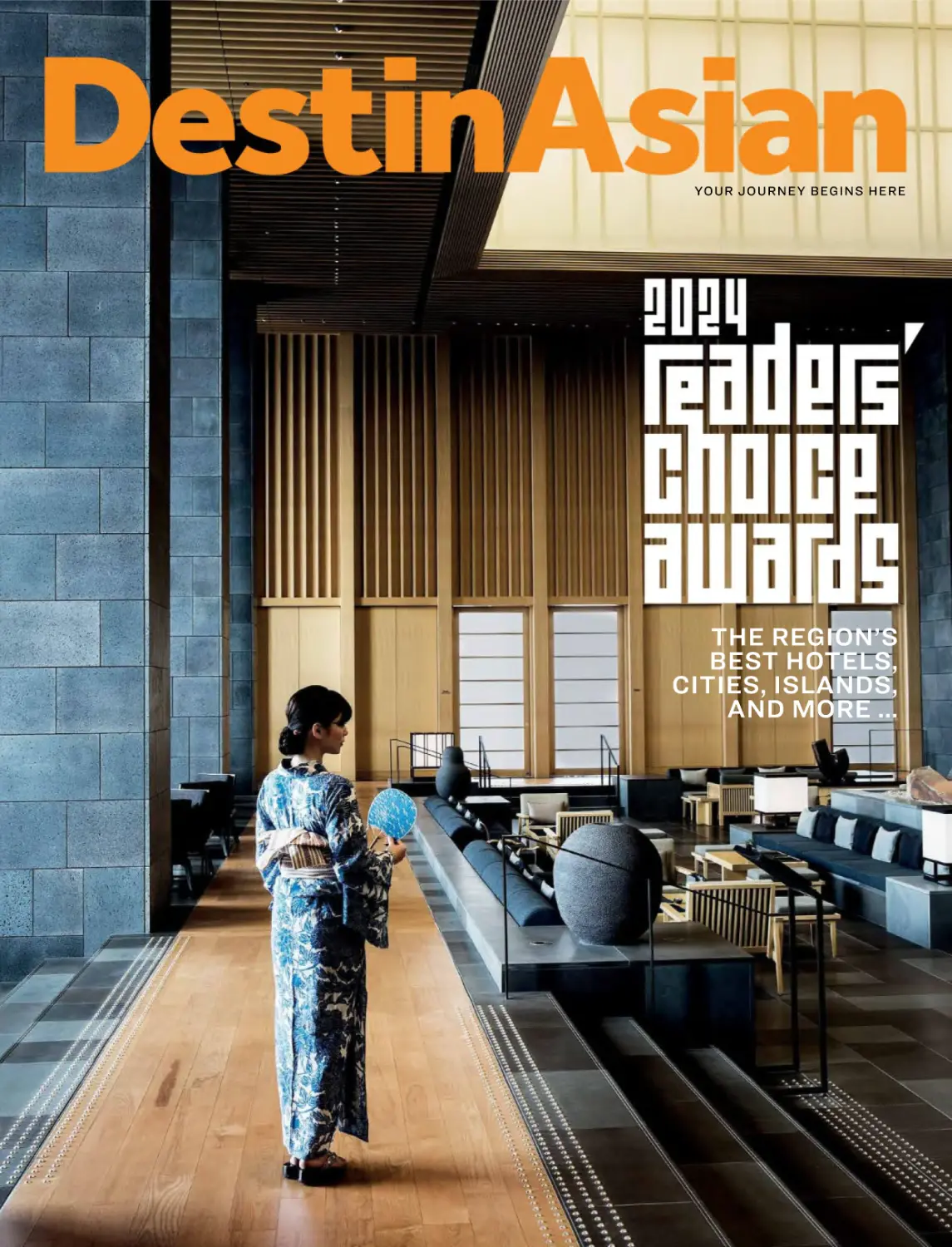
In the 33rd-floor lobby of the Aman Tokyo.
4
DESTINASIAN
Cruising the upper stretches of the
Mekong in Laos aboard a luxurious new
riverboat.
In the hills of central Java, a picturesque
village has emerged as a showcase for
community-based rural tourism.
CLOCKWISE FROM TOP: COURTESY OF 137 PILLARS HOUSE CHIANG MAI; CHRISTOPHER P. HILL;
COURTESY OF BABAE. COVER: COURTESY OF AMAN RESORTS
Our annual roll call of the best in
Asia-Pacific travel.
PUBLISHER’S NOTE
Find me on Instagram @ronaldliem
—Robert Louis Stevenson
RONALD LIEM
publisher@destinasian.com
6
DESTINASIAN
SUNARYO
“THERE ARE NO
FOREIGN LANDS.
IT IS THE TRAVELER
ONLY WHO IS
FOREIGN.”
ometimes on our travels, we encounter hotels that truly
stand out from the pack. They might deliver a winning trifecta of supremely comfortable accommodations, discreet
yet attentive service, and the F&B to match. The memories
of that experience might even last long after the trip. Once a
year, we give the wider public the chance to chime in for our Readers’ Choice
Awards — the full results for its 17th edition are now published within these
pages. If you didn’t get the chance to cast your vote and nominate your favorite
airlines, cruise lines, destinations, and places to stay this time around, there’s
always next time.
Our feature stories this issue will appeal to gourmands and nature-lovers
alike. Ever the adventurous eater, deputy editor James Louie heads to Bali to
check out Ubud’s flourishing restaurant scene, focusing on high-end venues
that champion local ingredients and Balinese culture in surprising ways. His
story is accompanied by beautiful photos from Martin Westlake, who has regularly shot for DestinAsian over the years.
Meanwhile, Tokyo-based contributor James Whitlow
Delano shines the spotlight on a lesser-known but no less
beguiling part of Japan. He meets the craftsmen keeping a
centuries-old boatbuilding tradition alive in the far-flung
Yaeyama Islands, a subtropical realm of powdery beaches,
rain forest, and idyllic villages.
Acclaimed photographer Palani Mohan shares some of
his black-and-white images from a new book documenting
places of stillness and reflection from around the world.
His pictures tell us that, no matter how busy our daily lives
might be, it’s always a good idea to stop and savor quiet moments whether we’re at home or on the road.
Together with his brother, Matt Dutile flew all the way
from New York to Argentina this January to embark on a
once-in-a-lifetime voyage to Antarctica. I was especially
taken by his photos of the jaw-dropping scenery and the
account of his journey aboard the Seabourn Pursuit, an allsuite expedition cruise ship. It proves that even the most
remote and inaccessible parts of the world can be explored
in luxury.
Publisher & Managing Director
Ronald Liem
Editor-In-Chief &
Executive Director
Chairwoman
Christopher P. Hill
Maggie M. Halim
Director
Francisca Liem
Associate Publisher
Director of Operations
Art Director
Deputy Editor
Contributing Editor
Studio Manager
Digital Imaging Artists
Videographers
Video Editor
Senior Production Manager
Production Executive
Web Developers
Gregory Cornelius
Patty Abidin
Arlen Septania Adam
James Louie
Natasha Dragun
Muhamad Haikal
Irfana Thahirah Putri, Febry Ramadhan
Raden Haryo Suryadi, Aditya Wisnu Yaniarso
Leonardo Gotama
Kusdiana
Adi Wijaya
+IS՛VI]1SLEQQEH-LWER1-GLWER4VEQEHM
ADVERTISING SALES
Regional General Manager Sales & Marketing
Account Managers
General Manager Sales (Indonesia)
Advertising Sales Senior Manager (Indonesia)
Advertising Sales Manager (Indonesia)
Advertising Sales (Indonesia)
Sales Support Supervisor
Paolo Avis pavis@destinasian.com
.IWWMGE'LIYRK jessica@destinasian.com
Sharm Sathasivam sharm@destinasian.com
Elvida Nataya Wade enataya@destinasian.com
Dwi Hartanto dhartanto@destinasian.com
Yopi Hadi yopi@destinasian.com
Lord Raditya Basuki rbasuki@destinasian.com
Dervina
MARKETING AND CIRCULATION
Senior Marketing Manager
Marketing Support
C&D Supervisor
C&D Executives
Darwin Chang
Neswa Bintang
Wahyudi
Abadi Atjang
Anwar Musadad
OPERATIONS
F&A Senior Manager
Group Tax Manager
Accounting Manager
Senior Finance Executive
IT Supervisor
IT Support
HR & GA Assistant Manager
Office Manager
Resliana Yosephine
Muhammad Ridwan
Liana Phiong
6(MERE4YVREQE4YXVM
Dwi Adji
Imam Subahtiar
Arie Kusumastuti
Atiet Soeharto
MEDIA REPRESENTATIVES
China: MHI China Ltd. Wendy Lin 86-139/1153-0282, wendylin@mhichina.com
India: RMA Media Faredoon Kuka 91-22/2925-3735, kuka@rmamedia.com
Japan: Shinano International Inc. Satoru Morinaga 81-3/3584-6420, satoru@bunkoh.com
Malaysia: Next Media Jo Shim 60-3/6148-1810, jo_shim@nextmedia.com.my
Thailand: N.J. International Media Co., Ltd. Narumol Wongmas (Kob) 66-62/427-4287; narumol@njintermedia.com
United Arab Emirates: The MediaVantage Manoj Khimji 971-4/425-3300
All rights in this publication and the name are owned by DestinAsian Media Pte. Ltd. and licensed to P.T. Mahapala Mahardhika. No part of this magazine may be reproduced without
permission. All rights reserved. Opinions herein are those of the writers and not necessarily endorsed by P.T. Mahapala Mahardhika. DestinAsian is published five times a year and distributed
throughout Southeast Asia and Hong Kong. The magazine assumes no responsibility for the safekeeping or return of unsolicited manuscripts, photographs, or other material.
DestinAsian is printed on sustainably harvested paper from Finnish tree plantations. Singapore MCI(P)015/08/2023
For subscription inquiries, visit destinasian.com/subscribe or email subscribe@destinasian.com.
Order back issues online at destinasian.com/buy-back-issue. For editorial inquiries, email editor@destinasian.com.
Editorial Office: Menara Batavia, 11th Floor, Jl. KH. Mas Mansyur Kav. 126 Jakarta 10220, Indonesia, 62-21/573-7070
Regional Sales Office: #02-06 Leong Huat Building, 6 Harper Road, Singapore 369674, 65/6536-1895
8
DESTINASIAN
S I A
N
D
129
A
N
T
ES I
NEWS, TRENDS, DISCOVERIES
ART SCENE:
IMMERSIVE ART
COLLECTIVE
TEAMLAB’S NEW
TOKYO MUSEUM
p. 14
p. 12
SAUDI ARABIA HOSTS
ITS FIRST ARABIC
GRAND OPERA
p. 16
SIX AMAZING YOGA
LOCATIONS
p. 18
AN AUSTRALIAN
GOLD RUSH TOWN
GLITTERS AGAIN
p. 22
A NEW WAY TO
EXPLORE RWANDA’S
LAKE KIVU
© TEAMLAB
ALL ASWIRL
Moving Creates
Vortices and Vortices
Create Movement, a
digital installation at
teamLab Borderless
in Azabudai Hills.
M A R C H / M AY 2 0 2 4
11
GOOD TO GO
MAIN EVENT
DIVA IN THE DESERT
British mezzosoprano Sarah
Connolly plays the
title role in the
Saudi opera Zarqa
Al Yamama.
ARIAS FOR ARABIA
R I YA D H
From star-studded film festivals to big-name desert art installations,
Saudi Arabia hasn’t been shy about its
ambitions to establish itself as the Arab
world’s new cultural hub. The latest
item on that agenda? The kingdom’s first
grand opera.
Written by Saudi poet Saleh Zamanan and scored by Australian composer Lee Bradshaw, Zarqa Al Yamama
12
DESTINASIAN
is based on an ancient tale from preIslamic Arabia about a Cassandra-like
woman with blue eyes and the ability
to see the future. Zarqa foresees that a
rival tribe will come to destroy her people, and the story follows her attempts to
warn her skeptical leaders of the danger.
Zamanan has described his libretto as a
blend of historical tragedy and contemporary Arab sorrows, but with a promise
of hope for the future. And with British
mezzo-soprano Sarah Connolly playing
the title role, singing in Arabic no less,
the opera certainly promises to be a key
milestone in Saudi Arabia’s cultural evolution. Staged in the newly refurbished
King Fahad Cultural Centre in Riyadh,
Zarqa Al Yamama will run for a series
of eight performances from April 25 to
May 4. —Christopher P. Hill
STEVE KOZMAN
A groundbreaking opera is set to premiere in the Saudi capital.
GOOD TO GO
ART SCENE
LET’S GET
DIGITAL
LIGHT FANTASTIC
Above: An immersion
in swirling red
lights, Birth is part
of a new series of
light sculptures at
teamlab Borderless
in Tokyo.
14
DESTINASIAN
T O K Y O
Hailed as the world’s first diggital art museum when it opened back in
2018, Tokyo’s teamLab Borderless (team
lab.art) was sorely missed following the
closure of its original Odaiba location
two summers ago. But no longer. In February, the interactive and immersive
experience reopened in the city’s newly
unveiled Azabudai Hills complex, with
7,000 square meters of space that truly
must be seen to be believed.
Curated by the trailblazing Japanbased art collective teamLab, the museum’s 70-plus installations compose a
“world of artworks without boundaries”
in which the digital creations move out
of rooms, merge with other works, and
respond to the viewer’s movements. The
result is an ever-shifting, wildly colorful
environment that invites engagement
and exploration.
Many of the crowd-pleasing installations from the Odaiba site have been
resurrected and refined; others are new.
Among the latter are Bubble Universe, a
mirror-lined room in which reflective
spheres produce a fantastical shimmer
effect; and a series of kinetic light sculptures with names like Birth and Light
Vortex that immerse visitors in a swirling
ballet of multihued light beams set to an
otherworldly soundscape by composer
Hideaki Takahashi. All told, it’s a vivid,
beautiful, and thought-provoking world
that you will want to lose yourself in.
—David Tse
TEAMLAB, BIRTH © TEAMLAB
The Japanese capital’s most Instagrammable
installation spaces are back, and bolder than ever.
Celebrate Mindful Travel,
a Soulful Island
Discover Bali, where paradise meets prestige. Bali has once again
secured its place among the world's elite destinations, achieving
rank 1 (Gold) for Best Island in the 17th annual DestinAsian Readers'
Choice Awards. Garnering prestigious awards in category, Bali stands
DVDEHDFRQRIH[FHOOHQFHLQWUDYHODQGWRXULVPDVLWȇVȴOOHGZLWK
natural landscapes, vibrant culture, and warm hospitality that
are kept for generations. Whether you're drawn to its culture or
VSLULWXDOVDQFWXDULHV%DOLRHUVDWDSHVWU\RIH[SHULHQFHVWKDW
are captivating and inspiring.
Ulun Danu Beratan Temple, Bali
www.indonesia.travel
@wonderfulid
@wonderfulindonesia
Wonderful Indonesia
SUPER
NATURAL
The yoga offerings at
these far-flung resorts
invite you to practice
your downward dog
and warrior pose
against awe-inspiring
backdrops.
ROCK STEADY
A remote desert retreat set amidst the
starkly beautiful canyon country of the
U.S. state of Utah, Amangiri celebrates
its 15th anniversary this year with a raft
of new holistic and integrative wellness
programs. Among them is Yoga on the
Rocks, a one-of-a-kind yoga experience
set high above the valley floor. After a
short hike to the top of a rock formation,
guests will be guided through a personalized movement session surrounded by
360-degree views of the Grand StaircaseEscalante, an immense, rugged national
monument that is especially sublime at
sunrise (aman.com).
SURF’S UP
GO WITH THE FLOW
One of the planet’s largest waterfalls,
Victoria Falls is an immense spectacle —
its more descriptive name in the indigenous Lozi language is Mosi-oa-Tunya, or
“the smoke that thunders.” You can hear
the thunderous cataract clearly from the
riverside deck at The Royal Livingstone
hotel in Zambia, which lies just up from
the falls (a natural source of negative
ions) on the banks of the mighty Zambezi. Here, 60-minute sessions led by
Kerry O’Fee of Victoria Falls Yoga give
ROBERT RIEGER
The beach at Nihi Sumba on Indonesia’s
Sumba Island is as spectacular as they
come: a long sweep of pale sand framed
on one side by lush jungle and on the
other by the epic surf break of Occy’s
Left. It all adds to the spectacular Indian
Ocean views on tap at Nihi’s open-air
yoga pavilion, which sits on a ridge above
the main resort. Daily classes include
kundalini, vinyasa, and lung-expanding
breathwork; guests can also join a trek
or horse ride to an even remoter location down the coast for a day of truly
wild wellness (nihi.com).
16
DESTINASIAN
GOOD TO GO
WELLNESS
you a front-row seat — or rather, mat —
to the longest river in southern Africa
as it approaches the drop. Turn around,
and you’ll likely spot zebras and giraffes
roaming the grounds (anantara.com).
property are guided by resident wellness guru Ratheesh Krishnan, who can
also tailor three-day holistic programs.
Complete the experience with a cleansing ritual in the resort’s Moroccan-style
hammam (qasralsarab.anantara.com).
DUNE SAGA
What better place to tap into your inner
stillness than amid the whispering dunes
of an Arabian desert? At the edge of the
vast Rub’ al Khali (Empty Quarter) in
Abu Dhabi, Qasr Al Sarab Desert Resort
by Anantara caters to sybarites and solace-seekers alike with its grand design
and spellbinding location. Private yoga
sessions in the dunes that surround the
Gevers atop a seven-story zip-line tower
for a sunrise yoga session. After zenning
out to birdsong and wraparound views
of the forest canopy, an exhilarating zipline ride takes you back over a waterfall
to the riverside camp, setting the tone
for more unforgettable adventures to
come (shintamani.com).
CALL OF THE WILD
Of the many reasons to make tracks to
Shinta Mani Wild — the Bill Bensley–
designed luxury tented camp funds conservation efforts in its 350-hectare patch
of wilderness in Cambodia’s Southern
Cardamom Mountains — one is the opportunity to join wellness director Solveig
OM STRETCH
The otherworldly
wilderness of
southern Utah
provides a soulstirring backdrop
to Amangiri’s Yoga
on the Rocks.
MOUNTAIN POSE
Even the most reluctant yogi will swoon
at the pristine scenery surrounding
this next-level wellness retreat on New
Zealand’s South Island. Overlooking the
serene glacial waters of Lake Wakatipu
in the Southern Alps, Aro Hā immerses
you in a program of wilderness hikes,
plant-based meals, wellness workshops,
and twice-daily yoga sessions that put
nature front and center (the nearest
town, Queenstown, is a 45-minute drive
away). In the evenings, convene with
other guests under the stars in the contrast therapy pools and feel at one with
the universe (aro-ha.com). —Judy Chapman
M A R C H / M AY 2 0 2 4
17
RAISING THE BAR
Clockwise from left:
Pouring cocktails
at Grainery Lane;
a prawn cocktail à
la Vesta x Jigs at
Hotel Canberra; the
19th-century facade
of Hotel Vera.
ALL THAT
GLITTERS
A former Australian
gold-mining town is being
reborn as a creative and
gourmet hub.
VICTORIA
It is a city built on riches.
Ballarat was at the center of Australia’s
gold rush, and during those heady days,
thousands of people arrived to seek their
fortune. Many did get rich; in 1856 alone,
close to two million kilograms of gold
were extracted here.
Today, many of the grand buildings
from that era are being repurposed.
Some are in the hands of a new influx of
arrivals, drawn here by the lower cost of
housing. (It helps that Ballarat, which
sits in the Central Highlands of the state
of Victoria, is only 90 minutes from
downtown Melbourne by train or car.)
18
DESTINASIAN
Others are being transformed by longterm residents, energized by this wave
of fresh inspiration.
Among the people who’ve long established Ballarat as their home are David
Cook-Doulton and Martin Shew, the
owners of Hotel Vera (hotelballarat.com
.au; from US$195 a night). The pair have
transformed a former doctor’s surgery
and residence, built in 1893, into seven
luxurious suites, each with its own bold
color scheme and pieces of contemporary art. “We’ve preserved the heritage
elements of the building and inserted a
modern aesthetic through the decor,”
Cook-Doulton says.
Downstairs at Babae, chef Tim Foster
and his small team create eight courses
of wonder, with much of the produce
harvested from his own farm. On my
January visit, the seasonal tasting menu
includes a delicate steamed pea custard
with zucchini flower tempura, and brined
and roasted duck breast with a confit-leg
dumpling, pureed eggplant, and pickled
cherries.
After months of searching for the
perfect country pub, Melburnians Pete
Dillon and his chef-partner Jigs Liwanag
happened across Hotel Canberra (hotel
canberra.au; from US$145 a night). “It
chose us really,” says Dillon of the 19thcentury establishment. They stripped
it back to reveal art deco detailing and
launched in stages as they renovated.
Now, there’s a popular café in the old
stables, a bar, accommodation, and finedining restaurant Vesta x Jigs, where the
degustation menu changes every couple
of weeks.
Ballarat’s distillers are making waves
too. Next to the old train station inside
a smartly converted bluestone freight
depot called The Goods Shed, Itinerant
Spirits (itinerantspirits.com) turns out
vodka, gin, and whisky (although the
latter is still a couple of years off ) from
grains sourced solely from western Victoria. The botanicals used in its citrusy
Gallivanter Gin include roasted wattle
seed and lemon drop waxflower from
the Grampians Range to the west. No
expense has been spared fitting out the
tasting room, where you can sample
flights, cocktails, local beers and wines,
and sharing plates.
COURTESY OF HOTEL VERA; COURTESY OF GRAINERY LANE; COURTESY OF HOTEL CANBERRA
GOOD TO GO
NEXT STOP
GOOD TO GO
NEXT STOP
Clockwise
from left: Beef
tenderloin with
truffled potato
and bordelaise
sauce at Black
Cat Truffles;
main street
Ballarat; one of
the seven suites
at Hotel Vera.
Speaking of expensive interiors, local hospitality veteran Brian Taylor has
long been fascinated by the saloon bars
of the American West. While he was
building his distillery and cocktail bar
Grainery Lane (grainerylane.com.au), he
decided it needed one. Taylor eventually tracked down an antique triple-arch
Brunswick back bar and had it shipped
from Chicago, alongside another singlearch bar. Hand-carved from mahogany,
they are the jewels in this venue’s crown.
“The only ones in Australia,” Taylor tells
me proudly. Admire them while sipping
an Apple Pie (green apple gin, butter,
lemon juice, homemade tropical syrup,
20
DESTINASIAN
cinnamon, star anise, and vegan foam)
from the bar’s extensive list.
In 2022, chef Liam Downes was juggling five restaurants in Ballarat. But
with two young sons and a wife who’d
worked as a nurse during Covid, he knew
it was time to reevaluate things. So last
year, he dropped it all and took over
the management of Black Cat Truffles
(blackcattruffles.au), an eight-hectare
truffle farm with 1,200 French and English oak trees. Guests can join summer
or winter truffle hunts, where a morning
forage with Downes and Dot, his Gordon
setter–cocker spaniel cross, is followed
by a six-course meal in the shade of a
black walnut tree. Dishes might include
beetroot carpaccio with bone marrow
and truffle, and beef tenderloin with
truffled potato and bordelaise.
Another of Ballarat’s most exciting
launches has nothing to do with food.
The Centre for Rare Arts and Forgotten
Trades (raretradescentre.com.au) offers
weekend workshops in trades and crafts
as diverse as armory, traditional signwriting, and dry-stone walling.
“In the first 12 months, we delivered
workshops to over 700 participants, 70
percent of whom came from outside the
region,” says general manager Erin Santamaria. The plan, however, is to expand
the offering and support resident artists.
If you’ve ever wanted to keep the
skill of plaiting leather or spinning wool
alive, then Ballarat is the right place for
you. —Carrie Hutchinson
MATT DUNNE (2); COURTESY OF BLACK CAT TRUFFLES
FARM FRESH
ADVERTISEMENT
SOARING HIGH
A global leader in the aviation sector, Singapore Airlines is committed to delivering
a world-class travel experience for its customers.
REGULARLY HAILED AS the world’s best airline, Singapore Airlines
(SIA) has established itself as a leading carrier through its
commitment to delivering a superior flying experience that goes
well beyond simply transporting customers from one destination to
another.
Service excellence is at the core of Singapore Airlines’ success.
The airline is renowned for its impeccable customer service, setting
the gold standard for the industry. From the moment they step on
board, customers are greeted by the airline’s cabin crew with heartfelt
hospitality and a dedication to ensuring a comfortable journey.
Culinary craftsmanship is another of the airline’s hallmarks, with
delectable meals served across all classes.
Product leadership is another pillar of SIA’s success. The airline
has consistently invested in technology, newer aircraft, and luxurious
amenities to provide customers with a premium travel experience.
This commitment is exemplified by SIA rolling out the airline industry’s
most comprehensive unlimited free Wi-Fi plan to customers across all
cabin classes. With SIA, you will be flying on one of the most modern
aircraft and fuel-efficient fleets. Sustainability is another key priority
for the airline, which is committed to achieving net zero carbon
emissions by 2050, reducing waste across its operations, and making
a positive impact on society.
Beyond its focus on service excellence and product leadership,
Singapore Airlines boasts an extensive and well-connected flight
network that enables customers to seamlessly travel to a myriad of
destinations worldwide. SIA’s strategic alliances and partnerships
with other leading carriers further enhance its comprehensive range
of options and convenient connections. No wonder the airline
continues to amass accolades from the industry’s most respected
organizations, including World’s Best Airline at the 2023 Skytrax
World Airline Awards, Best Cabin Staff at the Business Traveller
Awards 2023, inclusion in Fortune magazine’s latest Top 50 World’s
Most Admired Companies list, and — for 17 years running — Asia
Pacific’s Best Airline in the DestinAsian Readers’ Choice Awards.
To learn more about how Singapore Airlines remains the benchmark for superior service and
committed to its sustainability goals, visit singaporeair.com.
GOOD TO GO
WISH LIST
LAKE KIVU
Rwanda’s calling card may
be the mountain gorilla, but its attractions don’t stop there. Take Lake Kivu,
which Rwanda shares with the Democratic Republic of the Congo. Situated
in the Albertine Rift Valley, one of the
most biodiverse regions of Africa, this
vast blue expanse — 90 kilometers long
and more than half that distance wide —
is known for its clear swimmable waters,
beautiful islands, and pleasant beach
resorts. Now, travelers can also stay on
AFRICAN QUEEN
cabin, solar-powered vessel operated by
the South Africa–based Mantis Group.
Complete with an onboard swimming
pool and cocktail bar, it’s billed as the
first motorized yacht to sail Lake Kivu,
with two- and three-night cruise itineraries between Gisenyi in the north
and Nyamasheke in the south that include guided hikes, bird-watching, and
insights into Rwandan village life. Who
needs gorillas? —David Tse
COURTESY OF MANTIS KIVU QUEEN UBURANGA
Voyage along one of the continent’s great
waterways aboard a stylish new lake cruiser.
DECKED OUT
The Mantis Kivu
Queen offers a
new way to soak
up Lake Kivu.
the lake aboard the Mantis Kivu Queen
uBuranga (mantiscollection.com), a 10-
22
DESTINASIAN
With every harvest
new memories are planted.
&HQL]DUR+RWHOV 5HVRUWV
%LQWDQ_'RX]_0DOGLYHV_0DUUDNHFK_0DXULWLXV_7XQLV_=DQ]LEDU
FHQL]DURFRP
Featuring new destination
guides to select dining,
nightlife, hotels, and
attractions in Bali, Bangkok,
Hong Kong, Jakarta, Kuala
Lumpur, Kyoto, and Singapore.
DestinAsian.com
S I A
N
D
129
A
N
T
ES I
S T O R I E S T O I N S P I R E YO U R WA N D E R L U S T
Ode to An
Island
Smack in the middle of Thailand’s
Phang Nga Bay, the new Anantara
Koh Yao Yai beckons you to leave
the world behind.
by Christopher P. Hill
WATER WORLD
Stepping stones lead
from the Anantara
Koh Yao Yai’s
hydrotherapy pool.
P H O T O G R A P H S B Y C H R I S T O P H E R P. H I L L
M A R C H / M AY 2 0 2 4
25
DISPATCHES
THAILAND
o, monkeys can swim.
Did I know this? Not sure. But it’s a
fact that becomes alarmingly clear when
I spot a troop of crab-eating macaques
dive into the water from the shores of a
rocky islet and paddle furiously out to
sea. Their objective is another longtail
boat that has dropped anchor not far from ours. It’s
crowded with day-trippers from Krabi who have
come armed with bananas to coax the monkeys into
this display of aquatic athleticism. While most of
the troop is content to bob at the boat’s bow to await
their reward, its more piratical members try to
climb aboard. They are shooed away by the boatman, clearly no stranger to their antics.
The allure of southern Thailand’s Phang Nga Bay
is hardly a secret. A seascape of emerald waters and
towering limestone karsts, the bay is framed by the
resort-studded shores of Phuket to the west
and Krabi to the east, ensuring a steady flow
HIGH STYLE
of tourist boats that hop between busy coves
Clockwise from
above: The rooftop
and beaches throughout the day. At popular
pool deck of one of
Hong Island, the floating jetty seems ready
Anantara Koh Yao
to buckle under the weight of visitors; later,
Yai’s Penthouse
suites; catch of
at a “secret” snorkeling spot, I can barely
the day in Phru Nai
swim for all the boats in the water. No
village; exploring the
wonder the monkeys are so feisty. How nice,
island by sidecar.
26
DESTINASIAN
THE PLACE TO BE
The world is yours to explore. Across Thailand, Laos,
the Maldives, Vietnam, Sri Lanka, the Middle East or Japan,
find a place where you truly belong. This is the essence of
Centara Hotels & Resorts. Whether you are planning a family
beach holiday, an immersive cultural experience or an exciting
urban escape, Centara’s signature hospitality, warm Thai family
values and world-class service will be at the heart of your stay
anywhere in the world.
MEMBERS ENJOY 15% OFF & MORE
If you’re not yet a member,
sign up for free today
SCAN NOW AND EXPLORE
OUR EXCLUSIVE OFFERS
Centara Grand Island Resort & Spa Maldives
BOOK DIRECT ON OUR WEBSITE FOR BEST PRICE PROMISE, DINING DISCOUNTS & MORE
centarahotelsresorts.com
ccc@chr.co.th
DISPATCHES
THAILAND
then, to have a more secluded shore to retreat to
once our excursion is done.
Low-key and a little rugged, the bay’s largest
island, Koh Yao Yai, sits midway between Phuket
and Krabi, yet has somehow remained aloof from
the throngs that surround it. It’s a long sliver of
wooded hills quilted in rubber farms and coconut
groves, with quiet concrete roads linking a handful
of villages where most of the island’s 8,000 predominantly Muslim inhabitants live. There are a few
independent resorts scattered around the island’s
perimeter, but not enough to impart much of a touristy vibe. And I wouldn’t expect that to change even
with the addition of the 148-room Anantara Koh
during my December visit) arranged around an
artificial lagoon — ideal for those willing to forego
sea views in favor of seclusion. Then there’s a trio of
low-rise buildings that form a sort of family zone,
complete with waterslides, an impressive kids club,
and family-friendly suites with built-in bunk beds,
play areas, and, for those on the ground floor, direct
pool access. Finally, overlooking a kilometer-long
stretch of golden sand, is the main part of the resort, a half-moon of terraced lawns, lush tropical
gardens, grassy hummocks, and more pools. Those
hummocks are in fact the roofs of eight beachfront
villas, a concept inspired by the grass-roofed hobbit
holes that so enamored the owner on an earlier trip
Yao Yai Resort & Villas, which opened on an eastern
corner of the island last October.
Resort? This 11-hectare property is more like its
own little world, with a thick swath of palm trees (a
remnant of the site’s original coconut plantation)
on one side and a forested hill on the other that
leads down to a private pier, where a small fleet of
speedboats transports guests to and from Phuket
or Krabi. You could spend a few days here without
even stepping out onto Koh Yao Yai proper, though
there are plenty of opportunities to do that too.
The Anantara is really three resorts in one.
Tucked away from the beachfront, there’s a clutch
of standalone pool villas (still under construction
to New Zealand’s Hobbiton Movie Set. You’d hardly
know they were there, which is exactly the point.
Tucked away from prying eyes, they’re well suited
for romance-seekers, though a two-bedroom unit
gives families another option as well.
But if it’s views you want, consider one of the
Penthouses that crown the top floors of the four
main guest wings. Done up in the same crisp, contemporary design as the rest of the rooms, these
two-level accommodations come with a breezy
rooftop cabana and infinity pool from which you can
take in a great sweep of Phang Nga Bay and the Krabi
coast, not to mention Bird’s Nest Island, a sheersided outcrop that juts from the shallow channel
28
DESTINASIAN
ISLAND IMMERSION
Above, from left:
One of the guest
wings at Anantara
Koh Yao Yai; Thaistyle roasted sea
bass in banana
leaves at Pakarang
restaurant; walking
the resort’s beach
at sunset; a local
fisherwoman;
the bedroom of a
Penthouse suite.
just offshore. They also, like the villas, include the
services of a butler. Attending to me is a young
woman named Summer, whose sunny disposition
neatly epitomizes the air of friendly ease conveyed
by the rest of the staff. One dark and stormy night,
when the swim trunks I left out to dry are blown
away, Summer somehow manages to find them in
the garden and return them to my room before I’m
back from dinner. “Soaked but safe now,” she messages me. I’m not sure if she’s referring to herself or
the trunks, but I’m grateful either way.
Nor does the food at the Anantara fail to impress.
Glass-encased Thai restaurant Pakarang, which
hosts bounteous breakfast buffets each morning,
much the entire length of the 30-kilometer-long island, from the curling sand spit of Laem Had Beach
in the north to the stilted fishing village of Phru Nai
in the south. Along the way, we stop to watch farmers collect sap from their rubber trees, trek a forest
trail, visit a batik studio, and tour a roadside rubber
workshop where sheets of latex are hung in the sun
to dry like so much laundry. Another morning, I go
kayaking in a stretch of mangroves on the island’s
west coast. The boats are owned by a village cooperative, and my local guide knows these wetlands like
the back of his hand. Good thing, too, as we’re soon
deep into a labyrinth of jungly channels, ears alert
for the call of the hornbills that nest in the area.
serves dishes from across Thailand come lunch and
dinner: Isan-style grilled pork neck, say, or gaeng
poo, a creamy yellow crab curry with rice vermicelli
and betel leaf. Down at the thatch-roofed Beach
Restaurant, a more globe-trotting menu features
everything from poke bowls and amêijoas à bulhão
pato (clams in white wine sauce) to grilled seafood,
dry-aged steaks, and wood-fired pizzas, all ably executed. There’s also a Japanese chef’s table for more
intimate evening meals.
Activities here run the gamut from deep-sea
fishing to cycling trips, hiking, and sunset cruises.
The day after my island-hopping boat excursion, I
sign up for a sidecar tour. The ride takes in pretty
If this sounds like too much exertion for an island holiday, fear not: the Anantara is equally adept
at lulling guests into utter relaxation. The spa, for
one, is a knockout, with a sexy outdoor hydrotherapy pool and a Moroccan-style hammam. I opt for
an unfussy Thai acupressure massage and feel my
muscles slacken almost immediately. Later, as the
evening sky turns pink, I head up to my Penthouse’s
rooftop terrace once again to admire the views over
a gin and tonic. Unable to resist the siren call of my
infinity pool a moment longer, I do what the monkeys do and dive right in.
anantara.com; from US$350 a night
M A R C H / M AY 2 0 2 4
29
DISPATCHES
INDIA
At Home in the
Himalayas
A bold new restaurant explores the flavors and
food cultures of India’s mountainous north.
by Jasreen Mayal Khanna
HIGHER CALLING
Above: Chef Prateek
Sadhu outside Naar.
Top: Grilled skewers
of marinated chicken
heart and liver.
30
DESTINASIAN
igh in the foothills of Himachal Pradesh,
I stand on a terraced hillside cloaked in
wild grasses and pine trees. The only
sound is birdsong and the whisper of
the cool mountain breeze through the
trees. From this perch at 1,460 meters
above sea level, the views stretch east
across a broad valley framed by the distant peaks
of the Western Himalayas. I’m at Amaya, a sustainable boutique hotel near the tiny village of Darwa,
and I can’t remember the last time I visited such an
utterly peaceful setting. Nor, for that matter, can
I think of a better spot for what is being hailed as
India’s most exciting new destination restaurant.
Naar, as it is called — the name means “fire” in
Kashmiri — is the brainchild of Prateek Sadhu, a
Kashmir-born chef who up until a couple of years
ago helmed the hottest table in Mumbai, Masque.
With its 2016 debut inside a former textile mill,
Masque quickly made a name for itself thanks to
avant-garde tasting menus that showcased Sadhu’s
passion for foraged wild ingredients like Ladakhi
sea buckthorn. A string of accolades followed. Then,
at the height of the restaurant’s popularity, Sadhu
and Masque parted company, leaving people wondering where his next culinary journey would take
him. Last year, we found out.
“I knew that whatever I did next had to have
very strong meaning and purpose,” Sadhu tells me
when we meet at Naar, which occupies its own pinestudded patch at the edge of Amaya’s eight-hectare
grounds. “It was while I was doing a pop-up in Leh
[in Ladakh] in 2022 that I first met Deepak Gupta,
the owner of Amaya, who flew over just to eat my
food. He told me about his new resort and I visited
for a small break. I had no plans to open a restaurant
then, but after that first visit, I just kept coming
back because I fell in love with this place.”
It’s easy to see why. Tucked into a private forest,
Amaya fully embraces its sylvan setting. Mumbaibased architect Bijoy Jain designed its clutch of
copper-roofed villas and chalets — there are just 15
rooms in all — to complement the landscape, utilizing local building materials like brick, stone, and
lime plaster. The stylishly minimal interiors channel a Nordic/Japanese aesthetic. Further along the
ridge is a lovely teardrop-shaped swimming pool
and the hotel’s own farm-to-table restaurant. After
a decadent dinner of pasta, Assamese-style smoked
pork with black sesame sauce, and apple pie the previous evening, I fell asleep in my cozy bed (grateful
for its electric blanket) watching for shooting stars
through the open window.
“Moving from Mumbai to the mountains has
been a homecoming,” Sadhu says as we pet Imli,
P H OTO G R A P H S B Y PA N KA J A N A N D
H E R I TA G E L U X U R Y A N D E L E G A N C E
From heritage to contemporary luxury, 137 Pillars Hotels & Resorts continues to offer guests the opportunity to
experience the splendour of Thailand’s most iconic capitals through two distinct experiences. Enjoy modern
contemporary luxury in Bangkok and discover our rich cultural heritage during your visit to Chiang Mai.
Bangkok | Chiang Mai
www.137pillarshotels.com
DISPATCHES
INDIA
the mountain dog adopted by Naar’s team. “I was
born in the Himalayas and they are so giant that
they make me feel really grounded. I’m just a dot
in front of them.” Still, the prospect of opening a
high-end restaurant in such a remote location — the
nearest city is Chandigarh, a two-and-a-half-hour
drive away — wasn’t without risks.
“I worried about who was going to come all the
way here to eat,” the 37-year-old chef recalls. “But
in the end, I just said to myself: You have your knees
and a straight back now, who knows what’s going
to happen in 10 years? And when I called my family
and partners to tell them that I wanted to open a
restaurant in Himachal, they all said, ‘Go ahead,
we are with you.’” My visit comes just a week after
Naar’s late-November opening.
That evening, I walk back to the restaurant from
my room at Amaya. Set at the end of a winding forest
path, Naar comprises two salmon-pink limestone
cottages, one of which is a lounge where patrons
commence their three-hour dining experience with
cocktails and canapés.
“Our ethos is about celebrating the Himalayas,”
Sadhu says when he brings me a thick Kashmiri
shawl to stave off the chill of the lounge’s outdoor
terrace. “And it is really important that we are situated in the mountains, not in Mumbai or New Delhi
but in Himachal, to tell the story of this region.”
The chef and his team have traveled all over
the Indian Himalayas to research local food cultures, from Arunachal Pradesh in the northeast
through Himachal Pradesh and up into Kashmir
and Ladakh. They discovered commonalities such
as nose-to-tail cooking and preservation methods
such as fermentation, pickling, and drying, as well
ALL IN GOOD TASTE
Clockwise from
left: A photo of a
Kashmiri morel
hangs in the
lounge at Naar;
the restaurant’s
16-seat dining room
is unassuming
yet sophisticated;
flaking smoked
trout for the menu’s
three-part “trout
flight” course.
32
DESTINASIAN
ADVERTISEMENT
Mountain Magic with Club Med
The leading name in upscale, all-inclusive mountain vacations redefines luxury on the slopes.
IF YOU STILL ASSOCIATE Club Med
with just sun and sand, think again: this
seven-decade-old French holiday brand is
also renowned for its ski resorts, with 22
luxe properties in the mountains of France,
Italy, Switzerland, Canada, Japan, and China.
Better still, they’re all-inclusive, giving guests
a chance to rediscover the magic of winter,
minus all the hassles and uncertainties.
At Club Med, everything is taken care of for
greater peace of mind. From ski lift tickets and
gourmet meals to exhilarating activities, stylish
accommodations, and kids’ clubs packed with
adventure that inspire, every detail is taken
care of, leaving one free to focus on creating
memories that will last a lifetime. All that is
needed is to allow Club Med’s friendly team of
G.O.s (Gracious Organizers) to meticulously
plan all the details to ensure a stress-free
holiday experience.
And for the ultimate indulgence, there’s
the Exclusive Collection, Club Med’s topend portfolio of accommodations. Complete
with a dedicated concierge service, a more
intimate atmosphere, and even more perks,
they promise an elevated stay for families and
couples alike.
So start planning your next snow vacation
today. To get you started, here are just a
few Club Med ski resorts that have brought
the brand’s all-inclusive appeal and spirited
vibe to some of the most breathtaking winter
destinations on the planet.
CLUB MED VAL D’ISÈRE
The only Club Med Exclusive Collection
resort in the French Alps, Club Med Val d’Isère
is nestled in the upper reaches of the beautiful
Tarentaise Valley. Linked to neighboring
Tignes, this is one of the biggest ski areas
in France, with over 300 kilometers of varied
terrain suitable for skiers and snowboarders
of all levels. Off the slopes, the timber-clad
resort treats guests to delectable dining, a
lively après-ski scene, and a host of wellness
offerings, including a Yoga by Heberson studio.
CLUB MED VALMOREL CHALETAPARTMENTS
Also in the French Alps, on the slopes of the
Massif Du Cheval Noir, the duplex and triplex
apartments adjoining Club Med Valmorel are
all about Savoyard charm. Guests can look
forward to authentic architecture and
breathtaking views of Mont-Blanc, as well as
the services of a personal butler and unlimited
access to the rest of the resort.
CLUB MED KIRORO GRAND AND
KIRORO PEAK
Winter wonderlands don’t come any more
magical than this. Nestled in the heart of
For more information, visit clubmed.com
Japan’s northernmost main island, Hokkaido,
the Kiroro region is renowned for its recordbreaking 21-meter snowfall and an extended
160-day winter. Here, two resorts make
for one unforgettable escape: Club Med
Kiroro Grand, a vibrant hub for families and
thrill-seekers; and Club Med Kiroro Peak, the
first Club Med Exclusive Collection located
in the Asian mountains and a haven of alpine
luxury pulsating with a lively energy. Just a
three-minute gondola ride apart, both resorts
offer ski-in, ski-out access to 23 ski runs,
premium accommodations that seamlessly
blend comfort and elegance, gourmet dining
options celebrating the best of local flavors and
international cuisine, après-ski celebrations that
stretch into starlit nights, and holistic wellness
facilities for the ultimate relaxation.
CLUB MED CHANGBAISHAN
Situated amid the natural beauty of the
UNESCO-protected Changbaishan Biosphere
Reserve in the northeastern Chinese
province of Jilin, this charming resort boasts
top-class ski facilities and 32 hectares of
snow-covered slopes and trails. After carving
some tracks, guests can enjoy the benefits of
a traditional Chinese herbal bath or soak in
the mineral-infused waters of the indoor hot
spring. Dining is also a delight, highlighted by
Manchurian and Korean specialties.
DISPATCHES
INDIA
FERTILE GROUND
Right: A stone
path connects
Naar’s lounge and
dining room.
as wood-fire cooking. Accordingly, Sadhu operates
a zero-waste kitchen backed by Amaya’s horticulturist-run farm and a food lab where they are constantly experimenting with Himalayan flavors. And
true to its name, 90 percent of the dishes served at
Naar are cooked over a wood fire.
After a divine-smelling Gondhoraj lemon gimlet
and a sesame bun stuffed with yak cheese (this is
Sadhu’s take on askalu, a village snack that he ate on
his very first visit to Himachal Pradesh), I stroll up
to the simply furnished dining room to continue the
15-course tasting menu, which will change with the
seasons.
First comes delicate slices of salted smoked lamb
on a crisp bichubutti (stinging nettle) leaf; you can
see, taste, and smell the mountains in every bite.
This is followed by morsels of chicken heart and
liver that have been marinated in pickled chili and
mustard and grilled on pine stems. Then there’s a
“trout flight,” which sees the fish served three ways:
as smoked flakes served on patande (a sweet Himachali pancake) with cured fish sauce and applepeel butter; poached in chili and trout fat; and as a
flavorsome broth made from trimmings. It’s gutsy,
original, and delicious — a celebration of a quintessentially Himalayan fish from head to tail.
There are many more highlights to come —
brined pork accompanied by bamboo shoot pickles
34
DESTINASIAN
and hemp-seed chutney; chutagi (a Ladakhi buckwheat pasta) with yak cheese “fondue” — but the
pièce de résistance is lamb smoked on juniper and
served with meaty lion’s mane mushroom and a
Kashmiri yakhni (yogurt) sauce. Nor does dessert
fail to impress. A sweet homage to the surrounding
woodland, it’s called Pine Pine Pine: pine-nut ice
cream drizzled with pine salt and fermented pine
syrup, presented alongside a crunchy pastry filled
with Himalayan lemon cream. This is destination
dining unlike anything India has seen before, at
least not at this level of purity and intention.
“We’ve assembled a wonderful team and they’re
all here because they want to make a difference,”
Sadhu tells me the next day. Earlier that morning,
he met with his staff for their first briefing before
everyone dispersed to complete their tasks. Some
are now gathering produce from the farm; others
are prepping the evening’s mise en place. Sadhu
himself has a meeting lined up with his firewood
vendor. Later, they’ll all regroup to discuss who’s
coming to dinner — guests are flying in from Mumbai and Bangalore — and pluck flowers for garnishes
right before the restaurant opens at 6:30 p.m.
“Our goal is to put India on the global map of dining experiences,” Sadhu says. It’s a lofty ambition.
But then, here at this remarkable venture high in
the Himalayan foothills, anything seems possible.
Head to
the Hills
Seasonal tasting
menus at Naar
(restaurantnaar
.com), which is
now open for lunch
as well as dinner,
are priced at
about US$78 for a
15-course tasting
menu, alcohol
not included.
Full-board room
rates at Amaya
(theamayalife.com)
begin at US$360.
Moved by
the Mekong
Cruising the upper stretches of Laos’s
Mother River, the 10-cabin Anouvong
provides a luxurious new way to explore
the waterway’s remote landscapes
and communities.
he baby stumbles, snorts, and sticks her
face into the mud. She’s still finding her
feet. Thankfully, her mother is there to
lead the way along the narrow path that
cuts through a forest of teak and bamboo.
Moments later, we watch transfixed as
the 13-month-old elephant calf ambles
down the slope into a bathing pool, splashing and
spraying herself in the loamy brown water.
We’re visiting the Mekong Elephant Park in the
mountains of northern Laos. Situated across from
the village of Pakbeng, the 40-hectare sanctuary
is one of the first stops on our three-night journey
aboard the Anouvong, a handsome new riverboat
launched in October by Ho Chi Minh City–based
cruise company Heritage Line. Our 300-kilometer
route is taking us from Huay Xai near the Thai–Laos
border to the UNESCO-protected temple town of
Luang Prabang, with interesting shore excursions
like this providing a glimpse of life along the Upper
Mekong.
“Laos was once known as the Kingdom of a
Million Elephants,” says Damien Senaux, a French
36
DESTINASIAN
COURTESY OF HERITAGE LINE
by Claire Boobbyer
STATE OF FLOW
The Anouvong on
a stretch of the
Upper Mekong
in Laos. Top left:
One of the boat’s
staff members.
DISPATCHES
LAOS
M A R C H / M AY 2 0 2 4
37
TWILIGHT SAGA
Above, from left:
Canopied loungers
on the Anouvong’s
sundeck provide
the perfect perch
for watching
twilight descend
over the Mekong;
a ceramic mosaic
in the boat’s Nam
Khan suite, which
takes its name from
one of the river’s
major tributaries.
38
DESTINASIAN
volunteer at the park. “Of course, there were never
that many, but you can imagine the importance of
the elephant here.”
The future of these majestic creatures hangs in
the balance. Just 300 elephants remain in the wilds
of Laos, with another 400 in captivity, the latter
mostly rescued from outlawed logging camps. The
Mekong Elephant Park itself is home to six pachyderms, including Boua (“Lotus Flower”), the baby
that so completely charms us.
“Elephants eat for 18 hours a day,” Senaux says as
we watch them tear at branches. “That amounts to
about 10 percent of their body weight!”
“Sounds like us on the boat,” quips one of my
fellow passengers.
Throughout the cruise, our group of Russians,
Brits, Americans, and Canadians are treated to
prodigious breakfast buffets and four-course meals
— pomelo salad with shrimp, delicious tilapia marinated in turmeric and wrapped in banana leaf, green
chicken curry and Lao sausage — in the Anouvong’s
teak-floored dining room. The latter is named after
Louis Delaporte, a French artist and archeologist
who ventured up this river on the Mekong Exploration Commission of 1866. Over the course of two
years, the expedition mapped the Mekong from its
vast delta in southern Vietnam to the highlands
of Yunnan, initially hoping that Southeast Asia’s
greatest river could be used by the French as a trade
route to China. But those dreams were dashed near
the Laos–Cambodia border, where the Li Phi Falls
proved totally unnavigable.
Li phi means “fish trap of spirits,” in accordance
with the ancient belief that the spirits of those who
drown in the river are stuck there. Laos has been
a predominantly Buddhist country since the 14th
century, but animistic elements persist. On the first
day of the cruise, our group was welcomed with a
baci ceremony organized by a village of Tai Lue, one
of dozens of ethnic minorities inhabiting northern
Laos. It was an intricate ritual — all candles, marigolds, and white cotton bracelets — during which a
shaman invited the 32 kwan (spirits) that inhabit
the body to return to us, thus restoring harmony
and invoking luck and prosperity.
Harmony is a hallmark of the Anouvong. Built in
northern Laos and named for the last king of Vientiane, the beautiful ocher-hued vessel has just 10
cabins, which creates a lovely intimacy. Near the
bow, a double staircase leads up to a sundeck where
CLAIRE BOOBBYER
DISPATCHES
LAOS
ADVERTISEMENT
GOING
FURTHER
Asia Pacific’s definitive event for luxury
travel is a whirlwind of enlightenment and
inspired connection.
An innovative “barefoot”
travel show curated by This is
Beyond, Further East returned
to the shores of Seminyak,
Bali, for its fourth edition in
November. As with previous
LWHUDWLRQVWKHIRXUGD\DNjDLU
focused exclusively on Asia3DFLnjFWUDYHOEULQJLQJWRJHWKHU
some 160 APAC-based
brands and destinations,
JOREDOEX\HUVDQGUHODWHG
media to drive business and
LQQRYDWLRQLQWKHUHJLRQţ7KH
ZKROHHYHQWLVGHVLJQHGWR
JHWSHRSOHWDONLQJLPPHUVLQJ
them in experiences they’ll
QHYHUIRUJHWŤVD\V7KLVLV
Beyond CEO and founder
6HUJH'LYHţ7KHYLEHLV
unique and the focus never
strays from what’s next for the
future of luxury travel.”
(SLWRPL]LQJ)XUWKHU
(DVWšVIRUZDUGWKLQNLQJ
ethos was its Open House
“unconference,” which kicked
WKLQJVRNjRQWKHDIWHUQRRQ
of November 6. Hosted at
Potato Head Beach Club, the
VSLULWHGDOIUHVFRJDWKHULQJZDV
FHQWHUHGRQWKUHHVWDJHVRI
LQVLJKWIXOFRQWHQWSUHVHQWHG
by both hospitality innovators
DQGIDVFLQDWLQJPLQGVIURP
outside the industry.
7KH,QVSLUHVWDJH
welcomed visionaries
LQFOXGLQJ'HVD3RWDWR+HDGšV
Ronald Akili as well as a panel
GLVFXVVLRQOHGE\'HVLJQ
Hotels that explored the
DUWRIţ&UHDWLQJ6SDFHVIRU
6SLULWXDODQG3K\VLFDO+HDOLQJŤ
Also on hand was W Hotels’
VHQLRUGLUHFWRURIJOREDOEUDQG
PDUNHWLQJ&DUO\9DQ6LFNOH
who discussed the impact
RIWUDYHOLQǍXHQFHUVRQWKH
industry and how businesses
can best collaborate with and
EHQHnjWIURPVRFLDOPHGLD
LQǍXHQFHUV
7KH6SDUNVWDJH
OLNHZLVHEURXJKWWRJHWKHU
JDPHFKDQJHUVWRLJQLWH
transformational discussions
about innovation and explore
fresh perspectives. Speakers
LQFOXGHG6DQMD\&KRHJ\DO
principal of Advant Labs, who
presented a case study on
how hotel marketers can tap
LQWRWKHJURZLQJSRZHURI$,WR
JHQHUDWHGLUHFWERRNLQJV
/DVWO\WKH3URJUHVVVWDJH
VDZ9LFHUR\%DOLšV0DWW%UD]LHU
led a discussion about how
partnerships can elevate
WKHJXHVWH[SHULHQFHZKLOH
Paul Hicks, the founder and
&(2RIOHDGLQJUHJLRQDO35
DJHQF\*+&$VLDFRPSªUHG
a “Reverse Press Conference”
LQZKLFKGHOHJDWHVWXUQHGWKH
tables and asked questions to
a select panel of media.
:UDSSLQJXSZLWKDQ
HYHQLQJFRFNWDLOSDUW\)XUWKHU
East’s Open House was the
perfect prelude to three days
RIDSSRLQWPHQWVQHWZRUNLQJ
EUHDNVFXOWXUDOSURJUDPVDQG
soirees that placed attendees
DWWKHOHDGLQJHGJHRIKLJK
HQGWUDYHOLQ$VLD3DFLnjF
The next edition of Further
East will return to Seminyak on
November 4–7, 2024.
For more information, visit
www.furthereast.co.
DISPATCHES
LAOS
40
DESTINASIAN
kneel in the candlelight and begin chanting before
a huge Buddha statue. We remove our shoes and
follow them inside. It’s a chance, too, for us to reflect
on our journey through the beauty and traditions of
northern Laos. Change is coming fast to this country
with major hydroelectric dams under construction
along the Mekong. Where the colonial French failed
in navigation, the Lao government and foreign investors have triumphed in harnessing the power of
water. Now is the time to journey through this land
of ancient rituals, beliefs, elephants, and sublime
temples, before life inevitably changes along Southeast Asia’s Mother of Rivers.
Three-night Upper Mekong cruises between Luang
Prabang and Huay Xai on Heritage Line’s Anouvong
(heritage-line.com) cost from US$1,686 per person.
Longer trips down to Vientiane are also available,
water levels permitting.
TRUNK CALL
Clockwise from
top: Some of the
residents of the
Mekong Elephant
Park near Pakbeng;
watching the river
go by from a private
balcony on the
Anouvong; meals
on board include
classic Lao dishes
like larb gai (minced
chicken salad).
COURTESY OF HERITAGE LINE (2); CLAIRE BOOBBYER
loungers are shaded with Raj-style canopies; a spa
with a huge floor-to-ceiling window is at the back.
Inside, an elegant lounge accented by smart silks
and drapes — all Indochine glamour combined with
Lao craftsmanship — is home to the bar, a favorite
gathering place.
My signature suite, the Nam Khan, is supremely
comfortable, with its own balcony and a bathroom
large enough for a hot tub. Framed architectural
drawings and dazzling ethnic minority jewelry
decorate the walls; the ceiling is stenciled in gold
patterns that represent the Buddhist universe; and
decorating the panel behind my bed is a ceramic
mosaic depicting scenes of daily Lao life. There are
also exquisite hand-loomed silk cushions and runners from Lao Textiles, a renowned workshop in
Vientiane, the capital.
Each humid day brings visits to villages along the
river. On our second morning aboard it’s Ban Khok
Luang, a Kmhmu minority settlement. We arrive
just as a mobile medical unit is vaccinating babies.
At the center of the village, women are threshing
rice. Clouds of husk dust settle on the ground and
are eagerly licked up by a group of dogs.
The Kmhmu are known for their bamboo cultivation and weaving. One family invites us into their
home. The entire ceiling of the front room is hung
with dangling plastic bags filled with water and
beige tubes: sliced bamboo shoots. It reminds me of
goldfish prizes at fairgrounds.
Khan Keo, our cruise guide and a former monk,
explains, “After the ‘mango flower rain’ — what we
call a sprinkling in April and June — the locals pick
the bamboo in the forest, strip it of the bark, and
take out the bamboo shoot.”
Prepping the shoots at home and storing them in
water will preserve them for a year. Bamboo shoots
sell for US$0.24 a kilogram, and people from along
the river arrive by slow boat to buy them. “They go
well with deep-fried pork, beef, and mushrooms,”
Khan Keo suggests.
Farther downstream at Khok Phou, a village of
the Lao Loum, we make our way toward the local
Buddhist temple. The walk takes us past cows, buffalo, plots of cassava, and a towering, feathery-leaved
tamarind tree said to be 250 years old. Along the
way, Khan Keo talks about life as a monk. He spells
out the daily rituals, prohibitions,
and what can and cannot be eaten.
Hailing from a Tai Lue village, he
spent seven years as a monk at Wat
Xieng Mouane in Luang Prabang,
where he first learned to speak Lao.
A gong rings out at 5 p.m., waking
the village from slumber. Boys and a
man in saffron robes climb the steps
to the black-columned temple. They
PROMOTION
SUBSCRIBE TO
For the chance to win a four-night stay with The Fullerton Hotels and Resorts
THE FULLERTON HOTEL SINGAPORE
THE FULLERTON BAY HOTEL SINGAPORE
Gazetted as a National Monument, The Fullerton Hotel
Singapore is a 400-room hotel that occupies the former
General Post Office—a neoclassical landmark originally
opened in 1928. Part of the city’s vibrant heritage precinct,
it puts you in close proximity to iconic attractions such as
Merlion Park, Gardens by the Bay, and nearby museums.
Pamper yourself with a stay in a tastefully furnished Esplanade
Room on the highest floor of the hotel, where panoramic
views of the Singapore River or Marina Bay await. Complete
your Fullerton experience with a visit to Michelin Guiderecommended Chinese restaurant, Jade; Town Restaurant
for a delightful array of local and international dishes; or
The Courtyard, well known for its signature afternoon tea.
IkXiYh_X[jeDestinAsian magazine by May 31, 2024, and
your name will be entered into a draw for a four-night stay
in an Esplanade Room including daily breakfast for two. The
prize is valid for stays until November 30, 2024.
Set on the heritage-listed art deco Clifford Pier, once the
landing point for the immigrant forefathers of many modernday Singaporeans, The Fullerton Bay Hotel Singapore is a
100-room boutique hotel for those who appreciate history
and style in equal measure. Indulge in spectacular views
of the Marina Bay waterfront as you unwind in the comfort
of a spacious Bay View Room, which comes with its own
private balcony. Enjoy beautifully plated classic French
fare at La Brasserie, relax with dainty afternoon tea treats
at The Landing Point, and end the night with unforgettable
l_[miWdZYeYajW_biWjBWdj[hdhee\jefXWh$IkXiYh_X[je
DestinAsian magazine by May 31, 2024, and your name will
be entered into a draw for a four-night stay in a Bay View
Room including daily breakfast for two. The prize is valid for
stays until November 30, 2024.
For print and digital subscriptions, visit DestinAsian.com/subscribe
SUBSCRIPTION PACKAGE
Subscribe to DestinAsian’s print edition and receive a complimentary digital subscription.
SINGAPORE
INDONESIA
HONG KONG
THAILAND
MALAYSIA
PHILIPPINES
REST OF WORLD
6 ISSUES
S$40
IDR 420,000
HK$350
THB 1,350
RM 140
Php 1,850
US$80
12 ISSUES
S$70
IDR 816,000
HK$650
THB 2,500
RM 270
Php 3,500
US$145
Please email subscribe@destinasian.com for all subscription inquiries.
FHECEJ?ED
WIN A THREENIGHT STAY AT
KAYA KYOTO
NIJO CASTLE,
BW SIGNATURE
COLLECTION
I_jkWj[Z_dWgk_[jh[i_Z[dj_Wbijh[[j
_dY[djhWbAoejeÊiDWaW]oeMWhZ"
A7O7AoejeD_`e9Wijb["8MI_]dWjkh[
9ebb[Yj_ed_iWijob_i^"bem#h_i[^ej[b
j^Wj_if[h\[Yjbofei_j_ed[Z\ehl_i_jehi
m^emWdjjekdYel[hj^[cWdo
^_ijeh_YWbcedkc[djie\@WfWdÊi
YkbjkhWbYWf_jWb$D[WhXoWjjhWYj_edi
_dYbkZ[j^['-j^#Y[djkhoD_`e9Wijb[
WdZj^[Aoeje?cf[h_WbFWbWY["Xej^
Wi^ehjijhebbWmWo"Wim[bbWiWX[lo
e\jhWZ_j_edWbh[ijWkhWdjiWdZi^efi"
b[W\ofWhai"WdZÔehWb]WhZ[di$M_j^
`kij+-^_]^#Y[_b_d][Z]k[ijheeci
Z[i_]d[Z_dWYedj[cfehWho@WfWd[i[
ijob[Yecfb[c[dj[ZXoeh]Wd_Y
Wc[d_j_[i"A7O7AoejeD_`e9Wijb[
eʹ[hiWYWfj_lWj_d]Xb[dZe\beYWb
]hWY[WdZ_dj[hdWj_edWbijWdZWhZi$
J^[fh_p[_i\ehWj^h[[#d_]^jijWo_d
Wd;n[Ykj_l[Jm_dheecm_j^ZW_bo
Xh[Wa\Wij\ehjme"lWb_Z\ehed[o[Wh
ijWhj_d]@kd[(&(*$
To enter, scan this
QR Code and answer
the questions.
Each entry must state the entrant’s
full name, address, and telephone
number and must be filled out by
May 31, 2024.
TERMS & CONDITIONS Ed[[djhof[hf[hiededbo$9ecf[j_j_ed_ief[djeWbbh[WZ[him^eWh['.o[Whie\W][ehebZ[h[nY[fj\eh[cfbeo[[ie\:[ij_d7i_WdWdZfh_p[ifediehi$
J^[fh_p[_idejjhWdi\[hWXb["m_j^deYWi^Wbj[hdWj_l[$HeeciWh[ikX`[YjjeWlW_bWX_b_joWdZWZlWdY[Xeea_d]ckijX[cWZ[Z_h[Yjbom_j^j^[ifediehi$IjWoiWh[lWb_Zkdj_b
@kd[)&"(&(+$8bWYaekjZWj[iWffbo$J^[m_dd[hm_bbX[dej_Ó[Zm_j^_d)m[[aiW\j[hj^[ZhWm$
DISPATCHES
INDONESIA
It Takes a
Village
In the hills of central Java,
picturesque Nglanggeran
has emerged as a showcase
for community-based
rural tourism.
BONNIE CULBERTSON
by Bonnie Culbertson
UNDER THE VOLCANO
Taking in the views
from midway up the
trail to the top of
Gunung Api Purba.
tepping outside my homestay into the
soft morning light, I was greeted by an
impressive sight: the dramatic outcrops
of Gunung Api Purba, a jungle-shrouded
volcanic summit that rises from the fertile plains east of the city of Yogyakarta.
I’d arrived here under cover of darkness
the previous evening, making this grand reveal all
the more spectacular. But what I didn’t appreciate,
at least not yet, was that it is the people of Nglanggeran, not its rock formations, that make this serene
Javanese village such a special place.
Centrally located on the Indonesian island of
Java, Nglanggeran was among the first communities selected by the United Nations World Tourism
Organization to join its newly conceived Best Tourism Villages network in 2021. Today, it is one of only
190 such villages worldwide recognized by the UNWTO as outstanding
rural tourism destinations, a lineup
that ranges from the medieval town of
Oñati in Spain’s Basque Country to
Pyeongsa-ri in South Korea, Higueras
in Mexico, and the Balinese hamlet of
Penglipuran, which became Indonesia’s second entry in the network last
year. Nglanggeran secured its place on
the list due in large part to the efforts
of a determined youth delegation bent
on broadening the appeal of their village. Their goal was to encourage those
visitors who come to climb Api Purba
to stay a bit longer for an immersion
into Javanese village life. This might
include interactions such as learning
to weave janur (young coconut leaf )
decorations or playing in a karawitan
band with village musicians.
To create these experiences, local
leaders organized a series of committees assigned to optimize specific services and attractions. For instance, the
transport committee works together
to organize and refine the local shuttle service, while the spa committee
develops new treatments using cacao
and other locally grown botanicals.
Since earning its Best Tourism Village
title, Nglanggeran has benefited from
additional resources — both from the
UNWTO and Indonesia’s Ministry of
Tourism and Creative Economy — to
further develop homestays, eateries,
and other facilities.
“We want to remain as an individual village run by native villagers, so
our whole community wins,” Mursidi,
the local tourism manager, said when asked about
the importance of community-based tourism. As
such, they have no plans to let outside developers
build hotels in the area, preferring instead for visitors to stay in one of their 80 homestays so residents
can benefit from the cultural exchange too.
Through education and collaboration, the people
of Nglanggeran have transformed aspects of ordinary rural life into memorable visitor experiences.
A good example of this is how they’ve evolved local
cacao production into a thriving agritourism model.
During my visit, our group had the opportunity to
learn from a farmer about cacao cultivation, including how to plant and nurture the trees, when to
harvest the pods, and the final fermentation process
that prepares the beans for roasting. At the end, we
enjoyed tasting sessions at the village chocolate
M A R C H / M AY 2 0 2 4
43
DISPATCHES
INDONESIA
44
DESTINASIAN
the top, some 700 meters above sea level, we were
rewarded with 360-degree views overlooking the
entire village, its surrounding hills, and far beyond
to the densely clustered rooftops of Yogyakarta city.
Taking in the panorama, one fellow hiker from
Japan mentioned how she couldn’t remember the
last time she’d seen so much green space still unbroken by urban sprawl. Certainly, it feels unexpected
on an island that is home to 145 million people — or
about 20 million more than the entire population
of Japan.
Despite being made offhandedly, the comment
perfectly encapsulated why programs such as the
UNWTO’s Best Tourism Village network are so important. By empowering villagers with economic
resources and education, the initiative safeguards
the invaluable, often ancient heritage of village life
while simultaneously acting as a bulwark against
the encroachment of urbanization on precious
natural ecosystems. For travelers, such honest encounters transcend mere sightseeing. They foster
a richer, more interconnected world where bonds
between people are forged through shared meals,
laughter, and the universal language of hospitality.
While a Nglanggeran tourism website is still in the
works, information about homestays and tour packages can be obtained by email at gunungapipurba@
gmail.com.
HANDS ON
Clockwise from
above: A lesson in
making decorations
from young coconut
leaves; sampling
the local cacao at
the Griya Cokelat
factory; the flanks
of Gunung Api
Purba rise above
Nglanggeran.
COURTESY OF UNWTO (LEFT); BONNIE CULBERTSON (2)
factory, Griya Cokelat, where each bite imparted a
deeper appreciation for the delicate nuances of flavor derived from each stage of cultivation. I left with
a stockpile of sweet local products from the factory
gift shop: packets of chocolate drinking powder,
bags of chocolate cookies, and rich dark chocolate
bars flavored with local ginger, coconut, or durian.
By empowering communities to shape their own
tourism experiences, the UNWTO’s Best Tourism
Village initiative plays a pivotal role in fostering
sustainable tourism. The global recognition rewards
villagers for their dedication to community welfare
and responsible tourism practices, acknowledging
their efforts to preserve cultural heritage, promote
environmental stewardship, and create authentic
experiences for travelers. And as neighboring villages witness the economic advantages of these
practices, they too become motivated to follow suit.
In a country with a considerable rural population
like Indonesia, the opportunity for tourists to enjoy
a more genuine taste of village life is great, as is the
potential impact.
Still, the highlight of the trip for me was our
trek up Gunung Api Purba. After fueling up at my
homestay with a home-cooked breakfast of nasi
goreng and strong Javanese coffee, we met our
guide at the base of the trail. He politely reminded
us not to leave behind any waste — better still if we
stopped to pick up any litter we did see, in order
to leave the environment even more pristine than
we found it. The trail itself is very accessible, taking about one hour to reach the summit. Along the
way, hikers pass over, under, and through the giant
boulders for which Api Purba is famous. Once at
A Masterclass in
Artisanal Jewelry Making
For over 40 years, John Hardy has been producing, creating and designing jewelry in Bali.
Our masterful artisans use time-honored techniques that have been passed down intergenerationally.
Join our Master Class in Mambal to get first-hand experience with our artisans and learn the intricate
craftsmanship while customizing your own piece of John Hardy jewelry. While there, you can also experience
our Archive Tour, where you can view over 9,000 pieces of jewelry.
John Hardy Workshop & Kapal Bamboo Boutique
Br. Baturning No. 1 Desa Mambal, Abiansemal, Badung, Bali, 80363
visit@johnhardy.com | +62 361 469 888
@johnhardybali
CIRCULAR LOGIC
The spa at The RitzCarlton Maldives, Fari
Islands is a striking
ring-shaped sanctuary
suspended over the
resort’s lagoon.
Celebrating the best in Asia-Pacific
travel, DestinAsian’s 17th annual
Readers’ Choice Awards is our
most robust roster to date, with
an expanded listing for boutique
lodgings and new categories that
separately spotlight city hotels
and resorts in Indonesia, Thailand,
Malaysia, and Vietnam. The result
is a roll call of 230 properties that
you, the voters, deemed to be the
top places to stay in the region,
compiled here alongside your
favorite cities, islands, cruise lines,
airlines, and more. Turn the page
to discover this year’s winners
— thanks to you and your fellow
readers, the lineup is more exciting
than ever.
In the survey that determines
these results, we asked
readers to name their top 10
picks for hotels and resorts in
17 countries and territories
across Asia Pacific. The
responses did not disappoint,
with a mix of enduring gems
and stylish newcomers that
together represent the crème
de la crème of hospitality in
the region.
48
DESTINASIAN
AUSTRALIA
1
Capella Sydney
DestinAsian readers have
quickly embraced the first
Capella property outside
Asia, which occupies
a historic sandstone
building at the Circular
Quay end of Sydney’s CBD.
Opened last March, the hotel
features 192 meticulously
designed rooms and suites,
a swanky destination spa,
and a skylighted indoor
swimming pool, not to
mention an expansive
art collection.
2
3
4
5
6
7
8
9
10
The Ritz-Carlton,
Melbourne
Four Seasons Hotel Sydney
Shangri-La Sydney
Grand Hyatt Melbourne
The Fullerton Hotel Sydney
Park Hyatt Sydney
Hilton Sydney
The Ritz-Carlton, Perth
InterContinental Sydney,
an IHG Hotel
INDIA
CAMBODIA
1
2
3
4
5
6
7
8
9
10
Anantara Angkor Resort
This perennially popular
Siem Reap retreat comes
with just 39 butler-serviced
suites arranged around a
courtyard swimming pool.
The serene design blends
contemporary comfort
with traditional Khmer
style, while guests looking
to maximize their stay
have a variety of immersive
experiences to choose from,
whether that be a private
tour of the ruins of nearby
Angkor or a boat trip on
Tonle Sap, Southeast Asia’s
largest lake.
Park Hyatt Siem Reap
Amansara
Raffles Hotel Le Royal
Phnom Penh
Rosewood Phnom Penh
Raffles Grand Hotel
d'Angkor Siem Reap
Six Senses Krabey Island
The Royal Sands Koh Rong
Zannier Hotels Phum
Baitang
Sofitel Angkor Phokeethra
Golf & Spa Resort
ALL PHOTOS COURTESY OF THEIR RESPECTIVE PROPERTIES
CHINA
1
Banyan Tree Shanghai
On The Bund
A front-row perspective on
the Huangpu River awaits
guests at this 130-room
waterfront hotel in the
North Bund area, with round
window-side tubs providing
a perfect perch for soaking
up the views of China’s
largest city. Other highlights
include a rooftop bar, an
upscale Cantonese dining
room, and a three-level spa
where the 150-minute Royal
Banyan experience is the
treatment to book.
2
Capella Shanghai,
Jian Ye Li
Bulgari Hotel Beijing
The Ritz-Carlton, Beijing
Four Seasons Hotel Beijing
Fairmont Peace Hotel
Shanghai
Grand Hyatt Shanghai
Four Seasons Hotel
Hangzhou at West Lake
Waldorf Astoria Shanghai
on the Bund
Grand Hyatt Beijing
3
4
5
6
7
8
9
10
1
Alila Fort Bishangarh
One of India’s most
beguiling fort hotels is
tucked in the hills north of
the Rajasthani capital of
Jaipur. Originally designed
for combat, the meticulously
restored 18th-century
stronghold is now fitted out
for serious comfort, with
59 pared-back suites and
a menu serving traditional
Rajput hunter-style cooking.
Horseback excursions, hot
air ballooning, and jeep
safaris in the Sariska Tiger
Reserve are just some of the
adventures awaiting guests.
2
The St. Regis Mumbai
Four Seasons Hotel
Mumbai
Six Senses Fort Barwara
Raffles Udaipur
Four Seasons Hotel
Bengaluru at Embassy One
Fairmont Jaipur
Taj Mahal Palace, Mumbai
Jai Mahal Palace, Jaipur
Taj Lake Palace, Udaipur
“Opulent Khmer-style
accommodations in the heart of
Siem Reap with an air of exclusivity
and privacy.”
— RCA VOTER JEFFREY CHOI
ON ANANTARA ANGKOR RESORT
HONG KONG
1
The Ritz-Carlton, Hong Kong
Billing itself as the world’s
highest hotel—it occupies
the 102nd to 118th floors of
the International Commerce
Centre in West Kowloon—
Hong Kong’s Ritz-Carlton
offers an undeniably
elevating experience. Apart
from the dizzying views,
there’s Michelin-starred
dining, superb service, and
Ozone, the highest bar on the
planet.
2
3
4
5
6
7
8
9
10
Four Seasons Hotel
Hong Kong
Conrad Hong Kong
JW Marriott Hotel
Hong Kong
Rosewood Hong Kong
Grand Hyatt Hong Kong
W Hong Kong
Mandarin Oriental,
Hong Kong
The Peninsula Hong Kong
Island Shangri-La,
Hong Kong
3
4
5
6
7
8
9
10
SHANGHAI NIGHTS
Views of Shanghai’s
futuristic Pudong skyline
from the rooftop bar at
Banyan Tree on the Bund.
Opposite: The reception
area at Capella Sydney.
M A R C H / M AY 2 0 2 4
49
JAPAN
1
The Ritz-Carlton, Tokyo
Taking up the top nine
floors of a 53-story tower
in the Roppongi district,
The Ritz-Carlton, Tokyo has
views to spare from all of
its 245 smartly appointed
rooms. Headlining the
hotel’s culinary offerings
is the newly opened
Héritage by Kei Kobayashi,
a contemporary French
restaurant whose Naganoborn namesake chef is
best known for his threeMichelin-starred Kei in Paris.
2
Shangri-La Tokyo
Four Seasons Hotel Kyoto
Grand Hyatt Tokyo
Park Hyatt Tokyo
The Tokyo EDITION,
Toranomon
Andaz Tokyo Toranomon
Hills
Conrad Tokyo
Four Seasons Hotel Tokyo
at Marunouchi
Fuji Speedway Hotel,
The Unbound Collection
by Hyatt
fHOTELS & RESORTS
3
4
5
6
7
8
9
10
1
2
3
4
5
6
7
8
9
10
50
The Apurva Kempinski Bali
A standout even among the
stiff five-star competition
of southern Bali’s Nusa
Dua enclave, the 475room Apurva (whose apt
name means “one of a
kind” in Sanskrit) boasts a
stunning cliff-top lobby, a
transformative spa, and a
gamut of food and beverage
concepts that keep readers
coming back again and
again, including aquarium
dining experience Koral and
lounge-cum–graffiti artist’s
studio L’Atelier by Cyril
Kongo.
The St. Regis Bali Resort
The Ritz-Carlton, Bali
Hotel Indigo Bali Seminyak
Beach, an IHG Hotel
Alila Seminyak
Andaz Bali - a Concept
by Hyatt
W Bali - Seminyak
Conrad Bali
Alila Villas Uluwatu
AYANA Resort Bali
DESTINASIAN
MACAU
INDONESIA ( CITY HOTELS )
1
Four Seasons Hotel Jakarta
The top-ranked hotel in
Jakarta sports Alexandra
Champalimaud–designed
interiors (think French
art deco touches and wall
friezes depicting clove and
nutmeg, just one of many
nods to the city’s early
days as a spice entrepôt)
and a lushly landscaped
pool area by Bill Bensley.
Top-floor Italian dining room
Alto has been a hit since
the hotel’s 2016 debut,
as has the handsome,
maritime-themed Nautilus
Bar. More than one reader
gushed about the “fabulous
service.”
2
3
4
5
6
7
8
9
10
1
Four Seasons Hotel Macao
Cotai Strip
Connected to shopping
arcades, a casino, and
the neighboring Venetian
complex, this readers’
favorite is a destination unto
itself. Five swimming pools
lend the 360-room property
an oasis-like quality, while
the sumptuous interior
decor pays tribute to
Macau’s rich Chinese and
Portuguese heritage. There
are countless dining and
entertainment options in the
immediate vicinity, including
the Four Seasons’ own
Michelin-starred Cantonese
restaurant Zi Yat Heen
and elegant teahouse
Xiao Ting.
2
The St. Regis Macao
The Ritz-Carlton, Macau
Conrad Macao
Grand Hyatt Macau
Banyan Tree Macau
JW Marriott Hotel Macau
The Venetian Macao Hotel
Mandarin Oriental, Macau
Sheraton Grand Macao
Hotel Indonesia Kempinski
Jakarta
The Ritz-Carlton Jakarta,
Mega Kuningan
Grand Hyatt Jakarta
InterContinental Jakarta
Pondok Indah
Shangri-La Jakarta
AYANA Midplaza, Jakarta
The Langham, Jakarta
Raffles Jakarta
Sheraton Grand Jakarta
Gandaria City Hotel
“A unique resort that promotes and
celebrates the diversity of Indonesian
culture, heritage, and tradition.”
— RCA VOTER MELODY SIAGIAN
ON THE APURVA KEMPINSKI BALI
3
4
5
6
7
8
9
10
ALL PHOTOS COURTESY OF THEIR RESPECTIVE PROPERTIES
INDONESIA ( RESORTS )
MALAYSIA ( RESORTS )
1
Anantara Desaru Coast
Resort & Villas
Overlooking the South China
Sea from its prime location
in the Desaru Coast resort
area, the first Malaysian
property from the Thailandbased Anantara brand is
as much about five-star
comfort as it is about
enjoying the surrounding
destination, with a roster of
activities that range from
naturalist-led bird-watching
excursions and mangrove
cruises to foodie tours in the
Old Town of Johor Bahru.
2
The Ritz-Carlton, Langkawi
Four Seasons Resort
Langkawi
The St. Regis Langkawi
Shangri-La Rasa Sayang,
Penang
Shangri-La Tanjung Aru,
Kota Kinabalu
The Banjaran Hotsprings
Retreat
One&Only Desaru Coast
The Datai Langkawi
Parkroyal Langkawi
Resort
3
4
5
6
7
8
9
10
MALAYSIA ( CITY HOTELS )
1
2
3
4
5
6
7
8
9
10
Four Seasons Hotel
Kuala Lumpur
The Four Seasons’ location
at the heart of the Golden
Triangle neighborhood puts
it within walking distance
of an array of restaurants
and malls, making it “the
perfect base for a shopping
trip,” opined one reader.
With half a dozen bars and
dining options, an awardwinning spa, and a seventhfloor outdoor swimming
pool overlooking KLCC
Park, the hotel also tempts
guests just to stay put.
Grand Hyatt Kuala Lumpur
The St. Regis Kuala Lumpur
Alila Bangsar Kuala Lumpur
The Ritz-Carlton,
Kuala Lumpur
The RuMa Hotel and
Residences Kuala Lumpur
InterContinental Kuala
Lumpur
Shangri-La Kuala Lumpur
JW Marriott Kuala Lumpur
Mandarin Oriental,
Kuala Lumpur
MALDIVES
1
The Ritz-Carlton Maldives,
Fari Islands
One of three resort islands
in the mini man-made
archipelago of Fari, the RitzCarlton Maldives takes its
circular design inspiration
(the work of Kerry Hill
Architects) from the swirling
flow of water currents and
ocean breezes. Most of the
100 boldly contemporary
beachfront and overwater
villas are round in shape, as
is the ring-like spa, which is
set on stilts above an azure
lagoon.
2
3
4
5
6
7
8
9
10
Alila Kothaifaru Maldives
InterContinental Maldives
Maamunagau Resort
Four Seasons Resort
Maldives at Kuda Huraa
Anantara Dhigu Maldives
Resort
Patina Maldives, Fari
Islands
Banyan Tree Vabbinfaru
Fairmont Maldives, Sirru
Fen Fushi
Conrad Maldives Rangali
Island
The St. Regis Maldives
Vommuli Resort
TWILIGHT ZONE
The main pool at
Anantara Desaru Coast.
Opposite: An executive
suite at Four Seasons
Hotel Jakarta.
M A R C H / M AY 2 0 2 4
51
SOUTH KOREA
NEW ZEALAND
1
Park Hyatt Auckland
Park Hyatt’s debut
property in New Zealand
overlooks the waterfront in
Auckland’s buzzy Wynyard
Quarter, with 195 guest
rooms featuring Maori
design elements such as
woven tukutuku wall panels
and sweeping views across
Waitemata Harbour. Local
produce stars at signature
restaurant Onemata, while
the in-house spa makes
use of native ingredients
like glacial clay and manuka
honey.
2
3
4
5
6
7
8
9
10
Avani Auckland Metropolis
Residences
JW Marriott Hotel
Auckland
Hilton Auckland
InterContinental Wellington
Hilton Queenstown Resort
& Spa
Hotel St Moritz
Queenstown - MGallery
The Rees Hotel, Luxury
Apartments & Lakeside
Residences
Cordis, Auckland
Sofitel Queenstown Hotel
& Spa
Andaz Seoul Gangnam a Concept by Hyatt
The South Korean capital’s
fashionable Gangnam
neighborhood makes the
perfect location for this
stylish hotel brand. An
amalgam of contemporary
Dutch design and Korean
tradition, Andaz Seoul
boasts art-filled interiors,
a cutting-edge spa, guest
rooms with striking diagonal
walls, and direct access
to the Apgujeong Metro
Station.
1
Grand Hyatt Taipei
Who doesn’t love a
glittering three-story hotel
atrium? Not our readers.
They’re also fans of the
Grand Hyatt’s central
location (it’s just a short
stroll from Taipei 101), the
sophisticated residential
style of its 850 rooms and
suites, and the impressive
lineup of in-house
restaurants. As one voter
commented, “It’s a truly
grand affair.”
2
2
Four Seasons Hotel Seoul
InterContinental Seoul
COEX
JW Marriott Hotel Seoul
Grand Hyatt Seoul
Park Hyatt Seoul
The Westin Josun Seoul
Conrad Seoul
The Shilla Seoul
Banyan Tree Club & Spa
Seoul
3
W Taipei
Mandarin Oriental, Taipei
Hotel Éclat Taipei
InterContinental Kaohsiung
Shangri-La Far Eastern,
Taipei
Fleur de Chine Hotel Sun
Moon Lake
The Westin Tashee Resort,
Taoyuan
Le Méridien Taipei
Kimpton Da An Hotel
3
4
5
6
7
8
9
10
PHILIPPINES
1
2
3
4
5
6
7
8
9
10
52
Shangri-La The Fort, Manila
Floor-to-ceiling windows
capitalize on the views
over Metro Manila from
this towering hotel in
the Bonifacio Global City
business district, but it’s the
plethora of facilities that
are the real draw. There’s a
sprawling 8,000-squaremeter fitness center and
spa, Kerry Sports Manila,
as well as a diverse crop of
dining venues and lounges.
Raging Bull Chophouse &
Bar is a standout for anyone
serious about their steaks.
Shangri-La Boracay
Amanpulo
Grand Hyatt Manila
Conrad Manila
The Peninsula Manila
Raffles Makati
Edsa Shangri-La, Manila
Dusit Thani Manila
Fairmont Makati
DESTINASIAN
SINGAPORE
1
Andaz Singapore a Concept by Hyatt
Variously described by
readers as a “true cocoon”
and a “perfect stay,” Andaz
Singapore takes the cues
for its interiors (by Hong
Kong designer André Fu)
from the surrounding Bugis
neighborhood. Understated
rooms and gracious service
are just part of the allure.
2
Capella Singapore
InterContinental Singapore
(Bugis)
The Ritz-Carlton, Millenia
Singapore
Raffles Singapore
Shangri-La Singapore
Marina Bay Sands
Singapore
Fairmont Singapore
Four Seasons Hotel
Singapore
The Fullerton Bay Hotel
Singapore
3
4
5
6
7
8
9
10
TAIWAN
1
4
5
6
7
8
9
10
VIETNAM ( RESORT )
1
InterContinental Danang
Sun Peninsula Resort
Backed by the lush slopes
of the Son Tra Peninsula
nature reserve, this Bill
Bensley–designed property
cascades down a hillside to
a private bay on Vietnam’s
central coast. Guests can
join the resident zoologist
on a guided trek to spot
rare red-shanked douc
langurs or learn how to row
a traditional basket boat.
Another draw? Dinners
at La Maison 1888, the
only restaurant in Vietnam
conceived by legendary
French chef Pierre Gagnaire.
2
JW Marriott Phu Quoc
Emerald Bay Resort & Spa
Amanoi
Four Seasons Resort The
Nam Hai, Hoi An
Anantara Mui Ne Resort
InterContinental Phu Quoc
Long Beach Resort
Regent Phu Quoc
Banyan Tree Lang Co
Anantara Quy Nhon Villas
Zannier Hotels Bãi San Hô
fHOTELS & RESORTS
3
4
5
HEAVEN SENT
6
The pool deck of a
Heavenly Penthouse
suite at InterContinental
Danang Sun Peninsula
Resort. Opposite, from far
left: Park Hyatt Auckland
at dusk; the lobby of the
Andaz Seoul Gangnam.
7
8
9
10
VIETNAM (CITY HOTELS)
THAILAND ( RESORTS )
1
ALL PHOTOS COURTESY OF THEIR RESPECTIVE PROPERTIES
2
3
4
5
6
7
8
9
10
137 Pillars House
Chiang Mai
This 30-suite gem in
Chiang Mai’s boho Wat
Gate neighborhood is
centered on a restored
19th-century teak residence
that was once home to
Louis Leonowens, son of
the English governess of
Anna and the King of Siam
fame.
Andaz Pattaya Jomtien
Beach
InterContinental Khao Yai
Resort
Anantara Chiang Mai
Resort
Banyan Tree Phuket
Four Seasons Resort
Chiang Mai
Phulay Bay, a Ritz-Carlton
Reserve
Four Seasons Resort Koh
Samui
Six Senses Yao Noi
Banyan Tree Samui
1
Capella Hanoi
Another Bill Bensley
creation, Capella Hanoi is
replete with art nouveau
and art deco flourishes
alongside a theatrical theme
inspired by its proximity
to the city’s iconic opera
house. The top-floor Opera
Suites come with private
terraces overlooking the
leafy neighborhood, while
downstairs, updated
northern Vietnamese dishes
are the star at signature
restaurant Backstage.
2
InterContinental Hanoi
Westlake
Park Hyatt Saigon
Sofitel Legend Metropole
Hanoi
Le Méridien Saigon
Sheraton Saigon Hotel &
Towers
Hôtel Des Arts Saigon MGallery
Caravelle Saigon
Lotte Hotel Hanoi
Hotel de l’Opera Hanoi MGallery
THAILAND (CITY HOTELS)
1
2
3
4
5
6
7
8
9
10
Capella Bangkok
Overlooking the Chao
Phraya River, Capella
Bangkok’s 101 suites and
villas make for a discreet
urban retreat where guests
linger over breakfast on
the waterside terrace.
Thoughtful touches
include “Capella Curates,”
a selection of cultural
experiences designed as a
way to get under the skin of
the Thai capital.
Siam Kempinski Hotel
Bangkok
The St. Regis Bangkok
Four Seasons Hotel
Bangkok at Chao Phraya
River
Kimpton Maa-Lai Bangkok
Park Hyatt Bangkok
Anantara Siam Bangkok
Hotel
Mandarin Oriental, Bangkok
Waldorf Astoria Bangkok
Rosewood Bangkok
“The grounds
are beautifully
landscaped, with
a 15-meter-tall
green wall by the
swimming pool.
Other highlights
include wellmaintained guest
suites, good butler
service, and
delicious food.”
3
4
5
6
— RCA VOTER TAN
SINSADUAK,
ON 137 PILLARS HOUSE
CHIANG MAI
7
8
9
10
M A R C H / M AY 2 0 2 4
53
Bangkok is back this
year as the region’s
favorite city, followed
closely by Japan’s
ever-captivating
capital. But when
it comes to island
destinations, Bali
remains the top choice,
as it’s done since the
debut of these awards
back in 2006.
3
4
5
6
7
8
9
10
Bangkok
Tokyo
Singapore
Kuala Lumpur
Hong Kong
Seoul
Sydney
Shanghai
Taipei
Ho Chi Minh City
1
2
3
4
5
6
7
8
9
10
Bali, Indonesia
Maldives
Phuket, Thailand
Koh Samui, Thailand
Boracay, Philippines
Phu Quoc, Vietnam
Langkawi, Malaysia
Penang, Malaysia
Palawan, Philippines
Lombok, Indonesia
“As cities go,
the Thai capital
really is the best
of everything:
sights, sounds,
cuisine, people,
hotels.”
— RCA VOTER NICK WAVE
ON BANGKOK
54
DESTINASIAN
ISTOCK (2). OPPOSITE: COURTESY OF CHANGI AIRPORT
1
2
AIRPORTS
1
2
3
4
5
6
7
8
9
10
Singapore Changi Airport
Suvarnabhumi Airport,
Bangkok
Hong Kong International
Airport
Ngurah Rai International
Airport, Bali
Hamad International Airport,
Doha
Soekarno–Hatta International
Airport, Jakarta
Haneda Airport, Tokyo
Istanbul Airport
Kuala Lumpur International
Airport
Shanghai Pudong
International Airport
IN-FLIGHT
ENTERTAINMENT
1
2
3
4
5
6
7
8
9
10
Singapore Airlines
Emirates
Cathay Pacific
Qatar Airways
Thai Airways
Qantas
Japan Airlines
Air France
Garuda Indonesia
Turkish Airlines
FREQUENT FLIER
PROGRAMS
1
2
3
4
5
6
7
8
9
10
KrisFlyer, Singapore Airlines
Emirates Skywards, Emirates
Royal Orchid Plus, Thai
Airways
Asia Miles, Cathay Pacific
Privilege Club, Qatar Airways
Enrich, Malaysia Airlines
GarudaMiles, Garuda
Indonesia
Flying Blue, Air France
Executive Club, British
Airways
Qantas Frequent Flyer
LOW-COST AIRLINES
1
2
3
4
5
AirAsia
Bangkok Airways
Citilink
Scoot
Batik Air
Below: The departure
hall at Singapore Changi
Airport’s revamped
Terminal 2. Opposite, from
top: A river taxi passing
Wat Arun on the Chao
Phraya River in Bangkok;
rice terraces in Bali.
AIRLINES OVERALL
1
2
3
4
5
6
7
8
9
10
Singapore Airlines
Emirates
Thai Airways
Qatar Airways
Cathay Pacific
Garuda Indonesia
Malaysia Airlines
Japan Airlines
Qantas
Turkish Airlines
FIRST & BUSINESS CLASS
1
2
3
4
5
6
7
8
9
10
Singapore Airlines
Emirates
Thai Airways
Cathay Pacific
Qatar Airways
Japan Airlines
Malaysia Airlines
Etihad
Air France
All Nippon Airways
ECONOMY CLASS
1
2
3
4
5
6
7
8
9
10
Singapore Airlines
Emirates
Thai Airways
Cathay Pacific
Qatar Airways
Garuda Indonesia
Qantas
Japan Airlines
Malaysia Airlines
Turkish Airlines
Now with its revitalized and expanded
Terminal 2, Singapore’s Changi Airport
continues to be DestinAsian readers’
aviation hub of choice. Singapore Airlines
has retained its top position too across all
but one of the categories in our airline poll.
M A R C H / M AY 2 0 2 4
55
LUXE LODGINGS
Below: The Lounge at
Aman Tokyo. Opposite:
A Three Bedroom Water
Suite at Four Seasons
Resort Maldives at
Landaa Giraavaru.
The outlook for largeship cruising in the
region continues to
look good, with Royal
Caribbean — readers’
favorite cruise line for
four years running —
planning to homeport
two of its most
popular vessels in
Asia later this year.
1
2
3
4
5
Royal Caribbean
International
Carnival Cruise Line
Resorts World Cruises
Princess Cruises
Celebrity Cruises
“The clifftop
location on
Bali’s southern
coast is stunning,
but it’s the
friendly staff who
are the soul of this
property.”
— RCA VOTER
LUH TIAWATI
ON BULGARI RESORT
BALI
( RESORT )
1
2
3
4
5
6
7
8
9
10
Bulgari Resort Bali
Capella Ubud, Bali
Alila Villas Uluwatu
Raffles Bali
137 Pillars House Chiang Mai
Banyan Tree Samui
The Legian Seminyak, Bali
Aman Kyoto
Banyan Tree Krabi
Amanjiwo
( CITY )
1
2
3
4
5
6
7
8
9
10
56
DESTINASIAN
Aman Tokyo
The Siam Hotel Bangkok
Bulgari Hotel Tokyo
137 Pillars Suites &
Residences Bangkok
Villa Samadhi Kuala Lumpur
The Bulgari Hotel Shanghai
Capella Shanghai
Muji Hotel Ginza
Hotel Fort Canning
Singapore
Hoshinoya Tokyo
ALL PHOTOS COURTESY OF THEIR RESPECTIVE PROPERTIES
Small is a big plus at these more modest-size
properties, each of which comes with less than
100 rooms. This year’s standouts — divided
between city hotels and resorts — all get top
marks for their personalized service, more
intimate character, and deeper connections to
their respective locales.
Four Seasons remains
the top hotel brand
when it comes to
leisure stays, while
The Ritz-Carlton
excelled in the business
category. Ascott The
Residence, meanwhile,
landed once again
at the number-one
spot among serviced
residence operators.
HOTEL BRANDS
FOR LEISURE
1
2
3
4
5
6
7
8
9
10
Four Seasons
InterContinental
Capella
The Ritz-Carlton
Banyan Tree
Anantara
Shangri-La
Aman
Grand Hyatt
Raffles
HOTEL BRANDS
FOR BUSINESS
1
2
3
4
5
6
7
8
9
10
The Ritz-Carlton
InterContinental
St. Regis
Shangri-La
Four Seasons
Raffles
Hilton
Kempinski
Fairmont
Grand Hyatt
SERVICED
RESIDENCE BRANDS
1
Ascott The Residence
Marriott Executive
Apartments
3 Oakwood
4 Pan Pacific Serviced Suites
5 Somerset Serviced Residence
6 Parkroyal Serviced Suites
7 Frasers Hospitality
8 K11 Artus
9 Citadines
10 Oaks Hotels, Resorts & Suites
2
M A R C H / M AY 2 0 2 4
57
ADVERTISEMENT
PORTFOLIO
FOUR SEASONS HOTEL HONG KONG
PARK HYATT BANGKOK
/RFDWHGLQWKHKHDUWRIWKHJOREDOȴQDQFLDOFHQWHURQWKHHGJHRI9LFWRULD
Harbour, Four Seasons Hotel Hong Kong is a buzzing powerhouse for
business success and the epicenter for leisure explorations. With its
QHZO\UHQRYDWHGJXHVWURRPVDQGVXLWHVRXWGRRULQȴQLW\SRROVWKH
DZDUGZLQQLQJ6SDDQGDUHPDUNDEOHWDOO\RIVHYHQ0LFKHOLQVWDUVDQG
30 Forbes stars, this is Hong Kong’s most sought-after address for
EXVLQHVVDQGOHLVXUHWUDYHOHUVDOLNH
(PEUDFLQJLWVHQYLDEOHORFDWLRQLQRQHRIWKHZRUOGȇVPRVWSRSXODUWRXULVW
destinations, Park Hyatt Bangkok is a tranquil urban oasis for discerning
LQWHUQDWLRQDOWUDYHOHUVDQGWKHFRVPRSROLWDQFUHDWLYHVZKRFDOOWKH7KDL
capital home. Guests can look forward to exquisite dining experiences,
DQXQSDUDOOHOHGOHYHORIVHUYLFHDQGGLUHFWDFFHVVWRDZRUOGFODVVUHWDLO
hub, all in an iconic space that is at once a celebration of the arts, inside
and out.
fourseasons.com/hongkong
bangkok.park.hyatt.com
K11 ARTUS
INTERCONTINENTAL SINGAPORE
.$5786LV$VLDȇVȴUVWDUWLVDQDOKRPHFRQFHSWIRUJOREDOFXOWXUDO
FUHDWLYHVȃDJUDQGUHVLGHQFHWKDWPDUNVDFRPSOHWHUHLQYHQWLRQRI
OX[XU\OLYLQJLQIXVHGZLWKIRUZDUGWKLQNLQJGHVLJQDQGDZRUOGFODVV
DUWFROOHFWLRQ(DFKDSDUWPHQWIHDWXUHVDZUDSDURXQGEDOFRQ\RHULQJ
XQSDUDOOHOHGYLHZVRI9LFWRULD+DUERXURU+RQJ.RQJȇVFLW\VFDSH7KH
IXOOVHUYLFHUHVLGHQWLDOH[SHULHQFHLVVXSSRUWHGE\VWDWHRIWKHDUW
facilities including an open-air heated swimming pool, a 24-hour gym,
and a stylish library space.
This luxury landmark is set in the heart of the historic arts and cultural
districts of Bugis and Bras Basah, with 403 rooms that exude an elegant
residential charm complemented by hints of local heritage. As a premier
dining destination, InterContinental Singapore is highlighted by three
specialty restaurants: contemporary Cantonese cuisine at MichelinUHFRPPHQG0DQ)X<XDQ
ΔWDOLDQȵDJVKLSUHVWDXUDQW/8&(
DQG7KH/REE\
/RXQJHDVRSKLVWLFDWHGYHQXHIRUDOOGD\GLQLQJDQGPDVWHUIXOO\FUDIWHG
cocktails. A team of dedicated butlers ensures a
SHUVRQDOL]HGVWD\H[SHULHQFHWDLORUHGWRHYHU\ZKLP
artus.com.hk
singapore.intercontinental.com
ADVERTISEMENT
T
1
SIA
#
AY
BES
RE
S ’ C HO I C E A W
DS
RE A
ER
AR
D
A selection of the region’s best hotels from the
DestinAsian Readers’ Choice Awards 2024
SORT IN MAL
FOUR SEASONS HOTEL JAKARTA
ANANTARA DESARU COAST RESORT & VILLAS
Situated along one of the city’s central roads and being the closest luxury
KRWHOZLWKHDV\DFFHVVIURPWKHDLUSRUWIRUSULYDWHMHWV)RXU6HDVRQV
Hotel Jakarta is a stylish urban sanctuary, cherished by local residents
DQGLQWHUQDWLRQDOWUDYHOHUVDOLNHIRULWVGHOHFWDEOHGLQLQJDUWLQVSLUHG
LQWHULRUVDQGZDUPSHUVRQDOL]HGVHUYLFH7KHRXWGRRUUHVRUWVW\OH
VZLPPLQJSRRORHUVDVHUHQHVSDFHWRUHOD[UHMXYHQDWHDQGVSODVK
WKHGD\DZD\ȃDOOZLWKRXWOHDYLQJWKHKHDUWRI
Indonesia’s dynamic capital.
7KHOX[XULRXVO\DSSRLQWHGURRPVYLOODVDQGUHVLGHQFHVDW$QDQWDUDȇV
ȴUVWSURSHUW\LQ0DOD\VLDRYHUORRNOXVKJDUGHQVDQGWKH6RXWK&KLQD6HD
Guests can make the most of the tropical setting with guided nature walks,
EHDFKVLGH\RJDVHVVLRQVDQGDOIUHVFRGLQLQJH[SHULHQFHV2XUWKDQNVWR
DestinAsianUHDGHUVIRURQFHDJDLQYRWLQJXVWKHWRSKRWHOLQ0DOD\VLD
fourseasons.com/jakarta
anantara.com/desaru-coast
MANDARIN ORIENTAL, MACAU
THE ST. REGIS LANGKAWI
A contemporary, non-gaming urban retreat located on the shores of
1DP9DQ/DNHWKH0DQGDULQ2ULHQWDO0DFDXVLWVDWWKHKHDUWRIWKH
SUHVWLJLRXV0DFDXZDWHUIURQW$OOURRPVDQGVXLWHVRHUVSDFLRXV
DFFRPPRGDWLRQDQGVZHHSLQJYLHZVWRZDUG0DFDX7RZHUDQGWKH6RXWK
China Sea, complemented by four dining and bar outlets, an awardwinning spa, and an outdoor temperature-controlled swimming pool.
Nestled between centuries-old rainforest and the glimmering Andaman
6HD7KH6W5HJLV/DQJNDZLEOHQGVLQWLPDF\DQGUHOD[DWLRQZLWKRSXOHQFH
DQGVRSKLVWLFDWLRQSURYLGLQJWKHSHUIHFWLVODQGUHWUHDWIRUIDPLOLHV
couples, and groups of friends. With a collection of 89 accommodations,
VL[GLQLQJYHQXHV LQFOXGLQJWKHVWXQQLQJ%LOO%HQVOH\ȂGHVLJQHG.D\XSXWL
an award-winning spa, an outdoor swimming pool, and other recreational
DFWLYLWLHVDORQJVLGH6W5HJLVȇVVLJQDWXUHEXWOHUVHUYLFHWKHUHVRUWLVWKH
pinnacle of luxury, ensuring experiences beyond
the ordinary.
mandarinoriental.com/en/macau/one-central
stregislangkawi.com
INTERMEZZO
An iceberg in the Arctic waters of Norway’s Svalbard Archipelago. Photograph by Kara Capaldo.
PARTNER PROMOTION
INDONESIA
INTERCONTINENTAL
BALI RESORT
This iconic beachfront
resort doesn’t just
offer direct access
to the golden sands
of Jimbaran Beach;
it has all the facilities
needed to ensure
supreme comfort
and relaxation on
Indonesia’s Island of
the Gods. Enjoying
front-seat views of
Indian Ocean sunsets,
InterContinental Bali
Resort occupies
14 hectares of lush
gardens adorned with
hand-carved stone
statues. The same
level of Balinese
artistry is evident in
the 425 guest rooms,
suites, and villas,
which all sport a
classic contemporary
look characterized
by tropical-chic style
and plenty of local
touches.
Accommodations
start out at a generous
49 square meters;
booking an even
more spacious Club
InterContinental
room grants you
additional benefits
such as exclusive
access to a dedicated
pool and the Club
InterContinental
Lounge, which offers
daily afternoon tea
followed by evening
cocktails and canapés.
For the ultimate
indulgence, the twostory Jivana Villa is a
two-bedroom hideout
that features a butler’s
kitchen, private pool
and terrace, and even
a separate driveway.
Visiting gourmands
have much to look
forward to during
their stay. Each
morning begins with
a sumptuous buffet
breakfast at Taman
Gita, while dinners
of freshly caught
seafood are a musttry at the seaside
Jimbaran Gardens.
Light bites, fire-cooked
meats, and refreshing
cocktails beckon
at Sunset Beach
Bar & Grill; regional
Mediterranean cuisine
is the main draw at
Bella Cucina; and
those in the mood for
Japanese fare can
feast on authentic
sushi and teppanyaki
at KO Restaurant.
InterContinental Bali
Resort is also home to
six recently revamped
swimming pools,
including a 35-meterlong main pool
designed for all ages.
Other recreational
facilities include tennis
courts and a wellstocked fitness center;
parents traveling en
famille can depend on
Planet Trekkers kids’
club if they require
supervised playtime
and professional
nanny service for
children under the age
of four. Meanwhile,
Spa Uluwatu offers
an extensive menu
of wellness and
beauty treatments:
think a Javanese
massage before
sunset or the threehour Royal Heritage
Ritual. Pampering
spa packages for
couples await in
InterContinental Bali’s
Villa Retreats, three
self-contained spa
pavilions complete
with their own pools.
For more information, visit bali.intercontinental.com
PARTNER PROMOTION
INDONESIA
THE APURVA
KEMPINSKI BALI
Taking its name from
the Sanskrit word
for “unique” and
“magnificent,” The
Apurva Kempinski
Bali celebrates the
diverse cultural
heritage and traditional
philosophies of
Indonesia. Cascading
down a limestone cliff
in Nusa Dua, the fivestar resort is styled as
a majestic open-air
theater, with a grand
250-step staircase
that descends to its
beachfront grounds
and the Indian Ocean
beyond.
Time-honored
traditions and
contemporary
innovations meld
seamlessly at The
Apurva. Its commitment
to personalized luxury
is evident from the
moment guests set
foot inside the vast
pendopo-style lobby,
a remarkable space
capped by a stepped
copper-sheathed
ceiling (an allusion
to Mount Meru, the
sacred mountain of
Hindu cosmology) and
anchored by four eightmeter-tall pavilions
paneled in intricately
carved woodwork, the
labor of hundreds of
Javanese craftsmen.
The sea views are
equally arresting,
especially from the
privacy of one of
the suites that are
tiered down the cliff
side like Balinese
rice terraces; with
elegant, understated
interiors and their
own plunge pools,
they also come with
access to the exclusive
Cliff Lounge and its
hydro-jet pool. Some
286 other rooms are
located at beach level
in stone-clad guest
wings that border the
central gardens and
swimming pools. This
is where you’ll find
Pala, a glass-walled
all-day restaurant and
rooftop bar; Koral,
Bali’s first aquarium
dining experience led
by a Michelin-starred
chef; and, right next
to the golden sand,
the Reef Beach Club,
where chargrilled
dishes are the order
of the day. And The
Apurva Kempinski’s
culinary offerings
don’t stop there.
Back at lobby level,
there’s Izakaya by
OKU for sophisticated
Japanese fusion, and
the casual Selesar Deli
for Indonesian snacks,
housemade bakery
items, and herbal jamu
tonics. Nearby, the
latest addition to the
lineup is Bai Yun, a hot
pot restaurant where
diners order premium
meats and vegetables
from the menu and
cook them in individual
bowls of boiling
soup bases. It’s a DIY
experience at its most
delicious.
Between meals and
visits to the beach,
keeping the young
ones entertained
is easy at the tree
house–inspired
Jalak Family Club,
which provides fun,
interactive experiences
both indoors and
outdoors. Grownups,
meanwhile, will want
to unwind at the
Apurva Spa, one of
Bali’s top destinations
for wellness and
holistic healing. Here,
treatments ranging
from herbal body
scrubs to organic
facials and essentialoil massages are
delivered by a team
of expert therapists
alongside a collection
of personalized,
multiday Signature
Journeys inspired
by ancient Javanese
healing wisdom.
Adding to the
overall appeal is
the curated yearlong program titled
Powerful Indonesia:
Bhinneka Tunggal
Ika. Celebrating the
Indonesian way of
life, it will involve
cross-disciplinary
collaborations that
spotlight craftsmanship,
sustainability, cultural
diversity, and spiritual
wisdom, making the
guest experience even
more memorable.
For more information, visit kempinski.com/bali
FLASHBACK
A Grand Run for Gleneagles
W
hen it first opened a century ago in Scotland’s Perthshire countryside, Gleneagles Hotel was a
magnet for monikers: the “Palace of the Glens,” they dubbed it; a “Riviera in the Highlands.” Some
even hailed the estate as the eighth wonder of the world. But the nickname that stuck was “the
Glorious Playground,” and it’s not hard to see why. Lying at the foot of the Scottish Highlands in a
bucolic valley between the Ochil Hills and the Grampians, Gleneagles was initially known as much
for its golf courses (two of which predate the main hotel building by five years; a third was added in 1993) as
it was as a stop for well-heeled train passengers — originally commissioned by the Caledonian Railway, the
hotel has a railway station of its own. In the years following the property’s stint as a military hospital during
World War II, golf and grouse shooting at Gleneagles became a fixture of the high-society calendar. In 1977,
Commonwealth leaders gathered here to sign the Gleneagles Agreement, which discouraged sporting contact
with apartheid-era South Africa; in 2005, it hosted the G8 Summit. More recent years have seen the beloved
country hotel, now part of the Ennismore group, undergo extensive renovations. But while Gleneagles has
been brought firmly into the 21st century, it hasn’t lost an iota of its glorious period charm. —David Tse
64
DESTINASIAN
COURTESY OF GLENEAGLES HOTEL
PERTHSHIRE, SCOTLAND, CIRCA 1924
STAR POWER
Chef Syrco Bakker
in the dining room
of his new Ubud
restaurant Syrco
BASÈ. Opposite:
Preparing a dish of
picung, watermelon,
and begonia leaf
for the 20-course
tasting menu at
Locavore NXT.
AN APPETITE FOR
Bali’s cultural capital is also a
hotbed of culinary creativity,
with high-level chefs being
driven by local produce and
the culture of the surrounding
environment as never before.
Words by JAMES LOUIE
photographs by MARTIN WESTLAKE
M A R C H / M AY 2 0 2 4
67
Eight courses into a weekday dinner at Gajah Putih,
my fellow diners and I are bathed in a soundscape that
transports us to the rice fields just beyond the restaurant’s periphery. Melodic birdsong and the quackquack-quack of Bali ducks fill the darkened room, as
beams of vivid green light pour onto a central stage
where server-actors walk in slow circles, clear plastic
umbrellas in hand. Then comes a crack of thunder and
a blinding white flash. Parasols open up; one by one,
the performers hang them on hooks strung from the
rafters and make their exit. For the next few minutes,
water droplets falling into the upturned umbrellas
mimic the flow and rhythm of tropical rain. The calming New
Age music crescendos. Our servers reappear with the next dish:
duck fillet in a kaffir lime–spiked jus, dried tamarillo, and sprigs
of fresh mint and gotu kola.
A blend of contemporary theater and story-driven cuisine,
Gajah Putih debuted last August inside a nondescript concrete
box on the southern outskirts of Ubud, in Bali’s central foothills.
The 30-seat venue stands among a fresh crop of new or reopened avant-garde restaurants that are cementing the town’s
reputation as a fine-dining destination. Broadly speaking, the
immense potential of the local culinary scene hasn’t been lost
on the Indonesian government, which has teamed up with the
United Nations World Tourism Organization for a pilot project
to turn Ubud into a “global hub of sustainable and authentic
community-based gastronomic experiences.”
While it will take some time for that initiative to bear fruit,
chefs and restaurateurs are blazing their own trails. Chris
Salans’ Mozaic — a pioneer of independent fine-dining in Bali
— awakened from its pandemic-era hibernation in late 2022
under the leadership of Blake Thornley. The gregarious, selfdeprecating Kiwi had previously served as Mozaic’s executive
chef for five years, and his first priority was getting the place
back on its feet. “I just wanted to focus on the main dining room,
so I encased that in glass, got rid of the tablecloths, and had the
red walls repainted in green.”
What hasn’t changed is the dance between imported pre-
68
DESTINASIAN
mium foodstuffs and local produce. At every occupied table, a
Discovery Platter lets you hold and sniff Indonesian ingredients on the menu: lemon basil and calamansi grown on-site,
mangosteen, a variety of rhizomes, and little banana-leaf trays
loaded with seaweed and andaliman. The latter — a lemony
cousin of the Sichuan peppercorn — infuses the clarified gazpacho around a kombu-cured Japanese kingfish. There’s also rose
apple, pickled to complement pan-seared foie gras; and fermented kluwek seed, processed into an edible soil that girds a
potato espuma topped with pata negra ham.
Habitués of the old Mozaic will be heartened to know its
luxuriant garden was recently revived as the setting for an alfresco main course dubbed the “Mozaic picnic.” The evening
I visit, a 16-day-aged Javanese duck is being roasted over the
open fire, to be served in oversize tiffin boxes with milk bread
and condiments like a zingy fennel flower and spiced almond
dressing. Thornley believes a looser, more relaxed approach to
fine dining is the best way forward. “Nowadays, nobody wants to
sit at a table for three hours anymore.”
Just up the street, Room4Dessert has been continually
evolving and assessing its role within the local community since
it first opened a decade ago. As renowned American pastry chef
Will Goldfarb explains, “We try to share our observations of
traditional wisdom and methods of healing through food that
are integral to the Balinese concept of ngayah, or selfless service.” Dinners are preceded by a tour of the restaurant’s per-
LAND OF PLENTY
Clockwise from
far left: Freshly
harvested produce
like sorghum
and mango from
Room4Dessert’s
fields and gardens;
Locavore’s cheffounders Eelke
Plasmeijer and Ray
Adriansyah; the
skylighted bar inside
Locavore NXT; Red,
a rosella-forward
dish served at
Room4Dessert.
70
DESTINASIAN
GARDEN VARIETY
“Balinese pesto”
tops a dish of
Bedugul-grown
berries, vegetables,
and herbs at Gajah
Putih. Opposite,
clockwise from top
left: Grubs in Pak
Agung’s food forest;
traditional dancers
at Gajah Putih;
foraged leaves and
flowers; Locavore
NXT at twilight.
maculture gardens, where the sweet aroma of champak flower
perfumes the air and staff members narrate the benefits of
turmeric, galangal, and ginger, not to mention cat’s whiskers
flower (for treating kidney stones) and gotu kola (for improving
brain health). Running along one side of the building, the tightly
planted Miyawaki Forest is an effort to reintroduce native species to the grounds.
Last year, Goldfarb and his team opened the neighboring
Powder Room, a casual spot for coffee, afternoon tea, and breakfast treats like mulberry-and-ricotta bomboloni and rosella
“pop tarts.” He sees the entire operation as a platform for celebrating local talent and giving back to the environment that has
nurtured his dreams since he arrived from New York in 2008.
“I think Ubud was the perfect place to land in Bali — not just as
a cultural and creative center, but also because it’s so close to
nature, to our farmers and artisans, and the green life that seems
increasingly rare these days,” Goldfarb recalls.
Founded by Ray Adriansyah and Eelke Plasmeijer, a passionate Indonesian-Dutch duo, the Ubud-based Locavore Group is
doing even more to expand its reach. December saw the launch
of its newly minted flagship restaurant, Locavore NXT, as well as
plant-based venue Herbivore in the updated space that housed
the old Locavore. I would be dining at both, but not before an
eye-opening excursion into the hills.
THE CLOUD-WREATHED SUMMIT of Mount Agung, Bali’s highest peak, peers over the treetops as I navigate a dirt track beside
72
DESTINASIAN
fallow rice terraces irrigated with frigid mountain water. Leading the way are local farmer Pak Agung and Boss, a Locavore
sous-chef and foraging specialist. Here, at an elevation of more
than 800 meters, I’m keen to explore the wonderland that is Pak
Agung’s tegal, or traditional food forest.
Boss — his real name is Ida Bagus Gde Yana Kasida — is eager to show me some of the wild and cultivated foodstuffs that
make their way into Locavore’s kitchens. “We’ve worked with
Pak Agung for almost 10 years to source ingredients like flowers
and herbs,” he says, as we both nibble on the tart flamingo-pink
buds of the trijata flower. I relish the mushroomy flavor of daun
sendok (broadleaf plantain), and try delicate pearl-white popah
fungi growing on the base of a fallen coconut frond (it acquires
the taste of its medium). Boss also spells out the Balinese practice of ngalih reramon — foraging in the forest for ingredients to
use in religious rituals. He gently breaks off a sprig of sour-spicy
moringa leaves. “This is one of the most
important plants for ceremonies in Bali,
so we take care of it,” he explains. “That
COUNTER CULTURE
Above, from left:
knowledge has been passed down from
Counter seating
our ancestors.”
at Herbivore by
Locavore; a dish
I’m soon introduced to the spongy
of free-range goat
coconut apple; lemba berries resembling
at Syrco BASÈ.
tiny pearls of white dragon fruit; and the
Opposite: Syrco
BASÈ’s gardenedible seeds and pale green flesh of an
facing dining room;
unripe lisah, which strikes me as a cross
a rosella “pop tart”
between a passion fruit and a melon.
at Powder Room.
But what I love the most is the luscious, mildly alcoholic white
mango known locally as wani — its sky-high sugar content
means that fermentation starts even while it’s still ripening.
Back in Ubud, Herbivore’s Arnaud Hauchon distils the richness of white mango into a chewable candy. The French chef
has specialized in plant-based cuisine for almost 20 years, cooking all over Scandinavia on top of stints in San Francisco and
Hong Kong. “My aim here,” he tells me, “is to really give people
a strong impression of Bali’s flavors. That with each bite, you
know where you are.” In that, he has succeeded — my own
multicourse lunch delivers an explosion of flavors and vibrant
tropical hues. The classic Balinese condiment sambal matah is
reimagined as a gel atop an appetizer of lemongrass-marinated
cherry tomatoes, with a punchy shallot tuile on the side. A main
course, which Hauchon describes as the most daring dish on the
menu, is primarily about bitterness: skewered shiitake mushroom and fermented black bean, bitter gourd cream in a sweetsavory coffee kombucha reduction, cumin oil–flecked leaves
of red amaranth, and a comforting griddle corn cake. From my
foraging excursion, I recognize the medicinal young cemcem
leaves that adorn a bubble gum–pink torch ginger sorbet on a
swirl of fresh mango in soursop and amazake cream. It may well
be the most colorful plant-based meal I’ve eaten yet.
THE LOW-KEY ARRIVAL experience at Locavore NXT — marked
by a rustic garden shed and a zigzagging pathway between high
volcanic stone walls — hides its true scale and ambitiousness.
Five years in the making, the building by Jakarta-based Budi
Pradono Architects rises like a beached whale above the paddy
fields a 20-minute drive south of town. It’s a brutalist beauty
with Balinese flair: think cutout reliefs depicting rural scenes
on a pillar, and a massive swing door encrusted in intricate and
colorfully painted carvings. The structure’s exposed concrete is
softened by the profuse greenery, 80 percent of which is edible.
Working closely with Agency X, Locavore’s creative consultancy partner, Pradono and his team sounded out the chefs’
shared vision. “The day we opened Locavore, we realized we
were going to run out of space one day,” Plasmeijer recalls. “We
always wanted to do more, and we just could not — not in that
kitchen, not with that kind of menu, research-wise, prep-wise,
everything.” The final result has delivered on all that, and then
some. Aside from the dining room proper, there are multiple
kitchens, including one for R&D; a rooftop permaculture garden; a sunset-facing lounge; a coffee bar-slash-design store;
even three cottages for guests. Most importantly, Adriansyah
and Plasmeijer wanted the flexibility to change the flow of
service, giving them more possibilities of moving through and
around the building. That paves the way for experiences like
foraging on the roof or touring the rice paddies.
For now, the 20-course tasting menu begins at the lounge
with a noni- and seaweed-infused welcome drink of arak
(Balinese moonshine) and citrus tonic, followed by two tapaslike snacks. Downstairs in the dimly lit basement, beside the
sci-fi mushroom-growing chamber, guests enjoy a sappanwood-
Ubud’s New
Bounty
WHERE TO STAY
Mandapa, a Ritz-Carlton
Reserve
Stellar service is a hallmark
of this tranquil hideaway with
35 hillside suites and 25 villas
on the banks of the Ayung
River (mandapareserve.com;
from US$960 a night).
The Wood Rooms
Locavore NXT’s three
contemporary on-site cabins.
Guests enjoy a backstage tour
and a hearty breakfast in the
staff canteen (locavorenext
.com; from US$160 a night).
Mozaic Restaurant
An enduring favorite on
Bali’s fine-dining scene
(mozaicbali.com).
Room4Dessert
Tasting dinners here offer
15 courses spanning snacks,
desserts, and petit fours
(room4dessert.com).
Syrco BASÈ
Acclaimed Dutch chef Syrco
Bakker’s months-old Bali
restaurant (syrcobase.com).
WHERE TO EAT
Gajah Putih
This “fine-dining theater”
pays tribute to Bali both
on the plate and on stage
(gajahputihbali.com).
Herbivore by Locavore
Plant-based cuisine in
the heart of Ubud that’s
satisfying, fun, and big on
flavors (locavorenext.com).
Locavore NXT
The impressive new home
of an eatery known for
its hyper-local approach
(locavorenext.com).
M A R C H / M AY 2 0 2 4
73
74
DESTINASIAN
FLAVORS TO SAVOR
Left: Slipper lobster
with suna cekuh
sweetcorn and
tempeh crumble
at Mozaic. Below:
L’hort, a dining space
at Room4Dessert.
Opposite: Gajah
Putih’s head chef
Aleksey Dokuchaev.
tinted dumpling of smoked tofu, fermented mushrooms, and
jicama, paired with a palette-cleansing “ugly mushroom” tea.
“For this menu, we go a little deeper into Indonesian ingredients than before,” Adriansyah says. “I always wanted to have
picung — picung is the young kluwek — on the menu and we
never had the chance. The challenge is normally the logistics.
It’s a bit difficult to transport and get the right amounts [from
elsewhere in the country].”
Served in the buzzy dining room, the plump, deep-fried
picung is hidden under slices of dehydrated watermelon and a
crunchy begonia leaf, flavored with a Kintamani shallot vinaigrette. Even zanier is the humble jengkol (dogfruit) prepared
two ways: pickled and tempura-fried, arranged along the side of
a bowl with wood ear fungi and cashew andaliman butter in a
foamy roasted cashew milk. I finish every last drop. “We’re on a
mission to show that Indonesia has great produce, but it’s also
very challenging,” Plasmeijer admits. “Not limiting, but challenging.”
On the far side of Ubud, another Dutch chef is pursuing
a similar goal at Syrco BASÈ. After nearly 13 years in Zeeland
helming Sergio Herman’s beachfront restaurant Pure C —
which garnered two Michelin stars — Syrco Bakker opened his
Indonesian venture last November. The lauded chef may be no
stranger to local spices thanks to his Indo-Dutch upbringing
(“My grandfather is from Java and my grandmother is from
Sumatra,” he says), but he’s excited at the plethora of herbs,
aromatics, and fruits available in Bali. “Here it feels like we have
so many more colors to paint with,” Bakker tells me. Underpinning it all is a commitment to use traceable and honest natural
products, all locally sourced. “We try to connect as much as
possible to producers, to craftsmen, to specialists, and to tell
the stories of the people behind the products. Because without
them, we can’t make great dishes.” One such supplier happens
to be the same Pak Agung I’d met while foraging with Locavore.
Meanwhile, other ingredients — pineapple, sugarcane, aloe
vera, and kaffir lime, for instance — are plucked straight from
the courtyard garden. An aging room ensures that nothing is
wasted; its shelves are lined with jars of eggplant garum, ginger
torch vinegar made using leftover stems, and infused arak. Fish
caught off Bali and Lombok spend a few days here dry-aging to
improve their texture, before being turned into dishes like an
amberjack gravlax with shoyu, torch ginger, and lemongrass,
prepared at the 20-seat bar above the on-site shop.
Bakker himself plates up 17-course degustation dinners at
Syrco BASÈ Ku, a chef’s table accessed
Continued on page 102
M A R C H / M AY 2 0 2 4
75
In the sun-kissed
Yaeyama Islands
of Japan’s
far south, a
centuries-old
boatbuilding
tradition speaks
to the heart
of the islands’
independentminded spirit.
Words and photographs by
JAMES WHITLOW DELANO
SHOWBOATING
Tomohiro and
Akemi Yoshida in
their sabani boat
off the northern
coast of Ishigaki.
M A R C H / M AY 2 0 2 4
77
ollowing Yoshida Tomohiro through a
tunnel of thick pandanus, I emerged on
a deserted white-sand beach where the
boatwright’s wife, Akemi, was already busy
raising the sail of their sabani. Fitted with
an outrigger and a single mast, the craft’s
sleek, charcoal-black hull was no more
than eight meters long. But as a symbol of
the maritime heritage of Japan’s Ryukyu
Archipelago, it couldn’t loom larger.
“The sabani is core to island life and teaches you about the
richness of the unique culture here,” Yoshida told me as a gentle
breeze filled the junk-style sail, pushing the boat away from the
beach. He held the main sheet (the line that controls the sail’s
position) in one hand, and a steering paddle in the other, taking
us out to sea over coral reefs that seemed close enough to touch.
Perhaps sensing my concern, Yoshida said, “The sabani are built
for these waters, with a very shallow draft. We can manage a
depth of just 50 centimeters!”
I’d come to the southernmost island group in the Ryukyus,
the Yaeyama Islands, to learn more about the sabani and the
boatbuilders who are keeping the tradition alive. Yoshida told me
78
DESTINASIAN
that he and Akemi moved to the subtropical island of Ishigaki
from Tokyo a decade and a half ago. He had developed an interest in woodworking while repairing antique furniture; when
city life became too cramped, they decided to drop everything
and start afresh in Ishigaki, where they now live just steps from
the beach on the island’s rural northern peninsula.
Back on shore, Yoshida brought me to his open-sided workshop in the village of Hirakubo for a look at the sabani construction process. The boats are built without metal nails or screws;
instead, the planks of Japanese cedar are held together using
butterfly joints, bamboo nails, and a special oil that causes the
wood to expand and create a watertight seal.
“A sabani can last half a century or more because there is no
metal to rust,” Yoshida explained as he carefully chiseled a shallow butterfly-shaped recess between two planks.
On the other side of the workshop, two students of his were
busy building miniature sabani, just as Yoshida had done under
his own sensei Arashiro Yasuhiro, a celebrated Ishigakan sabani
builder who passed away last year at the ripe old age of 96. As
with full-size sabani, the students had fashioned their little
practice hull by slowly bending two cedar planks with turnbuckles while softening the wood with boiling water to prevent
SHORE THING
Above: The Yoshidas
getting ready for
a sail. Left: Sabani
boats are held
together by bamboo
nails and butterfly
joints. Opposite: A
traditional dancer
on the coral island
of Taketomi.
M A R C H / M AY 2 0 2 4
79
YAEYAM A I SLANDS
Ishigaki
Taketomi
Iriomote
ISLAND LIFE
Clockwise from above:
Yoshida Tomohiro
wearing handmade
wooden goggles
called mikagan;
Kunioka Kyoko,
Japan’s first female
sabani boatbuilder,
working on a slab
of Japanese cedar
at her workshop
on Iriomote Island;
festival performers
walking home
along Taketomi’s
sandy streets.
80
DESTINASIAN
it from cracking. It’s a two-person process.
“I felt it was my mission to pass on this wisdom without
interruption for future generations,” Yoshida said. “I make the
skills available to everyone. The boatbuilder’s way of thinking is
very useful for living in the modern world. I believe that a deep
knowledge of sabani will lead to enrichment of life here.”
IN THE EARLY 18TH CENTURY, the Ryukyu Kingdom — pre-
sent-day Okinawa Prefecture — was a vassal state sandwiched
between two powerful neighbors: Qing-era China and a rising
power within isolationist Japan, the Satsuma Domain, based
on the island of Kyushu. Both demanded heavy tributes in local
goods and materials from Ryukyu to gain access to their markets
and to stave off outright colonization. Timber, in particular, was
in high demand, outstripping the ability of the islands’ forests
to renew themselves naturally. To combat deforestation and
soil erosion, a royal advisor named Sai On crafted a conservation plan so far ahead of its time that it’s still referenced today in
Japan and the United States. Among its stipulations was a ban
on the construction of traditional dugout canoes (kuribune),
which required large-girth trees to build.
Necessity being the mother of invention, the archipelago’s
fishermen had to come up with a new kind of vessel that consumed less timber. And so evolved the plank-sided boats that
would one day be called sabani. Despite their modest size, these
hardy craft were designed to slice through waves and cover long
distances, regularly voyaging to the extremes of Okinawa. There
are even reports of sabani traveling as far as the ports of China
and Southeast Asia for fishing and trade.
The Yaeyama Islands are as remote as Japan gets; they lie
closer to Taiwan than to Okinawa Island, much less the mainland. The principal islands are Ishigaki and Iriomote, which are
connected by the Sekisei Lagoon, home to Japan’s largest coral
reef system. And right in the middle is Taketomi, a 5.5-squarekilometer coral atoll with short ferry rides connecting it to its
neighbors. Intrigued, I stopped there for a night on my way to
Iriomote.
I’m glad I did. With just 400 people, Taketomi boasts one of
Okinawa’s few preserved traditional Ryukyu villages — a maze
of terra-cotta-tiled houses hemmed in by walls of stacked coral
blocks. The roof tiles are held in place by thick lines of mortar to
secure them during the frequent typhoons that lash the island.
Shisa lion-dogs, believed to protect against evil spirits, stand
sentry above each house as a final precautionary measure.
Adding to Taketomi’s throwback allure was the fact that my
visit coincided with the Tanadui Matsuri, a six-century-old harvest festival. Over the course of the celebrations, more than 80
traditional dances and kyogen (comic plays) were performed
M A R C H / M AY 2 0 2 4
81
82
DESTINASIAN
Yaeyama Islands
How-To
GETTING THERE
There are several flights a
day to Ishigaki from Tokyo,
Osaka, and Naha, Okinawa’s
prefectural capital. Once
there, you can island-hop to
Taketomi and Iriomote on the
frequent local ferries.
WHERE TO STAY
Hoshinoya Taketomi Island
Taketomi’s only luxury resort
comprises 48 wooden
villas that take their cues
from traditional Ryukyuan
architecture (hoshinoresorts
.com; from US$405 a night).
Hoshino Resorts
Iriomote Hotel
This family-friendly 139-room
property is fronted by the
best swimming beach on
Iriomote (hoshinoresorts.com;
from US$170 a night).
on the grounds of Yomochi Utaki, a sacred site dedicated to the
gods of fire and agriculture. Suddenly, brightly clad villagers
transformed the sleepy lanes, coming and going in happy gaggles, transporting visitors back to when the Yaeyama Islands
were the remote, deep south of an island kingdom famed for its
gentle hospitality.
“SABANI ARE ALIVE,” Kunioka Kyoko told me the next day
at her workshop on Iriomote. “The collective wisdom passed
down in the woodworking techniques, the dialogue with the
wood, and the interaction with the sea all live on in the boat.”
Iriomote is perhaps Japan’s wildest island, with 90 percent
of its terrain clothed in rain forest and extensive mangroves. At
less than 300 square kilometers, it’s also the smallest habitat
of any wildcat on earth, the endemic and critically endangered
Iriomote cat, whose population is estimated to be around 100.
Iriomote is often called “the Galápagos of Japan.”
Kunioka has the distinction of being Okinawa’s first female
sabani boatbuilder. Like Yoshida, she moved here from the
Japanese mainland many years ago and studied with Arashiro
Yasuhiro. Until then, women were not allowed to build sabani.
“Some people think it is bad luck for a woman to be involved
with boats,” she recalled. “But Arashiro-san, he was not bothered by any of that. He said, ‘I want you to do it if you want to,
even if you are a woman, or not an Okinawan.’”
I watched as Kunioka began penciling a slab of cedar with
outlines from a blueprint of her own design. “The lines made
from a single board are functional and elegant,” she said. “Following the shape of the wood is very similar to sculpture.”
Later, I boarded a different kind of boat for a sightseeing
cruise along the Urauchi River, the longest waterway in all of
Okinawa Prefecture. It ran green and clear between banks lined
by primeval forests and dense mangroves. An osprey launched
itself from a tree, its white underbelly flashing in the sunlight.
NEW WAVE
Above: Students
building a miniature
sabani hull at
Yoshida Tomohiro’s
workshop. Below:
Yoshida captaining
one of his boats off
Ishigaki. Opposite:
Sabani are rigged
with junk-style sails.
Jusandi
Skip Ishigaki’s bigger, blander
resorts and instead book
one of Jusandi’s five chic
modernist villas, each with its
own swimming pool (jusandi
.jp; from US$940 a night).
BOAT TOURS
On Ishigaki, Yoshida
Tomohiro’s Yoshida Sabani
(cicadae-sailboat.com)
boatyard offers 90-minute
sabani tours around the
Hirakubo Peninsula, starting
from US$55 per person.
The Urauchi bent through hills, then narrowed as hills gave way
to mountains. Our boat eased slowly past tree ferns and featherfrond wild palms until it could go no further. I thought back to
how Kunioka-san had described Iriomote with the poetic simplicity of the Japanese language: “Nature and the creatures
here are overwhelmingly kind. I think of this place as a safe nest
where I can rest my wings.”
I also thought of my time with Yoshida. “Sabani are everything to these islands,” he had said. “My dream is to build them
until the day I die.”
84
DESTINASIAN
A new book of evocative images by
photographer PALANI MOHAN transports
us to places of silence, stillness, and
space across our planet.
HEADS UP
Opposite: Young boys at a sing-sing (gathering
of tribes) at Mount Hagen, Papua New Guinea, 1997.
86
DESTINASIAN
“When you look down into the
magnificence of the Nubra Valley
in the Himalayan ranges, it’s easy
to overlook the family of white
doves flying just below the mist
line. There is so much going on,
so much to see, so much to think
about and do in our busy minds.
But once you start paying attention to all the smaller things in
the much wider canvas, the doves
are just as breathtaking as the
thousand-year-old
monastery
clinging to the cliff’s edge. The
passing clouds filled with ice and
rain and the arrival of the first soft
light over the snowy mountains
are miracles for us to watch with
wonder.”
So writes Palani Mohan in the
introduction to his latest book of photography, Watch with Wonder, a collection of 107 vivid blackand-white images published by Hong Kong University Press. Compiled from pictures captured around
the world during Mohan’s three-decade-plus career as an editorial and fine-art photographer — born
in India and raised in Australia, he is currently based in Dubai — the volume is a personal look at places
of silence, stillness, and space where Mohan has found peace and meaning, from the forests of Nepal
to the frozen lakes of Mongolia and the deserts of the Middle East. With a foreword by acclaimed
travel writer Pico Iyer, it’s an invitation to join the photographer on an evocative armchair journey that
celebrates moments of life filled with richness.
“My hope is that the viewer will pause, slow down and take notice,” Mohan says. “Pay attention to
the small, magical things that are happening within each one of the images on these pages and find your
own place within them.”
PORTRAIT OF A LADY Above: A Vietnamese singer in Dubai, 2022. Opposite, from top: Kazakh eagle hunters in the Altai
Mountains of Mongolia, 2012; a white stallion on a winter’s morning at Mongolia’s Khövsgöl Lake, 2018.
M A R C H / M AY 2 0 2 4
87
HERE BE GIANTS
Above: A tusker emerges from the forest at a logging camp in southern Nepal, 2008. Opposite: A group
of women celebrating Holi at the Banke Bihari Temple in Vrindavan, India, 2008–11.
88
DESTINASIAN
M A R C H / M AY 2 0 2 4
89
CLIFF HANGER
Fog, ice, and rock
converge on the
massive slope
at Brown Bluff
on Antarctica’s
Tabarin Peninsula.
A long-cherished dream and a
new state-of-the-art expedition
ship come together in an epic
adventure to Antarctica.
Words and photographs by
MATT DUTILE
92
DESTINASIAN
COLD FRONT
Glacier ice floating
in Skontorp
Cove. Opposite:
Passengers walking
around the bow
of the Seabourn
Pursuit after the
ship’s “ice landing”
at Hanusse Bay.
$QWDWLFD
VQXFNXSRQ
XVTXLHWO\
As kids, my brother Kevin and I used to create our own mini
White Continent by draping one of our mother’s white sheets
over a series of cardboard boxes. Toy penguins scaled the boxy
summits; plastic whales cruised around their base. There was
also a rather stout stuffed walrus and a polar bear mother-cub
duo — Arctic creatures, yes, but it would be a few years before
our geography teachers set us straight on that score. We loved
our little Antarctic world. But never in our wildest imaginings
did we expect that, three decades later, we’d be experiencing
the real thing.
On a foggy morning two days out from the Argentinian port
town of Ushuaia, Kevin and I were standing in the sixth-deck
bow lounge of the Seabourn Pursuit, binoculars at the ready.
Our crossing of the notoriously rough Drake Passage had been
smooth and uneventful, and now, after all that vast emptiness,
we were determined to be the first to spot land.
And then, suddenly, unassumingly, there it was. The shores
of Robert Island to starboard, and Nelson Island to port, serving as the enormous frozen gates of the South Shetland Archipelago. Thanks to a favorable tailwind, a pair of roll-reducing
94
DESTINASIAN
stabilizers, and a rather light two-meter swell, we had arrived
almost a full day ahead of schedule. We would set foot on Half
Moon Island that afternoon.
FOR MOST OF RECORDED HISTORY, the world’s seventh con-
tinent had existed in the global imagination as a hypothetical,
undefined landmass. European explorers only made the first
confirmed sightings of the Antarctic mainland in the early 19th
century, and a renewed effort to plot the last remaining blank
spots on the map would later kick off the Heroic Age of Antarctic Exploration. This began in 1897 with the Belgian Antarctic
Expedition of Adrien de Garlache aboard the Belgica, and ended
after Ernest Shackleton’s third and fatal voyage on the Quest in
1922. Other legendary explorers of the time — Jean-Baptiste
Charcot, Roald Amundsen, and Robert Falcon Scott among
them — set out in the name of country and science. Not all of
them made it back alive. The misfortunes of those like Shackleton, stranded for nearly two years on the ice, live on as tales
of undaunted leadership and bravery under the most extreme
conditions. These giants cemented the mythos of Antarctica
among future generations, including a pair of young brothers
growing up in New Hampshire during the 1990s.
At Half Moon Island, the Pursuit settled into the crescentshaped bay and engaged its dynamic thrusters — a nifty feature
that allows it to hover on a fixed GPS point and avoid dropping
anchor where it might damage wildlife on the seafloor. After
a dozen inflatable Zodiacs were craned down from the upper
SHORE PARTY
Below: Expedition
team member
Juan Martin Goity.
Right: Trekking in
the snow at Port
Charcot. Opposite:
A gentoo penguin
rookery at Port
Charcot, with the
Seabourn Pursuit
in the background.
deck, and bright yellow-parka’d passengers in color-coded
groups lined up to take their turn ashore, we set foot on a rocky
beach. A large colony of chinstrap penguins settled into their
rookery amid the bare rocks up the hill. Downy chicks peeked
out from their parents’ bellies in a survey of the strange visitors
clomping around in rubber boots and trekking poles. In midJanuary, the adorable balls of gray fluff were at every penguin
colony we visited. Needless to say, camera shutters, including
my own, thwacked away to obscene image counts.
Dazed and awed by what we had just seen, we scrubbed our
boots (to prevent carrying avian influenza between colonies)
and boarded a return Zodiac a little over an hour later. It was
the next group’s turn to ogle the endearing wildlife and stunning scenery. In line with rules set by the International Association of Antarctica Tour Operators, only 100 passengers at a
time can go ashore to limit the impact of tourism and preserve
the region’s fragile ecosystem.
Because Antarctica is an international nature
reserve, the self-governing body sets out the only
real law of the land here; cruise operators like Seabourn take it upon themselves to rigorously enforce
its guidelines. Back on the Seabourn Pursuit, I asked
Seb Coulthard if this model of self-policing could really be practical. “Travel to Antarctica comes with a
large amount of responsibility, both from operators
and visitors,” he replied. “We are in fact ambassadors
of our nations when we visit. It is up to each of us to
be responsible travelers.”
A Fellow of the Royal Geographic Society, Coulthard first fell in love with the Antarctic while stationed on a
British air defense destroyer as a helicopter engineer. In 2013,
he and five others reenacted Shackleton’s epic 1,335-kilometer
journey from Elephant Island to South Georgia in a replica lifeboat for the Discovery Channel docuseries Shackleton: Death
or Glory. He had been recruited by Seabourn as one of the two
dozen highly qualified members of the expedition team, responsible for piloting Zodiacs, leading kayak and submersible
excursions, and providing knowledge on a wealth of subjects.
One evening, we sat for a fireside chat with Alex Nemeth,
the first Hungarian to climb all Seven Summits — the highest
mountain peaks on each continent. She recounted her experience battling the extreme wind and -50°C temperatures that
plagued her above 4,000 meters on Antarctica’s Mount Vinson.
“That was the coldest I have ever been in my life,” she told a
packed audience. “It wasn’t until a few days after we got back
M A R C H / M AY 2 0 2 4
95
MARCH OF A
PENGUIN
A young chinstrap
penguin taking
a stroll near the
rookery at Half
Moon Island.
Opposite: The
Seabourn Pursuit’s
aft pool and hot tub.
M A R C H / M AY 2 0 2 4
97
and I removed my socks and gloves that I noticed I had frostbite
on eight of my fingers and toes.” She wagged her hands at us,
grateful that they were all still there.
Others, like Seattle-based couple River and Paul Niles,
brought their infectious energy to every Zodiac outing. They
joined us one evening for a terrific “hosted dinner,” an initiative by Seabourn for passengers and crew to mingle and share
stories. Another morning, Argentinian Juan Martin Goity and
Canadian Joe Palmieri helped Goity’s countrymen at Primavera Base in Cierva Cove to recover barrels of fuel and supplies
for the research station. A massive glacial calving wave had
washed them into the bay the previous night, and the successful efforts to retrieve them not only saved the station’s season
but also prevented damage to the marine environment.
MUCH TO OUR DELIGHT, the fog and steady drum of snow
that came with our first glimpse of land proved to be the only
time we’d see such conditions along the Antarctic coast. Days
of extensive sunshine and balmy weather were our norm. My
wife even sent me a news headline proclaiming home in New
York City was, in fact, colder than Antarctica that week. I had
unknowingly managed a warm weather escape.
98
DESTINASIAN
CHILL FACTOR
From left: The
Seabourn Pursuit at
Petermann Island;
a porthole with a
view. Opposite,
from top: A dinner
of lobster tail at the
ship’s fine-dining
restaurant; Captain
Ertan Vasvi.
Of course, our enjoyment of the southern summer went
hand-in-hand with the myriad comforts aboard the monthsold Pursuit, which was in its maiden Antarctic season. Kevin
and I ordered complimentary champagne and caviar — one of
those open secrets known to frequent Seabourn travelers. We
also made use of the recreational facilities: four Jacuzzis and a
glass-backed pool, a spa, sauna, and gym. The two of us dined at
multiple restaurants (these range from casual chic to fanciful),
relaxed at the top-side entertainment lounges, and watched
presentations in an auditorium-like space with room for all
264 passengers.
Another of the ship’s calling cards is its two Cruise Sub
7-300s. At Skontorp Cove, I boarded one of the submersibles
with five fellow guests and pilot Kevin Tough to dive 243 meters
below the surface. As the mini-sub descended over a half-hour,
the light from above fading to inky blankness across adjoining
acrylic domes, micro fauna emerged from the frigid waters.
Hundreds of little krill danced between our spotlights along
with bioluminescent invertebrates and pencil-thin fish, proving that even in the depths of such a hostile environment, life
finds a way.
Our cruising schedule was defined by twice-daily excursions:
one on land, one by Zodiac. But few experiences were as rewarding as taking to the water in a two-person kayak. In Neko
Harbor and the Fish Islands, little bits of melting ice poppopped like Rice Krispies as we paddled through channels
filled with them. The water was at times so clear you could see
the immense bulk of icebergs below the surface, fading away in
hues of cerulean and turquoise. I quickly gained a newfound
appreciation for their scale. We then circumnavigated a miniature archipelago of nesting imperial cormorants, their eyes
ringed by skin as blue as ice from the deepest, oldest glaciers.
Antarctica captivated us with its endless march of seabirds,
seals, whales, and most of all, the curious penguins. At Paradise
Harbor, we circuited a route crisscrossed by “penguin highways,” the packed-snow paths the flightless birds plow on their
way between icy shores and rocky rookeries. We couldn’t help
but laugh waiting on our own paths for a conga line of gentoo to
amble by, unconcerned with our presence.
Motoring on a Zodiac past Esperanza Base, one of nearly
20 scientific research stations dotting the Antarctic Peninsula,
our group spotted thousands of nesting Adélie penguins. Dozens more leapt through the water and hopped onto chunks of
“bergy bits.” By the time we turned back for the ship, the wind
and waves had picked up precipitously. The sea undulated in
meter-and-a-half-high crests as our Zodiac porpoised in imitation of the penguins we had just seen, albeit with much less
grace. It was a reminder that Antarctica is one of the wildest
places on earth, and changing conditions can demand your
attention at a moment’s notice.
Between excursions, Kevin and I planted ourselves on the
bow deck, cameras and binoculars at hand in case the fins of
humpback or minke whales broke through the water. On one
occasion, a trio of humpbacks swam so close the spray of one
misted a handful of onlookers, Kevin included. There were
plenty more moments to relish: standing alone on the top deck
in the early morning hours as the otherworldly light of the
polar sun danced between snowy peaks and voluminous clouds,
M A R C H / M AY 2 0 2 4
99
or observing, from the balcony of our suite, penguins peeping
out of the salty water and icebergs passing exceptionally close.
We also ticked off a series of Antarctica must-dos. At Prospect Point in the Fish Islands, those of us brave enough to dare
the 1°C waters jumped in for the Polar Plunge. I, of course, wore
my tuxedo T-shirt to blend in with the local wildlife. (A good
soak in the pool and a few glasses of champagne helped warm
my bones for the rest of the day.) At the base of Brown Bluff,
a great hump of volcanic rock at the very tip of the Antarctic
Peninsula, I finally set foot on my seventh and final continent;
other passengers had brought along signs and T-shirts celebrating the same milestone. A gaggle of us would gather in the
Constellation Lounge, cocktails in hand, to toast the exact moment we crossed the Antarctic Circle during our fifth evening
along the peninsula.
It’s clear that polar journeys have advanced by leaps and
bounds from the scurvy-plagued days of Amundsen and Shackleton. But some explorers of that day never skimped on style.
Charcot, the “Gentleman of the Antarctic,” famously traveled
with his butler. In a photograph from Bastille Day in 1904, glaciologist and geologist Ernest Gourdon and photographer Paul
Pléneau can be seen (with Charcot and their ship Le Français in
the background) sitting in wicker basket chairs on the ice, with
a bottle and two glasses of Mumm Cordon Rouge champagne.
In Hanusse Bay, our most southerly destination, the crew
members recreated that scene for us. After a morning spent
canvassing the fast ice—sea ice that has been “fastened” to
the coastline — and spotting both a rare emperor penguin and
Ross seal in the process, Captain Ertan Vasvi announced over
the speakers that we’d be attempting an ice landing. A trio of
Zodiacs slowly pushed a few erstwhile icebergs out of the way
for the next hour, as Vasvi lined up the Pursuit. Every passenger
and crew member crowded onto the bow decks to watch as the
ship nudged bit by bit into the ice. Cracks opened and spiraled
out with every second we pushed forward, until the vessel had
carved into a stable position 250 meters into the ice. It was
ours, and her, first-ever ice landing.
Minutes later, Nemeth and expedition leader Juan Restrepo
stepped out, belayed tightly to each other and the ship, to test
the ice for crevasses with three-meter poles. Within another
half hour, the crew had marked a path and set out tables of
champagne for eager guests. We took our turns to disembark,
champagne in hand, laughing as we occasionally sank in a kneedeep blanket of snow.
The afternoon sun reflected so strongly off the frozen environment that within minutes we were sweating through our
T-shirts and thermal underlayers. But nothing could dampen
the utter joy of the experience. There was a post-wedding giddiness to it — that sheen after a night of drinking, dancing, and
celebrating. Some flopped down to make snow angels or threw
snowballs with mischievous grins.
I quickly scanned a panorama of the unending expanse of
ice and mountains at the edge of our circle, before texting it to
a colleague deeply prone to motion sickness. They worried if
the experience would outweigh the potential suffering on our
return voyage across the Drake Passage.
Only two words accompanied my photo: “Worth it.”
The Seabourn Pursuit will return to Antarctica in November with
13-day itineraries priced from US$10,274 per person based on
double occupancy (seabourn.com).
100
DESTINASIAN
ARCH SUPPORT
Visiting a massive
iceberg arch at
Winter Island, off
the west coast
of the Antarctic
Peninsula.
M A R C H / M AY 2 0 2 4
101
UBUD
Continued from page 75
via a sliding shelf from its private lounge.
The two-story main restaurant has an
upstairs area for aperitifs and desserts
like a dainty, deconstructed jus alpukat,
the chocolate syrup–laced avocado shake
beloved across Indonesia. Of the three
tasting menus offered downstairs, the one
titled Heritage brims with local flavors.
Barbecued Jimbaran grouper, topped by
cat’s whiskers flower and a nest-like taro
crisp, sits in a sweet-sour shellfish jus
with turmeric and coconut milk. Placed
on thick banana blossom sauce, the tender meat of a free-range goat that once
roamed the slopes of Mount Batukaru
comes glazed in the Balinese spice paste
base genep; it’s plated with choy sum
alongside foraged moringa and simbukan
leaves — plants eaten by the goat itself.
The “Finally Nasi Goreng!” course arrives in a small bowl featuring serundeng
(spiced toasted coconut flakes), herbs,
and coconut milk foam. It’s a tongue-incheek nod to Indonesia’s penchant for
rice.
Clockwise from this image:
The main dining room at Locavore
NXT; amberjack gravlax at Syrco
BASÈ; Herbivore’s restaurant
manager; collecting arenga palm
sap for making tuak (palm wine).
SEVERAL HOURS BEFORE service at
Gajah Putih, founder Maksim Krasyuk
recounts his journey from theater school
in the Siberian city of Novosibirsk to the
present. The entrepreneur washed up in
Bali while on holiday 10 years ago and
never left, eventually opening a series of
café-bakeries with his Ukrainian wife.
The inspiration for his latest project hit
while he was transiting through Dubai. “I
imagined in my mind a round table, not
for many people maybe, in a dark room.
And inside this round table, you have a
special portal where you can see a story
about Bali magic.”
The show’s first iteration is a paean
to daily life on the island as seen through
Krasyuk’s eyes. Not once does it veer off
into tacky territory: the kecak dance is
given a contemporary spin with EDM
beats, while a segment about Bali’s worsening traffic jams culminates in an inside
joke that will have any Indonesia resident
clapping with delight. Each of the 10 bitesize stories, complete with props and
amateur performers, finds its match in a
corresponding dish by 31-year-old Aleksey Dokuchaev.
Having spent six years as sous-chef at
102
DESTINASIAN
CoCoCo, St. Petersburg’s now-defunct
pioneer of New Russian cuisine, the recent arrival scoured local markets and
looked to street food for ideas. (Which
explains a dessert course featuring laklak, a rice flour–and-coconut pancake,
but rolled into a ball with an oozy durian
filling.) The only rule was to showcase
Indonesian ingredients as much as possible, but for the rising chef, boundless
creative freedom did have its challenges.
Krasyuk recounts an early conversation
between the two, about finding a dish to
represent Balinese Hindu ceremonies.
Ever the thespian, he enunciates each
syllable for dramatic effect.
“Alex, we need ceremony.”
“What can I create with ‘ceremony,’
what can I do?”
“Alex, I don’t know. We just need ceremony!”
Dokuchaev’s solution was to reinter-
pret marigolds, typically used in religious
rituals, as an edible offering for his guests.
Tempura-fried and dusted in a powdered
blend of kaffir lime, palm sugar, sea salt,
and citric acid, the whole flower is eaten
with the hands and dipped in a turmericinfused béarnaise sauce. It surprises me
with its sweet, earthy flavor.
The name Gajah Putih, too, has a
spiritual connection. Inspired by Bali’s
ubiquitous Ganesha statues, Krasyuk
once sought the blessing of a temple
priest to tattoo a white elephant on his
arm. What he did not know was that the
rare reddish-skinned pachyderms were
historically prized by Southeast Asian
kings. “The mangku said to me, ‘This is a
big dream for everybody, finding a white
elephant.’ And I had to give that name to
my project, because it’s unique. There are
not many places like this in the world.”
The same, I think, can be said for Ubud.
Connections
UPDATES AND OFFERS FROM DESTINASIAN PARTNERS
A blissful Balinese
break at Amarterra
A village-like cluster of
SULYDWHSRROYLOODVDQG
manicured gardens within
walking distance of Nusa Dua
%HDFK$PDUWHUUD9LOODV5HVRUW
Bali Nusa Dua, Autograph
Collection is a perfect spot
IRUbDURPDQWLFbJHWDZD\*XHVWV
can now make the most of it
with the property’s Enchanting
Amarterra Package, which
FRPHVZLWKDKRVWRIEHQHƪWV
$SDUWIURPDRQHZD\DLUSRUWWUDQVIHUDQGGDLO\EUHDNIDVWIRUWZRWKHRƩHULQFOXGHVDZHOFRPH
ERWWOHRIVSDUNOLQJZLQHD
PLQXWHVSDWUHDWPHQWDVHDVLGHEOHVVLQJFHUHPRQ\FRQGXFWHGE\
the resort’s resident priest, and a romantic three-course dinner on the beach.
For more information, visit amarterravilla.com
A brush with Van Gogh at The St. Regis Bangkok
%LOOHGDV7KDLODQGśVƪUVW9LQFHQWYDQ*RJKŘLQVSLUHGDIWHUQRRQWHDWKLVQHZRƩHULQJDW
The St. Regis Bangkok celebrates the Dutch post-Impressionist painter’s legacy with culinary
artistry and a bespoke beverage selection. Available at The St. Regis Bar from 2 p.m. to 5 p.m.
XQWLOWKHHQGRI0D\WKHXQLTXHDIWHUQRRQWHDH[SHULHQFH SULFHGDW7+%SHUVHW
WDNHVLWVFXHVIURPVRPHRIYDQ*RJKśVPRVWQRWDEOHZRUNVLQFOXGLQJb6XQƦRZHUV, painted
LQb7KHODWWHULVUHSUHVHQWHGE\DSDVVLRQIUXLWEHOOLQLPDFDURQDPDWFKDZDƭHZLWK
crab meat and daikon, and a caviar
tart with corn and pinot blanc jelly.
Other culinary creations include an
almond eclair inspired by/RQJ*UDVV
ZLWK%XWWHUƦLHVDQGDGDLQW\ƪQJHU
sandwich that combines blueberries,
gin-cured salmon, and mango
FKXWQH\řDQRGWRYDQ*RJKśV+HDG
RID3HDVDQW:RPDQ. Expect each
morsel to be a mini-masterpiece.
For more information, call 66-2/2077777 or visit stregisbangkok.com
Umami awaits at Bali’s
Akasa restaurant
Perched at the uppermost level of the all-villa
Jumeirah Bali in Uluwatu, Akasa Restaurant &
Bar has been a hit with guests and locals alike
since the resort’s debut two years ago. It’s so
SRSXODULQIDFWWKDWWKHFOLƩVLGHYHQXHKDV
now expanded to lunch service, with seatings
starting at 12 p.m. daily. This is great news for
IDQVRI)UHQFKFKHI-RDQ$FKRXUZKRVHƫDPH
grilled cuisine melds Balinese cooking with Thai,
-DSDQHVHDQG.RUHDQƫDYRUVb$FKRXUKDVDOVR
revamped her signature menu, bringing back
7UXƭH7HQGHUORLQ SLFWXUHG DVWKHKHDGOLQHU
7KHH[TXLVLWHO\bPDUEOHGZDJ\XVWHDNLVVHUYHG
ZLWKJROGHQSHDUSLFNOHVGUL]]OHGZLWKWUXƭH
sauce, and topped with katsuobushi GULHG
ERQLWRƫDNHV WRFUHDWHDSHUIHFWVL]]OLQJ
KDUPRQ\bRIXPDPL,WFRXOGZHOOEHWKHWDVWLHVW
piece of beef in Bali.
For more information, call 62-361/201-5000
or visit jumeirah.com
A new level of luxury for The Danna Langkawi
7KLUWHHQ\HDUVDIWHU7KH'DQQD/DQJNDZLƪUVWRSHQHGLWVGRRUVWRJXHVWV
WKHFRQWHPSRUDU\FRORQLDOŘVW\OH0DOD\VLDQUHVRUWKDVFRPSOHWHGWKHƪUVW
phase of an extensive refurbishment that has seen the revitalization of 51
of its rooms and suites. Overlooking the Andaman Sea from their position
on the west coast of Langkawi Island, the new-look accommodations
are now swathed in soothing neutral tones and kitted out with bespoke
furnishings and luxe in-room amenities such as Jo Loves by Jo Malone
EDWKSURGXFWVDƪUVWLQ0DOD\VLD7KH'DQQDśVUHPDLQLQJURRPVZLOO
be similarly refreshed by the end of June, with the addition of four more
two-bedroom suites to the lineup. In the meantime, visiting families
will appreciate the resort’s all-new The Danna Jr. Club, whose roster of
DFWLYLWLHVřƪVKIHHGLQJVHVVLRQVLQWHUDFWLYHERDUGJDPHVDQGPRUHř
are sure to keep younger guests well entertained.
For more information, visit thedanna.com
ARTIST’S IMPRESSION
2 1 . 0 2 7 8 ° N , 10 5 . 8 3 4 2 ° E
Hanoi, Vietnam
ILLUSTR ATION BY SANJEEV HANDIQUE
A
radiologist from Guwahati in the northeast Indian state of Assam, Sanjeev Handique has honed his
skills as a watercolorist on travels around his home region and beyond. On a recent visit to Hanoi,
he used his brushes to depict the Vietnamese capital’s famous “Train Street,” where a still-active
railway track built by the French in 1902 cuts through the heart of a densely packed neighborhood
in the city’s Old Quarter. “When I talked to our guide about visiting the street for a few pictures and
sketches, he said it was unlikely we would see a train passing through. And that was perfectly fine
for me,” Handique recalls. “The scene had everything I needed for a lovely composition: the tracks curving
away into the distance, bustling cafés, and colorful national flags hanging from the quaint buildings lining the
railway. Apart from the humidity of summer, it was just as I had imagined it to be.”
104
DESTINASIAN
A CURATED COLLECTION OF
THE FINEST PLACES TO STAY IN
THE ASIA-PACIFIC REGION
FOR MORE INFORMATION, VISIT
DESTINASIAN.COM/HONORS-CIRCLE
IMAGE COURTESY OF PATINA MALDIVES