/


Text
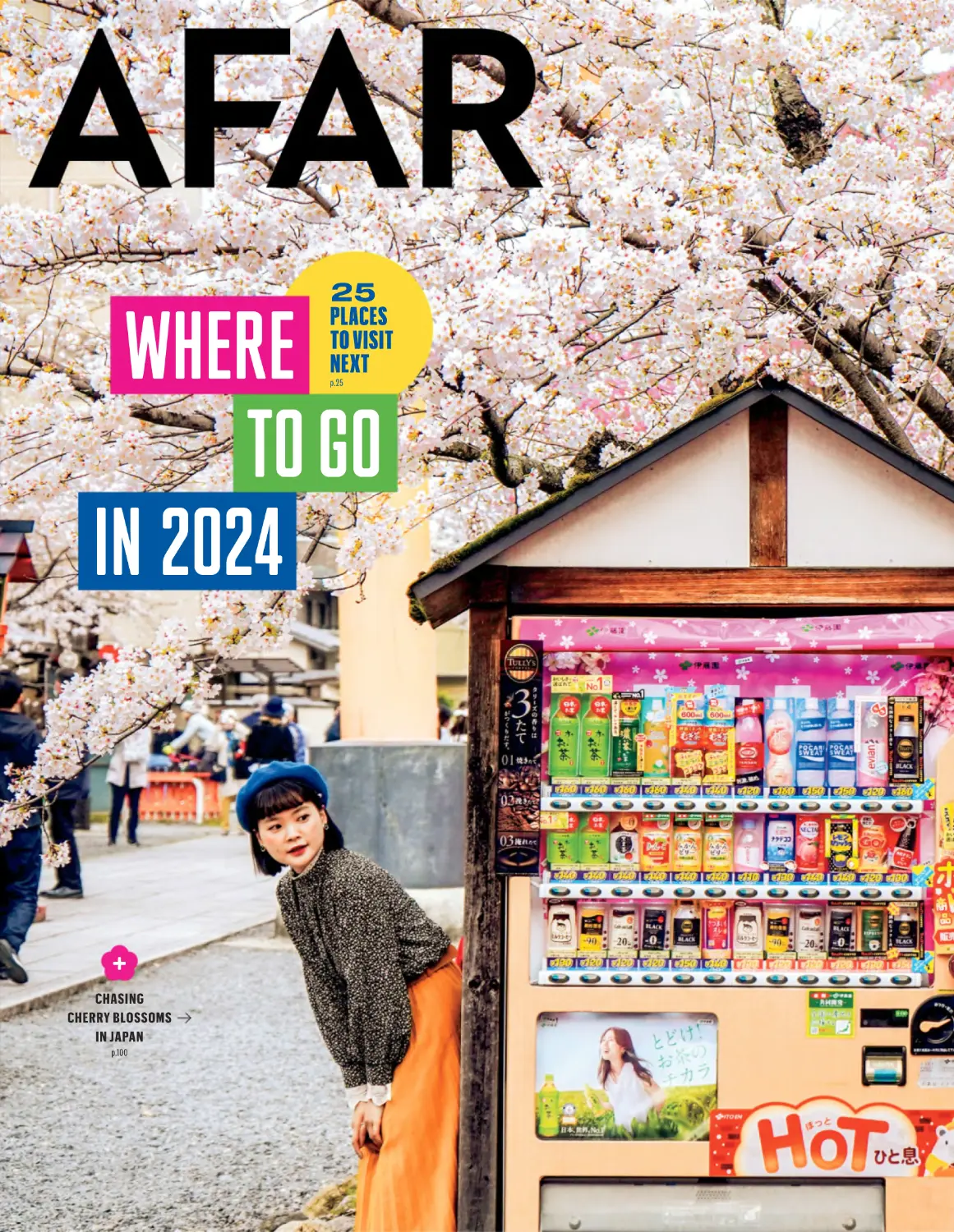
                    25
PLACES
TO VISIT
NEXT

WHERE
TO GO
IN 2024
p.25

+
CHASING
CHERRY BLOSSOMS
IN JAPAN
p.100

Enjoy the luxury of a different view every day

© 2024 Carnival plc. Ships’ Registry: Bermuda. The Cunard logo and logotype, Queen Mary 2, Queen Victoria, Queen Elizabeth and Queen Anne are
registered trademarks of Carnival plc, an English company trading as Cunard. All rights reserved in the United States and other countries.

The Americas

X

Asia

X

Australia

Contact your Travel Advisor

X

|

Europe

X

Transatlantic Crossings

Call (800) 728-6273

|

X

World Voyages

Visit Cunard.com/AFAR

Table of
Contents

The once industrial city
of Manchester in northern
England is today a
must-visit hub for visual
and performing arts.

Where to Go in 2024
Bhutan

The Hill Country

Manchester

Rome

Tangier

Texas

England

Italy

Morocco

Lamu

Martha’s Vineyard

St. Kitts

Tartu

Kenya

Massachusetts

Los Angeles

Norway

San Diego
& Tijuana

Paris

Seattle

France

Washington

Philadelphia

Sydney

Pennsylvania

Australia

Brno
Czechia

Charleston
South Carolina

Estonia

California

Detroit
Michigan

Machu Picchu

Canada

Peru

Fiji
Maldonado
Uruguay
4

Toronto

Valencia
Spain

Weifang
China

WAMBAM PH OTO G R APHY

A Czech city plays second
fiddle no longer. An
iconic Italian destination
reimagines itself. These
are the 25 most exciting
places around the world
to visit next.

INTERCONTINENTAL DOMINICA
CABRITS RESORT & SPA

1 9 H OT E L B R A N D S • 6 , 0 0 0 G LO B A L D E S T I N AT I O N S
O N E LOYA LT Y P R O G R A M

F E AT U R E S

Table of
Contents

82

BETWEEN THE LINES
In the early 20th century,
the radical De Stijl art
movement reshaped the
world in bold colors
and sharp angles. In Utrecht,
the Dutch city where it
started, “the style” is still alive.
ON THE COVER
In Japan, hanami, or
cherry blossom
viewing, is the national
pastime—and a
joyous celebration
of spring.
Photograph by Geoff Haggray

14
CONTRIBUTORS

92

I SARI WA
(IT WILL CONTINUE
INDEFINITELY)
California’s Channel Islands
National Park calls to the
adventurous with its rugged
landscapes, rich Indigenous
history, and the most
biodiverse environment in
North America.

21

Columnist Anu Taranath
examines the complex dynamics
of travelers giving money to
people they encounter while
on the road.

112
JUST BACK FROM
ALASKA
AFAR Creative Director
Supriya Kalidas recently went
in search of the northern
lights, and found so much more.
6

100

IN FULL BLOOM
A trip to Tokyo,
Osaka, and Kyoto
embraces the beauty—
and brevity—of
cherry blossom season
in Japan.

ILLU STR ATI ON : PETE RYAN

UNPACKED
TO GIVE OR NOT TO GIVE?

PHOTOS, CLOCKWISE FROM BOTTOM LEFT: SUPRIYA KALIDAS, JUSTIN FANTL , GEOFF HAGGRAY

18
VOICE FROM AFAR

Table of
Contents

BETWEEN
THE LINES
p.82

8

J U S S I PU IKKO NEN ; RIET VELD SCHRÖ D ER H O U S E © 202 3 ARTI STS RI G HTS SO CIET Y ( ARS), NE W YO RK / C/O PI CTO RI G HT AM STERDAM

Features
I imagined the
De Stijl artists . . .
loving this place
but anxious to turn
the page, and
never wanting to see
another damned
bell tower.

Step aboard a world of unparalleled experiences where your journey is our passion. Explore grand capitals and
charming villages through exquisite locally sourced food and wine and a variety of enriching included excursions.
Follow the flow of the river and immerse yourself in traditions that have spanned generations.

For the latest offers, contact your preferred travel advisor or
visit AmaWaterways.com/special-offers today.

We love Charleston.

We just love our hometown. We are inspired every single day by her beauty, her
history, and her charm. We adore the steeples that dot our skyline, the architecture that builds the foundation of elegance
that surrounds us, and the sense of place she gives us. We love the Charleston area. Celebrate our beloved community,
stylish and unique. We want everyone who visits us to love the Charleston area as much as we do.

SCAN FOR YOUR FREE TRIP PLANNER.

HISTORY LOVES COMPANY

EXPLORECHARLESTON.COM

@EXPLORECHARLESTON

AFAR.COM @AFARMEDIA
FOUNDERS Greg Sullivan & Joe Diaz

EDITORIAL

MARKETING & CREATIVE SERVICES

AFAR MEDIA LLC

VP, EDITOR IN CHIEF Julia Cosgrove
EDITORIAL DIRECTOR Sarika Bansal @sarika008

VP, MARKETING Maggie Gould Markey

@maggiemarkey, maggie@afar.com

CHIEF EXECUTIVE OFFICER Greg Sullivan @gregsul
VP, COFOUNDER Joe Diaz @joediazafar

CREATIVE DIRECTOR Supriya Kalidas @supriyakalidas

EXECUTIVE DIRECTOR, MARKETING AND

VP, CHIEF OPERATING OFFICER Laura Simkins

EXECUTIVE EDITOR Billie Cohen @billietravels
SENIOR DEPUTY EDITOR Jennifer Flowers

SPECIAL PROJECTS Katie Galeotti @heavenk
BRANDED & SPONSORED CONTENT DIRECTOR

VP, GROWTH AND PRODUCT Anni Cuccinello
DIRECTOR OF FINANCE Julia Rosenbaum @juliarosenbaum21

@jenniferleeflowers

Ami Kealoha @amikealoha

HUMAN RESOURCES DIRECTOR

DEPUTY EDITORS

ASSOCIATE DESIGN DIRECTOR Christopher Udemezue
ASSOCIATE DIRECTOR, MARKETING ACTIVATIONS

Breanna Rhoades @breannarhoades

Tim Chester @timchester,
Katherine LaGrave @kjlagrave

DIRECTOR OF AD OPERATIONS

Irene Wang @irenew0201

Donna Delmas @donnadinnyc

SENIOR TRAVEL NEWS EDITOR

SENIOR INTEGRATED MARKETING MANAGER

ASSOCIATE DIRECTOR, PODCASTS Aislyn Greene @aislynj

Michelle Baran @michellehallbaran

Mary Kennedy @marmar353

SENIOR COMMERCE EDITOR

INTEGRATED MARKETING MANAGER

ASSOCIATE DIRECTOR, GROWTH Julie Huang @julie_yellow
ASSOCIATE DIRECTOR, SEO, PRODUCT & VIDEO

Lyndsey Matthews @lyndsey_matthews
PHOTO EDITOR Michelle Heimerman @maheimerman
EDITORIAL PRODUCTION MANAGER Kathie Gartrell
SENIOR DESIGNER Elizabeth See @ellsbeths
ASSOCIATE DESTINATIONS EDITOR Chloe Arrojado
ASSOCIATE EDITOR Mae Hamilton @bymaeham
PRODUCTION EDITOR Karen Carmichael @karencarmic
PRODUCTION DESIGNER Myrna Chiu
EDITOR AT LARGE Laura Redman @laura_redman

Isabelle Martin @isabellefmartin

Jessie Beck @beatnomad

MARKETING ACTIVATIONS MANAGER

ACCOUNT MANAGER, AD OPERATIONS Vince De Re
SOCIAL MEDIA EDITOR Tiana Attride @tian.a
NEWSLETTER EDITOR Maliah West @maliahdestiny

CONTRIBUTING WRITERS

Lisa Abend @lisaabend, Chris Colin @chriscolin3000,
Latria Graham @mslatriagraham, Emma John @em_john,
Ryan Knighton, Peggy Orenstein @pjorenstein,
Anu Taranath @dr.anutaranath, Anya von Bremzen
@vonbremzen
COPY EDITOR Elizabeth Bell
PROOFREADERS Pat Tompkins, Kara Williams

Maggie Smith @smithxmaggie

SALES
VP, PUBLISHER Bryan Kinkade @bkinkade001,
bryan@afar.com, 646-873-6136
EXECUTIVE DIRECTOR, BRAND PARTNERSHIPS

Onnalee MacDonald @onnaleeafar,
onnalee@afar.com, 310-779-5648

ACCOUNTING CLERK Kai Chen
EXECUTIVE DIRECTOR Sally Murphy
ASSOCIATE CONSUMER MARKETING DIRECTOR Tom Pesik
SENIOR PREMEDIA MANAGER Isabelle Rios
PRODUCTION MANAGER Mandy Wynne
ADVISORS Priscilla Alexander, Ellen Asmodeo-Giglio,

Pat Lafferty, Josh Steinitz

EXECUTIVE DIRECTOR, BRAND PARTNERSHIPS

Laney Boland @laneybeauxland,
lboland@afar.com, 646-525-4035
EXECUTIVE DIRECTOR, BRAND PARTNERSHIPS

CJ Close @close.cj, cjclose@afar.com, 310-701-8977
EXECUTIVE DIRECTOR, CARIBBEAN

SPECIAL CORRESPONDENTS

Barry Brown barry@afar.com, 917-226-5398

Fran Golden @fran_golden_cruise, Sally Kohn @sallykohn,
Barbara Peterson, Paul Rubio, Victoria M. Walker @vikkie

SALES, SOUTHEAST

SUBSCRIPTION INQUIRIES
afar.com/service
888-403-9001 (toll free)
From outside the United States,
call 515-248-7680

Colleen Schoch Morell colleen@afar.com, 561-350-5540

MAILING ADDRESS

SALES, SOUTHWEST

P.O. Box 458
San Francisco, CA 94104

Lewis Stafford Company lewisstafford@afar.com,
972-960-2889
SALES COORDINATOR Carly Sebouhian @carlyblake419,
csebouhian@afar.com, 516-633-5647

STATEMENT OF OWNERSHIP, MANAGEMENT AND CIRCULATION (required by Act of August 12, 1970: Section 3685, Title 39, United States Code). 1. AFAR 2. (ISSN 1947-4377) 3. Filing date: 10/01/2023. 4. Issue frequency:
Quarterly. 5. Number of issues published annually: 4. 6. The annual subscription price is $24. 7. Complete mailing address of known office of publication: AFAR, LLC, P.O. Box 458, San Francisco, CA 94104. Contact person: Kolin
Rankin. Telephone: 305-859-0063. Complete mailing address of headquarters or general business office of publisher: AFAR, LLC, P.O. Box 458, San Francisco, CA 94104. 9. Full names and complete mailing addresses of publisher, editor, and managing editor. Publisher, Bryan Kinkade, P.O. Box 458, San Francisco, CA 94104. Editor, Julia Cosgrove, P.O. Box 458, San Francisco, CA 94104. Managing Editor, Sarika Bansal, P.O. Box 458, San Francisco,
CA 94104. 10. Owner: AFAR, LLC, P.O. Box 458, San Francisco, CA 94104. 11. Known bondholders, mortgages, and other security holders owning or holding 1 percent or more of total amount of bonds, mortgages or other securities: Greg Sullivan, Co-Owner, P.O. Box 458, San Francisco, CA 94104; Joe Diaz, Co-Owner, P.O. Box 458, San Francisco, CA 94104. 12. Tax status: Has Not Changed During Preceding 12 Months. 13. Publisher title: AFAR. 14. Issue
date for circulation data below: Summer ’23. 15. The extent and nature of circulation: A. Total number of copies printed (Net press run). Average number of copies each issue during preceding 12 months: 295,851. Actual number of copies of single issue published nearest to filing date: 295,634. B. Paid/requested circulation. 1. Mailed outside-county paid subscriptions/requested. Average number of copies each issue during the preceding 12 months:
263,269. Actual number of copies of single issue published nearest to filing date: 264,809. 2. Mailed in-county paid subscriptions/requested. Average number of copies each issue during the preceding 12 months: 0. Actual number of copies of single issue published nearest to filing date: 0. 3. Sales through dealers and carriers, street vendors and counter sales. Average number of copies each issue during the preceding 12 months: 4,424. Actual
number of copies of single issue published nearest to filing date: 4,783. 4. Requested copies distribution through other classes mailed through the USPS. Average number of copies each issue during the preceding 12 months: 0.
Actual number of copies of single issue published nearest to filing date: 0. C. Total paid/requested distribution. Average number of copies each issue during preceding 12 months: 267,693. Actual number of copies of single issue
published nearest to filing date: 269,592. D. Nonrequested distribution (by mail and outside mail). 1. Outside-County Nonrequested copies. Average number of copies each issue during the preceding 12 months: 3,562. Number of
copies of single issue published nearest to filing date: 3,335. 2. In-county nonrequested copies. Average number of copies each issue during the preceding 12 months: 0. Number of copies of single issue published
nearest to filing date: 0. 3. Nonrequested copies mailed at other Classes through the USPS. Average number of copies each issue during preceding 12 months 0. Number of copies of single issue published nearest to filing date:
0. 4. Nonrequested copies distributed outside the mail. Average number of copies each issue during preceding 12 months: 10,393. Number of copies of single issue published nearest to filing date: 10,950. E. Total Nonrequested
distribution. Average number of copies each issue during preceding 12 months: 13,955. Actual number of copies of single issue published nearest to filing date: 14,285. F. Total distribution (sum of 15c and 15e). Average number of copies each issue during preceding 12 months: 281,648. Actual number of copies of single issue published nearest to filing date: 283,877. G. Copies not Distributed. Average number of copies each issue during preceding
12 months: 14,203. Actual number of copies of single issue published nearest to filing date: 11,757. H. Total (sum of 15f and 15g). Average number of copies each issue during preceding 12 months: 295,851. Actual number of copies
of single issue published nearest to filing: 295,634. I. Percent paid. Average percent of copies paid/requested for the preceding 12 months: 95.05%. Actual percent of copies paid/requested for the preceding 12 months: 94.97%.
16. Electronic Copy Circulation: A. Paid Electronic Copies. Average number of copies each issue during preceding 12 months: 10,767. Actual number of copies of single issue published nearest to filing date: 13,750. B. Total Paid
Print Copies (Line 15c) + Paid Electronic Copies (Line 16a). Average number of copies each issue during preceding 12 months: 278,460. Actual number of copies of single issue published nearest to filing date: 283,342. C. Total
Print Distribution (Line 15f) + Paid Electronic Copies (Line 16a). Average number of copies each issue during preceding 12 months: 292,415. Actual number of copies of single issue published nearest to filing date: 297,627. D. Percent Paid (Both Print & Electronic Copies) (16b divided by 16c x 100). Average number of copies each issue during preceding 12 months: 95.23%. Actual number of copies of single issue published nearest to filing date: 95.20%.
Report circulation on PS Form 3526-X worksheet 17. Publication of statement of ownership for a Requester publication will be printed in the Winter 2024 issue of the publication. 18. Signature and title of editor, publisher,
business manager, or owner: Laura Simkins, COO. I certify that all information furnished on this form is true and complete. I understand that anyone who furnishes false or misleading information on this form or who omits
material or information requested on the form may be subject to criminal sanction and civil actions.

12

AFAR ID Statement AFAR® (ISSN 1947-4377), Volume 16, Number 1, is published four times a year by AFAR, 124 Manor Road, Fairfax, CA 94930, U.S.A. In the U.S., AFAR® is a registered trademark of
AFAR LLC. Publisher assumes no responsibility for return of unsolicited manuscripts, art, or any other unsolicited materials. Subscription price for U.S. residents: $24.00 for one year. Canadian
subscription rate: $30.00 (GST included) for one year. All other countries: $40.00 for one year. To order a subscription to AFAR or to inquire about an existing subscription, please write to AFAR
Magazine Customer Service, P.O. Box 6265, Harlan, IA 51591-1765, or call 888-403-9001. Periodicals postage paid at San Francisco, CA, and at additional mailing offices. POSTMASTER: Please send
address changes to AFAR, P.O. Box 6265, Harlan, IA 51591-1765.

G Adventures
Introduces

World, meet the grandest adventures on Earth.
Featuring 28 trips across 16 different countries,
get moving and go deeper into your destination with
our new line of premium active adventures expertly
curated to keep you feeling oh-so comfortable.

This is adventure at its finest.

Discover the collection
at gadventures.com/geluxe

Perfectly paced itineraries. One-of-a-kind accommodations.
Meaningful connections with local communities. You in?
gadventures.com/geluxe

JUSSI PUIKKONEN

ANNA KIM

In his approach to photography, Jussi Puikkonen
says he aims to reflect his subjects as they truly are.
Raised in the Finnish woods and now based in
Amsterdam, Puikkonen surveyed the Dutch city of
Utrecht in Between the Lines (p.82). For this story,
he focused on the way the De Stijl movement, a
cultural wave that sought to distill objects down
to their fundamental forms and colors, shaped
the city. “Utrecht is as beautiful as Amsterdam but
not as crowded with tourists,” he says. Puikkonen
also shoots for Bloomberg, the Financial Times,
and Monocle. See more of his work on Instagram
@jussipuikkonen.

For Where to Go in 2024 (p.64), journalist
Anna Kim writes about a place near and dear to
her heart—her hometown of Toronto. Kim’s
family moved there from Seoul when she was
five years old. The piece explores the many
ways travelers can tap into the city’s rich
multiculturalism, such as by walking through
its historic neighborhoods and sampling
the incredible food scene. “Diversity is not just
acknowledged [here] but truly embraced,”
Kim says. She’s also written for Fodor’s Travel,
Tripadvisor, and Matador Network. Follow
Kim on Instagram @mytravelanthropy.

Photographer

Writer

ROSALIND CUMMINGS-YEATES
Writer

Rosalind Cummings-Yeates is a Chicago-based travel journalist who covers St. Kitts in Where to Go
in 2024 (p.40). In her article, she reports on the Caribbean island’s long history of rum and sugar
production, and talks with some of the enterprising local residents who are bringing that legacy into
the modern era. “I love the innovative spirit of the Kittitian people,” Cummings-Yeates says. “My
favorite part of the trip was seeing how proud the rum makers were when explaining how they built
their companies.” Cummings-Yeates has written for BBC Travel, Time, and Lonely Planet. Keep up
with her on Instagram @farsightedgirl.

JUSTIN FANTL
Photographer

Justin Fantl has worked as a commercial and editorial photographer for more than 15 years. Today, he
operates a landscape design studio in Santa Barbara, California. He combines his myriad interests in
I Sari Wa (It Will Continue Indefinitely) (p.92), a photo essay of southern California’s Channel Islands
National Park, one of the most biodiverse places in North America and the ancestral home of the
Chumash and Gabrieleno-Tongva peoples. “I visited the islands out of curiosity and I immediately fell
in love with them,” Fantl says. “That was more than three years and two dozen trips ago.” His work
appears in the Atlantic, Dwell, and Rolling Stone. See more of his photos on Instagram @fantl.

Contributors
GEOFF HAGGRAY

LAURA ITZKOWITZ

East Coast–based photographer Geoff Haggray
enjoys capturing a sense of place and time in
his images, which have a nostalgic, almost painterly
quality. For In Full Bloom (p.100), Haggray photographed scenes of hanami, or cherry blossom
celebrations, in Japan. His subjects include the flowering trees, as well as families and friends gathering
underneath the blooms to celebrate the arrival of
spring. “I loved being able to take part in hanami,”
he says. “It’s a beautiful example of a nation coming
together to simply appreciate nature and spend time
with loved ones.” Haggray’s photos also appear in
the New York Times, BuzzFeed, and Harper’s Bazaar.
Find him on Instagram @geoffhaggray.

To say that writer Laura Itzkowitz loves Rome
is an understatement—after years of visiting,
she moved there permanently in 2019 to
be with her (now) husband. Itzkowitz writes
about the Eternal City and its new high-end
hotels, globally inspired restaurants, and
reopened archaeological sites for Where to
Go in 2024 (p.50). “It’s worth slowing down
and getting a feel for the way Romans live,”
she says. “There’s a lot more to [the city]
than the Colosseum.” Itzkowitz writes for
Travel + Leisure, Condé Nast Traveler, and
Hemispheres. Follow her adventures on
Instagram @lauraitzkowitz.

Photographer

14

Writer

Intimate Star-Ship River Cruises
EUROPE - SOUTHEAST ASIA

Luxury Yacht Cruises

MEDITERRANEAN & ADRIATIC SEA - CARIBBEAN
INDIAN OCEAN - RED SEA

WE ARE ALL
CONNECTED

Connecting more countries than any other.

AFRICA
AMERICA
FAR EAST
EUROPE

MIDDLE EAST

TÜRKİYE

Voice From AFAR

one of my favorite times of the
year at AFAR—and not just because half-day Fridays
kick off. It’s when we start soliciting ideas for our
annual Where to Go list. We reach out to our network of writers across the globe to find out where
they are, where they’ve been, and where they think
our readers should go in the coming year.
As the story ideas roll in, I get to vicariously travel
the world. I read convincing arguments for cities,
regions, and whole countries, before we begin the
hard work of whittling those submissions down to
the 25 destinations that make the cut.
It’s always refreshing to take the travel community’s pulse—to learn what’s exciting for our team,
and to see trends emerge. Old favorites reappear and
new places pop up. Italy is on many writers’ minds
E A R LY S U M M E R I S

18

this year—and every year. Cities across North America
jockeyed for attention, including Toronto (page 64).
Events often shape travel plans: The Summer Olympics
will take over Paris in July (page 38), and the total solar
eclipse will draw skygazers across the United States,
including the Hill Country in Texas (page 32).
Our list is a global mix that includes Manchester’s
edgy creative scene (page 60), Uruguay’s homegrown
winemakers (page 30), and Black art in Los Angeles
(page 54). I learned a lot about Brno, Czechia (page 42)
—not least how to pronounce it—and enjoyed sharing
why travelers should see and help protect Fiji’s marine
life (page 26).
Working at AFAR for five years has left me with an
extensive list of places to experience. This issue’s dispatches from our seasoned reporters have added even
more ideas to my mental scrapbook. I hope you also
find inspiration for 2024.
Happy travels,
T I M C H EST E R

Deputy Editor

Bhutan (page 62) is
encouraging visitors
to stay longer and
explore further with
its recently restored
Trans Bhutan Trail.

J O NATHAN P OZNIAK

A New Year
of Travel

Frontier History. Cowboy Heritage. Craft CULTURE. The Great Outdoors.
The Nature of the West.

1.1

101

4

million acres of pristine wildland
in the Bighorn National Forest,
encompassing 1,200 miles of
trails, 30 campgrounds, 10
picnic areas, 6 mountain lodges,
legendary dude ranches, and
hundreds of miles of waterways.
The Bighorns offer limitless
outdoor recreation opportunities.

restaurants, bars, food trucks,
lounges, breweries, distilleries, tap
rooms, saloons, and holes in the
wall are spread across Sheridan
County. That’s 101 different ways
to apres adventure in the craft
capital of Wyoming. We are also
home to more than 40 hotels,
motels, RV parks, and B&Bs.

seasons in which to get WYO’d.
If you’re a skijoring savant,
you’ll want to check out the
Winter Rodeo in February. July
features the beloved Sheridan
WYO Rodeo. Spring and fall
are the perfect time to chase
cool mountain streams or epic
backcountry lines.

^

Sheridan features a thriving,
historic downtown district, with
western allure, hospitality and
good graces to spare; a vibrant
arts scene; bombastic craft
culture; a robust festival and
events calendar; and living history
from one corner of the county to
the next.

Unpacked

Your Travel
Questions,
Answered

by A N U T A R A N A T H
I l l u s t r a ti o n s by P E T E R Y A N

To Give
or Not to
Give?

While my husband and I were visiting Cartagena,
Colombia, we were approached by a mother and
her baby. She pointed at the baby, then her stomach, as if to say they were hungry, and held out
her palm. I gave her all the pesos I had. Later that
day, my husband told me that I had helped fuel a
bad industry. Had I? —L.C.
brings to mind the
cognitive dissonance we experience when inequities of our world are laid bare. How is it that some
people can relax for pleasure abroad while others
struggle to have enough food, water, and dignity to
make it through the day? Who made this system,
and how do we repair it? Such questions can shortcircuit the best of us.

YO U R Q U E ST I O N I M M E D I AT E LY

21

Unpacked Your Travel Questions, Answered

When confronted
with our own status as
better-off, we can feel
overwhelmed by a range
of complex emotions.

Yes, from one perspective, your actions were
correct. You were moved by the scene and sympathized with another person’s situation. In a world
that often places greater premium on accumulating profits than on people’s well-being, the
fleeting connection between you and the young
mother matters greatly.
You were, I imagine, also motivated to empty
your pockets because she identified—and, in a
way, called out—your relative wealth and privilege. That can feel awkward. She knew, and you
knew, that you had more than she did. When
confronted with our own status as better-off,
we can feel overwhelmed by a range of complex
emotions. Guilt, shame, and helplessness merge
with concern. While you gave the woman the
money ostensibly to help her, the exchange may
have also helped you discharge the uncomfortable feelings that the interaction raised.
Let’s say you had not given her money. Would
that have been a better option? Your husband
seems suspicious of the “bad industry” in which
people either opt to beg or are forced to do so.
We don’t know the woman’s situation. We
don’t know if she chose to panhandle in a highdensity tourist location because it pays more
than other jobs. We don’t know if the money will
offer her and her baby some solace during an
otherwise chaotic day. Or might she be left with
just a few pesos after a criminal ringleader takes
his share?
For many people without a viable safety net,
a blurry line exists between choice and lack of
choice. The truth is most people who beg for
money do so out of some form of deep financial insecurity. The rationale might differ across
locations and contexts, but the fact remains that economic and social vulnerability is much
bigger than you or me.
Emptying our pockets serves as a Band-Aid for the recipient and will not inoculate them
from panhandling in the longer term. Likewise, turning away from someone who is asking
you for money will probably not help them enjoy more dignity, opportunity, and safety in their
lives. You and I and the panhandler are all small fries. We live in a bigger system that perpetuates inequities and gives us relatively few opportunities to face them directly.
Your question gets at an age-old moral quandary, and I’m not sure there is a right answer.
Here is how I often, but not always, approach these situations. Before traveling, I read about
what social justice initiatives look like in the region I’m visiting. I try to find out which organizations bring relief to affected people in ethical and thoughtful ways, and I might support
their work with a contribution. I ask my friends and colleagues in those places how socially
minded locals themselves navigate the inequities they encounter daily. Everywhere in our
unequal world, people are coming together to create more stability in local communities in
both small and big ways. I might not always know what to do when I am approached by a
stranger for money, but I do know I want to be a part of a larger movement of organizations
helping advance social and economic equity. It sounds like you do, too.
Have a question about travel etiquette or ethics? Write to us at unpacked@afar.com.

22

Views you’ll want
to see again
and again.
It’s pretty impressive how the northern lights never
get old, especially for a phenomenon that’s been
around for over 30,000 years. And, from November
to April in the Yukon, we’re lucky enough to have
some of the world’s best spots to view these lifechanging lights. Combine that with a ton of daytime
adventures (like cross-country skiing or dogsledding
across beautiful frozen lakes) and Whitehorse may
just make you see winter in a different light.

Rendezvous
Festival
Never tried ax throwing,
dogsledding, or chainsaw
chucking? Check out the
yearly Rendezvous Festival.
Just be sure to hit the pancake
breakfast first to avoid
chucking chainsaws hungry.

LIFECHANGINGLIGHTS.COM

northern tales
Snowmobiling, wildlife
viewing, aurora hunting...
think having so many
once-in-a-lifetime
experiences in one spot
is impressive? Just wait
until you realize you can
try them all in a week.

WHITEHORSE,
YUKON

Black Spruce
Cabins
Stay sustainably in the boreal
forest. Each cabin boasts
a kitchen, spa access,
and high-speed internet
(although your devices are
unlikely to win the battle for
attention out here).

Northern lights
resort & spa
The only way the northern
lights could be better is if they
were watched from bed in a
cabin with floor-to-ceiling
windows. Wait, we just
described the Northern
Lights Resort & Spa.

aurora village
We’re not sure if it’s the
traditional teepees, authentic
Indigenous comfort food,
or 360-degree heated
viewing seats but, somehow,
Aurora Village manages
to make the lights even
more magical.

snowking
winter fest
Any event held in a glacial
palace must be special.
And once you experience the
music, art, and northern lights
on display, you’ll see why the
annual Snowking Festival has
its royal reputation.

yellowknife,
northwest territories
bullockS bistro
It wouldn’t be very
Canadian to brag, so let’s
just say you’ll find some
of the best fish and chips
in this iconic Yellowknife
restaurant, which has
fueled hungry light
hunters for 30 years.

And again.
Call us biased, but few bucket list sights deserve the kind
of glowing reviews a northern lights experience gets.
Especially one that takes place in the Aurora Capital of
North America. With breathtaking wilderness, enchanting
culture, and a festival hosted in a literal palace made of
snow and ice, we’d be tempted to say that the Northwest
Territories is straight out of a fairy tale. You know, if we
hadn’t seen it all with our own eyes, that is.
LIFECHANGINGLIGHTS.COM

b.dene
adventures
Listen to traditional
drumming, enjoy fish cooked
over open fire, and listen as
Dene Elders pass on their
knowledge and traditions.
And that’s all before you
even see the northern lights.

IN
4
202

TOBIAS TULLIUS/UNSPLASH

Whether it’s a Scandinavian country finding new ways to
show off its beauty (pictured) or a laid-back Kenyan island
free of cars, our 25 picks for where to go this year have
several traits in common: Each is an awe-inspiring, joyinducing destination where human connection and creativity
define the travel experience. These places offer ample
opportunities for conscientious, sustainable exploration—
exactly what travelers who care are seeking right now.
Cheers to another year of getting out there!

Illustrations by Morgane Fadanelli

25

THIS PAGE: COURTESY OF VOMO ISLAND. OPPOSITE PAGE: COURTESY OF NANUKU RESORT FIJI

The South Pacific’s vivid
underwater world awaits
conservation-minded visitors.
by TIM CHESTER

FIJI’S MARINE LIFE is famously beautiful: a colorful show

of turtles, rays, and sharks swirling amid sun-dappled shades
of green and blue. The main stage for this dazzling performance
is its array of coral reefs—fragile ecosystems in which the symbiotic relationship between plants and fish plays out daily, their
delicate dance a microcosm of our ever more stressed planet.

Given this aquatic world’s wonders, it’s no surprise that
the hotels on the archipelago’s 333 islands are at the forefront of marine conservation efforts. In the south, Kokomo
Private Island works with local nonprofit Manta Project
Fiji to identify, tag, and protect manta rays in the surrounding aquamarine waters. The resort also shows visitors how
to swim and snorkel among them peacefully. Six Senses
Fiji, meanwhile, planted 600 mangrove saplings in 2022
to provide shelter for marine life, part of a larger ecological
restoration project that extends protection to terrestrial species too, including the Pacific boa snake and the critically
endangered Fijian crested iguana.
Above: Nanuku Resort Fiji in Pacific Harbour on Viti Levu comprises just a
few dozen villas spread across 500 acres—and includes a private island fringed
Several resorts have in-house marine biologists. At Vomo
with a reef. Left: Friendly reef sharks swim among guests at Vomo Island resort.
Island resort, Laisenia Rokoua oversees such initiatives as
coral planting, species identification, and coastal cleanups.
On the characteristically dreamy private island, children can
MAKE IT A CRUISE
make coral “cookies” out of concrete and pieces of living
The 13-night “Fiji, Tonga, Cook
coral that are then planted in the reef. The hotel has just constructed little “fish houses”
Islands & Society Islands”
itinerary from Paul Gauguin
to protect the reef’s smaller finned residents.
Cruises stops twice in Fiji and
“I get so much enjoyment out of watching our guests participate in these practical
visits tiny Beqa Island, where
activities that really have a positive impact,” Rokoua says. “It’s a feeling of achievesnorkeling adventures await.
ment to be good for the planet and know that a little thing like making a coral cookie
DON’T MISS
can breathe some life back into the ocean.”
Participate in a kava ceremony,
At Nanuku Resort, on Fiji’s largest island of Viti Levu, I observed some of these
in which a mildly intoxicating
efforts firsthand. Marine scientist and sustainability manager Kelly-Dawn Bentley
brew made from the Piper
showed me how delicate mangrove saplings are nurtured on-site and then planted along
methysticum plant is passed
among hosts and visitors.
the coast near villages, where local communities can witness the carbon-sequestering
plants’ superpowers as storm protection barriers. Seremaia “Jerry” Delana, Nanuku’s
REQUIRED EATING
sustainability officer, snorkeled with me alongside the resort’s reef. He pointed out parTry lovo, a meal of chicken or
rotfish (which nibble away the algae) and the angular metal structures of coral nurseries,
pork and root vegetables
which seemed a little incongruous but provide vital support for an ecosystem threatwrapped in leaves and cooked
on top of heated rocks in a pit
ened by spear fishing, storms, and ocean warming.
in the ground.
As we drifted with the currents, spying the hopeful signs of newly planted coral
nurturing tiny fish, a distinct lack of other travelers made it even more memorable.
Comparatively few people come to experience—and protect—Fiji’s splendor. (Some
70,000 came from the United States in 2022, compared to 7.7 million Americans who
went to Hawai‘i. Fiji welcomed just 636,000 inbound visitors overall in 2022.) That
means you “don’t have to worry about overtourism,” according to Josua “Josh” Cakautini,
Nanuku’s gregarious cultural ambassador. “There is lots of space on our islands to welcome everyone.”
27

It’s our mission to elevate each
experience beyond ordinary.
We do that by creating degrees of difference, both big and
small, during every voyage to Europe, Tahiti, the Caribbean,
Costa Rica & Panama Canal, Latin America, and more.
From our small ships and curated excursions to learn more
about local life to the thoughtful details from our welcoming
crew, Windstar puts more into every voyage.

WINDSTARCRUISES.COM
For the latest offers, contact your Travel Advisor
or Windstar Cruises at 888-749-3906

Uruguay’s coastal wine region
promises bold reds and
beautiful places to enjoy them.
by JULIA BUCKLEY

There always has been: Francisco Piria, an alchemist, founded his Belle Époque seaside resort
town here in the 1890s, because he loved the
supposedly cosmic energy. And visitors have long
flocked to the Maldonado region as a whole for its
world-class beach towns: flashy Punta del Este
and its bohemian cousin, José Ignacio. Today,
however, a visit is all about the wine. Travelers
can stroll through family-owned vineyards that
unfurl toward the ocean, drink Uruguay’s gutsy
tannat reds and signature albariño whites, and
pair them with the melt-in-your-mouth steaks
the country is famous for.
Historically, Uruguay’s winemaking has been centered around Montevideo and the
Uruguay’s viticulture scene is thriving, and
Canelones province, but today Maldonado is producing its own compelling vintages.
Maldonado on the Atlantic coast is its fastestgrowing wine region. In fact, Montevideo’s bestknown winemakers, Bodega Bouza, have opened
WHERE TO STAY
the hilltop restaurant Las Espinas in Maldonado,
Wedged between vineyards and
and are adding a winery in 2024. They’re not the only ones. Cerro del
pine trees inland from José Ignacio,
Toro—whose tannat varietal was recently dubbed Uruguay’s “discovery of
the Luz Culinary Wine Lodge
opened in 2022 with eight Moroccanthe year”—will also open a winery next year.
inspired suites.
In this part of the country, enotourism means intimate vineyards and
bucolic outdoor tastings. At Bodega Garzón, visitors can ride e-bikes
MAKE IT HAPPEN
around the sprawling estate to find a spot to savor wine with a picnic. On a
JSB Journeys can plan wine-oriented
rocky bluff with the Atlantic hazy in the distance, the Alto de la Ballena
trips to Uruguay, with stays in
vineyard hotels, tastings, and those
estate hosts tastings of its bottles, including a fresh tannat-viognier blend.
all-important designated drivers.
“Most of our wineries are boutique or family owned, and the owners
are directly involved in every step of the process,” says José Ignacio–based
sommelier Soledad Bassini, who has worked in the industry for 25 years.
“That brings the wine a lot of character, and for visitors it’s like entering
someone’s home and sharing their routine, traditions, and history.”
The abundance of wine experiences led Bassini to create the Mapa del
Vino, a map that details Uruguay’s boutique vineyards. “Maldonado has
everything,” she says. “Terroir, ocean, beaches—it’s the whole package.”
30

WILLIAM HEREFORD

THERE’S SOMETHING in the air in Piriápolis.

YOUR CARIBBEAN

A PLACE OF ENDLESS DISCOVERY
Discover the more playful side of your family. Go on adventures. Explore the wonders of the Caribbean.
Reconnect with the ones you love. This is a reminder to never stop playing together.

B E A C H E S .C O M

1. 8 0 0. B E A C H E S

O R C A L L Y O U R T R AV E L A D V I S O R
JAMAICA / TURKS & CAICOS
LVDUHJLVWHUHGWUDGHPDUN8QLTXH9DFDWLRQVΖQFLVWKHDɝ
OLDWHRIWKHZRUOGZLGHUHSUHVHQWDWLYHRI%HDFKHV Resorts.

®

Travel to the Lone Star State this spring to
experience a total eclipse in the heart of Texas.
b y M A E H A M I LT O N

T H E L I LT I N G T R I C K L E of a lazy river. The gentle creak of a rope swing hung

from a bald cypress branch. A belly full of barbecue and the smell of flowering
bluebonnets, musky ashe juniper, and sunscreen in the air. There’s nowhere on
Earth quite like the rolling landscapes of my childhood: the Texas Hill Country.
Where the boundaries of the Hill Country exactly begin and end are nebulous,
but the region spans roughly 31,000 square miles. It’s penned in by the Texas
High Plains to the north and San Antonio to the south. Austin marks its eastern
edge, and the area’s rugged topography slowly fades into scrubby high desert
mountains toward the west. But most Texans follow a simple rule of thumb: If it
ain’t hilly, it’s probably not the Hill Country.
This year, all eyes are turned to the region, since it falls smack-dab in the path
of totality for the 2024 solar eclipse on April 8. As the moon passes between the
sun and the Earth, the day will turn to night. North America saw a total eclipse in
2017, but the last time the land now known as Texas experienced one was back in
1397. Visibility will depend on two things: location (the Hill Country will get close
to four and a half minutes of totality, out of an ever-possible max of seven and a
half) and weather (Central Texas’s annual average of 300 sunny days bodes well).
“I know what it feels like to be in the shadow of the moon in the daytime,
and it’s like nothing you’ve ever experienced,” says Jeff Stone, a former NASA
engineer and eclipse enthusiast based in Kerrville, a Hill Country town an hour
northwest of San Antonio. “It gets you inside. Between temperature changes and
the critters reacting, it’s spectacular. It’s going to be big.”
But after the darkness has passed and eclipse chasers pack
up their lawn chairs, there will be plenty of reasons to stick
around. To its credit, the Hill Country has no large cities, just
a smattering of cute-as-a-button small towns, each with its
REQUIRED LISTENING
own personality. The crown jewel is arguably Fredericksburg
Don’t miss a trip to Luckenbach,
(population: 11,257), situated about 80 miles west of Austin.
the town that Waylon Jennings,
Willie Nelson, and the boys sang
The town has deep German roots, a historic downtown with
about going to “get back to the
more than 150 local shops, and a booming winery scene (the
basics of love” in their 1977 hit,
Texas Hill Country American Viticultural Area is the third
“Luckenbach, Texas.” There’s live
music every day at the town’s
largest in the U.S.; organic winery Halter Ranch Texas is a new
dance hall.
addition in 2024). Visitors should stop at Fredericksburg’s
Old German Bakery and Restaurant for schnitzel and potato
32

JENNY SATHNGAM. TOP RIGHT: COURTESY OF FREDERICKSBURG CVB

Above: Spring-fed swimming holes bubble up throughout the Hill Country. Top right: Fredericksburg, Texas, was founded in 1846 by German settlers.

pancakes. Then learn about the town’s homesteading past at the Pioneer Museum. For a
sweet treat, visit Das Peach Haus, which sells
such items as jams, jellies, fruit cobblers, pie
fillings, and fresh peaches—Fredericksburg is
famous for them.

“I know what it
feels like to be
in the shadow
of the moon in
the daytime, and it’s
like nothing you’ve
ever experienced.”
Skywatchers in the Hill Country saw two minutes of the
annular eclipse in October 2023. When the solar eclipse arrives
in April 2024, they’ll get more than four minutes of totality.
About 25 miles southwest, Kerrville will hold
an eclipse festival in Louise Hays Park on April 8,
with science talks, musical acts, and children’s
programming planned—plus, NASA will be live
streaming the celestial event from the park. Kerrville is near the headwaters of the Guadalupe River too. Take in the scenery by renting a kayak
and hitting the river; keep an eye out for native fish, plants, and birds
including painted buntings.
Another 25 miles south of Kerrville is the Cowboy Capital of the
World—Bandera. The downtown strip looks as if it were plucked out of a
spaghetti western: Gunfight reenactments take place monthly at the
visitor center, and there are several dude ranches in the area, including the fifth-generation Dixie Dude Ranch. Bandera is also ideal for stargazing, since its county is part of the Hill Country Alliance Night Sky
Program, which works to reduce light pollution through advocacy and
changes in environmental legislation.
Due to the Edwards Aquifer (one of the most productive in the world),
12 river headwaters begin in the Hill Country. The rivers here are generally gentle and blue as can be, and the locations of prime swimming holes
are furtively guarded by Texans in the know (a visitor’s best bet is to head
to a state park, such as Inks Lake). And because these waters are slightly
acidic, the Hill Country is studded with thousands of limestone caves.
Many are open for tours, including Longhorn Cavern State Park, the
“national cave of Texas.”
Most visitors in 2024 will be looking up, but if they take time to look
around, they’ll find bona fide Texan beauty and culture. To quote Davy
Crockett after losing his Tennessee bid for U.S. Congress in 1835, “You
may all go to hell, and I will go to Texas”—and the Hill Country may be
as close to heaven as one can get on Earth.
34

WHERE TO STAY
Accommodations are selling out
for the big day (April 8). Check
traveltexas.com, visitfredericksburgtx
.com, and kerrvilletexascvb.com
for event and accommodation info.
A standout for any time of year
is Fredericksburg’s Hoffman Haus,
a boutique hotel that delivers
breakfast to each room at 9 a.m. in
a picnic basket.
REQUIRED EATING
No trip to Texas would be complete
without a healthy dose of barbecue,
and Lockhart (35 miles south of
Austin) is the official Barbecue
Capital of the state. Don’t miss Smitty’s
Market for its traditional flavors or
Barbs B Q, which is owned by three
women—a rarity in the traditionally
male-dominated Texas scene.

LEFT: BRANDON BELL/GETTY IMAGES. RIGHT: WYNN MYERS

WHERE
IN
TO GO
4
2
0
2

The nation’s capital is a melodic hub, uniting artists
and enthusiasts among a tapestry of sounds and styles.

j Echostage © Jordan Sabillo

THE WHARF
A gem of the Southwest Waterfront neighborhood, the
riverside hub shines with rooop dining, luxury lodging
and electric entertainment. The Anthem draws in the
masses for marquee shows like The Killers, Brandi Carlile
and Wu-Tang Clan. Emerging artists connect with crowds
in intimate spaces at Union Stage and Pearl Street
Warehouse, which features rock, bluegrass and R&B.
j Anthem

GEORGETOWN
Discover the rhythm of Georgetown beyond the
historic charm, chic shops and bustling cafes. The
nation’s oldest continuing jazz supper club, Blues Alley,
has been hosting world-class musicians and captivating
guests with soulful sounds for decades. Mr. Smith’s of
Georgetown showcases sing-along songs as a karaoke
piano bar, while Georgetown Piano Bar entertains
with dueling talent.
j Blues Alley

U STREET
Buzzing with rich history and a mix of international
restaurants, U Street is best known for its vibrant
nightlife and music scene. The legendary 9:30 Club
has become a bucket list item with eclectic lineups
including breakout bands and prominent performers.
Next door, the Atlantis has made waves in its first year,
championed and inaugurated by hometown hero Dave
Grohl and the Foo Fighters.
j  Club © John Shore

WHER
E
TO GO
IN
2024

The classics
This is the year to visit, or revisit, these timeless spots.
by MICHAEL CALLAHAN
2

1. PARIS

restaurant, Midden, located within the
compound. Its menu centers native
Australian ingredients in such dishes as
seared pork belly with bush honey and
Sydney rock oysters with wattleseed
vinaigrette. Check out the Opera House’s
2024 special programming, including the
London International Animation Festival
in January. Or consider a trip in May or
June for the annual festival Vivid Sydney,
when art and light installations transform
the harbor into a mind-bending light show.

The City of Light has been preparing to
host the 2024 Summer Olympic Games
and the Paralympics with signature French
élan. (Swimming events in the Seine! BMX
freestyle on the Place de la Concorde!)
“There is much to consider if you want to
be in Paris for the Olympics,” says Martha
King, whose namesake travel agency
is helping visitors who want to attend the
Games. There are more than 3,500
combinations of Olympic events and
1

4. MARTHA’S VINEYARD

4

3. SYDNEY

sessions; hopeful attendees should act
quickly, King says. The city is, of course,
festive throughout the year and worth
a trip any time. Before April 2, travelers
can enjoy the Mark Rothko exhibition at
the Frank Gehry–designed Fondation
Louis Vuitton. Afterward, head to the Left
Bank for a champagne spritz and Eiffel
Tower views on the rooftop of the recently
opened Hôtel Dame des Arts.

2. MACHU PICCHU
Peru’s most popular attraction can sometimes seem to buckle under the weight of
its visitors. Now, Intrepid Travel is offering
a way to experience a lesser-known side
of the Sacred Valley, using not the popular
38

Best known for its looming concrete
“shells,” the Sydney Opera House turned
50 in October 2023 to great fanfare. Take
the official Backstage Tour at 7 a.m., then
return for dinner at the new Indigenous
3

filmed in 1974. Beyond the realm of the
great white shark, explore the quintessential New England beauty of the 87-squaremile island: the dramatic clay cliffs of
Aquinnah that appear to change color
throughout the day; Offshore Ale Company,
which serves malty fish and chips; and the
148-year-old carousel in Oak Bluffs, the
oldest in the country. Trips in the shoulder seasons, late spring and early fall,
promise mild weather and a respite from
the island’s infamous summer traffic.

CLOCKWISE FROM TOP: AMANDA VILLAROSA, LACHLAN/UNSPLASH, MICHELLE HEIMERMAN, NICO KNAACK/UNSPLASH

Inca Trail but a route based on the nearby
Quarry Trail. In addition to seeing Machu
Picchu, the itinerary features the dramatic
Perolniyoc Cascade waterfall; an Inca
quarry that gave the original trail its name;
and a viewpoint, called Wayrapunku, that
overlooks the village of Ollantaytambo,
whose ruins include the 900-year-old
Temple of the Sun.

It was the book that made people afraid to
go into the water: Jaws. Celebrate its 50th
anniversary in 2024 with a tour of sites on
Martha’s Vineyard where the movie was

H YAT T Z I L A R A & H YAT T Z I VA A L L- I N C LU S I V E R E SO RTS

GO WHERE ANYTHING IS POSSIBLE...
BECAUSE IT’S ALL-INCLUDED
ose
A

h

e
x

s
u w

t
u

d

l

a

t

AN ALL-INCLUSIVE EXPERIENCE by HYATT

833.884.9288 | RESORTSBYHYATT.COM
A L L- I N C LU S I V E R E S O R T S I N C A N C U N | C A P C A N A | LO S C A B O S | M O N T E G O B AY | P U E R TO VA L L A R TA
©2023 Pl ya M nagement USA, LLC or its affiliates. All rights reserved. Hyatt Zilara™ and Hyatt Ziva™
t ad marks and related marks are tradema k of Hyat Corporation and/or its affiliates. PLA14491123

WHERE
IN
TO GO
4
2
0
2

Local artisans are reclaiming the
Caribbean island’s complicated
past—through rum.
b y R O S A L I N D C U M M I N G S -Y E AT E S

island of thick rainforests and sunny beaches. But
during its early colonial era it was blanketed with
sugar plantations that were farmed by enslaved
African people. Much of the crop was turned into
rum, creating a lucrative business for the British.
After St. Kitts gained independence in 1983 and
shut down its cane sugar production in 2005 (it
couldn’t compete with the global industry’s turn
to beet sugar), the legacy of Kittitian rum was
not forgotten. Now two locally owned companies
are reviving the island’s distilling heritage with a
proud Kittitian spin.
Jack Widdowson, founder of the Old Road Rum Company, says
“We have a tradition of making rum called
experts believe that a distillery found on his property produced rum
hammond, or bush rum,” says Roger Brisbane, the
sometime between 1676 and 1681. He is fundraising to restore it.
founder of Hibiscus Spirits and owner of beachside restaurant Spice Mill. “People made it in the
mountains. This was roots-style, over a coal pot
MAKE IT A CRUISE
with contraptions to distill the alcohol from the
Windstar’s seven-day “Classic
molasses.” Today, his company blends regionally sourced rum with tart hibisCaribbean” cruise stops at several
islands, including St. Kitts for a
cus, a nod to a Caribbean Christmas drink called sorrel.
history and rum-tasting tour.
Jack Widdowson is also building on the island’s history. Archaeologists
unearthed a 17th-century distillery on the former plantation where he grew
WHERE TO STAY
up, and in 2020, he founded the Old Road Rum Company there. For now
The seven-suite, 11-room Sunset
he’s blending signature bottles (using molasses-based rum from other
Reef resort overlooks the Caribbean
Sea and uses solar and geothermal
Caribbean countries) while renovating the distillery so it can produce 100
energy. Farther north on the island,
percent Kittitian rum again.
Belle Mont Farm is a collection of
The Kittitian RumMaster experience from the St. Kitts Tourism Authority
hillside luxury cottages that offers
a farm-to-table experience with
introduces visitors to both projects. But as Widdowson explains, “A visit to
meals such as grilled mahi-mahi and
Old Road Rum is not merely a historical tour or tasting session. It’s an opporroasted carrots with herbs.
tunity to be part of an evolving narrative that respects the past while shaping
a new chapter for rum production in St. Kitts.”
40

TOM PHILLIPS

S T. K I T T S , I N T H E eastern Caribbean, is an

Unlock deeper experiences

PHOTO: DAVID BLACK

Get more out of travel. AFAR advisors put your passions first, using
insider access for truly transformative trips. From itineraries suited to
your interests to always-on support throughout your journey, working
with our advisors makes for custom getaways that are rewarding from
start to finish. Learn more about how their expertise delivers more
fulfilling travel experiences just for you.

AFAR TRAVEL ADVISORY COUNCIL

www.afar.com/tac

THIS PAGE: SIMON BAJADA. OPPOSITE PAGE: LEONHARD NIEDERWIMMER/UNSPLASH

CZEC

Brno’s bar scene comes alive at 4pokoje (opposite page) near
the likes of the Cathedral of St. Peter and Paul (left).

WHE
TO G RE
O
202 IN
4

HIA

Every corner of this small,
historic city hums with music,
art, and self expression.
by EMMA JOHN

P R O N O U N C E D B U R R - N O , ideally with a luxuriously rolled “r,”

Czechia’s second-largest city is roughly a quarter the size of Prague
and receives almost none of its international tourists. Yet it is Brno,
not the capital, that has been designated one of UNESCO’s Cities of
Music, honoring its thriving network of bars, nightclubs, and concert
spaces, along with its world-class festival calendar. The scene here
offers everything from the banjo punk of homegrown band Poletíme
to JazzFestBrno, whose 2024 performers include Grammy Award–
winning singer Samara Joy. Between the golf ball–shaped and acoustically advanced Sono Centrum venue and the imposing medieval
walls of Špilberk Castle (where the city’s philharmonic performs), there
are few spots in Brno that aren’t pressed into musical service.
In the summer, it’s the streets themselves—lined with a quirky
confusion of communist-era slab blocks, confectionery-colored art
nouveau mansions, and sleek modernist villas—that reverberate. In
July the Pop Messe festival, now in its fourth year, draws alternative
music headliners from across Europe. In August, free outdoor gigs
spill across Brno’s compact center during the annual Music Marathon.
Some take place in the city’s many hidden courtyards, others in busy
squares including the Vegetable Market, where artists play live alongside fruit stalls and food trucks.
Brno’s clubs and nightlife, meanwhile, have long skewed away from
the mainstream. “Here there was always a strong underground scene,”
says Martin Kozumplík, who runs one of the city’s most popular venues, Kabinet Múz. “Growing up in the time of communism, it felt like
everyone played in a band.”
With floor-to-ceiling windows and houseplant decor, Kabinet Múz
is a vegan café by day, serving fried tofu “sushi” bowls and fragrant
homemade soups while playing vinyl from its own record label. At

GO DEEPER

ONLY IN BRNO

Tour operator Tic Brno offers
English-language outings
with experts on local cultural
features, from art nouveau
architecture to baroque
monuments. One tour focuses
on the city’s theaters and
music venues.

Brno houses Europe’s second-largest
ossuary: 50,000 human skeletons are
collected in the catacombs beneath
St. Jacob’s Square. The repository
of bones dating from the 15th to
the 18th centuries was discovered
22 years ago, and the ossuary was
opened to the public in 2012.

night, a 300-strong clientele drinks pivo (beer) in the back room
during indie rock or electronica shows.
The city’s history as the capital of Moravia—a winemaking
region with a deep corresponding tradition of folk song and
dance—has some bearing on its musical culture, as does its
easy distance to the larger cities of Vienna and Prague, since
performers often stop here on their tours. Honoring the bicentennial of 19th-century Bohemian composer Bedřich Smetana,
renowned for his operas and symphonic poems, 2024 has been
declared a national Year of Czech Music, and Brno will be a
focal point of the celebrations.
Brno’s artistic streak extends beyond music. The recently
reopened Museum of Applied Arts, founded in 1873 and housed
in a three-story Renaissance revival palazzo with fin-de-siècle
interiors, has been transformed by the Czech architect Ivan
Koleček. Exhibits include Lucie Koldová’s modern, elegantly
curved chairs and tables that float alongside catwalks suspended across a light-filled atrium. There’s even a café inspired
by 2001: A Space Odyssey, where a robot arm delivers you a
cappuccino with your own picture appearing in the foam.
Meanwhile, a new gastronomy is blossoming in Brno; try
farm-to-table bistro Atelier or Italian spot Castellana
Trattoria. At the creative cocktail bar Super Panda
Circus, drinks are served as part of a storytelling experience in which guests play a role. Visitors should stay
at the 37-room Hotel Avion, which reopened in 2022
after six years of renovation and many decades of
decay. It’s a classic of the city’s 1920s love for functionalist design and an architectural oddity at only
26 feet wide—the kind of place you wouldn’t find
anywhere else but Brno.
43

b y M A R K E L LW O O D

W I T H A S K Y L I N E that resembles a handful of dice

tossed haphazardly on the cliffside, Tangier has long
stood apart from other Moroccan cities. For several
decades in the 20th century, it was administered by a
cluster of foreign countries, including Italy and Spain.
It lured writers and artists from Europe and the United
States, imparting a cosmopolitan vibe that still lingers
today. In the past five years, though, Morocco’s northernmost city has reconnected with its national roots.
In 2018, Africa’s first high-speed train line made it
possible to travel between Casablanca and Tangier in
two hours; it was part of an extensive infrastructure
investment to bolster the region. The arrival of new luxury hotels is a boon, including the 133-room Fairmont

44

Tazi Palace and the Villa Mabrouka, a boutique 12-room
makeover of Yves Saint Laurent’s onetime home by fashion designer Jasper Conran. Waldorf Astoria will join
them, likely in early 2025.
The city’s two main squares, the Grand Socco and
Petit Socco, showcase the talent of creative Moroccans.
In the larger square, idle over a coffee at Cinémathèque
de Tanger, a historic cultural venue that first opened in
1938 and was refurbished in the mid-2000s by FrenchMoroccan artist Yto Barrada. Just outside the medina, Las
Chicas focuses on Moroccan-made homewares, clothing,
and organic wellness products by the women-owned Zoā
Beauty; sip a mint tea, or atay, here, too. Farther afield,
Alma Kitchen, owned by a local jeweler and her photographer husband, serves dishes such as charred eggplant and
anise-and-cardamom spiced potatoes.
Stop by El Morocco Club, a piano bar and restaurant
inspired by, and named after, the louche New
York City nightclub that opened in the 1930s.
Today the club—with its monochromatic photos
STAY LONGER
and zebra-print sofas—is the perfect shorthand
Visit the mural-filled
for old and new Tangier in one.
coastal town of Asilah,
30 miles south of Tangier.
After a day on Paradise
Beach, stay at PGH
La Palmeraie Polo Club,
which offers morning
oceanside pony rides.

STEPHANIE FODEN

national identity.

In 1956, Tangier was reintegrated into the newly independent Moroccan state.

A historically international

Left: Michelin-starred restaurant Credo is known for its tasting menu that changes daily
based on local ingredients. Opposite page: Bodø is a 2024 European Capital of Culture.

by LAUR A HALL

THIS PAGE: SIGURD FANDANGO. OPPOSITE PAGE: TIM E WHITE

A N Y G I V E N Y E A R , Norway is a great place to feel the awe

of nature, and that experience is getting even better. Starting
in 2024, there will be more opportunities to take in the beauty
and bounty of the country—and, in true Norwegian style, these
travel adventures are also kinder to the Earth.
“We believe that a good place to live is a good place to visit,”
says Hege Vibeke Barnes, a managing director of the destination marketing organization Innovation Norway, a 2022 AFAR
Travel Vanguard honoree. “New itineraries give travelers access
to more localized, in-depth experiences and to a larger and less
explored part of the country,” she says. “They can get closer to the
real, authentic Norway in a low-impact and high-quality way.”
The country’s trains offer travelers views of cloud-grazing
mountains, sharp-edged fjords, and cascading waterfalls. Visitors will be able to spend more time enjoying those landscapes with a few rail projects coming soon: the electric Norient
Express, a multiday train from Bergen to Trondheim that will
include stops in Voss and the Olympic city of Lillehammer; and
a set of long-distance hybrid-electric trains, called Flirt Nex,
that will replace older vehicles on the Bergen-Oslo line, which
is considered one of the most beautiful routes in the world.
Norway’s fjords are also renowned, and there’s nothing
like the beauty of seeing them from the water. Tour operator
SailNorway lets travelers take in the Helgeland coast while
also participating in beach cleanups to keep those shorelines
pristine. Brim Explorer runs silent fjord tours on hybrid-electric
boats in Lofoten, Tromsø, and Oslo, all the better to spot orcas
and white-tailed eagles. By 2026, Norway’s government will
require that all cruise ships and tourist boats in the UNESCOdesignated West Norwegian Fjords be zero-emission. What’s
more, Norwegian cruise line Hurtigruten has prototyped an
all-electric passenger ship for an itinerary along the entire coast.
The country makes it easy to drive in an ecological way as
well. One out of every five cars here is electric, and internalcombustion engine vehicles will no longer be sold after 2025.
So hop in an EV to Kristiansand to see the world’s largest collection of Nordic modernist art at the Kunstsilo, a grain siloturned-museum, opening in 2024. Or venture north to Bodø,
one of Europe’s three 2024 Capitals of Culture and the first
Arctic destination to hold the title. Throughout the year, the
seaside town will celebrate its special location, showcasing art,
community, and culture from an Arctic perspective. Events
will include a Sami stage show about land rights and global
warming and an unlikely opera about stockfish.

MAKE IT HAPPEN
Tour company Up Norway can custom-tailor journeys
of the country and is a certified B Corp.
WHERE TO STAY
Norway is known for wooden architecture. The 177-room
Wood Hotel Bodø, coming in 2024, sits on a mountainside 10 minutes from the heart of the city, with a café,
wellness area, heated pool, and rooftop dining. (Another
place to check out: Wood Hotel by Frich in the town
of Brumunddal. It’s one of the tallest timber buildings in
the world and overlooks the country’s largest lake.)

In 2024, the New Nordic Food Manifesto marks the 20th anniversary of its commitment to regional, seasonal, ethical cuisine. Sample
it at Michelin-starred Lysverket in Bergen, where chef Christopher
Haatuft uses crops from urban gardens for his hyperlocal menu. Or
try Credo in Trondheim, where chef Heidi Bjerkan hangs portraits
of the cows that provide the dairy products. (Her eatery also has a
Michelin star, plus a Green Star for its sustainable practices.)
Norway’s culinary approach reflects the country’s regard for nature.
As Anne Gunn Rosvold, founder of outdoor-activity tour company
Bergen Base Camp, notes, “We often hear guests saying how beautiful
[Norway] is, how much drama and contrast the nature offers, and how
fresh and clean it is.” The projects now in the works will help locals
and travelers alike continue to explore—and preserve—that beauty.
47

2024 Capitals

3

WHERE
TO GO IN
2024

Four places celebrating wins this year
by TIM CHESTER

1. SAN DIEGO & TIJUANA
World Design Capital 2024
Cross-border collaboration is the
theme here, as these two cities, just
20 miles apart, share the World Design
Organization’s biennial designation. That
translates to a series of events in both
places. La Frontera, an exhibition focused
on jewelry design, will take place January
27 to August 4 at San Diego’s Mingei
International Museum and February 16 to
June 9 at the Tijuana Cultural Center
(CECUT). In September, the weeklong
World Design Experience, an interactive

capital of the world, thanks to its annual
international kite festival each April that
draws tens of thousands of people, and the
Weifang World Kite Museum, where five
exhibition halls explore the craftsmanship
and folklore of kites. But Weifang works to
protect all of its cultural heritage, with a
focus on preserving traditions that earned
it status as a UNESCO Creative City of
Crafts and Folk Art in 2021. For example,
Shihuyuan Intangible Cultural Heritage
2

six miles of green space along a former
riverbed crossed by bridges built in various centuries. Cyclists can see the city
from 125 miles of bike lanes.

4. TARTU, ESTONIA
European Capital of Culture 2024
Tartu’s cobblestoned, café-filled town
square (below) is just the start of its
charm. One of three European Capitals of
Culture for this year, it has plenty to offer
any time—from professional productions
at Estonia’s oldest theater (est. 1870) to

1

4

showcase of design, will appear at multiple venues in San Diego. Additional
travel-worthy art and architecture await:
In San Diego, seek out the Salk Institute,
a landmark of modern concrete buildings, or the University of California San
Diego’s geometric Geisel Library (named
for Dr. Seuss); in Tijuana, visit CECUT
(above) for its dramatic dome and garden
full of replica Mesoamerican sculptures.

2. WEIFANG, CHINA
Culture City of East Asia 2024
This eastern Chinese city between Beijing
and Shanghai is often proclaimed the kite

48

Park teaches visitors about art forms
including clay modeling and paper
cutting, as well as kites. Travelers can try
their hand at kite-making and wood-block
printing at Yangjiabu Folk Art Grand View
Garden. A thriving evening food market
scene ensures a delicious end to a day; try
barbecued seafood or chao tian guo,
a dish of pork offal and pickled vegetables
wrapped in a thin pancake.

3. VALENCIA, SPAIN
European Green Capital 2024
Valencia, the 2,150-year-old city on Spain’s
east coast, earned the title of European
Green Capital 2024 by passing muster in
12 categories, including air, noise, nature
and biodiversity, and energy efficiency.
See this in action with a stroll through the
city center’s old town (home to Valencia
Cathedral, which is said to house the Holy
Grail). Or wander Turia Garden, nearly

pop-up bars and art shows in the Sovietera “garage box” sheds still found behind
homes. But the celebrations are even
more reason to visit this southern part of
the country: a show of Soviet-era DIY
inventions (April 24–December 31); an
Estonian folklore concert by the Paris
Philharmonic choir (June 15); and events
that show off the region’s forests, hills,
and lakes, including an outdoor sculpture
exhibit near the town of Otepää, about
30 miles south (May 25–September 15).

CLOCKWISE FROM TOP RIGHT: CHARLIE GALLANT/UNSPLASH, RIINA VAROL, ROBERT BRIGGS/SHUTTERSTOCK, LAURENCE COULTON

& BILLIE COHEN

DiscoverCorps.com

WHERE
N
TO GO I
4
2
0
2

ITA

LY

Sophisticated new hotels
and increased access to
reasons to visit the Eternal City.
b y L A U R A I T Z KOW I T Z

THIS PAGE: COURTESY OF ANANTARA PALAZZO NAIADI ROME HOTEL. OPPOSITE PAGE: NIKOLAS KOENIG

THE MEAL STARTED WITH octopus carpaccio, wagyu beef

gyoza, and yellowtail sushi. After my husband and I polished
that off, the waiter set down Ibérico pork marinated in soy and
truffle. Seated on a snaking banquette at Seen by Olivier, the
rooftop restaurant at the new Anantara Palazzo Naiadi hotel, we
enjoyed dish after dish. When I first lived in Rome back in 2009,
I was hard-pressed to find such globally inspired fare; though
it is a major European capital, it had tended to the traditional.
But the Eternal City is changing.
Anantara is one of several hotel brands imbuing the city
with a more international flair. Just in 2023, InterContinental,
Bulgari, Edition, and Six Senses each debuted new properties
in Rome. In the pipeline: hotels by Four Seasons, Rosewood,
Nobu, and more. “Rome is coming out of a crazy year full of
visitors and openings,” says Elisa Valeria Bove, CEO of the
private tour company Roma Experience. “Before, people stayed
in Rome for two or three days. Now people stay five, six days,
or even a week.”
Bove and others in the city’s tourism industry hope that the
influx of top-tier hotels, with all of their amenities and culinary
options, will attract more affluent travelers who spend more
time and money, boosting the economy and encouraging visitors to go beyond the most famous (and crowded) attractions.
“Rome has always been a hit-and-run tourism destination for
people to check off the Vatican and Colosseum,” Bove says. “But
now people are more open to seeing other things—and Rome
offers so much. You would need a lifetime to explore it all.”
I have lived here permanently since 2019 and can attest to
how many secrets the city holds—if visitors take the time to look.
Travelers can picnic in the shadow of ancient aqueducts at the
Parco degli Acquedotti; admire Renaissance-era frescoes by
Raphael in the Church of Santa Maria della Pace; see how one of
the city’s modern aristocratic families lives at Palazzo Colonna,
part of which is open to the public on Fridays and Saturdays;
or visit contemporary art galleries in San Lorenzo, a neighborhood that’s become one of Rome’s artsiest enclaves.

From left: The restaurant Anima at the Rome Edition hotel
serves regional fare; the Anantara Palazzo Naiadi hotel combines
traditional Italian architecture with elevated cuisine.

WHERE TO STAY
Six Senses Rome opened in March
2023 with a sleek yet earthy design,
some of the city’s best spa and wellness offerings, and a 100 percent
green power supply.

It’s not surprising that Rome continues to change and adapt; after
all, it has incorporated foreign ideas and ways of life since the days of
the Roman Empire. Today there’s evidence everywhere of how the
city continues to dig up its past and rebuild its present. I thought
about that during a recent visit to Largo di Torre Argentina—the
archaeological site where Julius Caesar was assassinated. Medieval
buildings had obscured the ruins until Benito Mussolini razed the
pre-Renaissance structures in the 1920s, in the name of progress.
Since then, the area had languished until funding from luxury brand
51

Bulgari helped it open to the public in June 2023. Though I
had walked past these ruins countless times, seeing archival
photos of the excavations in the new exhibition space was a
poignant reminder that progress ebbs and flows.
About a mile north, there’s a massive, ongoing renovation
at Piazza Augusto Imperatore, where Mussolini tore down
more of the city in the 1930s to create a plaza paying homage
to the eponymous Roman emperor (and establish himself as
his successor). Since June 2023, the square has been home to
the 114-room Bulgari Hotel Roma, which has two restaurants
by chef Niko Romito (co-owner of the three-Michelin-starred
Reale in Abruzzo, a region east of Rome). The next phase of
the project will see the square surrounding the Mausoleum of
Augustus redesigned with paved walkways and gardens.

It’s not surprising that
Rome continues to change
and adapt; after all, it has
incorporated foreign ideas
and ways of life since the
days of the Roman Empire.

WORTH A DETOUR
Visit the nearby Tuscia region for its
palaces, including the pentagonal Palazzo
Farnese in the town of Caprarola. Twenty
miles north is Sacro Bosco di Bomarzo, a
Renaissance-era garden filled with mythical
creatures carved into rock.
REQUIRED EATING
The quartet of Roman pastas—carbonara,
amatriciana, gricia, and cacio e pepe—are
each made with a few simple ingredients
and served across the city.

The way Romans think about wellness is changing, too. Before
this year, I never would have imagined that I would do a sound
healing meditation, but that’s just what happened when I checked
into the Six Senses Rome. In the past, spa offerings have tended
to focus more on beauty than on a holistic vision of health, but
global brands such as Six Senses and Anantara are expanding the
range of treatments available, while honoring the city’s history
with the addition of Roman bath circuits.
Efforts are also being made to improve public transportation
both inside and outside of Rome: As of July 2023, a new high-speed
train service on Sundays links Rome to Pompeii in less than two
hours. Previously, the trip required multiple trains and took nearly
three hours; now, travelers can use Rome as a base to see the ruins.
In the city, an expansion of metro line C is underway. The opening
of a stop near the Roman Forum is projected for 2025, in time for
the Jubilee year, a Catholic celebration of faith and forgiveness.
“There’s a bit more buzz, more motivation to tidy things up,”
says Francesca Tozzi, the general manager of the Six Senses Rome.
“Rome shouldn’t be seen as a hub to get from Fiumicino [airport]
to Tuscany or the Amalfi Coast. People should experience the city
for all that it offers.”

From left: Old sites, such as the Largo di Torre Argentina, juxtapose with modern life in Rome;
Artisan is one of many bars in the San Lorenzo neighborhood.

LEFT: COURTESY OF SOVRINTENDENZA CAPITOLINA AI BENI CULTURALI. RIGHT: MICHELLE HEIMERMAN

WHE
TO G RE
OI
2024 N

53

WHERE TO STAY

by KRISTIN BR ASWELL

G R OW I N G U P I N Los Angeles, I always felt it was so

spread out that nothing quite tempted me to leave my
neighborhood. Now, as an adult who recently returned
from living in New York, I’m willing to battle traffic and
get to know more of the city. From contemporary art
exhibits at the Broad downtown to sunny afternoons
spent at Hollywood’s new restaurant and garden atop
the Aster hotel, L.A. offers cultural and outdoor experiences all year round.
In February, the largest public art project devoted
to Black artists in the United States will open here.
The 1.3-mile-long open-air museum, called Destination
Crenshaw, will be filled with permanent and temporary
54

EMIL JOHN RAVELO

itself in restaurants, on

outdoor installations featuring works by more than 100
Black artists displayed across four acres of green space.
Established and emerging creatives will include painter
Kehinde Wiley, artist and sculptor Melvin Edwards, and
graffiti artists the RTN crew.
“The creative energy of the Black community in
South L.A. drives popular art that’s born locally, copied
nationally, and consumed globally,” says Jason Foster,
Destination Crenshaw’s president and COO. “Nonetheless, these artists have received neither the public
acknowledgment nor economic advantage from decades
of creative productivity. Destination Crenshaw powerfully makes this case, visually stamping South L.A. as
the West Coast’s cradle of Black creativity.”
The city’s food scene is thriving, too—a reflection
of its diverse residents. Chef Rashida Holmes’s pop-up,
Bridgetown Roti, will open its first brick-and-mortar
location in 2024, bringing Caribbean cookery to East
Hollywood. The Row DTLA complex is a one-stop shop
for global fare, including omakase at Hayato and woodfired dishes at Chris Bianco’s celebrated Pizzeria Bianco.
Plenty of reasons to explore the city more deeply—and
venture further afield.

Above: Lemon Grove at the Aster hotel is a new addition to L.A.’s rooftop dining scene.

Downtown L.A.’s Proper Hotel is a
former YWCA turned swanky art
deco oasis that features a rooftop
pool, two restaurants, and a new
speakeasy bar, Dahlia.

ADVERTISEMENT

FIND YOUR BLISS IN ST. LUCIA
Paradise awaits on this Caribbean island and at its resorts that offer something more.

With the iconic twin peaks of
the Pitons rising above the
horizon, miles of white-sand
beaches, and a lush tropical
rainforest, you couldn’t ask
for a more idyllic setting for
a Caribbean vacation than
St. Lucia. For the ultimate in
culinary, aquatic, and land
adventures—or if you just
want time to unwind and
rejuvenate your body, mind,
and soul—this is the place.
Plan your perfect getaway
with our recommendations
for the island’s top hotels and
resorts.

ANSE CHASTANET

BODYHOLIDAY

Set on a 600-acre estate with two
powder-soft beaches bordering pristine
coral reefs, Anse Chastanet has 49
individually styled rooms that each
narrate a tale of island culture. In
addition to the diverse dining options
encompassing Creole, East Indian, and
vegan cuisines, you’ll enjoy excellent
diving and easy adventure activities with
12 miles of hiking and biking trails.
AnseChastanet.com

BodyHoliday offers a distinctive, allinclusive experience of wellness that,
thanks to its location on a crescent
beach, is also an active seaside vacation.
Founded on the pillars of relaxation,
therapeutic care, exercise, and nutrition,
the resort’s philosophy focuses on the
needs and desires of modern travelers
seeking a 360-degree healthful getaway.
Daily spa treatments, classes, and
activities are included.
TheBodyHoliday.com

LADERA

THE LANDINGS

STOLENTIME

Ladera is situated on a volcanic ridge
between the two Pitons of Saint Lucia
with a 1,000-foot drop to the Caribbean
Sea below. Enjoy the sublime romantic
experience of staying in one of Ladera’s
suites featuring one wall that’s open
directly to the outdoors, affording
panoramas of the mountains and
expanses of ocean, and complete with a
private pool.
Ladera.com

This all-inclusive tropical sanctuary
on one of St. Lucia’s most celebrated
beaches boasts plenty for the whole
family. Three restaurants, two bars, a
spa and fitness center, tennis courts,
watersports, four pools, the Kids Club,
and daily activities make the beachfront
all-suite resort ideal for all ages. Plus,
some of the fully equipped one-to-three
bedroom accommodations come with a
private butler.
LandingsStLucia.com

At this adults-only haven specializing in
mental and emotional well-being, you
can be as active as you choose. It’s all
about taking time for yourself and your
needs. You can visit the boutique Spa in
the Water Garden, lounge along the little
river that runs through the all-inclusive
resort, participate in art and meditation
classes on the beach, or simply relax.
StolenTime.com

A
K E NY

Travel to a dreamy
East African island that
encourages visitors to
slow down and appreciate
life without cars.
by SARIK A BANSAL

WA LK IN G THE SAN DY, winding streets of Shela—

a village on the southeastern coast of Kenya’s Lamu
Island—is an exercise in trusting the process. The island
is essentially free of motor vehicles, and the alleyways are
only wide enough for pedestrians and donkeys. Even
after visiting a dozen times, I take it as a given that I will
get lost. I also trust that Shela is small enough that I
will eventually stumble upon that carved wooden door
I passed earlier, that patch of fiery fuchsia bougainvillea,
or that mosque with the atonal call to prayer singer, and
I will find my way once again.
Lamu Island, which today has a population of about
25,000, was established more than 700 years ago. Its
prominent Swahili culture is a rare fusion of Bantu,
Arab, Persian, European, and Indian traditions. For centuries, Lamu was a strategic trading post for the Arab
world—dealing in minerals, mangrove wood, game trophies, and enslaved people, the last banned in 1873. Its
dozens of mosques and annual Maulidi festival, which
celebrates the birth of the prophet Muhammed every
October, have made it an important site for Islam.
The island has widely eschewed large-scale development, and that is a point of pride. Lamu Town, located
a few minutes north of Shela by motorboat, was named
a UNESCO World Heritage site in 2001 for its “closeknit” and “well-preserved” society. Signs request that visitors
cover their shoulders and knees in public, to preserve the
island’s conservative culture. Most buildings echo traditional
Swahili architectural norms: thick, white-plastered exteriors,
often adorned with coral; barazas, or terraces; and decorative
wooden doors. And in 2019, Lamu successfully rejected a plan
to build a coal power plant in the county, arguing irreparable
harm to the area’s culture and ecology.
56

“Our government makes sure the culture of Lamu will exist for
many years to come,” says Muhidin Athman, assistant to Lamu County’s speaker. “If you want to come with your Jet Ski or motorbike,
nobody wants it on the island.”
Visitors can fill their days with such activities as snorkeling or
kitesurfing, but an action-packed agenda would miss the real invitation that Lamu offers: to embrace a slower pace of life. Most hotels,
such as the Jannah in Shela (created by Anna Trzebinski, founder of
the art-forward Eden Hotel in Nairobi), tout chic Swahili-style furniture for lounging. Visitors can browse shops such as Aman for flowy

From left: Swahili architecture features such elements as coral exteriors, decorative doors, and thatched roofs;
Lamu hosts several events a year, including competitive dhow races and a yoga festival.

E
WHER N
I
O
TO G
4
2
0
2

LEFT: KHADIJA M. FARAH. RIGHT: ERIC LAFFORGUE

WHERE TO STAY
The recently renovated Peponi Hotel in Shela
delivers sea views, a high-end fusion restaurant,
and lime-and-ginger dawa cocktails.
REQUIRED EATING
Swahili curry, which is ubiquitous on the island,
features fresh coconut milk and spices such as
cinnamon, turmeric, and cloves.
LOCAL LORE
It is believed that a Chinese ship sank near the
Lamu archipelago 600 years ago. Survivors found
their way to Shanga Village, where their descendants still live today.

garments and Natural Lamu for skincare products. Walking tours of
Lamu Town showcase its distinctive history.
Some of my most blissful moments in Lamu took place on wooden
dhow sailboats, eating samosas and admiring the way white egrets
pop against the archipelago’s dense mangrove forests. Once, during
a new moon, my friends and I sailed at midnight. In the absence of
light pollution, hundreds of stars flickered in the inky sky, and, to
our childlike delight, bioluminescent creatures danced in the waters
below. Trusting the process, we jumped in the water, bathing ourselves in an ethereal green glow.

In a city known for the outdoors, Seattle’s
cultural offerings take the spotlight in
2024. The Museum of History and
Industry uses games, videos, and other
interactive displays to examine the
confluence of tradition and modernism
in Roots of Wisdom: Native Knowledge.
Shared Science (through March 3).
The Seattle Art Museum pays homage to
Alexander Calder (below) with Calder:
In Motion, an exhibition that spans the
sculptor’s career (through August 4).
Henry Art Gallery on the University of
Washington campus showcases multimedia and social-justice artist Hank Willis
Thomas in LOVERULES (February 24–
August 4). And the Seattle Aquarium’s
redesigned Ocean Pavilion will open summer 2024, featuring sharks, rays, coral,
and mangroves in a reef ecosystem.

will roll out a $65 million upgrade throughout 2024 that includes performance
spaces, interactive exhibits, and a music
education center. The hip Cambria Hotel
(in a 1936 radio broadcasting building by
Albert Kahn, one of Detroit’s great architects) is the latest in a string of landmarks
2

4. CHARLESTON

1

refashioned as boutique hotels. And a
new glass-and-steel tower on the site of
the 1927 Hudson’s store will open a
48th-floor observation deck in 2024.

When the International African American
Museum (below) opened its doors in 2023,
Charleston put itself at the top of mustsee lists for 2024 and beyond. Exhibitions
share the many facets of the African
American story, delving into slavery and
the civil rights movement along with
modern-day challenges and triumphs. A
genealogy center helps families search
for their histories too. Stay at one of two
new city additions: the Palmetto Hotel,
where the contemporary decor is accented
by works from Charleston artists of the
early 1900s; or the Pinch, a stylish boutique property with a bike share program,
sailing tours, and a kitchen in every room.
4

2. DETROIT
Detroit’s Michigan Central, a Beaux-Arts
former train station, has been reimagined
as a transportation R&D lab with retail,
dining, and community spaces—just one
example of how everything old is new
again in this city. The Motown Museum
58

Travelers who love food and art should
make a beeline to Philly this year. The
city garnered more restaurant and
chef awards than any other at the 2023
James Beard Foundation competition.
Make time to try the seasonal tasting
menu at Friday Saturday Sunday, which
won Outstanding Restaurant, or Thai cuisine at Kalaya (top right), where Chutatip
“Nok” Suntaranon nabbed Best Chef:
Mid-Atlantic. On the art side, the Rodin
Museum is hosting a sculpture exhibition, Rodin’s Hands, and the Philadelphia
Museum of Art will feature In the Right
Place, recognizing the pioneering photographers Barbara Crane, Melissa Shook,
and Carol Taback.

CLOCKWISE FROM TOP RIGHT: TED NGHIEM; SAHAR COSTON-HARDY/ESTO;

3. PHILADELPHIA

2023 CALDER FOUNDATION, NEW YORK / ARTISTS RIGHTS SOCIETY (ARS), NEW YORK, 2000.69, PHOTO: BENJAMIN BENSCHNEIDER; ALEX BRISBEY/UNSPLASH

1. SEATTLE

U n r i v a l e d Wo r l d w i d e
Discovery in Truly
All-Inclusive Luxury
Journey the world’s most idyllic waterways, while enjoying our curated itineraries that
uncover the true gems of each destination.
Enjoy charming views of medieval villages along the vast countryside while cruising the
historical rivers of Europe. From the Rhine, Main and Danube to the rivers of France and
Portugal explore each port on our included shore excursions.
Or, if you prefer, enjoy one of our expertly crafted ocean voyages visiting any one of seven
continents. Go above the horizon in one of two on board helicopters, or dive the ocean
depths on our custom-built submersible, Scenic Neptune. Satisfy your inner gourmand with
an impressive selection of dining venues, then unwind in our well-appointed suites as you
reflect on an enchanted story for a lifetime.

Reserve now to enjoy
your preferred suite and sail date.
Contact your Professional Travel Advisor,
call us at 833.269.5747
or visit scenicusa.com

For years, the British city has
been nurturing its arts scene with

to pay off.

L E T ’ S S TA R T B Y S AY I N G that you know more about Manchester

than you think you do—that the northern England city of red-brick
Victorian buildings, old universities, and public squares already lives in
your pop-culture subconscious, the backdrop for era-defining events
that outshone the city itself.
This is where a heckler famously shouted “Judas” as Bob Dylan played
the electric guitar, where punk band the Sex Pistols shook the walls
outside of London for the first time, where mathematician and codebreaker Alan Turing set the wheels in motion for AI and lived his final
days, and where Factory Records and the Haçienda nightclub ignited the
1980s “Madchester” era with all-night dance parties led by hometown
bands New Order and the Stone Roses.
Today it’s perhaps the city’s overcast and rainy days, or the lingering
industrial-revolution image from when it was the cotton-manufacturing
capital of the world, or the rowdiness of its rival football teams (City
and United) that have made its creative heartbeat harder to hear. But

LEFT: TRISTRAM KENTON. RIGHT: WAMBAM PHOTOGRAPHY

WHERE
TO GO IN
2024

WHERE TO STAY
In early 2024, Marriott will open the Reach at
Piccadilly, a Tribute Portfolio hotel, with 215 rooms
on hip Ducie Street overlooking the revived
Rochdale Canal.
TAKE A WALK
It’s a short train ride to get out into nature. In
about an hour, you can reach trails in Peak District
National Park and the hilly Pennine countryside.
GO BACK IN TIME
Visitors can tour the oldest surviving public
library in the English-speaking world (Chetham’s,
founded in 1653) and visit fishmonger stalls
from 1873 that have been turned into artist studios
(Manchester Craft and Design Centre).

Above: Historic spots like Sinclair’s Oyster Bar and the Corn Exchange
have welcomed visitors for centuries. Left: Modern cultural events such
as Factory International’s Free Your Mind are vaulting the city forward.

Manchester has been slowly, steadily turning up the volume of its
cultural pulse, and it’s starting to come through loud and clear.
“I think this is the moment when the wider culture and arts
scene is finally coming into the prominence that it deserves,” says
John McGrath, artistic director and chief executive of Factory
International, which has been running the acclaimed biennial
Manchester International Festival since 2007. “A big part of that
is to do with the Manchester City Council. They had a vision over
the last 15, even 20 years that culture should be at the heart of the
city’s future.”
One of the most visible successes of that effort is Factory
International’s new Aviva Studios, a striking white building that
allows the organization to commission and host
innovative programming beyond the 18-day time
frame of the festival, which returns in 2025. The
space officially launched in fall 2023 with a wild
burst of imagination called Free Your Mind, a cinematic dance event based on The Matrix dreamed
up by director Danny Boyle (Slumdog Millionaire),
choreographer Kenrick Sandy and composer Michael
Asante (cofounders of the Olivier Award–winning
hip-hop dance theater company Boy Blue), and a
team of other artists. The mash-ups will continue
in 2024 with ARK, a multimedia experience from
Laurie Anderson, and City of Floating Sounds, composer Huang Ruo’s interactive symphony project
that guides audiences around Manchester and culminates in a concert back at Aviva Studios.
Manchester is also about to become the home of
the largest live entertainment arena in the United
Kingdom: the 23,500-capacity Co-Op Live, backed
by pop star Harry Styles, among others. Opening in
April 2024 with a lineup that includes Take That,
the Jonas Brothers, and Eric Clapton, it was carefully designed to make music sound good. And to
do good too: The building uses solar panels and
rainwater, and proceeds will contribute more than
a million dollars to charity annually through the
Co-Op Foundation.
Innovation isn’t limited to new venues, either.
The 135-year-old Manchester Museum reopened
in February 2023 after an $18.4 million renovation
with a mission to reevaluate Britain’s colonial past
and build relationships with communities locally
and around the world. Its new permanent South
Asia Gallery—curated by a group of educators, artists, students, community leaders, and others from
the South Asian diaspora—is a colorful, invigorating, and hopeful example.
It’s one of the many ways that Manchester, a city
with origins dating back to Roman times, is proving
that it has no problem keeping up with the modern
moment—and pushing itself into the future.
61

country where conservation rules.
b y K AT H L E E N R E L L I H A N

THE LAST REMAINING Buddhist kingdom in the world

is not easy to reach, but that’s what makes arriving even
more rewarding. As our pilot landed between 18,000-foot
Himalayan peaks at Bhutan’s Paro International Airport
(which looks more like a temple), I could see that I was in a
place unlike anywhere else.
Bhutan only opened its doors to tourism in 1974 and
has put measures in place to make sure that tourists don’t
overrun its pristine nature or long-preserved culture. With
a strong conservation mindset, it is the world’s first carbonnegative country: 60 percent of its landscape must be covered in forest, and tourists have always been required to
pay a daily fee. Since 2022, the fee has been used to support
local environmental and community projects.

62

Starting in September 2023, Bhutan halved its surcharge to $100 per day to attract more travelers. Visitors
are encouraged to stay longer to experience the country’s new and renovated five-star hotels, such as Zhiwa
Ling Heritage, andBeyond Punakha River Lodge, and
Pemako Punakha, all of which were required to be built
in the traditional Bhutanese style. And with the restoration of the Trans Bhutan Trail, visitors can explore new
parts of the country.
I hiked the historic pilgrimage route—which dates
back to the 16th century and fell into disrepair decades
ago—soon after it reopened in 2022. We were some
of the first foreigners to walk through remote villages
on our way to see fortresses and stupas.
It was easy to understand Bhutan’s deep reverence
for nature as we trekked through thick pine forests
and skirted fog-blanketed mountains—
some with peaks that have never been
summited to avoid disturbing the spirits.
MAKE IT HAPPEN
Learning that made walking under their
Community-driven tourism
shadow feel only more sacred.
company G Adventures led
the first group tours on the
Trans Bhutan Trail in 2022;
their 11- to 12-day trips
include staying in campsites,
locally owned hotels, and
people’s homes.

KEN SPENCE PHOTOGRAPHY

Trek through a South Asian

The 250-mile-long Trans Bhutan Trail passes through villages and
valleys, alongside dozens of Buddhist stupas and temples.

WHERE
TO GO
IN
2024

Chef Ashleigh Shanti of Good Hot Fish

New Year, Always Asheville
Inventive hotels, historic sites, and Appalachian eats add to
the vibrancy of this must-see Blue Ridge Mountain city in
North Carolina.
by Joanne O’Sullivan

A Fresh Catch

The Radical hotel’s restaurant, Golden Hour

Zelda Dearest Hotel

CANA

DA

Canada’s most diverse city
of multiculturalism.
by ANNA KIM

BY MOST MEASURES, Toronto is more diverse than any city

64

WHERE TO STAY
Located in the city’s Financial District, the
Shangri-La Toronto is a luxury hotel known for
spectacular views of the skyline and a modern
Asian design aesthetic.
GO DEEPER
Bruce Bell’s popular 90-minute walking tour
dives into the city’s history and pop culture.

Greater Toronto has an extensive public transportation system, and visitors should use it to venture deeper into the city’s
suburban neighborhoods. A thriving Somali community lives in
the enclave of Rexdale. The restaurant Istar, located in Westown
Plaza, serves one of the area’s best Somali samosas, savory and
layered with rich spices.
In addition to homier regional eats, Toronto’s gastronomy scene
is booming. New Michelin star honorees include Restaurant 20
Victoria, which serves a seasonal seven-course meal, and the highend Japanese restaurant Kappo Sato.
The city’s festivals and special events also showcase its multiculturalism. June will see the biannual Indigenous Fashion Arts
Festival, which spotlights textiles and crafts from more than 100
designers and artists. At the Toronto Caribbean Carnival, over
a million visitors gather every August to dance to the rhythms of
calypso, soca, and reggae music while wearing elaborate outfits
of feathers, beads, and sequins. And on October 5, the all-night
celebration Nuit Blanche will display contemporary artwork with
the theme of “Bridging Distance”—a concept that many Torontonians, including myself, can identify with.

THIS PAGE: ITSIK MAROM / ALAMY STOCK PHOTO. OPPOSITE PAGE: PRISMA BY DUKAS PRESSEAGENTUR GMBH / ALAMY STOCK PHOTO

in the world, including New York City and London. More than
half its population of 3 million was born outside of Canada,
and upward of 180 languages are spoken here. The city’s multicultural identity has been further solidified with the 2023
mayoral election of Olivia Chow, the first woman of color to
hold the post. “It’s important to reflect who we are representing,” she said when she won. “It’s saying to every Torontonian,
‘Doesn’t matter where you came from, what your skin color is,
faith—if you have the passion and ideas to contribute to the
city, please, the door’s open.’”
My family immigrated to Toronto 36 years ago from Korea.
Growing up, my social circle gave me insights into other cultures. My friends’ potluck dinner tables featured crispy Peking
duck, spicy lamb rogan josh, and sundubu jjigae (tofu stew)—
and candid conversations about how to navigate our “blended”
Canadian identities.
Travelers who visit today can tap into the city’s incredible
diversity by visiting some of its historic neighborhoods. In
downtown Toronto, Kensington Market is a bohemian area
with vintage boutiques, specialty groceries, and bakeries. At
the restaurant Birria Catrina, try the namesake dish, a complex,
slow-cooked Mexican beef stew. Nearby, Rikki Tikki offers
modern twists on Indian fare, such as a spiced lamb shank.
Between May and October, Pedestrian Sundays feature local
vendors and live music.
Parkdale, in Toronto’s West End, has a rich history of immigrants settling here from Poland, the Philippines, Jamaica, and
beyond. Today, it’s home to Little Tibet, with one of the largest Tibetan populations outside Asia. Stop by the casual eatery
Loga’s Corner for momos, dumplings that are either steamed
or fried and stuffed with paneer or chicken.
Toronto’s Koreatown is worth a visit for its food as well as
its nightlife. Exercise your vocal cords at one of the neighborhood’s karaoke joints, then treat yourself to pork bone soup
at the Owl of Minerva, which is open 24 hours.

Above: Aside from English and French, some of the languages spoken in Toronto include Mandarin, Spanish, Tamil, and Tagalog.
Left: Almost 6 percent of Toronto’s population has Caribbean roots, celebrated at the annual Carnival.

A SPECIAL NOTE FROM AFAR

Since 2009, Learning AFAR’s travel programs have transformed the lives of
thousands of underprivileged students. Your help makes a difference in giving tomorrow’s
leaders the support they need.

Donate now to change more lives.
Scan below or go to afar.com/LearningAfarFund

In partnership with

SPECIAL ADVERTISING SECTION

Unearth Untold Riches on
Florida’s Coasts
Beaches always beckon, but there’s much more that makes
Florida extraordinary. With inspiring art and new amphitheaters—
plus jaw-dropping nature and award-winning farm-to-fork
cuisine—many treasures await.

Old and crusty. It’s all the rage.

With countless wrecks, more than 6,000 species of marine life,
the first undersea park in the U.S. and the only living coral
barrier reef in the continental United States, The Florida Keys
& Key West remain one of the top dive destinations in the
world. And because it’s all within a 3,800-square-mile
National Marine Sanctuary, it will remain that way
for generations to come.
fla-keys.com/diving

History of Diving Museum

Bayside Inn Key largo

Dive into family fun, scavenger hunts, special themed
exhibits, activities, events, and more! Shop for unique
items in the Museum Store.
305-664-9737
divingmuseum.org

Included in the fun and close to
diving. Pool, beach, sunsets,
kayaks, SUP and bikes.
305-451-4450
baysideinnkeylargo.com

SPECIAL ADVERTISING SECTION

Immerse Yourself in the
Art of the Tropics

Diverse, relaxed, and impossibly beautiful, it’s no wonder this
tropical archipelago has been attracting artists for eons.

Those in search of art will find plenty
in Islamorada’s Morada Way Arts &
Cultural District and its monthly art
walk or at Kona Kai, a Key Largo
resort featuring an on-site art
gallery with rotating exhibitions of
works by local artists. The many
galleries of Key West, meanwhile,
can be discovered with the Walk on
White and a visit to The Studios.

SPECIAL ADVERTISING SECTION

From epic sunrises over gold-sand beaches to gondola
cruises through the area’s historic canals, get ready for
millions of pathways to pleasure.

Riding the
Canals in the
“Venice of
America”
For more than a century,
Greater Fort Lauderdale
has boasted an intricate
network of over 300
miles of canals. Today,
options abound to
explore this delightful
piece of history. For a
romantic evening, Las
Olas Gondolas offers
tours aboard authentic
Venetian-style boats,
while Riverfront
Gondolas travels via
eco-friendly electric
vessel and Bluefoot
Pirate Adventures takes
families out in search of
treasure.

Find your perfect spot on a picture-perfect beach and
raise a toast to the emerald Gulf coast in St. Pete/Clearwater.
Soak up the sun and sand by day, then venture beyond the
beach for lively nightlife when the sun goes down.
Let’s shine—plan your escape at VisitStPeteClearwater.com

SPECIAL ADVERTISING SECTION

This true-to-itself destination stimulates body and mind,
with award-winning beaches and a burgeoning, singular
art scene.

Get Inspired on
the Gulf
St. Pete/Clearwater’s
artistic soul extends
beyond its world-class
museums, with
unmissable street art
throughout its 24 distinct
cities. The St. Petersburg
Arts Alliance hosts their
ArtWalk monthly and, with
more than 600 works
across the region, the
SHINE Mural Festival
transforms St. Pete into an
outdoor gallery each
October. At The Factory in
St. Pete’s Warehouse Arts
District, the Fairgrounds
is a kaleidoscopic
celebration of everything
unmistakably Floridian.

AmeliaIsland.com

SPECIAL ADVERTISING SECTION

What’s On Deck on
Amelia Island
Amelia Island is a gateway to good times, with an
abundance of opportunities to relax, rejuvenate, and revel in
nature.

Amelia Island is extremely relaxing,
but it’s anything but sleepy with a
calendar filled with events
throughout the year. They include
the Amelia Island Concours Week
(February 29-March 3, 2024) when
The Amelia Concours d’Elegance
brings hundreds of rare vehicles,
auctions, driving experiences, and
more; and the Isle of 8 Flags
Shrimp Festival (May 3-5, 2024)
celebrates the island’s history as the
birthplace of modern shrimping with
delicious food, live music, and
family-friendly fun.

SPECIAL ADVERTISING SECTION

With vast stretches of white-sand beaches, endless outdoor
adventures, and award-winning cuisine, few destinations
are more freeing than South Walton.

SPECIAL ADVERTISING SECTION

The Gulf Coast Is an
Adventurer’s Oasis
There are seemingly unlimited
options to enjoy the outdoors in
South Walton, with upwards of
200 miles of trails ready to
explore. Scenic Highway 30A
provides an up-close view of the
turquoise waters, and Grayton
Beach State Park features
freshwater ponds and pine
flatwoods for excellent birding.
Alys Beach sports an elevated
boardwalk for strolls among the
coastal greenery, plus you can
launch your canoe or kayak into
Choctawhatchee Bay at Kellogg
Bayside Park. Whether it’s
fishing Hogtown Bayou or a
rousing run past the old-growth
oaks of Eden Gardens, there’s
something for every speed in
South Walton.

Y O U R  G E TAWAY  Y O U R  H O M E C O M I N G
South Walton’s turquoise water, 26 miles of sugar-white sand ,
a n d 1 6 b e a ch n e i g h b o r h o o d s i n N o r t hwe s t Fl o r i d a ef fo r tl e s sl y
blend natural beaut y, modern amenities , world class cuisine, and
s m a l l tow n c h a r m t h at d r aw p e o p l e to get h e r ye a r af te r ye a r.

ROOMSWITHAVIEW
From resorts to boutique hotels, South Walton is home to unique architecture,
breathtaking views and accommodations to suit any style.

Hilton Sandestin Beach Golf Resort & Spa
is the area’s largest full-service resort located
directly on the beach. With 590 rooms,
7 seasonal dining options, an award-winning
spa and access to championship golf courses,
there’s no need to leave the resort.
SANDESTIN BEACH
GOLF RESORT & SPA

HiltonSandestinBeach.com • -


Experience The Lodge A – South Walton’s
newest 30A boutique hotel at Seagrove’s
Greenway Station. Rooms include kitchenees
and guests have access to an outdoor pool,
fitness center, as well as a private beach club
and golf courses.
TheLodge30A.com •


-

The Camp Creek Inn experience is one of
laid-back luxury. Guests enjoy the exclusive
Watersound Club® lifestyle – including access
to the area’s private golf courses, beach club,
and other amenities.
CampCreekInn.com •

 -

MIRAMAR BEACH • SEASCAPE • SANDESTIN • DUNE ALLEN • GULF PLACE • SANTA ROSA BEACH • BLUE MOUNTAIN BEACH • GRAYTON BEACH • WATERCOLOR

SHARE THE SCENIC RO UTE
South Walton has a way of drawing friends together for life...an atmosphere of spontaneity and tranquility
that makes every moment a paradise just for you. Find your perfect beach at VisitSouthWalton.com.

SEASIDE • SEAGROVE • WATERSOUND • SEACREST • ALYS BEACH • ROSEMARY BEACH • INLET BEACH

Where Culture Meets the Coast
Bustling with artistic activity across its 39 distinctive cities, towns,
and villages, The Palm Beaches offer year-round inspiration in a
dreamy seaside setting.

Your Cultural
Agenda in The
Palm Beaches
• The Boca Raton
Museum of Art’s
exhibition Smoke &
Mirrors: Magical
Thinking in
Contemporary Art runs
through May 12.
• Tosca (January 26-28)
opens the Palm Beach
Opera’s 2024 season.
• Mounts Botanical
Garden educates
visitors with 6,000
species of flora and the
Palm Beach Zoo &
Conservation Society
is home to more than
500 animals.

Our

beaches
are also
breathtaking
When you’re busy enjoying
art at countless museums
and sculpture gardens in
The Palm Beaches, that white
sand stroll may have to shift
to tomorrow’s to-do list.

ANN NORTON SCULPTURE GARDENS
W E S T PA L M B E A C H

FEATURES

A r t by M A R T A C E R D À A L I M B A U

81

Between
A century after
carving a path
through Utrecht,

the

the radical De Stijl
art movement
is still teaching us
about design
and the
Netherlands.

Lines
BY CHRIS COLIN

PHOTOGRAPHS BY JUSSI PUIKKONEN

83

84

was bright and clear. I pedaled my bike past airy
cafés spilling out onto jabbering streets. Street art was everywhere,
murals were everywhere, including a De Stijl–inflected geometric cityscape painted on a building north of town. In Utrecht’s historic center,
an artist had installed a neon halo over St. Willibrord’s Church, an otherwise dour Gothic-revival number. Turned out it was part of Utrecht
Lumen, a series of light installations that switch on at sunset. One
of the artists seemed to have shared my interest in tracing history’s
invisible currents. Near the Domtoren bell tower, every 15 minutes, a
line of colored bulbs lit up and steam rose from the street, illuminating what had been the edge of an old Roman fortress.
I can’t claim that these installations all felt directly De Stijl–y. But
maybe they were the distant offshoot of whatever De Stijl uncorked.
Within months of declaring its existence, the group had launched a
magazine and published a full-on utopian manOpposite page: The
ifesto. “The war,” it declared, “is destroying the
city—home to a major
university—has a sizable
old world with its contents: individual dominastudent population.
tion in every state.” Representative art, with its
Previous page: Utrecht
centering of subjective perspectives, had to go.
has three different canals.
Through abstraction and a set of strict codes—
primary colors only, horizontal and vertical lines but no diagonals or
circles—these De Stijl artists would reduce art to its universally understandable, spiritually true essence.
As I biked around, I imagined a once-stuffy town crackling with
strange new ideas. The De Stijl artist van Doesburg designed an allnew alphabet, each character mathematically determined. Mondrian

THE NEXT MORNING

LEFT: THEO VAN DOESBURG, STUDY FOR COMPOSITION XXV, 1923

where you go for Amsterdam’s
charms minus the Amsterdam part. The tree-lined canals,
cheerful old streets, and orderly mellowness exist here,
too, but without the throngs of tourists. An ancient Dutch
trading port–turned–university town 33 miles from the
capital by car, Utrecht pulls off that European trick of being
both historic and edgy in the same breath. Old vaulted
wharf cellars, converted into tiny cafés and restaurants and
apartments, open onto those canals. Stylish students laugh
about stylish things under willow trees. Within an hour of
arriving in the city, I watched two scarf-wearing women
mount bikes at the Saturday flower market, tuck tulips into
their baskets, and pedal off holding hands. You can live
your whole life in the United States and never see tulipbearing cyclists hold hands.
It seemed a terrible miscalculation, not being born
Utrechtian, but I had bigger things on my mind—bigger
and older and way more arcane. I’d come for a revolution
that happened here a century ago, perpetrated by a restless
assortment of painters, designers, architects, poets, and
musicians. They called themselves De Stijl—the style—and,
between 1917 and 1931, they believed they’d found a path
to global harmony. The path was geometry and color.
A decade into the 20th century, these artists felt the
Netherlands was stuck in the 19th: draped in history, deferent to tradition. As I biked around that first day, I pictured
the dark, chandelier-stuffed homes, the old looming churches, the old looming bourgeois values. Around 45 C.E. the
emperor Claudius made Utrecht the northern edge of the
Roman Empire, and medieval remnants remain, jumbled
with the baroque and the Gothic and the Renaissance and
the romantic. I imagined the De Stijl artists—Theo van
Doesburg, Bart van der Leck, Robert van’t Hoff, Jan Wils,
Jakob van Domselaer, Piet Mondrian, others—loving this
place but anxious to turn the page, and never wanting to
see another damned bell tower. And then I imagined everything exploding.
I can’t pretend to understand the chaos and terror that
World War I ripped across Europe. Twenty million deaths.
A crumbling of all things solid. In every direction lay evidence that civilization had failed. To be marooned in the
Netherlands for those four years (the country remained
neutral throughout the war) was to watch one’s restlessness take on an entirely new dimension. As those artists
began to find each other, a common sentiment emerged: A
fundamentally broken world needs a fundamental overhaul.
T H E Y S AY U T R E C H T I S

As short-lived avant-garde art movements go, it’s hard to overstate
De Stijl’s influence. Scattered around Utrecht and the rest of Holland,
there weren’t many adherents, but De Stijl’s artists would become a
powerful current in the river of 20th-century modernism. Mondrian,
the group’s most famous member, is now one of the planet’s most
recognizable painters. Without De Stijl there could be no Bauhaus
school, no Ludwig Mies van der Rohe, or no legendary Eames House
in Los Angeles. To this day, you can see the group’s fingerprints in
industrial design, graphic art, and typography.
I’m no art historian. What brought me to Utrecht was the story of
a pivot—one of those rare moments when history abruptly heaves
us from our old lives into something new. This group watched the
world collapse and went at what remained with sledgehammers. Out
of intellectual curiosity or something more visceral, I wanted to inhale
some of that spirit. Inhale it and get my arms around it. What these
people had attempted was both lovely and incomprehensible to me,
and so I booked a room and went looking.

DIGITAL IMAGE © THE MUSEUM OF MODERN ART/LICENSED BY SCALA/ART RESOURCE, NY

RIGHT: VILMOS HUSZÁR, COMPOSITION WITH FEMALE FIGURE, 1918, THE RIKLIS COLLECTION OF MCCRORY CORPORATION.

almost mystically cryptic.

experimented with simple, off-white grids. Van der Leck had
begun sketching human figures and then covering them
with white paint, so that only basic geometric shapes could
shine through. Around 1919, Gerrit Rietveld would produce his iconic Red Blue Chair—the first major expression
of De Stijl in three dimensions, and a piece so influential
that the U.S. architect Philip Johnson eventually donated
one to the Museum of Modern Art in New York City.
I wanted to see De Stijl up close. And so on my second
morning I rode to an industrial part of town filled with anonymous warehouses. Arriving at the address scrawled on my
hand, I hit a buzzer and an unmarked door opened.
A bit of renovation at Utrecht’s Centraal Museum meant
its De Stijl collection wasn’t on view during my trip. But
I finagled a private viewing of the depot
Opposite page: Once
where the museum keeps whatever’s not on OV E R T H E N E X T F E W DAYS in Utrecht, I saw and did everything
a month, Natascha
display. The woman who admitted me was through the lens of De Stijl. On a rowboat in the Oudegracht (old
Drabbe opens the Van
named Chantal, and after exacting a promise canal), a family laid out a mobile picnic—how would van der Leck
Schijndel House—
her home—to visitors.
that I’d divulge no details about the location, have depicted the scene? Those moorhens bobbing mindlessly in the
she led me down a long hallway to a gray Nieuwegracht—is there a less subjective, more universal way of capmetal door. We stepped into a vast and quiet space where turing their essence? One afternoon I stretched out in the grass at
thousands of paintings hung cheek by jowl on massive slid- Máximapark, west of the city center. All day I’d been listening to the
ing panels, in long rows. Next to this room was another, one piano suite I could find from the composer van Domselaer, stark
equally vast, and another, and another.
and ominous, and there on the ground I felt it separate the sun and
For the next two hours I enjoyed a personal De Stijl tour. the trees and the footpaths into Mondrian-like units of existence.
Here were private sketchbooks chronicling van Doesburg’s
I also noticed all the Utrecht that couldn’t have happened withcreative evolution, there a grid of moody squares and par- out De Stijl. On a Sunday morning, I knocked on the door of a home
tial circles painted by César Domela-Nieuwenhuis. Tucked on a quiet cul-de-sac behind St. Peter’s Church. A tall, elegant woman
away on a shelf like someone’s old ski gear was Rietveld’s unlatched it, as she has for strangers every month for several years.
Red Blue Chair.
I found the ideology of De Stijl inscrutable,
For years I’d stared at these pieces on a screen—
partly, if I’m honest, in a state of befuddlement. I
found the ideology of De Stijl inscrutable, almost
mystically cryptic. (At one point, van Doesburg summarized Mondrian’s thinking thus: “vertical = male
= space = statics = harmony; horizontal = female =
time = dynamics = melody, etc.”) But now, nose six
inches from canvas, I saw in these pieces something
recognizably human. Belied by this tidy red line was
the horror of war. In that arrangement of rectangles
wasn’t arbitrary geometry but desperate hope.
But now, nose six inches from canvas,
Chantal pulled out another panel and I stared at
I saw in these pieces something recognizably human.
a Tangram-like scattering of shapes, a piece by the
Hungarian artist and graphic designer Vilmos Huszár, who
The architect Mart van Schijndel purchased this former glazier’s
lived in the Netherlands. The familiar slam of abstract art warehouse in the 1980s and spent the next six years designing a new
is that it’s antiseptic, bloodless. But in the spareness of this kind of home and a new way of living. But four years after winning
painting I saw something else: a mind yearning to strip a the prestigious Rietveld Award in 1995, van Schijndel died. Natascha
failed world down to the studs and rebuild.
Drabbe, his wife, wanted the creation to live on in the public imaginaAt last I said goodbye and biked back to my hotel. This tion. And so, one Sunday a month, though she still lives there, Drabbe
mission of mine—tracing the faded steps of this long- opens the home—called the Van Schijndel House—to visitors.
departed art group—had been, at times, hard to explain to
Stepping inside, I found obvious De Stijl DNA: the colors, the use
myself. But it felt clear now: I was in a beautiful city where of vertical and horizontal planes. I found total departures, too. Everysome people had taken a big, weird swing. Was it so absurd, thing centered on a triangular floor plan, with light pouring in from
I wondered, to think you could remake society with shapes all angles. As we walked around, Drabbe, an architectural historian,
and lines and colors? Well, OK, yes. But I also think irra- explained how the gentlest choices—windows like so, angles like
tional conviction is one of humanity’s most wonderful fea- so—unlock a new way of seeing. I was no longer in a historic building,
tures, and demanding logic of it one of our least.
or in a historic city, but in a cathedral of light and angles. At one point
87

88

The AFAR
Guide
to Utrecht
by Chris Colin
Lively university vibes, frisky
nightlife, iconic canals: Utrecht
offers much of what nearby
Amsterdam does, without the
crowds and fuss. (It also has
delights all its own. Devotees
of Miffy, the cartoon rabbit
immortalized by the Dutch artist Dick Bruna, are cheering the
recent renovation and expansion of the city’s beloved Miffy
Museum.) In addition to the
classic sites—the Rietveld
Schröder House, the Centraal
Museum, the Van Schijndel
House—the following belong
on the traveler’s itinerary.
DO
Domtoren
Utrecht’s most visible landmark,
this 14th-century Gothic bell
tower rises 369 elevator-free
feet above the city, an athletic
attraction as well as a historic
one. The heart and bowels of
two Holy Roman emperors are
allegedly interred here. This is
old Utrecht distilled.
De Stijl Bike Tour
In honor of De Stijl’s 100th anniversary in 2017, the Utrecht
tourism board, in collaboration
with the Centraal Museum,
designed a bicycle route to traverse the movement’s pivotal
sites in the province: the old
mansion where Gerrit Rietveld
first designed furniture, Robert
van’t Hoff’s modernist Villa
Henny, a full-scale replica of
Mondrian’s studio, and more.
Running 26 miles between
Utrecht and Amersfoort, the
gentle ride doubles as an idyllic
tour of the surrounding region.
Opposite page, clockwise
from top left: Máximapark has
ample outdoor seating, plus
a butterfly garden; one of
the best ways to see Utrecht
is by boat; in 2022, Utrecht
was named the most bicyclefriendly city in the world;
Domtoren is the country’s
highest church tower.
This page, from top: The
best time to visit Utrecht is
May through September;
Ruby Rose is known for its
decor, coffee, and wine.

Máximapark
As Utrecht’s western edge
grew, this urban park came
along in 2013, covering 741
gorgeous acres that shouldn’t
be missed. Crisscrossed with
bike paths, canals, gardens,
marshes, art installations,
and farms, Máximapark is a
perfect place for a picnic and
an all-day visit.
Art Walk
The painting didn’t stop after
De Stijl: Contemporary Utrecht
is jammed with inventive street
art. Take a 1.5-to-2.5-hour
walking tour with local operator
Greetings from Utrecht to
see the literary, the romantic,
the notable, and the 3D,
or download a map from the
company for a self-guided
jaunt around town.
STAY
The Nox Hotel Utrecht
A short stroll from Domtoren
but tucked away on a quiet
side street, this 23-room hotel
blends modern with grand:
Think hip globe lights in a
17th-century building. Great
food awaits in every direction,
including at French restaurant
Hemel & Aarde downstairs.
Moxy Utrecht
Just outside the historic center,
the 172-room property features
a canalside terrace—and,
yes, an Instagram-ready model
of Gerrit Rietveld’s famous
chair. For a bigger helping of
De Stijl, the Centraal Museum
is a short bicycle ride away.
EAT
Watertoren
On the top two floors of a 1907
brick water tower, fine vistas
collide with fine dining: haddock with sea buckthorn berry,
say, or beetroot with furikake
and elderflower. The 10th-floor
terrace has the panoramic
views, but the tables on the
ninth encircle the open kitchen,
effectively creating a high-end
cooking show in the round.
Ruby Rose
Originally a flower shop in a
grand 1904 art nouveau building, Ruby Rose is a delightfully
garish shrine to all things floral.
Next-level charcuterie and
salads flesh out the decor (don’t
miss the burrata). The café
is on the Korte Jansstraat, near
the sea of tulips and roses that
is the Saturday Bloemenmarkt.

day I pedaled up to the house, a small white
building on the outskirts of town. A handful of people had gathered
on the sidewalk, snapping discreet photos as you would of a celebrity.
Inside, sun brightened a series of white and gray planes. Crisp lines
contradicted a striking fluidity to the spaces: I felt like I’d crawled into
a Mondrian canvas. The difference between inside and outside was
to be hazy, Schröder-Schräder had decreed. Walls would be movable,
rooms transformable. Her favorite place was the top floor, with its
view of the surrounding landscape. Rietveld built her a speaking tube,
O N M Y S E C O N D -TO - L AST

90

so she could communicate with visitors at the door without
going downstairs.
At one point, the docent at the house summoned the
visitors to the area at the top of the staircase. We gathered
around, and she reached over to a crisp white wall, pulled
it gently along a track, and thus re-created one of the kids’
bedrooms, just as Schröder-Schräder had every night. During the day, she’d push it back the other way, and the upper
floor would be open. It sounds like a small thing, a movable
wall, but something clicked for me.
Opposite page: Gerrit
If De Stijl sometimes felt impeneRietveld produced Red Blue
trably obscure, I could see its strictures
Chair around 1919. Fellow De
Stijl artist Bart van der Leck
here as ideas that would shape a real
suggested Rietveld paint
person’s life, her meals, her mornings.
the chair red, blue, yellow,
And maybe in a time of turmoil, in an
and black.
era when the world imposed so much
of its fate on you, a little liberty nudged you closer to a
little harmony. And harmony had undeniably blossomed
here. Thirty-two years after Schröder-Schräder moved in,
Rietveld—by then one of the most celebrated figures of
De Stijl—joined her. Over the course of their collaboration, they’d fallen in love. They lived there together for the
rest of their lives.
Radical and finicky art movements are mortal things.
When van Doesburg dared to introduce diagonal lines into
his work, Mondrian left the group in 1923 in protest. That
was it: a yearslong friendship undone by the angle of a
line. The movement began to take on a more international
character, blending at times with dadaism, and when a heart
attack killed van Doesburg in 1931 at age 47, De Stijl effectively died, too.
On my last day in Utrecht, a silver sky hung low over
town. I bundled up and biked toward the Hogeweidebrug,
an arch bridge connecting the city to the western suburbs.
I was listening to van Domselaer again, his chords brokensounding and tense.
I’m going to go out on a limb and say De Stijl’s aims
didn’t come to pass, exactly. But in lieu of remaking society,
maybe De Stijl effected change at a micro level—a person
reflecting on the mere possibility that a grid can have mythic
powers, a woman sliding open walls each morning to live
as she wished.
As I was reaching the Hogeweidebrug, a ragged crescendo was building. I pedaled faster. The AmsterdamRijnkanaal below me was wide and slate-colored; a barge
heaped with rusty river detritus plowed solemnly north. A
man sat by a lamppost on the far side of the river, sketching. A woman pushed a stroller with one hand and texted
with the other. Van Domselaer was going berserk, jamming
strange notes together, no frills, just the spare essence of
something unsettling. Maybe reconfiguring reality is a tall
order, but with luck you find a crack in it, and with ink and
paint and chords and blueprints you widen it a bit.
Chris Colin wrote about California’s Russian River Valley
for AFAR’s January/February 2022 issue. Photographer Jussi
Puikkonen is profiled on page 14.

LEFT: GERRIT RIETVELD, RIETVELD SCHRÖDER HOUSE, CA. 1950 © 2023 ARTISTS RIGHTS SOCIETY (ARS), NEW YORK / C/O PICTORIGHT AMSTERDAM

we stood watching shadows move along a staircase. Once again I was
amid invisible currents set in motion decades ago.
I was, no denying it, on a funny kind of trip. Instead of surfing or
cruising wine bars, I was summoning distant artistic vibrations, imagining century-old intellectual ferment. Fanciful as that sounds, it also
felt like just the thing for this moment we’re in. Travel can be a portal
to the obscure, to unfamiliar wavelengths. Sometimes the thing you
need most is a marinade of red and blue rectangles, and the hunt for a
long-vanished world.
It wasn’t all so theoretical. That week, whenever De Stijl got too
esoteric for my limited mainframe, I thought about Truus SchröderSchräder, a Utrecht native whose collision with De Stijl was refreshingly concrete. In 1911, Truus had married Frits Schröder, a lawyer 11
years her senior. He was a traditional man in a traditional world. She
was 22, creative and opinionated and modern and miserable. Frits had
promised her a liberated existence—freedom, no children, space to
be herself—but delivered instead the conventional burdens of bourgeois Dutch family life. “He promised me all sorts of things, but didn’t
make good on them,” she later said. “He basically tricked me into this.”
Her life, her home, her city—she felt trapped in a world not of her
design. Then, in 1923, Frits died. Around the time De Stijl was beginning its reset of culture, Truus Schröder-Schräder began her own. She
would move out of that dreary, overstuffed home and start fresh with
her three kids; not just a new life but a new kind of life. She commissioned Gerrit Rietveld, then a rising star in the world of De Stijl, to
design a home for her.
“How do you want to live?” he asked at the start.
It seemed like an obvious question for an architect to ask his client. But how one wanted to live had been a decided matter for so long,
particularly for a woman, that Schröder-Schräder found herself with
something she’d never had before: options. Over the years to come, the
Rietveld Schröder House became the first and only inhabitable interpretation of De Stijl ideals, a pioneering example of modernist architecture. Today, it is a UNESCO World Heritage site.

Off the southern California coast, Channel Islands National Park offers visitors miles of secluded trails, the chance

Lettering by Ulla Puggaard

to spot 145 endemic species of wildlife, and opportunities to learn about Chumash history. Photographs by Justin Fantl

93

in Santa Barbara, California, photographer
Justin Fantl would often admire the chain of rugged islands located
more than 20 miles offshore. “Over the years, I kept staring across
the channel, watching the light change and distant peaks appear and
disappear in the fog,” he says. “There was a definite pull and a lot of
mystery about what was out there.”
Fantl first visited Channel Islands National Park in 2019. The quiet
of the archipelago—reachable only by boat—appealed to him. To
date, he has made more than two dozen visits and taken nearly 9,000
photographs of the park’s sparsely trodden mountains, ancient forests, dramatic sea caves, endemic species, and hints of human history
left by the Chumash and Gabrieleno-Tongva peoples who lived here for thousands of years.
The eight Channel Islands are divided into two geological groups. The northern four are part of the
Transverse Ranges, while the southern four are part of the Peninsular Ranges. In 1980, owing to their
immense biodiversity, the northern four islands and a small one from the southern grouping were
declared Channel Islands National Park, and the surrounding waters were designated a marine sanctuary. Today, one of the Chumash tribal councils—specifically, the Northern Chumash people—has proposed an expansion to that sanctuary to form a 20,000-square-mile ocean conservation zone that would
limit offshore oil drilling, protect sacred Chumash sites, and offer marine animals such as gray whales
a wider migratory corridor.
Fantl is working on a photo book about what the archipelago looks like at this moment in its long
history. “The islands feel a little bit lost in time,” he says. “When you’re there, you feel like you’re at the
edge of the earth, removed temporally and geographically. I think there’s a certain rawness out there and
a perceptible bit of magic.” —Sarika Bansal
W H I L E V I S I T I N G FA M I LY

Previous page:
The Chumash people
were among the original inhabitants of the
Channel Islands. The
phrase i sari wa, which
roughly translates to
“it will continue indefinitely,” describes their
indelible relationship
with the archipelago.

94

BIODIVERSITY

Known as “the Galápagos
of North America,” Channel
Islands National Park—and
the current 1,470-squaremile marine sanctuary
surrounding it—is home
to more than 2,000 species
of flora and fauna. “There
are some species that only
exist on the islands,” Fantl
says. “And not just that,
there are some species that
only exist on one island.” All

told, there are 145 endemic
species across the park—
including the dwarf island
fox, island deer mouse,
island spotted skunk, and
island scrub-jay—that
cannot be found anywhere
else on Earth.
Dendrophiles can admire
the Santa Cruz Island ironwood tree, found only on
three of the islands, or the
Torrey pine tree, which lives

only on Santa Rosa Island
and in San Diego County.
On the beaches and
in nearby waters, visitors
may encounter elephant
seals, dolphins, and sperm
whales, plus kelp forests
and coral gardens. The
park’s unusual ecosystem
is due to a mix of climate
and geology: Two major
ocean currents meet here,
as do two tectonic plates.
95

96

HUMAN
H I S TO R Y

The Channel Islands are
home to what might be
the oldest human skeleton
in North America, the
13,000-year-old Arlington
Springs Man. At that time,
the four northern islands
were a single volcanic
landmass. There is further
evidence that, beginning
around 11,000 years ago,
the Gabrieleno-Tongva and
Chumash peoples dwelled
here, developed tomols,
or advanced canoes, and
traded with other Indigenous
peoples using shell beads
as currency. Europeans
arrived in the 16th century
and devastated local populations by spreading disease
and forcibly resettling

communities. By the 19th
century, ranchers, whalers,
and fishermen occupied
several islands. And because
of the archipelago’s strategic location, the U.S. military
used it as a base to watch
for Japanese attacks during
World War II, as well as for
trainings (some areas have
military uses today). An
estimated 5,000 Chumash
people currently live across
California.
“When you walk around,
you start to learn more
about the history,” says
Fantl. “Maybe you pick up
a rock, and it’s clear that
it was a tool used by Native
people. The islands are,
in a way, a living archive.”

97

HOW TO VISIT
AND EXPERIENCE
CHANNEL ISLANDS
NATIONAL PARK

Five of the eight Channel
Islands comprise a national
park (Anacapa, Santa Cruz,
Santa Rosa, San Miguel,
and Santa Barbara). Most
of the park’s 300,000
annual visitors enjoy it in
the summertime, when
the crossing is easier. The
land and the surrounding
waters hold immense
cultural significance to
the Chumash people, who
believe the Earth Mother,
Hutash, created their ancestors on Limuw, now known
as Santa Cruz Island.

H O W TO G E T T H E R E

Channel Islands National Park
can be reached only by ferry or
private boat, or seen by helicopter
tour. Island Packers Cruises
is the park’s official boat concessionaire, with ports located about
60 miles northwest of Los Angeles
in Oxnard and Ventura. The
trips to Santa Cruz and Anacapa
take about an hour each, while
journeys to the farther islands take
between two and four hours.
In harsh weather, the crossing may
get rough and, in some cases,
the ferry might be unable to dock.
Once on the archipelago, the
only transportation options are
kayak, foot, or a visitor’s own
private boat. This makes it one of
the least accessible national parks
for visitors with mobility issues.
W H AT TO D O

The islands have dozens of
marked trails that range in difficulty: Inspiration Point is an
hour-long stroll (Anacapa Island),
while a visit to Point Bennett is
part of a strenuous 16-mile loop
where hikers can also observe colonies of seals (San Miguel Island).
One of photographer Justin Fantl’s
favorites is a nine-mile round-trip
hike to the striated Lobo Canyon,
where the sandstone has been
carved by wind, water, and time
(Santa Rosa Island).
On ferries to the park, visitors
may get lucky and see dolphins or
whales. Ocean-life enthusiasts
may also consider one of Island
Packers Cruises’ whale-watching
trips; from June to September,
take a boat to the marine sanctuary to find humpback and blue
whales, and from January to April,
look for the gray whale. The
company also runs boat tours to
spot seals, sea lions, and birds.
Kayakers and snorkelers can
rent gear from Channel Islands
Adventure Company or Santa
Barbara Adventure Company.
Many kayak tours include visits
to some of the islands’ cathedrallike sea caves, such as those
near Scorpion Anchorage,
a harbor on Santa Cruz Island.
Back on the mainland, visitors
can deepen their knowledge of
the area’s Indigenous history
with a visit to the Chumash Indian
Museum in Thousand Oaks or
the Santa Barbara Museum of
Natural History.
98

99

The Japanese tradition of
hanami dates back centuries. Writer Latria Graham
visits Tokyo, Osaka, and Kyoto
to catch a fleeting glimpse.
PHOTOGRAPHS BY
GEOFF HAGGRAY

viewing

100

SENSOJI TEMPLE, TO KYO

few years ago I decided I wanted a new
rhythm for my life, one that wasn’t determined by a clock. I even went to therapy to
address my anxiety about time. “There is
no tiger,” the therapist told me. There was
no imminent threat in the form of a predator, no emergency. I argued back that my metaphorical tiger was
time—I could not create more of it. And so in the spring of 2023,
time on the brain and intent on making some memories, I decided
to take a trip to Japan to chase the brief blooming of the sakura,
or cherry blossom trees. I wanted to better understand the country’s celebration of the ephemeral. I wanted a different way to
think about time.
Sakura are deciduous trees. Their English name
is a misnomer, as most do not produce cherries.
In the early 20th century, Japan presented thou- Cherry blossoms and
sands of the trees to Washington, D.C., as sym- chrysanthemums
bols of living friendship. The trees now thrive are the two national
flowers of Japan.
everywhere from Christchurch, New Zealand, to
Macon, Georgia. But the cherry blossom is ubiquitous in Japan,
marking significant shrines and temples, lining rivers and canals,
and gracing city parks. There’s a whole industry behind the celebration of these trees; these short, commemorated cycles of Japan’s
floral fireworks epitomize the phrase “for a limited time only.”
Retailers offer their special cherry blossom treats and merchandise
for just a few weeks.
“I would venture to say that it is like the stars and stripes of
the American flag,” says Tokyo Tourism Representative Hisashi
Tsumura. “The cherry blossom as the national flower of Japan is
far more recognized than the rose for the United States.”
In Japan, the emergence of sakura means winter is over. Multiple variables are responsible for the buds’ opening: warm winds,
temperatures, precipitation. Planning my trip, I chose three locations (Tokyo, Osaka, Kyoto) with different forecasted bloom dates,
in hopes that somewhere, at some point,
the trees would be in full bloom and that
I would be able to participate in hanami,
Sakura represent the coming
the custom of viewing and contemplating
of spring, the impermanence of
cherry blossoms.
beauty, and the cycle of life.
But a full sakura bloom only lasts up
to one week before the blossoms wither and become fragile. They
are a reminder that life itself is brief. “With sakura’s extremely
short blossom time, some may feel temporality, others may feel
mortality, and others may feel gratitude to be able to enjoy the
flowers,” Tsumura tells me. “I think that’s what makes the cherry
blossom a special flower for all of us.”
102

SHINJUKU GYO EN N ATIO NAL GARDEN, TO KYO

O SA K A CAST L E , O SA K A

in Tokyo at the end of March, and I
wonder if I am already late. The winter was slightly warmer than
usual, and the city’s blooms arrived nine days earlier than predicted. In the taxi from the airport to my hotel, we travel beside
the Meguro River and I catch a glimpse of the trees through the
rain. Sporting their blooms, they look like cotton candy clouds, in
colors ranging from bubblegum to blush. Tokyo is in the middle of
a rare multiday storm, with winds so rough I worry they will shake
all the petals loose. I worry that by the time the sun comes out
the trees will be naked—that I will have come
all this way and there will be nothing for me to
see, let alone picnic under.
Thwarted by the weather in Tokyo, I take the The Japan Meteorological
Agency first predicted cherry
Shinkansen (bullet train) to Osaka, the thirdblossom flowering in 1953.
largest city in Japan. Founded on the alluvial
deposits of the Yodo and Yamato rivers, Osaka is a place shaped
by water. Sakura sit perched above hundreds of canals that run
through the center of the city. The cherry blossom trees here are
in full bloom, known as mankai, and it seems every street corner
is punctuated by that eponymous sakura pink, branches reaching
out toward the water.
One afternoon I pay a visit to the Osaka Museum of History. The
building overlooks the 1954 excavation site of the former Naniwa
Palace, the first full-scale Chinese-style palace built in Japan back
in 652 C.E. The building burned in 686; another palace, called the
(Latter) Naniwa Palace, was built in the same spot in 744.
It was during this time, the Nara period (710–
794 C.E.), that hanami came to be. The tradition
started when philosophers began to ponder temporality because of the short blooming season
Jissoji Temple, in the
Yamanashi prefecture, of plum and cherry trees. Emperor Saga is often
has a 2,000-year-old
credited with observing the first official hanami
cherry blossom tree—
celebration, held beneath the pink-petaled sakura
likely the oldest in Japan.
in 812 C.E. “When hanami started, it was a very
solemn thing,” says Tomoyo Kamimura, the senior director of the
Language Center at the New York–based Japan Society, a nonprofit dedicated to promoting understanding between the U.S.
and Japan. “People got together and wrote poems under sakura
trees, admiring the beauty of the blossoms and thinking about how
the sakura does not last very long. It’s about fleeting beauty.”
The haikus of Bashō, the famous poet of the Edo period (1603–
1868 C.E.), illustrate the multiple meanings of the sakura:
M Y P L A N E TO U C H E S D OW N

The blossoms unfailing
my grief this unopening
pouch of poetry
A spring breeze is blowing
I’m bursting with laughter
—wishing for flowers
Kamimura tells me that modern hanami is a departure from
the way it began: Today, celebrations are more about eating traditional foods and attending festivals. Kamimura herself chooses
to participate in “old style” hanami viewings, wandering through
parks and contemplating the beauty of the blooms. On this trip
I have resolved to try both.
10 4

O SA K A CAST L E , O SA K A

105

6 Hotels
We Love in Japan
TOKYO
A MA N TOKYO

Set in Otemachi, this hotel
is known for excellent service.
Its 84 guest rooms are
a minimalist’s dream, with
chestnut floors, sliding shoji
screens, floor-to-ceiling
windows, and stone furo tubs.
MAN DA RIN O RIENTAL , TO KYO

Occupying the top nine
floors of the Nihonbashi Mitsui
Tower, the Mandarin Oriental
showcases postcard views
of Tokyo and its surrounds.
The 157 rooms and 22 suites
were designed with bonsai
trees and sakura motifs.

OSAKA
HOSHINO RESORTS
OMO7 OSAKA

Free tours of Osaka’s famed
street food scene are just
one of the perks at this familyfriendly resort, located near
the city’s Tsutenkaku Tower.
C O NRAD OSAKA

A stylish sanctuary on
Nakanoshima, an island in the
city center, the Conrad Osaka
has more than 380 artworks.
Don’t miss a trip to the spa,
where services include baths
infused with sake and yuzu.

KYOTO
HOTEL THE MITSUI KYOTO

The former residence of the
Mitsui clan (one of Japan’s
most powerful merchant
families) is now an exquisitely
designed Marriott Luxury
Collection property, with
161 rooms around a garden
courtyard. Nijo Castle, a
UNESCO World Heritage site,
is across the street.
ROKU KYOTO

This elegant retreat—
a member of LXR Hotels &
Resorts by Hilton—
is a 15-minute walk from
Kinkakuji Temple. In
addition to 114 rooms, there
is a tea house, outdoor
swimming pool, and
restaurant with a Chef’s
Table experience.

From the history museum’s highest floor, I can see Osaka
Castle, one of the country’s most celebrated landmarks, some
two miles north. The sakura trees on the perimeter of the complex are a ribbon of pale pink, and I decide to make my way to
them. But navigating to the castle is harder than it appears,
with several layers of moats, walls, and
fortresses. After a mile of walking, my
body forces me to stop. I sit on a park
bench and watch families on their picnic Hana means “flower(s)”
blankets, flying kites, and eating snacks and mi translates to
“looking or viewing.”
from food stalls. The day is warm and
people are using the shade of the trees to keep cool, their bicycles neatly organized in stacks propped against the tree trunks.
On a small hill nearby, an older woman and a teen with pigtails
play badminton, their teal rackets flashing in the afternoon
sun. Children jump up and down the steps of the castle’s main
tower while their parents take pictures of the flowers, zooming
in on the sakura’s individual petals.
I don’t have time for this, I think to myself as I look around
at the bodies in motion, an internal alarm reminding me of my
mission. I have somewhere to be. I stand and start walking. But
when I reach the innermost tower of the castle, I recognize no
one is in as big a rush as I am; it seems that I am the only one
feeling this level of urgency. I wonder what would happen if
I just slow down. By luck the castle is open an hour later that
day, so more people can see the blooms. I pull myself up the
staircase railing, eventually reaching the top. The sky is tinged
with orange, and I am surrounded by hundreds of sakura trees.
I feel relief, and thank my body for getting me here, recalling
the long path I took to the tower.
After I descend, I take a photo of Osaka Castle set against
a backdrop of cherry trees. I have seen versions of this scene
hundreds of times, the stark white of the building accented by
blushing petals. Now, after days of waking up and checking
the state of the blossoms, I have finally experienced them. And
when the sun starts to set, I realize that this moment will never
come again, that these same blooms will not be here, that even
if I return to this very spot, I will be someone else.
several weather elements come together.
But climate change is upending everything. Greenhouse gas
emissions mean winters are warmer, and the blooms are more
unpredictable than ever. In 2021 Kyoto saw its sakura peak on
March 26, the earliest date in 1,200 years.
Yoichi Mori, a certified arborist in Kasuga, Fukuoka prefecture, has also noticed the weather changes. “Global warming is happening here,” he says. “We don’t get snow in areas we
should.” Mori works with many plant species but says that cherry
blossom trees hold a special place. “Many blossoms and flowers
inspire me, but none more than the sakura. . . . It symbolizes
the Japanese spirit.” He marvels at the way the blooms’ opening
can make an entire society stop and contemplate. “Everybody
is so moved, so touched,” he says.
Early in Japan’s history, the country had three different types
of sakura. Through experimentation, soon the number grew.
“By breeding these kinds of cherry blossoms, we now have up
to maybe 800 different kinds of cherry blossoms,” Mori says.
SAKURA BLOOM WHEN

C H I D O R I GA F U C H I P R O M E N A D E , TOKYO

I realize that this moment will never come again,
that these same blooms will not be here,
that even if I return to this very spot,
I will be someone else.
After four days in Osaka, I take the train to Kyoto. One of my
first stops is the Kyoto Botanical Gardens to see some of its estimated 450 specimens of sakura. Founded in 1924, it is the oldest
public botanical garden in Japan. As I enter the grounds, I am awed
by the diversity in size and color of the cherry blossom trees. The
Kanzan variety is large and showy, with hot-pink blooms that
look closer to a rose than to its much smaller Yoshino kin. I walk
around to view the different species—some are short-trunked,
others lithe and long. On the edge of the garden sits
a weeping cherry tree, its branches bent downward,
sweeping the thick green carpet-like grass around its
base. I stand quietly under different blossoms drinkThe Yoshino varietal
makes up 80 percent
ing in their smells, which span from slightly nutty
of Japan’s cherry
and sweet, like amaretto, to a more cloying, warm
blossom population.
honey scent. The aroma of spring is encompassing,
and I revel in it. I weave my way through the garden, body lighter,
curiosity piqued. As I step through the exit gate I consider how
each tree blooms in its own time; how lucky I am to be here to see
it. I realize I haven’t looked at my watch once.
Later that same day I have a lunch reservation at Itsuki Chaya
Arashiyama Honten, a café located on the small island between
the two branches of Kyoto’s Katsura River. I walk most of the way
to my destination, crossing the Togetsukyo Bridge, which spans
the wide, shallow expanse of the water. The riverbank is coated in
light pink, a contrast to the chambray-colored sky and the milky
clouds above. The water itself is slate gray, making all the living
things sprouting and thriving along its banks seem lush.
As I continue walking through the Arashiyama district, I notice
a series of tents, their tops decorated in primary colors. It seems
there is a sakura festival in the park, not found in any of the guidebooks or blogs I scoured ahead of my trip. I decide
that after lunch I will abandon my meticulously
created to-do list and instead give in to delight.
I could not have planned a better afternoon. Mount Yoshino, in
I stand in line at one of the stalls in the park and the Nara prefecture,
order glossy candied strawberries on a stick, along has more than 30,000
cherry blossom trees.
with a serving of sakura-flavored mochi (sticky
rice cakes). I then walk to the river and sit, sharing a bench with
another festivalgoer under a thick old tree.
While I enjoy my food, two elementary school–age girls, dressed
in yukata (unlined kimonos), make their way to the river’s pebbled
edge to play. I am not part of their scene, but I am not apart from
it, either: The energy of the trees, river, and people commemorating spring surround me. As the afternoon edges toward evening, I stand up and shake the petals from my braids, which I’ve
SHI NJUKU GYOEN NATIONA L GAR DEN , TOKYO
colored pink just for this trip. Sakura season is waning in Kyoto.
The petals are falling.
107

HI GAS HIYAM A D ISTR ICT, KYOTO

109

I’m scheduled to return to the U.S., I take the
Shinkansen from Kyoto to Tokyo. I sit on the left side of the car,
staring out the window, hoping to see Mount Fuji. When it arrives
in my sight line, the top of the mountain is still white with snow,
stark and sharp against a brilliant blue sky.
For a few minutes I have an unobstructed view, a panorama of
the Japanese countryside in bloom at the foot of the mountain.
I wonder what Mount Fuji thinks of our contemporary predicaments. No matter what we go through, it is
there, steadfast, through the turbulence and
flux of daily life. In artwork Mount Fuji and
sakura are often paired, two defining sym- Cherry blossom festivals are
called sakura matsuri.
bols of Japan’s identity that exist on different
ends of the time spectrum: one impermanent, the other forever.
“Oh, you got to see Fuji-san,” Yukari Sakamoto exclaims later
when I meet her at Tokyo Station. A chef and AFAR contributor
who leads market tours in Tokyo, Sakamoto is taking me to visit
depachika, the basement food halls of department stores, to see
how sakura works its way into the country’s culinary offerings.
At the Takashimaya department store
where Sakamoto once worked as a wine
sommelier, items featuring cherry blossoms
Cherry blossoms are toxic are identified by pink placards, and they
to humans when eaten raw, number in the hundreds. Cheesecakes, chobut edible after undergoing colates, biscuits, all in the same light hue.
a specific process.
People around us walk with quiet purpose.
Sakamoto explains how the chemical compound coumarin,
found in cherry blossoms and leaves, gives the foliage its scent, at
times reminiscent of vanilla. As we move from counter to counter,
I sniff, then taste, traditional sakura mochi, sakura-flavored taiyaki
(fish-shaped cakes stuffed with sweet red bean paste), and pinkcolored dango rice dumplings on a stick, covered in a salty sweet
sauce thickened with red bean paste. We stop at Minokichi, a
kaiseki restaurant with a 300-year history of serving fish. One
of its traditional dishes is sakurazushi: sea bream wrapped in rice
and draped in a salted cherry blossom leaf. The rice is springy, and
the fish flakes apart easily. The floral note
of the sakura is the last to reach me. I take
another, bigger bite, pleased.
That night, on my last evening in Japan, Avoid sitting or standing
I arrive at the canalside section of Tennozu on the roots of cherry
Isle waterfront and descend 50 steps to an blossom trees—it’s
considered impolite.
open-air catamaran. I take a seat in the center and watch other passengers as they board. A handful of businessmen, decked out in navy suits, pull beers from their bags in
preparation for the festivities ahead. We are all here to participate
in the evening practice of yozakura, or observing illuminated
cherry blossoms.
Once everyone is accounted for, the vessel departs and heads
deeper into the heart of Tokyo. Sitting in the boat, looking at the
land along the canal, we are witnessing the end of sakura season.
The petals are dropping, and they land softly in the water before
being pulled away by the current. I watch the blush swirl into the
black, and think of how I’ve learned to embrace idleness on this
trip, of how I’ve found reward in observation and patience. We
glide forward into the night, slowly, taking our time.
T WO DAYS B E FOR E

H I K I F U N E N E I G H B O R H O O D, TO KYO

M A RUYAMA PARK, KYOTO

Writer Latria Graham is one of AFAR's Unpacked
columnists. Photographer Geoff Haggray is profiled
on page 14.

MOUNT FUJI

111

Just Back From

Alaska

Chasing the Lights
in Fairbanks from Anchorage on the last northbound train of the season: nearly 12 hours spent snaking through
spectacular scenery. Alaska truly comes alive in the fall—an immodest
tapestry of golden yellows, earthy reds, and lush greens.
The timing of my trip was important. There was the promise of
fewer crowds and peak fall foliage, but the real draw was the possibility of seeing the northern lights. That first night in Fairbanks, I
waited with other hopeful travelers for four hours in the cold, necks
craned, eyes up to the skies, blinking only because it was biologically
necessary. Close to 2 a.m. we were treated to a few seconds of faint,
swirling green, and the cameras around me erupted in a cacophony
of clicks. Then the skies went abruptly dark. Disappointed and tired,
I went to bed. But I would try again.
I HAD JUST ARRIVED

112

The following day, with renewed optimism, I drove to Borealis
Basecamp, 45 minutes outside of Fairbanks. Surely here, in an igloo
hotel designed for aurora viewing, I would be treated to a full show.
Once again, I waited patiently as the night stretched into the early
morning, but when the first drop of rain hit, my heart sank. I knew the
northern lights would remain elusive.
In that moment, however, I also felt gratitude. I had spent the past
week taking in a mere whisper of Alaska’s offerings: kayaking among
jumping salmon and supine otters in Kenai Fjords National Park,
hiking the immense Matanuska Glacier, walking among reindeer in
the boreal forests of the Goldstream Valley, and sampling some of the
freshest halibut I’d ever tasted. It was a reminder that in the 49th state,
moments of wonder are not just found in the sky.

SUPRIYA K ALIDAS

Supriya Kalidas, AFAR Creative Director