/






Text
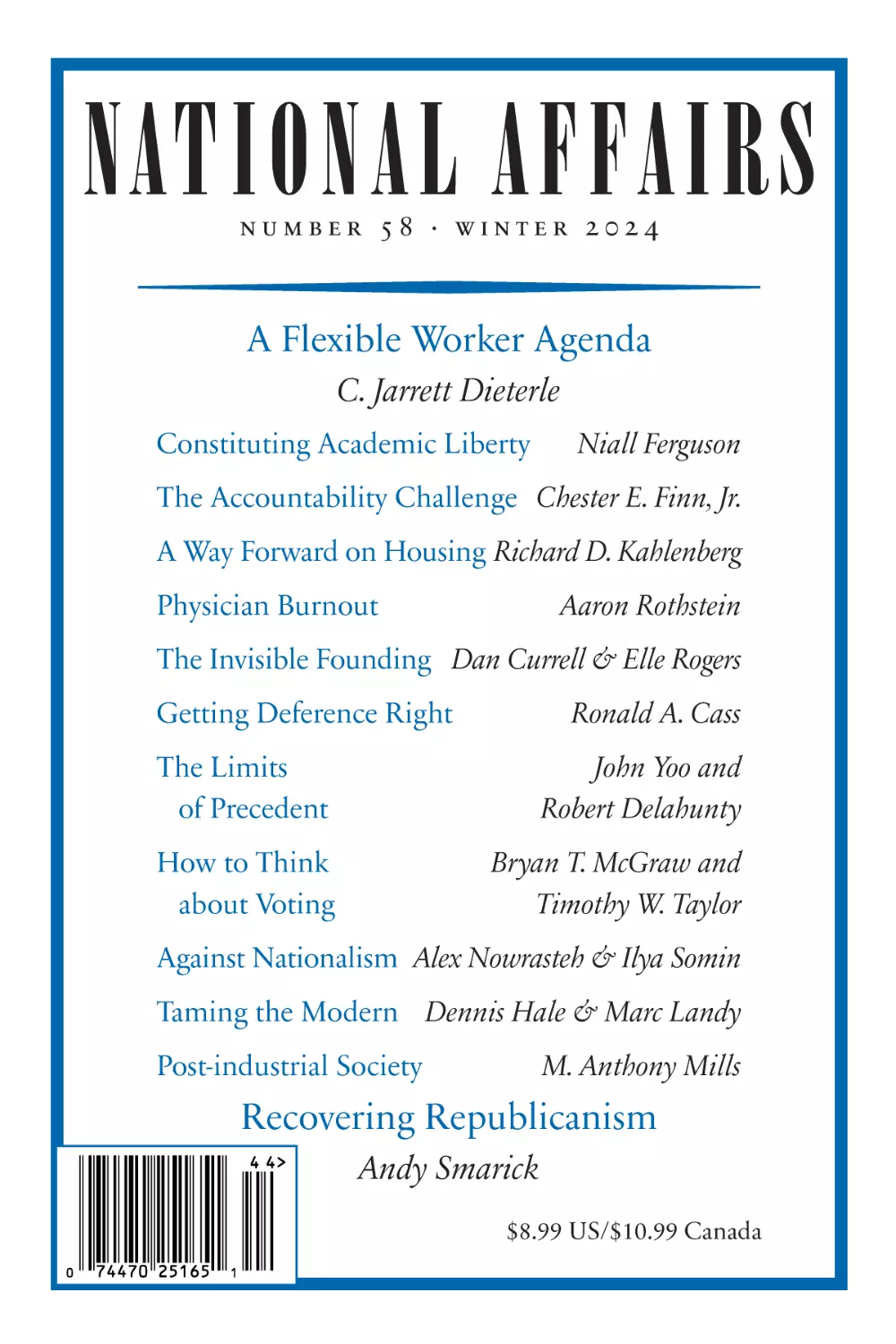
                    number 58 · winter 2024

A Flexible Worker Agenda
C. Jarrett Dieterle

Constituting Academic Liberty

Niall Ferguson

The Accountability Challenge Chester E. Finn, Jr.
A Way Forward on Housing Richard D. Kahlenberg
Physician Burnout

Aaron Rothstein

The Invisible Founding Dan Currell & Elle Rogers
Getting Deference Right

Ronald A. Cass

The Limits
of Precedent

John Yoo and
Robert Delahunty

How to Think
about Voting

Bryan T. McGraw and
Timothy W. Taylor

Against Nationalism Alex Nowrasteh & Ilya Somin
Taming the Modern Dennis Hale & Marc Landy
Post-industrial Society

M. Anthony Mills

Recovering Republicanism
Andy Smarick

$8.99 US / $10.99 Canada

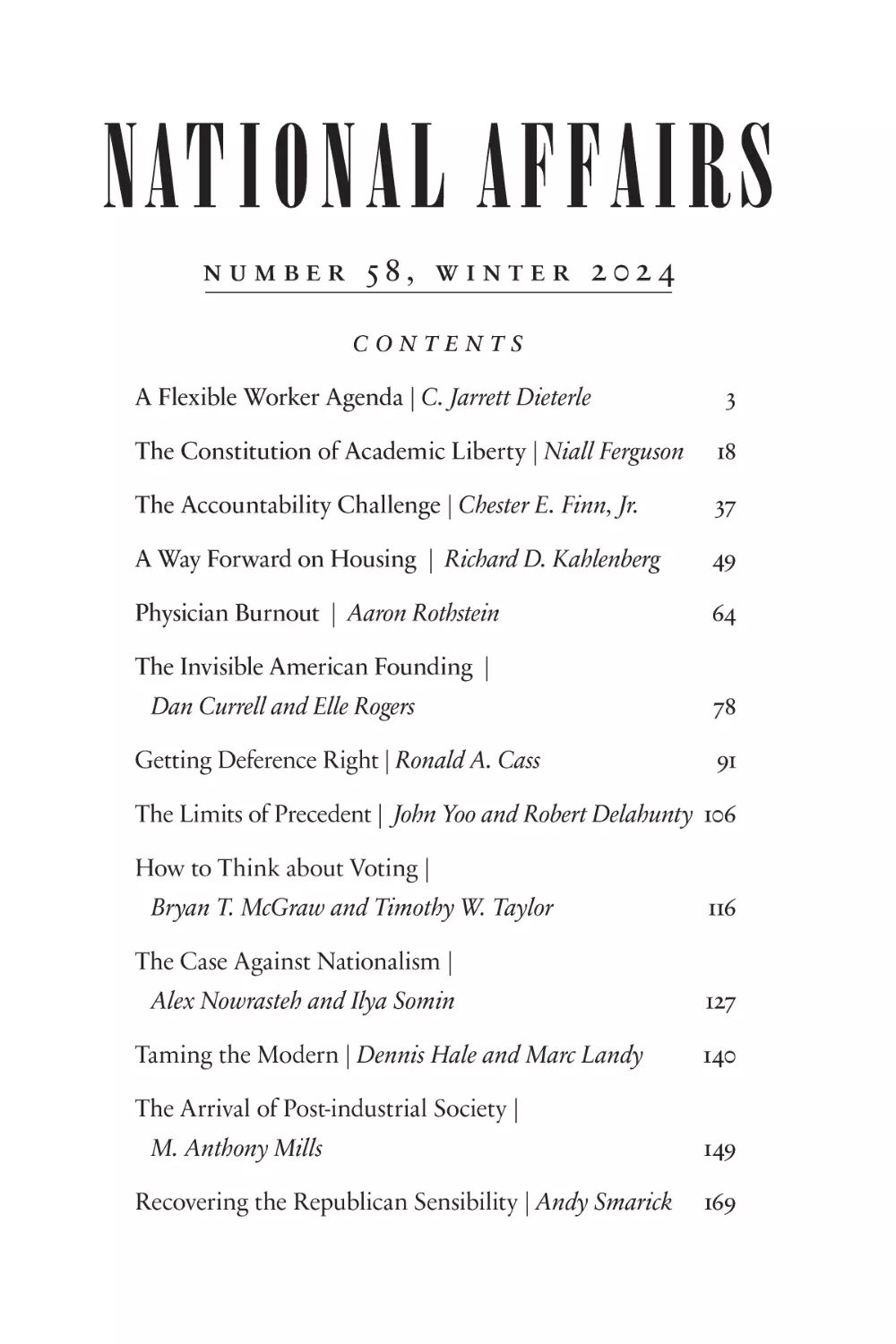
Number 58, winter 2024
contents
A Flexible Worker Agenda | C. Jarrett Dieterle

3

The Constitution of Academic Liberty | Niall Ferguson

18

The Accountability Challenge | Chester E. Finn, Jr.

37

A Way Forward on Housing | Richard D. Kahlenberg

49

Physician Burnout | Aaron Rothstein

64

The Invisible American Founding |
Dan Currell and Elle Rogers
Getting Deference Right | Ronald A. Cass

78
91

The Limits of Precedent | John Yoo and Robert Delahunty 106
How to Think about Voting |
Bryan T. McGraw and Timothy W. Taylor

116

The Case Against Nationalism |
Alex Nowrasteh and Ilya Somin
Taming the Modern | Dennis Hale and Marc Landy

127
140

The Arrival of Post-industrial Society |
M. Anthony Mills
Recovering the Republican Sensibility | Andy Smarick

149
169

Edi t or
Yu va l Lev i n
Ma n agi ng Edi t or
Chr is t i na Kopp
As s o c i at e Edi t or
Da n iel Wiser , Jr .
As sis ta n t Edi t or
How e Whi t m a n III
Co n t r ibu t i ng Edi t or s
Ada m J. Whi t e · Ada m Keiper
R eih a n Sa l a m · R a me sh Ponn u ru
Mat t hew Con t i n et t i · Eli LEHr er

P u bl ic at io n Com m i t t e e
Gerard Alexander · James W. Ceaser
Eric Cohen · John J. DiIulio, Jr.
Nicholas Eberstadt · Robert P. George
Roger Hertog · Kay Hymowitz
Leon R. Kass · Bruce Kovner
William Kristol · Jay Lefkowitz
Wilfred M. McClay · James Piereson
Diana Schaub · Irwin M. Stelzer · Tevi Troy
e di t or i a l offic e
National Affairs
1 7 89 Massachusetts Ave., NW
Washington, DC 2 0 036
(2 02) 2 89 -4 10 0
editors@nationalaffairs.com

s u b s c r ip t io n offic e
National Affairs
Post Office Box 3000
Denville, NJ 0 7 83 4
(888) 827-5508
www.nationalaffairs.com

National Affairs (ISSN 2150-6469) is published quarterly in March,
June, September, and December by National Affairs, Inc., and the
American Enterprise Institute. It is printed by More Vang and distributed
by ANC. Manuscripts may be sent to submissions@nationalaffairs.com
or by mail to our editorial office. Application to mail at periodicals postage prices is pending in Washington, D.C. POSTMASTER: Send address
changes to National Affairs, Post Office Box 3000, Denville, NJ 07834.
© 2024 National Affairs, Inc., and the American Enterprise Institute

A Flexible Worker Agenda
C. Jarrett Dieterle

I

n t oday ’s job m a r k e t, managerial buzzwords like “work-life
balance” and “workplace flexibility” appear in countless postings.
Jobs that were once strictly 9-to-5 and located in downtown business
districts are suddenly being performed in zip codes across the country
and at all hours of the day and night.
The Covid-19 pandemic further accelerated this trend. Estimates suggest that at least 25% of professional jobs in America will remain remote
going forward — up from a mere 5% pre-pandemic — with even more
allowing for hybrid work arrangements. Data from Kastle Systems show
that office occupancy levels have remained frozen for the past few years
at around 50% of pre-pandemic levels.
At the same time, the pandemic also contributed to the Great
Resignation, in which large swaths of Americans left the workforce
if they couldn’t find the flexibility or work arrangements they desired. In an effort to entice workers to stay in their jobs, companies
large and small have rushed to provide generous work-from-anywhere
arrangements and expanded benefit offerings. As a result, non-medical
and non-traditional benefit offerings are expected to increase by 20%
as of 2026, according to a LIMRA and Ernst & Young study, and threequarters of employers plan to change their benefit packages in response
to shifting workplace trends.
But flexibility can extend far beyond work-from-home policies, sweetened benefits packages, and assurances that parents can leave the office
in time for weekday soccer practice. Workers in today’s economy are
also seeking flexibility in terms of workplace autonomy, benefit portability, geographic adaptability, and even the type of degrees or training
needed to pursue certain careers.
C . Ja r r et t D i et e r l e is a resident senior fellow at the R Street Institute.

3
Copyright 2024. All rights reserved. See www.NationalAffairs.com for more information.

N at iona l A ffa ir s · Wi n t e r 202 4

Yet despite the rapidly changing nature of the American workplace, the national political conversation around American labor
policy remains stuck in the past. The political left continues to try to
fit the square peg of 20th-century labor policies into the round hole of
a 21st-century economy, pushing for policies like reclassifying all independent contractors as full-scale employees and seeking one-size-fits-all
minimum-wage rules across every job and industry. In far-left environs
like California, progressives are even attempting to import sectoral bargaining principles from parts of Europe, which would allow unions to
more easily influence entire sectors of the economy at once.
For its part, the modern right has grown increasingly muddled when
it comes to its approach to labor policy. The nationalist-populist right
has become more solicitous of organized labor in an effort to appeal to
working-class voters. In addition to a shift toward protectionist trade
policies (induced by former president Donald Trump), prominent conservative lawmakers have shown a greater willingness to side with unions
over businesses in recent years — illustrated most dramatically when
Trump, along with other members of the GOP, embraced the United
Auto Workers cause during the recent strike against General Motors. This
built on the 2022 railway strike, when senators Ted Cruz, Josh Hawley,
and Marco Rubio, among others, sided with unions in a vote over paid
sick leave. Afterward, Senator Cruz declared that “the Republican Party
is a blue-collar party,” arguing that the GOP has been the main entity
“fighting for everyday rail workers and truck drivers and steel workers
and cops and firefighters.” Beyond messaging and occasional high-profile
votes, however, this new vein of conservative populism has yet to lay out
a systematic, comprehensive approach to American labor policy.
In tension with these populist tides are the traditional pro-business
impulses of the Republican Party commonly associated with presidents
like Abraham Lincoln, Calvin Coolidge, and Ronald Reagan. About
60% to 70% of corporate CEOs continue to identify as Republicans, and
GOP lawmakers still consistently receive the highest rankings in scorecards produced by entities like the National Federation of Independent
Businesses. And despite a high-profile dispute with the Chamber of
Commerce last year, Republicans also still receive the vast majority
of the chamber’s election endorsements.
Partly because of these internal tensions, the modern right has failed
to identify and articulate a cohesive labor policy agenda that meets the
4

C. Jarrett Dieterle · A Flexible Worker Agenda

current political moment and confronts the reality of America’s rapidly
changing modes of work. Its failure to do so could risk ceding the issue
to the left.
The answer is a labor policy agenda for the modern right that is
neither reflexively pro-union nor pro-business, but rather pro-flexibility.
This would include flexibility across numerous spheres, including time,
benefits, movement, and investment. It’s an agenda that prioritizes the
self-determination and agency of workers, ensuring they can live, work,
and thrive in any career they choose to pursue. It would likewise unshackle employers, freeing them to creatively arrange and adapt their
businesses to attract the workers they need to succeed.
By embracing a flexible worker agenda, conservatives can empower
individual workers and entrepreneurial businesses without having to
abandon their traditional deregulatory, pro-growth instincts. In turn,
the modern right can play a leading role in ambitiously and boldly advancing America’s labor policy into the 21st century.
Au tonom y i n t he Wor k pl ace
Survey after survey shows that, above all, workers desire flexibility.
According to an October 2021 survey by Jabra, close to 60% of workers
reported that workplace flexibility is more important to them than salary
or benefits, while over 75% prefered working for companies that allow
them to work from anywhere. Notably, respondents were not satisfied
with uniform remote-work policies; they wanted to be able to exercise
more individualized control over when and where they worked.
While it might be tempting to narrow the import of these findings
to the professional salaried class, surveys of hourly and shift workers
are equally compelling. In a recent study of these workers, over 80% of
respondents cited the ability to influence their work schedule as a key
component of job satisfaction, and over 75% voiced a preference for
selecting which shifts they worked rather than having shifts assigned
to them.
Given this focus on flexibility, arrangements like independent contracting and gig-economy work can be attractive options for many
Americans. In fact, autonomy and flexibility are the two most common reasons that workers choose independent contracting over more
traditional forms of employment, with 31% listing “being their own
boss” as the most common reason for their contracting career path and
5

N at iona l A ffa ir s · Wi n t e r 202 4

32% listing “flexibility” or the need to work around personal obligations. Over 60% of gig-economy workers list the flexibility of choosing
when to work as the key reason why they chose gig work — higher than
any other factor. For gig workers with children, it’s closer to 70%.
Contrary to some narratives on the political left, independent contractors and gig-economy workers generally pick their careers not by
necessity, but by choice, with 70% to 80% of gig workers saying that it
was their first option. Furthermore, over 60% reported the intention to
remain in the gig economy rather than return to more traditional employment setups. A mere 10% of independent contractors desire a more
traditional job, with close to 80% wanting to remain in their current
freelancing setup.
Despite these statistics, the left continues to argue that “good”
jobs — by which they usually mean full-time jobs with expansive
benefits — are disappearing, forcing more Americans to take “bad” jobs
like part-time gig-economy work. In reality, it is more difficult than it
should be to create contracting and gig work. Meanwhile, employers
are unable to fill the full-time jobs with benefits that are available. This
is because many people prefer jobs that offer more flexibility, less work,
or some other desirable feature, and therefore they actively choose not
to seek traditional full-time employment.
The left has ignored these realities, however, and its antagonism
toward independent contracting, self-employment, and gig-economy
arrangements continues to grow. To take one example, a provision in
the Democrat-passed American Rescue Plan lowered the Form 1099-K
reporting threshold for third-party payment services from $20,000
to $600. This disproportionately affects independent contractors and
the self-employed, who tend to rely on third-party payment platforms
such as eBay, PayPal, or Venmo to conduct business in our increasingly
cashless society.
The $600 threshold was delayed for a year, but it continues to loom
large on the horizon. While efforts have bubbled up in Congress to
raise the threshold back to $20,000, a broad approach to enhancing
worker flexibility would seek to raise the $600 threshold for all Form
1099 work — whether it be 1099-K, 1099-NEC, or 1099-MISC. These
rules tend to hurt small businesses and self-employed Americans who
have smaller administrative-support staffs, and they disincentivize
independent-contracting arrangements more broadly.
6

C. Jarrett Dieterle · A Flexible Worker Agenda

When the threshold was established in the 1950s, $600 represented
about 14% of the median household income of that era. Today, it is about
0.8% of the median household income. This has led many to mistakenly
conclude that independent contracting and gig-economy work is on the
rise, when it in fact just means that more paperwork is being filed.
The war on contracting, self-employment, and gig work extends well
beyond the tax code. Most gig-economy platforms classify their workers — from rideshare drivers to grocery deliverers — as independent
contractors. The political fight over this classification status took off
in California in 2018, when the state supreme court overturned longstanding state labor law by laying down a stringent “ABC test” for
independent contractors.
Among other requirements, the strictest versions of the ABC
test — like the one found in California — state that workers are presumed to be employees rather than contractors unless they can show
they are engaged in work “outside the usual course” of the employer’s business and have made the deliberate choice to go into business
for themselves. This rule made it nearly impossible to envision any
gig-economy workers — let alone other types of independent contractors — being able to maintain their contractor status. Nonetheless, in
late 2019, the California legislature passed Assembly Bill 5, codifying the
ABC test into state law.
The impact of Assembly Bill 5 in California was both immediate and
widespread. Given the broad reach of the bill, independent contractors
in nearly every industry suddenly found themselves subject to reclassification as employees. While California lawmakers intended to target
gig-economy companies, stories abounded of freelance actors, dancers,
and musicians suddenly losing their jobs. The state legislature attempted
emergency surgery by carving out exemptions for over 50 industries (in
addition to the nearly 60 industries that the statute already exempted),
thereby picking winners and losers arbitrarily.
While numerous states have less-stringent versions of the ABC test,
some policymakers in Massachusetts and New Jersey have pushed to
adopt the stricter California-style approach. The Biden administration’s
Department of Labor also recently announced plans to reverse a more
lenient Trump-era rule for how to classify independent contractors,
returning instead to a previous multi-factor test deployed under the
Obama administration.
7

N at iona l A ffa ir s · Wi n t e r 202 4

Perhaps most troubling is the introduction by Democrats in Congress
of the Protecting the Right to Organize (PRO) Act. In addition to numerous other provisions, the PRO Act would codify at the federal level the
stringent version of the ABC test. According to analysis by the American
Action Forum, doing so could risk up to $2.3 trillion of U.S. GDP (8.5%).
Apart from the potentially massive economic impact, Democratic priorities like the PRO Act fly in the face of what workers themselves actually
want: As noted, independent contractors and gig workers overwhelmingly prefer to remain in their current arrangements.
Conservatives would therefore be wise on both political and economic grounds to make protecting the status of independent contractors
and the self-employed a key feature of a flexible worker agenda. To be
truly flexible, such an agenda should not only protect the status of these
workers, it should also provide them with a secure safety net from which
they can jump to new opportunities.
The main drawback of independent work cited by those engaged
in such occupations is the lack of benefits. Indeed, independent contractors rarely have access to unemployment insurance, sponsored
retirement plans, workers’ compensation, disability insurance, or paid
sick leave — and health insurance is usually only available through the
Affordable Care Act’s complicated exchanges.
Yet strong protections for independent contracting and more robust benefit options need not be mutually exclusive priorities. As the
R Street Institute’s Eli Lehrer has discussed in these pages, protections
for independent contractors — or some other type of newly minted
“flexible worker” status — could be coupled with worker-controlled
benefits exchanges, which would create portable and individualized
benefit options for these workers.
While a portable benefit system might take numerous forms,
a center-right approach could operate with features similar to those of
a Simplified Employee Pension plan, or SEP-IRA — meaning it would
use a system of employer contributions while giving employees the
ability to make their own pre-tax contributions. The funds could then
be used toward paid sick leave, unemployment insurance, or even
health insurance, which could be purchased via worker-controlled
benefits exchanges.
These benefit-flexibility concepts could also expand beyond contractors and gig workers, especially in the retirement context. America
8

C. Jarrett Dieterle · A Flexible Worker Agenda

currently operates under a system that largely features employer-based
retirement plans, and many workers find it difficult to roll over old
retirement accounts to new jobs — which in turn has contributed to
the proliferation of abandoned or “orphan” accounts that workers lose
track of.
Establishing a system of automatic portability for retirement accounts, or even deeming retirement contributions the property of
workers, could help reduce this problem while increasing flexibility. If
retirement contributions were the property of workers, employees could
simply direct contributions they received from any employer to any account of their choosing.
The current system could remain intact in many ways. But if a worker
particularly liked a 401(k) plan from his old job or the federal thrift savings plan from his days in government, he could simply instruct his
new employer to send contributions to that plan rather than having to
establish a new one. If that worker wanted to suddenly shift to contracting or self-employment, he could still continue using his original plan
for his own retirement savings. While there could be some complexities
to iron out in terms of the vesting of employer contributions in certain
plans, these are likely solvable.
The right could find a natural sweet spot in prioritizing worker
flexibility not only by creating regulatory leeway for alternative work
arrangements, but also by providing workers with more control over
benefits options. Doing so would not compromise pro-market ideals,
as it would empower workers to have more autonomy and choice over
their jobs and save businesses from the dramatic cost burdens associated
with the left’s more draconian labor policies.
Fr ee to Mov e
Each year, tens of millions of Americans decide to change jobs or move
to a new location. While it may seem like government has little role
to play in these personal decisions, public policy can be overhauled to
make such movement easier. A robust flexible worker agenda should
protect a worker’s right to move — whether it be from job to job or state
to state.
In this vein, a broad rethinking of non-compete agreements in labor
contracts is far past overdue. While libertarian notions of the freedom
of contract have long pushed right-leaning policymakers away from
9

N at iona l A ffa ir s · Wi n t e r 202 4

rules that restrict any type of contractual arrangements, recent years
have seen more free-market policy wonks start to question the desirability and efficacy of non-compete agreements.
Such agreements are surprisingly widespread across the American
economy. Recent research suggests that close to 20% of American workers are currently bound by a non-compete agreement, and just under 40%
have signed at least one non-compete agreement in their lifetimes.
Non-compete agreements were once seen as the exclusive province
of the corporate C-suite, but this is no longer the case. Even among
workers earning less than $40,000 a year, one in 10 is subject to a noncompete agreement. Such agreements appear to have an earnings
effect, with evidence suggesting that they generally reduce the wages of
hourly workers.
Ultimately, of course, their biggest impact is on worker autonomy
and flexibility. Non-compete agreements bind workers to jobs that they
otherwise would seek to leave, or sideline them from the workforce
after they leave a role with a trailing non-compete clause. A labor policy
that prioritizes worker flexibility and agency would look skeptically
at rules that make it difficult for workers to move from job to job —
non-compete agreements included.
It remains uncertain whether conservative lawmakers could embrace
a broad-brush ban of all non-compete agreements without isolating some of their constituency in the business community. A recent
Federal Trade Commission proposal for a blanket ban on non-compete
agreements nationwide, for instance, faced vigorous opposition from
business interests. While a federal, top-down solution — especially one
proposed by a federal agency without any congressional input — may
rightly raise conservative eyebrows, more nuanced reforms to noncompete agreements could be more viable.
One option could entail limiting or banning non-compete
agreements that are overly broad in scope, or only allowing them in
certain contexts, such as for highly compensated C-suite executives at
public companies or when a full business is sold. Another option would
be permitting back-end non-compete agreements for higher-wage
workers that are offered and signed when the employee leaves the job.
States as red as Alabama and as blue as Massachusetts have limited
non-compete agreements in these and other ways, underscoring the
cross-ideological nature of such reforms. These more narrowly tailored
10

C. Jarrett Dieterle · A Flexible Worker Agenda

options would protect companies’ ability to continue using noncompete agreements in environments where they may be appropriate
but limit their use outside that context.
It’s also worth noting that even in states that permit non-compete
agreements, their use is far from routine. Traditionally, courts have only
enforced non-compete agreements if they are “reasonable” — a murky
legal standard that makes non-compete litigation one of the least predictable areas of the law. Businesses value certainty and clarity; the
current system provides little of either. Carefully drawn, nuanced limitations on non-compete agreements, therefore, could actually provide
better bright-line rules for businesses, which in turn would reduce litigation costs, administrative burdens, and uncertainty.
As noted above, the pandemic has further upended traditional norms
about where people work. Geographic and locational flexibility are only
going to become more important to workers in the years ahead. Giving
workers more control over where they work should be another pillar of
a flexible worker agenda.
Generally speaking, the number of Americans changing locations
to obtain new jobs is at an all-time low. Numerous factors play into this
phenomenon, from rising real-estate prices to place-based poverty-relief
programs that tether lower-income individuals to certain locales. But
these barriers don’t mean policymakers should ignore the importance
of locational flexibility for workers.
In fact, evidence suggests that with the economy moving toward
more remote-working options, there could be more worker movement
in the years ahead. According to surveys, around 30% of remote and
hybrid workers moved in 2022, compared to only 17% of on-premise
workers. In other words, Americans may not be moving for jobs, but
many are moving and taking their jobs with them.
For many occupations, this poses few challenges beyond packing
up the car, moving to a new state, and logging in remotely. But in
industries that require government licenses, moving across state lines
can be extremely challenging — and even prevent workers from obtaining employment altogether.
Therapists, nutrition advisors, and certain other medical professionals can often practice from anywhere through telehealth technology.
During the pandemic, states instituted waivers in many medical occupations to allow licensed professionals to practice across state lines.
11

N at iona l A ffa ir s · Wi n t e r 202 4

But with many of these rules expiring, the ability of these workers to
move could be undercut. One obvious priority for conservatives in the
years ahead should be pushing policies to expand telehealth and other
virtual services that allow more Americans in these sectors to work
from anywhere.
If occupations like medicine can be done remotely, the possibilities
for expanding virtual services across various fields are nearly limitless.
Many other occupations — from sign-language interpreters to owning
a travel or bill-collection agency — can be practiced remotely but may
also face arbitrary licensing barriers that prevent them from operating
across state lines. Even some on-site workers who move due to life events
or to seek new employment opportunities encounter such barriers.
Between 25% and 30% of jobs in the United States require some
form of license — a dramatic increase from around 5% in the 1950s.
As organizations like the Institute for Justice have chronicled, occupational-licensing rules can be found in many lower- and middle-income
occupations, such as barbering or landscaping, as well as the aforementioned remote careers like owning a travel or bill-collection agency.
Unfortunately, there is little uniformity between states when it
comes to their respective licensing regimes. A health coach licensed
in California, for example, recently faced the prospect of obtaining
a bachelor’s degree in dietetics, fulfilling a time-consuming internship
requirement, passing an exam, and paying hundreds of dollars in fees
to practice the same occupation after moving to Florida.
States like Arizona have led the way in alleviating this problem with
comprehensive universal-recognition laws, which recognize the licenses
of professionals from other states so long as the licensees are in good
standing in their state of origin. To date, 20 states have enacted at least
some form of a universal-recognition law — a reform wave that rightleaning policymakers should seek to expand. Other promosing options
on this front include interstate compacts for various licensed occupations, similar to the successful nurse-licensure compact that allows
nurses to practice in 40 different states with one multi-state license.
It often remains difficult to fully de-license occupations given the
protectionist interests that fiercely guard the status quo. Still, a flexible
worker agenda should continue the right’s push against overburdensome licensing requirements — with a particular focus on increasing
licensing portability across state lines.
12

C. Jarrett Dieterle · A Flexible Worker Agenda

Implementing targeted policies that enhance the ability of
workers — from the professional class on down to the blue-collar
trades — to move jobs or change locations is the type of market-based,
bread-and-butter agenda that the political right has historically thrived
on. By championing a worker’s right to move, a flexible worker agenda
can empower Americans while creating a more dynamic labor force for
the country.
Fle x ible C a r eer Pat hs
Conservative policymakers would be wise not to limit their focus to
helping workers gain more control and flexibility over where they work;
they should also provide more options for how those workers can obtain the requisite credentials and training to pursue their chosen career.
A flexible worker agenda would address this issue in two ways: by overhauling burdensome degree requirements for existing careers, and by
reforming the scope of practice for occupations to allow more professionals to practice more widely in many fields.
It’s quickly becoming clear that America has a credentialism problem.
The modern labor market prioritizes expensive — and often unnecessary — educational degrees and licenses for many jobs. An analysis by
Burning Glass Technologies showed that job postings are increasingly
requiring college degrees for positions that never previously necessitated
such a credential. A recent study by the Harvard Business School found
that as many 6.2 million workers in middle-skill jobs were potentially
affected by degree inflation — in other words, they could be precluded
from qualifying for a job based on a lack of a degree.
Admittedly, government has limited means to prevent credential
creep for the four-year bachelor’s degree. But this does not mean it is
powerless — at least as an employer itself.
An immense number of Americans work for the government or
in government contracting roles. At the federal level, after factoring in
government contractors and those receiving federal grants, the government workforce exceeds 9 million. Another 16 million Americans work
for the government at the state and local levels. Combined, this equals
close to a sixth of the entire U.S. workforce of 167 million. Government
jobs are also more likely to require post-secondary degrees compared to
private-sector positions, with over 60% of state- and local-government
jobs having such requirements.
13

N at iona l A ffa ir s · Wi n t e r 202 4

Governments retain significant control over the credentials needed
both for direct workers as well as contractors. States as politically diverse
as Pennsylvania, Maryland, and Utah have responded by dropping requirements for a four-year college degree for many government jobs. As
of this publishing, 10 states have enacted such reforms. Conservatives
should seek to expand this trend to the remaining states.
At the federal level, both the Trump and Biden administrations have issued executive orders directing agencies toward more
assessment-based, rather than degree-based, hiring. Policymakers can
likely take more aggressive action on this front. For instance, presidents
could instruct entities like the General Services Administration or the
Government Accountability Office to identify the degree requirements
for various government positions and then eliminate them outright.
Presidents also have significant influence over federal contracting rules
under the Federal Property and Administrative Services Act, and could
implement similar reviews and overhauls of potentially problematic degree requirements for contracting positions.
The government is also often complicit in America’s credentialing
problem by itself being the credentialer. Here again, professional- and
occupational-licensing laws rear their head by forcing many Americans
to secure expensive and hard-to-obtain credentials in order to pursue
many careers.
One notable example is the process needed to obtain a cosmetology
license. According to the Institute for Justice, the average cost of attending cosmetology school — which is necessary to obtain a license in most
states — is $16,000, and the average cosmetology student takes out $7,300
in debt. Depending on the state, the average time needed to obtain
a cosmetology license can be anywhere from 233 to 963 days.
Given the substantial time and monetary investment needed, the
returns are relatively modest, with over half of cosmetologists earning under $15 per hour, or $30,000 annually. What’s more, there is little
evidence that all this training is necessary to safely cut a person’s hair.
Based on an analysis by Daniel Greenberg, only 25% of the average cosmetology-school curriculum is related to health and safety.
As noted, efforts to fully de-license professions often face fierce resistance. But policymakers could at least initiate state-guided reviews
of curriculum requirements for educational programs that are mandated for obtaining government licenses. In turn, course time spent
14

C. Jarrett Dieterle · A Flexible Worker Agenda

on non-essential or non-safety-related teaching could be curtailed or
eliminated. Occupations as varied as athletic trainers, interpreters, and
interior designers require four years or more of education in numerous
states, underscoring the widespread impact such reforms could have.
Many occupations also suffer from excessively restrictive scopeof-practice rules that make them inaccessible to the middle and lower
classes, and to people who are not naturally inclined to classroom
learning. Overhauling these rules and allowing less-credentialed professionals to take on more tasks would create more flexible job options for
many Americans.
This is particularly important in fields that have extremely high educational barriers to entry. One of the most notorious examples is the
legal field, with the average cost of a legal education running close to
$200,000 and entailing a three-year law-school commitment.
The legal field also rigorously polices the “unauthorized practice of
law,” meaning only licensed attorneys can provide legal advice. What
constitutes “legal advice,” however, is often construed broadly, entailing
even discussion of basic legal information. Permitting attorneys alone to
engage in these types of tasks raises the cost of legal services and needlessly sidelines supporting professions like paralegals from doing work
they are capable of completing.
States are starting to respond creatively to these problems by establishing new career options that stop short of a fully licensed attorney but
nonetheless allow different types of professionals to provide a greater
variety of legal services. Utah, to take one example, established a paralegal practitioners program that allows participants to practice without
a lawyer’s supervision in areas such as divorce, custody, and debt collection. A handful of other states have established similar programs.
Utah’s paralegal practitioner certification costs around $600, which,
even if combined with an associate’s degree upon entering the legal
field, is likely to cost closer to $10,000 versus $200,000 for law school (on
top of a four-year college degree). Those who have received the certification report earning up to $75 an hour — a wage that far exceeds that of
many other career paths.
Additional examples abound. Dental hygienists, to name one, are
capable of providing many dental services independently of a dentist.
In some states, dental hygienists have limited diagnostic and prescriptive authority, and can administer anesthesia; other states prohibit them
15

N at iona l A ffa ir s · Wi n t e r 202 4

from engaging in these services. Restrictive scope-of-practice rules have
been found to correlate with reduced numbers of hygienists per capita
as well as lower hygienist wages. Increasing the services hygienists can
engage in on their own, on the other hand, is associated with improved
oral-health outcomes for the general population.
While more states have started to expand the scope of practice for
dental hygienists in nuanced ways, there are tremendous opportunities for flexibility-minded policymakers to continue reforming the rules
governing this occupation. States like Colorado and Maine, for instance,
have permitted dental hygienists to own their own practices, enabling
them to run their own businesses and be their own bosses. The scope of
practice for other dental professionals, such as dental therapists, could
likewise be expanded.
The federal government is limited in its power to play a role here, but
it is not powerless. The Department of Veterans Affairs (VA) employs
dental hygienists, and could expand the authority of these workers. The
VA expanded the scope of practice for advanced-practice nurse practitioners several years ago, and other federal agencies like the Indian Health
Service have experimented with allowing hygienists and other dental
workers to provide more types of services in places like rural Alaska.
It generally takes two to three years to complete the necessary education to become a dental hygienist, which can often be completed at
a community college or technical school. The average cost for the degree
hovers around $22,000. Becoming a licensed dentist, by contrast, requires
a four-year bachelor degree followed by another four-year dental-school
degree — with dental school alone often costing over $200,000.
Broadly and forcefully pushing back against credential creep by
eliminating degree requirements for government positions, decluttering curricular requirements for additional occupational licenses, and
expanding affordable career-path options through scope-of-practice
reform could be one of the most important policy arrows within the
worker-flexibility quiver.
A Pro -wor k er Fu t ur e
In the current political environment, conservatives are eager to burnish their populist credentials, which has led them to push back against
“woke” corporations and even start embracing labor unions. So far,
however, today’s conservative movement has failed to present a unifying
16

C. Jarrett Dieterle · A Flexible Worker Agenda

vision for American labor policy in the 21st century. The way forward
is a flexible worker agenda that prioritizes workers while also ensuring
that businesses have the capacity and opportunity to thrive and grow.
None of the ideas discussed here are geared toward the rich
and elite levels of society; a flexible worker agenda targets the middle- and
working-class tiers of the American labor force. Embracing such an
agenda could help conservatives appeal to everyday Americans — from
gig-economy workers and freelancers to landscapers and dental hygienists. In other words, right-leaning policymakers can be pro-worker
without necessarily being pro-union — and without having to embrace
the far-left economic policies that most labor unions (and the political
left writ large) currently support.
Americans’ priorities in the workplace are changing. The political
movement that can most effectively respond to this reality is the one
that will be best positioned to lead our country’s labor policy for current
and future generations. A labor agenda premised on flexibility could
therefore be a lodestar for conservatives in the years ahead.

17

The Constitution of Academic Liberty
Niall Ferguson

I

t ’s no t e a s y t o fou n d a new university, as Thomas Jefferson
discovered — though it is easier than founding a new republic. The
two enterprises have certain things in common. In particular, success
depends on constitutional design.
There would be no point in founding a new university if there were
not something rotten in the state of contemporary American academia.
Some of us have known this for years. But events arising from the
October 7 terrorist attacks on Israel revealed the extent of the rottenness
to many alumni and donors who had not been paying close attention.
There is no need to rehearse here the symptoms of the disease, which
has been spreading for the better part of a decade: the dis-invitation
campaigns; the cancellations of dissident voices; the denunciations of
heterodox scholars; the violations of academic freedom by an unholy
combination of “woke” students, progressive faculty, and inquisitoradministrators. The question is how to inoculate a university against it.
Two years ago, a group of like-minded friends and I set out to establish a new university in Austin, Texas. Since our initial announcement
of the University of Austin in November 2021, I have often been asked:
“How will you prevent your university from being ‘captured’ like all
the others?” Yet our challenge is even more daunting: It is to build an
institution that is not only insulated from the problems of the present,
but also fortified against the (as yet unknown) problems of the future.
Nearly all universities are launched with lofty aspirations, the
University of Austin included. Some dozen educational institutions
around the world have adopted Sapere Aude (Dare to Know) as their
motto — including the Moscow Institute of Physics and Technology,
N i a l l Fe rg u s o n , a founding trustee of the University of Austin, is the Milbank Family
Senior Fellow at the Hoover Institution at Stanford University.

18
Copyright 2024. All rights reserved. See www.NationalAffairs.com for more information.

Niall Ferguson · The Constitution of Academic Liberty

which was established under Joseph Stalin. At the same time, modern
universities have demonstrated considerable variety in institutional
structure. And yet, despite these founding ambitions and diverse designs, a striking convergence in campus cultures has taken place in
recent years. To fulfill our goal of establishing a university “devoted to
the unfettered pursuit of truth,” we must understand the reasons for
this convergence.
As the founders of our republic well understood, upholding freedom requires more than mere declarations of good intent; effective
safeguards and remedies must also be embedded within a governing
structure. That is why I spent many months drafting a constitution for
the University of Austin. My hope is that this constitution will form
a more perfect university — one that models the principles and practice not of ideological conformity, but of unfettered inquiry and free
intellectual exchange.
T he A mer ic a n Uni v er si t y
The modern university in the United States is a hybrid institution, as
Americas Quarterly’s Nick Burns has observed. “[M]any of its formal
structures,” he notes,
from the division into faculties to the lecture, date from the
thirteenth century. . . . [T]he university took shape gradually as
a corporation of scholars based on the model of the cathedral
school and the monastery, with special privileges granted by secular or ecclesiastical authority. . . . Medieval university students paid
fees to matriculate or received assistance from public or private
sources. Study was divided into faculties . . . with teaching staff
assigned to each. The lecture was the primary means for the transmission of knowledge. . . . [The medieval university had] effective
juridical autonomy.
It was perhaps inevitable that the earliest universities established in
Britain’s North American colonies would look to Oxford and Cambridge
for their inspiration, though the ancient Scottish universities were also
available as models. The 19th-century revolution in German academia
had its impact on the United States, too. Daniel Coit Gilman imported the German model of a “research university” to Johns Hopkins.
19

N at iona l A ffa ir s · Wi n t e r 202 4

Charles William Eliot Germanized Harvard. On top of these influences,
American universities were from an early stage more willing than their
models in either Britain or Germany to blur the distinction (so clear to
John Stuart Mill in the 1860s) between “general education” and “professional knowledge.” (Mill would be appalled by the power wielded at
Harvard or Stanford today by law, medical, and business schools.)
European institutions metamorphosed on American soil. If senior professors in Europe enjoyed what Burns called “a medieval-style
privilege, granting separate status and special protections to an individual,” tenure in the United States (as codified in the American Association
of University Professors’ 1940 “Statement of Principles on Academic
Freedom and Tenure”) was intended to protect academics’ rights to
free speech and free association. At Oxford and Cambridge, the high,
impenetrable walls of the colleges — so frustrating to Thomas Hardy’s
Jude Fawley — created sequestered groves. In the American context, the
walled college has recently evolved into “a totalizing community” (to use
Burns’s words), made all the more intrusive in its surveillance by the opportunities for social control created by the Covid-19 pandemic.
William Kirby’s book Empire of Ideas argues that the German model
was significantly improved when it crossed the Atlantic. “The modern
American research university,” he wrote, was “built upon a foundation
of three diverse elements: an undergraduate liberal arts education in the
tradition of the colonial colleges; participatory research evolved from
the German tradition of the nineteenth century; and twentieth century
engagement with government, industry, and private philanthropy.” But
there is more to it than that.
The defining feature of the American university is that its governance
structure more closely resembles that of a public for-profit corporation
than is true of a British or a German one. It has a board of directors
(board of trustees), a chief executive (university president), a management team (the provost and deans), and various stakeholders, of whom
the most important are stockholders (donor alumni) and the key employees (star professors).
Typically, a university board of trustees serves as the legal representative of the institution. Trustees, who are often alumni of the university,
are expected to bring their administrative and financial experience to
bear in supporting (and monitoring) the work of the university president, whom they are also responsible for selecting. University presidents
20

Niall Ferguson · The Constitution of Academic Liberty

sit atop the academic leadership team, which usually consists of a provost and a series of deans focused on various areas of academic and
campus life. As Derek Bok noted in Higher Education in America, since
administrative and fundraising duties increasingly dominate the time
of university presidents, they “tend to delegate most of the responsibility over academic affairs to provosts and deans.” “[A]s a practical
matter,” Bok adds, “ultimate power resides with those who are most
difficult to replace.” At elite research universities, which compete fiercely
to gain and retain top professors, the faculty, when united, can prove
extraordinarily powerful.
The two key differences between the university and a public forprofit corporation are that the former has no single “bottom line,”
meaning standards of presidential performance are more difficult to
establish, and, unlike key employees at a corporation, tenured professors
can be discharged only in exceptional circumstances. For this reason,
the typical university president can be said to operate with one hand
tied behind his back.
To understand the defects of this model, it helps to study the history of the most venerable of American universities, not least because
any new university would surely wish to emulate their longevity and
success — and seek to avoid at all costs becoming what they are today.
Decen t r a lized G ov er na nce
Any newcomer to Harvard hears repeatedly that the university’s great
strength — and simultaneously, its great weakness — is that it is (to
quote William Kirby, a former dean of the Harvard Faculty of Arts and
Sciences, or FAS) “(in)famously decentralized, with a large amount of
money and power resting in the deans of its twelve schools, while relatively little is retained by the central administration.” Decentralization
is by and large a desirable feature in liberal institutions, so it is important to understand why Harvard’s decentralization is widely seen as
a source of difficulty, and how far that assessment is warranted.
From its earliest years, Harvard’s governance diverged radically from
that of Cambridge — Harvard’s parent institution in terms of both inspiration and personnel. Harvard’s laws and statutes were first compiled
in 1642, prescribing appropriate conduct and detailing the requirements
for students. With professors in short supply, a board of overseers was
made a permanent institution in 1642 to run the college until there were
21

N at iona l A ffa ir s · Wi n t e r 202 4

sufficient resident faculty. When the college was formally chartered in
1650, ownership and executive power were vested in the president and
fellows of Harvard College, also known as “the Corporation.”
Initially, the Corporation comprised seven members: the president,
the treasurer, and five fellows, the latter of whom were initially teaching
staff but later included members of the surrounding communities. This
arrangement differed radically from the one that prevailed at Cambridge
(as well as Oxford), where fellows were numerous and associated with
colleges that provided instruction as well as bed and board.
Harvard’s charter was conceived by its author, Henry Dunster, as
what Arseny Melnick described as “a system of checks and balances.”
Harvard’s president is its chief executive, with the leading role in planning and strategy, appointing faculty deans, and granting tenure.
Though he has a great deal of power on paper, the president faces
a major struggle to exert control over Harvard’s schools and other institutions — aptly characterized by the Boston Globe as a “confederation of
semi-independent baronies.” Of these institutions, the most powerful
is FAS, which is capable of playing a parliamentary role. There is no
judicial branch.
Since the presidency of Neil Rudenstine in the 1990s, Harvard presidents have delegated the more academic aspects of administration to
the provost, who is the university’s chief academic officer. Students
are represented by the Harvard Undergraduate Association, which
has an executive team led by the co-presidents who meet on a regular basis with the president, the dean of Harvard College (in essence,
the undergraduate program), and the dean of FAS. Since the mid-20th
century, undergraduates have lived in residential houses, which have
some tutorial functions and faculty leadership but lack the autonomy
of the Oxbridge colleges. The real power at Harvard rests with the “barons” — the deans of the wealthy professional schools of medicine, law,
and business.
Whereas the German research university succumbed to excessive
democratization after 1968, that was certainly not the case at Harvard
(despite the efforts of militant students in the late 1960s and early 1970s).
Credit is due here to Henry Rosovsky, who served as acting president
in 1984 and 1987 and for many years was the dean of FAS. Rosovsky’s
“Seven Principles to Ensure Reliable Performance” within a university
were in large measure a reaction to the era of student protest; their main
22

Niall Ferguson · The Constitution of Academic Liberty

theme was the need to limit student influence over governance. They
read as follows:
1. Not everything is improved by making it more democratic.
2. There are basic differences between the rights of citizenship
in a nation and the rights that are attained by joining a voluntary organization.
3. Rights and responsibilities in universities should reflect the
length of commitment to the institution.
4. Those with knowledge are entitled to a greater say.
5. The quality of decisions is improved by consciously preventing conflict of interest.
6. University governance should improve the capacity for teaching and research.
7. To function well, a hierarchical system of governance requires
[an] explicit mechanism of consultation and accountability.
Rosovsky envisioned a university where “professors [are] responsible
to chairmen, most particularly when it comes to teaching responsibilities. Chairmen report to deans, who are appointed and if necessary
discharged by provosts or presidents. And presidents report to boards
of trustees.”
Such a system not only resembles the configuration of a major public
corporation; it has precisely the same vulnerabilities. First, there is “key
man risk.” The demands of Harvard’s president are so great as to be
potentially overwhelming. Rudenstine’s ambitious efforts to increase
cooperation and integration across Harvard’s many “tubs,” and his determination to be on top of every tenure decision, led ultimately to
his collapse and leave of absence in 1994. Another overactive president,
Lawrence Summers, intervened regularly in the work of the departments and schools. His fate was to be overthrown by FAS, where his
critics were able to instrumentalize some undiplomatic comments he
had made on women’s underrepresentation in the sciences.
Summers’s ouster was costly. The financial crisis of 2008-2009 struck
two years after he had stepped down as president. Investment decisions
by both the Harvard Management Company and the General Operating
Account — over which Summers had exerted some influence — proved
disastrous in the bank run that followed Lehman Brothers’ failure.
23

N at iona l A ffa ir s · Wi n t e r 202 4

“Had Summers remained as president,” Kirby argues, “my guess is that
he would have known when to get the university out of those investments. But two years after he left, there were few who had the memory
or expertise to understand the potential risks.” Despite including some
experienced financiers, the Corporation was “uninformed and inattentive.” The new president was an American Civil War historian — far
less familiar than Summers with the university’s financial exposures.
Having reached a value of $36.9 billion, the Harvard endowment lost
$10 billion in a matter of weeks.
Summers’s fall and the financial crisis led to a major review of
Harvard’s governance. The resulting reforms included a near doubling
of the size of the Corporation to 12 members plus the president, and the
creation of new subcommittees for finance, facilities planning, and governance. Yet in practice, the “tubs” remain the dominant institutions.
In Kirby’s words, Harvard’s modern success is due to “the deans and
schools responsible for all the teaching and research, much of the fundraising, and nearly all the innovation to be found at Harvard.” He
points in particular to the work of “what one might call Harvard’s
Berufsbeamtentum, or permanent civil service” — “executive and
associate deans of FAS, HBS, and other large schools,” who oversee the university’s complex of “research, physical facilities, labs, and
concert halls.”
Like many large for-profit corporations, Harvard is now a loose conglomerate of semi-autonomous, siloed entities with widely divergent
financial resources and priorities, and whose technocratic leadership cadre finds it easier to appease than to resist radical proponents
of “Diversity, Equity and Inclusion” as institutional priorities —
a tendency exemplified by the recent appointment of Claudine Gay as the
university’s president.
The University of Austin is intended to be anything but a Texan replica of Harvard. But it is not difficult to see how defective institutional
design might inadvertently produce that outcome. A too-powerful but
inattentive board, a president more powerful on paper than in practice, too many near-autonomous professional schools, a self-important
but practically weak board of overseers, an equally self-important and
potentially too-powerful faculty, and a permanent civil service growing
in both power and numbers — these are flaws of design it would be only
too easy to reproduce (with sufficient billions, of course).
24

Niall Ferguson · The Constitution of Academic Liberty

Commu ni t y Sen t imen t
There has been more than one attempt in American history to challenge
the Ivy League colleges with a new institution committed to academic
freedom and inspired by a sense that subpar education endangers the
republic. Jefferson’s aspirations for the University of Virginia (UVA),
which he founded in 1819, were exactly that. “If a nation expects to be
ignorant & free,” Jefferson wrote, “it expects what never was & never
will be.”
Jefferson’s hope for UVA was that it would “form the statesmen, legislators and judges, on whom public prosperity and individual happiness
are so much to depend.” It would be an “institution . . . based on the illimitable freedom of the human mind” — a place where “we are not afraid
to follow truth wherever it may lead, nor to tolerate any error so long as
reason is left free to combat it.” We at the University of Austin have been
saying the same thing (though perhaps less eloquently) for two years.
Like almost everyone who has ever set out to establish a university,
Jefferson was motivated in part by dissatisfaction with his own alma
mater, which in his case was William & Mary. (In part because of its
close ties to the Episcopal Church, he came to refer to Williamsburg,
the city in which William & Mary is situated, as “Devilsburg.”) Jefferson
intended UVA to be “the future bulwark of the human mind” in
the Western hemisphere, modeled on the universities of Edinburgh
and Geneva, which Jefferson — a true child of the Enlightenment —
described as the “two eyes of Europe.”
Like most founders, Jefferson also had an architectural vision for
his university. His idea of an “academical village” — with each professor in a building that combined a classroom and living area, and five
pavilions on each side of a central lawn — was inspired by a Parisian
hospital. And, like most founders, Jefferson had a clear idea of what he
wanted UVA students to learn. His would be a secular university, with
no professor of divinity. Any religious sect would have the opportunity to build and fund its own school on the grounds of the university,
“but always understanding that these schools shall be [independent] of
the University and of each other.” Students were expected to study the
American founding, the Declaration, The Federalist, and Washington’s
farewell address, as well as more classical texts. However, there would
also be a system of electives to ensure that there was Lernfreiheit.
25

N at iona l A ffa ir s · Wi n t e r 202 4

But what of governance? Chronically indebted by his aristocratic lifestyle and complex personal life, Jefferson had no alternative but to seek
funding for his project from the Virginia state legislature. Though an
old man — he was 75 when UVA was formally chartered and 81 when it
opened its doors to students — he tirelessly drove the project forward,
riding to and from meetings at Rockfish Gap, where the key decisions
on governance and location were made.
With James Madison and James Monroe — Jefferson’s two successors
as president — joining him on the board, UVA launched with maximum
political star power. Jefferson himself agreed to serve as the inaugural
rector. Yet problems soon arose.
The board believed that, with the right compensation (between $1,000
and $1,500 annually), it could recruit a solid initial faculty of eight professors.
The most controversial hire was Thomas Cooper, an English-born lawyer
and amateur chemist who, along with Joseph Priestley, had emigrated from
England to the United States in 1794. Cooper was a political radical who
had argued bitterly with Edmund Burke about the French Revolution and
was convicted for libel for an attack on President John Adams.
Jefferson’s offering Cooper the chair in natural science and law was
never likely to sit well with Virginian legislators. Indeed, Jefferson’s ally
in the state senate, Joseph Cabell, warned that Cooper’s appointment
would “cause the entire overthrow of the institution.” Jefferson was
forced to rescind his appointment, grumbling that he was up against
a “Holy Inquisition.”
UVA officially opened on March 7, 1825. In the span of seven months,
the number of students swelled from 40 to 116. But Jefferson was dissatisfied. He privately divided the class into three segments, with the lowest
third dismissed as “idle ramblers, incapable of application.” Later that
year, a group of drunk students ran amok, throwing bottles of urine
through the windows of their instructors’ homes and chanting “down
with European professors.” One rioter beat a professor with a cane.
UVA nevertheless survived. To a remarkable extent, Jefferson’s architectural vision was realized and has been preserved. But the early
history of his university is a reminder of two major pitfalls that any
new university in the South must contend with: that local sentiment
may be less aligned with Lehrfreiheit and Lernfreiheit than the founders
assume — and that unruly students can be as big a headache as those
whose consciousness has been raised by political ideology.
26

Niall Ferguson · The Constitution of Academic Liberty

Ideologic a l T y r a nn y
For an institution whose motto, Die Luft der Freiheit weht (the wind of
freedom blows), encapsulates the romantic spirit of German academic
freedom, Stanford University has scarcely exemplified that spirit in
recent years. The university’s former provost, John Etchemendy, has
acknowledged that “academia has not been going in a good direction
in terms of academic freedom.” It seems reasonable to infer that he includes his own university in that assessment.
Like most other major private universities in the United States,
Stanford has a board of trustees, a president, and a faculty “legislature.”
The board of trustees (which includes up to 38 members, who serve
five-year terms with the possibility of only one renewal) determines the
university’s operation and policies, and includes committees on finance;
students, alumni, and external affairs; development; land and buildings; audit, compliance and risk; and trusteeship. The board delegates
to Stanford’s president broad authority to operate the university. The
provost serves as the chief academic and budget officer, administering
the academic program and services that exist to support that program. Students are represented by the Associated Students of Stanford
University (ASSU), the senate of which is composed of 15 elected student
senators. Up to six representatives of the ASSU are allowed to attend and
speak at senate meetings, but they do not get a vote.
As at Harvard, Stanford’s various professional schools enjoy considerable autonomy. The academic council (to which all Stanford faculty
belong) elects a senate — the system’s “legislature” — as well as an advisory board, academic-council committees, and an academic-council
professoriate. The advisory board, which is made up of one tenured professor from each of the university’s seven schools, oversees recommendations
for appointments and promotion, as well as for the creation or dissolution
of departments. It also handles faculty disciplinary hearings — and in that
sense is the nearest thing to a judiciary that Stanford possesses.
Donald Kennedy, who was Stanford’s president in the 1980s, once
said that the university president’s role was to take “a position that goes
quite against the consensus” by representing not only “the vision of the
University as the community of the present,” but also of “all possible futures,” considering not “merely the rights of those who are there, but all
of those who have not yet arrived.” In practice, presidents of recent years
27

N at iona l A ffa ir s · Wi n t e r 202 4

have struggled to hold the ring between the wealthy Silicon Valley donors represented on the board of trustees, the more politically minded
members of the academic council, and a constantly growing bureaucracy that seems more interested in enforcing contemporary progressive
norms than in encouraging the development of young minds. An associate dean intervening to help student protesters disrupt a Federalist
Society event; a series of “conversations” intended to model free speech
that lasted barely a year before being ignominiously discontinued; and
former president Marc Tessier-Lavigne’s being forced to step down after
the student newspaper published allegations of scientific misconduct,
are just three examples of the dysfunction that has resulted.
Unsurprisingly, Stanford ranks abysmally in its protection of academic freedom: In the FIRE College Free Speech rankings for 2024,
it placed 207th out of 248. Though ahead of Harvard (which came in
dead last), it lagged far behind the University Chicago, which ranked
a respectable 13th.
Ac a demic Fr eedom ?
Founded five years after Stanford, the University of Chicago evolved in
a notably different direction. Like Stanford, Chicago was established
with Gilded Age wealth — in the latter’s case, millions of dollars of
donations from oil baron John Rockefeller. And Chicago, too, grew
rapidly, its student population overtaking the numbers at Harvard and
Yale within a decade of its founding.
The success of Chicago owed much to the visionary leadership of
its first president, William Rainey Harper, an eminent biblical scholar
and classicist who had earned his Ph.D. at Yale and then taught there.
A devout Baptist, he threw himself into the task with almost superhuman energy.
Harper proposed to create five divisions, of which three were entirely
novel: In addition to the university and its libraries, he created an extension school, a university press, and affiliations with other educational
institutions in the region. He proposed a calendar of four quarters, including a fully functioning summer quarter. Convocation (graduation)
occurred at the end of every quarter. Harper paid top dollar to hire faculty
with “then unheard-of” salaries of $7,000, which would be over $200,000
today, adjusted for inflation. By June 1892, 60 instructors had been appointed. By the time Harper was satisfied, he had doubled that number.
28

Niall Ferguson · The Constitution of Academic Liberty

The first classes at the University of Chicago were held on October 1,
1892, exactly 15 months after Harper had started work as president. There
were 594 students enrolled, of which 166 were graduate students. In rapid
succession, Harper added a business school and a law school; the school
of medicine he lobbied for was established only after his death.
Harper was a prodigy. He had attended college at the age of 10. He
was 34 when he accepted Rockefeller’s offer to lead the new university.
While serving as president, he also performed the work of a professor
in the Semitic department and continued to publish and edit. He took
an interest in every aspect of the university, including its football team.
He took almost no vacations. Tragically, he died of cancer in 1906 after
less than 15 years as president.
In the early years of the university, the board of trustees met frequently — it had to, if it was to keep pace with Harper. From the outset,
it included standing committees on buildings and grounds, finance
and investment, and organization and faculties. In Martin Ryerson, the
board’s president, Harper had a sympathetic advisor and supporter. The
pace of their combined fundraising was breathtaking.
As at Stanford, the key founding institutions of the university continue to this day. The board of trustees and the office of the president
make up the executive branch. The board now includes nine standing
committees: audit, executive, financial planning, institutional capacity,
investment, medical-center executive committee, outward engagement, trusteeship and governance, and university advancement. The
legislative branch consists of two bodies: the Council of the University
Senate — the “supreme academic body of the university” — and the
College Council, which is responsible for curricula, examinations, grading, and admission requirements.
The university’s senate “consists of Professors, Associate Professors,
and Assistant Professors who have completed one year’s full-time service
on academic appointment at whatever rank; the President; the Provost;
and the Vice Presidents.” Its council has 51 elected members chosen according to a system of proportional representation. Terms of service are
three years, with 17 new council members elected in the spring. The president and provost serve as chairman and vice chairman of the council,
respectively, though they are non-voting members. A committee of the
council, which comprises seven members, exists to concern itself with
“matters of educational policy within the jurisdiction of the Council.”
29

N at iona l A ffa ir s · Wi n t e r 202 4

As at Stanford, students are represented at Chicago through the undergraduate student government — which has its own college council and
cabinet — and the student ombuds office. Additional governance structures
include university-wide standing boards, committees, and councils, such
as the Committee on Academic Fraud, the Disciplinary Committee on
Disruptive Conduct, the Independent Review Committee for the University
of Chicago Police Department, and the Panel on Unlawful Harassment.
What distinguishes Chicago from Stanford most clearly is the former’s unequivocal commitment to academic freedom. As Stanford’s
principal source of funding in its early years, Jane Stanford regularly
intervened in the life of the university that bore her name. The most
controversial case involved the firing of Edward Alsworth Ross, an
economist and sociologist whose political views ranged from populist
to socialist. In the spring of 1900, after Ross expressed opposition to
Japanese immigration to California, Jane Stanford wrote to the university’s president, David Starr Jordan: “Professor Ross cannot be trusted,
and he should go. . . . He is a dangerous man.”
As Jordan put it to a friend, he “resisted Mrs. Stanford’s evident
wish . . . as long as [he] could, in the interest of academic freedom.”
Ross’s dismissal was one of the cases that led in 1915 to the creation of
the American Association of University Professors, whose “Statement
of Principles” laid the foundation for today’s tenure system.
The atmosphere at Chicago was quite different. In 1895, a newspaper
claimed that a Chicago instructor whose contract had not been renewed
had in fact been removed in deference to donor complaints. Stung by
this slur, President Harper announced that “[n]o instructor has been
or will be asked to separate himself from the University because his
views on a particular question differ from those of another member
of the same department, even though that member be the Head.” In
1902, in his address marking the university’s decennial, Harper declared
that “the principle of complete freedom of speech on all subjects has
from the beginning been regarded as fundamental in the University
of Chicago,” and that “this principle can neither now nor at any future
time be called in question.” It is a principle that has recently been enshrined in the “Report of the Committee on Freedom of Expression,”
also known as the “Chicago principles.”
What Chicago lacks is any mechanism to uphold and enforce its muchvaunted principles. According to FIRE’s most recent survey, 69% of Chicago
30

Niall Ferguson · The Constitution of Academic Liberty

students say that shouting down a speaker to prevent him from speaking
on campus can be acceptable on rare occasions, 60% that they are worried about damaging their reputations because someone misunderstands
something they have said or done, and 47% that they have self-censored on
campus at least once or twice a month. Seventy-two percent say they would
feel somewhat or very uncomfortable disagreeing with a professor about
a controversial political topic. If this constitutes freedom of expression at
Chicago, it is clearly very circumscribed in practice.
Buildi ng Anew
“Are ‘new’ universities different from those longer established? Have we
learned from experience how to build institutions? The answer appears
to be no in both cases.” These words appear in a history of American
higher education published in 1985. Nearly 40 years later, the question
remains unanswered: How can we build a new institution of higher
education that avoids not only the pitfalls of the present, but also those
that may arise in the future?
First, we should beware of attempting to run a university as if it is
a corporation. Modern corporate governance is problematic enough.
Absent performance metrics such as quarterly profit-and-loss accounts
or a stock price, the relationship between the president and the board
of trustees is bound to look very different from the classic relationship
between a chief executive and a board of directors — just as the relationship between the president and the faculty is unlikely to resemble the
one between a CEO and a company’s most highly skilled employees.
Second, there is little reason to believe that maintaining academic
freedom depends much on the balance of power between the trustees, the president, and the faculty. Duke University has, as Kirby notes,
a much more streamlined and centralized system of governance than,
say, the University of California, Berkeley, with the president and provost wielding a great deal more power than their Berkeley counterparts,
who must contend with a powerful academic senate. Yet Berkeley ranks
147th in the FIRE rankings, compared with Duke at 124.
A more plausible inference is that Chicago’s explicit commitment
to academic freedom — which Stanford has refused to adopt — matters
more than any institutional arrangement. Yet even at Chicago, as we
have seen, there are signs that at least some of the university’s famed
principles do not promote a culture of academic freedom in practice.
31

N at iona l A ffa ir s · Wi n t e r 202 4

A final and important suggestion follows from all this. All the universities we have discussed have a more or less clear separation of powers
between the executive and legislative branches. What they all lack is an
independent judicial branch. Those that claim to have some judicial
element in their governance structure turn out, on closer inspection,
to have (as at Stanford) a mere subcommittee of the legislature playing
that role — for that is all the advisory board of the academic council
amounts to. It would be as if the U.S. Constitution delegated the role of
the Supreme Court to the Senate Judiciary Committee.
The University of Austin takes a different approach. Rather than
model itself after a public corporation, with a board, a CEO-president,
and a collection of stakeholders and employees with ill-defined powers
to hold the president to account, the university takes its inspiration from
the Constitution of the United States in establishing a clear tripartite
separation of powers.
As in our national Constitution, the president has considerable power
over the university’s governance — having, for example, the ultimate say
over appointments and promotions of teaching staff. However, there
are real checks on presidential power. Under Article I, Section 6, of the
university’s constitution, “a discretionary decision of the President may
be reversed by an affirmative vote of a simple majority of the Trustees,”
and the trustees may dismiss the president if at least two-thirds of them
vote to do so (Article I, Section 7). The chief financial officer also has
to present his annual budget to the trustees, a majority of whom must
vote to pass it (Article II, Section 8). We thus see the board of trustees as
the parliamentary or congressional body, exercising explicit but limited
controls over the executive branch.
Another novel feature of our university is that the admissions process
is not delegated to the bureaucracy — a practice that has led to innumerable abuses. Instead, it is managed by the academic staff, and led by the
deans of the various centers (Article III, Section 3).
Unlike most universities, the University of Austin has interdisciplinary centers rather than subject-specific departments, which have the
tendency to become silos and (through the old tenure system) agencies of
conformism. The faculty will be responsible for running two important
disciplinary bodies: the Academic Standards Council and the Disciplinary
Council. But there is an important innovation here, too. “In all cases of
academic or disciplinary misconduct,” Article III, Section 10, states,
32

Niall Ferguson · The Constitution of Academic Liberty

the accused shall enjoy the right to a speedy and public hearing,
before an impartial jury composed of six people (four instructors and two students), and shall be entitled to be informed of
the nature and cause of the accusation; to be confronted with
the witnesses against him or her; to have compulsory process for
obtaining witnesses in his or her favor; and to have the assistance
of counsel for his or her defense.
The absence of such due process in many academic disciplinary procedures is one of numerous lamentable features of the modern academy.
Perhaps the most important novelty of our constitution is Article
IV, which establishes a seven-member adjudicative panel appointed by
the trustees but wholly independent from the board. This will be the
university’s supreme court, to which students and employees can submit
petitions if they believe their constitutionally enshrined rights are being
violated. These, in turn, are spelled out in Article VI, our bill of rights,
the most important points of which establish the apolitical character
of the university (Section 1); the criteria for admission, graduation, hiring, and promotion, which are “strictly without regard to race, gender,
sexual orientation, political affiliation, or religious faith” (Sections 2 and
3); the clearly delineated grounds for dismissal of an employee or suspension of a student (Section 4); and the precise nature of academic freedom
at the university (Articles V-X).
Recent years have seen a proliferation of public statements on political issues by university presidents — violating Max Weber’s precept that
there should be a clear separation of Politik and Wissenschaft. Article
VI of the University of Austin’s constitution prohibits the university as
a corporate entity from “express[ing] opinions on religious, political,
or social issues, modify[ing] its corporate activities to foster political or
social change, or tak[ing] collective action, except insofar as these activities are directly in the service of its mission.” Everyone, from the trustees
down to the janitors, “may advocate positions on religious, political,
or social issues [only] in their capacity as private individuals” — “not in
their official capacities as representatives of” the university.
To put a stop to the deplorable practice of dis-invitation and cancellation, Article VI ensures that the issue of outside speakers is left to student
associational life, where it belongs: “Students are free to form voluntary
associations or societies and these associations are free to invite such
33

N at iona l A ffa ir s · Wi n t e r 202 4

outside speakers as they wish, so long as it is made clear that the invitation comes from the association and not the university.” We add that
students “may peacefully protest an event held on [university] premises,
but they may not prevent or substantially disrupt the proceedings.”
As for academic freedom, Section 8 makes clear that faculty and administrators “may not use their authority or their control over measures
of academic achievement such as grades or letters of recommendation to
exert pressure on students for reasons unrelated to their studies, such as
adopting any particular position on religious, political, or social issues.”
Finally, under Section 9, employees and students are free to criticize
the university’s constitution. But because academic freedom comes with
responsibility, too, “the Trustees, President, Provost, Deans, academic
and administrative staff of [the university] must respect and support the
Constitutional order that enables the University to fulfill its purpose.
They have a positive obligation to model and teach intellectual humility,
civil discourse, and open inquiry.”
We do not delude ourselves into thinking that our constitution is
perfect; in fact, the seventh and final article creates a mechanism to
amend it. But we do believe we have devised new and powerful ways
to improve academic governance.
Readers will note the omissions. There is no system of tenure, as we
believe this no longer protects academic freedom but merely creates perverse incentives. In many cases, it breeds conformism before the award
of tenure and indolence after it. Professors at the University of Austin
will enjoy generous compensation, and they will face dismissal only if
they are clearly negligent of their duties. So long as their academic freedoms are constitutionally protected, there is no reason why they should
have greater job security than other professionals.
There is no faculty senate or other parliament of professors, either.
We do not believe the most skilled employees at an institution should
play the part of legislature — a role that properly belongs to the board
of trustees.
A Fou ndat ion of Fr eedom
“Nowhere is freedom more important,” Friedrich Hayek wrote in The
Constitution of Liberty, “than where our ignorance is greatest — at the
boundaries of knowledge, in other words, where nobody can predict
what lies a step ahead.” He continued:
34

Niall Ferguson · The Constitution of Academic Liberty

[W]e so often forget today that intellectual freedom rests on
a much wider foundation of freedom and cannot exist without
it. But the ultimate aim of freedom is the enlargement of those
capacities in which man surpasses his ancestors and to which
each generation must endeavor to add its share — its share in the
growth of knowledge and the gradual advance of moral and aesthetic beliefs, where no superior must be allowed to enforce one
set of views of what is right or good and where only further experience can decide what should prevail.
The threats to liberty in Hayek’s day were bureaucrats and technocrats,
who sought to subordinate the work of scholars to some grand overarching plan, rather than academics engaging in political activism.
His assumption was that “the old universities, devoted to research and
teaching at the boundaries of knowledge,” would remain preeminent in
advancing knowledge precisely because “only such institutions can offer
that freedom in the choice of problems and those contacts between representatives of the different disciplines that provide the best conditions
for conception and pursuit of new ideas.” It would have shocked Hayek
to learn that the old universities might opt to take a road to intellectual
serfdom without being forced to do so by some totalitarian government.
The University of Austin represents an attempt to reinvent the university, beginning with its governance. It is not our aims that are original.
Our ideal of a university is, in essence, little different from Jefferson’s
or Hayek’s. The original part is the constitution of academic liberty,
designed to ensure that our university adheres to its principles.
If successful, we hope that other institutions will adopt some,
if not all, of our innovations. Nothing could be more beneficial to
the spirit of intellectual life in America than such a revolution in
university governance.

35

The Accountability Challenge
Chester E. Finn, Jr.

A

mer ica n elemen ta ry a nd seconda ry education remains
seriously unwell. That’s clear to anyone paying attention. Dismal
student achievement has grown far worse in the wake of the Covid-19
pandemic. Learning gaps are wider than ever. Too many graduates are
ready for neither college nor the workplace. Chronic absenteeism has
become a plague. And American schools are regressing rather than recovering on most of these fronts. But there is a deeper cause for worry
underlying these problems: The country’s multi-decade commitment to
results-based accountability for schools and students has badly eroded
and may not be recoverable.
The proposition that schools should be “held to account” for their
pupils’ learning (or lack thereof) was the bedrock of education reform
across the United States for several decades. Almost as fundamental, if
less widespread, was the proposition that individual students should
not move on to the next level, be it fourth grade, advanced algebra, or
college, unless they could demonstrate that they had met the standards
of the previous level.
Along with mounting attention to school choice in its many permutations, the achievement-boosting, school-changing strategy erected
on accountability (commonly termed “standards-based reform”) drove
passage of state and federal laws — peaking with 2002’s No Child Left
Behind Act (NCLB) — as well as billions of public and private dollars,
the earnest work of hundreds of would-be education fixers (myself included), the production of innumerable reports and books, and the
administration of tens of millions of standardized tests. And it made
a difference. Not enough, to be sure, but bona fide achievement gains were
Ch e st e r E . Fi n n, Jr ., is distinguished senior fellow and president emeritus at the Thomas
B. Fordham Institute and a senior fellow at the Hoover Institution.

37
Copyright 2024. All rights reserved. See www.NationalAffairs.com for more information.

N at iona l A ffa ir s · Wi n t e r 202 4

made during the last decade of the 20th century and first decade of the
21st. They were mostly confined to math (though reading showed modest
bumps as well), but were consequential for many poor and minority students — notably among those at the lower end of the score distribution.
Which is to say, the floor rose under those who most needed it.
In no way were such gains sufficient. They didn’t touch all children
and tended to fade in high school. Yet they were worthy of sustaining
and augmenting. For the most part, that didn’t happen: Scores were flattening or sagging well before the pandemic. One reason was the gradual
weakening of accountability, which has since approached collapse.
T he Roots of Accou n ta bili t y
The logic undergirding an accountability-centered theory of education
reform can be traced to a blockbuster federal study released over the
Fourth of July weekend in 1966 (timing carefully chosen by Lyndon
Johnson’s White House, it was said, to minimize attention to unwelcome
findings) and written by the celebrated sociologist James Coleman. In its
smaller way, it resembled the work of Copernicus or Galileo, challenging the long-held belief among educators and public officials (President
Johnson included) that if you want better outcomes from schools, you
add to their inputs: shovel in more money, require more credentials for
teachers, shrink class sizes, buy better textbooks, and so on.
Not necessarily so, said Coleman. His voluminous data showed that
this assumption was unreliable, that the relationship between school
inputs and outcomes was shaky at best, and that other forces (family circumstances, peer group, and more) caused greater differences in pupil
achievement than anything done by schools.
Though this conclusion was fiercely resisted by educators, and elements of it remain contentious today, by and large it has held up for
almost six decades. Its implications for education policy were profound:
If school outcomes — student achievement in its various forms — are
unsatisfactory, don’t just pump in resources and assume the best; focus instead on the outcomes you seek, orchestrate the work of schools
to produce them insofar as possible, and hold teachers and principals to
account for how well they succeed.
As tripods should, the “accountability tripod” had three legs: establish academic standards that spell out what kids should learn at each
stage of their compulsory education; devise tests or other measures to
38

Chester E. Finn, Jr. · The Accountability Challenge

track how well they are or aren’t learning it; and reward schools (and
those who work in them) that produce the desired results while embarrassing, punishing, or intervening in those that don’t.
Along with school choice, this strategy characterized most American
school-reform efforts in the aftermath of 1983’s much-cited A Nation at
Risk report, which angrily displayed the inadequacies of what schoolchildren were then learning in the K-12 years. Coleman had said to focus
on the outcomes you want; A Nation at Risk said our outcomes were
sorely lacking. And many governors, especially in the South, had already
figured out that transforming their stumbling old agrarian economies
meant that they had to imbue their populations with more skills.
Implicit in the “tripod” approach was the assumption that educators
knew what to do to turn around slipshod schools and boost student
learning but didn’t necessarily have the incentives — or often the autonomy — to do what was required. Simply stated, they possessed the
skill but lacked the will, except when they had both but were stymied by
inertia, regulation, and politics — the latter two usually involving adult
interests taking precedence over those of children.
Accordingly, reformers sought to boost achievement by creating incentives and loosening constraints. Or, at least, that was the original idea.
Tennessee’s Republican governor Lamar Alexander — who went
on to serve as U.S. education secretary and an influential senator —
characterized the freedom-for-results approach in 1986 when, summarizing a major report by the National Governors Association, he said:
The governors are ready for some old-fashioned horse-trading.
We’ll regulate less, if schools and school districts will produce
better results. . . . [T]he governors want to help establish clear goals
and better report cards, ways to measure what students know
and can do. Then, we’re ready to give up a lot of state regulatory control — even to fight for changes in the law to make that
happen — if schools and school districts will be accountable for
the results.
That loosening of control in return for better results is essentially what
the then-new charter-school movement did while also advancing school
choice. But system-oriented reformers — and federal and state policymakers — tended, as government officials most often do, to make more
39

N at iona l A ffa ir s · Wi n t e r 202 4

rules and tighten the screws. Thus the movement for accountability
pushed in two opposing directions at once.
The temptation to tighten further would soon follow the
Charlottesville “education summit” to which George H. W. Bush — who
had vowed to be an “education president” — summoned the nation’s
governors in September 1989. Hard as it is to imagine today, 49 of them
turned up, Arkansas’s Bill Clinton prominent among them.
Their product was a set of wildly ambitious “national education
goals” that they declared the country should reach by century’s end.
The third of those goals stated that by the year 2000, “American students
will leave grades four, eight, and 12 having demonstrated competency
in challenging subject matter including English, mathematics, science,
history, and geography.” The fourth vowed that “U.S. students will be
first in the world in science and mathematics achievement.”
These were grand aspirations. But what force might bring them
closer to fulfilment? State-led reforms were obviously needed. Yet if this
was indeed to be a national effort — promoted, if not led, from the Oval
Office — what could Uncle Sam do to help?
Exploiting the then-recently enhanced authority of the National
Assessment of Educational Progress (NAEP) to set performance benchmarks on its tests and report state-level outcomes was one way. The
presidential “bully pulpit” was another. But what about something with
more oomph that would lead to change across the entire at-risk nation?
G oa l s a nd Rule s
The idea came on gradually, then accelerated. In April 1991, Bush and the
ubiquitous Alexander, now secretary of education, unveiled their four-part
“America 2000 strategy” for nudging the country toward those aggressive
goals via innovation, school “reinvention,” more choice, and “voluntary
national tests” — plus a lot of cheerleading and pulpit-pounding.
Congress mostly yawned in response, but perked up when Clinton
(a Democrat) became president and proposed enshrining the goals in federal law. This happened in 1994 with passage of the Goals 2000: Educate
America Act. Clinton’s education secretary (and former South Carolina
governor) Dick Riley would describe that measure in these gentle terms:
Instead of the traditional federal regulatory approach, it was a new
model of partnership with states and local school districts that
40

Chester E. Finn, Jr. · The Accountability Challenge

encouraged innovation, promoted flexibility and cut red tape. . . .
Public education would remain primarily a state and local responsibility, but this law established that it is indeed a national priority.
It’s important to note that the Goals 2000: Educate America Act was
administered without writing a single new regulation.
This formulation was a bit disingenuous because that same year — weeks
before Newt Gingrich’s “Republican Revolution” won the GOP both
houses for the first time since 1952 — Congress also passed the Improving
America’s Schools Act, which reauthorized LBJ’s Elementary and Secondary
Education Act with more strings and conditions than ever before, this time
affecting the billions of federal school-aid dollars administered through
what’s known as “Title I.” As the bill summary stated, this law
Requires any State desiring to receive a grant . . . to submit State
plans that . . . describe challenging standards for all children that
will be used by the State, its [local education agencies], and its
schools to carry out this Act, including: (1) challenging academic
content standards; and (2) challenging student performance standards. . . . Directs the Secretary of Education to establish a process
for peer review and Secretarial approval.
The screws were tightening — and this, at the outset, had a positive effect. The education arena of the 1990s buzzed as states, mostly for the
first time, set academic standards for their public schools, created tests
aligned with those standards, in some cases created school accountability plans attached to test results, and erected hurdles for students, such
as tests they must pass in order to obtain high-school diplomas. But with
substantial federal dollars now at stake, these mandatory “state plans”
received ever-closer federal oversight.
As the millennium began, Uncle Sam bore down harder still. George
W. Bush brought with him to Washington the conviction that the entire country should emulate Texas’s impressive record of boosting
achievement and narrowing racial gaps via its accountability tripod.
He enlisted bipartisan support — notably Massachusetts Democrat Ted
Kennedy — and passed NCLB at the end of 2001.
The centerpiece of that much-discussed statute — a near repudiation of the “horse trade” approach that Alexander had outlined — was
41

N at iona l A ffa ir s · Wi n t e r 202 4

a steep staircase of achievement targets for individual schools tied to
a cascade of interventions in those that failed to scale the heights. It all
hinged on regular testing of reading and math, followed by “disaggregation” of results such that no school could be considered good if any
of its subgroups were performing poorly. While states would set their
own standards and select their own tests, the federal Department of
Education had to approve the latter, and the NAEP would show whether
their standards and test “cut scores” were truly rigorous.
Thus by 2002, “school accountability” had become a sort of hierarchy in which faltering performance by schools (with the prominent
exception of charter schools) would be dealt with by districts, districts
by states, and states, while not directly intervened in by Washington,
would have their performance audited and publicized via federal
tests, and would need the Education Department’s approval of their
own tests and plans in order to continue receiving significant sums of
federal dollars.
Meanwhile, at the student level, several states adopted uniform endof-course exams and all states had to report to parents their children’s
performance on the tests mandated by NCLB. Some jurisdictions
adopted “reading guarantees” such that children could not proceed
from third to fourth grade until they passed a statewide assessment.
“Kindergarten readiness” gauges were established in many places, and
more states — 27 at the peak — imposed graduation tests.
The best-known and arguably most successful example of a student
accountability program is Massachusetts’s Comprehensive Assessment
System (MCAS), launched in the ’90s as part of a wide-ranging reform
effort that has so far been maintained (with adjustments) under governors of both parties and a revolving cast of legislative and education
leaders. Such perseverance with an education strategy of any sort is
a rarity in a land where elections usually lead to policy shifts and local
superintendents are soon replaced by leaders with different agendas.
MCAS is not very demanding. It’s basically an eighth-grade level
test — subject to various work-arounds, exemptions, and opportunities
for retakes — of English, math, and science that high-school students
take starting in 10th grade. But it has lasted almost three decades, and
most observers credit it for the “Massachusetts miracle,” as it was termed,
particularly in the late 1990s and early 2000s when Bay State NAEP scores
rose dramatically, surpassing those of all other states and comparing
42

Chester E. Finn, Jr. · The Accountability Challenge

favorably to hard-charging Asian nations on international comparisons
such as the Organization for Economic Cooperation and Development’s
Program for International Student Assessment, or PISA, exams.
T he Begi nni ng of t he End
Perhaps predictably, this shift toward accountability — and the tests and
judgments it depended on — led to backlash, as government-enforced
behaviorism always does. Too many schools were labeled “in need of
improvement” under federal criteria, even if they were satisfactorily educating most of their pupils — and more than a few of those schools were
located in leafy suburbs where property values are commonly associated
with a reputation for “great public education.” Stressing reading and
math scores felt like it narrowed the curriculum, even as days spent
prepping students for annual tests irritated teachers and cramped their
style. The focus on getting kids over the “proficient” bar led to neglect
of those already well over it. It also tended to be unfair to low-income
schools that were better at boosting their pupils’ weak skills than at
boosting them over the bar.
Teachers didn’t like it, particularly when Barack Obama’s Race to
the Top program — part of 2009’s big economic stimulus passed to deal
with the Great Recession — caused states to judge individual instructors based on their pupils’ scores (even though experts cautioned that
the then-current testing system was a valid evaluation for just a fraction
of the teaching workforce). The attempt was enough to cause teachers
and their unions to rail against both accountability and testing, even as
rekindled attention to “equity” focused more spotlights on the achievement gaps that those cursed tests revealed. More than a few progressives
favored shooting the messenger.
Race to the Top also infuriated conservatives, many of whom didn’t
care for Obama in the first place. The fact that the program effectively
coerced states into adopting the “Common Core” standards for reading
and math didn’t help, either. The standards themselves had merit, being meatier and more rigorous than most state standards, and they had
emerged from a state-driven development process. Yet they smacked of
a national curriculum imposed by Uncle Sam, meaning hostility from
the right was all but inevitable.
Thus arose a perfect storm over results-based accountability and the
academic standards and tests it depended on. In addition to teachers
43

N at iona l A ffa ir s · Wi n t e r 202 4

and real-estate agents, many parents (surely egged on by teachers) disliked the whole regimen. Kids didn’t like it. District bureaucrats didn’t
like how it threatened their power base and disrupted their routines. All this animosity would intensify further during the Covid-19
pandemic, when just getting kids (and teachers) into schools felt like
achievement enough.
Long before that, however, the Department of Education began
issuing waivers and allowing modifications that eased NCLB’s rigid
framework while pumping out billions of dollars for “school improvement” programs that yielded meager results. It turns out to be extremely
difficult to turn around a low-performing school, save when the interventions are so drastic — changing the staff, replacing the curriculum,
transforming it into a charter school, and so forth — that few districts or
states have the guts to follow through. Instead, they typically opted for
the mildest permissible interventions, such as telling the current school
team to draw up an “improvement plan.”
Mildness got further license from Washington in 2015 when
Congress, in response to the various rigidities in and protests against
the 13-year-old NCLB, relaxed the federal rules and consequences for
low-performing schools, leaving states to determine in large part what
(if anything) to do about them and their districts. One can reasonably
interpret this as an overdue return to the 10th Amendment and a corrective to federal overreach. But the practical effect was that states, and blue
states in particular, could revert to laissez-faire.
We also learned along the way that the tripod needed a fourth leg,
for it turned out that many educators lacked the requisite know-how
to transform their schools and amp up their students’ learning. They
had never needed to acquire such skills, or their supervisors didn’t care
about them, or their education-school professors had failed to supply
them — maybe didn’t even believe in them.
A more comprehensive reform strategy would have incorporated
elements of what education-policy types term “capacity building” for
teachers and administrators alike, as well as school-board members and
others who set policy for school systems. It would pay greater attention to curricula and other “inside the classroom” elements. And — as
in Alexander’s “horse trade” — it would lower the barriers to change
enshrined in long-standing regulations, certification rules, collectivebargaining agreements, and the like.
44

Chester E. Finn, Jr. · The Accountability Challenge

But capacity building tends to cost money, takes a long time, and
smacks of fiddling with inputs rather than focusing single-mindedly
on outcomes. So not much of it happened — which only added to
educators’ frustration.
The turn against accountability received an extra push during the
Donald Trump / Betsy DeVos era in Washington, which emphasized
school choice over standards-based reforms and further weakened the
spirit of bipartisanship that had produced such measures. The arrival of
Joe Biden and Secretary Miguel Cardona helped not at all, for they’ve
shown almost zero interest in student achievement while showering
attention on every form of equity and shoveling billions of “Covid-19
recovery dollars” into public schools with little obligation to spend it on
recovering student achievement.
The Biden team reflects an old, pre-Coleman, LBJ-style approach to
education (always the preferred approach of teachers’ unions), which
is to go heavy on resources and equality. Meanwhile, most conservatives seem to have pledged their troth to school choice and marketplace
forces. Hence there’s very little constituency, at least among policy leaders, for standards or testing, even if school accountability in the abstract
continues to do well in public-opinion polls.
T he End of Accou n ta bili t y
Evidence of this waning attention abounds. Today, only eight states have
any sort of high-school graduation test. The head of FairTest gloats over
this victory for anti-testers, declaring that such requirements “harm
thousands of young people who either drop out after failing an exit
exam or are forced out of school without high school diplomas despite
completing all their classroom work.”
In the Bay State, the MCAS is now in jeopardy, as anti-testers and
equity hawks have joined forces with the teachers’ union to press for
its abolition, and more lawmakers have come to agree. As state senator
Joanne Comerford put it, “a single test shouldn’t determine if a student
graduates from high school. . . . This is a test that disproportionately fails
our most vulnerable and at-risk students. . . . We need to bring an end to
punitive high-stakes testing.”
Things aren’t much different in the Midwest, where the same argument convinced Ohio legislators in June to defang the Buckeye State’s
“third grade reading guarantee” — the requirement that students pass
45

N at iona l A ffa ir s · Wi n t e r 202 4

a reading test before being promoted to fourth grade. Going forward,
they won’t be held back unless their parents consent, which isn’t apt
to happen very often. In the same omnibus bill, the state’s deep-red
General Assembly enhanced school choice on several fronts.
Meanwhile, Georgia didn’t abolish its four statewide end-of-course
exams, but they don’t make much difference anymore: Peach State lawmakers recently voted that districts may count those scores for as little as
10% of a student’s grade in the relevant classes, which means credit toward
graduation can mount faster, even when students flunk state tests.
It’s important to understand that neither single-course state tests nor
MCAS-style graduation requirements nor “reading guarantees” (still
found in several states, including Mississippi with its own recent “reading miracle”) are cruel, insensitive, or rigid. Tough, yes, but invariably
accompanied by exceptions, second chances, and remedial arrangements for kids who for some reason just can’t pass the regular test on
schedule. The point of such measures isn’t to punish. Amply supported
by studies that demonstrate their efficacy, their purpose is to ensure
that students moving on to the next stage of their educations — or their
lives — have learned the essentials that they will need to succeed there.
If schools aren’t tough about that now, these students will run into
tougher problems later. That’s tough love.
The pandemic brought “accountability holidays” of every sort — even
the federally mandated annual testing was suspended in 2020, and the
2021 version allowed for wide variation in how it was administered.
States relaxed or skipped the identification of low-performing schools.
Many schools stopped grading or failing students, or ordered teachers
not to score anything below 50% — all this on top of the grade inflation that was its own epidemic long before the coronavirus kicked up,
as was the suspension of entrance-test scores by ever more studenthungry colleges.
Many states, meanwhile, had already made use of their post-2015
federal freedom to ease up on school accountability, particularly any
sort of intervention in failing schools. (Some, though, ramped up the
“embarrassment” version by emulating Florida’s move to assign oldfashioned letter grades to schools based on their performance, the theory being that parents seeing D or F grades applied by the state to their
children’s schools might be motivated to do something about the situation. Educators of course hate this practice.)
46

Chester E. Finn, Jr. · The Accountability Challenge

I happened to be on Maryland’s state board of education as the Old
Line State was devising its plan (for submission to Washington) in response
to that new flexibility. Every time board members suggested — even mentioned in a public meeting — a high-traction school intervention, such
as converting a chronically low-performing school into a charter school,
the ever-vigilant teachers’ union trekked to the overwhelmingly bluehued and union-friendly legislature and got such possibilities scotched.
They also persuaded lawmakers to expand the board with more parent
and teacher representatives. When I told Senator Alexander that the
federal law he had nursed into passage was having such undesirable effects in my state, he smiled and suggested that perhaps we should elect
different legislators.
The country may be headed toward separate education-policy
strategies in red and blue states, but traditional results-driven
accountability doesn’t loom large on either agenda — choice drives the former, equity and money the latter. Nor are learning outcomes at the top of
the agenda for anyone who counts in today’s Washington, or even increasingly among the advocates and advocacy groups that pressed it forward
for decades.
An illustrative case is a recently published report titled “The Path
Forward for School Accountability” from the generally estimable nonprofit National Center for the Improvement of Educational Assessment.
Its 18 pages are long on “stakeholder” engagement, “principled design
processes,” “support systems,” “improvement planning,” and “comprehensive” approaches. Nothing in it is objectionable, and much of it is
worth taking seriously. But one searches in vain for consequences, for
interventions, for what to do to or about a school that may lack the will
even when it possesses the skill.
Tough Lov e
All of this is consonant with a phase in our education history when we
find ourselves replacing academic achievement, gains, and gap-closings
with whole-childism, “multiple measures” of performance, waivers
from testing, and holidays from consequences while focusing on “supporting” schools and “building their capacity” without also holding
them to account for their performance. Much love, no tough.
Yes, we probably went overboard on one-size-fits-all goals and metrics, command-and-control remedies, and a big-government approach
47

N at iona l A ffa ir s · Wi n t e r 202 4

to the vast, sprawling, variegated world of K-12 education. Yes, we paid
too little attention to that loosely coupled system’s capacity to change.
But now we’re overcompensating. Like a golfer who overcorrects his
swing, we’re missing the green — and likely to keep doing so.
One might think the acute learning losses wrought by the pandemic
over the past several years and our inability thus far to correct them
might jar policy leaders back to school and student outcomes as the foremost goal. But that’s not happening; instead, we continue to soften.
Driving constructive change in a free society is not easy — make too
many people do things they don’t want to do, and you’ll probably get
voted out of office. But it’s not impossible. Restaurants get shut down
by the health department if they have vermin. Pilots and bus drivers get
grounded if they can’t pass the licensing test. You can’t cross bridges that
fail safety inspections or inhabit a house that doesn’t meet the fire code.
We can be tough when health and safety are at stake. Why would
we keep a school open when its students aren’t learning? Why
would we “license” a student for fourth grade or graduation when he
cannot pass the test?
We need a rebirth of accountability in American K-12 education,
while also still taking “capacity” seriously. Skills are necessary to that
end, for sure. But when the will isn’t there, consequences must follow.

48

A Way Forward on Housing
Richard D. Kahlenberg

A

m e r ic a n housi ng p ol ic y i s a m e s s. Although housing
already constitutes the largest budget item for most families, government artificially inflates the prices of homes by suppressing their
supply. In many regions, housing has become unaffordable for lowincome and working-class Americans, and for young middle-class adults
starting out in life. Rich and poor increasingly live apart, driving unequal educational opportunities and political and racial polarization.
Because housing can be prohibitively expensive in the most economically productive regions of the country, many Americans are no longer
moving to opportunity; instead, they move for affordability.
Potential solutions are controversial. Democrats and Republicans
tend to differ on matters like rent control, funding for the Department
of Housing and Urban Development’s (HUD) Housing Choice Voucher
program, and efforts to desegregate residential areas through the
Affirmatively Furthering Fair Housing (AFFH) rule under the Fair
Housing Act.
Intriguing possibilities of bipartisan reform, however, have emerged
in one area of housing policy: local zoning barriers that inhibit housing
growth and exclude people by income (and, in turn, often by race as
well). Several states and localities have adopted zoning reforms in recent
years, frequently with support from both parties. The federal government has also devoted some attention and funding to the issue.
This is a startling development. While researchers and housing
experts have long seen exclusionary zoning as a significant problem,
politicians have been terrified of confronting “Not in My Backyard”
R ic h a r d D. K a h l e n b e rg is a senior fellow at the Progressive Policy Institute and the
author of Excluded: How Snob Zoning, NIMBYism, and Class Bias Build the Walls We
Don’t See (PublicAffairs, 2023).

49
Copyright 2024. All rights reserved. See www.NationalAffairs.com for more information.

N at iona l A ffa ir s · Wi n t e r 202 4

(NIMBY) forces that oppose constructing more housing. Indeed, the
old bipartisan consensus on housing was that neither side would get
anywhere near zoning reform.
But as the price of housing has continued to skyrocket, the political
dynamics have changed. In the past five years, multiple cities and states
have moved to legalize “missing middle” housing (such as duplexes and
triplexes) and reduce other barriers to home ownership (such as off-street
parking requirements). The idea that policies like exclusive zoning for
single-family homes could never be reformed has begun to crumble.
In 2018, Minneapolis became the first major city to legalize
missing-middle housing. Soon afterward, the floodgates burst open.
Policymakers have since enacted similar reforms in the blue states
of Oregon, California, Washington, and Vermont, and the leftleaning localities of Charlotte, North Carolina; Arlington, Virginia; and
Montgomery County, Maryland. They have also done so in red states
like Montana, Arkansas, and Utah. Even the U.S. Congress addressed
the issue in 2022 by creating a modest $85 million fund to help finance
local zoning reform and “Yes in My Backyard” (YIMBY) efforts. The
measure garnered bipartisan support.
The politics of reform are tricky; powerful factions that are deeply
resistant to change remain within both parties. On the left, some are
suspicious of zoning reform because it relies on market deregulation.
They worry that more market-based housing construction will accelerate gentrification and the displacement of disadvantaged and minority
communities. On the right, some Republican leaders — most notably
former president Donald Trump — have tried to demagogue the issue,
claiming that zoning reform will “abolish the suburbs.”
Despite tensions within both parties, the American housing crisis
has reached such a dire state that the need for reform can no longer be
ignored. Opportunities for bipartisan action abound. To capitalize on
them, reform advocates would benefit from a greater understanding of
the forces endorsing change within each party, the sources of resistance
on both the left and the right, and the successes of reformers in several
states and localities in recent years. Applying the lessons learned from
those state and local efforts could translate into meaningful bipartisan
support for federal policies that bring about further revisions to local
zoning laws.
50

Richard D. Kahlenberg · A Way Forward on Housing

Bipa rt isa n Consensus
Bipartisan momentum for zoning reform has been building for several
years now on Capitol Hill. In October 2021, I joined four other witnesses
in testifying before a House committee at a hearing titled “Zoned Out:
Examining the Impact of Exclusionary Zoning on People, Resources,
and Opportunity.” Led by Democratic representative Emanuel Cleaver
of Missouri (then the chairman of the House Financial Services
Committee’s Subcommittee on Housing, Community Development,
and Insurance), the hearing featured both Republicans and Democrats
expressing support for reducing exclusionary zoning. House liberals
championed zoning reform as a way to combat racial and economic
segregation and improve educational opportunities, while conservatives backed it as a form of government deregulation that would reduce
housing prices.
Partisanship was by no means absent at the hearing, of course.
Members couldn’t help but bicker over related housing issues, such
as rent control and federal subsidies for affordable housing. But both
sides agreed that exclusionary zoning is a significant problem that must
be addressed.
Zoning reform offers a unique case study in how to break through the
usual deadlock that prevents compromise between the parties. Democrats
and Republicans typically disagree in fundamental ways about the degree
to which public policy should prioritize equality or liberty — values that
often exist in tension with each other. Exclusionary zoning, however, is
one of the rare practices that offends both principles.
Rescinding exclusionary zoning is deeply egalitarian because it supports the notion that people should not be discriminated against by
local governments because of their race or income. Zoning reform also
channels the fundamental American idea that even if people don’t make
the same amount of money, they are social equals. Americans readily
call each other by their first names, for example, in a way that people in
other countries simply don’t. “Equality is the first truth of our founding document,” journalist George Packer notes, “the one that leads to
all the others.” This egalitarian thread is itself bipartisan: It challenges
discriminatory beliefs that some races are better than others, and the
elitist idea that highly educated coastal residents are more enlightened
than everyone else.
51

N at iona l A ffa ir s · Wi n t e r 202 4

Opponents of exclusionary zoning also tap into the abiding
American belief in liberty. Ending economically discriminatory zoning
can be seen as a form of deregulation because it gives people greater
latitude to do what they want with their property. This appeals to smallgovernment conservatives and libertarians alike. Uniting equality and
liberty constitutes a powerful combination in American politics.
Support on t he R igh t
Republican committee members and witnesses at the October 2021
House hearing expressed broadly held conservative sentiments that
emphasized the ways government zoning regulations artificially inflate
housing prices, increase homelessness, and unfairly limit the supply of
less expensive types of housing.
Restrictive zoning regulations — including bans on apartment construction, large lot-size requirements for new homes, and minimum
parking requirements — limit housing supply, and thereby “needlessly increase the cost of housing for millions of Americans,” as
Emily Hamilton of the Mercatus Center at George Mason University
pointed out. They are especially common in large metropolitan areas;
Representative French Hill of Arkansas noted as much at the hearing.
Representative Bryan Steil of Wisconsin agreed: “Democratic-controlled
cities across the United States,” he observed, “have really strict zoning
rules and regulations that seem to be driving up the costs.” He cited
findings from a 2018 study indicating that “regulations can add up to
$93,000 of costs to a home” — effectively a “tax on new housing.”
Naturally, increased housing prices make it more difficult to purchase
a home. The consequences are dire for the most vulnerable populations.
As Hamilton observed at the hearing, homelessness “is not highest in the
parts of the country where poverty is highest. It is instead highest in parts
of the country where exclusionary zoning rules are most binding.”
By creating housing scarcity and driving up prices, zoning regulations also make it more costly for the federal government to subsidize
housing through initiatives like the Housing Choice Voucher program.
They also limit the availability of cheaper housing alternatives like
manufactured housing — a category that includes trailer homes and
more permanent pre-fabricated structures. Representative John Rose
of Tennessee called manufactured housing “the most affordable homeownership option available nationwide for minorities and underserved
52

Richard D. Kahlenberg · A Way Forward on Housing

and low-income borrowers,” and expressed particular outrage against
local rules that ban such housing. Hamilton echoed Rose’s criticism
and endorsed actions in states like Nebraska that “permit manufactured
homes on all residential lots across the state.”
Republican officials in the executive branch have voiced similar concerns. Ben Carson, former president Trump’s HUD secretary, visited
Minneapolis in June 2019, shortly after it became the first major city
to eliminate single-family exclusive zoning. Carson urged other cities
to follow suit: “Look at some of the places that have the biggest homelessness problems,” he said, “like Los Angeles, where 80 percent of the
land is zoned for single-family housing, with a certain amount of property.” “The more zoning restrictions and regulations,” he added, “the
higher the prices and the more homeless people.” That same month,
Trump signed an executive order creating the White House Council
on Eliminating Regulatory Barriers to Affordable Housing, headed by
Carson, to study exclusionary zoning laws.
Libertarians were also enthusiastic about the Minneapolis plan.
Writing in Reason magazine, Christian Britschgi hailed the city’s new
law as an embodiment of “libertarian policies” and “one of the most
deregulatory housing reforms in the country.” He wrote that supporters
of free markets “should celebrate the vote.”
Libertarians more broadly are part of the “emerging cross-ideological
consensus on zoning,” as Ilya Somin of George Mason University puts
it. After all, zoning restrictions may be “the single biggest constraint
in many parts of the country on people’s ability to build what they
want on their own property.” Libertarians have gained public support
for reducing exclusionary zoning by pitching reform as part of the
property-rights movement, which, over the past decade and a half, has
won several state ballot initiatives.
Fiscal conservatives have long championed zoning reform as a means
of removing barriers to growth and achieving fiscal balance. Research
has shown that housing regulations impose a staggering economic cost
on American society, jacking up housing prices in high-productivity
cities like New York, San Jose, and San Francisco. Removing such restrictions promotes housing growth and enlarges the tax base, thereby
reducing government deficits. A 2019 study by Chang-Tai Hsieh and
Enrico Moretti found that if the three cities mentioned relaxed restrictions on housing supply by, say, allowing more multi-family housing,
53

N at iona l A ffa ir s · Wi n t e r 202 4

workers could move to high-wage areas, and average wages nationally
would rise an astounding $8,775.
Indeed, the strong threads in conservative thought that oppose overly
restrictive government zoning may help explain why, historically, the
most exclusionary zoning policies are found in politically liberal areas.
Brookings senior fellow Jenny Schuetz observed in 2022 that “overly
restrictive zoning is most prevalent and problematic along the West
Coast and the Northeast corridor from Washington D.C. to Boston.”
These areas “lean heavily Democratic in national, state and local elections.” Studies that examine the severity of zoning within states — in
California, for example — also find that the most restrictive regulations
are concentrated in the more politically liberal cities.
Support on t he Lef t
Although liberals have historically supported more restrictive zoning,
some politicians on the left have begun to champion zoning reform.
Liberals share conservatives’ and libertarians’ concerns about unaffordable housing prices and homelessness, but they also have a distinct set
of principles that reforming zoning laws would advance.
Liberals tend to emphasize the discriminatory effects of zoning
regulations on low-income Americans, racial minorities, and other constituencies they support. For example, rising home prices often exclude
public-sector workers from the communities they serve. “[I]f you look
at our first responders, they can no longer afford to live in communities
they protect,” said Congressman Cleaver at the House hearing. “[F]ar
too many teachers and firefighters and police officers cannot afford to
pay the real estate prices where they are living.” In fact, “only one of the
country’s largest 50 metro areas, Pittsburgh, requires less than 30 percent
of a starting teacher’s salary for housing.”
Most Americans today understand that white mobs committed a grave
moral offense when they attempted to prevent black children from attending desegregated schools in the 1960s-era South. Such discrimination
still exists in the present day, albeit in a less visible form. Zoning rules
create what I call “walls we don’t see,” which shut out low-income and
working-class families (many of them persons of color) from living in
safe neighborhoods with good schools. Georgetown law professor Sheryll
Cashin noted that these walls exist because of “the vested interests and
expectations of people who live in poverty-free havens.”
54

Richard D. Kahlenberg · A Way Forward on Housing

Liberals also link exclusionary zoning to past policies that have hurt
people of color. Democratic representative Maxine Waters of California,
chairwoman of the House Financial Services Committee at the time
the hearing was held, gave voice to this sentiment: “It began with enslaving, and later segregating, my ancestors, stripping our indigenous
brothers and sisters from their land, and redlining people of color out of
homeownership. And it continues today with restrictive and exclusionary zoning policies.”
Liberal concerns about class and race converge in the issue of education. Democratic representative Ritchie Torres of New York put it this
way: “Exclusionary zoning produces and perpetuates housing segregation
by race and class, which in turn produces and perpetuates school segregation by race and class.” Since so many students attend neighborhood
public schools, exclusionary zoning leads to inequality in schooling.
Such rules also harm Americans with mental disorders. Dora Leong
Gallo, president and CEO of A Community of Friends, emphasized this
in her testimony. “Discrimination against people with mental illness is
repeatedly couched in land use terms,” she observed. Indeed, opponents
of housing for these individuals will often invoke zoning laws and the
“character of their neighborhood” to prevent construction of permanent supportive housing for Americans with mental illness.
In other settings, liberals have noted the ways in which exclusionary
zoning damages the planet. Artificially increasing housing prices often
pushes those who work in major metropolitan areas out to the periphery in search of an affordable home, which leads to longer commutes.
Restrictive zoning thus contributes to higher automobile emissions.
Moreover, exclusionary zoning bans multi-family units and thereby prohibits, by government fiat, the construction of the types of housing that
are easier to heat and cool than single-family homes are, thus further
harming the environment.
In sum, both conservatives and liberals are recognizing that zoning reform can advance their distinct agendas. It appears to be one of
those opportunities where, to quote AEI’s Yuval Levin, “different groups
in our society can arrive at the same policy conclusion from distinctly
different directions.” Since bipartisan efforts addressing the issue are
unlikely to be the result of typical split-the-difference negotiations,
eliminating exclusionary zoning could prove to be a particularly strong
cause for a cross-party coalition.
55

N at iona l A ffa ir s · Wi n t e r 202 4

R e sista nce to R efor m
Despite the emerging bipartisan interest in altering zoning rules, advocates must grapple with the reality that different factions within
both the Democratic and Republican parties remain skeptical of landuse reform.
Among Democrats, three constituencies could scuttle reform efforts.
The first consists of those on the far left who oppose zoning reform
because they would rather increase housing supply by prioritizing subsidized housing over market-oriented reforms. The second camp consists
of advocates for low-income and minority communities who fear that
loosening restrictions on zoning rules will accelerate gentrification and
displace families living in impoverished areas.
The third and final group opposing reform includes highly educated
and affluent suburban homeowners, who believe they benefit economically from exclusionary zoning. In the past, Democrats were the party
of farmers and blue-collar workers; they did not care much about the
concerns of wealthy suburbanites. But that reality has changed dramatically over time. In 1960, John Kennedy won working-class white
voters but lost white college graduates two to one. By the 2020 election,
those numbers had reversed: The New York Times’ Nate Cohn explained
that Joe Biden “lost white voters without a degree by a two-to-one
margin while winning white college graduates.” Between 2012 and 2020,
the Democratic Party’s support among college-educated white voters
rose by 16 points, while its advantage among non-white working-class
voters declined by 19 points. In 2022, for the first time in recent
memory, Democrats received a larger share of their backing from collegeeducated white voters than from non-white voters.
Among Republicans, a powerful populist faction led by Donald
Trump has spoken out of both sides of its mouth on the issue of zoning. On the one hand, Trump’s instinctual skepticism about regulation
influenced his initial decision to create a presidential commission to
reform zoning. On the other, Trump’s political opportunism led him
to try campaigning against zoning reform later on through racially
tinged appeals to white suburban voters.
During the 2020 presidential campaign, Trump attempted to court
these voters by saying he would protect them from Biden’s attempt to
“eliminate[e] single-family zoning.” Trump focused on two policies
56

Richard D. Kahlenberg · A Way Forward on Housing

that Biden had championed: an Obama-era AFFH rule, which required
localities receiving federal funds to come up with plans to reduce segregation; and Democratic senator Cory Booker’s HOME Act, which
would condition federal infrastructure funding on whether a community reduces exclusionary zoning.
After repealing his predecessor’s AFFH rule, Trump tweeted the following: “I am happy to inform all of the people living in their Suburban
Lifestyle Dream that you will no longer be bothered or financially hurt
by having low income housing built in your neighborhood.” If the rule
had not been rescinded, Trump said AFFH would be “bringing who
knows what into your suburbs, so communities will be unsafe and your
housing values will go down.” He added that people “have worked all
their lives to get into a community, and now they’re going to watch it
go to hell. Not going to happen, not while I’m here.”
Trump attacked the Booker legislation, too, claiming the senator would become HUD secretary in a Biden administration and
re-implement the AFFH rule “in a bigger form.” Biden’s support of the
HOME Act drew the ire of National Review writer Stanley Kurtz, who
wrote that Booker’s bill went “much further than AFFH” and was part
of a larger effort to “abolish America’s suburbs.” Trump appeared to love
the phrase and adopted it as his own. In August 2020, he teamed up with
Ben Carson to co-author a Wall Street Journal op-ed with the headline
“We’ll Protect America’s Suburbs.” The piece denounced Minneapolis’s
move to end exclusionary single-family zoning despite Carson’s praise
of the city’s efforts just months earlier.
That same month, the Republican National Convention featured
a presentation by Mark and Patricia McCloskey — the gun-brandishing
couple from St. Louis who had been charged for pointing weapons at
Black Lives Matter demonstrators. They spoke in support of gun rights
and the police, which was predictable. But then, out of the blue, Patricia
McCloskey steered the discussion in a different direction — warning
that Biden’s desire to end “single-family home zoning” would bring
“crime, lawlessness, and low-quality apartments into now-thriving
suburban neighborhoods.”
Stat e-lev el R efor ms
Proponents of abolishing exclusionary zoning thus face significant headwinds in their attempts to persuade anti-reform factions within each
57

N at iona l A ffa ir s · Wi n t e r 202 4

political party. They should be heartened, however, by recent efforts at
the state and local levels, where pro-housing forces in both parties have
succeeded in loosening zoning restrictions.
On the left, Democratic reformers have in many (though not all) cases
been able to bring along opponents of gentrification and defeat NIMBY
suburban voices, while state and local Republican reformers have departed from Trump’s opposition to zoning changes. Some Republicans
expressed support for zoning reform in the lead up to the 2020 election;
more have done so since then. Perhaps this was in part because Trump’s
demagogic appeals fell flat: In 2020, Biden saw a nine-point gain in white
suburban voters relative to Hillary Clinton in 2016.
Most of the zoning reform efforts have occurred in blue cities, such
as Minneapolis and Charlotte, and blue states, such as Washington,
Vermont, Oregon, and California. This makes sense: Blue states have the
strictest zoning regimes, and therefore the most severe crises in housing affordability. But Republicans have been indispensable partners in
several of these states. By examining why Republicans joined Democrats
for reform in the blue states of Oregon, California, Washington, and
Vermont, reformers can glean important lessons about how to form
cross-party coalitions to curtail exclusionary zoning. Similar efforts to
pass zoning deregulation policies in the red states of Arkansas, Montana,
and Utah are also worth a closer look.
In 2019 Tina Kotek, Oregon’s House speaker at the time and now
the state’s governor, led an intentionally bipartisan working group that
designed zoning-reform legislation. The coalition for zoning changes
included left-leaning groups like Habitat for Humanity, AARP, and
the NAACP, as well as business groups like the Oregon Association of
Realtors and the Oregon Home Builders Association. Their support was
viewed as especially important for motivating Republican legislators.
This endorsement was not foreordained, however. Interests can
be divided within each of those communities, and the politics of realtors and developers are complicated. A group of Boston University
researchers note that “developers and realtors . . . stand to reap enormous
profits from the construction of more housing.” But neither industry is
monolithic. “Large developers, for example, may actually benefit from
a more complicated regulatory structure that prices out smaller operations.” Meanwhile, “some realtors may favor a higher volume of sales,
while others may actually prefer a tight real estate stock featuring many
58

Richard D. Kahlenberg · A Way Forward on Housing

bidding wars and fast sales.” But in Oregon, both builders and realtor
groups ultimately backed reform.
Bipartisan reform also became a possibility in Oregon thanks to an
emerging populist coalition. Michael Andersen, a senior housing and
transportation researcher at the Sightline Institute, observed that the
reform coalition included “an alliance of Oregon’s urban and rural areas
against the suburbs.” Urban Democrats and rural Republican legislators
were thus strong backers of removing exclusionary zoning, while some
suburban lawmakers in both parties were opposed.
In the end, zoning reform received bipartisan support in both
chambers of Oregon’s legislature; it passed by a margin of 17-9 in
the state Senate and 43-16 in the House, where 15 Republicans joined
28 Democrats in voting for reform. The bipartisan coalition was particularly remarkable because Oregon is, as Andersen pointed out, “one
of the most polarized states in a polarized country.” In fact, earlier in
the 2019 session, Republican legislators had fled the state to prevent the
legislature from levying tax increases on businesses and implementing a proposal to reduce carbon emissions. The zoning reform proved
popular with voters: Andersen noted that 97% of the law’s backers were
subsequently reelected.
California’s story is similar. Initially, efforts to reform zoning from
2018 to 2020 were stymied, in part because of internal divisions within
the Democratic Party. In 2018, for example, a legislative proposal to spur
more development in communities near transit drew opposition from
some progressive social activists; they worried that new construction
alongside transit stops could accelerate gentrification and displacement
in poor communities. In February of that year, 37 housing and tenant
advocacy groups expressed opposition to reform in part because of its
focus on market-based housing rather than publicly subsidized homes.
California’s zoning-reform advocates regrouped after these setbacks.
They modified their proposals to address gentrification and displacement issues, and as housing prices continued to climb, philosophical
opposition to “market-based” solutions yielded to the need for more
housing. In September 2021, the state legislature passed a measure to
legalize duplexes statewide and allow people to subdivide lots, which
could mean as many as four homes on what had been a single-family
lot. Even though more than 260 city leaders voiced their objections,
California governor Gavin Newsom signed the bill into law.
59

N at iona l A ffa ir s · Wi n t e r 202 4

Just as in Oregon, California’s push for zoning reform relied on an
interesting urban-rural coalition. Crucial votes of support in the state
assembly came not only from urban Democrats, but also from seven
Republicans — most of whom represented rural areas — who helped
provide the margin of victory. Legislators representing exurban areas,
where their constituents had grown tired of long commutes, were another key part of this alliance. These lawmakers were angered by wealthy,
white, coast-dwelling liberals who claimed to be concerned about the
environment but refused to make room in their own neighborhoods for
additional housing. The California Association of Realtors, an important
constituency group, also supported reform. Nationally, the California
plan was endorsed by conservatives like AEI’s Edward Pinto.
California’s housing situation was so intolerable that reform was imperative: The median home price in the state exceeded $800,000, and
some houses were selling for $1 million more than the asking price.
Meanwhile, in Los Angeles County, homelessness had risen 20% in the
previous three years. Even die-hard NIMBY constituencies were somewhat receptive to the idea that exclusionary zoning negatively affected
their own families. Democratic state senator Scott Wiener, a key sponsor
of reform, noted that some older, upper-middle-class white homeowners were concerned about the prospect that their children could not
afford to live in the community where they grew up. Framing the stakes
in those personal terms, he observed, was often “extremely powerful
with people.”
In 2023, Democratic legislators in Washington voted with the support
of several Republicans to legalize duplexes and quadriplexes in most
neighborhoods across the state. One GOP state senator, John Braun,
framed his embrace of zoning reform as a means of protecting private
property rights: “When the cities say you can only build one house on
your half-acre lot,” he asserted, “that restricts your right to use your
property as you would like.” Also in 2023, Vermont’s Republican governor Phil Scott signed legislation to legalize duplexes statewide. Support
for the bill crossed party lines and was overwhelming — it passed the
state House 135-11 and the Senate 27-2.
Although zoning reform has been led by blue coastal states where
the housing-affordability crisis is most intense, rising home prices have
spread inland in recent years. A 2022 report found that housing production was not keeping up with population growth in 47 of 50 states
60

Richard D. Kahlenberg · A Way Forward on Housing

(everywhere but North Dakota, Wyoming, and West Virginia). This astonishing figure has helped spur action in several red and purple states.
In 2019, Arkansas overrode local efforts to impose a minimum floor
area on single-family homes. Three years later, Utah passed legislation
requiring cities to zone for some moderate-income housing. And in
2023, Montana passed its own zoning reform. The state’s conservative
Republican governor, Greg Gianforte, called the housing crisis “the
number one issue facing hardworking Montanans today.” Republican
state senator Daniel Zolnikov noted that residents were “living in campers in Bozeman in negative-20-degree weather.” “People are trying to
squeeze three kids into one bedroom to make their two-bedroom
work,” he added.
Gianforte created a bipartisan task force to make recommendations
on how to ease price increases. Lawmakers got to work, and in May 2023,
the governor signed legislation to legalize accessory dwelling units and
to require all municipalities to come up with plans to streamline zoning. According to Business Insider, the bills won “huge majorities” in the
legislature. Conservatives insisted that they did not want the state to become like California: “The fear” said Kendall Cotton of the right-leaning
Frontier Institute, “is that in 25 years, we’re going to have a Californiastyle housing crisis.”
The key driver of zoning changes in all these states has been rising home prices — a challenge that has also prompted cross-partisan
reform in other countries. In New Zealand, for example, liberals and
conservatives came together in 2021 to support legislation requiring
that triplexes be allowed in most places in the country’s major cities.
The impetus was a housing-affordability crisis that was ranked the most
acute among all nations in the Organization for Economic Cooperation
and Development.
Possibili t ie s for Feder a l Ac t ion
Back at the national level, Congress remains deeply divided, but lawmakers have embraced some incremental zoning reforms. As mentioned
above, Congress’s December 2022 omnibus spending bill included $85
million in YIMBY incentive grants for localities that reduce exclusionary
zoning policies. The proposal was championed by Democratic senator
Brian Schatz of Hawaii. Schatz has also teamed up with Republican
senator Todd Young of Indiana to sponsor the YIMBY Act. The bill
61

N at iona l A ffa ir s · Wi n t e r 202 4

would require recipients of federal community-development grants to
provide more transparency about their zoning laws.
Beyond these steps, how might the bipartisan momentum at the
state level help influence further action at the federal level?
One possibility would be to create a bipartisan task force that includes federal and state officials and members of key stakeholder
groups. Such a task force could examine the lessons from successful
zoning reform efforts at the state and local levels. Task-force members
might look into how states and cities in recent years formed unlikely
coalitions to overcome NIMBY forces, how the pro-reform elements
within each political party prevailed against their respective anti-reform
factions, and which federal policies could avoid divisions and build
on the common goals that surfaced in the October 2021 House hearings on
zoning reform.
The zoning task force should consist of four sets of actors, all of
whom should include leaders from across the political spectrum:
housing experts from the egalitarian left and libertarian right; representatives of key constituency groups that have supported reform in the
past, which might include advocacy organizations for civil rights, labor,
senior citizens, youth, environmentalists, real-estate builders, realtors,
and employers; liberal and conservative public officials in places like
California, Oregon, Montana, Minneapolis, and Charlotte who have
successfully enacted reforms; and prominent federal leaders who might
engage in reform efforts. The group could commission research about
several topics, including public opinion and messaging related to zoning
reform and the best ways to mollify anti-reform factions in each political party. A final report from the task force would articulate specific
goals, lay out the evidence to justify them, and provide model statutes
and ordinances to help inform policymakers at the local, state, and
national levels.
Our republic is healthier when people from across the political spectrum find issues on which they can work together. Reforming local
zoning restrictions — the regulations that help dictate who gets to live
where — is one of the few areas where significant, tangible, and nearterm progress is a genuine possibility.
Americans of all political leanings benefit when zoning rules are
crafted in ways that advance the public interest. Good-willed people of
different backgrounds concerned about such issues as equal opportunity,
62

Richard D. Kahlenberg · A Way Forward on Housing

housing affordability, the environment, racial harmony, and the survival
of the American Dream can and should set aside their differences and
find ways to modernize zoning policy together.

63

Physician Burnout
Aaron Rothstein

I

n t he e a r ly 19t h cen t ury, J. Marion Sims, a graduate of South
Carolina College and future prodigious surgeon, returned home to
his family and announced that he was going to become a physician. His
father replied: “If I had known this, I certainly should not have sent you
to college.” He went on: “It is a profession for which I have the utmost
contempt. There is no science in it. There is no honor to be achieved in
it; no reputation to be made.”
Hyperbole aside, Sims’s father recognized the lowly nature of the
physician’s craft in the early 1800s. At the time, medicine was replete
with fraudsters and hucksters, few proven medications existed for doctors to offer ill patients, becoming a physician required little education,
and physicians often had to double as pharmacists or midwives to pay
the bills.
The elder Sims’s judgment perplexes us now. Today, medicine is
one of the highest paying professions in the United States. Countless
treatments for diseases lie at doctors’ fingertips. The path to becoming
a physician requires discipline and scientific rigor, and lasts nearly a
decade or more after college. And we tend to think very highly of our
physicians — in a Pew Research Center poll from a few years ago, 74%
of Americans had a mostly positive view of them. While burgeoning
health-care costs admittedly leave policymakers and citizens frustrated,
rarely are doctors the focus of their ire.
Alas, underneath its lustrous veneer, in the back offices of hospitals and clinics, and by the anemic light of exam rooms, something
is rotten in the state of medicine. In a recent survey, more than 20%
A a ro n Ro t hs t e i n , M.D., is a neurologist and fellow in bioethics and American democracy at the Ethics and Public Policy Center, and hosts the podcast Searching for Medicine’s
Soul.

64
Copyright 2024. All rights reserved. See www.NationalAffairs.com for more information.

Aaron Rothstein · Physician Burnout

of physicians and 40% of nurses reported plans to exit their practices
within the next two years. One questionnaire showed that only three
in 10 physicians would recommend their profession as a career. In 2015,
a study found that 29% of physicians-in-training suffer from clinical
depression — nearly double the rate of the general population. Among
physicians, one in 10 have thought about or attempted suicide.
Many refer to this disaffection as “burnout.” German-American
psychologist Herbert Freudenberger first used the term in its modern
context in the 1970s to describe professional exhaustion. Psychologists
Christina Maslach and Michael Leiter later defined burnout as “crushing
exhaustion, feelings of cynicism and alienation, and a sense of ineffectiveness.” Studies suggest that nearly half of U.S. physicians experience
such symptoms.
Physician burnout is not only widespread; it leads to widespread
harms. Burnout is positively associated with cardiovascular disease, alcohol use, depression, motor-vehicle accidents, suicide, and shorter life
expectancy. Patients suffer from physician burnout as well. Burnout leads
to worsened executive function, attention, and communication — three
cognitive abilities that are vital to caring for patients. Burnt-out physicians themselves report a greater likelihood of providing suboptimal
patient care and making errors than those without such symptoms.
Physician burnout also infects the American health-care system as a
whole. As it stands, we face a doctor shortage, and researchers project
a further paucity of physicians over the next decade. Burnt-out physicians are more likely to cut back on time at work, leave their practice,
or exit the profession, thereby exacerbating the problem. Such scarcity
is expensive: A research group led by Shasha Han found that physician
turnover and reduced clinical hours stemming from burnout cost approximately $4.6 billion each year.
Disconcertingly, the prevalence of physician burnout is rising. A 2022
study noted that burnout rates among U.S. physicians rose dramatically
between 2020 and 2021, with the proportion of physicians experiencing
at least one burnout symptom nearly doubling. In light of these and
other statistics, the U.S. surgeon general, Dr. Vivek Murthy, has called
physician burnout and its resultant effects a “long-standing crisis.”
This disillusionment with medicine differs significantly from the
specter of scientific ignorance that J. Marion Sims faced in the 19th
century. Our current predicament is existential. We must identify the
65

N at iona l A ffa ir s · Wi n t e r 202 4

causes of physician burnout and attenuate them before medicine loses
its honor, its reputation, and its soul.
C ause s a nd Consequence s
How did this happen? How has a profession suffused with meaning and
purpose left its practitioners weary and dejected?
A survey of physicians from early 2023 tells part of the story. The
respondents pointed to excessive bureaucratic tasks — which include
paperwork and medical documentation — as the primary source of
burnout. And in fact, a recent study published in the Journal of the
American Medical Association noted that physicians who use electronic
health records (EHR) spend a mean of 1.8 hours daily completing documentation outside of their regular office hours — time for which they
are not compensated. Nevertheless, it is work doctors must do in order
to be compensated for seeing patients. Remarkably, physicians spend
more than twice as much time on tasks like entering information into
the EHR system as they do on attending to patients.
Mandated Health Insurance Portability and Accountability Act,
fire safety, security, wellness, sleep, research, billing, and other online
courses take up dozens of additional hours of physicians’ time. Some of
them must be completed annually to boot. And the number of required
courses continues to grow. The Drug Enforcement Administration just
instituted a new requirement: Physicians must complete eight hours
of training on the treatment and management of patients with opioid
disorders. Even physicians who rarely, if ever, prescribe opiates must
take this course.
For my own part, I have spent countless hours of work and leisure
time logging in to various websites, paying online-course fees, reading
through opaque forms, listening to mandated video lectures, and taking multiple-choice quizzes to satisfy these kinds of requirements. And
I have no choice: Hospitals threaten to suspend, and state medical
boards and the federal government vow to withhold licensure from,
doctors who don’t complete the required courses.
A related problem that distracts physicians from caring for patients
is administrative bloat and complexity. Today, for every working physician, there are approximately 10 administrators. The overwhelming
number of non-medical workers employed by hospitals, combined with
multi-layered administration, adds substantial expenses to the system:
66

Aaron Rothstein · Physician Burnout

Such costs alone make up a quarter to a third of health-care spending
in the United States. Disturbingly, about half of this spending does not
change health outcomes in any meaningful way.
Lack of respect from staff and patients was another cause of burnout
reported in the survey. Between 2011 and 2018, there was a 67% increase
in violence — including physical abuse, verbal abuse, and sexual harassment — against those working in the field of medicine. This trend only
worsened throughout the Covid-19 pandemic.
I suspect such mistreatment stems from another commonly reported
burnout source: lack of physician autonomy. Dr. Peter Yellowlees,
professor of psychiatry and chief wellness officer at the University of
California, Davis, observes that increasing numbers of physicians are
employed by health systems, while fewer are in private practice. Large
health systems tend to urge doctors, whether explicitly or implicitly,
to treat patients as consumers. In such systems, patients order the services desired during their visits, and their doctors are expected to oblige
regardless of whether such testing is necessary, or even potentially harmful. Physician pay is often tied in part to patient-satisfaction scores,
which hold physicians captive to the caprices of “clients” rather than
the health of patients.
A system that prioritizes patient satisfaction curbs practitioner autonomy and leaves patients without a sagacious guide. Patient satisfaction
is also a poor way of evaluating physicians’ work. In 2013, researchers at
Johns Hopkins University found little evidence that patient satisfaction
corresponds to the quality of surgical care — a finding backed up by
more recent literature suggesting the same for medical care more generally. The preceding year, physicians at UC Davis found that increased
patient-satisfaction scores were associated with higher health-care
expenditures. They also reported a positive association between such
scores and patient mortality.
Perhaps the most startling complaint of the doctors surveyed is that
of “too many work hours” and not enough pay. This is particularly perplexing because the average physician today works only about 50 hours
per week, while the average adult works closer to 45 hours per week. Yet
across all age groups, nearly half of physicians said they would prefer to
work fewer hours.
What could be prompting this response? Technology may be partly to
blame. Thanks to the wonders of the internet, patients can send emails
67

N at iona l A ffa ir s · Wi n t e r 202 4

to physicians through the EHR system at any time of the day, forcing
physicians to check for and respond to messages both during and outside of work. One study found that primary-care physicians spend an
hour a day replying to these messages, which cover a range of issues.
Some of these messages require physician responses, while others can be
handled by nursing or secretarial staff. Though patients understandably
want to send questions about their health to physicians, the EHR system
keeps physicians attached to the computer to an unhealthy degree.
Another part of the problem may stem from something much
deeper. Any meaningful job with a clear purpose requires an investment of time and hard work, particularly if one wants to do it well. But
if the system stymies one’s purpose, 50 hours can feel excessive even if
the compensation is ample and the hours manageable relative to those
of other high achieving fields.
Research bolsters this theory. A group of investigators studied the
question of what drives the risk of physician burnout, and found that
faculty physicians who spent less than 20% of their time (one day per
week) on the activity that was most meaningful to them had higher
rates of burnout. There was a threshold effect here, too: Once the physicians spent at least 20% of their time on their most meaningful activity,
burnout rates hit a floor. This means that increasing physicians’ 50-hour
week to 60 or 70 hours wouldn’t necessarily increase burnout rates if
the added time was purposeful. By the same token, some doctors are
cutting their hours in an attempt to alleviate their burnout, which may
prove an insufficient remedy if the remaining hours consist primarily
of administrative tasks.
This conundrum of compensation and work hours is tied directly to
a lack of physician autonomy. As Dr. Yellowlees observes:
[If doctors who practice independently] want to earn a greater
salary, they can adjust their work hours or style to do so. These
options are less available to employed physicians, who are often
working many more hours than they are paid for but with no financial reward. Hence, their only option is to ask for a raise to at
least make them feel more respected and valued, and less “used.”
This financial recognition, he continues, becomes not just a signal of
physicians’ monetary worth, but “a sign of value and respect from their
68

Aaron Rothstein · Physician Burnout

employer.” Given the amount of time physicians spend on tasks for
which they are not compensated, it’s no wonder so many physicians
feel cheated and undervalued.
Fa l se Cur e s
Thus far, a variety of solutions to these problems have been proposed,
but few have proven effective.
In response to pervasive burnout, hospitals often host wellness programs. Administrators adopt monikers like “Office for Well-Being” and
“Physician Wellness Committee.” They discuss strategies to mitigate
burnout, increase resiliency, and identify colleagues in distress. They
provide doctors with lockers and kitchens, and hire personal trainers
to help them get into shape. Most tout their goal of supporting “our
faculty and staff in their workplace wellness and beyond.” Even professional medical societies have waded in: The American Academy of
Neurology recently created a wellness program with tools and resources
for residency-program wellness.
While no doubt well intended, workplace wellness programs lack robust evidence to support their efficacy. They also cost money and consume
the time of doctors required to participate in them. Such broad-brush
initiatives can offer only generic encouragement and anodyne interventions while leaving unaddressed the underlying causes of burnout, which
are not behavioral or lifestyle oriented. They may actually contribute to
burnout itself by further distracting doctors from their work.
Even more serious attempts at reform fall short. Take, for instance, the
Mayo Clinic’s Strategies to Reduce Burnout by Drs. Stephen Swensen and
Tait Shanafelt. The authors, two physicians and accomplished researchers,
cover the problem of physician burnout extensively. However, their remedies sometimes seem excessively focused on bureaucratic approaches. For
example, they include a “Critical Success Factors Worksheet” — a scale to
assess the success factors that reduce burnout. One of the factors they list
is appointing “operational leadership oversight.” A chief wellness officer,
vice president, or associate dean, they suggest, could oversee hospital
wellness initiatives and help create goals and targets, quantify improvement, develop communication and management plans, and “celebrate
and acknowledge progress toward goals.”
No doubt leadership matters a great deal in taking the initiative
to reduce burnout. However, according to the authors themselves,
69

N at iona l A ffa ir s · Wi n t e r 202 4

“administrative complexity” is one of the major obstacles to burnout
reduction. Perhaps we need less administration rather than more.
Government health-care officials similarly come up short in their
attempts to solve this problem. In August 2022, the surgeon general offered his solutions in an essay for the New England Journal of Medicine.
To be sure, many of his recommendations would help address the crisis
he identifies — among other things, he suggests that the medical system
reduce the administrative burdens that “stand between health workers
and their patients and communities.” He also sets a goal of reducing
clinicians’ documentation burden by 75% by 2025.
Nevertheless, some of his proposals distract from the problem. Dr.
Murthy calls on hospitals to offer physicians living wages, health insurance, sick leave, and access to mental-health services. Undoubtedly any
employee in any field seeks such benefits when choosing a job. But this
solution merely addresses a question about what private or public employers ought to provide their employees. While doctors may feel that
they are undercompensated, they still earn a living wage. Few, if any,
attribute their burnout to a lack of paid sick leave. And though the long
and arduous days of a physician can be hard on mental health, initiatives directed at this issue merely aim to ameliorate the symptoms of
burnout, not its causes.
Other proposals may end up amplifying rather than solving the
burnout problem. Following the prescriptions of the current political
winds, Dr. Murthy advocates advancing equity and addressing housing,
food insecurity, and other social determinants of health. He asserts that
these efforts would help mitigate burnout.
Certainly we ought to think of ways to lift our fellow citizens out
of poverty. But not every public-health-related policy question ought
to be framed as a crisis tied to burnout. As the Ethics and Public Policy
Center’s Dr. Aaron Kheriaty points out in his book The New Abnormal,
we should not confuse questions about policy and public health with
the vocation of the physician. Doctors qua doctors are not responsible
for poverty, gun violence, racism, climate change, or social injustice. In
the exam room, they owe their allegiance not to any political or social
cause, but to the health of the patient in front of them.
What’s more, government might very well address these issues the
same way it has addressed patient privacy, patient safety, workplace violence, and billing regulations, among others: through required online
70

Aaron Rothstein · Physician Burnout

modules or lectures. These mandated programs might instruct doctors
on issues like housing, food insecurity, or the importance of mental
health. They’d likely consume time from the workday, or an evening
at home with family. And they might further distract physicians from
caring for patients, likely aggravating the burnout problem.
A Di agnosis
The challenges and proposed solutions outlined above doubtless provide
good reason for frustration and despondency about medicine. Given
how disparate they are, they may even seem all the more challenging to
address. But what ties them together is far more important than what
separates them — and there is a clear theme here that is at least as old
as the Bible.
In Exodus, after the Jews leave Egypt, the Bible recounts how Moses
passed judgment on every squabble arising between the Israelites. His
father-in-law, bearing witness to this frustrating and time-consuming
task, observed: “You and these people who come to you will only wear
yourselves out. The work is too heavy for you; you cannot handle it
alone.” Taking this advice, Moses picked judges from the people of Israel
to help resolve disputes. This allowed him to focus on the task of leading
Israel — a vocation delegated to him by God.
Moses, who worked tirelessly to lead the Israelites out of Egypt, did
not “burn out” while bringing God’s message to Pharaoh or parting
the Red Sea. Yes, he protested; perhaps he wasn’t the right man for the
task. But burnout endangered him only when he burdened himself with
a particular kind of work: that which embroiled him in the minutiae of
individual disputes within the tribe.
We ought, therefore, to resist the facile temptation to think of
burnout as solely a consequence of excess work; it is an excess of work
detached from our purpose that wears us down.
Let us define burnout, then, as exhaustion, cynicism, alienation, and
ineffectiveness resulting from a loss of vocation — a loss of purpose and
meaning in the work we do. And in fact, all the problems responsible
for burnout obfuscate the physician’s purpose: They either distract from
or actively impede physicians’ ability to practice medicine.
The purpose of medicine does not consist of filling out charts, dealing
with insurance and government regulations, or staring at a computer.
As Dr. Leon Kass, an American public intellectual and bioethicist,
71

N at iona l A ffa ir s · Wi n t e r 202 4

explained in a 1975 essay in The Public Interest, the end of the physician’s
art is patient health. But what is health?
Health does not consist purely of happiness or the satisfaction of
one’s desires. If a surgeon makes a patient’s legs longer so the patient
can be a basketball player, the surgeon does not pursue the patient’s
health; he merely fulfills the patient’s wishes. Nor does health consist of
the health of the body politic. Addressing racism, violence, poverty, or
climate change, worthy though these goals may be, concerns the doctor only insofar as the doctor, like any American, considers himself an
upstanding citizen with a vested interest in society.
According to Kass, to be healthy means a person can do the kinds of
activities a healthy human might be expected to do: sleep, eat food and
derive nutrition from it, socialize, and flourish in general. This extends
beyond curing disease to disease prevention. Indeed, a perfectly healthy
person may go to the doctor for a vaccine or to obtain dietary recommendations. Our health necessitates this. Physicians, then, aim to either
maintain a patient’s health, or to return a patient to his previous state of
health. Since a flourishing human life requires health, this is no small
matter. And while our health comes and goes and inevitably fades, we
seek it with the aid of and in partnership with our physicians.
The physician possesses a wealth of knowledge about the functioning
of the human body and what endangers it. The patient brings a surfeit of
wisdom about his own life. The physician-patient relationship, then, exists
in a complex and highly tenuous balance. It requires time, focus, trust, and
consideration, and lasts beyond the patient’s clinic visit or hospital stay.
Physicians spend a lifetime keeping up with new discoveries to help their
patients. They mull over their diagnostic and treatment decisions in conferences with colleagues, during their commutes, and when they lie down
to sleep. This vocation, if done well and pursued virtuously, is a calling.
Consider, then, how a physician’s purpose relates to physician complaints. Too many bureaucratic tasks and an overbearing obsession with
computer documentation distract doctors from attending to the health
of their patients. A lack of respect from staff diminishes the importance
of the physician and his work. One recognizes this declension in the
term hospitals often use to refer to physicians: “providers.” If physicians
merely provide a service, they no longer participate fully in their own
vocation. Ergo, they feel poorly compensated and look extrinsically
rather than intrinsically for their reward.
72

Aaron Rothstein · Physician Burnout

We ought to think of medicine not as a job to tolerate, but as a profession, the mission of which is to heal patients and usher them toward
health. Yet our doctors spend an inordinate amount of time on bureaucratic tasks and documentation because that is what government,
insurance companies, and hospitals require them to do. Our system
pits the occupation and its incentives against the physician-patient
partnership. And as the doctor’s vocation increasingly transmogrifies
into bureaucratic burdens, physicians more often want to separate their
private lives from their professional ones even as they are frustratingly
forced to overlap.
Doctors don’t necessarily need less work to assuage burnout; they need
to do more of the vocational work that gives their profession meaning.
Pat ien ts or Profi ts?
Because burnout emerges from a loss of purpose, reform must focus on
guiding the medical field toward restoring its purpose. And that depends
not just on elevating the relationship between the physician and the patient above all, but on recommitting to a focus on patient health.
Much of our culture has lost sight of medicine’s purpose. This may
be most obvious in the very institutions built to pursue that purpose:
hospitals. Across the country, a distressing profit motive is driving hospitals to shunt money into new construction projects, which often include
excessive amenities like large-screen TVs in each patient room, new cafeterias with organic foods, pricey art installments, and tablets or iPads
at every bedside, all in the name of attracting more patients.
It’s not wrong to renovate out-of-date hospitals. But which, if any, of
these renovations augment patient health, and which are simply expensive ways to impress “customers”?
Even non-profit hospitals, ostensibly established solely for the purpose of healing patients, now strategize and act in such a way as to
emphasize the bottom line. The non-profit UC San Francisco, to take
just one example, plans to construct a $4.3 billion hospital — a new
facility funded through external financing, philanthropy, and hospital
reserves. Not to be outdone, the UC Davis Medical Center started work
on a new $3.8 billion tower, which will include a larger pharmacy, an
imaging center, new operating rooms, and single-patient rooms.
To fund these costly renovations, hospitals concentrate their power
through mergers and acquisitions, leading to monopolization of
73

N at iona l A ffa ir s · Wi n t e r 202 4

medicine. Health-care economists Zack Cooper and Martin Gaynor
have found that about 80% of hospital markets in the United States are
“highly concentrated” based on criteria established by the Federal Trade
Commission and the Department of Justice. High concentration creates
an anti-competitive marketplace, and where there is little competition,
patients pay significantly more for treatment than they might have otherwise. At the same time, the quality of care they receive declines.
This modus operandi filters down to the way physicians approach patients. Hospitals now use relative-value units (RVUs) to measure how
much money physicians make through patient visits. Many hospitals
set RVU goals for physicians, who must meet those goals to be paid
their salary. The more RVUs physicians make by treating patients, the
more money the hospital makes. Thus, in most medical systems, physicians aren’t necessarily incentivized to make patients healthier — they
are incentivized to see more patients, generate more RVUs, and make
more money.
An example demonstrates how this approach corrodes the medical profession. In their book, If I Betray These Words, Drs. Wendy Dean
and Simon Talbot tell of a pediatric-rehabilitation specialist, Dr. Jacob
Neufeld, and his experience at St. Luke’s Hospital and Children’s
Specialty Center in Boise, Idaho. To cut costs and increase revenue,
hospital administrators shortened Dr. Neufeld’s appointments with patients and increased patient volume. If he was running over time with
patients, assistants would tell him that his time with the patient had
ended. When a colleague quit and he was the only specialist covering
the hospital, the administration offered him a contract renewal with
a 30% salary cut. Ultimately Dr. Neufeld, pressured by the system and
devoid of a path out, took his own life.
A Pr e scr ip t ion
Between the obsession with profit and the burgeoning bureaucracy,
our system combines the worst of capitalism with the worst of socialism — and it’s not even in service of patient health. The following
suggestions provide a general sense of where we can make changes to
address these problems, diminish physician burnout, and, ultimately,
restore the integrity of the medical profession.
To begin, we ought to decrease what the system requires of physicians outside of caring for patients. Low-hanging fruit abounds. For
74

Aaron Rothstein · Physician Burnout

example, not all of the mandated online modules that physicians must
watch are necessary. We can eliminate redundant modules and, if any
of them cannot be eliminated, we can require that they be completed
just once.
As for documentation requirements that distract physicians from
tending to their patients, hospitals could hire scribes to write as the
physician speaks with the patient. Physicians already use scribes in
select circumstances, and doing so tends to decrease the length of patients’ hospital stays. Expanding the circumstances in which scribes
record patient information would be a simple fix for a major driver of
physician burnout.
Additionally, about half the information doctors record in patient
notes is copied from prior physician notes, and the rate of duplicate
text requirements is increasing. Since this extraneous text often revolves
around billing, insurance companies and the Centers for Medicare and
Medicaid Services ought to minimize the required items in notes.
Technology diversions like the EHR system can be dealt with in
a similar manner. Hospitals and practices ought to hire nurses who can
filter messages such that physicians only hear about complex questions
or test results. Like using scribes to relieve the doctor’s documentation
burden, employing nurses to filter patient messages is done in some circumstances, but ought to be done more widely. For instance, physicians
don’t need to receive messages asking for a note to excuse a patient from
work; a nurse or secretary can write this note and have the physician
sign it.
Excessive documentation requirements relate directly to the administrative morass that overwhelms the physician-patient relationship.
Shrinking hospital administration will mean changing rules, shifting
resources, and laying off staff. It will be painful and complicated. But it
is possible, as well as necessary, to preserve medicine’s future.
The distressing profit motive that often stymies medical practice
must also be addressed. True, the health-care system and health technology depend on revenue, and that will never cease being the case.
Nevertheless, the purpose of non-profit medical institutions ought to
align more closely with medicine’s telos. To that end, our policymakers should enforce rigid boundaries around non-profit behavior in the
health-care system. This would push institutions to focus on medicine’s
necessities rather than flashy accoutrements.
75

N at iona l A ffa ir s · Wi n t e r 202 4

In addition to holding non-profit hospitals to account, the physician and
the patient need to be made more aware of prices. While hospital systems
have begun (gradually) to reveal prices, during a clinic visit, physicians and
patients still rarely know what a test, procedure, or medication will cost
the patient. This needs to change. If physicians are to help their patients
pursue health, both parties must be privy to the pecuniary complexities
of medical choices. Financial limitations will always exist, and physicians
and patients need to face those limitations in partnership. Physicians can
then suggest cheaper alternatives if a medication or test is too expensive.
While technology, bureaucracy, paperwork, and profiteering clearly
distract from the purpose of medicine and fuel physician burnout, these
obstacles are also linked to our cultural confusion about medicine’s end.
The ultimate challenge of reform, then, is to convince our fellow citizens that the health of the patient drives the practice of medicine.
This must begin within the medical profession itself. Future physicians and nurses should be taught about the vocation of medicine
and its telos in school. Physicians, in defense of their calling, must
understand that they can say “no” to patients if interventions like
physician-assisted suicide or cosmetic surgery do not further the patient’s
health. And hospitals and medical schools should alter the language
they use when referring to physicians — they should refer to them as
such, not as “providers.”
Finally, physicians ought to resist taking an ideological stand in the
exam room. As we saw earlier, this confuses the purpose of the physician
with that of the citizen. In turn, it confuses patients, who visit doctors
for healing rather than a lecture about their or their physician’s social
causes. Patients must be able to trust that their physicians see them for
only one purpose, regardless of their condition or political opinions.
M a k i ng Medici ne W hole
In his prescient 1975 essay, Dr. Kass anticipated the burdensome troubles
medicine would eventually face. Even then, he observed that medicine
had lost its way. “Once the definition of health care and the standards
of medical practice are made by outsiders,” he wrote, “the physician becomes a mere technician . . . [an] engineer of the body, a scalpel for hire,
selling his services upon demand.”
As has become clear, physicians have yielded, whether willingly
or reluctantly, their authority, their autonomy, and their vocation to
76

Aaron Rothstein · Physician Burnout

bureaucracies, administrators, government officials, and profiteering entities. Physicians and patients, nearly powerless against this behemoth
alliance, unwittingly lose themselves in a hopelessly complex system.
Subject to the standards of medical practice made by others, physicians
drift along, exhausted, ineffective, cynical, and depressed.
Medicine, as Kass asserted, must “restore its own wholeness.” To that
end, much work needs to be done. Indeed, one might tremble at the
suggestions in this essay, which cover only some of what is needed to
refocus our gaze on medicine as a vocation. Yet irrespective of the trials in front of us, the current dysfunction pales in comparison to the
dystopian end that awaits our system on this trajectory. The challenge
of burnout in medicine, after all, is not a challenge of too many hours
or not enough pay; it is a challenge to medicine itself.

77

The Invisible American Founding
Dan Currell and Elle Rogers

I

n 2019, t he New Yor k T im e s and the Pulitzer Center combined
their formidable brands in support of the 1619 Project, a mix of journalism and school curricula intended “to reframe U.S. history by marking
the year when the first enslaved Africans arrived on Virginia soil as
our nation’s foundational date.” This bold act of revisionism escalated a
long-running battle over how U.S. history is taught. Because it was more
journalism than history, the 1619 Project oversimplified a complex tale
and got some key facts wrong. Prominent historians pointed out errors,
and much subsequent criticism focused on the project’s inaccuracies.
The real problem with the 1619 Project, however, is not what it gets
wrong, but what it erases. The project removes beliefs and ideas from
our history, presenting the American story as a series of tactical moves
carried out by groups trying to maximize their own economic advantage. What our forebears believed about what they were doing, how
those beliefs motivated them, and how they influenced later generations
is simply not part of the story.
This aspect of the 1619 Project is not new. For decades, young
Americans have learned an increasingly Marxist version of their nation’s
story in books and videos, and have advanced the plot to the present
day in classroom discussions. Principles like equality, governance by the
people, and natural law now make only rare and unexplained appearances in even the most advanced U.S. history curricula. Like the three
Da n Cu r r e l l was a senior advisor at the U.S. Department of Education and a fellow in
the office of former senator Ben Sasse. He is CEO of the Digital Commerce Alliance and a
senior fellow at the National Security Institute at George Mason University’s Antonin Scalia
Law School.
E l l e Ro g e r s is a graduate of the University of Chicago Law School. She was a fellow with
the Claremont Institute, the James Wilson Institute, and the New Civil Liberties Alliance.

78
Copyright 2024. All rights reserved. See www.NationalAffairs.com for more information.

Dan Currell and Elle Rogers · The Invisible American Founding

witches of Macbeth, our most consequential ideas show up at key moments, but their relationship to the main action is never clear.
We need to restore the connection between what Americans did and
what they believed — to take their words seriously on the question of
why they made the decisions they made. A look at today’s dominant history texts suggests we should focus as much on restoring what is missing
as we do on correcting what is wrong.
Er a si ng Our Ide a s
The Declaration of Independence’s claim that all men are created equal
is so central to American identity that it should transcend the particularities of any moment. So, too, the Constitution’s “We the People.” These
two ideas are among the core premises underpinning arguments about
what America is. Such ideas inspired abolitionists, Abraham Lincoln’s
Gettysburg Address, and the civil-rights movement. It is natural to bring
them to the foreground when we teach U.S. history.
But we don’t. The ideas at the heart of the American founding — equality, natural rights, the consent of the governed — have gone
missing from U.S. history textbooks.
America’s History ranks among the leading textbooks for Advanced
Placement U.S. History (APUSH), a rite of passage taken by half a million young Americans each year. America’s History is 1,035 pages long,
but its treatment of the Declaration of Independence runs to a total of
344 words:
In the Declaration, [Thomas Jefferson] justified independence and
republicanism to Americans and the world by vilifying George
III: “He has plundered our seas, ravaged our coasts, burned our
towns, and destroyed the lives of our people.” Such a prince was
a “tyrant,” Jefferson concluded, and “is unfit to be the ruler of
a free people.”
Employing the ideas of the European Enlightenment, Jefferson
proclaimed a series of “self-evident” truths: “that all men are created equal”; that they possess the “unalienable rights” of “Life,
Liberty, and the pursuit of Happiness”; that government derives
its “just powers from the consent of the governed” and can rightly
be overthrown if it “becomes destructive of these ends.” By linking these doctrines of individual liberty, popular sovereignty (the
79

N at iona l A ffa ir s · Wi n t e r 202 4

principle that ultimate power lies in the hands of the electorate),
and republican government with American independence, Jefferson
established them as the defining political values of the new nation.
A third paragraph states that the Declaration was celebrated at home and
abroad, and an accompanying graphic shows a painting in which the
Declaration is presented to John Hancock. Aside from a few scattered
mentions, that ends the student’s encounter with our nation’s — and
perhaps the world’s — most consequential political document until it
appears in an appendix 858 pages later.
America’s History is a college-level text with more than 200 maps, tables,
and graphics. It contains around 90 “Special Features” on topics such as
marriage in colonial America, the management of indigenous minorities
in China’s Qing Dynasty (part of a recurring “global context” theme), the
fate of the American and Indian textile industries, and “Dance and Social
Identity in Antebellum America.” These are all potentially worthy topics.
But America’s History never mentions the Gettysburg Address, and it treats
Lincoln’s Second Inaugural in a manner so cursory that students will surely
be surprised to find it carved in limestone in Washington, D.C.
America’s History is not unusual. The most widely adopted APUSH
textbook is The American Pageant — another thousand-page doorstop
co-authored by historians from Stanford and Harvard. It, too, subordinates ideas in favor of a story of identity groups and factions fighting
for power and economic advantage. Its “Road to Revolution” chapter, to
take one example, includes 16 review questions, nine of which concern
trade, taxes, and budgets; five concern military jockeying; one addresses
republican and Whig ideologies; and one asks about the material conditions that led to revolutionary ideas.
Like that of America’s History, The American Pageant’s treatment of the
Declaration of Independence is wafer thin. It offers a general description and ends by noting that Jefferson “owned many slaves, and his
affirmation that ‘all men are created equal’ was to haunt him and his fellow citizens for generations.” The quotation marks distance the book’s
authors from the anachronistic idea of natural law — they clearly don’t
believe that ideas, anachronistic or not, matter much anyway.
The American Pageant devotes 13 paragraphs to the development of
the Constitution — just a bit more space than it allocates to transcendentalism. Twelve of these paragraphs describe the machinations and
80

Dan Currell and Elle Rogers · The Invisible American Founding

compromises of that hot summer in Philadelphia, and only one touches
on the Constitution’s ideas. It reads as follows:
[T]he new charter also contained democratic elements. Above all,
it stood foursquare on the two great principles of republicanism:
that the only legitimate government was one based on the consent of the governed, and that the powers of government should
be limited — in this case specifically limited by a written constitution. The virtue of the people, not the authority of the state, was
to be the ultimate guarantor of liberty, justice, and order. “We
the people,” the preamble began, in a ringing affirmation of these
republican doctrines.
This is a positive description of ideas not really discussed, followed by
half a paragraph on The Federalist. Later in the chapter, Charles Beard’s
Economic Interpretation of the Constitution of the United States receives
about twice as much treatment as The Federalist, which is scarcely mentioned again. Beard’s discredited conspiracy theory about the founders’
financial motivations for writing the Constitution provides mood music
for the rest of the story.
Mainstream historians present the founders as motivated by money
and power, but how do they describe their own motivations? The authors of our most ubiquitous text, The American Pageant, say only that
their work is meant “to cultivate critical thinking skills.” Such skills may
be necessary for effective citizenship, but that would be equally true in
Russia or Canada. Critical thinking can also be developed by reading
Charles Dickens, studying the Cultural Revolution, or learning higher
math. Why do we learn American history?
The authors of America’s History gesture at their answer by saying
they want to “teach our students to think like historians” and “explain
to students not just what happened, but why.” Their answers to “why”
are cultural, economic, political, and more, but they ignore or dismiss
the avalanche of written testimony from key protagonists detailing what
they believed and why they did what they did. The main characters in
this story have all been silenced, presumably because they have been
deemed unreliable narrators.
This raises the question: Should we believe what our establishment
historians say about what they are trying to do? The authors of A People
81

N at iona l A ffa ir s · Wi n t e r 202 4

and a Nation — another common APUSH textbook — grasp this problem, and then revel in it: “Like other teachers and students, we are
always re-creating our past, restructuring our memory, rediscovering
the personalities and events that have influenced us, injured us, and
bedeviled us.”
U.S. history isn’t a required course in nearly every state so students
can “restructure their memories,” whatever that may mean. U.S. history is required because, to paraphrase Benjamin Franklin, we live in
a republic — if we can keep it. Teaching our history is how we keep it.
T he Fault i n Our Story
America’s History and The American Pageant are prominent resources,
but they are not the most influential purveyors of an idea-free account
of U.S. history. That role belongs to America’s most popular history
teacher, John Green.
Green is the author of The Fault in Our Stars, a young-adult romance
novel and national bestseller. As every student of U.S. history well knows,
he also created Crash Course U.S. History, an online video series with
well over 50 million views to date. Since U.S. high schools collectively
graduate 4 million students a year, it is safe to say that nearly everyone
watches Crash Course at least a little, and for many, it replaces the textbook and probably the teacher. Green’s video on “The Constitution, the
Articles and Federalism” has 8 million views, and while it is decidedly
condensed, at 13 minutes it’s 12 minutes longer than the average TikTok
video. By contemporary standards, it’s a deep dive.
Green introduces the Constitutional Convention with a discussion of Shays’s Rebellion, emphasizing that the Articles’ weakness was
a threat to American elites. “[W]hen rich people feel like something has
to be done, something is usually done,” says Green of a group of framers
gathered in support of a stronger national government while attempting to prevent tyranny from the ruler and from the ruled. In Green’s
brief account, no new ideas were developed in Philadelphia: The framers simply pulled federalism, bicameralism, the separation of powers,
and checks and balances off the shelf and snapped them like Lego bricks
into a form of government.
Of The Federalist, Green says only that it was “a powerful and ultimately
persuasive argument for why a strong national government is necessary
and not a threat to people’s liberty.” He does not suggest that it was in any
82

Dan Currell and Elle Rogers · The Invisible American Founding

way pathbreaking. He goes on to read a brief excerpt from Federalist No.
29 to illustrate that the ideas of the late 1800s are outdated, and concludes
by dismissing the Second Amendment as a relic from a bygone era.
With that, the typical high-school student knows as much as he will
ever know about the American founding — and then it’s back to TikTok.
Losi ng Our R eligion
Contemporary history books’ dismissal of ideas extends to scrubbing
religious ideas out of America’s story. But it is hard to explain some of
our most important moments without describing widely held religious
beliefs. We can explain the slaveholder’s motivations in purely materialist terms, for example, but how can we explain what motivated the
abolitionist? For that, we need to know what abolitionists believed.
Mainstream history texts mention that abolitionists had religious
motivations, but they never describe their beliefs, saying only that
they were Christians. Slaveholders were Christians, too, so it would
seem necessary to account for a difference of belief so stark that it led
to our nation’s most catastrophic moment. Similarly, an ideas-free
curriculum can describe Lincoln’s determination to preserve the Union,
but it can offer little on why he understood union as necessary for free
government. Surely it had something to do with what he believed about
slavery, equality, and the American project as a whole, but those beliefs
are never explored. Because our history texts refuse to take faith seriously, they never wade into the most consequential beliefs. Faith doesn’t
fit the narrative, and in a secular culture, it is easier to erase religious
beliefs than to explain them away.
More recently, the civil-rights movement was led by clergy and coordinated through a network of churches. But since mainstream historians
refuse to put faith at the center of any political story, students receive
a papier-mâché account. The American Pageant introduces Martin Luther
King, Jr., as a skilled speaker passionately devoted to “biblical and constitutional conceptions of justice” whose “devotion to the nonviolent
principles of India’s Mohandas Gandhi was destined to thrust him to
the forefront of the black revolution.” We never learn anything about
King’s conceptions of justice or how his faith influenced his ideas. We
are told that King adopted the ideas of Gandhi, but whatever he learned
in 11 years of Christian higher education, culminating in a Ph.D. in systematic theology, goes unmentioned.
83

N at iona l A ffa ir s · Wi n t e r 202 4

Most APUSH books entirely omit King’s most widely circulated political
essay, “Letter from Birmingham Jail.” The letter’s richness and contemporary relevance make its absence not only sad, but almost inexcusable. Today’s
secular scholars apparently cannot abide its language of faith; King’s erudite
defense of civil disobedience in the face of unjust laws invokes Isaiah, Jesus
Christ, the Apostle Paul, Saint Augustine, Paul Tillich, the early Christian
martyrs, and Jews in Nazi Germany. He echoes, paraphrases, and directly
quotes scripture throughout, and closes with a passage that casts America’s
history in terms of explicitly political and religious ideas:
We will reach the goal of freedom in Birmingham and all over
the nation, because the goal of America is freedom. Abused and
scorned though we may be, our destiny is tied up with the destiny
of America. Before the Pilgrims landed at Plymouth, we were here.
Before the pen of Jefferson scratched across the pages of history the
majestic words of the Declaration of Independence, we were here.
For more than two centuries our foreparents labored here without wages; they made cotton king; and they built the homes of
their masters in the midst of brutal injustice and shameful humiliation — and yet out of a bottomless vitality our people continue
to thrive and develop. If the inexpressible cruelties of slavery could
not stop us, the opposition we now face will surely fail. We will
win our freedom because the sacred heritage of our nation and the
eternal will of God are embodied in our echoing demands.
To his credit, John Green calls this epistle “one of the great letters of
American history” — but he does not say why, and never even alludes
to its contents. The American Pageant’s 37-page topical index contains no
entry for King’s famous letter.
That said, not every spiritual idea is missing from our history books.
Every APUSH book has a section on transcendentalism, and many have
a section on Allen Ginsburg, Jack Kerouac, and the Beat Generation
who, as America’s History says, “glorified spontaneity, sexual adventurism, drug use, and spirituality.” Move over, Jonathan Edwards.
Li ncoln’s Ancien t Fa i t h
The stakes of teaching our history are high; they are no lower than the perpetuation of our political institutions. Abraham Lincoln understood this.
84

Dan Currell and Elle Rogers · The Invisible American Founding

In his 1838 address to the Young Men’s Lyceum of Springfield, Illinois,
Lincoln described the threats to American republicanism. Only 28 years
old at the time, Lincoln declared the founders’ “edifice of liberty and
equal rights” had delivered a personal, legal, and political prosperity
hitherto unknown on the stage of human history. But every regime has
its pathologies, and popular government can descend into mob rule
only too easily. On the other hand, preoccupation with physical wellbeing may lead citizens to vest their freedoms in a despot who promises
security at the cost of liberty.
How, then, to fortify the founders’ edifice against these evils? Lincoln
believed it could be done, and done so soundly that, “as has been said of
the only greater institution, ‘the gates of hell shall not prevail against it.’ ”
His prescription was to teach the founders’ legacy to each generation:
Let reverence for the laws, be breathed by every American mother,
to the lisping babe, that prattles on her lap — let it be taught in
schools, in seminaries, and in colleges; let it be written in Primers,
spelling books, and in Almanacs; — let it be preached from the
pulpit, proclaimed in legislative halls, and enforced in courts of
justice. And, in short, let it become the political religion of the
nation; and let the old and the young, the rich and the poor,
the grave and the gay, of all sexes and tongues, and colors and
conditions, sacrifice unceasingly upon its altars.
The language of reverence and political religion is no accident. Passive
enjoyment of rights granted by the laws, Lincoln knew, might generate
a propensity to welcome whatever tyrant could secure them. Americans
needed to cherish their liberties as the fruits of an inheritance received
from their forefathers. Like any inheritance, the American project required careful stewardship if it was to be passed down to successive
generations. Each generation would have to be catechized to embrace its
shared bequest of freedom and equality before the law. Put differently,
we must not tell our story in terms of group conflict or class struggle,
because the American project is not ordered toward those ends. It is
ordered instead toward revering, and thereby preserving, what we have
received as Americans.
Forming Americans, like any catechetical project, must begin at the
source. For us, that source is the Declaration of Independence. More
85

N at iona l A ffa ir s · Wi n t e r 202 4

than an apologia for revolt against Great Britain, the Declaration shows
us what it means to be American. It does so by setting out what Lincoln
would later call “the definitions and axioms of a free society.” And not
only of a free society, but reality itself: The Declaration is a charter of
fundamental truths about the nature of man, the foundations and ends
of governments, and the situation of both in an ordered universe. Its
signatories believed that these truths made government of, by, and for
the people possible. By declaring independence, the founders would
enable such a society — our society — to grow.
The Declaration’s chief axiom is its pronouncement that “all men are
created equal.” In choosing these words, Jefferson did not mean equality
of station, property, or faculty of mind; a glance at Federalist No. 10 illustrates the founders’ conviction that government should not disturb, and
indeed must protect, such inequalities. Rather, the equality asserted by
the Declaration is rooted in human nature: All members of the human
family share a Creator, who bestowed upon them inalienable rights, including rights to life, liberty, and the pursuit of happiness. Each person,
no matter his station in life, has dignity as a creation of God.
This ontological equality has implications for communities of men.
As a matter of natural justice, no man is fit to murder or enslave another,
or to take the bread he has earned. “[T]he mass of mankind has not been
born with saddles on their back, nor a favored few booted and spurred,
ready to ride them,” Jefferson wrote elsewhere. Governments instituted
among men must reflect this truth. As all stand equal in the eyes of God,
all should stand equal in the eyes of the law.
The most frequently recited objection to Jefferson’s words, which
appears in leading U.S. history textbooks and animates the 1619 Project,
is that all men were not treated as equals at the time he wrote them.
Racialized slavery existed throughout the American colonies and featured in the personal lives of many of the founders. This institution
denied natural dignity and legal rights to an entire class of persons and
grew in strength during Lincoln’s generation.
From this fact, most textbooks and the 1619 Project authors extrapolate that Jefferson did not mean to include black persons in “all men,”
and that the “We the People” in the Constitution referred only to some
people. Here, modern critics of the founding documents find an ally
in Supreme Court Justice Roger Taney, who drew the same conclusion
in Dred Scott v. Sandford and used it to hold that the protections of
86

Dan Currell and Elle Rogers · The Invisible American Founding

the Constitution did not apply to black Americans. Using similar logic,
many states still allow violence against a class of persons simply because
they are unborn.
The point of axioms, however, is that their truth doesn’t depend on
whether we acknowledge or respect them. They are statements about
the nature of reality. And the Declaration recurs to the language of
natural law: A “Supreme Judge of the world” stands as the final governor
of humanity. His divine edifice contains fixed truths that men can ascertain even when their observance (as with the slaveholding founders) falls
short. Laws given by men should, accordingly, conform to those given
by nature and nature’s God.
The founders were influenced by the Enlightenment but also steeped
in a classical tradition stretching back to Athens, Rome, and Sinai. As
much as they believed in the light of natural reason, they also knew it
was imperfect. In fact, one of the founding generation’s most lasting
contributions lies in its members’ cautions against human and political
perfectibility. “If men were angels,” goes the aphorism from Federalist
No. 51, “no government would be necessary.” Men are not angels — to
the contrary, they are, according to Federalist No. 6, “ambitious, vindictive, and rapacious.” Publius spills much ink defending various
constitutional provisions not as attempts to eradicate these vicious tendencies of men, but as controls to check them. The founders’ cosmos
is one where original sin persists and systems of government will not
make men angels, even if they can temper their worst inclinations.
Even so, some methods work better than others. Practicality guides
the path to greater justice, and in the American system the Constitution
supplies the sine qua non of practicality. Lincoln warned in his Lyceum
address against the rise of a Napoleonic figure willing to emancipate
slaves outside the provisions of the founders’ edifice. Such a good act
done wrongly, he contended, would result in the dismantling of the
edifice itself. And without the edifice of liberty and equal rights, even
freemen would not long be free. For this reason, Lincoln did not favor
imposing abolition on the Southern states, believing the Constitution
did not permit it in normal circumstances. Instead, he sought to put
slavery on the course to extinction via abolition in new territories admitted to the expanding Union.
These caveats only make the miracles at Philadelphia more deserving of our reverence. The founders proclaimed a truth received from
87

N at iona l A ffa ir s · Wi n t e r 202 4

natural law — universal equality before the Creator — and through the
provisions of the Constitution gave future generations the tools to secure
it. In Lincoln’s famous speech at Peoria, Illinois, he referred to equality,
including for enslaved Americans, as his and the founders’ ancient faith.
And what is faith, if not the substance of things hoped for but not seen?
Perhaps most miraculous of all is how our forefathers invite us to be
active participants in that faith. It was in 1859 that Lincoln called the
equality of the Declaration axiomatic. Four years later, at the height of
the Civil War, he stood at Gettysburg and described a nation “dedicated
to the proposition that all men are created equal.” In Euclid’s Elements
(Lincoln drank deeply of Euclid), an axiom is accepted without proof;
a proposition must be proved. Was Lincoln, once a champion of ontological brotherhood, now demanding some proof of the equality of
all? Quite the opposite. What had to be proved was whether a nation
established upon the truth about human nature “could long endure.”
Our potted history of America sees emancipation as historically
pre-determined, whereas in reality, the government became virulently
pro-slavery during the antebellum period. In that sense, slavery did
not “have” to end. Instead, it was ended by those who, like President
Lincoln, took up the tools of our ancient faith and cooperated with
the same divine Providence whose protection the signatories of the
Declaration sought. And so it is for each generation of Americans,
who must continue our unfinished work with the founders’ ideals as
a compass.
Our Unfi nished Wor k
The work of refocusing Americans on our shared ideals is daunting
given how long we have omitted them from our story. The erasure
of these ideas from mainstream U.S. history began at least as early as
1981, when Daniel Boorstin’s A History of the United States dismissed
the Declaration as “cribbed from various books and declarations that
Englishmen had written a hundred years before” and said little more
about it. Instead of putting ideas in the spotlight, Boorstin described
a practical America with few ideological commitments. Other historians have since used similar approaches in service to varying agendas.
The nadir (so far) has been the 1619 Project.
But all is not lost. Among APUSH books, Eric Foner’s Give Me
Liberty! is a relatively popular text. In the introduction, Foner says the
88

Dan Currell and Elle Rogers · The Invisible American Founding

central theme of Give Me Liberty! “is the changing contours of American
freedom.” His account focuses on minorities and marginalized groups,
and he unremittingly criticizes America’s history of racism. Yet he also
faithfully and positively portrays the role of American ideals from the
colonial era to the 21st century. Many U.S. history teachers like Foner’s
approach, but it is not widely adopted in APUSH courses because the
ideas Foner emphasizes play such a limited role on the APUSH test.
A more conventionally conservative history is Wilfred McClay’s Land
of Hope, which does not follow the APUSH curriculum — presumably
because the curriculum is part of the problem. McClay says he wrote the
book to “inform and deepen [Americans’] sense of the land they inhabit
and equip them for the privileges and responsibilities of citizenship.”
While acknowledging the nation’s shortcomings, Land of Hope shows how
our founding principles are still the solution to those shortcomings.
America badly needs a restoration of our shared, conventional account of American ideals. The public conversation is stuck on issues of
race, but without a coherent political philosophy, we cannot even say
why racism is wrong. Instead, our discussions focus on lazy and dangerous questions: Whose ox is being gored? Who is being victimized?
Telling such a divisive national story to young people who belong to
dozens of different identity groups is a recipe for civil strife. We cannot
ignore historical conflicts, but we desperately need our young people to
accept the inheritance that can set them free: the knowledge that they
are each created equal, that free government can be good government,
and that their choices have the power to shape human events for good
or ill. This requires educators to articulate what we have received and
teach students to confront the country’s problems in a manner true to
her guiding principles. In our public discourse, those principles still
occasionally rise to the surface. In Students for Fair Admissions v. Harvard —
a recent Supreme Court case on the use of racial preferences for college
admissions — Justice Clarence Thomas closed his concurrence with the
following passage:
While I am painfully aware of the social and economic ravages
which have befallen my race and all who suffer discrimination,
I hold out enduring hope that this country will live up to its principles so clearly enunciated in the Declaration of Independence
and the Constitution of the United States: that all men are created
89

N at iona l A ffa ir s · Wi n t e r 202 4

equal, are equal citizens, and must be treated equally before
the law.
How we teach these precepts determines how we will move forward.
Will we handle national crises on Justice Taney’s terms? Will we diminish our disagreements over matters like racial preferences into nothing
but a tussle over symbols? Or will we follow Lincoln in setting these
moments against our country’s first things?
King’s “Letter from Birmingham Jail” references the arrival of
African slaves in 1619, but then does what the 1619 Project refuses to do:
hold the principles of the American founding and the teachings of the
Jewish and Christian faiths as the twin standards against which to judge
the 350 years of slavery and injustice that followed. By so doing, King
showed that Lincoln’s response to injustice is still possible. It will only
remain possible if we teach it.

90

Getting Deference Right
Ronald A. Cass

W

hen w e he a r “1984,” we might first think of George Orwell’s
vision of a dystopian future patterned after Stalinist Russia. In
Orwell’s telling, everything is controlled by an all-powerful government that rewrites language and rules to suit those who sit atop a
totalitarian colossus.
Yet in reality, the year 1984 arrived amid a revival of American
belief in the old-fashioned virtues, policies, and ideals of personal responsibility, private enterprise, enforcing law and order at home, and
investing in national security to protect against harms from abroad. It was
a singular example of politics pushing back against almost everything
Orwell feared. Rather than marking a slide into a bleak era of totalitarianism, the year 1984 ended with Ronald Reagan — who championed
a new “morning in America” — reelected president, winning 49 of the
50 states. It was hardly a time of national disunity and despair.
For those concerned about government authority, however, 1984
had another legacy. A few months before Reagan’s reelection, the U.S.
Supreme Court decided Chevron v. Natural Resources Defense Council,
which was destined to become the most frequently cited case in
American administrative law.
The case put into its own language long-accepted considerations that
support judicial deference to administrators’ decisions on implementing
laws. This is certainly not the sort of thing that inspires young men and
women to march off to war or take to the barricades. Boring as it might
sound, however, deference to administrative decisions isn’t a fringe issue: It goes to the heart of who’s calling the shots — or keeping them
Ro n a l d A . C a s s is dean emeritus of the Boston University School of Law, distinguished
senior fellow of the C. Boyden Gray Center for the Study of the Administrative State, and
president of Cass & Associates, PC.

91
Copyright 2024. All rights reserved. See www.NationalAffairs.com for more information.

N at iona l A ffa ir s · Wi n t e r 202 4

from going astray — on an enormous array of decisions that affect our
lives and livelihoods.
Federal agencies generate rules at the rate of 3,000 to 5,000 per year,
compared to the roughly 150 to 500 laws enacted by Congress. The compilation of rules in the Code of Federal Regulations now exceeds 180,000
pages. Agencies also adjudicate millions of matters annually, dwarfing
the caseload of the federal courts.
These rules and decisions dictate where people can build their
homes, whom they can hire to do jobs for them, how their savings can
be invested, and thousands of other issues large and small that shape
our lives. Some decisions concern minor technical matters necessary
to implement statutory instructions. Others determine important matters affecting private conduct with only the vaguest direction from the
people’s representatives in Congress.
Because judicial deference gives greater power to unelected administrators, the rules for when and how much to defer to administrative
decisions are central to effectively allocating authority among government branches and officials — central, that is, to who’s really in charge
of the powers government wields and the functions it performs.
That’s why “Chevron deference” has spawned so much interest — as
well as so much controversy. Some commentaries link Chevron to the
rise of 1984-style centralized, powerful government, divorced from
the mechanisms of democracy that can make exercises of government
power broadly acceptable — including the judiciary’s restraining power.
Other commentaries see Chevron as giving discretionary authority to
a branch of government more likely to apply expertise to a problem than
other branches (the legislature and the courts), and more democratically
accountable than judges, who constitute the alternative for deciding
how laws will be carried into effect. This second view considers administrative discretion a force for good government.
Disagreements over Chevron deference are fueled in large measure by
opposing visions of the goals of government decision-making and the
best mechanisms to achieve them. But they also rest on different views
of Chevron itself. In a sense, there have been two Chevrons: One might
be dubbed “Chevron Supreme,” the other “Chevron Regular.” Chevron
Supreme has (rightly) fallen out of favor at the Supreme Court. Chevron
Regular, however, is a very different — and within certain parameters
quite defensible — doctrine.
92

Ronald A. Cass · Getting Deference Right

Appreciating the difference between the two versions of Chevron is critical to reclaiming constitutional structures designed to protect personal
liberty from unchecked government power without imposing a singular
vision of good government from the bench. So, too, is seeing the defect at
the heart of another staple of American administrative law: the Supreme
Court’s 1971 decision in Citizens to Preserve Overton Park v. Volpe.
In one sense, the Overton Park ruling is the problem that Chevron was
supposed to solve: a judicial determination not to defer to an administrator’s decisions on a matter that seemed to lie within the administrator’s
legally conferred discretion. As with Chevron, Overton Park can be cast
in two different roles — as either the protagonist or the villain in the
story of constitutional governance in the modern administrative state.
Understanding the issues presented by and the difficulties with
legal doctrines derived from both of these landmark decisions can
offer some important lessons about the nature of contemporary
American government.
T he Chev ron Bubble
During the late 1800s and early 1900s, American governments began
creating administrative structures to oversee new government regulatory initiatives. As these moves gave rise to legal challenges, laws and
judicial decisions (frequently drawing on older English law, or earlier
American rules and court decisions derived from it) explained what
sorts of claims could be brought against different types of official conduct. Those explanations included the terms on which courts would
scrutinize administrative officials’ actions.
The basic rules — which Congress broadly incorporated into a World
War II-era statute, the Administrative Procedure Act (APA) — divided
administrative decisions into three categories. Agencies’ decisions on
matters of law would be scrutinized by the courts without deference
to administrators. Decisions on matters of fact would be upheld if supported by substantial evidence in instances analogous to trial-court
decisions (and by even less exacting review in other cases). Finally, decisions on matters of policy left to an administrator’s discretion would be
upheld unless they constituted an abuse of discretion — think of licenses
to operate common-carriage businesses that are meant to go to those
likely to use safe carriages and drivers but are instead given only to the
administrator’s relatives or people of the administrator’s ethnicity.
93

N at iona l A ffa ir s · Wi n t e r 202 4

The issue raised in Chevron concerned how to separate the first category (decisions on matters of law) from the third category (decisions
on matters of policy). Yet that isn’t how much of the legal world came
to see it.
The Chevron case dealt with a standard type of statutory-construction
issue, this one concerning the Clean Air Act of 1970 (CAA). The CAA
created a complex system for state and federal regulation of air pollution. Several of its provisions permitted the Environmental Protection
Agency (EPA) to draw rules regulating pollution emitted from
a “stationary source.” As the EPA began implementing the rule, a question soon arose over how to apply the phrase “stationary source”: Did
a company’s entire plant constitute a single “source,” or was each individual smokestack in the plant considered a source? The second of these
could be called the “smokestack approach,” though it never really received its own name. The first was referred to as the “bubble” approach
because it imagined all the parts of the plant covered by a protective
bubble with only one hole at the top.
The bubble approach generally reduced more pollution at a lower
cost. But was it consistent with the law?
In two decisions handed down in 1978 and ’79, the U.S. Court of
Appeals for the D.C. Circuit decided that the bubble approach was not
permitted under one provision of the CAA, but, following 1977 amendments to the law, that it was permitted under a different provision. The
two provisions used identical language as to the “source” of pollution,
but aspects of their regulatory schemes — and the pollution-reduction
implications of the choice between the bubble and smokestack approaches — differed. A third attempt by the EPA to use the bubble
approach in implementing yet another provision of the CAA’s regulatory scheme brought the matter before the Supreme Court.
Almost all of the Court’s 27-page Chevron opinion, written by Justice
John Paul Stevens, explored the policy implications of the bubble and
smokestack alternatives in different contexts. The EPA had effectively
adopted the line that emerged from the two D.C. Circuit decisions, electing to use the bubble approach where its goal was maintaining air quality
and the smokestack approach where its goal was improving air quality.
The Court discussed the reasoning behind that choice, characterized it
frequently in its opinion as a matter of policy, and concluded that courts
should defer to agencies on policy. It summarized the point this way:
94

Ronald A. Cass · Getting Deference Right

When a challenge to an agency construction of a statutory provision, fairly conceptualized, really centers on the wisdom of the
agency’s policy . . . the challenge must fail. In such a case, federal
judges — who have no constituency — have a duty to respect legitimate policy choices made by those who do. The responsibilities
for assessing the wisdom of such policy choices and resolving the
struggle between competing views of the public interest are not
judicial ones.
Reading the decision as a whole, it should be clear that the Court considered the issue before it as falling within the third category listed
above: a challenge to an exercise of policy discretion that Congress had
committed to the EPA. Had the issue been one of law (the first category),
the Court’s comments on who makes that decision would suggest that it
would not have given deference to the agency: The opinion stated that
“[t]he judiciary is the final authority on issues of statutory construction”
and “must reject administrative constructions which are contrary to
clear congressional intent” as determined by “a court, employing traditional tools of statutory construction.” Policy, as already noted, was
another matter.
Had that been all the Court said, Chevron would have been among
the many decisions that fade into the judicial woodwork. Unfortunately,
Justice Stevens’s opinion also contains references to the EPA “interpreting” the law and courts “deferring” to the agency’s interpretation. For
example, the opinion declares the fact that the agency “has from time
to time changed its interpretation of the term ‘source’ does not . . . lead
us to conclude that no deference should be accorded the agency’s interpretation of the statute.” Similarly, the opinion’s announcement of
what became known as the Chevron two-step exacerbated confusion on
this score:
If . . . the court determines Congress has not directly addressed the
precise question at issue, the court does not simply impose its own
construction on the statute, as would be necessary in the absence
of an administrative interpretation. Rather, if the statute is silent
or ambiguous with respect to the specific issue, the question for
the court is whether the agency’s answer is based on a permissible
construction of the statute.
95

N at iona l A ffa ir s · Wi n t e r 202 4

The fairest and most sensible reading of the Chevron decision is that it
was understood by the justices as a statement that when the law is read
(by judges) as allowing an administrative agency to exercise discretion,
the agency is free to make policy judgments in implementing the law, so
long as they do not exceed a reasonable (judicial) reading of the bounds
of authority granted by law. That is, Chevron was not meant to mark
a departure from prior court decisions, the APA, or the CAA (which
controlled the case and contains a judicial-review provision essentially
mirroring the relevant APA provision). This reading can be characterized as “Chevron Regular.”
Many courts and commentators, however, read the decision as directing judges to defer to a reasonable administrative interpretation of
the law if deciphering the relevant legal term proved hard enough to
allow statutory text to be characterized as “silent or ambiguous on the
specific issue.” On this understanding, step one of the Chevron two-step
is a judicial determination of whether a statutory instruction is clear; if
not, step two is a decision about whether the agency’s interpretation is
reasonable. This “Chevron Supreme” reading can be dramatically different from Chevron Regular. While it fits well with a famous paragraph in
Chevron, it is not consistent with the decision as a whole. It also stands
in tension with critical rules of law.
A H a r d Look at Ov e rt on Pa r k
Initially, the Chevron decision was viewed as unremarkable and provoked no dissent from the small group of participating justices (only six,
for reasons unrelated to the issues in the case). This reflected in part the
then-evolving consensus that the Court’s prior decision in the Overton
Park case had overstated the degree to which courts should intervene in
administrators’ exercises of policy discretion.
Overton Park arose out of an effort to build a new interstate highway (I-40) in Memphis to alleviate congestion on east-west travel routes
caused by residential growth on the eastern side of the city and business growth on the western side. As with many significant construction
projects, delays occurred due to disputes between those who wanted
to limit interference with park land — here, Overton Park — and those
who wanted to avoid disrupting residential areas, schools, and businesses. After more than a decade of consideration, planning, and debate,
the Memphis city council approved a route for I-40 that went through
96

Ronald A. Cass · Getting Deference Right

a small portion of Overton Park while simultaneously deciding to acquire another parcel of park land that was more than six times as large
as that being used for the highway. The secretary of transportation accepted the recommended route.
Given the large number of variables that go into these decisions and
the difficulty — really, practical impossibility — of securing complete
agreement among the interested parties, officials charged with making and approving siting decisions for such projects are traditionally
accorded considerable leeway. But two related provisions in the applicable federal laws — the Federal-Aid Highway Act and the Department
of Transportation Act — qualify administrators’ authority by requiring
that park land not be used unless there is no “feasible and prudent”
alternative route. The House of Representatives’ report accompanying
the then-most-recent change in the law made clear that the laws gave
the secretary of transportation expansive discretion; the corresponding
Senate report said just the opposite. Thus, the meaning of the law became
the central question in the legal challenge to the I-40 siting decision.
Justice Thurgood Marshall’s opinion for the Court sided with the
Senate, reading the law as requiring “unique” circumstances to justify
any imposition on park land if an alternative route could technically be
used. Turning to the question of whether such circumstances existed for
I-40, the Court declared that the secretary of transportation had to demonstrate that he had considered the proper factors and weighed them
appropriately. Yet as Marshall observed, the absence of formal findings
of fact “hampered” judicial review of those issues. For that reason, the
Court remanded the case to the district court for further findings. This
led to a 27-day trial, a remand to the secretary, identification of an alternative route, additional redesign, continued controversy, and finally
abandonment of the entire project.
Overton Park was lauded by some as an example of “hard look” review, in which judges carefully examine the reasoning and evidence
ostensibly supporting an exercise of administrative discretion. The language for this form of review — the “hard look” terminology — came
from a decision by the D.C. Circuit just a few months before Overton
Park. In Greater Boston Television v. Federal Communications Commission,
Judge Harold Leventhal proclaimed that courts must ascertain whether
an agency “has . . . really taken a ‘hard look’ at the salient problems” and
has “genuinely engaged in reasoned decision-making.” Judge Leventhal’s
97

N at iona l A ffa ir s · Wi n t e r 202 4

Greater Boston opinion presented agencies and courts as part of a “collaborative” enterprise, with the competencies of each marked off rather
less clearly than other judges might have found.
Over time, the “hard look” phrase — originally describing the administrators’ responsibility — came to be thought of as an instruction to judges.
It was associated with more aggressive inquiry into the quality of administrators’ decisions and less-generous judicial grading of the results.
Although Justice Marshall’s opinion in Overton Park didn’t coin the
“hard look” phrase, it became emblematic of the concept — and, for increasing numbers of commentators and judges (at least for a while), of
the problem with this style of review. Under a provision of the APA that
directed courts to set aside agency actions that were “arbitrary, capricious, [or] an abuse of discretion,” hard-look review provided a basis for
scrutinizing the extent and persuasiveness of the agency’s rationale.
In a real sense, Chevron was the antidote to Overton Park: It told courts
that when legal directives seem consistent with Congress’s commitment
of policy discretion to an agency, judges should be parsimonious, not
expansive, in their inquiries respecting the agency’s policy choices.
Const i t u t i ng A mer ic a
Determining the standards courts should use in reviewing decisions of administrative officials implicates both broad and narrow inquiries. The broad
set of inquiries looks to the basis for and nature of the overarching framework of American government. The narrower set looks to specific problems
that come out of that framework and options for addressing them.
To begin with the broader considerations, the American Constitution
was a product of the Enlightenment — an era when major theorists
clearly and cogently articulated many important concepts about human
nature, economic operation, and government organization. In general,
Enlightenment thinkers were committed to individual autonomy as the
cornerstone of human relations. Many of them believed that every human being enjoys natural rights that must be respected in any legitimate
political order, including freedoms of thought, religion, and speech.
Despite significant differences in analytical precepts among major
Enlightenment thinkers, a set of basic values — autonomy first and
foremost — informed core Enlightenment conceptions of government,
the American founding most of all. The root value of autonomy meant
that government’s legitimacy depends on consent of the governed. Of
98

Ronald A. Cass · Getting Deference Right

course, it was understood that the governed rarely consent in fact — and
especially not in detail — to decisions about the rules and structures
that dictate what they can and can’t do. Yet even a fictive consent would
recognize natural limits on autonomy — preeminently conduct causing
harm to others. Framing governments on these foundations required
balancing protection of individual liberty against the power to curb
harm to collective interests. This approach opposed anarchy as well as
tyranny, oppression of both the many and the few.
Critical to changes in government during this period were notions of
limited and separated powers. The basic concept of separation of powers — putting different kinds of power in different hands — combines
two thoughts. The first is that government power is only justified by its
contribution to the common good. The second is that the link between
exercises of government power and advancing the common good requires limiting discretionary government power — discretionary power
not directly constrained by popular consent most of all.
The result was a division of government powers among different
categories and assignment of those powers to different bodies and individuals. The widely embraced version of divided powers articulated by
Montesquieu is that the legislative authority sets the rules we live by, the
executive authority implements these rules, and the judicial authority resolves disputes about rules’ meaning and application of the rules. Keeping
one person or one body of people from exercising all of these powers was
seen as essential to preventing tyranny. Combining these powers would
leave no substantial check on tyranny — no restraint on a tyrant’s personal will, likes and dislikes, prejudices and peccadilloes. The solution
is a more complex (and less homey) version of having one of two people
divide a pie and the other person pick his piece first.
It was further understood that while powers should be divided, the
different types of power are not all equally suspect. The rulemaking
authority was most feared because it sets the framework others are supposed to follow — that’s why the Constitution commits this power not
to one person or group, but to many people selected in different ways at
different times to represent constituencies of different sizes and compositions for different lengths of time.
In the United States, all of those variances go into the makeup of the
distinct houses of Congress and the selection of the president. For a rule to
become law, all three must concur, or Congress must overrule a president’s
99

N at iona l A ffa ir s · Wi n t e r 202 4

veto by supermajorities of both houses. Additionally, the domain of rulemaking authority granted to national lawmakers was restricted to matters
affecting interests that extend beyond the boundaries of any single state,
leaving most decisions in the hands of state governments.
The Constitution’s framers separated the implementing power from
the lawmaking power to limit the discretion given to any one set of
people to generate actions that have binding effect on individuals. In
short, one entity was forbidden from both making the rules and applying them. A similar instinct explains why the framers separated
the lawmaking and implementing powers from judicial authority —
conferring on Article III judges the power to resolve arguments about
the meaning of the rules and their application in any given instance.
That power serves as a check on the other powers but cannot be effective
without support from those wielding the other powers.
The Constitution’s core focus on separating powers and limiting discretion reinforces Enlightenment instincts respecting autonomy and
protections against abuses of power. Limiting officials’ discretion constrains opportunities for abuse of power, while assigning different kinds
of discretion to different branches of government — and granting those
charged with wielding each power the means to restrain other officials’
powers — further reduces opportunities for abuse. James Madison’s essay in Federalist No. 51 explains these insights, and court decisions often
reflect them as well.
Rule s a nd Limi ts of L aw m a k i ng
The courts’ role in this structure is primarily to keep all the players
within legal bounds. This first means keeping legislation within the
Constitution’s limits, both as to how it is adopted and what it does.
That’s easily stated and, as to the how part, relatively easily worked
out: Congress must enact laws through votes of both houses (bicameralism) and provide an opportunity for the president to veto them
(presentment). The courts have been attentive to efforts to avoid bicameralism and presentment restraints — for example, by striking down
laws providing options for legislative vetoes of decisions implementing
the law, notably in the Supreme Court’s 1983 ruling (the year before
Chevron) in Immigration and Naturalization Service v. Chadha.
The what part is more difficult. Congress can only legislate on specific
subjects for specific purposes and within specific limits. Yet over time,
10 0

Ronald A. Cass · Getting Deference Right

the Supreme Court has chipped away at this set of controls. The authority to regulate interstate and foreign commerce, for instance, has been
reinterpreted to support federal regulation of an almost unlimited array
of subjects barely connected to commerce of any sort and frequently addressed to conduct taking place entirely within a single state. In short,
the courts have all but abandoned their role of constitutional guardians
in that domain. There are legitimate questions of interpretation on what
the constitutional limits on substance mean, and Supreme Court jurisprudence continues to explore them. But major aspects of those limits
vanished in the New Deal era; others disappeared over the following
decades. Very few of them have shown significant signs of life since.
With little to control federal lawmaking’s reach — and little to
keep Congress within the bounds of what was consented to in the
Constitution as the federal government’s domain — the details of
the how part become critical. And here there is a question about a peculiar kind of limit on congressional authority: How much leeway can
Congress give others to construct rules regulating private conduct?
As the scope of federal regulation expanded, statutes grew in size
and detail but often simultaneously provided considerable open space
for administrators to adopt regulations — even entire regulatory regimes — that the law did not spell out. During the early days of radio
broadcasting, for instance, the Federal Radio Commission (later the
Federal Communications Commission, or FCC) was directed to allocate
radio-broadcast frequencies to stations in ways that would allow people
to receive communications more clearly, without interference from other
radio signals, and in locations that would serve public interests. The FCC
used that authority to regulate broadcast stations’ contracts with networks, their program content, cable-television stations’ development
and operation, and ultimately operation of the internet. At each stage,
the FCC used vague language from its initial charter to leverage further
regulatory control (often after repeatedly declaring that it lacked such
authority). Other federal agencies made similar assertions of expansive
regulatory power.
The courts, by and large, acquiesced, rebuffing arguments that the
statutory basis for the agency’s asserted authority was missing or, if present, that asserting such authority was an unconstitutional delegation of
Congress’s lawmaking authority to the executive branch. No regulatory
agency consists of officials elected to make laws, and none could satisfy
101

N at iona l A ffa ir s · Wi n t e r 202 4

the requirements of bicameralism and presentment. Courts, however,
were reluctant to adopt a non-delegation doctrine that required drawing
lines based on matters of degree. Agencies, it was admitted, can exercise
a degree of discretion in implementing most laws, and sometimes are
granted quite broad discretion. The non-delegation doctrine asks courts
to declare when that discretion allows agencies to exercise power that
becomes a substitute for lawmaking itself.
If the Constitution’s most basic divisions of power are to be respected,
this is a critical task. Yet even some committed constitutionalists, devoted to enforcing constitutional limits on separated powers, balked at
wading into this terrain.
The absence of a functioning non-delegation rule raises the importance of judicial decisions on how agency actions are reviewed. What
should courts look for in ruling whether an agency decision was authorized by law? That question lies at the heart of the deference debates.
Implemen tat ion, In t er pr etat ion, a nd Defer ence
The question resolves into two questions — essentially the ones posed by the
Chevron Regular test and the APA’s provisions on judicial review. The first
is whether the law — read by reference to the statute’s text and its reasonable meaning in the appropriate context — gave the agency discretion on
implementing the relevant statutory directive, or whether it instead set out
a firm command for agency action implementing the law. If the agency has
such discretion, the second is whether the agency exercised it appropriately.
Note that the question for the courts is about the meaning of the law:
what it commands and what it permits. Courts are not junior partners
in statutory interpretation when Congress grants a degree of discretion
to the agency implementing a law; they are rather the primary interpreters of the law. Courts, therefore, should not be deferring to agencies’
interpretation of the law. Of course, an agency’s exercise of discretion is
not reasonable if it violates the law. But it can be a reasonable implementation of an ambiguous legal provision where the courts interpret the
law as granting the agency discretion.
The best way to think of the division among the officials exercising discrete government powers follows the model promoted by
Montesquieu and relied on by the founders: different powers for
Congress (lawmaking), courts (law interpretation), and agencies (law
implementation). Was Chevron right to interpret the CAA as saying that
102

Ronald A. Cass · Getting Deference Right

the EPA could choose among several means to implement controls over
new stationary sources’ emissions? Courts alone can answer that question definitively. If the answer is yes, the courts move on to the question
of the implementing decision’s reasonableness.
The critical distinction in the branches’ constitutional roles dictates
the terms of deference. Courts should not give deference to an agency’s
interpretation of a law — that power belongs not to the agencies, but to
the courts. In appropriate circumstances, however, courts should defer
to agencies’ implementation of the law. Recognizing that the terms of
the law set the agencies’ scope of discretion does not make agency decisions on implementation binding interpretations of law. The confusing
language of Chevron, however, led some judges to mistake one form of
deference for the other.
At times, courts have acceded to readings of statutory language that,
standing alone, might be reasonable, but in the context of the given law are
not. The courts largely accepted the FCC’s successive expansions of its authority, for example, based on statutory language that, in context, could not
bear the weight the agency wanted (notwithstanding judicial acquiescence).
At other times, courts have recognized the context problem, as when the
Supreme Court considered the Food and Drug Administration’s (FDA) assertion of authority to regulate nicotine as a drug and to regulate tobacco
products as “drug delivery devices” in FDA v. Brown & Williamson Tobacco.
While arguably consistent with text from the 1938 Food, Drug, and
Cosmetic Act read on its own, the FDA’s position was at odds with its context — the contemporaneous and long-continued congressional support
of the tobacco industry, the importance of the industry at the time the
law was written, the absence of attention to this prospect in writing the
law, and the position taken by the FDA for a half-century denying that
it had authority to regulate tobacco products. It’s unreasonable to think
that Congress authorized stringent regulation of tobacco by one part of
government while providing support to the tobacco industry through
a different part under another law enacted that same year and didn’t think
to say anything about it at the time. Justice Antonin Scalia’s epigram in
another case captures the problem with the FDA’s non-contextual view
of the law: “Congress . . . does not hide elephants in mouseholes.”
The basic ideas that statutory text, like all texts, should be understood in context, and that courts, not agencies, are charged with
interpreting the law, support the Supreme Court’s increasing insistence
103

N at iona l A ffa ir s · Wi n t e r 202 4

that important policy questions should not be presumed to fall within
an agency’s discretionary authority. That is the essence of recent decisions giving effect to a “major questions” doctrine. Judicial deference to
an agency’s implementation decisions makes sense only if discretion to
make those decisions fits the best reading of the law. Judicial deference
to agencies’ reading of the law, however, is always improper. Simply
put, reading the law is the courts’ job. Chevron Supreme may give extra
energy to agencies, but it has no legitimate place at the service station.
The flip side of that statement is that where the law, read as a whole,
does grant implementation discretion to an agency, courts should defer
to reasonable exercises of that discretion, so long as the discretion isn’t
extensive and important enough to violate constitutional requirements
that Congress alone make the law. Courts should not impose nonstatutory requirements on the process or substance of the agency’s exercise of discretion. To the extent that Overton Park is read as encouraging
courts to take an especially “hard look” at the way agencies exercise discretion over implementation — and to impose stringent requirements
for agency explanations of their reasoning and documentation of their
support to aid courts’ “hard looking” — it is at odds with the division of
authority between the executive and judicial branches.
Just as courts should not abandon their role to the agencies, they
should not take on the role of super-agencies, either. That simple mantra
fits the constitutional assignment of powers, the ideals of liberty and
limited government, and the rule of law.
T he Sta k e s
Arguments over deference rules are not merely disputes over a technical issue of administrative law. Deference rules — Chevron most of
all — have become newsworthy because the choice among deference
rules is consequential.
The fight over deference is a proxy for the contest over the size, shape,
and nature of government — especially administrative government significantly freed from the constraining influences of Congress and the
courts. It is one battleground in the larger struggle of group control
versus individual freedom, coercive regimentation versus autonomy, collectivism versus free enterprise.
The technical legal jargon through which this part of the fight takes
place should not obscure the importance of these conflicting visions.
104

Ronald A. Cass · Getting Deference Right

One sees government by experts as preferable to the wasteful and chaotic world of unregulated life. The other harks back to Reagan-esque
images of a new morning in America, where neighbors and churches
and synagogues, not government, support those in need, but primacy
goes to individual liberty and individual choices. That world is available
to us not through time travel, but by relying on the Constitution’s structures and limits — especially the restriction of each part of government
to its own limited powers.
Getting deference rules right would not magically transport us to
Reagan’s shining city on a hill or prevent 1984-like moments. But it
would be a critical step along the way.

105

The Limits of Precedent
John Yoo and Robert Delahunty

I

n t he l a st t wo y e a r s, the Supreme Court achieved two of the
goals for which the conservative movement had fought for half a century. In June 2023, the Court handed down Students for Fair Admissions
v. Harvard, which rejected racial preferences in college admissions. The
preceding summer, in Dobbs v. Jackson Women’s Health Organization, the
Court reversed Roe v. Wade and Planned Parenthood v. Casey, returning
control over abortion policy to the states.
Critics allege that in doing so, activists on the Court thrust aside
settled case law and destabilized the legal system. President Joe Biden
accused the Harvard Court of having “once again walked away from decades of precedent.” Justice Sonia Sotomayor’s dissent in Harvard, which
Biden proceeded to quote, declared the majority had rolled back “decades of precedent and momentous progress.” Yet an investigation of the
Court’s most important decisions in recent years reveals not an outright
rejection of stare decisis — the doctrine that calls on courts to adhere
to precedent — but well-crafted adjustments in existing law designed to
observe established legal and constitutional principles.
Still, in the conservative movement’s campaign to revive the original meaning of the Constitution, the question of whether to obey stare
decisis has become a critical one. After all, there are times when precedent directly conflicts with the original meaning of the Constitution.
In those cases, does an originalist jurist respect stare decisis? Or does
Jo h n Yo o is a non-resident senior fellow at the American Enterprise Institute; Emanuel S.
Heller Professor of Law at the University of California, Berkeley; and a visiting fellow at the
Hoover Institution.
Ro b e rt D e l a h u n t y is a Washington fellow at the Claremont Institute’s Center for the
American Way of Life. They are the co-authors of The Politically Incorrect Guide to the
Supreme Court (Regnery Publishing, 2023).

106
Copyright 2024. All rights reserved. See www.NationalAffairs.com for more information.

John Yoo and Robert Delahunty · The Limits of Precedent

he jettison precedent in favor of returning to the Constitution’s
original meaning?
If the Court wishes to adhere to the rule of law, it must honor the
meaning of the Constitution above its own past decisions. The judicial
role the Constitution establishes within our republican government demands no less.
R ecov ery
Under Chief Justice John Roberts, the Supreme Court has deployed at
least three strategies in cases involving constitutional precedents. The
first, which can be called “recovery,” describes Roberts’s majority opinion in Harvard. The second, “reaffirmation,” appears in his majority
opinion in the student-loan case, Biden v. Nebraska. The third, “rejection,” features in Justice Samuel Alito’s majority opinion in Dobbs.
President Biden and Justice Sotomayor claimed that the majority in
Harvard overturned decades of precedent. Yet it did no such thing; not
a single precedent permitting universities to engage in racial preferences
in admissions, from Regents of the University of California v. Bakke through
Grutter v. Bollinger to Fisher v. University of Texas at Austin, was formally
disturbed. Instead, the Court restored the standard of judicial review,
known as “strict scrutiny,” that those decisions had purported to apply,
and infused the standard with its characteristic force and severity.
The 14th Amendment to the Constitution commits state governments to the ideal of civil equality of the races before the law. But for
about a century, the promise of a color-blind legal system was more honored in the breach than in the observance. In 1896, to its lasting shame,
the Court upheld Jim Crow racial segregation in Plessy v. Ferguson, with
only one justice — John Harlan of Kentucky, a former slave owner who
had fought for the Union in the Civil War — dissenting. Harlan alone
grasped the true meaning of the 14th Amendment: “Our Constitution
is color-blind,” he declared, “and neither knows nor tolerates classes
among citizens.”
Nearly 50 years later, the Court began to develop a strict-scrutiny
standard for race-based policies. For any racial classification to survive,
the government would have to demonstrate: a) that the classification
serves a “compelling” purpose, and b) that the use of race is “narrowly
tailored” to that purpose (i.e., that no feasible race-neutral alternative
exists). So inimical is this standard to racial classifications that, for many
10 7

N at iona l A ffa ir s · Wi n t e r 202 4

years, it was “strict in theory but fatal in fact” to any law or practice to
which it was applied.
Strict scrutiny played a crucial role during the civil-rights
movement as the Court dismantled the structure of legalized segregation. Puzzlingly, in Brown v. Board of Education — the judicial
centerpiece of the civil-rights era — the Court did not invoke strict scrutiny. But in other cases, the justices applied the rule to attack Southern
resistance to Brown. By the end of the 20th century, the Court had gone
beyond the civil-rights movement to uproot the use of race by government in employment, contracting, law enforcement, and virtually all
other operations.
Yet despite its near universal application of the color-blindness
principle to strike down race-based classifications, the Court permitted a solitary exception for post-secondary institutions. In Regents of
the University of California v. Bakke, a fractured Court held that the 14th
Amendment permitted college and university admissions committees to
take race into consideration when reviewing student applications. Justice
Lewis Powell, who wrote the opinion that was later upheld in Grutter v.
Bollinger, defended the Court’s departure from past practice by finding
that the state’s interest in promoting diversity in college and university
classrooms is sufficiently compelling to survive strict scrutiny.
For the following 45 years, the use of racial preferences in college
admissions stood as the lone exception to “strict in theory but fatal in
fact.” The Harvard decision, written by Chief Justice Roberts, eliminated
that exception.
Roberts’s reasons for reversing the outcomes of Bakke, Grutter, and
Fisher did not rest so much on disagreements with past courts as on growing distrust of what universities had told them. In those three cases, the
Court had believed universities’ claim that employing racial preferences
in admissions was necessary to improve the quality of higher education.
But when universities began rejecting large numbers of well-qualified
candidates on racial grounds and selecting instead students of other
races with significantly weaker qualifications, the justices demanded
that the schools prove, in some empirical way, that racial diversity was
producing educational benefits. No such evidence was forthcoming.
The Court had also relied on universities’ promises that their use
of race would be limited — that race would be a marginal “plus” factor in an applicant’s file. But the universities in Harvard argued that
108

John Yoo and Robert Delahunty · The Limits of Precedent

prohibiting consideration of race would lead to a dramatic decline in the
number of black and Latino students admitted. Their own data revealed
an unconstitutional quota system at work. Analyzing these claims with
the severity they were due under strict scrutiny, the 6-3 majority had
no difficulty finding that the universities were relying on race far more
extensively than they had admitted.
The Roberts Court, therefore, cannot fairly be charged with overturning “decades of precedent” in Harvard; it was the Court’s decisions
upholding racial preferences that had departed from precedent. The
Harvard majority was simply recovering the proper application of strict
scrutiny so that it was indeed “strict in theory but fatal in fact.”
R e a ffir m at ion
In vindicating Justice Harlan’s vision of a color-blind Constitution, the
Harvard Court did not overturn deeply entrenched precedents. Instead,
it brought a handful of outlier cases into alignment with a central
theme of its jurisprudence. Chief Justice Roberts applied a related strategy — one that might be called “reaffirmation” — in another landmark
case decided last year.
In Biden v. Nebraska, the Supreme Court invalidated the Biden administration’s plan to forgive $430 billion in student-loan debt owed to
the United States. The administration had claimed it had the authority
to do so under the 2003 HEROES Act, a statute enacted during the
Second Gulf War. That statute allowed the Department of Education,
in the event of a national emergency, to temporarily freeze federal
student-loan repayments by soldiers and first responders to ensure that
they would not suffer financially while deployed. Nearly two decades
later, the Biden administration seized on the statute to justify debt forgiveness on a massive and unprecedented scale. It found the necessary
“emergency” ready at hand: the waning Covid-19 pandemic (which, the
following month, the president would declare over).
Predictably, the Court found that the HEROES Act did not allow
the executive branch to unilaterally cancel almost half a trillion dollars in student-loan debt. The Court drew on its “major questions”
doctrine — which preserves the Constitution’s assignment of legislative
power to Congress — to reach this decision. Writing for the majority,
Roberts held that while Congress may delegate highly consequential
policy choices to the agencies, the major-questions doctrine requires
109

N at iona l A ffa ir s · Wi n t e r 202 4

that Congress make a “clear statement” of its intent to allow agencies to
decide major social or economic questions. The “economic and political
significance” of the loan-forgiveness program, Roberts observed, was
“staggering by any measure”; such momentous policy decisions must be
made, or at least clearly authorized, by Congress.
Justice Elena Kagan’s dissent took sharp issue with what she called
the majority’s “made-up” major-questions doctrine. But her claim that
the Court’s new limits on legislative delegation somehow depart from
precedent is mistaken. As both the chief justice and Justice Amy Coney
Barrett (in her concurrence) pointed out, the name of the doctrine
may be new, but the substance is not; the doctrine’s requirement of
a “clear statement” of Congress’s intent to delegate authority to the other
branches stretches back at least 40 years. By naming and applying the
rule, the Court was not creating a doctrine out of whole cloth; it was
simply clarifying and reaffirming its own precedent.
R ejec t ion
As outlined above, the Roberts Court has not tossed out precedent in
several instances; it has instead brought case law into better alignment
with the Constitution’s text and basic constitutional principles. Yet in
certain cases, the Court’s originalist jurists have undeniably discarded
long-standing precedent on fundamental issues. The question remains
as to which precedents warrant more nuanced treatment, as in the strategies of recovery or reaffirmation, and which require outright rejection.
Back in 2020, the Roberts Court addressed the question of whether
to respect stare decisis in the context of the Sixth Amendment’s unanimous-jury requirement. Writing for the Court, Justice Neil Gorsuch
observed that judicial precedent
warrant[s] our deep respect as embodying the considered views
of those who have come before. But stare decisis has never been
treated as an inexorable command. And the doctrine is at its weakest when we interpret the Constitution because a mistaken judicial
interpretation of that supreme law is often practically impossible
to correct through other means (internal citations omitted).
Unpacking this statement, we find three things: 1) that precedent is to
be deeply respected, but 2) that it is not an “inexorable command” — it
1 10

John Yoo and Robert Delahunty · The Limits of Precedent

only carries a presumption of being correct, and 3) that it is weakest in
its constitutional form.
There thus exists a distinction between constitutional and statutory
stare decisis: If the Court misconstrues a statute, Congress can always
correct the error. But if the Court makes a mistake in interpreting the
Constitution, the only political fix is passing a constitutional amendment. That can be done, of course: The 14th Amendment corrected Dred
Scott v. Sandford’s grievous errors. But because an amendment usually requires approval by two-thirds of Congress and three-quarters of the state
legislatures, practical considerations compel us to look to the Court
itself to correct most of its constitutional blunders.
In Dobbs, originalism and stare decisis clashed head on — and originalism won. The Dobbs Court rejected almost 50 years of precedent
stemming from Roe — a precedent that, although substantially reworked in Casey, had survived repeated challenges. If the current Court
has garnered a reputation for casually overturning precedent, it is chiefly
because of Dobbs.
Stare decisis loomed large in Dobbs because respect for precedent
was Roe’s last line of defense. Roe’s reasoning was notoriously weak; the
Casey Court didn’t even attempt to rehabilitate the precedent on substantive, doctrinal grounds. If anything, the Casey plurality implicitly
admitted that Roe was wrong as an original matter, and instead affirmed
core parts of the decision solely on the basis of stare decisis.
Given Roe’s glaring lack of constitutional rationale, the question for
the originalist justices on the Court was whether stare decisis required
them to adhere to precedent for precedent’s sake. Writing for the majority
in Dobbs, Justice Alito applied the stare decisis test that the Casey plurality
had used in 1992 to uphold Roe, but this time to strike it down.
In Casey, the plurality listed the usual grounds for overturning
precedent, which include the quality of the decision’s “reasoning,” its
“workability,” “subsequent constitutional developments” that have
occurred since the case was decided, and “reliance interests.” Respect
for stare decisis usually turns on the fourth factor — indeed, in affirming Roe’s central holding, the Casey Court placed great weight on
such interests.
When the Supreme Court decides a constitutional question, behavior may have to change — often dramatically. If the Court announces
a rule of, say, criminal procedure, police officers, prosecutors, juries, and
111

N at iona l A ffa ir s · Wi n t e r 202 4

judges have to conform to it — they rely on the Court’s ruling to guide
their behavior, and thus have an interest in keeping the rule in place. If
the Court later reverses that rule, widespread or long-standing patterns of
behavior must change. The transition costs may well prove high. Rapid
shifts may also undermine legal stability and predictability.
Reliance interests traditionally arise and deserve protection where
advanced planning is necessary. They therefore cannot hinge on unplanned acts. The Casey Court conceded that the termination of an
unplanned pregnancy was not a planned act; it further admitted that
“reproductive planning could take virtually immediate account of any
sudden restoration of state authority to ban abortions.” In other words,
if Roe were overturned and a state banned abortions, residents could immediately abstain from having unprotected sex if they wished to avoid
becoming pregnant.
At this point, however, Casey diverged from the Court’s traditional
view of stare decisis by inventing what Dobbs characterized as “a more
intangible form of reliance”: women’s ability “to participate equally in
the economic and social life of the Nation,” which it claimed had been
“facilitated by their ability to control their reproductive lives.” Overruling
Roe, Casey’s authors maintained, would prove too disruptive “for people who [had] ordered their thinking and living around” abortion
being legal.
In Dobbs, Justice Alito countered this claim by noting that those
were not the kind of reliance interests the pre-Casey Court had protected — which paradigmatically included property and contract rights.
The new type of reliance interest that the Casey authors invented had
clearly been customized to fit their desire to reaffirm Roe. By rejecting it
and instead finding that overruling Roe would not upset “conventional,
concrete reliance interests,” Dobbs was able to bring the Court’s abortion
jurisprudence in line with its precedent on stare decisis.
Or igi na lism a nd Sta r e De cisis
The originalist justices of the Court agreed that either all or part of
Roe had to be discarded. Yet among those same justices, no consensus
obtains as to the elements of stare decisis or how much weight to give
the doctrine.
In Dobbs, Justice Alito applied Casey’s four-factor stare decisis test
to conclude that Roe should be overturned. Similarly, Justice Brett
112

John Yoo and Robert Delahunty · The Limits of Precedent

Kavanaugh’s partial concurrence in Ramos v. Louisiana (2020) distilled
stare decisis down to three factors: whether the precedent was not merely
wrong, but “egregiously wrong”; whether the precedent has caused
“significant negative jurisprudential or real-world consequences”; and
whether overruling the precedent would “unduly upset legitimate
reliance interests.”
These and similar factor-based formulations are unlikely to achieve
greater consistency and neutrality in applying stare decisis, however. Any
factor that a test takes into account will ultimately require judges to
make qualitative, normative, or even subjective judgments. In terms of
Kavanaugh’s triad, no justice has ever explained how to tell when a precedent is not merely “wrong,” but “egregiously” so. Nor has the Court
defined when overruling precedent would “unduly” upset reliance
interests. It is also unclear what amounts to sufficiently “significant”
negative consequences.
Kavanaugh’s three considerations, like Casey’s four-factor test, offer a flexible standard, not a bright-line rule, for evaluating claims of
stare decisis. It is chimerical to think that these or any other factorbased standard, regardless of the factors listed therein, could eliminate
outcome-driven uses of the doctrine.
Chief Justice Roberts favors an alternative strategy for dealing with
unfavorable precedents: He prefers not to overrule them, but to limit
them to the point of near extinction. In Dobbs for instance, Roberts
argued against directly overturning the basic right to abortion. “I agree
with the Court that the viability line established by Roe and Casey should
be discarded under a straightforward stare decisis analysis,” he wrote in
his concurrence. But “there is a clear path to deciding this case correctly
without overruling Roe all the way down to the studs.” In Roberts’s
view, the Court should decide a case with a rule no broader than the
facts before it, and leave the rest of the Court’s precedent untouched.
Roberts defended his view on stare decisis in the 2010 case Citizens
United v. Federal Election Commission. There, he maintained that the doctrine’s “greatest purpose is to serve a constitutional ideal — the rule of
law.” But he failed to elaborate on why adherence to a decision without
a foundation in the constitutional text, structure, or history advances
the rule of law. If Dobbs had affirmed Roe purely on the basis of stare
decisis, the Court would have been denying rather than upholding the
law. Such a ruling would have given a veneer of legality to what was
1 13

N at iona l A ffa ir s · Wi n t e r 202 4

originally a lawless act — an exercise of raw power, not of reason and
judgment in constitutional interpretation.
In a concurrence in the 2019 case Gamble v. United States, Justice Clarence
Thomas offered a third, seemingly provocative view of stare decisis. He began by tracing the origin of the doctrine to English common law — a body
of unwritten rules grounded in custom and the laws of nature. Since the
common law did not exist in writing, a common-law judge could not look
to a text to interpret and apply the law; instead, he had to “discover” the
law given by custom or nature using reason, and to declare it as such. And
the principal, most authoritative evidence common-law judges looked to
when affirming and applying the law was judicial precedent.
Stare decisis thus played a vital role in a common-law system: As Thomas
put it, common-law judges were “expected to adhere to precedents because
they embodied the very law the judges were bound to apply” (emphasis added).
Unlike the English common-law constitution, America’s Constitution
is written. This means that the text of the document is the law. Precedent
may furnish evidence of the meaning of the Constitution’s text, but it
is not necessarily conclusive, and certainly not the most authoritative,
evidence: That honor belongs to the text itself.
Thus, when judicial precedent conflicts with the Constitution’s text,
Justice Thomas believes that federal courts have a duty to follow the
text. Tracking Marbury v. Madison, he asserted that the “judicial Power”
is the power to say what the law is, not what the law should say. Adhering
to a “demonstrably incorrect” decision, he explained, “is tantamount
to making law,” which usurps Congress’s lawmaking power and is
thus unconstitutional.
Thomas also pointed out that adhering to flawed precedent disregards the Constitution’s Supremacy Clause. That clause states: “This
Constitution, and the Laws of the United States which shall be made in
Pursuance thereof; and all Treaties . . . shall be the supreme Law of the
Land.” The Constitution thus imposes a duty on the Court to obey the
Constitution, not its own precedents — after all, judges take an oath to
support “this Constitution,” and consistency with “this Constitution” is
not the same as consistency with “this Court’s precedents.”
Pr eceden t ’s Role
Stare decisis need not pose an insurmountable obstacle to a proper understanding of originalism. A strict adherence to stare decisis, which no
114

John Yoo and Robert Delahunty · The Limits of Precedent

justice or scholar advocates, would require otherwise. But as Justice
Thomas reminds us, the Constitution gives courts no power to elevate
their own past decisions over the text itself. Precedent may represent the
justices’ accumulated wisdom, but that knowledge can be wrong — as
it was in Dred Scott and Plessy v. Ferguson, among others. If the Court
majority believes that the original understanding of the Constitution
conflicts with precedent, the confines of the judicial role require it to
enforce the former and discard — however gently — the latter.

1 15

How to Think about Voting
Bryan T. McGraw and Timothy W. Taylor

O

n e s t r ik i ng fe at u r e of the last few election cycles was the
revelation for some that voting is not an especially simple act. It
should be straightforward: Figure out which candidate or party best fits
one’s political views or interests, and vote accordingly.
But what if neither candidate nor party even remotely aligns with
one’s views? What if all, or at least all the mainstream, candidates take
positions that a voter finds deeply unacceptable? What if that voter finds
some things to like (and dislike) about one candidate or party and other
things to like (and dislike) about another, and it proves difficult — maybe
impossible — to rank the two? How can a perplexed citizen feel confident voting at all in these circumstances?
Citizens of a representative democracy must undertake moral and
political work that should not be considered easy or simple. The act of
voting, like so many civic responsibilities, is neither. In choosing who
should represent and exercise political authority over the public, voters must make any number of complex, ambiguous, morally fraught
judgments that genuinely matter, even if they are usually immaterial in
terms of wielding real political power.
Americans could thus benefit from a new framework for thinking
about voting, and not just for elections in which they find themselves
especially bewildered (or worse), but more generally for any set of
electoral choices.
St r at egic v er sus Si ncer e Vot i ng
To start, Americans need to think about what they are doing when
they vote.
Brya n T. Mc Gr aw and Ti m o t h y W. Tay lo r are associate professors of politics and
international relations at Wheaton College.

1 16
Copyright 2024. All rights reserved. See www.NationalAffairs.com for more information.

Bryan T. McGraw and Timothy W. Taylor · How to Think about Voting

Assume that balloting is taking place in a relatively sizeable jurisdiction where thousands are voting for a chief executive or legislator,
and that the candidates are mostly well-connected to particular political
parties with a reasonably (though not entirely) coherent set of moralpolitical commitments. In those sorts of circumstances, what are voters
actually doing?
The temptation is to think of voting as a means of achieving the best
possible outcome — call this “strategic voting.” This is not an implausible way of understanding voting; indeed, the person with the most votes
in an election usually wins, and to the degree that one’s vote contributes
to that victory, a voter has helped make a desirable outcome (according
to his preferences, at least) occur. This is the way most people think
about voting. But it presents problems.
The first is that in any decent-sized jurisdiction, one voter’s capacity
to effect a particular consequence is so small as to be statistically insignificant. Consider the approximately 4.8 million people in Michigan
voting in the 2016 presidential race. Donald Trump ended up winning
the state by a mere 0.3%, or around 11,000 votes. Even in such a close
race, an individual’s vote is just not significant. And that’s in the event
that one’s candidate or party wins; if he loses, it’s hard to say that one’s
vote mattered at all, except maybe as a small part of a supposed “statement” about what “some” people think or support.
Strategic voting faces other issues. When voters seek to accomplish
some political end by supporting a candidate or party, they often won’t
have any reasonable assurance that the outcome they are voting for will,
or even can, occur. Candidates and parties have been known to mislead
voters about their intentions, after all. They also overpromise, underestimating the practical and institutional hurdles standing between
them and their stated policy goals. When they do genuinely want to
enact sweeping (or even smaller) reforms, doing so is much harder than
they imagine.
Barack Obama learned this after vowing to shut down the military
prison at Guantanamo Bay. Despite his efforts to fulfill that promise,
he failed. He encountered institutional constraints, and he eventually
determined that it was not worth spending his political capital on the
issue when he had other priorities. Even when politicians are being genuine — and they are often not — voting to effect policies by choosing
one candidate over another is at best a highly uncertain game.
117

N at iona l A ffa ir s · Wi n t e r 202 4

In short, one’s individual vote does not (really) matter, and strategic
voting is a fool’s errand. That citizens have a difficult time seeing these
problems with strategic voting is understandable. Voters like to imagine themselves as having significant amounts of political power — they
make up “the People,” after all, and in democratic systems, the people
have the final say, right? Except that it is almost never “the People” as
a whole who have a say, and majorities almost never determine the final
outcome. Even if it appears that they do, majorities are ephemeral.
In the end, claiming that “we” have the final say in much of anything smacks of hubris. For Christians like the authors of this essay,
such sentiment runs afoul of the reality of God’s providential care of the
world and His actual final say. Something similar is true for those who
don’t share our faith: Framing voting decisions solely in terms of their
consequences and strategically trying to bring about one outcome over
another puts people in danger of supposing that they somehow control
and order History, effectively making themselves objects of their own
worship. This sort of idolatry puts human beings in the position of denying reality. The truth is that history always escapes our grasp; we are
but bit players in its execution.
Our analysis here might sound like a counsel of despair, an Eeyorelike take on voting: “It doesn’t really matter anyway.” To the contrary, we
believe that thinking aright about voting offers Americans real freedom
in exercising their responsibilities as democratic citizens. If the seductive
mirage of strategic voting is set aside, voters no longer carry the whole
weight of responsibility for an election’s outcome. They are thus free
to exercise their civic responsibilities — including voting — sincerely, to
think about it as shaping their moral character and as an expression of
their best sense of what they hope America’s social and political order
can look like.
Most good-willed people endeavor to live what some have called an
“integrated” moral life, meaning that they try to act in such a way that
their lives make sense as a moral whole. Although it is nearly impossible for humans to never compromise or get caught in various moral
contradictions, most people strive to avoid them. People sometimes face
genuine moral dilemmas — situations in which all options appear to
involve morally questionable or even evil outcomes. But otherwise, they
generally attempt to act in ways that cohere with their other basic or
considered moral views.
1 18

Bryan T. McGraw and Timothy W. Taylor · How to Think about Voting

If this is accurate, then voting should be thought of not in terms of
its consequences per se, but as one aspect of an integrated moral life.
That is, voting should be considered an expression of something about
one’s moral convictions, and citizens should work to make their votes
congruent with those convictions. We call this “sincere voting.”
Voting sincerely does not mean citizens are merely expressing themselves, as if voting were a kind of vanity project in which people have
the opportunity to demonstrate their moral bona fides to anyone who
will listen. It is not, in other words, electoral virtue signaling. Instead,
citizens expressing themselves sincerely via their votes means they are
saying something about how they would like their country (or state,
etc.) to look or act. Given who we are morally speaking, in voting we
are (or should be) demonstrating that we think this person or that party
would best direct our political community toward its proper ends.
Voting is thus more akin to a speech act than an exercise of power.
To vote in ways inconsistent with one’s broader moral convictions is
to speak and act in a manner at odds with oneself; it is to live and act
duplicitously. Again, times arise when such moral dilemmas appear inescapable, but those are extraordinary circumstances in which choices
demand a high level of justification. Sometimes one really does have
to ally with the Soviets to beat the Nazis. But those times are few, and
Nazis are not around every political corner.
One oddity in thinking about voting this way is that its expressiveness is not always (or even often) public. Voting is confidential, and
though communication is dominated by social media — where too
many people tell the world too much — the primary audience in voting-as-expression is oneself. Indeed, given the anonymity of voting, no
outside audience can decipher any virtues demonstrated through one’s
ballot; only an individual voter can understand (insofar as he can know)
why he made the judgments he did and what moral sensibilities those
judgments are meant to reflect.
When voters do attempt to explain their votes to others, it is not uncommon for their explanations to be misunderstood or misconstrued.
But to the degree that citizens understand themselves and their voting
as expressing their sincere sense of what they prefer their community to
look like, they will in turn find themselves shaped by those same votes.
That is, insofar as voting reflects one’s moral convictions, how citizens
vote will work in turn to shape those same convictions, if for no other
1 19

N at iona l A ffa ir s · Wi n t e r 202 4

reason than the calling humans feel to live lives that are something like
an integrated whole.
People can (and do) live with tremendous hypocrisies. But if they
vote in ways contrary to what they claim to be their core convictions,
the next step likely involves smoothing out those contradictions — and
perhaps adjusting those purportedly foundational moral beliefs to
match their voting.
Conceiving of voting as an exercise of self-development may strike
some as self-centered or narcissistic. Yet the notion that how people
act profoundly shapes whom they become is quite reasonable. Imagine
a voter who decides to support a candidate or party even though doing so appears to violate one of that voter’s core convictions. That he
might retroactively justify his vote by realigning his own positions with
the candidate’s or party’s views is not surprising. To declare that voting
could cost a person his soul might suggest too much. But the willingness
to compromise one’s deepest commitments by voting strategically can
indeed damage it.
So far, this discussion has remained abstract, and perhaps not all that
helpful to those perplexed about how to vote in any particular election.
Who, after all, goes into the voting booth committed to defying his
basic moral convictions? How does this argument in favor of sincere
voting help citizens reach decisions about whom to vote for?
We can start with the premise that as part of citizens’ moral identity,
they should have a sense of what a morally decent society looks like.
The obvious corollary to that view is that they should vote in a way that
expresses and advances those same convictions. This means at least voting in a manner that contributes to the creation of a society ruled by
a constitutional order — one that secures a reasonably just set of social,
political, and economic institutions that can persist over time. People
will of course disagree about what constitutes a just society, but they
should nonetheless vote in a way that is consistent with their own sense
of what their moral integrity demands. To paraphrase former president
Obama, in voting, we should be the sort of just society we seek, at least
on this earth.
An Eva luat i v e Fr a mewor k for Vot i ng
Citizens who seek to vote based on their vision of a just societal order nonetheless face the same problem mentioned above: How should
120

Bryan T. McGraw and Timothy W. Taylor · How to Think about Voting

they think about voting when neither candidate nor party presents
as acceptable?
Often times in these cases, citizens become strategic voters and embrace a “lesser of two evils” approach. A voter might say: This issue is
more important than that issue, and because I agree with this candidate
on the more important issue, I will go ahead and vote accordingly, even
though I find myself seriously disagreeing with him on several of his
other policy positions.
That is not a terrible way to think, and if given a choice between
two candidates who are more or less satisfactory on a range of issues
but sharply disagree on one important one, the presence of a candidate with a view deemed deeply immoral in that one policy area makes
the decision relatively straightforward. But what about a situation in
which neither candidate is acceptable on what voters consider crucial
issues? In this case, just trying to rank candidates based on their views
on important questions may not be enough to responsibly guide voters’
choices — they need something a bit more systematic to help. They need
what we call an evaluative framework. This framework should function
on at least two levels: the constitutional and the political.
At the highest level, citizens’ goal should be to vote in such a way
that expresses their sense of how their society should be governed in its
most fundamental way. That is, they should evaluate candidates (or parties) based on how they will shape and develop America’s constitutional
order — the basic institutions and practices, both formal and informal,
that set the terms and conditions for everything else.
One does not have to agree with Aristotle that politics is “architectonic” in any strong sense to understand that a society’s basic institutions
will influence everything else. A constitutional order, more so than social or political institutions more generally, is hard to change, and if
candidates or parties declare an intent to damage or warp (or refuse
to reform) that order, this presents a good reason not to vote for them.
Conversely, if a candidate or party appears genuinely committed to
reform that will move America’s constitutional order in a more just
direction, that might be a reason for voters to override preferences they
might have for another party’s or candidate’s policy positions.
But what if both candidates pose a fundamental threat to the constitutional order — say, through either communist or segregationist
platforms? Neither of the candidates would embrace a basic moral
121

N at iona l A ffa ir s · Wi n t e r 202 4

vision that could in any way be thought just, and no one, in our view,
should vote for either person. Because citizens are free to vote according
to their conscience, they can also choose not to vote — to abstain when
the choices available are clearly immoral.
Despite the catastrophizing rhetoric that pervades today’s politics,
most of the people’s electoral choices (thankfully) are not of this sort.
Instead, most of the public’s disagreements occur on the level of policy
differences. Policy disputes can range from the fairly trivial (should
the marginal tax rate be 39% or 39.5%?) to the more substantial. And the
point at which a policy difference turns into a constitutional one can be
difficult to discern.
A good rule of thumb might be to think about how to change or
reverse course on a particular issue. If it would require a sea change
in the political order that would be all but impossible to reverse, it is
a constitutional issue. Recognizing same-sex marriage certainly counted
as such an issue, as did the 1964 Civil Rights Act. These shifts would
be difficult to overturn as a matter of political procedure because they
reshaped the underlying social order such that one cannot imagine going back.
Policy choices, on the other hand, might indeed be “sticky” and thus
tough to change, but they could at least plausibly be altered with a different party in control of Congress or a different president. Think here
of the ways in which former president Donald Trump pursued a new direction in U.S. trade policy — a shift that President Joe Biden has largely
embraced, but one that could be backtracked with a different Congress
and president.
Voting based on policy differences among candidates or parties is much
more difficult and complex than voting with regard to constitutional issues, for at least two reasons. First, aside from direct popular votes on
referenda, citizens do not actually vote for policies as such, but instead for
candidates or parties, and those candidates and parties do not have preferences on just one policy, but rather on a whole bundle of them. Finding
a candidate or party whose preferences exactly match one’s own is rare,
especially at the national level. Voters might find themselves preferring
one candidate’s stances on some policies but another candidate’s stances on
others, and being perplexed as to how to choose between them.
Second, precisely because voters select candidates and not policies directly, they end up voting in effect for one political party over another.
122

Bryan T. McGraw and Timothy W. Taylor · How to Think about Voting

Democratic politics is an inherently partisan affair, and political parties are
a necessary and even beneficial part of the process. But times may arise in
which voting for one candidate means essentially endorsing a party whose
broad inclinations one finds disreputable. This is especially true when voting at different levels of government, where the parties themselves vary
depending on the region — a Republican in Texas might have rather different priorities than a Republican in Massachusetts, for instance.
These kinds of difficulties multiply the closer one looks at voting.
Exercising the responsibilities of democratic citizens simply cannot be
reduced to some formula or algorithm — that sensibility is a profound
mistake. It implicitly supposes that there must always be a “clean,”
straightforward answer to the nation’s political dilemmas, that citizens
are thus morally bound to vote in just one particular way, and that those
who think differently must therefore be malicious.
Some policy preferences are certainly difficult to defend morally,
and citizens might sometimes act out of malice. But most political
disagreements are not the result of malevolence; they are just that —
disagreements born of differing judgments about complex and difficult
questions. No such algorithm can correspond to the messy reality of the
political world.
M a k i ng I t E a sier to Vot e Si ncer ely
If, as we contend here, sincere voting is morally superior to strategic
voting in guiding an individual’s preference at the ballot box, are there
ways to make it easier to vote sincerely? The 2016 U.S. presidential election provides an instructive example to start with.
In 2016, the two major-party nominees, Hillary Clinton and Donald
Trump, had the lowest favorability of any candidates in presidential polling history. Despite this, third-party vote share did not fare much better
than historical averages; fewer than 5% of voters selected a candidate from
a minor party. Moreover, if states in which the vote was close are compared to those in which Clinton or Trump won by large margins, there
is no statistical difference in third-party vote share. In other words, voters acted strategically even in states that were so overwhelmingly red or
blue that no presidential candidate (or vice-presidential candidate, for
that matter) bothered to step foot in them.
Why would millions of citizens vote strategically when they say they
dislike the candidates and when their individual votes are inefficacious?
1 23

N at iona l A ffa ir s · Wi n t e r 202 4

Many likely internalized their fifth-grade civic instruction to vote as if
their choice were decisive. Others simply vote for a candidate or party
almost by inertia: That’s just how they vote. But voting patterns also
reflect institutional design, and the country’s electoral laws could be
reformed to incentivize more sincere voting.
Although numerous candidates are listed on a ballot, American voters in almost all jurisdictions may select only one name. And when
a voter selects his preferred candidate, it is impossible to know which
of the remaining candidates was his second or third choice — or his absolute last choice. The ballot, in a sense, is like a wet cloth soaked with
information. American elections as they currently operate squeeze only
a few drops of data from the ballot. What if instead they clenched the
ballot and drained a torrent of voter preferences from it?
Ranked-choice voting is one such law that not only allows the voter
to express more preferences, it also encourages sincere voting. In a
ranked-choice vote, voters may rank each candidate from their first to
last preference. Votes are then tallied, but only first-preference votes are
counted to determine if a candidate wins a majority. If no majority is
secured (which is often the case), the last-place candidate is dropped and
all of his votes are reallocated to his voters’ second preferences. If there is
still no candidate with a majority, the new last-place candidate is dropped
and his votes are reallocated to the candidate next on the ranked list. This
process continues until a candidate wins a majority of the votes.
Under these sorts of electoral rules, voters don’t vote “against
a candidate”; they can simply rank their most despised candidate last.
A voter is then compelled to weigh the remaining candidates to provide
a preference ranking. Strategic voting might still lead a voter to rank the
remaining candidate with the best chance of winning first. However,
once the reviled candidate is ranked last, a voter is not punished for
voting sincerely among the remaining candidates. Because the candidates frequently fail to secure a majority of votes in the first round of
counting, a voter is free to rank a minor-party candidate first, knowing
that if his preferred candidate finishes last, his vote “survives” to be
reallocated to his next preference. Voting for a minor candidate under
ranked-choice voting is thus less likely to be a “wasted” vote than doing
so under plurality rules.
Another strength of ranked-choice voting is that it frees voters from
having to strategize about how to ensure that their least-preferred
124

Bryan T. McGraw and Timothy W. Taylor · How to Think about Voting

candidate loses. If a majority of voters concur on their least-preferred
candidate under this system, that individual cannot win the election in
any scenario. Plurality elections, by contrast, cannot guarantee such an
outcome. In the 2015 general election in the United Kingdom, for example, fewer than 40% of British voters favored the Conservative Party,
but it gained a majority with 51% of seats in Parliament. Under plurality
rules, if a majority of voters agree on which candidate (or party) is their
last preference but cannot agree on their first preference, it is possible
for the least-preferred candidate to win the election.
Ranked-choice voting has a real potential to moderate electoral outcomes. Given that candidates under existing plurality rules win simply
by accruing the most votes, they do not have much of an incentive to
pursue coalition-building across their field of competitors. In fact, if
a candidate is polling favorably with less than a majority of voters, he
might strategically sow discord among the other candidates to split the
majority. Ranked-choice voting, on the other hand, enables a candidate
to win office by appealing to a competitor’s voters and asking to be listed
second in their rankings. Such moderating forces would be a welcome
change for America’s polarized politics.
Expanding the use of ranked-choice voting is the most straightforward reform that would incentivize sincere voting. In 2016, residents of
Maine simply replaced their plurality election laws via ballot initiative.
Other proposed changes, such as shifting to the system of proportional
representation used in the Netherlands, would require significant
amendments to the Constitution to implement. More novel proposals,
such as allowing citizens to cast their vote either for or against a candidate on the ballot, have also gained attention. While permitting votes
against candidates would promote sincere voting, without evidence
from actual elections, we are reluctant to endorse any proposal that
might increase political polarization among the citizenry.
T he Fr eedom to Vot e Mor a lly
Voting is not an easy task — nor should it be. Although Americans’ individual votes rarely appear to have an impact, voting remains one of
their most important civic responsibilities. Rather than adopting a disengaged cynicism, citizens have the freedom to vote sincerely and make
their voting an expression of their most basic moral commitments.
When they must make difficult choices between competing candidates,
1 25

N at iona l A ffa ir s · Wi n t e r 202 4

the general framework outlined here can help them differentiate the
merits of a candidate’s policy positions from whether that candidate is
likely to upend the constitutional order.
No single reform, of course, can fix what ails American politics.
But making voting — that quintessential democratic act — a bit easier
morally would surely be a step in the right direction. Implementing
ranked-choice voting is one promising proposal that could make it
easier for citizens to vote sincerely and help repair some of the more
dangerous divisions in our democracy today.
To say that citizens must make difficult, complex, and fallible judgments about their voting choices, and that many of those choices will
have trade-offs and unintended effects, does not turn voting into a tragic
act. Instead, this approach recognizes not only the tragedy of operating
in a finite world of moral and material scarcity, but also the freedom
that voters have to make those judgments without the existential worry
that everything always depends on them.
Americans have responsibilities as citizens and are called to exercise
them with wisdom and charity. These include affirming with their votes
as best they can a vision for how their political communities can thrive.
They do not bear the burden as individuals of always knowing fully
what to do, and so they are free to make the best choices they can and
recognize that their fellow citizens are doing likewise. Maybe in that
freedom Americans can find a bit of wisdom about not just constitutional or policy choices, but also how to live together when they each
know just a little and all disagree over so much.

126

The Case Against Nationalism
Alex Nowrasteh and Ilya Somin

N

at iona lism h a s become a d omi na n t ideol o g y on the
American political right and has gained ground in many European
countries over the last decade. This has happened without sufficient attention to the dangers inherent in nationalism — dangers evident in theory
and in practice in this latest iteration of nationalism as well as prior ones.
Nationalism is particularly dangerous in a diverse nation like the
United States, where it is likely to exacerbate conflict. The ideology is
virtually impossible to separate from harmful ethnic and racial discrimination of a kind conservatives would readily condemn in other contexts.
Like socialism, with which it has important similarities, nationalism encourages harmful government control over the economy. Nationalism
also poses a threat to democratic institutions. Finally, nationalist ideology is at odds with America’s foundational principles, which are based
on universal natural rights, not ethnic particularism.
In crucial ways, nationalism is just socialism with different flags and
more ethnic chauvinism. All Americans, but especially traditional conservatives, classical liberals, and libertarians, should recognize nationalism’s
dangers and recommit instead to the core principles of our founding.
W h at is Nat iona lism ?
American conservatism is a dynamic movement that has shifted its
ideological emphases over the last several decades. In the aftermath
A l e x N ow r a s t e h is the vice president for economic and social policy studies at the
Cato Institute, and co-author (with Benjamin Powell) of Wretched Refuse? The Political
Economy of Immigration and Institutions.
I lya S o m i n is professor of law at George Mason University, B. Kenneth Simon Chair in
Constitutional Studies at the Cato Institute, and author of Free to Move: Foot Voting,
Migration, and Political Freedom and Democracy and Political Ignorance: Why
Smaller Government Is Smarter.

1 27
Copyright 2024. All rights reserved. See www.NationalAffairs.com for more information.

N at iona l A ffa ir s · Wi n t e r 202 4

of the September 11th attacks on the United States, neoconservatism
was briefly ascendant. After the financial crisis of 2008-2009, a quasilibertarian Tea Party that emphasized free markets and government restraint came to the fore. The rise of Donald Trump marked another
ideological shift, this time toward nationalism — a fuzzy concept that includes national greatness, toughness, support for entitlement programs,
and greater skepticism of interactions with foreigners through trade and
immigration. President Trump used the term in 2018 to summarize his
own ideology: “[Y]ou know, they have a word, it sort of became oldfashioned. It’s called a nationalist. . . . You know what I am? I’m a nationalist. OK? I’m a nationalist. . . . Use that word. Use that word.”
Trump’s policy positions and rhetorical style differed from those of
others on the political right, prompting some conservative intellectuals
to attempt to construct a coherent ideology around their new figurehead’s pronouncements. Intellectuals may be much less important to
the conservative movement than they have been in years past, but they
crave an ideologically consistent model of the world in which to place
Trump — the apparent leader of modern American conservatism.
Previous strains of conservatism were bounded to a degree by their
three-legged ideological stool of traditional religious morality, American interventionist leadership in world affairs, and free-market economics. Trump
broke that stool and replaced it with nationalism — or, at least, that’s what
conservative intellectuals like Yoram Hazony, Rich Lowry, and a coterie of
national conservatives (NatCons) have tried to fill the gap with.
Trump, Hazony, and Lowry insist on using the word “nationalism”
to describe their ideology, with the latter two spilling much ink trying
to distinguish it from patriotism. But what does “nationalism” mean?
The meaning of nationalism has been the topic of much debate on
the right in recent years, but it is necessary to discuss again here because American defenders of nationalism, as well as others from the
Anglosphere, have done a poor job of defining their core ideology for
an American audience.
Hazony writes that a nation is “a number of tribes with a common
language or religion, and a past history of acting as a body for the
common defense and other large-scale enterprises.” “[T]he world [is]
governed best,” he adds, “when nations are able to chart their own independent course, cultivating their own traditions and pursuing their own
interests without interference.” Curiously, he also argues that nations
128

Alex Nowrasteh and Ilya Somin · The Case Against Nationalism

that conquer others are not real nationalist entities. Yet virtually every major power that exists today has an extensive history of conquest.
Indeed, under Hazony’s definition, most states in the West — including
most European countries that developed rapidly during the 19th and 20th
centuries — are not “real” nation-states.
Lowry, meanwhile, defines nationalism as love of one’s culture, language, history, institutions, holidays, and everything good in a nation.
Under this definition, nationalism does not imply dislike of foreigners, but is instead an ideological love for one’s fellow citizens based on
shared cultural characteristics. Yet Lowry’s definition renders nationalism indistinguishable from patriotism — a word that’s supposed to
mean something else, according to nationalists themselves.
One of the great failures of these and other definitions of nationalism is that they are purely theoretical, and bear almost no relationship
to how nationalism actually exists. Nationalists in the real world know
what they’ve signed up for; intellectuals who argue otherwise are fooling
themselves. Real-world nationalism is a primitive, statist, protectionist,
anti-capitalist, xenophobic, and often ethnocentric proto-ideology of
“my tribe best, your tribe bad,” with the tribe lying at the core. Indeed,
the Latin root of the word “nationalism” — natio — means “a race of
people,” or “tribe.” This is how nationalism is understood in Europe and
the rest of the world, and why most Americans recoil from it, preferring instead to think of nationalism as a form of “super patriotism” or
assume that the terms “nation” and “country” are synonyms.
At root, nationalism is an ideology of group rights that denigrates
individualism in favor of an abstraction called “the nation.” Its foundational principle is that government exists primarily to protect the
culture and interests of the nation, or its dominant group. This implies
that government can use its authority to protect the national culture
against potential dangers — including other domestic groups and the
potential spread of their cultures. To promote the dominant group, government must have the power to act assertively on its behalf, which
necessarily means constraining others.
Hazony recognizes as much, noting that his theory of nationalism
requires that within each state, there be “a majority nation whose dominance is plain and unquestioned, and against which resistance appears
to be futile.” He does not seem to be averse to the use of coercion to
maintain cultural dominance within a nation.
1 29

N at iona l A ffa ir s · Wi n t e r 202 4

Lowry is less explicit on this point. But his definition, too, logically
entails coercive enforcement of a common culture. If civil society or
markets begin to erode or transform the common culture he claims lies
at the heart of the nation, the government would have to either preserve
that culture’s dominance by force or accept the dilution or disappearance of what Lowry views as the nation’s essence.
Nationalists often define a nation in terms of what it’s not. That
frame naturally applies to immigrants, who hail from foreign countries
and are therefore not part of the nation. But it also readily applies to
nationalists’ fellow citizens. Nationalists in the United States routinely
single out groups that are not “real” Americans: Claremont Institute senior fellow Glenn Ellmers, to take just one example, has written that the
81 million Americans who voted for Joe Biden in 2020 are “not
Americans in any meaningful sense of the term.”
But who are the real Americans in a country as diverse as the
United States?
The obvious starting point is those who support nationalism. Policy
disagreements hinging on such support often devolve into battles between authentic and “inauthentic” Americans who are seeking to
undermine the nation. When confronted with a nationalist-endorsed
political loyalty test, those of us who fail are disloyal not just to a political program, but to the nation itself.
As a practical matter, it’s difficult to enforce cultural nationalism
without extensive ethnic discrimination, or disparate enforcement that
will justifiably be perceived as ethnically motivated (at least in a society
with a substantial degree of ethnic or racial diversity). In theory, government could discriminate based on culture rather than race or ethnicity.
But doing so would require it to develop standards to determine what
qualifies as “authentic” American culture — an undertaking that cannot
be done accurately or objectively. No federal bureaucracy is likely to be
up to the task.
History bears out the connection between nationalism and identitybased discrimination. Governments that have sought to preserve a single
dominant culture have routinely discriminated against ethnic minority
groups. In its worst — and far from uncommon — manifestations, nationalism has led to massive oppression, and even genocide. The historical
examples are legion and well known. Today, nationalist governments in
Russia, China, and elsewhere are continuing that gruesome tradition by
130

Alex Nowrasteh and Ilya Somin · The Case Against Nationalism

oppressing minority groups (as with the Uyghurs in China) and waging
wars of conquest justified by the theory that their group is the true owner
of the land in question (as with Russia’s brutal invasion of Ukraine).
Similar, though fortunately less extreme, oppression has occurred in
the United States when Americans have attempted to adopt European
nationalist ideas. During the 19th century, American nationalism led to
such measures as the racially motivated Chinese Exclusion Act, which
barred most Chinese migration to the United States in large part out
of nativist fears that the Chinese posed a threat to American culture.
The same concerns led many state and local governments to discriminate against Asian immigrants in a variety of ways. Later, the 1924
Immigration Act barred most immigrants from southern and eastern
Europe, largely due to fears that they would undermine American values and somehow harm white, native-born citizens.
Nationalism’s implication of identity-based discrimination has reemerged among some conservative nationalists today. The popularity
of the “great replacement” theory (the notion that nefarious elites are
using non-white immigrants to “replace” native-born Americans) on
much of the right is the most blatant example. But even more intellectually respectable and academically credentialed conservatives, such
as University of Pennsylvania law professor Amy Wax, openly advocate
racial discrimination in immigration policy, for fear that immigrants
(Asians are the particular object of Wax’s concerns) will detract from
American values and vote for the wrong political party.
One of the lessons of history is that it is difficult to constrain nationalist passions once they have been kindled. Conservatives rightly point
out the danger of stoking group antagonisms when it comes to left-wing
identity politics. But their own embrace of nationalism carries similar
risks. In fact, stoking the nationalist passions of the majority group in
a democratic society creates a more potent threat than minority-group
identity politics. The majority generally has more political power than
minorities, and therefore it can cause greater harm by abusing that power.
If the conservative movement continues to embrace nationalism, we may
well see far worse consequences than those that have already occurred.
Nat iona list Economics
Nationalists in the United States and elsewhere advocate wideranging government control of the economy, most notably in the form
131

N at iona l A ffa ir s · Wi n t e r 202 4

of industrial policy, protectionism, and immigration restrictionism. In
this respect, the nationalism of the right has much in common with
the socialism of the left. It’s no accident that the more extreme early
20th-century nationalists, such as the Nazis and Italian fascists, explicitly sought to appropriate socialist economic policies for purposes of
helping their preferred ethnic groups, as opposed to the more expressly
universalist objectives of left-wing socialists. It should not, therefore,
be surprising that nationalist economic policies have many of the same
flaws as their socialist counterparts.
To preserve their dominance and promote their interests, nationalists
here and elsewhere advocate government control not only of the culture,
but of the economy as well. In the United States, NatCon economic policy
channels early 20th-century progressivism by embracing industrial policy,
immigration restrictions, and trade protectionism — three policies that
almost always produce harmful outcomes, suffer from problems similar
to those that bedevil socialist central planners, and can lead to disaster.
Industrial policy consists of government efforts to promote industries supposedly critical for the nation’s economy or security. Ethanol
subsidies offer an illustrative example of industrial policy in the United
States — as well as its deleterious effects.
Following the energy crisis of the 1970s, American economic planners decided that subsidizing the production of ethanol — a corn-based
fuel — would ensure U.S. energy independence and reduce carbon emissions by supplementing the supply of gasoline and providing a partial
substitute. Tragically, ethanol worsened automobile mileage through
the blended fuel sold to consumers. It also put limited downward price
pressure on gasoline but increased the price of corn, which made ethanol economically unsustainable without increased subsidies.
Many environmentalists today oppose ethanol subsidies, and higher
domestic oil production in more recent years has convinced many to
be less concerned with the likely unattainable goal of energy independence. Still, some ethanol subsidies persist because their benefits are
concentrated in a few politically well-connected locations while their
costs, which are borne by all taxpayers and consumers of food and gasoline, are widely dispersed.
Opposition to most immigration, even the legal kind, is another
common nationalist policy. Nationalists typically oppose immigration
in part for cultural reasons, as noted above, but also for economic ones.
132

Alex Nowrasteh and Ilya Somin · The Case Against Nationalism

They blame immigrants for everything from receiving excessive welfare
benefits (even though immigrants consume less of such benefits than
native-born Americans) to blowing up budget deficits (in fact, barring
all or most immigrants would increase deficits) and reducing wages of
native-born, blue-collar American workers (some studies suggest that
immigration increases wages for this population over time). In other
words, nationalists simultaneously blame immigrants for being lazy
freeloaders living off the hardworking American taxpayer and also for
working too hard and taking jobs from native-born Americans who
can’t find employment. Over the long term, immigration restrictions
reduce economic growth, population growth, and scientific progress — thereby guaranteeing that there will be fewer Americans in the
future and that they will be poorer than they otherwise might be.
Trade protectionism is the third major economic policy nationalists
tend to embrace — and American NatCons are no exception. They often
justify protectionist policies using a zero-sum mentality, in which gains
for the nation necessarily come at the expense of others and vice versa.
As Trump put it, if we have a trade deficit with other nations, it is a sign
that we are “losers” (and, by implication, that they are “winners”).
The baby-formula crisis of 2022 offers an example of trade protectionism that, when combined with nationalist industrial policy, increased
scarcity of the only food that many infants can consume. An average
effective tariff rate of 25.1% on imported formula between 2012 and 2021,
non-tariff regulatory barriers on the same, and domestic policies that
incentivized concentration among American formula manufacturers
created an onshore production and supply chain where 98% of the baby
formula that Americans consumed was produced in the United States.
This economic nationalism crashed onto the shores of economic reality when a single formula factory shut down in early 2022, sending the
price of formula skyrocketing. To ensure American infants had access to
food, the Biden administration resorted to airlifting formula from other
countries into the United States. Finally, Congress suspended the tariffs
on imported and finished formula until the end of the year. So much
for onshore production leading to more security.
Given the overlap between nationalism and socialism, it should
not be surprising that their economic policies have many of the same
pitfalls. The most significant are knowledge problems and perverse incentives arising from dangerous concentrations of power.
133

N at iona l A ffa ir s · Wi n t e r 202 4

During the mid-20th century, Nobel Prize-winning economist
Friedrich Hayek famously argued that socialism cannot work because
central planners lack the knowledge needed to determine which goods
to produce and in what quantities — a concept commonly referred to as
the “knowledge problem.” Market prices, he argued, enable producers
to know the relative value of different goods and services, and to determine how much consumers value their products.
Nationalist economic planners, like their socialist counterparts, have
no way of knowing this information. They also have no good way of
determining which industries government should promote and how
much it should promote them. Nor have they any basis for concluding
that foreign products or immigrant workers are somehow worse than
domestic ones.
For these reasons, nationalist economic planning has produced poverty and stagnation — much like its socialist counterpart. Such were
the results in nations like Argentina (where nationalism wrecked one of
Latin America’s most successful economies), Spain, and Portugal under
their nationalist regimes.
As for the incentive problem, nationalist economic policy — like
socialism — requires concentrated government power. Only thus can
politicians and bureaucrats promote their favored industries, exclude
foreign goods and workers, and so on. Yet government actors are not
disciplined by market prices, nor are they incentivized to seek profit by
satisfying consumers like firms in the private sector. They are instead
guided by the demands of political leaders and direct their energies
toward pleasing state authorities, who increasingly control the purse
strings. Thus, they tend to pursue inefficient economic projects that
squander vast resources on political goals while making less of an effort
to satisfy consumer preferences.
Nationalism does not resolve the knowledge or incentive problems
that undermine socialism; government-dominated economies have the
same deficiencies regardless of whether the state swears allegiance to
a mythical international proletariat, an ethno-cultural group, or a leader
who supposedly embodies its culture and virtues (more on this below).
Depending on the degree of state control of the economy, the results
may include mismanagement, cronyism, and economic ossification.
Nationalism is no substitute for market prices and incentives.
13 4

Alex Nowrasteh and Ilya Somin · The Case Against Nationalism

T he Nat iona list T hr e at to Democr ac y
As mentioned above, nationalism’s imperative of promoting the cultural
and economic dominance of the favored group requires concentrating
power in a centralized state. This feature is not unique to nationalism.
But nationalism makes a virtue of that power and tends to concentrate
it in a single individual — the leader. This is because nations are large
groups of strangers connected by cultural or ethnic ties; they are not
communities of people who actually know each other. Thus, as with
every large group, totems are required to represent the collective, and
the dominant totem in most governments is the head of state.
Yet nationalism often goes further than other ideologies by idolizing
the head of state as the embodiment of all the manly virtues — strength,
charisma, and the will to succeed — that the nation supposedly holds.
The strong nationalist leader is said to stand above the petty individual
disagreements and distinctions between citizens, and instead represents
the nation as a whole. He supposedly wipes away the problems of public choice and political economy that bedevil normal governance. The
cult of personality builds from there, whereby the leader — frequently
a strongman and sometimes a dictator or king — becomes the nation.
Again, this tendency isn’t entirely unique to nationalism. But it is
a distinguishing feature of nationalism when compared to most other
political ideologies — especially classical liberalism, which views political leaders with suspicion.
Donald Trump’s efforts to remain in power after losing the 2020 election exemplify the danger that nationalism poses to democracy. Some of
what occurred then was a result of Trump’s distinctive personality and
behavior, and of idiosyncratic characteristics of the American political
system, such as the Electoral College. But much of it arose from common characteristics of ethno-nationalist and nativist movements around
the world.
Over the last century, nationalist movements have routinely subverted democratic institutions, often installing brutal dictatorships in
their stead. The Nazis are, of course, the most notorious and extreme
example. But the same was true of other early 20th-century fascist movements in Italy and Spain. More recently, nationalist movements have
undermined or even destroyed democracy in Russia, Hungary, India,
and elsewhere. In each of these cases, nationalist authoritarians claimed
135

N at iona l A ffa ir s · Wi n t e r 202 4

to represent the true will of the people — with “the people” defined
as those of the majority ethnicity, religion, or culture. Such claims
naturally lead to the idea that election victories by the non-nationalist
opposition must be illegitimate, since only the nationalists represent
“real” Americans — or Russians, Hungarians, or Indians.
Nationalist movements also commonly promote conspiracy theories
when they lose. If nationalists alone represent the will of the people, any
political setbacks must be due to the machinations of shadowy, nefarious forces, such as foreigners, “globalist” elites, international bankers,
Jews, other ethnic minorities, and so on. Trump’s claims that a combination of foreigners, illegal-immigrant voters, and nefarious elites “stole”
the 2020 election from him are a typical example of nationalist conspiracy-mongering. If nationalist ideology cements its dominance on the
right, we risk similar shenanigans in future elections — even if Trump
disappears from the scene and is replaced by more conventional politicians. In a movement where anti-democratic conspiracy-mongering
becomes the primary route to power, ambitious “normal” politicians
will be happy to follow in Trump’s footsteps.
Nat iona lism a nd t he Fou ndi ng
The attempt to graft the arguments, verbiage, and symbolism from
foreign nationalisms onto the United States — a country that is almost
uniquely unable to accommodate them — is a fool’s errand. America
was born not as a nation bound by ties of blood and reinforced by
a centrally planned culture and economy (like many of the nations of
Europe), but as a creedal country with a civic identity.
Unlike many other independence movements, the American
Revolution was not based on ethnic or nationalistic justifications.
Nowhere does the Declaration of Independence state that Americans
have a right to their own nation because they are a distinct racial, ethnic,
or cultural group. Indeed, the founders could not assert any such claim
because most of the white American population at the time consisted
of members of the same groups (English and Scots) as the majority of
Britons, and spoke the same language.
Rather, the justification for American independence was the need
to escape oppression by the British government — the “repeated injuries and usurpations” enumerated in the Declaration — and to establish
a government that would more fully protect the rights to “Life, Liberty,
136

Alex Nowrasteh and Ilya Somin · The Case Against Nationalism

and the pursuit of Happiness.” Leading founders understood that these
rights applied regardless of culture, ethnicity, and race. Nowhere was
this clearer than in their openness to immigration, a position that puts
them radically at odds with modern nationalists.
In his famous General Orders to the Continental Army, issued at the
end of the Revolutionary War in 1783, George Washington stated that
one of the reasons the United States had been founded was to create
“an Asylum for the poor and oppressed of all nations and religions.”
He expressed similar views on other occasions, including writing to
a group of newly arrived Irish immigrants that “[t]he bosom of America
is open to receive not only the opulent & respectable Stranger, but the
oppressed & persecuted of all Nations & Religions.” Thomas Jefferson,
James Madison, and James Wilson expressed similar sentiments.
Indeed, central to the founding was the idea that all people enjoy natural rights that must not be limited by arbitrary circumstances of birth,
including race and ethnicity. That is why Enlightenment liberals —
including the founders — condemned hereditary aristocracy and feudal
systems, where liberty was constrained based on ancestry. Immigration
restrictions, too, constrain liberty based on circumstances of birth. In
this respect, they are similar to racial segregation, and to the “peculiar institution” of race-based slavery — the founders’ greatest deviation
from their professed principles.
Many opponents of slavery — most notably Abraham Lincoln
and Frederick Douglass — understood this connection. As Lincoln
famously wrote:
When [immigrants] look through that old Declaration of
Independence they find that those old men say that “We hold
these truths to be self-evident, that all men are created equal,”
and then they feel that that moral sentiment taught in that day
evidences their relation to those men . . . and that they have a right
to claim it as though they were blood of the blood, and flesh of
the flesh of the men who wrote that Declaration.
Douglass, in an 1869 speech, drew parallels between the racism underlying slavery and then-prevalent opposition to Chinese immigration,
reminding white Americans that “the right of migration . . . belongs to
no particular race, but belongs alike to all and to all alike. . . . It is this
137

N at iona l A ffa ir s · Wi n t e r 202 4

great right that I assert for the Chinese and Japanese, and for all other
varieties of men equally with yourselves, now and forever.”
From the founding onward, the United States has often failed to live
up to its liberal-universalist principles. The most glaring of these failures
was the persistence of race-based slavery for many decades. But early on,
the founders and others knew such injustices were inimical to America’s
founding principles, even if they themselves often fell short of their
requirements. Jefferson, Madison, and Washington were among the
slave-owning founders who knew very well that slavery was wrong but
allowed narrow self-interest to prevail over principle. America has often
fallen short of its values on immigration as well, with the enactment of
various xenophobic and discriminatory immigration restrictions dating
back to the short-lived Alien Acts of 1798 (which Jefferson and Madison,
among others, condemned as unconstitutional) and racial restrictions
on naturalization that remained on the books in various forms from
1790 until 1952.
But such advances as the abolition of slavery and the gradual extension of equal rights to racial and ethnic minorities have been achieved
by appealing to the universal principles of the founding, even if the
founders themselves often failed to live up to them. Nationalists view
the tribe as the building block of society, and individuals as serving
the collective interests of that tribe. By contrast, the American tradition, as espoused by classical liberals, libertarians, and many traditional
conservatives, views individuals and their interactions with each other
as society’s building blocks, and attempts to construct governing institutions that defend and support individuals in their diverse pursuits
of happiness.
The fact that the United States is based on Enlightenment liberal
values does not by itself prove we should maintain them. But we should
hesitate to give up a foundation that has brought greater freedom and
prosperity to more people than any other in human history.
A Di v isi v e Ideology
Nationalism is a collectivist ideology at odds with America’s founding principles and institutions, classical-liberal economics, and the
realities of our diverse population. In a country like the United States,
nationalism is (ironically) a schismatic ideology that turns normal
policy disagreements into a debate over which side of the political
138

Alex Nowrasteh and Ilya Somin · The Case Against Nationalism

spectrum represents the “real” Americans. Trading America’s classicalliberal ideology for nationalism would be trading our birthright for
a poisoned chalice.
Nationalism’s failures in the 20th century, from starting two world
wars to genocide to jingoistic economic policies that have immiserated
millions, rank it as a horrific failed ideology, second only to communism. Conservatives, classical liberals, and libertarians rightly mock
leftists who claim that “real communism hasn’t been tried” or that “the
Soviet Union wasn’t really communist” when confronted with the disastrous effects of their policies. Those who make similar excuses for
nationalism are on no firmer ground.

139

Taming the Modern
Dennis Hale and Marc Landy

A

r e c e n t h e a d l i n e in the New York Times declared: “The
Constitution Is Broken and Should Not Be Reclaimed.” The statement — which appeared above an op-ed written by two Ivy League law
professors — is a hyperbolic version of a view that has become increasingly prominent in the writings of not only academics, but journalists,
commentators, and politicians. They deem the Constitution not only
“broken,” but also “undemocratic,” “paralyzing,” and “obsolete.” They
demand changes to key elements of the Constitution, including the
Electoral College, the Senate, the amendment process, the presidential
veto, and the lifetime appointment of Supreme Court justices.
We have heard these complaints before. One of the most common
criticisms of the Constitution — that it is an 18th-century document attempting to govern a modern state — was leveled by Woodrow Wilson
in the late 19th century. But this view is based on a misreading of history.
In many ways, 18th-century America was already a modern state. The
Constitutional Convention represented the first effort to reconcile the
problems of modernity with the creation of a free government.
Moder n Stat e s
Pre-modern societies, varied as they came, had some features in common with one another that distinguished them from modern ones.
In pre-modern societies, laws were handed down from on high; the
people had little if anything to say about how they would be governed.
Rulers came and went without the consent, or sometimes even the
knowledge, of their subjects. Hierarchies were natural; social mobility,
D e n n i s H a l e and M a rc L a n dy are professors of political science at Boston College
and the co-authors of Keeping the Republic: A Defense of American Constitutionalism
(University Press of Kansas, 2024).

1 40
Copyright 2024. All rights reserved. See www.NationalAffairs.com for more information.

Dennis Hale and Marc Landy · Taming the Modern

though not unknown, was rare. Most people lived and died in or close
to the place they were born. Nearly all of them were as poor at death as
they had been at birth.
America was different. Even before American independence, Britain’s
North American colonies were open to immigrants of all classes. With
the obvious exception of slavery, the nation’s population was not rigidly
stratified; Americans, unlike Europeans (including the British), were
not fixed in the rank into which they were born. Americans may not
have invented merit-based achievement, but America was the first place
where this promise was widely fulfilled.
America was also a commercial country. It was a place where business
was considered an honorable profession, not something to be shunned
as unworthy of a gentleman. Within a few generations, this spirit of
enterprise would transform the colonies into an economic miracle.
That same spirit generated a restless ambition that, even before the
Revolution, was drawing colonial Americans farther and farther west,
creating a society of independent merchants, mechanics, and farmers unlike anything seen in Europe. This independence translated seamlessly
into America’s governing institutions: From the beginning, Americans
largely governed themselves. They voted on their own taxes, made their
own laws, and organized their own town and colonial governments.
Such practical experience taught the colonists that self-government was
not a distant dream, but an everyday reality.
America was modern before America was a nation. And before it was
a nation, America was hard to govern.
Moder n Problems
Establishing a republic in a modern society is a calculated risk — one well
worth taking, but only with the proper precautions and a heavy dose of
sobriety. And sobriety begins by acknowledging those aspects of modern
societies that pose political challenges but are nonetheless inescapable.
These include size, diversity, commerce, individualism, and the reemergence of an ancient problem in a new guise: the tyranny of the majority.
Prior to the American founding, republics had been small. They
were either city-states, as in ancient times, or very small countries, like
Switzerland and the Netherlands. Switzerland was only one-third the
size of Virginia; there was no hope that Americans could be governed
like the Swiss.
141

N at iona l A ffa ir s · Wi n t e r 202 4

America was a large country well before the Constitution was ratified, stretching almost 1,500 miles from Maine to Georgia and as far west
as what is now Ohio. There was no example in history of such a large
country being governed in a free manner. China, Russia, the Roman
Empire — these were the models available for anyone contemplating
the government of a large population. Yet to the founders, these models were unacceptable: The inhabitants of such empires were subjects,
not citizens.
Those involved in the debate over the Constitution knew the size of
the republic they had set out to establish posed a problem. Alexander
Hamilton confessed at the convention that he was “much discouraged
by the amazing extent of Country.” The framers also knew that the
country would be much larger in the future. How it could be governed
when it had grown further was a matter of grave concern.
In addition to its considerable size, America was also highly diverse, and in several different ways. Although the earliest settlers on
the North American continent were English, they were soon joined
by immigrants from across Europe, who brought with them their
unique histories, knowledge, skills, languages, and ways of living. What
was more problematic than ethnic or cultural diversity, however, was
religious diversity.
A diverse range of sects — from Quakers and Baptists to Presbyterians,
Methodists, Catholics, and Jews — were spread throughout the colonies. Some states had established churches: In Massachusetts, it was the
Congregational; in Virginia, it was the Anglican. Many states could be
described as mostly of one or another Christian denomination — but
not exclusively so.
Religious conflict was a natural result of this diversity, and it would
be a mistake to characterize early America as a tolerant place; its tolerance was largely an (often grudging) concession to necessity. Illustrative
is the Maryland Toleration Act of 1649, which provided an almost comically long list of insults that would be forbidden, including “heritick,
Scismatick, Idolator, puritan, Independant, Prespiterian popish prest,
Jesuite, Jesuited papist,” and several others. Clearly, Maryland was not
a tolerant place, or this legislation would not have been necessary.
With the diversity of talents the immigrants brought to the colonies
matched to the natural resources of the continent, it was not surprising
that a rich and varied commerce would develop relatively quickly. Those
142

Dennis Hale and Marc Landy · Taming the Modern

who chose to risk their lives in a journey across the North Atlantic were
hardly typical in outlook; even those who emigrated for religious reasons were bolder, more adventurous, more enterprising than those
left behind. And what they found when they arrived was a social and
natural environment teeming with commercial possibilities. But these
possibilities were a source of concern to many Americans.
Some of them worried about indulgence. Early Americans, most of
them God-fearing Protestants, condemned vanity and selfishness. The
Puritans in particular forbade “ostentatious” displays of wealth, requiring homes and clothing to be simple, even austere. These religious folk
were present at the creation of a new world of commerce, banking,
and international trade, all of which generated increased wealth and,
in turn, tension between a more traditional Christian outlook and the
attitude inspired by a rapidly growing economy. Some of the founders
themselves expressed concern over the rise of materialism in the wake
of America’s commercial success: John Adams, for one, worried about
the growing demand for what he referred to as “fripperies,” like silver
buckles and gold-topped canes. But even before the constitutional debate, the objection to fripperies was becoming a minority pretention.
Others were wary of vicious market competition disturbing the body
politic and making relations between citizens more contentious than
necessary. Many Americans did not want to believe this; the “celebrated
Montesquieu” had coined the term “sweet commerce” to describe how
commercial relations fostered good manners, tolerance, understanding,
and peace, while Adam Smith had extolled the virtues of a competitive market. But the 1780s had revealed another side of commerce, with
some states taking it upon themselves to ruin the commerce of their
neighbors. Carl von Clausewitz once said war is politics by other means;
Americans soon learned that, under certain circumstances, commerce
could become war by other means.
One of the most striking characteristics of 18th- and 19th-century
America was the presence of what Alexis de Tocqueville described as
“a recent expression arising from a new idea.” Individualism — which
he defined as “a reflective and peaceable sentiment that disposes each
citizen to isolate himself from the mass of those like him and to withdraw to one side with his family and his friends” — was the result of
several characteristics that made America so different from Europe,
chief among them the widespread availability of unregulated land. As
1 43

N at iona l A ffa ir s · Wi n t e r 202 4

older rules governing the conveyance of property — such as primogeniture and entail — began to disappear, land changed hands frequently.
This made it relatively easy for individuals of modest means to own
land — and to withdraw from public life.
Individualism is often lauded as a virtue among Americans today. Tocqueville, however, observed that it could be a curse as well as
a blessing:
[I]ndividualism, at first, only saps the virtues of public life; but,
in the long run, it attacks and destroys all others, and is at length
absorbed in downright egotism. Egotism is a vice as old as the
world, which does not belong to one form of society more than
to another: individualism is of democratic origin, and it threatens
to spread in the same ratio as the equality of conditions.
Tocqueville coined another term to refer to the fifth problem that modern states confront. Every system has its characteristic flaws: that of
aristocracy is arrogance; that of popular government is “tyranny of the
majority.” James Madison, too, recognized this problem in Federalist
No. 10, describing it as “the superior force of an interested and overbearing majority.” Early state legislatures were especially prone to being
overrun by such forces; the results included bad laws, frequent changes
in the laws, bankruptcy, and interstate commercial battles. These failures seemed to indict not only the legislatures, but democracy itself.
Tocqueville was concerned with the immense power of the majority
over not only political institutions, but public opinion in general. To depart
from the opinion of the majority might place the individual in a dangerous
position: one person among many, with nowhere to turn for protection
from the majority. Tocqueville wondered how this dilemma would affect
freedom of thought and action. His fears were to some extent allayed by the
freedom Americans enjoyed to form associations of various kinds, which
magnified the power of the lonely individual and gave him confidence to
stand against the herd. Nevertheless, the power of the majority over public
opinion would remain a constant threat to America’s stability.
Ta mi ng A mer ic a
Over the five generations between the earliest English settlements and
the Constitutional Convention, Americans learned many lessons about
144

Dennis Hale and Marc Landy · Taming the Modern

human nature and the nature of government. By the time the framers
set out to amend the Articles of Confederation in 1787, they understood
that a sound popular government must rest on two things.
The first is a solid understanding of human nature as it is, not as we
would wish it to be. In 1789, French revolutionaries would famously try
to transform not only their government, but human nature itself — with
disastrous results. Lacking the American colonists’ wealth of experience
in self-government, the French could hold the most wildly fanciful ideas
about how human beings operated politically. They could imagine recreating the world from scratch.
The American framers never imagined that such a thing was either desirable or possible. They knew human beings are a mixed bag
of virtue and vice, and that a free government cannot be based on
the assumption that humans are perfectible. As Madison would later
put it in Federalist No. 51: “If men were angels, no government would
be necessary.”
The framers also understood that a sound government must rest on
an understanding of the particular qualities of the particular people to
be governed. To paraphrase the late Donald Rumsfeld, you make a constitution for the people you’ve got, not the people you wish you had.
The framers accepted certain permanent facts about America: that
the country was not going to shrink; that its population would become
more, not less, diverse; that Americans would continue to be independent, rambunctious, and skeptical toward authority; and that the
threat of majority tyranny would exist so long as America remained
a democracy. Madison and his colleagues recognized these tendencies as
conditions — that is, part of the fabric — of life in America; they could
not be changed without fundamentally changing America itself.
Of course, what cannot be changed can be tamed. So how did the
framers tame America?
To begin, they addressed the problems of size and diversity by
pulling off a seemingly impossible trick: They created an imperium
in imperio — literally “a sovereign inside a sovereign.” They called this
structure “federalism.”
Under America’s federalist system, both the national government and the states would be sovereign. While the national
government would hold the powers assigned to it through the
Constitution, the states would retain the police power, or the authority
1 45

N at iona l A ffa ir s · Wi n t e r 202 4

to regulate the health, welfare, and morals of the people. In other words,
states were left responsible for education, public welfare, family law, and
many other aspects of policy that are best managed as close to the people
as possible. As a result, state laws will vary according to important differences in their political cultures, local economies, and particular histories.
And in fact, states have historically adopted very different laws regarding such issues as marriage and divorce, public schools, driving,
guns, and gambling. Federalism allows for a variety of laws that is more
consonant with the diversity of local opinion and local needs than can
be found in large non-federal states.
The framers were also aware of the problems that commercialism and
individualism posed to America. But they recognized that Americans
would never take a vow of poverty; indeed, most Americans saw commerce, despite its difficulties, as the key to abundance, and abundance
as the key to a better way of life. Nor would Americans relinquish their
individualist streak. The best the framers could do would be to curb
the excesses of commercialism and individualism through moral and
civic education.
Of course America, being a modern state, was also diverse. Assigning
authority over the nation’s education to the federal government, with
its one-size-fits-all approach, would undoubtedly lead to conflict. Again
relying on federalism, the framers left moral education to the people
themselves, through their control of state and local governments, as
well as to the private order. Families, churches, civic associations, public
schools — these were the institutions where the effort to teach republican morality would take place. Young citizens would learn the value of
industry and the folly of greed. They would be taught not just to obey
the law, but to take part in the making of laws, through active participation in the life of a democratic community.
The Constitution’s most obvious safeguard for federalism is the 10th
Amendment, which states: “The powers not delegated to the United
States by the Constitution, nor prohibited by it to the States, are reserved
to the States respectively, or to the people.” Two other critical safeguards
include the Senate, which gives all states equal representation regardless of
their size or population, and the Electoral College, which guarantees that
presidential elections will be the sum of individual state elections, thereby
preventing what many critics (unwisely) wish for — a national referendum decided by a simple national majority. Thanks to the Senate, Texas’s
1 46

Dennis Hale and Marc Landy · Taming the Modern

voice doesn’t drown out Rhode Island’s. And thanks to the Electoral
College, anyone wishing to become president will have to make his case
in Michigan and Georgia as well as in New York and California.
The Constitution addresses the last problem that plagues modern
states — tyranny of the majority — by imposing limits on American
democracy. Many modern critics of the Constitution believe they are
delivering shocking news when they reveal this fact. But none of the delegates to the Constitutional Convention were surprised at all. To them, the
word “democracy” conjured up images of mobs burning Tory homes during the Revolution, or Oliver Cromwell’s Commonwealth, which seemed
to be nothing more than a continuous civil war. A free government restrains those who hold power, even when they are the people themselves.
The people, after all, can be as willful and arbitrary as the maddest of
monarchs. Those who deny this are not to be trusted.
Pa rchmen t a nd Piet y
Critics of the Constitution dislike all of this. They appear to wish for
a government where the majority of the moment will rule, perhaps believing that this majority will always reflect their point of view. Such is
the motive behind current efforts to abolish the Senate, and to persuade
state legislatures to pledge that their state’s electors will vote for the
presidential candidate who has won the national popular majority. In
this way the critics are like everyone else; they would love to have their
way all the time. Alas, the Constitution stands in their path.
That’s what it is supposed to do, because no honest friend of republican government believes that the majority never makes a mistake, even
when he is part of it. What the Constitution requires is deliberation. No
form of government can guarantee good results, but the Constitution
places hurdles in the way of action to force legislators and citizens to
think carefully, exercise prudence, consider alternative ideas, and pay
careful attention to critics.
The Constitution’s detractors don’t understand that stifling significant minority opinions, especially when they are geographically based,
is dangerous. Suppression of minority opinion fuels alienation. We hear
a lot about polarization these days, but polarization is largely a response
by part of the electorate to the reality that the mass media and the nation’s major cultural and educational institutions are largely controlled
by, or operate for the benefit of, a very different part of the electorate.
1 47

N at iona l A ffa ir s · Wi n t e r 202 4

Of course, the constitutional checks on government power per se are
not enough to deal permanently with these dangers. What has made
the difference is the respect for the constitutional order, and loyalty to
the Constitution itself — which lawmakers and the president swear
to protect and defend. Notice that it is not the country that they swear
to defend, but the Constitution. This is unlike any other modern nation,
whose executives swear to defend the country itself from all enemies,
foreign and domestic.
It may be disquieting to realize that the only things standing between loyalty and disloyalty of our elected rulers are words on paper.
But reverence for the Constitution is the source of this loyalty. It is
reverence, not simply utility, that makes the Constitution work. The most
severe test of this reverence was the Civil War, when the seceding states
rejected the Constitution. The Confederacy was defeated only because
the majority of Americans insisted on preserving the Constitution and
the Union it created.
Such reverence was strong enough to survive the deaths of hundreds
of thousands of Union soldiers. Surely it will survive the contempt of the
nation’s progressive law professors and the New York Times.

148

The Arrival of Post-industrial Society
M. Anthony Mills

T

her e is a certa i n cl a s s of b o ok , the members of which
have the ambivalent honor of being remembered for encapsulating
the era in which they were written. Such books typically straddle the
line between scholarly tome and popular commentary, and are almost
invariably purchased more often than read, cited more often than understood. Yet they shape the public conversation for a time, the most
successful among them coming even to define an age. One thinks of
Christopher Lasch’s Culture of Narcissism, Allan Bloom’s Closing of the
American Mind, Francis Fukuyama’s End of History and the Last Man, and
Thomas Piketty’s Capital in the 21st Century — or even such classics as
Julien Benda’s Trahison des clercs (Treason of the Intellectuals), José Ortega
y Gasset’s Revolt of the Masses, James Burnham’s Managerial Revolution,
or Richard Hofstadter’s Age of Reform.
The late sociologist Daniel Bell has the unusual distinction of
having penned not one, but several books of this genre during the postwar period. These include The End of Ideology (1960) and The Cultural
Contradictions of Capitalism (1976), both of which were named by the
Times Literary Supplement in 1995 as among the 100 most influential
books published since World War II. In between these two books, he
produced yet a third that achieved similar status and has since become
even better known: The Coming of Post-Industrial Society: A Venture in
Social Forecasting.
Since its first appearance in 1973, the book’s central idea — the
emergence of a new form of society organized around knowledge and
services rather than labor and manufacturing — has become so familiar
as to seem hackneyed. As for the term “post-industrial” (popularized but
not coined by Bell), it has long since entered the lingua franca of social,
M . A n t ho n y M i l l s is a senior fellow at the American Enterprise Institute.

1 49
Copyright 2024. All rights reserved. See www.NationalAffairs.com for more information.

N at iona l A ffa ir s · Wi n t e r 202 4

economic, and political discourse. It gained particular salience during
the 1990s “dot-com” era alongside “the information age.” Bell noted in
a foreword to the 1999 edition that President Bill Clinton invoked the
term “post-industrial society” in discussions of globalization and free
trade with China.
That is not to say that the thesis was undisputed in its own time, or
that it remains widely accepted in ours. Over the last 50 years, critics
from across the political spectrum have taken issue with The Coming of
Post-Industrial Society, frequently, though not always, mischaracterizing
its multitudinous and complicated arguments. (Given the length and
complexity of the book, some mischaracterizations may well have been
inevitable, not to say justifiable.)
In the intervening period, the idea of a post-industrial society has
been displaced by rivals — “post-modern,” “neoliberal,” and, more recently, “post-liberal” — that vie for preeminence among the watchwords
of our age. So has the concept of post-industrialism become outmoded?
Are we now post-post-industrial? Were we ever post-industrial to
begin with?
While the term “post-industrial society” may have fallen out of fashion since the ’90s, Bell’s ideas are no less worthy of our attention today.
We may now associate the term vaguely with a bygone era of technooptimism — of dial-up internet, “irrational exuberance,” and third-wave
politics. But we should keep in mind that the book, though it influenced
the political consciousness of the Clinton era, was itself written two decades earlier, at a time that bears striking resemblances to our own. This
was a period marked by political extremism, social and racial conflict,
economic and cultural anxiety, and populist backlash against science
and technology — dynamics that precipitated an ideological realignment that would define American politics for the next half-century.
For this reason alone, the book provides an interesting lens through
which to view the sources of our present social and political discontents.
To be sure, the book is not without its flaws. And it would be too much
of an exaggeration to say that we now inhabit the world Bell envisioned
five decades ago. But despite, and even because of, its imperfections,
The Coming of Post-Industrial Society provides a helpful touchstone for
understanding not only Bell’s moment, but our own — providing, at its
best, a welcome corrective to the self-images of both.
150

M. Anthony Mills · The Arrival of Post-industrial Society

Ch a r ac t er ist ics of Post -i ndust r i a l Societ y
The core thesis of The Coming of Post-Industrial Society has four interrelated components. The first is the most straightforward and well
known, if not always accurately represented — the idea that in a postindustrial society, the production of services overtakes the production of
goods. “[T]he first and simplest characteristic of a post-industrial society,”
wrote Bell, “is that the majority of the labor force is no longer engaged
in agriculture or manufacturing but in services.”
This does not mean that there will be no more manufacturing in
post-industrial society, any more so than industrial society signaled
the end of agriculture. The point, rather, is that services would become central to post-industrial society in the way and to the degree
that manufacturing was central, both economically and politically, to
industrial society.
For Bell, social change is uneven, and does not proceed neatly through
mutually exclusive “stages” of development (pre-industrial, industrial,
post-industrial, etc.). Eschewing “monocausal theories” (more on this below), he sought instead to specify “the organizing frame around which the
other institutions are draped, or the energizing principle that is a primary
logic for all the others.” Thus Bell’s theory of “post-industrial society”
is not meant to be monocausal, reducing the social whole to a single
principle. Instead, it illuminates predominant trends in society while recognizing the persistence of industrial and pre-industrial forms.
The second aspect of Bell’s thesis is that post-industrial society would
be shaped by a new productive force — no longer human labor power
so much as scientific knowledge. Here Bell had in mind not only the application of scientific knowledge and techniques to industrial processes,
but the development, beginning in the late 19th century and culminating in the second half of the 20th, of science-based industries, especially
chemistry, pharmaceuticals, electronics, computing, nuclear energy,
and communications (to name a few). The point, again, is not that human labor ceases to be important, but that with these new sources of
innovation, scientific knowledge becomes essential to industrial production and economic growth in a way and to a degree that it had not
been before.
This idea might seem so obvious to us today that it risks passing
by unnoticed. And this aspect of Bell’s thesis does indeed get short
15 1

N at iona l A ffa ir s · Wi n t e r 202 4

shrift from many recent commentators. In an age of biotechnology
and artificial intelligence, we take for granted the idea that science is
fundamentally linked to innovation and economic growth. Today, we
think of science and technology as so intimately connected that the
very distinction between them has become obscure. As for science’s role
in economic growth, we identify a nation’s economic advantage with
its scientific capacity as a matter of course. But the point was decisive
for Bell — and rightly so. What he saw in the decades following the
Second World War — when the science of nuclear energy was harnessed
to create the atom bomb — was the emergence of a fundamentally new
and symbiotic relationship between science and technology, which portended enormous changes for society.
Scientific and technical expertise would become key to postindustrial society in yet another way — the third aspect of Bell’s thesis. With the integration of science into ever more domains of society,
from weapons development to industrial processes to transportation
to education, experts become essential for planning and policymaking. According to Bell, this is both a technical and a social imperative.
Technical expertise is needed not only to implement scientific and
technological processes in the private and public sectors, but also to assess the effectiveness of these processes and evaluate their unintended
effects. Here Bell highlighted the growing prevalence of then-new
quantitative methods — including systems analysis and cost-effectiveness
techniques — in defense policy and corporate decision-making. He also
pointed to the increasing importance of “science policy” and “technology assessment” in national policymaking.
Recent critics have argued that in highlighting these trends, Bell
mistook a short-lived post-war emphasis on rational planning for permanent features of the coming post-industrial society. But these criticisms
don’t stick. Bell was not just talking about the kind of central planning
that was the hallmark of pre-war socialism, or even New Deal or Great
Society liberalism; he was talking about something subtler and more
widespread — namely, the “shaping of conscious policy, be it in foreign
policy, defense, or economics,” which leads to an increased “role of
technical decision-making.”
Take, for instance, science policy, which is concerned with such issues as “the degree of support for science as a proportion of GNP, the
relative allocation among fields, the statement of priorities in research,
152

M. Anthony Mills · The Arrival of Post-industrial Society

and so on.” This process was no more a form of centralized planning
in Bell’s day than in our own. Our system of research and development
was then and remains to this day highly decentralized (some would
say fragmented), with various government institutions — including
the Congress, the White House, and several executive agencies and
sub-agencies — responsible for policy decisions. Yet this process, however decentralized, is highly dependent on scientific experts to inform
or make policy — from the scientists who advise the White House
to the scientist-administrators who oversee and staff federal science
agencies to the domain experts whose peer review informs agency
funding decisions.
While not centrally planned, this system is nevertheless a far cry
from the small-scale, informal, largely non-governmental enterprise that
American science had been up until the early to mid-20th century. It was
really only after World War II that the modern federal research establishment — including many of the science agencies familiar to us today,
from the National Science Foundation to the National Aeronautics
and Space Administration to the Defense Advanced Research Projects
Agency — came into being. There thus arose a need to coordinate and
set priorities for the vast array of research activities conducted or supported by the federal government through contracts and grants. At
this point, Bell observed, “instead of self-direction” in science, “there
arises ‘science policy,’ which inevitably becomes another name for the
‘planning’ of science.”
To be sure, many of the particular analytical and quantitative methods Bell discussed in describing the role of expertise in planning and
policymaking have long since gone by the board or been replaced or refined. But some, such as cost-benefit analysis and environmental-impact
assessments, remain fixtures of federal regulatory policy, or became so
after 1973. Methods of central planning may be the exception rather
than the rule in liberal democracies today, but the very idea of using
technical expertise — including quantitative techniques — to forecast,
plan, formulate, or assess policy remains ubiquitous, both within and
outside government. That is probably why we don’t notice it: Like the
role of science in innovation, we simply take it for granted.
The increasing importance of scientific and technical knowledge in
post-industrial society is closely linked to the fourth aspect of Bell’s thesis — the empowerment of a new class in society, neither proletarian
153

N at iona l A ffa ir s · Wi n t e r 202 4

nor capitalist: a technical-professional elite. This class includes scientists,
engineers, technicians, professors, doctors, and other medical professionals, as well as corporate managers, civil servants, and administrators
and private consultants of all kinds. This social group gains status because of technical expertise’s preeminence in society — for technological
innovation as well as in the management of these new “scientific” forces
of production. This last aspect of Bell’s thesis is important and complex
enough to merit consideration in its own right.
Bell con t r a M a r x ism
Bell had a knack for placing himself at the center of the major intellectual and political debates of his day. For that reason, his views may
be too easily assimilated to the thematically parallel arguments of the
contemporaries and predecessors with whom he was critically engaging. The idea of the “end of ideology,” for instance, was in the air when
Bell was writing about it in the late 1950s, as was the theme of a crisis in
capitalism when he wrote about the cultural contradictions of capitalism in the 1970s. Something similar can be said about the concept of
“post-industrial society.”
As Bell himself observed, the theme of the post-industrial society
was not new in 1973. On the contrary, it had already “appeared in the
writings of a number of European neo-Marxist theoreticians” — among
whom he mentions French sociologist Alain Touraine, who deployed the
term in a 1969 book of that title, as well as Czech philosopher Radovan
Richta. These ideas spawned “a variety of theories that, in one way or
another, emphasize the fusion of science and technical personnel with
the ‘advanced’ working class.” But while linking into existing intellectual debates, Bell characteristically offered distinct points of view, which
can be fruitfully contrasted with their rivals — one rival, in particular.
Like many intellectuals of his generation, Bell first cut his teeth on
Marxism. Along with the “New York intellectuals” with whom he was
associated, he was initially attracted to the anti-Stalinist currents of
Marxism popular among Western intellectuals during the 1930s. But
he quickly moved to a more moderate social-democratic viewpoint
(ironically more quickly and of a more moderate stripe than his longtime friend Irving Kristol, who remained a Trotskyist until later). But
his theory of post-industrial society, like many of his ideas, can and
must be understood in the context of — and as a critical dialogue
15 4

M. Anthony Mills · The Arrival of Post-industrial Society

with — Marxism, a dialogue that was therefore at once intellectual
and biographical.
According to classical Marxism — at least in its “vulgar” form —
social developments are determined by the economic “mode of production,” including what Marx calls the “forces” and “relations”
of production. Thus the capitalist mode of production is made up of productive forces, including human labor power and the tools, machines,
and techniques of manufacturing, as well as the social and economic relations that obtain between wage workers and capitalists, characterized
by the institution of private property. This economic “base” determines
the “superstructure” of society, which includes just about everything else:
religion, culture, the law, and the state. According to this account, then,
the dynamics of society — including those aspects of culture and politics
that appear to have no direct relationship to economics — are ultimately
only understandable in relation to, and as “ideological” expressions of,
deeper economic forces. Of particular importance to Marx was the
conflict between the two new classes elevated by the capitalist mode
of production.
With industrialization, the working class (or proletariat) comes to
displace craftsmen and artisans as the economically predominant group
within the laboring classes. Capitalists, meanwhile, are representative
of the bourgeoisie, which comes to displace the old landed gentry and
aristocracy as the societal elite. The conflict between these two classes,
according to Marx, is rooted in a basic “social contradiction”: Although
the workers wield material power — the “means of production” — the
capitalists, not the workers, own the means of production. They enrich
themselves by “appropriating” the “surplus value” of the workers’ labor
and transforming it into profit. The theory was that as the proletariat
became conscious of itself as a class, the industrial stage would give
way to socialism and, ultimately, communism. At this point, private
property and the division of labor would be abolished and class conflict
would come to an end.
One of Bell’s principal critiques of Marxism concerns its totalizing
nature. Marxism, for Bell, is a “monocausal theory” that ultimately reduces all social dynamics to a single (economic) principle. Bell’s theory,
by contrast, does not purport to encapsulate an entire society, but rather
to illuminate predominant trend lines. Interestingly enough, this critique bears a resemblance to those of some neo-Marxists of the period
155

N at iona l A ffa ir s · Wi n t e r 202 4

who sought to temper classical Marxism’s economic and technological determinism. The French philosopher Louis Althusser, to take one
example, articulated a “structuralist” variant of Marxism according to
which society was composed of semi-autonomous structures, rather
than giving expression to a single all-determining economic base.
But Bell’s divergence from Marxism goes even deeper. He argued that
social structures are basically disunited, being composed of three distinct realms — economic, political, and cultural. (It is on the basis of this
tripartite structure that Bell was able to give his famous self-description:
“I’m a socialist in economics, a liberal in politics, and a conservative
in culture.”) This disunity was admittedly less apparent in industrial
society, when the conflict between labor and capital defined so much of
public life. But the disunity is revealed, Bell asserted, as post-industrial
society begins to emerge, when the economic, cultural, and political
spheres begin to pull apart.
As evidence, he pointed to the fact that the process of postindustrialization appeared to be taking root concurrently in countries
that differed dramatically in their political and cultural forms: the
United States and the Soviet Union. How could two countries undergo
fundamentally similar economic transformations while nevertheless remaining so divergent in their politics and culture if not for the fact that
these three realms are distinct?
One answer — popular among many leftist intellectuals of the postwar period, such as C. Wright Mills — is that these two rival systems are
not really divergent at all. Instead, the two countries are becoming superficially distinct yet fundamentally identical expressions of an emerging
brand of “state” or “bureaucratic capitalism.” An important precursor
here was the sociologist Max Weber, who saw “rationalization” — of
which bureaucratization was a key expression — as an overarching process of social change and disenchantment characteristic of all modern
societies, capitalist and socialist alike.
Bell, however, rejected this “convergence thesis,” at least in its Marxist
guise. Like classical Marxism, it risks becoming monocausal, taking bureaucratization to be the all-determining force of social change. The
“idea of convergence,” he wrote, “is based on the premise that there is
one overriding institution that can define a society.” In fact, however,
“few societies . . . can be defined completely around a single institution
as Marx believed.” So for Bell there could be — and indeed appeared to
156

M. Anthony Mills · The Arrival of Post-industrial Society

be — convergence between countries at the level of “social structure”
(Bell’s somewhat confusing name for the economic realm of society).
But “this in no way guarantees a common or like response” to the process
of post-industrialization.
Instead, Bell argued, different countries’ responses to socioeconomic
change will differ “relative to the different political and cultural organization of the specific society.” Hence we can expect, for instance,
a post-industrializing society with a liberal political order, as in the
United States, and a post-industrializing society with an illiberal political order, as in Soviet Russia. This account contrasts with a deterministic
one, wherein the process of post-industrialization inevitably produces
the same cultural and political “superstructures,” just as industrialization, on the classical Marxist view, inevitably produced the cultural and
political superstructures of bourgeois liberalism.
In the end, therefore, Bell’s account fundamentally diverges from
Marxism, both in its classical and reconstructed variants — but in
a clever way. His argument, in effect, is that Marxism — the historicist theory par excellence — is insufficiently historical. It mistakes the
class conflict characteristic of industrial society for a basic feature of
capitalism itself, uncritically universalizing what turns out to be one
stage of historical development on the way not to communism nor
to bureaucratic-state capitalism, but to post-industrial society, which
may be liberal or illiberal in its politics. This process of development,
moreover, is not deterministic: “[T]here is no guarantee,” said Bell, that
a society’s underlying “tendencies” will “work themselves to their logical
limits.” Besides the ever-present possibility of “wars and recriminations,” the tendencies themselves “may provoke a set of reactions that
inhibit change.”
T he “New Cl a ss”
Like the “post-industrial society,” the idea of an emergent new class — of
professionals, managers, knowledge workers, etc. — was already in the
air when Bell formulated his account in the 1960s and ’70s. In 1956, for
instance, C. Wright Mills, who was Bell’s colleague at Columbia, described what he called the new “power elite,” a concept that permeated
the social and political consciousness of the post-war decades. The idea
of a “new class” was also popularized by the Yugoslav dissident Milovan
Djilas in The New Class (1957). The book, which he managed to smuggle
157

N at iona l A ffa ir s · Wi n t e r 202 4

abroad despite his pending imprisonment, describes a new class society emerging under Communist Party rule thanks to its expanding
state bureaucracy.
The concept would be echoed by later social theorists, from leftwing critics of professionalism to neoconservative critics of the liberal
“knowledge elite.” Similar ideas are even traceable to the pre-war era. For
instance, James Burnham’s influential book The Managerial Revolution,
published in 1941, argued that a new hybrid system of bureaucratic or
managerial capitalism was emerging that decouples ownership — the
hallmark of the bourgeois ruling class in industrial society — from administration and management. As a result, there arises a new class of
administrative or managerial elites that displaces the old capitalist class
of “owners” and imposes its own economic and ideological interests
onto the rest of society. This idea, too, had a Marxist pedigree.
It is no coincidence that Burnham, who would become a leading figure in post-war American conservatism along with William F. Buckley,
Jr., began his intellectual journey as a Marxist. Like the New York intellectuals, he was initially attracted to the anti-Stalinist left, and was
a leading member of the American Trotskyists. During the 1930s,
Trotsky and his followers — including the somewhat obscure figure
Bruno Rizzi, whose ideas may have influenced Burnham — formulated
a critique of Soviet communism as a form of “bureaucratic collectivism”
that enthroned a new ruling class.
According to Bell, these theories — like the convergence thesis
described above — pick up on a genuine and important social transformation. But they, too, go astray in their totalizing reductionism, risking,
in their “historical sweep,” becoming “caricatures” rather than serious
sociological theories. The basic problem is that they treat the emerging
“new class” as a homogeneous social group with a shared economic
interest, analogous to the ruling bourgeoisie of classical Marxist theory.
In so doing, they miss what is so distinctive about the social transformation they represent — its fundamental shift away from the kind of social
structure Marx identified. And this, in turn, signals yet another basic
inadequacy of Marxist and neo-Marxist social analysis.
With the rise of post-industrial society, Bell argued, the working class
is no longer the overriding economic force. Nor is the old capitalist
class the primary or only societal elite. Instead, the service sector becomes predominant — on both the “top” and “bottom” of the economic
158

M. Anthony Mills · The Arrival of Post-industrial Society

and social ladders — creating a new kind of division within society
that bisects the service sector itself. That so many and varied types of
employment — from janitorial, transportation, and clerical work to
engineering, science, and medicine, not to mention teaching, finance,
journalism, and entertainment — are all categorized as “services” only
goes to show the inadequacy of the categories inherited from the industrial age for describing post-industrial society.
This does not mean that either the old industrial working class or
the old capitalist class will cease to exist or have influence. But it does
vitiate the Manichean logic of classical Marxist theory. No longer the
polar forces of industrial class conflict, the workers and capitalists begin
to take their place within a variegated society composed of a range of
different social types. Inequality as well as social and political conflict
may continue, of course. But in a post-industrial society, social and class
divisions no longer track the economic interests that defined so much of
industrial society; the new dividing lines are drawn along ethnic, racial,
and other axes.
One predominant line of socioeconomic division does emerge: education. The well educated and well credentialed are increasingly able to
join the emerging technical-professional elite, since the post-industrial
society increases demand for technical expertise and interpersonal skills.
And these are precisely what the institutions of higher education bestow.
Meanwhile, those lacking educational opportunities are left to fill lowskill and low-wage service jobs and a diminishing number of industrial
blue-collar jobs. Yet there is no longer a single working class bound by
a shared economic interest, nor is there any longer a unified ruling class.
Indeed, the new technical-professional class is itself highly heterogeneous, according to Bell. It includes corporate managers and executives;
teachers, whether adjunct lecturers or tenured professors; artists and
writers of varying degrees of prominence; journalists, including rankand-file reporters as well as prominent editors and television celebrities;
medical professionals, including family practitioners, surgeons, and
academic researchers; scientists and engineers, from moderately
paid post-doctoral researchers to well-established principal investigators to highly compensated industrial researchers and private-sector
consultants to government advisors and federal administrators. All of
these differ significantly not only in their skills, but also in economic
power, social status, and institutional context.
159

N at iona l A ffa ir s · Wi n t e r 202 4

Thus Bell proposed a new schema for categorizing the emergent
technical-professional class: He distinguishes between professional
“estates” and their “situses.” The estate — a term he borrows from Don
Price’s Scientific Estate — refers to the kind of skill set for which a given
member of the professional class is employed: “the scientific, the technological, the administrative, and the cultural.” The situs — an awkward
term he borrows from the law — refers to the employment locations
of those within these estates, such as “business firms, governments,
universities, and social services.” Hence, for instance, both a natural scientist and an administrator with a non-technical background, though
differing in skill sets, could equally be “situated” in a research university, a public high school, a federal agency (civilian or military), or a
private corporation.
Note that these forms of employment vary considerably in their
financial compensation, social standing, cultural connotations, and
even, to some extent, their cultural values. As a result, those members
of the technical-professional class with divergent skill sets who occupy the same institutional context — e.g., an electrical engineer, an
administrator, and a classicist all employed by a major research university — might nevertheless share some economic interests or cultural
values. Conversely, those members of the same technical-professional
estate who occupy different situses — e.g., a professor of data science,
a data scientist working in a federal regulatory agency, and a data
scientist working for a Silicon Valley startup — might differ in their economic prospects or political values but nevertheless share a common
academic culture.
What is distinctive about this new class, according to Bell, is not only
its complexity; as a result of its heterogeneity, it does not possess a unified economic or ideological class interest. Bell put it this way: “While
the estates, as a whole, are bound by a common ethos, there is no intrinsic interest that binds one to the other, except for a common defense of
the idea of learning; in fact there are large disjunctions between them.”
Here he points out how members of the applied technological estates,
such as engineers, tend to be more politically conservative, or at least
less politically engaged, than those in the scientific estate, who are in
turn less politically radical than those in the cultural estate, whose values tend to be openly hostile to traditional bourgeois morality and the
“functional” rationality of the economic sphere.
160

M. Anthony Mills · The Arrival of Post-industrial Society

Hence the technical-professional class may be a “class” in a broad
sociological sense, but it is not a class in the Marxist sense, possessing
neither a shared economic interest nor a unifying ideology. In stark
contrast, Bell argued, theories of the new class bag together all of these
diverse social types into a single ruling class, whether Mills’s “power
elite” or Burnham’s managerial elite. (For similar reasons, Bell would
later dismiss his friend Irving Kristol’s notion of a “new class” as a “muddled concept.”) This allows these theories to preserve the Marxian logic
of class conflict. But it comes at the cost of reproducing the totalizing
reductionism of classical Marxism — and thus overlooking what is so
distinctive about the emergent post-industrial order.
T he Poli t ics of Post -i ndust r i a l Societ y
According to Bell, the rise of a new technical-professional elite in
post-industrial society points to social and cultural trends that he believed would shape the politics of the new era. The first concerns the
increasing importance of higher education as a mode of social advancement. As educational status begins to supplant the old industrial-class
divisions as the primary means for establishing social rank, universities
will become central institutions in the politics of post-industrial society
as sites of social and class conflict. The second is the growing prospect,
real or imagined, raised by the integration of technical expertise into
ever more domains of political and social life — that of tyrannical “rule
by experts,” or technocracy.
In response to both of these trends, Bell contended, we can expect
populist discontent, including increasing calls for wider public participation in both political and cultural institutions — and especially for
“democratic” governance of science and technology and the institutions of higher education. We can also expect attacks on the very idea
of meritocracy as unfair and harmful, especially to racial minorities and
other marginalized groups. Accordingly, The Coming of Post-Industrial
Society closes with an extended reflection on the politics of affirmative
action, minority representation, and the growing emphasis on “equity”
over “equality.”
Here Bell offered a defense of “just meritocracy” which, he maintained, must be distinguished from technocracy. He understood the
meritocracy as comprising “those who have an earned status or have
achieved positions of rational authority by competence.” If so, then
161

N at iona l A ffa ir s · Wi n t e r 202 4

“[i]nevitably it leads to distinctions between those who are superior and
those who are not.” A meritocracy is just, according to Bell, when its
members have in fact earned their status, and unjust when these distinctions become “invidious,” demeaning those below. A technocracy,
by contrast, because it “reduces social arrangements to the criterion of
technological efficiency . . . relies principally on credentials as a means
of selecting individuals for place in the society.” But, as Bell pointed out,
“credentials are mechanical at worst, or specify minimum achievement
at best.”
The key to the distinction between meritocracy and technocracy for
Bell was yet another distinction — between authority and power. He
defined power as the capacity to effect a change, to “command, which
is backed up, either implicitly or explicitly, by force.” Authority, on
the other hand, is earned and therefore legitimate. It is a “competence
based upon skill, learning, talent, artistry or some similar attribute.”
To recognize the latter is to recognize that not all persons are equally
competent in all things. If so, then the effort to equalize outcomes in
society — rather than equalizing opportunities for individuals to pursue
their own forms of excellence — is fundamentally wrongheaded.
So, too, however, is the populist impulse to tear down all authority — an impulse that today we tend to associate more with the right
than the left. Bell wrote:
Contemporary populism, in its desire for wholesale egalitarianism, insists in the end on complete levelling. It is not for fairness,
but against elitism; its impulse is not justice but ressentiment. The
populists are for power (“to the people”) but against authority — the authority represented in the superior competence of
individuals. Since they lack authority, they want power.
As examples, he described the movement to subject the “authority of
doctors” to “decisions of a community council” and the push for “participatory democracy” in the universities.
Populism is right to reject technocracy, according to Bell, which seeks
to replace politics with technical expertise. In so doing, technocracy,
like populism, conflates authority and power, thereby misconstruing
both. Bell also conceded that technocracy becomes a particular temptation in post-industrial society. Indeed, he provided a deep sociological
162

M. Anthony Mills · The Arrival of Post-industrial Society

explanation for why: “The rise of the new elites based on skill derives
from the simple fact that knowledge and planning — military planning,
economic planning, social planning — have become the basic requisites
for all organized action in a modern society.” The temptation grows,
then, to implement the old dream of technocracy, whether Thorstein
Veblen’s “soviet of technicians” or Henri de Saint-Simon’s “new men,”
who will replace the “governing of men” with the “administration
of things.”
But the correct response to this is not to commit the same error
in reverse. Populism does not seek merely to separate political power
from expert authority. Instead, it wrongly tears down all authority in its
own grasp for power. In reality, argued Bell, “there cannot be complete
democratization in the entire range of human activities.” To deny this
is not only to deny any distinctions between persons based on merit —
between those who possess legitimate authority in a given domain and
those who do not — but also to abolish the distinction between those
who have authority and those who exercise political power, including
those who cloak their political power in the guise of expert authority.
Populism, in other words, goes astray by mistaking technocratic ideology for political reality.
Bell contended that however much influence and prestige expertise
gains in post-industrial society, there nevertheless remains a fundamental difference between technical experts, whose knowledge is vital to
the socioeconomic structure and even to policymaking, and those in
the “cockpit of politics,” who ultimately make political decisions. He
conceded that the “ ‘power’ to innovate” possessed by the new technical
class “does not fit the classical categories of power or influence, and it
is a real force in the society” — particularly post-industrial society. But
it remains distinct from the “power to say ‘yes’ or ‘no,’ which is where
real power lies.”
Here Bell pointed out that the “technical intelligentsia” possesses
an ambivalent dual role in post-industrial society. On the one hand,
members of this class are exclusive possessors of a form of expertise
that is increasingly vital to the economy, politics, and indeed society
as a whole, whence comes their influence and prestige. On the other
hand, “[t]o the extent that it has interests in research, and positions in
the universities,” this class “becomes a new constituency . . . a claimant,
like other groups, for public support (though its influence is felt in the
163

N at iona l A ffa ir s · Wi n t e r 202 4

bureaucratic and administrative labyrinth, rather than in the electoral
system or mass pressure).” In this sense, members of the “technical intelligentsia” take their place among many in the give and take of national
interest-group politics, undercutting their influence.
Whatever one makes of Bell’s argument here, the present-day
reader cannot help but recognize its almost uncanny prescience. To
be sure, the anti-meritocratic trends he highlights were not new in
1973; Bell was writing after the student protests of the late 1960s (with
which he was involved at Columbia) and the popular backlash against
the “military-industrial complex.” Indeed, as early as 1961, President
Dwight Eisenhower — who coined the phrase “military-industrial
complex” — had warned of the “danger that public policy could itself
become the captive of a scientific-technological elite.” By 1973, debates
over affirmative action had been in full swing for years, as had populist
critiques of the new meritocracy — Michael Young’s dystopian novel,
The Rise of the Meritocracy, had appeared 15 years earlier.
But what Bell did see, presciently, was that the social and political
discontents of his time were not one-off occurrences, but early indicators of long-standing trends driven by deeper socioeconomic changes.
These trends have indeed continued to shape American politics — and
have recently exploded back onto the scene — suggesting that we still
live in the wake of the structural changes Bell identified 50 years ago.
Post -i ndust r i a l Societ y H a lf a Cen t ury On
So what did Bell miss? Critics have pointed to several potential blind
spots in his analysis. The first is that he overlooked the importance,
both socially and economically, of women’s entry into the workforce —
something he later admitted and tried to rectify in subsequent editions
of his book and in other writings. Some have also argued that Bell was
overly optimistic in his prognostications, ignoring the growing economic inequalities and other downside effects of post-industrialization.
Paul Starr, for instance, contends that Bell mistakenly believed that the
social-democratic impetus of the post-war decades would carry on into
the post-industrial society, mitigating the economic and social dislocations of post-industrial capitalism. This is closely related to another
criticism: that Bell missed the rise of neoliberalism, which would foment an assault on the welfare state, exacerbate economic inequality,
and tear at the fabric of society.
164

M. Anthony Mills · The Arrival of Post-industrial Society

But here Bell’s critics seem blinded by their own political biases. To
be sure, Bell failed to anticipate the political revolution associated with
Margaret Thatcher and Ronald Reagan. And he was certainly far less
enthusiastic about that political development than his neoconservative
friends. But does this pose a substantive challenge to his analysis?
A central thesis of The Coming of Post-Industrial Society is that both
the cultural and political spheres are separable from — and can even act
in opposition to — the “social” structure. So there is no reason in principle why a post-industrial society might not have a more conservative or
“neoliberal” political order than that which prevailed in Bell’s day. The
political contrast between the United States in 1973 and today is surely
less stark than that between the United States and the Soviet Union in
1973. If there was a common socioeconomic substructure between these
two rival nations in Bell’s day, it’s hardly outlandish to posit a common
socioeconomic substructure between the United States in 1973 and the
United States of today.
Indeed, the continuing plausibility of the notion of a new managerial, bureaucratic, or technical elite to many political observers — even
after the rise of neoliberalism in the intervening decades —
suggests that the ascendance of the technical-professional elite is not
directly tied to the changing political dynamics of post-industrial
society. Instead, it appears to derive from something much deeper and
more enduring. This, of course, is precisely what Bell had argued in
The Coming of Post-Industrial Society: that insofar as there was a “new
class,” it could be explained by the transition from a goods-producing
industrial economy to a post-industrial society in which scientific knowledge had become an essential productive force. He argued, moreover, that
populism was a predictable, not to say inevitable, counteraction to this
social transformation.
Bell may not have fully anticipated the conservative counteraction to
welfare-state liberalism that came to define the last decades of American
politics in the 20th century. But he was hardly Pollyannaish about the
future prospects of the post-war welfare state — or the leading edge of
progressive ideology. On the contrary, he was critical of prevailing progressive orthodoxies, especially when it came to such contentious issues
as race and affirmative action. Toward the end of The Coming of PostIndustrial Society, he wrote:
165

N at iona l A ffa ir s · Wi n t e r 202 4

The purpose of inclusive representation of all minorities is to reduce conflict, yet the history of almost all societies shows that
when polities polarize along a single overriding dimension — be
it class, religion, language, tribe, or ethnic group — there is bound
to be violent conflict. . . . Can the principle of quota representation
in the polity, defined along communal or particularistic lines,
escape either the polarization or the fragmentation of the polity,
and the fate of ataxia for the society?
Here — as in his defense of merit — Bell sounds a lot more like a neoconservative than he himself might have liked to admit. (This may be
the real reason Bell’s liberal epigones prefer to downplay these aspects
of his analysis.)
Something similar could be said about his analysis of the politics
of the modern welfare state. As in his discussion of the politics of
meritocracy, Bell presciently saw many of the potential conflicts and
contradictions of the emerging “communal society.” As he put it:
Inevitably, the politicization of decision-making — in the economy and in the culture — invites more and more group conflict.
The crucial problem for the communal society is whether there
is a common framework of values that can guide the setting of
political policy. . . . Politically, there may be a communal society coming into being but is there a communal ethic? And is
one possible?
Far from being a naïve apologist for the welfare state, then, Bell wondered aloud in the final pages of The Coming of Post-Industrial Society if
the emerging “communal society” was a viable idea.
He also feared a fundamental cleavage between the “economizing” logic of capitalist society and the increasingly libertine ethos that
prevailed in the cultural sphere. This was a theme he developed in
The Cultural Contradictions of Capitalism. “The paradox,” he wrote, “is
that in the nineteenth and early-twentieth centuries we had, in America,
individualism in the economy and regulation in morals; today we have
regulation in the economy and individualism in morals.” Much of the
conservative counteraction in the years that followed could be understood as a response to this state of affairs.
166

M. Anthony Mills · The Arrival of Post-industrial Society

Unlike his neoconservative friends, Bell did not abandon his socialistic inclinations as a result of these misgivings. And those who do not
share those inclinations — or his liberal politics, or his cultural conservatism, for that matter — will surely disagree with him on key points. But
unlike those liberals today who look back with nostalgia on the postwar decades, Bell at least did not allow his own commitments to blind
him to the intractable social, economic, and political problems into
which the modern welfare state was running in the 1970s. These problems are precisely what precipitated the divergent political responses of
the New Left, which Bell witnessed, and the New Right, which he failed
to anticipate — about both of which he admittedly remained more than
a little ambivalent.
Bell’s worldview did have blind spots of its own. For instance, his
account of politics — and of the American political tradition, in particular — was essentially liberal, prioritizing bargaining and consensus
over deliberation or dissent. His was a time when historians and political theorists were forging new — or, as some of them would have said,
recovering older — pre-liberal conceptions of politics, whether republican or communitarian. Bell’s inattention to these developments may
have prevented him from recognizing that a “communal” society need
not be — and perhaps should not be — a national one consisting primarily in the bargaining between interest groups over the spoils of the
welfare state.
Other avenues of thought, opened up at the time by such diverse
thinkers as Robert Nisbet, Michael Oakeshott, Hannah Arendt, Alasdair
MacIntyre, and Jürgen Habermas, lead toward a politics that unfolds
in the space between individuals and the bureaucratic institutions
of the modern nation state. From this point of view, the nationalizing of
politics characteristic of the modern welfare state, though it does invite
“group conflict,” should not necessarily be seen as a form of “communal
society” at all. Rather than “politicizing” decision-making in economics
and culture, as Bell suggested, one might argue that this process in fact
depoliticizes public decision-making by substituting the bureaucratic
logic of the nation state for the authentic practice of politics.
Bell’s liberalism also clearly colored — and arguably weakened — his
critique of technocracy, and for similar reasons. The “hallmark of technocracy,” he wrote, is the “substitution of rational judgment for politics.”
“Politics,” by contrast, “in the sense that we understand it, is always prior
167

N at iona l A ffa ir s · Wi n t e r 202 4

to the rational, and often the upsetting of the rational.” For this reason,
“the technocratic mind-view necessarily falls before politics.” Bell seems
not to have considered the possibility that technocracy fails not because
politics is irrational, but because politics operates in a different mode of
rationality — what the ancients called practical reason. This is reducible
to neither technical rationality nor bargaining among individuals, consisting instead in judgment and deliberation among citizens.
Going beyond liberal individualism might have allowed Bell to
sharpen his critique of technocracy and, perhaps, to formulate a more
adequate alternative. But such considerations take us beyond the scope
not only of Bell’s own liberalism, but also his project in The Coming
of Post-Industrial Society, which was to trace the outlines of an emerging social structure. That our political problems today resemble those
of Bell’s era as closely as they do despite the intervening half-century
suggests that we may indeed be living in a society very much like the
one he envisioned. At the very least, determining the extent to which
Bell forecast our situation today remains a fruitful way to understand
our own historical moment — and to chart a path forward.

168

Recovering the Republican Sensibility
Andy Smarick

I

t i s fa sh ion a bl e now among some observers on the right to
blame liberalism for America’s problems. Our nation, they argue, was
founded on liberal ideas, and we now struggle with the inevitable negative consequences of those ideas. As Notre Dame’s Patrick Deneen has
written, “[l]iberalism has failed — not because it fell short, but because
it was true to itself.” Accordingly, some now believe our most pressing
challenges require post-liberal responses.
This view overstates the role of liberalism in the American founding and
distorts how we think about American institutions and policy. It neglects
the tradition that primarily shaped the views of our founding generation, the principles underlying the federal and state constitutions, and the
governing practices of subsequent generations. Republicanism — rooted
in the ancient world and renewed during the Renaissance and the
Enlightenment — was embraced and consciously adapted by America’s
founders. Today’s governing problems are not the result of liberalism’s
ascendency, but republicanism’s decline. Our goal, therefore, shouldn’t be
to move past liberalism, but to revitalize republicanism.
R epublic a n Pr i nciple s
There is not an agreed-upon definition of “republicanism.” Indeed,
views on republicanism have evolved over two millennia. It can, however, be generally understood to begin with a sensibility, a way of seeing
citizens and public life. Five principles outline this sensibility.
First, citizens of a republic are self-ruling and equal. In a republic,
the government’s legitimacy flows from its citizens. Republican citizens
are on equal footing before the law; they have equal duties and powers
to shape the state.
A n dy Sm a r ic k is a senior fellow at the Manhattan Institute.

169
Copyright 2024. All rights reserved. See www.NationalAffairs.com for more information.

N at iona l A ffa ir s · Wi n t e r 202 4

Second, citizens of a republic should demonstrate “republican virtue.” When rulers have near-total power, individuals are expected to
be passive while their rulers govern; when the people have power, they
have a duty to be engaged in matters affecting the community. Active,
constructive participation in public life is thus essential to republican
government. Citizens must behave in ways that help the community
succeed, including acting with honesty and civility, avoiding corruption
and self-dealing, and putting public benefit ahead of private gain.
Third, democracy is the primary means of reaching decisions in
a republic. Citizens may vote directly on public matters, or they may vote
for representatives who in turn vote on such matters. Republicanism
allows for non-elected administrators and judges, but these officials exercise the authority delegated to them by the people, and must operate
within the rules the people establish.
Fourth, citizens of a republic must advance the common good. Issues
affecting the community are public, not private matters. Republicanism
does not tolerate nepotism or cronyism; a citizen should never see
a community issue as an opportunity to advance his personal interest
or the cause of his family or friends. Similarly, community decisions are
not the concern of just the elite; all citizens contribute to the community’s good. This work is the substance of citizenship and the glue that
bonds a community together.
Fifth, republicanism requires an active but limited government.
Republicanism intends for the state to play a role in advancing the common good, but the state isn’t authorized to do anything and everything.
The state can be limited via enumerated powers, individual liberties,
and rights to procedures like due process. Republicanism does not emphasize expansive negative rights, but the state cannot rule arbitrarily
and cannot dominate individuals or society.
These five pillars do not amount to a formula, or even quite a formal definition. But they describe the contours of republicanism as the
founders of the American system of government understood it, and as
we might understand it now.
Cr e at i ng A mer ic a n R epublic a nism
Recent discourse has focused on America’s ostensibly liberal foundation: As Professor Deneen puts it, America’s Constitution is “the ‘applied
technology’ of liberal theory.”
1 70

Andy Smarick · Recovering the Republican Sensibility

Such claims exaggerate the role liberalism played in the founding.
Indeed, liberal theory is “incapable of accounting for some of the most
visible features” of what Daniel Burns, writing in these pages, calls “liberal practice.” Such features include federalism, enumerated powers,
a citizen’s duty to his community, jury trials, the common law, an independent executive, and a desire for public honor. They aren’t found
in liberal theory because they are, as Alexander Hamilton explains in
Federalist No. 9, adaptations of republicanism — or, as discussed below,
American-republican practices.
The founders believed their Constitution established a republic.
Benjamin Franklin, when asked what type of government the founders were creating, famously answered “a republic, if you can keep it.”
Hamilton described the government as “wholly and purely republican.”
In 1776, when asked for advice on how to structure a government, John
Adams wrote “there is no good Government but what is Republican.”
The emphasis on republicanism over liberalism is reflected in
America’s founding-era writings. The founders cited the father of liberalism, John Locke, far less than they cited republicans like Montesquieu
and William Blackstone. When they did mention Locke, they most often cited not the liberal touchstone The Second Treatise of Government,
but An Essay Concerning Human Understanding. Furthermore, these
references appear almost exclusively in documents written in the time
leading up to the revolution; their numbers fall dramatically after
the 1770s.
As the founders turned from spearheading a revolution to constructing a government, they looked far more often to republican thinkers.
They did so not just out of will, but out of necessity: As the University of
Houston’s Donald Lutz observes, “Locke is profound when it comes to
the bases for establishing a government and for opposing tyranny, but
has little to say about institutional design.”
The founders’ focus on republicanism carried over into the ratification debates. Across all 85 essays in The Federalist, the words “republic” or
“republican” appear over 160 times. In the first of these, Hamilton wrote
that the essays to follow would discuss the “conformity of the proposed
constitution to the true principles of republican government” and how
adopting the Constitution would preserve “that species of government.”
His co-author James Madison titled Federalist No. 39 “The Conformity
of the Plan to Republican Principles,” and wrote therein:
171

N at iona l A ffa ir s · Wi n t e r 202 4

It is evident that no other form would be reconcilable with the
genius of the people of America; with the fundamental principles of the revolution; or with that honourable determination
which animates every votary of freedom, to rest all our political
experiments on the capacity of mankind for self-government. If
the plan of the convention, therefore, be found to depart from
the republican character, its advocates must abandon it as no
longer defensible.
Of course, the then-dominant theory of republicanism was that republics had to be small. Republicanism is most fitting, it was believed, in
a homogeneous city-state. A small population in a compact geography
would naturally identify the community’s pressing concerns. With
a shared history, common customs and beliefs, and interpersonal bonds,
citizens would reach a consensus on how to address current problems
and advance the longer-term public interest. And with big needs and
few hands, the community would offer many ways for citizens to contribute (e.g., by serving in public offices or the military).
America’s challenge was making republican principles work in a heterogeneous, continental nation. How can the community as a whole
decide what to do when different problems bedevil different regions?
How can the community as a whole agree to one common good when
the community comprises millions of people with different histories
and priorities? How can citizens serve the nation as a whole when the
nation’s capital is hundreds of miles away?
Dissemi nat ed R epublic a nism
“As a whole,” it turned out, need not be part of every discussion.
Republicanism’s features can be preserved in a sprawling nation if power
and duty are decentralized. There would, of course, be a national interest, national power, and duties associated with national citizenship. But
state governments, localities, and voluntary associations would define
and pursue the public interest as well, and citizens would discharge their
civic duties by serving these varied institutions.
Our first generation of leaders thought in terms of at least four
subsidiary-style protected spheres: the federal, the state, the local, and
the individual. “The Government of the Union,” declared Chief Justice
John Marshall in McCulloch v. Maryland, “though limited in its powers,
1 72

Andy Smarick · Recovering the Republican Sensibility

is supreme within its sphere of action.” The 10th Amendment explicitly preserves the sovereignty of states. Madison wrote that “local or
municipal authorities form distinct and independent portions of the
supremacy, no more subject, within their respective spheres, to the general authority, than the general authority is subject to them, within its
own sphere.” Thomas Jefferson and John Dickinson each wrote of natural rights as inherent and inviolable, thereby demarcating individuals’
protected spheres.
The system the founders developed ensured that governing in the
federal, state, and local spheres, though largely protected from one another, would each exhibit the five principles of republicanism. At the
federal level, the people would be in charge. The Constitution was
ordained and established by “We the People” — an expression of popular sovereignty. The people would also select their leaders; as noted in
Federalist No. 57, the “elective mode of obtaining rulers is the characteristic policy of republican government.”
The Constitution also advanced citizen equality at the federal level.
Though it fell terribly short by today’s standards when it came to racial
and gender equality, it made great strides in promoting class equality
relative to other nations of its day. Hamilton called the Constitution’s
prohibition on the awarding of titles of nobility — unthinkable in most
other nations — “the corner-stone of republican government.” The framers also sought to ensure that the national government and its leaders
would reflect all classes — again highly unusual elsewhere. Madison
wrote that in a republic, the government must “be derived from the
great body of the society, not from an inconsiderable proportion, or
a favored class of it.” Adams wrote that an assembly should comprise an
“equal Representation of the People” and should be “in Miniature, an exact Portrait of the People at large.” With the adoption of the 13th, 14th, 15th,
and 19th amendments, our Constitution would further advance the cause
of equality among the people.
Democracy — another key component of republican government — was obviously embedded at the federal level. The people would
directly elect members of the House of Representatives and indirectly
choose U.S. Senators (via state legislatures) and the president (via electors). Congress, the most democratic branch, would take priority among
the federal institutions; as Madison asserted, “[i]n republican government, the legislative authority necessarily predominates.” Fittingly,
1 73

N at iona l A ffa ir s · Wi n t e r 202 4

the Constitution’s drafters delineated Congress’s powers in its very
first article.
The federal framers also understood the necessity of civic virtue.
As historian Gordon Wood has written, “the most enlightened of that
enlightened age believed that the secret of good government and the
protection of popular liberty lay in ensuring that good men — men
of character and disinterestedness — wielded power.” Indeed, our first
two presidents exemplified America’s commitment to virtue. George
Washington wrote in his farewell address, “virtue or morality is a necessary spring of popular government.” For serving the nation in the
highest military and civilian posts and then willingly giving up power,
he was often compared to the great Roman citizen Cincinnatus, and
was thought to personify republican virtue. John Adams, too, put the
public’s interest ahead of personal gain, not only serving as a diplomat,
vice president, and president, but also defending — at significant personal cost — the British soldiers tried for the Boston Massacre. “The only
foundation of a free Constitution, is pure Virtue,” Adams declared, and
elsewhere, “public Virtue is the only Foundation of Republics.”
Though it is impossible to mandate virtue through law, the federal
framers sought other ways to promote it. Federalist No. 57 argued for taking “the most effectual precautions for keeping [public officials] virtuous
whilst they continue to hold their public trust.” Hamilton defended the
system for electing presidents by arguing that it would lead to the “constant probability” of the selection of “characters pre-eminent for ability
and virtue.” According to Federalist No. 65, impeachment covered not
just crimes, but also the “misconduct of public men,” or the “abuse or
violation of some public trust.” Consistent with republicanism’s elevation of the public good above private gain, the two emolument clauses
prevented officials from receiving benefits from their service, thereby
distinguishing American officials from those in Europe.
As for the service component of republican virtue, the founding generation lived it. The most influential writers and speakers of
the day — Washington, Adams, Jefferson, all three authors of the
Federalist Papers (Madison, Hamilton, and John Jay), the authors of
the Anti-Federalist Papers (Robert Yates, George Clinton, Samuel Bryan,
Melancton Smith, Richard Henry Lee), Patrick Henry, John Dickinson,
James Wilson, Benjamin Franklin, and many more — served in major
public capacities. The Constitution provided citizens with a host of
1 74

Andy Smarick · Recovering the Republican Sensibility

avenues for participating in the federal government, including voting,
standing for federal office, joining the military, and serving in some
other federal capacity. Importantly, and again unlike in most other
countries, few qualifications were required for office. As Federalist No.
52 observes of the House of Representatives, “the door of this part of
the federal government is open to merit of every description, whether
native or adoptive, whether young or old, and without regard to poverty
or wealth, or to any particular profession of religious faith.”
The Constitution also created a limited national government. Its
powers were enumerated, authority was split among different branches,
due process was guaranteed, and individual rights were protected. The
founders understood that limited government power was a core element
of republicanism. As Adams wrote, “I know of no better Definition
of a Republic than this, that it is an Empire of Laws and not of Men.”
Madison identified the “republican form” as one of two constraints on
state power. An important strand of the debate between the Federalists
and the Anti-Federalists was whether a strong executive, deemed essential by Hamilton and others, could be made consistent with the
republican principle of limited government.
Lastly, the federal government would have a role in advancing the
common good. This becomes apparent when one notes key differences
between the Declaration of Independence and the Constitution. The
Declaration evinced a liberal understanding of the purpose of government: to secure rights. Neither the phrase “republic” nor “common
good” appears in the Declaration (though the king is assailed for his
failure to provide “his Assent to Laws, the most wholesome and necessary for the public good.”) But the Constitution’s preamble explains
that America’s government was created with republican, common-good
goals in mind (e.g., establishing justice, promoting the general welfare).
To carry out the duties associated with its partial responsibility for the
common good, the federal government was given strong but targeted
powers. It was charged with those things only the central government
can do (e.g., provide for the common defense, regulate interstate commerce, establish a currency) or, as Madison noted, matters “which
concern all the members of the republic.” Since its common-good tasks
were relatively few, the federal government’s powers were enumerated;
but since those tasks were essential, its hand was strengthened in those
areas by the Supremacy Clause and the Necessary and Proper Clause.
1 75

N at iona l A ffa ir s · Wi n t e r 202 4

The framers understood that the federal officials of each era
would need to identify and pursue the common good — hence the
Constitution’s focus on democracy and leadership. Federalist No. 57
explains the Constitution’s aim of elevating leaders “who possess most
wisdom to discern, and most virtue to pursue, the common good of the
society.” Madison wrote that because the people of a republic choose
elected representatives possessing the capacity for discernment, wisdom, patriotism, and love of justice, the public voice may well be “more
consonant to the public good than if pronounced by the people themselves.” These arguments indicate that the framers believed the common
good was the product of republican action — equal citizens deliberating
and electing representatives who engage in policy debate — rather than
extra- or anti-republican means. As appeals-court judge William Pryor,
Jr., argued in a 2021 lecture, “the Founders understood that doing the
hard work of politics through consensus-building and compromise is
the better way to promote the common good.”
State-level governing was also marked by the five elements of republicanism. The Constitution was democratically ratified at the state level,
and all powers not given to the federal government were retained by
states. Madison made this point in Federalist No. 14, and it was made
binding by the 10th Amendment.
Equally important is Article IV, Section 4, which guarantees to the
people “a Republican Form of Government” at the state level. America
would be a republic of republics (or a “confederate” or “compound”
republic, as described by Hamilton and Madison, respectively). And
each state would decide for itself what form of republican government
it would adopt. Madison wrote that the guarantee presupposes the existence of republican governments at the state level, and permits states
to reform those arrangements, substituting different republican forms.
“The only restriction” on states, he explained, is “that they shall not
exchange republican for antirepublican Constitutions.”
Accordingly, state constitutions are republican in important ways.
They create legislatures, courts, an executive, governing processes,
and protections of liberties. They note the sovereignty of the people and
of the state governments. They include provisions on the importance
of virtue.
Of course, there are differences among states, including the size of
legislatures, the powers of governors, and the organization of judiciaries.
1 76

Andy Smarick · Recovering the Republican Sensibility

Prior to the 14th Amendment, the Bill of Rights did not apply to the
states, meaning state laws and constitutions determined which liberties
were protected from state encroachment. The people of the states were
understood to be self-governing, so they were allowed to craft differentiated republican state governments. Indeed, the U.S. Supreme Court has
refused to substantially limit states’ experimentation with republican
forms, including initiative and referendum.
Outside Washington’s sphere, states would define and pursue the
common good. The phrases “public good” and “common good” appear frequently in state constitutions. Examples include allowing for the
creation of state institutions as required by the public good; permitting
the creation of corporations that are endowed for the public good; preventing monopolies that interfere with the public good; creating a state
university with departments necessary for the public good; authorizing
the legislature to pass laws, alter courts, and create judicial districts and
circuits consistent with the common good; and protecting the right to
assemble for the common good.
Through their constitutions and statutes, states created another
layer of republicanism at the local level. Initially these included various cities, counties, towns, boroughs, and other municipalities. Later,
additional types — including school districts, fire departments, and library systems — would emerge. Such municipal bodies generally share
republican features. State constitutions often granted them the right to
self-government. “Home rule” provisions protect many municipalities’
decisions from state interference. Consistent with republican practice,
the people of a municipality typically elect a legislative body, such as
a council, commission, or board, that has primary authority. The people
generally elect an executive, such as a mayor, who administers the system. The powers of the local entity are typically delineated.
The state and local levels also realize the service component of
American republicanism. Citizens participate in governing by voting
for representatives, running for office, serving in an appointed position,
taking staff roles, volunteering for committees or work groups, and
serving on juries. Citizens also engage from the outside by voting on
referenda and recalls; by exercising constitutionally protected freedoms
of speech, petition, and the press; and by attending hearings, testifying, submitting comments, and reviewing government documents and
communications. Indeed, the many ways a citizen can participate in
177

N at iona l A ffa ir s · Wi n t e r 202 4

the full governing process has been a distinctive feature of American
republicanism from the start.
A final notable aspect of America’s disseminated republicanism is
its “associational life.” Alexis de Tocqueville famously described how
Americans advanced the common good through voluntary nongovernmental service. Americans, he wrote, understood that they benefit when the community benefits, and this “constantly prompts them
to assist each other, and inclines them willingly to sacrifice a portion of
their time and property to the welfare of the State.”
Since Tocqueville’s time, Americans have formed a constellation of
local private organizations that define and advance particular visions
of the common good. Some are faith-based, others secular. They might
support a school, provide meals to the needy, manage a neighborhood’s
affairs, preserve a custom, or simply offer a place for people to socialize.
Each gives citizens the opportunity to give of themselves to promote the
good of the community.
These groups enjoy legal protection. Just as the Constitution protects
state-government republics, and just as states create local-government
republics, the First Amendment protects these community-based,
non-governmental, republic-like bodies. The five freedoms of that
amendment — religion, speech, press, petition, and assembly — are not
merely individual rights; they are also group rights, protecting citizens
acting together. The U.S Supreme Court has recognized the right of
faith-based organizations to make some decisions free of government
influence through the doctrine known as the “ministerial exception.” It
has also recognized a freedom of association, which protects expressive
and intimate groups from government intrusion.
T hr e ats to A mer ic a n R epublic a nism
The founders conceived, designed, and built America with republicanism
in mind. But recently, commentators have assessed our public affairs using liberal theory — an undertaking akin to assessing a skyscraper based
on the blueprints for a suspension bridge. These commentators point to
legitimate problems in today’s America. But because they characterize the
Constitution as the product of liberalism, they wrongly attribute these
problems to liberalism, and then sell anti-liberalism as the response.
In truth, America was founded as a republic. Our biggest challenges
are the result of our retreating from republicanism; the answer to those
178

Andy Smarick · Recovering the Republican Sensibility

challenges is to recover the republican sensibility our government was
founded on. Three topics in particular clarify this picture: the elevation
of anti-republican courts, the retreat of Congress, and the deterioration
of public service among American citizens.
Since the early 20th century, the U.S. Supreme Court has played an
oversized role in public life. This is primarily the result of justices elevating their views on liberty above those of the people, a phenomenon seen
most clearly when the Court invents rights that inhibit self-government.
Between 1950 and 2010, the Court invalidated all or parts of over 460 federal, state, and local laws. During another 60-year period at the nation’s
dawn (1789-1849), the court overturned just 22 state, three federal, and
one local law. Sometimes, overturning a law advances republicanism;
self-government is strengthened when the Court invalidates laws giving
too much power to agencies at the expense of Congress, for instance.
But we must be mindful that courts’ overturning of laws exists in tension with republicanism.
Democratically legitimate laws are the result of public participation and self-government. When judges create additional, national
rights, they undermine the polycentric nature of the common good in
American republicanism. A single national rule prohibits communities
from reaching different conclusions.
The framers believed American-republican forces, not just courts,
would protect rights. Foremost among them is the Constitution’s separation of authority among the various branches and levels of government.
Madison argued that this distribution of power would foster competition among equal citizens guarding their interests. He referred to the
new system’s “extent and proper structure” as the “republican remedy”
to threats to liberty.
The framers also insisted that self-governing citizens would naturally
defend liberty. Hamilton, as a matter of fact, made a full-throated case
against a bill of rights: Since the people retain all power, he believed
listing reserved rights was unnecessary. Similarly, Madison referred
to “republican liberty,” or limits that republicanism places on the
state — namely the fact that government power is derived solely from
the people and that power is distributed among many officials dependent on the people for reelection.
Finally, the framers believed that the virtue of republican citizens
was central to the defense of liberty. Harvey Mansfield, in “Liberty and
1 79

N at iona l A ffa ir s · Wi n t e r 202 4

Virtue in the American Founding,” wrote of how the founding generation understood that each element of this unlikely pair depended on the
other. “A free people,” he observed, “with greater opportunity to misbehave than a people in shackles, needs the guidance of an inner force to
replace the lack of external restraint.” Indeed, it is striking how many
founders discussed liberty in conjunction with virtue — among them
Benjamin Franklin, Benjamin Rush, Patrick Henry, James Madison, and
Samuel Adams.
Our statutes and Constitution derive legitimacy from the people.
As Hamilton explained in Federalist No. 78, laws reflect the will of the
people’s representatives, but the Constitution represents the will of
the people themselves. A court behaves in an anti-republican manner
when it interprets a statute or a constitution in ways that would be rejected by those who adopted them; reading content into or out of a text
undermines the people. It is therefore doubly anti-republican for judges
to overturn a law based on an interpretation inconsistent with the will
of those who ratified the Constitution: Doing so disregards both the law
and the constitution of self-governing people.
Presumptuous courts can be partly attributed to liberalism. Liberal
theory’s most direct influence on governing involves preventing the state
from intruding on individuals’ rights. But this principle has grown distended, with too many judges expanding the number and scope of rights
far beyond those intended by the people who ratified the Constitution
and its amendments. It also gives short shrift to an important aspect of
the republican understanding of liberty — what G. K. Chesterton called
“the liberty to make laws.” A healthy republicanism would not allow
liberal theory to steal the people’s lawmaking power; the problem is not
merely liberalism’s audacity, but republicanism’s weakness.
Fortunately, several jurisprudential approaches aim to curb courts’
elevation of individual liberty at the expense of self-government.
A republican-oriented philosophy of judicial restraint directs courts to
defer to legislatures. Legal scholar James Bradley Thayer’s approach, often credited with leading to the rational-basis test, argues that a court
can “only disregard the Act when those who have the right to make laws
have not merely made a mistake, but have made a very clear one — so
clear that it is not open to rational question.” Originalism counsels
judges to avoid “discovering” rights in a constitutional provision that
were not understood to be there when the provision was adopted.
180

Andy Smarick · Recovering the Republican Sensibility

Constitutional scholar John Hart Ely argued for an interpretive method
that prioritizes democratic decision-making, including public participation and fair process.
Though anti-republican approaches have generally been associated with “left liberals” (progressives), they can be found among “right
liberals” (libertarians) as well. The libertarian philosophy of “judicial
engagement” argues that courts should be more willing to overturn
statutes and regulations in order to expand individual liberty and
limit lawmaking. This can be accomplished, for instance, by strictly
scrutinizing whether state action is necessary and reasonable, or by finding expansive unenumerated rights in the Ninth Amendment or the
14th Amendment’s Due Process or Privileges or Immunities clauses.
Others on the right are advocating anti-republican legal notions
in the opposite direction. In The Atlantic, Harvard professor Adrian
Vermeule advocated a “common-good constitutionalism” that is “not
tethered to particular written instruments of civil law or the will of the
legislators who created them.” Instead, its principles — found outside
our democratic lawmaking system — should be “read into the majestic
generalities and ambiguities of the written Constitution.”
In the essay, Vermeule repeatedly refers not to “citizens,” but to “subjects” — a term incompatible with American republicanism. Contesting
the republican principles of a limited state and citizen equality, he insists
that his approach “does not suffer from a horror of political domination
and hierarchy.” He sees his preferred extra-democratic law as “parental,
a wise teacher and an inculcator of good habits.” And since individuals
are evidently more like children than self-governing citizens, authority
“can be exercised for the good of subjects, if necessary even against the
subjects’ own perceptions of what is best for them.”
Vermeule’s system appears to have evolved in subsequent works.
He later describes it as consonant with the “classical legal tradition,”
which respects elements of positive law and the “prudential determination” of civil lawmakers to “concretize” natural law. But in the
American-republican tradition, civil lawmakers concretize the will of
the people according to, and as limited by, the Constitution and our traditions (also reflections of the will of the people), not an indeterminate
common good.
Attorney and Newsweek editor Josh Hammer supports a system
similar to Vermeule’s. He is critical of positive law — in America, the
181

N at iona l A ffa ir s · Wi n t e r 202 4

product of self-government. Hammer notes that his own system “shares
Professor Vermeule’s belief that solipsistic citizens’ ‘own perceptions of
what is best for them’ are, for all intents and purposes, constitutionally
irrelevant.” This is not the American-republican view that the people
define the common good, that the Constitution reflects the will of the
people, and that the people are entitled to self-govern.
In sum, we should see activist courts and philosophies suspicious
of democratic decision-making not just as evidence of liberalism’s
“counter-majoritarian difficulty,” but as an anti-republican feature of
contemporary politics.
Legisl at i v e Let h a rgy a nd Ci v ic Diseng agemen t
As noted above, the founders enshrined the nation’s premier legislative
body in the first article of the Constitution. They expected the legislature to be the most powerful branch — and the most likely to encroach
on the other branches’ authorities. Instead, Congress has grown anemic,
looking to the White House, the judiciary, or agencies for leadership.
As Daniel Stid puts it, Congress has transformed from an “impetuous
vortex to willing pushover.”
Our national legislature is replete with members more interested in
appearing on cable news than in legislating. Congressional committees
engage in little lawmaking. Instead of debating and drafting legislation,
Congress delegates lawmaking power to agencies, or looks the other
way when they assume such power. As one recent analysis observed,
we now suffer “a weakened legislative branch in which debate is strictly
curtailed, party leaders dictate the agenda, most elected representatives
rarely get a say and government shutdowns are a regular threat due to
chronic failures to agree on budgets.”
As one might expect, Congress’s approval rating is abysmal; it has
rested below 20% for much of the last decade. Only 8% of Americans
have much confidence in our national legislature — a lower percentage
than that of any other major institution. Congress should be the forum
for our most important national debates; its refusal to play that role may
have exacerbated our nation’s polarization. As Philip Wallach argued in
these pages:
[I]t is precisely because we no longer have vital deliberation in
our representative bodies that our citizens have become so ready
182

Andy Smarick · Recovering the Republican Sensibility

to forsake each other, fantasizing about secession or civil war
rather than believing Americans who are sharply divided in their
beliefs and interests can nevertheless work through the nation’s
problems together.
Our impotent legislature cannot be blamed on liberalism. If America’s
government is fundamentally liberal, and if liberalism naturally enervates legislatures, it would be difficult to explain more than a century
of strong congresses and state legislatures. Although the administrative state grew in size and power through the New Deal and the Great
Society, during those eras, Congress affirmatively created agencies
and delegated particular powers to them. While this was occurring,
Congress stood up to the executive branch in other ways — by rejecting presidential Court packing in 1937, for example, and by reasserting
legislative war powers in 1973.
Today, the executive branch acts brashly; Congress often invites the
executive to act in its stead. Members behave as though they want their
institution to be weak. It is hard to find in liberal theory an explanation for our lethargic legislature. American republicanism, on the other
hand, recognizes federal responsibilities, Congress’s preeminent place
in federal policymaking, and the necessity of governing leadership by
the people and their representatives. Because our republican spirit has
deteriorated, Congress has deteriorated in turn.
Active civic engagement — most importantly meaningful participation in self-government — is foundational to republicanism. But public
life has become a spectator sport. Too many Americans shrug off the
duty to serve, preferring to disengage or comment, criticize, and advise
from the sidelines. Only 2% of Americans report ever having run for
any public office. Only 7% are participating in military, national, or
public service. Many mayoral and state legislative races today have just
one candidate. Only 32% of young Americans believe running for office is an honorable undertaking. And, as long noted by scholars like
Robert Nisbet, Robert Putnam, and Theda Skocpol, American civil
society — the way we advance the common good from outside the government — has deteriorated as well. Americans join fewer groups, and
their participation in the groups they do join is less robust.
While our citizens are losing their taste for participatory selfgovernment, our leaders are losing their taste for governing. Many of
183

N at iona l A ffa ir s · Wi n t e r 202 4

our representatives would rather talk politics on Facebook, Instagram,
or a prime-time cable program than in the halls of Congress. Former
president Trump often acted like his job was to criticize the executive
branch rather than lead it. It is antithetical to republicanism to attain
a position of public authority and then fail to do the work that defines
it, much less to use that position for personal gain. But this is precisely
Americans’ sense of how public officials now behave: Nearly two-thirds
believe those seeking office do so to advance personal interests rather
than to serve their communities. The figure is even higher among young
Americans: Sixty-nine percent believe public officials are motivated by
selfish concerns.
Theodore Roosevelt’s 1910 speech colloquially known as “The Man
in the Arena” was actually titled “Citizenship in a Republic.” In it, he
described the duties of self-governing individuals, distinguishing those
fulfilling their civic responsibility from those choosing not to. By his
lights, a republic has little room for those skating off others’ service:
Among the free peoples who govern themselves there is but
a small field of usefulness open for the men of cloistered life who
shrink from contact with their fellows. Still less room is there for
those who deride or slight what is done by those who actually
bear the brunt of the day; nor yet for those others who always
profess that they would like to take action, if only the conditions
of life were not exactly what they actually are.
Roosevelt’s criticism would have made little sense to an American audience a century earlier, as the most prominent writers of America’s
revolutionary and founding eras also served in public capacities. Indeed,
it is difficult to find notable essayists or pamphleteers, much less signers
of the Declaration of Independence or participants in the Constitutional
Convention, who did not also have distinguished careers in governing. That would have been intuitive to our framers; they were creating
a republic, and citizens in a republic were expected to serve. The very
concept of “republican liberty” includes notions of service — that we
become free, create the conditions for freedom, and enjoy true freedom
by serving. As Cicero put it: “Freedom is participation in power.”
This sense of responsibility was part of republican DNA from the
start, seen clearly in the eras the founders sought to emulate. Prominent
184

Andy Smarick · Recovering the Republican Sensibility

figures of early Greek democracy and the Roman republican and
Pax Romana periods — even those who became famous for their
thinking, speaking, and writing — served in major public capacities.
Cato, Cicero, Marcus Aurelius, Pericles, Plutarch, Seneca, Sophocles,
Tacitus, Thucydides, Xenophon, and others could hardly be accused
of “shrinking from contact” with their fellow Greeks or Romans.
Similarly, many important political writers of the Renaissance and the
Enlightenment (when republicanism was revived) — including Niccolò
Machiavelli, Montesquieu, John Stuart Mill, Edmund Burke, and Alexis
de Tocqueville — served in public office. Even John Locke led a distinguished career of public service.
It is no coincidence that Roosevelt gave his speech about civic duty
in 1910, when republican sensibilities had begun to fade in conjunction with the rise of the progressive era. Though a progressive himself,
Roosevelt had little tolerance for the “public intellectual,” a figure that
came to prominence in that period and is still with us to this day.
These intelligent, accomplished individuals, often with expertise in
a particular field, engage in current affairs — generating ideas and offering
social criticism — from the comfort of universities, foundations, newspapers, and magazines. In an 1883 speech titled “The Duties of American
Citizenship,” Roosevelt argued against the influence of such well-educated
but service-free individuals. Regarding the citizen who wants to do his
duty, he declared: “[A]bove all things he must not, merely because he is
intelligent, or a college professor well read in political literature, try to discuss our institutions when he has had no practical knowledge of how they
are worked.” The intellectual’s eagerness to shape public life absent a sense
of obligation to serve struck Roosevelt — and should strike us today — as
contrary to republican virtue.
In America’s early days, it was difficult to find citizens exerting
a major influence on public life who had not served in significant
public positions. In recent years, it has become nearly impossible to
find one who has. The number of prominent public intellectuals who
never served in any meaningful public capacity during the decline of
American-republican sensibilities — from the second half of the 19th century through the middle of the 20th century — is remarkable. Among
them are James Baldwin, Randolph Bourne, Noam Chomsky, John
Dewey, Ralph Waldo Emerson, Henry Louis Gates, bell hooks, William
James, Alfred Kazin, Norman Mailer, Mary McCarthy, H. L. Mencken,
185

N at iona l A ffa ir s · Wi n t e r 202 4

Susan Sontag, Lionel Trilling, and Gore Vidal, just to name a sample.
Though occasionally an American thinker (Daniel Patrick Moynihan,
John Kenneth Galbraith, Henry Kissinger) responded to the republican
duty to serve during the second half of the 20th century up to today, the
service component of republican virtue among prominent voices has
largely disappeared.
Instead of a culture of service, we now have a culture of commentary — a Commentary Industrial Complex. In the early 2000s, an entire
universe of opinion-driven blogs emerged; by 2022, there were an estimated 600 million blogs. Each month, more than 3 billion blog posts
are published. More recently, newsletters and podcasts have proliferated. Substack hosts hundreds of thousands of newsletters. As of 2023,
there are more than 4 million podcasts — a seven-fold increase in the
last five years and a 24-fold increase in the last 10.
Two government-adjacent industries that allow citizens to talk
and write about governing without serving — lobbying and think
tanks — are also large and growing. Total lobbying spending in the
United States hit an all-time high in 2022 at more than $4 billion, increasing more than 250% since 1998. Similarly, as of 2021, the United
States was home to more than 2,200 think tanks; that number has doubled since 1980. And think tanks have changed in recent years, shifting
from a narrow focus on research to engaging in political action and
producing more journalistic output. Several observers have noted the
pressure on think tanks to play the part of loyal partisan ally. This move
to become “advocacy groups,” or even “lobbyists by another name,” is
consistent with the decline of republicanism: Think tanks are fast becoming another place for citizens to talk and write about public affairs
without the burdens of service.
Perhaps Roosevelt foresaw the cost to society of substituting disconnected, pessimistic commentary for engaged, productive service. In
a 1903 address in Redlands, California, he argued that “the virtue that
stays at home in its own parlor and bemoans the wickedness of the outside world is of scant use to the community.” Today, we have citizens
disengaged from service and distrustful of democracy, public officials
disinterested in the duties of their jobs, and booming industries providing elites the chance to comment on public life without serving. This
is not the apotheosis of liberalism; it is the collapse of republicanism.
186

Andy Smarick · Recovering the Republican Sensibility

R ecov er i ng A mer ic a n R epublic a nism
We undoubtedly face other threats to American republicanism, such
as the centralization of power and money. Federal outlays in 2021 were
nearly $7 trillion and amounted to 30% of the U.S. GDP. (For comparison purposes, in 1961, it was 18% of U.S. GDP; in 1931, it was 4%.) The
federal government spends more than all state and local governments
combined — in fact, it nearly doubles that amount. America also has
65,000 fewer local-government units today than it did in 1942.
Such centralization inhibits American self-government. Each citizen’s voice is less powerful at the national level, and it is impossible for
citizens to keep tabs on a behemoth government hundreds of miles
away. American republicanism needs strong states and municipalities to
preserve our unique form of polycentrism and allow citizens to engage
in public life.
The expanse of the federal administrative state also threatens republicanism. There are now 15 cabinet-level departments comprising
well over 100 administrations, agencies, boards, bureaus, commissions,
offices, and services, and another 60 independent agencies. There are
2.1 million civilian federal employees. The Code of Federal Regulations
consists of nearly 200,000 pages. Through rules, guidance documents,
letters, investigations, and other devices, administrative bodies make
and enforce sprawling policies. Even though these decisions are made
by unelected officials, they can carry the force of law. And because of
Supreme Court rulings, courts must generally defer to an agency’s interpretation of statutes and regulations. When distant technocratic entities
shape so much of public life, it compromises republicanism’s principles
of self-government and a limited state.
The term “common good” has been misused in recent years by those
trying to justify a muscular national government. If we believe there
is a single common good that can be realized via a single authority, it
stands to reason that a dominant federal government is needed. But
American republicanism holds that responsibility for the common
good is distributed among different levels of government, a variety of
non-government bodies, and individual citizens. The federal government’s limited powers, the 10th Amendment, protections for private
associations, and other constitutional provisions speak to this understanding. Moreover, American republicanism holds that the common
187

N at iona l A ffa ir s · Wi n t e r 202 4

good is discovered through democratic deliberation and service, not
reason or revelation. In other words, ongoing citizen participation in
the affairs of communities, cities, and states is essential for realizing the
common good.
Liberal theory is neither the primary explanation for nor the solution to presumptuous courts, legislative lassitude, deteriorating service,
federal centralization, an expansive administrative state, or the distortion of the common good. To address these and related problems, we
must recover the American-republican sensibility that prompts equal
citizens to collectively identify and advance the common good through
democratic self-government and service to an array of state and nonstate bodies.
Yes, this will require Americans to behave more like republican citizens. But we also need change from our public leaders. Judges must
have more respect for democratically produced laws. Federal officials
must stop accumulating power and money. Congress must step up, and
executive-branch agencies must step back. Government must stop doing
the work of civil society, and states must stop doing the work of localities. Media outlets must stop giving platforms to those who comment
but won’t serve. Education institutions must teach students the duties
of citizenship.
Put another way, we can’t expect Americans to recover their republican spirit when our institutions are hostile to republicanism.
A major task, then, of public leaders in the years ahead is to create an
environment that fosters the development of American-republican
citizenship. A major task for citizens is demanding such a change — and
participating in it.

188